Author name: Prasanna

HBSE 7th Class Social Science Solutions Geography Chapter 1 पर्यावरण

Haryana State Board HBSE 7th Class Social Science Solutions Geography Chapter 1 पर्यावरण Textbook Exercise Questions and Answers.

Haryana Board 7th Class Social Science Solutions Geography Chapter 1 पर्यावरण

HBSE 7th Class Geography पर्यावरण Textbook Questions and Answers

प्रश्न 1.
निम्न प्रश्नों के उत्तर दीजिए:
(क) पारितंत्र क्या है?
उत्तर:
पारितंत्र वह तंत्र है जिसमें समस्त जीवधारी आपस में एक-दूसरे के साथ तथा पर्यावरण के उन भौतिक एवं रासायनिक कारकों के साथ परस्पर क्रिया करते हैं जिसमें वे निवास करते हैं। ये सब ऊर्जा और पदार्थ के स्थानांतरण द्वारा संबद्ध हैं।

(ख) प्राकृतिक पर्यावरण से आप क्या समझते हैं ?
उत्तर:
प्राकृतिक तत्वों से मिलकर बना पर्यावरण प्राकृतिक पर्यावरण कहलाता है। भूमि, जलवायु, पेड़-पौधे एवं जीव-जंतु मिलकर प्राकृतिक पर्यावरण बनाते हैं।

(ग) पर्यावरण के प्रमुख घटक कौन-कौन से हैं?
उत्तर:
पर्यावरण के प्रमुख घटक निम्नलिखित हैं:

  1. प्राकृतिक घटक : जैसे-जल, वायु, मृदा, पेड़-पौधे आदि।
  2. मानव निर्मित घटक : जैसे-सड़कें, इमारतें, पुल, स्मारक आदि।
  3. मानव घटक : जैसे-व्यक्ति, परिवार, समुदाय आदि।

HBSE 7th Class Social Science Solutions Geography Chapter 1 पर्यावरण

(घ) मानव-निर्मित पर्यावरण के चार उदाहरण दें।
उत्तर:
मानव-निर्मित पर्यावरण के उदाहरण हैं:

  1. भवन
  2. पार्क
  3. पुल
  4. सड़क, आदि।

(च) स्थलमंडल क्या है?
उत्तर:
पृथ्वी की ऊपरी कठोर परत या पर्पटी को स्थलमंडल कहते हैं। यह चट्टानों व खनिजों से बना होता है।

(छ) जीवीय पर्यावरण के दो प्रमुख घटक क्या हैं?
उत्तर:
जीवीय पर्यावरण के दो प्रमुख घटक हैं-पादप और जीव-जंतु।

(ज) जैवमंडल क्या है?
उत्तर:
पृथ्वी का संकीर्ण क्षेत्र जो वायुमंडल, स्थलमंडल, जलमंडल के संपर्क में आता है, जैवमंडल कहलाता है। यहाँ जीवन पाया जाता है। इस क्षेत्र में पेड़-पौधे तथा जानवर यहाँ तक कि जीवाणु भी मिलते हैं। अधिकांश जीवित प्राणी चाहे वे पौधे हों या जीव, पृथ्वी पर स्थल या जल की सतह पर पाए जाते हैं जो वायु से घिरी होती है।

प्रश्न 2.
सही उत्तर चिह्नित (√) कीजिए :
(क) इनमें से कौन-सा प्राकृतिक पारितंत्र नहीं है?
(i) मरुस्थल
(ii) ताल
(iii) वन।
उत्तर:
(ii) ताल

(ख) इनमें से कौन-सा मानवीय पर्यावरण का घटक नहीं है?
(i) स्थल
(ii) धर्म
(iii) समुदाय।
उत्तर:
(i) स्थल

(ग) इनमें से कौन सा मानव निर्मित पर्यावरण है?
(i) पहाड़
(ii) समुद्र
(iii) सड़क।
उत्तर:
(iii) सड़क।

HBSE 7th Class Social Science Solutions Geography Chapter 1 पर्यावरण

(घ) इनमें से कौन सा पर्यावरण के लिए खतरा है?
(i) पादप वृद्धि
(ii) जनसंख्या वृद्धि
(iii) फसल वृद्धि।
उत्तर:
(ii) जनसंख्या वृद्धि

प्रश्न 3.
निम्नलिखित स्तंभों को मिलाकर सही जोड़े बनाएँ:
(क) जैवमंडल – (i) पृथ्वी को घेरने वाली वायु की चादर
(ख) वायुमंडल – (ii) जलीय क्षेत्र
(ग) जलमंडल – (iii) हमारे आसपास का क्षेत्र
(घ) पर्यावरण – (iv) वह संकीर्ण क्षेत्र जहाँ स्थल, जल एवं वायु पारस्परिक क्रिया करते हैं।
उत्तर:
(क) (iv)
(ख) (i)
(ग) (ii)
(घ) (iii)

प्रश्न 4.
कारण बताइए:
(क) मानव अपने पर्यावरण में परिवर्तन करता है।
उत्तर:
मनुष्य अपनी आवश्यकताओं को पूरा करने के लिए अपने पर्यावरण में परिवर्तन लाता है। मानव ने पर्यावरण के उपयोग और उसमें परिवर्तन करने के नए तरीके सीख लिए हैं। जैसे-फसल उगाना, पशुपालन आदि। पर्यावरण में परिवर्तन से उसकी आवश्यकताओं की संतुष्टि होती है।

(ख) पौधे एवं जीव-जंतु एक-दूसरे पर आश्रित हैं।
उत्तर:
सभी पेड़-पौधे तथा जीव-जंतु एक-दूसरे पर निर्भर करते हैं क्योंकि ये सब मिलकर प्राकृतिक पर्यावरण का निर्माण करते हैं। एक के बिना दूसरे का अस्तित्व संकट में पड़ सकता है।

प्रश्न 5.
क्रियाकलाप (Activity)
एक आदर्श पर्यावरण की कल्पना कीजिए जिसमें आप रहना चाहेंगे। अपने इस आदर्श पर्यावरण का चित्र बनाएँ।
उत्तर:
छात्र स्वयं करें।
कल्पना : समतल मैदान में एक गाँव/शहर हो। जनसंख्या कम हो। पीने के लिए स्वच्छ पानी उपलब्ध हो। गाँव/शहर से बाहर जंगल हो। वन को काटने पर प्रतिबंध हो। आने-जाने के मार्ग सुलभ हों। प्रदूषण रहित वातावरण हो। इसके अतिरिक्त अन्य सुविधाएँ उपलब्ध हों।

बहुविकल्पी प्रश्न

प्रश्न 1.
सही विकल्प चुनो:
(i) सजीव प्राणियों का संसार:
(क) जैविक
(ख) अजैविक
(ग) जैवमंडल
उत्तर:
(क) जैविक।

(ii) निर्जीव पदार्थों के संसार में सम्मिलित हैं:
(क) पादप
(ख) जंतु
(ग) स्थल
उत्तर:
(ग) स्थल।

(iii) पर्यावरण शब्द की उत्पत्ति एनवायरोनेट से हुई है, जिसका शाब्दिक अर्थ है:
(क) आस-पास
(ख) पड़ोस
(ग) प्रकृति
उत्तर:
(ख) पड़ोस।

(iv) मानव निर्मित पर्यावरण का उदाहरण है:
(क) स्थल
(ख) जीव
(ग) स्मारक
उत्तर:
(ग) स्मारक।

(v) पृथ्वी की ठोस पर्पटी कहलाती है:
(क) स्थलमंडल
(ख) जलमंडल
(ग) वायुमंडल
उत्तर:
(क) स्थलमंडला

HBSE 7th Class Social Science Solutions Geography Chapter 1 पर्यावरण

प्रश्न 2.
सत्य और असत्य बताएँ:
(i) हमारा पर्यावरण स्थायी है।
(ii) विभिन्न प्रजातियाँ जैव विभिन्नता कहलाती हैं।
(iii) लोग जैवमंडल के अंग नहीं हैं।
(iv) जल वायुमंडल में भी पाया जाता है।
(v) जैवमंडल एक संकीर्ण क्षेत्र है।
उत्तर:
(i) असत्य
(ii) सत्य
(ii) असत्य
(iv) सत्य
(v) सत्य।

प्रश्न 3.
रिक्त स्थान भरें:
1. पौधे, …………….. और मनुष्य पर्यावरण से प्रभावित होते हैं।
2. …………….. विशाल जलराशि है।
3. दोनों पर्यावरण …………….. हैं।
4. सभी ………………. एक-दूसरे से जुड़े हैं।
5. ……….. वायु की पतली परत है।
6. स्थलमंडल ……………….. की परत है।
उत्तर:
1. जानवर
2. महासागर
3. एक-दूसरे से संबंधित
4. महासागर
5. वायुमंडल
6. जैवमंडल।

प्रश्न 4.
निम्न के जोड़े बनाएँ:

(क)(ख)
1. पृथ्वी का जल क्षेत्र(क) जलमंडल
2. वायु की पतली परत(ख) ओजोन
3. विशाल जलराशि(ग) वायुमंडल
4. पराबैंगनी किरणें(घ) महासागर
5. जहाँ हम रहते हैं(ङ) जैवमंडल

उत्तर:
1. (क)
2. ग)
3. (घ)
4. (ख)
5. (ङ)

HBSE 7th Class Geography पर्यावरण Important Questions and Answers

अति लघु उत्तरात्मक प्रश्न

प्रश्न 1.
पर्यावरण के दो प्रमुख घटक लिखिए।
उत्तर:
पर्यावरण के दो अवयव हैं:

  • जीविय
  • अजीविय।

प्रश्न 2.
स्थल, जल तथा वायु से बने पर्यावरण का प्रकार लिखिए।
उत्तर:
भौतिक पर्यावरण।।

प्रश्न 3.
पौधों तथा जानवरों से बने पर्यावरण का नाम बताएँ।
उत्तर:
जैविक पर्यावरण।

प्रश्न 4.
पर्यावरण क्या है?
उत्तर:
हमारे आस-पास पाई जाने वाली प्रत्येक अवस्था को सम्मिलित रूप से पर्यावरण कहते हैं।

HBSE 7th Class Social Science Solutions Geography Chapter 1 पर्यावरण

प्रश्न 5.
पर्वत क्या है?
उत्तर:
समतल भूमि से अधिक ऊँचे उठे भाग पर्वत कहलाते हैं।

प्रश्न 6.
महासागर से आप क्या समझते हैं?
उत्तर:
विस्तृत क्षेत्र में फैली जलराशि को महासागर कहते हैं।

लघु उत्तरात्मक प्रश्न

प्रश्न 1.
जैव विभिन्नता क्या है? समझाएँ।
उत्तर:
हमारी पृथ्वी ही सौर मंडल में केवल एक ऐसा ग्रह है जिस पर जीवन पाया जाता है। शताब्दियों से रह रहे जीवन में विभिन्नता गई है। इस प्रकार की विभिन्नता की प्रक्रिया में विभिन्न प्रकार की प्रजाति उत्पन्न हो गई हैं। विभिन्न प्रजातियों के कारण

प्रश्न 2.
पर्यावरण की परिभाषा दें।
उत्तर:
हमारे आसपास की सभी वस्तुएँ और दशाएँ पर्यावरण कहलाती हैं। पर्यावरण हमारे जीवन का आधार है। इससे हमें वायु, जिसमें हम साँस लेते हैं, पीने के लिए जल, रहने के लिए भूमि मिलती है। पर्यावरण स्थान-स्थान पर भिन्न होता है। उदाहरण के लिए भारत के विभिन्न भागों में पर्यावरण की दशाएँ भिन्न हैं। कहीं मरुस्थल है तो कहीं पर अधिक वर्षा वाले क्षेत्र। यह प्राकृतिक व मानव निर्मित परिघटनाओं का मिश्रण है।

प्रश्न 3.
भौतिक पर्यावरण या अजीविय पर्यावरण के बारे में आप क्या जानते हैं?
उत्तर:
भौतिक पर्यावरण हमें प्राकृतिक दशाएँ प्रदान करता है जिनमें भूमि, जल तथा वायु सम्मिलित हैं। भूमि पर पर्वत, पठार, मैदान और घाटियाँ पाई जाती हैं।

प्रश्न 4.
खान-पान की आदतें पर्यावरण पर क्यों निर्भर
उत्तर:
लोगों की खान-पान की आदतें पर्यावरण पर निर्भर करती हैं। जो वस्तुएँ हमें पर्यावरण से प्राप्त होती हैं उन्हीं के अनुसार हमारी आदतें बनती हैं। यहाँ तक कि वस्त्र भी पर्यावरण के भोजन में मछली प्रमुख है।

दीर्घ उत्तरात्मक प्रश्न

प्रश्न 1.
हमें अपने पर्यावरण की सुरक्षा क्यों करनी चाहिए?
उत्तर:
हमें अपने पर्यावरण की सुरक्षा करनी चाहिए क्योंकिः
1. पर्यावरण हमारे जीवन का आधार है। यह हमें साँस लेने के लिए हवा, पीने के लिए पानी, खाने के लिए भोजन तथा रहने के लिए भूमि प्रदान करता है।

2. यह प्राकृतिक संसाधन प्रदान करता है। जैसे-ईंधन और खनिज।

3. पर्यावरण के कई भागों को संसाधनों के असावधानीपूर्वक प्रयोग से क्षति पहुंच चुकी है। जैसे वनों का प्रयोग, खनिजों का प्रयोग आदि।

4. बहुत सी मानव क्रियाएँ एक या दूसरे प्रकार से पर्यावरण को क्षति पहुँचाती हैं।

5. यदि यह क्षति इसी प्रकार चलती रही तो पर्यावरण की क्षति इतनी अधिक हो जाएगी कि उसके परिणाम घातक सिद्ध होंगे।

HBSE 7th Class Social Science Solutions Geography Chapter 1 पर्यावरण

प्रश्न 2.
पर्यावरण में जैवमंडल के कार्य का वर्णन करें।
उत्तर:
जैविक प्रक्रिया अपनी ऊर्जा के लिए सूर्य किरणों पर निर्भर करती है। जैवमंडल का विकसित होना तथा जीवित रहना ऊर्जा के स्थानांतरण तथा पदार्थ पर ही निर्भर करता है। किसी क्षेत्र में पाए जाने वाले जीव-जंतु तथा पौधे वहाँ के भौतिक पर्यावरण से संबंधित होते हैं। एक क्षेत्र में रहने वाले सभी प्राणी एक-दूसरे पर निर्भर करते हैं। इस प्रकार एक क्षेत्र के प्रणी तथा वनस्पति न केवल भौतिक पर्यावरण में रहते हैं बल्कि एक-दूसरे पर निर्भर करते हैं। यह घटना जैवमंडल में ही घटती है।

पर्यावरण Class 7 HBSE Notes in Hindi

1. प्राकृतिक पर्यावरण (Natural Environment) : प्राकृतिक पर्यावरण में प्राकृतिक घटक जैसे भूमि, जल और वायु तथा पेड़-पौधे, जानवर, मनुष्य आदि सम्मिलित हैं।

2. पर्यावरण के भाग (Spheres of Environment) : पर्यावरण के चार भाग हैं:

  • वायुमंडल
  • स्थलमंडल
  • जलमंडल
  • जैवमंडल।

3. पारितंत्र (Ecosystem) : वह तंत्र जिसमें समस्त जीवधारी आपस में एक-दूसरे के साथ तथा पर्यावरण के उन भौतिक एवं रासायनिक कारकों के साथ परस्पर क्रिया करते हैं जिसमें वे निवास करते हैं। ये सब ऊर्जा और पदार्थों के स्थानांतरण द्वारा संबद्ध हैं।

4. मानवीय पर्यावरण (Human Environment) : मानव अपने पर्यावरण के साथ अपनी आवश्यकताओं के अनुसार परिवर्तन करता है। मानव पर्यावरण के उदाहरण हैं-पुल, बाँध, उद्योग, स्मारक आदि।

HBSE 7th Class Social Science Solutions Geography Chapter 1 पर्यावरण Read More »

HBSE 11th Class Chemistry Solutions Chapter 11 p-ब्लॉक तत्त्व

Haryana State Board HBSE 11th Class Chemistry Solutions Chapter 11 p-ब्लॉक तत्त्व Textbook Exercise Questions and Answers.

Haryana Board 11th Class Chemistry Solutions Chapter 11 p-ब्लॉक तत्त्व

प्रश्न 1.
(क) B से Tl तक तथा (ख) C से Pb तक की ऑक्सीकरण अवस्थाओं की भिन्नता के क्रम की व्याख्या कीजिए।
उत्तर:
(क) B से Tl तक (बोरॉन परिवार) ऑक्सीकरण अवस्था [Oxidation state from B to Tl (Boron family)]—बोरॉन परिवार (वर्ग 13) के तत्वों का इलेक्ट्रॉनिक विन्यास ns2p1 होता है। इसका तात्पर्य यह है कि बंध निर्माण के लिए तीन संयोजी इलेक्ट्रॉन उपलब्ध हैं। इन इलेक्ट्रॉनों का त्याग करके ये परमाणु अपने यौगिकों में +3 ऑक्सीकरण अवस्था प्रदर्शित करते हैं। यद्यपि इन तत्वों की ऑक्सीकरण-अवस्था में निम्नलिखित प्रवृत्ति प्रेक्षित होती है-

(i) प्रथम दो तत्व बोरॉन तथा ऐलुमिनियम यौगिकों में केवल +3 ऑक्सीकरण अवस्था प्रदर्शित करते हैं, परन्तु शेष तत्व-गैलियम, इण्डियम तथा थैलियम +3 ऑक्सीकरण अवस्था के साथ-साथ +1 ऑक्सीकरण अवस्था भी प्रदर्शित करते हैं अर्थात् ये परिवर्ती ऑक्सीकरण अवस्थाएँ प्रदर्शित करते हैं।

(ii) +3 ऑक्सीकरण अवस्था का स्थायित्व ऐलुमिनियम से आगे जाने पर घटता है तथा अन्तिम तत्व थैलियम की स्थिति में, +1 ऑक्सीकरण अवस्था, +3 ऑक्सीकरण अवस्था से अधिक स्थायी होती है। इसका अर्थ यह है कि TlCI, TlCl3 से अधिक स्थायी होता है।

(ख) C से Pb तक (कार्बन परिवार) ऑक्सीकरण अवस्था [Oxidation state from C to Pb (Carbon family)]—कार्बन परिवार (समूह-14)के तत्वों का इलेक्ट्रॉनिक विन्यास ns2 np2 होता है। स्पष्ट है कि इन तत्वों के परमाणुओं के बाह्यतम कोश में चार इलेक्ट्रॉन होते हैं। इन तत्वों द्वारा सामान्यत: +4 तथा +2 ऑक्सीकरण अवस्था दर्शाई जाती है। कार्बन ऋणात्मक ऑक्सीकरण अवस्था भी प्रदर्शित करता है। चूँकि प्रथम चार आयनन एन्थैल्पी का योग अति उच्च होता है; अत: + 4 ऑक्सीकरण अवस्था में अधिकतर यौगिक सहसंयोजक प्रकृति के होते हैं।

इस समूह के गुरुतर तत्वों में Ge < Sn < Pb क्रम में +2 ऑक्सीकरण अवस्था प्रदर्शित करने की प्रवृत्ति बढ़ती जाती है। ऐसा सहसंयोजक कोश में ns2 इलेक्ट्रॉन के बन्धन में भाग नहीं लेने के कारण यह होता है।

इन दो ऑक्सीकरण अवस्थाओं का सापेक्षिक स्थायित्व वर्ग में परिवर्तन होता है। कार्बन तथा सिलिकन मुख्यतः +4 ऑक्सीकरण अवस्था प्रदर्शित करते हैं। जर्मेनियम की +4 ऑक्सीकरण अवस्था स्थायी होती है, जबकि कुछ यौगिकों में +2 ऑक्सीकरण अवस्था भी मिलती है। टिन ऐसी दोनों अवस्थाओं में यौगिक बनाता है (+2 ऑक्सीकरण अवस्था में टिन अपचायक के रूप में कार्य करता है)। +2 ऑक्सीकरण अवस्था में लेड के यौगिक स्थायी होते हैं, जबकि इसकी +4 अवस्था प्रबल ऑक्सीकारक है। इस आधार पर स्पष्ट है कि-

(i) SnCl4 तथा PbCl4 की तुलना में SnCl2 तथा PbCl2 अधिक सरलता से बनते हैं।
(ii) PbCl2, SnCl2 से अधिक स्थायी होता है चूँकि इसमें अक्रिय युग्म प्रभाव का परिमाण अधिक होता है।

चतुर्संयोजी अवस्था में अणु के केन्द्रीय परमाणु पर आठ इलेक्ट्रॉन होते हैं। इलेक्ट्रॉन परिपूर्ण अणु होने के कारण सामान्यतया इलेक्ट्रॉन ग्राही या इलेक्ट्रॉनदाता स्पीशीज की अपेक्षा इनसे नहीं की जाती है। यद्यपि कार्बन अपनी सहसंयोजकता +4 का अतिक्रमण नहीं कर सकता है, परन्तु समूह के अन्य तत्व ऐसा करते हैं। यह उन तत्वों में d-कक्षकों की उपस्थित के कारण होता है। यही कारण है कि ऐसे तत्वों के हैलाइड जल-अपघटन के उपरान्त दाता स्पीशीज (donor species) से इलेक्ट्रॉन ग्रहण करके संकुल बनाते हैं। उदाहरणार्थ-कुछ स्पीशीज; जैसे-

\(\left(\mathrm{SiF}_6\right)^{2-}\), \(\left(\mathrm{GeCl}_6\right)^{2-}\) तथा \(\mathrm{Sn}(\mathrm{OH})_6{ }^{2-}\) ऐसी होती हैं, जिनके केन्द्रीय परमाणु sp3d2 संकरित होते हैं।

प्रश्न 2.
TICl3 की तुलना में BCl3 के उच्च स्थायित्व को आप कैसे समझाएँगे ?
उत्तर:
बोरॉन (B) परमाणु की स्थिति में, अक्रिय युग्म प्रभाव नगण्य होता है। इसका अर्थ है कि इसके तीनों संयोजी इलेक्ट्रॉन (2s2px1) क्लोरीन परमाणुओं के साथ बन्ध बनाने के लिए उपलब्ध हैं। इसलिए BCl3 स्थायी होता है। यद्यपि थैलियम (Tl) की स्थिति में, संयोजी s-इलेक्ट्रॉन (6s2) अधिकतम अक्रिय युग्म प्रभाव अनुभव करते हैं। अतः केवल संयोजी p-इलेक्ट्रॉन (6p1) बंध के लिए उपलब्ध होते हैं। इन परिस्थितियों में TlCl अत्यधिक स्थायी होते हैं, जबकि TlCl3 अपेक्षाकृत बहुत कम स्थायी होता है।

निष्कर्ष रूप से स्पष्ट है कि TlCl3 की तुलना में BCl3 उच्च स्थायी होता है।

प्रश्न 3.
बोरॉन ट्राइफ्लुओराइड लूइस अम्ल के समान व्यवहार क्यों प्रदर्शित करता है ?
उत्तर:
बोरॉन ट्राइफ्लुओराइड BF3 अणु में F परमाणु के इलेक्ट्रॉन-न्यून अणु हैं तथा यह स्थायी इलेक्ट्रॉनिक विन्यास प्राप्त करने के लिए एक इलेक्ट्रॉन युग्म ग्रहण करके लूइस अम्ल के समान व्यवहार प्रदर्शित करता है। उदाहरणार्थ-बोरॉन ट्राइफ्लुओराइड सरलतापूर्वक अमोनिया से एक एकांकी इलेक्ट्रॉन युग्म ग्रहण करके BF3.NH3 उपसहसंयोजक यौगिक बनाता है।
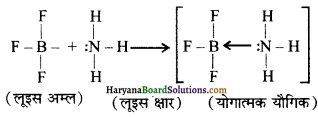
HBSE 11th Class Chemistry Solutions Chapter 11 Img 1

प्रश्न 4.
BCl3 तथा CCl4 यौगिकों का उदाहरण देते हुए जल के प्रति इनके व्यवहार के औचित्य को समझाइए।
उत्तर:
BCl3 में (B परमाणु sp2- संकंरित हैं), B परमाणु का अष्टक अपूर्ण है तथा इसका असंकरित 2p-कक्षक जल अणु से इलेक्ट्रॉन-युग्म ग्रहण करके योगात्मक उत्पाद बना सकता है।
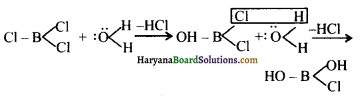
HBSE 11th Class Chemistry Solutions Chapter 11 Img 2
इस प्रकार जल से अभिक्रिया करने पर एक Cl परमाणु -OH समूह से प्रतिस्थापित हो जाता है। इसी प्रकार अन्य दो Cl परमाणु भो -OH समूह से प्रतिस्थापित हो जाते हैं।

HBSE 11th Class Chemistry Solutions Chapter 11 Img 3
इससे प्रदर्शित होता है कि बोरॉन ट्राइक्लोराइड का जल-अपघटन हो जाता है, परन्तु यह CCl4 के साथ सम्भव नहीं है। कार्बन परमाणु का अष्टक पूर्ण होता है तथा H2O अणुओं के साथ योगात्मक उत्पाद बनने की कोई सम्भावना नहीं है। परिणामस्वरूप कार्बन टेट्राक्लोराइड जल-अपघटित नहीं होता। जल में मिलाने पर यह उसमें मिश्रित भी नहीं होता, अपितु एक पृथक् तैलीय पर्त बनाता है।

HBSE 11th Class Chemistry Solutions Chapter 11 p-ब्लॉक तत्त्व

प्रश्न 5.
क्या बोरिक अम्ल प्रोटीनी अम्ल है? समझाइए।
उत्तर:
बोरिक अम्ल प्रोटीनी अम्ल नहीं है। यह एक लूइस अम्ल है तथा H2O अणु के हाइड्रॉक्सिल आयन से इलेक्ट्रॉन-युग्म ग्रहण करता है।
B(OH)3 + 2HOH → [B(OH)4] + H3O+

प्रश्न 6.
क्या होता है, जब बोरिक अम्ल को गर्म किया जाता है?
उत्तर:
370K से अधिक ताप पर गर्म किए जाने पर बोरिक अम्ल (ऑर्थोबोरिक अम्ल) मेटाबोरिक अम्ल (HBO2) बनाता है, जो और अधिक गर्म करने पर बोरिक ऑक्साइड (B2O3) में परिवर्तित हो जाता है।

HBSE 11th Class Chemistry Solutions Chapter 11 Img 4

प्रश्न 7.
BF3 तथा BH4 की आकृति की व्याख्या कीजिए। इन स्पीशीज में बोरॉन के संकरण को निर्दिष्ट कीजिए।
उत्तर:
BF3 की आकृति- BF3 में sp2 संकरण होता है। जिस कारण इन कक्षकों की संख्या 3 होती है। तथा इन कक्षकों बीच 120° का कोण होता है जिससे इलेक्ट्रॉन युग्मों में पारस्परिक प्रतिकर्षण न्यूनतम रहता है तथा यह अणु त्रिकोणीय व समतल होता है।
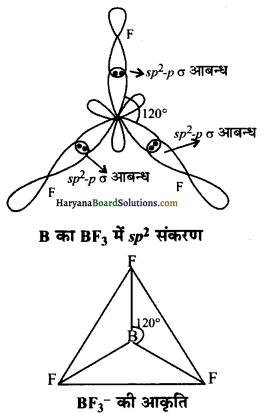
HBSE 11th Class Chemistry Solutions Chapter 11 Img 5
BH4 में B का संकरण sp3 होता है। इसकी आकृति चतुष्फलकीय होती है तथा 109°28′ का कोण होता है।
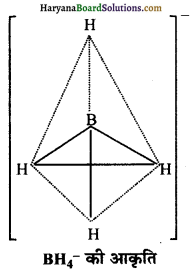
HBSE 11th Class Chemistry Solutions Chapter 11 Img 6

प्रश्न 8.
ऐलुमिनियम के उभयधर्मी व्यवहार दर्शाने वाली अभिक्रियाएँ दीजिए।
उत्तर:
ऐलुमिनियम अम्ल तथा क्षार दोनों से अभिक्रिया कर सकता है। इसलिए यह उभयधर्मी प्रकृति का होता है। उदाहरणार्थ-
2Al(s) + 6HCl(aq) → 2AlCl3(aq) + 3H2(g) तनु
2Al(s) + 2NaOH(aq) + 6H2O(l) → 2Na[Al(OH)4](aq) + 3H2(g)

प्रश्न 9.
इलेक्ट्रॉन न्यून यौगिक क्या होते हैं? क्या BCl3 तथा SiCl4 इलेक्ट्रॉन न्यून यौगिक हैं? समझाइए।
उत्तर:
इलेक्ट्रॉन न्यून यौगिक (Electron deficient Compounds)-वे यौगिक जिनके अणुओं में केन्द्रीय परमाणु एक या अधिक इलेक्ट्रॉन-युग्मों को ग्रहण करने की प्रवृत्ति रखते है, इलेक्ट्रॉन-न्यून यौगिक कहलाते हैं। इलेक्ट्रान-न्यून यौगिक को लूइस अम्ल भी कहा जाता है।

BCl3 तथा SiCl4 दाना इलक्ट्रान-न्यून योंगक है। B परमाणु मे रिक्त 2p कक्षक होते हैं, जबकि Si परमाणु में रिक्त 3-d कक्षक होते हैं। ये दोनों परमाणु इलेक्ट्रॉन-दाता स्पीशीज से इलेक्ट्रॉन युग्म ग्रहण कर सकते हैं। अत: BCl3 तथा SiCl4 दोनों इलेक्ट्रॉन-न्यून यौगिक हैं।

प्रश्न 10.
\(\mathrm{CO}_3^{2-}\) तथा \(\mathrm{HCO}_3^{-}\) की अनुनादी संरचनाएँ लिखिए।
उत्तर:
\(\mathrm{CO}_3^{2-}\) की अनुनादी संरचना (Resonating Structure of \(\mathrm{CO}_3^{2-}\) )
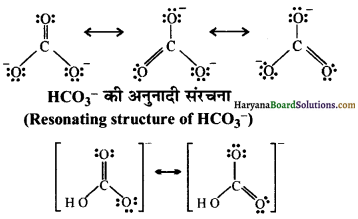
HBSE 11th Class Chemistry Solutions Chapter 11 Img 7

प्रश्न 11.
(क) \(\mathrm{CO}_3^{2-}\), (ख) हीरा तथा (ग) ग्रेफाइट में कार्बन की संकरण-अवस्था क्या होती है?
उत्तर:
(क) \(\mathrm{CO}_3^{2-}\) में कार्बन की संकरण-अवस्था sp2 होती है।
(ख) हीरे में कार्बन की संकरण-अवस्था sp3 होती है।
(ग) ग्रेफाइट में कार्बन की संकरण-अवस्था sp2 होती है।

प्रश्न 12.
संरचना के आधार पर हीरा तथा ग्रेफाइट के गुणों में निहित भिन्नता को समझाइए।
उत्तर:
हीरा तथा ग्रेफाइट में संरचनात्मक भिन्नता हीरा

  • हीरे में क्रिस्टलीय जालक होता है। इसमें एक-दूसरे से बँधे कार्बन परमाणुओं का जाल होता है।
  • प्रत्येक कार्बन परमाणु sp3 संकरित होता है तथा एकल सहसंयोजी बंध द्वारा चार अन्य कार्बन परमाणुओं से जुड़ा रहता है।
  • प्रत्येक कार्बन परमाणु चतुष्फलक के केन्द्र पर स्थित होता है तथा अन्य चार कार्बन परमाणु चतुष्फलक के चारों कोनों पर स्थित होते हैं।
  • C-C बंध की लम्बाई 154pm होती है। इसलिए हीरे में प्रबल सहसंयोजी बंधों का त्रिविमीय जाल होता है।
  • यह अत्यन्त कठोर होता है। इसका गलनांक उच्च होता है।

ग्रेफाइट:

  • ग्रेफाइट में परते 340pm की दूरी पर पृथक्कृत रहती हैं। इन परतो के बीच अत्यधिक दूरी यह प्रदर्शित करती है कि केवल दुर्बल वाण्डरवाल्स बल इन परतो को बाँधे रखते हैं।
  • ग्रेफाइट में, प्रत्येक कार्बन परमाणु sp2 संकरण प्रदर्शित करता है तथा तीन अन्य कार्बन परमाणुओं से सहसंयोजी रूप से जुड़ा रहता है।
  • प्रत्येक कार्बन परमाणु में चौथा इलेक्ट्रॉन π-बंध बनता है। अतः यह द्विविमीय षट्कोणीय वलय रखता है।
  • वलय में C-C सहसंयोजी दूरी 142pm होती है जो प्रबल बंध को व्यक्त करती है। इन वलयों की व्यवस्था परते बनाती है।
  • यह अत्यन्त कोमंल होता है। इसे मशीनों में शुष्क स्नेहक की भाँति प्रयोग किया जाता है।

HBSE 11th Class Chemistry Solutions Chapter 11 p-ब्लॉक तत्त्व

प्रश्न 13.
निम्नलिखित कशनों को युक्तिसंगत कीजिए तथा रासायनिक समीकरण दीजिए-
(क) लेड (II) क्लोराइड Cl2 से क्रिया करके PbCl4 देता है।
(ख) लेड (IV) क्लोराइड ऊष्मा के प्रति अत्यधिक अस्थायी है।
(ग) लेड एक आयोडाइड PbI4 नहीं बनाता है।
उत्तर:
(क) लेड (II) क्लोराइड Cl2 से क्रिया करके लेड (IV) क्लोराइड, (PbCl4) देता है क्योंकि क्लोरीन एक प्रबलतम ऑक्सीकारक है।

HBSE 11th Class Chemistry Solutions Chapter 11 Img 8
(ख) लेड IV ऑक्सीकरण अवस्था की तुलना में, II ऑक्सीकरण अवस्था में अधिक स्थायी होता है। इसलिए लेड (IV) क्लोराइड ऊष्मा के प्रति अत्यधिक अस्थायी होता है। यह गर्म करने पर विघटित होकर लेड (II) क्लोराइड बनाता है।

HBSE 11th Class Chemistry Solutions Chapter 11 Img 9
(ग) लेड एक आयोडाइड (PbI4) नहीं बनाता है; क्योंकि I आयन के प्रबल अपचायक होने के कारण यह विलयन में Pb4+ आयन को Pb2+ आयन में अपचयित कर देता है।
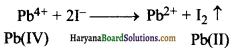
HBSE 11th Class Chemistry Solutions Chapter 11 Img 10

प्रश्न 14.
BF3 में तथा \(\mathrm{BF}_4^{-}\) में बंध लम्बाई क्रमशः 130 pm तथा 143 pm होने के कारण बताइए।
उत्तर:
BF3 में तथा \(\mathrm{BF}_4^{-}\) में बोरॉन की संकरण-अवस्था निम्नलिखित प्रकार से दर्शाई जा सकती है-
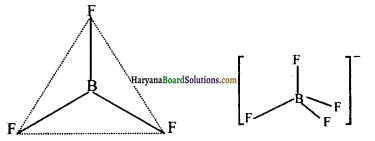
HBSE 11th Class Chemistry Solutions Chapter 11 Img 11
BF3 की आकृति समतलीय (Planer) है, इसमें sp2 संकरण पाया जाता है जबकि \(\mathrm{BF}_4^{-}\) की आकृति चतुष्फलकीय (tetrahedral) है, इसमें sp3 संकरण पाया जाता है, अतः दिए गए दोनों फ्लुओराइडों में बंध लम्बाइयों का अन्तर बोरॉन की संकरण-अवस्था में भिन्नता के कारण होता है।

प्रश्न 15.
B-Cl आबन्ध द्विधुव आघूर्ण रखता है, किन्तु BCl3 अणु का द्विध्रुव आघूर्ण शून्य होता है। क्यों ?
उत्तर:
B-Cl आबन्ध एक निश्चित द्विध्रुव आघूर्ण रखता है; क्योंकि यह ध्रुवीय प्रकृति का होता है। परन्तु BCl3 अणु का द्विध्रुव आघूर्ण शून्य होता है; क्योंकि BCl3 अणु सममिताकार (समतलीय) होता है जिसमें आबन्ध ध्रुवणताएँ एक-दूसरे को निरस्त कर देती हैं।
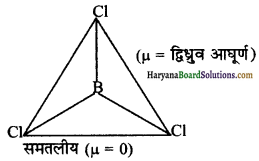
HBSE 11th Class Chemistry Solutions Chapter 11 Img 12

प्रश्न 16.
निर्जलीय HF में ऐलुमिनियम ट्राइफ्लुओराइड अविलेय है, परन्तु NaF मिलाने पर घुल जाता है। गैसीय BF3 को प्रवाहित करने पर परिणामी विलयन में से ऐलुमिनियम ट्राइ फ्लुओराइड अवक्षेपित हो जाता है। इसका कारण बताइए।
उत्तर:
ऐलुमिनियम ट्राइफ्लुओराइड (AIF3) निर्जली HF में अविलेय होता है; क्योंकि इसकी प्रकृति सहसंयोजी होती है। यद्यपि यह NaF से अभिक्रिया करने पर एक संकुल यौगिक बनाता है, जो जल में विलेय होता है।
AlF3 + NaF → Na+[AlF4]
(विलेय)
इस संकुल यौगिक को जलीय विलयन में BF3 की वाष्प बुलबुलों के रूप में प्रवाहित करने पर तोड़ा जा सकता है। परिणामस्वरूप ऐलुमिनियम ट्राइफ्लुओराइड पुनः अवक्षेपित हो जाता है।
Na+[AlF4] + BF3→AlF3Na+[BF4]
(अवक्षेप)

प्रश्न 17.
CO के विधैली होने का एक कारण बताइए।
उत्तर:
कार्बन मोनोक्साइड (CO) प्रकृति में पाई जाने वाली एक अत्यधिक विषैली गैस होती है। इसके विषैला होने का कारण यह है कि रक्त में उपस्थित हीमोग्लोबिन से संयुक्त होकर कार्बोक्सीहीमोग्लोबिन बना लेती है जो श्वसित की गई ऑक्सीजन को शरीर के विभिन्न भागों में ले जाने में असमर्थ होता है। इससे दम घुटने लगता है तथा अन्ततः मृत्यु हो जाती है।

प्रश्न 18.
CO2 की अधिक मात्रा भूमण्डलीय ताप वृद्धि के लिए उत्तरदायी कैसे है?
उत्तर:
CO2 में मेथेन के समान ऊष्मा अवशोषित करने की प्रवृत्ति होती है। इसे हरित-गृह गैस (green house gas) भी कहते हैं। इस प्रवृत्ति के कारण वायुमण्डल में इसकी अत्यधिक सान्द्रता भूमण्डलीय ताप वृद्धि के लिए उत्तरदायी होती है।

प्रश्न 19.
डाइबोरेन तथा बोरिक अम्ल की संरचना समझाइए।
उत्तर:
(क) डाइबोरेन की संरचना (Structure of Diborane)डाइबोरेन की संरचना को चित्र द्वारा दर्शाया गया है। इसमें सिरे वाले चार हाइड्रोजन परमाणु तथा दो बोरॉन परमाणु एक ही तल में होते हैं। इस तल के ऊपर तथा नीचे दो सेतु बंधित हाइड्रोजन परमाणु होते हैं। सिरे वाले चार B-H बंध सामान्य द्विकेन्द्रीय-द्विइलेक्ट्रॉन (two centretwo electron) बंध होते हैं तथा दो सेतु बन्ध (B-H-B) भिन्न प्रकार के होते हैं, जिन्हें ‘त्रिकेन्द्रीय-द्विइलेक्ट्रॉन बंध’ कहते हैं।
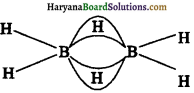
HBSE 11th Class Chemistry Solutions Chapter 11 Img 13
डाइबोरेन में प्रत्येक बोरॉन परामाणु sp3 संकरित होता है।

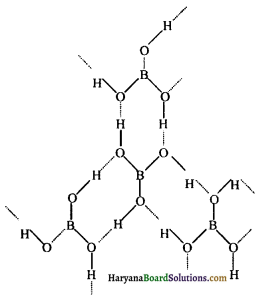
(ख) बोरिक अम्ल की संरचना (Structure of Boric acid)ठोस अवस्था में, बोरिक अम्ल की परतदार संरचना होती है, जहाँ समतलीय BO3 की इकाइयाँ हाइड्रोजन बंध द्वारा एक-दूसरे से 318pm की दूरी पर जुड़ी रहती हैं। बोरिक अम्ल में बोरॉन परमाणु sp2 संकरित होता है।
HBSE 11th Class Chemistry Solutions Chapter 11 Img 14
बोरिक अम्ल की संरचना में बिन्दुकृत रेखाएँ हाइड्रोजन आबन्ध को प्रदर्शित करती हैं।

प्रश्न 20.
क्या होता है, जब-
(क) बोरेक्स को अधिक गर्म किया जाता है।
(ख) बोरिक अम्ल को जल में मिलाया जाता है।
(ग) ऐल्युमिनियम की तनु NaOH से अभिक्रिया कराई जाती है।
(घ) BF3 की क्रिया अमोनिया से की जाती है।
उत्तर:
(क) जब बोरेक्स के चूर्ण को बुन्सन बर्नर की ज्वाला में अधिक गर्म किया जाता है, तो सर्वप्रथम यह जल के अणु का निष्कासन करके फूल जाता है। पुन: गर्म करने पर यह एक पारदर्शी द्रव में परिवर्तित हो जाता है, जो काँच के समान एक ठोस में परिवर्तित हो जाता है। इसे बोरेक्स मनका कहते हैं।

HBSE 11th Class Chemistry Solutions Chapter 11 Img 15
(ख) यह जल में घुल जाता है; क्योंकि यह इलेक्ट्रॉन-न्यून यौगिक है।
B(OH)3 + H – OH → [B(OH)4] + H+
या
[H3BO3]

(ग) ऐलुमिनियम NaOH विलयन में घुलकर एक विलेय संकुल बनाता है तथा हाइड्रोजन गैस मुक्त करता है।
2Al(s) + 2NaOH(aq) + 6H2O(l) → 2Na+[Al(OH)4](aq) + 3H2(g)

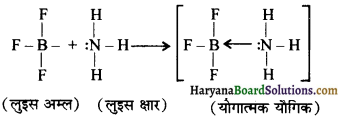
(घ) BF3 (व्यवहार में लूइस अम्ल) NH3 (व्यवहार में लूइस-क्षारक) के साथ योगात्मक यौगिक बनाता है।
HBSE 11th Class Chemistry Solutions Chapter 11 Img 16

HBSE 11th Class Chemistry Solutions Chapter 11 p-ब्लॉक तत्त्व

प्रश्न 21.
निम्नलिखित अभिक्रियाओं को समझाइए जब-
(क) कॉपर की उपस्थिति में उच्च ताप पर सिलिकन को मेथिल क्लोराइड के साथ गर्म किया जाता है।
(ख) सिलिकन डाइऑक्साइड की क्रिया ह्यइड्रोजन फ्लुओराइड के साथ की जाती है।
(ग) CO को ZnO के साथ गर्म किया जाता है।
(घ) जलीय ऐलुमिना की क्रिया जलीय NaOH के साथ की जाती है।
उत्तर:
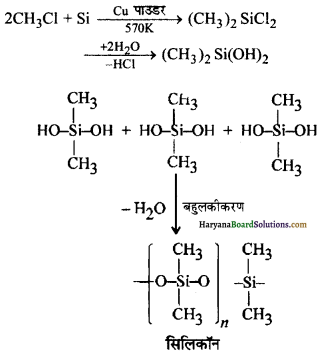
(क) कॉपर पाउडर (उत्प्रेरक) की उपस्थिति में उच्च ताप (570K) पर सिलिकन को मेथिल क्लोराइड के साथ गर्म करने पर डाइमेथिल डाइक्लोरोसिलेन प्राप्त होता है, जिसके जल-अपघटन के उपरान्त संघनन बहुलकीकरण द्वारा श्रृंखला बहुलक प्राप्त होते हैं।
HBSE 11th Class Chemistry Solutions Chapter 11 Img 17

(ख) सिलिकन डाइऑक्साइड की क्रिया हाइड्रोजन फ्लुओराइड के साथ होने पर सिलिकन टेट्राफ्लुओराइड (SiF4) बनता है।
SiO2 + 4HF → SiF4 + 2 H2O

(ग) CO, जो एक प्रबल अपचायक है, के द्वारा ZnO का अपचयन Zn में हो जाता है।
ZnO + CO → Zn + CO2

(घ) दोनों यौगिक दाब के अन्तर्गत गर्म किए जाने पर विलेय संकुल बनाते हैं।
Al2O3(s) + 2NaOH(aq) + 3H2O(l) → 2Na[Al(OH)4](aq)

प्रश्न 22.
कारण बताइए-
(क) सान्द्र HNO3 का परिवहन ऐलुमिनियम के पात्र द्वारा किया जा सकता है।
(ख) तनु NaOH तथा ऐलुमिनियम के टुकड़ों के मिश्रण का प्रयोग अपवाहिका खोलने के लिए किया जाता है।
(ग) ग्रेफाइट शुष्क स्नेहक के रूप में प्रयुक्त होता है।
(घ) हीरे का प्रयोग अपघर्षक के रूप में होता है।
(ङ) वायुयान बनाने में ऐलुमिनियम मिश्र धातु का प्रयोग होता है।
(च) जल को ऐलुमिनियम पात्र में पूरी रात नहीं रखना चाहिए।
(छ) संचरण केबल बनाने में ऐलुमिनियम तार का प्रयोग होता है।
उत्तर:
(क) सान्द्र HNO3 प्रारम्भ में ही ऐलुमिनियम से क्रिया करके ऐलुमिनियम ऑक्साइड (Al2O3) बना लेता है, जो पात्र के भीतर एक रक्षी-लेपन कर देता है। इस प्रकार धात्विक पात्र निष्क्रिय (passive) हो जाता है तथा फिर अम्ल से क्रिया नहीं करता। इसलिए अम्ल का परिवहन ऐलुमिनियम के पात्र द्वारा सुरक्षापूर्वक किया जा सकता है।

(ख) ऐलुमिनियम तनु NaOH में घुलकर H2 मुक्त करता है। यह हाइड्रोजन गैस अपवाहिका खोलने में सहायता करती है।
2Al + 2NaOH + 2H2O → 2NaAlO2 + 3H2

(ग) ग्रेफाइट में sp2- संकरित कार्बन होता है तथा इसकी परतीय संरचना होती है। व्यापक पृथक्करण तथा दुर्बल अन्तरपर्तीय बन्धों के कारण इसकी दो समीपवर्ती परते एक-दूसरे पर सरलतापूर्वक फिसल जाती हैं। इस कारण इसे शुष्क स्नेहक की भाँति उन मशीनों में प्रयुक्त किया जा सकता है जिनमें किसी कारणवश तैलीय स्नेहक प्रयुक्त न किए जा सकते हों।

(घ) हीरा समस्त ज्ञात पदार्थों में कठोरतम पदार्थ होता है। अत: इसका प्रयोग अपघर्षक (abrasive) तथा काँच काटने में किया जाता है।

(ङ) ऐलुमिनियम मिश्रधातु-मैग्नेलियम तथा ड्यूरैलियम जिनमें लगभग 95% धातु है, को वायुयान बनाने में प्रयोग किया जाता है। इस कारण ये हल्के, परन्तु मजबूत होते हैं। इसके अतिरिक्त इन पर जंग भी नहीं लगता है।

(च) जल को ऐलुमिनियम पात्र में पूरी रात नहीं रखना चाहिए; क्योंकि लम्बे समय तक नमी तथा ऑक्सीजन से धातु संक्षारित हो सकती है।

(छ) ऐलुमिनियम सामान्यतया वायु तथा नमी से प्रभावित नहीं होती तथा इसकी विद्युत-चालकता कॉपर से दोगुनी होती है। इसलिए संचरण केबल बनाने में ऐलुमिनियम तार का प्रयोग होता है।

प्रश्न 23.
कार्बन से सिलिकॉन तक आयनीकरण एन्थैल्पी में प्रघटनीय कमी होती है। क्यों ?
उत्तर:
कार्बन से सिलिकॉन तक आयनीकरण में प्रघटनीय कमी होती है; क्योंकि कार्बन की परमाणु त्रिज्या (77 pm) की तुलना में सिलिकॉन की परमाणु त्रिज्या अधिक (118 pm) होती है। इसलिए इलेक्ट्रॉनों का निष्कासन सरलतापूर्वक हो जाता है। सिलिकॉन से जर्मेनियम तक आयनन एन्थैल्पी में कमी प्रघटनीय नहीं होती; क्योंकि तत्वों के परमाणु आकार एकसमान रूप से बढ़ते हैं।

प्रश्न 24.
Al की तुलना में Ga की कम परमाण्वीय त्रिज्या को आप कैसे समझयेंगे ?
उत्तर:
Al की तुलना में Ga की कम परमाण्वीय त्रिज्या को प्रथम संक्रमण श्रेणी (Z = 21 से 30) के दस तत्वों की उपस्थिति के आधार पर समझाया जा सकता है। इनमें इलेक्ट्रॉन 3d-कक्षकों में होते हैं। चूँकि d-कक्षकों का आकार p-कक्षकों की तुलना में अधिक होता है; अतः अन्तरस्थ इलेक्ट्रॉनों के पास नाभिकीय आवेश में वृद्धि के प्रभाव को निरस्त करने के लिए पर्याप्त परिरक्षण प्रभाव नहीं होता। इसलिए Ga की स्थिति में प्रभावी नाभिकीय आवेश का मान कम होता है। इससे अपवादस्वरूप Ga का परमाणु आकार घट जाता है जिसे वास्तव में बढ़ा होना चाहिए था।

प्रश्न 25.
अपररूप क्या होता है? कार्बन के दो महत्त्वपूर्ण अपररूप हीरा तथा ग्रेफाइट की संरचना का चित्र बनाइए। इन दोनों अपररूपों के भौतिक गुणों पर संरचना का क्या प्रभाव पड़ता है ?
उत्तर:
प्रकृति में शुद्ध कार्बन दो रूपों में पाया जाता है—हीरा तथा ग्रेफाइट। यदि हीरे अथवा ग्रेफाइट को वायु में अत्यधिक गर्म किया जाए तो यह पूर्ण रूप से जल जाते हैं तथा कार्बन डाइऑक्साइड बनाते हैं। जब हीरे तथा ग्रेफाइट की समान मात्रा दहन की जाती है, तब कार्बन डाइऑक्साइड की बराबर मात्रा उत्पन्न होती है तथा कोई अवशेष नहीं बचता। इन तथ्यों से स्पष्ट है कि हीरा तथा ग्रेफाइट रासायनिक रूप से एक-समान हैं तथा केवल कार्बन परमाणुओं से बने हैं। इनके भौतिक गुण अत्यधिक भिन्न होते हैं। अतः इस प्रकार के गुणों को प्रदर्शित करने वाले तत्वों को अपररूप कहते हैं। हीरा तथा ग्रेफाइट कॉर्बन के दो प्रमुख क्रिस्टलीय अपररूप हैं।

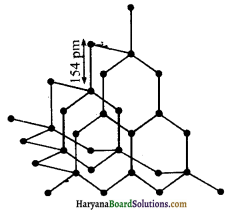
1. हीरा – हीरा में क्रिस्टलीय जालक होता है। इसमें प्रत्येक परमाणु sp3 संकरित होता है तथा चतुष्फलकीय ज्यामिति से अन्य चार कार्बन परमाणुओं से जुड़ा रहता है। इसमें कार्बन-कार्बन बंध लम्बाई 154 pm होती है। कार्बन परमाणु दिक् (space) में दृढ़ त्रिविमीय जालक (rigid three dimensional network) का निर्माण करते हैं।
HBSE 11th Class Chemistry Solutions Chapter 11 Img 18
इस संरचना में सम्पूर्ण जालक में दिशात्मक सहसंयोजक बंध उपस्थित रहते हैं। इस प्रकार विस्तृत सहसंयोजक बन्धन को तोड़ना कठिन कार्य होता है। अतः हीरा पृथ्वी पर पाया जाने वाला सर्वाधिक कठोर पदार्थ है। इसका उपयोग धार तेज करने के लिए अपघर्षक (abrasive) के रूप में, डाई बनाने में तथा विद्युत-प्रकाश लैम्प में टंगस्टन तन्तु (filament) बनाने में होता है।

2. ग्रेफाइट – ग्रेफाइट की पर्त्त्र्य संरधना (layered structure) होती है। ये पर्तें वाण्डरवाल बल द्वारा जुड़ी रहती हैं।
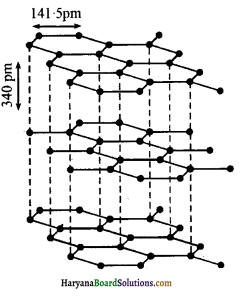
HBSE 11th Class Chemistry Solutions Chapter 11 Img 19
इस कारण ग्रेफाइट चिकना (slippery) तथा मुलायम (soft) होता है। दो पर्तों के मध्य की दूरी 340 pm होती है। प्रत्येक पर्त में कार्बन परमाणु षट्कोणीय वलय (hexagonal rings) के रूप में व्यवस्थित होते हैं जिसमें C-C बंध लम्बाई 141.5 pm होती है। षट्कोणीय वलय में प्रत्येक कार्बन परमाणु sp2 संकरित होता है। प्रत्येक कार्बन परमाणु तीन निकटवर्ती कार्बन परमाणुओं से तीन सिग्मा बंध बनाता है। इसका चौथा इलेक्ट्रॉन π-बंध बनाता है। सम्पूर्ण पर्त में इलेक्ट्रॉन विस्थानीकृत होते हैं। इलेक्ट्रॉन गतिशील होते हैं; अत: ग्रेफाइट विद्युत का सुचालक होता है। उच्च ताप पर जिन मशीनों में तेल का प्रयोग स्नेहक (lubricant) के रूप में नहीं हो सकता है, उनमें ग्रेफाइट शुष्क स्नेहक का कार्य करता है।

3. फुलरीन्स (Fullerenes) – एच. डब्ल्यू. क्रोटो, ई. स्मैले तथा आर. एफ. कर्ल ने सन् 1985 में कार्बन में एक अन्य अपररूप फुलरीन की खोज की। इसी खोज के कारण इन्हें सन् 1996 में नोबेल पुरस्कार प्राप्त हुआ।
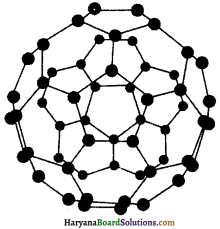
HBSE 11th Class Chemistry Solutions Chapter 11 Img 20
हीलियम, आर्गन आदि अक्रिय गैसों की उपस्थिति में जब ग्रेफाइट को विद्युत आर्क (electric arc) में गर्म किया जाता है, तब फुलरीन का निर्माण होता है। वाष्पित लघु Cn अणुओं को संघनित करने पर प्राप्त कज्जली पदार्थ (sooty material) में मुख्य रूप से C60 कुछ अंश C70 तथा अतिसूक्ष्म मात्रा में 350 या अधिक समसंख्या में कार्बन फुलरीन में पाए गए हैं। फुलरीन कार्बन का शुद्धतम रूप हैं; क्योंकि फुलरीन में किसी प्रकार का झूलता बंध (dangling bond) नहीं होता है। फुलरीन की संरचना पिंजरानुमा (cage-like) होती है। C60 अणु की आकृति सॉकर बॉल के समान होती है। इसे बकमिन्ट्टर फुलरीन (buckminstefulerene) कहते हैं।

इसमें छह सदस्यीय बीस वलय तथा पाँच सदस्यीय बारह वलय होती हैं। एक छह सदस्यीय वलय छह अथवा पाँच सदस्यीय वलय के साथ संगलित (fused) रहती है, जबकि पाँच सदस्यीय नलय केवल छ: सदस्यीय वलय के साथ संगलित अवस्था में रहती है। सभी कार्बन परमाणु समान होते हैं तथा sp2-संकरित होते हैं। प्रत्येक कार्बन परमाणु अन्य तीन कार्बन परमाणुओं के साथ तीन आबन्ध बनाता है।

चौथा इलेक्ट्रॉन पूरे अणु पर विस्थानीकृत रहता है, जो अणु को ऐरोमैटिक गुण प्रदान करता है। दस गेंदनुमा अणु में 60 उदग्र (vertices) होते हैं। प्रत्येक उदग्र पर एकल कार्बन परमाणु होता है। इस पर दोनों एकल तथा द्विबन्ध होते हैं, जिसकी C-C की लम्बाई क्रमशः 143.5 pm तथा 138.3 pmहोती है। गोलाकार फुलरीन को ‘बकी बॉल’ (Bucky ball) भी कहते हैं।

(4) अन्य अपररूप (Other Allotropes) – कार्बन तत्व के अन्य अपररूप भी होते हैं जैसे-कार्बन ब्लैक, कोक, चारकोल आदि। ये सभी अशुद्ध अपररूप कहलाते हैं।

HBSE 11th Class Chemistry Solutions Chapter 11 p-ब्लॉक तत्त्व

प्रश्न 26.
(क) निम्नलिखित ऑक्साइड को उदासीन, अम्लीय, क्षारीय तथा उभयधर्मी ऑक्साइड के रूप में वर्गीकृत कीजिए-
CO, B2O3, SiO2, Al2O3, PbO2, TI2O3
(ख) इनकी प्रकृति को दर्शाने वाली रासायनिक अभिक्रिया लिखिए।
उत्तर:
(क) उदासीन ऑक्साइड : CO
अम्लीय ऑक्साइड : SiO2, CO2, B2O3
क्षारीय ऑक्साइड : Tl2O3, PbO2
उभयधर्मी ऑक्साइड : Al2O3
(ख) CO – उदासीन
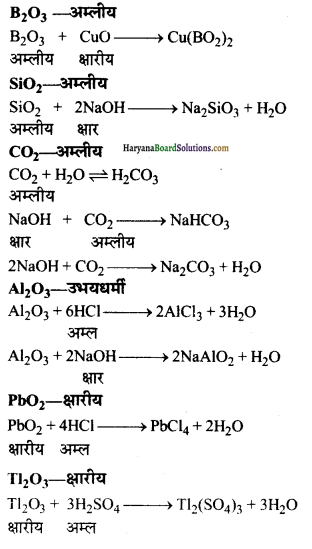
HBSE 11th Class Chemistry Solutions Chapter 11 Img 21

प्रश्न 27.
कुछ अभिक्रियाओं में थैलियम, ऐलुमिनियम से समानता दर्शाता है, जबकि अन्य में यह समूह-I के धातुओं से समानता दर्शाता है। इस तथ्य को कुछ प्रमाणों के द्वारा सिद्ध करें।
उत्तर:
थैलियम की ऐलुमिनियम से समानता

  • दोनों का बाह्यतम इलेक्ट्रॉनिक विन्यास ns2np1 होता है।
  • दोनों वायु में ऑक्साइड बनने के कारण धूमिल पड़ जाते हैं।
  • Al तथा Tl दोनों के फ्लोराइड आयनिक होते हैं तथा इनका गलनांक उच्च होता है।
  • Al तथा Tl दोनों ही +3 ऑक्सीकरण संख्या भी दर्शाते हैं।

थैलियम की समूह -I की धातुओं से समानता

  • थैलियम एवं समूह -I दोनों ही +1 ऑक्सीकरण संख्या दर्शाते हैं।
  • NaOH के समान Tl(OH) जल में विलेय होकर प्रबल क्षारीय विलयन बनाता है।
  • क्षार धातुओं के समान, थैलियम ऐलुमिनियम लवणों के साथ द्विक लवण बनाता है।
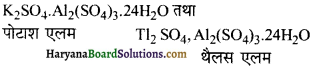
    HBSE 11th Class Chemistry Solutions Chapter 11 Img 22

प्रश्न 28.
जब धातु X की क्रिया सोडियम हाइड्रु क्साइड के साथ की जाती है तो श्वेत अवक्षेप (A) प्राप्त होता है, जो NaOH के आधिक्य में विलेय होकर विलेय संकुल (B) बनाता है। यौगिक (A) तनु HCl में घुलकर (C) बनाता है। यौगिक(A) को अधिक गर्म किए जाने पर यौगिक (D) बनता है, जो एक निष्कर्षित घातु के रूप में प्रयुक्त होता है। X,A,B, C तथा D को पहचानिए तथा इनकी पहचान के समर्थन में उपयुक्त समीकरण दीजिए।
उत्तर:
दी गई परिस्थितियों के अनुसार धातु X ऐलुमिनियम है। वे अभिक्रियाएँ, जिनमें ऐलुमिनियम भाग लेकर यौगिक A,B,C तथा D बनाता है, अग्रलिखित हैं-

(i) ऐलुमिनियम (X) को NaOH के साथ गर्म करने पर यह Al(OH)3 का सफेद् अवक्षेप बनाता है अर्थात् यौगिक (A) बनाता है जो NaOH के आधिक्य में घुलकर विलेय संकर (B) बनाता है।
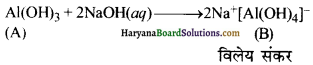
HBSE 11th Class Chemistry Solutions Chapter 11 Img 23
(ii) यौगिक (A) तनु HCl में घुलकर ऐलुमिनियम क्लोराइड (C) बनाता है।

(iii) गर्म करने पर Al(OH)3, ऐलुमिना (D) में परिवर्तित हो जाता है।

HBSE 11th Class Chemistry Solutions Chapter 11 Img 25
Al2O3 का प्रयोग ऐलुमिनियम के निष्कर्षण में किया जाता है।

प्रश्न 29.
निम्नलिखित से आप क्या समझते हैं?
(क) अक्रिय युग्म प्रभाव,
(ख) अपररूप,
(ग) श्रृंखलन।
उत्तर:
(क) अक्रिय युग्म प्रभाव (Inert pair effect) – इलेक्ट्रॉनिक कोश विन्यास, (n – 1)d10 ns2np1 वाले तत्व में, d-कक्षक के इलेक्ट्रॉन दुर्बल परिरक्षण प्रभाव (poor shielding effect) प्रदर्शित करते हैं। इसलिए ns2 इलेक्ट्रॉन नाभिक के धनावेश द्वारा अधिक दृढ़ता से बँधे रहते हैं। इस प्रबल आकर्षण के परिणामस्वरूप, ns2 इलेक्ट्रॉन युग्मित रहते हैं तथा बन्ध में भाग नहीं लेते हैं अर्थात् अक्रिय रहते हैं। यह प्रभाव अक्रिय युग्म प्रभाव कहलाता है। इस स्थिति में, ns2np1 विन्यास में, तीन इलेक्ट्रॉनों में से केवल एक इलेक्ट्रॉन बंध-निर्माण में भाग लेता है।

(ख) अपररूप (Allotropes) – किसी तत्व का समान रासायनिक अवस्था में दो या अधिक भिन्न-रूपों में पाया जाना अपररूपता कहलाता है। तत्व के ये विभिन्न रूप अपररूप कहलाते हैं। किसी तत्व के सभी अपररूपों के रासायनिक गुण समान होते हैं, परन्तु इनके भौतिक गुणों मे अन्तर होता है।

(ग) शृंखलन (Catenation) – कार्बन में अन्य परमाणुओं के साथ सहसंयोजक बंध द्वारा जुड़कर लम्बी शृंखला या.वलय बनाने की प्रवृत्ति होती है। इस प्रवृत्ति को श्रृंखलन कहते हैं। C-C बंध अधिक प्रबल होने के कारण ऐसा होता है।

प्रश्न 30.
एक लवण X निम्नलिखित परिणाम देता है-
(क) इसका जलीय विलयन लिटमस के प्रति क्षारीय होता है।
(ख) तीव्र गर्म किए जाने पर यह काँच के समान ठ्रेस में स्वेदित हो जाता है।
(ग) जब X के गर्म विलयन में सान्द्र H2SO4 मिलाया जाता है तो एक अम्ल Z का श्वेत क्रिस्टल बनता है।
उपर्युक्त अभिक्रियाओं के समीकरण लिखिए और X, Y तथा Z को पहचानिए।
उत्तर:
दिए गए परिणामों से स्पष्ट है कि लवण X बोरेक्स (Na2B4O7) है।
(क) बोरेक्स का जलीय विलयन क्षारीय प्रकृति का होता है तथा लाल लिटमस को नीला कर देता है।
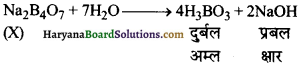
HBSE 11th Class Chemistry Solutions Chapter 11 Img 26
(ख) बोरेक्स तीव्र गर्म किए जाने पर स्वेदित (swell) हो जाता है तथा क्रिस्टलन जल के अणु खोकर ठोस (Y) बनाता है।

HBSE 11th Class Chemistry Solutions Chapter 11 Img 27
(ग) सान्द्र H2SO4 से अभिक्रिया करने पर, बोरेक्स बोरिक अम्ल (H3BO3) बनाता है। जब इसे विलयन से क्रिस्टलीकृत किया जाता है तो श्वेत क्रिस्टलों (Z) के रूप में होता है।

HBSE 11th Class Chemistry Solutions Chapter 11 Img 28

प्रश्न 31.
सन्तुलित समीकरण दीजिए-
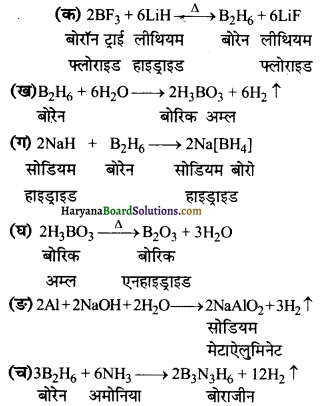
(क) BF3 + LiH →
(ख) B2H6 + H2O →
(ग) NaH + B2H6
(घ) H3BO3HBSE 11th Class Chemistry Solutions Chapter 11 Img 29
(ङ) Al + NaOH →
(च) B2H6 + NH3
उत्तर:
HBSE 11th Class Chemistry Solutions Chapter 11 Img 30

प्रश्न 32.
CO तथा CO प्रत्येक के संश्लेषण के लिए एक प्रयोगशाला तथा एक औद्योगिक विधि दीजिए।
उत्तर:
(क) कार्बनमोनोऑक्साइड (Carbon Mono oxide)
प्रयोगशाला विधि (Laboratory Method)-सान्द्र सल्फ्यूरिक अम्ल का 373K पर फॉर्मिक अम्ल के द्वारा निर्जलीकरण कराने पर अल्प मात्रा में शुद्ध कार्बन मोनो ऑक्साइड प्राप्त होती है।

HBSE 11th Class Chemistry Solutions Chapter 11 Img 31
औद्योगिक विधि (Industrial Method)-औद्योगिक रूप में इसे कोक पर भाप (Steam) प्रवाहित करके बनाया जाता है। इस प्रकार CO तथा H2 का प्राप्त मिश्रण ‘वाटर गैस’ अथवा ‘संश्लेषण गैस’ (synthesis gas) कहलाता है।

HBSE 11th Class Chemistry Solutions Chapter 11 Img 32
जब भाप के स्थान पर वायु का प्रयोग किया जाता है, तब CO तथा N2 का मिश्रण प्राप्त होता है। इसे प्रोड्यूसर गैस कहते हैं।

HBSE 11th Class Chemistry Solutions Chapter 11 Img 33

(ख) कार्बन डाइऑक्साइड (Carbon dioxide)
प्रयोगशाला विधि (Laboratory Method) – प्रयोगशाला में इसे कैल्सियम कार्बोनेट पर तनु HCl की अभिक्रिया द्वारा बनाया जाता है।
CaCO3(s) + 2HCl(aq) → CaCl2(aq)+CO2(g)+H2O(l)
कैल्सियम – कैल्सियम कार्बन डाइ
कार्बोनेट – क्लोराइड ऑक्साइड

औद्योगिक विधि (Industrial Method) – औद्योगिक रूप में चूना पत्थर (lime-stone) को गर्म करके CO2 बनाई जा सकती है।
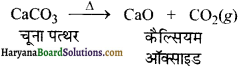
HBSE 11th Class Chemistry Solutions Chapter 11 Img 34

प्रश्न 33.
बोरेक्स के जलीय विलयन की प्रकृति कौन-सी होती है?
(क) उदासीन
(ख) उभयधर्मी
(ग) क्षारीय
(घ) अम्लीय।
उत्तर:
(ग) क्षारीय।

प्रश्न 34.
बोरिक अम्ल के बहुलकीय होने का कारण ?
(क) इसकी अम्लीय प्रकृति है
(ख) इसमें हाइड्रोजन बंधों की उपस्थिति है
(ग) इसकी एकक्षारीय प्रकृति है
(घ) इसकी ज्यामिति है।
उत्तर:
(ख) इसमें हाइड्रोजन बंधों की उपस्थिति है।

प्रश्न 35.
डाइबोरेन में बोरॉन का संकरण कौन-सा होता है?
(क) sp
(ख) sp2
(ग) sp3
(घ) dsp2
उत्तर:
(ग) sp3

प्रश्न 36.
ऊष्मागतिकीय रूप से कार्बन का सर्वाधिक स्थायी रूप कौन-सा है?
(क) हीरा
(ख) ग्रेफाइट
(ग) फुलरीन्स
(घ) कोयला।
उत्तर:
(ख) ग्रेफाइट।

प्रश्न 37.
निम्नलिखित में से समूह-14 के तत्वों के लिए कौन-सा कथन सत्य है ?
(क) +4 ऑक्सीकरण अवस्था प्रदर्शित करते हैं।
(ख) +2 तथा +4 ऑक्सीकरण अवस्था प्रदर्शित करते हैं।
(ग) M2- तथा M4+ आयन बनाते हैं।
(घ) M2+ तथा M4- आयन बनाते हैं।
उत्तर:
(ख) +2 तथा +4 ऑक्सीकरण अवस्था प्रदर्शित करते हैं।

प्रश्न 38.
यदि सिलिकॉन-निर्माण में प्रारमिभक पदार्थ RSiCl3 है तो बनने वाले उत्पाद की संरचना बताइए।
उत्तर:
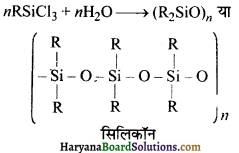
HBSE 11th Class Chemistry Solutions Chapter 11 Img 35

HBSE 11th Class Chemistry Solutions Chapter 11 p-ब्लॉक तत्त्व Read More »

HBSE 8th Class Maths Solutions Haryana Board

Haryana Board HBSE 8th Class Maths Solutions

HBSE 8th Class Maths Solutions in English Medium

HBSE 8th Class Maths Chapter 1 Rational Numbers

HBSE 8th Class Maths Chapter 2 Linear Equations in One Variable

HBSE 8th Class Maths Chapter 3 Understanding Quadrilaterals

HBSE 8th Class Maths Chapter 4 Practical Geometry

HBSE 8th Class Maths Chapter 5 Data Handling

HBSE 8th Class Maths Chapter 6 Square and Square Roots

HBSE 8th Class Maths Chapter 7 Cube and Cube Roots

HBSE 8th Class Maths Chapter 8 Comparing Quantities

HBSE 8th Class Maths Chapter 9 Algebraic Expressions and Identities

HBSE 8th Class Maths Chapter 10 Visualizing Solid Shapes

HBSE 8th Class Maths Chapter 11 Mensuration

HBSE 8th Class Maths Chapter 12 Exponents and Powers

HBSE 8th Class Maths Chapter 13 Direct and Inverse Proportions

HBSE 8th Class Maths Chapter 14 Factorization

HBSE 8th Class Maths Chapter 15 Introduction to Graphs

HBSE 8th Class Maths Chapter 16 Playing with Numbers

HBSE 8th Class Maths Solutions in Hindi Medium

HBSE 8th Class Maths Chapter 1 परिमेय संख्याएँ

HBSE 8th Class Maths Chapter 2 एक चर वाले रैखिक समीकरण

HBSE 8th Class Maths Chapter 3 चतुर्भुजों को समझना

HBSE 8th Class Maths Chapter 4 प्रायोगिक ज्यामिती

HBSE 8th Class Maths Chapter 5 आँकड़ो का प्रबंधन

HBSE 8th Class Maths Chapter 6 वर्ग और वर्गमूल

HBSE 8th Class Maths Chapter 7 घन और घनमूल

HBSE 8th Class Maths Chapter 8 राशियों की तुलना

HBSE 8th Class Maths Chapter 9 बीजीय व्यंजक एवं सर्वसमिकाएँ

HBSE 8th Class Maths Chapter 10 ठोस आकारों का चित्रण

HBSE 8th Class Maths Chapter 11 क्षेत्रमिति

HBSE 8th Class Maths Chapter 12 घातांक और घात

HBSE 8th Class Maths Chapter 13 सीधा और प्रतिलोम समानुपात

HBSE 8th Class Maths Chapter 14 गुणनखंडन

HBSE 8th Class Maths Chapter 15 आलेखों से परिचय

HBSE 8th Class Maths Chapter 16 संख्याओं के साथ खेलना

HBSE 8th Class Maths Solutions Haryana Board Read More »

HBSE 6th Class Science Solutions Chapter 5 Separation of Substances

Haryana State Board HBSE 6th Class Science Solutions Chapter 5 Separation of Substances Textbook Exercise Questions and Answers.

Haryana Board 6th Class Science Solutions Chapter 5 Separation of Substances

HBSE 6th Class Science Separation of Substances Textbook Questions and Answers

Exercises

Question 1.
Why do we need to separate different substances present in a mixture? Give two examples.
Answer:
We need to separate different substances present in a mixture due to the following purposes:

  • To remove the unuseful or harmful component for example removing tea leaves after making tea.
  • To obtain the useful components – for getting wheat or rice grains after separating.
  • To remove impurities for getting a pure sample. For example obtaining sugar crystals from jaggery (Gur) or salt from sea water.

Examples:

  • Tea leaves age separated from liquid with a strainer while preparing tea.
  • Grain is separated from stalks, while harvesting.

Question 2.
What is winnowing? Where is it used?
Answer:
The process of separating lighter and heavier particles from a mixture is called winnowing. In this process/method heavier particles of grains are separated from lighter particles of husk. The husk particles are carried away by wind and separate heap away from that of the heavier particles of grains of wheat is formed. This method is used by farmers in fields as well as at a flour mill (atta chakki).

Question 3.
How will you separate husk or dirt particles from pulses before cooking?
Answer:
The husk particles or dust particles are separated from pulses by the method of hand picking. Since the undesired particles are present in small quantities and the total amount of pulses to be separated is generally not very- very large. So they are separated by hand picking before cooking the pulses.

HBSE 6th Class Science Solutions Chapter 5 Separation of Substances

Question 4.
What is sieving? Where it is used?
Answer:
Sieving is a method used to separate the components of a mixture which are of different size. The undesirable particles in the form of husk remain on the seive and fine particles of flour pass through the holes of the sieve. Sieving flour before consuming is not a good practice, because during sieving husk remains on the seive, which provides us roughage which is useful for our body.

Question 5.
How will you seperate sand and water from their mixture?
Answer:
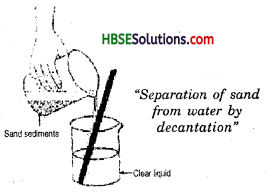
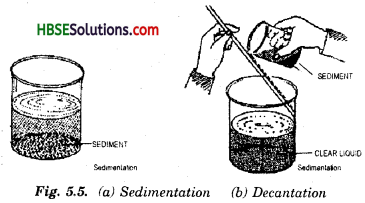
A mixture of sand and water can be separated by decantation method. Take a glass tumbler half filled with the given sample of water. Stir the water thoroughly. Now keep the tumbler undisturbed for sometime. We must see that sand being heavier than water has settled down at the bottom of the tumbler. This process is sedimentation. Now pour the. clear water into another tumbler, without disturbing the layer of sand and with the help of a glass rod. This process is decantation. In this way, mixture of sand and water can be separated.
HBSE 6th Class Science Solutions Chapter 5 Separation of Substances 1

Question 6.
Is it possible to separate sugar mixed with wheat flour? If yes, how will you do it?
Answer:
Yes, it is possible to separate sugar mixed with wheat flour. The mixture of sugar & wheat flour can be separated by sieving. The wheat fine particles separates by strainer and sugar particles being bigger in size remains on the strainer. Thus sugar can be separated from the mixture of sugar and wheat flour.

Question 7.
How would you obtain clear water from a sample of muddy water?
Answer:
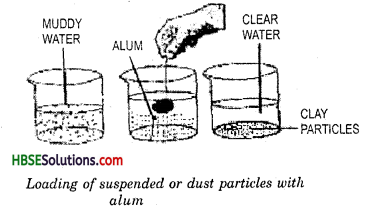
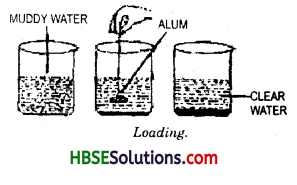
We can separate clear water from muddy water by loading process. Take a beaker half filled with muddy water and take a piece of alum. Tie the alum piece by a cotton thread.
HBSE 6th Class Science Solutions Chapter 5 Separation of Substances 2
Now dip the alum in water and move it slowly in a circular path for about one minute. Remove the alum and keep the beaker undisturbed for a few minutes. We find that dust particles that are responsible for making the water muddy settle down readily. Alum dissolves in water very easily. The fine dust particles get loaded and become heavier and settle down at the bottom of the beaker. The clear water may be decanted. This activity combines two methods loading and decantation.

HBSE 6th Class Science Solutions Chapter 5 Separation of Substances

Question 8.
Fill up the blanks :
(a) The method, of separating seeds of paddy from its stalk is called ________.
(b) When milk is poured onto a piece of cloth the cream(malai) is left behind on it. This process of separating cream from milk is an example of ________.
(c) Salt is obtained from sea water by the process of ________.
(d) Impurities settled at the bottom when muddy water was kept over night in a bucket. The clear water was then poured of from the top. The process of separation used in this example is called ________
Answer:
(a) Winnowing
(b) filtration
(c) Evaporation
(d) Decantation.

Question 9.
True or False?
(a) A mixture of milk and water can be separated by filtration.
(b) A mixture of powdered salt and sugar can be separated by the proces of winnowing.
(c) Separation of sugar from tea can be done with filtration.
(d) Grain and husk can be separated with ‘ the process of decantation.
Answer:
(a) False
(b) False
(c) False
(d)True.

Question 10.
Lemonade is prepared by mixing lemon juice and sugar in water. You wish j to ice to cool it. Should you add ice to the lemonade before or after dissolving sugar? In which cash would it be possible to dissolve more sugar?
Answer:
We should add ice in lemonade after dissolving sugar in it, because sugar dissolve more before adding ice. It would be possible to dissolve more sugar before adding ice in the lemonade, because it dissolve more into hot than in cold.

HBSE 6th Class Science Separation of Substances Important Questions and Answers

Very Short Answer Type Questions

Question 1.
What is a pure substance?
Answer:
A pure substance is one that consists of a single element or compound.

Question 2.
How will you separate a mixture of iron fillings and sulphur powder?
Answer:
The mixture can be separated by using a magnet. The iron fillings are picked out by the magnet and sulphur powder remains behind.

Question 3.
Name the method used to separate butter from milk.
Answer:
Centrifugation/churning method.

HBSE 6th Class Science Solutions Chapter 5 Separation of Substances

Question 4.
Name two materials used as filters.
Answer:

  • Cotton cloth
  • Filter paper.

Question 5.
Which method will you use to separate blue vitriol (Neela thotha) from its solution?
Answer:
Crystalization method.

Question 6.
What is meant by the term ‘mixture’?
Answer:
A mixture is a substance made up of two or more elements or compounds, physically mixed in any ratio.

Question 7.
Give three examples of mixture.
Answer:
Tea, milk and air.

Question 8.
Write two properties of mixtures.
Answer:

  • Ratio of constituents is not fixed.
  • Does not have definite m.p. or b.p.

Question 9.
Name the process of obtaining ; iron from waste materials.
Answer:
Magnetic separation.

Question 10.
How can you obtain distilled water?
Answer:
By distillation process.

Question 11.
Name the process to separate two immiscible liquids.
Answer:
Decantation process by separating funnel.

Question 12.
Name a gaseous mixture.
Answer:
Air.

HBSE 6th Class Science Solutions Chapter 5 Separation of Substances

Question 13.
Name three mixtures found in nature.
Answer:

  • Sea water/pond water/lake water.
  • Air

Question 14.
What is winnowing?
Answer:
It is the process of separation of grains from husk and hay with the help of wind.

Question 15.
What is centrifugation?
Answer:
It is a method of separating suspended solid particles from a liquid.

Question 16.
Name the method of separating two immiscible liquids.
Answer:
Decantation or By separating funnel.

Question 17.
What is sublimation?
Answer:
It is a process in which a solid gets converted into its gaseous state.

Question 18.
What is loading?
Answer:
The process of setling down solid particles quickly.

Question 19.
What is churning?
Answer:
Churning is a method of making butter.

Short Answer Type Questions

Question 1.
What is a mixture? Give two examples.
Answer:
A mixture is a substance made up of two or more elements or compounds, when physically mixed in any ratio.
(i) Gun powder (ii) Salt in water.

Question 2.
How will you prepare a big crystal of sugar from powdered sugar?
Answer:
Prepare sugar solution in hot water and allow it to cool. Filter the solution. Now hang a crystal of sugar with the help of a thread and a glass rod leave the solution undisturbed for four days. Now we see that crystals slowly begin to grow on the crystal.

HBSE 6th Class Science Solutions Chapter 5 Separation of Substances

Question 3.
How is common salt obtained from sea water?
Answer:
Sea water is run into shadow ponds and allowed to evaporate to dryness in hot sun. Water evaporates and solid common salt is left behind. The salt is then collected in heaps.

Question 4.
How will you separate a mixture of sulphur in water?
Answer:
Take the mixture of water and sulphur in a beaker. Pour the mixture on the filter paper with the help of a glass rod so that the liquid stands below the edge of the cone. The residue that remains on the filter paper is sulphur. Now dry it to get sulphur and water is collected in beaker.

Question 5.
How will you separate a mixture of naphthalene and salt?
Answer:
Naphthalene and salt mixture can be separated by the process of sublimation. Naphthalene sublimates and is collected on inverted keep and salt remains behind in the dish.

Question 6.
What do you mean by decantation? What are its uses?
Answer:
Decantation is a process by which we can remove a liquid without disturbing the solid settled down in the bottom.
Uses: This method can be used to separate a mixture of

  • sand and water
  • mixture of two liquids – water and oil.

HBSE 6th Class Science Solutions Chapter 5 Separation of Substances

Question 7.
How will you separate a mixture of water and kerosene oil?
Answer:
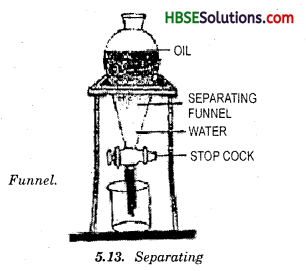
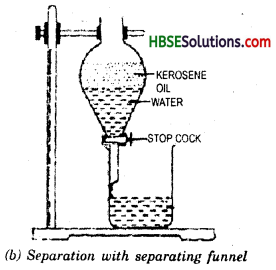
Mixture of kerosene oil and water can be separated by using separating funnel. Take the mixture in separating funnel and allow it to stand for some time. After sometime, two different layers form. Kerosene oil being lighter forms upper layer and water forms lower layer. By opening the stop cock, we obtain water and kerosene remains on the funnel.
HBSE 6th Class Science Solutions Chapter 5 Separation of Substances 3

Question 8.
What do you mean by distillation? How can you separate a mixture of alcohol and water?
Answer:
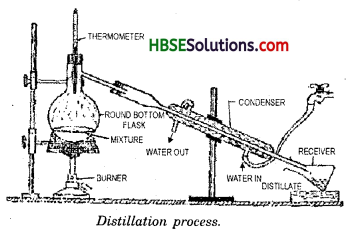
Distillation is the process in which liquid is heated to get vapours and then cooling the various to get back liquids. It is used to separate a mixture the components of which have different boiling points.
HBSE 6th Class Science Solutions Chapter 5 Separation of Substances 4
The mixture of alcohol and water is taken in a round bottom flask. Alcohol boiling point 80°C, evaporates first on heating as compared to water with boiling point 100°C. Now alcohol vapours are condensed by cooling in a separate container. It gets converted back to alcohol liquid and water remains in flask.

Question 9.
How will you separate a mixture of iron dust and sulphur powder?
Answer:
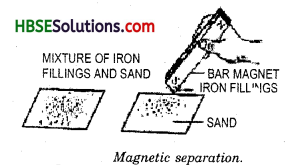
A mixture of iron dust and sulphur can be separated by the magnetic separation method. Iron dust is attracted towards the magnet and separated in a container and sulphur remains behind in the container.
HBSE 6th Class Science Solutions Chapter 5 Separation of Substances 5

Question 10.
How will you separate a mixture of iodine and sand?
Answer:
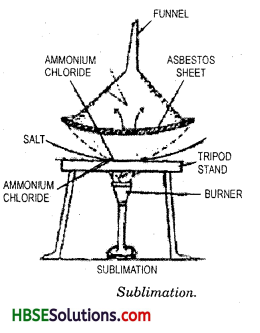
A mixture of iodine and sand can be separated by sublimation. The mixture is taken into a china dish and covered with inverted funnel. A cotton plug prevents the vapours from escaping into atmosphere. On heating, iodine sublime and collected on the cool inner surface of funnel. Sand is left behind in the disc.
HBSE 6th Class Science Solutions Chapter 5 Separation of Substances 6

Long Answer Type Questions

Question 1.
How will you separate a mixture of iron fillings, common salt, sand and sulphur?
Answer:
Iron fillings are separated from the mixture by using a magnet. The remaining mixture of salt,-sand and sulphur is stirred with water when salt is dissolved in it. On filtration salt solution is obtained as a filtrate and the residue contains sand and sulphur.

Sand and sulphur mixture is shaken with carbon disulphide, when sulphur dissolves in it but sand remains undissolved. On filtration, sand is obtained as residue and sulphur as filtrate. On evaporating the filtrate carbon disulphide is removed and sulphur is obtained.

HBSE 6th Class Science Solutions Chapter 5 Separation of Substances

Question 2.
How you will purify common salt obtained from sea water?
Answer:
The lumps of impure common salt obtained from sea water, are crushed to get powdered salt. The powdered common salt is dissolved in water to prepare a solution. The solution of common salt is filtered to remove insoluble impurities.

The clear solution of common salt is evaporated by heating to remove some of the water to obtain a concentrated solution. The hot concentrated solution of common salt is allowed to cool. On cooling, the hot solution crystallises and crystals of pure common salt are obtained.

Separation of Substances Class 6 HBSE Note

1. We use some materials like sugar, common salt, water, milk as such in our daily life. In many materials, we have to separate the useful components from the unwanted or sometimes harmful components before we can use them. For example we peel off the skins of mangoes and bananas before using them.

2. Pure substances : A pure substance is one that consists of a single element or compound. All its constituents have similar properties. Examples are copper, iron, water, common salt, sugar etc.

3. Mixtures : A mixture contains two or more types of constituents which are present in any ratio. For example, air around us contains many gases such as nitrogen, oxygen, carbon dioxide and dust particles. Thus air is a mixture. Sea water, pond and river water are also mixtures. Gun powder and brass are other examples of mixtures.

4. Need for separation : We know that a mixture contains two or more components. We want to be very sure about the purity of the food we take in. Even the water we drink should be pure. We can say that we carry out the separation of substances with the following purposes:

  • To remove the un-useful or harmful component.
  • To obtain the useful component.
  • To remove impurities for getting a pure sample.

5. Principle of separation : Different materials have different properties and we can use these property differences to separate mixtures. The components of a mixture can be separated by one method or by a combination of various methods.

6. Method of separation : Often, in mixtures, we are able to see the different components present. There are several methods used for separating the constituents of a mixture. The choice of the method used depends upon the nature or the properties of the constituents. Some common methods for the separation of the components of a mixture are as follows :

7. Hand Picking: This method is use for separating small particles of dust, stone, husk etc. from the grains of wheat, rice and pulses etc. Since these unwanted components are present in small quantities and total amount of grains to be separated is not very-very large, so they are separated by hand picking.
HBSE 6th Class Science Solutions Chapter 5 Separation of Substances 7

8. Sieving: Sieving of wheat flour (atta) is a common practice. Sieving a wheat flour through a sieve allows fine particles of the flour to pass through the holes of the sieve while the bigger husk particles remain on the sieve.
HBSE 6th Class Science Solutions Chapter 5 Separation of Substances 8
Sieving is used when two components of a mixture have different sizes. Sand can be separated from stone by seiving.

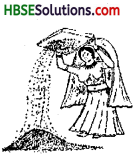
9. Winnowing : This method of separation is commonly used to separate lighter particles from heavier grains of wheat.
HBSE 6th Class Science Solutions Chapter 5 Separation of Substances 9
In this method, the wheat grains containing husk are allowed to fall down from some height while the wind is blowing. Since husk is lighter than grains, it gets carried away by wind and heaps of grains and husk are formed separately.

10. Sedimentation and decantation : This method of separation is used for a mixture consisting of an insoluble solid and a liquid. The process of settling down of heavier insoluble particles in a mixture of water and insoluble substances is called sedimentation (Fig 5.5). The process of transferring the clear liquid (after sedimentation) without disturbing the sedimentation insoluble heavy particles is called decantation. Fig. 5.5. (6).
HBSE 6th Class Science Solutions Chapter 5 Separation of Substances 10
Decantation can also be used for separating two immiscible liquids such as oil and mixture. Oil and water do not mix with each other and form separate layers. They can also be separated by using separating funnel.
HBSE 6th Class Science Solutions Chapter 5 Separation of Substances 11

11. Loading : In rainy season we get muddy water from wells, taps or other sources of drinking water. This muddy water can be made clear by loading. If a piece of alum, tied
HBSE 6th Class Science Solutions Chapter 5 Separation of Substances 12
with a thread, is swirrled in such a water, then after some time the water becomes clear on standing. (Fig 5.7) The water becomes clear because the mud particles get loaded by the alum particles and become heavy and settle down at the bottom of the container and water can be decanted for further use.

HBSE 6th Class Science Solutions Chapter 5 Separation of Substances

12. Filtration : Filtration is used to separate solid impurities from a liquid. In our homes, tea is filtered to separate tea leaves and shikanji (lemo-nade) is filtered to separate the seeds of the lemon.

13. Evaporation : The process of separating any salt from its solution by removing water is called evaporation. This process is largely used to obtain common salt from sea water. When sea water is allowed to stand in shallow pits, water slowly turns into water vapours by absorbing the heat of the sun, leaving behind solid salt.

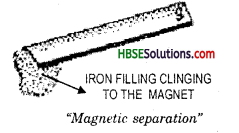
14. Magnetic separation : This process of separation is used when one of the components in the mixture is iron. For example a mixture of iron fillings and sand can 5.10. “Magnetic, separation”
HBSE 6th Class Science Solutions Chapter 5 Separation of Substances 13
be separated by moving a magnet in the mixture. The Magnet picks out only iron fillings from the sand. This process is called magnetic separation (Fig 5.10)

15. Churning: This process is used to separate cream from milk. When milk is churned for some time, the lighter cream particles float on its surface from where they can be separated. Churning can be done by hand or by using a mixi. (Fig 5.11.)

16. When one method of separation is not sufficient to separate the different substances present in a mixture, we use more than one methods. (See Fig 5.13) For example if we have a mixture of salt, water and sand and we want to separate all the three substances, we use two methods-decantation and evaporation.

HBSE 6th Class Science Solutions Chapter 5 Separation of Substances Read More »

HBSE 7th Class Science Solutions Chapter 10 Respiration in Organisms

Haryana State Board HBSE 7th Class Science Solutions Chapter 10 Respiration in Organisms Textbook Exercise Questions and Answers.

Haryana Board 7th Class Science Solutions Chapter 10 Respiration in Organisms

HBSE 7th Class Science Respiration in Organisms Textbook Questions and Answers

Question 1.
Why does an athlete breathe faster and deeper than the usual after finishing the race?
Answer:
During the race, the athlete has to run very fast. The demand for energy at that time increases, which increase the demand for more supply of oxygen, so, athelete has to breathe faster and deep to inhale moe oxygen.

Question 2.
List the similarities and differences between aerobic and anaerobic respiration.
Answer:
Differences between aerobic and anaerobic respiration :

Aerobic RespirationAnaerobic Respiration
1. It occurs in the presence of oxygen.1. It occurs in absence of oxygen.
2. Food molecules are broken down into water and carbon dioxide.2. Food molecules are broken down into ethyl alcohol and carbon dioxide.
3. Large amount of energy is released.3. Small amount of energy is released.

Similarities : (Both aerobic and anaerobic respiration produce energy and give out carbon dioxide.

HBSE 7th Class Science Solutions Chapter 10 Respiration in Organisms

Question 3.
Why do we often sneeze when we inhale, a lot of dust-laden air?
Answer:
We sneeze to get rid of the unwanted particles like dust etc from our body. It allows only clean and dust free air to enter our body.

Question 4.
Take three test tubes. Fill 3/4th of each tube with water. Label them A, B and C. Keep a snail in test tube A; a water plant in test tube B and in C, keep snail and plant both. Which test tube will have highest concentration of CO2?
Answer:
There will be highest concentration of CO2 in tube A.

Question 5.
Tick the correct answer :
(a) In cockroaches air enters the body through :
(i) Lungs
(ii) Gills
(iii) Spiracles
(iv) Skin
Answer:
(iii) Spiracles

(b) During heavy exercise, we get cramps in the legs due to the accumulation of :
(i) carbon dioxide
(ii) lactic acid
(iii) alcohol
(iv) water
Answer:
(ii) lactic acid

(c) Normal range of breathing rate per minute in an average adult person at rest is :
(i) 9-12
(ii) 15-18
(iii) 21-24
(iv) 30-33
Answer:
(ii) 15-18

(d) During exhalation, the ribs :
(i) move outwards
(ii) move downwards
(iii) move upwards
(iv) do not move at all
Answer:
(ii) move downwards.

HBSE 7th Class Science Solutions Chapter 10 Respiration in Organisms

Question 6.
Match the items in column I with those in column II.

Column IColumn II
(a) Yeast(i) Earthworm
(b) Diaphragm(ii) Gills
(c) Skin(iii) Alcohol
(d) Leaves(iv) Chest cavity
(e) Fish(v) Stomata
(f) Frog(vi) lungs and skin
(vii) trachea

Answer:
(a) (iii)
(b) (iv)
(c) (i)
(d) (v)
(e) (ii)
(f) (vi).

Question 7.
Make ‘T’ if the statement is true and ‘f if it is false.
(i) During heavy exercise the breathing rate of a person slows down. (T/F)
(ii) Plants carry out photosynthesis only during the day and respiration only at night. (T/F)
(iii) Frogs breathe through their skins as well as their lungs. (T/F)
(iv) The fishes have lungs for respiration. (T/F)
(v) The size of the chest cavity increases during inhalation. (T/F)
Answer:
(i) False
(ii) False
(iii) True
(iv) False
(v) True.

Question 9.
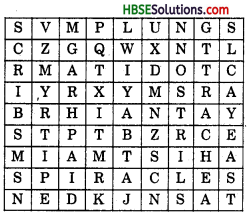
Given below is a square of letters in which are hidden different words related to respiration in organisms. These words may be present in any direction – upwards, downwards, or along the diagonals. Find the words for your respiratory system. Clues about those words are given below the square.
HBSE 7th Class Science Solutions Chapter 10 Respiration in Organisms 1
(i) The air tubes of insects.
(ii) Skeletal structures surrounding chest cavity.
(iii) Muscular floor of chest cavity.
(iv) Tiny pores on the surface of leaf.
(v) Small openings on the sides of the body of an insect.
(vi) The respiratory organs of human beings.
(vii) The openings through which we inhale.
(viii) An anaerobic organism.
(ix) An organism with tracheal system.
Answer:
(i) Trachea
(ii) Ribs
(iii) Diaphragm
(iv) stomata
(v) spiracles
(vi) lungs
(vii) nostrils
(viii) yeast
(ix) ant.

Question 10.
The mountaineers carry oxygen with them because :
(a) At an altitude of more than 5 km there is no air.
(b) The amount of air available to a person is less than that available on the ground.
(c) The temperature of air is higher than that on the ground.
(d) The pressure of air is higher than that on the grow.
Answer:
(b) The amount of air available to a person is less than that available on the ground.

HBSE 7th Class Science Solutions Chapter 10 Respiration in Organisms

Extended Learning – Activities and Projects

Question 1.
Observe fish in an aquarium. You will find flap like structures on both sides of their heads. These are flaps which cover the gills. These flaps open and close alternately. On the basis of these observations, explain the process of respiration in the fish.
Answer:
Do yourself. Take help your teacher.

Question 2.
Visit a local doctor. Learn about the harmful effects of smoking. You can also collect material on this topic from other sources. You can seek help of your teacher or parents. Find out the percentage of people of your area w ho smoke. If you have a smoker in your family, confront him with the material that you have collected.
Answer:
Do yourself.

Question 3.
Visit a doctor. Find out about artificial respiration. Ask the doctor:
(a) When does a person need artificial respiration?
(b) Does the person need to be kept on artificial respiration temporarily or permanently?
(c) From where can the person get supply of oxygen for artificial respiration?
Answer:
Do yourself.

Question 4.
Measure the breathing rate of the members of your family and some of your friends. Investigate :
(a) If the breathing rate of children is different from that of adults.
(b) If the breathing rate of males is different from that of females.
If there is a difference in any of these cases, try to find the reason.
Answer:
Do yourself.

HBSE 7th Class Science Respiration in Organisms Important Questions and Answers

Very Short Answer Type Questions

Question 1.
What is respiration?
Answer:
Respiration is a process of taking oxygen into the cells to break down simple food materials to release energy.

Question 2.
What is breathing?
Answer:
Breathing is inhaling oxygen and exhaling carbon dioxide.

Question 3.
Where does cellular respiration take place?
Answer:
Cellular respiration takes place inside the cells of the body.

HBSE 7th Class Science Solutions Chapter 10 Respiration in Organisms

Question 4.
What is aerobic respiration?
Answer:
Process of respiration taking place in the presence of oxygen is called aerobic respiration.

Question 5.
What is anaerobic respiration?
Answer:
Process of respiration without the presence of oxygen is called anaerobic respiration.

Question 6.
Does the process of anaerobic respiration take place in human body?
Answer:
Yes, during heavy physical activities, when supply of oxygen is not sufficient, anaerobic respiration takes place in the muscle cells.

Question 7.
What is diaphragm?
Answer:
Diaphragm is a large muscular sheet which forms the floor of the chest cavity.

Question 8.
Name the main respiratory organs in mammals.
Answer:
Lungs are the main respiratory organs in the mammals.

Question 9.
Name the main respiratory organs in insects.
Answer:
Spiracles and tracheae are the main respiratory organs in insects.

Question 10.
Name the respiratory organs in the fish.
Answer:
Gills are the respiratory organs in the fish.

Question 11.
How does earthworm respirate?
Answer:
Earthworm respires through its moist skin.

Question 12.
Where does exchange of gases take place in plants?
Answer:
In plants the exchange of gases takes place through tiny openings called stomata on the leaves.

Short Answer Type Questions

Question 1.
Differentiate between breathing and respiration.
Answer:
Breathing and respiration have following differences:

Question 2.
How does aerobic respiration takes place?
Answer:
In aerobic respiration oxygen is taken into the cells. The food is broken down into simple food materials and energy is released. Carbon dioxide and water is also released.
Gulcose \(\frac{\text { presence of }}{\text { Oxygen }}\) Carbon dioxide + water + energy

HBSE 7th Class Science Solutions Chapter 10 Respiration in Organisms

Question 3.
What is breathing rate? How is it counted and what is the breathing rate in an adult at the position of rest?
Answer:
Breathing rate is the number of times a person breathes in a minute. To count the breathing rate, we have to count an inhalation and an exhalation as one. Breathing rate in an adult at rest is 15-18 times in a minute.

Question 4.
How is air pushed out during exhalation?
Answer:
During exhalation the ribs move downwards and inwards. The diaphragm moves up and chest cavity gets contracted and air is thrown out.

Question 5.
How do insects breathe?
Answer:
Insects have small openings on the outside of their bodies. These openings are called spiracles, which are connected to the air pipes called tracheae. In tracheae the exchange of gases take place.

Question 6.
How are frogs peculiar in their way of breathing?
Answer:
Frogs breathe differently in water and differently on land. They use their moist skin to breathe in water. They use lungs to breathe on land.

Question 7.
How do plants respirate?
Answer:
Plants also take in oxygen and give out carbon dioxide for respiration. They have small openings called stomata on the surface of there leaves. Exchange of gases take place through these openings.

Long Answer Type Questions

Question 1.
Explain the process of respiration.
Answer:
In respiration, there is a gaseous exchange between the organism and the environment. The process of respiration can be divided in two parts. Breathing and cellular respiration.

Breathing or external respiration: Oxygen is inhaled and Carbon dioxide is exhaled during breathing. This process takes place out side the cells and, thus is called external breathing.

Cellular respiration or internal respiration : This is a biochemical process which takes place inside the cells of the body. In this process food i.e. glucose is broken into simpler forms. Energy is released during this process which is used by body to perform various functions. Carbon dioxide and water is also released. The Carbon dioxide is expelled out during breathing.
Food + Oxygen → Carbon dioxide + Water + Energy.

HBSE 7th Class Science Solutions Chapter 10 Respiration in Organisms

Question 2.
Explain the process of respiration in plants.
Answer:
In plants the process of respiration leads to the release of energy. It is a cellular process in which molecules of glucose break down in the presence of oxygen to release energy along with water and carbon dioxide. Exchange of gases take place through small openings on the surface of the leaves. These are called stomata. Lower plants lack the organs of breathing. In such plants gaseous exchange occurs due to simple process of diffusion. The rate of exchange of gases in plants is not as fast as in animals.

Respiration in Organisms Class 7 HBSE Notes

  • Respiration is a process of taking oxygen into the cells in order to break down simple food materials to release energy and eliminate waste products.
  • Breathing is inhaling oxygen and exhaling carbon dioxide.
  • Breathing takes place out side the cells.
  • Cellular respiration takes place inside the cells.
  • Inside the Cells the food is broken into water and carbon dioxide. This is called cellular respiration. This process seleases a lot of energy.
  • When the process of respiration takes place in the presence of oxygen, it is called aerobic respiration.
  • When the process of respiration takes place in the absence of oxygen, it is called anaerobic respiration.
  • Human beings have a fully developed respiratory system.
  • Nostrils inhale oxygen, which reaches lungs through nasal cavity.
  • Lungs are organs, where exchange of gases takes place. Carbon dioxide is expelled out and oxygen is consumed for cellular respiration.
  • Smaller animals like cockroach have structure called spiracles, for breathing. Earthworm breathe through their skin and fish have gills for respiration.
  • In both plants and animals mitochondria is the site of respiration.

HBSE 7th Class Science Solutions Chapter 10 Respiration in Organisms Read More »

HBSE 6th Class Science Solutions Chapter 4 Sorting Materials Into Groups

Haryana State Board HBSE 6th Class Science Solutions Chapter 4 Sorting Materials Into Groups Textbook Exercise Questions and Answers.

Haryana Board 6th Class Science Solutions Chapter 4 Sorting Materials Into Groups

HBSE 6th Class Science Sorting Materials Into Groups Textbook Questions and Answers

Exercises

Question 1.
Name five objects which can be made from wood.
Answer:
Objects which can be made from wood are:

  • Chair
  • Table
  • Desk
  • Double bed
  • Stool
  • Almirah.

Question 2.
Select those objects from the following which shine :
Glass bowl, plastic toy, steel spoon, cotton shirt.
Answer:
Glass bowl, steel spoon.

HBSE 6th Class Science Solutions Chapter 4 Sorting Materials Into Groups

Question 3.
Match the following things with the materials from which they are made :

ThingsMaterials
(i) BookGlass
(ii) TumblerWood
(iii) ChairPaper
(iv) ToyLeather
(v) ShoesPlastic.

Answer:
(i) paper
(ii) glass
(iii) wood
(iv) plastics
(v) leather.

Question 4.
State whether the statements given below are true or false :
(i) Stone is transparent, while glass is opaque.
(ii) A note book has lustre while eraser does not.
(iii) Chalk dissolves in water.
(iv) A piece of wood floats on water.
(v) Sugar does not dissolve in water.
(vi) Oil mixes with water.
(vii) Sand settles down in water.
(viii) Vinegar dissolves in water.
Answer:
(i) False
(ii) False
(iii) True
(iv) True
(v) False
(vi) False
(vii) True
(viii) True.

Question 5.
Given below are the names of some objects and materials :
Water, basket ball, orange, sugar, globe, apple and earthen pitcher
Group them as :
(a) Round shaped and other shape.
(b) Eatables and non-etables.
Answer:
Round-shaped object Other-shaped objects

  • Basket ball
  • Water
  • Orange
  • Sugar
  • Globe
  • Apple
  • Earthen pitcher.

HBSE 6th Class Science Solutions Chapter 4 Sorting Materials Into Groups

Question 6.
List all items known to you that float on water. Check and see if they will float on a oil or kerosene.
Answer:

  • Dried leaves
  • paper
  • wax
  • ice
  • oil.

All these materials floats on water and they sink in oil and float on kerosene.

Question 7.
Find the odd one out from the following:
(a) Chair, Bed, Table, Baby, Cup-board.
(b) Rose, Jasmine, Boat, Marigold, Lotus.
(c) Aluminium, Iron, Copper, Silver, Sand.
(d) Sugar, Salt, Sand, Milk, Milk powder.
Answer:
(a) Baby
(b) Boat
(c) Sand
(d) Milk

HBSE 6th Class Science Sorting Materials into Groups Important Questions and Answers

Very Short Answer Type Questions

Question 1.
What do you mean by classification?
Answer:
The process of grouping things on the basis of some common properties is called classification.

Question 2.
How groupings of things are made?
Answer:
Goupings of things are done according to some similarities, necessities, and convenience to make it easier to work with them.

Question 3.
Name three things made from glass.
Answer:
Bowl, bottle, jug, katori.

Question 4.
Name two materials which are soluble in water.
Answer:

  • Salt
  • sugar.

Question 5.
Name five objects which are made from transparent materials.
Answer:

  • Glass bowl
  • Glass bottles
  • Window pan
  • Looking glass
  • Pen.

HBSE 6th Class Science Solutions Chapter 4 Sorting Materials Into Groups

Question 6.
List three liquids which are transparent.
Answer:

  • Water
  • Spirit
  • Benzene.

Question 7.
List five objects which are made from opaque materials.
Answer:

  • Table
  • Chair
  • Door
  • Bed
  • Black board.

Question 8.
What is common between salt and sand?
Answer:
Mass.

Question 9.
Name three bad conductors of heat.
Answer:

  • Wood
  • Rubber
  • Paper.

Question 10.
Name three good conductors of heat.
Answer:
Aluminium, copper and iron.

Question 11.
Name five magnetic objects.
Answer:
Eraser, Pins, Iron nails, Scissors and steel spoon.

Question 12.
Name two objects made from plastics.
Answer:

  • Mug
  • Toys.

Question 13.
Name two substances which are insoluble in water.
Answer:

  • Chalk
  • Plaster.

Question 14.
Name four metals which are used in our daily life.
Answer:

  • Aluminium
  • Copper
  • Brass
  • Iron.

Question 15.
Write two properties of metals.
Answer:

  • They look shining in appearance.
  • Metals are good conductors of heat.

HBSE 6th Class Science Solutions Chapter 4 Sorting Materials Into Groups

Question 16.
Name three liquids which are immiscible in water.
Answer:

  • Mustard oil
  • Glycerine
  • Coconut oil.

Question 17.
Name three materials which float in water.
Answer:

  • Wax
  • wood
  • ice.

Question 18.
Name three things which are non-magnetic.
Answer:

  • Rubber
  • Chalk
  • Plastics
  • Wood.

Question 19.
How can materials be grouped?
Answer:
Materials can be grouped on the basis of similarities and differences in their properties.

Question 20.
Name some combustible materials.
Answer:
Wood, paper and cotton.

Question 21.
Which are translucent materials?
Answer:
The materials through which things are only partially visible are called translucent materials.

Short Answer Type Questions

Question 1.
What are objects made of?
Answer:

  • An object can be made from different materials. For example, your shoes can be made of canvas, leather, rubber or plastics.
  • Different objects can be made from the same material. For example, flower vase, window panes, glass jar, fish aquarium are made from the same material.
  • An object or a thing can be made using more than one material. For example, idli is made of rice, urad dal, salt and water.

Question 2.
Mention three properties of materials.
Answer:
Three important properties of materials are described below :

  • Physical State : All materials can be classified as solid, liquid and gas. We cannot see gases but we can feel their presence.
  • Appearance : Any material can be described in terms of its colour, lustre, texture or hardness.
  • Solubility : All materials can be soluble or insoluble in water. For example, sugar is soluble in water but sand is insoluble in water. Liquid and gases may also be soluble or insoluble in water.

HBSE 6th Class Science Solutions Chapter 4 Sorting Materials Into Groups

Question 3.
Write three common characteristics of materials.
Answer:

  • All materials can be felt by one or more of our senses.
  • All materials occupy space.
  • All materials possess mass.

Question 4.
Why are handles of utensils made from wood or plastics?
Answer:
The handles of utensils are made from wood or plastics because utensils are good conductors of heat and wood and plastics are bad conductors of heat. They do not allow the heat transmission through them. So the handles of utensils are made from wood or plastics so that we do not burn our hands while handling these utensils when they are hot.

Question 5.
Name two gases which are soluble and two gases which are insoluble. What is the importance of gases dissolved in water?
Answer:
→ Gases which are soluble in water: Oxygen and Carbon dioxide.

→ Gases which are insoluble in water: Hydrogen, Nitrogen.
The oxygen dissolved in water helps aquatic plants and animals. Carbon dioxide dissolved in water helps the plants living in water for photosynthesis.

Question 6.
X, Y and Z are three types of materials. The materials X and Y can break into pieces easily when hit with an object but material Z does not break easily. The material X is used in the windows of bathrooms in our house whereas material Y is used in the windows of our drawing room. The material Z is used in making doors and almirahs in our house.
(a) What do you think material X could be? What is the general name of materials liheX?
(b) What could material Y be? Write the general name of materials like Y.
(c) What could material Z be? What is the general name of material like Z?
Answer:
(a) Ground glass : Translucent materials
(b) Clear glass: Transparent materials
(c) Wood : Opaque Materials.

Question 7.
Why cotton floats on water?
Answer:
Cotton has large number of pores in it. The air gets trapped in it thereby reducing its density (by increasing the volume of cotton by air). Therefore cotton floats on water. But when these pores get filled with water it starts sinking.

Question 8.
A few things have been grouped as follows. Identify the property common to all things in each group.
Group – I : Glass, Cup, Bucket, Mug, Jug
Group – II : Man, Cow, Camel
Group – III : Copper, Iron, Silver, Gold
Answer:
Group – I: Containers – all are made of plastic/steel.
Group – II: Living beings-all are mammals.
Group – III : All are metals.

Question 9.
Which among kerosene and glycerine is miscible in water? How will you find out?
Answer:
Glycerine is miscible in water.
Take some water in two test tubes. Put a few drops of glycerine into one test tube and a few drops of kerosene into the other. Shake them well. Glycerine mixes with water and cannot be seen separately. Kerosene does not mix with water. It can be seen as a separate layer on the top of water.

Question 10.
Give an activity to observe flow of heat in metal and wood.
Answer:
Take a cup and fill it partly with hot water. Place two spoons in it – one made of aluminium and the other made of wood. After a minute, touch the upper top of each spoon. You will observe that the aluminium spoon is hotter than the wooden spoon. This is because heat can flow quickly through aluminium but not so in wood.

HBSE 6th Class Science Solutions Chapter 4 Sorting Materials Into Groups

Long Answer Type Questions

Question 1.
What are the advantages of classification/grouping things or materials?
Answer:
The advantages of classification/ grouping of things or materials are as under:

  • Classification helps to understand similarities and dissimilarities among the objects.
  • Classification helps location of things. It is only because of classification that you are able to locate a book that you need out of thousands in your school library.
  • Classification of objects helps their identification.
  • Classification makes study of different objects easy and more meaningful. Rather than studying each object separately, we can study just one out of each class of different objects and generalize our results for the class as a whole.
  • Classification helps us to know the material of which the object is formed.

Question 2.
List the characteristics of solids, liquids and gases and give an example of each.
Answer:
Solids : All solids have the following characteristics :

  • They have a definite shape and volume.
  • They cannot be compressed easily.
  • The particles they are made of are packed very tightly.

Examples : Gold and wood.
Liquids : All liquids have the following characteristics:

  • They have a definite volume but no definite shape. They take the shape of the container they are poured in.
  • They can be compressed more easily than solids.
  • The particles they are made up of are not so tightly packed as in solids.

Examples : Water and alcohol.
Gases : All gases have the following characteristics:

  • They have no definite shape or volume.
  • They can be compressed very easily.
  • The particles they are made up of are packed loosely.

Examples : Oxygen and Carbon dioxide.

Question 3.
Discuss important properties of matter. (Any five)
Answer:
Some important properties of matter are discussed below:

  • Appearance: Materials (or matter) can be classified on the basis of their appearance. Different materials have different appearances.
  • Lustre : Materials can be classified on the basis of their lustre. Some shine a lot whereas others are quite dull.
  • Texture : Different materials feel different when touched, so they have different textures.
  • State: Most materials can be placed into one of the three groups : Solid, liquid or gas.
  • Solubility in water: Some substances are soluble in water, others are insoluble. Miscible liquids mix with each other, immiscible liquids do not.

HBSE 6th Class Science Solutions Chapter 4 Sorting Materials Into Groups

Sorting Materials into Groups Class 6 HBSE Notes

1. There is a large variety of things around us, some of familiar furniture may be chairs, tables, almirah, utensils, books, clothes, toys, television, refrigerator and other household items.

2. Different things can be used for making different types of materials.

3. Different types of materials have different properties such as appearance, solubility, transparency, conductivity and behaviour towards magnets etc.

4. Things can be grouped on the basis of their properties of materials from which they are made. Similar things are arranged together for convenience.

5. Materials which have lustre are called metals. Iron, copper, aluminium and gold are some examples of metals. Thus metals have a lustre and are called lustrous materials.

6. The surface of a material could be smooth or rough. Such as a stone feels rough on touching and metal surfaces are smooth to touch.

7. Materials may be hard or soft. Materials which are difficult to press are called hard and which can be pressed easily are called soft.

8. Substances which dissolve in water are called soluble and which remain the same are called insoluble.

9. Those liquids which mix well with water are said to be miscible and others which do not mix well are known as immiscible in water.

10. Some gases are soluble in water such as oxygen gas which dissolves in water is very important for the survival of aquatic animals.

11. Some materials like sand, sugar and salt sink in water and such materials like wax and oils float on water.

12. Materials may be transparent, opaque and translucent. Materials through which things can be seen are called transparent and materials through which you things are not able to see are called opaque and materials through which things are only partially visible; are called translucent.

13. Those materials/substances which allow the transmission of heat through them are called conductors of heat, which do not allow heat to pass through them are called non-conductors or poor conductors.

14. All metals are conductors of heat. Wood, plastics and a piece of cotton are examples of non-conductors. Gases are poor conductors of heat.

15. Some materials which burn on direct flame in the presence of air, are called combustible materials.

16. Materials which get strongly attracted towards the magnet are called magnetic materials. Our earth itself is a huge magnet. Magnetic materials find many uses in electronic devices.

17. Things are grouped together on the basis of properties of materials from which they are made.

18. The tendency of substances to intermix is called diffusion.

HBSE 6th Class Science Solutions Chapter 4 Sorting Materials Into Groups Read More »

HBSE 6th Class Science Solutions Chapter 3 Fibre to Fabric

Haryana State Board HBSE 6th Class Science Solutions Chapter 3 Fibre to Fabric Textbook Exercise Questions and Answers.

Haryana Board 6th Class Science Solutions Chapter 3 Fibre to Fabric

HBSE 6th Class Science Fibre to Fabric Textbook Questions and Answers

Exercises

Question 1.
Classify the following fibres as natural or synthetic:
Nylon, wool, cotton, silk, polyester, jute.
Answer:

  • Natural fibres : Wool, cotton, silk, jute.
  • Synthetic fibres : Nylon, polyester.

Question 2.
State whether the following statements are true or false :
(a) Yarn is made from fibres.
(b) Spinning is a process of making fibres.
(c) Jute is the outer covering of coconut.
(d) The process of removingseed from cotton is called ginning.
(e) Weaving ofyaf’n make a piece of fabric.
(f) Silk fibre is obtained from the stem of plants.
(g) Polyester is a natural fibre.
Answer:
(a) True
(b) True
(c) False
(d) True
(e) True
(f) False
(g) False

HBSE 6th Class Science Solutions Chapter 3 Fibre to Fabric

Question 3.
Fill in the blanks :
(a) Plant fibres are obtained from ________ and ________.
(b) Animal fibres are ________ and ________.
Answer:
(a) Cotton, jute
(b) Wool, silk.

Question 4.
From which part of plant cotton and jute are obtained?
Answer:
Cotton fibres are obtained from cotton seeds. They are hairs of cotton seeds. Jute fibres are obtained from the stem of jute plants by retting process.

Question 5.
Name two items that are made from coconut fibres.
Answer:

  • Ropes
  • Coir in mattress.

Question 6.
Explain the process of making yarn from fibres.
Answer:
The process of making yam from fibres is called spinning. In this process fibres from a mass of cotton wool are drawn out and twisted. This brings the fibres together to form a yarn.

A simple device used for spinning is a hand spindle also called takli and charkha. Spinning of yarn on a large scale is done with the help of spinning machine. After spinning yams are used for making fabrics.

HBSE 6th Class Science Fibre to Fabric Important Questions and Answers

Very Short Answer Type Questions

Question 1.
Name some fibres obtained from natural sources (Plants/animals).
Answer:
Cotton, silk, wool and jute fibres are obtained from natural sources.

Question 2.
Name two fibres obtained from man-made materials.
Answer:
Nylon and polyester.

Question 3.
Which type of clothes absorb water quickly?
Answer:
Cotton clothes absorb water quickly.

HBSE 6th Class Science Solutions Chapter 3 Fibre to Fabric

Question 4.
Which type of clothes bum quickly?
Answer:
Nylon and polyester clothes bum quickly.

Question 5.
From where do we get wool and silk?
Answer:
We get wool from animal hairs (sheep) and silk from silk worm.

Question 6.
From which time cotton has been used in India?
Answer:
In India cotton has been used since 1800 B.C.

Question 7.
Where is cotton grown in India?
Answer:
In India cotton crops are grown in Maharashtra, Gujarat, Punjab, Rajasthan, Tamilnadu and Madhya Pradesh.

Question 8.
In which climate are cotton crops grown?
Answer:
Cotton crop needs warm climate.

Question 9.
Write two uses of cotton.
Answer:

  • Manufacture of textiles.
  • As absorbent in hospitals.

Question 10.
Where do we get jute?
Answer:
Jute is obtained from stem of jute plants in the form of patsun.

Question 11.
How are jute fibres used?
Answer:
Jute fibres are used for making gunny bags, carpets and curtains.

Question 12.
Why did primitive life need no cloth?
Answer:
Because they lived mostly to tropics where the climate was warm.

Question 13.
Why are cotton and woollen fibres rough?
Answer:
Cotton and woollen fibres are rough because they have many folds and uneven surface on it.

Question 14.
Why are nylon and polyester fibres smooth?
Answer:
Nylon and polyester fibres are smooth because they have long plain, fine structure.

HBSE 6th Class Science Solutions Chapter 3 Fibre to Fabric

Question 15.
Why are fibres twisted?
Answer:
By twisting fibres, they become strong and their cohesion power increases.

Question 16.
Name some natural and man-made cloth materials.
Answer:
Natural cloth materials are : cotton, wool, silk and jute etc.
Man-made cloth materials are: rayon, nylon and polyesters etc.

Short Answer Type Questions

Question 1.
From where do we get materials used for making clothes?
Answer:
We get materials used for making clothes from natural sources such as cotton, jute, silk and wool from plants and animals and from man-made/artificial sources such as nylon, polyester and rayon etc.

Question 2.
Where do the plants have fibres in their body?
Answer:
Plants have fibres in their body in different parts. For examples; cotton and mango have fibres on their seeds, coconut on its fruits, jute on its stem and banana tree on its leaf.

Question 3.
From where do we get wool and silk fibres?
Answer:
Wool and silk fibres are obtained from animals. Wool is obtained from hair of animals; as sheep hairs and silk fibres are obtained from silk worm.

Question 4.
Where are cotton crops grown?
Answer:
Cotton crops are grown in black soil, which is best for of cultivation of cotton crops. It is planted early in the spring season. It needs warm climate. Its plant grows steadily and soon becomes brushes of 3 to 5 feet height.

HBSE 6th Class Science Solutions Chapter 3 Fibre to Fabric

Question 5.
What are the various uses of cotton?
Answer:
Cotton is used as follows :

  • Cotton or cotton in combination with other fibres is used in manufacture of textiles.
  • Cleaned cotton is used as absorbent in hospitals.
  • Unspun cotton is used as fillers in mattresses, pillows and quilts.
  • It is used as raw materials for manufacture of rayon and paper industry.

Question 6.
Where and when is jute cultivated?
Answer:
Jute is cultivated in alluvial soils in the delta region of rivers like Ganga and Brahmaputra. In India jute is mainly grown in West Bengal, Bihar and Assam. It is cultivated during rainy season.

Question 7.
How was clothing developed?
Answer:
Cloth making was developed in three stages: (i) First stage was making cloth from plant fibres, (ii) Second stage was the beginning the use of animal fibres and the third stage began with man-made fibres in 19th century.

Question 8.
Why do we wear clothes?
Answer:
We wear clothes due to the following reasons:

  • They protect against wind and weather.
  • They protect against injury.
  • They maintain body heat.

Question 9.
Why is it necessary to make yarn from fabrics for making clothes?
Answer:
Cotton, wool and silk fibres are suitable for making yarn. For making yarn, fibres are twisted. Twisting of fibres into yarn increases the cohesion (togetherness) and strength of fibres.

Long Answer Type Questions

Question 1.
How do we obtain jute fibres from jute plants?
Answer:
On complete maturation of plants, fibres on its stem becomes very hard. The cut plants are grouped at different places in the field for a few days when most of the leaves fall down. The plants now are tied in small bundles and these bundles made to sink in stagnant water of pond for a few days when the gummy spin rots out to separate fibres. The process is called retting. Fibre is extracted from the retted jute by hand, with jerk and pulls. The dry fibres are then tied together in small bundles. They are pale yellow jn colour with 6 to 8 feet length and quite strong with silky lustre. They can easily be spun into fabrics.

HBSE 6th Class Science Solutions Chapter 3 Fibre to Fabric

Question 2.
Give a brief account of the journey of jute from its cultivation to making the fibre.
Answer:
(i) Jute is grown in alluvial soil in the delta region of the Ganga and Brahmaputra rivers.

(ii) Jute is cultivated during the rainy season. It bears yellow flowers in 3-4 months.

(iii) Jute plants are usually cut at the flowering state. A good quality fibre is obtained from plants cut at the flowering state. Jute obtained from a matured plant is harder.

(iv) After the dry leaves haven fallen, the bundles of dry plants are kept in a pond for a few days. During this period, the gummy skin rots out to separate the fibres. This process is called retting.

(v) The jute fibre is obtained from the retted jute by hand.

Fibre to Fabric Class 6 HBSE Notes

  • We know that clothes we wear come from fibres. Clothes protect us from adverse weather condition.
  • Materials used for making clothes are obtained from natural as well as man-made sources.
  • Natural clothing materials includes cotton, wool, silk and jute.
  • Man-made clothing materials are rayon, nylon and polyester etc.
  • Different clothing materials have different properties. Cotton and wool are rough while rayon, silk, nylon and polyester are smooth to touch.
  • All cloth materials are made up of long, narrow, thin structures called fibres. All the plants have fibres in their body structure.
  • Cotton and mango have fibre in their seed, coconut in their fruits and jute in its stem and banana tree on its leaf.
  • Cotton fibres are obtained from the seeds of cotton plant and jute fibres are obtained from the stem of jute plant by the process of retting.
  • The process of pulled out cotton seeds from cotton is called ginning.
  • Cotton fibres are used in manufacturing of textiles, as adsorbent in hospitals, as fillers in mattresses, pillows and quilts and raw materials for rayon.
  • Jute fibres are obtained from the stem of plant called “patsun”. Its separation from stem is called retting.
  • They are 6-8 feet length. It is used for making gunny bags, potato/sacks, carpets, curtains and ropes etc.
  • Man-made fibres combined with other animal and plant fibres are used for making clothes for improved strength, wearing ability and other qualities.
  • Clothes are necessary because they protect us from wind and weather, injury and maintains body heat.
  • Clothes are made from threads and threads in turn are spun from fibres. Cotton, wool, silk and nylon are composed of very fine hair – like structures called fibres.
  • Coconut fibres are used for making ropes or as a coir mattresses. Soft and long fibres like cotton and wool are suitable to make yarn. Fibres cannot be used for making clothes directly.

HBSE 6th Class Science Solutions Chapter 3 Fibre to Fabric Read More »

HBSE 7th Class Science Solutions Chapter 11 Transportation in Animals and Plants

Haryana State Board HBSE 7th Class Science Solutions Chapter 11 Transportation in Animals and Plants Textbook Exercise Questions and Answers.

Haryana Board 7th Class Science Solutions Chapter 11 Transportation in Animals and Plants

HBSE 7th Class Science Transportation in Animals and Plants Textbook Questions and Answers

Question 1.
Match structures given in column I with functions given in column II.

Column-IColumn-II
(i) Stomata(a) Absorption of Water
(ii) Xylem(b) Transpiration
(iii) Root hairs(c) Transport of food
(iv) Phloem(d) Transport of water
(e) Synthesis of carbohydrates

Answer:
(i) (b)
(ii) (d)
(iii) (a)
(iv) (c)

Question 2.
Fill in the blanks :
(i) The blood from the heart is transported to all parts of the body by the __________.
(ii) Haemoglobin is present in __________ cells.
(iii) Arteries and veins are joined by a network of __________.
(iv) The rhythmic expansion and contraction of the heart is called __________.
(v) The main excretory product in human beings is __________.
(vi) Sweat contains water and __________.
(vii) Kidneys eliminate the waste materials in the liquid form called __________.
(viii) Water reaches great heights in the trees because of suction pull caused by __________.
Answer:
(i) Arteries
(ii) Red Blood Cells
(iii) Capillaries
(iv) Heart beat
(v) Urine
(vi) Urea
(vii) Urine
(viii) Transpiration

HBSE 7th Class Science Solutions Chapter 11 Transportation in Animals and Plants

Question 3.
Choose the correct options:
(а) In plants, water is transported through :
(i) Xylem
(ii) Phloem
(iii) Stomata
(iv) Root hair
Answer:
(i) Xylem

(b) Water absorption through roots can be increased by keeping the plants :
(i) in the shade
(ii) in dim light
(iii) under the fan
(iv) covered with a polythene bag.
Answer:
(iii) under the fan

Question 4.
Why is transport of materials necessary in a plant or an animal? Explain.
Answer:
Transport of materials is necessary in plant or animal because due to it the nutrients are made available to all the parts of the body. If the transport of necessary nutrients does not take place in the body, the body will not be able to survive. So, the circulation of nutrients takes place in the whole body through the process of transportation.

Question 5.
What will happen if there are no platelets in the blood?
Answer:
The blood platelets are responsible for the clotting of the blood. When some injury occurs blood starts flowing. But it clots on its own due to the blood platelets. If there are no platelets in the blood, the blood will not be able to clot and keep on flowing through a wound or injury. This can prove fatal for the organisms as no blood will remain in the body.

Question 6.
What are stomate? Give two functions of stomata.
Answer:
There are small openings on the lower surface of the leaves and stems. These pores are called stomata. These opening are covered with guard cells. Two functions of stomata are:

  • It helps in the transpiration of water i.e. the loss of excess water from the plant.
  • Loss of water from the stomata creates an upward pull i.e a suction pull which helps in absorption of water to great height in tall trees.

HBSE 7th Class Science Solutions Chapter 11 Transportation in Animals and Plants

Question 7.
Does transpiration serve any useful function in the plants? Explain.
Answer:
Transpiration is an important function in plants. It serves the following purposes:

  • It helps to enhance the absorption of water by creating a suction pull.
  • It helps the plant in getting rid of the excess water.
  • It produces a cooling effect on the plant which prevents the heat of the sun light from damaging plants.
  • It helps in transport of water and minerals to leaves and leaves use the water for the process of photosynthesis.

Question 8.
What are the components of blood?
Answer:
There are four components of the blood.

  • Plasma is the liquid part of the blood which is yellowish in colour and contains 90 percent water. It contains food, enzymes, wastes and proteins etc.
  • Red blood cells (R.B.Cs) are disc shaped cells containing red coloured pigment called haemoglobin in it. Haemoglobin helps in transportation of oxygen.
  • White blood cells (W.B.Cs) are the fighting cells, which protect us against bacteria and foreign material causing infections
  • Platelets help in clotting of the blood.

Question 9.
Why is blood needed by all the parts of a body?
Answer:
Blood is needed by all parts of the body because, it contains the digested food in it. It supplies the digested food to various parts of the body and provide essential energy to them. This energy helps the body to perform various functions and activities.

Question 10.
What makes the blood look red?
Answer:
A red coloured pigment called haemoglobin gives the blood its red colour. This pigment helps in carrying oxygen to various part of the body by blood.

Question 11.
Describe the function of the heart.
Answer:
The heart functions in the following way:
The right auricle and ventricle receives blood with carbon dioxide from all the parts of the body. The collected blood is then pumped to the lungs for the purification. In lungs the exchange of gases take place and purified blood is sent back to the left auricle. It pumps it to the left ventricle, which in turn pumps off the purified blood to all the parts of the body through arteries.

Question 12.
Why is it necessary to excrete waste products?
Answer:
The build up of waste and poisonous products in our body is always harmful. The waste products like urea etc. are toxic. When such toxic materials are not removed from the body, they get mixed with blood and can damage the cells of the body, thus proving fatal. It is, therefore, necessary to remove such poisonous waste materials from our body.

HBSE 7th Class Science Solutions Chapter 11 Transportation in Animals and Plants

Question 13.
Draw a diagram of the human excretory system and label the various parts.
Answer:
Do it yourself.

Extended Learning – Activities and Projects

Question 1.
Find out about blood groups and their importance.
Answer:
Do it yourself.

Question 2.
When a person suffers from chest pain, the doctor immediately takes an ECG. Visit a doctor and get information about ECG. You may even look up an encyclopaedia or the internet.
Answer:
Do it yourself.

HBSE 7th Class Science Transportation in Animals and Plants Important Questions and Answers

Very Short Answer Type Questions

Question 1.
What is circulatory system?
Answer:
Circulatory system is that system which transport nutrients to various parts of the body.

Question 2.
What makes the blood red?
Answer:
A red pigment called haemoglobin makes the colour of the blood red.

Question 3.
Name various kinds of cells present in blood.
Answer:
Blood has liquid part called plasma which has Red Blood Cells, white blood cells and platelets in it.

Question 4.
What role does the red pigment haemoglobin play in our body?
Answer:
Haemoglobin gets bound with the oxygen and supplies oxygen to various parts of the body. Oxygen is essential for respiration.

Question 5.
Why platelets are important for humans?
Answer:
Platelets are very important because they cause clotting of the blood. Without platelets blood will flow from the wounds unstopped and cause death.

Question 6.
What is pulse?
Answer:
Number of times the heart beats in a minute is called pulse. In resting position pulse rate of a normal human is 72-80 beats/min.

HBSE 7th Class Science Solutions Chapter 11 Transportation in Animals and Plants

Question 7.
What is the main difference between an artery and a vein?
Answer:
Artery carries purified blood i.e. blood carrying oxygen and vein carries blood rich in carbon dioxide.

Question 8.
What is transpiration?
Answer:
Transpiration is the loss of excess water from the leaves through the small pores called stomata.

Question 9.
What is excretion?
Answer:
Excretion is the process of throwing out the unwanted and waste products from the body.

Question 10.
What is dialysis?
Answer:
Dialysis is a process of separating small molecules from the large molecules using a semipermeable membrane.

Short Answer Type Questions

Question 1.
Explain briefly how the following are transported in plants.
(a) Water and mineral
(b) Food
Answer:
(a) Water and minerals are transported through the vascular tissues called xylem. Roots absorbs water from the soil and xylem transport it leaves prepare food by photosynthesis and this food is transported from leaves to different part by phloem.

(b) Food is transported in plants through vascular tissue called phloem.

Question 2.
What is transpiration? How is it different from translocation?
Answer:
Transpiration is the process of loosing excess water from the plants through small pores present on leaves called stomata. While the process of transportation of food through phloem is called translocation. Phloem transfer glucose from leaves to other parts of the plant while transpiration is evaporation of water to the environment.

Question 3.
List the factors affecting transpiration.
Answer:
Following factors affect transpiration in plants :
(i) Sunlight : Bright sunlight fastens the process of transpiration. No transpiration takes place during night.

(ii) Temperature : High temperature increases the rate of-transpiration while low temperature lowers the rate of transpiration.

(iii) Wind : Blowing wind increases the transpiration as water vapours are quickly removed from the leaves.

(iv) Humidity: Humid day lessens the rate of transpiration.

HBSE 7th Class Science Solutions Chapter 11 Transportation in Animals and Plants

Question 4.
How does transportation occur in lower animals?
Answer:
The transportation occurs in lower animals through diffusion. The nutrients circulate in the body of lower animals by the flow of cytoplasm. In some multicellular aquatic plants transportation takes place by water which circulates the nutrients through their bodies.

Question 5.
What is stethoscope? What are its main parts?
Answer:
Stethoscope is an instruments used to measure the heart beat by the doctors. It has three parts :

  • a chest piece that is sensitive to heart beats.
  • two ear pieces.
  • a tube joining the chest piece and ear pieces.

Question 6.
Write a short note on heart beat and pulse?
Answer:
Number of times a heart beats in a minute is called pulse. It can be felt by feeling the pressure of movement of blood through the artery at our wrist and by feeling the thumping of heart in our chest. It increases with physical activities. In children it varies from 90 to 100 times per minute and in adults from 70-72 beats per minute.

Question 7.
Mention the functions of the blood.
Answer:
Blood performs the following functions

  • It transports nutrients to various parts of body.
  • It carries oxygenated blood to different parts of the body.
  • It collects deoxygenated blood from various parts of the blood and takes it to lungs for purification.
  • It maintains the body temperature.
  • White blood cells fight against the infections and protect us from diseases.

Question 8.
Name various organs of excretion in humans.
Answer:
Various organs of excretion in humans are :

  • Lungs – for exchange of gases.
  • Skin – for sweating.
  • Large intestine – for excretion faeces.
  • Kidneys – for excretion urine.
  • Liver – for excretion excess sugar.

Question 9.
What is the importance of sweating?
Answer:
Sweat is water, salt and urea eliminated by skin in liquid form. The sweat is secreted by the sweat glands. Sweat is important in expelling the wastes like urea and salt from the body, It keeps the body cool and maintain the body temperature.

HBSE 7th Class Science Solutions Chapter 11 Transportation in Animals and Plants

Question 10.
Explain the process of dialysis in brief.
Answer:
Process of Dialysis is used to remove the waste from the body of those people, whose kidneys are not working. Dialyses machine help in removing the waste. A tube of the machine is connected to patients blood. Blood is purified in a semipermeable membrane inside the machine and purified blood is sent back to the body.

Long Answer Type Questions

Question 1.
Explain the circulatory system in Human beings.
Answer:
The Human circulatory system consists of mainly three parts : (i) Heart, 2. Blood vessels, 3. Blood.
1. The Heart: Heart is the pumping organ present in our body. It pumps blood to all the parts of the body. It equals a clenched fist in its size. It is located in the chest cavity on the left side. It is made up of muscles and protected by a cardial membrane called paracardium. It has four chamber – two upper chambers called Auricles and two lower chambers called Ventricles. Blood is received by auricles and pumped by ventricles. The contraction and relaxations of these chambers is called the heart beat.

2. Blood vessels : Arteries, veins and capillaries are three types of blood vessels. Arteries carry oxygenated blood while veins collect deoxygenated blood. All arteries and veins are interconnected through the network of capillaries.

3. Blood : It is red coloured fluid carrying digested food to all the parts of the body and waste products to the excretory system. It has fluid portion called plasma. Plasma has Red blood cells, White blood cells and platelets in it. Red colour of the blood is due to the red pigment called haemoglobin in it. White blood cells fight against infections and platelets cause clotting of the blood.

Question 2.
Explain the Excretory System of human beings.
Answer:
Human Excretory System consists of following organs:

  • A pair of Kidneys
  • Ureters
  • Urinary bladder
  • Urethra.

→  Kidneys : Kidneys are bean shaped structures, located on each side of the backbone above the waist. Kidneys have a number of coiled tubes like structures called nephrons. Nephron consists of a Bowman’s Capsule. It is a cup like structure having a network of blood capillaries. Nephron has a long tubule surrounded by renal capillaries. Nephrons filter the excess of water salt, urea from the blood passing through it. This waste in liquid form is called urine.

→ Ureters : Ureters are long tubes passing urine formed in the kidneys to the urinary bladder. Both kidneys send a ureter to the urinary bladder.

→ Urinary bladder : Urinary bladder is an elastic sac like structure which collects the urine from ureters. Urine remains stored in it until excreted.

→ Urethra : Urethra is the opening through which the urine is passed out of the body.

Question 3.
Explain the process of transport of substances in plants.
Answer:
In plants water and minerals is transported to the leaves and other parts and similarly food is transported from leaves to all the parts of the plant.

Transport of material in plants take place through vascular tissues. There are two types of vascular tissues in plants called xylem and phloem. Xylem forms a continuous network of channels. This connects roots to the leaves through stems and through branches. This network is used to supply water and minerals to the various parts of the body. The roots absorb water from the soil and transport it to leaves and branches through xylem. This is called ascent of sap. Similarly a network of channels use to transport the food prepared by the leaves to the other parts of the plants is called phloem. This process is called translocation.

HBSE 7th Class Science Solutions Chapter 11 Transportation in Animals and Plants

Transportation in Animals and Plants Class 7 HBSE Notes

  • Every organism needs food and water to survive.
  • Food and water is supplied to all parts of the bodies of the organisms by the transportation of these substances.
  • Transportation of materials in human body is conducted by the circulatory system.
  • Circulatory system in human beings consists of three organs : Blood, Blood vessels and Heart.
  • Blood is the liquid which carries the digested food to various parts of the body.
  • Blood contains liquid portion called plasma, Red blood cells, white blood cells and platelets.
  • Red blood cells carry a red pigment called haemoglobin. Haemoglobin gives red colour to the blood and is responsible for carrying oxygen to all parts of body.
  • White blood cells fight against the infections in our body.
  • Platelets cause clotting a blood.
  • Blood vessels are of two types : Arteries carrying oxygenated blood to all parts of the body and veins collect deoxygenated blood from various parts of the body and take it to heart.
  • Arteries and veins are interconnected with thin tubes called capillaries.
  • In plants, vascular tissues are responsible for transporting food, water and minerals to the various parts of the plant.
  • Xylem carries absorbed water and mineral to all parts of plant, while phloem carries food from leaves to the rest of the plant.
  • After the process a digestion our body produces some waste products – these wastes are thrown out of the body and this is called excretion.
  • In humans, kidneys are the main excretory organs.
  • In plants excess water is thrown out by transpiration.
    Transpiration is the process of loosing excess water by evaporation through small opening on the surface of leaves called stomata.
  • Dialysis is conducted to remove waste from humans body with damaged kidneys.

HBSE 7th Class Science Solutions Chapter 11 Transportation in Animals and Plants Read More »

HBSE 8th Class Hindi Solutions Vasant Bhag 3 Haryana Board

Haryana Board HBSE 8th Class Hindi Solutions वसंत भाग 3

HBSE 8th Class Hindi Vyakaran व्याकरण

HBSE 8th Class Hindi Rachana रचना

HBSE 8th Class Hindi अपठित बोध

HBSE 8th Class Hindi Solutions Vasant Bhag 3 Haryana Board Read More »

HBSE 7th Class Science Solutions Chapter 12 Reproduction in Plants

Haryana State Board HBSE 7th Class Science Solutions Chapter 12 Reproduction in Plants Textbook Exercise Questions and Answers.

Haryana Board 7th Class Science Solutions Chapter 12 Reproduction in Plants

HBSE 7th Class Science Reproduction in Plants Textbook Questions and Answers

Question 1.
Fill in the blanks :
(a) Production of new individuals from the vegetative part of parent is called _________.
(b) A flower may have either male or female reproductive parts. Such a flower is called _________.
(c) The transfer of pollen grains from the anther to the stigma of the same or of another flower of the same kind is known as _________.
(d) The fusion of male and female gametes is termed as _________.
(e) Seed dispersal takes place by means of _________ and _________.
Answer:
(a) vegetative reproduction,
(b) bisexual flower
(c) pollination
(d) fertilization,
(e) wind, water, insects.

Question 2.
Describe the different methods of asexual reproduction. Give examples.
Answer:
Different methods of asexual reproduction are :
(a) Binary fission : This process takes place in unicellular organisms. Parent cell elongates and get divided into two identical daughter cells. Each daughter cell grows into an independent adult, e.g. in case of bacteria.

(b) Endospore formation : In this method a spore wall is formed around a bacterial cell to form an endospore. This endospore germinates to form an active bacterium under favourable conditions.

(c) Fragmentation : This occurs mainly in Algae. Body of the organism breaks up into two parts. Then each part grows into a new filament thus forming two organisms from a single one.

(d) Spore formation : The spores are tiny, spherical unicellular structures protected by a thick wall. The spores are stored in a hard outer covering and this is called sporangia. Under favourable conditions the hard cover breaks and spores spread for germination.

(e) Budding : In yeast, new organisms are produced by the bud formation from the parent organism. After growing to full size, the bud gets detached and form a new independent individual.

(f) Vegetative reproduction : When vegetative part of a plant like stems, leaves and root etc. give rise to new ones, it is called vegetative reproduction.

HBSE 7th Class Science Solutions Chapter 12 Reproduction in Plants

Question 3.
Explain what do you understand by sexual reproduction?
Answer:
Sexual reproduction means involvement of two parents in the process of reproduction. It is found mainly in higher plants. Male gamete and female gamete fuse to form a zygote. These zygotes develop into individuals which are not identical. Offspring inherit the characteristics of both the parents. In sexual reproduction both parents survive after the process of reproduction.

Question 4.
State the main differences between asexual and sexual reproduction.
Answer:

Asexual reproductionSexual reproduction
(a) Only one parent plant is involved.(a) Both male and female parent are involved.
(b) Occurs in unisexual plants.(b) Occurs in bisexual plants.
(c) Occurs in lower plants.(c) Occur in higher plants.
(d) Reproductive organs are not present.(d) Fully developed reproductive parts are present.
(e) In most of the methods the original parent disappears.(e) Original parents remain alive after the process of reproduction.
(f) Processes like gamete formation or fertilization is not seen.(f) Fertilization of gametes give rise to zygote.
(g) Characteristics of only one parent is inherited.(g) Characteristics of both parents are inherited.
(h) No need of seeds.(h) Seeds are used to get new plants of a flower.

Question 5.
Sketch the reproductive parts of a flower.
Answer:
HBSE 7th Class Science Solutions Chapter 12 Reproduction in Plants 1

Question 6.
Explain the difference between self-pollination and cross-pollination.
Answer:

Self-pollinationCross-pollination
(a) Pollen grains are transferred to the stigma of the same flower.(а) Pollen grains are carried to stigma of another flower from one flower.
(b) Occurs in bisexual plants having anther and stigma maturing at same time.(b) Occurs in bisexual flowers having anther and stigma maturing at different times.
(c) It takes place in plants like wheat peas etc.(c) It takes place in plants like lady finger, tomato, brinjal etc.

Question 7.
How does the process of fertilization take place in flowers?
Answer:
When the pollen grain reaches the stigma of a same flower, it starts growing out in pollen tube of the stigma. This tube continues to grow inside the style till it reaches the ovule. Male cells are released in the ovule for the fertilization with female cells and thus the zygote is formed. After this process of fertilization, the ovary develops into fruit and ovule into seeds.

Question 8.
Describe the various ways by which seeds are dispersed.
Answer:
Following are the ways in which the seeds get dispersed:
(i) Some light seeds like that of Madar, which are hairy, dry and small are carried away by the wind to different places. Some seeds having winged structure e.g. that of Maple and Drumstick are also dispersed by air.

(ii) Spiny seeds and fruits like that of Xanthium and Gokhru, the seeds stick to the clothes of passers-bye and animals. These seeds are carried away by these agents to different places.

(iii) In some cases having heavy seeds like that of Coconut, water acts as the dispersing agents.

(iv) Some seeds are diprersed when the fruit bursts like in case of Balsam and castor.

HBSE 7th Class Science Solutions Chapter 12 Reproduction in Plants

Question 9.
Match the items in Column I with those of Column II :

Column IColumn II
(a) Bud(i) Maple
(b) eyes(ii) Spirogyra
(c) fragmentation(iii) Yeast
(d) Wings(iv) Bread mould
(e) Spores(v) Potato
(vi) Rose

Answer:
(a) (iii)
(b) (v)
(c) (ii)
(d) (i)
(e) (iv)

Question 10.
Tick (✓) the correct answer :
(a) The reproductive part of a plant is the :
(i) Leaf
(ii) Stem
(iii) Root
(iv) Flower
Answer:
(iv) Flower

(b) The process of fusion of the male and the female gametes is called :
(i) fertilization
(ii) Pollination
(iii) reproduction
(iv) seed formation
Answer:
(i) fertilization

(c) Mature ovary forms the:
(i) Seed
(ii) Stamen
(iii) Pistil
(iv) Fruit
Answer:
(iv) Fruit

(d) A spore producing plant is :
(i) Rose
(ii) Bread mould
(iii) Potato
(iv) Ginger
Answer:
(ii) Bread mould

(e) Bryophyllum can reproduce by its :
(i) Stem
(ii) Leaves
(iii) Roots
(iv) Flower
Answer:
(ii) Leaves

Extended Learning-Activities and Projects

Question 1.
Make your own cactus garden by collecting pieces cut from different kinds of cacti. Grow the variety in one single flat container or in separate pots.
Answer:
Do it yourself.

Question 2.
Visit a fruit market and collect as many local fruits as possible. If many fruits are not available, you can collect tomatoes and cucumbers (these are fruits, though we use them as vegetables). Make drawings of the different fruits. Split the fruits and examine the seeds within. Look for any special characteristics in the fruits and their seeds.
Answer:
Do it yourself.

HBSE 7th Class Science Solutions Chapter 12 Reproduction in Plants

Question 3.
Think of ten different fruit-bearing plants. Remember that many vegetables are also fruits of the plants. Discuss with your teacher, parents, farmers, fruit growers and agricultural experts (if available nearby) and find out the manner of their dispersal. Present your data in the form of a table as shown below :

S. NoName of fruit bearing plantAgent through which seeds are dispersedPart of or seed which helps in dispersal
1.
2.
3.

Answer:
Do it yourself.

Question 4.
Suppose there is one member of a particular kind of organism in a culture dish, which doubles itself in one hour through asexual reproduction. Work out the number of members of that kind of organism which will be present in the culture dish after ten hours. Such a colony of individuals arising from one parent is called a “clone”.
Answer:
Do it yourself.

HBSE 7th Class Science Reproduction in Plants Important Questions and Answers

Very Short Answer Type Questions

Question 1.
What do you understand by the term reproduction?
Answer:
Reproduction is the process by which the living organisms produce more of their ownkind.

Question 2.
Name the methods by which plants reproduce.
Answer:
Plants reproduce in two ways :

  • Asexual reproduction
  • Sexual reproduction.

Question 3.
What is pollination?
Answer:
Pollination is a process in which pollen grains get transferred from anther to the stigma of the‘flower.

Question 4.
Name different methods of asexual reproduction.
Answer:
Various methods of asexual reproduction are :

  • Binary fission
  • Endospore formation
  • Fragmentation
  • spore formation
  • Budding
  • Vegetative reproduction.

Question 5.
What do you mean by the term fertilization?
Answer:
Fertilization is a process in which fusion of male and female gametes takes place to produce the zygote.

Question 6.
What is vegetative reproduction?
Answer:
It is the simplest method of reproduction in plants. In this method the vegetative parts like stem, roots and leaves produce new ones.

HBSE 7th Class Science Solutions Chapter 12 Reproduction in Plants

Question 7.
What is the advantage of the vegetative reproduction?
Answer:
The vegetative reproduction occurs very fast and easily. So quick reproduction is possible.

Question 8.
What is difference between unisexual and bisexual flowers?
Answer:
Unisexual flower has either a male or female reproductive part and bisexual flower has both of them.

Question 9.
Write any one advantage of seed dispersal.
Answer:
It prevents the plants from competing for sunlight, water and minerals.

Question 10.
Where are the male and female gametes found?
Answer:
The male gametes are found inside the pollen grains and the ovule contains the female gametes.

Short Answer Type Questions

Question 1.
What is reproduction? Name various methods of reproduction in plants.
Answer:
Reproduction is the process by which the living organisms produce more of their ownkind. Plants reproduce by two methods asexual and sexual. Asexual reproduction means the birth of new ones by single parent only. Sexual reproductions means involvement of two parents in the process.

Question 2.
List the different methods of asexual reproduction. In which type of plants does asexual reproduction occur?
Answer:
Asexual reproduction occurs in lower form of plants, where they do not have any reproductive part. It occurs through following methods.

  • Binary fission
  • Budding
  • Endospore formation
  • Spore formation
  • Fragmentation
  • Vegetative reproduction.

Question 3.
What is pollination? How is it brought about?
Answer:
The transfer of pollen grains from anther to stigma of a flower is called pollination. Pollination is brought about by many agents like water, air, animals and insects. Pollen grains are carried by these agents from anther of one flower to the stigma of another flower of same kind.

Question 4.
What do you mean by cross-pollination and self-pollination?
Answer:
Transfer of pollens occur in two ways. When pollen grains ate transferred to stigma of the same flower, it is called self pollination. When transfer of pollen grains take place from anther of one flower to the stigma of another flower of same kind, it is called cross pollination.

HBSE 7th Class Science Solutions Chapter 12 Reproduction in Plants

Question 5.
Write a short note on vegetative propagation.
Answer:
Vegetative reproduction! means the birth of new ones from the vegetative parts of the plant like leaves, stem, roots and buds. This is an asexual type of reproduction. Eyes on potato, buds sprouting on the leaves of bryophyllum, new plant growing out of cactus’ stem etc are examples of vegetative reproduction.

Question 6.
Write atleast three advantages of vegetative propagation methods.
Answer:
Following are the advantages of vegetative propagation:

  • It is a fast method of reproduction.
  • Plants produced by vegetative propagation have same features as that of parent plant.
  • Plants produced by vegetative reproduction bear flowers and fruits earlier than the plants grown out of seeds.

Long Answer Type Questions

Question 1.
What is Asexual reproduction? Explain various methods of asexual reproduction.
Answer:
Asexual reproduction means obtaining new plants from one parent without seeds. Various methods of asexual reproduction are as follows :

Different methods of asexual reproduction are :
(a) Binary fission : This process takes place in unicellular organisms. Parent cell elongates and get divided into two identical daughter cells. Each daughter cell grows into an independent adult, e.g. in case of bacteria.

(b) Endospore formation : In this method a spore wall is formed around a bacterial cell to form an endospore. This endospore germinates to form an active bacterium under favourable conditions.

(c) Fragmentation : This occurs mainly in Algae. Body of the organism breaks up into two parts. Then each part grows into a new filament thus forming two organisms from a single one.

(d) Spore formation : The spores are tiny, spherical unicellular structures protected by a thick wall. The spores are stored in a hard outer covering and this is called sporangia. Under favourable conditions the hard cover breaks and spores spread for germination.

(e) Budding : In yeast, new organisms are produced by the bud formation from the parent organism. After growing to full size, the bud gets detached and form a new independent individual.

(f) Vegetative reproduction : When vegetative part of a plant like stems, leaves and root etc. give rise to new ones, it is called vegetative reproduction.

Question 2.
What is vegetative reproduction ? Describe vegetative reproduction in different parts of the plant.
Answer:
Vegetative reproduction means growing of off springs from the vegetative parts of the plant like roots, stems, and leaves.
(i) Vegetative propagation by roots : Thick roots of sweet potato, dahlia or asparagus give rise to new ones, inside the soil only.

(ii) Vegetative propagation by stems : In certain plants like potato, ginger, sugarcane etc, new plants grow from the stems of these plants. In potatoes these are small ‘eyes’ on the swollen stem. These eyes germinate to give rise to new plants. Ginger and turmeric also give rise to new plants rom the small buds growing on their swollen stems.

(iii) Vegetative reproduction by leaves : In plants like Bryophyllum Small plantlets grow from the margins of the leaves. These plantlets when detached from the leaf and grown develops into an independent plant.

Question 3.
Explain Sexual Reproduction in plants.
Answer:
Sexual reproduction occurs in plants having well developed reproductive parts in them. Flowers are the reproductive parts of the plant. Flowers can be unisexual i.e. having only male or female reproductive parts, and Bisexual i.e. having both male and female reproductive parts.

Female reproductive part of the flower i.e. the pistil form female ovules and male reproductive parts i.e. Androecium give rise to male gametes. When male and female gametes fuse in the ovary of the flower the process of fertilisation takes place. Male gametes are carried to the female flowers far away by agents like wind, water, insects and animals. This is called pollination. After fertilization the ovary of the flower becomes pulpy and juicy to form fruits. The ovules become the seeds.

HBSE 7th Class Science Solutions Chapter 12 Reproduction in Plants

Reproduction in Plants Class 7 HBSE Notes

  • Reproduction is the process by which all the living organisms produce more of their own kind.
  • The reproduction in plants occur by two methods : asexual reproduction and sexual reproduction.
  • Asexual reproduction is reproduction without seeds involving only single parent.
  • Asexual reproduction occurs in lower forms of the plants.
  • Various methods of asexual reproduction are : Binary fission, fragmentation, Endospore formation, spore formation, Budding and vegetative reproduction.
  • Binary fission is division of elongated parent cell into two daughter cell. It mostly occurs in bacteria. Some bacteria reproduce by endospore formation.
  • Fragmentation is splitting up of filaments of algae in two or more than two parts, which develop into complete organism.
  • Spores are formed in fungi, spores along with outer hard covering are called sporangium. Sporangium burst to release spores.
  • Bud is a small bulb like projection, which comes out of yeast cell. It grows and detach from the parent cell to form a new yeast cell.
  • Vegetative propagation is the birth of new ones from the vegatative parts of the plant like leaves, roots, stems etc.
  • Sexual reproduction is the reproduction by seeds involving both male and female plants.
  • Male and female gametes fuse to form zygote which grows into a developed new plant.
  • Ovaries of the plant develop into fruit after fertilization and ovules becomes seeds.
  • Male pollen grains are transferred from one flower to another and this is called pollination.
  • When pollen grain of same flower are transferred from anther to stigma of same flower, it is called self pollination.
  • When pollens of a flower are transferred to stigma of another flower of same kind, it is called cross pollination.

HBSE 7th Class Science Solutions Chapter 12 Reproduction in Plants Read More »

HBSE 9th Class Social Science Solutions SST Haryana Board

Haryana Board HBSE 9th Class Social Science Solutions

HBSE 9th Class Social Science Solutions in Hindi Medium

HBSE Class 9 Social Science History: India and The Contemporary World – I (इतिहास-भारत और समकालीन विश्व-I)

HBSE Class 9 Social Science Geography: Contemporary India – I (भूगोल-समकालीन भारत-I)

HBSE Class 9 Social Science Civics (Political Science): Democratic Politics – I (राजनीति विज्ञान-लोकतांत्रिक राजनीति-I)

HBSE Class 9 Social Science Economics (अर्थशास्त्र)

HBSE 9th Class Social Science Solutions in English Medium

Haryana Board HBSE 9th Class Social Science Solutions History: India and The Contemporary World – I

Haryana Board HBSE 9th Class Social Science Solutions Geography: Contemporary India – I

Haryana Board HBSE 9th Class Social Science Solutions Civics (Political Science): Democratic Politics – I

HBSE Class 9 Social Science Economics

HBSE 9th Class Social Science Solutions SST Haryana Board Read More »