Author name: Prasanna

HBSE 12th Class Economics Solutions Chapter 5 बाज़ार संतुलन

Haryana State Board HBSE 12th Class Economics Solutions Chapter 5 बाज़ार संतुलन Textbook Exercise Questions and Answers.

Haryana Board 12th Class Economics Solutions Chapter 5 बाज़ार संतुलन

पाठ्यपुस्तक के प्रश्न

प्रश्न 1.
बाज़ार संतुलन की व्याख्या कीजिए।
उत्तर:
बाज़ार संतुलन से अभिप्राय उस स्थिति से है, जहाँ बाज़ार माँग और बाज़ार पूर्ति एक-दूसरे के बराबर होती हैं।
बाज़ार संतुलन : बाज़ार माँग = बाज़ार पूर्ति

प्रश्न 2.
हम कब कहते हैं कि बाज़ार में किसी वस्तु के लिए अधिमाँग है?
उत्तर:
बाज़ार में अधिमाँग के होने की स्थिति उस समय होती है, जब वस्तु की बाज़ार माँग वस्तु की बाज़ार पूर्ति से अधिक है।
अधिमाँग = बाज़ार माँग > बाज़ार पूर्ति अथवा अतिरिक्त माँग = बाज़ार माँग – बाज़ार पूर्ति

प्रश्न 3.
हम कब कहते हैं कि बाज़ार में किसी वस्तु के लिए अधिपूर्ति है?
उत्तर:
बाज़ार में अधिपूर्ति के होने की स्थिति उस समय होती है, जब वस्तु की बाज़ार पूर्ति वस्तु की बाज़ार माँग से अधिक है।
अधिपूर्ति = बाज़ार पूर्ति > बाज़ार माँग अथवा अतिरिक्त पूर्ति = बाज़ार पूर्ति – बाज़ार माँग

HBSE 12th Class Economics Solutions Chapter 5 बाज़ार संतुलन

प्रश्न 4.
क्या होगा यदि बाज़ार में प्रचलित मूल्य (a) संतुलन कीपत से अधिक है? (b) संतुलन कीमत से कम है?
उत्तर:
(a) यदि बाज़ार में प्रचलित मूल्य संतुलन कीमत से अधिक है तो अधिपूर्ति की स्थिति होगी अर्थात् बाज़ार पूर्ति बाज़ार माँग से अधिक होगी।(b) यदि बाज़ार में प्रचलित मूल्य संतुलन कीमत से कम है तो अधिमाँग की स्थिति होगी अर्थात् बाज़ार माँग बाज़ार पूर्ति . से अधिक होगी।

प्रश्न 5.
फर्मों की एक स्थिर संख्या के होने पर पूर्ण प्रतिस्पर्धी बाज़ार में कीमत का निर्धारण किस प्रकार होता है? व्याख्या कीजिए।
उत्तर:
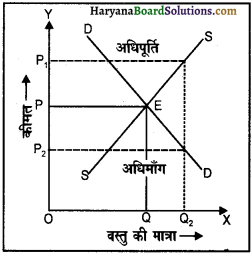
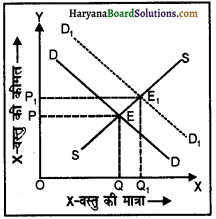
फर्मों की संख्या स्थिर होने पर संतुलन कीमत बाज़ार माँग और बाज़ार पूर्ति के वक्रों के परस्पर प्रतिच्छेदन बिंदु पर निर्धारित होती है। इसे संलग्न रेखाचित्र के द्वारा दर्शाया जा सकता है।
HBSE 12th Class Economics Solutions Chapter 5 बाज़ार संतुलन 1
संलग्न रेखाचित्र में वस्तु का पूर्ति वक्र SS वस्तु के माँग वक्र DD को E बिंदु पर काटता है। परिणामस्वरूप OP बाज़ार कीमत का निर्धारण होता है। OP कीमत से अधिक कोई भी कीमत जैसे OP1 बाज़ार में अधिपूर्ति की स्थिति उत्पन्न करेगी। इसी प्रकार OP कीमत से कम कोई भी कीमत जैसे OP2 बाज़ार में अधिमाँग की स्थिति उत्पन्न करेगी।

प्रश्न 6.
मान लीजिए कि अभ्यास 5 में संतुलन कीमत बाज़ार में फर्मों की न्यूनतम औसत लागत से अधिक है। अब यदि हम फर्मों के निर्बाध प्रवेश तथा बहिर्गमन की अनुमति दे दें, तो बाज़ार कीमत इसके साथ किस प्रकार समायोजन करेगी?
उत्तर:
यदि बाज़ार में फर्मों का निर्बाध प्रवेश तथा बहिर्गमन है तो संतुलन कीमत सदैव फर्मों की न्यूनतम औसत लागत के समान होगी। यदि बाज़ार कीमत को न्यूनतम औसत लागत से ऊँचा रखा जाता है तो इसका अर्थ यह होगा कि कुछ फर्मों को असामान्य लाभ हो रहा है। इस स्थिति में नई फ बाज़ार में प्रवेश करेंगी और अंततः बाज़ार कीमत घटकर न्यूनतम औसत लागत पर आ जाएगी। यदि बाज़ार कीमत को न्यूनतम औसत लागत से नीचा रखा जाता है तो इसका अर्थ यह होगा कि कुछ फर्मों को असामान्य हानि हो रही है। इस स्थिति में कुछ फर्मे बाज़ार से बाहर चली जाएँगी और अंततः बाज़ार कीमत बढ़कर न्यूनतम औसत लागत पर आ जाएगी। इस प्रकार बाज़ार कीमत प्रत्येक स्थिति में न्यूनतम औसत लागत के समान होगी।

प्रश्न 7.
जब बाज़ार में निर्बाध प्रवेश तथा बहिर्गमन की अनुमति है, तो फर्मे पूर्ण प्रतिस्पर्धी बाज़ार में कीमत के किस स्तर पर पूर्ति करती हैं? ऐसे बाज़ार में संतुलन मात्रा किस प्रकार निर्धारित होती है?
उत्तर:
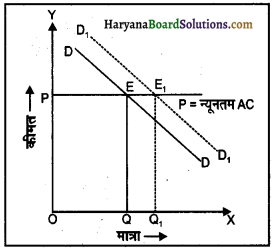
जब बाज़ार में निर्बाध प्रवेश तथा बहिर्गमन की अनुमति है तो फर्म की बाज़ार कीमत, कीमत के उस स्तर पर होती है जहाँ वह न्यूनतम औसत लागत के बराबर होती है। फलस्वरूप बाज़ार पूर्ति वक्र पूर्णतया लोचदार वक्र होगा जो X-अक्ष के समानांतर होगा।
HBSE 12th Class Economics Solutions Chapter 5 बाज़ार संतुलन 2
ऐसी स्थिति में संतुलन मात्रा उस बिंदु पर निर्धारित होगी जहाँ पूर्ति की गई मात्रा माँगी गई मात्रा के बराबर हो। माँग के बढ़ने या घटने से बाज़ार की कीमत पर कोई प्रभाव नहीं पड़ता, परंतु संतुलन मात्रा में परिवर्तन होता है। इसे हम संलग्न रेखाचित्र द्वारा दर्शा सकते हैं।

संलग्न रेखाचित्र में PP कीमत रेखा तथा पूर्ति वक्र है तथा प्रारंभिक माँग वक्र DD है। ये दोनों वक्र एक-दूसरे को E बिंदु पर स्पर्श करते हैं जहाँ संतुलन कीमत OP और संतुलन मात्रा OQ है। जब वस्तु की माँग बढ़कर D1D1 हो जाती है तो संतुलन बिंदु E1 तथा संतुलन मात्रा OQ1 हो जाएगी।

HBSE 12th Class Economics Solutions Chapter 5 बाज़ार संतुलन

प्रश्न 8.
एक बाज़ार में फर्मों की संतुलन संख्या किस प्रकार निर्धारित होती है, जब उन्हें निर्बाध प्रवेश तथा बहिर्गमन की अनुमति हो?
उत्तर:
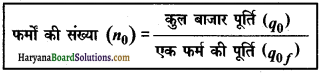
जब फर्मों को बाज़ार में निर्बाध प्रवेश तथा बहिर्गमन की अनुमति हो तो प्रत्येक फर्म की पूर्ति एक समान (q0f) होगी। इस प्रकार बाज़ार में फर्मों की संतुलन संख्या फर्मों की उस संख्या के बराबर होगी जो P0 निर्गत पर q0 पूर्ति के लिए आवश्यक है। प्रत्येक फर्म इस कीमत पर q0f मात्रा की पूर्ति करेगी। इस प्रकार
HBSE 12th Class Economics Solutions Chapter 5 बाज़ार संतुलन 3

प्रश्न 9.
संतुलन कीमत तथा मात्रा किस प्रकार प्रभावित होती है, जब उपभोक्ताओं की आय में
(a) वृद्धि होती है।
(b) कमी होती है।
उत्तर:
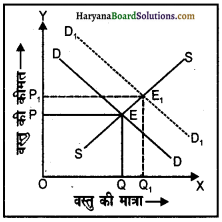
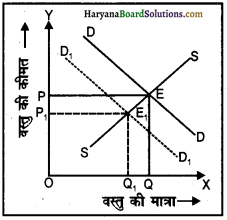
(a) जब उपभोक्ताओं की आय में वृद्धि होती है तो उपभोक्ता की क्रय करने की शक्ति में भी वृद्धि होती है। फलस्वरूप (घटिया वस्तुओं को छोड़कर) सभी वस्तुओं की माँग में वृद्धि होगी, जिसके परिणामस्वरूप वस्तु का माँग वक्र दाईं ओर खिसक जाएगा। माँग वक्र में इस परिवर्तन के कारण संतुलन कीमत और संतुलन मात्रा दोनों में वृद्धि होगी। इसे हम संलग्न रेखाचित्र द्वारा दिखा सकते हैं।
HBSE 12th Class Economics Solutions Chapter 5 बाज़ार संतुलन 4
संलग्न रेखाचित्र में प्रारंभिक माँग वक्र DD है जो पूर्ति वक्र SS को E बिंदु पर काटता है। यहाँ संतुलन कीमत OP और मात्रा OQ है। जब माँग वक्र DD से बढ़कर D1D1 हो जाता है तो संतुलन बिंदु E1 हो जाता है और संतुलन कीमत OP से बढ़कर OP1 तथा मात्रा OQ1 से बढ़कर OQ1 हो जाती है।

(b) जब उपभोक्ताओं की आय में कमी होती है तो उपभोक्ताओं की क्रय करने की शक्ति में भी कमी होती है। परिणामस्वरूप (घटिया वस्तुओं को छोड़कर) सभी वस्तुओं की माँग में कमी आएगी, जिसके फलस्वरूप वस्तु का माँग वक्र बाईं ओर खिसक जाएगा। माँग वक्र में इस परिवर्तन के कारण संतुलन कीमत और संतुलन मात्रा दोनों में कमी होगी। इसे हम संलग्न रेखाचित्र द्वारा दिखा सकते हैं।
HBSE 12th Class Economics Solutions Chapter 5 बाज़ार संतुलन 5
संलग्न रेखाचित्र में प्रारंभिक माँग वक्र DD है जो पूर्ति वक्र SS को E बिंदु पर काटता है। यहाँ संतुलन कीमत OP और मात्रा OQ है। जब माँग वक्र D1D1 से कम होकर D1D1 हो जाता है तो संतुलन बिंदु E1 हो जाता है और संतुलन कीमत OP से घटकर OP1 तथा मात्रा OQ से घटकर OQ1 हो जाती है।

प्रश्न 10.
पूर्ति तथा माँग वक्रों का उपयोग करते हुए दर्शाइए कि जूतों की कीमतों में वृद्धि, खरीदी व बेची जानी वाली मोजों की जोड़ी की कीमतों को तथा संख्या को किस प्रकार प्रभावित करती है?
उत्तर:
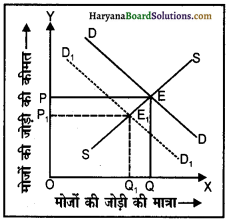
जूते और मोजों की जोड़ी पूरक वस्तुएँ हैं जिनका उपयोग साथ-साथ किया जाता है। पूरक वस्तुओं की स्थिति में, जूतों की कीमतों में कमी से दूसरी वस्तु, मोजों की जोड़ी की माँग में वृद्धि होगी और जूतों की कीमतों में वृद्धि से दूसरी वस्तु मोजों की जोड़ी की माँग में कमी होगी। इस प्रकार जूतों की कीमतों में वृद्धि से मोजों की जोड़ी का माँग वक्र बाईं ओर खिसक जाता है। फलस्वरूप मोजों की जोड़ी की कीमत व मात्रा दोनों में कमी होगी। इसे हम संलग्न रेखाचित्र द्वारा दिखा सकते हैं।
HBSE 12th Class Economics Solutions Chapter 5 बाज़ार संतुलन 6
संलग्न रेखाचित्र में मोजों की जोड़ी का प्रारंभिक माँग वक्र DD है जो पूर्ति वक्र ss को E बिंदु पर काटता है। यहाँ संतुलन कीमत OP और मात्रा OQ है। जब माँग वक्र DD से घटकर D1D1 हो जाता है तो संतुलन बिंदु E1 हो जाता है और संतुलन कीमत OP से घटकर OP1 तथा मात्रा OQ से घटकर OQ1 हो जाती है।

प्रश्न 11.
कॉफी की कीमत में परिवर्तन, चाय की संतुलन कीमत को किस प्रकार प्रभावित करेगा? एक आरेख द्वारा संतलन मात्रा पर प्रभाव को भी समझाइए।
उत्तर:
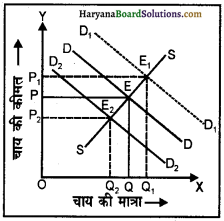
कॉफ़ी और चाय स्थानापन्न वस्तुएँ हैं। स्थानापन्न वस्तुओं की स्थिति में एक उपभोक्ता इन वस्तुओं का उपभोग एक-दूसरे के स्थान पर सुगमतापूर्वक कर सकता है। कॉफ़ी की कीमत में वृद्धि से कॉफी की माँग कम हो जाएगी और चाय की माँग बढ़ जाएगी। कॉफ़ी की कीमत में कमी से कॉफ़ी की माँग बढ़ जाएगी और चाय की माँग में कमी होगी। इस प्रकार कॉफ़ी की कीमत में परिवर्तन चाय की संतुलन कीमत और संतुलन मात्रा दोनों को प्रभावित करेगा। इसे हम संलग्न रेखाचित्र द्वारा दिखा सकते हैं।
HBSE 12th Class Economics Solutions Chapter 5 बाज़ार संतुलन 7
संलग्न रेखाचित्र में DD चाय का प्रारंभिक माँग वक्र है और SS पूर्ति वक्र है। ये दोनों वक्र एक-दूसरे को E बिंदु पर काटते हैं जहाँ संतुलन कीमत OP और संतुलन मात्रा OQ है। जब कीमत में बढ़ोतरी से चाय की माँग बढ़ जाती है तो माँग वक्र दाईं ओर खिसककर D1D1 हो जाता है। इससे संतुलन बिंदु E1 हो जाता है जहाँ संतुलन कीमत OP, और संतुलन मात्रा OQ1 हो जाएगी। जब कीमत में कमी से चाय की माँग कम हो जाती है तो माँग वक्र बाईं ओर खिसककर D1D1 हो जाता है। इससे संतुलन बिंदु हो जाता है। जहाँ संतुलन कीमत OP2 और संतुलन मात्रा OQ2 हो जाएगी।

प्रश्न 12.
जब उत्पादन में प्रयुक्त आगतों की कीमतों में परिवर्तन होता है, तो किसी वस्तु की संतुलन कीमत तथा मात्रा किस प्रकार परिवर्तित होती है?
उत्तर:
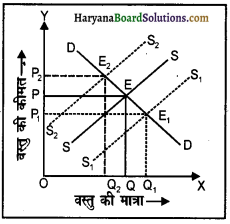
जब उत्पादन में प्रयुक्त आगतों (Inputs) की कीमतों में परिवर्तन होता है तो उस वस्तु की पूर्ति में परिवर्तन होगा। उत्पादन में प्रयुक्त आगतों की कीमतों में कमी से उत्पादन लागत में कमी आएगी और उस वस्त की पर्ति बढ जाएगी। परिणामस्वरूप पूर्ति वक्र दाईं ओर खिसक जाएगा। उत्पादन में प्रयुक्त आगतों की कीमतों में वृद्धि से उत्पादन लागत में वृद्धि होगी और उस वस्तु की पूर्ति कम हो जाएगी। फलस्वरूप पूर्ति वक्र बाईं ओर खिसक जाएगा। पूर्ति वक्र में परिवर्तन से संतुलन कीमत और मात्रा में भी परिवर्तन होगा, जिसे संलग्न रेखाचित्र द्वारा दर्शाया गया है।
HBSE 12th Class Economics Solutions Chapter 5 बाज़ार संतुलन 8
संलग्न रेखाचित्र में SS वस्तु का प्रारंभिक पूर्ति वक्र है जो माँग वक्र DD को E बिंदु पर काटता है जहाँ संतुलन कीमत OP और संतुलन मात्रा OQ है। जब प्रयुक्त आगतों की कीमतों में कमी से पूर्ति वक्र S1S1 हो जाता है तो नया संतुलन बिंदु E1 हो जाएगा। जहाँ वस्तु की कीमत OP1 तथा वस्तु की मात्रा OQ1 होगी। जब प्रयुक्त आगतों की कीमतों में वृद्धि से पूर्ति वक्र S2S2 हो जाता है तो नया संतुलन बिंदु E2 हो जाएगा। जहाँ वस्तु की कीमत OP2 तथा वस्तु की मात्रा OQ2 होगी।

HBSE 12th Class Economics Solutions Chapter 5 बाज़ार संतुलन

प्रश्न 13.
यदि वस्तु X की स्थानापन्न वस्तु Y की कीमत में वृद्धि होती है, तो वस्तु X की संतुलन कीमत तथा मात्रा पर इसका क्या प्रभाव होता है?
उत्तर:
जब X की स्थानापन्न वस्तु Y की कीमत में वृद्धि होती है तो X-वस्तु की माँग। में वृद्धि हो जाएगी क्योंकि उपभोक्ता Y-वस्तु के बदले X-वस्तु की ओर आकर्षित होगा। परिणामस्वरूप X-वस्तु का माँग वक्र दाईं ओर खिसक जाएगा, जिससे संतुलन कीमत और संतुलन मात्रा दोनों में वृद्धि होगी। इसे हम संलग्न रेखाचित्र द्वारा दिखा सकते हैं।
HBSE 12th Class Economics Solutions Chapter 5 बाज़ार संतुलन 9
संलग्न रेखाचित्र में DD, X-वस्तु का प्रारंभिक माँग वक्र है जो पूर्ति वक्र SS को E बिंदु पर काटता है जिससे संतुलन कीमत OP और संतुलन मात्रा OQ निर्धारित होती। है। X-वस्तु के माँग वक्र के दाईं ओर खिसकने से नई माँग D1D1 हो जाती है जो पूर्ति वक्र को E1 बिंदु पर काटती है। इस बिंदु पर संतुलन कीमत OP से बढ़कर OP1 हो जाती है और संतुलन मात्रा OQ से बढ़कर OQ1 हो जाती है।

प्रश्न 14.
बाज़ार फर्मों की संख्या स्थिर होने पर तथा निर्बाध प्रवेश तथा बहिर्गमन की स्थिति में, माँग वक्र के स्थानांतरण का संतुलन पर प्रभाव की तुलना कीजिए।
उत्तर:
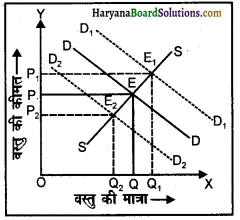
जब बाज़ार में फर्मों की संख्या स्थिर होती है, संतुलन स्थिति (संतुलन कीमत और संतुलन मात्रा) बाज़ार माँग और बाज़ार पूर्ति वक्रों के प्रतिच्छेदन बिंदु पर निर्धारित होती है। जब माँग वक्र का स्थानांतरण होता है तो संतुलन स्थिति में भी परिवर्तन होता है। इसे संलग्न रेखाचित्र द्वारा दर्शाया गया है।
HBSE 12th Class Economics Solutions Chapter 5 बाज़ार संतुलन 10
संलग्न रेखाचित्र में, DD वस्तु का प्रारंभिक माँग वक्र है जो पूर्ति वक्र ss को E बिंदु पर काटता है जहाँ संतुलन कीमत OP और संतुलन मात्रा OQ है। जब माँग वक्र में दाईं ओर खिसकाव होता है तो माँग वक्र D1D1 हो जाता है जिससे कीमत OP से बढ़कर OP1 और संतुलन मात्रा OQ1 से OQ हो जाती है। जब माँग वक्र में बाईं वस्तु की मात्रा ओर खिसकाव होता है तो माँग वक्र D1D1 हो जाता है जिससे कीमत OP से कम होकर OP2 तथा संतुलन मात्रा OQ से कम होकर OQ2 हो जाती है।
HBSE 12th Class Economics Solutions Chapter 5 बाज़ार संतुलन 11
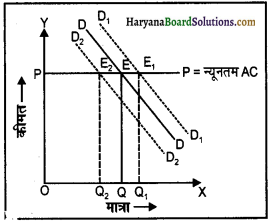
जंब बाज़ार में फर्मों के निर्बाध प्रवेश तथा बहिर्गमन की स्थिति पाई जाती है तो संतुलन कीमत फर्म की न्यूनतम औसत लागत के बराबर होती है। बाज़ार पूर्ति वक्र पूर्णतया लोचदार वक्र होगा, जो X-अक्ष के समानांतर होगा। ऐसी स्थिति में बाज़ार की संतुलन कीमत में कोई परिवर्तन नहीं होता। ऐसी स्थिति में संतुलन मात्रा उस बिंदु पर निर्धारित होगी जहाँ पूर्ति की गई मात्रा माँगी गई मात्रा के बराबर हो। माँग के बढ़ने या घटने से संतुलन मात्रा में भी परिवर्तन होता है। इसे संलग्न रेखाचित्र द्वारा दर्शाया गया है। संलग्न रेखाचित्र में, संतुलन बिंदु E है जहाँ संतुलन कीमत OP और संतुलन मात्रा OQ है। जब माँग वक्र D1D1 हो जाता है तो संतुलन मात्रा OQ1 हो जाएगी। जब माँग वक्र D2D2 हो जाता है तो संतुलन मात्रा OQ2 हो जाएगी।

प्रश्न 15.
माँग तथा पूर्ति वक्र दोनों के दाईं ओर शिफ्ट का, संतुलन कीमत तथा मात्रा पर प्रभाव को एक आरेख द्वारा समझाइए।
उत्तर:
जब किसी वस्तु की माँग और पूर्ति वक्र दोनों ही दाईं ओर शिफ्ट होते (खिसकते) हैं तो इसका अर्थ है-दोनों में वृद्धि होना। इस संबंध में तीन परिस्थितियाँ हो सकती हैं
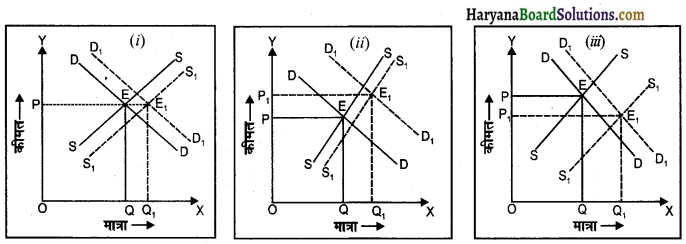
1. जब माँग और पूर्ति दोनों में समान वृद्धि हो-इस स्थिति में संतुलन कीमत पर कोई प्रभाव नहीं पड़ेगा जबकि मात्रा बढ़ जाएगी, जैसाकि निम्न रेखाचित्र (i) से स्पष्ट है। संतुलन कीमत पूर्ववत् OP बनी रहती है, जबकि संतुलन मात्रा OQ से बढ़कर OQ1 हो जाती है।

2. जब माँग में वृद्धि, पूर्ति में वृद्धि की अपेक्षा अधिक हो इस स्थिति में संतुलन कीमत व मात्रा दोनों में वृद्धि होगी, जैसाकि निम्न रेखाचित्र (ii) से स्पष्ट है, संतुलन कीमत OP से बढ़कर OP1 हो जाती है तथा संतुलन मात्रा OQ से बढ़कर OQ1 हो जाती है।

3. जब माँग में वृद्धि, पूर्ति में वृद्धि की अपेक्षा कम हो इस स्थिति में नई संतुलन कीमत आरंभिक कीमत की अपेक्षा कम होगी, जैसाकि निम्न रेखाचित्र (ii) से स्पष्ट है, संतुलन कीमत OP से गिरकर OP1 हो जाती है और संतुलन मात्रा OQ से बढ़कर OQ1 हो जाती है।
HBSE 12th Class Economics Solutions Chapter 5 बाज़ार संतुलन 12

प्रश्न 16.
संतुलन कीमत तथा मात्रा किस प्रकार प्रभावित होते हैं जब (a) माँग तथा पूर्ति वक्र दोनों, समान दिशा में शिफ्ट होते हैं? (b) माँग तथा पूर्ति वक्र विपरीत दिशा में शिफ्ट होते हैं?
उत्तर:
(a) माँग तथा पूर्ति वक्र दोनों, समान दिशा में शिफ्ट होते हैं जब माँग तथा पूर्ति वक्र दोनों समान (एक) दिशा में शिफ्ट होते हैं तो संतुलन कीमत व संतुलन मात्रा में परिवर्तन इस बात पर निर्भर करता है कि दोनों में परिवर्तन की मात्रा कितनी है? इस संबंध में निम्नलिखित स्थितियाँ हो सकती हैं
(i) यदि माँग और पर्ति दोनों वक्र बाईं ओर शिफ्ट होते हैं तो संतलन मात्रा में कमी आएगी. परंत संतलन कीमत में परिवर्तन नहीं भी। जब माँग और पूर्ति में कमी समान दर से होती है तो संतुलन कीमत में कोई परिवर्तन नहीं आता। जब माँग में कमी पूर्ति में कमी की अपेक्षा कम होती है तो कीमत में वृद्धि हो जाती है। जब माँग में कमी पूर्ति में कमी की अपेक्षा अधिक होती है तो कीमत में गिरावट आ जाती है।

(ii) यदि माँग और पूर्ति दोनों वक्र दाईं ओर शिफ्ट होते हैं तो संतुलन मात्रा में वृद्धि होगी, परंतु संतुलन कीमत में परिवर्तन आ भी सकता है और नहीं भी। जब माँग और पूर्ति में वृद्धि एक-समान दर से होती है तो संतुलन कीमत में कोई परिवर्तन नहीं होता। जब माँग में वृद्धि पूर्ति की वृद्धि की अपेक्षा कम होती है तो कीमत में कमी हो जाती है। जब माँग में वृद्धि पूर्ति की वृद्धि की अपेक्षा अधिक होती है तो कीमत में वृद्धि हो जाती है।

(b) माँग तथा पूर्ति वक्र विपरीत दिशा में शिफ्ट होते हैं जब माँग और पूर्ति वक्र दोनों विपरीत दिशा में शिफ्ट होते हैं तो संतुलन कीमत व मात्रा में परिवर्तन इस बात पर निर्भर करते हैं कि दोनों में शिफ्ट की मात्रा कितनी है? यदि माँग वक्र बाईं ओर तथा पूर्ति वक्र दाईं ओरं शिफ्ट होते हैं तो संतुलन कीमत में कमी आएगी, लेकिन संतुलन मात्रा में परिवर्तन हो भी सकता है और नहीं भी। यदि माँग वक्र का बायाँ शिफ्ट पूर्ति वक्र के दाएँ शिफ्ट के अनुपात में बराबर है तो संतुलन मात्रा में कोई परिवर्तन नहीं होगा। यदि माँग वक्र का बायाँ शिफ्ट पूर्ति वक्र के दाएँ शिफ्ट के अनुपात से अधिक है तो संतुलन मात्रा में कमी आएगी। यदि माँग वक्र का बायाँ शिफ्ट पूर्ति वक्र के दाएँ शिफ्ट के अनुपात से कम है तो संतुलन मात्रा में वृद्धि होगी।

यदि माँग वक्र दाईं ओर तथा पूर्ति वक्र बाईं ओर शिफ्ट होता है तो संतुलन कीमत में वृद्धि होगी, लेकिन संतुलन मात्रा में परिवर्तन हो भी सकता है और नहीं भी। यदि माँग वक्र का दायाँ शिफ्ट पूर्ति वक्र के बाएँ शिफ्ट के अनुपात के बराबर है तो संतुलन मात्रा में कोई परिवर्तन नहीं होगा। यदि माँग वक्र का दायाँ शिफ्ट पूर्ति वक्र के बाएँ शिफ्ट के अनुपात से अधिक है तो संतुलन मात्रा में वृद्धि होगी। यदि माँग वक्र का दायाँ शिफ्ट पूर्ति वक्र के बाएँ शिफ्ट के अनुपात से कम है तो संतुलन मात्रा में कमी होगी।

HBSE 12th Class Economics Solutions Chapter 5 बाज़ार संतुलन

प्रश्न 17.
वस्तु बाज़ार में तथा श्रम बाज़ार में माँग तथा पूर्ति वक्र किस प्रकार भिन्न होते हैं?
उत्तर:
वस्तु बाज़ार और श्रम बाज़ार में माँग और पूर्ति के स्रोत में अंतर होता है। श्रम बाज़ार में श्रम की माँग फर्मों से आती है जबकि वस्तु बाज़ार में वस्तुओं की माँग घर-परिवार से आती है। श्रम बाज़ार में श्रम की पूर्ति घर-परिवार द्वारा होती है और वस्तु बाज़ार में वस्तुओं की पूर्ति फर्मों द्वारा की जाती है। श्रम बाज़ार में श्रम की माँग व्युत्पन्न (अप्रत्यक्ष) माँग है जबकि वस्तु बाज़ार में वस्तु की माँग प्रत्यक्ष है। श्रम की माँग श्रम की उत्पादकता से प्रभावित होती है। श्रम की माँग स्थानापन्न साधन अर्थात् पूँजी की कीमत पर निर्भर होगी। यदि पूँजी की कीमत कम हो तो श्रम की माँग कम होगी। श्रम की पूर्ति वस्तु की पूर्ति से निम्नलिखित संदर्भो में होती है
(i) श्रम वस्तु की तुलना में कम गतिशील होता है।

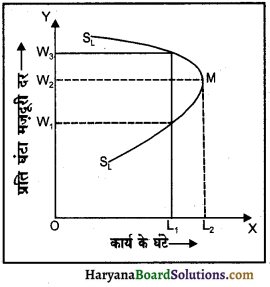
(ii) श्रम का पूर्ति वक्र पीछे की ओर मुड़ता हुआ होता है जो यह दिखाता है कि एक सीमा के पश्चात् मजदूरी दर के बढ़ने पर श्रम की पूर्ति कम होने कार्य के घंटे+ लगती है क्योंकि मजदूरी के एक उच्च स्तर पर श्रमिक काम की तुलना में अवकाश अधिक पसंद करने लगते हैं। इसे हम संलग्न रेखाचित्र द्वारा दिखा सकते हैं।
HBSE 12th Class Economics Solutions Chapter 5 बाज़ार संतुलन 13
संलग्न रेखाचित्र से स्पष्ट है कि M बिंदु तक मजदूरी के बढ़ने से श्रम की पूर्ति बढ़ती है परंतु उसके बाद जब मज़दूरी ow, से बढ़कर ow, हो जाती है तो श्रम की पूर्ति OL2 से घटकर OL1 रह जाती है।

प्रश्न 18.
एक पूर्ण प्रतिस्पर्धी बाज़ार में श्रम की इष्टतम मात्रा किस प्रकार निर्धारित होती है?
उत्तर:
एक पूर्ण प्रतिस्पर्धी बाज़ार में श्रम की इष्टतम मात्रा का निर्धारण उस बिंदु पर होता है जहाँ मज़दूरी दर श्रम की सीमांत उत्पादकता के बराबर होती है अर्थात्
W = MPL
अथवा
मज़दूरी की दर = श्रम की सीमांत उत्पादकता

प्रश्न 19.
एक पूर्ण प्रतिस्पर्धी श्रम बाज़ार में मजदूरी दर किस प्रकार निर्धारित होती है?
उत्तर:
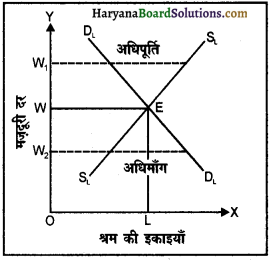
एक पूर्ण प्रतिस्पर्धी बाजार में मजदूरी दर का निर्धारण उस बिंद पर होता है जहाँ श्रम की माँग श्रम की पूर्ति के बराबर हो। इसे संलग्न रेखाचित्र द्वारा दर्शाया गया है।
HBSE 12th Class Economics Solutions Chapter 5 बाज़ार संतुलन 14
इस रेखाचित्र में DLDL श्रम का माँग वक्र है जो श्रम की पूर्ति वक्र SLSL को E बिंदु पर काटता है। इस प्रकार E संतुलन बिंदु है जहाँ मजदूरी दर OW निर्धारित होती है। यदि मज़दूरी दर OW से अधिक (अर्थात् OW1) है तो श्रम की अधिमाँग पूर्ति श्रम की माँग से अधिक होगी। यदि मज़दूरी दर OW से कम (अर्थात् ow2) है तो श्रम की माँग श्रम की पूर्ति से अधिक होगी। इस प्रकार OW मज़दूरी दर ही संतुलित मजदूरी दर है जहाँ श्रम की माँग व पूर्ति बराबर है।

HBSE 12th Class Economics Solutions Chapter 5 बाज़ार संतुलन

प्रश्न 20.
क्या आप किसी ऐसी वस्तु के विषय में सोच सकते हैं, जिस पर भारत में कीमत की उच्चतम निर्धारित कीमत लागू है? निर्धारित उच्चतम कीमत सीमा के क्या परिणाम हो सकते हैं?
उत्तर:
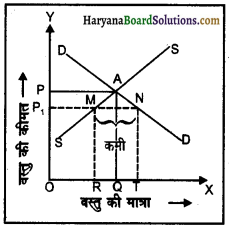
भारत में पेट्रोल, अनाज आदि पर उच्चतम निर्धारित कीमत लागू है। कीमत नियंत्रण का उद्देश्य गरीब जन-समुदाय को अति आवश्यक वस्तुओं; जैसे खाद्यान्नों आदि को उचित कीमत पर उपलब्ध कराना है। नियंत्रित कीमत संतुलन कीमत से कम होती है। इसे हम संलग्न रेखाचित्र द्वारा दिखा सकते हैं।
HBSE 12th Class Economics Solutions Chapter 5 बाज़ार संतुलन 15
संलग्न रेखाचित्र में OP संतुलन कीमत है जिस पर OQ मात्रा का विनिमय किया जाता है। सरकार OP1 नियंत्रित कीमत निर्धारित करती है जिससे MN अर्थात् RT मात्रा में वस्तु की कमी उत्पन्न हो जाएगी। इस कमी को पूरा करने के लिए सरकार को राशनिंग की नीति अपनानी चाहिए। राशनिंग का अर्थ है-एक व्यक्ति के लिए वस्तु के क्रय की उच्चतम सीमा निर्धारित करना। राशनिंग व्यवस्था के अंतर्गत निम्नलिखित दोष होते हैं
(i) प्रत्येक उपभोक्ता को राशन की दुकानों से वस्तुओं को खरीदने के लिए लंबी कतारों में खड़ा रहना पड़ता है।
वस्तु की मात्रा

(ii) क्योंकि सभी उपभोक्ता उचित कीमत की दुकानों से प्राप्त वस्तुओं की मात्रा से संतुष्ट नहीं होंगे, उनमें से कुछ अधिक कीमत देने के लिए तत्पर होंगे। इससे कालाबाजारी की स्थिति उत्पन्न हो सकती है।

प्रश्न 21.
माँग वक्र में शिफ्ट का कीमत पर अधिक तथा मात्रा पर कम प्रभाव होता है, जबकि फर्मों की संख्या स्थिर रहती है। स्थितियों की तुलना करें जब निर्बाध प्रवेश तथा बहिर्गमन की अनुमति हो। व्याख्या करें।
उत्तर:
जब फर्मों की संख्या स्थिर रहती है तो माँग वक्र में शिफ्ट का संतुलन कीमत पर अधिक तथा मात्रा पर कम प्रभाव पड़ता है, क्योंकि माँग में परिवर्तन कीमत में परिवर्तन करते हैं। यदि माँग वक्र दाईं ओर शिफ्ट होता है तो कीमत में वृद्धि होती है और यदि माँग वक्र बाईं ओर शिफ्ट करता है. तो कीमत में कमी होती है।

जब बाज़ार में निर्बाध प्रवेश तथा बहिर्गमन की अनुमति हो तो माँग वक्र में शिफ्ट का संतुलन कीमत पर कोई प्रभाव नहीं पड़ेगा, लेकिन संतुलन मात्रा में परिवर्तन होगा। यदि माँग वक्र दाईं ओर शिफ्ट होता है तो संतुलन मात्रा में वृद्धि होती है। यदि माँग वक्र बाईं ओर शिफ्ट होता है तो संतुलन मात्रा में कमी होती है।

प्रश्न 22.
मान लीजिए, एक पूर्ण प्रतिस्पर्धी बाज़ार में वस्तु X की माँग तथा पूर्ति वक्र निम्नलिखित प्रकार दिए गए है qd = 700 – p
qs = 500 + 3p क्योंकि p ≥ 15
= 0 क्योंकि ≤ 0 p ≤ 15
मान लीजिए कि बाज़ार में समरूपी फर्मे हैं। 15 रुपए से कम, किसी भी कीमत पर वस्तु X की बाज़ार पूर्ति के शून्य होने के कारण की पहचान कीजिए। इस वस्तु के लिए संतुलन कीमत क्या होगी? संतुलन की स्थिति में x की कितनी मात्रा का उत्पादन होगा?
हल:
वस्तु का बाज़ार माँग वक्र qd = 700 – p
वस्तु का बाज़ार पूर्ति वक्र-
qd = 500 + 3p क्योंकि p ≥ 15
= 0 क्योंकि 0 ≤ p ≤ 15
वस्तु X की बाज़ार पूर्ति 15 रुपए से कम किसी भी कीमत पर शून्य होगी क्योंकि यह वस्तु X को उत्पादित करने की न्यूनतम औसत लागत है। यदि एक फर्म 15 रुपए से कम कीमत पर वस्तु की पूर्ति करती है तो फर्म को हानि सहन करनी होगी। इस प्रकार पूर्ति वक्र का प्रारंभिक बिंदु 15 रुपए की कीमत होगा।

संतुलन बिंदु पर-
qd = qs
700 – p = 500 + 3p
4p = 200
p = 50
इस प्रकार 50 रुपए संतुलन बिंदु है। संतुलन मात्रा की गणना निम्नलिखित प्रकार से होगी-
संतुलन मात्रा = 700 – p
= 700 – 50
= 650 उत्तर

प्रश्न 23.
अभ्यास 22 में दिए गए समान माँग वक्र को लेते हुए, आइए, फर्मों को वस्तु X का उत्पादन करने के निर्बाध प्रवेश तथा बहिर्गमन की अनुमति देते हैं। यह भी मान लीजिए कि बाज़ार समानरूपी फर्मों से बना है जो वस्तु x का उत्पादन करती है। एक अकेली फर्म का पूर्ति वक्र निम्नलिखित प्रकार से है-
qsf = 8+ 3p क्योंकि p ≥ 20
= 0 क्योंकि 0 ≤ p < 20
(a) p = 20 का क्या महत्त्व है?
(b) बाज़ार में x के लिए किस कीमत पर संतुलन होगा? अपने उत्तर का कारण बताइए।
(c) संतुलन मात्रा तथा फर्मों की संख्या का परिकलन कीजिए।
हल:
एक वस्तु का माँग वक्र निम्नलिखित है-
qd = 700 – p (अभ्यास 22 में दिया गया है)
एक एकल फर्म का पूर्ति वक्र निम्नलिखित है-
qsf = 8 + 3p क्योंकि p ≥ 0
= 0 क्योंकि 0 ≤ P< 20
(a) p = 20 का महत्त्व यह है कि यह फर्मों की न्यूनतम औसत लागत है। इस कीमत स्तर से नीचे एक फर्म वस्तु की पूर्ति के लिए इच्छुक नहीं होगी।

(b) X के लिए बाज़ार में संतुलन 20 रुपए की कीमत पर होगा। जब बाज़ार में फर्मों का प्रवेश और बहिर्गमन निर्बाध रूप से होता है तो बाजार का संतुलन उस कीमत पर होगा जो फर्मों की न्यूनतम औसत लागत के बराबर हो। इसी कीमत पर बाजार की माँग और पूर्ति बराबर होगी।

(c) माँग वक्र से हम संतुलन मात्रा का परिकलन कर सकते हैं-
q0 = 700 – 20
= 680
P0 = 20 पर प्रत्येक फर्म की पूर्ति है-
qsf = 8 + 3p
= 8 + (3 x 20)
= 68
फर्मों की संख्या (n0) = \(\frac{q_{0}}{q_{0 f}}\)
= \(\frac { 680 }{ 68 }\)
= 10 उत्तर

HBSE 12th Class Economics Solutions Chapter 5 बाज़ार संतुलन

प्रश्न 24.
मान लीजिए कि नमक की माँग तथा पूर्ति वक्र को इस प्रकार दिया गया है-
qd = 1000 – p
qs = 700 + 2P
(a) संतुलन कीमत तथा मात्रा ज्ञात कीजिए।
(b) अब मान लीजिए कि नमक के उत्पादन के लिए प्रयुक्त एक आगत की कीमत में वृद्धि हो जाती है और नया पूर्ति वक्र है
qs = 400 + 2p
संतुलन कीमत तथा मात्रा किस प्रकार परिवर्तित होती है? क्या परिवर्तन आपकी अपेक्षा के अनुकूल है?
(c) मान लीजिए, सरकार नमक की बिक्री पर 3 रुपए प्रति इकाई कर लगा देती है। यह संतुलन कीमत तथा मात्रा को किस प्रकार प्रभावित करेगा?
हल:
नमक का माँग वक्र निम्नलिखित है-
qd = 1000 – p
नमक का पूर्ति वक्र निम्नलिखित है–
qs = 700 + 2p
(a) संतुलन पर नमक की माँग और नमक की पूर्ति बराबर होंगे-
qd = qs
1000 – p = 700 + 2p
– 3p = 700 – 1000
– 3p = – 300
3p = 300
p = 100
संतुलन कीमत = 100
संतुलन मात्रा = 1000 – p
= 1000 – 100
= 900 उत्तर

(b) नमक का माँग वक्र है
qd = 100 – p
नमक की नई पूर्ति वक्र है-
qs = 400 – 2p
नए संतुलन के लिए भी qd = qs की शर्त का लागू होना आवश्यक है।
इसलिए
qd = qs
1000 – p = 400 + 2 p
– 3p = 400 – 1000
3p = 600
p = 200
नई संतुलन कीमत = 200
संतुलन मात्रा = 1000 – p
= 1000 – 200 = 800
संतुलन मात्रा में कमी = 900 – 800
= 100
संतुलन कीमत में वृद्धि = 200 – 100
= 100 उत्तर
ये परिवर्तन हमारी अपेक्षा के अनुकूल हैं। जब नमक के उत्पादन के लिए प्रयुक्त एक आगत की कीमत में वृद्धि हो जाती है तो वस्तु की लागत में वृद्धि होगी। फलस्वरूप संतुलन कीमत में वृद्धि तथा संतुलन मात्रा में कमी होना स्वाभाविक है।

(c) नमक पर बिक्री कर = 3 रुपए
कर पूर्व माँग वक्र है = 1000 – p
कर पश्चात् माँग वक्र होगा = 1000 – 3 – p
= 997 – p
कर पूर्व पूर्ति वक्र है = 700 + 2p
कर पश्चात् पूर्ति वक्र होगा = 700 + 2 (p – 3)
= 700 + 2p – 6
= 694 + 2p
संतुलन स्थिति है- qd = qs
997 – p = 694 + 2p
3p = 303
p = \(\frac { 303 }{ 3 }\)
p = 101 रुपए
संतुलन कीमत = 101 रुपए
संतुलन मात्रा = 997 – p
= 997 -101
= 896 उत्तर
इस प्रकार 3 रुपए प्रति इकाई के कर के परिणामस्वरूप संतुलन कीमत 100 रुपए से बढ़कर 101 रुपए हो गई है और संतुलन मात्रा 900 से 896 तक घट गई है।

प्रश्न 25.
मान लीजिए कि एपार्टमेंटों के लिए बाज़ार-निर्धारित किराया इतना अधिक है कि सामान्य लोगों द्वारा वहन नहीं किया जा सकता, यदि सरकार किराए पर एपार्टमेंट लेने वालों की मदद करने के लिए किराया नियंत्रण लागू करती है, तो इसका एपार्टमेंटों के बाज़ार पर क्या प्रभाव पड़ेगा?
उत्तर:
यदि सरकार किराए पर एपार्टमेंट लेने वालों की मदद करने के लिए किराया नियंत्रण लागू करती है तो इसका अर्थ यह होगा कि सरकार द्वारा निर्धारित किया हआ किराया बाजार द्वारा निर्धारित (संतलन) किराए से कम होगा। इसके परिणामस्वस एपार्टमेंट की पूर्ति उसकी माँग से कम हो जाएगी। इस प्रकार एपार्टमेंट की माँग की तुलना में पूर्ति कम होगी। इस कमी को पूरा करने के लिए सरकार को नियंत्रित किराए पर एपार्टमेंट की पूर्ति स्वयं बढ़ानी होगी। यदि सरकार किसी भी कारणवश ऐसा नहीं कर पाती है तो बाज़ार में कालाबाज़ारी का बोलबाला हो जाएगा।

बाज़ार संतुलन HBSE 12th Class Economics Notes

→ संतुलन वह स्थिति है, जहाँ किसी परिवर्तन की कोई प्रवृत्ति नहीं होती।

→ एक पूर्ण प्रतिस्पर्धी बाज़ार में संतुलन वहाँ होता है, जहाँ बाज़ार माँग तथा बाज़ार पूर्ति बराबर होती है।
बाज़ार संतुलन : बाज़ार माँग = बाज़ार पूर्ति ।

→ फर्मों की संख्या स्थिर होने पर संतुलन कीमत तथा मात्रा, बाज़ार माँग तथा बाज़ार पूर्ति वक्रों के परस्पर प्रतिच्छेदन बिंदु पर निर्धारित होती है।

→ प्रत्येक फर्म श्रम का उपयोग उस बिंदु तक करती है, जहाँ श्रम का सीमांत संप्राप्ति (आगम) उत्पाद, मजदूरी दर के बराबर होता है। यही बिंदु श्रम की इष्टतम मात्रा का बिंदु होता है।

→ पर्ति वक्र के अपरिवर्तित रहने पर जब माँग वक्र दायीं (बायीं ओर शिफ्ट होता है, तो फर्मों की स्थिर संख्या होने पर संतुलन मात्रा में वृद्धि (गिरावट) होती है।

→ माँग वक्र के अपरिवर्तित रहने पर जब पूर्ति वक्र दायीं (बायीं) ओर शिफ्ट होता है, तो फर्मों की स्थिर संख्या होने पर संतुलन मात्रा में वृद्धि (गिरावट) होती है तथा संतुलन कीमत में गिरावट (घृद्धि) होती है।

→ जब माँग तथा पूर्ति दोनों वक्र समान दिशा में शिफ्ट होते हैं, तो संतलन मात्रा पर इसका प्रभाव सस्पष्ट रूप से निर्धारित किया जा सकता है, जबकि संतुलम कीमत पर इसका प्रभाव शिफ्ट के परिमाण पर निर्भर करता है।

HBSE 12th Class Economics Solutions Chapter 5 बाज़ार संतुलन

→ जब माँग तथा पूर्ति वक्र, दोनों का दायीं ओर शिफ्ट होता है, तो संतलन मात्रा में बद्धि होती है जबकि संतलन कीमत में वृद्धि, कमी हो सकती है अथवा अपरिवर्तित भी रह सकती है। यह माँग और पूर्ति चक्रों में शिफ्ट के परिमाण पर निर्भर करता है।

→ जब माँग तथा पूर्ति वक्र विपरीत दिशाओं में शिफ्ट होते हैं, तो संतुलन कीमत पर इसका प्रभाव सुस्पष्ट रूप से निर्धारित किया जा सकता है, जबकि संतुलन मात्रा पर प्रभाव शिफ्ट के परिमाण पर निर्भर करता है।

→ जब माँग तथा पूर्ति वक्र दोनों का बायीं ओर शिफ्ट होना है, तो संतुलन मात्रा में कमी होती है, जबकि संतुलन कीमत ‘ में वृद्धि कमी अथवा अपरिवर्तित हो सकती है। यह माँग और पूर्ति वक्रों में शिफ्ट के परिमाण पर निर्भर करता है।

→ संतुलन कीमत से कम कीमत का उच्चतम निर्धारित कीमत निर्धारण से अधिमाँग उत्पन्न होती है।

→ संतुलन कीमत से अधिक कीमत की निम्नतम निर्धारित कीमत निर्धारण से अधिपूर्ति उत्पन्न होती है।

→ एक पूर्ण प्रतिस्पर्धी बाज़ार में समरूपी के साथ यदि फर्मे बाज़ार में निर्बाध प्रवेश तथा बहिर्गमन कर सकती है, तो संतुलन कीमत सदैव फर्मों की न्यूनतम औसत लागत के ही बराबर होती है अर्थात् P = न्यूनतम औसत लागत।

→ नर्बाध प्रवेश तथा बहिर्गमन होने पर माँग में शिफ्ट का संतुलन कीमत पर कोई प्रभाव नहीं होता, परंतु संतुलन मात्रा तथा फर्मों की संख्या में परिवर्तन माँग की दिशा में परिवर्तन के समान होता है।

→ फर्मों की स्थिर संख्या वाले बाज़ार की तुलना में निर्बाध प्रवेश तथा बहिर्गमन वाले बाज़ार में माँग वक्र के शिफ्ट का संतुलन मात्रा पर प्रभाव अधिक प्रबल होगा।

HBSE 12th Class Economics Solutions Chapter 5 बाज़ार संतुलन Read More »

HBSE 7th Class Maths Solutions Chapter 14 सममिति Ex 14.2

Haryana State Board HBSE 7th Class Maths Solutions Chapter 14 सममिति Ex 14.2 Textbook Exercise Questions and Answers.

Haryana Board 7th Class Maths Solutions Chapter 14 सममिति Ex 14.2

प्रश्न 1.
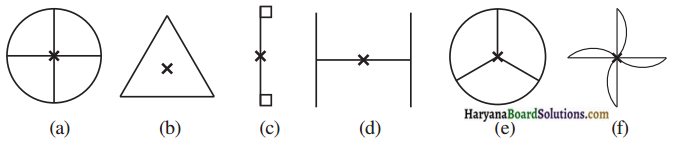
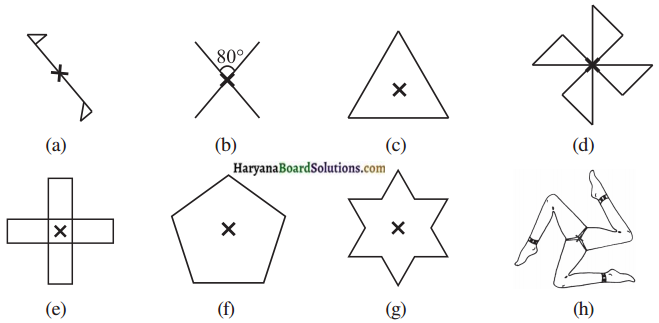
निम्नलिखित आकृतियों में से किन आकृतियों में 1 से अधिक क्रम की घूर्णन सममिति है ?
HBSE 7th Class Maths Solutions Chapter 14 सममिति Ex 14.2 1
हल :
आकृति (a), (b), (d), (e) और (f) में क्रम 1 से अधिक घूर्णन सममिति है।

HBSE 7th Class Maths Solutions Chapter 14 सममिति Ex 14.2

प्रश्न 2.
प्रत्येक आकृति के घूर्णन सममिति का क्रम बताइए।
HBSE 7th Class Maths Solutions Chapter 14 सममिति Ex 14.2 2
हल :
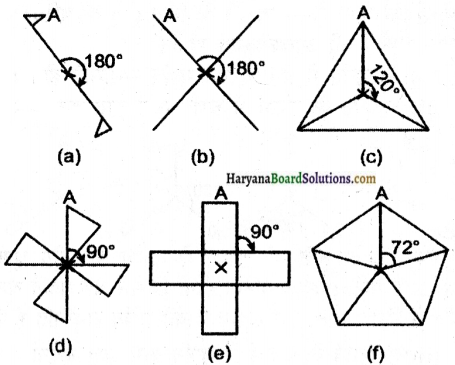
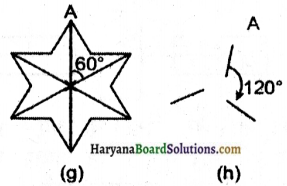
माना प्रत्येक आकृति पर बिन्दु A और कोण जिस पर घूर्णन करेगा अंकित किया तथा घूर्णन निम्न प्रकार होगा-
HBSE 7th Class Maths Solutions Chapter 14 सममिति Ex 14.2 3
HBSE 7th Class Maths Solutions Chapter 14 सममिति Ex 14.2 4

घूर्णन सममिति ज्ञात करना :
आकृति (a) में, इसमें दो घूर्णनों की आवश्यकता होती है। प्रत्येक घूर्णन 180° के कोण के द्वारा हो जो (X) के परितः घूमने पर प्रारम्भिक स्थिति में वापिस आ जाएगा। अतः इसमें क्रम 2 की घूर्णन सममिति होगी।

आकृति (b) में, इसमें दो घूर्णनों की आवश्यकता होती है। प्रत्येक घूर्णन 180° के कोण द्वारा हो जो (×) के परितः घूमने पर प्रारम्भिक स्थिति में वापिस आ जाएगा। अतः इसमें क्रम 2 की घूर्णन सममिति होगी।

आकृति (c) में, त्रिभुज में तीन घूर्णन प्रत्येक 120° के कोण की आवश्यकता होती है जो (×) के परितः घूमने पर प्रारम्भिक स्थिति में वापिस आ जाएगा। अतः इसमें क्रम 3 की घूर्णन सममिति होगी।

आकृति (d) में, आकृति में 4 घूर्णन प्रत्येक 90° के कोण की आवश्यकता होगी जो (×) के परितः घूमने पर प्रारम्भिक स्थिति में वापिस आ जाएगा। अतः इसमें क्रम 4 की घूर्णन सममिति होगी।

आकृति (e) में, आकृति में 4 घूर्णन प्रत्येक 90° के कोण की आवश्यकता होगी जो (×) के परितः घूमने पर प्रारम्भिक स्थिति में वापिस आ जाएगा। अतः इसमें क्रम 4 की घूर्णन सममिति होगी।

आकृति (f) में, समपंचभुज में 5 घूर्णन प्रत्येक 72° के कोण की आवश्कयता होगी जो (×) के परितः घूमने पर वापस प्रारम्भिक स्थिति में आ जाएगा। अतः इसमें क्रम 5 की घूर्णन सममिति होगी।

आकृति (g) में, आकृति में 6 घूर्णन प्रत्येक 60° के कोण की आवश्यकता होगी जो (×) के परितः घूमने पर वापिस अपनी प्रारम्भिक स्थिति में आ जाएगा। अतः इसमें क्रम 6 की घूर्णन सममिति होगी।

आकृति (h) में, आकृति में 3 घूर्णन प्रत्येक 120° के कोण की आवश्यकता होगी जो (×) के परितः घूमने पर वापिस अपनी प्रारम्भिक स्थिति में आ जाएगा। अतः इसमें क्रम 3 की घूर्णन सममिति होगी।

HBSE 7th Class Maths Solutions Chapter 14 सममिति Ex 14.2 Read More »

HBSE 7th Class Maths Solutions Chapter 15 ठोस आकारों का चित्रण Ex 15.3

Haryana State Board HBSE 7th Class Maths Solutions Chapter 15 ठोस आकारों का चित्रण Ex 15.3 Textbook Exercise Questions and Answers.

Haryana Board 7th Class Maths Solutions Chapter 15 ठोस आकारों का चित्रण Ex 15.3

प्रश्न 1.
आपको कौन-सा अनुप्रस्थ-काट प्राप्त होती है, जब आप निम्नलिखित ठोसों को
(i) ऊर्ध्वाधर रूप से और
(ii) क्षैतिज रूप से काटते हैं ?
(a) एक ईंट
(b) एक गोल सेब
(c) एक पासा
(d) एक बेलनाकार पाइप
(e) एक आइसक्रीम शंकु
हल:

ठोस का नाम

अनुप्रस्थ-काट का नाम
ऊर्ध्वाधर रूप में काटने पर

क्षैतिज रूप में काटने पर

(a) एक ईंट

(b) एक गोल सेब

(c) एक पासा

(d) एक बेलनाकार पाइप वृत्त

(e) एक आइसक्रीम शंकु

आयत

वृत्त

वर्ग

वृत्त

त्रिभुज

आयत

वृत्त

वर्ग

आयत

वृत्त

HBSE 7th Class Maths Solutions Chapter 15 ठोस आकारों का चित्रण Ex 15.3 Read More »

HBSE 7th Class Maths Solutions Chapter 15 ठोस आकारों का चित्रण Ex 15.2

Haryana State Board HBSE 7th Class Maths Solutions Chapter 15 ठोस आकारों का चित्रण Ex 15.2 Textbook Exercise Questions and Answers.

Haryana Board 7th Class Maths Solutions Chapter 15 ठोस आकारों का चित्रण Ex 15.2

प्रश्न 1.
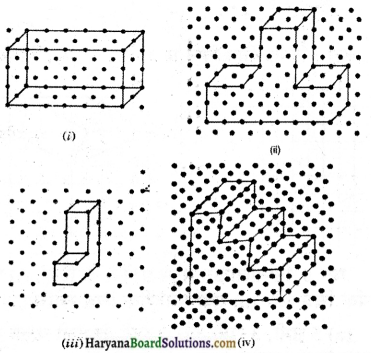
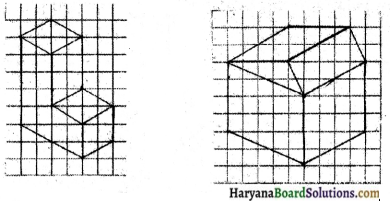
एक समदूरीक बिन्दुकित कागज का प्रयोग करते हुए, निम्नलिखित आकृतियों में से प्रत्येक का एक समदूरीक चित्र खींचिए :
HBSE 7th Class Maths Solutions Chapter 15 ठोस आकारों का चित्रण Ex 15.2 1
हल :
प्रत्येक आकार की एक समदूरीक आकृति निम्न प्रकार है
HBSE 7th Class Maths Solutions Chapter 15 ठोस आकारों का चित्रण Ex 15.2 2

HBSE 7th Class Maths Solutions Chapter 15 ठोस आकारों का चित्रण Ex 15.2

प्रश्न 2.
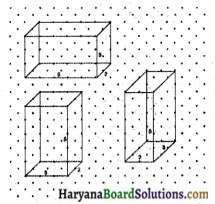
किसी घनाभ की विमाएँ 5 सेमी, 3 सेमी और 2 सेमी हैं। इस घनाभ के तीन भिन्न-भिन्न समदूरीक चित्र खींचिए।
हल :
घनाभ जिसकी विमाएँ 5 सेमी, 3 सेमी और 2 सेमी हैं। इस घनाभ के तीन समदूरीक चित्र निम्न प्रकार हैं-
HBSE 7th Class Maths Solutions Chapter 15 ठोस आकारों का चित्रण Ex 15.2 3

प्रश्न 3.
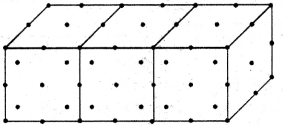
2 सेमी किनारों वाले तीन घनों को परस्पर सटाकर रखते हुए एक घनाभ बनाया गया है। इस घनाभ का एक तिर्यक अथवा एक समदूरीक चित्र खींचिए।
हल :
2 सेमी किनारे वाले घनों को परस्पर सटाकर रखते हुए एक समदूरीक घनाभ चित्र निम्न प्रकार बनाया जाता है-
HBSE 7th Class Maths Solutions Chapter 15 ठोस आकारों का चित्रण Ex 15.2 4

प्रश्न 4.
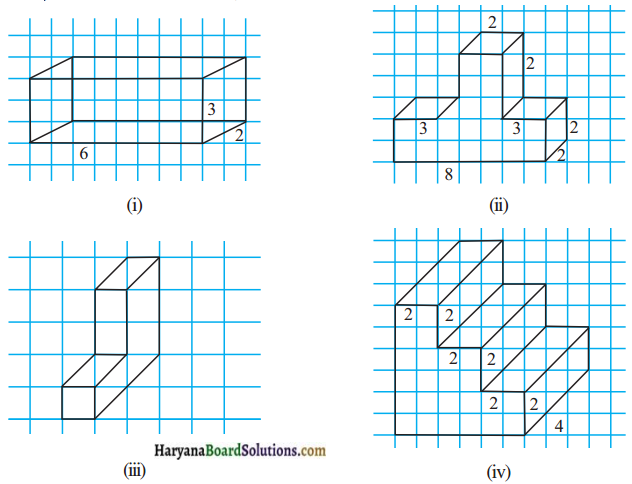
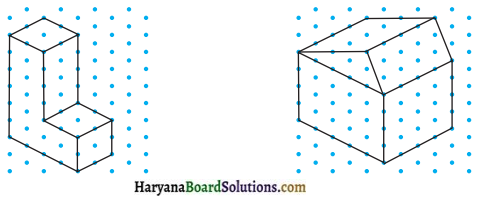
निम्नलिखित समदूरीक आकारों में से प्रत्येक के लिए, एक तिर्यक चित्र खींचिए :
HBSE 7th Class Maths Solutions Chapter 15 ठोस आकारों का चित्रण Ex 15.2 5
हल :
तिर्यक चित्र निम्न प्रकार है-
HBSE 7th Class Maths Solutions Chapter 15 ठोस आकारों का चित्रण Ex 15.2 6

HBSE 7th Class Maths Solutions Chapter 15 ठोस आकारों का चित्रण Ex 15.2

प्रश्न 5.
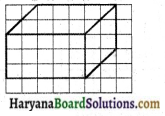
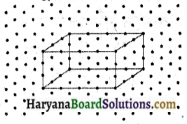
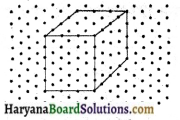
निम्नलिखित में से प्रत्येक के लिए, (i) एक तिर्यक चित्र और (ii) एक समदूरीक चित्र खींचिए-
(a) 5 सेमी, 3 सेमी और 2 सेमी विमाओं वाला एक घनाभ (क्या आपका चित्र अद्वितीय है ?)
(b) 4 सेमी लम्बे किनारे वाला एक घन।
हल :
(a) (i) 5 सेमी, 3 सेमी और 2 सेमी विमाओं वाले घनाभ का तिर्यक चित्र दर्शाया गया है।
HBSE 7th Class Maths Solutions Chapter 15 ठोस आकारों का चित्रण Ex 15.2 7
यह चित्र अद्वितीय नहीं है।

(ii) घनाभ का समदूरीक चित्र
HBSE 7th Class Maths Solutions Chapter 15 ठोस आकारों का चित्रण Ex 15.2 8

(b) (i) 4 सेमी किनारे वाले घन का तिर्यक चित्र :
HBSE 7th Class Maths Solutions Chapter 15 ठोस आकारों का चित्रण Ex 15.2 9

(ii) घन का समदूरीक चित्र :
HBSE 7th Class Maths Solutions Chapter 15 ठोस आकारों का चित्रण Ex 15.2 10

HBSE 7th Class Maths Solutions Chapter 15 ठोस आकारों का चित्रण Ex 15.2 Read More »

HBSE 7th Class Maths Solutions Chapter 2 भिन्न एवं दशमलव Ex 2.3

Haryana State Board HBSE 7th Class Maths Solutions Chapter 2 भिन्न एवं दशमलव Ex 2.3 Textbook Exercise Questions and Answers.

Haryana Board 7th Class Maths Solutions Chapter 2 भिन्न एवं दशमलव Ex 2.3

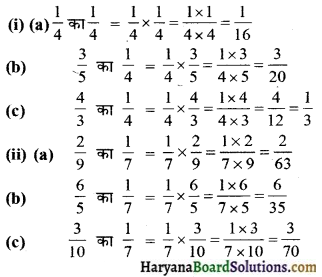
प्रश्न 1.
ज्ञात कीजिए :
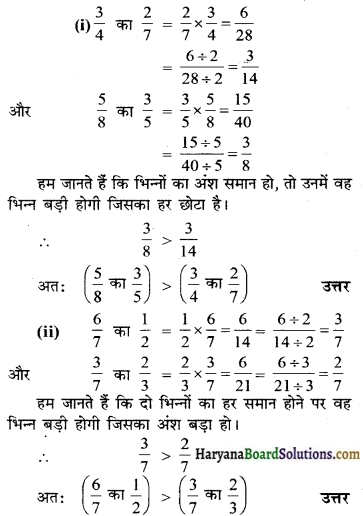
(i) (a) \(\frac {1}{4}\) का \(\frac {1}{4}\)
(b) \(\frac {3}{5}\) का \(\frac {1}{4}\)
(c) \(\frac {4}{3}\) का \(\frac {1}{4}\)

(ii) (a) \(\frac {2}{9}\) का \(\frac {1}{7}\)
(b) \(\frac {6}{5}\) का \(\frac {1}{7}\)
(c) \(\frac {3}{10}\) का \(\frac {1}{7}\)
हल :
HBSE 7th Class Maths Solutions Chapter 2 भिन्न एवं दशमलव Ex 2.3 - 1

HBSE 7th Class Maths Solutions Chapter 2 भिन्न एवं दशमलव Ex 2.3

प्रश्न 2.
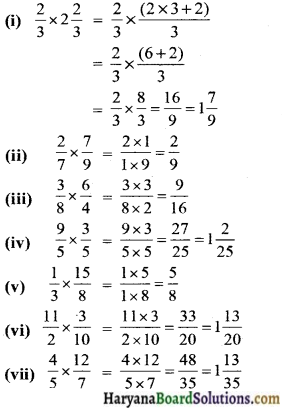
गुणन कीजिए और न्यूनतम रूप में बदलिए (यदि सम्भव है):
HBSE 7th Class Maths Solutions Chapter 2 भिन्न एवं दशमलव Ex 2.3 - 2
हल :
HBSE 7th Class Maths Solutions Chapter 2 भिन्न एवं दशमलव Ex 2.3 - 3

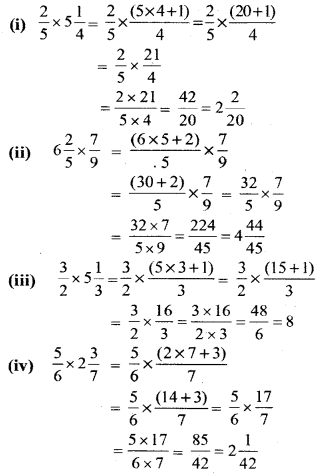
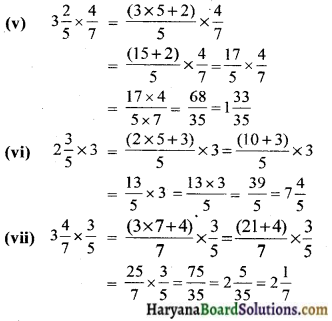
प्रश्न 3.
निम्नलिखित भिनों को गुणा कीजिए :
HBSE 7th Class Maths Solutions Chapter 2 भिन्न एवं दशमलव Ex 2.3 - 4
हल :
HBSE 7th Class Maths Solutions Chapter 2 भिन्न एवं दशमलव Ex 2.3 - 5
HBSE 7th Class Maths Solutions Chapter 2 भिन्न एवं दशमलव Ex 2.3 - 6

प्रश्न 4.
कौन बड़ा है ?
(i) \(\frac {22}{7}\) का \(\frac {22}{7}\) अथवा \(\frac {22}{7}\) का \(\frac {22}{7}\)
(ii) \(\frac {22}{7}\) का \(\frac {22}{7}\) अथवा \(\frac {22}{7}\) का \(\frac {22}{7}\)
हल :
HBSE 7th Class Maths Solutions Chapter 2 भिन्न एवं दशमलव Ex 2.3 - 7

HBSE 7th Class Maths Solutions Chapter 2 भिन्न एवं दशमलव Ex 2.3

प्रश्न 5.
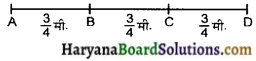
सैली अपने बगीचे में चार छोटे पौधे एक पंक्ति से लगाती है। दो क्रमागत छोटे पौधों के बीच की दूरी \(\frac {3}{4}\) मीटर है। प्रथम एवं अंतिम पौधे के बीच की दूरी ज्ञात कीजिए।
हल :
मांना चार पेड़ A, B, C, D इस प्रकार हैं कि
AB = BC = CD = \(\frac {3}{4}\) मीटर
HBSE 7th Class Maths Solutions Chapter 2 भिन्न एवं दशमलव Ex 2.3 - 8
∴ पहले और अन्तिम पेड़ के बीच की दूरी
= AD = 3 × AB
= 3 × \(\frac{3}{4}=\frac{9}{4}=2 \frac{1}{4}\) मीटर। उत्तर

प्रश्न 6.
लिपिका एक पुस्तक को प्रतिदिन 1\(\frac {3}{4}\) घण्टे पढ़ती है। वह सम्पूर्ण पुस्तक को 6 दिनों में पढ़ती है। उस पुस्तक को पढ़ने में उसने कुल कितने घण्टे लगाए ?
हल:
1 दिन में पढ़ती है = 1\(\frac {3}{4}\) घण्टे
पूरी पुस्तक को पढ़ने में लिए = 6 दिन
अत: 6 दिन में कुल समय चाहिए
(6 × 1\(\frac {3}{4}\)) घण्टे = 6 × \(\frac{(1 \times 4+3)}{4}\) घण्टे
\(\frac{6 \times(4+3)}{4}\) घण्टे = \(\frac{6 \times 7}{4}=\frac{42}{4}\) घण्टे
= \(\frac {21}{2}\) घण्टे = 10\(\frac {1}{2}\) घण्टे = 10 घण्टे 30 मिनट। उत्तर

प्रश्न 7.
एक कार 1 लीटर पैट्रोल में 16 किमी दौड़ती है। लीटर पैट्रोल में यह कार कुल कितनी दूरी तय करेगी?
हल :
कार 1 लीटर पैट्रोल में चलती है = 16 किमी
∴ 2\(\frac {3}{4}\) लीटर पैट्रोल में चलेगी = (16 × 2\(\frac {3}{4}\)) किमी
= 16 × \(\frac{(2 \times 4+3)}{4}\) = 16 × \(\frac{(8+3)}{4}\)
= 16 × \(\frac {11}{4}\) = 4 × 11 = 44 किमी। उत्तर

HBSE 7th Class Maths Solutions Chapter 2 भिन्न एवं दशमलव Ex 2.3

प्रश्न 8.
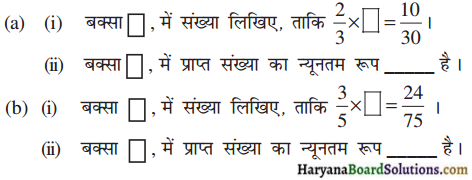
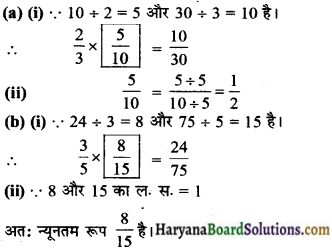
HBSE 7th Class Maths Solutions Chapter 2 भिन्न एवं दशमलव Ex 2.3 - 9
हल :
HBSE 7th Class Maths Solutions Chapter 2 भिन्न एवं दशमलव Ex 2.3 - 10

HBSE 7th Class Maths Solutions Chapter 2 भिन्न एवं दशमलव Ex 2.3 Read More »

HBSE 10th Class English Solutions First Flight Chapter 1 A Letter to God

Haryana State Board HBSE 10th Class English Solutions First Flight Chapter 1 A Letter to God Textbook Exercise Questions and Answers.

Haryana Board 10th Class English Solutions First Flight Chapter 1 A Letter to God

HBSE 10th Class English A Letter to God Textbook Questions and Answers

A Letter To God Summary HBSE 10th Class

Before You Read

They say faith can move mountains. But what should we put our faith in? This is the question this story delicately poses.

Lencho is a farmer who writes a letter to God when his crops are ruined, asking for a hundred pesos. Does Lencho’s letter reach God? Does God send him the money? Think what your answers to these questions would be, and guess how the story continues, before you begin to read it.
Answer:
Lencho’s letter does not reach God. God does not live at any specific place. He is everywhere. But he is also affected by man’s deep faith in Him. Lencho’s prayer reaches him and he fulfils Lencho’s wish through the employees of the post offices.

A Letter To God Important Question HBSE 10th Class

Activity

1. One of the cheapest ways to send money to someone is through the post office. Have you ever sent or received money in this way ? Here’s what you have to do. (As you read the instructions, discuss with your teacher in class the meanings of these words: counter, counter clerk, appropriate, acknowledgement, counterfoil, record. Consult a dictionary if necessary. Are there words corresponding to these English words in your languages ?)
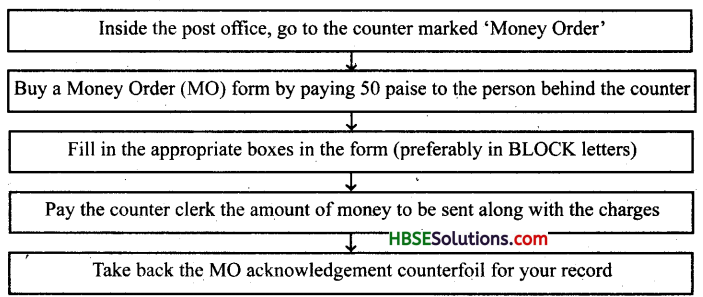
HBSE 10th Class English Solutions First Flight Chapter 1 A Letter to God 1

Answer:
For discussion at the class level.

2. Fill out the Money Order form given below using the clues that follow the form.
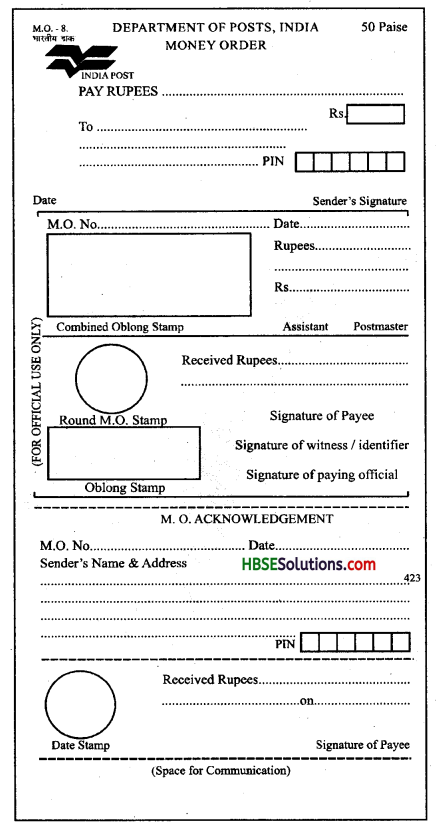
HBSE 10th Class English Solutions First Flight Chapter 1 A Letter to God 2

  • Think about who you will send the money to, and how much. You might want to send money for a magazine subscription, or to a relative or a friend.
  • Or you may fill out the form with yourself as sender and your partner as receiver. Use a part of your pocket money, and submit the form at the nearest post office to see how it’s done. See how your partner enjoys getting money by post!
  • Notice that the form has three parts–the Money Order form, the part for official use and the Acknowledgement. What would you write in the ‘Space for Communication”?

A Letter To God Important Questions HBSE 10th Class

HBSE 10th Class English Solutions First Flight Chapter 1 A Letter to God

Now complete the following statements.

(i) In addition to the sender, the form has to be signed by the ………………………………..
(ii) The ‘Acknowledgement’ section of the form is sent back by the post office to the …………………. after the ……………………………… signs it.
(iii) The ‘Space for Communication’ section is used for ………
(iv) The form has six sections. The sender needs to fill out ……………………………… sections and the receiver……………..
Answer:
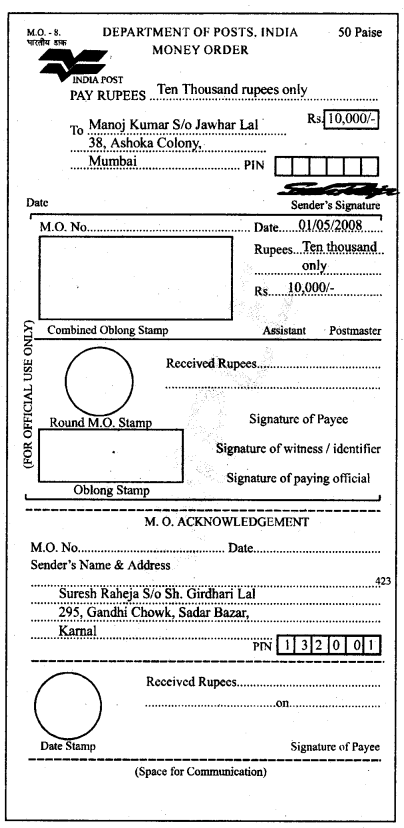
HBSE 10th Class English Solutions First Flight Chapter 1 A Letter to God 3

Answer:
(i) receiver, (ii) sender, receiver, (iii) writing messages, etc., (iv) first, fourth and sixth; third.

A Letter To God Summary Questions And Answers HBSE

Oral Comprehension Check (Page 5)

1. What did Lencho hope for ?
(लैंचो किस बारे में आशावान था ?)
Answer:
Lencho hoped that it would rain soon and his crop of corn would be saved. (लैंचो को आशा थी कि जल्दी ही वर्षा होगी और उसकी मक्के की फसल बच जाएगी।)

2. Why did Lencho say the raindrops were like “new coins’ ?
(लैंचो वर्षा की बूंदों को ‘नए सिक्के’ क्यों कहता है ?)
Answer:
He said this because his crop needed rain to be a good harvest. Good harvest was like money to him. So when it rained he saw the raindrops in the form of ‘new coins’.
(उसने ऐसा इसलिए कहा क्योंकि उसकी अच्छी फसल के लिए वर्षा की बहुत आवश्यकता थी। अच्छी फसल उसके लिए धन के समान थी। अतः जब वर्षा हुई तो उसने वर्षा की बूंदों को ‘नए सिक्कों’ के रूप में देखा।)

3. How did the rain change ? What happened to Lencho’s fields? (वर्षा कैसे बदली? लैंचो के खेतों का क्या हुआ ?)
Answer:
The rain changed into a hailstorm. Hails fell on the house, the garden, the hillside, the cornfield and the whole valley. The hails destroyed Lencho’s crop completely. . (वर्षा ओलों के एक तूफान में परिवर्तित हो गई। घर के ऊपर, बगीचे में, पहाड़ी के आस-पास, मक्के के खेत में और पूरी घाटी में ओलों की वर्षा हुई। ओलों ने लैंचो की फसल को पूर्णतया नष्ट कर दिया।)

4. What were Lencho’s feelings when the hail stopped ? (जब ओलों की वर्षा रुकी तो लैंचो के मन में क्या विचार थे ?)
Answer:
Lencho felt completely broken. The hail had left nothing. He felt that he would have no corn that year and his family would go hungry that year.
(लैंचो पूर्ण रूप से टूट चुका था। ओलों ने कुछ भी नहीं छोड़ा था। वह सोच रहा था कि उस वर्ष उसकी मक्के की फसल · बिल्कुल भी नहीं होगी और उस वर्ष उसका परिवार भूखा रहेगा।)

A Letter To God Introduction HBSE 10th Class

Oral Comprehension Check (Page 6)

1. Who or what did Lencho have faith in ? What did he do?
(लैंचो का किसमें विश्वास था ? उसने क्या किया ?)
Answer:
Lencho had great faith in God. He felt that God would help him. So he wrote a letter to God for money.
(लैंचो का भगवान में बहुत अधिक विश्वास था। उसे लगता था कि भगवान उसकी मदद करेंगे। इसलिए उसने धन के लिए भगवान को पत्र लिखा।)

HBSE 10th Class English Solutions First Flight Chapter 1 A Letter to God

2. Who read the letter ? (पत्र किसने पढ़ा ?)
Answer:
The postmaster read Lencho’s letter to God.
(डाकपाल ने लैंचो के भगवान के नाम पत्र को पढ़ा।)

3. What did the postmaster do then ?
(तब डाकपाल ने क्या किया ?)
Answer:
The postmaster decided that Lencho’s faith in God must not be shaken. He collected about seventy pesos and sent the money to Lencho.
(डाकपाल ने निर्णय लिया कि भगवान में लैंचो के विश्वास को डगमगाने नहीं देना चाहिए। उसने लगभग सत्तर पीसोज एकत्र किए और धन लैंचो को भेज दिया।)

A Letter To God Author Class 10 HBSE

Oral Comprehension Check (Page 7)

1. Was Lencho surprised to find a letter for him with money in it ?
(क्या लैंची धन के साथ अपने लिए एक पत्र पाकर हैरान था ?)
Answer:
No, Lencho was not surprised to find a letter for him with money in it. It was because he had great faith in God. He was sure that God would help him.
(नहीं, लैंचो धन के साथ अपने लिए एक पत्र पाकर हैरान नहीं था। ऐसा इसलिए था क्योंकि उसका भगवान में बहुत अधिक विश्वास था। उसे यकीन था कि भगवान अवश्य ही उसकी मदद करेंगे।)

2. What made him angry?
(उसे क्रोध क्यों आया. ?)
Answer:
Lencho had requested God to send him one hundred pesos. But he found only seventy pesos in the letter. He thought that the post office employees had taken his thirty pesos. This made him angry.
(लैंचो ने भगवान से प्रार्थना की थी कि उसे एक सौ पीसोज भेज दे। लेकिन पत्र में उसे केवल सत्तर पीसोज ही मिले थे। उसने सोचा कि उसके तीस पीसोज डाकघर के कर्मचारियों ने ले लिए थे। इससे वह क्रोधित हो गया।)

A Letter To God Solution HBSE 10th Class

Thinking about the Text

Question 1.
Who does Lencho have complete faith in ? Which sentences in the story tell you this ?
(लैंचो का किसमें पूर्ण विश्वास है ? कहानी में कौन-से वाक्य आपको इसके बारे में बताते हैं ?)
Answer:
Lencho has complete faith in God. The sentences which tell us about his faith are : “All through the night, Lencho thought only of his one hope : the help of God, whose eyes … see everything, even what is deep in one’s conscience.” .
(लैंचो का भगवान में पूर्ण विश्वास है। जो वाक्य उसके विश्वास के बारे में बताते हैं वे हैं : “सारी रात से लैंचो अपनी केवल मात्र एक ही आशा के बारे में सोचता रहा; भगवान की मदद, जिसकी नजरें सब कुछ देखती हैं, यहाँ तक कि किसी के मन की गहराइयों में क्या छुपा है उसे भी।”)

Question 2.
Why does the postmaster send money to Lencho ? Why does he sign the letter God’ ?
(डाकपाल लैंचो को धन क्यों भेजता है? वह पत्र पर ‘भगवान’ के हस्ताक्षर क्यों करता है ?)
Answer:
The postmaster is moved by Lencho’s unfailing faith in God. He doesn’t want to shatter his faith. In order to keep Lencho’s faith intact, he signs the letter ‘God’.
(डाकपाल लैंचो के भगवान के प्रति अटूट प्यार से बहुत प्रभावित हुआ। वह उसके विश्वास को भंग नहीं करना चाहता था। अतः भगवान में लैंचो के विश्वास की रक्षा करने के लिए वह पत्र पर भगवान के हस्ताक्षर करता है।)

Question 3.
Did Lencho try to find out who had sent the money to him ? Why/Why not?
(क्या लैंचो ने यह पता लगाने का प्रयास किया कि उसे धन किसने भेजा था ? क्यों/क्यों नहीं ?)
Answer:
Lencho had complete faith in God. He requested God for money and got it. So he assumed that God had sent the money. So, he didn’t bother about the sender.
(लैंचो का भगवान में पूर्ण विश्वास था। उसने भगवान से धन के लिए प्रार्थना की और धन प्राप्त कर लिया। इसलिए उसने मान लिया कि धन भगवान ने ही भेजा था। इसलिए वह धन भेजने वाले को लेकर चिंतित नहीं था।)

Question 4.
Who does Lencho think has taken the rest of the money ? What is the irony in the situation ? (Remember that the irony of a situation is an unexpected aspect of it. An ironic situation is strange or amusing because it is the opposite of what is expected.)
(लैंचो के विचार में शेष धन किसने ले लिया है ? स्थिति की विडंबना क्या है (याद रखें कि स्थिति की विडंबना एक अप्रत्याशित पहलू को कहते हैं। एक विडंबनापूर्ण स्थिति विचित्र और रोमांचकारी होती है, क्योंकि यह प्रत्याशित के बिल्कुल विपरीत होती है ?)
Answer:
Lencho requests God for one hundred pesos. But he gets only seventy pesos. He believes that God cannot commit an error. So he thinks that the rest of the money has been kept by the post office officials. The irony in the situation is that the post office officials take pity on Lencho and contribute money to be sent to him. Yet Lencho calls them a bunch of crooks’.
(लैंचो भगवान से एक सौ पीसोज के लिए प्रार्थना करता है। लेकिन उसे केवल सत्तर पीसोज मिलते हैं। वह मानता है कि भगवान गलती नहीं कर सकता। इसलिए वह सोचता है कि शेष धन डाकघर के कर्मचारियों के द्वारा रख लिया गया है। इस स्थिति की विडंबना यह है कि डाकघर के कर्मचारी लैंचो पर दया करके उसे भेजा जाने वाला धन इकट्ठा करते हैं। फिर भी लैंचो उन्हें ‘भ्रष्ट लोगों की टोली’ कहकर संबोधित करता है।)

Question 5.
Are there people like Lencho in the real world ? What kind of a person would you say he is ? You may select appropriate words from the box to answer the question.

greedy
naive
stupid
ungrateful
selfish
comical
unquestioning

(क्या लैंचो जैसे लोग वास्तविक संसार में पाए जाते हैं ? आपके विचार में वह किस किस्म का आदमी है ? आप प्रश्न का उत्तर देने के लिए नीचे बने खाने में उपयुक्त शब्द चुन सकते हैं।)

लालची
धूर्त
मूर्ख
कृतघ्न
स्वार्थी
मजाकिया
तर्क रहित ।
Answer:
There are people in the world who have complete faith in God. But Lencho is very simple-minded. . He thinks that God has sent him money through the post office. In the modern world, there are few no people like Lencho who write letters to God and think that the letter will reach Him.
(संसार में ऐसे लोग तो हैं जो भगवान पर पूर्ण विश्वास रखते हैं। लेकिन लैंचो बहुत ही सरल हृदय वाला है। वह सोचता है कि भगवान ने उसे धन डाकघर के कर्मचारियों के माध्यम से भेजा है। आधुनिक संसार में, लैंचो जैसे लोग नहीं पाए जाते हैं जो भगवान को पत्र लिखते हैं और सोचते हैं कि पत्र भगवान को मिल जाएगा।)

Question 6.
There are two kinds of conflict in the story: between humans and nature, and between humans themselves. How are these conflicts illustrated ?
(कहानी में दो प्रकार के द्वंद्व दिए गए हैं; मनुष्य और प्रकृति के बीच तथा मनुष्यों के स्वयं अपने बीच। इन द्वंदों पर कैसे प्रकाश डाला गया है ?)
Answer:
The conflict between the humans and nature is illustrated in the form of hailstorm which destroys Lencho’s crop. The other conflict is illustrated by Ļencho’s belief that the post office employees are a bunch of crooks. He thinks that the employees have taken a part of the money sent by God to him.
(मनुष्यों और प्रकृति के बीच द्वंद्व को ओलौ के तूफान रूप में दर्शाया गया है जोकि लैंचो की फसल को तबाह कर देता है। दूसरे द्वंद्व का वर्णन लैंचो के उस विचार में प्रकाशित होता है कि डाकघर के कर्मचारी भ्रष्ट लोगों की एक टोली है। वह सोचता है कि इन कर्मचारियों ने भगवान द्वारा उसे भेजे गए धन के एक भाग को अपने पास रख लिया है।)

HBSE 10th Class English Solutions First Flight Chapter 1 A Letter to God

Thinking about Language

I. Look at the following sentence from the story :

Suddenly a strong wind began to blow and along with the rain very large hailstones began to fall. ‘Hailstones’ are small balls of ice that fall like rain. A storm in which hailstones fall is a ‘hailstorm’. You know that a storm is bad weather with strong winds, rain, thunder and lightning There are different names in different parts of the world for storms, depending on their nature. Can you match the names in the box with their descriptions below, and fill in the blanks ? You may use a dictionary to help you.

gale, whirlwind, cyclone,
hurricane, tornado, typhoon

1. A violent tropical storm in which strong winds move in a circle : ___ c ___
2. An extremely strong wind : _a_
3. A violent tropical storm with very strong winds : __P__
4. A violent storm whose centre is a cloud in the shape of a funnel: ___n___ 5. A violent storm with very strong winds, especially in the western Atlantic Ocean: _____r ____
6. A very strong wind that moves very fast in a spinning movement and causes a lot of damage : ____l____
Answer:

  1. cyclone,
  2. gale,
  3. typhoon,
  4. tornado,
  5. hurricane,
  6. whirlwind.

II. Notice how the word “hope’ is used in these sentences from the story:

(a) I hope it (the hailstorm) passes quickly.
(b) There was a single hope: help from God. In the first example, “hope is a verb which means you wish for something to happen. In the second example it is a noun meaning a chance for something to happen.

Match the sentences in Column A with the meanings of ‘hope’ in Column B.

AB
1. Will you get the subjects you want to study in college? I hope so.a feeling that something good will probably happen
2. I hope you don’t mind my saying this, but I don’t like the way you are arguing.thinking that this would happen (It may or may not have happened.)
3. This discovery will give new hope to HIV/AIDS sufferers.stopped believing that this good thing would happen
4. We were hoping against hope that the judges would not notice our mistakes.wanting something to happen (and thinking it quite possible)
5. I called early in the hope of speaking to her before she went to school.showing concern that what you say should not offend or disturb the other person: a way of being polite
6. Just when everybody had given up hope, the fishermen came back, seven days after the cyclone.wishing for something to happen, although this is very unlikely

Answer:

AB
1. Will you get the subjects you want to study in college? I hope so.a feeling that something good will probably happen
2. I hope you don’t mind my saying this, but I don’t like the way you are arguing.thinking that this would happen (It may or may not have happened.)
3. This discovery will give new hope to HIV/AIDS sufferers.showing concern that what you say should not offend or disturb the other person: a way of being polite
4. We were hoping against hope that the judges would not notice our mistakes.wishing for something to happen, although this is very unlikely
5. I called early in the hope of speaking to her before she went to school.wanting something to happen (and thinking it quite possible)
6. Just when everybody had given up hope, the fishermen came back, seven days after the cyclone.stopped believing that this good thing would happen

III. Relative Clauses

Look at these sentences :

(a) All morning Lencho-who knew his fields intimately-looked at the sky.
(b) The woman, who was preparing supper, replied, “Yes, God willing.”

The italicised parts of the sentences give us more information about Lencho and the woman. We call them relative clauses. Notice that they begin with a relative pronoun who. Other common relative pronouns are whom, whose, and which.

The relative clauses in (a) and (b) above are called non-defining, because we already know the identity of the person they describe. Lencho is a particular person, and there is a particular woman he speaks to. We don’t need the information in the relative clause to pick these people out from a larger set.

A non-defining relative clause usually has a comma in front of it and a comma after it (some writers use a dash (-) instead, as in the story). If the relative clause comes at the end, we just put a full stop.

Join the sentences given below using who, whom, whose, which, as suggested.

  1. I often go to Mumbai. Mumbai is the commercial capital of India. (which)
  2. My mother is going to host a TV show on cooking. She cooks very well. (who)
  3. These sportspersons are going to meet the President. Their performance has been excellent.(whose)
  4. Lencho prayed to God. His eyes see into our minds. (whose)
  5. This man cheated me. I trusted him. (whom)

Sometimes the relative pronoun in a relative clause remains ‘hidden’. For example, look at the first sentence of the story :
(a) The house-the only one in the entire valley-sat on the crest of a low hill.
We can rewrite this sentence as :
(b) The house-which was the only one in the entire valley,sat on the crest of a low hill.
In (a), the relative pronoun which and the verb was are not present
Answer:

  1. I often go to Mumbai which is the commercial capital of India.
  2. My mother, who cooks very well, is going to host a TV show on cooking.
  3. These sportspersons whose performance has been excellent are going to meet the President.
  4. Lencho prayed to God whose eyes see into our minds.
  5. This man whom I trusted cheated me.

IV. Using Negatives for Emphasis

We know that sentences with words such as no, not or nothing show the absence of something, or contradict something. For example :
(a) This year we will have no corn. (Corn will be absent)
(b) The hail has left nothing. (Absence of a crop)
(c) These aren’t raindrops falling from the sky, they are new coins.
(Contradicts the common idea of what the drops of water falling from the sky are)
But sometimes negative words are used just to emphasise an idea. Look at these sentences from the story :
(d) Lencho…had done nothing else but see the sky towards the north-east. (He had done only this)
(e) The man went out for no other reàson than to have the pleasure of feeling the rain on his body. (He had only this reason)
(f) Lencho showed not the slightest surprise on seeing the money. (He showed no surprise x`at all)
Now look back at example (c). Notice that the contradiction in fact serves to emphasise the value or usefulness of the rain to the farmer.

Find sentences in the story with negative words, which express the following ideas emphatically.

1. The trees lost all their leaves.
2. The letter was addressed to God Himself.
3. The postman saw this address for the first time in his career.
Answer:
1. Not a leaf remained on the trees.
2. It was nothing less than a letter to God.
3. Never in his career as a postman had he known that address.

V. Metaphors
The word metaphor comes from a Greek word meaning transfer’. Metaphors compare two things or ideas : a quality or feature of one thing is transferred to another thing. Some common metaphors are

  • the leg of the table : The leg supports our body. So the object that supports a table is described as a leg.
  • the heart of the city : The heart is an important organ in the centre of our body. So this word is used to describe the central area of a city.

In pairs, find metaphors from the story to complete the table below. Try to say what qualities are being compared. One has been done for you.

ObjectMetaphorQuality or Feature Compared
CloudHuge mountains of cloudsThe mass or ‘hugeness’ of mountains
Raindrops
Hailstones
Locusts
An epidemic (a disease) that spreads very rapidly and leaves many people dead
An ox of a man

Answer:

ObjectMetaphorQuality or Feature Compared
CloudHuge mountains of cloudsThe mass or ‘hugeness’ of mountains
RaindropsCoins, new silver coinsCrop and its being very good
Hailstonesfrozen pearlsdestruction of the crop
LocustsA plagueAn epidemic (a disease) that spreads very rapidly and leaves many people dead
LenchoAn ox of a man

Speaking

Have you ever been in great difficulty, and felt that only a miracle could help you ? How was your problem solved ? Speak about this in class with your teacher.
Answer:
For discussion at the class level.

Listening

Listen to the letter (given under ‘In This Lesson’) read out by your teacher/on the audio tape. As you listen fill in the table given below.

The writer apologises (says sorry) because
The writer has sent this to the reader
The writer sent it in the month of
The reason for not writing earlier
Sarah goes to
Who is writing to whom?
Where and when were they last together?

Answer:
Mainly to be attempted at class level with the help of the teacher. The appropriate answers are given below :

The writer apologises (says sorry) becauseshe has not written to Arti for a very long time.
The writer has sent this to the reader a birthday card.
The writer sent it in the month ofSeptember, 2005.
The reason for not writing earlier was that the writer was shifting from Bangalore to Kanpur.
Sarah goes to a primary school called “Little Feet’.
Who is writing to whom? Jaya is writing to Arti.
Where and when were they last together? They were at Bangalore.

Writing

Lencho suffered first due to drought and then by floods. Our country is also facing such situations in the recent years. There is flood and there is drought. There is a need to save water through water harvesting. Design a poster for your area on how to save water during summer and when it is available in excess.
Answer:
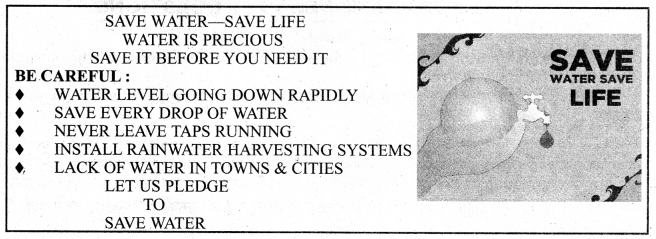
HBSE 10th Class English Solutions First Flight Chapter 1 A Letter to God 4

HBSE 10th Class English A Letter to God Important Questions and Answers

Very Short Answer Type Questions

Question 1.
Where was ‘the house’ located ?
Answer:
“The House’ was located on the top of a low hill.

HBSE 10th Class English Solutions First Flight Chapter 1 A Letter to God

Question 2.
Why do you think it is called ‘the house and not ‘a house’?
Answer:
It is called ‘the house and not ‘a house’ because it was the only house in the entire valley.

Question 3.
Why did Lencho keep gazing at the sky ?
Answer:
Lencho kept gazing at the sky because he wished for rain.

Question 4.
How did Lencho feel when it started raining ?
Answer:
Lencho felt very happy.

Question 5.
What was the effect of the rain on the crops ?
Answer:
His crops were destroyed because of the rain and the storm.

Question 6.
Lencho had only one hope. What was it?
Answer:
Lencho’s only hope was help from God.

Question 7.
Who was Lencho?
Answer:
Lencho was a hard-working farmer.

Question 8.
What had Lencho been doing throughout the morning ?
Answer:
He had been looking at the clouds in the north-east throughout the morning.

Question 9.
What does Lencho call the rain-drops ?
Answer:
He calls the big rain-drops ten cent pesos and the small rain-drops five cent pesos.

Question 10.
How did Lencho’s field look after the hails had rained ?
Answer:
The field looked as if covered with salt.

Question 11.
What was the effect of the hail storm on the valley ?
Answer:
No crop or vegetation was left in the entire valley.

Question 12.
Who did Lencho write a letter to ?
Answer:
Lencho wrote a letter to God.

Question 13.
How much money did Lencho receive from God ?
Answer:
He received only seventy pesos from God.

Question 14.
How did Lencho feel when he counted the money in the envelope ?
Answer:
He got angry after counting the money in the envelope.

Question 15.
Who does Lencho blame for the loss of thirty pesos in the envelope ?
Answer:
He blames the post-office employees for this loss.

Question 16.
What does Lencho call the post-office employees ? Or How did Lencho describe the post-office employees ?
Answer:
He calls them “a bunch of crooks.”

HBSE 10th Class English Solutions First Flight Chapter 1 A Letter to God

Short Answer Type Questions

Question 1.
“Now we’re really going to get some water, woman.” Is Lencho sure that it is going to rain ? Give a reason for your answer.
(“अब हमें सचमुच बरसात प्राप्त होने जा रही है, औरत” क्या लैंचो को विश्वास है कि बरसात होने वाली है। अपने उत्तर के लिए कारण बताओ।)
Answer:
Yes, Lencho is sure that it is going to rain. He needs rain for his crops. He has been gazing at the sky since morning. He has perhaps seen some signs of coming rain. True to his prediction, it soon starts raining.
(हाँ, लैंचो को विश्वास है कि बरसात होने वाली है। उसे अपनी फसलों के लिए बरसात की आवश्यकता है। वह सुबह से आकाश को देखे जा रहा है। शायद उसने आने वाली बरसात के चिह्न देखे हैं। उसकी भविष्यवाणी सच्ची होती है और शीघ्र ही बरसात होने लगती है।)

Question 2.
What are the rain drops compared to and why? (बरसात की बूंदों की तुलना किससे और क्यों की गई है ?)
Answer:
It starts raining. Lencho is very happy. He compares the big drops of rain to ten-cent pieces and the little ones to five-cent pieces. Lencho needs rain for good harvest. If he has good crops, he will get money. That is why he compares the rain drops to coins.
(बरसात होने लगती है। लैंचो बहुत प्रसन्न है। वह बरसात की बड़ी बूंदों की तुलना दस सैंट के सिक्कों से करता है और छोटी बूंदों की तुलना पाँच सैंट के सिक्कों से करता है। लैंचो को अच्छी फसल के लिए बरसात की जरूरत है। अगर उसकी फसल अच्छी होगी तो उसे पैसा मिलेगा। इसलिए वह बरसात की बूंदों की तुलना सिक्कों से करता है।)

Question 3.
Did the letter reach God ? Why did the postmaster sent a reply to Lencho?
(क्या पत्र भगवान तक पहुँचा ? पोस्टमास्टर ने उसका उत्तर क्यों दिया ?)
Answer:
No, the letter did not reach God. The postman saw the letter addressed to God. He took the letter to the postmaster. The postmaster did not want to shake Lencho’s faith in God. So he sent a reply to Lencho. He sent seventy pesos to him.
(नहीं, पत्र भगवान तक नहीं पहुंचा। डाकिए ने भगवान को संबोधित पत्र देखा। वह पत्र को पोस्टमास्टर के पास ले गया। पोस्टमास्टर लैंचो की भगवान में आस्था को हिलाना नहीं चाहता था। इसलिए उसने लैंचों को उत्तर दिया। उसने उसे सत्तर पीसोस भेजे।)

Question 4.
Why was Lencho angry when he received the letter ?
(जब लैंचो को पत्र मिला तो वह नाराज क्यों हो गया ?)
Answer:
Lencho had asked God to send him a hundred pesos. But when he opened the envelope he found only seventy pesos in it. He thought that the post-office employees had taken the rest of the money. So he became angry when he received the letter.
(लैंचो ने भगवान से कहा था कि वह उसे एक सौ पीसोस भेजें। मगर जब उसने लिफाफा खोला तो उसमें केवल सत्तर पीसोस थे। उसने सोचा कि डाकघर के कर्मचारियों ने बाकी के पैसे ले लिए होंगे। इसलिए जब उसे पत्र मिला तो वह नाराज हो गया।)

Question 5.
Lencho describes the post office employees as “a bunch of crooks.”
(i) Were they a bunch of crooks ?
(ii) How would you describe them ?
(लैंचो डाकघर के कर्मचारियों को ‘ठगों की टोली’ कहता है।) (i) क्या वे ठगों की टोली थे ?
(iii) आप उनका वर्णन कैसे करेंगे ?
Answer:
Lencho thought that the post office employees had cheated him. So he calls them “a bunch of crooks.” But they were not crooks. They were kind persons. They wanted to help Lencho. So they collected seventy pesos and sent the money to Lencho by mail.
(लैंचो ने सोचा कि डाकघर के कर्मचारियों ने उसे धोखा दिया है। इसलिए वह उन्हें ‘ठगों की टोली’ कहता है। मगर वे ठग नहीं थे। वे दयालु व्यक्ति थे। वे लैंचो की सहायता करना चाहते थे। इसलिए उन्होंने सत्तर पीसोस इकट्ठे किए और वह पैसा लैंचो को डाक से भेजा।)

Essay Type Question

Question 1.
Why did Lencho write a letter to God ? Who received the letter and what did he do?
Or
(लैंचो ने भगवान को पत्र क्यों लिखा? पत्र किसे मिला और उसने क्या किया?)
Why did Lencho write a letter to God? Did he get any help? If yes, by whom?
(लैंचो ने भगवान को पत्र क्यों लिखा? क्या उसे कोई सहायता मिली? यदि हाँ, तो किससे?)
Answer:
Lencho was a hard-working farmer. He was expecting a good harvest. But unfortunately, a hailstorm came and destroyed his crop completely. Now he had nothing to support the family. He had no money to purchase the seed for sowing. But he had a firm faith in God. He believed that God would help him. He was a simple man. He wrote a letter to God. He asked God to send him a hundred pesos. He wanted this money in order to sow seed again and to live until the next harvest season.
Lencho went to the town and posted the letter. At the post-office, a postman took out the letter from the letter box. He read the address on it and had a good laugh. He showed the letter to the postmaster. The postmaster was greatly impressed by the faith of Lencho. He did not want to shake Lencho’s faith in God. He collected money from his employees. He put this money into an envelope and addressed it to Lencho.
(लैंचो एक मेहनती किसान था। उसे अच्छी फसल की आशा थी। मगर दुर्भाग्यवश, ओलों का तूफान आया और उसकी फसल को पूरी तरह नष्ट कर गया। अब उसके पास परिवार को सहारा देने को कुछ नहीं था। उसके पास बिजाई के लिए बीज खरीदने के पैसे नहीं थे। मगर उसे भगवान में पक्का विश्वास था। उसका विश्वास था कि भगवान उसकी सहायता करेंगे। वह एक सादा व्यक्ति था। उसने भगवान को एक पत्र लिखा। उसने भगवान से कहा कि वह उसे सौ पीसोस भेजें। उसे यह पैसा बीज बोने और अगली फसल तक जीवित रहने के लिए चाहिए था।

लैंचो शहर गया और उसने पत्र डाक में डाल दिया। डाकघर में एक डाकिए ने लैटर बॉक्स से पत्र निकाला। उसने इस पर लिखा पता पढ़ा और बहुत हँसा। उसने पत्र पोस्टमास्टर को दिखाया। पोस्टमास्टर लैंचो की आस्था से बहुत प्रभावित हुआ। वह इस आस्था को डिगाना नहीं चाहता था। उसने अपने कर्मचारियों से धन इकट्ठा किया। उसने इस पैसे को एक लिफाफे में डाला और उस पर लैंचो का पता लिख दिया।)

Question 2.
(i) What did the postmaster need to answer the letter ? How did he collect it ?
(पोस्टमास्टर को लैंचो के पत्र का उत्तर देने के लिए किस चीज की आवश्यकता थी ? उसने इसे कैसे इकट्ठा किया?)
(ii) How did Lencho react to the help?
(लैंचो ने सहायता मिलने पर क्या प्रतिक्रिया की?) Or
Why and how did the postmaster and post office employees help Lencho ? What was Lencho’s reaction ?
(पोस्टमास्टर और डाकघर के कर्मचारियों ने लैंचो की सहायता क्यों और कैसे की? लैंचो की क्या प्रतिक्रिया थी?
Answer:
(i) Lencho’s crop had been destroyed. He needed God’s help. So he wrote a letter to God. He posted the letter. At the post-office a postman took the letter out of the letter box. He laughed on reading the address. He showed the letter to the postmaster. The postmaster also laughed. But he praised Lencho’s firm faith in God. He did not want to shake this faith. He was very kind. He decided to help Lencho. He and the post-office employees collected some money. The postmaster gave a part of his salary. They put the money into an envelope and addressed it to Lencho.
(ii) The next Sunday Lencho came to the post-office. He asked if there was any letter for him. The postman gave him the envelope. Lencho opened the letter. He found that the money was less than what he had requested for. He thought that God could not have made a mistake. He wrote another letter to God. He asked God to send him the rest of the money. But he should not send it through the mail as the post-office employees were a bunch of crooks.
(i) (लैंचो की फसल नष्ट हो गई थी। उसे भगवान की सहायता की आवश्यकता थी। इसलिए उसने भगवान को पत्र लिखा। उसने पत्र को डाक में डाला। डाकघर में एक डाकिए ने लैटर बॉक्स से पत्र निकाला। वह पता पढ़कर हँसने लगा। उसने पत्र पोस्टमास्टर को दिखाया। पोस्टमास्टर भी हँसा। मगर उसने लैंचो की भगवान में दृढ़ आस्था के लिए तारीफ की। वह इस आस्था को डिगाना नहीं चाहता था। वह एक दयालु व्यक्ति था। उसने लैंचो की सहायता करने का फैसला किया। उसने एवं डाकघर के कर्मचारियों ने कुछ पैसा इकट्ठा किया। पोस्टमास्टर ने अपने वेतन का कुछ भाग दिया। उन्होंने पैसे को लिफाफे में डाला और इस पर लैंचो का पता लिख दिया।
(ii) अगले रविवार को लैंचो डाकघर में आया। उसने पूछा कि क्या उसके लिए कोई पत्र आया है। डाकिए ने उसे लिफाफा दे दिया। लैंचो ने पत्र खोला। उसने देखा कि राशि उस द्वारा माँगी गई राशि से कम है। उसने सोचा कि भगवान तो गलती नहीं कर सकते। उसने भगवान को दूसरा पत्र लिखा। उसने भगवान से कहा कि वह उसे बाकी की राशि भी भेज दें। मगर वह इसे डाक से न भेजें क्योंकि डाकघर के कर्मचारी ठगों का टोला हैं।)

HBSE 10th Class English Solutions First Flight Chapter 1 A Letter to God

Question 3.
How do you think the postmaster felt when he received Lencho’s second letter ? What do you think he did ?
(आपके विचार से जब पोस्टमास्टर को पत्र मिला तो उसने कैसा महसूस किया ? आपके विचार में उसने क्या किया ?)
Answer:
When Lencho opened the letter, he found only seventy pesos in it. He thought that God could not make a mistake. Perhaps the post office employees had cheated him. He wrote another letter to God. He wrote that the post office employees were a bunch of crooks. The story does not tell us what the post master felt when he received the second letter. Perhaps he felt shocked. It is possible that he realized that sometimes even good intentions are misunderstood. I think he met Lencho and explained everything to him. He told him that the post-office employees were not a bunch of crooks. In fact, they were kind and helpful. They had collected money to help him.
(जब लैंचो ने पत्र खोला तो उसे उसमें केवल सत्तर पीसोस मिले। उसने सोचा कि भगवान गलती नहीं कर सकते। शायद डाकघर के कर्मचारियों ने उसे धोखा दिया था। उसने भगवान को एक और पत्र लिखा। उसने लिखा कि डाकघर के कर्मचारी ठगों की टोली है। कहानी हमें यह नहीं बताती कि जब पोस्टमास्टर को दूसरा पत्र मिला तो उसे क्या महसूस हुआ। शायद उसे धक्का लगा। यह संभव है कि उसने महसूस किया कि कभी-कभी अच्छे इरादों को भी गलत समझा जाता है। मैं सोचता हूँ कि वह लैंचो से मिला और उसे सारी बात समझाई। उसने उसे बताया कि डाकघर के कर्मचारी ठगों की टोली नहीं हैं। वास्तव में वह दयालु एवं सहायक थे। उन्होंने उसकी सहायता करने के लिए पैसा इकट्ठा किया था।)

Question 4.
Write the story of Lencho’s faith in God.
(लैंचो की भगवान में आस्था की कहानी लिखो।)
Write a brief summary of the story ‘A Letter to God’. (“ए लैटर टु गॉड” कहानी का संक्षिप्त सार लिखिए।)
Answer:
Lencho was a simple farmer. He was very hard-working. But one year, his harvest was completely destroyed by the hailstorm. He had firm faith in God. He wrote a letter to God asking for a hundred pesos. The postmaster saw the letter. He decided to help Lencho. He collected money from his employees. He gave some part of his own salary also. But the money was less than what Lencho had asked for. The postmaster put the money into an en Lencho. Next Sunday Lencho came to collect his letter. When he counted the money he became angry. He wrote another letter to God. He asked God to send him the rest of money. But he asked God not to send the money through the mail as the employees of the post-office were a bunch of crooks.
(लैंचो एक सादा किसान था। वह बहुत मेहनती था। मगर एक साल उसकी फसल ओलावृष्टि से पूरी तरह नष्ट हो गई। उसे भगवान में पक्का विश्वास था। उसने भगवान को एक पत्र लिखा और सौ पीसोस की माँग की। पोस्टमास्टर ने उस पत्र को देखा। उसने लैंचो की सहायता करने का फैसला किया। उसने अपने कर्मचारियों से धन इकट्ठा किया। उसने अपने वेतन का कुछ भाग भी दिया। मगर यह राशि उसके द्वारा माँगी गई राशि से कम थी। पोस्टमास्टर ने पैसे को एक लिफाफे में डाला और उस पर लैंचो का पता लिख दिया। अगले रविवार लैंचो पत्र लेने आया। जब उसने पैसे गिने तो उसे गुस्सा आ गया। उसने भगवान को एक और पत्र लिखा। उसने भगवान से कहा कि वह बाकी की राशि भी भेज दें। मगर उसने भगवान से कहा कि वह राशि डाक से न भेजें क्योंकि डाकघर के कर्मचारी ठगों का टोला हैं।)

Question 5.
Lencho described the post-office employees as a ‘bunch of crooks’. Were they really a bunch of crooks ? How would you describe them ?
(लैंचो ने डाकघर के कर्मचारियों का वर्णन “एक ठगों का टोला” के रूप में किया। क्या वे सचमुच ठगों का टोला थे ? आप उनका वर्णन कैसे करेंगे ?)
Answer:
A crook is a person who cheats others. He earns his living by dishonest means. Lencho requested God for a hundred pesos. He received a letter in mail. When he opened it he found seventy pesos in it. He thought that the post-office employees had taken the rest of thirty pesos. So he called them a bunch of crooks. But in fact, they were kind and generous people. They did not want to shake Lencho’s faith in God. So they raised money to help him. But they could not raise a hundred pesos. So they put seventy pesos in an envelope and addressed it to Lencho. The post-office employees were good people. They did an act of kindness and charity. It was wrong for Lencho to call them a bunch of crooks.
(धूर्त व्यक्ति वह होता है जो दूसरों को ठगता है। वह अपनी आजीविका गैर-ईमानदार कार्यों से कमाता है। लैंचो ने भगवान से सौ पीसोस की प्रार्थना की थी। उसे डाक से पत्र मिला। जब उसने इसे खोला तो उसे इसमें सत्तर पीसोस मिले। उसने सोचा कि डाकघर के कर्मचारियों ने बाकी के तीस पीसोस निकाल लिए होंगे। इसलिए उसने उन्हें ‘ठगों का टोला’ कहा। मगर वास्तव में वे दयालु एवं परोपकारी लोग थे। वे लैंचो के भगवान में विश्वास को डिगाना नहीं चाहते थे। इसलिए उन्होंने उसकी सहायता करने के लिए पैसा इकट्ठा किया। मगर वे सौ पीसोस इकट्ठे नहीं कर पाए। इसलिए उन्होंने सत्तर पीसोस एक लिफाफे में डाले और उस पर लैंचो का पता लिखा। डाकघर के कर्मचारी अच्छे लोग थे। उन्होंने दया एवं उपकार का कार्य किया। लैंचो का उन्हें ठगों का टोला कहना गलत था।)

Question 6.
Why did Lencho need God’s help? (लैंचो को भगवान की सहायता की जरूरत क्यों थी ?)
Answer:
Lencho was a simple farmer. He was very hard-working. His crops had always been good. One year, he wished that there should be some rain so that his crop would be better. Lencho was sure that the rain would come. In the evening it started raining. But soon the rain changed into a hailstorm. The hails fell on the house, the garden, the hillside and the corn-field. The field looked white as if it had been covered with salt. No leaves were left on the trees. The flowers were gone from the plants. Lencho’s crop was completely destroyed. His heart was filled with sorrow. But he had faith in God. He was sure that God would help him. He wanted God’s help for sowing seed and for living until the next harvest.
(लैंचो एक सादा किसान था। वह बहुत मेहनती था। उसकी फसल सदा अच्छी होती थी। एक साल उसने कामना की कि कुछ वर्षा हो जाए ताकि उसकी फसल बेहतर हो। लैंचो को विश्वास था कि वर्षा होगी। शाम को बरसात होनी आरंभ हो गई। मगर यह बरसात शीघ्र ही ओलों के तूफान में बदल गई। ओले घर, बाग, पहाड़ी और अनाज के खेत पर गिरे। खेत इस प्रकार सफेद लगता था जैसे यह नमक से ढक गया हो। वृक्षों पर पत्ते नहीं रहे। पौधों के फूल खत्म हो गए। लैंचो की फसल पूरी तरह नष्ट हो गई। उसका दिल उदासी से भर गया। मगर उसे भगवान में विश्वास था। उसे विश्वास था कि भगवान उसकी सहायता करेंगे। उसे भगवान की सहायता की आवश्यकता बीज बोने एवं अगली फसल तक जीवित रहने के लिए थी।)

Multiple Choice Questions

Question 1.
Lencho’s house was situated :
(A) in a town
(B) in a village
(C) on the top of a low hill
(D) at the bottom of a low hill
Answer:
(C) on the top of a low hill

HBSE 10th Class English Solutions First Flight Chapter 1 A Letter to God

Question 2.
What did the earth need ?
(A) downpour
(B) fertilizers
(C) pesticides
(D) tilling by a tractor
Answer:
(A) downpour

Question 3.
What has Lencho been doing throughout the morning ?
(A) sleeping in the bed
(B) working in the field
(C) playing with his children
(D) looking towards the sky in the northeast
Answer:
(D) looking towards the sky in the northeast

Question 4.
What happened at meal time ?
(A) dark clouds appeared
(B) small drops of rain began to fall
(C) big drops of rain began to fall
(D) strong winds began to blow
Answer:
(C) big drops of rain began to fall

Question 5.
“Now we’re really going to get some water, woman.” Who is this woman?
(A) Lencho’s wife
(B) Lencho’s sister
(C) Lencho’s neighbour
(D) none of the three
Answer:
(A) Lencho’s wife

Question 6.
What were Lencho’s older boys doing?
(A) playing near the house
(B) working in the field
(C) having their dinner
(D) sleeping inside the house
Answer:
(B) working in the field

Question 7.
What does Lencho call the rain drops ?
(A) very beautiful pearls
(B) new gold coins
(C) new coins
(D) new silver coins
Answer:
(C) new coins

Question 8.
‘These truly did resemble new silver coins.’ What are these.?
(A) rain drops
(B) hailstones
(C) cornfield
(D) flowers in the cornfield
Answer:
(B) hailstones

Question 9.
Lencho’s boys ran out to collect the frozen pearls. These ‘frozen pearls’ were :
(A) hailstones
(B) silver coins
(C) corn flowers
(D) rain drops
Answer:
(A) hailstones

Question 10.
What was Lencho’s occupation ?
(A) cutting wood
(B) farming
(C) looking after cows
(D) tending sheep
Answer:
(B) farming

Question 11.
What destroyed Lencho’s field completely ?
(A) heavy rain
(B) hailstones
(C) a plague of locusts
(D) wild animals
Answer:
(B) hailstones

Question 12.
What was Lencho’s only hope ?
(A) a bag of corn in his barn
(B) help from God
(C) help from his family
(D) a bag of coins in his room
Answer:
(B) help from God

Question 13.
Lencho wrote a letter to :
(A) the postman
(B) the postmaster
(C) God
(D) his relatives
Answer:
(C) God

Question 14.
Lencho asked God to send him :
(A) one hundred pesos
(B) foodgrains
(C) seventy pesos
(D) 1000 pesos
Answer:
(A) one hundred pesos

Question 15.
The postman saw the address on the envelope and went to the postmaster ………
(A) very seriously
(B) confused
(C) jokingly
(D) laughing heartily
Answer:
(D) laughing heartily

Question 16.
Who was a fat amiable fellow ?
(A) the postmaster
(B) the postman
(C) Lencho
(D) Lencho’s son
Answer:
(A) the postmaster

HBSE 10th Class English Solutions First Flight Chapter 1 A Letter to God

A Letter to God Important Passages for Comprehension

Read the following passages and answer the questions that follow :

PASSAGE 1

The field was white, as if covered with salt. Not a leaf remained on the trees. The corn was totally destroyed. The flowers were gone from the plants. Lencho’s soul was filled with sadness. When the storm had passed, he stood in the middle of the field and said to his sons “A plague of locusts would have left more than this. The hail has left nothing. This year we will have no com.”

Word-meanings : Remain = be still present (शेष रहना); plague = cause of disaster (एक बीमारी/विपत्ति); Locust = locust (टिड्डी)।

Questions :
(a) What had made Lencho’s field white?
(b) What had happened to the trees and plants?
(c) What filled Lencho with sadness?
(d) What did Lencho say to his sons after the storm had stopped?
(e) Name the chapter and the author.
Answers :
(a) The hailstones had made Lencho’s field white.
(b) Not a leaf remained on the trees and Flowers were gone from the plants. (c) The corn was totally destroyed by the hailstones. So he was filled with sadness.
(d) A plague of locusts would have left more than this. The hail has left nothing. This year we will have no corn.
(e) Chapter : A Letter to God, Author : G.L. Fuentes.

PASSAGE 2

But in the hearts of all who lived in that solitary house in the middle of the valley, there was a single hope: help from God.
“Don’t be so upset, even though this seems like a total loss. Remember, no one dies of hunger.”
Word-meanings : Solitary = lonely (अकेला); middle = centre (मध्य); upset = disturbed (परेशान)

Questions :
(a) What was their only hope ?
(b) Who said, “Don’t be upset…….. ?”
(c) What loss had they suffered ?
(d) Who was Lencho ?
(e) Write the meanings of : (i) solitary (ii) upset.
Answers :
(a) Their only hope was that God would help them.
(b) These words were spoken by Lencho.
(c) They had suffered the loss of their crop.
(d) Lencho was a hard working farmer.
(e) (i) lonely (ii) disturbed.

PASSAGE 3

All through the night, Lencho thought only of his one hope : the help of God, whose eyes, as he had been instructed, see everything, even what is deep in one’s conscience. Lencho was an ox of a man, working like an animal in the fields, but still he knew how to write. The following Sunday, at daybreak, he began to write a letter which he himself would carry to town and place in the mail. It was nothing less than a letter to God.

Word-meanings : Conscience = soul (आत्मा); an ox of a man = hard-working man (मेहनती व्याक्ति); at daybreak = in the early morning (सूर्योदय के समय); place = to put (डालना) I

Questions :
(a) What kind of a man was Lencho ?
(b) To whom did he write a letter?
(c) Why did he write the letter ?
(d) What is the meaning of the expression ‘an ox of a man’?
(e) Why did he go to town?
Answers :
(a) Lencho was a hard-working man.
(b) He wrote a letter to God.
(c) He wrote the letter because he wanted help from God.
(d) This means “a hard-working man”.
(e) He went to town to post the letter to God.

PASSAGE 4

One of the employees, who was a postman and also helped at the post office, went to his boss laughing heartily and showed him the letter to God. Never in his career as a postman had he known that address. The postmaster — a fat, amiable fellow – also broke out laughing, but almost immediately he turned serious and, tapping the letter on his desk, commented. “What faith! I wish I had the faith of the man who wrote this letter. Starting up a correspondence with God!”

Word-meanings : Career = profession (धंधा ); amiable = kind (दयालु ); broke out = started (आरंभ किया); immediately = at once (फौरन ) ||

Questions :
(a) Name the chapter and the author this passage has been taken from.
(b) What had the postman never known ?
(c) What kind of a fellow was the postmaster ?
(d) What made the postmaster serious ?
(e) What do you understand by :(i) career (i) amiable.
Answers :
(a) This passage has been taken from the chapter ‘A Letter to God’ written by G.L. Fuentes.
(b) The postman had never known such a strange address.
(c) The postmaster was a fat and amiable man.
(d) The writer’s faith in God made the postmaster serious.
(e) (i) profession (ii) kind and good natured.

HBSE 10th Class English Solutions First Flight Chapter 1 A Letter to God

PASSAGE 5

But suddenly a strong wind began to blow and alongwith the rain very large hailstones began to fall. These truly did resemble new silver coins. The boys, exposing themselves to the rain, ran out to collect the frozen pearls.
“It’s really getting bad now”, exclaimed the man. “I hope it passes quickly.” It did not pass quickly. For an hour the hail rained on the house, the garden, the hillside, the corn field, on the whole valley. The field was white, as if covered with salt.

Word-meanings : Suddenly = at once (अचानक); resemble = look similar to (शक्ल का मिलना ); quick = done with speed (जल्दी से ).

Questions :
(a) Name the chapter.
(b) What did the hailstones look like?
(c) What happened all at once ?
(d) What did Lencho hope for ?
(e) Find a word from the passage similar in meaning to ‘frozen pearls’.
Answers :
(a) The name of the chapter is ‘A Letter to God’.
(b) The hailstones looked like new silver coins.
(c) All at once a strong wind began to blow.
(d) Lencho hoped that the raining of hailstones would stop soon.
(e) Hailstones.

PASSAGE 6

“God: Of the money that I asked for, only seventy pesos reached me. Send me the rest, Since I need it very much. But don’t send it to me through the mail, because the post-office employees are a bunch of crooks. Lencho.”

Word-meanings : Mail = post (डाक); bunch = group (समूह टोला ); crooks = rogues, cheats (ठग) !

Questions :
(a) How much money had Lencho asked for ?
(b) How much money did he ask God to send more ?
(c) Why did he ask God not to send the money through the mail ?
(d) Were the post-office employees really a bunch of crooks ?
(e) What do you understand by : (i) bunch (ii) crooks ?
Answers :
(a) Lencho had asked God for one hundred pesos.
(b) He asked God to send him thirty pesos more.
(c) He thought that the post-office employees had taken away thirty pesos. So he asked God not to send money through the mail.
(d) No, they were not a bunch of crooks.
(e) (i) group (ii) rogues.

PASSAGE 7

It was during the meal that, just as Lencho had predicted, big drops of rain began to fall. In the north-east huge mountains of clouds could be seen approaching. The air was fresh and sweet. The man went out for no other reason than to have the pleasure of feeling the rain on his body.

Word-meanings : Predicted = told before hand (भविष्यवाणी करना); huge = big (विशाल); approaching = coming (आते हुए); pleasure = joy (खुशी)।

Questions :
(a) What had Lencho predicted ?
(b) What happened at meal time ?
(c) What was the change in weather ?
(d) Why did Lencho go out ?
(e) Name the lesson and its author.
Answers :
(a) Lencho had predicted about the rain.
(b) At the meal time, big drops of rain began to fall.
(c) Huge clouds were approaching from the north-east. The air became fresh and sweet.
(d) Lencho went out to have the pleasure of feeling the rain on his body.
(e) Lesson : ‘A Letter to God’
Author : G.L. Fuentes

HBSE 10th Class English Solutions First Flight Chapter 1 A Letter to God

PASSAGES FOR PRACTICE (UNSOLVED)

PASSAGE 8

Lencho showed not the slightest surprise on seeing the money; such was his confidence—but he became angry when he counted the money. God could not have made a mistake, nor could he have denied Lencho what he had requested.
Immediately, Lencho went up to the window to ask for paper and ink. On the public writing-table, he started to write with much wrinkling of his brow, caused by the effort he had to make to express his ideas. When he finished, he went to the window to buy a stamp which he licked and then affixed to the envelope with a blow of his fist.

Word-meanings : Slightest = least (जरा सी भी); surprise = wonder (हैरानी); confidence = surety (विश्वास); denied = refused (मना किया , इंकार किया); immediately = at once (फौरन ); brow = forehead (माथा ); express = to show (व्यक्त करना); affix = to put (लगाना)।

Questions :
(a) Why did Lencho not show the slightest surprise on seeing the money ?
(b) Why did he become angry?
(c) Where did Lencho go immediately to ask for paper and ink ?
(d) Whom did he start to write the letter ?
(e) Give the meaning of the following words : (i) Confidence, (ii) Denied.

PASSAGE 9

All through the night, Lencho thought only of his one hope : the help of God, whose eyes, as he had been instructed, see everything, even what is deep in one’s conscience.

Word-meanings : Instructed = taught (सिखाया ); conscience = soul (अन्तरात्मा )

Questions :
(a) Why was Lencho in trouble?
(b) What was Lencho’s only hope ?
(c) What had he learnt about God ?
(d) Name the chapter this passage has been taken from.
(e) What do you understand by : (i) instructed (ii) conscience ?

A Letter to God Summary in English

A Letter to God Introduction in English

Lencho was a farmer. He was very hard-working. But his crop was destroyed in a hailstorm. He had a firm faith in God. He thought that God would help him. So he wrote a letter to God. He asked God to send him money. At the post-office, the postmaster read that letter. He and the postmen of the post-office decided to help Lencho. They collected some money and put it into an envelope. The next Sunday, Lencho came to ask whether there was any letter for him. The postmaster gave him that envelope. When Lencho opened the envelop he found the money. But it was less than what he had requested for. He wrote another letter to God. He asked God to send him the rest of the money. But he asked God not to send it by post because the post-office employees were a bunch of crooks.

A Letter to God Summary in English

Lencho was a hard-working farmer. He was expecting a good harvest. But unfortunately, a hailstorm came and destroyed his crop completely. Lencho became sad. But he had firm faith in God. He thought that God would help him. He was a very simple man. He wrote a letter to God. In the letter he asked God to send him one hundred pesos. Then he went to the post-office and put the letter into the mail-box.

The postman took the letter out of the letter-box. He saw the address on it and laughed. Then he went to the postmaster and showed him that strange letter. The postmaster also laughed when he saw the letter addressed to God. But when he read the letter, he became serious. He praised this man who had great faith in God. He decided to help him. He asked the employees of the post-office to give money. He gave a part of his own salary. But they were able to collect only a little more than half the money requested for by Lencho. The postmaster put the money in an envelope and addressed it to Lencho. The next Sunday, Lencho came again to the post-office. He asked if there was any letter for him. The postmaster took out the letter and gave it to Lencho. Lencho was not surprised on seeing the money. But when he counted the money, he became angry. He thought that God could not have made the mistake. He took paper and ink and wrote another letter to God. Then he put the letter into the letter-box.

After Lencho had gone, the postmaster and the employees read the letter. Lencho had complained to God that he had received only seventy pesos. He asked God to send him the rest of the money also. But he asked God not to send the money through the mail. He wrote that the post-office employees were a bunch of crooks.

HBSE 10th Class English Solutions First Flight Chapter 1 A Letter to God

A Letter to God Summary in Hindi

A Letter to God Introduction in Hindi

(लैंचो एक किसान था। वह बहुत मेहनती था। मगर उसकी फसल ओलों के तूफान में नष्ट हो गई थी। उसे भगवान में पक्का विश्वास था। उसने सोचा कि ईश्वर उसकी सहायता करेंगे। इसलिए उसने भगवान को एक पत्र लिखा। उसने भगवान से कहा कि वह उसे पैसा भेजें। डाकघर में पोस्टमास्टर ने वह पत्र पढ़ा। उसने एवं डाकघर के डाकियों ने लैंचों की सहायता करने का फैसला किया। उन्होंने कुछ पैसा इकट्ठा करके एक लिफाफे में डाल दिया। अगले रविवार लैंचो डाकखाने गया और पूछा कि क्या उसके लिए कोई पत्र है। पोस्टमास्टर ने उसे वह लिफाफा दे दिया। जब लैंचो ने वह लिफाफा खोला तो उसमें पैसा था। मगर यह उस राशि से कम था जितनी उसने माँगी थी। उसने भगवान को दूसरा पत्र लिखा कि वह बाकी का पैसा भेजें। मगर उसने भगवान को कहा कि वह पैसा डाक से न भेजें क्योंकि डाकघर के कर्मचारी तो ठगों का एक टोला हैं।)

A Letter to God Summary in Hindi

लैंचो एक मेहनती किसान था। उसे अच्छी फसल होने की आशा थी। परंतु दुर्भाग्य से ओलों का तूफान आया और उसकी फसल को पूर्णतः समाप्त कर गया। लैंचो उदास हो गया। परंतु उसका भगवान में पक्का विश्वास था। उसने सोचा कि भगवान उसकी सहायता करेंगे। वह एक बहुत साधारण आदमी था। उसने भगवान् को एक पत्र लिखा। पत्र में उसने ईश्वर से एक सौ पीसोस भेजने के लिए कहा। तब वह डाकघर गया और पत्र को डाक-पेटी में डाल दिया।

डाकिए ने पत्र को पत्र-पेटी से निकाला। वह इस पर पता देखकर हँसा। तब वह पोस्टमास्टर के पास गया और उसको वह विचित्र पत्र दिखाया। पत्र पर भगवान् का पता देखकर पोस्टमास्टर भी हँसा। परंतु जब उसने पत्र पढ़ा तो वह गंभीर हो गया। उसने डाकघर के कर्मचारियों से पैसे देने को कहा। उसने अपने वेतन का भी एक हिस्सा दिया। परंतु वह लैंचो द्वारा माँगी गई धनराशि के आधी से कुछ अधिक इकट्ठा कर सके। पोस्टमास्टर ने पैसा एक लिफाफे में रखा और लैंचो का पता लिख दिया। अगले रविवार लैंचो फिर डाकघर आया। उसने पूछा कि क्या उसके नाम कोई पत्र आया है। पोस्टमास्टर ने पत्र निकाला और लैंचो को दे दिया। लैंचो को पैसा देखकर कोई आश्चर्य नहीं हुआ। परंतु जब उसने पैसे गिने तो वह गुस्सा हुआ। उसने सोचा कि भगवान गलती नहीं कर सकता। उसने कागज और स्याही उठाई और भगवान को दूसरा पत्र लिखा। तब उसने पत्र पत्र-पेटी में डाल दिया।

लैंचो के चले जाने के बाद पोस्टमास्टर और कर्मचारियों ने पत्र पढ़ा। लैंचो ने भगवान से शिकायत की थी कि उसे केवल सत्तर पीसोस ही प्राप्त हुए। उसने ईश्वर को शेष पैसे भी भेजने को कहा। परंतु उसने भगवान को पैसा डाक द्वारा नहीं भेजने को कहा। उसने लिखा कि डाकघर के कर्मचारी ठगों का एक टोला हैं।

A Letter to God Translation in Hindi

[PAGE 3] : वह घर-जो सारी घाटी में अकेला ही था एक छोटी पहाड़ी की चोटी पर स्थित था। इस ऊँचाई से व्यक्ति नदी और पके हुए अनाज के खेत देख सकता था, जो ऐसे फूलों से भरे हुए थे जो हमेशा अच्छी फसल की आशा बँधाते थे। धरती को यदि जरूरत थी तो केवल बौछार या कम-से-कम धीमी वर्षा की। सारी प्रातः लैंचो-जो अपने खेतों को अच्छी तरह से जानता था-ने उत्तर-पूर्व आकाश की ओर देखने के सिवाय और कुछ नहीं किया था।

“प्रिय, अब वास्तव में हमें कुछ पानी मिलेगा।”
महिला, जो भोजन बना रही थी, ने उत्तर दिया, “हाँ, यदि भगवान ने चाहा।” बड़े लड़के खेत में काम कर रहे थे, जबकि छोटे लड़के घर के पास खेल रहे थे। तब महिला ने उन सबको आवाज दी, “भोजन के लिए आओ…………” खाने के दौरान, जैसा कि लैंचो ने भविष्यवाणी की थी, बरसात की बड़ी-बड़ी बूंदें गिरने लगीं।

[PAGE 4] : उत्तर-पूर्व में बड़े-बड़े पहाड़ जैसे बादल आते हुए दिखाई दिए। हवा में ताजगी और भीनी सुगंध थी। वह व्यक्ति (लैंचो) बाहर चला गया। इसका कारण वर्षा के आनंद को अपने शरीर पर अनुभव करने के सिवाय कुछ नहीं था, और जब वह लौटकर आया तो उसने चिल्लाकर कहा, “यह आकाश से गिरती हुई बरसात की बूंदें नहीं हैं, ये तो नए सिक्के हैं। बड़ी बूंदें दस सेंट के सिक्के हैं और छोटी पाँच सेंट के।” .

एक संतुष्ट भाव से उसने अपने पके अनाज से भरे खेतों को वर्षा की चादर से ढका हुआ देखा। परंतु अचानक तेज हवा चलने लगी और बरसात के साथ बहुत बड़े-बड़े ओले गिरने लगे। यह सचमुच नए चाँदी के सिक्कों के समान प्रतीत होते थे। लड़के उन जमे हुए मोतियों को इकट्ठा करने के लिए वर्षा में भागने लगे।

“अब वास्तव में बुरा हो रहा है,” लैंचो ने कहा। “मुझे आशा है कि ओले गिरने शीघ्र ही बंद हो जाएँगे।” ओले जल्दी नहीं रुके। एक घंटे तक ओले मकान, बाग, पहाड़ी, अनाज के खेत और पूरी घाटी पर बरसते रहे। पूरा खेत सफेद हो गया, मानो नमक से ढक गया हो।

वृक्षों पर एक भी पत्ता नहीं रहा था। अनाज पूरी तरह नष्ट हो गया। पौधों से फूल झड़ गए। लैंचो की आत्मा उदासी से भर गई। जब तूफान रुक गया तो वह अपने खेतों के बीच में खड़ा हुआ और अपने बेटों से कहा :
“एक टिड्डी-दल के प्रहार के बाद भी इससे अधिक बच गया होता………ओलों ने कुछ भी नहीं छोड़ा, इस साल हमें अनाज नहीं मिलेगा।”

[PAGE 5] : वह रात बहुत दुःख भरी थी। “हमारी सारी मेहनत बेकार गई।” “कोई नहीं जो हमारी सहायता करे।” “इस वर्ष हमें भूखा रहना पड़ेगा।” परंतु उन सबके दिलों में, जो घाटी के मध्य उस अकेले मकान में रहते थे, केवल एक ही आशा थी : भगवान से सहायता। “इतना परेशान मत हो, यद्यपि ऐसा प्रतीत होता है कि यह सर्वनाश है। याद रखो, भूख से कोई नहीं मरता।” “कहते तो ऐसा ही हैं, भूख से कोई नहीं मरता।”

सारी रात लैंचो अपनी एकमात्र आशा के बारे में सोचता रहा। भगवान से सहायता, जिसकी आँखें, जैसा कि उसे शिक्षा दी गई थी, सब कुछ देखती हैं, यहाँ तक कि व्यक्ति के गहरे अंतःकरण को भी।

लैंचो मनुष्य होते हुए भी एक बैल था (अर्थात् मेहनती था), जो खेतों में एक पशु की तरह काम करता था, लेकिन फिर भी वह लिखना जानता था। अगले रविवार को सवेरे वह एक पत्र लिखने लगा, जिसे वह स्वयं शहर जाकर डाक में डालेया। यह भगवान के नाम एक पत्र से कम नहीं था।

“भगवान,” उसने लिखा, “यदि आपने मेरी सहायता न की, तो मुझे और मेरे परिवार को इस वर्ष भूखा रहना पड़ेगा। मुझे अपने खेत में दोबारा बीज बोने के लिए तथा अगली फसल आने तक गुजारा करने के लिए सौ पीसोस चाहिएँ, क्योंकि ओलों के तूफान…..।”
लिफाफे पर उसने लिखा, “भगवान के नाम”। पत्र को लिफाफे में डाला और दुःखी-सा शहर चला गया। डाकघर में उसने लिफाफे पर टिकट लगाया और उसे लैटर बॉक्स में डाल दिया।

एक कर्मचारी जो डाकिया था और डाकघर के कार्य में भी सहायता करता था, अपने अफसर के पास हँसता हुआ गया और उसे भगवान के नाम लिखा पत्र दिखाया। अपने पोस्टमैन के रूप में सारे सेवाकाल में उसने कभी ऐसा पता नहीं देखा था। डाकपाल एक मोटा हँसमुख व्यक्ति था, वह भी जोर से हँसने लगा।

[PAGE 8] : परंतु शीघ्र ही वह गंभीर हो गया, और पत्र को अपने मेज पर थपथपाते हुए बोला :
“क्या विश्वास है काश! मेरे में भी उस आदमी जैसा विश्वास होता, जिसने यह पत्र लिखा है जो भगवान से पत्र-व्यवहार कर रहा है।”

अतः लेखक का भगवान में विश्वास न डिगाने के लिए, डाकपाल के मन में विचार आया। पत्र का उत्तर दो। परंतु जब उसने इसे खोला तो यह स्पष्ट था कि इसका उत्तर देने के लिए सद्भावना, कागज और स्याही के अतिरिक्त कुछ और भी चाहिए, मगर वह अपने इरादे पर अडिग रहा। उसने अपने कर्मचारियों से धन माँगा, उसने स्वयं अपने वेतन का एक भाग दिया, और अपने अनेक मित्रों को भी पुण्य के नाम पर कुछ देने के लिए मजबूर किया।
उसके लिए सौ पीसोस इकट्ठे करना असंभव था, अतः वह उस किसान को आधी राशि से कुछ अधिक भेज सका। उसने पैसे एक लिफाफे में डाले, एक पत्र पर हस्ताक्षर के रूप में एक शब्द “भगवान” लिखकर लिफाफे को बंद किया और उस पर लैंचो का पता लिखा।

अगले रविवार को यह पूछने के लिए कि क्या उसका कोई पत्र आया है, लैंचो समय से कछ पहले ही आ गया। डाकिए ने स्वयं उसे वह पत्र दिया, जबकि डाकपाल, ऐसे व्यक्ति की संतुष्टि को महसूस करते हुए जिसने कोई भला कार्य किया है दफ्तर के दरवाजे से झाँक रहा था।

पत्र में धन देखकर लैंचो को बिल्कुल आश्चर्य न हुआ, उसका विश्वास इतना अडिग था-परंतु जब उसने पैसे गिने तो वह नाराज हुआ………भगवान गलती नहीं कर सकते थे, और न ही जो लैंचो ने माँगा था उसे देने से इंकार कर सकते थे।
फौरन लैंचो खिड़की पर कागज और स्याही माँगने गया। जन-साधारण के लिए लिखने की मेज पर बैठकर, वह पत्र लिखने लगा। अपने विचारों को व्यक्त करने के लिए उसे जो प्रयत्न करना पड़ रहा था उसके कारण उसके माथे पर बल पड़ गए। जब उसने पत्र समाप्त किया, वह खिड़की पर टिकट खरीदने गया, जिसे उसने थूक लगाई और मुक्का मारकर लिफाफे पर चिपका दिया।

HBSE 10th Class English Solutions First Flight Chapter 1 A Letter to God

(PAGE 7] : ज्यों ही उसने पत्र लैटर बॉक्स में डाला, पोस्टमास्टर इसे खोलने के लिए गया। इसमें लिखा था : “भगवान! मैंने जितनी राशि के लिए कहा था, उसमें से केवल सत्तर पीसोस ही मेरे पास पहँचे हैं। मुझे बाकी की राशि भी भेजो क्योंकि मुझे इसकी बहुत अधिक जरूरत है। परंतु यह मुझे डाक द्वारा मत भेजना क्योंकि डाकघर के कर्मचारी तो ठगों का टोला हैं। लैंचो।”

A Letter to God Word-Meanings in Hindi

[PAGE 3] : Entire = complete (पूर्ण); crest = top of a hill (शिखर/चोटी); harvest = season’s yield of crop (फसल); downpour = heavy rain (मूसलाधार वर्षा); throughout = all through (लगातार); intimately = thoroughly (पूरी तरह से)।

[PAGE 4] : Predict = say in advance (भविष्यवाणी करना); expression = aspect of face (भाव); regarded = looked closely (ध्यान से देखा); draped = dressed/covered (ढका हुआ); curtain = cover (आवरण); hailstones = frozen rain (ओले); resemble = be similar (शक्ल का मिलना); exposing = leaving uncovered (खुला/उघाड़ा छोड़ देना); frozen = frozen (जमे हुए); pearls = pearls (मोती); remain = be still present (शेष रहना); plague = cause of disaster (एक बीमारी/ विपत्ति); locust = locust (टिड्डी)।

[PAGE 5] : Solitary = lonely (अकेला); upset= worried / troubled (चिंतित/परेशान); instruct=teach/inform (सिखाना/बताना); conscience = moral sense of right / wrong (अंतरात्मा); still = even to this / that time (अभी भी); boss = person in authority (अफसर); career = profession (व्यवसाय); amiable = kind-hearted (दयालु-हृदय)।

[PAGE6] : Tap = give light, quick blows (थपथपाना); comment=remark (टिप्पणी करना); correspondence = exchange of letters (पत्र-व्यवहार); shake = weaken (हिलाना/कमजोर करना); goodwill friendly feeling (सद्भावना); stuck = remained determined (दृढ़-निश्चय); resolution = determination (पक्का इरादा); salary= pay, emoluments (वेतन); obliged = compelled (मजबूर होना); charity = benefaction (दया/उदारता); contain = have within itself (में होना/रखना); signature = signature (हस्ताक्षर); handed = gave (दिया); experiencing = feeling (महसूस करना); contentment = satisfaction (संतुष्टि); perform = do (करना); deed = act (कार्य); slightest = very little (बहुत कम); confidence = faith (विश्वास); deny = say no/refuse (इंकार करना); wrinkling = have wrinkles (झुर्रियाँ होना); brow = (here) forehead (माथा); caused = (here) made (बनाया); effort = attempt (प्रयत्न); express = show by words (व्यक्त करना); lick = pass the tongue over / under (चाटना); affix = fix / fasten (लगाना)।

[PAGE 7] : Blow = hard stroke with fist, etc. (प्रहार); since = because (क्योंकि); mail = post (डाक); bunch = gang | group (समूह); crook = rogue / swindler (ठग या धोखेबाज)।

Read More:

శ్రీ హనుమత్ కవచం

HBSE 10th Class English Solutions First Flight Chapter 1 A Letter to God Read More »

HBSE 9th Class Science Solutions Chapter 10 Gravitation

Haryana State Board HBSE 9th Class Science Solutions Chapter 10 Gravitation Textbook Exercise Questions and Answers.

Haryana Board 9th Class Science Solutions Chapter 10 Gravitation

HBSE 9th Class Science Gravitation Intext Questions and Answers

Questions from Sub-section 10.1

Question 1.
State the universal law of gravitation.
Answer:
Universal Law of Gravitation:
Every object in the universe attracts every other object with a force which is proportional to the product of their masses and inversely proportional to the square of the

HBSE 9th Class Science Solutions Chapter 10 Gravitation - 1

distance between them. The force is along the line joining the centres of two objects. Let two objects A and B of masses M and ‘m lies at a distance ‘d’ from each other as shown in figure. Let the force of attraction between two objects be F. According to the universal law of gravitation, the force between two objects is directly proportional to the product of their masses, that is,
F ∝ M × m ……….(i)
And the force between two objects is inversely proportional to the square of the distance between them,
that is,
F ∝ \(\frac{1}{d^2}\) ………..(ii)
Combining eqs. (i) and (ii), we get
F ∝ \(\frac{M \times m}{d^2}\) or F = G \(\frac{M \times m}{d^2}\)
Where G is the constant of proportionality and is called universal gravitational constant.

HBSE 9th Class Science Solutions Chapter 10 Gravitation

Question 2.
Write the formula to find the magnitude of the gravitational force between the earth and an object on the surface of the earth.
Answer:
Suppose the mass of earth = Me
Mass of the object on the surface of earth = m
The radius of earth = R
∴ The magnitude of the gravitational force between the earth and an object on the surface of the earth (F) = G \(\frac{M_e \times m}{R^2}\) (where G is gravitational constant)

Questions from Sub-section 10.2

Question 1.
What do you mean by free fall?
Answer:
When the objects fall towards earth only because of gravitation, then it is said that the objects are in free faIl.

Question 2.
What do you mean by acceleration due to gravity?
Answer:
When a body falls towards earth, acceleration works. This acceleration is due to the force of gravity of earth. Therefore, this acceleration is called the acceleration due to the force of gravity of earth or acceleration due to gravity. it is denoted by ‘g’ and its unit is ms2.

HBSE 9th Class Science Solutions Chapter 10 Gravitation

Questions from Sub-sections 10.3, 10.4

Question 1.
What are the differences between the mass of an object and its weight?
Answer:
The differences between the mass and weight of an object are as follows:

Mass:
1. Mass of a body is the quantity of matter contained in it.
2. The mass of an object cannot be zero.
3. Mass of an object is constant.
4. The mass of an object is found by physical balance.
5. Mass is measured ¡n kilogram (kg).
6. Mass is a scalar quantity.

Weight:
The force by which the earth attracts an object
towards itself is called the weight of that object on earth.
2. The weight of an object is zero on the centre of earth.
3. Weight is not constant. The weight of an object is more on poles as compared to equator.
4. The weight of an object is found by spring balance.
5. Weight is measured in newton.
6. Weight is a vector quantity.

Question 2.
Why is the weight of an object on the moon th its weight on the earth?
Answer:
We know that the value of acceleration due to gravity (g) on earth is 9.8 ms-2. The value of g on moon is \(\frac {1}{6}\) th time of that on earth. Therefore, the weight of objects on moon is less than that on earth. That is g \(\frac {1}{6}\)th times.

Questions from Sub-section 10.5

Question 1.
Why is it difficult to hold a school bag having a strap made of a thin and strong string?
Answer:
It is difficult to hold a school bag having a strap made of a thin and strong string because its thrust affects a smaller area (in the center of the string).

HBSE 9th Class Science Solutions Chapter 10 Gravitation

Question 2.
What do you mean by buoyancy?
Answer:
When an object is immersed in a fluid, the fluid exerts a force on the body in an upward direction which is called buoyant force. The result of buoyant force depends upon the density of the fluid. This is known as buoyancy.

Question 3.
Why does an object float or sink when placed on the surface of the water?
Answer:
Objects of density less than that of a liquid float on the liquid. The objects of density greater than that of a liquid sink in the liquid. For example, when a nail and a cork of the same mass are put in water, the nail will sink because its density is more than water, whereas the cork will float because its density is less than that of water.

HBSE 9th Class Science Solutions Chapter 10 Gravitation - 2

Questions from Sub-section 10.6

Question 1.
You find your mass to be 42 kg on a weighing machine. Is your mass more or less than 42 kg?
Answer:
if the mass is 42 kg on a weighing machine, then our mass will be 42 kg because mass remains constant.

Question 2.
You have a bag of cotton and an iron bar, each indicating a mass of 100 kg when measured on a weighing machine. In reality, one is heavier than other. Can you say which one ¡s heavier and why?
Answer:
Iron bar will be heavier than a bag of cotton because the density of iron is more than cotton.

HBSE 9th Class Science Gravitation Textbook Questions and Answers

Question 1.
How does the force of gravitation between two objects change when the distance between them is reduced to half?
Answer:
If the distance between two objects is reduced to half, then the gravitational force between them will increase 4 times, because gravitational force is inversely proportional to the square of the distance between them.

HBSE 9th Class Science Solutions Chapter 10 Gravitation

Question 2.
Gravitational force acts on all objects is proportional to their masses. Why then, a heavy object does not fall faster than a light object?
Answer:
Gravitational force acts on all objects is proportional to their masses, yet a heavy object will not fall faster than a light object because the mass of objects is negligible in comparison to that of earth.

Question 3.
What is the magnitude of the gravitational force between the earth and a 1 kg object on its surface? (Mass of the earth is 6 x 1024 kg and radius of the earth is 6.4 x 10⁶m.)
Solution:
Here, Mass of earth (Me) = 6 × 1024kg
Mass of object (m) = 1 kg
Radius of earth (R) = 6.4 × 10⁶m
Gravitational constant (G) = 6.673 × 101 Nm2 kg2
Force of gravity (g) = ?
We know that,
Force of gravity (g) = \(\frac{G M_e \times m}{R^2}\) = \(\frac{6.673 \times 10^{-11} \times 6 \times 10^{24} \times 1}{\left(6.4 \times 10^6\right)^2}\) = 9.8N

Question 4.
The earth and the moon are attracted to each other by gravitational force. Does the earth attract the moon with a force that is greater or smaller or the same as the force with which the moon attracts the earth? Why?
Answer:
The earth attracts the moon with greater force because the mass of earth is more than that of moon.

Question 5.
If the moon attracts the earth, why does the earth not move towards the moon?
Answer:
The moon attracts the earth, but the earth does not move towards the moon because the mass of the moon is much less than that of earth.

Question 6.
What happens to the force between two objects, if:
(i) the mass of one object is doubled?
(ii) the distance between the objects is doubled and tripled?
(iii) the masses of both objects are doubled?
Answer:
(i) If the mass of one object is doubled, then the force between two objects will be doubled because gravitational force is proportional to mass.
(ii) If the distance between two objects is doubled, the gravitational force will become times and if the distance is tripled, the gravitational force will become times, because gravitational force is inversely proportional to the square of the distance.
(iii) As the force between two bodies is proportional to the product of masses of the bodies, so if the masses of both the bodies are doubled, then force between them will become four times.

HBSE 9th Class Science Solutions Chapter 10 Gravitation

Question 7.
What i.s the importance of universal law of gravitation?
Answer:
The importance of universal law of gravitation is as follows:
(i) This force binds us to the earth.
(ii) The motion of the moon around the earth is due to this force.
(iii) The motion of planets around the sun is due to this force.
(iv) The tides due to the moon and the sun are due to this force.

Question 8.
What is the acceleration of free fall?
Answer:
When an object falls towards the earth, then acceleration works. Acceleration of free fall is, acceleration due to the gravitational force of earth and is equal to g. Its value is 9.8 ms2.

Question 9.
What do we cafl the gravitational force between the earth and an object?
Answer:
The gravitational force between the earth and an object is weight.

Question 10.
Amit buys few grams of gold at the poles as per the Instruction of one of his friends. He hands over the same when he meets him at the equator. Will the friend agree with the weight of gold bought? If not, why ? (Hint: The value of g is greater at the poles than at the equator.)
Answer:
No, the friend will not agree with the weight of gold bought, because the weight of gold is less on the equator than on the poles.

Question 11.
Why will a sheet of paper fall slower than one of that ¡s crumpled into a ball?
Answer:
The sheet of paper will fall slower than one of that is crumpled into a ball because the area of sheet is more than the area of ball, due to this, the pressure decreases.

HBSE 9th Class Science Solutions Chapter 10 Gravitation

Question 12.
The gravitational force on the surface of the moon is only as strong as gravitational force on the earth. What is the weight In newtons of a 10 kg object on the moon and on the earth?
Solution:
Here,
Mass of the object on earth (m) = 10kg
Acceleration due to gravity on earth (g) = 9.8 m/s2
Weight of the object on earth (w) m x g = 10 x 9.8 N = 98 N
Mass of object on moon (m) = 10 kg
Acceleration due to gravity on moon (g1) = \(\frac {9.8}{6}\)m/s2
∴ Weight of the object on moon (w) = mg1 = 10 x \(\frac {9.8}{6}\) N = 16.3 N

Question 13.
A ball ¡s thrown vertically upwards with a velocity 49 m’s. Calculate:
(i) the maximum height to which it rises.
(ii) the total time it takes to return to the surface of the earth.
Solution:
Here,
Initial velocity of ball (u) = 49 m/s
Final velocity of ball (v) = 0 m/s
Acceleration due to gravity (g) = -9.8 m/s2
(i) We know that,
v2 – u2 = 2gs
s = \(\frac{v^2-u^2}{2 g}=\frac{(0)^2-(49)^2}{2(-9.8)}\) = \(\frac{-49 \times 49}{-19.6}\) = 122.5m
∴ The maximum height to which ball rises is 122.5 m

(ii) Time taken (i) = \(\frac{v-u}{g}\) = \(\frac{0-49}{-9.8}\) = 5s
∴ The total time it takes to return to the surface of earth 5s + 5s = 10

Question 14.
A stone is released from the top of a tower of a height of 19.6 m. Calculate Its final velocity just before touching the ground.
Solution:
Here,
Initial velocity of stone (u) = 0 m/s
The final velocity of stone (v) =?
Height of the top of the tower (s) = 19.6 m
Acceleration due to gravity (g) = 9.8 ms-2
We know that,
v2 – u2= 2gs
v2 – (0)2 = 2 x 9.8 x 19.6
or v2 = 19.6 x 19.6
or v = \(\sqrt{19.6 \times 19.6}\)= 19.6 ms-1
∴ Thus velocity of stone will be 19.6 ms-1.

HBSE 9th Class Science Solutions Chapter 10 Gravitation

Question 15.
A stone is thrown vertically upward with an initial velocity of 40 ms. Taking g = 10 m/s2, find the maximum height reached by the stone. What is the net displacement and the total distance covered by the stone?
Solution:
Here,
Initial velocity of stone (u) = 40 m/s
Final velocity of stone (v) = 0 m/s
Acceleration due to gravity (s) = -10 m/s2
HBSE 9th Class Science Solutions Chapter 10 Gravitation - 3

We know that,
v2 – u2 = 2gs
s = \(\frac{v^2-u^2}{2 g}=\frac{(0)^2-(40)^2}{2(-10)}\) = \(\frac{-40 \times 40}{-2 \times 10}\) = 80m
∴ The maximum height reached by the stone = 80 m
Total distance covered by the stone = 80 m + 80 m = 160m
TotaÌ displacement of the stone = Zero

HBSE 9th Class Science Solutions Chapter 10 Gravitation

Question 16.
Calculate the foíce of gravitation between the earth and the Sun, given that the mass of the earth = 6 x 1024 kg and of the Sun 2 x 1030 kg. The average distance between the two Is 1.5 x 10¹¹ m.
Solution:
Here, The mass of the earth (Me) = 6 x 1024 kg
Mass of the sun (Me) = 2 x 1030 kg
The average distance between the two (Rs) = 1.5 x 10¹¹ m
Gravitational constant (G) = 6.673 x 10¹¹ Nm2/kg2
∴ Force of gravitation between the earth and sun (Fs) = \(\frac{G M_e M_s}{\left(R_s\right)^2}\)
= \(\frac{6.673 \times 10^{-11} \times 6 \times 10^{24} \times 2 \times 10^{30}}{\left(1.5 \times 10^{11}\right)^2}\) N
= \(\frac{6.673 \times 12 \times 10^{43}}{2.25 \times 10^{22}}\) N = 35.59 x 10²¹ N

Question 17.
A stone is allowed to fall from the top of a tower 100 m high and at the same time another stone is projected vertically upwards from the ground with a velocity of 25 m/s. Calculate when and where the two stones will meet.
Solution:
Suppose the two stones will meet at a distance of m.
For the stone tell from the top;
initial velocity (u) = 0 m/s
Acceleration due to gravity (g) = 9.8 m/s2
Distance covered (s) = x m
We know that
S = ut + \(\frac {1}{2}\) gt2
x = (0) (t) + \(\frac {1}{2}\) (9.8)t2
or x = 4.9 t2 ………….(i)

For the stone projected upwards;
Initial velocity (u) = 25 m/s
Acceleration due to gravity (g) = -9.8 ms2
Distance covered (s) = (100 – x)m
We know that,
(s) = ut+ \(\frac {1}{2}\) gt2
100 – x 251 + \(\frac {1}{2}\) (-9.8) t2
or 100 – 4.9t2 = 25 t – 4.9 t2 [From (i)]
or 100 = 25 t
or t = \(\frac {100}{25}\) = 4s

Both stones will meet after 4 seconds Ans
Height from top (x) = 4.9 (4)2
4.9 x 16 = 78.4 m
∴ Distance from down = 100 – 78.4 = 21.6 m

HBSE 9th Class Science Solutions Chapter 10 Gravitation

Question 18.
A ball thrown up vertically returns to the thrower after 6 s. Find
(a) the velocity with which it was thrown up.
(b) the maximum height It reaches and
(c) its position after 4s.
Solution:
Here,
Initial velocity (u) = ?
Final velocity (v) = 0 m/s
Time taken by ball to cover maximum height (t) = \(\frac {6s}{2}\) = 3s
Upward acceleration due to gravity (g) = – 9.8 m/s2
(a) We know that
v = u + gt
u = v – gt = 0 – (-.9.8)(3) = 29.4 m/s
Therefore, initial velocity of ball (u) = 29.4 m/s

(b) We know that
s = ut + \(\frac {1}{2}\) gt2
= (29.4) (3) + \(\frac {1}{2}\) (-9.8) (3)2
88.2 – 44.1 = 44.1 m
∴ Maximum height it reaches = 44.1 m

(c) For this state, distance will be found from up to down
u = 0
t = 4s – 3s = 1s
g = 9.8 m/s2
s = ut + \(\frac {1}{2}\) gt2
0(1) + \(\frac {1}{2}\) (9.8)(1)2
= 4.9m
∴ The ball will be at a height of 4.9 m from up.
Height of ball from down = 44.1 – 4.9 = 39.2 m

Question 19.
In what direction does the buoyant force on an object Immersed in a liquid act?
Answer:
The buoyant force on an object immersed in a liquid acts in the vertically upward direction.

Question 20.
Why does a block of plastic released under water come up to the surface of the water?
Answer:
The block of plastic when left under water comes to the surface because the thrust due to water is greater than the weight of the block itself.

HBSE 9th Class Science Solutions Chapter 10 Gravitation

Question 21.
The volume of 50 g of. the substance is 20. If the density of water is 1 gcm4, will the substance float or sink?
Solution:
Here,
Mass of the substance = 50g
Volume of the substance = 20 cm3
∴Density of substance =HBSE 9th Class Science Solutions Chapter 10 Gravitation - 5 = \(\frac {50}{20}\) g cm-3
= 2.5g cm-3
Since the density of the substance is greater than that of water, hence, the substance will sink in water.

Question 22.
The volume of. 500 g sealed packet is 350 cm3. Will the packet float or sink in water if the density of water Is 1g cm3? What will be the mass of the water displaced by this packet?
Solution:
Here,
Mass of the packet = 500g
Volume of the packet = 350 cm3
Density of packet = HBSE 9th Class Science Solutions Chapter 10 Gravitation - 5
= \(\frac {500}{350}\) g cm-3 = 1.43 gcm-3
Since the density of packet is greater than that of water, hence, it will sink in water.
Mass of water displaced = volume x density = 350 x 1 g = 350 g.

Read More:

IGL Pivot Point Calculator

HBSE 9th Class Science Solutions Chapter 10 Gravitation Read More »

HBSE 9th Class Science Solutions Chapter 8 Motion

Haryana State Board HBSE 9th Class Science Solutions Chapter 8 Motion Textbook Exercise Questions and Answers.

Haryana Board 9th Class Science Solutions Chapter 8 Motion

HBSE 9th Class Science Motion Intext Questions and Answers

Question 1.
An object has moved through a distance. Can it have zero displacement? If yes, support your answer with an example.
Answer:
Yes, displacement can be zero, if an object covers some distance, e.g., let an object moves from origin point along a straight line to point ‘A’ by covering a distance of 55 km and covers the same distance of 55 km from ‘A’ to ‘O’ on return as shown in figure In this state-
HBSE 9th Class Science Solutions Chapter 8 Motion - 1

Distance travelled by the object = 55 km + 55 km = 110 km
Displacement = Zero (0)

HBSE 9th Class Science Solutions Chapter 8 Motion

Question 2.
A farmer moves along the boundary of a square field of side 10 m in 40 s. What will be the magnitude of displacement of the farmer at the end of 2 minutes 20 seconds?
Solution:
Side of the square field ABCD = 10 metre
The perimeter of the square field ABCD = 4 × side
= 4 × 10 = 40 metres
HBSE 9th Class Science Solutions Chapter 8 Motion - 2
Time taken for one round around the boundary = 40 s
Total time = 2 minutes 20 s (2 × 60 + 20) s = 140 s
Now, the distance covered by the farmer in 40 s = 40 m
The distance covered by the farmer in 1s m = \(\frac {40}{40}\) = 1 m
The distance covered by the farmer in 140 s 1 × 140 = 140 metres
If, the farmer starts moving from origin point A, then he will be at point C after covering a distance of 140 metres. In this way, the displacement of the farmer will be AC (the diagonal of the square.).
∴ AC = \(\sqrt{(\mathrm{AB})^2+(\mathrm{BC})^2}\)
= \(\sqrt{(10)^2+(10)^2}\)
= \(\sqrt{100+100}\)
= \(\sqrt{200}\)
= \(\sqrt{2 \times 100}\)
= 10\(\sqrt{2}\) m
= 10 × 1.414 = 14.14 m

Question 3.
Which of the following is true for displacement ?
(a) It cannot he zero.
(b) Its magnitude is greater than the distance travelled by the object.
Answer:
Both (a) and (b) are wrong for displacement.

Questions from Sub-section 8.2

Question 1.
Distinguish between speed and velocity.
Answer:
The differences between speed and velocity are as follows:

Speed:
1. It is the distance travelled by the body in unit time interval in any direction.
2. It is a scalar quantity, which has only magnitude.
3. It is always positive.

Velocity
1. It is the rate of distance travelled by the body in unit time interval in specified direction.
2. It is a vector quantity, which has both magnitude as well as direction.
3. It can be positive and negative.

HBSE 9th Class Science Solutions Chapter 8 Motion

Question 2.
Under what condition(s) is the magnitude of average velocity of an object equal to its average speed?
Answer:
If the object is moving with uniform motion in a definite direction, then the magnitude of the average velocity of that object will be equal to its average speed.

Question 3.
What does the odometer of an automobile measure ?
Answer:
The odometer of the automobile measures the distance covered by the automobile.

Question 4.
What does the path of an object look like when it is in uniform motion ?
Answer:
When the object is in uniform motion, then its path seems as a straight line.
HBSE 9th Class Science Solutions Chapter 8 Motion - 3

Question 5.
During an experiment, a signal from a spaceship tTactretf the ground-statianju five minutes. What was the distance of the spaceship from the ground station ? The signal travels at the speed of light, that is, 3 × 10⁸ ms-1.
Solution:
The time taken by the signal from spaceship to earth = 5 minutes = 5 x 60 = 300 s
Speed of signal = 3 × 10⁸ms-1

∴ The distance of spaceship from ground station = Speed × Time = 3 × 10s × 300m = 9 × 10¹⁰m

Questions from Sub-section 8.3

Question 1.
When will you say a body is in (i) uniform acceleration (ii) non-uniform acceleration ?
Ans.
(i) Uniform acceleration : A body is said to be moving with uniform acceleration if there is equal change in the velocity of the body in equal interval of time.
(ii) Non-uniform acceleration : A body is said to be moving with non-uniform acceleration, if its velocity changes unequally.

HBSE 9th Class Science Solutions Chapter 8 Motion

Question 2.
A bus decreases its speed from 80 kmh-1 to 60 kmh-1 in 5 s. Find the acceleration of the bus.
Solution:
Initial speed of the bus (u) = 80 kmh-1
= \(\frac{80 \times 1000}{3600}\)ms-1 = \(\frac{200}{9}\)ms-1

Final speed of the bus (v) = 60 kmh-1
\(\frac{60 \times 1000}{3600}\)ms-1
\(\frac{50}{3}\)ms-1
Time (t) = Ss
Acceleration of the bus (a) = \(\frac{v-u}{t}\) = \(\frac{\left(\frac{50}{3}-\frac{200}{9}\right) \mathrm{ms}^{-1}}{5 \mathrm{~s}}\) = \(\frac{150-200}{9 \times 5}\)ms-2
\(\frac{-50}{45}=\frac{-10}{9}\)ms-2 = -1.1 ms-2

Question 3.
A train starting from a railway station and moving with uniform acceleration attains a speed of 40 kmh1 in 10 minutes. Find its acceleration.
Solution:
The initial speed of the train (u) = 0
The final speed of the train (v) = 40 kmh-1
= \(\frac{40 \times 1000}{3600}\) = \(\frac{40 \times 1000}{3600}\)
Time (t) = 10 minutes = 10 x 60s = 600s
∴ Acceleration (a) = \(\frac{v-u}{t}\) = \(\frac{\frac{100}{9}-0}{600}\)ms-1
= \(\frac{100}{9 \times 600}=\frac{1}{54}\) ~ 0.02 ms-2

Questions from Sub-section 8.4

Question 1.
What is the nature of the distance-time graps for uniform and non-uniform motion of an object?
Ans.
For a uniform motion, the graph of the distance covered with time is a straight line. In graph, part OB shows that the distance is increasing with uniform rate.
HBSE 9th Class Science Solutions Chapter 8 Motion - 4
Distance-time graph for an object possessing non-uniform motion is a curved line as shown in the graph. .
HBSE 9th Class Science Solutions Chapter 8 Motion - 5

Question 2.
What can you say about the motion of an object whose distance-time graph is a straight line parallel to the time axis?
Answer:
If the distance-time graph of an object, parallel to time axis is a straight line, then the object will move with uniform speed.
HBSE 9th Class Science Solutions Chapter 8 Motion - 6

Question 3.
What can you say about the motion of an object, if its speed-time graph is a straight line parallel to the time axis ?
Answer:
If the speed-time graph of an object, parallel to time axis is a straight line, then the object will move with uniform speed.
HBSE 9th Class Science Solutions Chapter 8 Motion - 7

Question 4.
What is the quantity which is measured by the area occupied below the velocity-time graph?
Answer:
The quantity measured by the area occupied below the velocity-time graph shows the distance covered by the body.

HBSE 9th Class Science Solutions Chapter 8 Motion

Questions front Sub-section 8.5

Question 1.
Abus starting from rest moves with a uniform acceleration of 0.1ms-2for 2 minutes. Find (a) the speed acquired (b) the distance travelled.
Solution:
Here,
Initial speed of the bus (u) = 0
Final speed of the bus (v) = ?
Acceleration (a) = 0.1 ms
Time (t) = 2 minutes = 2 x 60s = 120 s
(a) The final speed (v) of the bus = u + at = 0 + (120) + \(\frac {1}{2}\) = 12 ms-1
(b) The distance travelled by the bus, (s) = ut + \(\frac {1}{2}\) at2
= 0(120) + \(\frac {1}{2}\)(0.1)(120)2

Question 2.
A train is travelling at a speed of 90 km h-1. Brakes are applied so as to produce a uniform acceleration of – 0.5 ms-2 Find how far the train will go before it is brought to rest?
Solution:
Here,
Initial speed of the train (u) = 90 km h-1
\(\frac{90 \times 1000}{3600}\) ms-1= 25 ms-1

Final speed of the train (v) = 0
Acceleration (a) = – 0.5 ms2
Distance (s) = ?
We know that,  v2 – u2 = 2as
s = \(\frac{90 \times 1000}{3600}\)
= \(\frac{(0)^2-(25)^2}{2(-0.5)}=\frac{-625}{-1.0}\) = 625 metres
∴ The train will cover a distance of 625 metres, before it is brought to rest.

HBSE 9th Class Science Solutions Chapter 8 Motion

Question 3.
A trolley, while going down on inclined plane, has an acceleration of 2 ms-2. What will be is velocity 3s after the start?
Solution:
Here,
The initial speed of the trolley (u) = 0
Final speed of the trolley (v) = ?
Acceleration (a) = 2 ms-2
Time (t) = 3s
We know that, v = u + at
= 0 + 2(3) = 6 ms-1
∴ The velocity of the trolley after 3 s will be 6 ms-1.

Question 4.
A racing car has a uniform acceleration of 4ms2. What distance will it cover in 10 s after start?
Solution:
Here,
The initial speed of the car (u) = 0
Acceleration (a) = 4 ms
Time (t) = 10s
Distance (s) = ?

We know that,
s = ut + \(\frac {1}{2}\) at2
= 0 x (10) + \(\frac {1}{2}\) (4) (10)2
= \(\frac {1}{2}\) × 4 × 100 = 200m
So, the covered distance will be 200m

Question 5.
A stone is thrown in a vertically upward direction with a velocity of 5 ms. If the acceleration of the stone during its motion is 10 ms2 in the downward direction, what will be the height attained by the stone and how much time will it take to reach there?
Solution:
Here,
The initial velocity of the stone (u) = 5 ms-1
Final velocity of the stone (v) = 0
Acceleration (a) = – 10 ms-2
Maximum height (s) = ?
We know that,
v2– u2 = 2as
⇒ S = \(\frac{v^2-u^2}{2 a}=\frac{(0)^2-(5)^2}{2(-10)}\) = \(\frac {-25}{20}\) = 1.25m
Applying, v = u + at
⇒ t = \(\frac{v-u}{a}=\frac{0-5}{-10}\) = 0.5 s

HBSE 9th Class Science Solutions Chapter 8 Motion

HBSE 9th Class Science Motion Textbook Questions and Answers

Question 1.
An athlete completes one round of a circular track of diameter 200 metre in 40 s. What will be the distance covered and the displacement at the end of 2 minutes 20 s?
Solution:
Here,
The diameter of the circular track = 200 m
Radius (r) of the circular track = \(\frac {200}{2}\) = 1oo m
The circumference of the circular track = 2πr
= 2 x \(\frac {22}{7}\) × 1oo m
= \(\frac {4400}{7}\)m
Total time = 2 minutes 20 se
= (2 x 60 + 20)s (120 + 20)s = 140s
HBSE 9th Class Science Solutions Chapter 8 Motion - 8

∴ The distance covered by the athlete in 40 s = \(\frac {4400}{7}\) m
The distance covered by the athlete in 1 s = \(\frac{4400}{7 \times 40}\) m
The distance covered by the athlete in 140 s = \(\frac{4400}{7 \times 40}\) x 140m = 2200 metres
Here, the total time is 140 s, in which the athlete will complete three complete rounds and one half round. If he will start from point A of the circumference and reach at point B.
In this way, displacement (AB) = The diameter of the circular track = 200 metres

HBSE 9th Class Science Solutions Chapter 8 Motion

Question 2.
Joseph jogs from one end A to the other end B of a straight 300 m road in 2 minutes 30 s and then returns around and jogs 100 m back to point C in another 1 minute. What are Joseph’s average speed and velocitie in jogging (a) from point A to B (b) from point A to C?
Solution:
(a) The total distance covered from point A to B = 300 m
The total time taken from point A to B = 2 min 30 s = (2 x 60 + 30)s = 150 s
Total displacement from point A to B = 300 – 0 = 300 m
HBSE 9th Class Science Solutions Chapter 8 Motion - 9
= \(\frac {4400}{7}\) = 2 ms
(b) Total distance covered from point A to C = AB + BC = (300 + 100)m = 400 m
Total time taken fr om point A to C = 2 minutes 30 s + 1 minute
= (2 x 60 + 30)s + 60s = (150 + 60)s = 210s
Total displacement from point A to C = 300 – 100 = 200 m
HBSE 9th Class Science Solutions Chapter 8 Motion - 10
= \(\frac {400}{210}\) = 1.90 ms-1
= \(\frac {200}{210}\) = 0.952 ms-1
= 0.952 ms-1

Question 3.
Abdul, while driving to school, computes the average speed for his trip to be 20km h-1 on his return trip along the same route there is less traffic and the average speed is 30km h-1 . What is the average speed for Abdul’s trip?
Solution:
Average speed during the school trip v1 = 20 km h-1
Average speed for return trip v2 = 30 km h-1
Let, the distance from home to school = x km
Time taken for going school Speed =HBSE 9th Class Science Solutions Chapter 8 Motion - 11 =\(\frac {x}{20}\) h
Time taken to return from school =HBSE 9th Class Science Solutions Chapter 8 Motion - 12 =\(\frac {x}{30}\) h
Total distance covered for both (going and returning) trips = x + x = 2x km
Total time taken = \(\left(\frac{x}{20}+\frac{x}{30}\right) h\) = \(\left(\frac{3 x+2 x}{60}\right) h=\frac{5 x}{60} h=\frac{x}{12} h\)
∴ Average speed of Abdul during whole trip = HBSE 9th Class Science Solutions Chapter 8 Motion - 13 = \(\frac{\frac{2 x}{x}}{12}=\frac{2 x \times 12}{x}=24 \mathrm{kmh}^{-1}\)
HBSE 9th Class Science Solutions Chapter 8 Motion

Question 4.
A motorboat starting from rest on a lake accelerates in a straight line at a constant rate of 3 mr2 for 8 seconds. How far does the boat travel during this time?
Solution:
Here,
Initial speed of motorboat on lake (u) = 0
Acceleration (a) = 3.0 m-2
Time (t) = 8.0 s
Distance (s) = ?
We know that, s = ut + at2
= 0(8) + (3) (8)2
= \(\frac {1}{2}\) × 3 × 64 = 96m
∴ Motorboat will cover a distance of 96m on lake. Ans.

Question 5.
A driver of a car travelling at 52km h applies the brakes and accelerates uniformly in the opposite direction. The car stops in Ss. Another driver going at 30km h in another car applies his brakes slowly and stops in lOs. On the same graph paper, plot the speed versus time graph for two cars. Which of the two cars travelled farther after the brakes were applied?
Solution:
Speed-time graph for both drivers is shown in the figure. Suppose.
first driver starts from point A and second driver starts from point B.
Distance covered by first car before rest = area of ∆ AOC
= \(\frac {1}{2}\) × base × height
\(\frac {1}{2}\) × 5s × 52km/h
\(\frac {1}{2}\) × 3600 × 52 km
=\(\frac {1}{2}\) × 300 × 52 x 1000 m
= 36.11 metres
HBSE 9th Class Science Solutions Chapter 8 Motion - 14
In same way, the distance covered by second car before
rest = area of ∆BOD
= \(\frac {1}{2}\) × base × height
= \(\frac {1}{2}\) × 10 s × 30 km/h
= \(\frac {1}{2}\) × \(\frac {10}{3600}\) × 30km
= \(\frac {1}{2}\) × \(\frac {10}{3600}\) × 30 × 1000 m = 41.67m
It is clear from above solution that second car travels larger distance after applying brakes.

HBSE 9th Class Science Solutions Chapter 8 Motion

Question 6.
Figure shows the distance-time graph of three objects A, B and C. Study the graph and answer the following questions:
(a) Which of the three is travelling the fastest?
(b)Are all three ever at the same point on the road?
(e) How far has C travelled whenB passes A?
(d) How far has B travelled by the time it passes C?
Solution:
HBSE 9th Class Science Solutions Chapter 8 Motion - 15
(a) B is travelling fastest as the slope in the graph of B is maximum as compared to A and C.
(b) Three can never be at the same point on the road because the three graphs do not meet at any single point.
(c) C has travelled the distance of 9 km, when B passes A.
(d) B has travelled a distance more than 4 km during the time he passed C.

Question 7.
A ball is gently dropped from a height of 20m. If its velocity increases uniformly at the rate of 10ms2, with what velocity will it strike the ground ? After what time will it strike the ground?
Solution:
Here,
Initial velocity of ball (u) = 0
Height (s) = 20 m
Acceleration (a) = 10 ms-2
Final velocity of ball (v) = ?
Time (t) = ?
We know that,
v2 – u2 = 2as
v2 = u2 + 2as
= (0)2 + 2(10)(20) = 400
or v = \(\sqrt{400}\) = 20 ms-1
Now, acceleration, a = \(\frac{v-u}{t}\)
or t = \(\frac{v-u}{a}\) = \(\frac{20-0}{10}\) = 2s
∴The velocity of the ball will be 20 ms’ before it strike the ground and it will strike the ground in 2s.

HBSE 9th Class Science Solutions Chapter 8 Motion

Question 8.
The speed-time graph for a car is shown in figure.
HBSE 9th Class Science Solutions Chapter 8 Motion - 16
(a) Find how far does the car travel in first 4 seconds? Shade the area on the graph that represents the distance travelled by the car during the period.
(b) Which part of the graph represents uniform motion of the car?
Solution:
(a) The area of the distance covered by the car in first 4 s is OAB, that is almost a right angled triangle.

∴The distance covered by the car in first 4s = \(\frac {1}{2}\) × OA × AB
The distance covered by the car in first 4s = \(\frac {1}{2}\) × 4 × 6 = 12m
The distance covered by the car OABin the figure.

(b) In the graph, the speed after 6 s, shows the uniform motion of the car.
HBSE 9th Class Science Solutions Chapter 8 Motion - 17

Question 9.
State which of the following situations are possible and give an eamnle for eich of these:
(a) an object with a constant acceleration but with zero velocity.
(b) an object moving in a certain direction with an acceleration in the perpendicular direction.
Solution:
(a) Yes, this situation is possible. When a body is thrown up with some velocity, velocity is zero at the highest point but acceleration is non-zero and constant.
(b) Yes, this is possible. A body moving with uniform velocity on circular path is its example.
HBSE 9th Class Science Solutions Chapter 8 Motion - 18

Question 10.
An artificial satellite is moving in a circular orbit of radius 42250 km. Calculate its speed if it takes 24 hours to revolve around the earth.
Solution:
Here,
Radius of circular orbit of artificial satellite (r) = 42250 km
‘Time taken by the satellite to revolve around the earth (t) = 24 hours
= 24 × 3600s = 86400s
Speed of artificial satellite (v) = \(\frac {2πr}{t}\) = \(\frac{2 \times 3.14 \times 42250}{86400}\) k ms-1 = 3.07 k ms-1

Must Read:

GUJGASLTD Pivot Point Calculator

HBSE 9th Class Science Solutions Chapter 8 Motion Read More »

HBSE 9th Class Science Solutions Chapter 4 Structure of the Atom

Haryana State Board HBSE 9th Class Science Solutions Chapter 4 Structure of the Atom Textbook Exercise Questions and Answers.

Haryana Board 9th Class Science Solutions Chapter 4 Structure of the Atom

HBSE 9th Class Science Structure of the Atom Intext Questions and Answers

Questions from Sub-section 4.1

Question 1.
What are canal rays?
Answer:
E. Goldstein in 1886 discovered the positively charged fluorescent radiations, which were renamed as canal rays.

Question 2.
If an atom contains one electron and one proton, will it carry any charge or not?
Answer:
If an atom contains one electron and one proton, it will possess no charge on it. Because proton and electron mutually balance the charges.

Questions from Sub-section 4.2

Question 1.
On the basis of Thomson’s model of an atom, explain how the atom is neutral as a w hole.
Answer:
According to Thomson’s model an atom is made up of positively charged sphere and electrons get embedded into it. Thus due to uniformity in the negative and positive magnitude, an atom as a whole is electrical neutral.
HBSE 9th Class Science Solutions Chapter 4 Structure of the Atom - 1

Question 2.
On the basis of Rutherford’s model of an atom, which sub-atomic particle is present in the nucleus of an atom ?
Answer:
According to Rutherford’s model of an atom, the nucleus of an atom consists of proton sub-atomic charged particle, since it deflects the a (alpha) particle.

HBSE 9th Class Science Solutions Chapter 4 Structure of the Atom

Question 3.
Draw a sketch of Bohr’s model of an atom with three shells.
Answer:
HBSE 9th Class Science Solutions Chapter 4 Structure of the Atom - 2

Question 4.
What do you think would be the observation if the a-particle scattering experiment is carried out using a foil of a metal other than gold ?
Answer:
Yes, the a-particie scattering experiment will be possible with any metal foil other than gold foil.

Questions from Subsection 4.2

Question 1.
Name the three sub-atomic particles of an atom.
Answer:
The three sub-atomic particles of an atom are electron, proton and neutron.

Question 2.
Helium atom has an atomic mass of 4 u and two protons in its nucleus. How many neutrons does it have ?
Answer:
Atomic mass of helium atom = 4u
Protons present in the nucleus of helium atom = 2u
Neutrons present in the nucleus of helium atom= Atomic mass – proton = 4 – 2 = 2

HBSE 9th Class Science Solutions Chapter 4 Structure of the Atom

Questions from Subsection 4.3

Question 1.
Write the distribution of electrons in carbon and sodium atoms.
Answer:
(i) Carbon:
Mass number = 12
Atomic number = 6
Number of protons = 6
Number of electrons = 6
Number of neutrons = 12 – 6 = 6
Electron distribution = K = 2, L = 4
HBSE 9th Class Science Solutions Chapter 4 Structure of the Atom - 3

(ii) Sodium:
Mass Number = 23
Atomic number = 11
Number of protons = 11
Number of electrons = 11
Number of neutrons = 23 – 11 = 12
Electron distribution = K = 2 L = 8 M = 1
HBSE 9th Class Science Solutions Chapter 4 Structure of the Atom - 4

Question 2.
If K and L shells of an atom are full, then what would be the total number of electrons in the atom ?
Answer:
Shell K = 2 electrons
Shell L = 8 electrons
Total electrons in the atom = 2 + 8 = 10 electrons

Questions from Sub-section 4.4

Question 1.
How will you find the valency of chlorine, sulphur and magnesium ?
Answer:
(1) The atomic number of chlorine is 17, therefore, its electron distribution will be as under:
K = 2 electrons
L = 8 electrons
M = 7 electrons
Therefore, to complete its octet, chlorine needs (8 – 7) = 1 electron.
Hence, valency of chlorine is 1.

HBSE 9th Class Science Solutions Chapter 4 Structure of the Atom

(2) Atomic number of sulphur is 16, therefore, its electron distribution will be as under:
K = 2 electrons
L = 8 electrons M = 6 electrons
Therefore, to complete its octet, sulphur needs (8 – 6) = 2 electrons.
Hence, valency of sulphur is 2.

(3) Atomic number of magnesium is 12.
Therefore, its electron distribution will be as under:
K = 2 electrons .
L = 8 electrons
M = 2 electrons
Therefore, to complete its valence octet, it is easy in the case of magnesium to quit 2 electrons. Hence, the valency of magnesium is 2.

Questions from Subsection 4.5

Question 1.
If the number of electrons in an atom is 8 and the number of protons is also 8, then (i) what is the atomic number of the atom? and (ii) what is the charge on the atom?
Answer:
Number of electrons in the atom = 8
Number of protons in atom = Number of electrons = 8
(i) Atomic number = Number of electrons = Number of Protons = 8
(ii) Electron distribution = K = 2, L = 6 .
To fulfil the outermost shell of atom 2 electrons are required. Therefore, the charge is -2.

Question 2.
With the help of Table 4.1. find out the mass number of oxygen and sulphur atom. Answer: According to the table,
(1) Atomic number of oxygen = 8 Number of protons in oxygen = 8
Number of neutrons in oxygen = 8
Mass number = Number of protons + Number of neutrons = 8 + 8 = 16

(2) Atomic Number of sulphur = 16 Number of protons in sulphur = ? 16
Number of neutrons in sulphur =16
Mass number = Number of protons + Number of neutrons = 16 + 16 = 32

Questions from Sub-section 4.6

Question 1.
For the symbols H, D and T tabulate three sub-atomic particles found in each of them.
Answer:
(1) Symbol H is the sign for Protium i.e. 1H1
∴ Atomic number = 1
Mass number = 1
Number of electrons = 1
Number of protons = 1
Number of neutrons = 1-1=0

(2) Symbol D is the sign for Deuterium i.e. 1H2
Atomic number = 1
Mass number = 2
Number of electrons = 1
Number of protons = 1
Number of neutrons = 2 – 1 = 1

HBSE 9th Class Science Solutions Chapter 4 Structure of the Atom

(3) Symbol T is the sign for Tritium i.e. 1H3
Atomic number = 1
Mass number = 3
Number of electrons = 1
Number of protons = 1
Number of neutrons = 3 – 1 = 2

Question 2.
Write the electronic configuration of any one pair of isotopes and isobars.
Answer:
(i) Electronic configuration of the pair of isotope chlorine 17Cl135 and 17Cl137 will be as follows:
HBSE 9th Class Science Solutions Chapter 4 Structure of the Atom - 5
(ii) Electronic configuration of the pair of isobars calcium and argon will be as under:
(l) Calcium 20Ca40
e = 20
P = 20
N = 40 – 20 – 20
HBSE 9th Class Science Solutions Chapter 4 Structure of the Atom - 6

(2) Argon 18Ar40
e = 18
P = 18
N = 40 – 18 = 22
HBSE 9th Class Science Solutions Chapter 4 Structure of the Atom - 7

HBSE 9th Class Science Structure of the Atom Textbook Questions and Answers

Question 1.
Compare the properties of electrons, protons and neutrons.
Answer:
Properties of electrons, protons and neutrons can be compared as below:
(i) Charge: Electron is negatively charged and has an absolute charge of 1.602 x 10⁻¹⁹ coulomb whereas proton is positively charged and has an absolute charge of 1.602 x 10⁻¹⁹ coulomb. On the other hand, neutron is a neutral particle carrying no charge.

(ii) Mass: Electron has an absolute mass of 9.11 x 10⁻³¹ kg which is equal to 1/1840 amu while proton
has an absolute mass of 1.672 x 10⁻²⁷kg which is equal to 1 amu. On the other hand, neutron has an absolute mass of 1.675 x 10⁻²⁷kg, i.e., neutron is slightly heavier than proton.

HBSE 9th Class Science Solutions Chapter 4 Structure of the Atom

(iii) Location: Electrons are located outside the nucleus while protons and neutrons are located inside the nucleus.

(iv) Symbol: Electron is represented as -1e0or e proton is represented as 1p1 or p+ and neutron is represented as 0n1 or n.

Question 2.
What are the limitations of J.J. Thomson’s model of the atom?
Answer:
Although Thomson’s model of the atom was able to explain the electrical neutrality of the atom but it failed to explain the results of experiments carried out by other scientists. For example, this model could not explain the results of scattering experiments carried out by Rutherford and was, therefore, rejected in favour of Rutherford’s model of the atom.

Question 3.
What are the limitations of Rutherford’s model of the atom?
Answer:
It was pointed by Neils Bohr that Rutherford’s atom should be highly unstable. He argued that if an electron (charged particle) moves around the nucleus in an orbit, it should be subjected to acceleration due to continuous change in its direction of motion. Therefore, the electrons should continuously emit radiations and lose energy.

Consequently, the orbit should become smaller and smaller and ultimately the electron should fall into the nucleus. In other words, the atom should collapse. Since the atoms do not collapse, therefore, there must be something wrong with Rutherford’s model of atom. Another serious drawback of Rutherford’s model of an atom is that it says nothing about the electronic structure of the atom, i.e., how electrons are distributed around the nucleus and what are the energies of these electrons.
HBSE 9th Class Science Solutions Chapter 4 Structure of the Atom - 8

Question 4.
Describe Bohr’s model of the atom.
Answer:
According to Neils Bohr’s model of the atom
(1) Electrons revolve or move in definite orbits which are known as discrete orbits of electrons.
(2) When electrons revolve in discrete orbits, they do not radiate energy. These orbits (or shells) are called energy levels. Energy levels in an atom are shown in the figure.
HBSE 9th Class Science Solutions Chapter 4 Structure of the Atom - 9

Question 5.
Compare all the proposed models of an atom given in this chapter.
Answer:
A comparison of all the proposed models of an atom given in this chapter is as follows:
1. According to Thomson’s model of an atom:
(1) An atom consists of a positively charged sphere and the electrons are embedded in it.
(2) The negative and positive charges are equal in magnitude. So, atoms are electrically neutral.
HBSE 9th Class Science Solutions Chapter 4 Structure of the Atom - 10

2. According to Rutherford’s Model of an atom:
(1) The centre in the atom is positively charged. About all the mass of an atom resides in the nucleus.
(2) The electrons revolve around the nucleus in some definite orbits.
(3) The size of the nucleus is very small as compared to the size of the atom.

HBSE 9th Class Science Solutions Chapter 4 Structure of the Atom

3. According to Bohr’s model of an atom:
(1) The electrons can revolve only in certain definite orbits which are known as discrete orbits of electrons.
(2) When electrons revolve in discrete orbits, then they do not radiate energy. These orbits are called energy levels.

Question 6.
Summarise the rules for the writing of distribution of electrons in various shells for the first eighteen elements.
Answer:
Bohr and Bury proposed identical schemes regarding the arrangement of electrons in various orbits. The main rules of the Bohr-Bury scheme are:
HBSE 9th Class Science Solutions Chapter 4 Structure of the Atom - 11
(1) The maximum number of electrons which can be accommodated in any orbit or shell is equal to 2r? where n is the number of orbit or shells.
(2) The maximum capacity of the outermost shell is of 8 electrons and that of the penultimate shell (next to the outermost) is of 18 electrons.
(3) It is not necessary that a shell should be completed to its maximum capacity before another starts. In fact, a new shell always starts when the outermost shell attains 8 electrons.
(4) The outermost shell cannot have more than 2 electrons and the penultimate shell cannot have more than 9 electrons unless the next innermost shell has received the maximum number of electrons as required by rule (i).

Question 7.
Define valency by taking examples of silicon and oxygen.
Answer:
Valency of an element is the combining capacity of the element and is equal to the number of electrons that take part in chemical reaction. The electronic configuration of silicon is :
K L M
2 8 4
Since it has 4 electrons in its valence shell, therefore,
Valency of silicon = 8 – Number of valence electrons = 8 – 4 = 4
The electronic configuration of oxygen is:
K L
2 6
Since it has 6 electrons in its valence shell, therefore,
Valency of oxygen = 8 – Number of valance electrons = 8 – 6 = 2.

HBSE 9th Class Science Solutions Chapter 4 Structure of the Atom

Question 8.
Explain with examples
(i) Atomic number
(ii) Mass number
(iii) Isotopes
(iv) Isobars. Give any two uses of isotopes.
Answer:
(i) Atomic Number:
The total number of protons present in the nucleus of an atom of an element is known as atomic number (Z). for example, the atomic number of oxygen is 8 and that of carbon is 6.

(ii) Mass Number:
The total number of protons and neutrons present in an atom of an element is known as its Mass number (A). For example, the mass number of oxygen and carbon is 16u and 12u respectively.

(iii) Isotopes:
Atoms of the same element having same atomic number but different mass numbers are known as isotopes. For example, Protium (1H1), deueterium (1H2), and tritium (1H3) are three isotopes of hydrogen and 6C12 and 6C14 are two isotopes of carbon.

(iv) Isobars: Atoms of different elements which have same mass number but different atomic numbers are known as isobars. For example, calcium (20Ca40) and argon (18Ar40) are isobars.

Uses of Isotopes:
(1) Isotope of uranium is used as a fuel in nuclear reactors.
(2) Isopote of cobalt is used in the treatment of cancer.

Question 9.
Na+ has completely filled K and L shells. Explain.
Answer:
The atomic number ofNa (sodium) is 11, so an atom of Na contains 11 electrons. The arrangement of electrons in Na atom will be:
K L M
2 8 1
Now, Na+ ion is formed by loss of 1 valence shell electron, therefore, the remaining 10 electrons are arranged as:
K L
2 8
According to Bohr and Bury rule (2n2 formula), the K and L shells can accommodate 2 and 8 electrons respectively. This explains that the K and L shells in Na+ ions are completely filled.

HBSE 9th Class Science Solutions Chapter 4 Structure of the Atom

Question 10.
If the bromine atom is available in the form of, say, two isotopes, 3579Br(49.7%) and 3581Br (50.3%), calculate the average atomic mass of the bromine atom.
Answer:
Average atomic mass of bromine atom
\(\left(79 \times \frac{49.7}{100}+81 \times \frac{50.3}{100}\right)\)
\(\left(\frac{79 \times 497}{1000}+\frac{81 \times 503}{1000}\right)\)
\(\left(\frac{39263}{1000}+\frac{40743}{1000}\right)\) = 39.263 + 40.743 = 80.006 = 80u

Question 11.
The average atomic mass of a sample of element X is 16.2 u. What are the percentages 16 18 of isotopes 816X and 188 X in the sample?
Answer:
Let the percentage of isotope 168X be x. Then the percentage of 188X is (100 – x).
Now,
Average atomic mass = \(\frac{16 x+18(100-x)}{100}\)
or 16.2 = \(\frac{16 x+18(100-x)}{100}\) or 2x = 180 or x = 90%
Therefore, percentage of 816X = 90% and percentage of 818X = 100 – 90 = 10%

Question 12.
If Z = 3, what would be the valency of the element? Also, name the element.
Answer:
If the atomic number is 3, then the arrangement of electrons in an atom of the element will be:
K L
2 1
As the valence shell contains one electron only, so valency will be one. The element with atomic number 3 is Lithium.

Question 13.
Composition of the nuclei of two atomic species X and Y are given as under:
X Y
Protons 6 6
Neutrons 6 8
Give the mass numbers of X and Y. What is the relation between the two species?
Answer:
Since Mass number = Number of protons + Number of neutrons,
Therefore, the Mass numbers of X and Y are 12 and 14 respectively.
Again, Atomic number = Number of protons = Number of electrons.
Therefore, the atomic numbers of both X and Y are 6 each.
As X and Y have the same atomic number but different mass numbers, therefore, these are isotopes of each other and are represented as 612X and 614Y.

HBSE 9th Class Science Solutions Chapter 4 Structure of the Atom

Question 14.
For the following statements write T for True and F for False.
(a) J.J. Thomson proposed that the nucleus of an atom contains only nucleons.
(b) A neutron is formed by an electron and a proton combining together. Therefore, it is neutral.
(c) The mass of an electron is about \(\frac {1}{2000}\) times that of proton.
(d) An isotope of iodine is used for making tincture iodine, which is used as a medicine.
Answer:
(a) F (b) F (c) T (d) F.
Put a tick (√) against the correct choice and cross (✗) against the wrong choice in questions 15, 16 and 17.

Question 15.
Rutherford’s alpha-particle scattering experiment was responsible for the discovery of
(a) Atomic Nucleus
(b) Electron
(c) Proton
(d) Neutron.
Answer:
(a) √ (b) ✗ (c) ✗ (d) ✗.

Question 16.
Isotopes of an element have (a) the same physical properties (b) different chemical properties (c) different number of neutrons (d) different atomic numbers.
Answer:
(a) ✗ (b) ✗ (c) √ (d) ✗

Question 17.
Number of valence electrons in Cf ion are :
(a) 16
(b) 8
(c) 17
(d) 18
Answer:
(a) ✗ (b) √ (c) ✗ (d) ✗

Question 18.
Which one of the following is a correct electronic configuration of sodium ?
(«) 2, 8,
(b) 8, 2,1
(c) 2,1, 8
(d) 2, 8,1
Answer:
(a) ✗ (b) ✗ (c) ✗ (d) √

Question 19.
Complete the following table.

Atomic

Number

Mass

Number

Number of

Neutrons

Number of

Protons

Number of

Electrons

Naine of the Atomic Species Sulphur
910
1632sulphur
2412
21
32110

Answer:

Atomic

Number

Mass

Number

Number of

Neutrons

Number of

Protons

Number of

Electrons

Naine of the Atomic Species Sulphur
9191099Fluorine
1632161616sulphur
1224121212Magnesium
12111Deuterium
132110Hydrogen

Must Read:

BHARATFORG Pivot Point Calculator

HBSE 9th Class Science Solutions Chapter 4 Structure of the Atom Read More »

HBSE 9th Class Science Solutions Chapter 3 Atoms and Molecules

Haryana State Board HBSE 9th Class Science Solutions Chapter 3 Atoms and Molecules Textbook Exercise Questions and Answers.

Haryana Board 9th Class Science Solutions Chapter 3 Atoms and Molecules

HBSE 9th Class Science Atoms and Molecules Intext Questions and Answers

Questions from Sub-section 3.1

Question 1.
In a reaction, 5.3 g sodium carbonate reacted with 6.0 g of ethanoic acid. The products were 2.2 g of carbon dioxide. 0.9 g water and 8.2 g of sodium ethanoate. Show that these observations are in agreement with the law of conservation of mass. Sodium carbonate + ethanoic acid → sodium ethanoate + carbon dioxide + water
Solution:
Here,
Total mass of reactants = Mass of (Sodium carbonate + Ethanoic acid) = 5.3g + 6.0g = 11.3 g
Total mass of products = Mass of(sodium ethanoate + carbon dioxide + water) = 2.2g + 8.2g + 0.9 g = 11.3g
Since, the total mass of reactants is equal to that of the total mass of products, hence these observations are the law of conservation of mass.

Question 2.
Hydrogen and oxygen combine in the ratio of 1:8 by mass to form water. What mass of oxygen gas would be required to react completely with 3 g of hydrogen gas?
Solution:
Here,
Mass of hydrogen:
mass of oxygen = 1:8
Therefore, the required mass of oxygen to combine it completely with 3g of hydrogen = 3g x 8 = 24 g

HBSE 9th Class Science Solutions Chapter 3 Atoms and Molecules

Question 3.
Which postulate of Dalton’s atomic theory is the result of the law of conservation of mass?
Answer:
The postulate of Dalton’s atomic theory is that atoms are the smallest and indivisible particles which can neither be created nor destroyed in chemical reactions. It is the result of the law of conservation of mass.

Question 4.
Which postulate of Dalton’s atomic theory can explain the law of definite proportions?
Answer:
The postulate which states that atoms of the same or different elements combine in the ratio of small whole numbers to form compounds can explain the law of definite proportions.

Questions from Sub-section 3.2

Question 1.
Define the atomic mass unit.
Answer:
1/12th part of the mass of one atom of carbon-12 isotope is taken to be the standard atomic mass unit. With respect to the mass of one atom of carbon-12 isotope atomic masses of all the elements have been obtained.

Question 2.
Why is it not possible to see an atom with naked eyes?
Answer:
Being very small in size, atom cannot be seen with naked eye. Its size is so small that its radius is measured in nanometre (nm). Where, nm = 10 9m. Now, with the help of modem technique, the magnified images of surfaces of elements can be displayed, in which the existing atoms are clearly visible.
HBSE 9th Class Science Solutions Chapter 3 Atoms and Molecules - 1

Questions from Sub-section 3.4

Question 1.
Write down the formulae of:
(i) sodium oxide
(ii) aluminium chloride
(iii) sodium sulphide
(iv) magnesium hydroxide.
Answer:
(i) Formula of sodium oxide Symbol Na2O
HBSE 9th Class Science Solutions Chapter 3 Atoms and Molecules - 2
∴ The formula of sodium oxide is Na2O.

(ii) Formula of aluminium chloride
HBSE 9th Class Science Solutions Chapter 3 Atoms and Molecules - 3
∴ The formula of aluminium chloride is AlCl3

(iii) Formula of sodium sulphide
HBSE 9th Class Science Solutions Chapter 3 Atoms and Molecules - 4
∴ The formula of sodium sulphide is Na2S.

(iv) Formula of magnesium hydroxide Symbol
HBSE 9th Class Science Solutions Chapter 3 Atoms and Molecules - 5
∴ The formula of magnesium hydroxide is Mg (OH)2.

HBSE 9th Class Science Solutions Chapter 3 Atoms and Molecules

Question 2.
Write down the names of compounds represented by the following formulae :
(i) Al2(SO4)3
(ii) CaCl2
(iii) K2SO4
(iv) KNO3
(v) CaCO3

Answer:

Chemical formulaName of compound
(i) Al2 (SO4)3Aluminium Sulphate
(ii) CaCl2Calcium Chloride
(iii) K2 SO4Potassium Sulphate
(iv) KNO3Potassium Nitrate
(v) CaCO3Calcium Carbonate

Question 3.
What is meant by the term chemical formula?
Answer:
The chemical formula of a compound is the symbolic representation of its composition,

Question 4.
How many atoms are present in a
(i) H2S molecule
(ii) PO43-ion?
Answer:
(i) Number of atoms in H2S = 2 + 1 = 3
(ii) Number of atoms in PO3-4 ion = 1 + 4 = 5

Questions from Sub-section 3.5

Question 1.
Calculate the molecular masses of H2, O2, Cl2, CO2, CH4, C2H6, C2H4, NH3, and CH3OH.
Solution:
(1) Atomic mass of hydrogen = lu
H2 contains two atoms of hydrogen.
Molecular mass of H2 = 2 × 1 = 2u

(2) Atomic mass of oxygen = 16u
O2 consists of two atoms of oxygen.
The molecular mass of O2

(3) Atomic mass of chlorine Cl2 consists of two atoms of chlorine.
The molecular mass of Cl2

(4) Atomic mass of carbon = 12u
The atomic mass of oxygen = 16u
.’. CO2 in which there is one atom of carbon and two atoms of oxygen.
Molecular mass of CO2 =1 × 12 + 2 × 16= 12 + 32 = 44u

HBSE 9th Class Science Solutions Chapter 3 Atoms and Molecules

(5) Atomic mass of carbon = 12u
The atomic mass of hydrogen = lu
CH4 where one atom of carbon and four atoms of hydrogen are there.
Molecular mass of CH4 = 1 × 12 + 4 × 1 = 12 + 4 = 16u

(6) Atomic mass of carbon = 12u
The atomic mass of hydrogen = lu
C2H6 in which two atoms of carbon and six atoms of hydrogen are there.
Molecular mass of C2H6 = 2 × 12 + 6 × 1 = 24 + 6 = 30u

(7) Atomic mass of carbon = 12u
The atomic mass of hydrogen = 1u
C2H4 in which two atoms of carbon and four atoms of hydrogen are there.
Molecular mass of C2H4 = 2 × 12 + 4 × 1 = 24 + 4 = 28u

(8) Atomic mass of nitrogen = 14u.
The atomic mass of hydrogen = 1u
.’. NH3 in which one atom of nitrogen and three atoms of hydrogen are there.
Molecular mass of NH3 =1 × 14 + 3 × 1 = 14 + 3 = 17u

(9) Atomic mass of carbon = 12u
The atomic mass of hydrogen = 1u
The atomic mass of oxygen = 16u
CH3OH, in which one atom of carbon, four atoms of hydrogen and one atom of oxygen are there.
Molecular mass of CH3OH = 1 × 12 + 4 × 1 + 16 × 1 = 12 + 4 + 16 = 32u

Question 2.
Calculate the formula unit masses of ZnO, Na2O, K2CO3, given atomic masses of Zn = 65 u, Na = 23 u, K = 39 u, C = 12 u, and O = 16 u.
(1) Formula unit mass of ZnO = 1 × 65u + 1 × 16u = 65u + 16u = 81u
(2) Formula unit mass of Na2O = 2 × 23u + 1 × 16u = 46u + 16u = 62u
(3) Formula unit mass of K2CO3 = 2 × 39u + 1 x 12u + 3 × 16u = 78u + 12u + 48u = 138u

Questions from Sub-section 3.5.3

Question 1.
If one mole of carbon atoms weighs 12 grams, what is the mass (in gram) of 1 atom of carbon 7
Solution:
Here,
Molar mass of carbon = 12g
1 mole = 6.022 x 10²³atom
That is, mass of 6.022 x 10²³ carbon atoms = 12 g
Mass of 1 carbon atom = \(\frac{12}{6.022 \times 10^{23}}\) g
= 1.993 x 10⁻²³g

Question 2.
Which has more atoms, 100 grams of sodium or 100 grams of iron (given, the atomic mass of Na = 23 u, Fe = 56u) ?
Solution:
The molar mass of sodium = 23g
1 mole = 6.022 x 10²³ atoms
Numbers of atoms in 23g of Na = 6.022 x 10²³
HBSE 9th Class Science Solutions Chapter 3 Atoms and Molecules - 6
Molar mass of iron = 56g
1 mole = 6.022 x 10²³
Numbers of atoms in 56g of Na = 6.022 x 10²³
HBSE 9th Class Science Solutions Chapter 3 Atoms and Molecules - 7
= 10.75 × 10²³
Thus, there will be more atoms in 100 g of sodium as compared to 100 g of iron.

HBSE 9th Class Science Solutions Chapter 3 Atoms and Molecules

HBSE 9th Class Science Atoms and Molecules Textbook Questions and Answers

Question 1.
A 0.24 g sample of a compound of oxygen and boron was found by analysis to contain 0.096 g of boron and 0.144 g of oxygen. Calculate the percentage composition of the compound by weight.
Solution:
Quantity of boron in 0.24g compound = 0.096 g
Quantity of boron in 1g compound = \(\frac{0.096}{0.24}\)
Quantity of boron in 100g compound = \(\frac{0.096}{0.24} \times 100\) = 40g
Therefore, the quantity of boron in the compound = 40%
Quantity of oxygen in 0.24 g compound = 0.144g
Quantity of oxygen in 0.24 g compound = \(\frac{0.144}{0.24} \times 100\) = 60g
Therefore, the quantity of oxygen in the compound = 60%

Question 2.
When 3.0 g of carbon is burnt in 8.00 g of oxygen, 11.00 g of carbon dioxide is produced. What mass of carbon dioxide will be formed when 3.00 g of carbon is burnt in 50.00 g of oxygen? Which law of chemical combination will govern your answer?
Answer:
3.0g carbon when burnt in 8.00g oxygen produces 11.00 g carbon dioxide, then on burning 3.00 g carbon in 50.00 g oxygen, 53.00 g carbon dioxide will be formed which is based on the law of conservation of mass of chemical combination.

HBSE 9th Class Science Solutions Chapter 3 Atoms and Molecules

Question 3.
What are polyatomic ions? Give examples.
Answer:
A group of atoms that acts as ions are called as polyatomic ions. For example:

Polyatomic ionsSymbol
ammoniumNH+4
hydroxideOH
nitrateNO3
hydrogen carbonateHCO3
carbonateCO2-3
sulphateSO2-4
phosphatePO3-4

Question 4.
Write the chemical formulae of the following:
(a) Magnesium chloride
(b) Calcium oxide
(c) Copper nitrate
(d) Aluminium chloride
(e) Calcium carbonate.
Answer:
(a) Formula of magnesium chloride
HBSE 9th Class Science Solutions Chapter 3 Atoms and Molecules - 8
∴ Formula of magnesium chloride = MgCl2

(b) Formula of calcium chloride
HBSE 9th Class Science Solutions Chapter 3 Atoms and Molecules - 9
∴ The formula of calcium chloride = CaCl2

(c) Formula of copper nitrate
HBSE 9th Class Science Solutions Chapter 3 Atoms and Molecules - 10
∴ The formula of copper nitrate = Cu (NO3)2

(d) Formula of aluminium chloride
HBSE 9th Class Science Solutions Chapter 3 Atoms and Molecules - 11
∴ Formula of aluminium chloride = AlCl3

(e) Formula of Calcium Carbonate chloride
HBSE 9th Class Science Solutions Chapter 3 Atoms and Molecules - 12
∴ The formula of calcium carbonate = CaCO3

HBSE 9th Class Science Solutions Chapter 3 Atoms and Molecules

Question 5.
Give the names of the elements present in the following compounds :
(a) Quick lime
(b) Hydrogen bromide
(c) Baking powder
(d) Potassium sulphate
Answer:
(a) Quick lime = Ca (OH)2
Thus, in quick lime, the present elements are calcium (Ca), oxygen (O) and hydrogen (H).

(b) Hydrogen hromide = HBr
Thus, in hydrogen bromide, the present elements are hydrogen (H) and bromine (Br).

(c) Baking powder = NaHCO3
Thus, in baking powder, the present elements are sodium (Na), hydrogen (H), carbon (C) and oxygen (O).

(d) Potassium sulphate = K2SO4
Thus, in potassium sulphate, the present elements are potassium (K), sulphur (S) and oxygen (O).

Question 6.
Calculate the molar mass of the following substances:
(a) Ethyne, C2H2
(b) Sulphur molecule, S8
(c) Phosphorus molecule, P4 (Atomic mass of phosphorus = 31)
(d) Hydrochloric acid, HCl
(e) Nitric acid, HNO3
Solution:
We know that C = 12, H = 1, S = 32, P = 31, Cl = 35.5, N = 14, O = 16
(a) Molar mass of ethyne (C2H2) = 2 × 12 + 2 × 1 = 24 + 2 = 26g
(b) Molar mass of sulphur molecule (S8) = 8 × 32 = 256g
(c) Molar mass of phosphorus molecule (P4) = 4 × 31 = 124g
(d) Hydrochloric acid, HCl = 1 × 1 + 1 × 35.5 = 1 + 35.5 = 36.5g
(e) Nitric acid, HNO3 = 1 × 1 + 1 × 14 + 3 × 16= 1 + 14 + 48 = 63g

HBSE 9th Class Science Solutions Chapter 3 Atoms and Molecules

Question 7.
What Is the mass of
(a) 1 mole of nitrogen atoms?
(b) 4 moles aluminium atoms (Atomic mass of aluminium = 27)?
(c) 10 moles sodium suiphite (Na2SO3)?
Solution:
(a) Atomic mass of 1 mole of nitrogen = 14 g
(b) Atomic mass of 1 mole of aluminium = 27 g
Atomic mass of 4 moIes of aluminium = 4 × 27 = 108 g
(c) Atomic mass of 1 mole of sodium suiphite (Na2SO3) = 2 × 23 + 1 × 32 + 3 ×16 = 46 + 32 + 48 = 126 g
Atomic mass of 10 moles of sodium sulphite (Na2SO3) = 10 × 126 g = 1260 g

Question 8.
Convert Into mole.
(a) 12 g oxygen gas
(b) 20 g water
(c) 22 g carbon dioxide
Solution:
(a) We know that 1 mole oxygen(O2) 2 × 16 = 32 g
Therefore, 32g oxygen = 1 mole
1g oxygen = \(\frac {1}{2}\) mole
12g oxygen = \(\frac {1}{2}\) × 12 = 0.375 mole

(b) We know that l mole water (H2O) = (2 × 1 + 1 × 16)g = (2 +1 6)g = 18g
Therefore, 18g water = 1 mole
1g water = \(\frac {1}{18}\) mole
20 gwater = \(\frac {1}{18}\) × 20 = 1.11 mole

(c) We know that I mole carbon dioxide (CO2) = (1 × 12 + 2 × 16)g= (12 + 32)g = 44g
Therefore, 44g carbon dioxide = 1 mole
1g carbon dioxide = \(\frac {1}{44}\) mole
22g carbon dioxide = \(\frac {1}{44}\) × 22 = 0.5 mole

Question 9.
What is the mass of
(a) 0.2 mole of oxygen atoms?
(b) 0.5 mole of water molecules?
Solution:
(a) I mole of oxygen atoms = 16g
0.2 mole of oxygen atoms 16 × 0.2g = 3.2g
(b) 1 mole of water molecules (H2O) (2 × 1 + 1 × 16)g = (2 + 16) g = 18g
0.5 mole of water molecules = 0.5 × 18 = 9.0g

Question 10.
Calculate the number of molecules of sulphur (S8) present in 16g of solid sulphur.
Solution:
Molecular mass of sulphur S8 = 8 × 32 = 256g
1 mole = 6.022 x 10²³ molecule
Therefore, the no. of molecules in 256g sulphur – 6.022 × 10²³
The no. of molecules m 1 g sulphur = \(\frac{6.022 \times 10^{23}}{256}\)
The no. of molecules in 16 g sulphur = \(\frac{6.022 \times 10^{23}}{256}\) × 16 = 3.76 x 10²²
Therefore, in 16g of solid sulphur, there will be 3.76 × 10²² molecules.

HBSE 9th Class Science Solutions Chapter 3 Atoms and Molecules

Question 11.
Calculate the number of aluminium ions present in 0.051 g of aluminium oxide. (Al2O3).
(Hint: The mass of an ion is the same as that of an atom of the same element. The atomic mass of Al = 27u)
Solution:
Mass of I mole aluminium oxide (Al2O3) = (2 x 27 + 3 × 16)g = 102g
102g of aluminium oxide = 1 mole
∴ 0.051g of aluminium oxide = \(\frac {1}{102}\) × 0.05 1 = 5 × 10⁻⁴ mole
Number of Aliens in 1 mole Al2O3 2 × 6.022 × 1023
Number of ions in 5 × 10⁻⁴ mole Al2O3 2 × 6.022 × 1023 × 5 x 10-4 = 6.022 × 10²⁰

Read More:

BAJFINANCE Pivot Point Calculator

HBSE 9th Class Science Solutions Chapter 3 Atoms and Molecules Read More »

HBSE 9th Class Science Solutions Chapter 2 Is Matter Around Us Pure

Haryana State Board HBSE 9th Class Science Solutions Chapter 2 Is Matter Around Us Pure Textbook Exercise Questions and Answers.

Haryana Board 9th Class Science Solutions Chapter 2 Is Matter Around Us Pure

HBSE 9th Class Science Is Matter Around Us Pure Intext Questions and Answers

Questions from Sub-section 2.1

Question 1.
What is meant by a substance?
Answer:
A substance is a pure single form of matter. It consists of a single type of particles i.e. all the constituent particles in the substance are identical in their chemical nature.

Question 2.
List the points of differences between homogeneous and heterogeneous mixtures.
Answer:
Homogeneous mixtures: Mixtures that have uniform composition are called homogeneous mixtures. Heterogeneous mixtures: Mixtures that have non-uniform composition are called heterogeneous mixtures.

Questions from Sub-section 2.2

Question 1.
Differentiate between homogeneous and heterogeneous mixtures with examples.
Answer:
Homogeneous mixtures: Those mixtures that have uniform composition throughout their masses are called homogeneous mixtures, for example, a mixture of sugar in water, a mixture of salt in water, a mixture of alcohol in water.
Heterogeneous mixtures: Those mixtures that do not have uniform composition throughout their masses are called as heterogeneous mixtures, for example, a mixture of sand and salt, a mixture of salt and sugar.

Question 2.
How are the solution, suspension and colloid (sol) different from each other?
Answer:
Following are the differences among solution, suspension, colloid (sol.):

Solution:
1. This solution is homogeneous and transparent, e.g. solution of salt in water.
2. Here, the size of the solute particle is 10-9m.
3. Here, the particles of solute cannot be seen under the microscope.
4. Here the solute particles cannot be separated by filtration.
5. Due to the small size, the particles of solution cannot scatter the rays of light passing through it. So that in the solution the path of light is not visible.

Suspension:
1. This solution is heterogeneous and opaque, e.g., muddy water, paint.
2. Here, the size of solute parti-cles used to be 107 m or more than of that.
3. Here, the solute particles can be seen with naked eyes too.
4. Here, the solute particles can be separated by the filtration method.
5. Suspended particles scattered the rays of light, by which its path become visible

Colloid (Sol.):
1. This, the solution is homogeneous but little transparent e.g., milk, blood, ink, tooth-paste.
2. Here, the size of solute particles is between 109 to 107 m, i.e., their size is bigger than the size of solution particles.
3. Here, the solute particles can only be seen through the powerful microscope.
4. Here, the solute particles also cannot be separated by filtration.
5. Colloidal particles are as big as these scattered the rays of light and make its path, visible.’

HBSE 9th Class Science Solutions Chapter 2 Is Matter Around Us Pure

Question 3.
To make a saturated solution, 36 g of sodium chloride is dissolved in 100 g of water at 293 K. Find its concentration at this temperature.
Solution:
At temperature 293K –
Mass of solute substance (Sodium Chloride) = 36g
Mass of solvent (Water) = 100g
Mass of solution = Mass of solute substance + Mass of solvent = 36g + 100g = 136g

= \(\frac {36}{136}\) × 100 = 26.47

Questions from Sub-section 2.3

Question 1.
How will you separate a mixture containing kerosene and petrol, which are miscible with each other ? The difference in their boiling points is more than 25°C.
Answer:
Petrol and kerosene oil which are miscible to each other, their mixture is separated by the fractional distillation method. This method is based upon the fact that different components have different boiling points. Because the difference of boiling points of petrol and kerosene is more than 25°C, liquid with low boiling point will separate first and after some intervals liquid with high boiling point will be separated after becoming distilled.

Question 2.
Name the technique to separate:
(i) butter from curd
(ii) salt from sea-water
(iii) camphor from salt
Answer:
(i) Butter is separated from curd by centrifugation method.
(ii) Salt from sea water is separated by an evaporation method.
(iii) Camphor is separated from salt by the sublimation method.

Question 3.
What type of mixtures are separated by the technique of crystallization?
Answer:
Crystallization is a method by which pure solid is separated from a solution in the form of a pure crystal for example obtaining of salt from seawater.

HBSE 9th Class Science Solutions Chapter 2 Is Matter Around Us Pure

Questions from Sub-section 2.4

Question 1.
Classify the following as chemical and physical changes:

  • cutting of trees,
  • melting of butter in a pan,
  • rusting of almirah,
  • boiling of water- to form steam,
  • passing of electric current, through water and the water breaking down into hydrogen and oxygen gases,
  • dissolving common salt in water,
  • making a fruit salad with raw fruits, and
  • burning of paper and wood.

Answer:
Chemical change: Rusting of almirah; passing of electric current, through the water and the water breaking down into hydrogen and oxygen gases; burning of paper and wood.

Physical change: Cutting of trees, melting of butter in a pan; boiling of water to form steam, dissolving of common salt in water; making of fruit salad with raw fruits.

Question 2.
Try segregating the things around you as pure substances or mixtures.
Answer:
Pure Substances: Iron, gold, silver, copper, aluminium, sugar, salt etc.
Mixture: Sea-water, minerals, soil, air, beverages etc.

HBSE 9th Class Science Is Matter Around Us Pure Textbook Questions and Answers

Question 1.
Which separation techniques will you apply for the separation of the following?
(a) Sodium chloride from its solution in water.
(b) Ammonium chloride from a mixture containing sodium chloride and ammonium chloride.
(c) Small pieces of metal in the engine oil of a car.
(d) Butter from curd.
(e) Oil from water.
(f) Tea leaves from tea.
(g) Iron pins from sand.
(h) Wheat grains from husk.
(i) Fine mud particles suspended in water.
(j) hues from the essence of the crushed flower petals.
Answer:
(a) To separate sodium chloride from the solution of water, the evaporation method is adopted.
(b) To separate ammonium chloride from a mixture of sodium chloride and ammonium chloride, a sublimation method is adopted since ammonium chloride is a volatile substance.
(c) To separate a piece of metal from the engine oil of car, the filtration method is adopted.
(d) In order to separate butter from curd centrifugation method is adopted.
(e) To separate oil from water separating funnel is used, since water and oil both are immiscible liquids.
(f) To separate tea leaves from tea, the filtration method is brought in use. For filtration, tea strainer is used.
(g) To separate iron from sand, the magnetic separation method is adopted, because iron is attracted towards the magnet.
(h) To separate wheat grains from chaff, the threshing method is adopted, because with the threshing method chaff being lighter in weight, flies away with the wind and the wheat grains being heavier in weight, directly falls bn the ground.

HBSE 9th Class Science Solutions Chapter 2 Is Matter Around Us Pure
(i) Tiny particles of soil floating in water can be separated by means of loading method for the particulates of soil get heavier by alum and thus, they settle down at the bottom.
(j)To separate various hues (dyes) from the essence of the crushed flower petals chromatography method is followed.

Question 2.
Write the steps you would use for making tea. Use the words solution, solvent, solute, dissolve, soluble, insoluble, filtrate and residue.
Answer:
We will prepare tea by using the given words in the following manner:
1. Solvent: Take water in the pan in the form of solvent and keep it on the burner.
2. Solute: Add sugar to water in the form of solute.
3. Solution: The mixture of water and sugar will become the solution.
4. Dissolve: Sugar will dissolve in water and make a solution.
5. Soluble: Sugar dissolves in water being miscible and after boiling, it is also a soluble substance in milk.
6. Insoluble: In the mixture of water and sugar, add tea leaves in the form of an insoluble substance and boil it.
7. Filtrate and residue: After boiling of tea leaves, filter the tea with a filtrate strainer. Use filtrate tea to drink arid and throw away the residue remaining in the strainer.

Question 3.
Pragya tested the solubility of three different substances at different temperatures and collected the data as given below. Results are given in the following table, as grams of substance dissolved in 100 grams of water to form a saturated solution:

Substance DissolvedTemperature in Kelvin (K)
283293313333353
Solubility
Potassium nitrate213262106167
Sodium chloride3636363737
Potassium chloride3535404654
Ammonium chloride2437415566

(a) What mass of potassium nitrate would be needed to produce a saturated solution of potassium nitrate in SO grams of water at 313 K?
(b) Pragya makes a saturated solution of potassium chloride in water at 353 K and leaves the solution to cool at room temperature. What would she observe as the solution cools? Explain.
(c) Find the solubility of each salt at 293 K. Which salt has the highest solubility at this temperature?
(d) What is the effect of a change of temperature on the solubility of a salt?

HBSE 9th Class Science Solutions Chapter 2 Is Matter Around Us Pure
Solution:
(a) According to the Question:
The essential quantity of potassium nitrate for a saturated solution of potassium nitrate in 100 g of water at 313 K= 62 g
The required quantity of potassium nitrate for a saturated solution of potassium nitrate in 1 g of water at 313 K = \(\frac {62}{100}\)g
The required quantity of potassium nitrate for saturated solution in 50 g of water at 313 K = \(\frac {62}{100}\) × 50g = 31 g

(b) Pragya obtains a saturated solution of potassium chloride at 353 K and leaves the solution at room temperature (293 K) to cool down when the solution will cool down, then it will be a most saturated solution because at room temperature, it will have (54-35) 19 g more potassium chloride than saturation.

(c) At 293 K temperature in 100 g of water the solubility of potassium nitrate, sodium chloride, potassium chloride and ammonium chloride are 32 g, 36 g, 35 g, and 37 g, respectively. So, at this temperature, the solubility of ammonium chloride salt will be the most.

(d) On changing the temperature, the solubility of the salt change positively, i.e. the solubility of salt increases with the increase in temperature.

Question 4.
Explain the following with examples:
(a) saturated solution
(A) pure substance
(c) colloid
(d) suspension.
Answer:
(a) Saturated Solution:
If at the given fixed temperature, the solute does not dissolve in solution, it is called a saturated solution, i.e., at the given temperature when in a solution the solute dissolves more than the capacity of the solution, it is called saturated solution. For instance-take 50 ml of water in a beaker, now add little quantity of salt into it gradually and stir it, when the salt stops dissolving any more, then it will be called a saturated solution.

HBSE 9th Class Science Solutions Chapter 2 Is Matter Around Us Pure

(b) Pure Substance:
Matter formed of molecules Of a similar type is called as a pure substance. Either element or compound is pure like iron, gold, silver, sugar, water etc.

(c) Colloid:
Colloid is a heterogeneous mixture whose molecules are of the size in between lnm to 100 nm. These molecules cannot be seen with naked eyes and they diverge the rays of light; like – milk, shaving cream, toothpaste, jelly, face cream etc.

(d) Suspension:
Suspension is a heterogeneous mixture in which a solute substance does not dissolve, rather than they remain suspended in the medium. Suspended molecules are bigger in size than 100 nm (107m) and can be seen with naked eyes like contaminated water of a river, the mixture of thick lime mortar stones and water, etc.

Question 5.
Classify each of the following as a homogeneous and heterogeneous mixture: soda water, wood, ice, air, soil, vinegar, filtered tea.
Answer:
Homogeneous Mixture: Soda water, ice, vinegar, filtered tea.
Heterogeneous Mixture: Wood, air, soil.

Question 6.
How would you confirm that a colorless liquid given to you is pure water?
Answer:
We will find out the boiling point of the given colorless liquid. If that boiling point comes out to 373 K, we will approve that the given colorless liquid is pure water, but if it does not fulfill the condition then it is not pure water.

Question 7.
Which of the following materials fall in the category of a “pure substance”?
(a) Ice
(b) Milk
(c) Iron
(d) Hydrochloric acid
(e) Calcium oxide
(f) Mercury
(g) Brick
(h) Wood
(i) Air.
Answer:
In the given substances following are the pure substances :
(a) ice
(c) iron
(d) hydrochloric acid
(e) calcium oxide
(f) Mercury.

HBSE 9th Class Science Solutions Chapter 2 Is Matter Around Us Pure

Question 8.
Identify the solutions among the following mixtures :
(a) soil
(b) Seawater
(c) Air
(d) Coal
(e) Soda water.
Answer:
Soda water is a solution.

Question 9.
Which of the following will show the “Tyndall effect”?
(a) Salt solution
(A) Milk
(c) Copper sulfate solution
(d) Starch solution.
Answer:
Milk exhibits the Tyndall effect.

Question 10.
Classify the following into elements, compounds and mixtures:
(a) Sodium
(b) Soil
(c) Sugar solution
(d) Silver
(e) Calcium carbonate
(f) Tin
(g) Silicon
(h) Coal
(i) Air
(j) Soap
(k) Methane
(l) Carbon dioxide
(m) Blood.
Answer:
Element:
(a) Sodium
(d) Silver
(f) Tin
(g) Silicon.

HBSE 9th Class Science Solutions Chapter 2 Is Matter Around Us Pure

Compound:
(e) Calcium carbonate
(j) Soap
(A) Methane
(f) Carbon dioxide.

Mixture:
(A) Soil
(c) Sugar solution
(h) Coal
(i) Air
(m) Blood.

Question 11.
Which of the following are chemical changes?
(a) Growth of a plant
(h) Rusting of iron
(c) Mixing of iron filings and sand
(d) Cooking of food,
(e) Digestion of food
(f) Freezing of water
(g) Burning of a candle.
Answer:
Chemical changes are as follows:
(a) growth of a plant
(h) rusting of iron
(d) cooking of food
(e) digestion of food
(g) burning of a candle.

Read More:

TORNTPHARM Pivot Point Calculator

HBSE 9th Class Science Solutions Chapter 2 Is Matter Around Us Pure Read More »