Class 8

HBSE 8th Class Maths Solutions Chapter 15 आलेखों से परिचय Ex 15.2

Haryana State Board HBSE 8th Class Maths Solutions Chapter 15 आलेखों से परिचय Ex 15.2 Textbook Exercise Questions and Answers.

Haryana Board 8th Class Maths Solutions Chapter 15 आलेखों से परिचय Ex 15.2

प्रश्न 1.
निम्न बिन्दुओं को एक वर्गांकित कागज पर अंकित कीजिए और जाँचिए कि क्या वे सभी एक सरल रेखा पर स्थित हैं?
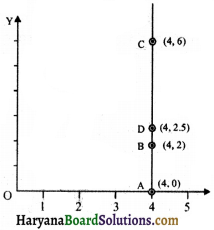
(a) A(4,0), B(4,2), C(4,6), D(4, 2.5)
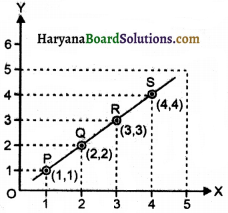
(b) P(1, 1), Q(2, 2), R(3, 3), S(4,4)
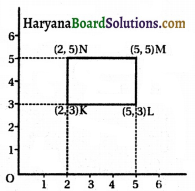
(c) K(2, 3), L(5, 3),M(5,5), N(2,5)
हल:
(a) A(4, 0), B(4, 2), C(4, 6), D(4, 2.5)
HBSE 8th Class Maths Solutions Chapter 15 आलेखों से परिचय Ex 15.2 -1
अतः इसके सभी बिन्दु एक ही सरल रेखा पर स्थित हैं। अतः यह एक सरल रेखा है।

(b) P(1, 1) Q(2,2) R(3,3) S(4,4)
HBSE 8th Class Maths Solutions Chapter 15 आलेखों से परिचय Ex 15.2 -2
इसके सभी बिन्दु एक सरल रेखा पर हैं। अत: यह एक सरल रेखा है।

(c) K(2,3) L(5,3) M(5,5) N(2,5).
HBSE 8th Class Maths Solutions Chapter 15 आलेखों से परिचय Ex 15.2 -3
यह आलेखा एक आयत बना रहा है । अत: यह सरल रेखा नहीं ।

HBSE 8th Class Maths Solutions Chapter 15 आलेखों से परिचय Ex 15.2

प्रश्न 2.
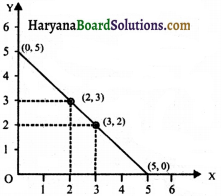
बिन्दुओं (2,3) तथा (3,2) में से गुजरती हुई एक सरल रेखा खींचिए। उन बिन्दुओं के निर्देशांक लिखिये,? जिन पर यह रेखाxअक्ष तथा Y-अक्षको । प्रतिच्छेद करती है।
हल :
HBSE 8th Class Maths Solutions Chapter 15 आलेखों से परिचय Ex 15.2 -4
बिन्दु (2,3) तथा (3,2) से जाती हुई एक रेखा खींची। यह आलेख रेखा x-अक्ष को (5,0) तथा Y-अक्ष को (0, 5) पर काटेगी।

प्रश्न 3.
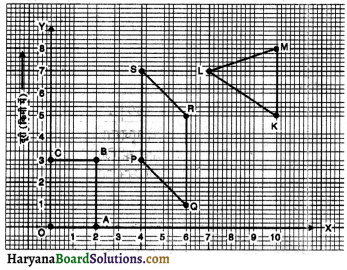
आलेख में बनाई गई आकृतियों में प्रत्येक के शीर्षों के निर्देशांक लिखिये ।
HBSE 8th Class Maths Solutions Chapter 15 आलेखों से परिचय Ex 15.2 -5
हल :
इस आलेख से स्पष्ट है कि हम सर्वप्रथम ABCO के शीषों के निर्देशांक लिखेंगे, जो इस प्रकार है-
ABCO आकृति में-
O(0,0), A (2,0), B (2, 3),C (0, 3)

PQRS आकृति में-
P(4,3),Q(6, 1), R (6,5), 8 (4,7)

KLM आकृति में-
K(10,5),(7,7),M (10,8)

HBSE 8th Class Maths Solutions Chapter 15 आलेखों से परिचय Ex 15.2

प्रश्न 4.
निम्न कथनों में कौन-सा सत्य है तथा कौन-सा असत्य ? असत्य को ठीक कीजिए ।
(i) कोई बिन्दु जिसकाx-निर्देशांक शून्य तथा निर्देशांक शून्येतर हैं, Y-अक्ष पर स्थित होता है।
(ii) कोई बिन्दु जिसका y-निर्देशांक शून्य है तथा :निर्देशांक 5 है, y-अक्ष पर स्थित होगा ।
(iii) मूल बिन्दु के निर्देशांक (0,0) हैं ।
हल :
(i) सत्य
(ii) असत्य क्योंकि कोई बिन्दु जिसका “-निर्देशांक शून्य है तथा x-निर्देशांक 5 है वह y-अक्ष पर स्थित नहीं है । वह बिन्दु x-अक्ष पर स्थित होगा ।
(iii) सत्य

HBSE 8th Class Maths Solutions Chapter 15 आलेखों से परिचय Ex 15.2 Read More »

HBSE 8th Class Maths Solutions Chapter 15 आलेखों से परिचय Ex 15.1

Haryana State Board HBSE 8th Class Maths Solutions Chapter 15 आलेखों से परिचय Ex 15.1 Textbook Exercise Questions and Answers.

Haryana Board 8th Class Maths Solutions Chapter 15 आलेखों से परिचय Ex 15.1

प्रश्न 1.
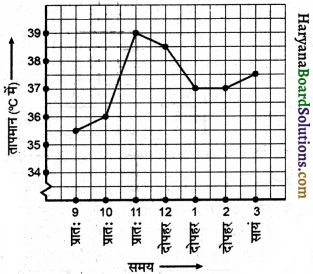
निम्न आलेख, किसी अस्पताल में एक रोगी का प्रति घंटे लिया गया तापमान दर्शाता है
HBSE 8th Class Maths Solutions Chapter 15 आलेखों से परिचय Ex 15.1 -1
(a) रोगी का तापमान 1 बजे दोपहर क्या था?
(b) रोगी का तापमान 38.5° C कब था?
(c) इस पूरे अंतराल में रोगी का तापमान दो बार एक समान ही था। ये दो समय, क्या-क्या थे?
(d) 1.30 बजे दोपहर रोगी का तापमान क्या था? इस निष्कर्ष पर आप कैसे पहुँचे?
(e) किन अंतरालों में रोगी का तापमान ‘बढ़ने का रुझान’ दर्शाता है?
हल:
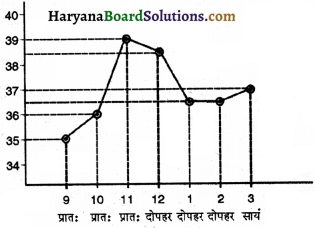
HBSE 8th Class Maths Solutions Chapter 15 आलेखों से परिचय Ex 15.1 -2
(a) रोगी का तापमान 1 बजे दोपहर 36.5°C था।
(b) रोगी का तापमान 38.5°C दोपहर 12 बजे था।
(c) इस पूरे अंतराल में रोगी का तापमान दोपहर 1 बजे, दोपहर 2 बजे एक समान 36.5°C था।
(d) दोपहर 1: 30 बजे रोगी का तापमान 36.5°C था। क्योंकि, दोपहर 1 बजे से दोपहर 2 बजे तक रोगी का तापमान 36.5°C ही था ।
(e) प्रातः 9 बजे से प्रातः 10 बजे, प्रातः 10 बजे से प्रातः 11 बजे और दोपहर 2 बजे से 3 बजे के दौरान रोगी का तापमान बढ़ने का रुझान दर्शाता है।

HBSE 8th Class Maths Solutions Chapter 15 आलेखों से परिचय Ex 15.1

प्रश्न 2.
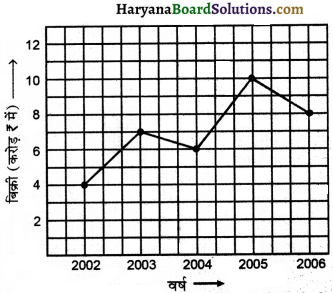
एक निर्माता कम्पनी की विभिन्न वर्षों में की गई बिक्री निम्न आलेख द्वारा दर्शाई गई है-
HBSE 8th Class Maths Solutions Chapter 15 आलेखों से परिचय Ex 15.1 -3
(a) (i) वर्ष 2002 में (ii) वर्ष 2006 में कितनी बिक्री थी?
(b) (i) वर्ष 2003 में (ii) वर्ष 2005 में कितनी बिक्री थी?
(c) वर्ष 2002 तथा वर्ष 2006 की बिक्रियों में कितना अन्तर था?

(d) किस अन्तराल में बिक्रियों का यह अन्तर सबसे अधिक था?
हल:
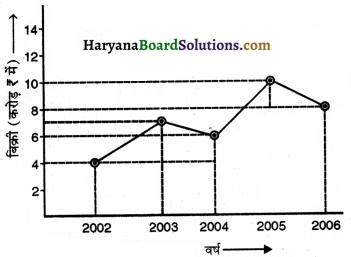
HBSE 8th Class Maths Solutions Chapter 15 आलेखों से परिचय Ex 15.1 -4
(a) (i) वर्ष 2002 में 4 करोड़ की बिक्री थी।
(ii) वर्ष 2006 में 8 करोड़ की बिक्री थी।

(b) (i) वर्ष 2003 में 7 करोड़ की बिक्री थी ।
(ii) वर्ष 2005 में 10 करोड़ की बिक्री थी ।

(c) (i) वर्ष 2002 में बिक्री 4 करोड़ रुपये ।
(ii) वर्ष 2006 में बिक्री 8 करोड़ रुपये । दोनों वर्षों में बिक्रियों का अन्तर = (8 – 4) = 4 करोड़ रुपये।

(d) वर्ष 2004-2005 में बिक्रियों का अन्तर सबसे अधिक है। क्योंकि वर्ष 2002 में 2003 में बिक्रियों का अन्तर = 3 करोड़ रुपये।
वर्ष 2003 में व 2004 में बिक्रियों का अन्तर = 1 करोड़ कम हुआ ।
वर्ष 2004 में व 2005 में बिक्रियों का अन्तर = 4 करोड़ रुपये ।
वर्ष 2005 से 2006 में बिक्रियों का अन्तर घटा है ।

HBSE 8th Class Maths Solutions Chapter 15 आलेखों से परिचय Ex 15.1

प्रश्न 3.
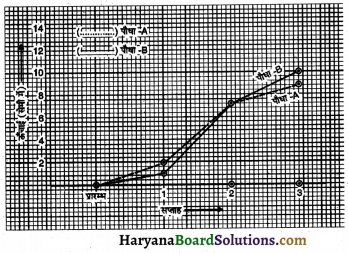
वनस्पति-विज्ञान के एक प्रयोग में समान परिस्थितियों में प्रयोगशाला दो पौधे A तथा B गाये गये । तीन सप्ताहों तक उनकी ऊंचाइयों को हर सप्ताह के अन्त में मापा गया । परिणामों को निम्न आलेख में दर्शाया गया है-
HBSE 8th Class Maths Solutions Chapter 15 आलेखों से परिचय Ex 15.1 -5
(a) (i) 2 सप्ताह बाद,
(ii) 3 सप्ताह बाद पौधे A की ऊँचाई कितनी थी ?

(b) (i) 2 सप्ताह बाद,
(ii) 3 सप्ताह बाद पौधे B की ऊँचाई कितनी थी?

(c) तीसरे सप्ताह में पौधे A की ऊँचाई कितनी बढ़ी ?
(d) दूसरे सप्ताह के अन्त से तीसरे सप्ताह के अन्त तक पौधे B की ऊँचाई कितनी बढ़ी ?
(e) किस सप्ताह में पौधे A की ऊँचाई सबसे अधिक बढ़ी ?
(f) किस सप्ताह में पौधे B की ऊँचाई सबसे कम बढ़ी?
(g) क्या किसी सप्ताह में दोनों पौधों की ऊँचाई समान थी ? पहचानिए ।
हल :
(a) (i) 2 सप्ताह बाद पौधे A की ऊँचाई = 7 cm होगी ।
(ii) 3 सप्ताह बाद पौधे A की ऊँचाई = 9 cm होगी ।

(b) (i) 2 सप्ताह बाद पौधे B की ऊँचाई = 7 cm होगी।
(ii) 3 सप्ताह बाद पौधे B की ऊँचाई = 10 cm होगी ।

(c) तीसरे सप्ताह में पौधे A की ऊँचाई = 2 cm बढ़ी ।
(d) दूसरे सप्ताह में पौधे B की ऊँचाई = 7 cm तथा तीसरे सप्ताह में पौधे B की ऊँचाई = 10 cm
अत: दूसरे सप्ताह के अन्त से तीसरे सप्ताह के अन्त तक पौधे B की ऊँचाई = (10-7) cm = 3 cm बढ़ी ।
(e) दूसरे सप्ताह में पौधे A की ऊँचाई सबसे अधिक बढ़ी ।
(f) पहले सप्ताह में पौधे B की ऊँचाई सबसे कम बढ़ी।
(g) दूसरे सप्ताह के अन्त में दोनों पौधों की ऊँचाई समान 7 cm थी।

प्रश्न 4.
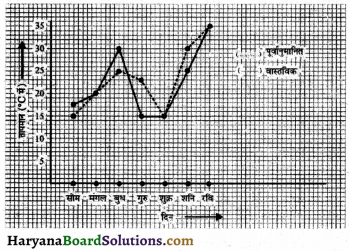
निम्न आलेख, किसी सप्ताह के प्रत्येक दिन के लिए पूर्वानुमानित तापमान तथा वास्तविक तापमान दर्शाता है-
HBSE 8th Class Maths Solutions Chapter 15 आलेखों से परिचय Ex 15.1 -6
(a) किस दिन पूर्वानुमानित तापमान व वास्तविक तापमान समान था?
(b) सप्ताह में पूर्वानुमानित अधिकतम तापमान क्या था ?
(c) सप्ताह में वास्तविक न्यूनतम तापमान क्या था ?
(d) किस दिन वास्तविक तापमान व पूर्वानुमानित तापमान में अन्तर सर्वाधिक था ?
हल :
(a) मंगलवार, शुक्रवार, रविवार को पूर्वानुमानित तथा वास्तविक तापमान समान थे।
(b) सप्ताह में पूर्वानुमानित तापमान अधिकतम = 35°C
(c) सप्ताह में वास्तविक न्यूनतम तापमान = 15°C
(d) गुरुवार को वास्तविक तथा पूर्वानुमानित तापमान में अन्तर सर्वाधिक है।

HBSE 8th Class Maths Solutions Chapter 15 आलेखों से परिचय Ex 15.1

प्रश्न 5.
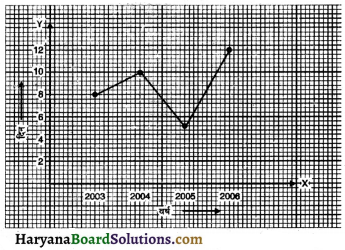
निम्न तालिका का प्रयोग कर एक रैखिक आलेख बनाइए-
(a) विभिन्न वर्षों में किसी पर्वतीय नगर में हिमपात के दिनों की संख्या-

वर्ष2003200420052006
दिन810512

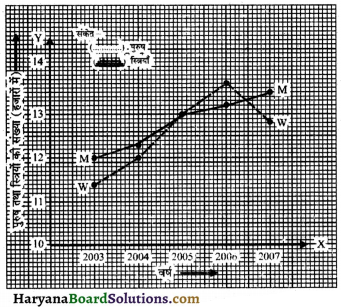
(b) विभिन्न वर्षों में एक गाँव में, पुरुषों व स्त्रियों की संख्या (हजारों में)

वर्ष20032004200520062007
पुरुषों की संख्या1212.51313.213.5
स्त्रियों की संख्या11.311.91313.612.8

हल :
(a) वर्ष को. X-अक्ष पर तथा दिन को Y-अक्ष पर दर्शाया गया है।
HBSE 8th Class Maths Solutions Chapter 15 आलेखों से परिचय Ex 15.1 -7
(b) क्षैतिज X-अक्ष वर्षों को तथा ऊर्ध्वाधर Y-अक्ष पुरुषों तथा स्त्रियों की संख्या को दर्शाता है।
HBSE 8th Class Maths Solutions Chapter 15 आलेखों से परिचय Ex 15.1 -8
पुरुषों की संख्या को संकेत(———–) तथा स्त्रियों की संख्या को संकेत (………) से दर्शाया गया है-

प्रश्न 6.
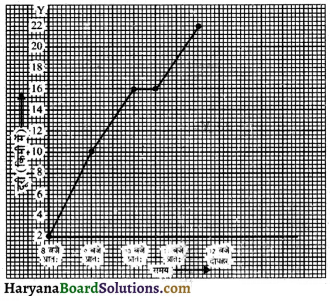
एक डाकिया किसी नगर के पास ही स्थित एक उपनगर में एक व्यापारी को पार्सल पहुंचाने के लिए साइकिल पर जाता है । विभिन्न समयों पर नगर से उसकी दूरियाँ निम्न आलेख द्वारा दर्शाई गई है-
(a).x-अक्ष पर समय दान के लिए क्या पैमाना प्रयोग किया गया है ?
(b) उसने पूरी यात्रा के लिए कितना समय लिया?
(c) व्यापारी के स्थान की नगर से दूरी कितनी है?
(d) क्या डाकिया रास्ते में कहीं रुका ? विवरण दीजिए।
(e) किस अन्तराल में उसकी चाल सबसे अधिक थी?
HBSE 8th Class Maths Solutions Chapter 15 आलेखों से परिचय Ex 15.1 -9
हल :
(a) X-अक्ष पर समय दर्शाने के लिए पैमाना है:
2 इकाई = 1 घंटा
(b) उसने पूरी यात्रा के लिए 34 घंटे का समय लिया।
(c) व्यापारी के स्थान की नगर से दूरी 22 km है ।
(d) हाँ, डाकिया रास्ते में रुका, क्योंकि यह आलेख के क्षैतिज भाग से पता चलता है कि वह प्रातः 10 बजे से प्रातः 10:30 बजे तक रुका था ।
(e) प्रात: 8 बजे और प्रात: 9 बजे के बीच के अन्तराल में उसकी चाल सबसे अधिक थी।

HBSE 8th Class Maths Solutions Chapter 15 आलेखों से परिचय Ex 15.1

प्रश्न 7.
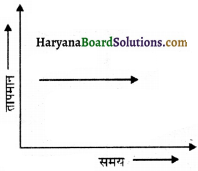
निम्न आलेखों में कौन-कौन से आलेख समय व तापमान के बीच सम्भव हैं? तर्क के साथ अपने उत्तर दीजिए
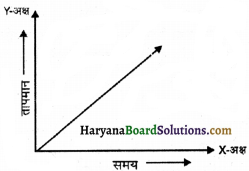
(i)
HBSE 8th Class Maths Solutions Chapter 15 आलेखों से परिचय Ex 15.1 -10
हल:
इस आलेख में x-अक्ष समय को तथा y-अक्ष तापमान को दर्शाता है । अतः स्पष्ट है कि समय के बढ़ने के साथ तापमान भी बढ़ रहा है। यह आलेख सम्भव है ।

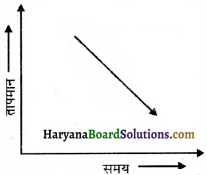
(ii)
HBSE 8th Class Maths Solutions Chapter 15 आलेखों से परिचय Ex 15.1 -11
हल:
इस आलेख से स्पष्ट है कि समय बढ़ने के साथ-साथ तापमान घटता जा रहा है। अत: यह सम्भव है।

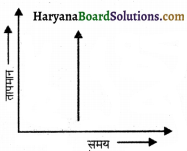
(iii)
HBSE 8th Class Maths Solutions Chapter 15 आलेखों से परिचय Ex 15.1 -12
हल :
इस आलेख से स्पष्ट है कि नियत समय पर तापमान बढ़ रहा है जो कि असम्भव है । अतः आलेख सम्भव नहीं है।

HBSE 8th Class Maths Solutions Chapter 15 आलेखों से परिचय Ex 15.1

(iv)
HBSE 8th Class Maths Solutions Chapter 15 आलेखों से परिचय Ex 15.1 -13
हल :
इस आलेख से स्पष्ट है कि समय बढ़ने पर तापमान नियत है जोकि सम्भव है । अतः आलेख सम्भव है ।

निर्देशांक-
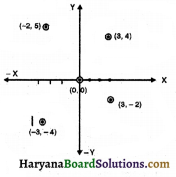
(i) आलेख वाला कागज एक वगांकित कागज है । इस पर हमx-अक्ष तथा Y-अक्ष सुविधा के अनुसार दर्शाते हैं और फिर उस पर बिन्दु की स्थिति निर्धारित करते हैं । जैसे-बिन्दु (3,4) में बिन्दु 3 को xअक्ष पर तथा बिन्दु 4 को Y-अक्ष पर दर्शायेंगे । बिन्दु 3 को भुज तथा बिन्दु 4 को कोटि कहते हैं ।
HBSE 8th Class Maths Solutions Chapter 15 आलेखों से परिचय Ex 15.1 -14
इस प्रकार, बिन्दु (-2,5), बिन्दु (3,-2), तथा, बिन्दु (-3,-4), का आलेखन इस प्रकार होगा ।

(ii) दोनों अक्षों के कटान बिन्दु को मूल बिन्दु कहते हैं, जिसके निर्देशांक (0,0) होते हैं।

HBSE 8th Class Maths Solutions Chapter 15 आलेखों से परिचय Ex 15.1 Read More »

HBSE 8th Class Maths Solutions Chapter 15 आलेखों से परिचय Intext Questions

Haryana State Board HBSE 8th Class Maths Solutions Chapter 15 आलेखों से परिचय InText Questions and Answers.

Haryana Board 8th Class Maths Solutions Chapter 15 आलेखों से परिचय Intext Questions

(सोचिए, चर्चा कीजिए और लिखिए – पृष्ठ 253)

प्रश्न 1.
एक कार की पेट्रोल टंकी को भरने के लिए दी गई राशि खरीदे गए पेट्रोल की मात्रा (लीटर में) द्वारा निश्चित होती है। यहाँ पर कौन-सा चर स्वतंत्र है? चर्चा कीजिए।
हल:
कार में पेट्रोल टंकी को भरने के लिए दी जाने वाली राशि खरीदे गए पेट्रोल की मात्रा द्वारा निश्चित होती है इसलिए, खरीदे गए पेट्रोल की मात्रा स्वतंत्र चर है।

HBSE 8th Class Maths Solutions Chapter 15 आलेखों से परिचय Intext Questions

(प्रयास कीजिए – पृष्ठ 254)

प्रश्न 1.
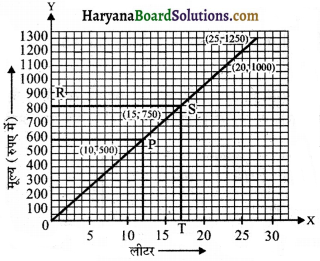
आलेख से ज्ञात कीजिए कि 800 रुपए में कितना पेट्रोल खरीदा जा सकता है?
हल:
आलेख में y-अक्ष पर एक बिन्दु R बनाएँ जो 800 को दर्शाए। R से एक क्षैतिज रेखा खींचें जो आलेख में S पर मिले। S बिन्दु से :-अक्ष पर ST लम्ब खींचिए। T का निर्देशांक 16 है। इस प्रकार निम्न आलेख के अनुसार 800 रुपए का 16 लीटर पेट्रोल खरीदा जा सकता है।
HBSE 8th Class Maths Solutions Chapter 15 आलेखों से परिचय Intext Questions -1

(प्रयास कीजिए – पृष्ठ 255)

प्रश्न 1.
क्या पाठ्यपुस्तक का उदाहरण 7 एक समानुपात का उदाहरण है?
हल:
हाँ, यह एक समानुपात का उदाहरण है।

HBSE 8th Class Maths Solutions Chapter 15 आलेखों से परिचय Intext Questions Read More »

HBSE 8th Class Science Solutions Haryana Board

Haryana Board HBSE 8th Class Science Solutions

HBSE 8th Class Science Solutions in English Medium

HBSE 8th Class Science Solutions in Hindi Medium

HBSE 8th Class Science Solutions Haryana Board Read More »

HBSE 8th Class Maths Solutions Haryana Board

Haryana Board HBSE 8th Class Maths Solutions

HBSE 8th Class Maths Solutions in English Medium

HBSE 8th Class Maths Chapter 1 Rational Numbers

HBSE 8th Class Maths Chapter 2 Linear Equations in One Variable

HBSE 8th Class Maths Chapter 3 Understanding Quadrilaterals

HBSE 8th Class Maths Chapter 4 Practical Geometry

HBSE 8th Class Maths Chapter 5 Data Handling

HBSE 8th Class Maths Chapter 6 Square and Square Roots

HBSE 8th Class Maths Chapter 7 Cube and Cube Roots

HBSE 8th Class Maths Chapter 8 Comparing Quantities

HBSE 8th Class Maths Chapter 9 Algebraic Expressions and Identities

HBSE 8th Class Maths Chapter 10 Visualizing Solid Shapes

HBSE 8th Class Maths Chapter 11 Mensuration

HBSE 8th Class Maths Chapter 12 Exponents and Powers

HBSE 8th Class Maths Chapter 13 Direct and Inverse Proportions

HBSE 8th Class Maths Chapter 14 Factorization

HBSE 8th Class Maths Chapter 15 Introduction to Graphs

HBSE 8th Class Maths Chapter 16 Playing with Numbers

HBSE 8th Class Maths Solutions in Hindi Medium

HBSE 8th Class Maths Chapter 1 परिमेय संख्याएँ

HBSE 8th Class Maths Chapter 2 एक चर वाले रैखिक समीकरण

HBSE 8th Class Maths Chapter 3 चतुर्भुजों को समझना

HBSE 8th Class Maths Chapter 4 प्रायोगिक ज्यामिती

HBSE 8th Class Maths Chapter 5 आँकड़ो का प्रबंधन

HBSE 8th Class Maths Chapter 6 वर्ग और वर्गमूल

HBSE 8th Class Maths Chapter 7 घन और घनमूल

HBSE 8th Class Maths Chapter 8 राशियों की तुलना

HBSE 8th Class Maths Chapter 9 बीजीय व्यंजक एवं सर्वसमिकाएँ

HBSE 8th Class Maths Chapter 10 ठोस आकारों का चित्रण

HBSE 8th Class Maths Chapter 11 क्षेत्रमिति

HBSE 8th Class Maths Chapter 12 घातांक और घात

HBSE 8th Class Maths Chapter 13 सीधा और प्रतिलोम समानुपात

HBSE 8th Class Maths Chapter 14 गुणनखंडन

HBSE 8th Class Maths Chapter 15 आलेखों से परिचय

HBSE 8th Class Maths Chapter 16 संख्याओं के साथ खेलना

HBSE 8th Class Maths Solutions Haryana Board Read More »

HBSE 8th Class Hindi Solutions Vasant Bhag 3 Haryana Board

Haryana Board HBSE 8th Class Hindi Solutions वसंत भाग 3

HBSE 8th Class Hindi Vyakaran व्याकरण

HBSE 8th Class Hindi Rachana रचना

HBSE 8th Class Hindi अपठित बोध

HBSE 8th Class Hindi Solutions Vasant Bhag 3 Haryana Board Read More »

HBSE 8th Class Science Solutions Chapter 8 Cell Structure and Functions

Haryana State Board HBSE 8th Class Science Solutions Chapter 8 Cell Structure and Functions Textbook Exercise Questions and Answers.

Haryana Board 8th Class Science Solutions Chapter 8 Cell Structure and Functions

HBSE 8th Class Science Cell Structure and Functions Textbook Questions and Answers

Question 1.
Indicate whether the following statements are True (T) or False (F).
(а) Unicellular organisms have one-celled body. (T/F)
(б) Muscle cells are branched structures. (T/F)
(c) The basic living structure of an organism is an organ. (T/F)
(d) Amoeba has irregular shape. (T/F)
Answer:
(a) True
(b) True
(c) False
(d) True

Question 2.
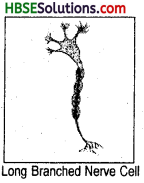
Make a sketch of the human nerve cell. What function do nerve cells performs?
Answer:
Functions of human nerve cell:
(i) Nerve cells receive messages from different parts of body.
(ii) They further transfer these message to brain and brain further send commands for functioning Long Branched Nerve Cell of different organs.
HBSE 8th Class Science Solutions Chapter 8 Cell Structure and Functions-1
(iii) They coordinate functioning of different organs of body.

HBSE 8th Class Science Solutions Chapter 8 Cell Structure and Functions

Question 3.
Write short notes on the following:
(а) Cytoplasm
(b) Nucleus of a cell.
Answer:
(a) Cytoplasm:
Cytoplasm is a jelly like substance which is present between the cell membrane and the nucleus. Various other organelles of cells are present in the cytoplasm. Cytoplasm is made up of chemical substances like carbohydrates, proteins and water. These chemical substances are present in cells of all types and sizes.

(b) Nucleus of a cell:
Nucleus is the master of the cell. It commands all the functioning of the cell. It is generally located in the centre of the cell and is spherical in structure. A membrane called nuclear membrane separates it from cytoplasm. It contains the genetic material (DNA, RNA) in it. This porous membrane allows the transfer of material in the nucleus and cytoplasm. Nucleus contains a dense body called nucleolus which actually contain chromosomes the genetic material.

Question 4.
Which part of the cell contains organelles?
Answer:
Cytoplasm.

Question 5.
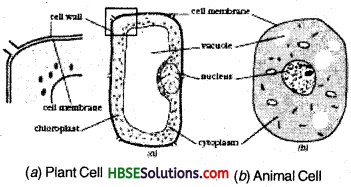
Make sketches of animals and plant cells. State three differences between them. Answer:

Plant CellAnimal Cell
1. Plant cell has a rigid cell wall.1. Cell wall is absent.
2. Plant cell has chloroplasts.2. Chloroplasts are absent.
3. Plant cell lacks centrosomes.3. Centrosomes are present.

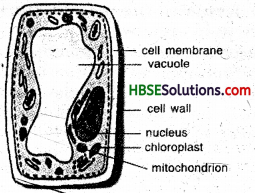
HBSE 8th Class Science Solutions Chapter 8 Cell Structure and Functions-2

Question 6.
State a difference between eukaryotes and prokaryotes.
Answer:
Prokaryotes do not have a well designed nuclear membrane, while Eukaryotes have a well designed nuclear membrane.

Question 7.
Where are chromosomes found in a cell? State their function.
Answer:
Chromosomes are found in the nucleus of a cell. Their function is to carry characteristic features of parent cells to the daughter cell i.e. from parent to offsprongs.

Question 8.
‘Cells are the basic structural units of living organism’. Explain.
Answer:
Cells are the basic structural units of living organisms because lot of cells unit to form and many tissues form an organ. And organs combine to form a complete body, so cell is the basic structural unit of an organism. All basic function for the survival of an organism take peace inside cells so they are the basic functional units of a living being.

Question 9.
Explain why chloroplasts are found only in plant cells?
Answer:
Chloroplasts are only found in plant cells because they are required for the food making process of plants called photosynthesis.

Question 10.
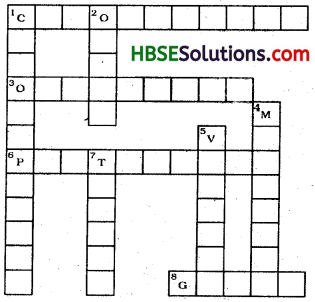
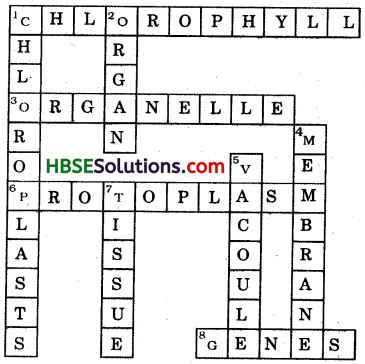
Complete the following crossword with the help of clues given below:
Across
1. This is necessary for photosynthesis.
3. Term for component present in the cytoplasm.
6. The living substance in the cell.
8. Unit of inheritance present on the chromosomes.

Down
1. Green plastids.
2. Formed by collection of tissues.
4. It separates the contents of the cell from the surrounding medium.
5. Empty space in the cytoplasm.
7. A group of cells.
HBSE 8th Class Science Solutions Chapter 8 Cell Structure and Functions-3
Answer:
HBSE 8th Class Science Solutions Chapter 8 Cell Structure and Functions-4

Extended Learning – Activities And Projects

1. Visit a laboratory for senior secondary students in your school or in a neightbouring school. Learn about the functioning of a microscope in the laboratory. Also observe how a slide is observed under the microscope,
Answer:
For self attempt.

2. Talk to the senior biology teacher in your school or a neighbouring school. Find out if there are diseases which are passed on from parents to the offspring. Find out how these are carried and also if these diseases can be treated. For this you can also visit a doctor.
Answer:
There are certain diseases which are passed on from parent to the offspring. Diseases like diabites, heart diseases, certain skin diseases like leukoderma, etc. are genetic diseases.

3. Visit an agriculture extension centre in your area. Find out about genetically modified (GM) crops. Prepare a short speech for your class on this topic. You may visit www.usc.ernet.in / currsci / sep2520Ql/ 655.pdf
Answer:
For self attempt.

4. Find out about Bt cotton from an agriculture expert (or from envfor.nic.in/ division/csnrv/btcotton/b gnote.pdf). Prepare a short note on its advantages / disadvantages.
For more on cell, visit: www.enchantedlearning.com/subjects/ plants/ cell/
Answer:
For self attempt.

HBSE 8th Class Science Solutions Chapter 8 Cell Structure and Functions

HBSE 8th Class Science Cell Structure and Functions Important Questions and Answers

Very Short Answer Type Questions

Question 1.
Define a cell.
Answer:
A cell is the basic structural and functional unit of living things.

Question 2.
Who discovered cell?
Answer:
Robert Hooke.

Question 3.
Name three important parts of cell.
Answer:
(i) Cell membrane
(ii) Cytoplasm
(iii) Nucleus

Question 4.
In which cells, cell wall is present?
Answer:
In plant cells.

Question 5.
Give three examples of unicellular organisms.
Answer:
Amoeba, Paramecium, Chlamydomonas.

Question 6.
Where are chromosomes present in a cell?
Answer:
Nucleus.

Question 7.
Name the cell part that has tiny holes.
Answer:
Cell Membrane

HBSE 8th Class Science Solutions Chapter 8 Cell Structure and Functions

Question 8.
Which cell organelle is found only in animal cell?
Answer:
Centrosome.

Question 9.
Name the cells organelle which is found only in plant cell.
Answer:
Plastids.

Question 10.
How do cells increase in numbers?
Answer:
By cell division.

Question 11.
Which organelle is called the ppwer house of the cell?
Answer:
Mitochondria.

Question 12.
Which organelle is called suicidal bags of the cell?
Answer:
Lysosomes.

Question 13.
What does mitochondria do?
Answer:
It prepares food for plants.

Question 14.
What does chromosomes do?
Answer:
Transfer chracters from one generation to another generation.

Question 15.
What does ribosomes do?
Answer:
They help in synthesis of proteins.

Question 16.
Name plastids found in plant cells.
Answer:
Chloroplasts, Leucoplast and chromoplast.

Question 17.
What is the unit of measuring the size of the cell?
Answer:
Microns.

Question 18.
Name the longest cell.
Answer:
Nerve cell in animal.

HBSE 8th Class Science Solutions Chapter 8 Cell Structure and Functions

Question 19.
Name the heaviest animal cell.
Answer:
Ostrich Egg.

Question 20.
Name the largest plant cell.
Answer:
Acetabulum.

Question 21.
Name the smallest plant cell.
Answer:
Bacteria.

Short Answer Type Questions

Question 1.
Why cells are called building blocks of life?
Answer:
Cells like bricks of a building are basic structural units of living organisms. Buildings differ from each other, organism also differ from each other. Both are basic unit of structure. So, they are called building blocks of life.

Question 2.
Why are the mitochondria known as the power housd of the cell?
Answer:
They are rod shaped and very minute. They are concerned with the release of energy from food during respiration. Because of this, they are often referred to as the power house of the cell.

Question 3.
What are the cell organelles? What are their functions?
Answer:
Cell organelles are small active living structures found in cytoplasm of cell. Each organelle has different structure and performs different function for cell. They are endoplasmic reticulum, Plastides, Mitochondria, Ribosomes, Golgi bodies, Centrosomes, Lysosomes, Vacoules.

HBSE 8th Class Science Solutions Chapter 8 Cell Structure and Functions

Question 4.
What is meant by protoplasm?
Answer:
The cytoplasm surrounded by the cell membrane and enclosing the nucleus together constitute the protoplasm. Protoplasm in other words, includes the cell membrance, the nucleus and the Cytoplasm.

Question 5.
Name four elements which form major part of protoplasm?
Answer:
Ninety nine percent of protoplasm by its weight is made up of four elements. Namely; Carbon, Hydrogen, Nitrogen and Oxygen. It also contains other elements such as H20, Carbohydrates, fats, proteins and mineral acids. Both elements and compounds in unique combination provide living nature to the protoplasm.

Question 6.
Why cells could not be observed before 17th century?
Answer:
The main reason was that the size of the majority of the cells are too small to be invisible to the unaided eye and at that time microscope was not discovered. So, the cell could not be observed before 17th century.

Question 7.
Why Hooke had to take thin slices of cork?
Answer:
The cork was solid and the details of cork could not seen in solid state. So he made thin slices to see the details of the cork. He saw space in cork slice which appeared like honey comb, called these compartments as cells.

Question 8.
What do you know about cell shape?
Answer:
Cells are of diverse shapes. Some cells are like Amoeba and white blood cells of our blood. They continuously change their shape. Most cells, however, maintain a constant shape all through their existence.

Question 9.
Write about size variation of the cells.
Answer:
Cells vary in their size. The smallest known cell is bacteria measuring about 0.5 micrometre. Nerve cell is up to 1 metre long. The heaviest cell is of ostrich and acetabulum is the largest unicellular algae which is about 10 cm long. Majority of cells in plants and animals range from 20 to 30 microns in diameter.

Question 10.
Write a short note on cell numbers.
Answer:
Cells are of two types depending upon their number. Some cells exist single in number. The organism consisting of a single cell are called unicellular organisms. The organisms which consist of two or more than two cells are called multicellular organisms. Human body consists of more than a trillion of cells. Amoeba,Paramecium etc. are unicellular organisms.

Question 11.
What is nucleolus?
Answer:
Nucleolus is a small spherical dense body present in the nucleus. It is only visible, with a microscope of a higher magnification.

HBSE 8th Class Science Solutions Chapter 8 Cell Structure and Functions

Long Answer Type Questions

Question 1.
How do you differentiate protoplasm from cytoplasm?
Answer:
Protoplasm:
The cytoplasm surrounded by the cell membrane and enclosing the nucleus together constitute the protoplasm. In other words the cell membrane, the cytoplasm and the nucleus constitute pr’otoplasm.

Cytoplasm:
It is jelly like substance occupied most of the inside of the cell. It occupies the space between the cell membrane and the nucleus. All the life functions take place in the cytoplasm. It contains many important tiny structures called the organelles, which performs the various life functions.

Question 2.
Write the functions of cell organelles.
Answer:
(i) Mitochondria: It performs the function of respiration provide the cell with energy.
(ii) Endoplasmic-reticulum: It is a network of membrane, it provides large surface area for life function to take place.
(iii) Chloroplasts: These are green in colour, contain green pigment chlorophyll which help in food manufacturing in plants.
(iv) Golgi complex: These collect and distribute substances made in the cell. Synthesis and secretions of many materials.
(v) Lysosomes: Certain enzymes which help in breaking down or destroying various unwanted materials of cell.
(vi) Centrioles and centrosome: It helps in cell division in animal cells.
(vii) Ribosomes: They help in protein synthesis.
(viii) Vacoules: These are generally stored inside clear space in the cytoplasm.
In animal cells they are very small. In plant cells they are large and greater in number.

HBSE 8th Class Science Solutions Chapter 8 Cell Structure and Functions

Question 3.
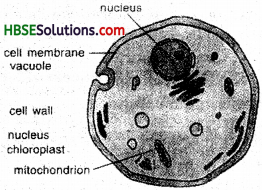
Differentiate between the plant cell and the animal cell.
Answer:

Animal CellPlant Cell
(i) Cell wall is absent.(i) A rigid cell wall is present.
(ii) Chloroplasts are absent.(ii) Chloroplasts are present.
(iii) Centrosome is present near the nucleus.(iii) Centrosome is absent.
HBSE 8th Class Science Solutions Chapter 8 Cell Structure and Functions-5HBSE 8th Class Science Solutions Chapter 8 Cell Structure and Functions-6

Cell Structure and Functions Class 8 HBSE Notes

1. All organisms are made of small basic structural and functional units.
2. These smallest functional units are called cells.
3. Robert Hooke observed a cell for the first time in 1665.
4. Cells can be defined as the basic structural and functional unit of life.
5. Cells are of different size and shape.
6. Living Organisms made up of a single cell are called unicellular organisms.
7. All unicellular organisms are microscopic organism e.g. Amoeba, Paramecium etc. i.e. they cannot be seen with naked eyes.
8. Some cells can be seen with naked eyes without any aid e.g. egg of a hen.
9. In unicellular organisms, the single cell perform all the function necessary for living.
10. A cell has different parts. These small parts of the cell are called organelles.
11. A cell is made up of cell membrane, which contains all the organelles in it.
12. All cell organellies are contained in cytoplasm.
13. In the centre of the cytoplasm nucleus is situated, which is the brain of the cell.
14. Mitochondria, Endoplasmic reticulum, chloroplasts, golgi complex, lysosomes, centrioles, and ribosomes are other cell organelles.
15. Cells which don’t have a well organized nuleus are called the karyotic cells. In these cells the nucleus lacks the nuclear membrane.
16. The cells of plants are a bit different from that of animals.
17. In animals, cell wall, chloroplast, chromosomes, vacoules are absent, while they are present in plant cells.
18. Green leaves have a special organelle called chlorophyll i.e. the Green plastids (chloroplasts) which helps in the process of photosynthesis.
19. Different colours of plastids give different colours to plants.

HBSE 8th Class Science Solutions Chapter 8 Cell Structure and Functions Read More »

HBSE 8th Class Maths Solutions Chapter 1 परिमेय संख्याएँ Ex 1.2

Haryana State Board HBSE 8th Class Maths Solutions Chapter 1 परिमेय संख्याएँ Ex 1.2 Textbook Exercise Questions and Answers.

Haryana Board 8th Class Maths Solutions Chapter 1 परिमेय संख्याएँ Ex 1.2

प्रश्न 1.
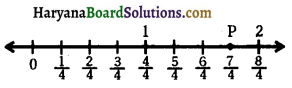
निम्नलिखित संख्याओं को संख्या रेखा पर निरूपित कीजिए-
(i) \(\frac{7}{4}\)
(ii) \(\frac{-5}{6}\)
हल:
(i)
HBSE 8th Class Maths Solutions Chapter 1 परिमेय संख्याएँ Ex 1.2 -1
बिन्दु P संख्या रेखा पर \(\frac{7}{4}\) को निरूपित करता है ।

(ii)
HBSE 8th Class Maths Solutions Chapter 1 परिमेय संख्याएँ Ex 1.2 -2
बिन्दु P संख्या रेखा पर \(\frac{-5}{6}\) को निरूपित करता है ।

HBSE 8th Class Maths Solutions Chapter परिमेय संख्याएँ Ex 1.2

प्रश्न 2.
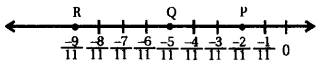
\(\frac{-2}{11}\), \(\frac{-5}{11}\), \(\frac{-9}{11}\) को संख्या रेखा पर निरूपित कीजिए।
हल:
बिन्दु P, Q, R क्रमशः संख्या रेखा पर \(\frac{-2}{11}\), \(\frac{-5}{11}\), \(\frac{-9}{11}\) निरूपित करता है ।

प्रश्न 3.
ऐसी पाँच परिमेय संख्याएँ लिखिए जो 2 से छोटी हों।
हल:
2 से छेटी पाँच परिमेय संख्याएँ निम्न हैं-
1, \(\frac{1}{2}\), 0, -1, \(-\frac{1}{2}\)

प्रश्न 4.
\(\frac{-2}{5}\) और \(\frac{1}{2}\) के मध्य दस परिमेय संख्याएँ ज्ञात कीजिए।
हल:
सर्वप्रथम \(\frac{-2}{5}\) और \(\frac{1}{2}\) को समान हर वाली परिमेय संख्याओं में बदलेंगे ।
HBSE 8th Class Maths Solutions Chapter 1 परिमेय संख्याएँ Ex 1.2 -3

HBSE 8th Class Maths Solutions Chapter परिमेय संख्याएँ Ex 1.2

प्रश्न 5.
(i) \(\frac{2}{3}\) और \(\frac{4}{5}\)
(ii) \(\frac{-3}{2}\) और \(\frac{5}{3}\)
(iii) \(\frac{1}{4}\) और \(\frac{1}{2}\) के मध्य पाँच परिमेय संख्याएँ ज्ञात कीजिए।
हल:
(i) सर्वप्रथम \(\frac{2}{3}\) और \(\frac{4}{5}\) को समान हर वाली संख्याओं में बदलेंगे ।
\(\frac{2 \times 20}{3 \times 20}=\frac{40}{60}\) और \(\frac{4 \times 12}{5 \times 12}=\frac{48}{60}\)
अत: \(\frac{40}{60}\) और \(\frac{48}{60}\) के मध्य पाँच परिमेय संख्याएँ निम्न है –
\(\frac{41}{60}\), \(\frac{42}{60}\), \(\frac{43}{60}\), \(\frac{44}{60}\), \(\frac{45}{60}\)

(ii) सर्वप्रथम \(-\frac{3}{2}\) और \(\frac{5}{3}\) को समान हर वाली संख्याओं में बदलेंगे ।
\(-\frac{3 \times 3}{2 \times 3}\) और \(\frac{5 \times 2}{3 \times 2}\)
⇒ \(\frac{-9}{6}\) और \(\frac{10}{6}\)
अत: \(\frac{-9}{6}\) और \(\frac{10}{6}\) के मध्य 5 परिमेय संख्याएँ निम्न है –
\(\frac{-8}{6}\), \(\frac{-7}{6}\), \(\frac{-6}{6}\),\(\frac{-5}{6}\), \(\frac{-4}{6}\) या, \(\frac{-8}{6}\), \(\frac{-7}{6}\), 0,\(\frac{2}{6}\), \(\frac{3}{6}\)

(iii) सर्वप्रथम \(\frac{1}{4}\) और \(\frac{1}{2}\) को समान हर वाली संख्याओं में बदलेंगे ।
\(\frac{1 \times 8}{4 \times 8}\) और \(\frac{1 \times 16}{2 \times 16}\)
⇒ \(\frac{8}{2}\) और \(\frac{16}{32}\)
अत: \(\frac{8}{32}\) और \(\frac{16}{32}\) के मध्य पाँच परिमेय संख्याएँ निम्न है –
\(\frac{9}{32}\), \(\frac{10}{32}\), \(\frac{11}{32}\), \(\frac{12}{32}\), \(\frac{13}{32}\)

HBSE 8th Class Maths Solutions Chapter परिमेय संख्याएँ Ex 1.2

प्रश्न 6.
-2 से बड़ी पाँच परिमेय संख्याएँ लिखिए।
हल:
-2 से बड़ी पाँच परिमेय संख्याएँ निम्न है –
\(-\frac{3}{2}\), -1, \(-\frac{1}{2}\), 0, \(\frac{1}{2}\)

प्रश्न 7.
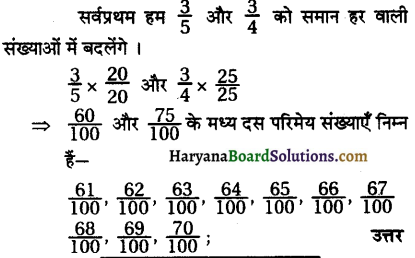
\(\frac{3}{5}\) और \(\frac{3}{4}\) के बीच में दस परिमेय संख्याएँ ज्ञात कीजिए।
हल:
HBSE 8th Class Maths Solutions Chapter 1 परिमेय संख्याएँ Ex 1.2 -4

HBSE 8th Class Maths Solutions Chapter 1 परिमेय संख्याएँ Ex 1.2 Read More »

HBSE 8th Class Maths Solutions Chapter 1 परिमेय संख्याएँ Ex 1.1

Haryana State Board HBSE 8th Class Maths Solutions Chapter 1 परिमेय संख्याएँ Ex 1.1 Textbook Exercise Questions and Answers.

Haryana Board 8th Class Maths Solutions Chapter 1 परिमेय संख्याएँ Ex 1.1

प्रश्न 1.
उचित गुणधर्मों के उपयोग से निम्नलिखित का मान ज्ञात कीजिए-
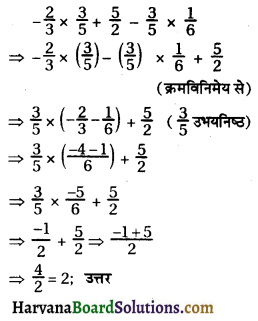
(i) \(\frac{2}{3} \times \frac{3}{5}+\frac{5}{2}-\frac{3}{5} \times \frac{1}{6}\)
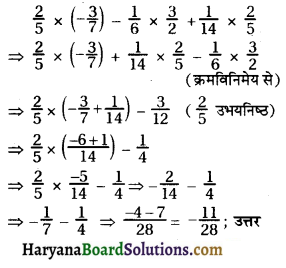
(ii) \(\frac{2}{5} \times\left(\frac{-3}{7}\right)-\frac{1}{6} \times \frac{3}{2}+\frac{1}{14} \times \frac{2}{5}\)
हल :
(i) \(\frac{2}{3} \times \frac{3}{5}+\frac{5}{2}-\frac{3}{5} \times \frac{1}{6}\)
HBSE 8th Class Maths Solutions Chapter 1 परिमेय संख्याएँ Ex 1.1 -1

(ii)
HBSE 8th Class Maths Solutions Chapter 1 परिमेय संख्याएँ Ex 1.1 -2

HBSE 8th Class Maths Solutions Chapter परिमेय संख्याएँ Ex 1.1

प्रश्न 2.
निम्नलिखित में से प्रत्येक के योज्य प्रतिलोम लिखिए
(i) \(\frac{2}{8}\)
(ii) \(\frac{-5}{9}\)
(iii) \(\frac{-6}{5}\)
(iv) \(\frac{2}{-9}\)
(v) \(\frac{19}{-6}\)
हल :
(i) \(\frac{-2}{8}\) का योज्य प्रतिलोम, \(\frac{2}{8}\) है; क्योंकि
\(\frac{-2}{8}\) + \(\frac{2}{8}\) = \(\frac{-2 + 2}{8}\) = \(\frac{0}{8}\) = 0

(ii) \(\frac{-5}{9}\) का योज्य प्रतिलोम = \(\frac{5}{9}\)

(iii) \(\frac{-6}{5}\) = \(\frac{6}{5}\) का योज्य प्रतिलोम = \(\frac{-6}{5}\)

(iv) \(\frac{2}{-9}\) का योज्य प्रतिलोम = \(\frac{2}{9}\)

(v) \(\frac{19}{-6}\) का योज्य प्रतिलोम = (v) \(\frac{19}{6}\)

प्रश्न 3.
(i) x = \(\frac{11}{15}\)
(ii) x = \(-\frac{13}{17}\) के लिए सत्यापित कीजिए कि – (-x) = x.
हल :
(i) x = \(\frac{11}{15}\)
x = \(\frac{11}{15}\) का योज्य प्रतिलोम = -x = \(\frac{-11}{15}\)
अर्थात् \(\frac{-11}{15}\) का योज्य प्रतिलोम = \(\frac{11}{15}\)
अभवा, –\(\frac{-11}{15}\) = \(\frac{11}{15}\) अर्थात् -(-x) = x

(i) x =\(-\frac{13}{17}\)
x = \(\frac{13}{17}\) का योज्य प्रतिलोम = -x = \(-\frac{13}{17}\)
अर्थात् \(\frac{13}{17}\) का योज्य प्रतिलोम = \(-\frac{13}{17}\)
अभवा, –\(-\frac{13}{17}\) = \(\frac{13}{17}\) अर्थात् -(-x) = x;

HBSE 8th Class Maths Solutions Chapter परिमेय संख्याएँ Ex 1.1

प्रश्न 4.
निम्नलिखित के गुणनात्मक प्रतिलोम ज्ञात कीजिए
(i) -13
(ii) \(\frac{-13}{19}\)
(iii) \(\frac{1}{5}\)
(iv) \(\frac{-5}{8} \times \frac{-3}{7}\)
(v) -1 × \(\frac{-2}{5}\)
(vi) -1
हल :
(i) – 13 का गुणनात्मक प्रतिलोम = \(-\frac{1}{13}\)
क्योंकि, -13 × \(-\frac{1}{13}\) = 1 (\(\frac{a}{b} \times \frac{b}{a}=1\))

(ii) \(\frac{-13}{19}\) का गुणनात्मक प्रतिलोम = \(\frac{19}{-13}\)

(iii) \(\frac{1}{5}\) का गुणनात्मक प्रतिलोम = 5

(iv) \(\frac{-5}{8} \times \frac{-3}{7}\) = \(\frac{56}{15}\)
\(\frac{56}{15}\) का गुणनात्मक प्रतिलोम = \(\frac{56}{15}\)

(v) -1 × \(\frac{-2}{5}\) ⇒ \(\frac{2}{5}\) का गुणनात्मक प्रतिलोम = \(\frac{5}{2}\)

(vi) -1 का गुणनात्मक प्रतिलोम = \(\frac{1}{-1}\)

HBSE 8th Class Maths Solutions Chapter परिमेय संख्याएँ Ex 1.1

प्रश्न 5.
निम्नलिखित प्रत्येक में गुणन के अन्तर्गत | उपयोग किए गए गुणधर्म का नाम लिखिए-
(i) \(\frac{-4}{5} \times 1=1 \times \frac{-4}{5}=-\frac{4}{5}\)
(ii) \(-\frac{13}{17} \times \frac{-2}{7}=\frac{-2}{7} \times \frac{-13}{17}\)
(iii) \(\frac{-19}{29} \times \frac{29}{-19}\) = 1
हल :
(i) \(\frac{-4}{5} \times 1=1 \times \frac{-4}{5}=-\frac{4}{5}\) गुणनात्मक तत्समक है।

(ii) \(-\frac{13}{17} \times \frac{-2}{7}=\frac{-2}{7} \times \frac{-13}{17}\) क्रमविनिमेयता।

(iii) \(\frac{-19}{29} \times \frac{29}{-19}\) = 1 गुणनात्मक प्रतिलोम

प्रश्न 6.
\(\frac{6}{13}\) को \(\frac{-7}{16}\) के व्युत्क्रम से गुणा कीजिए।
Solution:
सर्वप्रथम, \(\frac{-7}{16}\) का व्युत्क्रम = \(\frac{16}{-7}\)
अतः प्रश्नानुसार, latex]\frac{6}{13}[/latex] × \(\frac{16}{-7}\) = \(\frac{96}{-91}\)

प्रश्न 7.
बताइए कौन-से गुणधर्म की सहायता से आप \(\frac{1}{3} \times\left(6 \times \frac{4}{3}\right)\) को \(\left(\frac{1}{3} \times 6\right) \times \frac{4}{3}\) के रूप में अभिकलन करते हैं?
हल:
सहचारिता नियम से \(\frac{1}{3} \times\left(6 \times \frac{4}{3}\right)\) को \(\left(\frac{1}{3} \times 6\right) \times \frac{4}{3}\) के रूप में अभिकलन करते हैं।

HBSE 8th Class Maths Solutions Chapter परिमेय संख्याएँ Ex 1.1

प्रश्न 8.
क्या -1\(\frac{1}{8}\) का गुणनात्मक प्रतिलोम \(\frac{8}{9}\) है? क्यों अथवा क्यों नहीं?
हल:
हम जानते हैं कि, -1\(\frac{1}{8}\) = \(\frac{-9}{8}\)
नहीं, \(\frac{-9}{8}\) का गुणनात्मक प्रतिलोम नहीं है।
क्योंकि \(\frac{-9}{8}\) × \(\frac{8}{-9}\) = -1

प्रश्न 8.
क्या 3\(\frac{1}{3}\) का गुणनात्मक प्रतिलोम 0.3 है? क्यों अथवा क्यों नहीं?
हल:
हमें ज्ञात है, 3\(\frac{1}{3}\) = \(\frac{10}{3}\) 0.3 = \(\frac{3}{10}\)
\(\frac{10}{3}\) का गुणनात्मक प्रतिलोम \(\frac{3}{10}\) है।
क्योंकि \(\frac{10}{8}\) × \(\frac{3}{10}\) = 1

HBSE 8th Class Maths Solutions Chapter परिमेय संख्याएँ Ex 1.1

प्रश्न 10.
लिखिए
(i) ऐसी परिमेय संख्या जिसका कोई व्युत्क्रम नहीं है।
(ii) परिमेय संख्याएँ जो अपने व्युत्क्रम के समान हैं।
(iii) परिमेय संख्या जो अपने ऋणात्मक के समान है।
हल:
(i) हम जानते हैं कि ऐसी कोई परिमेय संख्या नहीं है जिसे 0 से गुणन करके 1 मिलता हो। अतः परिमेय संख्या 0 का कोई व्युत्क्रम नहीं है।
(ii) हम जानते हैं कि 1 का व्युत्क्रम 1 है और -1 का व्युत्क्रम -1 है। अतः 1 और -1 ऐसी परिमेय संख्याएँ हैं जो स्वयं के व्युत्क्रम के समान हैं।
(iii) परिमेय संख्या 0 अपने ऋणात्मक -0 = 0 के बराबर है।

प्रश्न 11.
रिक्त स्थानों की पूर्ति कीजिए
(i) शून्य का व्युत्क्रम ___________ है।
हल:
नहीं

(ii) संख्याएँ ___________ तथा ___________ स्वयं के व्युत्क्रम हैं।
हल:
1, – 1

HBSE 8th Class Maths Solutions Chapter परिमेय संख्याएँ Ex 1.1

(iii)-5 का व्युत्क्रम ___________ है।
हल:
\(\frac{1}{x}\)

(iv) \(-\frac{1}{5}\) (x ≠ 0) का व्युत्क्रम ___________ है।
हल:
परिमेय संख्या

(v) दो परिमेय संख्याओं का गुणनफल हमेशा ___________ है।
हल:
परिमेय संख्या

(vi) किसी धनात्मक परिमेय संख्या का व्युत्क्रम ___________ है।
हल:
धनात्मक।

HBSE 8th Class Maths Solutions Chapter 1 परिमेय संख्याएँ Ex 1.1 Read More »

HBSE 8th Class Maths Solutions Chapter 2 एक चर वाले रैखिक समीकरण Ex 2.6

Haryana State Board HBSE 8th Class Maths Solutions Chapter 2 एक चर वाले रैखिक समीकरण Ex 2.6 Textbook Exercise Questions and Answers.

Haryana Board 8th Class Maths Solutions Chapter 2 एक चर वाले रैखिक समीकरण Exercise 2.6

निम्नलिखित समीकरणों को हल कीजिए

प्रश्न 1.
\(\frac{8 x-3}{3 x}\) = 2
हल :
\(\frac{8 x-3}{3 x}\) = 2
कैंची गुणा करने पर,
⇒ (8x – 3) × 1= 3x × 2
8x – 3= 6x
– 3 तथा 6x का पक्षान्तरण करने पर,
⇒ 8x – 6x = 3
⇒ 2x = 3
∴ x = \(\frac{3}{2}\)

प्रश्न 2.
\(\frac{9 x}{7-6 x}\) = 15
हल :
\(\frac{9 x}{7 – 6x}\) = \(\frac{15}{1}\)
कैंची गुणा करने पर,
⇒ 9x × 1 = (7 – 6x) × 15
⇒ 9x = 105 – 90x
90x का पक्षान्तरण करने पर,
⇒ 9x + 90x = 105
⇒ 99x = 105
⇒ x = \(\frac{105}{99}\) = \(\frac{35}{33}\)
अतः x = \(\frac{35}{33}\)

HBSE 8th Class Maths Solutions Chapter 2 एक चर वाले रैखिक समीकरण Ex 2.6

प्रश्न 3.
\(\frac{z}{z+15}\) = \(\frac{4}{9}\)
हल :
\(\frac{z}{z+15}\) = \(\frac{4}{9}\)
⇒ 9z = 4(z + 15) (कैंची गुणा करने पर)
⇒ 9z = 4z + 60
⇒ 9z – 4z = 60
⇒ 5z = 60
⇒ z = \(\frac{60}{5}\)
अतः z = 12

प्रश्न 4.
\(\frac{3y+4}{2-6y}\) = \(\frac{-2}{5}\)
हल :
\(\frac{3y+4}{2-6y}\) = \(\frac{-2}{5}\)
कैंची गुणा करने पर,
⇒ 5(3y + 4) = – 2(2 – 6y)
⇒ 15y + 20 = – 4 +12y
⇒ 15y – 12y = – 4 – 20 (पक्षान्तरण करने पर)
⇒ 3y = – 24
⇒ y = \(\frac{-24}{3}\)
अतः y = -8

HBSE 8th Class Maths Solutions Chapter 2 एक चर वाले रैखिक समीकरण Ex 2.6

प्रश्न 5.
\(\frac{7y+4}{y+2}\) = \(\frac{-4}{3}\)
हल :
\(\frac{7y+4}{y+2}\) = \(\frac{-4}{3}\)
कैंची गुणा करने पर,
⇒ 3(7y + 4) = -4(y + 2)
⇒ – 21y + 12 = – 4y – 8
⇒ – 21y + 4y = – 8 – 12 (पक्षान्तरण करने पर)
⇒ – 25y = – 20
⇒ y = \(-\frac{20}{25}\) = \(-\frac{4}{5}\)
अतः y = \(-\frac{4}{5}\)

प्रश्न 6.
हरी और हैरी की वर्तमान आयु का अनुपात 5 : 7 है । अब से 4 वर्ष बाद उनकी आयु का अनुपात 3 : 4 हो जायेगा । उनकी वर्तमान आयु ज्ञात कीजिए।
हल :
माना कि हरी और हैरी की वर्तमान आयु क्रमश : 5x तथा 7x हैं।
अत: 4 वर्ष बाद हरी की आयु = (5x + 4) वर्ष
तथा 4 वर्ष बाद हैरी की आयु = (7x + 4) वर्ष
4 वर्ष बाद उनकी आयु का अनुपात = 3 : 4
प्रश्नानुसार,
\(\frac{5x+4}{7x+4}\) = \(\frac{3}{4}\)
कैंची गुणा करने पर,
⇒ 3(7x + 4) = 4 (5x + 4)
⇒ 21x + 12 = 20x + 16
⇒ 21x – 20x = 16 – 12 (पक्षान्तरण करने पर)
∴ x = 4
अत: हरी की वर्तमान आयु = 5x = 5 × 4 = 20 वर्ष
तथा हैरी की वर्तमान आयु = 7x = 7 × 4 = 28 वर्ष

HBSE 8th Class Maths Solutions Chapter 2 एक चर वाले रैखिक समीकरण Ex 2.6

प्रश्न 7.
एक परिमेय संख्या का हर उसके अंश से 8 अधिक है । यदि अंश में 17 जोड़ दिया जाए तथा हर में से 1 घटा दिया जाए, तब हमें में प्राप्त होता है । वह परिमेय संख्या ज्ञात कीजिए।
हल :
माना कि परिमेय संख्या का अंश =x
तब हर = (x+8)
तो परिमेय संख्या = \(\frac{x}{x+8}\)
अंश में 17 जोड़ने पर, नया अंश = (x + 17)
हर में से 1 घटाने पर, नया हर = (x + 8 – 1) = (x + 7)
तो प्राप्त नयी परिमेय संख्या = \(\frac{x+17}{x+7}\)
अतः प्रश्नानुसार, \(\frac{x+17}{x+7}\) = \(\frac{3}{2}\)
कैंची गुणा करने पर,
⇒ 2(x + 17) = 3(x +7 )
⇒ 2x + 34 = 3x + 21
⇒ 2x – 3x = 21 – 34 (पक्षान्तरण करने पर)
⇒ -x = -13
⇒ x = 13
∴ अंश = 13
हर (x + 8) = (13 + 8) ⇒ 21
अतः परिमेय संख्या = \(\frac{13}{21}\)

HBSE 8th Class Maths Solutions Chapter 2 एक चर वाले रैखिक समीकरण Ex 2.6 Read More »

HBSE 8th Class Science Solutions Chapter 7 Conservation of Plants and Animals

Haryana State Board HBSE 8th Class Science Solutions Chapter 7 Conservation of Plants and Animals Textbook Exercise Questions and Answers.

Haryana Board 8th Class Science Solutions Chapter 7 Conservation of Plants and Animals

HBSE 8th Class Science Conservation of Plants and Animals Textbook Questions and Answers

Question 1.
Fill in the blanks:
(a) A place where animals are protected in their natural habitat is called ………….. .
(b) Species found only in a particular area is known as ………….. .
(c) Migratory birds fly to far away places because of …………. changes.
Answer:
(a) wildlife sanetuary
(b) Endemic species
(c) climate.

Question 2.
Differentiate between the following:
(a) Wildlife sanctuary and biosphere reserve.
(b) Zoo and wildlife sanctuary.
(c) Endangered and extinct species.
(d) Flora and fauna.
Answer:
(a) Wildlife sanctuary is a place where wild animals are protected and preserved. Here poaching or capturing any animal is strictly prohibited. Biosphere reserves are the protecting areas meant for only conservation of biodiversity i.e. animals and plants and even the microorganisms. It also helps to maintain the culture of that area. It contains many wildlife sancturies, national parks.

(b) Zoos are smaller places having some animals protected for the public view, while wildlife sancturies protect and conserve wild animals in their natural habitats. They are spread in vast areas.

(c) Endangered species are those species which are at the verge of extinction and which are required to be protected and conserved, while extinct species are those which no more exist on the earth.

(d) Flora is the term used for wide variety of plants while fauna is used to refer to all the varieties of animals.

HBSE 8th Class Science Solutions Chapter 7 Conservation of Plants and Animals

Question 3.
Discuss the effects of deforestation on the following:
(a) Wild animals
(b) Environment
(c) Villages (Rural areas)
(d) Cities (Urban areas).
(e) Earth
(f) The next generation.
Answer:
(a) Wild animals:
When forests are cut, they leave many wild animals unsheltered. Their habitat is snatched away from them and they are left to die without their natural shelter.

(b) Environment:
Environment is adversely effected by deforestation as ecological balance is disturbed. Carbondioxide is not absorbed by plants and it gets accumulated to cause global warming.

(c) Villages (Rural areas):
Villages are depended upon forests to large extent. They are closely related to forests. Some adjoining villages have to face the wrath of wild animals as unhabitated animals run to nearby villages and cause danger to them. Morever they are devoid of other benefits like fruits, fuel, wood etc. they get from forests.

(d) Cities (Urban areas):
Cities are not directly effected by the cutting of forests because they are away from forests. But changes in climate effect cities. Calamities like flood and droughts do not spare cities.

(e) Earth:
Earth is the worst effected by deforestation. Its fertile land gets converted into deserts and its temperature rises. Its environment and climate changes.

(f) The Next generation:
The next generation will not be able to see many beautiful and attractive flora and fauna. They will not get a clean and cool environment. They will have to breath poisonous gases and have to live in jungles of concrete.

Question 4.
What will happen if:
(a) we go on cutting trees.
(b) the habitat of an animal is disturbed.
(c) the’top layer of soil is exposed.
Answer:
(a) We go on cutting trees:
If we go on cutting trees, the earth will loose its top fertile soil and get converted to desert. The ecological balance will get disturbed and floods and droughts will become more frequent. Many animals will loose their shelter and there will be a scarcity of things like fruits, paper, etc. we get from forests.

(b) When the habitat of an animal is disturbed, it becomes unprotected and unconserved. It becomes prone to extinction and if not conserved and protected, it will stop to exist anymore on the earth.

(c) When the top layer of the soil is exposed, the humus is lost and fertile soil gets converted into dry sand particles. It is called desertification.

Question 5.
Answer in brief:
(а) Why should we conserve biodiversity?
(b) Protected forests are also not completely safe for wild animals. Why?
(c) Some tribes depend on the jungle. How?
(d) What are the causes and consequences of deforestation?
(e) What is Red Data Book?
(f) What do you understand by the term migration?
Answer:
(a) We should conserve biodiversity to save it from becoming extinct.

(b) Protected forests are also not completely safe for wild animals because the poachers have found access in these areas an,d still kill the wild animals inside these protected areas.

(c) Some tribes are totally dependent on forests for their food, shelter, clothes and other requirements.

(d) Causes of the deforestation are growing urbanization and industrialization. Consequences are the desertification and natural calamities. It has also rendered many species of plants and animals unprotected and unconserved.

(e) Red Data Book is the record book and source book of all the endangered animals and plants. Different record books are maintained for endangered animals and endangered plants.

(f) The term migration means the phenomenon of periodical movement of a species of brids from its owu habitat to some other habitat due to changes in climate. It is for the purpose of breeding and other specific purposes.

Question 6.
In order to meet the ever- increasing demand in factories and for shelter, trees are being continually cut. Is it justified to cut trees for such projects? Discuss this in your class and prepare a brief report.
Answer:
It is not justified to cut forests for any project. We not only cut forests, we snatch away shelters from many plants, animals and birds. They also disturb the ecological balances and cause many natural calamities. So, we should preserve and protect our forests.

HBSE 8th Class Science Solutions Chapter 7 Conservation of Plants and Animals

Question 7.
How can you contribute to the maintenance of green wealth of your locality? Make a list of actions to be taken byyou.
Answer:
We can grow new plants in our locality. Take turns to water them and take care of them. The existing plants should be properly nourished. All the residents should be taught about the coming dangers due to deforestation like global warming etc. They should be encouraged to help in the maintenance of green wealth of our locality.

Question 8.
Explain how deforestation lead to reduced rainfall.
Answer:
Deforestation leads to reduce rainfall because plants are the main agents to maintain the water cycle in the environment. Plants will not absorb water from the soil and will not evaporate water from their leaves to form clouds. If clouds will not be formed then how can we expect rainfall.

Question 9.
Find out about national parks in your state. Identify and show their location on the outlipe map of India.
Answer:
For self attempt.

Question 10.
Why should paper be saved? Prepare a list of the ways by which you can save paper.
Answer:
Paper is manufactured by using, pulps of tree bark. If we will keep on cutting forests indiscriminately, then where will we get pulp from. We should save paper to protect our trees, because paper can be recycled to make- new paper. We should not throw papers here and there. Newspapers, old books, notebooks and other papers should be collected and sold to kabadiwala, so that he can further supply it for recycling.

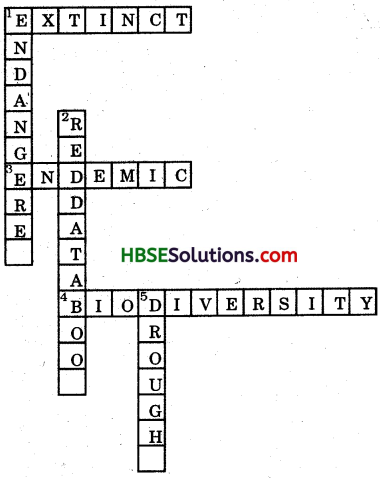
Question 11.
Complete the word puzzle:
Down .
1. Species on the verge of extinction.
2. A book carrying information about endangered species.
5. Consequence of deforestation.
Across
1. Species which have vanished.
3. Species found only in a particular habitat.
4. Variety and variability of a plant, animal and microorganisms.
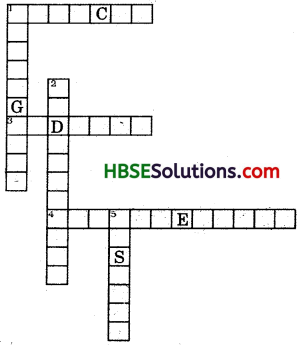
HBSE 8th Class Science Solutions Chapter 7 Conservation of Plants and Animals-1
Answer:
HBSE 8th Class Science Solutions Chapter 7 Conservation of Plants and Animals-2

Extended Learning – Activities And Projects

1. Plant at least five different plants in your locality during this academic year and ensure their maintenance till they grow.
Answer:
For self attempt.

2. Promise yourself that this year you will gift at least 5 plants to your friends and relatives on their achievements, or on occasions like birthdays. Ask your friends to take proper care of these plants and encourage them to gift plants to their friends on such occasions. At the end of the year count the plants that have been gifted through this chain.
Answer:
For self attempt.

3. It is justified to prevent tribals from staying in the core area of the forest? Discuss the matter in your class and note down the points for and against the motion in your notebook.
Answer:
It is not justifiable in my Qpinin to prevent triabls from the core area of a forest. It is their natural habitat. They are not any threats to animals and plants as their life is centred around plants and animals. They don’t destroy forest or kill animals unnecessarily. Forest for them is an important as for other animals and plants.

4. Study the biodiversity of a park nearby. Prepare a detailed report with photographs and sketches of the flora and fauna.
Answer:
For self attempt.

HBSE 8th Class Science Solutions Chapter 7 Conservation of Plants and Animals

5. Make a list of the new information you have gathered from this chapter. Which information did you find the most interesting and why?
Answer:
(i) We have learnt how deforestation is destoryed biodiversity.
(ii) We have learnt about the actual meaning ofbiodiversity.
(iii) We have also gathered new information about extinct and endangerous animals.
(iv) We did not know anything about Red Data Book-but know we have learnt about it through this lesson.

6. Make a list of various uses of papers. Obseve currency notes carefully. Do you find any difference between a currency paper and paper of your notebook? Find out where currency paper is made.
Answer:
Paper is very useful for us.
(i) Our book and notebooks are all made up of paper.
(ii) Most of our currency is made up of paper.
(iii) All legal information and other important information are encoded on papers.
(iv) Paper is used to make bags, containers, package materials, etc. The paper used to make currency is stiffer than the normal paper and is transparent to some extent.

7. Karnataka Government had launched “Project Elephant” to save Asian elephants in the state. Find out about this and other such campaigns launched to protect threatened species.
Answer:
For self attempt.

Activities

Activity No. 7.1

Add more causes of deforestation to your list and classify them into natural and man-made.
Answer:
Natural causes of deforestation:
(i) lightning fires.

Man-made causes of deforestation:
(i) animal grazing.
(ii) Wood for fuel making houses.
(iii) Wood for manufacuring of paper.

Activity No. 7.2

Animal life is also affected by deforestation. How? List the points and discuss them in your class. ,
Answer:
(i) Animals loose their shelter as trees are out.
(ii) There is shortage of food for animals due to deforestation.
(iii) Animals become easy prey to hunters and bigger animals.
(iv) Food chains are disturbed.
(v) Animals have to bear the bad effects of natural calamities.

Activity No. 7.4

List the factors disturbing the biodiversity of your area. Some of these factors and human activities may disturb the biodiversity unknowingly. List these . human activities. How can these be checked? Discuss in your class and write a brief report in or notebook.
Answer:
Main factor affecting biodiversity of an area is cutting of trees and using the forest land for construction and industrialization. Excessive rains or droughts also offer the biodiversity of an area. Certain human activities which give rise to polluting end products also disturb the biodiversity unknowningly. When plants and animals do get clean environment they either fall ill or die, thus disturbance in biodiversity.

Activity No. 7.7

Visit a nearby zoo. Observe the conditions provided to the animals. Were they suitable for the animals? Can animals live in artificial setting instead of their natural habitats? In your opinion, will the animals be confortable in a zoo or in their natural habitat?
Answer:
Conditions provided in a zoo can never be compared with the natural habitat. The condition in a zoo are not exactly suitable for animals, although it is tried best to provide best living conditions to the animals in a zoo. But in my opinion animals be most comfortable in their natural habitat.

HBSE 8th Class Science Solutions Chapter 7 Conservation of Plants and Animals

HBSE 8th Class Science Conservation of Plants and Animals Important Questions and Answers

Very Short Answer Type Questions

Question 1.
What is cutting of forests called?
Answer:
Deforestations

Question 2.
Write any one cause of deforestation.
Answer:
Industrialization.

Question 3.
Name any one natural cause of deforestation.
Answer:
Forest fires.

Question 4.
Write any one consequence of deforestation.
Answer:
Increasing temperature of earth.

Question 5.
What is the process of conversion qf fertile soil into sand called?
Answer:
Desertification.

Question 6.
What are places where wild animals are protected called?
Answer:
Wildlife sanctuary.

Question 7.
What is the part of earth, which supports the biodiversity called?
Answer:
Biosphere reserve.

Question 8.
Name two wildlife sanctuaries hosted by Panchmarhi biosphere reserve.
Answer:
Bori and Panchmarhi.

HBSE 8th Class Science Solutions Chapter 7 Conservation of Plants and Animals

Question 9.
What do you mean by Flora?
Answer:
All plants found in a particular area.

Question 10.
What do you mean by Fauna?
Answer:
All animals in a particular area.

Question 11.
What are species found only in a restricted area called?
Answer:
Endemic species.

Question 12.
Name any fauna of Panchmarhi Biosphere,reserve.
Answer:
Bison.

Question 13.
Name any three endangered species protected in our wildlife sanctuaries.
Answer:
Black buck, white eyed buck, golden cat.

Question 14.
What do National Parks preserve?
Answer:
Flora, fauna, landscape and historical objects.

HBSE 8th Class Science Solutions Chapter 7 Conservation of Plants and Animals

Question 15.
Which is the first Reserve Forest of India?
Answer:
Satpura National Park.

Question 16.
Which prehistoric evidences of human life are found in Satpura National Park?
Answer:
Rock shelters of primitive humans.

Question 17.
When was Project Tiger launched?
Answer:
1st April, 1973.

Question 18.
What are the animals facing the danger of extinction are called?
Answer:
Endangered animals.

Question 19.
Name any one extinct animal.
Answer:
Dinosaurs.

Question 20.
Name the record book having records of all endangered animals and plants.
Answer:
Red Data Book.

Question 21.
Name some migratory birds.
Answer:
Surkhab, Bar Headed Goose, Great Cormorant.

HBSE 8th Class Science Solutions Chapter 7 Conservation of Plants and Animals

Question 22.
How many times a paper can be recycled?
Answer:
5-7 times.

Question 23.
What do we call the restocking the plants by growing new plants?
Answer:
Reforestation.

Question 24.
What is plantation of new plants called?
Answer:
Afforestation.

Question 25.
What is the revised Forest Policy of 1952 called?
Answer:
Forest Act, 1980.

Short Answer Type Questions

Question 1.
What do you mean by deforestation?
Answer:
Indiscriminate cutting of forests for urbanization and industrialization is called deforestation. In simple words, deforestation means to clear the forests and use the land for other purposes.

HBSE 8th Class Science Solutions Chapter 7 Conservation of Plants and Animals

Question 2.
Write some natural causes of deforestation.
Answer:
Natural causes of deforestation are those causes which are not initiated by human beings. Natural phenomenon like lightening on forests cause major forest fires, which can bum a large area of forests. Forest fires due to intense heat cause spontaneous combustion and bums a vast area of forest. Similarly, floods and severe droughts also cause damage to forests.

Question 3.
Write a few consequences of deforestation.
Answer:
Deforestation. has dangerous consequences which prove fatal for wildlife and human life. It gives rise to severe droughts and floods. It converts the fertile land into desert. It increases the temperature of the earth which causes melting of polar ice and glaciers. Many important species of plants, animals and birds become extinct and other stands at the verge of extinction.

Question 4.
How deforestation reduces rainfall?
Answer:
Deforestation disturbs the water cycle and reduces the rainfall. Increased amount of carbondioxide in environment increases the temperature of the earth. Which means there is less amount of water left on the earth. This reduces the evaporation of the water to form clouds thus reduced rainfall.

Question 5.
What do you mean by biodiversity?
Answer:
Biological diversity means the variety of living things existing on earth and their inter-relationship, as well as their relationship with the environment. In other words, variety of plants, animals and microorganisms generally found in an area is called its biodiversity.

Question 6.
What do you mean by endemic species?
Answer:
Species of animals and plants which are only found in a particular geographical area is called endemic species. These plants and animals cannot be found in any other geographical area e.g., wild mango arid gaint squirrel is endemic species of Panchmarhi.

Question 7.
What do you mean by wildlife sanctuaries?
Answer:
Wildlife sanctuaries are the protected areas where wild animals are protected and conserved. The wild animals are provided with their natural habitat. Their poaching and capturing is strictly prohibited m these protected areas.

Question 8.
What is a National Park?
Answer:
National Park is the protected vast area which conserves animals, plants, landscapes and even the historical objects. They are very large areas and can even protect whole sets of ecosystems in them. India has many such National Parks like Satpura National Park, Kaziranga National Park, etc.

HBSE 8th Class Science Solutions Chapter 7 Conservation of Plants and Animals

Question 9.
What are the endangered and extinct animals?
Answer:
Endangered animals are those which are facing the danger to their existence. They are threatened to stop existing on the earth, if not saved. The extinct animals are those which do not exist any more on the earth e.g. Dinosaurs.

Question 10.
What is ecosystem?
Answer:
An ecosystem comprises of all the plants, animals, microorganisms in a particular area alongwith its non-living components like climate, soil, river, deltas etc.

Question 11.
What do you know about Project Tiger?
Answer:
Project Tiger was launched by Gqf*rtnment of India on 1st April, 1973 to enusre the maintenance of a viable populati on of tigers in our country. Tigers are one of the endangered species, so to preserve it Project Tiger was launched.

Question 12.
Why do birds migrate?
Answer:
Birds migrate from one place to another due to change in climate and for specific purposes like breeding etc. When weather in their natural habitat becomes cold they migrate to other lands covering long distances to lay eggs.

Question 13.
How does recycling of paper help preserving trees?
Answer:
Paper is made from the bark of trees. If used paper is recycled to make new papers, it means we do not have to cut more trees. So, recycling paper means protecting trees.

Question 14.
What do you mean by Habitat?
Answer:
Each species can live in particular environment according to their characteristics. So, the natural surroundings of a plant or animal species where they can grow, reproduce and live comfortably are called habitats, e.g. a lion can live in jungle, but not in a city. So jungle is the habitat of the lion.

Long Answer Type Questions

Question 1.
What is Deforestation? Write its causes.
Answer:
Deforestation means indiscriminate cutting of trees in forest. Forest lands are cleared to be used for urbanisation and industrialization.
Following are different causes of deforestation:
(i) Forest land is used for urbanization. As population is growing, so is growing the need for houses. So more and more land is required.
(ii) With growing population, industries are also growing. So the cleared land is used to set-up factories and industries.
(iii) Wood of forest is used for making furniture, doors, windows of buildings etc.
(iv) Wood is cut to use as fuel for cooking.
(v) Some natural causes like forest fires etc. also cause destruction of forests.

HBSE 8th Class Science Solutions Chapter 7 Conservation of Plants and Animals

Question 2.
What are the consequences of deforestation? Explain.
Answer:
Deforestation has dire consequences. Following are the consequences of deforestation:
(i) Deforestation snatches away the natural habitat of many animals, plants and birds. It puts many species in endangered zone and many get extinct.
(ii) Deforestation causes natural calamities like floods, drought etc.
(iii) Reduced rainfall and increase in earth’s temperature has caused problems like Global warming.
(iv) Increased amount of carbondioxide and other gases pollute environment.
(v) Oxygen level is decreased as well as the water level.
(vi) Fertile top layer of soil gets converted into desert.

Question 3.
What is done for the conservation of wildlife?
Answer:
Various measures are taken to conserve wildlife. Reserved and protected areas like Biosphere reserve, Wildlife sanctuaries and National parks are formed.

Biosphere Reserves are the areas which support biodiversity and culture of the reserved area. Biosphere Reserve is a vast area which contains many other protected areas.

Wildlife Sanctuaries are the areas where wild animals are conserved and protected. It is the area which is restricted and activities like killing of animals and capturing of animals are strictly prohibited.

National Parks: National Parks are meant to protect and preserve flora, fauna, landscapes and historical objects of an area. They not only protect the living organisms, but also the non-living things of that particular area.

Question 4.
What do you mean by Endemic Species? Write about any three species endemic to India.
Answer:
Species of animals and plants comfined to certain specific geographical areas are called endemic species. Following are the three species of animals endemic to India.
(i) Lion-tailed macaque:
This animal got his name from its tail which is 25 cm in length and has a tuft at the end like that of lion’s which is black in colour. It is endemic to south-west India an is one of the most threatened primates.

(ii) Asiatic lion:
Asiatic lion is now endemic to Gir National Patk only as it is believed that the last remnants of this species are found in Gir National Park in Gujarat only.

(iii) Nilgiri ibex:
These stocky goats possessing short coarse fur and a bristly main are endemic to Nilgiri Hills and the Southern postion of the Western Ghats range in Tamil Nadu and Kerela. It is actually called Nilgiri Thar and Nilgiri ibex is its local name.

Question 5.
What is migration and why animals migrate?
Answer:
Movements of animals in large number from one place to another place to escape unfavourable conditions is called migration. Animals migrate for specific purposes. When the purpose is solved, they usually come back to their endemic area.

Migration can be due to unfavourable environmental conditions, eg. The Arctic Tern migrate to Antarctic to spend its winlers. Some birds of colder regions migrate to Asiatic countries during winters. This type of migration is called seasonal migration which occur in many species of insects, birds, marine mammals and herbivorous mammals.

Migration is also done for better food or water availability in other regions due to temperature and other climatic conditions.
Some species of animals and birds also migrate for the purpose of reproduction e.g. fresh watereeds go to saltwaters from freshwater to lay eggs.

HBSE 8th Class Science Solutions Chapter 7 Conservation of Plants and Animals

Question 6.
What is poaching? How is it done by anti social elements and for what purpose?
Answer:
Illegal hunting of animals is called poaching. Anti-social element some time create a nexus with the forest staff for poaching; They hunt the animals for selling their skin, horn, fur and hides.

All valuable parts of these animals are used for various purposes and are sold at very high prices.
Uses for ornaments: The bones and other parts like trunks of elephants etc. are used to make ornaments.
Uses in medicines: The horns and bones of some animals like rhinoceros and tigers are used to prepare some traditional medicine specially in Asian countries.
For wall hanging and clothings: The skin, fur and hides are used for the clothing. Mufflers, coats, jackets, skirts etc. are made using leather and fur of the animals like cats, minks, bears foe fur, skin of alligators and snakes and deer and cattle are killed for leather.

Question 7.
Write a short note op migratory birds.
Answer:
Migratory birds are those birds which migrate from their natural habitat to far off areas for breeding. When the natural habitat o.f these birds become very cold, they fly off to distant lands to lay eggs, as climate there is suitable for their breding. They always fly to a specific area every year at a specific period. They migrate in groups to escape the inhospitable climate of their natural habitat.

Birds like Surkhab fly to India from Malyasia. Other birds like Bar Headed Goose, Great Cormorant etc. are also migratory birds.

Question 8.
Recycling of paper helps to protect forest and environment. Explain.
Answer:
Paper is made from trees. Innumerable trees are cut to manufacture paper. If we recycle used paper, we will not have to cut trees to manufacture new paper. Each paper can be recycled 5-7 times and can be used. If we do not throw paper here or there and collect it to be sold to the Kabadiwala, we sire saving our green wealth. It will also save the chemicals used to prepare paper and also the energy used for preparing it. The wastage mid garbage produced during this process will also be reduced and environment will remain clean.

Question 9.
How can we save CHIT green wealth?
Answer:
Our forests are our wealth. We should not destory them but conserve them. To conserve our forests, first of all we should stop cutting them. We should plant as many plants as we cut, so that the number of trees remain unchanged. People should be made aware of the bad effects of deforestation and they should be made familiar with the advantages of the trees for us. Community plantation programmes should be encouraged. Students should be encouraged to plant one plant every year. Plantation of trees is not sufficient. They need proper look after too. So, the tree we plant, should be nourished and taken care of.

Conservation of Plants and Animals Class 8 HBSE Notes

1. A vast variety of plants and animals exist on earth.
2. Deforestation is a threat to the survival of these plants and animals as major varieties of plants and animals are present in forests.
3. Indiscriminate cutting of forests is called deforestation. Land cleared by deforestation is used for other purposes too.
4. Trees cut from these forests are used to make furnitures, papers, houses and is also used as . fuel.
5. Deforestation causes floods, droughts, infertility of soil and many other natural calamities.
6. Soil looses humous due to deforestation and becomes sand, thus deforestation converts a fertile land into a desert and it is called desertification.
7. We should conserve our forests by planting more and more trees which is called afforestation. For conservation of animals; wildlife sancturies and hational parks are formed. They give shelter to our wildlife and help to preserve our endangered species of plants and animals.
8. Variety pf life existing on earth and their inter-relation is called biodiversity. In other words biodiversity is variety of plants and animals and microorganisms generally found in a specific area. Such life is supported by the area called Biosphere.
9. Species ofplants and animals exclusively found in a restricted area are called Endemic species. They are not found in any other geographical area.
10. These species which are at the verge of extinction are called endangered species.
11. Red Data Book contains a record of the endangered species.
HBSE 8th Class Science Solutions Chapter 7 Conservation of Plants and Animals Read More »