Author name: obul

HBSE 12th Class Biology Important Questions and Answers

Haryana Board HBSE 12th Class Biology Important Questions and Answers

HBSE 12th Class Biology Important Questions in Hindi Medium

HBSE 12th Class Biology Important Questions in English Medium

  • Chapter 1 Reproduction in Organisms Important Questions
  • Chapter 2 Sexual Reproduction in Flowering Plants Important Questions
  • Chapter 3 Human Reproduction Important Questions
  • Chapter 4 Reproductive Health Important Questions
  • Chapter 5 Principles of Inheritance and Variation Important Questions
  • Chapter 6 Molecular Basis of Inheritance Important Questions
  • Chapter 7 Evolution Important Questions
  • Chapter 8 Human Health and Diseases Important Questions
  • Chapter 9 Strategies for Enhancement in Food Production Important Questions
  • Chapter 10 Microbes in Human Welfare Important Questions
  • Chapter 11 Biotechnology: Principles and Processes Important Questions
  • Chapter 12 Biotechnology and Its Applications Important Questions
  • Chapter 13 Organisms and Populations Important Questions
  • Chapter 14 Ecosystem Important Questions
  • Chapter 15 Biodiversity and Conservation Important Questions
  • Chapter 16 Environmental Issues Important Questions

HBSE 12th Class Biology Important Questions and Answers Read More »

HBSE 9th Class Maths Notes Haryana Board

Haryana Board HBSE 9th Class Maths Notes

HBSE 9th Class Maths Notes in English Medium

HBSE 9th Class Maths Notes in Hindi Medium

HBSE 9th Class Maths Notes Haryana Board Read More »

HBSE 10th Class Maths Important Questions and Answers

Haryana Board HBSE 10th Class Maths Important Questions and Answers

HBSE 10th Class Maths Important Questions in English Medium

  1. Real Numbers Class 10 Important Questions
  2. Polynomials Class 10 Important Questions
  3. Pair of Linear Equations in Two Variables Class 10 Important Questions
  4. Quadratic Equations Class 10 Important Questions
  5. Arithmetic Progressions Class 10 Important Questions
  6. Triangles Class 10 Important Questions
  7. Coordinate Geometry Class 10 Important Questions
  8. Introduction to Trigonometry Class 10 Important Questions
  9. Some Applications of Trigonometry Class 10 Important Questions
  10. Circles Class 10 Important Questions
  11. Constructions Class 10 Important Questions
  12. Areas related to Circles Class 10 Important Questions
  13. Surface Areas and Volumes Class 10 Important Questions
  14. Statistics Class 10 Important Questions
  15. Probability Class 10 Important Questions

HBSE 10th Class Maths Important Questions in Hindi Medium

HBSE 10th Class Maths Important Questions and Answers Read More »

HBSE 10th Class Maths Notes Chapter 1 वास्तविक संख्याएँ

Haryana State Board HBSE 10th Class Maths Notes Chapter 1 वास्तविक संख्याएँ Notes.

Haryana Board 10th Class Maths Notes Chapter 1 वास्तविक संख्याएँ

→ यूक्लिड विभाजन प्रमेयिका- दो धनात्मक पूर्णाक a और b दिए होने पर, ऐसी अद्वितीय पूर्ण संख्याएँ q और r विद्यमान होती हैं कि a = bq + r, 0 ≤ r < b है।

→ यूक्लिड विभाजन एल्गोरिम द्वारा- दो धनात्मक पूर्णाकों, c और d(c > d) का HCF ज्ञात करने के लिए नीचे दिए हुएं चरणों का अनुसरण किया जाता है-
चरण I-c और के लिए यूक्लिड विभाजन प्रमेयिका से हम ऐसे q और r ज्ञात करते हैं कि c = dq + r, 0 ≤ r < d हो।
चरण II-यदि r = 0 है, तो d पूर्णाको c और d का HCF है। यदि r ≠ 0 है, तो और के लिए, यूक्लिड विभाजन प्रमेविका का प्रयोग पुनः कीजिए।
चरण III-इस प्रक्रिया को तब तक जारी रखिए, जब तक शेषफल 0न प्राप्त हो जाए। इसी स्थिति में, प्राप्त भाजक ही वांछित HCF है।

→ अंकगणित की आधारभूत प्रमेय- प्रत्येक भाज्य संख्या को अभाज्य संख्याओं के एक गुणनफल के रूप में व्यक्त (गुणनखडित) किया जा सकता है तथा यह गुणनखंडन अभाज्य गुणनखंडों के आने वाले क्रम के बिना अद्वितीय होता है।

→ यदि p कोई अभाज्य संख्या है और p, a2 को विभाजित करता है तो p, a को भी विभाजित करेगा, जहाँ a एक धनात्मक पूर्णाक है।

→ किन्हीं दो धनात्मक पूर्णांकों a और b के लिए HCF(a, b) × LCM(a, b) = a × b होता है।

→ परिमेय और अपरिमेय संख्याएँ मिलकर वास्तविक संख्याएँ बनाती हैं।

→ \(\sqrt{2}\), \(\sqrt{3}\), \(\sqrt{5}\) तथा व्यापक रूप में \(\sqrt{p}\) अपरिमेय संख्याएँ हैं, जहाँ पर p एक अभाज्य संख्या है।

HBSE 10th Class Maths Notes Chapter 1 वास्तविक संख्याएँ

→ यदि x एक परिमेय संख्या हो जिसका दशमलब प्रसार सांत हो, तो हम x को \(\frac{p}{q}\) के रूप में व्यक्त कर सकते हैं, जहाँ p औरq सहअभाज्य होते हैं तथा q का अभाज्य गुणनखंडन 2n5m के रूप का होता है, जहाँ n, m प्रणेतर पूर्णाक होते हैं।

→ माना x = \(\frac{p}{q}\) एक ऐसी परिमेय संख्या है कि q का अभाज्य गुणनखंडन 2n5m के रूप का है, (जहाँ n, m ऋणेतर पूर्णाक है) तो x का दशमलव प्रसार सांत होगा।

→ माना x = \(\frac{p}{q}\) एक ऐसी परिमेय संख्या है कि q का अभाज्य गुणनखंडन 2n5m के रूप का नहीं है, (जहाँ n, m ऋणेतर पूर्णाक है) तो x का दशमलव प्रसार असांत आवर्ती होगा।

→ किन्हीं तीन संख्याओं p, q तथा r के लिए LCM होगा-
HBSE 10th Class Maths Notes Chapter 1 वास्तविक संख्याएँ 1

→ किन्हीं तीन संख्याओं P, q तथा r के लिए HCF होगा-
HBSE 10th Class Maths Notes Chapter 1 वास्तविक संख्याएँ 2

→ एक परिमेय संख्या और एक अपरिमेय संख्या का योग या अंतर एक अपरिमेय संख्या होती है।

→ एक शून्येतर परिमेय संख्या और एक अपरिमेय संख्या का गुणनफल या भागफल एक अपरिमेय संख्या होती है।

HBSE 10th Class Maths Notes Chapter 1 वास्तविक संख्याएँ Read More »

HBSE 10th Class Maths Notes Haryana Board

Haryana Board HBSE 10th Class Maths Notes

HBSE 10th Class Maths Notes in English Medium

HBSE 10th Class Maths Notes in Hindi Medium

HBSE 10th Class Maths Notes Haryana Board Read More »

HBSE 10th Class Maths Important Questions Chapter 1 Real Numbers

Haryana State Board HBSE 10th Class Maths Important Questions Chapter 1 Real Numbers Important Questions and Answers.

Haryana Board 10th Class Maths Important Questions Chapter 1 Real Numbers

Short/Long Answer Type Questions

Question 1.
Show that square of any positive integer cannot be of the form (54 + 2) or (5q + 3) for any integer q.
OR
Prove that one of three consecutive positive integer is divisible by 3.
Solution :
Let be any positive integer and applying Euclid’s division Lemma it is of the form 5. For 5P + 1 or 5P + 2 or 5P + 3 or 5P + 4.
So, we have the following cases
Case I : When x = 5P
⇒ x2 = 25P2 = 5 (5P2)
⇒ x2 = 5q [Where q = 5P2]

Case II : When
x = 5P + 1
x2 = (5P + 1)2
= 25p2 + 10P + 1
= 5(5P2 + 2P) + 1
= 59 +1
[Where q = 5P2 + 2P]

Case III : When x = 5P + 2
x2 = (5P + 2)2
= 25P2 + 20P + 4
= 5(5P2 + 4P) + 4
= 59 + 4
(Where q = 5P2 + 4P)

Case IV : When x = 5P + 3
⇒ x2 = (5P + 3)2
= 25P2 + 30P + 4
= 25P2 + 30P + 5 + 4
= 5 (5P2 + 6P + 1) + 4
= 5 + 4
(Where q = 5P2 + 6P + 1)

Case V : When x = 5P + 4
⇒ x2 = (5P + 4)2
= 25P2 + 40P + 16
= 25P2 + 40P + 15 + 1
= 5(5P2 + 8P + 3) + 1
= 5q + 1
(Where q = 5P2 + 8P + 3)
So, square of any positive integer cannot be of the form (5q + 2) or (5q + 3).
Or
Solution :
Let x be any positive integer. By Euclid’s division lemma x = 3q + r, where 0 < r ≤ 3
[∴ r = 0, 1, 2]
Putting r = 0, we get
x = 3q + 0 = 3q which is divisible by 3.

Putting r = 1, we get
x = 3q + 1 which is not divisible by 3.

Putting r = 2, we get
x = 3q + 2, which is not divisible by 3.
So, one of every three consecutive positive integers is divisible by 3.

HBSE 10th Class Maths Important Questions Chapter 1 Real Numbers

Question 2.
If n is an odd integer, then show that n2 – 1 is divisible by 8.
Solution :
We know that any odd positive integer x can be written in form 4q + 1 or 4q + 3
So, according to the question
Case I : When x = 4q + 1
Then, x2 – 1 = (4q + 1)2 – 1
= 16q2 + 8q + 1 – 1
= 89 (2q + 2) …(1)
Which is divisible by 8.

Case II : When x = 4q + 3
Then, x2 – 1 = (4q + 3)2 – 1
= 16q2 + 24q + 9 – 1
= 16q2 + 24q + 8
= 8(2q2 + 3 + 1) ………(2)
Which is divisible by 8. Therefore, from equations (1) and (2), it is clear that, if x is an odd positive integer. x2 – 1 is divisible by 8.

Question 3.
What is the HCF of the smallest prime number and the smallest composite number,
Solution :
Smallest prime number = 2
Smallest composite number = 4
∴ 2 = 2
and 4 = 2 × 2 = 22
HCF of (2, 4) 2.

HBSE 10th Class Maths Important Questions Chapter 1 Real Numbers

Question 4.
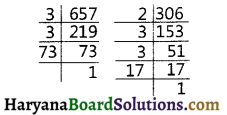
Write the smallest number which is divisible by both 306 and 657.
Solution :
The required smallest number is the LCM of 306 and 657.
We have 306 = 2 × 3 × 3 × 17
= 2 × 32 × 17
And 657 = 3 × 3 × 73
= 32 × 73
LCM (306, 657) = 2 × 32 × 17 × 73
= 22938
HBSE 10th Class Maths Important Questions Chapter 1 Real Numbers - 1a
Hence, the required smallest number = 22338

Question 5.
The length, breadth and height of a room are 8m 50cm, 6m 26cm and 4m 75cm respectively. Find the length of longest rod that can measure the dimensions of the room exactly.
Solution :
Dimensions of a room are:
Length = 8m 50cm = 850 cm.
Breadth = 6m 25cm = 625 cm
And Height = 4m 75cm = 475 cm.
The required length of longest rod is the HCF of 850 cm, 625 cm and 475 cm.
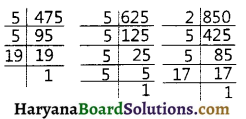
850 = 2 × 5 × 5 × 17
= 2 × 52 × 17
625 = 5 × 5 × 5 × 5 = 54 And
475 = 5 × 5 × 19 = 52 × 19
HBSE 10th Class Maths Important Questions Chapter 1 Real Numbers - 2a
HCF of (850, 625, 475) = 52 = 25 cm
Hence, required length of longest rod = 25 cm.

HBSE 10th Class Maths Important Questions Chapter 1 Real Numbers

Question 6.
State the fundamental theorem of Arithmetic. Find the LCM of numbers 2520 and 10530 by prime factorization method.
Solution :
Fundamental Theorem of Arithmetic : Every composite number can be expressed (or factorized) as a product of primes, and this factorisation is unque, apart from the order in which the prime factors occur. Then factorisation of x can be written as x = P1 × P2 × P3, × ………. Px, Where P1, P2, ……..Px are primes and written in ascending order.
So, we have
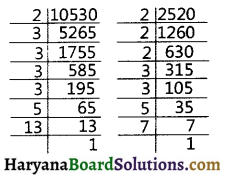
2520 = 2 × 2 × 2 × 3 × 3 × 5 × 7
= 23 × 32 × 5 × 7
And 10530 = 2 × 3 × 3 × 3 × 3 × 5 × 13
= 2 × 34 × 5 × 13
LCM (2520, 10530) = 23 × 34 × 5 × 7 × 13
= 294840
HBSE 10th Class Maths Important Questions Chapter 1 Real Numbers - 3a

Question 7.
Show that 3\(\sqrt{7}\) is an irrational number.
Solution :
Let us assume that 3\(\sqrt{7}\) is a rational. It can be expressed as form of \(\frac {a}{b}\),where a and b are coprime positive integers and b ≠ 0.
∴ 3\(\sqrt{7}\) = \(\frac {a}{b}\)[HCF of a and b is 1 and b ≠ 0]
⇒ \(\sqrt{7}\) = \(\frac {a}{3b}\) ……………(1)
⇒ \(\frac {a}{3b}\) = rational
[∵ a and b are positive integers]
So, from equ. (1) \(\sqrt{7}\) is rational number. But this contradicts the fact \(\sqrt{7}\) is irrational number. So, our asumption that 3\(\sqrt{7}\) is an irrational number, is wrong.
Hence, that \(\sqrt{6}\) is an irrational numbers.

Question 8.
Prove that \(\sqrt{6}\) is an irrational number.
Solution :
Let us assume that \(\sqrt{6}\) is rational. It can be express in the form of \(\frac {a}{3b}\), where a and b are coprime positive integers and b ≠ 0.
∴ \(\sqrt{6}\) = \(\frac {a}{b}\) (Where a and b are coprime ∴ HCF of a and b = 1 ……..(i)
⇒ 6 = \(\frac{a^2}{b^2}\) (Squaring both sides)
⇒ 6b2 = a2 ……………(i)
Therefore 6 divides a2. It follows that 6 divides a.
[By theorem 1.3]
Let a = 6c and put this value in equ. (i) we get
6b2 = (6c)2
⇒ 6b2 = 36c2
⇒ \(\frac{36 c^2}{6}\) = b2
⇒ 6c2 = b2 ………..(ii)

It means b2 is divisible by 6. It follows that b, is divisible by 6.
(By theorem 1.3)
From equations (i) and (ii) we say that 6 is a common factor of both a and b. But this contradicts the fact that a and b are coprime, so we have no common factor. So, our assumption that \(\sqrt{6}\) is a rational number is wrong. Therefore, \(\sqrt{6}\) is an irrational number. Proved.

HBSE 10th Class Maths Important Questions Chapter 1 Real Numbers

Question 9.
Given that \(\sqrt{2}\) is an irrational number, then prove that (5 + 3\(\sqrt{2}\)) is an irrational number.
Solution :
Let us assume that 5 + 3\(\sqrt{2}\) is a rational number. It can be express in the form of \(\frac {a}{b}\), where a and b are coprime positive integers and b ≠ 0.
∴ 5 + 3\(\sqrt{2}\) = \(\frac {a}{b}\)
[Where HCF of a and b = 1]
⇒ 5 – \(\frac {a}{b}\) = 3\(\sqrt{2}\)
⇒ \(\frac{5 b-a}{b}\) = 3\(\sqrt{2}\)
⇒ \(\frac{5 b-a}{3}\) = \(\sqrt{2}\)
∵ a and b are positive integers
⇒ \(\frac{5 b-a}{3}\) is rational
Therefore, \(\sqrt{2}\) is rational But given that \(\sqrt{2}\) is irrational. So, our assumption that 5 + 3\(\sqrt{2}\) is rational is wrong.
Hence, 5 + 3\(\sqrt{2}\) is an irrational number.
Proved.

Question 10.
What type of decimal expansion does a rational number has? How can you distinguish it from decimal expansion of irrational numbers?
Solution :
A rational number may has its decimal expansion either terminating decimal expansion or a non-terminating repeating. But an irrational number has its decimal expansion non-repeating and non-terminating.

HBSE 10th Class Maths Important Questions Chapter 1 Real Numbers

Question 11.
Write whether rational number \(\frac {7}{75}\) will have terminating decimal expansion or a non-terminating decimal.
Solution :
= \(\frac{7}{3 \times 5^2}\)
Since, denominator of given rational number is not form 2m × 5n.
Hence, it is non-terminating decimal expansion

Question 12.
After how many decimal places will the decimal expansion of \(\frac{23}{2^4 \times 5^3}\) terminate?
Solution :
We have
\(\frac{23}{2^4 \times 5^3}=\frac{23 \times 5}{2^4 \times 5^3 \times 5}=\frac{23 \times 5}{2^4 \times 5^4}\)
= \(\frac{115}{(10)^4}=\frac{115}{10000}\) = 0.0115
Hence, \(\frac{23}{2^4 \times 5^3}\) will terminate after 4 decimal places.

Fill in the Blanks

Question 1.
The sum or difference of a rational and an irrational number is.
Solution :
irrational

HBSE 10th Class Maths Important Questions Chapter 1 Real Numbers

Question 2.
Every composite number can be factorized as the product of ………….
Solution :
primes

Question 3.
The product and quotient of a …………..rational and irrational number is irrational.
Solution :
non-zero

Question 4.
………………is the least prime and…………is the least composite number.
Solution :
2, 4

Question 5.
The HCF of two co-prime numbers is always …………..
Solution :
1

HBSE 10th Class Maths Important Questions Chapter 1 Real Numbers

Question 6.
If a and b are co-primes, then a2 and b2 are …………….
Solution :
co-prime.

Multiple Choice Questions

Question 1.
Euclid’s division Lemma states that for two positive integers a and b, there exists unque integers q and r satisfying a = bq + r, and :
(a) o < r < b (b) 0 > r ≤ b
(c) 0 ≤ r < b
(d) 0 ≤ r ≤ b
Solution :
(c) 0 ≤ r < b

Question 2.
The total number of factors of prime numbers is :
(a) 1
(b) 0
(c) 2
(d) 3
Solution :
(c) 2
∵ We know that prime numbers h only two factors 1 and number itself.

HBSE 10th Class Maths Important Questions Chapter 1 Real Numbers

Question 3.
Sum of the exponents of prime factors in the prime factorization of 196 is :
(a) 3
(b) 4
(c) 5
(d) 2
Solution :
(b) 4
∵ We have 196 = 2 × 2 × 7 × 7
= 22 × 72
It’s sum of exponents
= 2 + 2 = 4

Question 4.
The HCF and LCM of 12, 21, 15 respectvely are :
(a) 3, 140
(b) 12, 420
(c) 3, 420
(d) 420, 3
Solution :
(c) 3, 420
We have 12 = 2 × 2 × 3 = 22 × 3
21 = 3 × 7 × 3 × 7 and
15 = 3 × 5 = 3 × 5
LCM (12, 21, 15) = 22 × 3 × 5 × 7 = 420
And HCF (12, 21, 15) = 3
So, HCF and LCM of (12, 21, 15) = 3, 420

Question 5.
Which of the following rational number.
(a) \(\frac {1}{2}\)
(b) \(\frac {1}{2}\)
(c) \(\frac{343}{2^3 \times 5^2 \times 7^3}\)
(d) \(\frac{31}{2^4 \times 3^5}\)
Solution :
(c) \(\frac{343}{2^3 \times 5^2 \times 7^3}\)

HBSE 10th Class Maths Important Questions Chapter 1 Real Numbers

Question 6.
The decimal representation of \(\frac{11}{2^3 \times 5}\) will :
(a) terminate after 1 decimal place
(b) terminate after 2 decimal place
(c) terminate after 3 decimal place
(d) not terminate
Solution :
(c) terminate after 3 decimal place
∵ Since, \(\frac{11}{2^3 \times 5}=\frac{11}{8 \times 5}=\frac{11}{40}\) = 0.275
So, \(\frac{11}{2^3 \times 5}\) will terminate after 3 decimal places.

HBSE 10th Class Maths Important Questions Chapter 1 Real Numbers Read More »

HBSE 10th Class Social Science Solutions Geography Chapter 1 संसाधन एवं विकास

Haryana State Board HBSE 10th Class Social Science Solutions Geography Chapter 1 संसाधन एवं विकास Textbook Exercise Questions and Answers.

Haryana Board 10th Class Social Science Solutions Geography Chapter 1 संसाधन एवं विकास

HBSE 10th Class Geography संसाधन एवं विकास Textbook Questions and Answers

संसाधन एवं विकास Class 10 Questions Answer Geography

1. बहुवैकल्पिक प्रश्न

(i) लौह अयस्क किस प्रकार का संसाधन है?
(क) नवीकरण योग्य
(ख) प्रवाह
(ग) जैव
(घ) अनवीकरण योग्य
उत्तरः
(घ) अनवीकरण योग्य

HBSE 10th Class Social Science Solutions Geography Chapter 1 संसाधन एवं विकास

(ii) ज्वारीय ऊर्जा निम्नलिखित में से किस प्रकार का संसाधन है?
(क) पुनः पूर्ति योग्य
(ख) अजैव
(ग) मानवकृत
(घ) अचक्रीय
उत्तरः
(क) पुनः पूर्ति योग्य

(iii) पंजाब में भूमि निम्नीकरण का निम्नलिखित में से मुख्य कारण क्या है?
(क) गहन खेती
(ख) अधिक सिंचाई
(ग) वनोन्मूलन
(घ) अति पशुचारण
उत्तरः
(ख) अधिक सिंचाई

(iv) निम्नलिखित में से किस प्रांत में सीढ़ीदार (सोपानी) कृषि की जाती है?
(क) पंजाब
(ख) उत्तर प्रदेश के मैदान
(ग) हरियाणा
(घ) उत्तरांचल
उत्तरः
(घ) उत्तराखण्ड

Class 10th Sansadhan Evam Vikas HBSE Geography

HBSE 10th Class Social Science Solutions Geography Chapter 1 संसाधन एवं विकास

(v) इनमें से किस राज्य में काली मृदा (मिट्टी) पाई जाती है?
(क) जम्मू और कश्मीर
(ख) राजस्थान
(ग) गुजरात
(घ) झारखंड
उत्तरः
(ग) गुजरात

संसाधन एवं विकास कक्षा 10 प्रश्न उत्तर HBSE Geography

2. निम्नलिखित प्रश्नों के उत्तर लगभग 30 शब्दों में दीजिए।

(i) तीन राज्यों के नाम बताएँ जहाँ काली मृदा पाई जाती है। इस पर मुख्य रूप से कौन सी फसल उगाई जाती
है?
उत्तरः
जहाँ काली मृदा पाई जाती है वे तीन राज्य निम्नलिखित हैं
(i) महाराष्ट्र (ii) मालवा (iii) मध्यप्रदेश
काली मृदा (मिट्टी) कपास की खेती के लिए मुख्य रूप से उपयुक्त मानी जाती है। काली मृदा को ‘रेगर’ मृदा भी कहते हैं।

(ii) पूर्वी तट के नदी डेल्टाओं पर किस प्रकार की मृदा पाई जाती है? इस प्रकार की मृदा की तीन मुख्य विशेषताएँ क्या हैं?
उत्तरः
पूर्वी तट के नदी डेल्टाओं पर जलोढ़ मृदा पाइ जाती है।
जलोढ़ मृदा की तीन प्रमुख विशेषताएँ निम्नलिखित है
(ii) जलोढ़ मृदा में रेत, सिल्ट और मृत्तिका के विभिन्न अनुपात पाए जाते हैं।
(iii) अधिकांशतः जलोढ़ मृदाएँ पोटाश, फास्फोरस और चूनायुक्त होती है।

(iii) पहाड़ी क्षेत्रों में मृदा अपरदन की रोकथाम के लिए क्या कदम उठाने चाहिए?
उत्तरः
पहाड़ी क्षेत्रों में मृदा अपरदन की रोकथाम हेतु निम्नलिखित कदम उठाने चाहिए
(क) ढाल वाली भूमि पर कृषि हेतु सोपान बनाने चाहिए।
(ख) वृक्षों को पंक्तिबद्ध कर रक्षक (Shelter belt) मेखला बनाना।
(घ) पशुचारण रोककर

(iv) जैव और अजैव संसाधन क्या होते हैं? कुछ उदाहरण दें।
उत्तरः
जैव संसाधन-इन संसाधनों की प्राप्ति जीवमंडल होती है और इनमें जीवन व्याप्त रहता है। उदाहरणार्थ-मानव, प्राणिजात, वनस्पति जात, मत्स्य-जीवन, पशुधन आदि।
अजैव संसाधान-ऐसे संसाधन निर्जीव वस्तुओं से निर्मित है। उदाहरणार्थ-चट्टानें और धातुएँ।

संसाधन एवं विकास HBSE 10th Class Geography

3.निम्नलिखित प्रश्नों के उत्तर लगभग 120 शब्दों में दीजिए।

(i) भारत में भूमि उपयोग प्रारूप का वर्णन करें। वर्ष 1960-61 से वन के अंतर्गत क्षेत्र में महत्त्वपूर्ण वृद्धि नहीं हुई, इसका क्या कारण है?
उत्तर:
भारत में भूमि उपयोग प्रारम्भ 2002-2003 भारत का कुल भौगोलिक क्षेत्रफल 32.8 लाख वर्ग कि.मी. है परन्तु इसके 93% भाग के ही भू-उपयोग आँकड़े प्राप्त हैं। स्थायी चरागाहों के अन्तर्गत भूमि कम हुई है। वर्तमान परती भूमि के अलावा अन्य परती भूमि अनुपजाऊ है। शुद्ध (निवल) बोये गए क्षेत्र का प्रतिशत भी विभिन्न राज्यों में भिन्न-भिन्न है। पंजाब और हरियाणा में 80% भूमि पर तो अरुणाचल प्रदेश, मिजोरम, मणिपुर और अंडमान निकोबार दीपसमूह में 10% से भी कम क्षेत्र बोया जाता है।

भारत में वनों के अन्तर्गत 33% भौगोलिक क्षेत्र वांछित है। जिसकी तुलना में वन के अन्तर्गत क्षेत्र काफी कम है। वन क्षेत्रों के आस-पास रहने वाले लाखों लोगों की आजीविका इस पर आश्रित है। गैर कृषि प्रयोजनों में लगाई भूमि में बस्तिया. सड़कें, रेल लाइन, उद्योग इत्यादि आते हैं। लम्बे समय तक निरन्तर भूमि संरक्षण और प्रबन्धन की अवहेलना करने एवं निरन्तर भू-उपयोग के कारण भू-संसाधनों का निम्नीकरण हो रहा है। इसके कारण पर्यावरण पर गंभीर आपदा आ सकती है।
वर्ष 1960-61 से वन के अन्तर्गत क्षेत्र में महत्त्वपूर्ण वृद्धि नहीं हो पाई क्योंकि बड़े पैमाने पर वनों की कटाई की जा रही है।

(ii) प्रौद्योगिक और आर्थिक विकास के कारण संसाधनों का अधिक उपभोग कैसे हुआ है?
(क) उद्योगों की स्थापना के परिणामस्वरूप अधिक उत्पादन होता है जिसके अधिक कच्चे माल की आवश्यकता होती है।
(ख) आर्थिक विकास के फलस्वरूप लोगों की आय में वृद्धि होने से भी अधिक मात्र में उत्पादों की आवश्यकता होती है।
उपरोक्त कारणों से संसाधनों का अधिक उपयोग होता है। परन्तु संसाधनों का विवेकहीन उपभोग और अति उपभोग के कारण कई सामाजिक-आर्थिक और पर्यावरणीय समस्याएँ पैदा हो सकती है। गांधी जी ने संसाधनों के संरक्षण पर अपनी इन शब्दों में व्यक्त की है-“हमारे पास हर व्यक्ति की आवश्यकता पूर्ति हेतु बहुत कुछ है, लेकिन किसी के लालच की संतुष्टि के लिए नहीं। अर्थात् हमारे पास पेट भरने के लिए बहुत है लेकिन पेटी भरने के लिए नहीं।

यहाँ यह कहना अति आवश्यक है कि संसाधनों के अधि क उपयोग से अनवीकरण संसाधनों की जैसे-पेट्रोल, डीजल, गैस आदि शीघ्र समाप्त होने की संभावना बन गई है। यह चिन्ताजनक विषय है।

संसाधन एवं विकास के प्रश्न उत्तर HBSE 10th Class Geography

HBSE 10th Class Social Science Solutions Geography Chapter 1 संसाधन एवं विकास

परियोजना/क्रियाकलाप

1. अपने आस पास के क्षेत्रों में संसाधनों के उपभोग और संरक्षण को दर्शाते हुए एक परियोजना तैयार करें।
2. आपके विद्यालय में उपयोग किए जा रहे संसाधनों के संरक्षण विषय पर अपनी कक्षा में एक चर्चा आयोजित करें।
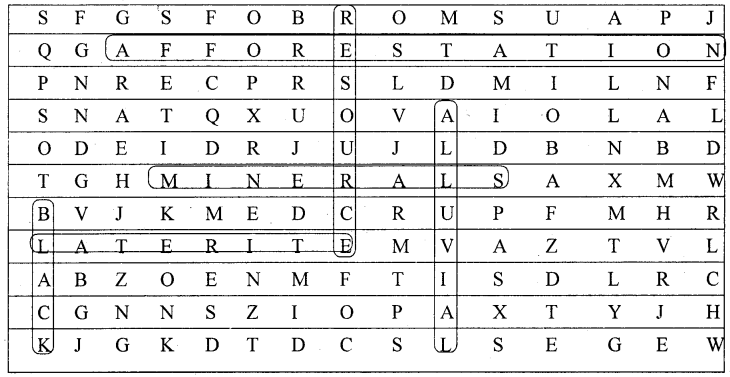
3. वर्ग पहेली को सुलझाएँ ऊर्ध्वाधर और क्षैतिज छिपे उत्तरों को ढूंढे।
नोट : पहेली के उत्तर अंग्रेजी के शब्दों में हैं।
HBSE 10th Class Social Science Solutions Geography Chapter 1 संसाधन एवं विकास 1

(i) भूमि, जल, वनस्पति और खनिजों के रूप में प्राकृतिक सम्पदा
(ii) अनवीकरण योग्य संसाधन का एक प्रकार
(iii) उच्च नमी रखाव क्षमता वाली मृदा
(iv) मानसून जलवायु में अत्यधिक निक्षालित मृदाएँ
(v) मृदा अपरदन की रोकथाम के लिए बृहत् स्तर पर पेड़ लगाना
(vi) भारत के विशाल मैदान इन मृदाओं से बने हैं।
उत्तर-
(i) RESOURCE,
(ii) MINERALS,
(iii) BLACK,
(iv) LATERITE,
(v) AFFORESTATION,
(vi) ALLUVIAL.

HBSE 10th Class Social Science Solutions Geography Chapter 1 संसाधन एवं विकास Read More »

HBSE 9th Class Maths Important Questions Chapter 1 Number Systems

Haryana State Board HBSE 9th Class Maths Important Questions Chapter 1 Number Systems Important Questions and Answers.

Haryana Board 9th Class Maths Important Questions Chapter 1 Number Systems

Very Short Answer Type Questions

Question 1.
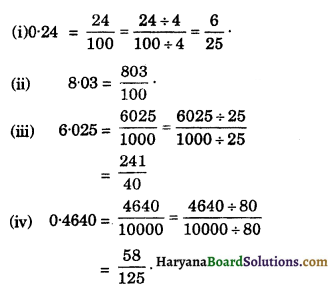
Convert the following decimal number in the form
(i) 0.24
(ii) 8.03
(iii) 6.025
(iv) 0.4640.
Solution :
HBSE 9th Class Maths Important Questions Chapter 1 Number Systems - 1

Question 2.
Give an example of each, two irrational numbers whose :
(i) difference is an irrational number.
(ii) sum is an irrational number.
(iii) product is an irrational number.
(iv) quotient is an irrational number
Solution:
(i) Let 5\(\sqrt{3}\) and 3\(\sqrt{3}\) be two irrational numbers.
∴ Difference = 5\(\sqrt{3}\) – 3\(\sqrt{3}\) = 2\(\sqrt{3}\),
which is an irrational number.
Hence, two irrational numbers are 5\(\sqrt{3}\) and 3\(\sqrt{3}\).

(ii) Let \(\sqrt{2}\) and \(\sqrt{3}\) be two irrational numbers.
∴ Sum = \(\sqrt{2}\) + \(\sqrt{3}\), which is an irrational number.
Hence, two irrational numbers are \(\sqrt{2}\) and \(\sqrt{3}\)

(iii) Let \(\sqrt{2}\) and \(\sqrt{5}\) be two irrational numbers.
∴ Their product = \(\sqrt{2}\) × \(\sqrt{5}\) = \(\sqrt{10}\).
which is an irrational number. Hence, two irrational numbers are \(\sqrt{2}\) and \(\sqrt{5}\).

(iv) Let \(\sqrt{6}\) and \(\sqrt{2}\) be two irrational numbers.
Their quotient \(\frac{\sqrt{6}}{\sqrt{2}}=\sqrt{\frac{6}{2}}=\sqrt{3}\), which is an irrational number. Hence, two irrational numbers are \(\sqrt{6}\) and \(\sqrt{2}\).

HBSE 9th Class Maths Important Questions Chapter 1 Number Systems

Question 3.
Find a rational and irrational number between two positive numbers x and y.
Solution:
A rational number between x and y = \(\frac{x+y}{2}\)
Since, product of x and y i.e., xy cannot be a perfect square.
Therefore, an irrational number between x and y = \(\sqrt{xy}\)
Hence, a rational number between x and y = \(\frac{x+y}{2}\) and an irrational number between x and y = \(\sqrt{xy}\).

Question 4.
Prove that 3 + \(\sqrt{5}\) is an irrational number.
Solution :
Let 3 + \(\sqrt{5}\) be a rational number, say x, then
3 + \(\sqrt{5}\) = x
⇒ x – 3 = \(\sqrt{5}\)
x – 3 is a rational number. [∵ difference of two ratinoal numbers is a rational number]
⇒ \(\sqrt{5}\) is a rational number.
But \(\sqrt{5}\) is an irrational number. So, our assumption is wrong.
Hence, 3 + \(\sqrt{5}\) is an irrational number.
Hence Proved

Question 5.
Add each of the following:
(i) (5\(\sqrt{3}\) – 7\(\sqrt{2}\)) and (2\(\sqrt{3}\) + 4\(\sqrt{2}\))
(ii) (6\(\sqrt{3}\) + 5\(\sqrt{5}\) – 4\(\sqrt{7}\)) and (\(\sqrt{3}\) – 4\(\sqrt{5}\) + 3\(\sqrt{7}\))
Solution:
(i) We have, (5\(\sqrt{3}\) – 7\(\sqrt{2}\)) + (2\(\sqrt{3}\) + 4\(\sqrt{2}\))
= 5\(\sqrt{3}\) – 7\(\sqrt{3}\) + 2\(\sqrt{3}\) + 4\(\sqrt{3}\)
= (5\(\sqrt{3}\) + 2\(\sqrt{3}\)) + (- 7\(\sqrt{2}\) + 4\(\sqrt{2}\))
= 7\(\sqrt{3}\) – 3\(\sqrt{2}\).

(ii) We have,
(6\(\sqrt{3}\) + 5\(\sqrt{5}\) – 4\(\sqrt{7}\)) + (\(\sqrt{3}\) – 4\(\sqrt{5}\) + 3\(\sqrt{7}\))
= 6\(\sqrt{3}\) + 5\(\sqrt{5}\) – 4\(\sqrt{7}\) + \(\sqrt{3}\) – 4\(\sqrt{5}\) + 3\(\sqrt{7}\)
= (6\(\sqrt{3}\) + \(\sqrt{3}\)) + (5\(\sqrt{5}\) – 4\(\sqrt{5}\)) + (- 4\(\sqrt{7}\) + 3\(\sqrt{7}\))
= 7\(\sqrt{3}\) + \(\sqrt{5}\) – \(\sqrt{7}\).

Question 6.
Multiply each of the following :
(i) 3\(\sqrt{2}\) by 5\(\sqrt{3}\)
(ii) 6\(\sqrt{5}\) by 2\(\sqrt{7}\)
(iii) \(\sqrt{10}\) by \(\sqrt{30}\)
Solution :
We have,
(i) 3\(\sqrt{2}\) × 5\(\sqrt{3}\) = 3 × 5 × \(\sqrt{2}\) × \(\sqrt{3}\) = 15\(\sqrt{6}\).

(ii) 6\(\sqrt{5}\) × 2\(\sqrt{7}\) = 6 × 2 × \(\sqrt{5}\) × \(\sqrt{7}\)
= 12\(\sqrt{35}\).

(iii) \(\sqrt{10}\) × \(\sqrt{30}\)
= \(\sqrt{10 \times 30}\)
= \(\sqrt{10 \times 10 \times 3}\)
= 10\(\sqrt{3}\).

HBSE 9th Class Maths Important Questions Chapter 1 Number Systems

Question 7.
Simplify each of the following expressions:
(i) (5 + \(\sqrt{5}\))(2 + \(\sqrt{3}\))
(ii) (\(\sqrt{5}\) – \(\sqrt{3}\)) (\(\sqrt{5}\) + \(\sqrt{3}\))
(iii) 3\(\sqrt{3}\) + 2\(\sqrt{27}\) + \(\frac{7}{\sqrt{3}}\)
[NCERT Exemplar Problems]
Solution :
(i) We have (5 + \(\sqrt{5}\))(2 + \(\sqrt{3}\)) = 10 + 5\(\sqrt{3}\) + 2\(\sqrt{5}\) + \(\sqrt{15}\).

(ii) (\(\sqrt{5}\) – \(\sqrt{3}\)) (\(\sqrt{5}\) + \(\sqrt{3}\)) = (\(\sqrt{5}\))2 – (\(\sqrt{3}\))2
= 5 – 3 = 2.

(iii) 3\(\sqrt{3}\) + 2\(\sqrt{27}\) + \(\frac{7}{\sqrt{3}}\)
= 3\(\sqrt{3}\) + 2 × 3\(\sqrt{3}\) + \(\frac{7 \times \sqrt{3}}{\sqrt{3} \times \sqrt{3}}\)
= 3\(\sqrt{3}\) + 6\(\sqrt{3}\) + \(\frac{7 \sqrt{3}}{3}\) = 9\(\sqrt{3}\) + \(\frac{7 \sqrt{3}}{3}\)
= \(\frac{27 \sqrt{3}+7 \sqrt{3}}{3}=\frac{34 \sqrt{3}}{3}\)

Question 8.
Evaluate :
(i) (64)– 1/2
(ii) (32)3/5.
Solution:
We have
(i) (64)– 1/2 = (82)– 1/2
= 82 × (- 1/2) = 8– 1 = \(\frac {1}{8}\)

(ii) (32)3/5 = (25)3/5
= 25 × 3/5 = 23 = 8.

Question 9.
Simplify:
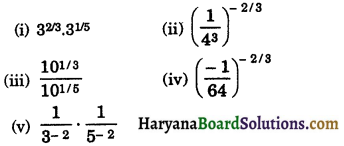
HBSE 9th Class Maths Important Questions Chapter 1 Number Systems - 2
[NCERT Exemplar Problems]
Solution:
We have
(i) 32/3. 31/5
= 32/3+1/5 =
= 3(10 + 3)/15
= 313/15

(ii) We have,
(\(\frac{1}{4^3}\))-2/3
= (43)2/3 = 43 × 2/3 = 42 = 16.

(iii) We have,
\(\frac{10^{1 / 3}}{10^{1 / 5}}\) = 101/3 – 1/5 = 10(5-3)/15 = 102/15

(iv) We have,
\(\left(-\frac{1}{64}\right)^{-2 / 3}\)
= (-64)2/3 = [(-4)3]2/3
= (- 4)3 × 2/3 = (-4)2 = 16.

(v) We have,
\(\frac{1}{3^{-2}} \cdot \frac{1}{5^{-2}}\) = 32 . 52 = (3 × 5)2
= 152 = 225.

HBSE 9th Class Maths Important Questions Chapter 1 Number Systems

Question 10.
Find the value of xx, if it is given that 2x – 2x – 1 = 4.
Solution:
We have,
2x – 2x-1 = 4
⇒ 2x – 2x.2-1 = 4
⇒ 2x (1 – 2-1) = 4
⇒ 2x(1 – \(\frac {1}{2}\)) = 4
⇒ 2x × \(\frac {1}{2}\) = 4
⇒ 2x = 8
⇒ 2x = 23
⇒ x = 3 [∵ bases are equal, ∴ exponents are equal]
∴ xx = 33
Hence, xx = 27.

Question 11.
If a =(l – m), b = (m – n) and c =(n – l), then prove that (xa)n . (xb)l . (xc)m = 0.
Solution :
We have, a = (l – m), b = (m – n) and c = (n – l)
L.H.S. = (xa)n . (xb)l . (xc)m
= (xl – m)n . (xm – n)l . (xn – l)m
= x(ln – mn) . x(ml – nl) . x(mn – ml)
= xln – mn + ml – nl + mn – ml
= x0 = 1 = R.H.S.
∴ L.H.S. = R.H.S. Hence proved

Question 12.
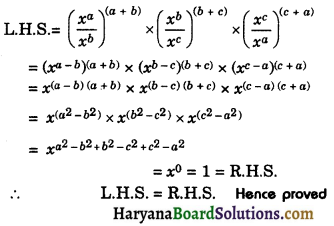
Prove that:
\(\left(\frac{x^a}{x^b}\right)^{(a+b)} \times\left(\frac{x^b}{x^c}\right)^{(b+c)} \times\left(\frac{x^c}{x^a}\right)^{(c+a)}\) = 1
Solution :
HBSE 9th Class Maths Important Questions Chapter 1 Number Systems - 3

Short Answer Type Questions

Question 1.
Represent \(\frac {4}{3}\) and –\(\frac {4}{3}\) on the number line.
Solution:
For representing \(\frac {4}{3}\) and –\(\frac {4}{3}\) on the number line, we draw a number line and mark a point O on it to represent zero. Now we find the points A, B, C on the number line representing the positive integers 1, 2, 3 and the points P, Q, R on the number line representing negative integers – 1, – 2, – 3 respectively as shown in figure 1.3.
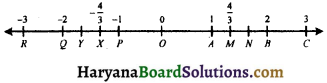
HBSE 9th Class Maths Important Questions Chapter 1 Number Systems - 4
\(\frac {4}{3}\) lies between the positive integers 1 and 2. Similarly –\(\frac {4}{3}\) lies between the negative integers – 1 and – 2. So, we divide the AB and PQ in three equal parts such that AM = MN = NB and PX = XY = YQ. So the points M and X represents \(\frac {4}{3}\) and –\(\frac {4}{3}\) respectively on the number line.

HBSE 9th Class Maths Important Questions Chapter 1 Number Systems

Question 2.
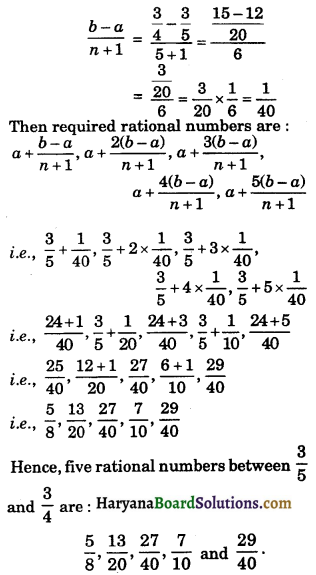
Find five rational numbers between \(\frac {3}{5}\) and \(\frac {3}{4}\).
Solution :
Let a = \(\frac {3}{5}\) and b = \(\frac {3}{4}\) and
n = 5
HBSE 9th Class Maths Important Questions Chapter 1 Number Systems - 5

Question 3.
Express the following in the form where p and q are integers and
(i) \(5 \cdot \overline{2}\)
(ii) \(12 \cdot \overline{48}\)
[NCERT Exemplar Problems]
Solution:
(i) Let
x = \(5 \cdot \overline{2}\) = 5.2222 ……..(i)
Multiplying equation (i) by 10, we get
10x = \(52 \cdot \overline{2}\) ……..(ii)
Subtracting the equation (i) from (ii), we get
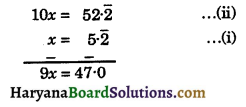
HBSE 9th Class Maths Important Questions Chapter 1 Number Systems - 6
⇒ x = \(\frac {47}{9}\)
Hence, \(5 \cdot \overline{2}\) = \(\frac {47}{9}\)

(ii) Let x = \(12 \cdot \overline{48}\) = 12.484848 ……… (i)
Multiplying equation (i) by 100, we get
100x = \(1248 \cdot \overline{48}\) ……… (ii)
Subtracting equation (i) from (ii), we get
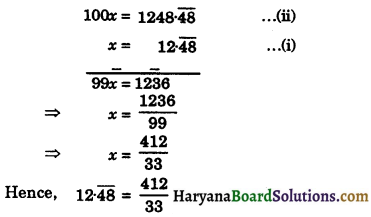
HBSE 9th Class Maths Important Questions Chapter 1 Number Systems - 7

HBSE 9th Class Maths Important Questions Chapter 1 Number Systems

Question 4.
Write the following in decimal form and say what kind of decimal expansion each has: \(\frac {5}{13}\)
Solution:
(i) By long division, we have
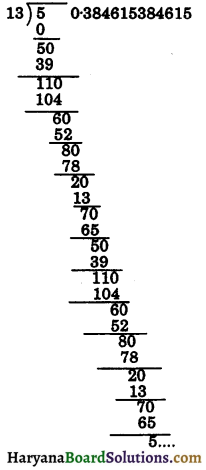
HBSE 9th Class Maths Important Questions Chapter 1 Number Systems - 8
Hence, \(\frac {5}{3}\) = 0.384615384615…. = \(0 \cdot \overline{384615}\)
It has non-terminating and repeating decimal expansion.

Question 5.
Express the rational number \(\frac {1}{13}\) in decimal form and hence find the decimal expansions of \(\frac {1}{13}\) , \(\frac {2}{13}\) and \(\frac {3}{13}\).
Solution :
By long division, we have
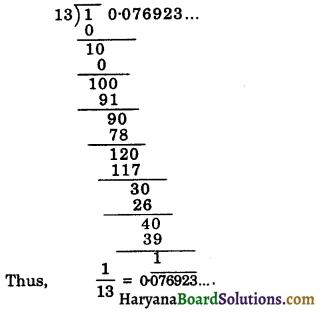
HBSE 9th Class Maths Important Questions Chapter 1 Number Systems - 9
We observe that remainder repeat after six digit. So, it has repeating block of six digits. The given rational numbers \(\frac {2}{13}\), \(\frac {3}{13}\) and \(\frac {4}{13}\) will also have repeating block of six digits in the decimal expansion.

So, to obtain the decimal expansion of given rational numbers mutliplying \(0 \cdot \overline{076923}\) successively by 2, 3 and 4 as follows :
\(\frac {2}{13}\) = 2 × \(\frac {1}{13}\) = 2 × \( \cdot \overline{76923}\) = \(0 \cdot \overline{153846}\)
\(\frac {3}{13}\) =3 × \(\frac {1}{13}\) = 3 × \(0 \cdot \overline{076923}\) = \(0 \cdot \overline{230769}\)
and \(\frac {4}{13}\) = 4 × \(\frac {1}{13}\) = 4 × \(0 \cdot \overline{076923}\) = \(0 \cdot \overline{307692}\)

Question 6.
Prove that 3\(\sqrt{2}\) is an irrational number.
Solution :
Let 3\(\sqrt{2}\) be a rational number, say x, then
3\(\sqrt{2}\) = x
⇒ \(\sqrt{2}\) = \(\frac {x}{3}\)
Since x is a rational number and 3 is nonzero rational number.
∴ \(\frac {x}{3}\) being the quotient of two rational numbers, is a rational number.
⇒ \(\sqrt{2}\) is a rational number.
But \(\sqrt{2}\) is an irrational number. So, our assumption is wrong.
Hence, 3\(\sqrt{2}\) is an irrational number.
Proved

HBSE 9th Class Maths Important Questions Chapter 1 Number Systems

Question 7.
Prove that \(\sqrt{3}\) – \(\sqrt{2}\) is not a rational number.
Solution :
Let \(\sqrt{3}\) – \(\sqrt{2}\) be a rational number, say x.
∴ \(\sqrt{3}\) – \(\sqrt{2}\) = x
Squaring both sides, we get
(\(\sqrt{3}\) – \(\sqrt{2}\))2 = x2
⇒ 3 + 2 – 2 × \(\sqrt{3}\) × \(\sqrt{2}\) = x2
⇒ 5 – 2\(\sqrt{6}\) = x2
⇒ 5 – x2 = 2\(\sqrt{6}\)
⇒ \(\frac{5-x^2}{2}\) = \(\sqrt{6}\)
∵ x is a rational number.
∴ \(\frac{5-x^2}{2}\), is a rational number.
⇒ \(\sqrt{6}\) is a rational number
But \(\sqrt{6}\) is an irrational number
So our assumption is wrong.
⇒ \(\sqrt{3}\) – \(\sqrt{2}\) is not a rational number.
Hence, \(\sqrt{3}\) – \(\sqrt{2}\) is not a rational number.
Proved

Question 8.
Represent \(\sqrt{5.6}\) geometrically on the number line. [NCERT Exemplar Problems]
Solution :
Draw a line AB of length 5.6 units, produce AB to a point C such that BC = 1 unit. Find the mid-point of AC and marked that point 0. Draw a semicircle with centre O and radius OA. Draw a line perpendicular to AC passing through Band intersecting the semicircle at D, then BD = \(\sqrt{5.6}\) units.

Now B as centre and BD as radius, draw an arc meeting AC produced at E, then BE = BD = \(\sqrt{5.6}\) units.
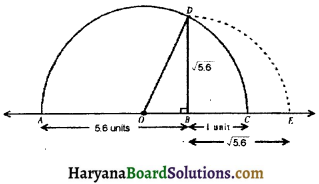
HBSE 9th Class Maths Important Questions Chapter 1 Number Systems - 10

Question 9.
Simplify \(\frac{1}{\sqrt{6}+\sqrt{5}+\sqrt{11}}\)
Solution :
R.F. of the denominator
[(\(\sqrt{6}\) + \(\sqrt{5}\)) + \(\sqrt{11}\)] is [(\(\sqrt{6}\) + \(\sqrt{5}\)) – \(\sqrt{11}\)].
Therefore, multiplying numerator and denominator by [(\(\sqrt{6}\) + \(\sqrt{5}\)) – \(\sqrt{11}\)], we get
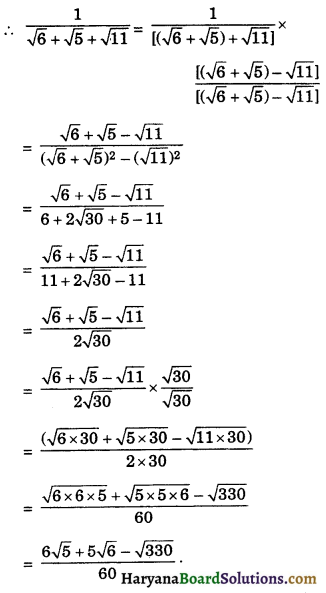
HBSE 9th Class Maths Important Questions Chapter 1 Number Systems - 11

HBSE 9th Class Maths Important Questions Chapter 1 Number Systems

Question 10.
Simplify \(\frac{3 \sqrt{2}-2 \sqrt{3}}{3 \sqrt{2}+2 \sqrt{3}}+\frac{2 \sqrt{3}}{\sqrt{3}-\sqrt{2}}\) by rationalising the denominator.
Solution :
We have
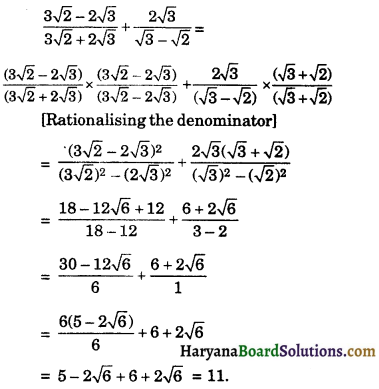
HBSE 9th Class Maths Important Questions Chapter 1 Number Systems - 12

Question 11.
It is given that \(\sqrt{2}\) = 1.414, \(\sqrt{3}\) = 1.732, \(\sqrt{5}\) = 2.236 and \(\sqrt{6}\) = 2.449. Find the value of each of the following upto three places of decimal :
(i) \(\frac{7}{\sqrt{10}}\)
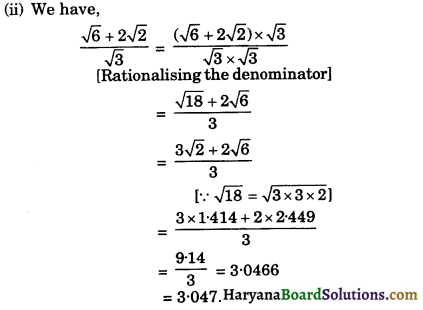
(ii) \(\frac{\sqrt{6}+2 \sqrt{2}}{\sqrt{3}}\)
Solution:
We have
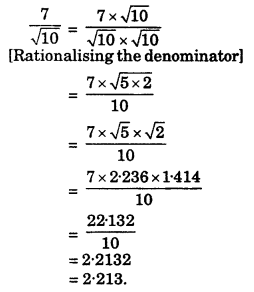
HBSE 9th Class Maths Important Questions Chapter 1 Number Systems - 13
HBSE 9th Class Maths Important Questions Chapter 1 Number Systems - 14

Question 12.
Prove that:
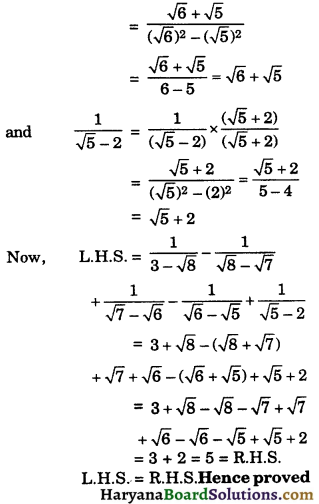
\(\frac{1}{3-\sqrt{8}}-\frac{1}{\sqrt{8}-\sqrt{7}}+\frac{1}{\sqrt{7}-\sqrt{6}}-\frac{1}{\sqrt{6}-\sqrt{5}}+\frac{1}{\sqrt{5}-2}\) = 5
Solution:
Rationalizing the denominator of each term, we get
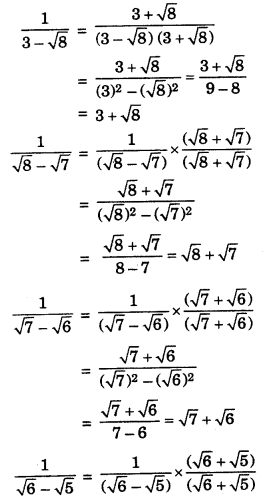
HBSE 9th Class Maths Important Questions Chapter 1 Number Systems - 15
HBSE 9th Class Maths Important Questions Chapter 1 Number Systems - 16

HBSE 9th Class Maths Important Questions Chapter 1 Number Systems

Question 13.
Simplify :
\(\frac{2^{1 / 2} \times 3^{1 / 3} \times 4^{1 / 4}}{10^{-1 / 5} \times 5^{3 / 5}} \div \frac{3^{4 / 3} \times 5^{-7 / 5}}{4^{-3 / 5} \times 6}\).
Solution:
We have
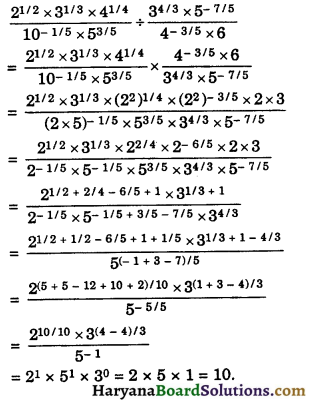
HBSE 9th Class Maths Important Questions Chapter 1 Number Systems - 17

Question 14.
If x, y, z are positive real numbers, then prove that :
\(\sqrt{x y-1} \cdot \sqrt{y z-1} \cdot \sqrt{z x-1}\) = 1
Solution :
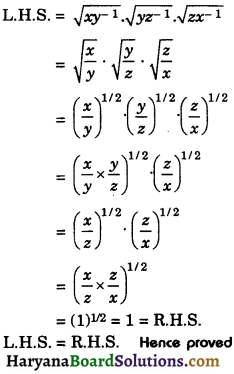
HBSE 9th Class Maths Important Questions Chapter 1 Number Systems - 18

Question 15.
If 2x+4 – 2x+2 = 3, then find the value of x.
Solution :
We have
2x+4 – 2x+2 = 3
⇒ 2x+2+2 – 2x+2 = 3
⇒ 22 . 2x+2 – 2x+2 = 3
⇒ 2x+2(22 – 1) = 3
⇒ 2x+2(4 – 1) = 3
⇒ 2x+2 × 3 = 3
⇒ 2x+2 = \(\frac {3}{3}\)
⇒ 2x+2 = 1
⇒ 2x+2 = 20
⇒ x + 2 = 0
[if bases are equal, then exponents are also equal]
Hence x = – 2

HBSE 9th Class Maths Important Questions Chapter 1 Number Systems

Question 16.
If 3x = 5y = (75)z, show that z = \(\frac{x y}{2 x+y}\).
Solution :
Let 3x = 5y = (75)z = k
Then, 3x = k
⇒ 3 = k1/x …..(i)
5y = k
⇒ 5 = k1/y …..(ii)
and (75)z = k
⇒ 75 = k1/z
⇒ 3 × 52 = k1/z
⇒ k1/x × k2/y = k1/z [From (i) and (ii)]
⇒ k1/x+2/y = k1/z
⇒ \(\frac{1}{x}+\frac{2}{y}=\frac{1}{z}\) [On comparing]
⇒ \(\frac{y+2 x}{x y}=\frac{1}{z}\) = \(\frac {1}{z}\)
⇒ z(y + 2x) = xy
⇒ z = \(\frac{x y}{2 x+y}\).
Hence proved

Question 17.
If \(\frac{9^{n+2} \times\left(3^{-n / 2}\right)-2-27^n}{3^{3 m} \times 2^3 \times 10}\) = \(\frac {1}{27}\), Prove that m – n = 1.
Solution :
We have
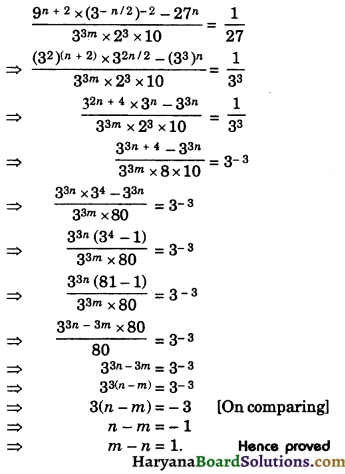
HBSE 9th Class Maths Important Questions Chapter 1 Number Systems - 19

Question 18.
Prove that:
\(\frac{1}{1+x^{(b-a)}+x^{(c-a)}}+\frac{1}{1+x^{(a-b)}+x^{(c-b)}}\) + \(\frac{1}{1+x^{(b-c)}+x^{(a-c)}}\) = 1
Solution :
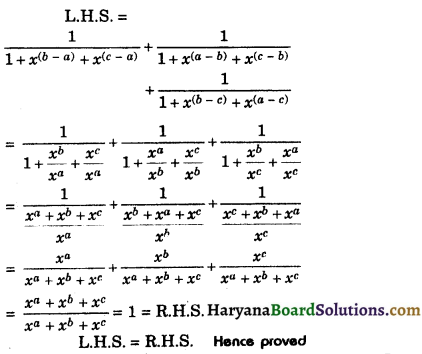
HBSE 9th Class Maths Important Questions Chapter 1 Number Systems - 20

HBSE 9th Class Maths Important Questions Chapter 1 Number Systems

Question 19.
If ax = by = cz and b2 = ac, then prove that y = \(\frac{2 x z}{x+z}\).
Solution:
Let ax = by = cz = k
Then, a = k1/x, b = k1/y and c = k1/z
Now, b2 = ac, (given)
⇒ (k1/y)2 = k1/x × k1/z
⇒ k2/y = k1/x + 1/z
⇒ k2/y = k(z + x)/xz
⇒ \(\frac{2}{y}=\frac{z+x}{x z}\) [On Comparing]
⇒ \(\frac{1}{y}=\frac{x+z}{2 x z}\)
⇒ y = \(\frac{2 x z}{x+z}\). Hence proved.

Question 20.
Prove that:
\(\left(\frac{x^a}{x^b}\right)^{a^2+a b+b^2} \times\left(\frac{x^b}{x^c}\right)^{b^2+b c+c^2} \times\left(\frac{x^c}{x^a}\right)^{c^2+a b+a^2}\) = 1
Solution :
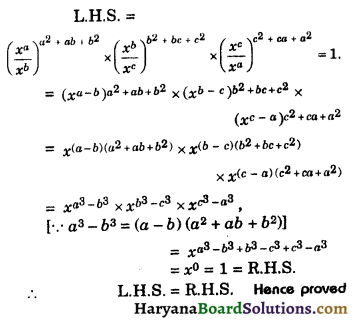
HBSE 9th Class Maths Important Questions Chapter 1 Number Systems - 21

Question 21.
Simplify each of the following :
(i) [1 – {1 – (1 – n)-1}-1]-1
(ii) \(\frac{5^{n+3}-6 \times 5^{n+1}}{9 \times 5^n-5^n \times 2^2}\)
Solution :
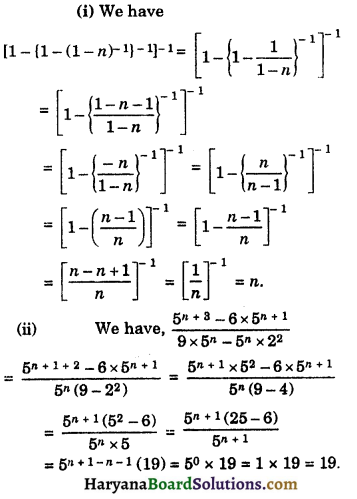
HBSE 9th Class Maths Important Questions Chapter 1 Number Systems - 22

Question 22.
If \(\sqrt{57+12 \sqrt{15}}\) = a\(\sqrt{3}\) + b\(\sqrt{5}\), then find the values of a and b.
Solution :
We have,
\(\sqrt{57+12 \sqrt{15}}\) = a\(\sqrt{3}\) + b\(\sqrt{5}\)
⇒ \(\sqrt{12+45+12 \times \sqrt{3 \times 5}}\) = a\(\sqrt{3}\) + b\(\sqrt{5}\)
⇒ \(\sqrt{(2 \sqrt{3})^2+(3 \sqrt{5})^2+2 \times 2 \sqrt{3} \times 3 \sqrt{5}}\) = a\(\sqrt{3}\) + b\(\sqrt{5}\)
⇒ \(\sqrt{(2 \sqrt{3}+3 \sqrt{5})^2}\) = a\(\sqrt{3}\) + b\(\sqrt{5}\)
⇒ 2\(\sqrt{3}\) + 3\(\sqrt{5}\) = a\(\sqrt{3}\) + b\(\sqrt{5}\)
⇒ a = 2, b = 3
[Equating the rational and irrational parts]
Hence, a = 2, b = 3.

HBSE 9th Class Maths Important Questions Chapter 1 Number Systems

Question 23.
If x = 22/3 – 21/3 – 2, then prove that x3 + 6x2 + 18x + 18 = 0.
Solution :
We have
x = 22/3 – 21/3 – 2
⇒ x + 2 = 22/3 – 21/3
Cubing both sides, we get
(x + 2)3 = (22/3 – 21/3)3
⇒ x3 + 8 + 3 × x × 2(x + 2)
= (22/3)3 – (21/3)3 – 3 × 22/3 × 21/3 (22/3 – 21/3)
⇒ x3 + 8 + 6x(x + 2) = 22/3 × 3 – 21/3 × 3 – 3 × 22/3 + 1/3 (x + 2)
⇒ x3 + 8 + 6x2 + 12x = 22 – 21 – 3 × 2(x + 2)
⇒ x3 + 8 + 6x2 + 12x = 4 – 2 – 6x – 12
⇒ x3 + 6x2 + 12x + 8 = – 6x – 10
⇒ x3 + 6x2 + 18x + 18 = 0. Hence proved

Question 24.
Which of the variables P, Q, R and T given by the following equations, represent rational or irrational numbers:
(i) P2 = 25
(ii) Q2 = 0.16
(iii) R2 = 7
(iv) T2 = 0.4
(v) P3 = 125
(vi) R2 = 0.84.
Solution :
(i) We have,
P2 = 25
⇒ P = \(\sqrt{25}\) = 5
It is a rational number.

(ii) We have, Q2 = 0.16
⇒ Q = \(\sqrt{0.16}\) = 0.4
It is a rational number.

(iii) We have, R2 = 7
⇒ R = \(\sqrt{7}\) = 2.6457513…
It is an irrational number.

(iv) We have, T2 = 0.4
⇒ T = \(\sqrt{0.4}\) = 0.63245…
It is an irrational number.

(v) We have, P3 = 125
⇒ P = \(\sqrt[3]{125}\) = 5
It is a rational number.

(vi) We have, R2 = 0.84
⇒ R = \(\sqrt{0.84}\) = 0.916515…
It is an irrational number.

Long Answer Type Questions

Question 1.
Find three different irrational numbers between :
(i) \(\frac {1}{7}\) and \(\frac {4}{11}\)
(ii) \(\frac {3}{11}\) and \(\frac {5}{13}\)
(iii) 3 and 4.
(iv) \(\sqrt{2}\) and \(\sqrt{7}\).
Solution :
(i) \(\frac {1}{7}\) = 0.142857142857…
\(\frac {4}{11}\) = 0.3636363636…
Three different irrational numbers are 0.17010010001….0.262020020002… and 0.3010020040002…

(ii) \(\frac {3}{11}\) = 0.2727272727…
\(\frac {5}{13}\) = 0.384615384…
Three different irrational numbers are 0.28030100131004…, 0.3011001110023001… and 0.32032003200032…

(iii) Three different irrational numbers between 3 and 4 are 3.15013001500014000016…, 3.202002000204… and 3.35035003500035…

(iv) Consider the squares of \(\sqrt{2}\) and \(\sqrt{7}\).
(\(\sqrt{2}\))2 = 2 and (\(\sqrt{7}\))2 = 7
Choose any three numbers say 3, 5, 6 which lie between 2 and 7.

Since, these numbers lie between 2 and 7, therefore the numbers \(\sqrt{3}\), \(\sqrt{5}\) and \(\sqrt{6}\) lie between \(\sqrt{2}\) and \(\sqrt{7}\). Hence, three irrational numbers between \(\sqrt{2}\) and \(\sqrt{7}\) are \(\sqrt{3}\), \(\sqrt{5}\) and \(\sqrt{6}\).

HBSE 9th Class Maths Important Questions Chapter 1 Number Systems

Question 2.
Simplify each of the following by rationalising the denominators:
(i) \(\frac{1}{2-\sqrt{3}}+\frac{5}{3-\sqrt{2}}-\frac{1}{\sqrt{3}+\sqrt{2}}\)
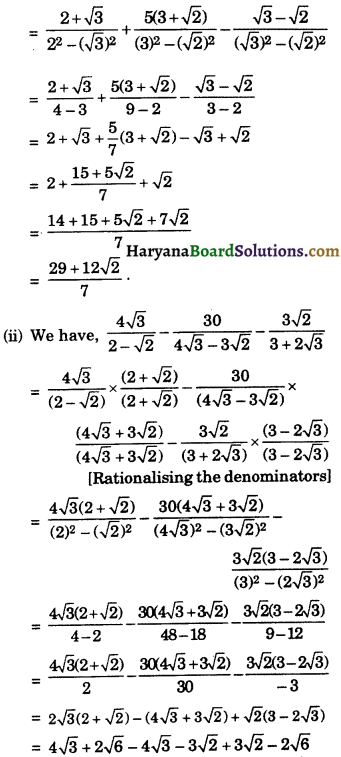
(ii) \(\frac{4 \sqrt{3}}{2-\sqrt{2}}-\frac{30}{4 \sqrt{3}-3 \sqrt{2}}-\frac{3 \sqrt{2}}{3+2 \sqrt{3}}\)
Solution :
(i) We have
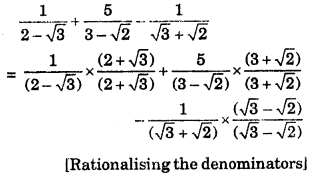
HBSE 9th Class Maths Important Questions Chapter 1 Number Systems - 23
HBSE 9th Class Maths Important Questions Chapter 1 Number Systems - 24
= 0.

Question 3.
If both a and b are rational numbers, then find the values of a and b in each of the following equations:
(i) \(\frac{\sqrt{5}+\sqrt{3}}{\sqrt{5}-\sqrt{3}}\) = a – b\(\sqrt{15}\)
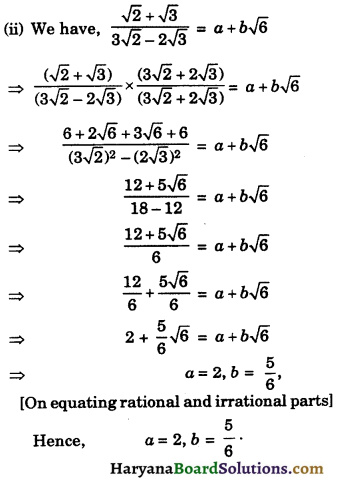
(ii) \(\frac{\sqrt{2}+\sqrt{3}}{3 \sqrt{2}-2 \sqrt{3}}\) = a + b\(\sqrt{6}\)
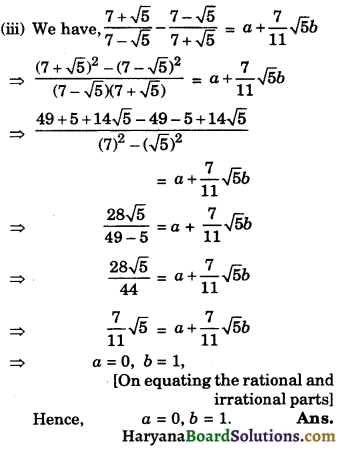
(iii) \(\frac{7+\sqrt{5}}{7-\sqrt{5}}-\frac{7-\sqrt{5}}{7+\sqrt{5}}\) = a + \(\frac {7}{11}\)\(\sqrt{5}\)b
Solution:
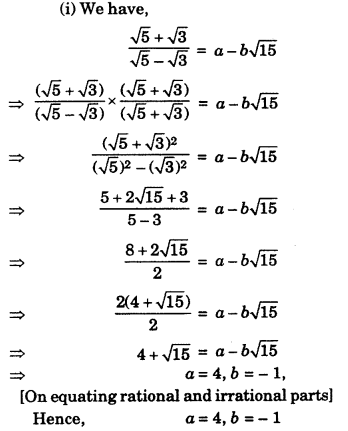
HBSE 9th Class Maths Important Questions Chapter 1 Number Systems - 25
HBSE 9th Class Maths Important Questions Chapter 1 Number Systems - 26
HBSE 9th Class Maths Important Questions Chapter 1 Number Systems - 27

HBSE 9th Class Maths Important Questions Chapter 1 Number Systems

Question 4.
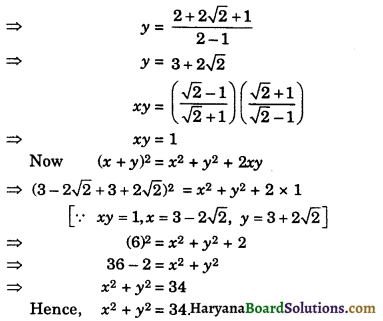
If x = \(\frac{\sqrt{2}-1}{\sqrt{2}+1}\) and \(\frac{\sqrt{2}+1}{\sqrt{2}-1}\), then find x2 + y2 .
Solution :
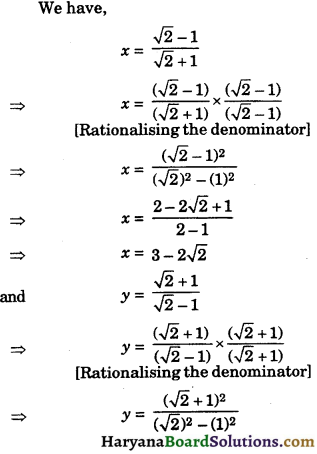
HBSE 9th Class Maths Important Questions Chapter 1 Number Systems - 28
HBSE 9th Class Maths Important Questions Chapter 1 Number Systems - 29

Question 5.
If a = \(\frac{\sqrt{3}+\sqrt{2}}{\sqrt{3}-\sqrt{2}}\) and b = \(\frac{\sqrt{3}-\sqrt{2}}{\sqrt{3}+\sqrt{2}}\), then find a3 + b3.
Solution :
We have,
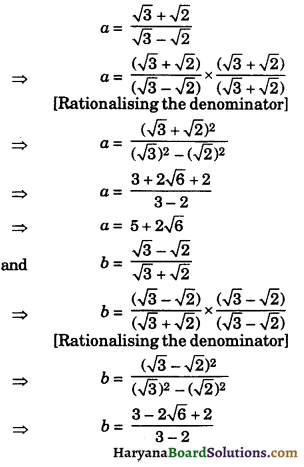
HBSE 9th Class Maths Important Questions Chapter 1 Number Systems - 30
⇒ b = 5 – 2\(\sqrt{6}\)
a + b = 5 + 2\(\sqrt{6}\) + 5 – 2\(\sqrt{6}\)
⇒ a + b = 10
ab = \(\left(\frac{\sqrt{3}+\sqrt{2}}{\sqrt{3}-\sqrt{2}}\right) \times\left(\frac{\sqrt{3}-\sqrt{2}}{\sqrt{3}+\sqrt{2}}\right)\)
⇒ ab = 1
Now, a3 + b3 = (a + b)3 – 3ab(a + b)
⇒ a3 + b3 = (10)3 – 3 × 1 × (10)
[∵ a + b = 10 and ab = 1]
⇒ a3 + b3 = 1000 – 30
⇒ a3 + b3 = 970
Hence, a3 + b3 = 970

Question 6.
If a = \(\frac{1}{2-\sqrt{3}}\) and b = \(\frac{1}{2+\sqrt{3}}\), then find a2 + ab + b2
Solution :
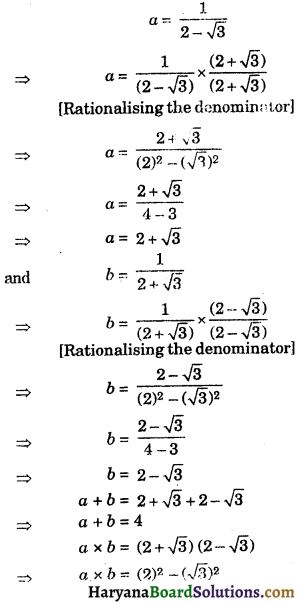
HBSE 9th Class Maths Important Questions Chapter 1 Number Systems - 31
⇒ a × b = 4 – 3
⇒ ab = 1
Now, a2 + ab + b2 = a2 + 2ab + b2 – ab
[Adding and subtracting ab]
⇒ a2 + ab + b2 = (a + b)2 – ab
⇒ a2 + ab + b2 = (4)2 – 1
[∵ a + b = 4, ab = 1]
⇒ a2 + ab + b2 = 16 – 1
Hence, a2 + ab + b2 = 15

Question 7.
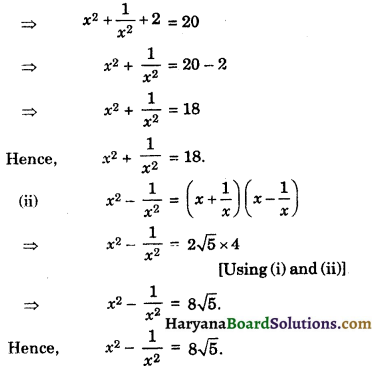
If x = \(\frac{1}{\sqrt{5}-2}\), then find the values of :
(i) x2 + \(\frac{1}{x^2}\)
(ii) x2 – \(\frac{1}{x^2}\)
Solution :
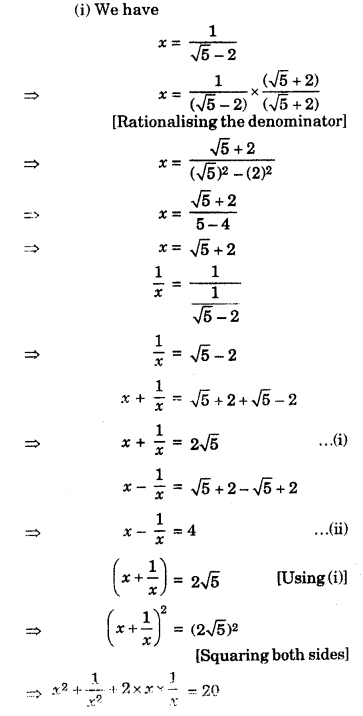
HBSE 9th Class Maths Important Questions Chapter 1 Number Systems - 32
HBSE 9th Class Maths Important Questions Chapter 1 Number Systems - 33

HBSE 9th Class Maths Important Questions Chapter 1 Number Systems

Question 8.
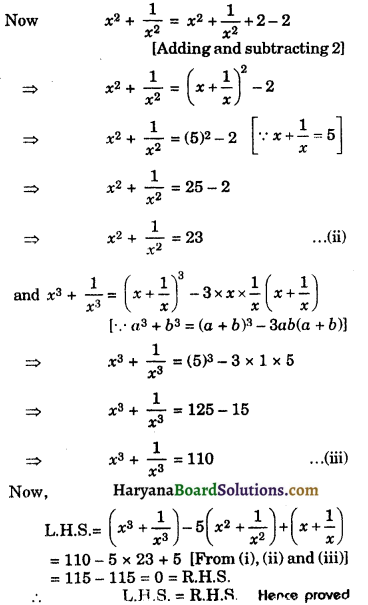
If x = \(\frac{5-\sqrt{21}}{2}\), then prove that \(\left(x^3+\frac{1}{x^3}\right)-5\left(x^2+\frac{1}{x^2}\right)+\left(x+\frac{1}{x}\right)\) = 0
Solution :
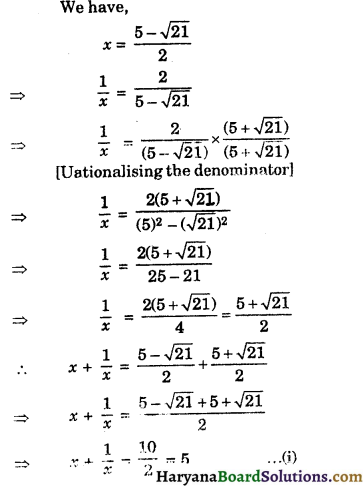
HBSE 9th Class Maths Important Questions Chapter 1 Number Systems - 34
HBSE 9th Class Maths Important Questions Chapter 1 Number Systems - 35

Question 9.
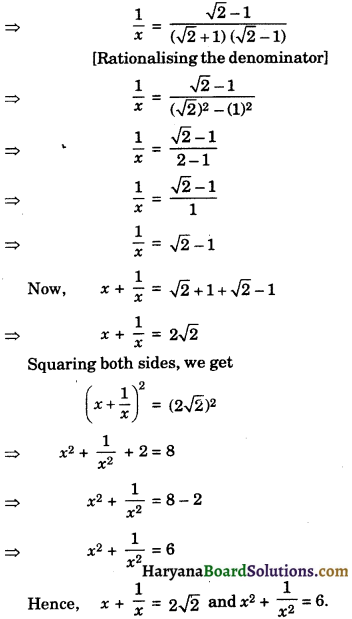
If x = \(\sqrt{3+2 \sqrt{2}}\), then find the value of x + \(\frac {1}{x}\) and x2 + \(\frac{1}{x^2}\).
Solution :
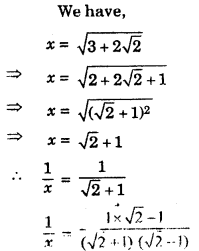
HBSE 9th Class Maths Important Questions Chapter 1 Number Systems - 36
HBSE 9th Class Maths Important Questions Chapter 1 Number Systems - 37

HBSE 9th Class Maths Important Questions Chapter 1 Number Systems

Question 10.
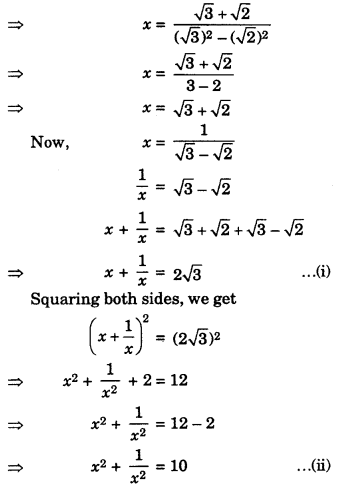
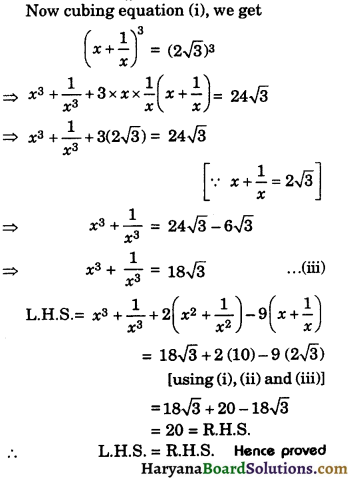
If x = \(\frac{1}{\sqrt{3}-\sqrt{2}}\), prove that x3 + \(\frac{1}{x^3}\) + 2(x2 + \(\frac{1}{x^2}\)) – 9(x + \(\frac {1}{x}\)) = 20
Solution :
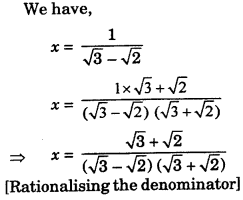
HBSE 9th Class Maths Important Questions Chapter 1 Number Systems - 38
HBSE 9th Class Maths Important Questions Chapter 1 Number Systems - 39
HBSE 9th Class Maths Important Questions Chapter 1 Number Systems - 40

Question 11.
If x = \(\frac{\sqrt{a+2 b}+\sqrt{a-2 b}}{\sqrt{a+2 b}-\sqrt{a-2 b}}\), then prove that b2x2 – abx + b2 = 0.
Solution :
We have,
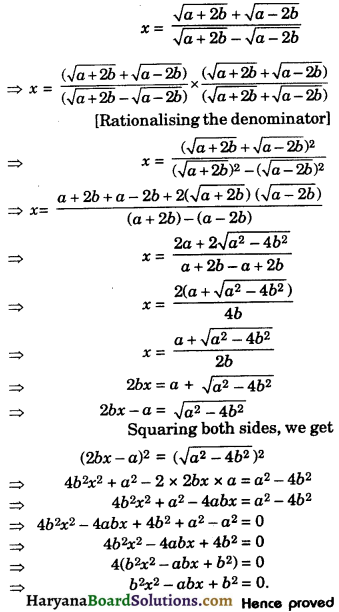
HBSE 9th Class Maths Important Questions Chapter 1 Number Systems - 41

Question 12.
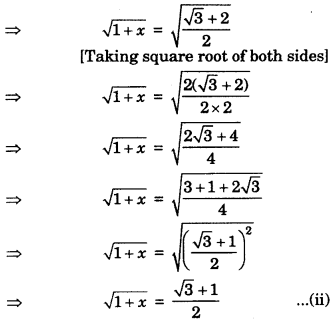
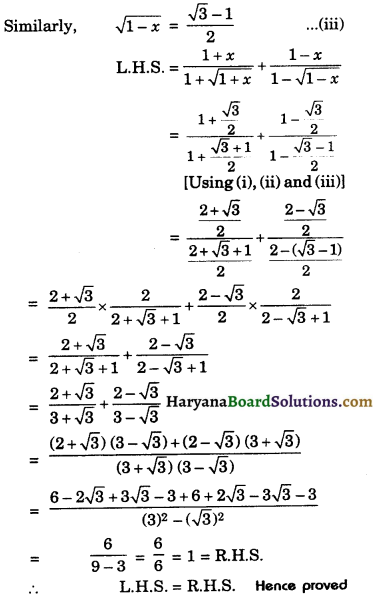
If x = \(\frac{\sqrt{3}}{2}\), then show that \(\frac{1+x}{1+\sqrt{1+x}}+\frac{1-x}{1-\sqrt{1-x}}\) = 1
Solution :
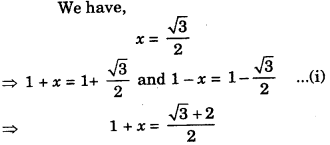
HBSE 9th Class Maths Important Questions Chapter 1 Number Systems - 42
HBSE 9th Class Maths Important Questions Chapter 1 Number Systems - 43
HBSE 9th Class Maths Important Questions Chapter 1 Number Systems - 44

HBSE 9th Class Maths Important Questions Chapter 1 Number Systems

Question 13.
If \(\sqrt{2}\) = 1.4142 , \(\sqrt{3}\) = 1.7320 and \(\sqrt{6}\) = 2.4495, find correct to three places of decimal, the value of:
(i) \(\sqrt{5+2 \sqrt{6}}+\sqrt{5-2 \sqrt{6}}\)
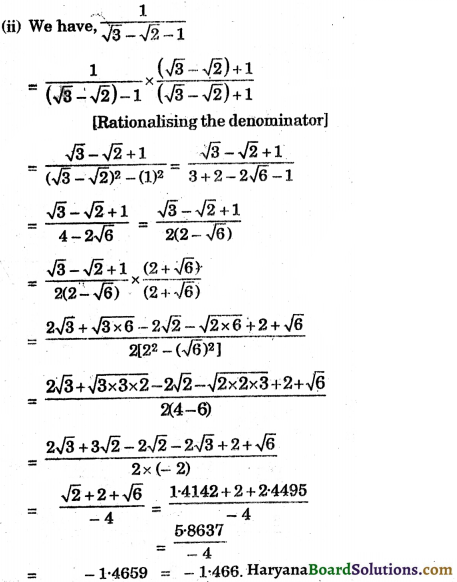
(ii) \(\frac{1}{\sqrt{3}-\sqrt{2}-1}\)
Solution :
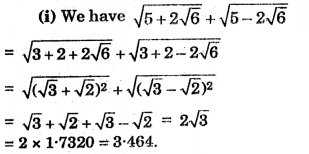
HBSE 9th Class Maths Important Questions Chapter 1 Number Systems - 45
HBSE 9th Class Maths Important Questions Chapter 1 Number Systems - 46

Question 14.
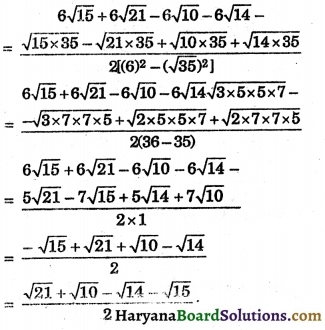
Express the following with rational denominator \(\frac{1}{\sqrt{10}+\sqrt{14}+\sqrt{15}+\sqrt{21}}\).
Solution :
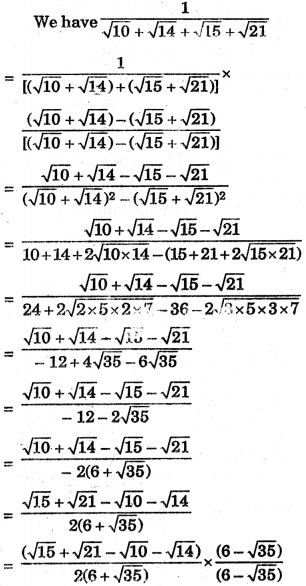
HBSE 9th Class Maths Important Questions Chapter 1 Number Systems - 47
HBSE 9th Class Maths Important Questions Chapter 1 Number Systems - 48

Multiple Choice Questions :

Choose the correct alternative each of the following :

Question 1.
Every rational number is : [NCERT Exemplar Problems]
(a) a natural number
(b) an integer
(c) a real number
(d) a whole number
Solution :
(c) a real number

HBSE 9th Class Maths Important Questions Chapter 1 Number Systems

Question 2.
Between any two rational numbers there:
[NCEAT Exemplar Problems]
(a) is no rational number
(b) is exactly one rational number
(c) are infinitely many rational numbers
(d) there are only rational numbers and no irrational numbers
Solution :
(c) are infinitely many rational numbers

Question 3.
Quotient of any two irrational numbers is :
(a) always an irrational number
(b) always a rational number
(c) always an integer
(d) some times rational number, some times irrational number
Solution :
(d) some times rational number, some times irrational number

Question 4.
Product of any two irrational numbers is : [NCERT Exemplar Problems]
(a) always an irrational number
(b) may be rational or irrational number
(c) always an integer
(d) always a rational number
Solution :
(b) may be rational or irrational number

Question 5.
Decimal representation of rational number cannot be : [NCERT Exemplar Problems]
(a) non-terminating but recurring
(b) terminating
(c) non-terminating non-recurring
(d) non-terminating
Solution :
(c) non-terminating non-recurring

Question 6.
Which of the following is rational :
(a) 0.3010010010001….
(b) π
(c) \(\sqrt{2}\)
(d) \(0 . \overline{142857}\)
Solution :
(d) \(0 . \overline{142857}\)

HBSE 9th Class Maths Important Questions Chapter 1 Number Systems

Question 7.
Which of the following is an irrational :
(a) 0.090909……..
(b) 0.25
(c) \(\frac {22}{7}\)
(d) \(\sqrt{0.4}\)
Solution :
(d) \(\sqrt{0.4}\)

Question 8.
A rational number between \(\sqrt{2}\) and \(\sqrt{3}\) is : [NCERT Exemplar Problems]
(a) \(\frac{\sqrt{2}+\sqrt{3}}{2}\)
(b) \(\frac{\sqrt{2} \times \sqrt{3}}{2}\)
(c) 1.5
(d) 1.8
Solution :
(c) 1.5

Question 9.
An irrational number between \(\sqrt{2}\) and \(\sqrt{3}\) is :
(a) 51/4
(b) \(\sqrt{2}\) + \(\sqrt{3}\)
(c) \(\frac{\sqrt{2}+\sqrt{3}}{2}\)
(d) \(\sqrt{\sqrt{2}} \times \sqrt{3}\).
Solution :
(d) \(\sqrt{\sqrt{2}} \times \sqrt{3}\).

Question 10.
\(\sqrt[4]{(81)^{-2}}\) is equal to : [NCERT Exemplar Problems]
(a) \(\frac {1}{9}\)
(b) 9
(c) \(\frac {1}{3}\)
(d) \(\frac {1}{81}\)
Solution :
(a) \(\frac {1}{9}\)

Question 11.
If , then x = \(\frac{1}{2+\sqrt{3}}\), is equal to :
(a) 2\(\sqrt{3}\)
(b) 4
(c) – 2\(\sqrt{3}\)
(d) 4 – 2\(\sqrt{3}\)
Solution :
(b) 4

HBSE 9th Class Maths Important Questions Chapter 1 Number Systems

Question 12.
The value of 1.999 in the form \(\frac {p}{q}\), where p and q are integers and q ≠ 0, is : [NCERT Exemplar Problems]
(a) \(\frac {19}{10}\)
(b) \(\frac {1999}{1000}\)
(c) 2
(d) \(\frac {1}{9}\)
Solution :
(c) 2


HBSE 9th Class Maths Important Questions Chapter 1 Number Systems Read More »

HBSE 9th Class Maths Important Questions and Answers

Haryana Board HBSE 9th Class Maths Important Questions and Answers

HBSE 9th Class Maths Important Questions in English Medium

HBSE 9th Class Maths Important Questions in Hindi Medium

HBSE 9th Class Maths Important Questions and Answers Read More »

HBSE 7th Class English Solutions Honeycomb Chapter 3 Gopal and the Hilsa-Fish

Haryana State Board HBSE 7th Class English Solutions Honeycomb Chapter 3 Gopal and the Hilsa-Fish Textbook Exercise Questions and Answers.

Haryana Board 7th Class English Solutions Honeycomb Chapter 3 Gopal and the Hilsa-Fish

HBSE 7th Class English Gopal and the Hilsa-Fish Textbook Questions and Answers

Working With The Text

Answer the following questions :

Gopal And The Hilsa Fish Question Answers HBSE 7th Class Question 1.
Why did the king want to more talk about the hilsa-fish?
Answer:
The king was fed up as it was season for Silsa fish. All were talking of nothing else but Silsa fish.

Gopal And The Hilsa Fish HBSE 7th Class Question 2.
What did the king.ask Gopal do to prove that he was clever?
Answer:
Gopal had to prove to the king that he could stop everyone from talking about Silsa fish for live minutes.

Gopal And Hilsa Fish Question Answer HBSE 7th Class Question 3.
What three things did Gopal do before he went to but his hilsa-fish?
Answer:
Golpa was very clever. He shaved his face half. Then he smeared his face with Ash. Then he wore disgraceful rags.

गोपाल एंड द हिलसा फिश HBSE 7th Class Question 4.
How did Gopal get inside the palace to see the king after he had bought the fish?
Answer:
Gopal walked in the palace with ash smeared over his face. He behaved like a mad man. He began to sing and dance loudly. The people took him to be erazy and took him inside the palace.

HBSE 7th Class English Solutions Honeycomb Chapter 3 Gopal and the Hilsa-Fish

Gopal And The Hilsa Fish Question Answer HBSE 7th Class Question 5.
Explain why no one seemed to be interested in talking about the hilsa-fish which Gopal had bought.
Answer:
No one seemed to talk about the hilsa fish which Gopal had bought because everyone thought that Gopal had lost his mind.

Class 7 English Chapter 3 Gopal And The Hilsa Fish HBSE Question 6.
Write ‘’True’ or ‘False’ against each of the following sentences :
(i) The king lost his temper easily. _________
(ii) Gopal was a madman. _________
(iii) Gopal was a clever man. _________
(iv) Gopal was too poor to afford decent clothes. _________
(v) The king got angry when he was shown to be wrong.
Answer:
(i) True
(ii) False
(iii) True
(iv) False
(v) False.

HBSE 7th Class English Gopal and the Hilsa-Fish Important Questions and Answers

Gopal And Hilsa Fish HBSE 7th Class Question 1.
What did the dealers in fish sell?
Answer:
The dealers in fish sold Hilsa-fish.

Hilsa Fish In English HBSE 7th Class Question 2.
What had happened to the price of Hilsa that day?
Answer:
The price of Hilsa had fallen low that day.

गोपाल एंड हिलसा फिश HBSE 7th Class Question 3.
What did the king want Gopal to do to prove his cleverness?
Answer:
The king wanted Gopal to buy a huge hilsa-fish and bring it to the place without anybody talking about hilsa fish.

Gopal And The Hilsa Fish Solution HBSE 7th Class Question 4.
What did the people think about Gopal and why?
Answer:
The people thought that Gopal had gone mad. It was because he had half-shaved his face. He had smeared ash upon him. He had put on rags. He also behaved in a crazy manner. He , danced and song loudly outside the palace.

Class 7 English Gopal And The Hilsa Fish Question Answer HBSE Question 5.
Why did the king congratulate Gopal?
Answer:
The king congratulated Gopal because Gopal had proved that something unexpected and impossible could be done by him. He had accomplished the challenge given by the king successfully.

HBSE 7th Class English Solutions Honeycomb Chapter 3 Gopal and the Hilsa-Fish

Question 6.
Why did the king order the servants to let Gopal in?
Answer:
When the gatekeepers did not allow Gopal to enter the palace, he began to dance and sing loudly. The people on the gate got angry. The king heard these loud voices. So he got irritated and ordered the servants to bring him in immediately.

Question 7.
Who said this to whom?
(a) “Why is your face half-shaven?”
(b) I told you I’m dress up to buy a hilsa-fish.
(c) “You cannot see the king. Get away with you”.
(d) “Forgotten something”?
Answer:
(a) Gopal’s wife said this to Gopal.
(b) Gopal said this to his wife.
(c) The courtier said this to Gopal.
(d) The king said this to Gopal.

Make Sentences

Use the following words in sentences of your own:
season, crazy, dressed, impossible, achieved.
Answer:

  • Season : Spring is called the king of seasons, because beautiful flowers blossom in this season.
  • Crazy : Today, some children get crazy for the use of facebook.
  • Dressrd : The bride was dressed up like a fairy on the day of wedding.
  • Impossible : Nothing is impossible with hardwork and dedication.
  • Achieved : Kunal Sehgal has achieved distinctions in science and maths.

Gopal and the Hilsa-Fish Translation in Hindi

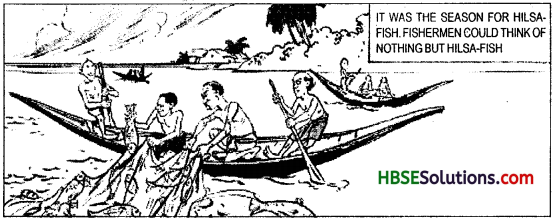
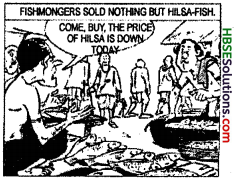
1. हिल्सा मछली का समय था। मछुआरे हिल्सा मछली के अलावा और कुछ नहीं सोच सकते थे।
HBSE 7th Class English Solutions Honeycomb Chapter 3 Gopal and the Hilsa-Fish 1

2. मछली बेचने वाले कुछ नहीं सिर्फ हिल्सा मछली बेचते थे।
मछुआरा : आओ, खरीदो, हिल्सा मछली की कीमत कम हो गई है।
HBSE 7th Class English Solutions Honeycomb Chapter 3 Gopal and the Hilsa-Fish 2

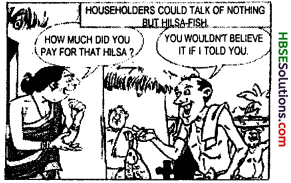
3. घर के लोग हिल्सा मछली के अलावा और कुछ नहीं सोच सकते थे।
औरत : उसने उस हिल्सा के लिए क्या कीमत दी ? मछुआरा : तुम विश्वास नहीं करते अगर मैं तुम्हें बताता।
HBSE 7th Class English Solutions Honeycomb Chapter 3 Gopal and the Hilsa-Fish 3

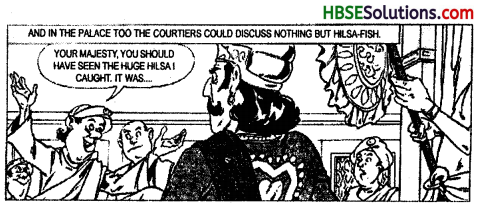
4. और महल में भी राजस्वी हिल्सा मछली के अलावा और किसी भी बात पर बातचीत नहीं करना चाहता। दरबारी : महाराज, आपको वह वही हिल्सा मछली जो मैंने पकड़ी थी, देखनी चाहिए थी।
HBSE 7th Class English Solutions Honeycomb Chapter 3 Gopal and the Hilsa-Fish 4

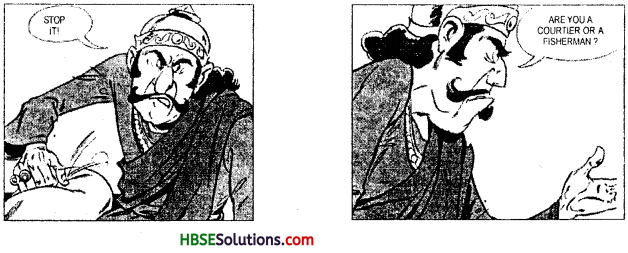
5. उसे रोको।
HBSE 7th Class English Solutions Honeycomb Chapter 3 Gopal and the Hilsa-Fish 5
राजा : क्या तुम मछुआरे के दरबारी हो?

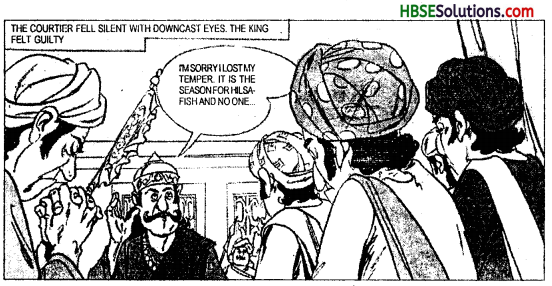
6. दरबारी आँखें नीची करके चुप रहा। राजा दोषी महसूस कर रहा था। मछुआरा : मुझे खेद है कि मुझे गुस्सा आ गया। यह हिल्सा मछली का मौसम है और किसी और का नहीं”।
HBSE 7th Class English Solutions Honeycomb Chapter 3 Gopal and the Hilsa-Fish 6

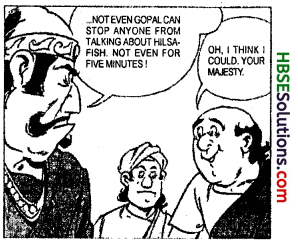
7. राजा : न सिर्फ गोपाल किसी को हिल्सा मछली के बारे में रोकने से रोक नहीं सकता। पाँच मिनट के लिए भी नहीं।
गोपाल : ओह, मैं सोचता हूँ मैं कर सकता हूँ महाराज।
HBSE 7th Class English Solutions Honeycomb Chapter 3 Gopal and the Hilsa-Fish 7

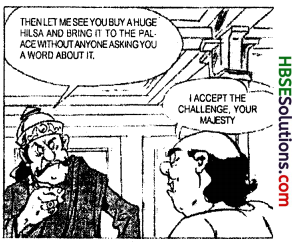
8. राजा : तब मुझे देखने दो कि तुम बड़ी हिल्सा खरीद कर लाओ, और उसे महल में लाओ। यह सब बिना किसी के कोई शब्द कहे बिना होना चाहिए।
गोपाल : महाराज, मैं आपकी चुनौती स्वीकार . करता हूँ।
HBSE 7th Class English Solutions Honeycomb Chapter 3 Gopal and the Hilsa-Fish 7a

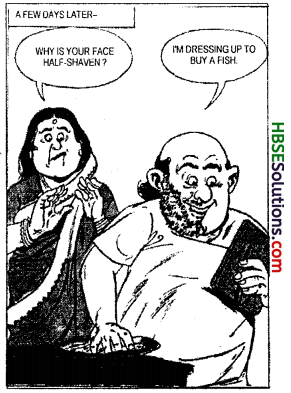
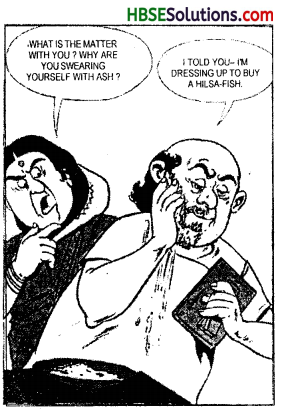
9. कुछ दिन पश्चात् महिला : तुम ने आधे चेहरे की हजामत क्यों नहीं की?
गोपाल : मैं मछली खरीदने के लिए तैयार हो रहा
HBSE 7th Class English Solutions Honeycomb Chapter 3 Gopal and the Hilsa-Fish 8

10. महिला : तुम्हें क्या परेशानी है। तुम अपने चेहरे पर राख क्यों लगा रहे हो ?
गोपाल : मैंने बताया कि मैं हिल्सा मछली खरीदने के लिए तैयार हो रहा हूँ।
HBSE 7th Class English Solutions Honeycomb Chapter 3 Gopal and the Hilsa-Fish 10

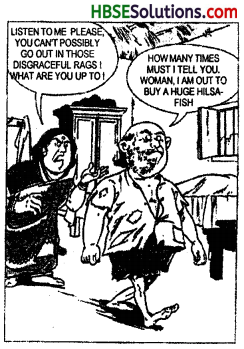
11. महिला : मेरी बात सुनो। तुम संभव रूप से इन फटे-पुराने कपड़ों में नहीं जा सकते। तुम क्या करने जा रहे हो ?
गोपाल : औरत मैं तुम्हें कितनी बार बताऊँ कि मैं बहुत बड़ी हिल्सा मछली खरीदने जा रहा हूँ।
HBSE 7th Class English Solutions Honeycomb Chapter 3 Gopal and the Hilsa-Fish 9

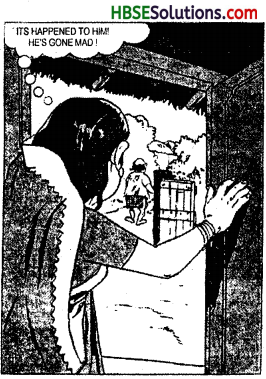
12. महिला : उसे कुछ हो गया है। वह पागल हो गया है।
HBSE 7th Class English Solutions Honeycomb Chapter 3 Gopal and the Hilsa-Fish 11

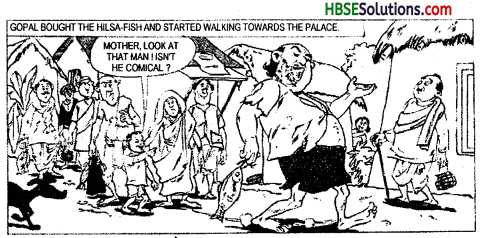
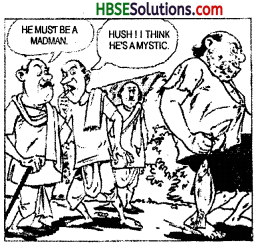
13. गोपाल ने हिल्सा मछली खरीदी और महल की तरफ चल पड़ा। माँ, देखो उस व्यक्ति को वह कितना कार्टून है।
HBSE 7th Class English Solutions Honeycomb Chapter 3 Gopal and the Hilsa-Fish 12

14. वह जरूर मूर्ख होगा। शायद् वह जरूर रहस्यमय होगा।
HBSE 7th Class English Solutions Honeycomb Chapter 3 Gopal and the Hilsa-Fish 13

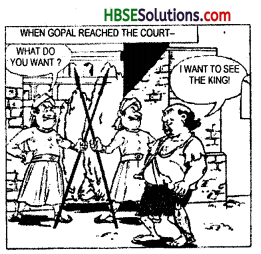
15. गोपाल कोर्ट में पहुँचा-दरबारी : तुम क्या चाहते हो?
गोपाल : मैं राजा से मिलना चाहता हूँ।
HBSE 7th Class English Solutions Honeycomb Chapter 3 Gopal and the Hilsa-Fish 15

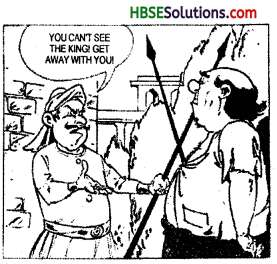
16. दरबारी : तुम राजा से नहीं मिल सकते। तुम यहाँ से जाओ।
HBSE 7th Class English Solutions Honeycomb Chapter 3 Gopal and the Hilsa-Fish 14

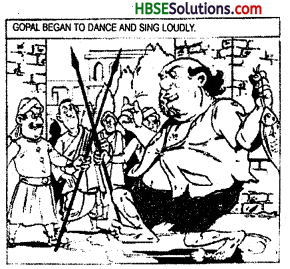
17. गोपाल नाचने लगा और ऊँचा गाने लगा।
HBSE 7th Class English Solutions Honeycomb Chapter 3 Gopal and the Hilsa-Fish 16

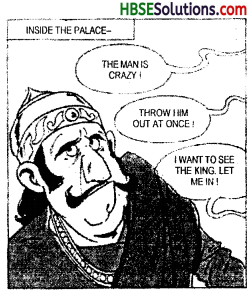
18. महल के अंदर
– यह व्यक्ति मूख है।
– उसे एक दम बाहर फेंक दो।
गोपाल : मुझे राजा से मिलने दो।
HBSE 7th Class English Solutions Honeycomb Chapter 3 Gopal and the Hilsa-Fish 17

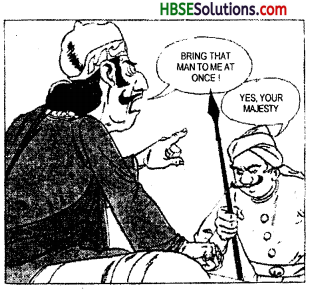
19. राजा : उस व्यक्ति को एक दम अंद्र लाओ। दरबारी : हाँ, महाराज।
HBSE 7th Class English Solutions Honeycomb Chapter 3 Gopal and the Hilsa-Fish 18

HBSE 7th Class English Solutions Honeycomb Chapter 3 Gopal and the Hilsa-Fish

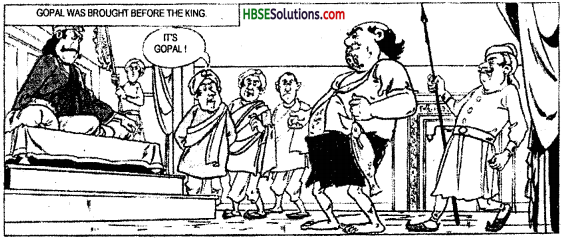
20. गोपाल को राजा के सामने लाया गया। दरबारी : गोपाल आया है।
HBSE 7th Class English Solutions Honeycomb Chapter 3 Gopal and the Hilsa-Fish 19

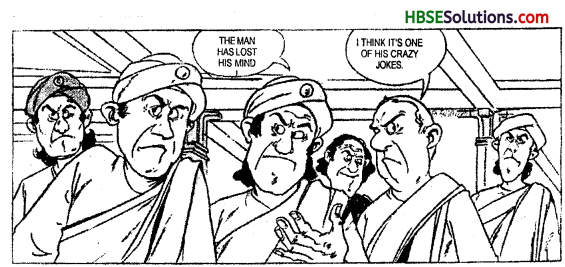
21. दरबारी : अब आदमी का दिमाग खराब हो गया है। दूसरा दरबारी : शायद यह उसका कोई चुटकुला है।
HBSE 7th Class English Solutions Honeycomb Chapter 3 Gopal and the Hilsa-Fish 20

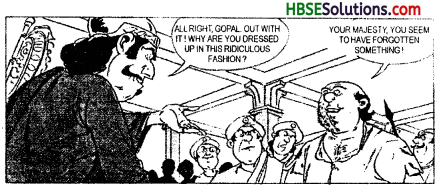
22. राजा : ठीक है गोपाल। सही दर्शाओ। तुम ने इस अजीब तरह के कपड़े क्यों पहने हैं। गोपाल : महारांज शायद आप कुछ भूल गए हो।
HBSE 7th Class English Solutions Honeycomb Chapter 3 Gopal and the Hilsa-Fish 21

23. राजा : कुछ भूल गए हो।
HBSE 7th Class English Solutions Honeycomb Chapter 3 Gopal and the Hilsa-Fish 22

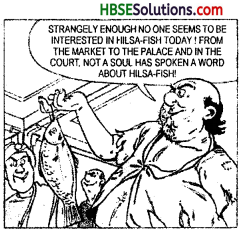
24. गोपाल : बड़ी अजीब बात है कि आज कोई हिल्सा मछली में रुचि नहीं रखता। मार्किट से, महल तक और कोर्ट में किसी ने एक भी शब्द् हिल्सा मछली के बारे में नहीं बोला।
HBSE 7th Class English Solutions Honeycomb Chapter 3 Gopal and the Hilsa-Fish 23

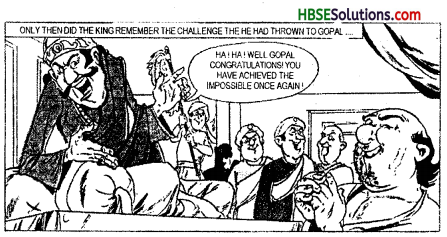
25. तब राजा को गोपाल की दी गई चुनौती के बारे में याद आया।
HBSE 7th Class English Solutions Honeycomb Chapter 3 Gopal and the Hilsa-Fish 24

HBSE 7th Class English Solutions Honeycomb Chapter 3 Gopal and the Hilsa-Fish Read More »

HBSE 6th Class Social Science Solutions History Chapter 1 What, Where, How and When?

Haryana State Board HBSE 6th Class Social Science Solutions History Chapter 1 What, Where, How and When? Textbook Exercise Questions and Answers.

Haryana Board 6th Class Social Science Solutions History Chapter 1 What, Where, How and When?

HBSE 6th Class History What, Where, How and When? Textbook Questions and Answers

LET’S RECALL

What Where How And When HBSE 6th Class Social Science Question 1.
Match the following :

Narmada ValleyThe first big Kingdom
MagadhaHunting and gathering
Garo HillsCities about 2500 years ago
Indus and its tributariesEarly agriculture
Ganga ValleyThe first cities

Answer:

Narmada ValleyHunting and gathering
MagadhaThe first big Kingdom
Garo HillsEarly agriculture
Indus and its tributariesThe first cities tributaries
Ganga ValleyCities about 2500 years ago

HBSE 6th Class Social Science Solutions History Chapter 1 What, Where, How And When?

HBSE 6th Class Social Science What Where How And When Question 2.
List one major difference between manuscripts and inscriptions.
Answer:
Manuscripts are the hand written account of contemporary event. These were written by the few learned people of their age in different languages and scripts, while inscriptions are engraved either on a stone surface or on metal or bricks.

LET’S DISCUSS

Question 3.
Return to Rasheeda’s questions. Can you think of some answers to it ?
Answer:
One can know what happened so many years ago through :
(a) Manuscripts
(b) Inscriptions
(c) Old objects recovered from excavations

Question 4.
Make a list of all the objects that archaeologists may find. Which of these could be made of stone ?
Answer:
Archaeologists study the remains of buildings made of stones and bricks that have
HBSE 6th Class Social Science Solutions History Chapter 1 What, Where, How And When-1
survived, paintings and sculptures. They find tools, weapons, pots, pans, ornaments and coins. The objects which were made of stone were :
(i) Tools
(ii) Weapons

Question 5.
Why do you think ordinary men and women did not generally keep records of what they did ?
Answer:
We think ordinary men and women did not generally keep records of what they did. This is due to following reasons :
(i) They lacked writing potential and historical sense.
(ii) Some of them were not literate even after the knowledge of the script.
(iii) They did not know the importance of keeping records of the events.

Question 6.
Describe at least two ways in which you think the lives of kings would have been different from those of the farmers.
Answer:
The lives of kings would have been different from those of the farmers in the following two ways :
(i) The kings set-up large kingdoms and lived in big palaces; the farmers used to live in huts or in very small houses.
(ii) The kings kept records of their daily life and victories. The farmers did not keep any such records.

HBSE 6th Class Social Science Solutions History Chapter 1 What, Where, How And When?

LET’S DO

Question 7.
Find the word crafts persons on page 1 (Textbook). List at least live different crafts that you know about today. Are the crafts persons:
(a) men
(b) women
(c) both men and women ?
Answer:
Crafts Persons:
A craft person is a person who is perfect in his occupation. Today, we came to know about different crafts, and craftsmen. Following are the name of some perfect craft persons :
(i) Architecture
(ii) Scientists
(iii) Musicians
(iv) Artists
(v) Businessmen/women.
Today both men and women are craft persons, because in the sphere of globalisation each and every one has equal rights to excel well (or to deliver his best).

Question 8.
What were the subjects on which books were written in the past ? Which of these would you like to read ?
Answer:
In the past a number of books dealt with all kinds of subject were written i.e., religious beliefs and religious practices, medicine, science and the lives of the kings. Except these books, epics, poems and plays were also written.

HBSE 6th Class History What, Where, How And When? Important Questions and Answers

Very Short Answer Type Questions

Question 1.
Who were skilled gatherers ?
Answer:
Skilled gatherers were people who gathered their foods from one place to another.

HBSE 6th Class Social Science Solutions History Chapter 1 What, Where, How And When?

Question 2.
Where was rice first grown ?
Answer:
Rice was first grown to the north of the Vindhyas mountains.

Question 3.
Name the two words which we use for our country.
Answer:
The two words we use for our country are India and Bharat.

Question 4.
What are tributaries ?
Answer:
Tributaries are small rivers that mixed into a large river.

Question 5.
Why did people move from place to place ?
Answer:
People moved from place to place in search of their livelihood also to escape from natural disasters like floods or droughts.

Question 6.
What forms the natural frontiers of the subcontinent ?
Answer:
Hills, mountains and seas together forms the natural frontiers of the subcontinent.

Question 7.
How did the movements of people enrich our culture traditions ?
Answer:
People share new techniques of carving stone, composing music, and even cooking food to enrich our cultural traditions.

Question 8.
Why were manuscripts called so ?
Answer:
Manuscripts were called so because they were written by hand on palm leaf.

HBSE 6th Class Social Science Solutions History Chapter 1 What, Where, How And When?

Short Answer Type Questions

Question 1.
Who are archaeologist ? What do they do ?
Answer:
People who study the objects of the past are archaeologists. They study the remains of the buildings, made of stone and brick, as well as paintings and sculptures. They also use tools, weapons, pots, pans, ornaments and coins for further enquiry. They even look for bones of animals, birds and fishes to find out what they ate in the past.

Question 2.
What are the advantages of writing on a hard surface ? What could have been the difficulties ?
Answer:
The advantages of writing on a hard surface like stone or metal is that it cannot be destroyed by pests. The stones and rocks could be easily handled over long distances. It would have been difficult to write on hard material.

Question 3.
How were the dates counted in the past ?
Answer:
In the past dates were usually counted from the date which is generally assigned to the birth of Jesus Christ, the founder of Christianity. So if we say 2000 it means 2000 years after the birth of Christ. All dates before the birth of Christ are counted backwards and usually have the letters B.C. (Before Christ) added on.

Question 4.
What are inscriptions ? What did they contain ?
Answer:
Inscriptions are writings on hard material, such as stone or metal. Sometimes the kings got their orders inscribed, so that people could read and obey them. There were other kind of inscriptions as well, where men and women (including kings and queens).

HBSE 6th Class Social Science Solutions History Chapter 1 What, Where, How And When?

Question 5.
How does the study of ancient Indian history help us to understand the present ?
Answer:
The study of ancient Indian history help us to understand the present day problems and find out solution to those problems. We never opted for an autocratic regime. In India, we had ‘democracy’ where the ministers carried out the administration according to the code of rules. We also had monarchies where the kings always remain anxious to promote the welfare of their subjects. From the given extract of Ashoka’s edict the present day ministers or the rulers of the country or province, etc., should learn how Ashoka cared for his subjects.

Long Answer Type Questions

Question 1.
Describe the movements of people from one part of the subcontinent to another.
Answer:
The movements of people from one part of the subcontinent to another could be discussed under the following heads :
(a) Purpose :
(i) Men and women moved in search of livelihood.
(ii) They moved to escape from natural disasters like floods or droughts.
(iii) Sometimes men marched in armies, conquering others’ lands.
(iv) Merchants travelled with caravans or ships, carrying valuable goods from place to place.
(v) Religious teachers travelled from one place to another giving instructions and advice.
(vi) Some people travelled by a spirit of adventure.

(b) Difficulties encountered:
The journeys of the travellers was made difficult by the hills and high mountains including the Himalayas, deserts, rivers and seas.

Question 2.
How did India’ get so many names ?
Answer:
(a) Two of the words we generally used for our country are India and Bharat. The word India comes from the Indus called Sindhu in Sanskrit.

(b) The Iranians and the Greeks who came through the northwest about 2500 years ago, were familiar with the Indus, called it the Hindos or the Indos. The land to the east of the river (i.e., the Indus) called India.

(c) The name Bharat was used by a group of people who lived in the northwest, and who are mentioned in Rigveda, the earliest composition in Sanskrit (dated to about 3500 years ago). Later, it was used for the country.

HBSE 6th Class Social Science Solutions History Chapter 1 What, Where, How And When?

Question 3.
Where did the early cities develop in India ?
Answer:
About 4700 years ago, some of the earliest cities (Harappa, Mohenjodaro, Lothal, Chun-ho-daro, Rupar, Banwali, Kalibangan, Surkotada, etc.) flourished on the banks of the Indus and its tributaries. And other early cities developed on the banks of the Ganga and its tributaries and along the coasts about 2500 years ago.

Question 4.
Why do we use the word ‘pasts’ (in plural) instead of word ‘past’ (in singular) ?
Answer:
We use the word ‘pasts’ in plural to draw attention to the fact that the past was different for different groups of people. For example :

  • People followed different practices and customs in different parts of the country.
  • The lives of herders or farmers was different from those of kings and queens.

Question 5.
Who are archaeologists ? What do they do ?
Answer:
Archaeologists are the persons who study the objects that were made and used in the past.

  • They study the remains of the buildings made of stone and brick, paintings and sculpture.
  • They also explore and excavate (dig under the surface of the earth) to find tools, weapons, pots, pans, ornaments and coins.
  • Archaeologists study bones of animals, birds and fish to find out what people ate in the past.

HBSE 6th Class Social Science Solutions History Chapter 1 What, Where, How And When?

What, Where, How and When? Class 6 HBSE Notes

  • Manuscript: Hand written account of contemporary event is called Manuscript.
  • Inscription : Inscriptions are the writing engraved on stones, rocks and pillars.
  • Archaeology: Archaeology is the study of remains of past.
  • History: The period for which we have written records is called History.
  • Pre-history: The period for which we have no written records is called Pre-history.
  • Historian: A person who deals with the study of history is called a Historian.
  • Archaeologist: A person who studies the early history and culture of human civilization from their material is known as Archaeologist.
  • Script: The form in which a language is written is called the Script.
  • Epigraphy: Study of inscriptions is called Epigraphy.

HBSE 6th Class Social Science Solutions History Chapter 1 What, Where, How and When? Read More »