Class 7

HBSE 7th Class Maths Solutions Chapter 11 परिमाप और क्षेत्रफल Ex 11.1

Haryana State Board HBSE 7th Class Maths Solutions Chapter 11 परिमाप और क्षेत्रफल Ex 11.1 Textbook Exercise Questions and Answers.

Haryana Board 7th Class Maths Solutions Chapter 11 परिमाप और क्षेत्रफल Ex 11.1

प्रश्न 1.
एक आयताकार भूखण्ड की लम्बाई और चौड़ाई क्रमशः 500 मीटर तथा 300 मीटर है। ज्ञात कीजिए :
(i) भूखण्ड का क्षेत्रफल
(ii) भूखण्ड का मूल्य, यदि 1 मीटर2 का मूल्य ₹ 10,000 है।
हल :
लम्बाई = 500 मीटर, चौड़ाई = 300 मीटर
(i) क्षेत्रफल = लम्बाई × चौड़ाई
= (500 × 300) मीटर2
= 1,50,000 मीटर2 उत्तर

(ii) ₹ 10,000 प्रति मीटर2 से जमीन की कीमत
= ₹ (10,000 × 1,50,000)
= ₹ 1,500,000,000 उत्तर

प्रश्न 2.
एक वर्गाकार पार्क का क्षेत्रफल ज्ञात कीजिए जिसका परिमाप 320 मीटर है।
हल :
वर्गाकार पार्क का परिमाप = 320 मीटर
∴ वर्गाकार पार्क की भुजा = \(\left(\frac{320}{4}\right)\) मीटर
= 80 मीटर।
∴ वर्गाकार पार्क का क्षेत्रफल = (भुजा)2
= (80 मीटर)2 = 80 × 80 मीटर2
= 6400 मीटर2। उत्तर

HBSE 7th Class Maths Solutions Chapter 11 परिमाप और क्षेत्रफल Ex 11.1

प्रश्न 3.
एक आयताकार भूखण्ड की चौड़ाई ज्ञात कीजिए यदि इसका क्षेत्रफल 440 मीटर2 और लम्बाई 22 मीटर हो। इसका परिमाप भी ज्ञात कीजिए।
हल :
माना एक आयताकार भूखण्ड की चौड़ाई = b मीटर है।
भूखण्ड की लम्बाई = 22 मीटर है।
भूखण्ड का क्षेत्रफल = 440 मीटर2
∴ भूखण्ड का क्षेत्रफल = लम्बाई × चौड़ाई
440 मीटर2 = b मीटर × 22 मीटर
b = \(\frac{440}{22}\) मीटर = 20 मीटर
अत: भूखण्ड का परिमाप = 2 × (ल. + चौ.)
= 2 × (22 + 20) मीटर
= 2 × 42 मीटर
= 84 मीटर। उत्तर

प्रश्न 4.
एक आयताकार शीट का परिमाप 100 सेमी है। यदि लम्बाई 35 सेमी हो तो इसकी चौड़ाई ज्ञात कीजिए। क्षेत्रफल भी ज्ञात कीजिए।
हल :
माना आयताकार शीट की चौड़ाई = b सेमी है। तथा लम्बाई = 35 सेमी और परिमाप = 100 सेमी
∴ परिमाप = 2 × (ल. + चौ.)
⇒ 100 = 2 × (35 + b)
⇒ \(\frac{100}{2}\) = 35 + b
⇒ 50 – 35 = b
⇒ 15 = b
⇒ शीट की चौड़ाई = 15 सेमी
∴ शीट का क्षेत्रफल = लम्बाई × चौड़ाई
= (35 × 15) सेमी2
= 525 सेमी2। उत्तर

HBSE 7th Class Maths Solutions Chapter 11 परिमाप और क्षेत्रफल Ex 11.1

प्रश्न 5.
एक वर्गाकार पार्क का क्षेत्रफल एक आयताकार पार्क के बराबर है। यदि वर्गाकार पार्क की एक भुजा 60 मीटर हो और आयताकार पार्क की लम्बाई 90 मीटर हो तो आयताकार पार्क की चौड़ाई ज्ञात कीजिए।
हल :
वर्गाकार पार्क का क्षेत्रफल = (भुजा)2
= (60)2 मीटर2
= 3600 मीटर2
माना आयताकार पार्क की चौड़ाई = 5 मीटर है।
∴ क्षेत्रफल = लम्बाई × चौड़ाई = 90 × b मीटर2
लेकिन आयताकार पार्क का क्षेत्रफल = वर्गाकार पार्क का क्षेत्रफल
∴ 90 × b = 3600
⇒ b = \(\frac{3600}{90}\) = 40
∴ आयताकार पार्क की चौड़ाई = 40 मीटर। उत्तर

प्रश्न 6.
एक तार आयत के आकार का है। इसकी लंबाई 40 सेमी और चौड़ाई 22 सेमी है। यदि उसी तार को दुबारा मोड़कर एक वर्ग बनाया जाता है तो प्रत्येक भुजा की माप क्या होगी? यह भी ज्ञात कीजिए कि किस आकार का क्षेत्रफल अधिक होगा?
हल :
जब तार आयत की आकृति का हो :
लम्बाई = 40 सेमी, चौड़ाई = 22 सेमी
तार की परिमाप = 2(लम्बाई + चौड़ाई)
= 2(40 + 22) सेमी
= 2 × 62 सेमी = 124 सेमी
इसका क्षेत्रफल = लम्बाई × चौड़ाई
= (40 × 22) सेमी2 = 880 सेमी2
जब वही तार वर्ग के आकार में मोड़ा जाता है तब इसका परिमाप आयत के आकार के समान होगा।
∴ परिमाप = 124 सेमी
⇒ 4 × भुजा = 124
⇒ भुजा = \(\frac{124}{4}\) सेमी = 31 सेमी
इसका क्षेत्रफल = (31)2 सेमी2 = 961 सेमी2
अतः वर्ग की भुजा की माप = 31 सेमी है और वर्गाकार आकृति का क्षेत्रफल अधिक है। उत्तर

HBSE 7th Class Maths Solutions Chapter 11 परिमाप और क्षेत्रफल Ex 11.1

प्रश्न 7.
एक आयत का परिमाप 130 सेमी है। यदि आयत की चौड़ाई 30 सेमी हो तो आयत की लम्बाई ज्ञात कीजिए। आयत का क्षेत्रफल भी ज्ञात कीजिए।
हल :
माना आयत की लम्बाई = l सेमी है।
परिमाप = 130 सेमी और चौड़ाई = 30 सेमी
परिमाप = 2 × (ल. + चौ.)
⇒ 130 = 2 × (l + 30)
⇒ \(\frac{130}{2}\) = l + 30
⇒ 65 – 30 = 1
⇒ l = 35
आयत की लम्बाई = 35 सेमी
आयत का क्षेत्रफल = लम्बाई × चौड़ाई
= (35 × 30) सेमी2
= 1050 सेमी2। उत्तर

प्रश्न 8.
2 मीटर लम्बाई और 1 मीटर चौड़ाई वाले दरवाजे को एक दीवार में लगाया जाता है। दीवार की लम्बाई 4.5 मीटर तथा चौड़ाई 3.6 मीटर है। (आकृति देखें) ₹ 20 प्रति मीटर2 की दर से दीवार पर सफेदी (white wash) कराने का व्यय ज्ञात कीजिए।
हल :
दीवार का कुल क्षेत्रफल
= लम्बाई × चौड़ाई
= (4.5 × 3.6) मीटर2
= 16.2 मीटर2
दरवाजे का क्षेत्रफल = लम्बाई × चौड़ाई
= (2 × 1) मीटर2 = 2 मीटर2
∴ दीवार पर सफेदी का क्षेत्रफल = दीवार का क्षेत्रफल – दरवाजे का क्षेत्रफल
= (16:2 – 2) मीटर2
= 14.2 मीटर2
∴ सफेदी करने का खर्च ₹ 20 प्रति मीटर2 की दर से
= ₹ 20 × 14.2 = ₹ 284। उत्तर

HBSE 7th Class Maths Solutions Chapter 11 परिमाप और क्षेत्रफल Ex 11.1 Read More »

HBSE 7th Class Maths Solutions Chapter 7 त्रिभुजों की सर्वांगसमता Ex 7.1

Haryana State Board HBSE 7th Class Maths Solutions Chapter 7 त्रिभुजों की सर्वांगसमता Ex 7.1 Textbook Exercise Questions and Answers.

Haryana Board 7th Class Maths Solutions Chapter 7 त्रिभुजों की सर्वांगसमता Ex 7.1

प्रश्न 1.
निम्न कथनों को पूरा कीजिए :
(a) दो रेखाखण्ड सर्वांगसम होते हैं, यदि …………।
(b) दो सर्वांगसम कोणों में से एक की माप 70° है, तो दूसरे कोण की माप …………. है।
(c) जब हम ∠A = ∠B लिखते हैं, हमारा वास्तव में अर्थ होता है ………….।
हल :
(a) इनकी लम्बाई समान हो।
(b) 70°.
(c) m∠A = m∠B.

HBSE 7th Class Maths Solutions Chapter 7 त्रिभुजों की सर्वांगसमता Ex 7.1

प्रश्न 2.
वास्तविक जीवन से सम्बन्धित सर्वांगसम आकारों के कोई दो उदाहरण दीजिए।
हल :
(i) एक ताले की दो चाबी।
(ii) 100 रु. के दो नोट।

प्रश्न 3.
यदि सुमेलन ABC ↔ FED के अंतर्गत ΔABC ≅ ΔFED, तो त्रिभुजों के सभी संगत सर्वांगसम भागों को लिखिए।
हल :
ΔABC ≅ ΔFED का मतलब है कि ΔABC, ΔFED को पूर्णतया ढक लेता है तथा ΔABC के शीर्ष क्रमशः ΔFED के शीर्षों पर स्थित होंगे।
A ↔ F, B ↔ E और C ↔ D
संगत भुजाएँ सर्वांगसम होंगी।
\(\overline{A B}\) ↔ \(\overline{F E}\), \(\overline{B C}\) ↔ \(\overline{E D}\), \(\overline{C A}\) ↔ \(\overline{D F}\)
संगत कोण सर्वांगसम होंगे :
∠A ↔ ∠F, ∠B ↔ ∠E , और ∠C ↔ ∠D.

HBSE 7th Class Maths Solutions Chapter 7 त्रिभुजों की सर्वांगसमता Ex 7.1

प्रश्न 4.
यदि ΔDEF ≅ ΔBCA हो, तो ΔBCA के उन भागों को लिखिए, जो निम्न के संगत हों :
(i) ∠E
(ii) \(\overline{E F}\)
(iii) ∠F
(iv) \(\overline{D F}\)
हल :
यदि ΔDEF ≅ ΔBCA, तो
D ↔ B, E ↔ C और F ↔ A
अत: ΔBCA के भाग संगत होंगे।
(i) ∠E ↔ ∠C
(ii) \(\overline{E F}\) ↔ \(\overline{C A}\)
(iii) ∠F ↔ ∠A
(iv) \(\overline{D F}\) ↔ \(\overline{B A}\)

HBSE 7th Class Maths Solutions Chapter 7 त्रिभुजों की सर्वांगसमता Ex 7.1 Read More »

HBSE 7th Class Maths Solutions Chapter 6 त्रिभुज और उसके गुण InText Questions

Haryana State Board HBSE 7th Class Maths Solutions Chapter 6 त्रिभुज और उसके गुण InText Questions and Answers.

Haryana Board 7th Class Maths Solutions Chapter 6 त्रिभुज और उसके गुण InText Questions

पृष्ठ सं. 125-126 (प्रयास कीजिए)

प्रश्न 1.
ΔABC के छः अवयवों (तीन भुजाओं तथा तीन कोणों) के नाम लिखिए।
हल :
ΔABC की तीन भुजाएँ AB, BC और CA तथा तीन कोण ∠A, ∠B और ∠C हैं।

प्रश्न 2.
लिखिए :
(i) ΔPQR के शीर्ष Q की सम्मुख भुजा
(ii) ΔLMN की भुजा LM का सम्मुख कोण
(iii) ΔRST की भुजा RT का सम्मुख शीर्ष
हल :
(i) ΔPQR के शीर्ष Q की सम्मुख भुजा RP है।
(ii) ΔLMN की भुजा LM का सम्मुख कोण = ∠N है।
(iii) ΔRST की भुजा RT का सम्मुख शीर्ष s है।

प्रश्न 3.
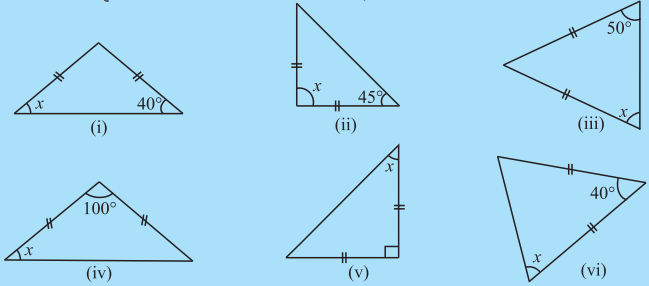
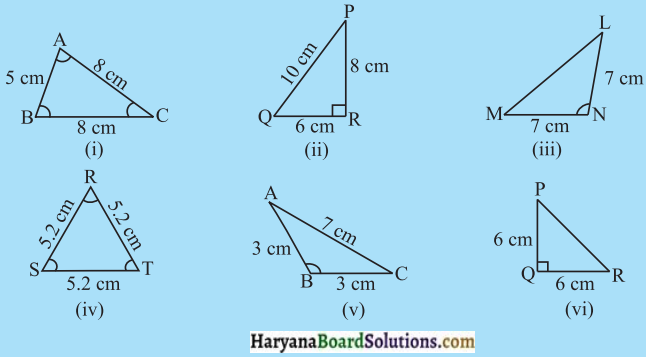
आकृति देखिए तथा त्रिभुजों में प्रत्येक का वर्गीकरण कीजिए:
(a) भुजाओं के आधार पर
(b) कोणों के आधार पर
HBSE 7th Class Maths Solutions Chapter 6 त्रिभुज और उसके गुण InText Questions 1
हल :
(a) भुजाओं के आधार पर वर्गीकरण
विषमबाहु त्रिभुज : (ii)
समद्विबाहु त्रिभुज : (i), (iii), (v) तथा (vi)
समबाहु त्रिभुज : (iv)

(b) कोणों के आधार पर वर्गीकरण :
न्यून कोण त्रिभुज : (i) और (iv)
समकोण त्रिभुज : (ii) और (vi)
अधिक कोण त्रिभुज : (iii) और (v)

पृष्ठ सं. 130

प्रश्न 1.
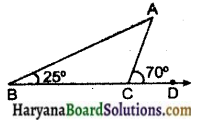
किसी त्रिभुज में एक बाह्य कोण की माप 70° है और उसके अंत: सम्मुख कोणों में से एक की माप 25° है। दूसरे अंत: सम्मुख कोण की माप ज्ञात कीजिए।
इल :
HBSE 7th Class Maths Solutions Chapter 6 त्रिभुज और उसके गुण InText Questions 2
माना ΔABC की भुजा BC को आगे बढ़ाने पर बाह्य कोण ∠ACD इस प्रकार बना कि ∠ACD = 70°
माना ∠B = 25°
∴ ∠ACD = ∠B + ∠A (बाह्य कोण प्रमेय से)
70° = 25° + ∠A
∠A = 70° -25° = 45°
अत: दूसरा अन्तः सम्मुख कोण 45° का है।

प्रश्न 2.
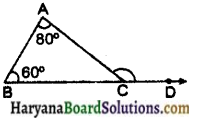
किसी त्रिभुज के दो अंतः सम्मुख कोणों की माप 60° तथा 80° है। उसके बाल कोण की माप ज्ञात कीजिए।
हल :
HBSE 7th Class Maths Solutions Chapter 6 त्रिभुज और उसके गुण InText Questions 3
माना ΔABC की भुजा \(\overline{B C}\) को आगे बढ़ने पर एक बाहा कोण ∠ACD प्राप्त होता है।
माना ∠A = 80° और ∠B = 60°
∠ACD = ∠A + ∠B (बाह्य कोण प्रमेय से)
∠ACD = 80° + 60°
∠ACD = 140°
अतः बाह्य कोण की माप = 140°

प्रश्न 3.
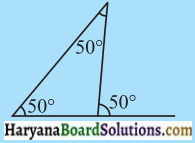
क्या इस आकृति में कोई त्रुटि है। टिप्पणी करें।
हल :
HBSE 7th Class Maths Solutions Chapter 6 त्रिभुज और उसके गुण InText Questions 4
आकृति में बाह्य कोण अन्त: सम्मुख कोणों के योग के बराबर नहीं है।
50° ≠ 50° + 50°
अतः दिए गए कोण गलत हैं।

पृष्ठ सं. 134

प्रश्न 1.
एक त्रिभुज के दो कोण 30° तथा 80 हैं। इस त्रिभुज का तीसरा कोण ज्ञात कीजिए।
हल :
हम जानते हैं कि त्रिभुज के तीनों कोणों का योग 180° होता है।
माना ΔABC में ∠A = 30° और ∠B = 80° हो, तो
∠A + ∠B + ∠C = 180°
30° + 80° + ∠C = 180°
∠C = 180° – 30° – 80°
= 180° – 110° = 70°
अत: तीसरा कोण 70° होगा।

HBSE 7th Class Maths Solutions Chapter 6 त्रिभुज और उसके गुण InText Questions

प्रश्न 2.
किसी त्रिभुज का एक कोण 80° है तथा शेष दोनों कोण बराबर हैं। बराबर कोणों में प्रत्येक की माप ज्ञात कीजिए।
हल :
माना त्रिभुज ABC में ∠A = 80° और ∠B = ∠C
∵ त्रिभुज के तीनों कोणों का योग 180° होता है।
∴ ∠A + ∠B + ∠C = 180°
⇒ 80° + ∠B + ∠B = 180°,
[∵ ∠A = 80° और ∠C = ∠B]
⇒ 80° + 2∠B = 180°
⇒ 2∠B = 180° – 80°
⇒ 2∠B = 100°
⇒ ∠B + = 50°
अत: शेष दो कोणों की माप 50° है।

प्रश्न 3.
किसी त्रिभुज के तीनों कोणों में 1 : 2 : 1 का अनुपात है। त्रिभुज के तीनों कोण जात कीजिए। त्रिभुज का दोनों प्रकार से वर्गीकरण भी कीजिए। हल :
माना त्रिभुज के कोण x, 2x और x है, तो
x + 2x + x = 180°
4x = 180°
x = \(\frac {180°}{4}\) = 45°
अत:त्रिभुज का पहला कोण (x) = 45°
दूसरा कोण (2x) = 2 × 45° = 90°
तीसरा कोण (x) = 45°
अत: समकोण त्रिभुज है और यह एक समद्विबाहु त्रिभुज भी है।

HBSE 7th Class Maths Solutions Chapter 6 त्रिभुज और उसके गुण InText Questions

पृष्ठ सं. 135

प्रश्न 1.
प्रत्येक आकृति में कोण x का मान ज्ञात कीजिए
HBSE 7th Class Maths Solutions Chapter 6 त्रिभुज और उसके गुण InText Questions 5
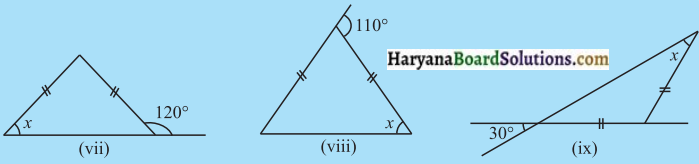
HBSE 7th Class Maths Solutions Chapter 6 त्रिभुज और उसके गुण InText Questions 6
हल :
त्रिभुज (i) समद्विबाहु त्रिभुज है।
∴ ∠B = ∠C
∴ x = 40°

त्रिभुज (ii) समद्विबाहु त्रिभुज है, जिसमें
AB = BC
∠A = ∠C = 45°
कोण योग गुण से :
∠A + ∠B + ∠C = 180°
⇒ 45° + x + 45° = 180°
⇒ x = 180° – 45° – 45°
⇒ x = 90°

त्रिभुज (iii) समद्विबाहु त्रिभुज है, जिसमें
AC = AB
तथा ∠B = ∠C = 50°
∴ x = 50°

त्रिभुज (iv) समद्विबाहु त्रिभुज है, जिसमें
AC = AB
∠B = ∠C = x
कोण योग गुण से
∠A + ∠B + ∠C = 180°
⇒ 100° + x + x = 180°
⇒ 2x = 180° – 100°
⇒ 2x = 80°
⇒ x = \(\frac {80°}{2}\) = 40°

त्रिभुज (v) समद्विबाहु त्रिभुज है, जिसमें
AC = BC
तथा ∠A = ∠B = x
कोण योग गुण से
∠A + ∠B + ∠C = 180°
⇒ x + x + 90° = 180°
⇒ 2x = 180° – 90°
⇒ 2x = 90°
⇒ x = \(\frac {90°}{2}\) = 45°

त्रिभुज (vi) समद्विबाहु त्रिभुज है, जिसमें
AC = BC
तथा ∠A = ∠B = x
कोण योग गुण से,
∠A + ∠B + ∠C = 180°
⇒ x + x + 40° = 180°
⇒ 2x = 180° – 40°
⇒ 2x = 140°
⇒ x = \(\frac {140°}{2}\) = 70°

त्रिभुज (vii) समद्विबाहु त्रिभुज है, जिसमें
AB = AC
∴ ∠B = ∠C
⇒ x = ∠C
क्योंकि बाह्य कोण और संलग्न अंत: कोण रैखिक युग्म बनाते हैं।
∠C + 120° = 180°
⇒ x = 180° – 120° = 60°
त्रिभुज (viii) समद्विबाहु त्रिभुज है, जिसमें
AB = AC
∴ ∠B = ∠C ⇒ ∠B = x
क्योंकि बाह्य कोण और संलग्न अंत: कोण रैखिक युग्म बनाते हैं।
110° + ∠A = 180°
∠A = 180° – 110° = 70°
कोण योग गुण से,
∠A + ∠B + ∠C = 180°
⇒ 70° + x + x = 180°
⇒ 2x = 180° – 70°
⇒ 2x = 110°
⇒ x = 55°

त्रिभुज (ix) समद्विबाहु त्रिभुज है, जिसमें
AB = AC
∠B + ∠C = x
∠B = 30°, (शीर्षाभिमुख कोण)
∴ x = 30°

प्रश्न 2.
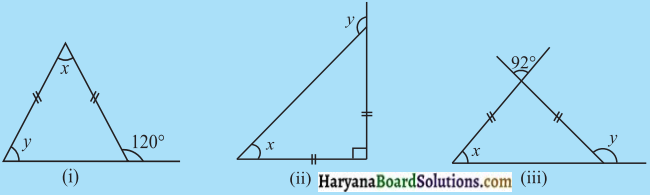
प्रत्येक आकृति में कोण x तथा y का मा ज्ञात कीजिए।
HBSE 7th Class Maths Solutions Chapter 6 त्रिभुज और उसके गुण InText Questions 7
हल :
(i) अन्त: कोण ∠C + 120° = 180°
∠C = 180° – 120°
∠C = 60°
∵ ΔABC समद्विबाहु Δहै, जिसमें
AB = AC
तथा ∠B = ∠C = 60°
∴ ∠B = y = 60°
कोण योग गुण से,
∠A + ∠B + ∠C = 180°
x + 60° + 60° = 180°
x = 180° – 120°
x = 60°
अत: x = 60° और y = 60°

(ii) त्रिभुज ABC एक समद्विबाहु Δ है, जिसमें
BC = AC
∠A = ∠B = x
और ∠A + ∠B = 90°
x + x = 90°
2x = 90°
x = \(\frac {90°}{2}\)
x = 45°
लेकिन ∠B + y = 180°
x + y = 180°
45° + y = 180°
y = 180°- 45° = 135°
अतः x = 45° और y = 135°

(iii) त्रिभुज ABC समद्विबाहु त्रिभुज है, जिसमें
AB = AC
∠B = ∠C अर्थात्
∠B = ∠C = x
और ∠A = 92°, [शीर्षाभिमुख कोण]
कोण योग गुण से,
∠A + ∠B + ∠C = 180°
⇒ 92°+ x + x = 180°
⇒ 2x = 180° – 92° = 88°
⇒ x = (\(\frac {88}{2}\))° = 44°
और ∠C + y = 180°, [रैखिक युग्म]
⇒ y = 180° – 44° = 136°, [∵ ∠C = x = 44°]
अतः x = 44° और y = 136°

HBSE 7th Class Maths Solutions Chapter 6 त्रिभुज और उसके गुण InText Questions

पृष्ठ सं. 141

प्रश्न 1.
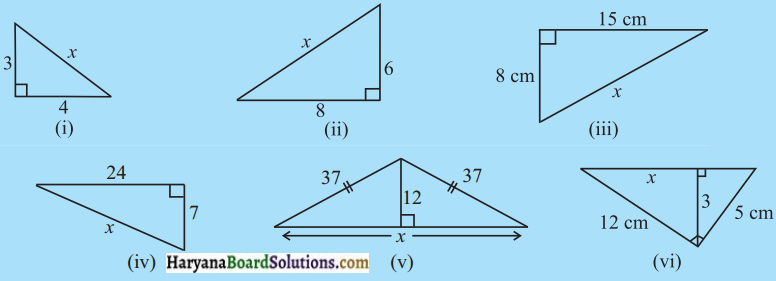
निम्न आकृति में अज्ञात लम्बाई x ज्ञात कीजिए :
HBSE 7th Class Maths Solutions Chapter 6 त्रिभुज और उसके गुण InText Questions 8
हल :
(i) ΔABC में कोण B समकोण है।
∴ पाइथागोरस प्रमेय से,
AC2 = AB2 + BC2
⇒ x2 = 32 + 42
⇒ x2 = 9 + 16
⇒ x2 = 25
⇒ x = \(\sqrt{25}\) = 5

(ii) ΔABC में, ∠B समकोण है।
∴ पाइथागोरस प्रमेय से,
AC2 = AB2 + BC2
⇒ x2 = 82 + 62
⇒ x2 = 64 + 36
⇒ x2 = 100
⇒ x = \(\sqrt{100}\) = 10

(iii) ΔABC में, ∠B समकोण है।
∴ पाइथागोरस प्रमेय से,
AC2 = AB2 + BC2
⇒ x2 = 82 + 152
⇒ x2 = 64 + 225
⇒ x2= 289
⇒ x = \(\sqrt{289}\) = 17

(iv) ΔABC का ∠B समकोण है।
∴ पाइथागोरस प्रमेय से,
AC2 = AB2 + BC2
⇒ x2 = 242 + 72
⇒ x2 = 576 + 49
⇒ x2 = 625
⇒ x = \(\sqrt{625}\) = 25

(v) समकोण ΔALB और ΔALC में पाइथागोरस प्रमेय का प्रयोग करने पर,
ΔALB में, BL2 = AB2 – AL2 = 372 – 122
= (37 + 12) (37 – 12)
= 49 × 25
BL = \(\sqrt{49 \times 25}\)
BL = 7 × 5 = 35
इसी प्रकार, CL = 35
∴ BC = BL + LC = 35 + 35 = 70
∴ x = 70

(vi) समकोण त्रिभुज ALB में पाइथागोरस प्रमेय का प्रयोग करने पर,
BL2 = AB2 – AL2
= 122 – 32 = 144 – 9
BL2 = 135
BL = \(\sqrt{135}\)
x = \(\sqrt{135}\) = 11.6 सेमी

HBSE 7th Class Maths Solutions Chapter 6 त्रिभुज और उसके गुण InText Questions Read More »

HBSE 7th Class Science Solutions Chapter 2 Nutrition in Animals

Haryana State Board HBSE 7th Class Science Solutions Chapter 2 Nutrition in Animals Textbook Exercise Questions and Answers.

Haryana Board 7th Class Science Solutions Chapter 2 Nutrition in Animals

HBSE 7th Class Science Nutrition in Animals Textbook Questions and Answers

Question 1.
Fill in the blanks:
(a) The main steps of digestion in humans are …………… , …………… , …………… , …………… , and …………… .
(b) The largest gland in these human body is …………… .
(c) The stomach releases hydrochloric acid and …………. juices which act on food.
(d) The inner wall of the small intestine has many finger-like outgrowths called …………… .
(e) Amoeba digests its food in the …………… .
Answer:
(a) ingestion, digestion, absorption, assimilation, egestion
(b) liver
(c) digestive
(d) villi
(e) food vacuole.

Question 2.
Mark T if the statement is true and F if it is false:
(а) Digestion of starch starts in the stomach.
(b) The tongue helps in mixing food with saliva.
(c) The gall bladder temporarily stores bile.
(d) The ruminants bring back swallowed grass into their mouth and chew it for some time.
Answer:
(a) False
(b) True
(c) False and
(d) True.

Question 3.
Tick (✓) mark the correct answer in each of the following:
(a) Fat is completely digested in the:
(i) stomach
(ii) mouth
(iii) small intestine
(iv) large intestine.
Answer:
(iii) small intestine.

(b) Water from the undigested food is absorbed mainly in the:
(i) Stomach
(ii) food pipe
(iii) small intestine
(iv) large intestine.
Answer:
(iv) large intestine.

HBSE 7th Class Science Solutions Chapter 2 Nutrition in Animals

Question 4.
Match the items of column I with those given in column II:

Column IColumn II
Food ComponentsProduct (s) of Digestion
(i) Carbohydrates(a) Fatty acids and glycerol
(ii) Proteins(b) Sugar
(iii) Fats(c) Amino acids

Answer:

Column IColumn II
Food ComponentsProduct (s) of Digestion
(i) Carbohydrates(b) Sugar
(ii) Proteins(c) Amino acids
(iii) Fats(a) Fatty acids and glycerol

Question 5.
What are Villi? What is their location and function?
Answer:
Villi are the finger like structures which are the form of internal layer. They are situated in the stomach.
Functions:
(i) Villi provides space for food.
(ii) Digestive juice is secreted out from the digestive glands present in the Villi in the embedded form.
(iii) The food is grinded by the contraction and expansion of Villi.

Question 6.
Where is the bile produced? Which component of the food does it digest?
Answer:
The liver secretes bile juice that is stored in a sac called the gall bladder. The bile plays an important role in the digestion of fats.

Question 7.
Name the type of carbohydrate that can be digested by ruminants but not by humans. Give the reason also.
Answer:
The grass is rich in cellulose, a type of carbohydrate. Many animals, including humans, cannot digest cellulose. The cellulose can be digested by ruminants but not by humans because they have a large sac-like structure between the small intestine and large intestine. The cellulose of the food is digested here by the action of certain bacteria which are not present in humans.

Question 8.
Why do we get instant energy from glucose?
Answer:
We get instant energy from glucose, because in the cells, glucose breaks down with the help of oxygen into carbon dioxide and water and energy is released.

Question 9.
Which part of the digestive canal is involved in:
(i) absorption of food
(ii) chewing of food
(iii) killing of bacteria
(iv) complete digestion of food
(v) formation of faeces.
Answer:
(i) small intestine
(ii) buccal cavity
(iii) stomach
(iv) small intestine
(v) large intestine.

Question 10.
Write one similarity and one difference between the nutrition in Amoeba and human beings.
Answer:
Similarity: In both, the process of digestion involves ingestion, digestion, absorption, assimilation and egestion.
Difference: In Amoeba, the enzymes secreted by the call cytoplasm digest the ingested food.
In man, there are special organs for the digestion of food. The food passes through the alimentary canal. Here several digestive enzymes are secreted. These enzymes break the complex food materials into simpler ones.

Question 11.
Match the items of column 1 with suitable items in column II:

Column IColumn II
(a) Salivary gland(i) Bile juice secretion
(b) Stomach(ii)Storage of undigested food
(c) Liver(iii) Saliva secretion
(d) Rectum(iv) Acid release
(e) Small intestine(v)Digestion is completed
(f) Large intestine(vi)Absorption of water

Answer:

Column IColumn II
(a) Salivary gland(iii) Saliva secretion
(b) Stomach(iv) Acid release
(c) Liver(i) Bile juice secretion
(d) Rectum(vii) Release of faeces
(e) Small intestine(v)Digestion is completed
(f) Large intestine(vi)Absorption of water

HBSE 7th Class Science Solutions Chapter 2 Nutrition in Animals

Question 12.
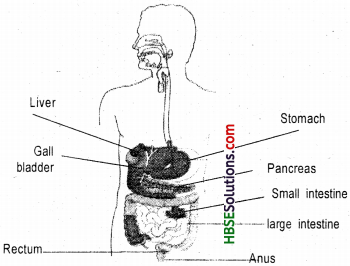
Label following figure of the digestive system.
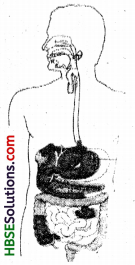
HBSE 7th Class Science Solutions Chapter 2 Nutrition in Animals-1
Answer:
HBSE 7th Class Science Solutions Chapter 2 Nutrition in Animals-2

Question 13.
Can we survive only on raw, leafy vegetables/grass? Discuss.
Answer:
No, we cannot survive only on raw, leafy vegetables/grass, Discuss of this topic in your class and ask to your teacher.

Extended Learning Activities And Project

Question 1.
Visit a doctor and find out:
(i) Under what conditions does a patient need to be on a drip of glucose?
(ii) Till when does a patient need to be given glucose?
(iii) How does glucose help the patient recover?
Write the answers in your notebook.
Answer:
Do yourself. Consult your family doctor and ask these Questions.

Question 2.
Find out what Vitamins are and get the following information.
(i) Why are Vitamins necessary in the diet?
(ii) Which fruits or vegetables should be eaten regularly to get Vitamins?
Write a one-page note on the information collected by you. You may take help of a doctor, a dietician, your teacher or any other person, or any other source.
Answer:
You have learnt about vitamins in class VI (chapter 2 – components of food).

Question 3.
Collect data from your friends, neighbours and classmates to find out about “milk teeth”. Tabulate your data. One way of doing it is given below:

S. NoAge at which first tooth fellAge at Which last tooth fellNo. of teeth lostNo. of teeth replaced
1.

2.

3.

4

5.

Find out from at least twenty children and find the average age at which children lose the milk teeth. You may take help of your friends.
Answer:
Do yourself. Take help to your classmates and friends.

HBSE 7th Class Science Nutrition in Animals Important Questions and Answers

Very Short Answer Type Questions

Question 1.
Name the body parts that capture food in Hydra, Amoeba.
Answer:
Hydra-tentacles, Amoeba-Pseudopodia.

Question 2.
Name the important parts of the digestive system of human body.
Answer:
(i) Mouth with buccal cavity
(ii) Oesophagus
(iii) Stomach
(iv) Duodenum
(v) Small intestine
(vi) Large intestine
(vii) Anus.

Question 3.
Name three parts in which digestion takes place in the digestive system of human body.
Answer:
(i) Buccal cavity
(ii) Stomach
(iii) Small intestine with duodenum.

Question 4.
In which part of the digestive system absorption of water takes place?
Answer:
Absorption of water takes place in large intestine.

HBSE 7th Class Science Solutions Chapter 2 Nutrition in Animals

Question 5.
What are Villi?
Answer:
Villi are the finger like folds in the inner walls of stomach.

Question 6.
What is the fuel for energy production in cells?
Answer:
Carbohydrates acts as the fuel for energy.

Question 7.
Name Five steps in the process of nutrition.
Answer:
1. Ingestion
2. digestion
3. absorption
4. assimilation and
5. egestion.

Question 8.
In which part of the alimentary canal
(a) absorption of water takes place
(b) assimilation of digested food occurs?
Answer:
(a) Large intestine
(b) Small intestine.

Question 9.
In which two parts of man does much of the digestion take place?
Answer:
In stomach and small intestine much of the digestion take place.

Question 10.
What are pseudopodia?
Answer:
Amoeba constantly changes its shape and position. It pushes out one, or more finger-like projections, called pseudopodia or false feet for movement and capture of food.

Question 11.
Name the organ of the digestive system where digestion of food of all types takes place.
Answer:
Small Intestine.

Question 12.
Is the large intestine really large?
Answer:
No. The large intestine is wider and shorter than small intestine. It is about 1.5 metre in length.

Question 13.
Where does digestion start in humans?
Answer:
In humans, digestion starts in stomach.

HBSE 7th Class Science Solutions Chapter 2 Nutrition in Animals

Question 14.
Name the largest gland in the human body.
Answer:
Liver is the largest gland in the human body.

Question 15.
Name three ruminant animals.
Answer:
1. Cow
2. Buffalo and
3. Horse.

Question 16.
Define ruminants.
Answer:
Herbivores like cow, buffalo etc. first swallow the food without chewing it. After some time, they bring back the swallowed food to their mouth from the pouch of the stomach. Then they again grind the food well and swallow it. It is called chewing of the cud. These animals are known as ruminants.

Question 17.
What are incisors?
Answer:
Incisors are the flat front teeth. These have a sharp straight edge that help us to cut food and hence, they are also called cutting teeth. There are four incisors in each jaw.

Question 18.
What are canines?
Answer:
Canines are the pointed teeth present on either side of the incisors. These help us to tear the food and hence, they are called the tearing teeth. There are two such teeth in each jaw.

Question 19.
Define ingestion.
Answer:
Ingestion is the process by which food is taken by the organisms.

Question 20.
Define digestion.
Answer:
Digestion is the process of breaking down complex food molecules into similar molecules and is brought about with the help of special molecules called enzymes.

Question 21.
Define egestion.
Answer:
Egestion is the process by which undigested food is removed from the body.

Question 22.
Define absorption.
Answer:
The process by which the digested food molecules are taken up (or absorbed) by the intestine wall and sent to the circulatory system is called absorption.

Question 23.
What is assimilation?
Answer:
Assimilation is a process of conversion of absorbed food into body. For example, in man and other higher animals, the blood carries the food to different parts of the body for incorporation into cell components.

Question 24.
What is gall bladder?
Answer:
The liver secretes juices which help in digestion and are stored in a small bag called the gall bladder.

HBSE 7th Class Science Solutions Chapter 2 Nutrition in Animals

Question 25.
In which part of the digestive system and assimilation of food takes place?
Answer:
In human digestive system. Digestion takes place in buccal cavity, stomach and small intestine. Assimilation takes place in small intestine.

Question 26.
Write two functions of Villi.
Answer:
(i) Villi provides space for food.
(ii) Digestive juice is secreted out from the digestive glands present in the villi in the embedded form.

Question 27.
What is the function of oesophagus?
Answer:
No digestion takes place here. It only helps in pushing the food into stomach.

Question 28.
What is amylase?
Answer:
Saliva contains an enzyme called amylase. Amylase acts on starch and changes it into a sugar (called maltose).

Question 29.
Name the two processes of respiration.
Answer:
Inhalation and exhalation are the two processes of respiration.

Question 30.
Name the cells that carry water and food in the body of a green plant.
Answer:
Cells of Xylem vessels.

Short Answer Type Questions

Question 1.
How do the different animals procure food?
Answer:
Different organisms procure different methods. There are special structures in each organism for taking in food, for example, frog uses its sticky tongue to catch the prey. Butterfly has probosces (special mouth parts) to suck nectar from flowers. The housefly also lives on liquid food. It also has feeding tube to suck the liquid food. A spider spins a web to catch small insects. Human beings use hands to put their food in the mouth.

HBSE 7th Class Science Solutions Chapter 2 Nutrition in Animals

Question 2.
What are the stages in the process of Nutrition?
Answer:
The food taken into the body by an animal is processed further to derive nutrients from it. There are five stages in the processing of food in an animal.
These include:
(i) Ingestion
(ii) Digestion
(iii) Absorption
(iv) Assimilation
(v) Egestion.

Question 3.
“What do you understand by digestive enzymes?” How does amylase affect starch?
Answer:
Digestive enzymes are the special proteins secreted out in gastric glands, small intestine and in pancreas. Specific enzyme helps in digestion of specific food item.

Amylase is the enzyme secreted in the pancreatic juice which converts carbohydrates (Polysaccharides) starch into Maltose sugar (Disaccharides).

Question 4.
How does nutrition occur in amoeba?
Answer:Amoeba
constantly changes its shape and position. It pushes out one, or more finger-like projections, called pseudopodia or false feet for movement and capture of food.

Amoeba feeds on some microscopic organisms. When it senses food, it pushes out pseudopodia around the food particle and engulfs it. The food becomes trapped in a food vacuole. Digestive juices are secreted into the food vacuole. They act on the food and break it down into simpler substances. The absorbed substances are used for growth, maintenance and multiplication. The undigested residue of the food is expelled outside by the Vacuole.

Question 5.
How does nutrition occur in paramecium?
Answer:
In paramecium, the food is ingested with the help of small hair-like structures present on the cell membrane. These are called the cilia. The food passes to oral groove from the cell membrane and then enters the mouth. From the mouth the food is taken inside the main body, where the food vacuole helps in its digestion with the help of enzymes. The undigested food is excreted with the help of contrectile vacuole.

Question 6.
Differentiate between absorption apd assimilation.
Answer:
Absorption:
It is a process by which digested food gets absorbed. The soluble food materials pass through the wall of digestive tract and reach the circulatory system or body fluid of an organism. In human beings and in other higher organisms, absorption takes place in the small intestine.

Assimilation:
It is a process of conversion of absorbed food into body. For example, in man and other higher animals the blood carries the food of different parts of the body for incorporation into cell components.

Question 7.
Write short note on small intestine.
Answer:
Small intestine is a long coiled tube. It also secretes a juice and digestion of all types of food is carried out here. As a result of digestion, food is converted into simple form, and glucose, amino acid and fatty acides etc. are formed. These end products are ready for absorption. Small intestine also absorbs the digested food and passes it on to the blood system. Thus, the nutrients are carried to all parts of the body.

Question 8.
What happens to the digested food in our bodies?
Answer:
Our body requires energy to carry out the various activities of life. We get this energy from the food we eat. This happens during respiration. The food which we eat is digested in the alimentary canal. But the alimentary canal alone does not require food. It must go to all parts of the body. The digested food is absorbed by the small intestine and passed on to the blood. Through the blood, the absorbed food is carried to all parts of the body.

HBSE 7th Class Science Solutions Chapter 2 Nutrition in Animals

Question 9.
Why is the process of excretion important for living organisms?
Answer:
In all the living beings the metabolic activities take palce within the body for getting energy. The remaining part of the food is called as the waste material which are harmful to the body. So to become healthy and for proper functioning it is essential to pass these wastes from the body.

Question 10.
What are the main organs of the digestive system in our body?
Answer:
The process of digestion starts in the mouth. From the mouth, the food passes through a food canal (called alimentary canal).
Alimentary canal is a long, muscular and coiled tube, it starts from the mouth and ends at anus.
The different organs of the alimentary canal are as follows:
1. Mouth and mouth cavity.
2. Oesophagus (gullet or food pipe)
3. Stomach.
4. Small intestine.
5. Large intestine.
6. Anus.

Associated with the alimentary canal are some glands. These are:
1. Salivary glands
2. Liver
3. Pancreas.
The alimentary canal along with the associated glands is called the digestive system.

Question 11.
Write the functions of tongue.
Answer:
Tongue, a muscular organ, is also important for eating and performs several functions:
(i) It helps in mixing the chewed food with saliva
(ii) Swallowing the food
(iii) The tongue tastes, as it has sense organs called the taste buds.
These buds distinguish four basic tastes-salty, sour, sweet and bitter. In addition, it helps us to speak.

Question 12.
What are salivary glands?
Answer:
There are three pairs of salivary glands in our mouth. A watery material called saliva is secreted by these glands. Saliva helps in the digestion of food. Saliva contains an enzyme called amylase (also called ptyalin). Amylase acts on starch and changes it into a sugar (called maltose). The sugar is sweet and soluble in water.

Question 13.
What is meant by excretion? Explain its need for the sustenance of the individual.
Answer:
Excretion is the passing out of the metabolic wastes from the body through special organs known as excretory organs. The excretory matter, if it is present in the body, will disturb the metabolic activities going on in different parts of the body and also become hurdle in the circulation. It will disturb metabolic activity in body. So it is necessary to excrete out all the metabolic wastes from the body.

HBSE 7th Class Science Solutions Chapter 2 Nutrition in Animals

Long Answer Type Questions

Question 1.
Name the different types of teeth in an adult man and state their functions. Also give a labelled diagram of different types of teeth.
Answer:
There are four main kinds of teeth in humans-incisors, canines, premolars and molars.

The front four teeth in each jaw are the incisors. They are flat and help in biting the food. On either side of the incisors are the canines. These are sharp and two in number in each jaw. They are meant for tearing the food. The premolars and molars are meant for grinding and crushing the food. Premolars are behind the canines, two in number on either side in each jaw.

Molars are behipd the preiholars. In an adult, they are six in number in each jaw, three each on either side of the premolars. In young people there are 8 molars in all. The second set of 4 molars appears at the age of eighteen or even later. These are called the wisdom teeth. Each jaw in an adult has 16 teeth, or 32 teeth in all.
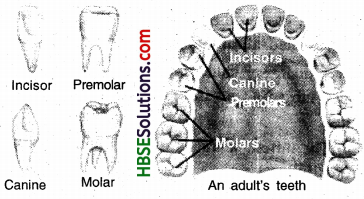
HBSE 7th Class Science Solutions Chapter 2 Nutrition in Animals-3

Question 2.
Describe briefly the different stages involved in the process of nutrition.
Answer:
The different stages involved in the process of nutrition are:
1. Ingestion:
It is a process of taking in food. It differs from animal to animal, for example, frog uses its tongue to catch its prey, human beings hold food with hands and put it into their mouth, etc.

2. Digestion:
It is a process of breakdown of complex food materials such as carbohydrates, fats, proteins etc, into simpler forms. It is both a mechanical and a chemical process.

3. Absorption:
It is a process by which digested food gets absorbed. The soluble food materials pass through the wall of digestive tract and reach the circulatory system or body fluid of an organism. In human beings and in other higher organisms, absorption takes place in the small intestine.

4. Assimilation:
It is process of conversion of absorbed food into body. For example, in man and other higher animals, the blood carries the food to different parts of the body for incorporation into cell components.

5. Egestion:
It is the process by which the undigested food is eliminated from the body. In man and other organisms, it is carried out through the anus.

Question 3.
Name the things which help in physical and chemical digestion.
Answer:
The things which help in physical digestion are as follows:
(а) Tongue and Teeth: They masticate and chew the food. The tongue helps in this process.
(b) Villi of Stomach: By peristeltic movement villi help in mixing the digestive juices with the food.

The things which help in chemical digestion are as follows:
(а) Saliva: It contains ptyalin which convert carbohydrates of food into maltose sugar.
(b) Hydrochloric acid: It provides the acidic medium to the food.
Gastric Juice: It contains pepsin enzyme which converts protein into peptone.

(c) Pancreatic juice: It contains three enzymes.
Trypsin: Which converts peptone into amino acid.
Amylopsin: Which converts maltose sugar into sugar.
Stepsin or lypase: It converts fat into fatty acid and glycol.

(d) Intestinal juice: Which converts the remaining part of food into soluble form.

HBSE 7th Class Science Solutions Chapter 2 Nutrition in Animals

Question 4.
‘Excretion is a process to eliminate waste by products from the body’. Justify the statement.
Answer:
In all the living beings the biochemical reactions go on continuously which are commonly named as metabolism. It is of two types i.e., anabolism and catabolism. During anabolism the simple compounds combine together to form complex compounds while in catabolism the complex compounds are oxidised and convert into simple compounds and energy. These by products are waste and harmful substances. They are to be expelled out from the body.

If these wastes remain inside the body they will combine together to form other compounds which may be poisonous or more harmful to the body. They may become hurdle to the activities and also may cause death. So the catabolic by products should be passed out from the body. These products are called excretory matter and the organs through which they are expelled, are called excretory organs and the process is called as excretion.

Question 5.
What are the various components of blood? Give their functions.
Answer:
The various components along with their functions are as follows:
Blood Plasma: It is the liquid of the blood which carries food materials, water and other excretory matter to all parts of the body.
Corpuscles:
They are of the three following types:
1. Red Blood Corpuscles (R.B.C.): They carry oxygen to all cells of all parts of the body.
2. White Blood Corpuscles (W.B.C.): They are uninucleated and amoeboid in shape. They light against the disease germs.
3. Blood Platelets: They are spindle shaped and help in clotting the wounds.

Nutrition in Animals Class 7  HBSE Notes

  • Animal nutrition includes nutrient requirement, mode of intake of food and its utilisation in the body.
  • Digestion is the process of breaking down complex food molecules into simpler molecules and is brought about with the help of special molecules called enzymes.
  • The human digestive system consists of the alimentary canal and secretory glands. It consists of the (i) buccal cavity, (ii) oesophagus, (iii) stomach, (iv) small intestine, (v) large intestine ending in rectum, and (vi) anus.
    → The main digestive glands which secrete digestive juices are (i) the salivary glands, (ii) the liver and (iii) the pancreas. The stomach wall and the wall of the small intestine also secrete digestive juices.
  • Different organisms possess different structures for procuring food.
  • Digestion is a complex process involving: (i) ingestion, (ii) digestion, (iii) absorption, (iv) assimilation and (v) egestion.
  • Digestion of carbohydrates, like starch, begins in the buccal cavity. The digestion of protein starts in the stomach. The bile secreted from the liver, the pancreatic juice from the pancreas and the digestive juice from the intestinal wall complete the digestion of all components of food in the small intestine. The digested food is absorbed in the blood vessels in the small intestine.
  • The absorbed substances are transported to different parts of the body. Water and some salts are absorbed from the undigested food in the large intestine.
  • The undigested and unabsorbed residues are expelled out of the body as faeces through the anus.
  • The grazing animals like cows, buffaloes and deer quickly swallow the grass and store it in a separate part of the stomach called rumen. Here the food gets partially digested and is called cud. But later the cud returns to the mouth in small lumps and the animal chews it. This process is called rumination and these animals are called ruminants.
  • Amoeba feeds on some microscopic organisms. When it senses food, it pushes out pseudopodia around the food particle and engulfs it. The food becomes trapped in a food vacuole.

HBSE 7th Class Science Solutions Chapter 2 Nutrition in Animals Read More »

HBSE 7th Class Hindi Solutions Vasant Bhag 2 Haryana Board

Haryana Board HBSE 7th Class Hindi Solutions वसंत भाग 2

HBSE 7th Class Hindi Vyakaran व्याकरण

HBSE 7th Class Hindi Rachana रचना

HBSE 7th Class Hindi Solutions Vasant Bhag 2 Haryana Board Read More »

HBSE 7th Class Science Solutions Chapter 1 Nutrition in Plants

Haryana State Board HBSE 7th Class Science Solutions Chapter 1 Nutrition in Plants Textbook Exercise Questions and Answers.

Haryana Board 7th Class Science Solutions Chapter 1 Nutrition in Plants

HBSE 7th Class Science Nutrition in Plants Textbook Questions and Answers

Question 1.
Why do organisms need to take food?
Answer:
Food is needed by all living organisms for four main purposes:
(i) An important function of food is to help a living organism to grow, if enough food is not given or it is not of the right kind, growth will not be sufficient or healthy.
(ii) Second important function of food is to provide energy. We need energy for doing physical work. We use more energy when we run than when we walk and less energy when we sleep. Energy is given by hidden materials present in our food.
(iii) Food is also needed by living beings for replacement and repairing their damaged body parts.
(iv) Food gives us resistance against diseases and protects us from infections.

Question 2.
Distinguish between a parasite and a saprotroph.
Answer:
Parasite:
The mode of nutrition in organisms which derive their food from the body of some other living organism is called parasite nutrition. Such organism are called parasite. Examples of parasites are Tapeworm, Roundworm, Malarial parasite, Cuscutta, Puccinia (a fungus) etc.

Saprotroph:
The mode of nutrition in organisms which derive their food from the dead and decaying organic matter is called saprotroph nutrition and such organisms are called saprotroph. Examples of saprotrophs’^ire Mushrooms, Yeast and Bacteria.

HBSE 7th Class Science Solutions Chapter 1 Nutrition in Plants

Question 3.
How would you test the presence of starch in leaves?
Answer:
Starch Test:
(i) Take the green leaf to be tested.
(ii) Boil it in water for 5 minutes.
(iii) Keep it in the 60% angle amyle alcohol at 60°C till it becomes colourless.
(iv) Take the colourless leaf out from alcohol and wash it with cold water.
(v)Pour few drops of dilute Iodine solution on the leaf. The leaf becomes very blue with the solution which proves the presence of starch in the leaf.

Question 4.
Give a brief description of the process of synthesis of food in green plants.
Answer:
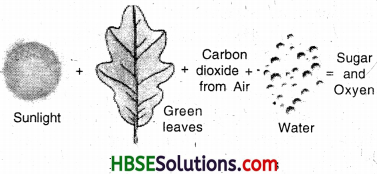
The process by which the green plants synthesize their own food in the presence of Sunlight and chlorophyll by taking carbon dioxide from the atmosphere and water from the soil is known as photosynthesis. The process of photosynthesis can be summarised as given below:
HBSE 7th Class Science Solutions Chapter 1 Nutrition in Plants-1
Green plants require four things to prepare their own food. These are:
1. Carbon dioxide, absorbed from the atmosphere through stomata present on the leaf surface.
2. Water, absorbed from the soil, through the root system.
3. Chlorophyll, present in the leaf.
4. Light, coming from the sun.
During photosynthesis, food is synthesized.
Oxygen is released in the process.

Question 5.
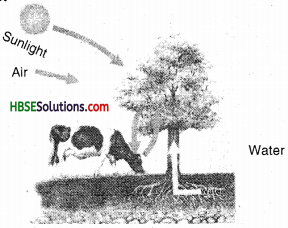
Show with the help of a sketch that the plants are the ultimate source of food.
Answer:
HBSE 7th Class Science Solutions Chapter 1 Nutrition in Plants-2

Question 6.
Fill in the blanks:
(a) Green plants are called ………….. since they synthesise their own food.
(b) The food synthesised by the plants isstared as …………… .
(c) In photosynthesis solar energy is captured by the pigment called …………… .
(d) During photosynthesis plants take in ………. and release ……………. .
Answer:
(a) autotrophs
(b) solar enetgy
(c) chlorophyll
(d) carbon dioxide, oxygen.

Question 7.
Name the following:
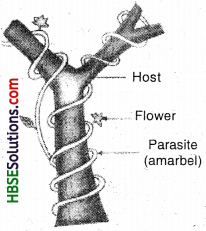
(i) A parasite plant with yellow, slender, tubular stem.
(ii) A plant that has both* autotrophic and heterotrophic mode of nutrition.
(iii) The pores through which leaves exchange gases.
Answer:
(i) Cuscuta (Amarbet)
(ii) Pitcher plant
(iii) Stomata

HBSE 7th Class Science Solutions Chapter 1 Nutrition in Plants

Question 8.
Tick the correct answer:
(a) Amarbel is an example of:
(i) Autotroph
(ii) Parasite
(iii) Saprotroph
(iv) Host.
Answer:
(iii) Parasite.

(b) The plant which traps arid feeds on insects is:
(i) Cuscuta
(ii) China rose
(iii) Pitcher plant
(iv) Rose.
Answer:
(iii) Pitcher plant.

Question 9.
Match the items given in column I with those in Column II:

Column IColumn II
(a) Chlorophyll(i) Bacteria
(b) Nitrogen(ii) Heterotrophs
(c) Amarbel(iii) Pitcher plant
(d) Animals(iv) Leaf
(e) Insects(v) Parasite

Answer:

Column IColumn II
(a) Chlorophyll(iv) Leaf
(b) Nitrogen(i) Bacteria
(c) Amarbel(v) Parasite
(d) Animals(ii) Heterotrophs
(e) Insects(iii) Pitcher plant

Question 10.
Mark ‘T’ if two Statement is true and ‘F’ if it is False.
(i) Carbon dioxide is released during photosynthesis.
(ii) Plants which synthesise their food themselves are called saprotrophs.
(iii) The product of photosynthesis is not a protein.
(iv) Solar energy is converted into chemical energy during photosynthesis.
Answer:
(i) False
(ii) False
(iii) False
(iv) True.

Question 11.
Choose the correct option from the following:
Which part of the plant gets carbon dioxide from the air for photosynthesis?
(i) Root hair
(ii) Stomata
(iii) Leaf veins
(iv) Sepals.
Answer:
(ii) Stomata.

Question 12.
Choose the correct option from the; following:
Plants take carbon dioxide from the atmosphere mainly through their:
(i) Roots
(ii) Stem
(iii) Flowers
(iv) Leaves.
Answer:
(iv) Leaves.

Extended Learning – Activities and Projects

Question 1.
Project
Take a potted plant with broad leaves. Take a strip of black paper and cut out a small square in its centre. Cover a part of a leaf with this paper
and secure it the occurrence of photosynthesis
HBSE 7th Class Science Solutions Chapter 1 Nutrition in Plants-3
with paper clips. Keep the plant in the sunlight for 2-5 days. Observe the difference in the colour of the covered and the uncovered portions on the leaf. Perform iodine test on leaf. Did the two parts show any difference in results? Remove the strip and expose the covered part to the sunlight for 2-3 days and do the iodine test again. Describe your observations.
Answer:
Do yourself.

HBSE 7th Class Science Solutions Chapter 1 Nutrition in Plants

Question 2.
Visit a green house if there is one near your place. Observe how they raise plants. Find out how they regulate the light, water and carbon dioxide.
Answer:
Do yourself. Take the help of your teacher.

Question 3.
Try growing a sweet potato just in water. Describe your experiment and observations.
Answer:
Do yourself. Take the help of your teacher.

HBSE 7th Class Science Nutrition in Plants Important Questions and Answers

Very Short Answer Type Questions

Question 1.
Why do all living organisms need food?
Answer:
All living organisms need food for getting energy for doing physical work.

Question 2.
Define the term Nutrition.
Answer:
The process of taking or consuming and utilising food is called nutrition.

Question 3.
Define Photosynthesis?
Answer:
The process by which the green plants prepare food using carbon dioxide and water in the presence of chlorophyll and light is called photosynthesis.

Question 4.
Mention the role of chlorophyll in photosynthesis.
Answer:
The leaves have a green pigment called chlorophyll. It helps leaves to capture the energy of the sunlight. Without chlorophyll, photosynthesis will not tajte place.

Question 5.
Plants make food from water and carbon dioxide. What else is needed?
Answer:
Chlorophyll and sunlight are also needed to the plant for photosynthesis.

Question 6.
What would happen if there are no green plants on the earth?
Answer:
In the absence of green plants there will not be any living being.

Question 7.
What is the purpose of starch test?
Answer:
The confirmation of the presence of starch in the green plants also confirms that photosynthesis has taken place in the plant.

Question 8.
Name three Carnivorous animals.
Answer:
(a) Lion
(b) Tiger
(c) Leopard.

HBSE 7th Class Science Solutions Chapter 1 Nutrition in Plants

Question 9.
Name three Omnivorous animals.
Answer:
(a) Dog
(b) Cat
(c) Crow.

Question 10.
Name three Herbivorous animals.
Answer:
(a) Rabbit
(b) Deer
(c) Cow.

Question 11.
Name two Insectivorous plants.
Answer:
(a) Aldrovenda
(b) Sundew.

Question 12.
Write chemical reaction that takes place during photosynthesis.
Answer:
HBSE 7th Class Science Solutions Chapter 1 Nutrition in Plants-4
Question 13.
Which are the raw materials required for photosynthesis?
Answer:
The process of photosynthesis requires four raw materials:
1. Carbon dioxide
2. Water,
3. Chlorophyll
4, Light.

Question 14.
Why are green plants called autotrophs?
Answer:
Green plants can prepare their own food using inorganic substances from the environment. Hence they are called autotrophs.

Question 15.
What are heterotrophs?
Answer:
Human beings and other animals depend on plants for food. They cannot make their own food. They are called the heterotrophs.

HBSE 7th Class Science Solutions Chapter 1 Nutrition in Plants

Question 16.
What is the mode of nutrition in plants different from that of the animals?
Answer:
In plants the nutrition is autotrophic type in which anabolism takes place. While in animal, they are heterotrophs where catabolism takes place.

Short Answer Type Questions

Question 1.
‘All animals depend upon plants for food’. Justify the statement.
Answer:
Green parts of the plants have the ability to prepare their own food which is stored in their various parts. All the animals do not have such property. So they depend on plants for their food directly or indirectly.

Question 2.
Differentiate between autotrophic and heterotrophic nutrition.
Answer:

Autotrophic NutritionHeterotrophic Nutrition
1. This type of nutrition occurs in green plants.1. This type of nutrition is found in all living beings except green plants.
2. It prepares its own food.2. It depends on plants directly or indirectly.
3. They prepare food in presence of sunlight.3. They have no such condition.
4. They require carbon dioxide and water along with chlorophyll.4. They receive prepared food.
5. Oxygen evolves during this process.5. Only carbon dioxide is evolved during the use of food.

Question 3.
Differentiate between carnivores, Herbivores and Omnivores.
Answer:
Carnivores: Animals like lion, tiger, snake and leopard that depend on other animals for their food are called carnivores.
Herbivores: Animals like cow, goat, horse, sheep, deer and elephant that depend on plants for their food are called herbivores.
Omnivores: Omnivores are those which depend on both plants and animals for food, e.g. man, pig, hen, bear, crow etc.

Question 4.
Differentiate between saprophytes and epiphytes.
Answer:
Saprophytes: These are the organisms that depend upon dead and decaying matter for food e.g., Monotropa (a bacteria) etc. These grow during or after the rainy season.
Epiphytes: These grow on the trees but only for support. They possess green leaves and can prepare their own food by absorbing moisture from the atmosphere. They have special roots called the aerial roots for this purpose e.g. orchids.

HBSE 7th Class Science Solutions Chapter 1 Nutrition in Plants

Question 5.
What do you understand by parasite, saprophyte and symbiosis? Give one example for each.
Answer:
Parasites: Such living organisms are those which depend on other living beings for their food. They may also depend on host not only for food but also for shelter too. e.g., Lice, Leech, Bed bug.
Saprophytes: Such organisms are those which take the dead and decayed organic substances in the form of their food e.g., kite.
Symbiosis: It is the phenomenon in which two plants live together in such a way that both are beneficial for each other, e.g., Rhizobium bacteria live in the nodules of Leguminous plants.

Question 6.
Some plants are both parasite and saprophyte. Explain with examples.
Answer:
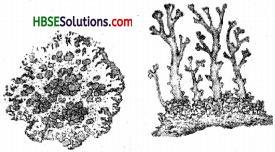
There are some plants which survive like parasite as well as saprophyte. For example, Lichen. In lichen algae which is green in colour and lives on the upper side of the plant in the sun and prepares its own food during photosynthesis. The lower part of lichen in fungus which is saprophyte in nature. Both live together in it.

Long Answer Type Questions

Question 1.
Describe an experiment to prove that chlorophyll is necessary for photosynthesis.
Answer:
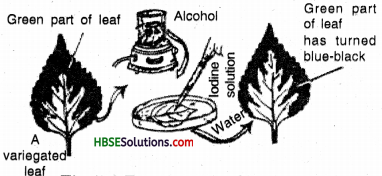
1. Pluck one or two leaves from Croton and Coleus plant in the evening so that they have synthesised starch.
2. Make an outline sketch of the leaf to mark green and non-green areas of the leaf.
3. Boil the leaf in alcohol over a water bath till the chlorophyll and other pigments are washed out.
HBSE 7th Class Science Solutions Chapter 1 Nutrition in Plants-5
4. Now keep the leaf in a petridish and add sufficient amount of iodine solution over the leaf.
Only the green portion of the leaves turn blue-black showing the presence of starch in that region, As the green portion contained chlorophyll it could photosynthesise thereby forming starch. The non-green portion of the leaf does not have chlorophyll, which is essential for phtosynthesis.

Question 2.
Describe the factors affecting the process of photosynthesis.
Answer:
Factors affecting the process of Photosynthesis:
1. Light: It is essential for the process of photosynthesis. An increase in the intensity of light increases the rate of photosynthesis.
2. Carbon dioxide: It is the source of carbon for the synthesis of organic compounds formed in, the plant.
3. Water: It is also very important for the process of photosynthesis. Lack of water decreases the rate of photosynthesis.
4. Temperature: The optimum temperature required by most of the plants for photosynthesis is 350°C.
5. Chlorophyll: It is indispensable for the process of photosynthesis. Photosynthesis does not occur in the plants that lack chlorophyll.

HBSE 7th Class Science Solutions Chapter 1 Nutrition in Plants

Question 3.
Describe an experiment to prove that light is necessary for photosynthesis.
Answer:
1. Destarch the leaves of a potted plant by placing them in total darkness for about 24-48 hours.
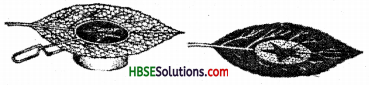
2. Cover tightly one of the leaves with a leaf clasp or a strip of black paper on both the surface of the leaf. Use clips or cellotape to fix the black paper.
3. Put the experimental set up in sunlight for a few hours.
HBSE 7th Class Science Solutions Chapter 1 Nutrition in Plants-6
4. After that pluck the leaf that was covered with black paper or leaf clasp.
5. Test the leaf for the presence of starch by boiling it in alcohol over a water bath and then putting iodine solution over it.
The part of the leaf that was covered with black paper or leaf clasp did not get sunlight and thus no photosynthesis could occur in that region, hence, starch was not formed.
The part of the leaf that was exposed to sunlight could photosynthesise and so starch was formed in that region of leaf. This shows that light is essential for the process of photosynthesis.

Nutrition in Plants Class 7  HBSE Notes

1. Carbohydrates, proteins, fats, vitamins and minerals are components of food. These components of food are necessary for our body and are called nutrients.
2. Nutrition is the mode of taking food by an organism and its utilization by the body.
3. The mode of nutrition in which organisms make food themselves from simple substances is called autotrophic (auto = self; trophos = nourishment) nutrition. Green plants are autotrophs.
4. Animals and most other organisms take in ready-made food prepared by the plants. They are called heterotrophs (heteros = other).
5. (a) The process by which green plants prepare their own food is called photosynthesis.
HBSE 7th Class Science Solutions Chapter 1 Nutrition in Plants-7
(b) Photosynthesis can be summarized as follows:
HBSE 7th Class Science Solutions Chapter 1 Nutrition in Plants-8
(c) Photosynthesis takes place mostly in green leaves which contain green pigment, Chlorophyll inside Chloroplasts.
(d) Gaseous exchange in the leaves takes place through tiny pores called stomata
6. The mode of nutrition in organisms which derive their food from the dead and decaying organic matter is called saprophytic nutrition and such organisms are called
saprophytes.
7. The mode of nutrition in organisms which derive their food from the body of some other living organism is called parasitic nutrition. Such organisms are called parasites and other organism, from wlWh the food is derived by the parasite, is called the host.
HBSE 7th Class Science Solutions Chapter 1 Nutrition in Plants-9
8. In,sect,ivores are the green plants growing in marshy areas. They obtain their nutrition partly from the soil and atmosphere and partly from the insects, e.g,, pitcher plant, venus fly-trap, sundew plant and bladderwort.
9. Some organisms live together and share shelter and nutrients. This is called symbiotic relationship. For example, certain fungi live in the roots of trees. The tree provides nutrients to the fungus and, in return, receives help from it to take up water and nutrients from the soil. This association is very important for the tree.
10. In a lichen, algal and fungal partners live together and both are mutually beneficial. Algal component of a lichen is autotrophic. It provides food material to the fungal component in the lichen. In return, the fungus (heterotroph) provides shelter, water and minerals to the alga.
HBSE 7th Class Science Solutions Chapter 1 Nutrition in Plants-10

HBSE 7th Class Science Solutions Chapter 1 Nutrition in Plants Read More »

HBSE 7th Class Social Science Solutions SST Haryana Board

Haryana Board HBSE 7th Class Social Science Solutions

HBSE 7th Class Social Science Solutions in Hindi Medium

HBSE Class 7 Social Science History: Our Pasts – II (इतिहास – हमारे अतीत – II)

HBSE Class 7 Social Science Geography: Our Environment (भूगोल – हमारा पर्यावरण)

HBSE Class 7 Social Science Civics: Social and Political Life – II (नागरिक शास्त्र – सामाजिक एवं राजनीतिक जीवन – II)

HBSE 7th Class Social Science Solutions in English Medium

Haryana Board HBSE 7th Class Social Science Solutions Geography: Our Environment

Haryana Board HBSE 7th Class Social Science Solutions History: Our Pasts – II

Haryana Board HBSE 7th Class Social Science Solutions Civics: Social and Political Life – II

HBSE 7th Class Social Science Solutions SST Haryana Board Read More »

HBSE 7th Class Science Solutions Haryana Board

Haryana Board HBSE 7th Class Science Solutions

HBSE 7th Class Science Solutions in English Medium

HBSE 7th Class Science Solutions in Hindi Medium

HBSE 7th Class Science Solutions Haryana Board Read More »

HBSE 7th Class Social Science Solutions Geography Chapter 1 पर्यावरण

Haryana State Board HBSE 7th Class Social Science Solutions Geography Chapter 1 पर्यावरण Textbook Exercise Questions and Answers.

Haryana Board 7th Class Social Science Solutions Geography Chapter 1 पर्यावरण

HBSE 7th Class Geography पर्यावरण Textbook Questions and Answers

प्रश्न 1.
निम्न प्रश्नों के उत्तर दीजिए:
(क) पारितंत्र क्या है?
उत्तर:
पारितंत्र वह तंत्र है जिसमें समस्त जीवधारी आपस में एक-दूसरे के साथ तथा पर्यावरण के उन भौतिक एवं रासायनिक कारकों के साथ परस्पर क्रिया करते हैं जिसमें वे निवास करते हैं। ये सब ऊर्जा और पदार्थ के स्थानांतरण द्वारा संबद्ध हैं।

(ख) प्राकृतिक पर्यावरण से आप क्या समझते हैं ?
उत्तर:
प्राकृतिक तत्वों से मिलकर बना पर्यावरण प्राकृतिक पर्यावरण कहलाता है। भूमि, जलवायु, पेड़-पौधे एवं जीव-जंतु मिलकर प्राकृतिक पर्यावरण बनाते हैं।

(ग) पर्यावरण के प्रमुख घटक कौन-कौन से हैं?
उत्तर:
पर्यावरण के प्रमुख घटक निम्नलिखित हैं:

  1. प्राकृतिक घटक : जैसे-जल, वायु, मृदा, पेड़-पौधे आदि।
  2. मानव निर्मित घटक : जैसे-सड़कें, इमारतें, पुल, स्मारक आदि।
  3. मानव घटक : जैसे-व्यक्ति, परिवार, समुदाय आदि।

HBSE 7th Class Social Science Solutions Geography Chapter 1 पर्यावरण

(घ) मानव-निर्मित पर्यावरण के चार उदाहरण दें।
उत्तर:
मानव-निर्मित पर्यावरण के उदाहरण हैं:

  1. भवन
  2. पार्क
  3. पुल
  4. सड़क, आदि।

(च) स्थलमंडल क्या है?
उत्तर:
पृथ्वी की ऊपरी कठोर परत या पर्पटी को स्थलमंडल कहते हैं। यह चट्टानों व खनिजों से बना होता है।

(छ) जीवीय पर्यावरण के दो प्रमुख घटक क्या हैं?
उत्तर:
जीवीय पर्यावरण के दो प्रमुख घटक हैं-पादप और जीव-जंतु।

(ज) जैवमंडल क्या है?
उत्तर:
पृथ्वी का संकीर्ण क्षेत्र जो वायुमंडल, स्थलमंडल, जलमंडल के संपर्क में आता है, जैवमंडल कहलाता है। यहाँ जीवन पाया जाता है। इस क्षेत्र में पेड़-पौधे तथा जानवर यहाँ तक कि जीवाणु भी मिलते हैं। अधिकांश जीवित प्राणी चाहे वे पौधे हों या जीव, पृथ्वी पर स्थल या जल की सतह पर पाए जाते हैं जो वायु से घिरी होती है।

प्रश्न 2.
सही उत्तर चिह्नित (√) कीजिए :
(क) इनमें से कौन-सा प्राकृतिक पारितंत्र नहीं है?
(i) मरुस्थल
(ii) ताल
(iii) वन।
उत्तर:
(ii) ताल

(ख) इनमें से कौन-सा मानवीय पर्यावरण का घटक नहीं है?
(i) स्थल
(ii) धर्म
(iii) समुदाय।
उत्तर:
(i) स्थल

(ग) इनमें से कौन सा मानव निर्मित पर्यावरण है?
(i) पहाड़
(ii) समुद्र
(iii) सड़क।
उत्तर:
(iii) सड़क।

HBSE 7th Class Social Science Solutions Geography Chapter 1 पर्यावरण

(घ) इनमें से कौन सा पर्यावरण के लिए खतरा है?
(i) पादप वृद्धि
(ii) जनसंख्या वृद्धि
(iii) फसल वृद्धि।
उत्तर:
(ii) जनसंख्या वृद्धि

प्रश्न 3.
निम्नलिखित स्तंभों को मिलाकर सही जोड़े बनाएँ:
(क) जैवमंडल – (i) पृथ्वी को घेरने वाली वायु की चादर
(ख) वायुमंडल – (ii) जलीय क्षेत्र
(ग) जलमंडल – (iii) हमारे आसपास का क्षेत्र
(घ) पर्यावरण – (iv) वह संकीर्ण क्षेत्र जहाँ स्थल, जल एवं वायु पारस्परिक क्रिया करते हैं।
उत्तर:
(क) (iv)
(ख) (i)
(ग) (ii)
(घ) (iii)

प्रश्न 4.
कारण बताइए:
(क) मानव अपने पर्यावरण में परिवर्तन करता है।
उत्तर:
मनुष्य अपनी आवश्यकताओं को पूरा करने के लिए अपने पर्यावरण में परिवर्तन लाता है। मानव ने पर्यावरण के उपयोग और उसमें परिवर्तन करने के नए तरीके सीख लिए हैं। जैसे-फसल उगाना, पशुपालन आदि। पर्यावरण में परिवर्तन से उसकी आवश्यकताओं की संतुष्टि होती है।

(ख) पौधे एवं जीव-जंतु एक-दूसरे पर आश्रित हैं।
उत्तर:
सभी पेड़-पौधे तथा जीव-जंतु एक-दूसरे पर निर्भर करते हैं क्योंकि ये सब मिलकर प्राकृतिक पर्यावरण का निर्माण करते हैं। एक के बिना दूसरे का अस्तित्व संकट में पड़ सकता है।

प्रश्न 5.
क्रियाकलाप (Activity)
एक आदर्श पर्यावरण की कल्पना कीजिए जिसमें आप रहना चाहेंगे। अपने इस आदर्श पर्यावरण का चित्र बनाएँ।
उत्तर:
छात्र स्वयं करें।
कल्पना : समतल मैदान में एक गाँव/शहर हो। जनसंख्या कम हो। पीने के लिए स्वच्छ पानी उपलब्ध हो। गाँव/शहर से बाहर जंगल हो। वन को काटने पर प्रतिबंध हो। आने-जाने के मार्ग सुलभ हों। प्रदूषण रहित वातावरण हो। इसके अतिरिक्त अन्य सुविधाएँ उपलब्ध हों।

बहुविकल्पी प्रश्न

प्रश्न 1.
सही विकल्प चुनो:
(i) सजीव प्राणियों का संसार:
(क) जैविक
(ख) अजैविक
(ग) जैवमंडल
उत्तर:
(क) जैविक।

(ii) निर्जीव पदार्थों के संसार में सम्मिलित हैं:
(क) पादप
(ख) जंतु
(ग) स्थल
उत्तर:
(ग) स्थल।

(iii) पर्यावरण शब्द की उत्पत्ति एनवायरोनेट से हुई है, जिसका शाब्दिक अर्थ है:
(क) आस-पास
(ख) पड़ोस
(ग) प्रकृति
उत्तर:
(ख) पड़ोस।

(iv) मानव निर्मित पर्यावरण का उदाहरण है:
(क) स्थल
(ख) जीव
(ग) स्मारक
उत्तर:
(ग) स्मारक।

(v) पृथ्वी की ठोस पर्पटी कहलाती है:
(क) स्थलमंडल
(ख) जलमंडल
(ग) वायुमंडल
उत्तर:
(क) स्थलमंडला

HBSE 7th Class Social Science Solutions Geography Chapter 1 पर्यावरण

प्रश्न 2.
सत्य और असत्य बताएँ:
(i) हमारा पर्यावरण स्थायी है।
(ii) विभिन्न प्रजातियाँ जैव विभिन्नता कहलाती हैं।
(iii) लोग जैवमंडल के अंग नहीं हैं।
(iv) जल वायुमंडल में भी पाया जाता है।
(v) जैवमंडल एक संकीर्ण क्षेत्र है।
उत्तर:
(i) असत्य
(ii) सत्य
(ii) असत्य
(iv) सत्य
(v) सत्य।

प्रश्न 3.
रिक्त स्थान भरें:
1. पौधे, …………….. और मनुष्य पर्यावरण से प्रभावित होते हैं।
2. …………….. विशाल जलराशि है।
3. दोनों पर्यावरण …………….. हैं।
4. सभी ………………. एक-दूसरे से जुड़े हैं।
5. ……….. वायु की पतली परत है।
6. स्थलमंडल ……………….. की परत है।
उत्तर:
1. जानवर
2. महासागर
3. एक-दूसरे से संबंधित
4. महासागर
5. वायुमंडल
6. जैवमंडल।

प्रश्न 4.
निम्न के जोड़े बनाएँ:

(क)(ख)
1. पृथ्वी का जल क्षेत्र(क) जलमंडल
2. वायु की पतली परत(ख) ओजोन
3. विशाल जलराशि(ग) वायुमंडल
4. पराबैंगनी किरणें(घ) महासागर
5. जहाँ हम रहते हैं(ङ) जैवमंडल

उत्तर:
1. (क)
2. ग)
3. (घ)
4. (ख)
5. (ङ)

HBSE 7th Class Geography पर्यावरण Important Questions and Answers

अति लघु उत्तरात्मक प्रश्न

प्रश्न 1.
पर्यावरण के दो प्रमुख घटक लिखिए।
उत्तर:
पर्यावरण के दो अवयव हैं:

  • जीविय
  • अजीविय।

प्रश्न 2.
स्थल, जल तथा वायु से बने पर्यावरण का प्रकार लिखिए।
उत्तर:
भौतिक पर्यावरण।।

प्रश्न 3.
पौधों तथा जानवरों से बने पर्यावरण का नाम बताएँ।
उत्तर:
जैविक पर्यावरण।

प्रश्न 4.
पर्यावरण क्या है?
उत्तर:
हमारे आस-पास पाई जाने वाली प्रत्येक अवस्था को सम्मिलित रूप से पर्यावरण कहते हैं।

HBSE 7th Class Social Science Solutions Geography Chapter 1 पर्यावरण

प्रश्न 5.
पर्वत क्या है?
उत्तर:
समतल भूमि से अधिक ऊँचे उठे भाग पर्वत कहलाते हैं।

प्रश्न 6.
महासागर से आप क्या समझते हैं?
उत्तर:
विस्तृत क्षेत्र में फैली जलराशि को महासागर कहते हैं।

लघु उत्तरात्मक प्रश्न

प्रश्न 1.
जैव विभिन्नता क्या है? समझाएँ।
उत्तर:
हमारी पृथ्वी ही सौर मंडल में केवल एक ऐसा ग्रह है जिस पर जीवन पाया जाता है। शताब्दियों से रह रहे जीवन में विभिन्नता गई है। इस प्रकार की विभिन्नता की प्रक्रिया में विभिन्न प्रकार की प्रजाति उत्पन्न हो गई हैं। विभिन्न प्रजातियों के कारण

प्रश्न 2.
पर्यावरण की परिभाषा दें।
उत्तर:
हमारे आसपास की सभी वस्तुएँ और दशाएँ पर्यावरण कहलाती हैं। पर्यावरण हमारे जीवन का आधार है। इससे हमें वायु, जिसमें हम साँस लेते हैं, पीने के लिए जल, रहने के लिए भूमि मिलती है। पर्यावरण स्थान-स्थान पर भिन्न होता है। उदाहरण के लिए भारत के विभिन्न भागों में पर्यावरण की दशाएँ भिन्न हैं। कहीं मरुस्थल है तो कहीं पर अधिक वर्षा वाले क्षेत्र। यह प्राकृतिक व मानव निर्मित परिघटनाओं का मिश्रण है।

प्रश्न 3.
भौतिक पर्यावरण या अजीविय पर्यावरण के बारे में आप क्या जानते हैं?
उत्तर:
भौतिक पर्यावरण हमें प्राकृतिक दशाएँ प्रदान करता है जिनमें भूमि, जल तथा वायु सम्मिलित हैं। भूमि पर पर्वत, पठार, मैदान और घाटियाँ पाई जाती हैं।

प्रश्न 4.
खान-पान की आदतें पर्यावरण पर क्यों निर्भर
उत्तर:
लोगों की खान-पान की आदतें पर्यावरण पर निर्भर करती हैं। जो वस्तुएँ हमें पर्यावरण से प्राप्त होती हैं उन्हीं के अनुसार हमारी आदतें बनती हैं। यहाँ तक कि वस्त्र भी पर्यावरण के भोजन में मछली प्रमुख है।

दीर्घ उत्तरात्मक प्रश्न

प्रश्न 1.
हमें अपने पर्यावरण की सुरक्षा क्यों करनी चाहिए?
उत्तर:
हमें अपने पर्यावरण की सुरक्षा करनी चाहिए क्योंकिः
1. पर्यावरण हमारे जीवन का आधार है। यह हमें साँस लेने के लिए हवा, पीने के लिए पानी, खाने के लिए भोजन तथा रहने के लिए भूमि प्रदान करता है।

2. यह प्राकृतिक संसाधन प्रदान करता है। जैसे-ईंधन और खनिज।

3. पर्यावरण के कई भागों को संसाधनों के असावधानीपूर्वक प्रयोग से क्षति पहुंच चुकी है। जैसे वनों का प्रयोग, खनिजों का प्रयोग आदि।

4. बहुत सी मानव क्रियाएँ एक या दूसरे प्रकार से पर्यावरण को क्षति पहुँचाती हैं।

5. यदि यह क्षति इसी प्रकार चलती रही तो पर्यावरण की क्षति इतनी अधिक हो जाएगी कि उसके परिणाम घातक सिद्ध होंगे।

HBSE 7th Class Social Science Solutions Geography Chapter 1 पर्यावरण

प्रश्न 2.
पर्यावरण में जैवमंडल के कार्य का वर्णन करें।
उत्तर:
जैविक प्रक्रिया अपनी ऊर्जा के लिए सूर्य किरणों पर निर्भर करती है। जैवमंडल का विकसित होना तथा जीवित रहना ऊर्जा के स्थानांतरण तथा पदार्थ पर ही निर्भर करता है। किसी क्षेत्र में पाए जाने वाले जीव-जंतु तथा पौधे वहाँ के भौतिक पर्यावरण से संबंधित होते हैं। एक क्षेत्र में रहने वाले सभी प्राणी एक-दूसरे पर निर्भर करते हैं। इस प्रकार एक क्षेत्र के प्रणी तथा वनस्पति न केवल भौतिक पर्यावरण में रहते हैं बल्कि एक-दूसरे पर निर्भर करते हैं। यह घटना जैवमंडल में ही घटती है।

पर्यावरण Class 7 HBSE Notes in Hindi

1. प्राकृतिक पर्यावरण (Natural Environment) : प्राकृतिक पर्यावरण में प्राकृतिक घटक जैसे भूमि, जल और वायु तथा पेड़-पौधे, जानवर, मनुष्य आदि सम्मिलित हैं।

2. पर्यावरण के भाग (Spheres of Environment) : पर्यावरण के चार भाग हैं:

  • वायुमंडल
  • स्थलमंडल
  • जलमंडल
  • जैवमंडल।

3. पारितंत्र (Ecosystem) : वह तंत्र जिसमें समस्त जीवधारी आपस में एक-दूसरे के साथ तथा पर्यावरण के उन भौतिक एवं रासायनिक कारकों के साथ परस्पर क्रिया करते हैं जिसमें वे निवास करते हैं। ये सब ऊर्जा और पदार्थों के स्थानांतरण द्वारा संबद्ध हैं।

4. मानवीय पर्यावरण (Human Environment) : मानव अपने पर्यावरण के साथ अपनी आवश्यकताओं के अनुसार परिवर्तन करता है। मानव पर्यावरण के उदाहरण हैं-पुल, बाँध, उद्योग, स्मारक आदि।

HBSE 7th Class Social Science Solutions Geography Chapter 1 पर्यावरण Read More »

HBSE 7th Class Science Solutions Chapter 10 Respiration in Organisms

Haryana State Board HBSE 7th Class Science Solutions Chapter 10 Respiration in Organisms Textbook Exercise Questions and Answers.

Haryana Board 7th Class Science Solutions Chapter 10 Respiration in Organisms

HBSE 7th Class Science Respiration in Organisms Textbook Questions and Answers

Question 1.
Why does an athlete breathe faster and deeper than the usual after finishing the race?
Answer:
During the race, the athlete has to run very fast. The demand for energy at that time increases, which increase the demand for more supply of oxygen, so, athelete has to breathe faster and deep to inhale moe oxygen.

Question 2.
List the similarities and differences between aerobic and anaerobic respiration.
Answer:
Differences between aerobic and anaerobic respiration :

Aerobic RespirationAnaerobic Respiration
1. It occurs in the presence of oxygen.1. It occurs in absence of oxygen.
2. Food molecules are broken down into water and carbon dioxide.2. Food molecules are broken down into ethyl alcohol and carbon dioxide.
3. Large amount of energy is released.3. Small amount of energy is released.

Similarities : (Both aerobic and anaerobic respiration produce energy and give out carbon dioxide.

HBSE 7th Class Science Solutions Chapter 10 Respiration in Organisms

Question 3.
Why do we often sneeze when we inhale, a lot of dust-laden air?
Answer:
We sneeze to get rid of the unwanted particles like dust etc from our body. It allows only clean and dust free air to enter our body.

Question 4.
Take three test tubes. Fill 3/4th of each tube with water. Label them A, B and C. Keep a snail in test tube A; a water plant in test tube B and in C, keep snail and plant both. Which test tube will have highest concentration of CO2?
Answer:
There will be highest concentration of CO2 in tube A.

Question 5.
Tick the correct answer :
(a) In cockroaches air enters the body through :
(i) Lungs
(ii) Gills
(iii) Spiracles
(iv) Skin
Answer:
(iii) Spiracles

(b) During heavy exercise, we get cramps in the legs due to the accumulation of :
(i) carbon dioxide
(ii) lactic acid
(iii) alcohol
(iv) water
Answer:
(ii) lactic acid

(c) Normal range of breathing rate per minute in an average adult person at rest is :
(i) 9-12
(ii) 15-18
(iii) 21-24
(iv) 30-33
Answer:
(ii) 15-18

(d) During exhalation, the ribs :
(i) move outwards
(ii) move downwards
(iii) move upwards
(iv) do not move at all
Answer:
(ii) move downwards.

HBSE 7th Class Science Solutions Chapter 10 Respiration in Organisms

Question 6.
Match the items in column I with those in column II.

Column IColumn II
(a) Yeast(i) Earthworm
(b) Diaphragm(ii) Gills
(c) Skin(iii) Alcohol
(d) Leaves(iv) Chest cavity
(e) Fish(v) Stomata
(f) Frog(vi) lungs and skin
(vii) trachea

Answer:
(a) (iii)
(b) (iv)
(c) (i)
(d) (v)
(e) (ii)
(f) (vi).

Question 7.
Make ‘T’ if the statement is true and ‘f if it is false.
(i) During heavy exercise the breathing rate of a person slows down. (T/F)
(ii) Plants carry out photosynthesis only during the day and respiration only at night. (T/F)
(iii) Frogs breathe through their skins as well as their lungs. (T/F)
(iv) The fishes have lungs for respiration. (T/F)
(v) The size of the chest cavity increases during inhalation. (T/F)
Answer:
(i) False
(ii) False
(iii) True
(iv) False
(v) True.

Question 9.
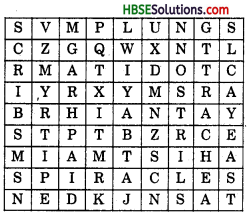
Given below is a square of letters in which are hidden different words related to respiration in organisms. These words may be present in any direction – upwards, downwards, or along the diagonals. Find the words for your respiratory system. Clues about those words are given below the square.
HBSE 7th Class Science Solutions Chapter 10 Respiration in Organisms 1
(i) The air tubes of insects.
(ii) Skeletal structures surrounding chest cavity.
(iii) Muscular floor of chest cavity.
(iv) Tiny pores on the surface of leaf.
(v) Small openings on the sides of the body of an insect.
(vi) The respiratory organs of human beings.
(vii) The openings through which we inhale.
(viii) An anaerobic organism.
(ix) An organism with tracheal system.
Answer:
(i) Trachea
(ii) Ribs
(iii) Diaphragm
(iv) stomata
(v) spiracles
(vi) lungs
(vii) nostrils
(viii) yeast
(ix) ant.

Question 10.
The mountaineers carry oxygen with them because :
(a) At an altitude of more than 5 km there is no air.
(b) The amount of air available to a person is less than that available on the ground.
(c) The temperature of air is higher than that on the ground.
(d) The pressure of air is higher than that on the grow.
Answer:
(b) The amount of air available to a person is less than that available on the ground.

HBSE 7th Class Science Solutions Chapter 10 Respiration in Organisms

Extended Learning – Activities and Projects

Question 1.
Observe fish in an aquarium. You will find flap like structures on both sides of their heads. These are flaps which cover the gills. These flaps open and close alternately. On the basis of these observations, explain the process of respiration in the fish.
Answer:
Do yourself. Take help your teacher.

Question 2.
Visit a local doctor. Learn about the harmful effects of smoking. You can also collect material on this topic from other sources. You can seek help of your teacher or parents. Find out the percentage of people of your area w ho smoke. If you have a smoker in your family, confront him with the material that you have collected.
Answer:
Do yourself.

Question 3.
Visit a doctor. Find out about artificial respiration. Ask the doctor:
(a) When does a person need artificial respiration?
(b) Does the person need to be kept on artificial respiration temporarily or permanently?
(c) From where can the person get supply of oxygen for artificial respiration?
Answer:
Do yourself.

Question 4.
Measure the breathing rate of the members of your family and some of your friends. Investigate :
(a) If the breathing rate of children is different from that of adults.
(b) If the breathing rate of males is different from that of females.
If there is a difference in any of these cases, try to find the reason.
Answer:
Do yourself.

HBSE 7th Class Science Respiration in Organisms Important Questions and Answers

Very Short Answer Type Questions

Question 1.
What is respiration?
Answer:
Respiration is a process of taking oxygen into the cells to break down simple food materials to release energy.

Question 2.
What is breathing?
Answer:
Breathing is inhaling oxygen and exhaling carbon dioxide.

Question 3.
Where does cellular respiration take place?
Answer:
Cellular respiration takes place inside the cells of the body.

HBSE 7th Class Science Solutions Chapter 10 Respiration in Organisms

Question 4.
What is aerobic respiration?
Answer:
Process of respiration taking place in the presence of oxygen is called aerobic respiration.

Question 5.
What is anaerobic respiration?
Answer:
Process of respiration without the presence of oxygen is called anaerobic respiration.

Question 6.
Does the process of anaerobic respiration take place in human body?
Answer:
Yes, during heavy physical activities, when supply of oxygen is not sufficient, anaerobic respiration takes place in the muscle cells.

Question 7.
What is diaphragm?
Answer:
Diaphragm is a large muscular sheet which forms the floor of the chest cavity.

Question 8.
Name the main respiratory organs in mammals.
Answer:
Lungs are the main respiratory organs in the mammals.

Question 9.
Name the main respiratory organs in insects.
Answer:
Spiracles and tracheae are the main respiratory organs in insects.

Question 10.
Name the respiratory organs in the fish.
Answer:
Gills are the respiratory organs in the fish.

Question 11.
How does earthworm respirate?
Answer:
Earthworm respires through its moist skin.

Question 12.
Where does exchange of gases take place in plants?
Answer:
In plants the exchange of gases takes place through tiny openings called stomata on the leaves.

Short Answer Type Questions

Question 1.
Differentiate between breathing and respiration.
Answer:
Breathing and respiration have following differences:

Question 2.
How does aerobic respiration takes place?
Answer:
In aerobic respiration oxygen is taken into the cells. The food is broken down into simple food materials and energy is released. Carbon dioxide and water is also released.
Gulcose \(\frac{\text { presence of }}{\text { Oxygen }}\) Carbon dioxide + water + energy

HBSE 7th Class Science Solutions Chapter 10 Respiration in Organisms

Question 3.
What is breathing rate? How is it counted and what is the breathing rate in an adult at the position of rest?
Answer:
Breathing rate is the number of times a person breathes in a minute. To count the breathing rate, we have to count an inhalation and an exhalation as one. Breathing rate in an adult at rest is 15-18 times in a minute.

Question 4.
How is air pushed out during exhalation?
Answer:
During exhalation the ribs move downwards and inwards. The diaphragm moves up and chest cavity gets contracted and air is thrown out.

Question 5.
How do insects breathe?
Answer:
Insects have small openings on the outside of their bodies. These openings are called spiracles, which are connected to the air pipes called tracheae. In tracheae the exchange of gases take place.

Question 6.
How are frogs peculiar in their way of breathing?
Answer:
Frogs breathe differently in water and differently on land. They use their moist skin to breathe in water. They use lungs to breathe on land.

Question 7.
How do plants respirate?
Answer:
Plants also take in oxygen and give out carbon dioxide for respiration. They have small openings called stomata on the surface of there leaves. Exchange of gases take place through these openings.

Long Answer Type Questions

Question 1.
Explain the process of respiration.
Answer:
In respiration, there is a gaseous exchange between the organism and the environment. The process of respiration can be divided in two parts. Breathing and cellular respiration.

Breathing or external respiration: Oxygen is inhaled and Carbon dioxide is exhaled during breathing. This process takes place out side the cells and, thus is called external breathing.

Cellular respiration or internal respiration : This is a biochemical process which takes place inside the cells of the body. In this process food i.e. glucose is broken into simpler forms. Energy is released during this process which is used by body to perform various functions. Carbon dioxide and water is also released. The Carbon dioxide is expelled out during breathing.
Food + Oxygen → Carbon dioxide + Water + Energy.

HBSE 7th Class Science Solutions Chapter 10 Respiration in Organisms

Question 2.
Explain the process of respiration in plants.
Answer:
In plants the process of respiration leads to the release of energy. It is a cellular process in which molecules of glucose break down in the presence of oxygen to release energy along with water and carbon dioxide. Exchange of gases take place through small openings on the surface of the leaves. These are called stomata. Lower plants lack the organs of breathing. In such plants gaseous exchange occurs due to simple process of diffusion. The rate of exchange of gases in plants is not as fast as in animals.

Respiration in Organisms Class 7 HBSE Notes

  • Respiration is a process of taking oxygen into the cells in order to break down simple food materials to release energy and eliminate waste products.
  • Breathing is inhaling oxygen and exhaling carbon dioxide.
  • Breathing takes place out side the cells.
  • Cellular respiration takes place inside the cells.
  • Inside the Cells the food is broken into water and carbon dioxide. This is called cellular respiration. This process seleases a lot of energy.
  • When the process of respiration takes place in the presence of oxygen, it is called aerobic respiration.
  • When the process of respiration takes place in the absence of oxygen, it is called anaerobic respiration.
  • Human beings have a fully developed respiratory system.
  • Nostrils inhale oxygen, which reaches lungs through nasal cavity.
  • Lungs are organs, where exchange of gases takes place. Carbon dioxide is expelled out and oxygen is consumed for cellular respiration.
  • Smaller animals like cockroach have structure called spiracles, for breathing. Earthworm breathe through their skin and fish have gills for respiration.
  • In both plants and animals mitochondria is the site of respiration.

HBSE 7th Class Science Solutions Chapter 10 Respiration in Organisms Read More »

HBSE 7th Class Science Solutions Chapter 8 Winds, Storms and Cyclones

Haryana State Board HBSE 7th Class Science Solutions Chapter 8 Winds, Storms and Cyclones Textbook Exercise Questions and Answers.

Haryana Board 7th Class Science Solutions Chapter 8 Winds, Storms and Cyclones

HBSE 7th Class Science Winds, Storms and Cyclones Textbook Questions and Answers

Question 1.
Fill the missing word in the blank spaces in the following statements:
(a) Wind is …………… air.
(b) Winds are generated due to …………… heating on the earth.
(c) Near the earth’s surface air rises up whereas …………… air comes down.
(d) Air moves from a region of …………… pressure to a region of …………… pressure.
Answer:
(a) moving
(b) uneven
(c) warm, cooler
(d) high, low.

Question 2.
Suggest two methods to find out wind direction at a given place.
Answer:
(i) Take a piece of a paper in your hand. Let it fall from your hand. It will blow in the direction in which wind is blowing.
(ii) You can use a wind vane (a device helps us to make accurate measurements of wind direction) to find out the direction of wind.

HBSE 7th Class Science Solutions Chapter 8 Winds, Storms and Cyclones

Question 3.
State two experiences that made you think that air exerts pressure (other than those given in the text).
Answer:
(i) Balloons and balls can be used only when they are inflated with air.
(ii) Compressed air is used in the brake system for stopping trains.

Question 4.
You want to buy a house. Would you like to buy a house having windows but no ventilators? Explain your answer.
Answer:
No. A house which has no ventilators is not a healthy house to live in. The air circulation is not there in such a house and hence it has no fresh air.

Question 5.
Explain why holes are made in hanging banners and hoardings.
Answer:
Air exerts pressure. It is due to this pressure banners and hoardings flutter when the wind is blowing. Holes are made in the banners and hoardings as wind pass through that holes and they does not become loose and fall down.

Question 6.
How will you help your neighbours in case cyclone approaches your village/town?
Answer:
(i) A cyclone forecast and warning service.
(ii) Rapid communication of warnings to the Government agencies, the ports, fishermen, ships and to the general public.
(iii) Construction of cyclone shelters in the cyclone prone areas, and Administrative arrangements for moving people fast to safer places.

Question 7.
What planning is required in advance to deal with the situation created by a cylone?
Answer:
In order to deal with cyclone, it is important to follow the following points:
(i) listening carefully to warnings being transmitted on TV and radio.
(ii) moving to safer places or taking adequate steps to ensure safety at home.
(iii) keeping an emergency kit ready.
(iv) storing food in water-proof bags.
(v) not venturing into sea.
(vi) keeping all the emergency numbers handy.

Question 8.
Which one of the following place is unlikely to be affected by a cyclone?
(i) Chennai
(ii) Mangalore
(iii) Amritsar
(iv) Puri
Answer:
(iv) Puri.

Question 9.
Which of the statements given below is correct?
(i) In winter the winds flow from the land to the ocean.
(ii) In summer the winds flow from the land towards the ocean.
(iii) A cyclone is formed by a very high pressure system with very high speed winds revolving around it.
(iv) The coastline of India is not vulnerable to cyclones.
Answer:
(i) In winter the winds flow from the land to the ocean.

HBSE 7th Class Science Solutions Chapter 8 Winds, Storms and Cyclones

Extended Learning – Activities And Projects

Question 1.
You can perform the Activity 8.5. in the chapter at home slight differently at home. Use two plastic bottles of the same size. Stretch one balloon on the neck of each bottle. Keep one bottle in the sun and the other in the shade. Record your observations. Compare these observations and the result with those of Activity 8.5.
Answer:
Do yourself.

Question 2.
You can make your own anemometer. Collect the following items:
4 small paper cups (used ice-cream cups), 2 strips of cardboard (20cm long and 2cm wide), gum, stapler, a sketch pen and a sharpened pencil with eraser at one end.
Take a scale; draw crosses on the cardboard strips as shown in the Fig. 8.4. This will give you the centres of the strips.
HBSE 7th Class Science Solutions Chapter 8 Winds, Storms and Cyclones-1
Finding centre of the strips
HBSE 7th Class Science Solutions Chapter 8 Winds, Storms and Cyclones-2
A model of an anemometer
Fix the strips at the centre, putting one over the other so that they make a plus (+) sign. Now fix the cups at the ends of the strips. Colour the outer surface of one cup with a marker or a sketch pen. All the 4 cups should face in the same direction.

Push a pin through the center of the strips and attach the strips and the cups to the eraser of the pencil. Check that the strips rotate freely when you blow on the cups. Your anemometer is ready. Counting the number of rotations per minute will give you an estimate of the speed of the wind. To observe the changes in the wind speed, use it at different places and different times of the day.

If you do not have a pencil with attached eraser you can use the tip of a ball pen. The only condition is that the strips should rotate freely.
Remember that this anemometer will indicate only speed changes. It will not give you the actual wind speed.
Answer:
Do yourself.

Question 3.
Collect articles and photographs from newspapers and magazines about storms and cyclones. Make a story on the basis of what you learnt in this Chapter and the matter collected by you.
Answer:
Do yourself.

Question 4.
Suppose you are a member of a committee, which is responsible for creating development plan of a coastal state. Prepare a short speech indicating the measures to be taken to reduce the suffering of the people caused by cyclones.
Answer:
Do yourself.

Question 5.
Interview eyewitness to collect the actual experience of people affected by a cyclone.
Answer:
Do yourself.

Question 6.
Take an aluminium tube about 15 cm long and 1 to 1.5 cm in diameter. Cut slice of a medium sized potato about 2 cm thick. Insert the tube in the slice, press it, and rotate it 2-3 times. Remove the tube. You will find a piece of potato fixed in the tube like a piston head.

Repeat the same process with the other end of the tube. Now you have the tube with both ends closed by potato pieces with an air column in between.
HBSE 7th Class Science Solutions Chapter 8 Winds, Storms and Cyclones-3
Take a pencil with one end unsharpened. Place this end at one of the pieces of potato. Press it suddenly to push the potato piece in the tube. Observe what happens. The activity shows rather dramatically how increased air pressure can push things.
Caution: When you perform this activity, make sure that nobody is standing in front of i e tube.
Answer:
Do yourself.

HBSE 7th Class Science Solutions Chapter 8 Winds, Storms and Cyclones

HBSE 7th Class Science Winds, Storms and Cyclones Important Questions and Answers

Very Short Answer Type Questions

Question 1.
What is a wind?
Answer:
The moving air is called wind.

Question 2.
Define the term ‘cycle’.
Answer:
It is an event or phenomenon which repeats itself after sometime.

Question 3.
Define term ‘evaporation’.
Answer:
The process of changing water from its liquid form to its vapour is known as evaporation.

Question 4.
Is evaporation a slow process or fast process?
Answer:
Evaporation is a slow process.

Question 5.
Name two processes through which water vapour add continuously into the air.
Answer:
The two processes are:
(i) Evaporation
(ii) Condensation.

Question 6.
Define condensation.
Answer:
The process of conversion of water vapours into liquid form of water is called condensation.

Question 7.
Define water cycle.
Answer:
The water in its vapour form goes into air by evaporation and transpiration forms cloud and, then comes back to the surface of the earth through the process of condensation and precipitation. This process is called ‘water cycle’.

Question 8.
At what speed wind becomes (i) gentle breeze, (ii) storm?
Answer:
When the wind blows gently, it is called a breeze. But, when it blows very fast it causes storm.

HBSE 7th Class Science Solutions Chapter 8 Winds, Storms and Cyclones

Question 9.
What is sea breeze?
Answer:
In coastal areas, during the day, the cool air blows from sea towards the land called sea breeze.

Question 10.
What is land breeze?
Answer:
In coastal areas, during the night, the cool air blows from land to sea called the land breeze.

Question 11.
What is tornadoes?
Answer:
In our country tornadoes are not very frequent. A tornado is a dark funnel shaped cloud that reaches from the sky to the ground.

Question 12.
What is ‘hurricane’?
Answer:
The ‘hurricane’ is the term used for storm in America and West Indies.

Question 13.
What is the eye of hurricane?
Answer:
The region of chimney like low pressure around which warm water vapour spirals is called the eye of hurricane.

Question 14.
What is Beaufort Scale?
Answer:
The number and name of.a wind is determined by the speed at which it flows on an internationally accepted scale, called Beaufort scale.

Question 15.
Name two properties of air.
Answer:
(i) Air occupies space
(ii) It has mass.

Question 16.
Write two importances of air in agriculture.
Answer:
(i) Air helps rotate wind-mill which is used to draw water from tube-wells.
(ii) Air helps in dispersion of seeds and pollen grains of flowers of several plants.

Question 17.
How are high building protected from lightning?
Answer:
High buildings are protected from lightning by fixing lightning conductor on the building.

Question 18.
What is the cause of atmospheric electricity?
Answer:
Atmospheric electricity is due to ionisation of air by the ultraviolet rays of sunlight.

HBSE 7th Class Science Solutions Chapter 8 Winds, Storms and Cyclones

Question 19.
Is our body a conductor?
Answer:
Yes, our body is a good conductor of electricity.

Question 20.
What damage can lightning do?
Answer:
Lightning damage the high buildings and the trees on which it strikes. The buildings and trees can be set on fire by lightning. It can do a high loss of life and property.

Question 21.
Why do chimneys made of steel not require lightning conductor?
Answer:
Steel is a good conductor of electricity. Due to this reason steel chimneys do not require lightning conductor. They themselves pass the discharge to the earth.

Question 22.
Why is it advised not to take shelter under a tree during lightning?
Answer:
We should not stand under a tree during lightning, due to the danger of the lightening, because it can destroy the trees and can set it on fire.

Question 23.
Which gas is produced in air during lightning that absorbs ultraviolet radiation present in sunlight?
Answer:
During lightning ozone (oz) gas is produced due to higher temperature which absorbs ultraviolet radiation. It is dangerous for the living being.

Question 24.
Name the arrangement used for the protection of buildings against damage from lightning.
Answer:
To protect buildings from damage by lightning, a good lightning conductor is used. This is done by installing a lightning conductor on the buildings.

HBSE 7th Class Science Solutions Chapter 8 Winds, Storms and Cyclones

Short Answer Type Questions

Question 1.
How is rain caused?
Answer:
Water, on land, is present in different sources, e.g., sea, river, pond, lake, etc. The water from all these sources change into vapour form due to sun’s heat and goes up into the air. This change of water into vapour form is called evaporation. The water vapour, when reaches high up in the air, cools down and forms clouds. This cooling down of water vapour to form clouds is called condensation. On cooling, the water vapour changes to water droplets. These group together farm clouds. When the droplets become very heavy they fall down as rain.

Question 2.
What is water cycle? What does it indicate?
Answer:
Evaporation of water from oceans, ponds, rivers, lakes and from roads and streets to form cloud by condensation at higher altitude. When clouds rain, the rain water flows into the seas and oceans through rivers and streams. Some water percolates into the soil to form underground water. It comes again out in the form of spring and well. This is called water cycle.

Because of water cycle, the amount of water on the earth remains more or less the same. The water cycle also indicates that all the water in world is on the move all the time.

Question 3.
How does water cycle help in maintaining global climate?
Answer:
Water cycle plays an important role in the world climate. Oceans absorb vast quantities of heat and help in global warming. By absorbing heat water evaporates and on condensation releases heat. This absorption and releasing of heat in the form of energy drives weather pattern in the short term and regulate the climate for long time.

Question 4.
How is storm caused?
Answer:
When the wind blows gently, it is called a breeze. But, when it blows very fast it causes storm. Storm may be defined as something taking place in the weather of a violent nature. At sea, a storm may be a strong wind or gale. On land, a storm usually means a weather situation marked by heavy rain and often with strong winds, lightning and thunder.

HBSE 7th Class Science Solutions Chapter 8 Winds, Storms and Cyclones

Question 5.
How a thunderstorm becomes a cyclone?
Answer:
Water requires heat when it changes from liquid to vapour state. Before cloud formation water takes up heat from the atmosphere to change into vapour. When water vapour changes back to liquid form as raindrops, this heat is released to the atmosphere. The heat released to the atmosphere warms the air around. The air tends to rise and causes a drop in pressure. More air rushes to the centre of the storm. This cycle is repeated. The chain of events ends with the formation of a very low pressure system with very high speed winds revolving around it. It is this weather condition that we call a cyclone.

Question 6.
How is lightning useful in nature?
Answer:
Lightning is useful in nature because during lightning intense heat and high temperature are produced. As a result, nitrogen combines with oxygen to form its oxides. These oxides of nitrogen further get dissolved in water to form a dilute solution of nitric acid that comes to the ground with rain. This is how nature provides nitrogenous compounds to plants that are important for their growth.

Question 7.
How is ozone layer useful for us?
Answer:
During lightning, a part of oxygen gets converted to ozone. Ozone provides protection against harmful ultraviolet radiations of the sun that cannot reach the earth’s surface.

Question 8.
What are the precautions to be taken against a storm is accompanied by lighting?
Answer:
If a storm is accompanied by lightning, we must take the following precautions:
(i) Do not take shelter under an isolated tree. If you are in a forest take shelter under a small tree. Do not lie on the ground.
(ii) Do not take shelter under an umbrella with a metallic end.
(iii) Do not sit near a window. Open garages, storage sheds, metal sheds are not safe places to take shelter.
(iv) A car or a bus is a safe place to take shelter.
(v) It you are in water, get out and go inside a building.

Question 9.
Why is it advisable to switch off TV sets during lightning?
Answer:
Lightning in the sky also effects radio and TV transmission in our radio and TV sets during lightning and thunder is due to this reason. TV antina and dish antina has fixed on tall buildings are especially prove to lightning strikes. So it is advisable to stop our TV set during lightning to save them from damage.

Question 10.
What is a lightning conductor? Why is it fixed on the top of high tall buildings?
Answer:
A lightning conductor is a long flat thick strips of copper with sharp point or spikes. The lower end of it is connected to copper plate deep into the earth. It is fixed on the top of the building because the thundering electricity comes in the contact first and the building will not be damaged.

HBSE 7th Class Science Solutions Chapter 8 Winds, Storms and Cyclones

Question 11.
How are lightning and thunder caused?
Answer:
When two oppositively charged clouds are near each other, the air between them becomes good conductor because charges begin, to move in air very speedily. The presence of electric charges in very large quantities in the air causes to appear as steaks of lightning and thunder.

Question 12.
When do we say that lightning has struck on the earth?
Answer:
Sometimes the direction of the wind changes; then the clouds move and the charges in the clouds are discharged into the earth when it happens, then it is said that lightning has struck on the earth.

Question 13.
Why should we not stand under a tree during a thunderstorm?
Answer:
We should not stand under a tree during a thunderstorm due to the danger of the lightning because it can destroy the tree, and can set it on fire.

Question 14.
What are tornadoes?
Answer:
In our country tornadoes are not very frequent. A tornado is a dark funnel shaped cloud that reaches from the sky to the ground. Most of the tornadoes are weak. A violent tornado can travel at speeds of about 300 km/h. Tornadoes may form within cyclones.

Question 15.
Write short note on ‘lightning conductor’.
Answer:
A lightning conductor is made up of long, thick metal rod having sharp spikes at its upper end. The spikes pointing towards the sky are fixed at the highest points of the building. The lower end of the metal rod is connected to a large copper or aluminium plate which is hurried deep inside the earth which is called earthing.

When a highly charged cloud passes over a tall building, it induces an opposite charge on the spikes. This charge quickly flows to the earth through the copper rod. Hence, the lightning discharge is prevented and the building is saved from damage.

Question 16.
Explain how lightning takes place?
Answer:
Normally air is a bad conductor of electricity. However, when two clouds having huge amount of positive and negative state charges approach each other, the air becomes a good conductor of electricity.

Thus the electrons from the negatively charged cloud push their way through air so as to reach the positively charged cloud. In doing so the air gets white hot and hence a dazzling bluish white streak of light is formed which is called lightning.

Question 17.
What precautions should be taken to provide protection against lightning?
Answer:
Precautions should be taken to provide protection against lightning:
Answer:
(i) Lightning conductor provides us a simple means to protect against damage due to lightning property and life.
(ii) When lightning strikes, it provide a path to the entire charge through it to the earth.
(iii) We should not stand under, I tree during a thunderstorms due to the air of lightning, because it destroys trees set it on fire.
(iv) Lightning conductor should be installed on large buildings and tall chimneys of factories.

HBSE 7th Class Science Solutions Chapter 8 Winds, Storms and Cyclones

Long Answer Type Questions

Question 1.
Describe water cycle in nature.
Answer:
Water constantly moves from the earth to the air and back again.
The constant circulation of water is known as the water cycle.
HBSE 7th Class Science Solutions Chapter 8 Winds, Storms and Cyclones-4
The water in seas, rivers, lakes, ponds or streams evaporates because of the heat of the sun.

Plants also give out large amounts of water from their leaves. The water vapour rises up. The air higher up in the atmosphere is cooler. This cools the water vapour and it condenses to form tiny drops of water on dust particles. These drops of water together form clouds. As the clouds get cooled further, the water drops become bigger and heavier. When they become too heavy, they fall to the earth as rain. The rain water enters the seas, rivers, lakes, ponds and streams and then evaporates again. Thus the water cycle in nature goes on.

Question 2.
Explain destructions caused by cyclones.
Answer:
Cyclones can be very destructive. Strong winds push water towards the shore even ;f the storm is hundreds of kilometres away. These are the first indications of an approaching cyclone. The water waves produced by the wind are so powerful that a person cannot overcome them.

The low pressure in the eye lifts water surface in the centre. The rising water may be as high as 3-12 metres. It appears like a water wall moving towards the shore. As a result the seawater enters the low-lying coastal areas, causing severe loss of life and property. It also reduces the fertility of the soil.

Continuous heavy rainfall may further worsen the flood situation. High speed winds accompanying a Cyclone can damage houses, telephones and other communication systems, trees, etc; causing tremendous loss of life and property.

Question 3.
What is lightning? How does ligthning takes place in the clouds?
Answer:
When the air gets white hot and hence a dazzling bluish white streck of light is framed, is called lightning. Normally air is a bad conductor of electricity. However, when two clouds having J e amount of positive and negative charges a proach each other, the air becomes a good conductor of electricity.

Thus the electrons from the negatively charged cloud push their way through air so as to reach to the positively charged cloud. In doing so air gets white hot and hence a dazzling bluish white hot and hence a dazzling bluish white streak of light is formed, which is called lightning. Because of this intense heat produced, the air suddenly expands and sends out huge pressure waves. These waves produced thunder.

HBSE 7th Class Science Solutions Chapter 8 Winds, Storms and Cyclones

Question 4.
How does lightning takes place between the clouds?
Answer:
Normally air is a bad conductor of electricity. However when few clouds having huge amount of positive and negative static charges approach each other, the air becomes a good conductor of electricity.

Thus the electrons from the negatively charged cloud push their way through air. So as to reach to the positively charged cloud. In doing so the air gets white hot and hence a dazzling bluish white streak of light is formed which is called lightning. Because of this intence heat produced, the air suddenly expands and sends out huge pressure causes. These waves produce thunder.

Winds, Storms and Cyclones Class 7 HBSE Notes

  1. Air around us exerts pressure.
  2. Air expands on heating and contracts on cooling.
  3. Warm air rises up, whereas comparatively cooler air tends to sink towards the earth’s surface.
  4. As warm air rises, air pressure at that place is reduced and the cooler air moves to that place.
  5. The moving air is called wind.
  6. Uneven heating on the earth is the main cause of wind movements.
  7. Winds carrying water vapour bring rain.
  8. Thunderstorms develop in hot, humid tropical areas like India very frequently. The rising temperatures produce strong upward rising winds. These winds carry water droplets upwards, where they freeze, and fall down again. The swift movement of the falling water droplets alongwith the rising air create lightning and sound. It is this event that we call a thunderstorm.
  9. A cyclone is a storm in which the wind blows at a speed of about 300 km per hour. Cyclones develop over oceans but never close to the equator. They never originate from the land mass but may penetrate the margins of continents.
  10. A cyclone is known by different names in different parts of the world. It is called a ‘hurricane’ in the
  11. American continent. In Philippines and Japan its called a ‘typhoon’ and in Australia its called ‘willywillies’.
  12. It has become easier to monitor cyclones with the help of advance technology like satellites and radars.
  13. Self-help is the best help. Therefore, it is better to plan in advance and be ready with defence against any approaching cyclone.

HBSE 7th Class Science Solutions Chapter 8 Winds, Storms and Cyclones Read More »