Class 9

HBSE 9th Class Solutions in Hindi Medium & English Medium Haryana Board

HBSE 9th Class Solutions in Hindi Medium & English Medium Haryana Board Read More »

HBSE 9th Class Physical Education Solutions Haryana Board

Haryana Board HBSE 9th Class Physical Education Solutions

HBSE 9th Class Physical Education Solutions in Hindi Medium

HBSE 9th Class Physical Education Solutions in English Medium

  • Chapter 1 Meaning and Importance of Health Education
  • Chapter 2 Meaning and Importance of Personal Health
  • Chapter 3 Meaning, Aims and Objectives of Physical Education
  • Chapter 4 Role of Physical Education in the Development of Individual and Society
  • Chapter 5 Meaning, Definition and Values of Yoga
  • Chapter 6 Role of Various Competitive Games & Sports in Physical Education
  • Chapter 7 Effects of Drinking, Smoking and Abuses of Drugs
  • Chapter 8 Safety Education and First Aid

HBSE 9th Class Physical Education Question Paper Design

Class: 9th
Subject: Health & Physical Education
Paper: Annual or Supplementary
Marks: 60
Time: 3 Hours

1. Weightage to Objectives:

ObjectiveKUATotal
Percentage of Marks403525100
Marks24211560

2. Weightage to Form of Questions:

Forms of QuestionsESAVSAOTotal
No. of Questions3761228
Marks Allotted1521121260
Estimated Time70702515180

3. Weightage to Content:

Units/Sub-UnitsMarks
1. Meaning & Importance of Health Education11
2. Meaning & Importance of Personal Health6
3. Meaning, aims and objectives of Physical Education7
4. Role of Physical Education in the development of Individual and Society7
5. Meaning, Definition and Values of Yoga9
6. Role of Various Competitive Games and Sports in Physical Education4
7. Effects of Drinks, Smoking and Abuse of Drugs7
8. Safety Education and First Aid9
Total60

4. Scheme of Sections:

5. Scheme of Options: Internal Choice in Long Answer Question, i.e. Essay Type

6. Difficulty Level:
Difficult: 10% marks
Average: 50% marks
Easy: 40% marks

Abbreviations: K(Knowledge), U(Understanding), A(Application), S(Skill), E(Essay Type), SA(Short Answer Type), VSA(Very Short Answer Type), O(Objective Type).

HBSE 9th Class Physical Education Solutions Haryana Board Read More »

HBSE 9th Class Social Science Solutions Civics Chapter 1 समकालीन विश्व में लोकतंत्र

Haryana State Board HBSE 9th Class Social Science Solutions Civics Chapter 1 समकालीन विश्व में लोकतंत्र Textbook Exercise Questions and Answers.

Haryana Board 9th Class Social Science Solutions Civics Chapter 1 समकालीन विश्व में लोकतंत्र

HBSE 9th Class Civics समकालीन विश्व में लोकतंत्र Textbook Questions and Answers

प्रश्न 1.
निम्नलिखित विकल्पों में सही विकल्प का चयन कीजिए।
(क) लोगों को संघर्ष
(ख) विदेशी शासन द्वारा आक्रमण .
(ग) उपनिवेशवाद का अंत
(घ) लोगों की स्वतंत्रता की चाह
उत्तर-
(ख) विदेशी शासन द्वारा आक्रमण .

2. आज की दुनिया के बारे में इनमें से कौन-सा कथन सही है?
(क) राजशाही शासन की वह पद्धति है जो अब समाप्त हो गई हैं।
(ख) विभिन्न देशों में बीच संबंध पहले के किसी वक्त से अब नहीं ज्यादा लोकतांत्रिक हैं।
(ग) आज पहले के किसी दौर से ज्यादा देशों में शासकों का चुनाव लोगों के द्वारा हो रहा है।
(घ) आज दुनिया में सैनिक तानाशाह नहीं रह गए हैं।
उत्तर-
(ग) आज पहले के किसी दौर से ज्यादा देशों में शासकों का चुनाव लोगों के द्वारा हो रहा है।

3. निम्नलिखित वाक्यांशाके में से किसी एक का चुनाव करके इस वाक्य को पूरा कीजिए। अंतर्राष्ट्रीय संस्थाओं में लोकतंत्र की जरूरत है ताकि…….
(क) अमीर देशों की बातों का ज्यादा वजन हो।
(ख) विभिनन देशों की बात का वजन उनकी सैन्य शक्ति के अनुपात में हो।
(ग) देशों को उनकी आबादी के अनुपात में समान मिले।
(घ) दुनिया के सभी देशों के साथ समान व्यवहार हो।
उत्तर-
(घ) दुनिया के सभी देशों के साथ समान व्यवहार हो।

4. इन देशों और लोकतंत्र की उनकी राह में मेल बैठाएँ
I. देश — II. लोकतंत्र की ओर
(क) चिले — 1. ब्रिटिश औपनिवेशिक शासन से आजादी
(ख) नेपाल — 2. सैनिक तानाशाही की समाप्ति ।
(ग) पोलैंड — 3. एक दल के शासन का अंत
(घ) घाना — 4. राजा ने अपने अधिकार छोड़ने पर सहमति दी।
उत्तर-
(क-2, ख-4, ग-3, घ-1)

प्रश्न 5.
गैर-लोकतांत्रिक शासन वाले देशों के लोगों को किन-किन मुश्किलों का सामना करना पड़ता है? इस अध्याय में दिए गए उदाहरणों के आधार पर इस कथन मे पक्ष में तर्क दीजिए।
उत्तर-

  • ऐसे लोगों को मूल अधिकारों से वंचित किया जात है।
  • उन पर हुए अत्याचारों के विरुद्ध उन्हें आवाज उठाने की आज़ादी नहीं होती।
  • वह अपना विरोध व्यक्त नहीं कर सकते।
  • अपनी शिकायतों को ज़ाहिर करने के लिए उन्हें संघ-समुदाय बनाने की अनुमति नहीं होती।
  • उन्हें स्वतंत्रताएँ प्राप्त नहीं होती।

HBSE 9th Class Social Science Solutions Civics Chapter 1 समकालीन विश्व में लोकतंत्र

प्रश्न 6.
जब सेना लोतंत्र को उखाड़ फेंकती हैं, तो सामान्यतः कौन-सी स्वतंत्रताएँ छीन ली जाती हैं?
उत्तर-
जब सेना लोकतंत्र को उखाड़ फेंकती है तो सामान्यतः लोगों की सभी स्वतंत्रताएँ छीन ली जाती हैं। वह अपने विचार नहीं रख सकते, उन विचारों की अभिव्यक्ति नहीं कर सकते। अपने संघ-समुदाय नहीं बना सकते तथा गतिविधियों व आन्दोलन के लिए एकत्रित नहीं हो सकते।

प्रश्न 7.
वैश्विक स्तर पर लोकतंत्र बढ़ाने में किन बातों में मदद मिलेगी? प्रत्येक मामले में अपने जवाब के पक्ष में तर्क दीजिए।
(क) मेरा देश अंतर्राष्ट्रीय संस्थाओं को ज्यादा पैसे देता है इसलिए मैं चाहता हूँ कि मेरे साथ ज्यादा सम्मानजनक व्यवहार हो और मुझे ज्यादा अधिकार मिलें।
(ख) मेरा देश छोटा या गरीब हो सकता है लेकिन मेरी आवाज को समान आदर के साथ सुना जाना चाहिए क्योंकि इन फैसलों का मेरे देश पर भी असर होगा।
(ग) अंतर्राष्ट्रीय मामलों में अमीर देशों की ज्यादा चलनी चाहिए। गरीब देशों की संख्या ज्यादा है, सिफ, इसके चलते अमीर देश अपने हितों का नुकसान नहीं होने दे सकते।
(घ) भारत जैसे बड़े देशों की आवाज का अंतर्राष्ट्रीय संगठनों में ज्यादा वज़न होना ही चाहिए।
उत्तर-
(क) एक ऐश द्वारा अन्तर्राष्ट्रीय संस्थाओं को अधिक धन देने का यह अर्थ नहीं है कि उसे अन्य देशों की अपेक्षा अधिक समान प्राप्त हो तथा दूसरे देशों को उस देश की अपेक्षा कम अधिकार प्राप्त हों। लोकतंत्र धन के बलबूते पर नहीं पनपने चाहिए और न ही ऐसी व्यवस्था में धनियों का शासन हो।
(ख) एक देश छोटा व निर्धन देश हो सकता है। लोकतंत्र के स्वच्छ संचालन के लिए सभी देशों को (छोटे-बड़े, अमीर-अनर्धन आदि) समान व्यवहार मिलना चाहिए। लोकतंत्र में निर्णय सभी देशों द्वारा समान रूप से किए जाने चाहिएँ।
(ग) यदि अमीर देशों को अन्तर्राष्ट्रीय मामलों में अधिक महत्त्व मिलता है तथा उनकी बात अधिक सुनी जाती है तो विश्व मंच पर वह अपवने हितों को प्रोत्साहित करेंगे। यह प्रवृत्ति लोकतंत्र को मज़बूत नहीं करती, अपितु छति पहुँचाती हैं।
(घ) वह देश जो जनंसख्या तथा आकार में बड़े देश – हैं जैसे भारत, ऐसे देशों को आनुपातिक आधार पर प्रतिनिधित्व मिलना चाहिए। मिल ने कहा था कि लोकतंत्र में आनुपातिक आधार पर प्रतिनिधित्व प्राप्त हो, गैर-आनुपातिक आधार पर नहीं।

प्रश्न 8.
नेपाल के संकट पर हुई एक टीवी चर्चा में व्यक्त किए गए तीन विचार कुछ इस प्रकार के थे। इनमें से आप किसे सही मानते हैं और क्यों?
वक्त-1: भारत एक लोकतांत्रिक देश है इसलिए राजशाही के खिलाफ और लोकतंत्र के लिए संघर्ष करने वाले नेपाली लोगों के समर्थन में भारत सरकार को ज्यादा दखल देना चाहिए।
वक्ता 2: यह एक खतरनाक तर्क है। हम उस स्थिति में पहुँच जाएँगे जहाँ इराक के मामले में अमेरिका पहुँचा है। किसी भी बाहरी शक्ति के सहारे लोकतंत्र नहीं आ सकता।
वक्ता-3: लेकिन हमें किसी देश के आंतरिक मामलों की चिंता ही क्यों करनी चाहिए? हमें वहाँ अपने व्यावसायिक हितों की चिंता करनी चाहिए लोकतंत्र की नहीं।
उत्तर-
लोकतंत्र थोपा नहीं जा सकता, थोपा जाना चाहिए भी नहीं। जब लोकतंत्र को थोपा जाता है जैसाकि अमेरिका ने इराक में करने का प्रयास किया है।, यह लोकतंत्र थोपने का प्रयास है भारत सहित अन्य देशों का यह यत्न होना चाहिए कि लोकतंत्र ऊपर से थोपा नहीं जाना चाहिए। कोई किसी को तैरना सिखा सकता है, परन्तु यदि कोई तैरना सीखता ही नहीं चाहता, तो कोई क्या कर सकता है, तीसरे वक्ता के विचार अधिक वज़नी हैं। हमें अन्य देशों में अपने हित सुरक्षित करने चाहिएँ, परंतु अपने हितों के बदले उन्हें लोकतांत्रिक नहीं बनाना चाहिए।

HBSE 9th Class Social Science Solutions Civics Chapter 1 समकालीन विश्व में लोकतंत्र

प्रश्न 9.
एक काल्पनिक देश आनंदलोक में लोग विदेशी शासन को समाप्त करके पुराने राजपरिवार को सत्ता सौपते हैं। वे कहते हैं, ‘आखिर ज विदेशियों ने हमारे ऊपर राज करना शुरू किया तब इन्ही के पूर्वज हमारे राजा थे। यह अच्छा है कि हमारा एक मजबूत शासक है जो हमें अमीर और ताकतवर बनने में मदद कर सकता है।’ जब किसी ने लोकतांत्रिक शासन व्यवस्था की बात की तो वहाँ के सयाने लागों ने कह कि यह तो एक विदेशी विचार है। हमारी लड़ाई विदेशियों और उनके विचारों को देश से खदेड़ने की थी। जब किसी ने मीडिया की आज़ादी की माँग की तो बड़े-बुजुर्गों ने कहा कि शासन की ज्यादा आलोचना करने से नुकसान होगा और इससे अपने जीवन स्तर को सुधारने में कोई मदद नहीं मिलेगी। “आखिर महाराज दयावान हैं और अपनी पूरी प्रजा के कल्याण में बहुत दिलचस्पी लेते हैं। उनके लिए मुश्किलें क्यों पैदा की जाएँ? क्या हम सभी खुशहाल नहीं होना चाहते?”
उपरोक्त उद्धरण को पढ़ने के बाद चयन, चंपा और चंदू ने कुछ इस तरह के निष्कर्ष निकाले :
चमन-:-आनंदलोक एक लोकतांत्रिक देश है क्योंकि लोगों ने विदेशी शासकों का उखाड़ फेका औरा राजा का शासन बहाल किया।
चंपा-:-आनंदलोक लोकतांत्रिक देश नही हैं क्योंकि लोग अपने शासन की आलोचना नहीं कर सकते। राजा अच्छा हो सकता है और आर्थिक समृद्धि भी जा सकता है लेकिन राजा लोकतांत्रिक शासन नहीं ला सकता।
चंदू-:-लोगों की खुशहाली चाहिए इसलिए वे अपने शासन को अपनी तरफ से फैसले लेने देना चाहते हैं। अगर लोग खुश हैं तो वहाँ का शासन लोकतांत्रिक ही है। . इन तीनों कथनों के बारे में आपकी क्या राय है? इस देश में सरकार के स्वरूप के बारे में आपकी राय
उत्तर-
लोकतंत्र का अर्थ, लोगों का शासन, लोगों द्वारा तथा लोगों के लिए। एक गुलाम देश कभी स्वतंत्र देश नहीं होता। राष्ट्रीय स्वतंत्रता वहाँ होती है जहाँ लोग विदेशी शासन से मुक्त होते हैं। अंग्रेजों से मुक्ति तथा देश की स्वतंत्रता लोकतंत्र के साथ जुड़े विचार थे। यदि एक देश जब विदेशी ताकत से मुक्त हो जाता है तथा बाद में राजतंत्रीय व्यवस्था को अपना लेता है, तो यह लोकतंत्र नहीं है, क्योंकि राजतंत्र लोकतंत्र नहीं होता।।

वास्तव मे जहाँ शासक लोगों द्वारा आलोचना के दायरे में नहीं आते अर्थात् लोगों को अपने शासकों की आलोचना का अधिकार नहीं होता, वहाँ लोकतंत्र नहीं होता। लोकतंत्र का सार यह है कि वहाँ शासकीय अधिकार अंततः लोगों के पास हों, वह अपने शासकों की आलोचना कर सकते हों, चुनावों में उन्हें बदल सकते हों।

लोकतंत्र तथा सुख एक नहीं होते। ज़रूरी नहीं कि ये सुखी व्यक्ति लोकतांत्रिक व्यक्ति भी हो और कि एक लोकतांत्रिक व्यक्ति सुखी व्यक्ति भी हो। यह अलग बात हैं कि एक स्वदल अर्थव्यवस्था लोकतंत्र को सुदृढ़ करने में विशेष भूमिका निभा सकती है तथा निभाती भी है। लोकतंत्र व अर्थव्यवस्था एक-दूसरे के पूरक है।

एक देश जहाँ राज्य अध्यक्ष कोई सम्राट हो तथा वहाँ राजतंत्र हो, तो यह लोकतंत्र नहीं है। यदि सम्राट मात्र एक संवैधानिक मुखिया है जैसा कि ब्रिटेन में हैं, वहाँ लोकतंत्रीय व्यवस्था हो सकती हैं।

HBSE 9th Class Civics समकालीन विश्व में लोकतंत्र Important Questions and Answers

प्रश्न 1.
आयेंदे का सम्बन्ध किस देश से था?
उत्तर-
चिले से। वे चिले के राष्ट्रपति थे।

प्रश्न 2.
आयेंदे की सरकार का कब तख्ता पलट हुआ था?
उत्तर-
11 सितम्बर, 1973 को।

प्रश्न 3.
आयेंदे को चिले का राष्ट्रपति कब बनाया गया था? .
उत्तर-
1970 में।

प्रश्न 4.
1970 में चिले में किस राजनीतिक दल के पास सत्ता था?
उत्तर-
पापुलर यूनिटी. नातक गठबंधन के पास सत्ता थी।

HBSE 9th Class Social Science Solutions Civics Chapter 1 समकालीन विश्व में लोकतंत्र

प्रश्न 5.
चिले में तख्ता पलट के पश्चात् आयेंदे के बाद किसके पास सत्ता आयी थी?
उत्तर-
जनरल ऑगस्तों पिनोशे के हाथों में सत्ता आयी थी।

प्रश्न 6.
कालामा कहाँ स्थित हैं?
उत्तर-
चिले की राजधानी संटियागों से हजार मील दूर।

प्रश्न 7.
कालामा की स्त्रियों ने अपने दःख का इजहार कैसे किया था?
उत्तर-
चुप रह कर, सदैव चुप रह कर।

प्रश्न 8.
आपके देश में कौन-सा राज्य है जो आकार में चिले से मिलता-जुलता हैं?
उत्तर-
केरल।

प्रश्न 9.
जैसा कि चिले में महिलाओं के साथ हुआ, आप संसार के किसी अन्य देश में ऐसे हुए व्यवहार के बारे में जानते हो?
उत्तर-
जारशाही के रूस में महिलाओं के साथ ऐसा कुछ व्यवहार हुआ था।

प्रश्न 10.
कालामा में हुए महिलाओं के बारे में वहाँ के समाचार पत्रों ने क्यों नहीं लिखा/प्रकाशित किया?
उत्तर-
तब समाचार पत्र सरकार के नियंत्रण में थे। इस कारण उनमें महिलाओं के विषय में कुछ प्रकाशित नहीं हो पाया था।

प्रश्न 11.
आज चिले के राष्ट्रपति कौन हैं?
उत्तर-
मिशेल बैशले (जनवरी, 2006)।

प्रश्न 12.
1980 में पोलैंड में कौन-सा राजनीतिक दल शासन करता था?
उत्तर-
पॉलिश यूनाइटिड वर्कर्स पार्टी। वहाँ तक एक-दलीय शासकीय व्यवस्था थी।

प्रश्न 13.
गोलसंक में 1980 में किस फैक्ट्री में हड़ताल हुई थी?
उत्तर-
लेनिन शिपयार्ड।

HBSE 9th Class Social Science Solutions Civics Chapter 1 समकालीन विश्व में लोकतंत्र

प्रश्न 14.
1980 में पोलैंड में जिस व्यक्ति ने हड़ताल में प्रवेश किया था, उसका नाम बताइए।
उत्तर-
लेक वालेशा।

प्रश्न 15.
पोलैंड को घेरे कुछ देशों के नाम बताइए।
उत्तर-
जर्मनी, लुथआनिया, बेलारूस, यूक्रेन।

प्रश्न 16.
पोलैण्ड के अतिरिक्त 1980 में उन दो देशों का नाम बताइए। जहाँ साम्यवादी दल का शासन था?
उत्तर-
बुल्गारिया तथा हंगरी।

प्रश्न 17.
पोलैंड में स्वतंत्र सजदूर दल के गठन की आवश्यकता क्यों थी?
उत्तर-
तब तक वहाँ सरकार के अधीन ही मजदूर दलों का गठन होता था जो सरकार की नीतियों का ही प्रचार करती थी।

प्रश्न 18.
इंग्लैंड में शानदारी क्रांति कब घटी थी?
उत्तर-
1688 में।

प्रश्न 19.
किस वर्ष अमेरिका के तेरह उपनिवेशों – ने अपना स्वतंत्रता संग्राम लड़ा था?
उत्तर-
1776 में।

प्रश्न 20.
अमरीकी स्वतंत्रता संग्राम किस देश के विरुद्ध लड़ा गया था?
उत्तर-
इंग्लैंड के विरुद्ध।

प्रश्न 21.
उन प्रयासों का वर्णन कीजिए जो यह बताएँ कि गरीबों की सहायता के लिए आयेंदे सरकार ने अनुकूल कदम उठाए हों?
उत्तर-

  1. शिक्षा प्रणाली में सुधार।
  2. बच्चों को मुफ्त दूध की आपूर्ति।
  3. किसानों में भूमि का पुनः वितरण।

प्रश्न 22.
दो कारण बताएं जिनस यह मालूम हा कि चिले मे आयोंदे की सरकार लोकप्रिय दिखायी देती थी?
उत्तर-

  • आयोंदे सरकार उन विदेशी ताकतों का विरोध करती थी जो चिले के प्राकृतिक संसाधनों का शोषण कर रही थीं।
  • उसकी सरकार अमीरों का भी विरोध कर रही थी जो गरीबों के हितों की अनेदखी करते थे।

प्रश्न 23.
1973 में आयेंदे को हराकर पिनोशे शासन ने क्या किया?
उत्तर-

  • पिनोशे सरकार ने जनसाधारण पर अत्याचार करने शुरू किए, विशेष रूप से उन पर आयोंदे का समर्थन करते थे।
  • पिनोशे सैनिकों ने लगभग दो हजार व्यक्तियों को मार दिया; हज़ारों लापता हो गए।
  • लोगों से सभी स्वतंत्रताएँ व अधिकार छीन लिये

प्रश्न 24.
बताइए कि कालामा की महिलाएँ व बच्चे चुप करा दिए गए। इन घटनाओं क विरुद्ध लोगों ने प्रतिक्रिया क्यों नहीं दिखायी थी? ..
उत्तर-
कालामा की महिलाएं व बच्चों को चुप करा दिया गया। लोगों ने इसके विरुद्ध आवाज उठाई कि सैनिक शासन अत्याचारी शासन था तथा लोग उस शासन के अत्याचार से डरते थे।

HBSE 9th Class Social Science Solutions Civics Chapter 1 समकालीन विश्व में लोकतंत्र

प्रश्न 25.
1980 में पोलैंड में कौन शासन करता था?
उत्तर-
1980 में पोलैंड में साम्यवादी दल का शासन था। इस दल का नाम था पॉलिश यूनाटिड वर्कर्स पार्टी। यह एक दलीय व्यवस्था की। सभी शासकीय ताकतें इसी दल । के हाथों में थीं। सरकार का पूरी अर्थव्यवस्था पर नियंत्रण था। सरकार ही मज़दूरों के संघों पर नियंत्रण रखती थी। मज़दूर संघ सरकार व दल से अलग नहीं थे।

प्रश्न 26.
गंदान्सक के मजदूरों की क्या माँगें थीं?
उत्तर-
1980 के आसपास गंदान्सक में लेमिन शिपयार्ड में हड़ताल हो गयी। मजदूरों की माँगें निम्नलिखित थीं:

  1. सभी मजदूरों को जिन्हें निकाल दिया गया था, वापस लिया जाए।
  2. मजदूरों ने स्वतंत्र मज़दूर संगठन बनाने के अधिकार की माँग की।
  3. राजनीतिक प्रक्रिया को अंकुश-मुक्त किया जाए।
  4. समाचार पत्रों पर से सैंसरशिप हटायी जाए।

प्रश्न 27.
सरकार व वालेश के बीस हुए समझौते की दो बातें बताइए।
उत्तर-
पॉलिश सरकार तथा वालेशा के नेतृत्व के बीच हुए मजदूरों के बीच हड़ताल के समाप्त होने पर समझौते की दो बातें निम्नलिखित बतायी जा सकती हैं-

  1. मजदूरों को स्वतंत्र मज़दूर संघ बनाने का अधिकार मिल गया;
  2. मजदूरों हड़ताल करने का अधिकार मिल गया।

प्रश्न 28.
पॉलिश यूनारिड वर्कर्स पार्टी की सरकार क्यों कमज़ोर पड़ने लग गयी?
उत्तर-
पॉलिश यूनारिड बर्कर्स पार्टी की पॉलिश सरकार के कमजोर पड़ने के कारणों में निम्नलिखित का उल्लेख किया जा सकता है।

  • वालेशा की सोलिडेरिटी की सदस्या संख्या एक करोड़ तक पहुँच गयी।
  • सरकार भ्रष्टाचार की ओर बढ़ने लगी। उसे डर पैदा हो गया कि वालेशा की सोलिडेरिटी उन पर हावी हो जाएगी। घबराहट में सरकार ने सैनिक कानून लागू कर दिया।
  • सरकार ने अत्याचार आरंभ कर दिए। वालेशा के लोगों को जेल में डाल दिया; उनकी स्वतंत्रताएँ वापस ले लीं।
  • अर्थव्यवस्था में तंज़ी से गिरावट आने लगी। सरकार वितीय संकट में ग्रस्त होती चली गयी।

प्रश्न 29.
लेक वालेशा ने पोलैण्ड में किस प्रकार सत्ता प्राप्त की?
उत्तर-
1988 में सोलिडेरिटी ने फिर से हड़तालें करवाई और लेक वालेशा ने इनकी अगुवाई की। इस समय पोलैंड की सरकार पहले से कमजोर थी, सोवियत संघ से मदद का भी पहले जैसा भरोसा न था और अर्थव्यवस्था में तेजी से – गिरावट आ रही थी। लेक वालेशा के साथ समझौता-वार्ता का एक और दौर चला और अप्रैल 1989 में जो समझौता हुआ उसमें स्वतंत्र चुनाव कराने की माँग मान ली गई। सोलिडेरिटी ने सीनेट के सभी 100 सीटों के लिए चुनाव लड़ा और उसे 99 सीटों पर सफलता मिली। अक्तूबर 1990 में पोलैंड मे राष्ट्रपति पद के लिए पहली बार चुनाव हुए जिसमें एक से ज्यादा दल हिस्सा ले सकते थे। लेक वालेशा को पोलैंड का राष्ट्रपति चुना गया।

प्रश्न 30.
पोलैण्ड में सोलिडेरिटी के लोकप्रिय होने के कारणों का वर्णन कीजिए।
उत्तर-

  • सोलिडेरिटी एक ऐसा संगठन था जो मज़दूरों के हितों की प्राप्ति के लिए गठित किया गया था।
  • यह मजदूरों के अधिकारों के लिए संघर्षरत रही।
  • लोगों के विचारों की अभिव्यक्ति के लिए भी सोलिडेरिटी लड़ रही थी।
  • बाद के दिनों में यह पार्टी लोकतंत्र की बहाली के लिए लड़ने लगी थी।

प्रश्न 31.
चिले की पिनोशे सरकार तथा पोलैण्ड के साम्यवादी दल के शासन में अंतर व समानताएँ बताइए।
उत्तर-
जिले में पिनोशे शासन और पोलैंड के साम्यवादी शासन में काफी अंतर है। चिले में सैनिक तानाशाह का राज था। जबकि पोलैंड में एक पार्टी का राज था। पोलैंड की सरकार का दावा था कि वह मजदूर वर्ग की ओर से शासन चला रही है। पिनोशे ने ऐसा कोई दावा नहीं किया और खुलेआम बड़े पूंजीपतियों को लाभ पहुँचाया। इन असमानताओं के बावजूद दोनों में कुछ समानताएँ भी थीं ।

  • लोग अपने शासकों को चुनाव या उनमें बदलाव नहीं कर सकते थे।
  • किसी को अपने विचार व्यक्त करने, संगइन बनाने, विरोध करने और राजनैतिक गतिवियिों में हिस्सा लेने की वास्तविक आजादी न थी।

HBSE 9th Class Social Science Solutions Civics Chapter 1 समकालीन विश्व में लोकतंत्र

प्रश्न 32.
आयोंदे, वालेश तथा मिशेल (चिले की वर्तमान राष्ट्रपति) में आर्थिक मामलों के समान नजरिया ‘नहीं था? समझाइए।
उत्तर-
आयेंदे, वालेशा तथा मिशेल में आर्थिक व सामाजिक मामलों के संदर्भ में एक जैसा नज़रिया नहीं था। आयेंदे न अर्थव्यवस्था को नियंत्रित ढंग से चलाना पंसद किया जबकि वालेशा चाहते थे कि बाज़ार सरकारी दखल से मुक्त हों। मिशेल इस मामले में कुछ मध्यमार्गी रास्ता अपनाने वाली हैं। फिर भी इन तीनों सरकारों की कुछ विशेषताएँ समान थीं। यहाँ लोगों द्वारा चुनी गई सरकारें ही शासन चला रही थी। बिना चुने हुए नेता या बाहर से संचालित शक्तियाँ या फौज शासन नहीं चला रही थीं। लोगों को विभिन्न प्रकार की बुनियादी राजनैतिक स्वतंत्रता हासिल थीं।

प्रश्न 33.
लोकतंत्र की पहचान के कोई दो तरीके बताइए।
उत्तर-
लोकतंत्र में यह व्यवस्था रहती है कि लोग अपनी मर्जी की सरकार चुनें।
लोकतंत्र में सिर्फ लोगों द्वारा चुने गए नेताओं को ही देश पर शासन करना चाहिए।
लोगों को अभिव्यक्ति की आजादी, संगठन बनाने और विरोध करने की आज़ादी जरूरी हैं।

प्रश्न 34.
जब चिले व पोलैण्ड में फौजी शासन था तब लोगों पर क्या-क्या प्रतिबंध थे?
उत्तर-

  • लोगों के पास वैयक्तिक स्वतंत्रताएँ नहीं थीं।
  • उन्हें विचार रखने का अधिकार नहीं था।
  • वह हड़ताल नहीं कर सकते थे।
  • वह अपना रोष एवं शिकायतें नहीं बता सकते थे।
  • वह प्रेस में अपने विचार नहीं रख सकते थे।

प्रश्न 35.
चिले के वर्तमान राष्ट्रपति के विषय में जानकारी दीजिए।
उत्तर-
चिले की वर्तमान राष्ट्रपति मिशेल बैशले आयोंदे सरकार के जनरल बैशेल की बेटी हैं। जनवरी 2006 में उन्होंने सत्ता सम्भाली है। समाजवादी विचारों वाली मिशेल पेशे से डॉक्टर हैं और लातिनी अमेरिका में रक्षा मंत्री के पद पर आने वाली पहली महिला हैं। राष्ट्रपति के चुनाव में उन्होंने जिस व्यक्ति को हराया वह चिले के सर्वाधिक धनी व्यक्तियों में गिना जाता है। चिले में लोकतंत्र के पतन और उत्थान की इस कथा को हम उनके ही भाषण के एक अंश समाप्त करते हैं।
“चूंकि मैं नफरत का शिकर बनी थी इसलिए मैंने अपना यह जीवन नफरत को खत्म करने, सहनशीलता और समझदारी के साथ-साथ प्रेम को बढ़ाने के प्रति समर्पित कर दिया है।”

प्रश्न 36.
लोकतंत्र के विकास में शुरुआती चरणों का वर्णन कीजिए।
उत्तर-
आधुनिक लोकतंत्र की कहानी कम-से-कम दो सदी पहले शुरू हुई। 1789 के जनविद्रोह ने फ्रांस में टिकाऊ और पक्के लोकतंत्र की स्थापना नहीं की थी। पूरी उन्नीसवीं सदी भर फ्रांस में बार-बार लोकतंत्र को उखाड़ फेंका गया और बार-बार इसे बहाल किया गया। लेकिन फ्रांसीसी क्रांति ने पूरे यूरोप में जगह-जगह पर लोकतंत्र के लिए संघर्षों की प्रेरणा दी। ब्रिटेन में लोकतंत्र की तरफ कदम उठने की शुरुआत फ्रांसीसी क्रांति से काफी पहले ही हो गई थी। लेकिन यहाँ प्रगति की रफ्तार काफी कम थी। अठारहवीं और उन्नीसवीं सदी में हुए राजनैतिक घटनाक्रमों ने राजशाही और सामंत – वर्ग की शक्ति में कमी कर दी थी। फ्रांसीसी क्रांति के आसपास ही उत्तर-अमेरिका में स्थित ब्रिटिश उपनिवेशों ने 1776 में खुद को आजाद घोषित कर दिया था। अगले कुछ ही वर्षों में इन उपनिवेशों ने साथ मिलकर संयुक्त राज्यअमेरिका आधुनिक अमेरिका का गठन किया। 1787 में उन्होंने एक लोकतांत्रिक संविधान को मंजूर किया। लेकिन इस व्यवस्था में भी मतदान का अधिकार पुरुषों तक सीमित था।
उन्नीसवीं सदी में लोकतंत्र के लिए होने वाले संघर्ष अकसर राजनैतिक समानता, आजादी और न्याय जैसे मूल्यों को लेकर ही होते थे। एक मुख्य माँग रहा करती थी कि सभी वयस्क नागरिकों को मतदान का अधिकार हो।

प्रश्न 37.
घाना का उदाहरण देते हुए बताइए कि – वहाँ किस प्रकार उपनिवेशवाद का अंत तथा लोकतंत्र की शुरुआत थी?
उत्तर-
पश्चिमी अफ्रीका देश घाना का उदाहरण उपनिवेश रहे देशों के सामान्य अनुभव हो बहुत अच्छी तरह दर्शाता है। यह ब्रिटिश उपनिवेश था और तब इसका नाम .गोल्ड कोस्ट था। यह 1957 मे आज़ाद हुआ। यह अफ्रीका में सबसे पहले आज़ादी पाने वाले देशों में एक था। इससे
अनेक अफ्रीकी देशों को आजादी के लिए संघर्ष करने की प्रेरणा मिली। एक सुनार के पुत्र और शिक्षक रहे वामे एनक्र्मा ने देश की आजादी की लड़ाई से सक्रिय भूमिका निभाई थी।

HBSE 9th Class Social Science Solutions Civics Chapter 1 समकालीन विश्व में लोकतंत्र

आज़ादी के बाद एनक्रूमा घाना के पहले प्रधानमंत्री और फिर राष्ट्रपति बने। वे जवाहर लाल नेहरू के मित्र और अफ्रीका में लोकतंत्रादियों के लिए प्रेरणा पुरुष थे। लेकिन वे नेहरू के नवशे-कदम पर टिक नहीं पाए। उन्हेंने अपने आपको आजीवन राष्ट्रपति के रूप में चुनवा लिया। लेकिन थोडे समय बाद ही 1966 में सेना ने उनका तख्तापलट कर दिया।

प्रश्न 38.
भारत में पड़ोसी देश मे लोकतंत्र के अनुभव पर एक टिप्पणी लिखिए।
उत्तर-
भारत के पड़ोस में भी काफी बड़े बदलाव हुए। 1990 के दशक में ही पाकिस्तान और बांग्लादेश में सैनिक शासन की जगह लोकतंत्र का आगमन हुआ। नेपाल में राजा ने अपने अनेक अधिकार, चुने हुए प्रतिनिधियों की – सरकार को सौंपे और खुद संवैधानिक प्रमुख बने रहे।
लेकिन ये बदलाव स्थायी नहीं थे। 1999 में जनरल मुशर्रफ ने पाकिस्तान मे फिर से सैनिक शासन कायम कर लिया। 2005 में नेपाल के नए राजा ने चुनी हुई सरकार को बर्खास्त कर दिया और पिछले दशक में लोगों को दी गई राजनैतिक आज़ादी को समाप्त कर दिया। लेकिन 2006 में फिर लोकतांत्रिक शक्तियों की विजय हुई। राजा का संसद की बैठक बुलानी पड़ी और संसद ने राजा की शक्तियों को घटाकर उसे सिर्फ नाममात्र का शासक बना दिया।
नए देशों में लोकतांत्रिक व्यवस्था की ओर प्रयास तेज हो रहे हैं। सन् 2005 तक करीब 140 देशों में बहुदलीय प्रणाली के दायरे में चुनाव कराए जाते रहे हैं।

प्रश्न 39.
म्यांमार में लोकतंत्र का अनुभव किस प्रकार रहा है? चर्चा कीजिए।
उत्तर-
म्यांमार, जिसे पहले बर्मा कहा जाता था, यह 1948 में ही औपनिवेशिक शासन से आजाद हुआ और इसने लोकतंत्र को अपनाया। लेकिन 1962 में सैनिक तख्तापलट से लोकतंत्र का अंत हो गया। 1990 में लगभग 30 वर्षों बाद पहली बार चुनाव कराए गए। आंग सान सू ची का अगुवाई वाली नेशनल लीग फॉर डेमोक्रेसी कई ने चुनाव जीते। पर म्यांमार के फौजी शासकों ने सत्ता छोड़ने से इंकार कर दिया और चुनाव परिणामों का मान्यता नहीं दी। बल्कि उन्होंने सूची समेत चुने हुए लोकतंत्र समर्थक नेताओं को गिरफ्तार कर जेल में डाल दिया या उनके घर में ही नज़रबंद कर दिया। बहुत छोटी-छोटी राजनैतिक गतिविधियों के लिए भी लोगों को पकड़ कर जेल की सज़ा दी गई। यहाँ सरकार के खिलाफ सार्वजनिक रूप से बोलने या बयान जारी करने वाले किसी व्यक्ति सरकार के खिलाफ सार्वजनिक रूप से बोलने या बयान जारी करने वाने किसी भी व्यक्ति को बीस वर्ष तक की जेल की सज़ा हो सकती है।

म्यांमार की फौजी सरकार की ज्यादतियों से तंग आकर वहाँ के 6 से 10 लाख लोगों ने अपना घर-बार छोड़ दिया है और दूसरी जगहों पर शरणार्थी बनकर रह रहे हैं।
नज़रबंदी की सज़ा झेलने के बावजूद सूची ने लोकतंत्र के लिए अपना अभियान जारी रखा है। उनके अनुसार “बर्मा में लोकतंत्र की मुहिम वहां के लोगों की विश्व समुदाय के स्वतंत्र और बराबर सदस्य के रूप मे पूर्ण और अर्थपूर्ण जीवन जीने का संघर्ष हैं।”

उनके संघर्ष को अंतरराष्ट्रीय स्तर पर मान्यता मिली है। उन्हें नोबल शांति पुरस्कार भी मिला है। फिर भी म्यांमार के लोगों को अपने देश में लोकतांत्रिक सरकार कायम करने का संघर्ष समाप्त नहीं हुआ हैं।

प्रश्न 40.
यहाँ विश्व-लोकतंत्र को मजबूत करने के लिए कुछ सुझाव हैं। क्या आप इन बदलावों का समर्थन करते हैं? क्या ये बदलाव हो सकते हैं? प्रत्येक सुझाव के लिए अपने तर्क दीजिए। सुरक्षा परिषद् के स्थायी सदस्यों की संख्या बढ़नी चाहिए।
संयुक्त राष्ट्र को आम सभा को विश्व संसद के रूप में काम करना चाहिए। जिसमें सदस्य देशों में प्रतिनिधिों की संख्या उस देश की आबादी के आधार पर तय हों। ये प्रतिनिधि एक विश्व सरकार का चुनाव करें।
अलग-अलग देश अपनी सेना नहीं रखें। विभिन्न राष्ट्रों के बीच टकराव की स्थिति में शांति कायम करने के लिए संयुक्त राष्ट्र अपने कार्य दल रखे।
संयुक्त राष्ट्र के प्रमुख का चुनाव दुनिया भर के लोग प्रत्यक्ष मतदान से करें।
उत्तर-
समय बदलता है तथा समय के साथ परिवर्तन भी होने चाहिए। सुरक्षा परिषद् में बेहतर प्रतिनिधित्व के लिए तथा उसके प्रभावकारी कार्य-संचालन के लिए उसके स्थायी सदस्यों की संख्या बढ़ायी जानी चाहिए अथवा सुरक्षा परिषद् की रचना व कार्य प्रणाली मे फेर-बदल होना चाहिए। महासभा को विश्व संसद के रूप में करना चाहिए तथा उसमें आनुपातिक आधार पर प्रतिनिधित्व होना चाहिए। यदि संयुक्त राष्ट्र के पास अपनी सेना हो, तो शांति स्थापना में काफी सहायता हो सकती है। संयुक्त राष्ट्र राष्ट्रपति की व्यवस्था हो सकती हैं तथा चुने हुए सदस्य उसका चुनाव कर सकते हैं।

HBSE 9th Class Social Science Solutions Civics Chapter 1 समकालीन विश्व में लोकतंत्र

प्रश्न 41.
क्या हम वैश्विक लोकतंत्र की ओर अग्रसर हैं? उदाहरण दीजिए।
उत्तर-
यह सही है कि लोकतंत्र का विस्तार हुआ है तथा विस्तार भी हो रहा है, यद्यपि कहीं-कहीं अलोकतंत्र के उदाहरण भी मिलते हैं। राष्ट्रों में लोकतंत्र का विस्तार हुआ है। परन्तु अन्तर्राष्ट्रीय संस्थाओं में लोकतंत्र के विस्तार में कुछेक कठिनाइयाँ स्पष्ट दिखायी दे रही हैं।

  • आज संयुक्त राष्ट्र संघ के 192 सदस्य हैं। यह – एक विश्व संस्था है। यह सभी महासभा के सदस्य भी हैं। क्योंकि यह प्रभुसत्ता सम्पन्न राष्ट्रों की संस्था है, इसमें प्रत्येक देश दूसरे देश के समान है; प्रत्येक सदस्य राज्य को एक मत प्राप्त होता है। दूसरे सदस्य राज्य के समान। वस्तुतः आनुपातिक प्रतिनिधित्व के अभाव में इस तथ्य को पूर्णतयः लोकतांत्रिक नहीं कहा जा सकता।
  • संयुक्त राष्ट्र सुरक्षा परिषद् एक कार्यपालिका जैसी है। इसके कुल 15 सदस्य हैं 5 : स्थायी तथा 10 अस्थायी। 5 स्थायी सदस्यों अमेरिका, रूस, फ्रांस, ब्रिटेन चीन मे प्रत्येक को वीटो शक्ति प्राप्त है। दूसरे शब्दों में सुरक्षा परिषद् के सभी सदस्य बराबर नहीं हैं। यह बात भी अपने आप मे लोकतांत्रिक नहीं है।
  • अन्तर्राष्ट्रीय मुद्रा निधि के 173 सदस्य एक-दूसरे के समान नहीं हैं प्रत्येक देश को मिलने वाला धन इस तथ्य पर तोला जाता है कि उस देश ने कितना वित्तीय योगदान दिया है। जी 8 के देशों को अपंखाकृत अधिक-अधिकार प्राप्त हैं।
  • विश्व व्यापार केंद्र में भले ही सभी देश एक-दूसरे के बराबर हों, परन्तु वास्तविक निर्णय पहले ही अनुपाचिक बैठकों में बड़े-बड़े देशों द्वारा ले लिए जाते हैं। यह तथ्य भी अन्तर्राष्ट्रिय स्तर पर लोकतांत्रिक प्रवृत्ति को धक्का पहुँचा रहा है।

वस्तुनिष्ठ प्रश्न

प्रश्न 1. निम्नलिखित वाक्यों में रिक्त स्थानों को उपयुक्त शब्दों से भरें।

(i) 1973 में पदमुक्त चिले का नेता था…..। (आयेंदे, पिनोशे)
(ii) कालामा ………….से हजारों मील दूर तक स्थान (शिकागो, संटयागो)
(iii) 1980 के दशक मे पोलैण्ड के मजदूर संगठन के नेता का ना………था। (वालेशा, त्युक्मवर्ग)
(iv) फ्रांसीसी क्रांति की घटना…….में हुई थी। (1776, 1789)
(v) सालाजार…………..का एक तानाशाह था। (पुर्तगाल, म्यांमार)
(vi) सूची को…………में नोबेल पुरस्कार मिला था। (अर्थशास्त्र में, शांति)
उत्तर-
(i) आयोंदे,
(ii) संटयागों,
(iii) वालेशा,
(iv) 1789,
(v) पुर्तगाल,
(v) शान्ति।

प्रश्न 2. निम्नलिखित वाक्यों में सही (√) च गलत (x) का चयन कीजिए।

(i) रूस लोकतंत्र-प्रोत्साहन कार्यों में लगा हुआ है।
(ii) म्यांमार बर्मा का बदला हुआ नाम हैं।
(iii) गोल्ड कोस्ट को नामीबिया कहा जाता है।
(iv) सालाजार पुर्तगाल का तानाशाह था।
(v) पोलैण्ड के एक लोकप्रिय/निर्वाचित राष्ट्रपति का नाम था पिनोशे।
(vi) लोकतंत्र सरकार की एक प्रणाली है।
उत्तर-
(i) x,
(ii) √,
(iii) x,
(iv) √,
(v) x,
(vi) √,

HBSE 9th Class Social Science Solutions Civics Chapter 1 समकालीन विश्व में लोकतंत्र

प्रश्न 3. निम्नलिखित विकल्पों में सही विकल्प का चयन कीजिए।

(i) आयेंदे के राजनीतिक दल का नाम था
(a) सोलिडेरिटी
(b) पापुलर युनिटी
(c) यूनाइटिड वर्कर्स पार्टी
उत्तर-
(b) पापुलर युनिटी

(ii) म्यांमार को कभी कहा जाता था –
(a) हांग-काग
(b) बर्मा
(c) लाओस
(d) इन्डोनेशिया
उत्तर-
(b) बर्मा

(iii) निम्नलिखित देश लोकतंत्र से अलोकतंत्र में परिवर्तित हुआ था.
(a) अमेरिका
(b) चिले
(c) इंग्लैंड
(d) फ्रांस
उत्तर-
(b) चिले

(iv) वालेश 1990 में निम्नलिखित देश का राष्ट्रपति चुना गया था
(a) चिले
(b) पोलैण्ड
(c) पुर्तगाल
(d) म्यांमार
उत्तर-
(b) पोलैण्ड

(v). वर्ल्ड ट्रेड संस्था का सम्बन्ध निम्नलिखित से हैं
(a) यातायात ,
(b) व्यापार
(c) टेलीविजन
(d) ट्रैफिक
उत्तर-
(b) व्यापार

HBSE 9th Class Social Science Solutions Civics Chapter 1 समकालीन विश्व में लोकतंत्र

(vi) निम्नलिखित जी-8 का सदस्य नहीं है
(a) इटली
(b) स्वीडन
(c) जापान
(d) कानाडा।
उत्तर-
(b) स्वीडन

समकालीन विश्व में लोकतंत्र Class 9 HBSE Notes in Hindi

अध्याय का सार

लोकतंत्र में चुनावों का होना अनिवार्य होता है। लोग अपने द्वारा चुनावों के माध्यम से सरकार का गठन करते हैं। लोकतंत्र में लोगों को स्वतंत्रताएँ प्राप्त होता हैं : भाषण की, अभिव्यक्ति की , विचार लिखने की। ऐसी व्यवस्था में लोग अपने आपकों समुदायों व संगठनों में भी एकत्रित कर सकते हैं।

इस अध्याय में लोकतंत्र से जुड़े दो देशों का वर्णन किया गया है। एक देश चिले में लोकतंत्र द्वारा संगठित सरकार जिसके राष्ट्रपति सल्वाडो आयेंदे थे, उन्हें सैनिक तख्ता पलट में पिनोशे ने हटा दिया तथा इस प्रक्रिया में उसकी हत्या कर दी गयी। दूसरा किस्सा पोलैंड का है जहां एक दलीय साम्यवादी दल की सरकार, जो तानाशाही की प्रतीक थी, उसके एक मजदूर नेता लेक वालेशा ने लोकतंत्रीय सरकार की रचना की थी एक किस्सा लोकतंत्र से अलोकतंत्र का तथा दूसरा किस्सा अलोकतंत्र से लोकतंत्र का।

20वीं शताब्दी ऐसे दौर का प्रतीक है जहाँ अनेकों देशों में लोकतंत्र की स्थापना की गयी तथा अनेक अन्य देशों मे लोकतंत्रीय व्यवस्था को चुनौतियों का सामना करना पड़ा। 1945 से 1985 तक जिन अफ्रीकी देशों को विदेशी ताकतों से स्वाधीनता मिली थी, थे: नाइजर (1960) नाइजीरिया (1963), चाड (1960)। इस बीच एशियायी देश जो स्वतंत्र हुए, वे थे: भारत (1947), इन्डोनेशिया, सिंगापुर (1965) 1980 से 2004 के बीच स्वाधीन होने वाले यूरोपीय देशों में चैक गणराज्य (1993), सलोवेनिया (1991-92) स्लोवाकिया (1993) आदि आदि। इस दौरान विश्व में अलोकतंत्रीय सरकारें भी कहीं-कहीं स्थापित थीं : चिले (1973-1989) बोलिविया .(1963-64) पेरू (1969)।

दूसरे विश्व युद्ध के बाद की घटनाएं स्पष्ट करती हैं कि संसार के अनेक देशों में लोकतंत्र का प्रसार हुआ है, यद्यपि यह प्रसार एक जैसा नहीं हुआ है। 1945 से अब तक संसार में लोकतांत्रिक व अलोकतांत्रिक सरकारें दोनों ही देखने को मिलती हैं।

लोकतंत्र का आगमन एकदम नहीं हुआ है। लोकतंत्र के लिए लोगों ने त्याग व कष्ट सहे हैं। इस संदर्भ में क्रांतियों का वर्णन किया जा सकता है: फ्रांसीसी क्रांति (1789) तथा उससे पूर्व अमेरिका का स्वतंत्रता संग्राम आदि का उल्लेख किया जा सकता है। अनेक एशियायी व अफ्रीकी देशों में मुक्ति आन्दोलनों के बाद ही स्वाधीनता प्राप्त हुई है। लोकतंत्र के आगमन के साथ मताधिकार बढ़ा है। उत्तरदायी सरकारों की स्थापना हुई है। लोगों को अधिकारों व स्वतंत्रताओं का आश्वासन मिला है, चुनाव स्वतंत्र, निरपेक्ष तथा सामयिक हुए हैं। यह सही है कि कहीं-कहीं लोकतंत्रीय व्यवस्थाएँ अलोकतंत्रीय व्यवस्थाओं में परिवर्तित हुई है। पुर्तगाल में सालाजार का शासन, म्यांमार में सैनिक व्यवस्था, पाकिस्तान में सैनिक-सत्ता, घाना में सैनिकों का राज आदि ऐसे उदाहरण हैं।

कुछ बड़े देशों ने, जिनमें अमेरिका उल्लेखनीय है, अन्य में लोकतंत्र थोपने के प्रयास किए हैं। ऐसे मामलों में लोकतंत्र को तुरन्त सफलता तो मिल जाती है, परन्त दीर्घकालीन समय में लोकतंत्रीय व्यवस्था में चुनौतियों पनप उठती हैं।

HBSE 9th Class Social Science Solutions Civics Chapter 1 समकालीन विश्व में लोकतंत्र

लोकतंत्र के आगमन से एक नयी बात यह है कि जहाँ राष्ट्रों के जीवन में लोकतंत्र का आगमन हुआ है, वहाँ अन्तर्राष्ट्रीय मंच पर लोकतंत्रीय मूल्यों को क्षति पहुँची है। संयुक्त राष्ट्र सुरक्षा परिषद् में कुछ देशों को वीटो अधिकार तथा अन्तर्राष्ट्रीय संस्थाओं जैसे अंतर्राष्ट्रीय मुद्रा निधि में सदस्यों को एक प्रकार की सुविधाओं का न होना अलोकतंत्रीय प्रवृतियाँ हैं।
HBSE 9th Class Social Science Solutions

HBSE 9th Class Social Science Solutions Civics Chapter 1 समकालीन विश्व में लोकतंत्र Read More »

HBSE 9th Class Social Science Solutions SST Haryana Board

Haryana Board HBSE 9th Class Social Science Solutions

HBSE 9th Class Social Science Solutions in Hindi Medium

HBSE Class 9 Social Science History: India and The Contemporary World – I (इतिहास-भारत और समकालीन विश्व-I)

HBSE Class 9 Social Science Geography: Contemporary India – I (भूगोल-समकालीन भारत-I)

HBSE Class 9 Social Science Civics (Political Science): Democratic Politics – I (राजनीति विज्ञान-लोकतांत्रिक राजनीति-I)

HBSE Class 9 Social Science Economics (अर्थशास्त्र)

HBSE 9th Class Social Science Solutions in English Medium

Haryana Board HBSE 9th Class Social Science Solutions History: India and The Contemporary World – I

Haryana Board HBSE 9th Class Social Science Solutions Geography: Contemporary India – I

Haryana Board HBSE 9th Class Social Science Solutions Civics (Political Science): Democratic Politics – I

HBSE Class 9 Social Science Economics

HBSE 9th Class Social Science Solutions SST Haryana Board Read More »

HBSE 9th Class Maths Notes Chapter 13 Surface Areas and Volumes

Haryana State Board HBSE 9th Class Maths Notes Chapter 13 Surface Areas and Volumes Notes.

Haryana Board 9th Class Maths Notes Chapter 13 Surface Areas and Volumes

Introduction
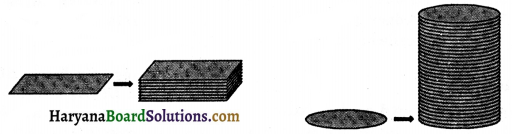
So far, in all our study, we have been dealing with figures that can be easily drawn on page of our note book or blackboards. These are called plane figures. In previous classes, we have learnt about the perimeters and areas of rectangles, squares, rhombus and circles. If we cut out many of these plane figures of same shape and size from cardboard sheet and stack them up in a vertical pile, then by this process, we will obtain some solid figures such as a cuboid, a cylinder etc. In this chapter, we will learn to find the surface areas and volumes of cubes, cuboids, cylinders, cones and spheres.
HBSE 9th Class Maths Notes Chapter 13 Surface Areas and Volumes 1

Units measurement of Area:
1 km2 = 1 km × 1 km = 10 hm × 10 hm = 100 hm2 or 100 hectares
1 hm2 = 1 hm × 1 hm = 10 dam × 10 dam = 100 dam2
1 hm2 = 1 hm × 1 hm = 100 m × 100 m = 10000 m2
1 dam2 = 1 dam × 1 dam = 10 m × 10 m = 100 m2
1 m2 = 1m × 1m = 10 dm × 10 dm = 100 dm2
1 m2 = 1m × 1m = 100 cm × 100 cm = 10000 cm2
1 dm2 = 1 dm × 1 dm = 10 cm × 10 cm = 100 cm2
1 cm2 = 1 cm × 1 cm = 10 mm × 10 mm = 100 mm2
1 km2 = 1 km × 1 km = 1000 m × 1000 m = 106 m2
1m2 = 1m × 1m = 1000 mm × 1000 mm = 106 mm2

HBSE 9th Class Maths Notes Chapter 13 Surface Areas and Volumes

Units measurement of volume:
1 km3 = 1 km × 1 km × 1 km = 1000 m × 1000 m × 1000 m = 109 m3
1 km3 = 1 km × 1 km × 1 km = 10 hm × 10 hm × 10 hm = 1000 hm3
1 hm3 = 1 hm × 1 hm × 1 hm = 10 dam × 10 dam × 10 dam = 1000 dam3
1 hm3 = 1 hm × 1 hm × 1 hm = 100 m × 100 m × 100 m = 106 m3
1 dam3 = 1 dam × 1 dam × 1 dam = 10 m × 10 m × 10 m = 1000 m3
1 m3 = 1 m × 1 m × 1 m = 100 cm × 100 cm × 100 cm = 106 cm3
1 m3 = 1 m × 1 m × 1 m = 1000 mm × 1000 mm × 1000 mm = 109 mm3
1m3 = 1m × 1m × 1m = 10 dm × 10 dm × 10 dm = 1000 dm3
1 cm3 = 1 ml = 1 cm × 1 cm × 1 cm = 10 mm × 10 mm × 10 mm = 1000 mm3
1 litre = 1000 ml = 1000 cm3
1 m3 = 106 cm3 = 1000 litre = 1 kilolitre

Key Words:
→ Solids: Bodies which have three dimensions in space are called solids.

→ Volume: The amount of space occupied by a solid or bounded by a closed surface is known as the volume of solid.

→ Surface area: Surface area is the total sum of all the areas of all the shapes that cover the surface of solid.

→ Lateral surface area: Lateral surface in a solid is the sum of surface areas of all its faces excluding the bases of solid.

→ Cubold: A cuboid is a solid bounded by six rectangular plane regions.

→ Cube: When all the edges of cuboid are equal in length, it is called a cube.

→ Right circular cylinder: If a rectangle is revolved about one of its sides, the solid thus formed is called a right circular cylinder.

→ Right circular cone: If a right angled triangle is revolved about one of the sides containing a right angle, the solid thus generated is called a right circular cone.

→ Sphere: The set of all points in space which are equidistant from a fixed point, is called a sphere.

→ Hemisphere: A plane through the centre of a sphere divides the sphere into two equal parts. Each part is called a hemisphere.

HBSE 9th Class Maths Notes Chapter 13 Surface Areas and Volumes

Basic Concepts
Surface Area of a Cuboid and a Cube:
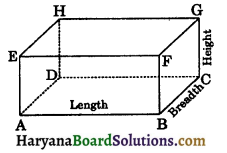
(a) Cuboid: A solid bounded by six rectangular faces is called a cuboid.
e.g., a book, a brick, a matchbox, a tile etc. A cuboid has 6 rectangular faces, 12 edges and 8 vertices.
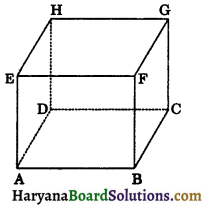
6 rectangular faces are ABCD, EFGH, BCGF, ADHE, ABFE and DCGH.
ABCD is the bottom face and EFGH is the top face and these are one pair of opposite faces. Similarly, other pairs of opposite faces are BCGF, ADHE and ABFE, DCGH.
HBSE 9th Class Maths Notes Chapter 13 Surface Areas and Volumes 2
Out of these six faces, BCGF, ADHE, ABFE and DCGH are called the lateral faces of the cuboid. Any two faces other than the opposite faces are called adjacent faces.

In the given figure, ABCD and ABFE are adjacent faces.
Similarly, EFGH and ADHE are adjacent faces.
AB, BC, CD, DA, EF, FG, GH, HE, AE, BF, CG and DH are 12 edges of a cuboid. A, B, C, D, E, F, G and H are its 8 vertices.
(i) Total surface area of a cuboid:
Area of the face ABCD = Area of the face EFGH = (1 × b) sq. units
Area of the face BCGF = Area of the face ADHE = (b × h) sq. units
Area of the face ABFE = Area of the face DCGH = (1 × h) sq. units
Total surface area of the cuboid = Sum of the areas of six faces
= 2(l × b) + 2(b × h) + 2(l × h).
= 2(l × b + b × h + h × l)
= 2(lb + bh + hl) sq. units
where l = length, b = breadth and h = height.

(ii) Lateral surface area of the cuboid: Out of the six faces of a cuboid, we only find the area of the four faces, leaving the bottom and top faces. In such a case, area of these four faces is called the lateral surface of the cuboid.
Lateral surface area of the cuboid = Area of face BCGF+ Area of face ADHE + Area of face ABFE + Area of face DCGH
=bxh+bxh+lxh+lxh
= 2(l × h) + 2(b × h)
=2(l + b) × h sq. units
= Perimeter of the base × height.

(iii) Diagonal of a cuboid = \(\sqrt{l^2+b^2+h^2}\) units
(b) Cube: A cuboid whose length, breadth and height are all equal is called a cube eg., ice cubes, dice etc.
Each edge of a cube is called its edge. A cube has six faces, All the six faces of a cube are congruent square faces. Length of each edge of the cube is same. It has also 12 edges and 8 vertices.
HBSE 9th Class Maths Notes Chapter 13 Surface Areas and Volumes 3
(i) Total surface area of the cube : Total surface area of the cube is the sum of the areas of the six congruent square faces. Area of the one face is a3, where a is the edge of a cube.
∴ Total surface of the cube = 6a3 sq. units
(ii) Lateral surface area of the cube = 4a3 sq. units
Diagonal of the cube = \(\sqrt{3}\)a units

HBSE 9th Class Maths Notes Chapter 13 Surface Areas and Volumes

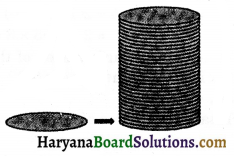
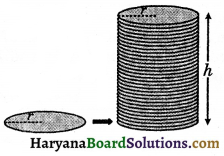
(a) Right Circular Cylinder: If we take a number of circular sheets of paper and stack them vertical pile, we will get a solid called a right circular cylinder.
HBSE 9th Class Maths Notes Chapter 13 Surface Areas and Volumes 4
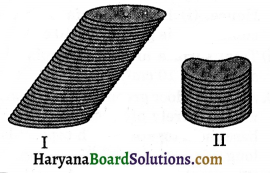
eg., circular pipes, circular pillars, road rollers, gas cylinders, measuring jars etc. In case if circular sheets are not stack up vertically as shown figure 13.8 (I) then the cylinder is not a right circular cylinder. Of course, if we have a cylinder with a non-circular base as shown in figure 13.8 (II), then we also cannot call it a right circular cylinder.
HBSE 9th Class Maths Notes Chapter 13 Surface Areas and Volumes 5
Remarks: 1. From now onwards, the word cylinder would mean a right circular cylinder.

(b) Some Terms Related to the Cylinder:
(i) Base: Two circular ends of cylinder are called its bases.
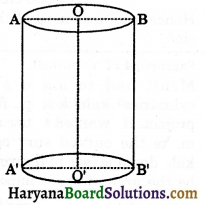
(ii) Radius: The radius of the circular bases is called the radius of the cylinder. In the adjoining figure AO, OB, A’O’ and O’B’ are equal radii of the cylinder.
(iii) Axis: A line segment joining the centres of two circular bases is the called the axis of the cylinder.
In the figure 13.9, OO’ is the axis of the cylinder.
(iv) Height: The length of the axis of the right circular cylinder is called the height of the cylinder. In the figure, OO’ is the height of the cylinder.
HBSE 9th Class Maths Notes Chapter 13 Surface Areas and Volumes 6

(c) Surface Area of Right Circular Cylinder:
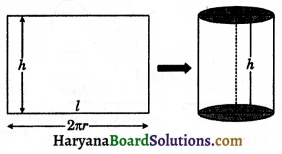
(i) Lateral surface area of right circular cylinder: We take a rectangular sheet of paper, whose length is just enough to go round the cylinder and whose breadth is equal to the height of the cylinder as shown figure below.
HBSE 9th Class Maths Notes Chapter 13 Surface Areas and Volumes 7
If we fold rectangular sheet along its length, we get a right circular cylinder of height h. Lateral surface area of the cylinder is the area of the rectangular sheet. The length of the sheet is equal to the circumference of the circular base which is equal to 2πr. Lateral surface area of a cylinder is also called the curved surface area of the cylinder.
Lateral or curved surface area of the cylinder = Area of the rectangular sheet
= length × breadth
=2πr × h = 2πrh sq. units
Therefore, lateral surface area of a cylinder = 2πrh sq. units.

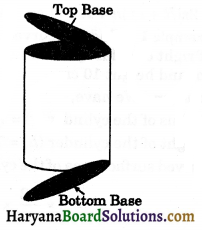
(ii) Total surface area of the right circular cylinder: If we include areas of top and bottom of the cylinder to its lateral surface area, we get the total surface area of the cylinder.
If r is the radius of the cylinder and h its height.
HBSE 9th Class Maths Notes Chapter 13 Surface Areas and Volumes 8
∴ Total surface area of the cylinder = lateral surface area + 2 bases area
= 2πrh + 2πr2[∵ base area = πr2]
= 2πr(h + r) sq. units
Therefore, total surface area of the cylinder = 2πr(h + r) sq. units

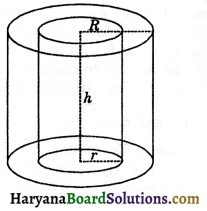
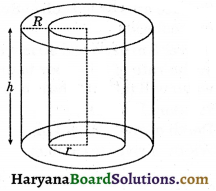
(d) Surface Area of Hollow Cylinder: Hollow cylinder is a solid bounded by two coaxial cylinders of the same height and different radii.
HBSE 9th Class Maths Notes Chapter 13 Surface Areas and Volumes 9
eg., iron pipes, rubber tubes etc.
Let external and internal radii of a hollow cylinder be R and r and h be its height as shown in the given figure.
(i) Area of each base = π(R2 – r2) sq, units
(ii) Lateral or curved surface area of the cylinder = External surface area + Internal surface area
= 2πRh + 2πrh = 2πh(R + r) sq units
(iii) Total surface area of the cylinder
= Lateral surface area + 2 area of the base ring
= 2πh(R + r) + 2π(R2 – r2)
= 2πh(R + r) + 2π(R + r) (R – r)
= 2π(R + r) [h + R – r] sq. units.

HBSE 9th Class Maths Notes Chapter 13 Surface Areas and Volumes

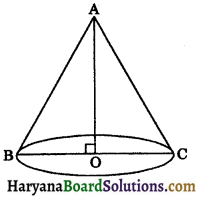
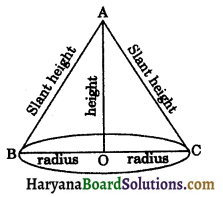
(a) Right Circular Cone: A solid described by the revolution of a right angled triangle about one of its sides (containing the right angle) which remains fixed. In the given figure revolves about side AO. It generates a cone. O is the centre of base BC and A is its vertex.
eg., ice cream cone, clow’s cap, conical vessel etc.

(b) Some Terms Related to the Cone : (i) Radius of the cone: The length segment OB = OC is called radius of the cone. It is usually denoted by r.
HBSE 9th Class Maths Notes Chapter 13 Surface Areas and Volumes 10
(ii) Height of the cone: The length segment AO is called the height of the cone. It is usually denoted by h.
(iii) Slant height of the cone: Slant height of a right circular cone is the distance of its vertex from any point on the circumference of the base. In the given figure, AB and AC represents the slant height of the cone. It is usually denoted by l.
HBSE 9th Class Maths Notes Chapter 13 Surface Areas and Volumes 11
(iv) Vertical angle of the cone: ∠BAC is called the vertical angle of the cone.

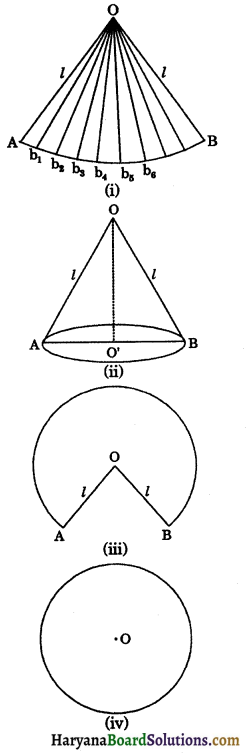
(c) Surface Area of a Right Circular Cone: (i) Lateral surface area of a right circular cone: On a sheet of paper, we draw a circle with centre O and radius l. Now cut out a circular region from the sheet of a paper. We obtain a circular disc of paper [see in figure 13.19 (I)].
HBSE 9th Class Maths Notes Chapter 13 Surface Areas and Volumes 12
Now cut cone OAB from the circular disc of paper [see figure 13.19 (II, III) and open it out (see in figure 13.19 (IV)]. AB is the perimeter of base of cone OAB. The cone OAB is cut into small pieces of triangles such as ΔOAb1, ΔOb1b2, ΔOb2b3, …… whose height is the slant height of the cone.
Area of each small triangle = \(\frac{1}{2}\)base of each triangle × l
Area of entire piece of paper (cone ΔOAB) = Sum of the areas of all triangles
= \(\frac{1}{2}\)b1l + \(\frac{1}{2}\)b2l + \(\frac{1}{2}\)b3l + ……..
= \(\frac{1}{2}\)l(b1 + b2 + b3 + ………)
\(\frac{1}{2}\) × l × AB
\(\frac{1}{2}\)l × 2πr = πrl
So, curved surface area of a cone = πrl.

(ii) Total surface area of a right circular cone:
Total surface of the cone = Lateral surface area + Area of the base of a cone
= πrl + πr2 = πr(l + r)
So, total surface area of the cone = πr(l + r),
where r is its base radius and l its slant height.

(iii) Relation between the height, slant height and radius of cone:
l2 = h2 + r2
⇒ l = \(\sqrt{h^2+r^2}\)

HBSE 9th Class Maths Notes Chapter 13 Surface Areas and Volumes

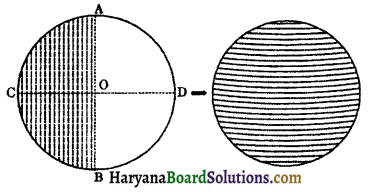
1. (a) Sphere: A sphere is a solid described by the revolution of a semicircle about its diameter, which remains fixed, e.g., football, volleyball, throwball, etc.
In the given figure 13.27 (i) semicircle ABC by revolving about its diameter AB describes the sphere [(see in figure 13.27 (ii)]

The mid point of AB is the centre. Any line which passes through the centre and is terminated both ways by the surface is a diameter. Any line drawn from the centre to the surface is known as radius. A sphere may also defined as:
HBSE 9th Class Maths Notes Chapter 13 Surface Areas and Volumes 13
A sphere is a three dimensional figure (solid figure) which is made up of all points in the space, which lie at a constant distance from a fixed point is called the radius and the fixed point called the centre of the sphere.

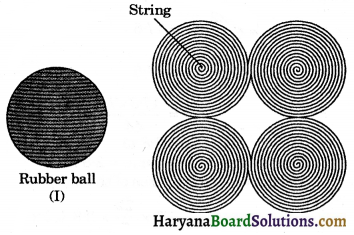
(b) Surface Area of a Sphere: Let us take a rubber ball and drive a nail into it. Let us wind a string around the ball. When you reached the fullest part of the ball, use pins to keep the string in place and continue to wind the string around the remaining part of the ball till it is fully covered [see in figure 13.28 (I) and (II)].
HBSE 9th Class Maths Notes Chapter 13 Surface Areas and Volumes 14
Now, we unwind the string from the surface of the ball.

Start filling the circles one by one, with the string you had wound around the wall (see fig. 13.28). Then, on a sheet of paper, we draw four circles with radius equal to the radius of the ball. Now string is used to completely fill the regions of four circles, all of the same radius as of the sphere. It means, the surface area of a sphere of radius r = 4 times the area of a circle of radius r.
Therefore,surface area of sphere = 4πr2.

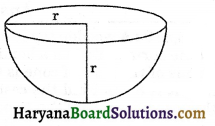
2. Hemisphere: A plane through the centre of a sphere divides the sphere into two equal parts. Each part is called a hemisphere.
HBSE 9th Class Maths Notes Chapter 13 Surface Areas and Volumes 15
For a hemisphere of radius r, we have
(i) Curved surface area of the hemisphere = 2πr2
(ii) Total surface area of the hemisphere
= 2πr2 + πr2
= 3πr2.

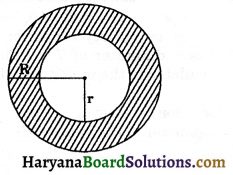
3. (a) Spherical Shell: The difference of two solid concentric spheres is called a spherical shell.
(b) Surface Area of Spherical Shell: If R and be the external and internal radii of a spherical shell, then
Total surface area of spherical shell = 4π(R2 + l2).
HBSE 9th Class Maths Notes Chapter 13 Surface Areas and Volumes 16

HBSE 9th Class Maths Notes Chapter 13 Surface Areas and Volumes

1. Volume of a Cuboid: In previous classes, we have learnt about of certain figures. Recall that solids occupy space. The measure of this occupied space is called the volume of the object.
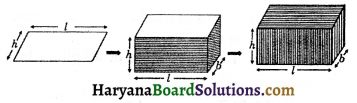
If the object is hollow, then interior is empty and can be filled with air or some liquid that will take the shape of its container. In this case, the volume of the substance that can fill the interior is called the capacity of the container. Thus, we may say that the volume of an object is the measure of the space it occupies and the capacity of an object is the volume of substance its interior can accommodate. Unit of measurement of volume is cubic unit. If we take some rectangular sheets and place it one over the other. If we place these sheets vertically in pile, we get a cuboid. (see figure below)
HBSE 9th Class Maths Notes Chapter 13 Surface Areas and Volumes 17
If area of each rectangle is A, the height upto which the rectangles are stacked is h. Measure of the space occupied by the cuboid
= Area of a rectangular sheet × height
= A × h = l × b × h [∵ A = l × b]
Hence, volume of the cuboid = l × b × h
= length × breadth × height
Also, volume of the cuboid = Area of the base × height

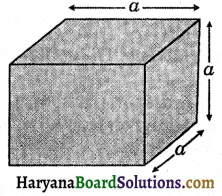
2. Volume of Cube: If length, breadth and height of a cuboid are equal, then it is known as the cube.
HBSE 9th Class Maths Notes Chapter 13 Surface Areas and Volumes 18
Volume of a cube = edge × edge × edge
= a × a × a = a3,
where a is the edge of a cube. Unit of measurement of volume is cubic unit.

HBSE 9th Class Maths Notes Chapter 13 Surface Areas and Volumes

(a) Volume of a Cylinder: If we stack the circular sheets of radius r vertically, we will get a solid called a right circular cylinder of radius r and height h.
HBSE 9th Class Maths Notes Chapter 13 Surface Areas and Volumes 19
Volume of the cylinder = The area of each circular sheet × height
= πr2 × h = πr2h
or Volume of the cylinder = Area of the base × height
= πr2h.

(b) Volume of the Hollow Cylinder: Let the external and internal radii of the hollow cylinder be R and r respectively and h be its height, then
HBSE 9th Class Maths Notes Chapter 13 Surface Areas and Volumes 20
Volume of the material = External volume – Internal volume.
= πR2h – πr2h
= πh(R2 – r2).

Volume of a Right Circular Cone:
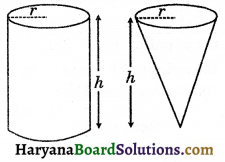
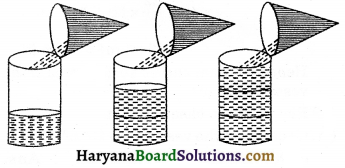
Experiment: Take a hollow cylinder and a hollow cone of the same base radius and the same height.
HBSE 9th Class Maths Notes Chapter 13 Surface Areas and Volumes 21
Fill the cone with water to the brim and empty it into the cylinder. Repeat the process two times more. We observe that 3 cone full to brim will fill the cylinder competely. With this, we can safely come to the conclusion that three times the volume of a cone, makes up the volume of a cylinder.
HBSE 9th Class Maths Notes Chapter 13 Surface Areas and Volumes 22
It means volume of a cone of radius ‘r’ and height ‘h’
= \(\frac{1}{3}\) of volume of cylinder of radius ‘r’ and height ‘h’
Volume of a cone = \(\frac{1}{3}\) × πr2h
or Volume of a cone = \(\frac{1}{3}\) × Area of the base × height

HBSE 9th Class Maths Notes Chapter 13 Surface Areas and Volumes

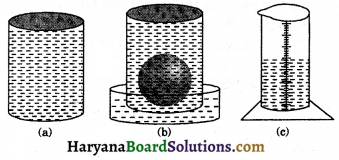
1. Volume of a Sphere: We take a cylindrical container and two or three spheres of different radii. Also take a large trough in which we can place the cylindrical container. Then fill the container up to the brim with water.
Now, we place a sphere in the container. Some of the water will overflow into the trough in which it is kept (see in figure given below).
HBSE 9th Class Maths Notes Chapter 13 Surface Areas and Volumes 23
We pour out the water from the trough into a measuring cylinder and find the volume of the over flowed water. If r is the radius of immersed sphere on evaluating \(\frac{4}{3}\)πr3, we find this value atmost equal to the volume of over flowed water.

We repeat this process with two or three spheres of different radii, we find:
Volume of overflowed water = The volume of the sphere immersed in the water
= \(\frac{4}{3}\)πr3
Thus,volume of the sphere = \(\frac{4}{3}\)πr3.

2. Volume of the hollow sphere: If R and r are respectively the outer and inner radii of hollow sphere.
Volume of the material = Volume of outer sphere – Volume of inner sphere
= \(\frac{4}{3}\)πrR3 – \(\frac{4}{3}\)πr3
= \(\frac{4}{3}\)π(R3 – r3)

3. Volume of the hemisphere :
Volume of the hemisphere \(\frac{2}{3}\)πr3
where r is the radius of the hemisphere.

HBSE 9th Class Maths Notes Chapter 13 Surface Areas and Volumes Read More »

HBSE 9th Class Maths Notes Chapter 12 Heron’s Formula

Haryana State Board HBSE 9th Class Maths Notes Chapter 12 Heron’s Formula Notes.

Haryana Board 9th Class Maths Notes Chapter 12 Heron’s Formula

Introduction
In previous classes, we have studied about various plane figures such as squares, rectangles, triangles, quadrilaterals etc. We have also learnt the formula for finding the areas and the perimeters of these figures like rectangle, square, triangle etc. as given below:
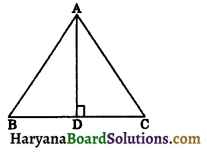
1. Triangle :
(i) \(\frac{1}{2}\) × Base × Height
\(\frac{1}{2}\) × BC × AD
(ii) Perimeter = sum of the sides of a triangle
= AB + BC + CA
HBSE 9th Class Maths Notes Chapter 12 Heron’s Formula 1

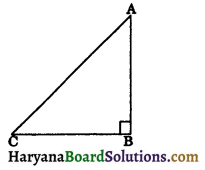
2. Right angled triangle:
(i) Area = \(\frac{1}{2}\) × base × height
= \(\frac{1}{2}\) × BC × AB
(ii) Perimeter = AB + BC + CA
HBSE 9th Class Maths Notes Chapter 12 Heron’s Formula 2

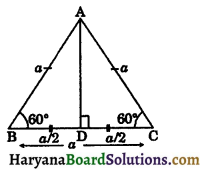
3. Equilateral triangle: Let each side of an equilateral triangle be a units.
(i) Area = \(\frac{1}{2}\) × base × height
= \(\frac{1}{2}\) × BC × AD
[∵ AD = \(\sqrt{a^2-\frac{a^2}{4}}\)
⇒ AD = \(\sqrt{\frac{3 a^2}{4}}\)
⇒ AD = \(\frac{\sqrt{3} a}{2}\) ]
= \(\frac{1}{2}\) × a × \(\frac{\sqrt{3} a}{2}\)
(ii) Perimeter = a + a + a
3a = 3 × side
HBSE 9th Class Maths Notes Chapter 12 Heron’s Formula 3

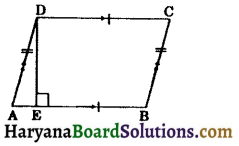
4. Parallelogram:
(i) Area = base x height
= AB × DE
(ii) Perimeter = sum of the sides of ||gm
= AB + BC + CD + AD
HBSE 9th Class Maths Notes Chapter 12 Heron’s Formula 4

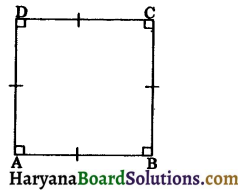
5. Square: (i)
Area = side × side = side2
or Area = \(\frac{1}{2}\) × d2
(where d = diagonal of a square)
(ii) Perimeter = side + side + side + side
= 4 × side
HBSE 9th Class Maths Notes Chapter 12 Heron’s Formula 5

HBSE 9th Class Maths Notes Chapter 12 Heron’s Formula

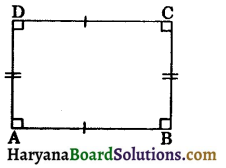
6. Rectangle :
(i) Area = base × height
= length × breadth
(ii) Perimeter = AB + BC + CD + DA
= L + B + L + B
= 2L + 2B
= 2(L + B)
where L = length of a rectangle
and B = breadth of a rectangle
HBSE 9th Class Maths Notes Chapter 12 Heron’s Formula 6

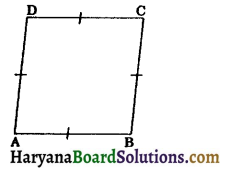
7. Rhombus :
(i) Area = base × height
or Area = \(\frac{1}{2}\) × d1 × d2
where d1 and d2 are the diagonals of a rhombus.
(ii) Perimeter = side + side + side + side
= 4 × side
HBSE 9th Class Maths Notes Chapter 12 Heron’s Formula 7

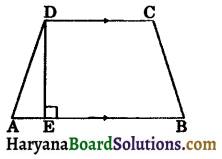
8. Trapezium:
(i) Area = \(\frac{1}{2}\) × (sum of parallel sides) × distance between them
= \(\frac{1}{2}\) × (AB + DC) × DE
(ii) Perimeter = AB + BC + CD + AD
Unit of measurement for length, breadth, height and perimeter is taken as metre (m) or centimetre (cm), milimetre (mm) etc.
HBSE 9th Class Maths Notes Chapter 12 Heron’s Formula 8
Units measurement of Perimeter
1 m = 10 dm, 1 m = 100 cm, 1 m = 1000 mm, 1 km = 10 hm, 1 km = 100 dakm, 1 km = 1000 m Unit of measurement for area of any plane figure is taken as square metre (m2) or square centimetre (cm2) or square millimetre (mm2) etc.
Units measurement of Area
1 km2 = 1 km × 1 km = 10 hm × 10 hm = 100 hm2
1 km2 = 1 km × 1 km = 1000 m × 1000 m = 1000000 m2 = 106 m2
1 hectare = 10000 m2
1 m2 = 1m × 1m = 100 cm × 100 cm = 10000 cm2
1m2 = 1m × 1m = 10 dm × 10 dm = 100 dm2 etc.

HBSE 9th Class Maths Notes Chapter 12 Heron’s Formula

Key Words
→ Area: The area of a triangle or a polygon is the measure of the surface enclosed by its sides.

→ Perimeter: The perimeter of a plane figure is the length of its boundary.
OR
A perimeter is the sum of lengths of sides of a polygon.

→ Right angled triangle: A triangle with one angle a right angle (90°) is called a right angled triangle.

→ Scalene triangle: If all three sides of a triangle are unequal or different, it is called scalene triangle.

→ Isosceles triangle: If at least two sides of a triangle are equal, it is called isosceles triangle.

→ Equilateral triangle: If all three sides of a triangle are equal, it is called. equilateral triangle.

→ Quadrilateral: A plane figure bounded by four line segments is called a quadrilateral.

→ Parallelogram: A quadrilateral in which opposite sides are parallel and equal is known as a parallelogram.

→ Square: A quadrilateral whose each angle is 90° and all sides are equal to each other is known as a square.

→ Rectangle: A quadrilateral each of whose angles is 90° is called a rectangle.

→ Rhombus: A quadrilateral having all the four sides equal is called a rhombus.

→ Trapezium: A quadrilateral in which one pair of opposite sides are parallel is called a trapezium.

→ Diagonal: A line joining any two vertices of a polygon that are not connected by an edge and which does not go outside the polygon.

HBSE 9th Class Maths Notes Chapter 12 Heron’s Formula

Basic Concepts
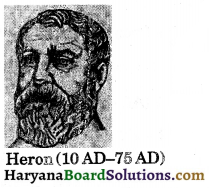
Area of a Triangle by Heron’s Formula: Heron was born in about 10 AD possibly in Alexandria in Egypt. He worked in applied mathematics and wrote three books on mensuration. Book I deals with the area of rectangles, squares, triangles, trapezia, various other specialized quadri- laterals, regular polygons, circles, surfaces of cylinders, cones and spheres etc.
HBSE 9th Class Maths Notes Chapter 12 Heron’s Formula 9
He derived the famous formula for finding the area of a triangle in terms of its three sides.
The formula for finding the area of a triangle was given by Heron is stated as below:
Area of a triangle = \(\sqrt{s(s-a)(s-b)(s-c)}\),
where a, b and c are the sides of a triangle and s = semi-perimeter of the triangle, ie.,
\(\frac{a+b+c}{2}\)
This formula is helpful where it is not possible to find the height of the triangle.

HBSE 9th Class Maths Notes Chapter 12 Heron’s Formula

Application of Heron’s Formula in Finding Areas of Quadrilaterals: In this section, we have studied the areas of such figures which are the shape of a quadrilaterals. We need to divide the quadrilateral in two triangles and then use the formula 12.25 area of the triangle.

HBSE 9th Class Maths Notes Chapter 12 Heron’s Formula Read More »

HBSE 9th Class Maths Notes Chapter 10 Circles

Haryana State Board HBSE 9th Class Maths Notes Chapter 10 Circles Notes.

Haryana Board 9th Class Maths Notes Chapter 10 Circles

Introduction
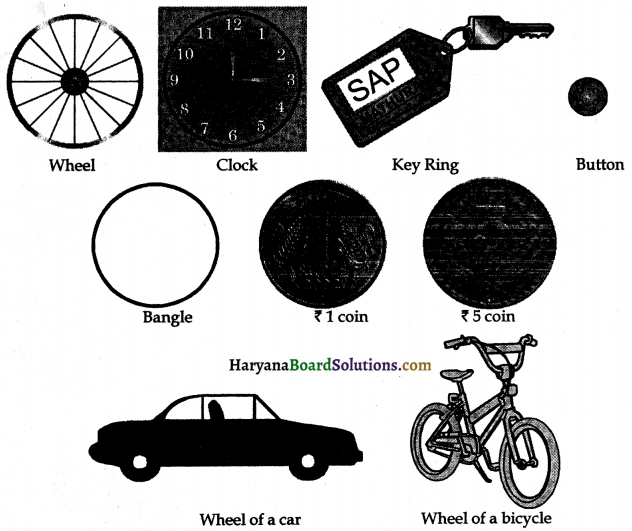
We used various objects in our daily life which are round in shape, such as coins of dimensions ₹ 1, ₹ 2 and ₹ 5, buttons of shirts, key rings, dials of clocks, wheels of vehicles etc. (see in figure 10.1). In a clock we have observed that the second’s hand goes round the dial of the clock rapidly and its tip moves round path. This path traced by the tip of the second’s hand is called a circle.
HBSE 9th Class Maths Notes Chapter 10 Circles 1

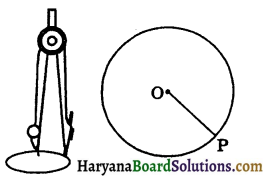
If we fix a pencil in compass and put its pointed leg on a point on a sheet of a paper, open the other leg to some distance. Keeping the pointed leg on the same point, rotate the other leg through one revolution we get a closed figure traced by the pencil on the paper which is known as the circle (see in figure 10.2). In this chapter we will study about circles, it’s related terms and some properties of a circle.
HBSE 9th Class Maths Notes Chapter 10 Circles 2

HBSE 9th Class Maths Notes Chapter 10 Circles

Key Words
→ Circle: A circle is a plane figure bounded by one curved line and is such that all straight lines drawn to this line from certain point within it are equal.

→ Radius: A line segment joining the centre and a point on the circle is called its radius.

→ Circular Region: The region consisting of all points which are either on the circle or lies inside the circle is called the circular region or circular disc.

→ Concentric Circles: The circles which have same centre and different radii are called concentric circles.

→ Centroid: The point of concurrency of the three medians of a triangle is called the centroid of the triangle.

→ Circumcentre: The point of concurrency of the perpendicular bisectors of the sides of a triangle is called the circumcentre of the triangle.

→ Circumcircle: The circumcentre O is equidistant from the three vertices of a triangle. A circle with centre O and radius OA is called the circumcircle of the triangle. It passes through all the three vertices.

→ Concyclic: A number of points are concyclic if there is a circle that passes through all of them.

Basic Concepts
Circles and Its Related Terms: A Review
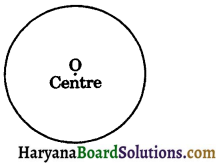
(i) Circle: The collection of all the points in a plane, which are at a fixed distance from a fixed point in the plane, is called a circle.
(ii) Centre: The fixed point is called the centre of the circle. In the figure, O is the centre.
HBSE 9th Class Maths Notes Chapter 10 Circles 3
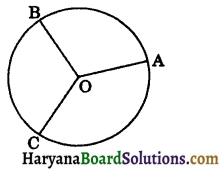
(iii) Radius: The constant distance from its centre is called the radius of the circle. The plural of radius is radii.
In the figure, OA, OB and OC are radii of the circle C(O, r).
HBSE 9th Class Maths Notes Chapter 10 Circles 4
(iv) Circumference: The length of the complete circle is called its circumference. The perimeter of a circle is also known as the circumference of the circle.

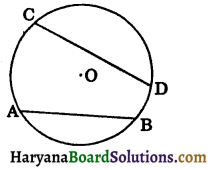
(v) Chord: A line segment joining any two points on the circle is known as the chord of the circle. In the figure, AB and CD are chords of a circle with centre O.
HBSE 9th Class Maths Notes Chapter 10 Circles 5
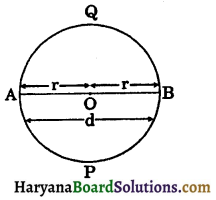
(vi) Diameter: The chord, which passes through the centre of the circle is called a diameter of the circle. A diameter is the longest chord and all diameters are equal in lengths. In the figure, AOB is the diameter.
Diameter = 2 × radius
A diameter divides the circle into two equal arcs. Each of these two arcs is called a semicircle. In the figure, \(\widehat{A P B}\) and \(\widehat{A Q B}\) are two semicircles. The degree measure of a semicircle is 180°.
HBSE 9th Class Maths Notes Chapter 10 Circles 6

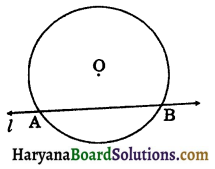
(vii) Secant: A line which intersects a circle in two distinct points is called a secant of the cricle. In the figure, the line l cuts the circle in two points A and B. So, l is a secant of the circle.
HBSE 9th Class Maths Notes Chapter 10 Circles 7
(viii) Arc: A piece of a circle between two points is called an arc.
HBSE 9th Class Maths Notes Chapter 10 Circles 8
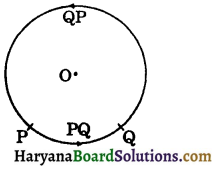
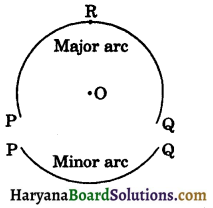
Let P and Q be two points on the circle. These points P and Q divide the circle into two pieces. Each piece is an arc. These arcs are denoted in anticlockwise direction from P to Q as PQ and from Q to Pas QP. The arc PQ is called the minor are and arc QRP is called the major arc,
HBSE 9th Class Maths Notes Chapter 10 Circles 9
where R is any point (figure 10.9) on the arc between P and Q. When arcs PQ and QRP are equal, then each is called a semicircle.

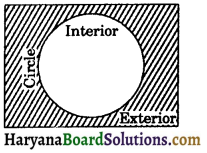
(ix) Interior and Exterior of a circle: A circle divides the plane on which it lies into three parts. They are:
HBSE 9th Class Maths Notes Chapter 10 Circles 10
(a) Inside the circle, which is also called the interior of the circle.
(b) Circle.
(c) Outside the circle, which is also called the exterior of the circle (see in figure).
The circle and its interior make up the circular region.
(x) Position of a point with respect to a circle:
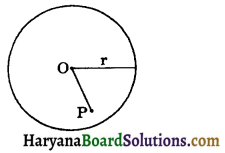
(a) Point inside the circle: A point P is said to lie inside the circle C(O, r), if OP < r.
HBSE 9th Class Maths Notes Chapter 10 Circles 11
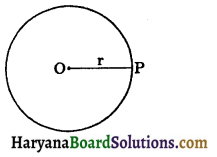
(b) Point on the circle: A point is said to lie on the circle C(O, r), if OP = r.
HBSE 9th Class Maths Notes Chapter 10 Circles 12
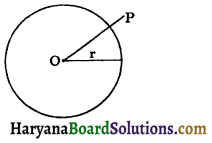
(c) Point outside the circle: A point is said to lie outside the circle C(O, r), if OP > r.
HBSE 9th Class Maths Notes Chapter 10 Circles 13

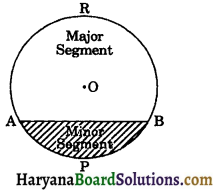
(xi) Segment of a circle: The region between a chord and either of its arcs is called a segment of the circular region or simply a segment of the circle.
HBSE 9th Class Maths Notes Chapter 10 Circles 14
The segment containing the minor area is called the minor segment. Thus APBA is the minor segment of the circle.
The segment containing the major arc is called the major segment. Thus ARBA is the major segment of the circle.
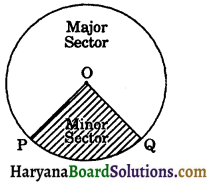
(xii) Sector of a circle: The region between an arc and the two radii, joining the centre to the end points of the arc is called a sector. The minor are corresponds to the minor sector and the major arc corresponds to the major sector. In the figure, the region OPQO is the minor. sector and remaining part of the circular region is the major sector.
HBSE 9th Class Maths Notes Chapter 10 Circles 15

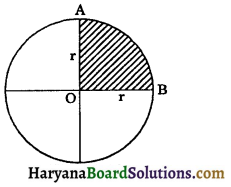
(xiii) Quadrant of a circle: One fourth of a circle is called a quadrant of a circle. In the figure, OABO is the quadrant of the circle C(O, r).
HBSE 9th Class Maths Notes Chapter 10 Circles 16
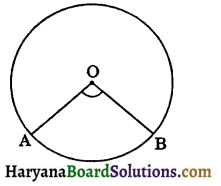
(xiv) Central angle: Let C(O, r) be any circle, then any angle whose vertex is O, is called a central angle of the circle. In the figure, ∠AOB is a central angle of the circle C (O, r).
HBSE 9th Class Maths Notes Chapter 10 Circles 17
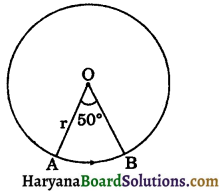
(xv) Degree measure of an arc: Degree measure of a minor arc is the measure of the central angle subtended by the arc. In the given figure 10.17, the measure of the minor are AB is 50° ie., m\(\widehat{A B}\) = 50°. The degree measure of the major are is 360° – 50° = 310°.
⇒ m\(\widehat{B A}\) = 310°
The degree measure of a circle is 360°.
∴ mC(O, r) = m arc AB + m arc BA
= 50° + 310° = 360°.

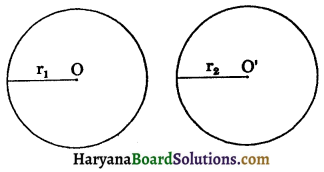
(xvi) Congruent circles: Two circles are said to be congruent, if and only if one of them can be superposed on the other so as to cover it exactly. This is possible only when the radii of the two circles are equal. Let C(O, r1) and C(O’, r2) be two circles such that C(O, r1) is superposed on C(O’, r2) so that O’ coincides with O. Then C(O, r1) will cover C(O’, r2) completely if and only if r1 = r2.
HBSE 9th Class Maths Notes Chapter 10 Circles 18
Thus two circles are congruent, if and only if, they have equal radii.

(xvii) Congruent arcs: Two arcs of a circle are said to be congruent if and only if they have the same degree measures.
If arc AB is congruent to arc CD. They are written as
AB = CD
HBSE 9th Class Maths Notes Chapter 10 Circles 19
In particular case, arcs of semicircles will be congruent because each has degree. measure = 180°.

HBSE 9th Class Maths Notes Chapter 10 Circles

Angle subtended by a chord at a point: The angle subtended by chord PQ at a point R (not on the chord PQ) on the circumference of the circle is ∠PRQ. And the angle subtended by chord PQ at the centre O is ∠POQ.
HBSE 9th Class Maths Notes Chapter 10 Circles 20

Theorem 10.1:
Equal chords of a circle subtend equal angles at the centre.
Given: Two equal chords AB and CD of a circle with centre O.
HBSE 9th Class Maths Notes Chapter 10 Circles 21
To prove: ∠AOB = ∠COD.
Proof: In ΔAOB and ΔCOD, we have
OA = OC (Equal radii of a circle)
OB = OD (Equal radii of a circle)
AB = CD (given)
∴ ΔAOB ≅ ΔCOD (By SSS congruence rule)
⇒ ∠AOB = ∠COD (CPCT)
Hence proved

Theorem 10.2: [Converse of theorem 10.1]
If the angles subtended by the chords of a circle at the centre are equal, then the chords are equal.
HBSE 9th Class Maths Notes Chapter 10 Circles 22
Given: Two chords AB and CD of a circle are such that
∠AOB = ∠COD.
To prove: AB = CD.
Proof: In ΔAOB and ΔCOD, we have
OA = OC [Equal radii of a circle]
∠AOB = ∠COD (given)
OB = OD [Equal radii of a circle]
∴ ΔAOB ≅ ΔCOD (By SAS congruence rule)
⇒ AB = CD (CPCT)
Hence proved

HBSE 9th Class Maths Notes Chapter 10 Circles

Perpendicular from the centre to a chord :
Theorem 10.3:
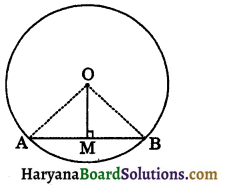
The perpendicular from the centre of a circle to a chord bisects the chord.
HBSE 9th Class Maths Notes Chapter 10 Circles 23
Given: A chord AB of a circle C(O, r) and OM ⊥ to the chord AB.
To prove: AM = MB.
Construction: Join OA and OB.
Proof: In the right ΔOMA and ΔOMB, we have
OA = OB (Equal radii of a circle)
∠OMA = ∠OMB (Each is 90°)
OM = OM (Common)
ΔΟΜΑ ≅ ΔΟΜΒ (By RHS congruence rule)
⇒ AM = MB (CPCT)
Hence proved

Theorem 10.4:
[Converse of theorem 10.3]
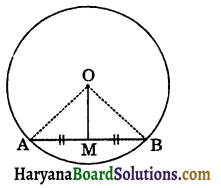
The line drawn through the centre of a circle to bisect a chord is perpendicular to the chord.
HBSE 9th Class Maths Notes Chapter 10 Circles 24
Given: A chord AB of a circle C(O, r) with mid point M.
To prove: OM ⊥ AB.
Construction: Join OA and OB.
Proof: In ΔOAM and ΔOBM, we have
OA = OB (Equal radii of a circle)
AM = BM
[∵ M is the mid point of AB]
OM = OM (common)
∴ ΔOAM ≅ ΔOBM (By SSS congruence rule)
⇒ ∠OMA = ∠OMB (CPCT) …..(i)
But ∠OMA + ∠OMB = 180° (Linear pair axiom)
⇒ ∠OMA + ∠OMA = 180° [using (i)]
⇒ ∠OMA = 180°
⇒ ∠OMA = \(\frac{180^{\circ}}{2}\) = 90°
∠OMA = ∠OMB = 90°
Hence OM ⊥ AB.
Hence proved

HBSE 9th Class Maths Notes Chapter 10 Circles

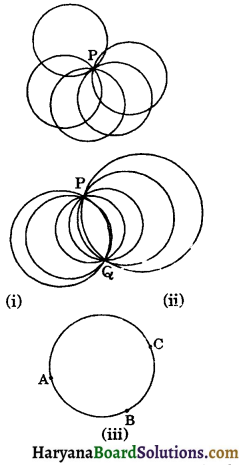
Circle Through Three Points: We take a point P on a paper. There are many circles passing through this point.
Take two points P and Q. There are many infinite number of circle passing through P and Q.
If you take three non-collinear points A, B and C. There is only one circle passing through these points (see in figure below).
HBSE 9th Class Maths Notes Chapter 10 Circles 25

Theorem 10.5:
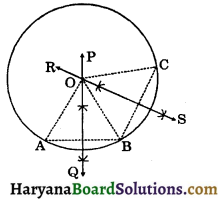
There is one and only one circle passing through three given. noncollinear points.
HBSE 9th Class Maths Notes Chapter 10 Circles 26
Given: Three non-collinear points A, B and C.
To prove: There is one and only one circle passing through three points A, B and C.
Construction: Join AB and BC. Draw the 1 bisectors PQ and RS of AB and BC. Since A, B and C are non-collinear, PQ and RS are not parallel and will intersect, say the point O. Join OA, OB and OC.
Proof: Since, O lies on the perpendicular bisector of AB, we have
OA = OB …..(i)
Similarly, O lies on the perpendicular bisector of BC, we have
OC = OB …..(ii)
From (i) and (ii), we get
OA = OB = OC = r (say)
With O as the centre and r the radius, draw circle C(O, r) which will pass through A, B and C.
Hence, there is one and only one circle passing through three non-collinear points.
Remark: If ABC is a triangle, then by Theorem 10.5, there is a unique circle passing through the three vertices A, B and C of the triangle. This circle is called the circumcircle of the ΔABC. Its centre and radius are called respectively the circumcentre and the circumradius of the triangle.

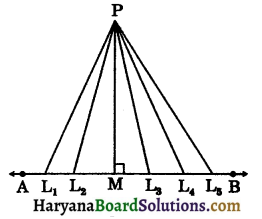
Equal chords and their distances from the centre: Let AB be a line and P be a point (not on the line). There are many infinite number of points L1, L2, L3, L4, L5 on the line. If we join these points to P, we will get many line segments PL1, PL2, PM, PL3, PL4, PL5, where PM is the perpendicular from P to AB. On measuring these line segments PL1, PL2, PM, PL3, PL4, PL5, we find that PM is the shortest line segment.

So, we conclude that the length of the perpendicular from a point to a line is the distance of the line from the point.
HBSE 9th Class Maths Notes Chapter 10 Circles 27
Note: If the point lies on the line, the distance of the line from the point is zero.

HBSE 9th Class Maths Notes Chapter 10 Circles

Theorem 10.6:
Equal chords of a circle (or of congruent circles) are equidistant from the centre (or centres).
HBSE 9th Class Maths Notes Chapter 10 Circles 28
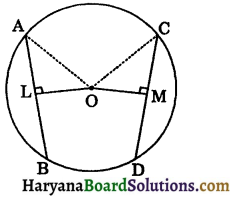
Given: A circle C(O, r) in which chord AB is equal to chord CD, OL ⊥ AB and OM ⊥ CD.
To prove: OL = OM.
Construction: Join OA and OC.
Proof: We have
AB = CD
\(\frac{1}{2}\)AB = \(\frac{1}{2}\)CD ……(i)
∵ OL ⊥ AB
∴ AL = LB = \(\frac{1}{2}\)AB
(By theorem 10.3)…(ii)
and OM ⊥ CD
∴ CM = MD = \(\frac{1}{2}\)CD
(By theorem 10.3)…(iii)
From (i), (ii) and (iii), we get
AL = CM
Now, right ΔOLA and ΔOMC, we have
Hyp. OA = Hyp. OC [Equal radii of a circle]
AL = CM (as proved above)
∠OLA = ∠OMC (Each is 90°)
ΔOLA ≅ ΔOMC (By RHS congruence rule)
⇒ OL = OM (CPCT)
Hence, equal chords of a circle are equidistant from the centre. Proved.

Theorem 10.7:
Chords equidistant from the centre of a circle are equal in length.
HBSE 9th Class Maths Notes Chapter 10 Circles 29
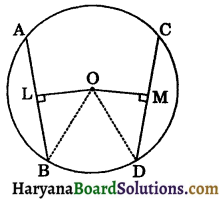
Given: Two chords AB and CD of a circle C(O, r) are such that OL = OM, OL ⊥ AB and OM ⊥ CD.
To prove: AB = CD.
Construction: Join OB and OD.
Proof: ∵ OL ⊥ AB and OM ⊥ CD
∴ LB = \(\frac{1}{2}\)AB and MD = \(\frac{1}{2}\)CD ……(i)
(By theorem 10.3)
Now, right ΔOLB and ΔOMD, we have
Hyp. OB = Hyp. OD [Equal radii of a circle]
∠OLB = ∠OMD (Each is 90°)
OL = OM (given)
∴ ΔΟLΒ ≅ ΔΟΜD (By RHS congruence rule)
⇒ LB = MD (CPCT)
⇒ 2LB = 2MD
⇒ AB = CD [using (i)]
Hence, chords of a circle, which are equidistant from the centre are equal.
Proved

HBSE 9th Class Maths Notes Chapter 10 Circles

Angle Subtended by an Arc of a Circle: If we cut two arcs corresponding to the equal chords AB and CD respectively. We observe that are AB superimpose the arc CD completely (see in figure). This shows that equal chords make congruent arcs and conversely congruent arcs make equal chords of a circle. You can state it as follows:
HBSE 9th Class Maths Notes Chapter 10 Circles 30

If two chords of a circle are equal, then their corresponding arcs are congruent and conversely, if two arcs are congruent, then their corresponding chords are equal.
In the given figure, minor are AB subtends ∠AOB at the centre O and major are BA subtends reflex ∠AOB at the centre.
HBSE 9th Class Maths Notes Chapter 10 Circles 31
In view of the property above and theorem 10.1, the following result is true:
Congruent ares (or equal arcs) of a circle subtend equal angles at the centre.

Theorem 10.8:
The angle subtended by an arc at the centre is double the angle subtended by it at any point on the remaining part of the circle.
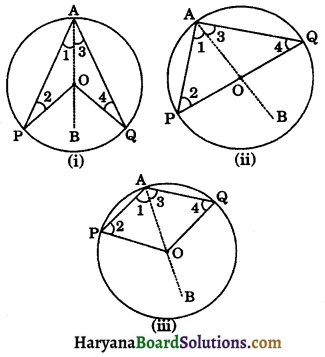
Given: An arc PQ of a circle subtends ∠POQ at the centre and ∠PAQ at a point A on the remaining part of the circle.
To prove: ∠POQ = 2∠PAQ.
Construction: Join AO and produced it to B.
HBSE 9th Class Maths Notes Chapter 10 Circles 32
Proof : Consider three different cases as given in figures. In figure (i) \(\widehat{P Q}\) is minor arc, in (ii) \(\widehat{P Q}\) is a semi-circle and in (iii) \(\widehat{P Q}\) is major arc.
In figure (i) and (ii), In ΔAOP, we have
AO = OP [Equal radii of same circle]
⇒ ∠1 = ∠2 [Angles to the opposite sides are equal]
∠POB = ∠1 + ∠2
[Exterior angle is equal to sum of its two opposite interior angles]
⇒ ∠POB = ∠1 + ∠1
⇒ ∠POB = 2∠1 …..(i)
Similarly, In ΔAOQ, we have
∠3 = ∠4 [∵ AO = OQ]
∠QOB = ∠3 + ∠4
⇒ ∠QOB = ∠3 + ∠3
⇒ ∠QOB = 2∠3 ……(ii)
Adding (i) and (ii), we get
∠POB + ∠QOB = 2∠1 + 2∠3
⇒ ∠POQ = 2(∠1 + ∠3)
⇒ ∠POQ = 2∠PAQ
In figure (iii),
∠POB + ∠QOB = 2 (∠1 + ∠3)
⇒ Reflex ∠POQ = 2∠PAQ. Hence proved

Corollary: The angle in a semicircle is a right angle.
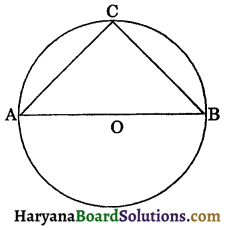
Given: In a circle C(O, r), AB is the diameter with centre O and ∠ACB is an angle in a semicircle.
HBSE 9th Class Maths Notes Chapter 10 Circles 33
To prove: ∠ACB = 90°,
Proof: ∠AOB = 2∠ACB (By theorem 10.8)
⇒ 180° = 2∠ACB (∵ AOB is a straight line)
∠ACB = \(\frac{180^{\circ}}{2}\)
∠ACB = 90°
Hence, angle in a semicircle is a right angle. Proved

HBSE 9th Class Maths Notes Chapter 10 Circles

Theorem 10.9:
Angles in the same segment of a circle are equal.
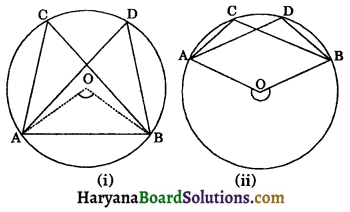
Given: A circle C(O, r) in which ∠ACB and ∠ADB are two angles made by arc AB in the same segment ACDB of the circle.
To prove: ∠ACB = ∠ADB.
Construction: Join OA and OB.
HBSE 9th Class Maths Notes Chapter 10 Circles 34
Proof: In figure (i), by theorem 10.8, we have
∠AOB = 2∠ACB…(i)
and ∠AOB = 2∠ADB…(ii)
From (i) and (ii), we get
2∠ACB = 2∠ADB
∠ACB = ∠ADB
In figure (ii), by theorem 10.8, we have
reflex ∠AOB = 2∠ACB…(iii)
and reflex ∠AOB = 2∠ADB…(iv)
From (iii) and (iv), we get
2∠ACB = 2∠ADB
∠ACB = ∠ADB
In both cases, ∠ACB = ∠ADB
Hence, angles in the same segment of a circle are equal. Hence proved

Theorem 10.10:
If a line segment joining two points subtends equal angles at two other points lying on the same side of the line containing the line segment, the four points lie on a circle (i.e., they are concyclic).
HBSE 9th Class Maths Notes Chapter 10 Circles 35
Given: AB is a line segment, which subtends equal angles at two points C and D, such that
∠ACB = ∠ADB.
To prove: The points A, B, C and D lie on a circle (i.e., they are concyclic).
Construction: Draw a circle through three non-collinear points A, B, C.
Proof: Suppose circle does not pass through D. Let it will intersect AD (or extended AD) at point, say E (or E’). If points A, C, E and B lie on a circle, then
∠ACB = ∠AEB …(i) (By theorem 10.9)
But, ∠ACB = ∠ADB (given)…(ii)
From (i) and (ii), we get
∠AEB = ∠ADB
This is not possible unless E coincides with D.
Therefore D lies on the circle passing through A, B, C.
Similarly, E’ should also coincide with D.
Hence, the points A, B, C and D are concylic. Hence Proved

HBSE 9th Class Maths Notes Chapter 10 Circles

Cyclic Quadrilaterals: A quadrilateral ABCD is called cyclic, if all the four vertices of it lie on a circle.
Theorem 10.11:
The sum of either pair of opposite angles of a cyclic quadrilateral is 180°.
Or
The opposite angles of a cyclic quadrilateral are supplementary.
HBSE 9th Class Maths Notes Chapter 10 Circles 36
Given: A cyclic quadrilateral ABCD.
To prove: ∠A + ∠C = 180° and ∠B + ∠D = 180°.
Construction: Join AC and BD.
Proof: ∠ADB = ∠ACB [Angles in a same segment are equal]…(i)
∠ABD = ∠ACD [Angles in a same segment are equal]…(ii)
Adding (i) and (ii), we get
∠ADB + ∠ABD = ∠ACB + ∠ACD
⇒ ∠ADB + ∠ABD = ∠C
Adding ∠BAD on both sides, we get
∠ADB + ∠ABD + ∠BAD = ∠C + ∠BAD
⇒ 180° = ∠C + ∠A
[∵ Sum of angles of a ΔBAD is 180°]
∠A + ∠C = 180° …(iii)
But, we know that the sum of angles of a quadrilateral is 360°.
∴ ∠A + ∠B + ∠C + ∠D = 360°
⇒ ∠B + ∠D + 180° = 360° [using (iii)]
⇒ ∠B + ∠D = 360° – 180° = 180°
Hence, ∠A + ∠C = 180° and
∠B + ∠D = 180°. Proved

HBSE 9th Class Maths Notes Chapter 10 Circles

Theorem 10.12:
If the sum of a pair of opposite angles of a quadrilateral is 180°, the quadrilateral is cyclic.
Given: A quadrilateral ABCD in which ∠A + ∠C = 180°.
To prove: ABCD is a cyclic quadrilateral.
Construction: If possible, let ABCD be not a cyclic quadrilateral. Draw a circle, passing through non-collinear points D, A, B. Let this circle meet DE or DE produced at C. Join EB.
HBSE 9th Class Maths Notes Chapter 10 Circles 37
Proof: ∠A + ∠C = 180° (given) …(i)
Now ABED is a cyclic quadrilateral.
∠A + ∠E = 180° ….(ii)
[∵ opposite angles of a cyclic quadrilateral is 180°]
From (i) and (ii), we get
∠A + ∠C = ∠A + ∠E
⇒ ∠C = ∠E
This is not possible, since an exterior angle of a triangle can never be equal to its interior opposite angle.
So, ∠C = ∠E is possible only when C coincides with E.
Hence, the circle passing through D, A, B must pass through C also.
Hence, ABCD is a cyclic quadrilateral.
Proved

HBSE 9th Class Maths Notes Chapter 10 Circles Read More »

HBSE 9th Class Maths Notes Chapter 11 Constructions

Haryana State Board HBSE 9th Class Maths Notes Chapter 11 Constructions Notes.

Haryana Board 9th Class Maths Notes Chapter 11 Constructions

Introduction
In previous chapters, we have drawn rough diagrams to prove theorems or solving exercise. But sometimes we need to construct accurate figures. For example, to draw a map of building to be constructed, to design the parts of machine and tools etc. To draw such figures the following geometrical instruments are needed:
(i) A graduated scale, (ii) a pair of set squares, (iii) a pair of dividers, (iv) a pair of compasses, (v) a protractor (see in the figure below).
HBSE 9th Class Maths Notes Chapter 11 Constructions 1
These instruments are used in drawing a geometrical figure, such as a triangle, quadrilateral, trapezium, circle etc. In this chapter we will learn about some simple and basic constructions such as bisector of a line segment, bisector of a given angle, constructions of some standard angle and some constructions of triangles with the help of graduated scale, compass and protractor.

HBSE 9th Class Maths Notes Chapter 11 Constructions

Key Words
→ Geometrical Construction: A geometrical construction is the process of drawing a geometrical figure using only two instruments-an ungraduated ruler and compass.

→ Perpendicular bisector: A line which divides the given line in two equal parts and is perpendicular to the line segment is called the perpendicular bisector.

→ Corresponding: Angles, lines and points in one figure which bear a similar relationship, each to each, to angles, lines and points in another figure.

→ Triangle: A closed figure which bounded by three line segments is called a triangle.

→ Isosceles triangle: If at two sides of a triangle are equal, it is called an isosceles triangle.

→ Equilateral triangle: If all three sides of a triangle are equal, it is called an equilateral triangle.

→ Perimeter of a triangle: Sum of the all sides of a triangle is called the perimeter of a triangle.

→ Median: The median of a triangle, corresponding to any side, is the line joining the midpoint of that side with the opposite vertex.

→ Altitude: An altitude of a triangle, corresponding to any side, is the length of perpendicular drawn from the opposite vertex to that side.

Basic Concepts
Basic Constructions
(a) Construction 11.1: To construct the bisector of a given angle.
We have an ∠ABC, we need to construct its bisector.
Steps of construction:
Step – I: Taking B as centre and any suitable radius draw an arc cutting AB and BC at P and Q respectively.
Step – II: Taking P and Q as centres and radius more than \(\frac{1}{2}\)PQ, draw two arcs intersecting each other at R.
Step-III: Draw the ray BR. The ray BR is the required bisector of the angle ABC.
HBSE 9th Class Maths Notes Chapter 11 Constructions 2
Justification: Join PR and QR.
In ΔBPR and ΔBQR, we have
PB = QB [Radii of the same arc]
PR = QR [Arcs of equal radii]
BR = BR [Common]
ΔBPR ≅ ΔBQR [By SSS congruence rule]
⇒ ∠PBR = ∠QBR [CPCT]
Hence, BR is the bisector of ∠ABC.

HBSE 9th Class Maths Notes Chapter 11 Constructions

Construction 11.2:
To construct the perpendicular bisector of a given line segment.
We have a line segment AB, we need to construct its perpendicular bisector.
Steps of construction:
Step-I: Draw a line segment AB of given length.
Step-II: Taking A as centre and radius more than \(\frac{1}{2}\)AB, draw arcs one on each side of AB.
Step-III: Taking B as centre and the same radius as in Step (II), draw arcs intersecting previous arcs at P and Q.
Step-IV: Join PQ intersecting AB at M. Then line PQ is the perpendicular bisector of AB.
Justification: Join AP, BP, AQ and BQ.
In ΔPAQ and ΔPBQ, we have
AP = BP Arcs of equal radii]
AQ = BQ [Arcs of equal radii]
PQ = PQ [Common]
∴ ΔPAQ ≅ ΔPBQ [By SSS congruence rule]
⇒ ∠APQ ≅ ∠BPQ [CPCT]
⇒ ∠APM = ∠BPM ……(i)
HBSE 9th Class Maths Notes Chapter 11 Constructions 3
In ΔPMA and ΔPMB, we have
PA = PB [Arcs of equal radii]
∠APM = ∠BPM [As proved in (i)]
PM = PM [Common]
ΔPMA ≅ ΔPMB (By SAS congruence rule)
⇒ AM = BM
and ∠PMA = ∠PMB (CPCT)
But, ∠PMA + ∠PMB = 180° [By linear pair axiom]
∠PMA + ∠PMA = 180°
2∠PMA = 180°
∠PMA = \(\frac{180^{\circ}}{2}\) = 90°
∠PMA = ∠PMB = 90°.
Hence, PM is the perpendicular bisector of AB.

Construction 11.3:
To construct an angle of 60° at the initial point of a given ray.
Let us take a ray AB with initial point A.
We need to construct a ray AC such that
∠CAB = 60°.
HBSE 9th Class Maths Notes Chapter 11 Constructions 4
Steps of construction:
Step-I: Draw a ray AB with initial point A.
Step-II: Taking A as centre and suitable radius, draw an arc which intersects AB at P.
Step-III: Taking P as centre and same radius as before, draw an arc intersecting the previous are at point Q.
Step-IV: Draw a ray AC passing through Q. Then ∠CAB is the required angle of 60°.
Justification: Join PQ.
AP = PQ = AQ [By construction]
⇒ ΔPAQ is an equilateral triangle.
∴ ∠QAP = 60°
⇒ ∠CAB = 60°.

HBSE 9th Class Maths Notes Chapter 11 Constructions

Some Constructions of Triangles:
Construction 11.4 To construct a triangle, given its base, a base angle and sum of other two sides.
HBSE 9th Class Maths Notes Chapter 11 Constructions 5
Given: The base BC, a base angle, say ∠B and the sum AB + AC of the other two sides of a triangle ABC, we need to construct ΔABC.
Steps of construction:
Step-I: Draw the given base BC and the point B construct an angle ∠CBX equal to the given angle with BC.
Step-II: From the ray BX,
cut BD = AB + AC.
Step-III: Join DC and construct
∠DCY = ∠BDC.
Step-IV: Let CY intersects BX at A.
Then, ABC is the required triangle.
Justification: Since,
∠BDC = ∠DCY (By construction)
⇒ ∠ADC = ∠ACD
⇒ AD = AC
[Sides opp. to equal angles are equal]
Now, AB = BD – AD
⇒ AB = BD – AC [∵AD = AC]
⇒ AB + AC = BD
⇒ BD = AB + AC.
Alternative method

Steps of construction:
HBSE 9th Class Maths Notes Chapter 11 Constructions 6
Step-I: Draw the given base BC and at the point B construct ∠CBX equal to the given angle with BC.
Step-II: From the ray BX, cut BD = AB + AC.
Step-III: Join DC and draw perpendicular bisector PY of CD intersecting BD at point A. Join AC.
Remarks: The construction of the trinagle is not possible if the sum AB + AC ≤ BC.

HBSE 9th Class Maths Notes Chapter 11 Constructions

Construction 11.5: To construct a triangle given its base, a base angle and the difference of the other two sides.
Given: Base BC and a base angle, say ∠B and the difference of other two sides AB – AC or AC – AB. We need to construct AABC. There are following two cases arise:
Case I: If AB > AC that is AB – AC is given.
HBSE 9th Class Maths Notes Chapter 11 Constructions 7
Steps of construction:
Step-I: Draw the given base BC. At the point B, construct ∠CBX equal to the given angle with BC.
Step-II: From ray BX, cut the line segment BD is equal to AB – AC.
Step-III Join DC and draw perpendicular bisector of CD intersecting BX at A.
Step-IV: Join AC. Then ABC is required triangle.
Justification: Since AP is the perpendicular to CD.
∴ AD = AC
So, BD = AB – AD
⇒ BD = AB – AC.
Case II: If AB < AC that is AC – AB is given.
HBSE 9th Class Maths Notes Chapter 11 Constructions 8
Steps of construction:
Step-I: Draw the given base BC. At the point B, construct ∠CBX equal to the given angle with BC.
Step-II: Extend XB to D to the opposite side of BC such that
BD = AC – AB.
Step-III: Join CD and draw perpendicular bisector PQ of CD intersecting BX at A.
Step-IV: Join AC, then ABC is required triangle.
Justification: Since PQ is the perpendicular bisector of CD.
∴ AD = AC
Now, BD = AD – AB
⇒ BD = AC – AB.

HBSE 9th Class Maths Notes Chapter 11 Constructions

Construction 11.6:
To construct a triangle, given its perimeter and its two base angles.
Given: Base angles ∠B and ∠C and perimeter of a triangle ABC (ie., BC + CA + AB) are given. We need to construct the triangle ABC.
HBSE 9th Class Maths Notes Chapter 11 Constructions 9
Steps of construction:
Step – I: Draw a line segment XY equal to BC + CA + AB.
Step – II: Construct ∠LXY equal to ∠B and ∠MYX equal to ∠C with XY.
Step – III: Draw the bisectors of ∠LXY and ∠MYX intersecting at A.
Step – IV: Draw perpendicular bisectors PQ of AX and RS of AY.
Step – V: Let perpendicular bisectors PQ and RS intersect XY at B and C respectively.
Step – VI: Join AB and AC, then ABC is the required triangle.
Justification: Since PQ is the perpendicular bisector of AX.
∴ XB = AB …..(i)
Similarly, RS is the perpendicular bisector of AY.
∴ CY = AC ……(ii)
Now, XY = XB + BC + CY
XY = AB + BC + AC [Using (i) & (ii)]
Since, XB = AB
⇒ ∠AXB = ∠XAB ……(iii)
and CY = AC
⇒ ∠CAY = ∠CYA …..(iv)
∠ABC = ∠AXB + ∠XAB
[∵ Exterior angle is equal to its opp. two interior angles]
⇒ ∠ABC = ∠AXB + ∠AXB [Using (iii)]
⇒ ∠ABC = 2∠AXB
⇒ ∠ABC = ∠LXY
Similarly, ∠ACB = ∠MYX.

HBSE 9th Class Maths Notes Chapter 11 Constructions Read More »

HBSE 9th Class Maths Notes Chapter 5 Introduction to Euclid’s Geometry

Haryana State Board HBSE 9th Class Maths Notes Chapter 5 Introduction to Euclid’s Geometry Notes.

Haryana Board 9th Class Maths Notes Chapter 5 Introduction to Euclid’s Geometry

Introduction
The word ‘geometry’ is derived from the Greek words ‘geo’, means the ‘earth’, and ‘metrein’, means ‘to measure’. So, it appears to have originated from the need for measuring land. Many ancient civilization of Egypt, Babylonia, India, Greece, China have studied the ‘geometry’ in various forms. They short out the several practical problems which required the development of geometry in various ways.

In Indus Valley Civilization, the ratio length : breadth : thickness of the bricks was taken as 4 : 2 : 1.

Construction of altars (or vedis) and fireplaces for performing Vedic rites were originated in Vedic period. Square and circular altars were used for household rituals, while shape of altars were the combination of rectangles, triangles and trapeziums. They are used for public worship. The ‘sriyantra’ consists of nine interwoven isosceles triangles which are arranged in such a way that they produce 43 subsidiary triangles. A Greek mathematician, Thales, (640 BC) gave the first known proof of the statement that a circle is bisected (cut into two equal parts) by its diameter.
HBSE 9th Class Maths Notes Chapter 5 Introduction to Euclid’s Geometry 1

Pythagoras (572 BC) was the most famous pupil of Thales discovered many geometric properties and developed the theory of geometry to a great extent. This process continued till 300 BC. His important theorem is; In right triangle, the square of hypotenuse is equal the sum of the square of base and square of perpendicular.
HBSE 9th Class Maths Notes Chapter 5 Introduction to Euclid’s Geometry 2

Euclid (300 BC) was a mathematics teacher who was born in Alexandria in Greece introduced the method of proving mathematical results by using deductive logical reasoning and the previously proved results. The geometry of plane figure is known as “Euclidean Geomery.”
HBSE 9th Class Maths Notes Chapter 5 Introduction to Euclid’s Geometry 3

HBSE 9th Class Maths Notes Chapter 5 Introduction to Euclid’s Geometry

The Indian Mathematician, Aryabhatta (born 476 AD) worked out the area of an isosceles triangle, the volume of a pyramid and approximate value of π.
HBSE 9th Class Maths Notes Chapter 5 Introduction to Euclid’s Geometry 4

Brahmagupta (born 598 AD) discovered the formula for finding the area of cyclic quadrilateral.
HBSE 9th Class Maths Notes Chapter 5 Introduction to Euclid’s Geometry 5

Bhaskara II (born 1114 AD) gave a dissection proof of Pythagoras’ theorem.
HBSE 9th Class Maths Notes Chapter 5 Introduction to Euclid’s Geometry 6
In this chapter, we shall study the Euclid’s approach to geometry.

Key Words
→ Version – Translation.

→ Altars – Raised plateform used for sacrifice or religious offering.

→ Rituals – Way of performing religious services.

→ Rite – Religious ceremony.

→ Subsidiary – Accessory.

→ Allied – Related.

→ Extent – Large space or tract size.

→ Volume – Space occupied, mass.

HBSE 9th Class Maths Notes Chapter 5 Introduction to Euclid’s Geometry

→ Cyclic Quadrilateral – A quadrilateral whose four vertices lie on a circle.

→ Proof – The course of reasoning which establishes the truth of a statement.

→ Logic – The science or art of reasoning.

→ Physical – Belonging to physics.

→ Universal – Belonging to all.

→ Fact – A thing known to be true.

→ Coincide – To occupy the same space.

→ Proposition – A statement of something to be done.

→ Interpreted – To exposed the meaning of.

→ Demonstrate – To prove with certainly.

→ Consequence – result.

→ Superposed – To put or place over or above.

→ Assumption – A supposition, thing assumed.

HBSE 9th Class Maths Notes Chapter 5 Introduction to Euclid’s Geometry

Basic Concepts
Euclid’s Definitions, Axioms and Postulates:
(a) Euclid summarised the work of ‘geometry’ as definitions. He listed 23 definitions in Book 1 of ‘Elements’. A few of them are given below:

  • A point is that which has no part.
  • A line is breadthless length.
  • The ends of a line are points.
  • A straight line is a line which lies evenly with the points on itself.
  • A surface is that which has length and breadth only.
  • The edges of surface are lines.
  • A plane surface is a surface which lies evenly with the straight lines on itself.

In these definitions, we observe that, point, line, breadth, length, plane etc. are undefined terms. The only thing is that we can represent them intuitively or explain them with the help of ‘physical models.’

Starting with these definitions, Euclid assumed certain properties, which were not to be proved. These assumptions are actually “obvious universal truths”. He divided them into two types: axioms and postulates. He used term ‘postulate’ for the assumptions that were specific to geometry. Common notions (often called axioms), on the other hand, were. assumption used throughout mathematics and not specifically linked to geometry.

(b) Axioms: The basic facts which are taken for granted, without proof, are called axioms.
Some of the Euclid’s axioms (not in order) are given below:
(i) Things which are equal to the same thing are equal to one another.
i.e., If p = q and r = q, then p = r.
(ii) If equals are added to equals, the wholes are equal.
i.e., If p = q, then p + r = q + r.
(iii) If equals are subtracted from equals, the remainders are equal.
i.e., If p = q, then p – r = q – r.
(iv) Things which coincide with one. another are equal to one another.
(v) The whole is greater than the part ie., If p>q, then there exists r(r ≠ 0) such that
P = q + r.
(vi) Things which are double of the same things are equal to one another. i.e., If p = q, then 2p = 2q.
(vii) Things which are halves of the same things are equal to one another.
Le. If p = q, then \(\frac{p}{2}=\frac{q}{2}\)

(c) Postulate: A statement whose validity is accepted without proof, is called a postulate.
Euclid gave five postulates stated as below:
Postulate 1: A straight line may be drawn from any one point to any other point.
This postulate tells us that at least one straight line passes through two distinct points which is shown in the figure below:
HBSE 9th Class Maths Notes Chapter 5 Introduction to Euclid’s Geometry 7
Axiom 5.1. Given two distinct points, there is a unique line that passes through them.

In the given figure, P and Q are two distinct points. Out of all lines passing through the point P, there is exactly one line ‘l’ which also passes through Q. Also out of all lines passing through the point Q, there is exactly one line l which also passes through the point P. Hence, we find there is a unique line l which passes through the points P and Q.
HBSE 9th Class Maths Notes Chapter 5 Introduction to Euclid’s Geometry 8

Postulate 2: A terminated line can be produced indefinitely.
HBSE 9th Class Maths Notes Chapter 5 Introduction to Euclid’s Geometry 9
Postulate 3: A circle can be drawn with any centre and any radius.
Postulate 4: All right angles are equal to one another.
Postulate 5: If a straight line falling on two straight lines makes the interior angles on the same side of it taken together less than two right angles, then the two straight lines, if produced indefinitely, meet on that side on which the sum of angles is less than two right angles.
HBSE 9th Class Maths Notes Chapter 5 Introduction to Euclid’s Geometry 10

For example, in the figure line PQ falls on the lines AB and CD such that ∠1 + ∠2 < 180° on the left side of PQ. Therefore, the lines AB and CD will eventually intersect on the left side of PQ.

(d) Statement: A sentence which can be judged either true or false is called a statement.
For example:
(i) The sum of the angles to a quadrilateral is 360°, is a true statement.
(ii) The sum of the angles of a triangle is 90°, is a false statement.
(iii) y + 5 > 9 is a sentence but not a statement.

HBSE 9th Class Maths Notes Chapter 5 Introduction to Euclid’s Geometry

Theorem: In mathematics, a theorem is a statement that has been proven on the basis of previously established statements, such as other theorems and previously accepted statements, such as axioms. The derivation of a theorem is often interpreted as a proof of the truth of the resulting expression, but different deductive systems can yield other interpretations, depending on the meanings of the derivation rules. The proof of a mathematical theorem is logical argument demonstrating that the conclusion.

For example:
(i) The area of a triangle is equal to half its base, multiplied by its attitude.
(ii) An exterior angle of a triangle is equal to sum of its opposite interior angles.
Corollary: A proposition, whose truth can easily be deducted from a preceeding theorem, is called its corollary.

(e) Some terms allied to Geometry:
(i) Point: A point is a mark of position, which has no length, no breadth and no thickness. We represent a point by a capital letters A, B, C, P, Q etc., as shown in the figure.
HBSE 9th Class Maths Notes Chapter 5 Introduction to Euclid’s Geometry 11

(ii) Plane: A plane is a every surface such that point of the line joining any two points on it, lies on it.
The surface of the top of the table, surface of the smooth blackboard and surface of a sheet of paper are the some close examples of a plane surfaces are limited in extent but geometrical plane extends endlessly in all directions.
HBSE 9th Class Maths Notes Chapter 5 Introduction to Euclid’s Geometry 12

(iii) Line: A line has length but no breadth or thickness. A line has no ends points. A line has no definite length. It can be extended infinitely in both the directions. The given figure shows line \(\bar{AB}\).
HBSE 9th Class Maths Notes Chapter 5 Introduction to Euclid’s Geometry 13
Some times we shall denote lines by small letters such as l, m, n, p etc.

(iv) Ray: It is a straight line which starts from a fixed point and moves in the same direction. A ray has one endpoint and it has no definite length.
The given figure shows a ray \(\overrightarrow{A B}\).
HBSE 9th Class Maths Notes Chapter 5 Introduction to Euclid’s Geometry 14

(v) Line segment: It is a straight line with its both ends fixed. The given figure shows a line segment \(\bar{AB}\), with fixed ends A and B. A line has a definite length.
HBSE 9th Class Maths Notes Chapter 5 Introduction to Euclid’s Geometry 15
So, a line segment is the shortest distance between two fixed points.

(vi) Collinear points: Three or more than three points are said to be collinear, if they lie on the straight line.
The given figure shows the collinear points P, Q, R while A, B, C are non-collinear.
HBSE 9th Class Maths Notes Chapter 5 Introduction to Euclid’s Geometry 16

(vii) Parallel lines: The straight lines which lie in the same plane and do not meet at any point on producing on either side, are called parallel lines.
If l and m are parallel lines in a plane, we write l || m.
HBSE 9th Class Maths Notes Chapter 5 Introduction to Euclid’s Geometry 17
The distance between the two parallel lines always remains same.

(viii) Intersecting lines: Two lines having a common point are known as intersecting lines.
The common point (O, in figure 5.18) is known as the point of intersection.
HBSE 9th Class Maths Notes Chapter 5 Introduction to Euclid’s Geometry 18

(ix) Concurrent lines: In the figure 5.19, the lines pass through the same point. In this case, lines are called concurrent lines.
HBSE 9th Class Maths Notes Chapter 5 Introduction to Euclid’s Geometry 19

(x) Congruence of line segment: If the given two line segments are of the same size, they are said to be ‘congruent. Two lines AB and CD are congruent, if the trace copy of one can be superposed on the other so as to cover it completely and exactly.
Symbolically, \(\bar{AB}\) ≅ \(\bar{CD}\) or line segment AB ≅ line segment CD.

Congruence relation in the set of all line segments:
(i) AB ≅ AB
(ii) AB ≅ CD ⇒ CD ≅ AB
(iii) AB ≅ CD and CD ≅ EF, then AB ≅ EF.

HBSE 9th Class Maths Notes Chapter 5 Introduction to Euclid’s Geometry

Theorem 5.1.
Two distinct lines cannot have more than one point in common.
Proof. Here, we are given two lines I and m. We need to prove that they have only one point in common. If possible, let P and Q two points common to the given lines l and m. Then the line I passes through the points P and Q and line m passes through the points P and Q. But this assumption clashes with the axiom that one and only one line can pass through two distinct points. So, our supposition that two lines pass through two distinct points is wrong.
Hence, two distinct lines cannot have more than one point in common.
HBSE 9th Class Maths Notes Chapter 5 Introduction to Euclid’s Geometry 20

Equivalent Versions of Euclid’s Fifth Postulate:
There are several equivalent versions of fifth postulate of Euclid. One of them is ‘Playfair’s Axiom’ (given by Scottish mathematician John Playfair in 1729), as stated below:

Playfair’s Axiom: “For every line l and for every point P not lying on l, there exists a unique line m passing through P and parallel to l.”
From figure 5.52, we observe that all the lines passing through the point P, only line m is parallel to line l.
HBSE 9th Class Maths Notes Chapter 5 Introduction to Euclid’s Geometry 21
This result can also be stated as: Two distinct intersecting lines cannot be parallel to the same line.

HBSE 9th Class Maths Notes Chapter 5 Introduction to Euclid’s Geometry Read More »

HBSE 9th Class Maths Notes Chapter 9 Areas of Parallelograms and Triangles

Haryana State Board HBSE 9th Class Maths Notes Chapter 9 Areas of Parallelograms and Triangles Notes.

Haryana Board 9th Class Maths Notes Chapter 9 Areas of Parallelograms and Triangles

Introduction
In previous classes, we have studied the areas of plane figure such as, triangle, square, parallelogram, rhombus etc. We may recall that part of plane enclosed by a simple closed figure is called a planar region corresponding to that figure. The magnitude or measure of this planar region is called its area.

Area is always expressed with the help of a number such as 12 cm2, 5 cm2, 7 hectares etc. In this chapter, we will consolidate the knowledge about these formulae by studying some relationship between the areas of these geometric figures under the condition when they lie on the same base and between the same parallels.

Key Words
→ Base: In a geometry, a particular side or face of geometric figure, such as a triangle, parallelogram, cone etc.

→ Altitude: The perpendicular distance from a vertex to the opposite side is known as altitude.

→ Magnitude: Exter, size, bulk, amount, quantity, greateness. That which is extended in length, breadth and thickness. A thing which can be divided into parts.

→ Monotone: In one tone.

→ Planar region: Of, relating to or situated in a plane.
OR
Having a two dimensional characteristic.

→ Interior of a triangle: The part of the plane enclosed by a triangle is known as the interior of the triangle.

HBSE 9th Class Maths Notes Chapter 9 Areas of Parallelograms and Triangles

→ Area of a triangle = \(\frac{1}{2}\) × base × height

→ Area of a parallelogram = base × height

→ Area of a square = (side)2 OR \(\frac{1}{2}\)d12,
[where d1 is its diagonal]

→ Area of a rectangle = length × breadth

→ Area of a rhombus = base × height or \(\frac{1}{2}\)d1 × d2, [where d1 and d2 are its diagonals]

→ Area of a trapezium = \(\frac{1}{2}\)(sum of parallelside) × height

Basic Concepts
1. Polygonal Regions:
(a) Triangular region: The union of a triangle and its interior is called a triangular region. By the area of a triangle, we mean the area of its triangular region.
HBSE 9th Class Maths Notes Chapter 9 Areas of Parallelograms and Triangles 1

(b) Rectangular region: The part of the plane enclosed by a rectangle is called the interior of a rectangle and the union of a rectangle and its interior is a called a rectangular region. It can be represent as the union of two triangular regions.
HBSE 9th Class Maths Notes Chapter 9 Areas of Parallelograms and Triangles 2

(c) Polygonal region: A polygonal region is a plane figure that can be written as a union of a finite number of triangular regions, subject to a constraint. The constraint is that the triangular regions are non-over lapping. That means if two triangular region intersect then their intersetion is either vertex or edge of each of the triangular regions.
HBSE 9th Class Maths Notes Chapter 9 Areas of Parallelograms and Triangles 3

2. Area Axioms:
(a) Every polygonal region R has an area, measured in square units.
(b) (i) Congruent Area Axiom If two polygonal regions R1 and R2 are such that R1 ≅ R2, then
ar (R1) = ar (R2).
(ii) Area Monotone Axiom: If two polygonal regions are such that R1 belongs to R2 then
ar (R1) ≤ ar (R2).
(iii) Area Addition Axiom: If intersection of two polygonal regions R1 and R2, is a finite number of points and line segments such that R = R1 ∪ R2, then
ar (R) = ar (R1) + ar (R2).

(c) Rectangle Area Axiom: A rectangular region ABCD in which AB = a units and BC = b units then
ar (rectangle ABCD)= ab square units.

HBSE 9th Class Maths Notes Chapter 9 Areas of Parallelograms and Triangles

3. Figures on the Same Base and Between the Same Parallels:
Look at the following figures:
HBSE 9th Class Maths Notes Chapter 9 Areas of Parallelograms and Triangles 4
In figure 9.4 (i) parallelograms ABCD and ABQP have a common side AB. So we say that parallelogram ABCD and ABQP are on the same base AB. Similarly in figure 9.4 (ii) triangles ABC and DBC are on the same base BC, in figure 9.4 (iii) trapezium PQRS and parallelogram PQMN are on the same base PQ. In figure 9.4 (iv) parallelogram ABCD and triangle PDC are on the same base DC.

Now look at the figures (9.5):
HBSE 9th Class Maths Notes Chapter 9 Areas of Parallelograms and Triangles 5
We observe that in figure 9.5 (i) triangles CBA and DAB lie on the same base AB and, AB and CD are two parallel lines. In addition to the above, the vertex D of ADAB opposite to the base AB and vertex C of ACBA opposite to the base AB lie on a line CD parallel to the base AB. So we say that ADAB and ACBA are on the same base AB and between the same parallels CD and AB. Similarly in figure 9.5 (ii) trapezium ABCD and parallelogram ABPQ are on the same base AB between the same parallels AB and PD. In figure 9.5 (iii) trapezium ABCD and parallelogram ABFE are on the same base AB and between the same parallels AB and DF. In figure 9.5 (iv) parallelograms PQRS and PQMN are on the same base PQ and between the same parallels PQ and SM.

So, two figures are said to be on the same base and between the same parallels, if they have a common base (side) and the vertices (or the vertex) opposite to the common base of each figure lie on a line parallel to the base.

Now consider the following figures:
HBSE 9th Class Maths Notes Chapter 9 Areas of Parallelograms and Triangles 6
HBSE 9th Class Maths Notes Chapter 9 Areas of Parallelograms and Triangles 7
We observe that in figure 9.6 (i) triangles ABC and DBC are the same base BC but do not lie between the same parallels. In figure, 9.6 (ii) parallelogram ABCD and triangle PQR are lie between the same parallels AB and CD but they are not on the same base. In figure 9.6 (iii) the parallelograms ABCD and ABFE are on the same base AB but do not lie between the same parallels.

HBSE 9th Class Maths Notes Chapter 9 Areas of Parallelograms and Triangles

Parallelograms on the Same Base and Between the Same Parallels:
Theorem 9.1:
Parallelograms on the same base and between the same parallels are equal in area.
HBSE 9th Class Maths Notes Chapter 9 Areas of Parallelograms and Triangles 8
Given: Two parallelogram ABCD and ABFE are on the same base AB and are between the same parallels AB and DF.
To prove:
ar (||gm ABCD) = ar (||gm ABFE).
Proof: In ΔAED and ΔBFC, we have
AD = BC
[∵ AD and BC are the opposite sides of parallelogram ABCD]
∠DAE = ∠CBF
[∵ AD || BC and AE || BF,
∴ angle between AD and AE = angle between BC and BF]
and AE = BF
(∵ AE and BF are the opposite sides of the parallelogram ABFE)
ΔAED ≅ ΔBFC
(By SAS congruence rule)
⇒ ar (ΔAED) = ar (ΔBFC)
(By congruent area axiom) …(i)
Now
ar (||gm ABCD) = ar (☐ ABCE) + ar (ΔAED)
⇒ ar (||gm ABCD) = ar (☐ ABCE) + ar (ΔBFC) [using (i)]
⇒ ar (||gm ABCD) = ar (||gm ABFE)
Hence proved

Corollary 1: A parallelogram and a rectangle on the same base and between the same parallels are equal in area.
Corollary 2: If a triangle and a parallelogram are on the same base and between the same parallels, then area of the triangle is equal to half the area of the parallelogram.

Corollary 3: Area of parallelogram = base × height.
Given: A parallelogram ABCD in which AB is the base and AP is the corresponding height.
To prove : Area of parallelogram ABCD = AB × AP.
Construction: Draw BQ ⊥ CD so that rectangle ABQP is formed.
HBSE 9th Class Maths Notes Chapter 9 Areas of Parallelograms and Triangles 9
Proof: Since parallelogram ABCD and rectangle ABQP are on the same base AB and between the same parallels AB and PC.
∴ ar (||gm ABCD) = ar (rectangle ABQP)
⇒ ar (||gm ABCD) = AB × AP
[∵ area of rectangle = length × breadth]
⇒ ar (||gm ABCD) = base × height.

HBSE 9th Class Maths Notes Chapter 9 Areas of Parallelograms and Triangles

Triangles on the Same Base and Between the Same Parallels:
Theorem 9.2:
Two triangles on the same base (or equal bases) and between the same parallels are equal in area.
HBSE 9th Class Maths Notes Chapter 9 Areas of Parallelograms and Triangles 10
Given: Two triangles ABC and PBC on the same base BC and between the same parallels BC and AP.
To prove : ar (ΔABC) = ar (ΔPBC).
Construction: Through B draw BD || CP, intersecting PA produced in D and through C, draw CQ || BA, intersecting AP produced in Q.
Proof: Since, BC || AP and AB || CQ.
∴ ABCQ is a parallelogram.
Again, BC || AP and BD || CP
∴ BCPD is a parallelogram.
Now, parallelograms ABCQ and DBCP are on the same base BC and between. the same parallels BC and DQ.
∴ ar (||gm ABCQ) = ar (||gm DBCP) …(i)
But, a diagonal of a parallelogram divides it into two triangles are of equal areas.
∴ ar (ΔABC) = ar (||gm ABCQ) …(ii)
Similarly, ar (ΔPBC) = \(\frac{1}{2}\)ar (||gm DBCP) …(iii)
From (i), (ii) and (iii), we get
ar (ΔABC) = ar (ΔPBC)
Hence proved

Corollory: Area of a triangle = \(\frac{1}{2}\)base × height.
Given: A ΔABC in which AP is the height to the side BC.
To prove: ar (ΔABC) = \(\frac{1}{2}\)BC × AP.
HBSE 9th Class Maths Notes Chapter 9 Areas of Parallelograms and Triangles 11
Construction: Through A and C, draw AD || BC and CD || BA, intersecting each other at D.
Proof : Since, AD || BC and CD || BA
∴ ABCD is a parallelogram.
AC is the diagonal of parallelogram ABCD. It divides the parallelogram ABCD into two triangles of equal areas.
∴ ar (ΔABC) = \(\frac{1}{2}\)ar (||gm ABCD)…(i)
Since BC is a side of ||gm ABCD and AP is its corresponding height.
ar (||gm ABCD) = BC × AP …..(ii)
From (i) and (ii), we get
ar(ΔABC) = \(\frac{1}{2}\)BC × AP.
Hence proved.

Corollary: Area of a trapezium = \(\frac{1}{2}\) × (sum of the parallel sides) × (distance between them)
Given: A trapezium ABCD in which AB || CD and CP ⊥ AB. Let CP = h.
To prove :
ar (trapezium) = \(\frac{1}{2}\)(AB + CD) × h.
Construction: Draw AQ ⊥ CQ, intersecting CD produced at Q. Join AC.
HBSE 9th Class Maths Notes Chapter 9 Areas of Parallelograms and Triangles 12
Proof: ar (trapezium ABCD) = ar (ΔABC) + ar (ΔACD)
= \(\frac{1}{2}\) × AB × CP + \(\frac{1}{2}\) × CD × AQ
= \(\frac{1}{2}\) × (AB + CD) × h, [∵ CP = AQ = h]
∴ Area of a trapezium = \(\frac{1}{2}\)(sum of the parallel sides) × (distance between them)

HBSE 9th Class Maths Notes Chapter 9 Areas of Parallelograms and Triangles

Theorem 9.3:
Two triangles having the same base (or equal bases) and equal areas lie between the same parallels.
OR
If two triangles have equal areas and one side of the triangle is equal to one side of the other, then their corresponding altitudes are equal.
Given: Two triangles ABC and DEF are such that
ar (ΔABC) = ar (ΔDEF) and AB = DE and CM and FN are the altitudes corresponding to AB and DE respectively of the two triangles.
To prove: CM = FN.
Proof: In AABC, CM is the altitude to the corresponding side AB.
HBSE 9th Class Maths Notes Chapter 9 Areas of Parallelograms and Triangles 13
ar (ΔABC)= \(\frac{1}{2}\) × AB × CM …..(i)
[∵ ar (Δ) = \(\frac{1}{2}\) base × height]
Similarly,
ar (ΔDEF) = \(\frac{1}{2}\) × DE × FN …(ii)
But, ar (ΔABC) = ar (ΔDEF) (given)…(iii)
From (i), (ii) and (iii), we get
\(\frac{1}{2}\) × AB × CM = \(\frac{1}{2}\) × DE × FN
⇒ \(\frac{1}{2}\) × AB × CM = \(\frac{1}{2}\) × AB × FN
[given DE = AB]
⇒ CM = FN. Hence proved
As CM = FN (Proved above)
and CM ⊥ AB and FN ⊥ AB
∴ CF || AB
HBSE 9th Class Maths Notes Chapter 9 Areas of Parallelograms and Triangles 14
Hence, two triangles having the same base and equal area lie between the same parallels.

HBSE 9th Class Maths Notes Chapter 9 Areas of Parallelograms and Triangles Read More »

HBSE 9th Class Maths Notes Chapter 2 Polynomials

Haryana State Board HBSE 9th Class Maths Notes Chapter 2 Polynomials Notes.

Haryana Board 9th Class Maths Notes Chapter 2 Polynomials

Introduction
In previous classes, we have learnt about algebraic expressions and various operations on them such as addition, subtraction, multiplication and division. We have also studied the factorization of algebraic expressions. In this chapter, we shall review these concepts and extent them to particular types of expressions known as polynomials. We shall also study the Remainder Theorem and Factor Theorem and their use in the factorization of polynomials.

Key Words
→ Polynomial: A polynomial is a algebraic expression in which the variables involved have only non negative integral powers.

→ TermEach individual part of an expression or sum which stands alone or is connected to other parts of an expression by a plus (+) or minus (-) sign e.g., in expression 3x2 + 4x + 9, there are three terms, 3x2, 4x and 9.

→ Coefficients of polynomial: Refers to a multiplying factor e.g., in 5x and 7xy; 5 and 7y are the coefficients of x.

→ Algebraic expression: An algebraic expression is a collection of one or more terms, which are seperated from each other by addition (+) or subtraction signs.

→ Standard form of a polynomial: A polynomial is said to be in standard form, if the powers of x are either in increasing or in decreasing order.

→ Remainder theorem: If p(x) is any polynomial of degree greater than or equal to 1 and p(x) is divided by the linear polynomial (x – a) then remainder is p(a).

→ Factor theorem: (x – a) is a factor of the polynomial p(x), if p(a) = 0.

→ Zero of a polynomial: A real number ‘a’ is a zero of a polynomial p(x), if p(a) = 0.

→ Algebraic equation: An algebraic equation is a statement which states that the two expressions are equal.

→ Factors of the polynomial: When a polynomial (an algebraic expression) is expressed as the product of two or more expressions, then each of these expressions is called a factor of the polynomial.

→ Linear factors: If a factors contains no higher power of the variable quantity than the first power is called linear factor e.g., 4x + 5 is a linear factor.

HBSE 9th Class Maths Notes Chapter 2 Polynomials

Basic Concepts
Polynomial in One Variable:
(a) Polynomial: An expression of the form anxn + an-1xn-1 + an-2xn-2 + ….. + a2xn + a1x + a0 is called polynomial, where n is a whole number, a0, a1, a2, a3,…, an, are real numbers and coefficients of the polynomial.
e.g., (i) 4x3 + 9x2 – 3x + 4 is a polynomial in one variable x.
(ii) y4 + 6y3 – 4y2 + 2y + 7 is a polynomial in one variable y.

(b) Terms and their Coefficients: (i) The polynomial 5x3 + 9x2 – 3x – 5 has four terms, namely 5x3, 9x2, -3x and -5, and 5, 9, -3 are coefficients of x, x and x respectively.
(ii) The polynomial x2 + 3x – 7 has three terms, namely x2, 3x and -7 and 1, 3 are coefficients of x2 and x respectively.

(c) Degree of a Polynomial: The highest power of the variable is called the degree of polynomial.
(i) f(x) = 3x3 + 4x2 – 8x + 10.
Here, highest power term of given polynomial is 3x3, so it’s degree is 3.
(ii) g(x) = 5x2 – 4x + 8.
Here, highest power term of given polynomial is 5x2, so it’s degree is 2.

(d) Types of Polynomial (according to degree):
1. Constant Polynomial: A polynomial of degree zero is called a constant polynomial.
eg., 3, -7, \(\frac{5}{9}\), etc. are all constant polynomials.
2. Linear Polynomial: A polynomial of degree 1 is called a linear polynomial.
e.g., (i) 3x + 7 is a linear polynomial in one variable x.
(ii) 4y – 8 is a linear polynomial in one variable y.
(iii) ax + b, a ≠ 0 is a linear polynomial in one variable x.
3. Quadratic Polynomial: A polynomial of degree 2 is called a quadratic polynomial.
e.g., (i) 11x2 + 6x – \(\frac{3}{2}\) is a quadratic polynomial in x.
(ii) y2 + 6y – 8 is a quadratic polynomial in y.
(iii) ax2 + bx + c, a ≠ 0 is a quadratic polynomial in x.

4. Cubic Polynomial: A polynomial of degree 3 is called a cubic polynomial.
e.g., (i) 7x3 + 5x2 + 6 is a cubic polynomial in x.
(ii) 3x2 – 4xy2 + 7 is a cubic polynomial in x and y.
(iii) ax3 + bx2 + cx + d, a ≠ 0 is a cubic polynomial in x.
5. Biquadratic Polynomial: A polynomial of degree 4 is called a biquadratic polynomial.
e.g., (i) x4 – 5x3 + 3x2 – 6x + 4 is a biquadratic polynomial in x.
(ii) ax4 + bx3 + cx2 + dx + e, a ≠ 0 is a biquadratic polynomial in x.

(e) Types of Polynomial (According to terms):
(i) Monomial: A polynomial having one term is called a monomial.
e.g., 5, 2x, 4xy, 3x2 are all monomials.
(ii) Binomial: A polynomial having two terms is called a binomial.
eg., 4x + 3, 5x2 + 9, 7x2 + 7x are all binomials.
(iii) Trinomial: A polynomial having three terms is called a trinomial.
e.g., 7x3 + 4x2 + 5, x2 + 5x + 3 are all trinomials.
(iv) Zero Polynomial: A polynomial consisting of one term, namely zero only, is called a zero polynomial.
The degree of a zero polynomial is not defined.

Zeroes of a Polynomial: Consider the polynomial:
p(x) = 2x3 – 3x2 + 4x + 5.
If we replace x by 1 everywhere in p(x), we get
p(1) = 2 × (1)3 – 3 × (1)2 + 4 × 1 + 5
= 2 – 3 + 4 + 5
= 11 – 3 = 8.
So, we can say that the value of p(x) at x = 1 is 8.
Similarly,
P(0) = 2 × (0)3 – 3 × (0)2 + 4 × 0 + 5
= 0 – 0 + 0 + 5 = 5.
So, we can say that the value of p(x) at x = 0 is 5 and
p(-2) = 2 × (-2)3 – 3 × (-2)2 + 4 × (-2) + 5
= -16 – 12 – 8 + 5
= -31.
So, we can say that the value of p(x) at x = -2 is -31. Now, consider another polynomial
f(x) = x2 – 4
f(2) = (2)2 – 4 = 4 – 4 = 0
f(-2) = (-2)2 – 4 = 4 – 4 = 0.
We can say, that 2 and -2 are the zeroes of the polynomial.
In general, a real number ‘a’ is said to be a zero of a polynomial p(x), if the value of the polynomial p(x) at x = a is 0 i.e., p(a) = 0.
Now, consider general linear polynomial p(x) = ax + b, a ≠ 0.
For zero of the polynomial p(x) = 0.
0 = ax + b
⇒ ax = -b
⇒ x = \(\frac{-b}{a}\)
∴ \(\frac{-b}{a}\) is the zero of the polynomial.
(v) A zero of polynomial need not to be zero.
(vi) Number of zeroes is equal to the degree of polynomial.

HBSE 9th Class Maths Notes Chapter 2 Polynomials

1. Remainder Theorem: Let p(x) be any polynomial of degree ≥ 1 and let a be any real number. If the polynomial p(x) is divided by linear polynomial (x – a), then the remainder is p(a).
Proof:
Suppose that when p(x) is divided by (x – a), then the quotient is q(x) and the remainder is r(x), then we have
p(x) = (x – a).q(x) + r(x)
where degree of r(x) < degree (x – a) or r(x) = 0. Since, degree of (x – a) = 1, degree of r(x) = 0 i.e., constant.
Let r(x) = r, then we have
p(x) = (x – a).q(x) + r ……..(i)
Putting x = a in (i), we get
p(a) = (a – a).q(a) + r
p(a) = 0·q(a) + r
p(a) = 0 + r
p(a) = r
Hence, the remainder is p(a) when p(x) is divided by (x – a).
Hence proved.

Corollary I. When a polynomial p(x) of degree ≥ 1 is divided by a linear polynomial ax + b, a ≠ 0, then remainder is equal to p\(\left(\frac{-b}{a}\right)\).
Corollary II. If a polynomial p(x) vanishes when x = a and also x = b, then p(x) is divisible by (x – a) (x – b).

2. Factor Theorem: If p(x) is a polynomial of degree ≥ 1 and a is any real number, then:
(i) (x – a) is a factor of p(x), if p(a) = 0 and
(ii) p(a) = 0, if (x – a) is a factor of p(x).
Proof:
When a polynomial p(x) is divided by (x – a), then
p(x) = (x – a).q(x) + r(x)…….(i)
where q(x) is the quotient and r(x) is the remainder.
By Remainder theorem, we have
remainder = p(a).
Putting r(x) = p(a) in (i), we get
p(x) = (x – a).q(x) + p(a).
(i) If p(a) = 0, then p(x) = (x – a).q(x)
⇒ (x – a) is a factor of p(x).
(ii) If (x – a) is a factor of p(x) (given), then p(x) = (x – a).g(x), for some polynomial g(x)
In this case, when p(x) is divided by (x – a), the remainder is
p(a) = (a – a).g(a)
⇒ p(a) = 0 × g(a)
⇒ p(a) = 0. Hence proved.

HBSE 9th Class Maths Notes Chapter 2 Polynomials

Factorisation of Polynomials:
(a) Factorisation of a quadratic polynomial by splitting the middle term : Quadratic polynomial ax2 + bx + c, where a, b, c ≠ 0 divided into two classes:
(i) When a = 1 i.e., x2 + bx + c.
(ii) When a ≠ 1 i.e., ax2 + bx + c.
Resolution of x2 + bx + c into two factors: Examine the following example:
(x + 3)(x + 4) = x2 + (3 + 4)x + 3 × 4 = x2 + 7x + 12
Here, we obtain product 12 by multiplying together 3 × 4 and 7 is obtain by adding together (+3) and (+4).
Hence, in order to find out factors of x2 + 7x + 12, we must find two numbers whose product is 12 and sum is 7.
Since, (x + p) (x + q) = x2 + (p + q)x + pq
∴ x2 + (p + q)x + pq = (x + p) (x + q)
We observe that, the product pq is obtained by multiplying together p and q, and (p + q) is the sum of the coefficient of the two second terms. Conversely, to find the factors, we have to find two numbers whose sum is (p + q) and product is pq.
We have the following procedure for factorising the quadratic polynomial x2 + bx +c:
Step 1: Rewrite the quadratic polynomial in standard form (x2 + bx + c), if not already in this form.
Step 2: Factorise constant term e into two factors p and q such that p × q = c and p + q = b.
Step 3: Split the middle term i.e., the term x into two terms with the coefficients p and q.
Step 4: By using grouping factorisation method, factorise the obtained four terms.

(b) Factorisation of a quadratic polynomial by splitting the middle term (continued): For factors of the quadratic polynomial of the form ax2 + bx + c, where a ≠ 1 and a, b, c ≠ 0. We have the following procedure for factorising the quadratic polynomial ax2 + bx + c.
Step 1: Rewrite the quadratic polynomial in standard form (ax2 + bx + c), if not already in this form.
Step 2: Find the product of constant term and the coefficient of x2 i.e., a × c = ac.
Step 3: (i) Observe that, if ac is positive (+ve), then find two factors p and q of ac such that p + q = b.
(ii) If ac is negative (-ve), then find two factors p and q of ac such that p – q = b.
Step 4: Split the middle term into two terms with coefficients p and q.
Step 5: Factorize the four terms by grouping.

(c) Factorisation of cubic polynomials by factor theorem: In this section, we have studied how to factorize cubic polynomials. The idea is to find out a linear factor (x – a) of the given polynomial p(x) and write it as p(x) = (x – a).q(x).
The degree of q(x) is one less than that of p(x). Therefore, q(x) is a quadratic polynomial which can be factorised by the method of splitting the middle term or we may again try to find a linear factor (x – b) of q(x). Thus, we have p(x) = (x – a).(x – b) g(x).
Here, the degree of g(x) is one less than q(x) i.e., the degree of g(x) is 1. Thus p(x) = (x – a).(x – b) g(x), which is product of linear factors.

For example: Factorise x3 – 2x2 – 5x + 6 by factor theorem.
Solution:
First Method: Let
p(x) = x3 – 2x2 – 5x + 6.
Step 1. First check at which value, the given polynomial p(x) becomes zero. These values can be any one of the factors of constant term.
The factors of constant term (6) are ±1, ±2, ±3, ±6.
p(1) = p(1)3 – 2 × (1)2 – 5 × 1 + 6
= 1 – 2 – 5 + 6
= 7 – 7 = 0.
∴ By factor theorem (x – 1) is a factor of p(x).
Step 2. Now, divide x3 – 2x2 – 5x + 6 by x – 1
HBSE 9th Class Maths Notes Chapter 2 Polynomials 1
The other factor of p(x) is x2 – x – 6.
Step 3. Now, p(x) = (x – 1) (x2 – x – 6)
= (x – 1)[x2 – (3 – 2)x – 6)
[∵ -6 = -(3 × 2), 3 – 2 = 1]
= (x – 1)[x2 – 3x + 2x – 6[
= (x – 1)[x(x – 3) + 2(x – 3)]
= (x – 1)(x – 3)(x + 2)
Hence, x3 – 2x2 – 5x + 6 = (x – 1)
(x – 3)(x + 2).

Second method: Let
p(x) = x3 – 2x2 – 5x + 6
First check at which value, the given p(x) becomes zero. These values can be any one of the factors of constant term. Factors of constant term 6 are ±1, ± 2, ± 3, ±6.
Put x = 1,
p(1) = (1)3 – 2 × (1)2 – 5 × 1 + 6
= 1 – 2 – 5 + 6
= 7 – 7 = 0
⇒ (x – 1) is a factor of x3 – 2x2 – 5x + 6.
Put x = -2,
p(-2) = (-2)3 – 2 × (-2)2 – 5 × (-2) + 6
= – 8 – 8 + 10 + 6
= -16 + 16 = 0
⇒ (x + 2) is a factor of p(x).
Put x = 3,
p(3) = (3)3 – 2 × (3)2 – 5 × 3 + 6
= 27 – 18 – 15 + 6
= 33 – 33 = 0
⇒ (x – 3) is a factor of p(x).
Since, the given expression is a cubic polynomial.
So, it will have three factors of first degree.
∴ x3 – 2x2 – 5x + 6 = k(x – 1)(x + 2)(x – 3) ……(i)
Here, k is the numerical coefficient yet to be found. Now putting x = 0 (value other than 1, 2, 3) on both sides of equation (i),
we get
6 = k(0 – 1) (0 + 2) (0 – 3)
⇒ 6 = 6k ⇒ k = \(\frac{6}{6}\) ⇒ k = 1
Putting the value of k in (i), we get
x3 – 2x2 – 5x + 6 = (x – 1)(x + 2)(x – 3).

HBSE 9th Class Maths Notes Chapter 2 Polynomials

Algebraic Identities: In previous classes, we have learnt about some algebraic identities.
An algebraic identity is an algebraic equation that is true for all values of the variables present in the equation.
Identity I: (x + y)2 = x2 + 2xy + y2.
Identity II: (x – y)2 = x2 – 2xy + y2.
Identity III: x2 – y2 = (x + y) (x – y).
Identity IV: (x + a)(x + b) = x2 + (a + b)x + ab.
(a) Algebraic Identities for Cubes of Binomials
Identity V: (x + y)3 = x3 + y3 + 3xy(x + y)
= x3 + y3 + 3x2y + 3xy2.
Identity VI: (x – y)3 = x3 – y3 – 3xy(x – y)
= x3 – y3 – 3x2y + 3xy2.

(b) Algebraic Identities Relating to Trinomials
Identity VII: (x + y + z)2 = x2 + y2 + z2 + 2xy + 2yz + 2zx.
Identity VIII: x3 + y3 + z3 – 3xyz
= (x + y + z) (x2 + y2 + z2 – xy – yz – zx)
Note: If x + y + z = 0, then
x3 + y3 + z3 – 3xyz = 0(x2 + y2 + z2 – xy – yz – zx)
x3 + y3 + z3 – 3xyz = 0
x3 + y3 + z3 = 3xyz.

(c) Sum and Difference of Cubes
We will use the following identity for factorisation of sum and difference of two cubes.
Identity IX: x3 + y3 = (x + y)(x2 – xy + y2).
Identity X: x3 – y3 = (x – y)(x2 + xy + y2).

HBSE 9th Class Maths Notes Chapter 2 Polynomials Read More »