Class 6

HBSE 6th Class Science Solutions Chapter 15 Air Around Us

Haryana State Board HBSE 6th Class Science Solutions Chapter 15 Air Around Us Textbook Exercise Questions and Answers.

Haryana Board 6th Class Science Solutions Chapter 15 Air Around Us

Exercises

Question 1.
What is the composition of air?
Answer:
The major components of air are:
(i) Nitrogen (78%)
(ii) Oxygen (21%)
(iii) Noble gases (0.9%)
(iv) Carbon dioxide (00.3%)
(iv) Other gases, dust particles and water vapours (0.01%) by volume.

HBSE 6th Class Science Solutions Chapter 15 Air Around Us

Question 2.
Which gas in the atmosphere is essential for respiration?
Answer:
Oxygen gas in the atmosphere is essential for respiration.

Question 3.
How will you prove that air supports burning?
Answer:
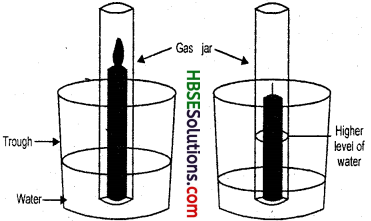
Take two plastic bottles and remove their base with the help of a sharp knife. Take two candles and coverthese two burning candles with the plastic bottles. After some time, candles stop burning and water level rises up in the plastic bottles.

Now make several holes in one plastic bottle and cover the lighting candle with this bottle. We see that candle burns continuously. This candle gets air from different holes and burns continuously till it is completely finished. This activity shows that air supports burning.
HBSE 6th Class Science Solutions Chapter 15 Air Around Us-1

Question 4.
How will you show that air is dissolved in water?
Answer:
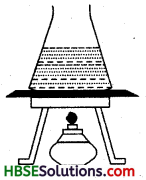
Take some water in a beaker and heat it slowly on a tripod stand with gas burner. We see that tiny bubbles are sticking on it. These
bubbles are mainly of oxygen gas present in air, i which is dissolved in water. When we heat water, the air dissolved in water escapes out in the form of bubbles.
This shows that air is dissolved in water.
HBSE 6th Class Science Solutions Chapter 15 Air Around Us-2

Question 5.
Why does cotton lump get sunk T in water?
Answer:
Cotton lump contains air in it. There are various spaces in which air is filled. When cotton lump is put into water, air present in the vacant space dissolved in water and cotton lump sank.

Question 6.
The layer of air around the earth is known as
Answer:
The layer of air around the earth is known as atmosphere.

Question 7.
The component of air used by green plants to make their food is
Answer:
Carbon dioxide is needed by green 1 plants to make their food.

Question 8.
List five activities that are possible due to presence of air.
Answer:
Activities that are possible due to presence of air are as follows:
(i) Windmill.
(ii) Movements of sailing yachts.
(iii) Flying of aeroplanes, birds, etc.
(iv) Dispersal of seeds.
(v) Watercycle.

Question 9.
How do plants and animals help each other in the exchange of gases in the atmosphere?
Answer:
Plants and animals help each other in exchange of gases. They are interdependent on each other. All the animals require oxygen for their survival. It helps breaking down digested food in the body and release energy. This process is called respiration. During respiration, carbon dioxide gas is produced.

Plants consume this carbon dioxide gas for preparing their own food and release oxygen. They also use some oxygen for respiration. This oxygen gas is used for animals in their respiration process. In this way, plants and animals help each other in the exchange of gases in the atmosphere.

HBSE 6th Class Science Solutions Chapter 15 Air Around Us

HBSE 6th Class Science Air around us Important Questions and Answers

Very Short Answer Type Questions

Question 1.
Where do we get air?
Answer:
We get air from the atmosphere.

Question 2.
What is the use of air pressure?
Answer:
Air pressure is used in pumps.

Question 3.
The cover of air around the earth is called
Answer:
Atmosphere.

Question 4.
Air occupies and
Answer:
Space, mass.

Question 5
forms the earth atmosphere.
Answer:
Air.

Question 6.
What gases are found in the air?
Answer:
Air contains nitrogen, oxygen, carbon dioxide and inert gases and water vapours.

Question 7.
Which gas forms the largest part of the air?
Answer:
Nitrogen.

Question 8.
What part of the air is oxygen?
Answer:
Oxygen is l/5th part of the air.

Question 9.
What is the use of nitrogen in air?
Answer:
Nitrogen slows down the process of combustion.

Question 10.
State one biological importance of air dissolved in water.
Answer:
Dissolved air helps aquatic animals for breathing.

HBSE 6th Class Science Solutions Chapter 15 Air Around Us

Question 11.
During photosynthesis, which gas is consumed?
Answer:
Carbon dioxide gas.

Question 12.
Which gas is released during photosynthesis?
Answer:
Oxygen gas.

Question 13.
Which gas is helpful for combustion?
Answer:
Oxygen gas.

Question 14.
When do plants release oxygen?
Answer:
Plants release oxygen during photosynthesis.

Question 15.
Name two variable components of air.
Answer:
(i) Nitrogen
(ii) Oyxgen.

Question 16.
Name two objects which are inflated by air.
Answer:
(i) Cycle tyre
(ii) Balloons.

Question 17.
Give the percentage composition of nitrogen and oxygen by volume in air.
Answer:
Nitrogen – 70% and oxygen – 21%.

Question 18.
Name two inert gases present in the air.
Answer:
(i) Argon
(ii) Neon.

Question 19.
Why do we need extra oxygen supply at high altitude?
Answer:
Because at high altitude air is thin.

HBSE 6th Class Science Solutions Chapter 15 Air Around Us

Question 20.
Excepting oxygen and nitrogen, name two other gases present in the air.
Answer:
(i) Carbon dioxide
(ii) Argon.

Question 21.
Which component of the air is used in fire extinguishers?
Answer:
Carbon dioxide gas.

Question 22.
State one way in which air enters the air.
Answer:
Through respiration.

Question 23.
Why do we call neon and argon as inert gases?
Answer:
Because they do not react with any ; other element or compound in ordinary conditions.

Question 24.
Name two gases which can – damage historical monuments.
Answer:
(i) Nitrogen dioxide
(ii) Sulphur dioxide.

Question 25.
What is called wind?
Answer:
The moving air is called wind.

Question 26.
Name two properties of air.
Answer:
(i) Air occupies space
(ii) It has mass.

Question 27.
Write two importances of air in agriculture.
Answer:
(i) Air helps rotate wind-mill which is used to draw water from tube-wells.
(ii) Air helps in dispersion of seeds and ; pollen grains of flowers of several plants.

Question 28.
Give one important use of .! nitrogen.
Answer:
Nitrogen is used in the manufacture of fertilizers.

Question 29.
Name two major gases of air.
Answer:
Two major gases of air are:
(i) Nitrogen
(ii) Oxygen.

HBSE 6th Class Science Solutions Chapter 15 Air Around Us

Short Answer Type Questions

Question 1.
Write the names of four main constituents of air.
Answer:
(i) Nitrogen
(ii) Oxygen
(iii) Carbon dioxide
(iv) Water vapours.

Question 2.
What are the uses of oxygen present in air?
Answer:
Uses of oxygen:
(i) Animals use oxygen for breathing and respiration.
(ii) Aquatic animals and plants use oxygen for breathing.
(iii) Mountaineers inhale oxygen at heights where air is thin.
(iv) Pure oxygen is used for artificial breathing in hospitals.
(v) Oxygen is used in oxy-acetylene torch for welding and cutting purposes.
(vi) Liquid oxygen is used as rocket fuels.

Question 3.
How can you show that air contains carbon dioxide?
Answer:
Take some lime water in a watch glass and keep it for a few hours in open air. A white crust is formed on the upper surface of the lime water. Lime water turns milky due to the presence of carbon dioxide in the air. This shows that air contains carbon dioxide.

Question 4.
Show that one-fifth volume of air is oxygen.
Answer:
Take a glass trough. Fill it about half with water. Add a few drops of ink to make the water coloured. Fix a candle on a solid iron rectangular block and place the block in water. Take a glass cylinder and mark it into five equal parts by passing a thin strip of paper at equal distance on its outer surface. Light the candle and invert the glass cylinder over it.

The flame of candle starts burning, then becomes and finally stops burning. Coloured water rises up in the glass cylinder and is filled one fifth with water. Thus one fifth of air is used in burning. Hence one fifth volume of air is oxygen.

HBSE 6th Class Science Solutions Chapter 15 Air Around Us

Question 5.
How will you show that air contains water vapour?
Answer:
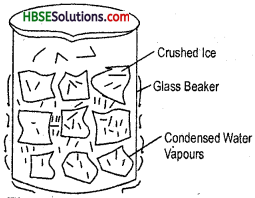
Put some ice blocks in a glass tumbler and keep it in the open air. Drops of water appear on the outer surface of glass tumbler after a few minutes. Air in contact with the tumbler gets cooled and the water vapour present in it condenses to give drops of water.
HBSE 6th Class Science Solutions Chapter 15 Air Around Us-3
Thus we can see that water is present in air in the form of its vapours.

Question 6.
Explain why air is considered a mixture.
Answer:
Air is considered a mixture because:
(i) The composition of air varies from place to place and at depths and heights.
(ii) The constituents of air such as oxygen, nitrogen, carbon dioxide, water vapours etc. can be separated by simple physical methods.
(iii) The properties of air are the average of its constituents.
(iv) No energy is evolved or absorbed when various components of air (gases) are mixed to obtain air.

Question 7.
Mention five uses of air.
Answer:
Uses of air:
(i) Air is used by humans for respiration.
(ii) Air is necessary for burning.
(iii) Air is used for inflating the tyres of vehicles.
(iv) Balloons and balls can be used only when they are inflated with air.
(v) Compressed air is used in the break system for stopping trains.

Question 8.
How will you show that air is present in a lump of soil?
Answer:
Take a lump of dry soil in a beaker or glass tumbler. Adding water to it, we see that bubbles come out from the soil. This shows that soil contains air.

Question 9.
What will happen if the amount of oxygen in the air is increased?
Answer:
If the amount of oxygen in the air is increased, the burning of thing will not stop and fire will spread into large area which will be dangerous to humans and for the nature.

Question 10.
Why is nitrogen important for living organisms?
Answer:
Nitrogen in air is used for manufacturing food by the nitrogen fixation of atmospheric nitrogen into nitrates which mixes with the soil and plants absorb these as their food. So it is necessary and important for living organisms.

Question 11.
How can we see upto a long distance after it rains?
Answer:
When it rains, the dust in the atmosphere settles down to the ground. This is why we can see upto a long distance just after rain.

Question 12.
How do you know that solid particles are floating in air?
Answer:
Choose a sunny room in your home, now close all the doors and windows to make the room dark. Now open the window/door facing the sun just a little in such a way that it allows sunlight to enter the room only through a slit.

Now look the incoming sunlight slants carefully. We see some tiny shining particles moving rapidly in the slanting beam of sunlight. This shows that air contains dust particles.

HBSE 6th Class Science Solutions Chapter 15 Air Around Us

Question 13.
Describe the process by which oxygen is naturally produced.
Answer:
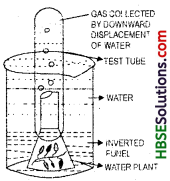
Oxygen is naturally produced by the process of photosynthesis. Fill a beaker to about 3/4th with pond water and put a small plant in it. Cover it with a funnel. In this beaker now add a pinch of sodium bicarbonate.

Invert a test tube filled with water on the stem of funnel so that air bubbles get in the test tube.
HBSE 6th Class Science Solutions Chapter 15 Air Around Us-4
Now put the apparatus in sunlight and observe after sometime. You will see that some gas has been collected in the test tube. Let half the test tube be collected with this gas. Now remove the test tube by putting thumb at the mouth of the test tube. Bring a splinter in the test tube. Splinters burn rapidly which show that it is oxygen gas.

Question 14.
What is liquid air? How can it be made?
Answer:
When air is cooled under reduced pressure, it is convert into liquid form. This air is called liquid air. Air is cooled under reduced air changes into liquid form.

Question 15.
What would happen if plants stop taking carbon dioxide?
Answer:
Plants prepare their own food with the help of carbon dioxide. They take carbon dioxide from the atmosphere and consume all the carbon dioxide released by animals through the process of respiration.

If plants stop taking carbon dioxide from the atmosphere, the amount of carbon dioxide increases in the atmosphere and the temperature of atmosphere will increase due to green house effect. Due to this, glacier will melt and there will be flooding on the earth. The nature living organisms will die.

Question 16.
Why do divers and mountaineers carry oxygen cylinders with them?
Answer:
Divers and mountaineers carry oxygen cylinders with them because at higher altitude and in oceans, the amount of air/oxygen is very thin. Therefore breathing becomes very difficult.

The divers and mountainears inhale oxygen from these cylinders so that they can breate easily. Therefore, they carry oxygen cylinders with them.

Long Answer Type Questions

Question 1.
Point out different uses of air.
Answer:
Uses of various constituents of air:
1. Uses of Nitrogen:
(i) It helps to slow down the process of combustion.
(ii) It dilutes the concentration of air.
(iii) On a very large scale nitrogen is used for the manufacturer of ammonia, which is used to make fertilizers and nitric acid.
(iv) Due to inertness nitrogen is used to produce a blanketing atmosphere during the processing of food to prevent oxidation which causes food to spoil and affects the natural taste.
(v) Nitrogen is used with argon for filling electric lamps.
(vi) Nitrogen is used for making explosive such as TNT and nitro cellulose.

2. Uses of Oxygen:
(i) Without oxygen, animal life is not possible. It is used for breathing and respiration.
(ii) Mountaineers inhale oxygen at heights, where oxygen is thin, from the cylinders they carry on their backs.
(iii) Fish and other aquatic animals use dissolved oxygen for breathing and respiration.
(iv) It is used in hospitals in many diseases for artificial respiration.
(v) Oxygen with acetylene is used as oxy- acetylene torch as welding and cuttings.
(vi) Liquid oxygen is used as rocket fuels.

3. Uses of Carbon dioxide:
(i) Carbon dioxide is used by plants for making their food.
(ii) Carbon dioxide is used in fire extinguishers.
(iii) It is used in soft drinks such as campa and limca.
(iv) Alcoholic beverages such as bear contains carbon dioxide.

4. Uses of Inert gases:
(i) Inert gas argon is filled in bulbs for the protection of filament of the bulb.
(ii) Helium is used to obtain low temperature.
(iii) Neon is used in special electric bulbs called neon-signs.
(iv) Radon gas is used in the treatment of cancer.

Instead of is used in inflating vehicle tyres, such as cars, scooters and motor-cycles. It is used in compressed form for digging, mining and breaking stones in machines. It is used in drying process for agricultural products such as grains, pulses etc. Air current makes the wind-mill to rotate. Wind-mill is used to draw water from the wells and tube-wells. Air is used for sailing gliders and aircrafts. It also helps in dispersal of seeds.

HBSE 6th Class Science Solutions Chapter 15 Air Around Us

Air around us Class 6  HBSE Notes

  • Air is found everywhere. When air is in motion, it is called wind.
  • We cannot see air but we can feel it.
  • Air occupies space. It is present in water and soil.
  • Air is a mixture of oxygen, nitrogen, carbon dioxide, argon and few other gases, water vapours and dust particles.
  • Oxygen is necessary for burning and breathing.
  • The cover of air surrounding the earth is known as atmosphere.
  • Atmosphere is essential for the life on the earth.
  • Aquatic animals use dissolved oxygen/air in water for respiration.
  • Plants use carbon dioxide to produce their food and release oxygen.
  • The plants and animals are inter dependent for gaseous exchange.
  • Air is useful in many ways. It is used for inflating tyres, balloons, and for winnowing.
  • Air is also used in several musical instruments.
  • Without oxygen, animal life is not possible. Mountaineers inhale oxygen at height, where air is thin from the cyclinders of oxygen.
  • Oxygen is a supporter of combustion. Ice presence increases the burning process.
  • Plants and animals exchange air and are interdependent on each other.

HBSE 6th Class Science Solutions Chapter 15 Air Around Us Read More »
HBSE 6th Class Science Solutions Chapter 14 Water

Haryana State Board HBSE 6th Class Science Solutions Chapter 14 Water Textbook Exercise Questions and Answers.

Haryana Board 6th Class Science Solutions Chapter 14 Water

Exercises

Question 1.
Fill up the blanks in the following:
(a) The process of changing of water into its vapour is called ……………. .
(b) The process of changing water vapour into water is called …………… .
(c) No rainfall for a year or more may lead to ………….. in that region.
(d) Excessive rain may cause …………. .
Answer:
(a) Evaporation
(b) Condensation
(c) Drought
(d) Flood.

Question 2.
State for each of the following whether it is due to evaporation or condensation.
(a) Water drops appear on the outer surface of a glass containing cold water.
(b) Steam rising from wet clothes while they are ironed.
(c) Fog appearing on a cold winter morning.
(d) Black board dries up after wiping it.
(e) Steam rising from a hot girdle when water is sprinkled on it.
Answer:
(a) Condensation
(b) Evaporation
(c) Condensation
(d) Evaporation
(e) Evaporation.

Question 3.
Which of the following statements are “true”?
(a) Water vapour is present in air only during the monsoon.
(b) Water evaporates into air from oceans, rivers, and lakes but not from the soil. water level would lower down. It will result into drought.
(c) The process of water changing into its vapours, is ailed evaporation.
(d) The evaporation of water takes place only in sunlight.
(e) Water vapour condenses to form tiny droplets of water in the upper layers of air where it is cooler.
Answer:
(c) True
(d) True
(e) True.

Question 4.
Suppose you want to dry your school uniform quickly. Would spreading it near an anghiti or heater help? If yes, how?
Answer:
Yes, if we want to dry our school uniform quickly, we should spread our clothes near a anghiti or heater. Because near anghithi or heater, temperature is more, which helps water evaporation from the clothes and they dry quickly.

HBSE 6th Class Science Solutions Chapter 14 Water

Question 5.
Take out a cooled bottle of water from refrigerator and keep it on a table. After some time you notice a puddle of water around it. Why?
Answer:
When we keep a bottle of water taking out from refrigerator we notice some puddles of water around it. This is because the water-vapour near the surrounding atmosphere, condenses and deposites around the cooled water bottle. Water vapour always remains in the atmosphere.

Question 6.
To clean their spectacles, people often breathe out on glasses to make them wet. Explain why the glasses beomes wet?
Answer:
When we breathe on the spectacles, water vapours comes out from our breathe, and they condenses into water droplets when they come in contact of glass, because the glasses are cooler than the water vapours. So the glasses becomes wet, due to water puddles.

Question 7.
How does clouds formed?
Answer:
The water vapours that goes into air rises up along with air. As the air moves up, it gets cooler and cooler. At sufficient heights, air becomes so cool that the water vapour present in it condenses to form tiny drops of water called droplets. These droplets are very small, much smaller than even a grain of sand. These droplets are so small that lakhs of them together would form a drop of water.

These tiny droplets remain suspended in the air and moves along with it. When these water droplets in the air come closers they may combine to form slightly bigger droplets. In this way their sizes may become larger. Once the size of the droplets become larger than a definite size, they appear to us as clouds.

Question 8.
When does a drought occur?
Answer:
If it does not rain in a region for a year or more. The soil continues to lose water by evaporation and transpiration. Since it is not being brought back by rain, the soil becomes dry. The water level of water in ponds and wells of the region goes down and some of them may even dry up. The ground water may also become scarce. This may lead to drought.

HBSE 6th Class Science Water Important Questions and Answers

Very Short Answer Type Questions

Question 1.
Define the term ‘cycle’.
Answer:
It is an event or phenomenon which repeats itself after sometime.

Question 2.
Name some activities in our daily life where we use water.
Answer:
We use water in our daily life in various activities such as: drinking, bathing and washing of clothes.

Question 3.
What is the main source of water?
Answer:
Oceans are the main source of water.

Question 4.
Define the term ‘evaporation’.
Answer:
The process of changing water from its liquid form to its vapour is known as evaporation.

HBSE 6th Class Science Solutions Chapter 14 Water

Question 5.
Is evaporation a slow process or fast process?
Answer:
Evaporation is a slow process.

Question 6.
What is transpiration?
Answer:
Plants lost their excess water through their leaves into the air in the vapour form. This process is called transpiration.

Question 7.
Name two processes through which water vapour add conti-nuously into the air.
Answer:
The two processes are:
(i) Evaporation
(ii) Condensation.

Question 8.
Define condensation.
Answer:
The process of conversion of water vapours into liquid form of water is called ; condensation.

Question 9.
What is fog?
Answer:
The fog in winter is due to condensation of water vapour in air near the , surface of the earth.

Question 10.
What is precipitation?
Answer:
When water drops come together in the air becomes heavy and begin to fall, Falling of water drops is called precipitation.

Question 11.
How is snow or hails formed?
Answer:
When water droplets freeze in the air and begin to fall is called hails or snow.

Question 12.
Define water cycle.
Answer:
The water in its vapour form goes to air by evaporation and transpiration forms cloud and then comes back to the surface of the earth through the process of condensation and precipitation. This process is called water cycle.

Question 13.
Name three states of water.
Answer:
The three states of water are:
(i) liquid
(ii) solid
(iii) gaseous state.

HBSE 6th Class Science Solutions Chapter 14 Water

Question 14.
What is the importance of convertibility of water from one state to another state?
Answer:
The easy convertibility of water from one state to another state makes its availability in all parts of the earth and throughout the year.

Question 15.
What is the percentage of water that is available for our use?
Answer:
Only a tiny fraction about 0.01% of total water is used by human beings.

Question 16.
What would happen if we do not water plants?
Answer:
Water is essential for plants for their food preparation. So the plants will die without water.

Question 17.
List two sources of water on the earth.
Answer:
(i) Underground water
(ii) surface water.

Question 18.
Where do we get water for our daily use?
Answer:
We get water from well, rivers and ponds.

Question 19.
During melting of ice, the temperature of the system changes/remains unchanged.
Answer:
Remains unchanged.

Question 20.
List the sources of water on the earth.
Answer:
Sources of water on the earth are: Rivers, ponds, lakes, well, spring and rain water.

Question 21.
Write the chemical formula of water.
Answer:
H2O.

Question 22.
Name two sources of natural water.
Answer:
(i) River water
(ii) Lake water.

Question 23.
Name two solid forms of water.
Answer:
Snow, hails and frost.

Question 24.
Name universal solvent.
Answer:
Water is a universal solvent.

HBSE 6th Class Science Solutions Chapter 14 Water

Question 25.
What is saline water?
Answer:
A sample of water contains more than 2% dissolved salts are called saline water.

Question 26.
Name the process by which saline water is made potable.
Answer:
Desalination process.

Question 27.
What do we use water for?
Answer:
We use water for drinking, bathing and cleaning purposes.

Question 28.
Give two uses of water in your home.
Answer:
(i) Cooking of food
(ii) Cleaning of utensils.

Question 29.
What is the use of water in agriculture?
Answer:
In agriculture, water is required to produce grains.

Question 30.
From where do we get fresh water supply?
Answer:
The ultimate source of fresh water supply is oceans.

Question 31.
Who supplies water to lakes and ponds?
Answer:
Oceans supply water to lakes and ponds.

Question 32.
What will happen if we do not water the plants in the pot?
Answer:
Water is essential for plants, for the preparation of their food. Without water, the plants will die.

Question 33.
List the sources of water for your daily use.
Answer:
We get water for daily use from wells, lakes, rivers, ponds and streams.

Question 34.
List the sources of water on the earth.
Answer:
Sources of water on the earth are: Rivers, lakes, ponds, well, spring, sea water, rain water and ocean water.

Question 35.
List the salts that can be obtained from the sea.
Answer:
Common salt, sodium bromide, magnesium chloride and potassium iodide.

Question 36.
Explain the term ‘salinity’.
Answer:
The rain water dissolves large amounts of salts, and it becomes salty. This is called salinity of water.

Question 37.
Write two uses of water in plants.
Answer:
(i) They use water in photosynthesis.
(ii) Water is essential for germination of seeds.

HBSE 6th Class Science Solutions Chapter 14 Water

Question 38.
Name two sources of natural water.
Answer:
River water, lake water and stream water.

Question 39.
Name two solid states of water.
Answer:
(i) Snow
(ii) Ice
(iii) Frost.

Question 40.
What is saline water?
Answer:
A sample of natural water which contains more than 2% of dissolved salts, especially common salt is called saline water.

Short Answer Type Questions

Question 1.
How do fish and aquatic plants survive in water?
Answer:
Fish and aquatic plants needs oxygen to survive. Oxygen is slightly soluble in water. They get this dissolved oxygen for their survival.

Question 2.
How are clouds formed?
Answer:
Water vapours being lighter, rise up in the atmosphere. At the upper layer, they are condensed into tiny water droplets and form clouds. These clouds while falling down cause rains.

Question 3.
Give four physical properties of water.
Answer:
Physical properties of water:
1. It is a colourless liquid.
2. It freezes at 0°C and boils at 100°C.
3. Bad conductor of electricity.
4. It has a maximum density ofll cm3 at 4°C.

Question 4.
Define water cycle.
Answer:
Evaporation of water from oceans, ponds, rivers and lakes and from roads and streets to form cloud by condensation at higher altitude. When clouds rain, the rain water flows into the seas and oceans through rivers and streams. Some water percolates into the soil to form underground water. It comes again out in the form of spring and well. This is called water cycle.

Question 5.
Water is called a universal solvent. Give reasons.
Answer:
Water is called universal solvent because it dissolves any things in it. Many things dissolve in water as the time passes. So it is called universal solvent.

Question 6.
State different uses of water.
Answer:
Uses of water:
(i) We use water for drinking, bathing, cooking and cleaning of clothes.
(ii) Water is used in agriculture to produce food.
(iii) It is used in industries for carrying out various activities.
(iv) It is used for making electricity from flowing water.
(v) In thermal power stations, water is used to rotate generators through steam to produce electricity.
(vi) In railways, it is used to move railway engines. In factories, it is used in boilers to produce hot water and steam for running machines.

HBSE 6th Class Science Solutions Chapter 14 Water

Question 7.
What are the different sources of water?
Answer:
Different sources of water are:
(i) Oceans
(ii) Seawater
(iii) Rivers
(iv) Lakes
(v) Streams
(vi) Well and dam water.

Question 8.
Write importance of water for sustaining life.
Answer:
Importance of water:
(i) Water is used by the organisms to transport soluble food materials to the cells.
(ii) It carries waste materials produced within the cells which are excreted out by the living beings.
(iii) It carries oxygenated red bloods to cells and tissues ofliving beings and brings back carbon dioxide produced during respiration and excreted out from the body.
(iv) Plants use enormous water during photosynthesis.
(v) It maintains body temperature.
(vi) Water is essential for germination of seeds.

Question 9.
How does rain water become saline?
Answer:
Water is a universal solvent, because it dissolves a large number of substances. When rain falls, it dissolves common salts and many other substances and minerals present on the earth. The rain water passes through different layers of earth, rocks, dissolves large amount of salt and other minerals. Thus it becomes salty.

Question 10.
How will you show the presence of water in air? .
Answer:
Take some pieces of ice in a beaker and keep it for sometime. After some time, we will observe that small water drops are formed on the cold outer surface wall of the beaker. These water drops are formed by the condensation of those water vapours which were present in air around beaker. This shows that water is present in air.

Question 11.
What are natural calamities?
Answer:
The conditions of floodings and drought ai’e called natural calamities.

Question 12.
What are the factors responsible for flooding?
Answer:
There are many factors for flooding like intensity and duration of rainfall, soil condition and presence of plants or trees on the grounds.

Question 13.
Give some uses of water in our houses.
Answer:
We use water in our houses for “many purposes; we need it for drinking, bathing, washing our clothes. We also use water for cooking, cleaning of utensils, watering of plants and other everyday activities.

Question 14.
How is water essential for plants?
Answer:
Water is essential for agriculture to produce grains; It is also required for growing plants that gives us fibres of cotton and jute. Water is required for the growth and in the process of photosynthesis for preparing their food. Germination of seeds requires water.

Question 15.
Who supplies water to rivers, lakes, ponds and wells?
Answer:
Oceans and seas are major sources of water on the earth. The water cycle fully depends upon oceans and seas. Rain is possible only due to water cycle and supplies water to rivers and ponds etc. Indirectly, ocean supplies water to these resources.

HBSE 6th Class Science Solutions Chapter 14 Water

Question 16.
Define ground water.
Answer:
‘The ground water is actually rain water which mainly comes from seepage of water accumulated under the ground. Rain water percolates into the soil and reaches under the ground where water quantity increases and air decreases. This reserve water under the ground is called ground water.

Question 17.
We should use ground water judiciously. Why?
Answer:
If large quantity of ground water is taken out for various purposes, the water level goes down. Thus there will be shortage of water and it is not possible if we continuously use this water. So we should use ground water very carefully.

Question 18.
How are lakes and ponds formed?
Answer:
Lakes and ponds are small reservoirs of water. These are created by collection of rain water in low lying areas. Seepage from the ground water reserves also adds to the water in lakes and ponds.

Question 19.
What will happen if there is no rain at all?
Answer:
Rain is an important source of natural water. If there is no rain, the soil will lose its water by evaporation and become dry. Water will also be lost through transpiration process of plants. Rivers, ponds and wells will dry and the water level would lower down. All this will affect animals, humans and wild plants. If it continues for one or tw o years in continuation, it results into drought.

Long Answer Type Questions

Question 1.
What do you mean by water cycle in nature?
Answer:
Water constantly moves from the earth to the air and back again. The constant circulation of water is known as the water cycle.

The water in seas, rivers, lakes, ponds „r streams evaporates because of the heat of the sun. Plants also give out large amounts of water from their leaves. The water vapour rises up. The air higher’ up in the atmosphere is cooler. This cools the water vapour and it condenses to form tiny drops of water on dust particles. These drops of water together form clouds. As the clouds get cooled further, the water drops become bigger and heavier. When they become too heavy, they fall to the earth as rain.

The rain water enters the seas, rivers, lakes, ponds and streams and then evaporates again. Thus the water cycle in nature goes on.

HBSE 6th Class Science Solutions Chapter 14 Water

Question 2.
How can we conserve the precious water?
Answer:
Water can be conserved by the following methods:
(i) We should use water very judiciously.
(ii) We should not waste water during its consumption.
(iii) We should not use drinking water in garden for watering plants.
(iv) We should not throw waste products into water resources.
(v) Water is used through pipes and spraying in agriculture.
(vi) Industrial wastes and effluents should not be released into rivers.
(vii) Ground water should be used when necessary. Leakage of taps should be stopped. In this way, we conserve water.

Water Class 6  HBSE Notes

  • Water is essential for all living beings. Water is essential for sustaining life. Water vapour is always present in the air.
  • Evaporation of water changes it from its liquid to gaseous state. Evaporation is a slow process.
  • Evaporation of water is a continuous process that takes places at all places.
  • Large amount of water evaporates into air from oceans, rivers, lakes, ponds and other water bodies and also from the soil.
  • Plants release water vapours into air by the process of transpiration.
  • The process of conversion of water vapour into liquid water is called condensation. Water vapours condense to form tiny droplets of water in the upper layers of air where it is cooler.
  • Clouds appear in the sky when water droplets in air become larger than certain size.
  • Falling of water drops from the clouds is called precipitation.
  • The process of evaporation, transpiration, condensation, precipitation of water and its down hill flow to the oceans constitute the water cycle.
  • Cycling of water between oceans and land ensures availability of water for all living organisms on the earth.
  • Water exists in three states, that is solid, liquid and gaseous.
  • Lakes, ground water and ice caps are some sources of water. Well water and spring water are examples of ground water.
  • Water is a universal solvent, because it dissolves a large number of substances.
  • Ocean water is highly saline. This water is harmful for agricultural purpose, animals and for human use.
  • Pure water is colourless, odourless and tasteless liquid. Water becomes tasty due to dissolving of some gases such as C02 in it.
  • Water dissolves oxygen gas due to which aquatic plants and animals respire. Presence of dissolved carbon dioxide is a source of food for aquatic plants.
  • Water cycle helps in replenishing water sources and maintaining global weather.
  • Evaporation of water from sea and other water bodies forms clouds at higher altitude. Clouds give rains and rain water flows back into the sea in the form of streams and rivers. Some rain water percolates through the soil to form underground water. This underground water comes up again and rushes out in the form of springs or is drained out as well water. This is called water cycle.
  • There are two main natural sources of water: (i) Underground water, (ii) Surface water. Underground water is free from impurities.
  • It is mainly of two types: (i) Well water, (ii) Spring water.
  • Surface water is present on the surface of the earth. It is of three types: (i) rain water, (ii) river and lake water, (iii) sea water.
  • Water is precious. It is one of the most wonderful gifts of nature.
  • The total amount of water on the earth remains same but its distribution in different regions is different.
  • We need water for various purposes, like drinking, bathing, washing our clothes, for cooking food, cleaning of utensils, watering of plants and other everyday activities.
  • Water is required in agriculture to produce grains. It is also necessary for growing plants that gives us fibres and jute. Fibres are used for making clothes.
  • Oceans and seas contain most of the water on the earth.
  • Oceans and sea water is not fit for drinking and for agriculture purposes due to large amount of salt in it.
  • Snow is another source of water. Snowmelts slowly and this water flpws down in the form of streafhs and rivers. Streams and rivers are another source of water.
  • Most of the water which human beings use for drinking, washing and farming comes from rivers and streams.
  • Water below the ground is known as underground water. This is mainly rain water that comes from seepage of water accumulated under the ground. The level below the ground where air is very less and only water is present is called water table.
  • Lakes and ponds are small reservoirs of water. These are created by collection of rain water in low laying areas.
  • Rain is a very important source of water for us. All resources of water are fed mainly by rains.
  • If it does not rain for one or two years, soil will lose its water by evaporation and become dry. Rivers, ponds and lakes will dry and the
  • The results of drought may be that no crops, food and fodder will decrease and humans and animals will die.
  • In case of heavy rains, water level increases and flood occurs. Due to lack of air in soil due to heavy rains animals suh as earthworm, rats and snakes come out from the soil. Due to heavy rains, crops are also destroyed.
  • Conditions of flood and drought are called natural calamties.
  • Conservation of water is essential for sustaining life on the earth. Due to increasing population and increasing industrialisation and urbanisation, water requirements are also increasing.

HBSE 6th Class Science Solutions Chapter 14 Water Read More »

HBSE 6th Class Science Solutions Chapter 13 Fun with Magnets

Haryana State Board HBSE 6th Class Science Solutions Chapter 13 Fun with Magnets Textbook Exercise Questions and Answers.

Haryana Board 6th Class Science Solutions Chapter 13 Fun with Magnets

HBSE 6th Class Science Fun with Magnets Textbook Questions and Answers

Exercises

Question 1.
Fill in the blanks in the following:
(i) Artificial magnets are made in different shapes such as ………… and ………… .
(ii) The materials which are attracted towards magnet are called ………… .
(iii) ………… is not a magnetic material.
(iv) In olden days, sailors used to find direction suspending a piece of ………… .
(v) A magnet always has ………… poles.
Answer:
(i) bar magnet, horse-shoe magnet and round, shaped magnet
(ii) magnetic materials
(iii) leather
(iv) suspended magnet.

Question 2.
State whether the following statements are true or false:
(i) A cylindrical magnet has only one pole.
(ii) Artificial magnets were discovered in Greece.
(iii) Similar poles of a magnet repel each other.
(iv) Maximum iron filings stick in the middle of a bar magnets when it is brought near them.
(v) Bar magnets always point towards North-South direction.
(vi) A compass can be used to find East-West directions at any place.
(vii) Rubber is a magnetic material.
Answer:
(i) False
(ii) True
(iii) True
(iv) False
(v) True
(vi) False
(vii) False.

HBSE 6th Class Science Solutions Chapter 13 Fun with Magnets

Question 3.
It was observed that a pencil sharpener gets attracted by both the poles of a magnet, although its body is made of plastic. Name a material that might have been used to make some part of it.
Answer:
A pencil sharpner is made up of iron metals-which is attracted towards the magnet. To some parts of it are made of iron/cobalt; which are magnetic materials.

Question 4. Column I show different positions in which one pole of a magnet is placed ner that of the other. Column II indicates the resulting action between them for each situation. Fill in the blanks:

Column IColumn II
N—N………..
N—SAttraction
S—N………..
S—SRepulsion

Answer:

Column IColumn II
N—NRepulsion
N—SAttraction
S—NAttraction
S—SRepulsion

Question 5.
Write any two properties of a magnet.
Answer:
Properties of a magnet:
1. A magnet attracts magnetic materials such as iron, cobalt and nickel towards it.
2. When a magnet is suspended freely, it stands always in North-South direction.
3. Magnetic influence can pass through a screen of cloth, plastic and papers.

Question 6.
Where are poles of a bar magnet located?
Answer:
A freely suspended magnet always:omes to rest in one direction i.e., North-South direction.
HBSE 6th Class Science Solutions Chapter 13 Fun with Magnets-1
The end pint of themagnet pointing towards north is called north pole and end pointing towards south is called south pole. Thus we an see that a magnet has two poles:
(i) North-pole
(ii) South-pole.
North and South poles are marked on the magnet.

Question 7.
A bar magnet has no markings to indicate its pole. How would you find out near which end is its north pole located?
Answer:
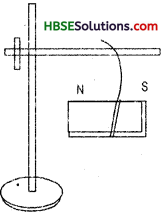
We take a bar m agnet and tied it with a thread in the middle. Now it is suspended freely tied the thread in a stand. We find that bar magnets stay in North-South directions.
HBSE 6th Class Science Solutions Chapter 13 Fun with Magnets-2
The pole which is towards north is called north pole of the bar magnet. Thus we can find the poles of a magnet.

Question 8.
You are given an iron strip. How will you make it into a magnet?
Answer:
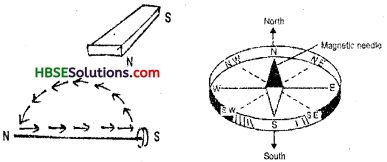
Method of making an iron strip , a magnet: Take the iron strip and place it on the table. Strike it with one pole of a bar magnet in one direction. When you reach the other end of the iron stick, leave the magnet and bring the same pole back to the starting end of the iron stick. Strike again in the same direction. Repeat this process about 30-40 times. Check whether the iron piece has now become a magnet. If not, continue the process for some more time. Remember that the pole and the direction of the magnet is not to be changed. In this way, an iron stick can be converted into a magnet. (See Fig. 13.3.)
HBSE 6th Class Science Solutions Chapter 13 Fun with Magnets-3

Question 9.
How is a compass used to find directions?
Answer:
A compass is made on the property of a magnet, staying in north-south direction. This is a small glass case containing a magnetised needle pivoted on a nail. The needle can rotate freely. Whenever it is kept, its needle always rests in north-south direction, (See Fig. 13.4.)

Normally the north pole of the needle is painted red or some other indication is given to identify north and south poles. So using this needle, north and south can be identified.

HBSE 6th Class Science Solutions Chapter 13 Fun with Magnets

Question 10.
A magnet was brought from different directions towards a toy boat that has been floating in water in a tub. Affect observed in each case is stated in column I. Possible reasons for the observed affects are mentioned in column II. Match the statements given in column I with those in column II.

Column IColumn II
(A) Boat gets attracted towards magnet.(a) Boat is fitted with a magnet with north pole toward its head
(B) Boat is’not affected by the magnet.(b) Boat is fitted.with a magnet with south pole towards its head
(C) Boat moves towards the magnet if(c) Boat has a small megnet fixed along its north pole of the magnet is brought length. near its head.
(D) Boat moves away from the magnet when north pole is brought near its boat.(d) Boat is made of magnetic material.
(E) Boat floats without changing its attraction.(e) Boat is made up non-magnetic material.

Answer:
(A)-(d).
(B)—(c).
(C)—(b)
(D)—(a),
(E)—e).

HBSE 6th Class Science Fun with Magnets Important Questions and Answers

Very Short Answer Type Questions

Question 1.
Name two places where magnets are used in your daily life.
Answer:
(1) Refrigerators
(2) Small pencil box.

Question 2.
Why do chess pieces stick to metallic card board?
Answer:
Because chess pieces are fitted with magnets.

Question 3.
What was the name of Greek shephered?
Answer:
His name was Magnes.

Question 4.
Magnetic ludo is not displaced with movement of vehicle. Why?
Answer:
Because the ludo is fitted with magnet.

Question 5.
From what materials magnets are made of?
Answer:
Magnets are made of from magnetic materials. .

Question 6.
Name two magnetic materials.
Answer:
(i) Iron
(ii) Cobalt.

HBSE 6th Class Science Solutions Chapter 13 Fun with Magnets

Question 7.
Which, from the following objects, are attracted towards magnet?
Iron ball, plastic scale, wood stick, glass strip, pins.
Answer:
Iron ball and pins are attracted towards magnet.

Question 8.
What are non-magnetic materials?
Answer:
Materials which do not attract towards magnets are called non-magnetic materials.

Question 9.
Name some non-magnetic materials.
Answer:
Leather, plastic, cloth and paper etc.

Question 10.
What is a magnet?
Answer:
A magnet is an object which attracts pieces of iron, cobalt and nickel.

Question 11.
What happens when the north pole of a magnet ip brought near the north pole of a freely suspended magnet?
Answer:
They repel each other.

Question 12.
What happens when the north pole of a magnet is brought near the south pole of a freely suspended magnet?
Answer:
They attract each other

Question 18.
Can we have an isolated north pole or south pole?
Answer:
We cannot have an isolated north pole or south pole. They always exist in opposite direction.

Question 14.
Which iron is used for making a permanent magnet?
Answer:
Hard steel and alloys.

Question 15.
Which iron is used for making a temporary magnet?
Answer:
Soft iron.

Question 16.
Why are artificial magnets preferred to natural magnets?
Answer:
Artificial magnets are very strong in comparison with natural magnets.

Question 17.
In which direction does a freely suspended bar magnet come to rest?
Answer:
North-South direction.

HBSE 6th Class Science Solutions Chapter 13 Fun with Magnets

Question 18.
Why does a magnetic needle get deflected when placed near a current carrying conductor?
Answer:
Due to magnetic field produced by current.

Question 19.
A bar magnet attracts iron fillings more strongly at two ends. What are these ends points called?
Answer:
These end points of the bar magnet are called its poles.

Question 20.
Name two devices where electromagnets are used?
Answer:
Electric bell and loud-speaker.

Question 21.
What type of magnet is used in an electric bell?
Answer:
U-shaped magnet is used in an electric bell.

Question 22.
What is the instrument in which directive property of a magnet is used?
Answer:
Mariner’s compass.

Question 23.
What is a temporary magnet?
Answer:
A magnet which retains its properties of magnet for a short time period is called temporary magnet.

Question 24.
How is a magnet demagnetised?
Answer:
(i) By heating
(ii) by hammering the magnet violently.

Question 25.
Two like poles of magnets are brought near each other. Will they attract or repel each other?
Answer:
They will repel each other.

Question 26.
What is a natural magnet?
Answer:
A natural magnet is a naturally occuring ore of iron which has attractive and directive property.

Question 27.
Can we have a magnet with a single pole?
Answer:
No, because unlike poles of equal strength exist together.

Question 28.
What is a sure test of magnetism?
Answer:
Repulsion is a sure test of magnetb.m.

HBSE 6th Class Science Solutions Chapter 13 Fun with Magnets

Short Answer Type Questions

Question 1.
What is the difference between a temporary magnet and a permanent magnet?
Answer:

Temporary magnetPermanent magnet
1.It loses its magnetic power as soon as the source of magnetism removed.1. It remains magnet even after the source of magnetism is removed.
2. It is made from soft iron.2. It is made from steel.
3. In it the domain point in the same direction only for short time interval.3. In it the domains point in the same direction permanently.

Question 2.
Give two applications of electromagnets.
Answer:
(i) They are used in cranes to lift heavy loads of scrap iron and iron sheets.
(ii) They are used to separate magnetic substances from non-magnetic substances.

Question 3.
What are the properties of a magnet?
Answer:
There are two main properties of a magnet:
(i) Attractive property.
(ii) Directive property.

Question 4.
Define attractive and directive property of a magnet.
Answer:
(i) Directive property: On suspanding a bar magnet freely with a thread we find that at rest it always points towards north- south direction.
(ii) Attractive property: Magnet has the property to attract iron, cobalt and nickel towards it. These substances are called magnetic substances.

Question 5.
How will you distinguish two identical bars of iron as a permanent magnet and an ordinary piece of iron?
Answer:
To identify the real magnet bring a third magnet near each end of the identical bars. In case of ordinary bar, both its end should be attracted towards magnet. But in case of a permanent magnet, one of its ends would be repelled.

Question 6.
What is the difference between the magnetic properties of soft iron and steel?
Answer:

Magnetic properties of soft ironMagnetic properties of steel
1. It gets strongly magnetised when magnetised by induction,1. Steel is feebly magnetised when magnetised by induction.
2. Soft iron can be demagnetised very easily, hence electromagnets are made of soft iron.2. Steel cannot be demagnetised easily, hence permanent magnets are always made of steels.

Question 7.
Explain that induction precedes attraction.
Answer:
When iron piece is brought near a magnet, the iron is first temporarily magnetised by induction. Thus being two opposite poles, there is attraction. The iron piece first converts into a magnet having opposite poles, near its magnetised pole. Thus induction precedes attraction.

Question 8.
What is the difference between an electromagnet and a magnet?
Answer:
A magnet is a natural magnet with fixed magnetic effects. It is obtained from nature in the form of mineral. An electromagnet is a soft iron piece which shows magnetic effects only when eletric current is passed through it. Its magnetic effects can be increased or decreased by increasing electric current through conducting wire round the core.

Question 9.
What is a magnetic compass? What are its uses?
Answer:
A magnetic compass is a device which has a magnetic needle which is free to move on a pivot at the centre of a round box. It is used by sailors and navigators to find the directions. The compass needle is free to rotate and aligns in the north-south direction. Its free end that points north is marked red. (See Fig. 13.4.).

HBSE 6th Class Science Solutions Chapter 13 Fun with Magnets

Long Answer Type Questions

Question 1.
What is a compass? Describe the construction of a compass with the help of a labelled sketch. How is a compass used to find directions?
Answer:
The compass is an instrument to find the directions of a place. The compass has a tiny magnet in the form of a needle which can rotate freely on a pivot (or pin). The pivoted magnetic needle of the compass is enclosed in a small brass box having a glass top. The compass has a circular dial with various directions marked on it. The needle of compass always conies to rest along the north-south directions. The north pole of compass needle is painted with different colour to distinguish it from the south pole.

In order to find the directions at a place, the compass is kept on a flat surface at that place. The needle of compass will soon come to rest along the north-south direction. The compass is then rotated until the painted end of needle is towards N (North) mark on the dial and the other end of needle is towards S (South) mark on the dial. We can now find any direction by looking at the dial of the compass.

Fun with Magnets Class 6  HBSE Notes

  • Some materials such as magnetite show magnetic properties. These are called natural magnets.
  • Magnet attracts some materials such as iron, cobalt, nickel. Such materials are called magnetic materials.
  • The materials such as paper, cloth, leather etc. which are not attracted towards magnets are called non-magnetic materials.
  • Magnetic attraction is maximum near the ends of the magnet. These ends are called magnetic poles.
  • When suspended freely, a magnet always aligns in N—S direction.
  • When suspended freely one pole of the magnet always points towards North. This is known as North pole.
  • The other pole which points towrds South, is known as South pole.
  • Opposite poles of two magnets attract each other whereas there is repulsion between similar poles.
  • Magnetic influence can pass through screens of some substances like cloth, plastic, paper, glass etc.
  • While travelling on the sea or air, a magnet can be used to find the directions. In olden days sailors used this property of magnet for finding directions when they were at sea.
  • Compass is a small glass case, containing a magnetised pivoted on a nail. The needle can rotate freely.
  • Wherever it is kept its needle always rests in North-South direction.
  • On heating, or hammering magnetic property is destroyed.
  • To keep it safe, store bar magnets in pairs with unlike poles together, separated by a bit of wood and two pieces of soft iron across the ends. For horse-shoe magnet, keep one iron piece across the poles.

HBSE 6th Class Science Solutions Chapter 13 Fun with Magnets Read More »

HBSE 6th Class Social Science Solutions SST Haryana Board

Haryana Board HBSE 6th Class Social Science Solutions

HBSE 6th Class Social Science Solutions in Hindi Medium

HBSE Class 6 Social Science Geography: The Earth: Our Habitat (भूगोल – पृथ्वी: हमारा आवास)

HBSE Class 6 Social Science History: Our Pasts – I (इतिहास – हमारे अतीत – I)

HBSE Class 6 Social Science Civics: Social and Political Life – I (नागरिक शास्त्र – सामाजिक एवं राजनीतिक जीवन – I)

HBSE 6th Class Social Science Solutions in English Medium

Haryana Board HBSE 6th Class Social Science Solutions Geography: The Earth: Our Habitat

Haryana Board HBSE 6th Class Social Science Solutions History: Our Pasts – I

Haryana Board HBSE 6th Class Social Science Solutions Civics: Social and Political Life – I

HBSE 6th Class Social Science Solutions SST Haryana Board Read More »

HBSE 6th Class Science Solutions Chapter 5 Separation of Substances

Haryana State Board HBSE 6th Class Science Solutions Chapter 5 Separation of Substances Textbook Exercise Questions and Answers.

Haryana Board 6th Class Science Solutions Chapter 5 Separation of Substances

HBSE 6th Class Science Separation of Substances Textbook Questions and Answers

Exercises

Question 1.
Why do we need to separate different substances present in a mixture? Give two examples.
Answer:
We need to separate different substances present in a mixture due to the following purposes:

  • To remove the unuseful or harmful component for example removing tea leaves after making tea.
  • To obtain the useful components – for getting wheat or rice grains after separating.
  • To remove impurities for getting a pure sample. For example obtaining sugar crystals from jaggery (Gur) or salt from sea water.

Examples:

  • Tea leaves age separated from liquid with a strainer while preparing tea.
  • Grain is separated from stalks, while harvesting.

Question 2.
What is winnowing? Where is it used?
Answer:
The process of separating lighter and heavier particles from a mixture is called winnowing. In this process/method heavier particles of grains are separated from lighter particles of husk. The husk particles are carried away by wind and separate heap away from that of the heavier particles of grains of wheat is formed. This method is used by farmers in fields as well as at a flour mill (atta chakki).

Question 3.
How will you separate husk or dirt particles from pulses before cooking?
Answer:
The husk particles or dust particles are separated from pulses by the method of hand picking. Since the undesired particles are present in small quantities and the total amount of pulses to be separated is generally not very- very large. So they are separated by hand picking before cooking the pulses.

HBSE 6th Class Science Solutions Chapter 5 Separation of Substances

Question 4.
What is sieving? Where it is used?
Answer:
Sieving is a method used to separate the components of a mixture which are of different size. The undesirable particles in the form of husk remain on the seive and fine particles of flour pass through the holes of the sieve. Sieving flour before consuming is not a good practice, because during sieving husk remains on the seive, which provides us roughage which is useful for our body.

Question 5.
How will you seperate sand and water from their mixture?
Answer:
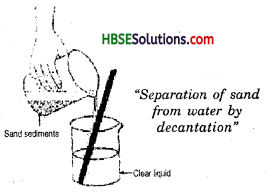
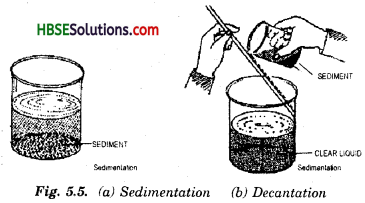
A mixture of sand and water can be separated by decantation method. Take a glass tumbler half filled with the given sample of water. Stir the water thoroughly. Now keep the tumbler undisturbed for sometime. We must see that sand being heavier than water has settled down at the bottom of the tumbler. This process is sedimentation. Now pour the. clear water into another tumbler, without disturbing the layer of sand and with the help of a glass rod. This process is decantation. In this way, mixture of sand and water can be separated.
HBSE 6th Class Science Solutions Chapter 5 Separation of Substances 1

Question 6.
Is it possible to separate sugar mixed with wheat flour? If yes, how will you do it?
Answer:
Yes, it is possible to separate sugar mixed with wheat flour. The mixture of sugar & wheat flour can be separated by sieving. The wheat fine particles separates by strainer and sugar particles being bigger in size remains on the strainer. Thus sugar can be separated from the mixture of sugar and wheat flour.

Question 7.
How would you obtain clear water from a sample of muddy water?
Answer:
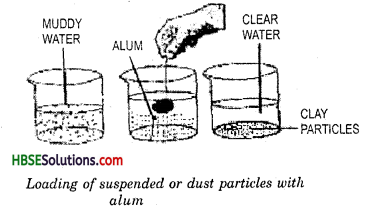
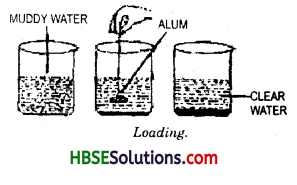
We can separate clear water from muddy water by loading process. Take a beaker half filled with muddy water and take a piece of alum. Tie the alum piece by a cotton thread.
HBSE 6th Class Science Solutions Chapter 5 Separation of Substances 2
Now dip the alum in water and move it slowly in a circular path for about one minute. Remove the alum and keep the beaker undisturbed for a few minutes. We find that dust particles that are responsible for making the water muddy settle down readily. Alum dissolves in water very easily. The fine dust particles get loaded and become heavier and settle down at the bottom of the beaker. The clear water may be decanted. This activity combines two methods loading and decantation.

HBSE 6th Class Science Solutions Chapter 5 Separation of Substances

Question 8.
Fill up the blanks :
(a) The method, of separating seeds of paddy from its stalk is called ________.
(b) When milk is poured onto a piece of cloth the cream(malai) is left behind on it. This process of separating cream from milk is an example of ________.
(c) Salt is obtained from sea water by the process of ________.
(d) Impurities settled at the bottom when muddy water was kept over night in a bucket. The clear water was then poured of from the top. The process of separation used in this example is called ________
Answer:
(a) Winnowing
(b) filtration
(c) Evaporation
(d) Decantation.

Question 9.
True or False?
(a) A mixture of milk and water can be separated by filtration.
(b) A mixture of powdered salt and sugar can be separated by the proces of winnowing.
(c) Separation of sugar from tea can be done with filtration.
(d) Grain and husk can be separated with ‘ the process of decantation.
Answer:
(a) False
(b) False
(c) False
(d)True.

Question 10.
Lemonade is prepared by mixing lemon juice and sugar in water. You wish j to ice to cool it. Should you add ice to the lemonade before or after dissolving sugar? In which cash would it be possible to dissolve more sugar?
Answer:
We should add ice in lemonade after dissolving sugar in it, because sugar dissolve more before adding ice. It would be possible to dissolve more sugar before adding ice in the lemonade, because it dissolve more into hot than in cold.

HBSE 6th Class Science Separation of Substances Important Questions and Answers

Very Short Answer Type Questions

Question 1.
What is a pure substance?
Answer:
A pure substance is one that consists of a single element or compound.

Question 2.
How will you separate a mixture of iron fillings and sulphur powder?
Answer:
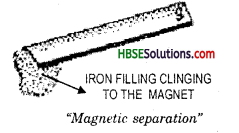
The mixture can be separated by using a magnet. The iron fillings are picked out by the magnet and sulphur powder remains behind.

Question 3.
Name the method used to separate butter from milk.
Answer:
Centrifugation/churning method.

HBSE 6th Class Science Solutions Chapter 5 Separation of Substances

Question 4.
Name two materials used as filters.
Answer:

  • Cotton cloth
  • Filter paper.

Question 5.
Which method will you use to separate blue vitriol (Neela thotha) from its solution?
Answer:
Crystalization method.

Question 6.
What is meant by the term ‘mixture’?
Answer:
A mixture is a substance made up of two or more elements or compounds, physically mixed in any ratio.

Question 7.
Give three examples of mixture.
Answer:
Tea, milk and air.

Question 8.
Write two properties of mixtures.
Answer:

  • Ratio of constituents is not fixed.
  • Does not have definite m.p. or b.p.

Question 9.
Name the process of obtaining ; iron from waste materials.
Answer:
Magnetic separation.

Question 10.
How can you obtain distilled water?
Answer:
By distillation process.

Question 11.
Name the process to separate two immiscible liquids.
Answer:
Decantation process by separating funnel.

Question 12.
Name a gaseous mixture.
Answer:
Air.

HBSE 6th Class Science Solutions Chapter 5 Separation of Substances

Question 13.
Name three mixtures found in nature.
Answer:

  • Sea water/pond water/lake water.
  • Air

Question 14.
What is winnowing?
Answer:
It is the process of separation of grains from husk and hay with the help of wind.

Question 15.
What is centrifugation?
Answer:
It is a method of separating suspended solid particles from a liquid.

Question 16.
Name the method of separating two immiscible liquids.
Answer:
Decantation or By separating funnel.

Question 17.
What is sublimation?
Answer:
It is a process in which a solid gets converted into its gaseous state.

Question 18.
What is loading?
Answer:
The process of setling down solid particles quickly.

Question 19.
What is churning?
Answer:
Churning is a method of making butter.

Short Answer Type Questions

Question 1.
What is a mixture? Give two examples.
Answer:
A mixture is a substance made up of two or more elements or compounds, when physically mixed in any ratio.
(i) Gun powder (ii) Salt in water.

Question 2.
How will you prepare a big crystal of sugar from powdered sugar?
Answer:
Prepare sugar solution in hot water and allow it to cool. Filter the solution. Now hang a crystal of sugar with the help of a thread and a glass rod leave the solution undisturbed for four days. Now we see that crystals slowly begin to grow on the crystal.

HBSE 6th Class Science Solutions Chapter 5 Separation of Substances

Question 3.
How is common salt obtained from sea water?
Answer:
Sea water is run into shadow ponds and allowed to evaporate to dryness in hot sun. Water evaporates and solid common salt is left behind. The salt is then collected in heaps.

Question 4.
How will you separate a mixture of sulphur in water?
Answer:
Take the mixture of water and sulphur in a beaker. Pour the mixture on the filter paper with the help of a glass rod so that the liquid stands below the edge of the cone. The residue that remains on the filter paper is sulphur. Now dry it to get sulphur and water is collected in beaker.

Question 5.
How will you separate a mixture of naphthalene and salt?
Answer:
Naphthalene and salt mixture can be separated by the process of sublimation. Naphthalene sublimates and is collected on inverted keep and salt remains behind in the dish.

Question 6.
What do you mean by decantation? What are its uses?
Answer:
Decantation is a process by which we can remove a liquid without disturbing the solid settled down in the bottom.
Uses: This method can be used to separate a mixture of

  • sand and water
  • mixture of two liquids – water and oil.

HBSE 6th Class Science Solutions Chapter 5 Separation of Substances

Question 7.
How will you separate a mixture of water and kerosene oil?
Answer:
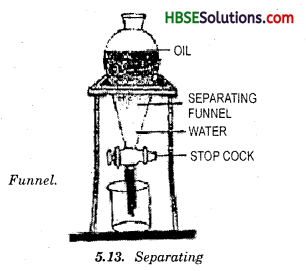
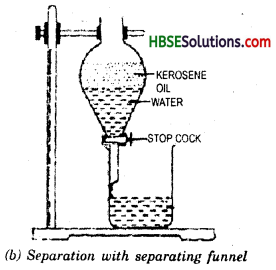
Mixture of kerosene oil and water can be separated by using separating funnel. Take the mixture in separating funnel and allow it to stand for some time. After sometime, two different layers form. Kerosene oil being lighter forms upper layer and water forms lower layer. By opening the stop cock, we obtain water and kerosene remains on the funnel.
HBSE 6th Class Science Solutions Chapter 5 Separation of Substances 3

Question 8.
What do you mean by distillation? How can you separate a mixture of alcohol and water?
Answer:
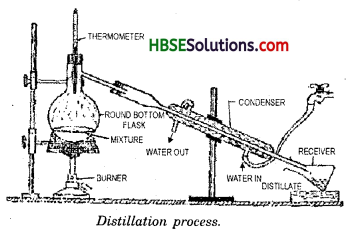
Distillation is the process in which liquid is heated to get vapours and then cooling the various to get back liquids. It is used to separate a mixture the components of which have different boiling points.
HBSE 6th Class Science Solutions Chapter 5 Separation of Substances 4
The mixture of alcohol and water is taken in a round bottom flask. Alcohol boiling point 80°C, evaporates first on heating as compared to water with boiling point 100°C. Now alcohol vapours are condensed by cooling in a separate container. It gets converted back to alcohol liquid and water remains in flask.

Question 9.
How will you separate a mixture of iron dust and sulphur powder?
Answer:
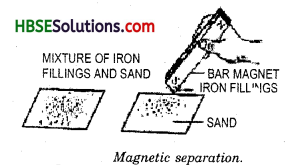
A mixture of iron dust and sulphur can be separated by the magnetic separation method. Iron dust is attracted towards the magnet and separated in a container and sulphur remains behind in the container.
HBSE 6th Class Science Solutions Chapter 5 Separation of Substances 5

Question 10.
How will you separate a mixture of iodine and sand?
Answer:
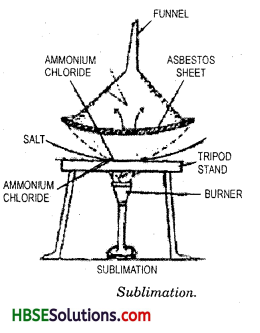
A mixture of iodine and sand can be separated by sublimation. The mixture is taken into a china dish and covered with inverted funnel. A cotton plug prevents the vapours from escaping into atmosphere. On heating, iodine sublime and collected on the cool inner surface of funnel. Sand is left behind in the disc.
HBSE 6th Class Science Solutions Chapter 5 Separation of Substances 6

Long Answer Type Questions

Question 1.
How will you separate a mixture of iron fillings, common salt, sand and sulphur?
Answer:
Iron fillings are separated from the mixture by using a magnet. The remaining mixture of salt,-sand and sulphur is stirred with water when salt is dissolved in it. On filtration salt solution is obtained as a filtrate and the residue contains sand and sulphur.

Sand and sulphur mixture is shaken with carbon disulphide, when sulphur dissolves in it but sand remains undissolved. On filtration, sand is obtained as residue and sulphur as filtrate. On evaporating the filtrate carbon disulphide is removed and sulphur is obtained.

HBSE 6th Class Science Solutions Chapter 5 Separation of Substances

Question 2.
How you will purify common salt obtained from sea water?
Answer:
The lumps of impure common salt obtained from sea water, are crushed to get powdered salt. The powdered common salt is dissolved in water to prepare a solution. The solution of common salt is filtered to remove insoluble impurities.

The clear solution of common salt is evaporated by heating to remove some of the water to obtain a concentrated solution. The hot concentrated solution of common salt is allowed to cool. On cooling, the hot solution crystallises and crystals of pure common salt are obtained.

Separation of Substances Class 6 HBSE Note

1. We use some materials like sugar, common salt, water, milk as such in our daily life. In many materials, we have to separate the useful components from the unwanted or sometimes harmful components before we can use them. For example we peel off the skins of mangoes and bananas before using them.

2. Pure substances : A pure substance is one that consists of a single element or compound. All its constituents have similar properties. Examples are copper, iron, water, common salt, sugar etc.

3. Mixtures : A mixture contains two or more types of constituents which are present in any ratio. For example, air around us contains many gases such as nitrogen, oxygen, carbon dioxide and dust particles. Thus air is a mixture. Sea water, pond and river water are also mixtures. Gun powder and brass are other examples of mixtures.

4. Need for separation : We know that a mixture contains two or more components. We want to be very sure about the purity of the food we take in. Even the water we drink should be pure. We can say that we carry out the separation of substances with the following purposes:

  • To remove the un-useful or harmful component.
  • To obtain the useful component.
  • To remove impurities for getting a pure sample.

5. Principle of separation : Different materials have different properties and we can use these property differences to separate mixtures. The components of a mixture can be separated by one method or by a combination of various methods.

6. Method of separation : Often, in mixtures, we are able to see the different components present. There are several methods used for separating the constituents of a mixture. The choice of the method used depends upon the nature or the properties of the constituents. Some common methods for the separation of the components of a mixture are as follows :

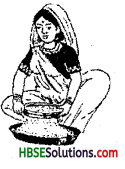
7. Hand Picking: This method is use for separating small particles of dust, stone, husk etc. from the grains of wheat, rice and pulses etc. Since these unwanted components are present in small quantities and total amount of grains to be separated is not very-very large, so they are separated by hand picking.
HBSE 6th Class Science Solutions Chapter 5 Separation of Substances 7

8. Sieving: Sieving of wheat flour (atta) is a common practice. Sieving a wheat flour through a sieve allows fine particles of the flour to pass through the holes of the sieve while the bigger husk particles remain on the sieve.
HBSE 6th Class Science Solutions Chapter 5 Separation of Substances 8
Sieving is used when two components of a mixture have different sizes. Sand can be separated from stone by seiving.

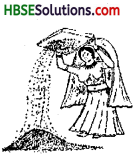
9. Winnowing : This method of separation is commonly used to separate lighter particles from heavier grains of wheat.
HBSE 6th Class Science Solutions Chapter 5 Separation of Substances 9
In this method, the wheat grains containing husk are allowed to fall down from some height while the wind is blowing. Since husk is lighter than grains, it gets carried away by wind and heaps of grains and husk are formed separately.

10. Sedimentation and decantation : This method of separation is used for a mixture consisting of an insoluble solid and a liquid. The process of settling down of heavier insoluble particles in a mixture of water and insoluble substances is called sedimentation (Fig 5.5). The process of transferring the clear liquid (after sedimentation) without disturbing the sedimentation insoluble heavy particles is called decantation. Fig. 5.5. (6).
HBSE 6th Class Science Solutions Chapter 5 Separation of Substances 10
Decantation can also be used for separating two immiscible liquids such as oil and mixture. Oil and water do not mix with each other and form separate layers. They can also be separated by using separating funnel.
HBSE 6th Class Science Solutions Chapter 5 Separation of Substances 11

11. Loading : In rainy season we get muddy water from wells, taps or other sources of drinking water. This muddy water can be made clear by loading. If a piece of alum, tied
HBSE 6th Class Science Solutions Chapter 5 Separation of Substances 12
with a thread, is swirrled in such a water, then after some time the water becomes clear on standing. (Fig 5.7) The water becomes clear because the mud particles get loaded by the alum particles and become heavy and settle down at the bottom of the container and water can be decanted for further use.

HBSE 6th Class Science Solutions Chapter 5 Separation of Substances

12. Filtration : Filtration is used to separate solid impurities from a liquid. In our homes, tea is filtered to separate tea leaves and shikanji (lemo-nade) is filtered to separate the seeds of the lemon.

13. Evaporation : The process of separating any salt from its solution by removing water is called evaporation. This process is largely used to obtain common salt from sea water. When sea water is allowed to stand in shallow pits, water slowly turns into water vapours by absorbing the heat of the sun, leaving behind solid salt.

14. Magnetic separation : This process of separation is used when one of the components in the mixture is iron. For example a mixture of iron fillings and sand can 5.10. “Magnetic, separation”
HBSE 6th Class Science Solutions Chapter 5 Separation of Substances 13
be separated by moving a magnet in the mixture. The Magnet picks out only iron fillings from the sand. This process is called magnetic separation (Fig 5.10)

15. Churning: This process is used to separate cream from milk. When milk is churned for some time, the lighter cream particles float on its surface from where they can be separated. Churning can be done by hand or by using a mixi. (Fig 5.11.)

16. When one method of separation is not sufficient to separate the different substances present in a mixture, we use more than one methods. (See Fig 5.13) For example if we have a mixture of salt, water and sand and we want to separate all the three substances, we use two methods-decantation and evaporation.

HBSE 6th Class Science Solutions Chapter 5 Separation of Substances Read More »

HBSE 6th Class Science Solutions Chapter 4 Sorting Materials Into Groups

Haryana State Board HBSE 6th Class Science Solutions Chapter 4 Sorting Materials Into Groups Textbook Exercise Questions and Answers.

Haryana Board 6th Class Science Solutions Chapter 4 Sorting Materials Into Groups

HBSE 6th Class Science Sorting Materials Into Groups Textbook Questions and Answers

Exercises

Question 1.
Name five objects which can be made from wood.
Answer:
Objects which can be made from wood are:

  • Chair
  • Table
  • Desk
  • Double bed
  • Stool
  • Almirah.

Question 2.
Select those objects from the following which shine :
Glass bowl, plastic toy, steel spoon, cotton shirt.
Answer:
Glass bowl, steel spoon.

HBSE 6th Class Science Solutions Chapter 4 Sorting Materials Into Groups

Question 3.
Match the following things with the materials from which they are made :

ThingsMaterials
(i) BookGlass
(ii) TumblerWood
(iii) ChairPaper
(iv) ToyLeather
(v) ShoesPlastic.

Answer:
(i) paper
(ii) glass
(iii) wood
(iv) plastics
(v) leather.

Question 4.
State whether the statements given below are true or false :
(i) Stone is transparent, while glass is opaque.
(ii) A note book has lustre while eraser does not.
(iii) Chalk dissolves in water.
(iv) A piece of wood floats on water.
(v) Sugar does not dissolve in water.
(vi) Oil mixes with water.
(vii) Sand settles down in water.
(viii) Vinegar dissolves in water.
Answer:
(i) False
(ii) False
(iii) True
(iv) True
(v) False
(vi) False
(vii) True
(viii) True.

Question 5.
Given below are the names of some objects and materials :
Water, basket ball, orange, sugar, globe, apple and earthen pitcher
Group them as :
(a) Round shaped and other shape.
(b) Eatables and non-etables.
Answer:
Round-shaped object Other-shaped objects

  • Basket ball
  • Water
  • Orange
  • Sugar
  • Globe
  • Apple
  • Earthen pitcher.

HBSE 6th Class Science Solutions Chapter 4 Sorting Materials Into Groups

Question 6.
List all items known to you that float on water. Check and see if they will float on a oil or kerosene.
Answer:

  • Dried leaves
  • paper
  • wax
  • ice
  • oil.

All these materials floats on water and they sink in oil and float on kerosene.

Question 7.
Find the odd one out from the following:
(a) Chair, Bed, Table, Baby, Cup-board.
(b) Rose, Jasmine, Boat, Marigold, Lotus.
(c) Aluminium, Iron, Copper, Silver, Sand.
(d) Sugar, Salt, Sand, Milk, Milk powder.
Answer:
(a) Baby
(b) Boat
(c) Sand
(d) Milk

HBSE 6th Class Science Sorting Materials into Groups Important Questions and Answers

Very Short Answer Type Questions

Question 1.
What do you mean by classification?
Answer:
The process of grouping things on the basis of some common properties is called classification.

Question 2.
How groupings of things are made?
Answer:
Goupings of things are done according to some similarities, necessities, and convenience to make it easier to work with them.

Question 3.
Name three things made from glass.
Answer:
Bowl, bottle, jug, katori.

Question 4.
Name two materials which are soluble in water.
Answer:

  • Salt
  • sugar.

Question 5.
Name five objects which are made from transparent materials.
Answer:

  • Glass bowl
  • Glass bottles
  • Window pan
  • Looking glass
  • Pen.

HBSE 6th Class Science Solutions Chapter 4 Sorting Materials Into Groups

Question 6.
List three liquids which are transparent.
Answer:

  • Water
  • Spirit
  • Benzene.

Question 7.
List five objects which are made from opaque materials.
Answer:

  • Table
  • Chair
  • Door
  • Bed
  • Black board.

Question 8.
What is common between salt and sand?
Answer:
Mass.

Question 9.
Name three bad conductors of heat.
Answer:

  • Wood
  • Rubber
  • Paper.

Question 10.
Name three good conductors of heat.
Answer:
Aluminium, copper and iron.

Question 11.
Name five magnetic objects.
Answer:
Eraser, Pins, Iron nails, Scissors and steel spoon.

Question 12.
Name two objects made from plastics.
Answer:

  • Mug
  • Toys.

Question 13.
Name two substances which are insoluble in water.
Answer:

  • Chalk
  • Plaster.

Question 14.
Name four metals which are used in our daily life.
Answer:

  • Aluminium
  • Copper
  • Brass
  • Iron.

Question 15.
Write two properties of metals.
Answer:

  • They look shining in appearance.
  • Metals are good conductors of heat.

HBSE 6th Class Science Solutions Chapter 4 Sorting Materials Into Groups

Question 16.
Name three liquids which are immiscible in water.
Answer:

  • Mustard oil
  • Glycerine
  • Coconut oil.

Question 17.
Name three materials which float in water.
Answer:

  • Wax
  • wood
  • ice.

Question 18.
Name three things which are non-magnetic.
Answer:

  • Rubber
  • Chalk
  • Plastics
  • Wood.

Question 19.
How can materials be grouped?
Answer:
Materials can be grouped on the basis of similarities and differences in their properties.

Question 20.
Name some combustible materials.
Answer:
Wood, paper and cotton.

Question 21.
Which are translucent materials?
Answer:
The materials through which things are only partially visible are called translucent materials.

Short Answer Type Questions

Question 1.
What are objects made of?
Answer:

  • An object can be made from different materials. For example, your shoes can be made of canvas, leather, rubber or plastics.
  • Different objects can be made from the same material. For example, flower vase, window panes, glass jar, fish aquarium are made from the same material.
  • An object or a thing can be made using more than one material. For example, idli is made of rice, urad dal, salt and water.

Question 2.
Mention three properties of materials.
Answer:
Three important properties of materials are described below :

  • Physical State : All materials can be classified as solid, liquid and gas. We cannot see gases but we can feel their presence.
  • Appearance : Any material can be described in terms of its colour, lustre, texture or hardness.
  • Solubility : All materials can be soluble or insoluble in water. For example, sugar is soluble in water but sand is insoluble in water. Liquid and gases may also be soluble or insoluble in water.

HBSE 6th Class Science Solutions Chapter 4 Sorting Materials Into Groups

Question 3.
Write three common characteristics of materials.
Answer:

  • All materials can be felt by one or more of our senses.
  • All materials occupy space.
  • All materials possess mass.

Question 4.
Why are handles of utensils made from wood or plastics?
Answer:
The handles of utensils are made from wood or plastics because utensils are good conductors of heat and wood and plastics are bad conductors of heat. They do not allow the heat transmission through them. So the handles of utensils are made from wood or plastics so that we do not burn our hands while handling these utensils when they are hot.

Question 5.
Name two gases which are soluble and two gases which are insoluble. What is the importance of gases dissolved in water?
Answer:
→ Gases which are soluble in water: Oxygen and Carbon dioxide.

→ Gases which are insoluble in water: Hydrogen, Nitrogen.
The oxygen dissolved in water helps aquatic plants and animals. Carbon dioxide dissolved in water helps the plants living in water for photosynthesis.

Question 6.
X, Y and Z are three types of materials. The materials X and Y can break into pieces easily when hit with an object but material Z does not break easily. The material X is used in the windows of bathrooms in our house whereas material Y is used in the windows of our drawing room. The material Z is used in making doors and almirahs in our house.
(a) What do you think material X could be? What is the general name of materials liheX?
(b) What could material Y be? Write the general name of materials like Y.
(c) What could material Z be? What is the general name of material like Z?
Answer:
(a) Ground glass : Translucent materials
(b) Clear glass: Transparent materials
(c) Wood : Opaque Materials.

Question 7.
Why cotton floats on water?
Answer:
Cotton has large number of pores in it. The air gets trapped in it thereby reducing its density (by increasing the volume of cotton by air). Therefore cotton floats on water. But when these pores get filled with water it starts sinking.

Question 8.
A few things have been grouped as follows. Identify the property common to all things in each group.
Group – I : Glass, Cup, Bucket, Mug, Jug
Group – II : Man, Cow, Camel
Group – III : Copper, Iron, Silver, Gold
Answer:
Group – I: Containers – all are made of plastic/steel.
Group – II: Living beings-all are mammals.
Group – III : All are metals.

Question 9.
Which among kerosene and glycerine is miscible in water? How will you find out?
Answer:
Glycerine is miscible in water.
Take some water in two test tubes. Put a few drops of glycerine into one test tube and a few drops of kerosene into the other. Shake them well. Glycerine mixes with water and cannot be seen separately. Kerosene does not mix with water. It can be seen as a separate layer on the top of water.

Question 10.
Give an activity to observe flow of heat in metal and wood.
Answer:
Take a cup and fill it partly with hot water. Place two spoons in it – one made of aluminium and the other made of wood. After a minute, touch the upper top of each spoon. You will observe that the aluminium spoon is hotter than the wooden spoon. This is because heat can flow quickly through aluminium but not so in wood.

HBSE 6th Class Science Solutions Chapter 4 Sorting Materials Into Groups

Long Answer Type Questions

Question 1.
What are the advantages of classification/grouping things or materials?
Answer:
The advantages of classification/ grouping of things or materials are as under:

  • Classification helps to understand similarities and dissimilarities among the objects.
  • Classification helps location of things. It is only because of classification that you are able to locate a book that you need out of thousands in your school library.
  • Classification of objects helps their identification.
  • Classification makes study of different objects easy and more meaningful. Rather than studying each object separately, we can study just one out of each class of different objects and generalize our results for the class as a whole.
  • Classification helps us to know the material of which the object is formed.

Question 2.
List the characteristics of solids, liquids and gases and give an example of each.
Answer:
Solids : All solids have the following characteristics :

  • They have a definite shape and volume.
  • They cannot be compressed easily.
  • The particles they are made of are packed very tightly.

Examples : Gold and wood.
Liquids : All liquids have the following characteristics:

  • They have a definite volume but no definite shape. They take the shape of the container they are poured in.
  • They can be compressed more easily than solids.
  • The particles they are made up of are not so tightly packed as in solids.

Examples : Water and alcohol.
Gases : All gases have the following characteristics:

  • They have no definite shape or volume.
  • They can be compressed very easily.
  • The particles they are made up of are packed loosely.

Examples : Oxygen and Carbon dioxide.

Question 3.
Discuss important properties of matter. (Any five)
Answer:
Some important properties of matter are discussed below:

  • Appearance: Materials (or matter) can be classified on the basis of their appearance. Different materials have different appearances.
  • Lustre : Materials can be classified on the basis of their lustre. Some shine a lot whereas others are quite dull.
  • Texture : Different materials feel different when touched, so they have different textures.
  • State: Most materials can be placed into one of the three groups : Solid, liquid or gas.
  • Solubility in water: Some substances are soluble in water, others are insoluble. Miscible liquids mix with each other, immiscible liquids do not.

HBSE 6th Class Science Solutions Chapter 4 Sorting Materials Into Groups

Sorting Materials into Groups Class 6 HBSE Notes

1. There is a large variety of things around us, some of familiar furniture may be chairs, tables, almirah, utensils, books, clothes, toys, television, refrigerator and other household items.

2. Different things can be used for making different types of materials.

3. Different types of materials have different properties such as appearance, solubility, transparency, conductivity and behaviour towards magnets etc.

4. Things can be grouped on the basis of their properties of materials from which they are made. Similar things are arranged together for convenience.

5. Materials which have lustre are called metals. Iron, copper, aluminium and gold are some examples of metals. Thus metals have a lustre and are called lustrous materials.

6. The surface of a material could be smooth or rough. Such as a stone feels rough on touching and metal surfaces are smooth to touch.

7. Materials may be hard or soft. Materials which are difficult to press are called hard and which can be pressed easily are called soft.

8. Substances which dissolve in water are called soluble and which remain the same are called insoluble.

9. Those liquids which mix well with water are said to be miscible and others which do not mix well are known as immiscible in water.

10. Some gases are soluble in water such as oxygen gas which dissolves in water is very important for the survival of aquatic animals.

11. Some materials like sand, sugar and salt sink in water and such materials like wax and oils float on water.

12. Materials may be transparent, opaque and translucent. Materials through which things can be seen are called transparent and materials through which you things are not able to see are called opaque and materials through which things are only partially visible; are called translucent.

13. Those materials/substances which allow the transmission of heat through them are called conductors of heat, which do not allow heat to pass through them are called non-conductors or poor conductors.

14. All metals are conductors of heat. Wood, plastics and a piece of cotton are examples of non-conductors. Gases are poor conductors of heat.

15. Some materials which burn on direct flame in the presence of air, are called combustible materials.

16. Materials which get strongly attracted towards the magnet are called magnetic materials. Our earth itself is a huge magnet. Magnetic materials find many uses in electronic devices.

17. Things are grouped together on the basis of properties of materials from which they are made.

18. The tendency of substances to intermix is called diffusion.

HBSE 6th Class Science Solutions Chapter 4 Sorting Materials Into Groups Read More »

HBSE 6th Class Science Solutions Chapter 3 Fibre to Fabric

Haryana State Board HBSE 6th Class Science Solutions Chapter 3 Fibre to Fabric Textbook Exercise Questions and Answers.

Haryana Board 6th Class Science Solutions Chapter 3 Fibre to Fabric

HBSE 6th Class Science Fibre to Fabric Textbook Questions and Answers

Exercises

Question 1.
Classify the following fibres as natural or synthetic:
Nylon, wool, cotton, silk, polyester, jute.
Answer:

  • Natural fibres : Wool, cotton, silk, jute.
  • Synthetic fibres : Nylon, polyester.

Question 2.
State whether the following statements are true or false :
(a) Yarn is made from fibres.
(b) Spinning is a process of making fibres.
(c) Jute is the outer covering of coconut.
(d) The process of removingseed from cotton is called ginning.
(e) Weaving ofyaf’n make a piece of fabric.
(f) Silk fibre is obtained from the stem of plants.
(g) Polyester is a natural fibre.
Answer:
(a) True
(b) True
(c) False
(d) True
(e) True
(f) False
(g) False

HBSE 6th Class Science Solutions Chapter 3 Fibre to Fabric

Question 3.
Fill in the blanks :
(a) Plant fibres are obtained from ________ and ________.
(b) Animal fibres are ________ and ________.
Answer:
(a) Cotton, jute
(b) Wool, silk.

Question 4.
From which part of plant cotton and jute are obtained?
Answer:
Cotton fibres are obtained from cotton seeds. They are hairs of cotton seeds. Jute fibres are obtained from the stem of jute plants by retting process.

Question 5.
Name two items that are made from coconut fibres.
Answer:

  • Ropes
  • Coir in mattress.

Question 6.
Explain the process of making yarn from fibres.
Answer:
The process of making yam from fibres is called spinning. In this process fibres from a mass of cotton wool are drawn out and twisted. This brings the fibres together to form a yarn.

A simple device used for spinning is a hand spindle also called takli and charkha. Spinning of yarn on a large scale is done with the help of spinning machine. After spinning yams are used for making fabrics.

HBSE 6th Class Science Fibre to Fabric Important Questions and Answers

Very Short Answer Type Questions

Question 1.
Name some fibres obtained from natural sources (Plants/animals).
Answer:
Cotton, silk, wool and jute fibres are obtained from natural sources.

Question 2.
Name two fibres obtained from man-made materials.
Answer:
Nylon and polyester.

Question 3.
Which type of clothes absorb water quickly?
Answer:
Cotton clothes absorb water quickly.

HBSE 6th Class Science Solutions Chapter 3 Fibre to Fabric

Question 4.
Which type of clothes bum quickly?
Answer:
Nylon and polyester clothes bum quickly.

Question 5.
From where do we get wool and silk?
Answer:
We get wool from animal hairs (sheep) and silk from silk worm.

Question 6.
From which time cotton has been used in India?
Answer:
In India cotton has been used since 1800 B.C.

Question 7.
Where is cotton grown in India?
Answer:
In India cotton crops are grown in Maharashtra, Gujarat, Punjab, Rajasthan, Tamilnadu and Madhya Pradesh.

Question 8.
In which climate are cotton crops grown?
Answer:
Cotton crop needs warm climate.

Question 9.
Write two uses of cotton.
Answer:

  • Manufacture of textiles.
  • As absorbent in hospitals.

Question 10.
Where do we get jute?
Answer:
Jute is obtained from stem of jute plants in the form of patsun.

Question 11.
How are jute fibres used?
Answer:
Jute fibres are used for making gunny bags, carpets and curtains.

Question 12.
Why did primitive life need no cloth?
Answer:
Because they lived mostly to tropics where the climate was warm.

Question 13.
Why are cotton and woollen fibres rough?
Answer:
Cotton and woollen fibres are rough because they have many folds and uneven surface on it.

Question 14.
Why are nylon and polyester fibres smooth?
Answer:
Nylon and polyester fibres are smooth because they have long plain, fine structure.

HBSE 6th Class Science Solutions Chapter 3 Fibre to Fabric

Question 15.
Why are fibres twisted?
Answer:
By twisting fibres, they become strong and their cohesion power increases.

Question 16.
Name some natural and man-made cloth materials.
Answer:
Natural cloth materials are : cotton, wool, silk and jute etc.
Man-made cloth materials are: rayon, nylon and polyesters etc.

Short Answer Type Questions

Question 1.
From where do we get materials used for making clothes?
Answer:
We get materials used for making clothes from natural sources such as cotton, jute, silk and wool from plants and animals and from man-made/artificial sources such as nylon, polyester and rayon etc.

Question 2.
Where do the plants have fibres in their body?
Answer:
Plants have fibres in their body in different parts. For examples; cotton and mango have fibres on their seeds, coconut on its fruits, jute on its stem and banana tree on its leaf.

Question 3.
From where do we get wool and silk fibres?
Answer:
Wool and silk fibres are obtained from animals. Wool is obtained from hair of animals; as sheep hairs and silk fibres are obtained from silk worm.

Question 4.
Where are cotton crops grown?
Answer:
Cotton crops are grown in black soil, which is best for of cultivation of cotton crops. It is planted early in the spring season. It needs warm climate. Its plant grows steadily and soon becomes brushes of 3 to 5 feet height.

HBSE 6th Class Science Solutions Chapter 3 Fibre to Fabric

Question 5.
What are the various uses of cotton?
Answer:
Cotton is used as follows :

  • Cotton or cotton in combination with other fibres is used in manufacture of textiles.
  • Cleaned cotton is used as absorbent in hospitals.
  • Unspun cotton is used as fillers in mattresses, pillows and quilts.
  • It is used as raw materials for manufacture of rayon and paper industry.

Question 6.
Where and when is jute cultivated?
Answer:
Jute is cultivated in alluvial soils in the delta region of rivers like Ganga and Brahmaputra. In India jute is mainly grown in West Bengal, Bihar and Assam. It is cultivated during rainy season.

Question 7.
How was clothing developed?
Answer:
Cloth making was developed in three stages: (i) First stage was making cloth from plant fibres, (ii) Second stage was the beginning the use of animal fibres and the third stage began with man-made fibres in 19th century.

Question 8.
Why do we wear clothes?
Answer:
We wear clothes due to the following reasons:

  • They protect against wind and weather.
  • They protect against injury.
  • They maintain body heat.

Question 9.
Why is it necessary to make yarn from fabrics for making clothes?
Answer:
Cotton, wool and silk fibres are suitable for making yarn. For making yarn, fibres are twisted. Twisting of fibres into yarn increases the cohesion (togetherness) and strength of fibres.

Long Answer Type Questions

Question 1.
How do we obtain jute fibres from jute plants?
Answer:
On complete maturation of plants, fibres on its stem becomes very hard. The cut plants are grouped at different places in the field for a few days when most of the leaves fall down. The plants now are tied in small bundles and these bundles made to sink in stagnant water of pond for a few days when the gummy spin rots out to separate fibres. The process is called retting. Fibre is extracted from the retted jute by hand, with jerk and pulls. The dry fibres are then tied together in small bundles. They are pale yellow jn colour with 6 to 8 feet length and quite strong with silky lustre. They can easily be spun into fabrics.

HBSE 6th Class Science Solutions Chapter 3 Fibre to Fabric

Question 2.
Give a brief account of the journey of jute from its cultivation to making the fibre.
Answer:
(i) Jute is grown in alluvial soil in the delta region of the Ganga and Brahmaputra rivers.

(ii) Jute is cultivated during the rainy season. It bears yellow flowers in 3-4 months.

(iii) Jute plants are usually cut at the flowering state. A good quality fibre is obtained from plants cut at the flowering state. Jute obtained from a matured plant is harder.

(iv) After the dry leaves haven fallen, the bundles of dry plants are kept in a pond for a few days. During this period, the gummy skin rots out to separate the fibres. This process is called retting.

(v) The jute fibre is obtained from the retted jute by hand.

Fibre to Fabric Class 6 HBSE Notes

  • We know that clothes we wear come from fibres. Clothes protect us from adverse weather condition.
  • Materials used for making clothes are obtained from natural as well as man-made sources.
  • Natural clothing materials includes cotton, wool, silk and jute.
  • Man-made clothing materials are rayon, nylon and polyester etc.
  • Different clothing materials have different properties. Cotton and wool are rough while rayon, silk, nylon and polyester are smooth to touch.
  • All cloth materials are made up of long, narrow, thin structures called fibres. All the plants have fibres in their body structure.
  • Cotton and mango have fibre in their seed, coconut in their fruits and jute in its stem and banana tree on its leaf.
  • Cotton fibres are obtained from the seeds of cotton plant and jute fibres are obtained from the stem of jute plant by the process of retting.
  • The process of pulled out cotton seeds from cotton is called ginning.
  • Cotton fibres are used in manufacturing of textiles, as adsorbent in hospitals, as fillers in mattresses, pillows and quilts and raw materials for rayon.
  • Jute fibres are obtained from the stem of plant called “patsun”. Its separation from stem is called retting.
  • They are 6-8 feet length. It is used for making gunny bags, potato/sacks, carpets, curtains and ropes etc.
  • Man-made fibres combined with other animal and plant fibres are used for making clothes for improved strength, wearing ability and other qualities.
  • Clothes are necessary because they protect us from wind and weather, injury and maintains body heat.
  • Clothes are made from threads and threads in turn are spun from fibres. Cotton, wool, silk and nylon are composed of very fine hair – like structures called fibres.
  • Coconut fibres are used for making ropes or as a coir mattresses. Soft and long fibres like cotton and wool are suitable to make yarn. Fibres cannot be used for making clothes directly.

HBSE 6th Class Science Solutions Chapter 3 Fibre to Fabric Read More »

HBSE 6th Class Hindi Solutions Vasant Bhag 1 Haryana Board

HBSE 6th Class Hindi Solutions Vasant Bhag 1 Haryana Board Read More »

HBSE 6th Class Social Science Solutions Civics Chapter 6 Rural Administration

Haryana State Board HBSE 6th Class Social Science Solutions Civics Chapter 6 Rural Administration Textbook Exercise Questions and Answers.

Haryana Board 6th Class Social Science Solutions Civics Chapter 6 Rural Administration

HBSE 6th Class Civics Rural Administration Textbook Questions and Answers

Rural Administration Class 6 HBSE Social Science Question 1.
If there is a theft in your house which police station would you go to register your complaint?
Answer:
In such a situation I would go to the police station of my area to register my complaint.

Rural Administration Class 6 Questions Answers HBSE Social Science Question 2.
What was the dispute between Mohan and Raghu?
Answer:
Raghu had taken over some of Mohan’s land and increased the size of his own field. Angry Mohan went to Raghu’s house to make complaints. But Raghu did not accept what he had done with Mohan’s land. This caused a dispute between the two.

Haryana Board HBSE 6th Class Social Science Solutions Civics Chapter 6 Rural Administration

Class 6 Civics Chapter 6 HBSE Social Science Question 3.
Why was Mohan worried about picking a quarrel with Raghu?
Answer:
Mohan was worried about picking a quarrel with Raghu because Raghu’s uncle was the Sarpanch of the village. Raghu was quite influential as his family owned many fields. None in the village had ever dared to confront him. Mohan, being a small farmer had picked up courage to make complaints about what Raghu had done.

Class 6 Rural Administration HBSE Social Science Question 4.
Some people said Mohan should report the matter to the police and others said he should not. What were the arguments they gave?
Answer:
Some people suggested Mohan to go to the police station to report the matter. Since Mohan was badly hurt on his head and hand, his friend suggested that they should go to the local police station and file a report. Others said that Mohan should not go to the police station as they know about Raghu’s influence and power. They also know that Raghu’s uncle was the sarpanch of the village. They felt reporting the case at the police station would involve a lot of money and nothing would come out it.

Question 5.
The Khasra record of the Patwari gives you information regarding the map given below. It identifies which plot of land is owned by whom. Look at both the records and the answer the questions given below regarding Mohan and Raghu’s land.
HBSE 6th Class Social Science Solutions Civics Chapter 6 Rural Administration-1
HBSE 6th Class Social Science Solutions Civics Chapter 6 Rural Administration-2
(1) Who owns the land south of Mohan’s field?
(2) Mark the common boundary between Mohan’s and Raghu’s land.
(3) Who can use field no. 3?
(4) What information can one get field no. 2 and field no. 3?
Ans.
(i) Raghu owns the land south of Mohan’s field.
(ii) Common boundary is marked with dark line.
(iii) Madhya Pradesh government can use field No 3.
(iv) The total area of field 2 is 2.75 hectare it belongs to Raghu who grows soyabean and wheat in this field. The land is not on rent and it is irrigated. Second crop is grown in 1.75 hectare. 0.2 hectare of the total area is a fallow land. There is one well in the field and it is working.

Field No. 3 belongs to Madhya Pradesh government. It is a grassland. It is not on rent. There is one well in the field and it is working. This grassland is used for grazing purposes.

EXERCISE

Question 1.
What is the work of the police?
Answer:
The work of the police is to:
(a) maintain law and order to establish peace in the society.
(b) to register case of theft, accident, injury, fights etc.
(c) to inquire, investigate and take action on the cases within its area.

Question 2.
List two things that the work of a Patwari includes.
Answer:
(a) Patwari measures land and keeps land records.
(b) He organises the collection of land revenue from the farmers and provides information to the government about the crops grown in that area.

Question 3.
What is the work of a tehsildar?
Answer:
(a) A tehsildar supervises the work of the Patwari.
(b) It hears disputes.
(c) It ensures that records are properly kept and land revenue is collected.
(d) He also sees to it that the farmers can easily obtain a copy of their record and students can obtain their caste certificates etc.

Haryana Board HBSE 6th Class Social Science Solutions Civics Chapter 6 Rural Administration

Question 4.
What issue is the poem trying to raise? Do you think this is an important issue? Why?
Answer:
The poem emphasises on the rights of a girl child. It is trying to raise the issue of inheritance of daughters and mothers in the property of their father/husband.

This is an important issue because in our country before Hindu Succession Amendment Act (2003) women can not get a share in the family’s agricultural land and after her father/ husband death the property was equally divided among her sons. This poem highlights that Dowry is not a compensation to a girl child. It should be abolished.

Question 5.
In what ways are the work of a Panchayat that you read about in the previous chapter and the work of the Patwari related to each other?
Answer:
Village Panchayat tries to solve the problem of the villagers at village level, and make it sure that the life of the people could be made prosperous. Patwari is a Government official at village level, who measures the land and collects the land revenue at village level.

The works of the Village Panchayat and Patwari are related to each other because they equally work for the welfare of the villagers. The revenue collected by Patwari is spent on welfare of the people.

Question 6.
Visit a police station and find out the work that the police have to do to prevent and maintain law and order in their area especially during festivals, public-meetings etc.?
Answer:
Police exercise following programs to prevent the crime and to maintain law and order in their areas:
1. Recruitment and deployment of Special Task Force to handle different crucial situations.
2. The police officer always keeps a vigilant eye on the criminals.
3. To ensure internal peace and justice (i.e. law and order position) these are kept open for twenty four hours a day.
4. During festivals they move with the public in civil dress, so that they can keep festivals free from apprehension of any mishappening.
5. To control the rush they make barrier and check post at various entrance.
6. Police can stop the people taking weapon inside the area/campus of the fair or festival.

Question 7.
Who is in-charge of all police stations in a district? Find out.
Answer:
The In-Charge of all police stations in district is Senior Superintendent of Police (S.S.P). The in-charge of a police station is known as S.H.O. (Station House Officer).

Haryana Board HBSE 6th Class Social Science Solutions Civics Chapter 6 Rural Administration

Question 8.
How do women benefit under new law?
Answer:
New Law: Hindu Succession (Amendment) Act, 2005 is known as New Law.
According to this law, women in India can get a share in the family’s agricultural land. Women get equal share in the property/lands.
Benefit of Law: Women can get transfer land and even purchased land. They can also take share of family’s land or property.

Question 9.
In your neighbourhood are there women who own property? How did they acquire it?
Answer:
Yes, In our neighbourhood there are women who owned their property. They acquired it with the help of their village Patwari and their brothers or sisters.

HBSE 6th Class Civics Rural Administration Important Questions and Answers

Very Short Answer Type Questions

Question 1.
What is called bund?
Answer:
The boundary that separates one land from another is called ‘bund’.

Question 2.
How does the Patwari measure the agricultural fields?
Answer:
The Patwari measures the land with the help of chain.

Question 3.
What is the work of Tehsildar?
Answer:
Tehsildar supervises the work of the Patwari and ensures that records are properly kept and land revenue is collected.

Short Answer Type Questions

Question 1.
How would have Patwari decided whether the common boundary of Mohan and Raghu Helds had been shifted?
Answer:
Patwari would have measured both Mohan’s and Raghu’s fields and compared them with the measurements on the map. If they did not match, then it was obvious that the boundaries had been changed.

Question 2.
When do you think farmer may require a copy of his land record?
Answer:
We think farmer may require a copy of his land record when:
1. he wants to sell or buy his land.
2. he wants loan from bank to dig a tubewell for his land.
3. he divides his property.

Haryana Board HBSE 6th Class Social Science Solutions Civics Chapter 6 Rural Administration

Question 3.
Mention any three works of the revenue department of the government.
Answer:
1. The revenue department of the government supervisor the work of the Patwari.
2. It ensures that records are properly kept and land revenue is collected.
3. It is the revenue department that makes the students obtain their caste certificates.
4. It also resolves the revenue deposits.

Long Answer Type Questions

Question 1.
Explain the right of women in property before and after Hindu Succession Amendment Act, 2005.
Answer:
Before:
1. Hindu women did not get a share in the family’s agricultural land.
2. After the death of the father, property was divided equally only among his sons.

After:
1. In the new law sons, daughters and their mothers can get an equal share in the land.
2. The new law will benefit a large number of women.
3. They can enjoy their independent status with equal rights.

Rural Administration Class 6 HBSE Notes

  • Nayaya Panchayat: A rural body of local administration constituted for disposal of funds, quarrels disputes of minor nature.
  • Chokidar: Chokidar in a village keeps birth and death record and also works as a messenger between the people and Gram Panchayat or any Government agency related with the welfare of the village.
  • Patwari: He is the land revenue officer at village level. He measure the land of the farmer and keeps the record.
  • Tehsildar: He is the officer at district level. He keeps a checking eyes on revenue officers.
  • Lekhpal, Kanungo or Karamchari or Village Officer: These are the different names of the Patwari. He is known by different names in different parts of our country.
  • Khasra Number: These are the number used for land which is owned by an individual villager or village community.
  • A New Law: According to new law, son, daughter and their mother can get equal parts of (shares of) the land owned by Karta of their family.
  • S.H.O: Station House Officer of a police station or a person in-charge of police station.
  • S.S.P: Senior Superintendent of Police is the highest rank of a police officer in district level.

HBSE 6th Class Social Science Solutions Civics Chapter 6 Rural Administration Read More »

HBSE 6th Class Social Science Solutions Civics Chapter 3 What is Government

Haryana State Board HBSE 6th Class Social Science Solutions Civics Chapter 3 What is GovernmentTextbook Exercise Questions and Answers.

Haryana Board 6th Class Social Science Solutions Civics Chapter 3 What is Government

HBSE 6th Class Civics What is Government Textbook Questions and Answers

HBSE 6th Class Social Science Solutions Civics Chapter 3 What is Government-1

What is Government HBSE 6th Class Question 1.
Look at the newspaper headlines above and list the different kinds of activities that the government is reported to be doing in these newspaper headlines.
1.
2.
3.
4.

  • Isn’t this a wide range of activities?
  • What do you think government is? Discuss in class.

Answer:

  • List of the different kind of activities that the government is reported to be doing in the newspaper headlines:

1. The government protects the rights of the unorganised workers.
2. It fixes prices of essential commodities when they are in short supply.
3. It tackles food.
4. It revamps coal and power sectors.
5. It declares villages scarcity hit and . provides relief.
6. It appoints judges to high courts and Supreme Court.

  • Yes, the government has a wide range of activities.

In my opinion, the government is an organisation which looks after the public maintenance systems like roads, postal and railway service. It is also responsible for maintaining peaceful relations within nation and amongst the different nations. It protects the border of the country.

Haryana Board HBSE 6th Class Social Science Solutions Civics Chapter 3 What is Government

Class 6 History Chapter 3 HBSE Question 2.
Can you list three things that the government does which have not been mentioned?
Answer:
The things that the government does which has not been mentioned are:
(i) to provide sanitation and pure drinking water facility to all the citizens of the nation.
(ii) to provide free education to children of the nation.
(iii) to give employment to all people more than 18 years of age.

What is Government Class 6 Notes HBSE Question 3.
Look at the statements in the column on the left. Can you identify which level they belong to? Place tick mark against the level you consider most appropriate:

LocalStateCentral
1. The decision to maintain peaceful relations with Russia.
2. The decision on whether to have Board exam conducted in Class VIII for all government in Kolkata.
3. Introduction of two new train connections between Jammu and Bhubaneshwar.
4. The decision to get common well constructed/ excavated in a particular area of the village.
5. Decision to construct a big children’s park in Patna.
6. The decision to provide free electricity for all farmers in Haryana.
7. Introduction of a new 1000 rupee note.

Answer:

LocalStateCentral
1. The decision to maintain peaceful relations with Russia.
2. The decision on whether to have Board exam conducted in Class VIII for all government in Kolkata.
3. Introduction of two new train connections between Jammu and Bhubaneshwar.
4. The decision to get common well constructed/ excavated in a particular area of the village.
5. Decision to construct a big children’s park in Patna.
6. The decision to provide free electricity for all farmers in Haryana.
7. Introduction of a new 1000 rupee note.

Haryana Board HBSE 6th Class Social Science Solutions Civics Chapter 3 What is Government

Class 6 History Chapter 3 Questions And Answers HBSE Question 4.
Do you think it is important for people to be involved in decisions that affect them? Give two reasons for answer.
Answer:
Yes, it is important for people to be involved in decisions that affect them because:
(a) The people are affected by a rise in prices of essential commodities, so any extra-ordinary increase in prices should be consulted with the representatives of the people.

(b) If the government decides to convert a residential area to the commercial area, the representatives of the people should be consulted as it could effect the lives of the people.

What is Government 6th Class HBSE  Question 5.
Which type of government prefer to have in the place in which you live in? Why?
Answer:
I would like to have a democratic type of government in the places in which I live because it is a government of the people, for the people and by the people. A democratic government will be more considerate towards the needs of the people.

Question 6.
Which of the statements below is correct? Correct those sentences that you think need correction.
(a) In a monarchy the country’s citizens are allowed to elect whomever they want.
(b) In a democracy a king has an absolute powers to rule the country.
(c) In a monarchy, people can raise questions about the decisions the monarch takes.
Answer:
(a) In a monarchy, the king is chosen by the hereditary powers.
(b) In a democracy, the country is ruled by the representatives chosen by the people.
(c) In a monarchy, people can not raise questions about the decisions the monarch takes.

Haryana Board HBSE 6th Class Social Science Solutions Civics Chapter 3 What is Government

EXERCISE

Question 1.
What do you understand by the word ‘government’? List five ways in which you think the government affects your daily life.
Answer:
The Government is the name of an organisation through which, the will of the state is created, expressed and implemented.
The three main organs of the Government are:
(i) Legislative
(ii) Judiciary
(iii) Executive.

Govt, affects daily life in the following ways:
1. It takes decision to lay roads and build schools and health centers.
2. It takes action of social issues.
3. It protects the boundaries of state.
4. It makes law for the benefits of the people and implements them.
5. If there is dispute between two neighbouring states, the govt, does his best to end the cause of conflict.

Question 2.
Why do you think the Government make rules for everyone in the form of laws?
Answer:
Everyone who lives in a country must follow some rules and regulations. These laws are made by government and every citizen have to follow these laws. According to these laws, a government can function and make decision and vests with power to enforce these laws.

Govt, needs to make rules for everyone in the form of law because by doing so people can obey rule and thus the nation as a whole leads a secure life.

Question 3.
Name two essential features of a democratic government.
Answer:
Two features:
(i) Participation of people is necessity.
(ii) It acts according to the will of the people.

Haryana Board HBSE 6th Class Social Science Solutions Civics Chapter 3 What is Government

Question 4.
What was the suffrage movement? What did it accomplish?
Answer:
HBSE 6th Class Social Science Solutions Civics Chapter 3 What is Government-2
Haryana Board HBSE 6th Class Social Science Solutions Civics Chapter 3 What is Government

Suffrage Movement:
The word ‘suffrage’ means ‘right to vote’. This movement belongs to the women and poor people who have to fight for the participation in government. During the World War I, the struggle for the ‘right to vote’ got strengthened. The struggle comes to be known as ‘suffrage movement’.

Its accomplishments:
During the World War I, men were away from their house fighting in the battle field. At this time, women were called upon to do the work which were earlier done by men. Women did their best and try to manage and organise different kinds of works, People wonder to know that the women can do such work. Women began to be seen as being equally capable for doing hard work and making decision.

The people who were demanding the Right for Women and got their demand heard, they chained themselves to rallying in public places and meetings. In America, women were given right to vote in 1920 while in U.K. in 1928.

Question 5.
Gandhiji strongly believed that every adult in India should be given the right to vote. However, a few people don’t share his views. They feel that illiterate people, who are mainly poor, should not be given the right to vote. What do you think? Do you think this would be a form to discrimination? Give five points to support your view and share these with the class.
Answer:
All citizens are equal. The constitution aims at providing all equality to all its citizens.
• We have no right to discriminate any one on the basis of poverty.
• Even the illiterate people are the citizens of the nation. They should have the right to choose people who are going to be in their country.
• Our constitution provides equal voting right to all the citizens.
• We must honour dignity of every individual.

HBSE 6th Class Civics What is Government Important Questions and Answers

Very Short Answer Type Questions

Question 1.
Why does every country need a government?
Answer:
Every country needs a government to make decisions and get things like building roads and schools done.

Question 2.
List the institutions which are a part of the government. Name three of them.
Answer:
The institutions which are a part of the government are:
(1) Supreme Court
(2) Indian Railways
(3) Bharat Petroleum

Haryana Board HBSE 6th Class Social Science Solutions Civics Chapter 3 What is Government

Question 3.
What is universal adult franchise?
Answer:
‘Universal adult franchise’ means that all adults in the country are allowed to vote.

Question 4.
Why is a mark put on the finger while vote?
Answer:
A mark is put on the finger to make sure that a person casts only one vote.

Question 5.
Under what circumstances a person may approach the court?
Answer:
If a person feels that a particular law is not being followed, he/she may approach the court.

Short Answer Type Questions

Question 1.
What are the three different levels of the government?
Answer:
The three different levels of the government are:
(a) Local level: It means the government in our village, town or locality.
(b) State level: It would mean the government that covers an entire state like Haryana or Assam.
(c) National level: It refers to the government of the entire country.

Haryana Board HBSE 6th Class Social Science Solutions Civics Chapter 3 What is Government

Question 2.
What do you mean by representative democracies?
Answer:
In representative democracies, people do not choose their representatives through an election process. These representatives meet and make decisions for the entire population.

Question 3.
The earliest forms of government were not democratic.
Answer:
In the earliest form of government, men would owned property and were educated, had right to vote. This meant that women, the poor, the property less and the uneducated ones were not allowed to vote. The country was governed by the rules and regulations that these few men made.

So the earliest forms of government were not democratic as it was not ruled by all the citizens of the country.

Question 4.
What is a monarchy?
Answer:
It is a type of government in which the monarch or the king has the powers to make laws and decisions and run the government. The king does not have to explain his action or defend the decisions he takes. He may be helped by a small group of people who help the king to take decisions.

Long Answer Type Questions

Question 1.
Distinguish between democracy and monarchy.
Answer:

(a) Democracy is a government of the people, by the people and for the people. The re-presentatives of the people choose the government.(a) It is the King or Queen who has the power to make decisions and run the government.
(b) The three levels of the government-legislative, executive and judiciary are the functionaries of the government.(b) The monarch may have small group of people to discuss matters with, but the final decision making power remains with the monarch.
(c) The government has to explain its actions and defend its decisions to the people.(c) Kings and Queens do not have to explain their actions or defend the decisions they make.
(d) People may change the ruling party through elections.(d) The position of the king is hereditary.

Question 2.
What is the difference between the Federal and Unitary Government?
Answer:
(i) In the Unitary form of Government, there is only one Central Government for the whole country while in the Federal Form; there are one Central and separate governments in the provinces.
(ii) In the Federal form of Government the whole country is divided into some political units but in the Unitary form the whole country is a single unit.
(iii) In the Unitary form, all the powers are vested in one Central Government, while there is a division of powers between the Federal and the State governments in the Federal forms.
(iv) In the Federal form of Government, mostly the Constitution is written and rigid while it is not so in case of a Unitary State.

Haryana Board HBSE 6th Class Social Science Solutions Civics Chapter 3 What is Government

What is Government Class 6 HBSE Notes

  • Government: The system or machinery present in each country in order to make directions for the proper running of the country is called a government.
  • Laws: The rules laid down by the government for the proper functioning of the country are called laws.
  • Democracy: A system of government is which people (citizens) of the country choose their leaders to rule is called democracy.
  • Monarchy: Monarchy is the form of the government in which King or Queen or the Monarch takes decisions and makes laws for the entire country. His/Her position is hereditary too.
  • Elections: The process in which a democratic country casts their votes to choose the leaders is called elections.
  • Election Petition: If any voter or a candidate feels that the election in his constituency has not been conducted fairly, he can file an election petition against that election.
  • Representative Democracy: A form of democracy in which people do not elect the government directly but only choose their representatives, who collectively form a government is called Representative Democracy.

HBSE 6th Class Social Science Solutions Civics Chapter 3 What is Government Read More »