Class 10

HBSE 10th Class Science Important Questions Chapter 7 Control and Coordination

Haryana State Board HBSE 10th Class Science Important Questions Chapter 7 Control and Coordination Important Questions and Answers.

Haryana Board 10th Class Science Important Questions Chapter 7 Control and Coordination

Question 1.
What is the importance of control and co-ordination?
Answer:
1. Multicellular organisms are made-up of various organs and organ system.
2. It is a basic need of the body to control and co-ordinate these organs and organ systems, so that they can function properly and accomplish the voluntary as well as involuntary functions.

HBSE 10th Class Science Important Questions Chapter 7 Control and Coordination

Question 2.
What is a stimulus?
Stimulus:
1. An event that encourages an action or creates sensation is called a stimulus. (Plural : Stimuli)
2. All living organisms — humans, plants and animals respond to changes occurring in their surroundings. These changes work as stimuli.
Example:

  • On seeing sudden bright sunlight, our eyes gets closed. Here, the sudden bright light is stimulus whereas closing of eyes is response.
  • If someone pours hot or cold water on us, we can feel it and also differentiate the temperature of water.
  • A sunflower always faces the sun.
  • Thus, heat, light, touch, weather changes, sound, etc. all are examples of external stimuli.
  • If we are hungry, we feel like eating. Thus hunger, thirst, etc. are internal stimuli of the body.

Question 3.
What are receptors? Name few receptors found in human body, their location and function.
Answer:
Receptors:
1. A specialized structure in the human body that receives external stimuli is called a receptor.
2. These receptors are located in our sense organs. The main ones are —

ExampleLocationFunction
1. Gustatory receptors
2. Olfactory receptors
3. Thigmo receptors
4. Photo receptors
5. Audio (phono) receptors
On the surface of the tongue
Nasal epithelium
In the skin
In the eyes
In the internal ear
To detect taste
To detect smell
To detect touch
To detect vision
To detect sound

HBSE 10th Class Science Important Questions Chapter 7 Control and Coordination

Question 4.
What is a nerve cell? Explain its structure, function and working.
Answer:
Nerve cell:
Nerve cells or neurons are the building as well as functional units of the nervous system. They carry information from one part of the body to another.
Nerve cell has three components:
(i) Cell body,
(ii) Dendrites and
(iii) Axon
(i) Cell body: The cell body of a neuron is like a typical animal cell which contains cytoplasm and a nucleus.
A number of short or long fibers stretch out from the cell body. These fibers are called nerve fibers.
(ii) Dendrites: The short fibers on the cell body are known as dendrites.
(iii) Axon: The longest fiber on the cell body is called axon.
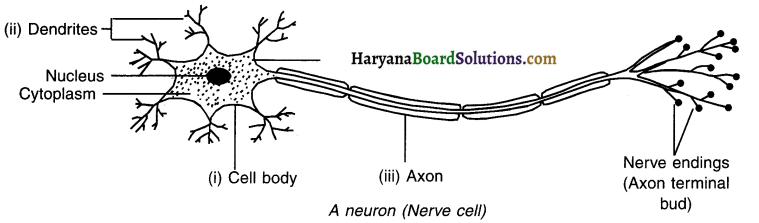
HBSE 10th Class Science Important Questions Chapter 7 Control and Coordination 1
Movement of Impulse (working of nerve cell):
1. The end of the dendritic tip receives message from receptors. It then initiates a neuro-chemical reaction due to which an electric impulse known as nerve impulse is produced.
2. The dendrites pass the impulse to the cell body and then to axon upto the end of axon i.e. axon terminal bud.
3. Synapse — The gap between nerve ending of an axon of one neuron and dendrite of the next neuron is called synapse.
4. At the end of the axon terminal bud, the electrical impulse releases certain chemicals.
5. These chemicals cross the gap or synapse and start similar electrical impulse in the dendrite of the next neuron. This is how the impulse or message travels from one neuron to another in the body.
6. Finally with the help of similar synapse, the impulses are delivered from neurons to other cells such as muscle cells or glands.

Question 5.
What happens at the synapse between two neurons?
Answer:
Nerve cell: Nerve cells or neurons are the building as well as functional units of the nervous system. They carry information from one part of the body to another.
Nerve cell has three components:
(i) Cell body,
(ii) Dendrites and
(iii) Axon
(i) Cell body: The cell body of a neuron is like a typical animal cell which contains cytoplasm and a nucleus.
A number of short or long fibers stretch out from the cell body. These fibers are called nerve fibers.
(ii) Dendrites: The short fibers on the cell body are known as dendrites.
(iii) Axon: The longest fiber on the cell body is called axon.

HBSE 10th Class Science Important Questions Chapter 7 Control and Coordination

Question 6.
What is a nervous tissue? What does It specialize in?
Answer:
1. Nervous tissue is made up of organized network of nerve cells or say neurons.
2. Nervous tissue specializes in conducting messages through electrical impulses from one part of the body to another.

Question 7.
Identify the parts of a neuron in a diagram: (1) where information is acquired, (2) through which information travels as an electrical impulse, and (3) where these impulse must be converted Into a chemical signal for onward transmission.
Answer:
Parts of a neuron: a — nucleus, b — cell body, c — dendrite, d — axon, e — nerve ending.

(1) Information is acquired at the end of the dendrite tip (c) of the nerve cell.
(2) Information travels as an electrical impulse through dendrite, cell impulse through dendrite, cell body and along the axon (d) to its end (e).
(3) At synapse, this impulse gets converted into a chemical signal for onward transmission.

Question 8.
Explain reflex action.
Answer:
Reflex action:

  • Reflex action is an involuntary and instant response of the muscles or glands to a stimulus. It takes place without involving the brain.
  • Reflex action is an automatic process. It is the simplest form of response in nervous system.

Example:
(1) We immediately pull-back our hands when we suddenly touch a hot vessel or when someone pricks us a pin.
→ In such cases, we react or say respond before the message can reach our brain. Such a response is called reflex action.
(2) Knee jerk response,
(3) Coughing,
(4) Blinking eyes,
(5) Yawning, movement of diaphragm,
(6) Contraction of pupil,
(7) Sneezing,
(8) Mouth watering or looking or smelling favourite food, etc. are other examples.

HBSE 10th Class Science Important Questions Chapter 7 Control and Coordination

Question 9.
What role does reflex action plays when we suddenly see a bright light or when we cough?
Answer:
1. When we suddenly see a bright light, pupil of our eyes becomes small and it takes some time for the eyes to adjust to the bright light. In this case, reflex action protects the retina from damage that can be caused due to sudden and excessive light.
2. Coughing is another example in which reflex action does the job of clearing our wind pipe.

Question 10.
Explain reflex arc.
Answer:
Reflex arc:

  • The pathway or say the route taken by the nerve impulses in a reflex action is known as the reflex arc.
  • Reflex arcs allow rapid response.

Example:
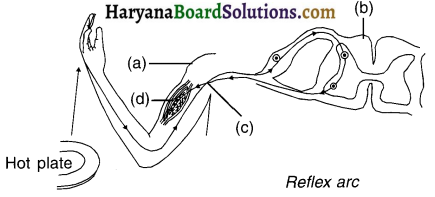
1. A reflex action is an automatic response to a stimulus. So, when we suddenly touch a hot plate (a stimulus) we quickly, without thinking pull our hand back.
2. This type of very quick and automatic response is called reflex action.
3. The diagram shows the pathway taken by the nerve impulses in this reflex action.

  • The heat is sensed by thermoreceptor in our hand.
  • The receptor fingers an impulse in a sensory neuron which transmits the information to the spinal cord.
  • From spinal cord, the impulse is passed to a relay neuron which in turn passes it to a motor neuron.
    Relay neurons are the communicating neurons between the sensory and motor neurons.
  • The motor neuron transmits the impulse to the muscle of the arm. The muscle then contracts and pulls the hand away from the hot plate.
  • The muscle of arm is an effector because it responds to the stimulus.
    This pathway along which the impulse travels is called the reflex arc.
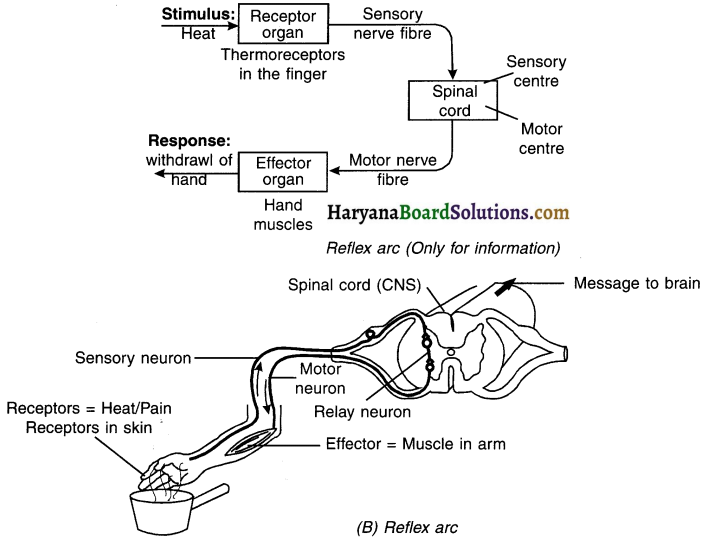
HBSE 10th Class Science Important Questions Chapter 7 Control and Coordination 2

Question 11.
Reflex actions have also evolved in animals. Explain.
Answer:
1. Generally, animals do not possess the complex neuron network needed for thinking. If at all they possess, the network is very basic. This means that animals cannot think as fast as humans.
2. However, they do need to respond to several sudden situations such as attack from other animals. To tackle such situations, the reflexes of animals are quite evolved.

HBSE 10th Class Science Important Questions Chapter 7 Control and Coordination

Question 12.
How do Involuntary actions and reflex actions differ from each other?
Answer:

Reflex action

Involuntary actions

Reflex actions are very quick.Involuntary actions are not that quick.
Reflex action can involve any muscle or gland.Involuntary actions can involve only smooth muscles and cardiac muscles.
Reflex actions not initiated by brain.Generally, involuntary actions involves brain.
It occurs suddenly in response to some external stimuli,
For example, pulling away hand when it touches a hot vessel.
It does not need any external stimuli, It can go on continuously under normal conditions.
For example, heartbeats, breathing, etc.

Question 13.
How does control and co-ordination take place in humans? Also, explain the functions of nervous system.
Answer:
There are two systems which co-ordinate different activities In humans:
(A) Nervous system and (B) Endocrine system (or Hormonal system)
These two systems work together to control and co-ordinate all our activities such as physical,emotional behaviour and thinking processes.

(A) Nervous system:

  • It controls and co-ordinates all the parts of the body.
  • The nervous system co-ordinates voluntary muscles, thus allowing a person to perform activities such as dancing, reading, writing, etc.
  • The nervous system also co-ordinates certain involuntary functions like heart beat and breathing.
  • The nervous system collects the information from the surrounding, interprets it and then responds accordingly.
  • The nervous system also passes information from one system to other system.
  • The units that make up the nervous system are called nerve cells or neurons. Thus, nerve cells are the functional units of a nervous system.

(B) Endocrine system (or Hormonal system):

  • There are certain glands in the endocrine system which release chemical substances (chemical messengers) called hormones in the body.
  • Generally, hormones regulate the slow activities of the body such as growth, metabolism, etc.
  • The hormones are secreted in a small quantity and reach to the target organ by blood. Generally hormones do not travel long.

HBSE 10th Class Science Important Questions Chapter 7 Control and Coordination

Question 14.
State the organization of human nervous system.
Answer:
Organs of Human Nervous System:
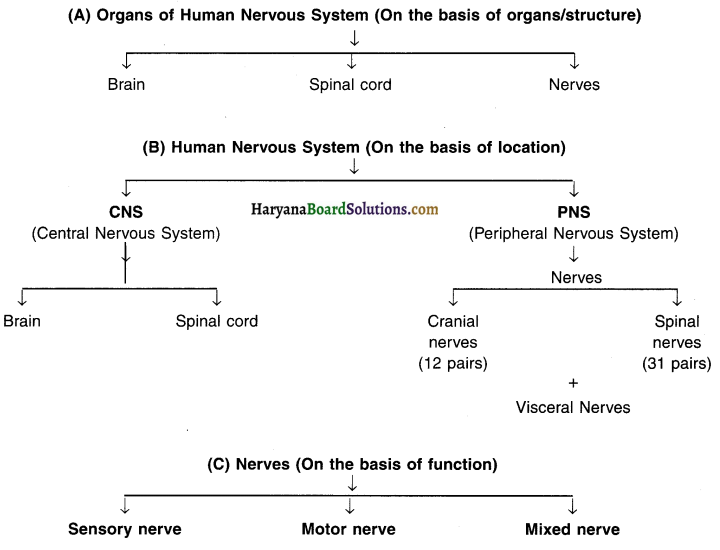
HBSE 10th Class Science Important Questions Chapter 7 Control and Coordination 3

  • The Central Nervous System of a human being is one of the important parts of the control and co-ordination system of the body.
  • The Peripheral Nervous System does the task of establishing communication between the central nervous system and the other parts of the body.

Question 15.
Explain the structure and functioning of human brain along with a diagram.
Answer:
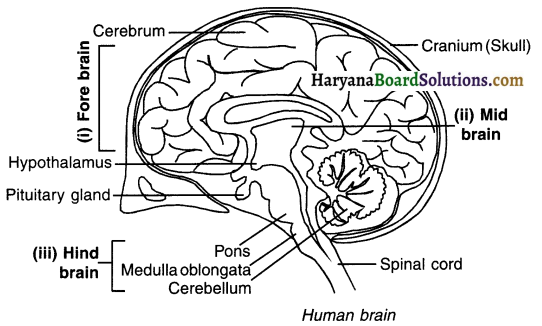
Human brain is divided into three major parts:
(i) Fore brain,
(ii) Mid brain and
(iii) Hind brain.

(I) Fore brain :

  • Fore brain is the main thinking part of the brain.
  • It has regions which receive sensory impulses from various receptors.
  • Separate areas of the fore-brain are specialized for hearing, smell, sight, etc.
  • There are other separate areas where this sensory information is interpreted by putting it together with information from other receptors as well as with information that is already stored in the brain. Finally, a decision is made by the brain considering all the information it gathers.
HBSE 10th Class Science Important Questions Chapter 7 Control and Coordination 4

(ii) Midbrain:

  • Mid brain connects the forebrain and hind brain.
  •  It is the centre for visual and auditory reflexes.

(iii) Hind brain:

  • Hind brain consists of three regions: (A) Cerebellum which lies on dorsal side and (B) Pons and (c) Medulla oblongata.
  • It controls involuntary activities like breathing, heart-beat, blood pressure, peristaltic movements, etc.

HBSE 10th Class Science Important Questions Chapter 7 Control and Coordination

Question 16.
How is the central nervous system protected? OR How is the brain protected from external injuries? OR How are the delicate organs of human nervous system protected? OR Give reason: The central nervous system is well protected.
Answer:
1. The central nervous system (CNS) consists of the brain and spinal cord.
2. The brain is protected by an extremely hard bony-box called cranium (skull). The skull envelopes the brain.
3. Inside the skull, the brain lies within the cerebro-spinal fluid-filled balloon-like structure which provides cushioning and works as a shock absorber.
4. The spinal cord is protected in a hard skeletal structure called a vertebral column or backbone.

Question 17.
How does the nervous tissue cause an action?
Answer:
(a) Role of nervous tissue in causing the action:

  • The neurons receive the stimuli from the surroundings with the help of sensory organs namely eyes, ears, nose, tongue and skin.
  • Then the information is sent to the central nervous system (mostly to the brain).
  • The brain analyzes the stimulus and makes the decision about what has to be done. According to this, the order is formulated. Now this decision order is sent to the related muscles through the neurons.
  • Finally, the muscles act accordingly and thus the whole action response takes place.

(b) Role of muscle tissue in causing the action:

  • When a nerve impulse reaches the muscle, the muscle fibre moves. This movement starts at the cell level.
  • The muscle cells will move by changing their shape so that they can become short.
  • The musde cells have special proteins that change their shape as well as their at angement in the cell in response to the nerve impulses. When this happen, the proteins get arranged in a different manner and hence muscle movement takes place.
  • This movement of muscle is known as voluntary movement of muscle.

Question 18.
Write a note on movement of voluntary muscles.
Answer:
Role of muscle tissue in causing the action:

  • When a nerve impulse reaches the muscle, the muscle fibre moves. This movement starts at the cell level.
  • The muscle cells will move by changing their shape so that they can become short.
  • The musde cells have special proteins that change their shape as well as their at angement in the cell in response to the nerve impulses. When this happen, the proteins get arranged in a different manner and hence muscle movement takes place.
  • This movement of muscle is known as voluntary movement of muscle.

Question 19.
Explain plant movement In brief.
Answer:
Plant movement:

  • Plants remain fixed at a place with their roots in the ground and so they cannot move from one place to another.
  • However, movement of individual parts of a plant such as root, leaves, etc. is possible when they are subjected to some external stimuli like sunlight, gravitational force, water, touch, etc. Such movements of plants are called plant movements.
  • The plant movement with respect to external stimuli falls into two main categories: (I) Tropism and (II) Nastism.

Question 20.
Explain “Plants show two different kinds of movements”. OR State and explain briefly the types of movements in plants.
Answer:
The movement of plants can be classified into two types. They are:
(1) Growth dependant movement:
→ When seeds are planted, they sprout as a plant and grow taller with time. This is directional movement.
(2) Growth independent movement.

HBSE 10th Class Science Important Questions Chapter 7 Control and Coordination

Question 21.
How is co-ordination in plants different from co-ordination in animals? OR Plants co-ordinate slowly as compared to animals. OR Give scientific reason — “In general, the plants cannot respond to stimulus quickly”.
Answer:
1. The change in the environment to which the organisms respond and react is called stimulus (Plural: stimuli). Animals possess nervous system as well as hormones for co-ordinating their activities whereas plants have only hormones for responding to stimulus.
2. Animals have sense organs such as nose, ears and eyes which help them sense things and activities faster.
3. Plants too are capable to sense the effect of gravity, light, water, chemicals and touch but only by the means of their hormones.
4. Thus, plants identify all these environmental changes only with the help of their hormones. So, since plants are devoid of nervous system. they cannot respond to stimulus quickly.

Question 22.
How do some plants respond immediately on touching? Give an example. OR How do sensitive plants detect the touch and show movement?
Answer:
1. Generally, when we touch the plants (like chhui-mui or lajamani), they use electrical or chemical means to convey this information from cell to cell.
2. Here, the cells of plants change their shape by changing the amount of water in them. As a result, the cells may swell-up or shrink. Consequently. the shape of the cell gets changed.
Example:
When we touch the leaves of a chhui-mui (= Lajamani) plant i.e. a sensitive’ or ‘touch-me-not’ plant of mimosa family, it immediately begins to fold-up and droop.

Question 23.
What are tendrils? Explain. OR Explain the movement in the pea plant due to growth.
Answer:
1. In some plants, -a special thread like part arise from various parts of the plant, which are known as tendrils.
2. Such tendrils are highly sensitive to touch. When the thread structure comes in contact of any hard-support, it twists to it and starts growing in that specific direction.
3. Such type of plants are called climbers (t). For example, pea plant.
4. Because this growth is directional, it appears as if the plant is moving.

Question 24.
(a) What is meant by tropism? Explain with example.
(b) Mention the types of tropism. Explain each one in detail.
Answer:
(A) Tropism (Tropic movement) :

  • It the growth movement (response) in a plant organ is due to the effect of an external and directional stimuli, then it is called tropism or tropic movement.
  • It the plant shows growth in the direction of the stimulus, then it is called positive tropism whereas if the plant shows growth away from the stimulus, it is called negative tropism.
  • Plants show movement with respect to five stimuli.

HBSE 10th Class Science Important Questions Chapter 7 Control and Coordination

(B) Types of tropism:

StimulusType of tropism the stimulus causes and its details
1. LightPhotoperiodism:

  • Movement of plant growth in response to light is calledphotoperiodism.
  • Stems respond to light and bend towards it. This is called positive photoperiodism shown by stem.
  • Roots of plants bend away from light. This is called negative photoperiodism shown by roots
2. GravityGeotropism:

  • Movement of plant growth in response to gravity is called geotropism.
  • Stem always grow away from gravity of earth i.e. stems show negative geotropism while root always grow towards the gravity of earth i.e. roots show positive geotropism
3. ChemicalChemotropism:

  • Movement of plant growth in response to a chemicalstimulus is called chemotropism.
  • For example, the growth of pollen tube in the downward direction towards ovule during the process of fertilization.
4. WaterHydrotropism:

  • The movement of a plant growth part in response to water is known as hydrotropism.
  • For example, the roots of plant always grow towards the water. Thus, roots show positive hydrotropism.
5. TouchThigmotropism:

  • The directional movement of a plant growth in response to touch is called thigmotropism.
  • For example, ‘Touch me not’ plant close leaves themselves when touched.

Question 25.
What is the difference between photo nasty and thermonasty?
Answer:
Photonasty is a movement of the plant in response to light, whereas thermonasty is a movement of the plant in response to temperature. For example, flowers of sunflower and lotus open their petals in the morning when sunlight falls on them. Similarly, when temperature is increased, the crocus flower opens up.

Question 26.
What is chemical communication or hormonal co-ordination? Explain. OR What are hormones? Explain.
Answer:
1. One of the major limitations of nerve impulses is that they cannot reach each and every cell of animal body. Hence, there exists another means of communication which is called chemical communication or hormonal co-ordination.
2. Hormonal co-ordination takes place with the help of special chemical compounds called hormones.
The hormones are secreted by various glands of the endocrine system within the body.
3. Hormones are known as chemical co-ordinators or even chemical messengers.
4. Hormones are produced by a group of cells, get transported to a desired location and then act upon the cells of the target area simply by diffusion.
5. Although hormonal co-ordination takes place slowly, it can reach all the desired cells of the body.
6. Adrenaline, thyroxin, insulin, etc. are some of the hormones released in the body.

HBSE 10th Class Science Important Questions Chapter 7 Control and Coordination

Question 27.
Describe plant hormones.
Plant hormone:
1. Plant hormones are special chemical compounds which are synthesized at one place/organ of the plants and migrate to the target organ to act. They play an important role in control and co ordination in plants, as well as in growth, development and responses to the environment.

Control and co-ordination in plants:

  • Hormonal action is the main weapon to respond to various stimuli in the plants.
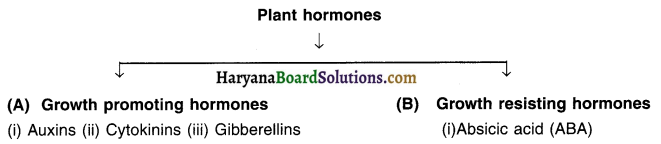
  • Basically, there are two types of plant hormones. They are —
HBSE 10th Class Science Important Questions Chapter 7 Control and Coordination 5

(A) Growth-promoting hormones:

(i) Auxins:

  • It particularly acts on the areas of shoot-tip and root-ends, It helps the cells to grow longer.
  • When light comes from one side of the plant. auxins diffuse towards the shady side of the shoot.
    The concentration of auxin stimulates the cells to grow longer on the shoot side, away from the light. Consequently, plants appears to bend towards light.

Gibberel lins:

  • It helps in the growth of the cells and the stems.

Cytokinins:

  • It is present in the higher concentration in the areas of the plants where rapid cell division occurs. For example, fruits and seeds.
  • It promotes cell-division.

(B) Growth resisting / inhibitory hormones:

(i) Abscisic Acid (ABA):

  •  It is responsible for wilting and falling of the leaves.
  • It is responsible for the detachment of leaves, flowers and fruits.

Question 28.
Describe human endocrine system and give a list of glands in human body.
Answer:
1. Human nervous system and endocrine system work in the co-ordination with each other.
2. The endocrine system is the network of glands in the body. These glands release hormones.

Hormones:

  • Basically, hormones are the chemical substances (chemical messengers).
  • They play an important role in various metabolic processes.
  • The hormones are secreted in a small quantity and reach to the target organ by blood. Generally, the target organ is nearby.

Glands: There are two types of glands.
They are — (1) Exocrine glands and (2) Endocrine glands.

Main endocrine glands of the human body
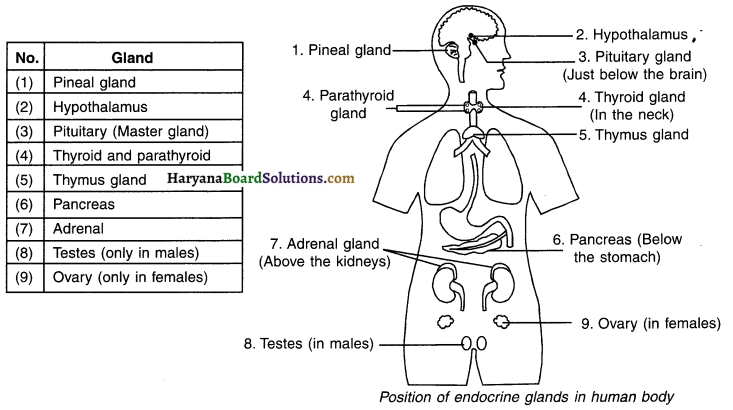
HBSE 10th Class Science Important Questions Chapter 7 Control and Coordination 6

Question 29.
Give an idea about the hormones released by glands. Also state the main functions of these hormones.
Answer:

GlandHormone it releasesFunction of the hormone
AdrenalAdrenalineRegulates heart-beat rate, breathing. blood pressure and carbohydrate metabolism. It plays an important role in fright, fight and flight.
ThyroidThyroxinThyroxin regulates carbohydrate, protein and fat metabolism in the body. This enables best balance for growth.
PituitaryGrowth hormone and many other hormonesGrowth hormone regulates growth and development of the body. Also induces other glands
Testes (in males)

HBSE 10th Class Science Important Questions Chapter 7 Control and Coordination

TestosteroneDevelopment and functioning of male sex organs and to develop the secondary sexual characters such as body hair, muscle development, change in voice, etc
Ovaries (in females)Estrogen and progesteroneHelps in fertilization of egg and development of secondary sexual characters such as breast enlargement, changes in physical body, etc.
PancreasInsulinHelps in regulating blood sugar levels

Question 30.
Write a short note on adrenal gland. OR Which hormone is called fight or flIght hormone? State its effect on the body.
Answer:
Adrenal gland:
1. The adrenal gland releases a hormone called adrenaline. Adrenaline hormone is also called fight or flight (run-away) hormone.
2. This hormone is secreted directly into the blood and carried to different parts of the body.

Effects of adrenaline:

  • When adrenaline is released the heart beats become fast and so, more oxygen gets supplied to our heart.
  • The muscles around the small arteries of heart and other organs contract due to which the digestive system and skin receive less blood. This diverts the blood to our skeletal muscles.
  • Moreover, the breathing rate increases due to contractions of the diaphragm and the rib muscles.
  • All these responses together enable the animal and human body to be ready for dealing with the situation of fight or flight i.e. fight or run-away immediately from the situation.

Question 31.
Write a note on thyroid gland and the importance of the hormone It releases.
Answer:
Thyroid gland:
1. Thyroid gland secretes a hormone called thyroxin.
2. Thyroxin controls metabolism rate of carbohydrate, protein and fat.
3. Deficiency of iodine can cause deficiency of thyroxin in the body.
4. Deficiency of iodine in our diet results in hypothyroidism and enlargement of thyroid gland. This results into a disease called goiter.
5. Neck of people suffering from goiter becomes swollen.
6. Goiter can be prevented by consuming iodized salt i.e. salt containing iodine.

Question 32.
It is highly recommended to consume iodized salt on a daily basis. Give reason.
Answer:
Adrenal gland:
1. The adrenal gland releases a hormone called adrenaline. Adrenaline hormone is also called fight or flight (run-away) hormone.
2. This hormone is secreted directly into the blood and carried to different parts of the body.

Effects of adrenaline:

  • When adrenaline is released the heart beats become fast and so, more oxygen gets supplied to our heart.
  • The muscles around the small arteries of heart and other organs contract due to which the digestive system and skin receive less blood. This diverts the blood to our skeletal muscles.
  • Moreover, the breathing rate increases due to contractions of the diaphragm and the rib muscles.
  • All these responses together enable the animal and human body to be ready for dealing with the situation of fight or flight i.e. fight or run-away immediately from the situation.

Question 33.
Write a short note on pancreas.
Answer:
Pancreas:
1. Pancreas is an endocrine gland as well as an exocrine gland.
2. As an endocrine gland. it secretes insulin and glucagon which maintain sugar level in the blood.
3. If insulin is not secreted in proper amounts, the sugar level in blood rises causing many harmful effects.
4. When the sugar level in blood rise, it gets detected by the cells of the pancreas. The cells respond to this rise by producing more insulin. As the blood sugar level falls, insulin secretion is reduced.

HBSE 10th Class Science Important Questions Chapter 7 Control and Coordination

Question 34.
How is hormone secretion regulated?
Answer:
1. Hormone secretion is regulated by the feedback mechanism. In general, a particular gland secretes a specific hormone.
2. The hormone reaches to the target organ and performs its function. when that specific function completed, there is no need of that hormone. so, the message reaches to the brain and the brain stops that gland to secrete the hormone further. this is how hormone secretion is regulated.

Question 35.
Giving response to a stimulus is the basic characteristic of every living organism. give reason.
Answer:
1. The creation of living organisms is such that all of them experience the effects of changes in the atmosphere that surrounds them.
2. These effects work as stimuli for the organisms and they respond by making some changes in their bodies.
3. Slow or fast, but the organism will respond to stimuli such as heat, cold, sound, touch, etc.
4. Thus, response to stimuli is the basic characteristic of every living organisms.

Question 36.
Label the parts of a neuron in the given figure.
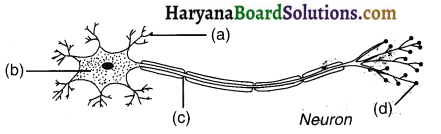
HBSE 10th Class Science Important Questions Chapter 7 Control and Coordination 7
Answer:
(a) Dendrite
(b) Cell body
(c) Axon
(d) Nerve ending

Question 37.
We respond very quick to reflexes but very slow to the act of thinking. Give reason.
Answer:
1. Thinking is a complex activity and so it involves a complicated interaction of several nerve impulses that too from many neurons.
2. Thinking center is located in forebrain.
3. When this centre receives signals through sensory nerves from various parts of the body, it analyzes the signals and formulates the instructions. The instructions then transmit from brain to the target organ. This process takes some time and hence the response is slow.
4. In reflex action, initially the brain is not involved in decision making. So, the instruction is generally given by spinal cord before the message could reach the brain for analysis and decision making purpose. As a result, the decision making is quite quick.
5. Hence, we respond very quick to reflexes but very slow to the act of thinking.

Question 38.
Label the parts (a), (b), (c) and (d) and show the direction of flow of electrical signals in Figure.
Answer:
(a) Sensory neuron
(b) Spinal cord (CNG)
(c) Motor neuron
(d) Effector (muscle in arm)
HBSE 10th Class Science Important Questions Chapter 7 Control and Coordination 8

Question 39.
Name the plant hormones responsible for the ………………
(a) elongation of cells
(b) growth of stem
(c) promotion of cell division
(d) falling of senescent leaves
Answer:
(a) Auxiri – elongation of cells
(b) Gibberellin – growth of stem
(c) Cytokinin – promotion of cell division
(d) Abscisic acid – falling of senescent leaves

Question 40.
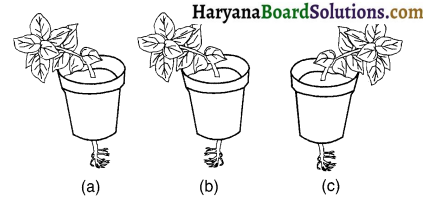
Out figure (a), (b) and (c), which appears more accurate and why?
Answer:
Figure (a) is more appropriate.
Reason: In a plant, shoots are negatively geotropic and hence grow upwards and roots are positively geotropic and so grow downwards.
HBSE 10th Class Science Important Questions Chapter 7 Control and Coordination 9

Question 41.
Why do multicellular organisms use hormonal system in addition to the nervous system? Multicellular organisms use hormonal system in addition to the nervous system due to following two reasons:
Answer:
1. The nervous system transmit electrical impulses. The electrical impulse can reach only those cells that are connected to the PNS.
2. Secondly, after the generation of the electrical impulses, the cell takes some time to reset or to normalize.
3. As a result, multicellular organisms use hormonal system in addition to the nervous system.

HBSE 10th Class Science Important Questions Chapter 7 Control and Coordination

Question 42.
State the characteristics of animal hormones.
Answer:
Characteristics of animal hormones:
1. Hormones are chemical compounds secreted from specific endocrine glands.
2. Hormones are chemical co-ordinators and are also called chemical messengers.
3. Generally, they control slow activities of the body such as growth and metabolism.
4. They are synthesized at places away from where they need to act. They then travel to the target cells, tissues or organs and act by simple diffusion.
5. They are transported through blood.
6. They are secreted in very small quantities.

Question 43.
Give an idea about hormones related with growth in human.
Answer:
Mainly two hormones are related with growth in humans. They are —
(1) Growth hormone:

  • It is secreted by the pituitary gland.
  • Growth hormone regulates growth and development of the body.

(2) Thyroxln:

  • It is secreted by thyroid gland.
  • Thyroxin regulates carbohydrate, protein and fat metabolism in the body. This is necessary for balanced growth of body.

Question 44.
Which disorders can we face If hormonal balance gets disturbed?
Answer:
If hormones are secreted in inappropriate quantities, we may face the following disorders:
(1) Gigantlsm: It is caused due to excess secretion of growth hormone. Under this disorder, an individual becomes extremely tall.
(2) Dwarfism: Deficiency of growth hormone in childhood leads to dwarfism. Under this disorder, the height of an individual does not grow much and he remains dwarf-sized.

(3) Goiter: It is caused by the deficiency of iodine in our diet.

  • Iodine deficiency affects the synthesis of thyroxin and causes goiter.
  • The thyroid gland gets enlarged which results in enlargement of the neck region.

(4) Diabetes: If insulin hormone is not secreted in sufficient amounts, the sugar level rises in the blood. This causes diabetes.

Question 45.
A person suffering from diabetes is given the injections of insulin. Give reason.
Answer:
1. In human bodies, pancreas release a hormone called insulin which regulates the level of sugar in the blood.
2. When insulin is not secreted in proper amounts, the sugar level in the blood rises and the person may suffer from a disease called diabetes.
3. Diabetes can be harmful for heart, brain, eyes, kidneys, etc.
4. Hence, in order to save the diabetic person from such harmful effects, he is given the injections of insulin which regulates his sugar level in the blood.

HBSE 10th Class Science Important Questions Chapter 7 Control and Coordination

Question 46.
Give differences between: Plant hormones and animal hormones
Answer:

Plant hormones

Animal hormones

1. Although plant hormones are secreted by plant cells there are no glands.1. Animal hormones are secreted by endocrine glands
2. Plant hormones are either growth promoting or growth inhibiting.2. Animals do not have inhibitor hormone for growth.
3. Plant hormones reach to their target site by simple diffusion.3. AnimaI hormones reach to their target site by flowing along with blood.
4. Secretion of plant hormones is not regulated by feedback mechanism.4. Secretion of animal hormones is regulated by feedback mechanism.

Question 47.
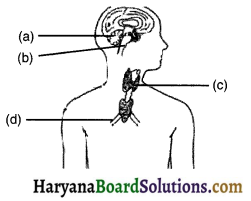
Label the endocrine glands shown In the figure. Also state their locations.
HBSE 10th Class Science Important Questions Chapter 7 Control and Coordination 10
Answer:
The endocrine glands and its location are as follows:

GlandsLocation
(a) Pineal glandAttached to dorsal side of brain
(b) Pituitary glandJust below the brain
(c) ThyroidAttached to the windpipe
(d) ThymusLower part of the neck and
upper part of chest

Question 48.
Differentiate between tropic movement and nastic movement.
Answer:

Tropic movementNastic movement
1. The movement of curvature in a plant organ due to the effect of an external and directional stimulus is called tropism.

2. Tropic movement is a directional movement.
3. Examples: Photoperiodism, geotropism, chemotropism, hydrotropism and thermotropism.

1. The movement of plant in response to an external stimulus in which the direction of response is not determined by the direction of stimulus is called nastic movement.
2. Nastic movement is not a directional movement.
3. Examples: Thigmonasty, photonasty and thermonasty.

HBSE 10th Class Science Important Questions Chapter 7 Control and Coordination

Question 49.
Differentiate between response in plants and response in animals.
Answer:

Response in plantsResponse in animals
1. Plants have only hormones for responding to stimulus.
2. Plants respond quite slowly.
3. Plants do not have sensory organs to respond to changes.
4. Plants do not have any muscular system for transfer of information.
1. Animals possess nervous system as well as hormones for co-ordinating their activities.
2. Animals respond quite quickly.
3. Animals have sensory organs to respond to changes.
4. Animals have well developed muscular system for transfer

Question 50.
Differentiate between movement of leaves of sensitive plants and movement of shoot towards light.
Answer:

Movement of leaves of sensitive plantsMovement of shoot towards light
1. It is a nastic movement which does not depend on the direction of stimulus.
2. Here the stimulus is ‘touch’.
3. This movement is caused when a plant is touched at the base which leads to sudden loss of water from that region.
4. This is not a growth movement.
1. It is a tropic movement which depends on the direction of stimulus.
2. Here the stimulus is light’.
3. This movement is caused by unequal growth of two sides of the shoot.
4. This is a growth movement.

Question 51.
Differentiate between central nervous system and Autonomous nervous system.
Answer:

Central nervous systemAutonomous nervous system.
1. It comprises of brain and spinal cord.
2. It regulates voluntary, involuntary and reflex actions.
3. It has no further sub-types.
1. It comprises of special network of nerve fibers.
2. It regulates involuntary activities only.
3. Sympathetic nervous system and para sympathetic nervous system are its two sub-types.

Question 52.
Differentiate between cerebrum and cerebellum.
Answer:

CerebrumCerebellum
1. It is a major part of forebrain.
2. It is divided into four lobes.
3. It co-ordinates tasks like seeing, hearing, touch and smell, etc.
1. It is a major part of hindbrain.
2. No such division occurs.
3. It co-ordinates tasks of body movement such as walking, dancing, riding bicycle, etc.

HBSE 10th Class Science Important Questions Chapter 7 Control and Coordination

Question 53.
Smita’s father was complaining about frequent urination, pain in legs and a frequent weight loss to Smite’s mother and she discussed the things with her daughter, Smita she when returned from her school. Listening to this, Smite said to her mother that her father should visit a doctor, who told her mother that her husband is having an elevated level of blood glucose. He should take care of his diet and should exercise regularly to maintain his normal glucose level. On the basis of given text, answer the following questions.

Questions:
(1) Name the disease he is suffering from and name the hormone, whose deficiency causes it.
(2) Identify the gland that secretes it and mention the function of this hormone.
(3) Explain, how the time and amount of secretion of this hormone is regulated in human system?
(4) What values were shown by Smita and her father’?
Answers:
(1) Smita’s father is suflenng from diabetes. It Is caused by the deficiency of insulin hormone in the body.
(2) Pancreas secretes insulin. Insulin helps in regulating the sugar level in the blood.
(3) When the level of sugar increases in the blood, the body responds by producing more insulin. When blood sugar level falls, secretion of insulin gets reduced.
(4) The values shown by Smita are empathy and alertness in decision making. The values shown by her father are neglecting his health.

Question 54.
On a beautiful sunny day, Pritesh was in a beautiful mood f ride. His father was equally keen and both of them rode on his motorcycle. As soon as they reached the main cross road, they saw a tragic accident of a motorcycle with a car. The rider was not wearing helmet. So, on getting hit, the rider of the motorcycle fell and was again hit by the road divider. Crowd gathered and the rider was immediately shifted to the nearby hospital through an ambulance. Prltesh’s father looked at Pritesh with utmost anger and merciful state at the same time because Pritesh too was not wearing the helmet and he too could meet such an accident.

Questions:
(1) Which part of brain is involved when you are learning to drive a vehicle?
(2) Injury to which part of brain leads to instant death of an individual? Why?
(3) Pritesh became quite fearful. Which gland do you think became more active when he saw the accident? Which hormone was poured in blood? What changes he might have felt in his body?
(4) Which values did Pritesh’s father displayed?
Answers:
(1) Cerebrum and cerebellum are involved while learning to ride.
(2) Injury to medulla oblongata in the brain leads to instant death. This is because all the involuntary activities are controlled by It.
(3) Seeing such an event, the adrenal gland of Pritesh must have become active. As a result. adrenaline hormone must have secreted in blood. Under such situation, Pritesh perspired and his heartbeats and breathing rate increased.
(4) Pritesh’s father showed the value of empathy and respecting one’s life because it is extremely precious. Moreover, he also showed the value of concern of a father for the son.

Question 55.
After studying chapter Control and Co-ordination, you learnt that probably your maid is suffering from one of the diseases discussed in that chapter. The front portion of her neck was bulged out abnormally. On discussing with her you also found that she faced difficulty in breathing and even swallowing food. Now, look at the questions given here and answer them.

Questions:
(1) From which disease do you think your maid is suffering?
(2) What is the main cause of this disease?
(3) How can you help her at an immediate basis?
(4) What values did you display here?
Answers:
(1) The symptoms show that she is suffering from goiter.
(2) Goiter is mainly caused due to deficiency of iodine.
(3) On an immediate basis we can provide her with iodine supplements as well as recommend her to use only iodized salt in her food.
(4) The values of alertness, caring and sound decision making are displayed here.

HBSE 10th Class Science Important Questions Chapter 7 Control and Coordination

Question 56.
There are three plants A, B and C. The flowers of plant A open their petals in bright light during the day but close them when it gets dark at night. On the other hand, the flowers of plants B open their petals at night but close them during the day when there is bright light. The leaves of plant C fold up when touched with fingers or any other solid object.

(a) Name the phenomenon shown by the flowers of (j) plant A, and (ii) plant B.
(b) Name one flower each which behaves like the flower of (i) plant A, and (ii) plant B.
(c) Name the phenomenon exhibited by the leaves of plant C.
(d) Name a plant whose leaves behave like those of plant C.
(e) Which plant(s) exhibit phenomenon based on growth movement?
Answer:
(a) (i) Photonasty (ii) Photonasty
(b) (i) Dandelion flower (ii) Moonflower
(c) Thigmonasty
(d) Sensitive plant (Mimosa pudica)
(e) A and B

Very Short Answer Type Question

Question 1.
Which two body systems are important in control and co-ordination?
Answer:
Hormonal system (= Endocrine system) and Nervous system.

Question 2.
Name main components of a neuron.
Answer:
Dendrites, Cell body and Axon.

Question 3.
What Is the function of dendrite?
Answer:
It carries nerve impulses which has been received from the axis of the previous neuron towards the cell-body of a neuron.

Question 4.
What is the role of axon?
Answer:
It carries nerve impulses from the cell body towards next neuron’s dendrite or tissue.

HBSE 10th Class Science Important Questions Chapter 7 Control and Coordination

Question 5.
Define stimuli.
Answer:
An event that encourages the action or creates sensation is called stimulus. (Plural = Stimuli)

Question 6.
Define Response.
Answer:
The reaction of living organisms against the stimulus induced by the change in the external environment is called response.

Question 7.
Define Co-ordination.
Answer:
Different organs of the body jointly function systematically against the stimuli and react to express proper response against the stimuli. This process is called coordination.

Question 8.
What is a spinal cord? What ¡s its function?
Answer:
Spinal cord is a cylindrical structure which is the extension of medulla oblongata. Spinal cord is a part of Central Nervous System (CNS).

Question 9.
State the function of spinal cord.
Answer:
(i) To conduct sensory information from peripheral nervous system to the brain.
(ii) To conduct motor information from brain to various effectors.

Question 10.
Reflex arc of some animals is much evolved. Why?
Answer:
Because thinking process of the brain of these animals is not so fast. So, the evolved reflex arc serves as an efficient way of performing various functions.

Question 11.
How do we feel that we have eaten enough?
Answer:
The centre of hunger and satiety are located in a separate part of the fore-brain. They give the feeling of being hungry or satisfied.

Question 12.
Name the most important part of the human brain.
Answer:
Cerebrum

Question 13.
State one function each of cerebellum and Pons.
Answer:
Cerebellum maintains balance of body and posture. Pons regulates respiration.

HBSE 10th Class Science Important Questions Chapter 7 Control and Coordination

Question 14.
Give the functions of medulla oblongata.
Answer:
Medulla oblongata controls involuntary functions such as breathing, heart beats, digestion, blood pressure, pristaltic movements of alimentary canal, etc, It also controls reflexes such as coughing, sneezing, swallowing, secretion of saliva and vomiting.

Question 15.
What does CNS stand for?
Answer:
CNS is the abbreviation for Central Nervous System.

Question 16.
Which is the most important part of the human brain?
Answer:
Cerebrum. It is also the largest part of the brain.

Question 17.
State two examples of movement that we make for protecting ourselves.
Answer:
(1) When we suddenly see bright light, we compress our pupils.
(2) We pull back our hand when we touch a hot object.

Question 18.
What are the components of peripheral nervous system?
Answer:
Cranial nerves and spinal nerves

Question 19.
Why thinking Is considered a complex activity?
Answer:
Thinking involves a highly complex interaction of several nerve impulses from many neurons. Hence,……..

Question 20.
How does a muscle cell move?
Answer:
Muscle cells move by changing their shape i.e. either by shortening or elongating.

Question 21.
What are phytohormones?
Answer:
The chemical substances which help in control and co-ordination in plants are known as phytohormones.

Question 22.
Give examples of phytohormones.
Answer:
Auxins, Gibberellins, Cytokinins, Abscisic acid (ABA), Ethylene, etc.

HBSE 10th Class Science Important Questions Chapter 7 Control and Coordination

Question 23.
What is photoperlodism?
Answer:
The developmental response of plants to the relative lengths of light and dark periods is known as photoperiodism.

Question 24.
What are the main types of a plant movement?
Answer:
(i) Growth dependant movement and
(ii) Growth independent movement

Question 25.
Name the plant which shows thigmonasty.
Answer:
Mimosa plant

Question 26.
Give an example of movement of a plant part which is caused by the loss of water.
Answer:
Thigmonastic movement as seen in mimosa plant.

Question 27.
What does a root do in response to gravity? What is this phenomenon known as?
Answer:
In response to gravity, the root grows towards the earth. This phenomenon is known as geotropism.

Question 28.
What does a stem do in response to light? What is this phenomenon known as?
Answer:
Stem bends towards the light. This phenomena is called phototropism. For stems, it is also called positive phototropism.

Question 29.
What does a stem do In response to gravity? What is this phenomenon known as?
Answer:
Stem always grows away from the earth i.e. away from gravity. This is called negative geotropism.

Question 30.
What does a root do in response to light? What Is this phenomenon known as?
Answer:
The roots of the plant bend away from the light.
This is called negative phototropism.

HBSE 10th Class Science Important Questions Chapter 7 Control and Coordination

Question 31.
Name one hormone secreted by the pituitary gland.
Answer:
Thyroid Stimulating Hormone (TSH).

Question 32.
Where are hormones synthesized (made) in the human body?
Answer:
Hormones are made by specialized glands or tissues throughout the body. Most but not all hormones are part of endocrine system.

Question 33.
Which gland secretes the growth hormone ?
Answer:
Pituitary gland

Question 34.
Name the disease caused by the deficiency of insulin hormone in the body.
Answer:
Diabetes

Question 35.
Why are hormones called chemical messengers?
Answer:
Hormones carry information in the form of chemicals which regulate the biological processes of body. Hence,………..

Question 36.
Why both, chemical signal and electrical impulses are needed in higher animals?
Answer:
In higher animals, electrical impulses bring immediate response to only those cells that are connected by nervous tissue while chemical
signals reach to each arid every cells of body. Hence, …..

Question 37.
Which mechanism is considered as a second way of control and co-ordination in our body?
Answer:
Secretion of hormones by the endocrine system is considered as a second way of control and co-ordination in our body.

Question 38.
Where is growth hormone auxin synthesized and where is it diffused?
Answer:
Auxin is synthesized at the shoot tip and is diffused at that side of the shoot which is in shade.

HBSE 10th Class Science Important Questions Chapter 7 Control and Coordination

Question 39.
State the site of secretion as well as the function of growth hormone releasing factor.
Answer:
Site of secretion: Hypothalamus; Function: Stimulates the pituitary gland to release growth hormone.

Fill in the Blanks

1. ………… is the unit of human nervous system.
Answer:
neuron

2. The word ‘reflex’ means …………
Answer:
Sudden action

3. In a neuron, conversion of electrical signal to a chemical signal occurs at/in …………
Answer:
axonal end

4. The highest co-ordinating part …………
Answer:
brain

5. Aging process in the plants is phytochrome
Answer:
Cytokinins

6. …………  causes seed dormancy in plants.
Answer:
ABA

7. The main function of abscisic acid in plants is to …………
Answer:
inhibit growth

8. The substance that triggers the fall of mature leaves and fruits from plants is due to (hormone).
Answer:
abscisic acid

9. The plant movement with respect to external stimuli falls into two main categories which are ……… and ………..
Answer:
Tropism; Nastism

10. In comparison to animals, plants are devoid of …………  for coordinating activities.
Answer:
Nervous system

11. Growth of pollen tube is an example of …………
Answer:
Chemotroplsm

12. The auxin hormone acts particularly on and of …………  the plant body.
Answer:
Shoot; root

13. ………… is also known as a master gland.
Answer:
Pituitary gland

14. Iodine is necessary for the synthesis of …………  hormone.
Answer:
Thyroxln

15. Dwarfism results due to …………
Answer:
Less secretion of growth hormone

16. The hormone which increases the fertility in males is called …………
Answer:
testosterone

True Or False

1. Except unicellular organisms, all respond to stimuli. — False
2. We can feel touch due to thigmo receptors. — True
3. Both neurons and hormones can be considered as messengers. — True
4. Generally, the nervous system co-ordinates fast activities whereas endocrine system co ordinates slow activities. — True
5. Electrical impulses will reach only those cells which are connected by nervous tissue. — True
6. Mid brain is the centre for visual and auditory reflexes. — True
7. A nerve impulse makes the muscle move. — True
8. Generally, hormones travel far off in the body to deliver the message. — False
9. Plants show two types of movement. — True
10. Cytokinin is present in the higher concentration in the areas of the plants where rapid cell division occurs. — True
11. Pancreas maintains carbohydrate, protein and fat metabolism in the body. — False
12. Pancreas is an endocrine gland as well as an exocrine gland. — True

HBSE 10th Class Science Important Questions Chapter 7 Control and Coordination

Match the Following 

Question 1.

Column-IColumn-II
A. Photoreceptor
B. Phonoreceptor
C. Olfactory receptor
D. Gustatory receptor
p. Detects smell
q. Detects light
r. Detects taste
s. Detects sound

Answer:
(A q), (B – s), (C – p), (D – r)

Question 2.

Column-IColumn-II
A. Bony protection of brain
B. Membranous covers of brain
C. Shock absorbing liquid surrounding the brain
p. Cerebrospinal fluid
q. Cranium
r. Meninges

Answer:
(A -q), (B – r), (C – p)

HBSE 10th Class Science Important Questions Chapter 7 Control and Coordination

Question 3.

Column-I (Plant action)Column-II (Phytochrome)
A. Promotes growth
B. Promotes cell division
C. Inhibits growth
D. Promotes growth of tendril around support
p. GA
q. Auxin
r. ABA
s. Cytokinin

Answer:
(A – q), (B – s), (C – r), (D – p)

Question 4.

Column-IColumn-II
A. Metabolism of various nutrients
B. Iodized salt
C. Acromegaly
D. Contraction of uterine muscle during childbirth Vasoconstrictor
p.GH
q. Oxytocin
r. Glucocorticoid
s. ADH
t. Thyroxin
u. Prolactin
y. RH

Answer:
(A – r), (B – t), (C – p), (D – q) (E – s)

HBSE 10th Class Science Important Questions Chapter 7 Control and Coordination Read More »
HBSE 10th Class Maths Notes Chapter 2 बहुपद

Haryana State Board HBSE 10th Class Maths Notes Chapter 2 बहुपद Notes.

Haryana Board 10th Class Maths Notes Chapter 2 बहुपद

→ बहुपद की पात- घर x के बहुपद p (x) में x को उच्चतम घात (power) यहुपद की घात कहलाती है; जैसे बहुपद 5x3 – 4x2 + x – \(\sqrt{2}\) चर x में घात 3 का बहुपद है।

→ घातों एक, दो और तीन के बहुपद क्रमशः रखिक बहुपद, द्विघात बहुपद एवं त्रिवात बहुपद कहलाते हैं।

→ एक द्वियात बहुपद ax2 + bx + c जहाँ a, b, c वास्तविक संख्याएँ हैं और a ≠ 0 है के रूप का होता है।

→ यदि p (x), x में कोई बहुपद है और कोई वास्तधिक संख्या है, तो p(x) में x को k से प्रतिस्थापित करने पर प्राप्त वास्तविक संख्या p(x) का x = k पर मान कहलाती है और इसे P (k) से निरूपित करते हैं।

→ कोई वास्तविक संख्या k, बहुपद p(x) का शून्यक कहलाती है यदि p(k) = 0 हो।

→ किसी रैखिक बहुपद ax + b का शून्यक \(\frac{-b}{a}\) होता है।

→ एक बहुपद p (x) के शून्यक उन बिंदुओं के x-निर्देशांक होते हैं जहाँ y = p(x) का ग्राफ x-अक्ष को प्रतिच्छेद करता है।

→ एक द्विघात बहुपद के अधिक-से-अधिक दो शून्यक और एक त्रिघात बहुपद के अधिक-से-अधिकं तीन शून्यक हो सकते हैं।

→ यदि द्विघात बहुपद ax2 + bx + c के शून्यक α और β हो, तो उनका योगफल व गुणनफल निग्न होगा-
α + β = \(-\frac{b}{a}\), αβ = \(\frac{c}{a}\)

HBSE 10th Class Maths Notes Chapter 2 बहुपद

→ यदि किसी द्विधात बहुपद के दो शून्यक दिए गए हों तो बहुपद होगा-
बहुपद = x2 – (शून्यकों का योग) x + शून्यकों का गुणनफल

→ यदि α, β, γ त्रिपात बहुपद ax3 + bx2 + cx + d = 0 के शून्यक हों, तो उनका योगफल व गुणनफल निम्न होगा-
α + β + γ = \(\frac{-b}{a}\)
αβ + βγ + γα = \(\frac{c}{a}\)
और αβγ = \(\frac{-d}{a}\)

→ यदि α, β व γ एक विधात बहुपद के शून्यक हों तो बहुपद = x3 – (α + β + γ) x2 + (αβ + βγ + γα) x – αβγ

→ विभाजन एल्गोरिथ्म के अनुसार दिए गए बहुपद p (x) और शून्येतर बहुपद g(x) के लिए दो ऐसे बहुपदों q(x) तथा r(x) का अस्तित्व है कि P(x) = g (x) q(x) + r(x),
जहाँ r(x) = 0 है या बात r(x) < घात g(x) है।

HBSE 10th Class Maths Notes Chapter 2 बहुपद Read More »

HBSE 10th Class Maths Important Questions Chapter 9 Some Applications of Trigonometry

Haryana State Board HBSE 10th Class Maths Important Questions Chapter 9 Some Applications of Trigonometry Important Questions and Answers.

Haryana Board 10th Class Maths Important Questions Chapter 9 Some Applications of Trigonometry

Short/Long Answer Type Questions

Question 1.
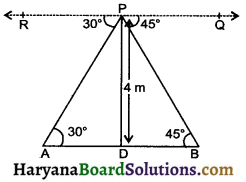
From a point on a bridge across a river the angles depression of the banks on opposite sides of the river are 30° and 45° respectively. If the bridge is at a height of 4m from the banks. Find the width of river.
Solution :
Let A and B represent points on the bank on opposite sides of the river so that AB is the width of river. Pis a on the bridg at a height of 4 m is DP = 4m. We are required to determine the width of the river, which is the length of side AB of ΔAPB
∴ AB = AD + BD
HBSE 10th Class Maths Important Questions Chapter 9 Some Applications of Trigonometry - 1
Angles of depression of the banks on opposite sides of the river are
⇒ ∠APR = 30°
⇒ ∠PAD = 30°
[alternate interior angles]
and ∠BPQ = 45°
∠PBD = 45°
In right triangle APD, we have
tan 30° = \(\frac {PD}{AD}\)
⇒ \(\frac{1}{\sqrt{3}}\) = \(\frac {4}{AD}\)
⇒ AD = 4\(\sqrt{3}\) …………..(1)
In right triangle BPD, we have
tan 45° = \(\frac {PD}{BD}\)
⇒ 1 = \(\frac {4}{BD}\)
⇒ BD = 4 ………….(2)
Adding equ. (1) and (2), we get
AD + BD = 4\(\sqrt{3}\) + 4
= 4 × 1.732 + 4
⇒ AB = 6.928 + 4 = 10.928 m
Hence, width of river = 10.928 m.

HBSE 10th Class Maths Important Questions Chapter 9 Some Applications of Trigonometry

Question 2.
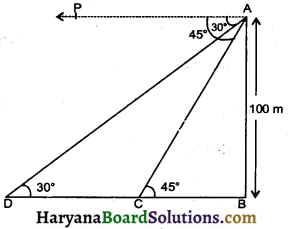
As observed from the top of a 100 m high lighthouse from the sea level, the angles of depression of two ships are 30 and 45°. If one ship is exactly behind the other on same side of lighthouse, find the distance between two ships.
Solution :
Let the AB be the lighthouse of height of 100 m. Let D and C be position of two ships. The angle of depression of two ships are 30° and 45°
HBSE 10th Class Maths Important Questions Chapter 9 Some Applications of Trigonometry - 2
⇒ ∠DAP = 30°
⇒ ∠ADB = 30°
[Alternate interior angles]
and ∠CAP = 45°
⇒ ∠ACB = 45°
In right triangle ADB, we have
tan 30° = \(\frac {AB}{BD}\)
⇒ \(\frac{1}{\sqrt{3}}\) = \(\frac {100}{BD}\)
⇒ BD = 100\(\sqrt{3}\)
⇒ 10 × 1.732 = 173.2 m
In right triangle ACB, we have
tan 45° = \(\frac {AB}{BC}\)
⇒ 1 = \(\frac {100}{BC}\)
⇒ BC = 100 m
⇒ DC = BD – BC
173.2 – 100 = 73.2 m
Hence distance between two ships
= DC = 73.2 m

Question 3.
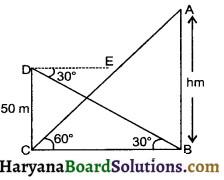
The angle of elevation of the top of a hill from the foot of a tower is 60° and the angle of depression from the top of the tower of the foot of the hill is 30°. If tower is 50 m high, find the height of hill.
Solution :
Let AB be the hill of height hm and CD be the tower of height 50 m.
HBSE 10th Class Maths Important Questions Chapter 9 Some Applications of Trigonometry - 3
Angle of elevation of the top of a hill from the foot of a tower is 60° i.e. ∠ACB = 60° and angle of depression from top of the tower of the foot of the hill is 30 i.e. ∠BDE = 30°.
⇒ ∠DBC = 30°
[Alternate interior angles]
In right triangle BCD, we have
tan 30° = \(\frac {CD}{BC}\)
⇒ \(\frac{1}{\sqrt{3}}\) = \(\frac {50}{BC}\)
⇒ BC = 50\(\sqrt{3}\) ……..(1)
In right triangle ABC, we have
tan 60° = \(\frac {AB}{BC}\)
⇒ \(\sqrt{3}\) = \(\frac {h}{BC}\)
⇒ h = \(\sqrt{3}\)BC ………..(2)
substituting, the value of BC in equ. (2), we get
h = \(\sqrt{3}\) × 50\(\sqrt{3}\)
= 50 × 3 = 150 m
Hence height of hill = 150 m

HBSE 10th Class Maths Important Questions Chapter 9 Some Applications of Trigonometry

Question 4.
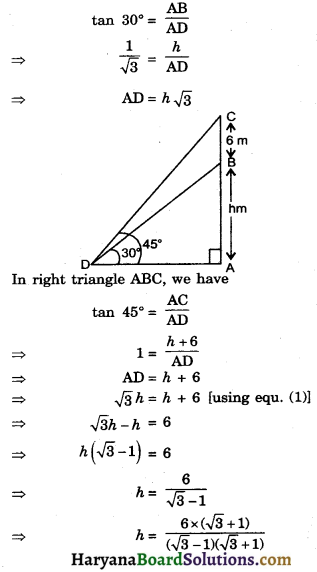
A vertical tower stands on a horizontal plane and is sur mounted by a vertical flag staff of height 6 m. At a point on the plane, the angle of elevation of the bottom and top of the flag staff are 30° and 45° respectvely. Find the height of the tower. Take \(\sqrt{3}\) = 1.73]
Solution :
Let AB be tower of height h m and BC be vertical flag staff of height 6m. At point D on the plane angle of elevation of the bottom and top of the flag staff are 30° and 45° respectively i.e. ∠ADB = 30° and ∠ADC = 45°
In right triangle ABD, we have
HBSE 10th Class Maths Important Questions Chapter 9 Some Applications of Trigonometry - 4
⇒ h = \(\frac{6 \times(1.73+1)}{(\sqrt{3})^2-(1)^2}\)
⇒ h = \(\frac{6 \times 2.73}{3-1}\)
⇒ h = \(\frac{6 \times 2.73}{2}\)
⇒ h = 3 × 2.73
⇒ h = 8.19 m
Hence, height of the tower h = 8.19 m

Question 5.
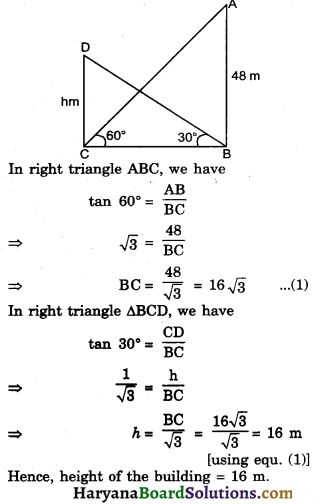
The angle of elevation of the top of a building from the foot of the tower is 30° and the angle of elevation of the top of the tower from the foot of the building is 60°. If the tower is 48 meters high. Find the height of the building.
Solution :
Let AB be tower of the height 48 m and CD be building of height h m. Angle of elevation of the top of a building from the foot of the tower is 30° Le. ∠CBD = 30° and angle of elevation of top of the tower from the foot of the building is 60° L.E. ∠ACB = 60°,
HBSE 10th Class Maths Important Questions Chapter 9 Some Applications of Trigonometry - 5

Question 6.
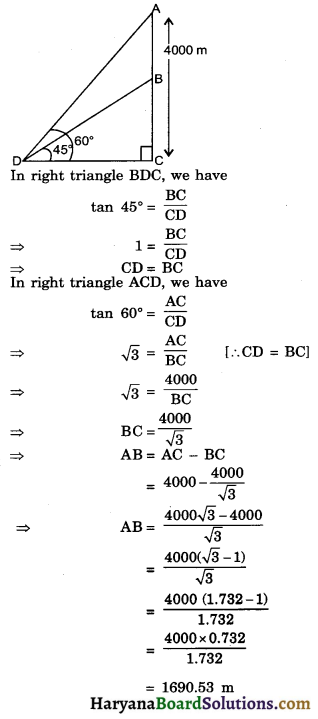
An aeroplane when flying at a height of 4000 m. from the ground passes vertically above another aeroplane at an instant when the angles of the elevation of two planes from the same point on the ground are 60° and 45° repectively. Find the vertical distance between the aeroplanes at that instant.
Solution :
Let A and B be position of two aeroplanes. When A be the vertical above B and AC = 4000 m.
Let the angles of elevation of two nlanes from the point A be 60 and 45° respectively i.e. ∠ADC = 60° and ∠BDC = 45°
HBSE 10th Class Maths Important Questions Chapter 9 Some Applications of Trigonometry - 6
Hence, vertical distance between two aeroplanes = 1690.53 m.

HBSE 10th Class Maths Important Questions Chapter 9 Some Applications of Trigonometry

Question 7.
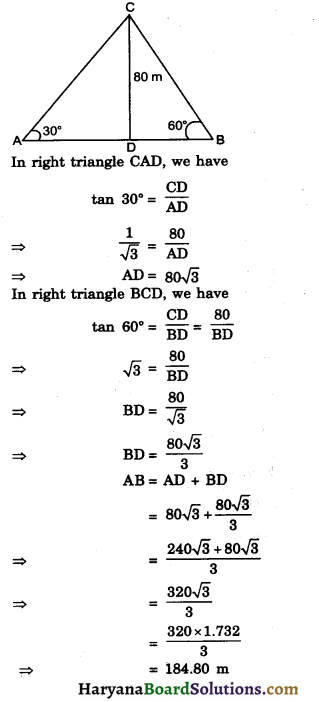
Two men on either side of the cliff 80 m high observes the angles of the elevation of the top of the cliff to be 30° and 60° respectively. Find the distance between the two men.
Solution :
Let the CD be cliff of height 80 m. Let A abd B be position of eyes of two men. The angles of elevation of eyes of two men from top of the cliff be 30° and 60° respectively i.e. ∠CAD = 30° and ∠CBD = 60°.
HBSE 10th Class Maths Important Questions Chapter 9 Some Applications of Trigonometry - 7
Hence, distance between two men = 184.80 m

Question 8.
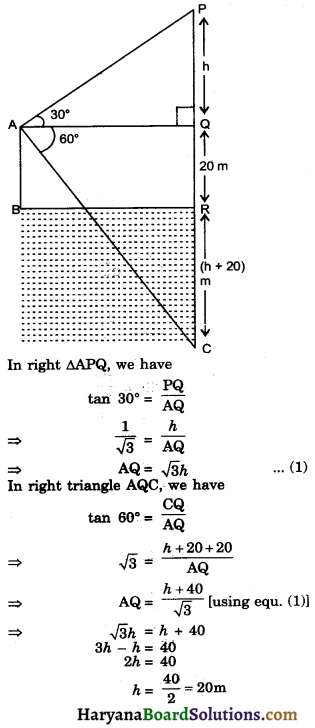
At a point A, 20 metres above the level of water in a lake, the angle of elevation of a cloud is 30°. The angle of depression of the reflection of the cloud in lake, at A is 60°. Find the distance of cloud from A.
Solution :
Let BR be surface of lake and A be point of observation P be position of cloud and C be the position of reflection of cloud in the lake. Draw AQ ⊥ PR. Angle of elevation of cloud from point A is 30° i.e. ∠PAQ = 30° and angle of depression of reflection of cloud in the lake is 60° i.e. ∠CAQ = 60°
Let PQ be h m, then PR = (h + 20) m and
RC = PR = (h + 20) m
HBSE 10th Class Maths Important Questions Chapter 9 Some Applications of Trigonometry - 8
substituting the value of h in equ. (1), we get
AQ = \(\sqrt{3}\) × 20 = 20\(\sqrt{3}\)m
In right ΔAPQ, we have
⇒ AP2 = AQ2 + PQ2
⇒ AP2 = (20\(\sqrt{3}\))2 + (20)2
⇒ AP2 = 1200 + 400
⇒ AP2 = 1600
⇒ AP = \(\sqrt{1600}\)
⇒ AP = 40
Hence, distance of cloud from point A = 40 m.

HBSE 10th Class Maths Important Questions Chapter 9 Some Applications of Trigonometry

Question 9.
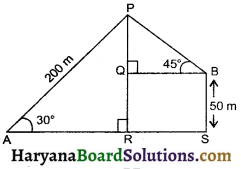
Amit standing on a horizontal plane, find a bird flying at a distance of 200m. From him at an elevation of 30°. Deepak standing on the roof of a 50m hight building, find the angle of elevation of the same bird to be 45°. Amit and Deepak are on opposite sides of the bird. Find the distance of the bird from Deepak.
Solution :
Let A and B be two positions of Amit and Deepak. Let P be position of bird. Bird flying at a distance from A 200 m i.e. AP = 200 m. Angle of elevation of P from Amit is 30° i.e. ∠PAR = 30° and Angle of elevation of P from Deepak is 45° i.e.
∠PBQ = 45°
HBSE 10th Class Maths Important Questions Chapter 9 Some Applications of Trigonometry - 9
In right ΔAPR, we have
sin 30° = \(\frac {PR}{AP}\)
⇒ \(\frac {1}{2}\) = \(\frac{P Q+Q R}{200}\)
⇒ PQ + QR = \(\frac {200}{2}\)
⇒ PQ + 20 = 100 [∴ QR = BS]
⇒ PQ = 100 – 50 = 50 m
In right ΔPBQ, we have
sin 45° = \(\frac {PQ}{PB}\)
⇒ \(\frac{1}{\sqrt{2}}\) = \(\frac {50}{PB}\)
⇒ PB = 50\(\sqrt{2}\) m
Hence, distance of the bird from Deepak is 50\(\sqrt{2}\) m.

Question 10.
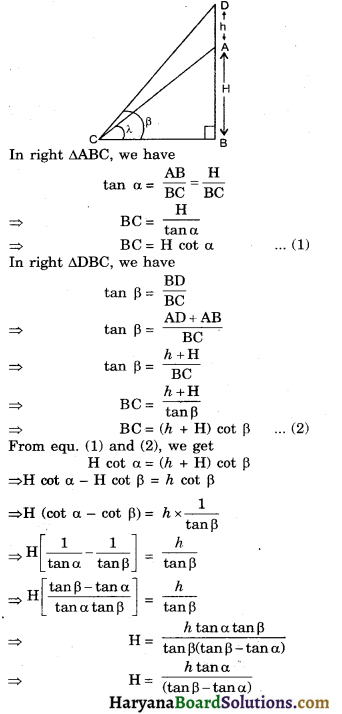
A vertical tower stands on a horizontal plane and is sur mounted by a vertical flag staff of height h. At a point on the plane, the angles of elevation of the bottom and top of the flag staff are λ and β respectively. Prove that the height of the tower is \(\frac {h tan α}{tan β – tan α}\)
Solution :
Let AB be the vertical tower of height H and AD be flag staff of height h. The angle of elevation of bottom and top of flag staff are λ and β respectively i.e.
⇒ ∠ACB = α and
∠DCB = β
HBSE 10th Class Maths Important Questions Chapter 9 Some Applications of Trigonometry - 10
Hence proved.

Fill in the Blanks

Question 1.
……… is the height to which something is raised above a point of reference.
Solution :
Elevation

HBSE 10th Class Maths Important Questions Chapter 9 Some Applications of Trigonometry

Question 2.
………. is the depth to which something is lowered below point of reference.
Solution :
depression

Question 3.
Numerically the angle of elevation is… to the angle of depression.
Solution :
equal

Question 4.
The angle of elevation and angle of depression both are measured with the ………. .
Solution :
horizontal

Question 5.
If two lines are ………, then the alternate interior angles formed are equal.
Solution :
parallel

HBSE 10th Class Maths Important Questions Chapter 9 Some Applications of Trigonometry

Question 6.
Two angles having a sum of ………… are called complementary angles.
Solution :
90°

Question 7.
As the ……….. of an object increases, the angles of elevation of its top with the horizontal level also increases.
Solution :
height

Multiple Choice Questions

Choose the correct answer for each of the following:

Question 1.
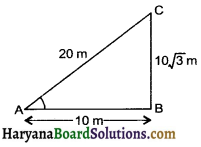
A 20 m long ladder rests against a wall. If the feet of the ladder is 10 m away from the wall, then angle of the elevation is:
(a) 30°
(b) 60°
(c) 90°
(d) 45°
Solution :
HBSE 10th Class Maths Important Questions Chapter 9 Some Applications of Trigonometry - 11

HBSE 10th Class Maths Important Questions Chapter 9 Some Applications of Trigonometry

Question 2.
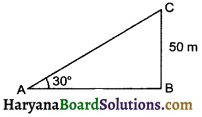
When the sun is 30° above the horizontal, the length of the shadow casts by a 50 m high building is :
(a) 50\(\sqrt{3}\) m
(b) 25 m
(c) 25\(\sqrt{3}\) m
(d) \(\frac{50}{\sqrt{3}}\)m
HBSE 10th Class Maths Important Questions Chapter 9 Some Applications of Trigonometry - 12
Solution :
∵ Tan 30° = \(\frac {BC}{AB}\)
⇒ \(\frac{1}{\sqrt{3}}\) = \(\frac {50}{AB}\)
⇒ Length of shadow AB = 50\(\sqrt{3}\) m
Hence correct choice is (a)

Question 3.
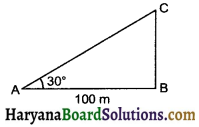
The angle of elevation of a tower from a distance 100 m from its foot is 30°. Height of tower is :
(a) 50\(\sqrt{3}\)
(b) 100\(\sqrt{3}\)
(c) \(\frac{100}{\sqrt{3}}\)
(d) \(\frac{50}{\sqrt{3}}\)
Solution :
In ΔABC
HBSE 10th Class Maths Important Questions Chapter 9 Some Applications of Trigonometry - 13
Hence, height of tower = \(\frac{100}{\sqrt{3}}\)m
Hence correct choice is (c).

HBSE 10th Class Maths Important Questions Chapter 9 Some Applications of Trigonometry

Question 4.
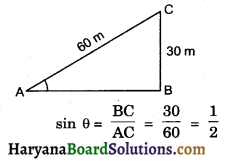
A kite is flying at a height of 30 m from the ground. The length of string from the kite to the ground is 60 m. Assuming that there is no slack in the string, the angle of elevation of the kite at the ground is :
(a) 45°
(b) 30°
(c) 60°
(d) 90°
Solution :
In ΔABC
HBSE 10th Class Maths Important Questions Chapter 9 Some Applications of Trigonometry - 16
sin θ = sin 30°
⇒ θ = 30°
Hence angle of elevation 30°
So correct choice is (b).

Question 5.
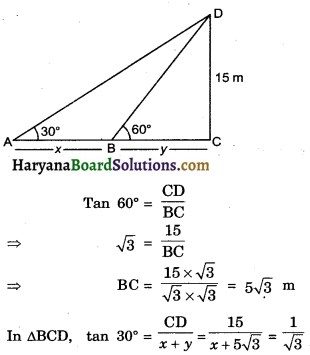
If the elevation of the Sun changed from 30° to 60°, then difference between the length of shadows of a pole of height 15 m is :
(a) 7.5 m
(b) 15 m
(c) 103 m
(d) 573 m
Solution :
In ΔBCD
HBSE 10th Class Maths Important Questions Chapter 9 Some Applications of Trigonometry - 17
⇒ x + 5\(\sqrt{3}\) = 15\(\sqrt{3}\)
⇒ x = 15\(\sqrt{3}\) – 5\(\sqrt{3}\)
⇒ x = 10\(\sqrt{3}\) m
Hence required difference x = 10\(\sqrt{3}\) m
So correct choice is (c)

HBSE 10th Class Maths Important Questions Chapter 9 Some Applications of Trigonometry

Question 6.
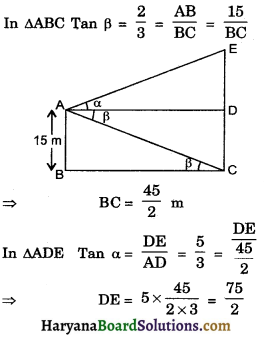
From a window 15 above the ground, the angle of elevation of the top of a tower is α and angle of depression of the foot of the tower is β. Then height of the tower is :
(tan α = \(\frac {5}{3}\), tan β = \(\frac {2}{3}\))
(a) 50 m
(b) 52.5 m
(c) 55 m
(d) 53.5 m
Solution :
Tan α = \(\frac {5}{3}\), Tan β = \(\frac {2}{3}\)
In ΔАВС Tan β = \(\frac{2}{3}=\frac{\mathrm{AB}}{\mathrm{BC}}=\frac{15}{\mathrm{BC}}\)
HBSE 10th Class Maths Important Questions Chapter 9 Some Applications of Trigonometry - 18
= 37.5 m
∴ Height of tower = CD + DE
= 15 + 37.5 m
= 52.5 m
So correct choice is (b).

Question 7.
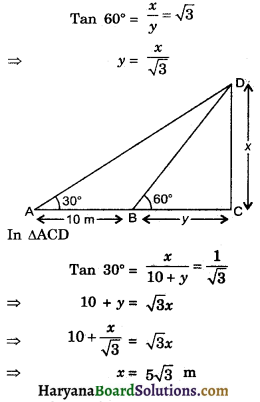
A, B, C are three collinear points on the ground such that B lies between A and Cand AB = 10 m. If the angles of elevation of the top of a vertical tower at C are respectively 30° and 60° as seen from A and B, then the height of tower is :
(a) 5\(\sqrt{3}\) m
(b) 5 m
(c) \(\frac{10}{\sqrt{3}}\)
(d) \(\frac{20}{\sqrt{3}}\)
Solution :
Let CD = x, and BC = y
In ΔBCD,
HBSE 10th Class Maths Important Questions Chapter 9 Some Applications of Trigonometry - 19
So correct choice is (a).

HBSE 10th Class Maths Important Questions Chapter 9 Some Applications of Trigonometry

Question 8.
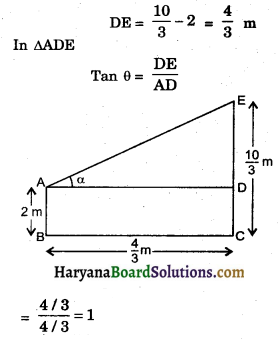
A person of height 2 m wants to get a fruit which is on a pole of height \(\frac {10}{3}\)m. If he stands at a distance of \(\frac {4}{3}\)m from the foot of the pole, then the angle at which he should throw the stone, so that it hits the fruits, is :
(a) 15°
(b) 30°
(c) 45°
(d) 60°
Solution :
From the figure
HBSE 10th Class Maths Important Questions Chapter 9 Some Applications of Trigonometry - 20
= Tan 45°
∴ θ = 45°
So correct choice is (c)

HBSE 10th Class Maths Important Questions Chapter 9 Some Applications of Trigonometry Read More »

HBSE 10th Class Science Solutions Chapter 9 Heredity and Evolution

Haryana State Board HBSE 10th Class Science Solutions Chapter 9 Heredity and Evolution Textbook Exercise Questions and Answers.

Haryana Board 10th Class Science Solutions Chapter 9 Heredity and Evolution

HBSE 10th Class Science Heredity and Evolution Textbook Questions and Answers

Question 1.
A Mendelian experiment consisted of breeding tall pea plants bearing violet flowers with short pea plants bearing white flowers. The progeny all bore violet flowers, but almost half of them were short. This suggests that the genetic make-up of the tall parent can be depicted as …………………
(a) TTWW
(b) TTww
(c) TtWW
(d) TtWw
Answer:
(c) TtWW

HBSE 10th Class Science Solutions Chapter 9 Heredity and Evolution

Question 2.
An example of homologous organs is ……………………
(a) our arm and a dog’s fore-leg.
(b) our teeth and an elephant’s tusks.
(c) potato and runners of grass.
(d) all of the above
Answer:
(d) all of the above

Question 3.
In evolutionary terms, we have more in common with ………………
(a) a Chinese school-boy
(b) a chimpanzee
(c) a spider
(d) a bacterium!
Answer:
(a) a Chinese school-boy.

HBSE 10th Class Science Solutions Chapter 9 Heredity and Evolution

Question 4.
A study found that children with light-coloured eyes are likely to have parents with light – coloured eyes. On this basis, can we say anything about whether the light eye colour trait is dominant or recessive? Why or why not?
Answer:

Reason:
1. No, the given information is not enough to consider the dominance or recessiveness of eye colour.

2. However, we can observe that generally in a population, the proportion of the people having light coloured eyes is much less than the people having dark coloured eyes. Based on this observation, we may consider that the light coloured eyes are a recessive trait and dark coloured eyes may be dominant.

Question 5.
How are the areas of study – evolution and classification – interlinked?
Answer:
1. In classification, the groups of organisms are based on the similarities and differences of characteristics of the organisms.

2. The organisms that have more similarities belong to nearer groups while the organisms having lesser similarities i.e. having more differences belong to distant groups.

3. In evolution, a study of identifying hierarchies of characteristics between the species is done. So, in such studies small groups of species with recent common ancestors are formed. Thus, the areas of study – evolution and classification are interlinked.

Question 6.
Explain the terms analogous and homologous organs with examples.
Answer:

Homologous organs

Analogous organs

1. These organs have similar internal structure.
2. These organs perform different functions.
3. These organs have evolved from a common ancestor.
4. For example, forelimbs of a frog, lizard, a bird, bat and a man are homologous
1. These organs have different basic design.
2. These organs perform similar functions.
3. These organs have not evolved from a common ancestor.
4. Wings of insects and birds are examples of analogous organs.

HBSE 10th Class Science Solutions Chapter 9 Heredity and Evolution

Question 7.
Outline a project which aims to find the dominant coat colour in dogs.
Answer:
1. In dogs, the coat colour is either black or white. The character of black coloured coat is indicated by ‘B’ and white coloured coat is indicated by ‘b’.

2. First of all the homozygous/pure parents with opposite characters are fertilized. Thus, applying Mendelian’s law, in the above case, the black coloured coat is a dominant character. So, black coat is dominant trait in dog.
HBSE 10th Class Science Solutions Chapter 9 Heredity and Evolution 1

Question 8.
Explain the importance of fossils in deciding evolutionary relationships.
Answer:
1. The remains of dead organisms buried under the earth for millions of years are known as fossils.
2. Fossils are impressions of dead plants or animals that lived in the past.
3. When plants or animals die, the micro-organisms get decomposed in the presence of moisture and oxygen.
4. However, sometimes due to environmental conditions, their bodies do not decompose completely.
5. Such body parts of the plants and animals become fossil and can be available on digging the earth.
6. Fossils can be in the form of imprints, burrow of a worm, or even an actual bone.

Example:

  • If the dead leaf gets caught in the mud, leaf will not decompose completely.
  • The mud around the leaf will set around it as a mould which will then slowly become hard to form a rock and retain the impression of the leaf. Thus fossil of a leaf is formed.
  • By studying these fossils, scientists learn how organisms evolved over time.

HBSE 10th Class Science Solutions Chapter 9 Heredity and Evolution

Question 9.
What evidence do we have for the origin of life from inanimate matter?
Answer:
1. It is believed that life must have developed from simple inorganic molecules which were present on earth soon after it was formed.
2. It was also speculated that the conditions on earth at that time could have given rise to more complex organic molecules that were necessary for life.
3. It is believed that the first primitive organisms would have arisen from further chemical synthesis.

Question 10.
Explain how sexual reproduction gives rise to more viable variations than asexual reproduction. How does this affect the evolution of those organisms that reproduce sexually?
Answer:
(1) First, in sexual reproduction, there occurs a combination of genetic material of two different parents i.e. a male and a female. Hence, each new generation is a combination of two different parental DNAs.

(2) Second, during the formation of gametes i.e. formation of sperms and ovum, the cell undergoes cell division phase called meiosis.

  • During meiosis, the genetic material gets distributed randomly. Moreover, all the gametes are not always similar and so there are more chances of variation during fertilization, in other words, there are so many sperm cells but only one fertilizes with the ovum. Naturally, this will create variation.
  • Owing to these two reasons, there occur more variations in sexual reproduction as compared to asexual.
  • The combination of different types of gametes which takes place is the root of variations. This also gives rise to new type of characters too. This also favours evolution.

Question 11.
How is the equal genetic contribution of male and female parents ensured in the progeny?
Answer:
1. During gametogenesis (production of male and female sex cells), the meiosis type of cells division occurs.
2. During, meiosis the number of chromosomes becomes half. The DNA gets distributed to half in each gamete.
3. During fertilization, both the types of sex cells get fused and the quantity of DNA remains maintained. Thus, equal genetic contribution of male and female parents is ensured in the progeny.

HBSE 10th Class Science Solutions Chapter 9 Heredity and Evolution

Question 12.
Only variations that confer an advantage to an individual organism will survive in a population. Do you agree with this statement? Why or why not?
Answer:
Yes, this is true.

Reason:

  • If the variation achieved by an organism is helpful to adapt to the surrounding environment then it increases the probability of the survival of that organism.
  • The survived organisms then produces more offspring with such genetic variations and thus the species survives.

HBSE 10th Class Science Heredity and Evolution InText Activity Questions and Answers

Textbook Page no – 143

Question 1.
If a trait A exists in 10% of a population of an asexually reproducing species and a trait B exists in 60% of the same population, which trait is likely to have arisen earlier?
Answer:
Trait B which exists in 60% of population of an asexually reproducing species must have arisen earlier than trait A.

Reason:

  • In asexually reproducing species, DNA copy error takes place, in very small amount and so new traits do not occur very fast.
  • Since, the percentage of trait B is very large as compared to trait A. This suggests that trait B must have arisen quite before to trait A.

Question 2.
How does the creation of variations in a species promote survival?
Answer:
1. Variations in a species are created through two reasons,

  • Due to inaccuracies in DNA copying or
  • During sexual reproduction.

2. Different individuals gain different types of advantages with these variations. Several variations enable the individual to adapt to the environmental conditions. This increases the chances of their survival.

HBSE 10th Class Science Solutions Chapter 9 Heredity and Evolution

3. The individuals that survive then reproduce offspring and the existence of species remains continued.

Textbook Page no – 147

Question 1.
How do Mendel’s experiments show that traits may be dominant or recessive?
Answer:
1. Mendel conducted cross fertilization between pure tall plants (TT) and pure short (tt) plant. This resulted in all (Tt) plants in F1 generation.

2. This shows that single copy of T is enough to make the plant tall. The trait that gets expressed over the other is called the dominant trait and the other recessive.

3. In Mendel’s trial, the trait which gets expressed in 75% individuals in F2 generation after self-fertilization is dominant whereas the trait which appears in 25% individual is recessive.

Question 2.
How do Mendel’s experiments show that traits are inherited independently?
Answer:
1. Mendel performed the experiments of heredity on pea plant. He studied the heredity of two characters simultaneously and performed the dihybrid experiment.

2. On the basis of this experiment we can say that even though the F1 progeny plants were dominant in both the characters, the F2 progeny showed the new combinations. In F2 progeny plants some were tall and wrinkled, while some were short and round.

3. The experiment clearly shows that the factors that control the shape, size and height of the seeds are inherited independently and that is the main reason why new combinations could be seen in F2 generation.

HBSE 10th Class Science Solutions Chapter 9 Heredity and Evolution

Question 3.
A man with blood group A marries a woman with blood group O and their daughter has blood group O. Is this information enough to tell you which of the traits – blood group A or O – is dominant? Why or why not?
Answer:
No, the given information is not enough to determine which trait is dominant.

Reason:

  • The daughter (or any child) receives two copies of genes, one from each parent.
  • The trait of blood group depends on the genotype i.e. the types of genes which get combined. Hence, the provided information is insufficient and so we cannot tell which one is a dominant blood group.

Question 4.
How is the sex of the child determined in human beings?
Answer:
1. In human beings, sex of the child to be born is determined by the sex chromosome of the father.

2. The father or say male contains XY chromosomes and so during spermatogenesis, the male produces two types of sperms. 50% of these sperms have ‘X’ sex chromosome and 50% sperms have ‘Y’ sex chromosome.

3. If the sperm having ‘X’ chromosome fertilizes the ovum, a female child (= a girl) is born and if the sperm having ‘Y’ chromosome fertilizes the ovum, the male child (= a boy) is born.

Textbook Page no – 150

Question 1.
What are the different ways in which individuals with a particular trait may increase in a population?
Answer:
A particular trait may increase in a population through two main ways. They are –

  • Natural selection – It directs evolution with a survival advantage.
  • Genetic drift – It leads to accumulation of different changes.

HBSE 10th Class Science Solutions Chapter 9 Heredity and Evolution

Question 2.
Why are traits acquired during the life-time of an individual not inherited?
Answer:
Change in non-reproductive tissues cannot be passed on to the DNA of the germ cells. Hence the experiences of an individual during its lifetime can neither be passed on to its progeny nor can such experiences result in evolution.

Example:

  • If we breed a group of mice, all their progeny will have tails.
  • Suppose we remove the tails of each generation of these mice by surgery then it does not mean that the progeny is tailless.
  • Artificially removing the tail does not bring any change in the genes of the germ cells of the mice.
  • So, the cut-tail that a generation of mice experienced cannot become a trait to be passed on to the next generation.

Question 3.
Why are the small numbers of surviving tigers a cause of worry from the point of view of genetics?
Answer:
1. A small population generally does not show much variation from generation to generation.
2. A very small population of surviving tigers indicates that very less amount of variation will occur in the genetic characteristics. This means they will not be able to adapt to the major environmental changes if any, in the future.
3. The tigers will not survive and the species will become extinct.

HBSE 10th Class Science Solutions Chapter 9 Heredity and Evolution

Textbook Page no – 151

Question 1.
What factors could lead to the rise of a new species?
Answer:
Factors that can lead to the rise of a new species are:

  • Accumulated variations favourable to natural environment,
  • Geographic isolation of a population,
  • Gene flow,
  • Genetic drift and
  • Natural selection

Question 2.
Will geographical isolation be a major factor in the speciation of a self-pollinating plant species? Why or why not?
Answer:
No, geographical isolation will not be a major factor in the speciation of a self-pollinating plant species.

Reason:

  • Only a single parent is involved in self-pollination. So, there is no gene flow between two geographically isolated populations.
  • If it would be a cross-pollination species, the geographical isolation would be a major factor as it would lead to faster accumulation of variation (genetic drift) in the two geographically separated populations.

Question 3.
Will geographical isolation be a major factor in the speciation of an organism that reproduces asexually? Why or why not?
Answer:
No, geographical isolation will not be a major factor to the speciation that reproduces asexually.

HBSE 10th Class Science Solutions Chapter 9 Heredity and Evolution

Reason:
Asexually reproducing organisms show very little variation over generations. These little variations are not sufficient enough to raise a new species having such variations.

Textbook Page no – 156

Question 1.
Give an example of characteristics being used to determine how close two species are in evolutionary terms.
Answer:
1. One of the ways to determine how close two species are with respect to evolution is to obtain evidence from their homologous organs.

2. For example, the basic design of internal structure of bones of forelimbs of a frog, lizard, bird, bat and man is same, even though these organs perform different functions.

3. This indicates that all these forelimbs have evolved from a common ancestral animal, which had a same basic internal structure.

Question 2.
Can the wing of a butterfly and the wing of a bat be considered homologous organs? Why or why not?
Answer:
No, the wings of a butterfly and the wings of a bat cannot be considered homologous organs.

Reason:
Although the wings of a butterfly and the wings of a bat perform similar function, but the design, structure and components of their wings are very different. Hence, the wings of these two can be considered as analogous organs and not homologous.

Question 3.
What are fossils? What do they tell us about the process of evolution?
Answer:
1. The remains of dead organisms buried under the earth for millions of years are known as fossils.
2. Fossils are impressions of dead plants or animals that lived in the past.
3. When plants or animals die, the micro-organisms get decomposed in the presence of moisture and oxygen.
4. However, sometimes due to environmental conditions, their bodies do not decompose completely.
5. Such body parts of the plants and animals become fossil and can be available on digging the earth.
6. Fossils can be in the form of imprints, burrow of a worm, or even an actual bone.

Example:

  • If the dead leaf gets caught in the mud, leaf will not decompose completely.
  • The mud around the leaf will set around it as a mould which will then slowly become hard to form a rock and retain the impression of the leaf. Thus fossil of a leaf is formed.
  • By studying these fossils, scientists learn how organisms evolved over time.

Textbook Page no – 156

Question 1.
Why are human beings who look so different from each other in terms of size, colour and looks said to belong to the same species?
Answer:
1. Across the earth, there is a great diversity in humans and so we look so different from each other in terms of size, colour and looks.

2. Initially, human race was identified on the basis of skin colour and the humans were known as yellow, black, white or brown. However, in the recent years, it has been proved that all the human beings have evolved from a single species called the Homo sapiens.

3. Hence, in spite of having different skin colour, looks and size, we all belong to the same species.

HBSE 10th Class Science Solutions Chapter 9 Heredity and Evolution

Question 2.
In evolutionary terms, can we say which among bacteria, spiders, fish and chimpanzees have a ‘better’ body design? Why or why not?
Answer:
1. In evolutionary terms, we can say that chimpanzees have a better developed body design.
2. The reason for this is that chimpanzees are highly complex organisms compared to remaining three.

Activities:

Activity -1

Aim: To study inheritance in the type of earlobes.

Background:

  • The lowest part of the ear pinna (external ear) is known as an earlobe.
  • The earlobe may be either closely attached to the (lateral) side of the head, or not-attached i.e. might be free.

HBSE 10th Class Science Solutions Chapter 9 Heredity and Evolution 2

Procedure:

  • Observe the ears of all the students in the class. Prepare a list of students having free or attached earlobes and
  • Find out about the earlobes of the parents of each student in the class. Correlate the earlobe type of each student with that of their parents. Based on this evidence, suggest a possible rule for the inheritance of earlobe types.
  • Students can observe the earlobes of other students. They can also ask about the type of earlobes of their parents.
  • Make a chart as given below. Write 1F’ for the free earlobes and A’ for the attached earlobes.

HBSE 10th Class Science Solutions Chapter 9 Heredity and Evolution 3

Observation:
We can observe that more number of students have inherited the trait of ‘free earlobes’ i.e. trait F as compared to attached earlobes i.e. A.

HBSE 10th Class Science Solutions Chapter 9 Heredity and Evolution

Conclusion:
From studies it has been proved that free earlobe is a dominant trait whereas an attached earlobe is a recessive trait.

Activity 2.

In Fig. 9.3 of textbook, what experiment would we do to confirm that the F2 generation did in fact have a 1:2:1 ratio of TT, it and tt trait combinations?

Observation:
Although the experiment phenotypically shows the ratio of 3 : 1 ratio between tall and dwarf, genetically the ratio is 1 : 2 : 1.
This can be proved by the following experiment. We can raise F3 generation by allowing self-pollination of F3 generation plants.

Then we may calculate ratio for —

  • Tall plants which produced only tall plants. These plants will be pure dominant (TT).
  • Tall plants which produced both tall and dwarf pea plants. These plants are hybrid (Tt).
  • Dwarf plants produced only dwarf plants. This means they are pure recessive (tt).

Observing the data carefully, one can find the appearance of 1 : 2 : 1 ratio of TT Tt and tt trait combination in F3 generation (also known as genotypic ratio).

HBSE 10th Class Science Solutions Chapter 9 Heredity and Evolution Read More »
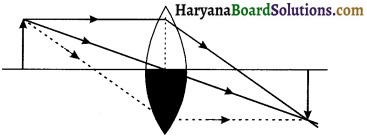
HBSE 10th Class Maths Notes Chapter 1 वास्तविक संख्याएँ

Haryana State Board HBSE 10th Class Maths Notes Chapter 1 वास्तविक संख्याएँ Notes.

Haryana Board 10th Class Maths Notes Chapter 1 वास्तविक संख्याएँ

→ यूक्लिड विभाजन प्रमेयिका- दो धनात्मक पूर्णाक a और b दिए होने पर, ऐसी अद्वितीय पूर्ण संख्याएँ q और r विद्यमान होती हैं कि a = bq + r, 0 ≤ r < b है।

→ यूक्लिड विभाजन एल्गोरिम द्वारा- दो धनात्मक पूर्णाकों, c और d(c > d) का HCF ज्ञात करने के लिए नीचे दिए हुएं चरणों का अनुसरण किया जाता है-
चरण I-c और के लिए यूक्लिड विभाजन प्रमेयिका से हम ऐसे q और r ज्ञात करते हैं कि c = dq + r, 0 ≤ r < d हो।
चरण II-यदि r = 0 है, तो d पूर्णाको c और d का HCF है। यदि r ≠ 0 है, तो और के लिए, यूक्लिड विभाजन प्रमेविका का प्रयोग पुनः कीजिए।
चरण III-इस प्रक्रिया को तब तक जारी रखिए, जब तक शेषफल 0न प्राप्त हो जाए। इसी स्थिति में, प्राप्त भाजक ही वांछित HCF है।

→ अंकगणित की आधारभूत प्रमेय- प्रत्येक भाज्य संख्या को अभाज्य संख्याओं के एक गुणनफल के रूप में व्यक्त (गुणनखडित) किया जा सकता है तथा यह गुणनखंडन अभाज्य गुणनखंडों के आने वाले क्रम के बिना अद्वितीय होता है।

→ यदि p कोई अभाज्य संख्या है और p, a2 को विभाजित करता है तो p, a को भी विभाजित करेगा, जहाँ a एक धनात्मक पूर्णाक है।

→ किन्हीं दो धनात्मक पूर्णांकों a और b के लिए HCF(a, b) × LCM(a, b) = a × b होता है।

→ परिमेय और अपरिमेय संख्याएँ मिलकर वास्तविक संख्याएँ बनाती हैं।

→ \(\sqrt{2}\), \(\sqrt{3}\), \(\sqrt{5}\) तथा व्यापक रूप में \(\sqrt{p}\) अपरिमेय संख्याएँ हैं, जहाँ पर p एक अभाज्य संख्या है।

HBSE 10th Class Maths Notes Chapter 1 वास्तविक संख्याएँ

→ यदि x एक परिमेय संख्या हो जिसका दशमलब प्रसार सांत हो, तो हम x को \(\frac{p}{q}\) के रूप में व्यक्त कर सकते हैं, जहाँ p औरq सहअभाज्य होते हैं तथा q का अभाज्य गुणनखंडन 2n5m के रूप का होता है, जहाँ n, m प्रणेतर पूर्णाक होते हैं।

→ माना x = \(\frac{p}{q}\) एक ऐसी परिमेय संख्या है कि q का अभाज्य गुणनखंडन 2n5m के रूप का है, (जहाँ n, m ऋणेतर पूर्णाक है) तो x का दशमलव प्रसार सांत होगा।

→ माना x = \(\frac{p}{q}\) एक ऐसी परिमेय संख्या है कि q का अभाज्य गुणनखंडन 2n5m के रूप का नहीं है, (जहाँ n, m ऋणेतर पूर्णाक है) तो x का दशमलव प्रसार असांत आवर्ती होगा।

→ किन्हीं तीन संख्याओं p, q तथा r के लिए LCM होगा-
HBSE 10th Class Maths Notes Chapter 1 वास्तविक संख्याएँ 1

→ किन्हीं तीन संख्याओं P, q तथा r के लिए HCF होगा-
HBSE 10th Class Maths Notes Chapter 1 वास्तविक संख्याएँ 2

→ एक परिमेय संख्या और एक अपरिमेय संख्या का योग या अंतर एक अपरिमेय संख्या होती है।

→ एक शून्येतर परिमेय संख्या और एक अपरिमेय संख्या का गुणनफल या भागफल एक अपरिमेय संख्या होती है।

HBSE 10th Class Maths Notes Chapter 1 वास्तविक संख्याएँ Read More »

HBSE 10th Class Maths Notes Haryana Board

Haryana Board HBSE 10th Class Maths Notes

HBSE 10th Class Maths Notes in English Medium

HBSE 10th Class Maths Notes in Hindi Medium

HBSE 10th Class Maths Notes Haryana Board Read More »

HBSE 10th Class Science Solutions Chapter 10 Light Reflection and Refraction

Haryana State Board HBSE 10th Class Science Solutions Chapter 10 Light Reflection and Refraction Textbook Exercise Questions and Answers.

Haryana Board 10th Class Science Solutions Chapter 10 Light Reflection and Refraction

HBSE 10th Class Science Light Reflection and Refraction Textbook Questions and Answers

Question 1.
Which one of the following materials cannot be used to make a lens?
(a) Water
(b) Glass
(c) Plastic
(d) Clay
Answer:
(d) Clay

HBSE 10th Class Science Solutions Chapter 10 Light Reflection and Refraction

Question 2.
The Image formed by a concave mirror is observed to be virtual, erect and larger than the object. Where should be the position of the object?
(a) Between the principal focus and the centre of curvature
(b) At the centre of curvature
(c) Beyond the centre of curvature
(d) Between the pole of the mirror and its principal focus.
Answer:
(d) Between the pole of the mirror and its principal focus.

Question 3.
Where should an object be placed in front of a convex lens to get a real image of the size of the object?
(a) At the principal focus of the lens
(b) At twice the focal length
(c) At Infinity
(d) Between the optical centre of the lens and its principal focus.
Answer:
(b) At twice the focal length

Question 4.
A spherical mirror and a thin spherical lens have each a focal length of -15 cm. The mirror and the lens are likely to be …….
(a) both concave
(b) both convex
(c) the mirror Is concave and the lens is convex
(d) the mirror is convex, but the lens is concave
Answer:
(a) both concave

HBSE 10th Class Science Solutions Chapter 10 Light Reflection and Refraction

Question 5.
No matter how far you stand from a mirror, your image appears erect. The mirror is likely to be …………
(a) plane
(b) concave
(c) convex
(d) either plane or convex
Answer:
(d) either plane or convex

Question 6.
Which of the following lenses would you prefer to use while reading small letters found in a dictionary?
(a) A convex lens of focal length 50 cm
(b) A concave lens of focal length 50 cm
(c) A convex lens of focal length 5 cm
(d) A concave lens of focal length 5 cm
Answer:
(c) A convex lens of focal length 5 cm

Question 7.
We wish to obtain an erect image of an object, using a concave mirror of focal length 15 cm. What should be the range of distance of the object from the mirror? What is the nature of the image? Is the image larger or smaller than the object? Draw a ray diagram to show the image formation in this case.
Answer:
1. When the object is placed between the pole and the principal focus of the concave mirror, we get an erect, virtual and enlarged image.
2. We are given that the focal length of concave mirror = 15 cm
3. So, the object should be placed in front of the concave mirror at a distance less than 15 cm.

Question 8.
Name the type of mirror used in the following situations.
(a) Headlights of a car
(b) Side/rear-view mirror of a vehicle
(c) Solar furnace
Support your answer with reason.
Answer:
(a) Concave mirrors are used as reflectors in headlights of cars. When a bulb is located at the focus of the concave mirror, the light rays after reflection from the mirror travel over a large distance as a parallel beam of high intensity.

(b) A convex mirror is used as a side/rear-view mirror of a vehicle because of the following reasons:

  • A convex mirror always forms an erect, virtual and diminished image of an object placed anywhere in front of it.
  • A convex mirror has a wider field of view than a plane mirror of the same size.

(c) Large concave mirrors are used to concentrate sunlight to produce heat in solar furnaces. Concave mirrors are able to raise the temperature drastically.

HBSE 10th Class Science Solutions Chapter 10 Light Reflection and Refraction

Question 9.
One-half of a convex lens is covered with a black paper. Will this lens produce a complete image of the object? Verify your answer experimentally. Explain your observations.
Answer:
As shown in figure, when the lower half of the convex lens is covered with a black paper, it still forms the complete image of the object, but the intensity of the image is reduced.
HBSE 10th Class Science Solutions Chapter 10 Light Reflection and Refraction 1
The rays coming from the object get refracted by the upper half of the lens and meet at the other side of the lens to form the image.

Question 10.
An object 5 cm in length is held 25 cm away from a converging lens of focal length 10 cm. Draw the ray diagram and find the position, size and the nature of the Image formed.
Answer:
The final position, nature and size of the image A’B’ are:
Here, Object size h = +5 cm
Object distance u = – 25 cm
Focal length of lens f = + 10 cm
( ∵ Converging, i.e., Convex lens)
Image distance y =?
Image height h’ =?
HBSE 10th Class Science Solutions Chapter 10 Light Reflection and Refraction 2

HBSE 10th Class Science Solutions Chapter 10 Light Reflection and Refraction 3

Image distance y is positive. This shows that the image formed is real and on the other side of the lens, at 16.67 cm from the lens as shown in the figure. AB : Object, A’B’: Image
Now, Magnification m = \(\frac{h^{\prime}}{h}=\frac{v}{u}\)
HBSE 10th Class Science Solutions Chapter 10 Light Reflection and Refraction 4
The negative (minus) sign shows that the image is inverted, real, diminished (3.3 cm). Figure 10.60 show the positive, size and nature of the image formed.

HBSE 10th Class Science Solutions Chapter 10 Light Reflection and Refraction

Question 11.
A concave lens of focal length 15 cm forms an Image 10 cm from the lens. How far is the object placed from the lens? Draw the ray diagram.
Answer:
Scale: 1 cm = 5 cm
Focal length, f = – 15 cm [f is – ve for a concave lens]
Image distance, v = – 10 cm
[Concave lens forms virtual image on same side as the object, so v is – ve]
HBSE 10th Class Science Solutions Chapter 10 Light Reflection and Refraction 5

Object distance, u = – 30 cm.
The negative sign shows that the object is placed on the left side of the lens.
HBSE 10th Class Science Solutions Chapter 10 Light Reflection and Refraction 6

Question 12.
An object Is placed at a distance of 10 cm from a convex mirror of focal length 15 cm. Find the position and nature of the image.
Answer:
Object distance, u = – 10 cm
Focal length, f = + 15 cm [f is +ve for a convex mirror]
HBSE 10th Class Science Solutions Chapter 10 Light Reflection and Refraction 7

Image distance, v = + 6 cm.
As v is +ve, so a virtual, erect image is formed at a distance 6 cm behind the mirror.

Question 13.
The magnification produced by a plane mirror is +1. What does this mean?
Answer:
Magnification of a mirror \(m=\frac{h^{\prime}}{h}=\frac{-v}{u}\)
Here, for a plane mirror, m = + 1, So, h’ = h and y = – u

  • m = 1 indicates that both ¡mage and object are of same size.
  • Positive sign of m indicates that a virtual image is formed behind the mirror.

HBSE 10th Class Science Solutions Chapter 10 Light Reflection and Refraction

Question 14.
An object 5.0 cm in length is placed at a distance of 20 cm in front of a convex mirror of radius of curvature 30 cm. Find the position of the image, its nature and size.
Answer:
Object size, h = + 5cm
Object distance, u = – 20 cm
Radius of curvature, R = + 3.0 cm [R is +ve for a convex mirror]
Focal length, \(f=\frac{R}{2}\) = + 15 cm
From mirror formula,
HBSE 10th Class Science Solutions Chapter 10 Light Reflection and Refraction 14

HBSE 10th Class Science Solutions Chapter 10 Light Reflection and Refraction 15
A virtual, erect image of height 2.2 cm is formed behind the mirror at a distance of 8.6 cm from the mirror.

Question 15.
An object of size 7.0 cm Is placed at 27 cm in front of a concave mirror of focal length 18 cm. At what distance from the mirror should a screen be placed, so that a sharply focused image can be obtained? Find the size and the nature of the Image.
Answer:
Object size, h = + 7.0 cm
Focal length, t = – 18 cm
Image size, h’ = ?
HBSE 10th Class Science Solutions Chapter 10 Light Reflection and Refraction 10
Object distance, u = – 27 cm
image distance,v = ?
The screen should be placed at a distance of 54 cm on the object side of the mirror to obtain sharp image.
HBSE 10th Class Science Solutions Chapter 10 Light Reflection and Refraction 11
The image is real, inverted and enlarged in size.

HBSE 10th Class Science Solutions Chapter 10 Light Reflection and Refraction

Question 16.
Find the focal length of a lens of power – 2.0 D. What type of lens is this?
Answer:
Here, P = – 2.0 D f =\(\frac{1}{P}=\frac{1}{-2.0 D}\) = – 0.5 m.
Since the power of lens is negative, the lens is concave.

Question 17.
A doctor has prescribed a corrective lens of power +1.5 D. Find the focal length of the lens. Is the prescribed lens diverging or converging?
Answer:
Here P = +1.5D
\(f=\frac{1}{P}=\frac{1}{+1.5 D}=+\frac{10}{15} m\) = + 66.67cm.

  • As the focal length is positive, the prescribed lens is converging.
  • Opposite side at F, real and inverted, highly diminished (point sized)

HBSE 10th Class Science Light Reflection and Refraction InText Activity Questions and Answers

Textbook Page no – 168

Question 1.
Define the principal focus of a concave mirror.
Answer:
The point (F) on the principle axis where the beam of light parallel to the principle axis either actually converges to or diverges from, after reflection from a mirror is called the principle focus (F).

Question 2.
The radius of curvature of a spherical mirror is 20 cm. What is its focal length?
Answer:
R = 20cm.
Focal length (f) = \(\frac{\mathrm{R}}{2}=\frac{20}{2}\) = 10 cm

Question 3.
Name a mirror that can give an erect and enlarged image of an object.
Answer:
Concave mirror

HBSE 10th Class Science Solutions Chapter 10 Light Reflection and Refraction

Question 4.
Why do we prefer a convex mirror as a rear-view mirror in vehicles?
Answer:
A convex mirror is preferred as a rear-view mirror because —

  • Convex mirror always forms a virtual, erect and a diminished (point-like) image of an object placed anywhere in front of it. This means the driver can see the image of person even at a very distant position.
  • Convex mirror has a wider field of view. So it covers a large rear distance. This helps the driver as he can see more.

Textbook Page no – 171

Question 1.
Find the focal length of a convex mirror whose radius of curvature is 32 cm.
Answer:
The radius of curvature and focal length of a convex mirror are positive.
∴ R = + 32cm and f = \(\frac{\mathrm{R}}{2}\) = + 16cm

Question 2.
A concave mirror produces three times magnified (enlarged) real Image of an object placed at 10 cm in front of It. Where is the image located?
Answer:
As the image is real, so magnification m must be negative.
\(m=\frac{h^{\prime}}{h}=-\frac{v}{u}=-3\)
∴ v = 3 x (-10) = – 30 cm.
Thus the image is real and it is located at a distance of 30 cm from the mirror in the front of mirror.

Textbook Page no – 176

Question 1.
A ray of light travelling in air enters obliquely into water. Does the light ray bend towards the normal or away from the normal? Why?
Answer:
1. Light travels faster in rarer medium air and slower in denser medium water.
2. Since the ray of light travelling in air enters obliquely into water, it slows down and bends towards the normal.

Question 2.
Light enters from air to glass having refractive Index 1.50. What is the speed of light in the glass? The speed of light in vacuum is 3 x 10⁸ mr1.
Answer:
1. Refractive index of glass, ng = 1.50
Speed of light in vacuum, c = 3 x 10⁸ ms-1

2. Absolute refractive index of glass, ng = ((c/v))
∴ Speed of light in glass \(v=\frac{c}{n_g}=\frac{3 \times 10^8 \mathrm{~m} / \mathrm{s}}{1.5}=2 \times 10^8 \mathrm{~ms}^{-1}\)

HBSE 10th Class Science Solutions Chapter 10 Light Reflection and Refraction

Question 3.
Find out, from table 10.3 of the text book, the medium having highest optical density. Also find the medium with lowest optical density.
Answer:
1. From table 10.3, diamond has highest refractive index (= 2.42), so it has largest optical density.
2. Air has lowest refractive index (= 1.0003), so it has lowest optical density.

Question 4.
You are given kerosene, turpentine and water. In which of these does the light travel fastest? Use the information given In table 10.3 of the text book.
Answer:
For kerosene, n = 1. 44,   For turpentine oil, n = 1. 47,   For water, n = 1. 33
As water has lowest refractive index, so light travels fastest in this optically rarer medium compared to kerosene and turpentine oil.

Question 5.
The refractive index of diamond is 2.42. What is the meaning of this statement?
Answer:
It indicates that the ratio of speed of light in air to that in diamond is 2.42.

Textbook Page no – 184.

Question 1.
Define 1 dioptre of power of a lens.
Answer:
1 dioptre (1 D) is the power of a lens whose focal length is 1 meter.

Question 2.
A convex lens forms a real and inverted image of a needle at a distance of 50 cm from it. Where is the needle placed ¡n front of the convex lens if the image is equal to the size of the object? Also, find the power of the lens.
Answer:
1. Here, image distance y = + 50 cm (∴ y is positive for real images)
2. As mentioned, the real image is of the same size as the object.

HBSE 10th Class Science Solutions Chapter 10 Light Reflection and Refraction 16
Thus, object (needle) is placed at 50 cm from the lens.

Power of lens:
HBSE 10th Class Science Solutions Chapter 10 Light Reflection and Refraction 17
∴ Focal length (f) = 25 cm = 0.25 m
Now, \(P=\frac{1}{f}=\frac{1}{+25}=+4 D\)
Thus, power of lens = + 4D

Question 3.
Find the power of a concave lens of focal length 2 m.
Answer:
Since the focal length of a concave lens is negative; f = – 2m.
Power \(P=\frac{1}{f}=\frac{1}{-2 m}=-0.5 \mathrm{D}\)

HBSE 10th Class Science Solutions Chapter 10 Light Reflection and Refraction

Activities

Activity 1.

Aim: To study the formation of images by both sides of a large shining spoon.

Apparatus required: A large shining spoon.

Procedure:

  • Take a large shining spoon. Try to view face in its curved surface.
  • Do you get the image? Is it smaller or larger?
  • Move the spoon slowly away from your face. Observe the Image. How does it change?
  • Reverse the spoon and repeat the activity. How does the image look like now?
  • Compare the characteristics of the image on the two surfaces.

Observation and Conclusion:

  • Initially, we can see our tace inside the curved portion of the spoon. The image of our face looks erect and enlarged. As we move the spoon at a farther distance, the image goes on becoming smaller and then gets inverted. The inner portion of the spoon behaves as a concave mirror.
  • When we see the spoon from outer surface, it behaves as a convex mirror. The image formed is erect and small Irrespective of the distance of face from the spoon.

Activity 2.

Aim: To find the approximate focal length of a concave mirror.

Apparatus required: Concave mirror, a sheet of paper and meter scale

Caution: Do not look at the sun directly or even Into a mirror reflecting sunlight. It may damage your eyes.

HBSE 10th Class Science Solutions Chapter 10 Light Reflection and Refraction 18

Procedure:

  • Hold a concave mirror in your hand and direct its reflecting surface towards the sun.
  • Direct the light reflected by the mirror onto a sheet of paper held close to the mirror.
  • Move the sheet of paper back and forth gradually unto you find on the paper sheet a bright, sharp spot of light

Question 1.
Hold the mirror and the paper in the same position for a few minutes. What do you observe? Why?
Answer:
Observation
Initially, the paper turns blackish and emits smoke while burning slowly. The paper then catches fire.

Conclusion:

  • The point at which the sun-rays get converged to produce tire is the principal focus (F) of the concave mirror.
  • The distance of this image of sun at point F gives the approximate value of focal length (t) of the concave mirror.

HBSE 10th Class Science Solutions Chapter 10 Light Reflection and Refraction

Activity 3.

Aim: To locate the image formed by a concave mirror for different positions of the object.

Procedure:
1. Take a concave mirror. Find out its approximate focal length. Let f = 10 cm.

2. Mark a line on a table with a chalk. Place the concave mirror on a stand. Place the stand over the line such that its pole lies over the line.

3. Draw with a chalk two more lines parallel to the previous line such that the distance between any two successive lines is equal to the focal length of the mirror. These lines will correspond to the position of the points P, F and C, respectively.

4. Keep a bright object, say a burning candle, at a position far beyond C. Place a paper screen and move it in front of the
mirror till you obtain a sharp bright image of the candle flame on it.

5. Observe the image carefully. Note down its nature, position arid relative size with respect to the object size.

6. Repeat the experiment by placing the candle —
(a) just beyond C, (b) at C, (C) between F and C, (d) at F, and (e) between P and F

7. In one of the cases, you may not get the image on the screen. Identify the position of the object in such a case. Then, look for its virtual image in the mirror itself.

8. Note down and tabulate your observations.

Observation:
Table 1. Nature, size and position of Images formed by a concave mirror for different positions of the object

HBSE 10th Class Science Solutions Chapter 10 Light Reflection and Refraction 19

Activity 4.

Students should do this activity on their own. Make use of activity 3 for drawing the diagrams.

Activity 5.

Aim: To locate the image formed by a convex mirror for different positions of the object.

Take a convex mirror. Hold it in one hand. Hold a pencil in the upright position in the other hand.

HBSE 10th Class Science Solutions Chapter 10 Light Reflection and Refraction 20

Question 1.
Observe the image of the pencil in the mirror. Is the image erect or inverted? Is it diminished or enlarged?
Answer:
The image is erect, diminished and virtual.

Question 2.
Move the pencil away from the mirror slowly. Does the image become smaller or larger?
Answer:
The image formed is smaller and erect.

Question 3.
Repeat this activity carefully. State whether the image will move closer to or farther away from the focus as the object is moved away from the mirror?
Answer:
As the object is moved away from the mirror, the image moves closer to the focus of the mirror.

HBSE 10th Class Science Solutions Chapter 10 Light Reflection and Refraction

Observation:
HBSE 10th Class Science Solutions Chapter 10 Light Reflection and Refraction 21

Activity 6.

Aim: To demonstrate that convex mirror has a wide field of view.

Question 1.
Observe the Image of a distant object, say a distant tree, in a plane mirror. Could you see a full-length Image?
Answer:
No, we cannot see the full-length image of the object in plane mirror.

Question 2.
Try with plane mirrors of different sizes. Did you see the entire object In the Image?
Answer:
When we try with plane mirrors of different sizes, we find that the entire object in the image is seen only when the size of the plane mirror is at least half the size of the object.

Question 3.
Repeat this activity with a concave mirror. Did the mirror show full length Image of the object?
Answer:
The full length image is not formed even in concave mirror.

Question 4.
Now try using a convex mirror. Did you succeed? Explain your observations with reason.
Answer:
A full length image of the object is obtained in a small convex mirror.

Reasons for these observations:

  • In a plane mirror, size of image is always equal to the size of the object.
  • In case of a concave mirror, when the object is between P and F only then we get an enlarged, virtual
    and erect image behind the mirror. But here, since the object is far away, its full length image cannot be seen.
  • In a convex mirror, the image is always virtual, erect and smaller than the object.

Activity 7.

Aim: To demonstrate refraction of light.

1. Place a coin at the bottom of a bucket filled with water.
2. With your eye to a side above water, try to pick up the coin in one go. Did you succeed in picking up the coin?
3. Repeat the activity. Why did you not succeed in doing in one go?
4. Ask your friends to do this. Compare your experience with theirs.

HBSE 10th Class Science Solutions Chapter 10 Light Reflection and Refraction 23

Observation and conclusion:

  • Due to refraction of light from water, the coin appears to be slightly above its actual position.
  • This visual illusion makes it difficult to identify exact position of the coin and pick it. However, after trying a while we can pick it up.

Activity 8.

1. Place a large shallow bowl on a table and put a coin in it.
2. Move away slowly from the bowl. Stop when the coin just disappears from your sight.
3. Ask a friend to pour water gently into the bowl without disturbing the coin.
4. Keep looking for the coin from your position. Does the coin becomes visible again from your position? How could this happen?

Observation and Conclusion: On pouring water into the bowl, the coin becomes visible again. Moreover, due to refraction of light, the coin appears slightly raised above its actual position. This happens due to refraction of light.

HBSE 10th Class Science Solutions Chapter 10 Light Reflection and Refraction

Activity 9.

1. Draw a thick straight line in ink, over a sheet of white paper placed on a table.
2. Place a glass slab over the line in such a way that one of its edges makes an angle with the line.

Question 1.
Look at the portion of the line under the slab from the sides. What do you observe? Does the line under the glass slab appear to be bent at the edges?
Answer:
We see the line first in the air medium and then in the glass. So, the line under the glass slab appears bent at the edges-due to refraction.

Question 2.
Next, place the glass slab such that it ¡s normal to the line. What do you observe now? Does the part of the line under the glass slab appear bent?
Answer:
Now, the line does not appear bent. The reason for this is that the light rays incident normally at the glass and air do not undergo refraction.

Question 3.
Look at the line from the top of the glass slab. Does the part of the line, beneath the slab, appear to be raised? Why does this happen?
Answer:
Yes, part of the line under the glass slab appears to be raised. This is due to the refraction of light rays when they travel from glass to air.

Activity 10.

1. Fix a sheet of white paper on a drawing board using drawing pins.
2. Place a rectangular glåss slab over the sheet in the middle.
3. Draw the outline of the slab with a pencil. Let us name the outline as ABCO.
4. Take four identical pins.
5. Fix two pins, say E and F, vertically such that the line joining the pins is inclined to the edge AB.
6. Look for the images of the pins E and F through the opposite edge. Fix two other pins, say G and H, such that these pins and the images of E and F lie on a straight line.
7. Remove the pins and the slab.
8. Join the positions of tip of the pins E and F and produce the line up to AB. Let EF meet AB at O. Similarly, join the positions of tip of the pins G and H and produce it up to the edge CD. Let HG meet CD at O’.
9. Join O and O’. Also produce EF up to P, as shown by a dotted line in Figure.

HBSE 10th Class Science Solutions Chapter 10 Light Reflection and Refraction 24

Activity 11.

Aim: To show the converging nature of convex lens.
Caution: Do not look at the Sun directly or through a lens while doing this Activity or otherwise. You may damage your eyes if you do so.

Procedure:

  • Hold a convex lens in your hand. Direct it towards the Sun.
  • Focus the light from the Sun on a sheet of paper. Obtain a sharp bright image of the Sun.
  • Hold the paper and the lens in the same position for a while. Keep observing the paper. What happens? Why? Recall your experience in Activity 2.

HBSE 10th Class Science Solutions Chapter 10 Light Reflection and Refraction

Observation and conclusion:

  • The paper begins to burn producing smoke. Later, it catches fire.
  • We conclude that the light rays from the sun gets converged when they pass through the lens and form a bright spot on the paper. This spot shows the focus of the lens.

HBSE 10th Class Science Solutions Chapter 10 Light Reflection and Refraction 25

Activity 12.

Aim: To locate the position and examine the nature of the image formed by a convex lens for different positions of the object.

1. Take a convex lens. Find its approximate focal length in the way described in Activity 11.

2. Draw five parallel straight lines, using chalk on a long table such that the distance between the successive lines is equal to the focal length of the lens.

3. Place the lens on a lens stand. Place it on the central line such that the optical centre of the lens lies just over the line.

4. The two lines on either side of the lens correspond to F and 2F of the lens respectively. Mark them with appropriate letters such as 2F1, F1, F2 and 2F2, respectively.

5. Place a burning candle, far beyond 2F1 to the left. Obtain a clear sharp image on a screen on the opposite side of the lens.

6. Note down the ‘nature, position and relative size of the image.

7. Repeat this activity by placing the object just behind 2F1, between F1 and 2F1 at F1 at F1, between F1 and O. Note down and tabulate your observations.

Observation and conclusion:

The nature, position and size of the images formed by a convex lens depend on the position of the object in relation, to the points O, F1 and 2F1. After nothing the various characteristics of the image, the observations are mentioned in the table below.

HBSE 10th Class Science Solutions Chapter 10 Light Reflection and Refraction 26

Activity 13.

Aim: To locate the position and examine the nature of the image formed by a concave lens for different positions of the object.

1. Take a concave lens. Place it on a lens stand.
2. Place a burning candle on one side of the lens.
3. Look through the lens from the other side and observe the image. Try to get the image on a screen, if possible. If not, observe the image directly through the lens.
4. Note down the nature, relative size and approximate position of the image.
5. Move the candle away from the lens. Note the change In the size of the image. What happens to the size of the image when the candle is placed too far away from the lens.

HBSE 10th Class Science Solutions Chapter 10 Light Reflection and Refraction

Observation and Conclusion:

  • On observing the image directly through the lens, we can see that the image of the candle is virtual, erect, smaller than the candle and closer to the lens.
  • On moving the candle away from the lens, the size of the image decreases.
  • When the candle is placed very far from the lens, the image becomes highly diminished and appears point-like.

HBSE 10th Class Science Solutions Chapter 10 Light Reflection and Refraction 27

HBSE 10th Class Science Solutions Chapter 10 Light Reflection and Refraction Read More »
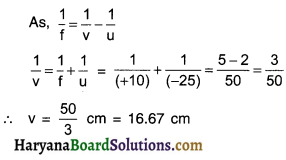
HBSE 10th Class Maths Notes Chapter 15 Probability

Haryana State Board HBSE 10th Class Maths Notes Chapter 15 Probability Notes.

Haryana Board 10th Class Maths Notes Chapter 15 Probability

Introduction
In class IX, we have learnt about experimental (or empirical) probabilities of events which were bases on the results of actual experiments.
Suppose we toss a coin 1000 times and get head say, 430 times and tail 570 times. Then we would say that in a single throw of a coin the probability of getting a head is \(\frac{430}{1000}\) i.e, 0.430 and getting a tail is \(\frac{570}{1000}\) i.e, 0.570. These probabilities are based on the results of an actual experiment of tossing a coin 1000 times. For this reason, these are called experimental or empirical probabilities.

Let us recall some of the basic terms and results that we have studied in the class IX along with a few new ones which are normally used in study of probability.
1. Experiment: Any process that yields a result or an observation is called experiment.
2. Trial: Performing an experiment once is called a trial.
3. Outcome: A particular result of an experiment is called an outcome.
4. Sample space: The set of all possible outcomes of an experiment is called sample space. The individual outcomes in a sample space are called sample points.
e.g. one toss of a coin results in the outcomes (H. T). If the coin in fair, then each out come is equally likely. Two tosses of a coin results in the outcomes (H H, H T, T H, T T).

5. Event: Any subset of the sample space is called an event. If A is an event, then n (A) is the number of same points that belongs to A. e.g. consider the experiment of tossing a die here S = (1, 2, 3, 4, 5, 6)
If A is the event that an odd number occurs, then A = {1, 3, 5}
If E is the even number greater than 4 occurs then E = {6}
6. Equally likely events: If one event cannot be expected in preference to other event then they are said to be equally likely.
For example when we throw a die once, each of the numbers (1, 2, 3, 4, 5, 6) has the of showing up. So, 1, 2, 3, 4, 5, 6 are outcomes of throwing a die.
7. Impossible Event: An event which cannot occur is called an impossible event. eg. throwing a die, 7 will never comes up. So, getting 7 is an impossible event. The probability of an impossibe event is zero.
8. Sure Event: An event which is certain to occur is called a sure event eg. in a single throwing of die, the event to get a number less than 7 is a sure event. The probability of a sure event is 1.
9. Complimentary event: If E denotes the happening of an event and ‘not E’ its not happening the event, then E and “not E” are the complimentary events.
∴ P(E) + P(not E) = 1 P(E) = 1 – P (not E)

10. Probability: The probability of an event A, denoted by P(A), is a measure of the possibility of the event occuring as the result of an experiment.
11. Empirical probability: The probability that a fair die will show a four when thrown is \(\frac{1}{6}\), using an argument based on equally likely outcomes.
12. Theoretical probability: It is P(E) of an event is the fraction of times we expect E to occur.
13. Elementary Event: An event having only one outcome is called an elementary event.
14. Random Experiments: The experiments which have not fixed results are called random experiments.
15. Favourable outcome: The possible outcomes for a given event are called favourable outcomes.
16. Die (Dice): A small cube with its faces numbered from 1 to 6. When the die is thrown, the probability that any particular number from 1 to 6 is obtained on the face landing upper most is \(\frac{1}{6}\).
17. At least: As much as.
18. At most: Not more than.

HBSE 10th Class Maths Notes Chapter 15 Probability

Probability-A Theoretical Approach
In mathematics probability is the numerical value assigned to the likelihood that a particular event will take place. For instance, if we throw an unbiased die, we have equal chances of scoring any of the numbers 1, 2, 3, 4, 5, and 6. Since there is one chance in six of throwing a 3, the probability of the event occuring is said to be \(\frac{1}{6}\). Similarly when tossing a coin the probability that it lands head is consider to be \(\frac{1}{2}\).

Theoretical probability (also called classical probability) of an event E, written as P(E), is defined as
P(E) \(=\frac{\text { Number of outcomes favourable to } \mathrm{E}}{\text { Number of all possible outcomes of the experiment }}\)

Remark: The value of probability of an event cannot be negative or greater than 1.
Some information related to the playing cards

  • A deck of playing cards has in all 52 cards.
  • 52 cards divided into 4 suits (spades, clubs, hearts and diamonds). Each suit has 13 cards.
  • Cards of heart and diamond are red cards.
  • Cards of spades and clubs are black cards.
  • King, Queen and Jack are called face cards. Thus, there are in all 12 face cards.
  • The total number of non face card is 52 – 12 = 40.

HBSE 10th Class Maths Notes Chapter 15 Probability Read More »
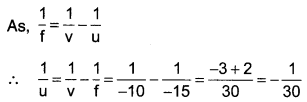
HBSE 10th Class Maths Notes Chapter 10 Circles

Haryana State Board HBSE 10th Class Maths Notes Chapter 10 Circles Notes.

Haryana Board 10th Class Maths Notes Chapter 10 Circles

Introduction
We have studied in class IX that a circle is a collection of all the points in a plane which are at a constant distance from a fixed point. The constant distance is called the radius and fixed point is known as the centre. We have also studied various terms related to a circle like chord, sector, segment, arc etc.

In this chapter we shall learn about tangents to a circle and some of their properties. Let us now examine the different situations that can arise when a line and a circle are given in a plane.

Tangent of a circle
Consider a circle with centre O and a line P in the plane of the circle. There are three types of possibilities arise as shown in the figures below:
HBSE 10th Class Maths Notes Chapter 10 Circles 1
In the figure (i), the line P and the circle have no common point hence, the line P is known as a non intersecting line with respect to the circle.
In the figure (ii), the line P intersects the circle in two distinct points A and B. It is called a secant of the circle.
In the figure (iii), the line P intersects the circle in one and only one point A and is said to be a tangent to the circle. The point A at which the tangent line meets the circle is called the Point of contact.

Normal: The line containing the radius through the point of contact is also sometimes called the normal to the circle at the point.
Supplementary angles: Two angles having sum 180° are called supplementary angles.
Co-interior angles: Interior angles on the same side of the transversal are called co-interior angles or consecutive interior angles.
Concentric circles: Circles having the same centre are called concentric circles.
Parallelogram: A quadrilateral having each pair of opposite sides equal and parallel is called parallelogram.

Rhombus : A parallelogram having all the sides equal is called a rhombus.
Circumscribed circle: The circumscribed circle or circumcircle of a polygon is a circle passing through all the vertices of the polygon. The centre of this circle is called circumcentre and its radius is called the circumradius.

Inscribed circle: Inscribed circle or incircle of a polygon is the largest circle that can be contained in the polygon and it touches each side of the polygon at a point. Hence each side of the polygon is a tangent to the incircle. The centre of this circle is called incentre and its radius is called inradius.

A line which intersects the circle at only one point is known as the tangent to the circle. In the given figure PQR is a tangent to the circle and point Q is the point of contact.

HBSE 10th Class Maths Notes Chapter 10 Circles

The word tangent to a circle has been derived from the latin word “Tangere”, which means ‘to touch’ and was introduced by the Denish mathematician Thomas Fineke in 1583.

The tangent to a circle is a special case of the secant, when the two end points of its chord coincide.
HBSE 10th Class Maths Notes Chapter 10 Circles 2

Some Properties of tangent to a circle
Theorem 10.1:
The tangent at any point of a circle is perpendicular to the radius through the point of contact.
Given: A circle with centre O and a tangent AB to the circle at a point P.
To Prove: OP ⊥ AB.
Construction: Take any point R, other than P on the tangent AB. Join OR. Suppose OR meets the circle at Q.
Proof :
OP = OQ (Radii of the same circle)
But OP < OQ + QR
OP < OR
HBSE 10th Class Maths Notes Chapter 10 Circles 3
Thus, OP is shorter than any other line segment joining O to any point of AB, other than P.
We know that among all line segment joining the point O to a point on AB, the shortest one is perpendicular to AB.
Hence, OP ⊥ AB. Proved

HBSE 10th Class Maths Notes Chapter 10 Circles

Number of Tangents from a point on a circle
To get an idea of the number of tangents from a joint on a circle, let us perform the following activity:
HBSE 10th Class Maths Notes Chapter 10 Circles 4
From figure (III) PR1 and PR2 are two tangents drawn from a point P lying outside the circle. These tangents touch the circle at R1 and R2 respectively. So, R1 and R2 are called points of contact of tangenta PR1 and PR2.
(i) There is no tangent to a circle passing through a point lying inside the circle.
(ii) There is one and only one tangent to a circle passing through a point lying on the circle.
(iii) There are exactly two tangents to a circle through a point lying outside the circle.

Length of Tangent: The length of segment of the tangent from the external point P and point of contact with the circle is called the length of the tangent from the point P to the circle.
From figure (III), PR1 and PR2 are the length of tangents from P to the circle.

Theorem 10.2:
The lengths of tangents drawn from an external point to a circle are equal.
Given: AP and AQ are two tangents from a point A to a circle C (O, r).
To Prove: AP = AQ
Construction: Join OA, OP and OQ.
Proof: AP is a tangent at P and OP is the radius through P.
HBSE 10th Class Maths Notes Chapter 10 Circles 5
Similarly AQ is a tangent at Q and OQ is the radius through Q.
∴ OQ ⊥ AQ
In the right ΔOPA and ΔOQA, we have
OP = OQ [equal radii of the same circle]
AO = AO [common]
∠OPA = ∠OQA [each is 90°]
∴ ΔOPA ≅ ΔOQA [By RHS congruence]
⇒ AP = AQ [By CPCT Proved]
Hence, AP = AQ. Proved

HBSE 10th Class Maths Notes Chapter 10 Circles Read More »
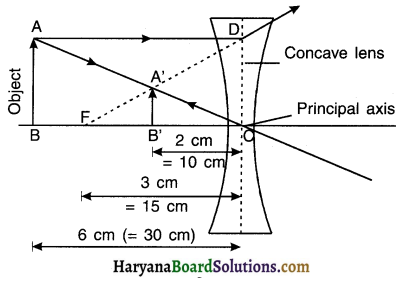
HBSE 10th Class Science Solutions Chapter 8 How do Organisms Reproduce?

Haryana State Board HBSE 10th Class Science Solutions Chapter 8 How do Organisms Reproduce? Textbook Exercise Questions and Answers.

Haryana Board 10th Class Science Solutions Chapter 8 How do Organisms Reproduce?

HBSE 10th Class Science How do Organisms Reproduce? Textbook Questions and Answers

Question 1.
Asexual reproduction takes place through budding In
(a) amoeba
(b) yeast
(c) plasmodium
(d) leis mania
Answer:
(b) yeast

HBSE 10th Class Science Solutions Chapter 8 How do Organisms Reproduce?

Question 2.
Which of the following is not a part of the female reproductive system in human beings?
(a) Ovary
(b) Uterus
(c) Vas deferens
(d) Fallopian tube
Answer:
(c) Vas deferens

Question 3.
The anther contains
(a) sepals
(b) ovules
(c) pistil
(d) pollen grains
Answer:
(d) pollen grains

Question 4.
What are the advantages of sexual reproduction over asexual reproduction?
Answer:
The advantages of sexual reproduction over asexual reproduction are as follows:
1. Sexual reproduction involves fusion of male and female gametes from male and female parents to form zygote. Thus, new generation shows variation as DNA copies from two different individuals are received.

2. Sexual reproduction involves gamete formation. Meiosis takes place during male and female gamete formation and new combination of genes occur during meiosis. This also leads to variation. Combining variation from two individuals would create new combination of variants.

3. Sexual reproduction create variation generation after generation, which is useful for survival of species over time.

4. The inbuilt tendency for variation during sexual reproduction is the basis for evolution.

HBSE 10th Class Science Solutions Chapter 8 How do Organisms Reproduce?

Question 5.
What are the functions performed by the testes ¡n human beings?
Answer:
Testes does two functions.

  • To produce sperms (male sex cells) and
  • To produce hormone called testosterone.

Question 6.
Why does menstruation occur?
Answer:
When egg is not fertilized, the thick-spongy and highly vascular inner inning of uterus breaks. This causes menstruation in woman.

Question 7.
Draw a labeled diagram of the longitudinal section of a flower.
Answer:
HBSE 10th Class Science Solutions Chapter 8 How do Organisms Reproduce 1
Flowering plants belong to the group of angiosperms. The reproductive parts of angiosperms are located in the flower. So, we can say that flower is the reproductive organ of the plant. The four main reproductive parts of a flower are:

  • Stamen
  • Pistil
  • Petal and
  • Sepal

HBSE 10th Class Science Solutions Chapter 8 How do Organisms Reproduce?

Stamen and pistil contain germ-cells (gametes).
1. Unisexual flower: If the flower contains only one part out of stamen or pistil then such a flower is called unisexual. For example, papaya and watermelon.

2. Bisexual flower: If the flower contains both stamen as well as pistil the flower is called bisexual For example. hibiscus and mustard.

3. Male reproductive part: Stamen is the male reproductive part. It produces yellowish-coloured pollen grains. Stamen is made up of two parts namely

  • anther and
  • filament.

4. Female reproductive part:
Pistil (or carpel) is the female reproductive part. It is present at the centre of a flower. It is made of three parts namely,

  • ovary,
  • style and
  • stigma.

The swollen bottom part is the ovary, middle elongated part is the style and the terminal part which may be sticky is the stigma. The ovary contains ovules and each ovule contains an egg cell.

Question 8.
What are the different methods of contraception?
Answer:
Contraception :
The method to prevent pregnancy in women is called contraception. Methods adopted to prevent pregnancy are called contraceptive methods.

Methods:
(1) Birth control tools:

  • Under this method, a mechanical barrier is created which prevents the entry of sperm into the genital tract. As a result, fertilization does not occur.
  • The tools include condoms to be worn on penis and/or diaphragm worn in the vagina by female.
  • Another tool is placing lntra-Uterine Contraceptive Devices (IUCDs) like Copper-T into the uterus of females to prevent pregnancy.

(2) Birth control pills:
There are oral pills that a women can take. These pills change the hormonal balance of the body so that the eggs are not released by the ovaries and fertilization is prevented.

(3) Surgical methods:

  • In males, a small portion of the vas deferens is surgically removed or tied.
  • This process is known as vasectomy and it prevents the sperms from entering urethra.
    (Note: ectomy means to remove by surgery)
  • In females, the fallopian tube is surgically cut and tied. This process is known as tubectomy. It will not allow the sperm to reach the uterus.

(4) Abortion:
Another method is to surgically remove the foetus from the body of pregnant women. However, this is not a method to prevent pregnancy but to prevent child-birth after pregnancy.

HBSE 10th Class Science Solutions Chapter 8 How do Organisms Reproduce?

Question 9.
How are the modes for reproduction different in unicellular and multicellular organisms?
Answer:
1. In unicellular organisms, reproduction occurs by simple cell division. For example, through fission and budding.
2. Multi-cellular organisms have complex body organization. So, they have a complex method of reproduction. They undergo sexual reproduction.

Question 10.
How does reproduction help in providing stability to populations of species?
Answer:
1. Every organism that takes birth has to die. if organisms do not reproduce, their species will become extinct.
2. Species can reproduce and gives rise to new offspring. This gives stability to its population.

Question 11.
What could be the reasons for adopting contraceptive methods?
Answer:
Reasons for adopting contraceptive method:

  • To prevent unwanted pregnancies –
  • To control human population
  • To prevent the transmission of sexually transmitted disease.

HBSE 10th Class Science How do Organisms Reproduce InText Activity Questions and Answers

Textbook Page no – 128

Question 1.
What Is the importance of DNA copying in reproduction?
Answer:
Importance of DNA copying:

  • For continuity of species
  • For transmitting hereditary information of parents to off-springs.
  • Occurrence of variation in DNA copying, leads to evolution of a species and its better adaptability to its surroundings.

Question 2.
Why is variation beneficial to the species but not necessarily for the individuals?
Answer:
1. DNA copying occurs at the time of reproduction. DNA copying shows some variations.

2. The variations may not benefit an individual all the time, but when such variations keep on taking place over generations within a large population, they may bring some changes in the species. These changes may help the generation to be better adaptive to the changing surroundings.

3. Thus, variation in individual may not seem beneficial but when studied from the point of view of entire species, it may be beneficial.

Textbook Page no – 133

Question 1.
How does binary fission differ from multiple fission?
Answer:

Binary fission

Multiple fission

1. The parent nucleus divides into two parts.
2. Cyst is not formed.
3. Amoeba and paramoecium reproduce through binary system.
1. The parent nucleus divides into several parts.
2. A cyst is formed around the organism.
3. Amoeba and plasmodium reproduce through multiple fission.

Question 2.
How will an organism be benefited if it reproduces through spores?
Answer:
1. Spore can survive under unfavourable conditions as they are covered by a hard protective coat.
2. Spores can also be carried away easily by agents like wind, water, etc.

HBSE 10th Class Science Solutions Chapter 8 How do Organisms Reproduce?

Question 3.
Can you think of reasons why more complex organisms cannot give rise to new individuals through regeneration?
Answer:
More complex organisms cannot give rise to new individuals through regeneration because

  • In complex organisms, there are specialized cells for performing different functions as well as specialized functions.
  • Complex organisms have tissues and organs which cannot be produced through regeneration. Moreover, the regenerative ability of complex organism is lost due to specialization of tissues and organs.
  • Specialized cells needed to conduct regeneration are not present in complex animals.

Question 4.
Why Is vegetative propagation practiced for growing some types of plants?
Answer:
Advantages of vegetative propagation:

  • Plants raised by vegetative propagation can bear flowers and fruits earlier than those produced from seeds.
  • Vegetative propagation is also helpful in growing plants such as banana, orange, rose and jasmine that have lost the capacity to produce seeds.
  • The plants produced are genetically similar to the parent plant and so have similar characteristics as the parent plant.

Question 5.
Why is DNA copying an essential part of the process of reproduction?
Answer:
The first and foremost task of the reproduction process is to make copies of blueprints of body design’. This is done by creating copies of DNA.

  • Through DNA copying the genetic information of parents is passed to next generation.
  • DNA present in the nucleus of the cell is the source of information for making proteins which helps in designing the body.

Textbook Page no – 140

Question 1.
How is the process of pollination different from fertilization?
Answer:
1. In pollination, there occurs the transfer of pollen grains from anther of the stamen to the stigma of the carpel. So, the main process is transfer of pollen grains.
2. In fertilization, the male gamete fuses with female gamete to form a zygote. So. fertilization is the process of fusion of germ cells.

Question 2.
What is the role of the seminal vesicles and the prostate gland?
Answer:
The seminal vesicles and prostate gland secrete fluids which make transport of sperms easier. Moreover, the fluid also provide nutrition to the sperms.

Question 3.
What are the changes seen girls at the time of puberty?
Answer:
1. The size of the breasts starts increasing. The nipples become dark.
2. The ovary starts secereting female sex hormones. Hence, girls begin to menstruate at around this time.
3. Hair start growing in pubic area and in arm-pits.

HBSE 10th Class Science Solutions Chapter 8 How do Organisms Reproduce?

Question 4.
How does the embryo get nourishment inside the mother’s body?
Answer:
1. The embryo gets nourishment from the mother’s blood with the help of special tissue called placenta.
2. The placenta contains villi on embryo’s side. Glucose, oxygen and important nutrients pass via. villi from the mother to embryo. This is how the embryo gets the nutrition.

Question 5.
If a woman is using a copper-T, will it help In protecting her from sexually transmitted diseases?
Answer:
No, copper-T does not restrict the flow of fluid that enters the vagina. Hence, if the women involves in sex with a person affected with a sexual disease, the fluid from the affected person’s body can enter into the women’s body and cause her sexual disease.

Activities

Activity 1.

Aim: To observe a sexual reproduction method of budding in yeast.

HBSE 10th Class Science Solutions Chapter 8 How do Organisms Reproduce 2

Procedure:

  • Dissolve about 10 gm of sugar in loo mL of water.
  • Take 20 mL of this solution in a test tube and add a pinch of yeast granules to it.
  • Put a cotton plug on the mouth of the test tube and keep it in a warm place.
  • After 1 to 2 hours, put a small drop of yeast culture from the test tube on a slide and cover it with a coverslip.
  • Observe the slide under a microscope.

Observation and conclusion:

  • We can see budding occurring in yeast cells. The nucleus of the cell divides.
  • Bud is an outgrowth on yeast cell surface which develops due to cell division. Here, budding has shown the asexual method of reproduction.

Activity 2.

Aim: To study growth of fungus called rhizopus on a piece of bread.

HBSE 10th Class Science Solutions Chapter 8 How do Organisms Reproduce 3

Procedure:

  • Wet a slice of bread, and keep it in a cool, moist and dark place.
  • Observe the surface of the slice with a magnifying glass.
  • Record your observation for a week.

Observation:
A white cotton-like mass appears on the moist bread which is known as bread mould. Mould is a type of fungus. Later, in most cases it becomes black to produce sporangia which produces spores.

Conclusion:

  • We will be able to see a scattered white cotton type structure on the moist bread. This is called bread mould or fungus.
  • The fungus grown is rhizopus. It becomes black to produce sporangia which produce spores.

Activity 3.

Aim: To observe amoeba and its binary fission under a microscope

HBSE 10th Class Science Solutions Chapter 8 How do Organisms Reproduce 4

Procedure:

  • Observe a permanent slide of amoeba under a microscope.
  • Similarly, observe another permanent slide of amoeba showing binary fission.
  • Now, compare the observations of both the slides.

HBSE 10th Class Science Solutions Chapter 8 How do Organisms Reproduce?

Observation and conclusion:
It can be seen in the slide that amoeba is a unicellular microscopic organism. It does not have an shape i.e. its shape Is irregular.

Binary fission in amoeba:

  • While studying the binary fission in amoeba, we can see that first its nucleus elongates and the divides into two parts.
  • After that the cytoplasm divides into two parts. The cytoplasm gets accumulated around each nucleus. This results in two daughter cells. Each daughter cell grows into an adult organism.

Activity 4.

Aim: To observe filamentous algae under a microscope

HBSE 10th Class Science Solutions Chapter 8 How do Organisms Reproduce 5

Procedure:

  • Collect water from a lake or pond that appears dark green and contains filamentous structures.
  • Put one or two filaments on a slide.
  • Put a drop of glycerine on these filaments and gently cover it with a coverslip.
  • Observe the slide under a microscope.
  • Can you identify different tissues in the spirogyra filaments?

Observation and conclusion:

  • Spirogyra has a filament type structure. It is a multicellular organism which is in the form of green coloured algae.
  • We can observe that the different cells of the spirogyra filament are alike and there is no tissue differentiation.

Activity 5.

Aim: To study vegetative propagation in potato

HBSE 10th Class Science Solutions Chapter 8 How do Organisms Reproduce 6

Procedure:

  • Take a potato and observe its surface. Can notches be seen?
  • Cut the potato into small pieces such that some pieces contain a notch or bud and some do not.
  • Spread some cotton on a tray and wet it. Place the potato pieces on this cotton. Note where the pieces with the buds are placed.
  • Observe changes taking place in these potato pieces over the next few days. Make sure that the cotton is kept moistened.
  • Which potato pieces give rise to fresh green shoots and roots?

HBSE 10th Class Science Solutions Chapter 8 How do Organisms Reproduce?

Observation and conclusion:

HBSE 10th Class Science Solutions Chapter 8 How do Organisms Reproduce 7

New plant grew from that part of potato which had notches (or say buds) whereas the other piece of potato that did not have notches (buds) did not show growth of a new plant.

Activity 6.

Aim: To study vegetative propagation by stem cutting.

Procedure:

  • Select a money plant.
  • Cut some pieces such that they contain at least one leaf.
  • Cut out some other portions between two leaves.
  • Dip one end of all the pieces in water and observe over the next few days.
  • Which ones grow and give rise to fresh leaves?
  • What can you conclude from your observations?

Observation and conclusion:

  • The piece which has at least one leaf develops into fresh leaves and branch. The reason for this is that the money plant contains an auxiliary bud between leaf and stem. This bud develops into new i.e. fresh leave.
  • The other piece i.e. the inter-node piece does not bear buds and.So fresh leaves do not develop on this piece.

Activity 7.

Aim: To observe parts of a seed

HBSE 10th Class Science Solutions Chapter 8 How do Organisms Reproduce 8

Procedure:

  • Soak a few seeds of Bengal gram (chana) and keep them overnight.
  • Drain the excess water and cover the seeds with a wet cloth and leave them for a day. Make sure that the seeds do not become dry.
  • Cut open the seeds carefully and observe the different parts.
  • Compare your observations with the figure and see if you can identify all the parts.

HBSE 10th Class Science Solutions Chapter 8 How do Organisms Reproduce?

Observation and conclusion:

  • The seed consists of two cotyledon i.e. it is dicotyledon.
  • When the seed starts growing, it shows the growth of shoot called pumule’. In future, the root will develop which will be called ‘radicle’.
  • Radicle comes out of the seed during first germination.

HBSE 10th Class Science Solutions Chapter 8 How do Organisms Reproduce? Read More »

HBSE 10th Class Maths Notes Chapter 7 Coordinate Geometry

Haryana State Board HBSE 10th Class Maths Notes Chapter 7 Coordinate Geometry Notes.

Haryana Board 10th Class Maths Notes Chapter 7 Coordinate Geometry

Introduction
We have studied in previous classes that how to locate the position of a point in co-ordinate plane of two dimensions in terms of two co-ordinates. The distance of a point from the y-axis is called its x-co-ordinate or abscissa. The distance of a point from the x-axis is called its y co-ordinate or ordinate. The coordiantes of a point on the x-axis are of the form (x, 0), and of a point on the y-axis are of the form (0, y).

In is chapter, we shall extend our knowledge by learning how to find the distance between the two points whose co-ordinates are given, and to find the area of the triangle formed by three given points. We shall also learn about how to find the co-ordinates of the point which divides a line segment joining two given points in a given ratio.

1. Plane-It is a flat surface, which extends indefinitely in all directions. The surface of a sheet of paper, the surface of a smooth green board, the surface of a smooth table top are some examples of a plane.
2. Co-ordinate axes-To locate the position of a point in a plane, two mutually perpendicular lines are drawn. One of them is horizontal known as x-axis and other is vertical known as y-axis. These axes are combindely called co-ordinate axes.
3. Origin-The point of intersection of two Axes is called origin.
4. Quadrants-The axes divide a plane into four parts called quadrants.
5. Collinear points-If three or more pointa lie on the same line, they are called collinear points. Otherwise, they are called non-collinear points.

HBSE 10th Class Maths Notes Chapter 7 Coordinate Geometry

Distance Formula
a1 = a = 0
Let P (x1, y1) and Q(x2, y2) be the given points in the plane. Draw PS ⊥ x-axis, QT ⊥ x-axis and PR ⊥ QT from P, Q and P respectively. Then
OS = x1, OT = x2, PS = y1, QT = y2
PR = ST = OT – OS = x2 – x1 and QR = QT – RT = y2 – y1
ΔQRP is a right angled triangle, right angled at R.
HBSE 10th Class Maths Notes Chapter 7 Coordinate Geometry 1
∴ PQ2 = PR2 + QR2 [By Pythagoras theorem]
PQ2 = (x2 – x1)2 + (y2 – y1)2
PQ = \(\sqrt{\left(x_2-x_1\right)^2+\left(y_2-y_1\right)^2}\)
Hence, distance between any two points
\(=\sqrt{\begin{array}{r}
(\text { difference of abscissa })^2+ \\
\text { (difference of ordinates) }^2
\end{array}}\)
It is called the distance formula.
Remark: (i) The distance of a point P(x, y) from the origin O(0, 0) is given by
OP = \(\sqrt{(x-0)^2+(y-0)^2}=\sqrt{x^2+y^2}\)
HBSE 10th Class Maths Notes Chapter 7 Coordinate Geometry 2
(ii) If three points A, B and C are collinear then AB + BC = AC.
(iii) Properties of different types of quadrilaterals
(a) Square : In a square, all sides and diagonals are equal
(b) Rectangle : In a rectangle opposite sides and diagoals are equal.
(c) Parallelogram : In a parallelogram opposite sides are equal.
(d) Paralleogram but not a rectangle : In this case opposite sides are equal but diagonals are not equal
(e) Rhombus but not a square : In this case all sides are equal, but diagonals are not equal.

Section Formula
By section formula we find out the coordinates of the point which divides the line segment joining the two given points in a given ratio internally.
Let P(x, y) be the point dividing the line segment joining the points. A(x1, y1) and B(x2, y2) internally in the ratio m1 : m2.
HBSE 10th Class Maths Notes Chapter 7 Coordinate Geometry 3
Draw AL ⊥ OX; PM ⊥ OX, BN ⊥ OX, Also draw AK ⊥ PM and PQ ⊥ BN. Then, OL = x1, OM = x, AL = y1, PM = y and BN = y2. ON = x2.
AK = LM = OM – OL = x – x1
PQ = MN = ON – OM
= x2 – x
PK = PM – KM = y – y1
BQ = BN – QN = y2 – y
In right ΔAKP and ΔPQB.
∠AKP = ∠PQB (Each is 90°)
∠AKP = ∠BPQ (Corresponding ∠s)
ΔAKP ~ ΔPQB [By AA similarity criterion]
HBSE 10th Class Maths Notes Chapter 7 Coordinate Geometry 4
HBSE 10th Class Maths Notes Chapter 7 Coordinate Geometry 5
Remarks: (1) If P is the mid point of AB then m1 : m2 = 1 : 1.
Then co-ordinates of P are
\(\left(\frac{x_1+x_2}{2}, \frac{y_1+y_2}{2}\right)\)
(2) If the ratio in which P divides AB is k : 1. Then the coordiantes of the point P are
\(\left(\frac{k x_2+x_1}{k+1}, \frac{k y_2+y_1}{k+1}\right)\)

HBSE 10th Class Maths Notes Chapter 7 Coordinate Geometry

Co-ordinates of the Centroid of a Triangle
Let A(x1, y1), B(x2, y2) and C(x3, y3) be the vertices of a given ΔABC. Let D be the mid point of BC. Let G(x, y) be centroid of the triangle as shown in figure.
Co-ordinates of the point D are \(\left(\frac{x_2+x_3}{2}, \frac{y_2+y_3}{2}\right)\)
Since centroid divides each median in the ratio 2 : 1.
HBSE 10th Class Maths Notes Chapter 7 Coordinate Geometry 6
∴ G divides AD in the ratio 2 : 1
HBSE 10th Class Maths Notes Chapter 7 Coordinate Geometry 7
Hence, the coordinates of the centroid of the triangle are \(\left(\frac{x_1+x_2+x_3}{3}, \frac{y_1+y_2+y_3}{3}\right)\)

Area of Triangle
Let A(x1, y1) B(x2, y2) and C(x3, y3) be the vertices of the given ΔABC. Draw BL, AM and CN perpendicular to the x-axis.
Then, LM = (x1 – x2), LN = (x3 – x2)
MN = (x3 – x1)
Now, Area of ΔABC = ar(Trap BLMA) + ar(Trap AMNC) – ar(Trap BLNC)
HBSE 10th Class Maths Notes Chapter 7 Coordinate Geometry 8
Since, the area is never negative, we have
Area (ΔABC) = \(\frac{1}{2}\)[(x1(y2 – y3) + x2(y3 – y1) + x3(y1 – y2)]

HBSE 10th Class Maths Notes Chapter 7 Coordinate Geometry

Condition for the collinearity of three points
If three points A (x1, y1), B (x2, y2) and C(x3, y3) are collinear.
Then Area of ΔABC = 0
HBSE 10th Class Maths Notes Chapter 7 Coordinate Geometry 9
⇒ \(\frac{1}{2}\)[x1(y2 – y3) + x2(y3 – y1) + x3(y1 – y2)
⇒ x1(y2 – y3) + x2(y3 – y1) + x3(y1 – y2)
= 0
Remark : To find the area of a polygon we divide it in triangles and take numerical value of the area of each of the triangles.

HBSE 10th Class Maths Notes Chapter 7 Coordinate Geometry Read More »