Class 7

HBSE 7th Class Science Solutions Chapter 11 Transportation in Animals and Plants

Haryana State Board HBSE 7th Class Science Solutions Chapter 11 Transportation in Animals and Plants Textbook Exercise Questions and Answers.

Haryana Board 7th Class Science Solutions Chapter 11 Transportation in Animals and Plants

HBSE 7th Class Science Transportation in Animals and Plants Textbook Questions and Answers

Question 1.
Match structures given in column I with functions given in column II.

Column-IColumn-II
(i) Stomata(a) Absorption of Water
(ii) Xylem(b) Transpiration
(iii) Root hairs(c) Transport of food
(iv) Phloem(d) Transport of water
(e) Synthesis of carbohydrates

Answer:
(i) (b)
(ii) (d)
(iii) (a)
(iv) (c)

Question 2.
Fill in the blanks :
(i) The blood from the heart is transported to all parts of the body by the __________.
(ii) Haemoglobin is present in __________ cells.
(iii) Arteries and veins are joined by a network of __________.
(iv) The rhythmic expansion and contraction of the heart is called __________.
(v) The main excretory product in human beings is __________.
(vi) Sweat contains water and __________.
(vii) Kidneys eliminate the waste materials in the liquid form called __________.
(viii) Water reaches great heights in the trees because of suction pull caused by __________.
Answer:
(i) Arteries
(ii) Red Blood Cells
(iii) Capillaries
(iv) Heart beat
(v) Urine
(vi) Urea
(vii) Urine
(viii) Transpiration

HBSE 7th Class Science Solutions Chapter 11 Transportation in Animals and Plants

Question 3.
Choose the correct options:
(а) In plants, water is transported through :
(i) Xylem
(ii) Phloem
(iii) Stomata
(iv) Root hair
Answer:
(i) Xylem

(b) Water absorption through roots can be increased by keeping the plants :
(i) in the shade
(ii) in dim light
(iii) under the fan
(iv) covered with a polythene bag.
Answer:
(iii) under the fan

Question 4.
Why is transport of materials necessary in a plant or an animal? Explain.
Answer:
Transport of materials is necessary in plant or animal because due to it the nutrients are made available to all the parts of the body. If the transport of necessary nutrients does not take place in the body, the body will not be able to survive. So, the circulation of nutrients takes place in the whole body through the process of transportation.

Question 5.
What will happen if there are no platelets in the blood?
Answer:
The blood platelets are responsible for the clotting of the blood. When some injury occurs blood starts flowing. But it clots on its own due to the blood platelets. If there are no platelets in the blood, the blood will not be able to clot and keep on flowing through a wound or injury. This can prove fatal for the organisms as no blood will remain in the body.

Question 6.
What are stomate? Give two functions of stomata.
Answer:
There are small openings on the lower surface of the leaves and stems. These pores are called stomata. These opening are covered with guard cells. Two functions of stomata are:

  • It helps in the transpiration of water i.e. the loss of excess water from the plant.
  • Loss of water from the stomata creates an upward pull i.e a suction pull which helps in absorption of water to great height in tall trees.

HBSE 7th Class Science Solutions Chapter 11 Transportation in Animals and Plants

Question 7.
Does transpiration serve any useful function in the plants? Explain.
Answer:
Transpiration is an important function in plants. It serves the following purposes:

  • It helps to enhance the absorption of water by creating a suction pull.
  • It helps the plant in getting rid of the excess water.
  • It produces a cooling effect on the plant which prevents the heat of the sun light from damaging plants.
  • It helps in transport of water and minerals to leaves and leaves use the water for the process of photosynthesis.

Question 8.
What are the components of blood?
Answer:
There are four components of the blood.

  • Plasma is the liquid part of the blood which is yellowish in colour and contains 90 percent water. It contains food, enzymes, wastes and proteins etc.
  • Red blood cells (R.B.Cs) are disc shaped cells containing red coloured pigment called haemoglobin in it. Haemoglobin helps in transportation of oxygen.
  • White blood cells (W.B.Cs) are the fighting cells, which protect us against bacteria and foreign material causing infections
  • Platelets help in clotting of the blood.

Question 9.
Why is blood needed by all the parts of a body?
Answer:
Blood is needed by all parts of the body because, it contains the digested food in it. It supplies the digested food to various parts of the body and provide essential energy to them. This energy helps the body to perform various functions and activities.

Question 10.
What makes the blood look red?
Answer:
A red coloured pigment called haemoglobin gives the blood its red colour. This pigment helps in carrying oxygen to various part of the body by blood.

Question 11.
Describe the function of the heart.
Answer:
The heart functions in the following way:
The right auricle and ventricle receives blood with carbon dioxide from all the parts of the body. The collected blood is then pumped to the lungs for the purification. In lungs the exchange of gases take place and purified blood is sent back to the left auricle. It pumps it to the left ventricle, which in turn pumps off the purified blood to all the parts of the body through arteries.

Question 12.
Why is it necessary to excrete waste products?
Answer:
The build up of waste and poisonous products in our body is always harmful. The waste products like urea etc. are toxic. When such toxic materials are not removed from the body, they get mixed with blood and can damage the cells of the body, thus proving fatal. It is, therefore, necessary to remove such poisonous waste materials from our body.

HBSE 7th Class Science Solutions Chapter 11 Transportation in Animals and Plants

Question 13.
Draw a diagram of the human excretory system and label the various parts.
Answer:
Do it yourself.

Extended Learning – Activities and Projects

Question 1.
Find out about blood groups and their importance.
Answer:
Do it yourself.

Question 2.
When a person suffers from chest pain, the doctor immediately takes an ECG. Visit a doctor and get information about ECG. You may even look up an encyclopaedia or the internet.
Answer:
Do it yourself.

HBSE 7th Class Science Transportation in Animals and Plants Important Questions and Answers

Very Short Answer Type Questions

Question 1.
What is circulatory system?
Answer:
Circulatory system is that system which transport nutrients to various parts of the body.

Question 2.
What makes the blood red?
Answer:
A red pigment called haemoglobin makes the colour of the blood red.

Question 3.
Name various kinds of cells present in blood.
Answer:
Blood has liquid part called plasma which has Red Blood Cells, white blood cells and platelets in it.

Question 4.
What role does the red pigment haemoglobin play in our body?
Answer:
Haemoglobin gets bound with the oxygen and supplies oxygen to various parts of the body. Oxygen is essential for respiration.

Question 5.
Why platelets are important for humans?
Answer:
Platelets are very important because they cause clotting of the blood. Without platelets blood will flow from the wounds unstopped and cause death.

Question 6.
What is pulse?
Answer:
Number of times the heart beats in a minute is called pulse. In resting position pulse rate of a normal human is 72-80 beats/min.

HBSE 7th Class Science Solutions Chapter 11 Transportation in Animals and Plants

Question 7.
What is the main difference between an artery and a vein?
Answer:
Artery carries purified blood i.e. blood carrying oxygen and vein carries blood rich in carbon dioxide.

Question 8.
What is transpiration?
Answer:
Transpiration is the loss of excess water from the leaves through the small pores called stomata.

Question 9.
What is excretion?
Answer:
Excretion is the process of throwing out the unwanted and waste products from the body.

Question 10.
What is dialysis?
Answer:
Dialysis is a process of separating small molecules from the large molecules using a semipermeable membrane.

Short Answer Type Questions

Question 1.
Explain briefly how the following are transported in plants.
(a) Water and mineral
(b) Food
Answer:
(a) Water and minerals are transported through the vascular tissues called xylem. Roots absorbs water from the soil and xylem transport it leaves prepare food by photosynthesis and this food is transported from leaves to different part by phloem.

(b) Food is transported in plants through vascular tissue called phloem.

Question 2.
What is transpiration? How is it different from translocation?
Answer:
Transpiration is the process of loosing excess water from the plants through small pores present on leaves called stomata. While the process of transportation of food through phloem is called translocation. Phloem transfer glucose from leaves to other parts of the plant while transpiration is evaporation of water to the environment.

Question 3.
List the factors affecting transpiration.
Answer:
Following factors affect transpiration in plants :
(i) Sunlight : Bright sunlight fastens the process of transpiration. No transpiration takes place during night.

(ii) Temperature : High temperature increases the rate of-transpiration while low temperature lowers the rate of transpiration.

(iii) Wind : Blowing wind increases the transpiration as water vapours are quickly removed from the leaves.

(iv) Humidity: Humid day lessens the rate of transpiration.

HBSE 7th Class Science Solutions Chapter 11 Transportation in Animals and Plants

Question 4.
How does transportation occur in lower animals?
Answer:
The transportation occurs in lower animals through diffusion. The nutrients circulate in the body of lower animals by the flow of cytoplasm. In some multicellular aquatic plants transportation takes place by water which circulates the nutrients through their bodies.

Question 5.
What is stethoscope? What are its main parts?
Answer:
Stethoscope is an instruments used to measure the heart beat by the doctors. It has three parts :

  • a chest piece that is sensitive to heart beats.
  • two ear pieces.
  • a tube joining the chest piece and ear pieces.

Question 6.
Write a short note on heart beat and pulse?
Answer:
Number of times a heart beats in a minute is called pulse. It can be felt by feeling the pressure of movement of blood through the artery at our wrist and by feeling the thumping of heart in our chest. It increases with physical activities. In children it varies from 90 to 100 times per minute and in adults from 70-72 beats per minute.

Question 7.
Mention the functions of the blood.
Answer:
Blood performs the following functions

  • It transports nutrients to various parts of body.
  • It carries oxygenated blood to different parts of the body.
  • It collects deoxygenated blood from various parts of the blood and takes it to lungs for purification.
  • It maintains the body temperature.
  • White blood cells fight against the infections and protect us from diseases.

Question 8.
Name various organs of excretion in humans.
Answer:
Various organs of excretion in humans are :

  • Lungs – for exchange of gases.
  • Skin – for sweating.
  • Large intestine – for excretion faeces.
  • Kidneys – for excretion urine.
  • Liver – for excretion excess sugar.

Question 9.
What is the importance of sweating?
Answer:
Sweat is water, salt and urea eliminated by skin in liquid form. The sweat is secreted by the sweat glands. Sweat is important in expelling the wastes like urea and salt from the body, It keeps the body cool and maintain the body temperature.

HBSE 7th Class Science Solutions Chapter 11 Transportation in Animals and Plants

Question 10.
Explain the process of dialysis in brief.
Answer:
Process of Dialysis is used to remove the waste from the body of those people, whose kidneys are not working. Dialyses machine help in removing the waste. A tube of the machine is connected to patients blood. Blood is purified in a semipermeable membrane inside the machine and purified blood is sent back to the body.

Long Answer Type Questions

Question 1.
Explain the circulatory system in Human beings.
Answer:
The Human circulatory system consists of mainly three parts : (i) Heart, 2. Blood vessels, 3. Blood.
1. The Heart: Heart is the pumping organ present in our body. It pumps blood to all the parts of the body. It equals a clenched fist in its size. It is located in the chest cavity on the left side. It is made up of muscles and protected by a cardial membrane called paracardium. It has four chamber – two upper chambers called Auricles and two lower chambers called Ventricles. Blood is received by auricles and pumped by ventricles. The contraction and relaxations of these chambers is called the heart beat.

2. Blood vessels : Arteries, veins and capillaries are three types of blood vessels. Arteries carry oxygenated blood while veins collect deoxygenated blood. All arteries and veins are interconnected through the network of capillaries.

3. Blood : It is red coloured fluid carrying digested food to all the parts of the body and waste products to the excretory system. It has fluid portion called plasma. Plasma has Red blood cells, White blood cells and platelets in it. Red colour of the blood is due to the red pigment called haemoglobin in it. White blood cells fight against infections and platelets cause clotting of the blood.

Question 2.
Explain the Excretory System of human beings.
Answer:
Human Excretory System consists of following organs:

  • A pair of Kidneys
  • Ureters
  • Urinary bladder
  • Urethra.

→  Kidneys : Kidneys are bean shaped structures, located on each side of the backbone above the waist. Kidneys have a number of coiled tubes like structures called nephrons. Nephron consists of a Bowman’s Capsule. It is a cup like structure having a network of blood capillaries. Nephron has a long tubule surrounded by renal capillaries. Nephrons filter the excess of water salt, urea from the blood passing through it. This waste in liquid form is called urine.

→ Ureters : Ureters are long tubes passing urine formed in the kidneys to the urinary bladder. Both kidneys send a ureter to the urinary bladder.

→ Urinary bladder : Urinary bladder is an elastic sac like structure which collects the urine from ureters. Urine remains stored in it until excreted.

→ Urethra : Urethra is the opening through which the urine is passed out of the body.

Question 3.
Explain the process of transport of substances in plants.
Answer:
In plants water and minerals is transported to the leaves and other parts and similarly food is transported from leaves to all the parts of the plant.

Transport of material in plants take place through vascular tissues. There are two types of vascular tissues in plants called xylem and phloem. Xylem forms a continuous network of channels. This connects roots to the leaves through stems and through branches. This network is used to supply water and minerals to the various parts of the body. The roots absorb water from the soil and transport it to leaves and branches through xylem. This is called ascent of sap. Similarly a network of channels use to transport the food prepared by the leaves to the other parts of the plants is called phloem. This process is called translocation.

HBSE 7th Class Science Solutions Chapter 11 Transportation in Animals and Plants

Transportation in Animals and Plants Class 7 HBSE Notes

  • Every organism needs food and water to survive.
  • Food and water is supplied to all parts of the bodies of the organisms by the transportation of these substances.
  • Transportation of materials in human body is conducted by the circulatory system.
  • Circulatory system in human beings consists of three organs : Blood, Blood vessels and Heart.
  • Blood is the liquid which carries the digested food to various parts of the body.
  • Blood contains liquid portion called plasma, Red blood cells, white blood cells and platelets.
  • Red blood cells carry a red pigment called haemoglobin. Haemoglobin gives red colour to the blood and is responsible for carrying oxygen to all parts of body.
  • White blood cells fight against the infections in our body.
  • Platelets cause clotting a blood.
  • Blood vessels are of two types : Arteries carrying oxygenated blood to all parts of the body and veins collect deoxygenated blood from various parts of the body and take it to heart.
  • Arteries and veins are interconnected with thin tubes called capillaries.
  • In plants, vascular tissues are responsible for transporting food, water and minerals to the various parts of the plant.
  • Xylem carries absorbed water and mineral to all parts of plant, while phloem carries food from leaves to the rest of the plant.
  • After the process a digestion our body produces some waste products – these wastes are thrown out of the body and this is called excretion.
  • In humans, kidneys are the main excretory organs.
  • In plants excess water is thrown out by transpiration.
    Transpiration is the process of loosing excess water by evaporation through small opening on the surface of leaves called stomata.
  • Dialysis is conducted to remove waste from humans body with damaged kidneys.

HBSE 7th Class Science Solutions Chapter 11 Transportation in Animals and Plants Read More »
HBSE 7th Class Science Solutions Chapter 12 Reproduction in Plants

Haryana State Board HBSE 7th Class Science Solutions Chapter 12 Reproduction in Plants Textbook Exercise Questions and Answers.

Haryana Board 7th Class Science Solutions Chapter 12 Reproduction in Plants

HBSE 7th Class Science Reproduction in Plants Textbook Questions and Answers

Question 1.
Fill in the blanks :
(a) Production of new individuals from the vegetative part of parent is called _________.
(b) A flower may have either male or female reproductive parts. Such a flower is called _________.
(c) The transfer of pollen grains from the anther to the stigma of the same or of another flower of the same kind is known as _________.
(d) The fusion of male and female gametes is termed as _________.
(e) Seed dispersal takes place by means of _________ and _________.
Answer:
(a) vegetative reproduction,
(b) bisexual flower
(c) pollination
(d) fertilization,
(e) wind, water, insects.

Question 2.
Describe the different methods of asexual reproduction. Give examples.
Answer:
Different methods of asexual reproduction are :
(a) Binary fission : This process takes place in unicellular organisms. Parent cell elongates and get divided into two identical daughter cells. Each daughter cell grows into an independent adult, e.g. in case of bacteria.

(b) Endospore formation : In this method a spore wall is formed around a bacterial cell to form an endospore. This endospore germinates to form an active bacterium under favourable conditions.

(c) Fragmentation : This occurs mainly in Algae. Body of the organism breaks up into two parts. Then each part grows into a new filament thus forming two organisms from a single one.

(d) Spore formation : The spores are tiny, spherical unicellular structures protected by a thick wall. The spores are stored in a hard outer covering and this is called sporangia. Under favourable conditions the hard cover breaks and spores spread for germination.

(e) Budding : In yeast, new organisms are produced by the bud formation from the parent organism. After growing to full size, the bud gets detached and form a new independent individual.

(f) Vegetative reproduction : When vegetative part of a plant like stems, leaves and root etc. give rise to new ones, it is called vegetative reproduction.

HBSE 7th Class Science Solutions Chapter 12 Reproduction in Plants

Question 3.
Explain what do you understand by sexual reproduction?
Answer:
Sexual reproduction means involvement of two parents in the process of reproduction. It is found mainly in higher plants. Male gamete and female gamete fuse to form a zygote. These zygotes develop into individuals which are not identical. Offspring inherit the characteristics of both the parents. In sexual reproduction both parents survive after the process of reproduction.

Question 4.
State the main differences between asexual and sexual reproduction.
Answer:

Asexual reproductionSexual reproduction
(a) Only one parent plant is involved.(a) Both male and female parent are involved.
(b) Occurs in unisexual plants.(b) Occurs in bisexual plants.
(c) Occurs in lower plants.(c) Occur in higher plants.
(d) Reproductive organs are not present.(d) Fully developed reproductive parts are present.
(e) In most of the methods the original parent disappears.(e) Original parents remain alive after the process of reproduction.
(f) Processes like gamete formation or fertilization is not seen.(f) Fertilization of gametes give rise to zygote.
(g) Characteristics of only one parent is inherited.(g) Characteristics of both parents are inherited.
(h) No need of seeds.(h) Seeds are used to get new plants of a flower.

Question 5.
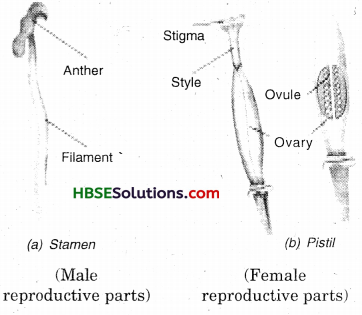
Sketch the reproductive parts of a flower.
Answer:
HBSE 7th Class Science Solutions Chapter 12 Reproduction in Plants 1

Question 6.
Explain the difference between self-pollination and cross-pollination.
Answer:

Self-pollinationCross-pollination
(a) Pollen grains are transferred to the stigma of the same flower.(а) Pollen grains are carried to stigma of another flower from one flower.
(b) Occurs in bisexual plants having anther and stigma maturing at same time.(b) Occurs in bisexual flowers having anther and stigma maturing at different times.
(c) It takes place in plants like wheat peas etc.(c) It takes place in plants like lady finger, tomato, brinjal etc.

Question 7.
How does the process of fertilization take place in flowers?
Answer:
When the pollen grain reaches the stigma of a same flower, it starts growing out in pollen tube of the stigma. This tube continues to grow inside the style till it reaches the ovule. Male cells are released in the ovule for the fertilization with female cells and thus the zygote is formed. After this process of fertilization, the ovary develops into fruit and ovule into seeds.

Question 8.
Describe the various ways by which seeds are dispersed.
Answer:
Following are the ways in which the seeds get dispersed:
(i) Some light seeds like that of Madar, which are hairy, dry and small are carried away by the wind to different places. Some seeds having winged structure e.g. that of Maple and Drumstick are also dispersed by air.

(ii) Spiny seeds and fruits like that of Xanthium and Gokhru, the seeds stick to the clothes of passers-bye and animals. These seeds are carried away by these agents to different places.

(iii) In some cases having heavy seeds like that of Coconut, water acts as the dispersing agents.

(iv) Some seeds are diprersed when the fruit bursts like in case of Balsam and castor.

HBSE 7th Class Science Solutions Chapter 12 Reproduction in Plants

Question 9.
Match the items in Column I with those of Column II :

Column IColumn II
(a) Bud(i) Maple
(b) eyes(ii) Spirogyra
(c) fragmentation(iii) Yeast
(d) Wings(iv) Bread mould
(e) Spores(v) Potato
(vi) Rose

Answer:
(a) (iii)
(b) (v)
(c) (ii)
(d) (i)
(e) (iv)

Question 10.
Tick (✓) the correct answer :
(a) The reproductive part of a plant is the :
(i) Leaf
(ii) Stem
(iii) Root
(iv) Flower
Answer:
(iv) Flower

(b) The process of fusion of the male and the female gametes is called :
(i) fertilization
(ii) Pollination
(iii) reproduction
(iv) seed formation
Answer:
(i) fertilization

(c) Mature ovary forms the:
(i) Seed
(ii) Stamen
(iii) Pistil
(iv) Fruit
Answer:
(iv) Fruit

(d) A spore producing plant is :
(i) Rose
(ii) Bread mould
(iii) Potato
(iv) Ginger
Answer:
(ii) Bread mould

(e) Bryophyllum can reproduce by its :
(i) Stem
(ii) Leaves
(iii) Roots
(iv) Flower
Answer:
(ii) Leaves

Extended Learning-Activities and Projects

Question 1.
Make your own cactus garden by collecting pieces cut from different kinds of cacti. Grow the variety in one single flat container or in separate pots.
Answer:
Do it yourself.

Question 2.
Visit a fruit market and collect as many local fruits as possible. If many fruits are not available, you can collect tomatoes and cucumbers (these are fruits, though we use them as vegetables). Make drawings of the different fruits. Split the fruits and examine the seeds within. Look for any special characteristics in the fruits and their seeds.
Answer:
Do it yourself.

HBSE 7th Class Science Solutions Chapter 12 Reproduction in Plants

Question 3.
Think of ten different fruit-bearing plants. Remember that many vegetables are also fruits of the plants. Discuss with your teacher, parents, farmers, fruit growers and agricultural experts (if available nearby) and find out the manner of their dispersal. Present your data in the form of a table as shown below :

S. NoName of fruit bearing plantAgent through which seeds are dispersedPart of or seed which helps in dispersal
1.
2.
3.

Answer:
Do it yourself.

Question 4.
Suppose there is one member of a particular kind of organism in a culture dish, which doubles itself in one hour through asexual reproduction. Work out the number of members of that kind of organism which will be present in the culture dish after ten hours. Such a colony of individuals arising from one parent is called a “clone”.
Answer:
Do it yourself.

HBSE 7th Class Science Reproduction in Plants Important Questions and Answers

Very Short Answer Type Questions

Question 1.
What do you understand by the term reproduction?
Answer:
Reproduction is the process by which the living organisms produce more of their ownkind.

Question 2.
Name the methods by which plants reproduce.
Answer:
Plants reproduce in two ways :

  • Asexual reproduction
  • Sexual reproduction.

Question 3.
What is pollination?
Answer:
Pollination is a process in which pollen grains get transferred from anther to the stigma of the‘flower.

Question 4.
Name different methods of asexual reproduction.
Answer:
Various methods of asexual reproduction are :

  • Binary fission
  • Endospore formation
  • Fragmentation
  • spore formation
  • Budding
  • Vegetative reproduction.

Question 5.
What do you mean by the term fertilization?
Answer:
Fertilization is a process in which fusion of male and female gametes takes place to produce the zygote.

Question 6.
What is vegetative reproduction?
Answer:
It is the simplest method of reproduction in plants. In this method the vegetative parts like stem, roots and leaves produce new ones.

HBSE 7th Class Science Solutions Chapter 12 Reproduction in Plants

Question 7.
What is the advantage of the vegetative reproduction?
Answer:
The vegetative reproduction occurs very fast and easily. So quick reproduction is possible.

Question 8.
What is difference between unisexual and bisexual flowers?
Answer:
Unisexual flower has either a male or female reproductive part and bisexual flower has both of them.

Question 9.
Write any one advantage of seed dispersal.
Answer:
It prevents the plants from competing for sunlight, water and minerals.

Question 10.
Where are the male and female gametes found?
Answer:
The male gametes are found inside the pollen grains and the ovule contains the female gametes.

Short Answer Type Questions

Question 1.
What is reproduction? Name various methods of reproduction in plants.
Answer:
Reproduction is the process by which the living organisms produce more of their ownkind. Plants reproduce by two methods asexual and sexual. Asexual reproduction means the birth of new ones by single parent only. Sexual reproductions means involvement of two parents in the process.

Question 2.
List the different methods of asexual reproduction. In which type of plants does asexual reproduction occur?
Answer:
Asexual reproduction occurs in lower form of plants, where they do not have any reproductive part. It occurs through following methods.

  • Binary fission
  • Budding
  • Endospore formation
  • Spore formation
  • Fragmentation
  • Vegetative reproduction.

Question 3.
What is pollination? How is it brought about?
Answer:
The transfer of pollen grains from anther to stigma of a flower is called pollination. Pollination is brought about by many agents like water, air, animals and insects. Pollen grains are carried by these agents from anther of one flower to the stigma of another flower of same kind.

Question 4.
What do you mean by cross-pollination and self-pollination?
Answer:
Transfer of pollens occur in two ways. When pollen grains ate transferred to stigma of the same flower, it is called self pollination. When transfer of pollen grains take place from anther of one flower to the stigma of another flower of same kind, it is called cross pollination.

HBSE 7th Class Science Solutions Chapter 12 Reproduction in Plants

Question 5.
Write a short note on vegetative propagation.
Answer:
Vegetative reproduction! means the birth of new ones from the vegetative parts of the plant like leaves, stem, roots and buds. This is an asexual type of reproduction. Eyes on potato, buds sprouting on the leaves of bryophyllum, new plant growing out of cactus’ stem etc are examples of vegetative reproduction.

Question 6.
Write atleast three advantages of vegetative propagation methods.
Answer:
Following are the advantages of vegetative propagation:

  • It is a fast method of reproduction.
  • Plants produced by vegetative propagation have same features as that of parent plant.
  • Plants produced by vegetative reproduction bear flowers and fruits earlier than the plants grown out of seeds.

Long Answer Type Questions

Question 1.
What is Asexual reproduction? Explain various methods of asexual reproduction.
Answer:
Asexual reproduction means obtaining new plants from one parent without seeds. Various methods of asexual reproduction are as follows :

Different methods of asexual reproduction are :
(a) Binary fission : This process takes place in unicellular organisms. Parent cell elongates and get divided into two identical daughter cells. Each daughter cell grows into an independent adult, e.g. in case of bacteria.

(b) Endospore formation : In this method a spore wall is formed around a bacterial cell to form an endospore. This endospore germinates to form an active bacterium under favourable conditions.

(c) Fragmentation : This occurs mainly in Algae. Body of the organism breaks up into two parts. Then each part grows into a new filament thus forming two organisms from a single one.

(d) Spore formation : The spores are tiny, spherical unicellular structures protected by a thick wall. The spores are stored in a hard outer covering and this is called sporangia. Under favourable conditions the hard cover breaks and spores spread for germination.

(e) Budding : In yeast, new organisms are produced by the bud formation from the parent organism. After growing to full size, the bud gets detached and form a new independent individual.

(f) Vegetative reproduction : When vegetative part of a plant like stems, leaves and root etc. give rise to new ones, it is called vegetative reproduction.

Question 2.
What is vegetative reproduction ? Describe vegetative reproduction in different parts of the plant.
Answer:
Vegetative reproduction means growing of off springs from the vegetative parts of the plant like roots, stems, and leaves.
(i) Vegetative propagation by roots : Thick roots of sweet potato, dahlia or asparagus give rise to new ones, inside the soil only.

(ii) Vegetative propagation by stems : In certain plants like potato, ginger, sugarcane etc, new plants grow from the stems of these plants. In potatoes these are small ‘eyes’ on the swollen stem. These eyes germinate to give rise to new plants. Ginger and turmeric also give rise to new plants rom the small buds growing on their swollen stems.

(iii) Vegetative reproduction by leaves : In plants like Bryophyllum Small plantlets grow from the margins of the leaves. These plantlets when detached from the leaf and grown develops into an independent plant.

Question 3.
Explain Sexual Reproduction in plants.
Answer:
Sexual reproduction occurs in plants having well developed reproductive parts in them. Flowers are the reproductive parts of the plant. Flowers can be unisexual i.e. having only male or female reproductive parts, and Bisexual i.e. having both male and female reproductive parts.

Female reproductive part of the flower i.e. the pistil form female ovules and male reproductive parts i.e. Androecium give rise to male gametes. When male and female gametes fuse in the ovary of the flower the process of fertilisation takes place. Male gametes are carried to the female flowers far away by agents like wind, water, insects and animals. This is called pollination. After fertilization the ovary of the flower becomes pulpy and juicy to form fruits. The ovules become the seeds.

HBSE 7th Class Science Solutions Chapter 12 Reproduction in Plants

Reproduction in Plants Class 7 HBSE Notes

  • Reproduction is the process by which all the living organisms produce more of their own kind.
  • The reproduction in plants occur by two methods : asexual reproduction and sexual reproduction.
  • Asexual reproduction is reproduction without seeds involving only single parent.
  • Asexual reproduction occurs in lower forms of the plants.
  • Various methods of asexual reproduction are : Binary fission, fragmentation, Endospore formation, spore formation, Budding and vegetative reproduction.
  • Binary fission is division of elongated parent cell into two daughter cell. It mostly occurs in bacteria. Some bacteria reproduce by endospore formation.
  • Fragmentation is splitting up of filaments of algae in two or more than two parts, which develop into complete organism.
  • Spores are formed in fungi, spores along with outer hard covering are called sporangium. Sporangium burst to release spores.
  • Bud is a small bulb like projection, which comes out of yeast cell. It grows and detach from the parent cell to form a new yeast cell.
  • Vegetative propagation is the birth of new ones from the vegatative parts of the plant like leaves, roots, stems etc.
  • Sexual reproduction is the reproduction by seeds involving both male and female plants.
  • Male and female gametes fuse to form zygote which grows into a developed new plant.
  • Ovaries of the plant develop into fruit after fertilization and ovules becomes seeds.
  • Male pollen grains are transferred from one flower to another and this is called pollination.
  • When pollen grain of same flower are transferred from anther to stigma of same flower, it is called self pollination.
  • When pollens of a flower are transferred to stigma of another flower of same kind, it is called cross pollination.

HBSE 7th Class Science Solutions Chapter 12 Reproduction in Plants Read More »

HBSE 7th Class Science Solutions Chapter 7 Weather, Climate and Adaptations of Animals to Climate

Haryana State Board HBSE 7th Class Science Solutions Chapter 7 Weather, Climate and Adaptations of Animals to Climate Textbook Exercise Questions and Answers.

Haryana Board 7th Class Science Solutions Chapter 7 Weather, Climate and Adaptations of Animals to Climate

HBSE 7th Class Science Weather, Climate and Adaptations of Animals to Climate Textbook Questions and Answers

Question 1.
Name the elements that determine the weather of a place.
Answer:
The temperature, humidity, rainfall, wind-seed etc. are called the elements of the weather, that determines the weather of a place.

Question 2.
When are the maximum and minimum temperature likely to occur during the day?
Answer:
The maximum temperature of the day occurs generally in the afternoon while the minimum temperature occurs generally in the early morning.

Question 3.
Fill in the blanks:
(i) The average weather taken over a long time is called ………… .
(ii) A place receives very little rainfall and the temperature is high throughout the year, the climate of that place will be………….. and ………….. .
(iii) The two regions of the earth extreme climatic conditions are …………… and ……………. .
Answer:
(i) the climate of the place
(ii) hot, dry
(iii) polar, tropical

Question 4.
Indicate the type of climate of the following areas:
(a) Jammu and Kashmir
(b) Kerla
(c) Rajasthan
(d) North-East India.
Answer:
(a) Jammu and Kashmir – moderately hot and moderately wet climate
(b) Kerala – very hot and wet climate
(c) Rajasthan – hot and dry climate
(d) North-east India – The north eastern India receives rain for a major part of the year. Therefore, we can say that the climate of the north-east is wet.

HBSE 7th Class Science Solutions Chapter 7 Weather, Climate and Adaptations of Animals to Climate

Question 5.
Which of the two changes frequently, weather or climate?
Answer:
Weather.

Question 6.
Following are some of the characteristics of animals:
(i) Diets heavy on fruits
(ii) White fur
(iii) Need to migrate
(iv) Loud Voice
(v) Sticky pads on feet
(vi) Layer of fat under skin
(vii) Wide and large paws
(viii) Bright colours
(ix) Strong tails
(x) Long and large beak
For each characteristic indicate whether it is adaptation for tropical rainforests or polar regions. Do yQU think that some of these characteristics can be adaptations for both the regions?
Answer:
(i) Diets heavy on fruits – tropical rainforests
(ii) White fur – polar regions
(iii) Need to migrate – pblar regions
(iv) Loud Voice – tropical rainforests
(v) Sticky pads, on feet – tropical rainforests
(vi) Layer of fat under skin – polar regions
(vii) Wide and large paws – polar Regions
(viii) Bright colours – tropical rainforests
(ix) Strong tails – tropical regions
(x) Long and large beak – tropical rainforests.

Question 7.
The tropical rainforests has a large population of animals. Explain why it is so?
Answer:
The tropical region has generally a hot climate because of its location around the equator. Even in the coldest month the temperature is generally higher than about 15°C. During hot summers, the temperature may cross 40°C. Days and nights are almost equal in length throughout the year. These regions get plenty of rainfall.

An important feature of this region is the tropical rainforests. Tropical rainforests are found in Western Ghats and Assam in India, South East Asia, Central America and Central Africa. Because of continuous warmth and rain, this region support wide variety of plants and animals. The major types of animals living in the rainforests are monkeys, apes, gorillas, lions, tigers,, elephants, leopards, lizards, snakes, birds and insects.

Question 8.
Explain, jirith examples, why we find animals of certain kind living in particular climatic conditions?
Answer:
Animals are adapted to survive in the conditions in which they live. Animals living in very cold and hot climate must possess special features to protect themselves against the extreme cold or heat.

Penguins are found in cold regions. They have a feathery coat as well as a layer of fat under the feathery coat. The coat covers their bodies right down to their legs. These adaptations keep the body warm.

Polar bear Eire found in the Arctic region where it is very cold. They have a thick layer of fur Emd a lot of fat in their bodies to keep them warm. Their soles are covered with fur to keep them warm. The white fur also helps the polar bears to blend with the snowy surroundings so that they are detected by the prey.!

Question 9.
How do elephant living in the tropical! rainforest adapt itself
Answer:
It has adapted to the conditions of rainforests in many remarkable ways. Trunks uses it as a nose because of which it has a strong sense of smell. The trunk is also used by it for picking up food. Moreover, its tusks are modified teeth. These can tear the bark of trees that elephant loves to eat. So, the elephant is able to handle the competition for food rather well. Large ears of the elephant help it to hear even very soft sounds. They also help the elephant to keep cool in the hot and humid climate of the rainforest.

Choose the correct option which answers the following questions (Question 10-12).

Question 10.
A carnivore with stripes on its body moves very fast while catching its prey. It is likely to be found in:
(i) polar regions
(ii) deserts
(iii) oceans
(iv) tropical rainforests
Answer:
(iv) tropical rainforests

HBSE 7th Class Science Solutions Chapter 7 Weather, Climate and Adaptations of Animals to Climate

Question 11.
Which features adapt polar bears to live in extremely cold climate?
(i) A white fur, fat below skin, keen sense of smell.
(ii) Thin skin, large eyes, a white fur.
(iii) A long tail, strong claws, white large paws.
(iv) White ‘body, paws for swimming, gills for respiration.
Answer:
(i) A white fur, fat below skin, keen sense of smell.

Question 12.
Which option best describes a tropical region?
(i) hot and humid
(ii) moderate temperature, heavy rainfall
(iii) cold and humid
(iv) hot and dry
Answer:
(i) hot and humid

Extended Learning – Projects And Activities

Question 1.
Collect weather reports of seven successive days in the winter months (Preferably December). Collect similar reports for the summer months (Preferably June). Now prepare a Table for sunrise and sunset times as shown:

JuneDecember
DateSunriseSunsetDateSunriseSunset

Try to answer the following questions:

  • Is there any difference in the time of sunrise during summer and winter?
  • When do you find that the sun rises earlier?
  • Do you also find any difference in the time of sunset during the month of June and December?
  • When are the days longer?
  • When are the nights longer?
  • Why are the days sometimes longer and sometimes shorter?
  • Plot the length of the day against the days chosen in June and December. (Instructions for plotting graphs are given in Chapter 13).
    Answer:
    Do yourself.

HBSE 7th Class Science Solutions Chapter 7 Weather, Climate and Adaptations of Animals to Climate

Question 2.
Collect information about the Indian Meteorological Department. If possible visit its website: htt/www.imd.gov.in.
Write a brief report about the things this department does.
Answer:
Do yourself.

HBSE 7th Class Science Weather, Climate and Adaptations of Animals to Climate Important Questions and Answers

Very Short Answer Type Questions

Question 1.
What is raingauge?
Answer:
Rainfall is measured by an instrument called the rainguage. It is basically a measuring cylinder with a funnel on top to collect rainwater.

Question 2.
Define weather.
Answer:
The day-to-day condition of the atmosphere at,’a place with respect to the temperature, humidity, rainfall, wind speed, etc., is called the weather of that place.

Question 3.
Who prepares the weather reports?
Answer:
The weather reports are prepared by the Materological Department of the Government. This department collects data on temperature, wind etc., and makes the weather prediction.

Question 4.
Define climate.
Answer:
The average weather pattern taken over a long time, say 25 years, is called the climate of the place.

Question 5.
Why do some places have hotter climate than others?
Answer:
The places nearer to the equator are usually hotter. This is because the sun’s rays are more concentrated near the equator than they are farther North or South.

Question 6.
Give two examples of animals found in cold climates.
Answer:
(i) Penguins
(ii) Polar bear.

Question 7.
Give two examples of animals found in hot and humid climate.
Answer:
(i) Red-eyed frog
(ii) Beard ape.

Question 8.
Name three desert animals.
Answer:
(i) Camel
(ii) Snake
(iii) Lizard.

HBSE 7th Class Science Solutions Chapter 7 Weather, Climate and Adaptations of Animals to Climate

Question 9.
Can a polar bear live happily on land?
Answer:
No, it lives where the land is fully covered with snow.

Question 10.
Where do the elephant live?
Answer:
Elephant lives in forest.

Question 11.
Where does penguin live?
Answer:
Penguin lives in very cold places.

Question 12.
Define adaptation.
Answer:
The particular features of an organism that makes it suited to a particular climate is called adaptation.

Question 13.
What do you understand by ‘summer sleep’?
Answer:
Animals like frog, crocodiles and alligators live in mud during the summer months. This is called the ‘summer sleep’.

Question 14.
What do you understand by hibernation?
Answer:
During winter, some animals like bears, bats, snakes, lizards, frogs and squirrels go to sleep. This is called the winter sleep or hibernation.

Question 15.
Where do the following animals live?
(i) Monkeys
(ii) Snakes
(iii) Rabbit
(iv) Fish.
Answer:
(i) On land and trees
(ii) On land and water
(iii) On land
(iv) In water.

Question 16.
Name three animals which are active during night;
Answer:
(i) Bat
(ii) Owl
(iii) Cockroach.

HBSE 7th Class Science Solutions Chapter 7 Weather, Climate and Adaptations of Animals to Climate

Question 17.
What is the difference between climate of Kashmir and Kerala?
Answer:
Kerala is very hot and wet in comparison to Kashmir, which has a moderately hot and moderately wet.

Question 18.
Name two countries where polar regions are found?
Answer:
(i) Canada
(ii) Sweden.

Question 19.
Name two countries where the tropical rainforests are found?
Answer:
(i) India
(ii) Malaysia.

Question 20.
Name a migratory bird.
Answer:
Siberian crane.

Short Answer Type Questions

Question 1.
Why do desert animals have thick skin?
Answer:
Animals living in hot places, such as snakes, desert rats and lizards are not able to get sufficient water. So these animals have a thick skin, which prevents evaporation. Since they do not sweat, they can survive| without water for a longer time.

Question 2.
How is camel adapted live in/ desert?
Answer:
Camel lives in desert. It has long legs which help it to lift its body above the ground. Thus camel is able to avoid direct contact with the hot ground. The camel drinks water 50 litre or above in one time and store it in its body. So it lives without water for longer time. Its skin is also thick which prevents transpiration of ‘ water. Thus camel is suited to live in desert.

Question 3.
How cold place animals protect themselves from cold?
Answer:
The animals which live in cold places like waives seals, and penguins have thick skin which protects them from cold. They also have thick ,fur.

Question 4.
How fishes are adapted to live in water?
Answer:
Fishes are best suited to live in water. They have boat like structure which help them in swimming in water. They have gills from which they get oxygen and food. The body of fishes contain different types of fins which help them from swimming in water. Fishes shape tapers which provide least resistance in swimming water.

Question 5.
Why do polar bears have white fur?
Answer:
Polars bears have white fur so that they are not easily visible in the snowy white background. It protects them from their predators. It also helps them in catching their prey. To protect them from extreme cold, they have two this layers of fur. They also live a er of fair under their skin.

Question 6.
Differentiate between weather and climate.
Answer:

ClimateWeather
The average weather pattern taken over a long time, say 25 years, is called the climate of the place.The day-to-day condition Of the atmosphere at a place with respect to the temperature, humidity, rainfall, wind-speed, etc; is called the weather at that place.

Question 7.
Give some examples of sea water animals.
Answer:
Almost all types of animals live in sea water. Most of the sea water animals are actively swimming animals like fishes and whales. Animals like corals, star fish, and urchin live at the bottom of the sea.s

Question 8.
Write the factors which the climate of a region depend.
Answer:
The climate of a region depends on:
(i) The presence or absence of water (rainfall).
(ii) Amount of sunshine it gets.
(iii) The ability to transfer water to the atmosphere (evaporation), and
(iv) The place whether it is a hilly or a plain region.

Question 9.
Mention the adaptive features of the animals found n cold climates.
Answer:
The animals found in cold climates have a thick layer of fat under the skin. This gives them nourishment in winter. They also have thick coat of fur on their body which helps the stay warm. The examples of animals 6 in cold regions are reindeer, arctic fox, polar bear, etc.

Question 10.
Mention the adaptations in hot and dry climates.
Answer:
Animals living in hot and dry places usually have following adaptations:
(i) Short shiny fur to reflect the sun’s rays.
(ii) Keep the body cool through sweating and panting.
(iii) To avoid the strong sun, they feed in the morning or evening and hide behind rocks and in burrows during the day.
Examples: Camel, Ostrich and Snail.

HBSE 7th Class Science Solutions Chapter 7 Weather, Climate and Adaptations of Animals to Climate

Long Answer Type Questions

Question 1.
The Earth is the only planet on which life is exists, why? Explain.
Answer:
The Earth is not the only planet revolving around the Sun. There are eight other planets that revolve Ground tfye Sun. But Earth is the only planet on which life exists. A number of factors are responsible for it. These are:
(i) Distance of Earth from the Sun; this is sufficient to keep the temperature’ on the surface of Earth at an average of 30°C; life can exist at this temperature.
(ii) The layer of carboh dioxide and watervapour which surrounds Earth prevents too much heat from leaving Earth into space; otherwise the temperature of Earth would be -30°C.
(iii) The layer of Zone which surrounds Earth does not allow ultraviolet rays to reach Earth from the sun, other wise living onganisns will die.

Question 2.
Describe the adaptive features of camel.
Answer:
The camel is the animal that thrives on the best in such hpt climate. It is also called the ship of the desert. The camel is called so because of the following adaptations it has:
(i) Thick skin that prevents water loss through perspiration or evaporation.
(ii) Humps (one or two) present in the body. These are the storehouse of fat. The camel uses this fat when food is scarce.
(iii) Pouches in the body to store water. This enables the camei to go without water for many days.
(iv) Pads of skin under the feet that act like cushions and enable the camel to walk easily in the sand without sinking.
(v) Long curly eyelashes preventing the entry of sand into eyes and thick eyebrows to protect eyes from sun. The plants and animals living in cold regions also have certain features. These are different from those possessed by plants and animals living in hot regions.

Question 3.
Defind adaptation. Mention various adaptations in terrestrial animals.
Answer:
Climate influences living organisms directly. Hence, they develop certain traits that help them to thrive well in that particular climate. This is called adaptation.

The animals that live on land are called terrestrial animals. These animals have different types of habits and ways of living. The terrestrial animals may be runners (cursorial habit), burrowers and diggers (fossorial habit), climbers (scansorial or arboreal habit) and fliers (aerial habit). Accordingly, these animals have different types of adaptations, as described below.
A. Modification of foot: Terrestrial animals have different types of foot for locomotion.
(i) Pentadactily: Terrestial animals have pentadactyl (five digits) foo; bearing claws for walking and running. Pentadactyl foot are of following three types:
(а) Plantigrade: In this type of foot, the entire palm and sole rest on the ground e.g. bear, baboon, raccoon.
(b) Digitigrade: In this case, animals perform walking and running on the digits e.g. dogs, cat, hyaena.
(c) Unguligrade: In this case, animals perform walking and running on the tips of digits covered with modified nail called hoof. The distal toe bones (unguals) are depressed or flattened, e.g. pig, horse, donkey, rhinoceros.

(ii) Bipedality: Some terrestrial animals have two footed or bipedal mode of locomotion, which spares forelimbs for other types of jobs. e.g. human beings.

B. Modification of body and head:
(i) The fast moving animals like horse, dog, etc. have streamlined body to reduce the resistance offered by the air.
(ii) In burrowing and digging animals, the head and snout are tapering. e.g. snakes, shrew, mole.

C. Modification for respiration:
The majority of terrestrial animals are lung breathers. They have lungs for respiration, e.g. Frog, lizards, all mammals.

D. Protective adaptations:
Many terrestrial animals are able to modify their form, appearance, structure or behaviour to escape predation or to increase the chances of capturing the prey. For example frog can change its body colour to match the back ground.

HBSE 7th Class Science Solutions Chapter 7 Weather, Climate and Adaptations of Animals to Climate

Question 4.
Mention various adaptations in aquatic animals.
Answer:
A large number of animals live in aquatic habitat. They include both fresh water and marine (sea water) forms. Several invt ibrates such as prawn, Octopus, some insects are aquatic or semi aquatic. A number of vertebrates such as fishes, whales, dolphins are well adapted to aquatic mode of life. They have following adaptation for aquatic mode of life.
(i) Body contour: They have streamlined laterally compressed body to reduce friction. This allows swift passage in water while swimming.
(ii) Swimming organs: The fishes have fins and whales possess flippers which help them in swimming. Frogs and ducks have webbed feet for swimming.
(iii) Protective covering: The body of fishes is covered with scales and that of frog with a mucilaginous covering, which protect them from decaying effect of water.
(iv) Gills: Fishes have special breathing organs called gills, which use dissolved oxygen of water.
(v) Swim bladder or Air bladder:
Certain fishes (bony fishes) have swim bladder or air bladder. It is filled with air and maintain buoyancy.

Weather, Climate and Adaptations of Animals to Climate Class 7  HBSE Notes

1. The day-to-day condition of the atmosphere at a place with respect to the temperature, humidity, rainfall, wind-speed, etc.; is called the weather at that place.
2. The temperature, humidity and other factors are called the elements of the weather. The weather of a place charges day after day and week after week.
3. The maximum temperature of the day occurs generally in the afternoon while the minimum temperature occurs in the early morning.
4. The times of sunrise and sunset also change during the year.
5. All the changes in the weather are driven by the sun.
6. The average weather pattern taken over a long time, say 25 years, is called the climate of the place.
7. The tropical and the polar regions are the two regions of the earth, which have severe climate conditions. .
8. Animals are adapted to the conditions in which they live.
9. The polar regions are very cold throughout the year. The sun does not set for six months in a year and in the other six months it does not rise.
10. Animals in the polar region are adapted to the extremely cold climate by having some special characteristics such as white fur, strong sense of smell, a layer of fat under the skin, wide and large paws for swimming and walking etc.
11. Migration is another means to escape the harsh, cold conditions.
12. Because of the hospitable climatic conditions, huge populations of plants and animals are found in the tropical rainforests.
13. Animals in the tropical rainforests are adapted such that they eat different kinds of food to overcome the competition for food and shelter.
14. Some adaptations of animals living in the tropical rainforests include living on the trees, development of strong tails, long and large beaks, bright colours, sharp patterns, loud voice, diet of fruits, sensitive hearing, sharp eyesight, thick skin, ability to camouflage in order to protect themselves from predators etc.

HBSE 7th Class Science Solutions Chapter 7 Weather, Climate and Adaptations of Animals to Climate Read More »

HBSE 7th Class Sanskrit Solutions Ruchira Bhag 2 Haryana Board

HBSE 7th Class Sanskrit Solutions Ruchira Bhag 2 Haryana Board Read More »

HBSE 7th Class Science Solutions Chapter 18 Wastewater Story

Haryana State Board HBSE 7th Class Science Solutions Chapter 18 Wastewater Story Textbook Exercise Questions and Answers.

Haryana Board 7th Class Science Solutions Chapter 18 Wastewater Story

HBSE 7th Class Science Wastewater Story Textbook Questions and Answers

Question 1.
Fill in the blanks :
(a) Cleaning of water is a process of removing _________.
(b) Wastewater released by houses is called _________.
(c) Dried _________ is used as manure.
(d) Drains get blocked by _________ and _________.
Answer:
(a) pollutants
(b) sewage
(c) sludge
(d) chemicals, kitchenwaste.

Question 2.
What is sewage? Explain why it is harmful to discharge untreated sewage into rivers or seas.
Answer:
Sewage is a liquid containing wastes disposed off by household, industrial and agricultural, activities in water. It is dangerous to release untreated sewage in water because it can pollute the whole source of water. Sewage contain harmful substances and disease causing organisms. It is therefore, dangerous and unsafe to release untreated sewage in water.

Question 3.
Why should oils and fats be not realeased in the drain? Explain.
Answer:
Oils and fats should not be released in, the drains because they harden the soil in the pipes and block them. Fats get clogged in the holes of the soil in the drain and block it. It does not allow the wastewater to flow and thus the whole sewer system is blocked.

HBSE 7th Class Science Solutions Chapter 18 Wastewater Story

Question 4.
Describe the steps involved in getting clarified water from wastewater.
Answer:
Water is treated physically, chemically and biologically in wastewater treatment plant.
Following Steps are involved in the purification of water:
(i) At first stage all the physical impurities like stones, rags, napkins, plastic bags, cans, packets etc. are removed. It is done by passing the water through bar screens.

(ii) Then water is taken to grit and sand removal tank where impurities are removed by sedimentation.

(iii) Solids impurities and faeces etc. are collected from the bottom of the water. These solid impurities collected are called sludge. Water is cleared of floatable solids like oil and grease.

(iv) Clarified water is cleared of other impurities by aerator. All disease causing bacteria are removed by chlorination and water is released in various water bodies.

Question 5.
What is sludge? Explain how it is treated.
Answer:
Sludge is the collected solid waste from the wastewater during the treatment in water treatment plant. Sludge is decomposed in a separate tank by the anaerobic bacteria. Activated sludge is used as manure.

Question 6.
Untreated human excreta is a health hazard. Explain.
Answer:
Untreated excreta can cause a lot of health related problems. It pollutes soil, water and air. The polluted water contain disease causing bacteria, which can spread epidemics like cholera, meningities etc.

Question 7.
Name two chemicals used to disinfect water.
Answer:
Chlorine and ozone are the chemical used to clean the wastewater.

Question 8.
Explain the function of bar screens in a wastewater treatment plant.
Answer:
Bar screens clear the wastewater of all the physical impurities. Large waste objects like napkins, plastics, can sticks, rags etc. are, removed from the wastewater through the bar screens.

HBSE 7th Class Science Solutions Chapter 18 Wastewater Story

Question 9.
Explain the relationship between sanitation and disease.
Answer:
Sanitation and disease are related each other. It sanitation is there no disease will occur, but if the sanitation is not there various types of diseases will occur and spread. So sanitation should be kept to avoid diseases.

Question 10.
Outline your role as an active citizen in relation to sanitation.
Answer:
As active citizen we should take care of our personal and environmental sanitation. We should make people around us, aware of the benefits of sanitation we should help the municipal corporations and gram panchayats to cover all the open drains and remove the unhygenic and disease causing substances thrown in’open.

Question 11
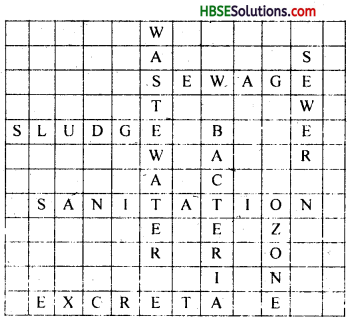
Here is a crossword puzzle : “Good luck !
HBSE 7th Class Science Solutions Chapter 18 Wastewater Story 1
Across:
3. Liquid waste products
4. Solid waste extracted in sewage treatment
6. A word related to hygiene
8. Waste matter discharged from human body

Down:
1. Used water
2. A pipe carrying sewage
5. Micro-organisms which causes cholera
7. A chemical to disinfect water
Answer:
HBSE 7th Class Science Solutions Chapter 18 Wastewater Story 2

Question 12.
Study the following statements about ozone:
(a) It is essential for breathing of living organisms.
(b) It is used to disinfect water.
(c) It absorbs ultraviolet rays.
(d) Its- proportion in air is about 3%.
Which of these statements are correct?
(i) (a), (b) and (c)
(ii) (b) and (c)
(iii) (a) and (d)
(iv) All four
Answer:
(b) and (c)

Extended Learning – Activities and projects

Question 1.
Construct a crossword puzzle of your own using the keywords.
Answer:
Do it yourself.

Question 2.
Then and now; Talk to your grand parents and other elderly people in the neighbourhood. Find out the sewage disposal systems available to them. You can also write letters to people living in far off places to get more information. Prepare a brief-report, on the information you collected.
Answer:
Do it yourself.

Question 3.
Visit a sewage treatment,plant.
It-could be as exciting and enriching as a visit to a zoo, a museum, or a park. To guide your observation here are a few suggestions.
Record in your notepad :
Place _________ Date _________ Time Name of the official at the plant _________ Guide/Teacher _________.
(a) The location of the sewage plant.
(b) Treatment capacity.
(c) The purpose of screening as the initial process.
(d) How is air bubbled through the aeration tank?
(e) How safe is the water at the end of the treatment? How is it tested?
(f) Where is the water discharged after treatment?
(g) What happens to the plant during heavy rains?
(h) Is biogas consumed within the plant or sold to other consumers?
(i) What happens to the treatment sludge?
(j) Is there any special effort to protect nearby houses from the plant?
(k) Other observations.
Answer:
Do it yourself.

HBSE 7th Class Science Wastewater Story Important Questions and Answers

Very Short Answer Type Questions

Question 1.
Write different sources of wastewater?
Answer:
Household activities, industrial activities and agricultural activities.

Question 2.
Name certain organic impurities in the wastewater.
Answer:
Animal waste, Human faeces, oil and urine, fruits and vegetables.

Question 3.
Write certain Inorganic impurities in, the wastewater.
Answer:
Metals, phosphates and nitrates.

HBSE 7th Class Science Solutions Chapter 18 Wastewater Story

Question 4.
Name certain disease causing micro-organism.
Answer:
Bacterias, Viruses etc.

Question 5.
Which process removes the solids like faeces and other substances from the wastewater?
Answer:
Grit and sand removal tank.

Question 6.
Which instrument is used to remove floatable solids from the wastewater?
Answer:
A skimmer is used to remove floatable impurities.

Question 7.
Who decomposes the sludge?
Answer:
Anaerobic bacteria decompose the sludge.

Question 8.
What helps to clean the clarified water?
Answer:
Aerobic bacteria helps to clean the clarified water.

Question 9.
Why is ozone and chlorine used?
Answer:
Ozone and Chlorine is used to kill the bacteria etc. present in the clarified water.

Short Answer Type Questions

Question 1.
How is water’polluted?
Answer:
Water is used for various’purposes in homes, industries and agriculture. When water is used for cleaning, bathing, washing, dying etc. it pollutes the water. Unwanted waste materials and chemicals etc. get added in the water and this wastes the water.

Question 2.
How “bar screen” and ‘grit and sand removal tank’ help in clarification of water?
Answer:
When wastewater is passed through bar screens it separates big and large objects like plastics, bags, sticks, can, napkins etc. In grit and sand removal tank other solid impurities like pebbless and etc. are removed.

HBSE 7th Class Science Solutions Chapter 18 Wastewater Story

Question 3.
How is sludge treated?
Answer:
Sludge is the solid impurities separated from the sewage. It is removed and treated in a separate tank with anaerobic bacteria. During this process biogas is produced which is used to produce electricity. Dried sludge is used as manure.

Question 4.
What are the problem arising due to open drains and other unsanitary conditions?
Answer:
Open drains and unsanitary conditions produce bad smell. It becomes an idle place of breeding for mosquitoes, files and other harmful insects. These insects spread many harmful diseases and other health hazards.

Question 5.
How the kitchen waste blocks the drains?
Answer:
Kitchen waste like oils and fats clogs the pores in soil and reduce the Alteration process. It also blocks the pipes by hardening the pipes. Wastes like tealeaves solid food remains, cotton etc. also choke the pipes and slows down flow of oxygen. This slows down the decomposition process by the aerobic bacteria.

HBSE 7th Class Science Solutions Chapter 18 Wastewater Story

Long Answer Type Questions

Question 1.
How defection in open cause health hazards?
Answer:
Due to lack of proper sewage disposal system a large amount of people in India defecates in open. They use riverbeds, railway lines, fields and drains for this purpose. These excreta dries down and percolate, in soil with rain water. It pollutes the ground water. Excreate along river bed pollutes the river water. In this way water on the ground and under the ground get polluted. This polluted water contains the micro-organisms of various communicable diseases like cholera, typhoid, hepatilis and meningiti it is dysentry etc.

Wastewater Story Class 7 HBSE Notes

  • Water is a precious natural resource.
  • We cannot imagine our lives without water.
  • We waste a lot of water daily in various household and industrial activities Such water is called wastewater.
  • The wastewater produced during household acitivities, industrial activities and various agricultural processes is also called sewage.
  • Sewage is the liquid waste which can cause various’diseases and environmental hazards if not managed.
  • Sewage is collected from its sources and treated to destroy its harmful constituent to clean it.
  • It is made usable in treatment plants and disposed off in various sources of water.
  • Drainage system should be covered to avoid communicable diseases.
  • We should not throw waste in open and should not defecate in open.
  • Low cost disposal methods can be adopted in the areas where proper sewer system is not available.

HBSE 7th Class Science Solutions Chapter 18 Wastewater Story Read More »

HBSE 7th Class Maths Solutions Chapter 2 भिन्न एवं दशमलव Ex 2.4

Haryana State Board HBSE 7th Class Maths Solutions Chapter 2 भिन्न एवं दशमलव Ex 2.4 Textbook Exercise Questions and Answers.

Haryana Board 7th Class Maths Solutions Chapter 2 भिन्न एवं दशमलव Ex 2.4

प्रश्न 1.
ज्ञात कीजिए :
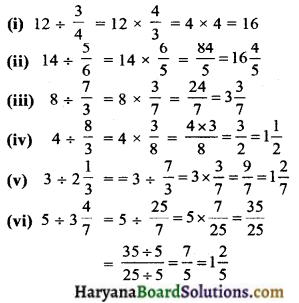
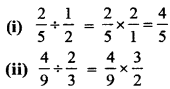
(i) 12 ÷ \(\frac {3}{4}\)
(ii) 14 ÷ \(\frac {5}{6}\)
(iii) 8 ÷ \(\frac {7}{3}\)
(iv) 4 ÷ \(\frac {8}{3}\)
(v) 3 ÷ 2\(\frac {7}{3}\)
(vi) 5 ÷ 3\(\frac {4}{7}\)
हल :
HBSE 7th Class Maths Solutions Chapter 2 भिन्न एवं दशमलव Ex 2.4 - 1

HBSE 7th Class Maths Solutions Chapter 2 भिन्न एवं दशमलव Ex 2.4

प्रश्न 2.
निम्नलिखित भिन्नों में से प्रत्येक का व्युत्क्रम ज्ञात कीजिए। व्युत्क्रमों को उचित भिन्न, विषम भिन्न एवं पूर्ण संख्या के रूप में वर्गीकृत कीजिए:
(i) \(\frac {3}{7}\)
(ii) \(\frac {5}{8}\)
(iii) \(\frac {9}{7}\)
(iv) \(\frac {6}{5}\)
(v) \(\frac {12}{7}\)
(vi) \(\frac {1}{8}\)
(vii) \(\frac {1}{11}\)
हल :
(i) \(\frac {3}{7}\) का व्युत्क्रम = \(\frac {7}{3}\) है, यह उचित भिन्न नहीं है।
(ii) \(\frac {5}{8}\) का व्युत्क्रम = \(\frac {8}{5}\), यह उचित भिन्न नहीं है।
(iii) \(\frac {9}{7}\) का व्युत्क्रम = \(\frac {7}{9}\), यह उचित भिन्न है।
(iv) \(\frac {6}{5}\) का व्युत्क्रम = \(\frac {5}{6}\), यह उचित भिन्न है।
(v) \(\frac {12}{7}\) का व्युत्क्रम = \(\frac {7}{12}\), यह उचित भिन्न है।
(vi) \(\frac {1}{8}\) का व्युत्क्रम = \(\frac {8}{1}\) = 8, यह उचित भिन्न है।
(vii) \(\frac {1}{11}\) का व्युत्क्रम = \(\frac {11}{1}\) = 11, यह एक पूर्ण संख्या है।

प्रश्न 3.
ज्ञात कीजिए:
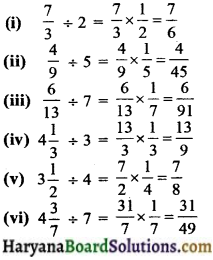
(i) \(\frac {7}{3}\) ÷ 2
(ii) \(\frac {4}{9}\) ÷ 5
(iii) \(\frac {6}{13}\) ÷ 7
(iv) 4\(\frac {1}{3}\) ÷ 3
(v) 3\(\frac {1}{2}\) ÷ 4
(vi) 4\(\frac {3}{7}\) ÷ 7
हल :
HBSE 7th Class Maths Solutions Chapter 2 भिन्न एवं दशमलव Ex 2.4 - 2

HBSE 7th Class Maths Solutions Chapter 2 भिन्न एवं दशमलव Ex 2.4

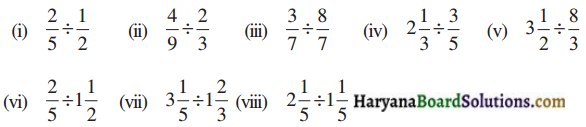
प्रश्न 4.
ज्ञात कीजिए :
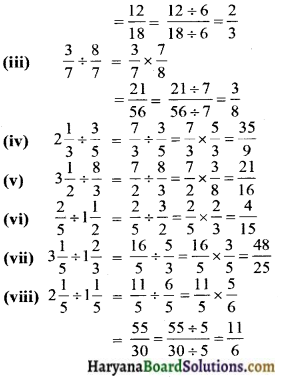
HBSE 7th Class Maths Solutions Chapter 2 भिन्न एवं दशमलव Ex 2.4 - 3
हल :
HBSE 7th Class Maths Solutions Chapter 2 भिन्न एवं दशमलव Ex 2.4 - 4
HBSE 7th Class Maths Solutions Chapter 2 भिन्न एवं दशमलव Ex 2.4 - 5

HBSE 7th Class Maths Solutions Chapter 2 भिन्न एवं दशमलव Ex 2.4 Read More »

HBSE 7th Class Maths Solutions Chapter 15 ठोस आकारों का चित्रण Ex 15.4

Haryana State Board HBSE 7th Class Maths Solutions Chapter 15 ठोस आकारों का चित्रण Ex 15.4 Textbook Exercise Questions and Answers.

Haryana Board 7th Class Maths Solutions Chapter 15 ठोस आकारों का चित्रण Ex 15.4

प्रश्न 1.
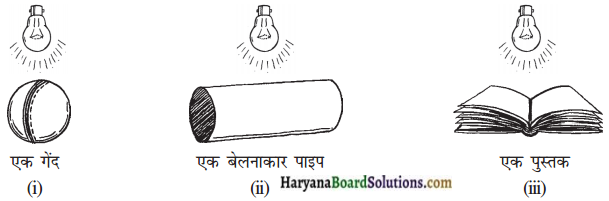
निम्नलिखित ठोसों के ठीक ऊपर एक जलता हुआ बल्ब रखा गया है। प्रत्येक स्थिति में प्राप्त छाया के आकार का नाम बताइए। इस छाया का एक रफ चित्र बनाने का प्रयास कीजिए। (पहले आप प्रयोग करने का प्रयास करें और फिर उत्तर दें।)
HBSE 7th Class Maths Solutions Chapter 15 ठोस आकारों का चित्रण Ex 15.4 1
हल :
जब बल्ब ठोसों के ऊपर जलता हुआ रखा है :
गेंद : इसकी छाया वृत्त की तरह प्रतीत होगी।
बेलनाकार पाइप : इसकी छाया आयत की तरह प्रतीत होगी।
पुस्तक : इसकी छाया वर्ग की तरह प्रतीत होगी।

प्रश्न 2.
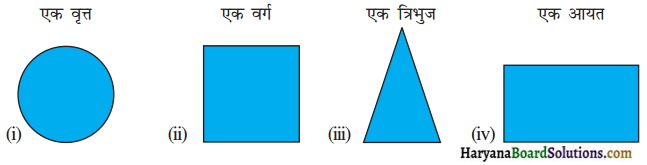
यहाँ कुछ 3-D वस्तुओं की छायाएँ दी गई हैं जो उन्हें एक ओवरहैड प्रोजेक्टर के लैम्प (बल्ब) के अन्तर्गत या नीचे रख कर प्राप्त की गई हैं। प्रत्येक छाया से मिलान वाले ठोस की पहचान कीजिए। (इनमें एक से अधिक उत्तर हो सकते हैं।)
HBSE 7th Class Maths Solutions Chapter 15 ठोस आकारों का चित्रण Ex 15.4 2
हल :
प्रत्येक छाया से मिलान वाले ठोस निम्न हैं-
(i) एक गेंद, एक थाली आदि।
(ii) एक घन, पुस्तक आदि।
(iii) एक शंकु, आइसक्रीम कोन आदि।
(iv) एक बेलन, एक घनाभ आदि।

HBSE 7th Class Maths Solutions Chapter 15 ठोस आकारों का चित्रण Ex 15.4

प्रश्न 3.
जाँच कीजिए कि क्या ये कथन सत्य हैं-
(i) एकघन एक आयत के आकार की छाया दे सकता है।
(ii) एक घन एक षड्भुज के आकार की छाया दे सकता है।
हल :
(i) सत्य
(ii) असत्य।

HBSE 7th Class Maths Solutions Chapter 15 ठोस आकारों का चित्रण Ex 15.4 Read More »

HBSE 7th Class Maths Solutions Chapter 15 ठोस आकारों का चित्रण Ex 15.1

Haryana State Board HBSE 7th Class Maths Solutions Chapter 15 ठोस आकारों का चित्रण Ex 15.1 Textbook Exercise Questions and Answers.

Haryana Board 7th Class Maths Solutions Chapter 15 ठोस आकारों का चित्रण Ex 15.1

प्रश्न 1.
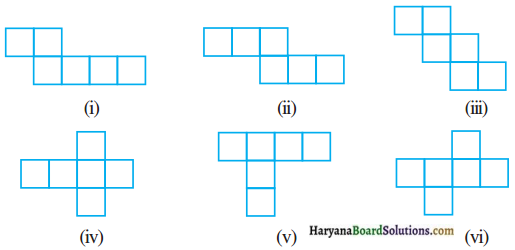
उन जालों को पहचानिए, जिनका प्रयोग करके आप घनों को बना सकते हैं (इन जालों के प्रतिरूप काट कर ऐसा करने का प्रयास कीजिए) :
HBSE 7th Class Maths Solutions Chapter 15 ठोस आकारों का चित्रण Ex 15.1 1
हल :
जाल (ii), (iii), (iv) और (vi) से घन बनाया जा सकता है।

प्रश्न 2.
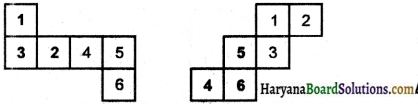
पासे (dice) ऐसे घन होते हैं, जिनके प्रत्येक फलक पर बिन्दु (dots) अंकित होते हैं। एक पासे के सम्मुख फलकों पर अंकित बिन्दुओं की संख्याओं का योग सदैव 7 होता है।
यहाँ, पासे (घनों) को बनाने के लिए, दो जाल दिए जा रहे हैं। प्रत्येक वर्ग में लिखी संख्या उस बक्से के बिन्दुओं को दर्शाती है।
HBSE 7th Class Maths Solutions Chapter 15 ठोस आकारों का चित्रण Ex 15.1 2
यह याद रखते हुए कि पासे के सम्मुख फलकों की संख्याओं का योग सदैव 7 होता है, रिक्त स्थानों पर उपयुक्त संख्याएँ लिखिए।
हल :
रिक्त स्थानों से भरी संख्याएँ निम्न हैं-
HBSE 7th Class Maths Solutions Chapter 15 ठोस आकारों का चित्रण Ex 15.1 3

HBSE 7th Class Maths Solutions Chapter 15 ठोस आकारों का चित्रण Ex 15.1

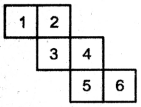
प्रश्न 3.
क्या यह पासे के लिए एक जाल हो सकता है? अपने उत्तर को स्पष्ट कीजिए।
हल :
HBSE 7th Class Maths Solutions Chapter 15 ठोस आकारों का चित्रण Ex 15.1 4
नहीं, क्योंकि सम्मुख फलकों के एक युग्म पर 1 और 4 है, जिनका योग 5 है, जो 7 के बराबर नहीं है और दूसरे युग्म के फलकों पर 3 और 6 है जिनका योग 9 है, जो भी 7 के बराबर नहीं है।

प्रश्न 4.
यहाँ एक घन बनाने के लिए, एक अधूरा जाल दिया गया है। इसको कम-से-कम दो विभिन्न विधियों से पूरा कीजिए। याद रखिए कि घन के 6 फलक होते हैं। यहाँ इस जाल में कितने फलक दिए हुए हैं। (दो पृथक्पृथक् चित्र दीजिए। कार्य को सरल बनाने के लिए आप वर्गांकित कागज का प्रयोग कर सकते हैं।)
HBSE 7th Class Maths Solutions Chapter 15 ठोस आकारों का चित्रण Ex 15.1 5
हल :
यहाँ इस जाल में तीन फलक दिए हुए हैं। नीचे दिए गए जाल से घन बना सकते हैं।
HBSE 7th Class Maths Solutions Chapter 15 ठोस आकारों का चित्रण Ex 15.1 6

HBSE 7th Class Maths Solutions Chapter 15 ठोस आकारों का चित्रण Ex 15.1

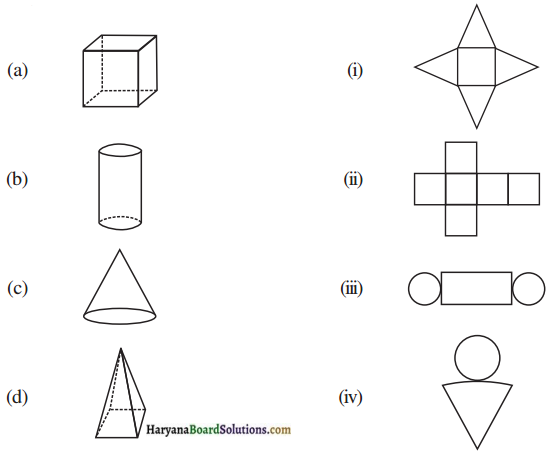
प्रश्न 5.
जालों का उपयुक्त ठोसों से मिलान कीजिए :
HBSE 7th Class Maths Solutions Chapter 15 ठोस आकारों का चित्रण Ex 15.1 7
हल :
जालों का ठोसों से मिलान निम्न प्रकार है-
(a) → (ii)
(b) → (iii)
(c) → (iv)
(d) → (i)

HBSE 7th Class Maths Solutions Chapter 15 ठोस आकारों का चित्रण Ex 15.1 Read More »

HBSE 7th Class Social Science Solutions Civics Chapter 9 A Shirt in the Market

Haryana State Board HBSE 7th Class Social Science Solutions Civics Chapter 9 A Shirt in the Market Textbook Exercise Questions and Answers.

Haryana Board 7th Class Social Science Solutions Civics Chapter 9 A Shirt in the Market

HBSE 7th Class Civics A Shirt in the Market Textbook Questions and Answers

A Shirt in the Market HBSE 7th Class Question 1.
What made Swapna sell the cotton to the trader instead of selling at the Kurnool cloth market?
Answer:
The following reason made Swapna sell the cotton to the traders instead of selling at the Kurnool cloth market.

Swapna had borrowed ₹ 2,500 from the trader at very high rate of interest to buy seeds, fertilisers, pesticides for cultivation. At this time the trader enters an agreement with Swapna that she will sell her cotton to him. So, Swapna sells her cotton to traded instead of selling in Kurnool cloth market.

A Shirt in the Market Class 7 Civics HBSE Question 2.
Describe the condition of employment as well as the wages of the workers in garment exporting factory* Do you think that the workers get a fair deal?
Answer:
(i) The workers in the garment exporting factory work at least 10 to 12 hrs. in a day but they get very low wages monthly.
(ii) Their job is not permanent; whenever the employer feels that a worker is not needed, he may be asked to leave.
(iii) Their wages are fixed according to their skills.
(iv) The highest paid among the workers are the tailors, who get maximum salary of 3,000 per month.
(v) More women are employee in these factories as helpers.
(vi) These jobs fetch him very low salary.
Now, these workers do not get fair deal.

HBSE 7th Class Social Science Solutions Civics Chapter 9 A Shirt in the Market

HBSE 7th Class A Shirt in the Market Question 3.
Think of something common that we use. It could be sugar, tea, milk, pen, paper etc. Discuss through what chain of markets this reacts to you. Can you think of the people that help in the production or trade?
Answer:
A chain of markets links the producer to the buyer. Buying and selling takes place at every step in the chain.
Through Retailer: The producer supplies goods to retailer who sells them to the consumers:

Producers
|
Retailer
|
Customer (Buyer)

Through Wholesaler: The producer may supply goods to wholesaler in large quantity who can further sell the same in small quantities to the customers. There is no place of retailer in it.

Produce
|
Wholesaler
|
Customers

Through agent, wholesaler and retailer: The producer may also involve the agent (intermediator) in this chain of marketing.

Producer
|
Agents
|
Wholesaler
|
Customer

People from a simple worker to the main producer, agents, wholesaler, retailer all help in the production or trade.

HBSE 7th Class Social Science Solutions Civics Chapter 9 A Shirt in the Market

Question 4.
Arrange the statements given below in the correct order and then fill the number in the cotton balls accordingly. The first two have been solved for you.
1. Swapna sells the cloth to the trader.
2. Customers buy these shirts in the supermarket.
3. Trader sells cotton to the ginning mill.
4. Garment exporters buy the cloth from merchants for making shirts.
5. Yarn dealers or merchants give the yarn to the weavers.
6. The exporter sells shirts to the business persons from the USA.
7. Spinning mill buys the cotton and sells yarn to the yarn dealers.
8. Weavers return with the cloth.
9. Ginning mill cleans the cotton and makes it into balls.
HBSE 7th Class Social Science Solutions Civics Chapter 9 A Shirt in the Market-1
Answer:
1. Swapna sells the cloth to the trader.
2. Trader sells cotton to the ginning mill.
3. Ginning mill cleans the cotton and makes it into balls.
4. Spinning mill buys the cotton and sells yarn to the yarn dealers.
5. Yarn dealers or merchants give the yarn to the weavers.
6. Weavers return with the cloth.
7. Garment exporters buy the cloth from merchants for making shirts.
8. The exporter sells shirts to the business persons from the USA.
9. Customers buy these shirts in the supermarket.

Question 5.
Did Swapna get a fair price on the cotton?
Answer:
No, Swapna did not get a fair price on the cotton.

Question 6.
Why did the trader pay Swapna a low price?
Answer:
The trader paid Swapna a low price because she had borrowed ₹ 2500 at the time of cropping season at high rate of interest.

Question 7.
Where db you think larger farm would sell cotton? How is their situation better than Swapna?
Answer:
Larger farmer would prefer to sell their product in wholesale market. Their situation is better from Swapna because Swapna cannot sell the product in wholesale market. She has to sell it through trader and she does not get price for her product.

Question 8.
You might have co-operatives in your areas. It could be in a milk provision, paddy etc. Find out for whose benefits they were set up.
Answer:
These co-operatives have been set up for the benefit of the local people of the area especially for the poor farmers.

Question 9.
What are the following people doing at the Erode cloth market-merchants, weavers, exporters?
Answer:
Merchants: Merchants are getting the woven cloth from the weavers after paying them wages for weaving cloth them from.
Weavers: The weavers spend long hours working on looms and they work for wages.
Exporters: Exporters arrange the cloth for exports.

Question 10.
In what ways are weavers dependent on cloth merchants?
Answer:
Weavers are dependent on cloth merchants because:
The cloth merchants give them thread and they weave cloth for them from where they earn their living.

HBSE 7th Class Social Science Solutions Civics Chapter 9 A Shirt in the Market

Question 11.
Why do you think more women are employed in the Impex garment factory? Discuss.
Answer:
More women are employed in the Impex garments factory because:
(a) They do the work of thread cutting, buttoning, ironing and packaging more patiently.
(b) These jobs have the lowest wages and women are ready to work for the lowest wages.
(c) They do not raise disputes.

Question 12.
The shirt shows the profit made by the business person, and the various costs that he had to pay. Find out from the diagram below, what cost price includes.
HBSE 7th Class Social Science Solutions Civics Chapter 9 A Shirt in the Market-2
Answer:
The cost price includes:
Purchase (₹ 200) + Storage 100) + advertising (₹ 300)
= ₹ 600.

Question 13.
What are the demands of foreign buyers made on the garment export? Why do the garment exporters agree to these demands?
Answer:
The foreign buyer demands the following from the supplier:
(a) the lowest prices
(b) high standards of equality
(c) prompt delivery of goods
The garment exporter agrees to fulfill the demand of foreign buyers because he hopes to get a bulk order.

Question 14.
What are the reasons that the business person is able to make a huge profit in the market?
Answer:
The business person is able to make huge profit in the market because:
(a) He sells his shirts to high income people who do not ask for the prices.
(b) He tries to meet the latest demands of the customers.

HBSE 7th Class Civics A Shirt in the Market Important Questions and Answers

Very Short Answer Type Questions

Question 1.
Who is Swapna and what does she do?
Answer:
Swapna is a small farmer in Kurnool and she grows cotton.

HBSE 7th Class Social Science Solutions Civics Chapter 9 A Shirt in the Market

Question 2.
What is putting out system?
Answer:
The arrangement between the merchant and the weavers is known as putting out system.

Question 3.
To whom does the Erode merchant supply the cotton cloth?
Answer:
The Erode merchant supplies the cotton cloth to a garment exporting factory near Delhi.

Short Answer Type Questions

Question 1.
Write about Erode’s cloth market in brief.
Answer:
Erode is a bi-weekly cloth market in Tamil Nadu. It is one of the largest cloth markets in the world. A large variety of clothes are sold in this market.

Question 2.
What is the role of merchant in making the clothes?
Answer:
The merchant distributes work among the weavers based on the orders he has received for cloth. For this, he buys the yarn and gives to the weavers with instructions about the kind of cloth that is to be made.

Question 3.
What is the role of market in the lives of people related to cloth?
Answer:
The market offers people, related to cloth, opportunities for work and to be able to sell things that they grow or produce. It could be the farmer selling cotton or weaver producing cloth.

Question 4.
Why have the poor people to depend on rich persons?
Answer:
The poor have people to depend on the rich and the powerful persons for loans, raw materials and marketing of their goods, and most often for employment.

HBSE 7th Class Social Science Solutions Civics Chapter 9 A Shirt in the Market

Long Answer Type Questions

Question 1.
How do the weaver’s cooperatives work? How are they helpful for the weavers?
Answer:
In weavers’ cooperative:
(a) The weavers form a group and take up certain activities collectively.
(b) They procure yarn from the yarn dealer and distribute it among the weavers.
(c) The co-operative also does the marketing.

They are helpful for the weavers because:
(i) the role of merchant is reduced and weavers get a fair price on the cloth.
(ii) The government also helps the cooperatives by buying cloth from them at a reasonable price.

Question 2.
Write a note on the Impex garment factory.
Answer:

  • The Impex garment factory has 70 workers.
  • Most of them are women. Most of these workers are employed on a temporary basis.
  • The employer can remove the workers when he does not need them.
  • Workers wages are fixed according to their skills.
  • The highest paid among workers are the tailors who get about ₹ 3,000 per month.
  • Women are employed at the lowest paid wages for the jobs like thread cutting, buttoning, ironing and packaging.

A Shirt in the Market Class 7 HBSE Notes

  • Ginning Mill: A factory where seeds are removed from cotton balls. The cotton is pressed into bales to be sent for spinning into thread.
  • Exporter: A person who sells goods abroad.
  • Profit: The amount that is left or gained from earnings after deducting all the costs. If the costs are more than the earnings, it would lead to a loss.

HBSE 7th Class Social Science Solutions Civics Chapter 9 A Shirt in the Market Read More »

HBSE 7th Class Social Science Solutions Civics Chapter 2 Role of the Government in Health

Haryana State Board HBSE 7th Class Social Science Solutions Civics Chapter 2 Role of the Government in Health Textbook Exercise Questions and Answers.

Haryana Board 7th Class Social Science Solutions Civics Chapter 2 Role of the Government in Health

HBSE 7th Class Civics Role of the Government in Health Textbook Questions and Answers

Role of the Government in Health HBSE 7th Class Civics Question 1.
In this chapter you have read that health is a wider concept than illness. Look at this quote from the Constitution and explain the terms ‘living standard’ and ‘public health’ in your own words.

An important part of the Constitution says it is the duty of the state to raise the level of nutrition and the standard of living and to improve public health.
Answer:
Living Standard:
It refers to the standard of living enjoyed by the people in reference to the facilities provided by the government or family. It also refers to the status earned by the people.

Public Health:
‘Public Health’ refers to the provision of quality healthcare services either free or at low cost by the government. It also includes the actions to prevent the spread of diseases such as TB, Jaundice and Malaria among public.

HBSE 7th Class Social Science Solutions Civics Chapter 2 Role of the Government in Health

HBSE 7th Class Civics Role of the Government in Health Question 2.
What are the different ways through which the government can take steps to provide healthcare for all? Discuss.
Answer:The different ways in which
government can take steps to provide health care for all are:
(a) opening of primary health centres, dispensaries and family welfare centres.
(b) prevention of spread of diseases.
(c) making provisions to deal with emergency or epidemics.
(d) provision of cheaper health-services for the poor.

Question 3.
What difference do you find between private and public health service in your area? Use the following table to compare and contrast these.

FacilityCost of serviceAvailability of services
Private
Public

Answer:

FacilityCost of serviceAvailability of service
PrivateExpensiveGood, quality but to limited high standard of people.
PublicFree or at very low costOrdinary services, not maintained, available to all sectors of society.

Question 4.
“Improvement in water and sanitation can control many diseases.” Explain with the help of example.
Answer:
Lack of clean water and sanitation is the second most important risk factor for the occurrence of diseases after malnutrition.
(i) Consumption of contaminated water causes many water-borne diseases such as typhoid, cholera, dysentery, diarrhoea.
(ii) Many vector-borne diseases like malaria, Japanese encephalities are caused due to dirty and stagnant water.
So, improvement in water and sanitation can control many diseases.

The Story Of Hakim Sheik

Hakim Sheik was a member of the Paschim Banga Khet Mazdoor Samity (PBKMS), an organisation of agricultural labourers in West Bengal. One evening in 1992, he accidentally fell off a running train and suffered head injuries. He was in ci very serious condition and needed immediate treatment.

He was taken to a government hospital in Kolkata but they refused to admit him because they did not have a spare bed. Another hospital did not have the facility or the specialised doctors necessary for his treatment. In this way he spent 14 hours in a critical state and was taken to eight different government hospitals, but none of them admitted him.

Finally, he was admitted in a private hospital, where he. received treatment. He spent a lot of money on his treatment. Angry and upset over the indifferent attitude of all the hospitals that refused to admit him., Hakim Sheik and PBKMS filed a case in the court.

Question 1.
Read the story given above. Then imagine that you are a judge in the country. What would you say to Hakim Sheik?
Answer:
Being a judge, I would give a fair judgement in Hakim Sheik’s case. He would be granted due compensation. The doctors of government hospitals will be punished for dereliction of duty.

Question 2.
What problems did Aman face in the public hospital? How do you think the hospital can work in a better manner? Discuss.
Answer:
Aman faced the following problems in the public hospitals:
(а) Long queue at the OPD counter.
(b) Great such at the test centre.
(c) Change of doctor, the whole treatment not by the same doctor.
(d) Non-availability of medicines.

Question 3.
What problems do we face in private hospitals? Discuss.
Answer:
(i) India has the largest number of medical colleges in the world.
(ii) It is among the largest producers of doctors.
(iii) Healthcare facilities have grown substantially over the years.
(iv) India gets a large number of medical tourists from many countries.
(v) India is the fourth largest producer of medicine in the word.

Question 4.
In India, it is often said that we are unable to provide health services for all because the government does not have enough money and facilities. After reading the above left hand columns, do you think this is true? Discuss.

India has the largest number of medical colleges in the world and is among the largest producers of doctors. ApproximatelylS,000 new doctors qualify every year.Most doctors settle in urban areas. People in rural areas have to travel long distances to reach a doctor. The number of doctors with respect to the population is much less in rural areas.
Healthcare facilities have grown substantially over the years. In 1950, there were only 2,717 hospitals in India. In 1991, there were 11,174 hospitals. In 2000, the number grew to 18,218.About five lakh people die from tuberculosis every year. This number is almost unchanged since Independence!
India gets a large number of medical tourists from many countries. They come for treatment in some of the hospitals in India that compare with the best in the world.Almost two million cases of malaria are reported every year and this number isn’t decreasing.
India is the fourth largest producer of medicines in the world and is also a large exporter of medicines.We are not able to provide clean drinking water to all. 21per cent of all communicable diseases are water borne. For example, diarrhoea, worms, hepatitis, etc.

Answer:
It is not true because after reading the left hand column, we come to know:
(i) India has the largest number of medical colleges in the world.
(ii) It is among the largest producers of doctors.
(iii) Healthcare facilities have grown substantially over the years.
(iv) India gets a large number of medical tourists from many countries.
(v) India is the fourth largest producer of medicine in the word.

Question 5.
Private health facilities can mean many things. Explain with the help of some examples from your area.
Answer:
Private health facilties can mean many things. Today these facilities or clinics are run by big companies. Such companies are run by many businesses, associated with these centres. For example, some facilities of medicines, pathology, X-ray, ultrasound are associated with these facilities. Sometimes Answer:The problem faced in private hospitals are:
(а) High cost of treatment.
(b) The doctors prescribe more tests than required that include high costs.
big business houses also have medical facilities associated with them.

Question 6.
Would you associate all or some of these picture (shown on the textbook page 19) with ‘health’?
Answer:
Some of the pictures given on textbook page 19 associated with the health are:
(а) On the top, van with cross sign is in a rural area (i.e. village). Government sends mobile health centre in the form of a van with emergency health service facilities. The doctors and nurses go along with this van in villages, and check the ill people and also treat them by giving medicines.
(b) Some doctors are shown in operation theater operating a patient. These doctors are taking care of the health problems of the patient.

Question 7.
Pick two situations from the collage (shown on page 19) that are not related to illness and write two sentences on how they are related to
health.
Answer:
(i) A woman having two earthen pots on her head is going to fetch water. The women like her, collect water from other open water wells. The water so collected is not clean and creates health problems.
(ii) Two garbage Containers are shown kept in front of the houses in a slum. The containers are used to put in all types of wastes even rotten food particles. The house flies sitting on these wastes carry pathogenic germs to our eatables, as a result we become ill.

HBSE 7th Class Social Science Solutions Civics Chapter 2 Role of the Government in Health

Question 8.
(i) Can you provide a title to these columns (given on the textbook page 20)?
Answer:
Titles:
(i) Left hand column: Progress of Health Care System in India
(ii) Right hand column: Paradox of Health Care Progress
(iii) In India, it is often said that we are unable to provide health services for all because the government does not have enough money and facilities. After reading the above left hand column. (see textbook page 20), do you think this is true? Discuss.
Answer:
Yes. It is true that India has progressed a lot in healthcare system since independece.
(a) The healthcare facilities we had in 1950, were insufficient for the population.
(b) Even today when infrastructure of healthcare has developed and increased tremendously, it does not saturate the needs of our growing population.
(c) Our healthcare system in the rural areas is not in a state of meeting the needs of the people.
(d) There is shortage of government hospitals and healthcare centres in the rural area. Even in the cities, we can observe queue of patients.
(v) India is investing on healthcare even less than the average of South Asian countries.

Question 9.
Read the story given (on textbook page 21). Then imagine that you are a Judge in the court. What would you say to Hakim Sheik?
Answer:
(i) This is the fault of our government hospital healthcare services.
(ii) The head of said hospitals would be called upon and asked why Hakin Sheik was refused the admission and treatment.
(iii) This is a fault on the part of the government and for that it will have to compensate Hakim Sheik for the amount that he spent in private hospital on his treatment.

Question 10.
(i) Why did Ranjan have to spend so much money? Give reasons.
Answer:
(a) Ranjan had to spend so much money to make use of the facilities available in private hospitals.
(b) By spending so much money, he saved his time and went through the easy process of treatment.

(ii) What problem did Aman face in the public hospital?
Answer:
(a) Aman had to wait in a long queue at the OPD counter and blood testing room.
(b) He got the blood test results after three days and then went back to the hospital to consult the doctor.
Thus, he faced lot of hardship in the hospital.

(iii) How do you think the hospital can work in a better manner? Discuss.
Answer:
If the number of counters and doctors will be raised and the management of some of its services like cleanliness (safai) and diagnostic tests such as blood tests, stool and urine tests, x-ray, ultrasound, etc. are handed over to the private bodies, the hospital can work in a better manner.

(iv) Where do you go when you are ill? Are there any problems that you face? Write a paragraph based on your experience.
Answer:
(a) We go to the doctoer when we are ill.
(b) Yes.
(c) First problem we face is to wait for long hours in queue for registration. There after, we have to stand in queue to see the dogtor.
After checking doctor advice a number of tests like ECG, blood, urine, x-ray, etc. which cost a lot not only in terms of money but also in terms of time because there is another queue for these tests and their reports.

(v) What problems do we face in private hospitals? Discuss.
Answer:
(a) We have to pay a lot of money for every service that we use in private hospitals.
(b) Sometimes doctors advise costly tests which are not required for the diagnosis.

Question 11.
The inside back cover (cover three) of this book has a map of India. Using your pencil outline the state of Kerala on this way. (NCERT Page 28)
Answer:
(Hints: Here is a guideline for students to do this question. Take a butter paper. Put it on the map of India given on the back cover of this book. With the help of pencil outline the state of Kerala alongwith outer boundary of India on the butter paper and attach it with your answer sheet.)

Question 12.
(i) In what ways is the public health system meant for everyone?
Answer:
(a) According to our Constitution, it is the primary duty of the government to provide health care facilities to all. The government has to safeguard the Right to Life of every person as ensured in the constitution under Fundamental Rights.
(b) So, public health system has to provide medical facilities to all, from poors to rich, domestic worker to the Prime Minister of the country without any discrimination.

(ii) List some public health centres (PHCs) or hospitals near your place. From your experience (or by visiting any one of them), find out the facilities provided and people who run the centre.
Answer:
(Hints: Students do this themselves, but for their guidance a description is given below)
Facilities: I visited Ram Manohar Lohia Hospital. It is run by the Central Government. At present, it is the most clean government hospital in Delhi with a lot of facilities such as-computerised counters for registration for different types of treatment, seating arrangement types of treatment, seating arrangement for the visitors, doctor’s rest room, etc. Most of the tests are conducted in the hospitals.

HBSE 7th Class Social Science Solutions Civics Chapter 2 Role of the Government in Health

HBSE 7th Class Civics Role of the Government in Health Important Questions and Answers

Very Short Answer Type Questions

Question 1.
What is health?
Answer:
Health means our ability to remain free from physical illness and injuries. It also includes mental health.

Question 2.
What are communicable diseases?
Answer:
Communicable diseases refer to those diseases that spread from one person to another in many ways such as through water, food and air etc.

Question 3.
Why did Ranjan have to spend so much money on his treatment? Give reasons.
Answer:
Ranjan had to spend so much money on his treatment because he was admitted in a private hospital where the cost of treatment is very high.

Question 4.
What do you understand by ‘Right to Life’?
Answer:
‘Right to Life’ means every individual has the right to live a meaningful and dignified life with basic facilities like food, shelter, clothing and education.

Question 5.
Which organisation in responsible for policy making on healthcare in India?
Answer:
The Ministry of Health and Family Welfare is responsible for formulating policy on healthcare in India.

Short Answer Type Questions

Question 1.
What are the main centres for healthcare facilities and who are the persons associated with him?
Answer:
The main centres for healthcare facilities in India are:
(a) health centres
(b) hospitals
(c) pathological laboratories
(d) blood banks.
The persons associated with these centres are: nurses, health workers, doctors. They can treat, advise and dignose illness.

Question 2.
Describe the work of Medical Council of India.
Answer:
The main functions of Medical Council of India are:
(a) maintenance of uniform and high standards of medical education in India.
(b) registration of medical practitioner.
(c) monitoring of medical practice in the country.
(d) granting recognition of medical qualifications.

Question 3.
What do you understand by ‘medical ethics’?
Answer:
Medical ethics refer to the values that guide medical professional. Such values refer to the honesty, justice, dignity of work practised by medical practitioners.

Question 4.
What are the private health services available in our country?
Answer:
(i) In urban areas, many doctors run their private clinics.
(ii) Some hospitals and nursing homes are privately owned.
(iii) There are pathological laboratories which do tests and offer facilities like X-ray and Ultrasound.
(iv) There are also private chemist shops from where we buy medicines.

HBSE 7th Class Social Science Solutions Civics Chapter 2 Role of the Government in Health

Question 5.
Indian doctors do not prefer to work in India, even if they get their education here?
Answer:
Indian doctors prefer to work abroad because:
(i) They get better professional opportunities and research opportunities.
(ii) They get better material benefits for their services.
(iii) Doctors are less professionally discriminated against in other countries.

Long Answer Type Questions

Question 1.
Comment on the policy of Kerala Government in 1996 towards healthcare services.
Answer:
Some major changes introduced by Kerala Government in 1996 are:
(i) 40% of the entire state budget was given to panchayats.
(ii) The villages could now make proper planning for water, food, women’s development and education.
(iii) Health centres were improved.
(iv) The working of schools and anganwadi was ensured.
(v) Water supply schemes were checked to ensure good health.
Though the situation improved yet there were loopholes like shortage of medicines, insufficient hospital beds and less than required number of doctors.

Question 2.
Why healthcare services available equally to all in India? What can be done to remove inequalities in healthcare services?
Answer:
Healthcare services are not available equally to all in India because:
(i) More and more healthcare services are privatised now and they are concentrated in urban areas.
(ii) These services are run for profit and they use modern facilities but they are not affordable by all.
(iii) The poor people are unable to use them.
(iv) Very less percentage of the population can afford medicines required during illness.
(v) The poor people visit government hospitals during sickness which are poorly maintained.

To remove inequalities in healthcare, services:
(a) The government should provide healthcare services to all citizens, especially the poor and the disadvantaged.
(b) The government should improve the basin health condition and sanitation conditions of the people so that diseases do not spread.

Question 3.
Describe the drawbacks of India’s rural healthcare system. What can be done to improve India’s rural healthcare them?
Answer:
The basic drawback of India’s rural healthcare system are:
(a) Lack of specialist doctors.
(b) Lack of modem machines and medical tools.
(c) The local villagers who study medicine prefer to work in city.

To improve India’s rural healthcare system:
(а) The government should increase awareness among rural people about sanitation and healthy environment.
(b) More medical camps should be organised.
(c) The skilled doctors should be given incentives to open clinics in villages.
(d) Provisions of medical facilities even given in small villages.

HBSE 7th Class Social Science Solutions Civics Chapter 2 Role of the Government in Health

Role of the Government in Health Class 7 HBSE Notes

  • Public: An activity or service that is meant for all people in the country and is mainly organised by the government. For example: schools, hospitals, telephone services.
  • Private: An activity or service that is organised by an .individual or company for their own profit.
  • Medical Tourists: This refers to foreigners who come to this country specifically for medical treatment at hospitals that offer world-class facilities at a lower cost than what they would have to pay in their own countries.
  • Communicable Diseases: These are diseases that are spread from one person to another in many ways such as through water, foods, air etc.
  • OPD: This is the short form for ‘Out Patient Department.’ This is where people are first brought in and treated in a hospital without being admitted to any special ward.

HBSE 7th Class Social Science Solutions Civics Chapter 2 Role of the Government in Health Read More »

HBSE 7th Class Social Science Solutions Civics Chapter 10 Struggles for Equality

Haryana State Board HBSE 7th Class Social Science Solutions Civics Chapter 10 Struggles for Equality Textbook Exercise Questions and Answers.

Haryana Board 7th Class Social Science Solutions Civics Chapter 10 Struggles for Equality

HBSE 7th Class Civics Struggles for Equality Textbook Questions and Answers

Struggles For Equality Class 7 HBSE Question 1.
What do you think is meant by the expression ‘power over the ballot box’? Discuss.
Answer:
The expression ‘power over the ballot box’ means the power to vote. Every adult (a person of 18 years or above) in India has the equal right to vote during elections. This right has been used by people to elect or replace their representatives.

Struggle For Equality Class 7 Questions And Answers HBSE Question 2.
What issue is the Tawa Matsya Sangh (TMS) fighting for?
Answer:
The Tawa Matsya Sangh (TMS) is fighting for the rights of displaced forest dwellers of the Satpura forest in Madhya Pradesh.

HBSE 7th Class Social Science Solutions Civics Chapter 10 Struggles for Equality

Struggles For Equality HBSE Class 7 Question 3.
Why did the villagers set up this organisation?
Answer:
The villagers set up this organisation to fight for the right, to fish catch in the ‘Tawa Reservoir’.

Question 4.
Do you think that the large- scale participation of villagers has contributed to the success of the TMS? Write two lines on why you think so.
Answer:
Yes, the large-scale participation of the villagers has contributed to the success of the TMS. It shows that when people are united, they can successfully fight for their rights. It is the power of the voice of the people in a democracy which ultimately wins. The committee of government, recommended their right to catch fish in the Tawa Reservoir.

Question 5.
What role does the Constitution play in people’s struggle for inequality?
Answer:
The Indian Constitution plays a great role in People’s struggle for inequality.

  • The Indian Constitution is a living document which recognises the equality to all persons.
  • Movements and struggle for equality in India continuously refer to the Indian Constitution to make their point about equality and justice for all.
  • The Constitution highlights the challenges to equality in democracy like (a) privatisation of health services in the country, the increasing control that business houses exert on media, the low value given to women and their work.
  • Whenever any Fundamental Right is violated, we can go to the court.

HBSE 7th Class Social Science Solutions Civics Chapter 10 Struggles for Equality

Question 6.
Read the poem on page 120 NCERT. Why grains rots in godowns while I don’t even get a fistful of rice. What does the poet mean when he says, “My hunger has the right to know?”
Answer:
It means we have plenty of grains stored in godown but of hoarders and merchants put the poor people are still not getting a single bit of rice. They are still facing hunger.

HBSE 7th Class Geography Struggles for Equality Important Questions and Answers

Very Short Answer Type Questions

Question 1.
What do you mean by equality during elections?
Answer:
Equality during elections means that all adults in India have the equal right to vote.

Question 2.
Why are people displaced?
Answer:
When dams are built or forest areas are declared sanctuaries for animals, a large number of people are displaced.

Question 3.
When did the government give the rights for fishing to private contractors?
Answer:
In 1994, the government gave the rights for fishing in the Tawa reservoir to private contractors.

Question 4.
Why are people discriminated in India?
Answer:
People are discriminated on the basis of a person’s religion, caste and sex.

Question 5.
Why is a dam built?
Answer:
A dam is built across a river at sites where one can collect a lot of water.

HBSE 7th Class Social Science Solutions Civics Chapter 10 Struggles for Equality

Short Answer Type Questions

Question 1.
What factors are considered significant in treating people unequality in India?
Answer:
(i) Discrimination on the basis of a person’s religion, caste and sex are the significant factors for- why people are treated unequally in India.
(ii) For example, Omprakash Valmiki was forced to sweep the school yard because he was a Dalit, Ansaris were not given apartment on lease because they wepe Muslims.

Question 2.
What were the effects of displacement of poor people in urban area?
Answer:

  • In urban area basis (localities) in which poor people live are often uprooted. As a result, some of these poor people are relocated to areas outside the city.
  • Its consequences are that Poor people’s work as well as their children’s schooling is severely disrupted.
  • It is because of the distance from the outskirt of the city to these locations.

Question 3.
What does the Indian Constitution say about the equality?
Answer:
(i) The Indian Constitution recognises all Indians as equal before the law.
(ii) It also states that no person can be discriminated on the basis of their religion, sex, caste or income and wealth.

Question 4.
People’s lives in India are highly unequal. Discuss.
Answer:

  • The man who sells juice does not have the resources to compete with all of the major companies who sell branded drinks through expensive advertising.
  • Thus, poverty and the lack of resources are considered a basic reason in making so many people’s lives in India unequal.

Long Answer Type Questions

Question 1.
Why is the Indian Constitution called a living document?
Answer:
The Indian Constitution is called a living document because :

  • Indian Constitution recognizes the equality of all persons.
  • Indian Constitution has a real meaning in our lives.
  • The foundation of all movements for justice and the inspiration and for all the poetry and songs is the recognition of equality among people. The Indian Constitution recognises of equality among people.
  • Movements and struggles for equality in India continuously refer to the Indian Constitution to make their point about equality and justice to all.

Question 2.
How does the Right to Equality establish the Social Equality in India? Do you think it is practically achieved in our country?
Answer:
Article 15 provides that the state shall not discriminate against citizens on grounds of religion, sex, caste, colour. The same article provides that all the citizen shall have access to the public restaurants, hotels and places of public entertainment etc.

However, the right to equality given under Constitution is not practised in reality. The increasing privatisation of health services and the neglect of government hospitals have made it difficult for most poor people to get good quality healthcare do not have the resources to afford expensive private health services.

HBSE 7th Class Social Science Solutions Civics Chapter 10 Struggles for Equality

Struggles for Equality Class 7 HBSE Notes

  • Equality : A state when everyone should be given equal opportunities for their all round development.
  • Scheduled Caste : Certain castes which are linked with the Govt, of India due to their backwardness.
  • Social Justice : A condition in which there should be equality of opportunity of progress to every citizen of the country without any discrimination.
  • Constitution : Fundamental law and principles according to which a country is governed.
  • Economic Justice : It is a condition where all the citizens are guaranteed a decent standard of living without any economic disparity.
  • Welfare State : A system in which the government provides free social service like health and education to help to the old, the unemployed and the sick.
  • Basti : Area around the urban areas, where poor people live in Jhuggi-Jhopfi.

HBSE 7th Class Social Science Solutions Civics Chapter 10 Struggles for Equality Read More »