Class 8

HBSE 8th Class English Solutions Honeydew & It So Happened Haryana Board

HBSE 8th Class English Solutions Honeydew & It So Happened Haryana Board Read More »

HBSE 8th Class Science Solutions Chapter 16 Light

Haryana State Board HBSE 8th Class Science Solutions Chapter 16 Light Textbook Exercise Questions and Answers.

Haryana Board 8th Class Science Solutions Chapter 16 Light

HBSE 8th Class Science Light Textbook Questions and Answers

Question 1.
Suppose you are in a dark room. Can you see object in the room? Can you see objects outside the room. Explain.
Answer:
We cannot see objects in the room because it is a dark room. No light is reflected from the surfaces of the object, so we are not able to see them. But outside the room, the objects can reflect light thus enabling us to see the objects.

Question 2.
Differentiate between regular and diffused reflection. Does diffused reflection mean the failure of the laws of reflection?
Answer:
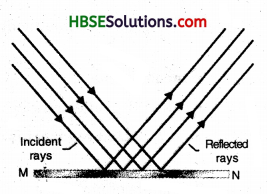
Following are the differences between a regular reflection and diffused reflection :
Regular Reflection:
(i) It takes place on a smooth surface.
(ii) It has all the reflected rays in parallel.
(iii) Reflected rays are in one direction.
HBSE 8th Class Science Solutions Chapter 16 Light 1

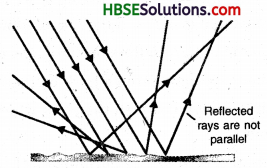
Diffused Reflection:
(i) It takes place on a rough surface.
(ii) Reflected rays are not parallel.
(iii) Reflected rays are scattered in different directions.
Diffused reflection is not due to failure of laws of reflection.
HBSE 8th Class Science Solutions Chapter 16 Light 2

Question 3.
Mention against each of the following whether regular or diffused reflection will take place when a beam of light strikes. Justify your answer in each case.
(a) Polished wooden table
(b) Chalk powder
(c) Cardboard surface
(d) Marble stone with water spread over it
(e) Mirror
(f) Piece of paper
Answer:
(a) A polished wooden table will have regular reflection because its surface is smooth.
(b) A chalk powder will ‘get the diffused reflection because chalk particles are not smooth.
(c) Cardbord surface has minute irregularities on it, so it will have a diffused reflection.
(d) Marble stone with water spread over it will have regular reflection if water is stable but if waves are formed then diffused reflection will take place.
(e) A mirror will reflect light regularly due to its smooth surface.
(f) A piece of paper will have irregular reflection due to minute irregularities on it.

HBSE 8th Class Science Solutions Chapter 16 Light

Question 4.
State the laws of reflection.
Answer:
Following are the laws of reflection:
(i) Incident ray, reflected ray and normal drawn at the point of incidence to the reflecting surface always lie in the same plane.
(ii) Angle of incidence is always equal to angle of reflection.

Question 5.
Describe an activity to show that the incident rays, the reflected ray and the normal at the point of incidence lie in the same plane.
Answer:
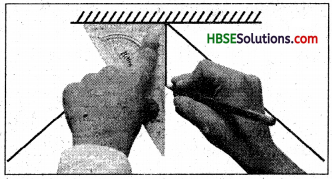
Take a plane mirror and make it stand with help of block on a plane sheet as shown in figure. Now draw an incident line on it AB. Now see in the mirror and mark the points on the paper, where you feel the line is travelling after
HBSE 8th Class Science Solutions Chapter 16 Light 3
getting reflected from the mirror (P1 and P2). Now remove the mirror and mark it as OS and Join the points to make the reflected ray. You will see that, it joins the point of incidence, proving that incident ray is the reflected ray (BC).

Question 6.
Fill in the blanks in the following:
(a) A person 1 m in front of a plane mirror seems to _________ be m away from his image.
(b) If you touch your _________ ear with right hand in front of a plane mirror it will be seen in the mirror that your right ear is touched with .
(c) The size of the pupil becomes _________ when you see in dim light.
(d) Night birds have _________ cones than rods in their eyes.
Answer:
(a) 2 m
(b) left, left
(c) increase
(d) lesser.

Choose the correct option in the Question 7-8.

Question 7.
Angle of incidence is equal to the angle of reflection:
(i) Always
(ii) Sometimes
(iii) Under special conditions
(iv) Never
Answer:
(i) Always.

Question 8.
Image formed by a plane mirror is:
(a) virtual, behind the mirror and enlarged
(b) virtual, behind the mirror and of the same size as the object
(c) teal at the surface of the mirror and enlarged
(d) real, behind the mirror and of the same size as the object.
Answer:
(b) virtual, behind the mirror and of the same size as the object.

HBSE 8th Class Science Solutions Chapter 16 Light

Question 9.
Describe the construction of kaleidoscope.
Answer:
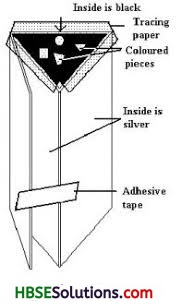
Kaleidoscope is made of three strips of plane mirrors. Three strips of plane mirrors of about 15 cm. length and 4 cm. width are taken and arranged as in a prism i.e. in a triangular form.
HBSE 8th Class Science Solutions Chapter 16 Light 4
They are fixed to each other with thick sheet of paper and enclosed in a tube or in a circular carboard. One end of the tube is covered with a round cardboard disc having a hole in the centre. From the opposite open end some pieces of broken bangles or broken coloured glass are put inside the tube. This open end is also closed. When we see inside this tube through the hole in the circular cardboard; we see different patterns of coloured bangle inside it.

Question 10.
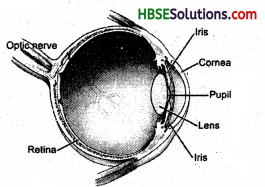
Draw a labeled sketch of human eye.
Answer:
HBSE 8th Class Science Solutions Chapter 16 Light 5

Question 11.
Gurmit wanted to perform Activity 16.8 using a laser torch. Her teacher advised her not to do so. Can you explain the basis of the teacher’s advise ?
Answer:
Teacher has advised her to because laser light is harmful for eyes and can cause some permanent damage to eyes when throw directly in eyes.

Question 12.
Explain how you can take care of your eyes?
Answer:
Following precautionary measures can be taken to take care of our eyes:

  • We should always wash our eyes with plane cold water atleast three times a day.
  • We should not touch our eyes with dirty hands.
  • We should never rub our eyes.
  • We should not look at Sun directly.
  • We should read book, watch T.V., read from black board from a suitable distance.
  • Consult an eye specialist if have any irritation, redness in our eyes.

Question 13.
What is the angle of incidence of a ray if the incident and reflected rays is at an angle of 90° to the incident ray?
Answer:
The angle of incidence of the ray will be 45°.

Question 14.
How many images of a candle will be formed if it is placed between two parallel plane mirrors separated by 40 cm?
Answer:
Infinite images will be formed.

Question 15.
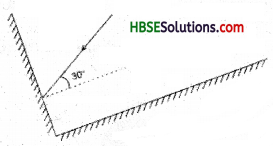
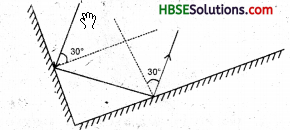
Two mirrors meet at right angles. A ray of light is incident on one at an angle of 30° as shown in the figure. Draw the reflected ray from the second mirror.
HBSE 8th Class Science Solutions Chapter 16 Light 6
Answer:
HBSE 8th Class Science Solutions Chapter 16 Light 7

Question 16.
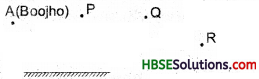
Bhoojo stands at A just on the side of a plane mirror as shown in figure. Can he see himself in the mirror ? Also can he see image of objects situated at P, Q and R?
HBSE 8th Class Science Solutions Chapter 16 Light 8
Answer:
Bhoojo can’t see himself. He can see the images of objects at P and Q.

Question 17.
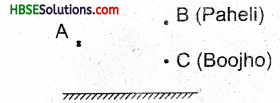
(a) Find out the position of the image of an object situated at A in the plane mirror, (figure)
(b) Can Paheii at B see this image?
(c) Can Bhoojho at C see this image?
(d) When Paheii moves from B to C, where does the image of A move?
HBSE 8th Class Science Solutions Chapter 16 Light 9
Answer:
(a) Image will be formed at ‘A’.
(b) Yes, Paheii at B can see the image.
(c) No, Boojho can’t see the image at C.
(d) The image will disappear at Paheii moves from B to C.

Extended Learning – Activities and Projects

Question 1.
Make your own mirror. Take a glass strip or glass slab. Clean it and put it on a white sheet of paper. See yourself in the glass. Next put the glass slab on a black sheet of paper. Again look into the glass. In which case do you see yourself better and why?
Answer:
For self attempt.

Question 2.
Make friends with some visually challenged students. Enquire from them how they read and write. Also find out how they are able to recognise objects, hurdles and currency notes.
Answer:
For self attempt.

Question 3.
Meet an eye specialist. Get your eye sight checked and discuss how to take care of your eyes.
Answer:
For self attempt.

Question 4.
Survery your neighbourhood. Find out how many children below the age of 12 years use spectacles. Find out from their parents what, in their view, could be the reason for the weak eyesight of’ their children.
You can read more on this topic on the following websites :
→ www.glenbrook.k 1 2.il.us/gbssci/phys/ mmedia/optics/ifpm.html
→ www.glenbrook.k 1 2 il.us/gbssci/phys/elass/ refln/u131b.html
Answer:
For self attempt.

HBSE 7th Class Science Light Important Questions and Answers

Very Short Answer Type Questions

Question 1.
What is sense of sight?
Answer:
The sense which enables us to see object around us is called sense of sight.

Question 2.
What are the sight organs in animals?
Answer:
Eyes.

Question 3.
What is a mirror?
Answer:
Smooth and shiny surface is called a mirror.

Question 4.
What is reflection?
Answer:
Throwing back the incident light by a plane surface is called reflection.

Question 5.
What kind of surfaces reflect light?
Answer:
All surfaces reflect light.

HBSE 8th Class Science Solutions Chapter 16 Light

Question 6.
What is incident ray?
Answer:
Beam of light falling on reflecting surface is called incident ray.

Question 7.
What is reflecting ray?
Answer:
Beam of light reflected back by the reflecting surface is called reflected ray.

Question 8.
What is angle of incidence?
Answer:
Angle formed between the incident ray and normal is called angle of incident.

Question 9.
What is angle of reflection?
Answer:
Angle formed between the reflecting ray and normal is called angle of reflection.

Question 19.
State second law of reflection.
Answer:
Angle of incidence and angle of reflection are always same.

Question 11.
What kind of image is formed by a plane mirror?
Answer:
Virtual and erect image.

Question 12.
Where is the image formed by the mirror?
Answer:
Behind the mirror.

Question 13.
What is the size of the image formed?
Answer:
Same as that on the object infront of the mirror.

Question 14.
At what distance is the image formed behind the plane mirror?
Answer:
At the same distance, as is the object infront of the mirror.

Question 15.
What is the phenomenon called where left side appears to be right and vice- versa in a plane mirror?
Answer:
Lateral inversion.

Question 16.
Which surface shows regular reflection?
Answer:
Smooth surface.

Question 17.
Which surface shews diffused reflection?
Answer:
Rough surface.

Question 18.
What kind of reflection will take place from a polished leather shoes top?
Answer:
Regular reflection.

Question 19.
What kind of reflection will take place from the cover of your note-hook?
Answer:
Diffused reflection.

HBSE 8th Class Science Solutions Chapter 16 Light

Question 20.
In what kind of reflection does reflected rays go parallelled to each other?
Answer:
Regular reflection.

Question 21.
In what kind of reflection, reflected rays move scattered?
Answer:
In diffused reflection.

Question 22.
floes Moon has its own light?
Answer:
No.

Question 23.
How does moon shine?
Answer:
It reflected light emitted by the Sun.

Question 24.
Name some objects which have light of their own.
Answer:
Sun, fire, flame of candle etc.

Question 25.
What are objects called, which have light of their own?
Answer:
Luminous objects.

Question 26.
How many mirror strips are used to make a Kaleidoscope?
Answer:
Three.

Question 27.
Is white light a pure white light?
Answer:
No.

Question 28.
How many colours constitute a white beam?
Answer:
Seven.

Question 29.
What is the splitting of white light into its constituent colours called?
Answer:
Dispersion.

Question 30.
What is the shape of human eye?
Answer:
It is roughly spherical in shape.

Short Answer Type Questions

Question 1.
What is reflection of light?
Answer:
When a beam of light falls on a surface, it is thrown back by the surface in a different direction in the same medium. This is called reflection of light. Every surface can reflect. The falling beam of light is called incident ray and beam bouncing back is called the reflected ray.

Question 2.
How do we see various objects?
Answer:
We see various objects due to reflection. As we know all surfaces reflect light, when light falls on any object, it reflects the light. The reflected light reaches our eyes and we are enabled to see the objects.

Question 3.
Write the laws of reflection?
Answer:
There are two laws of reflection :
(i) The ray of incidence, ray of reflection and normal drawn at the point of incidence to the reflecting surface lie in the same plane.

(ii) The angle of reflection and angle of incidence are always equal.
HBSE 8th Class Science Solutions Chapter 16 Light 10

Question 4.
What do you mean by following.
(i) Incident ray
(ii) Reflected ray
Answer:
Incident ray : The light ray that strikes any surface is called incident ray.
Reflected ray : The light ray which is thrown away from the surface after reflection in a different direction, is called reflected ray.

Question 5.
What do you mean by angle of incidence and angle of reflection?
Answer:
The angle formed between the incident ray and the normal is called the angle of incidence. The angle of reflection is the angle formed between the reflected ray and the normal. Both these angles are always equal in size.

HBSE 8th Class Science Solutions Chapter 16 Light

Question 6.
What is a mirror? What kind of image is formed in a mirror?
Answer:
Any smooth and shining surface can act as mirror. Mirror is a smooth surface which is polished from its back and can form the image of the object which is placed in front of it. The image formed by a mirror is a virtual and erect image and is of same size as that of the object infront of it.

Question 7.
What is dispersion of light?
Answer:
A beam of white light consists of seven colours. When a beam of white light passes through a prism, it splits into its seven constituent colours. The splitting of white light into its seven constituent colours is called dispersion of light.
HBSE 8th Class Science Solutions Chapter 16 Light 11

Question 8.
How many kind of nerve endings are there in our eyes?
Answer:
There are two types of nerve endings in our eyes. The first type of nerve endings are called cones. Cones are sensitive to bright light and other type of nerve endings are called rods. Rods are sensitive to dim light cones are also sensitive to colours.

Question 9.
How do eye muscle adjust themselves to see the near and distant objects?
Or
What is called the accomodation of eyes?
Answer:
The muscles of the eye contract in order to see near objects. When they contract the lens becomes thicker. When the eye has to see a distant object the muscles expand or relax. This makes the lens thinner. This is called accommodation.

Question 10.
What is the cause of dispersion?
Answer:
Different colours of light bend by different angles of refraction. When light enters the glass prism or a drop of water, different colours bend at different angles and become separated to show phenomenon of dispersion.

Question 11.
How do ciliary muscles affect the functioning of eye?
Answer:
Ciliary muscles can contract and relax. Because of this they can change the thickness of eye lens which also changes its focal length. With change in focal length eye lens can make image of near by objects and also far away objects. So power of accommodation of eye is due to the function of the ciliary muscle.

Question 12.
What is a yellow spot in eyes?
Answer:
Yellow spot or macula is a small area, facing the eye lens. It has high concentration of light sensitive nerve endings or cones. The rest of the retina has lesser cones and more number of cells called rods. It is the spot where brightest vision is formed and colour version is formed.

Question 13.
What is the blind spot?
Answer:
It is a region below the yellow spot, where no light sensitive nerve endings are present. It is an area of no vision.

HBSE 8th Class Science Solutions Chapter 16 Light

Question 14.
What is Myopia or short sightedness?
Answer:
This is a type of eye defect, in which person can see nearer objects clearly but cannot see the far off objects. This defect is due to thickness of eye lens. Ciliary muscles do not relax enough to make lens thin enough to see distant objects.

Question 15.
What is Hypermetropia or long sightedness?
Answer:
This is a type of an eye defect, in which the person can see far off objects clearly, but cannot see the nearer objects. This defect is due to thinness of the eye lens. The ciliary muscle do not contract enough to make the lens see nearer objects.
HBSE 8th Class Science Solutions Chapter 16 Light 12

Question 16.
What is cataract? How can it be corrected?
Answer:
During old age, the eye sight becomes blurred. It happens because the lens of the eye becomes opaque and milky. When the vision becomes cloudy the person is said to have cataract. It is possible to treat this temporary loss of vision by removing the opaque lens and, a new artificial lens is inserted by minor and simpe operation.

Question 17.
Write any three safety measures to protect our eyes.
Answer:

  • We should not rub our eyes.
  • We should wash our eyes many times a day.
  • We should not look at sun or other powerful lights directly.

Question 18.
What is Braille system?
Answer:
Braille is based on code of one to six dots which are raised. Each dot has a position. These dots make up letters of alphabet, number and all other things done in print. Any language can be read through the codes of the braille by touching the dots.

Long Answer Type Questions

Question 1.
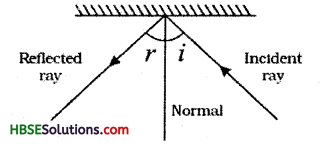
What is reflection of light? State laws of reflection.
Answer:
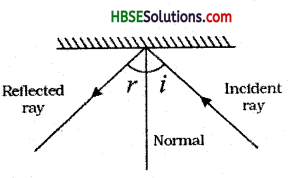
Reflection of light is throwing back of light by any object. When a beam of light falls on some surface, the surface throws that beam away in different direction. This is called reflection of light. Following are the laws of reflection:
HBSE 8th Class Science Solutions Chapter 16 Light 13
(a) When a ray of light falls on a reflecting surface, it is reflected in such a way that the angle of incidence is equal to the angle of reflection i.e. ∠i = ∠r.

(b) The incident ray, the normal and the reflected ray, all lie in the same plane.

Question 2.
What are the characteristics of image formed with a plane mirror?
Answer:
Plane mirror is a shiny, polished surface. When any object is placed in front of the mirror, an image is formed. Following are the characteristics of the image formed by a plane mirror:

  • Image formed on a plane mirror cannot be taken on a screen, such image is called a virtual image.
  • Image formed on a plane mirror is erect.
  • It is laterally inverted i.e. left hand of the object appears as the right hand.
  • Image formed is as far behind as the object is in front of it.

Question 3.
What are the uses of a plane mirror?
Answer:

  • We use a plane mirror to see our reflections in it, at our homes.
  • Plane mirrors are used to reflect light on a particular object.
  • Plane mirrors are used for signalling by scouts and army.
  • They are used to form multiple images in show windows.
  • Plane mirror is used to reflect sun rays in appliances like solar cooker etc.
  • Toys like Kaleidoscope are made on the concept of multiple reflection. Navy use periscopes based on concept of multiple reflection for spying in sea.

Question 4.
Describe how does human eye work?
Answer:
The light reflected by objects enter our eyes through cornea. That is why cornea is called window to the world. Lens focuses the image of the object on the retina. Retina converts these optical images into optical pulses. These optical pulses are then sent to brain through optical nerves. The amount of light entering the eye through cornea is controlled by Iris. It expands when light is bright and thus enables the pupil to enter controlled amount of light to enter the eye. In dark it contracts and increases the size of pupil to allow more light to enter the eye.

The retina forms a small and inverted image of the object. The brain interprets it and forms the erect and correct sized image.

HBSE 8th Class Science Solutions Chapter 16 Light

Question 5.
Write various measures to save our eyes.
Answer:
Eyes are a precious gift of God. We should take proper care of our eyes and protect them from injury. Following measures should be taken for healthy eyes :

  • We should wash our eyes with cold water everyday and wipe them with clean and soft cloth.
  • We should never rub our eyes. If some particle enters our eyes, we should wash our eyes with cold water.
  • We should always read in proper light.
  • In case of any injury or other problems related to eyes, we should avoid self medication and immediately consult an eye specialist.

Question 6.
What is blindness? How many types of blindness do we know about?
Answer:
A person is said to be blind or visually impaired when he or she is imable to see. Blindness is of two types:
Curable Blindness : When cornea becomes opaque or the lens becomes opaque the sight of the person becomes decreased. This is called a temporary or curable blindness. In this case the person is operated upon and sight is resorted. An artificial lens is inserted in place of opaque lens and the opaque cornea is replaced with a healthy donated cornea.

Permanent Blindness : In this type of blindness image formed by cornea is not transferred to brain and this type of blindness cannot be cured.

Pollution of Air and Water Class 8 HBSE Notes

  • We see all the things around us only due to sense of sight.
  • Eyes are our organs of sight, which enables us to see objects around us.
  • It is the light which enables our eyes to see the objects. Without light our eyes cannot sense anything.
  • Any polished or shiny surface acts as a mirror. It can change the direction of light.
  • Light is reflected from all the surfaces.
  • When a beam of light falls on a surface, it throws back the light to same medium. This phenomenon is called reflection of light.
  • The beam of light falling on the plane surface is called the incident ray.
  • The beam of light thrown back by the reflecting surface is called the reflected ray.
  • The line drawn between the point where the incident ray and reflected ray meet is called the normal.
  • The angle between the normal and the incident ray is called angle of incidence.
  • The angle between the normal and the reflected ray is called the angle of reflection.
  • The angle of incidence and the angle of reflection are equal.
  • Incident ray, reflected ray and the normal drawn at the point of incidence to reflecting surface lie in the same plane.
  • Above two points are called laws of reflection.
  • Light falling on a smooth surface is reflected regularly.
  • Irregular or diffused reflection takes place on rough surface.
  • In mirror the right appears as left and left as right. This is called lateral inversion.
  • Two mirrors inclined to each other at different angles, give multiple images.
  • White light consists of seven colours called spectrum.
  • Splitting of white light into its constituting seven colours is callled dispersion.
  • Our eyes have different parts which perform different functions to enable us to see the objects.
  • Visually challanged persons can read and write using Braille system.

HBSE 8th Class Science Solutions Chapter 16 Light Read More »

HBSE 8th Class Science Solutions Chapter 4 Materials: Metals and Non-Metals

Haryana State Board HBSE 8th Class Science Solutions Chapter 4 Materials: Metals and Non-Metals Textbook Exercise Questions and Answers.

Haryana Board 8th Class Science Solutions Chapter 4 Materials: Metals and Non-Metals

HBSE 8th Class Science Materials: Metals and Non-Metals Textbook Questions and Answers

Question 1.
Which of the following can be beaten into thin sheets?
(a) Zinc
(b) Phosphorus
(c) Sulphur
(d) Oxygen
Answer:
(a) Zinc.

Question 2.
Which of the following statements is correct?
(a) All metals are ductile.
(b) All non-metals are ductile.
(c) Generally, metals are ductile.
(d) Some non-metals are ductile.
Answer:
(a) All metals are ductile. ✗
(b) All non-metals are ductile. ✗
(c) Generally, metals are ductile. ✓
(d) Some non-metals are ductile. ✗.

HBSE 8th Class Science Solutions Chapter 4 Materials: Metals and Non-Metals

Question 3.
Fill in the blanks:
(a) Phosphorus is very ……….. non-metal.
(b) Metals are ……….. conductor of heat and ………….. .
(c) Iron is ………….. reactive than copper.
(d) Metals react with acids to produce ………….. gas.
Answer:
(a) reactive
(b) good, electricity
(c) less
(d) hydrogen.

Question 4.
Mark ‘T’ if the statement is true and ‘F’ if it is false:
(a) Generally, non-metals react with acids. ( )
(b) Sodium is a very reactive metal. ( )
(c) Copper displaces zinc from zinc sulphate solution. ( )
(d) Carbon can be drawn into wires. ( )
Answer:
(a) False
(b) True
(c) False
(d) False.

Question 5.
Some properties are listed in the following table. Distinguish between metals and non-metals on the basis of their properties.

PropertiesMetalsNon-metals
1. Appearance
2. Hardness
3. Malleability
4. Ductility
5. Heat Conduction
6. Conduction of Electricity

Answer:

PropertiesMetalsNon-metals
1. Appearancelustrousnon-lustrous
2. Hardnesshard except sodiumgenerally soft except
3. Malleabilityand potassiumdiamond
4. Ductilitygenerally malleablenon-malleable
5. Heat Conductiongenerally ductilenon-ductile
6. Conduction of Electricitygood conductorspoor conductors

Question 6.
Give reasons for the following:
(a) Aluminium foils are used to wrap food items.
(b) Immersion rods are made up of metallic substances.
(c) Copper cannot displace zinc from its salt solution.
(d) Sodium and potassium are stored in kerosene.
Answer:
(a) Aluminium foils are used to wrap food items because aluminium can be beaten in sheets to form these thin wrapping sheets and it is soft and it does not react with food items.

(b) Immersion rods are made up of metallic substances because metals are good conductors of heat and electricity. They get hot very soon on passage of current and warm the water.

(c) Copper cannot displace zinc from its salt solution because copper is less reactive than zinc. A less reactive metal cannot displace a more reactive metal from its solution.

(d) Sodium and Potassium are stored in kerosene because they are very reactive and quickly react in air.

HBSE 8th Class Science Solutions Chapter 4 Materials: Metals and Non-Metals

Question 7.
Can you store acidic lemon pickles in an aluminium utensils? Explain.
Answer:
No, we cannot store acidic lemon pickles in aluminium utensils because aluminium is a metal. Metals readily react with acids to produce hydrogen gas. So, when the aluminium metal comes in contact with acidic lemon pickles, it would react to release hydrogen, which would spoil the food and render it unfit to consume.

Question 8.
In the following table some substances are given in Column I. In Column II some uses are given. Match the items in Column I with those in Column II.

Column IColumn II
(i) Gold(a) Thermometers
(ii) Iron(b) Electric wire
(iii) Aluminium(c) Wrapping food
(iv) Carbon(d) Jewellery
(v) Copper(e) Machinery
(vi) Mercury(f) Fuel

Answer:

Column IColumn II
(i) Gold(d) Jewellery
(ii) Iron(e) Machinery
(iii) Aluminium(c) Wrapping food
(iv) Carbon(f) Fuel
(v) Copper(b) Electric wire
(vi) Mercury(a) Thermometers

Question 9.
What happens when:
(i) Dilute sulphuric acid is poured on a copper plate?
(ii) Iron nails are placed in copper sulphate solution?
Write word equations of the reactions involved.
Answer:
(i) When sulphuric acid is poured on copper plate the acid present in sulphuric acid reacts with copper to form copper sulphate and hydrogen. The copper plate gets eroded from place.
Sulphuric Acid + Copper → Copper Sulphate + Hydrogen
(ii) When iron nails are placed in copper sulphate solution the iron being more reactive will replace copper in its salt solution,
(Ferrous Sulphate) → Iron + Copper Sulphate → Iron Sulphate + Copper
The solution will turn light green.

Question 10.
Saloni took a piece of burning charcoal and collected the gas evolved in a test tube.
(i) How will she find the nature of the gas?
(ii) Write down equations of all the reactions taking place in this process.
Answer:
(i) She will test it with litmus paper to check the acidic or basic nature of gas. If red litmus turns blue, it is basic in nature. If blue litmus turns red, it is acidic in nature.

(ii) Sulphur dioxide (SO2) + Water (H2O) → Sulphurous acid (H2SO3).

HBSE 8th Class Science Solutions Chapter 4 Materials: Metals and Non-Metals

Question 11.
One day Reeta went to a Jeweller’s shop with her mother. Her mother gave old gold jewellery to the goldsmith to polish. Next day when they brought the jewellery back they found that there was a loss in its weight. Can you suggest a reason for the loss in weight?
Answer:
When gold is washed in acidic solution, it being a metal reacts with acid and forms the hydrogen gas with some metallic oxides. This causes the loss of gold in form of gold oxides. This looses the weight of gold.

Activity.

No. 4.1. Malleability Of Materials

Object/ MaterialChange in Shape (Flattens/Breaks into pieces)
Iron nailflattens
Coal piecebreak into pieces
Aluminium wireflatten
Pencil leadbreaks into pieces

No. 4.3. Electrical Conductivity Of Materials

MaterialsGood Conductor / Poor Conductor
Iron rod / nailGood conductor
SulphurPoor conductor
Coal piecePoor conductor
Copper wireGood conductor

Extended Learning – Activities And Projects

Question 1.
Prepare Index Cards for any four metals and non-metals. The card should have information like name of metal/non-metal; its physical properties, chemical properties and uses.
Answer:
1. Name of metal: Copper
Physical properties:
(i) It is hard
(ii) It is ductile.
(iii) It is good conductor of heat and electricity.

Chemical Properties:
(i) Copper reacts with moist air to form greenish coating.
(ii) It oxide is basic in nature.
(iii) It reacts with acids to produce hydrogen gas.
(iv) It displaces iron from iron sulphate solution.

Uses:
Copper is used to make electrical wires, base of cooking utensils, etc.

Non-metals:

2. Name of non-metal: Coal
Physical properties:
(i) It is not ductile.
(ii) It is not malleable.
(iii) It is hot sonorous and does not shine. It is soft.
(iv) It is poor conductor of electricity

Chemical Properties:
(i) It produces oxides of carbon when burnt
(ii) It’s oxide are acidic in nature.
(iii) It does not take part in replacement reaction.

3. Name of Non-metal: Sulphur
Physical properties:
(i) It is neithre ductile nor malleable.
(ii) It is soft and dull.
(iii) It is poor conductor of heat and electricity.

Chemical properties:
(i) It reacts with oxygen to produce sulphur dioxide.
(ii) It reacts with water to form sulphurous acid H2SO4 which is acidic in nature.
(iii) Metals are heated to mould them.
(iv) Gold is preferred to prepare jewellary because it is less reactive ductile and is a costly metal.

4. Name of Metal: Iron
Physical properites:
1. malleable
2. non-ductile
3. sonorous
4. hard
5. good conductor of heat and current.

Chemical properties:
1. React with oxygen to form rust.
2. React with water.
3. React with acids to form hydrogen gasi
4. React with sodium hydroxide to produce hydrogen gas.

Uses:
Used to make machines, tools, door, etc.

Question 2.
Visit a blacksmith and observe how metals are moulded.
Answer:
For self attempt.

Question 3.
Suggest an experiment to compare the conductivity of electricity by iron, copper, aluminium and zinc. Perform the experiment and prepare a short report on the results.
Answer:
For self attempt.

Question 4.
Find out the locations of the deposits of iron, aluminium and zinc in India. Mark these in an outline map of India. In which form are the deposits found? Discuss in the class.
Answer:
For self attempt.

HBSE 8th Class Science Solutions Chapter 4 Materials: Metals and Non-Metals

Question 5.
Discuss with your parents / neighbours / goldsmiths why gold is preferred for making jewellery.
Answer:
For self attempt.

Question 6.
Visit the following websites and enjoy the quiz on metals and non-metals.

  • chemistry.about.com /library/weekly/ bl05030a.htm
  • chemistry.about.com / od / testsquizzes / Chemistry_Tests_Quizzes.htm.
  • www.syvum.com / cgi / online / mult.cgi / squizzes / science / metals.tdf?0
  • www.gcsescience.com / q / quesemet.html
  • www.corrosionsource.com / handbook / periodic / metals.htm
    Answer:
    For self attempt.

HBSE 8th Class Science Materials: Metals and Non-Metals Important Questions and Answers

Very Short Answer Type Questions

Question 1.
What is meant by malleability of a metal?
Answer:
The property by virtue of which a metal can be hammered into thin sheets is called malleability.

Question 2.
What is meant by ductility of metals?
Answer:
Ductility of metals means that they can be drawn into very thin wires.

Question 3.
Name two metals which are both malleable and ductile.
Answer:
Gold and silver.

Question 4.
Are non-metals malleable and ductile?
Answer:
No.

Question 5.
Name a metal which exists in liquid state.
Answer:
Mercury.

Question 6.
Name the hardest substance in the world.
Answer:
Diamond.

Question 7.
Which metal is the best conductor of electricity?
Answer:
Silver.

Question 8.
Identify the most reactive and the least reactive metal amongst the following:
Al, K, Cu, Au.
Answer:
K is the most reactive while Au is the least reactive metal.

Question 9.
Name the metal which is stored in kerosene oil.

HBSE 8th Class Science Solutions Chapter 4 Materials: Metals and Non-Metals
Answer:
Sodium is stored in kerosene oil.

Question 10.
Which metal foil is used in packing of some medicine tablets?
Answer:
Aluminium.

Question 11.
Which metal foil is used for decorating sweets?
Answer:
Silver.

Question 12.
Name a non-metal which is good conductor of heat.
Answer:
Graphite.

Question 13.
Why do gold and silver exist in free state?
Answer:
Gold and silver exist in free state because they are less reactive.

Question 14.
What would happen to the iron railings in open, when not painted?
Answer:
They will be rusted.

Question 15.
Why electric wires are made of copper?
Answer:
Electric wires are made of copper because it is good conductor of electricity.

Question 16.
Iron nails are kept dipped in blue copper sulphate solution and solution gets changed into light green colour. Why?
Answer:
This happens because iron displaces copper to form Ferrous Sulphate which is light green in colour.

Question 17.
Explain why silver does not displace hydrogen from dil HCl?
Answer:
Silver is less reactive than hydrogen, so it does not displace hydrogen from dil HCl.

Question 18.
When does red litmus paper turn blue?
Answer:
When red litmus paper comes in contact with basic solution.

Question 19.
When does a blue litmus paper turn red?
Answer:
Blue litmus paper turns red when it comes in contact with acidic solution.

Question 20.
What happens when sulphur dioxide gets dissolved in water?
Answer:
Sulphurous acid is formed:
SO2 + H2O → H2SO3

Question 21.
Oxides of non-metals are generally of which nature?
Answer:
Oxides of non-metals are generally of acidic nature.

Question 22.
What happens when sodium comes in contact with water?
Answer:
Sodium catches fire and heat is released.

Question 23.
How do non-metals react with water?
Answer:
Non-metals do not react with water.

HBSE 8th Class Science Solutions Chapter 4 Materials: Metals and Non-Metals

Question 24.
How do non-metals generally react with acids?
Answer:
Non-metals generally do not react with acids.

Question 25.
Which gas is emitted when metals react with acids?
Answer:
Hydrogen gas.

Question 26.
Write any use of non-metal.
Answer:
Non-metals are used in crackers.

Question 27.
Write any use of metals.
Answer:
Metals are used to make all means of transportation.

Question 28.
What is a displacement reaction?
Answer:
Reaction in which a more reactive metal displaces the less reactive metal from its compound in aqueous solution is called displacement reaction.

Short Answer Type Questions

Question 1.
Write any three physical characteristics of metals.
Answer:
(i) Metals can be hammered to make sheets so they are malleable.
(ii) Metals can be drawned into very thin wires, that means metals are ductile.
(ii) Metals are good conductors of heat and electricity.

Question 2.
Write any three physical characteristics of non-metals.
Answer:
(i) Non-metals are non-ductile and non- malleable.
(ii) Non-metals are non-sonorous.
(iii) Non-metals are poor conductors of heat and electricity.

Question 3.
What do you mean by sonorous materials?
Answer:
Materials which make a sound when they are hit hard with some other material are called sonorous materials. All metals except the soft ones are sonorous, while all non-metals are non-sonorous.

Question 4.
How do metals and non-metals react with oxygen?
Answer:
Metals react with oxygen to form oxides generally. These oxides are alkaline.
\(\begin{array}{ccc}
2 \mathrm{Mg} & +\mathrm{O}_{2} \rightarrow & 2 \mathrm{MgO} \\
\text { Magnesium } & \text { Oxygen } & \text { Magnesium oxide }
\end{array}\)
Non-metals also react with oxygen to form oxides but these oxides are acidic in nature.
\(\begin{array}{cc}
\mathrm{C} & \mathrm{O}_{2} \\
\text { Carbon } & \text { Oxygen }
\end{array} \quad \rightarrow \quad \mathrm{CO}_{2}\)

Question 5.
A copper coin is kept immersed in a solution of silver nitrate for some time. What will happen to the coin and the colour of the solution?
Answer:
Copper is more reactive than silver. Therefore, when a copper coin is kept immersed in a solution of silver nitrate, it will displace silver from silver nitrate solution and a solution of copper nitrate will be formed.
Thus, the copper coin will dissolve in the solution and the colour of the solution will change from colourless to blue.

HBSE 8th Class Science Solutions Chapter 4 Materials: Metals and Non-Metals

Question 6.
Explain why zinc metal can displace copper from copper sulphate solution but copper cannot displace zinc from zinc sulphate solution.
Answer:
Zinc metal is more reactive than copper. Therefore, it can displace copper from CuS04. Cu is less reactive than Zn, therefore, cannot replace Zn from ZnS04.

Zn + CuSO4 → ZnSO4 + Cu

Question 7.
State any three reasons for counting sulphur amongst the non-metals.
Answer:
Sulphur is a non-metal because:
(i) It is neither malleable nor ductile.
(ii) It does not conduct heat and electricity.
(iii) It combines with oxygen to form acidic oxide.

Question 8.
Non-metals do not react with water. How does this fact is utilized to store very reactive non-metals?
Answer:
Non-metals do not react with water. This quality is quite helpful in protecting some highly reactive non-metals which quickly react in air. Phosphorus is very reactive non-metal. It immediately catches fire when exposed to air. To prevent this, it is stored in water.

Question 9.
What is an element?
Answer:
Element is the smallest unit of any material. It cannot be broken further by cooling, heating or by electrolysis e.g. sulphur, iron, carbon etc.

Question 10.
Compare the physical properties of metals and non-metals.
Answer:

MetalsNon-metals
1. Metals are good conductors of heat and electricity.1. Non-metals are poor conductors of heat and electricity.
2. Metals are malleable and ductile.2. Non-metals are neither malleable nor ductile.
3. Metals are lustrous and can be polished.3. Non-metals are usually non-lustrous and cannot be polished.
4. Metals are solid except mercury.4. Non-metals can exist in all states.
5. Metals have generally high melting points and boiling points.5. Non-metals generally have low melting points and boiling points.

Question 11.
Compare the chemical properties of metals and non-metals.
Answer:

MetalsNon-metals
1. Metals react with oxygen to produce oxides which are alkaline in nature.Non-metals react with oxygen to produce oxides which are basic in nature.
2. Metals react with water differently to produce oxides and hydroxides.Non-metals do not react with water.
3. Metals react with acids to produce hydrogen gas.Non-metals most of times do notreact with acids.
4. More reactive metals displace the less reactive metals from their compounds in an aqueous solution.Non-metals do not show any such action.

Question 12.
In which state do metals occur inside the earth’s crust?
Answer:
Metals occur in different states inside the earth’s crust depending upon their reactivity. Some metals occur in elemental state or in the form of compounds. Reactive metals generally are found in compound. Highly unreactive metals occur in free state while the less reactive metals can either be found in combined state or infree state.

HBSE 8th Class Science Solutions Chapter 4 Materials: Metals and Non-Metals

Question 13.
What do you mean by Malleability of metals.
Answer:
The physical property of metals by virtue of which metals can be beatan into thin sheet is called malleability. Most of the metals are malleable. Aluminium is beaten into aluminium foil for wrapping food and silver is also beaten to make silver foils to decorate sweets.

Question 14.
What do you mean by ductility?
Answer:
The physical property by virtue of which metals can be drawn into thin wires is called ductility. Metals which are good conductors of electricity are mostly drawn into wire to be used in electrical cables. Gold and silver are the most ductile metal. Wires of copper, aluminium and tungsten are used to make electricity cables and tungsten is used to make filaments of bulbs. Aluminium wires are also widely used to make electrical wires.

Question 15.
What is an alloy? Describe any one alloy.
Answer:
Mixture of two or more than two metals to get desired qualities is called an alloy. Stainless steel is an alloy of iron, chromium and nickel. It is used to make utensils, surgical & instruments and many other decorative items. Stainless stell is hard and do not rust.

Long Answer Type Questions

Question 1.
Write a short note on displacement reaction of metals.
Answer:
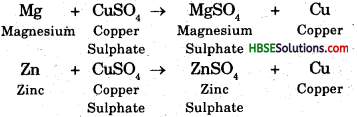
A more reactive metal displaces a less reactive metal from its compound in an aqueous solution. This is called displacement reaction. For example, when some iron nails are dipped in copper sulphate solution, the iron being more reactive displaces copper from its solution and form ferrous sulphate solution of light green colour.
HBSE 8th Class Science Solutions Chapter 4 Materials Metals and Non-Metals-1
Similarly, magnesium and zinc also displaces copper from its compound.
HBSE 8th Class Science Solutions Chapter 4 Materials Metals and Non-Metals-2

Question 2.
How will you prove the nature of rust or the ash obtained from burning magnesium ribbon?
Answer:
This can be easily proved in laboratory. Take some rust and dissolve it in water (a few drops). Now take a red litmus paper and dip the litmus paper in solution. We will see that the red litmus paper turns blue.

When the red litmus paper turns blue it means solution is basic in nature. So the rust is basic in nature. We can similarly check the nature of ash obtained by burning a magnesium ribbon. It will also turn red litmus paper blue proving its basic nature.

HBSE 8th Class Science Solutions Chapter 4 Materials: Metals and Non-Metals

Question 3.
How do different metals react with water?
Answer:
Different metals react differently with water, hydrogen being a common end product.
Sodium metal reacts vigorously with water to form sodium hydroxide and hydrogen gas.
HBSE 8th Class Science Solutions Chapter 4 Materials Metals and Non-Metals-3
Magnesium only reacts with hot boiling water to form magnesium oxide and hydrogen.
HBSE 8th Class Science Solutions Chapter 4 Materials Metals and Non-Metals-4
Red hot iron reacts with steam to form iron oxide and hydrogen copper. Silver and nickel do
not react with water.

Question 4.
What are the different uses of metals?
Answer:
Metals are very useful to us. Some of the uses of common metals are following:
(а) Copper and aluminium metals are used to make electric wires. This is because copper and aluminium are good conductors of electricity.
(b) Copper, aluminium and iron metals are used for making utensils and other domestic things. These metals are also used to make various factory equipments. This is because, all these metals are good conductors of heat.
(c) Iron is used to make heavy machinery and is also used in construction of buildings because it is very heavy and strong.
(d) Thin foils of aluminium are used in packaging food materials and medicines etc.
(e) The liquid metal mercury is used in thermometers.
(f) Gold and silver metals are used to make jewellery.
(g) Sodium, titanium and zirconium metals are used in atomic energy and space projects.

Question 5.
What are the different uses of non-metals?
Answer:
Following are the uses of non-metals:
(a) Oxygen is used by plants and animals for respiration. Oxygen also supports the process of combustion in factories, houses, aeroplanes
and missiles.
(b) Compounds of nitrogen provide nutrients to soil and plants. Fertilizers made by using nitrogen are extensively used in agricultural practices.
(c) Chlorine is used to disinfect the drinking water as it has the ability to kill germs.
(d) Sulphur is also used as germicide, it is also used as an antiseptic fcr skin treatment (in ointments).
(e) Non-metals are used in crackers.

Question 6.
What is corrosion? How does it affect different metals?
Answer:
Corrosion is defined as attack of atmospheric gases and moisture on the surfaces of metal making them deformed and weak. If iron is left in open for a period of time, it slowly gets deposits of brown flakes on it, which is called rusting of iron. It is undesirable because it makes the iron weak and eat it up slowly with passage of time. Similarly silver objects become black in colour and loose their lustree as silver reacts with hydrogen sulphide gas of air. Slowly the copper vessels also get coated with greenish layer of copper carborate. It is formed due to reaction of copper with carbondioxide of air and water vapour also present in air.
HBSE 8th Class Science Solutions Chapter 4 Materials Metals and Non-Metals-5

Question 7.
Write composition, properties and uses of following alloys: Steel, Stainless Steel, Brass and Duralumin
Answer:

AlloyCompositionPropertiesUses
SteelIron and CarbonStrongNails, screws, railway lining, bridges, machinery, ships etc. are made up of steel.
Stainless SteelIron, Chromium and nickelStrong, rust proof, hard and shiningUses for making utensil, cutlery and surgical instruments.
BrassCopper and ZincDuctile, malleable resists corrosion can easily be castedUse for making screws, nuts, bolts,
DuralumiumAluminium, copper maganese and magnesiumLight,Used to make automobile parts, pressure cookers and aircrafts etc.

HBSE 8th Class Science Solutions Chapter 4 Materials: Metals and Non-Metals

Materials: Metals and Non-Metals Class 8 HBSE Notes

1. All metals and non-metals have some physical and chemical properties which differentiate them from each other.
2. Properties related to appearance and structure are called physical properties while how they react with other metals and non-metals are called their chemical properties.
3. Metals are shiny in appearance. This property of metals is called lustre.
4. Metals are generally hard. Sodium and potassium are soft. All metals mostly exist in solid state except murcury which is a liquid at room temperature.
5. Metals can be beaten with hamrqer and can be beaten into sheets. This physical property of metals is called malleability. Most of the metals are malleable.
6. Metals can be drawn into wires, they are thus ductile . Gold, tungsten are highly ductile metals.
7. Metals are good conductors of heat and electricity. That is why metals are used to make electric wires and most of the cooking utensils are made of metals. Silver is the best conductor of electricity.
8. Metals make sound, when they are hit hard with other object. This property makes them sonorous.
9. Non-metals do not shine and break-up when hit hard with hammer.
10. Non-metals cannot be beaten into sheets.
11. Non-metals cannot be drawn into wires.
12. They do not make any sound when hit with other objects.
13. Non-metals are bad conductors of heat and electricity.
14. Metals and non-metals react with oxygen to form oxides. Metal oxides are alkaline and oxides of non-metals are acidic in nature.
15. Metals react with water at different rates to form oxides and hydrogen gas. Non-metals do not react with water except sodium and magnesium.
16. Non-metals generally do not react with acids but metals react to produce hydrogen gas.
17. A more reactive metal displaces the less reactive metal from its compound in aqueous solution.
18. Metals and non-metals are very useful to us. They are used for different purposes.
19. All the materials can be divided into metals, non-metals and metalloids on the basis of above discussed physical mid chemical properties. Metalloids are those materials which possess the qualities of both metals and non-metals.

HBSE 8th Class Science Solutions Chapter 4 Materials: Metals and Non-Metals Read More »

HBSE 8th Class Science Solutions Chapter 3 Synthetic Fibres and Plastics

Haryana State Board HBSE 8th Class Science Solutions Chapter 3 Synthetic Fibres and Plastics Textbook Exercise Questions and Answers.

Haryana Board 8th Class Science Solutions Chapter 3 Synthetic Fibres and Plastics

HBSE 8th Class Science Synthetic Fibres and Plastics Textbook Questions and Answers

Question 1.
Explain why some fibres are called synthetic?
Answer:
Some fibres are called synthetic because they do not occur naturally and are made by man using petrochemicals.

Question 2.
Mark (✓) the correct answer:

Rayon is different from synthetic fibre because
(i) it has a silk like appearance
(ii) it is obtained from wood pulp
(iii) its fibres can also be woven like those of natural fibres.
Answer:
(ii) it is obtained from wood pulp. ✓

Question 3.
Fill in the blank with appropriate words:
(i) Synthetic fibres are also called ……………. or ……………. fibres.
(ii) Synthetic fibres are synthesised from raw material called ……………. .
(iii) Like synthetic fibres, plastic is also a ……………. .
Answer:
(i) man-made or artificial fibres
(ii) petrochemicals
(iii) polymer.

HBSE 8th Class Science Solutions Chapter 3 Synthetic Fibres and Plastics

Question 4.
Give examples which indicate that nylon fibres are very strong.
Answer:
Nylon fibres are very strong, thus they are used to prepare ropes for mountaineering. They are also used to prepare parachutes.

Question 5.
Explain why plastic containers are favoured for storing food.
Answer:
Advantanges of storing foods in plastic containers are:
(a) the plastics do not react with the food stored in them.
(b) the plastics are light weight and are strong.
(c) they are easy to handle and safe.

Question 6.
Explain the difference between the thermoplastic and thermosetting plastics.
Answer:
Differences between thermoplastic and thermosetting plastics:
(i) Thermoplastics can be mtelted on heating but thermosetting plastics Cannot be melted.
(ii) Thermoplastics can be reshaped as many times as desired but thermosetting plastics cannot.
(iii) Thermoplastics can be bent but thermosetting plastics cannot be bent.
(iv) Thermoplastics are good conductors of heat, thermosetting plastics are bad conductors of heat.

Question 7.
Explain why the following are made of thermosetting plastics:
(a) Saucepan handles
(b) Electric plugs/switches/plug boards.
Answer:
(a) The handles of saucepan are made of thermosetting plastic because it is a bad conductor of heat and do not get heated up while cooking. So it becomes easy to handle the utensil while cooking.
(b) Electric plugs/ switches and plug boards are made up of thermosetting plastic because it is a bad conductor of electricity. It does not allow the electric current to pass through it, thus safe in using in electric appliances.

Question 8.
Categorise the materials of the following products into ‘can be recycled’ and ‘cannot be recycled’.
Telephone instruments, toys, cooker handles, carry bags, ball point pens, plastic bowls, electric wire covering, plastic chairs, electrical switches.
Answer:
Can be Recycled: Toys, carry bags, plastic bowls, ball point pen, plastic chairs, electric wire covering.
Cannot be Recycled: Cooker handles, electric switches, telephone instruments.

Question 9.
Rana wants to buy shirts for summer. Should he buy cotton shirts or shirts made from synthetic material? Advise Rana, giving your reason.
Answer:
Cotton clothes are preferred to synthetic clothes in summers because cotton is a bad conductor of heat. It does not allow the outer heat to enter in our body, thus protects body from heat. It also has more capacity to hold moisture than the synthetic clothes. So, it retains
the sweat of the body and keeps it cool. So, Rana should buy shirts made upof cotton.

Question 10.
Give examples to show that plastics are noncorrosive in nature?
Answer:
Following examples show that plastics are non-corrosive in nature:
(i) They are used to store chemicals in laboratories.
(ii) They are used to store all types of food, as it does not react to materials stored in it.
(iii) It does not even react with air and water.

HBSE 8th Class Science Solutions Chapter 3 Synthetic Fibres and Plastics

Question 11.
Should theiiandle and bristles of a tooth brush be made of the same material? Explain your answer.
Answer:
No, the handle and bristles of a tooth brush should not be made of the same material because the bristles should be soft and the handle should be hard. So the bristles should be made up of soft material so that it does not harm the gums. The handles should be made up of hard material so that it can give firm grip.

Question 12.
‘Avoid plastics as far as possible,’ Comments on this advice.
Answer:
Plastics are harmful for our environment. Some of the plastics cannot be recycled, so they cannot be used again and thus cannot be finally disposed off. They thus, should be avoided as far as possible.

Question 13.
Match the terms of column I correctly with the phrases given in column II:

Column IColumn II
(ii) Polyester(a) Prepared by using wood pulp
(ii) Teflon(b) Used for making parachutes and stockings
(iii) Rayon(c) Used to make non-stick cookwares
(iv) Nylon(d) Fabrics do not wrinkle easily

Answer:

Column IColumn II
(ii) Polyester(d) Fabrics do not wrinkle easily.
(ii) Teflon(c) Used to make non-stick cookwares.
(iii) Rayon(a) Prepared by using wood pulp.
(iv) Nylon(b) Used for making parachutes and stockings.

Question 14.
‘Manufacturing synthetic fibres is actually helping conservation of forests’. Comment.
Answer:
Manufacturing synthetic fibres is actually helping conservation of forests because it does not require cfutting plants and hunting animals to get the natural fibres. The synthetic fibres are made up of chemicals and these chemicals are not available in forests.

Question 15.
Describe an activity to show that thermoplastic is a poor conductor of electricity.
Answer:
Observe all the electric wires of your house from a distance. You can take an electric wire which is not carrying current. Open the main wire you will see three/two small wires in the main wire and will see that they have covering of red, green and yellow plastic covering. This proves that the thermoplastics are bad conductors of electricity.

HBSE 8th Class Science Solutions Chapter 3 Synthetic Fibres and Plastics

Extended Learning – Activities And Projects

1. Have you heard of the campaign: “Say No To Plastics”. Coin a few ihore slogans of this kind. There are certain governmental and non-governmental organisations who educate general public on how to make a wise use of plastics and develop environment friendly habits. Find, out organisations in your area which are . carrying out awareness programmes. If there is none, form one. .
Answer:
For self attempt. .

2. Organise a debate in the school. The children may be given an option to rule play as manufacturers of synthetic fabrics or those of fabrics from natural sources. They ican then debate on the topic “My Fabric is Superior.”
Answer:
For self attempt.

3. Visit five families in your Neighbourhood and enquire about the kind of clothes they use, the reason for their choice and advantages of using them in term: of cost, durability and maintenance. Make a short report and submit it to your teacher.
Answer:
For self attempt.

4. Devise an activity to show that organic waste is biodegradable while plastic is not.
Answer:
Take some organe peels or peels of any fruit or vegetable. Now take any broken object of plastic.
Take two flower pots. In one pot dig a small pit and throw peels and cover it with mud. In second pot put the plastic and cover it with mud. Observe them after 5-10 day, and you will see that the peels have started decomposing and nothing has happened to plastic toy.

5. If you wish to know more about fibres and plastics and the products made from them, you may explore the following web sites:
• http://www.pslc.ws/macrog/index.htm
• http://www.edugreenteri.res.in/ exploresolwaste/types/htm
• http://www.nationalgeographic.com/ resouces/ngo/eduction/plastics
• http://www.packagingtoday.com/
• http://www.bbc.co.uk/schools.gcsebitesize/ design/textiles/fibresrev/html/

HBSE 8th Class Science Synthetic Fibres and Plastics Important Questions and Answers

Very Short Answer Type Questions

Question 1.
Why do we wear clothes?
Answer:
We wear clothes to get protected from heat, cold and other outer conditions.

Question 2.
How many types of fibres are there?
Answer:
There are two types of fibres: Natural fibre and Synthetic fibres.

Question 3.
What are natural fibres?
Answer:
Fibres obtained from animals and plants are called natural fibres.

Question 4.
What are synthetic fibres?
Answer:
Fibres made of chemicals by the man are called synthetic fibres.

Question 5.
Name some natural fibres.
Answer:
Silk, wpol, cotton, jute, etc.

HBSE 8th Class Science Solutions Chapter 3 Synthetic Fibres and Plastics

Question 6.
Name some synthetic fibres.
Answer:
Nylon, rayon, polyester, Acrylic.

Question 7.
What are polymers?
Answer:
Polymers are small jinits which combindfo make a synthetic fibre.

Question 8.
Name one natural polymer.
Answer:
Cellulose is a polyiper of cotton.

Question 9.
Which synthetic fibre is called synthetic silk?
Answer:
Rayon.

Question 10.
Which country discovered silk for the first time?
Answer:
China.

Question 11.
Which raw material is used to make rayon?
Answer:
Wood pulp.

Question 12.
Which raw material is used to make Nylon?
Answer:
Coal, water and air.

Question 13.
Name few items made from nylon.
Answer:
Socks, ropes, tents, sleeping bags, parachutes, etc.

Question 14.
Which is the strongest synthetic fibre?
Answer:
Nylon.

Question 15.
Which synthetic fibre can be stronger than a steel wire?
Answer:
Wire made of nylon.

Question 16.
Name a synthetic fibre which works like wool.
Answer:
Acrylic.

Question 17.
What happens when synthetic fibre is burnt?
Answer:
It starts melting.

Question 18.
What are petrochemicals?
Answer:
Petrochemicals are raw materials processed to make synthetic fibres.

HBSE 8th Class Science Solutions Chapter 3 Synthetic Fibres and Plastics

Question 19.
Name a few properties of plastics.
Answer:
They can be moulded, recycled, reused and melted.

Question 20.
What use polythene is put to?
Answer:
Polythene is used to make carry bags.

Question 21.
What do we call the plastics which can be remoulded again and again?
Answer:
Thermoplastics.

Question 22.
What do we call the plastics, which cannot be remoulded and reused?
Answer:
Thermosetting plastics.

Question 23.
Why electric switches and plugs are made of plastics?
Answer:
They are resistant to electricity.

Question 24.
Which material is used to make non-stick utensils?
Answer:
Teflon.

Question 25.
Which material is used to make the handles of the cookware?
Answer:
Melamine.

Question 26.
What makes plastic a wonder material?
Answer:
Lightness, strength, durability and non-reactiveness.

Short Answer Type Questions

Question 1.
Distinguish between Natural fibre and Synthetic fibre.
Answer:
Natural fibres are obtained from natural resources like plants and animals e.g., cotton, jute, etc. are obtained from plants. Silk and wool are obtained from animals. Synthetic fibres are made from synthetic materials, like petrochemicals, e.g. Nylon, Terelene, acrylic etc.

Question 2.
Why silk is so costly?
Answer:
Silk is a natural fibre obtained from silk moth. It takes a lot of time and efforts to make silk. So, it costs high.

Question 3.
What is Polyester?
Answer:
Polyester is the word coined by joining ‘poly’ and ‘ester’. This synthetic fibre is made by joining many ester units. Ester is a chemical which causes smell in fruits.

Question 4.
What makes acrylic more popular than pure wool?
Answer:
Acrylic is a synthetic fibre. It resembles wool in looks and in qualities. Wool is expensive becuse it is obtained from natural sources but acrylic is cheaper and is available in vibrant colours. It is more durable than wool.

HBSE 8th Class Science Solutions Chapter 3 Synthetic Fibres and Plastics

Question 5.
What is the main disadvantage of synthetic fibre?
Answer:
Synthetic fibres are good conductors of heat. They melt when heated. This causes a great danger for the user. In case the fibre catches fire while working in the kitchen, it will stick to the user’s body and will cause great damage to skin.

Question 6.
Which fibre will you prefer to get your raincoat stitched? Why?
Answer:
We will prefer synthetic fibre for getting our raincoat stitched because it will not absorb much amount of water and dispell it saving us from rain water. It will also dryup soon later.

Question 7.
How can polythene carry bags be harmful for animals?
Answer:
Polythene carry bags are thrown here and there after using them. Stray cattle consume them. In this case, it can choke the respiratory system and damage their stomach. It can even cause their death.

Question 8.
What are thermoplastics? Explain with examples.
Answer:
Those plastics which can melt on heating and which can be reshaped on moulding again and again are called thermoplastics P.V.C., Polythene are examples of thermoplastics. Toys, containers, car grills, combs etc. are made with thermoplastics.

Question 9.
What are thermosetting plastics?
Answer:
Thermosetting plastics are those plastics, which can be only moulded for once. They cannot be reshaped or reused because they do not get softened op heating. Bakelite, melamine etc. are examples of thermosetting plastics.

Question 10.
What are biodegradable and non-biodegradable materials?
Answer:
Biodegradable substances are those substances which can be decomposed by bacteria and other natural processes. Those substances which cannot be decomposed are called non-biodegradable substances. Plastics are non-biodegradable.

Long Answer Type Questions

Question 1.
Distinguish between natural fibres and synthetic fibres.
Answer:

Natural FibreSynthetic Fibre
1. They are obtained from natural sources like plants and animals.1. Synthetic fibres are made from chemicals called petrochemicals.
2. Natural fibres are costly.2. Synthetic fibres are cheaper.
3. Natural fibres are heavy in weight and have less tensile strength.3. Synthetic fibres are light in weight and are strong fibres.
4. They absorb more amount of water and retain it for longer period.4. Synthetic fibres absorb less amount of water and get dried up soon.
5. They are good conductors of heat except cotton and jute.5. All fibres are good conductors of heat.

Question 2.
Name different artificial fibres and write their uses.
Answer:
Following are the main synthetic fibres:
(i) Rayon:
It is also called the artificial silk as it has great lustre and is fight in weight. It is obtained by the chemical treatment of wood pulp. It can be woven like silk and dyed in different colours. It is used as dress material. Mixed with cotton, it is used to make curtains, bedsheets etc. It is mixed with wool to make beautiful carpets.

(ii) Nylon:
It is the strongest fibre. It is made by coal, water and air. It is elastic in nature and fight in weight. It is lustrous and thus ideal for making dresses. It is also used to make stockings, seat belts, ropes, tents, toothbrushes, sleeping bags, curtains and parachutes, etc.

(iii) Polyester:
It is made up of multiple units of ‘esters’. The clothings made of this fibre do not get wrinkled easily. It is always crisp and easily washable. PET is also derived from polyester which ip turn is used to make containers, utensils, films, wires etc.

(iv) Acrylic: Acrylic is just like wool and is used to make sweaters and suit lengths.

HBSE 8th Class Science Solutions Chapter 3 Synthetic Fibres and Plastics

Question 3.
Describe the characteristic features of the synthetic fibres.
Answer:
Synthetic fibres are made from chemical substances. Their qualities are quite different from those of natural fibres. Following are the characteristic features of the synthetic fibres:
1. Raw material: All synthetic fibres are made from chemicals. They are prepared by a number of processes using raw materials of petroleum family called petrochemicals.

2. Strength: Synthetic fibres are quite strong. Nylon is the strongest known fibre.

3. Durability: Synthetic fibres are quite durable. They do not wither easily. They are so strong and durable that ropes and parachutes etc. are made by using synthetic fibres.

4. Soak less water: Synthetic fibres absorb small quantities of water and loose it quick, so they dry up very soon.

5. Availability and cost: Synthetic fibres are less expensive and readily available. That makes it a popular dress material.

Question 4.
What are plastics? How many types of plastics are available? Explain.
Answer:
Plastics are synthetic materials which can be moulded to give any desirable shape. Plastics are two types:
Thermoplastics: Those plasties which can be melted and reshaped again and again to give any shape on heating are called thermoplastics. Thermoplastics can be reused as many times as desirable e.g. PVC and polythene.

Thermosetting Plastics are those plastics which can be melted on heating mid cannot be reshaped again and again. Melamine, Bakelite etc. are examples of thermosetting plastics.

Question 5.
Write the characteristic features of plastics.
Answer:
Plastic is a wonder material. Following characteristic features make it a common and popular choice:
(i) Plastics are light in weight so they are easy to handle and manage.
(ii) Plastics are strong and durable so they are used to make buckets, mugs, ropes, etc.
(iii) Plastics are non-reactive as they do not get corroded when they come in contact with other materials or substances. This property make them perfect for storing food items and chemicals.
(iv) Plastics are poor conductors of electricity. They do not allow the electric current to pass through them easily. They are, therefore, used to make coverings of electric wires and other electric appliances.

Question 6.
Write advantages and disadvantages of synthetic fabrics.
Answer:
Following are the advantages of synthetic fabrics:
(a) Most of the synthetic fibres are wrinkle resistant. They do not get wrinkled easily. They easily retain their original shape, if they get wrinkled. So it is convenient to wash and wear.
(b) Synthetic fibres are strong so they can take up heavy loads easily. They have got high tensile strength, which enables them to carry weights.
(e) They have great elasticity. They can be easily streched.
(d) Synthetic fibres are generally soft, so they are used to make variety of clothes and clothing materials.

Disadvantages:
(a) Synthetic fibres cannot absorb moisture. This makes them unsuitable to be warm during summers. When our body sweatsv This make body sticky and irritates the skin
(b) They are dangerous to be worn near fire or heat, as they easily catch fire and is unfit to he worn.
(c) They cannot be easily ironed as they melt very easily.

HBSE 8th Class Science Solutions Chapter 3 Synthetic Fibres and Plastics

Question 7.
How disposal of plastic is a problem? Explain.
Answer:
Plastic is wonderful synthetic material which is very useful. But biggest disadvantage of plastic is its disposal. Plastic is a non- biodegradable subtance, which do not get decomposed on its own by other microorganisms. So, accumulation of plastic is causing great danger for environment in the following ways:
(i) We throw plastics openly on roadsides and streets. This provide home to many disease causing germs.
(ii) Plastics if burned in the soil create more problem. They cannot be decomposed and prevents the water from seeping into the soil. This affects the plants adversLy. Water gets accumulated on the soil and cause muddy pubbles.
(iii) Buring the plasties produce toxic gases alongwith smoke which cause air pollution. Such an air is unfit for consumption and give birth to many respiratory problems in animals.
(iv) Plastic waste when dumped in water, cause water pollution. Aquatic animals consume these toxic plastics and die. It can also cause reproductive problems in aquotic animals.

Synthetic Fibres and Plastics Class 8 HBSE Notes

1. All the clothes we wear are made up of fabrics. Fabrics in turn are made up of fibres. Fibres can be of two types: natural fibre and manmade or synthetic fibres.
2. Natural fibres are those fibres which we get from plants and animals e.g. cotton, wool, silk, jute, etc.
3. Artificial or synthetic fibres are made up of the chemical substances by processing in factories and mills.
4. A synthetic fibre is chain of small units, woven together to form a long chain. These chemical substances or this chain of small units is called a polymer. All synthetic fhbrics are made up of these repeating units called polymers.
5. Rayon, Nylon, polyester etc. are examples of the manmade fibres.
6. These synthetic fibres are used for many other purposes, except making clothes. Nylon is a very strong fibre. It is used to make parachutes, socks, ropes, toothbrushes, sleeping bags and other drappery accessories.
7. Synthetic fibres are stronger than natural fibres. They absorb lesser amount of water than, the natural fibres. That is why raincoats etc. are made up of the synthetic fibres. They get dry! very soon and need less care and maintenance.
8. Plastics are synthetic materials which are used for many purposes. We can see objects made up of plastics all around us.
9. Plastics are also made up of polymers. Plastics can be moulded, melted and recycled. But all plastics are hot same.
10. Plastics are of two types: Plastics which can be melted, reshaped, bent easily are known as thermoplastics. The plastics which cannot be melted or reshaped are called thermosetting plastics.
11. Thermoplastics are used to make toys, combs, containers, etc. P.V.C. is an example of thermoplastic.
12. Thermosetting plastics are poor conductors of heat and are resistant to electricity. So they are used to make handles of utensils, electric plugs and switches, etc.
13. Plastics are very useful for us in every sphere of life. But they do have their disadvantages too.
Plastics are non-biodegrada,ble, so we cannot get rid of waste plastic easily. It is causing threat to our environment.
14. Environment friendly habbits like Reduce, Reuse, Recycle and Recovery of plastics can help in saving Environment.
HBSE 8th Class Science Solutions Chapter 3 Synthetic Fibres and Plastics Read More »

HBSE 8th Class Social Science Solutions SST Haryana Board

Haryana Board HBSE 8th Class Social Science Solutions

HBSE 8th Class Social Science Solutions in Hindi Medium

HBSE Class 8 Social Science History: Our Pasts – III (इतिहास – हमारे अतीत – III)

HBSE Class 8 Social Science Geography: Resources and Development (भूगोल – संसाधन एवं विकास)

HBSE Class 8 Social Science Civics: Social and Political Life – III (नागरिक शास्त्र – सामाजिक एवं राजनीतिक जीवन – III)

HBSE 8th Class Social Science Solutions in English Medium

Haryana Board HBSE 8th Class Social Science Solutions Geography: Resources and Development

Haryana Board HBSE 8th Class Social Science Solutions History: Our Pasts – III

Haryana Board HBSE 8th Class Social Science Solutions Civics: Social and Political Life – III

HBSE 8th Class Social Science Solutions SST Haryana Board Read More »

HBSE 8th Class Maths Solutions Chapter 10 ठोस आकारों का चित्रण Intext Questions

Haryana State Board HBSE 8th Class Maths Solutions Chapter 10 ठोस आकारों का चित्रण Intext Questions and Answers.
Haryana Board 8th Class Maths Solutions Chapter 10 ठोस आकारों का चित्रण Intext Questions

(इन्हें कीजिए – पृष्ठ 163-164)

प्रश्न 1.
निम्नलिखित का मिलान कीजिए (आपके लिए, पहला मिलान किया हुआ है)-
हल:
मिलान निम्न प्रकार है-
HBSE 8th Class Maths Solutions Chapter 10 ठोस आकारों का चित्रण Intext Questions -1

HBSE 8th Class Maths Solutions Chapter 10 ठोस आकारों का चित्रण Intext Questions

(पृष्ठ 164-165)

प्रश्न 1.
निम्नलिखित चित्रों (वस्तुओं) का उनके आकारों से मिलान कीजिए-
हल :
मिलान निम्न प्रकार है-
HBSE 8th Class Maths Solutions Chapter 10 ठोस आकारों का चित्रण Intext Questions -2

(पृष्ठ 166)

प्रश्न 1.
अपने आस-पास की विभिन्न वस्तुओं को विभिन्न स्थितियों से देखिए। अपने मित्रों के साथ उनके विभिन्न दूश्यों की चर्चा कीजिए।
संकेत- कुछ चात्र ग्रुप बनाकर स्वयं अवलोकन करें।

HBSE 8th Class Maths Solutions Chapter 10 ठोस आकारों का चित्रण Intext Questions

(पृष्ठ 175)

प्रश्न 1.
निम्नलिखित बहुफलकों के लिए फलकों (faces), किनारों (edges) और शीर्षों (vertices) की संख्याओं को सारणीबद्ध कीजिए-(यहाँ V शीर्षों की संख्या, F फलकों की संख्या तथा E किनारों की संख्या प्रदर्शित करता है।)

ठोसFVEF + vE + 2
घनाभ
त्रिभुजाकार पिरामिड
त्रिभुजाकार प्रिज्म
वर्ग आधार वाला पिरामिड
वर्ग आधार वाला प्रिज्म

आप अन्तिम दो स्तम्भों से क्या निष्कर्ष निकालते हैं? क्या प्रत्येक स्थिति में आप F + V = E + 2, अर्थात् F + V – E = 2 प्राप्त करते हैं? यह सम्बन्ध ऑयलर सूत्र (Euler’s Formula) कहलाता है। वास्तव में यह सूत्र प्रत्येक बहुफलक के लिए सत्य है।
हल:
निम्नलिखित बहुफलकों के लिए फलकों की संख्या (F), किनारों की संख्या (E) तथा शीर्षों की संख्या (V) को सारणीबद्ध करने पर,

ठोसFVEF + vE + 2
घनाभ68121414
त्रिभुजाकार पिरामिड44688
त्रिभुजाकार प्रिज्म5691111
वर्ग आधार वाला पिरामिड5581010
वर्ग आधार वाला प्रिज्म68121414

अन्तिम दो स्तम्भों से प्रत्येक स्थिति में हमें F + V= E + 2, या F + V – E = 2 प्राप्त होता है। इस समीकरण को ऑयलर का सूत्र कहते हैं। तथा यह सूत्र बहुफलक के लिए सत्य है।

HBSE 8th Class Maths Solutions Chapter 10 ठोस आकारों का चित्रण Intext Questions

(सोचिए, चर्चा कीजिए और लिखिए – पृष्ठ 175)

प्रश्न 1.
यदि किसी ठोस में से कोई टुकड़ा काट दिया जाए, तो F, V और E में क्या परिवर्तन होता है? (प्रारम्भ करने के लिए, एक प्लास्टिसीन का घन लीजिए तथा उसका एक कोना काटकर इसकी खोज कीजिए।)
हल:
माना कि ABCDHEFG एक प्लास्टिसीन का घन है। इसमें से एक टुकड़ा PQR काट लिया जाता है। यहाँ PQR क्रमशः किनारा FG, FE तथा FB पर हैं। दी गई आकृति से,
HBSE 8th Class Maths Solutions Chapter 10 ठोस आकारों का चित्रण Intext Questions -3
स्थिति I :
घन ABCDHEFG में,
फलकों की संख्या (F) = 6
शीर्षों की संख्या (V) = 8
किनारों की संख्या (E) = 12
स्पष्टतः F + V = E + 2 = 6 + 8 – 12
= 2
इस प्रकार ऑयलर सूत्र सत्यापित होता है।

स्थिति II :
जब तल PQR घन में से काटकर निकाल दिया ता है, तब
फलकों की संख्या F = 7
शीर्षों की संख्या V = 10
किनारों की संख्या E = 15
स्पष्टतः F + V = E + 2 = 7 + 10 = 15
इस प्रकार, इस स्थिति में भी ऑयलर का सूत्र सत्यापित होता है।

HBSE 8th Class Maths Solutions Chapter 10 ठोस आकारों का चित्रण Intext Questions Read More »

HBSE 8th Class Maths Solutions Chapter 9 बीजीय व्यंजक एवं सर्वसमिकाएँ Ex 9.5

Haryana State Board HBSE 8th Class Maths Solutions Chapter 9 बीजीय व्यंजक एवं सर्वसमिकाएँ Ex 9.5 Textbook Exercise Questions and Answers.

Haryana Board 8th Class Maths Solutions Chapter 9 बीजीय व्यंजक एवं सर्वसमिकाएँ Ex 9.5

प्रश्न 1.
निम्नलिखित गुणनफलों में से प्रत्येक को प्राप्त करने के लिए उचित सर्वसमिका का उपयोग कीजिए
(i) (x + 3) (x + 3)
(ii) (2y + 5) (2y + 5)
(iii) (2a – 7) (2a – 7)
(iv) (3a – \(\frac{1}{2}\))(3a – \(\frac{1}{2}\))
(v) (1.1m – 0.4) (1.1m + 0.4)
(vi) (a2 + b2) (-a2 + b2)
(vii) (6x- 7) (6x + 7)
(viii) (-a + c) (-a + c)
(ix) \(\left(\frac{x}{2}+\frac{3 y}{4}\right)\) \(\left(\frac{x}{2}+\frac{3 y}{4}\right)\)
(x) (7a – 9b) (7a – 9b).
हल:
(i) (x + 3) (x + 3)
सर्वसमिका, (a + b)2 = a2 + 2ab + b2
अत: (x + 3) (x + 3) = (x + 3)2
= x2 + 2 × 3 × x +3 × 3
= x2 + 6x + 9.

(ii) (2y + 5) (2y + 5)
= (2y + 5)2
= (2y)2 + 2 × 2y × 5 + (5)2
= 4y2 + 20y + 25.

HBSE 8th Class Maths Solutions Chapter 9 बीजीय व्यंजक एवं सर्वसमिकाएँ Ex 9.5

(iii) (2a – 7) (2a – 7)
= (2a – 7)2
सर्वसमिका, (a – b)2 = a2 – 2ab + b2
= (2a)2 – 2 × 2a × 7 + (7)2
= 4a2 – 28a+ 49.
अत: (2a – 7) (2a – 7) = 4a2 – 28a+ 49.

(iv) (3a – \(\frac{1}{2}\))(3a – \(\frac{1}{2}\))
= \(\left(3 a-\frac{1}{2}\right)^{2}\)
= (3a)2 – 2 × 3a × \(\frac{1}{2}\) + (\(\frac{1}{2}\))2
= 9a2 – 3a + \(\frac{1}{4}\)
अत: (3a – \(\frac{1}{2}\))(3a – \(\frac{1}{2}\)) = 9a2 – 3a + \(\frac{1}{4}\)

(v) (1.1m -0.4) (1.1m + 0.4)
सर्वसमिका, (a + b) (a – b) = a2 – b2 से-
= (1.1m)2 – (0.4)2
= 1.21m2 – 0.16.

(vi) (a2 + b2) (-a2 + b2)
= (a2 + b2) (b2 – a2)
= (b2 + a2) (b2 – a2)
= (b2)2 – (a2)2 – b4 – a4.

(vii) (6x – 7) (6x + 7)
= (6x)2 – (7)2
= 36x2 – 49.

HBSE 8th Class Maths Solutions Chapter 9 बीजीय व्यंजक एवं सर्वसमिकाएँ Ex 9.5

(viii) (-a + c) (-a + c)
= (c -a) (c- a)
= (c – a)2
= (c)2 – 2ac + (a)2
= c2 – 2ac + a2

(ix)
HBSE 8th Class Maths Solutions Chapter 9 बीजीय व्यंजक एवं सर्वसमिकाएँ Ex 9.5 -1

(x) (7a – 9b) (7a – 9b)
= (7a – 9b)2
= (7a)2 – 2 x 7a x 9b + (9b)2
= 49a2 – 126ab + 81b2.

प्रश्न 2.
निम्नलिखित गुणनफलों को ज्ञात करने के लिए, सर्वसमिका (x + a) (x + b) = x2 + (a + b) x + ab का उपयोग कीजिए-
(i) (x + 3) (x + 7)
(ii) (4x + 5) (4x + 1)
(iii) (4x – 5)(4x – 1)
(iv) (4x + 5)(4x – 1)
(v) (2x + 5y) (2x + 3y)
(vi) (2a2 + 9) (2a2 + 5)
(vii) (xyz – 4) (xyz – 2).
हल:
(i) (x + 3) (x + 7)
= x2 + (3 + 7)x + 3 × 7
= x2 + 10x + 21.

(iii) (4x + 5) (4x + 1)
= (4x)2 + (5 + 1)4x + 5 × 1
= 16x2 + 6 × 4x + 5.
= 16x2 + 24x + 5.

(iii) (4x – 5) (4x – 1)
सर्वसमिका, (x – a) (x – b) = x2 – (a + b) x + ab
= (4x)2 – (5 + 1)4x + (-5) × (- 1)
= 16x2 – 6 × 4x + 5.
= 16x2 – 24x + 5.

HBSE 8th Class Maths Solutions Chapter 9 बीजीय व्यंजक एवं सर्वसमिकाएँ Ex 9.5

(iv) (4x + 5) (4x – 1)
सर्वसमिका, (x + a) (x + b) = x2 + (a + b) x + ab से-
(4x + 5) (4x – 1) = (4x)2 + (5 – 1) 4x – 5 × (+1)
= 16x2 + 4 × 4x – 5.
= 16x2 + 16x – 5.

(v) (2x + 5y) (2x + 3y)
= (2x)2 + (5y + 3y)x + 5y × 3y
= 4x2 + 8y × 2x + 15y2
= 4x2 + 8xy + 15y2.

(vi) (2a2 + 9) (2a2 + 5)
= (2a2)2 + (9 + 5)2a2 + 9 × 5
= 4a4 + 14 × 2a2 + 45.
= 4a4 + 28a2 + 45.

(vii) (xyz – 4) (xyz – 2)
= (xyz)2 – (4 + 2) xyz + 4 × 2
= x2y2z2 – 6xyz + 8.

HBSE 8th Class Maths Solutions Chapter 9 बीजीय व्यंजक एवं सर्वसमिकाएँ Ex 9.5

प्रश्न 3.
सर्वसमिका का उपयोग करते हुए निम्नलिखित वर्गों को ज्ञात कीजिए
(i) (b – 7)2
(ii) (xy + 3z)2
(iii) (6x2 – 5y)2
(iv) (\(\left(\frac{2}{3}m+\frac{3}{2}\right)\))2
(v) (0.4p – 0.5q)2
(vi) (2xy + 5y)2
हल:
(i) (b – 7)2
= b2 – 2b × 7 + 72
= b2 – 14 b + 49.

(ii) (xy + 3z)2
= (xy)2 + 2 × xy × 3z + (3z)2
= x2y2 + 6xyz2 + 9z2.

(iii) (6x2 – 5y)2
= (6x2)2 – 2 × 6x2 × 5y + (5y)2
= 36x4 – 60x2y + 25y2.

(iv) (\(\left(\frac{2}{3}+\frac{3}{2}\right)\))2
= (\(\frac{2}{3}\)m)2 + 2 × \(\frac{2}{3}\)m × \(\frac{1}{5}\)n + (\(\frac{3}{2}\)n)2
= \(\frac{4}{9}\)m2 + 2mn + \(\frac{9}{4}\)n2

(v) (0.4p – 0.5q)2
= (0.4p)2 – 2 × 0.4p × 0.5q + (0.5q)2
= 0.16p2 – 0.4pq + 0.25q2.

(vi) (2xy + 5y)2
= (2xy)2 + 2 × 2xy × 5y + (5y)2
= 4x2y2 + 20xy2 + 25y2.

HBSE 8th Class Maths Solutions Chapter 9 बीजीय व्यंजक एवं सर्वसमिकाएँ Ex 9.5

प्रश्न 4.
सरल कीजिए-
(i) (a2 – b2)2
(ii) (2x + 5)2 – (2x – 5)2
(iii) (7m – 8n)2 + (7m + 8n)2
(iv) (4m + 5n)2 + (5m + 4n)2
(v) (2.5p – 1.5q)2 – (1.5p – 2.5q)2
(vi) (ab + bc)2 – 2ab2c
(vii) (m2 – n2m)2 + 2m3n2.
हल:
(i) (a2 – b2)2
= (a2)2 – 2 × a2 × b2 + (b2)2
(सर्वसमिका, (a – b)2 = a2 – 2ab + b2)
= a4 – 2a2b2 + b4.

(ii) (2x + 5)2 – (2x – 5)2
= [(2x)2 + 2 × 2x × 5 + (5)2] – [(2x)2 – 2 × 2x × 5 + (5)2]
= (4x2 + 20x + 25) – (4x2 – 20x + 25)
= 4x2 + 20x + 25 – 4x2 + 20x – 25
= 40x

(iii) (7m – 8n)2 + (7m + 8n)2
= [(7m)2 – 2 × 7m × 8n + (8n)2] – [(7m)2 + 2 × 7m × 8n + (8n)2]
= 49m2 – 112mn + 64n2 + 49m2 + 112mn + 64n2
= 98m2 + 128n2

(iv) (4m + 5n)2 + (5m + 4n)2
= (4m)2 + 2 × 4m × 5n + (5n)2 + (5m)2 + 2 × 5m × 4n + (4n)2
⇒ 16m2 + 40mn + 25n2 + 25m2 + 40mn + 16n2
⇒ 41m2 + 80mn + 41n2

(v) (2.5p – 1.5q)2 – (1.5p – 2.5q)2
सर्वसमिका, (a – b)2 = a2 – 2ab + b2से-
= [(2.5p)2 – 2 × 2.5p × 1.5q + (1.5q)2] – [(1.5p)2 – 2 × 1.5p × 2.5q + (2.5q)2]
= 6.25p2 – 0.75pq + 2.25q2 – [2.25p2 – 0.75pq + 6.25q2]
= 6.25p2 – 0.75pq + 2.25q2 – 2.25p2 + 0.75pq – 6.25q2
= 4p2 – 4q2

HBSE 8th Class Maths Solutions Chapter 9 बीजीय व्यंजक एवं सर्वसमिकाएँ Ex 9.5

(vi) (ab + bc)2 – 2ab2c
= (ab)2 + 2 × ab × bc + (bc)2 – 2ab2c
= a2b2 + 2ab2c + b2c2 – 2ab2c
= a2b2 + b2c2.

(vii) (m2 – n2m)2 + 2m3n2
= (m2)2 – 2 × m2 × n2m + (n2m)2 + 2m3n2
= m4 – 2m3n2 + m2n4 + 2m3n2
= m4 + m2n4.

प्रश्न 5.
दराईए कि-
(i) (3x + 7)2 – 84x = (3x – 7)2
(ii) (9p – 5q)2 + 180pq = (9p + 5q)2
(iii) \(\left(\frac{4}{3} m-\frac{3}{4} n\right)\)2 + 2mn = \(\frac{16}{9}\)m2 + \(\frac{9}{16}\)n2
(iv) (4pq + 3q)2 – (4pq – 3q)2 = 48pq2
(v) (a – b) (a + b) + (b – c) (b + c) + (c – a) (c + a) = 0.
हल:
(i) (3x + 7)2 – 84= (3x – 7)2
L.H.S. = (3x + 7)2 – 84
= (3x)2 + 2 × 3x × 7 + (7)2 – 84x
= 9x2 + 42x + 49 – 84x
= 9x2 – 42x + 49
= (3x)2 – 2 × 3x × 7 + (7)2
= (3x – 7)2
= R.H.S.

HBSE 8th Class Maths Solutions Chapter 9 बीजीय व्यंजक एवं सर्वसमिकाएँ Ex 9.5

(ii) (9p – 5q)2 + 180pg = (9q + 5q)2
L.H.S. = (9p – 5q)2 + 180pg
= [(9p)2 + 2 × 9p × 5q + (5q)2] + 180pg
= 81p2 – 90pq + 25q2 + 180pq
= 81p2 + 90pq + 25q2
= (9p)2 + 2 × 9p × 5q + (5q)2
= (9p + 5q)2
= R.H.S.

(iii)
HBSE 8th Class Maths Solutions Chapter 9 बीजीय व्यंजक एवं सर्वसमिकाएँ Ex 9.5 -2

(iv) (4pq + 3q)2 – (4pq – 3q)2 = 48pq2
L.H.S. = (4pq + 3q)2 – (4pq – 3q)2
= [(4pq)2 + 2 × 4pq × 3q + (3q)2] – [(4pq)2 + 2 × 4pq × 3q + (3q)2]
= (16p2q2 + 24pq2 + 9q2) – (16p2q2 – 24pq2 + 9q2)
= (16p2q2 + 24pq2 + 9q2) – 16p2q2 + 24pq2 – 9q2)
= 48pq2
= R.H.S.

(v) (a – b) (a + b) + (b – c) (b + c) + (c – a) (c + a) = 0.
L.H.S. = (a – b) (a + b) + (b – c) (b + c) + (c – a) (c + a)
= a2 – b2 + b2 – c2 + c2 – a2
= 0
= R.H.S.

HBSE 8th Class Maths Solutions Chapter 9 बीजीय व्यंजक एवं सर्वसमिकाएँ Ex 9.5

प्रश्न 6.
सर्वसमिकाओं के उपयोग से निम्नलिखित मान ज्ञात कीजिए-
(i) (71)2
(ii) (99)2
(iii) (102)2
(iv) (998)2
(v) (5.2)2
(vi) 297 × 303
(vii) 78 × 82
(viii) (8.9)2
(ix) 10.5 × 9.5
हल:
(i) (71)2
= (70 + 1)2
= (70)2 + 2 × 70 × 1 + (1)2
= 4900 + 140 + 1
⇒ 5041.

(ii) (99)2
= (100 – 1)2
= (100)2 – 2 × 100 × 1 + (1)2
= 10000 – 200 + 1
= 9801

(iii) (102)2
= (100 + 2)2
= (100)2 + 2 × 100 × 2 + (2)2
= 10000 + 400 + 4
= 10404.

HBSE 8th Class Maths Solutions Chapter 9 बीजीय व्यंजक एवं सर्वसमिकाएँ Ex 9.5

(iv) (998)2
= (1000 – 2)2
= (1000)2 – 2 × 1000 × 2 + (2)2
= 1000000 – 4000 + 4
= 996004.

(v) (5.2)2
= (5 + 0.2)2
= (5)2 + 2 × 5 × 0.2 + (0.2)2
= 25 + 2.0 + 0.04
= 27 + 0.04
= 27.04.

(vi) 297 × 303
= (300 – 3) (300 + 3)
= (300)2 – (3)2
= 90000 – 9
= 89991

(vii) 78 × 82
= (80 – 2) (80 + 2)
= (80)2 – (2)2
= 6400 – 4
= 6396.

(viii) (8.9)2
= (9 – 0.1)2
= (9)2 – 2 × 9 × 0.1 + (0.1)2
= 81 – 1.8 + 0.01
= 81.01 – 1.8
= 79.21.

(ix) (10.5) × (9.5)
= (10 + 0.5) (10 – 0.5)
= (10)2 – (0.5)2
= 100 – 0.25
= 99.75.

HBSE 8th Class Maths Solutions Chapter 9 बीजीय व्यंजक एवं सर्वसमिकाएँ Ex 9.5

प्रश्न 7.
a2 – b2 = (a + b) (a – b) का उपयोग करते हुए निम्नलिखित मान ज्ञात कीजिए-
(i) (51)2 – (49)2
(ii) (1.02)2 – (0.98)2
(iii) (153)2 – (147)2
(iv) (12.1)2 – (7.9)2
हल:
(i) (51)2 – (49)2
= (51 + 49) (51 – 49)
= 100 × 2 ⇒ 200.

(ii) (1.02)2 – (0.98)2
= (1.02 + 0.98) (1.02 – 0.98)
= 2.00 × 0.04 ⇒ 0.08.

(iii) (153)2 – (147)2
= (153 + 147) (153 – 147)
= 200 × 6 ⇒ 1200.

(iv) (12.1)2 – (7.9)2
= (12.1 + 7.9) (12.1 – 7.9)
= 20.0 × 4.2 = 84.0 ⇒ 84.

HBSE 8th Class Maths Solutions Chapter 9 बीजीय व्यंजक एवं सर्वसमिकाएँ Ex 9.5

प्रश्न 8.
(x + a) (x + b) = x2 + (a + b)x + ab का उपयोग करते हुए निम्नलिखित मान ज्ञात कीजिए
(i) 103 × 104
(ii) 5.1 × 5.2
(iii) 103 × 98
(iv) 9.7 × 9.8.
हल:
(i) 103 × 104
= (100 + 3) (100 + 4)
= (100)2 + (3 + 4) × 100 + 3 × 4
= 10000 + 700 + 12
= 10712.

(ii) 5.1 × 5.2
= (5 + 0.1) (5 + 0.2)
= 52 + (0.1 + 0.2) × 5 + (0.1 × 0.2)
= 25 + 0.02 × 5 + 0.02
= 25 + 0.10 + 0.02
= 25.12.

(iii) 103 × 98
= (100 + 3) (100 – 2)
= (100)2 + (3 – 2) × 100 + 3 × (-2)
= 10000 + 100 – 6
= 10094.

(iv) 9.7 × 9.8
= (9 + 0.7)(9 + 0.8)
= (9)2 + (0.7 + 0.8)(9) + (0.7)(0.8)
= 81+ 13.5 + 0.56
= 95.06

HBSE 8th Class Maths Solutions Chapter 9 बीजीय व्यंजक एवं सर्वसमिकाएँ Ex 9.5 Read More »

HBSE 8th Class Maths Solutions Chapter 9 बीजीय व्यंजक एवं सर्वसमिकाएँ Ex 9.4

Haryana State Board HBSE 8th Class Maths Solutions Chapter 9 बीजीय व्यंजक एवं सर्वसमिकाएँ Ex 9.4 Textbook Exercise Questions and Answers.

Haryana Board 8th Class Maths Solutions Chapter 9 बीजीय व्यंजक एवं सर्वसमिकाएँ Ex 9.4

प्रश्न 1.
द्विपदों को गुणा कीजिए
(i) (2x + 5) और (4x – 3)
(ii) (y – 8) और (3y – 4)
(iii) (2.5l – 0.5 m) और (2.5l + 0.5 m)
(iv) (a + 3b) और (x + 5)
(v) (2pq + 3q2) और 3(pq – 2q2)
(vi) (\(\frac{3}{4}\)a2 + 3b2) और (a2 – \(\frac{2}{3}\)b2)
हल:
(i) (2x + 5) × (4x – 3)
= 2x(4x – 3) + 5(4x – 3)
= 8x2 – 6x + 20x – 15
= 8x2 + 14x – 15

(ii) (y – 8) × (3y – 4)
= y(3y – 4) – 8(3y – 4)
= 3y2 – 4y – 24y + 32
= 3y2 – 28y + 32

(iii) (2.5l – 0.5m) × (2.51 + 0.5m)
= 2.5l (2.51 + 0.5m) – 0.5m(2.5l + 0.5m)
= 6.25l2 + 1.25lm – 1.25ml – 0.25m2
= 6.25l2 – 0.25m2

HBSE 8th Class Maths Solutions Chapter 9 बीजीय व्यंजक एवं सर्वसमिकाएँ Ex 9.4

(iv) (a + 3b) × (x + 5)
= a (x + 5) + 3b(x + 5)
= ax + 5a + 3bx + 15b

(v) (2pq + 3q2) × (3pq – 2q2)
= 2pq(3pq – 2q2) + 3q2(3pq – 2q2)
= 6p2q2 – 4pq3 + 9pq3 – 6q4
= 6p2q2 + 5pq3 – 6q4

(vi)
HBSE 8th Class Maths Solutions Chapter 9 बीजीय व्यंजक एवं सर्वसमिकाएँ Ex 9.4 -1

प्रश्न 2.
गुणनफल ज्ञात कीजिए
(i) (5 – 2x)(3 + x)
(ii) (x + 7y)(7x – y)
(iii) (a2 + b) (a + b2)
(iv) (p2 – q2) (2p + q).
हल:
(i) (5 – 2x) × (3 + x)
= 5 × (3 + x) – 2x(3 + x)
= 15 + 5x – 6x – 2x2
= – 2x2 – x + 15

(ii) (x + 7y) × (7x – y)
= x(7x – y) + 7y(7x – y)
= 7x2 – xy + 49xy – 7y2
= 7x2 – 7y2 + 48xy.

(iii) (a2 + b) × (a + b2)
= a2(a + b2) + b(a + b2)
= a3 + a2b2 + ab + b3

HBSE 8th Class Maths Solutions Chapter 9 बीजीय व्यंजक एवं सर्वसमिकाएँ Ex 9.4

(iv) (p2 – q2) × (2p + q)
= p2× (2p + q) – q2 × (2p + q)
= 2p3 + p2q – 2pq2 – q3

प्रश्न 3.
सरल कीजिए-
(i) (x2 – 5) (x + 5) + 25
(ii) (a2 + 5) (b3 + 3) + 5
(iii) (t + s2) (t2 – s)
(iv) (a + b) (c – d) + (a – b) (c + d) + 2 (ac + bd)
(v) (x +y) (2x +y) + (x + 2y) (x – y)
(vi) (x + y) (x2 – xy + y2)
(vii) (1.5x – 4y) (1.5x + 4y + 3)- 4.5x + 12y
(viii) (a + b + c) (a + b – c).
हल:
(i) (x2 – 5) (x + 5) + 25
= (x + 5) (x2 – 5) + 25
= x(x2 – 5) + 5(x2 – 5) + 25
= x3 – 5x + 5x2 – 25 + 25
= x3 + 5x2 – 5x

(ii) (a2 + 5) (b3 + 3) + 5
= a2(b3 + 3) + 5(b3 + 3) + 5
= a2b3 + 3a2 + 5b2 + 15 + 5
= a2b3 + 3a2 + 5b3 + 20.

(iii) (t + s2) (t2 – s)
= t(t2 – s) + s2(t2 – s)
= t3 – ts + s2t2 – s3

HBSE 8th Class Maths Solutions Chapter 9 बीजीय व्यंजक एवं सर्वसमिकाएँ Ex 9.4

(iv) (a + b) (c – d) + (a – b) (c + d) + 2 (ac +bd)
= a(c – d) + b(c – d) + a(c + d) – b(c + d) + 2ac + 2bd
= ac – ad + bc – bd + ac + ad – bc – bd + 2ac + 2bd
= 4ac – 2bd + 2bd
= 4ac

(v) (x + y) (2x + y) + (x + 2y) (x – y)
= x(2x + y) + y(2x + y) + x(x – y) + 2y(x – y)
= 2x2 + xy + 2xy + y2 + x2 – xy + 2xy – 2y2
= 3x2 – y2 + 4xy.

(vi) (x + y) (x2 – xy + y2)
= x(x2 – xy + y2) + y(x2 – xy + y2)
= x3 – x2y + xy2 + x2y – xy2 + y3
= x3 + y3.

HBSE 8th Class Maths Solutions Chapter 9 बीजीय व्यंजक एवं सर्वसमिकाएँ Ex 9.4

(vii) (1.5x – 4y) (1.5x + 4y + 3) – 4.5x + 12y
= 1.5x(1.5x + 4y + 3) – 4y(1.5x + 4y + 3) – 4.5x + 12y
= 2.25x2 + 6xy + 4.5x – 6xy – 16y2 – 12y – 4.5x + 12y
= 2.25x2 – 16y2

(viii) (a + b + c) (a + b – c)
= a (a + b – c) + b(a + b – c) + c (a + b – c)
= a2 + ab – ac + ab + b2 – bc + ac + bc – c2
= a2 + b2 – c2 + 2ab.

HBSE 8th Class Maths Solutions Chapter 9 बीजीय व्यंजक एवं सर्वसमिकाएँ Ex 9.4 Read More »

HBSE 8th Class Maths Solutions Chapter 8 राशियों की तुलना Ex 8.3

Haryana State Board HBSE 8th Class Maths Solutions Chapter 8 राशियों की तुलना Ex 8.3 Textbook Exercise Questions and Answers.

Haryana Board 8th Class Maths Solutions Chapter 8 राशियों की तुलना Ex 8.3

प्रश्न 1.
निम्नलिखित के लिए कुल राशि एवं चक्रवृद्धि ब्याज ज्ञात कीजिए –
(a) ₹ 10800 पर 3 वर्ष के लिए 12\(\frac{1}{2}\)% वार्षिक दर से वार्षिक रूप से संयोजित करने पर ।
(b) ₹ 18000 पर 2\(\frac{1}{2}\) वर्ष के लिए 10% वार्षिक दर से वार्षिक रूप से संयोजित करने पर ।
(c) ₹62500 पर 1\(\frac{1}{2}\) वर्ष के लिए 8% वार्षिक दर से अर्द्धवार्षिक रूप से संयोजित करने पर ।।
(d) ₹ 8000 पर 1 वर्ष के लिए 9% वार्षिक दर से अर्द्धवार्षिक रूप से संयोजित करने पर ।
(e) ₹ 10,000 पर 1 वर्ष के लिए 8% वार्षिक दर से अर्द्धवार्षिक रूप से संयोजित करने पर ।
हल :
(a) मुलधन, P = ₹0800
समय, n=3
दर, r = 12\(\frac{1}{2}\)% = \(\frac{25}{2}\)% वार्षिक
चक्रवृद्धि ब्याज = ?
चक्रवृद्धि मिश्रधन (कुल राशि), A = ?
HBSE 8th Class Maths Solutions Chapter 8 राशियों की तुलना Ex 8.3 -1
हम जानते हैं कि,
या A = P(\(\left(1+\frac{r}{100}\right)^{n}\))
= 1080o(\(\left(1+\frac{25}{2×100}\right)^{3}\))
= 10800(\(\left(1+\frac{25}{200}\right)^{3}\))
A = 10800 × \((\frac{225}{200})^{3}\)
A = 10800\(\left(\frac{9}{8}\right)^{3}\)
= \(\frac{10800 \times 9 \times 9 \times 9}{8 \times 8 \times 8}\)
∴ A = \(\frac{492075}{32}\) = 15377.34
अतः मिश्रधन (कुल राशि) = 15377.34 रु.
चक्रवृद्धि ब्याज = मिश्रधन – मूलधन
= 15377.34 – 10800
∴ चक्रवृद्धि ब्याज = ₹4577.34

HBSE 8th Class Maths Solutions Chapter 8 राशियों की तुलना Ex 8.3

(b) हल : मूलधन, P =₹18000
समय, n = 2\(\frac{1}{2}\) वर्ष = (2+\(\frac{1}{2}\)) वर्ष
दर, r = 10%
चक्रवृद्धि मिश्रधन, A = ?
सर्वप्रथम 2 वर्ष का चक्रवृद्धि मिश्रधन निकालकर उस मिश्रधन को मूलधन मान कर वर्ष का साधारण ब्याज निकालेंगे ।
अत: चक्रवृद्धि मिश्रधन, A = 18000(\(\left(1+\frac{10}{100}\right)^{2}\))
= 18000 × (\(\left(\frac{11}{10}\right)^{2}\))
= 18000 × \(\frac{11}{10}\) × \(\frac{11}{10}\)
= \(\frac{180 \times 121}{1}\)
अतः, A = ₹ 21780
अब, मिश्रधन ₹ 21780 को मूलधन लेकर \(\frac{1}{2}\) वर्ष का साधारण ब्याज निकालेंगे ।

अत: साधारण ब्याज = = \(\frac{21780 \times 10 \times 1}{100 \times 2}\)
= ₹ 1089
∴ कुल धन = चक्रवृद्धि मिश्रधन + साधारण ब्याज
= 21780 + 1089
अत: मिश्रधन (कुल राशि) = ₹22869
चक्रवृद्धि ब्याज = 22869 – 18000 = 4869
∴ चक्रवृद्धि ब्याज = ₹4869

(c) हल : मूलधन, P= ₹ 62500
समय = \(\frac{3}{2}\) वर्ष = 3 अर्द्धवर्ष (व्याज अर्द्धवार्षिक)
दर, r = 8% वार्षिक
= \(\frac{8}{2}\) = 4% अर्द्धवार्षिक
मिश्रधन, कुल राशि A = ?
चक्रवृद्धि ब्याज, C.I. = ?
हम जानते है कि A = P\(\left(1+\frac{r}{100}\right)^{n}\)
= 62500\(\left(1+\frac{4}{100}\right)^{3}\)
= 62500\(\left(1+\frac{1}{25}\right)^{3}\)
= 62500\(\left(\frac{26}{25}\right)^{3}\)
= \(\frac{62500 \times 26 \times 26 \times 26}{25 \times 25 \times 25}\)
∴ मिश्रधन (कुल राशि) = 770304

चक्रवृद्धि ब्याज =A – P
= 70304 – 62500
अतः चक्रवृद्धि ब्याज = ₹7804

HBSE 8th Class Maths Solutions Chapter 8 राशियों की तुलना Ex 8.3

(d) हल : मूलधन, P = ₹ 8000
दर, r = 9% वार्षिक = 2% अर्द्धवार्षिक समय, n=1 वर्ष = 2 अर्द्धवर्ष
(∴ ब्याज छमाही है)
HBSE 8th Class Maths Solutions Chapter 8 राशियों की तुलना Ex 8.3 -2
अतः मिश्रधन (कुल राशि) = ₹ 8736.20
चक्रवृद्धि ब्याज, C.I. = 8736.20 – 8000
∴ चक्रवृद्धि ब्याज = ₹736.20

(e) हल : मूलधन, P = ₹10,000
दर, r = 8% वार्षिक = \(\frac{8}{2}\)% = 4% अर्द्धवार्षिक
समय, n = 1 वर्ष = 2 अर्द्धवर्ष
(∴ ब्याज छमाही है)
मिश्रधन, A = ?
तथा चक्रवृद्धि ब्याज, CI = ?
HBSE 8th Class Maths Solutions Chapter 8 राशियों की तुलना Ex 8.3 -3
अत:, मिश्रधन (कुल राशि) = 810816
चक्रवृद्धि ब्याज, C.I = A – P
= 10816 – 10000
= ₹ 816
अतः, चक्रवृद्धि ब्याज = ₹ 816

HBSE 8th Class Maths Solutions Chapter 8 राशियों की तुलना Ex 8.3

प्रश्न 2.
कमला ने एक स्कूटर खरीदने के लिए किसी बैंक से ₹26400 15% वार्षिक दर से उधार लिए, जबकि व्याज वार्षिक संयोजित होना है। 2 वर्ष 4 महीने के अन्त में ज्यार चुकता करने के लिए उसे कितनी राशि का भुगतान करना पड़ेगा?
हल :
मूलधन, P = ₹ 26400
दर, r = 15% वार्षिक
समय, n = 2\(\frac{4}{12}\) = 2\(\frac{1}{3}\) वर्ष
नोट : ब्याज को वार्षिक संयोजित करते हुए पहले 2 वर्ष के लिए मिश्रधन ज्ञात करेंगे तथा दूसरे वर्ष की कुल राशि पर \(\frac{4}{12}\) = \(\frac{1}{3}\) वर्ष का साधारण ब्याज ज्ञात करेंगे ।

अत:, A = ₹ 34914

(ii) अब, हम ₹ 34914 पर 4 माह = \(\frac{1}{3}\) वर्ष का साधारण ब्याज ज्ञात करेंगे।

S.I = ₹ \(\frac{34914 \times 15 \times 1}{100 \times 3}\)
= \(\frac{34914}{20}\)
= latex]\frac{17457}{10}[/latex]
S.I = 81745.70
अतः कुल राशि = 34914 + 1745.70
= ₹ 36659.70
अत: कमला को उधार चुकता करने के लिए 36659.70 रु. का भुगतान बैंक को करना पड़ेगा।

प्रश्न 3.
फैबिना ने ₹ 12500 3 वर्ष के लिए 12% वार्षिक दर से साधारण ब्याज पर उधार लिए और राधा ने उतनी ही राशि उतने ही समय के लिए 10% वार्षिक दर से चक्रवृद्धि ब्याज पर उधार ली, जबकि व्याज वार्षिक रूप से संयोजित होना है। किसे अधिक व्याज का भुगतान करना है और कितना अधिक करना है?
हल :
फैबिना के लिए –
मूलधन, P = ₹12500
दर, r = 12% वार्षिक
समय, n = 3 वर्ष
साधारण ब्याज = \(\frac{12500 \times 12 \times 3}{100}\)
= ₹ 4500

राधा के लिए –
मूलधन, P = ₹ 12500
दर, r = 10% वार्षिक
समय, n=3 वर्ष
A = P\(\left(1+\frac{r}{100}\right)^{n}\)
= 12500\(\left(1+\frac{10}{100}\right)^{3}\)
= 12500 × \(\left(\frac{11}{10}\right)^{3}\)
= 12500 × \(\frac{11 \times 11 \times 11}{10 \times 10 \times 10}\)
∴ A = ₹ 16637.50
∴ चक्रवृद्धि ब्याज = 16637.50 – 12500
= ₹4137.50
अत: फैबिना को अधिक ब्याज का भुगतान करना होगा ।
वह अधिक भुगतान करती है = 4500 – 4137.50
= ₹ 362.50

HBSE 8th Class Maths Solutions Chapter 8 राशियों की तुलना Ex 8.3

प्रश्न 4.
मैंने जमशेद से ₹ 12000 2 वर्ष के लिए 6% वार्षिक दर से साधारण ब्याज पर उधार लिया । यदि मैंने यह राशि 6% वार्षिक दर से चक्रवृद्धि ब्याज पर उधार ली हुई होती तो मुझे कितनी अतिरिक्त राशि का भुगतान करना पड़ता ?
हल :
पहली स्थिति- मूलधन, P= ₹ 12000
दर, r = 6% वार्षिक
समय, n = 2 वर्ष

= \(\frac{12000 \times 6 \times 2}{100}\)
= ₹ 1440

अतः राशि, A1 = मूलधन + ब्याज
= 12000 + 1440
= ₹ 13440

अत: राशि, A1 = ₹ 13440.00

दूसरी स्थिति –
मूलधन, P = ₹ 12000
समय, n = 2 वर्ष
दर, r = 6% वार्षिक
A = ?

अत: मुझे अतिरिक्त राशि देनी पड़ती
= A1 – A2
= 13483.20 – 13440
= ₹ 43.20

HBSE 8th Class Maths Solutions Chapter 8 राशियों की तुलना Ex 8.3

प्रश्न 5.
वासुदेवन ने 12% वार्षिक दर पर ₹60,000 का निवेश किया । यदि व्याज अर्द्धवार्षिक संयोजित होता है तो ज्ञात कीजिए कि वह- (i) 6 माह के अन्त में (ii) 1 वर्ष के अन्त में, कुल कितनी राशि प्राप्त करेगा ?
हल :
(i) मूलधन, P = ₹60,000
दर, r = 12% वार्षिक = \(\frac{12}{2}\)% = 6% अर्द्धवार्षिक
समय, n = 6 माह = \(\frac{1}{2}\) वर्ष = 1 अर्द्धवर्ष
अत: A = P\(\left(1+\frac{r}{100}\right)^{n}\)
= 60,000\(\left(1+\frac{6}{100}\right)^{1}\)
= 60,000 × \(\frac{106}{100}\)
= 600 × 106
∴ मिश्रधन = ₹ 63,600

(ii) मूलधन, P = ₹ 60000
दर, r = \(\frac{12}{2}\) = 6% अर्द्धवार्षिक
समय, n = 1 वर्ष = 2 अर्द्धवर्ष

HBSE 8th Class Maths Solutions Chapter 8 राशियों की तुलना Ex 8.3

प्रश्न 6.
आरिफ ने एक बैंक से ₹ 80,000 का कर्ज लिया। यदि व्याज की दर 10% वार्षिक है तो 11 वर्ष पश्चात् उसके द्वारा भुगतान की जाने वाली राशियों में अन्तर ज्ञात कीजिए । यदि ब्याज (i) वार्षिक संयोजित होता है (ii) अर्द्धवार्षिक संयोजित होता है।
हल :
(i) मूलधन, P= ₹ 80,000
समय, n = 1\(\frac{1}{2}\) वर्ष = 1 वर्ष और 1 अर्द्धवर्ष
दर, r = 10% वार्षिक और 5% अर्द्धवार्षिक
कुल राशि A = P\(\left(1+\frac{r}{100}\right)^{n}\)
= 80,000(\(\left(1+\frac{10}{100}\right)^{1}\))(\(\left(1+\frac{5}{100}\right)^{1}\))
= 80,000(\(\frac{11}{10}\)) (\(\frac{21}{20}\))
= \(\frac{80000 \times 11 \times 21}{10 \times 20}\)
∴ A = ₹ 92400

(ii) मूलधन, P = ₹ 80000
दर, r = 10% = \(\frac{10}{2}\)% = 5% अर्द्धवार्षिक
समय, n = 1\(\frac{1}{2}\) वर्ष = \(\frac{3}{2}\)वर्ष या 3 अर्द्धवर्ष

भुगतान की जाने वाली राशियों में अन्तर
= ₹ (92610 – 92400)
= ₹ 210

प्रश्न 7.
मारिया ने किसी व्यापार में ₹ 8000 का निवेश किया । उसे 5% वार्षिक दर से चक्रवृद्धि ब्याज का भुगतान किया जायेगा । यदि व्याज वार्षिक रूप से संयोजित होता है, तो
(i) दो वर्ष के अन्त में उसके नाम से जमा की गई। राशि ज्ञात कीजिए । ,
(ii) तीसरे वर्ष का व्याज ज्ञात कीजिए ।
हल :
(i) मूलधन, P = ₹8000
दर, r = 5% वार्षिक
समय, n = 2 वर्ष
कुल राशि, A = P\(\left(1+\frac{r}{100}\right)^{n}\)
= 8,000(\(\left(1+\frac{5}{100}\right)^{2}\))
= 8,000(\(\left(\frac{21}{20}\right)^{2}\))
= 8,000 × \(\frac{21 \times 21}{20 \times 20}\)
= 20 × 21 × 21
कुल राशि, A = ₹ 8820

(ii) तीसरे वर्ष के व्याज के लिए
मूलधन, P = ₹8820
दर, =5% वार्षिक
समय. n = 1 वर्ष
साधारण व्याज = \(\frac{Prn}{100}\)
= \(\frac{8820 \times 5 \times 1}{100}\)
तीसरे वर्ष का व्याज = 441 रु.

HBSE 8th Class Maths Solutions Chapter 8 राशियों की तुलना Ex 8.3

प्रश्न 8.
₹ 10,000 रुपए पर 1\(\frac{1}{2}\) वर्ष के लिए 10% वार्षिक दर से चक्रवृद्धि ब्याज और कुल राशि ज्ञात कीजिए जबकि ब्याज अर्धवार्षिक संयोजित होना है। क्या यह ब्याज उस ब्याज से अधिक होगा जो उसे वार्षिक रूप से संयोजित करने पर प्राप्त होगा?
हल :
मूलधन, P= ₹ 10000
समय, n =1\(\frac{1}{2}\) वर्ष = \(\frac{3}{2}\) वर्ष = 3 अर्द्धवर्ष (ब्याज अर्द्धवार्षिक)
दर, r = 10% वार्षिक = \(\frac{10}{2}\) =5% अर्द्धवर्ष, A = ?

(ii) जब ब्याज वार्षिक संयोजित हो-
मूलधन, P= ₹1000
समय, n = 1 वर्ष और \(\frac{1}{2}\) वर्ष या 1 वर्ष और 1 अर्द्धवर्ष
दर, r = 10%, वार्षिक और 5%, अर्द्धवार्षिक

हाँ, अर्द्धवार्षिक ब्याज, उस ब्याज से अधिक होगा जो उसे वार्षिक रूप से संयोजित करने पर प्राप्त होगा।

प्रश्न 9.
यदि राम ₹4096 18 महीने के लिए 12\(\frac{1}{2}\)% वार्षिक दर पर उधार देता है और ब्याज अर्द्धवार्षिक संयोजित होता है तो ज्ञात कीजिए कि राम कुल कितनी राशि प्राप्त करेगा?
हल :
मूलधन, P = ₹ 4096
दर, r = 12\(\frac{1}{2}\) %, वार्षिक = \(\frac{25}{2}\)% वार्षिक
= \(\frac{25}{4}\)% अर्द्धवार्षिक
समय, n = 18 महीने = 1\(\frac{1}{2}\) वर्ष = \(\frac{3}{2}\) = 3 अर्द्धवर्ष
A = ?

HBSE 8th Class Maths Solutions Chapter 8 राशियों की तुलना Ex 8.3

प्रश्न 10.
5% वार्षिक दर से बढ़ते हुए वर्ष 2003 के अन्त में एक स्थान की जनसंख्या 54000 हो गई। निम्नलिखित को ज्ञात कीजिए
(i) वर्ष 2001 में जनसंख्या,
(ii) वर्ष 2005 में कितनी जनसंख्या होगी ?
हल :
(i) प्रत्येक वर्ष जनसंख्या बढ़ने की दर,
r = 5% वार्षिक
समय n = 2 वर्ष
2003 में जनसंख्या , A = 54000
माना कि वर्ष 2001 में जनसंख्या थी, P = x

(ii) 2 वर्ष बाद 2005 में जनसंख्या –

प्रश्न 11.
एक प्रयोगशाला में, किसी निश्चित प्रयोग में बैक्टीरिया की संख्या 2.5% प्रति घंटे की दर से बढ़ रही है। यदि प्रयोग के शुरू में बैक्टीरिया की संख्या 506000 थी तो 2 घंटे के अन्त में बैक्टीरिया की संख्या ज्ञात कीजिए।
हल:
दर, r = 2.5% प्रति घंटे
समय, n = 2 घंटे
शुरू में बैक्टीरिया की संख्या P (माना) = 506000
अत: 2 घंटे बाद वैक्टीरिया की संख्या, माना A है।

HBSE 8th Class Maths Solutions Chapter 8 राशियों की तुलना Ex 8.3

प्रश्न 12.
एक स्कूटर ₹42000 में खरीदा गया । 8% वार्षिक दर से इसके मूल का अवमूल्यन हो गया । 1 वर्ष बाद स्कूटर का मूल्य ज्ञात कीजिए।
हल:
स्कूटर का मूल्य = ₹ 42000
1 वर्ष बाद मूल्य में कमी = 42000 का 8%
= 42000 × \(\frac{8}{100}\)
= ₹ 420 × 8
= ₹3360
1 वर्ष बाद स्कूटर का मूल्य = 42000 – 3360
= ₹38640

HBSE 8th Class Maths Solutions Chapter 8 राशियों की तुलना Ex 8.3 Read More »

HBSE 8th Class Maths Solutions Chapter 9 बीजीय व्यंजक एवं सर्वसमिकाएँ Ex 9.1

Haryana State Board HBSE 8th Class Maths Solutions Chapter 9 बीजीय व्यंजक एवं सर्वसमिकाएँ Ex 9.1 Textbook Exercise Questions and Answers.

Haryana Board 8th Class Maths Solutions Chapter 9 बीजीय व्यंजक एवं सर्वसमिकाएँ Ex 9.1

प्रश्न 1.
निम्नलिखित व्यंजकों में से प्रत्येक के पदों एवं गुणांकों को पहचानिए-
(i) 5xyz2 – 3zy
(ii) 1 + x + x2
(iii) 4x2y2 – 4x2y2 + z2
(iv) 3 – pq + qr – rp
(v) \(\frac{x}{2}\) + \(\frac{y}{2}\) – xy
(vi) 0.3a – 0.6ab + 0.5b
हल:
(i) 5xyz2 – 3zy मैं दूसरे पद है।
पहले पद 5xyz2 का गुणांक = 5
दूसरे पद -3zy का गुणांक = -3

(ii) 1 + x + x2 तीन पद है।
पहले पद 1 का गुणांक = 1
दूसरे पद x का गुणांक = 1
तिसरे पद x2 का गुणांक = 1

(iii) 4x2y2 – 4x2y2z2 + z2 मैं तीन पद है।
पहले पद 4x2y2 का गुणांक = 4
दूसरे पद – 4x2y2z2 का गुणांक = -4
तिसरे पद z2 का गुणांक = 1

(iv) 3 – pq + qr – rp मैं तीन पद है।
पहले पद 3 का गुणांक = 3
दूसरे पद -pq का गुणांक = -1
तिसरे पद qr का गुणांक = 1
चैथे पद -rp का गुणांक = -1

HBSE 8th Class Maths Solutions Chapter 9 बीजीय व्यंजक एवं सर्वसमिकाएँ Ex 9.1

(v) \(\frac{x}{2}\) + \(\frac{y}{2}\) – xy मैं तीन पद है।
पहले पद \(\frac{x}{2}\) का गुणांक = \(\frac{1}{2}\)
दूसरे पद \(\frac{y}{2}\) का गुणांक = \(\frac{1}{2}\)
तिसरे पद -xy का गुणांक = -1

(vi) 0.3a – 0.6ab + 0.5b मैं तीन पद है।
पहले पद 0.3a का गुणांक = 0.3
दूसरे पद – 0.6ab का गुणांक = – 0.6
तिसरे पद 0.5b का गुणांक = 0.5

प्रश्न 2.
निम्नलिखित बहुपदों को एकपदी, द्विपद एवं त्रिपद के रूप में वर्गीकृत कीजिए। कौन-सा बहुपद इन तीन श्रेणियों में से किसी में भी नहीं है?
x + y, 1000, x + x2 + x3 + x4, 7 + y + 5x,
2y – 3y2, 2y – 3y2 + 4y3, 5x – 4y + 3xy,
4z – 15z2, ab + bc + cd + da, pqr, p2q + pq2, 2p + 2q.
हल:
दिए गए बहुपद वर्गीकृत करने पर
एकपदी: 1000, pqr
द्विपदी: x + y, 2y – 3y2, 4z – 15z2, p2q + pq2, 2p + 2q
त्रिपदी: 7 + y + 5x, 2y – 3y2 + 4y3, 5x – 4y + 3xy
वे बहुपद जो तीनों श्रेणियों में से किसी में भी नहीं आते है-
x + x2 + x3 + x4, ab + bc + cd + da,

HBSE 8th Class Maths Solutions Chapter 9 बीजीय व्यंजक एवं सर्वसमिकाएँ Ex 9.1

प्रश्न 3.
निम्नलिखित का योग ज्ञात कीजिए-
(i) ab – bc, bc – ca, ca – ab
(ii) a – b + ab, b – c + bc, c – a + ac
(iii) 2p2q2 – 3pq + 4, 5 + 7pq – 3p2q2
(iv) l2 + m2, m2 + n2, n2 + l2, 2lm + 2mn + 2nl.
हल:
HBSE 8th Class Maths Solutions Chapter 9 बीजीय व्यंजक एवं सर्वसमिकाएँ Ex 9.1 -1

प्रश्न 4.
(a) 12a – 9ab + 5b – 3 में से 4a – 7ab + 3b + 12 को घटाइए।
हल:
HBSE 8th Class Maths Solutions Chapter 9 बीजीय व्यंजक एवं सर्वसमिकाएँ Ex 9.1 -2

HBSE 8th Class Maths Solutions Chapter 9 बीजीय व्यंजक एवं सर्वसमिकाएँ Ex 9.1

(b) 5xy – 2yz – 2zx + 10xyz में से 3xy + 5yz – 7zx को घटाइए।
हल:
HBSE 8th Class Maths Solutions Chapter 9 बीजीय व्यंजक एवं सर्वसमिकाएँ Ex 9.1 -3

(c) 18 – 3p – 11q + 5pq – 2pq2 + 5p2q में से 4p2q – 3pq + 5pq2 – 8p + 7q – 10 को घटाइए।
हल:
HBSE 8th Class Maths Solutions Chapter 9 बीजीय व्यंजक एवं सर्वसमिकाएँ Ex 9.1 -4

HBSE 8th Class Maths Solutions Chapter 9 बीजीय व्यंजक एवं सर्वसमिकाएँ Ex 9.1 Read More »

HBSE 8th Class Maths Solutions Chapter 9 बीजीय व्यंजक एवं सर्वसमिकाएँ Intext Questions

Haryana State Board HBSE 8th Class Maths Solutions Chapter 9 बीजीय व्यंजक एवं सर्वसमिकाएँ Intext Questions and Answers.

Haryana Board 8th Class Maths Solutions Chapter 9 बीजीय व्यंजक एवं सर्वसमिकाएँ Intext Questions

(प्रयास कीजिए – पृष्ठ 146)

प्रश्न 1.
एक चर वाले और दो चरों वाले व्यंजकों के पाँच-पाँच उदाहरण दीजिए।
हल:
एक चर वाले व्यंजक के पाँच उदाहरण x + 6, x – 6, 6 + y, 7 – y और 4 + 3x
दो चरों वाले व्यंजकों के पाँच उदाहरण- x + 6y, x – 2y, 4x + y, 2x – y और 3x + 2y

HBSE 8th Class Maths Solutions Chapter 9 बीजीय व्यंजक एवं सर्वसमिकाएँ Intext Questions

प्रश्न 2.
x, x – 4, 2x + 1, 3x – 2 को संख्या रेखा पर दर्शाइए।
हल:
व्यंजक x का निरूपण-
माना संख्या रेखा पर चर x की स्थिति x है तो X, x को प्रदर्शित करता है जैसा आकृति में दिया है-
HBSE 8th Class Maths Solutions Chapter 9 बीजीय व्यंजक एवं सर्वसमिकाएँ Intext Questions -1
व्यंजक x – 4 का निरूपण-
माना स्थिति X चर x को प्रदर्शित करती है।
यहाँ हम एक बिन्दु P चाहते हैं जो x से 4 कम हो। अतः x से आरम्भ करके यह बिन्दु X की बाईं ओर 4 इकाई दूरी पर होगा, जैसा कि आकृति में दिखाया गया है।
HBSE 8th Class Maths Solutions Chapter 9 बीजीय व्यंजक एवं सर्वसमिकाएँ Intext Questions -2

2x + 1 का निरूपण-
HBSE 8th Class Maths Solutions Chapter 9 बीजीय व्यंजक एवं सर्वसमिकाएँ Intext Questions -3
माना चर x की संख्या रेखा पर स्थिति x है। 2x की स्थिति बिन्दु A पर इस प्रकार है
OA = 2 × OX = 2x.
यहाँ, हमें 2x + 1 प्राप्त करना है अर्थात् 2x से एक अधिक। | अतः हम A से प्रारम्भ करेंगे और A के दाएँ 1 इकाई दूरी पर P होगा जो 2x + 1 को प्रदर्शित करता है, जैसा कि आकृति में दिखाया गया है।

व्यंजक 3x -2 का निरूपण-
HBSE 8th Class Maths Solutions Chapter 9 बीजीय व्यंजक एवं सर्वसमिकाएँ Intext Questions -4
माना संख्या रेखा पर चर x की स्थिति x है। बिन्दु A, पर 3x की स्थिति इस प्रकार है-OA2 = 3 × OX = 3x. यहाँ, हमें 3x – 2 प्राप्त करना है अर्थात् 3x से 2 कम। अतः, हम A, से प्रारम्भ करेंगे और इसके बाएँ 2 इकाई बिन्दु पर P प्राप्त करेंगे जो 3x – 2 को प्रदर्शित करता है, जैसा कि आकृति में दिखाया गया है।

HBSE 8th Class Maths Solutions Chapter 9 बीजीय व्यंजक एवं सर्वसमिकाएँ Intext Questions

(प्रयास कीजिए – पृष्ठ 146)

प्रश्न 1.
व्यंजक x2y2 – 10x2y + 5xy2 – 20 के प्रत्येक पद के गुणांक को पहचानिए।
हल:
व्यंजक x2y2 – 10x2y2 + 5xy2 – 20 में x2y2 पद में xy का गुणांक 1 है।
– 10xy2 पद में ry का गुणांक – 10 है।
5xy2 पद में xy2 का गुणांक 5 है।

(प्रयास कीजिए – पृष्ठ 146)

प्रश्न 1.
निम्नलिखित बहुपदों को एकपद, द्विपद एवं त्रिपद के रूप में वर्गीकृत कीजिए -z + 5, x + y + z, y + z + 100, ab – ac, 17
हल:
दिए गए बहुपद निम्न प्रकार वर्गीकृत होंगे
एक पद : 17
द्विपद : -z + 5, ab – ac
त्रिपद : x + y + z, y + z + 100

प्रश्न 2.
बनाइए
(a) तीन ऐसे द्विपद जिनमें केवल एक चर x हों।
(b) तीन ऐसे द्विपद जिनमें x और y चर हों।
(c) तीन एकपद जिनमें और y चर हों।
(d) चार अथवा अधिक पदों वाले 2 बहुपद।
हल:
(a) तीन ऐसे द्विपद जिनमें केवल एक चर x हो वे हैं- 2x + 3, 4x + 7, 3 – x
(b) तीन द्विपद जिनमें x और y चर हों वे हैं- x + y, xy – 7, 4x – y.
(c) तीन एकपद, जिनमें x और y चर हों वे हैं xy, 3x2y, – 5xy2
(d) चार या अधिक पद वाले 2 बहुपद हैं-
3x3 – x2 + 2x + 3, 4 – 5x + 6x2 – 2x3 – 2x4

HBSE 8th Class Maths Solutions Chapter 9 बीजीय व्यंजक एवं सर्वसमिकाएँ Intext Questions

(प्रयास कीजिए – पृष्ठ 147)

प्रश्न 1.
निम्नलिखित में से प्रत्येक के दो समान पद लिखिए
(i) 7xy
(ii) 4mn2
(iii) 2l
हल:
(i) 7xy के दो समान पद हैं 5xy, – 3xy

(ii) 4mn2 के दो समान पद हैं 3mn2, – 4n2m.

(iii) 2l के दो समान पद हैं 3l, – 4l

(प्रयास कीजिए – पृष्ठ 150)

प्रश्न 1.
क्या आप ऐसी और दो परिस्थितियों के बारे में सोच सकते हैं जहाँ हमें बीजीय व्यंजकों को गुणा करना पड़ सकता है?
संकेत-
(i) एक वस्तु का अंकित मूल्य ₹ (x+2) हैं। इसी प्रकार की (x-5 y)$ वस्तुओं का मूल्य ज्ञात करने के लिये अंकित मूल्य व वस्तुओं की संख्या का गुणा करना पड़ेगा।

(ii) स्कूटर 2y km/hr की रफ्तार से (2x+5) hr के लिये चलता है। स्कूटर द्वारा तय की दूरी ज्ञात करने के लिए स्कूटर की रफ्तार व समय का गुणा करना होगा।

(प्रयास कीजिए – पृष्ठ 151)

प्रश्न 1.
4x × 5y × 72 ज्ञात कीजिए-
सर्वप्रथम 4x × 5y ज्ञात कीजिए और फिर उसे 7z से गणा कीजिए, अथवा सर्वप्रथम 5y × 7z ज्ञात कीजिए और इसे 4x से गुणा कीजिए।
क्या परिणाम एक जैसा है? आप क्या विचार करते हैं? क्या गुणा करते समय क्रम का महत्त्व है?
हल:

4x × 5y × 7z = (4x × 5y) × 7z
= 20xy × 7 = 140xyz

और 4x × 5y ×7z = 4x × (5y × 7z)
= 4x × 35yz = 140xyz
∴ (4x × 5y) × 7z = 4x × (5y × 72) अर्थात् परिणाम एक जैसा है।
अतः एकपदी का गुणन साहचर्य है। अर्थात् हम किसी भी क्रम में गुणा करें क्रम का महत्त्व नहीं है।

HBSE 8th Class Maths Solutions Chapter 9 बीजीय व्यंजक एवं सर्वसमिकाएँ Intext Questions

(प्रयास कीजिए – पृष्ठ 153)

प्रश्न 1.
गुणनफल ज्ञात कीजिए-
(i) 2x(3x + 5xy)
(ii) a2(2ab – 5c)
हल:
(i) 2x(3x +5xy) = 2x × 3x + 2x × 5xy
= 6x2 + 10x2y

(ii) a2(2ab – 5c) = a2 × 2ab – a2 × 5c
= 2a3b – 5a2c

(प्रयास कीजिए – पृष्ठ 158)

प्रश्न 1.
(4p2 + 5p + 7) × 3p का गुणनफल ज्ञात कीजिए।
हल:
(4p2 + 5p +7) × 3p = 4p2 × 3p + 5p × 3p + 7 × 3p
= 12p3 + 15p2 + 21p

HBSE 8th Class Maths Solutions Chapter 9 बीजीय व्यंजक एवं सर्वसमिकाएँ Intext Questions

(प्रयास कीजिए – पृष्ठ 158)

प्रश्न 1.
सर्वसमिका (I) में b के स्थान पर -b रखिए।क्या आपको सर्वसमिका (II) प्राप्त होती है?
हल:
(a + b)2 = a2 + 2ab + b2 में b = – b रखने पर
(a + (-b))2 = a2 + 2a(-b) + (-b)2
या (a – b)2 = a2 – 2ab + b2
अतः सर्वसमिका I में b = – b रखने पर सर्वसमिका II प्राप्त होती है।

(प्रयास कीजिए – पृष्ठ 158)

प्रश्न 1.
a = 2, b = 3, x = 5 के लिए सर्वसमिका (IV) का सत्यापन कीजिए।
[सर्वसमिका IV : (x + a) (x + b) = x2 + (a + b)x + ab]
हल:
a = 2, b = 3, x = 5 के लिए
बायाँ पक्ष = (5 + 2) (5 + 3) = (7) (8) = 56
और, दायाँ पक्ष = (5) + (2 + 3) (5) + (2) (3)
= 25 + 25 + 6 = 56
अतः, सर्वसमिका के दोनों पक्षों के मान a = 2, b = 3, x = 5 के लिए समान हैं।

प्रश्न 2.
सर्वसमिका (IV) में a = b लेने पर, आप क्या प्राप्त करते हैं? क्या यह सर्वसमिका (1) से सम्बन्धित है?
हल:
जब a = b तो सर्वसमिका (IV) होगी
(x + b) (x + b) = x2 + (b + b)x + (b.b)
या (x+ b) = x2 + 2bx + b2
हाँ, यह सर्वसमिका (I) से सम्बन्धित है।

HBSE 8th Class Maths Solutions Chapter 9 बीजीय व्यंजक एवं सर्वसमिकाएँ Intext Questions

प्रश्न 3.
सर्वसमिका (IV) में a = -c तथा b = -c लेने पर आप क्या प्राप्त करते हैं? क्या यह सर्वसमिका (II) से सम्बन्धित है?
हल:
जब a = – c और b = -c, तो सर्वसमिका (IV) होगी
[(x+ (-c)][x + (-c)] = x2 + (-c-c)x + (-c) (-c)
⇒ (x – c) (x – c) = x2 + (-2c)x + c2
⇒ (x – c)2 = x2 – 2cx + c2
हाँ, यह सर्वसमिका (II) से सम्बन्धित है।

प्रश्न 4.
सर्वसमिका (IV) में b = -a लीजिए। आप क्या पाते हैं? क्या यह सर्वसमिका (III) से सम्बन्धित है?
हल:
जब b = – a तो सर्वसमिका (IV) होगी
(x + a) [(x + (-a)], = x2 + (a – a)x + (a)(-a)
या (x + a) (x – a) = x2 – a2
हाँ, यह सर्वसमिका (III) से सम्बन्धित है।

HBSE 8th Class Maths Solutions Chapter 9 बीजीय व्यंजक एवं सर्वसमिकाएँ Intext Questions Read More »