Class 10

HBSE 10th Class Maths Important Questions Chapter 12 Areas related to Circles

Haryana State Board HBSE 10th Class Maths Important Questions Chapter 12 Areas related to Circles Important Questions and Answers.

Haryana Board 10th Class Maths Important Questions Chapter 12 Areas related to Circles

Short/Long Answer Type Questions

Question 1.
Find the area of a quadrant of a circle whose circumference is 44 cm.
Solution :
Let the radius of a circle be r cm.
The circumference of a circle = 44 cm (given)
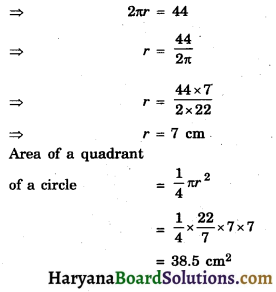
HBSE 10th Class Maths Important Questions Chapter 12 Areas related to Circles - 1

Question 2.
The short hand and long hand of clock are 4 cm and 6 cm long respectively. Find the sum of distances travelled by their tips in 48 hours.
Solution :
The distance travelled by shorthand in 12 hours = 2πr
= 2 × π × 4
[∴ r = 4 cm]
The distance travelled by shorthand in 48 hours = 4 × 8x
= 32πcm
The distance travelled by long hand in 12 hours = 4 × 2лR
= 4 × 2π × 6
[∴ R = 6 cm]
Total distance travelled by their tips in 48 hours = 32π + 48л
= 80π cm.

HBSE 10th Class Maths Important Questions Chapter 12 Areas related to Circles

Question 3.
If the angle of a major sector of a circle is 250°. Then find the angle of minor sector.
Solution :
We have
Angle of major sector = 250°
∴ Angle of minor sector = 360° – 250° = 110°

Question 4.
If an arc of a circle subtends an angle of 60° at the centre and if the area of minor sector is 231 cm2, then find the radius of the circle.
Solution :
We have sector angle (θ) = 60°
Let radius of circle be r cm
Area of minor sector = 231 cm2
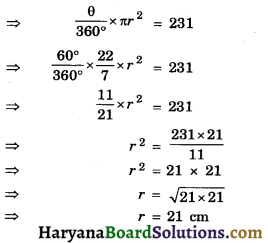
HBSE 10th Class Maths Important Questions Chapter 12 Areas related to Circles - 2
Hence, radius of the circle = 21 cm

HBSE 10th Class Maths Important Questions Chapter 12 Areas related to Circles

Question 5.
The perimeter of a sector of a circle of radius 5.2 cm is 16.4 cm. Find the area of the sector.
Solution :
We have
Radius of sector of a circle (r) = 5.2 em
Let sector angle be θ
Perimeter of a sector of a circle = 16.4 cm (given)
HBSE 10th Class Maths Important Questions Chapter 12 Areas related to Circles - 3

Question 6.
Find the area of sector of a circle of radius 6 cm whose central angle is 30°. (take π = 3.14)
Solution :
We have
Radius of a circle (r) = 6 cm
Sector angle (θ) = 30°
Area of a sector = \(\frac{\pi^2 \theta}{360^{\circ}}\)
= \(\frac{3.14 \times 6^2 \times 30^{\circ}}{360^{\circ}}\)
= 3.14 × 3
= 9.42 cm2

Question 7.
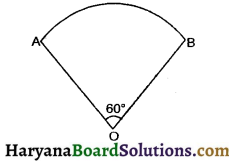
In the given figure is a sector of circle of radius 10.5 cm. Find the perimeter of sector.
(Take π = 22/7)
HBSE 10th Class Maths Important Questions Chapter 12 Areas related to Circles - 4
Solution :
We have
Radius of a sector of circle (r) = 10.5 cm
Sector angle (θ) = 60°
Perimeter of sector = \(\frac{2 \pi r \theta}{360^{\circ}}\)
= \(\frac{2 \times 22}{7} \times \frac{10.5 \times 60}{360^{\circ}}\)
= 22 × 0.5
= 11 cm2

HBSE 10th Class Maths Important Questions Chapter 12 Areas related to Circles

Question 8.
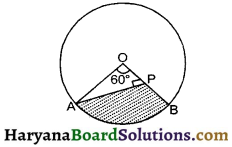
In the given figure, AOB is a sector of angle 60° of a circle with centre O and radius 17 cm. If AP ⊥ OB and AP = 15 cm, find the area of shaded region.
HBSE 10th Class Maths Important Questions Chapter 12 Areas related to Circles - 5
Solution :
We have
Radius of circle (r) = AO 17 cm
∠APO = 90° and AP = 15 cm,
sector angle (θ) = 60°
In right triangle AOP
⇒ AO2 = AP2 + OP2
172 = 152 + OP2
172 – 152 = OP2
(17 + 15) (17 – 15) = OP2
32 × 2 = OP2
OP = \(\sqrt{m}\) = 8 cm
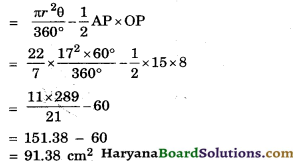
Area of shaded region
= Area of sector AOBA – area of Δ AOP
HBSE 10th Class Maths Important Questions Chapter 12 Areas related to Circles - 6

Question 9.
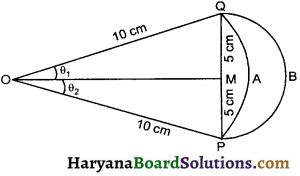
In the given figure two arcs, A and B. Are A is part of the circle with centre O and radius OP. Arc B is part of the circle with centre M and radius PM, where M is the midpoint of PQ. Show that area enclosed by two arcs is equal to (\(\sqrt{3}\) – \(\frac {π}{6}\)) cm2
HBSE 10th Class Maths Important Questions Chapter 12 Areas related to Circles - 7
Solution :
We have
Radius of semicircle (PBQ)
R = 5 cm
Area of semicircle (A1) = \(\frac {1}{2}\)πR²
= \(\frac {1}{2}\) × π × 52
= \(\frac {25π}{2}\) cm2
Let ∠MOQ = ∠MOP = Q1
In the right ΔOMQ, we have
sin θ1 = \(\frac{\mathrm{MQ}}{\mathrm{OQ}}=\frac{5}{10}=\frac{1}{2}\)
sin θ1 = sin 30°
θ1 = 30°
∠POQ = 2θ = 2 × 30° = 60°
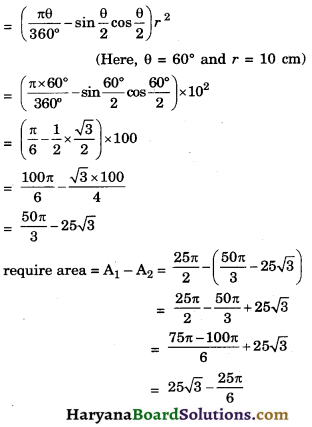
Area enclosed by are A and chord PQ (A2)
HBSE 10th Class Maths Important Questions Chapter 12 Areas related to Circles - 8
= 25(\(\sqrt{3}\) – \(\frac {π}{6}\))
So, required area = 25(\(\sqrt{3}\) – \(\frac {π}{6}\))
Hence Proved

HBSE 10th Class Maths Important Questions Chapter 12 Areas related to Circles

Question 10.
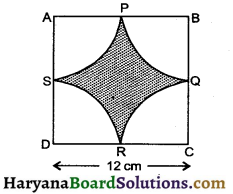
Find the area of shaded region in the givem figure, where arcs drawn with centres A, B, C, D intersect in pairs at midpoints P, Q, Rand S of the sides AB, BC, CD and DA respectively of square ABCD of side 12 cm.
[use π = 3.14]
HBSE 10th Class Maths Important Questions Chapter 12 Areas related to Circles - 9
Solution :
We have
side of a square = 12 cm
Area of a square (ABCD)= 12 × 12 = 144 cm2
Radius of each sector (r) = \(\frac {12}{2}\) = 6cm
Each sector angle (θ) = 90°
Area of each sector = \(\frac{\pi r^2 \theta}{360^{\circ}}\)
= \(\frac{3.14 \times 6^2 \times 90}{360^{\circ}}\)
= 3.14 × 9
= 28.26 cm2
Area of 4 sectors = 28.26 × 4
= 113.04 cm2
Area of shaded region
= Area of square – 4 sectors area
= 144 – 113.04
= 30.96 cm2
= 7 cm

Question 11.
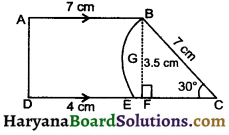
In the adjoining figure ABCD is a trapezium with AB || DC and ∠BCD = 30°. In figure BGEC is a sector of a circle with centre C and AB = BC = 7 cm, DE = 4 cm and BF = 3.5 cm, find the area of the shaded region. [use x = \(\frac {22}{7}\)]
HBSE 10th Class Maths Important Questions Chapter 12 Areas related to Circles - 10
Solution :
We have
AB = 7 cm, DE = 4 cm and BF = 3.5 cm
DC= DE + EC = 4 + 7 = 11 cm
Area of trapezium ABCD
= \(\frac {1}{2}\)(AB + DC) × BF
= \(\frac {1}{2}\)(7 + 11) × 3.5
= 9 × 3.5
= 31.5 cm2
Area of sector BGEC = \(\frac {θ}{360°}\) πr²
= \(\frac {30°}{360°}\) × \(\frac {22}{7}\) × 72
= \(\frac{22 \times 7}{12}\)
= 12.83 cm2
Area of shaded region = Area of trapezium – sector area
= 31.5 – 12.83
= 18.67 cm2

HBSE 10th Class Maths Important Questions Chapter 12 Areas related to Circles

Question 12.
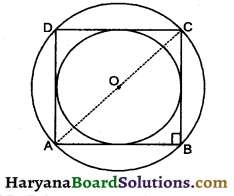
The side of a square is 10 cm, find the area between inscribed and circumscribed circle of the square.
HBSE 10th Class Maths Important Questions Chapter 12 Areas related to Circles - 11
Solution:
Let ABCD be a square of side 10 cm
Radius of inscribed circle (r) = 5 cm
∴ Area of inscribed circle (A1) = πr²
= π × 52
= 25π cm2
In right ΔABC, we have
AC2 = AB2 + BC2
AC2 = 102 + 102
AC2 = 100 + 100
AC = 200
AC = \(\sqrt{2 \times 10 \times 10}\) = 10\(\sqrt{2}\) cm
Radius of circumscribed circle (R) = \(\frac{10 \sqrt{2}}{2}\)
= 5\(\sqrt{2}\)
Area of a circumscribed circle (A2) = πR²
= π × (5\(\sqrt{2}\))2
= 50π
Required area = A2 – A1
= 50π – 25π
= 25π cm2

Question 13.
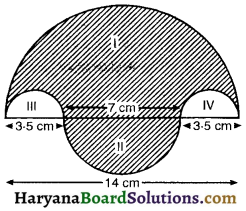
In the give figure, the boundary of the shaded region consists of four semicircular ares, the smallest two being equal. If the diameter of the largest is 14 cm and of the smallest is 3.5 cm, find.
(i) length of the boundary
(ii) the area of the shaded region.
HBSE 10th Class Maths Important Questions Chapter 12 Areas related to Circles - 12
Solution :
We have,
Diameter of the biggest circle = 14 cm
∴ radius of the biggest circle (r1) = \(\frac {14}{2}\) = 7 cm and diameter of the smallest circle = 3.5 cm
∴ radius of the two smallest circle (r2) = \(\frac {3.5}{2}\)
and radius of the circle (II) = r3 = \(\frac {7}{2}\) = 3.5 cm
(i) length of the boundary = πr1 + 2 × πr2 × πr3
= \(\frac {22}{7}\) × 7 + 2 × \(\frac {22}{7}\) × \(\frac {3.5}{2}\) + \(\frac {22}{7}\) × 3.5
= \(\frac {22}{7}\) [7 + 3.5 + 3.5]
= \(\frac {22}{7}\) × 14
= 44 cm

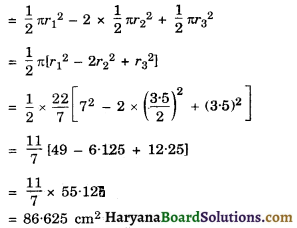
(ii) The area of the shaded region
HBSE 10th Class Maths Important Questions Chapter 12 Areas related to Circles - 13
Hence, (i) length of the boundary = 44 cm
(ii) Area of the shaded region = 86.625 cm2

HBSE 10th Class Maths Important Questions Chapter 12 Areas related to Circles

Question 14.
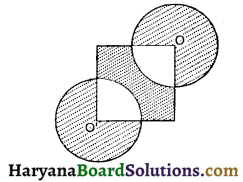
In the given, the side of square is 28 cm, and radius of each circle is half of the length of the side of the square, where O and O’ are centers of the circle. Find the area of shaded area.
HBSE 10th Class Maths Important Questions Chapter 12 Areas related to Circles - 14
Solution :
Side of the square = 28 cm (given)
∴ Area of sqaure = 28 × 28 = 784 cm2
∴ Radius of each circle is half of the length of the side of the square (given)
∴ Radius of each circle (r) = \(\frac {1}{2}\) × 28 = 14cm
Area of two circles = 2πr²
= 2 × \(\frac {22}{7}\) × 142
= 44 × 2 × 14
= 1232 cm2
Area of two quadrants = 2 × \(\frac{\pi r^2 \theta}{360^{\circ}}\)
= 2 × \(\frac {22}{7}\) × \(\frac{14^2 \times 90}{360}\)
= 44 × 7
= 308 cm2
Area of shaded region = Area of square + area of two circles – area of two quadrants
= 784 + 1232 – 308
= 1708 cm2

Question 15.
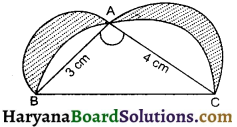
In the given figure, Δ ABC is right angles triangle in which ∠A = 90°. Semicircles are drawn on AB, AC and BC as diameters. Find the area of shaded region.
HBSE 10th Class Maths Important Questions Chapter 12 Areas related to Circles - 15
Solution :
In Δ ABC, we have
∠A = 90°, AB = 3 cm, AC = 4 cm
BC2 = AB2 + AC2
[By Pythagoras theorem]
⇒ BC2 = 32 + 42
= 9 + 16 = 25
BC = 5 cm
Area of semicircle with radius \(\frac {3}{2}\) cm (A1)
= \(\frac {1}{2}\)π × (\(\frac {3}{2}\))2 = \(\frac {9}{8}\)π cm2
Area of semicircle with radius \(\frac {4}{2}\) cm (A2)
= \(\frac {1}{2}\)π × 22 = \(\frac {4π}{2}\)་cm2
Area of semicircle with radius \(\frac {5}{2}\) cm (A3)
= \(\frac {1}{2}\)π × (\(\frac {5}{2}\))2
= \(\frac {25}{8}\)π cm2
Area of right triangle ABC = \(\frac {1}{2}\) × 3 × 4 = 6cm2
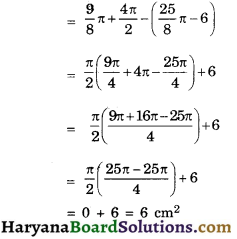
area of shaded region = A1 + A2 – (A3 – A4)
HBSE 10th Class Maths Important Questions Chapter 12 Areas related to Circles - 16

Question 16.
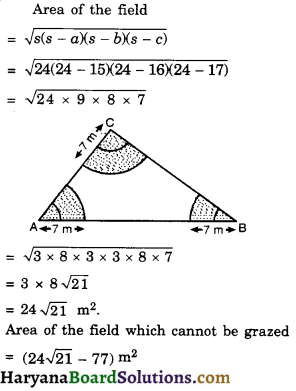
Sides of a triangular field are 15 m, 16 m and 17. With the three corners of the field a cow, a uffalo and a horse are tied separately with ropes of length 7 m each to graze in the field. Find the area of the field which cannot be grazed by the three animals.
Solution :
We have,
Radius of each sector is = 7 m
Sides of triangle are 15 m, 16 m and 17 m respectively.
Let a cow, a buffalo and a horse are tied respectively with vertex A, B and C separately.
Let ∠A = x1°, ∠B = x2°, ∠C = x3°
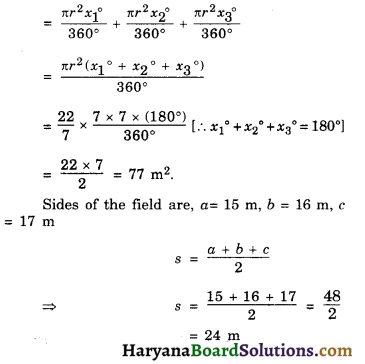
The area of the field which can graze by three animals Sum of the areas of three sectors with sector angles x1°, x2°, x3° and radius 7m.
HBSE 10th Class Maths Important Questions Chapter 12 Areas related to Circles - 17
HBSE 10th Class Maths Important Questions Chapter 12 Areas related to Circles - 18

HBSE 10th Class Maths Important Questions Chapter 12 Areas related to Circles

Question 17.
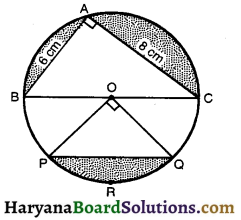
In the adjoining figure, O is the centre and BOC is the diameter of the circle. Find the area of the shaded region. (use π = 3.14)
HBSE 10th Class Maths Important Questions Chapter 12 Areas related to Circles - 19
Solution :
We have,
AB = 6 cm, AC = 8 cm and BOC is the diameter of the circle.
In right ΔBAC,
BC2 = AB2 + AC2
[By Pythagoras theorem]
BC2 = 62 + 82
BC2 = 36 + 64
BC2 = 100
BC = \(\sqrt{100}\) = 10 cm.
Radius of the circle = \(\frac {10}{2}\) = 5 cm.
Therefore,
OP = OQ = 5 cm
(equal radii of the circle)
Shaded region area = Semi-circle area drawn as BC diameter – ΔABC area + segment PRQ area
= \(\frac {1}{2}\)π × (5)2 – \(\frac {1}{2}\) × 6 × 8 + area of quadrant POQ – area of ΔPOQ
= \(\frac {1}{2}\) × 3.14 × 25 – 24 + \(\frac {1}{4}\)π × (5)2 – \(\frac {1}{2}\) × 5 × 5
= 39.25 – 24 + \(\frac {1}{4}\) × 3.14 × 25 – 12.5
= 15.25+ 19.625 – 12.5
= 34.875 – 12.5
= 22.375 = 22.38 cm2. (approx)
Hence, area of shaded region = 22.38 cm2.
(approx)

Fill in the Blanks

Question 1.
The region between an are and the ……….. joining the centre to the end points of the arc is called a sector of the circle.
Solution :
Two raddi

HBSE 10th Class Maths Important Questions Chapter 12 Areas related to Circles

Question 2.
A ……….. of a circle is a line segment joining any two points on the circle.
Solution :
chord

Question 3.
The length of the complete circle is called its……….
Solution :
circum- ference

Question 4.
The region between a chord and either of its …………. is called a segment of the circle.
Solution :
src

Question 5.
The cicles which have same centre and different …………. are called concentric circle.
Solution :
raddi

HBSE 10th Class Maths Important Questions Chapter 12 Areas related to Circles

Question 6.
If the perimeter of a circle is equal to that of a square, then the ratio of their areas is ……..
Solution :
14 : 11

Multiple Choice Questions

Choose the correct answer for each of the following :

Question 1.
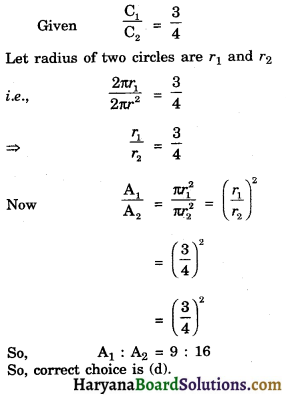
The circumferences of two circles are in the ratio 3 : 4. The ratio between their areas is:
(a) 9 : 4
(b) 16 : 9
(c) 3 : 4
(d) 9 : 16
Solution :
HBSE 10th Class Maths Important Questions Chapter 12 Areas related to Circles - 20

HBSE 10th Class Maths Important Questions Chapter 12 Areas related to Circles

Question 2.
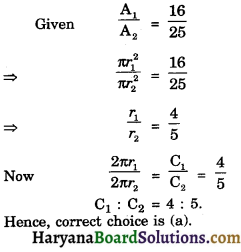
The areas of two circles are in the ratio 16 : 25. The ratio of their circumference is:
(a) 4 : 5
(b) 5 : 4
(c) 16 : 25
(d) 25 : 16
Solution :
HBSE 10th Class Maths Important Questions Chapter 12 Areas related to Circles - 21

Question 3.
The area of a circle is 13.86 cm2, the circumference of the circle is :
(a) 13.6 cm
(b) 13.2 cm
(c) 6.6 cm
(d) 13.4 cm
Solution :
(b) 13.2 cm

Given, area of circle 13.86 cm2
⇒ πr² = 13.86
3.14 r² = 13.86
r² = \(\frac {13.86}{3.14}\)
r = 2.1 cm
∴ circumference = 2πr
= 2 × \(\frac {22}{7}\) × 2.1
= 13.2 cm
So correct choice is (b).

HBSE 10th Class Maths Important Questions Chapter 12 Areas related to Circles

Question 4.
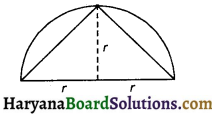
Area of the largest triangle that can be inscribed in a semicircle of radius r units is :
(a) r2 sq. units
(b) \(\frac {1}{2}\)r2 sq. units
(c) 2r2 sq. units
(d) \(\sqrt{2}\)r2 sq. units
Solution :
(a) r2 sq. units

Area of triangle = \(\frac {1}{2}\)base × height
HBSE 10th Class Maths Important Questions Chapter 12 Areas related to Circles - 22
= \(\frac {1}{2}\) × 2r × r
= r2 sq. units.
Hence correct choice is (a).

Question 5.
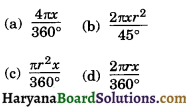
The area of sector of central angle of a circle with radius 4r is:
HBSE 10th Class Maths Important Questions Chapter 12 Areas related to Circles - 23
Solution :
Area of sector = \(\frac{\pi r^2 \theta}{360^{\circ}}\)
= \(\frac{\pi(4 r)^2 x}{360}\)
= \(\frac{2 \pi \cdot x r^2}{45^{\circ}}\)
Hence, correct choice is (b).

HBSE 10th Class Maths Important Questions Chapter 12 Areas related to Circles

Question 6.
If the sum of the circumference of two circles with radii R1 and R2 is equal to the circumference of a circle of radius R, then :
(a) R1 + R2 = R
(b) R1 + R2 > R
(c) R1 + R2 < R
(d) Nothing definite can be said about the relation among R1, R1 and R.
Solution :
(a) R1 + R2 = R

2πR = 2πR1 + 2πR2
2πR = 2 × (R1 + R2)
R = R1 + R2
Hence correct choice is (a).

Question 7.
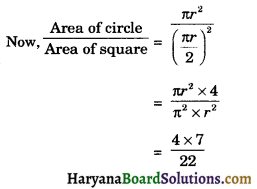
If the perimeter of circle is equal to that of a square, then ratio of their area is
(a) 22 : 7
(b) 14 : 11
(c) 7 : 22
(d) 11 : 14
Solution :
(b) 14 : 11

Perimeter of circle = 2πr
Perimeter of square = 4a
A.T.Q. 2π = 4a
side of square a = \(\frac {πr}{2}\)
HBSE 10th Class Maths Important Questions Chapter 12 Areas related to Circles - 24
So required ratio = 14: 11
So correct choice is (b).

HBSE 10th Class Maths Important Questions Chapter 12 Areas related to Circles

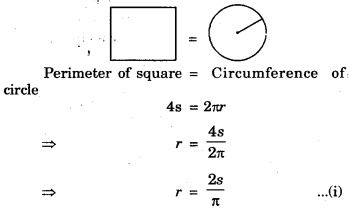
Question 8.
If the circumference of a circle and the perimeter of a square are equal, then :
(a) Area of circle = Area of the square
(b) Area of circle > Area of the square
(c) Area of circle < Area of the square
(d) Nothing definite can be said about the relation between the areas of the circle and square
Solution :
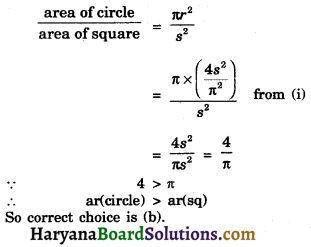
HBSE 10th Class Maths Important Questions Chapter 12 Areas related to Circles - 25
HBSE 10th Class Maths Important Questions Chapter 12 Areas related to Circles - 26

HBSE 10th Class Maths Important Questions Chapter 12 Areas related to Circles Read More »

HBSE 10th Class Maths Important Questions Chapter 6 Triangles

Haryana State Board HBSE 10th Class Maths Important Questions Chapter 6 Triangles Important Questions and Answers.

Haryana Board 10th Class Maths Important Questions Chapter 6 Triangles

Short/Long Answer Type Questions

Question 1.
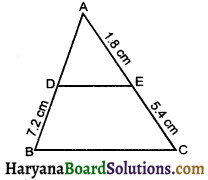
In the adjoining figure, DE || BC, find the length of side AD, given that AE = 1.8 cm, BD = 7.2 cm and CE = 5.4 cm.
HBSE 10th Class Maths Important Questions Chapter 6 Triangles - 1
Solution :
We have
AE = 1.8 cm, BD = 7.2 cm, CE = 5.4 cm and DE || BC
∴ \(\frac{\mathrm{AD}}{\mathrm{BD}}=\frac{\mathrm{AE}}{\mathrm{CE}}\)
[By theorem 6.1 (BPT)]
⇒ \(\frac{\mathrm{AD}}{\mathrm{7.2}}=\frac{\mathrm{1.8}}{\mathrm{5.4}}\)
⇒ AD = \(\frac{7.2 \times 1.8}{5.4}\)
⇒ AD = \(\frac{7.2 \times 1.8}{54}\) = 2.4 cm

HBSE 10th Class Maths Important Questions Chapter 6 Triangles

Question 2.
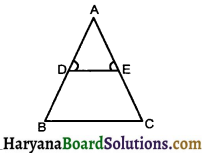
In the given fig. ∠D = ∠E and \(\frac{\mathrm{AD}}{\mathrm{DB}}=\frac{\mathrm{AE}}{\mathrm{EC}}\) prove that ΔBAC is an isosceles triangle.
HBSE 10th Class Maths Important Questions Chapter 6 Triangles - 2
Solution :
We have, In triangle ABC,
\(\frac{\mathrm{AD}}{\mathrm{DB}}=\frac{\mathrm{AE}}{\mathrm{EC}}\)
⇒ DE || BC (By converse of BPT)
DE || BC and AD is a transversal line
∠D = ∠B (Corresponding angles) … (1)
DE || BC and AC is a transversal line, So, ∠E = ∠C (Corresponding angles) …(2)
But ∠D = ∠E ……(3)
From equ. (1), (2) and (3) we get
∠B = ∠C
⇒ AB = AC [Sides opp. to equal angles are equal]
Hence Proved.

Question 3.
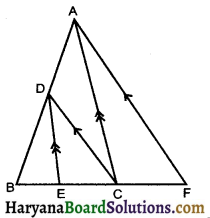
In the adjoining figure, DE || AC and DC || AP. Prove that \(\frac{\mathrm{BE}}{\mathrm{EC}}=\frac{\mathrm{BC}}{\mathrm{CP}}\)
HBSE 10th Class Maths Important Questions Chapter 6 Triangles - 3
Solution :
In ΔABP, we have DC || AP
∴ \(\frac{\mathrm{AD}}{\mathrm{BD}}=\frac{\mathrm{BC}}{\mathrm{CP}}\) …….(1)
[By BPT]
Again, In ΔABC, we have
DE || AC
∴ \(\frac{\mathrm{AD}}{\mathrm{BD}}=\frac{\mathrm{BE}}{\mathrm{EC}}\) ……….(2)
From equation (1) and (2), we get
∴ \(\frac{\mathrm{AD}}{\mathrm{BD}}=\frac{\mathrm{BE}}{\mathrm{EC}}\)
Hence Proved.

Question 4.
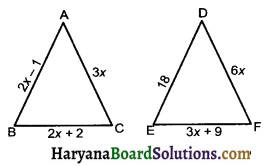
In the adjoining figure, if ΔABC ~ ΔDEF and their sides of length (in cm) are marked along them, then find the lengths of the sides of each triangle.
HBSE 10th Class Maths Important Questions Chapter 6 Triangles - 4
Solution :
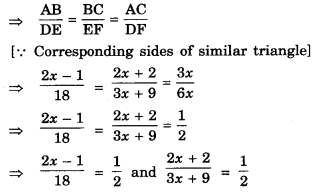
We have, ΔABC ~ ΔDEF
HBSE 10th Class Maths Important Questions Chapter 6 Triangles - 5
⇒ 2x – 1 = \(\frac {18}{2}\) and 4x + 4 = 3x + 9
⇒ 2x = 9 + 1 and 4x – 3x = 9 – 4
⇒ 2x = 10 and x = 5
⇒ x = 5 and x = 5
Substituting the value of x in the length of sides of two triangles, we get
AB = 2x – 1 = 5 × 2 – 1 = 9 cm
BC = 2x + 2 = 5 × 2 + 2 = 12 cm
AC = 3x = 5 × 3 = 15 cm
DE = 18, EF = 3x + 9
= 3 × 5 + 9 = 24 cm
And DF = 6 × x = 6 × 5 = 30 cm
Hence, sides of ΔABC are 9cm, 12 cm, 15 cm, and sides of ΔDEF are 18 cm, 24 cm and 30 cm.

HBSE 10th Class Maths Important Questions Chapter 6 Triangles

Question 5.
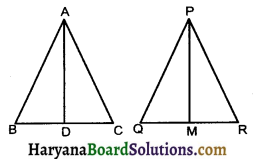
In similar triangle ABC and PQR, AD and PM are the medians respectvely, prove that \(\frac{\mathrm{AD}}{\mathrm{PM}}=\frac{\mathrm{AB}}{\mathrm{PQ}}\)
HBSE 10th Class Maths Important Questions Chapter 6 Triangles - 6
Solution :
Given : AD and PM are medians of ΔABC and ΔPQR and ΔABC ~ ΔPQR.
To prove : \(\frac{\mathrm{AD}}{\mathrm{PM}}=\frac{\mathrm{AB}}{\mathrm{PQ}}\)
Proof : ΔABC ~ ΔPQR
∴ ∠B = ∠Q
(Corresponding ∠S of similar triangles)….(1)
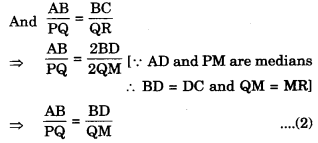
HBSE 10th Class Maths Important Questions Chapter 6 Triangles - 7
and ∠B = ∠Q [proved above] …………..(1)
From (1), ∠2, ΔABC ~ ΔPQM [By SAS similarity criterian]
⇒ \(\frac{\mathrm{AB}}{\mathrm{PQ}}=\frac{\mathrm{AD}}{\mathrm{QM}}\)
[Corrosponding sides of similar triangles]

Question 6.
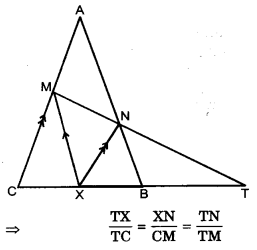
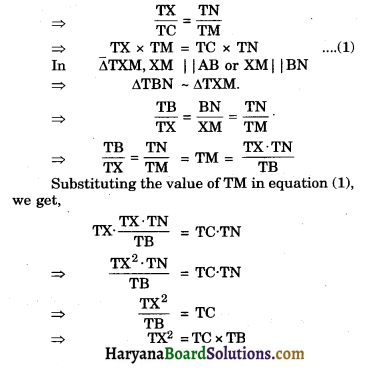
X is a point on side BC of ΔABC, XM and XN are drawn parallel to AB and AC respectively meeting AB in N and AC in M. MN produced meets CB produced at T. Prove that TX2 = TB × TC
Solution :
In ΔTCM, XN||CM
∴ ΔTXN ~ ΔTCM
HBSE 10th Class Maths Important Questions Chapter 6 Triangles - 8
HBSE 10th Class Maths Important Questions Chapter 6 Triangles - 9

HBSE 10th Class Maths Important Questions Chapter 6 Triangles

Question 7.
Given ΔABC ~ ΔPQR, if \(\frac{\mathrm{AB}}{\mathrm{PQ}}=\frac{\mathrm{1}}{\mathrm{3}}\) then \(\frac{a r(\triangle \mathrm{ABC})}{a r(\Delta \mathrm{PQR})}\) = …………..
Solution :
Since ΔABC ~ ΔPQR
HBSE 10th Class Maths Important Questions Chapter 6 Triangles - 25

Question 8.
ΔABC and ΔBDE are two equilateral triangle such that D is the mid point of BC. Ratio of the areas of triangles ABC and BDE is …………………
HBSE 10th Class Maths Important Questions Chapter 6 Triangles - 10
Solution :
Let each side of equilateral ABC be 2x units then BD = \(\frac {2x}{2}\) [D is the mid point of BC]
⇒ BD = x units
Each of anlge ΔABC is 60° (equilateral Δ)
Each angle of ΔBDE is 60° (equilateral Δ)
ΔABC ~ ΔBDE (By AAA similarity criterian)
HBSE 10th Class Maths Important Questions Chapter 6 Triangles - 26

Question 9.
The area of two similar triangles are in the ratio 16 : 18. Find the ratio of its sides.
Solution :
Let ΔABC ~ ΔPQR
HBSE 10th Class Maths Important Questions Chapter 6 Triangles - 11

Question 10.
If the ratio of corresponding medians of two similar triangles are 9 : 16, then find the ratio of their area.
Solution :
We have,
Ratio of corresponding medians of two similar triangles = 9 : 16
We know that, Ratio of the areas of two similar triangles is equal to the square of the ratio of their corresponding medi
= 81 : 256

HBSE 10th Class Maths Important Questions Chapter 6 Triangles

Question 11.
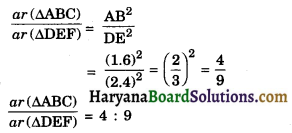
If ΔABC – ΔDEF in which AB = 1.6 cm and DE = 2.4 cm. Find the ratio of areas of ΔABC and ΔDEF.
Solution :
∵ ΔABC ~ ΔDEF
HBSE 10th Class Maths Important Questions Chapter 6 Triangles - 12

Question 12.
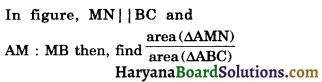
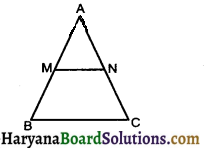
HBSE 10th Class Maths Important Questions Chapter 6 Triangles - 27
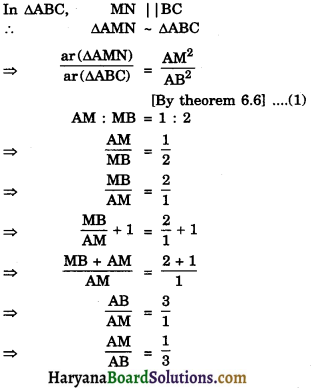
HBSE 10th Class Maths Important Questions Chapter 6 Triangles - 13
Solution :
We have, In ΔABC, MN || BC
∴ ΔAMN ~ ΔABC
HBSE 10th Class Maths Important Questions Chapter 6 Triangles - 14
Substituting the value of \(\frac {AM}{AB}\) in the equation (1), we get
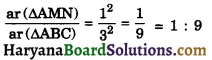
HBSE 10th Class Maths Important Questions Chapter 6 Triangles - 28

Question 13.
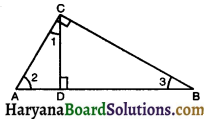
In the given figure, ∠ACB = 90° and CD ⊥ AB. Prove that CD2 = BD × AD.
HBSE 10th Class Maths Important Questions Chapter 6 Triangles - 15
Solution :
Given : A ΔABC i. which ∠ACB = 90° and CD ⊥ AB
To prove : CD2 = BD × AD
Proof: In Right ΔADC,
∠1 + ∠2 + ∠ADC = 180°
⇒ ∠1 + ∠2 + 90° = 180°
⇒ ∠1 + ∠2 = 180° – 90°
⇒ ∠1 + ∠2 = 90° …………..(1)
Similary in right ΔACB,
∠2 + ∠3 = 90° ……….(2)
From (1) and (2), we get
∠1 + ∠2 = ∠2 + ∠3
⇒ ∠1 = ∠3.
In ΔADC and ∠CDB
∠1 = ∠3 (proved above)
∠ADC = ∠CDB (each = 90°)
∴ ΔADC ~ ΔCDB
[By AA similarity criterion]
∴ \(\frac{\mathrm{AD}}{\mathrm{CD}}=\frac{\mathrm{CD}}{\mathrm{BD}}\)
⇒ CD2 = BD × AD
Hence Proved

HBSE 10th Class Maths Important Questions Chapter 6 Triangles

Question 14.
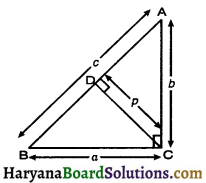
ΔABC is a right triangle in which ∠C = 90° and CD ⊥ AB. If BC = a, CA = b, ABC and CD = p, then prove that :
(i) cp = ab
(ii) \(\frac{1}{\mathrm{p}^2}=\frac{1}{\mathrm{a}^2}+\frac{1}{\mathrm{~b}^2}\)
Solution :
(i) Area of right ΔABC
= \(\frac {1}{2}\) base × height
= \(\frac {1}{2}\) a × b
= \(\frac {1}{2}\) ab …(1)
HBSE 10th Class Maths Important Questions Chapter 6 Triangles - 16
Again, Area of right ΔABC
= \(\frac {1}{2}\) × base × height
= \(\frac {1}{2}\) × c × p
= \(\frac {1}{2}\) × cp …(2)
From (1) and (2), we get
\(\frac {1}{2}\)ab = \(\frac {1}{2}\)cp
⇒ ab = cp
Hence Proved

(ii) In right ΔACB,
AB2 = BC2 + AC2
⇒ c2 = a2 + b2 ……………(3)
HBSE 10th Class Maths Important Questions Chapter 6 Triangles - 17
Hence Proved

Question 15.
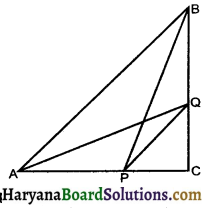
If P and Q are points on sides CA and CB respectively of ΔABC, right angled at C. Prove that (AQ2 + BP2) – (AB2 + PQ2)
Solution :
Given: A right triangle ABC in which ∠C = 90°, P and Q are points on sides CA and CB respectively.
Construction: Join AQ, BP and PQ.
HBSE 10th Class Maths Important Questions Chapter 6 Triangles - 18
To prove : AQ2 + BP2 = AB2 + PQ2
Proof : In right ΔACQ. we have
AQ2 = AC2 + QC2 ……………(1)
In right ΔBPC, we have
BP2 = CP2 + BC2 ………………(2)
Adding equ. (1) and (2), we get
AQ2 + BP2 = AC2 + QC2 + CP2 + BC2
= (AC2 + BC2) + (CP2 + QC2)
= AB2 + PQ2
[∵ AC2 + BC2 = AC2 and CP2 + QC2 = PQ2]

Fill in the Blanks

Question 1.
If the basector of an angle of a triangle ………….. the opposite side then triangle is an equilateral triangle.
Solution :
bisects

HBSE 10th Class Maths Important Questions Chapter 6 Triangles

Question 2.
Thales theorem is also known as basic ………
Solution :
proportionality

Question 3.
All equilateral triangles are …………
Solution :
similar

Question 4.
Phythagoras theorem is sometimes also referred to as the ……………. theorem.
Solution :
Baudhayan

Question 5.
If a line divides any two sides of a triangle in the same ………… then line is parallel to the third side.
Solution :
ratio

HBSE 10th Class Maths Important Questions Chapter 6 Triangles

Question 6.
If corresponding angles of two triangles are equal, then they are known as ………….. triangles.
Solution :
equiangular.

Multiple Choice Questions

Question 1.
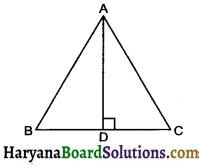
In equilateral ΔABC, AD is altitude. Then 4AD2 equals.
(a) 2BD2
(b) 2DC2
(c) BC2
(d) 3AB2
Solution :
(d) 3AB2

In ΔADB and ΔADC
AB = AC
∠ADB = ∠ADC
AD = AD
∴ ΔADB ≅ ΔADC
∴ BD = CD (CPCT)
HBSE 10th Class Maths Important Questions Chapter 6 Triangles - 19
In right ΔADB AB2 = AD2 + BD2
AB2 = AD2 + \(\frac {1}{4}\)AB2
⇒ 4AD2 = 3AB2
So correct choice is (d)

Question 2.
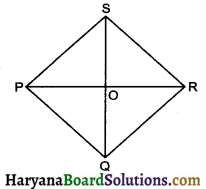
In rhombus PQRS, PQ2 + QR2 + RS2 + SP2 = ?
(a) OP2 + OQ2
(b) OQ2 + OR2
(c) OR2 + OS2
(d) PR2 + QS2
HBSE 10th Class Maths Important Questions Chapter 6 Triangles - 20
Solution :
(d) PR2 + QS2

4PQ2 = PR2 + QS2
4QR2 = PR2 + QS2
4RS2 = PR2 + QS2
4PS2 = PR2 + QS2
∴ PQ2 + QR2 + RS2 + PS2 = PR2 + QS2
So correct choice is (d)

HBSE 10th Class Maths Important Questions Chapter 6 Triangles

Question 3.
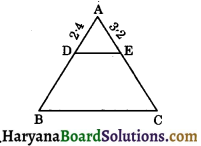
In figure, DE || BC, AD = 2.4 cm, AE = 3.2 cm, CE = 4.8 cm. The value of BD is :
HBSE 10th Class Maths Important Questions Chapter 6 Triangles - 21
(a) 3.6 cm
(b) 4.2 cm
(c) 4.0 cm
(d) None of these.
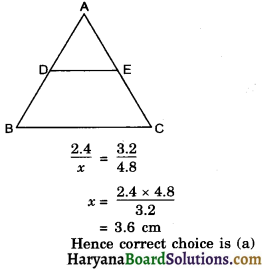
Solution :
(a) 3.6 cm

Given AD = 2.4 cm
AE = 3.2 cm
EC = 4.8 cm
Let DB = x
We know that \(\frac{\mathrm{AD}}{\mathrm{BD}}=\frac{\mathrm{AE}}{\mathrm{EC}}\)
HBSE 10th Class Maths Important Questions Chapter 6 Triangles - 22
Hence correct choice is (a)

Question 4.
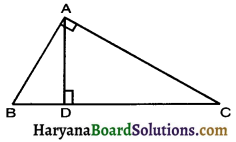
In the given figure, ∠BAC = 90° and AD ⊥ BC, then,
[NCERT Exemplar Problems]
(a) BD.CD = AD2
(b) AB.AC = BC2
(c) BC.CD = BC2
(d) AB.AC = AD2
HBSE 10th Class Maths Important Questions Chapter 6 Triangles - 23
Solution :
(a) BD.CD = AD2

Since
ΔBDA ~ ΔADC
⇒ \(\frac{\mathrm{BD}}{\mathrm{AD}}=\frac{\mathrm{AD}}{\mathrm{CD}}\)
⇒ AD2 = BD.CD
So correct choice is (a).

HBSE 10th Class Maths Important Questions Chapter 6 Triangles

Question 5.
If ΔABC – ΔEDF and ΔABC is not similar to ADEF, then which of the following is not true?
[NCERT Exemplar Problems]
(a) BC.EF = AC.FD
(b) AB.EF = AC.DE
(c) BC.DE = AB.EF
(d) BC.DE = AB.FD.
Solution :
(c) BC.DE = AB.EF

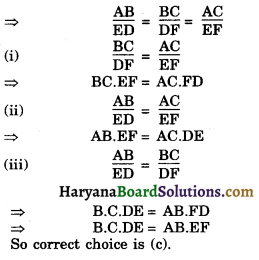
ΔABC ~ ΔEDF
ΔABC not similar to ΔDEF
ΔABC ~ ΔEDF
HBSE 10th Class Maths Important Questions Chapter 6 Triangles - 24

HBSE 10th Class Maths Important Questions Chapter 6 Triangles Read More »

HBSE 10th Class Maths Notes Chapter 5 Arithmetic Progressions

Haryana State Board HBSE 10th Class Maths Notes Chapter 5 Arithmetic Progressions Notes.

Haryana Board 10th Class Maths Notes Chapter 5 Arithmetic Progressions

Introduction
We must have observed that in nature, many things follow a certain pattern, such as the petals of a sunflower, the grains on a maize cob, the holes of a honeycomb, the spirals on a pineapple etc.

Many times we come across certain specific patterns of numbers, e.g.
3, 6, 9, 12, 15, 18, ……..
9, 16, 25, 36, 49, ……..
2, 4, 6, 8, 10, 12, ……..
– 60, – 50, – 40, – 30, – 20, …….. etc.
These patterns are generally known as sequences. Hence, a sequence may be defined as an arrangement of numbers in some definite order and according to some rule.
The various numbers appearing in a sequence are called its terms. For example, in the first sequence 3 is the first term, it is denoted by a1, 6 is the second term, it is denoted by a2, 9 is the third term, it is denoted by a, and so on.
Generally, we denoted the terms of a sequence by a1, a2, a3, a4, …… etc. or x1, x2, x3, x4, …….. etc.

In general, the number at the place is called the nth term of the sequences and it is denoted by an is also called the general term of the sequence. In this chapter, we shall study special type of sequence in which succeeding terms are obtained by adding, a field number to the preceding terms.

HBSE 10th Class Maths Notes Chapter 5 Arithmetic Progressions

Arithmetic Progressions
Consider the following patterns :
1. 1, 2, 3, 4, 5, …..
2. 10, 20, 30, 40, 50, ….
3. 90. 80. 70. 60. 50 ……
4. -10.5, -11, -11.5, -12, -12.5, …
Each of the numbers in the pattern is called a term.
We observe that:
In Pattern (1) : each term is 1 more than the term preceding it.
In Pattern (2) : each term is 10 more than the term preceding it.
In Pattern (3) : each term is 10 less than the term preceding it.
In Pattern (4) : each term is 0.5 less than the term preceding it.
So, an arithmetic progression is a list of numbers in which each term is obtained by adding or subtracting a fixed number to the preceding term except the first term.
The fixed number is called the common difference of the AP. It is denoted by d. It can be positive, negative or zero.
So, d = a2 – a1 = a3 – a2 = ….. = an – an-1
Therefore, the AP with first term a and common difference d is:
a, a + d, a + 2d, a + 3d, a + 4d, …
In other words, sequence a1, a2, a3, …… an… is called an arithmetic progression is the difference of a term and preceding term is always constant. This constant is called the common difference of the AP.
Finite AP : An AP containing finite number of terms is called finite AP.
Infinite AP : An AP containing infinite number of terms is called infinite AP.
If a, b, c are in AP, then \(\frac{a+c}{2}\) and b is called arithmetic mean of a and c.

nth Term of an AP
nth term of an AP from the start
Let a1, a2, a3, a4, …… be an AP whose first term is a1 and the common difference is d.
Then a1 = a = a + (1 – 1)d ……(1)
a2 = a + d = a + (2 – 1)d … (2)
a3 = a2 + d
= (a + d) + d
= (a + 2d)
= a + (3 – 1)d …..(3)
a4 = a3 + d
= (a + 2d) + d
= a + 3d
= a + (4 – 1)d ……(4)
Observing the pattern in equations (1), (2), (3), (4), we find that : an = a + (n – 1)d
So, the nth term an of the AP with first terma and common difference is given by :
an = a + (n – 1)d
If there are m terms in the AP then am represents the last term which is also denoted by l.
nth Term of an AP from the end.
(1) If there are m terms in an AP whose first term is a and common difference is d, then
nth term from the end = a + (m – n)d
(2) If l is the last term of the AP then, nth term from the end is the nth term of an AP whose first term is l and common difference is – d.
nth term from the end = last term + (n – 1) (n – d)
= l – (n – 1)d

HBSE 10th Class Maths Notes Chapter 5 Arithmetic Progressions

Sum of first n terms of an AP
Let a1, a2, a3, …… be an AP whose first term a and common difference is d. Then
a1 = a, a2 = a + d, a3 = a + 2d, a4 = a + 3d, …… an = a + (n – 1)d.
Now, Sn = a1 + a2 + a3 + a4 + … + an-1 + an
⇒ Sn = a + (a + d) + (a + 2d) + (a + 3d) + …… [a + (n – 2)d] + [a + (n – 1)d] … (1)
Writing the above series in reverse order, we get
Sn = a + [a + (n – 1)d] + [a + (n – 2)d] + …… + (a + d) + a …(2)
Adding the corresponding terms of equation (1), and (2), we get
⇒ 2Sn = a + [a + (n – 1)d] + (a + d) + [a + (n – 2d] + … + [a + (n – 1) d] + a
⇒ 2Sn = [2a + (n – 1)d] + [2a + (n – 1)d] + … + [2a + (n – 1)d]
∵ 2a + (n – 1)d repeats n times.
∴ 2Sn = n[2a + (n – 1)d]
⇒ Sn = \(\frac{n}{2}\)[2a + (n – 1)d]
Now, if l is the last term nth term = nth term = a + (n – 1)d.
Then
Sn = \(\frac{n}{2}\)[a + a + (n − 1)d]
Sn = \(\frac{n}{2}\)[a + l]
Hence, the sum of the first n terms of AP is given by :
Sn = \(\frac{n}{2}\)[2a + (n – 1)d]
or Sn = \(\frac{n}{2}\)[a + l]
where l = last term.
Important Results:
(i) Three numbers in AP considered as (a – d), a, (a + d).
(ii) Four numbers in AP considered as (a – 3d), (a – d), (a + d), (a + 3d).
(iii) Five numbers in AP considered as (a – 2d), (a – d), a, (a + d), (a + 2d).

HBSE 10th Class Maths Notes Chapter 5 Arithmetic Progressions Read More »

HBSE 10th Class Science Important Questions Chapter 2 Acids, Bases and Salts

Haryana State Board HBSE 10th Class Science Important Questions Chapter 2 Acids, Bases and Salts Important Questions and Answers.

Haryana Board 10th Class Science Important Questions Chapter 2 Acids, Bases and Salts

Question 1.
Chemically, how can the elements found in nature be divided?
Answer:
1. In present times, 114 elements are known to us.
2. These elements combine in several ways and give rise to a very large number of compounds.
3. On the basis of their chemical properties aU the compounds can be added to three groups. They are:

  • Acids,
  • Bases and
  • Salts.

4. Thus, all the compounds of this world belong to one or the other group.
5. In this sense, a compound may be acidic, basic or a salt.

HBSE 10th Class Science Important Questions Chapter 2 Acids, Bases and Salts

Question 2.
What is an acid?
Answer:
Acids: An acid is a compound having hydrogen which when dissolved in water releases ie. dissociates hydrogen ions (H+) (to be specific (H3O+ ions).
Example:
HBSE 10th Class Science Important Questions Chapter 2 Acids, Bases and Salts 1

Hydrochloric acid (HCl), sulphuric acid (H2SO4,) nitric acid (HNO3), etc. are all examples of acids.
(Note: Water H2O also has hydrogen in it but when you add water to water, it does not release hydrogen ions (H+). Hence, water is not acid. Similarly, NaOH has hydrogen but it does not release hydrogen ions (H+) when dissolved in water. NaOH is a base. So, only those substance which on dissolving to water release hydrogen ions (H+) are called acids.)

Testing of acid:
If you put acid on blue litmus paper, the blue litmus paper will turn red. This means the substance put is acid.

Question 3.
What is a base?
(a) Bases:
1. A base is a metal hydroxide substance which when dissolved in water release hydroxide (OH) ions. (Second definition: A metal hydroxide or a metal oxide substance when dissolved in acid produces salt and water and hence is called a base.)

2. Sodium hydroxide (NaOH), calcium hydroxide (Ca(OH)2, potassium hydroxide (KOH), Calcium oxide (CaO), etc. are bases
HBSE 10th Class Science Important Questions Chapter 2 Acids, Bases and Salts 2

Testing of base:
If you put base on red litmus paper, the red litmus paper will turn blue. This means the substance put is base.

Question 4.
What is a salt?
Answer:
A salt is an ionic compound which is formed from the neutralization reaction of an acid and a base. Thus, we get salt when we react an acid with a base.
Note:
(1) When an acid and a base are mixed in right proportion, both acid and base lose their properties. In other words, they neutralize each other. Such a reaction is called neutralization reaction.
(2) When salt is dissolved in water it gets ionized into anions and cations)

HBSE 10th Class Science Important Questions Chapter 2 Acids, Bases and Salts

Question 5.
State two ways to test if the substance is acid.
Whether a substance is an acid or not can be tested with any of the given methods:
Answer:
1. Litmus paper: If you place a drop of a given substance on a moist litmus paper and it turns red, then the substance is acid.
2. Test with metals:  If you put metal in an aqueous substance and the reaction releases hydrogen gas then it means that the aqueous substance is acid.

Question 6.
What are olfactory indicators?
Answer:
1. Olfactory means ‘relating to the sense of smell’. Those substances whose smell changes in acidic or basic solutions are called olfactory indicators.
2. When an acid or a base is added to an olfactory substance, the characteristic smell of that substance cannot be detected.

Question 7.
How does onion and vanilla essence help in finding if a substance is acid or a base?
Answer:
1. If you add onion juice (or vanilla essence) to a base, the onion juice (or vanilla) will lose its smell. However, it will not lose the smell if added to acid.
2. Thus change in smell will help us to find out if the substance added to onion (or vanilla) is acidic or basic.

Question 8.
State three properties of acids and bases.
Answer:
Properties of acid:

  • Acids are sour in taste
  • They turn blue colour litmus paper into red
  • Acids react with base and form salt and water

Properties of bases:

  • Bases are bitter in taste
  • They change red litmus paper to blue
  • Bases react with acids to form salt and water

HBSE 10th Class Science Important Questions Chapter 2 Acids, Bases and Salts

Question 9.
What happens when an acid reacts with metal? Give one example.
Answer:
When acid reacts with metal, metallic salt of that metal and hydrogen gas are produced.
Acid + Metal →  Salt of Metal + Hydrogen gas
Example:
1. When zinc metal is added to sulphuric acid the reaction gives out zinc sulphate which is a salt and hydrogen gas.
HBSE 10th Class Science Important Questions Chapter 2 Acids, Bases and Salts 3

Question 10.
What happens when a base reacts with a metal? Give one example.
Answer:
When a strong base reacts with certain metals, it produces salt and hydrogen gas.
Base + Metal → Salt + Hydrogen gas
Example:
1. When sodium hydroxide (NaOH) reacts with certain metals like zinc Zn, salt and hydrogen gas are produced.
HBSE 10th Class Science Important Questions Chapter 2 Acids, Bases and Salts 4

Question 11.
When zinc metal is treated with dilute HCl or dilute H2SO4, hydrogen gas is evolved, but with dilute HNO3 hydrogen gas is not evolved. Explain.
Answer:
Zinc metals reacts with dilute HCl and dilute H2SO4 evolving hydrogen gas. Since Zn metal is more reactive than H2 gas, Zn can displace H2 gas from dilute HCl and dilute H2SO4 solutions.
Reaction:
HBSE 10th Class Science Important Questions Chapter 2 Acids, Bases and Salts 5
Hydrogen gas is not evolved by the reaction of Zn metal with dilute HNO3, because HNO3 is a strong oxidizing agent and H2 gas evolved during reaction is oxidized to H2O. Therefore, H2 gas is not obtained during the reaction of Zn with HNO3.

Question 12.
What happens when an acid reacts with metal carbonate or metal hydrogen carbonate? Give one example.
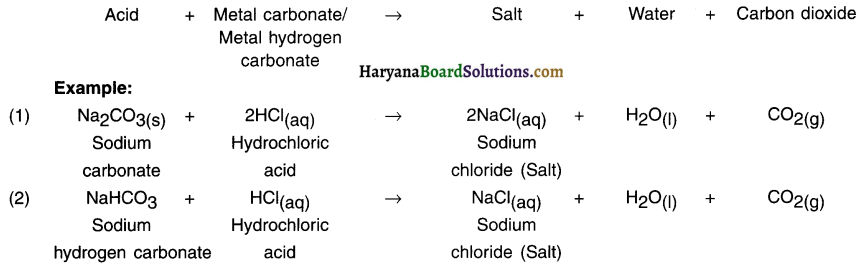
Answer:
Reaction of acid with metal carbonate or metal hydrogen carbonate:
When acids react with metal carbonate or metal hydrogen carbonate, most acids produce salt, water and carbon dioxide gas.

HBSE 10th Class Science Important Questions Chapter 2 Acids, Bases and Salts 6

HBSE 10th Class Science Important Questions Chapter 2 Acids, Bases and Salts

Question 13.
What happens when carbon dioxide in less proportion and excess proportion is passed through the solution of lime water? OR State the reactions that take place when carbon dioxide is passed through lime water (calcium hydroxide solution).
Answer:
On passing carbon dioxide in less proportion through lime water (calcium hydroxide solution), the solution turns milky because a white milky precipitate of calcium carbonate is formed.
HBSE 10th Class Science Important Questions Chapter 2 Acids, Bases and Salts 7
On passing excess carbon dioxide through lime water, precipitate of calcium carbonate dissolves due to formation of soluble calcium bicarbonate.
HBSE 10th Class Science Important Questions Chapter 2 Acids, Bases and Salts 8

Question 14.
What happens when an acid and a base react? Give one example.
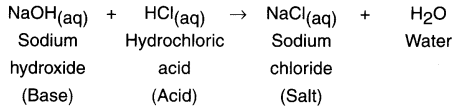
Answer:
Reaction of acid with base:

  • When acid reacts with base, salt and water are produced.
  • Since base neutralizes the effect of acid, this reaction is called neutralization reaction.
    Acid → Base → Salt + Water

Example:
When sodium hydroxide, a base reacts with hydrochloric acid, it produces salt and water.
HBSE 10th Class Science Important Questions Chapter 2 Acids, Bases and Salts 9

Question 15.
What is formed when copper oxide reacts with dilute hydrochloric acid? State the change in colour that you will observe along with the balanced chemical reaction. OR What happens when a metal oxide reacts with acid? Give one example.
Answer:
Reaction of acid with metal oxide:
1. When acid reacts with metal oxide, salt and water are produced.
Acid + Metal oxide → Salt + Water

2. When hydrochloric acid reacts with copper oxide, a salt of copper (Il) chloride is formed.
Example:
HBSE 10th Class Science Important Questions Chapter 2 Acids, Bases and Salts 10
The colour of the solution is bluish-green due to the formation of copper chloride.

Question 16.
What happens when a non-metallic oxide reacts with a base?
Answer:
When a non-metallic oxide reacts with base, the reaction gives out salt and water.
Example:
HBSE 10th Class Science Important Questions Chapter 2 Acids, Bases and Salts 11

Question 17.
How are hydrogen ions produced when an acid is dissolved in water? Explain with necessary chemical equations. Also mention method of writing the hydrogen ions so formed.
Answer:
1. When an acid (or an acidic substance) dissolves in water, it produces hydrogen (H+) ions.
2. This happens because all acids contain positively charged hydrogen (H+) ions.
Example:
HBSE 10th Class Science Important Questions Chapter 2 Acids, Bases and Salts 12
Thus, hydrogen ion must always be written as H+(aq) or hydronium ion (H3O+).

HBSE 10th Class Science Important Questions Chapter 2 Acids, Bases and Salts

Question 18.
Write a brief note on base and alkali.
Answer:
Base:

  • Chemical or substances which are hydroxides of metal and have a bitter taste are called bases.
  • All metal oxides and metal hydroxide are bases.
  • Fo example, sodium hydroxide (NaOH), calcium oxide (CaO), calcium hydroxide Ca(OH)2, etc. are bases.
  • Washing soda (Na2CO3 10H3O), baking soda(NaHCO3), etc. are also bases or basic substances.

Alkali:

  • Those bases which can dissolve in water are called alkalis.
  • Sodium hydroxide (NaOH). potassium hydroxide (KOH), etc. are alkalis or say water soluble bases.
  • When a base (or a basic substance) is dissolved in water, it always produces hydroxide (OH) ions.
  • Thus base is a substance which dissolves in water to produce hydroxide (OH) ions in solution.

Example:
HBSE 10th Class Science Important Questions Chapter 2 Acids, Bases and Salts 14

As shown in the above reaction, when sodium hydroxide which is a base, is dissolved in water it produces hydroxide (OH) ions over and above sodium (Na+) ions.

HBSE 10th Class Science Important Questions Chapter 2 Acids, Bases and Salts 15

Here, when potassium hydroxide is dissolved in water, it gives hydroxide (OH) ions and potassium ions.

Question 19.
State the ions responsible for acidic and basic behaviour. Explain the acidic and basic behaviour by reaction with water.
Answer:
H+ or H3O+ ions in aqueous solution are responsible for acidic character and OH ions in an aqueous solution are responsible for basic character.
HBSE 10th Class Science Important Questions Chapter 2 Acids, Bases and Salts 16

H+(aq) ions are formed in aqueous solution of HCl. So it can be said that HCl is an acid.
HBSE 10th Class Science Important Questions Chapter 2 Acids, Bases and Salts 17

OH ions are formed in an aqueous solution of NaOH. So NaOH is a base.

Question 20.
One should dissolve acid in water cautiously. Give reason. OR During dilution, acid must be added to water, not vice-versa.
Answer:
1. The process of dissolving an acid or a base is highly exothermic.
2. If one adds acid to water suddenly and in large amount or if one adds water to acid, the reaction will emit a lot of heat. This can even break the glass container.
3. The hot contents may come out of the container with an explosion and burn our eyes and body.
4. Hence, while making dilute solution of acid, acid must only be added to water that too slowly and by stirring continuously.

Question 21.
What Is dilution? How do you prepare a dilute acid?
Answer:
1. The process of mixing an acid or base with water decreases the concentration of ions (H3O/OH) per unit volume. The acid/base so formed is called dilute acid/base.
2. For making dilute acid one should slowly add concentrated acid in small amounts to water and stir continuously.

Question 22.
Write a short note on strong and weak acids.
Answer:
Strong acids:
1. An acid which gets completely ionized completely in water or say which completely dissociates in water and produce a large amount of hydrogen [H+] ions (or say hydronium [H3O+] ions) is called a strong acid.
2. Depending upon their structures, different acids produce different number of H+ ions. For example, 1 mole of hydrochloric acid will produce more hydrogen [H+] ions as compared to 1 mole acetic acid.

Weak acids:
1. An acid which does not ionize completely (i.e. does not dissociate completely in water) and thus produce a small amount of hydrogen [H+] ions (or say H3O+ ions) is called a weak acid.
2. For example, when acids such as acetic acid, lactic acid, citric acid, tartaric acid, etc. are dissolved in water, they do not completely ionize and so are called weak acids.

HBSE 10th Class Science Important Questions Chapter 2 Acids, Bases and Salts

Question 23.
Write a short note on strong and weak bases.
Answer:
Strong base:

  • A base, which completely ionizes in water and thus produces a large amount of hydroxide (OH) ions, is called a strong base or a strong alkali.
  • For example, when sodium hydroxide (NaOH) and potassium hydroxide (KQH) are dissolved in water, they completely get ionized and so are called strong bases.

Weak base:

  • A base, which does not ionize completely in water and thus produces a small amount of hydroxide (OH) ions, is called a weak base or a weak alkali.
  • For example, ammonium hydroxide (NH4OH) and calcium hydroxide Ca(OH)2 when dissolved in water do not completely ionize in water and so are considered weak bases.

Question 24.
Explain the methods of measuring the strength of an acid or a base. Strength (or weakness) of an acid or a base can be measured through following methods:
Answer:
(a) Through universal indicator :
1. Universal indicator is a mixture of many different indicators or say dyes which when added to a solution, changes the colour of the solution and thus indicate its pH value.

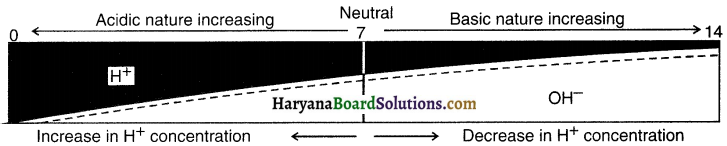
(b) Through pH scale:
1. To measure the acidic/basic nature of an aqueous solution, a scale called pH scale has been developed.
2. The pH scale measures concentration of hydrogen [H+] ions in the solution.
3. In German language, P of pH stands for ‘potenz’ i.e. power.
4. The scale points range from O to 14. 0 means very acidic and 14 means very alkaline. Scale point means neutral solution.
5. A lower pH value means there is higher concentration of H+ ions and hence the solution is acidic. So, as one moves towards O from 7, the solution goes on becoming more and more acidic.
6. Similarly, a higher pH value means there is lower concentration of H+ (and higher concentration of OH) ions and hence the solution is basic. So, as one moves from 7 to 14, the basicity of the solution increases.

HBSE 10th Class Science Important Questions Chapter 2 Acids, Bases and Salts

Question 25.
Write a note on pH scale.
Answer:
Through pH scale:
1. To measure the acidic/basic nature of an aqueous solution, a scale called pH scale has been developed.
2. The pH scale measures concentration of hydrogen [H+] ions in the solution.
3. In German language, P of pH stands for ‘potenz’ i.e. power.
4. The scale points range from O to 14. 0 means very acidic and 14 means very alkaline. Scale point means neutral solution.
5. A lower pH value means there is higher concentration of H+ ions and hence the solution is acidic. So, as one moves towards O from 7, the solution goes on becoming more and more acidic.
6. Similarly, a higher pH value means there is lower concentration of H+ (and higher concentration of OH) ions and hence the solution is basic. So, as one moves from 7 to 14, the basicity of the solution increases.
HBSE 10th Class Science Important Questions Chapter 2 Acids, Bases and Salts 18

Question 26.
How do you measure the strength of an acid or a base?
Answer:
1. The strength of an acid is determined by the number of H ions it produces, where as strength of a base is determined by the number of OH ions the base produces.

2. If we take 1 molar concentration (1 mole or 1 m acid dissolved in 1 litre of solution) of hydrochloric acid and acetic acid, then the acid which produces more number of H+ ions will be considered the stronger among the two. In this case, hydrochloric is a strong acid whereas acetic acid is weak.

3. Using the same method one can find the strength or weakness of a base. However, in base, the OH ions are released and hence they are counted (instead of H+).

Question 27.
Discuss the importance of pH In daily life.
Answer:
Importance of pH In everyday life:
(1) Importance of pH in existence of living beings:

  • The physiological reactions occurring in our body takes place between a narrow range of 7.0 to 7.8 pH. If due to any reason the pH range gets disturbed, we may face several problems in the body.
  • Even other living beings cannot tolerate more changes in their pH level.
  • For example, when acid rain (i.e. rain having pH level of 5.6) falls into water reservoirs like rivers, ponds, etc., it decreases pH level of these water bodies and makes them highly acidic.
  • Under such circumstances, existences of aquatic organisms like fish, microorganisms and vegetation is risked.

(2) Importance of pH in soil:

  • Shrubs grow well if the pH level of soil is maintained between 6.5 to 7.3.
  • The soil having pH <6.5 is called acidic soil, and that having pH > 7.3 is called alkaline.

(3) Importance of pH indigestion of food:

  • Stomach plays an important role in digesting food.
  • When we eat food, stomach secretes hydrochloric acid, The pH of this acid ¡s between 1 and 3.
  • At such a low value of pH, an enzyme called pepsin becomes active which helps in digesting food.

(4) Importance of pH in stopping tooth decay:

  • The outer layer of the teeth is made up of calcium phosphate. This layer does not dissolve in water but gets decayed when pH of inner side of mouth becomes less than 5.5. This causes tooth decay.
  • When we eat food, bacteria decomposes the food particles that remain in the mouth and produce acid. This decreases the pH in the mouth.

(5) Self-defence by animals and plats through chemical warfare:

  • When a honey bee bites a human being, pain, irritation and swelling is felt at the site of bite.
  • This occurs because the honey bee releases acidic poison into human body during the bite.
  • To neutralize the effect of this acid to some extent, substances like baking soda are applied around the bite. Stinging hair of nestle leaves injects methanoic acid and causes burning pain.

Question 28.
Indigestion causes pain and irritation. Suggest how to cure this. OR How does baking soda help in relieving stomach pain and Irritation?
Answer:
1. During indigestion, the stomach produces excessive acid. This causes pain and irritation.
2. To neutralize the effect of the acid, bases must be used. Such bases are called antacids i.e. anti-acids.
3. Magnesium hydroxide (Milk of magnesia) is one such antacid. Baking soda is also a mild base which helps in neutralizing excess acid. (Note: Eno available in medical store is also one type of antacid.)

HBSE 10th Class Science Important Questions Chapter 2 Acids, Bases and Salts

Question 29.
When tooth pH goes below 5.5 it leads to decay. How would you prevent it?
Answer:
1. When pH in the mouth goes below 5.5, the bacteria of the mouth start producing acids and decaying the teeth.
2. The best way to prevent this is to clean the mouth properly after eating.
3. Toothpastes are basic in nature. Hence, cleaning the teeth with tooth paste neutralizes excess acid and prevents tooth decay.

Question 30.
What is acid rain? How does it affect aquatic life?
Answer:
1. If the pH of rain water becomes less than 5.6, then such rain is called acid rain.
2. When such acid water flows in water bodies such as rivers, ponds and lakes, it increases the acidity of these water sources.
3. The living organisms including humans have quite a narrow pH band of 7.0 to 7.8. Hence, even slightest change in water source makes survival difficult.

Question 31.
Why distilled (pure) water is used as a solvent in laboratories ? How does distilled water self – ionise?
Answer:
1. Distilled (pure) water is neutral. So in laboratories a solution is made using distilled water in order to get a correct pH value.
2. When an acid or a base is added to distilled water, the solution produces hydronium (H3O+) and hydroxide (OH) ions respectively through self ionization of water. The self-ionization reaction is as under:
HBSE 10th Class Science Important Questions Chapter 2 Acids, Bases and Salts 19

Question 32.
The aqueous solution of the salt produced by neutralization of weak acid and strong base possesses basic nature, while aqueous solution of salt produced by neutralization reaction of weak base and strong acid possess acidic nature – Explain.
Answer:
1. When the pH level of an aqueous solution increases more than 7, the solution goes on becoming basic.
2. In a neutralization reaction, when a weak acid and a strong base react, the salts obtained in the reaction hydrolyse to produce hydroxide [OH] ions.
3. As the level of [OH] ions increases in the solution, the solution becomes basic in nature.
4. In case, when in neutralization reaction, reaction takes place between a weak base and a strong acid, the salt obtained in the reaction hydrolyses in water to produce hydronium [H3O+] ions.
5. The increased level of [H3O+] ions in the aqueous solution makes the solution acidic.
6. Thus, the aqueous solution of the salt produced by neutralization reaction of weak acid and strong base possesses basic nature, while aqueous solution of salt produced by neutralization reaction of weak base and strong acid possess acidic nature.

Question 33.
What is neutralization reaction?
Answer:
Neutralization reaction:
1. When an acid and a base are mixed in right proportion, both acid and base lose their properties. Such a reaction is called neutralization reaction.

2. Thus, the reaction of acid and base is called a neutralization reaction. Moreover, reaction of acid and base gives us ‘salt’ and ‘water’.

Neutralization reaction can be generalized as follows:
HBSE 10th Class Science Important Questions Chapter 2 Acids, Bases and Salts 20
Where, H refers to hydrogen ion
OH refers to hydroxide ion
MX refers to Salt
HOH refers to water (H2O)
HBSE 10th Class Science Important Questions Chapter 2 Acids, Bases and Salts 21

Question 34.
What s a salt?
Answer:
1. A salt is an ionic compound which is formed by the neutralization reaction of an acid and a base. Thus, we get salt when we react an acid with a base.
2. When we dissolve a salt in water it will get ionized and release cation (i.e. the positive +ve ion) and anion (i.e. the negative -ve ion).
HBSE 10th Class Science Important Questions Chapter 2 Acids, Bases and Salts 22

3. ‘Salt’ is a general name and it does not refer only to NaCl i.e. sodium chloride. There exists a huge number of salts other than NaCl.
4. NaCl i.e. common salt so formed can be further used to produce several other products.
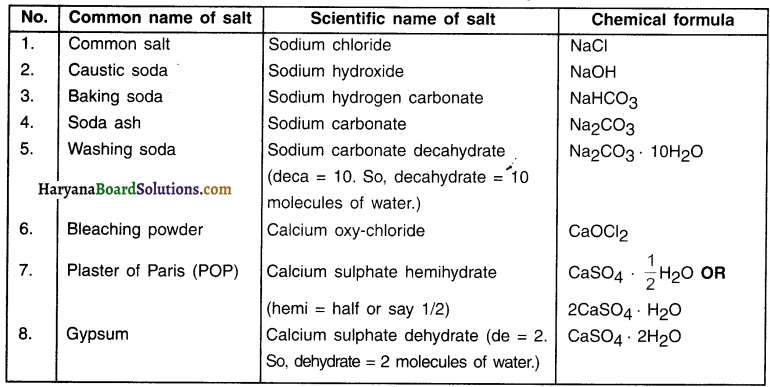
5. Sodium hydroxide (NaOH), baking soda (NaHCO3), washing soda (Na2CO3 10H2O), bleaching powder (CaOCl2) are all examples of salts.

Question 35.
How does a salt gets its name?
Answer:
The general form of naming a salt is ‘cation anion’. This means the name of cation (i.e. the positive +ve ion) of the salt will be put first and then name of its anion (i.e. the negative -ve ion) will be put second.
Example:
(a) NaCl: In NaCl salt, sodium Na+ has positive ions i.e. cations and chlorine CF has negative ions i.e. anions. Hence, we call NaCl salt as sodium chloride.

(b) K2SO4: Applying the same rule, the name of this salt is potassium sulphate.

HBSE 10th Class Science Important Questions Chapter 2 Acids, Bases and Salts

Question 36.
What is a family of salts?
Answer:
1. There are several types of salts. The properties of all the salts are not completely different. In other words, properties of several salts are similar.
2. In general, salts having same type of cations (+ve ions) or anions (-ve) belong to the same family.
Example:
(a) Family of sodium salts (salts having Na ion): Na2SO4, NaCl, NaNO3, Na2CO3
(b) Family of chloride salts (salts having C ion): NaCl NH4Cl
(c) Family of sulphate salts (salts having SO4 ion): K2SO4, Na2SO4, Ca2SO4, MgSO4, CuSO4

Preparation of Important Salts
List of important salts that we will study in this section.
HBSE 10th Class Science Important Questions Chapter 2 Acids, Bases and Salts 23

Question 37.
What is brine? State its two important uses.
Answer:
1. The concentrated solution of sodium chloride i.e. concentrated solution of NaCl + H2O is called brine.
2. Brine is used for preparing many compounds, however two products are prepared directly using brine.
They are:

  • Caustic soda (sodium hydroxide) and
  • Baking soda (sodium hydrogen carbonate).

Question 38.
Write a note on causltc soda (sodium hydroxide). OR Write a note on chlor-alkali process. Chemical name of caustic soda: Sodium hydroxide
Answer:
Chemical formula: NaOH
Preparation:
1. When electricity is passed through brine, it gets decomposed and produces three products. They are:

  • Sodium hydroxide,
  • Chlorine gas and
  • Hydrogen gas.

Reaction:
HBSE 10th Class Science Important Questions Chapter 2 Acids, Bases and Salts 24

2. The chlorine gas is produced at anode (+ve electrode) and hydrogen at cathode. Sodium hydroxide is formed near the cathode.

3. The process of preparing NaOH is also called chlor-alkali process because the process gives out sodium hydroxide which is an alkali and chlorine.

HBSE 10th Class Science Important Questions Chapter 2 Acids, Bases and Salts

Question 39.
State uses of the products formed in the chior-alkali process.
Answer:
Uses of products formed in chlor-aikali process:

  • NaOH: Making soap and detergent, paper, artificial fibres, de-greasing metals, etc.
  • Chlorine gas: To disinfect water, added in swimming pools, making PVC, CFCs and pesticides
  • Hydrogen gas: As a fuel, for making fertilizers and in making margarine

Question 40.
Write a note on preparation of baking soda.
Answer:
Chemical name of baking soda: Sodium hydrogen carbonate
Chemical formula: NaHCO3

Preparation:
When brine reacts with ammonia in the presence of carbon dioxide gas, it produces sodium hydrogen carbonate and ammonium chloride.

HBSE 10th Class Science Important Questions Chapter 2 Acids, Bases and Salts 24

Baking soda is a mild, non-corrosive basic salt.

Question 41.
Give an idea and preparation about soda ash. OR What happens when you heat baking soda? OR State and explain the reaction of baking soda when it Is heated during cooking. OR State the preparation of sodium carbonate.
Answer:
Chemical name of soda ash: Sodium carbonate
Chemical formula: Na2CO3
Preparation:
When baking soda gets heated during cooking, it produces sodium carbonate (soda ash) along with carbon dioxide and water.
HBSE 10th Class Science Important Questions Chapter 2 Acids, Bases and Salts 26

Question 42.
What happens when baking soda is heated or mixed with water? When baking soda is heated or mixed with water than following action takes place:
Answer:
HBSE 10th Class Science Important Questions Chapter 2 Acids, Bases and Salts 27
Carbon dioxide produced during this reaction causes bread or cake to rise making them soft and spongy.

Question 43.
Mention uses of baking soda:
Answer:
1. Baking socia is a soda (or a salt) commonly used in kitchen for making cakes, crispy pakoras, khaman, etc.
2. It is used for making baking powder commonly used in kitchen.
3. It is also used in making antacids. Antacids cure acidity of stomach.
4. To make soda-acid fire extinguishers
5. To make several industrial products

HBSE 10th Class Science Important Questions Chapter 2 Acids, Bases and Salts

Question 44.
How is washing soda prepared?
Answer:
Chemical name of washing soda: Sodium carbonate decahydrate
Chemical formula: Na2CO3 10H2O
Preparation:
When sodium carbonate (i.e. soda ash) is dissolved in water, and recrystallized it gives washing soda crystals containing 10 molecules of water of crystallization.
HBSE 10th Class Science Important Questions Chapter 2 Acids, Bases and Salts 28
Washing soda is a basic salt.

Question 45.
What does the number 10 represents In the formula Na2CO3 10H2O i.e. the formula of washing soda?
Answer:
The number 10 in the formula Na2CO3 10H2O tells us that there are lo water molecules in washing soda. Hence, it is also called decahydrate.

Question 46.
State the uses of washing soda.
Answer:
Uses of washing soda:

  • It is used in making glass and paper.
  • It is used for making sodium based compounds such as borax.
  • It is used as a cleaning agent such as washing powder and soap.
  • For removing permanent hardness of water.

Question 47.
Write a note on preparation of bleaching powder and its uses.
Answer:
Chemical name of bleaching powder: Calcium oxy-chloride
Chemical formula: CaOCl2
HBSE 10th Class Science Important Questions Chapter 2 Acids, Bases and Salts 29
Preparation:
1. It is prepared by the action of chlorine on slaked lime (Calcium hydroxide).
2. On passing chlorine gas over dry slaked lime (CaCOH2), bleaching powder is obtained.

Uses of bleaching powder:

  • For bleaching cotton and linen clothes in textile industry, for bleaching wood pulp in paper-making factories and bleaching washed clothes in laundries.
  • As an oxidizing agent in many chemical industries.
  • For disinfecting drinking water to make it free of germs.

Question 48.
State the uses of bleaching powder.
Answer:
Uses of bleaching powder:

  • For bleaching cotton and linen clothes in textile industry, for bleaching wood pulp in paper-making factories and bleaching washed clothes in laundries.
  • As an oxidizing agent in many chemical industries.
  • For disinfecting drinking water to make it free of germs.

Question 49.
What is plaster of Paris? State its chemical name and preparation.
Answer:
Chemical name of plaster of Paris (POP): Calcium sulphate hemihydrate (hemi = half or say 1/2)
Chemical formula: CaSO4 \(\frac{1}{2}\)H2O (OR 2CaSO4 . H2O)

Preparation:
CaSO 2H2O refers to a compound called gypsum. Its chemical name is calcium sulphate dehydrate (de =2).
HBSE 10th Class Science Important Questions Chapter 2 Acids, Bases and Salts 30

  • On heating gypsum at 373 K, it loses water molecules and forms calcium sulphate hemihydrate (Plaster of Paris) and \(1 \frac{1}{2}\) molecule of water.
  • In CaSO4 . \(\frac{1}{2}\)H2O, the half molecule of water is attached as water of crystallization.
  • Plaster of Paris is a white powder. On adding water, it again turns to gypsum having hard solid mass.

Question 50.
What do doctors use to join the fractured bones?
Answer:
1. Doctors use white powder of plaster of Paris to join the fractured bones.
2. On adding water to this powder, it forms a paste which can be easily applied on the fractured area. When the paste becomes dry it becomes solid hard substance called gypsum.
HBSE 10th Class Science Important Questions Chapter 2 Acids, Bases and Salts 31

Question 51.
What is water of crystallization? Give examples.
Answer:
(a) The fix number of water molecules present in one formula unit of salt is called water of crystallization.
Examples:
(1) Calcium suphate hemihydrate (CaSO4. H2O) contains 1/2 i.e. half molecule of water of crystallization.
(2) Sodium carbonate decahydrate (Na2CO3 . 10H2O) contains 10 molecules of water of crystallization.

HBSE 10th Class Science Important Questions Chapter 2 Acids, Bases and Salts

Question 52.
List out two differences between acids and base on the basis of their chemical properties.
Answer:

AcidBase
1. When acids are dissolved in water they release (H+) ions.
2. Acid reacts with lime stone to liberate carbon dioxide gas.
1. When bases are dissolved in water they release (OH) ions.
2. Base reacts with oils to form soapy solution.

Question 53.
State two difference between organic acid and mineral acid.
Answer:

Organic acid

Mineral acid

1. Acids present in plants and animais i.e. occurring naturally are called organic acids.
Example: Citric acid, lactic acid, etc. are organic acids.
1. Acids prepared from minerals found in earth are called mineral acids.
Example: Hydrochloric acid, sulphuric acid, etc. are mineral acids.

Question 54.
What will be the action of the following substances on litmus paper? Dry HCl gas, Moistened NH3 gas, Lemon juice, Carbonated soft drink, Curd, Soap solution.
Answer:
1. Dry HCl gas: No change on litmus paper
2. Moistened NH3 gas: Red litmus will turn blue.
3. Lemon juice: Blue litmus will turn red.
4. Carbonated soft drinks: They contain carbonic acid. So blue litmus will turn red.
5. Curd: It contains lactic acid. So, blue litmus will turn red.
6. Soap solution: It is basic. So, red litmus will turn blue.

Question 55.
Name the acid present in ant sting and give its chemical formula. Also give the common method to get relief from the discomfort caused by the ant sting.
Answer:
When ant stings, it releases formic acid (or methanoic acid) in our body. Its chemical formula is HCOOH. Mix some baking soda with water and apply it on the sting. Baking soda is basic and so it will neutralize the acidic effect and provide relief.

Question 56.
What happens when nitric acid is added to egg shell?
Answer:
Egg shells contain calcium carbonate (CaCO3). When nitric acid (HNO3) is added to it, it results in brisk effervescence due to the formation of CO2 gas. The reaction is as follows.
HBSE 10th Class Science Important Questions Chapter 2 Acids, Bases and Salts 33

Question 57.
A student prepared solutions of (i) an acid and (ii) a base in two separate beakers. She forgot to label the solutions and litmus paper is not available In the laboratory. Since both the solutions are colourless, how will she distinguish between the two?
Answer:
Since the student does not have litmus, she can use any other indicator like methyl orange, phenolphthalein, etc. She can also use a natural indicator such as turmeric.

HBSE 10th Class Science Important Questions Chapter 2 Acids, Bases and Salts

Question 58.
When zinc metal is treated with a dilute solution of a strong acid, a gas s evolved, which is utilized in the hydrogenation of oil. Name the gas evolved. Write the chemical equation of the reaction involved and also write a test to detect the gas formed.
Answer:
When zinc reacts with dilute solution of strong acid (like hydrochloric acid HCl), it forms salt and hydrogen gas is evolved which is used in hydrogenation of oil.
HBSE 10th Class Science Important Questions Chapter 2 Acids, Bases and Salts 41
To test the presence of H2 gas take a burning candle near the mouth of the test tube. The gas burns with a pop sound indicating presence of hydrogen gas.

Question 59.
How would you distinguish between baking powder and washing soda by heating?
Answer:
On heating baking soda (NaHCO3), carbon dioxide (CO2) gas is produced. It turns lime water milky.
HBSE 10th Class Science Important Questions Chapter 2 Acids, Bases and Salts 42

If you heat washing soda (Na2CO3 . 10H2O), water of crystallization is given out and the sail becomes anhydrous. The presence of water of crystallization given as product can be tested b treating it with anhydrous CuSO4. It is white coloured which turns blue when it comes in contact ol anhydrous CuSO4.
HBSE 10th Class Science Important Questions Chapter 2 Acids, Bases and Salts 43

Question 60.
Salt A commonly used in bakery products on heating gets converted Into another salt B Which itself Is used for removal of hardness of water and a gas C is evolved. The gas C when passed through lime water, turns It milky. Identify A, B and C.
Answer:
Salt A: It is used in bakery and also gives Na2CO3 . Hence it is sodium bicarbonate NaHCO3.
Salt B: It is sodium carbonate Na2CO3 because it is used for removal of hardness of water.
Gas C: It turns lime water milky and hence gas C is carbon dioxide CO2.
HBSE 10th Class Science Important Questions Chapter 2 Acids, Bases and Salts 44

Question 61.
A compound X of sodium is commonly used In kitchen for making crispy pakoras. It is also used for curing acidity in the stomach. Identify X. What is its chemical formula? State the reaction which takes place when it is heated during cooking.
Answer:
Compound X: Sodium bicarbonate or sodium hydrogen carbonate or baking soda
Formula: NaHCO3
Chemical reaction:
HBSE 10th Class Science Important Questions Chapter 2 Acids, Bases and Salts 45

Question 62.
For making cake, baking powder is taken. If at home your mother uses baking soda instead of baking powder in cake,
(a) How will it affect the taste of the cake and why?
(b) How can baking soda be converted into baking powder?
(c) What is the role of tartaric acid added to baking soda?
Answer:
(a) Baking powder contains tartaric acid. This acid reacts with sodium carbonate (Na2CO3) produced during decomposition of NaHCO3 and neutralizes it.
If only sodium hydrogen carbonate (baking soda) is used in making cake, then sodium carbonate formed from it by the action of heat (during baking) will give a bitter taste to cake.
(b) By adding tartaric acid to baking soda we can convert baking soda into baking powder.
(c) Tartaric acid neutralizes the sodium carbonate formed during decomposition of NaHCO3. Hence, it makes the cake tasty and prevents it from becoming bitter in taste.

Question 63.
“The aqueous solution of the salt produced by neutralization of weak acid and strong base possesses basic nature, while aqueous solution of salt produced by neutralization of weak base and strong acid possesses acidic nature.” Explain.
Answer:
1.
HBSE 10th Class Science Important Questions Chapter 2 Acids, Bases and Salts 46
2. When we react carbonic acid which is a weak acid with a strong base of sodium hydroxide what we get is sodium carbonate.
3. The aqueous solution of sodium carbonate contains higher concentration of OH ions. Hence, the solution possesses basic nature.
HBSE 10th Class Science Important Questions Chapter 2 Acids, Bases and Salts 47

4. When we react hydrochloric acid which is a strong acid with a weak base, we get ammonium chloride.
5. This aqueous solution contains higher concentration of H+(aq) ions compared to the concentration of OH+ (aq) ions. Therefore solution possesses acidic nature.

Question 64.
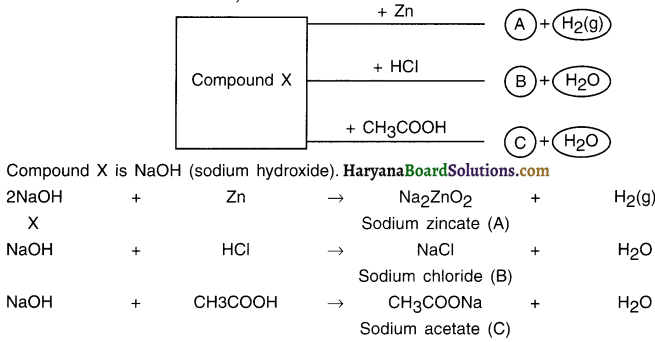
Identify compound X on the basis of the reactions given below. Also, write the name and chemical formulae of A, B and C.
Answer:
HBSE 10th Class Science Important Questions Chapter 2 Acids, Bases and Salts 50

Question 65.
While eating food, you spill some curry on your white shirt. You immediately scrub It with soap.
What happens to its yellow colour on scrubbing with soap? Why? What happens to this stain. when the shirt is washed with plenty of water?
Answer:
When we scrub the shirt with soap, its colour changes from yellow to reddish brown. This happens because soap is basic in nature and the colour of turmeric changes from yellow to reddish brown in basic medium. If we wash the shirt with plenty of water, the stain will again turn yellow.

Very Short Answer Type Questions

Question 1.
How can we broadly classify all the compounds known to us?
Answer:
All the compounds that exist can be classified as

  • Acids,
  • Bases or
  • Salts.

HBSE 10th Class Science Important Questions Chapter 2 Acids, Bases and Salts

Question 2.
What are acids? Name two acids.
Answer:
Substances which when dissolved in water release hydrogen ions (H+) are called acids. Hydrochloric acid and sulphuric acid are two common acids.

Question 3.
State two properties of acids.
Answer:
Acids are sour in taste, Acids conduct electricity when dissolved in water, Acids react with metals to form salt and hydrogen gas.

Question 4.
What are bases?
Answer:
Bases are hydroxides of metals which give hydroxide (OH) ions when mixed with water.

Question 5.
State two properties of bases.
Answer:
Bases have a bitter taste. They change red litmus paper to blue.

Question 6.
What is salt?
Answer:
A salt is an ionic compound which is formed from the neutralization reaction of an acid and a base. Thus, we get salt when we react an acid with a base.

Question 7.
Read the paragraph and point out the erroneous statement.
Answer:
Acids are sour and they release H+ ions. Bases are bitter and they released H3O+ ions. Also, bases turn litmus paper blue. Litmus is an artificial indicator to test presence of acids.

  • Bases are sour
  • Litmus is natural
  • Bases release H+ ions Statement (i) and (iii) are erroneous.

Question 8.
Name two natural and synthetic indicators.
Answer:
1. Natural: Litmus and turmeric,
2. Synthetic: Methyl orange and phenolphthalein.

Question 9.
A knife, which is used to cut a fruit, was immediately dipped into water containing drops of blue litmus solution. If the colour of the solution changes to red, what inference can be drawn about the fruit and why?
Answer:
Since the colour of blue litmus turned red, the fruit is acidic.

HBSE 10th Class Science Important Questions Chapter 2 Acids, Bases and Salts

Question 10.
What is an olfactory indicator?
Answer:
A substance whose smell changes in acidic or basic solution is called an olfactory indicator.

Question 11.
Name two olfactory indicators.
Answer:
Onion and vanilla extract.

Question 12.
What is a concentrated acid?
Answer:
An acid that contains minimum amount of water is called a concentrated acid.

Question 13.
What is a dilute acid?
Answer:
An acid obtained by mixing concentrated acid with large amount of water is called a dilute acid.

Question 14.
Name a substance that does not contain hydroxide ion yet it acts as a base. Also give its formula.
Answer:
Ammonia (NH3)

Question 15.
You are given gold, silver and platinum. Which of these will not react with acid easily? Why?
Answer:
None. Because all are noble metals.

Question 16.
What will happen if you add zinc granules to dilute sulphuric acid?
Answer:
Bubbles containing H2 gas will be formed on zinc granules.

Question 17.
Rasika took some dilute sulphuric acid in a test tube and added a few pieces of zinc granules to it. Her friend Shyam was supposed to write the observation in the journal but he was absent that day. As a science student write the observation that must have taken place in this experiment.
Answer:
We can observe that bubbles form on the surface of zinc granules indicating formation of gas. When we pass this gas through the soap solution, the gas gets trapped in soap molecules and bubbles are formed. The gas is hydrogen and it burns with a pop sound when a burning candle is brought near it.

Question 18.
What will be produced when you pass carbon dioxide gas through lime water?
Answer:
A milky precipitate of calcium carbonate (CaCO3).

Question 19.
Take a small amount of copper oxide in a beaker and add dilute hydrochloric acid in it. State the chemical reaction.
Answer:
CuO + 2HCl CuCl2 + H2O

Question 20.
You might have seen lemon or tamarind juice being used to clean tarnished surface of copper vessels. Explain why these sour substances are effective in cleaning the vessels?
Answer:
Copper is metal whereas lemon juice and tamarind are acidic. When acid reacts with metal oxides, salt and water is formed. This makes the metal vessels shiny again

Question 21.
Why lemonade should not be prepared in copper vessel?
Answer:
Lemon is highly acidic and reacts vigorously with copper metal and causes copper poisoning. Hence………..

HBSE 10th Class Science Important Questions Chapter 2 Acids, Bases and Salts

Question 22.
Take about 0.5 g of sodium carbonate (Na2CO3) in test tube A and about 0.5 g of sodium hydrogencarbonate (NaHCO3) in test tube B. Add about 2 mL of dilute HCl in both the test tubes. State the observation of this experiment.
Answer:
When acids react with metal carbonates and metal hydrogen carbonates, they produce salt, water and carbon dioxide gas. This happens in both the test-tubes.

Question 23.
Look at the reaction given below and mention what will happen if you pass excess carbon dioxide from it. Also state the reaction.
HBSE 10th Class Science Important Questions Chapter 2 Acids, Bases and Salts 51
Answer:
On passing excess carbon dioxide through the given solution, precipitate of calcium carbonate dissolves due to formation of soluble calcium ‘ bicarbonate.
HBSE 10th Class Science Important Questions Chapter 2 Acids, Bases and Salts 52

Question 24.
What is neutralization reaction?
Answer:
When acid and base mix in right proportions, both of them lose their properties and produce salt and water. Such a reaction is called neutralization : reaction.

Question 25.
What will be the colour of solution if you add two drops of phenolphthalein solution in dilute NaOH solution?
Answer:
The solution will become pink.

Question 26.
Why does the colour of phenolphthalein
Answer:
NaOH gets neutralized by acid. Hence, the colour of phenolphthalein changes.

Question 27.
Give the neutralization reaction of potassium hydroxide with sulphuric acid.
Answer:
HBSE 10th Class Science Important Questions Chapter 2 Acids, Bases and Salts 53

Question 28.
Write one word for the following:
(a) Water soluble base
(b) A substance which dissociates on dissolving in water to produce hydroxide ions.
Answer:
(a) Alkali
(b) Base

Question 29.
Write one word for the following:
(a) A substance which dissociates on dissolving in water to produce hydrogen ions.
(b) A reaction between an acid and a base to form salt and water.
Answer:
(a) Acid,
(b) neutralization

Question 30.
Give reason in one sentence: ‘Solution of sulphuric acid conducts electricity whereas alcohol does not’.
Answer:
Solution of sulphuric acid contains charged ions H+ and SO4-2 which helps in conducting electricity whereas alcohol does not. Hence,………..

Question 31.
Although compounds like alcohol and glucose contain hydrogen, they are not acids. Why?
Answer:
Although alcohol and glucose contain hydrogen, they do not give hydrogen ions in water and hence are not categorized as acids.

Question 32.
HBSE 10th Class Science Important Questions Chapter 2 Acids, Bases and Salts 54What is happening in this reaction?
Answer:
Here, when potassium hydroxide, a base is subjected to water, it generates hydroxide (OH) ions. Which out of the solutions of glucose,

Question 33.
Which out of the solutions of glucose, alcohol, hydrochloric acid, sulphuric acid and sodium hydroxide, will not conduct electricity?
Answer:
Glucose and alcohol will not conduct electricity because they will not release ions.

HBSE 10th Class Science Important Questions Chapter 2 Acids, Bases and Salts

Question 34.
What will happen it you add water to strong acid for producing a dilute acid?
Answer:
A lot of heat will be produced. This may splash out the acid and burn our bodies. Even the glass container may break.

Question 35.
What is dilution?
Answer:
Mixing acid or base with water results in decrease in the concentration of H3O+ or OH ions per unit volume. Such a process ¡s called dilution and the acid/base is called diluted.

Question 36.
An experiment was done in which about 1g solid NaCl was taken in a clean and dry test tube. Then some concentrated sulphuric acid was added to the test tube. The reaction produced hydrochloric acid. On the basis of the above activity, what do you infer about the acidic character of : (i) Dry HCl gas, (ii) HCl solution?
Answer:
The experiment suggests that hydrochloric acid produces hydrogen ions in the presence of water. But, dry hydrochloric acid does not release hydrogen ions. Thus, only HCl solution is acidic whereas dry HCl is not.

Question 37.
What is a universal Indicator?
Answer:
An indicator which can pass through a series of colour changes over a wide range of H3O+ ion concentration is called universal indicator. It is a mixture of several indicators.

Question 38.
What is pH scale?
Answer:
A scale that measures the concentration of hydrogen ion in a solution is called a pH scale.

Question 39.
Arrange the following in an increasing order of their pH values: NaOH solution blood, lemon juice.
Answer:
NaOH < Blood < Lemon juice

Question 40.
Why 1M HCl solution will have a higher concentration of H ions compared to 1M CH3COOH solution?
Answer:
1. HCl i.e. hydrochloric acid is a strong acid. Hence, HCl molecules dissociate completely into H+ ions and Cl ions and produce more H+ ions.
2. CH3COOH i.e. acetic acid is a weak acid and so it does not dissociate completely. Hence, it produces less H+ ions. As a result

Question 41.
A student added a few drops of liquid P into distilled water. He observed that the pH of the water decreased. Can you guess the pH of the liquid P?
Answer:
We know that pH of distilled water is 7. On adding liquid P, the pH of the water decreased which means that P could be any acid such as HCl or H3SO4, etc.

Question 42.
Which type of substances are taken for getting relief from acidity?
Answer:
Basic substances or say antacids

Question 43.
Separate the following acids into strong acids and weak acids. Hydrochloric acid, citric acid, acetic acid, nitric acid, formic acid, sulphuric acid.
Answer:
Strong acid: Hydrochloric acid, nitric acid and sulphuric acid:
Weak acid: Citric acid acetic acid and formic acid

Question 44.
What do you mean by family of salts?
Answer:
1. There are several types of salts. The properties of all the salts are not completely different, In other words, properties of several salts are similar.
2. In general, salts having same type of cations (+ve ions) or anions (-ve) belong to the same family.

HBSE 10th Class Science Important Questions Chapter 2 Acids, Bases and Salts

Question 45.
Which salt do you obtain by the reaction of hydrochloric acid and sodium hydroxide?
Answer:
Sodium chloride (NaCl)

Question 46.
Name two salts that you can directly prepare from brine.
Answer:
(1) Caustic soda (sodium hydroxide) and
(2) Baking soda (sodium hydrogen carbonate).

Question 47.
State chemical reaction for preparing caustic soda.
Answer:
Reaction:
HBSE 10th Class Science Important Questions Chapter 2 Acids, Bases and Salts 55

Question 48.
What is chlor-alkali process?
Answer:
When electricity is passed through an aqueous solution of sodium chloride, it decomposes to form sodium hydroxide and chlorine gas. This process is called chlor-alkali process.

Question 49.
How does the soda-acid fire-extinguisher extinguish the fire?
Answer:
Soda-acid fir-extinguisher extinguishes the fire by stopping the contact of air with fire.

Question 50.
How is bleaching powder produced? State is reaction.
Answer:
Bleaching powder is produced by the action of chlorine on dry slaked lime (Calcium hydroxide)
Ca(OH)2 + Cl2 → CaOCl + H2O

Question 51.
State two uses of bleaching powder.
Answer:
(a) For bleaching cotton and linen in textile industry.
(b) For disinfecting drinking water.

Question 52.
What is baking powder?
Answer:
Baking powder is a mixture of baking soda and a mild edible acid such as tartaric acid.

Question 53.
Why baking soda is used in making antacid?
Answer:
Baking soda is alkaline and so it neutralizes excess acid in the stomach and provides relief from acidity. Hence, it is …………..

Question 54.
Recrystallization of sodium carbonate gives washing soda. State the reaction.
Answer:
Na2CO3 + 10H2O → Na2CO3 10H2O

HBSE 10th Class Science Important Questions Chapter 2 Acids, Bases and Salts

Question 55.
State two uses of washing soda.
Answer:
(a) To prepare glass and soap,
(b) To remove permanent hardness of water

Question 56.
State two uses of POP.
Answer:
(a) Doctors use POP for setting fractured bones.
(b) It is used for making false and decorative ceilings.

Fill in the Blanks:

1. When NaOH is added to a cloth strip treated with onion extracts, the onion smell ……………………..
Answer:
Cannot be detected OR Vanishes.

2. Cloth strip treated with onion + dilute. NaOH solution = …………………… (state observation)
Answer:
Onion smell will not be detected in the cloth and the cloth will change to green colour.

3. H+ ions cannot separate from HCl molecules in the absence of …………..
Answer:
Water

4. For a neutralization reaction, H X + M OH → ………………..
Answer:
MX + HOH

5. Universal indicator is used for …………………
Answer:
Obtaining approximate pH of a solution.

6. In pH scale, scale points O’ = and
Answer:
O = very acidic, 14 = very basic

7. Generally, with the universal indicator is used to measure pH.
Answer:
Paper impregnated

8. Higher the hydronium ion concentration, is the pH value.
Answer:
Lower

9. If OH> 10-7, solution will be
Answer:
Basic

10. If a red litmus paper is dipped into a solution and it turns blue, then it can be said that the solution has pH range between
Answer:
7and 14

11. In order to have good growth and development of shrubs, the soil should have pH
Answer:
Near 7

12. Bacteria present in the mouth produce base by degradation of food particles left in the mouth after eating.
Answer:
False

13. Two substances that have almost equal neutral pH are ………………..
Answer:
Blood and water

HBSE 10th Class Science Important Questions Chapter 2 Acids, Bases and Salts

14. The pH values of aqueous solutions A, B, C and D are 2.9, 3.5, 1.6 and 4.2 respectively. The correct order of their acidic strength is …………………….
Answer:
C>A> B>D

15. …………….. decreases the pH inside the mouth.
Answer:
Acids

16. Aqueous solution of is applied around the place of bite, to get relief from the effect of bite of honey bee.
Answer:
Baking soda

17. The sting of nettle leaves inject (name of the compound) in the body.
Answer:
4 Methanoic acid

18. The other name and formula of calcium sulphate hemihydrate …………..
Answer:
Plaster of Paris : CaSO4 \(\frac{1}{2}\)H2O.

True Or False

1. The solution which has no effect on any litmus paper is neutral. — True
2. Tartaric acid is stronger than nitric acid. — False
3. As a thumb rule, all organic acids are weak acids and mineral acids are strong acids. — True
4. H3O+ = OH = 10-7 — True
5. Sodium hydroxide and magnesium hydroxide are basic and hence work quite well in curing stomach acidity. — False
6. Hydrogen ions cannot exist alone. — True
7. HCl solution is acidic but its dry form is not. — True
8. Dissolution of acid (or base) in water releases is an endothermic process. — False
9. Limestone, marble and chalk are forms of calcium carbonate. — True
10. The pH of a neutral solution is O. — False
11. The pH of gastric juices is about 1.2. — False
12. You need to heat gypsum at 378 K for forming calcium sulphate hemihydrate. — False
13. Carbon dioxide gas is mainly responsible for making the cake soft. — True
14. If we make the crystals moist, we can see blue colour of copper sulphate reappearing. — True

Match the Following

1. Match the acids given in Column (A) with their correct source given in Column (B)

Column (A)

Column (B)
(a) Lactic acid
(b) Acetic acid
(c) Citric acid
(d) Oxalic acid

(i) Tomato
(ii) Lemon
(iii) Vinegar
(iv) Curd

Answer:
(a-4) (b-3) (c-2) (d-1)

HBSE 10th Class Science Important Questions Chapter 2 Acids, Bases and Salts

2. Match the important chemicals given in Column (A) with the chemical formulae given in Column (B)

Column (A)Column (B)
(a) Plaster of Paris
(b) Gypsum
(C) Bleaching Powder
(d) Slaked Lime
(i) Ca(OH)2
(ii) CaSO4
(iii) CaSO4 1/2 H2O
(iv) CaOCl2 . 2H2O

Answer:
(a-2) (b-3) (c-4) (d-1)


HBSE 10th Class Science Important Questions Chapter 2 Acids, Bases and Salts Read More »

HBSE 10th Class Maths Important Questions Chapter 8 Introduction to Trigonometry

Haryana State Board HBSE 10th Class Maths Important Questions Chapter 8 Introduction to Trigonometry Important Questions and Answers.

Haryana Board 10th Class Maths Important Questions Chapter 8 Introduction to Trigonometry

Short/Long Answer Type Questions

Question 1.
If tan2A = cot (A – 24°). Find A.
Solution :
We have,
tan 2A = coat (A – 24°)
tan 2A = tan (90° – (A – 24))
[∴ tan (90 – θ) = cotθ]
⇒ 2A = 90° – (A – 24°)
⇒ 2A = 90° – A + 24°
⇒ 2A + A = 114°
⇒ 3A = 114°
⇒ A = \(\frac {114}{3}\) = 38°

HBSE 10th Class Maths Important Questions Chapter 8 Introduction to Trigonometry

Question 2.
If cos3A = sin (A – 34°), where A is an acute angle, find the value of A.
Solution :
We have,
cos 3A = sin (A – 34°)
⇒ sin (90° – 3A) = sin (A – 34°)
[∴ sin (90 – θ) = cos θ]
⇒ 90° – 3A = A – 34°
⇒ 90° + 34° = A + 3A
⇒ 124° = 4A
⇒ A = \(\frac {124°}{4°}\)
⇒ A = 31° Hence proved

Question 3.
The value of (tan 1° tan 2° …. tan 89°) is equal to ?
Solution :
We have, tan 1° tan 2° tan 3° ….. tan 43° tan 44° tan 45° tan 46° tan 47° ….. tan 87° tan 88° tan 89° = tan 1° tan 2° tan 3° ….. tan 43° tan 44°
1. tan (90° – 44°) tan (90° – 43°) ….. tan (43° – 3°). tan (90° – 2°). tan (90° – 1°).
= tan 1° tan 2° tan 3° ….. tan 43° tan 44° : 1. cot 44° cot 43°….. cot 3° cot 2° cot 1
= tan 1° × \(\frac {1}{tan 1°}\) . tan 2° × \(\frac {1}{tan 2°}\) . tan 3° × \(\frac {1}{tan 3°}\) ……… tan 43° × \(\frac {1}{tan 43°}\) . tan 44° × \(\frac {1}{tan 44°}\) . 1
= 1 × 1 × 1 × 1 × 1 × 1 = 1

HBSE 10th Class Maths Important Questions Chapter 8 Introduction to Trigonometry

Question 4.
The value of (sin2θ + \(\frac{1}{1+\tan ^2 \theta}\)) = _____
Solution :
We have,
sin2θ + \(\frac{1}{1+\tan ^2 \theta}\) = sin2θ + \(\frac{1}{\sec ^2 \theta}\)
[∴ 1 + tan2θ = sec2θ)
= sin2θ + cos2θ
= 1 Hence proved

Question 5.
(1 + tan2θ) (1 – sinθ) (1 + sinθ)
Solution :
(1 + tan2θ) (1 – sinθ) (1 + sinθ)
= sec2θ (1 – sin2θ)
= sec2θ × cos2θ
= \(\frac{1}{\cos ^2 \theta}\) × cos2θ
= 1 Hence proved

Question 6.
Prove that : \(\frac{\tan A-\sin A}{\tan A+\tan A}=\frac{\sec A-1}{\sec A+1}\)
Solution :
We have,
HBSE 10th Class Maths Important Questions Chapter 8 Introduction to Trigonometry - 1
HBSE 10th Class Maths Important Questions Chapter 8 Introduction to Trigonometry - 2

Question 7.
Prove the following identify, where the angles involved are acute angles for which the expression is defined.
\(\frac{1+\cot ^2 \mathrm{~A}}{1+\tan ^2 \mathrm{~A}}\) = (\(\frac{1-\cot A}{1-\tan A}\))2
Solution :
We have,
HBSE 10th Class Maths Important Questions Chapter 8 Introduction to Trigonometry - 3

HBSE 10th Class Maths Important Questions Chapter 8 Introduction to Trigonometry

Question 8.
Prove that
HBSE 10th Class Maths Important Questions Chapter 8 Introduction to Trigonometry - 12
Solution :
HBSE 10th Class Maths Important Questions Chapter 8 Introduction to Trigonometry - 4

Question 9.
Prove that :
HBSE 10th Class Maths Important Questions Chapter 8 Introduction to Trigonometry - 13
Solution :
We have
HBSE 10th Class Maths Important Questions Chapter 8 Introduction to Trigonometry - 14
HBSE 10th Class Maths Important Questions Chapter 8 Introduction to Trigonometry - 5

HBSE 10th Class Maths Important Questions Chapter 8 Introduction to Trigonometry

Question 10.
Prove that:
HBSE 10th Class Maths Important Questions Chapter 8 Introduction to Trigonometry - 15
Solution :
We have,
HBSE 10th Class Maths Important Questions Chapter 8 Introduction to Trigonometry - 6
= R.H.S
L.H.S. = R.H.S. Hence proved

Question 11.
Prove that:
HBSE 10th Class Maths Important Questions Chapter 8 Introduction to Trigonometry - 16
Solution :
We have,
HBSE 10th Class Maths Important Questions Chapter 8 Introduction to Trigonometry - 7

Question 12.
If sin θ + cos θ = \(\sqrt{3}\), then prove that tan θ + cot θ = 1
Solution :
We have,
sin θ + cos θ = \(\sqrt{3}\)
⇒ (sin θ + cos θ)2 = \(\sqrt{3}\)2
⇒ sin2θ + cos2θ + 2sin θ cos θ = 3
⇒ 1 + 2 sinθ cosθ = 3
⇒ sinθ cosθ = \(\frac {2}{2}\) = 1 ………..(1)
Now L.H.S. = tanθ + cotθ
= \(\frac{\sin \theta}{\cos \theta}+\frac{\cos \theta}{\sin \theta}\)
= \(\frac{\sin ^2 \theta+\cos ^2 \theta}{\sin \theta \cos \theta}\)
= \(\frac {1}{1}\)[using equ. (1)]
= 1 = R.H.S.
L.H.S. = R.H.S. Hence proved

HBSE 10th Class Maths Important Questions Chapter 8 Introduction to Trigonometry

Question 13.
If sin A + sinA2 = 1, then find the value of the expression cos2A + cost4A.
Solution :
We have, sin A + sin2A = 1
⇒ sin A = 1 – sin2A
⇒ sin A = cos2A
squaring both sides, we get
sin2A = cos4A
⇒ 1 – cos2A = cos4A
⇒ 1 = cos2A + cos4A
⇒ cos2A + cos4A = 1.
Hence proved

Fill in the Blanks

Question 1.
____ is the study of relationship between the sides and angles of a triangle.
Solution :
Trigonometry

Question 2.
An equation involving trignometric ratios of an angle is called a trignometeric.
Solution :
identity

HBSE 10th Class Maths Important Questions Chapter 8 Introduction to Trigonometry

Question 3.
The word is derived from the Greek words tri (means three), gon (means sides), metron (means measure).
Solution :
Trigonometry

Question 4.
In a right triangle, aide opposite to right angle is known as _______ .
Solution :
hypotenuse

Question 5.
cot θ is the abbrevation used for ________ of angle θ.
Solution :
cotangent

Question 6.
The ratio of the sides of a triangle with respect to its acute angle are called trigonometric ____ of the angle.
Solution :
ratios

HBSE 10th Class Maths Important Questions Chapter 8 Introduction to Trigonometry

Question 7.
If ΔABC is right, right angled at C, then value of cos (A + B) is ______.
Solution :
0 (zero).

Multiple Choice Questions

Question 1.
If cos A = \(\frac {12}{13}\), then cot A is :
(a) \(\frac {12}{5}\)
(b) \(\frac {13}{12}\)
(c) \(\frac {13}{5}\)
(d) \(\frac {5}{12}\)
Solution :
(a) \(\frac {12}{5}\)

Let us draw the triangle ABC in which ∠B = 90°
Then cos A = \(\frac{\mathrm{AB}}{\mathrm{AC}}=\frac{12}{13}\)
Let AB = 12k and AC = 13k
where k is a positive integer
By using Pythagoars Theorem, we have
AC2 = AB2 + BC2
(13k)2 = (12k)2 + BC2
BC2 = (13k)2 – (12k)2
BC2 = 169k2 – 144k2
BC2 = 25k2
\(\sqrt{\mathrm{BC}^2}\) = 5k
cot A = \(\frac{\mathrm{AB}}{\mathrm{BC}}=\frac{12 k}{5 k}=\frac{12}{5}\)
HBSE 10th Class Maths Important Questions Chapter 8 Introduction to Trigonometry - 8

Question 2.
The rod AC of TV disc antena is fixed at right angles to wall AB and a rod CD is supporting the disc as shown in given figure. If AC = 1.5 cm long and CD = 3m, then sec θ + cosec θ is :
(a) \(\frac {41}{12}\)
(b) \(\frac {41}{13}\)
(c) \(\frac {26}{12}\)
(d) \(\frac {15}{41}\)
Solution :
(b) \(\frac {41}{13}\)

The rod AC of TV disc antena is fixed at right angles to wall AB and rod CD is supporting the disc as shown. In right triangle ACD, we have
CD2 = AD2 + AC2
[By Phythogoras Theorem]
⇒ 32 = AD2 + 1.52
⇒ 32 – (1.5)2 = AD2
⇒ AD2 = 9 – 2.25
⇒ AD2 = 6.75
⇒ AD = \(\sqrt{6.75}\)
⇒ AD = 2.6 om (approx)
⇒ sec θ + cosec θ = \(\frac{C D}{A D}+\frac{C D}{A C}\)
HBSE 10th Class Maths Important Questions Chapter 8 Introduction to Trigonometry - 9

HBSE 10th Class Maths Important Questions Chapter 8 Introduction to Trigonometry

Question 3.
If 4 tan θ = 3, then [latex]\frac{4 \sin \theta-\cos \theta+1}{4 \sin \theta+\cos \theta+1}[/latex] is :
(a) \(\frac {13}{5}\)
(b) \(\frac {5}{21}\)
(c) \(\frac {13}{21}\)
(d) \(\frac {12}{13}\)
Solution :
(c) \(\frac {13}{21}\)

We have, 4 tan θ = 3
⇒ tan θ = \(\frac{3}{4}=\frac{\mathrm{BC}}{\mathrm{AB}}\)
consider a triangle ABC in which ∠B = 90°
Let BC be 3k and AB be 4k wherek is positive integer.
In right triangle ABC, we have
AC2 = AB2 + BC2
= (4k)2 + (BC)2
= 16k2 + 9k2
= 25k2
AC = \(\sqrt{25 k^2}\)
= 5k
sin θ = \(\frac{3 k}{5 k}=\frac{3}{5}\)
and cos θ = \(\frac{4 k}{5 k}=\frac{4}{5}\)
HBSE 10th Class Maths Important Questions Chapter 8 Introduction to Trigonometry - 10

Question 4.
If sin (A + 2B) = \(\frac{\sqrt{3}}{2}\) and cos (A + 4B) = 0, A > B and A + 4B ≤ 90°, then A and B is :
(a) 30°, 45°
(b) 15°, 45°
(c) 60°, 15°
(d) 30°, 45°
Solution :
(d) 30°, 45°

We have,
sin (A + 2B) = \(\frac{\sqrt{3}}{2}\)
⇒ sin (A + 2B) = sin 60°
⇒ A + 2B = 60° ………(1)
And cos (A + 4B) = 0
⇒ Cos (A + 4B) = cos 90°
⇒ A + 4B = 90° ……(2)
Subtracting equation (2), from (1), we get
HBSE 10th Class Maths Important Questions Chapter 8 Introduction to Trigonometry - 11
⇒ B = \(\frac{\sqrt{-30}}{-2}\) = 15°
Substituting the value of B in equ. (1), we get
A + 2 × 15 = 60°
⇒ A + 30° = 60°
⇒ A = 60 – 30 = 30°
Hence, A = 30° and B = 15°

HBSE 10th Class Maths Important Questions Chapter 8 Introduction to Trigonometry

Question 5.
The value of sin 23° cos 67° + cos 23° sin 67° is:
Solution :
We have, sin 23° cos 67° + cos 23° sin 67°
= sin 23° cos (90° – 23°) + cos23° sin (90° – 23°)
= sin 23° sin 23° + cos 23° cos 23°
= sin2 23° + cos223°
= 1 [sin2θ + cos2θ = 1]

Question 6.
The value of sin 32° cos 58° + cos 32° sin 58° is:
(a) 0
(b) 1
(c) 2
(d) 3
Solution :
(b) 1

We have sin 32° cos 58° + cos 32° sin 58°
= sin 32° cos (90° – 32°) + cos 32° sin (98° – 32°)
= sin 32° sin 32° + cos 32° cos 32°
= sin232° + cos2 32°
= 1 [∴ sin2θ + cos2θ = 1]

HBSE 10th Class Maths Important Questions Chapter 8 Introduction to Trigonometry

Question 7.
\(\frac{\cos 80^{\circ}}{\sin 10^{\circ}}\) + cos 59° cosec 31° = :
(a) 0
(b) 1
(c) 2
(d) 3
Solution :
(c) 2

We have, \(\frac{\cos 80^{\circ}}{\sin 10^{\circ}}\) + cos 59° cosec 31°
= \(\frac{\cos \left(90^{\circ}-10^{\circ}\right)}{\sin 10^{\circ}}\) + cos 59° cosec (90° – 5°)
= \(\frac{\sin 10^{\circ}}{\sin 10^{\circ}}\) + cos 59° sec 59°
= \(\frac{\sin 10^{\circ}}{\sin 10^{\circ}}+\frac{\cos 59^{\circ}}{\cos 59^{\circ}}\)
= 1 + 1 = 2

HBSE 10th Class Maths Important Questions Chapter 8 Introduction to Trigonometry Read More »

HBSE 10th Class Science Important Questions Chapter 1 Chemical Reactions and Equations

Haryana State Board HBSE 10th Class Science Important Questions Chapter 1 Chemical Reactions and Equations Important Questions and Answers.

Haryana Board 10th Class Science Important Questions Chapter 1 Chemical Reactions and Equations

Question 1.
What is physical and chemical change? List out few examples of both.
Answer:
(A) Physical change:

  • Change in the physical properties of a substance is known as physical change.
  • Colour, shape size, temperature, odour, appearance, etc. are all physical properties. Depending upon the process one or more of these properties may change.

Examples of physical change:
Melting of ice, Heating water, Breaking an object, Dissolving sugar/salt in water, etc.

HBSE 10th Class Science Important Questions Chapter 1 Chemical Reactions and Equations

(B) Chemical change:
When a substance combines with another substance such that one or more new product is formed through chemical reaction then such a change is called chemical change. In short, chemical change means chemical reaction.
Examples:

  • Souring of milk when it is left at room temperature in summer
  • Rusting of iron tawa or iron items when exposed to a humid atmosphere
  • Fermenting grapes for making wine
  • Cooking food
  • Digestion of food

In all these cases the nature and identity of original substances change due to occurrence of chemical reaction.

Question 2.
How can one find out if a chemical reaction has taken place?
Answer:
If one or more following changes are observed in a process then we can say that a chemical reaction has taken place:

  • Gas has evolved
  • Formation of precipitation
  • Change in colour
  • Change in state
  • Change in temperature

Question 3.
What is a chemical reaction and a chemical equation? How does chemical equation gives idea about atoms, molecules and elements present in it?
Answer:
Chemical reaction :
1. A process in which one or more reactants are chemically. changed into one or more new products is known as a chemical reaction.
2. A chemical equation is the symbolic representation of a chemical reaction.

HBSE 10th Class Science Important Questions Chapter 1 Chemical Reactions and Equations

Chemical equation :
1. The chemical formula of a compound gives the chemical composition of atoms and molecules of the elements present there in.
2. Thus, a chemical equation represents the types of atoms of an element and their numbers present in the compounds involved.

Examples :

  • Water molecule is expressed as H2O. Here, H represents hydrogen whereas O represents oxygen.
  • The subscript 2 of H indicates that H2O is formed from 2 atoms of hydrogen and 1 atom of oxygen.
  • Similarly, CH4 indicates that it is formed from 1 atom of carbon and 4 atoms of hydrogen.

Question 4.
What are reactants and products? Explain with an example.
Answer:
The elements/compounds that undergo chemical reaction are called reactants while those produced during the reaction are called products. Example: When magnesium is burnt in oxygen it gets converted to magnesium oxide.
HBSE 10th Class Science Important Questions Chapter 1 Chemical Reactions and Equations 1

Question 5.
What is descriptive-equation?
Answer:
An equation described using sentences is called a descriptive-equation or sentence-equation.
Example: When magnesium ribbon is burnt in oxygen, it gets converted to magnesium oxide.

Question 6.
What is a word-equation?
Answer:
1. Writing a chemical equation in the form of words i.e. name of reactants and products is called word-equation.
HBSE 10th Class Science Important Questions Chapter 1 Chemical Reactions and Equations 2

2. The reactants are written on left hand side (L.H.S.) with plus sign between reactants. Products are written on Right Hand Side (R.H.S.) with a plus sign between products.
3. The arrow head points towards the products and shows the direction of the reaction i.e. formation of products from reactants.

HBSE 10th Class Science Important Questions Chapter 1 Chemical Reactions and Equations

Question 7.
What is a chemical equation?
Answer:
1. The method of representing a chemical reaction using symbols and formulae of substances involved (i.e. reactants and products) is known as a chemical equation. Example: When a magnesium ribbon is burnt in oxygen, it gets converted to magnesium oxide.

2. Magnesium will be represented as Mg’, oxygen as O2 and magnesium oxide as ‘MgO’. Thus, the chemical equation is:
Mg + O2 → MgO

3. This is just a skeletal chemical equation, It needs to be balanced.
(Note: This chemical equation is unbalanced. The correct chemical equation after balancing would be : Mg + O2 → 2MgO)

Question 8.
What is balancing a chemical-equation? Why is it necessary to balance It?
Answer:
The process of adding atoms to the elements on one or both sides i.e. reactant and product side so that the numbers of atoms of elements on each side becomes equal is known as balancing a chemical equation. Such an equation is called a balanced equation.

Need of balancing:
1. As per the universal law of conservation of mass, mass can neither be created nor destroyed in a chemical reaction. In other words, the total mass of the elements present in the products of chemical reaction should be equal to the total mass of the elements present in the reactants.

2. Now atoms have mass. Hence. in order to fulfill the above condition we need to make sure that the number of atoms in each element remains same on both the sides.
(a) Mg + O2 → MgO Unbalanced. Hence, wrong chemical equation
(b) 2Mg + O2 → 2MgO ….. Balanced. Hence, correct chemical equation

Question 9.
Mention steps for balancing a chemical equation giving an example of reaction of heated iron with steam. Consider the following example:
1. When heated iron metal reacts with steam, it forms iron oxide and hydrogen.
Skeletal equation:
HBSE 10th Class Science Important Questions Chapter 1 Chemical Reactions and Equations 3

Steps for balancing the above equation:

Step 1:
Take a note of each molecule on left hand side and right hand side and count the number of atoms in each.

Element Present

No. of atoms in reactants (LHS)

No. of atoms in Products (RHS)

Fe

1

3

H

22
O1

4

Step 2:
1. Ideally one should start balancing an equation from the most complex compound Le. the one that has maximum number of atoms. Moreover, one can start balancing from any side i.e. reactant side or product side. In the selected compound, select the element that contains maximum number of atoms.

HBSE 10th Class Science Important Questions Chapter 1 Chemical Reactions and Equations

2. As we can see here, the most complex compound of the equation is Fe3O4 and the element in it with maximum number of atoms is oxygen. So, we start balancing one equation by first balancing oxygen on L.H.S. and R.H.S.

To balance oxygen atoms:
HBSE 10th Class Science Important Questions Chapter 1 Chemical Reactions and Equations 4

3. We cannot alter the formulae of a compound to equalize the number of atoms. For example, to balance oxygen atoms we cannot add 4 atoms of oxygen to H2O as H2O4 or (H2O)4 or (H24O).

4. The correct way is to put a co-efficient number to the compound. We take the co-efficient ‘4’ and put in into H2O to make it 4H2O.
The reaction now becomes (To balance hydrogen atoms): Fe + 4H2O → Fe3O4 + H2
(Note that oxygen became 4 in reactant but now hydrogen became 8)

Step 3:
1. Both ‘Fe’ and ‘H’ are unbalanced but, the most complex compound i.e. the compound with highest number of atoms is 4H2O. So we will balance hydrogen atoms first.
HBSE 10th Class Science Important Questions Chapter 1 Chemical Reactions and Equations 4

The new equation is: Fe + 4H2O → 4 Fe3O4 + 4H2

Step 4:
By looking at the above equation we can see that atoms of all except ‘Fe’ are balanced
To balance Fe:
HBSE 10th Class Science Important Questions Chapter 1 Chemical Reactions and Equations 6

The final reaction then is : 3Fe + 4H2O → Fe3O4 + 4H2

Step 5:
Finally to check the correctness of the equation balanced, we count atoms of each element on both the sides of the equation.

No. of atomsIn reactants (LHS)In ProductsStatus
Fe33Balanced
H88Balanced
O44Balanced

The equation is now balanced

Step 6:
1. Although the equation is now balanced it does not tells us in which state do reactants react and products emerge. So, the final step involves putting signs of states of elements/compounds involved.
(Note: It is not necessary to show state unless specified.)

HBSE 10th Class Science Important Questions Chapter 1 Chemical Reactions and Equations

2. The solid, liquid, aqueous and gaseous forms are represented as (s), (I), (aq) and (g) respectively.
The word aqueous (aq) means a compound is present as solution in water.
The final equation along with states is: 3Fe(S) + 4H2O(g) → Fe3O4(s) + 4H2(g)

3.  In H2O, the symbol (g) is used. This means that water is present in the form of steam.

Question 10.
How can a chemical equation be represented more informatively?
A chemical equation can be made more Informative in following three ways:

(a) By indicating physical state of reactants and products.
We can mention the states of reactants and products namely solid (s), liquid (I), aqueous (aq) and gaseous (g).

Example: Zn(s) + H2SO4(aq) → ZnSO4(aq) + H2(g)
(b) By indicating ‘change In heat’ that takes place in the reaction.

Example:
1. When carbon reacts with oxygen, carbon dioxide is formed and heat is released.
C(s) + O2(g) → CO2(g) + Heat
2. In this reaction heat or heat energy is released. Hence, the reaction tells us that burning of carbon in oxygen is an exothermic i.e. heat releasing reaction.

(c) By indicating the conditions under which the reaction takes place.
Sometimes, the reaction takes place under conditions such as sunlight, atmospheric pressure, catalysts. Mentioning such conditions makes a reaction more informative.

HBSE 10th Class Science Important Questions Chapter 1 Chemical Reactions and Equations

Example:
The mixture of carbon monoxide and hydrogen gas is compressed under 300 atmospheric pressure and then passed over a catalyst zinc oxide and chromium oxide and heated to 300°C to form methanol (methyl alcohol)
HBSE 10th Class Science Important Questions Chapter 1 Chemical Reactions and Equations 7

Question 11.
Enlist ways of making a chemical equation more informative along with one example of each.
Answer:
HBSE 10th Class Science Important Questions Chapter 1 Chemical Reactions and Equations 8

Question 12.
Write the skeletal equation for the following reactions:
(i) Hydrogen sulphide reacts with sulphur dioxide to form sulphur and water.
(ii) Methane on burning combines with oxygen to produce carbon dioxide and water.
Answer:
(i) H2S + SO2 → S + H2O
(ii) CH4 + O2 → CO2 + H2O

Question 13.
Balance the following skeletal equations:
(i) BaCl2 + H2SO4 → BaSO4 + HCl
(ii) FeCl2 + H2S → HCl + FeS
(iii) Fe + H2O → Fe3O4 + H2
(iv) NH3 + CuO → Cu + N2 + H2O
Answer:
(i) BaCl2 + H2SO4 → BaSO + 2HCl
(ii) FeCl2 + H2S → 2HCl + FeS
(iii) 3Fe + 4H2O → Fe3O4 + 4H2
(iv) 2NH3 + 3CuO → 3Cu + N2 + 3H2O

Question 14.
It is necessary to balance a chemical reaction. Give reason.
Answer:
1. In a chemical reaction, atoms are neither created nor destroyed but, just exchanged.
2. Thus, the number of atoms of the reactants and products should remain same.
3. Moreover, as per the law of conservation, the chemical equation must be balanced.
4. Hence, it is necessary to balance a chemical reaction.

HBSE 10th Class Science Important Questions Chapter 1 Chemical Reactions and Equations

Question 15.
Enlist few important types of chemical reactions.
Answer:
Types of chemical reactions:
(1) Combination reaction
(2) Decomposition reaction
(3) Displacement reaction
(4) Double displacement reaction
(5) Oxidation and reduction reaction

Question 16.
What is combination reaction? Explain with the help of example of calcium oxide.
Answer:
Combination reaction:
A reaction in which two or more substances (elements or compounds) combine to form a single substance is called combination reaction.
Example: When calcium oxide and water are mixed, calcium oxide reacts vigorously with water to produce slaked lime (calcium hydroxide) and release a large amount of heat.
HBSE 10th Class Science Important Questions Chapter 1 Chemical Reactions and Equations 9
Here, calcium oxide and water combined to produce a single product, calcium hydroxide.

Question 17.
State two examples of combination reaction that take place in presence of oxygen.
Answer:
HBSE 10th Class Science Important Questions Chapter 1 Chemical Reactions and Equations 10

Since oxygen is added in these reactions, these are also called oxidation reactions.

HBSE 10th Class Science Important Questions Chapter 1 Chemical Reactions and Equations

Question 18.
What is an exothermic reaction? State one example.
Answer:
A chemical reaction in which heat is released (evolved) along with the formation of products is called an exothermic reaction. (Note: Exothermic is not a major type of reaction unlike combination reaction, displacement reaction, etc.)
Example:
(i) Burning of natural gas —

HBSE 10th Class Science Important Questions Chapter 1 Chemical Reactions and Equations 11

(ii) Respiration
(iii) Decomposition of vegetable matter into compost.

Question 19.
What is endothermic reaction? Give example.
Answer:
Endothermic reaction: A reaction in which heat is absorbed or say required is called endothermic reaction.
Example: HBSE 10th Class Science Important Questions Chapter 1 Chemical Reactions and Equations 12
When calcium carbonate is supplied heat, calcium oxide and carbon dioxide are formed.

Question 20.
Why is respiration considered exothermic reaction? Explain. OR Explain how food helps in respiration with the help of chemical reaction.
Answer:
1. Food gives us energy which helps us to survive.
2. When we eat food, our body starts digestion process. During digestion the food gets broken into simple substances. For example, carbohydrate present in rice, potato, etc. breaks down to form glucose.
3. The glucose then combines with oxygen present in the body cells and provide energy. This reaction is known as respiration.
HBSE 10th Class Science Important Questions Chapter 1 Chemical Reactions and Equations 13
Since heat energy is released during respiration, it is known as exothermic reaction.

Question 21.
What is decomposition reaction? State its types.
Answer:
Decomposition reaction :
1. A reaction in which a single reactant (substance) breaks down i.e. decompose to form two or more substances is called decomposition reaction.
2. Decomposition reaction is opposite reaction of combination reaction.
3. To decompose a compound, heat, electric current, light, etc. are supplied during the decomposition reaction.

Type of decomposition reaction:

  • Thermal decomposition,
  • Electrical decomposition,
  • Light decomposition reaction.

HBSE 10th Class Science Important Questions Chapter 1 Chemical Reactions and Equations

Question 22.
Define thermal decomposition, giving example of lime stone.
Answer:
Thermal decomposition : The decomposition reaction done by supplying heat is known as thermal decomposition reaction.
Example :
When lime stone (calcium carbonate) is heated, it decomposes to give calcium oxide and carbon dioxide.
HBSE 10th Class Science Important Questions Chapter 1 Chemical Reactions and Equations 14

Question 23.
What is electrical decomposition? Explain with the help of an example.
Answer:
Electrical decomposition reaction (Electrolysis) :
1. The decomposition reaction done by supplying electric current is known as electrical decomposition reaction or electrolysis reaction.

2. For example, by adding one or two drops of sulphuric acid to water and supplying Direct Current (DC) to it, its electrical decomposition takes place and it decomposes into hydrogen and oxygen.
HBSE 10th Class Science Important Questions Chapter 1 Chemical Reactions and Equations 15
Electrolysis reaction can be studied through an instrument called voltameter.

Question 24.
What happens when silver bromide is exposed to light? OR State and explain light decomposition reaction with the help of an example.
Answer:
1. When silver bromide is exposed to light it decomposes to form silver metal and bromine vapour.

2. The decomposition of silver bromide took place in the presence of light and hence the reaction is light decomposition reaction.
HBSE 10th Class Science Important Questions Chapter 1 Chemical Reactions and Equations 16

Question 25.
State and explain types of decomposition reaction.
Answer:
Thermal decomposition : The decomposition reaction done by supplying heat is known as thermal decomposition reaction.
Example :
When lime stone (calcium carbonate) is heated, it decomposes to give calcium oxide and carbon dioxide.
HBSE 10th Class Science Important Questions Chapter 1 Chemical Reactions and Equations 14

Electrical decomposition reaction (Electrolysis) :
1. The decomposition reaction done by supplying electric current is known as electrical decomposition reaction or electrolysis reaction.

2. For example, by adding one or two drops of sulphuric acid to water and supplying Direct Current (DC) to it, its electrical decomposition takes place and it decomposes into hydrogen and oxygen.
HBSE 10th Class Science Important Questions Chapter 1 Chemical Reactions and Equations 15
Electrolysis reaction can be studied through an instrument called voltameter.

HBSE 10th Class Science Important Questions Chapter 1 Chemical Reactions and Equations

1. When silver bromide is exposed to light it decomposes to form silver metal and bromine vapour.
2. The decomposition of silver bromide took place in the presence of light and hence the reaction is light decomposition reaction.
HBSE 10th Class Science Important Questions Chapter 1 Chemical Reactions and Equations 16

Question 26.
What is a displacement reaction? State its types.
Answer:
When a more reactive element displaces (removes) less reactive element from its compound it is called displacement reaction.
Types:
(a) Single displacement reaction (or simply displacement) and (b) Double displacement reaction

Question 27.
What is displacement (or single displacement) reaction? Give two examples.
Answer:
In single displacement reaction, the more reactive element reacts with a compound and takes the place of another element i.e. displaces (or remove) the less reactive element.
Example:
(1) HBSE 10th Class Science Important Questions Chapter 1 Chemical Reactions and Equations 17
Iron is more reactive than copper. Hence, when iron reacts with solution of copper sulphate, it removes (or displaces) copper and gets attached to sulphate.

(2) HBSE 10th Class Science Important Questions Chapter 1 Chemical Reactions and Equations 18
Lead which is more reactive than copper when reacts with copper chloride displaces copper and forms lead chloride.

Question 28.
Explain displacement reaction of zinc with copper sulphate.
Answer:
1. Zinc is more active metal than copper. Hence, when zinc strip is kept in copper sulphate solution, it displaces copper fram copper sulphate and forms zinc sulphate and copper.

2. The blue colour of copper sulphate fades and the solution becomes colourless.
HBSE 10th Class Science Important Questions Chapter 1 Chemical Reactions and Equations 19

Question 29.
What is double displacement reaction? Give one example.
Answer:
1. A reaction in which two different ions of group of atoms in the reactant molecule are displaced by each other is called double-displacement reaction.

2. A white substance insoluble in water is formed as precipitate and hence the reaction is also called precipitation reaction.
Example:
HBSE 10th Class Science Important Questions Chapter 1 Chemical Reactions and Equations 20

3. When the aqueous solution of sodium sulphate reacts with aqueous solution of barium chloride a white precipitate of BaSO4 is formed.

4. In this double displacement reaction, sulphate ions \(\mathrm{SO}_4^{2-}\) are displaced by chloride ions Cl and vice-versa. Thus, double displacement shows exchange of ions.

Question 30.
How does ion exchange take place in a double-displacement reaction?
Example:
Answer:
When silver nitrate solution is added to sodium chloride solution, then a white precipitate of silver chloride is formed along with sodium nitrate solution.
HBSE 10th Class Science Important Questions Chapter 1 Chemical Reactions and Equations 21

Ion exchange:
1. In this reaction, silver ions (Ag+) of silver nitrate react with chloride ions (Cl) of sodium chloride to form a new compound called silver chloride (Ag+Cl or simply AgCl).
2. Sodium ions (Nat) of sodium chloride react with nitrate ions (NO3) of silver nitrate to form sodium nitrate
(Na+NO or NaNO3).

HBSE 10th Class Science Important Questions Chapter 1 Chemical Reactions and Equations

Question 31.
State the double displacement reaction of hydrogen sulphide gas with copper sulphate solution.
Answer:
When hydrogen sulphide gas is passed through copper sulphate solution, black precipitate of copper sulphide is formed along with sulphuric acid solution.
HBSE 10th Class Science Important Questions Chapter 1 Chemical Reactions and Equations 22

Question 32.
Define and very briefly explain oxidation reaction, reduction reaction and redox reaction.
Answer:
Oxidation reaction :
In a chemical reaction, if oxygen is added to or hydrogen is removed from an element, molecule or a compound, it is called an oxidation reaction.

Reduction:

  • To every oxidation reaction, simultaneously there occurs a reduction reaction.
  • The opposite reaction of oxidation reaction in which hydrogen is added to or oxygen is removed from an element, molecule or a compound is called reduction.

Redox:
In a redox reaction, oxidation and reduction reactions take place simultaneously. Hence, the entire reaction is called Redox (Red = reduction, ox = oxidation) reaction.

Oxidation and reduction can be understood with a simple table:
HBSE 10th Class Science Important Questions Chapter 1 Chemical Reactions and Equations 23

Question 33.
What is a redox reaction? Explain with examples. OR Explain briefly oxidation and reduction reactions.
Answer:
Oxidation reaction :
In a chemical reaction, if oxygen is added to or hydrogen is removed from an element, molecule or a compound, it is called an oxidation reaction.
For Example:
HBSE 10th Class Science Important Questions Chapter 1 Chemical Reactions and Equations 24

In this reaction, oxygen is added and so hydrogen gets oxidized. Hence, it is an oxidation reaction.

Reduction reaction :

  • To every oxidation reaction, simultaneously there occurs a reduction reaction.
  • The opposite reaction of oxidation reaction n which hydrogen is added to or oxygen is removed from an element, molecule or a compound is called reduction.

For Example:

HBSE 10th Class Science Important Questions Chapter 1 Chemical Reactions and Equations 26

In this reaction, oxygen is removed from CuO and so it is a reduction reaction.

HBSE 10th Class Science Important Questions Chapter 1 Chemical Reactions and Equations

Redox reaction:
Since reduction reaction and oxidation occur simultaneously, the reaction is called redox
(Note: Reduction Red and Oxidation = Ox. Thus, redox reaction.)
For Example:
HBSE 10th Class Science Important Questions Chapter 1 Chemical Reactions and Equations 27
In this reaction —

  • HO is formed from H2 Since H2 got added to Oxygen O. So it is an oxidation reaction,
  • CuO got converted into Cu because oxygen got removed and so it is reduction reaction.
  • Since oxidation and reduction have taken place simultaneously, this whole reaction is called a redox reaction.

Question 34.
State two redox reactions.
ZnO + C → Zn + CO
MnO2 + 4HCl → MnCl2 + 2H2O + Cl2
In first reaction carbon is oxidized to CO and ZnO is reduced to Zn. In second reaction HCl is oxidized to Cl2 whereas MnO2 is reduced to MnCl2.

Question 35.
Define different types of chemical reactions and give one example of each.
Answer:
Types of chemical reactions:
1. Combination reaction:
A reaction in which two or more substances (elements or compounds) combine to form a single substance is called combination reaction.

Example:
When calcium oxide and water are mixed, calcium oxide reacts vigorously with water to produce slaked lime (calcium hydroxide) and release a large amount of heat.
HBSE 10th Class Science Important Questions Chapter 1 Chemical Reactions and Equations 28

2. Decomposition reaction: A reaction in which a single reactant (substance) breaks down i.e. decompose to form two or more substances is called decomposition reaction.

Types:
(a) Thermal decomposition :
Example: When lime stone (calcium carbonate) is heated, it decomposes to give calcium oxide and carbon dioxide.
HBSE 10th Class Science Important Questions Chapter 1 Chemical Reactions and Equations 29

(b) Electrical decomposition reaction (Electrolysis) :
Example: Adding one or two drops of sulphuric acid to water and supplying Direct Current (DC) to it, its electrical decomposition takes place and it decomposes into hydrogen and oxygen.
HBSE 10th Class Science Important Questions Chapter 1 Chemical Reactions and Equations 30

(c) Light decomposition reaction:
Example: When silver bromide is exposed to light it decomposes to form silver metal and bromine vapour.
HBSE 10th Class Science Important Questions Chapter 1 Chemical Reactions and Equations 31

3. Displacement reaction:
When a more reactive element displaces (removes) less reactive element from its compound it is called displacement reaction.

Types:
(a) Single displacement reaction (or simply displacement):

HBSE 10th Class Science Important Questions Chapter 1 Chemical Reactions and Equations 34
Iron is more reactive than copper. Hence, when iron reacts with solution of copper sulphate, it removes (or displaces) copper and gets attached to sulphate.

(b) Double displacement reaction:
Example:
HBSE 10th Class Science Important Questions Chapter 1 Chemical Reactions and Equations 35

When the aqueous solution of sodium sulphate reacts with aqueous solution of barium chloride a white precipitate of BaSO4 is formed.

HBSE 10th Class Science Important Questions Chapter 1 Chemical Reactions and Equations

4. Redox reaction:
The reaction in which reduction reaction and oxidation reaction occur simultaneously is called redox reaction
HBSE 10th Class Science Important Questions Chapter 1 Chemical Reactions and Equations 36

Question 36.
What is corrosion? Write a brief note.
Answer:
1. When a metal comes in contact with humid air, moisture or a chemical such as acid, the surface of metal starts getting eaten up. This is called corrosion.
2. Corrosion is mainly caused by the oxidation of metals in humid air. Rusting of iron is the most common form of corrosion.
3. Due to corrosion, silver ornaments become black and a green coating gets deposited on copper vessels.
4. Corrosion damages vehicles, bridges, iron rails, ships and other metal structures.
5. Corrosion of iron is a serious problem. It causes huge sum to be spent on maintaining iron structures and replacing corroded parts.

Question 37.
What is rancidity?
Answer:
1. Oxidation affects food that contains fats and oils.
2. When food items (such as snacks like pun, chakni, chavana, etc) prepared using fat and oils are kept for longer period, they develop an unpleasant smell and taste. We then say that the food item has become rancid.
3. One can reduce the rate of rancidity by keeping the food items in air-tight containers. This, slows down oxidation of food.
4. Packets of chips are flushed with nitrogen to prevent chips from becoming rancid.

Question 38.
Explain the following terms with one example each. (a) Corrosion, (b) Rancidity.
Answer:
Types of chemical reactions:
1. Combination reaction:
A reaction in which two or more substances (elements or compounds) combine to form a single substance is called combination reaction.

Example:
When calcium oxide and water are mixed, calcium oxide reacts vigorously with water to produce slaked lime (calcium hydroxide) and release a large amount of heat.
HBSE 10th Class Science Important Questions Chapter 1 Chemical Reactions and Equations 28

2. Decomposition reaction: A reaction in which a single reactant (substance) breaks down i.e. decompose to form two or more substances is called decomposition reaction.

HBSE 10th Class Science Important Questions Chapter 1 Chemical Reactions and Equations

Types:
(a) Thermal decomposition :
Example: When lime stone (calcium carbonate) is heated, it decomposes to give calcium oxide and carbon dioxide.
HBSE 10th Class Science Important Questions Chapter 1 Chemical Reactions and Equations 29

(b) Electrical decomposition reaction (Electrolysis) :
Example: Adding one or two drops of sulphuric acid to water and supplying Direct Current (DC) to it, its electrical decomposition takes place and it decomposes into hydrogen and oxygen.
HBSE 10th Class Science Important Questions Chapter 1 Chemical Reactions and Equations 30

(c) Light decomposition reaction:
Example: When silver bromide is exposed to light it decomposes to form silver metal and bromine vapour.
HBSE 10th Class Science Important Questions Chapter 1 Chemical Reactions and Equations 31

3. Displacement reaction: When a more reactive element displaces (removes) less reactive element from its compound it is called displacement reaction.

Types:
(a) Single displacement reaction (or simply displacement):

HBSE 10th Class Science Important Questions Chapter 1 Chemical Reactions and Equations 34
Iron is more reactive than copper. Hence, when iron reacts with solution of copper sulphate, it removes (or displaces) copper and gets attached to sulphate.

(b) Double displacement reaction:
Example:
HBSE 10th Class Science Important Questions Chapter 1 Chemical Reactions and Equations 35

When the aqueous solution of sodium sulphate reacts with aqueous solution of barium chloride a white precipitate of BaSO4 is formed.

4. Redox reaction:
The reaction in which reduction reaction and oxidation reaction occur simultaneously is called redox reaction
HBSE 10th Class Science Important Questions Chapter 1 Chemical Reactions and Equations 36

1. When a metal comes in contact with humid air, moisture or a chemical such as acid, the surface of metal starts getting eaten up. This is called corrosion.
2. Corrosion is mainly caused by the oxidation of metals in humid air. Rusting of iron is the most common form of corrosion.
3. Due to corrosion, silver ornaments become black and a green coating gets deposited on copper vessels.
4. Corrosion damages vehicles, bridges, iron rails, ships and other metal structures.
5. Corrosion of iron is a serious problem. It causes huge sum to be spent on maintaining iron structures and replacing corroded parts.

HBSE 10th Class Science Important Questions Chapter 1 Chemical Reactions and Equations

Question 39.
Differentiate between exothermic reaction and endothermic reaction.

Exothermic reaction

Endothermic reaction

1. A chemical reaction in which heat is released (evolved) along with the formation of products is called an exothermic reaction.
2. For example, burning of natural gas, respiration, etc.
1. A reaction in which heat is absorbed or say required is called endothermic reaction.
2. For example, reaction of calcium oxide with water.

Question 40.
Give examples of each characteristic change that determine occurrence of a chemical reaction.

ExampleChange in characteristic
1. When zinc reacts with sulphuric acid, bubbles of hydrogen gas are produced.Here, gas has evolved. Also, temperature rises.
2. Adding potassium iodide solution to solution of lead nitrate forms a yellow precipitate of lead iodideFormation of precipitation. Also, colour changes to yellow
3. When citric acid is added to purple coloured potassium permanganate, the solution becomes colourless.Change in colour
4. When water is added to quick lime, slaked lime is formed and a lot of heat energy is released.Change in temperature
5. Burning of candle wax produces water and carbon dioxideChange in state of substance from solid to liquid when it undergoes combustion reaction.

Question 41.
Balance the following equations.
KMnO4 + HCl → KCl + MnCl2 + H2O + Cl2
Balanced equation:
2KMnO4+ 16HCl → 2KCl + 2MnCl2 + 8H4O(l)  + 5Cl2

Question 42.
Explain how calcium oxide gets converted into slaked lime and how slaked lime gets converted  into calcium carbonate?
Answer:
1. When calcium oxide or say quick lime (CaO) is dissolved in water, solution of calcium hydroxide i.e. slaked lime (Ca(OH)2) is produced.
HBSE 10th Class Science Important Questions Chapter 1 Chemical Reactions and Equations 37

2. Calcium hydroxide is filtered and the filtered solution is applied to the walls as white wash.

3. On applying to the walls, calcium hydroxide reacts with the carbon dioxide (CO2) of the air and forms insoluble white thin layer of calcium carbonate (CaCO3) on the walls.
HBSE 10th Class Science Important Questions Chapter 1 Chemical Reactions and Equations 40

Question 43.
What happens when carbon dioxide and water react in the same ratio?
Answer:
When six molecules of carbon dioxide and six molecules of water undergo reaction, glucose is formed along with with evolution of oxygen gas.
HBSE 10th Class Science Important Questions Chapter 1 Chemical Reactions and Equations 39

Question 44.
State the respiration reaction.
Answer:
When food glucose. combines with oxygen present in the body cells, it gives energy to the body through respiration process.
HBSE 10th Class Science Important Questions Chapter 1 Chemical Reactions and Equations 41

Question 45.
State the decomposition reaction of sodium chloride. OR State the electrolysis reaction of sodium chloride.
Answer:
When electric current is passed through molten sodium chloride, it undergoes electrolysis and decomposes into sodium metal and chlorine gas.
HBSE 10th Class Science Important Questions Chapter 1 Chemical Reactions and Equations 42

Question 46.
What happens when lead is placed in copper chloride solution?
Answer:
When a strip of lead (Pb) is p)aced in copper chloride (CuCl2) solution, more active lead displaces copper from the solution.

HBSE 10th Class Science Important Questions Chapter 1 Chemical Reactions and Equations 43

Question 47.
Magnesium is a reactive metal. What will happen if you put it in hydrochloric acid solution?
Answer:
Magnesium metal will react with hydrochloric acid to form magnesium chloride and hydrogen gas.
HBSE 10th Class Science Important Questions Chapter 1 Chemical Reactions and Equations 44
In this displacement reaction, magnesium displaces hydrogen from hydrochloric acid solution. This displacement reaction occurs because magnesium is more reactive than hydrogen.

Question 48.
How can the black coating of copper oxide be removed chemically?
Answer:
The black coating of copper oxide can be removed chemically by passing hydrogen gas over heated copper oxide. The black coating will turn brown in colour since oxygen will be removed by hydrogen.
CuO+H2 → Cu+H2O

Question 49.
State the ascending order of reactivity for metals Cu, Ag and Fe on the basis of reactions given below:
Answer:
(i) Fe(s) + CuSO4(aq) → FeSO4(aq) + Cu(s)
(ii) Cu(s) + FeSO4(aq) → No reaction
(iii) Cu(s) + 2AgNO3(aq) → Cu(NO3)(aq) + 2Ag(s)
(iv) 2Ag(s) + Cu(NO3)2 → No reaction
Based on the given reactions, ascending order of reactivity of Cu, Ag and Fe is – Ag < Cu < Fe

HBSE 10th Class Science Important Questions Chapter 1 Chemical Reactions and Equations

Question 50.
State the reaction when iron (III) oxide is heated with aluminum powder. Also state the type of reaction.
Answer:
When iron (III) oxide is heated with aluminium powder, aluminium oxide and iron metal is formed.
HBSE 10th Class Science Important Questions Chapter 1 Chemical Reactions and Equations 45
This is a displacement reaction. In this displacement reaction, a more reactive metal, aluminium displaces a less reactive metal, iron, from its oxide, iron (III) oxide.

Question 51.
Three test tubes are taken and marked as ‘X’, ‘Y’ and ‘Z’. In test tube X, iron nail is dipped in water. In test tube Y, Iron nail is dipped in mixture of water and oil. In test tube Z, iron nail is added with dry CaCl2. In which test tube, the iron nail will rust? Why?
Answer:
The iron nail which is dipped in test-tube containing water i.e. test-tube X will rust.
Reason: It is a property of iron that when it comes in contact of moisture it starts rusting.

Question 52.
Why do most of the metal articles become dull, when left in open air?
Answer:
Metal articles left in an open air reacts with the gases or say the air of atmosphere. Such metals then form a layer of oxide compound on their surface. This makes the metal lose their luster and become dull.

Question 53.
Why is photosynthesis considered as an endothermic reaction?
Answer:
1. An endothermic reaction is one which requires energy to occur.
2. In photosynthesis reaction, sunlight acts as an energy. Plants use this energy to form glucose from carbon dioxide and water. Hence, this reaction is called an endothermic reaction.

Question 54.
When the guests arrived at Mrs. Sudha Murthy’s house her daughter Nitya got very excited.
Answer:
She offered lemonade to the guests to which they agreed. Nitya went into kitchen and gathered ingredients such as lemon, sugar, water, salt, etc. and started preparing the lemonade in a large copper vessel. When Mrs. Murthy came to kitchen she stopped Nitya from using a copper vessel and asked to use a steel vessel. Why do you think she asked Nitya to do so?

  • Lemon is acidic in nature, It contains citric acid.
  • Although citric acid of lemon does not cause any harm but when it is put in vessel made of copper, it starts reacting with copper. This causes copper-poisoning in human body which leads to gastro-intestinal problems.
  • Here, Nityas mother displayed value of awareness and concern about social health.

Question 55.
A student mixed solutions of lead (II) nitrate and potassium Iodide.
(a) Can you tell the colour of precipitate formed?
(b) Which type of chemical reaction is this? Provide your reason.
Answer:
(a) The precipitate formed is of yellow colour.
(b) The reaction is as follows:
Pb(NO3)2 + 2Kl → 2Pbl2 + KNO3
In the reaction, lead and potassium exchange their Ions and hence the reaction is a double displacement reaction.

Question 56.
Ritesh had a blue coloured salt in test-tube. The teacher did not tell the name of the salt. The teacher asked Ritesh to heat the salt. On heating it became white. Then the teacher asked him to add water, The salt again turned blue. Which salt did Ritesh have in the test-tube? State the reason for changes in colour.
Answer:
1. The substance is copper sulphate (CuSO2 . 5H2O). It is blue in colour.
2. On heating it loses water and so what remains is white coloured CUSO4.
3. On adding water it again becomes hydrated and regains blue colour.

Question 57.
Complete the missing components/variables given as x and y in the following reactions.
HBSE 10th Class Science Important Questions Chapter 1 Chemical Reactions and Equations 46
Answer:
HBSE 10th Class Science Important Questions Chapter 1 Chemical Reactions and Equations 47

Question 58.
Identify the reducing agent in the following reactions.
(a) 4NH3 + 5O2 → 4NO + 6H2O
(b) H2O + F2 → HF + HOF
Answer:
(a) In this reaction, NH3 is the reducing agent because it gives hydrogen and gets oxidized to NO.
(b) H2O is the reducing agent because the electronegative F gets added and so H2O gets oxidized to HOF.

HBSE 10th Class Science Important Questions Chapter 1 Chemical Reactions and Equations

Question 59.
Identify the oxidizing agent (oxidant) in the following reactions.
(a) Pb3O4 + 8HCl → 3PbCl2 + Cl2 + 4H2O
(b) 2Mg + O2 → 2MgO
Answer:
(a) HCl has been oxidized to Cl2 (Removal of H) and Pb3O4 has been reduced to PbCl2 (Removal of O). Hence, Pb3O4 is the oxidizing agent (oxidant).
(b) Mg has been oxidized to MgO (Addition of oxygen O). Hence, O2 is the oxidant.

Question 60.
Grapes hanging on the plant do not ferment but after being plucked from the plant can be fermented. Under what conditions do these grapes ferment? Is It a chemical or a physical change?
Answer:
1. When grapes are attached to the plant, they receive oxygen right upto the cell level. As a result, they undergo aerobic respiration and do not ferment.
2. When grapes are plucked, the oxygen does not reach the cell level and so the aerobic respiration does not occur.
3. Fermentation takes place only in the absence of oxygen I.e. under anaerobic condition. As a result, grapes start fermenting after being plucked.

Question 61.
During the reaction of some metals with dilute hydrochloric acid, following observations were made.
(A) Silver metal does not show any change
(B) The temperature of the reaction mixture rises when aluminium (Al) is added.
(C) The reaction of sodium metal is found to be highly explosive
(D) Some bubbles of a gas are seen when lead (Pb) is reacted with the acid
Explain these observations giving suitable reasons.
Answer:
(a) In the reactivity series, silver lies below hydrogen which means silver is less reactive than hydrogen. So, silver cannot displace hydrogen when reacted with acid.

(b) The reaction of Al with dilute HCl is exothermic i.e., heat is produced in the reaction. As a result, the temperature of the reaction mixture rises. The reaction is as follows.
2Al + 6HCl → 2AlCl3 + 3H2 + Heat

(c) Sodium is a very reactive metal. It reacts explosively (extremely rapidly) with hydrochloric acid to form sodium chloride and hydrogen along with the evolution of heat. H2 gas produced catches fire immediately.

(d) Lead is present just above the hydrogen in the activity series of metals. Hence, it is slightly more reactive and displaces hydrogen from acid very slowly that too upto a small extent. Hence, only bubbles of H2 are seen to be evolved.

Question 62.
Why do we store silver chloride in dark coloured bottles?
Answer:
Dark coloured bottles interrupt the path of light and prevent them from directly entering into the bottles. Storing silver chloride in dark coloured bottles does not allow the light to reach silver chloride in the bottles. This prevents its decomposition. If the silver chloride is not stored in dark bottles, the following reaction would take place.
HBSE 10th Class Science Important Questions Chapter 1 Chemical Reactions and Equations 48

Question 63.
A magnesium ribbon Is burnt in oxygen to give a white compound X accompanied by emission of light. If the burning ribbon is now placed in an atmosphere of nitrogen, it continues to burn and forms a compound Y.
(A) Write the chemical formulae of X and Y.
(B) Write a balanced chemical equation, when X is dissolved in water.
Answer:
The reaction for the first statement is:
HBSE 10th Class Science Important Questions Chapter 1 Chemical Reactions and Equations 49
(A) The chemical formulae of X and Y are: X = MgO; Y = Mg3N2
(B)
HBSE 10th Class Science Important Questions Chapter 1 Chemical Reactions and Equations 50

Very Short Answer Type Questions

Question 1.
What is physical change?
Answer:
Change in the physical properties of a substance is known as physical change.

HBSE 10th Class Science Important Questions Chapter 1 Chemical Reactions and Equations

Question 2.
What can change under physical change?
Answer:
Colour, shape, temperature, appearance or odour.

Question 3.
Give few examples of physical change.
Answer:
Melting of ice, heating water, breaking an object, dissolving sugar/salt in water.

Question 4.
What is chemical change?
Answer:
When a substance combines with another substance such that one or more new product is formed it is called chemical change. In short, chemical change is chemical reaction.

Question 5.
Give two examples of chemical change.
Answer:
(a) Rusting if iron,
(b) Souring of milk when it is left at room temperature for long.

Question 6.
Define reactants and products.
Answer:
The substances that undergo chemical reaction are called reactants while those produced during the reaction are called products.

Question 7.
What is word equation?
Answer:
Writing a chemical equation in the form of words i.e. name of reactants and products is called word-equation.

HBSE 10th Class Science Important Questions Chapter 1 Chemical Reactions and Equations

Question 8.
State one example of word equation.
Answer:
Hydrogen + chlorine = Hydrochloric acid

Question 9.
Define chemical equation.
Answer:
The method of representing a chemical reaction using symbols and formulae of substances involved (i.e. reactants and products) is known as a chemical equation.

Question 10.
State the law of conservation of mass.
Answer:
In a chemical reaction, mass can neither be created nor be destroyed. The total mass in the universe remains constant.

Question 11.
Write skeletal equation for: When heated iron metal reacts with steam, it forms iron oxide and hydrogen.
Answer:
Fe + H2O → Fe3O4 + H2

Question 12.
When you burn a silvery-white metal P, it burns with dazzling flame and produces white powder Q. What Is metal P and what is powder Q.
Answer:
Metal P is magnesium and white powder is magnesium oxide.

Question 13.
A chemical equation states 200 atm. on the arrow between LHS and RHS what does it mean?
Answer:
It means the reaction took place under 200 atmospheric pressure.

HBSE 10th Class Science Important Questions Chapter 1 Chemical Reactions and Equations

Question 14.
What is a catalyst?
Answer:
A substance that increases the rate of reaction without itself undergoing any permanent change is called a catalyst. For example, sunlight.

Question 15.
Match the following:
HBSE 10th Class Science Important Questions Chapter 1 Chemical Reactions and Equations 51
Answer:
(a – ii) (b – iv) (c – i) (d – iii)

Question 16.
Write the balanced chemical equation for the following:
Answer:
The mixture of carbon monoxide and hydrogen gas is compressed under 300 atmospheric pressure and then passed over a catalyst zinc oxide and chromium oxide heated to 300°C to form methanol (methyl alcohol)

HBSE 10th Class Science Important Questions Chapter 1 Chemical Reactions and Equations 52

Question 17.
What is a combination reaction?
Answer:
A reaction in which two or more substances combine to form a single substance is called combination reaction.

Question 18.
Balance: MnO2 + HCl → MnCl2 + Cl2 + H2O
Answer:
4 MnO2 + 4HCl → MnCl2 + Cl2 + 2H2O

Question 19.
Define exothermic reaction.
Answer:
A chemical reaction in which heat is released along with the formation of products is called an exothermic reaction.

HBSE 10th Class Science Important Questions Chapter 1 Chemical Reactions and Equations

Question 20.
State a chemical reaction for exothermic reaction.
Answer:
Burning of natural gas:
HBSE 10th Class Science Important Questions Chapter 1 Chemical Reactions and Equations 53

Question 21.
What is endothermic reaction?
Answer:
A reaction in which heat is absorbed or say required is called endothermic reaction.

Question 22.
Give an equation showing endothermic reaction.
Answer:
HBSE 10th Class Science Important Questions Chapter 1 Chemical Reactions and Equations 54

Question 23.
Classify the following chemical reactions into endothermic and exothermic.
(i) Electrolysis of water,
(ii) Burning of natural gas,
(iii) Decomposition of calcium carbonate and
(iv) Burning of magnesium ribbon in air.
Answer:
Exothermic reaction: (ii) and (iv),
Endothermic reaction: (I) and (iii)

Question 24.
Why does the colour of copper sulphate change when an ¡ron nail is dipped in it?
Answer:
Iron displaces copper from CuSO4 to form FeSO4 which is pale green in colour. Hence,

Question 25.
Define decomposition reaction.
Answer:
A reaction in which a compound splits into two or more simpler substances is called decomposition reaction.

Question 26.
State the types of decomposition reaction.
Answer:
(a) Electrical decomposition
(b) Thermal decomposition and
(c) Light decomposition.

Question 27.
When a white salt is heated it decomposes to produce brown fumes. Which is this salt?
Answer:
Lead nitrate Pb(NO3)2

HBSE 10th Class Science Important Questions Chapter 1 Chemical Reactions and Equations

Question 28.
If you strongly heat iron salt, its colour changes to brown along with emitting smell like burning of sulphur.
(a) What is the iron salt?
(b) Which type of reaction is this?
Answer:
(a) Ferrous sulphate
(b) Decomposition.

Question 29.
If you burn hydrogen in the presence of oxygen it will give water whereas if you electrolyse water it will give out hydrogen and oxygen.
(a) Which type of reaction takes place in first situation?
(b) Which type of reaction takes place in second situation?
Answer:
(a) Combination
(b) displacement.

Question 30.
What is formed when silver bromide is exposed to light?
Answer:
Silver metal and bromine vapour.

Question 31.
What is displacement reaction?
Answer:
The reaction in which a more reactive metal displaces the less reactive (or active) metal from its salt solution is called displacement reaction.

Question 32.
State chemical equation for;
(a) Iron reacting with steam,
(b) Magnesium reacting with dilute hydrochloric acid.
Answer:
(a) 3Fe + 4H2O → Fe3O4 + 4H2
(b) Mg + 2HCl → MgCl + H2

Question 33.
Look at the chemical equation.

HBSE 10th Class Science Important Questions Chapter 1 Chemical Reactions and Equations 55
(i) Identity ‘X’ and ‘Y’,
(ii) What type of reaction is this?
Answer:
(i) ‘X’ is Na2SO4 and ‘Y’ is BaSO4,
(ii) It is a double displacement as well as a precipitate reaction.

HBSE 10th Class Science Important Questions Chapter 1 Chemical Reactions and Equations

Question 34.
What is double displacement reaction?
Answer:
A chemical reaction in which two compounds react by an exchange of ions to form two new compounds is called double displacement reaction.

Question 35.
Look at reaction and state what is more reactive, ‘Mn’ or ‘Al’ and why.
3MnO2 + Al → 3Mn + 2Al2O3
Answer:
‘Al’ is more reactive than ‘Mn’ since ‘Al’ displaces ‘Mn’ from its oxide.

Question 36.
What is ion exchange?
Answer:
The process in which ions of one substance are replaced by similarly charged ions or another substance is called ion exchange.

Question 37.
Define oxidation reaction.
Answer:
The chemical reaction in which oxygen is added to a substance or hydrogen is removed from a substance is called oxidation.

Question 38.
What is reduction reaction?
Answer:
The reaction in which hydrogen is added to a substance or oxygen is removed from a1 substance is called reduction.

Question 39.
Why redox reaction Is called so?
Answer:
In redox reaction, oxidation as well as reduction occurs simultaneously. Hence, the reaction is called redox (reduction oxidation) reaction.

Question 40.
Give redox reaction when hydrogen suiphide reacts with chlorine.
Answer:
H2S+Cl2 → S+2HCl

HBSE 10th Class Science Important Questions Chapter 1 Chemical Reactions and Equations

Question 41.
Give the redox reaction when zinc oxide Is heated with carbon.
Answer:
ZnO+C → Zn+CO

Question 42.
What is oxidized and what is reduced in the following equation?
SO2 + 2H2S → 3S + 2H2O
Answer:
SO2 changes to S i.e; oxygen is reduced. H2S changes to S i.e. hydrogen is removed through oxidation.

Question 43.
State two common effects of oxidation in daily life.
Answer:
Oxidation causes
(a) Corrosion of metals and
(b) Rancidity in food.

Question 44.
What is corrosion?
Answer:
When a metal comes in contact of humid air, moisture or a chemical such as acid,the surface of metal starts getting eatenup.
This is called corrosion.

Question 45.
Give two examples of corrosion.
Answer:
(a) Silver ornaments turn black and
(b) Green coating gets deposited on copper vessel.

Question 46.
Give a chemical reaction showing rusting of iron.
Answer:
4Fe + 3O2 + 2xH2O → 2Fe2O3 x H2O
(Note: Here ‘x’ indicates the number of molecules of water and it keeps on varying.)

HBSE 10th Class Science Important Questions Chapter 1 Chemical Reactions and Equations

Question 47.
What is rancidity?
Answer:
The condition where in due to oxidation of fatty and oily foods such as snacks the food develops unpleasant smell and taste is called rancidity.

Fill in the Blanks

1. Formation of …………… is a proof as well as one of the indicators of chemical reaction.
Answer:
Precipitation

2. The characteristic of ………………. is observed to assure occurrence of chemical reaction when citric acid is added to potassium permanganate.
Answer:
Change in colour

3. Matter can neither be created, nor be destroyed. It is called the law of ………………
Answer:
conservation of mass.

4. On adding solution of substance ‘X’ to solution of ‘KI’, a yellow solid separates out from the solution. Now answer the two questions. (a) The substance ‘X’ is , (b) The solid yellow substance is ………………..
Answer: (a) Lead nitrate, (b) Lead iodide

5. Balancing in equation should be started from ………………
Answer:
The most complex substance in the reaction.

6. The reaction 2AgBr → 2Ag + Br2 is used in ……………
Answer:
Black and white photography.

7. ……………………. is formed when iron is heated with sulphur.
Answer:
Iron suiphide

8. Calcium oxide reacting vigorously with water to form slaked like is a type of ………………….. reaction.
Answer:
Combination

9. ………………….. is a more reactive metal among Fe and Mg.
Answer:
Mg

10. Formula for ferrous sulphate crystals is………………..
Answer:
FeSO2 . 7H2O

HBSE 10th Class Science Important Questions Chapter 1 Chemical Reactions and Equations

11. On passing electric current through water, ………………….. is/are obtained.
Answer:
Hydrogen and oxygen

12. Silver chloride when exposed to sunlight turns
Answer:
Grey

13. Hydrogen gas burns rapidly with sound.
Answer:
Popping

14. On submerging iron nail in copper sulphate solution the nail turns coloured.
Answer:
Reddish-brown

15. Generally, the double displacement reaction takes place in
Answer:
Solutions

16. Packets of chips are flushed with to prevent rancidity.
Answer:
Nitrogen

True Or False

1. ‘Respiration is an endothermic reaction’. — False.
2. ‘Adding potassium iodide to solution of lead nitrate gives green precipitate of lead iodide’. — False.
3. ‘Descriptive equation = Word equation’. — False
4. ‘It is mandatory to write physical states in chemical equation’. — False
5. ‘A decomposition reaction is similar to combination reaction’. — False
6. ‘Ferric oxide formed due to decomposition of ferrous sulphate is obtained in liquid state’. — False
7. During electrolysis of water, the volume of gas collected on negative electrode is same as the volume of gas collected on the positive electrode. — False
8. In reaction, \(\mathrm{MnO}_4^{2-} \rightarrow \mathrm{MnO}_2+\mathrm{MnO}_4^{1-}\mathrm{MnO}_4{ }^{2-}\) acts both as oxidizing agent as well as reducing agent. —  True
9. In a double displacement reaction, one of the insoluble product precipitates. — True
10. The major cause of corrosion is hydrogenation. — False
11. Lime stone (CaCO3) decomposes on heating with evolution of CO2. — True
12. Calcium hydroxide combines slowly with oxygen present in air to form a white layer of calcium carbonate on the wall. — False
13. Among the following reactions only reaction number (ii) is a double displacement reaction.
(i) Pb + CuCl2 → PbCl2 + Cu
(ii) Na2SO4 + BaCl2 → BaSO4 + 2NaCl
(iii) C + O2 → CO2
(iv) CH4 + 2O2 → CO2 + 2H2O — True
HBSE 10th Class Science Important Questions Chapter 1 Chemical Reactions and Equations
14. Exposure of silver chloride to sunlight for a long duration turns it grey due to the formation of silver by decomposition of silver chloride. — True
15 The proportion by volume of H2 and O2 gases obtained t electrodes during electrolysis of water is 1 :1. — False
16. Precipitate obtained in precipitation reaction is soluble in water. — True
17. An element X when exposed to moist air turns reddish brown giving rise to a new compound Y. Here, X is Fe and Y is Fe2O3. — True
18. When lead (II) nitrate decomposes it produces lead (II) oxide, nitrogen dioxide and oxygen gas. In the balanced equation the value of co-officient of nitrogen dioxide is 4. — True
19. You cannot perform an oxidation reaction without a simultaneous reduction reaction. — True

Match the Following:

Question 1.

A

B

1. Formation of iron sulphate and copper from iron and copper sulphate

a. Decomposition reaction
2. Formation of water from H2 and O2

b. Combination reaction

3. Formation of ferric oxide, sulphur dioxode from ferrous sulphate

c. Displacement reaction

Answer: (1-c), (2-b), (3-a)

HBSE 10th Class Science Important Questions Chapter 1 Chemical Reactions and Equations

Question 2.

A

B

1. Copper sulphate

a. Blue

2. Ferrous sulphate

b. Green

3. Barium sulphate

Answer: (1-a), (2-b)

Question 3.

1. Iron nail dipped in copper sulphatea. Turns grey
2. Silver chloride kept in China dish under sunlightb. Turns brown
c. Turns faded blue

Answer: (1-a) ,(2-b)

HBSE 10th Class Science Important Questions Chapter 1 Chemical Reactions and Equations Read More »

HBSE 10th Class Maths Notes Chapter 12 Areas Related to Circles

Haryana State Board HBSE 10th Class Maths Notes Chapter 12 Areas Related to Circles Notes.

Haryana Board 10th Class Maths Notes Chapter 12 Areas Related to Circles

Introduction
In previous classes, we have learnt about methods of finding perimeters and areas of simple plane figures such as parallelogram, square, rectangle, rhombus and circle, In this chapter, we shall discuss review of the measurement of area and perimeter (circumference) of a circle, and leam about the concept of sector and a segment of a circle and their areas. We shall also learn about problems on finding the areas of some combinations of plane figures involving circles or parts of circles.

1. Circle: A circle is the locus of points which moves in such a way that its distance from a fixed point is constant.
2. Radius: A line segment joining the centre and a point on the circle is called its radius. The plural of radius is radii.
3. Diameter: The chord, which passes through the centre of the circle, is called a diameter of the circle.
Diameter = 2 × radius
4. Circumference: The length of the complete circle is called its circumference
OR
The perimeter of a circle is called its circumference.
5. Chord: A chord of a circle is a line segment joining any two points on the circle.
6. Arc: A piece of a circle between two points is called an are.
7. Sector of a circle: The region between an arc and the two radii, joining the centre to the endpoints of the arc is called a sector of the circle
8. Segment of the circle: The region between a chord and either of its arc is called a segment of the circular region or simply a segment of the circle.
9. Circular region: The region consisting of all points which are either on the circle or lies inside the circle is called the circular region or circular disc.
10. Semi-circular region: When two arcs are equal, that is, each is a semi-circle, then both segments and both sector become the same and each is known as the semi-circular region.
11. Concentric Circles: The circles which have same centre and different radii are called concentric circles.

HBSE 10th Class Maths Notes Chapter 12 Areas Related to Circles

Perimeter and area of a circle – A Review
Let us recall that a circle is the set of all those points in a plane each of which is at constant distance from a fixed point in that plane.

The fixed point is called the centre and given constant distance is known as the radius of the circle. The distance covered by travelling once around a circle is its perimeter usually called its circumference.

We know that the ratio of circumference of a circle to its diameter is constant and this constant ratio is denoted by π (a Greek letter, read as pie).
\(\frac{\text { Circumference }}{\text { Diameter }}=\pi\)
⇒ π = \(\frac{\mathrm{C}}{2 r}\) ⇒ C = 2πr
Where C is circumference and r is radius of circle.
Here π is an irrational number. For practical purposes, we generally take the value of π as \(\frac{22}{7}\) or 3.14, approximately.

(i) Area of a circle
Area of a circle = πr2
where, r is the radius of the circle.
(ii) Perimeter and Area of Semi-circle
(a) Perimeter of semi-circle = \(\frac{1}{2}\) × 2πr + 2r
(b) Area of semi-circle = \(\frac{1}{2}\)πr2
where r is the radius of a circle.

(iii) Perimeter and area of the quadrant of a circle
HBSE 10th Class Maths Notes Chapter 12 Areas Related to Circles 1
If r is the radius of the circle
(a) Perimeter of the quadrant
= \(\frac{1}{4}\) × 2πr + 2r
= \(\frac{\pi r}{2}+2 r=r\left(\frac{\pi}{2}+2\right)\)
(b) Area of quadrant = \(\frac{1}{4}\)πr2

(iv) Area enclosed by two concentric circles
If R and r are radii of two concentric circles then
Area enclosed by them = πR2 – πr2 = π(R2 – r2)
= π(R + r)(R – r)
1. The distance covered by a rotating wheel in one revolution is equal to the circumference of the wheel.
2. The number of revolutions completed by a rotating wheel in one minute
\(=\frac{\text { distance covered in one minute }}{\text { circumference of wheel }}\)
3. When two circle touch internally distance between their centres = difference of their radii
4. When two circle touch externally, distance between their centres = sum of their radii.

HBSE 10th Class Maths Notes Chapter 12 Areas Related to Circles

Areas of a sector and segement of a circle
(a) Sector of the circle
HBSE 10th Class Maths Notes Chapter 12 Areas Related to Circles 2
The portion of circular region enclosed by two radii And corresponding arc is called a sector of the circle.
Let APB be in arc of a circle whose centre is O. Then region bounded by radii OA, OB and arc APB is called the sector of the circle. The sector OAPB is Major segment called the minor sector and OAQB is called the major sector. The angle of major sector is 360° – ∠AOB.

(b) Segment of a circle
HBSE 10th Class Maths Notes Chapter 12 Areas Related to Circles 3
The circular region enclosed between a chord and corresponding arc is called a segment of a circle.
Let AB be a chord of the circle with centre O. Then shaded region APB is a minor segment of the circle and AQB is a major segment of the circle.

Length of an arc and area of a sector of a circle
HBSE 10th Class Maths Notes Chapter 12 Areas Related to Circles 4
1. Write the length of an arc of a sector of sector with radius and angle with degree measure θ.
Let OAPB be a sector of a circle with centre O and radius r such that ∠AOB = θ. If θ then AB is minor are of the circle.
If θ is increases then length of arc AB increases. When an are subtends an angle 180°, i.e., ∠AOB = 180°.
Then length of arc = Circumference of semicircle
= πr
If the arc subtends an angle of at the centre.
Then its arc length (l)
= \(\frac{\theta}{180}\) × πr ……(1)
(l) = \(\frac{\theta}{360}\) × 2πr
⇒ l = \(\frac{\theta}{360}\) (Circumference of the circle)
When an arc subtends an angle 180°, at the centre the corresponding sector is semi-circular region of area = \(\frac{\pi r^2}{2}\)
If the arc subtends an angle at the centre then area of corresponding sector (A),
HBSE 10th Class Maths Notes Chapter 12 Areas Related to Circles 5

Area of a segment of a circle
Let r be the radius of the circle with centre O. Let AB be a chord make a minor segment APB.
Let ∠AOB Draw OC ⊥ AB.
Area of minor segment APB = Area of sector OAPB – Area of ΔAOB
= \(\frac{\theta}{360^{\circ}} \pi r^2\) – \(\frac{1}{2}\)AB × OC
= \(\frac{\theta \pi r^2}{360^{\circ}}-\frac{1}{2}\) × 2AC × OC …… (1)
In right ΔACO, we have
\(\sin \frac{\theta}{2}=\frac{\mathrm{AC}}{\mathrm{OA}}\)
HBSE 10th Class Maths Notes Chapter 12 Areas Related to Circles 6
AC = OA \(\frac{\theta}{2}\)sin = r sin\(\frac{\theta}{2}\) and
HBSE 10th Class Maths Notes Chapter 12 Areas Related to Circles 7

Areas of combinations of plane figures
In this section we will learn to calculate the areas of some plane figures & designs which are combinations of more than one plane figures such that flowerbeds, drain covers, window design, designes on table covers etc. We illustrate the process of calculating areas of these figures through some examples.

HBSE 10th Class Maths Notes Chapter 12 Areas Related to Circles Read More »

HBSE 10th Class Science Important Questions Chapter 4 Carbon and Its Compounds

Haryana State Board HBSE 10th Class Science Important Questions Chapter 4 Carbon and Its Compounds Important Questions and Answers.

Haryana Board 10th Class Science Important Questions Chapter 4 Carbon and Its Compounds

Question 1.
Give a brief introduction of carbon.
Answer:
1. Carbon is a non-metallic element. Its symbol is C.

2. The amount of carbon in the atmosphere and earth’s crust is very less. Earth’s crust contain 0.02% carbon in the form of minerals such as carbonates, hydrogen carbonates, coal and petroleum. The atmosphere contains only 0.03% of carbon in the form of carbon dioxide.

3. In spite of being present in such a small quantity, carbon is an extremely important element. All the long things, plants and animals are made up of carbon based compounds known as organic compounds.

HBSE 10th Class Science Important Questions Chapter 4 Carbon and Its Compounds

Atomic number and electron sharing:

1. The atomic number of carbon is 6. So, it has 2 electrons in Its first shell and 4 in the second or say outermost shell.

2. This makes the valency of carbon as 4 (i.e. 4 electrons in the outermost shell). This makes carbon quite a unique element. To complete the octet configuration, carbon either needs to lose 4 electrons or gain 4 electrons, both of which are not possible. Hence, carbon joins with other elements by sharing electrons and forming covalent bonds.

Question 2.
Explain electronic configuration, valency and bonding of carbon with other elements. OR ‘Carbon has a unique way of bonding’. Explain.
Answer:
1. The atomic number of carbon is 6. Hence, there are 2 electrons in its first (K) shell and 4 in second (L) i.e. outermost shell. Thus, carbon has 6 protons and 6 electrons.

2. The reactivity of an element is explained by its tendency to attain a completely filled outer shell to attain noble gas configuration.

3. Elements forming ionic compounds achieve noble gas configuration by either losing or gaining electrons from the outermost shell. The case of carbon is diUerent since it has 4 electrons in its outermost shell.

4. Carbon has to either gain or lose 4 electrons to attain noble gas configuration. The problem in doing this is discussed below:

  • Carbon can gain 4 electrons to form C anion. If carbon does this, it will be difficult for the nucleus with 6 protons to hold 10 electrons (6 existing + 4 borrowed) Le. 4 extra electrons.
  • Carbon can lose 4 electrons to form C4-’ cation. This would require a large amount of energy to remove 4 electrons leaving behind a carbon cation with 6 protons in its nucleus holding on to just 2 electrons.

Solution:
1. To overcome these problems, carbon neither accepts, nor gains but shares its valence electrons with other atoms of carbon or with atoms of other elements. The shared electrons belong to the outer shells of both the atoms. This way both the atoms attain noble gas configuration.

2. The bond formed by sharing of electrons in this manner is known as covalent bond.

3. Not only carbon but many other elements form molecules by sharing electrons and forming covalent bonds.

HBSE 10th Class Science Important Questions Chapter 4 Carbon and Its Compounds

Question 3.
What do you mean by covalent bond and covalent compounds? Explain briefly with one example.
Answer:
Covalent bond and compounds :
1. Covalent compounds consist of molecules which are groups of atoms in which one or few pairs of atoms share the electrons by bonding.

2. In ionic bond, elements develop bonds by gaining or losing electrons but, in covalent bonds. elements develop bonds by sharing electrons.

3. For example, two atoms of hydrogen, each of them having one electron, share their electrons of the outermost orbit by forming a covalent bond and attain dual closed shell configuration of their nearby inert element, helium.

4. Here, both the hydrogen atoms jointly share the electrons for becoming inert and stable.

5. Only those electrons that are present in the outermost orbit of the atoms take part in bond formation.

6. The electron pair that takes part in sharing is known as bonding electron pair or bond electron pair.

Question 4.
What is an ionic bond and a covalent bond? Explain giving differences. OR State the key differences between an IonIc bond and a covalent bond.
Answer:

Ionic bond (Electrovalent bond)

Covalent bond

1. The bond that takes place between a metal and a non-metal is called an ionic bond.
2. Bonding happens by ‘complete transfer of electrons’.
Example: Bond between sodium (Na) metal and chlorine (Cl) non-metal to form NaCl, H2SO4, etc.
1. The bond that takes place between two non-metals is called an covalent bond.
2. Bonding happens by mutual sharing of electrons’.
Example: Bond between hydrogen (H) and hydrogen (H), Hydrochloric acid (HCl), methane (CH4), etc.

HBSE 10th Class Science Important Questions Chapter 4 Carbon and Its Compounds

Question 5.
Explain covalent bonding In hydrogen molecule. OR Explain covalent single bond with the help of an example.
Answer:
1. The atomic number of hydrogen is 1 and so hydrogen atom possesses one electron.

2. Hydrogen atom requires one more electron to achieve the closed shell configuration of near by inert element, helium.

3. Hence, two atoms of hydrogen, each having one electren, will share their one electron by forming a covalent bond, thus giving rise to hydrogen (H2) molecule.

4. Both these atoms will attain dual closed shell configuration like that of helium.
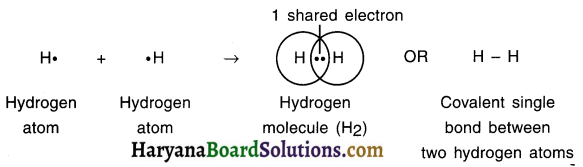
HBSE 10th Class Science Important Questions Chapter 4 Carbon and Its Compounds 1
5. The electron pair that takes part in sharing is called bonding electron pair or bond electron pair.

6. The single line between two hydrogen atoms represent single covalent bond.

Question 6.
Explain covalent bonding in chlorine molecule.
Answer:
1. The atomic number of chlorine is 17 and so its electronic configuration is (2, 8, 7).
2. The chlorine atom will share the electron of its outermost orbit to attain the closed octet configuration of nearby inert gas.
3. Each chlorine atom requires one electron to attain octet configuration.
4. Hence, two chlorine atoms will share one-one electron with each other, form a single covalent bond, will attain octet configuration and form chlorine molecule.
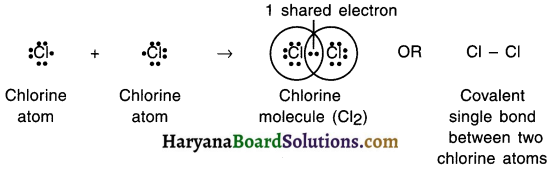
HBSE 10th Class Science Important Questions Chapter 4 Carbon and Its Compounds 2
Question 7.
Explain covalent bonding in oxygen. OR Explain covalent double bond with the help of an example.
Answer:
1. The atomic number of oxygen is 8 and so its electronic configuration is (2, 6).
2. Since the valency of oxygen is 2, each oxygen atom will share 2 electrons from its outermost orbit to complete the octet configuration.
3. Hence, two oxygen atoms will share two-two electrons with each other, form double covalent bond, will attain octet configuration and will form one oxygen (O2) molecule.
4. Because of the double covalent bond, this compound is called divalent compound.
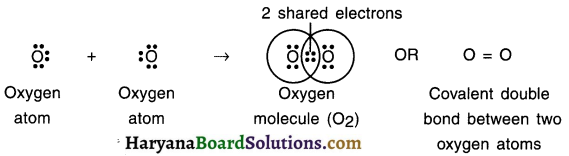
HBSE 10th Class Science Important Questions Chapter 4 Carbon and Its Compounds 3
The double line between two oxygen atoms represent double covalent bond.

HBSE 10th Class Science Important Questions Chapter 4 Carbon and Its Compounds

Question 8.
Explain covalent bonding in nitrogen. OR Explain covalent triple bond with the help of an example.
Answer:
1. The atomic number of nitrogen is 7 and so its electronic configuration is (2, 5).
2. Since the valency of nitrogen is 3, each nitrogen atom will share 3 electrons from its outermost orbit to complete octet configuration.
3. Hence, two nitrogen atoms will share three-three electrons with each other, form triple covalent bond, attain octet configuration and form nitrogen molecule.
4. Because of the triple covalent bond, this compound is called trivalent compound.
HBSE 10th Class Science Important Questions Chapter 4 Carbon and Its Compounds 4

Question 9.
Explain the formation of covalent bonds in water molecule (H2O).
Answer:
1. Oxygen is a central atom in the molecule of water. The atomic number of oxygen is 8,
so its electronic configuration is (2, 6)
2. Thus, oxygen has 6 electrons in its L shell and it needs two more electrons to fill the L shell.
3. The atomic number of hydrogen is 1 and so hydrogen atom possesses 1 electron in its K shell.
4. Oxygen shares two of its valence electrons with one electron each of K shell of two hydrogen atoms to form a molecule of water (H2O).
5. This way oxygen atom of water attains the electronic configuration of its nearest noble gas neon (Ne), while hydrogen atom attains the electronic configuration of its nearest noble gas helium (He) which has two electrons in its K shell.
HBSE 10th Class Science Important Questions Chapter 4 Carbon and Its Compounds 5

HBSE 10th Class Science Important Questions Chapter 4 Carbon and Its Compounds

Question 10.
Explain covalent bonding in ammonia (NH3) molecule.
Answer:
1. Nitrogen is a central atom in the molecule of ammonia. The atomic number of nitrogen is 7, so its electronic configuration is (2, 5).
2. Nitrogen has five electrons in its L shell and so it needs three more electrons to fill the L shell.
3. Nitrogen shares three of its valence electrons with one electron each of K shell of three hydrogen atoms to form a molecule of ammonia (NH3).
4. Thus, nitrogen atom of ammonia attains the electronic configuration of its nearest noble gas neon (Ne), which has eight electrons in its L shell, while hydrogen atom attains the electronic configuration of its nearest noble gas helium (He), which has two electrons in its K shell.
HBSE 10th Class Science Important Questions Chapter 4 Carbon and Its Compounds 6

Question 11.
Explain covalent bonding in methane (CH4) molecule.
Answer:
1. Carbon is a central atom in the molecule of methane. The atomic number of carbon is 6, so its electronic configuration is (2, 5).
2. Thus, carbon has four electrons in its L shell and it needs four more electrons to fill the L shell.
3. Carbon shares its four valence electrons with one electron each of K shell of four hydrogen atoms to form a molecule of methane (CH4).
4. This way carbon atom of methane attains the electronic configuration of its nearest noble gas neon (Ne), which has eight electrons in its L shell, while hydrogen atom attains the electronic configuration of its nearest noble gas helium (He), which has two electrons in its K shell.
HBSE 10th Class Science Important Questions Chapter 4 Carbon and Its Compounds 7

Question 12.
State the properties of covalent compounds (or carbon compounds).
Answer:
Properties of covalent compounds (or carbon compounds):

  • Covalent compounds exists in all the three forms i.e. solid, liquid and gas.
  • They have weak force of attraction between the molecules.
  • They have lower melting and boiling points.
  • They are non-conductors of electricity.
  • Generally they are insoluble in water but soluble in organic solvents.

HBSE 10th Class Science Important Questions Chapter 4 Carbon and Its Compounds

Question 13.
How does carbon bond with other atoms of carbon? OR Explain catenation.
Answer:
(i) Catenation:

  • Carbon has a unique ability to bond with other atoms of carbon and form long chain. This unique
    property of carbon is called catenation.
  • Catenation results in formation of large molecules. Moreover, the ability of carbon to bond with several elements results in formation of a large number of carbon based compounds.

(ii) Bonding by carbon:

  • Carbon atom bonds with the help of three types of covalent bonds namely, single bond, double bond and triple bond.

(a) Single bond compound (Saturated compound):

  •  If carbon atom joins with another carbon atom with the help of only single bond then the compound formed is called a saturated compound.

(b) Double or triple bond (Un-saturated compound):

  • If carbon atom joins with other carbon atoms via, double or triple bond, then the compounds formed are called unsaturated compounds.
  • The carbon-carbon bond is very strong and hence stable. This gives rise to a large number of compounds with several carbon atoms linked with each other.

(iii) The structures formed by the three types of covalent bonds of carbon can be of the following types:

  • Normal chain,
  • Branched (Iso) chain or
  • Cyclic chain

HBSE 10th Class Science Important Questions Chapter 4 Carbon and Its Compounds

Question 14.
Why is carbon called tetravalent? How does It help carbon to bond?
Answer:
The valency of carbon is 4, ie. carbon has 4 electrons in its outermost shell. Hence, carbon is called tetravalent.
1. Since the valency of carbon is 4, it is capable of bonding with four other atoms of carbon or some mono-valent atoms i.e. atoms having one valency.
2. This way, carbon forms compounds with oxygen, hydrogen, nitrogen, sulphur, chlorine and many other elements and gives rise to several compounds.

Question 15.
State the two important properties of carbon that help it to form a large number of compounds.
Answer:
The two important properties of carbon that help it to form a large number of compounds are:
(1) Catenation:

  • Carbon has a unique ability to bond with other atoms of carbon and form long chain. This unique property of carbon is called catenation.
  • Catenation results in formation of large molecules. Moreover, the ability of carbon to bond with several elements results in formation of a large number of carbon based compounds.
  • Carbon atom bonds with the help of three types of covalent bonds namely, single bond, double bond and triple bond.

(2) Tetravalency:

  • The valency of carbon is 4, i.e. carbon has 4 electrons in its outermost shell. Hence, carbon is called tetravalent.
  • Since the valency of carbon is 4, it is capable of bonding with four other atoms of carbon or some mono-valent atoms i.e. atoms having one valency.
  • This way, carbon forms compounds with oxygen, hydrogen, nitrogen, sulphur, chlorine and many other elements and gives rise to several compounds.

(3) Other reasons:

  • Carbon forms very strong bonds with other elements and so the compounds formed are extremely stable.
  • No other element shows the property of catenation to the extent of carbon.

Question 16.
What are hydrocarbons? How are they classified?
Answer:
Hydrocarbons:

  • Compounds containing hydrogen and carbon are called hydrocarbons.
  • In organic chemistry, hydrocarbons are considered to be the simplest organic compounds.

Classification of hydrocarbons:

  • Hydrocarbons are classified on the basis of the number of covalent bonds between carbon-carbon atoms.
  • Thus, on the basis of covalent bonds, hydrocarbons can be classified as—

(I) Saturated hydrocarbons:

  • Hydrocarbons having single covalent bonds between their carbon atoms are called saturated hydrocarbons.
  • Alkanes are the main class of saturated hydrocarbons.

HBSE 10th Class Science Important Questions Chapter 4 Carbon and Its Compounds

Question 17.
Give a classification of hydrocarbons. OR Differentiate between saturated and unsaturated hydrocarbons.
Answer:
Hydrocarbons can be classified into —
(i) Saturated hydrocarbons and
(ii) Unsaturated hydrocarbons

Saturated hydrocarbons

Unsaturated hydrocarbons

These hydrocarbons have single covalent bond between their carbon atoms.These hydrocarbons have either double or triple covalent bonds between their carbon atoms.
Alkanes are the main class of saturated hydrocarbons.Unsaturated hydrocarbons have two sub-types namely,
(1) Alkenes and (2) Alkynes.
Alkanes have single covalent bonds between their carbon atoms.Alkenes have double where as alkynes have triple covalent bonds between their carbon atoms.
Hydrocarbons under alkanes have suffix ‘ane’.Hydrocarbons under alkenes have suffix ‘ene’ and those under alkynes have suffix ‘yne’.
Methane, propane, butane, etc. are alkanes.Ethene, propene, butene, etc. are alkenes where as ethyne, propyne, butyne, etc. are alkynes.
General formula of alkanes is CnH2n+2 where n no. of carbon atoms.General formula of alkenes is CnH2n and that of alkynes is CnH2n-2 where, n = no. of carbon atoms.

Question 18.
Give the molecular, electronic and structural formula of methane
Answer:
1. Methane is the first member of the alkane series hydrocarbon.
2. Molecular formula, electronic formula and structural formula of methane are as under.
HBSE 10th Class Science Important Questions Chapter 4 Carbon and Its Compounds 8

Question 19.
With the help of the example of ethane, show how to draw the structure of a hydrocarbon.
Answer:
1. Ethane is a hydrocarbon formed by joining carbon and hydrogen.
2. The molecular formula of ethane is C2H6.

HBSE 10th Class Science Important Questions Chapter 4 Carbon and Its Compounds

Steps to draw the structure:

Step-1:
1. Since ethane is a saturated hydrocarbon, it will have a single covalent bond. First we link two carbon atoms by single bond.
2. Here, one valency of carbon is used. Now, three valencies are to be filled.

C – C

Step-2:
1. We now attach hydrogen atoms with carbon to satisfy remaining three valencies of carbon. This gives us the following structure.
2. Each carbon atom is bonded by a single covalent bond with carbon as well as hydrogen. So, all the valencies are filled and the structure is completed.
HBSE 10th Class Science Important Questions Chapter 4 Carbon and Its Compounds 9

Question 20.
Draw the electron dot structure of ethane.
Answer:
HBSE 10th Class Science Important Questions Chapter 4 Carbon and Its Compounds 10

Question 21.
Give the molecular, electronic and structural formula of ethene.
Answer:
Molecular, electronic and structural formula of ethene are as under —
HBSE 10th Class Science Important Questions Chapter 4 Carbon and Its Compounds 11

Question 22.
Give the molecular formula of ethyne and draw its electronic structure and bond structure.
Answer:
Ethyne (Acetylene):
1. Ethyne is the first member of the alkyne series.
2. Its molecular, electronic and structural formula are as follows —

HBSE 10th Class Science Important Questions Chapter 4 Carbon and Its Compounds 12

HBSE 10th Class Science Important Questions Chapter 4 Carbon and Its Compounds

Question 23.
Give formula and structure of first six alkanes
Answer:
Formula and structure of first six alkanes
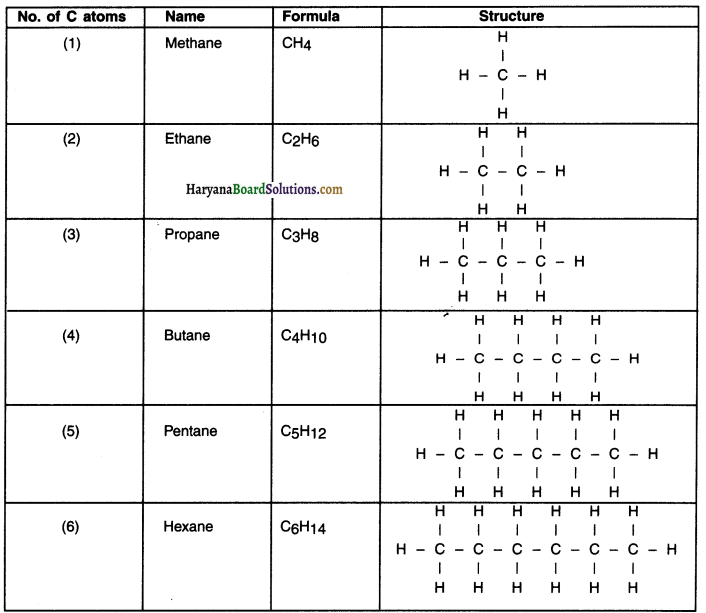
HBSE 10th Class Science Important Questions Chapter 4 Carbon and Its Compounds 13

Question 24.
Explain Isomers and Isomerism.
Answer:
Isomers and Isomerism:
1. Property of catenation possessed by carbon gives rise to a large number of compounds with different structural formula and different physical properties.

2. Organic compounds that have same molecular formula but different structural formula are called isomers and the phenomenon is called isomerism.

3. ‘Iso’ indicates a branched chain whereas normal (-n) Indicates a straight chain structure.

4. As the number of carbon atoms increase in a chain, the number of isomers also increase.

5. For example, butane (C4H10) has only two isomers whereas hexane (C6-H14) has five isomers.

Example of ‘n’ i.e. normal and ‘iso’ i.e. branched structured hydrocarbons:
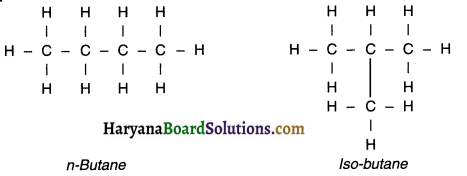
HBSE 10th Class Science Important Questions Chapter 4 Carbon and Its Compounds 14

Question 25.
State the characteristics of isomers.
Answer:
Characteristics of isomers:

  • Isomers have same molecular formula but different structural formula.
  • Isomers have different melting and boiling points.
  • They have different chemical properties.

HBSE 10th Class Science Important Questions Chapter 4 Carbon and Its Compounds

Question 26.
Explain the classification of hydrocarbon compounds based on their different structures.
Answer:
On the basis of their structures (arrangement of carbon atoms), hydrocarbon compounds can be classified into following three categories:
(a) Straight chain compounds,
(b) Branched chain compounds
(c) Ring structures OR Cyclic compounds

(a) Straight chain compounds:
Hydrocarbon compounds in which all carbon atoms are arranged linearly i.e. in a straight chain are called straight chain compounds.

For example, propane (C3H8):
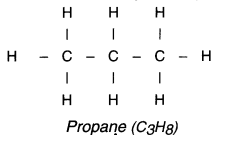
HBSE 10th Class Science Important Questions Chapter 4 Carbon and Its Compounds 15

Branched chain compounds:

A hydrocarbon compound in which carbon atoms are arranged in straight chain, as well as possess one or more branches is called a branched chain compound.
For example, Carbon-skeleton of four carbon atoms of butane can be arranged in two different possible ways as follows:

HBSE 10th Class Science Important Questions Chapter 4 Carbon and Its Compounds 16

Now, when we satisfy the remaining valencies of carbon with hydrogen we get the following structures:
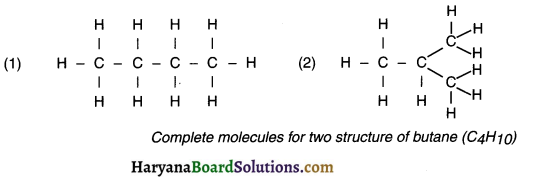
HBSE 10th Class Science Important Questions Chapter 4 Carbon and Its Compounds 17

(c) Ring structure OR Cyclic compounds:
Hydrocarbon compounds in which the first carbon atom is directly linked with the end (last) carbon atom, forming ring or cyclic structures are called ring structures or cyclic compounds. For example, cyclohexane (C6H12).
HBSE 10th Class Science Important Questions Chapter 4 Carbon and Its Compounds 18

Question 27.
Is cyclohexane an isomer of hexane? Explain with reason.
Answer:
1. No. The molecular formula of hexane is C6H14 whereas that of cyclohexane is C16H12.
2. Since the molecular formula of cyclohexane is different than hexane it, is not the isomer of hexane.

Question 28.
Draw the structure of benzene.
Answer:
The molecular formula of benzene is C6H6.
HBSE 10th Class Science Important Questions Chapter 4 Carbon and Its Compounds 19

Question 29.
What are cyclic hydrocarbons? Draw structure of two cyclic hydrocarbons.
Answer:
Ring structure OR Cyclic compounds:
Hydrocarbon compounds in which the first carbon atom is directly linked with the end (last) carbon atom, forming ring or cyclic structures are called ring structures or cyclic compounds. For example, cyclohexane (C6H12).
HBSE 10th Class Science Important Questions Chapter 4 Carbon and Its Compounds 18

The molecular formula of benzene is C6H6.

HBSE 10th Class Science Important Questions Chapter 4 Carbon and Its Compounds 19

Question 30.
What are heteroatoms? Explain.
Answer:
Heteroatom:
1. Apart from hydrogen, carbon forms bonds with other elements as well.

2. The atom or group of atoms of an element that replaces hydrogen in a hydrocarbon is called an heteroatom.

3. Oxygen (O), nitrogen (N), sulphur (S), halogens such as fluorine (F), chlorine (Cl), bromine (Br) and iodine (I)) are typical heteroatoms that replace hydrogen.
HBSE 10th Class Science Important Questions Chapter 4 Carbon and Its Compounds 20

HBSE 10th Class Science Important Questions Chapter 4 Carbon and Its Compounds

Question 31.
What are functional groups? Explain.
Answer:
Functional groups:
1. A heteroatom (i.e. an atom or a group of atoms) which imparts specific properties to the organic compound they are attached to is called a functional group. (Note: When an heteroatom attaches to an organic compound, the physical and chemical properties of that compound changes. The heteroatom which Is responsible for changes in these properties Is called functional group.)

2. Thus, the functional group decides the physical and chemical properties of the carbon compound, irrespective of the length of the carbon chain.

3. There are several functional groups. Some of them are listed in the table below.
HBSE 10th Class Science Important Questions Chapter 4 Carbon and Its Compounds 21

Question 32.
Explain how does the name of an organic compound changes when a functional got is attached to it
Answer:
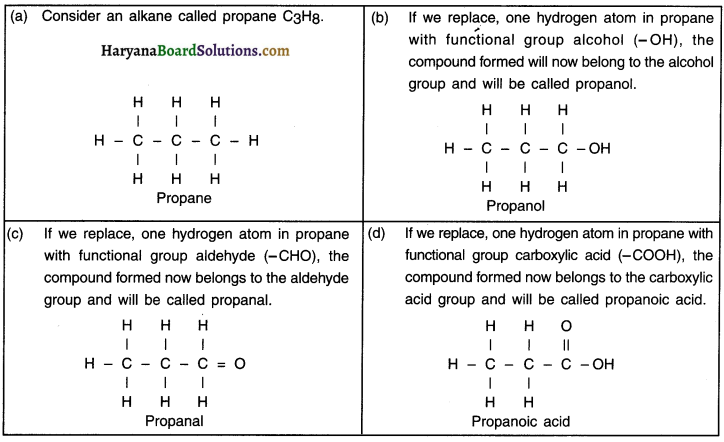
HBSE 10th Class Science Important Questions Chapter 4 Carbon and Its Compounds 22

Question 33.
“The number of carbon atoms in ethane, ethanol and ethanoic acid are same, yet all the three compounds show different physical and chemical properties”. Explain.
Answer:
1. Ethane is an alkane and its formula is C2H6.

2. When functional group hydroxyl – OH attach to ethane, the compound formed is ethanol or ethyl alcohol and its formula is C2H5OH. Similarly, when functional group carboxylic acid – COOH attach to ethane, the compound formed is ethanoic acid which is an acid and its formula is CH3COOH.

3. In a hydrocarbon, the functional group changes the physical and chemical properties of the compound.

4. Now, although the number of carbon atoms in all the three compounds i.e. ethane, ethanol and ethanoic acid are same, yet all the three compounds show different physical and chemical properties because ethane has no functional group, ethanol contains functional group alcohol whereas ethanoic acid consists of another functional group called carboxylic acid.

HBSE 10th Class Science Important Questions Chapter 4 Carbon and Its Compounds

Question 34.
What do you mean by homologous series? Give its characteristics.
Answer:
Homologous series:
1. The series of organic compounds in which a particular functional group attaches to the carbon chain in place of hydrogen atom is called a homologous series.
2. Each compound of the homologous series differs from its previous or later compound by (CH2).
3. For example, the alkanes namely methane (CH4), ethane (C2H6), propane (C3H8) and so on form a homologous series with a definite difference of CH2.
4. Similarly, CH3OH, C2H5OH, C3H7OH is the homologous series of alcohols with functional group – OH and with a definite difference of CH2 between each compound.

Question 35.
State the characteristics of homologous series.
Answer:
Characteristics of homologous series:
1. Each member of the homologous series contains same elements as well as same functional group.

2. Each member of the homologous series can be expressed by a general formula. For example, general formula of alkane series of hydrocarbc,s is CnH2n+2.

3. The difference in molecular formula between two successive members of the series of homologous compounds is CH2.

4. Same prefix or suffix is applied to the nomenclature of each member of the series. For e.g., suffix sane’ is put to each member of the alkane series.

5. Difference between molecular masses of any two successive members of the series is 14u.

6. As the number of carbon and hydrogen increases in the series, the molecular mass of the compound also increases.

  • As the molecular mass of the compound increases, the physical properties such as boiling point, melting point, solubility, etc. also change gradually.

7. The chemical properties of each compound of a homologous series remain same.

Question 36.
What is IUPAC name?
Answer:
IUPAC names:
1. Organic compounds or hydrocarbons have two names, (a) Common name and (b) IUPAC name.

2. IUPAC names are names given by IUPAC (Note: IUPAC = International Union of Pure and Applied Chemistry. These names are also called JUPAC nomenclature.)
Example: Methyl alcohol is an alcohol formed from methane. Methyl alcohol is a general (common) name where as methanol is its IUPAC name.

Question 37.
State the method to name the carbon compounds (hydrocarbons). OR Explain nomenclature of organic compounds.
Answer:
Nomenclature of organic compounds:
(Note: The number of carbon atoms in a hydrocarbon (or any other organic compound) is indicated by using following steps. The table is only for understanding purpose. Actual answer starts after the table.)

No. of carbon atoms

Representation
1 — Carbon atom is indicated by writing:
2 — Carbon atoms are indicated by writing:
3 — Carbon atoms are indicated by writing:
4 — Carbon atoms are indicated by writing:
5 — Carbon atoms are indicated by writing:

‘Meth’
‘Eth’
Prop
‘But’
‘Pent’

Steps for naming:
The names of compounds in homologous series are based on the name of the basic carbon chain which are modified by either a ‘prefix’ or a ‘suffix’ of the functional group.

(i) Identify the ‘number of carbon atoms’ in the compound. (Note: Refer the note above. Based on it, lets say a carbon compound has 3 carbon atoms, then its prefix would be ‘prop’.)

  • If the compound is a saturated hydrocarbon with 3 carbon atoms and without any functional group, it will belong to alkane series and its name would be prop + ane = propane.

(ii) If there is a functional group present, it will be indicated with either a prefix or a suffix. For example, C3H7OH has 3 carbon atoms and has a functional group ‘-OH’ i.e. alcohol. So name of the compound is propanol.

(iii) As discussed in point (ii) if the name of the functional group is to be given as suffix, the name of the carbon chain is modified by replacing the last letter ‘e’ with proper suffix. For example, a 3-carbon chain with a ketone functional group would be named in the following manner:
Propane = Propan + ‘one’ = Propanone.

HBSE 10th Class Science Important Questions Chapter 4 Carbon and Its Compounds

(iv) If the carbon chain is unsaturated (i.e. having double or triple covalent bond), the final ‘ane’ in the name of carbon chain is replaced by ‘ene’ or ‘yne’.
For example, a 3-carbon chain with a propene bond would be called propene and if it has a triple bond, it will be called propyne.

Nomenclature of Organic Compounds based on Functional Groups:
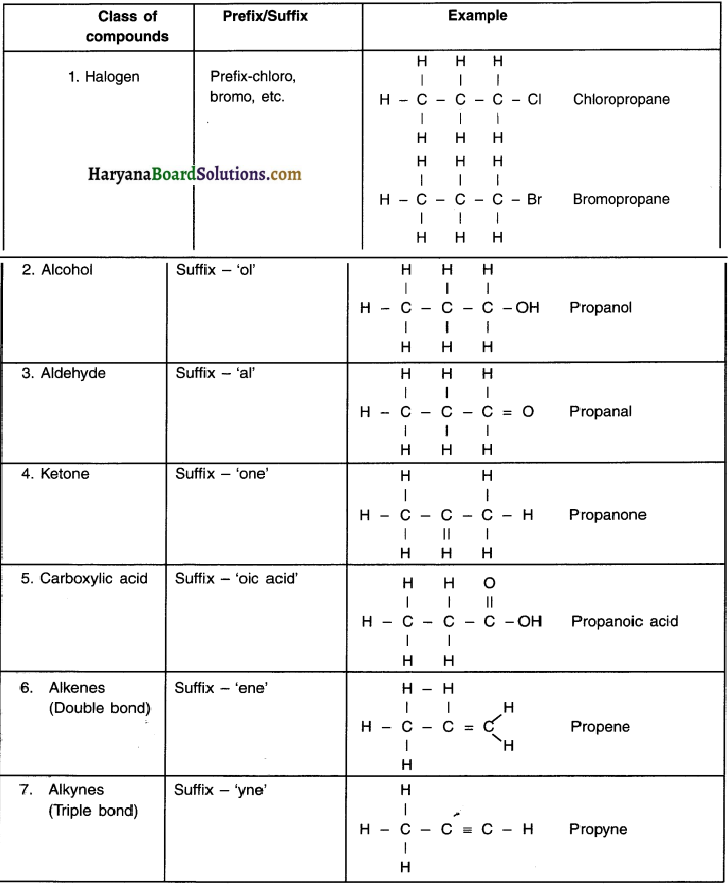
HBSE 10th Class Science Important Questions Chapter 4 Carbon and Its Compounds 28

Question 38.
Discuss chemical properties of carbon compounds briefly.
(Note: Each property can be asked as a separate question.)
Answer:
Chemical properties of carbon compounds:
(i) Combustion:
Carbon present in all its allotropes burn in sufficient amount of oxygen. On burning, it produces carbondioxide and water and liberate heat and light. These reaction are oxidation reactions.

HBSE 10th Class Science Important Questions Chapter 4 Carbon and Its Compounds 29

(ii) Oxidation:

  • Oxidation is the reaction in which carbon compounds take up oxygen in the presence of oxidizing agents to give another compound.
  • There are certain substances which are capable of adding oxygen to others i.e. adding oxygen to reactants. Such materials are called oxidizing agents.
  • HBSE 10th Class Science Important Questions Chapter 4 Carbon and Its Compounds

Example:
Ethanol (ethyl alcohol) gets oxidized into ethanoic acid (i.e. a carboxylic acid) in the presence of oxidizing agent alkaline potassium permanganate or acidified potassium dichromate.

HBSE 10th Class Science Important Questions Chapter 4 Carbon and Its Compounds 30

(iii) Addition (Hydrogenation) reaction:

  • A reaction in which adding one molecule to an organic compound gives a new but single organic compound is called addition reaction.
  • For example, on adding hydrogen to an unsaturated (alkene or alkyne) hydrocarbon in the presence of catalyst such as palladium or nickel gives a single but saturated (alkane) product. This reaction is called addition reaction.

(1) Addition reaction In alkenes:
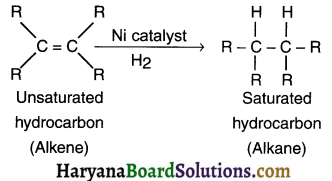
HBSE 10th Class Science Important Questions Chapter 4 Carbon and Its Compounds 31

(2) Addition reaction in alkynes:

HBSE 10th Class Science Important Questions Chapter 4 Carbon and Its Compounds 32

(iv) Substitution reaction:

  • A reaction in which one or more hydrogen atoms of a hydrocarbon are substituted (replaced) by some other atom(s) (such as chlorine) is called a substitution reaction.
  • Actually saturated hydrocarbons are quite unreactive and remain inert in the presence of most reagents. However, in the presence of sunlight, these compounds ie. alkanes undergo substitution reaction.

Example:
Methane (an alkane) reacts with chlorine in the presence of sunlight to form chloromethane and hydrochloric acid. In this reaction, one hydrogen (H) atom of methane gets substituted by a chlorine (Cl) atom. This converts CH4 into CH3Cl.

HBSE 10th Class Science Important Questions Chapter 4 Carbon and Its Compounds 33
The way chlorine replaced one hydrogen atom from methane, it rapidly replaces each hydrogen atom with chlorine atom one by one.

Question 39
Give an example of addition reaction along with necessary chemical reaction.
Answer:
When hydrogen is added to ethene (an unsaturated hydrocarbon) and heated in the presence of nickel catalyst it gives a single saturated product ethane.

HBSE 10th Class Science Important Questions Chapter 4 Carbon and Its Compounds 35

Question 40.
State the non difference between combustion and oxidation. OR ‘All combustion reactions are also oxidation reactions but, the reverse is not true.
Answer:
1. During combustion, a carbon compound is burnt in the air to give out carbon dioxide and water and liberate heat and light.
2. During oxidation the carbon compounds take up oxygen in the presence of oxidizing agents to give another carbon compound. Hence, all combustion reactions are also oxidation reactions but, the reverse is not true.

HBSE 10th Class Science Important Questions Chapter 4 Carbon and Its Compounds

Question 41.
What is hydrogenation of oils? OR How ¡s vegetable ghee prepared from vegetable oil? OR Explain addition reaction giving example of vegetable oil.
(Note: Hydrogenetaion = Addition of hydrogen)
Answer:
1. Vegetable oils have long unsaturated fats having double bonds between sorne of their carbon atoms.
2. When a vegetable oil (like groundnut oil) is heated with hydrogen gas in the presence of nickel catalyst, the oil turns into a saturated fat called vegetable ghee or say naspati ghee. This reaction is known as hydrogenation of oils.
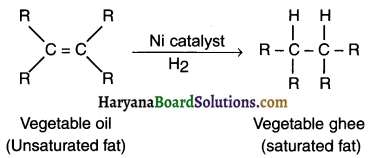
HBSE 10th Class Science Important Questions Chapter 4 Carbon and Its Compounds 36
Vegetable oil is in liquid form which after hydrogenation turns into semi-solid ghee.

Question 42.
What is ethanol? State its properties.
Answer:
Ethanol: Ethanol is the second member of the homologous series of alcohol. Its formula is C2H2OH.
Ethanol or ethyl alcohol is the most common and most widely used alcohol and hence is also simply called alcohol.

Properties:

  • At room temperature it exists in the liquid form.
  • Ethanol is a very good solvent. It is soluble in water in any proportion.

Question 43.
State the uses and abuses of ethanol.
Answer:
Uses of ethanol:

  • Ethanol is the active ingredient of all alcoholic drinks.
  • Ethanol is a good solvent and so it is also used to make medicines such as tincture iodine, cough syrups and several other tonics.

Abuses:

  • Consuming pure (undiluted) ethanol even in a small quantity can prove lethal.
  • Consuming diluted ethanol that too in small quantity causes drunkenness.
  • People fall prey and addicted to alcoholic dnnks. This ruins individual health, family and society at large.

HBSE 10th Class Science Important Questions Chapter 4 Carbon and Its Compounds

Question 44.
State reactions (chemical properties) of ethanol.
Answer:
Reactions of ethanol:
(i) Reactions with sodium:
Ethanol reacts with sodium and produces sodium ethoxide along with evolution of hydrogen gas.

HBSE 10th Class Science Important Questions Chapter 4 Carbon and Its Compounds 39

(ii) Dehydration:

  • When ethanol is heated with excess concentrated sulphuric acid at 443 K, it gets dehydrated to form ethene.
  • The concentrated sulphuric agent works as a dehydrating agent which removes water from ethanol.

HBSE 10th Class Science Important Questions Chapter 4 Carbon and Its Compounds 40

Question 45.
What is ethanoic acid? State its physical properties.
Answer:
Ethanoic acid:

  • Ethanoic acid is the second member of the homologous series of carboxylic acids.
  • Its formula is CH3COOH. The common name of ethanoic acid is acetic acid.

Properties of ethanoic acid:

  • Ethanoic acid is a weak acid.
  • It is sour in taste. 5-8% solution of ethanoic (acetic) acid in water is called vinegar. Vinegar is widely used as preservative in pickles and in preparation of certain food items.
  • The melting point of pure ethanoic acid is 290 K i.e. just nearly 17° Celsius. As a result, it often freezes in winter.
  • The frozen form of ethanoic acid looks like solid ice or say ‘glacier’. Hence, it is also called ‘glacial acetic (or ethanoic) acid’

Question 46.
Discuss the chemical properties (reactions) of ethanoic acid.
Answer:
Chemical properties (reactions) of ethanoic acid:
(i) Esterification reaction:

  • When acid reacts with alcohols in the presence of little amount of concentrated sulphuric acid, the reaction produces esters. This reaction is called esterification reaction.
  • Ester is a sweet smelling substance.
  • When ethanoic acid reacts with ethanol in the presence of concentrated sulphuric acid, ester is produced.

HBSE 10th Class Science Important Questions Chapter 4 Carbon and Its Compounds 42

(ii) Reaction with base Le. alkali (Saponification reaction):
When the ester formed in above reaction is heated with sodium hydroxide (a base) solution then the ester breaks down to give back original alcohol Le. ethanol and sodium salt of the carboxylic acid.

This reaction is called saponification because ills used in making soap.

HBSE 10th Class Science Important Questions Chapter 4 Carbon and Its Compounds 43

(iii) Reaction with carbonates and hydrogencarbonates:
Ethanoic acid reacts with carbonates and hydrogen carbonates to produce salt, carbon dioxide and water. The salt produced is commonly called sodium acetate.
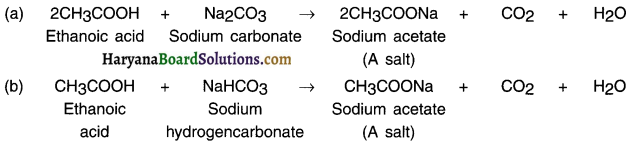
HBSE 10th Class Science Important Questions Chapter 4 Carbon and Its Compounds 44

Question 47.
What is esterification?
Answer:
Esterification reaction:

  • When acid reacts with alcohols in the presence of little amount of concentrated sulphuric acid, the reaction produces esters. This reaction is called esterification reaction.
  • Ester is a sweet smelling substance.
  • When ethanoic acid reacts with ethanol in the presence of concentrated sulphuric acid, ester is produced.

HBSE 10th Class Science Important Questions Chapter 4 Carbon and Its Compounds 42

Question 48.
What Is an ester? State Its properties.
Answer:
1. Ester is a sweet smelling substance.
2. It is used in making perfumes and as a flavouring agent.
3. On treating ester with sodium hydroxide (a base alkali), the ester converts back to alcohol and sodium salt of carboxylic acid. This reaction is called the saponification process.

HBSE 10th Class Science Important Questions Chapter 4 Carbon and Its Compounds

Question 49.
How does ethanoic acid react with alkali? OR What is saponification? State its reaction.
Answer:
Reaction with base Le. alkali (Saponification reaction):
When the ester formed in above reaction is heated with sodium hydroxide (a base) solution then the ester breaks down to give back original alcohol Le. ethanol and sodium salt of the carboxylic acid.

This reaction is called saponification because ills used in making soap.
HBSE 10th Class Science Important Questions Chapter 4 Carbon and Its Compounds 43

Question 50.
State and explain chemical reaction of ethanoic acid with carbonates and hydrogencarbonates.
Answer:
Reaction with carbonates and hydrogencarbonates:
Ethanoic acid reacts with carbonates and hydrogen carbonates to produce salt, carbon dioxide and water. The salt produced is commonly called sodium acetate.

HBSE 10th Class Science Important Questions Chapter 4 Carbon and Its Compounds 44

Question 51.
What is soap? Draw and explain the structure of its molecule.
Answer:
Soap:
1. A molecule of soap is a sodium or potassium salt of long chain carboxylic acid.
2. Each long chain soap molecule is made up of two parts. They are —

  • a polar head and
  • a polar tail.

The polar head (Hydrophilic end): It is made up of functional group sodium carboxylate ( – COONa). It is ionic ¡n nature. Moreover, it is hydrophilic which means it attracts water (or say dissolves in water).

The non-polar tail (Hydrophobic end): It is a long hydrocarbon chain. It is not ionic. It is hydrophobic which means it repels water (but dissolves in oil) or say dirt.
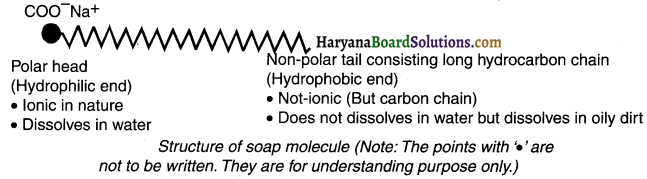
HBSE 10th Class Science Important Questions Chapter 4 Carbon and Its Compounds 45

Question 52.
What are detergents? Explain their molecular structure.
Answer:
Detergents:

  • Detergent is a chemical substance used for cleaning purposes.
  • A molecule of detergent is ammonium or sulphonate salt of long chain carboxylic acid.
  • In detergent, the functional group sodium sulphonate (-SO3Na) is attached to the long chain of hydrocarbon.
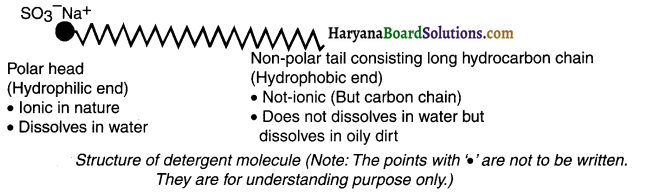
HBSE 10th Class Science Important Questions Chapter 4 Carbon and Its Compounds 46

HBSE 10th Class Science Important Questions Chapter 4 Carbon and Its Compounds

Question 53.
How does a soap cleans the dirt from clothes? Explain.
Answer:
Cleansing action of soap:
1. When soap is added in water that has dirty clothes —

  • The polar head (hydrophilic or ionic end) of the soap molecule dissolves in water whereas the
  • The non-polar tail (hydrophobic end) dissolves in oily dirt.
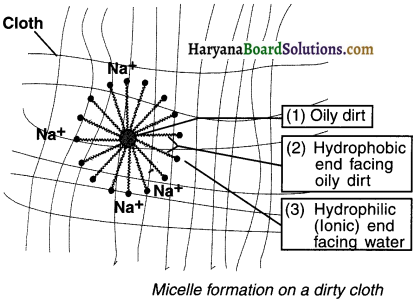
HBSE 10th Class Science Important Questions Chapter 4 Carbon and Its Compounds 47

2. The soap molecule dissolves and get arranged in a systematic orientation where in the head portion faces towards the water and the tail faces the dirt. Due to this orientation, the oily dirt will get trapped at the centre of the micelle. Such patterns having ring like structures are called micelles and the process is known as micelle formation.

3. The micelles capture the dirt particles within their rings and suspend them in water. Finally, when we brush and rub the clothes, the dirt gets removed from the clothes.

Question 54.
How are micelles formed?
Answer:
1. When soap is added in water that has dirty clothes —

  • The polar head (hydrophilic or ionic end) of the soap molecule dissolves in water whereas the
  • The non-polar tail (hydrophobic end) dissolves in oily dirt.

2. The soap molecule dissolves and get arranged in a systematic orientation where in the head portion faces towards the water and the tail faces the dirt. Due to this orientation, the oily dirt will get trapped at the centre of the micelle. Such patterns having ring like structures are called micelles and the process is known as micelle formation.

Question 55.
What is the advantage of detergent over soap? OR Use of detergent has increased compared to washing soap. Give reason. OR The limitations of soap ¡s overcome by a detergent. Explain.
Answer:
1. Hard water contains calcium (Ca) and magnesium (Mg) salts.
2. When hard water is used during washing, the salts of Ca and Mg react with soap to form insoluble salts or say precipitates of Ca and Mg. Also called scum. The scum does not dissolve in water. Hence, more soap is used for cleaning.
3. On the other hand, detergent reacts with Ca and Mg salts of hard water and forms soluble salts of Ca and Mg. These salts remain in water and so very less amount of detergent is needed for washing.
4. Hence, the use of detergent has increased compared to washing soap.

Question 56.
Differentiate between soap and detergent.
Answer:

Soap

Detergent

Soaps are sodium salts of long chain of carboxylic (fatty) acids.Detergents are sodium salts of long chain of suIphonates.
The functional group in soap is COONa.The functional group in detergent is -SO3Na.
Soap forms insoluble precipitates with calcium and magnesium present in hard water.Detergent does not form insoluble precipitates with calcium and magnesium present in hard water.
Soap is not suitable for washing purposes when the water is hard.Detergent is suitable for washing purposes even if the water is hard.
Cleansing effect of soap is not as good as detergent.Cleansing effect of detergent is better than soap.

Question 57.
Functional groups play a key role in organic compounds. Give reason.
Answer:
1. An atom or a group of atoms responsible for chemical behaviour of the parent molecule is called a functional group.
2. Different molecules that contain same kind of functional group or groups undergo similar reactions.
3. By learning the properties of these functional groups, we can study and understand properties of many organic compounds.
4. As a result, functional groups play a key role in organic compounds.

Question 58.
In a homologous series, as you progress in the series, the physical properties change but chemical properties do not. Give reason.
Answer:
1. In a homologous series, as the series progresses, the number of carbon and hydrogen atoms increase. This means the molecular mass of every next compound in the series is more than the previous compound.

2. Physical properties such as boiling point, melting point, density, solubility, etc. are dependent on the molecular mass. Since, the molecular mass gradually increase in the series, the compounds show change in physical properties.

3. The chemical properties of any homologous series are determined by the functional group of the series. Since, all the compounds of a given series have the same functional group, the chemical properties of all the compounds remain same.

Question 59.
Write the names of the following compounds.
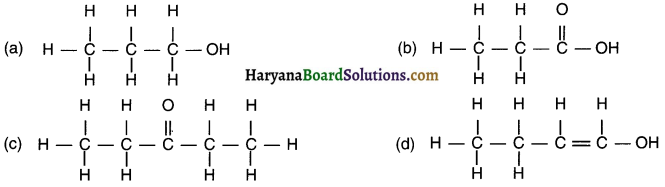
HBSE 10th Class Science Important Questions Chapter 4 Carbon and Its Compounds 48
Answer:
(a) This compound contains five carbon C atoms and  – COOH functional group. Hence, its name is Pentanoic acid.
Derivation of name: Remove ‘e’ from Pentane and add ‘oic acid’ for functional group – COOH = Pentanoic acid.

(b) This corn pound contains five carbon C atoms along with one triple bond. Hence, its name is Pentyne.
Derivation of name: Remove ‘e’ from Pentane and add ‘yne’ = Pentyne.

(c) This compound contains seven carbon C atoms and – CHO functional group. Hence, its name is Heptanal.
Derivation of name: Remove ‘e’ from Heptane and add ‘al’ for functional group – CHO = Heptanal.

(d) This compound contains five carbon C atoms and  – OH functional group. Hence, its name is Pentanol.
Derivation of name: Remove ‘e’ from Pentane and add ‘ol’ for functional group – OH = Pentanol.

Question 60.
Identify and name the functional groups present in the following compounds.
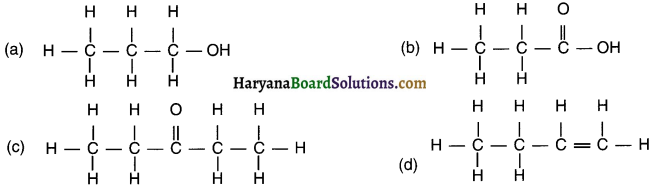
HBSE 10th Class Science Important Questions Chapter 4 Carbon and Its Compounds 49
Answer:
HBSE 10th Class Science Important Questions Chapter 4 Carbon and Its Compounds 50
HBSE 10th Class Science Important Questions Chapter 4 Carbon and Its Compounds 51

Question 61.
How can we differentiate between saturated and unsaturated hydrocarbons on the basis of combustion?
Answer:
1. Saturated hydrocarbons burn with a blue flame i.e. a clean flame which neither emits smoke nor leaves sooty deposit.
2. In unsaturated hydrocarbons, the percentage of carbon is higher. Hence, they burn in air producing a yellow sooty flame.
3. Thus, by studying the type of flame and the residue we can differentiate between saturated and unsaturated hydrocarbons.

HBSE 10th Class Science Important Questions Chapter 4 Carbon and Its Compounds

Question 62.
Why kerosene stove burns with a blue flame but a kerosene lantern with a yellow?
Answer:
1. The construction of stove is such that it allows oxygen-rich air to enter into the stove in sufficient quantity. So, the stove burns with a blue flame.
2. The lantern is covered with glass to prevent the flame from getting extinguished. Hence, there is limited supply of oxygen available to lantern and so it burns with a yellow flame.

Question 63.
A compound X ¡s formed by the reaction of a carboxylic acid C2H4O2 and an alcohol in presence of a few drops of H2SO4. The alcohol on oxidation with alkaline KMnO4 followed by acidification gives the same carboxylic acid as used in this reaction. Give the names and structures of (a) carboxylic acid, (b) alcohol and (c) the compound X. Also write the reaction.
Answer:
(a) Carboxyllc acid having molecular formula C2H4O2 is acetic acid (or ethanoic acid) Its structure is
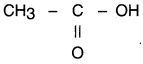
HBSE 10th Class Science Important Questions Chapter 4 Carbon and Its Compounds 52

(b) Since, an alcohol which on oxidation with alkaline KMnO4 followed by acidification gives ethanoic acid. it must be ethanol. Its structure is CH3CH2 – OH.
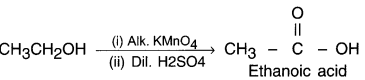
HBSE 10th Class Science Important Questions Chapter 4 Carbon and Its Compounds 53

HBSE 10th Class Science Important Questions Chapter 4 Carbon and Its Compounds 54

Question 64.
Which oil and ghee are good for health and which should be avoided?
Answer:
1. Vegetable oils containing unsaturated fat are good for health and hence should be used for cooking. Sun-flower oil, groundnut oil, etc. are some of them.
2. Vegetable ghee contains saturated fat and hence is not good for health.
3. Animal fats found in butter and desi ghee also contain saturated fats. But, they can be eaten in moderate quantity to maintain good health.

Question 65.
What happens when hydrogen atoms of methane are one by one replaced with chlorine atoms in the presence of sunlight?
Answer:
1. Formula of methane is CH4.
2. When one hydrogen is replaced by chlorine, we get chioromethane (CH3Cl), when two hydrogen are replaced by two chlorine atoms we get dichioromethane (CH2Cl2), when three hydrogen atoms are replaced by three chlorine atoms we get chloroform or carbon trichloride (C3Cl4). Finally, when four hydrogen atoms are replaced by four chlorine atoms, we get carbon tetrachioride (CCl4).

Question 66.
Consumption of alcohol should be avoided. Give reason.
Answer:
1. Consuming pure (undiluted) ethanol e. alcohol even in a small quantity can prove lethal.
2. Consuming diluted ethanol that too in small quantity causes drunkenness.
3. People fall prey and addicted to alcoholic drinks, This wins individual health, family and society at large.
4. Due to all these harmful effects, it is said that consumption of alcohol should be avoided.

Question 67.
Ethene is formed when ethanol at 443 K is heated with excess of concentrated sulphuric acid. What is the role of sulphuric acid in this reaction? Write the balanced chemical equation of this reaction.
Answer:
When ethanol is heated with excess of concentrated sulphuric acid at 443 K, it gets dehydrated to form ethene.

HBSE 10th Class Science Important Questions Chapter 4 Carbon and Its Compounds 55
Here, concentrated sulphuric acid acts as a dehydrating agent which removes water molecule from the ethanol molecule.

Question 68.
What is the role of metal or reagents written on arrows in the given chemical reactions?
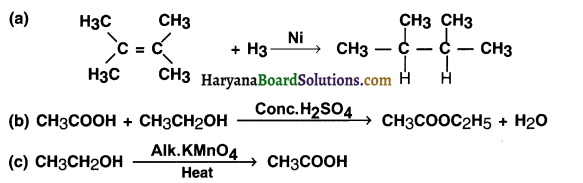
HBSE 10th Class Science Important Questions Chapter 4 Carbon and Its Compounds 56
Answer:
(a) Nickel (Ni) acts as the catalyst during the reaction.
(b) Conc. H2SO4 increases the rate of the forward reaction. In other words, conc. H2SO4 acts as a catalyst which works as a dehydrating agent.
(c) Alkaline KMnO4 acts as an oxidizing agent and oxidizes ethanol to ethanoic acid.

HBSE 10th Class Science Important Questions Chapter 4 Carbon and Its Compounds

Question 69.
Explain the given reactions with the examples.
(a) Hydrogenation reaction
(b) Oxidation reaction
(c) Substitution reaction
(d) Saponification reaction
(e) Combustion reaction
Answer:
(a) Hydrogen reaction:
Addition of hydrogen to the unsaturated molecule for making it saturated is known as hydrogenation.
Example:

HBSE 10th Class Science Important Questions Chapter 4 Carbon and Its Compounds 57

(b) Oxidation reaction:
The reactions in which an oxidizing agent supplies nascent oxygen for oxidation are called oxidation reactions.

HBSE 10th Class Science Important Questions Chapter 4 Carbon and Its Compounds 58

(c) Substitution reaction:
When one atom or a group of atoms replaces or substitutes another atom or a group of atoms from the molecule, It is known as substitution reaction.

HBSE 10th Class Science Important Questions Chapter 4 Carbon and Its Compounds 59

(d) Saponification reaction:
When esters are hydrolyzed in the presence of a base (NaOH) then the reaction is called saponification reaction.
Example: CH3COOCH3 + NaOH → CH3COONa + CH3OH

(e) Combustion reaction:
Organic compounds burn readily in air to form CO2 and water vapour along with lot of heat. Such a reaction is known as combustion reaction. Example: C2H5OH + 3O2 → 2CO2 + 3H2O + Energy

Very Short Answer Type Question :

Question 1.
State the atomic number of carbon and its electronic configuration.
Answer:
Atomic number Z = 6. Electronic configuration: K – 2, L – 4.

Question 2.
What defines the reactivity of an element?
Answer:
The tendency to lose or gain the electrons so as to complete the outer shell to attain noble gas configuration decides how reactive an element would be.

Question 3.
How does carbon bonds?
Answer:
Carbon shares its valence electrons with other carbon atoms or with atoms of other elements for joining purpose and attaining noble gas configuration. The bond formed while sharing is covalent bond.

Question 4.
What is a covalent bond?
Answer:
A chemical bond formed between two or more atoms by mutual sharing of valence electrons is known as a covalent bond.

Question 5.
Why is carbon called tetravalent?
Answer:
Since the valency of carbon is 4, it is called tetravalent (tetra = 4, valent = valency)

Question 6.
Which two important characteristics of carbon are responsible for formation of a very large number of carbon compounds?
Answer:
Catenation and tetravalency

Question 7.
In which forms is carbon available?
Answer:
In free state carbon occurs as diamond and graphite. In combined state, carbon occurs in the form of compounds such as CO2 in the air, carbonates, fossil fuels, etc.

Question 8.
Why covalent compounds have low melting and boiling point?
Answer:
Covalent bonds of compounds are weaker as compared to ionic bonds. Hence, in general, covalent compounds have lower melting and boiling points.

HBSE 10th Class Science Important Questions Chapter 4 Carbon and Its Compounds

Question 9.
Why covalent compounds are bad conductors of electricity?
Answer:
Compounds having covalent bonds do not have ions or free electrons that conduct electricity. Hence, covalent compounds do not form strong electrolytes and so they are not very good conductors of electricity.

Question 10.
What is the problem with silicon exhibiting catenation property?
Answer:
Silicon can show catenation property by forming compounds with hydrogen which have chains upto seven or eight atoms, but the problem is that these compounds are very reactive.

Question 11.
Draw the electron bond between two oxygen atoms.
Answer:

HBSE 10th Class Science Important Questions Chapter 4 Carbon and Its Compounds 61

Question 12.
In electron dot structure, the valence shell electrons are represented by crosses or dots.
(a) The atomic number of chlorine is 17. Write its electronic configuration
(b) Draw the electron dot structure of chlorine molecule.
Answer:
(a) Electronic configuration of Cl (17):
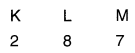
HBSE 10th Class Science Important Questions Chapter 4 Carbon and Its Compounds 68

(b) Electron dot structure of chlorine molecule:

HBSE 10th Class Science Important Questions Chapter 4 Carbon and Its Compounds 62

Question 13.
Define hydrocarbon. Give two examples.
Answer:
A compound macle up of only hydrogen and carbon is called hydrocarbon. Methane (CR4), ethane (C2H4), etc.

Question 14.
Define saturated hydrocarbons.
Answer:
Hydrocarbons having single covalent bonds between the carbon atoms are called saturated hydrocarbons. For example, methane, ethane, etc.

Question 15.
Define unsaturated hydrocarbons.
Answer:
Hydrocarbons having double or triple covalent bonds between the carbon atoms are called unsaturated hydrocarbons. For example, ethene and ethyne.

HBSE 10th Class Science Important Questions Chapter 4 Carbon and Its Compounds

Question 16.
What are alkanes? Give one example.
Answer:
Saturated hydrocarbons have single covalent bonds arid are called alkanes. For example, methane, ethane, etc.

Question 17.
Draw electron dot structure of ethane.
Answer:
Ethane (C2H6):
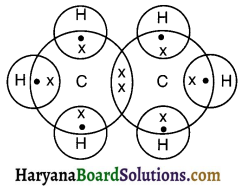
HBSE 10th Class Science Important Questions Chapter 4 Carbon and Its Compounds 63

Question 18.
Draw electron dot structure if ethene.
Answer:
Ethene (C2H4):
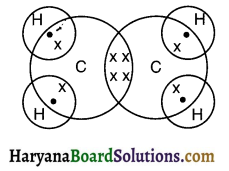
HBSE 10th Class Science Important Questions Chapter 4 Carbon and Its Compounds 64

Question 19.
What are alkenes and alkynes? Give one example.
Answer:
Unsaturated hydrocarbons have double or triple covalent bonds and are called alkenes and alkynes respectively. Ethane is alkene and ethyne is alkyne.

Question 20.
Which compound is shown here?
Answer:
Benzene
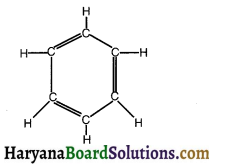
HBSE 10th Class Science Important Questions Chapter 4 Carbon and Its Compounds 65

Question 21.
Name the following structure.
Answer:
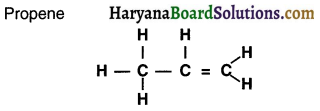
HBSE 10th Class Science Important Questions Chapter 4 Carbon and Its Compounds 66
Question 22.
What is heteroatom?
Answer:
In an organic compound, any atom other than carbon or hydrogen is known as heteroatom.

Question 23.
What Is a functional group?
Answer:
An atom or a group of atoms (i.e. heteroatoms) responsible for chemical behavior of the parent molecule is called a functional group.

Question 24.
Mention the functional group containing oxygen.
Answer:
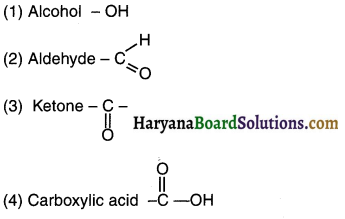
HBSE 10th Class Science Important Questions Chapter 4 Carbon and Its Compounds 67

Question 25.
What is homologous series?
Answer:
The series of organic compounds in which each compound differs from its previous or later compound by (CH2) is called homologous series.

HBSE 10th Class Science Important Questions Chapter 4 Carbon and Its Compounds

Question 26.
What is the difference between molecular masses of any two successive members of the homologous series? Why?
Answer:
Reason:The difference between two successive members of any homologous series is CH2. The atomic mass of carbon is 12 u and that of hydrogen is 1 u. So, the molecular mass of CH2 = 14 (12 x 1+1 x 2).

Question 27.
Why the physical properties of a compounds change as one moves in a homologous series?
Answer:
Physical properties are dependent on the molecular mass. Since, the molecular mass gradually increase in the series, the compounds show change in physical properties.

Question 28.
What do you mean by IUPAC names?
Answer:
Organic compounds or hydrocarbons have two names, (a) Common name and (b) IUPAC name. IUPAC names are names given by IUPAC i.e. International Union of Pure and Applied Chemistry. These names are also called IUPAC nomenclature.

Question 29.
Give common name and IUPAC name of any two compounds.
Answer:

Common nameIUPAC name
(1) Methyl alcohol
(2) Formic acid
Methanol
Methanoic acid

Question 30.
How is the alcohol group represented?
Answer:
R-OH

Question 31.
What are aldehydes and ketones?
Answer:
Aldehydes and ketones are organic compounds  having ( – CHO) and ( – C = O) respectively as their functional groups.

Question 32.
What are carboxylic acids?
Answer:
Organic compounds containing carboxyl (- COOH) groups as their functional group are called carboxylic acids.

Question 33.
Which compound is this:
HBSE 10th Class Science Important Questions Chapter 4 Carbon and Its Compounds 69
Answer:
Propanone

HBSE 10th Class Science Important Questions Chapter 4 Carbon and Its Compounds

Question 34.
List four important properties of carboncorn pounds.
Answer:
(1) Combustion
(2) Oxidation
(3) Addition reaction arid
(4) Substitution reaction

Question 35.
Define complete combustion as a property of carbon compounds.
Answer:
Carbon and all its allotropes burn completely insufficient amount of oxygen. This is known as complete combustion.

Question 36.
Give the reaction when carbon burns insufficient supply of oxygen.
Answer:

HBSE 10th Class Science Important Questions Chapter 4 Carbon and Its Compounds 70

Question 37.
Define oxidation of carbon compounds.
Answer:
Oxidation is the reaction in which carbon compounds take up oxygen in the presence of oxidizing agents to give another compound.

Question 38.
Define addition reaction.
Answer:
The reaction in which an unsaturated (alkene or alkyne) hydrocarbon combines with another substance to give a single but saturated (alkane) product is called addition reaction. Undergoing addition reaction is one of the properties of carbon compounds.

Question 39.
What is substitution reaction?
Answer:
The reaction in which one or more hydrogen atoms of a hydrocarbon are replaced by some other atoms (like chlorine) is called a substation reaction.

Question 40.
What is hydrogenation or hydrogenation of oils?
Answer:
When a vegetable oil (like groundnut oil) is heated with hydrogen in the presence of nickel catalyst, the oil turns into a saturated fat called vegetable ghee or say vanaspati ghee. This reaction is known as hydrogenation of oils.

Question 41.
State two uses of ethanol (alcohol).
Answer:
1. Ethanol is the active ingredient of all alcoholic drinks.
2. Ethanol is a good solvent and so it is also used to make medicines such as tincture iodine, cough syrups and several other tonics.

Question 42.
State the reaction of ethanol with sodium.
OR
A gas is evolved when ethanol reacts with sodium. Name the gas evolved and also write the balanced chemical equation of the reaction involved.
Answer:
Ethanol reacts with sodium and produces sodium ethoxide along with evolution of hydrogen gas.

HBSE 10th Class Science Important Questions Chapter 4 Carbon and Its Compounds 71

Question 43.
What is ethanoic acid?
Answer:
1. Ethanoic acid is the second member of the homologous series of carboxylic acids.
2. Its formula is CH3COOH. The common name of ethanoic acid is acetic acid.

HBSE 10th Class Science Important Questions Chapter 4 Carbon and Its Compounds

Question 44.
Why in few countries a mixture of water and alcohol is used instead of simply water in car radiators?
Answer:
Water freezes at O °C. So, in countries where temperature falls below O°C mixing alcohol with water brings down the freezing point and car radiator can function property.

Question 45.
What is esterification?
Answer:
When ethanoic acid reacts with alcohols in the presence of little amount of concentrated sulphuric acid, the reaction produces esters. This reaction is called esterification reaction.

Question 46.
What is saponification?
Answer:
When the ester (CH3COOC2H5) formed in above reaction is heated with sodium hydroxide (a base) solution then the ester breaks down to give back original alcohol Le. ethanol and sodium salt of the carboxylic acid. This reaction is called saponification because it is used in making soap.

Question 47.
What is a soap molecule formed of?
Answer:
A molecule of soap is a sodium or potassium salt of long chain carboxiylic acid.

Question 48.
Give an idea of the hydrophlllc end of the soap.
Answer:
Hydrophilic end i.e. the polar head of a soap molecule is made up of functional group sodium carboxylate (-COONa). It is ionic in nature. Since it is hydrophilic it attracts water (or say dissolves in water).

Question 49.
Give a brief description of the non-polar tall of the soap.
Answer:
The non-polar tail is a long hydrocarbon chain. It is not Ionic. It is hydrophobic which means it repels water (i.e. it dissolves in oil). The hydrophobic carbon chain dissolves In oil or say dirt.

Question 50.
What are micelles?
Answer:
The soap molecule dissolves and get arranged in a systematic orientation where in the head portion faces towards the water and the tail faces the dirt. Due to this orientation, the oily dirt will get trapped at the centre of the micelle. Such patterns having ring like structures are called micelles. water brings down the freezing point and car radiator can function property.

Fill in the Blanks:

1. Acetic acid melting point : 290 K; Boiling point …………..
Answer:
391 K

2. The correct electron dot structure of a water molecule is …………..
Answer:
HBSE 10th Class Science Important Questions Chapter 4 Carbon and Its Compounds 72

3. ………….. the chief constituent of natural gas.
Answer:
Methane

4. Carbon forms four covalent bonds by sharing its four valence electrons with four univalent atoms, e.g. hydrogen. After the formation of four bonds. carbon attains the electronic configuration of ……………
Answer:
Neon

5. Covalently bonded molecules have ………….. intermolecular force.
Answer:
Weak

6. Covalent compounds have ……………. melting and …………… boiling points.
Answer:
Low; Low.

7. One of the allotrope of carbon is diamond. The other two are ………… and …………..
Answer:
Graphite; Buckminster fullerene.

8. As per an estimate there are about carbon compounds.
Answer:
3 million

HBSE 10th Class Science Important Questions Chapter 4 Carbon and Its Compounds

9. Unsaturated compounds have bonds.
Answer:
Double or triple.

10. The first and simplest member of saturated hydrocarbon group is ……………
Answer:
Methane

11. Isomers are organic compounds having same formula but different formula.
Answer:
Molecular, structural

12. Almost all types of organic compounds have series.
Answer:
Homologous

13. Which out of alkyne, alkane and alkene is unsaturated?
Answer:
Alkene and alkyne

14. Chlorine, bromine and iodine belong to the functíonal group
Answer:
Halogen

15. The name of the compound CH3 — CH2 — CHO is …………….
Answer:
Propanal

16. Atomic mass of carbon is ……………….
Answer:
12u

17. The general formula of alkene is ……………….
Answer:
CnH2n

18. Kerosene will bum with ………………. type of flame.
Answer:
Yellow and sooty

19. We get a clean blue flame in our home stoves because of ……………….
Answer:
Burning saturated hydrocarbons In the presence of sufficient oxygen.

HBSE 10th Class Science Important Questions Chapter 4 Carbon and Its Compounds

20. Substances capable of adding oxygen to others are called …………….
Answer:
Oxidizing agents

21. ….. and …… work as oxidizing alcohols to acids.
Answer:
Alkaline potassium permanganate; Acidified potassium dichromate.

22. Palladium and nickel work as ……………… in addition reaction.
Answer:
Catalysts

23. ………….. are substances that cause a reaction to occur or proceed at a different rate without affecting the reaction.
Answer:
Catalysts

24. Ideally, oils containing should be used for cooking.
Answer:
Unsaturated fatty acids.

25. ……………. an important compound is formed when sodium reacts with ethanol.
Answer:
Sodium ethoxide

26. Heating ethanol in at 443 K with excess concentrated sulphuric acid results in to give ethane.
Answer:
Dehydration of ethanol.

27. Because ethanoic acid freezes in winter it is also called …………..
Answer:
Glacial acid

28 hydrocarbons have a sweet fruity smell.
Answer:
Ester

29. Ester can be converted back into alcohol by treating with ……………
Answer:
Sodium hydroxide

30. Saponification reaction is used to prepare …………..
Answer:
Soap

31. Mast dirt of clothes is in nature.
Answer:
Oily

True Or False

1. Ethanol boils at 156 K. — False
2. Methanol boil at 111 K. — True
3. Nitrogen bonds with nitrogen through triple bond. — True
4. Carbon compounds are found in three shapes namely long chain, branched chain and elliptical rings.– False
5. The compounds of a homologous series show similar physical properties but different chemical properties. — False
6. For IUPAC nomenclature of Ketone compounds, the last alphabet ‘e’ is removed from the name of the hydrocarbon and the suffix ‘one’ is added. — True
7. The hydrocarbons in which any two nearby carbon atoms are combined by a double bond unsaturated hydrocarbons are called alkenes. — True
8. A molecule of detergent is ammonium or sulphonate salt of long chain carboxylic acki. — True
9. Soaps react with calcium and magnesium of hard water and then clean the clothes. — False

Match the Following

Question 1.
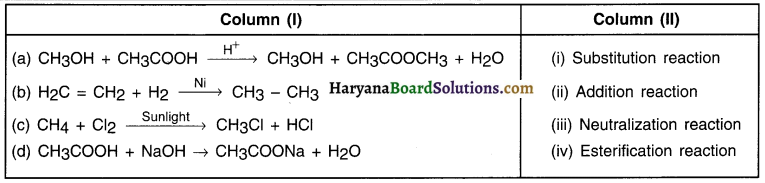
HBSE 10th Class Science Important Questions Chapter 4 Carbon and Its Compounds 73
Answer:
(a-iv) (b-ii) (c-i) (d-iii)

HBSE 10th Class Science Important Questions Chapter 4 Carbon and Its Compounds

Question 2.
HBSE 10th Class Science Important Questions Chapter 4 Carbon and Its Compounds 74

Answer:
(a-iv) (b-i) (c-ii) (d-iii)
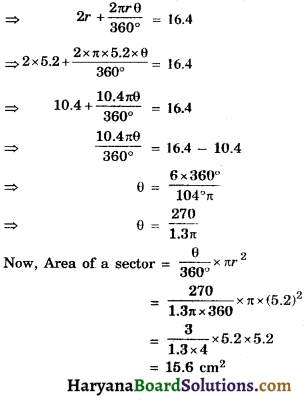
HBSE 10th Class Science Important Questions Chapter 4 Carbon and Its Compounds Read More »

HBSE 10th Class Science Solutions Chapter 11 Human Eye and Colourful World

Haryana State Board HBSE 10th Class Science Solutions Chapter 11 Human Eye and Colourful World Textbook Exercise Questions and Answers.

Haryana Board 10th Class Science Solutions Chapter 11 Human Eye and Colourful World

HBSE 10th Class Science Human Eye and Colourful World Textbook Questions and Answers

Question 1.
The human eye can focus on objects at different distances by adjusting the focal length of the eye lens. This is due to
(a) Presbyopia
(b) Accommodation
(c) Near-sightedness
(d) Far-sightedness
Answer:
(b) Accommodation

HBSE 10th Class Science Solutions Chapter 11 Human Eye and Colourful World

Question 2.
The human eye forms the image of an object at its ……….
(a) cornea
(b) iris
(c) pupil
(d) retina
Answer:
(d) retina

Question 3.
The least distance of distinct vision for a young adult with normal vision is about
(a) 25 m
(b) 2.5 cm
(c) 25 cm
(d) 2.5 m
Answer:
(c) 25 cm

Question 4.
The change in focal length of an eye lens ¡s caused by the action of the
(a) pupil
(b) retina
(c) cillary muscles
(d) Iris
Answer:
(c) cillary muscles

HBSE 10th Class Science Solutions Chapter 11 Human Eye and Colourful World

Question 5.
A person needs a lens of power – 5.5 diopters for correcting his distant vision. For correcting his near vision he needs a lens of power +1.5 diopter. What is the focal length of the lens required for correcting (i) distant vision, and (ii) near vision?
Answer:
1. Power of distance viewing part of the lens, Pi = – 5.5 D
Focal length of this part, f1 = \(\frac{1}{P_1}=\frac{1}{-5.5}\) = m = – 18.73 cm (concave lens)

2. The power of the near-vision part is measured relative to the main part of the lens of power – 5.5
∴ P1+P2 = P or – 5.5+P2= + 1.5 or P2=+6.5 D
Focal length of near-vision part, f2 = \(\frac{1}{P_2}=\frac{1}{+6.5}\) m = m = + 15.4 cm (convex lens)

Question 6.
The far point of a myopic person is 80 cm in front of the eye. What is the nature and power of the lens required to correct the problem?
Answer:
The lens should be able to make the objects at infinity appear at the far point.
∴ For object at infinity, µ = – ∞
Far point distance of the defected eye, v = – 80 cm
HBSE 10th Class Science Solutions Chapter 11 Human Eye and Colourful World 1
A negative sign shows that the lens is a concave lens.
Thus a concave lens of power – 1.25 D is needed to correct the problem.

HBSE 10th Class Science Solutions Chapter 11 Human Eye and Colourful World

Question 7.
Make a diagram to show how hypermetropia is corrected. The near point of a hypermetropic eye is 1 m. What is the power of the lens required to correct this defect? Assume that the near point of the normal eye is 25 cm.
Answer:
The object placed at 25 cm from the correcting lens must produce a virtual image at 1 m or 100 cm.
u = – 25 cm, y = -100 cm
HBSE 10th Class Science Solutions Chapter 11 Human Eye and Colourful World 2
HBSE 10th Class Science Solutions Chapter 11 Human Eye and Colourful World 3

Question 8.
Why is a normal eye not able to see clearly the objects placed closer than 25 cm?
Answer:
At distance less than 25 cm, the ciliary muscles are unable to bulge the eye lens any more. So, the objects cannot be focused on the retina and thus appears blurred.

Question 9.
What happens to the Image distance in the eye when we increase the distance of an object from the eye?
Answer:
1. When we increase the distance of an object from the eye there does not occur any change in the image distance.
2. When the object is moved farther, the ciliary muscles get relaxed and the eye lens become thin. This increases the focal length and the image looks clear.

HBSE 10th Class Science Solutions Chapter 11 Human Eye and Colourful World

Question 10.
Why do stars twinkle?
Answer:
1. Density of atmosphere is not uniform everywhere.
2. There are different layers of atmosphere with different refractive indices.
3. Atmospheric layer at lower altitude is colder P and denser compared to layer at higher altitude.
4. When the light travels from star at a rarer medium towards earth at denser medium, it bends towards normal.
5. Thus, due to refraction towards normal, the position of star appears higher from its actual position.

HBSE 10th Class Science Solutions Chapter 11 Human Eye and Colourful World 4

Reason for twinkling of stars:

  • The physical condition of refracting medium e. the earth’s atmosphere is not stationary. Hence, the position of star seems to be changing continuously.
  • This results in the continuous change in the path of the rays coming from the stars and continuous change in the intensity of light. This leads to twinkling of stars.
  • Light from a star is refracted or say bent as it leaves the space and enters the earth’s atmosphere.
  • Air at higher altitude is rare whereas near the earth’s surface it is dense.
  • As a result, when light from the star comes down, the dense air bends the light more.
  • Due to this, refraction of star’s light, the star appears to be at a higher position than it actually is.

HBSE 10th Class Science Solutions Chapter 11 Human Eye and Colourful World

Question 11.
Explain why the planets do not twinkle.
Answer:
1. The stars are very far from us and so they may be considered as the point sources of light.
2. Compared to stars, planets are much nearer to the earth and so planets appear quite big.
3. Hence, planets cannot be considered a single point source of light but a collection of a very large number of point sources of light.
4. Thus, on the whole, the brightness of the planet always remains the same and it does not appear twinkle. But the atmospheric refraction affects stars more since they are point sources of light and so stars twinkle.

Question 12.
Why does the Sun appear reddish early in the morning?
Answer:
1. White light coming from the sun has to travel a large distance in the atmosphere before reaching to the observer.
2. During sunrise or sunset, most of the blue colour present in sunlight has been scattered out and it is away from our sight.
3. As a result, only red light remains present in the beam of sunlight and so only red colour reaches our eye.
4. As a result, sun appears reddish at sunrise and sunset.

HBSE 10th Class Science Solutions Chapter 11 Human Eye and Colourful World 5

Question 13.
Why does the sky appear dark instead of blue to an astronaut?
Answer:
1. The atmosphere becomes thinner as one moves above the earth.
2. Astronauts travel in the space which is at very high altitudes. At such altitudes, the sun cannot scatter any sunlight because of extremely thin atmosphere. As a result, the sky appears dark and not blue to the astronauts.

HBSE 10th Class Science Human Eye and Colourful World InText Activity Questions and Answers

Textbook Page no – 190

Question 1.
What is meant by power of accommodation of the eye?
Answer:
The ability of the eye lens to adjust its focal length as per the requirement so that the objects can be seen clearly is called the power of accommodation of eyes.

HBSE 10th Class Science Solutions Chapter 11 Human Eye and Colourful World

Question 2.
A person with a myopic eye cannot see objects beyond 1.2 m distinctly. What should be the type of the corrective lens used to restore proper vision?
Answer:
The person should use diverging i.e. concave lens.

Question 3.
What is the far point and near point of the human eye with normal vision?
Answer:
For a human eye with normal vision, the near point is 25 cm lron the eyes whereas the far point is at infinity.

Question 4.
A student has difficulty reading the blackboard while sitting in the last row. What could be the defect the child is suffering from? How can it be corrected?
Answer:
1. Since the student is sitting in the last row, the blackboard is at a far distance. The student is unable to read at far distance means he is suffering from myopia i.e. near-sightedness.
2. The student should use a concave length of suitable focal length to cure this problem.

Activities

Activity – 1

1. Fix a sheet of white paper on a drawing board using drawing pins.
2. Place a glass prism on it in such a way that it rests on its triangular base. Trace the outline of the prism using a pencil.
3. Draw a straight line PE inclined to one of the refracting surfaces, say AB, or the prism.
4. Fix two pins, say at points P and Q, on the line PE as shown in Figure.
5. Look for the images of the pins, fixed at P and Q, through the other face AC.
6. Fix two more pins, at points R and S, such that the pins at R and S and the images of the pins at P and Q lie on the same straight line.
7. Remove the pins and the glass prism.
8. The line PE meets the boundary of the prism at point E. Similarly join and produce the points R and S. Let these lines meet the boundary of the prism at E and F, respectively. Join E and F.
9. Draw a perpendicular to the refracting surfaces AB and AC of the prism at point E and F, respectively. Mark the angle of incidence (∠i), the angle of refraction (∠r) and the angle of emergence (∠e) as shown in figure.
10. Discuss the refraction of light through the prism. Try to find a relation between angles i, e, A and D.

HBSE 10th Class Science Solutions Chapter 11 Human Eye and Colourful World 6

Observation and conclusion:

1. The incident ray PE undergoes refraction on hitting the face AB and bends towards the normal NN’ along the path EF. Again as ray EF retracts from glass to air at face AC, it bends away from the normal MM’. Thus, the emergent ray FS bends towards the base of the prism.

HBSE 10th Class Science Solutions Chapter 11 Human Eye and Colourful World

2. We measure the angle of incidence i, angle of prism A, angle of emergence e and the angle of deviation D. On measuring, we can see that, i+e=A+D

Activity 2.

1. Take a thick sheet of cardboard and make a small hole or narrow slit in its middle.
2. Allow sunlight to fall on the narrow slit. This gives a narrow beam of white light.
3. Now, take a glass prism and allow the light from the slit to fall on one of its faces as shown in Fig.
4. Turn the prism slowly until the light that comes out of it appears on a nearby screen.
5. What do you observe? You will find a beautiful band of colours. Why does this happen?

HBSE 10th Class Science Solutions Chapter 11 Human Eye and Colourful World 7

Observation and conclusion:

  • The glass prism splits the incident white light into a band of seven colours.
  • The band of colour called spectrum is made up of Violet, Indigo, Blue, Green, Yellow, Orange and Red colours in the said sequence. This is an example of dispersion of light.
  • Red coloured light shows least deviation where as violet-coloured light shows maximum deviation.

HBSE 10th Class Science Solutions Chapter 11 Human Eye and Colourful World

Activity 3.

1. Place a strong source (S) of white light at the focus of a converging lens (L1). This lens provides a parallel beam of light.
2. Allow the light beam to pass through a transparent glass tank (T) containing clear water.
3. Allow the beam of light to pass through a circular hole (C) made in a cardboard.
Obtain a sharp image of the circular hole on a screen (MN) using a second converging lens (L2), as shown in Figure.
4. Dissolve about 200 g of sodium thiosulphate (hypo) in about 2 L of clean water taken in the tank.
Add about 1 to 2 mL of concentrated sulphuric acid to the water. What do you observe?

HBSE 10th Class Science Solutions Chapter 11 Human Eye and Colourful World 8

Observation and conclusion:

  • The fine micro-particles will precipitate in few minutes.
  • As the sulphur (colloids) particles begin to form, we will observe that blue light starts appearing from
    three sides of the tank. This demonstrates scattering of light.
  • On observing the tank from the circular hole side, we can first see an image of orange colour and
    then of bright crimson red colour on the screen.
  • Thus, the colloidal sulphur particles scatter the blue component of white light to maximum extent
    which can be seen from three sides of the tank.
  • The least scattered red component gets transmitted through the colloidal solution and reaches the screen.

HBSE 10th Class Science Solutions Chapter 11 Human Eye and Colourful World Read More »

HBSE 10th Class Maths Notes Chapter 6 त्रिभुज

Haryana State Board HBSE 10th Class Maths Notes Chapter 6 त्रिभुज Notes.

Haryana Board 10th Class Maths Notes Chapter 6 त्रिभुज

→ त्रिभुज : तीन भुजाओं से घिरी बंद आकृति को त्रिभुज कहते हैं। इसके कोणों का योग 180°c होता है।

→ समरूप आकृतियाँ : समान आकार वाली आकृतियों को समरूप आकृतियाँ कहते हैं। यह आवश्यक नहीं है कि वे समान आमाप की भी हों।

→ सर्वांगसम त्रिभुज : समान आकार तथा समान आमाप वाले दो त्रिभुजों को सर्वांगसम त्रिभुज कहा जाता है।

→ सभी सर्वांगसम आकृतियाँ समरूप होती हैं, परंतु सभी समरूप आकृतियों का सर्वांगसम होना आवश्यक नहीं है।

→ समरूप बहुभुज : भुजाओं की समान संख्या वाले दो बहुभुज समरूप कहे जाते हैं यदि (i) उनके संगत कोण बराबर हों तथा (ii) उनकी संगत भुजाओं की लंबाइयाँ समानुपाती हों।

→ समानकोणिक त्रिभुज : यदि दो त्रिभुजों के संगत कोण बराबर हों, तो उन्हें समानकोणिक त्रिभुज कहा जाता है।

→ आधारभूत समानुपातिकता प्रमेय : यदि किसी त्रिभुज की एक भुजा के समांतर अन्य दो भुजाओं को भिन्न-भिन्न बिंदुओं पर प्रतिच्छेद करने के लिए एक रेखा खींची जाए तो ये अन्य दो भुजाओं को एक ही अनुपात में विभाजित करती है।

→ आधारभूत समानुपातिकता प्रमेय का विलोम : यदि एक रेखा किसी त्रिभुज की दो भुजाओं को एक ही अनुपात में विभाजित करे तो वह तीसरी भुजा के समांतर होती है।

→ यदि दो त्रिभुजों में, संगत कोण बराबर हों, तो उनकी संगत भुजाएँ एक ही अनुपात में (समानुपाती) होती हैं और इसीलिए ये त्रिभुज समरूप होते हैं। इसे कोण-कोण-कोण (AAA) समरूपता कहते हैं।

→ यदि एक त्रिभुज के दो कोण एक अन्य त्रिभुज के क्रमशः दो कोणों के बराबर हों, तो दोनों त्रिभुज समरूप होते हैं। इसे कोण-कोण (AA) समरूपता कहते हैं।

HBSE 10th Class Maths Notes Chapter 6 त्रिभुज

→ यदि दो त्रिभुजों में एक त्रिभुज की भुजाएँ दूसरे त्रिभुज की भुजाओं के समानुपाती हों, तो इनके संगत कोण बराबर होते हैं और इसीलिए दोनों त्रिभुज समरूप होते हैं। इसे भुजा-भुजा-भुजा (SSS) समरूपता कहते हैं।

→ यदि एक त्रिभुज का एक कोण दूसरे त्रिभुज के एक कोण के बराबर हो तथा इन कोणों को बनाने वाली भुजाएँ समानुपाती हों, तो दोनों त्रिभुज समरूप होते हैं। इसे भुजा-कोण-भुजा (SAS) समरूपता कहते हैं।

→ दो समरूप त्रिभुजों के क्षेत्रफलों का अनुपात इनकी संगत भुजाओं के अनुपात के वर्ग के बराबर होता है।

→ यदि किसी समकोण त्रिभुज के समकोण वाले शीर्ष से कर्ण पर लंब डाला जाए तो इस लंब के दोनों ओर बने त्रिभुज संपूर्ण त्रिभुज के समरूप होते हैं तथा परस्पर भी समरूप होते हैं।

→ पाइथागोरस प्रमेय : एक समकोण त्रिभुज में कर्ण का वर्ग शेष दो भुजाओं के वर्गों के योग के बराबर होता है।

→ पाइथागोरस प्रमेय का विलोम : यदि किसी त्रिभुज की एक भुजा का वर्ग अन्य दो भुजाओं के वर्गों के योग के बराबर हो तो पहली भुजा का सम्मुख कोण समकोण होता है।

→ यदि दो समकोण त्रिभुजों में एक त्रिभुज का कर्ण तथा एक भुजा दूसरे त्रिभुज के कर्ण तथा एक भुजा के समानुपाती हो तो दोनों त्रिभुज समरूप होते हैं। इसे समकोण-कर्ण-भुजा (RHS) सर्वांगसमता कहते हैं।

HBSE 10th Class Maths Notes Chapter 6 त्रिभुज Read More »

HBSE 10th Class Maths Important Questions Chapter 1 वास्तविक संख्याएँ

Haryana State Board HBSE 10th Class Maths Important Questions Chapter 1 वास्तविक संख्याएँ Important Questions and Answers.

Haryana Board 10th Class Maths Important Questions Chapter 1 वास्तविक संख्याएँ

परीक्षोपयोगी अन्य महत्त्वपूर्ण प्रश्न

प्रश्न 1.
240 और 6552 का HCF यूक्लिड विभाजन एल्गोरिथ्म का प्रयोग करके ज्ञात कीजिए ।
हल :
HBSE 10th Class Maths Important Questions Chapter 1 वास्तविक संख्याएँ - 1
यूक्लिड विभाजन एल्गोरिथ्म से-
6552 = 240 × 27 + 72
240 = 72 × 3 + 24
72 = 24 × 3 + 0
क्योंकि यहाँ पर शेषफल शून्य तथा भाजक 24 है।
इसलिए 240 और 6552 का HCF = 24

HBSE 10th Class Maths Important Questions Chapter 1 वास्तविक संख्याएँ

प्रश्न 2.
दर्शाइए कि कोई भी धनात्मक पूर्णांक 3q या 3q + 1 या 3q + 2 के रूप का होता है, जहाँ q कोई पूर्णांक है।
हल :
माना a एक धनात्मक पूर्णांक है तथा b = 3 हो तो यूक्लिड विभाजन एल्गोरिथ्म से-
a = 3q + r
क्योंकि 0 ≤ r < 3 है, इसलिए संभावित शेषफल 0, 1 या 2 हो सकते हैं ।
अर्थात् a संख्याओं 3q, 3q + 1 या 3q + 2 के रूप का हो सकता है जहाँ q कोई पूर्णांक है ।

प्रश्न 3.
निम्नलिखित संख्याओं को \(\frac {p}{q}\) के रूप में व्यक्त कीजिए-
(i) 0.375
(ii) 0.104
(iii) 0.15
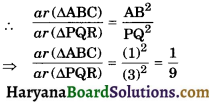
(iv) 15.75
हल :
HBSE 10th Class Maths Important Questions Chapter 1 वास्तविक संख्याएँ - 2

प्रश्न 4.
एक मिठाई विक्रेता के पास 420 काजू की बर्फियाँ और 130 बादाम की बर्फियाँ हैं । वह इनकी ऐसी ढेरियाँ बनाना चाहती है कि प्रत्येक ढेरी में बर्फियों की संख्या समान रहे तथा ये ढेरियाँ बर्फी की परात में न्यूनतम स्थान घेरें । इस काम के लिए प्रत्येक ढेरी में कितनी बर्फियाँ रखी जा सकती हैं?
हल :
प्रश्नानुसार, यहाँ पर हमें 420 और 130 का HCF यूक्लिड एल्गोरिथ्म द्वारा ज्ञात करना है-
HBSE 10th Class Maths Important Questions Chapter 1 वास्तविक संख्याएँ - 3
420 = 130 × 3 + 30
130 = 30 × 4 + 10
30 = 10 × 3 +0
क्योंकि यहाँ पर शेषफल शून्य तथा भाजक 10 है ।
इसलिए 420 और 130 का HCF = 10
अतः प्रत्येक प्रकार की बर्फी के लिए मिठाई विक्रेता 10-10 की ढेरी बना सकता है

HBSE 10th Class Maths Important Questions Chapter 1 वास्तविक संख्याएँ

प्रश्न 5.
8232 को अभाज्य गुणनखंडों के गुणनफल के रूप में व्यक्त कीजिए ।
हल :
HBSE 10th Class Maths Important Questions Chapter 1 वास्तविक संख्याएँ - 4
8232 = 2 × 2 × 2 × 3 × 7 × 7 × 7
= 23 × 3 × 73

प्रश्न 6.
सिद्ध कीजिए कि \(\sqrt{2}\) एक अपरिमेय संख्या है।
हल :
माना \(\sqrt{2}\) एक परिमेय संख्या है जो कि दिए गए के विपरीत है।
अब \(\sqrt{2}\) = \(\frac {a}{b}\) जहाँ a और b सह-अभाज्य पूर्णांक हैं तथा b ≠ 0 है।
⇒ \(\sqrt{2}\)b = a
दोनों ओर का वर्ग करने पर, 2b2 = a2 ………..(i)
इससे पता चलता है कि a2, 2 से विभाज्य है, इसलिए a भी 2 से विभाज्य होगी। ………..(ii)
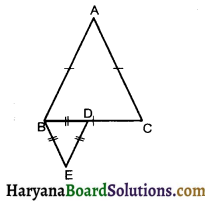
⇒ a = 2m जहाँ m एक पूर्णांक है ।
a का मान समीकरण (i) में रखने पर,
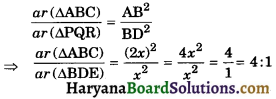
2b2 = (2m)2
⇒ 2b2 = 4m2
या b2 = 2m2
इसका अर्थ यह है कि 2 से b2 विभाजित हो जाता है इसलिए b भी 2 से विभाजित होगा । ………….(iii)
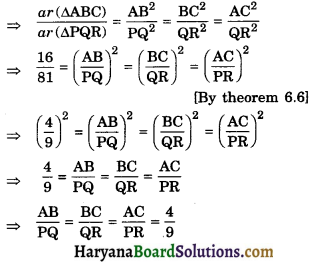
इसी प्रकार समीकरण (ii) व (iii) से a और b में कम-से-कम एक उभयनिष्ठ गुणनखंड 2 है। इससे हमारी कल्पना गलत होती है कि a और b सह-अभाज्य हैं । अतः सिद्ध है कि \(\sqrt{2}\) एक परिमेय संख्या नहीं है।
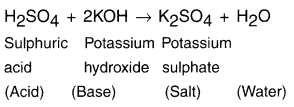
अतः \(\sqrt{2}\) एक अपरिमेय संख्या है।

प्रश्न 7.
संख्या 40, 36 और 126 का अभाज्य गुणनखंडन विधि द्वारा HCF और LCM ज्ञात कीजिए ।
हल :
HBSE 10th Class Maths Important Questions Chapter 1 वास्तविक संख्याएँ - 5
40 = 2 × 2 × 2 × 5 = 23 × 5
36 = 2 × 2 × 3 × 3 = 22 × 32
126 = 2 × 3 × 3 × 7 = 2 × 32 × 7
∴ HCF(40, 36, 126) = अभाज्य गुणनखंडों की उभयनिष्ठ सबसे छोटी घातों का गुणनफल = 2 उत्तर
LCM(40, 36, 126) = अभाज्य गुणनखंडों की सबसे बड़ी घातों का गुणनफल = 23 × 32 × 5 × 7
= 8 × 9 × 5 × 7 = 2520

HBSE 10th Class Maths Important Questions Chapter 1 वास्तविक संख्याएँ

प्रश्न 8.
छः अंकों की सबसे बड़ी संख्या ज्ञात कीजिए जो 24, 15 तथा 36 से पूर्णतया विभाज्य हो ।
हल :
यहाँ पर हम पहले 24, 15 व 36 का LCM ज्ञात करेंगे।
HBSE 10th Class Maths Important Questions Chapter 1 वास्तविक संख्याएँ - 6
24 = 2 × 2 × 2 × 3 = 23 × 3
15 = 3 × 5
36 = 2 × 2 × 3 × 3 = 22 × 32
LCM(24, 15, 36) = 23 × 32 × 5 = 8 × 9 × 5 = 360
हम जानते हैं कि छः अंकों की बड़ी से बड़ी संख्या = 999999
अतः अभीष्ट संख्या = 999999 – 279 = 999720

प्रश्न 9.
यदि दो संख्याओं का LCM व HCF क्रमशः 180 व 6 हो तथा इनमें से एक संख्या 30 हो तो दूसरी संख्या ज्ञात कीजिए ।
हल :
यहाँ पर,
LCM = 180
HCF = 6
पहली संख्या = 30
∴ दूसरी संख्या = LCM × HCF / पहली संख्या
= \(\frac{180 \times 6}{30}\)
= 6 × 6 = 36

HBSE 10th Class Maths Important Questions Chapter 1 वास्तविक संख्याएँ

प्रश्न 10.
वह बड़े से बड़े धनात्मक पूर्णांक ज्ञात कीजिए जो 398, 436 और 542 को विभाजित करने पर क्रमशः 7, 11 व 15 शेषफल छोड़े?
हल :
यहाँ पर
HBSE 10th Class Maths Important Questions Chapter 1 वास्तविक संख्याएँ - 7
अब हम 391, 425 व 527 का HCF ज्ञात करेंगे-
HBSE 10th Class Maths Important Questions Chapter 1 वास्तविक संख्याएँ - 8
391 = 17 × 23
425 = 5 × 5 × 17 = 52 × 17
527 = 17 × 31
HCF (391, 425, 527) = 17
अतः वांछित पूर्णांक = 17

प्रश्न 11.
सिद्ध कीजिए कि निम्नलिखित संख्याएँ अपरिमेय है-
(i) 3 – 2\(\sqrt{5}\)
(ii) 2\(\sqrt{3}\)

हल :
(i) माना 3 – 2\(\sqrt{5}\) एक परिमेय संख्या है जो कि दिए गए के विपरीत है ।
अब 3 – 2\(\sqrt{5}\) = \(\frac {a}{b}\) जहाँ a और b सह-अभाज्य पूर्णांक हैं तथा b ≠ 0 है।
⇒ 2\(\sqrt{5}\) = 3 – \(\frac {a}{b}\)
या 2\(\sqrt{5}\) = \(\frac{3 b-a}{b}\)
या \(\sqrt{5}\) = \(\frac{3 b-a}{2 b}\)
क्योंकि a और b पूर्णांक हैं जिस कारण \(\frac{3 b-a}{2b}\) एक परिमेय संख्या होगी ।
इसलिए \(\sqrt{5}\) एक परिमेय संख्या होगी जो कि असत्य है क्योंकि \(\sqrt{5}\) एक अपरिमेय संख्या है।
अतः हमारी कल्पना गलत है। इससे सिद्ध होता है कि 3 – 2\(\sqrt{5}\) एक अपरिमेय संख्या है।

(ii) यदि संभव हो तो माना 2\(\sqrt{3}\) एक परिमेय संख्या है।
तो 2\(\sqrt{3}\) = \(\frac {a}{b}\) जहाँ a और b सह-अभाज्य पूर्णांक हैं तथा b ≠ 0 है।
⇒ \(\sqrt{3}\) = \(\frac {a}{2b}\)
क्योंकि a और b पूर्णांक हैं जिस कारण \(\frac {a}{2b}\) एक परिमेय संख्या होगी ।
⇒ \(\sqrt{3}\) एक परिमेय संख्या होगी जो कि असत्य है क्योंकि \(\sqrt{3}\) एक अपरिमेय संख्या है।
अतः हमारी कल्पना गलत है। इससे सिद्ध होता है कि 2\(\sqrt{3}\) एक अपरिमेय संख्या है।

HBSE 10th Class Maths Important Questions Chapter 1 वास्तविक संख्याएँ

प्रश्न 12.
सिद्ध कीजिए कि \(\sqrt{3}\) एक अपरिमेय संख्या है।
हल :
माना \(\sqrt{3}\) एक परिमेय संख्या है जो कि दिए गए के विपरीत है ।
अब \(\sqrt{3}\) = \(\frac {a}{b}\) जहाँ a और b सह-अभाज्य पूर्णांक हैं तथा b ≠ 0 है ।
⇒ \(\sqrt{3}\)b = a
दोनों ओर का वर्ग करने पर,
3b2 = a2 ………..(i)
इससे पता चलता है कि a2, 3 से विभाज्य है, इसलिए a भी 3 से विभाज्य होगी। …………..(ii)
⇒ a = 3m जहाँ m एक पूर्णांक है।
a का मान समीकरण (i) में रखने पर,
3b2 = (3m)2
⇒ 3b2 = 9m2
या b2 = 3m2
इसका अर्थ यह है कि 3 से b2 विभाजित हो जाता है इसलिए b भी 3 से विभाजित होगा । …………..(iii)
इसी प्रकार समीकरण (ii) व (iii) से a और b में कम-से-कम एक उभयनिष्ठ गुणनखंड 3 है। इससे हमारी कल्पना गलत होती है कि a और b सह-अभाज्य हैं । जिस कारण \(\sqrt{3}\) एक परिमेय संख्या नहीं है ।
अतः \(\sqrt{3}\) एक अपरिमेय संख्या है।

प्रश्न 13.
सिद्ध कीजिए कि 3\(\sqrt{2}\) एक अपरिमेय संख्या है।
हल :
यदि सम्भव हो तो माना 3\(\sqrt{2}\) एक परिमेय संख्या है।
तो 3\(\sqrt{2}\) = \(\frac {a}{b}\) जहाँ a और b सह – अभाज्य पूर्णांक हैं तथा b ≠ 0 है।
⇒ \(\sqrt{2}\) = \(\frac {a}{3b}\)
क्योंकि a और b पूर्णांक हैं जिस कारण \(\frac {a}{3b}\) एक परिमेय संख्या होगी ।
⇒ \(\sqrt{2}\) एक परिमेय संख्या होगी जोकि असत्य है क्योंकि \(\sqrt{2}\) एक अपरिमेय संख्या है।
अतः हमारी कल्पना गलत है। इससे सिद्ध होता है कि 3\(\sqrt{2}\) एक अपरिमेय संख्या है।

HBSE 10th Class Maths Important Questions Chapter 1 वास्तविक संख्याएँ

प्रश्न 14.
\(\frac {7}{160}\) का दशमलव प्रसार लिखिए ।
हल :
HBSE 10th Class Maths Important Questions Chapter 1 वास्तविक संख्याएँ - 9

प्रश्न 15.
परिमेय संख्या 34.12345 के हर के अभाज्य गुणनखंडों के विषय में आप क्या कह सकते हैं?

हल :
क्योंकि 34.12345 एक सांत दशमलव संख्या है। इसलिए इस हर के अभाज्य गुणनखंडन 2n × 5m के रूप के होंगे, जहाँ n और m पूर्णांक होंगे।

बहुविकल्पीय – प्रश्न :

प्रश्न 1.
निम्नलिखित में से कौन-सी संख्या अपरिमेय नहीं है?
(A) \(\sqrt{2}\)
(B) \(\sqrt{3}\)
(C) \(\sqrt{4}\)
(D) \(\sqrt{5}\)
हल :
(C) \(\sqrt{4}\)

HBSE 10th Class Maths Important Questions Chapter 1 वास्तविक संख्याएँ

प्रश्न 2.
प्रत्येक भाज्य संख्या को एक अद्वितीय रूप से …………….. संख्याओं के गुणनफल के रूप में व्यक्त किया जा सकता है ।
(A) अभाज्य
(B) सम
(C) विषम
(D) भाज्य
हल :
(A) अभाज्य

प्रश्न 3.
यूक्लिड विभाजन प्रमेयिका a = bq + का प्रयोग 17 व 6 के लिए करने पर का मान होगा-
(A) 6
(B) 2
(C) 17
(D) 5
हल :
(D) 5

प्रश्न 4.
यूक्लिड विभाजन प्रमेयिका a = bq + r का प्रयोग 20 व 4 के लिए करने पर का मान होगा-
(A) 5
(B) शून्य
(C) 4
(D) 20
हल :
(B) शून्य

HBSE 10th Class Maths Important Questions Chapter 1 वास्तविक संख्याएँ

प्रश्न 5.
12 व 5 का HCF क्या होगा ?
(A) 5
(B) 12
(C) 1
(D) 60
हल :
(C) 1

प्रश्न 6.
किन्हीं दो अभाज्य संख्याओं का HCF क्या होगा ?
(A) दोनों संख्याओं का गुणनफल
(B) बड़ी संख्या
(C) छोटी संख्या
(D) एक
हल :
(D) एक

प्रश्न 7.
20 व 5 का HCF क्या होगा ?
(A) 1
(B) 5
(C) 20
(D) 4
हल :
(B) 5

प्रश्न 8.
10 व 3 को यूक्लिड विभाजन प्रमेयिका के रूप में लिखा जा सकता है-
(A) 10 = 3 × 3 – 1
(B) 10 = 3 × 3 + 1
(C) 10 = 3 × 1 + 7
(D) 3 = 10 × 3 + 1
हल :
(B) 10 = 3 × 3 + 1

HBSE 10th Class Maths Important Questions Chapter 1 वास्तविक संख्याएँ

प्रश्न 9.
4 व 19 का HCF क्या होगा ?
(A) 4
(B) 19
(C) 1
(D) 76
हल :
(C) 1

प्रश्न 10.
510 व 92 का HCF क्या होगा ?
(A) 2
(B) 81
(C) 27
(D) 243
हल :
(A) 2

प्रश्न 11.
दो धनात्मक पूर्णांकों के LCM और HCF में सम्बन्ध होगा-
(A) HCF > LCM
(B) HCF = LCM
(C) LCM > HCF
(D) इनमें से कोई नहीं
हल :
(B) HCF = LCM (यदि धनात्मक पूर्णांक समान हों) तथा (C) LCM > HCF (यदि धनात्मक पूर्णांक भिन्न हों)

प्रश्न 12.
प्रत्येक धनात्मक विषम पूर्णांक को किस रूप में लिखा जा सकता है, जबकि p कोई पूर्णांक हो ?
(A) 2p+ 1
(B) 2p
(C) 2p + 2
(D) 4p
हल :
(A) 2p + 1

HBSE 10th Class Maths Important Questions Chapter 1 वास्तविक संख्याएँ

प्रश्न 13.
निम्नलिखित में से किस युग्म का HCF, 4 होगा ?
(A) 23, 4
(B) 28, 4
(C) 31, 4
(D) 10, 4
हल :
(B) 28, 4

प्रश्न 14.
निम्नलिखित में से किस युग्म का HCF, 4 नहीं होगा ?
(A) 12, 4
(B) 20, 4
(C) 22, 4
(D) 28, 4
हल :
(C) 22, 4

प्रश्न 15.
निम्नलिखित में से अपरिमेय (irrational) संख्या छाँटिए-
(A) \(\sqrt{36}\)
(B) \(\sqrt{121}\)
(C) \(\sqrt{9}\)
(D) \(\sqrt{8}\)
हल :
(D) \(\sqrt{8}\)

प्रश्न 16.
यदि 306 और 657 का HCF 9 हो, तो उसका LCM क्या होगा ?
(A) 2482
(B) 22338
(C) 2754
(D) 5913
हल :
(B) 22338

प्रश्न 17.
26 व 91 का HCF क्या होगा ?
(A) 26
(B) 867
(C) 13
(D) एक
हल :
(C) 13

HBSE 10th Class Maths Important Questions Chapter 1 वास्तविक संख्याएँ

प्रश्न 18.
1232 व 32 का HCF क्या होगा ?
(A) 16
(B) 616
(C) 8
(D) 2464
हल :
(A) 16

प्रश्न 19.
336 व 54 का HCF क्या होगा ?
(A) 9
(B) 3
(C) 6
(D) 18
हल :
(C) 6

प्रश्न 20.
यदि q कोई पूर्णांक हो तो एक धनात्मक विषम पूर्णांक को लिखा जा सकता है-
(A) 4q
(B) 4q + 1
(C) 4q + 2
(D) 4q + 4
हल :
(B) 4q + 1

प्रश्न 21.
यदि q कोई पूर्णांक हो तो एक धनात्मक विषम पूर्णांक को किस रूप में नहीं लिखा जा सकता?
(A) 6q +1
(B) 6q + 2
(C) 6q + 3
(D) 6q + 5
हल :
(B) 6q + 2

HBSE 10th Class Maths Important Questions Chapter 1 वास्तविक संख्याएँ

प्रश्न 22.
एक मिठाई विक्रेता के पास 420 काजू की बर्फियाँ और 130 बादाम की बर्फियाँ हैं। वह इनकी ऐसी ढेरियाँ बनाना चाहता है कि प्रत्येक ढेरी में बर्फियों की संख्या समान रहे तथा ये ढेरियाँ बर्फी की परात में न्यूनतम स्थान घेरें । इस काम के लिए, प्रत्येक ढेरी में कितनी बर्फियाँ रखी जा सकती हैं?
(A) 30
(B) 130
(C) 20
(D) 10
हल :
(D) 10

प्रश्न 23.
किसी परेड में 616 सदस्यों वाली एक सेना की टुकड़ी को 32 सदस्यों वाले एक आर्मी बैंड के पीछे मार्च करना है। दोनों समूहों को समान संख्या वाले स्तंभों में मार्च करना है। उन स्तंभों की अधिकतम संख्या क्या होगी जिसमें वे मार्च कर सकते हैं?
(A) 8
(B) 32
(C) 4
(D) 2
हल :
(A) 8

प्रश्न 24.
प्रत्येक भाज्य संख्या को अभाज्य संख्याओं के एक गुणनफल के रूप में व्यक्त (गुणनखंडित) किया जा सकता है तथा यह गुणनखंडन अद्वितीय होता है, इस पर कोई ध्यान दिए बिना कि अभाज्य गुणनखंड किस क्रम में आ रहे हैं। इसे कहा जाता है-
(A) यूक्लिड विभाजन प्रमेय
(B) अंकगणित की आधारभूत प्रमेय
(C) बीजगणित की आधारभूत प्रमेय
(D) रेखागणित की आधारभूत प्रमेय
हल :
(B) अंकगणित की आधारभूत प्रमेय

प्रश्न 25.
सबसे छोटी अभाज्य संख्या है-
(A) 2
(B) 3
(C) 1
(D) 5
हल :
(A) 2

HBSE 10th Class Maths Important Questions Chapter 1 वास्तविक संख्याएँ

प्रश्न 26.
सबसे छोटी विषम अभाज्य संख्या है-
(A) 1
(B) 2
(C) 3
(D) 5
हल :
(C) 3

प्रश्न 27.
30 के अभाज्य गुणनखंड होंगे-
(A) 6 × 5
(B) 1 × 30
(C) 2 × 15
(D) 2 × 3 × 5
हल :
(D) 2 × 3 × 5

प्रश्न 28.
दो पूर्णांकों 336 तथा 54 का LCM होगा-
(A) 12
(B) 3024
(C) 6
(D) इनमें से कोई नहीं
हल :
(B) 3024

प्रश्न 29.
72 के अभाज्य गुणनखंड होंगे-
(A) 23 × 33
(B) 23 × 33
(C) 23 × 33
(D) 23 × 32
हल :
(D) 23 × 32

प्रश्न 30.
यदि 96 और 404 का HCF 4 हो तो उनका LCM होगा-
(A) 38784
(B) 9696
(C) 2274
(D) इनमें से कोई नहीं
हल :
(B) 9696

HBSE 10th Class Maths Important Questions Chapter 1 वास्तविक संख्याएँ

प्रश्न 31.
140 के अभाज्य गुणनखंड होंगे-
(A) 22 × 52 × 72
(B) 22 × 52 × 7
(C) 22 × 5 × 7
(D) 2 × 5 × 7
हल :
(C) 22 × 5 × 7

प्रश्न 32.
156 के अभाज्य गुणनखंड होंगे-
(A) 22 × 3 × 13
(B) 22 × 32 × 13
(C) 22 × 32 × 132
(D) 2 × 32 × 13
हल :
(A) 22 × 3 × 13

प्रश्न 33.
12 और 20 के HCF और LCM में सम्बन्ध होगा-
(A) HCF > LCM
(B) HCF < LCM
(C) HCF = LCM
(D) इनमें से कोई नहीं
हल :
(B) HCF < LCM

प्रश्न 34.
6, 72 व 120 का LCM होगा-
(A) 240
(B) 360
(C) 120
(D) 152
हल :
(B) 360

प्रश्न 35.
12, 15 व 21 का LCM होगा-
(A) 420
(B) 315
(C) 410
(D) इनमें से कोई नहीं
हल :
(A) 420

HBSE 10th Class Maths Important Questions Chapter 1 वास्तविक संख्याएँ

प्रश्न 36.
किन्हीं तीन विभिन्न अभाज्य संख्याओं का HCF होगा-
(A) तीनों संख्याओं का गुणनफल
(B) सबसे छोटी संख्या
(C) सबसे बड़ी संख्या
(D) एक
हल :
(D) एक

प्रश्न 37.
किन्हीं तीन विभिन्न अभाज्य संख्याओं का LCM होगा-
(A) सबसे छोटी संख्या
(B) सबसे बड़ी संख्या
(C) तीनों संख्याओं का गुणनफल
(D) एक
हल :
(C) तीनों संख्याओं का गुणनफल .

प्रश्न 38.
17, 23 व 29 का LCM होगा-
(A) 1140
(B) 1139
(C) 1239
(D) इनमें से कोई नहीं
हल :
(D) इनमें से कोई नहीं

प्रश्न 39.
510 व 92 का LCM होगा-
(A) 23460
(B) 3460
(C) 2346
(D) 1800
हल :
(A) 23460

प्रश्न 40.
पूर्णांक 8, 9 और 25 का LCM है-
(A) 1500
(B) 1700
(C) 1800
(D) इनमें से कोई नहीं
हल :
(C) 1800

प्रश्न 41.
यदि 36 व x का HCF व LCM क्रमशः 6 व 180 हो तो x का मान होगा-
(A) 180
(B) 36
(C) 30
(D) 6
हल :
(C) 30

HBSE 10th Class Maths Important Questions Chapter 1 वास्तविक संख्याएँ

प्रश्न 42.
यदि दो संख्याओं का गुणनफल 240 तथा उनका HCF 4 हो तो LCM होगा-
(A) 12
(B) 20
(C) 240
(D) 60
हल :
(D) 60

प्रश्न 43.
यदि दो संख्याओं का HCF व LCM क्रमशः 24 व 360 हो तथा इनमें से एक संख्या 72 हो तो दूसरी संख्या होगी-
(A) 120
(B) 60
(C) 30
(D) 15
हल :
(A) 120

प्रश्न 44.
किसी खेल के मैदान के चारों ओर एक वृत्ताकार पथ है। इस मैदान का एक चक्कर लगाने में सोनिया को 18 मिनट लगते हैं, जबकि इसी मैदान का एक चक्कर लगाने में रवि को 12 मिनट लगते हैं। मान लीजिए वे दोनों एक ही स्थान और एक ही समय पर चलना प्रारंभ करके एक ही दिशा में चलते हैं। कितने समय बाद वे पुनः प्रारंभिक स्थान पर मिलेंगे?
(A) 6 मिनट
(B) 12 मिनट
(C) 18 मिनट
(D) 36 मिनट
हल :
(D) 36 मिनट

प्रश्न 45.
किसी स्कूल की नौवीं कक्षा के सैक्शन-ए में 36 विद्यार्थी तथा सैक्शन -बी में 32 विद्यार्थी हैं । इस स्कूल की लाइब्रेरी में कम से कम कितनी किताबें होनी चाहिएँ ताकि सैक्शन-ए या सैक्शन-बी के विद्यार्थियों को बराबर-बराबर दी जा सके ?
(A) 144
(B) 288
(C) 32
(D) 36
हल :
(B) 288

प्रश्न 46.
\(\sqrt{5}\) हैं :
(A) सम
(B) विषम
(C) परिमेय
(D) अपरिमेय
हल :
(D) अपरिमेय

HBSE 10th Class Maths Important Questions Chapter 1 वास्तविक संख्याएँ

प्रश्न 47.
………………… और अपरिमेय संख्याएँ मिलकर वास्तविक संख्याएँ बनाती हैं?
(A) परिमेय
(B) सम
(C) विषम
(D) अभाज्य
हल :
(A) परिमेय

प्रश्न 48.
\(\sqrt{3}\) है :
(A) परिमेय
(B) अपरिमेय
(C) मिश्रित संख्या
(D) इनमें से कोई नहीं
हल :
(B) अपरिमेय

प्रश्न 49.
निम्नलिखित में से कौन-सी संख्या अपरिमेय नहीं है?
(A) \(\sqrt{2}\)
(B) \(\sqrt{3}\)
(C) \(\sqrt{13}\)
(D) \(\sqrt{16}\)
हल :
(D) \(\sqrt{16}\)

प्रश्न 50.
\(\sqrt{2}\) है-
(A) अपरिमेय
(B) परिमेय
(C) मिश्रित संख्या
(D) इनमें से कोई नहीं
हल :
(A) अपरिमेय

HBSE 10th Class Maths Important Questions Chapter 1 वास्तविक संख्याएँ

प्रश्न 51.
यदि \(\frac {p}{q}\) एक ऐसी परिमेय संख्या हो, जिसमें q = 2n5m जहाँ n और m ऋणेतर पूर्णांक है तो इसका दशमलव प्रसार होगा-
(A) असांत आवर्ती
(B) असांत अनावर्ती
(C) सांत
(D) असांत
हल :
(C) सांत

प्रश्न 52.
निम्नलिखित में से किस संख्या का दशमलव प्रसार असांत आवर्ती होगा ?
(A) \(\frac{3}{2^3}\)
(B) \(\frac{13}{5^3}\)
(C) \(\frac{23}{2^3 5^2}\)
(D) \(\frac{129}{2^2 5^7 7^5}\)
हल :
(D) \(\frac{129}{2^2 5^7 7^5}\)

प्रश्न 53.
निम्नलिखित में से किस संख्या का दशमलव प्रसार सांत होगा-
(A) \(\frac{29}{7^3}\)
(B) \(\frac{2}{5^1}\)
(C) \(\frac{11}{3^1 5^1 7^1}\)
(D) \(\frac{13}{2^3 7^3}\)
हल :
(B) \(\frac{2}{5^1}\)

प्रश्न 54.
निम्नलिखित में से किस संख्या का दशमलव प्रसार असांत आवर्ती होगा ?
(A) \(\frac {3}{8}\)
(B) \(\frac {13}{125}\)
(C) \(\frac {17}{9}\)
(D) \(\frac {7}{80}\)
हल :
(C) \(\frac {17}{9}\)

प्रश्न 55.
\(\frac {3}{8}\) का दशमलव प्रसार होगा-
(A) 0.375
(B) 0.0375
(C) 3.75
(D) 0.00375
हल :
(A) 0.375

HBSE 10th Class Maths Important Questions Chapter 1 वास्तविक संख्याएँ

प्रश्न 56.
निम्नलिखित में से अपरिमेय (irrational) संख्या छाँटिए-
(A) \(\sqrt{9}\)
(B) \(\sqrt{14}\)
(C) \(\sqrt{25}\)
(D) \(\sqrt{36}\)
हल :
(B) \(\sqrt{14}\)

प्रश्न 57.
यदि 124 और 148 का HCF 4 हो, तो उसका LCM क्या होगा ?
(A) 1147
(B) 18352
(C) 4588
(D) इनमें से कोई नहीं
हल :
(C) 4588

प्रश्न 58.
\(\frac {17}{8}\) का दशमलव प्रसार होगा-
(A) 0.2125
(B) 0.02125
(C) 2.125
(D) 21.25
हल :
(C) 2.125

प्रश्न 59.
निम्नलिखित में से अपरिमेय (irrational) संख्या छाँटिए-
(A) \(\sqrt{8}\)
(B) \(\sqrt{16}\)
(C) \(\sqrt{49}\)
(D) \(\sqrt{81}\)
हल :
(A) \(\sqrt{8}\)

HBSE 10th Class Maths Important Questions Chapter 1 वास्तविक संख्याएँ

प्रश्न 60.
यदि 135 और 225 का HCF 45 हो, तो उसका LCM क्या होगा ?
(A) 405
(B) 1125
(C) 675
(D) इनमें से कोई नहीं
हल :
(C) 675

HBSE 10th Class Maths Important Questions Chapter 1 वास्तविक संख्याएँ Read More »