Author name: Prasanna

HBSE 12th Class Biology Solutions Chapter 6 वंशागति के आणविक आधार

Haryana State Board HBSE 12th Class Biology Solutions Chapter 6 वंशागति के आणविक आधार Textbook Exercise Questions and Answers.

Haryana Board 12th Class Biology Solutions Chapter 6 वंशागति के आणविक आधार

प्रश्न 1.
निम्न को नाइट्रोजनीकृत क्षार व न्यूक्लियोटाइड के रूप में वर्गीकृत कीजिए- एडेनीन, साइटीडीन, थाइमीन, ग्वानोसीन, यूरेसील व साइटोसीन।
उत्तर:
नाइट्रोजनीकृत क्षार – एडेनीन-प्यूरीन क्षार
न्यूक्लियोटाइड – एडेनीन डिऑक्सीराइबोज न्यूक्लियोटाइड
ग्वानोसीन – प्यूरीन क्षार – ग्वानीन डिऑक्सीराइबोज – न्यूक्लियोटाइड
साइटोसीन – पायरिमिडीन क्षार – साइटोसीन डिऑक्सीराइबोज न्यूक्लियोटाइड
थाइमीन – पायरिमिडीन क्षार – थाइमीडीन न्यूक्लियोटाइड
यूरेसील- पायरिमिडीन क्षार – यूरेसील राइबोस न्यूक्लियोटाइड
नोट- साइटीडीन एक न्यूक्लियोसाइड (Nucleoside ) है।

प्रश्न 2.
यदि एक द्विरज्जुक DNA में 20 प्रतिशत साइटोसीन है तो DNA में मिलने वाले एडेनीन के प्रतिशत की गणना कीजिए।
उत्तर:
इरविन चारगाफ (Erwin Chargaff) ने परीक्षण के आधार पर बताया कि ऐडेनीन व थाइमीन तथा ग्वानीन व साइटोसीन के बीच अनुपात स्थिर व एक-दूसरे के बराबर रहता है। यदि द्विरज्जुक DNA में नाइट्रोजनीकृत क्षार की कुल संख्या 100 है और इसमें साइटोसीन की मात्रा 20 प्रतिशत है तो ग्वानीन की मात्रा भी 20 प्रतिशत होगी। साइटोसीन तथा ग्वानीन की कुल मात्रा 20% + 20% = 40% होगी। इसका तात्पर्य यह है कि ऐडेनीन तथा थाइमीन का कुल प्रतिशत 100 – 40 = 60% होगा। ऐडेनीन तथा थाइमीन की मात्रा बराबर होती है अर्थात् ऐडेनीन 30 प्रतिशत और थाइमीन 30 प्रतिशत होगा। अतः उक्त द्विरज्जुक DNA में ऐडेनीन की मात्रा 30 प्रतिशत होगी।

प्रश्न 3.
यदि DNA के एक रज्जुक के अनुक्रम निम्नवत् लिखे हैं – 5-ATGCATGCATGCATGCATGCATGCATGC-3′ तो पूरक रज्जुक के अनुक्रम को 5-3 ́दिशा में लिखें।
उत्तर:
5′-GCATGCATGCATGCATGCATGCATGCAT-3′

प्रश्न 4.
यदि अनुलेखन इकाई में कूटलेखन रज्जुक के अनुक्रम को निम्नवत् लिखा गया है- 5-ATGCATGCATGCATGCATGCATGCATGC-3 तो दूत RNA के अनुक्रम को लिखें।
उत्तर:
यदि कूटलेखन रज्जुक (Coding strand) के अनुक्रम निम्न प्रकार है –
5′-ATGCATGCATGCATGCATGCATGCATGC-3 तो m. RNA के अनुक्रम निम्न प्रकार होंगे-
5′ – AUGCAUGCAUGCAUGCAUGCAUGCAUGC-3′

प्रश्न 5.
DNA द्विकुंडली की कौन सी विशेषता वाटसन व क्रिक को DNA प्रतिकृति के सेमी- कंजर्वेटिव रूप को कल्पित करने में सहयोग किया। इसकी व्याख्या कीजिए।
उत्तर:
DNA द्विकुण्डली के दोनों रज्जुकों (strands ) का एक-दूसरे का पूरक होना वाटसन व क्रिक को DNA प्रतिकृति के अर्द्ध-संरक्षी (semi-conservative) स्वरूप को कल्पित करने के लिये महत्त्वपूर्ण था।

प्रश्न 6.
टेम्पलेट (DNA or RNA ) के रासायनिक प्रकृति व इससे (DNA or RNA ) संश्लेषित न्यूक्लिक अम्लों की प्रकृति के आधार पर न्यूक्लिक अम्ल पॉलीमरेज के विभिन्न प्रकार की सूची बनाइए।
उत्तर:
(i) DNA आधारित DNA पॉलिमरेज एन्जाइम प्रतिकृति के लिये आवश्यक है । यह DNA संश्लेषण के लिये DNA टेम्पलेट (DNA template) का उपयोग करता है।
(ii) DNA पर निर्भर RNA पॉलिमरेज (DNA dependent RNA polymerase) जो RNA संश्लेषण के लिये DNA टेम्पलेट का उपयोग करता है। RNA पॉलिमरेज अस्थायी रूप से प्रारम्भन कारक या समापन कारक से जुड़कर अनुलेखन का प्रारम्भ या समापन करता है।

केन्द्रक में RNA पॉलीमरेज के अतिरिक्त निम्नलिखित तीन प्रकार के RNA पॉलिमरेज मिलते हैं –
(अ) RNA पॉलिमरेज – I-यह r. RNA ( 28S, 18S व 5.8S) को अनुलेखित करता है ।
(ब) RNA पॉलिमरेज – II-यह t. RNA तथा छोटे केन्द्रकीय RNA का अनुलेखन करता है।
(स) RNA पॉलिमरेज – III-यह m. RNA के पूर्ववर्ती विषमांगी केन्द्रकीय RNA ( heterogenous nuclear RNA= hnRNA) का अनुलेखन करता है।

प्रश्न 7.
DNA आनुवंशिक पदार्थ है, इसे सिद्ध करने हेतु अपने प्रयोग के दौरान हर्षे व चेस ने DNA व प्रोटीन के बीच कैसे अंतर स्थापित किया?
उत्तर:
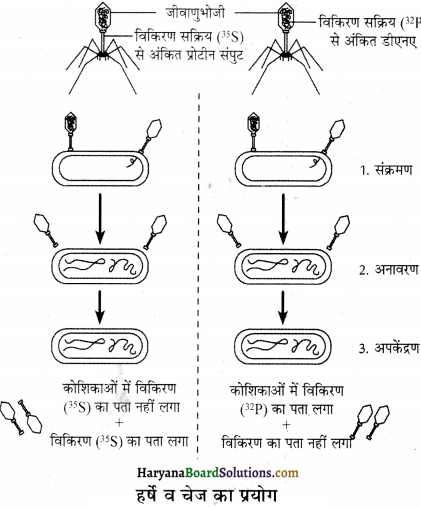
DNA आनुवंशिक पदार्थ है, इस सम्बन्ध में सुस्पष्ट प्रमाण अल्फ्रेड हर्षे (Alfred Hershay) व मार्था चेस (Martha Chase) द्वारा किये गये प्रयोगों से प्राप्त हुआ। इन्होंने उन विषाणुओं पर कार्य किया जो जीवाणु (Bacteria) को संक्रमित करते हैं, इन्हें जीवाणु (Bacteriophage) कहते हैं। जीवाणुभोजी जीवाणु से चिपकते हैं। अपने आनुवंशिक पदार्थ को जीवाणु कोशिका में भेजते हैं। जीवाणु कोशिका विषाणु के आनुवंशिक पदार्थ को अपना समझने लगते हैं जिससे आगे चलकर अधिक विषाणुओं का निर्माण होता है। हर्षे व चेस ने इस बात का पता लगाने के लिए प्रयोग किया कि विषाणु से प्रोटीन या डीएनए निकल कर जीवाणु में प्रवेश करता है।

हर्षे व चेस ने विषाणुओं का ऐसे माध्यम में संवर्धन (Culture) किया जिसमें रेडियोधर्मी फॉस्फोरस (P32 ) था तथा अन्य विषाणुओं को रेडियोधर्मी सल्फर (S35) युक्त माध्यम में संवर्धन किया। रेडियोधर्मी फॉस्फोरस युक्त माध्यम में विकसित हुए विषाणुओं में रेडियोधर्मिता DNA में पायी गयी क्योंकि फॉस्फोरस प्रोटीन में नहीं होता है, यह केवल DNA में ही होता है। इसी प्रकार प्रोटीन आवरण में रेडियोधर्मी सल्फर पाया गया क्योंकि DNA में सल्फर नहीं होता है। विषाणु का खोल या आवरण प्रोटीन से बना होता है।

विकरणयुक्त जीवाणुभोजी द्वारा ई. कोलाई (Ecoli) को संक्रमित किया गया तथा बाद में विषाणुयुक्त विलियन (Solution) को अच्छी तरह मिक्सर (Blender) द्वारा मिक्स करने से कोशिका भित्ति से प्रोटीन आवरण अलग हो गये। तत्पश्चात् सेन्ट्रीफ्यूज द्वारा संक्रमित कोशिका से विषाणु के शीर्षों को पृथक् कर लिया गया। इस प्रकार जीवाणु कोशिकाओं को विषाणुभोजी के प्रोटीन आवरणों से अलग करके इन दोनों भागों में रेडियोधर्मिता को परखा गया। जब p32 युक्त विषाणु लिये गये तो रेडियोधर्मिता जीवाणु कोशिका में चली गयी जो यह दर्शाता है कि विषाणु DNA जीवाणु में प्रवेश कर गया परन्तु S35 चिन्हित विषाणु को प्रयोग करने पर रेडियोधर्मी पदार्थ विषाणु के आवरणों में से प्राप्त हुआ जो यह सिद्ध करता है कि प्रोटीनयुक्त विषाणु का आवरण जीवाणु कोशिका में प्रवेश नहीं हुआ। इससे यह सिद्ध हुआ कि DNA ही आनुवंशिक पदार्थ है। विषाणु का प्रोटीन संरचनात्मक आवरण बनता है जो DNA को जीवाणु में पहुँचा कर बाहर ही रह जाता है।
HBSE 12th Class Biology Solutions Chapter 6 वंशागति के आणविक आधार - 1

प्रश्न 8.
निम्न के बीच अंतर बताइए –
(क) पुनरावृत्ति DNA एवं अनुषंगी DNA
(ख) m. RNA और t. RNA
(ग) टेम्पलेट रज्जु और कोडिंग रज्जु।
उत्तर:
(क) पुनरावृत्ति DNA एवं अनुषंगी DNA – प्रायः जीवों में DNA की एक से अधिक प्रतियाँ उपस्थित रहती हैं, इन्हें अतिरिक्त DNA कहा जाता है या इसे पुनरावृत्ति DNA (Repetitive DNA) भी कहते हैं। यह DNA का छोटा भाग होता है जिसमें इसकी अनेक बार पुनरावृत्ति होती है। इसका उपयोग DNA अंगुलिछापी (DNA Finger Printing) में किया जाता है। इस पुनरावृत्ति DNA को जीनोमिक DNA (Genomic DNA) में से पृथक् करने के लिये घनत्व प्रवणता अपकेन्द्रीकरण (Density Gradient Centrifugation) की सहायता से विभिन्न शिखर (Peak) बनाते हैं।

पुनरावृत्ति DNA का ऊँचा शिखर (Major Peak) बनता है तथा अन्य छोटेs शिखर (Minor Peak) बनते हैं, उन्हें अनुषंगी DNA (Satellite DNA ) कहते हैं। इनके अनुक्रम सामान्यतया किसी भी प्रोटीन का कूटलेखन नहीं करते हैं। किन्तु दोनों प्रकार के DNA मानव जीनोम के अधिकांश भाग में मिलते हैं। इसके अनुक्रम उच्चश्रेणी बहुरूपता (Polymorphism ) दर्शाते हैं।

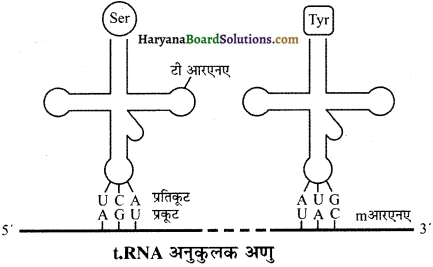
(ख) m. RNA और RNA ये दोनों प्रकार के RNA कोशिका में प्रोटीन संश्लेषण हेतु आवश्यक हैं। m. RNA टेम्पलेट प्रदान करता है तो 1. RNA एमीनो अम्लों के लाने व आनुवंशिक कूट को पढ़ने का काम करता है। tRNA स्वतन्त्र रूप से कोशिकाद्रव्य में रहते हैं। आकार में दोनों छोटे होते हैं, इन्हें अन्तरण (transfer) RNA या tRNA कहते हैं। इन्हें विलेय RNA (Soluble RNA or s. RNA ) भी कहा जाता है । अन्तरण RNA में एक प्रतिप्रकूट (anticodon) होता है जिसमें तीन क्षार होते हैं। ये कूट (Code) के पूरक क्षार होते हैं। tRNA में एक अमीनो अम्ल स्वीकार्य छोर होता है जिससे यह अमीनो अम्ल से जुड़ जाता है। प्रत्येक अमीनो अम्ल के लिए विशिष्ट अन्तरण RNA होते हैं। संश्लेषण प्रारम्भन हेतु दूसरा विशिष्ट अन्तरण RNA होता है जिसे प्रारम्भक अन्तरण RNA कहते हैं। tRNA द्वितीयक संरचना में हैं।

संश्लेषण प्रारम्भन हेतु दूसरा विशिष्ट अन्तरण RNA होता है जिसे प्रारम्भक अन्तरण RNA कहते हैं। tRNA द्वितीयक संरचना में क्लोवर की पत्ती जैसा दिखाई देता है। इसकी वास्तविक संरचना के अनुसार tRNA सघन अणु है जो उल्टे एल (L) की तरह दिखाई देता है। संदेशवाहक (Messenger ) RNA या m. RNA संदेश लाता है। यह DNA के द्वारा बनकर केन्द्रक से बाहर कोशिकाद्रव्य में आकर राइबोसोम्स से चिपक जाते हैं। ये लम्बी श्रृंखला के रूप में होते हैं तथा DNA पर उपस्थित कोड्स (Codes) को नकल करके लाते हैं। अतः दूत की भांति कार्य करते हैं। इन पर संदेश, तीन-तीन क्षारकों वाले क्षारक त्रिकों (base-triplets) कोडॉन (codon) के रूप में रहता है। इन संदेशों के अनुसार ही अमीनो अम्लों की श्रृंखला बनकर प्रोटीन का निर्माण होता है (चित्र 6.20 )।

(ग) टेम्पलेट रज्जु और कोडिंग रज्जु (Templet Strand and Coding Strand ) – DNA की प्रतिकृति ( Replication) में देखें या इसकी संरचना को देखें तो रज्जुक विपरीत ध्रुवत्व की ओर होते tRNA स्वतन्त्र रूप से कोशिकाद्रव्य में रहते हैं। आकार में दोनों छोटे होते हैं, इन्हें अन्तरण (transfer) RNA या t. RNA कहते हैं। इन्हें विलेय RNA (Soluble RNA or s. RNA ) भी कहा जाता है। अन्तरण RNA में एक प्रतिप्रकूट (anticodon) होता है जिसमें तीन क्षार होते हैं।

ये कूट (Code) के पूरक क्षार होते हैं। tRNA में एक अमीनो अम्ल स्वीकार्य छोर होता है जिससे यह अमीनो अम्ल से जुड़ जाता है। प्रत्येक अमीनो अम्ल के लिए विशिष्ट अन्तरण RNA होते हैं। संश्लेषण प्रारम्भन हेतु दूसरा विशिष्ट अन्तरण RNA होता है जिसे प्रारम्भक अन्तरण RNA कहते हैं। tRNA द्वितीयक संरचना में क्लोवर की पत्ती जैसा दिखाई देता है। इसकी वास्तविक संरचना के अनुसार tRNA सघन अणु है जो उल्टे एल (L) की तरह दिखाई देता है।

संदेशवाहक (Messenger) RNA या m. RNA संदेश लाता है। यह DNA के द्वारा बनकर केन्द्रक से बाहर कोशिकाद्रव्य में आकर राइबोसोम्स से चिपक जाते हैं। ये लम्बी श्रृंखला के रूप में होते हैं तथा DNA पर उपस्थित कोड्स (Codes) को नकल करके लाते हैं। अतः दूत की भांति कार्य करते हैं। इन पर संदेश, तीन-तीन क्षारकों वाले क्षारक त्रिकों (base-triplets) कोडॉन (codon) के रूप में रहता है। इन संदेशों के अनुसार ही अमीनो अम्लों की श्रृंखला बनकर प्रोटीन का निर्माण होता है (चित्र 6.20 )
HBSE 12th Class Biology Solutions Chapter 6 वंशागति के आणविक आधार - 2

(ग) टेम्पलेट रज्जु और कोडिंग रज्जु (Templet Strand and Coding Strand) – DNA की प्रतिकृति ( Replication) में देखें या इसकी संरचना को देखें तो रज्जुक की ओर होते विपरीत ध्रुवत्व हैं, इसलिए DNA – निर्भर RNA पॉलीमरेज बहुलकन (Polymerisation) केवल एक दिशा 5 से 3 (53) की ओर उत्प्रेरित होते हैं। रज्जुक जिसमें ध्रुवत्व 3 से 5 (35) की ओर है। वह टेम्पलेट के रूप में कार्य करते हैं इसलिए यह टेम्पलेट रज्जुक कहलाता है। दूसरी लड़ी जिसमें ध्रुवत्व ( 53 ) व अनुक्रम RNA जैसा होता है (थाइमीन के अलावा इस जगह पर यूरेसिल होता है)। अनुलेखन के दौरान स्थानान्तरित हो जाता है। यह रज्जुक (जो किसी भी चीज के लिये कूटलेखन नहीं करता है) कूटलेखन या कोडिंग रज्जुक कहलाता है।

प्रश्न 9.
स्थानान्तरण के दौरान राइबोसोम की दो मुख्य भूमिकाओं की सूची बनाइए।
उत्तर:
स्थानान्तरण के दौरान राइबोसोम की दो मुख्य भूमिकाएँ निम्न प्रकार से हैं –
(i) राइबोसोम का छोटा सबयूनिट m. RNA के प्रथम कोडोन (AUG ) के साथ बन्धित होकर समारम्भ कॉम्पलेक्स ( Initiation complex) अमीनो एसिल tRNA बनाता है, जिसकी पहिचान प्रारम्भक tRNA द्वारा की जाती है। अमीनो अम्ल tRNA जुड़कर एक जटिल रचना बनाते हैं जो आगे चलकर tRNA के प्रतिक्रूट (anticodon) से पूरक क्षार युग्म बनाकर m. RNA के उचित आनुवंशिक कोडोन से जुड़ जाती है।

(ii) राइबोसोम के बड़े सबयूनिट पर tRNA अणुओं के जुड़ने के लिये दो खाँच होती हैं, इन्हें P-site या दाता स्थल और A site या ग्राही स्थल कहते हैं। P-site पर पॉलीपेप्टाइड श्रृंखला को धारण करने वाला tRNA जुड़ता है। A site पर अमीनो एसिल tRNA से जुड़ता है। बड़े सबयूनिट के पेप्टाइड सिन्थेटेज (peptide synthetase) एन्जाइम पॉलीपेप्टाइड श्रृंखला के अमीनो अम्ल के – COOH तथा अमीनो अम्ल tRNA के अमीनो अम्ल के -NH2 के बीच पेप्टाइड बन्ध बनाता है।

प्रश्न 10.
उस संवर्धन में जहाँ ई. कोलाई वृद्धि कर रहा तो लैक्टोज डालने पर लैक- ऑपेरॉन उत्प्रेरित होता है। तब कभी संवर्धन में लैक्टोज डालने पर लैक-ऑपेरॉन कार्य करना क्यों बंद कर देता है?
उत्तर:
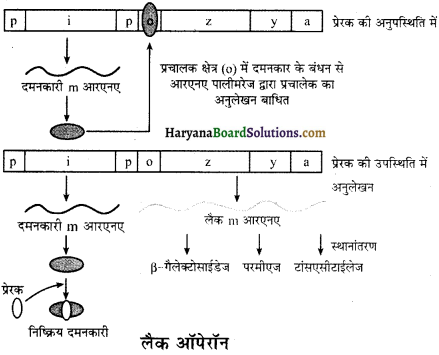
उपरोक्त प्रश्न को समझाने के लिए लैक प्रचालक (Lac operon) को जानना आवश्यक है। इसे जैकब व मोनाड (Jacob & Monad) ने बताया था। ई. कोलाई नामक जीवाणु पर कार्य करते हुये इन्होंने पहली बार अनुलेखनीय नियमित तंत्र के विषय में बताया। इसके अन्तर्गत β-गैलेटओसाइडेज (Lac Operon में β – Galactosidase) नामक एन्जाइम के संश्लेषण की क्रियाविधि के विषय में गहन अध्ययन किया गया। यह एन्जाइम लैक्टोज (Lactose) शर्करा का जल अपघटन गैलेक्टोज एवं ग्लूकोज शर्कराओं में निम्न प्रकार से करता है –

लैक्टोज B – गैलेक्टोसाइडेज ग्लूकोज + गैलेक्टोज
लैक-ऑपेरॉन (लैक = लैक्टोज) में पॉलीसीस्ट्रॉनिक संरचनात्मक जीन (Polycistronic structural gene) का नियमन एक सामान्य प्रोमोटर व नियामक जीन (Promotor and Regulatory Gene) द्वारा होता है। लैक- ऑपेरॉन एक नियामक जीन – i (i-gene) व तीन संरचनात्मक जीन (Z, Y व a) से मिलकर बना होता है। आई (i) जीन का तात्पर्य मंदक ( inhibitor) से है। इसमें आई (i) जीन लैक-ऑपेरॉन में दमनकारी (Repressor) का कूटलेखन (Code) करता है। Z gene बीटा- गैलेक्टोसाइडेज (B- Galactosidase) का कूटलेखन करता है जो डाइसैकेराइड लैक्टोज के जल विघटन से गैलेक्टोज व ग्लूकोज का निर्माण करता है। Y जीन परमीएज का कूटलेखन करता है जो कोशिका हेतु – Galactosidase की पारगम्यता को बढ़ाता है। जीन a द्वारा ट्रांसएसिटीलेज का कूटलेखन होता है। इस प्रकार लैक- ऑपेरान की सभी तीनों जीन के उत्पाद लैक्टोज उपापचय हेतु आवश्यक हैं (चित्र 6.22)।
HBSE 12th Class Biology Solutions Chapter 6 वंशागति के आणविक आधार - 3

लैक्टोज एंजाइम B-galactosidase हेतु क्रियाधार का कार्य करता है जो ऑपेरॉन की सक्रियता के आरंभ ( on ) या निष्क्रियता समाप्ति (off) को नियमित करता है। इसे प्रेरक (inducer) कहते हैं। कार्बन स्रोत जैसे ग्लूकोज की अनुपस्थिति में यदि जीवाणु के संवर्धन माध्यम में लैक्टोज डाल दिया जाता है तब परमिऐज (Permease) क्रिया द्वारा लैक्टोज कोशिका के अंदर अभिगमन करता है। लैक्टोज कोशिका के भीतर सक्रिय दमनकारी (repressor) के साथ बंधकर उसकी संरचना को बदल देता है। यह दमनकारी जब ऑपरेटर के साथ बंध (bond) नहीं बना सकता है। इस समय RNA पॉलीमरेज प्रमोटर स्थल P के साथ जुड़कर ऑपेरॉन का अनुलेखन प्रारम्भ कर देता है। कुछ समय बाद तीनों एन्जाइम उपापचय में भाग लेकर लैक्टोज अणुओं को समाप्त कर देते हैं तब उस अवस्था में कोई प्रेरक लैक्टोज ( inducer lactose) उपस्थित नहीं होता है जो दमनकारी के साथ बंध बना सके। इस समय दमनकारी पुनः सक्रिय हो जाता है व ऑपेरटर से जुड़कर ऑपेरॉन को बंद (switch off) कर देता है।

प्रश्न 11.
निम्न के कार्यों का वर्णन (एक या दो पंक्तियों से) करो-
(क) उन्नायक (प्रोमोटर)
(ख) अंतरण RNA (t.RNA)
(ग) एक्जान।
(क) उन्नायक (प्रोमोटर )
(ख) अंतरण RNA (tRNA)
(ग) एक्जान।
उत्तर:
(क) उन्नायक ( Promotor ) – यह DNA खण्ड होता है, इससे RNA Polymerase बन्धित होता है। यह संरचनात्मक जीन के अनुलेखन (Transcription) को प्रारम्भ करता है।

(ख) अंतरण RNA ( tRNA ) – इसे विलेय RNA (Soluble RNA ) भी कहते हैं। इसकी द्वितीयक संरचना क्लोवर की पत्ती जैसे होती है। इसमें एक प्रति प्रकूट (Anticodon) फंदा होता है व इसमें एक अमीनो अम्ल स्वीकार्य छोर होता है। यह प्रोटीन संश्लेषण में विभिन्न प्रकार के अमीनो अम्लों को राइबोसोम पर लाते हैं तथा प्रकूट (Codon) की स्थिति पर आ जाते हैं।

(ग) एक्जान ( Exons ) – कूटलेखन अनुक्रम (coding sequences) या अभिव्यक्त अनुक्रमों (expressed sequences) को व्यक्तेक ( exons) कहते हैं। ये वे अनुक्रम हैं जो परिपक्व या संसाधित RNA (Processed RNA ) में मिलते हैं। ये अवयक्तेक (introns) द्वारा अंतरापित ( interrupted ) होते हैं।

प्रश्न 12.
मानव जीनोम परियोजना को महापरियोजना क्यों कहा गया?
उत्तर:
मानव जीनोम परियोजना ( Human Genome Project = HGP) एक महायोजना (Mega project) है क्योंकि इसमें मानव सम्बन्ध में बड़ी संख्या में आँकड़े तैयार किये जाते हैं, जैसे- मानव जीनोम में लगभग 3 x 10 क्षार युग्म मिलते हैं; यदि अनुक्रम जानने के लिए प्रति क्षार तीन अमेरिकन डॉलर (US $3) खर्च होते हैं तो पूरी योजना पर खर्च होने वाली लागत लगभग 9 बिलियन अमेरिकी डॉलर होगा। प्राप्त अनुक्रमों को टंकणित रूप में किताब में 1000 पृष्ठ होंगे तब इस तरह से एक मानव कोशिका के डीएनए सूचनाओं को संकलित करने हेतु 3300 किताबों की आवश्यकता होगी। इस प्रकार बड़ी संख्या में आँकड़ों की प्राप्ति के लिए उच्च गतिकीय संगणक साधन की आवश्यकता होती है जिससे आँकड़ों के संग्रह, विश्लेषण व पुन: उपयोग में सहायता मिलती है HGP एक बहुत बड़ी परियोजना है, इसके अन्तर्गत विश्व की अनेक प्रयोगशालायें कार्यरत हैं। अतः यह एक अन्तर्राष्ट्रीय परियोजना है, इस कारण इसे महापरियोजना कहा गया है।

प्रश्न 13.
DNA अंगुलिछापी क्या है? इसकी उपयोगिता पर प्रकाश डालिए।
उत्तर:
विभिन्न जीवों में DNA पाया जाता है किन्तु अलग- अलग जीवों में पाये जाने वाले DNA के क्षार अनुक्रम में अन्तर होता है। DNA के अनुक्रम में मिलने वाले ये अन्तर व्यक्ति विशेष के समलक्षणीय रूप आकार को निर्धारित करते हैं। यदि किन्हीं दो व्यक्तियों या किसी जनसंख्या के व्यक्तियों के बीच आनुवंशिक विभिन्नता का पता लगाना हो तो सदैव DNA का अनुक्रम ज्ञात करना होगा । यह एक कठिन व महंगा कार्य है। दो व्यक्तियों के DNA अनुक्रमों के बीच तुलना करने के लिए DNA अंगुलिछापी एक त्वरित विधि है। इस विधि में DNA अनुक्रम में स्थित कुछ विशिष्ट स्थलों के मध्य विभिन्नता का पता लगाते हैं, इसे पुनरावृत्ति DNA ( Repetitive DNA) कहते हैं। अनुक्रमों में DNA का छोटा भाग अनेक बार पुनरावृत्त होता है। इस पुनरावृत्त DNA को जीनोमिक DNA के ढेर में से घनत्व प्रवणता अपकेन्द्रीकरण द्वारा पृथक करते हैं।

उपयोगिता:
(1) अपराधी की पहचान अपराधी की पहचान हेतु संदेह के घेरे में पाये जाने वाले व्यक्ति / व्यक्तियों के DNA फिंगर प्रिन्ट्स से प्राप्त होने वाले बैण्ड्स (bands) की तुलना, टेस्ट DNA फिंगर प्रिन्ट्स में से प्राप्त होने वाले बैण्ड्स से की जाती है, जिसे अपराधी द्वारा छोड़े गये. प्रमाण जैसे- रक्त तथा वीर्य के धब्बों या बालों आदि से प्राप्त किया जाता है। यदि दोनों में पूर्ण समानता पायी जाती है तभी वास्तविक अपराधी की पहचान हो पाती है।

(2) बच्चे के वास्तविक जनकों की पहचान- जब किसी बच्चे के असली माँ व पिता होने का विवाद हो, ऐसे मामलों में बच्चे के DNA फिंगर प्रिन्ट्स की तुलना माँ तथा सन्देहिल पिता दोनों के DNA फिंगर प्रिन्ट्स से की जाती है। पहले बच्चे के DNA फिंगर प्रिन्ट से प्राप्त होने वाले बैण्ड्स से किया जाता है। इसके पश्चात् बच्चे के DNA फिंगर प्रिन्ट में बचे हुए बैण्ड्स का मिलान माता के DNA फिंगर प्रिन्ट में प्राप्त होने वाले बैण्ड्स की तुलना पिता के DNA फिंगर प्रिन्ट में उपस्थित बैण्ड्स से की जाती है। यदि दोनों में समानता होती है तो वही बच्चे का असली पिता होता है।

(3) चिकित्सा में उपयोग- इसका प्रयोग आनुवंशिक परामर्शों में, बोन मैरो ट्रांसप्लान्ट में दाता कोशिकाओं की आवृत्ति जानने हेतु, ऊतक संवर्धन में कोशिकाओं की पहचान आदि में किया जाता है। इसके अतिरिक्त पेटेन्ट (Patent ) कराने के लिए पादप किस्मों की पहचान तथा उनके जनकों व लक्षणों को चिन्हित करने तथा सूक्ष्म जीवों के प्रभेदों की पहचान करने में DNA फिंगर प्रिन्टिंग विधि अधिक उपयोगी साबित हुई है।

प्रश्न 14.
निम्न का संक्षिप्त वर्णन कीजिए-
(क) अनुलेखन
(ख) बहुरूपता
(ग) स्थानांतरण
(घ) जैव सूचना विज्ञान
उत्तर:
(क) अनुलेखन (Transcription ) – DNA अणुओं के विशेष खण्डों पर उनकी अनुपूरक प्रतिलिपियों के रूप में m.RNA अणुओं का संश्लेषण होता है। यह कोशिका चक्र की अन्तराल अवस्था (Interphase) की G1 तथा G2 उपअवस्थाओं में होती है। प्रत्येक जीन या सिस्ट्रॉन के प्रारम्भ में प्रोमोटर स्थल (Promotor Site) तथा अन्त में समापन स्थल (terminator site) होता है। अतः m.RNA का संश्लेषण प्रोमोटर स्थल के समीप स्थित प्रारम्भन स्थल ( Initiation से शुरू होता है व समापन स्थल पर समाप्त होता है।

अनुलेखन की क्रियाविधि (Mechanism of transcription)-यह क्रिया निम्न चरणों में पूर्ण होती है –

  • RNA पॉलिमरेज एन्जाइम का DNA द्विकुण्डलिनी से जुड़ना।
  • DNA की दोनों श्रृंखलाओं का पृथक होना।
  • क्षारक युग्मन (अनुपूरक क्षारक हाइड्रोजन बन्धों द्वारा जुड़ते हैं)।
  • राइबोन्यूक्लियोटाइड ट्राइफॉस्फेट्स का मोनोफॉस्फेट में परिवर्तन।
  • राइबोन्यूक्लियोटाइड मोनोफॉस्फेट अणुओं का फॉस्फोडाइ एस्टिर बन्धों द्वारा जुड़कर RNA पॉलिन्यूक्लियोटाइड्स श्रृंखला का निर्माण।
  • पॉलिन्यूक्लियोटाइड्स श्रृंखला का समापन।
  • DNA खण्ड का पूर्व स्थिति में वापस आ जाना।

(ख) बहुरूपता (Polymorphism ) – बहुरूपता (आनुवंशिक आधार पर विभिन्नता ) उत्परिवर्तन के कारण ही उत्पन्न होती है। किसी व्यक्ति में नये उत्परिवर्तन उनकी कायिक कोशिकाओं या जनन कोशिकाओं में पैदा होते हैं। यदि जनन कोशिका उत्परिवर्तन किसी व्यक्ति की संतानोत्पत्ति क्षमता को गंभीर रूप से प्रभावित नहीं करते तो यह उत्परिवर्तन स्थानांतरित होता है जिससे जनसंख्या के दूसरे सदस्यों (लैंगिक प्रजनन द्वारा) में यह फैल जाता है। विकल्पी अनुक्रम विभिन्नता जिसे परंपरागत रूप से DNA बहुरूपता कहते हैं। मानव जनसंख्या में 0.01 से अधिक आवृत्ति में एक विस्थल में असंगति मिलने से होती है।

साधारणतया यदि एक वंशागति उत्परिवर्तन जनसंख्या में उच्च आवृत्ति से मिलता है तो इसे DNA बहुरूपता कहते हैं। इस प्रकार की संभावना अव्यक्तेक DNA (intron DNA) अनुक्रम में ज्यादा होती है व इन अनुक्रमों में होने वाला उत्परिवर्तन व्यक्ति की प्रजनन क्षमता को प्रभावित नहीं कर पाता है। इस तरह के उत्परिवर्तन एक पीढ़ी से दूसरी पीढ़ी में एकत्रित होते रहते हैं जिसके फलस्वरूप विभिन्नता / बहुरूपता उत्पन्न होती है। बहुरूपता विभिन्न प्रकार की होती है जिसमें एक न्यूक्लियोटाइड में या विस्तृत स्तर पर परिवर्तन होता है। विकास व जाति उद्भवन में उपरोक्त बहुरूपता की बहुत बड़ी भूमिका होती है।

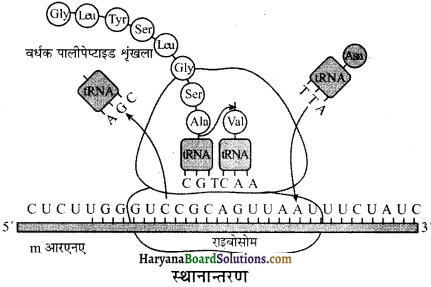
(ग) स्थानांतरण (Translation) – स्थानांतरण क्रिया के अन्तर्गत अमीनो अम्लों के बहुलकन (Polymerisation) से पॉलीपेप्टाइड का निर्माण होता है। अमीनो अम्लों के क्रम व अनुक्रम m.RNA में पाये जाने वाले क्षारों के अनुक्रमों पर निर्भर करता है। अमीनो अम्ल पेप्टाइड बंध द्वारा जुड़े रहते हैं। पेप्टाइड बंध के निर्माण में ऊर्जा की आवश्यकता होती है। प्रथम अवस्था के दौरान अमीनो अम्ल स्वयं ATP की उपस्थिति में सक्रिय हो जाते हैं व सजातीय tRNA से जुड़ जाते हैं। इस प्रक्रिया को t RNA का आवेशीकरण (Charging) या tRNA एमीनोएसिलेशन (tRNA aminoacylation) कहते हैं। इस प्रकार से आवेशित दो t. RNA का एक-दूसरे से काफी पास में आने से उनमें पेप्टाइड बंध का निर्माण होता है। उत्प्रेरक की उपस्थिति में पेप्टाइड बंध बनने की दर बढ़ जाती है (चित्र 6.21 )।
HBSE 12th Class Biology Solutions Chapter 6 वंशागति के आणविक आधार - 4

प्रोटीन संश्लेषण के लिये राइबोसोम आवश्यक है। राइबोसोम संरचनात्मक RNA व लगभग 80 विभिन्न प्रोटीनों से मिलकर बना होता है। राइबोसोम निष्क्रिय अवस्था में दो उपएककों- एक बड़ी उपएकक व एक छोटी उपकक से मिलकर बना होता है। जब छोटा उपएकक m. RNA में मिलता है तब m. RNA का प्रोटीन में स्थानांतरण की प्रक्रिया प्रारम्भ हो जाती है। बड़े उपकक में दो स्थल होते हैं जिससे बाद में अमीनो अम्ल जुड़कर एक- दूसरे के काफी पास में आ जाते हैं जिससे पॉलीपेप्टाइड बंध बन जाता है। राइबोसोम पेप्टाइड बंध के निर्माण में उत्प्रेरक (23r. RNA जीवाणु में एंजाइम – राइबोजाइम) का कार्य करता है।

mRNA में स्थानांतरण इकाई RNA का अनुक्रम है जिसके किनारों पर प्रारंभक प्रकूट (AUG Start Codon) व रोध प्रकूट (Stop Codon) मिलते हैं जो पॉलीपेप्टाइड का कूटलेखन करते हैं। mRNA में कुछ अतिरिक्त अनुक्रम होते हैं जो स्थानांतरित नहीं होते हैं उन्हें अस्थानांतरित स्थल (Untranslated Regions, UTR) कहते हैं। UTR दोनों 5- किनारा (प्रारंभक प्रकूट के पूर्व) व 3 – किनारा ( रोध प्रकूट के पश्चात् ) पर स्थित होता है। ये प्रभावी स्थानांतरण प्रक्रिया हेतु आवश्यक हैं।

प्रारंभन के लिये राइबोसोस m. RNA के प्रारंभक प्रकूट (AUG ) से बंधता है जिसकी पहचान tRNA द्वारा की जाती है। राइबोसोम इसके बाद प्रोटीन संश्लेषण की दीर्घीकरण प्रावस्था की ओर बढ़ता है। इस अवस्था में एमीनो अम्ल tRNA से जुड़कर एक जटिल रचना का निर्माण करते हैं जो आगे चलकर tRNA के प्रति प्रकूट (anticodon) से पूरक क्षार युग्म बनाकर m. RNA के उचित प्रकूट से जुड़ जाते हैं। राइबोसोम m. RNA के साथ एक प्रकूट से दूसरे प्रकूट की ओर जाता है। एक के बाद एक अमीनो अम्लों के जुड़ने से पॉलीपेप्टाइड अनुक्रमों का स्थानांतरण होता है जो DNA द्वारा निर्देशित व m. RNA द्वारा निरूपित होते हैं। अंत में विमोचक कारक (Release Factor) का रोध प्रकूट से जुड़ने से स्थानांतरण प्रक्रिया का समापन हो जाता है व राइबोसोम से पूर्ण पॉलीपेप्टाइड अलग हो जाते हैं।

(घ) जैव सूचना विज्ञान (Bioinformatics) – अध्ययनानुसार यह ज्ञात है कि किसी भी जीव की आनुवंशिक व्यवस्था उसके DNA में मिलने वाले अनुक्रम से निर्धारित होती है। दो विभिन्न व्यक्तियों में मिलने वाला DNA अनुक्रम कुछ जगहों पर भिन्न-भिन्न होता है। आनुवंशिक अभियांत्रिक तकनीकों के विकास से किसी भी DNA खंड को विलगित (isolate) व क्लोन किया जा सकता है व DNA अनुक्रमों को जाना जा सकता है। सन् 1990 में मानव जीनोम के अनुक्रमों को ज्ञात करने के लिये मानव जीनोम योजना (Human Genome Project = HGP) प्रारम्भ हुई और यह एक महायोजना थी।

इस योजना के अन्तर्गत एक अन्तर्राष्ट्रीय मानव जीनोम बैंक की स्थापना की गई है जहाँ विश्व में पायी जाने वाली मानव प्रजातियों की कोशिकाओं व DNA नमूनों को संग्रहित किया जा रहा है। इस योजना का मुख्य उद्देश्य मानव के पूर्ण जीनोम के DNA के न्यूक्लियोटाइडों का अनुक्रम ज्ञात कर, सम्पूर्ण जीनों का जीन चित्रण (Genetic map) बनाना है। मानव जीनोम की सम्पूर्ण सूचना एकत्र करना व उसका संग्रह करना अत्यन्त दुष्कर है परन्तु जीव विज्ञान के नये क्षेत्र जैव सूचना विज्ञान (Bioinformatics) ने इस समस्या का समाधान कर दिया है। क्योंकि मानव जीनोम में लगभग 3 x 10 क्षार युग्म मिलते हैं।

यदि इन अनुक्रमों को टंकणित रूप (typed form ) में पुस्तक में संग्रहित किया जाए तो जिसके प्रत्येक पृष्ठ में 1000 अक्षर हों तो इस प्रकार इस पुस्तक में 1000 पृष्ठ होंगे तब इस तरह से एक मानव कोशिका के DNA सूचनाओं को संकलित करने हेतु 3300 पुस्तकों की आवश्यकता होगी। इस प्रकार बड़ी संख्या में आँकड़ों की प्राप्ति के लिये उच्च गतिकीय संगणक साधन (High Speed Computational Devices) की आवश्यकता होती है जिससे आँकड़ों के संग्रह, विश्लेषण व पुनः उपयोग में सहायता मिलती है। इन सब कार्यों का निष्पादन सुगमता से जैव सूचना विज्ञान के द्वारा किया जाता है।

HBSE 12th Class Biology Solutions Chapter 6 वंशागति के आणविक आधार Read More »

HBSE 10th Class Science Solutions Chapter 12 Electricity

Haryana State Board HBSE 10th Class Science Solutions Chapter 12 Electricity Textbook Exercise Questions and Answers.

Haryana Board 10th Class Science Solutions Chapter 12 Electricity

HBSE 10th Class Science Electricity Textbook Questions and Answers

Question 1.
A piece of wire of resistance R is cut into five equal parts. These parts are then connected in parallel. If the equivalent resistance of this combination is R’, then the ratio R / R is ………
(a) 1/25
(b) 1/5
(c) 5
(d) 25
Answer:
(d) Resistance of each part = \(\frac{R}{5}\)
When the five parts are connected in parallel, the equivalent resistance R’ is given by
\(\frac{1}{R^{\prime}}=\frac{5}{R}+\frac{5}{R}+\frac{5}{R}+\frac{5}{R}+\frac{5}{R}=\frac{25}{R}\)
∴ \(\frac{\mathrm{R}}{\mathrm{R}^{\prime}}=25\)

HBSE 10th Class Science Solutions Chapter 12 Electricity

Question 2.
Which of the following terms does not represent electrical power in a circuit?
(a) I²R
(b) IR²
(c) VI
(d) V²/R
Answer:
(b) IR²

Question 3.
An electric bulb is rated 220 V and 100 W. When it is operated on 110 V, the power consumed will be ………………
(a) 100W
(b) 75W
(c) 50W
(d) 25W
Answer:
Resistance \(R=\frac{V^2}{P}=\frac{(220)^2}{100}=484 \Omega\)
When operated on 110 V, the power consumed will be \(P^{\prime}=\frac{V^{\prime 2}}{R}=\frac{(110)^2}{484}=25 \mathrm{~W}\)

Question 4.
Two conducting wires of the same material and of equal lengths and equal diameters are first connected in series and then parallel in a circuit across the same potential difference. The ratio of heat produced in series and parallel combinations would be …………….
(a) 1:2
(b) 2:1
(c) 1:4
(d) 4:1
OR
Two Identical wires are first connected in series and then In parallel to a source of supply. Find the ratio of the heat produced in two cases.
Answer:
(c) 1:4
Let R be the resistance of each wire. In senes combination, the total resistance will be 2R. Heat produced,
HBSE 10th Class Science Solutions Chapter 12 Electricity 1
In parallel combination, the total resistance is R/2. Heat produced.
HBSE 10th Class Science Solutions Chapter 12 Electricity 2

HBSE 10th Class Science Solutions Chapter 12 Electricity

Question 5.
How is a voltmeter connected in the circuit to measure the potential difference between two points?
Answer:
A voltmeter is always connected in parallel connection with the circuit.

Question 6.
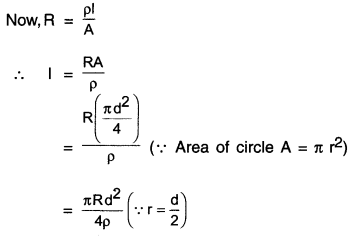
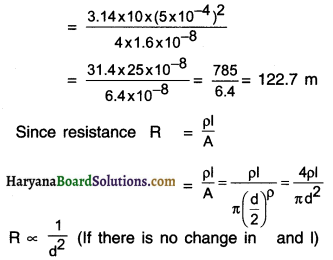
A copper wire has a diameter 0.5 mm and a resistivity of 1.6 x 10⁻⁸ Ωm. What will be the length of this wire to make its resistance 10Ω? How much does the resistance change if the diameter is doubled?
Answer:
Given the diameter of the wire,
d = 0.5mm = 0.5 x 10m=5 x 10m
Resistivity of copper p = 1.6 x 10 Qm
Required resistance R = 10
Length I = ?
HBSE 10th Class Science Solutions Chapter 12 Electricity 3

HBSE 10th Class Science Solutions Chapter 12 Electricity 4
Conclusion: When diameter d is doubled, then resistance R becomes one-fourth of its original value.

HBSE 10th Class Science Solutions Chapter 12 Electricity

Question 7.
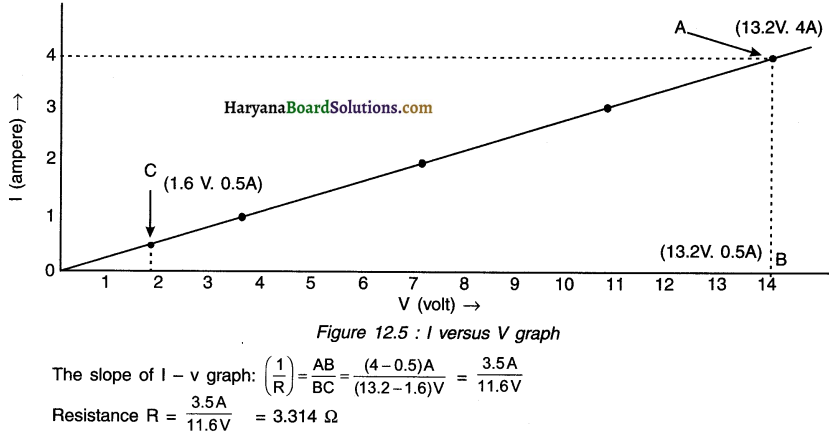
The values of current I flowing in a given resistor for the corresponding values of potential difference V across the resistors are given below.
HBSE 10th Class Science Solutions Chapter 12 Electricity 5
Plot a graph between V and I and calculate the resistance of that resistor.
Answer:
1. The graph between V and I plotted by using the given data is shown here.
2. Since the graph is a straight line, the slope of the graph will be reciprocal of resistance. \(\left(\text { i.e., } \frac{1}{R}\right)\), because the slope of the graph \(=\frac{\Delta \mathrm{I}}{\Delta \mathrm{V}}=\frac{1}{\mathrm{R}}\)

HBSE 10th Class Science Solutions Chapter 12 Electricity 6

Question 8.
When a 12 V battery is connected across an unknown resistor, there is a current of 2.5 mA in the circuit. Find the value of the resistance of the resistor.
Answer:
Here,v=12V, l=2.5 mA = 2.5 x 10⁻³A; R=?
The resistance of the resistor R = \(\mathrm{R}=\frac{\mathrm{V}}{\mathrm{l}}=\frac{12}{2.5 \times 10^{-3}} \)
= 4800 Ω = 4.8 kΩ

Question 9.
A battery of 9 V is connected in series with resistors of 0.2 Ω, 0.3 Ω, 0.4 Ω, 0.5 Ω and 12 Ω, respectively. How much current would flow through the 12 Ω resistor?
Answer:
Since all the given resistors are connected in series, their equivalent resistance
Rs = 0.2 + 0.3 + 0.4 + 0.5 + 12 = 13.4Ω
The current through the circuit,
\(\mathrm{I}=\frac{\mathrm{V}}{\mathrm{R}_{\mathrm{S}}}=\frac{9}{13.4}=0.67 \mathrm{~A}\)
In a series combination, the equal amount of current I flows through all the resistors, so the current flowing through 12 Ω resistor = 0.67 A

HBSE 10th Class Science Solutions Chapter 12 Electricity

Question 10.
How many 176 Ω resistors (In parallel) are required to carry 5 A on a 220 V line?
Answer:
Here, I = 5A; V = 220 V
∴ The total resistance of the given circuit is Rtotal = \(\frac{\mathrm{V}}{\mathrm{l}}=\frac{220}{5}=44 \Omega\)
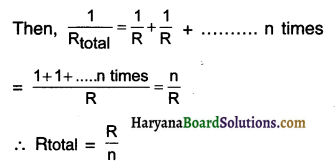
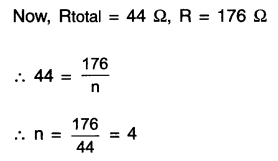
So, when 44 Ω resistance is connected with 220 v line, 5A current would flow through the given circuit. Now, suppose ‘n’ resistors, each of resistance R, are required to be connected in parallel, so that the total resistance Rtotal becomes 44 Ω.HBSE 10th Class Science Solutions Chapter 12 Electricity 7
HBSE 10th Class Science Solutions Chapter 12 Electricity 8
Thus, when we connect 4 resistors each of 176 in parallel, it will give the total resistance of 44. This will allow 5A current to flow when connected to 220 V line.

Question 11.
Show how you would connect three resistors, each of resistance 6Ω, so that the combination has a resistance of
(i) 9Ω, (ii) 4Ω.
Answer:
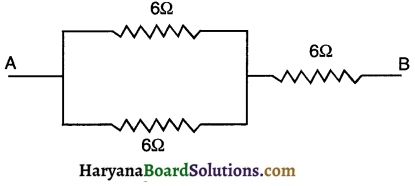
(i) For getting total resistance of 9Ω from three resistors each of 6Ω, we
(a) First connect two 6Ω resistors in parallel.
(b) Then, we connect this parallel combination in series with the third 6Ω resistors as shown in
For resistors connected in parallel,
\(\frac{1}{R_p}=\frac{1}{R_1}+\frac{1}{R_2}=\frac{1}{6}+\frac{1}{6}=\frac{2}{6}=\frac{1}{3}\)
∴ Rp = 3Ω
HBSE 10th Class Science Solutions Chapter 12 Electricity 9

Now, total resistance HaryanaBoardSolutio
= Resistance in parallel + 6 Ω of resistance connected in series.
= Rp+6Ω
= 3Ω + 6Ω = 9Ω

HBSE 10th Class Science Solutions Chapter 12 Electricity

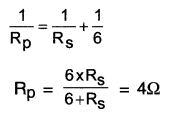
(iii) For getting total resistance of 4Ω from three resistors each of 6Ω, we
(a) First connect two 6Ω resistors in series
(b) Then, we connect this senes combination in parallel to the third 6Ω resistor as shown in the diagram.
For resistors connected in series,
Rs = 6 + 6 = 12 Ω
Now, for total resistance
HBSE 10th Class Science Solutions Chapter 12 Electricity 10

Question 12.
Several electric bulbs designed to be used on a 220 V electric supply line, are rated 10 W. How many lamps can be connected In parallel with each other across the two wires of 220 V line if the maximum allowable current is 5 A?
Answer:
Voltage rating of each bulb = 220 V
Power rating of each bulb = 10 W
∴ The resistance of each bulb
\(R=\frac{V^2}{P}=\frac{220^2}{10}=\frac{220 \times 220}{10}=4840 \Omega\)
Now, V = 220 v and I = 5A
∴  The total resistance of the given circuit is
\(\text { Rtotal }=\frac{V}{l}=\frac{220}{5}=44 \Omega\)
Thus, when 44Ω resistance is connected with 220 V line, 5A current flows through the given circuit.
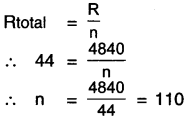
So, when ‘n’ bulbs each having resistance R, are connected in parallel, their equivalent resistance
HBSE 10th Class Science Solutions Chapter 12 Electricity 11
Thus, 110 bulbs each having resistance 4840Ω connected in parallel will give total resistance of 44 Q causing a current of 5 A to flow when we connect them to 220 V line.

Question 13.
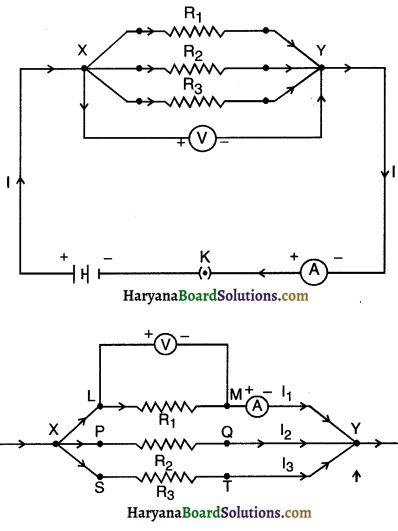
A hot plate of an electric oven connected to a 220 V line has two resistance coils A and B, each of 24Ω resistance, which may be used separately, In series, or in parallel. What are the currents In the three cases?
Answer:
Potential difference V = 220 V
Resistance of each coil RA = RB 24 Ω

Case-1: When coil A or B is connected separately, the current through each coil is
\(I=\frac{V}{R_A} \text { or } \frac{V}{R_B}=\frac{220}{24}=9.166 \mathrm{~A}\)

Case-2: When the coils A and B are connected in series, the equivalent resistance of the circuit
RS = RA + RB = 24 + 24 = 48Ω
Now, the current through the series combination
\(\text { Is }=\frac{V}{R_s}=\frac{220}{48}=4.58 A \approx 4.6 \mathrm{~A}\)

HBSE 10th Class Science Solutions Chapter 12 Electricity

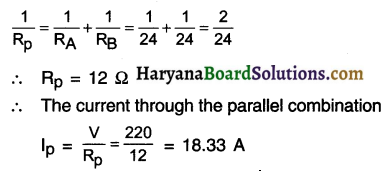
Case-3: When the coils A and B are connected in parallel, the equivalent resistance RP of the circuit is given by
HBSE 10th Class Science Solutions Chapter 12 Electricity 12

Question 14.
Compare the power used In the 2Ω resistor in each of the following circuits:
(i) a 6 V battery in series with 1Ω and 2Ω resistors, and
(ii) a 4 V battery in parallel wIth 12Ω and 2Ω resistors.
Answer:
(i) 1Ω resistor and 2Ω resistor are connected in series.
∴ The equivalent resistance Rs = 1 + 2 = 3 Ω
Now, the voltage of the battery V = 6V
So, the current flowing through the circuit,
\(I s=\frac{V}{R_s}=\frac{6}{3}=2 A\)
In a series combination equal current 2 A flows through each resistor.
Hence, the current flowing through 2Ω resistor is also 2A.
∴ Power used in 2Ω resistor
P1 =I2sR
= (2)2 x 2 = 8W

(ii) 12Ω resistor and 2Ω resistor are connected in parallel. A 4 V battery is connected in parallel with this parallel combination of resistors. The potential difference across 2Ω resistor will also be 4V.
∴ Power used in 2Ω resistor –
\(P 2=\frac{V^2}{R}=\frac{4^2}{2}=\frac{16}{2}=8 \mathrm{~W}\)
For comparing the power used in 2Ω resistor in two different circuits, we find the ratio of P1 and P2.
∴ \(\frac{P_1}{P_2}=\frac{8}{8}=1\)
∴ P1 = P2
Hence, we conclude that 2Ω resistor uses equal power i.e. 8W in both the circuits.

HBSE 10th Class Science Solutions Chapter 12 Electricity

Question 15.
Two lamps, one rated 100 W at 220 V, and the other 60 W at 220 V, are connected in parallel to electric mains supply. What current is drawn from the line If the supply voltage is 220 V?
Answer:
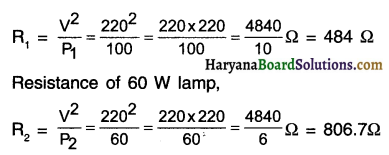
Resistance of 100 w lamp,
HBSE 10th Class Science Solutions Chapter 12 Electricity 13
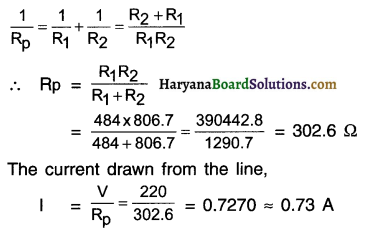
When, these lamps are connected in parallel, their equivalent resistance Rp would be
HBSE 10th Class Science Solutions Chapter 12 Electricity 14

Question 16.
Which uses more energy, a 250 W TV set in 1 hr, or a 1200 W toaster in 10 minutes?
Answer:
(a) For TV set:
P=250W = 25\(\frac{\mathrm{J}}{\mathrm{s}}\)
Time t = 1h = 3600s
Electric energy (used by TV set)
= P x t
= 250\(\frac{\mathrm{J}}{\mathrm{s}}\) x 3600s
= 900000 = 900kJ

(b) For toaster:
Power P = 1200 W = 1200\(\frac{\mathrm{J}}{\mathrm{s}}\)
Time t = 10 minute = 10 x 60 = 600 s
Electric energy (used by toaster) = P x t
= 1200\(\frac{\mathrm{J}}{\mathrm{s}}\) x 600 s = 720000 720 kJ
Thus, we can say a 250 W TV set in 1 h consumes more electric energy than a 1200W toaster in 10 minute.

Question 17.
An electric heater of resistance 8 Q draws 15 A from the service mains 2 hours. Calculate the rate at which heat is developed In the heater.
Answer:
Here, I = 15A; R = 8Ω; t = 2h
The rate at which heat is developed in the heater means its electric power,
P =I2R=(15)2 x 8 = 225 x 8=1800W=1800\(\frac{\mathrm{J}}{\mathrm{s}}\)

Question 18.
Explain the following.
(a) Why is tungsten used almost exclusively for filament of electric lamps?
(b) Why are the conductors of electric heating devices, such as bread-toasters and electric irons, made of an alloy rather than a pure metal?
(c) Why is the series arrangement not used for domestic circuits?
(d) How does the resistance of a wire vary with its area of cross-section?
(e) Why copper and aluminium wires are most widely employed for electricity transmission?
Answer:
(a) Tungsten metal has a very high melting point of 3380°C and so it does not melt even at very high temperature.

  • Tungsten has the ability to retain much of the heat generated. So, when it becomes very hot it emits light without getting melted.
  • Tungsten is very flexible and can be easily molded into filament.
  • Owing to all these reasons, tungsten is the only metal used in filament of electric lamps.

HBSE 10th Class Science Solutions Chapter 12 Electricity

(b) Compared to metals, alloys have very high resistance. This helps in better heat generation. Hence,

(c) In a series connection, the voltage gets divided. Due to this, the appliances give less output.
If fault occurs in one appliance or at one part of the circuit, the current stops flowing in the entire circuit and other appliances also stop working.

  • All the electrical appliances connected in a series are operated by one single switch. So, we cannot control individual appliance.
  • Owing to all these reasons, we cannot use series connection for domestic use.

(d) The resistance R of a wire is inversely proportional to its cross-section area A i.e. R α \(\frac{1}{A}\)

  • So, thicker the wire (i.e. larger the cross-section area) lesser the resistance and vice-versa.

(e) Copper and aluminium have low electric resistivity. So, they can conduct electric current without much heat loss.

  • Compared to other metals copper and aluminium are cheaper. Moreover, wires can be easily drawn from these metals.

HBSE 10th Class Science Electricity InText Activity Questions and Answers

Textbook Page no – 200

Question 1.
What does an electric circuit mean?
Answer:
A continuous and closed path along which electric current flows is called an electric circuit.

Question 2.
Define the unit of current.
Answer:
Electric current:
1. The rate of flow of electric charge is known as electric current. In other words, the net quantity of electric charge that flows through any cross-section of a conductor is known as the electric current.

2. Thus, electric current \(=\frac{\text { Quantity of electric charge }}{\text { Time }}\)

3. Thus, if Q is the amount of electric charge passing through any cross-section of a conductor in time t then, electric current (I) =\(\frac{Q}{t}\)

4. If a quantity of one Coulomb (1Q) electric charge passes through the conductor in 1 second, then we can say that an electric current of one ampere (1 A) is flowing through the conductor.

5. SI unit of electric current is Coulomb/second (C/s).

6. Electric current is also measured in Ampere (A), after the French scientist Andre-Marie Ampere.

7. Milliampere (mA) and microampere (μA) are smaller units to measure electric current.

8. 1 mA = 10-3 A and 1 μA = 10-6A.

9.  An instrument called Ammeter ¡s used to measure the electric current.

HBSE 10th Class Science Solutions Chapter 12 Electricity

Question 3.
Calculate the number of electrons constituting one coulomb of charge.
Answer:
Charge on 1 electron = 1.6 x 10⁻¹⁹C
Also, total charge Q = 1C
But, Q = ne
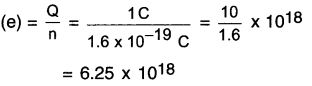
∴ Number of electrons
HBSE 10th Class Science Solutions Chapter 12 Electricity 15

Thus, 625 x 1018 electrons will constitute 1 coulomb of charge.

Textbook Page no – 202

Question 1.
Name a device that helps to maintain a potential difference across a conductor.
Answer:
An electric cell or battery is a device that helps to maintain potential difference across a conductor.

Question 2.
What is meant by saying that the potential difference between two points is 1 V?
Answer:
If the work done to bring 1 coulomb electric charge from one point to another is 1 joule, then the potential difference between these two points is called 1 volt.
Thus, 1 volt = \(\frac{1 \text { joule }}{1 \text { Coulomb }}\)

Question 3.
How much energy is given to each coulomb of charge passing through a 6 V battery?
Answer:
Each coulomb means every 1 coulomb i.e.
Q = 1 coulomb
Potential difference V = 6 volt
Energy = work done i.e. W =?
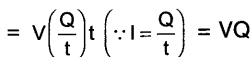
Work done W = V.Q.
= 6 V.1C
= 6J
Thus, 6 J energy is given to each coulomb of charge passing through a 6v battery.

Textbook Page no – 209

Question 1.
On what factors does the resistance of a conductor depend?
Answer:
The resistance of a conductor depends

  • on its length,
  • on its area of cross-section,
  • its temperature and
  • on the nature of its material

Question 2.
Will current flow more easily through a thick wire or a thin wire of the same material, when connected to the same source? Why?
Answer:
The current will flow more easily through a thick wire as compared to a thin wire.

Reason:

  • Resistance \(\mathrm{R} \propto \frac{1}{\text { Cross – section A }}\) This means larger the value of A, lesser will be the value of resistance R.
  • Thick wire will have more cross-section area compared to the thin-wire and so its resistance will be lower.

Question 3.
Let the resistance of an electrical component remain constant while the potential difference across the two ends of the component decreases to half of its former value. What change will occur in the current through it?
Answer:
According to Ohm’s law, I = \(\frac{\mathrm{V}}{\mathrm{R}}\). It is given that R = constant. ∴  I α V
Since I is directly proportional to potential difference V, if the value of V is halved, the value of current I will also become half.

HBSE 10th Class Science Solutions Chapter 12 Electricity

Question 4.
Why are coils of electric toasters and electric irons made of an alloy rather than a pure metal?
Answer:
The coils of electrical heating devices such as toaster and electric iron are made of alloys such as nichrome and not of pure metals due to following reasons:
(i) Alloys have higher resistivity as compared to pure metals. This helps in easily controlling the heat
to be produced.
(ii) Alloys do not oxidize i.e. they burn readily at high temperature.
(iii) Alloys have high melting point compared to several metals.

Question 5.
Use the data of Table 12.2 to answer the following.
(a) Which among iron and mercury is a better conductor?
(b) Which material is the best conductor?
Answer:
(a) The electrical resistivity of iron is 10.0 x 10⁻⁸ Ω m whereas that of mercury is 94 x 10-8 Ωm.
Lesser the resistivity, more will be the conduction of electricity. Hence, iron (Fe) is a better conductor than mercury (Hg).

(b) In the entire table, silver has the lowest electrical resistivity of just 1.60 x 10⁻⁸ Ωm. Hence, silver metal is the best conductor of electricity.

Textbook Page no – 213.

Question 1.
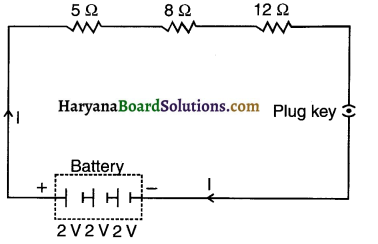
Draw a schematic diagram of a circuit consisting of a battery of three cells of 2 V each, a 5Ω resistor, an 8Ω resistor, and a 12Ω resistor, and a plug key, all connected in series.
Answer:
The required circuit diagram is as shown in the adjoining figure.
HBSE 10th Class Science Solutions Chapter 12 Electricity 16

Question 2.
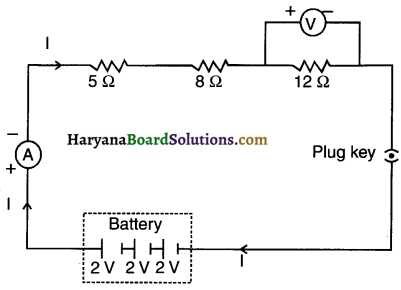
Redraw the circuit of Question 1, putting in an ammeter to measure the current through the resistors and a voltmeter to measure the potential difference across the 12Ω resistor. What would be the readings in the ammeter and the voltmeter?
Answer:
The required circuit diagram is as shown here:
HBSE 10th Class Science Solutions Chapter 12 Electricity 17
Total voltage i.e. Potential difference V = 3 x 2 = 6V
Total resistance, Rs = 5 + 8 + 12 = 25Ω
Reading of ammeter, I =\(\frac{6}{25}\)= 0.24 A.
Reading of voltmeter,
V = l x R = 0.24 x 12 = 2.88V.

HBSE 10th Class Science Solutions Chapter 12 Electricity

Textbook Page no – 216.

Question 1.
Judge the equivalent resistance when the following are connected in parallel –
(a) 1Ω and 106Ω,
(b) 1Ω and 103 Ω,and 106 Ω.
Answer:
(a) In both cases equivalent resistance will be less than 1Ω but approximately 1Ω.

Reason:

  • As per the characteristic of parallel connection, when resistors are connected in parallel, the equivalent resistance is less than the least resistance.
  • Here, in case (a) as well as (b), the lowest resistance value is of 1Ω. So, naturally, the value of equivalent resistance can be judged as lesser than 1Ω.

Question 2.
An electric lamp of 100Ω, a toaster of resistance 50Ω, and a water filter of resistance 500Ω are connected In parallel to a 220 V source. What is the resistance of an electric iron connected to the same source that takes as much current as all three appliances, and what is the current through it?
Answer:
Resistance of electric lamp, R1 = 100Ω
Resistance of toaster, R2 = 50Ω
Resistance of water filler, R3 = 500Ω
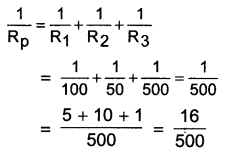
Equivalent resistance Rp of the three appliances connected in parallel is given by
HBSE 10th Class Science Solutions Chapter 12 Electricity 18
\(=\frac{500}{16}=\frac{125}{4}\)
= 31.25Ω
Resistance of electric iron = Equivalent resistance of the three appliances connected in parallel
= 31.25Ω
Applied voltage, V = 220 V
Current, \(\mathrm{I}=\frac{\mathrm{V}}{\mathrm{R}}=\frac{220 \mathrm{~V}}{31.25 \Omega}=7.04 \mathrm{~A}\)

Question 3.
What are the advantages of connecting electrical devices in parallel with the battery instead of connecting them in series?
Answer:

Series ConnectionParallel Connection
1. When two or more resistors are connected end to end consecutively, such a connection is called a series connection.When two or more resistances are connected between the same two points, they are said to be connected in parallel (because they become parallel to each other).
2. In series connection, the resistors are connected across two points say A and B of the circuit in such a way that equal amount of current flows through each resistor and the current flows in only one path.In parallel connection, the resistors are connected across two points say A and B of the circuit in such a way that equal amount of voltage drops across two ends of each resistor and the current flows in more than one path.
3. The magnitude of equivalent resistance R is always larger than the largest resistance of the circuit.In parallel connection, voltage drop (V) across two ends of each resistor remains same but the current (I) that flows in the circuit gets divided into three parts at point A.
4. Here, equivalent resistance R = R1+R2+R3Here, equivalent resistance =\(\frac{1}{R}=\frac{1}{R_1}+\frac{1}{R_2}+\frac{1}{R_3}\)
5. The magnitude of equivalent resistance R is always larger than the largest resistance of the circuit.The magnitude of equivalent resistance I is always smaller than the smallest resistance.

HBSE 10th Class Science Solutions Chapter 12 Electricity

Question 4.
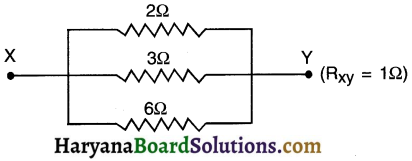
How can three resistors of resistances 2Ω, 3Ω, and 6Ω be connected to give a total resistance of  (a) 4Ω (b)1Ω?
Answer:
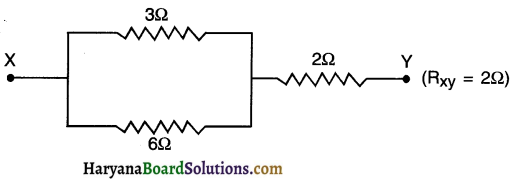
(a) First connect resistors of 3Ω and 6Ω in parallel connection.
Then connect 2Ω resistor in series connection with the above-mentioned two resistors.
The connection is shown in the diagram below:
HBSE 10th Class Science Solutions Chapter 12 Electricity 19
Resistance in parallel connection, Rp
\(=\frac{1}{R_1}+\frac{1}{R_2}=\frac{R_1 R_2}{R_1+R_2}=\frac{3 \times 6}{3+6}=2\)
Resistance between parallel connection Rp and third resistor R3 will be
Rs= Rp+R= 2 + 2 = 4Ω
Thus, RXY gives us a total resistance of 4Ω using resistors of 2Ω 3Ω and 6Ω.

(b) On connecting all the three resistors, the diagram we get is as follows:
HBSE 10th Class Science Solutions Chapter 12 Electricity 20
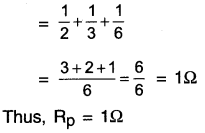
HBSE 10th Class Science Solutions Chapter 12 Electricity 21

Total resistance in this parallel connection \(\frac{1}{R_p}=\frac{1}{R_1}+\frac{1}{R_2}+\frac{1}{R_3}\)

Question 5.
What is (a) the highest, (b) the lowest total resistance that can be secured by combinations of four coils of resistance 4Ω, 2Ω, 8Ω, 12Ω, 24Ω?
Answer:
(a) The highest resistance can be obtained by connecting all the four coils in series. In this case,
Rs =R1+R2+R3+R4 = 4 + 8 + 12 + 24 = 48
Thus, the highest resistance which can be secured is 48Ω.

(b) The lowest resistance can be secured by connecting all the four coils in parallel. In this case,
HBSE 10th Class Science Solutions Chapter 12 Electricity 22

Thus, the lowest resistance which can be secured is 22.

Textbook Page no – 218.

Question 1.
Why does the cord of an electric heater not glow while the heating element does?
Answer:
1. The heating element of the electric heater is made up of an alloy such as nichrome. It has high resistance. So, it becomes red hot on heating and starts glowing,
2. The cord is made of pure metal like copper which has very low resistance. So when electricity is passed through it, it does not become red hot and so it does not glow.

Question 2.
Compute the heat generated while transferring 96000 coulombs of charge in one hour through a potential difference of 50V.
Answer:
Here, charge, Q = 96000 C,
Time t =1 h=60 x 60 = 3600s.
Potential difference V = 50 V
Now, Heat generated H = Vlt
HBSE 10th Class Science Solutions Chapter 12 Electricity 23
= 50 x 96000 = 4800000 J = 4.8 X 10⁶ J
Or
=4.8 x 103 x 103J=4.8 x 10³ kJ = 4800 kJ

Question 3.
An electric iron of resistance 20Ω takes a current of 5 A. Calculate the heat developed in 30 s.
Answer:
Here, current I = 5A
Resistance R = 20 , time t = 30 s
Now,
Heat produced H = I2Rt
= (5)2 x 20 x 30 = 25 x 20 x 30
=15000J = 15kJ

Textbook Page no – 220.

Question 1.
What determines the rate at which energy is delivered by a current?
Answer:
The electric current remains the same. So, it is the type of resistance placed in the circuit that determines the rate at which energy is delivered by the current.

HBSE 10th Class Science Solutions Chapter 12 Electricity

Question 2.
An electric motor takes 5 A from a 220 V line. Determine the power of the motor and the energy consumed in 2 h.
Answer:
Here, I = 5A,V = 220 V
T= 2h = (2 x 60 x 60) s= 7200 s
Power P = VI = 220 x 5 = 1100W = 1100J/s
Now,
Energy consumed W = Pt = 1100 J/s x 7200 s
= 7920000 J = 7.92 x 10⁶ j

Activities

Activity 1.

Discuss the factors on which strength of electric current in a given conductor depends.
OR
How can you say that the current flowing in a circuit is strong or weak? Discuss.
Answer:
Ohm s law says, current (I) = \((\mathrm{I})=\frac{\mathrm{V} \text { (Potential difference) }}{\mathrm{R} \text { (Resistance) }}\)

From this relation we draw two conclusions. They are –
(i) I α V (It R = constant) (ii) I \(\frac{1}{R}\)(if V = constant)

From 1st:

  • Since, current (I) is directly proportional to potential difference V, it value of V is doubled, the current (I) flowing through it will also get doubled.
  • It V is halved, the current will also get halved.

From 2nd:

  • Current (I) is inversely proportional to resistance (R). So, if the value of resistance is doubled, the current (I) flowing will get halved.
  • If resistance is halved, the current (I) will get doubled.

Conclusion:
1. The strength of electric current in a given conductor depends on  –
(i) Potential difference (V) across the ends of the conductor (ii) Resistance (R) of the conductor

Activity 2.

Aim: To show that the strength of an electric current in a circuit depends on the resistance used in the circuit.

Answer:
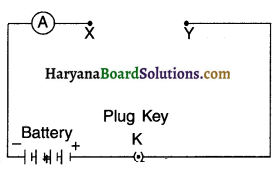
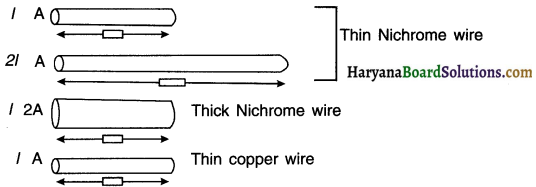
1. Take a nichrome wire, a torch bulb, a 10 W bulb and an ammeter (0 – 5A range), a plug key and some connecting wires.
2. Set up the circuit by connecting four dry cells of 1.5 V each in series with the ammeter leaving a gap
XV in the circuit, as shown in Fig.
3. Complete the circuit by connecting the nichrome wire in the gap XV. Plug the key. Note down the ammeter reading. Take out the key from the plug. [Note: Always take out the key from the plug after measuring the current through the circuit.
4. Replace the nichrome wire with the torch bulb in the circuit and find the current through It by measuring the reading of the ammeter.
5. Now repeat the above step with the lo W bulb in the gap XY.
6. Are the ammeter readings different for different components connected in the gap XV? What do the above observations indicate?
7. You may repeat this activity by keeping any material component in the gap. Observe the ammeter readings in each case. Analyze the observations.

HBSE 10th Class Science Solutions Chapter 12 Electricity 24

Observation:

  • Yes, the ammeter readings are different for different components (Nichrome wire, a torch bulb and a low bulb) when connected in the gap XY.
  • This happened because certain components offer an easy path for the flow of electric current while the others resist the flow. This means that the current through an electric component depends on its resistance.

Activity 3.

Procedure: To study the factors on which resistance of conducting wire depends.
Procedure:
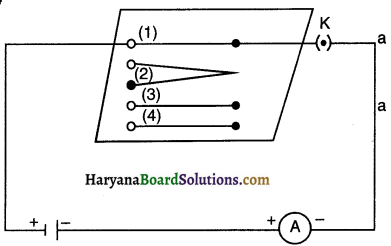
Complete an electric circuit consisting of a cell, an ammeter, a nichrome wire of length I [say, marked (1)] and a plug key, as shown in figure.

1. Now, plug the key. Note the current in the ammeter.

2. Replace the nichrome wire by another nichrome wire of same thickness but twice the length, that is 21 [marked (2) in the Fig.

3. Note the ammeter reading.
HBSE 10th Class Science Solutions Chapter 12 Electricity 25

4. Now replace the wire by a thicker nichron wire, of the same length I [marked (3)]. A thicker wire has larger cross-sectional area. Again note down the current through the circuit.

5. Instead of taking a nichrome wire, connect copper wire (marked (4) in Figure] in the circuit.

6. Let the wire be of the same length and same area of cross-section as that of the first nichrome wire [marked (1)1. Note the value of the current.

HBSE 10th Class Science Solutions Chapter 12 Electricity

7. Notice the difference in the current in all cases.

8. Does the current depend on the length of the conductor?

9. Does the current depend on the area of cross section of the wire used?

HBSE 10th Class Science Solutions Chapter 12 Electricity 26

Observation and Conclusion:
From the above activity, we can note the following observations:

  • When the length of the wire is doubled, the ammeter reading decreases to one-half of its initial value.
  • When we use a thicker wire of the same material and of the same length, the current in the circuit increases.
  • When we use copper wire of similar dimensions in place of nichrome wire, the current is the circuit increases.

Thus we conclude that the resistance of a conductor depends

  • on its length,
  • on its area of cross-section and
  • on the nature of its material.

Activity 4.

Aim: To study the series combination of resistors.

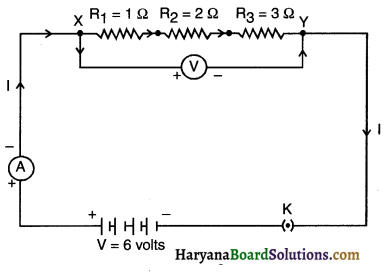
1. Join three resistors of different values in series. Connect them with a battery, an ammeter and a plug key, as shown in figure. You may use the resistors of values like 1Ω, 2Ω, 3Ω etc., and a battery of 6 V for performing this activity.
2. Plug the key. Note the ammeter reading.
3. Change the position of the ammeter to anywhere in between the resistors. Note the ammeter reading each time.
4. Do you find any change in the value of current through the ammeter?

HBSE 10th Class Science Solutions Chapter 12 Electricity 27

Observation and conclusion:

  • The ammeter reading is nearly lA. This value remains same irrespective of the position of the ammeter.
    This means the current passing through each and every part of circuit is same.
  • We conclude that in a series connection the current flowing is same throughout the circuit and through each resistor.

Activity 5.

Aim: To show that in a series combination of resistors, the total potential difference across the combination divides itself across the individual resistors.
Answer:
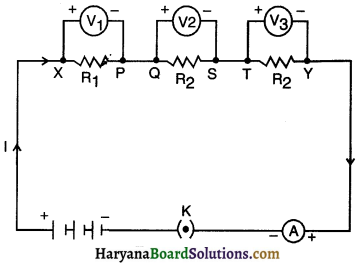
1. In Activity 124, insert a voltmeter across the ends X and Y of the series combination of three resistors, as shown in Fig. 12.16 of text-book.
2. Plug the key in the circuit and note the voltmeter reading. It gives the potential difference across the series combination of resistors. Let it be V. Now measure the potential difference across the two terminals of the battery. Compare the two values.
3. Take out the plug key and disconnect the voltmeter. Now insert the voltmeter across the ends X and P of the first resistor, as shown in Fig. 12.16 of text-book.
4. Plug the key and measure the potential difference across the first resistor. Let it be V1.
5. Similarly, measure the potential difference across the other two resistors, separately. Let these values be V2 and V3, respectively.
6. Deduce a relationship between V, V1, V2 and V3

HBSE 10th Class Science Solutions Chapter 12 Electricity 28

Observation and Conclusion:
1. The potential difference across the series combination is equal to the potential difference across the two terminals of the battery.

2. Potential difference across the first resistor R1 is found out to be V1.

3. Similarly, potential difference across resistors R2: and R3 separately are found out to be V2 and V3 respectively. Moreover, V = V1 + V2 + V3.

4. In a series combination of different resistors, the potential difference across different resistors is different,
i.e. If R1 ≠ R2 ≠ R3, V1 ≠ V2 ≠ V3.

5. The total potential difference across the combination Is equal to the sum of potential difference across each of the resistors, i.e., total potential difference across the combination divides itself across the individual resistors,
i.e. V is equal to V1 + V2 + V3.

Activity 6.

Aim: To study the parallel combination of resistors.

Procedure:
1. Make a parallel combination, XV, of three re&stors having resistances R1, R2, and R3, respectively. Connect it with a battery, a plug key and an ammeter, as shown in Fig. 12.10. Also connect a voltmeter in parallel with the combination of resistors.

2. Plug the key and note the ammeter reading. Let the current be I. Also, take the voltmeter reading. It gives the potential difference V, across the combination. The potential difference across each resistor is also V. This can be checked by connecting the voltmeter across each individual resistor (see Fig. 12.11).

3. Take out the plug from the key. Remove the ammeter and voltmeter from the circuit. Insert the ammeter in series with the resistor R1, as shown in Fig. 12.11. Note the ammeter reading, l.

4. Similarly, measure the currents through R2 and R3. Let these be I2 and I3, respectively. What is the relationship between
I, I1 , I2 , and I3

HBSE 10th Class Science Solutions Chapter 12 Electricity 29

Observation and conclusion:

1. Ammeter showed the reading I when connected. The voltmeter showed reading V when connected.

2. Potential difference across each resistor is same (i.e. V), as across the combination of resistors, i.e., V1 = V2 = V3 = V.

3. Ammeter showed reading li, when connected with the resistor R1.

4. Similarly ammeter showed reading I2 and I3 measured separately through R2 and R3 respectively.

HBSE 10th Class Science Solutions Chapter 12 Electricity

5. The relationship between I, I1, I2 and I3 is I = I1 + I2 + I3
Where, I = Total current through the combination of resistors in parallel I1, I2, I3 = Currents through R1, R2 and R3 respectively.

6. In parallel combination of resistors, the potential difference across different resistances will be same i.e. V = V1 = V2 = V3

7. Total current I in the given parallel circuit is divided amongst different resistors i.e. I = I1 + I2 + I3

HBSE 10th Class Science Solutions Chapter 12 Electricity Read More »

HBSE 12th Class Biology Solutions Chapter 5 वंशागति तथा विविधता के सिद्धांत

Haryana State Board HBSE 12th Class Biology Solutions Chapter 5 वंशागति तथा विविधता के सिद्धांत Textbook Exercise Questions and Answers.

Haryana Board 12th Class Biology Solutions Chapter 5 वंशागति तथा विविधता के सिद्धांत

प्रश्न 1.
मेंडल द्वारा प्रयोगों के लिए मटर के पौधे चुनने से क्या लाभ हुए?
उत्तर:
मेंडल ने अपने अध्ययन के लिये मटर के पौधों का चयन निम्न कारणों से किया-
(i) मटर का पौधा वार्षिक (Annual) होता है अतः इसमें अल्प जीवन- चक्र होने के कारण कई पीढ़ियों का अध्ययन आसानी से किया जा सकता है।
(ii) मटर के पुष्प द्विलिंगी (Bisexual) अर्थात् नर व मादा जननांग एक ही पुष्प में उपस्थित होते हैं।
(iii) मटर के पुष्प में स्वपरागण (Self-pollination) की अधिकता होती है। इसमें आसानी से कृत्रिम रूप से परपरागण (Artificial cross-pollination) किया जा सकता है।
(iv) स्व-निषेचन (Self-fertilization) होने के कारण मटर के पौधों में गुणों की शुद्धता (Purity of Characters) कई पीढ़ियों तक बनी रहती है।
(v) इनके पौधों में कई लक्षण विपरीत प्रभाव दर्शाते हैं अर्थात् विपर्यासी (Contrasting Characters) गुण उपस्थित होते हैं जैसे कि पौधे का लम्बा (tall) व कद का छोटा (dwarf) होना इत्यादि। मेंडल ने मटर की विभिन्न किस्मों में 7 विपर्यासी लक्षण चुने थे।

प्रश्न 2.
निम्न में भेद करो –
(क) प्रभाविता और अप्रभाविता
(ख) समयुग्मजी और विषमयुग्मजी
(ग) एकसंकर और द्विसंकर।
उत्तर:
(क) प्रभाविता और अप्रभाविता ( Dominant and Recessive ) – मेंडल ने मटर के पादपों पर प्रयोग करते समय देखा कि लम्बे व बौने (dwari) पादपों के मध्य क्रॉस करवाने पर प्रथम संतानीय पीढ़ी (F) में केवल एक ही लक्षण प्राप्त होता है जो प्रभावी लक्षण (Dominant Character) कहलाता है। दूसरा लक्षण जो F में अदृश्य रह जाता है तथा प्रदर्शित नहीं होता, अप्रभावी लक्षण (Recessive Character) कहलाता है।

(ख) समयुग्मजी और विषमयुग्मजी (Homozygous and Heterozygous ) – जब एक जीव में जीन के दोनों सदस्य समान हों तो उसे समयुग्मजी कहते हैं; जैसे – ‘CC’ अथवा ‘cc’। जब जीव के जीन के दोनों सदस्य असमान हों तो उसे विषमयुग्मजी कहते हैं; जैसे- ‘Cc’ या ‘Tt’

HBSE 12th Class Biology Solutions Chapter 5 वंशागति तथा विविधता के सिद्धांत

(ग) एक संकर और द्विसंकर (Monohybrid and Dihybrid) – जब एक जीन की वंशागति का अध्ययन किया जाता है या प्रयोग में केवल एक ही लक्षण को मुख्य रूप से लिया जाता है अथवा एक लक्षण के युग्म विकल्पों का प्रयोग होता है तो इसे एक संकर संकरण कहते हैं। ऐसे संकरण में F2 पीढ़ी में 31 का अनुपात प्राप्त होता है। जब दो जीन की वंशागति का अध्ययन किया जाता है या प्रयोग में दो जोड़े युग्म विकल्पी लिये जाते हों तब इसे द्विसंकर संकरण कहते हैं। इसमें F2 पीढ़ी में 9 : 3 : 3 : 1 का अनुपात मिलता है।

प्रश्न 3.
कोई द्विगुणित जीन 6 स्थलों के लिये विषमयुग्मजी हैं, कितने प्रकार के युग्मकों का उत्पादन सम्भव है?
उत्तर:
इसके लिये 2 सूत्र का उपयोग करते हैं –
n = स्थल
विषमयुग्मनजी जीव में 6 स्थल हैं।
अतः n = 6
2n = 26 अर्थात् 2 x 2 x 2 x 2 x 2 x 2
विषमयुग्मनजी जीव में 64 प्रकार के युग्मकों का उत्पादन होगा।

प्रश्न 4.
एकसंकर क्रॉस का प्रयोग करते हुए, प्रभाविता नियम की व्याख्या करो।
उत्तर:
मेंडल ने अपने प्रयोग मटर पर किये थे। मेंडल ने प्रयोगों के लिए मटर के सात युग्मविकल्पी (allelomorph ) लक्षणों का चयन किया था। प्रत्येक युग्म में दोनों गुण एक-दूसरे के युग्मविकल्पी (allel) होते हैं; जैसे- लम्बा (tall ) व बौना (dwarf), लाल व सफेद, पीला व हरा आदि। मेंडल ने एक-एक करके सातों युग्मविकल्पों के जनक पादपों से सन्तति में संचारण (transmission) का अध्ययन किया और प्रत्येक दशा में परिणाम को एक-सा पाया।

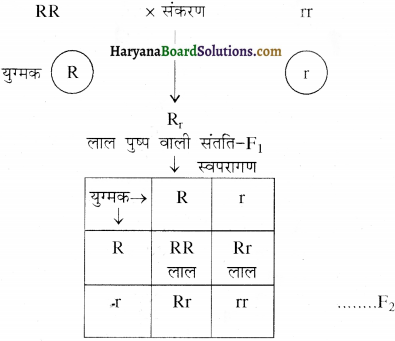
उदाहरण के लिये, जब शुद्ध लाल पुष्प वाली मटर की किस्म का संकरण शुद्ध सफेद पुष्प वाली किस्म से किया। इससे प्रथम संकरण संतति (first filial generation) या F में लाल पुष्प वाले पौधे बने। लाल पुष्पों वाली प्रथम संकरण संतति (F) को स्वपरागित कर, मेंडल ने F2 या द्वितीय संकर संतति प्राप्त की। इसमें लाल पुष्प वाले पौधे और सफेद पुष्प वाले पौधे दोनों ही पाये गये। इस द्वितीय संकर संतति (F2) में दोनों प्रकार के पौधे एक निश्चित अनुपात 3 :1 में थे। दूसरे शब्दों में दोनों प्रकार के पौधे एक निश्चित अनुपात 3 :1 में थे। दूसरे शब्दों में 75% लाल पुष्प सन्तति व 25% सफेद पुष्प संतति प्राप्त हुई।
HBSE 12th Class Biology Solutions Chapter 5 वंशागति तथा विविधता के सिद्धांत - 1
RR, Rr, Rr = लाल पुष्प वाली संतति rr = सफेद पुष्प वाली संतति अतः अनुपात 31 होता है। इस संकरण के आधार पर मेंडल ने प्रभाविता का नियम बताया। नियम के अनुसार कारक युग्म (Pairs of Factors) का एक कारक (gene) युग्म के दूसरे कारक के प्रभाव को अभिव्यक्त (express ) नहीं होने देता है। जैसे इस क्रॉस में F पीढ़ी में एक युग्मविकल्प जैसे लाल रंग दूसरे युग्मविकल्प यानी सफेद रंग पर प्रभावी हो जाने से सफेद रंग अभिव्यक्त नहीं हो पाता है। यही कारण है कि पीढ़ी में सफेद रंग की जीन होते हुये भी इस पीढ़ी के सभी पादप लाल पुष्पों वाले होते हैं।

अत: यह लक्षण (लाल रंग ) जो प्रभावी होने के कारण F) पीढ़ी में अभिव्यक्त होता है, उसे मेंडल ने प्रभावी लक्षण (Dominant Character) कहा तथा वह गुण जो प्रभावी कारक या लक्षण की उपस्थिति में अभिव्यक्त नहीं हो पाता है या प्रभावी लक्षण द्वारा ढक जाता है, उसे मेंडल ने अप्रभावी लक्षण (Recessive ) की संज्ञा दी। प्रभावी लक्षण को अंग्रेजी भाषा के बड़े अक्षर जिससे उस गुण का नाम आरम्भ होता है, चिन्हित किया जाता है व अप्रभावी लक्षण को अंग्रेजी भाषा के छोटे अक्षर द्वारा चिन्हित करते हैं (उदाहरण- पुष्प के लाल रंग को R व सफेद रंग को से लिखते हैं )।

HBSE 12th Class Biology Solutions Chapter 5 वंशागति तथा विविधता के सिद्धांत

प्रश्न 5.
परीक्षार्थ संकरण की परिभाषा लिखो और चित्र बनाओ।
उत्तर:
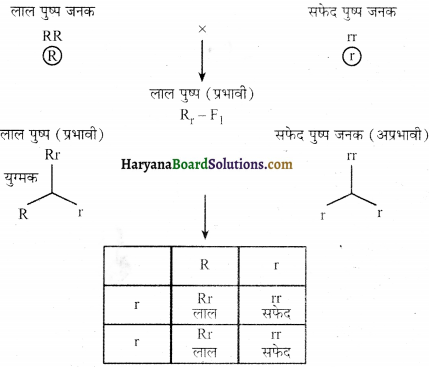
जब F1 पीढ़ी के जीवों का अप्रभावी जनक (Recessive Parents) के साथ संकरण कराते हैं, उसे परीक्षार्थ संकरण कहते हैं। ऐसे संकरण से होने वाली संतति में 50% शुद्ध अप्रभावी तथा 50% प्रभावी (संकर गुण लिये हुये ) प्राप्त होते हैं। उदाहरण के लिये, यदि F1 पीढ़ी के लाल फूलों (संकर ) का संकरण अप्रभावी जनक सफेद फूलों (शुद्ध) से करते हैं तब हमें फीनोटाइप तथा जीनोटाइप दोनों ही प्रकार से 11 के अनुपात में लाल तथा सफेद फूलों वाले पौधे मिलते हैं।
HBSE 12th Class Biology Solutions Chapter 5 वंशागति तथा विविधता के सिद्धांत - 2
फीनोटाइप अनुपात – 2 लाल : 2 सफेद या 11 2m या 1 : 1 जीनोटाइप अनुपात – 2 Rr : 2 rr या 1 : 1

प्रश्न 6.
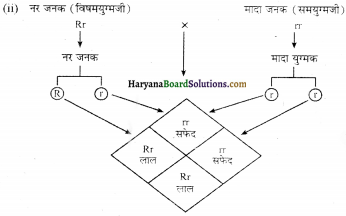
एक ही जीन स्थल वाले समयुग्मजी मादा और विषमयुग्मजी नर के संकरण से प्राप्त प्रथम संतति पीढ़ी के फीनोटाइप वितरण का पनेट वर्ग बनाकर प्रदर्शन करो।
उत्तर:
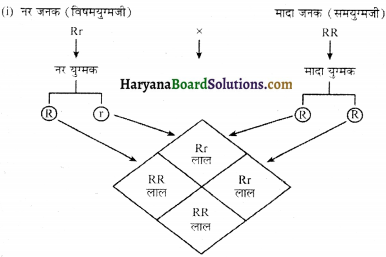
मान लीजिये कि यहां पौधे का लक्षण पुष्प का रंग लाल व सफेद ले रहे हैं तो संकरण निम्न प्रकार से होगा। प्रश्न में प्रभावी व अप्रभावी नहीं दिया गया है अतः दोनों प्रकार की क्रॉस बताई जा रही है। एक उदाहरण में प्रभावी समयुग्मजी मादा तथा दूसरे में अप्रभावी समयुग्मजी मादा का क्रॉस बताया जा रहा है-
नर जनक विषमयुग्मजी है तो उसका जीनोटाइप Rr होगा। मादा जनक समयुग्मजी है तो उसका जीनोटाइप RR या rr होगा ।
HBSE 12th Class Biology Solutions Chapter 5 वंशागति तथा विविधता के सिद्धांत - 3
सभी जनक अर्थात् फीनोटाइप लाल रंग के होंगे (फीनोटाइप अनुपात नहीं होगा)। जीनोटाइप अनुपात 2 RR : 2Rr अर्थात् 1 : 1 होगा।
HBSE 12th Class Biology Solutions Chapter 5 वंशागति तथा विविधता के सिद्धांत - 4
फीनोटाइप अनुपात – 2 लाल : 2 सफेद अर्थात् 1 : 1 होगा। जीनोटाइप अनुपात – 2 Rr : 2 rr अर्थात् 1 : 1 होगा।

प्रश्न 7.
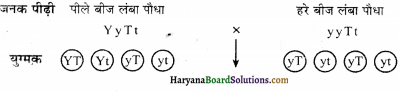
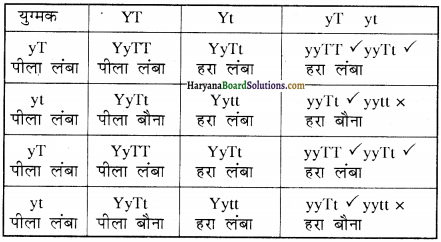
पीले बीज वाले लंबे पौधों (YyTt) का संकरण हरे बीज वाले लंबे (yyTt) पौधे से करने पर निम्न में से किस प्रकार के फीनोटाइप संतति की आशा की जा सकती है –
(क) लंबे हरे
(ख) बौने – हरे।
उत्तर:
HBSE 12th Class Biology Solutions Chapter 5 वंशागति तथा विविधता के सिद्धांत - 5
HBSE 12th Class Biology Solutions Chapter 5 वंशागति तथा विविधता के सिद्धांत - 6
इसमें लंबे-हरे 6 फीनोटाइप होंगे तथा बौने-हरे 2 फीनोटाइप होंगे।

प्रश्न 8.
दो विषमयुग्मजी जनकों का क्रॉस 3 और 4 किया गया। मान लें दो स्थल (loci ) सहलग्न हैं, तो द्विसंकर क्रॉस में F पीढ़ी के फीनोटाइप के लक्षणों का वितरण क्या होगा?
उत्तर:
जब क्रॉस में सहलग्न जीनें होती हैं तो वे मेंडलीय सिद्धान्तों का पालन नहीं करती हैं। सहलग्न जीन सदैव साथ-साथ जाती हैं।
F) अ पीढ़ी में चार प्रकार की संततियाँ होंगी-
HBSE 12th Class Biology Solutions Chapter 5 वंशागति तथा विविधता के सिद्धांत - 7

प्रश्न 9.
आनुवंशिकी में टी. एच. मौरगन के योगदान का संक्षिप्त में उल्लेख करें।
उत्तर:
टी. एच. मौरगन ने आनुवंशिकी क्षेत्र में क्रोमोसोम – वाद या सिद्धांत के प्रयोगात्मक सत्यापन किए तथा गुणसूत्र सहलग्नता सिद्धान्त का प्रतिपादन किया। मौरगन ने फल मक्खियों (फ्रूटफ्लाई- ड्रोसोफिला मेलनोगैस्टर, Drosophila melanogaster) पर काम किया, जो ऐसे अध्ययनों के लिये उपयुक्त थी। प्रयोगशाला में इसे कृत्रिम माध्यमों पर रखा जा सकता था और इसमें एकल मैथुन से विशाल संख्या में संतति मक्खियों का उत्पादन संभव था। इसके साथ ही इसमें लिंगों का विभेदन स्पष्ट था। इसमें नर व मादा की सरलता से पहचान की जा सकती थी। इसमें आनुवंशिक विविधताओं के अनेक प्रकार थे जो कम क्षमता वाले माइक्रोस्कोप से देखे जा सकते थे मौरगन ने ड्रोसोफिला पर प्रयोग करके सहलग्नता का सम्पूर्ण अध्ययन किया।

HBSE 12th Class Biology Solutions Chapter 5 वंशागति तथा विविधता के सिद्धांत

प्रश्न 10.
वंशावली विश्लेषण क्या है? यह विश्लेषण किस प्रकार उपयोगी है?
उत्तर:
मानव समाज में वंशागत विकार व्याप्त हैं तथा पुराने समय से इस बात को सुनते आ रहे हैं। कुछ परिवारों में यह भी कहा जाता है कि कुछ लक्षण वंशबद्ध होते हैं। जैसे ही मेंडल के कार्यों की पुनः खोज हुई त्यों ही मानव के लक्षण प्रतिरूपों की वंशागति के विश्लेषण की बात प्रारम्भ हुई। यह तो निश्चित है कि मटर के पौधे व अन्य जीवों में किये गए तुलनार्थ संकर प्रयोग मानव में संभव नहीं हैं। अतः वंशागत विकारों के सम्बन्ध में केवल एक ही रास्ता है कि विशेष लक्षण की वंशागति के संबंध में वंश के इतिहास का अध्ययन किया जाए। अनेक पीढ़ियों तक जारी लक्षणों के ऐसे विश्लेषण को वंशावली विश्लेषण कहते हैं। इस प्रक्रिया में वंश वृक्ष (Family Tree) में एक विशेष लक्षण का पीढ़ी दर पीढ़ी विश्लेषण (Pedigree Analysis ) किया जाता है।

मानव आनुवंशिकी में वंशावली अध्ययन एक महत्वपूर्ण उपकरण है जिसका उपयोग विशेष लक्षण, अपसामान्यता ( abnormality) या रोग का पता लगाने में किया जाता है। वंशावली विश्लेषण में प्रयुक्त कुछ महत्त्वपूर्ण मानक (Symbols) प्रतीकों को चित्र में दर्शाया गया है। (चित्र 5.14 देखें।) जैसा कि हम जानते हैं कि किसी जीव का प्रत्येक लक्षण गुणसूत्र ( Chromosome ) में विद्यमान DNA पर स्थित जीन में निहित होता है। DNA ही आनुवंशिक सूचना का वाहक है और यह बिना किसी परिवर्तन के एक से दूसरी पीढ़ी में स्थानांतरित होता जाता है। यह भी सुनिश्चित है कि यदा-कदा परिवर्तन या रूपांतरण होते रहते हैं। इस प्रकार के परिवर्तन या रूपांतरण को उत्परिवर्तन (Mutation) कहते हैं। मानव में कई विकार इस प्रकार के हैं, जिनका संबंध क्रोमोसोम या जीन के परिवर्तन या रूपांतरण से जोड़ा जा सकता है।

प्रश्न 11.
मानव में लिंग निर्धारण कैसे होता है?
उत्तर:
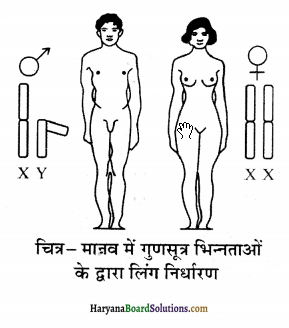
मानव में लिंग निर्धारण XY प्रकार का होता है। मानव में कुल 23 जोड़े अर्थात् 46 गुणसूत्र होते हैं। नर में 44 गुणसूत्र अलिंग गुणसूत्र (Autosomes ) होते हैं तथा दो लिंग गुणसूत्र (Sex Chromosome) ‘X’ तथा ‘Y’ होते हैं। स्त्री या मादा में भी 44 गुणसूत्र ऑटोसोम (Autosomes) होते हैं तथा दो लिंग गुणसूत्र ‘X’ व ‘Y’ होते हैं। जब शुक्राणु बनते हैं तो 50% शुक्राणु 22 + X गुणसूत्र वाले तथा शेष 50% शुक्राणु 22 + Y गुणसूत्र वाले होते हैं। जबकि स्त्री या मादा के सभी अण्डों में 22+ X गुणसूत्र होते हैं। सन्तान में कितनी लड़कियाँ तथा कितने लड़के होंगे यह इस पर निर्भर करता है कि कौनसा शुक्राणु अण्ड से निषेचित करता है। मानव में नर बच्चे का होना ‘Y’ गुणसूत्र की उपस्थिति पर निर्भर करता है। एक शुक्राणु में केवल ‘X’ या ‘Y’ लिंग गुणसूत्र ही हो सकता है, अतः पिता का ‘X’ गुणसूत्र लड़कियों में तथा ‘Y’ गुणसूत्र लड़कों में मिलता है।
HBSE 12th Class Biology Solutions Chapter 5 वंशागति तथा विविधता के सिद्धांत - 8

प्रश्न 12.
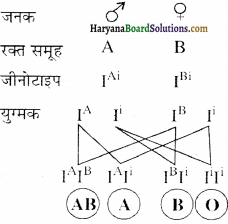
शिशु का रुधिर वर्ग 0 है। पिता का रुधिर वर्ग A और माता का B है। जनकों के जीनोटाइप मालूम कीजिए और अन्य संतति में प्रत्याशित जीनोटाइपों की जानकारी प्राप्त कीजिए।
उत्तर:
रुधिर वर्गों में वंशागति मेण्डल के नियमों के अनुसार होती है। इसकी वंशागति दो या अधिक तुलनात्मक लक्षणों वाले जीन्स (Genes) अर्थात् ऐलील्स (Alleles) पर निर्भर करती है। रुधिर वर्गों को स्थापित करने वाले प्रतिजन (Antigens) तथा इसकी उपस्थिति या अनुपस्थिति तीन जीन्स के कारण होती है। प्रतिजन ‘A’ के लिये जीन I, प्रतिजन ‘B’ के लिए जीन 1 तथा दोनों प्रतिजन के अभाव के लिए जीन 1° उत्तरदायी होते हैं। एक मुनष्य में इनमें से कोई एक ही प्रकार के दो जीन्स या दो प्रकार के जीन्स एक निश्चित स्थल (Loci) पर स्थित होते हैं। जीन I तथा I क्रमश: 1° पर प्रभावी होते हैं, जबकि जीन I तथा 1 में प्रभाविता का अभाव होता है अर्थात् ये सहप्रभावी (Codominant) होते हैं –
HBSE 12th Class Biology Solutions Chapter 5 वंशागति तथा विविधता के सिद्धांत - 9
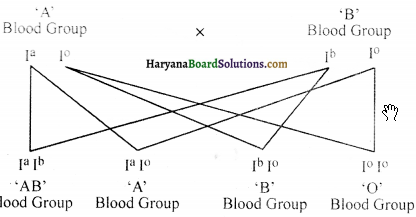
उदाहरण-A तथा B रुधिर वर्ग वाले माता-पिता की सम्भावित सन्तानों के रृधिर वर्गों का जीनोटाइप (genotype) निम्ननुसार होगा –
HBSE 12th Class Biology Solutions Chapter 5 वंशागति तथा विविधता के सिद्धांत - 10

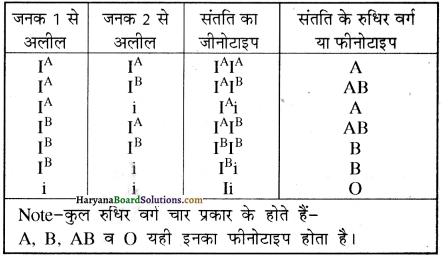
विभिन्न रुधिर वर्ग के व्यक्तियों के रुधिर वर्ग की जीनी संरचना निम्न तालिका के अनुसार हो सकती है –
‘O’ रुधिर वर्ग वाले शिशु के माता-पिता का जीनोटाइप 1 1 तथा 1h 1° है। ‘AB’ रुधिर वर्ग वाले का जीनोटाइप 1 1 A रुधिर वर्ग वाले का जीनोटाइप II°, ‘B’ रुधिर वर्ग वाले का जीनोटाइप I” I° और ‘O’ रुधिर वर्ग वाले का जीनोटाइप I° I° होगा।

प्रश्न 13.
निम्न शब्दों को उदाहरण सहित समझाइये –
(अ) सह-प्रभाविता
(ब) अपूर्ण प्रभाविता।
उत्तर:
(अ) सह प्रभाविता (Co-dominance) – सह-प्रभाविता में युग्मविकल्पी जोड़े (allelomorphic pairs) के सदस्य प्रभावी व अप्रभावी नहीं होते हैं और दोनों ही F पीढ़ी में समान रूप से प्रकट होते हैं, यह प्रक्रिया सह प्रभाविता कहलाती है। सह-प्रभाविता का अच्छा उदाहरण मानवों में ABO रुधिर वर्गों का निर्धारण करने वाली विभिन्न प्रकार की लाल रुधिर कोशिकाएँ हैं। ABO रुधिर वर्गों का नियन्त्रण जीन ” से होता है। लाल रुधिर कोशिकाओं की प्लाज्मा झिल्ली में सतह से बाहर निकलते हुए शर्करा बहुलक होते हैं। नियन्त्रण जीन ‘I’ ही बहुलक के प्रकार का निर्धारण करती है। नियन्त्रण जीन ‘I’ के तीन अलील IA, IB और होते हैं।

अलील IA और अलील 1″ कुछ भिन्न प्रकार की शर्करा का उत्पादन करते हैं और अलील किसी भी प्रकार की शर्करा का उत्पादन नहीं करती है। मानव जीन (21) द्विगुणित होता है। इसलिये प्रत्येक व्यक्ति में इन तीन में से दो प्रकार के जीन अलील होते हैं। तथा I तो i के ऊपर पूर्णरूप से प्रभावी होते हैं अर्थात् जब और विद्यमान हों तो केवल I अभिव्यक्त होता है और जब IB और विद्यमान हों तो केवल 1 अभिव्यक्त होता है, तो शर्करा बनाता ही नहीं है। जब I और IB दोनों उपस्थित हों तो ये दोनों अपने-अपने प्रकार की शर्करा को अभिव्यक्त कर देते हैं। यह घटना ही सह प्रभाविता है। इसी कारण लाल रुधिर कोशिकाओं में A और B दोनों प्रकार की शर्करा होती है। HBSE 12th Class Biology Solutions Chapter 5 वंशागति तथा विविधता के सिद्धांत - 11

HBSE 12th Class Biology Solutions Chapter 5 वंशागति तथा विविधता के सिद्धांत

(ब) अपूर्ण प्रभाविता ( Incomplete Dominance) -मेंडल के नियमों को जब मटर वाले प्रयोग को अन्य विशेषकों के सन्दर्भ में दोहराया गया तो पता चला कि कभी-कभार F में ऐसा फीनोटाइप आ जाता है जो किसी भी जनक से नहीं मिलता-जुलता है और इसके बीच का सा लगता है। मेंडल ने अपने प्रयोग में जिन सात जोड़ी लक्षणों का उपयोग किया उनमें से प्रत्येक कारक (जीन) की जोड़ी में एक विकल्पीय सदस्य प्रभावी व दूसरा सदस्य अप्रभावी था। किन्तु बाद में वैज्ञानिकों को ऐसे उदाहरण भी मिले जिनमें F पीढ़ी के दिखने वाले प्रभावी लक्षण के स्थान पर दूसरा लक्षण दिखाई देता है जो प्रभावी व अप्रभावी के बीच का होता है।

श्वान पुष्प (Snapdragon / Antirrhinum) में पुष्प रंग की वंशागति अपूर्ण प्रभाविता को समझने के लिये अच्छा उदाहरण है। शुद्ध प्रजननी लाल फूल वाली (RR) और शुद्ध प्रजननी सफेद फूल वाली (Ir) प्रजाति के संकरण के परिणामस्वरूप F पीढ़ी गुलाबी फूलों (Rr) वाली प्राप्त हुई। जब इस F संतति को स्व- परागित किया गया तो परिणामों का अनुपात 1 ( RR ) लाल था। यहां पर जीनोटाइप अनुपात 1 भी 1 2 1 था।

2 ( Rr) गुलाबी 1(IT) सफेद 21 था तथा फीनोटाइप अनुपात इस प्रयोग से स्पष्ट है कि समयुग्मजी (homozygous) स्थिति में जीन R के प्रभावी (RR) लाल व अप्रभावी (IT) सफेद सदस्य क्रमशः अपने लक्षणों को व्यक्त करते हैं परन्तु विषमयुग्मजी ( heterozygous) अवस्था (अर्थात् Rr) में संकरण प्रभावी लक्षण पूर्ण रूप से व्यक्त न होकर बीच का लक्षण गुलाबी रंग के रूप में अभिव्यक्त होता है। यहाँ R सदस्य, सदस्य पर अपूर्ण (incomplete) रूप से प्रभावी है अतः यह अपूर्ण प्रभाविता कहलाती है। F पीढ़ी के इन पौधों के संकरण कराने से समजीनी व समलक्षणी ( Genotype and Phenotype) अनुपात 3: 1 के स्थान पर 121 प्राप्त होता है।

प्रश्न 14.
बिंदु – उत्परिवर्तन क्या है? एक उदाहरण दें।
उत्तर:
उत्परिवर्तन वह क्रिया है जो DNA अनुक्रम में बदलाव ला देती है। DNA के एकल क्षार युग्म (base pair) के परिवर्तन को बिंदु – उत्परिवर्तन (Point Mutation) कहते हैं। इस प्रकार के उत्परिवर्तन का उदाहरण दात्र- कोशिका अरक्तता (Sickle-cell anaemia) है। दात्र- कोशिका अरक्तता एक अलिंग गुणसूत्र लग्न अप्रभावी लक्षण (autosome linked recessive trait) है जो जनकों में संतति में तभी प्रवेश करता है जबकि दोनों जनक जीन के वाहक होते हैं अर्थात् विषमयुग्मजी (Heterozygous) अवस्था में इस रोग का नियंत्रण अलील का एक जोड़ा Ho और H करता है। रोग का लक्षण (phenotype) तीन संभव समजीनी (genotype ) में से केवल \(\mathrm{H}_{\mathrm{b}^8}\left(\mathrm{H}_{\mathrm{b}^8} \mathrm{H}_{\mathrm{b}^8}\right)\) वाले समयुग्मजी व्यक्तियों में दिखाई देता है। विषमयुग्मजी \(\left(\mathrm{H}_{b^{\mathrm{A}}} \mathrm{H}_{\mathrm{b}^{\mathrm{s}}}\right)\) व्यक्ति रोगमुक्त होते हैं किन्तु वे रोग के वाहक होते हैं।

उत्परिवर्तित जीन के संतति में पहुंचने की 50% संभावना (अर्थात् दात्र कोशिका के लक्षण आने की) होती है। इस विकार का कारण हीमोग्लोबिन अणु की बीटा ग्लोबिन श्रृंखला की छठी स्थिति में एक एमीनो अम्ल ग्लूटैमिक अम्ल (Glu) का वैलीन द्वारा प्रतिस्थापन है। (चित्र 5.17 देखें)। ग्लोबिन प्रोटीन में एमीनो अम्ल का यह प्रतिस्थापन बीटा ग्लोबिन जीन के छठे कोडोन में GAG का GUG द्वारा प्रतिस्थापन के कारण होता है। निम्न ऑक्सीजन तनाव में उत्परिवर्तित हीमोग्लोबिन अणु में बहुलीकरण (Polymerisation) हो जाता है जिसके कारण RBC का आकार द्वि- अवतल बिंब (biconcave disc) में बदलकर दात्राकार हंसिए के आकार जैसा (Elongated sickle like structure) हो जाता है।

प्रश्न 15.
वंशागति के क्रोमोसोम वाद को किसने प्रस्तावित किया?
उत्तर:
मेंडल द्वारा किये गये कार्य का प्रकाशन यद्यपि 1865 में हो चुका था परन्तु अनेक कारणों से 1900 तक यह कार्य अज्ञात ही रहा। 1900 में तीन वैज्ञानिकों (डी ब्रीज, कॉरेन्स और वॉन शेरमाक) ने स्वतन्त्र रूप से लक्षणों की वंशागति संबंधी मेंडल के परिणामों की पुनः खोज की। इसी समय माइक्रोस्कोपी तकनीक में प्रगति होती जा रही थी। वैज्ञानिक इसमें कोशिका विभाजन को देखने में समर्थ हो चुके कोशिका के केन्द्रक में एक संरचना की खोज हो चुकी थी, जो कोशिका विभाजन के पहले द्विगुणित एवं विभाजित भी हो जाता है। इन्हें गुणसूत्र (Chromosome ) कहा गया। 1902 तक अर्धसूत्रणी कोशिका विभाजन के दौरान गुणसूत्र की गति (संचालन) का ज्ञान हो चुका था। वाल्टर सटन और थियोडोर बोवेरी (Walter Sutton and Theodore Boveri) ने देखा कि गुणसूत्र का व्यवहार भी जीन जैसा है। इन्होंने मेंडल के नियमों (तालिका) को गुणसूत्र की गतिविधि (चित्र 5.7 ) द्वारा समझाया। तालिका – क्रोमोसोम और जीन के व्यवहार में तुलना

AB
जोड़ों में होते हैं।जोड़ों में होते हैं।
युग्मकजनन के दौरान इस प्रकार विसंयोजित होते हैं कि एक युग्मक जोड़े में से केवल एक ही जा पाता है ।युग्मकजनन के दौरान विसंयोजित होते हैं और जोड़े में से केवल एक ही युग्मक को प्राप्त होता है।
अलग-अलग जोड़े एक-दूसरे से स्वतंत्र, विसंयोजित होते हैं।एक जोड़ा, दूसरे से स्वतंत्र, विसंयोजित होता है।

अर्धसूत्री विभाजन (Meiosis or Reduction Division ) व समसूत्री विभाजन (Mitosis or Equational division) के अध्ययन में गुणसूत्रों के व्यवहार देखते हैं। इसमें सबसे मुख्य बात यह है कि गुणसूत्र व जीन सदैव जोड़े में होती हैं। एक जीन जोड़े के दोनों अलील समजात गुणसूत्रों (Homologous Chromosomes ) के समजात स्थान (Homologous sites) पर विद्यमान या स्थित होते हैं (चित्र 5.7 देखें)।
HBSE 12th Class Biology Solutions Chapter 5 वंशागति तथा विविधता के सिद्धांत - 11

अर्धसूत्री विभाजन प्रथम ( Meiosis I) की पश्चावस्था (Anaphase) में गुणसूत्र के दो जोड़े मध्यावस्था पट्टिका ( Metaphase Plate) पर एक-दूसरे से स्वतंत्र रूप से पंक्तिबद्ध होते हैं (नीचे दिया गया चित्र देखें)। इसे समझने के लिये दायें और बायें स्तम्भों में चार पृथक् रंगों के गुणसूत्रों की तुलना करनी होगी। बायें स्तम्भ अर्थात् संभावना I में नारंगी और हरे एक साथ विसंयोजित (Segregating ) होते हैं परन्तु दाहिने स्तम्भ अर्थात् संभावना II में नारंगी गुणसूत्र लाल गुणसूत्रों के साथ विसंयोजित हो रहे हैं।

सटन व बोवेरी ने इस सम्बन्ध में तर्क प्रस्तुत किया कि गुणसूत्र युग्म का जोड़ा बन जाना या पृथक् होना अपने में ले जाये जा रहे कारकों के विसंयोजन का कारण है। सटन ने गुणसूत्रों के विसंयोजन के ज्ञान को मेंडल के सिद्धान्तों के साथ जोड़कर ‘वंशागति का गुणसूत्रवाद या सिद्धान्त’ दिया।

HBSE 12th Class Biology Solutions Chapter 5 वंशागति तथा विविधता के सिद्धांत

प्रश्न 16.
किन्हीं दो अलिंगी सूत्री आनुवंशिक विकारों का उनके लक्षणों सहित उल्लेख करो।
उत्तर:
दात्र कोशिका – अरक्तता (सिकेल सेल एनीमिया) तथा फीनाइल कीटोनूरिया दोनों विकार अलिंगी सूत्री आनुवंशिक विकार हैं।
(i) दात्र कोशिका – अरक्तता (Sickle Cell Anaemia) – इसे प्रश्न संख्या 14 में देखें।
(ii) फीनाइल कीटोनूरिया ( Phenyl Ketonuria) – यह एक जन्मजात उपापचयी विकार है जो अलिंग गुणसूत्र अप्रभावी लक्षण की जैसी ही वंशागति प्रदर्शित करती है। रोगी व्यक्ति में ऐलेनीन अमीनो- अम्ल को टाइरोसीन (Tyrosin) अमीनो अम्ल में बदलने के लिये आवश्यक एक एन्जाइम की कमी हो जाती है। इस कारण से फीनाइल ऐलेनीन एकत्रित होता जाता है और फीनाइलपाइरुविक अम्ल तथा अन्य व्युत्पन्नों में बदलता जाता है। इनके एकत्रीकरण से मानसिक दुर्बलता आ जाती है। वृक्क द्वारा कम अवशोषित हो सकने के कारण ये मूत्र के साथ उत्सर्जित हो जाते हैं।

HBSE 12th Class Biology Solutions Chapter 5 वंशागति तथा विविधता के सिद्धांत Read More »

HBSE 10th Class Science Solutions Chapter 7 Control and Coordination

Haryana State Board HBSE 10th Class Science Solutions Chapter 7 Control and Coordination Textbook Exercise Questions and Answers.

Haryana Board 10th Class Science Solutions Chapter 7 Control and Coordination

HBSE 10th Class Science Control and Coordination Textbook Questions and Answers

Question 1.
Which of the following is a plant hormone?
(a) Insulin
(b) Thyroxin
(c) Estrogen
(d) Cytokinin
Answer:
(d) Cytokinin

HBSE 10th Class Science Solutions Chapter 7 Control and Coordination

Question 2.
The gap between two neurons is called a ……………
(a) dendrite
(b) synapse
(c) axon
(d) impulse
Answer:
(b) Synapse

Question 3.
The brain Is responsible for ………
(a) thinking
(b) regulating the heart beat
(c) balancing the body
(d) all of the above
Answer:
(d) All of the above

Question 4.
What is the function of receptors in our body? Think of situations where receptors do not work properly. What problems are likely to arise?
Answer:
1. Receptors are the special type of nerve endings which can detect the specific information from the environment.

2. Generally, they are in the sensory organs such as ears, nose, tongue, eye, etc. If receptors do not work properly, the environmental stimuli will not cause nerve impulse and hence body will not be able to respond.

HBSE 10th Class Science Solutions Chapter 7 Control and Coordination

Question 5.
Draw the structure of a neuron and explain its function.
Answer:
Nerve cell:
Nerve cells or neurons are the building as well as functional units of the nervous system. They carry information from one part of the body to another. Nerve cell has three components:

  • Cell body,
  • Dendrites and
  • Axon

Cell body: The cell body of a neuron is like a typical animal cell which contains cytoplasm and a nucleus. A number of short or long fibers stretch out from the cell body. These fibers are called nerve fibers.

Dendrites: The short fibers on the cell body are known as dendrites.

Axon: The longest fiber on the cell body is called axon.
HBSE 10th Class Science Solutions Chapter 7 Control and Coordination 3

Movement of Impulse (working of nerve cell):
1. The end of the dendritic tip receives message from receptors. It then initiates a neuro-chemical reaction due to which an electric impulse known as nerve impulse is produced.

2. The dendrites pass the impulse to the cell body and then to axon upto the end of axon i.e. axon terminal bud.

3. Synapse — The gap between nerve ending of an axon of one neuron and dendrite of the next neuron is called synapse.

4. At the end of the axon terminal bud, the electrical impulse releases certain chemicals.

5. These chemicals cross the gap or synapse and start similar electrical impulse in the dendrite of the next neuron. This is how the impulse or message travels from one neuron to another in the body.

6. Finally with the help of similar synapse, the impulses are delivered from neurons to other cells such as muscle cells or glands.

Question 6.
How does phototropism occur in plants?
Answer:
1. Movement of plant in response to light is called photoperiodism.

2. The shoot apex releases auxin. a growth-promoting plant hormone. When the light comes from the side of the plant, auxin diffuses towards the shady side of the shoot and helps to grow. So, the plants appear to bend towards light.

HBSE 10th Class Science Solutions Chapter 7 Control and Coordination

Question 7.
Which signals will get disrupted in case of a spinal cord injury?
Answer:

  • In case of injury of spinal cord, the reflex action will be disturbed.
  • Due to this, quick or emergency response are affected which may harm the body.

Question 8.
How does chemical co-ordination occur in plants?
Answer:
1. Various plant hormones are important to co-ordinate plant growth and development. In addition to this, the plant hormones also play an important role to response to the environmental stimuli.
2. The plant hormones diffuse towards the location of action, from where they are secreted.
3. For example, auxin is secreted from the shoot tip. Then, it diffuses to other cells and induces growth.

Question 9.
What is the need for a system of control and coordination in an organism?
Answer:
1. Multicellular organisms are made-up of various organs and organ system.
2. It is a basic need of the body to control and co-ordinate these organs and organ systems, so that they can function properly and accomplish the voluntary as well as involuntary functions.

Question 10.
How are involuntary actions and reflex actions different from each other?
Answer:

Reflex actionInvoluntary actions
1. Reflex actions are very quick.
2. Reflex action can involve any muscle or gland.
3. Reflex actions not initiated by brain.
4. It occurs suddenly in response to some external stimuli.
For example, pulling away hand when it touches a hot vessel.
1. Involuntary actions are not that quick.
2. Involuntary actions can involve only smooth muscles and cardiac muscles.
3. Generally involuntary actions involves brain.
4. It does not need any external stimuli. It can go on continuously under normal conditions.
For example, heartbeats, breathing, etc.

Question 11.
Compare and contrast nervous and hormonal mechanism for control and co-ordination in animals.
Answer:

Nervous systemEndocrine (hormonal) system
1. Nervous system is made up of nerve cells.
2. Its functional unit is nerve cells.
3. Messages are transmitted in the form of electrical impulses.
4. Here, messages travel along nerve fibers.
5. Messages travel very quickly.
1. Endocrine system is made up of secretary cells or glands.
2. Its functional unit is hormones.
3. Messages are transmitted in the form of chemicals called hormones.
4. Here, messages travel along blood stream.
5. Messages travel slowly.

Question 12.
What is the difference between the manner in which movement takes place in a sensitive plant and the movement in our legs?
Answer:
Movement in the sensitive plants:
1. When we touch a mimosa plant (a touch-sensitive plant) with our fingers, the leaves of plant fold-up.
2. In this plant, the ‘touch’ of our fingers is the stimulus where as the ‘folding-up’ of the leaves is the nastic movement.
3. When the leaves of sensitive plants mimosa are touched with a finger, an electric impulse is generated which travels through the cells.
4. The electrical impulses act on a plant hormone.
5. Due to the impulse, the plant hormone makes the water migrate from the cells of one-half of a pulvinus to the intercellular spaces in the other half of the pulvinus.
6. This loss of water from one-half of pulvinus causes the pulvinus to lose its firmness which in turn makes the leaf fold.

HBSE 10th Class Science Solutions Chapter 7 Control and Coordination

Movement in our legs:

  • Leg movement may be voluntary or even due to a reflex action.
  • Voluntary movement of leg: Under the wish of the organism, the brain orders the leg muscles (voluntary muscles) to act. So under the control of our nervous system, the leg muscles contract and relax.
  • For example, when we walk, run, play garba, dance, etc. the movement of leg muscles is under our wish.

Reflex action of leg:

1. When we encounter a stimulus that can cause harm to us, we respond through reflex action. For example, if our feet by chance touches floor which is quite hot due to exposure of the sun, we quickly lift it (i.e. move). Such movements of legs are involuntary and are done under the order from spinal cord.

2. This stimulus reaches to the spinal cord and there is an order for the immediate movement. Here, the movement is under the control of the spinal cord.

HBSE 10th Class Science Control and Coordination InText Activity Questions and Answers

Textbook Page no – 119.

Question 1.
What is the difference between a reflex action and walking?
Answer:

Reflex Action

Walking

1. It is an immediate response to the stimuli.

2. It is spontaneous and is not controlled by human wish.

3. It is controlled and co-ordinated by the spinal cord.

1. It is a thoughtful action planned by the brain under the wish of the body of a person.
2. It is controlled by human wish.3. It is controlled by human brain.

Question 2.
What happens at the synapse between two neurons?
Answer:
Nerve cell:
Nerve cells or neurons are the building as well as functional units of the nervous system. They carry information from one part of the body to another. Nerve cell has three components:

  • Cell body,
  • Dendrites and
  • Axon

CEO body: The cell body of a neuron is like a typical animal cell which contains cytoplasm and a nucleus. A number of short or long fibers stretch out from the cell body. These fibers are called nerve fibers.

Dendrites: The short fibers on the cell body are known as dendrites.

Axon: The longest fiber on the cell body is called axon.

Question 3.
Which part of the brain maintains posture and equilibrium of the body?
Answer:
Hind brain is responsible for maintaining posture and equilibrium of the body.

HBSE 10th Class Science Solutions Chapter 7 Control and Coordination

Question 4.
How do we detect the smell of an agarbatti (incense stick)?
Answer:
1. On lightning an agarbatti, the molecules responsible for fragrance of agarbatti (incense stick) sproad in the air.

2. On Inhaling this air, the fragrance comes in contact of the factory receptor cells present in the nose.

3. From these cells, this stimuli or information reaches i.e. is transmitted to the olfactory lobe in the fore-brain.

4. The brain interprets the information and so we are able to smell the agarbatti and also identify the type of fragrance such as daisy, rose or sandalwood.

5. This entire physiological process occurs within a fraction of a second.

Question 5.
What is the role of the brain in reflex action?
Answer:
1. The task done under reflex action is done through reflex arc in co-ordination with the spinal cord.

2. In reflex action, the signal is not transmitted to the brain, it is sent only to the spinal cord and the immediate response is made.

3. After the action is completed, the brain is informed or say reported about the action. The brain then keeps that action in its memory for analyzing and responding to similar stimuli in the future.

Textbook Page no – 122

Question 1.
What are plant hormones?
Answer:
1. Plant hormones are special chemical compounds which are synthesized at one place/organ of the plants and migrate to the target organ for acting.

2. They play an important role in control and co-ordination activities of plants, as well as in growth, development and response to the environment and reproduction.

Question 2.
How is the movement of leaves of the sensitive plant different from the movement of a shoot towards light?
Answer:
1. The movement of leaves of the sensitive plants is in response to the touch stimulus. This movement is based on the difference of water molecules in that specific area. Hence, it is not a directional movement.

2. The movement of a shoot towards light due to growth promotes hormone auxin. It is against gravity.

Question 3.
Give an example of a plant hormone that promotes growth.
Answer:
Auxin, gibberellins and cytokinins are the growth promoter hormones. They promote cell division and cell growth. As a result, growth of plant organs occur.

Question 4.
How do auxin promote the growth of a tendril around a support?
Answer:
1. Auxins are growth promoting plant hormones.

2. Tendril is a thread like structure of the plant, which is highly sensitive to touch.

3. When the tendril comes in contact with any object/support, particularly at the apical parts of the plants, the growth hormone auxin diffuses. This promotes the growth of the tendril which then circles around or wraps to the support and grows further on the support.

Question 5.
Design an experiment to demonstrate hydrotropism.
Answer:
The movement of plant in response to water is known as hydrotropism.

  • Take a rectangular transparent plastic container and fill it with dry soil.
  • Plant a small plant on one side of the container.
  • Take water in a clay glass and place it in the soil on the other end of the container as shown in the figure.
  • Water will slowly move into the soil below the clay vessel and make it moist.

HBSE 10th Class Science Solutions Chapter 7 Control and Coordination 4

Observation:

We can observe that the root of the plant does not grow deep towards the soil but rather grows in the direction of moist soil. This means the root tend to grow in the direction where water is available. This property of growth is called hydrotropism.

HBSE 10th Class Science Solutions Chapter 7 Control and Coordination

Conclusion:

We can conclude from this activity that root grows and elongates in the direction of source of water. This means the root shows positive hydrotropism.

Textbook Page no – 125

Question 1.
How does chemical co-ordination takes place in animals?
Answer:
1. In animals, the chemical co-ordination is done by various hormones secreted by endocrine glands.
2. Endocrine glands are ductless glands.
3. The animal hormones are directly poured into blood. These hormone molecules reach the target organs and perform the task of control and co-ordination for various body functions.

Question 2.
Why is the use of iodized salt advisable?
Answer:
Adrenal gland:

  • The adrenal gland releases a hormone called adrenaline. Adrenaline hormone is also called fight or flight (run-away) hormone.
  • This hormone is secreted directly into the blood and carried to different parts of the body.

Effects of adrenaline:

  • When adrenaline is released the heart beats become fast and so, more oxygen gets supplied to our heart.
  • The muscles around the small arteries of heart and other organs contract due to which the digestive system and skin receive less blood. This diverts the blood to our skeletal muscles.
  • Moreover, the breathing rate increases due to contractions of the diaphragm and the rib muscles.
  • All these responses together enable the animal and human body to be ready for dealing with the situation of fight or flight i.e. fight or run-away immediately from the situation.

Question 3.
How does our body respond when adrenaline is secreted Into the blood?
Answer:
When adrenaline hormone is released into the body, the body shows the following responses:
(1) Increase in heart-rate
(2) Increase in breathing-rate
(3) The muscles of the ribs and diaphragm contract
(4) Eyes get opened widely

Question 4.
Why are some patients of diabetes treated by giving Insulin?
Answer:
1. In human bodies, pancreas release a hormone called insulin which regulates the level of sugar in the blood.

2. When insulin is not secreted in proper amounts, the sugar level in the blood rises and the person may suffer from a disease called diabetes.

3. Diabetes can be harmful for heart, brain, eyes, kidneys, etc.

4. Hence, in order to save the diabetic person from such harmful effects, he is given the injections of insulin which regulates his sugar level in the blood.

Activities

Activity – 1

Aim: To detect the taste bud (gustatory receptor) and its functions

Question 1.
Put some sugar in your mouth. How does it taste?
Answer:
Sugar is sweet in taste.

Question 2.
Block your nose by pressing it between your thumb and index finger. Now eat sugar again. Is there any difference in its taste?
Answer:
When the nose is blocked, even though the sugar taste ¡s sweet, it is somewhat different than the previous sweetness.

HBSE 10th Class Science Solutions Chapter 7 Control and Coordination

Question 3.
While eating lunch, block your nose in the same way and notice if you can fully appreciate the taste of the food you are eating.
Answer:
Generally, the person cannot appreciate the taste of food fully when the nose is closed/blocked.

Activity 2.

Perform an activity to study the response of plants towards light (Photoperiodism).
Answer:
Procedure:
1. Fill a conical flask with water.
2. Cover the neck of the flask with a wire mesh.
3. Keep two or three freshly germinated bean seeds on the wire mesh.
4. Take a cardboard box which is open from one side.
5. Keep the flask in the box in such a manner that the open side of the box faces light coming from a window as shown in the figure.
6. After two or three days, you will notice that the shoots bend towards light and roots away from light.
7. Now turn the flask so that the shoots are away from light and the roots towards light. Leave it undisturbed in this condition for a few days.

Observation:
The shoot apex releases auxin, a growth promoting plant hormone. When the light comes from the side of the plant, auxin diffuses towards the shady side of the shoot and helps to grow. So, the plants appear to bend towards light.

HBSE 10th Class Science Solutions Chapter 7 Control and Coordination 5

Question 1.
Have the old parts of the shoot and root changed direction?
Answer:
The older part of the shoot shows a slight movement towards light. Moreover, here the root grows slightly away from the light.

Question 2.
Are there differences in the direction of the new growth?
Answer:
The upcoming or young parts of the shoot bend more towards the light and the root apex moves away from the light.

HBSE 10th Class Science Solutions Chapter 7 Control and Coordination

Question 3.
What can we conclude from this activity?
Answer:
We can conclude that shoot always shows positive phototropism where as root shows negative phototropism.

Activity 3.

(i) Look at Figure 7 of text-book — Endocrine glands in human beings.
(ii) Identify the endocrine glands mentioned in the figure.
(iii) Some of these glands .have been listed in Table and discussed in the text. Consult books in the library and discuss with your teachers to find out about other glands.

Name of glands shown in the figure:

  • Hypothalamus,
  • Pineal gland,
  • Pituitary gland,
  • Thyroid gland,
  • Parathyroid gland,
  • Thymus gland,
  • Pancreas gland,
  • Adrenal gland,
  • Testis (in male),
  • Ovaries (in female)

Activity 4.

Hormones are secreted by endocrine glands and have specific functions. Complete Table 1 based on the hormone, the endocrine gland or the functions provided. Table 1: Some important hormones and their functions
HBSE 10th Class Science Solutions Chapter 7 Control and Coordination 6

HBSE 10th Class Science Solutions Chapter 7 Control and Coordination Read More »

HBSE 12th Class Biology Solutions Chapter 4 जनन स्वास्थ्य

Haryana State Board HBSE 12th Class Biology Solutions Chapter 4 जनन स्वास्थ्य Textbook Exercise Questions and Answers.

Haryana Board 12th Class Biology Solutions Chapter 4 जनन स्वास्थ्य

प्रश्न 1.
समाज में जनन स्वास्थ्य के महत्व के बारे में अपने विचार प्रकट कीजिए।
उत्तर:
समाज में जनन स्वास्थ्य के महत्व के बारे में मेरे विचार निम्न हैं-जनन स्वास्थ्य का तात्पर्य जनन के सभी पहलुओं जैसे शारीरिक, भावनात्मक, व्यावहारिक तथा सामाजिक स्वास्थ्य से है दुनिया / संसार में भारत पहला ऐसा देश है, जिसने राष्ट्रीय स्तर पर जननात्मक स्वस्थ समाज को प्राप्त करने की कार्य-योजनाएँ बनाई हैं। इन कार्यक्रमों को परिवार कल्याण के नाम से जाना जाता है। इनकी शुरुआत 1951 में परिवार नियोजन से हुई थी। जनन संबंधित और आवधिक क्षेत्रों को इसमें सम्मिलित करते हुए बहुत उन्नत व व्यापक कार्यक्रम फिलहाल जनन एवं बाल स्वास्थ्य सेवा कार्यक्रम (Reproductive and Child Health Care) के नाम से प्रसिद्ध है। इन कार्यक्रमों के तहत जनन संबंधी विभिन्न पहलुओं के बारे में लोगों में जागरूकता उत्पन्न करते हुए और जननात्मक रूप से स्वस्थ समाज तैयार करने के लिए अनेक सुविधाएँ एवं प्रोत्साहन दिए जा रहे हैं।

प्रश्न 2.
जनन स्वास्थ्य के उन पहलुओं को सुझाएँ, जिन पर आज के परिदृश्य में विशेष ध्यान देने की जरूरत है।
उत्तर:
आज हमें अनियन्त्रित जनसंख्या वृद्धि से होने वाली समस्याओं तथा सामाजिक उत्पीड़नों जैसे कि यौन दुरुपयोग एवं यौन सम्बन्धी अपराधों आदि के बारे में जागरूकता पैदा करने की आवश्यकता है ताकि लोग इन्हें रोकने एवं जननात्मक रूप से जिम्मेदार एवं सामाजिक रूप से स्वस्थ समाज तैयार करने में विचार करें और आवश्यक कदम उठाएँ। लोगों को जनन संबंधी समस्याओं जैसे कि सगर्भता (Pregnancy), प्रसव ( Delivery), यौन संचारित रोगों (STDs), गर्भपात (Abortions), गर्भनिरोधकों (Contraception), ऋतुस्राव (Menstrual ) संबंधी समस्याओं, बंध्यता/बांझपन ( Infertility) आदि के बारे में चिकित्सा सहायता एवं देखभाल उपलब्ध कराना आवश्यक है। समय-समय पर अच्छी तकनीकों और नई कार्य नीतियों को क्रियान्वित करने की भी आवश्यकता है ताकि लोगों की अधिक सुचारु रूप से देखभाल और सहायता की जा सके। बढ़ती मादा भ्रूण हत्या पर कानूनी रोक तथा लिंग परीक्षण (Amniocentesis) आदि पर वैधानिक प्रतिबंध लगाना जरूरी है। बाल प्रतिरक्षीकरण (टीका) आदि कुछ महत्वपूर्ण कार्यक्रमों पर विशेष ध्यान देने की जरूरत है।

प्रश्न 3.
क्या विद्यालयों में यौन शिक्षा आवश्यक है? यदि हाँ, तो क्यों ?
उत्तर:
हाँ, विद्यालयों में यौन शिक्षा आवश्यक है । क्योंकि छात्र / छात्राओं को यौन सम्बन्धी विभिन्न पहलुओं के बारे में फैली हुई भ्रान्तियों एवं यौन संबंधी गलत धारणाओं से छुटकारा मिल सके। बच्चों को जनन अंगों, किशोरावस्था एवं उससे संबंधित परिवर्तनों, सुरक्षित और स्वच्छ यौन क्रियाओं, यौन संचारित रोगों एवं एड्स के बारे में जानकारी विशेष रूप से किशोर आयु वर्ग में जनन संबंधी स्वस्थ जीवन बिताने में सहायक होती है।

प्रश्न 4.
क्या आप जानते हैं कि पिछले 50 वर्षों के दौरान हमारे देश के जनन स्वास्थ्य में सुधार हुआ है? यदि हाँ, तो इस प्रकार के सुधार वाले कुछ क्षेत्रों का वर्णन कीजिए।
उत्तर:
हमारे देश में सन् 1951 में जनन स्वास्थ्य को एक लक्ष्य के रूप में प्राप्त करने के लिए राष्ट्रीय कार्य-योजना और कार्यक्रमों की शुरुआत हुई थी। पिछले दशकों में समय-समय पर इनका आवधिक मूल्यांकन भी किया गया। जनन एवं बाल स्वास्थ्य सेवा कार्यक्रम (Reproductive and Child Health Care) के नाम से प्रसिद्ध है। श्रव्य तथा दृश्य (Audio Visual) और मुद्रित सामग्री की सहायता से सरकारी एवं गैर-सरकारी संगठन जनता के बीच जनन संबंधी पहलुओं के प्रति जागरूकता पैदा करने के लिए विभिन्न उपाय कर रहे हैं।

इन सबके परिणामस्वरूप यौन संबंधित मामलों के बारे में बेहतर जागरूकता, अधिकाधिक संख्या में चिकित्सा सहायता प्राप्त प्रसव तथा बेहतर प्रसवोत्तर देखभाल से मातृ एवं शिशु मृत्युदर में गिरावट आई है। लघु परिवार वाले जोड़ों की संख्या बढ़ी है। यौन संचारित रोगों (Sexually Transmitted Diseases – STDs) की सही जाँच- पड़ताल तथा देखभाल और कुल मिलाकर सभी यौन समस्याओं हेतु बढ़ी हुई चिकित्सा सुविधाओं का होना आदि समाज के बेहतर जनन स्वास्थ्य की ओर संकेत देते हैं।

प्रश्न 5.
जनसंख्या विस्फोट के कौनसे कारण हैं?
उत्तर:
जनसंख्या विस्फोट (Population Explosion) के निम्न कारण हैं –
1. जनन आयु के लोगों की संख्या में वृद्धि होना।
2. मृत्युदर में तीव्र गिरावट।
3. मातृ मृत्युदर (Maternal mortality rate) एवं शिशु मृत्युदर (Infant mortality rate) में कमी।
4. महिलाओं का अशिक्षित होना ।
5. परिवार नियोजन के तरीकों को पूरी तरह से न अपनाया जाना। 6. अच्छी स्वास्थ्य सेवाओं के कारण जीवन स्तर में आए सुधार के कारण आदि ।

प्रश्न 6.
क्या गर्भ निरोधकों का उपयोग न्यायोचित है? कारण बताएँ ।
उत्तर:
भारत में जनसंख्या वृद्धि दर अत्यधिक होने के कारण यह राष्ट्रीय संकट है अतः गर्भनिरोधकों का उपयोग न्यायोचित है। क्योंकि इनसे परिवारों को सीमित किया जा सकता है एवं उनकी सुविधाओं में वृद्धि की जा सकती है। इन गर्भनिरोधकों के उपयोग से यौन संचारित रोगों (STDs) से बचा जा सकता है। इसके साथ ही दो संतानों के बीच अन्तराल भी रखा जा सकता है। जनसंख्या वृद्धि को कम करके परिवार, समाज व देश की समृद्धि में सहयोग कर सकते हैं।

प्रश्न 7.
जनन ग्रंथि को हटाना, गर्भ निरोधकों का विकल्प नहीं माना जा सकता है, क्यों?
उत्तर:
जनन ग्रन्थियाँ संतान उत्पन्न करने वाले अंग हैं। पुरुष में पाई जाने वाली जनन ग्रन्थि को वृषण (Testis) कहते हैं। इसी प्रकार स्त्री में पाई जाने वाली ग्रन्थि को अण्डाशय (ovary) कहते हैं। वृषण में शुक्राणुओं का तथा अण्डाशय में अण्डों का निर्माण होता है। गर्भ निरोधक के प्रयोग के लिए स्वस्थ अंगों का शरीर से हटाना उचित नहीं है। इससे मानसिक, शारीरिक स्वास्थ्य संबंधी समस्याएँ उत्पन्न हो सकती हैं जबकि गर्भनिरोधक विधियाँ आसानी से उपलब्ध हो जाती हैं और उनका कोई बुरा प्रभाव नहीं पड़ता है एवं न ही वे महँगी होती हैं तथा आसानी से इनका प्रयोग भी किया जा सकता है। जरूरत पड़ने पर हटाया भी जा सकता है। जनन ग्रन्थि को हटाना एक जटिल प्रक्रिया है। कानून भी हमें इसकी आज्ञा नहीं देता है। इसलिए इसे हटाना गर्भ निरोधकों का विकल्प नहीं माना जा सकता। है।

प्रश्न 8.
उल्बवेधन एक घातक लिंग निर्धारण (जाँच) प्रक्रिया है, जो हमारे देश में निषेधित है। क्या यह आवश्यक होना चाहिए? टिप्पणी करें।
उत्तर:
बढ़ती मादा भ्रूण हत्या की कानूनी रोक के लिए उल्बवेधन (Amniocentesis) जाँच (भ्रूणीय लिंग निर्धारण) लिंग परीक्षण पर वैधानिक प्रतिबंध उचित है क्योंकि यह खतरना प्रवृत्ति है। इससे शिशु के लिंग निर्धारण के लिए उल्बवेधन ( Amniocentesis) का दुरुपयोग होता है। कई बार ऐसा देखा गया है कि यह पता चलने पर कि भ्रूण मादा (लड़की) है, चिकित्सीय सगर्भता समापन (Medical Terminatian of Pregnancy) कराया जाता है, जो पूरी तरह से गैर-कानूनी है।

इस प्रकार की प्रवृत्ति से बचना चाहिये क्योंकि यह युवा माँ और भ्रूण दोनों के लिए खतरनाक है। इससे समाज में पुरुष एवं महिलाओं की संख्या का अनुपात भी बिगड़ सकता है जिसके कारण वैवाहिक समस्याएँ तथा स्वास्थ्य सम्बंधी समस्याएँ भी उत्पन्न हो सकती हैं। इस कारण से इस विधि ( उल्बवेधन) पर हमारे देश में प्रतिबंध है, जो कि उचित है।

प्रश्न 9.
बंध्य दंपतियों को संतान पाने हेतु सहायता देने वाली कुछ विधियाँ बताएँ।
उत्तर:
दो वर्ष तक मुक्त या असुरक्षित सहवास के बावजूद गर्भाधान न हो पाने की स्थिति को बंध्यता कहते हैं। ऐसे निःसंतान दंपतियों को कुछ विशेष तकनीकों द्वारा संतान पैदा करने में मदद की जाती है, ये तकनीकें सहायक जनन प्रौद्योगिकियाँ (Assisted Reproductive Technologies) कहलाती हैं। पात्रे निषेचन (In vitro fertilization ) – इन विट्रो फर्टिलाइजेशन अर्थात् शरीर से बाहर लगभग शरीर के भीतर जैसी स्थितियों में निषेचन के द्वारा भ्रूण स्थानान्तरण (Embryo transfer) एक ऐसा उपाय हो सकता है।

इस विधि में, जिसे लोकप्रिय रूप से टेस्ट ट्यूब बेबी (Test tube baby) कार्यक्रम के नाम से जाना जाता है, इसमें प्रयोगशाला में पत्नी (wife) का या दाता स्त्री ( donor female) के अण्डे (ova) से पति अथवा दाता पुरुष ( donor male) से प्राप्त किए गए शुक्राणुओं (Sperms) को एकत्रित करके प्रयोगशाला में अनुकूल परिस्थितियों (Simulted Conditions) में युग्मनज (Zygote) बनने के लिए प्रेरित किया जाता है।

इस युग्मनज (Zygote) या प्रारम्भिक भ्रूण (8 ब्लास्टोमियर तक) को फैलोपियन नलिकाओं (Fallopian tubes) में स्थानान्तरित किया जाता है जिसे युग्मनज अंतः डिम्बवाहिनी स्थानान्तरण (Zygote intra fallopian transfer) कहते हैं। भ्रूण जब 8 ब्लास्टोमियर से अधिक का होता है, तो उसे परिवर्धन हेतु गर्भाशय (Uterus) में स्थानान्तरित कर दिया जाता है। इसे इन्द्रा यूटेराइन ट्रांसफर (Intra Uterine Transfer) कहते हैं। जिन स्त्रियों / महिलाओं में गर्भधारण की समस्या रहती है उनकी सहायता के लिए जीवे निषेचन ( इन विवो फर्टीलाइजेशन स्त्री के. भीतर ही युग्मकों का संलयन) से बनने वाले भ्रूणों को भी स्थानान्तरण के जिन स्त्रियों/महिलाओं में गर्भधारण की समस्या रहती है उनकी सहायता के लिए जीवे निषेचन ( इन विवो फर्टीलाइजेशन स्त्री के भीतर ही युग्मकों का संलयन) से बनने वाले भ्रूणों को भी स्थानान्तरण के लिए प्रयोग में लाया जा सकता है। ऐसे मामले में जहाँ स्त्रियाँ अण्डाणु (egg) उत्पन्न नहीं कर सकतीं लेकिन जो निषेचन और भ्रूण परिवर्धन के लिए उपयुक्त वातावरण प्रदान कर सकती हैं, उनके लिए एक अन्य तरीका अपनाया जा सकता है। इसमें दाता से अण्डाणु लेकर उन स्त्रियों की फैलोपियन नलिका (Fallopian Tube ) में स्थानान्तरित कर दिया जाता है।

प्रयोगशाला में भ्रूण बनाने के लिए अन्तः कोशिकीय शुक्राणु निक्षेपण (Intra cytoplasmic sperm injection) वह दूसरी विशेष प्रक्रिया है जिसमें शुक्राणु को सीधे ही अण्डाणु में अन्तःक्षेपित (injected) किया जाता है। बंध्यता के ऐसे मामलों में जिनमें पुरुष साथी स्त्री को वीर्य संचित कर सकने के योग्य नहीं है अथवा जिसके स्खलित वीर्य में शुक्राणुओं की संख्या बहुत ही कम है, ऐसे दोष का निवारण कृत्रिम वीर्य सेचन ( Artificial inseminatin) तकनीक से किया जा सकता है। इस तकनीक में पति या स्वस्थ दाता से शुक्र लेकर कृत्रिम रूप से या तो स्त्री की योनि (Vagina) अथवा उसके गर्भाशय ( Uterus) में प्रविष्ट किया जा सकता है। इसे अंतः गर्भाशय वीर्य सेचन (Intra-Uterine Insemination) कहते हैं।

प्रश्न 10.
किसी व्यक्ति को यौन संचारित रोगों के सम्पर्क में आने से बचने के लिए कौन-से उपाय अपनाने चाहिए?
उत्तर:
यौन संचारित रोग (Sexually Transmitted Diseases) – यौन संबंधों द्वारा संचारित होने वाले रोगों या संक्रमणों को यौन संचारित रोग (STD) कहा जाता है। इन्हें रतिज रोग (Veneral diseases) अथवा जनन मार्ग (Reproductive tract infections) संक्रमण भी कहा जाता है। ये रोग निम्न हैं- सुजाक (Gonorrhoea), सिफिलिस (Syphilis), हर्पीस (Herpes), जननिक हर्पिस ( Genital herpes), क्लेमिडियता (Chlamydiasis), ट्राइकोमोनसता (Trichomoniasis), यकृत शोथ-बी (Hepatitis B ), लैंगिक मस्से ( Genital warts), एड्स (AIDS) आदि।

इनसे बचने के लिए निम्न उपाय अपनाने चाहिये –
(i) मैथुन के समय हमेशा कंडोम (Condoms ) का उपयोग करना चाहिये।
(ii) किसी अनजान व्यक्ति अथवा बहुत से व्यक्तियों के साथ यौन सम्बन्ध नहीं रखना चाहिए।
(iii) यदि कोई आशंका है तो तत्काल ही प्रारम्भिक जाँच के लिए किसी योग्य चिकित्सक से मिलें और रोग का पता चले तो पूरा इलाज कराना चाहिए।

प्रश्न 11.
निम्न वाक्य सही है या गलत, व्याख्या सहित बताएँ –
(क) गर्भपात स्वत: भी हो सकता है। (सही / गलत )
उत्तर:
गलत। सामान्य परिस्थितियों में गर्भपात नहीं होता। किसी दुर्घटनावश या स्वैच्छिक रूप से गर्भ समापन (गर्भपात) होता है। स्वैच्छिक गर्भपात को चिकित्सीय सगर्भता समापन ( एम. टी. पी.) कहते हैं।

(ख) बंध्यता को जीवनक्षम संतति न पैदा कर पाने की अयोग्यता के रूप में परिभाषित किया गया है और यह सदैव स्त्री की असामान्यताओं / दोषों के कारण होती है । ( सही / गलत )
उत्तर:
गलत। बंध्यता हमेशा स्त्री की असामान्यताएँ / दोषों के कारण नहीं होती, कभी-कभी पुरुष भी बंध्यता के लिए दोषी होता है।

(ग) एक प्राकृतिक गर्भनिरोधक उपाय के रूप में शिशु को पूर्णरूप से स्तनपान कराना सहायक होता है । (सही / गलत )
उत्तर:
सही। शिशु को पूर्णरूप से स्तनपान कराने से अण्डोत्सर्ग नहीं होता है अत: आर्तव चक्र (Menstrual cycle) भी नहीं होता है, जिसके कारण गर्भ की संभावनाएँ समाप्त हो जाती हैं। किन्तु यह विधि शिशु के जन्म के अधिकतम 6 माह तक ही कारगर है।

(घ) लोगों के जनन स्वास्थ्य के सुधार हेतु यौन संबंधित पहलुओं के बारे में जागरूकता पैदा करना एक प्रभावी उपाय है। ( सही / गलत )
उत्तर:
सही। क्योंकि ऐसा करने से लोगों के जनन स्वास्थ्य की समस्याएँ समाप्त अथवा कम से कम हो जायेंगी।

प्रश्न 12.
निम्नलिखित कथनों को सही करें –
(क) गर्भनिरोध के शल्यक्रियात्मक उपाय युग्मक बनने को रोकते हैं।
उत्तर:
गर्भनिरोध के शल्यक्रिया उपाय युग्मक बनने से रोकते नहीं हैं बल्कि युग्मक ( Gamee) परिवहन को रोकते हैं।

(ख) सभी प्रकार के यौन संचारित रोग पूरी तरह से उपचार योग्य हैं।
उत्तर:
यकृतशोथ – बी, जननिक हर्पिस (Genital Herpes) तथा एच.आई.वी. संक्रमण को छोड़कर बाकी सभी यौन रोग पूरी तरह से उपचार योग्य हैं, बशर्ते कि इन्हें शुरुआती अवस्था में पहचाना एवं इनका उचित ढंग से पूरा इलाज कराया जाए।

(ग) ग्रामीण महिलाओं के बीच गर्भनिरोधक के रूप में गोलियाँ (पिल्स) बहुत अधिक लोकप्रिय हैं।
उत्तर:
महिलाओं के द्वारा खाया जाने वाला एक अन्य गर्भनिरोधक प्रोजेस्टोजन और एस्ट्रोजन का संयोजन है। यह मुँह से टिकिया के रूप में ली जाती है और ये गोलियाँ पिल्स के नाम से सभी महिलाओं में लोकप्रिय हैं, न कि केवल ग्रामीण महिलाओं के बीच।

(घ) ई. टी. तकनीकों में भ्रूण को सदैव गर्भाशय में स्थानांतरित किया जाता है।
उत्तर:
ई.टी. तकनीकों में 8 ब्लास्टोमीयर से ज्यादा अवस्था वाले भ्रूण को गर्भाशय में स्थानान्तरित किया जाता है। जबकि 8 ब्लास्टोमीयर से कम अवस्था वाले भ्रूण को अण्डवाहिनी में स्थानान्तरित किया जाता है।

HBSE 12th Class Biology Solutions Chapter 4 जनन स्वास्थ्य Read More »

HBSE 12th Class Economics Solutions Chapter 6 प्रतिस्पर्धारहित बाज़ार

Haryana State Board HBSE 12th Class Economics Solutions Chapter 6 प्रतिस्पर्धारहित बाज़ार एक परिचय Textbook Exercise Questions and Answers.

Haryana Board 12th Class Economics Solutions Chapter 6 प्रतिस्पर्धारहित बाज़ार

पाठयपुस्तक के प्रश्न

प्रश्न 1.
माँग वक्र का आकार क्या होगा ताकि कुल संप्राप्ति वक्र (a) a मूल बिंदु से होकर गुजरती हुई धनात्मक प्रवणता वाली सरल रेखा हो। (b) a समस्तरीय रेखा हो।
उत्तर:
(a) माँग वक्र एक सीधी, सरल, समस्तरीय व x-अक्ष के समानांतर रेखा होगा जब कुल संप्राप्ति (आगम) वक्र मूल बिंदु से गुजरता हुआ धनात्मक प्रवणता वाली सरल रेखा हो। इसे हम निम्नांकित रेखाचित्र (i) द्वारा दिखा सकते हैं।

(b) माँग वक्र नीचे की ओर प्रवणता वाला वक्र होगा जब कुल संप्राप्ति (आगम) वक्र समस्तरीय रेखा हो। इसे हम निम्नांकित रेखाचित्र (ii) द्वारा दिखा सकते हैं।
HBSE 12th Class Economics Solutions Chapter 6 प्रतिस्पर्धारहित बाज़ार 1

प्रश्न 2.
नीचे दी गई सारणी से कुल संप्राप्ति माँग वक्र और माँग की कीमत-लोच की गणना कीजिए

मात्रा12345678910
सीमांत संप्राप्ति (आगम)1062222000-5

हल:

मात्रासीमांत संप्राप्ति (आगम)कुल संप्राप्ति
(रुपए)
औसत संप्राप्ति (रुपए)माँग की कीमत-ल्लोच
1101010
261684
321861.5
422051.67
52224.41.83
60223.671
70223.141
80222.751
9-5171.890.27

प्रयोग किए गए सूत्र-
(i) कुल संप्राप्ति = सीमांत संप्राप्ति, + सीमांत संप्राप्ति, +…… + सीमांत संप्राप्तिn
HBSE 12th Class Economics Solutions Chapter 6 प्रतिस्पर्धारहित बाज़ार 2

प्रश्न 3.
जब माँग वक्र लोचदार हो तो सीमांत संप्राप्ति का मूल्य क्या होगा?
उत्तर:
HBSE 12th Class Economics Solutions Chapter 6 प्रतिस्पर्धारहित बाज़ार 3
जब माँग वक्र लोचदार हो तो इस वक्र के प्रत्येक बिंदु पर सीमांत संप्राप्ति (आगम) धनात्मक होगी, लेकिन औसत संप्राप्ति से कम (\(\frac { e-1 }{ e }\))
इसे हम संलग्न रेखाचित्र द्वारा दिखा सकते हैं।

HBSE 12th Class Economics Solutions Chapter 6 प्रतिस्पर्धारहित बाज़ार

प्रश्न 4.
एक एकाधिकारी फर्म की कुल स्थिर लागत 100 रुपए और निम्नलिखित माँग सारणी है

मात्रा12345678910
कीमत100907060504030302010

अल्पकाल में संतुलन मात्रा, कीमत और कुल लाभ प्राप्त कीजिए। दीर्घकाल में संतुलन क्या होगा? जब कुल लागत 1000 रु० हो, तो अल्पकाल और दीर्घकाल में संतुलन का वर्णन करें।

मात्राकीमतकुल संप्राप्तिसीमांत संप्राप्तिकुल लागतलाभ
11001001000
2901808010080
38024060100140
47028040100180
56030020100200
6503000100200
740280– 20100180
830240– 40100140
920180– 6010080
1010100– 801000

उपर्युक्त तालिका के अनुसार एक एकाधिकारी फर्म का संतुलन 6 मात्रा पर होगा क्योंकि यहाँ पर TR और TC का अंतर अधिकतम है।
यहाँ संतुलन कीमत = 50 रु०
लाभ = 300 – 100 = 200 रु०

प्रश्न 5.
यदि अभ्यास प्रश्न 4 की एकाधिकारी फर्म सार्वजनिक क्षेत्र की फर्म हो, तो सरकार इसके प्रबंधक के लिए दी हुई सरकारी स्थिर कीमत (अर्थात् वह कीमत स्वीकारकर्ता है और इसलिए पूर्ण प्रतिस्पर्धात्मक बाज़ार के फर्म जैसा व्यवहार करता है) स्वीकार करने के लिए नियम बनाएगी और सरकार यह निर्धारित करेगी कि ऐसी कीमत निर्धारित हो, जिससे बाज़ार में माँग
और पूर्ति समान हो। उस स्थिति में संतुलन कीमत, मात्रा और लाभ क्या होंगे?
उत्तर:
यदि सरकार सरकारी स्थिर कीमत स्वीकार करने के लिए नियम बनाती है और ऐसी कीमत निर्धारित करती है जिससे बाज़ार में माँग और पूर्ति समान हो तो उस स्थिति में निम्नलिखित तथ्य होंगे
संतुलन कीमत = 10 रु०
संतुलन मात्रा = 10
लाभ = शून्य;
क्योंकि कुल संप्राप्ति = कुल लागत।

HBSE 12th Class Economics Solutions Chapter 6 प्रतिस्पर्धारहित बाज़ार

प्रश्न 6.
उस स्थिति में सीमांत संप्राप्ति वक्र के आकार पर टिप्पणी कीजिए, जिसमें कुल संप्राप्ति वक्र (i) धनात्मक प्रवणता (ढलान) वाली सरल रेखा हो, (ii) समस्तरीय सरल रेखा हो।
उत्तर:
(i) जब कुल संप्राप्ति वक्र धनात्मक प्रवणता (ढाल) वाली सरल रेखा है तो सीमांत संप्राप्ति वक्र एक समस्तरीय सरल रेखा होगी। जैसाकि रेखाचित्र (i) में दर्शाया गया है।

(ii) जब कुल संप्राप्ति वक्र समस्तरीय सरल रेखा है तो सीमांत संप्राप्ति वक्र ऋणात्मक प्रवणता वाली सरल रेखा होगी। जैसाकि रेखाचित्र (ii) में दर्शाया गया है।
HBSE 12th Class Economics Solutions Chapter 6 प्रतिस्पर्धारहित बाज़ार 4

प्रश्न 7.
नीचे दी गई सारणी में वस्तु की बाज़ार माँग वक्र और वस्तु उत्पादक एकाधिकारी फर्म के लिए कुल लागत दी हुई है। इनका उपयोग करके निम्नलिखित की गणना करें-

मात्राकीमतमात्राकुल लागत
052010
144160
237290
3313100
4264102
5225105
6196109
7167115
8138125

(a) सीमांत संप्राप्ति और सीमांत लागत सारणी।
(b) वह मात्रा जिस पर सीमांत संप्राप्ति और सीमांत लागत बराबर है।
(c) निर्गत (उत्पादन) की संतुलन मात्रा और वस्तु की संतुलन कीमत।
(d) संतुलन में कुल संप्राप्ति, कुल लागत और कुल लाभ।
हल-
(a) लागत और संप्राप्ति सारणी

मात्राकीमत
(रुपए)
कुल संप्राप्ति (रुपए)सीमांत संप्राप्ति (रुपए)कुल लागत (रुपए)सीमात लागत (रुपए)लाभ
052001000
14444446050-16
23774309040-16
331931910010-7
4261041110282
522110610535
619114410945
716112-21156-3
813104-812510-21

(b) 6 इकाइयों पर सीमांत संप्राप्ति और सीमांत लागत बराबर होगी।
(c) उत्पादन वस्तु की संतुलन मात्रा 6 इकाइयाँ हैं और वस्तु की संतुलन कीमत 19 रु० है।
(d) संतुलन में कुल संप्राप्ति (आगम) = 114 रुपए
संतुलन में कुल लागत = 109 रु०
संतुलन में कुल लाभ = 114-109 = 5 रुपए

प्रयोग किए गए सूत्र-
(a) कुल संप्राप्ति = मात्रा कीमत
HBSE 12th Class Economics Solutions Chapter 6 प्रतिस्पर्धारहित बाज़ार 5
(d) लाभ = कुल संप्राप्ति – कुल लागत

प्रश्न 8.
निर्गत के उत्तम अल्पकाल में यदि घाटा हो रहा हो तो क्या अल्पकाल में एकाधिकारी फर्म उत्पादन जारी रखेगी?
उत्तर:
HBSE 12th Class Economics Solutions Chapter 6 प्रतिस्पर्धारहित बाज़ार 6
अल्पकाल में एकाधिकारी फर्म (Monopoly Firm) को उस समय हानि उठानी पड़ती है जब उसकी औसत संप्राप्ति (आगम) (AR) उसकी औसत लागत (AC) से कम होती है। एकाधिकारी फमैं उस समय तक उत्पादन करती रहेगी जब तक, कि उसकी औसत परिवर्ती (AVC) लागत पूरी हो रही है। यदि उसकी औसत परिवर्ती लागत पूरी नहीं होती है तो वह उत्पादन बंद कर देगी। इसे हम संलग्न रेखाचित्र द्वारा दिखा सकते हैं।

रेखाचित्र में एकाधिकारी फर्म का संतुलन बिंदु E है जहाँ MC = MR है तथा MC वक्र MR को नीचे से काट रही है। E बिंदु पर संतुलन कीमत OP है जो औसत लागत OT से कम है जिसके कारण फर्म को PTCR की हानि उठानी पड़ती हैं। यदि एकाधिकारी फर्म उत्पादन बंद कर देती है तो उसे प्रति इकाई CV हानि उठानी पड़ेगी। इस प्रकार फर्म उत्पादन करके RV प्रति इकाई हानि को बचा रही है।

HBSE 12th Class Economics Solutions Chapter 6 प्रतिस्पर्धारहित बाज़ार

प्रश्न 9.
एकाधिकारी प्रतिस्पर्धा में किसी फर्म की माँग वक्र की प्रवणता ऋणात्मक क्यों होती है? व्याख्या कीजिए।
उत्तर:
एकाधिकारी प्रतिस्पर्धा में एक फर्म की माँग वक्र की प्रवणता ऋणात्मक होती है क्योंकि प्रत्येक फर्म को अधिक वस्तु बेचने के लिए कीमत कम करनी पड़ती है। माँग वक्र की ऋणात्मक प्रवणता कीमत और माँग के विपरीत संबंध को ही दर्शाती है।

प्रश्न 10.
एकाधिकारी प्रतिस्पर्धा में दीर्घकाल के लिए किसी फर्म का संतुलन शून्य लाभ पर होने का क्या कारण है?
उत्तर:
एकाधिकारी प्रतिस्पर्धा में दीर्घकाल के लिए किसी फर्म का संतुलन शून्य लाभ पर होगा अर्थात् सामान्य लाभ पर होगा। इसका कारण यह है कि एकाधिकारी प्रतिस्पर्धा में फर्मों को बाजार में प्रवेश करने तथा बाजार से बहिर्गमन करने की स्वतंत्रता होती है। यदि अल्पकाल में फर्मों को असामान्य लाभ प्राप्त हो रहा है तो दीर्घकाल में नई फर्मे बाज़ार में प्रवेश कर जाएँगी, जिससे वर्तमान फर्मों का असामान्य लाभ समाप्त हो जाएगा और उन्हें केवल सामान्य लाभ ही प्राप्त होगा। यदि अल्पकाल में फर्मों को हानि हो रही है तो दीर्घकाल में कुछ वर्तमान फर्मे बाज़ार से बहिर्गमन कर जाएँगी, जिससे उत्पादन कम होगा, कीमत बढ़ेगी और हानि समाप्त हो जाएगी अर्थात् फर्मों को केवल सामान्य लाभ ही प्राप्त होगा।

प्रश्न 11.
तीन विभिन्न विधियों की सची बनाइए, जिसमें अल्पाधिकारी फर्म व्यवहार कर सकती है।
उत्तर:
एक अल्पाधिकारी फर्म निम्नलिखित विधियों में व्यवहार कर सकती है-
(i) अल्पाधिकारी फर्मे आपस में साठ-गाँठ कर यह निर्णय ले सकती हैं कि वे एक-दूसरे से प्रतिस्पर्धा नहीं करेंगी। इस प्रकार वे फर्मे बाज़ार का उचित बँटवारा कर लेंगी और प्रत्येक फर्म अपने-अपने बाज़ार में एकाधिकारी फर्म की तरह व्यवहार करेंगी।

(ii) अल्पाधिकारी फर्मे यह निर्णय ले सकती हैं कि लाभ को अधिकतम करने के लिए वे उस वस्तु की कितनी मात्रा का उत्पादन करें। इस प्रकार उनकी वस्तु की मात्रा की पूर्ति को अन्य फर्मे प्रभावित नहीं करेंगी।

(iii) अल्पाधिकारी फर्मे वस्तु अनम्य कीमत/कीमत स्थिरता (Price-Rigidity) की नीति अपना सकती हैं। इस नीति के अंतर्गत माँग में परिवर्तन के फलस्वरूप कीमत में परिवर्तन नहीं होगा।

HBSE 12th Class Economics Solutions Chapter 6 प्रतिस्पर्धारहित बाज़ार

प्रश्न 12.
यदि द्वि-अधिकारी का व्यवहार कुर्नोट के द्वारा वर्णित व्यवहार के जैसा हो, तो बाज़ार माँग वक्र को समीकरण q=200-4p द्वारा दर्शाया जाता है तथा दोनों फर्मों की लागत शून्य होती है। प्रत्येक फर्म के द्वारा संतुलन कीमत और संतुलन बाज़ार कीमत में उत्पादन की मात्रा ज्ञात कीजिए।
हल:
बाज़ार माँग वक्र समीकरण
q = 200 – 4p
200 – 4p = 0
4p = 200
संतुलन कीमत (p) = \(\frac { 200 }{ 4 }\) = 50 रु०
संतुलन मात्रा (q) = \(\frac { 200 }{ 4 }\) = 4
फर्मों की संख्या = 2
प्रत्येक फर्म द्वारा पूर्ति की मात्रा = \(\frac { 4 }{ 2 }\) = 2 उत्तर

प्रश्न 13.
आय अनम्य कीमत का क्या अभिप्राय है? अल्पाधिकार के व्यवहार से इस प्रकार का निष्कर्ष कैसे निकल सकता है?
उत्तर:
आय अनम्य कीमत का अभिप्राय यह है कि अल्पाधिकार बाज़ार में फर्मे वस्तु की कीमत में परिवर्तन नहीं करेंगी। अनम्य कीमत नीति के अंतर्गत अल्पाधिकारी फर्मों का माँग में परिवर्तन के फलस्वरूप बाज़ार कीमत में निर्बाध संचलन नहीं होता। इसका कारण यह है कि किसी भी फर्म द्वारा प्रारंभ की गई कीमत में परिवर्तन के प्रति अल्पाधिकारी फर्म प्रतिक्रिया व्यक्त करती है। यदि एक फर्म अपने लाभ में वृद्धि करने के लिए वस्तु की कीमत में वृद्धि करती है और अन्य फर्मे ऐसा नहीं करती तो उस फर्म की बिक्री कम हो जाएगी और अंततः उसका लाभ भी कम हो जाएगा। इसलिए किसी फर्म के लिए कीमत में वृद्धि करना उचित नहीं होगा। दूसरी ओर, यदि एक फर्म वस्तु की कम कीमत पर बिक्री में वृद्धि करती है तो अन्य फर्मे भी अपनी कीमत कम कर देंगी। इससे सभी फर्मों की कीमतें कम हो जाएँगी और कीमत में कमी का लाभ सभी फर्मों को मिलेगा। अतः कीमत में कमी करना किसी के हित में नहीं है। इसलिए अल्पाधिकारी फर्मों का हित अनभ्य कीमत में होता है।

प्रतिस्पर्धारहित बाज़ार HBSE 12th Class Economics Notes

→ बाज़ार-अर्थशास्त्र में बाज़ार से अभिप्राय किसी विशेष स्थान से नहीं बल्कि एक वस्तु के बाज़ार से होता है; जैसे कपड़े का बाज़ार, चाय का बाज़ार, चीनी का बाज़ार आदि।

→ बाजार के मख्य रूप-

  • पर्ण प्रतिस्पर्धा
  • एकाधिकार
  • एकाधिकारी प्रतिस्पर्धा

→ एकाधिकार-जिस बाज़ार संरचना में किसी वस्तु का केवल एक ही विक्रेता हो, वस्तु का कोई स्थानापन्न नहीं हो तथा उद्योग में अन्य फर्मों का प्रवेश वर्जित हो तो उस वस्तु बाज़ार की संरचना एकाधिकार कहलाता है।

→ एकाधिकारी प्रतिस्पर्धा यह वह बाज़ार संरचना है, जिसमें विक्रेताओं की संख्या तो बहुत होती है लेकिन उनके द्वारा बेचे जाने वाली वस्तु सजातीय नहीं होता।

HBSE 12th Class Economics Solutions Chapter 6 प्रतिस्पर्धारहित बाज़ार

→ औसत संप्राप्ति (आगम) वक्र वस्तु की बाज़ार कीमत एकाधिकार फर्म की पूर्ति की मात्रा पर निर्भर करती है। एकाधिकार फर्म के लिए बाज़ार माँग वक्र ही औसत संप्राप्ति वक्र कहलाती है।

→ कुल संप्राप्ति (आगम) वक्र कुल संप्राप्ति वक्र का आकार औसत आगम वक्र के आकार पर निर्भर करता है। ऋणात्मक प्रवणता वाली सरल रेखीय माँग वक्र की स्थिति में कुल संप्राप्ति वक्र प्रतिलोमित उर्ध्वाधर परवलय के रूप में होता है।

→ किसी भी मात्रा स्तर के लिए औसत संप्राप्ति की माप कुल संप्राप्ति वक्र पर उद्गम से संबद्ध बिंदु की ओर जाती हुई – रेखा की प्रवणता से की जाती है।

→ किसी भी मात्रा स्तर के लिए सीमांत संप्राप्ति की माप कुल संप्राप्ति वक्र पर स्थित संबद्ध बिंदु की स्पर्शज्या (Tangent) की प्रवणता से की जाती है।

→ ऋणात्मक प्रवणता वाला माँग वक्र अति प्रवण होता है और यह सीमांत आगम वक्र के नीचे होता है। माँग वक्र तब लोचदार होता है, जब सीमांत आगम का मूल्य धनात्मक होता है और यह तब लोचहीन होता है जब सीमांत आगम का मूल्य ऋणात्मक होता है।

→ यदि एकाधिकारी फर्म की लागत शून्य हो अथवा केवल स्थिर लागत हो तो संतुलन से पूर्ति की मात्रा को उस बिंदु द्वार दर्शाया जाता है, जिस पर सीमांत आगम शून्य होती है। इसके विपरीत पूर्ण प्रतिस्पर्धा में संतुलन की मात्रा उस बिंदु द्वारा दर्शाया जाता है, जिस पर औसत आगम शून्य होता है।

→ एकाधिकार के संतुलन को उस बिंदु से परिभाषित किया जाता है जिस पर सीमांत संप्राप्ति (आगम) = सीमांत लागत और सीमांत लागत वृद्धि की स्थिति में होती है। यह बिंदु उत्पादन की संतुलन मात्रा को बताती है। दी हुई संतुलन मात्रा से माँग वक्र के द्वारा संतुलन कीमत को दर्शाया जाता है।

→ वस्तु बाज़ार में एकाधिकारी प्रतिस्पर्धा असजातीय वस्तु के कारण उत्पन्न होती है।

→ एकाधिकार तथा एकाधिकारी प्रतिस्पर्धा की अवस्था में AR वक्र का ढलान नीचे की ओर होता है। यह इसलिए क्योंकि एकाधिकार या एकाधिकारी प्रतिस्पर्धा में वस्तु की अधिक मात्रा केवल कीमत को कम करके ही बेची जा सकती है। इसका अभिप्राय यह हुआ कि वस्तु की कीमत तथा फर्म के उत्पादन के लिए माँग के बीच विपरीत संबंध है। इसीलिए फर्म के माँग वक्र का ढलान नीचे की ओर होता है।

→ एकाधिकार तथा एकाधिकारी प्रतिस्पर्धा में AR के कम होने की प्रवृत्ति होती है। जब AR गिरता है तो MR उससे अधिक तेजी से गिरता है अर्थात् AR > MR। गिरते हुए MR से अभिप्राय है कि TR घटती दर पर बढ़ता है।

→ एकाधिकारी प्रतिस्पर्धा में अल्पकालीन संतुलन के परिणामस्वरूप पूर्ण प्रतिस्पर्धा की तुलना में उत्पादन की मात्रा कम होती है और कीमत अधिक होती है। यह स्थिति दीर्घकाल में भी यथावत रहती है, लेकिन दीर्घकाल में लाभ शून्य होता है।

HBSE 12th Class Economics Solutions Chapter 6 प्रतिस्पर्धारहित बाज़ार Read More »

HBSE 10th Class Science Solutions Chapter 4 Carbon and Its Compounds

Haryana State Board HBSE 10th Class Science Solutions Chapter 4 Carbon and Its Compounds Textbook Exercise Questions and Answers.

Haryana Board 10th Class Science Solutions Chapter 4 Carbon and Its Compounds

HBSE 10th Class Science Carbon and Its Compounds Textbook Questions and Answers

Question 1.
Ethane, with the molecular formula C2H6 has ……………..
(a) 6 covalent bonds
(b) 7 covalent bonds
(c) 8 covalent bonds
(d) 9 covalent bonds.
Answer:
(b) 7 covalent bonds

HBSE 10th Class Science Solutions Chapter 4 Carbon and Its Compounds

Question 2.
Butanone is a tour-carbon compound with the functional group
(a) carboxylic acid
(b) aldehyde
(c) ketone
(d) alcohol
Answer:
(c) ketone

Question 3.
While cooking, if the bottom of the vessel is getting blackened on the outside, it means that
(a) the food is not cooked completely.
(b) the fuel is not burning completely.
(c) the fuel is wet.
(d) the fuel is burning completely.
Answer:
(b) the fuel is not burning completely.

Question 4.
Explain the nature of the covalent bond using the bond formation in CH3Cl.
Answer:
The atomic numbers of carbon, hydrogen and chlorine are 6, 1 and 17 respectively. Their electronic configurations are: Carbon C (2, 4), Hydrogen H (1), Chlorine Cl (2, 8, 7)
1. As can be seen, carbon requires 4 electrons to complete its octet, hydrogen requires 1 electron to complete its duplet and chlorine requires 1 electron to complete its octet.

2. Therefore, carbon shares its four electrons, one electron each with three hydrogen atoms and one electron with a chlorine atom to form four covalent bonds and complete its octet.
HBSE 10th Class Science Solutions Chapter 4 Carbon and Its Compounds 1

3. Thus, carbon attains the stable electronic configuration of nearest noble gas neon, hydrogen attains the electronic configuration of noble gas helium, while chlorine attains the electronic configuration of noble gas argon.

4. Chloromethane forms three C – H covalent bonds and one C – Cl covalent bond.

HBSE 10th Class Science Solutions Chapter 4 Carbon and Its Compounds

Question 5.
Draw the electron dot structures for
(a) ethanoic acid
(b) H2S
(c) propanone
(d) F2
Answer:
HBSE 10th Class Science Solutions Chapter 4 Carbon and Its Compounds 2

Question 6.
What is a homologous series? Explain with an example.
Answer:
Homologous series:

  • The series of organic compounds in which a particular functional group attaches to the carbon chain in place of hydrogen atom is called a homologous series.
  • Each compound of the homologous series differs from its previous or later compound by (CH2).
  • For example, the alkanes namely methane (CH4), ethane (C2H6), propane (C3H8) and so on form a homologous series with a definite difference of CH2.
  • Similarly, CH3OH, C2H5OH, C3H7OH is the homologous series of alcohols with functional group
  • OH and with a definite difference of CH2 between each compound.

HBSE 10th Class Science Solutions Chapter 4 Carbon and Its Compounds

Question 7.
How can ethanol and ethanoic acid be differentiated on the basis of their physical and chemical properties? Difference between ethanol and ethanoic acid:

Ethanol

Ethanoic acid

Physical properties
1. It has a bitter smell
2. Its melting point is 156 K whereas boiling point is 351 K.
Physical properties
1. It has pungent smell
2. Its melting point is 290 K whereas boiling point is 391k.
Chemical properties
1. On adding it to sodium bicarbonate, CO2 gas is produced
2. The colour does not disappear on adding alkaline potassium permanganate.
Chemical properties
1. CO2 gas is not produced
2. On adding alkaline potassium permanganate the colour disappears.

Question 8.
Why does micelle formation take place when soap ¡s added to water? Will a micelle be formed in other solvents such as ethanol also?
(a) Micelle formation:
(b) Solubility in ethanol:
Answer:
1. Micelle formation does not take place in all types of solvents. Micelles are formed only in those solvents in which soap is soluble.
2. Since soap is not soluble in ethanol, micelles will not be formed.

Question 9.
Why are carbon and its compounds used as fuels for most applications?
Answer:
Carbon and its compounds have high thermal capacity. On burning them, a large amount of heat is used which can be put to several use, Hence, carbon and its compounds are used as fuels for most applications.

HBSE 10th Class Science Solutions Chapter 4 Carbon and Its Compounds

Question 10.
Explain the formation of scum when hard water is treated with soap.
Answer:
1. Hard water contains salts of calcium and magnesium.
2. When soap molecules come in contact with these salts, they form a curdy white precipitate, insoluble in water. This is called scum.

Question 11.
What change will you observe you test soap with litmus paper (red and blue)?
Answer:
Soap is alkaline (basic) in nature. Hence, it does not show any effect on the blue litmus paper. However, soap will turn red litmus paper blue.

Question 12.
What is hydrogenation? What is its Industrial application?
Answer:
1. A reaction in which adding one molecule to an organic compound gives a new but single organic compound is called an addition reaction.

2. For example, on adding hydrogen to an unsaturated (alkene or alkyne) hydrocarbon in the presence of catalysts such as palladium or nickel gives a single but saturated (alkane) product. This reaction is called an addition reaction.
HBSE 10th Class Science Solutions Chapter 4 Carbon and Its Compounds 4

Question 13.
Which of the following hydrocarbons undergo addition reactions?
C2H6, C3H8, C3H6, C2H2 and CH4.
Answer:
1. Addition reaction occurs in unsaturated hydrocarbons.
2. Out of the given compounds only C3H6 and C2H2 are unsaturated hydrocarbons. Hence, only these compounds Will undergo additional reaction.

HBSE 10th Class Science Solutions Chapter 4 Carbon and Its Compounds

Question 14.
Give a test that can be used to differentiate between saturated and unsaturated hydrocarbons.
Answer:
1. Alkaline potassium permanganate (KMnO4) can be used to test if the compound is saturated or unsaturated.
2. Put some butter in one test tube and cooking oil in another. Add KMnO4 to both.
3. The pink colour of KMnO4 will disappear in oil but not in butter. Hence, we can conclude that cooking oil is unsaturated whereas butter is not.

Question 15.
Explain the mechanism of the cleaning action of soaps.
Answer:
Detergents:

  • Detergent is a chemícal substance used for cleaning purposes.
  • A molecule of detergent is ammonium or suiphonate salt of long chain carboxylic acid.
  • In detergent, the functional group sodium sulphonate (- SO3Na) is attached to the long chain of hydrocarbon.

HBSE 10th Class Science Solutions Chapter 4 Carbon and Its Compounds 3

HBSE 10th Class Science Carbon and Its Compounds InText Activity Questions and Answers

Textbook Page no – 61

Question 1.
What would be the electron dot structure of carbon dioxide which has the formula CO2?
Answer:
The electronic configuration of carbon is (2, 4) and that of oxygen is to 6. Hence, the electron dot structure of carbon dioxide will be as shown below.
HBSE 10th Class Science Solutions Chapter 4 Carbon and Its Compounds 7

Question 2.
What would be the electron dot structure of a molecule of sulphur which is made up of eight atoms of sulphur?
(Hint – The eight atoms of sulphur are joined together in the form of a ring.)
Answer:
The electronic configuration of sulphur is (2, 8, 6). Hence, the electron dot structure of sulphur will be as shown below, It is a wavy structure.
HBSE 10th Class Science Solutions Chapter 4 Carbon and Its Compounds 8

Textbook Page no – 68-69

Question 1.
How many structural isomers can you draw for pentane?
Answer:
We can draw three structural isomers of pentane (C5H12). They are:
HBSE 10th Class Science Solutions Chapter 4 Carbon and Its Compounds 9

Question 2.
What are the two properties of carbon which lead to the huge number of carbon compounds we see around us?
Answer:
(1) Catenation:

  •  Carbon has a unique ability to bond with other atoms of carbon and form long chain. This unique property of carbon is called catenation.
  • Catenation results in formation of large molecules. Moreover, the ability of carbon to bond with several elements results in formation of a large number of carbon based compounds.
  • Carbon atom bonds with the help of three types of covalent bonds namely, single bond, double bond and triple bond.

HBSE 10th Class Science Solutions Chapter 4 Carbon and Its Compounds

(2) Tetravalency:

  • The valency of carbon is 4, i.e. carbon has 4 electrons in its outermost shell. Hence, carbon is called tetravalent.
  • Since the valency of carbon is 4, it is capable of bonding with four other atoms of carbon or some mono-valent atoms i.e. atoms having one valency.
  • This way, carbon forms compounds with oxygen, hydrogen, nitrogen, sulphur, chlorine and many other elements and gives rise to several compounds.

(3) Other reasons:

  • Carbon forms very strong bonds with other elements and so the compounds formed are extremely stable.
  • No other element shows the property of catenation to the extent of carbon.

Question 3.
What will be the formula and electron dot Structure of cyclopentane?
Answer:
HBSE 10th Class Science Solutions Chapter 4 Carbon and Its Compounds 10

Question 4.
Draw the structures for the following compounds.
(i) Ethanoic acid
(ii) Bromopentane
(iii) Butanone
(iv) Hexanal
Are structural isomers possible for bromopentane?

HBSE 10th Class Science Solutions Chapter 4 Carbon and Its Compounds 11

Yes, structural isomers for bromopentane are possible.

Isomers of bromopentane (C5H11Br):
HBSE 10th Class Science Solutions Chapter 4 Carbon and Its Compounds 12

HBSE 10th Class Science Solutions Chapter 4 Carbon and Its Compounds

Question 5.
How would you name the following compounds?
Answer:
HBSE 10th Class Science Solutions Chapter 4 Carbon and Its Compounds 13
The name of the compounds are (i) Bromoethane, (ii) Methanal and (iii) 1, Hexyne

Textbook Page no – 71.

Question 1.
Why is the conversion of ethanol to ethanoic acid an oxidation reaction?
Answer:
For conversion of ethanol to ethanoic acid, oxygen is added to ethanol by oxidizing agents like alkaline potassium permanganate or acidified potassium dichromate. Hence, it is called an oxidation reaction.

Question 2.
A mixture of oxygen and ethyne is burnt for welding. Can you tell why a mixture of ethyne and air is not used?
Answer:
Over and above oxygen, air also contains other gaseous contents. So, sufficient oxygen will not be available for wielding and it will result in incomplete combustion with a sooty flame. Using pure oxygen will give a complete combustion with blue flame. Hence, oxygen and not air s used for welding.

Textbook Page no –  74

Question 1.
How would you distinguish experimentally between an alcohol and a carboxyllc acid?
To experimentally distinguish alcohol and a carboxylic acid we can conduct the following tests:
Answer:
(a) Acid test:

  • Take few drops of alcohol (let us say ethanol) in one test tube and few drops of carboxylic acid in another test tube.
  • Add sodium hydrogen carbonate to each test tube and observe.
  • The test-tube which produces brisk effervescence (= quick bubbling or fizzing in solution) of CO2 gas will be carboxylic acid.
  • You will see that ethanoic acid produces brisk effervescence of COgas.

(b) Alcohol test:

  • Take small amount of ethanol and ethanoic acid in test tube A and B respectively.
  • Add 5% solution of alkaline potassium permanganate drop by drop to this solution and warm the test tubes.
  • The colour of potassium permanganate will disappear in test tube containing alcohol and not in test-tube containing acid.

Question 2.
What are oxidizing agents?
Answer:
Oxidizing agents are substances which add oxygen to other substances.
Example:
Alkaline potassium permanganate or acidified potassium dichromate can give oxygen to alcohols to convert them into carboxylic acids.

Textbook Page no – 76

Question 1.
Would you be able to check if water is hard by using a detergent?
Answer:
Detergent is equally effective in both hard and soft water. Hence, we cannot check if the water is hard or soft using detergent.

HBSE 10th Class Science Solutions Chapter 4 Carbon and Its Compounds

Question 2.
People use a variety of methods to wash clothes. Usually after adding the soap, they ‘beat’ the clothes on a stone, or beat it with a paddle, scrub with a brush or the mixture Is agitated in a washing machine. Why is agitation necessary to get clean clothes?
Answer:
1. The dirt that sticks to our clothes is oily in nature. We know that oil is not soluble water. So, if we simply rinse the dirty cloth in water, the cloth will not become clean because the oily dirt will not dissolve in water and remain stuck to the cloth. So, to remove the dirt one has to make some action that can help to break the dirt or make it thin.

2. Agitation i.e. stirring the clothes is also one such act that helps in making the dirt layer thin. Later, the action of soap easily cleans the clothes.

Activities

Activity 1.

Students should do this activity on their own.

Activity 2.

Aim: To Study homologous series

Question 1.
Calculate the difference in the formula and molecular masses for
(a) CH3OH and C2H5OH,
(b) C2H5OH and C3H7OH, and
(c) C3H7OH and C4H9OH.
Answer:
HBSE 10th Class Science Solutions Chapter 4 Carbon and Its Compounds 14

Question 2.
Is there any similarity in these three?
Answer:
All the compounds belong to the same functional group of alcohol ( – OH). Hence, all the compounds have similar chemical properties.

Question 3.
Arrange these alcohols In the order of increasing carbon atoms to get a family. Can we call this family a homologous series?
Answer:
CH3OH, C2H5OH, C3H7OH, C4H9OH. Yes this is a homologous series of alcohols.

HBSE 10th Class Science Solutions Chapter 4 Carbon and Its Compounds

Question 4.
Generate the homologous serles for compounds containing up to four carbons for the other functional groups given in table 4.3 of textbook.
Answer:
HBSE 10th Class Science Solutions Chapter 4 Carbon and Its Compounds 15

Activity 3.

Aim: To study the flame obtained by burning carbon compounds.
Caution: This activity needs the teacher’s assistance.

  • Take some carbon compounds (naphthalene, camphor, alcohol) one by one on a spatula and burn them.
  • Observe the nature of the flame and note whether smoke is produced.
  • Place a metal plate above the flame.
  • Is there a deposition on the plate in case of any of the compounds?

Answer:
The nature of flames obtained by burning various carbon compounds is given in the table below:

Carbon compounds

Nature of flameDeposits on metal plate
Camphor
Alcohol
Naphthalene
Non-sooty flame
Non-sooty flame
Sooty flame

No Carbon deposits occur
No carbon deposits occur
Carbon deposits occur

Observation and conclusion:
1. Camphor and alcohol burns with a blue non-sooty flame without any residue. This means complete combustion takes place. As a result, alcohol is a saturated compound.

2. Napthalene burns with a yellow sooty flame leaving carbon deposits. This means napthalene undergoes incomplete combustion and is an unsaturated hydrocarbon.

Activity 4.

Aim: To study the type of flame formed by complete combustion and incomplete combustion.
Procedure:
Light a Bunsen burner.
(i) When do you get a yellow, sooty flame
(ii) When do you get a blue flame?
Answer:
(i) If some of the holes of the burner are blocked, the burner receives insufficient oxygen and hence we get a yellow sooty flame.
(ii) If all the holes of the burner are clean and open, the burner gets sufficient oxygen and the flame is blue.

Activity 5.

Aim:
1. To study the oxidation of alcohols with alkaline KMnO4.
2. Take about 3 mL of ethanol in a test tube. Warm it gently in a water bath. Add to it 5% alkaline potassium permanganate solution slowly drop by drop.
3. Does the colour of potassium permanganate persist when it is added initially?
4. Why does the colour of potassium permanganate not disappear when excess is added?
Answer:
1. No, initially the colour of potassium permanganate disappears. This happens because potassium permanganate (KMnO4) oxidizes ethanol to ethanoic acid and itself gets reduced to MnO2.

2. When excess potassium permanganate is added, the colour does not disappear because due to excess KMnO4 there is no alcohol left in the test-tube and hence no reaction takes place.

HBSE 10th Class Science Solutions Chapter 4 Carbon and Its Compounds

Activity 6.

Aim: To study the reaction of sodium metal with ethanol.

Answer:
Teacher’s demonstration:
Drop a small piece of sodium, about the size of a couple of grains of rice, into ethanol (absolute alcohol). What do you observe? How will you test the gas evolved?

Observation:
(i) Sodium reacts vigorously with ethanol and hydrogen gas is released.
(ii) On taking a lighted match stick near the product, the gas burns with a pop sound. This confirms that hydrogen gas is present as one of the product.

Activity 7.

Aim: To study the strength of dilute acetic acid and dilute hydrochloric acid.

1. Compare the pH of dilute acetic acid and dilute hydrochloric acid using both litmus paper and universal indicator.
2. Are both acids indicated by the litmus test?
3. Does the universal indicator show them as equally strong acids?
Answer:
1. Acetic acid as well as dilute hydrochloric acid turns litmus paper red. This confirms their acidity by the litmus test.
2. Universal indicator shows different colours for both these tests. The colour clearly tells that hydrochloric acid is stronger than acetic acid.

HBSE 10th Class Science Solutions Chapter 4 Carbon and Its Compounds

Activity 8.

Aim: To study the preparation of ester and its properties.

(i) Take 1 mL ethanol (absolute alcohol) and 1 mL glacial acetic acid along with a few drops of concentrated sulphuric acid in a test tube.
(ii) Warm in a water bath for at least five minutes as shown in figure.
(iii) Pour into a beaker containing 20-50 mL of water and smell the resulting mixture.
Answer:
HBSE 10th Class Science Solutions Chapter 4 Carbon and Its Compounds 16
When the mixture of absolute alcohol and glacial acetic acid is heated in the presence of concentrated sulphuric acid, it produces a sweet smelling ester called ethyl acetate.

Activity 9.

Aim: To show evolution of carbon dioxide gas when carboxylic acid reacts with sodium carbonate or sodium hydrogen carbonate.

  • Take a spatula full of sodium carbonate Rubb in a test tube and add 2 mL of dilute ethanoic acid.
  • What do you observe?
  • Pass the gas produced through freshly el prepared lime-water. What do you observe?
  • Can the gas produced by the reaction between ethanoic acid and sodium carbonate be identified by this test?
  • Repeat this activity with sodium hydrogen carbonate instead of sodium carbonate.

HBSE 10th Class Science Solutions Chapter 4 Carbon and Its Compounds 17

Answer:
1. A brisk effervescence appears due to the evolution of CO2 gas.
2. The gas turns lime water milky due to formation of insoluble calcium hydroxide.
3. Yes, the CO2 gas produced is identified in the test.
4. Similar observations as above will be seen when activity is done with sodium hydrogen carbonate.

Activity 10.

Aim: To study the solubility of oil in soap solution.

1. Take about lo mL of water each in two test tubes.
2. Add a drop of oil (cooking oil) to both the test tubes and label them as A and B.
3. To test tube B, add a few drops of soap solution.
4. Now shake both the test tubes vigorously for the same period of time.
5. Can you see the oil and water layers separately in both the test tubes immediately after you stop shaking them?
6. Leave the test tubes undisturbed for some time and observe. Does the oil layer separate out? In which test tube does this happen first?
Answer:
(i) No, oil and water do not separate immediately in any of the test-tubes.
(ii) Two separate layers of oil and water are formed in test-tube A while in test-tube B separate layers are not formed.

HBSE 10th Class Science Solutions Chapter 4 Carbon and Its Compounds

Activity 11.

Aim: To study how soap reacts with hard and soft water.

1. Take about lo mL of distilled water (or rain water) and 10 mL of hard water (from a tube well or hand-pump) in separate test tubes.
2. Add a couple of drops of soap solution to the test tubes.
3. Shake the test tubes vigorously for an equal period of time and observe the amount of foam formed.

  • In which test tube do you get more foam?
  • In which test tube do you observe a white curdy precipitate?

Answer:
1. The test-tube containing distilled water produces more foam.
2. The test-tube which contains hard water shows curd-like white precipitate.

Activity 12.

Aim: To study the solubility of soap and detergent in hard water.

1. Take two test tubes with about 10 mL of hard water in each.
2. Add five drops of soap solution to one and five drops of detergent solution to the other.
3. Shake both test tubes for the same period.

  • Do both test tubes have the same amount of foam?
  • In which test tube is a curdy solid formed?

Answer:
1. The test-tube which contains detergent solution produces more foam.
2. Curdy solid is formed in test-tube which contain soap solution.

HBSE 10th Class Science Solutions Chapter 4 Carbon and Its Compounds Read More »

HBSE 10th Class Science Solutions Chapter 1 Chemical Reactions and Equations

Haryana State Board HBSE 10th Class Science Solutions Chapter 1 Chemical Reactions and Equations Textbook Exercise Questions and Answers.

Haryana Board 10th Class Science Solutions Chapter 1 Chemical Reactions and Equations

HBSE 10th Class Science Chemical Reactions and Equations Textbook Questions and Answers

Question 1.
Which of the statements about the reaction below are incorrect?
2 PbO(s) +C(s) →2Pb (s)+CO2(g)
(a) Lead is getting reduced.
(b) Carbon dioxide is getting oxidized.
(c) Carbon is getting oxidized.
(d) Lead oxide is getting reduced.
(i) (a) and (b)
(ii) (a) and (c)
(iii) (a), (b) and (c)
(iv) all
Answer:
(i) (a) and (b)

HBSE 10th Class Science Solutions Chapter 1 Chemical Reactions and Equations

Question 2.
Fe2O3+2Al → Al2O3, +2Fe
The above reaction is an example of a ………..
(a) combination reaction.
(b) double displacement reaction.
(c) decomposition reaction.
(d) displacement reaction.
Answer:
(d) displacement reaction.
Reason: Aluminium (Al) displaces iron (Fe).

Question 3.
What happens when dilute hydrochloric acid is added to iron fillings? Tick the correct answer.
(a) Hydrogen gas and iron chloride are produced
(b) Chlorine gas and iron hydroxide are produced
(c) No reaction takes place
(d) Iron salt and water are produced
Answer:
(a) Hydrogen gas and iron chloride are produced.

Question 4.
What is a balanced chemical equation? Why should chemical equations be balanced?
Answer:
The process of adding atoms to the elements on one or both sides i.e. reactant and product side so that the numbers of atoms of elements on each side becomes equal is known as balancing a chemical equation. Such an equation is called a balanced equation.

Need of balancing:
As per the universal law of conservation of mass, mass can neither be created nor destroyed in a chemical reaction. In other words, the total mass of the elements present in the products of chemical reaction should be equal to the total mass of the elements present in the reactants.

HBSE 10th Class Science Solutions Chapter 1 Chemical Reactions and Equations

Now atoms have mass. Hence, in order to fulfill the above condition we need to make sure that the number of atoms in each element remains same on both the sides.
(a) Mg + O2 → MgO Unbalanced. Hence, wrong chemical equation
(b) 2Mg + O2 → 2MgO Balanced. Hence, correct chemical equation

Question 5.
Translate the following statements into chemical equations and then balance them.
(a) Hydrogen gas combines with nitrogen to form ammonia.
(b) Hydrogen sulphide gas burns in air to give water and sulphur dioxide.
(c) Barium chloride reacts with aluminium sulphate to give aluminium chloride and a precipitate of barium sulphate.
(d) Potassium metal reacts with water to give potassium hydroxide and hydrogen gas.
Answer:
(a) 3H2(g) + N2(g) → 2NH3(g)
(b) 2H2S(g) + 3O2(g) → 2SO2(g) + 2H2O(l)
(c) 3BaCl2(aq) + Al2(SO4)3(aq) → 2AlCl3(aq) + 3BaSO4(s)
(d) 2K(s) + 2H2O(l) → 2KOH(aq) + H2(g)

Question 6.
Balance the following chemical equations.
(a) HNO3 + Ca(OH)2 → Ca(NO3)2 + H2O
(b) NaOH + H2SO4 → Na2SO4 + H2O
(c) NaCl + AgNO3 → AgCl + NaNO3
(d) BaCl2 + H2SO4 → BaSO4 + HCl
Answer:
(a) 2HNO3 + Ca(OH)2→ Ca(NO3)2 + 2H2O
(b) 2NaOH + H2SO4 → Na2SO4 + 2H2O
(c) NaCl + AgNO3 → AgCl + NaNO3
(d) BaCl2 + H2SO4 → BaSCU + 2HCl

Question 7.
Write the balanced chemical equations for the following reactions.
(a) Calcium hydroxide + Carbon dioxide → Calcium carbonate + Water
(b) Zinc + Silver nitrate → Zinc nitrate + Silver
(c) Aluminium + Copper chloride → Aluminium chloride + Copper
(d) Barium chloride + Potassium sulphate → Barium sulphate + Potassium chloride
Answer:
(a) Ca(OH)2 + CO2 → CaCO3 + H2O
(b) Zn + 2AgNO3 → Zn(NO3)2 + 2Ag
(c) 2Al + 3CuCl3 → 2AlCl3 + 3Cu
(d) BaCl2 + K2SO4 → BaSO4 + 2KCl

HBSE 10th Class Science Solutions Chapter 1 Chemical Reactions and Equations

Question 8.
Write the balanced chemical equation for the following and identify the type of reaction In each case.
(a) Potassium bromide(aq) + Barium iodide(aq) → Potassium iodide(aq) + Barium bromide(s)
(b) Zinc carbonate(s) → Zinc oxide(s) + Carbon dioxide(g)
(c) Hydrogen(g) + Chlorine(g) → Hydrogen chloride(g)
(d) Magnesium(s) + Hydrochloric acid(aq) → Magnesium chlorlde(aq) + Hydrogen(g)
Answer:
(a) 2KBr(aq) + Bal(aq) → 2Kl(aq) + BaBr2(s) — Type: Double displacement reaction
(b) ZnCO3(s) → ZnO(s) + CO2(g) — Type: Decomposition reaction
(c) H(g) + Cl(g) → 2HCl(g) — Type: Combination reaction
(d) Mg(s) + 2HCl(aq) → MgCl2(aq) + H2(g) — Type: Displacement reaction

Question 9.
What does one mean by exothermic and endothermic reactions? Give examples.
Answer:
A chemical reaction in which heat is released (evolved) along with the formation of products is called an exothermic reaction. (Note: Exothermic is not a major type of reaction unlike combination reaction, displacement reaction, etc.)

Example:
(i) Burning of natural gas –
HBSE 10th Class Science Solutions Chapter 1 Chemical Reactions and Equations 8

(ii) Respiration
(iii) Decomposition of vegetable matter into compost.

Endothermic reaction:
A reaction in which heat is absorbed or say required is called endothermic reaction.
Example:
HBSE 10th Class Science Solutions Chapter 1 Chemical Reactions and Equations 7

When calcium carbonate is supplied heat, calcium oxide and carbon dioxide are formed.

HBSE 10th Class Science Solutions Chapter 1 Chemical Reactions and Equations

Question 10.
Why is respiration considered an exothermic reaction? Explain.
Answer:

  • Food gives us energy which helps us to survive.
  • When we eat food, our body starts the digestion process. During digestion, the food gets broken into simple substances. For example, carbohydrate present in rice, potato, etc. breaks down to form glucose.
  •  The glucose then combines with oxygen present in the body cells and provides energy. This reaction is known as respiration.

HBSE 10th Class Science Solutions Chapter 1 Chemical Reactions and Equations 9

  • Since heat energy is released during respiration, it is known as exothermic reaction.

Question 11.
Why are decomposition reactions called the opposite of combination reactions? Write equations for these reactions.
Answer:
In a decomposition reaction, a single compound breaks down to produce two or more simpler substances.
For example, mercuric oxide on heating decomposes to mercury and oxygen.
2HgO → 2Hg + O2

In a combination reaction, two or more substances simply combine to form a new substance. For example, magnesium combines with oxygen to give magnesium oxide. This process is opposite of decomposition reaction.
2Mg + O2 → 2MgO

Hence, decomposition reactions are called opposite of combination reaction.

HBSE 10th Class Science Solutions Chapter 1 Chemical Reactions and Equations

Question 12.
Write one equation each for decomposition reactions where energy is supplied in the form of heat, light or electricity.
Answer:
HBSE 10th Class Science Solutions Chapter 1 Chemical Reactions and Equations 31

Question 13.
What is the difference between displacement and double displacement reactions? Write equations for these reactions.
Answer:
In displacement reactions, a more reactive metal displaces a less reactive metal from its solution
while in double displacement reactions, two reactants in solution exchange their ions. For example,
1. Fe(s) + CuSO4(aq) → Cu(s) + FeSO4(aq)
This is a displacement reaction because iron displaces copper from its solution.

2. AgNO3(aq) + NaCl(aq) → AgCl(s) + NaNO3
This is a double displacement reaction. In this reaction silver nitrate and sodium chloride exchange CF and NO ions.

Question 14.
In the refining of silver, the recovery of silver from silver nitrate solution involved displacement by copper metal. Write down the reaction involved.
Answer:
HBSE 10th Class Science Solutions Chapter 1 Chemical Reactions and Equations 2

Question 15.
What do you mean by a precipitation reaction? Explain by giving examples.
Answer:
When two reactants in a solution react and one or more of the products formed is insoluble or forms a precipitate, the reaction is called a precipitation reaction.
HBSE 10th Class Science Solutions Chapter 1 Chemical Reactions and Equations 3
When the aqueous solution of sodium sulphate reacts with aqueous solution of barium chloride a white precipitate of BaSO4 is formed.

HBSE 10th Class Science Solutions Chapter 1 Chemical Reactions and Equations

Question 16.
Explain the following in terms of gain or loss of oxygen with two examples each.
(a) Oxidation, (b) Reduction
Answer:
(a) Oxidation: A chemical reaction in which a substance gains oxygen (or loses hydrogen) is called oxidation.
HBSE 10th Class Science Solutions Chapter 1 Chemical Reactions and Equations 35

(b) Reduction: A chemical reaction in which a substance loses oxygen (or gains hydrogen) is called reduction.
Example:
ZnO + O2 → Zn + CO (Here ZnO is reduced to Zn)
CuO + H2 → Cu+ H2O (Here CuO is reduced to Cu)

Question 17.
A shiny brown coloured element ‘X’ on heating in air becomes black in colour. Name the element ‘X’ and the black coloured compound formed.
Answer:
HBSE 10th Class Science Solutions Chapter 1 Chemical Reactions and Equations 36

Question 18.
When iron objects come in contact of moist air they get corroded.
Answer:
By applying paint the iron surface gets a protective layer. This layer of paint works as a barrier and so the surface does not comes in direct contact of moist air. This prevents the corrosion of iron.

Question 19.
Oil and fat containing food items are flushed with nitrogen. Why?
Answer:
1. Food items such as snacks like pun, chakri, etc. containing oil react with oxygen and become rancid. They then develop bad taste and smell.

2. To prevent them from getting spoiled they are flushed with unreactive gases such as nitrogen.

HBSE 10th Class Science Solutions Chapter 1 Chemical Reactions and Equations

Question 20.
Explain the following terms with one example each (a) Corrosion, (b) Rancidity.
Answer:
(a) Corrosion

  • When a metal comes in contact with humid air, moisture or a chemical such as acid, the surface of metal starts getting eaten up. This is called corrosion.
  • Corrosion is mainly caused by the oxidation of metals in the humid air. Rusting of iron is the most common form of corrosion.
  • Due to corrosion, silver ornaments become black and a green coating gets deposited on copper vessels.
  • Corrosion damages vehicles, bridges, iron rails, ships and other metal structures.
  • Corrosion of iron is a serious problem. It causes huge sum to be spent on maintaining iron structures and replacing corroded parts.

(b) Rancidity.

  • Oxidation affects food that contains fats and oils.
  • When food items (such as snacks like pun, chakni, chavana, etc) prepared using fat and oils are kept for longer period, they develop an unpleasant smell and taste. We then say that the food item has become rancid.
  • One can reduce the rate of rancidity by keeping the food items in air-tight containers. This, slows down oxidation of food.
  • Packets of chips are flushed with nitrogen to prevent chips from becoming rancid.

HBSE 10th Class Science Chemical Reactions and Equations InText Activity Questions and Answers

Textbook Page no – 6

Question 1.
Why should a magnesium ribbon be cleaned before burning in air?
Answer:
Magnesium ribbon reacts with oxygen present in air to form a protective and inert layer of magnesium oxide on its surface. This layer is unreactive and prevents the ribbon from burning. Hence, it needs to be cleaned with sandpaper before burning in air.

HBSE 10th Class Science Solutions Chapter 1 Chemical Reactions and Equations

Question 2.
Write the balanced equation for the following chemical reactions:
(i) Hydrogen + Chlorine → Hydrogen chloride
(ii) Barium chloride + Aluminium sulphate → Barium sulphate + Aluminium chloride
(iii) Sodium + Water → Sodium hydroxide + Hydrogen
Answer:
(i) H2 + Cl2 → HCl
H2 + Cl2 → 2HCl

(ii) BaCl2 + Al2(SO4)3 → BaSO4 + AlCl3
∴ 3BaCl2 + Al2(SO4)3 -4 3BaSO4 + 2AlCl3

(iii) Na + H2O → NaOH + H2
2Na + 2H2O → 2NaOH + H2

Question 3.
Write a balanced chemical equation along with symbols for the following reactions:
1. Solutions of barium chloride and sodium sulphate in water react to give insoluble barium sulphate and the solution of sodium chloride.
2. Sodium hydroxide solution (in water) reacts with hydrochloric acid solution (in water) to produce sodium chloride solution and water.
Answer:

  • BaCl2(aq) + Na2SO4(aq) → BaSO(s) + 2NaCl(aq)
  • NaOH(aq) + HCl(aq) → NaCl(aq) + H2O(l)

Textbook Page no – 10

Question 1.
A solution of a substance ‘X’ Is used for white washing.
1. Name the substance ‘X’ and write its formula.
2. Write the reaction of the substance ‘X’ named in (i) above with water.
Answer:
1. Substance ‘X’ is quick lime. Its formula is CaO.

2. Write the reaction of the substance ‘X’ named in (i) above with water.
HBSE 10th Class Science Solutions Chapter 1 Chemical Reactions and Equations 34

Question 2.
Why is the amount of gas collected in one of the test tubes in Activity 1.7 double of the amount collected in the other? Name this gas.
Answer:
In activity 7. water is electrolysed to give H2 gas at one electrode and O2 gas at the other electrode. The chemical reaction for this is:
2H2O(l) → 4 2H2(g) + O2(g)
Thus, two molecules of water on electrolysis give 2 molecules of hydrogen gas and 1 molecule of oxygen gas. Hence, the amount of hydrogen gas collected will be double than that of oxygen gas.

HBSE 10th Class Science Solutions Chapter 1 Chemical Reactions and Equations

Textbook Page no – 13

Question 1.
Why does the colour of copper sulphate solution change when an Iron nail is dipped In It?
Answer:
HBSE 10th Class Science Solutions Chapter 1 Chemical Reactions and Equations 32
Iron is more reactive than copper. Hence, it displaces copper from the solution of copper sulphate. As a result, the blue colour of copper sulphate fades away when it becomes green coloured solution of ferrous sulphate.

Question 2.
Give an example of a double displacement reaction other than the one given in Activity 1.10.
Answer:
When hydrochloric acid is added to lead nitrate, a white precipitate of lead chloride is formed.
HBSE 10th Class Science Solutions Chapter 1 Chemical Reactions and Equations 33
PB++ ions from lead nitrate combine with 2Cl ions from hydrochloric acid and a precipitate of lead chloride is formed. Thus, there is an exchange of ions between the two reactants i.e., lead nitrate and hydrochloric acid, and hence this reaction is a double displacement reaction.

Question 3.
Identify the substances that are oxidized and the substances that are reduced in the following reactions.
Answer:
(i) 4Na(s) + O2(9) → 2Na2O(s)
(i) 4Na(s) + O2(g) → 2Na2O(s)
Na has gained oxygen and forms Na2O.
So, Na is oxidized and O2 is reduced.

(ii) CuO(s) + H2(g) → Cu(s) + H2O(I)
CuO has lost oxygen and forms Cu.
So, Cu is reduced while H2 has gained oxygen, hence, it is oxidized.

HBSE 10th Class Science Solutions Chapter 1 Chemical Reactions and Equations

Activities

Activity 1.
Perform an activity of burning magnesium ribbon.
Answer:
1. Clean a magnesium ribbon about 3-4 cm long by rubbing it with sandpaper.
2. Hold it with a pair of tongs. Burn it using a spirit lamp or burner and collect the ash formed in a watch-glass as shown in figure. Burn the magnesium ribbon keeping it away as far as possible from your eyes.

HBSE 10th Class Science Solutions Chapter 1 Chemical Reactions and Equations 13

Observation:
The magnesium (Mg) ribbon starts burning with a dazzling white flame and changes into white powder. The powder formed is called magnesium oxide (MgO).

Conclusion:
On burning magnesium (Mg) in the presence of oxygen (O2) produces magnesium oxide (MgO) through a chemical reaction between magnesium and oxygen.

Activity 2.
Take lead nitrate solution in a test tube.
Answer:
Add potassium iodide solution to this. What do you observe?

Observation:
A yellow precipitate of lead iodide is formed.

Conclusion:
Adding potassium iodide to solution of lead nitrate produces yellow precipitate of lead iodide

Activity 3.
Perform an activity to produce hydrogen gas from zinc.
Answer:
1. Take a few zinc granules in a conical flask or a test tube.
2. Add dilute hydrochloric acid or sulphuric acid to this.

  • Do you observe anything happening around the zinc granules?
  • Touch the conical flask or test tube. Is there any change in its temperature?

HBSE 10th Class Science Solutions Chapter 1 Chemical Reactions and Equations 14

Observation:
Bubbles of hydrogen gas get formed around zinc granules.
The conical flask becomes hot.

HBSE 10th Class Science Solutions Chapter 1 Chemical Reactions and Equations

Conclusion:
On adding dilute hydrochloric or sulphuric acid to zinc granules, hydrogen gas is produced. It also increases the temperature of the solution. This shows two characteristics,
(1) Evolution of gas and
(2) Change in temperature.

Activity 4.
Perform an activity with calcium oxide to demonstrate endothermic reaction.
Answer:
Take a small amount of calcium oxide (quick lime) in a beaker.
Now slowly add water in the beaker.
Touch the beaker.

Observation:
You will observe that the beaker has become hot. This means that the reaction has released heat and hence it is exothermic reaction.

HBSE 10th Class Science Solutions Chapter 1 Chemical Reactions and Equations 15

Reaction:
When calcium oxide and water are mixed, calcium oxide reacts vigorously with water to produce slaked lime (calcium hydroxide) and release a large amount of heat.
HBSE 10th Class Science Solutions Chapter 1 Chemical Reactions and Equations 16

Activity 5.
Explain thermal decomposition of ferrous sulphate with suitable diagram and chemical equation.
Answer:
1. Take about 2g ferrous sulphate crystals in a dry boiling tube.
2. Note the colour of the ferrous sulphate crystals.
3. Heat the boiling tube over the flame of a burner or spirit lamp as shown in figure.
4. Observe the colour of the crystals after heating.

HBSE 10th Class Science Solutions Chapter 1 Chemical Reactions and Equations 17

HBSE 10th Class Science Solutions Chapter 1 Chemical Reactions and Equations

Observation:
When ferrous sulphate is heated strongly, it looses water and decomposes to form ferric oxide, sulphur dioxide gas and sulphur trioxide gas.

Reaction:
HBSE 10th Class Science Solutions Chapter 1 Chemical Reactions and Equations 30

The green coloured ferrous sulphate changes to brown coloured ferrous oxide.
The odour of burning sulphur can be smelled in the test tube.

Activity 6.
Perform an activity to show thermal decomposition reaction of lead nitrate.
Answer:
HBSE 10th Class Science Solutions Chapter 1 Chemical Reactions and Equations 19
Take about 2g lead nitrate powder in a boiling tube.
Hold the boiling tube with a test-tube holder and heat it over a flame, as shown in figure.

Observation:
On heating lead nitrate, gets decomposed to produce lead oxide nitrogen dioxide and oxygen.
The reaction emits brown fumes of nitrogen dioxide.

Reaction:
HBSE 10th Class Science Solutions Chapter 1 Chemical Reactions and Equations 20

HBSE 10th Class Science Solutions Chapter 1 Chemical Reactions and Equations

Electrical decomposition/Electrolysis of water

Activity 7.

Explain electrolysis of water through electrical Decomposition
Answer:
Take a plastic mug. Drill two holes at its base and fit rubber stoppers in these holes. Insert carbon electrodes in these rubber stoppers as shown in figure.

HBSE 10th Class Science Solutions Chapter 1 Chemical Reactions and Equations 21

1. Connect these electrodes to a 6-volt battery.
2. Fill the mug with water such that the electrodes get immersed. Add a few drops of dilute sulphuric acid to the water.
3. Take two test tubes filled with water and carefully invert them over the two carbon electrodes.
4. Switch on the current and leave the apparatus undisturbed for some timer
5. You will observe the formation of bubbles at both the electrodes. These bubbles are formed by decomposition of water on passing electricity.

Observation:
1. On passing electricity, the water decomposes into hydrogen gas and oxygen gas. The formation of bubbles at both the electrodes is due to these gases.

2. As can be seen, more gas is produced on the test-tube on the right hand side. This is hydrogen gas. The hydrogen gas is produced in double volume as compared to oxygen produced in the left test tube.

Testing the presence of gases:

  •  Take out the test-tube on the left side i.e. the one which contains less gas and bring it near a burning candle. You will see that the gas burns brightly. This means the gas is oxygen.
  • Similarly, the gas in the right test-tube burns with a popping sound which means it is hydrogen gas.

HBSE 10th Class Science Solutions Chapter 1 Chemical Reactions and Equations

Activity 8.
Perform an activity to demonstrate decomposition through light. OR Perform and activity to show the decomposition of
silver chloride
Answer:
1. Take about 2g silver chloride (AgCI) in a china dish. Observe its colour.
2. Place the china dish under sunlight for some time. Again observe its colour.

HBSE 10th Class Science Solutions Chapter 1 Chemical Reactions and Equations 22

Observation:
Initially the colour of silver chloride was white. After keeping it under sunlight for some time its Fig colour changed to grey.

Reaction:
When white coloured silver chloride is kept under sunlight it gets decomposed and produces white coloured silver metal and chlorine.
HBSE 10th Class Science Solutions Chapter 1 Chemical Reactions and Equations 29

Activity 9.
Perform an activity to show the displacement of copper.
Answer:
1. Take three iron nails and clean them by rubbing with sand paper.
HBSE 10th Class Science Solutions Chapter 1 Chemical Reactions and Equations 23
2. Take two test tubes marked as (A) and (B). In each test tube, take about 10 mL copper sulphate solution.

3. Tie two iron nails with a thread and immerse 04: them carefully In the copper sulphate solution in test tube B for about 20 minutes. Keep one iron nail aside for comparison.

4. After 20 minutes, take out the iron nails from the copper sulphate solution.

HBSE 10th Class Science Solutions Chapter 1 Chemical Reactions and Equations

Question 1.
Compare the intensity of the blue colour of copper sulphate solutions in test tubes (A) and (B).
Answer:
Observation:
The colour of copper sulphate in test-tube A is Figur blue. The blue colour of copper sulphate fades in test-tube B and the solution becomes light blue.

Question 2.
Also, compare the colour of the iron nails dipped in the copper sulphate solution with the one kept aside [Fig. 1.8 (b).
Answer:
Observation:
iron nail dipped in copper-sulphate solution becomes shinning brown as compared to an ordinary iron nail.

Reaction:
HBSE 10th Class Science Solutions Chapter 1 Chemical Reactions and Equations 28

Conclusion:
Iron is a more reactive element. So, it displaces copper from copper sulphate solution.
HBSE 10th Class Science Solutions Chapter 1 Chemical Reactions and Equations 24
(b) Iron nails and copper sulphate solutions compared before and after the experiment.

Activity 10.
Perform an activity to show double displacement reaction.
Answer:
1. Take about 3 mL of sodium sulphate solution in a test tube.
2. In another test tube, take about 3 mL of barium chloride solution.
3. Mix the two solutions.
HBSE 10th Class Science Solutions Chapter 1 Chemical Reactions and Equations 25

HBSE 10th Class Science Solutions Chapter 1 Chemical Reactions and Equations
Observation:
1. When aqueous solution of sodium sulphate reacts with an aqueous solution of barium chloride, a white precipitate of BaSO4 is formed.
2. The precipitate is insoluble whereas the other product i.e. sodium chloride remains in the solution.
Reaction:

HBSE 10th Class Science Solutions Chapter 1 Chemical Reactions and Equations 27

Activity 11.
Perform an activity to study oxidation reaction.
Answer:
1. Take about 1 gm of copper powder in a china dish. Copper is reddish-brown coloured.
2. Strongly heat the china dish over a burner.

HBSE 10th Class Science Solutions Chapter 1 Chemical Reactions and Equations 26

Observation:
The surface of copper gets coated with a black powder. This black substance ¡s copper oxide (CuO).

Oxidation reaction:
The reaction of formation of copper oxide by the addition of oxygen is an oxidation reaction

HBSE 10th Class Science Solutions Chapter 1 Chemical Reactions and Equations Read More »

HBSE 11th Class Biology Solutions Chapter 22 रासायनिक समन्वय तथा एकीकरण

Haryana State Board HBSE 11th Class Biology Solutions Chapter 22 रासायनिक समन्वय तथा एकीकरण Textbook Exercise Questions and Answers.

Haryana Board 11th Class Biology Solutions Chapter 22 रासायनिक समन्वय तथा एकीकरण

प्रश्न 1.
निम्नलिखित की परिभाषा लिखिये-
(अ) बहिःस्रावी ग्रन्थियाँ,
(ब) अंतःस्रावी ग्रन्थियाँ
(स) हॉर्मोन ।
उत्तर:
(अ) बहिःस्रावी ग्रन्थियाँ (Exocrine Glands).
इन प्रन्थियों में सँकरी नलिकाएँ या वाहिकाएँ (ducts) होती हैं, जिनके द्वारा इनमें बनने वाला स्रावित पदार्थ शरीर के किसी निश्चित अंग या शरीर की सतह पर पहुँचाये जाते हैं। ऐसी मन्थियों को बहिःस्त्रावी ग्रन्थियाँ या नलिकायुक्त या प्रणाल ग्रन्थियाँ कहते हैं। उदाहरण – स्तनियों में स्वेदग्रन्थियाँ, तैलप्रन्थियाँ, लार ग्रन्थियाँ, अश्रुग्रन्थियाँ, दुग्ध प्रन्थियाँ आदि।

(ब) अन्तःस्रावी ग्रन्थियाँ (Endocrine Glands)
इन प्रन्थियों में स्रावित पदार्थ के परिवहन के लिए नलिकाओं या वाहिकाओं (ducts) का अभाव होता है। अतः इनके द्वारा स्रावित पदार्थ ऊतक द्रव्य के माध्यम से सीधे रुधिर में मुक्त होकर शरीर के विभिन्न अंगों में पहुँच जाता है। नलिका न होने के कारण इन प्रन्थियों को नलिका विहीन या अप्रणाल ग्रन्थियाँ (Ductless glands) भी कहते हैं। इन प्रन्थियों के स्रावों को हॉर्मोन्स (Hormones) कहते हैं। ऐसी ग्रन्थियों में रुधिर वाहिनियाँ अपेक्षाकृत अधिक होती हैं। उदाहरण – पीयूष ग्रन्थि, थायरॉइड ग्रन्थि, अधिवृक्क ग्रन्थि आदि ।

HBSE 11th Class Biology Solutions Chapter 22 रासायनिक समन्वय तथा एकीकरण

(स) हॉर्मोन (Hormone)
ये अन्तःस्रावी ग्रन्थियों में बनने वाले ऐसे सक्रिय तथा कार्यकारी जटिल कार्बनिक पदार्थ हैं, जो रुधिर द्वारा शरीर के विभिन्न भागों में पहुँचकर विशेष अंगों की कोशिकाओं की कार्यिकी को प्रभावित करते हैं। इस प्रकार ये रासायनिक उत्प्रेरक का कार्य करते हैं। रासायनिक दृष्टि से ये स्टीरॉइड्स या प्रोटीन या प्रोटीन से व्युत्पन्न होते हैं।

प्रश्न 2.
हमारे शरीर में पाई जाने वाली अन्तःस्रावी ग्रन्थियों की स्थिति चित्र बनाकर प्रदर्शित कीजिए।
उत्तर:
देखिए चित्र 22.1
22.1. आंतरिक समन्वय तन्त्र : अन्त:स्रावी तन्त्र (Internal Coordination System : Endocrine System)
हमारे शरीर के आन्तरिक समन्वय के लिए निम्न प्रकार की ग्रन्थियाँ सम्मिलित होती हैं, जो मिलकर अंतः स्रावी तन्त्र बनाती हैं-
(i) बहि:स्रावी ग्रन्थियाँ (Exocrine glands)
(ii) अन्तस्तावी प्रन्थियाँ (Endocrine glands)
(iii) मिश्रित प्रन्थियाँ (Mixed glands)
(1) बहि: खावी ग्रन्थियाँ (Exocrine Glands)-इन ग्रन्थियों में सँकरी नलिकाएँ या वाहिकाएँ (ducts) होती हैं, जिनके द्वारा इनमें बनने वाले स्रावित पदार्थ शरीर के किसी निश्चित अंग या शरीर की सतह पर पहुँचाये जाते हैं। ऐसी प्रन्थियों को बहि:स्रावी प्रन्थियाँ या नलिकायुक्त या प्रणाल प्रन्थियाँ कहते हैं। उदाहरण-स्तनियों में स्वेदग्रन्थियाँ, तैलग्रन्थियाँ, लार प्रन्थियाँ, अश्रुप्रन्थियाँ, दुग्ध प्रन्थियाँ आदि।

(2) अन्त:स्रावी ग्रन्थियाँ (Endocrine Glands) -इन प्रन्थियों में स्नावित पदार्थ के परिवहन के लिए नलिकाओं या वाहिकाओं (ducts) का अभाव होता है। अतः इनके द्वारा स्रावित पदार्थ ऊतक द्रव्य के माध्यम से सीधे रुधिर में मुक्त होकर शरीर के विभिन्न अंगों में पहुँच जाता है। नलिका न होने के कारण इन प्रन्थियों को नलिका विहीन या अप्रणाल प्रन्थियाँ (Ductless glands) भी कहते हैं। इन प्रन्थियों के स्रावों को होंरोन्स (Hormones) कहते हैं। ऐसी प्रन्थियों में रधिर वाहिनियाँ अपेक्षाकृत अधिक होती हैं। उदाहरण-पीयूष ग्रन्थि, थायरॉइड ग्रन्थि, अधिवृक्क प्रन्थि आदि।

(3) मिश्रित ग्रन्धियाँ-ये ग्रन्थियाँ वाहिकायुक्त होती हैं, परन्तु इसमें बहि.स्तावी तथा अन्तःस्तावी दोनों ही प्रकार के ऊतक या कोशिकाएँ होती हैं। उदाहरण-अग्नाशय (Pancreas) तथा जनद (gonads)
HBSE 11th Class Biology Solutions Chapter 22 रासायनिक समन्वय तथा एकीकरण 1

प्रश्न 3.
निम्नलिखित द्वारा स्त्रावित हॉर्मोन का नाम लिखिए।
(अ) हाइपोथैलेमस,
(ब) पीयूष ग्रन्थि,
(स) थायरॉइड
(द) पैराथायरॉइड,
(स) अधिवृक्क ग्रन्थि
(र) अग्न्याशय
(ल) वृषण,
(व) अंडाशय,
(श) थायमस,
(स) एट्रियम
(घ) वृक्क
(ह) जठर- आंत्रीय पथ।
उत्तर:

ग्रन्थि का नाम (Glands)स्रावित हॉर्मोन का नाम (Secreted Hormone)
(अ) हाइपोथैलेमस Hypothalamusतंत्रिहॉर्मोन (न्यूरोहॉर्मोन)
(ब) पीयूष ग्रन्थि Pituitary glandसोमेटोट्रोपिन या वृद्धि हॉर्मोन GH गोनेडोट्रोपिन, प्रोलैक्टिन (PRL) ऑक्सीटोसिन, पुटिका प्रेरक हॉर्मोन (FSH) थाइरोट्रॉपिक हॉर्मोन (T.S.H.) वेसोप्रेसिन ल्यूटीनाइजिंग हॉर्मोन (L.H.) आदि।
(स) थायरॉइड Thyroidटेट्राआयडोथाइरोनीन (T4) (थायरॉक्सिन), ट्राई आयडोथायरोनीन (T3)
(द) पैराथायरॉइड Parathyroidपैराथार्मोन
(य) अधिवृक्क ग्रन्थि Adrenal glandएड्रीनेलिन, कोर्टीकोस्टीरोन्स, ऐल्डेस्टीरोन, ऐन्ड्रोजेन्स, एस्ट्रोजेन्स
(र) अग्न्याशय Pancreasइन्सुलिन, ग्लूकेगोन (लैंगरहेन्स द्वीपिकाएँ)
(ल) वृषण (Testes), टेस्टोस्टीरॉन, ऐण्डोस्टीरॉनऐस्ट्रोजेन, प्रोजेस्ट्रॉन, रिलैक्सिन
(व) अण्डाशय (Ovary)ऐस्ट्रोजेन, प्रोजेस्ट्रॉन, रिलैक्सिन
(श) थाइमस (Thymus)थाइमोसिन
(स) एर्टियस (Atrius)एट्रियल नेट्रियुरेटिक कारक (ANF)
(ष) वृक्क (Kidney)इरिथ्रोपोइटिंन
(ह) जठर-आंत्रीय पथ (Gastric intestine path)गैस्ट्रिन, सीक्रेटिन, कोलीसिस्टोकाइनिन, जठर अवरोधी पेप्टाइड

HBSE 11th Class Biology Solutions Chapter 22 रासायनिक समन्वय तथा एकीकरण

प्रश्न 4.
रिक्त स्थानों की पूर्ति कीजिए- हॉर्मोन
(अ) हाइपोथैलेमिक हॉर्मोन
(ब) थायरोट्रॉफिन (टी. एच. एस)
(स) कॉर्टिकोट्रॉफिन (ए. सी. टी. एच)
(द) गोनेडोट्रॉपिन (एल. एच. एफ. एस. एच)
(य) मेलानोट्रॉफिन (एम. एस. एच)

लक्ष्य ग्रन्थि
………….
………….
………….
………….
………….

उत्तर:
लक्ष्य ग्रन्थि
(अ) हाइपोथैलेमस
(ब) थायरॉइड ग्रन्थि
(द) वृषण अथवा अण्डाशय
(स) अधिवृक्क वल्कुट
(य) मिलैनोसाइट्स (त्वचा की रंग कोशिकाएँ)

प्रश्न 5.
निम्नलिखित हॉर्मोन के कार्यों के बारे में टिप्पणी लिखिए-
(अ) पैराथायरॉइड हॉर्मोन (पी. टी. एच),
(ब) थायरॉइड हॉर्मोन
(द) एंड्रोजन
(स) थाइमोसिन
(य) एस्ट्रोजन
(र) इन्सुलिन एवं ग्लूकेगॉन

हॉर्मोन (Hormone)हॉर्मोन का जैविक कार्य (Biotic Functions of Hormone)
(अ) पैराथायरॉइड हॉम्मोन (P.T.Y) (Parathyroid Hormone)पेशियों की क्रियाशीलता का नियमन करना, रुधि में Ca एवं PO4 आयनों की संख्या का नियमन करना, अस्थियों की वृद्धि तथा दाँतों का निर्माण करना।
(ब) थायरॉइड हॉर्मोन (Thyro Hormone)आधारी उपापचय दर (B. M. R.) का नियंत्रण करना, ऊर्जा उत्पादन को बढ़ाना, शरीर के ताप को नियंत्रित करना, तंत्रिका तंत्र के कार्य को बढ़ाना, प्रोटीन संश्लेषण, O2 एवं ग्लूकोज की खपत बढ़ाना।
(द) धाइमोसिन (Thymosin)शरीर में प्रतिरक्षी पदार्थों (एण्टीबॉडीज) का संश्लेषण एवं नियमन करना T लिम्फोसाइट्स का प्रचुरोद्भवन एवं विभेदीकरण द्वारा शरीर की सुरक्षा करना।
(स) एण्ड्रोजन (Androgens)पुरुष में सहायक जनन म्न्थियों के विकास को प्रेरित करना, (दाढ़ी-मूँछों का उगना, आवाज भारी होना, अस्थियों का सुद्ढ होना, पेशियों और शरीर का सुडौल होना, कन्धों का फैलना आदि)।
(य) ऐस्ट्रोजन (Estrogens)स्त्रियों में यौवनारंभ करना, मासिक स्राव प्रारंभ करना, स्तनों, दुग्ध प्रन्थियों एवं यौनांगों का विकास करना आदि।
(र) (i) इन्तुलिन (Insulin)

(ii) ग्लूकेगोन (Glucagon)

इन्सुलिन आवश्यकता से अधिक शर्करा को ग्लाइकोजन में बदलता है (ग्लाइकोजिनेसिस क्रिया)। रक्त में ग्लूकोज की मात्रा कम होने पर ग्लूकागोन संचित ग्लाइकोजन को ग्लूकोज (शर्करा) में बदल देता है। (ग्लाइकोजेनोलिसिस) क्रिया)।

HBSE 11th Class Biology Solutions Chapter 22 रासायनिक समन्वय तथा एकीकरण

प्रश्न 6.
निम्नलिखित के उदाहरण दीजिए-
(अ) हाइपर ग्लाइसीमिक हॉर्मोन एवं हाइपोग्लाइसीमिक हॉर्मोन
(ब) हाइपर कैल्सीमिक हॉर्मोन
(स) गोनेडोट्रॉपिक हॉर्मोन
(द) प्रोजेस्टेरॉनल हॉर्मोन
(य) रक्त दाब निम्नकारी हॉर्मोन
(र) एन्ड्रोजन एवं एस्ट्रोजन ।
उत्तर:

हॉर्मोन का नामउदाहरण
(अ) हाइपरग्लाइसीमिक हॉर्मोन हाइपोग्लाइसीमिक हॉर्मोनग्लूकागॉन एवं ग्लूकोकॉर्टिकोएड्स, इन्सुलिन एवं ग्लूकॉकोकॉर्टिकोएड्स
(ब) हाइपर कैल्सीमिक. हॉर्मोनपैराथार्मोन
(स) गोनेडोट्रापिक हॉर्मोनल्यूटीनाइजिंग हॉर्मोन (L.H), पुटिका प्रेरक हॉर्मोन (F.S.H)
(द) प्रोजेस्टेरॉनल हॉर्मोनप्रोजेस्टोरॉन, हॉर्मोन्स
(य) रक्त दाब निम्नकारी हॉर्मोंपेप्टाइड हॉर्मोन (ANF)
(र) एन्ड्रोजेनटेस्टोस्टेरॉन हॉर्मोन एस्ट्रोन,

प्रश्न 7.
निम्नलिखित विकार किस हॉर्मोन की कमी के कारण होते हैं-
(अ) डायबिटीज
(ब) गाइटर
(स) क्रेटीनिज्म ।
उत्तर:
(अ) डायबिटीज (Diabetes ) – यह विकार इन्सुलिन हॉर्मोन के अल्प या न्यून स्रावण के कारण उत्पन्न होता है ।
(ब) गाइटर (Goitre) – यह विकार आयोडीन की कमी से कम मात्रा में थाइरॉक्सिन हॉमोन स्त्रावण के कारण उत्पन्न होता है ।
(स) क्रेटीनिज्म (Cretinism ) – इस विकार को जड़वामनता भी कहते हैं। यह थाइरॉक्सिन हॉर्मोन की कमी से हो जाता है। इससे बच्चे बौने रह जाते हैं।

प्रश्न 8.
एफ. एस. एच. की कार्य विधि का संक्षेप में वर्णन कीजिए।
उत्तर:
एफ. एस. एच. की कार्य-विधि (Mechanism of FSH)
FSH अर्थात् पुटिका प्रेरक हॉर्मोन पुरुषों के वृषणों (testes) की शुक्रजनन नलिकाओं की वृद्धि तथा शुक्राणुजनन को प्रेरित करता है। स्त्रियों में यह अण्डाशय की ग्रैफियन पुटिकाओं की वृद्धि और विकास तथा अण्डजनन को प्रेरित करता है । यह स्त्रियों में एस्ट्रोजेन के स्त्रावण को प्रेरित करता है ।

ऋणात्मक पुनर्निवेशन नियंत्रण में यह प्रमुख हॉर्मोन पुरुषों में प्रमुख हॉर्मोन टेस्टोस्टेरॉन FSH के स्रावण का तथा स्त्रियों में यह प्रमुख हॉर्मोन एस्ट्रोजेन FSH के स्रावण का अवरोध करते हैं। स्त्रियों में 40 वर्ष की आयु के पश्चात् अण्डाशयों पर FSH का प्रभाव बहुत कम हो जाता है। अतः मासिक स्राव, अण्डजनन एवं मादा हॉर्मोन का स्त्रावण आदि समाप्त होने लगते हैं और 48 वर्ष की आयु में रजोनिवृत्ति हो जाती है ।

HBSE 11th Class Biology Solutions Chapter 22 रासायनिक समन्वय तथा एकीकरण

प्रश्न 9.
निम्नलिखित के जोड़े बनाइए-

स्तंभ – Iस्तंभ- II
(i) टी.(अ) हाइपोथैलेमस
(ii) पी टी एच(ब) थायरॉइड
(iii) गोनेडोट्रापिक रिलीजिंग हॉर्मोन(स) पीयूष ग्रन्थि
(iv) ल्यूटिनाइजिंग हॉर्मोन(द) पैराथायरॉइड

उत्तर:

स्तंभ – Iस्तंभ – II
(i) टी.(ब) थायरॉइड
(ii) पी टी एच(द) पैराथायरॉइड
(iii) गोनेडोट्रापिक रिलीजिंग हॉर्मोन(अ) हाइपोथैलेमस
(iv) ल्यूटिनाइजिंग हॉर्मोन(स) पीयूष ग्रन्थि

HBSE 11th Class Biology Solutions Chapter 22 रासायनिक समन्वय तथा एकीकरण Read More »

HBSE 11th Class Biology Solutions Chapter 21 तंत्रिकीय नियंत्रण एवं समन्वय

Haryana State Board HBSE 11th Class Biology Solutions Chapter 21 तंत्रिकीय नियंत्रण एवं समन्वय Textbook Exercise Questions and Answers.

Haryana Board 11th Class Biology Solutions Chapter 21 तंत्रिकीय नियंत्रण एवं समन्वय

प्रश्न 1.
निम्नलिखित संरचनाओं का संक्षेप में वर्णन कीजिए-
(अ) मस्तिष्क,
(ब) नेत्र,
(स) कर्ण।
उत्तर:
(अ) मानव मस्तिष्क की संरचना (Structure of Human Brain)
HBSE 11th Class Biology Solutions Chapter 21 तंत्रिकीय नियंत्रण एवं समन्वय 1
मानव मस्तिष्क खोपड़ी (skull) के अन्दर कपाल गुहा (cranial cavity) नामक दृढ़ बक्सा सुरक्षित रहता है। यह मस्तिष्क आवरण (कपालीय मेनिजेज- meninges) नामक एक दोहरी झिल्ली से ढंका रहता है। इनमें सबसे बाहर की मोटी तथा दृढ़ झिल्ली को ड्यूरामेटर (duramater), भीतर की पतली झिल्ली को पाइयामेटर (piamater) कहते हैं। इन दोनों झिल्लियों के बीच में तरल प्रमस्तिष्क मेरुद्रव्य ( cerebrospinal fluid) भरा रहता है। यह मस्तिष्क को नम रखता है और इसकी बाहरी आघातों से सुरक्षा करता है तथा रुधिर व मस्तिष्क के बीच उपापचयी पदार्थों का आदान-प्रदान करने में सहायता देता है ।

मस्तिष्क के भाग (Parts of the Brain)
मानव मस्तिष्क के तीन प्रमुख भाग होते हैं-
(1) अम-मस्तिष्क,
(2) मध्य-मस्तिष्क,
(3) पश्च- मस्तिष्क ।

HBSE 11th Class Biology Solutions Chapter 21 तंत्रिकीय नियंत्रण एवं समन्वय

(1) अप्र मस्तिष्क (Fore Brain) अग्र मस्तिष्क के दो प्रमुख भाग होते हैं-
(i) प्रमस्तिष्क (Cerebrum) एवं
(ii) अप्रमस्तिष्क पश्च या डाइएनसैफेलोन ( Diencephalon)।

(i) प्रमस्तिष्क या सेरीब्रम ( Cerebrum) – यह सर्वाधिक विकसित एवं पूरे मस्तिष्क का लगभग 80% भाग होता है। यह दाहिने एवं बायें प्रमस्तिष्क गोलाद्धों (cerebral hemispheres) का बना होता है। दोनों गोलार्द्ध तन्त्रिका तन्तुओं की एक पट्टी द्वारा एक-दूसरे से जुड़े रहते हैं, जिसे कॉर्पस कैलोसम (Corpus callosum) कहते हैं। प्रत्येक प्रमस्तिष्क गोलार्द्ध तीन गहरी दरारों द्वारा चार पालियों में बँटा रहता है-
(a) अग्रललाट या फ्रण्टल पालि (Frontal Lobe ) – यह आगे की ओर तथा सबसे बड़ी होती है ।
(b) भित्तीय या पैराइटल पालि (Parietal Lobe ) – यह फ्रण्टल पालि के पीछे स्थित होती है ।
(c) शंख या टेम्पोरल पालि (Temporal Lobe ) – यह पैराइटल पालि के नीचे तथा सामने की ओर होती है।
(d) अनुकपाल या ऑक्सीपीटल पालि (Occipital Lobe ) – यह अपेक्षाकृत छोटी या सबसे पीछे स्थित होती है।

(ii) अग्रमस्तिष्क पश्च या डाइऐनसेफेलॉन (Diencephalon ) – यह मस्तिष्क का पिछला भाग है जो प्रमस्तिष्क (cerebrum) तथा मध्य मस्तिष्क (midbrain) के बीच स्थित होता है। इसमें पायी जाने वाली गुहा डायोसील (diocoel) या तृतीय निलय कहलाती है। इसके तीन भाग होते हैं-
(a) अधिचेतक या एपीथैलेमस (Epithalamus) – यह तृतीय गुहा की छत बनाता है। इसमें एक रक्तक जालक (choroid plexus ) होता है। इसके मध्य रेखा में एक छोटे से वृन्त पर पीनियल ग्रन्थि ( pineal gland) होती है।

(b) चेतक या थैलेमस (Thalamus) – यह डाइऐनसेफेलॉन की पार्श्व दीवारों का ऊपरी भाग बनाता है। यह अण्डाकार एवं दो मोटे पिण्डकों के रूप में होता है।

(c) अधश्चेतक या हाइपोथैलेमस (Hypothalamus ) – यह डाइऐनेसेफेलॉन की पार्श्व दीवारों का निचला भाग तथा डायोसील का फर्श बनाता है। इसमें तन्त्रिका कोशिकाओं के लगभग एक दर्जन बड़े-बड़े केन्द्रक होते हैं। इसमें एक दृक् काएज्या (optic chiasma) होता है।

(2) मध्य मस्तिष्क (Mid brain or Mesencephalon )
यह मस्तिष्क का अपेक्षाकृत छोटा भाग है जो डाइएनसेफेलॉन के पीछे, प्रमस्तिष्क के नीचे तथा पश्च-मस्तिष्क के ऊपर स्थित होता है। इसकी गुहा अत्यधिक सँकरी होती है, जिसे आइटर (iter) अथवा सिल्वियस की एक्वीडक्ट (aqueduct or sylvius) कहते हैं। मध्य मस्तिष्क को दो भागों में बाँटा जा सकता है-

(a) प्रमस्तिष्क वृन्तक या सेरिब्रल पिंडकल या क्रूरा सेरिब्राइ (Cerebral Peduncles or Crura Cerebri)- ये अधर सतह पर माइलिनेटेड (myelinated) तन्त्रिका तन्तुओं से बने डण्ठलनुमा वृन्त हैं। ये प्रमस्तिष्क (cerebrum) को पश्चमस्तिष्क तथा मेरुरज्जु (spinal cord) से जोड़ते हैं।

(b) पिण्ड चतुष्टि या कॉर्पोरा क्वाड्रीजेमिना (Corpora Quadrigemina) – ऐक्वीडक्ट (aqueduct) के पीछे कुछ भाग धूसर पदार्थ के चार गोल से उभारों का बना होता है। प्रत्येक उभार को कोलिकुलस (Colliculus) कहते हैं तथा चारों उभारों को सम्मिलित रूप से कॉर्पोरा क्वाड्रीजेमिना या पिण्ड चतुष्टि (corpora quadrigemina) कहते हैं ।

(iii) पश्च मस्तिष्क – ( Hind brain) – इसमें निम्नलिखित भाग होते हैं-
(a) अनुमस्तिष्क या सेरीबेलम (Cerebellum ) – यह मस्तिष्क का दूसरा सबसे बड़ा भाग है। यह प्रमस्तिष्क गोलाद्धों के पश्च भाग के नीचे एवं मेडुला (Medulla) व पोन्स वेरोलाई (pons varolli) के पश्च भाग पर स्थित होता है ।
(b) पोन्स वेरोलाई (Pons Varolli) – यह मेडुला के ठीक ऊपर स्थित होता है ।
(c) मेडुला ऑब्लांगेटा (Medulla Oblongata) – यह मस्तिष्क का सबसे अन्तिम व निचला भाग बनाता है। इसकी गुहा को चतुर्थ निलय कहते हैं। यह आगे मेरुरज्जु के रूप में कपालगुहा से बाहर निकलता है। इसकी पृष्ठ भित्ति में पश्च रक्त जालक स्थित होता है।

(ब) नेत्र की संरचना (Structure of Eye)
नासिका के ऊपरी भाग में प्रत्येक पार्श्व में एक-एक नेत्र स्थित होता है। प्रत्येक नेत्र करोटि के नेत्र कोटर में स्थित होता है। यह ऊपरी तथा निचली दो रोमयुक्त गतिशील पलकों (eyelids) से सुरक्षित रहता है। नेत्र गोलक का बाहरी पारदर्शक भाग कॉर्निया (cornea ) कहलाता है। ऊपरी तथा निचली पलकों की भीतरी त्वचा उलटकर एक पारदर्शक झिल्ली के रूप में कॉर्निया (cornea ) से समेकित होकर इसी के ऊपर फैली रहती है, इसे कंजक्टिवा (conjuctiva) कहते हैं।

HBSE 11th Class Biology Solutions Chapter 21 तंत्रिकीय नियंत्रण एवं समन्वय

नेत्र गोलक की संरचना – कॉर्निया को छोड़कर शेष नेत्र गोलक की दीवार में तीन स्तर होते हैं-
(1) श्वेत पटल या स्केलरा या स्क्लेरोटिक (Sclerotic ) – यह सबसे बाहरी स्तर होता है। नेत्र गोलक (eye ball) का बाहरी उभरा हुआ पारदर्शक भाग कॉर्निया कहलाता है। यह दृढ़ तन्तुमय संयोजी ऊतकों का बना होता है। यह नेत्र गोलक का आकार बनाये रखता है।

(2) रक्तक पटल या कोरॉयड (Choroid) – यह कोमल संयोजी ऊतकों का बना नेत्र गोलक का मध्य स्तर है। इसकी कोशिकाओं में रंग कणिकाएँ होती हैं। इनके कारण ही आँखों में रंग दिखायी देता है। इस स्तर में रक्त केशिकाओं का सघन जाल पाया जाता है। नेत्र के अगले भाग में यह निम्नलिखित रचनाएँ बनाता है-

(अ) उपतारा या आइरिस (Iris ) – कॉर्निया के आधार पर यह भीतर की ओर गोल रंगीन पर्दा बनाता है जिसे उपतारा या आइरिस (iris) कहते हैं। आइरिस के बीचोंबीच में एक छिद्र होता है, इसको पुतली या तारा (pupil) कहते हैं। आइरिस पर अरेखित अरीय प्रसारी पेशियाँ फैली रहती हैं जिसके संकुचन से पुतली का व्यास बढ़ता है तथा वर्तुल स्फिंक्टर पेशियाँ संकुचन द्वारा पुतली के व्यास को कम करती हैं।

(ब) सिलियरी काय (Ciliary body) रक्तक पटल के आइरिस का भीतरी भाग कुछ मोटा होता है। यह सिलियरी बॉडी कहलाता है। सिलियरी काय संकुचनशील होता है। इससे अनेक महीन एवं लचीले निलम्बन रज्जु निकलते हैं, जो लेन्स (lens) से संलग्न रहते हैं।

(3) मूर्तिपटल या दृष्टिपटल या रेटिना (Retina) – यह नेत्र गोलक का सबसे भीतरी स्तर होता है। यह पतला कोमल संवेदी स्तर होता है। इसमें तन्त्रिका सूत्र, संयोजी ऊतक व वर्णक कोशिकाएँ पायी जाती हैं। दृष्टिपटल में दो स्तर होते हैं-
(अ) वर्णकी स्तर (Pigment layer) – यह स्तर चपटी एवं कणिका युक्त एपीथिलियमी कोशिकाओं का एकाकी स्तर होता है।

(ब) तन्त्रिका संवेदी स्तर (Neuro sensory layer ) यह वर्णकी स्तर के ठीक नीचे स्थित होता है जो कि दृष्टि शलाका ( rods) तथा दृष्टि शंकु (cones) से बनी होती है। दृष्टि शलाका लम्बी कोशिकाएं होती हैं जो अन्धकार तथा प्रकाश में भेद करती हैं तथा दृष्टि शंकु छोटी तथा मोटी कोशिकाएँ होती हैं, जिनके द्वारा रंगों की पहचान होती है। ये द्विध्रुवीय (bipolar) तन्त्रिका कोशिकाओं से जुड़े रहते हैं।

द्विध्रुवीय तन्त्रिका कोशिकाओं के तन्त्रिकाक्ष (axons) लम्बे होते हैं, जो आपस में मिलकर दृष्टि तन्त्रिका (optic nerve) बनाते हैं, जो दृष्टि छिद्र से निकलकर मस्तिष्क को जाती है। दृष्टि तन्त्रिका के बाहर निकलने वाले स्थान पर प्रतिबिम्ब नहीं बनता है, इसे अन्य विन्दु (blind spot) कहते हैं। इससे थोड़ा ऊपर पीत बिन्दु (yellow spot) होता है। जहाँ वस्तु का प्रतिबिम्ब सबसे स्पष्ट बनता है।

इस बिन्दु का रंग पीला-सा होता है। पीत बिन्दु को मैक्यूला ल्यूटिया (macula lutea) भी कहते हैं। इसके केन्द्र में एक गर्त होता है, जिसे फोविया सेन्ट्रेलिस (fovea centralis) कहते हैं। लेन्स (Lens) – उपतारा (pupil) के पीछे नेत्रगोलक (eye ball) की गुहा में एक बड़ा रंगहीन, पारदर्शक एवं उपयोतल (Biconvex) लेन्स होता है। लेन्स नेत्र गोलक की गुहा को दो भागों में विभक्त करता है।
(i) जलीय वेश्म या ऐक्वस चैम्बर (Aqueous chamber तेजो जल या ऐक्वस ह्यमर (aqueous humour) कहते हैं। लेन्स (lens) तथा कॉर्निया के बीच स्वच्छ पारदर्शक जल सदृश द्रव भरा रहता है। इसे

(ii) काचाच द्रव्ये वेश्म या विट्रिस चैम्बर (Vitreous chamber) लेन्स (lens) तथा रेटिना (retina) के बीच गाढ़ा पारदर्शक जैली सदृश द्रव्य भरा रहता है जिसे काचाम द्रव्य ( vitreous humour) कहते हैं। ये दोनों ही द्रव नेत्र गुहा में निश्चित दबाव बनाये रखते हैं, जिससे दृष्टिपटल (retina) तथा अन्य नेत्र पटल अपने यथास्थान बने रहते हैं।

(स) कर्ण की संरचना (Structure of Ear)
मनुष्य में कान सुनने की क्रिया के साथ-साथ सन्तुलन बनाये रखने का भी कार्य करते हैं। मनुष्य के सिर पर दोनों ओर पार्श्व में एक जोड़ी कान होते हैं। मनुष्य के कर्ण में तीन भाग होते हैं –
(1) बाह्य कर्ण (external ear),
(2) मध्य कर्ण (middle ear) तथा
(3) आन्तरिक कर्ण (internal ear)।

(1) बाह्य कर्ण (External Ear) – बाह्य कर्ण के दो भाग होते हैं-
(i) कर्ण पल्लव या पिन्ना (pinna) तथा
(ii) बाह्य कर्ण कुहर (external auditory meatus)।
कर्ण पल्लव या पिन्ना सबसे बाहरी भाग होता है जो लचीले उपास्थि (cartilage) ऊतकों का बना होता है। यह बाह्य ध्वनि तरंगों को एकत्रित करके बाह्य कर्ण कुहर में भेजने का कार्य करता है।
बाह्य कर्ण कुहर 2-5 से 30 सेमी लम्बा होता है। इसे भीतरी सिरे पर एक मजबूत झिल्ली होती है जिसे कर्ण पटह (Tympanic membrane) कहते हैं। बाह्य कर्ण कुहर ध्वनि तरंगों को कर्ण पटह तक पहुंचाने का कार्य करता है।

HBSE 11th Class Biology Solutions Chapter 21 तंत्रिकीय नियंत्रण एवं समन्वय

(2) मध्य कर्ण (Middle Ear ) – यह कर्ण पटह ( tympanic membrane) से लगा हुआ छोटा-सा कक्ष होता है। इसको कर्ण पटह गुहा ( tympanic cavity) भी कहते हैं। कर्ण पटह गुहा एक नलिका द्वारा मुख मसनी में खुलती है जिससे कर्ण पटह के बाहर तथा भीतर समान वायुदाब बनाये रखा जाता है।

मध्य कर्ण की गुहा दो छोटे-छोटे छिद्रों द्वारा आन्तरिक कर्ण की गुहा से भी सम्बन्धित रहती हैं। ऊपर की ओर स्थित छिद्र अण्डाकार गवाक्ष या फेनेस्ट्रा ओवेलिस (fenestra ovalis) तथा नीचे वाला छिद्र वर्तुल गवाक्ष या फेनेस्ट्रा रोटण्डस (fenestra rotundus) कहलाते हैं। मध्य कर्ण में तीन छोटी-छोटी अस्थियाँ भी पायी जाती हैं। बाहर से भीतर की ओर इन्हें क्रमशः मैलियस (malleus), इनकस (incus) तथा स्टैपीज (stapes) कहते हैं।

(3) अन्त:कर्ण (Internal Ear ) यह कान का सबसे भीतरी हिस्सा होता है तथा इसे भी दो भागों में बाँटा जा सकता है-
(i) अस्थिल गहन (bony labyrinth) तथा
(ii) कला गहन (membranous labyrinth) ।

(i) अस्थिल गहन (Bony labyrinth) – यह सम्पूर्ण कला गहन को घेरे रहता है। कला गहन (membranous labyrinth) तथा अस्थिल गहन (bony labyrinth) के बीच संकरी गुहा होती है जिसमें परिलसिका (perilymph) भरा रहता है। यह भाग मध्य कर्ण गुहा से सम्बन्धित रहता है।

(ii) कला गहन (Membranous labyrinth ) – यह कोमल अर्द्ध-पारदर्शी झिल्ली की बनी रचना होती है। इसमें दो थैली जैसे वेश्म होते हैं। जिन्हें युटीकुलस (utriculus) एवं सैक्युलस (sacculus) कहते हैं। दोनों वेश्म एक महीन नलिका द्वारा आपस में सम्बन्धित रहते हैं। इसे सैक्यूलो युटीकुलर नलिका (sacculoutricular tubule) कहते हैं। युट्रीकुलस में तीन अर्द्धवृत्ताकार नलिकाएँ होती हैं।

इन्हें अग्र अर्थवृत्ताकार नलिका ( anterior semicircular tubule), पश्च अर्धवृत्ताकार नलिका (posterior semicircular tubule) तथा बाह्य अर्धवृत्ताकार नलिका (external semicircular tubule) कहते हैं। अग्र तथा पश्च नलिकाएँ एक ही स्थान से निकलती हैं तथा कुछ दूरी तक जुड़ी रहती हैं। इस स्थान को क्रस कम्यून (cruss commune) कहते हैं।

ये अपने दूरस्थ सिरे से फूली रहती हैं। फूला हुआ भाग तुम्बिका या एम्पुला (ampulla) कहलाता है। सैक्स (sacculus) का पिछला सिरा लम्बा एवं स्प्रिंग की तरह कुण्डलित होता है। इसको कॉक्लियर नलिका (cochlear duct) कहते हैं। यह नलिका अपने चारों ओर के अस्थिकोष से इस प्रकार जुड़ी रहती हैं कि अस्थिकोष की गुहा दो भागों में बँट जाती है –
(a) कॉक्लिया नलिका के ऊपर का कक्ष स्केला वेस्टीबलाई (scala vestibuli) तथा

(b) कॉक्लिया नलिका के नीचे का कक्ष मध्य कर्ण सोपान या स्केला टिम्पेनाई (scala tympani) अथवा टिम्पेनिक नली कहलाता है। दोनों के मध्य की गुहा स्केला मीडिया (scala media) कहलाती है।
केला वेस्टीबलाई तथा स्केला टिम्पेनाई में पेरीलिम्फ (perilymph) भरा रहता है, जबकि स्केला मीडिया में एण्डोलिम्फ (endolymph) भरा होता है। स्केला मीडिया तथा स्केला वेस्टीबलाई के मध्य रीसर्नस कला ( reissner’s membrane) तथा स्केला मीडिया तथा स्केला टिम्पेनाई के मध्य बेसीलर कला (basilar membrane) उपस्थित होती है।

बेसीलर कला की मध्य रेखा पर लम्बे संवेदी आयाम उभार के रूप में फैले रहते हैं। इन उभारों को कॉर्टी के अंग ( organ of corti) कहते हैं। इन्हीं पर संवेदी रोम युक्त संवेदी कोशिकाएँ पायी जाती हैं। इन कोशिकाओं के आधार भाग से तन्त्रिका तन्तु निकलकर श्रवण तन्त्रिका की कॉक्लियर शाखा बनाते हैं।

HBSE 11th Class Biology Solutions Chapter 21 तंत्रिकीय नियंत्रण एवं समन्वय

प्रश्न 2.
निम्नलिखित की तुलना कीजिए-
(अ) केन्द्रीय तन्त्रिका तन्त्र और परिधीय तन्त्रिका तन्त्र
(ब) स्थिर विभव और सक्रिय विभव
(स) कोरॉइड और रेटिना ।
उत्तर:
(अ) केन्द्रीय तन्त्रिका तन्त्र और परिधीय तंत्रिका तन्त्र में अन्तर

केन्मीय तनिका तन्त्र (Central Nervous System)परिधीय त्विक्रिका तन्त (Peripheral Nervous System)
1. इसके अन्तर्गत मस्तिष्क तथा मेरुरज्जु (सुषुम्ना) सम्मिलित हैं।1. इसके अन्तर्गत कपालीय तन्त्रिकाएँ तथा मेरु तन्त्रिकाएँ सम्मिलित हैं। यह तन्त्र शरीर के विभिन्न अंगों को केन्द्रीय तन्त्रिका तन्त्र से जोड़ता है।
2. समूचा केन्द्रीय तन्त्रिका तन्त्र मसित्क आवरण (मेनिन्तिज) से घिरा रहता है।2. परिधीय तन्त्रिका तन्त्र का निर्माण करने वाली तन्त्रिकाएँ तत्तिकाच्छद (न्यूरीलेमा) से घिरी रहती हैं।
3. इसमें संवेदी एवं चालक तन्त्रिका कोशिकाओं के अतिरिक्त संयोजक तन्त्रिका कोशिकाएँ भी होती हैं, जो संवेदी एवं चालक तन्त्रिकाओं के बीच आवेगों का संचर्रण करती हैं। यह विभिन्न क्रियाओं एवं प्रतिक्रियाओं का नियन्त्रण तथा नियमन करता है।3. इसकी संवेदी तन्त्रिकाएँ संवेदांगों से उद्दीपनों को आवेगों के रूप में केन्द्रीय तन्त्रिका तन्त्र में लाते हैं और चालक तन्त्रिकाओं के द्वारा चालक प्रेरणाओं को क्रियात्मक ऊतकों (पेशियों) या ग्रन्थियों में पहुँचाते हैं।

(ब) स्थिर विभव और सक्रिय विभव में अन्तर

स्थिर जिभव (Resting Potential)सक्रिय विभव (Action Potential)
1. स्थिर विभव में ऐक्सोलेमा या न्यूरीलेमा की बाहरी सतह पर धनात्मक (+ ve) और भीतरी सतह पर ॠणात्मक (-ve) आवेश (-70 mV) होता है ।1. सक्रिय विभव में न्यूरीलेमा की बाहरी सतह पर त्राणात्मक (- ve) और भीतरी सतह पर धनात्मक (+ ve) आवेश स्थापित हो जाता है। यह स्थिति भीतरी सतह पर +35 mV विद्युत आवेश स्थापित होने तक रहती है।
2. ऐक्सोलेमा या न्यूरीलेमा Na+के लिए बहुत कम तथाK+के लिए बहुत अधिक पारगम्य होती है।2. सक्रिय विभव की स्थिति में ऐक्सोलेमा या न्यूरीलेमा Na+के लिए बहुत अधिक पारगम्य तथा K+के लिए लगभग अपारगम्य होती है।
3. स्थिर विभव स्थिति में सोडियम पोटैशियम पम्प की क्रियाशीलता के कारण स्थिर कला विभव बना रहता है।3. सक्रिय विभव की स्थिति में सोडियम-पोटैशियम पम्प अपना कार्य नहीं करता है। इसलिए Na+अधिक मात्रा में एक्सोप्लाज्म में पहुँचकर सक्रिय विभव को स्थापित करते हैं।
4. स्थिर विभव के समय तन्त्रिकाएँ उद्दीपन या प्रेरणाओं का प्रसारण नहीं करती है।4. सक्रिय विभव के समय तन्त्रिकाएँ उद्दीपनों या प्रेरणाओं का प्रसारण करती हैं।

(स) कोरॉइड और रेटिना ।

कोरोड़ड (Choroid)रेटिना (Retina)
1. यह नेत्र गोलक की मध्यवर्ती पर्त होती है।1. यह नेत्र गोलक की भीवरी पर्त होती है।
2. यह कोमल संयोजी ऊतक की बनी होती है। इसमें रुधिर केशिकाओं का घना जाल व वर्णक-युक्त शाखान्वित केशिकाएँ होती हैं। यह श्वेत पटल और मूर्ति पटल (रेटिना) के सम्पर्क में रहती है।2. यह पतला व कोमल स्तर होता है। यह तन्त्रिका संवेदी स्तर तथा वर्णक-स्तर की बनी होती है। वर्णक स्तर कोरॉइड स्तर के सम्पर्क में रहती है एवं तन्त्रिका संवेदी स्तर तीन पर्तों से बना होता है।
3. कोरॉइड स्तर श्वेत पटल से पृथक् होकर मुद्राकार उपतारा (आइरिस) बनाती है। उपतारा की वर्तुल तथा अरीय पेशियों के कारण इसकी पुत्तली (तारा) का व्यास घटता-बढ़ता रहता है। उपतारा कैमरे के डायाफ्राम के समान कार्य करता है।3. रेटिना में दो प्रकार की प्रकाशम्राही कोशिकाएँ होती हैं। दृष्टि शलाकाएँ (rods) प्रकाश व अन्धकार का एवं दृष्टि शंकु (cones) रंगों का ज्ञान कराते हैं।

HBSE 11th Class Biology Solutions Chapter 21 तंत्रिकीय नियंत्रण एवं समन्वय

प्रश्न 3.
निम्नलिखित प्रतक्रियाओं का वर्णन कीजिए-
(अ) तत्रिका तन्तु की झिल्ली का ध्रुवीकरण
(ब) तन्त्रिका तन्तु की झिल्ली का विधुवीकरण
(स) तन्त्रिका तन्तु के समान्तर आवेगों का संचरण
(द) रासायनिक सिनैप्स द्वारा तन्त्रिका आवेगों का संवहन।
उत्तर:
(अ) तन्त्रिका तन्तु की झिल्ली का ध्रुवीकरण –
तन्त्रिका तन्तु की झिल्ली का ध्रुवीकरण (Polarisation of the Nerve fibre Membrane)
तन्त्रिका तन्तु के ऐक्सोप्लाज्म में सोडियम आयन (Na+) की संख्या काफी कम किन्तु ऊतक तरल में लगभग बारह गुना अधिक होती है। ऐक्सोप्लाज्म में पोटेशियम आयन (K+) की संख्या ऊतक तरल की तुलना में लगभग 30 गुना अधिक होती है। विसरण अनुपात के अनुसार Na+ की ऊतक तरल से ऐक्सोप्लाज्य में एवं K+ के ऐक्सोप्लाज्म से ऊतक तरल में विसरित होने की प्रवृत्ति होती है।

किन्तु तंत्रिकाच्छद (neurilemma) Na+ के लिए कम तथा K+ के लिए अधिक पारगम्य होती है। विश्राम अवस्था में ऐक्सोप्लाज्म में -ve आयनों और ऊतक तरल में +ve आयनों का आधिक्य रहता है। तन्त्रिकाच्छद की बाहरी सतह पर +ve आयनों और भीतरी सतह पर ve आयनों का जमाव रहता है।

तन्त्रिकाच्छद की बाहरी सतह पर + ve और भीतरी सतह पर 70 mV (मिली वोल्ट) का – ve आवेश रहता है। इस स्थिति में तन्त्रिकाच्छद विद्युत आवेशी या ध्रुवण अवस्था में बनी रहती है। तन्त्रिकाच्छद के इधर-उधर विद्युतावेशी अन्तर के कारण तन्त्रिकाच्छद में बहुत-सी विभव ऊर्जा संचित रहती है। यही ऊर्जा विश्राम कला विभव या सुप्त कला विभव (resting membrane potential) कहलाती है। इसी ऊर्जा का उपयोग प्रेरणा संचारण में होता है।

(ब) तन्त्रिका तन्तु की झिल्ली का विधुवीकरण
तन्त्रिका तन्तु की झिल्ली का विधुवीकरण (Depolarisation of the Nerve fibre Membrane)
जब तन्त्रिका तन्तु उद्दीपित होता है तो तन्त्रिकाच्छद (न्यूरीलेमा) की पारगम्यता परिवर्तित हो जाती है। यह सोडियम आयन (Na+) के लिए अधिक पारगम्य एवं पोटैशियम आयन (K+) के लिए अपारगम्य हो जाती है। इसलिए तन्त्रिका तन्तु विश्राम कला विभव (resting membrane potential) की ऊर्जा का प्रेरणा संचरण के लिए उपयोग करने में सक्षम होते हैं।

तन्त्रिका तन्तु के उद्दीपित होने पर इसके विश्राम कला विभव की ऊर्जा एक विद्युत प्रेरणा के रूप में तन्तु के क्रियात्मक कला विभव (action membrane potential) या प्रेरण क्षमता में परिवर्तित हो जाती है। यह विद्युत प्रेरणा तन्त्रिकीय प्रेरणा होती है। सोडियम आयन (Na+) ऐक्सोप्लाज्म में द्रुत गति से प्रवेश करने लगते हैं, इसके परिणामस्वरूप तन्त्रिका तन्तु का विधुवीकरण होने लगता है। विध्रुवीकरण के कारण तन्त्रिकाच्छद की भीतरी सतह पर +ve और बाहरी सतह पर – ve विद्युत आवेश स्थापित हो जाता है। यह स्थिति विश्राम अवस्था के विपरीत होती है।

(स) तन्त्रिका तन्तु के समान्तर आवेगों का संचरण
तत्त्रिका तन्तु के समान्तर आवेगों का संचरण (Conduction of Nerve Impulse along a Nerve Fibre) तन्चिकाष (एक्सोन) पर तन्त्रिका आवेग की उत्पत्ति एवं उसका संचरण इस प्रकार से होता है कि जब किसी स्थान पर तन्त्रिका आवेग की उत्पत्ति होती है उत्पत्ति स्थल ‘A’ पर स्थित तन्त्रिकाच्छद झिल्ली Na+ के लिए अधिक पारगम्य हो जाती है जिसके फलस्वरूप Na+ तीव्र गति से अन्दर की ओर आने लगते हैं और तन्त्रिकाच्छद की बाहरी सतह पर – ve आवेश तथा भीतरी सतह पर + ve आवेश स्थापित हो जाता है। ”

आवेग स्थल पर विध्रुवीकरण हो जाता है जिसे क्रियात्मक विभव (action potential) कहते हैं। क्रियात्मक विभव तत्रिकीय प्रेरणा के रूप में स्थापित हो जाता है। तन्त्रिकाक्ष या एक्सोन (जो तन्त्रिकाच्छद या न्यूरोलेमा से आस्तरित होता है) से कुछ आगे ‘B’ स्थल पर झिल्ली की बाहरी संतह पर + ve और भीतरी सतह पर – ve आवेश होता है। परिणामस्वरूप तन्त्रिका आवेग ‘A’ स्थल से ‘B’ स्थल की ओर आवेग विभव का संचरण होता है। अतः स्थल ‘A’ पर आवेग क्रियात्मक विभव उत्पन्न होता है।

HBSE 11th Class Biology Solutions Chapter 21 तंत्रिकीय नियंत्रण एवं समन्वय

तन्त्रिकाक्ष (एक्सोन) की लम्बाई के समान्तर क्रम की पुनरावृत्ति होती है और आवेग का संचरण होता है। उद्दीपन द्वारा प्रेरित Na+ के लिए बढ़ी हुई पारगम्यता क्षणिक होती है। उसके तत्काल बाद K+ के प्रति पारगम्यता बढ़ जाती है। कुछ ही क्षणों के भीतर K+ तन्त्रिकाच्छद के बाहर की ओर परासरित होते हैं और उद्दीपन के स्थान पर विश्राम विभव का पुनः संपह करता है तथा तन्तु आगे के उद्दीपनों के संचरण के लिए फिर तैयार हो जाता है।

(द) रासायनिक सिनैप्स द्वारा तन्त्रिका आवेगों का संवहन।
रासायनिक सिनैप्स द्वारा तन्त्रिका आवेगों का संवहन (Transmission of a Nerve lmpulse across a Chemical Synapse) तन्त्रिका तन्त्र एक अविच्छिन्न संचार तन्त्र (contineous transmission system) होता है। इसकी अरबों पृथक् न्यूरॉंस के प्रत्येक न्यूरॉन का ऐक्सॉन स्वतन्त्र सिरे पर अनेक नन्हींनन्हीं शाखाओं में बंटा होता है जो समीपवर्ती न्यूरॉन्स के साइटोन और डेन्र्राइद्र व प्रन्थियों पर फैली रहती हैं। इन शाखाओं के सिरों पर सिनेष्टिक घुण्डियाँ होती हैं।

इनके और इनसे सम्बन्धित रचनाओं के मध्य तरल पदार्थ से भरा सिनैप्टिक विद्दर (synaptic buttons) होता है। इस प्रकार के अनेक स्थान होते हैं जिन्हें युग्मानुब्यन या सिनैप्सिस (synapses) कहते हैं। तत्रिका आवेग का प्रसारण एक तन्निका से दूसरी तन्रिका में युम्मान्यन्यन द्वारा होता है जो एक रासायनिक प्रक्रिया है।

सिनेप्टिक घुण्डी के नीचे सिनेप्टिक थैलियों में रासायनिक संचारी पदार्थ ऐसीटिलकोलीन (acetylcholine) भरा रहता है, जो प्रेरणा को सिनेप्टिक विदर के पार ले जाता है। जैसे ही प्रेरणा ऐक्सॉन से होकर सिनेप्टिक घुण्डी में पहुँचती है, Ca+ आयन ऊतक द्रव्य से घुण्डी में प्रसारित होते हैं, जिनके प्रभाव से ऐसीटिलकोलीन मुक्त होकर पश्च सिनेप्टिक न्यूरॉन की कला की पारगम्यता को प्रभावित करके प्रेरणा का पुनः विद्युत सम्प्रेषण प्रेरित करता है। इसके बाद सिनेप्टिक विदर में उपस्थित एन्जाइम ऐसीटिलकोलीन का विघटन कर देता है। इसलिए प्रेरणा का संचारण एक दिशात्मक होता है ।

(ऐक्सान → नन्हीं शाखाएँ → टीलोडेन्ड्रिया → सिनैप्टिक घुण्डी → युग्मानुबन्धन (सिनैप्सिस) → डेन्ड्राइट → दूसरा न्यूरॉन) ।
अधिकांश तन्त्रिका कोशिकाएँ (न्यूरॉन्स) संवेदी और चालक होती हैं। संवेदी तन्त्रिकाएँ प्रेरणाओं को संवेदी अंगों से केन्द्रीय तन्त्रिका तन्त्र में ले जाती हैं और चालक तन्त्रिकाएँ प्रेरणाओं को केन्द्रीय तन्त्रिका तन्त्र से प्रतिक्रिया करने वाले क्रियात्मक अंगों में पहुँचाती हैं जो उद्दीपनों के अनुसार शरीर की प्रतिक्रियाओं को सम्पादित करते हैं ।

प्रश्न 4.
निम्नलिखित का नामांकित चित्र बनाइए-
(क) न्यूरॉन,
(ब) मस्तिष्क
(स) नेत्र
(द) कर्ण
उत्तर:
(अ) न्यूरॉन की संरचना
HBSE 11th Class Biology Solutions Chapter 21 तंत्रिकीय नियंत्रण एवं समन्वय 2
(ब) मस्तिष्क की संरचना
HBSE 11th Class Biology Solutions Chapter 21 तंत्रिकीय नियंत्रण एवं समन्वय 3
HBSE 11th Class Biology Solutions Chapter 21 तंत्रिकीय नियंत्रण एवं समन्वय 4

(स) नेत्र की संरचना
HBSE 11th Class Biology Solutions Chapter 21 तंत्रिकीय नियंत्रण एवं समन्वय 5

(द) कर्ण की संरचना
HBSE 11th Class Biology Solutions Chapter 21 तंत्रिकीय नियंत्रण एवं समन्वय 6

प्रश्न 5.
निम्नलिखित पर संक्षिप्त टिप्पणी लिखिए-
(अ) तत्रिकीय समन्वयन,
(ब) अग्र मस्तिष्क
(स) मध्य मस्तिष्क
(द) पश्च मस्तिष्क,
(च) रेटिना,
(च) कर्ण अस्थिकाएँ
(र) कॉक्लिया
(ल) आर्गन ऑफ कॉटर्टाई,
(च) सिनैप्स।
उत्तर:
(अ) तत्रिकीय समन्वयन (Nervous Co-ordination)
हमारे शरीर की विभिन्न क्रियाओं का नियन्त्रण एवं समन्वयन सूचना प्रसारण तन्त्र (Communication system) द्वारा किया जाता है। इसके अन्तर्गत दो तन्त्र आते हैं-
(i) तन्त्रिका तन्त्र (nervous system) तथा
(ii) अन्तखावी तब (endocrine system) ।
तन्त्रिका तन्त्र का निर्माण तन्त्रिका कोशिकाओं से होता है, जो हमारे शरीर के विभिन्न भागों में महीन धागे के समान फैली रहती हैं। ये वातावरण की सूचनाओं को संवेदांगों से प्राप्त करके प्रेरणाओं या विद्युत आवेशों के रूप में इनका द्रुत गति से प्रसारण करती हैं और पेशियों व मन्थियों की क्रियाओं को प्रभावित करके शरीर के विभिन्न भागों के मध्य कार्यात्मक समन्वय स्थापित करती हैं। इस प्रकार ये वातावरणीय दशाओं के अनुसार शरीर की शीघ्रातिशीघ्र घटित होने वाली प्रतिक्रियाओं का संचालन करती है।

HBSE 11th Class Biology Solutions Chapter 21 तंत्रिकीय नियंत्रण एवं समन्वय

(ब) अग्र मस्तिष्क (Fore Brain)
उत्तर:
मानव मस्तिष्क की संरचना के अन्तर्गत बिन्दु (1) अग्र मस्तिष्क (Fore brain) देखिये ।
(स) मध्य मस्तिष्क (Mid Brain)
उत्तर:
मानव मस्तिष्क की संरचना के अन्तर्गत बिन्दु (2) मध्य मस्तिष्क (mid brain) देखिये ।

(द) पश्च मस्तिष्क (Hind Brain)
उत्तर:
मानव मस्तिष्क की संरचना के अन्तर्गत बिन्दु (3) पश्च मस्तिष्क (Hind brain) देखिए ।

(घ) रेटिना (Retina) की संरचना
दृष्टि पटल (रेटिना) नेत्र गोलक (eye ball) का सबसे भीतरी स्तर है यह पतला, कोमल संवेदी स्तर होता है। यह कॉर्निया (cornea) को छोड़कर शेष नेत्र गोलक के तीन-चौथाई भाग में फैला रहता है। दृष्टि पटल दो प्रमुख स्तरों का बना होता है-

(1) रंगा या वर्णकी स्तर (Pigment layer) – यह रक्तपटल से चिपका एक कोशिकीय स्तर होता है जो सिलीयरी काय एवं आइरिस (iris) की भीतरी सतह पर भी फैला रहता है लेकिन सिलीयरी काय वाले भाग में रंगा कण नहीं पाये जाते हैं।

(2) तन्त्रिका संवेदी स्तर (Neuro sensory layer) वर्णकी स्तर के ठीक नीचे भीतर की ओर मोटा और जटिल तन्त्रिका संवेदी स्तर होता है। यह केवल सीलियरी काय तक फैला रहता है। इस भाग में तन्त्रिका एवं संवेदी कोशिकाओं के तीन स्तर होते हैं-
(A) दळू शलाका एवं शंकु स्तर (Layer of Rods and Cones) – इस स्तर में लम्बी-लम्बी रूपान्तरित तन्त्रिका संवेदी कोशिकाएँ होती हैं। ये वर्णक युक्त कोशिकाएँ होती हैं। इसमें दो प्रकार की कोशिकाएँ पायी जाती हैं-
(i) दृष्टि शलाकाएँ (Rods) – ये पतली, लम्बी तथा बेलनाकार कोशाएँ होती हैं। ये संख्या में अधिक होती हैं। इनकी लम्बाई शंकु कोशिकाओं (cones) से अधिक होती हैं। इनमें रोडझेप्सिन नामक वर्णक उपस्थित होता है। दृष्टि शलाकाएँ प्रकाश तथा अन्धकार का ज्ञान कराती हैं।

(ii) दृष्टि शंकु ( Cones) – ये छोटी मोटी तथा मुग्दराकार कोशिकाएँ होती हैं। इनके सिरे नुकीले नहीं होते हैं। ये संख्या में अपेक्षाकृत कम होती हैं। इनमें आइडोप्सिन (iodopsin) वर्णक उपस्थित होता है। ये तीव्र प्रकाश में वस्तुओं तथा विभिन्न रंगों का ज्ञान कराती हैं।
दृष्टि शलाकाओं तथा शंकुओं के भीतरी सिरों से निकले हुए पतले तन्त्रिका सूत्रों से द्विध्रुवीय (bipolar) तन्त्रिका कोशिकाओं के डेण्ड्राइट्स प्रवर्गों के साथ युग्मानुबन्धनों द्वारा सम्बन्धित रहते हैं।

(B) द्विध्रुवीय तन्त्रिका कोशिका परत (Bipolar neuronic layer) – इस स्तर में अनेक द्विध्रुवीय तन्त्रिका कोशिकाएँ होती हैं। इनके डेण्ड्राइट्स दृष्टि शलाकाओं तथा दृष्टि शंकुओं के एक्सॉन के साथ युग्मानुबन्धन बनाते हैं। इस स्तर की तन्त्रिकाएँ गुच्छकीय स्तर की कोशिकाओं से जुड़कर युग्मानुवन्धन (synaps बनाते हैं।

(C) गुच्छकीय स्तर (Ganglionic layer) – इस स्तर में बड़े आकार की द्विध्रुवीय कोशिकाएँ होती हैं जिन्हें गुच्छकीय कोशिकाएँ (ganglionic cells) भी कहते हैं। इन कोशिकाओं के तन्त्रिकाक्ष (axon) लम्बे होते हैं जो परस्पर मिलकर दृष्टि तन्त्रिका बनाते हैं।

(य) कर्ण अस्थिकाएँ (Ear ossicles)
मध्य कर्ण में तीन छोटी-छोटी अस्थियाँ पायी जाती हैं। बाहर से भीतर की ओर इन्हें क्रमश: मैलियस (melleus), इनकस (incus) तथा स्टैपीज (stapes) कहते हैं। ये तीनों अस्थिकाएँ चल सन्धियों द्वारा आपस में जुड़ी रहती हैं।
1. मैलियस (Malleus) – यह अस्थि हथौड़ीनुमा होता है। इसा बाहरी सँकरा सिरा कर्णपटह ( tympanum) से तथा भीतरी चौड़ा सिरा इनकस से जुड़ा रहता है।

HBSE 11th Class Biology Solutions Chapter 21 तंत्रिकीय नियंत्रण एवं समन्वय

2. इनकस (Incus) – यह अस्थि निहाई के आकार की होती है। इसका बाहरी चौड़ा सिरा मैलियस से तथा भीतरी पतला सिरा स्टैपीज से जुड़ा होता है।

3. स्टैपीज ( Stapes) – यह अस्थि घोड़े की जीन की रकाब (stirrup ) के आकार की होती है तथा इसके बीच में एक बड़ा छिद्र होता है। यह एक ओर इनकस से तथा दूसरी ओर अण्डाकार गवाक्ष (फेनेस्ट्रा ओवेलिस) पर मढ़ी झिल्ली से जुड़ी रहती है। ये तीनों कर्ण अस्थियाँ लचीले स्नानुयों द्वारा कर्ण गुहा में सधी रहती हैं। ये अस्थियाँ बाहर की ध्वनि तरंगों को कर्णपटह से ग्रहण करके अण्डाकार गवाक्ष द्वारा अन्त:कर्ण में पहुँचाती हैं।

(र) कॉक्लिया (Cochlea)
मनुष्य के अन्तः कर्ण का कलागहन (membranous labyrinth) में दो भाग होते हैं-
(i) यूट्रीकुलस (utriculus),
(ii) सैक्यूलस (sacculus ) सैक्यूलस से स्प्रिंग जैसी कुण्डलित रचना कॉक्लिया (cochlea) निकलती है। यह नलिकाकार होती है और इसमें 22 कुण्डल होते हैं। इसके चारों ओर अस्थिल कॉक्लिया का आवरण होता है। कॉक्लिया की नलिका अस्थिल लैबिरिन्थ की भित्ति से जुड़ी रहती है जिससे अस्थिल लैबिरिन्थ की गुहा दो वेश्मों में विभाजित हो जाती है। पृष्ठ वेश्म को स्कैला वेस्टीबुली (scala vestibuli) तथा अधर वेश्म को स्कैला टिम्पैनाई (scala tympani) कहते हैं। इन दोनों वेश्मों के बीच कॉक्लिया का वेश्म स्कैला मीडिया (scala media ) होता है।

(ल) आर्गन ऑफ कॉर्टाई (Organ of Corti)
कॉक्लिया नलिका की आधारीय झिल्ली (basilar membrane) पर कॉर्टाई का अंग (organ of corti) स्थित होता है। इसमें पायी जाने वाली रोम कोशिकाएँ श्रवणमाही के रूप से कार्य करती हैं। रोम कोशिकाएँ आर्गन आफ कॉर्टाई की आन्तरिक सतह पर श्रृंखला में पायी जाती हैं।

रोम कोशिकाओं का आधारीय भाग अभिवाही तन्त्रिका तन्तु के निकट सम्पर्क में होता है (प्रत्येक रोम कोशिका के ऊपरी भाग से कई स्टीरियोसीलिया (stereocillia) नामक प्रवर्ध निकलते हैं। रोम कोशिकाओं की श्रृंखला के ऊपर पतली लचीली टेक्टोरियल झिल्ली (tectorial membrane) स्थित होती हैं। अभिवाही या संवेदी कोशिकाओं से निकले तन्त्रिका तन्तु मिलकर श्रवण तन्त्रिका (auditory nerve) बनाते हैं। कॉर्टाई के अंग ध्वनि के उद्दीपनों को ग्रहण करते हैं।

(घ) सिनैप्स (Synapse)
प्रत्येक तन्त्रिका कोशिका (न्यूरॉन) का तन्त्रिकाक्ष (एक्सोन) अपने सिरे पर टीलोडेन्ड्रिया (telodendria) या एक्सोन अन्तस्थ (axon terminals) नामक शाखाओं में विभक्त हो जाता है। प्रत्येक शाखा का अन्तिम सिरा घुण्डीवत् होता है, जिसे सिनैप्टिक घुण्डी (synaptic button) कहते हैं। ये घुण्डियाँ समीपवर्ती तन्त्रिका कोशिका (न्यूरॉन) के वृक्षिकान्त (डेन्ड्राइट्स – dendrites ) के साथ सन्धि बनाती हैं। इन सन्धियों को युग्मानुबन्ध या सिनैप्स (synapse) कहते हैं ।

सिनैप्स पर सूचना लाने वाली तन्त्रिका कोशिका को पूर्व सिनैप्टिक (pre-synaptic) तथा सूचना ले जाने वाली तन्त्रिका कोशिका को पश्चसिनैप्टिक ( post synaptic) कहते हैं। इनके बीच किसी प्रकार का सम्पर्क नहीं होता है। दोनों के बीच में लगभग 20-40 me का दरारनुमा सिनैप्टिक विदर (synaptic cleft or fissure) होता है, जिसमें ऊतक तरल भरा होता है। सिनैटिटक विदर से उद्दीपन या प्रेरणाओं का संवहन तन्त्रिका संचारी पदार्थ ऐसीटिलकोलीन (acetylcholine) द्वारा किया जाता है।

HBSE 11th Class Biology Solutions Chapter 21 तंत्रिकीय नियंत्रण एवं समन्वय

प्रश्न 6.
निम्नलिखित पर संक्षिप्त टिप्पणियाँ लिखिए-
(अ) सिनैप्टिक संचरण की क्रियाविधि
(ब) देखने की प्रक्रिया
(स) श्रवण की प्रक्रिया ।
उत्तर:
(अ) सिनैप्टिक संचरण की क्रियाविधि (Mechanism of Synaptic Transmission)
दो तन्त्रिका कोशिकाओं (neurons) के सन्धि स्थलों को युग्मानुबन्ध या सिनैप्स कहते हैं। इसका निर्माण पूर्व सिनैप्टिक एवं पश्व सिनैप्टिक तन्त्रिका तन्तुओं से होता है। सिनैप्स में पूर्व सिनैप्टिक तन्त्रिका के तन्त्रिकाक्ष (एक्सोन) के अन्तिम सिरे पर स्थित सिनैप्टिक घुण्डी तथा पश्च सिनैप्टिक तन्त्रिका कोशिका के वृक्षिकान्त (डेन्ड्राइट्स) के बीच सन्धि होती है।

दोनों के बीच सिनैप्टिक विदर (synaptic cleft) होता है। इसमें उद्दीपन विद्युत तरंग के रूप में प्रसारित नहीं हो पाता है। सिनैप्टिक घुण्डियों में सिनैप्टिक पुटिकाएँ (synaptic vessicle) होती हैं, जो तन्त्रिका संचारी पदार्थ (neurotransmitters) से भरी होती हैं। उद्दीपन या प्रेरणा के क्रियात्मक विभव के कारण Ca2+ ऊतक तरल से सिनैप्टिक घुण्डियों में प्रवेश करते हैं तब सिनैप्टिक घुण्डियों से तन्त्रिका संचारी पदार्थ अविमुक्त होता है।

यह पदार्थ पश्च सिनैप्टिक तन्त्रिका के वृक्षिकान्त (डेन्ड्राइट) पर क्रियात्मक विभव को स्थापित करता है, जिसमें लगभग 0.5 मिली सेकण्ड का समय लगता है। क्रियात्मक विभव के स्थापित हो जाने के बाद एन्जाइम द्वारा तन्त्रिका संचारी पदार्थ का विघटन हो जाता है, जिससे अन्य प्रेरणा को प्रसारित किया जा सके। सिनैप्टिक घुण्डियों से प्रायः ऐसीटिलकोलीन नामक तन्त्रिका पदार्थ मुक्त होता है।

इसका विघटन ऐसीटिलकोलीनेस्टीरेज एन्जाइम द्वारा होता है। एपीनेफ्रीन, डोपामीन, हिस्टैमिन, सोमैटोस्टेनिन आदि पदार्थ अन्य तन्त्रिका संचारी पदार्थ हैं। ग्लाइसीन एवं गामा-ऐमीनो ब्यूटाइरिक अम्ल (GABA) आदि तन्त्रिका संचारी पदार्थ प्रेरणाओं के प्रसारण को अवरुद्ध कर देते हैं।

(ब) देखने की प्रक्रिया
प्रकाश संवेदांग-नेत्र (Photoreceptor-Eye)
स्तनियों में एक जोड़ी नेत्र सिर पर पृष्ठ पाश्र्व में स्थित होते हैं। ये गोलाकार व कुछ-कुछ गेंद सरीखे होते हैं। ये खोपड़ी के मध्य भाग में अस्थिल गड्ढों में स्थित होते हैं। इन गड्छें को नेत्र कोटर (orbits) कहते हैं। आँख का लगभग 4/5 भाग नेत्र मोटर में धँसा रहता है। नेत्र गोलक के इस उभरे हुए भाग को कार्निया (cornea) कहते हैं। प्रत्येक भाग के साथ पलकें तथा कुछ म्रन्थियाँ भी होती हैं।

1. नेत्र पलकें (Eye lids) – दोनों नेत्रों पर त्वचा के वलन से बनी दो गतिशील पलके (eyelids) पायी जाती हैं जो नेत्र गोलक को सुरक्षा प्रदान करती हैं। जिनके किनारे पर लम्बे रोम उपस्थित होते हैं, जिन्हें बरौनियाँ (eye lashes) कहते हैं। ये धूल व मिट्टी के कणों को नेत्र में जाने से रोकती हैं। इनके अतिरिक्त नेत्र गोलक के अन्दर की ओर एक पेशीविहीन पलक और पायी जाती है जिसे निमेषक पटल या निक्टेटिंग झिल्ली (nictitating membrane) कहते हैं। खरगोश में यह समय-समय पर कॉनिर्या पर फैलकर उसे साफ करने का कार्य करती है। मनुष्य में यह एक अवशेषी अंग (vestigeal organ) के रूप में पायी जाती है। इसे प्लीका सेमीन्यूलेरिस (Plica seminularis) भी कहते हैं।

HBSE 11th Class Biology Solutions Chapter 21 तंत्रिकीय नियंत्रण एवं समन्वय

2. नेत्र ग्रन्थियाँ (Eye Glands) – स्तनधारियों के नेत्रों में निम्नलिखित नेत्र प्रन्थियाँ पायी जाती हैं-
(i) माइबोमियन ग्रन्बियाँ (Meibomian glands) – ये सिबेसियस ग्रन्थियों का रूपान्तरण होती हैं जो कि पलकों के किनारों पर समकोण पर लगी होती हैं। इनका स्वाव कॉर्निया को नम तथा चिकना बनाता है तथा आँसुओं को सीधे गाल पर गिरने से रोकता है।

(ii) जाइस की ग्रन्थियाँ (Zeis’s glands) – ये रूपान्तरित सिबेसियस (तेल) ग्रन्थियाँ होती हैं जो बरौनियों की पुटिकाओं में पायी जाती हैं। ये कोर्निया को चिकना बनाती हैं।

(iii) हारडिरियन ग्रन्थियाँ (Harderian glands) – ये ग्रन्थियाँ मानव में अनुपस्थित होती हैं परन्तु क्छेल, चूहों व छछुन्दरों में पायी जाती हैं। ये निमेषक झिल्ली को चिकना व नम बनाती हैं।

(iv) अश्रुप्रन्थियाँ (Lachrymal glands)-ये आँख के बाहरी कोण पर स्थित होती है और जल सदृश द्रव स्रावित करती हैं। गैस, धुआँ धूल या तिनका आदि आँख में गिर जाने पर अथवा बहुत भावुक हो उठने पर इन ग्रन्थियों के स्राव से आँखें गीली हो जाती हैं जिन्हें अश्रु कहते हैं। ऊपरी पलक के झपकने से ये स्राव पूरी आँख में फैल जाता है और धूल आदि कण घुल जाते हैं। जन्म के लगभग चार माह बाद मानव शिशु में अश्रु ग्रन्थियाँ सक्रिय होती हैं।

3. नेत्र कोटर की पेशियाँ (Eye Muscles) – नेत्र कोटर में नेत्र गोलक को इधर-उधर घुमाने के लिये छ: नेत्र पेशी समूह पाये जाते हैं जिनमें चार रेक्टस पेशियाँ व दो तिरछी (oblique) पेशियाँ होती हैं।

बाह्य या पार्श्व रैक्टस पेशी (External or lateral rectus muscle)-ये नेत्र गोलक को नेत्र कोटर से बाहर की ओर लाती हैं।
अन्त या मध्य रैक्टस पेशी (Internal or medial rectus muscle)-ये नेत्र गोलक को अन्दर की ओर ले जाती हैं।
उत्तर रेक्टस पेशी (Superior Rectus Muscle)-ये नेत्र गोलक को ऊपर की ओर गति कराती हैं।
अघो रेक्टस पेशी (Inferior Rectus Muscle)-ये नेत्र गोलक को नीचे की ओर गति कराती हैं।
उत्तर तिखछी पेशी (Superior oblique muscle) – ये नेत्र गोलक को नीचे की ओर व बाहर की तरफ खींचती हैं।
अधो तिरछी पेशी (Inferior oblique muscle)-ये नेत्र गोलक को ऊपर की ओर व बाहर की तरफ खींचती हैं।

इन सभी पेशियों की लम्बाई स्थिर होती है। यदि कोई पेशी छोटी या बड़ी हो जाये तो नेत्र गोलक की स्थिति बिगड़ जाती है और वह एक ओर झुका हुआ सा दिखाई देता है, इससे भेगापन (Squint or strabismus) उत्पन्न हो जाता है।

4. कंजैक्टिवा (Conjuctiva)-नेत्र की दोनों पलकों की आन्तरिक अधिचर्म अन्दर की ओर कॉर्निया पर फैलकर एक पतले व पारदर्शी स्तर का निर्माण करती है। यह कंजैक्टिवा कहलाती है। यह अधिचर्म शरीर की सबसे पतली अधिचर्म होती है। यह पारदर्शी होती है।
नेत्रगोलक की आन्तरिक संरचना (Internal structure of Eye ball)-कॉर्निया को छोड़कर शेष नेत्र गोलक की दीवार में तीन स्तर होते हैं-
(1) श्वेत पटल या स्केलरा या स्क्लेरोटिक (Sclerotic) – यह सबसे बाहरी स्तर होता है। नेत्र गोलक (Eye ball) का बाहरी उभरा हुआ पारदर्शक भाग कर्निया कहलाता है। यह दृढ़ तन्तुमय संयोजी ऊतकों का बना होता है। यह नेत्र गोलक का आकार बनाये रखता है।

(2) रक्तक पटल या कोरॉयड (Choroid) – यह कोमल संयोजी ऊतकों का बना नेत्र गोलक का मध्य स्तर है। इसकी कोशिकाओं में रंग कणिकाएँ होती हैं, इनके कारण ही आँखों में रंग दिखायी देता है। इस स्तर में रक्त केशिकाओं का सघन जाल पाया जाता है। नेत्र के अगले भाग में यह निम्नलिखित रचनाएँ बनाता है-

(अ) उपतारा या आइरिस (Iris) – कॉर्निया के आधार पर यह भीतर की ओर गोल रंगीन पर्दा बनाता है जिसे उपतारा या आइरिस (Iris) कहते हैं। आइरिस के बीचोंबीच में एक छिद्र होता है, इसको पुतली या तारा (Pupil) कहते हैं। आइरिस पर अरेखित अरीय प्रसारी पेशियाँ फैली रहती हैं जिसके संकुचन आइरिस के बीचोबीच में एक छिद्र होता है, इसको पुतली या तारा (Pupil) कहते हैं। आइरस से पुतली का व्यास बढ़ता है तथा वर्तुल स्फिंक्टर पेशियाँ संकुचन द्वारा पुतली के व्यास को कम करती हैं।

(ब) सिलियरी काय (Ciliary body)-रक्तक पटल के आइरिस का भीतरी भाग कुछ मोटा होता है। यह सिलियरी बाँडी कहलाता है। सिलियरी काय संकुचनशील होता है। इससे अनेक महीन एवं लचीले निलम्बन रज्जु निकलते हैं, जो लेन्स (lens) से संलग्न रहते हैं।

(3) मूर्तिपटल या दृष्टिपटल या रेटिना (Retina) – यह नेत्र गोलक का सबसे भीतरी स्तर होता है। यह पतला कोमल संवेदी स्तर होता है। इसमें तन्त्रिका सूत्र, संयोजी ऊरक व वर्णक कोशिकाएँ पायी जाती हैं। दृष्टिपटल में दो स्तर होते हैं-
(अ) वर्णकी स्तर (Pigment layer) – यह स्तर चपटी एवं कणिका युक्त एपीथिलियमी कोशिकाओं का एकाकी स्तर होता है।

HBSE 11th Class Biology Solutions Chapter 21 तंत्रिकीय नियंत्रण एवं समन्वय

(ब) तत्रिका संवेदी स्तर (Neuro Sensory layer) – यह वर्णकी स्तर के ठीक नीचे स्थित होता है जो कि दृष्टि शलाका (rods) तथा दृष्टि शंकु (cones) से बनी होती है। दृष्टि शलाका लम्बी कोशिकाएँ होती हैं जो अन्धकार तथा प्रकाश में भेद करती हैं तथा दृष्टि शंकु छोटी तथा मोटी कोशिकाएँ होती हैं, जिनके द्वारा रंगों की पहचान होती है।

ये द्विध्रुवीय (bipolar) तन्त्रिका कोशिकाओं से जुड़े रहते हैं। द्विध्रुवीय तन्त्रिका कोशिकाओं के तन्तिकाधा (axons) लम्बे होते हैं, जो आपस में मिलकर दृष्टि तन्निका (optic nerve) बनाते हैं, जो दृष्टि छिद्र से निकलकर मस्तिष्क को जाती है। दुष्टि तन्त्रिका के बाहर निकलने वाले स्थान पर प्रतिबिम्ब नहीं बनता है, इसे अन्ब बिंदु (blind spot) कहते हैं।

इससे थोड़ा ऊपर पीत बिन्दु (yellow spot) होता है। जहाँ वस्तु का प्रतिबिम्ब सबसे स्पष्ट बनता है। इस बिन्दु का रंग पीला-सा होता है। पीत बिन्दु को मैक्यूला ल्यूटिया (Macula lutea) भी कहते हैं। इसके केन्द्र में एक गर्त होता है जिसे फोविया सेट्ट्रिलिस (Fovea centralis) कहते हैं। लेन्स (Lens)-उपतारा (pupil) के पीछे नेत्रगोलक (eye ball) की गुहा में एक बड़ा रंगहीन, पारदर्शक एवं उषयोतल (biconvex) लेन्स होता है। लेन्स नेत्र गोलक की गुहा को दो भागों में विभक्त करता है-
(i) जलीय वेश्म या ऐक्वस चैब्बर (Aquous chamber) – लेन्स (lens) तथा कॉरिंया के बीच स्वच्छ पारदर्शक जल सदृश द्रव भरा रहता है। इसे तेजो जल या ऐक्वस हुमार (aquous humor) कहते हैं।

(ii) काचाभ द्रव्य वेश्म या विट्रिस चैब्बर (Vitreous chamber)-लेन्स (lens) तथा रेटिना (retina) के बीच गाढ़ा पारदर्शक जैली सदृश द्रव्य भरा रहता है जिसे काचाभ द्रव्य (vitreous humor) कह़ते हैं। ये दोनों ही द्रव नेत्र गुद्धा में निश्चित दबाव बनाये रखते हैं जिससे दृष्टिपटल (retina) तथा अन्य नेत्र पटल अपने यथास्थान बने रहते हैं। रेटिना (Retina) की संरचना है।

(स) श्रवण की प्रक्रिया-
श्रवण की प्रक्रिया (Process of Hearing)
सुनने का प्रमुख कार्य कोर्टाई के अंग करते हैं। वायु में फैली ध्वनि की तरंगें कर्ण पल्लवों से टकराकर कर्ण कुहर में होती हुई कर्णफट्ट (Tympanum) से टकराकर इसमें क्पन उत्पन्न कर देती हैं। ये ही कम्पनसे टकराकर इसमें कम्पन उत्पन्न कर देती हैं। ये ही कम्पन क्रमशः तीनों कर्ण अस्थियों से होता हुआ अण्धकर गबाश (फेनेस्र्र ओवेलिस) पर मढ़ी झिल्ली में पहुँचता है। कर्ण अस्थियों की विशिष्ट स्थिति के कारण कर्णपटह से फेनेस्ट्रा ओवेलिस तक पहुँचते-पहुँचते कम्पन तरंगें कम विस्तृत किन्तु अधिक प्रबल हो जाती हैं।

फेनेस्ट्रा ओवेलिस की झिल्ली में कम्पन से कॉंक्सियर नलिका के पृष्ठ तल पर स्थित संकल वेस्टीदुलाई में भरा पेरीलिम्फ कम्पित होने लगता है। कम्पन की ये तरंगें जब रीसन्न्स कला एवं स्कैला मीडिया के एण्डोलिम्क के माध्यम से कौक्सिया के सिरे पर छिद्र छेलीकोट्रीमा से होती हुई स्कैला टिम्पैनाई के पैरीलिम्फ के माध्यम से बेसीलर कल में पहुँचती हैं तो कॉर्टी के अंग में भी कम्पन होता है।

यहाँ पर कॉर्टी के अंग की संवेदी कोशिकाओं के रोम टेक्टोरल कला से टकराते हैं, जिससे श्रवण संवेदना की प्रेणा स्थापित हो जाती है। कॉक्सियर तत्रिका इसी प्रेरणा को श्रवण तन्रिका में और फिर श्रवण तन्त्रिका इसे मस्तिक्क में पहुँचाती है, जिससे हमें ध्वनि सुनने का ज्ञान होता है। ध्वनि की तीव्रता संवेदी रोमों के कम्पन की तीव्रता से ज्ञात होती है।

संवेदी रोमों के किस भाग में कम्पन हो रहा है, इसके द्वारा आवाज को पहचाना जाता है। मस्तिष से अनुकूल प्रतिक्रिया की प्रेरणा उपयुक्त प्रभावी अंगों को भेज दी जाती है। कांक्लिया में उत्पन्न तरंगें स्कैला टियैनाई के पैरीलिम्फ में होती हुई फेनेस्ट्रा रोटेड्डस पर मढ़ी झिल्ली पर पुुँचकर समाप्त हो जाती है। कुछ घ्वनि तरंगें छोटे-से छिद्य छेलीकोट्रीमा से निकलते समय भी समाप्त हो जाती हैं। सुनने की क्रिया को संक्षेप में निम्न रेखाचित्र द्वारा दिखाया जा सकता है-

HBSE 11th Class Biology Solutions Chapter 21 तंत्रिकीय नियंत्रण एवं समन्वय

प्रश्न 7.
(अ) आप किस प्रकार किसी वस्तु के रंग का पता लगाते हैं ?
(ब) हमारे शरीर का कौन-सा भाग शरीर का सन्तुलन बनाये रखने में मदद करता है ?
(स) नेत्र किस प्रकार रेटिना पर पड़ने वाले प्रकाश का नियमन करते हैं ?
उत्तर:
(अ) नेत्रगोलक की रेटिना तन्त्रिका संवेदी (neuro-sensory ) होती है। इसमें दृष्टि शलाकाएँ तथा दृष्टि शंकु उपस्थित होते हैं। शंकुओं में आयोडोप्सिन नामक वर्णक उपस्थित होता है। तीव्र प्रकाश में शंकु तीन प्रारम्भिक रंगों को ग्रहण करता है, ये रंग हैं-लाल, हरा एवं नीला इन्हीं तीन प्रकार के शंकुओं के विभिन्न मात्राओं में उद्दीपनों के मिश्रणों से प्रारम्भिक रंगों के विभिन्न मिश्रणों, सफेद, नारंगी, पीले, बैंगनी आदि का हमें ज्ञान हो जाता है।

(ब) शरीर का सन्तुलन बनाये रखने में कलागहन के अंग यूट्रीकुलस, सेक्यूलस तथा तीनों अर्द्धवृत्ताकार नलिकाएँ सहायक होती हैं। सन्तुलन संवेदना दो प्रकार की होती हैं-
(i) स्थैतिक (Static)
(ii) गतिक (Dynamic) ।

(i) स्वैतिक सन्तुलन – इसका सम्बन्ध गुरुत्व के विचार से स्थिर स्थिति में शरीर की मुख्यतः सिर की स्थिति के परिवर्तन से होता है। यूटीकुलस के श्रवणकूट सिर की स्थिति में होने वाले परिवर्तनों का ज्ञान करते हैं। जब शरीर या सिर झुकता, मुड़ता या उल्टा हो जाता है तो यूटीकुलस के श्रवणकूट के संवेदी रोम ऑटोकोनिया द्वारा संवेदित हो जाते हैं। श्रवण तन्त्रिका के तन्तु इस संवेदना को मस्तिष्क में पहुँचाते हैं। फिर मस्तिष्क चालक तन्त्रिका तन्तुओं द्वारा उपयुक्त प्रतिक्रिया की प्रेरणा शरीर की कंकाल पेशियों को भेजता है। ये पेशियाँ संकुचित होकर शारीरिक सन्तुलन स्थापित करती हैं।

(ii) गतिक सन्तुलन इसका सम्बन्ध गति एवं गमन के समय शरीर का सन्तुलन बनाये रखने से है। यह कार्य अर्द्धवृत्ताकार नलिकाओं की ऐम्पुला के श्रवणकूटों द्वारा किया जाता है। गति के समय इन नलिकाओं के एण्डोलिम्फ में लहरें उत्पन्न होती हैं जिनसे प्रभावित होकर ऐम्पला की कुपुला संवेदी कोशिकाओं में उत्तेजना उत्पन्न कर देती हैं। यही उत्तेजना श्रवण तन्त्रिकाओं द्वारा जब मस्तिष्क में पहुँचती हैं तो वहाँ से टाँगों की पेशियों को ऐसी प्रतिक्रिया की प्रेरणा मिलती है जिससे गति के समय शरीर का सन्तुलन बना रहे या बिगड़ने पर पुनः सन्तुलित हो जाए।

(स) रेटिना (Retina) पर पड़ने वाले प्रकाश की मात्रा का नियमन उपतारा (आइरिस) द्वारा किया जाता है । आइरिस एक मुद्राकार, चपटा एवं मिलैनिन वर्णकयुक्त डायाफ्राम के रूप में होता है। आइरिस के बीच में स्थित छिद्र को तारा या पुतली (Pupil) कहते हैं। उपतारा बाहर से पीला तथा पुतली काली दिखाई देती है। उपतारा की चौड़ाई में अनेक अरीय प्रसरी पेशियाँ (radial dilatory muscles) फैली रहती हैं, जिनके संकुचन से पुतली (तारा) का व्यास बढ़ जाता है।

इसी प्रकार पुतली के चारों ओर उपतारा में किनारे पर वर्तुल संकुचन पेशियाँ (circular sphincter muscles) फैली होती हैं, जिनके संकुचन से पुतली का व्यास बढ़ जाता है। इस प्रकार उपतारा (आइरिस) के सिकुड़ने व फैलने से पुतली आवश्यकतानुसार बड़ी या छोटी हो जाती है। इस प्रकार ये पेशियाँ क्रमशः मन्द या तीव्र प्रकाश में संकुचित होकर रेटिना पर पड़ने वाले प्रकाश की मात्रा का नियमन करती हैं।

प्रश्न 8.
(अ) सक्रिय विभव उत्पन्न करने में Na+ की भूमिका का वर्णन कीजिए।
(ब) सिनैप्स पर न्यूरोट्रान्समीटर मुक्त करने में Ca+ की भूमिका का वर्णन कीजिए।
(स) रेटिना पर प्रकाश द्वारा आवेग उत्पन्न होने की क्रियाविधि का वर्णन कीजिए।
(द) अन्त:कर्ण में ध्वनि द्वारा तन्त्रिका आवेग उत्पन्न होने की क्रियाविधि का वर्णन कीजिए।
उत्तर:
(अ) सक्रिय विभव उत्पन्न करने में Na+ की भूमिका
उद्दीपन या संवेदना उत्पन्न होने पर तन्त्रिकाच्छद (neurolema) की Na+ के लिए पारगम्यता बढ़ जाने से Na+ ऊतक तरल से एक्सोप्लाज्म (exoplasm) में तीव्रता से पहुँचने लगते हैं। इससे तन्त्रिका तन्तु (nerve fibre) का विधुवीकरण (depolarisation) हो जाता है और तन्त्रिका तन्तु का विश्राम कला विभव (resting membrane potential) क्रियात्मक कला विभव (action membrane potential ) में परिवर्तित होकर प्रेरणा प्रसारण में सहायता करता है।

HBSE 11th Class Biology Solutions Chapter 21 तंत्रिकीय नियंत्रण एवं समन्वय

(ब) सिनैप्स पर न्यूरोट्रान्समीटर मुक्त करने में Ca++ की भूमिका जब कोई तन्त्रिकीय प्रेरणा क्रियात्मक विभव के रूप में सिनैप्टिक घुण्डी पर पहुँचती है तो Ca++ ऊतक तरल से सिनेप्टिक घुण्डी में प्रविष्ट हो जाते हैं। इनके प्रभाव से सिनैप्टिक घुण्डी की सिनैप्टिक आशय (synaptic vesicles) इसकी कला (झिल्ली) से जुड़ जाती है। इससे सिनैप्टिक आशयों से तन्त्रिका संचारी पदार्थ- न्यूरोट्रान्समीटर मुक्त होकर सिनैप्टिक विदर ( Synaptic cleft) के ऊतक तरल में पहुँच जाता है एवं पश्चसिनैप्टिक तन्त्रिका के वृक्षिकान्त (डेन्ड्राइट्स) पर रासायनिक उद्दीपन द्वारा क्रियात्मक विभव स्थापित हो जाता है।

(स) रेटिना पर प्रकाश द्वारा आवेग उत्पन्न होने की क्रियाविधि का वर्णन कीजिए।
स्तनियों में एक जोड़ी नेत्र सिर पर पृष्ठ पार्श्व में स्थित होते हैं। ये गोलाकार व कुछककुछ गेंद सरीखे होते हैं। ये खोपड़ी के मध्य भाग में अस्थिल गड्ढों में स्थित होते हैं। इन गहों को नेत्र कोटर (orbits) कहते हैं। आँख का लगभग 4 / 5 भाग नेत्र मोटर में धँसा रहता है। नेत्र गोलक के इस उभरे हुए भाग को कार्निया (cornea) कहते हैं। प्रत्येक भाग के साथ पलकें तथा कुछ म्रन्थियाँ भी होती हैं।

1. नेत्र पलकें (Eye lids)-दोनों नेत्रों पर त्वचा के वलन से बनी दो गतिशील पलकें (eyelids) पायी जाती हैं जो नेत्र गोलक को सुरक्षा प्रदान करती हैं। जिनके किनारे पर लम्बे रोम उपस्थित होते हैं, जिन्हें बरौनियाँ (eye lashes) कहते हैं। ये धूल व मिट्टी के क्षों को नेत्र में जाने से रोकती हैं। इनके अतिरिक्त नेत्र गोलक के अन्दर की ओर एक पेशीविहीन पलक और पायी जाती है जिसे निमेषक पटल या निक्टेटिंग झिल्ली (nictitating membrane) कहते हैं। खरगोश में यह समय-समय पर कॉनिर्या पर फैलकर उसे साफ करने का कार्य करती है। मनुष्य में यह एक अवशेषी अंग (vestigeal organ) के रूप में पायी जाती है। इसे प्लीका सेमीन्यूलेरिस (Plica seminularis) भी कहते हैं।

2. नेत्र श्रन्थियाँ (Eye Glands)- स्तनधारियों के नेत्रों में निम्नलिखित नेत्र प्रन्थियाँ पायी जाती हैं-
(i) माइबोमियन प्रच्थियाँ (Meibomian glands)-ये सिबेसियस म्रन्थियों का रूपान्तरण होती हैं जो कि पलकों के किनारों पर समकोण पर लगी होती हैं। इनका स्नाव कॉर्निया को नम तथा चिकना बनाता है तथा आँसुओं को सीधे गाल पर गिरने से रोकता है

(ii) जाइस की ग्रन्थियाँ (Zeis’s glands)-ये रूपान्तरित सिबेसियस (तेल) प्रन्थियाँ होती हैं जो बरोनियों की पुटिकाओं में पायी जाती हैं। ये कोर्निया को चिकना बनाती हैं।

(iii) हारडिरियन ग्रन्थियाँ (Harderian glands) – ये प्रन्थियाँ मानव में अनुपस्थित होती हैं परन्तु क्छेल, चूहों व छछुन्दरों में पायी जाती हैं। ये निमेषक झिल्ली को चिकना व नम बनाती हैं।

(iv) अश्रुप्र्थियाँ (Lachrymal glands)-ये आँख के बाहरी कोण पर स्थित होती है और जल सदृश द्रव स्रावित करती हैं। गेस, धुओं धूल या तिनका आदि आँख में गिर जाने पर अथवा बहुत भावुक हो उठने पर इन ग्रन्थियों के स्राव से आँखें गीली हो जाती हैं जिन्हें अश्रु कहते हैं। ऊपरी पलक के झपकने से ये स्राव पूरी आँख में फैल जाता है और धूल आदि कण घुल जाते हैं। जन्म के लगभग चार माह बाद मानव शिशु में अश्रु ग्रन्थियाँ सक्रिय होती हैं।

3. नेत्र कोटर की पेशियाँ (Eye Muscles) – नेत्र कोटर में नेत्र गोलक को इधर-उधर घुमाने के लिये छ: नेत्र पेशी समूह पाये जाते हैं जिनमें चार रेक्टस पेशियाँ व दो तिरछी (oblique) पेशियाँ होती हैं।

बाहाँ या पार्श्व रैक्टस पेशी (External or lateral rectus muscle)-ये नेत्र गोलक को नेत्र कोटर से बाहर की ओर लाती हैं।
अन्त या मध्य रैक्टस पेशी (Internal or medial rectus muscle)-ये नेत्र गोलक को अन्दर की ओर ले जाती हैं।
उत्तर रेक्टस पेशी (Superior Rectus Muscle)-ये नेत्र गोलक को ऊपर की ओर गति कराती हैं।
अघो रेक्टस पेशी (Inferior Rectus Muscle)-ये नेत्र गोलक को नीचे की ओर गति कराती हैं।
उत्तर तिसछी पेशी (Superior oblique muscle)- ये नेत्र गोलक को नीचे की ओर व बाहर की तरफ खींचती हैं।
अधो तिरछी पेशी (Inferior oblique muscle)-ये नेत्र गोलक को ऊपर की ओर व बाहर की तरफ खींचती हैं।

इन सभी पेशियों की लम्बाई स्थिर होती है। यदि कोई पेशी छोटी या बड़ी हो जाये तो नेत्र गोलक की स्थिति बिगड़ जाती है और वह एक ओर झुका हुआ सा दिखाई देता है, इससे थेंगापन (Squint or strabismus) उत्पन्न हो जाता है।

HBSE 11th Class Biology Solutions Chapter 21 तंत्रिकीय नियंत्रण एवं समन्वय

4. कंजैक्टिवा (Conjuctiva) – नेत्र की दोनों पलकों की आन्तरिक अधिचर्म अन्दर की ओर कॉर्निया पर फैलकर एक पतले व पारदर्शी स्तर का निर्माण 4. कजजक्टवा (Conjuctiva)- नेत्र की दोनों पलकों की आन्तरिक अधिचर्म अन्दर की है। यह कजैक्टिवा कहलाती है। यह अधिचर्म शरीर की सबसे पतली अधिचर्म होती है। यह पारदर्शी होती है। नेत्रगोलक की आन्तरिक संरचना (Internal structure of Eye ball)-कॉर्निया को छोड़कर शेष नेत्र गोलक की दीवार में तीन स्तर होते हैं-
(1) श्वेत पटल या स्केलरा या स्क्लेरोटिक (Sclerotic) – यह सबसे बाहरी स्तर होता है। नेत्र गोलक (Eye ball) का बाहरी उभरा हुआ पारदर्शक

(2) रक्तक पटल या कोरॉयड (Choroid) – यह कोमल संयोजी ऊतकों का बना नेत्र गोलक का मध्य स्तर है। इसकी कोशिकाओं में रंग कणिकाएँ होती हैं, इनके कारण ही आँखों में रंग दिखायी देता है। इस स्तर में रक्त केशिकाओं का सघन जाल पाया जाता है। नेत्र के अगले भाग में यह निम्नलिखित रचनाएँ बनाता है-

(अ) उपतारा या आइरिस (Iris) – कॉर्निया के आधार पर यह भीतर की ओर गोल रंगीन पर्दा बनाता है जिसे उपतारा या आइरिस (Iris) कहते हैं। आइरिस के बीचोंबीच में एक छिद्र होता है, इसको पुतली या तारा (Pupil) कहते हैं। आइरिस पर अरेखित अरीय प्रसारी पेशियाँ फैली रहती हैं जिसके संकुचन से पुतली का व्यास बढ़ता है तथा वर्तुल स्फिंक्टर पेशियाँ संकुचन द्वारा पुतली के व्यास को कम करती हैं।

(ब) सिलियरी काय (Ciliary body)-रक्तक पटल के आइरिस का भीतरी भाग कुछ मोटा होता है। यह सिलियरी बॉंडी कहलाता है। सिलियरी काय संकुचनशील होता है। इससे अनेक महीन एवं लचीले निलम्बन रज्जु निकलते हैं, जो लेन्स (lens) से संलग्न रहते हैं।

(द) अन्त:कर्ण में ध्वनि द्वारा तन्त्रिका आवेग उत्पन्न होने की क्रियाविधि
श्रवण संतुलन अंग-कर्ण (Statoaucaustic organ-Ear)
मनुष्य में कान सुनने की क्रिया के साथ-साथ सन्तुलन बनाये रखने का भी कार्य करते हैं। मनुष्य के सिर पर दोनों ओर पार्श्व में एक जोड़ी कान होते हैं। मनुष्य के कर्ण में/तीन भाग होते हैं-
(1) बाह्य कर्ण (External ear),
(2) मध्य कर्ण (Middle ear) तथा
(3) आन्तरिक कर्ण (Internal ear)।
(i) कर्ण पल्लव या पिन्ना (Pinna) तथा
(ii) बाहा कर्ण कुहर (External auditory meatus)

कर्ण पल्लव या पिन्ना सबसे बाहरी भाग होता है जो लचीले उपास्थि (cartilage) ऊतकों का बना होता है। यह बाह्य ध्वनि तरंगों को एकत्रित करके बाह्य कर्ण कुछर में भेजने का कार्य करता है। बाह्य कर्ण कुछर 2.5 से 3.0 सेमी लम्बा होता है। इसे भीतरी सिरे पर एक मजबूत झिल्ली होती है जिसे कर्ण पटह (Tympanic membrane) कहते हैं। बाहू कर्ण कुहर ध्वनि तरंगों को कर्ण पटह तक पहुँचाने का कार्य करता

(2) मध्य कर्ण (Middle Ear)-यह कर्ण पटह (tym-panic membrane) से लगा हुआ छोटा-सा कक्ष होता है। इसको कर्ण पटह गुहा (tympanic cavity) भी कहते हैं। कर्ण पटह गुहा एक नलिका द्वारा मुख म्नसनी में खुलती है जिससे कर्ण पटह के बाहर तथा भीतर समान वायुदाब बनाये रखा जाता है।

मध्य कर्ण की गुहा दो छोटे-छोटे छिद्रों द्वारा आन्तरिक कर्ण की गुहा से भी सम्बन्धित रहती है। ऊपर की ओर स्थित छिद्र अण्डाकार गवाश्ष या फेनेस्ट्रा मध्य कर्ण में तीन छोटी-छोटी अस्थियाँ भी पायी जाती हैं। बाहर से भीवर की ओर इन्हें क्रमशः मैलियस (Malleus), इनकस (Incus) तथा स्टैपीज (Stapes) कहते हैं।

(3) अन्तकर्ण (Internal Ear) – यह कान का सबसे भीतरी हिस्सा होता है तथा इसे भी दो भागों में बाँटा जा सकवा है-
(i) अस्थिल गहन (Bony Labyrinth) तथा
(ii) क्ला गंत्न (Membranous Labyrinth)।

(i) अस्थिल गहन (Bony labyrinth)-यह सम्पूर्ण कला गहन को घेरे रहता है । कला गंक्न (Membranous labyrinth) तथा अस्थिल गहन (Bony labyrinth) के बीच संकरी गुहा होती है जिसमें परिलसिका (Perilymph) भरा रहता है। यह भाग मध्य कर्ण गुहा से सम्बन्धित रहता है।

HBSE 11th Class Biology Solutions Chapter 21 तंत्रिकीय नियंत्रण एवं समन्वय

(ii) काला गहन (Membranous labyrinth)-यह कोमल अर्द्ध-पारदर्शी झिल्ली की बनी रचना होती है। इसमें दो थैली जैसे वेश्म होते हैं, जिन्हें युट्रीफुलस (Utriculus) एवं सैक्युलस (Sacculus) कहते हैं। दोनों वेश्म एक मही़ीन नलिका द्वारा आपस में सम्बन्धित रहते हैं। इसे सैक्यूलो युट्रीकुलर नलिका

प्रश्न 9.
निम्नलिखित के बीच अन्तर बताइए-
(अ) आच्छादित और अनाच्छादित तन्त्रिका तन्तु डुमाक्ष और तन्त्रिकाक्ष शलाका और शंकु थैलेमस और हाइपोथैलेमस प्रमस्तिष्क और अनुमस्तिष्क ।
उत्तर:
(अ) आच्छादित और अनाच्छादित तन्त्रिका तन्तु में अन्तर

आण्यान्त त्विका तुज (Myelinated Neuron)अनांयादित तन्रिका तन्तु (Non-myelinated Neuron)
1. न्यूरोलीमा और तन्त्रिकाष्ष के मध्य प्रोटीन युक्त लिपिड पदार्थ मार्यिन्न (myelin) पाया जाता है।1. इसमें न्यूरोलीम और तन्त्रिकाष्ष के मध्य मायलिन का अभाव होता है।
2. ये तन्तु मस्तिष्क एवं मेरुज् का श्वेत द्रव्य (white matter) बनाते हैं।2. ये तन्तु केन्द्रीय तन्त्रिका तन्त्र का धूसर द्रव्य (gray matter) बनाते हैं।
3. इन तन्तुओं में प्रेरणाओं का प्रसारण तेज गति से होता है।3. इन तन्तुओं में प्रेरणाओं का प्रसारण धीमी गति से होता है।
4. ये तन्त्रिका तन्तु अधिकांशतः केन्द्रीय तन्त्रिका तन्त्र तथा परिषीय तन्त्रिका तन्त का निर्माण करते हैं।4. ये तन्त्रिका तन्तु स्वायत्त तन्त्रिका तन्त्र का निर्माणा करते हैं।

(ब) द्रुमाक्ष और तन्त्रिकाक्ष में अन्तर

छुमांक्ष या दुमाश्म (वृद्धाश) (Dendrites)त्नित्रिकाष्ष अक्षात्तु या एक्सॉन (Axon)
1. ये प्रायः छोटे, संख्या में एक या अधिक, आधारीय भाग पर मोटे तथा सिरों पर क्रमशः पतले होते हैं।1. यह सदैव एक बहुत लम्बा, लगभग समान मोटाई का एवं बेलनाकार प्रवर्ध होता है।
2. ये कोशिकाकाय (cyton) के पास ही अत्यधिक शाखान्वित होकर झाड़ी जैसा हो जाता है ।2. यह अन्तिम सिरे पर ही शाखित होता है। इसकी शाखाओं को टीलोडेन्र्रिया कहते हैं जिनके सिरों पर सिनैष्टिक घुण्डियाँ होती हैं।
3. इनमें कोशिका अंगक तथा निसल्स के कण होते हैं।3. इनमें कोशिका अंगक तो होते हैं, किन्तु निस्स के कण नहीं होते हैं।
4. ये प्रेरणाओं को प्रहण करके कोशिकाकाय की ओर लाते हैं। इनको अभिजती प्रवर्ष कहते हैं।4. ये प्रेरणाओं को कोशिकाकाय से अन्य तन्त्रिका कोशिकाओं या अपवाहक अंग तक पहुँचाते हैं, जिन्हें अपवांदी प्रवर्ध कहते हैं।

HBSE 11th Class Biology Solutions Chapter 21 तंत्रिकीय नियंत्रण एवं समन्वय

(स) शलाका और शंकु में अन्तर

शंजाकाएँ (Rods)शंकु (Cones)
1. दृष्टि शलाकाएँ प्रकाश एवं अन्धकार के उद्दीपनों को प्रहण करती हैं।1. दृष्टि शंकु रंगों के उद्दीपनों को प्रद्दण करते हैं। ये तीन प्राथमिक रंगो-लाल, हरा व नीले रंग को पहचानते हैं।
2. ये मन्द प्रकाश में सक्रिय हो जाती हैं।2. ये तीव्र प्रकाश में ही सक्रिय होते हैं।
3. इनमें दृष्टि पर्पल वर्णक रोडोप्सिन होता है।3. इनमें आयोडोष्सिन वर्णक होता है।
4. ये बेलनाकार होती है।4. ये मुग्दराकार होती हैं।
5. इनकी कमी से रतौंधी रोग हो जाता है।5. इनकी कमी से वर्णान्धता हो जाती है।

(द) थैलेमस और हाइपोथैलेमस में अन्तर

धैलेमस (Thalamus)हाइपोथैलेमस (Hypothalamus)
1. यह प्रमस्तिष्क से घिरा रहता है।1. यह धैतेमस के आधार पर स्थित होता है।
2. इसमें डाइएनसिफैलॉन की पार्श्व भित्ति के ऊपरी भाग आते हैं। यह धूसर द्रव्य से निर्मित मोटे पिण्डों के रूप में होता है।2. इसमें ग्रासकिकेलॉन की पार्श्व भित्ति का अधर भाग आता है।
3. इसमें तन्त्रिका कोशिकाओं के छोटे-छोटे समूह (घैलमी केन्यक) होते हैं।3. इसमें तन्त्रिका कोशिकाओं के लगभग एक दर्जन बड़े-बड़े केन्द्रक होते हैं। यह चार मुख्य भागों में विभाजित रहता है।
4. यह ताप, पीड़ा, स्पर्श, कम्पन, श्रवण, दृष्टि आदि संवेदी सूचनाओं के पुन: प्रसारण केन्द्र का कार्य करता है।4. यह भूख, प्यास, तप्ति, निद्रा, क्रोध, उत्साह, भोग-विलास आदि अनुभूतियों का नियमन करता है।

(य) प्रमस्तिष्क और अनुमस्तिष्क में अन्तर

प्रमसित्रिक्ज (Cerebrum)अनुमस्तिष्क (Cerebellum)
1. यह अग्र मस्तिष्क का प्रमुख भाग है।1. यह पश्च मस्तिष्क का प्रमुख भाग है।
2. इसमें दाहिने और बाएँ दो प्रमस्तिष्क गोलाईद्ध होते हैं, जो परस्पर कार्पस कैलोसम से जुड़े रहते हैं।2. इसमें दो दाहिने और बाएँ अनुमस्तिष्क गोलाई होते हैं, जो परस्पर वर्मिस द्वारा जुड़े रहते हैं।
3. प्रमस्तिष्क गोलार्ध की गुहा को पार्श्व वैन्ट्रिकाल कहते हैं।3. अनुमस्तिष्क ठोस होता है।
4. यह बुद्धि, इच्छाशक्ति, ऐच्छिक क्रियाओं, ज्ञान, स्तृति, वाणी, चिन्तन आदि 98% मानसिक क्रियाओं का केन्द्र है।4. यह शरीर की भंगिमा (पोश्चर) तथा संतुलन बनाये रखने का कार्य करता है तथा पेशीय क्रियाओं का समन्वयन करता है।
5. यह ऐच्छिक एवं अनैच्छिक दोनों क्रियाओं को नियन्त्रित करता है।5. इसका नियन्त्रण अनैच्छिक होता है।

प्रश्न 10.
(अ) कर्ण का कौन-सा भाग ध्वनि की पिच का निर्धारण करता है ?
(ब) मानव मस्तिष्क का सर्वाधिक विकसित भाग कौन-सा है ?
(स) केन्द्रीय तन्त्रिका तन्त्र का कौन-सा भाग मास्टर क्लॉक की तरह कार्य करता है ?
उत्तर:
(अ) कर्ण की कॉक्लिया में स्थित कॉर्टाई के अंग की संवेदनामाही कोशिकाएँ ध्वनि की पिच का निर्धारण करती हैं तथा उद्दीपनों को लेकर श्रवण तन्त्रिका में पहुँचाती हैं।
(ख) मानव मस्तिष्क का सर्वाधिक विकसित भाग प्रमस्तिष्क (cerebrum) है। यह मस्तिष्क का लगभग 2/3 भाग बनाता।
(स) केन्द्रीय तन्त्रिका तन्त्र का मस्तिष्क (brain) मास्टर क्लॉक की तरह कार्य करता है।

HBSE 11th Class Biology Solutions Chapter 21 तंत्रिकीय नियंत्रण एवं समन्वय

प्रश्न 11.
कशेरुकी के नेत्र का वह भाग जहाँ से दृक् तन्त्रिका रेटिना से बाहर निकलती है, क्या कहलाता है ?
(अ) फोबिया
(ब) आइरिस,
(स) अन्य बिन्दु
(द) आष्टिक चाएज्या (चाक्षुस कामा) ।
उत्तर:
(स) अन्ध बिन्दु (blind spot) कहलाता है।

प्रश्न 12.
निम्नलिखित में भेद स्पष्ट कीजिए-
(अ) संवेदी तन्त्रिका एवं प्रेरकं तन्त्रिका
(ब) आच्छादित एवं अनाच्छादित तन्त्रिका तन्तु में आवेग संचरण
(स) एक्विस ह्यूमर (नेत्रोद) एवं विट्रियस ह्यूमर (काचाभ द्रव)
(द) अन्यबिन्दु एवं पीत बिन्दु
(च) कपालीय तन्त्रिकाएँ एवं मेरु तन्त्रिकाएँ
उत्तर:
(अ) संवेदी तन्त्रिका एवं प्रेरक तन्त्रिका में भेद

संवेदी तन्तिका (Sensory Nerve)प्रेरक तन्त्रिका (Motor Nerve)
1. ये तन्त्रिकाएँ एक ध्रुवीय होती हैं।1. ये तन्त्रिकाएँ बहुधुवीय होती हैं।
2. इनको अभिवाही तन्त्रिका कहते हैं।2. इनको अपवाही तत्रिका कहते हैं।.
3. ये संवेदांगों से प्रेरणाओं को मस्तिष्क एवं मेरुरज्जु तक पहुँचाती हैं।3. ये मस्तिष्क व मेरुरज्जु से प्रतिक्रियाओं को अपवाहक अंगों (पेशियों व प्रन्थियों आदि) को पहुँचाती हैं।

(ब) आच्छादित एवं अनाच्छादित तन्त्रिका तन्तु में आवेग संचरण में भेद (अन्तर)

आच्छादित तन्निका तन्नु में आवेग संचरण (Nerve impulse in myelinated Nerve fibres)अनव्धादित तन्रिका तन्तु में आवेग संचरण (Nerve impulse in Non-myelinated nerve fibres)
1. इन तन्तुओं में उच्छलन प्रेरणा-प्रसारण पाया जाता है। इनमें प्रेरणा सम्प्रेषण रेन्बेयर के नोड पर होता है।1. इन तन्तुओं में प्रेरणा-प्रसारण स्वतः संचारी विद्युत तरंग के रूप में बिन्दु-दर-बिन्दु संप्रेषित होने से होता है।
2. इनमें अनाच्छादित तन्त्रिका तन्तुओं की अपेक्षा प्रेरणा संचरण लगभग 10 गुना तेज गति से होता है।2. इनमें आच्छादित तन्त्रिका तन्तुओं की अपेक्षा प्रेरण मन्द गति से होता है।
3. इसमें कम ऊर्चा व्यय होती है।3. इसमें अधिक ऊर्जा व्यय होती है।

HBSE 11th Class Biology Solutions Chapter 21 तंत्रिकीय नियंत्रण एवं समन्वय

(स) एक्वियस हामर (नेत्रोद) एवं विट्रियस ह्यूमर (काचाभ द्रव)

एकिष्यस्त छुमर (नेत्रोद) (Aqueous humour)विट्रियस द्वामर (काचा- द्रव) (Vitreous humour)
1. नेत्रोद लेन्स तथा कॉर्निया के मध्य ज्रीय वेश्म (एक्षिय्स चैप्कर) में पाया जाने वाला क्षारीय एवं जलीय तरल होता है।1. यह लेन्स एवं रेटिना के मध्य काचाभ द्रव्य वेश्म (विट्रियस चैम्बर) में पाया जाने वाला जैली सदृश पारदर्शी लसदार तरल होता है।
2. नेत्रोद ऊतक तरल जैसा होता है। यह लेन्स को पोषक पदार्थ तथा O2 आदि प्रदान करता है और उत्सर्जी पदार्थों को बाहर निकालने में सहायक होता है।2. काचाभ द्रव में जल, लवण विट्रीनम्यूको प्रोटीन एवं हायलूरोनिक अम्ल होता है, जिसमें बारीक कोलैजन तन्तुओं का जाल फैला रहता है।
3. यह नेत्र लेन्स पर दबाव बनाये रखता है।3. यह नेत्र गोलक की आकृति एवं दबाव को बनाये रखता है।
4. नेत्रोद प्रकाश किरणों का अपवर्तन करता है।4. काचाभ द्रव प्रकाश किरणों को रेटिना पर केन्द्रित करता है।

(द) अन्य बिन्दु एवं पीत बिन्दु में भेद (अन्तर)

अन्ध बिन्दु (Blind Spot)पीत बिन्दु (Yellow Spot)
1. अन्ध बिन्दु पर दृष्टि शलाकाएँ तथा शंकु नहीं होते हैं।1. पीत बिन्दु पर केवल दृष्टि शंकु होते हैं, शलाकाएँ एवं अन्य कोशिकाएँ नहीं होती हैं।
2. इसमें कोई वर्णक नहीं होता है।2. शंकुओं में पीला रंगा वर्णक पाया जाता है।
3. अन्ध बिन्दु स्थल से दृष्टि तन्त्रिका निकलती हैं। अतः इस स्थान पर प्रतिबिम्ब नहीं बनता है।3. पीत बिन्दु नेत्र गोलक की मध्य अनुलम्ब अक्ष पर स्थित होता है। इस स्थान पर सर्वाधिक स्पष्ट प्रतिबिम्ब बनता है।
4. यह प्रकाश के प्रति असंवेदनशील होता है।4. यह प्रकाश के प्रति संवेदनशील होता है।
5. इसके पास तन्निका एवं रुधिर वाहिनियाँ उपस्थित होती हैं।5. इसके पास तन्त्रिका व रुधिर वाहिनियाँ नहीं होती हैं।

(य) कपालीय तन्त्रिकाओं एवं मेरु तन्त्रिकाओं में भेद

कपालीय तन्रिकाएँ (Cranial Nerves)मेरु तन्तिकाएँ (Spinal Nerves)
1. ये मस्तिष्क के विभिन्न भागों से बाहर निकलती हैं।1. ये मेरुजज्जु से बाहर निकलती हैं।
2. मनुष्य में इन तन्त्रिकाओं की संख्या 12 जोड़ी होती है।2. मनुष्य में इन तन्त्रिकाओं की संख्या 31 जोड़ी होती है।
3. ये तीन प्रकार की होती हैं-संवेदी, प्रेरक और मिश्रित। II, II तथा VIII संवेदी कपालीय तन्त्रिका होती हैं। III, IV तथा VI कपालीय तन्त्रिका प्रेरक होती हैं। V, VII, IX, X तथा XI व XIIवीं मिश्रित कपालीय तन्त्रिका होती हैं।3. ये तन्त्रिकाएँ पृष्ठ संवेदी एवं अधर प्रेरक मूल से निकलती हैं। प्रत्येक मेरु तन्त्रिका तीन शाखाओं में विभक्त हो जाती है-पृष्ठ शाखा, अधर शाखा एवं योजि तत्त्रिका। पृष्ठ शाखा संवेदी, अधरशाखा प्रेरक एवं योजि तन्त्रिका मिश्रित होती है।

HBSE 11th Class Biology Solutions Chapter 21 तंत्रिकीय नियंत्रण एवं समन्वय Read More »

HBSE 11th Class Biology Solutions Chapter 20 गमन एवं संचलन

Haryana State Board HBSE 11th Class Biology Solutions Chapter 20 गमन एवं संचलन Textbook Exercise Questions and Answers.

Haryana Board 11th Class Biology Solutions Chapter 20 गमन एवं संचलन

प्रश्न 1.
कंकाल पेशी के एक सार्कोमियर का चित्र बनाइए और विभिन्न भागों को चिह्नित कीजिए ।
उत्तर:
रंग के आधार पर पेशी तन्तु दो प्रकार के होते हैं-
(1) श्वेत पेशी तनु (White Muscle Fibres) – इनमें मायोग्लोबिन (myoglobin) अनुपस्थित होता है जो कि पेशियों को लाक्षणिक लाल रंग प्रदान करता है। इन तन्तुओं में माइटोकॉष्ड्रिया (mitochondria) की संख्या कम होती है। इनमें तीव्र संकुचन पाया जाता है जिससे ऑक्सीजन की आवश्यकता बढ़ जाती है और ऑक्सीजन की कमी होने पर इनमें अवायवीय श्वसन होता है जिसके फलस्वरूप लैक्टिक अम्ल बनता है। पेशियों में लैक्टिक अम्ल के संचयन के कारण ही थकान (fatigue) उत्पन्न होती है। उदाहरण-नेत्र गोलक की पेशियाँ।

(2) लाल पेशी तन्तु (Red Muscle Fibre) – ये पेशी तन्तु मायोग्लोबिन की उपस्थिति के कारण लाल रंग के दिखाई देते हैं। इसमें माइटोकॉण्ड्रिया की संख्या अधिक होती है। लाल पेशी तन्तुओं में धीमी गति से संकुचन होते हैं। इन पेशियों में वायवीय श्वसन होता है जिसके कारण इनमें लैक्टिक अम्ल (lactic acid) का संचय नहीं होता है। इसलिए इन पेशी तन्तुओं में थकान नहीं होती है। इन पेशी तन्नुओं में ऑक्सीजन संग्रहित रहती है। इसीलिए अवायवीय श्वसन नहीं होता है।

लाल पेशीय तन्तु (Red muscle fibres)श्वेत पेशीय तन्तु (White muscle fibres)
1. ये पतले, गहरे, लाल रंग के होते हैं।1. ये मोटे, चौड़े व हल्के रंग के होते हैं।
2. इनमें मायोग्लोबिन अधिक मात्रा में उपस्थित होता है।2. इनमें मायोग्लोबिन कम मात्रा में पाया जाता है।
3. इनमें माइटोकॉण्डिया अधिक संख्या में होते हैं।3. इनमें ‘माइटोकॉष्ड्रिया’ कम संख्या में होते हैं।
4. इनमें ऑक्सीश्वसन द्वारा ऊर्जा प्राप्त होती है।4. इनमें अनॉक्सीश्वसन द्वारा ऊर्जा प्राप्त होती है।
5. इनमें सार्कोप्लाज्मिक जालिका कम होती है।5. इनमें सार्कोप्लाज्मिक जालिका अधिक होती है।
6. इनमें रुधिर केशिकाएँ अपेक्षाकृत अधिक संख्या में होती हैं।6. इनमें रुधि केशिकाएँ अपेक्षाकृत कम संख्या में होती हैं।
7. इन पेशी तन्तुओं में थकावट नहीं होती है।7. ये पेशी तन्तु शीघ्र ही थक जाते हैं।
8. ये लम्बे समय के लिए धीमा रुका हुआ संकुचन करते हैं।8. ये कम समय के लिए तेज व भारी संकुचन करते हैं।
9. ये धीरे से संकुचित होते हैं एवं धीरे से मूच्छित हो जाते हैं।9. ये लेक्टिक अम्ल के कारण शीघ्य ही संकुचित हो जाते हैं एवं शीघ्र ही मूर्चित हो जाते हैं।
10. इनमें लेक्टिक अम्ल नहीं जमता है।10. इनमें लेक्टिक अम्ल जम जाता है।

HBSE 11th Class Biology Solutions Chapter 20 गमन एवं संचलन

प्रश्न 2.
पेशी संकुचन के सप तन्तु सिद्धान्त को परिभाषित कीजिए।
अथवा
कंकाल (रेखित) पेशी के संकुचन की कार्यविधि समझाइए ।
उत्तर:
पेशी संकुचन की क्रियाविधि को समझाने के लिए हक्सले ( Huxley, 1965) ने सर्पी तन्तु सिद्धान्त (sliding filament theory ) प्रस्तुत किया था। इस सिद्धान्त के अनुसार, पेशीय रेशों का संकुचन पतले तन्तुओं (एक्टिन तन्तुओं) के मोटे तन्तुओं (माइसिन तन्तुओं) के ऊपर विसर्पण (खिसकने) से होता है। रेखित (कंकाल ) पेशी के संकुचन की कार्यविधि (Contraction Mechanism of Striated Muscle) रेखित पेशियाँ तन्त्रिकीय उत्तेजन पर संकुचित होती हैं।

पेशियों में जाने वाले तन्त्रिका तन्तु अपने सिरों पर ऐसिटिलकोलीन (Acetylcholine) नामक पदार्थ स्त्रावित करके संकुचन की प्रेरणाओं को पेशियों में पहुँचाते हैं। प्रत्येक पेशी तन्तु के अन्दर इन प्रेरणाओं को तन्तुओं तक प्रसारित करने का काम सारको प्लाज्मिक जा करता है। हक्सले के पेशी संकुचन सप सिद्धान्त के अनुसार, पेशी संकुचन के समय ‘A’ पट्टियों की लम्बाई तो यथावत् बनी रहती है किन्तु इसके दोनों ओर की ‘T’ पट्टियों के अर्द्धशों की एक्टिन छड़ें मायोसिन छड़ों के कंटकों पर शीघ्रतापूर्वक बनते-बिगड़ते आड़े रासायनिक सेतु बन्धनों की सहायता से साकोंमियर के मध्य की ओर खिसककर ‘M’ रेखा तक पहुँच जाते हैं या इनके सिरे एक-दूसरे पर चढ़ जाते हैं। इस प्रकार पेशीय खण्डों या साकोंमियर्स के छोटे हो जाने से पेशी तन्तु सिकुड़ते हैं।

प्रेरणास्थान से प्रारम्भ होकर पेशी तन्तु में दोनों ओर संकुचन की लहर सी दौड़ जाती है, किन्तु संकुचन एक ही दिशा की ओर होता है, जिस ओर सम्बन्धित पेशी किसी अचल अस्थि से लगी होती है। अधिकतम संकुचन में दोनों ओर की ‘Z’ रेखाएँ ‘A’ पट्टियों की मायोसिन छड़ों को छूने लगती हैं, अर्थात् ‘T’ पट्टियाँ और ‘H’ क्षेत्र अन्तर्धान हो जाते हैं और पेशी तन्तु की लम्बाई घटकर 2/3 रह जाती है। शिथिलन (Relaxation) में एक्टिन तथा मायोसिन छड़ों को जोड़ने वाले सेतु बन्य सब खुल जाते हैं।

अतः प्रत्येक पेशीखण्ड (साकमियर) की सब एक्टिन छड़ें वापस अपनी सामान्य स्थिति में आ जाती हैं और पेशी संकुचन समाप्त हो जाता है। कार्यविधि के लिए ऊर्जा की आपूर्ति पेशी संकुचन के लिए ऊर्जा की आपूर्ति ATP द्वारा होती है। ATP प्राप्ति का स्त्रोत ग्लाइकोजन है। इसके अपचय (या विघटन) के फलस्वरूप ATP का निर्माण होता है। पेशी संकुचन के समय ATP के जल अपघटन से ऊर्जा की प्राप्ति होती है।

पेशियों में क्रिएटिन फॉस्फेट नामक एक उच्च ऊर्जा यौगिक उपस्थित होता है। यह भी ATP निर्माण में प्रयुक्त होता है। विश्रामावस्था में ATP द्वारा फिर से क्रिएटिन फॉस्फेट बन जाता है। इस प्रकार पेशी में क्रिएटिन फॉस्फेट का भण्डार बना रहता है, जो आवश्यकता पड़ने पर ATP प्रदान कर सकता है।

प्रश्न 3.
पेशी संकुचन के प्रमुख चरणों का वर्णन कीजिए।
उत्तर:
पेशी संकुचन के प्रमुख चरण (Main Steps of Muscle Contraction)
पेशी संकुचन की क्रियाविधि को सपतन्तु या छड़ विसर्पण सिद्धान्त द्वारा अच्छी तरह समझाया जा सकता है, जिसके अनुसार पेशीय रेशों का संकुचन पतले तन्तुओं के मोटे तन्तुओं के ऊपर सरकने या विसर्पण से होता है। इस सिद्धान्त के अनुसार पेशी संकुचन चार चरणों में पूरा होता है-
(1) उत्तेजन (Excitation) – यह पेशी संकुचन का प्रथम चरण है। उत्तेजन में तन्त्रिका आवेग के कारण तत्रिकाक्ष के सिरों द्वारा ऐसीटिलकोलीन (एक तन्त्रिका प्रेषी रसायन), तन्त्रिका पेशी सन्धि पर मुक्त होता है। यह ऐसीटिलकोलीन पेशी प्लाज्मा की Na+ के प्रति पारगम्यता को बढ़ावा देता है जिसके फलस्वरूप प्लाज्मा झिल्ली की आन्तरिक सतह पर धनात्मक विभव उत्पन्न हो जाता है। यह विभव पूरी प्लाज्मा झिल्ली पर फैलकर सक्रिय विभव उत्पन्न कर देता है और पेशी कोशिका उत्तेजित हो जाती है।

HBSE 11th Class Biology Solutions Chapter 20 गमन एवं संचलन

(2) उत्तेजन-संकुचन युग्म (Excitation Contraction Coupling) इस चरण में सक्रिय विभव पेशी कोशिका में संकुचन प्रेरित करता है। यह विभव पेशी प्रद्रव्य में तीव्रता से फैलता है और Ca++ मुक्त होकर ट्रोपोनिन-सी से जुड़ जाते हैं और ट्रोपोनिन अणु के संरूपण में परिवर्तन हो जाते हैं। इन परिवर्तनों के कारण एक्टिन के सक्रिय स्थल पर उपस्थित ट्रोपोमायोसिन एवं ट्रोपोनिन दोनों वहाँ से पृथक् हो जाते हैं। मुक्त सक्रिय स्थल पर तुरन्त मायोसिन तन्तु के अनुप्रस्थ सेतु इनसे जुड़ जाते हैं और संकुचन क्रिया प्रारम्भ हो जाती है।

(3) संकुचन (Contraction ) – एक्टिन तन्तु के सक्रिय स्थल से जुड़ने से पूर्व सेतु का सिरा एक ATP से जुड़ जाता है। मायोसिन के सिरे के ATPase एन्जाइम द्वारा ATP ADP तथा Pi में टूट जाते हैं किन्तु मायोसिन के सिर पर ही लगे रहते हैं। इसके उपरान्त मायोसिन का सिर एक्टिन तन्तु के सक्रिय स्थल से जुड़ जाता है। इस बन्धन के कारण मायोसिन के सिर में संरूपण परिवर्तन होते हैं और इसमें झुकाव उत्पन्न हो जाता है जिसके फलस्वरूप एक्टिन तन्तु सार्कोॉमियर के केन्द्र की ओर खींचा जाता है।

इसके लिए ATP के विदलन से प्राप्त ऊर्जा काम आती है और सिर के झुकाव के कारण इससे जुड़ा ADP तथा Pi भी मुक्त हो जाते हैं। इसके मुक्त होते ही नया ATP अणु सिर से जुड़ जाता है। ATP के जुड़ते ही सिर एक्टिन से पृथक् हो जाता है। पुनः ATP का विदलन होता है। मायोसिन सिर नये सक्रिय स्थल पर जुड़ता है तथा पुनः यही क्रिया दोहराई जाती है जिससे एक्टिन तन्तुक खिसकते हैं और संकुचन हो जाता है।

(4) शिथिलन (Relaxation) पेशी उत्तेजन समाप्त होते ही Ca++ पेशी प्रद्रव्यी जालिका में चले जाते हैं। जिससे ट्रोपोनिन सी Ca++ से मुक्त हो जाती है और एक्टिन तन्तुक के सक्रिय स्थल अवरुद्ध हो जाते हैं। पेशी तन्तु अपनी सामान्य स्थिति में आ जाते हैं तथा पेशीय शिथिलन हो जाता है।

प्रश्न 4.
‘सही’ या ‘गलत’ लिखिए-
(क) एक्टिन पतले तन्तु में स्थित होता है।
(ख) रेखित पेशी रेशे का H क्षेत्र मोटे और पतले दोनों तन्तुओं को प्रदर्शित करता है।
(ग) मानव कंकाल में 206 अस्थियाँ होती हैं।
(घ) मनुष्य में 11 जोड़ी पसलियाँ होती हैं।
(च) उरोस्थि शरीर के अधर भाग में स्थित होती हैं।
उत्तर;
(क) सही
(ख) गलत
(ग) सही
(घ) गलत
(ङ) सही।

प्रश्न 5.
निम्न में अन्तर बताइए-
(क) एक्टिन और मायोसिन
(ख) लाल और श्वेत पेशियाँ
(ग) अंस और श्रोणि मेखला ।
उत्तर:
(क) एक्टिन और मायोसिन में अन्तर

एक्टिन (Actin)मायोसिन (Myosin)
1. एक्टिन तन्तु ‘ P ‘ ‘बैण्ड में पाये जाते हैं और ‘A’ बैण्ड में भी उभरे रहते हैं।1. मायोसिन तन्तु केवल ‘ A ‘ बैण्ड में पाये जाते हैं।
2. ये मायोसिन तन्तुओं से पतले होते हैं और इनकी संख्या कम होती है।2. ये तन्तु एक्टिन की अपेक्षा मोटे होते हैं और इनकी संख्या अधिक होती है।
3. प्रत्येक मायोफाइब्रिल में लगभग 300 एक्टिन तन्तु होते हैं।3. प्रत्येक मायोफाइबिल में लगभग 1500 मायोसिन तन्तु होते हैं।
4. एक्टिन तन्तुओं का एक सिरा ‘ Z ‘ क्षेत्र में धँसा होता है व दूसरा सिरा मुक्त होता है।4. मायोसिन तन्तुओं के अन्तिम सिरे मुक्त होते हैं।
5. इनकी सतह लगभग सपाट होती है।5. इनकी सतह केन्द्रीय ‘ M ‘ धारा को छोड़कर अन्य में उभार रखती है।
6. एक्टिन अणु गोलाकार होते हैं।6. मायोसिन अणु घुण्डीनुमा एवं तन्तुमय होते हैं।
7. इसका अणुभार लगभग 42,000 डाल्टन होता है।7. इनका अणुभार लगभग 4,80,000 डाल्टन होता है।
8. पेशी संकुचन के समय एक्टिन तन्तु मायोसिन तन्तुओं पर फिसलते हैं।8. पेशी संकुचन के समय मायोसिन तन्तु स्थिर बना रहता है।
9. सेत बन्यन (cross bridge) अनुपस्थित होता है।9. सेतु बन्यन (cross bridge) उपस्थित होते हैं।

HBSE 11th Class Biology Solutions Chapter 20 गमन एवं संचलन

(ख) लाल और श्वेत पेशियों में अन्तर

लाल पेशीय तन्तु (Red muscle fibres)श्वेत पेशीय तन्तु (White muscle fibres)
1. ये पतले, गहर, लाल रंग के होते हैं।1. ये मोटे, चौड़े व हल्के रंग के होते हैं।
2. इनमें मायोग्लोधिन अधिक मात्रा में उपस्थित होता है।2. इनमें मायोग्लोजिन कम मात्रा में पाया जाता है।
3. इनमें माइटोकॉण्ड्रिया अधिक संख्या में होते हैं।3. इनमें ‘माइटोकॉष्ड्रिया’ कम संख्या में होते हैं।
4. इनमें ऑक्सीश्वसन द्वारा ऊर्जा प्राप्त होती है।4. इनमें अनॉक्सीश्वसन द्वारा ऊर्जा प्राप्त होती है।
5. इनमें सार्कोप्लाज्यिक जासिका कम होती है।5. इनमें सार्कोप्लाजिक्यिक जालिका अधिक होती है।
6. इनमें रुधिर केशिकाएँ अपेक्षाकृत अधिक संख्या में होती हैं।6. इनमें रुधिर केशिकाएँ अपेक्षाकृत कम संख्या में होती हैं।
7. इन पेशी तन्तुओं में थकावट नहीं होती है।7. ये पेशी तन्तु शीघ्र ही थक जाते हैं।
8. ये लम्बे समय के लिए धीमा रुका हुआ संकुचन करते हैं।8. ये कम समय के लिए तेज व भारी संकुचन करते हैं।
9. ये धीरे से संकुचित होते हैं एवं धीरे से मूच्चित हो जाते हैं।9. ये लेक्टिक अम्ल के कारण शीष्र ही संकुचित हो जाते हैं एवं शीघ्र ही मूच्चित हो जाते हैं।
10. इनमें लेक्टिक अम्ल नहीं जमता है।10. इनमें लेक्टिक अम्ल जम जाता है।

(ग) अंसमेखला तथा श्रोणि मेखला में अन्तर

अंसमेखला (Pectoral girdle)श्रोणि मेखला (Pelvic girdle)
1. यह कंधे के क्षेत्र में होती है।1. यह कूल्हे के क्षेत्र में होती है।
2. इसके दो पृथक अर्द्धांश होते हैं।2. इसके दो समेकित अर्द्धांश होते हैं।
3. इसके प्रत्येक अर्द्धाश में स्कैपुला एवं क्सैविकल अस्थियाँ होती हैं।3. इसके प्रत्येक अर्द्धांश में इलियम, इश्चियम और प्यूविस अस्थियाँ होती हैं।
4. चपटे स्कैपुला में ग्लीनॉइड गुहा होती है। इसमें अग्रपाद की ब्यूमरस अस्थि का शीर्ष धँसा होता है।4. उपर्युक्त अस्थियों के सन्धि तल पर ऐसीटाबुलम गुहा होती है। इसमें पश्चपाद की फीमर अस्थि का शीर्ष धँसा रहता है।
5. प्रत्येक क्लैविकल को सामान्यत: जहुक (कॉलर बोन) कहते हैं।5. श्रोणि मेखला के दोनों अर्द्धांश मिलकर प्यूबिक सिम्फाइसिस बनाते हैं।

HBSE 11th Class Biology Solutions Chapter 20 गमन एवं संचलन

प्रश्न 6
स्तम्भ 1 का स्तम्भ II से मिलान कीजिए-

स्तम्भ Iस्तस्भ II
(i) चिकनी पेशी(क) मायोग्लोबिन
(ii) ट्रोपोमायोसिन(ख) पतले तन्तु
(iii) लाल पेशी(ग) सीवन
(iv) कपाल(घ) अनैच्चिक

उत्तर:
स्तम्भ I एवं स्तम्भ II का मिलान निम्न प्रकार है-

स्तम्भ Iस्तम्भ II
(i) चिकनी पेशी(घ) अनैच्छिक
(ii) ट्रोपोमायोसिन(ख) पतले तन्तु
(iii) लाल पेशी(क) मायोग्लोबिन
(iv) कपाल(ग) सीवन

प्रश्न 7.
मानव शरीर की कोशिकाओं द्वारा प्रदर्शित विभिन्न गतियाँ कौन-सी हैं ?
उत्तर:
मानव शरीर की कोशिकाओं की विभिन्न गतियाँ
मानव शरीर की कोशिकाओं की गतियाँ निम्नलिखित तीन प्रकार की होती हैं-
(1) अमीबीय गति (Amoeboid movement ) – मानव शरीर में मिलने वाली श्वेत रुधिराणु (WBCs) एवं महाभक्षकाणु (macrophages) रुधिर में अमीबीय गति प्रदर्शित करती हैं। यह क्रिया जीवद्रव्य की प्रवाही गति द्वारा कूटपाद बनाकर की जाती है।

(2) पक्ष्माभी गति (Ciliary movement) मानव में शुक्रवाहिनियों, अण्डवाहिनियों, श्वास नाल में पक्ष्माभ उपस्थित होते हैं। इनकी गति से शुक्रवाहिनियों में शुक्राणु एवं अण्डवाहिनियों में अण्डाणु का परिवहन होता है। श्वास नाल में पक्ष्माभ ( cilia) श्लेष्मा (mucus) को बाहर की ओर कर देते हैं, जिससे धूल कणों व बाह्य पदार्थों को हटाने में सहायता मिलती है।

(3) पेशीय गति (Muscular movement ) – हमारे अग्र एवं पश्च पादों, जबड़ों, जीभ, नेत्र पेशियों, आहारनाल, हृदय आदि में पेशीय गति होती है। पेशीय गति में कंकाल, पेशियाँ तथा तन्त्रिकाएँ भाग लेती हैं।

  • नेत्रगोलक (Eye ball) – नेत्रकोटर में नेत्रगोलक अरेखित पेशियों द्वारा गति करता है। उपतारा (आइरिस) तथा रोमाभिकाय (सीलियरी बॉडी) पेशियाँ नेत्र में जाने वाले प्रकाश की मात्रा का नियमन करती हैं।
  • हृदय की हदपेशियाँ (Cardiac muscles) – रुधिर वाहिनियों की अरेखित पेशियाँ रुधिर परिसंचरण में सहायक होती हैं।
  • आहारनाल की पेशियों में क्रमाकुंचन गतियों के कारण भोजन आगे की ओर खिसकता है एवं भोजन की लुग्दी ( chyme) बनती है।
  • डायाफ्राम एवं पसलियों के बीच स्थित अरेखित पेशियों के संकुचन और अनुशिथिलन के द्वारा श्वास क्रिया सम्पन्न होती है।
  • कंकालीय पेशियाँ अस्थियों से जुड़ी होती हैं ये प्रचलन एवं अंगों की गति से सीधे ही सम्बन्धित होती हैं। प्रचलन एवं गति इन कंकाल पेशियों या रेखित पेशियों के संकुचन एवं अनुशिथिलन के कारण होती हैं।

प्रश्न 8.
आप किस प्रकार से एक कंकाल पेशी और हद पेशी में विभेद करेंगे ?
उत्तर:
कंकाल पेशी और हृद् पेशी में अन्तर

कंकाल पेशी/रेखित पेशियाँ (Skeletal or striped muscles)हद्द् पेशियाँ (Cardiac muscles)
1. ये पेशियाँ ऐच्छिक होती हैं।1. ये पेशियाँ अनैच्छिक होती हैं।
2. इसकी कोशिकाएँ अशाखित एवं बेलनाकार होती हैं।2. इसके पेशी तन्तु शाखित होते हैं और शाखाएँ आपस में एक-दूसरे से मिलकर जाल बनाती हैं।
3. पेशी तन्तु चारों ओर से पेशी चोल (sarcolemma) नामक झिल्ली से स्तरित होता है।3. पेशीचोल (sarcolemma) स्पष्ट नहीं होता है।
4. प्रत्येक पेशी तन्तु में अनेक केन्द्रक स्थित होते हैं।4 प्रत्येक पेशी तन्तु में प्रायः एक केन्द्रक होता है।
5. इनमें गहरी व हल्की पट्टियाँ एकान्तर क्रम में व्यवस्थित होती हैं।5. इनमें अनुप्रस्थ पट्टियाँ होती हैं।
6. ये अस्थियों से जुड़ी रहती हैं, अतः इन्हें कंकाल पेशी कहते हैं।6. ये केवल हृदय की भित्तियों में मिलती हैं।
7. ये जन्तु की इच्छा से सिकुड़ती व फैलती हैं, अतः ये ऐच्छिक होती हैं।7. ये निश्चित क्रम में स्वतः फैलती एवं सिकुड़ती हैं और इच्छा पर निर्भर नहीं करतीं, अतः अनैच्छिक होती हैं।
8. क्रियाशीलता रहने पर इनमें थकान का अनुभव होता है, अतः आराम आवश्यक है।8. ये जीवनपर्यन्त निरन्तर कार्य करती हैं, फिर भी थकान का अनुभव नही होता है।

HBSE 11th Class Biology Solutions Chapter 20 गमन एवं संचलन

प्रश्न 9.
निम्नलिखित जोड़ों के प्रकार बताइए-
(क) एटलस / अक्ष (एक्सिस)
(ख) अंगूठे के कार्पल / मेटाकार्पल
(ग) फैलेंजेज के बीच
(घ) फीमर / ऐसीटाबुलम
(च) कपालीय अस्थियों के बीच
(छ) श्रोणिमेखला की प्यूबिक अस्थियों के बीच ।
उत्तर:
(क) उपास्थीय जोड़ (सन्धि)
(ख) सैडल जोड़ (सन्धि)
(ग) कब्जेदार सन्धि
(घ) कंदुक खल्लिका सन्धि
(च) अचल सन्धि
(छ) अपूर्ण सन्धि ।

प्रश्न 10.
रिक्त स्थानों को उचित शब्दों से भरिए-
(क) कुछ स्तनधारियों में (कुछ को छोड़कर) …………………… प्रीवा कशेरुक होते हैं।
(ख) प्रत्येक मानव पाद में फैलेंजेज की संख्या ………………………… है।
(ग) मायोफाइब्रिल के पतले तन्तुओं में 2 ‘F’ एक्टिन और दो अन्य दूसरे प्रोटीन, जैसे …………………… और …………… होते हैं।
(घ) पेशी रेशे में कैल्सियम ………………….. में भण्डारित रहता है।
(च) ………………… और …………………. पसलियों की जोड़ियों को प्लावी पसलियाँ कहते हैं।
(छ) मनुष्य का कपाल ……………………… अस्थियों का बना होता है।
उत्तर:
उपर्युक्त रिक्त स्थानों में निम्नलिखित शब्द भरे जायेंगे-
(क) सात,
(ख) चौदह, होती
(ग) ट्रोपोनिन, ट्रोपोमायोसिन,
(घ) सार्कोप्लाज्मिक जालक
(च) 11वीं, 12वीं
(छ) आठ ।

HBSE 11th Class Biology Solutions Chapter 20 गमन एवं संचलन Read More »