Class 10

HBSE 10th Class Social Science Important Questions Geography Chapter 2 Forest and Wildlife Resources

Haryana State Board HBSE 10th Class Social Science Important Questions Geography Chapter 2 Forest and Wildlife Resources World Important Questions and Answers.

Haryana Board 10th Class Social Science Important Questions Geography Chapter 2 Forest and Wildlife Resources

Multiple Choice Questions

Forest And Wildlife Resources Class 10 Important Questions HBSE Question 1.
The sum total of all the varieties of species of plants, animals and micro-organisms found within a specified geographical region is known as:
(a) Ecological system
(b) Fauna
(c) Flora
(d) Bio-diversity.
Answer:
(d) Bio-diversity.

Forest And Wildlife Important Questions HBSE 10th Class Question 2.
What is the approximate share of India in the total number of species in the world ?
(a) 10%
(b) 2%
(c) 8%
(d) 27%.
Answer:
(c) 8%

Forest And Wildlife Resources Important Questions HBSE 10th Class Question 3.
Species whose population levels are considered to be normal for their survival are known as :
(a) Rare species
(b) Normal species
(c) Endemic species
(d) Extinct species.
Answer:
(b) Normal species

Forest And Wildlife Class 10 Important Questions HBSE Question 4.
What is IUCN?
(a) International Union for Conservation of Nature and Natural Resources.
(b) International Union for Conservation of Nature.
(c) International Union for Conservation of Natural Resources.
(d) All of the above.
Answer:
(a) International Union for Conservation of Nature and Natural Resources.

HBSE 10th Class Social Science Important Questions Geography Chapter 2 Forest and Wildlife Resources

Forest And Wildlife Resources Important Question HBSE 10th Class Question 5.
The species which are in danger of extinction are called:
(a) Endangered species
(b) Rare species
(c) Extinct species
(d) All of these,
Answer:
(a) Endangered species

Class 10 Forest And Wildlife Resources Important Questions HBSE Question 6.
Which of the following species is endangered?
(a) Manipur deer
(b) Indian rhino
(c) Crocodile
(d) All of these.
Answer:
(d) All of these.

Wildlife Resources Of Haryana HBSE 10th Class Question 7.
What type of species is a Gangetic Dolphin ?
(a) Vulnerable
(b) Rare
(c) Normal
(d) Endangered,
Answer:
(a) Vulnerable

Chapter 2 Forest And Wildlife Resources HBSE Question 8.
Which of the following species is an endemic species of Arunachal Pradesh?
(a) Mithun
(b) Pigeon
(c) Gangetic Dolphin
(d) Wild Pig.
Answer:
(a) Mithun

Important Questions Of Forest And Wildlife Resources Class 10 HBSE Question 9.
Which of the following animals is the fastest racing animal in the world?
(a) Lion
(b) Cheetah
(c) Zebra
(d) Horse.
Answer:
(b) Cheetah

Forest And Wildlife Resources Extra Questions HBSE 10th Class Question 10.
In which of the following states is the Buxa Tiger Reserve located?
(a) Rajasthan
(b) West Bengal
(c) Uttarakhand
(d) Uttar Pradesh.
Answer:
(b) West Bengal

HBSE 10th Class Social Science Important Questions Geography Chapter 2 Forest and Wildlife Resources

Extra Questions Of Forest And Wildlife Resources HBSE 10th Class Question 11.
In which of the following years was the Indian Wildlife (Protection) Act implemented?
(a) 1972
(b) 1973
(c) 1984
(d) 1998.
Answer:
(a) 1972

Forest And Wildlife Resources Questions And Answers 10th Class Question 12.
In which of the following years was Project Tiger’ launched?
(a) 1972
(b) 1973
(c) 1974
(d) 1975.
Answer:
(b) 1973

Forest And Wildlife Resources Questions HBSE 10th Class Question 13.
The species which is endangered because of the use of bones in traditional medicines in the Asiatic countries is:
(a) Lion
(b) Tiger
(c) Bear
(d) Deer.
Answer:
(a) Lion

Forest And Wildlife Resources Class 10 Question Answers HBSE Question 14.
Where is the Sariska Piger Reserve situatd?
(a) Utter Pradesh
(b) Assam
(c) Rajasthan
(d) Uttarakhand.
Answer:
(c) Rajasthan

Forest And Wildlife Resources Class 10 Questions HBSE Question 15.
In which of the following states is the Periyar Tiger Reserve located?
(a) Uttar Pradesh
(b) Tamil Nadu
(c) Kerala
(d) Rajasthan.
Answer:
(c) Kerala

Question 16.
To which of the following regions is the Chipko Movement related?
(a) Himalayan region
(b) Island region
(c) Desert Region
(d) All of these.
Answer:
(a) Himalayan region

Question 17.
In which of the following districts of Uttarakhand was the Beej Bachao Andolan imp lemented?
(a) Tehn
(b) Chamoli
(c) Pithoragarh
(d) All of these.
Answer:
(a) Tehn

HBSE 10th Class Social Science Important Questions Geography Chapter 2 Forest and Wildlife Resources

Question 18.
What is JFM?
(a) Joint Forest Management
(b) Junior Forest Manager
(c) Judicial Forest Management
(d) Joint Forest Means.
Answer:
(a) Joint Forest Management

1. India is one of the worlds countries in terms of its vast array of ………….. diversity.
Answer:
richest, biological.

2. The dimensions of …………… in india are staggering.
Answer:
deforestation.

3. Mining is another important factor behind …………..
Answer:
deforestation.

4. Over ………….. in third world countries is often seen as the cause of environmental …………..
Answer:
population, degradation.

5. Reserved forests are regarded as the most ……………. as far as the conservation of forest and ………….. resources are concerned.
Answer:
valuable, wildlife.

6. ……………. strategies are not new in our country.
Answer:
Conservation.

7. People m the Chota region worship ……………. and ………… trees.
Answer:
mahua, kadamba. trees.

8. …………….. depends on the formation of local institutions that undertake protection activities mostly on …………… forest land managed by the forest department.
Answer:
JFM, degraded.

I Match the following

Match Column A to Column B:

Column A Types of speciesColumn B Name of species
1. Normal species(a) Pink head duck
2. Rare species(b) Pine
3. Endangered species(c) Nicobar Pigeon
4. Vulnerable species(d) Sangai
5. Endemic species(e) Desert fox
6. Exctinct species(f) Blue sheep

Answer:

Column A Types of speciesColumn B Name of species
1. Normal species(b) Pine
2. Rare species(e) Desert fox
3. Endangered species(d) Sangai
4. Vulnerable species(f) Blue sheep
5. Endemic species(c) Nicobar Pigeon
6. Exctinct species(a) Pink head duck

Very Short Answer Type Questions

Question 1.
What is an ecological system?
Answer:
Humans, along with all living organisms form a complex web of ecological system with their non-living surroundings.

Question 2.
What is Biodiversity?
Answer:
The sum total of all the varieties of plants, animals and micro-organisms found in a specified region is called its Biodiversity.

Question 3.
What area of land in India is covered under forests?
Answer:
79.42 million hectare, which is 24.16 per cent of the total geographical area of India is covered under forests.

Question 4.
What percentage of land in India in covered with forests?
Answer:
About 24.16 per cent of land in India is covered with forests.

HBSE 10th Class Social Science Important Questions Geography Chapter 2 Forest and Wildlife Resources

Question 5.
Give the classification of existing plant and animal species based on the International Union for Conservation of Nature and Natural Resources (IUCN).
Answer:

  • Normal Species:
  • Endangered Species
  • Vulnerable Species
  • Rare Species,
  • Endemic Species,
  • Extinct Species.

Question 6.
Name the endangered species of India.
Answer:

  • Indian Wild Ass
  • Indian Rhino
  • Crocodile
  • Sangai (Manipur Deer).

Question 7.
Name the endemic species of India.
Answer:

  • Andaman Teal
  • Nicobar Pigeon
  • Andaman Wild Pig
  • Arunachal Mithun.

Question 8.
When was Asiatic Cheetah declared extinct in India?
Answer:
Asiatic Cheetah was declared extinct in India, long back in 1952.

Question 9.
What are rare species?
Answer:
Those types of species whose population is very less in the world. They are confined to limited areas or thinly scattered over a wider area.

Question 10.
How many square kilometres of forest area has been cleared for multipurpose river valley projects since 1951?
Answer:
5000 square kilometres of forest has been cleared for multipurpose river valley projects since 1951.

Question 11.
Which disease is cured by the use of Himalayan yew?
Answer:
Cancer is cured by the use of Himalayan yew.

Question 12.
In which states of India did thousands of yew trees get dried up in the last one decade?
Answer:
(i) Himachal Pradesh
(ii) Arunachal Pradesh.

Question 13.
What is the main cause of environmental degradation in third world countries?
Answer:
Over-population.

HBSE 10th Class Social Science Important Questions Geography Chapter 2 Forest and Wildlife Resources

Question 14.
Which are the major threats to tiger population?
Answer:
The major threats to tiger population are numerous such as poaching for trade, shrinking habitat, depletion of prey-base species and growing human population.

Question 15.
What is Poaching?
Answer:
Poaching is an illegal activity of hunting animals.

Question 16.
What is a National Park?
Answer:
A national park refers to a reserved forest, where natural vegetation and wildlife is preserved in a natural environment.

Question 17.
Name any two Tiger Conservation Projects of India.
Answer:
(i) Periyar Tiger Reserve in Kerala.
(ii) Manas Tiger Reserve in Assam.

Question 18.
Which are the three types of forests on the basis of the purpose of administration?
Answer:

  • Reserved forests
  • Protected forests
  • Unclassed forests.

Question 19.
Which state has the largest area under permanent forests?
Answer:
Madhya Pradesh has the largest area under permanent forests.

Question 20.
What is Chipko Movement?
Answer:
The movement started in the Himalayas to resist deforestation in several parts of the country.

Question 21.
What is Beej Bachao Andolan?
Answer:
A movement launched by farmers in Tehri, against the increasing use of chemical fertilizers in foodgrain production.

Question 22.
What is JFM?
Answer:
Joint Forest Management.

Short Answer Type Questions – I

Question l. How do human lives depend on the Ecological system?
OR
‘Humans depend on the Ecological system for their own existence.’ Explain.
Answer:
Like all plants and animals, human beings are also a distinct part of an ecological system. We, humans, are just a part and very much dependent on this system for our own existence. For example – plants, animals and microorganisms recreate the quality of air we breathe, the water we drink and the soil that produces our food, without which, we cannot survive.

Question 2.
Write a short note on the threats to biodiversity in India.
Answer:
Over 81,000 species of fauna and 47,000 species of flora are found in India. Many of these would now be categorized as ‘critical’, i.e. on the verge of extinction. Among the larger animals in India, 79 species of mammals, 44 of birds, 15 of reptiles, and 3 of amphibians are threatened. Nearly 1,500 plant species are endangered. Flowering plants and vertebrate animals have recently become extinct, at a rate estimated to be 50 to 100 times the average expected natural rate.

HBSE 10th Class Social Science Important Questions Geography Chapter 2 Forest and Wildlife Resources

Question 3.
Distinguish between Normal and Endemic species.

Normal Species:
(i) These are species whose population levels are considered to be normal for their survival.
(ii) Examples: Cattle, Sal, Pine, Rodents, etc.

Endemic Species:
(i) These are species which are only found in some particular areas which are usually isolated by natural or geographical barriers.
(ii) Examples: Andaman teal, Nicobar Pigeon, Andaman Wild Pig, Mithun, etc.

Question 4
What do you mean by Vulnerable Species?
Answer:
Vulnerable species are some species whose population has declined to levels from where it is likely to move into the endangered category in the future, if not taken good care of.

Question 5.
Write a note on Asiatic Cheetah.
Answer:
The world’s fastest land mammal, the Cheetah (Acinonyx jubantus), is a unique and specialised member of the cat family and can move at the speed of 112 km/hr. Today the Asiatic Cheetah is nearly extinct due to a decline in available habitat and prey. The species was declared extinct in India, long back in 1952.

Question 6.
The expansion of agriculture is an important factor responsible for the loss of forests. Explain.
Answer:
Expansion of agriculture began during the colonial period. Between 1951 and 1980, according to the Forest Survey of India, over 26,200 sq km, of forest area was converted into agricultural land, all over India. Substantial parts of the tribal belts, especially in the north¬eastern and central India, have been deforested by shifting cultivation (Jhum), a type of slash and bum agriculture.

Question 7.
How were forests destroyed by the colonial government?
Answer:
The greatest damage inflicted on Indian forests was during the colonial period in the following ways :

  • Expansion of railways,
  • Expansion of agriculture,
  • Expansion of commercial and scientific forestry,
  • Expansion of mining activities.

Question 8.
How are large-scale development projects responsible for the loss of forests?
Answer:
Large-scale development projects have contributed significantly to the loss of forests. Since 1951, over 5,000 sq km, of the forest has been cleared for river-valley projects. Clearing of forests still continues with running projects like the Narmada Sagar Project in Madhya Pradesh, which would inundate 40,000 hectares of forests.

Question 9.
How does mining affect the forests?
Answer:
Mining is a major factor responsible for the loss of forests. This is clear from the following points :

  • The mining process involves railways, roads, labour and machines etc. These involvements destroy the forests.
  • The Buxa Tiger Reserve in West Bengal is seriously threatened by the ongoing dolomite mining.
  • Mining disturbs the natural habitat of many species and blocks the migration route of several others.

Question 10.
What is the Himalayan Yew?
Answer:
The Himalayan Yew (Taxus wallachiana) is a medicinal plant found in various parts of Himachal Pradesh and Arunachal Pradesh. A chemical compound called ‘taxol’ is extracted from the bark, needles, twigs and roots of this tree, and it has been successfully used to treat some cancers. The species is under great threat due to over-exploitation. In the last one decade, thousands of yew trees have dried up.

HBSE 10th Class Social Science Important Questions Geography Chapter 2 Forest and Wildlife Resources

Question 11.
‘The destruction of forest and wildlife affected the women severly.’ Explain.
Answer:
In many societies, women bear the major responsibility of collection of fuel, fodder, water and other basic necessities. As these resources are depleted, the drudgery of women increases in the following ways :

  • Sometimes they have to walk for more than 10 km to collect the above resources.
  • Due to extreme hard work, they suffer from serious health problems.
  • Increased hours of work causes negligence of home and children, which often has serious social implications.

Question 12.
What are the major threats to Tiger population?
Answer:
Tiger is one of the key wildlife species in the faunal web. In 1973, the authorities realised that the tiger population had dwindled to 1827 from an estimated 55,000 at the turn of the century. The major threats to tiger population are :

  • Poaching of tiger for the trade of its skin,
  • Use of its bones in traditional medicines,
  • Shrinking of its habitat,
  • Depletion of prey-base species, and
  • Growing human population.

Question 13.
How many tiger reserves are there in India ? Write the names of important tiger reserve projects and their related states.
Answer:
There were 51 tiger reserves in India, covering an area of 71027.10 sq km.

  • Corbett National Park – Uttarakhand
  • Sunderbans National Park – West Bengal
  • Bandhavgarh National Park – Madhya Pradesh
  • Sariska Wildlife Sanctuary – Rajasthan
  • Manas Tiger Reserve – Assam
  • Periyar Tiger Reserve – Kerala
  • Ranthambhore National Park – Rajasthan.

Question 14.
What do you understand by the Sacred Groves?
Answer:
Nature worship is an age old tribal belief, based on the principle that all creations of nature have to be protected. Such beliefs have preserved several virgin forests in pristine form, called Sacred Groves (the forests of gods and goddesses). These patches of forest or parts of large forests have been left untouched by the local people and any interference with them is banned.

Question 15.
What are the main objectives of JFM?
Answer:

  • Under the Joint Forest Management Programme, local communities are involved in the management and restoration of degraded forests.
  • The major purpose of JFM is to protect the forests from encroachment, grazing, theft and fire, and also to improve the forest in accordance with an approved Joint Forest Management Plan.
  • In return, the members of these communities are entitled to intermediary benefits, like non-timber forest produce.

Short Answer Type Questions – II

Question l.
Distinguish between the Endangered and Extinct species.
Answer:
Endangered Species:

  • These are the species which are in danger of extinction.
  • The survival of such species is difficult if the negative factors that have led to a decline in their population are not checked in time.
  • These species can possibly be saved by special conservation.
  • Examples : Black buck, Crocodile, Indian wild ass, Indian rhino, Lion tailed macaque etc.

Extinct Species:

  • These are the species which have not been in existence for more than 25 years in any part of the world.
  • These species have been lost forever or may be extinct from the whole earth.
  • These species cannot be reproduced.
  • Examples : Asiatic Cheetah, Pink head duck etc.

Question 2.
Differentiate between the Vulnerable and Rare species.
Ans.
Vulnerable Species:

  • These are the species whose population has declined to levels from where it is likely to move into the endangered category in the near future if the negative factors continue to operate.
  • A vulnerable species is a step short of an endangered species, which in turn, is a step short of an extinct species.
  • Examples: Gangetic Dolphin, Asiatic Elephant, Blue sheep etc.

Rare Species:

  • Species with small population may move into the endangered or vulnerable category if the negative factors affecting them continue to operate.
  • A rare species is a step short of a vulnerable species or an endangered species.
  • Examples: Himalayan brown bear, Asiatic wild buffalo, Hornbill etc.

Question 3.
Account for the factors responsible for large-scale deforestation in India.
Answer:
Deforestation means reckless, unscientific cutting down of trees to clear the forest land for some different use.
India has experienced large-scale deforestation for a couple of centuries now. Some of the major factors responsible for this have been as given ahead:
(i) Construction and Expansion of Railway Network: This required large tracts of land and hence, forests had to be removed.

HBSE 10th Class Social Science Important Questions Geography Chapter 2 Forest and Wildlife Resources

(ii) Faulty agricultural practices like shifting cultivation: For long time, it remained a usual practice to clear a raw land, cultivate it for a few years and then to move on to another piece of raw land. In this way, large tracts of forest land used to be destroyed.

(iii) Multi-purpose river projects: Large tracts of forest land came to be destroyed due to these activities.

(iv) Mining: Mining operations need big machines, labor, roads, railways etc. All these lead to deforestation. The mining activities have blocked the migration route of several species, including the great Indian elephant, thus disturbing their natural habitat.

(v) Growing Industrialisation and Urbanisation: These involved a change in land-use patterns and hence, the destruction of forests.

Question 4.
“The loss of biological resources is strong!}’ correlated with the loss of cultural diversity.” Explain.
Answer:
The destruction of “‘rests and wildlife is strongly correlated with the destruction of cultural diversity. We can i derstand this from by the following points:
(i) Such losses have increasingly marginalised and impoverished many indigenous and other forest-dependent communities.

(ii) These communities directly depend on various components of the forest and wildlife, for food, drink, medicine, culture, spirituality etc.

(iii) Within these communities, the poor women are affected more than men.

(iv) As the biological resources are depleted, the drudgery of women increases and sometimes they have to walk for more than 10 km to collect fuel, fodder, water etc. This causes serious health problems in women and negligence of home and children because of the increased hours of work, which often has serious social implications.

(v) The indirect impact of degradation such as severe drought or deforestation-induced floods etc. also hits the poor the hardest. Thus, we can say that the loss of biological resources is correlated with the loss of cultural diversity.

Question 5.
Describe in detail the Project Tiger.
Answer:
India and Nepal provide habitat to about two-third of the surviving tiger population in the world. These two nations became prime targets of poaching and illegal trading. ‘Project Tiger’ is one of the well-publicised wildlife campaigns in the world, which was launched in 1973.

In the beginning, it showed success, as the tiger population went up to 4,002 in 1985 and 4,334 in 1989. But in 1993, the population of tigers dropped to 3,600. There were 51 tiger reserves in India, covering an area of 71027.10 sq km2 Tiger conservation is not only an effort to save an endangered species, but a means of preserving bio types of sizeable magnitude. Major Tiger Reserves in India include Corbett National Park in Uttarakhand, Sunderbans National Park in West Bengal, Bandhavgarh National Park in Madhya Pradesh, Sariska Wildlife Sanctuary in Rajasthan, Manas Tiger Reserve in Assam and Periyar Tiger Reserve in Kerala.

Question 6.
Differentiate .between Reserved Forests, Protected Forests and Unclassed Forests.
Answer:

Reserved Forests:Protected Forests:Unclassed Forests:
(i) They are permanently earmarked either for tiniber production or other forest produce.(i) They are protécted from any further depletion.(i) They consist of inacessible forests or wastelands.
(ii) More than 50% of the total forest land has been declared as reserved forests.(ii) Almost one- third of the total forest area are protected forests.(ii) These consists IonIy 16% of the total forest area.
(iii) In such forests, the right of grazing and cultivation is not allowed.(iii) In such forests, the right of grazing and cultivation is allowed but subject to certain reštrictions.(iii)In such forests, no restrictions are imposed, but because of hostile terrai, nobody can easily make use of them.
(iv) The forests of Jammu and Kashmir, Andhra Pradesh,  Tamil Nadu, West Bengal and Maharashtra fall under this category.(iv) The forests of Bihi Haryana,Punjab, Himachal Pradesh, Odisha and Rajasthan fall under this category.(iv) The forests of north-eastern states and parts of Gujarat fall under this category.

Question 7.
How did the cultural values help to protect nature and its creations?
OR
Nature worship is an age-old belief. Describe how it has helped in conservation of nature and its creations?
Answer:
Nature worship is an age-old tribal belief based on the principle that all creations of nature have to be protected. It has helped conserve the wildlife and natural vegetation in the following ways:

  • Such beliefs have preserved several virgin forests in pristine form, called Sacred ™ Groves. These parts of large forests have been left untouched by local people.
  • Certain societies like the Mundas and the Santhals worship a particular tree, which they have preserved since time immemorial.
  • Too many of us, Peepal and Banyan trees are considered sacred.
  • Sacred qualities are often ascribed to springs, mountain peaks, plants, and animals, which are closely protected.
  • One can find troops of macaques and langurs around many temples. They are fed daily and treated as a part of temple devotees.

Question 8.
Explain any two famous movements for the protection of forests.
Answer:
Chipko Movement: The famous Chipko movement in the Himalayan area has successfully resisted deforestation in several areas. Chipko Movement has also shown that community afforestation with indigenous species can be made enormously successful. Attempts to revive the traditional conservation methods or develop new methods of ecological farming are now widespread.

HBSE 10th Class Social Science Important Questions Geography Chapter 2 Forest and Wildlife Resources

Beej Bachao Andolan: Beej Bachao Andolan is a movement launched by farmers in Tehri (Uttarakhand), against the use of chemical fertilizers in foodgrain production. Beej Bachao Andolan and Navdanya have shown that adequate levels of diversified crop production without the use of synthetic chemicals are possible and economicaly viable.

Long Answer Type Questions

Question 1.
Give a brief description of the fauna in India.
Answer:
India possesses a tremendous diversity of climatic and physical conditions. As a result, India has a great variety of fauna, amounting a little over 81,000 known species. Of these, insects constitute about 40,000, molluscs a little over 5,000, mammals 372, birds 1,228, reptiles 428, amphibians 204 and fishes 2,546 species.
(i) The mammals include the majestic elephant, the gaur or the Indian bison, the great Indian rhinoceros, the gigantic wild sheep of the Himalayas, the swamp deer, the thamin spotted deer, nilgai, the four-horned antelope and the Indian antelope or black buck.

(ii) Among cats, the tiger and lion are the most magnificent of all. Some other splendid creatures, such as the clouded leopard, the snow leopard and the marbled cats, are also found.

(iii) The abundant and colourful bird life of this country is one of its valuable possessions. Several birds, like pheasants, geese, ducks,
mynahs, parakeets, pigeons, cranes, hombills and sunbirds, inhabit the forests and wetlands.

(iv) Rivers and lakes harbour crocodiles and gharials, the latter being the only representative of the crocodilian order in the world.

(v) The great Himalayan range has a very interesting fauna that includes wild sheep and goats, markhor, ibex, shrew and tapir. The lesser panda and the snow leopard are also found in the upper reaches of the mountains.

Question 2.
Differentiate between Flora and Fauna.
Ans.
Flora

  • Naturally grown vegetation of a region or an area is termed as flora.
  • About 47,000 species of flora are found in India.
  • Flora includes flowering and non-flowering plants.
  • It consists of grass, plants, creepers and trees. At present, forests, bushes, shrubs and grasslands make the flora cover on the globe.
  • All types of natural vegetation, from tropical rain forests to alpine vegetation, are found in India in the form of flora.

Fauna:

  • All types of organisms, ranging from tiny bacteria to the giant elephant, constitute fauna.
  • India has about 81,000 species of animals. Besides these, there are 2,000 species of birds and 2,500 species of fish in the country.
  • Animals are of two categories on the basis of their food habits. They are herbivores and carnivores.
  • Fauna includes all mammals, reptiles amphibians and birds.
  • All species of fauna, from tiny bacteria to giant elephant, are found in India.

Question 3.
How are the existing plant and animal species classified on the basis of the International Union for Conservation of Nature and Natural Resources (IUCN)?
Answer:
Based on the International Union for Conservation of Nature and Natural Resources (IUCN), we can classify the existing animal species as given ahead:
1. Normal Species: Species having normal population levels for their survival are considered normal species.

2. Endangered Species: This includes those species which are in danger of extinction, such as blackbuck, crocodile, Indian rhino, Indian wild ass, sangai, lion-tailed macaque etc.

3. Vulnerable Species: This includes the species which are likely to be in danger of extinction in near future if the factors threatening their extinction continue to opera. Survival of these species is not assured, as their population has reduced greatly. Examples – Gangetic Dolphin, Blue Sheep and Asiatic Elephant etc.

4. Rare Species: The population of these species is very less in the world. They are confined to limited areas, or thinly scattered over a wider area. Examples – Himalayan Brown Bear, Asiatic Wild Buffalo and Hornbill etc.

HBSE 10th Class Social Science Important Questions Geography Chapter 2 Forest and Wildlife Resources

5. Endemic Species: Species that are only found in some particular areas are usually iso¬lated by natural or geographical boundaries. Examples – Andaman Teal, Andaman Wild Pig, Nicobar Pigeon, Arunachali Mithun, etc.

6. Extinct Species: Species that are not found even after conducting searches in the areas where they are likely to be found. Examples – Pink Head Duck, Asiatic cheetah, etc.

Question 4.
Write a note on the utilization of forest resources.
Answer:
The forest products may be classified into two main groups:
(i) Major Products
(ii) Minor Products.
(i) Major products of forests include timber and firewood –
(a) Timber is useful in making buildings and furniture. It is also used in building ships, railway carriages, trucks etc. Besides, it is used in certain industries.
(b) Forest wood is used as fuel on a large scale in the rural areas where other fuels are not available.

(ii) Minor products of forests include gum, resin, tanning materials, lac, medicinal herbs, etc.
(a) Resin is used in the production of paints, varnishes and soaps. It is obtained from Chir (Pine wood), growing in the Himalayas. Turpentine, which is also obtained from resin, is used for paints.
(b) Sabai grass is used in paper-making.
(c) Bamboos are put to various uses, including housing and paper-making.
(d) Myrobalans (Terminalia Chebla) grow abundantly in the deciduous forests. They are used in dyeing silk, cotton, wool and skin.
(e) Lac grows in the deciduous forest belts, particularly in palas trees. India has almost a monopoly in the production of lac. Lac is used in the production of varnish, gramophone records and lithographic ink. It is also used in electrical industry. Indian lac is mostly exported to the U.S.A.
(f) Among other products obtained from forests, sandalwood is also very important. Sandalwood is used in the production of sandalwood oil, soap and scents.
(g) Honey, medicinal herbs and fruits are other important products, obtained from forests.

Question 5.
What steps have been taken by the government for the conservation of forests and wildlife in India? Explain.
Answer:
Steps taken by the government for the conservation of forests and wildlife are as follows :
(i) The Indian Wildlife (Protection) Act: The Indian Wildlife (Protection) Act was implemented in 1972, with various provisions for protecting habitats. An all-India list of protected species was also published. The thrust of the program was towards protecting the remaining population of certain endangered species by banning hunting, giving legal protection to their habitats and restricting trade in wildlife.

(ii) National Forest Policy: India is one of the few countries which have a forest policy. There has been a forest policy in India since 1894. It was revised in 1952, and again in 1988. The main plank of the revised forest policy is the protection, conservation and development of forests.

(iii) National Parks and Wildlife Sanctuaries:
To protect the bio-diversity, the Indian government has established 101 National Parks, 566 Sanctuaries and 18 Biosphere reserves.

HBSE 10th Class Social Science Important Questions Geography Chapter 2 Forest and Wildlife Resources

(iv) Projects for Protecting Specific Animals:
The Central Government has also announced several projects for protecting specific animals which were gravely threatened, including the tiger, the one-horned rhinoceros, the Kashmir stag or hangul, the three types of crocodiles-the fresh water crocodile, the saltwater crocodile and the Gharial, the Asiatic lion and others.

Map Work
Question
On an outline map of India show the National Parks and Wildlife Sanctuaries located in India.
Answer:
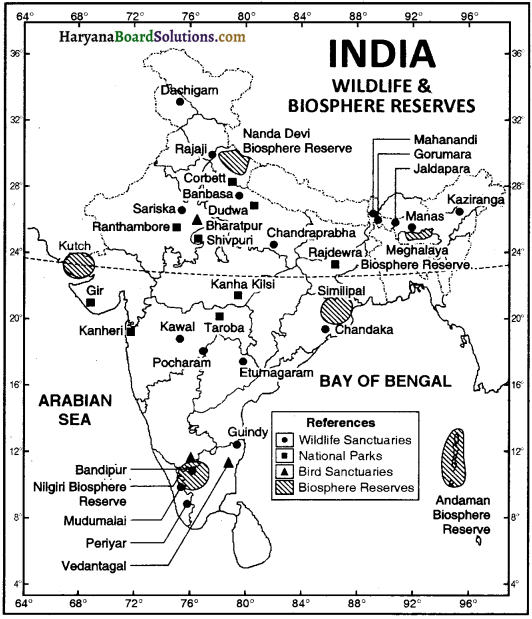
HBSE 10th Class Social Science Important Questions Geography Chapter 2 Forest and Wildlife Resources - 1

HBSE 10th Class Social Science Important Questions Geography Chapter 2 Forest and Wildlife Resources Read More »

HBSE 10th Class Social Science Important Questions History Chapter 4 The Age of Industrialisation

Haryana State Board HBSE 10th Class Social Science Important Questions History Chapter 4 The Age of Industrialisation Important Questions and Answers.

Haryana Board 10th Class Social Science Important Questions History Chapter 4 The Age of Industrialisation

Multiple Choice Questions

Important Questions On The Age of Industrialisation HBSE 10th Class Question 1.
In which of the following years, E.T. Pauli published his music book?
(a) 1900
(b) 1932
(c) 1939
(d) 1947
Answer:
(a) 1900

Important Question On The Age of Industrialisation HBSE 10th Class Question 2.
What is a word which is usually used to refer to Asia?
(a) Merchant
(b) Proto
(c) Orient
(d) Sepoy.
Answer:
(c) Orient

The Age of Industrialisation Map Based Questions HBSE 10th Class Question 3.
During the seventeenth and eighteenth centuries, it was difficult for the new European merchants to set up business in towns because :
(a) towns were already flooded with local businessmen.
(b) there Was a scarcity of human labour.
(c) urban crafts and trade guilds were powerful there.
(d) All of these.
Answer:
(c) urban crafts and trade guilds were powerful there.

Important Questions Of The Age of Industrialisation HBSE 10th Class Question 4.
What was the first symbol of the new era in Britain?
(a) cotton
(b) jute
(c) silk
(d) All of these.
Answer:
(a) cotton

HBSE 10th Class Social Science Important Questions History Chapter 4 The Age of Industrialisation

Important Questions In The Age of Industrialisation HBSE 10th Class Question 5.
The cotton mill was created by:
(a) Richard Arkwright
(b) Richard Jordan Gatting
(c) Alexander Wood
(d) Wilhelm Siemens.
Answer:
(a) Richard Arkwright

Important Questions For The Age of Industrialisation HBSE 10th Class Question 6.
The process in which fibres, such as cotton or wool are prepared prior to spin:
(a) fuller
(b) carding
(c) stapler
(d) spinning.
Answer:
(b) carding

Important Question The Age of Industrialisation HBSE 10th Class Question 7.
Who among the following improved the steam engine produced by Newcomen?
(a) James Watt
(b) Arkwright
(c) Jenny
(d) None of these.
Answer:
(a) James Watt

Question 8.
In which industry was Spinning Jenny used?
(a) Sugar
(b) Cotton
(c) Wool
(d) Jute.
Answer:
(c) Wool

Question 9.
Which of the following were pre-colonial ports of India?
(a) Surat and Bombay
(b) Surat and Hoogly
(c) Calcutta and Hoogly
(d) Bombay and Calcutta.
Answer:
(b) Surat and Hoogly

HBSE 10th Class Social Science Important Questions History Chapter 4 The Age of Industrialisation

Question 10.
Which of the following were the two most important industrial regions of India?
(a) Punjab and Bihar
(b) Bengal and Madras
(c) Bombay and Bengal
(d) Bombay and Madras.
Answer:
(c) Bombay and Bengal

Question 11.
In which of the following states did the East India Company establish its political power in 1760s?
(a) Rajasthan
(b) Bengal
(c) Kerala
(d) Gujarat.
Answer:
(b) Bengal

Question 12.
Trade through new ports of Bombay and Calcutta was controlled by:
(a) Indian companies
(b) French companies
(c) European companies
(d) Dutch companies.
Answer:
(c) European companies

Question 13.
In which of the following years was the iron and steel plant established by J.N. Tata in Jamshedpur?
(a) 1720
(b) 1854
(c) 1912
(d) 1853.
Answer:
(c) 1912

Question 14.
Which of the following images was used on the gripe water calendar for the advertisement of Gripe Water?
(a) Shri Krishna
(b) Shri Ram
(c) Ganeshji
(d) Lord Vishnu.
Answer:
(a) Shri Krishna

HBSE 10th Class Social Science Important Questions History Chapter 4 The Age of Industrialisation

Question 15.
What did Manchester industrialists put on their cloth bundles to sell them?
(a) Label
(b) Calendar
(c) Advertisement
(d) All of these.
Answer:
(a) Label

Question 16.
The messages carried out through the advertisements of Indian manufacturers referred to:
(a) Imperialists
(b) Moralists
(c) Nationalists
(d) None of these.
Answer:
(c) Nationalists

Fill in the blanks

1. This ………….. of machines and …………. is even more marked in a picture which appeared on the pages of a trade magazine over a hundred years ago.
Answer:
glorification, technology.

2. In the countryside poor ………….. and …………. began working for merchants.
Answer:
peasants, artisans.

3. In Victorian Britain there was no shortage of …………….. labour.
Answer:
human.

4. The fear of …………… made workers hostile to the introduction of new
Answer:
unemployment, technology.

5. After the East India Company established political power, it could assert a …………… right to
Answer:
monopoly, trade.

6. The first ……………. mill in Bombay came up in
Answer:
cotton, 1854.

7. In most …………. regions workers come from the nearby
Answer:
industrial, districts.

8. Famines did not affect the sale of …………… or ………….. saris.
Answer:
Banarasi, Baluchari.

HBSE 10th Class Social Science Important Questions History Chapter 4 The Age of Industrialisation

Very Short Answer Type Questions

Question 1.
Who was E.T. Pauli?
Answer:
He was a popular music publisher of England.

Question 2.
Which music company produced a music book which had a picture on the cover page announcing the ‘Dawn of the Century?
Answer:
E.T. Pauli Music Company.

Question 3.
What is Orient?
Answer:
The countries to the east of the Mediterranean are called the orient. This term usually refers to Asia.

Question 4.
Why was it difficult for the new European merchants to set up business in towns in the 17th and 18th centuries?
Answer:
This was because urban crafts and trade guilds were very powerful in the towns.

Question 5.
Which two factors led to the growing demand for goods?
Answer:
(i) The expansion of world trade.
(ii) The acquisition of colonies in different parts of the world.

Question 6.
What was the use of open fields and common lands for the poor peasants?
Answer:
These common lands were very useful for the poor peasants. They were quite necessary for their survival for gathering their firewood, berries, vegetables, hay and straw etc.

HBSE 10th Class Social Science Important Questions History Chapter 4 The Age of Industrialisation

Question 7.
From whom did a merchant clothier buy wool in England?
Answer:
A merchant clothier in England purchased wool from a wool stapler.

Question 8.
Which city of England was known as a finishing centre?
Answer:
London.

Question 9.
Define the term ‘Carding’.
Answer:
The process in which fibres such as cotton or wool, are prepared, prior to spinning.

Question 10.
Who created the cotton mill?
Answer:
Richard Arkwright created the cotton mill.

Question 11.
Name the most dynamic industries in Britain.
Answer:
Cotton and Metal industries.

HBSE 10th Class Social Science Important Questions History Chapter 4 The Age of Industrialisation

Question 12.
Who improved and patented the steam engine produced by Newcomen?
Answer:
James Watt.

Question 13.
Who invented the Spinning Jenny?
Answer:
James Hargreaves invented the Spinning Jenny.

Question 14.
Before the age of machines, which Indian industries dominated the international market?
Answer:
Before the age of machines, the silk and cotton industries of India dominated the international market in textiles.

Question 15.
Name any three pre-colonial ports in India.
Answer:
Surat, Masulipatam and Hoogly.

Question 16.
Name the ports which grew during the colonial period.
Answer:
Bombay (Mumbai) and Calcutta (Kolkata).

Question 17.
Why did the pre-colonial ports decline by the 1750s?
Answer:
Because the European companies gradually gained power first, securing a variety of concessions from local courts, secondly, the monopoly rights to trade.

Question 18.
Why did the East India Company appoint Gomasthas?
Answer:
The East India Company appointed Gomasthas to supervise weavers, collect supplies and examine the quality of cloth.

HBSE 10th Class Social Science Important Questions History Chapter 4 The Age of Industrialisation

Question 19.
Write any two problems faced by Indian weavers.
Answer:
(i) Their export market collapsed.
(ii) The local market shrank.

Question 20.
Which company official said, “The demand for Indian textiles could never reduce since no other nation produced goods of the same quality”?
Answer:
Henry Patullo, an East India Company officer, gave this statement in the year 1772.

Question 21.
Name any four major centres of cotton textiles of India during the colonial period.
Answer:

  • Bombay (1854)
  • Kanpur (1860)
  • Ahmedabad (1861)
  • Madras (1874).

Question 22.
Name some early Indian entrepreneurs of the nineteenth century in the field of industry and trade.
Answer:

  • Dwarkanath Tagore
  • Dinshaw Petit
  • Jamsetjee Nusservvanjee Tata,
  • Seth Hukum Chand
  • Father and grandfather of G.D. Birla.

Question 23.
In which sectors did Dwarkanath Tagore invest his capital?
Answer:
Dwarkanath Tagore invested his capital in various sectors, such as shipping, shipbuilding, mining, banking, insurance and plantations.

Question 24.
Who established the first Indian jute mill in Calcutta in 1917?
Answer:
Seth Hukum Chand.

Question 25.
Who was called a jobber?
Answer:
A person employed by the industrialists to get new recruits was called a jobber.

Question 26.
Why did the workers use to pay the jobber money to get work?
Answer:
The workers used to pay money to the jobber because the demand for workers was less than the supply.

HBSE 10th Class Social Science Important Questions History Chapter 4 The Age of Industrialisation

Question 27.
Write the benefits gained by the use of Fly Shuttle.
Answer:
Fly shuttle increased productivity per worker, speeded up production and reduced labour demand.

Question 28.
Which image was most commonly used to popularise baby products?
Answer:
Baby Krishna’s image was most commonly used to popularise baby products.

Question 29.
What were the methods used by Indian and British Industries to sell their products in India?
Answer:

  • They put labels on the cloth bundles.
  • They used images of gods and goddesses.
  • They printed calendars.

Question 30.
Who is a Stapler?
Answer:
A stapler is a person who sorts (stapler) wool as per its fibre.

Question 31.
Who is a Fuller ?
Answer:
Fuller is a person who gathers (fulls) cloth by pleating. ‘

Question 32.
Name the four major European groups of people.
Answer:

  • Portuguese
  • Dutch
  • English
  • French.

Question 33.
Write the names of two growing and two decaying Indian cities during the first half of eighteenth century.
Answer:
(i) Growing cities- Bombay (Mumbai) and Calcutta (Kolkata)
(ii) Decaying cities- Surat and Hoogly.

Short Answer Type Questions – I

Question 1.
“Although the demand for goods began growing, but merchants could not expand production within towns in the 17th and 18th centuries.” Explain why?
Answer:
In the 17th and 18th centuries, merchants could not expand production within towns because of the following reasons:
(i) The urban crafts and trade guilds were powerful.
(ii) The rulers granted different guilds, the monopoly right to produce and trade in specific products. It was, therefore, difficult for new merchants to set up business in towns.

HBSE 10th Class Social Science Important Questions History Chapter 4 The Age of Industrialisation

Question 2.
Define the term ‘Industrial Revolution.
Answer:
The term Industrial Revolution stands for those developments and inventions which revolutionized the technique and organisation of production in the later half of the eighteenth century.

Question 3.
How was proto-industrialisation different from factory production?
Answer:
Proto-Industrialisation was a decentralised method of production which was controlled by merchants, and the goods were produced by a vast number of producers located in different places, whereas under factories, production became centralised. Most of the processes were brought together under one roof and management.

Question 4.
What were guilds?
Answer:
Guilds were the association of producers that trained craftspersons, maintained control over production, regulated competition and prices, and restricted the entry of new people within the trade. Rulers granted different guilds, the monopoly right to produce and trade in specific products.

Question 5.
During the proto-industrial phase, what did the merchant’s clothier in England do?
Answer:
The merchant’s clothier in England did the following things :

  • They purchased wool from a wool stapler.
  • They carried wool to the spinners.
  • The yarn that was spun, was taken in subsequent stages of production, to weavers, fullers and then, to dyers.
  • Then, the finishing was done in London and cloth was sold to the export merchant.

Question 6.
What was the main feature of the proto-industrial system?
Answer:
The proto-industrial system was controlled by merchants and the goods were produced by a vast number of producers working within their family farms, not in factories.

Question 7.
Why did most industrialists of Victorian Britain not want to use modern machines?
Answer:
In Victorian Britain, most of industrialists did not want to introduce machines because of the following reasons :

  • In Victorian Britain, there was no shortage of human labour.
  • Machines required large capital investment and made them to get rid of human labour.
  • In all industries, where production fluctuated with the season, industrialists usually preferred hand labour.

Question 8.
Why did the aristocratic class in Europe prefer to use hand products in the Victorian period? Explain with examples.
Answer:
The aristocratic class in Europe preferred to use hand products in the Victorian period because :

  • They symbolized refinement and class.
  • They were better finished.
  • They were individually produced and carefully designed.

Question 9.
Why was the East India Company keen on expanding textile exports from India during the 1760s?
Answer:
The East India Company was keen on expanding textile exports from India during the 1760s because the British cotton industries had not yet expanded and the Indian fine textiles were in great demand in Europe.

HBSE 10th Class Social Science Important Questions History Chapter 4 The Age of Industrialisation

Question 10.
Who was Gomasthas? Why were there clashes between the weavers and the Gomasthas?
Answer:
The Gomasthas were the paid servants of the East India Company, who used to supervise weavers, collect supplies and examine the quality of cloth. They were outsiders, with no long-term social link with the village, so they acted arrogantly, marched into villages with the police and punished weavers for the delay in supply. So, there were reports of clashes between the weavers and the Gomasthas.

Question 11.
What were the main functions of European managing Agencies?
Answer:
European managing agencies, like Bird Heights & co., Jardine Skinner & Co., Andrew Yule, etc. controlled a large sector of Indian industries. Their main functions were the following :

  • They controlled large sector of industries
  • These agencies mobilised capital, set up joint stock companies and managed them
  • In most cases, the Indian financiers provided the capital, while European agencies made all the investments and took business decisions.

Question 12.
During the First World War, industrial production in India boomed. Give reasons.
Answer:

  • Manchester imports into India declined, as British mills were busy with war production.
  • Indian industries were also called upon to supply war needs: jute bags, cloth for the army uniform, tents and leather boots.
  • Even after the war, Manchester failed to recapture its old position in the Indian market.

Question 13.
Discuss the role of advertisement in creating new consumers.
Answer:
Advertisements make products appear desirable and necessary. They try to shape the minds of people and create new needs. If we look back into history, since the very beginning of the industrial age, advertisements have played a very vital role in expanding the markets for products and in shaping new consumer culture.

Question 14.
Why did the industrialists of Manchester use labels to sell their clothes in India?
Answer:
When Manchester industrialists began selling cloth in India, they put labels on the cloth bundles. The label was placed to make the place of manufacture and the name of the company, familiar to the buyer. The label was also a mark of quality.

HBSE 10th Class Social Science Important Questions History Chapter 4 The Age of Industrialisation

Question 15.
How did Indian advertisements become a vehicle of nationalist aspirations?
Answer:
In colonial times, the nationalist message of Swadeshi was popularised through advertisements. The message was often loud and clear, urging people to buy Indian products if they cared for the nation. Thus, all Indian goods once advertised, became a vehicle of the nationalist message of Swadeshi.

Question 16.
What is meant by “Factory system”?
Answer:
The factory system is an inherent part of the Industrial Revolution. The introduction of machines which could produce goods at a very fast speed resulted into the establishment of factories which are the sites where these machines are installed.

Short Answer Type Questions – II

Question 1.
Mention the characteristics of the cover page printed on a music book published by E. T. Pauli in 1900.
Answer:
In the year 1900, a popular music publisher E. T. Pauli produced a music book that had a picture on the cover page, announcing the ‘Dawn of the Century. At the centre of the picture is a goddess, the angel of progress, bearing the flag of the new century. She is gently perched on a wheel with wings, symbolising time. Her flight is taking her into the future. Behind her, there are the signs of progress: railway, camera, machines, printing press and factory.

  • Question 2.
    “The poor peasants and artisans in the countryside began working for merchants.” Give reasons.
    Answer:
    During the phase of proto-industrialisation, the poor peasants and artisans began working for merchants due to the reasons given ahead: This was a time when open fields in Europe were disappearing and commons were being enclosed. Poor peasants, who had earlier depended on these lands for their survival, had now to look for alternative sources of income.
  • Many peasants had tiny plots of land which could not provide work for all members of the household.
  • So when merchants came around and offered advances to produce goods for them, peasant households eagerly agreed.
  • By working for the merchants, they could remain in the countryside and continue to cultivate their small plots.
  • Income from proto-industrial production supplemented their shrinking income from cultivation. It also allowed them, fuller use of their family labour resources.

Question 3.
The production of cotton boomed in the late nineteenth century. Mention the changes within the process of production, which was responsible for the increased production of cotton.
Answer:

  • A series of inventions in the eighteenth century increased the efficacy of each step of the production process (carding, twisting and spinning and rolling.)
  • Now, the costly new machines could be purchased, set up and maintained in the mill.
  • Within the mill, all the processes were brought together under one roof and management.
  • This allowed more careful supervision over the production process, a watch over quality, and the regulation of labour, all of which had been difficult to do when production was in the countryside.

Question 4.
Write a short note on the availability of employment for European workers in the early nineteenth century.
Answer:

  • The abundance of labour in the market affected the lives of workers. The actual possibility of getting a job depended on existing networks of friendship and kin relations. If they had a relative or a friend in a factory, they were more likely to get a job quickly.
  • Many job-seekers had to wait for weeks, spending nights under bridges or in night shelters.
  • Seasonality of work in many industries meant prolonged periods without work. So, some returned to the countryside and most of the others looked for odd jobs.
  • The income of workers depended not on the wage rate alone. The number of days of work determined the average daily income of the workers.

Question 5.
Write a short note on the development of factories in India.
Answer:

  • The first cotton mill in Bombay came up in 1854 and it went into production two years later.
  • By 1862, four mills were at work, with 94,000 spindles and 2,150 looms.
  • Around the same time, jute mills came up in Bengal, the first being set up in 1855, and another one seven years later, in 1862.
  • In north India, the Elgin mill was started in Kanpur in the 1860s, and a year later, the first cotton mill of Ahmedabad was set up.
  • By 1874, the first spinning and weaving mill in Madras began its production.

Question 6.
Write in brief the activities of the early Indian entrepreneurs.
Answer:

  • The history of many business groups goes back to trade with China.
  • From the late eighteenth century, the British in India began exporting opium to China and took tea from China to England.
  • Many Indians became junior players in this trade, providing finance, procuring supplies, and shipping consignments. Having earned through trade, some of these businessmen had visions of developing industrial enterprises in India.
  • In Bengal, Dwarkanath Tagore made his fortune in the China trade before he turned to industrial investment, setting up six joint-stock companies in the 1830s and 1840s.
  • In Bombay, Parsis like Dinshaw Petit and Jamsetjee Nusserwanjee Tata accumulated their initial wealth, partly from exports to China, and partly from raw cotton shipments to England.
  • Seth Hukum Chand, a Marwari businessman who set up the first Indian jute mill in Calcutta in the year 1917, also traded with China. So did the father as well as the grandfather of the famous industrialist G.D. Birla.

Question 7.
Who was a jobber? Explain his functions.
Answer:
Jobber:
The person employed by an industrialist to recruit the right kind of people for work was called a jobber. He was an old and trusted worker. He was a middleman, employed on commission by the industrialists. He was like a safety valve in case, anything wrong was committed by the labourers.

HBSE 10th Class Social Science Important Questions History Chapter 4 The Age of Industrialisation

Functions:
(i) He got people from his village, ensured them jobs and helped them settle in the city.
(ii) He provided money to the fellows in times of crisis.

Question 8.
Explain the miserable conditions of Indian weavers during the East India Company’s regime in the eighteenth century.
Answer:
(i) Due to industrialisation in Britain, the export market of Indian weavers collapsed. As British traders started exporting machine-made clothes to India, their local market also shrank.

(ii) As raw cotton was being exported to England, there was a shortage of raw materials. When the American civil war broke out, and the cotton supplies from the United States were cut off, Britain turned to India. As raw cotton exports from India increased, there resulted in a shortage of supplies, and the weavers were forced to buy raw cotton at higher prices.

(iii) The Gomasthas, who was appointed by the government, acted arrogantly and punished weavers for the delay in supply. So, the weavers clashed with them.

(iv) The Britishers started the system of advances to regularise the supply. The weavers eagerly took the advances in the hope to earn more, but they failed to do so. They even started losing their small plots of land which they had earlier cultivated.

Question 9.
How were the Indian merchants and industrialists discriminated against by the Britishers?
Answer:

  • The market, within which Indian merchants could function, became increasingly limited.
  • The Indian merchants and traders were barred from trading with Europe in manufactured goods and had to export only raw materials and foodgrains – raw cotton, opium and wheat, indigo – required by the British.
  • With the entry of modern ships, Indian merchants were edged out of the shipping business.
  • The European merchants and industrialists had their exclusive chamber of commerce, and Indians were not allowed to become its members.

Question 10.
‘In the 20th century, the handloom cloth production expanded steadily, i.e. almost trebling between 1900 and 1940.’ Give reasons.
Answer:
(i) Handicraft producers adopted a new technology which helped in improving production without excessively pushing up costs.
(ii) By the second decade of the twentieth century, most of the weavers started using looms with fly shuttles. This increased productivity per worker speeded up production and reduced labour demand. By 1941, over 35 per cent of handlooms in India were fitted with fly shuttles.
(iii) There were several other small innovations that helped weavers to improve their productivity and compete with the mill sector.

Question 11.
How were the calendars used to increase the sale of products in India, during the British Colonial time?
Answer:
Unlike newspapers and magazines, calendars were used even by people who could not read. The calendars were hung in tea shops and in poor people’s homes, just as much as in offices and middle-class houses. People who hung the calendars used to see the advertisements, day after day, throughout the year. In these calendars, the figures of gods were used to sell new products. Like the images of god, figures of important personages, of emperors and nawabs, adorned the calendars. The message very often seemed to say : if you respect the royal figure, then respect this product and use them. Thus, calendars helped to increase the sale of products in India.

HBSE 10th Class Social Science Important Questions History Chapter 4 The Age of Industrialisation

Long Answer Type Questions

Question 1.
Explain the major features of the industrialisation process of Europe in the 19th century.
Answer:
Major features of the industrialisation process of Europe in the 19th century are as follows :
(i) Main Industries:
The cotton and metal industries were the most dynamic industries in Britain. Cotton was the leading sector in the first phase of industrialisation. With the expansion of railways in England from the 1840s, and in the colonies from the 1860s, the demand for iron and steel increased rapidly. By 1873, Britain was exporting iron and steel worth about 77 million Pounds, double the value of its cotton export.

(ii) Domination of traditional industry:
Modern machinery and industries could not easily displace traditional industries. Even by the end of the nineteenth century, less than 20 per cent of the total workforce was employed in technologically advanced industrial sectors. The textile was a dynamic sector, where a large portion of the output was produced. This sector was not established within factories, but outside, within the domestic units.

(iii) Base for growth:
The pace of change in the ‘traditional’ industries was not set by steam-powered cotton or metal industries. They were the ordinary and small innovations which built up the basis of growth in many non-mechanised sectors, such as food processing, building, pottery, glass work, tanning, furniture making and production of implements.

(iv) Slow pace:
Though technological inventions were taking place, their pace was very slow. They did not spread dramatically across the industrial landscape. New technologies and machines were expensive, so the producers and the industrialists were cautious about using them. The machines often broke down and the repair was costly. They were not as effective as their manufacturers claimed.

Question 2.
Mention the major features of Indian textiles before the age of machine industries.
Answer:
Major features of Indian textiles before the age of machine industries :
(i) The age of Indian textiles:
Historically, India was one of the leading producers of cotton textiles. Silk and cotton products of India dominated the international market. India was known for its finer varieties of cotton. The Armenian and Persian merchants took these goods from Punjab to Afghanistan, eastern Persia and Central Asia. Though most of the trade was carried through land routes, the sea route was also used. Cities like Surat, Masaulipatnam and Hoogly were the most important ports used for trade.

HBSE 10th Class Social Science Important Questions History Chapter 4 The Age of Industrialisation

(ii) A complex and complete market:
Before the arrival of the outsiders, the trade was handled by a variety of Indian merchants and bankers.

The whole process of trade basically involved three steps:

  • Carrying or transporting goods, and
  • Supplying goods to the exporters.

Supply merchants linked the port towns to the inland regions. They gave advances to weavers, procured the woven cloth from villagers, and carried the supply to the ports. At the port, big shippers and export merchants had brokers who negotiated the price, and bought goods from the supply merchants, operating inland.

Question 3.
What led to the decline of Indian textile exports in the beginning of the nineteenth century?
Answer:
Textile exports declined from the beginning of the nineteenth century because :
(i) When cotton industries developed in England, industrial groups pressurised the government to impose import duties on cotton textiles to enable Manchester goods to be sold in Britain without facing any competition from outside. On the other hand, British industrialists persuaded the East India Company to sell British products in the Indian market as well.
(ii) Export of British cotton goods increased dramatically in the beginning of the nineteenth century.
(iii) The Indian textile manufacturers were unable to compete with the cheap and durable goods from Manchester.
(iv) Cotton weavers in India thus, faced two problems at the same time – their export market collapsed and the local market shrank.
(v) By the decade of 1860, weavers faced an additional problem. They could not get a sufficient supply of good quality raw cotton. When the American civil war broke out and cotton supplies from the United States of America to British industries were cut off, Britain turned to India to meet the needs of its industries for raw cotton.
(vi) As raw cotton export from India increased, the price of raw cotton increased, and weavers in India were starved of supplies of good cotton. These weavers were forced to buy raw cotton at exorbitant prices. This reduced their earnings. Many people, therefore, migrated to other cities or towns and started working as agricultural labourers.
(vii) By the end of the nineteenth century, factories were set up in India. These too started flooding the market with machine-made goods. These factors contributed to the decline of the Indian weaving industry.

HBSE 10th Class Social Science Important Questions History Chapter 4 The Age of Industrialisation

Question 4.
Describe the important features related to industrial growth in India.
Answer:
The following features are important for the industrial growth in India:
(i) In the late nineteenth century, industrial growth was slow in India. When Indian businessmen began setting up industries in the nineteenth century, they avoided competing with Manchester goods in the Indian market. Since, yam was not an important part of British imports into India, early cotton mills in India produced coarse yam rather than fabric, to be used by handloom weavers, or for export to China.

(ii) As a result of the Swadeshi movement, the nationalists inspired people to boycott foreign cloth. The industrial groups organised themselves for the safety of their personal interests. They pressurised the government to increase the import duty and to offer other concessions. All these things lead to growth in production.

(iii) After 1906, there was a decrease in the export of Indian yam to China. In the Chinese markets, there was a flood of products prepared in Chinese and Japanese mills. Consequently, Indian industrialists began to produce cloth in place of yarn. The production of cloth doubled in India between 1900 and 1912.

(iv) Till the First World War, industrial growth was slow in India. Indian industrial growth was linked to the First World War also. During the war, British industries were busy with war productions and Manchester imports declined suddenly. Indian mills now had access to a vast home market to supply their goods.

(v) As the First World War prolonged, Indian factories were called upon to supply war needs, e.g. jute bags, cloth for army uniforms, tents, leather boots and a host of other items. Thus, new factories were set up and old ones worked in multiple shifts. Over the war years, industrial production boomed in India and many new workers gained employment.

(vi) While factory industries grew regularly after the war, large industries formed only! a small segment of the economy. Most of them, about 67 per cent in the year 1911, were ‘ located in Bengal and Bombay. Over the rest of the country, small-scale production units continued to predominate.

Question 5.
Explain the methods used by producers to expand their markets in the 19th century.
Answer:
The methods used by producers to expand their markets in the 19th century are as follows :
(i) Advertisements:
The most effective method used by the producers was the advertisements through newspapers, magazines, pamphlets and calendars. These played a vital role in expanding the markets for products and in shaping new consumer culture.

(ii) Labelling:
When Manchester industrialists began selling cloth in India, they put labels on the cloth bundles. When buyers saw ‘Made in Manchester’ written in bold on the label, they were expected to feel confident about buying the cloth. Labels not only carried words and letters, but they also carried images and were very often beautifully illustrated.

HBSE 10th Class Social Science Important Questions History Chapter 4 The Age of Industrialisation

(iii) Calendars:
By the late 19th century, manufacturers were printing calendars to popularise their products. Unlike newspapers and magazines, calendars were used even by people who could not read. They were hung in tea shops and in poor people’s homes, just as much as in offices and middle-class apartments. Those who hung the calendars used to see the advertisements day after day, throughout the year. Even in these calendars, images of gods and goddesses were used to attract consumers.

(iv) Images of Reputed Persons:
Along with the images of gods, figures of reputed persons, such as emperors and Nawabs were also used. The message very often seemed to say: if you respect the royal figure, then respect this product; as the product was shown being used by kings, or produced under royal command, its quality could not be questioned.

(v) Advertisements by Indian producers:
Indian manufacturers were also using selling tactics. When Indian manufacturers advertised the nationalist message, it was clear and loud: “If you care for the nation then buy products that Indians produce”. Advertisements became a vehicle of the nationalist message of Swadeshi.

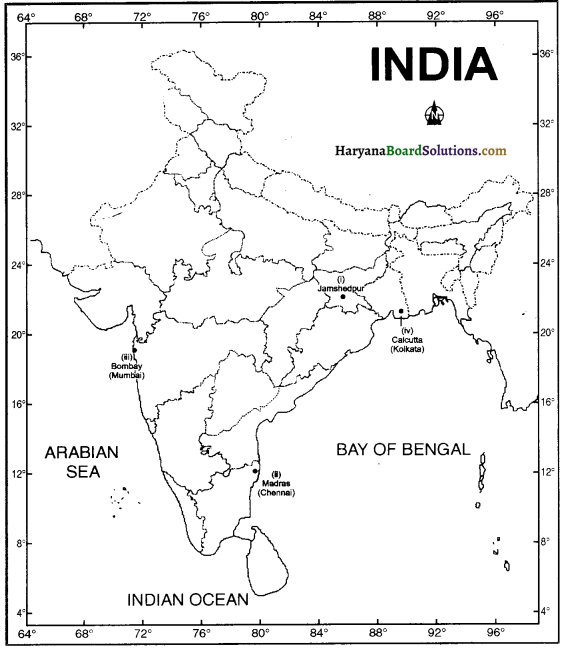
Map Work

Question 1.
On the given outline map of India locate and mark where :
(i) The first iron and steel works was established.
(ii) The first spinning and weaving mill was established.
(iii) The first cotton industry was established.
(iv) The first jute mill was established.
Answer:
(i) Jamshedpur
(ii) Madras (Chennai)
(iii) Bombay (Mumbai)
(iv) Calcutta (Kolkata).
HBSE 10th Class Social Science Important Questions History Chapter 4 The Age of Industrialisation - 1

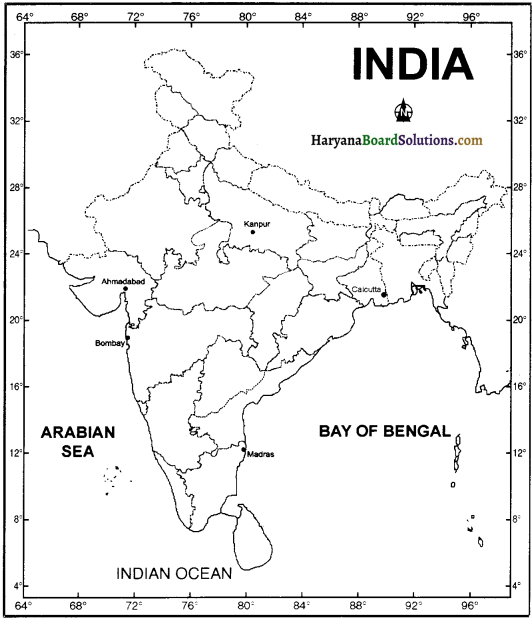
Question 2.
On the given outline in the map of India, show any four major centres of cotton textiles during the colonial period.
Answer:
(i) Major centres of cotton textile of India are:
Kanpur, Ahmedabad, Bombay and Madras.
HBSE 10th Class Social Science Important Questions History Chapter 4 The Age of Industrialisation - 3

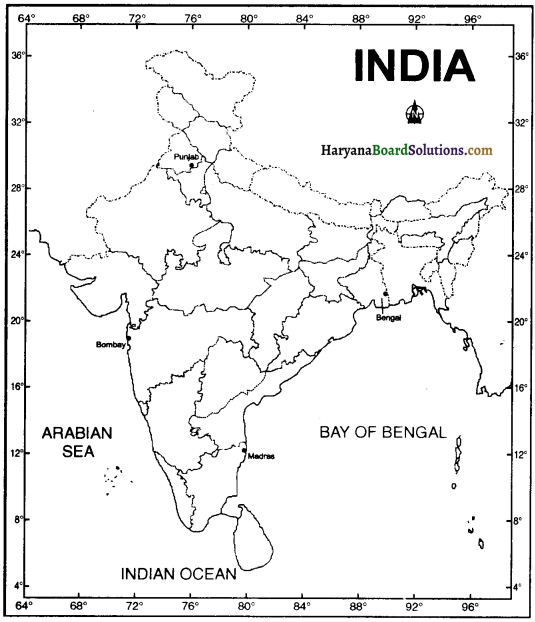
Question 3.
On the given outline:
(i) Any big centre of industry in West India.
(ii) Any big centre of Industry in East India.
(iii) Any big centre of industry in North India.
(iv) Any big centre of industry in South India.
Answer:
(i) Bombay
(ii) Bengal
(iii) Punjab
(iv) Madras.
HBSE 10th Class Social Science Important Questions History Chapter 4 The Age of Industrialisation - 4

HBSE 10th Class Social Science Important Questions History Chapter 4 The Age of Industrialisation Read More »

HBSE 10th Class Social Science Important Questions History Chapter 2 Nationalism in India

Haryana State Board HBSE 10th Class Social Science Important Questions History Chapter 2 Nationalism in India Important Questions and Answers.

Haryana Board 10th Class Social Science Important Questions History Chapter 2 Nationalism in India

Multiple Choice Questions

Important Questions On Nationalism In India HBSE 10th Class Question 1.
As in Vietnam and many other colonies, the growth of modem nationalism is intimately connected to the anti-colonial movement in:
(a) India
(b) Japan
(c) South Africa
(d) All of these.
Answer:
(a) India

Important Question On Nationalism In India HBSE 10th Class Question 2.
According to which of the following census, about 12 to 13 million people in India perished as a result of famines and epidemics.
(a) 1951
(b) 1911
(c) 1991
(d) 1921.
Answer:
(d) 1921.

Nationalism In India Map Based Questions HBSE 10th Class Question 3.
In which of the following years did Mahatma Gandhi return to India from South Africa?
(a) 1915
(b) 1951
(c) 1927
(d) 1918.
Answer:
(a) 1915

Important Questions Of Nationalism In India HBSE 10th Class Question 4.
Who led the Indian workers in South Africa marching from Newcastle to Transvaal on 6th November 1913?
(a) Subhash Chandra Bose
(b) Rabindranath Tagore
(c) Mahatma Gandhi
(d) Jawaharlal Nehru.
Answer:
(c) Mahatma Gandhi

HBSE 10th Class Social Science Important Questions History Chapter 2 Nationalism in India

Important Questions In Nationalism In India HBSE 10th Class Question 5.
Which Dharma could unite all Indians?
(a) Non-violence
(b) Violence
(c) Satyagraha
(d) None of these.
Answer:
(a) Non-violence

Important Questions For Nationalism In India HBSE 10th Class Question 6.
In which year did Mahatma Gandhi travel to Champaran in Bihar to inspire the peasants to struggle against the oppressive plantation system?
(a) 1915
(b) 1921
(c) 1917
(d) 1932.
Answer:
(c) 1917

Important Question Nationalism In India HBSE 10th Class Question 7.
In which city did Mahatma Gandhi launch satyagraha in 1918 ?
(a) Ahmedabad
(b) Amritsar
(c) Kheda
(d) Champaran.
Answer:
(a) Ahmed

Question 8.
In which of the following cities was the Khilafat committee formed in March 1919?
(a) Bombay
(b) Calcutta
(c) Bhopal
(d) Jalandhar.
Answer:
(a) Bombay

Question 9.
When did Gandhiji launch a nationwide satyagraha movement against the proposed Rowlatt Act ?
(a) 1922
(b) 1916
(c) 1919
(d) 1921.
Answer:
(c) 1919

Question 10.
When did Jallianwala Bagh Massacre take place?
(a) 13th April 1916
(b) 13th April 1918
(c) 13th April 1919
(d) 13th April 1927.
Answer:
(c) 13th April 1919

HBSE 10th Class Social Science Important Questions History Chapter 2 Nationalism in India

Question 11.
When did Non-cooperation Movement begin?
(a) January 1921
(b) February 1921
(c) March 1921
(d) December 1932.
Answer:
(a) January 1921

Question 12.
Who led the peasants’ revolt in Awadh during the Non-cooperation Movement?
(a) Mahatma Gandhi
(b) Baba Ramchandra
(c) Jawaharlal Nehru
(d) None of these.
Answer:
(b) Baba Ramchandra

Question 13.
In which year was the Inland Emigration Act Passed?
(a) 1857
(b) 1858
(c) 1859
(d) 1947.
Answer:
(c) 1859

Question 14.
In which year did the Chauri-Chaura incident take place?
(a) 1922
(b) 1920
(c) 1925
(d) 1928.
Answer:
(a) 1922

Question 15.
When did Gandhiji decide to withdraw from the Non-cooperation Movement?
(a) 1920
(b) 1923
(c) 1932
(d) 1922.
Answer:
(d) 1922.

Question 16.
In which year did the Simon Commission arrive in India?
(a) 1925
(b) 1932
(c) 1928
(d) 1947.
Answer:
(c) 1928

HBSE 10th Class Social Science Important Questions History Chapter 2 Nationalism in India

Question 17.
Who declared a vague offer of ‘dominion status for India in 1929?
(a) Lord Mountbatten
(b) Lord Irwin
(c) Lord Dalhousie
(d) Sir John Simon.
Answer:
(b) Lord Irwin

Question 18.
In which session of Congress was the demand of ‘Purna Swaraj’ formalized?
(a) Lahore session
(b) Lucknow session
(c) Bombay session
(d) Calcutta session.
Answer:
(a) Lahore session

Question 19.
Who said “The Swaraj will not come for a hundred years if untouchability is not eliminated?”
(a) B.R. Ambedkar
(b) Mahatma Gandhi
(c) Jawaharlal Nehru
(d) Annie Besant.
Answer:
(b) Mahatma Gandhi

Question 20.
In which year was the Poona Pact signed?
(a) 1930
(b) 1931
(c) 1932
(d) 1933
Answer:
(c) 1932

Question 21.
Who organized the dalits into the Depressed Class Association?
(a) B.R. Ambedkar
(b) Mahatma Gandhi
(c) Baba Ramchandra
(d) Motilal Nehru.
Answer:
(a) B.R. Ambedkar

Question 22.
Who created the first image of Bharat Mata?
(a) Mahatma Gandhi
(b) Bankim Chandra Chatterjee
(c) Abanindranath Tagore
(d) Bal Gangadhar Tilak.
Answer:
(c) Abanindranath Tagore

HBSE 10th Class Social Science Important Questions History Chapter 2 Nationalism in India

Fill in the blanks

1. The growth of modern nationalism is intimately connected to the …………. moment.
Answer:
anti-colonial.

2. ………….. recruitment in rural areas caused widespread anger.
Answer:
forced.

3. Mahatma Gandhi returned to India in January …………..
Answer:
1915.

4. The movement started with the participation of the ………….. in the cities.
Answer:
middle-class.

5. Commission arrived in India in
Answer:
Simon, 1928.

6. Mahatma Gandhi relaunched the …………. movement.
Answer:
Civil Disobedience.

7. Ideas of also developed through a movement to ………….. Indian folklore.
Answer:
nationalism, revive.

8. In Madras, …………… published a massive four-volume collection of Tamil folk tales.
Answer:
Natesa Sastri.

Very Short Answer Type Questions

Question 1.
Define Nationalism.
Answer:
Nationalism is a feeling of political consciousness and unity among the people of a state. It is the feeling of devotion, love and patriotism for one’s own nation.

Question 2.
Why did Mahatma Gandhi undertake the satyagraha movement in South Africa?
Answer:
In South Africa, Gandhiji started a satyagraha movement against racist laws that denied rights to non-whites.

Question 3.
What is satyagraha?
Answer:
A method of agitation and protest, based on truth and non-violence is called satyagraha.

HBSE 10th Class Social Science Important Questions History Chapter 2 Nationalism in India

Question 4.
What were, according to Gandhiji, the basic principles of satyagraha?
Answer:
(a) Truth
(b) Ahimsa or Non-violence.

Question 5.
What did Gandhiji believe about non-violence?
Answer:
Gandhiji believed, that the dharma of non-violence could unite all Indians.

Question 6.
Name any three places where satyagraha was launched by Gandhiji.
Answer:
(i) Champaran (Bihar) in 1916
(ii) Kheda (Gujarat) in 1917
(iii) Ahmedabad, (Gujarat) in 1918.

Question 7.
Who first introduced satyagraha in Indian National Movement?
Answer:
Mahatma Gandhi first introduced satyagraha in Indian National Movement.

Question 8.
Why did Mahatma Gandhi travel to Champaran in Bihar?
Answer:
Mahatma Gandhi traveled to Champaran in Bihar to inspire the peasants to struggle against the oppressive plantation system.

Question 9.
What is Rowlatt Act?
Answer:
Rowlatt Act was a law or tool of repression passed by the British Government on 18th March 1919.

Question 10.
What was the main objective of General Dyer behind the opening fire on the people at Jallianwala Bagh?
Answer:
General Dyer wanted to create terror among satyagrahis.

Question 11.
Who wrote the famous book ‘Hind Swaraj’?
Answer:
Mahatma Gandhi.

Question 12.
Where and when was Khilafat Committee formed?
Answer:
Khilafat Committee was formed in Bombay (Mumbai) in March 1919.

HBSE 10th Class Social Science Important Questions History Chapter 2 Nationalism in India

Question 13.
When was the Non-cooperation Khilafat Movement started?
Answer:
The Non-cooperation Khilafat Movement was started in January 1921.

Question 14.
Who was Baba Ramchandra?
Answer:
Baba Ramchandra was a leader of Awadh Peasants. In 1918-19, he led a peasant movement during the Non-cooperation Movement.

Question 15.
In which state was a militant guerrilla movement started in the early 1920s?
Answer:
In the Gudem hills of Andhra Pradesh.

Question 16.
What was the Indian Emigration Act of 1859?
Answer:
Under this Act, plantation workers were not permitted to leave the tea gardens without permission.

Question 17.
When and where did the Chauri – Chaura incident take place?
Answer:
This incident took place on 5th February 1922, in the village Chauri-Chaura, Gorakhpur (Uttar Pradesh).

Question 18.
Name any two movements launched by Mahatma Gandhi.
Answer:

  • Non-cooperation Movement.
  • Civil Disobedience Movement.

Question 19.
Who founded the Swaraj Party?
Answer:
C.R. Das and Motilal Nehru.

Question 20.
What was decided in the Lahore Session of Congress in December 1929?
Answer:
It was decided that 26th January 1930 would be celebrated as Independence Day.

Question 21.
Who was the President of the Lahore Session of Congress?
Answer:
Pt. Jawaharlal Nehru.

Question 22.
What was the importance of the Lahore Congress Session of 1929?
Answer:
In December 1929, under the presidency of Jawaharlal Nehru, the Lahore Congress formalized the demand of ‘Puma Swaraj’ or complete independence for India.

Question 23.
What was the main objective of the Salt March?
Answer:’
To break the salt law imposed by the British.

Question 24.
Mention the starting and ending point of Gandhi’s Salt March.
Answer:
Starting Point – Sabarmati Ashram Ending Point – Dandi.

HBSE 10th Class Social Science Important Questions History Chapter 2 Nationalism in India

Question 25.
When and where was the Second Round-Table Conference organized?
Answer:
‘It was organized in 1931 in London.

Question 26.
Why did the rich peasants of the countryside and Jats of Uttar Pradesh? actively participate in the Civil Disobedience Movement?
Answer:
Because they were much hit by the trade depression and falling prices.

Question 27.
Name the two organizations of Indian Merchants and Industrialists formed to protect their business interests.
Answer:
(i) Indian Industrial and Commercial Congress.
(ii) Federation of the Indian Chambers of Commerce and Industries.

Question 28.
Name the prominent industrialists who supported the Civil Disobedience movement.
Answer:

  • Purshottam Das Thakurdas
  • G.D. Birla.

Question 29.
Who organized the Dalits into the depressed classes association in 1930? Describe his achievements. (CBSE2019)
Answer:
Depressed classes association was organized by Dr. B.R. Ambedkar in 1930 and its achievements are-

  • Ambedkar raised the demand of separate electorate for Dalits.
  • British government conceded Ambedkar’s demand of separate electorates for Dalits.
  • Ambedkar accepted Gandhiji’s position and as the result, Poona Pact was signed.

Question 30.
Why did Dr. B.R. Ambedkar clash with Mahatma Gandhi at the Second Round Table Conference ?
Answer:
Dr. B.R. Ambedkar clashed with Mahatma Gandhi at the Second Round Table Conference because of the demand of separate electorates for dalits.

Question 31.
What was Poona Pact of September 1932?
Answer:
It gave the depressed classes, reserved seats in provincial and central legislative councils.

Question 32.
Who wrote ‘Vande Mataram’?
Answer:
Bankim Chandra Chattopadhyaya wrote “Vande Mataram’.

HBSE 10th Class Social Science Important Questions History Chapter 2 Nationalism in India

Question 33.
Which painter painted Bharat Mata as an ascetic figure?
Answer:
Abanindranath Tagore.

Question 34.
Who published ‘The Folklore of Southern India’?
Answer:
Natesa Sastri published a massive four-volume collection of Tamil folk tales named as ‘The Folklore of Southern India.’

Question 35.
What was forced recruitment?
Answer:
It was a process by which the colonial state forced people to join the army.

Short Answer Type Questions – I

Question 1.
Mention any three factors which were responsible for arousing the spirit of nationalism in India.
Answer:
Three factors which were responsible for arousing the spirit of nationalism in India were : .

  • Political unification of the country under the Britishers.
  • Destruction of India’s social and economic system.
  • Development of modem trade and industry.

Question 2.
Mention any three places where Satyagraha movement was successfully organised by Mahatma Gandhi after his arrival in India.
Answer:

  • Champaran: In 1917, Gandhiji travelled to Champaran in Bihar, to inspire the peasants to struggle against the oppressive plantation system.
  • Kheda : In 1917, he organised satyagraha in Kheda district of Gujarat, to support the peasants affected by crop failure and plague epidemic. The peasants could not pay the revenue and were demanding that revenue collection be relaxed.
  • Ahmedabad: In 1918, Mahatma Gandhi went to Ahmedabad, to organise satyagraha movement amongst cotton mill workers to get their wages raised.

Question 3.
What was Rowlatt Act ? How did it affect the national movement ?
Answer:
The Rowlatt Act was passed through the Imperial Legislative Council, on a report of the committee headed by Justice Rowlatt. It gave the government, enormous powers to repress political activities and allowed detention of political prisoners without trial, for two years.

Question 4.
What were the steps taken by the British government to suppress the satyagraha against the Rowlatt Act?
Answer:
The steps taken by the British Government to suppress the satyagraha against the Rowlett Act were the following ones:

  • The British administration decided to clamp down on nationalists.
  • Local leaders were arrested in Amritsar.
  • Mahatma Gandhi was not permitted to enter Delhi.
  • Martial law was imposed.

Question 5.
Write a short note on the Jallianwala Bagh massacre.
Answer:
On 13th April 1919, the very famous Jallianwala Bagh massacre took place in Amritsar. On that day, a large crowd gathered in the enclosed ground of Jallianwala Bagh to attend the annual Baisakhi fair, when Martial Law was already imposed in the city. General Dyer entered the area, blocked the exit points, and opened fire on the crowd. Hundreds of people were killed or injured.

HBSE 10th Class Social Science Important Questions History Chapter 2 Nationalism in India

Question 6.
Write any three economic influences of the Non-cooperation Movement.
Answer:
The economic influences of the Non-cooperation Movement were :

  • Foreign goods were boycotted, liquor shops picketed, and foreign clothes burnt in huge bonfires.
  • The import of foreign cloth halved between 1921 and 1922, its value dropping from ₹ 102 crore to ₹ 57 crore.
  • As people began discarding imported clothes and wearing only Indian ones, the production of Indian textile mills and handlooms went up.

Question 7.
What were the arguments of Gandhiji behind the Non-cooperation Movement?
Answer:
Mahatma Gandhi declared, that British rule was established in India with the cooperation of Indians and had survived only because of this cooperation. If Indians refused to cooperate, British rule in India would collapse within a year, and swaraj would come.

Question 8.
What were the major problems of the peasants of Awadh?
Answer:
The major problems of the peasants of Awadh were the following:

  • The talukdars and landlords demanded exorbitantly high rents and a variety of other taxes from peasants.
  • Peasants had to do begar and work at landlords’ farms without any payment.
  • As tenants, peasants had no security of tenure, and were being regularly evicted, so they could acquire no right over the leased land.

Question 9.
What were the problems of tribal peasants living in Gudem hills of Andhra Pradesh ?
Answer:
The problems of tribal peasants living in Gudem hills were following ones :

  • The colonial government had closed large forest areas, preventing people from entering the forest to graze their cattle.
  • They could not collect fuelwood and fruits.
  • The government began forcing them to contribute begar for road building.

Question 10.
What did swaraj mean for plantation workers in Assam?
Answer:
Plantation workers had their own understanding of swaraj. For them, freedom meant the right to move freely in and outside the confined space of plantations, and it meant retaining a link with the village from which they had come.

Question 11.
What was Chauri-Chaura Incident ? What action was taken by Mahatma Gandhi on hearing about the incident?
Answer:
At Chauri-Chaura in Gorakhpur, a peaceful demonstration in a bazaar turned into a violent clash, in which more than 20 policemen were killed. It took place on 5th February 1922. On hearing about the incident, Mahatma Gandhi called for a halt on the Non-Cooperation Movement.

HBSE 10th Class Social Science Important Questions History Chapter 2 Nationalism in India

Question 12.
What were the steps taken by British government to satisfy the Indian nationalists opposing the Simon Commission?
Answer:
To satisfy the Indian nationalists opposing the Simon Commission, the British government announced the steps given ahead :
(i) Lord Irwin announced a vague offer of ‘dominion status for India in an unspecified future.
(ii) A Round Table Conference was organized to discuss a future constitution.

Question 13.
Why was salt chosen as a weapon to fight against the Britishers?
Answer:

  • Mahatma Gandhi found in salt, a powerful symbol that could unite the nation.
  • Salt was one of the most essential items of food, consumed by the rich and the poor, alike.
  • The tax on salt and the government monopoly over its production revealed the most oppressive face of British rule.

Question 14.
Explain the reaction of people after Gandhiji was arrested during Civil Disobedience Movement.
Answer:
When Mahatma Gandhi and his disciple Abdul Gaffar Khan were arrested in 1930, an angry crowd demonstrated on the streets of Peshawar. Industrial workers in Sholapur attacked police posts, municipal buildings, law courts, railway stations and all structures that symbolized British rule.

Question 15.
When was Gandhi-Irwin Pact signed? What were its major features?
Answer:
Gandhi-Irwin Pact was signed on 5th March 1931. The major features of this pact were the following :
(i) Gandhiji consented to participate in a Round Table Conference in London.
(ii) The government agreed to release the political prisoners.

Question 16.
Why were the business groups no longer uniformly enthusiastic in the movement after the failure of the Second Round Table Conference?
Answer:
After the failure of the Second Round Table Conference, business groups were no longer uniformly enthusiastic because of the following reasons:
(i) They were apprehensive of the spread of militant activities.
(ii) They were worried about prolonged disruption of business, as well as of the growing influence of socialism amongst the younger members of Congress.

Question 17.
Write any three efforts made by Gandhiji to provide untouchables their rights.
Answer:

  • He called the ‘untouchables’-Ziari/’an or children of God.
  • He organised Satyagraha to secure their entry into temples and access to public wells, tanks, roads and schools.
  • He himself cleaned the toilets to dignify the work of the sweeper and persuaded upper castes to change their heart and give up ‘the sin’ of untouchability.

Question 18.
Write a short note on the Muslim League.
Answer:
The Muslim League was established for Muslim community. It demanded separate electorates. But later, its leaders were willing to give up the demand for separate electorates, if Muslims were assured reserved seats in the central assembly and representation in proportion to the population in the Muslim-dominated provinces.

Question 19.
Write a short note on the portrait of Bharat Mata painted by Abanindranath Tagore.
Answer:
The image of Bharat Mata was painted by Abanindranath Tagore in 1905. In this painting, Bharat Mata is portrayed as an ascetic figure; she is calm, composed, divine and spiritual. The mother figure is shown as dispensing learning, food and clothing.

HBSE 10th Class Social Science Important Questions History Chapter 2 Nationalism in India

Short Answer Type Questions – II

Question 1.
What was the impact of First World War on our country?
OR
Write a note on the new economic and political situations created during the First World War.
Answer:

  • The First World War changed the economic and political situation in our country.
  • It led to a huge increase in defense expenditure, which was financed by war loans and increasing taxes, customs duties were raised and income tax was introduced.
  • Through the war years, prices increased, doubling between 1913 and 1918, leading to extreme hardship for the common people.
  • Villages were called upon to supply soldiers and the forced recruitment in rural areas caused widespread anger.

Question 2.
Mention the major proposal of Gandhiji with reference to the Non-cooperation Movement.
Answer:
Gandhiji proposed that the movement should unfold in the following stages :

  • It should begin with the surrender of the titles that the government awarded.
  • There should be a boycott of civil services, army, police, courts and legislative councils.
  • There should be a boycott of schools and colleges and a withdrawal of children from there.
  • There should be a boycott of foreign goods.
  • Then, in case the government used repression, a full Civil Disobedience Campaign would be launched.

Question 3.
What was the Khilafat Movement?
Answer:
The Khilafat Movement was started by the famous Ali Brothers-, Muhammad Ali and Shaukat Ali, in 1919. Ottoman Turkey was defeated in the First World War and a harsh peace treaty was going to be imposed on the Ottoman emperor – the spiritual head of the Islamic world (the Khalifa). To protest this injustice done to Turkey and to defend the Khalifa’s temporal powers, a Khilafat Committee was formed in Bombay (Mumbai) in March 1919 to launch the Khilafat Movement.

Question 4.
Why did Gandhiji support the Khilafat Movement?
Answer:
(i) As the satyagraha against Rowlatt Act was limited to cities and towns, Mahatma Gandhi felt the need to launch a more broad-based movement in India. But, he was certain that no such movement could be organized without bringing the Hindus and Muslims closer together. One way of doing this was that he convinced other leaders to start a Non¬cooperation Movement in support of the Khilafat Movement.

(ii) A young generation of Muslim leaders, like the brothers Muhammad Ali and Shaukat Ali, began discussing with Mahatma Gandhi the possibility of united mass action on the Khilafat issue. Gandhiji saw this as an opportunity to bring Muslims under the umbrella of a unified national movement.

Question 5.
What was the reaction of middle-class people of the cities participating in the Non-cooperation Movement?
Answer:

  • Thousands of students left government-controlled schools and colleges, head¬masters and teachers resigned and lawyers gave up their legal practices.
  • The council elections were boycotted in most provinces except Madras.
  • Foreign goods were boycotted, liquor shops picketed, and foreign clothes burnt in huge bonfires.
  • As the boycott movement spread, people began discarding imported clothes and started wearing only Indian ones, like Khadi.

Question 6.
What were the factors responsible for the gradual slowdown of the Non-cooperation Movement in the cities ?
Answer:
The following factors were responsible for the gradual slowdown of the Non¬cooperation Movement in the cities:

  • Khadi cloth was often more expensive than mass-produced mill cloth and poor people could not afford to buy it. Therefore, a boycott of mill clothes for a long time was not possible.
  • The boycott of British institutions posed a problem. For the movement to be successful, alternative Indian institutions had to be set up, so that they could be used in place of the British ones, but these were slow to come up. So, students and teachers began trickling back to government schools and lawyers joined back to work in government courts.

Question 7.
Write a note on Alluri Sitarama Raju.
Answer:
Alluri Sitarama Raju was the leader of tribal peasants, living in the Gudem hills of Andhra Pradesh. Raju claimed that he had a variety of special powers ; he could make correct astrological predictions and heal people and he could survive even bullet shots. Captivated by Raju, the rebels proclaimed that he was an incarnation of God. Inspired by Gandhiji and the Non-cooperation Movement, he persuaded people to wear khadi and give up drinking. But at the same time, he asserted that India could be liberated only by the use of force, not non-violence. Under his leadership, the Gudem rebels attacked police stations, attempted to kill British officials and carried on guerilla warfare for achieving swaraj. Raju was captured and executed in 1924, and over time became a folk hero.

HBSE 10th Class Social Science Important Questions History Chapter 2 Nationalism in India

Question 8.
Why was the Non-cooperation Movement withdrawn by Gandhiji?
Answer:
In February 1922, Mahatma Gandhi decided to withdraw the Non-cooperation Movement because of the following reasons:

  • The movement was turning violent in many places. At Chauri-Chaura in Gorakhpur, a peaceful demonstration in a market turned into a violent clash, in which more than 20 policemen were killed.
  • Gandhiji felt that satyagrahis needed to be properly trained before they would be ready for mass struggles.
  • Within the Congress, some leaders were by now tired of mass struggles and wanted to participate in elections to the provincial councils, that had been set up by the Government of India Act of 1919.

Question 9.
Why was the Simon Commission constituted? Why was the commission rejected by the Indians?
Answer:
(i) The Indian members of the Central Legislative Assembly exposed the drawbacks in the Government of India Act of 1919. As a result of it, the Simon Commission was appointed in 1927, to suggest any further constitutional reforms. This commission consisted of seven white members and its chairman was Sir John Simon.

(ii) However Indians boycotted the commission because it did not have a single Indian member. The terms of the Commission’s appointment did not give any indication of swaraj, while the demand of the Indians was only swaraj.

Question 10.
Which incident marked the Civil Disobedience Movement? Explain.
Answer:
Gandhiji launched his Civil Disobedience Movement with his famous Dandi March (or Salt March), on March 12, 1930. He started his Salt March, accompanied by 78 of his trusted volunteers. The march was over 240 miles, from Gandhiji’s ashram in Sabarmati, to the Gujarati coastal town of Dandi. The volunteers walked for 24 days. Thousands came to hear Mahatma Gandhi wherever he stopped, and he told them what he meant by swaraj and urged them to peacefully oppose the British. On 6th April, he reached Dandi and ceremonially violated the law, manufacturing salt by boiling seawater. This marked the beginning of the Civil Disobedience Movement.

Question 11.
Why did the poor peasants join the Civil Disobedience Movement?
Answer:
The poor peasants joined the Civil Disobedience Movement because of the following reasons:
(i) The poor peasants were not just interested in lowering of the revenue demands. Many of them were small tenants, cultivating land they had rented from landlords. They wanted the unpaid rent to the landlord to be waived.
(ii) They joined a variety of radical movements like the ‘no rent’ campaign in most places for raising issues that might upset the rich peasants and landlords.

HBSE 10th Class Social Science Important Questions History Chapter 2 Nationalism in India

Question 12.
Explain the role of women participating in the Civil Disobedience Movement.
Answer:
There was large-scale participation of women in the Civil Disobedience Movement. They participated in protest marches, and manufactured salt and picketed foreign cloth and liquor shops. Many of them went to jail. In urban areas, these women were from high caste families, but in rural areas, they came from rich peasant households.
Moved by Gandhiji’s call, they began to see service to the nation as a sacred duty of women.

Question 13.
Who led the business community during the Civil Disobedience Movement? How did the community provide a big boost to the movement?
Answer:
The business community was led by prominent industrialists like Mr. Purshottamdas Thakurdas and G.D.Birla.
The business community interpreted swaraj in their own way. They came to view swaraj as a time, when colonial restrictions on business would no longer exist and trade and industry would flourish without constraints. They provided a big boost to the Civil Disobedience Movement by providing financial assistance to the movement. They also promoted boycotts by refusing to buy or sell imported goods.

Question 14.
How was the Civil Disobedience Movement different from the Non-Cooperation Movement?
Answer:

Civil Disobedience Movement:

  • It was launched in 1930.
  • Rejection of Gandhiji’s Eleven Demands was the immediate cause of the Civil Disobedience Movement.
  • During this movement, people were asked not only to refuse cooperation with the British but also to break the colonial laws.

Non-cooperation Movement:

  • It was started in 1920.
  • The Rowlatt Act and the injustice done to Khalifa were the basic causes of the Non-cooperation Movement.
  • During this movement, people were asked
    not to cooperate with the British government.

Question 15.
How was the flag used to promote nationalist feelings among Indians?
Answer:

  • During the Swadeshi movement in Bengal, a tricolor flag (red, green and yellow) was designed.
  • It had eight lotus flowers representing eight provinces of British India, and a crescent moon representing Hindus and Muslims.
  • By 1921, Gandhiji had designed the swaraj flag. It was again a tricolour (red, green and white) and had a spinning wheel in the centre, representing the Gandhian ideal of self-help. Carrying the flag, holding it aloft during marches, became a symbol of defiance.

Question 16.
The reinterpretations of history helped in promoting the sense of nationalism. Explain.
Answer:
By the end of the nineteenth century, many Indians began to feel that to instill a sense of pride in the nation, Indian history had to be thought about differently. The British saw Indians as primitive and backward, incapable of governing themselves. In response, Indians began looking into the past to discover India’s great achievements. They wrote about the glorious developments in ancient times, when art and architecture, science and mathematics, law and philosophy, crafts, religion and culture and trade had flourished. This glorious time, in their view, was followed by history of decline, when India was colonised. These nationalist histories urged the readers to take pride in India’s great achievements in the past, and struggle to change the miserable conditions of life under British colonial rule.

HBSE 10th Class Social Science Important Questions History Chapter 2 Nationalism in India

Long Answer Type Questions

Question 1.
What situations were responsible for launching the Non-cooperation Khilafat Movement ?
OR
What were the circumstances which led to the Khilafat and the Non-cooperation Movement ?
Answer:
(i) Situations created by the First World War:
The First World War was fought between 1914 and 1918. It led to a huge increase in defence expenditure which was financed by war loans and increasing taxes. This created extreme hardship for the common people. The forced recruitment in rural areas caused widespread anger. Then, in 1918-19 and 1920¬21, crops failed in many parts of India, resulting in acute shortages of food. Millions of people perished as a result of famines and the epidemic. People hoped that their hardships would end after the war was over. But, that did not happen.

(ii) Gandhiji’s return from South Africa and Satyagraha:
Mahatma Gandhi returned to India from South Africa in 1915, where he had successfully fought against the racist regime, with his new method of mass agitation and non-violence known as satyagraha. In India also, he launched satyagraha movements in various places. These satyagraha provided base to the Non-cooperation Movement.

(iii) The Rowlatt Act:
Rowlatt Act was a Law of repression made by the British Government on 18th March, 1919. This Act had been hurriedly passed through the Imperial Legislative Council despite the united opposition of the Indian members. It gave the government enormous powers to repress political activities, and allowed detention of political prisoners without trial, for two years.

(iv) Jallianwala Bagh massacre:
On 13 April, 1919, the very famous Jallianwala Bagh massacre took place in Amritsar. This incident added fuel to the fire. In Jallianwala Bagh, people had gathered to celebrate Baisakhi. General Dyer entered the park and ordered his troops to open fire, killing many people. As the news of Jallianwala Bagh spread, crowds took to the streets in many North Indian towns.

Question 2.
Under what circumstances was the Civil Disobedience or the Salt Movement launched ?
Answer:
The Civil Disobedience or the Salt Movement was launched under the following circumstances:
(i) Failure of the Simon Commission:
Set up in response to the nationalist movement, the commission was to look into the functioning of the constitutional system in India and suggest changes. The commission did not have any single Indian member. Therefore, it failed to satisfy the Indian people and the leaders.

(ii) The demand of ‘Puma Swaraj’:
In December 1929, under the presidency of Jawaharlal Nehru, the Lahore Congress formalised the demand of ‘Puma Swaraj’ or full Independence of India. It was declared that 26th January 1930 would be celebrated as Independence Day, when people were to take a pledge to struggle for complete independence. But, the celebrations attracted very little attention. So, Mahatma Gandhi had to find a way to relate this abstract idea of freedom to more concrete issues of everyday fife.

(iii) Gandhiji’s Eleven Demands:
On 31st January 1930, Gandhiji sent a letter to Viceroy Lord Irwin stating his eleven demands. The idea was to make the demands wide-ranging so that all classes within Indian society could identify with them and everyone could be brought together in a united campaign. The most stirring of all was the demand to abolish the salt tax. It was an ultimatum to the British. If the demands were not fulfilled by 11th March, the letter stated, Congress would launch a Civil Disobedience Campaign. Irwin was unwilling to negotiate. So, Gandhiji started his famous Salt March, accompanied by 78 of his volunteers. On 6th April, he reached Dandi and ceremonially violated the law, manufacturing salt by boiling seawater.

HBSE 10th Class Social Science Important Questions History Chapter 2 Nationalism in India

(iv) Economic Causes:
The Great Depression of 1929 had a deep impact on the Indian economy, especially on agriculture. Agriculture prices began to fall from 1926 and collapsed after 1930. As the demand for agricultural goods fell and exports declined, peasants found it difficult to sell their harvests and pay their revenue. The government refused to lower the taxes. Under above circumstances, Civil Disobedience Movement was launched.

Question 3.
“Large sections of Muslim did not respond to the call for a united struggle during the Civil Disobedience Movement.” Explain this statement with reasons. –
Answer:
Large sections of Muslims did not show much enthusiasm during the Civil Disobedience Movement because of the following reasons:

(i) Association of Congress with Hindu Mahasabha:
After the decline of the Noncooperation Khilafat Movement, a large section of Muslims felt alienated from the Congress, because from the mid-1920s, the Congress came to be more visibly associated with Hindu religious nationalist groups like the Hindu Mahasabha.

(ii) Communal Clashes:
As relations between Hindus and Muslims worsened, each community organized religious processions with militant fervor, provoking Hindu-Muslim communal clashes and riots in various cities. Every riot deepened the rift between the two communities.

(iii) Issue of Separate Electorates:
Some of the Muslim leaders demanded separate electorates for Muslims, which was not supported by the Congress leaders.

(iv) Status of Muslims in Hindu Majority Provinces:
Many Muslim leaders and intellectuals expressed their concern about the status of Muslims as a minority within India. They feared that the culture and identity of minorities would be submerged under the domination of a Hindu majority.

Question 4.
Explain the major factors which promoted the sense of nationalism in Indians.
OR
How did a variety of cultural processes play an important role in developing a sense of nationalism in India ? Explain with examples.
Answer:
(i) United struggles:
Nationalism spreads when people begin to believe that they are all part of the same nation, and they discover some common bonds that bind them together. This sense of collective belonging came partly in India through the experience of united struggles against the British.

(ii) Cultural process:
There were also a variety of cultural processes through which nationalism captured people’s imagination. History and fiction, folklore and songs, popular prints and symbols, all played a part in developing the spirit of nationalism.

(iii) Bharat Mata:
The identity of India came to be visually associated with the image of Bharat Mata, which was first created by Bankim Chandra Chattopadhyay in the 1870s. He wrote ‘Vande Mataram’ as a hymn dedicated to the motherland, which was widely sung by the Indians. Devotion to this mother figure came to be seen as evidence of one’s nationalism.

(iv) Revival of Indian Folklore:
Ideas of nationalism were also developed through a movement to revive Indian folklore. In late nineteenth century, Indian nationalists began recording folk tales sung by bards and they toured villages to gather folk songs and legends. These tales, they believed, gave a true picture of traditional culture, that had been corrupted and damaged by outside forces. It was essential to preserve this folk tradition in order to discover one’s national identity and restore a sense of pride in one’s past.

HBSE 10th Class Social Science Important Questions History Chapter 2 Nationalism in India

Map Work

Question 1.
On the given map of India, show any five centres of Indian National Movement.
Answer:
HBSE 10th Class Social Science Important Questions History Chapter 2 Nationalism in India - 1

Question 2.
Show the following on the map of India:
(i) The place where Jallianwalla Bagh massacre took place.
(ii) The place where the Congress adopted the Non-cooperation programme.
(iii) The place where a peaceful demonstration in a market turned into a violent clash with the police.
(iv) The place from where Mahatma Gandhi started his march to Dandi to violate the Salt Law.
(v) The place where Dr. B.R. Ambedkar signed a pact with Mahatma Gandhi.
Answer:
(i) Amritsar
(ii) Nagpur
(iii) Chauri-Chaura.
(iv) Sabarmati
(v) Poona
HBSE 10th Class Social Science Important Questions History Chapter 2 Nationalism in India - 2

HBSE 10th Class Social Science Important Questions History Chapter 2 Nationalism in India Read More »

HBSE 10th Class Social Science Notes Geography Chapter 7 राष्ट्रीय अर्थव्यवस्था की जीवन रेखाएँ

Haryana State Board HBSE 10th Class Social Science Notes Geography Chapter 7 राष्ट्रीय अर्थव्यवस्था की जीवन रेखाएँ Notes.

Haryana Board 10th Class Social Science Notes Geography Chapter 7 राष्ट्रीय अर्थव्यवस्था की जीवन रेखाएँ

Class 10th Geography Chapter 7 Notes HBSE

→ प्रगति के लिए गति आवश्यक है और गति के लिए परिवहन, ताकि एक स्थान से दूसरे स्थान पर सहजता से आवागमन हो सके।

→ सभ्यता के आरंभ से मनुष्य भोजन और निवास स्थान की खोज में एक दूसरे स्थान पर आता-जाता रहा है। पहले तो यह काम व्यक्ति पैदल ही करता था।

→ फिर पहिए की खोज ने गाड़ी के आविष्कार को जन्म दिया। आज जब वैज्ञानिक प्रगति अपने चरम उत्कर्ष पर है तो परिवहन के तरह-तरह से साधन अस्तित्व में आ चुके है।

→ चाहे वह कार हो या बस, ट्रक, रेल, जहाज या वायुयान। वस्तुतः इनमें से प्रत्येक का अपने अलग ही महत्त्व है।

→ परिवहन के समान ही आज के समय में संचार का महत्त्व है। वस्तुतः संचार के आधुनिक साधनों ने आज इतनी सहूलियत ला दी है कि व्यक्ति पलभर में हजारों किमी. दूर स्थित स्थान से संपर्क कर सकता है!

→ संचार माध्यमों में डाक-तार से लेकर इंटरनेट तक सभी कुछ सम्मिलित हैं। आकाशवाणी और दूरदर्शन की पहुँच उन गाँवों में भी है जो विकास की दृष्टि से अभी बहुत आगे नहीं है।

→ सड़कों का अस्तित्व तो भारत में प्राचीन काल से ही रहा है। हड़प्पा कालीन खुदाई से यह प्रमाणित हो ही चुका है। चन्द्रगुप्त मौर्य और सम्राट अशोक द्वारा भी अच्छी सड़कों का निर्माण हुआ।

→ शेरशाह सूरी ने भी जी.टी. रोड़ का निर्माण कराया था। वर्तमान में भारत में सड़कों का निर्माण इतनी प्रचुरता से हुआ है कि भारत की गणना संसार के सबसे सघन सड़क जाल वाले देशों में की जाती है।

Class 10 Geography Chapter 7 Notes HBSE

HBSE 10th Class Social Science Notes Geography Chapter 7 राष्ट्रीय अर्थव्यवस्था की जीवन रेखाएँ

→ वर्तमान में भारत में सड़कों की कुल लंबाई 25 लाख किमी. है। इनमें 57% सड़के पक्की हैं। भारत में रेलवे का इतिहास लगभग 150 वर्ष पुराना है।

→ वर्तमान में भारत में रेलमार्गों की कुल लंबाई 63,000 किमी. है। भारतीय रेलें प्रतिवर्ष 400 करोड़ यात्री और 40 करोड़ टन माल ढोती है।

→ भारत के पास इस समय 14,500 किमी. लंबे अंतः स्थलीय जलमार्ग हैं। भारत के पास 7500 किमी. लंबी तटरेखा है और इस पर 12 बड़े तथा 181 मध्यम और छोटे दर्जे के समुद्री पत्तन सेवारत हैं।

→ 90% से अधिक का विदेशी व्यापार इन्हीं बड़े पत्तनों के माध्यम से होता है।

→ एशिया के सबसे बड़े दुरसंचार जाल में भारत का स्थान उल्लेखनीय हैं वर्तमान समय में भारत में संचार साधनों के दो रूप हैं-

  • व्यक्तिगत संचार साधन
  • जनसंचार साधन।

→ भारत में प्रतिवर्ष समाचार-पत्रिकाओं का प्रकाशन बड़ी संख्या में होता है। भारत में विश्व में सबसे अधिक चलचित्रों का निर्माण होता है।

→ सन् 2000-2001 में भारत में लगभग 43 लाख करोड़ रुपये का विदेशी व्यापार हुआ। इसमें 53% आयात और 47% निर्यात का स्वरूप था।

→ इस दृष्टि से वर्तमान में भारत का अंतर्राष्ट्रीय व्यापार संतुलन प्रतिकूल हैं भारत में पर्यटन उद्योग के विकसित होने की अभी अपार संभावना है।

→ भारत में प्रतिवर्ष लगभग 26 लाख विदेशी पर्यटक आते है। सन् 2000 में भारत ने पर्यटन के माध्यम से 14,000 करोड़ रूपये से अधिक का अर्जन किया।

→ फिर भी अभी भारत के कई भाग पर्यटन की दृष्टि से अछूते से हैं। इन भागों का समूचित विकास करके पर्यटन से अधिकाधि क लाभ अर्जित किया जा सकता है।

राष्ट्रीय अर्थव्यवस्था की जीवन रेखाएँ Chapter 7 HBSE 10th Class

भौगोलिक शब्दावली

→ परिवहन – यात्री तथा माल का एक स्थान से दूसरे स्थान के बीच लाने ले जाने का कार्य।

→ आयात – किसी देश में अन्य देशों से मँगाई गई वस्तुएँ।

→ निर्यात – एक देश से दूसरे देश को भेजा गया माल।

→ पोताश्रय – इसका तात्पर्य उन स्थलों से हैं जो प्राकृतिक रूप से भी पाये जाते है और कृत्रिम रूप से भी तैयार किये जाते हैं। यहाँ गहरे पानी के विस्तृत भाग में जहाज लंगर के संतुलन से हैं।

HBSE 10th Class Social Science Notes Geography Chapter 7 राष्ट्रीय अर्थव्यवस्था की जीवन रेखाएँ

→ व्यापार संतुलन – इसका तात्पर्य देश के अंतर्राष्ट्रीय व्यापार में आयात व निर्यात मूल्यों के संतुलन से है।

→ अनुकूल व्यापार संतुलन – वह स्थिति जहाँ आयात से अधिक निर्यात किया जाए।

→ प्रतिकूल व्यापार संतुलन – वह स्थिति जहाँ निर्यात से अधिक आयात किया जाए।

→ लौह अश्व – रेल इंजन जो इन स्थान से दूसरे स्थान तक सामान और यात्रियों को ढोता है।

→ विदेशी मुद्रा विनिमयम – वह यह व्यवस्था है जिसके द्वारा अलग-अलग राष्ट्रीय मुद्राओं में भुगतान धन वास्तविक रूप से बिना दिये ही कर दिया जाता है।

→ सीमान्त सड़कें – इन सड़कों के विकास से सीमावर्ती दुर्गम क्षेत्रों में आवागमन सुलभ हुआ है।

→ जिला मार्ग – ये संड़के जिला के विभिन्न प्रशासनिक इकाइयों को जिला मुख्यालय से जोड़ती हैं।

→ राष्ट्रीय राजमार्ग – देश के दूरस्थ भागों को आपस में जोड़ने का कार्य राष्ट्रीय राजमार्ग करती है।

कुछ तथ्य, कुछ सत्य

→ संचार के साधन : व्यक्तिगत, जनसंचार।

→ जनसंचार के माध्यम : मुद्रित माध्यम, इलेक्ट्रोनिक माध्यम।

→ एक्सप्रेस मार्ग : 4-6 लेन वाले महामार्ग।

HBSE 10th Class Social Science Notes Geography Chapter 7 राष्ट्रीय अर्थव्यवस्था की जीवन रेखाएँ

→ राष्ट्रीय महामार्गों की कुल लंबाई : 52,000 किमी.

→ राज्य महामार्गों की कुल लंबाई : 1.3 लाख किमी.

→ स्वर्णिम चतुष्कोण : चार महानगरों को जोड़ने वाला महामार्ग।

→ भारत में रेलवे स्टेशनों की संख्या : 7031

→ रेलमार्गों की कुल लंबाई : 62,759 किमी.

→ रेल इंजनों का बेड़ा। : 7517

→ सावारी डिब्बों की संख्या : 36510

→ चालू रेलमार्गों की लंबाई : 107969

→ विद्युतीकृत रेल मार्ग की भाग : 23%

→ सार्वजनिक क्षेत्र का सबसे बड़ा उपक्रम : भारतीय रेल।

→ अंत स्थलीय जलमार्गों की लंबाई : 14,500 किमी.

→ वायु परिवहन का राष्ट्रीयकरण हुआ : 1953 में

→ भारतीय तटरेखा की लंबाई : 7500 किमी.

→ भारत में प्रकाशित समाचर पत्र तथा पत्रिकाओं की कुल संख्या : लगभग 50,000

→ भारत में घरेलु वायु पत्तनों की संख्या : 63

→ पहले दर्जे की डाक सेवा : पोस्टकार्ड, लिफाफे।

HBSE 10th Class Social Science Notes Geography Chapter 7 राष्ट्रीय अर्थव्यवस्था की जीवन रेखाएँ

→ दूसरे दर्जे की डाक सेवा : समाचार-पत्र, पुस्तकों के बंडल आदि।

→ भारत में सड़कों की कुल लंबाई में राष्ट्रीय महामार्गों का हिस्सा केवल 2% है।

→ 1999-2007 के मध्य देश में लगभग 14,846 किमी. लम्बा राष्ट्रीय महामार्ग बनाने का प्रस्ताव है।

→ स्वर्णिम चतुष्कोण की लम्बाई लगभग 5856 किमी. है।

→ भारत में अभी भी लगभग 50% सड़के कच्ची हैं।

→ भारतीय रेल प्रतिवर्ष लगभग 400 करोड़ यात्री और 40 करोड़ टन माल ढोती हैं।

→ सन् 2000-2001 में भारत में 43 लाख करोड़ रुपए का विदेशी व्यापार हुआ था। इसमें आयात का भाग 53% था जबकि निर्यात का भाग 47% था।

→ भारत से निर्यात की जाने वाली वस्तुओं में सबसे बड़ा भाग निर्मित वस्तुओं का है।

→ भारत में आयात की जाने वाली वस्तुओं में सबसे बड़ा भाग पेट्रोलियम और पेट्रोलियम पदार्थों का है।

→ भारत में प्रतिवर्ष लगभग 26 लाख विदेशी पर्यटक घूमने आते हैं।

→ वर्तमान समय में भारत में 1.5 करोड़ से अधिक लोग सीधे-सीधे पर्यटन उद्योग में लगे हुए हैं।

HBSE 10th Class Social Science Notes Geography Chapter 7 राष्ट्रीय अर्थव्यवस्था की जीवन रेखाएँ Read More »

HBSE 10th Class Social Science Notes Civics Chapter 1 सत्ता की साझेदारी

Haryana State Board HBSE 10th Class Social Science Notes Civics Chapter 1 सत्ता की साझेदारी Notes.

Haryana Board 10th Class Social Science Notes Civics Chapter 1 सत्ता की साझेदारी

सत्ता की साझेदारी Class 10 Notes HBSE

→ शासन कार्य एक जटिल प्रक्रिया होती है। ऐसा शासन जितना लोगों की सहमति से जुड़ा होता है, वह व्यवस्था उतनी ही लोकतांत्रिक होती है।

→ लोकतंत्र में शासन-कार्य अपने-अपने अनुभव का आभास देता है। अलग-अलग देशों में लोकतंत्रीय शासन का अनुभव अलग-अलग होता है।

→ ऐसे अनुभव में बेल्जियम व श्रीलंका के अनुभवों का उल्लेख सत्ता की साझेदारी के रूप में उदाहरण हेतु लिया जा सकता है। बेल्जियम व श्रीलंका दोनों देशों में विभिन्न प्रकार की जाति-समूह हैं।

→ बेल्जियम में डच, फ्रांसीसी व जर्मन भाषाएँ बोलने वाली जातियाँ हैं; श्रीलंका में सिंहली व तमिल प्राजातियाँ हैं। बेल्जियम के लोकतांत्रिक माडल में शासन शक्ति की बाँट कुछ इस प्रकार की गयी है कि शासन शक्तियों के प्रयोग में सभी जातियों के समान अधिकार हैं।

→ दूसरी ओर श्रीलंका में लोकतंत्र के बहुसंख्यक नियम के अनुरूप बहुसंख्यकों का शासन है। बेल्जियम में विभिन्न सामाजिक समुदायों में सत्ता की साझेदारी के कारण सामाजिक एकता है जबकि श्रीलंका में समुदायों में समुदायों में मतभेदों के चलते कुछेक तनाव बने रहे हैं।

Satta Ki Sajhedari Class 10th Notes HBSE

HBSE 10th Class Social Science Notes Civics Chapter 1 सत्ता की साझेदारी

→ लोकतांत्रीय सरकार सत्ता के केन्द्रीकरण के विपरीत सत्ता के विकेन्द्रीकरण पर जोर देती है। विकेन्द्रित व्यवस्था अपेक्षाकृत अधिक लोकतांत्रिक होती है।

→ सत्ता की बाँट कई तरीकों से हो सकती है:

  • सरकार के विभिन्न अंगों अर्थात् विधानपालिका, कार्यपालिका व न्यायपालिका में सत्ता की बाँट हो ताकि कोई भी एक अंग मनमानापन न कर सके;
  • सरकार की विभिन्न इकाईयों केन्द्रीय, प्रान्तीय व स्थानीय-के पास सत्ता का अलग-अलग अंश हो ताकि प्रत्येक प्रकार की सरकार अपने से सम्बद्ध कार्यों को करती रहे;
  • सत्ता की बाँट समाज में विभिन्न समूहों में हो अर्थात बेल्जियम मॉडल की सामुदायिक सरकार हो;
  • सत्ता की बाँट सशक्त दलों, दबाव-समूहों व आन्दोलनों द्वारा प्रभावित व नियन्त्रित हो अर्थात गठबन्धनीय सरकारों की व्यवस्था हो जिन पर समाज के अन्य अनेक समूहों जैसे-व्यापारियों, किसानों, विद्यार्थियों आदि का शासन-संचालन में प्रभाव हो।

→ जातीय (एथनीक) : ऐसा सामाजिक विभाजन जिसमें हर समूह अपनी-अपनी संस्कृति को अलग-अलग मानता है।

→ बहुसंख्यकवाद : बहुसंख्यकों द्वारा शासन : में उनका मनमानापन; अल्पसंख्यकों के हितों की अनदेखी

→ गृहयुद्ध : किसी देश में अलग-अलग समूहों द्वारा हिंसक गतिविधियाँ।

→ युक्तिपरक : लाभ-हानि का सावधानीपूर्वक हिसाब लगाकर लिया गया निर्णय

→ बेल्जियम : एक यूरोपीय देश; हरियाणा प्रान्त से भी क्षेत्रफल में छोटा : नीदरलैंड, यूक्रेन तथा जर्मनी से घिरा हुआ

→ बेल्जियम के प्रमुख क्षेत्र : फ्लेनिश (59%), वेलोनिया (40%)

सत्ता की साझेदारी Chapter 1 HBSE 10th Class

HBSE 10th Class Social Science Notes Civics Chapter 1 सत्ता की साझेदारी

→ बेल्जियम में बोली जानी वाली भाषाएँ : डच, फ्रांसीसी, जर्मन

→ बेल्जियम की राजधानी : ब्रूसेल्स

→ श्रीलंका : एक एशियायी द्वीपीय देश जो भारत के दक्षिण में स्थित है

→ श्रीलंका की प्रमुख जातियाँ : सिंहली (74%), तमिल लगभग 18% अन्य लगभग 9%

→ गठबन्धन सरकारः मिली-जुली सरकार : जब कोई राजनीतिक दल अपने बुते पर सरकार नहीं बना पाती, तब कुछ दल मिली-जुली सरकार बनाते हैं। ऐसी सरकार गठबन्धन सरकार होती है।

→ जर्मनी के राजनीतिक दल : क्रिश्चियन डेमोक्रेटिक पार्टी तथा डेमोक्रेटिक पार्टी

→ सत्ता-विभाजन के रूप :

  • सरकार के अंगों-विधायिका, कार्यपालिका, न्यायपालिका में कार्यविभाजन
  • सरकार के विभिन्न स्तरों-केन्द्रीय व प्रान्तीय सरकारों-में शक्तियों की बाँट
  • सामाजिक समूहों में सत्ता की बाँट
  • दबाव-समूहों आदि में सत्ता की बाँट

HBSE 10th Class Social Science Notes Civics Chapter 1 सत्ता की साझेदारी Read More »

HBSE 10th Class Social Science Notes Geography Chapter 5 खनिज और ऊर्जा संसाधन

Haryana State Board HBSE 10th Class Social Science Notes Geography Chapter 5 खनिज और ऊर्जा संसाधन Notes.

Haryana Board 10th Class Social Science Notes Geography Chapter 5 खनिज और ऊर्जा संसाधन

Geography Class 10 Chapter 5 Notes

→ खनिज एक अत्यधिक महत्त्वपूर्ण प्राकृतिक संसाधन हैं, जो देश को आर्थिक व औद्योगिक विकास का आधार प्रदान करते हैं। खनिज ठोस, द्रव और गैस सभी रूपों में पाये जाते हैं।

→ खनिज संसाधन की दृष्टि से भारत एक अत्यंत संपन्न देश है। भारत से अनेक खनिजों का निर्यात किया जाता है। जबकि तांबा, चांदी, निकिल, कोबाल्ट, जस्ता जैसे खनिजों का आयात किया जाता है।

→ खनिज वस्तुतः एक प्राकृतिक रासायनिक यौगिक है जिनके संघटन और संरचना स्वरूप में समानता पाई जाती है। खनिज शैलों और अयस्कों के अवयव हैं। खनिजों की उत्पति भू-गर्भ हो रही विभिन्न भूवैज्ञानिक प्रक्रियाओं के द्वारा होती है।

→ रासायनिक और रवों की संरचना के आधार पर खनिजों का कई प्रकार से वर्गीकरण किया जाता है। कुछ खनिज केवल एक ही तत्व से बने होते हैं। जबकि कुछ अन्य खनिजों की संरचना दो या अधिक तत्वों से मिलकर होती है।

→ नाइट्रेट, पोटाश, अभ्रक, कोयला और पेट्रोलियम जैसे पदार्थ अधात्विक खनिज है। सामान्यतः सभी धात्विक खनिज अयस्क के रूप में मिलते हैं। यही कारण है कि उपयोग में लाने से पूर्व खनिजों को संसाधित करने की आवश्यकता पड़ती है।

→ जीवन की अपरिहार्य आवश्यकताओं में से एक है ऊर्जा विकास के लिए भी ऊर्जा संसाधनों की अत्यंत महत्त्वपूर्ण भूमिका है। ऊर्जा के परम्परागत स्त्रोत में कोयला, पेट्रोलियम, प्राकृतिक गैस और विद्युत आदि सम्मिलित हैं

→ ऊर्जा के गैर-परम्परागत स्त्रोत में सौर ऊर्जा, पवन ऊर्जा, बायोगेस, आदि सम्मिलित हैं। ऊर्जा के परम्परागत स्त्रोत जहां सीमित मात्रा में हैं और निश्चित अवधि के बाद समाप्त हो जायेंगे।

Chapter 5 खनिज और ऊर्जा संसाधन HBSE 10th Class

HBSE 10th Class Social Science Notes Geography Chapter 5 खनिज और ऊर्जा संसाधन

→ वहीं ऊर्जा के गैर-परम्परागत स्त्रोत नवीनकरण योग्य संसाधन है और अपनी असीमितता के कारण प्रचुर मात्रा में प्रयुक्त हो सकते हैं।

→ ऊर्जा के गैर-परम्परागत स्त्रोत सभी ऊर्जा आवश्यकताओं की पूर्ति करने में सक्षम है और आज धीरे-धीरे ये अत्यंत लोकप्रिय होते जा रहे है। फिर भी कोई भी संसाधन न चाहे वह असमाप्य ही क्यों हो, सुनिश्चित रूप से प्रयोग किया जाना चाहिए।

→ यही कारण है कि ऊर्जा संसाधानों के संरक्षण के लिए हमारे देश में ऊर्जा संरक्षण एकट 2001 में पारित किया गया जो मार्च 2002 से प्रभावी हो गया है।

→ आर्थिक विकास के लिए ऊर्जा एक आधारभूत आवश्यकता है। अत: ऊर्जा के विकास के सतत् पोषणीय मार्ग के विकसित करने की तुरंत आवश्यकता है। हमारे पास ऊर्जा के संसाधन सीमित है अतः इनका सावधानीपूर्ण उपयोग हम सबकी जिम्मेदारी है।

भौगोलिक शब्दावली

→ चट्टान-पृथ्वी की परत का निर्माण करने वाले खनिजों का मिश्रण।

→ नवीनकरण संसाधन-वे संसाधन जिनका बार-बार उपयोग हो सकता है और जो उपयोग से रिक्त हुई मात्रा को सम के साथ पुनः पूरित हो जाते हैं।

→ खनिज ईधन-अधात्विक पदार्थ जिन्हें ईधन के रूप में काम लाया जाता है।

→ अपतट बेधन-तट के पास में समुद्र में किया गया गहरा बेधन।

→ एल.पी.जी.-लिक्विफाइड पेट्रोलियम गैस, वह गैस जिसका उपयोग घरों में रसोई के लिए किया जाता है।

→ सी.एन.जी.-कम्प्रेस्ड नेचुरल गैस, वाहनों में प्रयोग किया जाने वाला ईधन।

→ भू-तापीय ऊर्जा-पृथ्वी के आंतरिक भागों से ताप का प्रयोग कर उत्पन्न की जाने वाली विद्युत को भूतापीय ऊर्जा कहते हैं।

→ लौह खनिज-वे खनिज जिनमें लोहा होता है, लौह खनिज कहलाते हैं।

खनिज और ऊर्जा संसाधन Chapter 5 HBSE 10th Class

HBSE 10th Class Social Science Notes Geography Chapter 5 खनिज और ऊर्जा संसाधन

→ रैट होल खनन-जोवाई व चेरापूंजी में कोयले का खनन परिवार के सदस्यों द्वारा एक लम्बी संकीर्ण सुरंग के रूप में किया जाता है। जिसे रैट होल खनन कहते हैं।

→ गोबर गैस प्लांट-पशुओं का गोबर प्रयोग करने वाले संयत्र ग्रामीण भारत में ‘गोबर गैस प्लांट’ के नाम से जाने जाते

→ जल विद्युत-वह विद्युत जो प्रवाही जल से हाइड्र-टरबाइन चलाकर उत्पन्न की जाती है।

→ ताप विद्युत-वह विद्युत जो ईधन जैसे-कोयला, पेट्रोलियम व प्राकृतिक गैस, को जलाने से टरबाइन चलाकर उत्पन्न की जाती है।

कुछ तथ्य, कुछ सत्य

→ लौह खनिज : लौह अयस्क, मैगनीज अयस्क, क्रोमाइट, पाइराइट, टंगस्टन, निकिल, कोबाल्ट।

→ अलौह खनिज : सोना, चाँदी, ताँबा, सीसा, बॉक्साइट, टिन और मैग्नीशियम।

→ अधात्विक खनिज : नाइट्रेट, पोटाश, अभ्रक, जिप्सम, कोयला, पेट्रोलियम।

→ गैलना : सीसा अयस्क।

→ भारत से निर्यात किये जाने वाले खनिज : लौह अयस्क, टिटेनियम, मैगनीज अयस्क, बॉक्साइट।

→ आयात किये जाने वाले खनिज : ताँबा. चाँदी, निकिल, कोबाल्ट, जस्ता, सीसा, टिन, पारा, प्लैटिनम, ग्रेफाइट।

→ भारत में कुल खानों की संख्या : 3000

HBSE 10th Class Social Science Notes Geography Chapter 5 खनिज और ऊर्जा संसाधन

→ खनिजों का औद्योगिक उत्पादन में योगदान : 11%

→ भारत में लौह अयस्क खनन क्षेत्र : छतीसगढ, झारखंड, उड़ीसा, गोवा कर्नाटक।

→ मैंगनीज उत्पादन में : 5वाँ

→ मैंगनीज के भंडार की दृष्टि से भारत का स्थान : दूसरा।

→ गैस के पास एल.पी.जी. आपूर्ति संयेत्रों की संख्या: 7

→ भारत में 3.3 करोड़ टन कच्चे तेल का उत्पादन होता है

→ भारत का पहला तेल उत्पादक राज्य : असम।

→ असम के तीन प्रमुख तेल क्षेत्र-

  • डिग्बोई
  • नाहर कटिया
  • मोरन हुगरीजान

→ देश में कुल तेल परिष्करण शालाए : 18

→ प्रतिवर्ष तेल की मांग : 10.2 करोड़ टन।

HBSE 10th Class Social Science Notes Geography Chapter 5 खनिज और ऊर्जा संसाधन

→ संसार के 60% अभ्रक का उत्पादन : भारत में

→ सड़क परिवहन में पेट्रोलियम का 37% भाग खपत होता है।

→ भारत में विद्युत उत्पादन क्षमता : 104917 मेगावाट।

→ भारत में विद्युत खपत (प्रतिव्यक्ति) : 379 किलोवाट घंटे है। (प्रतिव्यक्ति)

→ चीन में विद्युत खपत (प्रतिव्यक्ति) : 746 किलोवाट घंटे।

→ अमेरिका में प्रतिव्यक्ति खपत : 11994 किलोवाट घंटे।

→ भारत में ताप विद्युत केन्द्र : 310 से अधिक।

→ भारत में गैर परम्परागत ऊर्जा उत्पादन की क्षमताः 95,000 मेगावाट।

→ मैगनीज के भंडार की दृष्टि से जिम्बाब्वे का प्रथम स्थान है।

→ बॉक्साइट से एल्यूमिनियम प्राप्त किया जाता है।

→ बॉक्साइट मुख्यतः झारखंड, उड़ीसा, गुजरात, महाराष्ट्र, छतीसगढ़, मध्य प्रदेश, तमिलनाडु में मिलता है।

→ संसार के लगभग 60% अभ्रक का उत्पादन भारत में होता है।

HBSE 10th Class Social Science Notes Geography Chapter 5 खनिज और ऊर्जा संसाधन

→ लुनेज और कालोल तेल क्षेत्र अहमदाबाद के निकट स्थित हैं।

→ तारापुर परमाणु ऊर्जा केन्द्र महाराष्ट्र में है।

→ भारत का सबसे बड़ा सौर संयंत्र भुज के पास माधोपुर में स्थापित किया गया है।

→ ऊर्जा संरक्षण एक्ट 2001 में बनाया गया जो मार्च 2002 से प्रभावी हुआ।

→ वानकबाड़ी तापीय शक्ति केंद्र गुजरात में हैं।

→ पनकी और परीछा तापीय शक्ति केंद्र उत्तर प्रेदश में हैं।

→ भारत में उत्पादन की जाने वाली कुल विद्युत में 25% जल विद्युत का योगदान है।

→ भारत में संसार का लगभग 50% थोरियम पाया जाता है।

→ भारत में उत्पन्न की जाने वाली कुल विद्युत का 25% जल विद्युत का है।

→ परली तापीय शक्ति केंद्र महाराष्ट्र में है।

HBSE 10th Class Social Science Notes Geography Chapter 5 खनिज और ऊर्जा संसाधन Read More »

HBSE 10th Class Social Science Notes Geography Chapter 4 कृषि

Haryana State Board HBSE 10th Class Social Science Notes Geography Chapter 4 कृषि Notes.

Haryana Board 10th Class Social Science Notes Geography Chapter 4 कृषि

कृषि Class 10 Notes HBSE Chapter 4

→ भारत एक कृषि प्रधान देश है। कृषि संपूर्ण भारतीय अर्थव्यवस्था का आधार है। भारत के कुल श्रम का लगभग 2/3 हिस्सा कृषि में लगा हुआ है।

→ भारत के सकल घरेलु उत्पाद में कृषि का 26% का हिस्सा है। भारत शुद्ध बोय गये क्षेत्रफल की दृष्टि से विश्व में प्रथम स्थान पर है।

→ भारत का 143 लाख हेक्टेयर भाग शुद्ध बोये गये क्षेत्र आता है।

→ स्वतंत्रता प्राप्ति के बाद भारत में कृषि में त्वरित विकास हुआ और इस विकास के लिए हरित क्रांति अभियान चलाया गया। इस अभियान से जहां भारत खाद्यान उत्पादन में आत्मनिर्भर हो सका वहीं आज कई उत्पदों का निर्यात भी करने लगा है।

→ चावल और गेहूँ उत्पादन में भारत विश्व में दूसरे स्थान पर है। दुग्ध और चाय उत्पादन में पहले स्थान पर फल उत्पादन में भारत का स्थान यद्यपि दूसरा है परंतु आम उत्पादन में भारत का प्रथम स्थान पर है। काजू निर्यात में भारत प्रथम स्थान पर है।

Class 10 Geography Chapter 4 Notes HBSE

HBSE 10th Class Social Science Notes Geography Chapter 4 कृषि

→ भारत में पशुपालन अपनी विकसित अवस्था में हैं। संसार की लगभग 57% भैंसे भारत में पायी जाती है। विश्व के गोध न का 16% भारत में ही पाया जाता है।

→ भारत की कुल गायों का 2/3 हिस्सा मध्यप्रदेश, उत्तर प्रेदश, बिहार, महाराष्ट्र, उडीसा, कर्नाटक और राजस्थान मेंपाली जाती हैं। भारत में पायी जाने वाली 25% भैसें अकेल उत्तर प्रदेश में है।

→ भेड़ों का 20% राजस्थान में पाया जाता है। भेड़ से ऊन और मांस प्राप्त होता है। 50 प्रतिशत भेड़े, आंध्रप्रदेश, तमिलनाडु, कर्नाटक, महाराष्ट्र, जम्मू और कश्मीर तथा उत्तरप्रदेश में पाली जाती है।

→ भारत में मुर्गीपालन मुख्यतः घरेलु उद्योग के रूप में प्रचलित हैं अपनी लंबी तटरेखा के कारण मछली पालन के लिए एक अत्यंत विकसित और उपयुक्त स्थल है। मत्स्य पालन भारत में तटीय क्षेत्रों के लोग की आजीविका का मुख्य साधन है।

→ सन् 1950-51 में भारत में 510 लाख टन खाद्यान्न का उत्पादन हुआ था, वही 1999-2000 में यह बढ़कर 2090 लाख टन हो गया। 2001 में भारत में 4 करोड लाख टन खाद्यान्न का भंडारण किया गया।

→ 1990 ई. के बाद वैश्वीकरण के कारण भारतीय किसानों को कई नई चुने का सामना करना पड़ रहा हैं विकसित देशों द्वारा अपने किसानों को अत्यधिक सहायिकी देने के कारण भारतीय कृषि विश्व के उन देशों के साथ स्पर्धा करने में असमर्थ है।

→ भारतीय कृषि को सक्षम और लाभदायक बनाने के लिए सीमांत और छोटे किसानों की स्थिति सुधारने की जरूरत है। कार्बानिक कृषि पर अधिक जोर दिया जाना चाहिए क्योंकि इसका हमारे पर्यावरण पर कोई नकारात्मक असर नहीं होता है।

Chapter 4 कृषि HBSE 10th Class Geography

HBSE 10th Class Social Science Notes Geography Chapter 4 कृषि

→ भारतीय किसानों को खाद्यान्नों के स्थान पर फसलें उगानी चाहिए। इसमें उनकी आमदनी भी बढ़ेगी और पर्यावरण निम्नीकरण में भी कमी आएगी।

भौगोलिक शब्दावली

→ शद्ध बोया गया क्षेत्र-वह कृषि-भूमि जो वर्षभर में केवल एक बार ही बोयी जाती है।

→ कुल बोया गया क्षेत्र-शुद्ध बोया गया क्षेत्र + एकाधिक बार बोया गया क्षेत्र।

→ आत्मनिर्वाह कृषि-छोटी जोतों पर पारस्परिक प्रकार की कृषि। इस तरह की कृषि में आधुनिक तकनीकी सुविधाओं का प्रयोग न के बराबर होता है।

→ स्थानांतरी कृषि-कृषि का वह प्रकार जिसमें किसान कृषि के लिए हर दो तीन साल बाद भूमि परिवर्तित करता रहता है।

→ रोपण कृषि-इस प्रकार की कृषि के अंतर्गत वृक्ष या फसलों को ही उगाया जाता है।

→ गहन कृषि-वह कृषि का उन्नत प्रकार है तथा उन क्षेत्रों में प्रचलित है जहां सिंचाई संभव है।

→ शुष्क कृषि-कृषि का वह प्रकार जो कम वर्षावाले क्षेत्र में अपनाया जाता है।

→ आर्द्र कृषि-अधिक वर्षा वाले क्षेत्रों में की जाने वाली कृषि।

→ हरित कृषि-देश का खाद्यान्न उत्पादन में आत्मनिर्भर बनाने हेतु चलाया गया अभियान।

→ श्वेत क्रान्ति-देश में दुग्ध उत्पादन की बढ़ोत्तरी हेतु चलाया गया अभियान।

HBSE 10th Class Social Science Notes Geography Chapter 4 कृषि

→ ऑपरेशन फ्लड-श्वेत क्रांति का तहत चलाया गया अभियान जिससे भारत दुग्ध उत्पादन मे विश्व में प्रथम स्थान पर आ सका।

→ वैश्वीकरण-संपूर्ण विश्व भर में होने वाला व्यपार।

→ ड्रिप सिंचाई-इसमें खेती को पानी से लबालब ने भर कर ऊपर से फुहारों के रूप में सिंचाई की जाती है। इस आधुनिक सिंचाई से कम जल में अधिक से अधिक लाभ
दिया जाता है।

→ जैव खाद-इस प्रकार की खाद में उन कीड़ों का प्रयोग होता है जो मिट्टी की उपजाऊ क्षमता को बढ़ाते हैं और फसलों को हानि नहीं पहुंचाते।

→ गरीबी रेखा-निर्धारित मानदंडों से नीचे के स्तर पर जीवन यापन करना।

→ रबी फसलें-रबी फसलें शीत ऋतु में अक्टूबर से दिसम्बर के मध्य बोई जाती है तथा ग्रीष्म ऋतु में अप्रैल से जून के मध्य काट ली जाती है।

→ खरीब फसलें-ये फसलें देश के विभिन्न क्षेत्रों में मानसून के आगमन के साथ बोई जाती है और सितंबर-अक्टूबर में काट ली जाती है।

→ जायद-रबी और ,खरीब फसल ऋतुओं के बीच ग्रीष्म ऋतु में बोई जाने वाली फसल को जायद कहा जाता है।

→ वाणिज्यिक कृषि-इस प्रकार की कृषि के मुख्य लक्षण आधुनिक निवेशों जैसे अधिक पैदावार देने वाले बीजों, रसायनिक उर्वरकों और कीटनाशकों के प्रयोग से उच्च पैदावार प्राप्त करना है।

→ रोपण कृषि-इस प्रकार की खेती में लम्बे-चौड़े क्षेत्र में एकल फसल बोई जाती है जिसके लिए अत्यधिक पूंजी प्रवासी श्रमिकों की आवश्यकता होती है।

कुछ तथ्य, कुछ सत्य

→ कृषि का महत्त्व – भारत के सकल घरेलू उत्पाद में कृषि का योगदान 26% है।

→ एग्रीकल्चर – भूमि की जुताई।

→ खरीफ – जून-जुलाई से अक्टूबर-नवंबर तक का फसल चक्र।

HBSE 10th Class Social Science Notes Geography Chapter 4 कृषि

→ रबी की ऋतु – अक्टूबर-नवम्बर से मार्च-अप्रैल का फसल चक्र।

→ जायद – ग्रीष्मकालीन छोटी फसल ऋतु।

→ मूंगफली – भारत की सबसे महत्त्वपूर्ण तिलहन।

→ खरीफ की दलहन – मूंग, अरहर, उड़द।

→ रबी का दलहन – मसूर, मटर, चना।

→ अलसी – रबी की फसल

  • उत्पादन में भारत का तीसरा स्थान
  • सबसे अधिक उत्पादन रूस में होता है।

→ जूट उत्पादक राज्य – पश्चिम बंगाल, बिहार, असम, उड़ीसा, मेघालय।

→ कपास – खरीफ की फसल।

  • उष्ण और उपोष्ण क्षेत्रों की फसल
  • 6-8 महीने में फसल तैयार
  • उत्पादन में भारत का स्थान तीसरा।
  • प्रधम और दूसरे स्थान पर क्रमशः चीन और अमेरिका।

→ गरीबी रेखा से नीचे – 66 करोड़ भारतीय (26 प्रतिशत)

HBSE 10th Class Social Science Notes Geography Chapter 4 कृषि

→ 2001-01 में कुल खाद्यान्न – 1990 लाख टन।

→ भारत में – संसार की 57 प्रतिशत भैंसे पायी जाती हैं

HBSE 10th Class Social Science Notes Geography Chapter 4 कृषि Read More »

HBSE 10th Class Social Science Notes Geography Chapter 6 विनिर्माण उद्योग

Haryana State Board HBSE 10th Class Social Science Notes Geography Chapter 6 विनिर्माण उद्योग Notes.

Haryana Board 10th Class Social Science Notes Geography Chapter 6 विनिर्माण उद्योग

Geography Chapter 6 Class 10 Notes HBSE

→ निर्माण का तात्पर्य मशीनों के माध्यम से बड़ी वस्तुओं का उत्पादन से है। यूरोप में आई औद्योगिक क्रांति ने संपूर्ण विश्व भर में उद्योगों का जाल बिछा दिया।

→ यूं तो भारत में तकनीकी का ज्ञान प्राचीन काल से था और इस बात का उदाहरण हैं कुतुबमीनार के समीप स्थित जग मुक्त लौह स्तम्भ, हड़प्पा सभ्यता से प्राप्त कांसे की मूर्तियां, तांबे के मनके और शीशे आदि भी इस बात का प्रमाण देते हैं।

→ भारत वस्त्र निर्माण की कला से भी पूराने समय से परिचित हैं। इतना होने पर भी आधुनिक भारत में लौह अयस्क प्रगलन का आरंभ सन् 1830 में तमिलनाडु के पोर्टोनोवा में हुआ परंतु यह शीघ्र ही बंद हो गया फिर 1864 में पश्चिम बंगाल के कुल्टी में लौह और इस्पात उद्योग का वास्तविक आरंभ हुआ।

→ परंतु लौह और इस्पात का बड़े पैमाने पर उत्पादन 1907 में जमशेदपुर में कारखाने की स्थापना के साथ हुआ।

→ सूती कपड़ा मिल की सर्वप्रथम स्थापना 1854 में की गई थी जबकि जूट का कारखाना सबसे पहले 1855 में कोलकता के निकट रिशरा में स्थापित किया गया।

→ आरंभ में सूती वस्त्र उद्योग गुजरात और महाराष्ट्र में ही केन्द्रित था परंतु आज सूती वस्त्र तमिलनाडु में केन्द्रित है। सूती वस्त्र के बाद भारत का दूसरा सबसे महत्त्वपूर्ण उद्योग है।

→ जूट उद्योग। कच्चे जूट और जूट के बन सामानों के उत्पादन में भारत का विश्व में प्रथम स्थान हैं। परंतु जूट के सामन के निर्यात में भारत का बांग्लादेश के बाद विश्व में दूसरा स्थान है।

HBSE 10th Class Geography Chapter 6 विनिर्माण उद्योग

HBSE 10th Class Social Science Notes Geography Chapter 6 विनिर्माण उद्योग

→ आज भारत में लगभग 70 जूट मिलें हैं। 80% से भी अधिक जूट का सामान का उत्पादन अकेले पश्चिम बंगाल में होता है। आंध्रप्रदेश करीब 10% जूट का सामान तैयार करता है।

→ देश का सबसे पुराने वस्त्र उद्योगों में से एक है ऊनी वस्त्र उद्योग। इसका मुख्य संकेन्द्रण पंजाब, महाराष्ट्र, उत्तर प्रदेश, गुजरात, हरियाणा, और राजस्थान राज्यों में हैं। भारतीय ऊनी सामान संयुक्त राज्य अमेरिका, रूस, यूनाइटेड किंगडम, कनाडा और यूरोप के देशों में निर्यात किया जाता है।

→ भारत विश्व में अपने रेशम के लिए भी प्रसिद्ध है। भारत में चार प्रकार की रेशम उत्पादित की जाती है-मलबरी, टसर, इरी, मूंगा।

→ वर्तमान में भारत में लगभग 90 मिलें है और कई छोटी इकाईयों में भी रेशमी कपड़ों का उत्पादन किया जाता है।

→ भारत में कृत्रिम वस्त्रों का उद्योग भी महत्त्वपूर्ण स्थान रखता है। इस उद्योग के प्रमुख केन्द्र मुंबई, अहमदाबाद, सूरत, दिल्ली, अमृतसर, ग्वालियर और कोलकाता में स्थित है।

→ गन्ने के उत्पादन में तथा चीनी उत्पादन में भारत का विश्व में प्रथम स्थान है। भारत के आर्थिक विकास में रासायनिक उद्योग का महत्त्वपूर्ण स्थान है।

→ देश में इस उद्योग का तीव्र गति से विकास हो रहा है। भारत में उर्वरक संयंत्र की सर्वप्रथम स्थापना 1906 में तमिलनाडु के रानीपेट में की गई थी।

→ परंतु इस उद्योग का वास्तविक विकास सन् 1951 में भारतीय उर्वरक निगम द्वारा सिंदरी में संयंत्र की स्थापना के साथ हुआ।

→ भारतीय रेल आज विकसित प्रौद्योगिकी की प्रतीक बन चुकी है।

→ भरतीय रेल अपनी आवश्यकता के सभी उपकरण स्वयं तैयार करती है। आज हमारे देश में पोतों का भी निर्माण होता है। इसके लिए पाँच प्रमुख केन्द्र है।

→ इलेक्ट्रोनिक उद्योग भारत को विश्व बाजार में तेजी से स्थापित कर रहा है। भारत ने हॉर्डवेयर और सॉफ्टवेयर दोनों के विकास में ही महान ख्याति अर्जित की है।

→ बंगलौर इलेक्ट्रॉनिक उद्योग की राजधानी के रूप में जाना जाने लगा है। इसके अतिरिक्त हैदराबाद, दिल्ली, मुंबइ, चेन्नई, कोलकाता, कानपुर, लखनऊ तथा कोयंबटूर भी इसके प्रमुख केन्द्र हैं।

→ यद्यपि उद्योगों ने भारतीय अर्थवस्था के विकास में महत्त्वपूर्ण भूमिका निभाई है, परंतु इन्होंने भूमि, वायु, जल, व पर्यावरण प्रदुषण को भी बढ़ाया है। अतः पर्यावरण निम्नीकरण की रोकथाम अत्यंत आवश्यक है।

विनिर्माण उद्योग Chapter 6 HBSE 10th Class

HBSE 10th Class Social Science Notes Geography Chapter 6 विनिर्माण उद्योग

→ आधुनिकतम तकनीकों पर आध रित उपकरणों का सही उपयोग कर और विद्यमान उपकरणों में सुधार लाकर, अपशिष्ट पदार्थों का न्यूनतम उत्पादन कर, पारिस्थितिक संतुलन बनाए रखने के लिए हरित क्षेत्र की सुरक्षा तथा वृक्षारोपण कर और ऐसे ही अन्य उपायों द्वारा हम पर्यावरण सुधार में मदद कर सकते हैं।

भौगोलिक शब्दावली

→ प्राथमिक उद्योग – ये वे संगठित मानव प्रयास हैं जो प्रायः प्रकृति द्वारा दी गई वस्तुओं के प्राप्त करने एवं एकत्र करने से संबंधित होते हैं। उदाहरण के लिए कृषि मत्स्य पालन इत्यादि।

→ द्वितीयक उद्योग – इनका तात्पर्य उन उद्योगों से है जिनमें प्राथमिक उद्योगों से प्राप्त पदार्थों को ऐसे उत्पादों में बदला जाता है जो सुविधापूर्ण जीवन के लिए उपयोगी हों। जैसे-कपड़ा निर्माण, कागज निर्माण आदि।

→ बुनियादी उद्योग-इनका तात्पर्य इन उद्योगों से हैं जिन पर कई उद्योग आधारित होते हैं।

→ भारी उद्योग – ये वे उद्योग हैं जिनका कच्चा माल और तैयार माल भारी और अधिक परिमाण वाला होता है।

→ हल्के उद्योग – इसका तात्पर्य उन उद्योगों से हैं जिनका कच्चा माल और तैयार माल दोनों ही हल्के होते हैं।

→ निर्माण उद्योग – इन उद्योगों में श्रम विभाजन तथा मशीनों के अधिकाधिक उपयोग द्वारा व्यवस्थित उत्पादन होता है।

→ सार्वजनिक क्षेत्र – इसका तात्पर्य उन उद्योगों से है जिनके आर्थिक क्रियाकलापों उत्पादन तथा वितरण पर सरकार या सरकारी प्रतिनिधि संस्थाओं का नियंत्रण होता है।

→ निजी क्षेत्र – इसका तात्पर्य उन उद्योगों से है जिनका स्वामित्व कुछ व्यक्तियों या एक ही व्यक्ति के हाथ में होता है।

→ डी. डब्लू. टी. – इसका तात्पर्य जहाज के वजन से है।

कुछ तथ्य, कुछ सत्य

→ प्रथम सूती वस्त्र मिल : 1854 में मुंबई में स्थापित की गई।

→ सूती वस्त्र उद्योग : कुल श्रम का 20% इसी में लाग है।

  • 79% मिलें निजी क्षेत्र में।
  • 21% मिलें सार्वजनिक तथा सहकारी क्षेत्रों में।
  • 93% सूती वस्त्र कपड़ा विकेन्द्रित क्षेत्र में तैयार किया जाता है।

→ प्रथम जूट मिल : 1855 में रिशरा में स्थापित।

HBSE 10th Class Social Science Notes Geography Chapter 6 विनिर्माण उद्योग

→ प्रथम लौह इस्पात कारखाना : 1830 में तमिलनाडु के पोर्टोनोवा में स्थापित।

→ लौह इस्पात उद्योग का वास्तविक आंरभ : 1864 में पश्चिम बंगाल के कुल्टी नामक स्थान पर।

→ पोत निर्माण केन्द्र : भारत में 5 प्रमुख केन्द्र हैं।

→ चीनी मिलें : वर्तमान में भारत में 460 से अधिक चीनी मिलें हैं।

→ अल्युमिनियम प्रगलन : यह भारत का दूसरा सबसे महत्त्वपूर्ण धातु उद्योग है।

→ विदेशी सहयोग से स्थापित लौह इस्पात संयंत्रों की संख्या : 4

→ एक टन अल्युमिनियम के लिए लगभग 6 टन बॉक्साइट तथा 18,600 किलोवाट विद्युत की आवश्यकता होती है।

→ हिन्दुस्तान ताँबा लिमिटेड भारत में एकमात्र तांबा उत्पादक संस्थान है।

→ जूट का सामान निर्यात मे विश्व में बांग्लादेश को प्रथम स्थान है।

→ जूट का सामान निर्यात करने में भारत का विश्व में दूसरे स्थान पर है।

→ गन्ने का सबसे बड़ा उत्पादक देश भारत है।

→ भारत में प्रथम ताँबा प्रगलन संयंत्र घाटशिला में स्थापित किया गया था।

→ वर्तमान में भारत में 10 समन्वित लोहा इस्पात संयंत्र है।

→ भारत में पहला उर्वरक संयंत्र सन् 1906 में रानीपेट, तमिलनाडु में स्थापित किया गया था।

→ वर्तमान में भारत में 18 केन्द्रों पर सॉफ्टवेयर प्रौद्योगिकी पार्क विकसित किये जा चुके है।

HBSE 10th Class Social Science Notes Geography Chapter 6 विनिर्माण उद्योग

→ अभी तक भारत में यात्री परिवहन के लिए वायुयानों का निर्माण प्रारंभ नहीं हुआ है।

→ आज भारत में सीमेन्ट उद्योग के 119 बड़े तथा लगभग 300 छोटे संयंत्र स्थापित किये जा चुके हैं।

→ वर्तमान में भारत में प्रतिवर्ष लगभग 10 करोड़ टन सीमेन्ट का उत्पादन किया जा रहा है।

HBSE 10th Class Social Science Notes Geography Chapter 6 विनिर्माण उद्योग Read More »

HBSE 10th Class Social Science Notes Geography Chapter 2 वन और वन्य जीव संसाधन

Haryana State Board HBSE 10th Class Social Science Notes Geography Chapter 2 वन और वन्य जीव संसाधन Notes.

Haryana Board 10th Class Social Science Notes Geography Chapter 2 वन और वन्य जीव संसाधन

वन एवं वन्य जीव संसाधन Class 10 Notes HBSE

→ हमारे जीवन में वनों का अत्यंत महत्त्वपूर्ण स्थान है। वन पारिस्थितिकी तंत्र में महत्त्वपूर्ण भूमिका निभाते हैं।

→ क्योंकि ये प्राथमिक उत्पादक है जिन पर दूसरे सभी जीव निर्भर करते हैं।

→ पर्यावरण प्रदुषण रोकने, जलवायु सुधार तथा मृदा अपरदन रोकने के साथ-साथ मिट्टी की उपजाऊ क्षमता बढ़ाने में भी वनों का सराहनीय योगदान होता है।

→ भारत में विश्व की सारी जैव उपजातियों की 8 प्रतिशत संख्या पाई जाती है। हम देश में लगभग 81.000 वन्य जीव उपजातियों और लगभग 47,000 वनस्पति उपजातियाँ पाई जाती है।

→ वनस्पति उपजातियों में लगभग 15,000 उपजातियाँ भारतीय मूल की हैं। अंतर्राष्ट्रीय प्राकृतिक संरक्षण और प्राकृतिक संसाध न संरक्षण संघ (IUCN) ने पौधे एवं प्राणियों को निम्नलिखित जातियों में विभाजित किया है :

  • सामान्य जातियाँ
  • संकटग्रस्त जातियाँ
  • सुभेद्य जातियाँ
  • दुर्लभ जातियाँ
  • स्थानिक जातियाँ और
  • लुप्त जातियाँ।

→ उपनिवेश काल में रेललाईन, कृषि, व्यवसाय, वाणिज्य वानिकी और खनन क्रियाओं में वृद्धि के कारण भारत में वनों को सबसे ज्यादा नुकसान हुआ।

Van Avn Vanya Jeev Sansadhan Notes HBSE 10th Class

HBSE 10th Class Social Science Notes Geography Chapter 2 वन और वन्य जीव संसाधन

→ वन संसाधनों की बर्बादी में पशुचारण और ईंधन के लिए लकड़ी कटाई मुख्य भूमिका निभाते हैं। कई समुदायों की आजीविका वनों पर ही निर्भर है। वन पवन की मारक शक्ति पर रोक लगाते हैं।

→ वनों के संरक्षण हेतु हमारी सरकार ने 1988 में राष्ट्रीय वन नीति पारिस्थितिक संतुलन के परिरक्षण और प्रतिस्थपान के द्वारा पर्यावरणीय स्थिरता को बनाये रखने पर बल देती है।

→ इस नीति का उद्देश्य प्राकृतिक विरासत का संरक्षण करने के साथ ही राष्ट्रीय आवश्यकताओं की पूर्ति हेतु वनों के उत्पादन में पर्याप्त वृद्धि करना है।

→ वन उत्पादों के कुशल उपयोग तथा लकड़ी के अनुकूलतम उपयोग पर बल देना इस नीति का उद्देश्य है।

→ वन्य जीवन के संरक्षण हेतु देश में 89 नेशनल पार्क, 490 वन्य जीव अभयारण और 13 जैव आरक्षित क्षेत्र बनाये गये हैं। बाघों के संरक्षण हेतु 14 राज्यों में 27 बाघ आरक्षित क्षेत्र बनाये गये हैं।

भौगोलिक शब्दावली

→ आरक्षित वन-ये वे वन हैं जिन्हें स्थाई रूप से सुरक्षित किया गया है और जिनमें पशु चराने की भी अनुमति नहीं है।

→ संरक्षित वन-ये वे वन हैं जिनमें पशु चराने और खेती करने की अनुमति सीमित मात्रा में व प्रतिबंधों के साथ दी जाती है।

→ संरक्षित क्षेत्र-ऐसे क्षेत्र जिनका विकास पशु-पक्षियों की विशेष जातियों को लुप्त होने से बचाने के लिए किया गया

→ राष्ट्रीय पार्क-वह स्थान जहाँ प्राकृतिक वनस्पति, प्राकृतिक सुंदरता तथा वन्य प्राणियों को सुरक्षित रखा जाता है।

Chapter 2 वन और वन्य जीव संसाधन HBSE 10th Class

HBSE 10th Class Social Science Notes Geography Chapter 2 वन और वन्य जीव संसाधन

→ दुर्लभ जातियाँ-इन जातियों की संख्या बहुत कम या घट रही हैं और यदि इनको प्रभावित करने वाली विषम परिस्थितियाँ नहीं परिवर्तित होती तो ये संकटग्रस्त जतियों की श्रेणी में आ सकती है।

→ स्थानिक जातियाँ-ये जातियाँ प्राकृतिक या भौगोलिक सीमाओं से अलग विशेष क्षेत्रों में पाई जाती हैं।

→ लुप्त जातियाँ-ऐसी जातियाँ जो इनके रहने के आवासों में अन्वेषण करने पर अनुपस्थित पाई गई हैं। ये उपजातियाँ स्थानीय क्षेत्र, प्रदेश, देश, महाद्वीप या पूरी पृथ्वी से ही लुप्त हो गई हैं।

→ अ, प्र. सं. प्रा. सं. सं. (IUCN)-अन्तर्राष्ट्रीय प्रकृति संरक्षण और प्राकृतिक संसाधन संघ।

→ सम्बर्द्धन वृक्षारोपण-इसमें वाणिज्य की दृष्टि से कुछ या एकल वृक्ष जातियों के बड़े पैमाने पर रोपण करने से दूसरी जातियाँ समाप्त हो गई।

→ रक्षित वन-वन विभाग के अनुसार देश के कुल वन क्षेत्र का एक-तिहाई हिस्सा रक्षित है। इन वनों को और अधि क नष्ट होने से बचाने के लिए इनकी सुरक्षा की जाती है।

→ पारिस्थितिकी तंत्र-हमारा ग्रह अत्यधिक जैव विविधताओं से भरा हुआ है मानव और दूसरे जीवधारी एक जटिल पारिस्थितिकी तंत्र का निर्माण करते हैं। जिससे मनुष्य
मात्र एक हिस्सा है और अपने अस्तित्व के लिए इसके विभिन्न तत्वों पर निर्भर करता है।

कुछ तथ्य, कुछ सत्य

→ राष्ट्रीय वन नीति : 1988.

→ अंडमान निकोबार में द्वीप का विस्तार : 86.9%

→ राजस्थान में वन विस्तार : 10%

→ प्रायद्वीपीय पहाड़ी विस्तार : 60%

→ बाघ आरक्षित क्षेत्र : 27

→ भारत में जीव-जन्तुओं के प्रजातियों . की अनुमानित संख्या : 89,000

HBSE 10th Class Social Science Notes Geography Chapter 2 वन और वन्य जीव संसाधन

→ भारत में पक्षियों की प्रजातियाँ : 1, 200

→ भारत में मछलियों की प्रजातियाँ : 2, 800

→ हरियाणा में वनों का प्रतिशत : 3.8%

→ देश में सघन वनों का प्रतिशत : 59%

→ देश में खुले वन : 40%

→ भारत में मैंग्रोव वनों का विस्तार : 1% से भी कम।

→ भारत का कुल वन क्षेत्र : 765 लाख हैक्टेयर भूमि लगभग।

→ कुल वन क्षेत्र का भाग : 23.3%

→ वास्तविक वन आच्छादित भूमि : 637 लाख हेक्टेयर

→ वन आच्छादित भूमि का भाग : 19.4%

→ भारत के कुल वन क्षेत्र का 54.4% भाग : आरक्षित वन

→ कुल वन क्षेत्र का 29.2% भाग : संरक्षित वन

HBSE 10th Class Social Science Notes Geography Chapter 2 वन और वन्य जीव संसाधन

→ कुल वन क्षेत्र का अवर्गीकृत वन क्षेत्र में आने वाला भाग : 16.4%

→ भारत में राष्ट्रीय उद्यान : 89

→ भारत में वन्य प्राणी अभयारण : 490

HBSE 10th Class Social Science Notes Geography Chapter 2 वन और वन्य जीव संसाधन Read More »

HBSE 10th Class Social Science Notes Geography Chapter 3 जल संसाधन

Haryana State Board HBSE 10th Class Social Science Notes Geography Chapter 3 जल संसाधन Notes.

Haryana Board 10th Class Social Science Notes Geography Chapter 3 जल संसाधन

जल संसाधन Class 10 Notes HBSE

→ जल जीवन की मूलभूत आवश्यकता है। यह जीवन का दूसरा रूप है। यह विश्वास किया जाता है कि जीवन के अंकुर सबसे पहले जल में ही फुटे थे। पीने के पानी से लेकर उद्योगों की बड़ी-बड़ी फैक्ट्रियाँ जल पर ही आधारित हैं।

→ हालांकि जल एक नवीनीकरण संसाधन है और पृथ्वी पर जल की आपूर्ति स्वयं प्रकृति करती रहती है। फिर भी इसके उचित प्रबंधन की आवश्यकता है जिससे इसका अधिकतम लाभ किया लिया जा सके।

→ पृथ्वी पर जल आपूर्ति का मुख्य माध्यम वर्षण है। वर्षण के दो रूप हैं-

  • वर्षा
  • हिमपात।

→ भारत में औसत वार्षिक वर्षा लगभग 117 सेमी. है। लेकिन हमारे देश में वर्षा का वितरण समान नहीं हैं।

HBSE 10th Class Social Science Notes Geography Chapter 3 जल संसाधन

→ कहीं वर्षा 200 सेमी. से भी अधिक होती है तो कहीं मात्र 20 सेमी. से भी कम। नदियां धरातलीय जल का प्रमुख स्त्रोत है।

→ भारत में नदियों का औसत अपवाह लगभग 1869 अरब घन मीटर है। लेकिन इसमें लगभग 690 अरब घनमीटर जल ही उपयोग के लिए उपलब्ध है।

→ जल विज्ञान के आधार पर भारत की नदियां दो भागों में बंटी हैं-

  • हिमालयी नदियां
  • प्रायद्वीपीय नदिया।

→ हिमालयी नदियों जहां एक ओर सदानीरा हैं वही प्रायद्वीपीय नदियां मौसमी। नदियों के जल का अधिकतम उपयोग करने हेतु बहुद्देशीय नदी घाटी परियोजनाओं का प्रारंभ किया गया है।

→ इन परियोजनाओं से अनके लाभ मिलते हैं जैसे-

  • बाढ़ नियंत्रण
  • मृदा अपरदन पर रोक
  • जनता के लिए आपूर्ति
  • विद्युत उत्पादन
  • अंतस्थलीय जल परिवहन
  • मत्स्यन का विकास आदि।

→ लेकिन बहुद्देशीय योजनओं से हानियां भी हुई हैं और अंतर्राज्यीय विवाद भी देखने को मिले हैं। ऐसी परिस्थिति में वर्षा जल संग्रहण तंत्र इनके सामाजिक, आर्थिक तथा पारिस्थितिक तौर पर व्यवहार्थ विकल्प हो सकते हैं।

→ प्राचीन भारत में लोगों ने स्थानीय पारिस्थितिकी परिस्थितियों के आवश्यकतानुसार वर्षाजल, भौमजल, नदीजल और बाढ़ जल संग्रहण के अनेक तरीके विकसित कर लिए थे।

Jal Sansadhan Notes Class 10th HBSE

HBSE 10th Class Social Science Notes Geography Chapter 3 जल संसाधन

→ पश्चिमी भारत, विशेषकर राजस्थान में पेयजल एकत्रित करने के लिए छत वर्षा जल संग्रहण का तरीका आम था। पश्चिम बंगाल में बाढ़ के मैदान में लोग अपने खेतों की सिंचाई क लिए बाढ़ जल वाहिकाएं बनाते थे।

→ वर्तमान समय में भी भारत में कई ग्रामीण और शहरी क्षेत्रों में जल संरक्षण और संग्रहण के लिए छत वर्षाजल संग्रहण का तरीका उपयोग में लाया जा रहा है।

भौगोलिक शब्दावली

→ भूमिगत जल – पृथ्वी के धरातल के नीचे के संतृप्त भाग में संचित जल।

→ बहुद्देश्यीय परियोजनाएं – ऐसी नदी घाटी परियोजनाएं जिनसे एक ही समय में अनेक उद्देश्यों की पूर्ति में मदद मिलती

→ नदी द्रोणी – ऐसा स्थान जहां से पानी को मुख्य नदी एवं उसकी सहायक नदियां बहा कर ले जाती हैं।

→ जल संभर – वह भू-आकृतिक इकाई जिसका प्रयोग छोटे प्राकृतिक इकाई क्षेत्रों में समन्वित विकास के लिए किया जा सकता है।

→ बाँध – बाँध बहते जल को रोकने दिशा देने या बहाव कम करने के लिए खड़ी की गई बाधा है। जो साधारणतय जलाशय झील या जलभरण बनाती है।

कुछ तथ्य, कुछ सत्य

→ सिंचाई में नलकूप व कुओं का योगदान : 57%

→ सिंचाई में निजी नहरों का योगदान : 1%

→ सिंचाई में सरकारी नहरों का योगदान : 30%

Class 10 Jal Sansadhan Notes HBSE

HBSE 10th Class Social Science Notes Geography Chapter 3 जल संसाधन

→ कुल संचित भूमि : 580लाख हेक्टेयर

→ भारत में औसत वर्षा : 1104 सेमी.

→ भारतीय नदियों का वार्षिक प्रवाह : 1869 अरब घन मी.

→ गंगा, ब्रह्मपुत्र, एवं सिंधु नदियों में पृष्ठीय जल बहाव : 60%

→ भारत में कुल भौम जल का उपयोग : 37%

→ पूर्वी यमुना नहर का निर्माण : 1882

→ मरुस्थलीय भाग में वर्षा : 20 सेमी. से भी कम

→ भारत में विश्व की वृष्टि का हिस्सा : 4%

→ भारत का विश्व में प्रति व्यक्ति प्रतिवर्ष जल : उपलब्धता में स्थान

→ भारत में प्रतिवर्ष नवीनीकरण योग्य जल संसाधन : 1897 वर्ग किमी.

→ विश्व में कुल अलवणीय जल : 2.5%

→ भारत में जल विद्युत का हिस्सा : 22%

→ भोपाल झील का निर्माण : 11वीं शताब्दी

Geography Chapter 3 Class 10 Notes HBSE

HBSE 10th Class Social Science Notes Geography Chapter 3 जल संसाधन

→ दिल्ली में हौज खास का निर्माण : इल्तुतमिश, 14वीं शतब्दी

→ नर्मदा बचाओ आंदोलन : गैर-सरकारी संगठन

HBSE 10th Class Social Science Notes Geography Chapter 3 जल संसाधन Read More »

HBSE 10th Class Social Science Notes History Chapter 4 भूमंडलीकृत विश्व का बनना

Haryana State Board HBSE 10th Class Social Science Notes History Chapter 4 भूमंडलीकृत विश्व का बनना Notes.

Haryana Board 10th Class Social Science Notes History Chapter 4 भूमंडलीकृत विश्व का बनना

भूमंडलीकृत विश्व का बनना Notes HBSE 10th Class History

1. आधुनिक युग से पहले
→ जब हम ‘वैश्वीकरण’ की बात करते हैं तो आमतौर पर हम एक ऐसी आर्थिक व्यवस्था की बात करते हैं जो मोटे तौर पर पिछले लगभग पचास सालों में ही हमारे सामने आई है।

→ लेकिन जैसा कि आप इस अध्याय में देखेंगे, भूमंडलीकृत विश्व के बनने की प्रक्रिया-व्यापार का, काम की तलाश में एक जगह से दूसरी जगह जाते लोगों का, पूँजी व बहुत सारी चीजों की वैश्विक आवाजाही का-एक लंबा इतिहास रहा है।

→ आज जब हम अपने जीवन में वैश्विक आपसी संपर्कों के बारे में सोचते हैं तो हमें उन युगों के बारे में भी जानना चाहिए जिनसे गुज़रते हुए हमारी यह दुनिया ऐसी बनी है।

→ इतिहास के हर दौर में मानव समाज एक-दूसरे के ज़्यादा नज़दीक आते गए हैं। प्राचीन काल से ही यात्री, व्यापारी, पुजारी और तीर्थयात्री ज्ञान, अवसरों और आध्यात्मिक शांति के लिए या उत्पीड़न/यातनापूर्ण जीवन से बचने के लिए दूर-दूर की यात्राओं पर जाते रहे हैं।

→ अपनी यात्राओं में ये लोग तरह-तरह की चीजें, पैसा, मूल्य-मान्यताएँ, हुनर, विचार, आविष्कार और यहाँ तक कि कीटाणु और बीमारियाँ भी साथ लेकर चलते रहे हैं।

→ 3,000 ईसा पूर्व में समुद्री तटों पर होने वाले व्यापार के माध्यम से सिंधु घाटी की सभ्यता उस इलाके से भी जुड़ी हुई थी जिसे आज हम पश्चिमी एशिया के नाम से जानते हैं।

→ आधुनिक काल से पहले के युग में दुनिया के दूर-दूर स्थित भागों के बीच व्यापारिक और सांस्कृतिक संपर्कों का सबसे जीवंत उदाहरण सिल्क मार्गों के रूप में दिखाई देता है।

→ ‘सिल्क मार्ग’ नाम से पता चलता है कि इस मार्ग से पश्चिम को भेजे जाने वाले चीनी रेशम (सिल्क) का कितना महत्त्व था। इतिहासकारों ने बहुत सारे सिल्क मार्गों के बारे में बताया है।

→ ज़मीन या समुद्र से होकर गुजरने वाले ये रास्ते न केवल एशिया के विशाल क्षेत्रों को एक-दूसरे से जोड़ने का काम करते थे बल्कि एशिया को यूरोप और उत्तरी अफ्रीका से भी जोड़ते थे।

→ हमारे खाद्य पदार्थ दूर देशों के बीच सांस्कृतिक आदान-प्रदान के कई उदाहरण पेश करते हैं। जब भी व्यापारी और मुसाफिर किसी नए देश में जाते थे, जाने-अनजाने वहाँ नयी फसलों के बीज बो आते थे।

→ संभव है कि दुनिया के विभिन्न भागों में मिलने वाले ‘झटपट तैयार होने वाले’ (Ready) खाद्य पदार्थों के भी साझा स्रोत रहे हों।

→ सोलहवीं सदी में जब यूरोपीय जहाज़ियों ने एशिया तक का सगुद्री रास्ता ढूँढ़ लिया और वे पश्चिमी सागर को पार करते हुए अमेरिका तक जा पहुंचे तो पूर्व-आधुनिक विश्व बहुत छोटा सा दिखाई देने लगा।

→ इससे पहले कई सदियों से हिंद महासागर के पानी में फलता-फूलता व्यापार, तरह-तरह के सामान, लोग, ज्ञान और परंपराएँ एक जगह से दूसरी जगह आ-जा रही थीं। भारतीय उपमहाद्वीप इन प्रवाहों के रास्ते में एक अहम बिंदु था।

→ पूरे नेटवर्क में इस इलाके का भारी महत्त्व था। यूरोपीयों के दाखिले से यह आवाजाही और बढ़ने लगी और इन प्रवाहों की दिशा यूरोप की तरफ़ भी मुड़ने लगी।

भूमंडलीकृत विश्व का बनना HBSE 10th Class History

HBSE 10th Class Social Science Notes History Chapter 4 भूमंडलीकृत विश्व का बनना

2. उन्नीसवीं शताब्दी (1815-1914)
→ उन्नीसवीं सदी में दुनिया तेजी से बदलने लगी। आर्थिक, राजनीतिक, सामाजिक, सांस्कृतिक और तकनीकी कारकों ने पूरे के पूरे समाजों की कायापलट कर दी और विदेश संबंधों को नए ढर्रे में ढाल दिया।

→ अर्थशास्त्रियों ने अंतर्राष्ट्रीय आर्थिक विनिमय में तीन तरह की गतियों या ‘प्रवाहों’ का उल्लेख किया है। इनमें पहला प्रवाह व्यापार का होता है जो उन्नीसवीं सदी में मुख्य रूप से वस्तुओं (जैसे कपड़ा या गेहूँ आदि) के व्यापार तक ही सीमित था। दूसरा, श्रम का प्रवाह होता है।

→ इसमें लोग काम या रोज़गार की तलाश में एक जगह से दूसरी जगह जाते हैं। तीसरा प्रवाह पूँजी का होता है जिसे अल्प या दीर्घ अवधि के लिए दूर-दराज के इलाकों में निवेश कर दिया जाता है। लेकिन उन्नीसवीं सदी के ब्रिटेन की बात अलग थी।

→ अगर उस समय ब्रिटेन खाद्य आत्मनिर्भरता के रास्ते पर चलता तो वहाँ के लोगों का जीवनस्तर गिर जाता और सामाजिक तनाव फैलता। आइए देखें कि इस आशंका के पीछे क्या कारण थे?

→ अठारहवीं सदी के आखिरी दशकों में ब्रिटेन की आबादी तेजी से बढ़ने लगी थी। नतीजा, देश में भोजन की मांग भी बढ़ी। जैसे-जैसे शहर फैले और उद्योग बढ़ने लगे, कृषि उत्पादों की माँग भी बढ़ने लगी।

→ कृषि उत्पाद मँहगे होने लगे। दूसरी तरफ़ बड़े भूस्वामियों के दबाव में सरकार ने मक्का के आयात पर भी पाबंदी लगा दी थी। जिन कानूनों के सहारे सरकार ने यह पाबंदी लागू की थी उन्हें ‘कॉर्न लॉ’ कहा जाता था।

→ खाद्य पदार्थों की ऊँची कीमतों से परेशान उद्योगपतियों और शहरी बाशिंदों ने सरकार को मजबूर कर दिया कि वह कॉर्न लॉ को फौरन समाप्त कर दे। उन्नीसवीं सदी में यूरोप के लगभग पाँच करोड़ लोग अमेरिका और ऑस्ट्रेलिया में जाकर बस गए।

→ माना जाता है कि पूरी दुनिया में लगभग पंद्रह करोड़ लोग बेहतर भविष्य की चाह में अपने घर-बार छोड़कर दूर-दूर के देशों में जाकर काम करने लगे थे।

→ इस घटनाक्रम में तकनीक की क्या भूमिका रही? रेलवे, भाप के जहाज़, टेलिग्राफ़, ये सब तकनीकी बदलाव बहुत महत्त्वपूर्ण रहे। उनके बिना उन्नीसवीं सदी में आए परिवर्तनों की कल्पना नहीं की जा सकती थी।

→ तकनीकी प्रगति अकसर चौतरफा सामाजिक, राजनीतिक और आर्थिक कारकों का परिणाम भी होती है। उदाहरण के लिए, औपनिवेशीकरण के कारण यातायात और परिवहन साधनों में भारी सुधार किए गए।

→ तेज़ चलने वाली रेलगाड़ियाँ बनीं, बोगियों का भार कम किया गया, जलपोतों का आकार बढा जिससे किसी भी उत्पाद को खेतों से दूर-दूर के बाजारों में कम लागत पर और ज्यादा आसानी से पहुँचाया जा सके। मांस उत्पादों के व्यापार से इस प्रक्रिया का अच्छा अंदाज़ा मिलता है।

→ 1870 के दशक तक अमेरिका से यूरोप को मांस का निर्यात नहीं किया जाता था। उस समय केवल जिंदा जानवर ही भेजे जाते थे जिन्हें यूरोप ले जाकर ही काटा जाता था।

→ उन्नीसवीं शताब्दी के आखिरी दशकों में व्यापार बढ़ा और बाजार तेजी से फैलने लगे। यह केवल फैलते व्यापार और संपन्नता का ही दौर नहीं था। हमें इस प्रक्रिया के स्याह पक्ष को भी नज़रअंदाज़ नहीं करना चाहिए।

→ व्यापार में इज़ाफ़े और विश्व अर्थव्यवस्था के साथ निकटता का एक परिणाम यह हुआ कि दुनिया के बहुत सारे भागों में स्वतंत्रता और आजीविका के साधन छिनने लगे।

→ उन्नीसवीं सदी के आखिरी दशकों में यूरोपीयों की विजयों से बहुत सारे कष्टदायक आर्थिक, सामाजिक और पारिस्थितिकीय परिवर्तन आए और औपनिवेशिक समाजों को विश्व अर्थव्यवस्था में समाहित कर लिया गया।

→ अफ्रीका में 1890 के दशक में रिंडरपेस्ट नामक बीमारी बहुत तेजी से फैल गई। मवेशियों में प्लेग की तरह फैलने वाली इस बीमारी से लोगों की आजीविका और स्थानीय अर्थव्यवस्था पर गहरा असर पड़ा।

→ यह इस बात का अच्छा उदाहरण है कि औपनिवेशिक समाजों पर यूरोपीय साम्राज्यवादी ताकतों के प्रभाव से बड़े पैमाने पर क्या असर पड़े। इस उदाहरण से पता चलता है कि हमलों और विजयों के इस युग में दुर्घटनावश फैल गई मवेशियों की बीमारी ने भी हजारों लोगों का जीवन व भाग्य बदल कर रख दिया और दुनिया के साथ उनके संबंधों को नयी शक्ल में ढाल दिया।

→ भारत से अनुबंधित (गिरमिटिया) श्रमिकों को ले जाया जाना भी उन्नीसवीं सदी की दुनिया की विविधता को प्रतिबिंबित करता है। यह तेज़ आर्थिक वृद्धि के साथ-साथ जनता के कष्टों में वृद्धि, कुछ लोगों की आय में वृद्धि और दूसरों के लिए बेहिसाब गरीबी, कुछ क्षेत्रों में भारी तकनीकी प्रगति और दूसरे क्षेत्रों में उत्पीड़न के नए रूपों की ईजाद की दुनिया थी।

→ उन्नीसवीं सदी में भारत और चीन के लाखों मजदूरों को बागानों, खदानों और सड़क व रेलवे निर्माण परियोजनाओं में काम करने के लिए दूर-दूर के देशों में ले जाया जाता था।

→ उन्नीसवीं शताब्दी में भारतीय बाजारों में ब्रिटिश औद्योगिक उत्पादों की बाढ़ ही आ गई थी। भारत से ब्रिटेन और शेष विश्व को भेजे जाने वाले खाद्यान्न व कच्चे मालों के निर्यात में इजाफा हुआ।

→ ब्रिटेन से जो माल भारत भेजा जाता था उसकी कीमत भारत से ब्रिटेन भेजे जाने वाले माल की कीमत से बहुत ज़्यादा होती थी। भारत के साथ ब्रिटेन हमेशा ‘व्यापार अधिशेष’ की अवस्था में रहता था। इसका मतलब है कि आपसी व्यापार में हमेशा ब्रिटेन को ही फायदा रहता था।

Chapter 4 भूमंडलीकृत विश्व का बनना HBSE 10th Class

HBSE 10th Class Social Science Notes History Chapter 4 भूमंडलीकृत विश्व का बनना

3. महायुद्धों के बीच अर्थव्यवस्था
→ पहला महायुद्ध मुख्य रूप से यूरोप में ही लड़ा गया। लेकिन उसके असर सारी दुनिया में महसूस किए गए। इस अध्याय में हम जिन चीज़ों पर विचार कर रहे हैं उनकी दृष्टि से एक महत्त्वपूर्ण प्रभाव यह रहा है कि इस युद्ध ने विश्व अर्थव्यवस्था को एक ऐसे संकट में ढकेल दिया जिससे उबरने में दुनिया को तीन दशक से भी ज्यादा समय लग गया।

→ इस दौरान पुरी दुनिया में चौतरफा आर्थिक एवं राजनीतिक अस्थिरता बनी रही और अंत में मानवता एक और विनाशकारी महायुद्ध के नीचे कराहने लगी।

→ मानव सभ्यता के इतिहास में ऐसा भीषण युद्ध पहले कभी नहीं हुआ था। इस युद्ध में दुनिया के सबसे अगुआ औद्योगिक राष्ट्र एक-दूसरे से जूझ रहे थे और शत्रुओं को नेस्तनाबूद करने के लिए उनके पास बेहिसाब आधुनिक औद्योगिक शक्ति इकट्ठा हो चुकी थी।

→ यह पहला आधुनिक औद्योगिक युद्ध था। इस युद्ध में मशीनगनों, टैंकों, हवाई जहाज़ों और रासायनिक हथियारों का भयानक पैमाने पर इस्तेमाल किया गया। ये सभी चीजें आधुनिक विशाल उद्योगों की देन थीं।

→ युद्ध के लिए दुनिया भर से असंख्य सिपाहियों की भर्ती की जानी थी और उन्हें विशाल जलपोतों व रेलगाड़ियों में भर कर युद्ध के मोर्चों पर ले जाया जाना था।

→ इस युद्ध ने मौत और विनाश की जैसी विभिषिका रची उसकी औद्योगिक युग से पहले और औद्योगिक शक्ति के बिना कल्पना नहीं की जा सकती थी। युद्ध में 90 लाख से ज्यादा लोग मारे गए और 2 करोड घायल हए।

→ युद्ध के बाद आर्थिक स्थिति को पटरी पर लाने का रास्ता काफ़ी मुश्किल साबित हुआ। युद्ध से पहले ब्रिटेन दुनिया की सबसे बड़ी अर्थव्यवस्था था। युद्ध के बाद सबसे लंबा संकट उसे ही झेलना पड़ा। जिस समय ब्रिटेन युद्ध से जूझ रहा था उसी समय भारत और जापान में उद्योग विकसित होने लगे थे।

→ युद्ध के बाद भारतीय बाज़ार में पहले वाली वर्चस्वशाली स्थिति प्राप्त करना ब्रिटेन के लिए बहुत मुश्किल हो गया था। अब उसे जापान से भी मुकाबला करना था, सो अलग। युद्ध के खर्चे की भरपाई करने के लिए ब्रिटेन ने अमेरिका से जम कर कर्जे लिए थे।

→ इसका परिणाम यह हुआ कि युद्ध खत्म होने तक ब्रिटेन भारी विदेशी कों में दब चुका था। आर्थिक महामंदी की शुरुआत 1929 से हुई और यह संकट तीस के दशक के मध्य तक बना रहा। इस दौरान दुनिया के ज़्यादातर हिस्सों के उत्पादन, रोजगार, आय और व्यापार में भयानक गिरावट दर्ज की गई।

→ इस मंदी का समय और असर सब देशों में एक जैसा नहीं था लेकिन आमतौर पर ऐसा माना जा सकता है कि कृषि क्षेत्रों और समुदायों पर इसका सबसे बुरा असर पड़ा। ऐसा इसलिए हुआ था क्योंकि औद्योगिक उत्पादों की तुलना में खेतिहर उत्पादों की कीमतों में ज़्यादा भारी और ज़्यादा समय तक कमी बनी रही।

→ इस महामंदी के कई कारण थे। यह हम पहले ही देख चुके हैं कि युद्धोत्तर विश्व अर्थव्यवस्था कितनी कमज़ोर थी। पहला कारण यह था कि कृषि क्षेत्र में अति उत्पादन की समस्या बनी हुई थी।

→ कृषि उत्पादों की गिरती कीमतों के कारण स्थिति और खराब हो गई थी। कीमतें गिरी और किसानों की आय घटने लगी तो आमदनी बढ़ाने के लिए किसान उत्पादन बढ़ाने का प्रयास करने लगे ताकि कम कीमत पर ही सही लेकिन ज्यादा माल पैदा करके वे अपना आय स्तर बनाए रख सकें।

HBSE 10th Class Social Science Notes History Chapter 4 भूमंडलीकृत विश्व का बनना

4. विश्व अर्थव्यवस्था का पुनर्निर्माण : युद्धोत्तर काल
→ पहला विश्व युद्ध खत्म होने के केवल दो दशक बाद दूसरा विश्व युद्ध शुरू हो गया। यह युद्ध भी दो बड़े खेमों के बीच था। एक गुट में धुरी शक्तियाँ (मुख्य रूप से नात्सी जर्मनी, जापान और इटली) थीं तो दूसरा खेमा मित्र राष्ट्रों (ब्रिटेन, सोवियत संघ, फ़्रांस और अमेरिका) के नाम से जाना जाता था। छह साल तक चला यह युद्ध ज़मीन, हवा और पानी में असंख्य मोर्चों पर लड़ा गया।

→ इस युद्ध में मौत और तबाही की कोई हद बाकी नहीं बची थी। माना जाता है कि इस जंग के कारण प्रत्यक्ष या अप्रत्यक्ष रूप से करीब 6 करोड़ लोग मारे गए। यह 1939 की वैश्विक जनसंख्या का लगभग 3 प्रतिशत था। करोड़ों लोग घायल हुए।

→ दो महायुद्धों के बीच मिले आर्थिक अनुभवों से अर्थशास्त्रियों और राजनीतिज्ञों ने दो अहम सबक़ निकाले। पहला, बृहत उत्पादन पर आधारित किसी औद्योगिक समाज को व्यापक उपभोग के बिना कायम नहीं रखा जा सकता।

→ लेकिन व्यापक उपभोग को बनाए रखने के लिए यह आवश्यक था कि आमदनी काफ़ी ज़्यादा और स्थिर हो। यदि रोज़गार अस्थिर होंगे तो आय स्थिर नहीं हो सकती थी।

→ स्थिर आय के लिए पूर्ण रोज़गार भी ज़रूरी था। लेकिन बाज़ार पूर्ण रोज़गार की गारंटी नहीं दे सकता। कीमत, उपज और रोज़गार में आने वाले उतार-चढ़ावों को नियंत्रित करने के लिए सरकार का दखल ज़रूरी था। आर्थिक स्थिरता केवल सरकारी हस्तक्षेप के जरिये ही सुनिश्चित की जा सकती थी।

→ ब्रेटन वुड्स व्यवस्था ने पश्चिमी औद्योगिक राष्ट्रों और जापान के लिए व्यापार तथा आय में वृद्धि के एक अप्रतिम युग का सूत्रपात किया।

→ 1950 से 1970 के बीच विश्व व्यापार की विकास दर सालाना 8 प्रतिशत से भी ज्यादा रही। इस दौरान वैश्विक आय में लगभग 5 प्रतिशत की दर से वृद्धि हो रही थी।

→ विकास दर भी कमोबेश स्थिर ही थी। उसमें ज्यादा उतार-चढाव नहीं आए। इस दौरान ज्यादातर समय अधिकांश औद्योगिक देशों में बेरोजगारी औसतन 5 प्रतिशत से भी कम ही रही।

HBSE 10th Class Social Science Notes History Chapter 4 भूमंडलीकृत विश्व का बनना Read More »