Class 10

HBSE 10th Class Social Science Important Questions Civics Chapter 7 Outcomes of Democracy

Haryana State Board HBSE 10th Class Social Science Important Questions Civics Chapter 7 Outcomes of Democracy Important Questions and Answers.

Haryana Board 10th Class Social Science Important Questions Civics Chapter 7 Outcomes of Democracy

Multiple Choice Questions

Outcomes Of Democracy Important Questions HBSE 10th Class Question 1.
Rule of the people is known as:
(a) Democracy
(b) Dictatorship
(c) Monarchy
(d) Government.
Answer:
(a) Democracy

Outcomes Of Democracy Class 10 Important Questions HBSE Question 2.
Which of the following is the best form of government?
(a) Dictatorship
(b) Democracy
(c) Autocracy
(d) Monarchy.
Answer:
(b) Democracy

Chapter 7 Outcomes of Democracy HBSE 10th Class Question 3.
Which type of government exists in the world?
(a) Democracy
(b) Monarchy
(c) Dictatorship
(d) All of these.
Answer:
(d) All of these.

Question 4.
If a government provides its citizens the right and means to examine the process of decision-making, it is:
(a) A stable government
(b) A responsible government
(c) An accountable government
(d) A transparent government.
Answer:
(d) A transparent government.

Question 5.
What is meant by transparency?
(a) Decisions taken through the correct procedure
(b) Decisions taken by one party
(c) Decisions taken by the king
(d) All of these.
Answer:
(a) Decisions taken through the correct procedure

HBSE 10th Class Social Science Important Questions Civics Chapter 7 Outcomes of Democracy

Question 6.
Which one of the following is not a characteristic of dictatorship?
(a) It ensures equality and justice to all.
(b) it ensures stability.
(c) It ensures quick and decisive action.
(d) it ensures efficiency.
Answer:
(a) It ensures equality and justice to all.

Question 7.
Democracies are based on:
(a) Regional equality
(b) Political equality
(c) Economic equality
(d) Social equality.
Answer:
(b) Political equality

Question 8.
Ability to handle social differences, divisions and conflicts is a plus point of:
(a) Dictatorial regimes
(b) Democratic regimes
(e) Monarchical regimes
(d) All of these.
Answer:
(b) Democratic regimes

Question 9.
It stands much superior to any other form of government in promoting dignity and freedom of the individual:
(a) Democracy
(b) Dictatorship
(c) Autocracy
(d) Monarchy.
Answer:
(a) Democracy

HBSE 10th Class Social Science Important Questions Civics Chapter 7 Outcomes of Democracy

Fill in the blanks

1. The most basic outcome of democracy is to provide political and ………….. equality to the citizens.
2. The political outcomes of democracy are to produce ………….. responsive and legitimate government.
3. …………… is considered missing in non-democratic government.
4. ………….. is based on political equality and all individuals have equal right
5. Democracy cannot give guarantee for …………. development.
6. The passion for respect and …………. are the basis of democracy.
7. Nannu’s example shows the importance of the …………..
8. Democracy is based on the idea of deliberation and …………….
9. Democratic government is …………… government.
10. ……………. in democracy is based on norms and procedures.
Answer:
1. social
2. accountable
3. Transparency
4. Democracy
5. economic
6. freedom
7. Right to Infomatioh Act
8. negotation
9. legitimate
10. Decision making.

Very Short Answer Type Questions

Question 1.
What is democracy ?
Answer:
Democracy is a form of government, in which power of governance dwells in the hands of the people.

Question 2.
Which form of government stands much superior in promoting dignity and freedom of the individual ?
Answer:
Democratic government.

Question 3.
What do you mean by outcomes of democracy?
Answer:
Outcomes of democracy means results of the working of democracy-its successes or failures.

Question 4.
How can a government function to represent the general view?
Answer:
A government functions to represent the general view by considering majority opinions.

HBSE 10th Class Social Science Important Questions Civics Chapter 7 Outcomes of Democracy

Question 5.
What type of government is attentive to the needs and expectations of the people ?
Answer:
A responsive government is attentive to the needs and expectations of the people.

Question 6.
In which neighbouring country of India is democracy not preferred over dictatorship?
Answer:
In Pakistan, democracy is not preferred over dictatorship.

Question 7.
Which system can reduce the possibility of tension and conflict among different groups of society?
Answer:
Democratic system can do so because it can easily resolve social differences, diversions and conflicts as it has evolved the mechanism to
negotiate differences.

Question 8.
Give any two characteristics of democracy.
Answer:
(i) Elected representatives
(ii) Rule of law.

Question 9.
Why are decisions delayed in democracy?
Answer:
Decisions are delayed in democracy because they are taken after much debate and deliberation.

Question 10.
Which form of government is prevalent in Pakistan and Bangladesh at present?
Answer:
Democracy.

Question 11.
Mention any two issues on which democracy has failed.
Answer:
(i) Corruption
(ii) Equal distribution of income.

Question 12.
What is the basis of democracy?
Answer:
(i) Dignity of citizens
(ii) Freedom.

HBSE 10th Class Social Science Important Questions Civics Chapter 7 Outcomes of Democracy

Question 13.
Which ruling system is based on political equality?
Answer:
Democracy.

Question 14.
Name any one country which is suffering from great economic inequality.
Answer:
Bangladesh.

Question 15.
What are the necessary ingredients of a democratic society?
Answer:
Respect and equal treatment of women are necessary ingredients of a democratic society.

Question 16.
The idea of deliberation and negotiation in a democracy leads to what?
Answer:
The idea of deliberation and negotation in a democracy leads to some delay in decisionmaking.

Question 17.
In which form of government is ‘dignity of individual best protected?
Answer:
In democracy.

Short Answer Type Questions-I

Question 1.
Define Democracy.
Answer:
Former president of USA, Abraham Lincoln, defined democracy as- “Government of the people, by the people and for the people.”

Question 2.
Give any four characteristics of democracy.
Answer:
The four characteristics of democracy are as follows :

  • In a democracy, laws and policies are framed by the representatives elected by the people.
  • In a democracy, elections are held to elect the representatives.
  • In a democratic nation, citizens enjoy freedom of speech, expression and information.
  • Independence of judiciary is an essential characteristic of democracy.

Question 3.
What do you mean by Dictatorship? Give some examples of dictatorship.
Answer:
Dictatorship is a form of government, in which an individual acquires power and rules the country according to his will. No opposition to him is allowed. Everyone has to obey his commands.
Examples – Hitler in Germany, Mao-Tse-Tung in China, Mussolini in Italy, General Parvez Musharraf in Pakistan, etc.

HBSE 10th Class Social Science Important Questions Civics Chapter 7 Outcomes of Democracy

Question 4.
Mention any one outcome of democracy.
Answer:
Democracy ensures regular, free and fair elections. A democratic setup is more successful in setting up regular and free elections and in setting up conditions for open public debates.

Question 5.
Define transparency.
Answer:
Under democracy, a citizen who wants to know if a decision was taken through the correct procedures, he/she can find this out. He/She has the right and the means to examine the process of decision making. This is known as transparency.

Short Answer Type Questions-II

Question 1.
Why is democracy better than other forms of government?
Answer:
Democracy is better than other forms of government due to the following reasons:

  • It promotes equality among citizens.
  • It enhances the dignity of the individual.
  • It provides methods to resolve conflicts among citizens.
  • It improves the quality of decision-making process.
  • It allows sufficient possibilities to correct mistakes.

Question 2.
Explain, which one is better Democracy or Dictatorship?
Answer:
Democracy is a form of government, in which, the administration is run by the elected representatives of the citizens of the country. The word Democracy’ has been derived from two Greek words – ‘demos and ‘kralia’ means ‘the people’ and ‘power. As per former President of USA Abraham Lincoln, “Democracy is government of the people, by the people and for the people”. Every citizen is equal in front of the law and has equal rights and freedom in the country.

Dictatorship is a form of government, in which an individual acquires power and rules the country according to his will. No opposition to him is allowed. Everyone has to obey his commands. Thus, we can say that the democracy is better than dictatorship because it involves every citizen in the decision-making process. Every citizen has the right to vote and choose his representative in the government.

HBSE 10th Class Social Science Important Questions Civics Chapter 7 Outcomes of Democracy

Question 3.
‘There is an overwhelming support for the idea of democracy all over the world”. Support the statement.
Answer: There is an overwhelming support for the idea of democracy alL over the world because

  • Democracy can address all socio-economic and political problems.
  • In democracy, there are regular and free election and there is always a scope for open public debate.
  • Democracy is a people’s own government where rulers are elected by the people. People wish to be ruled by the representatives elected by them.
  • Democracy is a legitimate government.

Question 4.
“Democracies have had greater success in setting regular free and fair elections.”Analyse the statement.
Answer:
This statement can be explained in the following ways

  • Every democracy holds elections arid it has different political parties and guarantees the voting right of its citizens.
  • Every citizen in a democracy has the right to elect his leader and has control over the rulers.
  • In a democracy, whenever possible and necessary, citizens participate in decision-making that affects them.
  • Democracy should ensure regular, free and fair elections. This differentiates democraCY from another form of government.

Question 5.
‘Democratic government is a legitimate government.’ Explain.
Answer:
Yes of course, a democratic government is a legitimate government. It may be slow, less efficient, and not always very responsive or clean. But, it is people’s own government. That is why there is overwhelming support for the idea of democracy all over the world. People all over the world wish to be ruled by representatives elected by them. They believe that democracy is suitable for their country.

Question 6.
‘Decision-making in a democratic government is slow’. Comment.
Answer:
In a dictatorship, decision-making can be arbitrary. One person possesses all decision-making power. He can take instant decisions and implement them. His personal choices and whims influence the decisions. But in a democracy, cision. making follows certain norms and procedures. Different individuals and groups are assigned different tasks. They analyse the different rights and wrongs of a decision. All this consumes time, i.e. decisions cannot be instant. But the decisions will be more effective and acceptable to the people.

HBSE 10th Class Social Science Important Questions Civics Chapter 7 Outcomes of Democracy

Question 7.
‘In actual life, democracies do not appear to be very successful in reducing economic inequalities. Explain by giving examples.
Answer:
In most of democracies, a small number of ultra-rich enjoy a highly disproportioflatM share of wealth and income. The share of the rich class is increasing whereas those who are at the bottom of the society have very little to subsist on. Even in India, the poor constitute a large proportion of our voters and no party will like to lose their votes. Yet, democratically elected governments do not appear to be as keen to address the question of poverty as you would expect them to. The situation is much worse in some other countries. In Bangladesh, more than half of its population live in poverty. People in several poor countries are now dependent on the rich countries, even for their food supplies.

Question 8.
What are the different aspects of democracy ?
Answer:
(i) Social Aspect:
Social aspect of democracy means the removal of all the inequalities and no discrimination Ofl the basis of caste, religion, sex, language
or region, etc.

(ii) Economic Aspect: Economic aspect of democracy implies the removal of the wide gap between the rich and the poor and stopping the exploitation of the poor and working class by the rich. It means that national wealth should notbe concentrated in the hands of a few people while others have to go without the basic necessities of life like, food, clothing and shelter.

(iii) Political Aspect: Democracy means that all the citizens should enjoy equal political rights. Every citizen should have the right to vote, to fight elections, to hold public office, etc. Mass Media like, radio and television are free from government control so that people can express their views.

Long Answer Type Questions

Question 1.
‘Democratic system is better than any other form of government. Support the statement with examples.
OR
Why do we feel that democracy is a better form of government than any other form? Explain
Answer:
Democracy is a better form of government when compared with any other form of government because of the following reasons:

  • Democracy promotes equality among citizens. Every citizen of the country has equal rights before the law. All individuals have equal rights in electing their representatives.
  • Democracy believes in the concept of equality, but it is against the law of nature as individual talents, intelligence and wisdom differ.
  • Democracy improves the quality of decision-making. As there is open debate on major issues in democracy thus, quality of decisions is improved.
  • Democracy provides a method to resolve conflicts. Democracy reduces the possibility of social tension which leads to peaceful social life. It allows room to correct mistakes.
  • Democracy is a legitimate government. Democracy gets the popular support of the people by regular, free and fair elections.

Question 2.
Democracy stands much superior to any other form of government in promoting dignity and freedom of the individual. Explain.
Answer:
(i) Dignity and Freedom to Women: Most societies across the world were historically male-dominated societies, so it was not possible for democracy to change that structure. But democracies have provided opportunities to women to get equal treatment. Most of the democracie.s of the world treat women as equals and provide all the rights to women. These rights have a legal sanctin. So, it becomes easier for women to raise their voice against the male-dominated society.

HBSE 10th Class Social Science Important Questions Civics Chapter 7 Outcomes of Democracy

(ii) Caste-based inequalities : Democracy in India has strengthened the claims of the disadvantaged and the discriminated castes for equal status and equal opportunity. There are still instances of caste-based inequalities, but these lack moral and legal foundations. Perhaps, it is this recognition that makes ordinary citizens value their democratic rights. People believe that their votes make a difference to the way the government is run and to their self-respect.

Question 3.
How are complaints treated as testimony to the success of democracy ? Explain.
Answer:
Democracy is a form of government in which power of governance dwells in the hands of the people. Democracy is better than other forms of government. Democracy is seen to be good in principle. The following points show how complaints are treated as testimony to success of democracy:
(i) What is most distinctive about democracy is that it is examined and evaluated continually.
(ii) As democracy passes one test, it produces another test. The most positive feature of democracy is that people want to make democracy better at every stage. When people get some benefits of democracy they ask for more. That is why, when we ask people about the way democracy functions, they will always come up with more expectations and many complaints. The fact that people are complaining is itself a testimony to the success of democracy.
(iii) Democracy has provided the people a chance to look critically at the power holders and the high and the mighty. A public expression of dissatisfaction with democracy shows the success of the democratic project. It transforms people from the status of a subject into that of a citizen.
(iv) Mostly, people today believe that their individual vote makes a difference to the way the government is run and to their own self-interest. Thus we can say, complaints are treated as a testimony to the success of democracy.

Question 4.
Why is democracy not considered simply a rule of majority?
Answer:
Due to the following reasons, democracy is not considered simply a rule of majority:

  • In democratic set-up, the majority always needs to work with the minority, so that governments represent the general view.
  • Majority and minority opinions are not permanent in democracy.
  • The rule by majority does not become rule by majority community in ternis of religion, race, linguistic groups, etc.
  • Democracy remains democracy only when every citizen of a country has a chance of being in majority at some point of time.
  • If someone is barred from being in majority on basis of birth, i.e. on the basis of caste and religion, then democratic rules are not applicable for that person or group.
HBSE 10th Class Social Science Important Questions Civics Chapter 7 Outcomes of Democracy Read More »

HBSE 10th Class Social Science Important Questions Civics Chapter 6 Political Parties

Haryana State Board HBSE 10th Class Social Science Important Questions Civics Chapter 6 Political Parties Important Questions and Answers.

Haryana Board 10th Class Social Science Important Questions Civics Chapter 6 Political Parties

Multiple Choice Questions

Political Parties Class 10 Important Questions And Answers HBSE Question 1.
Which one of the following is the most visible institution in a democracy?
(a) Political Party
(b) Pressure Group
(c) Public Interest Group
(d) Sectional Interest Group.
Answer:
(a) Political Party

HBSE 10th Class Civics Chapter 6 Political Parties Question 2.
A person who is strongly committed to a party, group or faction is known as:
(a) Partisan
(b) Separatist
(c) Leader
(d) Politician.
Answer:
(a) Partisan

Chapter 6 Political Parties HBSE 10th Class Civics Question 3.
A political party has three components, which of the following is not a component of a political party:
(a) The leader
(b) The active members
(c) The supporters
(d) Election symbol.
Answer:
(d) Election symbol.

Question 4.
Which one of the following is not a characteristic feature of a political party?
(a) It has a unity of purpose.
(b) It adheres to constitutional means:
(c) It does not fulfil its policies when voted to power.
(d) It has a certain organization.
Answer:
(c) It does not fulfil its policies when voted to power.

Question 5.
Which one of the following is not a function of political parties?
(a) Parties play a decisive role in making laws for the country.
(b) Parties entertain people.
(c) Parties contest elections.
(d) Parties put forward different policies and programmes.
Answer:
(d) Parties put forward different policies and programmes.

Question 6.
The Political Party that runs the government is :
(a) Ruling party
(b) Factional group
(c) Opposition party
(d) Interest group.
Answer:
(a) Ruling party

HBSE 10th Class Social Science Important Questions Civics Chapter 6 Political Parties

Question 7.
How many parties are registered with the Election Commission of India?
(a) more than 750
(b) less than 750
(c) 500
(d) 1110.
Answer:
(a) more than 750

Question 8.
A multi-party system implies:
(a) The political parties which govern the country.
(b) The government is formed by various parties coming together.
(c) This system allows a variety of interests and opinions to enjoy political representation.
(d) Both (b) and (c).
Answer:
(d) Both (b) and (c).

Question 9.
Which of the following countries has adopted a multi-party system?
(a) China
(b) the United States
(c) the United Kingdom
(d) India.
Answer:
(d) India.

Question 10.
Every party in India has to register itself with :
(a) The Parliament
(b) The President
(c) The Police
(d) The Election Commission.
Answer:
(d) The Election Commission.

HBSE 10th Class Social Science Important Questions Civics Chapter 6 Political Parties

Question 11.
Indian National Congress was founded in the year :
(a) 1880
(b) 1885
(c) 1940
(d) 1980.
Answer:
(b) 1885

Question 12.
The political party which beliefs in Marxism-Leninism is :
(a) Nationalist Congress Party
(b) Communist Party of India
(c) Dravida Munnetra Kazhagam
(d) Bahujan Samaj Party.
Answer:
(b) Communist Party of India

Question 13.
Which one of the following is not a national party?
(a) Trinamool Congress
(b) The Asom Gana Parishad
(c) The Indian National Congress
(d) The Bharatiya Janata Party.
Answer:
(b) The Asom Gana Parishad

Question 14.
Which one of the following is not a regional party?
(a) Communist Party of India
(b) The Akali Dal
(c) The Telugu Desam Party
(d) The Shiv Sena.
Answer:
(a) Communist Party of India

Fill In the blanks

1. ……………. are one of the most visible institutions in a democracy.
2. In India, the government is formed by various parties coming together in a …………..
3. Bhartiya Janata Party was formed in …………..
4. Elephant is the election symbol of ……………
5. Bhartiya Jana Sangh is the mother party of …………….
6. …………… is a tendency to take a side and an inability to take a balanced view on an issue.
7. …………… influences the whole country.
8. India is a vast and ………… country.
9. …………… in democracy is a political phenomenon.
10. The Communist Party of India (Marxist) was formed in …………..
Answer:
1. Political parties
2. coalition
3.1980
4. Bahujan Samaj Party
5. Bhartiya Jaftta Party
6. Partisanship
7. National Party
8. divers
9. Defection
10.1964.

HBSE 10th Class Social Science Important Questions Civics Chapter 6 Political Parties

Very Short Answer Type Questions

Question 1.
Which is the most visible institution in a democracy?
Answer:
Political parties.

Question 2.
What is a political party?
Answer:
A political party is an organised group of people who come together to contest elections and hold power in the government.

Question 3.
Who is a Partisan?
Answer:
A person who is strongly committed to a party, group or faction is called a partisan.

Question 4.
Give an example of a one-party system.
Answer:
China.

Question 5.
What is partisanship?
Answer:
Partisanship is marked by u tendency to take a side and the inability to take a balanced view on an issue.

Question 6.
Name three components of a political party.
Answer:
A political party lias three components:

  • The leaders
  • the active members
  • The followers.

Question 7.
Write any two functions of political parties.
Answer:
(i) Contesting elections
(ii)‘ Forming and running the government.

Question 8.
Who plays u decisive role ¡n making laws for a country?
Answer:
Political Parties play a decisive role in making laws Ir a country.

Question 9.
Which party PlaYs the role of the opposition?
Answer:
The party that loses the election plays the role of opposition.

HBSE 10th Class Social Science Important Questions Civics Chapter 6 Political Parties

Question 10.
What is a ruling party?
Answer:
A political party that runs the government is called a ruling party.

Question 11.
Who provides people access to government mechinery and welfare schemes implemented by the government?
Answer:
Political parties.

Question 12.
Explain one-party system, With exa in pies.
Answer:
A system in which only a single party is allowed to work, control and run the government, is called a one-party system. For exa in pie-China.

Question 13.
Name any two countries which have adopted a two-party system.
Answer:
(i) United States of America (USA)
(ii) United Kingdom (UK).

Question 14.
What is a recognised political party?
Answer:
Parties which are recognised by the Election Commission are called recognised political parties.

Question 15.
Name any two recognise(1 national parties of India.
Answer:

  • Bharatiya Junata Party (BJP)
  • Indian National Congress (INC).

Question 16.
Which is time current ruling party ut the Centre?
Answer:
Bharntiya .1 anta Party.

Question 17.
When was lšharatiya Janata Party (BJP) founded?
Answer:
Bharatiya Janata Party was ftunded in 1980.

Question 18.
Write the full form of NDA?
Answer:
National Democratic Alliance.

Question 19.
When was the Bahujan Samaj Party founded?
Answer:
Bahujan Samaj Party was founded in 1984.

Question 20.
Who was the founder of Bahujan Samaj Party?
Answer:
Kanshi Ram was the founder of Bahujan Samaj Party.

HBSE 10th Class Social Science Important Questions Civics Chapter 6 Political Parties

Question 21.
What is the main ideology of Bahujan Samaj Party (BSP)?
Answer:
The main ideology of Bahujan Samaj Party (BSP) is to secure the rights and welfare of the dalits, adiiasis, OBCs and religious minorities.

Question 22.
When was the Communist Party of India-Marxist (CPL-M) founded?
Answer:
It was founded in 1964.

Question 23.
Which Parties believe in Marxism-Leninism?
Answer:
Communist Party of India (CPI) and Communist Party of India-Marxist (CPI-M)

Question 24.
When was the Communist Party of India (CÍL) founded?
Answer:
The Communist Party of India was founded in 1925.

Question 25.
Which party was formed in 1999, following a split in the Congress Party?
Answer:
Nationalist Congress Party (NCP).

Question 26.
Name any four state parties.
Answer:

  • Samajwadi Party
  • Rashtriya Janata Dal
  • Mizo National Front.
  • Samata Party.

Question 27.
What is defection?
Answer:
Changing party allegiance, from the party under which n person got elected (to a legislative body) lo n different party.

Question 28.
Who are MLA and MP?
Answer:
A member of the 11egislative Assembly is called an MLA while a member of Parliament is called an MP.

Question 29.
What is an affidavit?
Answer:
An affidavit is a signed document submitted to an officer wherein a person makes a sworn statement regarding his/her personal information.

Question 30.
Mention any one step taken by the Supreme Court of India in order to reduce the influence of money and criminals in politics.
Answer:
Now, it is compulsory for every candidate who contests elections, to file an affidavit giving details of his/her property and criminal cases pending against him/her

Short Answer Type Questions-I

Question 1.
What. role does an opposit ion party play in a democracy?
Answer:
The opposition party plays an important role in a democracy. A good and strong opposition keeps a check on the ruling party. This ensures that the ruling party does not misuse its power. It criticises the government for its failures or wrong policies. These parties also mobilise opposition to the government.

HBSE 10th Class Social Science Important Questions Civics Chapter 6 Political Parties

Question 2.
What is a two-party system? Give two examples.
Answer:
A system in which usually two main parties contest the elections to come to power is called two-party system. For example –
(i) United States of America (USA)
(ii) United Kingdom (UK).

Question 3.
Explain the multi-party system with an example.
Answer:
A system in which several parties compete for power, and more than two parties have a reasonable chance of coming to power, is called a multi-party system. For

Question 4.
State any two disadvantages of the single-party system.
Answer:
(i) The single-party system is not a democratic system. There must be at least two parties to compete in elections and provide a check to the ruling party.
(ii) In this system, the electoral system does not permit free competition for power, thus this system is quite similar to a dictatorship.

Question 5.
State any one advantage and one disadvantage of multi-party system.
Answer:
Advantage-This system allows a variety of interests and opinions to enjoy political representation.
The disadvantage-The multi-party system often appears very messy and leads to political instability.

Question 6.
Why do we have a multi-party system in India ?
Answer:
India has developed a multi-party system because the social and geographical diversity in such a large country is not easily represented by two or even three parties. Therefore, we have a multi-party system in our country.

Question 7.
What do you understand by an alliance or a front? Give examples.
Answer:
When several parties in a multi-party system join hands for the purpose of contesting elections and winning power, it is called an alliance or a front. Examples-The National Democratic Alliance, the United Progressive Alliance and the Left Front.

Question 8.
What is a national party?
Answer:
A party that secures at least six per cent of the total votes in Lok Sabha elections or Assembly elections in four States and wins at least four seats in the Lok Sabha is recognised as a national party. Example— Bharatiya Janata Party.

HBSE 10th Class Social Science Important Questions Civics Chapter 6 Political Parties

Question 9.
Name any 6 national parties.
Answer:

  • The Bharatiya Janata Party (BJP)
  • The Indian National Congress (INC)
  • All India Trinamool Congress
  • Communist Party of India-Marxist (CPI-M)
  • Communist Party of India (CPI)
  • Nationalist Congress Party (NCP).

Question 10.
Mention the source of inspiration for : (i) BJP, (ii) Congress, (iii) BSP.
Answer:

  •  BJP: Indias ancient culture and values.
  • Congress: This centrist party supports secularism.
  •  BSP: It draws its inspiration from the ideas and teachings of Sahu Maharaj,

Mahatma Phule, Perlyar Ramaswami Naicker and B.R. Ambedkar.

Question 11.
Describe the circumstances in which the recognition of a national party can be withdrawn.
Answer:
The Election Commission can withdraw the recognition of a party as a national party in either of the following circumstances:
(i) The party ceases to fulfil the eligibility conditions.
(ii) The party does not follow the model code of conduct.

Question 12.
What is a state Party?
Answer:
A party that secures at least six per cent of the total votes in an election to the Legislative Assembly of a State and wins at least two seats, is recognised as a state party.
Example-Samajwadi Party.

Question 13.
Distinguish between direct and indirect ways of influencing politics.
Answer:
(i) Direct ways of influencing politics consist of the formation of political parties. These political parties seek the acquisition of power.
(ii) Indirect ways of influencing politics involve working through pressure groups and movements.

Short Answer Type Questions-II

Question 1.
‘Political parties involve Partisanship’. Explain
Answer:
By Partisanship, we mean a tendency to support a pre-determined view about an issue. It implies therefore a failure and an inability to take a balanced view. Each political party represents only a part of the society. It is known by (i) which ideals it stands for (ii) which policies it supports, and (iii) whose interests it upholds. No political party can be expected to rise above the interests of the political division it stands for. In this way, political parties involve partisanship.

HBSE 10th Class Social Science Important Questions Civics Chapter 6 Political Parties

Question 2.
‘Political parties play a decisive role in making laws for a country. Explain the statement.
Answer:
(i) Formally, laws are debated and passed in the legislature. But since most of the members belong to a political party, they go by the direction of the party leadership, irrespective of their personal opinions.

(ii) The party in power supports a bill, whereas the opposition party tries to find the negative points. So, the common people can know about the positive and negative points of the bill. We can say that political parties play a decisive role in making laws for a country.

Question 3.
How do political parties help in the formation of public opinion? Explain.
Answer:

  • They raise and highlight public issues through mass media.
  • Many of the pressure groups are extensions of political parties among different sections of society.
  • Parties sometimes also launch movements for the solution of problems faced by the people. Often, opinions in the society cryst-alize on the lines parties take.

Question 4.
How do the political parties provide people access to government machinery and welfare schemes ?
Answer:
Parties provide people access to government machinery and welfare schemes implemented by governments. For an ordinary citizen, it is easier to approach a local party leader than a government officer. That is why, they feel close to parties, even when they do not fully trust them. Parties have to be responsive to people’s needs and demands. Otherwise, people can reject those parties in the next elections.

Question 5.
Why do we need to have political parties in our country ?
Answer:
We need to have political parties in our country because of the following reasons:
(i) It is very difficult to imagine a representative democracy without political parties because without parties, every candidate is independent. So, no one will be able to make any promise to the people about any major policy changes and new policies.
(ii) The rise of political parties is linked to the emergence of representative democracies. Large-scale societies need a representative democracy.
(iii) As societies became large and complex, they also needed some agency to gather different views on various issues and to present these to the government. This function is fulfilled by the political parties.

Question 6.
Discuss the various ways of classifying the political system and the political parties.
Answer:
There are many ways of classifying the political parties and the political system.

These are as follows:

  • On the basis of the number of parties in a country, the party system can be classified as-one-party system, two-party system and multi-party system.
  • On the basis of the area of influence, the parties can be classified as- national party, state party or regional party.
  • On the basis of ideology, the political parties can be classified as- leftist party, rightist party or centrist party. .

Question 7.
Discuss the classification of party systems on the basis of the number of parties in the political system.
Answer:
On the basis of the number of parties, party system is classified into three kinds:
(i) One-party system or single-party system: In this system, only one political party is allowed to function and rule in the country. All political activities arc confined to this one party. There is no power sharing and no political competition. Example- China. Only the Communist Party of China is permitted to function and rule there.

(ii) Two-party system: ¡n this system, there are two major parties. There can be smaller parties also, but they have little or fo influence in the political sphere. The views of the two parties get clearly polarised, there is no conflict or clash. Example-Republican Party and Democratic Party in the USA.

HBSE 10th Class Social Science Important Questions Civics Chapter 6 Political Parties

(iii) Multi-party system : In this system, a large number of political darties are formed and permitted to function. However, out of this large number only a handful of parties emerge as winners. This system allows a variety of interests and opinions to enjoy political representation. Example-In India, more than 750 political parties are registered with the Election Commiss ion of India.

Question 8.
Explain merits and demerits of multi-party system.
Answer:
(i) Multi-party system allows a variety of interests and opinions to enjoy political representation.
(ii) In this system, people have an opportunity to make a choice between several candidates.

Demerits of the multi-party system are:
(i) This system often appears very messy.
(ii) This system sometimes leads to political instability.

Question 9.
Briefly discuss the level of participation in activities of political parties.
Answer:
Political parties are one of the least trusted institutions all over the world. At present, the level of public participation in the activities of political parties is fairly high. The proportion of those who say that they are members of some political parties is higher in India than in many advanced countries such as Japan, Spain, Canada and South Korea. Over the last three decades, the proportion of those who report being members of political parties in India has gone up steadily.

Question 10.
flow is the criteria of the National Political Party and State Party decided by the Ejection Commission of India?
Answer:
Each party in the country has to register with the Election Commission. The Election Commission has laid down the detailed criteria of the proportion of votes and seats that a party must get in order to be a recognised party. A party that secures atleast six per cent of the total votes in Lok Sabha elections or Assembly elections in four States and wins at least four seats in the Lok Sahha is recognised as a national party. When a party secures at least six per cent of the total votes in an election to the Legislative Assembly of a State and wins at least two seats, it is recognised as a state party.

Question 11.
Distinguish between a national party and a state (regional) party.
Answer:
NtionaI Party:

  • A party, that secures at least 6% of the total votes in Lok Sabha ejections or Assembly elections in four states, and wins at least 4 seats in the Lok Sabha is recognised as a national party.
  • These parties exist, operate and function throughout India.
  • These parties raise national issues.
  • For example-The Indian National Congress, the Bharatiya Janata Party, etc.

State (Regional) Parts:

  • A party, that secures at least 6% of the total votes in an election to the Legislative Assembly of a State, and wins at least two seats is recognised as a state party (regional party).
  • These parties exist, operate and function at regional level.
  • These parties raise regional issues.
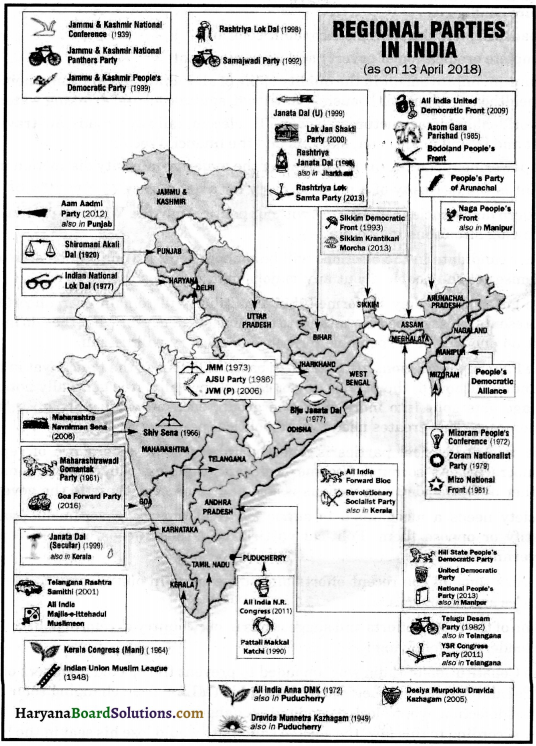
  • For example-the Shiromani Akali Dal, the Jharkhand Mukti Morcha, etc.

HBSE 10th Class Social Science Important Questions Civics Chapter 6 Political Parties

Question 12.
What is meant by defection’ in democracy? Explain.
Answer:
Defection in democracy is a political phenomenon. It means moving of a person from one party to another party for some personal benefit. It happens when a legislator, after having been elected from a particular party leaves it and joins another party. Now the law states that if any MLA or MP changes parties, he or she will lose seat in the legislature. The new law has brought the percentage of defection down and has made
dissent is even more difficult.

Question 13.
Describe any three broad guidelines for devising ways and means for political reforms in India.
Answer:
The three broad guidelines for devising ways and means for political reforms in India are:
(î) A law should be made to regulate the internal affairs of political parties. Political parties should maintain a register of their members, hold open elections, follow their own constitution, etc.
(ii) Political parties can be monitored by ordinary citizens, pressure groups, media, etc. Pressure on political parties can be done through petitions, publicity and agitation.
(iii) The quality of democracy depends on the degree of public participation. It is difficult to reform politics if ordinary citizens do not directly participate in politics and simply criticise it from the outside.

Question 14.
Name the national political party which gets inspiration from India’s ancient culture and values. Mention four features of that party.
Answer:
Bhartiya Janata Party (BJP) gets inspiration from India’s ancient culture and values.

The main features of this party are:

  • Cultural nationalism or Hindutva is an important element in BJP’s conception of Indian nationhood and politics.
  • It wants full territorial and political integration of Jammu and Kashmir with India.
  • It claims a uniform civil code for all people living in the country irrespective of religion.
  • It wants to ban religious conversions. The party wants to get an anticonversion law to stop religious conversion in the country.

Question 15.
Why has India adopted a multi-party system ? Explain.
Answer:
India adopted a multiparty system for the follow reasons –

  • India being a vast and diverse country, the multi-party system was needed to accommodate the vast population.
  • The social and geographical diversity of India could not be represented by two or three parties.
  • The multi-party system in India evolved over a long time, depending on the nature of society, its social, regional division, its history of politics and its system of elections.
  • Multi-party system ensures a healthy competion between different parties and prevents dictatorship of a single party. Indian constitution declares India as a democratic country. Multi-party system fulfils this criteria and provides a chance for proper growth of the nation.

Question 16.
How do the State Parties contribute in strengthening of federalism and democracy in our country ?
Answer:
Over the last three decades, the number and strength of state parties has expanded in our country. These parties have made the Parliament of India politically more and more diverse. No one national party is able to secure on its own a clear majority in the Lok Sabha. So, the national parties are compelled to form alliances with state parties. Since 1996, nearly every one of the state parties has got an opportunity to be a part of one or the other national-level coalition government. This has contributed to the strengthening of federalism and democracy in India.

HBSE 10th Class Social Science Important Questions Civics Chapter 6 Political Parties

Question 17.
Highlight the various challenges faced by political parties in India.
Answer:
Political parties face the following challenges:

  •  Lack of internal democracy in the party.
  • The extraordinary influence of the founder or one or few leaders at the top position.
  • Dynastic succession.
  • Use of money power by very rich persons, families or big companies.
  • Use of muscle power by criminals.
  • Parties do not seem to offer a meaningful choice to the voters.
  • The problem of defection.
  • Problem of communalism.
  • Problem of regionalism.

Question 18.
What role can ordinary citizens play in reforming political parties?
Answer:
1. The quality of democracy depends on the degree of public participation. It is difficult to reform politics if ordinary citizens do not take part in it and simply criticise it from the outside. Where legal solutions to political problems are difficult to enforce, political parties can change for better with active public participation.
2. People can put pressure on political parties through petitions, publicity and agitations. Ordinary citizens, pressure groups, movements and media can play a vital role.
3. Political parties can improve, if those who want to make things better, also join the political parties. In this way, if political parties are made to feel that they would lose public support by not taking up reforms, all of them would become serious about the reforms.

Long Answer Type Qaes6ons

Question 1.
Describe the role of political parties in Indian democracy.
Answer:
Political parties perform a series of functions in our democracy. These are –

  • Parties contest elections. By winning the election. Political party can form the government. Sometimes more than two parties form a coalition and form the government.
  • Parties put forward different politices and programmes and the voters choose from them.
  • Parties play a decisive role in making laws for our country by making debate and\ passing law for people.
  • Parties form and run government by recruiting leaders, training them and making them ministers to run the government.
  • Parties shape public opinion by raising and highlighting important issues.
  • Those parties that lose in the elections play the role of opposition to the parties in power by criticising the government for its failures or wrong policies.
  • Parties provide people access to government machinery and welfare schemes implemented by governments. Parties have to be responsive to people’s needs and demands otherwise. People can reject those parties in the next elections.

Question 2.
What is meant by a political party? Describe the three components of a political party.
Answer:
A political party is a group of people who come together to contest elections and hold power in the government. Political parties always make some policies and programmes for society with a view to promoting the collective good. Every political party wants to persuade people and tries to win their support of people.

Three components of a political party are –

  • The leaders: Every political party has some prominent leaders who formulate policies and programmes of the party and choose candidates for contesting elections.
  • The active members: They are involved in different committees of the party and participate directly in their activity.
  • The followers: They believe in the party’s ideology and support the party by casting their votes in favour of the Party at the time of election.

Question 3.
Explain the four different ways in which political parties are still in the grip of some serious challenges.
Answer:
The political partis are still in the grip of some serious challenges which are –

(i) The first challenge is lack of democracy within parties. All over the world, there is a tendency in political parties towards the concentration of powers in one or few leaders at the top. Parties do not keep membership registers, do not hold organisational meetings and do not conduct internal elections regularly.

(ii) The second challenge is dynastic succession where thé top positions of a party are always enjoyed by members of one particular family. This trend is harmful for other members of the party, as well as for democracy. This tendency is present in some measure all over the world.

(iii) The third challenge is about the growing role of money and muscle power in parties which is specially observed during elections. Rich people and companies who give funds to the parties always have a say on the policies and decisions of the party.

(iv) The fourth challenge is that very often parties do not seem to offer a meaningful choice to the voters. In our country, the difference among all the major parties on the economic policies have reduced. Sometimes, the same set of leaders keep shifting from one party to another, thus people have real no option available to them.

HBSE 10th Class Social Science Important Questions Civics Chapter 6 Political Parties

Question 4.
“Lack of internal democracy is a challenge to efficient functioning of Indain political parties.” Justify the statement.
Answer:
Lack of internal democracy is a challenge to the efficient functioning ofpolitical parties. The following points justify the statements –

  • All over the world, there is a tendency in political parties towards the concentration of power in one or few leaders at the top.
  • Parties do not keep membership registers, do not hold organisational meetings and do not conduct internal elections regularly.
  • Ordinary members of the party do not get sufficient information on what happens inside the party. They do not have the means or the connection needed to influence the decisions. As a result, the leaders assume greater power to make decisions in the name of the party.
  • Since one or few leaders exercise the power in the party, those who disagree with the\ leadership find it difficult to continue in the party.

Question 5.
State in brief the formation, programmes and policies of the Bharatiya Janata Party.
Answer:
Formation:
The Bharatiya Janata Party (BJP) was founded in 1980 by reviving the erstwhile Bharatiya Jana Sangh or we can say, it was the largest group of Janata Party, which was formed before the Lok Sabha elections held in 1977. Programmes and Policies : Programmes and policies of the Bharatiya Janata Party

BJP arc the following:

  • Bharatiya Janata Party wants to build a strong and modern India by drawing inspiration from India’s ancient, culture and values.
  • Cultural nationalism or Hindutva’ is an important element in its concept of Indian nationhood and politics.
  • It wants full territorial and political integration ofjaminu and Kashmir with India.
  •  It wants a uniform civil code for all people living in the country irrespective of religion, caste and creed.
  • It is in strong opposition to religious conversions.
  • It wants dealing the terrorists with a heavy hand.
  • B.JP wants all-round empowerment of women.
  • Strengthening national security, both internal and external, to overcome present and future challenges.
  • Broadening and deepening of economic reforms.
  • Complete eradication of poverty and unemployment.
  • Quantum improvement in the quality of life of all Indians by fuilfihling their basic needs in healthcare, education, housing, nutrition, sanitation, and drinking water.
  • A world-class infrastructure in power, IT, telecom. railways, roads, airtravel, shipping, port and inland having. on, markets and the financial sector. Empowerment of min. ‘cies and ending the majority-minority distinction in politics.

Question 6.
What is the necessity of a political party for a democracy?
Answer:
Modern democracies cannot exist without political parties. Without existence of parties, following situations may occur
(i) Every candidate in the elections will be independent. No one will be able to make any promises to the people about any major policy changes.

(ii) The government may be formed, but its utility will remain ever uncertáin. Elected representatives will be accountable to their constituency for what they do in the locality. But no one will be responsible for how the country will be run.

(iii) The Panchayat elections are non-party-based elections to the Panchayat in many states of India. Although the parties do not contest formally, it is generally noticed that the village gets split into more than one group, each of which puts up a ‘panel’ of its candidates. This creates the need for the political party

(iv) The rise of political parties is directly linked to the emergence of representative democracies. As societies became large and complex, they needed some agency to gather different views on various issues and to present these to the government.

(v) Society needs a mechanism to support or restrain the government, make policies. justify or oppose them. Political parties fulfil the needs of every representative government.

HBSE 10th Class Social Science Important Questions Civics Chapter 6 Political Parties

Question 7.
Discuss some of the recent efforts and suggestions in our country to reform political parties and its leaders
Answer:
Some of the recent efforts and suggestions in our country to reform political parties and its leaders are the following:
(i) The Constitution of India was amended to prevent the elected Members of Parliament (MPs) and Members of Legislative Assembly (MLAs) from changing their parties. It is called defection, when elected candidates change their parties for personal benefits. But now according to this law, the elected candidate would lose his seat in the legislature, if he indulges in defection.

(ii) In order to reduce the role of money and muscle power in elections, the Supreme Court has passed an order which says that every contesting candidate will have to file an affidavit stating his her personal property and the criminal cases pending against him her. This would help the voters in making better decisions regarding their vote.

(iii) The Election Commission has passed an order, making it essential for political parties to hold their organisational elections at regular intervals and file their income tax re turns.
HBSE 10th Class Social Science Important Questions Civics Chapter 6 Political Parties - 1

HBSE 10th Class Social Science Important Questions Civics Chapter 6 Political Parties Read More »

HBSE 10th Class Social Science Notes Civics Chapter 3 लोकतंत्र और विविधता

Haryana State Board HBSE 10th Class Social Science Notes Civics Chapter 3 लोकतंत्र और विविधता Notes.

Haryana Board 10th Class Social Science Notes Civics Chapter 3 लोकतंत्र और विविधता

Loktantra Aur Vividhata Notes HBSE 10th Class

→ आधुनिक समाज विविधताओं का समाज है। यह विविधाएँ कई प्रकार की होती हैं। लोग श्वेत व अश्वेत भी होते हैं, मोटे व पतले भी होते हैं, हिन्दू व मुसलमान भी होते हैं, हिमाचली व हरियाणवी भी होते हैं, अमीर व गरीब भी होते हैं, सनातन धर्मी व आर्य समाजी भी होते हैं।

→ विविधताओं को मिटाया नहीं जाना चाहिए। प्रत्येक विविध समूह की अपनी भाषा होती है, ‘संस्कृति होती है, अपने रीति-रिवाज होते हैं, अपने धार्मिक तौर-तरीके होते हैं। इन सब के मिलने से सामुदायिक संस्कृति का जन्म होता है।

→ यह सामाजिक वर्ग जितना मिल-जुलकर रहते हैं, उनका भौतिक विकास उतना अधिक होता है। परस्पर सहयोग प्रत्येक अलग सामाजिक वर्ग के हित में होता है; परस्पर सामाजिक तनाव प्रत्येक अलग सामाजिक वर्ग को हानि पहुँचाता सामाजिकविभाजन लोकतंत्र के लिए हानिकारक नहीं है।

→ अलग-अलग विचार व उन विचारों की अभिव्यक्ति लोकतंत्र को मजबूत बनाती है। अतः विविधताओं में एकता स्थापित करना लोकतंत्र का एक महत्त्वपूर्ण प्रयास होता है जो सभी वर्गों के सामाजिक, आर्थिक, राजनीतिक, सांस्कृतिक विकास की गारन्टी होता है।

Loktantra Aur Vividhata Notes In Hindi HBSE 10th Class

HBSE 10th Class Social Science Notes Civics Chapter 3 लोकतंत्र और विविधता

→ सामाजिक विविधताएँ समय, परिस्थितियों तथा क्षेत्र के अनुरूप अलग-अलग होती हैं। उत्तरी आयरलैंड में कैथोलिकों व प्रोटेस्टेंटों में तनाव हो सकता है, परन्तु नीदरलैंड मे ईसाई ध म के यह दोनों वर्ग एक-दूसरे से मिल-जुलकर रह भी सकते हैं।

→ श्रीलंका में सिंहालियों व तमिलों के बीच टकराव हो सकता है, परन्तु बेल्जियम में डच व फ्रेंच बोलने वालों में राजनीतिक एकता भी हो सकती है।

→ सामाजिक विभाजन के चलते भी लोगों में एकता हो सकती है। आवश्यकता इस बात की होती है कि प्रत्येक सामाजिक वर्ग को अन्य सामाजिक वर्ग का सम्मान व आदर करना चाहिए, दूसरे सामाजिक वर्ग के अस्तित्व को स्वीकार करना चाहिए, उसके विकास में उसकी सहायता करनी चाहिए।

→ हम हिन्दू व मुसलमान रहते हुए भी भारतीय बन सकते हैं; अश्वेत व श्वेत होते हुए भी अमरीकी बन सकते हैं।

→ यदि ऐसी भावनाओं को ताकत मिलती है तो सामाजिक सहनशीलता में वृद्धि होती है तथा सामाजिक सामंजस्य पनपता है एवं समाज पूरी से विकास भी करता है।

→ एफ्रो-अमरीकी : यह शब्द उन अश्वेत अमरीकी लोगों के वंशजों के लिए प्रयुक्त होता है जिन्हें 17वीं से 19वीं शताब्दियों तक अमरीका में गुलाम बनाकर लाया गया था।

→ अमरीका का नागरिक अधिकार आंदोलन : 1954-1968 के बीच घटनाओं व सुधारा के वह आन्दोलन जिनका लक्ष्य एफ्रो-अमरीकी लोगों के विरुद्ध होने वाले नस्ल पर आधारित भेदभाव को मिटाना था।

→ मार्टिन लूथर किंग जूनियर : एक अमरीकी नागरिक अधिकार आन्दोलन चलाने वाला नेताः उनके द्वारा ऐसा आन्दोलन अंहिसात्मक रूप से चलाया गया था : अंततः उन्हें सफलता प्राप्त हुई थी।

→ अश्वेत शक्ति आन्दोलन : 1966 में उभरा यह आन्दोलन 1975 तक चलता रहा। नस्लवाद को लेकर यह आन्दोलन अधिकतर उग्र रूप का था।

→ समरूप समाज : एक ऐसा समाज जिसमें सामुदायिक, सांस्कृतिक अथवा जातीय विभिन्नताएँ ज्यादा गहरी नहीं होती।

HBSE 10th Class Civics Chapter 3 लोकतंत्र और विविधता

HBSE 10th Class Social Science Notes Civics Chapter 3 लोकतंत्र और विविधता

→ सामाजिक भेदभाव : समाज के विभिन्न वर्गों में भेदभाव की भावना से व्यवहार करना।

→ प्रोटेस्टेंट : ईसाई धर्म का एक अन्य वर्ग जो कैथोलिक वर्ग का विरोध करता है तथा जिसका कैथोलिक ईसाई भी विरोध करते हैं।

→ कार्लोस व स्मिथ : एफ्रो-अमरीकी खिलाड़ी जिन्होंने अश्वेतों के साथ भेदभाव का विरोध किया।

→ पीटर नार्मन : एक ऑस्ट्रेलियाई ओलंपिक खिलाड़ी जिसने कार्लोस व स्मिथ का समर्थन किया।

HBSE 10th Class Social Science Notes Civics Chapter 3 लोकतंत्र और विविधता Read More »

HBSE 10th Class Social Science Notes Civics Chapter 7 लोकतंत्र के परिणाम

Haryana State Board HBSE 10th Class Social Science Notes Civics Chapter 7 लोकतंत्र के परिणाम Notes.

Haryana Board 10th Class Social Science Notes Civics Chapter 7 लोकतंत्र के परिणाम

लोकतंत्र के परिणाम Class 10 Notes HBSE

→ इनमें कोई संदेह नहीं कि लोकतांत्रिक शासन शेष अन्य सभी प्रकार के शासकों से बेहतर होता है नागरिकों की समानता में, व्यक्तित्व की गरिमा का अहसास, तनावों में सामंजस्य, त्रुटियों में सुधार करने की गुंजाइश आदि की आशाएँ तानाशाही, कुलीनतंत्र; राजतंत्र में नहीं की जा सकती।

→ लोकतंत्र लोगों का लोगों द्वारा तथा लोगों के हित का शासन होता है। ऐसे शासन को भले ही अच्छा शासन नहीं कहा जाता, परन्तु स्व-शासन तो किसी भी अच्छे शासन से बेहतर शासन होता है।

→ क्योंकि लोकतंत्रीय शासन मात्र शासन का एक स्वरूप है। इसमें अनेकों त्रुटियाँ होती हैं परन्तु कुल मिला कर शासन का यह रूप शासन के सभी अन्य रूपों से बेहतर है।

लोकतंत्र के परिणाम Class 10 Notes In Hindi HBSE

HBSE 10th Class Social Science Notes Civics Chapter 7 लोकतंत्र के परिणाम

→ उत्तरदायी सरकार लोकतंत्रीय सरकार ही हो सकती है। ऐसी सरकार के प्रतिनिधि अपने कार्यों का दायित्व उठाते हैं। ऐसी सरकार में फैसले लेने में देरी हो सकती है परन्तु फैसलों में देरी बेकार नहीं होती, क्योंकि लोकतंत्र में हुए फैसलों में सबकी सहमति व उनके विचार दृष्टिकोण शामिल होते हैं।

→ फिर लोकतंत्र में हुए फैसले किसी कायदे कानून के अनुसार होते हैं। यह फैसले थोपे नहीं जाते। क्या हम किसी अन्य शासन-प्रणाली में नियमित व निष्पक्ष चुनाव देखते हैं? नीतियों कानूनों पर खुली चर्चा देखते हैं?

→ सरकार के कार्यों में जानकारी पाने की मिलने वाली सूचनाओं को खुलेआम देखते हैं? क्या लोकतांत्रिक संस्थाओं व व्यवस्थाओं की सफलता देखतें हैं? वास्तव में, लोकतंत्र ही शासन की ऐसी पृष्ठभूमि तैयार करता है जो किसी भी प्रकार की व्यवस्था से बेहतर होती है।

→ अन्य शासनों के मुकाबले में लोकतांत्रिक व्यवस्था अपेक्षाकृत अधिक उत्तरदायी, अधिक जिम्मेवार तथा अधिक वैधपूर्ण व्यवस्था है।

→ इसमें सन्देह नहीं है कि आर्थिक संवृद्धि व आर्थिक विकास जितना तानाशाहियों में होता है, उतना लोकतांत्रिक व्यवस्थाओं में नहीं होता। परन्तु तानाशाही में हुए काम के पीछे जोर जबरदस्ती होती है व उत्पीड़न होता है।

→ ऐसी व्यवस्थाओं में अंततः आर्थिक विषमतओं में वृद्धि होती है; आम व्यक्ति की आर्थिक व सामाजिक स्थिति में सुधार होता है।

HBSE 10th Class Social Science Notes Civics Chapter 7 लोकतंत्र के परिणाम

→ लोकतंत्रीय व्यवस्था ही आर्थिक समानताओं में कमी लाने में सफल होती है, यह सरकार ही सामाजिक विविधताओं में सामंजस्य पैदा कर सकती है। व्यक्ति की गरिमा के वृद्धि लोकतंत्रीय व्यवस्था में होती है।

→ लोकतंत्र : ऐसी शासकीय व्यवस्था जो समानता, स्वतंत्रता व कल्याणकारिता पर अधारित हो।

→ तानाशाही : व्यक्ति विशेष, दल-विशेष अथवा किसी सैनिक अधिकारी का शासन

→ वैधता : कानून अनुसार शासन किया जानाः प्रायः लोकतंत्रीय व्यवस्था वैध शासन की प्रतीक होती है।

→ स्व-शासन : लोगों का स्वयं का शासन, स्वयं अथवा लोगों द्वारा निर्वाचित प्रतिनिधियों का शासन

→ आर्थिक असमानता : लोगों के बीच आर्थिक आय का भेद। अनुभव बताता है कि तानाशाहियों के मुकाबले में लोकतांत्रिक देशों में आर्थिक असमानता कम होती है।

→ सामाजिक विविधताएँ : सामाजिक विविधताएँ लोगों व वर्गों में भाषायी, धार्मिक, आर्थिक व सांस्कृतिक विषमताओं को कहते हैं। अनुभव बताता है कि लोकतंत्रीय व्यवस्थाओं में सामाजिक विविधताओं में सामंजस्य पाया जाता है।

HBSE 10th Class Social Science Notes Civics Chapter 7 लोकतंत्र के परिणाम

→ व्यक्तित्व की गरिमा : लोगों के व्यक्तित्व में तथा उनकी प्रतिष्ठा में विश्वास। अनुभव बताता है कि लोकतंत्र में लोगों की गरिमा, कायम रहती है।

→ अल्पसंख्यक/बहुसंख्यक : कम संख्या वाले समूह को अल्पसंख्यक एवं अधिक संख्या वाले समूह को बहुसंख्यक कहा जाता है।

HBSE 10th Class Social Science Notes Civics Chapter 7 लोकतंत्र के परिणाम Read More »

HBSE 10th Class Social Science Notes Civics Chapter 2 संघवाद

Haryana State Board HBSE 10th Class Social Science Notes Civics Chapter 2 संघवाद Notes.

Haryana Board 10th Class Social Science Notes Civics Chapter 2 संघवाद

संघवाद Class 10 Notes HBSE

→ सत्ता में भागीदार का एक रूप संघवादी व्यवस्था में देखा जा सकता है।

→ संघवाद शासन की वह व्यवस्था है जहाँ शासक-कार्यों की बाँट के आधार पर एक ओर संघीय (इसे केन्द्रीय व राष्ट्रीय) सरकार तथा दूसरी ओर प्रान्तों (इन्हें राज्यों व इकाईयों) की सरकारों की व्यवस्था की जाती है तथा उन्हें अपने-अपने क्षेत्र में अपने-अपने मामलों पर बनाने व प्रशासन का अधिकार प्राप्त होता है।

→ शासन कार्यों की बाँट प्रायः संविधान द्वारा की जाती है जिसके अनुरूप संघीय व प्रान्तीय सरकारें अपने-अपने क्षेत्राधि कार में कार्य करती हैं।

→ ऐसे संविधान में बदलाव दोनों प्रकार की सरकारों की सहमति पर ही होता है : सर्वोच्च संविधान होता है।

→ सरकार में स्थापित न्यायालय समस्त संघीय व संवैधानिक व्यवस्था की रक्षा करते हैं।

HBSE 10th Class Civics Chapter 2 संघवाद

HBSE 10th Class Social Science Notes Civics Chapter 2 संघवाद

→ संघ व्यवस्था-केन्द्रोन्मुखी-जब स्वतंत्र व प्रभुसत्ता सम्पन्न राज्य अपने प्रभुसत्ता त्याग अपने ऊपर संघीय सरकार की स्थापना करते हैं।

→ केन्द्र विमुख-जब कोई बड़ी व एकात्मक सरकार अपने आपको कुछ राज्यों में विभक्त कर संघीय सरकार बनाती है तरीकों से बनायी जाती है।

→ पहले तरीके में प्रान्तों की सरकारें दूसरे तरीके द्वारा बनी प्रान्तीय सरकारों से अधिक शक्तिशाली होती हैं।

→ संघीय व्यवस्था की विशेषताओं में निम्नलिखित का उल्लेख किया जा सकता है:

  • दो अथवा दो से अधिक वाले सरकार-स्तरों का होना;
  • अलग-अलग सरकार एक ही नागरिक समूह पर शासन करते हैं, परन्तु प्रत्येक सरकार अपने-अपने क्षेत्र में;
  • सरकारों का अधिकार-क्षेत्र संविधान द्वारा स्पष्ट किया जाता है;
  • संविधान में बदलाव सभी प्रकार के स्तरों पर बनी सरकारों की अनुमति से होता है;
  • न्यायालयों के पास अधिकार-क्षेत्र की व्यवस्था की शक्ति होती है।
  • वित्तीय स्वायतता हेतु प्रत्येक प्रकार की सरकार को कर लगाने की शक्ति प्राप्त होती है।
  • देश की एकता व सुरक्षा के साथ-साथ क्षेत्रीय विविध ताओं का सम्मान।

→ भारत में संघीय व्यवस्था को लागू करने हेतु सभी प्रयास किए गए है। स्वतंत्रता पश्चात विभिन्न प्रकार के राज्यों का संघ-राज्यों में बनते-संवरते सम्बन्धों ने भारत की संघीय व्यवस्था भाषायी आधार पर गठन किया गया।

→ संघीय व्यवस्था इसके को सुदृढ़ किया है। संघ शासन के तीन स्तर-केन्द्र, राज्य व व्यवस्थित संचालन हेतु भाषा-नीति व परिस्थितियों के अनुसार स्थानीय इकाईयाँ-अपने-अपने क्षेत्र में सुचारू रूप से कार्य कर रहे हैं।

→ गठबन्धन सरकार: एक से अधिक राजनीतिक दलों द्वारा बनायी गयी सरकार। ऐसी सरकार एक राजनीतिक गठजोड़ बनाती है तथा कोई साझाा कार्यक्रम स्वीकार करती है।

→ संघवाद : एक ऐसी राजनीतिक व्यवस्था जहाँ शासन हेतु शासक-कार्यों की बाँट के फलस्वरूप एक ओर संघीय सरकार बनायी जाती है तथा दूसरी ओर इकाईयों की सरकारें बनायी जाती हैं।

→ संघवाद के उदाहरण : भारत, संयुक्त राज्य अमेरिका, ऑस्ट्रेलिया, बेल्जियम, स्विटज़रलैंड, कनाडा

→ एकात्मक सरकार : वह सरकार जहाँ शासन-शक्तियाँ एक केन्द्रीय सरकार में निहित होती हैं।

→ एकात्मक सरकार के उदाहरण : श्रीलंका, चीन, फ्रांस, ग्रेट ब्रिटेन

Chapter 2 संघवाद Civics HBSE 10th Class

HBSE 10th Class Social Science Notes Civics Chapter 2 संघवाद

→ विकेन्द्रीकरण : शक्तियों की बाँट

→ केन्द्रविमुख : किसी बड़े राज्य का अपना एकात्मक रूप छोड़ कुछेक अधीन राज्यों के निर्माण द्वारा संघ-शासन बनाना।

→ भारत में संघीय शासन के स्तर :

  • केन्द्रीय, संघीय अथवा राष्ट्रीय सरकार
  • प्रान्तीय, राज्य इकाईयों की सरकारें
  • स्थानीय सरकारें : पंचायतें व इकाईयाँ

→ संसार में संघीय शासनों की संख्या : 192 में 25 राज्य संघीय शासन हैं जिनकी जनसंख्या संसार की आबादी का 40 प्रतिशत

HBSE 10th Class Social Science Notes Civics Chapter 2 संघवाद Read More »

HBSE 10th Class Social Science Notes Economics Chapter 2 भारतीय अर्थव्यवस्था के क्षेत्रक

Haryana State Board HBSE 10th Class Social Science Notes Economics Chapter 2 भारतीय अर्थव्यवस्था के क्षेत्रक Notes.

Haryana Board 10th Class Social Science Notes Economics Chapter 2 भारतीय अर्थव्यवस्था के क्षेत्रक

भारतीय अर्थव्यवस्था के क्षेत्रक Class 10 Notes HBSE

→ विभिन्न आर्थिक गतिविधियों को उनके उद्देश्य एवं अन्य महत्त्वपूर्ण मानंदडों के आधार पर प्राथमिक, द्वितीयक एवं तृतीयक क्षेत्रकों में विभाजित किया जाता है।

→ इन तीनों क्षेत्रकों के विविध उतपादन कार्यों से काफी मात्रा में वस्तुओं और सेवाओं का उत्पादन होता है। साथ ही कई लोगों को इन क्षेत्रकों में रोजगार मिलता है।

→ भारत के संदर्भ में आँकड़ों के अध्ययन से यह पता चलता है कि हालांकि वस्तुओं व सेवाओं का मूल्य अधिकांशतः तृतीयक क्षेत्र में उतपादित होता है लेकिन लोगों को रोजगार अधिकांशतः प्राथमिक क्षेत्रक में ही मिलता है।

→ किसी विशेष वर्ष में प्रत्येक क्षेत्रक द्वारा उत्पादित अंतिम वस्तुओं व सेवाओं का मूल्य उस वर्ष मे कुल उतपादन की जानकारी देता है तीनों क्षेत्रकों के उतपादों के योगफल को देश का सकल घरेलू उत्पाद कहते हैं जी.डी.पी. से किसी देश की अर्थव्यवस्था की मजबूती का पता चलता है।

भारतीय अर्थव्यवस्था के क्षेत्रक Class 10 Notes In Hindi HBSE

HBSE 10th Class Social Science Notes Economics Chapter 2 भारतीय अर्थव्यवस्था के क्षेत्रक

→ भारत में आधे से अधिक लोग प्राथमिक क्षेत्र में नियोजित हैं लेकिन जी. डी. पी. में इसका योगदान सिर्फ एक-चौथाई हैं इसकी तुलना में द्वितीयक और तृतीयक क्षेत्रक का जी. डी. पी. में हिस्सा तीन-चौथाई है।

→ जबकि इन क्षेत्रकों में आधे से भी कम लोगों को रोजगार मिला हुआ हैं इस कारण कृषि क्षेत्रक के श्रमिकों में अल्प-बेरोजगारी है। अतः देश में रोजगार के अवसरों में वृद्धि करने की जरूरत है।

→ इसके लिए भारत सरकार ने कई उपाय भी किए हैं हाल ही में सरकार ने राष्ट्रीय ग्रामीण रोजगार गांरटी अधिनिमय 2005 पारित किया है जिसके अन्तर्गत सभी सक्षम लोगों को वर्ष में सौ दिन रोजगार की गारी दी गई है।

→ आर्थिक कार्यो की विभाजित करने का एक अन्य तरीका संगठित और असंगठित क्षेत्रकों का विभाजन हैं संगठित क्षेत्रकों में कर्मचारियों को रोजगार सुरक्षा का लाभ प्राप्त होता है, उनसे एक निश्चित समयावधि तक ही कार्य लिया जा सकता है।

→ उन्हें सवेतन अवकाश, सेवानुदान, भविष्य निधि आदि सुविध प्राप्त होती है। परंतु असंगठित क्षेत्रक के कर्मचारियों को इन सुविधाओं का लाभ नहीं प्राप्त होता है। अतः असंगठित क्षेत्रक के श्रमिकों को सरंक्षण देने की आवश्यकता है।

→ आर्थिक गतिविधियों को स्वामित्व के आधार पर सार्वजनिक व निजी क्षेत्रकों में विभाजित किया जाता है। सार्वजनिक क्षेत्रक में, परिसंपत्तियों पर सरकार का स्वामित्व होता है।

→ दूसरी ओर निजी क्षेत्रक के उत्पादन के साधनों पर निजी स्वामित्व होता है। कई चीजें ऐसी होती हैं जिनकी आवश्यकता समाज के सभी सदस्यों को होती है लेकिन उन्हें उपलब्ध कराना निजी क्षेत्रक के बस में नहीं होता है। अतः सरकार स्वयं इन पर व्यय करती है और लोगों के लिए इन सुविधाओं को सुनिश्चित करती है।

→ प्राथमिक क्षेत्रक आर्थिक सक्रियता का सबसे महत्त्वपूर्ण क्षेत्रक होता है।

→ प्राथमिक क्षेत्रक-मुख्यतः कृषि क्षेत्र का देश की जी.डी.पी. में एक-चौथाई योगदान है।

Bhartiya Arthvyavastha Ke Kshetra Ke Notes HBSE 10th Class

HBSE 10th Class Social Science Notes Economics Chapter 2 भारतीय अर्थव्यवस्था के क्षेत्रक

→ द्वितीयक एवं तृतीयक क्षेत्रक का जी.डी.पी. में तीन-चौथाई हिस्सा है।

→ भारत में क्रियाशील जनता का कृषि में लगा भाग – 60%

→ प्राथमिक क्रियाओं में लगे लो – 60%

→ द्वितीयक क्रियाओं में लगे लो – 17%

→ तृतीयक कार्यों में संलग्न भारतीय श्रम का भाग – 23%

→ सहायक क्रियाओं का अर्थव्यवस्था में योगदान – 48%

→ भारत में विद्यालय जाने के आयु वर्ग में लगभग 20 करोड़ बच्चे हैं। इनमें लगभग, दो-तिहाई ही विद्यालय जाते हैं।

→ अधिकांश प्राकतिक उत्पाद जैसे-कषि, डेयरी वन उत्पाद, मछली पालन आदि को प्राथमिक क्षेत्रक वा कृषि एवं संबंधित क्षेत्रक भी कहा जाता हे

→ कपास के पौधे से प्राप्त रेशे सत कातना और कपडा बुनना और गन्ने से चीनी और गुड बनना द्वितीयक क्षेत्रक के उदाहरण है।

→ विकसित देशों में अधिकांश श्रमजीवी लोग सेवा क्षेत्रक में नियोजित होते हैं

→ भारत में कषि क्षेत्रक में अल्प बेरोजगारी की समस्या है।

Bhartiya Arthvyavastha Ke Chetrak Class 10 Notes HBSE

HBSE 10th Class Social Science Notes Economics Chapter 2 भारतीय अर्थव्यवस्था के क्षेत्रक

→ अल्प बेरोजगारी को प्रछन्न बेरोजगारी भी कहा जाता है।

→ योजना आयोग के एक अध्ययन के अनुसार, अकेले शिक्षा क्षेत्र में लगभग 20 लाख रोजगारों का सृजन हो सकता है।

→ योजना आयोग के एक अध्ययन के अनुसार पर्यटन क्षेत्रक में सुधार से 35 लाख से अधिक लोगों को प्रतिवर्ष रोजगार मिल सकता है।

→ भारत के 200 जिलों में काम का अधिकार’ लागू करने के लिए कानून बनाया गया है।

→ राष्ट्रीय ग्रामीण रोजगार गांरटी अधिनियम, 2005 के अन्तर्गत उन सभी लोगों को जो काम में सक्षम हैं और जिन्हें काम की जरूरत है, को सरकार द्वारा 100 दिन के रोजगार की गांरटी दी गई है।

→ भारत में लगभग 80 प्रतिशत ग्रामीण परिवार छोटे और सीमांत किसानों की श्रेणी में आते हैं।

→ रेलवे अथवा डाकघर सार्वजनिक क्षेत्रक के उदाहरण

→ टिस्कों, रिलायंस इण्डस्ट्रीज लिमिटेड आदि निजी क्षेत्रक के उदाहरण है।

→ वस्तुओं व सेवओं का मूल्य अधिकांशतः तृतीयक, क्षेत्रक में उत्पादित होता लेकिन रोजगार अधिकांशतः प्राथमिक क्षेत्रक में मिलता है।

→ खुली बाजार अर्थव्यवस्था में संसाधनों का स्वामित्व नीजी हाथों में रहता है।

→ नियोजित अर्थव्यवस्था में निर्णय सामान्य जनता के हित में लिया जाता है।

Bhartiya Arthvyavastha Ke Kshetra Class 10th Notes In Hindi HBSE

HBSE 10th Class Social Science Notes Economics Chapter 2 भारतीय अर्थव्यवस्था के क्षेत्रक

→ स्वामित्व के आधार पर उद्यमों के तीन क्षेत्र हैं-निजी क्षेत्र, सार्वजनिक क्षेत्र और मिश्रित क्षेत्र।

→ अर्थव्यस्था-आर्थिक ढांचे का वह स्वरूप जिसके अनुसार किसी देश की आर्थिक दशा तथा लोगों के जीवन का वर्णन किया जाता है।

→ राष्ट्रीय आय-राष्ट्रीय आय का तात्पर्य उस कुल आय से है जिसे देश के अंदर उत्पन्न सभी वस्तुओं और संवाओं के मूल्य के साथ-साथ विदेशों से प्राप्त आय को जोड़कर प्राप्त किया जाता है।

→ क्षेत्रक-कुछ महत्त्वपूर्ण मानंदडों के आधार पर कार्यो को विभिन्न समूहों में वर्गीकृत किया जाता है। इन समूहों को क्षेत्रक भी कहते हैं।

→ सकल घरेलू उत्पाद-प्राथमिक, द्वितीयक एवं तृतीयक, तीनों क्षेत्रकों के उत्पादों के योगफल को देश का सकल घरेलू उत्पाद कहते हैं।

→ संगठित क्षेत्रक-संगठित क्षेत्रक में वे उद्यम या कार्य स्थान आते हैं। जहाँ रोजगार की अवधि नियमित होती है। और वे क्षेत्रक सरकार द्वारा पंजीकृत होते हैं।

→ असंगठित क्षेत्रक-असंगठित क्षेत्रक छोटी-छोटी और बिखरी इकाइयों, अधिकांशतः सरकारी नियंत्रण से बाहर होती हैं, से निर्मित होता है।

→ सार्वजनिक क्षेत्रक- सार्वजिनक क्षेत्रक में, अधिकांश परिसंपत्तियों पर सरकार का स्वामित्व होता है। और सरकार ही सभी संवाएं उपलब्ध कराती है।

→ निजी क्षेत्रक-निजी क्षेत्रक में परिसंपत्तियों पर स्वामित्व और सेवाओं के वितरण की जिम्मेदारी एकल व्यकित या कंपनी के हाथों में होती है।

HBSE 10th Class Social Science Notes Economics Chapter 2 भारतीय अर्थव्यवस्था के क्षेत्रक Read More »

HBSE 10th Class Social Science Notes Civics Chapter 5 जन-संघर्ष और आंदोलन

Haryana State Board HBSE 10th Class Social Science Notes Civics Chapter 5 जन-संघर्ष और आंदोलन Notes.

Haryana Board 10th Class Social Science Notes Civics Chapter 5 जन-संघर्ष और आंदोलन

जन संघर्ष और आंदोलन नोट्स HBSE 10th Class

→ राजनीतिक व सामाजिक माँगों के लिए संघर्ष करना लोकतांत्रिक प्रयोजन होता है। ऐसे संघर्ष व आन्दोलन अक्सर होते रहते हैं।

→ इन आन्दोलनों में एक उदाहरण 2005-2006 में नेपाल में लोकतंत्र की स्थापना के लिए चलाया गया था। इसी प्रकार बोलिविया में जनसंघर्ष के चलाए जाने का उदाहरण भी हमारे सामने हैं।

→ वहाँ के इंजीनियरों, पर्यावरणवादियों व कामकाजी लोगों के एक संगठन ने जल-प्राप्ति के लिए एक सफल आन्दोलन चलाया था।

→ लोकतंत्र में अनेकों फैसले परस्पर मेल-जाने से हो जाया करते हैं। परन्तु कुछेक फैसलों के लिए कई बार आन्दोलन भी चलाए जाते हैं।

→ विरोध जितना अधिक होता है आन्दोलन व जन-संघर्ष उतना अधिक तीव्र होता है। लोकतांत्रिक संघर्ष का समाधान जनता की व्यापक लामबन्दी द्वारा होता है।

→ राजनीतिक संगठनों अर्थात राजनीति दलों व अनेको समाज सेवी संगठन ऐसे आन्दोलनों व जन-संघर्ष द्वार। लोगों में चेतना जगाते रहते हैं।

जन-संघर्ष और आंदोलन Notes HBSE 10th Class

HBSE 10th Class Social Science Notes Civics Chapter 5 जन-संघर्ष और आंदोलन

→ लोगों की लामबन्दी प्रायः संगठनो द्वारा प्रेरित होती है। यह संगठन दबाव-समूहों का रूप लेकर लोगों में लामबन्दी करने में सफल हो पाते हैं।

→ दबाव-समूह जैसे लक्षण होते हैं। किसी लोकतंत्र में हित-समूहों का गठन स्वाभाविक होता है। ऐसे अनेक समूह बन जाते हैं जो जन-सामान्य व लोक-कल्याण हेतु कार्यरत रहते हैं।

→ बन्धुआ मजदूरी के विरुद्ध लड़ने वाले समूह ऐसे जन-सामान्य व लोक-कल्याण समूहों का एक उदाहरण है। ‘बाससेफ’ ऐसा ही एक अन्य उदाहरण है।

→ दबाव-समूहों में कुछेक ऐसे समूह भी होते हैं जो विशेष किसी उद्देश्य की प्राप्ति के लिए आन्दोलन करते रहते हैं।

→ नेपाल में नेपाल नरेश के विरुद्ध लोकतंत्र की स्थापना हेतु चलाया गया आन्दोलन करते रहते हैं। नेपाल में नेपाल नरेश के विरुद्ध लोकतंत्र की स्थापना हेतु चलाया गया आन्दोलन एक आन्दोलनकारी समूह था।

→ यह आन्दोलन किसी एक मुद्दे को लेकर चलाया गया था। कुछेक आन्दोलन कुछेक मुद्दों को लेकर चला जाते हैं तथा ऐसे आन्दोलनों को चलाने वाले संगठन भी अनेकों हो सकते हैं।

→ नारीवादी व पर्यावरणीयवादी आन्दोलन कई समूहों द्वारा चलाए जाते हैं। राजनीति में दबाव-समूहों की महत्त्वपूर्ण भूमिका होती है: वह जनता का समर्थन प्राप्त करने के लिए लोगों में जागृति पैदा करते रहते हैं।

→ हड़ताल आदि ऐसे समूहों का एक साधन होता है। कुछेक तो ‘लॉबिस्टों’ की भी नियुक्ति करते हैं। दबाव-समूहों का लोकतंत्र पर पड़ने वाला समूह प्रायः सकारात्मक ही होता है।

→ माओवादी: चीनी क्रान्ति के नेता माओ के विचारों को मानने वाले साम्यवादी माओवादी कहलाए जाते हैं।

→ माओवादी क्रान्ति : क्रान्ति लाने में हिंसा के प्रयोग के प्रचार का माओ का तरीका

HBSE 10th Class Civics Chapter 5 जन-संघर्ष और आंदोलन

HBSE 10th Class Social Science Notes Civics Chapter 5 जन-संघर्ष और आंदोलन

→ सर्वहारा का शासन : मजदूरों व किसानों के शासन को सर्वहारा शासन कहा जाता है।

→ एस.पी.ए. : सेवेन पार्टी अलाएस (नेपाल में सात दलों का गठनबंधन)

→ जल-युद्ध : बोलिविया में पानी के लिए चलाया गया आन्दोलन

→ फेडेकोर : जल के लिए चलाया गया बोलिविया का वह आन्दोलन जिसे इंजीनियरों, पर्यावरणवादियों व कामकाजी लोगों के न चलाया था।

→ दबाव समूह : अपनी मांगों के लिए सरकार पर डाले जाने वाले दबाव-ऐसा दबाव कोई संगठित समूह चलाता है।

→ दबाव समूह के उदाहरण : पेशेवरों (वकीलों, डॉक्टरों, शिक्षकों, मजदूरों व्यावसायिक) से संगठन दबाव समूहों के उदाहरण हैं।

HBSE 10th Class Social Science Notes Civics Chapter 5 जन-संघर्ष और आंदोलन

→ बामसेफ : बैकवर्ड एण्ड मायनॉरिटी कम्युनिटी एम्पलाइज सेफरेशनः जनसामान्य हितों की माँगों का प्रतिनिधित्व करने वालों के संगठन का एक रूप।

→ ग्रीन बैल्ट मूवमैण्ड : पूरे केन्या में (1970-1980) हरि पट्टी आन्दोलन के अंतर्गत लगभग 3 करोड़ वृक्ष लगाने वाला आन्दोलन

→ मेवात : हरियाणा का 2005 में बनाया गया एक जिला

HBSE 10th Class Social Science Notes Civics Chapter 5 जन-संघर्ष और आंदोलन Read More »

HBSE 10th Class Social Science Notes Civics Chapter 4 जाति, धर्म और लैंगिक मसले

Haryana State Board HBSE 10th Class Social Science Notes Civics Chapter 4 जाति, धर्म और लैंगिक मसले Notes.

Haryana Board 10th Class Social Science Notes Civics Chapter 4 जाति, धर्म और लैंगिक मसले

Jati Dharm Aur Langik Masle Class 10 Notes HBSE

→ सामाजिक विभाजन और भेदभाव वाली तीन सामाजिक असमानताओं को लिंग, धम्र व जाति के आधार पर बताया जा सकता है।

→ स्त्री व पुरुष में कार्य-विभाजन को लेकर जो भेद सामने आया है : वह है लिंग का भेद। घर के अन्दर किए जाने वाला कार्य ‘निजी’ (प्राइवेट) कार्य कहा जाता है और यह कार्य प्रायः स्त्रियाँ करती हैं।

→ घर से बाहर के कार्यों को प्रायः करते हैं और इस कारण उन कार्यों को ‘सार्वजनिक’ (पब्लिक) कार्य कहा जाता है। महिला-पुरुष विभेद ‘निजी-सार्वजनिक’ भेद का रूप धारण कर चुका है।

→ स्त्री व पुरुष में भेद अवश्य होता है-यौन का भेद। यौन के कारण कोई स्त्री होती है तथा कोई पुरुष होता है। जब हम ‘लिंग’ शब्द का प्रयोग करते हैं। यह भेद सामाजिक रूप का भेद होता हैं, कार्य-विभाजन का भेद।

→ यौन-भेद प्राकृतिकहैं, लिंग भेद सामाजिक है। लिंग भेद के कारण महिलाओं की स्थिति को पुरुष की अपेक्षा कम अधिकार प्राप्त होते हैं।

Jati Dharm Aur Langik Masle Notes HBSE 10th Class

HBSE 10th Class Social Science Notes Civics Chapter 4 जाति, धर्म और लैंगिक मसले

→ पारिवारिक कानून भी पुरुष के पक्ष में होते हैं;उनकी शिक्षा व उन्हें दी जाने वाली सुविधाएं पुरुषों के मुकाबले में कम होती है।

→ सार्वजनिक जीवन में उनका प्रवेश बहुत कम होता है। राजनीति में महिलाओं का पतिनिधित्व न होने के बराबर होता है। और फिर सामाजिक दृष्टि से महिलाओं के साथ दुर्व्यवहार किया जाता है।

→ उनके समान व आदर की समस्या सदैव बनी रहती हैं; सुसराल में उन्हें अनेक प्रकार की तकलीफों को सहना पड़ता है। दहेज व दाहउत्पीड़न उदाहरण अक्सर सुनने में आते हैं सरकार द्वारा उनकी स्थिति से सम्बन्धित अनेक कानून बनाए जा रहे हैं।

→ समाज में उनके उत्थान से सम्बन्धित जागृति जरूरी बन गयी हैं। धर्म के नकारात्मक रूप से साम्प्रदायिकता का प्रश्न जुड़ा है। साम्प्रदायिकता धर्म का राजनीतिक उद्देश्य की पूर्ति का साध न बन गयी है।

→ धर्म को साम्प्रदायिक रंग से समाज, राज्य व राजनीति में बुरे परिणाम देखने को मिलते है। धर्म के आधार पर सामाजिक विभाजन अनेक समस्याओं को जन्म देता है।

→ सामप्रदायिकता का समाधान पंथनिरपेक्षता ने अनुसरण से जुड़ा है। धन का राजनीतिकरण तथा राजनीति का धार्मिकीकरण दोनों ही समाज व राज्य के लिए हानिकारक हैं।

→ जाति सामाजिक विभाजन का एक अन्य कारण है। भारत जैसे देश में वर्ण-अवस्था से उभरी जाति-व्यवस्था ने समाज, राज्य व राजनीति को प्रदुषित कर दिया हैं कुछेक राजनीतिक दल अपने वोट-बैंक को सुदृढ़ करने के लिए जाति व धर्म का सहारा लेते हैं।

→ जाति द्वारा राजनीतिकरण उतना ही दूषित हे। जितना राजनीति का जातिकरण। समाज को स्वस्थ व सुचारू रूप देने के लिए जाति की नकारात्मक भूमिका के विरुद्ध क्रान्ति आवश्यक हैं।

→ श्रम का लैगिक विभाजन : काम के बँटवारे का वह तरीका जिसमें घर के अन्दर के सारे काम परिवार की औरतें करती हैं या अपनी देख-रेख के नौकर/नौकरानियों से कराती हैं।

Jati Dharm Aur Langik Masle Notes In Hindi HBSE 10th Class

HBSE 10th Class Social Science Notes Civics Chapter 4 जाति, धर्म और लैंगिक मसले

→ नारीवाद : औरत और मर्द के समान अधिकारों और अवसरों में विश्वास करने वाली महिला या पुरुष।

→ पितृ-प्रधान : इसका शाब्दिक अर्थ पिता का शासन होता है परन्तु, इस पद का प्रयोग महिलाओं की तुलना में पुरुषों का ज्यादा महत्व, ज्यादा शक्ति देने वाली व्यवस्था के लिए भी किया जाता है।

→ पारिवारिक कानून : विवाह, तलाक, गोद लेना और उत्तराधिकार जैसे परिवार से जुड़े मसलों से सम्बन्धित कानून। भारत में सभी धर्मों के लिए अलग-अलग पारिवारिक कानून है।

→ वर्ण-अवस्था : जाति समूहों का पदानुक्रम जिसमें जाति के लोग हर हाल में सामाजिक पायदान में सबसे ऊपर रहेंगे तो किसी अन्य जाति समूह के लोग क्रमागत के रूप से नीचे।

→ शहरीकरण : गाँवों से निकलकर लोगों का शहरों में बसना

→ लैंगिक मुद्दे : वह मुद्दे जो महिला-पुरुष से जुड़े हों।

→ यौन विभेद : महिलाओं व पुरुषों में यौन के आधार पर भेद करना।

Chapter 4 जाति, धर्म और लैंगिक मसले HBSE 10th Class

HBSE 10th Class Social Science Notes Civics Chapter 4 जाति, धर्म और लैंगिक मसले

→ लिंग विभेद : स्त्र्यिों व पुरुषों में स्त्री व पुरुष को दिए जाने वाले कार्यों का समाजशास्त्रीय विभेद।

→ साम्प्रदायिकता : धर्म का राजनीतिक लक्ष्यों की प्राप्ति के लिए प्रयोग।

HBSE 10th Class Social Science Notes Civics Chapter 4 जाति, धर्म और लैंगिक मसले Read More »

HBSE 10th Class Social Science Notes Economics Chapter 3 मुद्रा और साख

Haryana State Board HBSE 10th Class Social Science Notes Economics Chapter 3 मुद्रा और साख Notes.

Haryana Board 10th Class Social Science Notes Economics Chapter 3 मुद्रा और साख

Mudra Or Sakh Notes HBSE 10th Class

→ आधुनिक युग में मुद्रा का प्रयोग वस्तु या सेवाओं को खरीदने के लिए किया जाता है। मुद्रा के उपयोग से मांगों के दुहरे संयोग की जरूरत खत्म हो जाती है!

→ चूँकि मुद्रा विनिमय प्रक्रिया में मध्यस्थता का काम करती है इसलिए इसे विनिमय का माध्यम कहा जाता है।

→ मुद्रा के आधुनिक रूपों में करेंसी-कागज के नोट और सिकके शामिल हैं। हमारे देश में भारतीय रिजर्व बैंक केंद्रीय सरकार की तरफ से करेंसी नोट जारी करता है।

→ मुद्रा के आधुनिक रूप-करेंसी और जमा. आधुनिक बैंक प्रणाली के काम से बहुत नजदीक से जुड़े हुए हैं। लोग बैकों में अपना धन जमा कर सकते हैं और अपनी मर्जी से कभी पी निकाल सकते हैं।

→ बैंको के पास जमा धन सुरक्षित रहता है और सूद भी मिलता है। आधुनिक अर्थव्यवस्था में करेंसी के साथ-साथ माँग जमा को भी मुद्रा समझा जाता है।

मुद्रा और साख Notes HBSE 10th Class

HBSE 10th Class Social Science Notes Economics Chapter 3 मुद्रा और साख

→ बैंक उनके पास जमा राशि के प्रमुख भाग को कर्ज देने के लिए इस्तेमाल करते हैं। कर्जदारों से लिये एग ब्याज तथा जमाकर्ताओं को दिये गये ब्याज के बीच का अंतर बैंकों की आय का प्रमुख स्रोत है।

→ शहीर क्षेत्रों में कर्ज की माँग प्रायः व्यापार के लिए एवं ग्रामीण क्षेत्रों में फसल उगाने के लिए होती है। . हर एक ऋण समझौते में ब्याज दर तय की जाती है जिसे कर्जदार महाजन को मूल रकम के साथ वापस करता है।

→ ब्याज दर, संपत्ति और कागजात की माँग और भुगतान के तरीके आदि को ऋण की शर्ते कहा जाता है। भारत में ग्रामीण क्षेत्रों में ऋण का मुख्य स्रोत महाजन, कृषि व्यापारी, बैंक, भूपति मालिक और सहकारी समितियाँ होती हैं।

→ विभिन्न प्रकार के ऋणों को दो वर्गों में बाँटा जा सकता है: औपचारिक तथा अनौपचारिक खण्ड। औपचारिक वर्ग में बैंक और सहकारी समितियाँ आती हैं। जबकि दूसरे वर्ग में साहूकार, व्यापारी, मालिक, दोस्त, रिश्तेदार आदि आते हैं।

→ भारतीय रिजर्व बैंक कों के औपचारिक स्रोतों की गतिविधियों पर नजर रखता है लेकिन अनौपचारिक खण्ड में ऋणदाताओं की गतिविधियों को देख-रेख करने वाली कोई संस्था नहीं है।

→ इस कारण अनौपचारिक स्तर पर लिया गया ऋण कर्जदाता को अधिक महँगा पड़ता है। वर्तमान समय में, अमीर परिवार औपचारिक स्रोतों से अधिक ऋण प्राप्त करते हैं जबकि गरीबों को अब भी अनौपचारिक स्रोतों पर निर्भर रहना पड़ता है।

→ अतः यह आवश्यक है कि औपचारिक खंड का कुल ऋण बढ़े जिससे महँगे अनौपचारिक ऋण पर से लोगों की निर्भरता घट सके।

→ पिछले कुछ वर्षों में, गरीबों में आत्मनिर्भर गुट बनाने की प्रवृत्ति जोर पकड़ रही है। बचत और ऋण गतिविधियों से जुड़े ज्यादातर महत्त्वपूर्ण निर्णय गुट के सदस्य खुद करते हैं। आत्मनिर्भर गुट कर्जदारों को ऋणाधार की कमी की समस्या से उबारने में मद्द करते हैं।

→ ग्रामीण क्षेत्रों में ऋण उपलब्ध कराने के क्षेत्र में बांग्लादेश ग्रामीण बैंक का महत्त्वपूर्ण योगदान रहा है। इसकी शुरुआत 1970 में हुई। अब इस बैंक के 60 लाख कर्जदार हैं जो बाग्लादेश के 40,000 गाँवों में बसते हैं।

मुद्रा और साख Class 10 Notes HBSE

HBSE 10th Class Social Science Notes Economics Chapter 3 मुद्रा और साख

→ जब किसी व्यक्ति के बेचने की इच्छा दूसरे व्यक्ति की खरीदने की इच्छा से बिलकुल मेल खाती है, तो इसे आवश्यकताओं का दोहरा संयोग कहते हैं।

→ मुद्रा का प्रयोग माँगों के दोहरे संयोग की जरूरत को खतम कर देता है।

→ प्राचीन काल में भारतीय लोग अनाज और पशु मुद्रा के रूप में इस्तेमाल करते थे।

→ आधुनिक मुद्रा का अपना कोई इस्तेमाल नहीं है।

→ भारत में रुपया व्यापक स्तर पर विनिमय का माध्यम स्वीकार किया गया है।

→ बैंक उनके पास जमा राशि के प्रमुख भाग को कर्ज देने के लिए इस्तेमाल करते हैं।

→ कर्जदारों से लिए गये ब्याज और जमाकर्ताओं को दिए गए ब्याज के बीज का अंतर बैंकों की आय का प्रमुख स्रोत है।

→ जमीन, बैंकों में जमा पूँजी, पशु आदि समर्थक ऋणाधार के आम उदाहरण हैं।

→ ग्रामीण क्षेत्रों में भूमिहीन लोगों के लिए ऋण का मुख्य स्रोत भूपति-मालिक हैं।

→ अनौपचारिक खण्ड में ऋणदाताओं की गतिविधियों की देख-रेख करनेवाली कोई संस्था नहीं है।

→ बीज, खाद, बाँस आदि कार्यशील पूँजी के उदाहरण हैं।

→ बांग्लादेश ग्रामीण बैंक के अब 60 लाख कर्जदार हैं जो बांग्लादेश के 40,000 गाँवों में फैले हुए हैं।

Mudra Aur Sakh Class 10th Notes HBSE

HBSE 10th Class Social Science Notes Economics Chapter 3 मुद्रा और साख

→ मुद्रा के आधुनिक रूप अधिकोष प्रणाली से जुड़े हुए है।

→ वस्तु विनिमय प्रणाली में मुद्रा का उपयोग किये बिना वस्तुएँ सीधे आदान-प्रदान की जाती हैं।

→ चूँकि मुद्रा विनिमय प्रक्रिया में मध्यस्थता का काम करती है, इसलिए इसे विनिमय का माध्यम कहा जाता है।

→ भारतीय रिजर्व बैंक कंद्रीय सरकार की तरफ से करेंसी नोट जारी करता है।

→ आधुनिक अर्थव्यवस्था में करेंसी के साथ-साथ माँग जमा को भी मुद्रा समझा जाता है।

→ आजकल भारत में बैंक जमा केवल 15 प्रतिशत हिस्सा नकद में अपने पास रखते हैं।

→ भारतीय रिजर्व बैंक कों के औपचारिक स्रोतों की गतिविधियों पर नजर रखता है।

→ शहरी इलाकों के गरीब परिवारों के कर्जो की 85 प्रतिशत जरूरतें अनौपचारिक स्रोतों से पूरी होती है।

→ शहरी इलाकों के अमीर परिवारों के कर्जो की केवल 10 प्रतिशत जरूरतें अनौपचारिक स्रोतों से पूरी की जाती है।

→ औपचारिक खण्ड ग्रामीण परिवारों की ऋण की जरूरतों को केवल 50 प्रतिशत पूरा कर पाता है।

→ बांग्लादेश ग्रामीण बैंक की शुरूआत 1970 में हुई।

→ बांग्लादेश ग्रामीण बैंक से ऋण लेनेवाली ज्यादातर गरीब तबकों की महिलाएँ हैं।

→ वस्तु विनिमय प्रणाली-जब मुद्रा का उपयोग किये बिना वस्तुएँ सीधे आदान-प्रदान की जाती हैं, उसे वस्तु विनिमय प्रणाली कहते हैं।

→ माँग जमा-चूँकि बैंक खातों में जमा धन को मांग के जरिए निकाला जा सकता है, इसलिए इस जमा धन को मांग जमा कहा जाता है।

Mudra Aur Sakh Notes In Hindi HBSE 10th Class

HBSE 10th Class Social Science Notes Economics Chapter 3 मुद्रा और साख

→ ऋण-ऋण एक सहमति है जहाँ उधारदाता कर्जदार को धन, वस्तुएँ या सेवाएँ मुहैया कराता है और बदले में भविष्य में कर्जदार से भुगतान करने का वादा लेता है।

→ ऋण-फंदा-जब कोई गरीब किसान फसल उगाने के लिए ऋण लेता है। किसी कारणवश फसल बर्बाद हो जाने पर कर्ज की अदायगी के लिए उसे पुनः ऋण लेना पड़ता है तो ऐसी स्थिति को ऋण-फंदा कहा जाता है।

→ कार्यशील पूँजी-कच्चा माल, नकदी, धन आदि को कार्यशील पूँजी कहा जाता है।

→ समर्थक ऋणाधार-समर्थक ऋणाधार ऐसी संपत्ति है जिसका कर्जदार मालिक है ओर इसका इस्तेमाल वह उधारदाता को गांरटी देने के रूप में करता है, जब तक कि ऋण का भुगतान नहीं हो जाता।

→ ऋण की शर्ते-ब्याज-दर, संपत्ति और कागजात की मांग और भुगतान के तरीके इन सबको मिलाकर ऋण की शर्ते कहा जाता है।

HBSE 10th Class Social Science Notes Economics Chapter 3 मुद्रा और साख Read More »

HBSE 10th Class Social Science Notes Economics Chapter 1 विकास

Haryana State Board HBSE 10th Class Social Science Notes Economics Chapter 1 विकास Notes.

Haryana Board 10th Class Social Science Notes Economics Chapter 1 विकास

विकास Class 10 Notes HBSE Economics

→ विकास अथवा प्रगति की धारणा हमेशा से हमारे साथ है। हमारी आकांक्षाएँ और इच्छाएँ हैं कि हम क्या करना चाहते हैं और अपना जीवन कैसे जीना चाहते हैं? इसी तरह हम विचार रखते हैं कि कोई देश कैसा होना चाहिए?

→ हमें किन अनिवार्य वस्तुओं की आवश्यकता है? क्या सभी का जीवन बेहतर हो सकता है? लोग मिल-जुलकर कैसे रह सकते हैं? क्या और अधिक समानता हो सकती है? विकास इन सभी प्रश्नों पर विचार करने और इन लक्ष्यों को प्राप्त करने के उपायों से जुड़ा है।

→ यह काम जटिल है और इस अध्याय में हम विकास को समझने की प्रक्रिया शुरू करेंगे। आप उच्च कक्षाओं में इन मुद्दों को अधिक गहराई से सीखेंगे। इसके अतिरिक्त, ऐसे बहुत से प्रश्नों के उत्तर आपको अर्थशास्त्र में ही नहीं बल्कि इतिहास और राजनीति विज्ञान के पाठयक्रम मे भी मिलेंगे।

→ ऐसा इसलिए है कि हम आज जो जीवन जी रहे हैं, वह अतीत से प्रभावित है। हम इसे जाने बिना बदलाव की इच्छा नहीं रख सकते। इसी तरह, हम केवल एक लोकतांत्रिक राजनीतिक प्रक्रिया के द्वारा ही इन आशाओं और संभावनाओं को वास्तविक जीवन में प्राप्त कर सकते हैं।

Vikas Class 10th Notes HBSE Economics

HBSE 10th Class Social Science Notes Economics Chapter 1 विकास

→ इसी प्रकार राष्ट्रीय विकास के सदर्भ में लोगों की धारणाएँ अलग-अलग और परस्पर विरोधी भी हो सकती हैं। लेकिन क्या सभी विचारों को समान महत्त्व देना संभव है?

→ परस्पर विरोध होने पर निर्णय कैसे हो? किसी कार्य को बेहतर करने का तरीका क्या हो सकता है? किसी विचार विशेष से लोगों का कितना लाभ हो सकता है?

→ राष्ट्रीय विकास का अर्थ उपरोक्त प्रश्नों पर विचार करना है। विकास की धारणा में विविधता एवं परस्पर विरोध के साथ-साथ विकास के तरीकों में भी फर्क हो सकता है।

→ यही कारण है कि दुनिया के देशों को विकसित, विकासशील एवं अविकसित देशों की श्रेणी में रखा गया है। देशों की तुलना के लिए उस देश की औसत आय को मापदण्ड बनाया जाता है।

→ परंतु बेहतर आय के साथ शिक्षा, स्वास्थ्य, मनोरंजन की सुविधा, सामाजिक सद्भाव, प्रदूषण मुक्त वातावरण, सामूहिक सुरक्षा प्रणाली, छुतहा बीमारियों से बचाव उत्तम जन वितरण प्रणाली आदि भी राष्ट्रीय विकास के संकेतक हैं।

→ UNDP द्वारा प्रकाशित मानव विकास रिपोर्ट भी देशों की तुलना लोगों के शैक्षिक एवं स्वास्थ्य स्तर तथा प्रति व्यक्ति आय के आधार पर करती है। इसके लिए मानव विकास सूचकांक में कई अवयवों को जोड़ा जाता है।

→ विकास से पूर्व मानव जोड़कर यह स्पष्ट कर दिया गया है कि विकास के लिए लोग महत्त्वपूर्ण हैं, उनका स्वास्थ्य शिक्षा और खुशहाली सबसे अधिक जरूरी है।

→ जहाँ तक विकास की धारणीयता का प्रश्न है, बहुत से वैज्ञानिक मानते हैं कि वर्तमान किस्म और स्तर का विकास धारणीय नहीं है क्योंकि संसाधनों के अति उपयोग के कारण उनके भण्डार में कमी होती जा रही है।

HBSE 10th Class Social Science Notes Economics Chapter 1 विकास

→ दूसरी ओर नवीनीकरण योग्य साधनों का पूर्ण इस्तेमाल नहीं हो रहा। दूषित पर्यावरण की समस्या संपूर्ण विश्व की समस्या बन गई है।

→ विकास की धारणीयता तुलनात्मक स्तर पर गन का नया क्षेत्र है जिसमें अर्थशास्त्री, समाज शास्त्री, दार्शानिक, वैज्ञानिक आदि सभी मिल-जुलकर कार्य कर रहे हैं।

→ भारत की राष्ट्रीय आय : 16,80,000 करोड़ रुपये (1998-99 की गणना के (अनुसार)

→ भारत में प्रति-व्यक्ति आय : 16500 रुपये (2000-01 को गणना के अनुसार)

→ आर्थिक क्रियायें : वे सभी क्रियायें जिनके बदले में धन प्राप्त हो।

→ आर्थिकतर क्रियायें : वे क्रियायें जिनसे धन प्राप्त नहीं होता।

→ उपभोग : वस्तुओं तथा सेवाओं का प्रयोग करना।

→ 1950-51 में भारत में प्रति-व्यक्ति आय : 255 रुपये मात्र।

→ 1950-51 में भारत की राष्ट्रीय आय : 9140 करोड़ रुपये।

→ भारत में क्रियाशील जनता का कृषि में लगा भाग : 60%

→ प्राथमिक क्रियाओं में संलग्न भारतीय जनता का भाग : 60%

HBSE 10th Class Social Science Notes Economics Chapter 1 विकास

→ द्वितीयक कार्यों में लगा भारतीय जनता का भाग : 17%

→ तृतीयक कार्यों में संलग्न भारतीय श्रम का भाग : 23%

→ सहायक क्रियाओं का अर्थव्यवस्था में योगदान : 48%

→ पहली पंचवर्षीय योजना में सरकार द्वारा प्रस्तावित व्यय : 2400 करोड़ रुपये।

→ भारतीय अर्थव्यवस्था में सबसे प्रमुख स्थान : सार्वजनिक क्षेत्र का।

→ भारतीय अर्थव्यवस्था का स्वरूप : मिश्रित अर्थव्यवस्था।

→ भारत में वर्तमान में जीवन प्रत्याशा : 61 वर्ष।

→ भारत में साक्षर महिलाएँ : 54%

→ भारत में साक्षरं पुरुष : 75% स्मरणीय तथ्य

→ विश्व बैंक ने आय के आधार पर देशों को तीन भागों में बाँटा है।

→ 4, 35, 500 रुपये या अधिक प्रति-व्यक्ति आय वाले देश अधिक आय वाले देश है।

→ 35, 500-4, 35, 500 रुपये तक प्रति-व्यक्ति आय वाले देश मध्यम आय वाले देश हैं।

HBSE 10th Class Social Science Notes Economics Chapter 1 विकास

→ 35, 500 रुपये या इससे कम आय वाले देश निम्न आया वाले देश हैं।

→ सेल, आई. ओ. सी., डी. टी. सी. आदि सार्वजनिक क्षेत्र के उद्यम हैं।

→ माँग का अर्थ किसी वस्तु की उस मात्रा से है जिसे खरीदने के लिए लोग कीमत देने को तैयार हों।

→ खुली बाजार अर्थव्यवस्था में संसाधनों का स्वामित्व निजी हाथों में रहता है।

→ नियोजित अर्थव्यवस्था में निर्णय सामान्य जनता के हित में लिया जाता है।

→ पूर्ति का आशय वस्तु की उस मात्रा से है जिसे विक्रेता बाजार में रखने को तैयार हैं।

→ सन् 1990 के आरंभ में देश की 40% संपत्ति केवल ऊपर के 20% लोगों के हाथों में थीं।

→ अर्थव्यवस्था-आर्थिक ढाँचे का वह स्वरूप जिसके अनुसार किसी देश की आर्थिक दशा तथा लोगों के जीवन का वर्णन किया जाता है।

→ उत्पाद-निर्मित वस्तु या सेवा या वह क्रिया जो उपभोग के बिंदु तक चलती है।

→ पूँजीपति-वह छोटा सा वर्ग जो उत्पादन प्रक्रियाओं का स्वामित्व धारण करता है।

→ आधारिक संरचना-वह ढाँचा जो अर्थव्यवस्था में सेवाओं को आधार प्रदान करता है।

→ मुद्रा-यह एक सामान्य क्रयशक्ति है जो वस्तु के नियंत्रण में सहायक होती है।

HBSE 10th Class Social Science Notes Economics Chapter 1 विकास

→ आर्थिक नियोजन-इसका तात्पर्य देश के साधनों का लाभ उठाकर देश के आर्थिक विकास तथा लोगों के जीवन स्तर को उन्नत बनाने और सामाजिक न्याय की स्थापना के लिए अपनाये गये कार्यक्रम से है।

→ कीमत यंत्र-यह वह माध्यम है जिससे क्रेता और विक्रेता इस बात का निर्णय करते हैं कि बाजार में किन-किन वस्तुओं व सेवाओं का कितना भाग किस कीमत पर खरीदा और बेचा जाता है।

→ वस्तु विनिमय-दो पक्षों (व्यक्तियों या देशों) के मध्य वस्तुओं का आदान-प्रदान या बदला-बदली।

→ पूँजी-धन तथा वे समस्त सुविधायें जो वस्तुओं और सेवाओं के लिए परम आवश्यक हैं।

→ निवेश-साधनों का उपभोग न करके इनका दूसरे उपकरणों के निर्माण के लिए प्रयोग करना।

→ मिश्रित अर्थव्यवस्था-वह अर्थव्यवस्था जिसमें निजी और सार्वजनिक दोनों प्रकार की संस्थायें होती हैं।

→ राष्ट्रीय आय-राष्ट्रीय आय का तात्पर्य उस सकल आय से है जिसे देश के अंदर उत्पन्न सभी वस्तुओं और सेवाओं के मूल्य के साथ-साथ विदेशों से प्राप्त आय को जोड़कर प्राप्त किया जाता है।

→ साक्षरता दर-सात वर्ष और उससे अधिक आयु के लोगों में साक्षरता का अनुपात।

→ निवल हाजिरी अनुपात-6-10 वर्ष की आयु के विद्यालय जाने वाले कुल बच्चों का उस आयु वर्ग के कुल बच्चों के साथ अनुपात।

→ शिशु मृत्यु दर-किसी वर्ष में पैदा हुए 1000 जीवित बच्चों में से एक वर्ष की आयु से पहले मृत्यु होने वाले बच्चों का अनुपात।

HBSE 10th Class Social Science Notes Economics Chapter 1 विकास

→ शरीर द्रव्यमान सूचकांक-अल्पपोषित वयस्कों की गणना करने का एक तरीका।

→ मानव विकास सूचकांक-इसका तात्पर्य उस सूचकांक से है जिसके माध्यम से विश्व के किसी देश के मानव विकास के स्तर को जाना जाता है।

→ नवीनीकरण साधन-वे साधन हैं जिनका उपयोग बार-बार हो सकता है।

HBSE 10th Class Social Science Notes Economics Chapter 1 विकास Read More »

HBSE 10th Class Social Science Notes Civics Chapter 6 राजनीतिक दल

Haryana State Board HBSE 10th Class Social Science Notes Civics Chapter 6 राजनीतिक दल Notes.

Haryana Board 10th Class Social Science Notes Civics Chapter 6 राजनीतिक दल

राजनीतिक दल Class 10 Notes HBSE

→ किसी भी लोकतांत्रिक व्यवस्था के लिए राजनीतिक दलों का होना आवश्यक होता है। लोकतंत्र व राजनीतिक दल पर्यायावाची बन चुके हैं।

→ यदि आज के युग में प्रतिनिधित्मक सरकार ही लोकतांत्रिक सरकार होती है तो ऐसी सरकार के लिए चुनौती का होना जरूरी होता है। हम राजनीतिक दल के बिना चुनावों की कल्पना नहीं कर सकते।

→ राजनीतिक दल लोगों का वह संगठित समूह है जिसके सदस्य किसी नेता के नेतृत्व में राजनीतिक/सार्वजनिक मामलों पर एक-सी राय रखते हैं तथा अपने साझे व शांतिप्रिय प्रयासों से सत्ता प्राप्त करने का प्रयास करने के बाद अपनी घोषित।

→ चुनावी नीतियों को लागू करते हैं। जो दल शासन व सरकार बनाता है, उसे शासक दल कहते हैं तथा जा दल सत्ता से बाहर होते हैं, उन्हें विपक्ष कहा जाता है।

Rajnitik Dal Notes HBSE 10th Class

HBSE 10th Class Social Science Notes Civics Chapter 6 राजनीतिक दल

→ शासक दल एक राजनीतिक दल की भी हो सकता है तथा कुछेक दलों का गठबन्धन भी हो सकता है।

→ राजनीतिक दलों के मुख्य कार्यों में चुनावों में उम्मीदवारों का चयन, चुनावी अभियान, सत्ता की प्राप्ति, विपक्ष का निर्माण, सरकार बनाने के पश्चात कानूनों का बनाना, जो कानून नहीं बनाते, उनका सरकार की आलोचना करना, सरकार के हस्तांतरण में आसानी, राजनीतिक चेतना, राजनीतिक शिक्षण आदि का उल्लेख किया जा सकता है।

→ दल एक-दलीय (जहाँ केवल एक दल हो), द्विदलीय (जहाँ मुख्यतया दो राजनीतिक दल हों) बहुदलीय (जहाँ दो अथवा दो से अधिक राजनीतिक दल एकसमान शक्तिशाली हों) एक-दल प्रभुत्व दलीय व्यवस्था, गठबंधीय दलीय व्यवस्था आदि हो सकते हैं।

→ भारत में राष्ट्रीय स्तर पर भी राजनीतिक दल हैं तथा क्षेत्रीय व प्रान्तीय स्तर पर भी। राष्ट्रीय दलों में काँग्रेस पार्टी, भारतीय राजनीतिक पार्टी, जनता दल, बहुजन समाज दल, साम्यवादी दल, मार्क्सवादी दल, राष्ट्रीय काँग्रेस दल आदि के नाम उल्लेखनीय है।

→ प्रान्तीय स्तर पर बने दलों की संख्या भी कुछ कम नहीं है। भारत में प्रान्तीय स्तर पर बने दलों में कुछेक निम्नलिखित हैं: नेशनल कान्फ्रेंस, अकाली दल, लोक दल, समाजवादी दल, तेलुगु-देशम, आदि के नाम उल्लेखनीय है।

→ राजनीतिक दलों को जन-जागृति का काम करना चाहिए। वोट प्राप्त करने की लालसा में साम्प्रदायिक व जातिगत भावनाओं से दूर रहना चाहिए।

→ राजनीतिक दल : लोगों का ऐसा संगठित समूह जिसमें उनके सार्वजनिक मामलों पर एक से विचार होते हैं तथा जो अपने संयुक्त प्रयासों से व संवैधानिक तरीकों से सत्ता प्राप्त करके अपनी नीतियों को लागू करते हैं।

→ राजनीतिक दल के तीन तत्व : नेता, सक्रिय सदस्य, अनुयायी अथवा समर्थक

→ शासक दल : जिस राजनीतिक दल के पास शासन सत्ता हो तथा जो दल सरकार बनाए।

→ विपक्ष : जो राजनीतिक दल सरकार से बाहर होते हैं तथा शासक दल की नीतियों का विरोध करें।

राजनीतिक दल Class 10 Notes In Hindi HBSE

HBSE 10th Class Social Science Notes Civics Chapter 6 राजनीतिक दल

→ दो-दलीय व्यवस्था : जिस देश में मुख्यतया दो राजनीतिक दल हों।

→ गठबन्धनीय दल : वह राजनीतिक दल जो दो अथवा दो से अधिक हों व सरकार बनाने के लिए प्रयासरत हों अथवा सरकार बनाए।

→ बहुदलीय व्यवस्था : जिस देश में दो से अधिक राजनीतिक दल एक समान सशक्त हों।

→ राष्ट्रीय राजनीतिक दल : वहराजनीतिक दल जो राष्ट्रीय स्तर में पर कार्यरत हों।

→ दल-बदल : विधायिका के लिए किसी अन्य दल में प्रवेश

→ क्षेत्रीय/प्रान्तीय राजनीतिक दल : वह राजनीतिक दल जो क्षेत्रीय व प्रान्तीय स्तर पर बनाए जाएँ तथा उन्हीं स्तरों पर कार्यरत हों।

→ भारत के कुछ प्रान्तीय दल : नेशनल कान्फ्रेंस, अकाली दल, तेलुगु देशम, डी.एम.के., आल इण्डिया अन्ना डी.एम.के. आदि।

→ शपथ-पत्र : किसी अधिकारी को सौंपा गया एक दस्तावेज जिसमें वह अपने विषय में निजी सूचनाएँ देता है तथा उनके सही होने की शपथ लेता है तथा उस पर अपने हस्ताक्षर करता है।

HBSE 10th Class Social Science Notes Civics Chapter 6 राजनीतिक दल Read More »