Author name: Bhagya

HBSE 7th Class Science Solutions Chapter 9 Soil

Haryana State Board HBSE 7th Class Science Solutions Chapter 9 Soil Textbook Exercise Questions and Answers.

Haryana Board 7th Class Science Solutions Chapter 9 Soil

HBSE 7th Class Science Soil Textbook Questions and Answers

Tick the most suitable answer in questions 1 and 2.

Question 1.
In addition to the rock particles, the soil contains:
(i) air and water,
(ii) water and plants
(iii) minerals, organic matter, air and water
(iv) water, air and plants.
Answer:
(iii) minerals, organic matter, air and water.

Question 2.
The water holding capacity is the highest in:
(i) sandy soil
(ii) clayey soil
(iii) loamy soil
(iv) mixture of sand and loam
Answer:
(iii) loamy soil.

HBSE 7th Class Science Solutions Chapter 9 Soil

Question 3.
Match the items in column I with those in column II:

Column IColumn II
(i) A home for living organisms(a) Large particles
(ii) Upper layer of the soil(b) All kinds of soil
(iii) Sandy soil(c) Dark in colour
(iv) Middle layer of the soil(d) Small particles and packed tight
(v) Clayey soil(e) Lesser amount of humus

Answer:

Column IColumn II
(i) A home for living organisms(b) All kinds of soil
(ii) Upper layer of the soil(c) Dark in colour
(iii) Sandy soil(a) Large particles
(iv) Middle layer of the soil(e) Lesser amount of humus
(v) Clayey soil(d) Small particles and packed tight

Question 4.
Explain how soil is formed.
Answer:
Soil has been formed from parent rock material over millions of years. The process by which soil formation takes place is called weathering. Weathering is a very slow and gradual process during which parent rock material breaks down into fine particles.

The agents which bring about weathering are many. These are described below:
1. Temperature changes:
Rocks expand when heated and contract when cooled. The hot sun causes the surface layers of rocks to expand more than the layers deeper down. These changes cause the rock surface to break apart.

2. Frost:
Rainwater may become trapped in small crevices of the parent rock. In winter, this water freezes to ice. The ice expands producing a lateral pressure, causing the crevices in the rocks to further open up.

3. Water:
Continual movement of rain and river water, in liquid form, causes breaking down of rock particles into finer particles through their abrasive effect.

4. Wind:
Wind blowing across a rock surface also has a abrasive effect on the rocks. Minute rock particles are carried away by the blowing wind and deposited elsewhere.

Question 5.
How is clayey soil useful for crops?
Answer:
Clayey soils are very useful for crops, because these soils:
(i) contain humus, providing fertility to the soil
(ii) hold sufficient water due to the presence of smaller particles, and
(iii) contain enough air due to the presence of some large particles alsy.

Question 6.
List the differences between clayey soil and sandy soil.
Answer:
Clayey soil:
Clayey soil contains more than 50% of clay particles. Since the clay particles are very small in size, they are very tightly packed and do not allow water to drain out easily. It is poorly aerated because the tightly bound clay particles leave little space in between to trap air. Clayey soil is very sticky and thus tilling the soil is very difficult. However, it is rich in minerals which makes it suitable for plant growth. Due to the great binding capacity of its particles, clayey soil is used for making toys and pots.

Sandy soil:
Sandy soil contains about 60% of sand particles with small amounts of silt and clay. It is very porous and its water holding capacity is very low as all the water easily runs down through the large pores. This type of soil is, therefore, not good for the growth of plants. It is found mainly in the deserts.

HBSE 7th Class Science Solutions Chapter 9 Soil

Question 7.
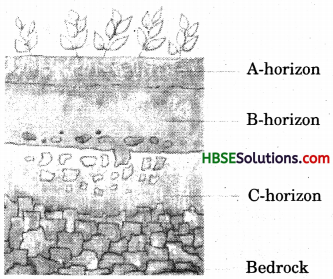
Sketch the cross section of soil and label the various layers.
Answer:
HBSE 7th Class Science Solutions Chapter 9 Soil-1 Soil profile

Question 8.
Razia conducted an experiment in the field related to the rate of percolation. She observed that it took 40 min for 200 mL of water to percolate through the soil sample. Calculate the rate of percolation.
Answer:
Formula: Percolation rate
\((\mathrm{mL} / \mathrm{min})=\frac{\text { amount of water }}{\text { percolation time }(\mathrm{min})}\)
= \(\frac{200 \mathrm{~mL}}{40 \mathrm{~min}}\)
= 5 mL /min.

Question 9.
Explain how soil erosion could be prevented.
Answer:
Prevention of soil erosion can be brought about by controlling the factors which cause soil erosion. The methods would, thus, be as follows:
1. Deforestation should be stopped. Rather, trees should be planted (afforestation). Afforestation should be undertaken not only in areas already cut, but additional areas should be brought under plantation.

2. To reduce the effect of strong winds in the fields, the boundaries of the fields should be planted with trees in two to three rows.

3. To maintain the soil in its natural condition, it is advisable to grow different crops. Crops rotation, as it is called, helps to maintain the fertility of the soil. The water-holding capacity of the soil is also maintained by this method.

4. Proper drainage and irrigation arrangements should be made in the fields.

5. On the sloping areas in hills, strip cropping should be practised, thereby reducing the steepness of the slopes and checking soil erosion.

HBSE 7th Class Science Solutions Chapter 9 Soil

Question 10.
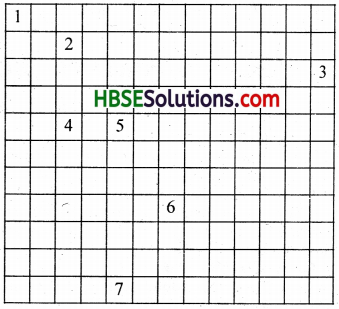
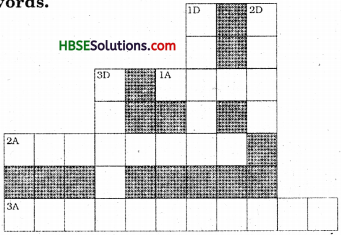
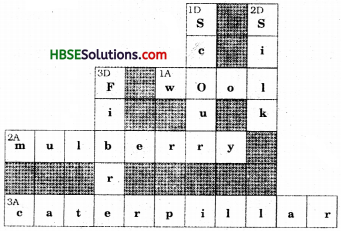
Solve the following crossword puzzle with the clues given:
HBSE 7th Class Science Solutions Chapter 9 Soil-2
Across:
2. Plantation prevents it.
5. Use should be banned to avoid soil pollution.
6. Type of soil used for making pottery.
7. Living organism in the soil.

Down:
1. In desert soil erosion occurs through.
3. Clay and loam are suitable for cereals like.
4. This type of soil can hold very little water.
5. Collective name for layers of soil.
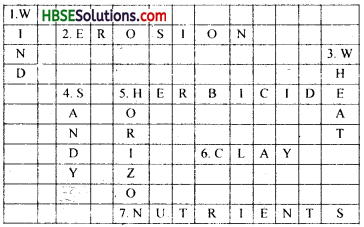
Answer:
HBSE 7th Class Science Solutions Chapter 9 Soil-3

Extended Learning – Activities And Projects

Question 1.
Boojho would like to know the difference between raw and baked soil? Investigate how the soil from which matkas are made is different from the soil used to make status.
Answer:
Do yourself. Take help your teacher.

Question 2.
Paheli is worried. She could see a brick kiln from her house. Bricks were being made there. There was so much smoke coming out of the kiln. She was told that the best quality of clay is required for making pottery, statues and bricks. She has seen truck loads of bricks being taken away for construction of buildings. At this rate, she fears, no soil will be left. Are her fears justified? Discuss this problem with your parents, teachers and other experts of your area and prepare a report.
Answer:
Do yourself.

Question 3.
Try to find out the moisture content of a soil sample. One method is given here.
Activity: Take lOOg soil. (Take help from any shopkeepers to weigh the soil). Place it on a newspaper in the sun and allow it to dry for two hours. This activity is best done in the afternoon. Take care that the soil does not spill outside the newspaper. After drying it, weigh the soil again. The difference in the weight of the soil before and after drying gives you the amount of moisture contained in 100 g of soil. This is called the percentage moisture content.
Suppose your sample of soil loses 10 g on drying. Then
Percent of moisture in soil
= \(\frac{\text { wt. of moisture }(\mathrm{g})}{\text { Original wt. of soil sample }(\mathrm{g})} \times 100\)
In this example
Percent of moisture in soil
= \(\frac{10 \times 100}{100}=10 \%\)
Answer:
Do yourself.

HBSE 7th Class Science Soil Important Questions and Answers

Very Short Answer Type Questions

Question 1.
Define soil.
Answer:
Soil is uppermost layer of earth’s crust, in which plants grow.

Question 2.
Define weathering.
Answer:
Soil is formed from the parent rock material by a very slow and gradual process called weathering.

Question 3.
What is humus?
Answer:The rotting dead matter in the soil is called humus.

Question 4.
Where do plants grow?
Answer:
Plants grow in the soil.

Question 5.
Where does food that helps to sustain and grow, come from?
Answer:
Plants.

Question 6.
How old is our earth?
Answer:
Our earth came into existence about 4.5 billion years ago.

Question 7.
Name the part of the environment which supports life.
Answer:
1. Lithosphire
2. Hydrosphere
3. Atmosphere.

HBSE 7th Class Science Solutions Chapter 9 Soil

Question 8.
Give one term for the following,
“Removal of top soil by air and water.”
Answer:
Soil erosion,

Question 9.
What do you understand by the term soil conservation?
Answer:
Prevention of soil erosion is called soil conservation.

Question 10.
What is soil pollution?
Answer:
When the structure and properties of the soil are changed by adding unwanted and harmful substances, it is called as soil pollution.

Question 11.
Name two soil pollutions.
Answer:
(i) Insecticides and herbicides
(ii) Industrial wastes like plastic, chemicals, flyash, leather etc.

Question 12.
How soil erosion takes place?
Answer:
When the over grazing or cutting of trees take place the top soil becomes soft and loose which is easily blown by wind and water.

Question 13.
How is soil formed?
Answer:
Soil is formed by cracking of rocks due to contraction and expansion by cooling and heating effect.

Question 14.
What is mineral?
Answer:
Minerals are the non-renewable natural resources.

Question 15.
Name four animals that live in the soil.
Answer:
Bacteria, Earthworm, Snakes, Rats, Ants.

Question 16.
What do you understand by deforestation?
Answer:
When the trees of the forest are cleared to convert the forest land into formland is called deforestation.

HBSE 7th Class Science Solutions Chapter 9 Soil

Question 17.
State two major problems caused by excessive deforestation.
Answer:
(i) Due to excessive deforestation there is less rain.
(ii) Soil erosion takes place.

Question 18.
Name the materials present in fertile soil.
Answer:
Fertile soil contains nitrates, phosphates, water soluble salts and carbonic acids.

Question 19.
What is crumb?
Answer:
The main skeleton of a fertile soil is called crumb.

Question 20.
What, is the function of air in soil?
Answer:
(i) Air helps, 1:he plants present in the soil in respiration.
(ii) It helps in making soil soft and light in weight.

Question 21.
Which soil horizon is rich in humus?
Answer:
The uppermost layer is called the A- horizon is rich in humus.

Question 22.
Which type of soil is best suited for growth of plants?
Answer:
Loamy soil.

Question 23.
Name the different types of particles present in soil.
Answer:
Soil consists of soil particles, humus (organic matter), water, air and living organisms.

Question 24.
What is strip, cropping?
Answer:
Strip cropping means the planting of crops in rows or strips to check flow of water.

Question 25.
What are loams?
Answer:
Soils having mixtures of different sized particles are called loams or loam soils.

Short Answer Type Questions

Question 1.
What are the components of soil?
Answer:
Some of the main components of soil are as follows:
(i) Humus
(ii) Minerals
(iii) Water
(iv) Air and
(v) Micro organisms 7 bacteria, fungi, insects, larvae and many other organisms.

HBSE 7th Class Science Solutions Chapter 9 Soil

Question 2.
Write the importance of Humus.
Answer:
Humus is very important for the proper growth of the plants. It helps in growing plants in the following ways:
(i) It makes the soil fertile.
(ii) It allows the roots of plants to penetrate in the soil easily.
(iii) Water and air can pass into it easily,
(iv) It retains water for a longer period.
(v) It binds the soil particles.

Question 3.
What is meant by term wehtherifig?
Answer:
The cooling and heating of rocks cause cracking. They bring about further breaking. This process of breaking the parent rock into fine particles is called weathering.

Question 4.
Describe the harmful effects of deforestation.
Answer:
Deforestation causes the following harmful effects:
(i) Soil erosion will take place.
(ii) There will be draught due to which famine will occur. .
(iii) There will be less rain.
(iv) There will be excess amount of CO, due to which Green House effect will take place. It may cause flood in-the rivers.

Question 5.
Why biosphere supports life?
Answer:
Biosphere has all those requirements such as air, water, minerals, sunlight etc. which are essential for the survival of living things.

Question 6.
What are natural resources?
Answer:
Natural resources are those which are provided by nature to support life. Such as water, air, minerals, sunlight and various life forms.

Question 7.
What is soil erosion?
Answer:
The top soil being soft and light is carried away easily by wind and water, the natural agents. This process of removal of soil is called soil erosion.

Question 8.
Distinguish between residual and transported soils.
Answer:
Residual soils are those in which the whole process of soil formation, i.e., weathering and development of soil profile occurs at the same place. In these soils, the soil is formed at the place where the parent rock is present.

Transported soils are those where the v weathered soil particles are taken away to other places. This is done by several agents.

HBSE 7th Class Science Solutions Chapter 9 Soil

Question 9.
State any four major advantages of forests.
Answer:
Forest is a natural renewable resource which is advantageous in the following ways:
(i) It creates a suitable environment for rain.
(ii) It helps in controlling the soil erosion.
(iii) It absorbs excess rain water as subsoil water.
(iv) It provides the home to variety of animals.

Question 10.
What is the importance of soil organisms?
Answer:
A number of organisms such as earthworms, bacteria, fungi and round- worms are found in the soil.
Soil organisms are important because of various uses:
1. As you know, earthworms burrow the soil, swallow it and make it loose and soft.
2. Micro-organisms cause the decomposition’ of dead plants and animals, and release the minerals back of the soil. The minerals can again be absorbed by the plant roots. Mineral cycling goes on in this manner.
3. Some bacteria are able to fix nitrogen in association with roots of legume plants like pea and gram.

Long Answer Type Questions

Question 1.
How is soil important to us? Explain.
Answer:
Our mother Earth is blessed with immense land resource. It is valuable to man for food production. It is also a basic part of wildlife habitats and recreational resources. Various soil organisms like earthworms, bacteria, insects and mammals use this as a natural habitat. Plants obtain water and minerals through this land resource. Plant sources of many medicinal drugs exist here. Wood fibres, fruits, rubber, oils, dyes and various other economic products which the man uses, are all dependent on this land. The very existence of mankind is greatly influenced by this land resource.

Question 2.
Describe the factors which cause soil erosion.
Answer:
Soil erosion is the removal of topsoil. This is brought about by wind and water or rain. There are several factors which allow water and wind to cause soil erosion. Some of these factors are:
(i) Deforestation:
Cutting down of trees and excessive farming are practices that destroy vegetation and expose land to the action of wind and water. Water runs off the soil surface with great speed and carries the soil particles into rivers which get chocked with silt resulting in floods. This problem assumes alarming proportions on hills.

(ii) Overgrazing:
Overgrazing by animals also destroys vegetation making land barren. The top soil on barren land can then be eroded by water and wind.

(iii) Poor methods of farming:
Tilling or ploughing loosens the soil which can then be easily eroded by wind and water. Due to excessive farming the layer of humus gets depleted and water holding capacity of the soil also reduces. The topsoil thus dries up and can be carried away by wind and water.

(iv) Forest fires, too, lead to soil erosion. After fire, the soil is exposed to two main factors causing erosion, namely wind and water.

Question 3.
Write short notes on the importance of the following:
(а) Soil, (b) Forests, (c) Soil organisms, (d) Overgrazing, (e) Earthworms.
Answer:
(a) Soil:
(i) Soil provides shelter to several micro-organism and some macro- organisms.
(ii) All the plants grow in it.
(iii) It acts as store-house of minerals.
(iv) It acts as raw material for building bricks, mortar, pottery, pulp for paper industry is. obtained from plants grown in the soil.
(v) It acts as water storage.
(vi) It provides employment.

(b) Forests: Forests are very useful to man-kind in the following ways:
(i) It maintains the balance of gases in the atmosphere.
(ii) It causes rain.
(iii) It provides the shelter to the wild animals.
(iv) It provides the valuable things like timber, honey, bee wax, lac, medicines.

(c) Soil Organisms:
Various micro organisms live in the soil which make the soil porous, soft and airy. They make soil fertile. They convfert manure into simple form which can be used by plants of the forest.

(d) Overgrazing:
When the cattle , eat grass of l^rge area, it is called as overgrazing. This process makes the soil plain which can be used for industrialisation and urbanisation.

(e) Earthworm:
Earthworms are the friends of the farmer. They eat dead organicv substances along with the soil and convert them into simple soluble forms which make the soil fertile and soft.

HBSE 7th Class Science Solutions Chapter 9 Soil

Question 4.
Describe the composition of soil.
Answer:
Composition of soil varies from place to place. It depends on the type of rock from which it is formed. However, all soils contain the following components:
(i) Rock particles: Tiny particles of soil derived from the parent rock.
(ii) Humus: Humus consists of decaying remains of plants and animals.
(iii) Living organisms: Soil contains a large number of micro-organisms like bacteria, algae, fungi and protozoa. Many small animals like insects, earthworms, spiders, scorpions, centipedes and millipedes are found in the soil. Burrowing animals like rats, moles, rabbits and guinea pigs make tunnels in the soil.
(iv) Water: Water is present in pores between soil particles and helps the plants in their growth.
(v) Air: Air is also present in the soil pores and is essential for the survival of living organisms present in the soil.

Question 5.
What is soil pollution? What are the major sources of soil pollution?
Answer:
Any substance that adversely affects the, productivity of soil is called a soil pollutant. Contamination of soil with pollutants like insecticides, artificial fertilizers and industrial wastes is called soil pollution. The major sources of soil pollution are:
(i) Pollutants like acids washed off from the atmosphere (acid rain).
(ii) Pesticides and herbicides sprayed in fields.
(iii) Excessive use of artificial fertilizers.
(iv) Solid wastes like garbage, trash, ash, building material, plastic bottles and cans.

Soil Class 7 HBSE Notes

1. Soil is the uppermost layer of earth’s crust, in which plants grow.
2. Soil is formed from the parent rock material by a very slow and gradual process called weathering. A number of agents temperature changes, frost, water, wind and living organisms – are involved in the weathering of rocks.
3. Six types of soil are mainly found in India – Red soil, black soil, alluvial soil, desert soil, mountain soil and laterite soil. Humus content is maximum in mountain soil. Black soils are rich for growing cotton and sugarcane while alluvial soil is suitable for wheat and rice.

Types of soilOccurrenceCharacteristics
1. Red soilInterior regions of Kerala and .Tamil Nadu, Southern Karnataka, Andhra Pradesh, Orissa, Eastern Madhya Pradesh.(i) Red colour due to the presence of iron oxide.

(ii) Poor in humus but can be made fertile by adding manure or fertilizers.

2. Black soilMaharashtra, parts of Andhra Pradesh, Madhya Pradesh and Gujarat.(i) Rich in iron and magnesium, derived from basaltic rocks.

(ii)Soil is clayey, contains dead organic matter and water ideal for growing cotton and sugarcane.

3. Alluvial soilPlains of Haryana, Punjab, Uttar Pradesh, Bihar, West Bengal, Coastal Orissa and Andhra Pradesh.(i) Loamy in texture with plenty of humus.

(ii)Very fertile; good for crops like wheat and rice.

4. Desert soilRajasthan and some parts of Gujarat.(i) Soil sandy and porous, cannot hold much water.

(ii) If irrigated, crops can be grown.

5. Mountain soilHimalayan region and north-east India.Of all the soil types, humus content is maximum in this type and, thus, it is very fertile.
6. Laterite soilFound in regions with heavy rains; parts of Tamil Nadu, Andhra Pradesh, Orissa and Assam.(i) Soil rich in nutrients.

(ii) Good for plantation of tea, coffee and coconut.

4. There are three main layers or horizons in the soil profile – A-horizon (top soil), B horizon (subsoil) and C-horizon (parent rock).
5. Soil consists of soil particles, humus (organic matter), water, air and living organisms.
6. Soil particles, depending on size, consist of clay (below 0.002 mm), silt (0.002 to 0.02 mm), sand (0.02 to 2.0 mm) and gravel (above 2.0 mm).
7. A soil containing a mixture of sand, silt and clay is called a loamy soil. It is the best soil for plant growth.
8. Soil is an important natural resource. It provides us food, clothing, shelter, medicines,
rubber, dyes and a number of other useful products. Besides man, it provides shelter to wildlife and different soil organisms.
9. Wind and rain bring about loss of the top soil (soil erosion). Deforestation, over grazing and poor farming methods have accelerated the process of soil erosion.
10. Prevention of soil erosion (soil conservation) can be brought about by growing plants (afforestation), crop rotation, prevention of over grazing maintaining proper drainage, and growing of crops in rows or strips in the hills (strip-cropping).

Read More:

Nr4 Stocks

HBSE 7th Class Science Solutions Chapter 9 Soil Read More »

HBSE 11th Class Chemistry Important Questions Chapter 10 s-ब्लॉक तत्त्व

Haryana State Board HBSE 11th Class Chemistry Important Questions Chapter 10 s-ब्लॉक तत्त्व Important Questions and Answers.

Haryana Board 11th Class Chemistry Important Questions Chapter 10 s-ब्लॉक तत्त्व

बहुविकल्पीय प्रश्न:

1. क्षार धातुएँ हैं-
(1) Na व K
(2) Mg व Ca
(3) Cu व Mg
(4) Al व Fe
उत्तर:
(1) Na व K

2. सोडियम धातु को इसमें सुरक्षित रखा जाता है-
(1) बेन्जीन
(2) कैरोसीन
(3) ऐल्कोहॉल
(4) टॉलूईन।
उत्तर:
(2) कैरोसीन

3. निम्न में से कौन-सी धातु कमरे के ताप पर जल से क्रिया करती है-
(1) चाँदी
(2) लोहा
(3) ऐल्यूमिनियम
(4) सोडियम।
उत्तर:
(4) सोडियम।

4. कौन-सा तत्व ऑक्सीजन की प्रचुरता में गरम करने पर सुपर-ऑक्साइड बनाता है-
(1) Li
(2) Na
(3) K
(4) Ca
उत्तर:
(3) K

HBSE 11th Class Chemistry Important Questions Chapter 10 s-ब्लॉक तत्त्व

5. सोडियम, लीथियम की तुलना में जल से बहुत तीव्रता से अभिक्रिया करता है, क्योंकि-
(1) इसका परमाणु भार अधिक है
(2) यह अधिक विद्युत-धनी है
(3) यह अधिक विद्युत-ऋणी है
(4) इसमें अधिक संयोजकता इलेक्ट्रॉन हैं।
उत्तर:
(2) यह अधिक विद्युत-धनी है

6. निम्न में से किसकी हाइड्रेशन ऊर्जा अधिकतम है-
(1) H+
(2) Na+
(3) K+
(4) Rb+
उत्तर:
(1) H+

7. KO2 किसका उदाहरण है-
(1) सब ऑक्साइड
(2) सुपर ऑक्साइड
(3) सामान्य ऑक्साइड
(4) परॉक्साइड
उत्तर:
(2) सुपर ऑक्साइड

8. सीजियम ऑक्साइड है-
(1) प्रबल क्षारीय
(2) अम्लीय
(3) दुर्बल क्षारीय
(4) उभयधर्मी।
उत्तर:
(1) प्रबल क्षारीय

9. निम्न में से कौन-सा धातु कार्बोनेट गरम करने पर अपघटित होता है-
(1) Li2CO3
(2) Na2CO3
(3) K2CO3
(4) Rb2CO3
उत्तर:
(1) Li2CO3

10. भार-धातुओं के प्रबल अपचायक होने का कारण है-
(1) बड़ी परमाणु त्रिज्या
(2) बड़ी आयनिक त्रिक्या
(3) कम विद्युत श्रूपात्मकता
(4) कम प्रथम आयनन ऊर्जा।
उत्तर:
(4) कम प्रथम आयनन ऊर्जा।

11. क्षारीय धातुओं में से धातु जो रेडियो एक्टिव है-
(1) Cs
(2) Fr
(3) Rb
(4) Li
उत्तर:
(2) Fr

12. निम्न में से सबसे हल्का तत्व है-
(1) Na
(2) Ca
(3) Li
(4) Mg
उत्तर:
(3) Li

13. जब K को तेजी से वायु में गर्म किया जाता है तो प्राप्त होता है-
(1) K2O
(2) KO2
(3) K2O2
(4) KO
उत्तर:
(2) KO2

14. Na+ और K+ की अपेक्षा Li+ की आयनिक चालकता कम है, क्योंकि-
(1) Li+ का आयनन विभव कम है
(2) Li+ का आवेश घनत्व उच्व है
(3) Li+ की जलयोजन प्रवृत्ति उज्ञ है
(4) उपरोक्त में से कोई नहां।
उत्तर:
(3) Li+ की जलयोजन प्रवृत्ति उज्ञ है

15. निम्न क्षार धातु आयनों में से किसकी जलीय विलयन में चालकता न्यूनवम होती है-
(1) Rb+
(2) Cs+
(3) Li+
(4) Na+
उत्तर:
(3) Li+

16. परॉक्साइड बनाने वाले तत्वों का समूह है-
(1) Li, Na, K
(2) Na, K, Mg
(3) H, Na, Ba
(4) H, Li , Mg
उत्तर:
(3) H, Na, Ba

17. इलेक्ट्रोड विभव के आधार पर जलीय विलयन में सर्बोंत्तम अपचायक है-
(1) Li
(2) Na
(3) K
(4) Rb
उत्तर:
(1) Li

18. सहसंयोजक प्रकृति का क्लोराइड है-
(1) BaCl2
(2) NaCl
(3) CaCl2
(4) BeCl2
उत्तर:
(4) BeCl2

19. उभयधर्मी ऑक्साइड का उदाइरण है-
(1) MgO
(2) Na2O
(3) BeO
(4) BaO
उत्तर:
(3) BeO

20. प्रयोगशाला में निर्जलीकारक के रूप में प्रयुक्त होने वाला यौगिक है-
(1) NaCl
(2) CaCl2
(3) MgCl2
(4) KCl
उत्तर:
(2) CaCl2

21. निम्न धातु कार्बोनेट्टों में कौन-सा गर्म करने पर धातु देता है-
(1) MgCO3
(2) Ag2CO3
(3) K2CO3
(4) FeCO3
उत्तर:
(2) Ag2CO3

22. धावन सोड़ा का सूत्र है-
(1) Na2CO3.7H2O
(2) Na2CO3. H2O
(3) Na2CO3.10H2O
(4) Na2CO3
उत्तर:
(3) Na2CO3.10H2O

23. बेकिंग सोडा है-
(1) Na2CO3
(2) NaHCO3
(3) Na2SO4
(4) K2CO3
उत्तर:
(3) Na2SO4

24. सान्द्र जलीय NaOH विलयन निम्न में से किस मिश्रण को अलग कर सकता है-
(1) Al3+ तथा Sn2+
(2) Al3+ तथा Fe3+
(3) Al3+ तथा Zn2+
(4) Zn2+ तथा Pb2+
उत्तर:
(2) Al3+ तथा Fe3+

25. जिंक की क्रिया कास्टिक सोडा विलयन की अधिकता से कराने पर प्राप्त होता है-
(1) Zn(OH)2
(2) ZnO
(3) Na2ZnO2
(4) ZnH2
उत्तर:
(3) Na2ZnO2

26. सॉल्वे प्रक्रम में Na2CO3 के अवक्षेपण का कारण है-
(1) अमोनिया से क्रिया
(2) ताप में कमी
(3) ब्राइन बिलयन में समआयन प्रभाव
(4) CO2 की क्रिया।
उत्तर:
(3) ब्राइन बिलयन में समआयन प्रभाव

27. सोडियम को शुष्क वायु में जलाने पर प्राप्त होता है-
(1) Na2O
(2) Na2O2
(3) NaO2
(4) Na3N
उत्तर:
(4) Na3N

HBSE 11th Class Chemistry Important Questions Chapter 10 s-ब्लॉक तत्त्व

28. NaCl को जल में घोलने पर सोडियम आयन हो जाता है-
(1) औँक्सीकृत
(2) अपचयित
(3) जल-अपघटित
(4) जलयोजित।
उत्तर:
(1) औँक्सीकृत

29. क्रिस्टल कार्बोनेट होता है-
(1) NaCO3
(2) Na2CO3.2H2O
(3) Na2CO3.H2O
(4) Na2CO3.10H2O
उत्तर:
(3) Na2CO3.H2O

30. गर्म सान्द्र NaOH विलयन के साथ ब्रोमीन की क्रिया से प्राप्त होता है-
(1) NaBrO
(2) NaBrO
(3) NaBrO
(4) NaBrO
उत्तर:
(3) NaBrO

31. सोडा लाइम है-
(1) Na2CO3 + Ca
(2) NaOH + NaHCO3
(3) NaOH + CaO
(4) NaOH + Na2CO3
उत्तर:
(3) NaOH + CaO

32. ब्राद्वन होता है-
(1) Na2CO3 का सान्द्र विलयन
(2) Na2SO4 का सान्द्र विलयन
(3) NaCl का सान्द्र विलयन
(4) फिटकरी का सान्द्र विलयन।
उत्तर:
(3) NaCl का सान्द्र विलयन

33. सोद्धा ऐश है-
(1) Na2CO3.H2O
(2) NaOH
(3) NaHCO2
(4) शुष्क Na2CO3
उत्तर:
(4) शुष्क Na2CO3

34. पोटेंशियम नाइट्रेट गर्म करने पर क्या बनाता है-
(1) K2O
(2) KO2
(3) K2O2
(4) KNO2
उत्तर:
(4) KNO2

35. निम्न में से कौन-सी धातु गर्म सान्द्र कॉस्टिक सोद्धा विलयन में नहीं घुलती है-
(1) Zn
(2) Zn
(3) Al
(4) Fe
उत्तर:
(4) Fe

36. पीले फॉस्फोरस को सान्द्र सोडियम हाइड्रॉक्साइड विलयन के साथ गर्म करने पर कौन सा पदार्थ बनता है?
(1) NaPO3 और NaH2PO4
(2) PH3 और NaH3PO3
(3) PH3 और NaH3PO2
(4) Na2HPO3 और Na2HPO4
उत्तर:
(3) PH3 और NaH3PO2

37. धावन सोडा का सूत्र है-
(1) Na2CO3
(2) Na3CO3.H2O
(3) Na2CO3.5H2O
(4) Na2CO3.10H3O
उत्तर:
(4) Na2CO3.10H3O

38. निम्न में से कौन-सा कथन सत्य है-
(1) लीथियम कार्बोनेट जल में विलेय होता है
(2) Na, K तथा NH4 के कार्बोनेट जल में विलेय होते हैं
(3) Ca, Sr तथा Ba के कार्बोनेट जल में विलेय होते हैं
(4) Mg तथा Cu के बेसिक कार्बोनेट जल में विलेय होते हैं।
उत्तर:
(2) Na, K तथा NH4 के कार्बोनेट जल में विलेय होते हैं

39. निम्न में से कौन-सा लवण बुन्सन की अदीप्त ज्वाला को बेंगनी रंग प्रदान करता है-
(1) NaCl
(2) BaCl2
(3) CaCl2
(4) KCl
उत्तर:
(4) KCl

40. आग बुझाने वाले यन्त्रों में H2SO4 तथा निम्न में से क्या होता है ?
(1) NaHCO3 तथा Na2CO3
(2) NaHCO3 विलयन
(3) Na2CO3
(4) CaCO3
उत्तर:
(1) NaHCO3 तथा Na2CO3

41. सोडियम कार्बोनेट बनता है-
(1) कोल्बे विधि द्वारा
(2) सॉल्वे प्रक्रम द्वारा
(3) नेल्सन विधि द्वारा
(4) सम्पर्क विधि द्वारा।
उत्तर:
(2) सॉल्वे प्रक्रम द्वारा

42. सोडियम धातु को निम्न में से किसके अन्तर्गत संचित नहीं किया जाता है-
(1) बेन्जीन
(2) कैरोसीन
(3) ऐल्कोहॉल
(4) टॉलूईन।
उत्तर:
(3) ऐल्कोहॉल

43. निम्न में से कौन-सी क्षारीय धातु नहीं है-
(1) Rb
(2) Cs
(3) Fr
(4) Rn
उत्तर:
(4) Rn

44. निम्न में से कौन-सा कमरे के ताप पर द्रव है-
(1) Na
(2) Fr
(3) Ce
(4) Os
उत्तर:
(2) Fr

45. क्षारीय मृदा धातुएँ सम्बन्धित हैं, आवर्त सारणी के –
(1) s- ब्लॉक से
(2) p-ब्लॉक से
(3) d- ब्लॉक से
(4) f-ब्लॉक से ।
उत्तर:
(1) s- ब्लॉक से

46. क्षारीय मृदा धातुओं के कार्बोनेटों के ऊष्मीय स्थायित्व का घटता हुआ क्रम है-
(1) BaCO3 > SrCO3 > CaCO3 > MgCO3
(2) BaCO3 > SrCO3 > MgCO3 > CaCO3
(3) CaCO3 > SrCO3 > MgCO3 > BaCO3
(4) MgCO3 > CaCO3 > SrCO3 > BaCO3
उत्तर:
(2) BaCO3 > SrCO3 > MgCO3 > CaCO3

47. प्रथम आयनन विभव को प्रदर्शित करने वाला सही क्रम है-
(1 ) K > Na > Ni
(2) Be> Mg > Ca
(3) B > C>N
(4) Ge > Si > C
उत्तर:
(2) Be> Mg > Ca

48. बढ़ते हुये आयनिक गुण का सही क्रम है-
(1) BeCl2 < MgCl2 < CaCl2 < BaCl2
(2) BeCl2 < MgCl2 < BaCl2 < CaCl2
(3) BeCl2 < BaCl2 < MgCl2 < CaCl2
(4) BeCl2 < CaCl2 < MgCl2 < BaCl2
उत्तर:
(1) BeCl2 < MgCl2 < CaCl2 < BaCl2

49. क्षारीय मृदा धातुओं में से वह तत्व जो मुख्यतः सह-संयोजक
यौगिक बनाता है-
(1) Ba
(2) Sr
(3) Ca
(4) Be
उत्तर:
(4) Be

50. एक धात्विक ऑक्साइड का सूत्र MO है इसके फॉस्फेट का होगा –
(1) M3(PO4)2
(2) MPO4
(3) M3PO4
(4) M2(PO4)3
उत्तर:
(1) M3(PO4)2

51. जिप्सम है-
(1) MgSO4.7H2O
(2) CuSO4.5H2O
(3) CaSO4.5H2O
(4) Na2SO4.10H2O
उत्तर:
(3) CaSO4.5H2O

52. मैग्नीशियम का निष्कर्षण करते हैं-
(1) कार्नेलाइट के विद्युत अपघटन से
(2) टैल्क के जलीय अपघटन से
(3) मैग्नेसाइट के ताप – अपघटन से
(4) उपर्युक्त सभी से।
उत्तर:
(1) कार्नेलाइट के विद्युत अपघटन से

53. दुर्बलतम क्षार है-
(1) Be(OH)2
(2)Mg(OH)2
(3) NaOH
(4) KOH
उत्तर:
(1) Be(OH)2

54. एप्सम का सूत्र है-
(1) MgSO4
(2) MgSO4.7H2O
(3) CaSO4.2H2O
(4) CaSO4
उत्तर:
(2) MgSO4.7H2O

55. कपड़ा धोने का सोडा होता है-
(1) Na2CO3.10H2O
(2) Na2CO3. H2O
(3) Na2CO3.5H2O
(4) Na2CO3
उत्तर:
(1) Na2CO3.10H2O

56. सबसे अधिक धनात्मक क्षारीय मृदा धातु है-
(1) Be
(2) Mg
(3) Ca
(4) Ba
उत्तर:
(4) Ba

57. निम्न में से किसका आयनन विभव अधिकतम है-
(1) Be
(2) Mg
(3) Ca
(4) Ba
उत्तर:
(1) Be

58. निम्न में से कौन-सा धातु कार्बोनेट गर्म करने पर अपघटित होता है-
(1) MgCO3
(3) K2CO3
(2) Na2CO3
(4) Rb2 CO3
उत्तर:
(1) MgCO3

59. कैल्सियम लवण ज्वाला में रखने से कौन-सा रंग प्रदान करता है-
(1) लाल
(2) हरा
(3) सफेद
(4) गुलाबी
उत्तर:
(1) लाल

HBSE 11th Class Chemistry Important Questions Chapter 10 s-ब्लॉक तत्त्व

60. कौन – सा क्विक लाइम है-
(1) Ca(OH)2
(2) CaO
(3) CaCO3
(4) Ca(OH)2 + H2O
उत्तर:
(2) CaO

61. नाइट्रोलिम होता है-
(1) Ca(NO3)2
(2) Ca(CN)2
(3) CaCN2 + C
(4) CaCN2
उत्तर:
(3) CaCN2 + C

62. सीमेन्ट निर्माण में निम्न में से कौन सा कच्चे माल के रूप में प्रयोग किया जाता है-
(1) चूने का पत्थर, क्ले एवं रेत
(2) चूने का पत्थर, जिप्सम एवं रेत
(3) चूने का पत्थर, जिप्सम एवं ऐलुमिना
(4) चूने का पत्थर, क्ले एवं जिप्सम ।
उत्तर:
(4) चूने का पत्थर, क्ले एवं जिप्सम ।

63. प्लास्टर ऑफ पेरिस है-
(1) CaSO4.2H2O
(2) MgSO4.7H2O
(3) KCl.MgCl2.6H2O
(4) CaSO4.1/2H2O
उत्तर:
(4) CaSO4.1/2H2O

64. जिप्सम का सूत्र है-
(1) MgSO4.2H2O
(2) CaSO4.2H2O
(3) CaSO4.3H2O
(4) 2CaSO4
उत्तर:
(2) CaSO4.2H2O

65. जल की अत्यंत सूक्ष्म मात्रा को अवशोषित करने के लिए सर्वोत्तम अभिकर्मक है-
(1) सिलिका जैल
(2)CaCl2
(3) Mg(ClO4)2
(4) H2SO4
उत्तर:
(1) सिलिका जैल

66. एप्सम लवण है-
(1) CaSO4.2H2O
(2) SrSO4
(3) BaSO4
(4) MgSO4.7H2O
उत्तर:
(4) MgSO4.7H2O

67. सीमेन्ट का जमकर कठोर होने का कारण है-
(1) निर्जलीकरण
(2) जलयोजन व जलअपघटन
(3) जलअपघटन
(4) बहुलीकरण।
उत्तर:
(3) जलअपघटन

68. बुझा हुआ चूना है-
(1) CaO
(2) Ca(OH)2
(3) CaCO3
(4) CaCl2
उत्तर:
(2) Ca(OH)2

69. प्लास्टर ऑफ पेरिस कठोर हो जाता है-
(1) CO2 को पृथक् करने पर
(2) CaCO2 में परिवर्तित होकर
(3) जल से संयुक्त होने पर
(4) जल को पृथक् करने पर ।
उत्तर:
(3) जल से संयुक्त होने पर

70. चूने का दूध है-
(1) CaO
(2) Ca(OH)2 का जलीय विलयन
(3) Ca(OH)2
(4) Ca(OH)2 का जलीय निलम्बन |
उत्तर:
(4) Ca(OH)2 का जलीय निलम्बन |

71. प्लास्टर ऑफ पेरिस जल के साथ कठोर पुँज में परिवर्तित हो जाता है, इसका संघटन है-
(1) CaSO4
(2) CaSO4. H2O
(3) CaSO4. 2H2O
(4) CaSO4.Ca(OH)2
उत्तर:
(3) CaSO4. 2H2O

72. निर्जल मैग्नीशियम क्लोराइड MgCl2.2H2O को गर्म करके तैयार किया जा सकता है-
(1) शुष्क हाइड्रोजन क्लोराइड गैस की धारा में
(2) कार्बन के साथ
(3) जब तक कि यह गल न जाये
(4) चूने के साथ ।
उत्तर:
(1) शुष्क हाइड्रोजन क्लोराइड गैस की धारा में

73. सीमेन्ट का जमना है-
(1) ऊष्माक्षेपी अभिक्रिया
(2) ऊष्माशोषी अभिक्रिया
(3) न तो ऊष्माक्षेपी न ही ऊष्माशोषी
(4) इनमें से कोई नहीं।
उत्तर:
(1) ऊष्माक्षेपी अभिक्रिया

74. पोर्टलैण्ड सीमेण्ट (नूने को छोड़कर) का बहुत बड़ा अंश है-
(1) ऐलुमिना
(2) सिलिका
(3) आयरन ऑक्साइड
(4) मैग्नीशिया ।
उत्तर:
(2) सिलिका

75. MgCi2 तथा MgO का मिश्रण कहलाता है-
(1) पोर्टलैण्ड सीमेण्ट
(2) सोरेल सीमेन्ट
(3) दिक् लवण
(4) इनमें से कोई नहीं ।
उत्तर:
(2) सोरेल सीमेन्ट

76. निम्न में से कौन सी धातु क्लोरोफिल में पायी जाती है-
(1) Mg
(2) Be
(3) Ca
(4) इनमें से कोई नहीं।
उत्तर:
(1) Mg

77. मोर्टार (गारा) मिश्रण है-
(1) बुझा चूना, रेत तथा जल
(2) बुझा चूना, प्लास्टर ऑफ पेरिस तथा जल
(3) मैग्नीशियम क्लोराइड, टार तथा चूना
(4) चूना, पोर्टलैण्ड सीमेण्ट तथा जल ।
उत्तर:
(1) बुझा चूना, रेत तथा जल

78. फ़्लैश बल्ब का तार किसका बना होता है ?
(1) Mg
(2) Ba
(3) Ag
(4) Cu
उत्तर:
(1) Mg

79. आतिशबाजी में गहरा लाल रंग किस मूलक की उपस्थिति के कारण होता है-
(1) Na
(2) Ba
(3) K
(4) Sr
उत्तर:
(4) Sr

80. निम्न में कौन – सा बेराइट है-
(1) BaO
(2) BaCO3
(3) BaSO4
(4) BaCl2.2H2O.
उत्तर:
(3) BaSO4

81. मोर्टार में रेत का कार्य है-
(1) कठोरता को कम करना
(2) पदार्थ को ठोस बनाना
(3) पदार्थ के लचीलेपन को कम करना
(4) अधिक सिकुड़न को रोकना जिसके कारण दरार पड़ जाती है ।
उत्तर:
(4) अधिक सिकुड़न को रोकना जिसके कारण दरार पड़ जाती है ।

82. बुझा हुआ चूना निम्न में से किसके उत्पादन में प्रयोग होता है-
(1) सीमेण्ट
(2) वर्णक
(3) दवाईयाँ
(4) अग्निसह ईंटें ।
उत्तर:
(1) सीमेण्ट

83. गैसों को सुखाने में प्रयुक्त किया जाता है-
(1) CaCO3
(3) NaHCO3
(2) Na2CO3
(4) CaO
उत्तर:
(4) CaO

84. लिथोफोन एक मिश्रण है-
(1) BaCl2 + ZnS
(2) BaSO4 + ZnS
(3) BaSO4 + ZnSO4
(4) BaO2 + ZnSO4
उत्तर:
(2) BaSO4 + ZnS

अति लघु उत्तरीय प्रश्न:

प्रश्न 1.
लीथियम का एक उपयोग बताइए ।
उत्तर:
मिश्र धातु बनाने में।

प्रश्न 2.
सोडियम का एक प्रमुख उपयोग दीजिए ।
उत्तर:
सोडियम वाष्प लैम्प बनाने में।

प्रश्न 3.
कौन-से क्षारीय मृदा तत्व ज्वाला को रंग प्रदान करते हैं?
उत्तर:
Ca, Sr तथा Ba |

प्रश्न 4.
बेरीलियम हाइड्राइड की प्रकृति क्या है?
उत्तर:
बहुलक प्रकृति होती है।

प्रश्न 5.
बेरीलियम हैलाइड किस प्रकार के होते हैं?
उत्तर:
आयनिक प्रकृति के होते हैं।

प्रश्न 6.
क्षार धातुएँ प्रबल अपचायक क्यों होती हैं ?
उत्तर:
क्षार धातुओं का परमाणु आकार अपने आवर्त के सभी तत्वों से बड़ा होने के कारण ये धातुएँ अपने बाह्य कक्ष का इलेक्ट्रॉन आसानी से त्याग देती हैं। अतः ये प्रबल अपचायक होती हैं।

प्रश्न 7.
Na, K, Rb और Cs वायु में खुले क्यों नहीं रखे जाते हैं?
उत्तर:
ये सभी तत्व अति क्रियाशील हैं तथा वायु की ऑक्सीजन के साथ ऑक्साइड बनाते हैं।

प्रश्न 8.
क्षार धातुएँ अधिक मुलायम क्यों होती हैं ?
उत्तर:
क्षार धातुओं में संकुलन ढीला-ढाला होता है तथा जालक में काफी रिक्त स्थान होता है। इसीलिए ये मुलायम होती हैं।

प्रश्न 9.
लीथियम सहसंयोजक यौगिक क्यों बनाता है?
उत्तर:
लीथियम का छोटा आकार, अधिक नाभिकीय आवेश और अधिक ध्रुवण क्षमता के कारण यह सहसंयोजक यौगिक बनाता है।

प्रश्न 10.
क्षार धातुएँ द्वितीय आयन क्यों नहीं बनाती हैं?
उत्तर:
क्षार धातएँ अपना संयोजी इलेक्टॉन त्यागकर स्थायी अक्रिय गैस विन्यास प्राप्त कर लेती हैं जो अति कठिनाई से टूटता है । अत: क्षार धातुएँ द्विधनात्मक आयन नहीं बनाती हैं।

प्रश्न 11.
वर्ग 1 के तत्व क्षार धातुएँ क्यों कहलाते हैं?
उत्तर:
वर्ग 1 के तत्व क्षार धातुएँ कहलाते हैं; क्योंकि इनके हाइड्रॉक्साइड विलेय क्षारक हैं जो क्षार (alkalies) कहलाते हैं। इसके अतिरिक्त इन तत्वों की राख (ash) प्रकृति में क्षारीय होती है।

HBSE 11th Class Chemistry Important Questions Chapter 10 s-ब्लॉक तत्त्व

प्रश्न 12.
क्षार धातुओं की आयनन ऊर्जा कम क्यों होती है ?
उत्तर:
क्षार धातुओं की आयनन ऊर्जा इनके बड़े परमाणु आकार के कारण कम होती है। ये सरलता से इलेक्ट्रॉन त्याग देते हैं ।

प्रश्न 13.
क्षार धातुओं की आयनन ऊर्जा परमाणु क्रमांक में वृद्धि के साथ क्यों घटती है?
उत्तर:
परमाणु क्रमांक बढ़ने पर परमाणु आकार बढ़ता है जिससे संयोजी इलेक्ट्रॉनों तथा नाभिक के बीच आकर्षण बल घटता है। अतः वर्ग में नीचे जाने पर अर्थात् परमाणु क्रमांक में वृद्धि होने पर आयनन ऊर्जा घटती है।

प्रश्न 14.
उन क्षार धातुओं के नाम लिखें जो वायु की अधिकता में गरम करने पर सुपर ऑक्साइड बनाती हैं?
उत्तर:
K, Rb और Cs |

प्रश्न 15.
उस धातु का नाम लिखें जो जल की सतह पर उससे बिना अभिक्रिया करे तैरती है।
उत्तर:
Li.

प्रश्न 16.
क्षार धातुओं में उन धातुओं के नाम बताएँ जो द्रव अवस्था में पायी जाती हैं।
उत्तर:
Cs और Fr.

प्रश्न 17.
उस मुख्य कारक को लिखें जिसकी वजह से लीथियम असंगत व्यवहार करता है।
उत्तर:
इसकी उच्च ध्रुवणता शक्ति (charge / size अनुपात ) ।

प्रश्न 18.
निम्न को उनके सह संयोजक गुण के आधार पर घटते हुये क्रम में व्यवस्थित करें।
MCI, MBr, MF, MI जहाँ (M= क्षार धातुएँ)
उत्तर:
जैसे-जैसे ऋण आयनों का आकार बढ़ता जाता है वैसे-वैसे इनका सहसंयोजक गुण भी बढ़ता जाता है।
MI > MBr > MC1 > MF

प्रश्न 19.
समूह-1 के तत्वों को क्या कहते हैं ?
उत्तर:
क्षार धातुएँ।

प्रश्न 20.
उस क्षार धातु का नाम लिखें जो Mg से विकर्ण सम्बन्ध प्रदर्शित करती है।
उत्तर:
Li |

प्रश्न 21.
सोडियम धातु को मिट्टी के तेल में क्यों रखा जाता है?
उत्तर:
सोडियम धातु अत्यधिक क्रियाशील होती है तथा यह नमी, ऑक्सीजन एवं CO2 के साथ क्रिया करके NaOH, Na2O तथा Na2CO3 बनाती है। अत: इसे नमी तथा वायु से बचाने के लिये मिट्टी के तेल में रखा जाता है।

प्रश्न 22.
सोडियम तथा पोटैशियम के मुख्य अयस्कों के नाम
लिखें।
उत्तर:
Na – NaCl
K – KCl

प्रश्न 23.
प्रकाश विद्युत सेल में हम क्षार धातुओं का प्रयोग क्यों करते हैं ?
उत्तर:
क्योंकि इनके आयनन विभव का मान कम होता है।

प्रश्न 24.
Na (11) तथा K (19) का इलैक्ट्रॉनिक विन्यास लिखें।
उत्तर:
Na(11) → 1s2 2s2 2p63s1
K (19) → 1s2 2s2 2p63s23p64s1

प्रश्न 25.
क्षार धातुओं के गलनांक एवं क्वथनांक कम क्यों होते हैं?
उत्तर:
क्योंकि इनका आकार बड़ा होता है एवं इनमें उपस्थित धात्विक बंध भी कमजोर होते हैं।

प्रश्न 26.
क्षार धातुओं के घनत्व कम क्यों हैं?
उत्तर:
बड़े आकार एवं कमजोर घात्विक बन्ध के कारण क्षार धातुओं के घनत्व काफी कम होते हैं।

प्रश्न 27.
Na और K को हम उनके गलित ……………….. के …………….. अपचयन द्वारा प्राप्त कर सकते हैं।
उत्तर:
अयस्कों, वैद्युतीय।

प्रश्न 28.
Na+…………………. ‘परमाणु के साथ समइलैक्ट्रॉनिक है।
उत्तर:
नियॉन (Ne) ।

प्रश्न 29. सोडियम का आयनन विभव K से………………. होता है।
उत्तर:
अधिक ।

प्रश्न 30.
क्षार धातुओं के यौगिक प्रायः विलेय होते हैं क्योंकि वे के होते हैं ?
उत्तर:
आयनिक प्रकृति ।

प्रश्न 31.
किस क्षार धातु के आयन की ध्रुवणता सबसे अधिक होती है।
उत्तर:
लीथियम ।

प्रश्न 32.
भारतीय साल्टपीटर किसे कहते हैं?
उत्तर:
KNO3 भारतीय साल्टपीटर कहलाता है ।

प्रश्न 33.
सोडियम हाइड्रॉक्साइड के औद्योगिक निर्माण में सह-उत्पाद कौन-सा होता है ?
उत्तर:
क्लोरीन ।

प्रश्न 34.
200°C तक गर्म ठोस कॉस्टिक सोडा पर CO गैस प्रवाहित करने पर क्या प्राप्त होता है?
उत्तर:
HCOONa (सोडियम फॉमेट)

प्रश्न 35.
सोडियम कार्बोनेट के जलीय विलयन के क्षारीय होने का क्या कारण है?
उत्तर:
क्योंकि यह जल अपघटित होकर सोडियम हाइड्रॉक्साइड एवं कार्बोनिक अम्ल बनाता है। NaOH एक प्रबल क्षार है जबकि कार्बोनिक अम्ल एक दुर्बल अम्ल है जिस कारण से इसका जलीय विलयन क्षारीय हो जाता है।

प्रश्न 36.
जब K को तेजी से वायु में गर्म किया जाता है तो क्या प्राप्त होता है?
उत्तर:
KO2 (पौटेशियम सुपरऑक्साइड)

प्रश्न 37.
नौसादर क्या होता है?
उत्तर:
NH4Cl को नौसादर कहते हैं।

प्रश्न 38.
धावन सोडे को गर्म करने पर क्या प्राप्त होता है?
उत्तर:
केवल जल वाष्प प्राप्त होती है।

प्रश्न 39.
रिक्त स्थानों की पूर्ति कीजिए-
(i) Na2CO3.10H2O को………………. कहते हैं।
उत्तर:
धावन सोडा ।

(ii) LiNO3 अपघटित होकर………………. एवं………………. देता है जबकि अन्य सभी क्षारीय धातुओं के नाइट्रेट अपघटित होकर……………….………………. देते हैं।
उत्तर:
LiNO3 अपघटित होकर NO2 एवं O2 देता है जबकि अन्य सभी क्षारीय धातुओं के नाइट्रेट अपघटित होकर धातु नाइट्राइट व O2 देते हैं।

(iii) Li2CO3 गर्म करने पर……………….एवं………………. में अपघटित होता है।
उत्तर:
Li2CO3 गर्म करने पर Li20 एवं O2 में अपघटित होता है जबकि अन्य क्षारीय धातु कार्बोनेट गर्म करने पर अपघटित नहीं होते हैं।

(iv) क्षार धातुएँ मर्करी में घुलकर उसके साथ मिश्र धातु बनाती है जिन्हें……………….कहते हैं।
उत्तर:
अमलगम ।

(v) क्षार धातु धनात्मक आयन का आकार जितना छोटा होता है उतना ही………………. जलयोजन होता है।
उत्तर:
अधिक ।

(vi) अमोनिया में संतृप्त NaCl के विलयन को………………. कहते हैं।
उत्तर:
अमोनियामय ब्राइन ।

(vii) द्रव अमोनिया में क्षार धातुएँ नीला रंग देती हैं, इसका कारण उसमें उपस्थित………………. है ।
उत्तर:
अमोनिएटेड इलेक्ट्रॉन ।

प्रश्न 40.
वर्ग-1 के तत्वों में ऊपर से नीचे चलने पर घनत्व बढ़ता जाता है लेकिन किस तत्व पर यह क्रम विचलित होता है ?
उत्तर:
K तत्व पर यह क्रम विचलित होता है।

प्रश्न 41.
किन तत्वों का घनत्व पानी से कम है ?
उत्तर:
Li, Na तथा K ।

प्रश्न 42.
वर्ग-1 के तत्वों में प्रबलतम धनविद्युती तत्व कौन-सा होगा ?
उत्तर:
Cs (सीजियम) ।

प्रश्न 43.
वर्ग-1 की धातुओं में से कौन-सी धातु कठोर है ?
उत्तर:
Li (लीथियम)।

प्रश्न 44.
वर्ग-1 की धातुओं में से कौन-सी धातु नर्म है ?
उत्तर:
Cs (सीजियम)।

HBSE 11th Class Chemistry Important Questions Chapter 10 s-ब्लॉक तत्त्व

प्रश्न 45.
वर्ग-1 की धातुओं में से वह कौन-सी धातु है जिसे चाकू से नहीं काटा जा सकता है ?
उत्तर:
Li (लीथियम)।

प्रश्न 46.
वर्ग- 1 में कौन-सी धातु द्रव अवस्था में पायी जाती है ?
उत्तर:
सीजियम (Cs) ।

प्रश्न 47.
कौन-सी धातु का प्रयोग फोटो इलेक्ट्रिक सेल में करते हैं ?
उत्तर:
सीजियम का प्रयोग फोटो इलेक्ट्रिक सेल में किया जाता है।

प्रश्न 48.
वर्ग- 1 के धातुओं के धनायन की प्रकृति कैसी होती है ?
उत्तर:
वर्ग-1 के धातुओं के धनायन की प्रकृति प्रतिचुम्बकीय होती है।

प्रश्न 49.
वर्ग-1 की धातुओं में से किस धातु धनायन की जलयोजन ऊर्जा का मान अधिकतम होता है ?
उत्तर:
Li+ की जलयोजन ऊर्जा का मान अधिकतम होता है।

प्रश्न 50.
वर्ग-1 की धातुओं के जलयोजित धनायनों की आयनिक चालकता का क्रम लिखें।
उत्तर:
\(\mathrm{Li}_{(a q)}^{+}<\mathrm{Na}_{(a q)}^{+}<\mathrm{K}_{(a q)}^{+}<\mathrm{Rb}_{(a q)}^{+}<\mathrm{Cs}_{(a q)}^{+}\) जलयोजित धनायनों की आयनिक चालकता का क्रम

प्रश्न 51.
वर्ग-1 के तत्वों में किस तत्व की आयनन एन्थैल्पी सर्वाधिक है ?
उत्तर:
Li (लीथियम)।

प्रश्न 52.
वर्ग-1 के तत्वों में कौन-सी धातुएँ संकुल हाइड्राइड बनाती हैं ?
उत्तर:
LiAlH4 एवं NaBH4 (अर्थात् Li एवं Na) ।

प्रश्न 53.
वर्ग-1 के तत्वों के हाइड्रॉक्साइड में कौन प्रबलतम क्षार है ?
उत्तर:
CsOH (सीजियम हाइड्रॉक्साइड)।

प्रश्न 54.
सुपरऑक्साइड आयन को किससे प्रदर्शित करते हैं ?
उत्तर:
O2 (सुपरऑक्साइड) ।

प्रश्न 55.
परॉक्साइड एवं ऑक्साइड आयन को किससे प्रदर्शित करते हैं।
उत्तर:
परॉक्साइड (O22- तथा ऑक्साइड (O2-) ।

प्रश्न 56.
वर्ग- 1 के तत्वों के हाइड्रॉक्साइडों की प्रबलता को घटते क्रम में व्यवस्थित करें।
उत्तर:
CsOH > RbOH > KOH > NaOH > LiOH (प्रबलता का क्रम)।

प्रश्न 57.
वर्ग-1 में कौन-सा तत्व नाइट्रोजन से क्रिया कर नाइट्राइड बनाता है ?
उत्तर:
लीथियम |

प्रश्न 58.
सोडियम हाइड्रॉक्साइड को दाहक सोडा (caustic soda) क्यों कहते हैं ?
उत्तर:
क्योंकि यह त्वचा पर फफोले (blisters) डालता है।

प्रश्न 59.
काली राख (Black ash) किसे कहते हैं ?
उत्तर:
Na2CO3 व CaS के मिश्रण को काली राख कहते हैं।

प्रश्न 60.
हल्की क्षार धातुओं जैसे Li, Na, K आदि का घनत्व जल से कम होता है, क्यों ?
उत्तर:
क्योंकि इन धातुओं का परमाणु-आयतन जल से अधिक होता है।

प्रश्न 61.
क्षार धातुएँ विद्युत व ऊष्मा की अच्छी चालक हैं, स्पष्ट करो ।
उत्तर:
क्योंकि इनका संयोजी इलेक्ट्रॉन नाभिक से कम शक्ति के द्वारा जुड़ा होता है।

प्रश्न 62.
क्षार धातुओं को मिट्टी के तेल या पैराफीन में क्यों रखते हैं ?
उत्तर:
क्योंकि ये जल एवं वायु से क्रिया कर लेती हैं।

प्रश्न 63.
क्रिस्टल कार्बोनेट व धावन सोडा दोनों सोडियम के कार्बोनेट हैं। इन दोनों में क्या अन्तर है ?
उत्तर:
सोडियम कार्बोनेट के मोनोहाइड्रेट को क्रिस्टल कार्बोनेट व डेका हाइड्रेट को धावन सोडा कहते हैं।
क्रिस्टल कार्बोनेट – Na2CO3.H2O
धावन सोडा – Na2CO3.10H2O

प्रश्न 64.
क्षार धातुओं के सुपरऑक्साइड रंगीन व अनुचुम्बकीय होते हैं, क्यों ?
उत्तर:
सुपर ऑक्साइडों में तीन इलेक्ट्रॉनों का एक बन्ध होता है जिसमें अयुग्मित इलेक्ट्रॉन होते हैं। इस कारण यह अनुचुम्बकीय व रंगीन होते हैं।
HBSE 11th Class Chemistry Important Questions Chapter 10 s-ब्लॉक तत्त्व Img 1

प्रश्न 65.
Li अपने वर्ग के अन्य तत्वों की अपेक्षा वर्ग II-A के Mg से अधिक समानता रखता है, क्यों ?
उत्तर:
Li+ व Mg+ की ध्रुवण क्षमता लगभग समान होने के कारण Li व Mg के लवणों के गुणों में समानता पायी जाती है।

प्रश्न 66.
NaOH को वायु में रखने पर यह पहले द्रव बनाता है। फिर ठोस हो जाता है, क्यों ?
उत्तर:
NaOH, वायु की CO2 व नमी को अवशोषित कर लेता है। पहले यह NaOH का संतृप्त विलयन बनाता है फिर CO2 से क्रिया करके Na2CO3 बनाता है । यह अविलेय होने के कारण ठोस Na2CO3 में परिवर्तित हो जाता है।

प्रश्न 67.
शुद्ध NaCl प्रस्वेद्य (deliquescent) नहीं है, परन्तु घर पर प्रयोग होने वाला नमक वर्षा के दिनों में नमी युक्त हो जाता है।
उत्तर:
घर पर प्रयोग होने वाले नमक में MgCl2 अशुद्धि के रूप में होता है जो कि एक प्रस्वेद्य यौगिक है।

प्रश्न 68.
शुष्क चूना क्या है? यह कैसे बनाया जाता है ?
उत्तर:
शुष्क चूना कैल्सियम ऑक्साइड (CaO) है। इसे चूना पत्थर (कैल्सियम कार्बोनेट) को गर्म करके बनाया जाता है।
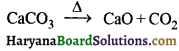
HBSE 11th Class Chemistry Important Questions Chapter 10 s-ब्लॉक तत्त्व Img 2

प्रश्न 69.
BeCl2 कार्बनिक विलायकों में विलेय क्यों होता है?
उत्तर:
BeCl2 सहसंयोजी यौगिक है; इसलिए यह कार्बनिक विलायकों में विलेय होता है।

प्रश्न 70.
शुष्क चूने से प्रारम्भ करके बुझा चूना कैसे बनाया जाता है ? क्या अभिक्रिया ऊष्माक्षेपी होगी या ऊष्माशोषी ?
उत्तर:
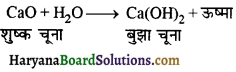
HBSE 11th Class Chemistry Important Questions Chapter 10 s-ब्लॉक तत्त्व Img 3
जब शुष्क चूने को जल में डाला जाता है, यह कैल्सियम हाइड्रॉक्साइड बनाता है। यह अभिक्रिया ऊष्माक्षेपी होती है।

प्रश्न 71.
उस क्षार धातु का नाम बताइए जो मैग्नीशियम के साथ विकर्ण सम्बन्ध प्रदर्शित करती है ?
उत्तर:
लीथियम ।

प्रश्न 72.
निम्नलिखित में विभेद करने के लिए एक अभिकर्मक अथवा एक प्रक्रम बताइए-
(i) BeSO4 तथा BaSO4
(ii) Be(OH)2 तथा Ba(OH)2
उत्तर:
(i) BeSO4 जल में विलेय है, जबकि BaSO4 नहीं है ।
(ii) Be(OH)2, NaOH में विलेय है, जबकि Ba(OH)2 अविलेय है।

प्रश्न 73.
बेरिलियम वर्ग IIA तथा ऐलुमिनियम IIIB में विद्यमान है, परन्तु फिर भी इनके गुणों में समानता का प्रमुख कारण क्या है?
उत्तर:
बेरिलियम वर्ग IIA तथा ऐलुमिनियम वर्ग IIIB में उपस्थित हैं, परन्तु इनके गुणों में समानता का कारण इनमें विकर्ण सम्बन्ध का होना है।

प्रश्न 74.
क्षारीय मृदा धातुओं के हाइड्रॉक्साइडों की जल में विलेयता वर्ग में नीचे जाने पर पर क्यों बढ़ती है?
उत्तर:
क्षारीय मृदा धातुओं में ऋणायन समान हों तो धनायन की त्रिज्या जालक एन्थैल्पी को प्रभावित करती है। चूँकि बढ़ती हुई आयनिक त्रिज्या के साथ जलयोजन एन्थैल्पी की तुलना में ऋणात्मक एन्थैल्पी तेजी से कम होती है; अतः वर्ग के नीचे जाने पर विलेयता बढ़ती जाती है।

HBSE 11th Class Chemistry Important Questions Chapter 10 s-ब्लॉक तत्त्व

प्रश्न 75.
क्षारीय मृदा धातुओं के कार्बोनेटों एवं सल्फेटों की जल में विलेयता वर्ग में ऊपर से नीचे क्यों घटती है?
उत्तर:
ऋणायन का आकार धनायन की तुलना में बहुत अधिक है एवं जालक एन्थैल्पी वर्ग में लगभग स्थिर रहती है। चूँकि वर्ग में जलयोजन ऊर्जा का मान ऊपर से नीचे घटता है अतः धातु कार्बोनेट एवं सल्फेटों की विलेयता वर्ग में नीचे जाने पर घटती है।

प्रश्न 76.
उच्च ताप पर नाइट्रोजन के साथ कौन सी धातु सीधे संयोग कर सकती है ?
उत्तर:
Mg.

प्रश्न 77.
क्षारीय मृदा धातुओं में वे कौन-सी धातुएँ हैं जो ज्वाला परीक्षण नहीं देती हैं।
उत्तर:
Be, Mg.

प्रश्न 78.
मैग्नीशियम की दो मिश्र धातुएँ बताइए ।
उत्तर:
मैग्नेलियम : Al Mg
डूरेल्यूमिन : Mg Al Mn Cu Si

प्रश्न 79.
ग्रिगनार्ड अभिकर्मक का सूत्र लिखिए यह कैसे प्राप्त किया जाता है?
उत्तर:
R = CH3, C2H5 आदि X = हैलोजन) ऐल्किल हैलाइड के ईथरीय विलयन में मैग्नीशियम हैलाइड मिलाने पर ऐल्किल मैग्नीशियम हैलाइड बनता है जिसे ग्रिगनार्ड अभिकर्मक कहते हैं।
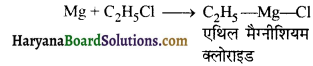
HBSE 11th Class Chemistry Important Questions Chapter 10 s-ब्लॉक तत्त्व Img 4

प्रश्न 80.
कैल्सियम का कौन-सा यौगिक धातु कर्म में गालक के रूप में प्रयुक्त होता है ?
उत्तर:
CaO.

प्रश्न 81.
दो उभयधर्मी ऑक्साइडों के नाम लिखिए ।
उत्तर:

  • बेरीलियम ऑक्साइड (BeO)
  • ऐल्यूमिनियम ऑक्साइड (Al2O3)

प्रश्न 82.
मैग्नीशियम रिबन के टुकड़े को नाइट्रोजन में गर्म करके जल में ठण्डा करने पर कौन सी गैस प्राप्त होती है ?
उत्तर:
अमोनिया (NH3)

प्रश्न 83.
वर्ग-2 के तत्वों को क्षारीय मृदा धातुएँ क्यों कहते हैं ?
उत्तर:
क्योंकि इनके ऑक्साइड क्षारीय होते हैं और मृदा (earth, SiO2) की तरह अगलनीय होते हैं।

प्रश्न 84.
क्षारीय मृदा धातुएँ प्रतिचुम्बकीय क्यों होती हैं ?
उत्तर:
क्षारीय मृदा धातुओं के तत्वों में कोई भी अयुग्मित इलेक्ट्रॉन नहीं होता है। अतः ये प्रतिचुम्बकीय होती हैं।

प्रश्न 85.
निर्जल CaSO4 निर्जलीकारक (drying agent) की तरह प्रयोग होता है, क्यों ?
उत्तर:
निर्जल CaSO4 जल को अवशोषित कर लेता है तथा हाइड्रेटेड सल्फेट CaSO4.2H2O बनाता है।

प्रश्न 86.
सीमेन्ट में चूने की मात्रा परिवर्तित करने पर क्या प्रभाव पड़ता है ?
उत्तर:
सीमेन्ट में यदि चूने की मात्रा कम कर दी जाये तो दुर्बल सीमेन्ट बनता है जो शीघ्रता से जमता है। जबकि सीमेन्ट में चूने की मात्रा अधिक होने पर सीमेन्ट के जमने पर दरारें पड़ जाती हैं।

प्रश्न 87.
सीमेन्ट में यदि सिलिका की मात्रा बढ़ा दी जाये तो क्या होगा ?
उत्तर:
सीमेन्ट में सिलिका की मात्रा अधिक बढ़ा देने पर दुर्बल सीमेण्ट का निर्माण होता है।

प्रश्न 88.
सीमेन्ट को बनाते समय क्लिंकर में जिप्सम क्यों मिलाते हैं ?
उत्तर:
क्योंकि जिप्सम मिलाने पर सीमेन्ट के जमने की दर कम हो जाती है एवं सीमेन्ट कठोर भी हो जाता है ।

प्रश्न 89.
मोर्टार किसे कहते हैं ?
उत्तर:
सीमेण्ट, रेत एवं पानी का मिश्रण मोर्टार कहलाता है।

प्रश्न 90.
कैल्सियम के उस हैलाइड का नाम बताएँ तो जल में अविलेय है ?
उत्तर:
कैल्सियम फ्लुओराइड (CaF2).

प्रश्न 91.
वह कौन-सी क्षारीय मृदा धातु है, जिसके तार खींचे जा सकते हैं ?
उत्तर:
Mg धातु के तार खींचे जा सकते हैं।

प्रश्न 92.
ज्वाला को हरा रंग प्रदान करने वाली क्षारीय मृदा धातु कौन-सी है।
उत्तर:
बेरियम (Ba).

प्रश्न 93.
वह कौन-सी क्षारीय मृदा धातुएँ हैं जो कि ज्वाला को रंग नहीं देती हैं ?
उत्तर:
Be (बेरीलियम) तथा Mg ( मैग्नीशियम) ।

प्रश्न 94.
क्षार धातुओं में किस तत्व की आयनन एन्थैल्पी उच्चतम है ?
उत्तर:
लीथियम (Li) धातु की आयनन एन्थैल्पी उच्चतम होती है।

प्रश्न 95.
जैव उपयोगिता वाले चार धात्विक आयन बताएँ ।
उत्तर:
Na+, K+, Mg2+ एवं Ca2+

प्रश्न 96.
उभयधर्मी क्षारीय मृदा धातु के हाइड्रॉक्साइड का सूत्र लिखें।
उत्तर:
बेरीलियम हाइड्रॉक्साइड [Be(OH)2]

प्रश्न 97.
बेरीलियम ऑक्साइड (BeO) का क्वथनांक उच्च होता है, क्यों ?
उत्तर:
क्योंकि बेरीलियम ऑक्साइड बहुलक के रूप में रहता है। इस कारण इसका क्वथनांक उच्च होता है ।

प्रश्न 98.
डोलोमाइट का सूत्र क्या है ?
उत्तर:
MgCO3. CaCO3

प्रश्न 99.
टूटी हड्डियों पर प्लास्टर चढ़ाने हेतु उपयोगी पदार्थ का नाम व सूत्र दें।
उत्तर:
टूटी हड्डियों पर प्लास्टर ऑफ पेरिस (CaSO4.2H2O) का प्लास्टर चढ़ाया जाता है।

प्रश्न 100.
धातुकर्म में गालक के रूप में Ca का कौन-सा यौगिक प्रयोग किया जाता है ?
उत्तर:
कैल्सियम ऑक्साइड (CaO) को गालक के रूप में प्रयोग किया जाता है।

प्रश्न 101.
संगमरमर के पत्थर का सूत्र क्या है ?
उत्तर:
कैल्सियम कार्बोनेट (CaCO3).

प्रश्न 102.
एप्सम लवण का सूत्र क्या है ?
उत्तर:
MgSO4 . 7H2O.

प्रश्न 103.
कार्नेलाइट का सूत्र क्या है ?
उत्तर:
KCl. MgCl2:6H2O

प्रश्न 104.
मृत जल प्लास्टर (Dead Burnt Plaster) किसे कहते हैं ?
उत्तर:
निर्जल CaSO4 को मृत जल प्लास्टर कहा जाता है।

HBSE 11th Class Chemistry Important Questions Chapter 10 s-ब्लॉक तत्त्व

प्रश्न 105.
कैल्सियम के दो अयस्कों के नाम लिखें।
(1) फ्लोरेपेटाइट : 3Ca3(PO4)2.CaF2
(2) फैल्सपार : CaF2

प्रश्न 106.
क्या होता है जब Mg के नाइट्रेट को गर्म करते हैं ?
उत्तर:
मैग्नीशियम के नाइट्रेट को गर्म करने पर यह विघटित हो जाता है तथा ऑक्साइड, नाइट्रोजन डाइऑक्साइड एवं ऑक्सीजन गैस बनाता है।
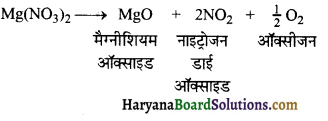
HBSE 11th Class Chemistry Important Questions Chapter 10 s-ब्लॉक तत्त्व Img 5

प्रश्न 107.
क्या होता है जब बिना बुझे चूने को सिलिका के साथ गरम करते हैं ?
उत्तर:
बिना बुझे चूने को सिलिका के साथ गर्म करने पर कैल्सियम सिलिकेट का सफेद मिश्रण प्राप्त होता है।
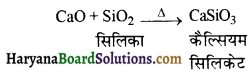
HBSE 11th Class Chemistry Important Questions Chapter 10 s-ब्लॉक तत्त्व Img 6

प्रश्न 108.
क्या होता है जब कैल्सियम नाइट्रेट को गर्म करते हैं ?
उत्तर:
कैल्सियम नाइट्रेट को गर्म करने पर यह CaO, NO2 एवं O2 में टूट जाता है।

HBSE 11th Class Chemistry Important Questions Chapter 10 s-ब्लॉक तत्त्व Img 7

प्रश्न 109.
क्या होता है जब Cl2 की बुझे हुए चूने से क्रिया होती है ?
उत्तर:
CaOCl2 बनता है
\(2 \mathrm{Ca}(\mathrm{OH})_2+2 \mathrm{Cl}_2 \longrightarrow \mathrm{CaCl}_2+\mathrm{CaOCl}_2+2 \mathrm{H}_2 \mathrm{O}\)

प्रश्न 110.
BeCl2 की वाष्प प्रावस्था एवं ठोस प्रावस्था की संरचना बनाएँ।
उत्तर:
BeCl2 की वाष्प अवस्था में संरचना-
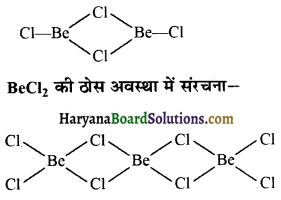
HBSE 11th Class Chemistry Important Questions Chapter 10 s-ब्लॉक तत्त्व Img 8

प्रश्न 111.
पोटैशियम की तुलना में सोडियम अधिक उपयोगी क्यों है ?
उत्तर:
K की प्रकृति वाष्पशील होती है जिसके कारण K पोटैशियम तुलना में कम उपयोगी होता है। मुख्य रूप से Na का उपयोग अपचायक के रूप में, N तथा S के आंकलन में तथा Na का वाष्प लैम्प बनाने में किया जाता है।

प्रश्न 112.
BeO जल में अविलेय है जबकि BeSO4 जल में विलेय है, क्यों ?
उत्तर:
कैडी एवं ऐल्से के नियमानुसार समान को समान विलेय करता है (like dissolves like) चूँकि BeO एक आयनिक यौगिक है अत: यह जल में विलेय यौगिक है।

प्रश्न 113.
क्या होता है जब मैग्नीशियम सल्फेट को गर्म करते हैं ?
उत्तर:
MgSO4 को गर्म करने पर MgO, SO2 तथा O2 बनता है।

HBSE 11th Class Chemistry Important Questions Chapter 10 s-ब्लॉक तत्त्व Img 9

प्रश्न 114.
s – ब्लॉक के तत्व दुर्बल प्रकार के संकुल बनाते हैं।
उत्तर:
s – ब्लॉक के तत्व दुर्बल प्रकार के संकुल बनाते हैं क्योंकि इनके भीतरी कोश में इलेक्ट्रॉन उपस्थित होते हैं अर्थात् आन्तरिक कोश भरे होते हैं जबकि बाहरी कोश में एक अथवा दो ही इलेक्ट्रॉन होते हैं।

प्रश्न 115.
क्या होता है जब CaO की क्रिया H2SO4 से होती है ?
उत्तर:
CaO की क्रिया H2SO4 से होने पर कैल्सियम सल्फेट बनता है।
\(\mathrm{CaO}+\mathrm{H}_2 \mathrm{SO}_4 \longrightarrow \mathrm{CaSO}_4+\mathrm{H}_2 \mathrm{O}\)

प्रश्न 116.
क्षारीय मृदा धातुओं के भौतिक गुण जैसे – घनत्व, गलनांक, क्वथनांक, विशिष्ट ऊष्मा आदि में क्रमिक परिवर्तन नहीं होता है, क्यों ?
उत्तर:
इन तत्वों के भौतिक गुणों में क्रमिक परिवर्तन नहीं होता है। इसका कारण इन तत्वों के ठोस अवस्था में भिन्न-भिन्न धातु जालक का होना है।

प्रश्न 117.
CaCl2 को निर्जलीकारक की भाँति क्यों प्रयोग करते हैं ?
उत्तर:
CaCl2 की जल के साथ प्रबल बन्धुता होती है। इसी के कारण यह निर्जलीकारक की भाँति प्रयुक्त होता है।

प्रश्न 118.
निर्जल कैल्सियम सल्फेट को प्लास्टर ऑफ पेरिस की भाँति प्रयोग क्यों नहीं कर सकते हैं ?
उत्तर:
क्योंकि निर्जल कैल्सियम सल्फेट जल से क्रिया करके जमता नहीं है।

प्रश्न 119.
सीमेन्ट का जमना क्या है ?
उत्तर:
सीमेन्ट में जल मिलाकर छोड़ देने पर कुछ समय पश्चात् एक कठोर पदार्थ बन जाता है इसे ही सीमेन्ट का जमना ( setting) कहते हैं।

प्रश्न 120.
कंक्रीट क्या है ?
उत्तर:
सीमेन्ट, रेत व पत्थर के छोटे टुकड़े (रोड़ी) और पानी के मिश्रण को कंक्रीट कहा जाता है।

प्रश्न 121.
प्रबलित कंक्रीट क्या है ?
उत्तर:
लोहे के सरियों का जाल बनाकर उसमें कंक्रीट भरने से प्रबलित कंक्रीट प्राप्त होती है।

प्रश्न 122.
क्षार धातुओं की अपेक्षा क्षारीय मृदा धातुओं के ऑक्साइडों की क्रियाशीलता कम होती है, क्यों ?
उत्तर:
क्योंकि वायु में रखने पर क्षारीय मृदा धातुओं के ऑक्साइड धीरे-धीरे परॉक्साइड में ऑक्सीकृत होते रहते हैं ।

लघु उत्तरीय प्रश्न:

प्रश्न 1.
विकर्ण सम्बन्ध से आप क्या समझते हैं ? समझाइए ।
उत्तर:
विकर्ण सम्बन्ध (Diagonal Relation ) – आवर्त सारणी मेंs एवं p ब्लॉक का प्रथम तत्व अपने समूह के अन्य तत्वों से गुणों में काफी भिन्नता प्रदर्शित करता है। द्वितीय आवर्त के तत्व अपने वर्ग के तत्वों से तो भिन्नता रखते हैं परन्तु तृतीय आवर्त के तत्वों के गुणों से समानता प्रदर्शित करते हैं। तत्वों के इस गुण को विकर्ण सम्बन्ध कहते हैं।
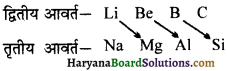
HBSE 11th Class Chemistry Important Questions Chapter 10 s-ब्लॉक तत्त्व Img 10
यह तत्व परस्पर विकर्ण सम्बन्ध प्रदर्शित करते हैं क्योंकि इन तत्वों की परमाणु त्रिज्या एवं विद्युत ऋणता के मान लगभग समान होते हैं।

HBSE 11th Class Chemistry Important Questions Chapter 10 s-ब्लॉक तत्त्व

प्रश्न 2.
Li क्षार धातुओं में प्रबलतम अपचायक है । क्यों ?
उत्तर:
सभी क्षार धातुओं का मानक आयनन विभव अधिक ऋणात्मक होने के कारण इन धातुओं में इलेक्ट्रॉन त्यागने की प्रबलतम प्रवृत्ति होती है। Li का आयनन विभव अन्य सभी क्षार धातुओं की तुलना में सर्वाधिक ऋणात्मक होता है क्योंकि Li+ आयन की हाइड्रेशन ऊर्जा अधिक एवं आयनिक त्रिज्या बहुत कम होती है।
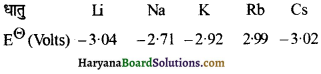
HBSE 11th Class Chemistry Important Questions Chapter 10 s-ब्लॉक तत्त्व Img 11
अतः क्षार धातुओं में Li सबसे प्रबलतम अपचायक है।

प्रश्न 3.
लिथियम धातु के पाँच मुख्य उपयोग लिखिए ।
उत्तर:
लिथियम के उपयोग-

  1. कॉपर, निकिल आदि धातुओं के शुद्धिकरण में अशुद्धि पृथक्कारक के रूप में प्रयोग होता है।
  2. मिश्र धातुओं की तनन क्षमता बढ़ाने के लिए लीथियम का उपयोग होता है।
  3. रॉकेट एवं मिसाइल के नोदन में आवश्यक ताप नाभिकीय ऊर्जा उत्पन्न करने में लीथियम का उपयोग होता है।
  4. इसका समस्थानिक (7Li) प्राथमिक शीतलक के रूप में नाभिकीय रिएक्टर में प्रयोग होता है।
  5. लीथियम के कुछ यौगिक अपचायक के रूप में, वात रोग के उपचार में एवं कीटाणुनाशक के रूप में प्रयुक्त होते हैं।

प्रश्न 4.
लीथियम एवं सोडियम के चार-चार खनिजों के नाम सूत्र सहित लिखें।
उत्तर:
लीथियम के खनिज-

  1. स्पोडुमीन – Li Al Si2 O6
  2. लैपिडोलाइड – K2 Li3 Al4 Si O2
  3. पेटेलाइट – Li Al Si4O11
  4. ट्रिफिलाइट – Li3. Na3. Fe3. Mn3( PO3)4

सोडियम के खनिज-

  1. चिली साल्टपीटर – NaNO3
  2. सब्ज मिट्टी – Na2CO3
  3. बोरेक्स – Na2B4O7. 10H2O
  4. नेट्रान (उत्फुल्ल सोडा ) – Na2CO3. H2O

प्रश्न 5. सोडियम धातु के कोई पाँच उपयोग लिखें।
उत्तर:
सोडियम धातु के उपयोग-

  • सोडियम युक्त यौगिकों के निर्माण में। उदाहरण – Na2O2,NaCN
  • विलायकों (कार्बनिक) के निर्जलीकरण की क्रिया में ।
  • सोडियम निष्कर्ष बनाने में (जो कार्बनिक यौगिकों में तत्वों की पहचान करने के लिए सहायक होता है । )
  • धातुओं के निष्कर्षण (Extraction) में। उदाहरण- बोरॉन, सिलिकॉन, मैग्नीशियम ।
  • घने कोहरे के पार देखने के लिए सोडियम वाष्प लैंप के निर्माण में।

प्रश्न 6.
उन धातुओं के नाम लिखें जो निम्नलिखित यौगिकों (खनिजों) में पायी जाती हैं?
(अ) चिली साल्ट पीटर (Chile Salt petre) (ब) मार्बल (स) एप्सोमाइट (द) बॉक्साइट
उत्तर:
(अ) चिली साल्ट पीटर – Na
(ब) मार्बल – Ca
(स) एप्सोमाइट – Mg
(द) बॉक्साइट – Al

प्रश्न 7.
क्षार धातुओं एवं क्षारीय मृदा धातुओं के चार गुणों की तुलना करें।
उत्तर:

क्षार धातुएँक्षारीय मृदा धातुएँ
1. ये मुलायम धातु होती हैं।1. ये क्षार धातुओं से कठोर होती हैं।
2. ये +1 ऑक्सीकरण संख्या प्रदर्शित करती हैं।2. ये +2 ऑक्सीकरण संख्या प्रदर्शित करती हैं।
3. Li2CO3 को छोड़कर इन धातुओं के कार्बोनेट जल में विलेय होते हैं।3. इनके कार्बोनेट जल में अविलेय हैं।
4. Li को छोड़कर, अन्य धातुएँ जटिल यौगिक नहीं बनाती हैं।4. ये जटिल यौगिक बनाती हैं।

प्रश्न 8.
केवल क्षार धातुओं एवं क्षारीय मृदा धातुओं के ही हाइड्राइड ज्ञात हैं क्यों? इनके दो उदाहरण भी दें।
उत्तर:
कम आयनन विभव होने के कारण क्षार धातुओं एवं क्षारीय मृदा धातुओं में अधिक विद्युत धनात्मक गुण होता है, जिसके कारण ये आयनिक हाइड्राइड बनाती हैं उदाहरण – NaH, CaH2, KH आदि ।

प्रश्न 9.
क्षार धातुओं का अमोनिया में विलयन नीले रंग का दिखाई पड़ता है, क्यों ?
उत्तर:
नीला रंग अमोनियामय इलेक्ट्रॉन की उपस्थिति के कारण दिखाई देता है। यह दृश्य प्रकाश उत्पन्न होने के कारण होता है।
Na + (x + y) NH3 → Na+ (NH3)x + e (NH3)y अमोनियामय इलेक्ट्रॉन

प्रश्न 10.
क्षार धातुओं को उनकी जल के साथ अभिक्रियाशीलता के आधार पर बढ़ते हुये क्रम में व्यवस्थित करें एवं कारण भी बताएँ ?
उत्तर:
Li< Na<K< Rb < Cs < Fr
क्षार धातुओं की अभिक्रियाशीलता उपरोक्त दिये गये क्रम के अनुसार बढ़ती जाती है क्योंकि इनका आकार बढ़ता है, आयनन विभव का मान घटता जाता है जिसके कारण इनकी अभिक्रियाशीलता बढ़ती जाती है।

प्रश्न 11.
निम्न का मिलान करें-

(अ) (आयन)(ब) (ऑक्सीकरण संख्या)
1. परऑक्साइड(i) +1
2. बाइकार्बोनेट(ii) +2
3. अमोनियम(iii) +3
4. फास्फेट(iv) -3
(v) -1
(vi) -2

उत्तर:
1. (iv), 2. (v), 3. (i), 4. (iv)

प्रश्न 12.
निम्न का मिलान करें-

धातुप्राप्त होती है
1. Na(i) एल्बॉइट (Albite)
2. Mg(iii) बॉक्साइट (Bauxite)
3. Ca(iii) टैल्क (Talc)
4. Al(v) सिनेबार (Cinnabar)

उत्तर:
1.(i), 2.(iii), 3(iv), 4.(ii)

प्रश्न 13.
निम्न में किस प्रकार विभेद करेंगे।
(अ) KNO3 एवं LiNO3
(ब) Na2CO3 एवं NaHCO3
उत्तर:
(अ) KNO3 एवं LiNO3 – LiNO3 को गर्म करने पर लाल भूरे रंग की NO2 की घूम्र प्राप्त होती है जबकि KNO3 ‘अपघटित होकर रंगहीन O2 गैस देता है।

\(4 \mathrm{LINO}_3 \longrightarrow 2 \mathrm{Li}_2 \mathrm{O}+4 \mathrm{NO}_2 \uparrow+\mathrm{O}_2\) भूरे रंग की गैस
\(2 \mathrm{KNO}_3 \longrightarrow 2 \mathrm{KNO}_2+\mathrm{O}_2 \uparrow\)

(ब) Na2CO3 एवं NaHCO3 – NaHCO3 को गर्म करने पर CO2 गैस प्राप्त होती है जो चूने के पानी में प्रवाहित करने पर चूने के पानी को दूधिया कर देती है। जबकि Na2CO3 को गर्म करने पर यह अपघटित नहीं होते हैं।
\(2 \mathrm{NaHCO}_3 \longrightarrow \mathrm{Na}_2 \mathrm{CO}_3+\mathrm{CO}_2+\mathrm{H}_2 \mathrm{O}\)

प्रश्न 14.
क्या होता है जब सोडियम सल्फेट के विलयन को बेरियम नाइट्रेट के जलीय विलयन में प्रवाहित करते हैं।
उत्तर:
बेरियम सल्फेट का सफेद अवक्षेप प्राप्त होता है।
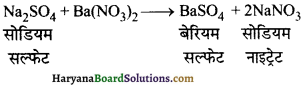
HBSE 11th Class Chemistry Important Questions Chapter 10 s-ब्लॉक तत्त्व Img 12

प्रश्न 15.
क्या होता है जब-
(अ) क्लोरीन गैस को गर्म और सान्द्र NaOH विलयन में प्रवाहित किया जाता है ?
(ब) क्लोरीन गैस को ठण्डे एवं तनु NaOH विलयन में प्रवाहित करते हैं ।
उत्तर:
(अ) सोडियम क्लोरेट बनता है।
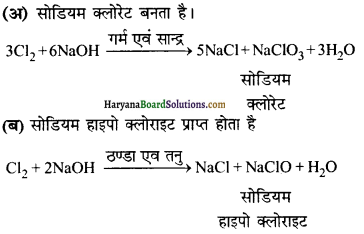
HBSE 11th Class Chemistry Important Questions Chapter 10 s-ब्लॉक तत्त्व Img 13

प्रश्न 16.
क्या होता है जब-
(अ) सोडियम हाइड्रॉक्साइड विलयन टिन क्लोराइड विलयन में मिलाया जाता है।
(ब) जिंक सल्फेट विलयन में सोडियम हाइड्रॉक्साइड विलयन धीरे-धीरे मिलाते हैं।
उत्तर:
(अ) टिन क्लोराइड के विलयन में NaOH मिलाने पर पहले स्टैनस हाइड्रॉक्साइड का सफेद अवक्षेप प्राप्त होता है जो NaOH की अधिकता में धुलकर सोडियम स्टैनाइट बनाता है।
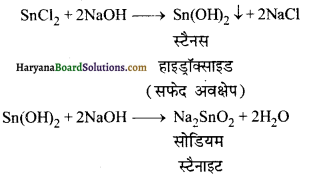
HBSE 11th Class Chemistry Important Questions Chapter 10 s-ब्लॉक तत्त्व Img 14

(ब) जिंक सल्फेट विलयन की NaOH से क्रिया कराने पर पहले जिंक हाइड्रॉक्साइड का सफेद अवक्षेप प्राप्त होता है, जो NaOH की अधिकता में घुलकर सोडियम जिंकेट बनाता है ।
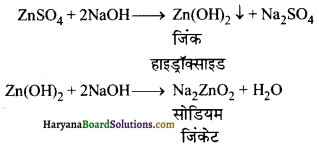
HBSE 11th Class Chemistry Important Questions Chapter 10 s-ब्लॉक तत्त्व Img 15

प्रश्न 17.
क्या होता है जब-
(अ) अमोनियम सल्फेट के विलयन में कॉस्टिक सोडा विलयन मिलाते हैं।
(ब) सल्फर को कॉस्टिक सोडा विलयन के साथ उबालते हैं। (स) पीला फॉस्फोरस NaOH विलयन के साथ क्रिया करता है।

उत्तर:
(अ) अमोनियम सल्फेट के विलयन में कॉस्टिक सोडा विलयन मिलाते हैं तो अमोनिया गैस निकलती है।
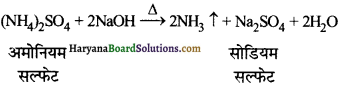
HBSE 11th Class Chemistry Important Questions Chapter 10 s-ब्लॉक तत्त्व Img 16

(ब) सल्फर को कॉस्टिक सोडा विलयन के साथ उबालते हैं तो सोडियम थायोसल्फेट प्राप्त होता है।
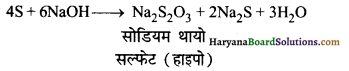
HBSE 11th Class Chemistry Important Questions Chapter 10 s-ब्लॉक तत्त्व Img 17

(स) पीले फॉस्फोरस की NaOH विलयन के साथ क्रिया से फॉस्फीन (PH3) प्राप्त होती है।
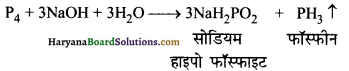
HBSE 11th Class Chemistry Important Questions Chapter 10 s-ब्लॉक तत्त्व Img 18

प्रश्न 18.
क्या होता है जब-
(अ) अमोनियाकृत ब्राइन में CO2 गैस प्रवाहित होती है।
(ब) कास्टिक सोडा CO3 से क्रिया करता है।
(स) गर्म सोडियम हाइड्रॉक्साइड विलयन में एल्यूमीनियम मिलाया जाता है।
उत्तर:
(अ) अमोनियाकृत ब्राइन में CO2 प्रवाहित करने पर सोडियम बाइकार्बोनेट प्राप्त होता है।
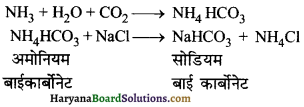
HBSE 11th Class Chemistry Important Questions Chapter 10 s-ब्लॉक तत्त्व Img 19

(ब) कास्टिक सोडा की क्रिया CO2 से कराने पर Na2CO3 प्राप्त होता है।
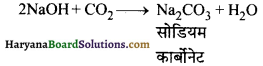
HBSE 11th Class Chemistry Important Questions Chapter 10 s-ब्लॉक तत्त्व Img 20

(स) गर्म सोडियम हाइड्राक्साइड विलयन में एल्यूमीनियम मिलाने पर सोडियम मेटाएल्युमिनेट प्राप्त होता है।
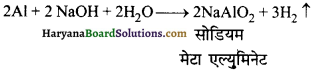
HBSE 11th Class Chemistry Important Questions Chapter 10 s-ब्लॉक तत्त्व Img 21

प्रश्न 19.
निम्न को कैसे प्राप्त करोगे-
(अ) धावन सोडा से खाने का सोडा ।
(ब) सोडियम क्लोराइड से क्लोरीन ।
(स) ऐल्युमिनियम क्लोराइड से सोडियम मेटा ऐल्युमिनेट ।
उत्तर:
(अ) धावन सोडा से खाने का सोडा – जब धावन सोडा के विलयन में CO2 गैस प्रवाहित की जाती है तो खाने का सोडा बनता है।
\(\mathrm{Na}_2 \mathrm{CO}_3+\mathrm{CO}_2+\mathrm{H}_2 \mathrm{O} \longrightarrow 2 \mathrm{NaHCO}_3 \downarrow\) खाने का सोडा

(ब) सोडियम क्लोराइड से क्लोरीन – सोडियम क्लोराइड से क्लोरीन बनाने के लिये गलित NaCl का विद्युत अपघटन करते हैं।
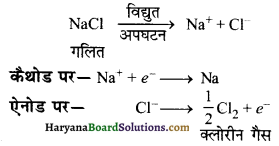
HBSE 11th Class Chemistry Important Questions Chapter 10 s-ब्लॉक तत्त्व Img 22

(स) ऐलुमिनियम क्लोराइड से सोडियम मेटा ऐलुमिनेट – सर्वप्रथम AlCl3 की क्रिया NaOH से कराते हैं तो Al(OH)3 अवक्षेपित होता है। फिर इसमें NaOH अधिकता में डालते है तो सोडियम मेटा ऐल्युमिनेट बनता है।
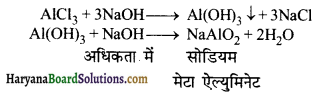
HBSE 11th Class Chemistry Important Questions Chapter 10 s-ब्लॉक तत्त्व Img 23

प्रश्न 20.
बेरिलियम तथा ऐलुमिनियम में विकर्ण सम्बन्ध की व्याख्या करे ।
उत्तर:

  1. ऐलुमीनियम के समान बेरिलियम शीघ्रता से अम्लों से प्रभावित नहीं होता है, क्योंकि धातु की सतह पर ऑक्साइड की फिल्म उपस्थित होती है। अतः ये H2 को मुक्त नहीं करते हैं।
  2. दोनों ही H2O से अभिक्रिया नहीं करते हैं।
  3. दोनों के क्लोराइड सहसंयोजी होते हैं तथा कार्बनिक विलायकों में घुलनशील होते हैं तथा दोनों वाष्पीय अवस्था में द्विलक के रूप में रहते हैं।

    HBSE 11th Class Chemistry Important Questions Chapter 10 s-ब्लॉक तत्त्व Img 24
  4. दोनों ही लुइस अम्ल की तरह कार्य करते हैं अर्थात् दोनों ही e युग्म को ग्रहण कर सकते हैं। इनका उपयोग फ्रीडेल-क्राफ्ट के उत्प्रेरक (Friedel Carft Catalyst) के रूप में होता है।
  5. क्षार की अधिकता में बेरीलियम हाइड्रॉक्साइड घुल जाता है और बेरिलेट (Bcryllate) आयन [Be(OH4)]2 देता है। ठीक इसी प्रकार ऐलुमीनियम हाइड्रॉक्साइड ऐलुमिनेट (Aluminate) आयन [Al(OH)4] देता है।
  6. बेरीलियम एवं ऐलुमीनियम आयन जटिल यौगिक (Complexes) बनाने की प्रबल प्रवृत्ति रखते हैं। जैसे- BeF22-, AlF63- |

HBSE 11th Class Chemistry Important Questions Chapter 10 s-ब्लॉक तत्त्व

प्रश्न 21.
क्षार धातुओं में लीथियम के असंगत व्यवहार की विवेचना कीजिए |
उत्तर:
लीथियम का व्यवहार अपने समूह के अन्य तत्वों से भिन्न होता है। निम्नलिखित कारणों से लीथियम असंगत या असामान्य व्यवहार पदर्शान करता है।

  • इनके परमाणु एवं आयन (Li+) का असाभान्य छोटा आकार
  • उच्च ध्रुवण क्षमता (अर्थात् आवेश/त्रिज्या अनुपात)
  • अधिक आयनन ऊर्जा एवं इलेक्ट्रॉन ऋणात्मकता
  • d-कक्षकों का न होना।
  • अधिक जलयोजन ऊर्जा।

लीथियम एवं अन्य क्षार धातुओं में असमानताओं के मुख्य बिन्दु:
लीथियम एवं अन्य क्षार धातुओं में असमानताओं के मुख्य बिन्दु निम्न हैं-

1. लीथियम अत्यधिक कठोर होता है जबकि अन्य मुलायम।

2. इसका गलनांक एवं क्वथनांक अन्य की अपेक्षा अधिक होता है।

3. लीथियम नाइट्रेट गरम करने पर लीथियम ऑक्साइड (Li2O) देता है जबकि अन्य क्षार धातुओं के नाइट्रेट विघटित होकर नाइट्राइट बनाते हैं।
\(4 \mathrm{LiNO}_3 \longrightarrow 2 \mathrm{Li}_2 \mathrm{O}+4 \mathrm{NO}_2+\mathrm{O}_2\)
\(2 \mathrm{NaNO}_3 \longrightarrow 2 \mathrm{NaNO}_2+\mathrm{O}_2\)

4. अन्य क्षार धातुओं के फ्लुओराइड एवं ऑक्साइड की तुलृना में LiF एवं Li2O जल में कम विलेय है।

5. लीथियम ऐसिटिलीन से अभिक्रिया करके एसिटि-लाइट नहीं बनाता है जबकि अन्य क्षार धातुएँ ऐसा करती हैं।
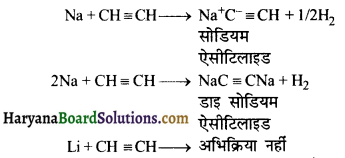
HBSE 11th Class Chemistry Important Questions Chapter 10 s-ब्लॉक तत्त्व Img 25

6. लीथियम हाइड्रोजन कार्बोनेट ठोस अवस्था में प्राप्य नहीं है। जबकि अन्य क्षाः धातु ठोस हाइड्रोजन कार्बोनेट बनाते हैं।

7. LiCl प्रस्वेद्य (Deliquescent) है एवं हाइड्रेट, LiCl.2H2O के रूप में क्रिस्टलित होता है जबकि अन्य धातुएँ हाइड्रेटड क्लोराइड नही। बनाते हैं।

8. लीथियम हवा के साथ दहन करने पर मोनोऑक्साइड (Li2O) बनाता है तथा यह नाइट्रोजन के साथ अभिक्रिया करके नाइट्राइड Li3N भी बनाता है जब्रकि अन्य नहीं बनाते।
\(6 \mathrm{Li}+\mathrm{N}_2 \longrightarrow 2 \mathrm{Li}_3 \mathrm{~N}\)
\(6 \mathrm{Na}+\mathrm{N}_2 \longrightarrow\) अभिक्रिया नहीं

9. लीथियम कार्बोनेट को गर्म करने पर Li2O तथा CO2 प्राप्त होती है जबकि अन्य क्षार धातुओं के कार्बोनेट विघटित नहीं होते हैं।
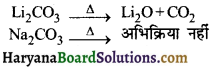
HBSE 11th Class Chemistry Important Questions Chapter 10 s-ब्लॉक तत्त्व Img 26

10. लीथियम कार्बन के साथ कार्बाइड बनाता है जबकि अन्य नह
\(4 \mathrm{Li}+\mathrm{C} \longrightarrow \mathrm{Li}_4 \mathrm{C}\) (लीथियम कार्बाइड)

11. लीथियम ब्रोमीन से बहुत धीरे-धीरे अभिक्रिया करके ब्रोमाइ वनाता है जबकि अन्य क्षार धातुएँ ब्रोमीन से तीव्रता के साथ अभिक्रि करती हैं।

12. लीथियम आयन कार्ब लीथियम यौगिक (organo-lithium compounds) बनाता है, जबकि अन्य नहीं।

13. Li2SO4 द्विक-लवण (double salt) नहीं बनाता जबकि अन्य श्षार धातुएँ द्विक-लवण बनाती हैं।

14. लीथियम अमोनिया के साथ लीथियम इमाइड (imide) Li2NH बनाता है जबकि अन्य क्षार धातुएँ एमाइड (amide) बनाती हैं।

प्रश्न 22.
कॉस्टनर कैलनर सेल विधि से कॉस्टिक सोडा कैसे प्राप्त करेंगें ?
उत्तर:

  1. यह एक सफेद क्रिस्टलीय ठोस है, जो कि 591 K ताप पर गलता है।
  2. NaOH के क्रिस्टल प्रस्वेद्य (deliquescent) होते हैं।
  3. वायुमण्डल में दीर्घकाल तक खुला छोड़ने पर विलयन की सतह पर Na2CO3 की एक सफेद पपड़ी बन जाती है क्योंकि NaOH वायुमण्डल से CO2 को अवशोषित कर लेता है।
    \(2 \mathrm{NaOH}+\mathrm{CO}_2 \longrightarrow \mathrm{Na}_2 \mathrm{CO}_3+\mathrm{H}_2 \mathrm{O}\)
  4. इसके जलीय विलयन में साबुन जैसा स्पर्श होता है तथा इसका स्वाद कड़वा होता है।
  5. NaOH प्रबल क्षार की तरह कार्य करता है, यह HCl से क्रिया करके उसे उदासीन कर देता है।
    \(\mathrm{NaOH}+\mathrm{HCl} \longrightarrow \mathrm{NaCl}+\mathrm{H}_2 \mathrm{O}\)

प्रश्न 23.
सॉल्वे प्रक्रम द्वारा सोडियम कार्बोनेट का निर्माण किया जाता है, किन्तु पोटैशियम कार्बोनेट का निर्माण नहीं किया जाता, क्यों ? समझाइए ।
उत्तर:
सॉल्वे प्रक्रम से Na2CO3 बनाने में प्राप्त माध्यमिक उत्पाद NaHCO3 अल्प विलेय होने के कारण अवक्षेपित हो जाता है। इसे अलग करके व सुखाकर निस्तापन (calcination) करके Na2CO3 प्राप्त कर लिया जाता है।

HBSE 11th Class Chemistry Important Questions Chapter 10 s-ब्लॉक तत्त्व Img 27
इसके विपरीत पोटैशियम बाइकार्बोनेट (KHCO3) अति विलेय होने के कारण अलग नहीं किया जा सकता है। अतः प्रक्रम से Na2CO3 का निर्माण सम्भव है, परन्तु K2CO3 का निर्माण सम्भव नहीं है।

प्रश्न 24.
सोडियम कार्बोनेट के विभिन्न रूप क्या हैं? इन पर ताप का प्रभाव बताइए ।
उत्तर:
सोडियम कार्बोनेट निम्नलिखित चार प्रकार का होता है-

  1. निर्जल Na2CO3, जिसको सोडा ऐश कहते हैं ।
  2. सोडियम कार्बोनेट मोनोहाइड्रेट (Na2CO3. H2O)
  3. सोडियम कार्बोनेट हेप्टाइड्रेट (NaCO3. 7H2O)
  4. सोडियम कार्बोनेट डेकाहाइड्रेट (Na2CO3. 10H2O) इसे धावन सोडा भी कहते हैं।

इस पर ताप का प्रभाव निम्नांकित प्रकार से है-
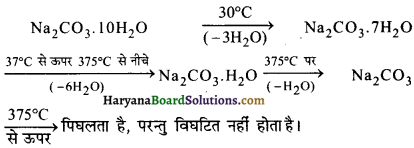
HBSE 11th Class Chemistry Important Questions Chapter 10 s-ब्लॉक तत्त्व Img 28

प्रश्न 25.
प्लास्टर ऑफ पेरिस के जमने की रासायनिक अभिक्रिया का समीकरण दीजिए ।
उत्तर:
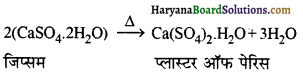
प्लास्टर ऑफ पेरिस जमकर कड़ा छिद्रयुक्त ठोस बन जाता । इसे प्लास्टर ऑफ पेरिस का जमना कहते हैं। वस्तुत: यह अभिक्रिया प्लास्टर ऑफ पेरिस का जिप्सम से परिवर्तन है ।
(CaSO4)2.H2O + 3H2O2→2(CaSO4.2H2O) जिप्सम

प्रश्न 26.
सीमेन्ट के निर्माण में प्रयुक्त किए जाने वाले कच्चे पदार्थों के नाम लिखिए।
उत्तर:
सीमेन्ट निर्माण में प्रयुक्त कच्चे एर्थ निम्नलिखित हैं-

  1. कैल्सियम युक्त पदार्थ – चूने का पत्थर, चॉक, संगमरमर आदि ।
  2. मृण्मय पदार्थ – मिट्टी, स्लेट, सिलिका, ऐलुमिना, आयरन ऑक्साइड आदि ।
  3. 2% – 3% जिप्सम ।

प्रश्न 27.
क्लिंकर ( Clinker) क्या है ? इससे सीमेन्ट कैसे बनाया जाता है ?
अथवा
क्लिंकर पर टिप्पणी लिखिए ।
उत्तर:
सीमेन्ट के कच्चे पदार्थों से बने मिश्रण को सीमेन्ट की भट्टी में डालकर गर्म करने के बाद छोटी-छोटी गोलियों के रूप में प्राप्त पदार्थ को क्लिंकर कहते हैं । क्लिंकर, डाइकैल्सियम सिलिकेट, ट्राइकैल्सियम सिलिकेट, टाइकैल्सियम ऐलुमिनेट तथा टेट्राकैल्सियम ऐलुमिनोफेराइट का मिश्रण है। क्लिंकर में 2-3% जिप्सम मिलाकर इसको पीसकर प्रयोग करने – योग्य सीमेण्ट प्राप्त किया जाता है जिसको पोर्टलैण्ड सीमेण्ट कहते हैं।

प्रश्न 28.
सीमेन्ट के प्रयोग में बालू का क्या उपयोग होता है?
उत्तर:
सीमेण्ट जल या नमी के प्रति अति सुग्राही है। नमी के कारण इसमें आन्तरिक प्रतिबल उत्पन्न हो जाता है जिससे इसमें दरार पड़ जाती है और इसकी क्षमता कम हो जाती है। बालू मिलाने से सीमेन्ट में आन्तरिक प्रतिबल उत्पन्न नहीं होता जिससे सीमेन्ट में दरार नहीं पड़ती हैं।

प्रश्न 29.
गोर्टार, गारा, कंक्रीट व प्रबलित कंक्रीट से क्या तात्पर्य है?
अथवा
कंक्रीट और प्रबलित कंक्रीट क्या है?
उत्तर:
(अ) मोर्टार (Mortar) – मोर्टार बुझे चूने [Ca(OH)2], बालू (SiO2) तथा जल के मिश्रण की एक लेई (paste) है। वायु में खुला रहने पर इस लेई से जल उड़ जाता है और वायु से CO2 गैस अवशोषित करके कैल्सियम कार्बोनेट बनने के कारण वह कठोर हो जाता है ।

(ब) गारा ( Slurry) – पिसे हुए चूने के पत्थर तथा घुले मृत्तिका के टुकड़ों के गाढ़े जलीय मिश्रण को गारा कहते हैं। इसको सीमेण्ट की भट्टी में डालकर क्लिंकर तैयार करते हैं।

(स) कंक्रीट (Concrete ) – कंकड़, पत्थर या ईंट के टूटे टुकड़ों के साथ सीमेण्ट तथा बालू को जल में मिलाकर तैयार किए मिश्रण को कंक्रीट कहते हैं। इसके जमने से ठोस संरचना प्राप्त होती है।

(द) प्रबलित कंक्रीट (Reinforced concrete ) – पत्थर के छोटे-छोटे टुकड़ों, सीमेन्ट तथा बालू के जल में बने सीमेण्ट कंक्रीट मिश्रण को तार की जाली या लोहे की छड़ों के बीच चारों ओर भरकर कठोर तथा मजबूत संरचना हेतु जमाया जाता है, उसे प्रबलित कंक्रीट कहते हैं ।

HBSE 11th Class Chemistry Important Questions Chapter 10 s-ब्लॉक तत्त्व

प्रश्न 30.
सीमेन्ट के जमने का कारण बताइए या सीमेन्ट किस प्रकार कठोर हो जाता है?
अथवा
सीमेन्ट के जमने प्पणी लिखिए।
उत्तर:
सीमेन्ट में जल मिलाकर छोड़ देने पर कुछ समय बाद यह कठोर पदार्थ बन जाता है। इसे सीमेन्ट का जमना ( setting) कहते हैं । जब सीमेन्ट जमता है तो निम्नलिखित अभिक्रियाएँ होती हैं-

(अ) जलयोजन (Hydration) – डाइ व ट्राइकैल्सियम सिलिकेट तथा ट्राइकैल्सियम ऐलुमिनेट का जलयोजन होकर उनके कोलॉइडी (colloidal) जेल बन जाते हैं।
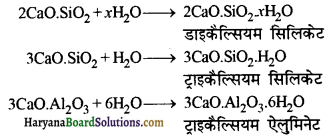
HBSE 11th Class Chemistry Important Questions Chapter 10 s-ब्लॉक तत्त्व Img 31

(ब) जल अपघटन (Hydrolysis ) — ट्राइकैल्सियम सिलिकेट और ट्राइकैल्सियम ऐलुमिनेट का जल अपघटन होकर कैल्सियम और ऐलुमिनियम हाइड्रॉक्साइड बनते हैं।
\(3 \mathrm{CaO} \cdot \mathrm{Al}_2 \mathrm{O}_3+6 \mathrm{H}_2 \mathrm{O} \longrightarrow 3 \mathrm{Ca}(\mathrm{OH})_2+2 \mathrm{Al}(\mathrm{OH})_3\) इस प्रकार ट्राइकैल्सियम सिलिकेट का आंशिक जल – अपघटन होता है।

(स) ट्राइकैल्सियम ऐलुमिनेट शीघ्र जमने वाला पदार्थ है । जिप्सम की उपस्थिति में इसके जमने की दर धीमी हो जाती है। जिप्सम के साथ निम्नलिखित अभिक्रिया होती है और कैल्सियम सल्फोऐलुमिनेट बनता है-
\(3 \mathrm{CaO} \cdot \mathrm{Al}_2 \mathrm{O}_3+3 \mathrm{CaSO}_4+2 \mathrm{H}_2 \mathrm{O} \longrightarrow 3 \mathrm{CaOAl}_2 \mathrm{O}_3 \cdot 3 \mathrm{CaSO}_4 \cdot 2 \mathrm{H}_2 \mathrm{O}\)
अतः जिप्सम का कार्य सीमेन्ट के जमने की दर कम करना है। इससे सीमेण्ट कठोर हो जाता है।

प्रश्न 31.
सीमेन्ट क्या है? इसके मुख्य अवयव क्या हैं?
अथवा
सीमेन्ट के निर्माण में प्रयुक्त होने वाले पदार्थों के नाम लिखिए।
उत्तर:
सीमेन्ट (Cement ) — डाइकैल्सियम सिलिकेट (2CaO.SiO2), ट्राइकैल्सियम सिलिकेट (3CaO.SiO2), ट्राइ – कैल्सियम ऐलुमिनेट (3CaO.Al2O3) तथा जिप्सम (CaSO4.2H2O) की उचित मात्रा पर प्राप्त मिश्रण सीमेन्ट कहलाता है। इसके मुख्य अवयव हैं – चूना (CaO), सिलिका (SiO2), ऐलुमिना (Al2O3), आयरन ऑक्साइड (Fe2O3), मैग्नीशियम ऑक्साइड (MgO) और सल्फर ट्राइ-ऑक्साइड (SO3)।

प्रश्न 32.
सीमेन्ट क्लिंकर के मुख्य अवयव क्या हैं? इसमें जिप्सम क्यों मिलाया जाता है?
उत्तर:
सीमेन्ट क्लिंकर के मुख्य अवयव निम्नलिखित हैं-

  • डाइकैल्सियम सिलिकेट (2CaO.SiO2)
  • ट्राइकैल्सियम सिलिकेट (3CaO.SiO2)
  • ट्राइकैल्सियम ऐलुमिनेट (3CaO.Al2O3)
  • टेट्राकैल्सियम ऐलुमिनोफेराइट (4CaO.Al2O3.Fe2O3)

सीमेन्ट क्लिंकर जल के प्रति अति सुग्राही होता है तथा नमी और जल के सम्पर्क में आकर जम जाता है। इसकी जमने की क्षमता को शिथिल करने के लिए मन्दक पदार्थ मिलाए जाते हैं। जिप्सम एक मन्दक पदार्थ है। इसके मिलाने से सीमेन्ट क्लिंकर के जमने की क्षमता मन्द हो जाती है और अधिक जल के सम्पर्क में आने पर ही यह जमता है।

प्रश्न 33.
चूने के पत्थर के औद्योगिक उपयोग बताइए ।
उत्तर:

  1. सीमेन्ट के निर्माण में ।
  2. बिना बुझा तथा बुझा चूना बनाने में ।
  3. धातुकर्म में गालक के रूप में।
  4. संगमरमर के रूप में भवन निर्माण में ।
  5. खड़िया के रूप में पेण्ट, डिस्टैम्पर, टूथ पेस्ट, सौन्दर्य प्रसाधन सामग्री बनाने में।
  6. औषधियों के निर्माण में, ग्राइप वाटर के रूप में।

प्रश्न 34.
प्लास्टर ऑफ पेरिस से क्या समझते हो ? इसके बनाने की विधि, एक गुण व उपयोग दीजिए ।
उत्तर:
कैल्सियम सल्फेट हेमी हाइड्रेट को प्लास्टर ऑफ पेरिस कहते हैं। इसका सूत्र (CaSO4)2.H2O या CaSO4 + \(\frac { 1 }{ 2 }\)H2O है। जिप्सम को 390K पर गर्म करने पर प्लास्टर ऑफ पेरिस प्राप्त होता है।
\(2 \mathrm{CaSO}_4 \cdot 2 \mathrm{H}_2 \mathrm{O} \longrightarrow\left(\mathrm{CaSO}_4\right)_2 \cdot \mathrm{H}_2 \mathrm{O}+3 \mathrm{H}_2 \mathrm{O}\)
यह एक सफेद चूर्ण है। जल के साथ कठोर हो जाता है।
\(\left(\mathrm{CaSO}_4\right)_2 \cdot \mathrm{H}_2 \mathrm{O}+3 \mathrm{H}_2 \mathrm{O} \longrightarrow 2 \mathrm{CaSO}_4 \cdot 2 \mathrm{H}_2 \mathrm{O}\)
इसका उपयोग प्लास्टर चढ़ाने तथा मूर्तियाँ, खिलौने आदि बनाने के काम किया जाता है।

प्रश्न 35.
कैल्सियम हाइड्रॉक्साइड कैसे प्राप्त किया जाता है ? इसकी CO2, Cl2 से क्या अभिक्रिया होती है ? इसके दो उपयोग दीजिए ।
उत्तर:
बनाने की विधि – CaO की जल से अभिक्रिया होने पर कैल्सियम हाइड्रॉक्साइड बनता है।
CaO + H2O → Ca(OH)2 + 67 KJ/Mole

CO2 से अभिक्रिया – चूने के पानी में CO2 गैस प्रवाहित करने पर कैल्सियम कार्बोनेट बनता है जिससे विलयन दूधिया हो जाता है। अधिक CO2 प्रवाहित करने पर विलयशील कैल्सियम बाइकार्बोनेट बनता है जिससे दूधियापन समाप्त हो जाता है।
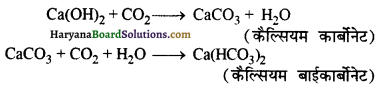
HBSE 11th Class Chemistry Important Questions Chapter 10 s-ब्लॉक तत्त्व Img 32

क्लोरीन से क्रिया- (i) शुष्क बुझे चूने पर C करने पर विरंजक चूण जातो
Ca(OH)2 + Cl2 → HOCl2 + H2O

(ii) ठण्डे चूने के पानी में Cl2 प्रवे करने पर कैल्सियम हाइपोक्लोराइड तथा कैल्सियम क्लोराइड बन्ना
2Ca(OH)2 + 2Cl2 → Ca(OC)2 + 2H2 + CaCl2

(iii) गर्म चूने के पानी में Cl2 प्रवाहित करने पर `ल्सियम क्लोरेट तथा कैल्सियम क्लोराइड बनता है।
6Ca(OH)2 + 6Cl2 → Ca(ClO3)2 + 5CaCl2 +6H2O
उपयोग- (1) विरंजक चूर्ण बनाने में ।
(2) सोडियम कार्बोनेट के निर्माण में ।

प्रश्न 36.
निम्न को कैसे बनाओगे- (अ) प्लास्टर ऑफ पेरिस से जिप्सम (ब) जिप्सम से प्लास्टर ऑफ पेरिस
उत्तर:
(अ) प्लास्टर ऑफ पेरिस से जिप्सम

HBSE 11th Class Chemistry Important Questions Chapter 10 s-ब्लॉक तत्त्व Img 33

(ब) जिप्सम से प्लास्टर ऑफ पेरिस
HBSE 11th Class Chemistry Important Questions Chapter 10 s-ब्लॉक तत्त्व Img 34

(अ) जिप्सम को 200°C तक गरम करते हैं ।
उत्तर:
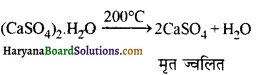
HBSE 11th Class Chemistry Important Questions Chapter 10 s-ब्लॉक तत्त्व Img 35

(ब) कार्बन डाई ऑक्साइड गैस को चूने के पानी में प्रवाहित करते हैं।
उत्तर:
Ca(OH)2 + CO2 → CaCO3 + H2O

(स) प्लास्टर ऑफ पेरिस की क्रिया जल से होती है।
उत्तर:
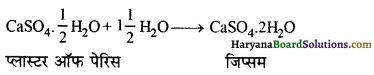
HBSE 11th Class Chemistry Important Questions Chapter 10 s-ब्लॉक तत्त्व Img 36

विस्तृत उत्तरीय प्रश्न:

प्रश्न 1.
एक अकार्बनिक यौगिक (X) जलाने पर सुनहरी पीली ज्वाला देता है और निम्न अभिक्रियाएँ प्रदर्शित करता है।
(i) जिंक पाउडर, यौगिक (X) के सान्द्र जलीय घोल के साथ उबालने पर घुल जाता है और हाइड्रोजन निकलती है।
(ii) X के जलीय घोल को स्टैनस क्लोराइड के जलीय घोल में मिलाने पर पहले एक सफेद अवक्षेप प्राप्त होता है, जो (X) के विलयन की अधिकता में घुल जाता है। (X) को पहचानिए तथा (i) और (ii) पदों पर होने वाली अभिक्रियाओं के समीकरण दीजिए।
उत्तर:
X = सोडियम हाइड्रॉक्साइड
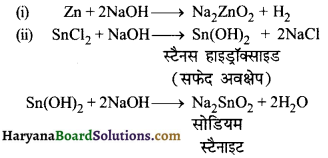
HBSE 11th Class Chemistry Important Questions Chapter 10 s-ब्लॉक तत्त्व Img 29

2. (i) सोडियम सल्फाइट तथा सोडियम सल्फाइड के एक सान्द्र विलयन में गैस (B) प्रवाहित करने पर अकार्बनिक यौगिक (A) बनता है।
(ii) (A) को तनु AgNO3 के विलयन में डालने पर सफेद अवक्षेप प्राप्त होता है जो शीघ्र ही काले रंग के यौगिक (C) में बदल जाता है।
(iii) FeCl3 की 2 या 3 बूँदें (A) के विलयन की अधिकता में डालने पर एक बैंगनी रंग का यौगिक (D) बनता है। यह रंग शीघ्र ही गायब हो जाता है।
(iv) A के विलयन को CuCl2 के विलयन में डालने पर पहले एक सफेद अवक्षेप बनता है जोकि (A) की अधिकता में घुलकर यौगिक (E) बनाता है। (A) से (E) तक को पहचानिए तथा (i) से (iv) पदों पर होने वाली अभिक्रियाओं के रासायनिक समीकरण दीजिए।
उत्तर:
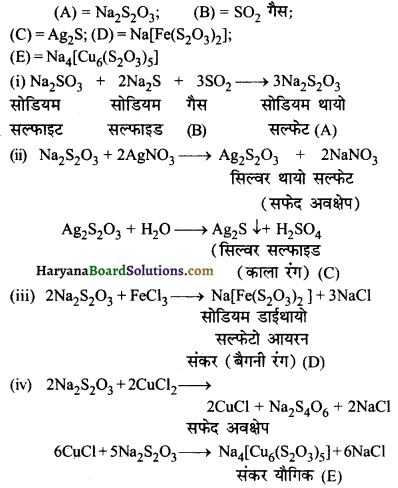
HBSE 11th Class Chemistry Important Questions Chapter 10 s-ब्लॉक तत्त्व Img 30

Read More:

LUPIN Pivot Point Calculator

HBSE 11th Class Chemistry Important Questions Chapter 10 s-ब्लॉक तत्त्व Read More »

HBSE 11th Class Physics Important Questions Chapter 3 सरल रेखा में गति

Haryana State Board HBSE 11th Class Physics Important Questions Chapter 3 सरल रेखा में गति Important Questions and Answers.

Haryana Board 11th Class Physics Important Questions Chapter 3 सरल रेखा में गति

बहुविकल्पीय प्रश्न:

प्रश्न 1.
एक गेंद को ऊर्ध्वाधर ऊपर की ओर 19.6 मी/सेकण्ड के वेग से फेंका जाता है। गेंद अधिकतम ऊँचाई तक कितने सेकण्ड में पहुँचेगी?
(a) 1
(b) 2
(c) 3
(d) 4
उत्तर:
(b) 2

HBSE 11th Class Physics Important Questions Chapter 3 सरल रेखा में गति

प्रश्न 2.
एक कण का वेग \(\vec{v}=k(y \hat{i}+x \hat{j})\) से गतिशील है, जहाँ k एक स्थिरांक है। इसके पथ का व्यापक समीकरण है:
(a) y = x2 + स्थिरांक
(b) y2 = x + स्थिरांक
(c) xy = स्थिरांक
(d) y2 = x2+ स्थिरांक
उत्तर:
(d) y2 = x2+ स्थिरांक

प्रश्न 3.
मन्दित गति के लिए वेग समय ग्राफ का ढाल है:
(a) धनात्मक
(b) ऋणात्मक
(c) शून्य
(d) धनात्मक, ऋणात्मक, शून्य या कुछ भी।
उत्तर:
(b) ऋणात्मक

प्रश्न 4.
एक ट्रक एवं एक कार दोनों समान वेग से चल रहे हैं। ब्रेक लगाने के बाद।
(a) ट्रक कम दूरी तय करेगा
(b) कार कम दूरी तय करेगी
(c) दोनों समान दूरी तय करेंगे
(d) उपर्युक्त में से कोई नहीं
उत्तर:
(b) कार कम दूरी तय करेगी

प्रश्न 5.
किसी वस्तु का विस्थापन समय के वर्ग के अनुक्रमानुपाती होता है तो वस्तु की गति होती है।
(a) एकसमान त्वरण से
(b) असमान त्वरण से
(c) एकसमान वेग से
(d) असमान त्वरण परन्तु एकसमान चाल से।
उत्तर:
(a) एकसमान त्वरण से

प्रश्न 6.
स्वतन्त्रतापूर्वक गिर रही एक वस्तु द्वारा अपने प्रथम तथा द्वितीय सेकण्ड में पार की गयी दूरियों में अनुपात है।
(a) 1 : 2
(b) 1 : 3
(c) 3 : 2
(d) 1 : √3
उत्तर:
(b) 1 : 3

प्रश्न 7.
यदि दो राशियों के परस्पर ग्राफ सरल रेखा में हों, तो दोनों राशियाँ।
(a) अचर होती हैं
(b) बराबर होती हैं।
(c) अनुक्रमानुपाती होती हैं।
(d) व्युत्क्रमानुपाती होती हैं।
उत्तर:
(c) अनुक्रमानुपाती होती हैं।

प्रश्न 8.
1.0m त्रिज्या के अर्द्धवृत्त में गतिमान एक कण 1 सेकण्ड में बिन्दु A से बिन्दु B तक जाता है, औसत वेग का परिमाण है:

(a) 3.14m/s
(b) 2.0m/s
(c) 1.0m/s
(d) शून्य
उत्तर:
(b) 2.0m/s

HBSE 11th Class Physics Important Questions Chapter 3 सरल रेखा में गति

प्रश्न 9.
x अक्ष के अनुदिश एक कण की स्थिति x समय t के पदों में दी जाती है, x = at2 – t3 जिसमें ‘x’ में तथा सेकण्ड में है। जब कण की चाल अधिकतम है तो कण की स्थिति (x) होगी:
(a) \(\frac{2 a^3}{27}\)मी
(b) \(\frac{4 a^3}{27}\)मी
(c) \(\frac{2 a}{27}\)मी
(d) \(\frac{4 a}{27}\)मी
उत्तर:
(c) \(\frac{2 a}{27}\)मी

प्रश्न 10.
एक पिण्ड विरामावस्था से चलना प्रारम्भ करके ऋजुरेखीय पथ पर अचर त्वरण से गति करता है। वेग का विस्थापन के साथ परिवर्तन होगा:

उत्तर:

प्रश्न 11.
दो पिण्ड जिनके द्रव्यमान तथा m1 m2 हैं, क्रमश: h1 तथा h2 ऊँचाई से गिरते हैं। पिण्डों द्वारा धरातल से टकराने में लगे समय का अनुपात है:
(a) h1 : h2
(b) \(\sqrt{h_1}: \sqrt{h_2}\)
(c) m2 h1 : m2h2
(d) \(\sqrt{m_1 h_1}: \sqrt{m_2 h_2}\)
उत्तर:
(b) \(\sqrt{h_1}: \sqrt{h_2}\)

प्रश्न 12.
एक पिण्ड का विस्थापन समय के अनुक्रमानुपाती है। पिण्ड के त्वरण का परिमाण:
(a) समय के साथ बढ़ रहा है
(b) समय के साथ घट रहा है
(c) शून्य
(d) अचर है, लेकिन शून्य नहीं है
उत्तर:
(a) समय के साथ बढ़ रहा है

अति लघु उत्तरीय प्रश्न:

प्रश्न 1.
बिन्दु वस्तु क्या हैं?
उत्तर:
यदि गतिशील वस्तु द्वारा तय की गयी दूरी वस्तु के आकार की तुलना में बहुत अधिक हो तो उसे बिन्दु वस्तु कहते हैं।

प्रश्न 2.
कणों के गतिकीय व्यवहार से सम्बन्धित अध्ययन की भौतिकी की शाखा क्या कहलाती है?
उत्तर:
गतिकी।

प्रश्न 3.
एक विमीय, द्विविमीय एवं त्रिविमीय गति में कितने-कितने निर्देशांक होते हैं?
उत्तर:
एक विमीय गति में 1 निर्देशांक द्विविमीय गति में 2 निर्देशांक तथा त्रिविमीय गति में 3 निर्देशांक होते हैं।

प्रश्न 4.
जब कोई कण या कणों का निकाय किसी निश्चित अक्ष के परितः घूर्णन करे तो वह कौन सी गति कहलाती है?
उत्तर:
घूर्णन गति।

प्रश्न 5.
वृत्ताकार गति में एक चक्र में विस्थापन कितना होता है?
उत्तर:
वृत्तीय गति में एक चक्र पूरा करने पर प्रारम्भिक एवं अंतिम स्थितियाँ समान हो जाती है, अतः विस्थापन शून्य हो जाता है।

प्रश्न 6.
चाल का सूत्र लिखिए।
उत्तर:
चाल =

प्रश्न 7.
वाहनों का स्पीडोमीटर क्या नापता है?
उत्तर:
तात्क्षणिक चाल।

HBSE 11th Class Physics Important Questions Chapter 3 सरल रेखा में गति

प्रश्न 8.
चाल कैसी राशि है? S.I. प्रणाली में चाल का मात्रक क्या है?
उत्तर:
चाल अदिश राशि है एवं इसका S. I. प्रणाली में मात्रक मीटर / सेकण्ड (ms-1) है।

प्रश्न 9.
वर्षा की बूँदें एक समान वेग से गिरती है या समान त्वरण से?
उत्तर:
वर्षा की बूँदें एकसमान वेग से गिरती हैं।

प्रश्न 10.
मन्दन किसे कहते हैं?
उत्तर:
समय के साथ वेग घटने की दर को मन्दन कहते हैं अर्थात् ऋणात्मक त्वरण ही मन्दन होता है।

प्रश्न 11.
क्या गतिशील वस्तु की दूरी व विस्थापन शून्य हो सकता है?
उत्तर:
गतिशील वस्तु का विस्थापन शून्य हो सकता है दूरी नहीं।

प्रश्न 12.
संलग्न चित्र (a) व (b) में प्रदर्शित वक्रों द्वारा वस्तु के वेग व त्वरण के बारे में क्या निष्कर्ष निकलता है?

उत्तर:
दोनों वक्रों द्वारा एकसमान वेग की गति प्रदर्शित है अत: त्वरण शून्य होगा।

प्रश्न 13.
यदि एक व्यक्ति 4 मीटर पूर्व फिर 3 मीटर दक्षिण तथा पुनः वहाँ से 4 मीटर पश्चिम चले तो उसका विस्थापन कितना होता?
उत्तर:
व्यक्ति का विस्थापन s = 33m दक्षिण में।

प्रश्न 14.
ऋणात्मक त्वरण को क्या कहते हैं?
उत्तर:
मन्दन।

प्रश्न 15.
एकांक समय में तय विस्थापन को क्या कहते हैं?
उत्तर:
वेग

प्रश्न 16.
विस्थापन समय वक्र का ढाल क्या बताता है?
उत्तर:
वेग

प्रश्न 17.
वेग समय वक्र का ढाल क्या बताता है?
उत्तर:
त्वरण।

HBSE 11th Class Physics Important Questions Chapter 3 सरल रेखा में गति

प्रश्न 18.
वेग समय वक्र का क्षेत्रफल क्या दर्शाता है?
उत्तर:
दूरी।

प्रश्न 19.
यदि कोई कण एक नियत वेग से गतिशील है तो उसका त्वरण कितना होगा?
उत्तर:
∵ त्वरण a = \(\frac{\Delta v}{\Delta t}\)
∴ वेग नियत होने पर ∆v = 0
अतः त्वरण a = 0 (शून्य)

प्रश्न 20.
स्वतन्त्रता पूर्वक गिर रही वस्तु द्वारा प्रथम व द्वितीय सेकण्ड में पार की गई दूरियों का अनुपात क्या है?
उत्तर:
n वें सेकण्ड में चली गई दूरी,
Xnth = u + a (2n – 1)
∴ x1 = 0 + \(\frac{1}{2}\)g(2 × 1 – 1) = \(\frac{1}{2}\)g
x2 = 0 + \(\frac{3}{2}\)g(2 × 1 – 1) = \(\frac{3}{2}\)g
∴ x1 : x2 = 1 : 3

प्रश्न 21.
धनात्मक दिशा में गतिशील मंदित कण के लिए विस्थापन समय ग्राफ बनाइये।
उत्तर:
अभीष्ट ग्राफ संलग्न चित्र में प्रदर्शित है।

प्रश्न 22.
क्या किसी वस्तु की चाल ऋणात्मक हो सकती है?
उत्तर:
नहीं; क्योंकि दूरी कभी भी ऋणात्मक नहीं हो सकती।

प्रश्न 23.
दो गतिमान वस्तुओं का आपेक्षिक वेग कब शून्य हो सकता है?
उत्तर:
जब दोनों वस्तुएँ समान चाल से एक ही दिशा में गतिशील हों।

प्रश्न 24.
संलग्न चित्र में प्रदर्शित विस्थापन समय ग्राफ पर टिप्पणी कीजिए।

उत्तर:
दिया गया ग्राफ सम्भव नहीं है क्योंकि ग्राफ के अनुसार समय परिवर्तन के बिना विस्थापन परिवर्तित होता है।

प्रश्न 25.
क्या किसी वस्तु की चाल स्थिर व वेग परिवर्ती हो सकती है?
उत्तर:
हाँ; एक समान वृत्तीय गति यह सम्भव है।

प्रश्न 26.
क्या किसी वस्तु की औसत चाल शून्य हो सकती है? क्या औसत वेग शून्य हो सकता है?
उत्तर:
नहीं; गतिशील वस्तु की औसत चाल शून्य नहीं हो सकती है लेकिन औसत वेग शून्य हो सकता है।

प्रश्न 27.
किस परिस्थिति में औसत वेग तात्कालिक वेग के तुल्य होता है?
उत्तर:
जब वस्तु एकसमान वेग से गति करती है।

HBSE 11th Class Physics Important Questions Chapter 3 सरल रेखा में गति

प्रश्न 28.
क्या किसी समय पिण्ड स्थिर एवं गतिशील दोनों स्थितियों में हो सकता है?
उत्तर:
हाँ, क्योंकि गति आपेक्षिक है।

प्रश्न 29.
किसी पिण्ड का वेग नियत होने पर क्या उसकी चाल परिवर्ती हो सकती है?
उत्तर:
नहीं, वेग नियत होने पर उसका परिमाण एवं दिशा दोनों अपरिवर्तित रहते हैं; अतः चाल परिवर्ती नहीं हो सकती।

प्रश्न 30.
एक कण का समय विस्थापन ग्राफ संलग्न चित्र में प्रदर्शित है। कण का तात्कालिक वेग किस बिन्दु पर ऋणात्मक होगा?

उत्तर:
बिन्दु E पर क्योंकि इस बिन्दु पर वक्र की प्रवणता ऋणात्मक है।

प्रश्न 31.
गति के समीकरणों को किस वैज्ञानिक ने ज्ञात किया था?
उत्तर:
गैलीलियो ने।

प्रश्न 32.
एक पिण्ड नियत वेग से गतिमान है, इसके लिए विस्थापन और समय में सम्बन्ध बताइये।
उत्तर:
विस्थापन ∝ समय।

लघु उत्तरीय प्रश्न:

प्रश्न 1.
दूरी तथा विस्थापन में क्या अन्तर हैं? लिखिए।
उत्तर:

  1. दूरी अदिश राशि है जबकि विस्थापन सदिश राशि है।
  2. दो बिन्दुओं के मध्य वस्तु द्वारा अपनाए गये पथ की वास्तविक लम्बाई दूरी होती है, जबकि उन बिन्दुओं के मध्य न्यूनतम दूरी विस्थापन कहलाती है।

प्रश्न 2.
स्थानान्तरीय गति का विवरण देते हुए इसे उदाहरण सहित समझाइये।
उत्तर:
स्थानान्तरीय गति- जब कोई कण किसी निर्देश तन्त्र के सापेक्ष एक स्थान से दूसरे स्थान पर स्थानान्तरित होता है तो इस प्रकार की गति को स्थानान्तरीय गति कहते हैं।
उदाहरण: सीधी सड़क पर चलने वाली गाड़ी की गति।

HBSE 11th Class Physics Important Questions Chapter 3 सरल रेखा में गति

प्रश्न 3.
एक व्यक्ति 4 मीटर पूर्व में चलकर 5 मीटर उत्तर की ओर जाता है तथा वहाँ से चलकर पुनः दायीं ओर मुड़कर 8 मीटर सीधा जाता है। व्यक्ति द्वारा चली गई दूरी तथा उसका विस्थापन ज्ञात कीजिए।

उत्तर:
व्यक्ति द्वारा चली गई दूरी = 4 + 5 + 8 = 17km
तथा विस्थापन

या
AD = 13 km

प्रश्न 4.
किसी पिण्ड द्वारा तय की गई दूरी समय वर्ग के अनुक्रमानुपाती होती है। इस पिण्ड में किस प्रकार की गति होती है?
उत्तर:
दिया है:
x ∝ t2
या
x = kt2
∴ पिण्ड का वेग
जहाँ k एक नियतांक है।
v = \(\frac{d x}{d t}\) = \(\frac{d}{d t}\) = (kt2) = 2kt
और त्वरण a = \(\frac{d x}{d t}\) = \(\frac{d}{d t}\) = (2kt) = 2k
या a = 2k = नियतांक
अतः पिण्ड गति एकसमान त्वरित गति है।

प्रश्न 5.
एक गेंद को ऊर्ध्वाधर ऊपर की ओर फेंका जाता है। कुछ समय पश्चात् यह धरती पर लौट आती है। गेंद के लिए चाल – समय ग्राफ खींचिए। (वायु का प्रतिरोध नगण्य मानिए।)
उत्तर:
जब कुछ प्रारम्भिक वेग देकर किसी गेंद को ऊर्ध्वाधर ऊपर की ओर फेंका जाता है उसका वेग नियत दर से कम होता रहता है और एक स्थिति में शून्य हो जाता है। यहीं से वस्तु नीचे गिरना प्रारम्भ करती है और उसका वेग उसी दर से बढ़ता है जिस दर से ऊपर जाने पर घटा था। अतः भूमि पर पहुँचते समय उसका वेग प्रारम्भिक वेग के तुल्य जायेगा। अतः वेग- समय ग्राफ चित्र की भांति होगा।

प्रश्न 6.
यदि किसी कण का तात्क्षणिक वेग शून्य हो तो क्या इसका तात्क्षणिक त्वरण भी शून्य होना चाहिए?
उत्तर:
नहीं; जब कोई कण ऊपर की ओर फेंका जाता है तो उच्चतम बिन्दु पर कण का तात्क्षणिक वेग तो शून्य हो जाता है लेकिन गुरुत्वीय त्वरण (g) तब भी प्रभावी रहेगा।

प्रश्न 7.
यदि किसी गतिमान वस्तु द्वारा चली गई दूरी समय के अनुक्रमानुपाती हो तो वस्तु की गति किस प्रकार की होती है?
उत्तर:
दिया है: x ∝ t
∴ x = kt
जहाँ k एक नियतांक है।
∴ वस्तु का वेग
v = \(\frac{d x}{d t}\) = \(\frac{d}{d t}(k t)\)
या
v = k = नियतांक
जहाँ k एक नियतांक है।
अतः वस्तु की गति एकसमान वेग की गति होगी।

प्रश्न 8.
एक रेलगाड़ी के इंजन तथा आखिरी डिब्बे के एक खम्भे से गुजरते हुए वेग क्रमशः तथा हैं। रेलगाड़ी के मध्य में स्थित डिब्बे का वेग क्या होगा?
उत्तर:
इंजन तथा मध्य डिब्बे के लिए गति का समीकरण
v2 – u2 = 2ax …(1)
आखिरी डिब्बे एवं मध्य डिब्बे के लिए गति का समीकरण
v2 – u2 = 2ax …(2)

समीकरण (1) से (2) को घटाने पर
v2 – u2 – u2 + v2 = 0
v2 – 2u2 + v2 = 0
2u2 = v2 + v2
या
u = \(\sqrt{\frac{v^2+v^{\prime 2}}{2}}\)

प्रश्न 9.
किसी गतिमान वस्तु का वेग-समय ग्राफ चित्र (a) में प्रदर्शित है। वस्तु का त्वरण क्या है? वस्तु की गति के लिए विस्थापन समय ग्राफ भी बनाइये।

उत्तर:
वेग समय ग्राफ में समय के साथ वेग नियत है अतः
त्वरण = \(\frac{\Delta v}{\Delta t}\) = 0 (शून्य)
वस्तु की गति के लिए विस्थापन समय ग्राफ चित्र (b) में प्रदर्शित है।

प्रश्न 10.
संलग्न चित्र ग्राफ एक कण का वेग समय ग्राफ दर्शाता है तो ग्राफ के छायांकित भाग का क्षेत्रफल क्या प्रदर्शित करेगा?

उत्तर:
छायांकित भाग का क्षेत्रफल = ∆OAB का क्षेत्रफल
= \(\frac{1}{2}\) × OB × AB
= \(\frac{1}{2}\) × t0 × v0
= \(\frac{1}{2}\) V0 – f0
= कण द्वारा चली गई दूरी
अतः छायांकित भाग का क्षेत्रफल कण द्वारा चली दूरी प्रदर्शित

HBSE 11th Class Physics Important Questions Chapter 3 सरल रेखा में गति

प्रश्न 11.
क्या संलग्न ग्राफ किसी कार के एक स्थान से दूसरे स्थान तक जाने तथा वापस आने का विस्थापन समय ग्राफ हो सकता है?

उत्तर:
नहीं; क्योंकि ग्राफ के अनुसार 2 व 3 घंटे के बीच कार एक ही समय पर दो स्थानों पर है जोकि सम्भव नहीं है।

प्रश्न 12.
एक कण का त्वरण समय के साथ समीकरण a = bt के अनुसार बढ़ता है। यदि कण का प्रारम्भिक वेग v0 हो तो t समय में कण का विस्थापन ज्ञात कीजिए।
उत्तर:
त्वरण a = bt
∴ \(\frac{d v}{d t}\) = bt => dv = bt.dt
=> \(\int d v= \int b t \cdot d t\)
समाकलन करने पर
v = \(\frac{1}{2}\)bt2 + c
जहाँ c = समाकलन नियतांक
दिया है जब t = 0 तो v = v0
∴ vo = 0 + c अर्थात् c = Vo
∴ v = \(\frac{1}{2}\)bt2 + vo
या
\(\frac{d x}{d t}\) = \(\frac{1}{2}\)bt2 + vo
या
dx = \(\frac{1}{2}\)bt2 .dt + vodt
पुनः समाकलन करने
\(\int d x=\int \frac{1}{2} b t^2 \cdot d t+\int v_0 d t\)
या
x = \(\frac{1}{2}\)b × \(\frac{t^3}{3}\) + vot
या
x = \(\frac{1}{6}\)bt3 + vot
या
x = vot + \(\frac{1}{6}\)bt3

प्रश्न 13.
त्वरण के प्रदर्शन में समय को दो बार क्यों कहा जाता है?
उत्तर:
क्योंकि त्वरण विस्थापन का द्वितीय अवकलन है।
a = \(\frac{d^2 x}{d t^2}\)
अतः त्वरण के प्रदर्शन में समय को दो बार पुकारा जाता है।

प्रश्न 14.
जब दो ट्रेनें समान वेग से एक-दूसरे के समान्तर गतिशील होती हैं तो एक ट्रेन में बैठे व्यक्ति को दूसरी ट्रेन स्थिर क्यों प्रतीत होती है?
उत्तर:
यह अनुभव सापेक्ष वेग के कारण होता है, क्योंकि दोनों ट्रेनों का वेग बराबर है, अतः उनका एक-दूसरे के सापेक्ष वेग शून्य होगा। उदाहरणार्थ: यदि दो ट्रेनों के वेग 50 km.hr-1 है अर्थात्
VA = VB = 50km.hr-1
∴ A के सापेक्ष B का आपेक्षिक वेग
VBA = VB – VA = 50 – 50 = 0 (शून्य)

प्रश्न 15.
किसी कण की चाल नियत रहने पर क्या उसमें त्वरण हो सकता है?
उत्तर:
हाँ, यह एक समान वृत्तीय गति में सम्भव है, क्योंकि इस गति में कण की चाल तो नियत रहती है पर प्रति क्षण उसकी दिशा बदलने से उसका वेग बदलता रहता है, अतः उस पर अभिकेन्द्रीय त्वरण कार्य करता है।

प्रश्न 16.
क्या यह सम्भव है कि किसी वस्तु का औसत वेग शून्य हो परन्तु औसत चाल शून्य न हो? क्या इसका विपरीत भी सम्भव है?
उत्तर:
हाँ, यदि एक पिण्ड को ऊर्ध्वाधर ऊपर की ओर फेंका जाये तथा वह अपने प्रारम्भिक बिन्दु पर लौट आये तो उसका औसत वेग शून्य होगा लेकिन औसत चाल शून्य नहीं होगी। माना कोई गेंद पृथ्वी तल से ऊर्ध्वाधरत: ऊपर की ओर फेंकी गयी है और वह कुछ ऊँचाई (माना मीटर) तक ऊपर जाकर कुछ समय पश्चात् पृथ्वी पर वापस लौट आती है। उसके द्वारा चली गई दूरी 2h तथा उसका विस्थापन 01 चूँकि औसत चाल दूरी / समय तथा औसत वेग विस्थापन / समय, अतः गेंद में औसत चाल होगी, जबकि इसका औसत वेग शून्य होगा। इसका विपरीत सम्भव नहीं है।

प्रश्न 17.
यदि एक कण की गति को x = ut + \(\frac{1}{2}\) a1 t2 में बनाया गया है, जहाँ x स्थिति है, t समय है और u व a1 दर्शाइये कि कण का त्वरण नियत है।
उत्तर:
दिया है:
x = ut + \(\frac{1}{2}\) a1 t2
अतः वेग v = \(\frac{d x}{d t}\) =\(\frac{d}{d t}\)[ut + \(\frac{1}{2}\) a1 t2]
= u +\(\frac{1}{2}\) a1.2t
या v = u + at
त्वरण a = \(\frac{d x}{d t}\) =\(\frac{d}{d t}\)[u + a1t]
= 0 + a1
या
a = a1 = नियतांक
अतः कण का त्वरण नियत है।

दीर्घ उत्तरीय प्रश्न:

प्रश्न 1.
एक समान त्वरित गति हेतु गणितीय विधि से गति के तीनों समीकरण व्युत्पन्न कीजिए।
उत्तर:
(ii) कलन विधि (Calculus Method):
(a) प्रथम समीकरण: त्वरण की परिभाषा से
a = \(\frac{d v}{d t}\)
या
dv = adt
इस समीकरण के दोनों पक्षों का t = 0 पर वेग = u एवं समय पर वेग = v की सीमा में समाकलन करने पर
\(\int_u^v d v=\int_0^t a d t\)
या
[v]vu = a[t]t0
या
v – u = a [ t – 0] = at
∴ v = u + at

(b) द्वितीय समीकरण: वेग की परिभाषा से
v = \(\frac{d s}{d t}\)
या
ds = V. dt (u + at )dt
उक्त समीकरण का समाकलन t = 0 पर s = 0 एवं t = t पर s = s
सीमा के अन्तर्गत करने पर
\(\int_0^s d s=\int_0^t(u+a t) d t=\int_0^t u d t+\int_0^t a t d t\)
या
[s]s0 = u[t]t0 + a\(\left[\frac{t^2}{2}\right]_0^t\)
या
s – 0 = u(t – 0) + \(\frac{a}{2}\)[t2 – 0]
या
S = ut + \(\frac{a}{2}\)at2

(c) तृतीय समीकरण: त्वरण की परिभाषा से
a = \(\frac{d v}{d t}\) = \(\frac{d v}{d s} \cdot \frac{d s}{d t}\)
या
a = v\(\frac{d v}{d t}\)
या
a.ds = vdv
इस समीकरण का भी पूर्व में दी गई सीमाओं के अन्तर्गत समाकलन करने पर
\(\int_0^s a d s=\int_u^v v \cdot d v\)
या
\(a[s]_0^s=\left[\frac{v^2}{2}\right]_u^v\)
या
a[s – 0] = \(\left[\frac{v^2}{2}-\frac{u^2}{2}\right]\)
या
as = \(\frac{1}{2}\) [v2 – u2]
या
2as = v2 – u2
या
v2 = u2 + 2as

HBSE 11th Class Physics Important Questions Chapter 3 सरल रेखा में गति

प्रश्न 2.
निम्न की परिभाषा दीजिए
(i) विस्थापन
(ii) वेग
(iii) त्वरण
(iv) चाल
(v) औसत वेग
(vi) तात्क्षणिक वेग
(vii) औसत त्वरण
(viii) तात्क्षणिक त्वरण
उत्तर:
(i) विस्थापन(displacement):
दूरी तथा विस्थापन में अन्तर समझने के लिए एक सामान्य उदाहरण पर विचार करते हैं। माना कोई वस्तु A बिन्दु से पहले पूर्व दिशा में 4m चलकर B बिन्दु पर पहुँचती है और फिर वहाँ से 3m उत्तर की ओर चलकर C बिन्दु पर पहुँचती है। इस यात्रा में वस्तु के द्वारा तय किये गये पथ की वास्तविक लम्बाई 4 + 3 = 7m है जिसे ‘दूरी’ कहते हैं। प्रारम्भिक बिन्दु A से अंतिम बिन्दु C के मध्य सीधी लम्बाई AC(5m) है जिसे ‘विस्थापन’ कहते हैं। AC की लम्बाई निम्न प्रकार प्राप्त है

समकोण ∆A B C में, पाइथागोरस प्रमेय से,
AC2 = AB2 + BC2
AC = \(\sqrt{(4)^2+(3)^2}\) = \(\sqrt{16+9}\) = \(\sqrt{25}\)
∴ AC = 5m

(ii) वेग(velocity): “निश्चित दिशा में एकांक समय में तय की गई दूरी को वेग कहते हैं।” दिशा सहित दूरी को विस्थापन कहते हैं, अत: वेग की परिभाषा इस प्रकार भी की जा सकती है, “समय के साथ विस्थापन परिवर्तन की दर को वेग कहते हैं।” यह सदिश राशि है।
∴ वेग = चाल + दिशा
और
या \(\vec{v}\) = \(\frac{\vec{s}}{t}\) = \(\frac{\Delta \vec{s}}{\Delta t}\)
∴ वेग का M.K.S. पद्धति में मात्रक ms-1 एवं C.G.S. प्रद्धति में cms-1 होता है तथा विमीय सूत्र [M0L1T-1] है।

(iii) त्वरण (Acceleration): यदि किसी वस्तु का वेग विभिन्न समयों पर भिन्न-भिन्न होता है तो वस्तु की गति को असमान गति कहते हैं। यदि समय बढ़ने के साथ-साथ वेग बढ़ता है तो गति त्वरित कहलाती है। इसके विपरीत यदि समय बढ़ने के साथ वस्तु का वेग घटता है तो वस्तु की गति अवमंदित गति कहलाती है। अर्थात्
“समय के साथ वेग परिवर्तन की दर को त्वरण कहते हैं।”
इसे ‘a’ से प्रदर्शित करते हैं।
∴ त्वरण =
या \(\vec{a}=\frac{\Delta \vec{v}}{\Delta t}\)
त्वरण का M.K.S पद्धति में मात्रक मीटर/सेकण्ड2 ms-1 होता है। त्वरण एक सदिश राशि है। जिसकी दिशा वेग परिवर्तन की दिशा होती है।
माना कोई वस्तु प्रारम्भिक वेग u से चलना प्रारम्भ करती है और t समय के बाद उसका वेग v हो जाता है तो

(iv) चाल (speed): किसी वस्तु की चाल वह भौतिक राशि है, जो वह अनुभव कराती है कि वस्तु कितनी तेजी से गति कर रही है। ” किसी गतिमान वस्तु द्वारा एकांक समय में तय की गई दूरी को चाल कहते हैं।” अथवा ” समय के साथ दूरी परिवर्तन की दर को चाल कहते हैं।'” यदि किसी गतिमान वस्तु द्वारा। समय में s दूरी तय की जाती है तो उसकी,
चाल =
या
\(v=\frac{s}{t}\)
चाल का M.K.S. पद्धति में मात्रक ms-1 एवं C.G.S. पद्धति में cms-1 है।

= [M0L1T-1]

(v) औसत वेग (Average Velocity): किसी गतिमान वस्तु का औसत वेग कुल विस्थापन परिवर्तन तथा कुल समयान्तराल का अनुपात होता है।

(vi) तात्क्षणिक वेग (Instantaneous Velocity): यदि गतिमान वस्तु का वेग परिवर्ती वेग है तो, “किसी क्षण विशेष पर उसका वेग तात्कालिक वेग कहलाता है।’ इसकी गणना के लिए समयान्तराल को अत्यन्त छोटा ∆t → 0 माना जाता है।
∴ तात्कालिक वेग \((\vec{v})=\lim _{\Delta t \rightarrow 0} \frac{\overrightarrow{\Delta s}}{\Delta t}=\frac{d \vec{s}}{d t}\)
यहाँ \(\frac{d \vec{s}}{d t}\), \(\vec{s}\) का t के सापेक्ष अवकलन है जिसे अवकलन गणित की सहायता से ज्ञात कर सकते हैं। एक समान वेग से गति की स्थिति में औसत वेग व तात्कालिक वेग का मान एवं औसत वेग का मान समान होता है। वेग का मान धनात्मक, शून्य या ऋणात्मक हो सकता है।

(vii) औसत त्वरण (Average Acceleration):यदि गतिमान वस्तु परिवर्ती त्वरण से गति करती है तो वस्तु के वेग में कुल परिवर्तन ∆v एवं समयान्तराल ∆t के अनुपात को औसत त्वरण कहते हैं अर्थात्

या
\(\overrightarrow{a_{a v}}=\frac{\Delta \vec{v}}{\Delta t}\)
यदि समय t1 पर वेग \(\overrightarrow{v_1}\) एवं t2 पर वेग \(\overrightarrow{v_2}\) हो तो
\(\overrightarrow{a_{a v}}=\frac{\overrightarrow{v_2}-\overrightarrow{v_1}}{t_2-t_1}\)
\(\frac{\Delta \vec{v}}{\Delta t}\)

(viii) तात्क्षणिक या तात्कालिक त्वरण (Instantaneous Acceleration): “किसी निश्चित समय या क्षण पर वस्तु के त्वरण को तात्कालिक त्वरण कहते हैं।” इसके लिए समयान्तराल अत्यन्त छोटा लेते हैं अर्थात् ∆t = 0
तात्क्षणिक त्वरण
\(\vec{a}=\lim _{\Delta t \rightarrow 0} \frac{\Delta \vec{v}}{\Delta t}=\frac{d \vec{v}}{d t}\)
या
\(\vec{a}=\frac{d \vec{v}}{d t}\)
परन्तु
\(\vec{v}=\frac{d \vec{s}}{d t}\)

प्रश्न 3.
आलेखीय विधि द्वारा गति के समीकरणों की व्युत्पत्ति कीजिए।
उत्तर:
(i) आलेखीय विधि (Graphical Method): माना किसी गतिशील वस्तु का प्रारम्भिक वेग 14 है और त्वरण a है। इसका वेग समय ग्राफ AB संलग्न चित्र 3.13 में प्रदर्शित है। बिन्दु B के संगत समय एवं वेग v है।
(a) प्रथम समीकरण: गति का प्रथम समीकरण
v = u + at
उपपत्ति: ∵ त्वरण वेग-समय ग्राफ की प्रवणता

समयान्तराल (t – 0) = t
∴ a = tan θ = \(\frac{B C}{A C}\)
या
a = \(\frac{v-u}{t-0}=\frac{v-u}{t}\)
या at = v – u
∴ v = u + at …………(1)

(b) द्वितीय समीकरण – गति का द्वितीय समीकरण
s = ut + \(\frac{1}{2}\) at2
जहाँ s = t समय में वस्तु द्वारा तय की गई दूरी
उपपत्ति: वेग समय ग्राफ में ग्राफीय रेखा एवं समय-अक्ष के मध्य घिरा क्षेत्रफल विस्थापन अर्थात् तय की गई दूरी प्रदान करता है। अत:
s = समलम्ब चतुर्भुज OABD का क्षेत्रफल

[समी० (1) से]
या
s = ut + \(\frac{1}{2}\) at2 …….(2)

(c) तृतीय समीकरण: गति का तृतीय समीकरण
v2 = u2 + 2as (v – u)
उपपत्ति – समी० (1) से, \(t=\frac{(v-u)}{a}\)
समी० (2) में का यह मान रखने पर
s = \(u \frac{(v-u)}{a}+\frac{1}{2} a \frac{(v-u)^2}{a^2}\)
या
= \(\frac{\left(u v-u^2\right)}{a}+\frac{1}{2 a}\) [v2 + u2 – 2uv]
या
s = [2uv – 2u2 + v2 + u2 – 2uv]
या
2as = v2 – u2
या
v2= u2 + 2as

HBSE 11th Class Physics Important Questions Chapter 3 सरल रेखा में गति

प्रश्न 4.
नियत त्वरण से गतिमान पिण्ड के लिए वेग-समय ग्राफ खींचिए एवं इस ग्राफ की सहायता से गति के समीकरणों की स्थापना कीजिए।
उत्तर:
(i) आलेखीय विधि (Graphical Method): माना किसी गतिशील वस्तु का प्रारम्भिक वेग 14 है और त्वरण a है। इसका वेग समय ग्राफ AB संलग्न चित्र 3.13 में प्रदर्शित है। बिन्दु B के संगत समय एवं वेग v है।
(a) प्रथम समीकरण: गति का प्रथम समीकरण
v = u + at
उपपत्ति: ∵ त्वरण वेग-समय ग्राफ की प्रवणता

समयान्तराल (t – 0) = t
∴ a = tan θ = \(\frac{B C}{A C}\)
या
a = \(\frac{v-u}{t-0}=\frac{v-u}{t}\)
या at = v – u
∴ v = u + at …………(1)

(b) द्वितीय समीकरण – गति का द्वितीय समीकरण
s = ut + \(\frac{1}{2}\) at2
जहाँ s = t समय में वस्तु द्वारा तय की गई दूरी
उपपत्ति: वेग समय ग्राफ में ग्राफीय रेखा एवं समय-अक्ष के मध्य घिरा क्षेत्रफल विस्थापन अर्थात् तय की गई दूरी प्रदान करता है। अत:
s = समलम्ब चतुर्भुज OABD का क्षेत्रफल

[समी० (1) से]
या
s = ut + \(\frac{1}{2}\) at2 …….(2)

(c) तृतीय समीकरण: गति का तृतीय समीकरण
v2 = u2 + 2as (v – u)
उपपत्ति – समी० (1) से, \(t=\frac{(v-u)}{a}\)
समी० (2) में का यह मान रखने पर
s = \(u \frac{(v-u)}{a}+\frac{1}{2} a \frac{(v-u)^2}{a^2}\)
या
= \(\frac{\left(u v-u^2\right)}{a}+\frac{1}{2 a}\) [v2 + u2 – 2uv]
या
s = [2uv – 2u2 + v2 + u2 – 2uv]
या
2as = v2 – u2
या
v2= u2 + 2as

प्रश्न 5.
आपेक्षिक गति की विवेचना करते हुए आपेक्षिक वेग के सूत्र प्राप्त कीजिए।
उत्तर:
आपेक्षिक गति (Relative Motion): “किसी कण की गति की अवस्था का अनुमान सदैव किसी अन्य निर्देश वस्तु या तन्त्र के सापेक्ष ही कर सकते हैं; निरपेक्ष रूप से गति की अवस्था को प्रेक्षित नहीं किया जा सकता है। यही आपेक्षिक गति कहलाती है।’ गति से तात्पर्य सदैव आपेक्षिक गति से ही होता है तथा निर्देश तन्त्र की स्थितियों के कारण किसी वस्तु की गति भिन्न-भिन्न निर्देश तन्त्रों के सापेक्ष परिस्थिति के अनुसार समान या भिन्न-भिन्न प्रतीत हो सकती हैं।

संलग्न चित्र 3.14 के अनुसार दो निर्देश तन्त्रों S व \(S^{\prime}\) पर विचार करते हैं, जिनके मूल बिन्दु प्रेक्षकों O व \(O^{\prime}\) के सम्पाती हैं। प्रेक्षक O के निर्देश तन्त्र में बिन्दु P का स्थिति सदिश है एवं प्रेक्षक \(\vec{r}\) के निर्देश तन्त्र में उसी बिन्दु का स्थिति सदिश \(\vec{r}\) है। \(O^{\prime}\) का O के सापेक्ष स्थिति सदिश
\(\vec{r}_0\) है, तो
\(\overrightarrow{r_0}+\overrightarrow{r^{\prime}}=\vec{r}\)
∴ \(\overrightarrow{r^{\prime}}=\vec{r}-\overrightarrow{r_0}\) ……….(1)
इस समी० (1) का समय के सापेक्ष अवकलन करने पर
\(\frac{d}{d t} \overrightarrow{r^{\prime}}=\frac{d \vec{r}}{d t}-\frac{d \overrightarrow{r_0}}{d t}\)
या
\(\overrightarrow{v^{\prime}}=\vec{v}-\overrightarrow{v_0}\) ………….(2)
यहाँ निर्देश तन्त्र S’ का S के सापेक्ष वेग है।
समी० (2) S व S’ में वेग सदिशों का सम्बन्ध प्रदर्शित करता है।
समीकरण (2) का t के सापेक्ष अवकलन करने पर,
\(\frac{d \overrightarrow{v^{\prime}}}{d t}=\frac{d \vec{v}}{d t}-\frac{d \overrightarrow{v_0}}{d t}\)
या
\(\overrightarrow{a^{\prime}}=\vec{a}-\overrightarrow{a_0}\) …………(3)
यहाँ निर्देश तन्त्र S’ का s के सापेक्ष त्वरण है। यदि a0 = 0 अर्थात् यदि फ्रेम s एवं S’ एक-दूसरे के सापेक्ष नियत वेग से गति कर रहे हों, तो
\(\overrightarrow{a^{\prime}}=\vec{a}\)
अतः इस अवस्था में किसी कण का दोनों निर्देश तन्त्रों में नापा गया त्वरण समान प्राप्त होता है।
यदि एक विमीय गति पर विचार करें तो माना दो वस्तुएँ A व B -अक्ष की दिशा में नियत वेग VA व VB से गतिमान हैं। यदि किसी क्षण वस्तुओं की स्थितियाँ क्रमशः XA व XB; हैं तो वस्तु A के सापेक्ष B की स्थिति
XBA = XB – XA ……(4)

प्रश्न 6.
औसत चाल से क्या समझते हो? विभिन्न परिस्थितियों में इसकी विवेचना कीजिए।
उत्तर:
चाल (speed): किसी वस्तु की चाल वह भौतिक राशि है, जो वह अनुभव कराती है कि वस्तु कितनी तेजी से गति कर रही है। ” किसी गतिमान वस्तु द्वारा एकांक समय में तय की गई दूरी को चाल कहते हैं।” अथवा ” समय के साथ दूरी परिवर्तन की दर को चाल कहते हैं।'” यदि किसी गतिमान वस्तु द्वारा। समय में s दूरी तय की जाती है तो उसकी,
चाल =
या
\(v=\frac{s}{t}\)
चाल का M.K.S. पद्धति में मात्रक ms-1 एवं C.G.S. पद्धति में cms-1 है।

= [M0L1T-1]

चाल के प्रकार (Types of Speed):
(a) एक समान चाल (Uniform Speed)-यदि कोई गतिमान वस्तु समान समयान्तरालों में समान दूरी तय करती है तो उसकी चाल को एक समान चाल कहते हैं। उदाहरणार्थ-घड़ी की सुइयों की चाल।
(b) परिवर्ती चाल (Variable Speed)-यदि कोई गतिमान वस्तु समान समयान्तरालों में भिन्न-भिन्न दूरी तय करती है तो उसकी चाल परिवर्ती चाल कहलाती है। उदाहरण के लिए-भीड़ भाड़ वाले स्थानों पर वाहनों की चाल।
(c) औसत चाल (Average Speed)-गतिमान वस्तु द्वारा तय की गई कुल दूरी एवं कुल समय के अनुपात को औसत चाल कहते हैं।

∴ औसत चाल =
या \(\vec{v}=\frac{\Delta s}{\Delta t}\)
औसत चाल को समझने के लिए एक उदाहरण पर विचार करते हैं। माना किन्हीं दो स्थानों के मध्य दूरी 300km है तथा इसे तय करने में किसी कार को 5 घंटे का समय लगता है, तो कार की, औसत चाल
\(\vec{v}=\frac{300}{5}\) = 60Kmhr-1

पूरी यात्रा के दौरान कार की चाल 60Kmhr-1 रहना आवश्यक नहीं है और न ही यह आवश्यक है कि कार लगातार चलती रही हो। उपलब्ध मार्ग के अनुसार कार की चाल घट/बढ़ सकती है और कुछ समय के लिए कार विश्राम की स्थिति में रह सकती है।

HBSE 11th Class Physics Important Questions Chapter 3 सरल रेखा में गति

प्रश्न 7.
निर्देश तन्त्र से क्या अभिप्राय है? वामावर्त एवं दक्षिणावर्त निर्देशांक निकाय की व्याख्या कीजिए।
उत्तर:
संसार में कोई वस्तु निरपेक्ष रूप से स्थिर नहीं है, सभी वस्तुएँ सापेक्षिक रूप से स्थिर व गतिशील होती हैं। एक वस्तु किसी निकाय के सापेक्ष स्थिर तो किसी अन्य निकाय के सापेक्ष गतिशील हो सकती है। उदाहरणार्थ-गतिशील बस में बैठा यात्री अपने पड़ोसी यात्रियों के सापेक्ष तो स्थिर होता है लेकिन सड़क के किनारे खड़े किसी दर्शक के सापेक्ष गतिशील होता है। इसी प्रकार चलती बस का रेलगाड़ी में बैठा यात्री जब खुद को स्थिर मानता है तो मार्ग के किनारे खड़े पेड़ उसे पीछे भागते दिखायी देते हैं और जब पेड़ों को स्थिर मानता है तो स्वयं को गतिशील अनुभव करता है। इसी प्रकार एक ही दिशा में दो कारें A व B क्रमश: 50 km hr-1 एवं 40km hr-1 की चालों से गतिशील हैं तो कार B में बैठे यात्री को कार 4 की चाल 10km hr-1 प्रतीत होती है, जबकि सड़क पर खड़े व्यक्ति को कार 4 की चाल 50 km hr प्रतीत होती है। उक्त उदाहरणों से स्पष्ट है कि गति सापेक्ष होती है और वस्तु की गति का अध्ययन करने के लिए किसी न किसी सन्दर्भ वस्तु निकाय की आवश्यकता होती है, जिसके सापेक्ष हम वस्तु की स्थिति का अध्ययन कर सकें। अतः, “वह निकाय जिसके सापेक्ष कण की स्थिति का अध्ययन किया जाता है, निर्देश तन्त्र कहलाता है।”

निकायों का प्रयोग किया जाता है:

  1.  वामावर्ती निर्देशांक पद्धति
  2. दक्षिणावर्ती निर्देशांक पद्धति

    सामान्यतः हम दक्षिणावर्ती कार्तीय निर्देश तन्त्र का प्रयोग करते हैं। जिसके अनुसार दाहिने हाथ की अंगुलियों को यदि OX अक्ष के समान्तर करके OY की ओर घुमाएं तो अंगुलियों के लम्बवत् रखने पर अंगूठा OZ की दिशा बताता है। इसके अनुसार किसी कण की गति का अध्ययन x, y, 2 निर्देशांकों के आधार पर किया जाता है।

आंकिक प्रश्न:

प्रश्न 1.
एक धावक 50 m त्रिज्या के वृत्ताकार पथ पर दौड़ता है। धावक द्वारा तीन चौथाई पथ तय करने में विस्थापन एवं दूरी की गणना कीजिए।
उत्तर:
70.7m 235.7m

प्रश्न 2.
एक कण को 20 ms-1 की प्रारम्भिक चाल से ऊपर की ओर फेंका जाता है। 3.0 बाद कण द्वारा तय की गई दूरी तथा विस्थापन की गणना कीजिए। (g = 10ms-2)
उत्तर:
दूरी = 25m; विस्थापन = 15m]

HBSE 11th Class Physics Important Questions Chapter 3 सरल रेखा में गति

प्रश्न 3.
पद्मा अपने घर से स्कूल 50 km की दूरी एक समान चाल से 50km. hr-1 की चाल से जाती है। छुट्टी होने पर वह भीड़ भाड़ होने के कारण 30km.hr-1 की औसत चाल से घर पहुँचती है। यात्रा के दौरान कुल औसत चाल की गणना कीजिए।
उत्तर:
37.5 km.hr-1

प्रश्न 4.
एक वस्तु X- अक्ष की दिशा में गति कर रही है जिसका विस्थापन निम्न प्रकार प्रदर्शित होता है x = 30 + 20t2, जहाँ x, m एवं t,s में है।
1. वस्तु का वेग तथा त्वरण ज्ञात कीजिए।
2. वस्तु का प्रारम्भिक वेग तथा स्थिति ज्ञात कीजिए।
उत्तर:

  1. 40rms-1; 40ms-2
  2. 0ms-1; 30m

प्रश्न 5.
एक कण विरामावस्था से चलना आरम्भ करके t समय में स्थिर त्वरण से s1 दूरी तय करता है। यदि कण अगले ‘t समय में s2 दूरी तय कर ले तो दर्शाइये कि
उत्तर:
s2 = 3s1

प्रश्न 6.
एक गतिमान वस्तु प्रथम 25 में 200m दूरी तय करती अगले 4 में वह 220m की दूरी तय करती है। गतिमान वस्तु का वेग सातवें सेकण्ड के अन्त में ज्ञात कीजिए।
उत्तर:
10ms-1

प्रश्न 7.
एक कार 15 ms-1 के वेग से सड़क पर चल रही है। ब्रेक लगाने पर इसकी अवरोधन दूरी 18m है। यदि इसी कार का वेग 25ms-1 हो तथा ब्रेक लगाने पर वही मन्दन उत्पन्न किया जाये तो
कार की नयी अवरोधन दूरी ज्ञात कीजिए।
उत्तर:
50m

प्रश्न 8.
एक कण 5वें सेकण्ड में 25 m तथा 7वें सेकण्ड में 33 mm की दूरी तय करता है। यदि गति समान रूप से त्वरित हो तो यह अगले 35 में कितनी दूर चलेगा।
उत्तर:
123m

HBSE 11th Class Physics Important Questions Chapter 3 सरल रेखा में गति

प्रश्न 9.
किसी क्षण पर एक कण का विस्थापन निम्नलिखित सूत्र द्वारा दिया जाता है:
x = – 15t2 + 20t + 30
जहाँ x मीटर में तथा सेकण्ड में है। t = 0 पर कण की स्थिति, वेग तथा त्वरण ज्ञात कीजिए।
उत्तर:
Xo = 30m; v0 = 20 ms-1; a0 = 30ms-2

प्रश्न 10.
किसी पिण्ड का त्वरण समय का फलन है, चित्र के अनुसार यदि t = 0 पर पिण्ड का वेग u = 0 हो:
(a) बाद वाले समय पर पिण्ड का वेग क्या है?
(b) t समय में पिण्ड कितनी दूरी तय करेगा?

उत्तर:
\(\frac{\sqrt{3}}{2}\)t2 ms-1 \(\sqrt{3} \frac{t^3}{6}\)m

प्रश्न 11.
एक 80 m लम्बी ट्रेन 60ms-1 के वेग से एक अन्य 100 m लम्बी ट्रेन से आगे निकलती है। दूसरी ट्रेन की चाल 40 ms-1 है। पहली ट्रेन द्वारा दूसरी ट्रेन से आगे निकलने में कितना समय लगेगा?
उत्तर:
9s

प्रश्न 12.
दो समान्तर सीधी रेल की पटरियों में एक पर एक मालगाड़ी 72 km. hr-1 की चाल से और दूसरी पर एक सवारी गाड़ी 108 km.hr-1 की चाल से चल रही है। मालगाड़ी की लम्बाई 150m और सवारी गाड़ी की लम्बाई 90m है। यदि:
1. दोनों गाड़ियाँ एक ही दिशा में हैं;
2. दोनों विपरीत दिशा में हैं तब एक-दूसरे को पार करने में कितना समय लगेगा?
उत्तर:

  1. 24s
  2.  4.8s

प्रश्न 13.
एक कण की स्थिति \(\vec{r}=\left(3 t \hat{i}+4 t^3 \hat{j}+5 \hat{k}\right)\) द्वारा दी जाती है। ज्ञात कीजिए।
1. कण का वेग तथा त्वरण
2. t = 5s पर कण के वेग और त्वरण का परिमाण बताओ।
उत्तर:

  1. \(\left(3 \hat{i}+12 t^2 \hat{j}\right)\) ms-1; \((24 t \hat{j})\) ms-2
  2. 300 ms-1; 120 ms-2

प्रश्न 14.
एक कण के निर्देशांक x = (4t – 1) m तथा y = 8t2 m है। निम्न की गणना कीजिए।
1. कण का t = 1s से t = 2s समयान्तराल में औसत वेग तथा
2. t = 2s पर कण का तात्क्षणिक वेग
उत्तर:

  1.  \(\overrightarrow{v_{a v}}=(4 \hat{i}+24 \hat{j})\) ms-1
  2. 32.25ms-1

Must Read:

LTTS Pivot Point Calculator

HBSE 11th Class Physics Important Questions Chapter 3 सरल रेखा में गति Read More »

HBSE 8th Class Science Solutions Chapter 2 Micro Orgmisms: Friends and Foe

Haryana State Board HBSE 8th Class Science Solutions Chapter 2 Micro Orgmisms: Friends and Foe Textbook Exercise Questions and Answers.

Haryana Board 8th Class Science Solutions Chapter 2 Micro Orgmisms: Friends and Foe

HBSE 8th Class Science Micro Orgmisms: Friends and Foe Textbook Questions and Answers

Question 1.
Fill in the blanks:
(a) Microorganisms can be seen with the help of a ……….. .
(b) Blue green algae fix ………….. directly from air to enhance fertility of soil.
(c) Alcohol is produced with the help of ………….. .
(d) Cholera is caused by ……………… .
Answer:
(a) microscope
(b) atmospheric nitrogen
(c) yeast
(d) bacteria.

Question 2.
Tick the correct answer:
(a) Yeast is used in the production of:
(i) sugar
(ii) alcohol
(iii) hydrochloric acid
(iv) oxygen
Answer:
(ii) alcohol

(b) The following is an antibiotic:
(i) Sodium bicarbonate
(ii) Streptomycin
(iii) Alcohol
(iv) Yeast
Answer:
(ii) Streptomycin

HBSE 8th Class Science Solutions Chapter 2 Micro Orgmisms : Friends and Foe

(c) Carrier of malaria-causiiig protozoan is:
(i) female Anopheles mosquito
(ii) cockroach
(iii) housefly
(iv) butterfly
Answer:
(i) female Anopheles mosquito

(d) The most common carrier of communicable diseases is:
(i) ant
(ii) housefly
(iii) dragonfly
(iv) spider
Answer:
(ii) housefly

(e) The bread or idli dough rises because of:
(i) heat
(ii) grinding
(iii) growth of yeast cells
(iv) kneading
Answer:
(iii) growth of yeast cells

(f) The process of conversion of sugar into alcohol is called:
(i) nitrogen fixation
(ii) moulding
(iii) fermentation
(iv) infection
Answer:
(iii) fermentation

Question 3.
Match the organisms in Column I with their action in Column II.

Column IColumn II
(i) Bacteria(a) Nitrogen fixation
(ii) Rhizobium(b) Setting of curd
(iii) Lactobacillus(c) Baking of bread
(iv) Yeast(d) Causes Malaria
(v) A protozoan(e) Causing Cholera
(vi) A Virus(f) Causing AIDS
(g) Producing antibodies

Answer:

Column IColumn II
(i) Bacteria(e) Causing Cholera
(ii) Rhizobium(a) Nitrogen fixation
(iii) Lactobacillus(b) Setting of curd
(iv) Yeast(c) Baking of bread
(v) A protozoan(d) Causes Malaria
(vi) A Virus(f) Causing AIDS

HBSE 8th Class Science Solutions Chapter 2 Micro Orgmisms : Friends and Foe

Question 4.
Can microorganisms be seen with the naked eye? If not, how can they be seen?
Answer:
Some organisms are very small in size. They are so small that they cannot be seen with naked eyes. A microscope has to be used to see these organisms. Therefore, they are called microorganisms.

Question 5.
What are the major groups of microorganisms?
Answer:
Microorganisms can mainly be divided into five groups:
(i) Bacteria
(ii) fungi
(iii) protozoa
(iv) algae,
(v) virus.

Question 6.
Name the microorganisms which can fix atmospheric nitrogen in the soil.
Answer:
Bacteria like Rhizobium, Azotobacter, Blue green algae like Anabaena and Nostoc can fix atmospheric nitrogen in soil.

Question 7.
Write 10 lines on the usefulness of microorganisms in our lives.
Answer:
Microorganisms are very useful to us.
They help us in following ways:
(i) Microorganisms help us in food sector. They are used for curdling of milk, preparation of bread, cake, etc.
(ii) Microorganisms are used to produce alcohol at large scale.
(iii) They are also used to produce wine.
(iv) Yeast is used to prepare vinegar.
(v) They are also used as preservatives for food items.
(vi) Used to make different medicines, especially the antibiotics.
(vii) Microorganisms are used to prepare vaccines for various disease.
(viii) Useful for agriculture sector, as they enhance the fertility of soil by fixing the biological nitrogen.
(ix) They work as natural cleansers, as they decompose the dead bodies of plants and animals.
(x) Microorganisms prepare manures by decomposing dead bodies of plants and animals.

Question 8.
Write a short paragraph on the harms caused by microorganisms.
Answer:
Microorganisms can prove very harmful to us, as they cause a number of human and animal diseases. Diseases in humans like common cold, tuberculosis, measles, chiken pox, Polio, Cholera, Typhoid, Hepatitis B, Malaria, etc. are caused by microorganisms. Some serious deseases like Anthrax is also caused in animals by the microbes. Microbes grow on food products and render them unfit for consumption.

Consumption of such food causes food poisoning. Microbes also spoil clothings and leather products. Microbes also cause diseases of plants like blights in potatoes, sugarcanes, oranges etc. They also reduce the yield.

HBSE 8th Class Science Solutions Chapter 2 Micro Orgmisms : Friends and Foe

Question 9.
What are antibiotics? What precautions must be taken while taking antibiotics?
Answer:
Medicines taken to kill or stop the growth of harmful or disease causing microbes in human body are called antibiotics. Antibiotics are very useful as only antibiotics can save us from many microbial infections and diseases. Antibiotics are made from fungi and bacteria. Alexander Fleming discovered the first antibiotic called Penicillin in 1929. Now-a-days a number of antibiotics are used to cure a variety of human and animal diseases. Streptomycin, Tetracycline, Erythromycin etc. are some commonly used antibiotics.

Antibiotics should only be taken when adviced by a qualified physician. Antibiotics should only be taken when needed otherwise, they become less effective for future use.

Extended Learning – Activities And Projects

1. Pull out a gram or bean plant from the field. Observe its roots. You will find round structures called root nodules on the roots. Draw a diagram of the root and show the root nodules.
Answer:
Do it yourself.

2. Collect the labels from the bottles of jams and jellies. Write down the list of contents printed on the labels.
Answer:
Ingredients: Sugar, Mixed fruit pulp, Gelling Agent (E440), And acidity regulator (E330). Permitted synthetic food colour (E122) and added artificial flavours. Contains permitted class-II Preservatives (E211, E224).

3. Visit a doctor. Find out why antibiotics should not be overused. Preapare a short report.
Answer:
Antibiotics should not be overused because they reduce of power of immunity.
(i) Regular or frequent use make the drug ineffective when needed in future.
(ii) They kill beneficial bacteria in our body.
So, antibiotics should only be consumed when prescribed by doctore only.

4. Project:
Requirement – 2 text tubes, marker pen, sugar, yeast powder, 2 ballons and lime water.
HBSE 8th Class Science Solutions Chapter 2 Micro Orgmisms Friends and Foe-1
Take two test tubes and mark them A and B. Champ these tubes in a stand and fill them with water leaving some space at the top. Put two spoonfuls of sugar in each of the test tubes. Add a spoonful of yeast to test tube B. Inflate the two balloons incompletely Now tie the balloons on the mouths of each test tube. Keep them in a warm place, away from sunlight. Watch the setup every day for next 3-4 days. Record you observations and think of an explanation.

Now take another test tube filled V4 with lime water. Remove the balloon from test tube B in such a manner that gas inside the balloon does not escape. Fill the balloon on the test tube and shake well. Observe and explain.
Answer:
The balloon in test tube B will get inflated because process of fermentation has taken place in test tube B due to yeast bacteria and carbondioxide gas produce during this process has inflated the balloon. Now the balloon will get a little deflated as gas in consumed by the lime water and the lime water will turn milky.
5. For more information, visit the following websites.

  • www.microorgan.isms
  • www.biology4kids.com/files/micro_main html

HBSE 8th Class Science Solutions Chapter 2 Micro Orgmisms : Friends and Foe

HBSE 8th Class Science Microorganisms: Friend and Foe Important Questions and Answers

Very Short Answer Type Questions

Question 1.
Define microorganisms.
Answer:
Very small organisms around us which cannot be seen with naked eyes are called microorganisms.

Question 2.
Where are microorganisms found?
Answer:
Microorganisms are found everywhere. In air, water and in the body of other organisms.

Question 3.
Name the groups in which microorganisms can be divided.
Answer:
Bacteria, fungi, protozoa, some algae and viruses.

Question 4.
Which common diseases do viruses cause?
Answer:
Viruses cause diseases like common cold, flu and most of the coughs.

Question 5.
Which serious diseases are caused by viruses?
Answer:
Diseases like polio and chicken pox.

Question 6.
Name diseases caused by protozoans.
Answer:
Dysentery and malaria are caused by protozoans.

Question 7.
Name any two algae.
Answer:
Chlamydomonas and spirogyra.

Question 8.
Name any two protozoa.
Answer:
Amoeba and paramecium.

HBSE 8th Class Science Solutions Chapter 2 Micro Orgmisms : Friends and Foe

Question 9.
Name any two fungi.
Answer:
Rhizopus and Aspergillus.

Question 10.
Name unicellular microbes.
Answer:
Bacteria and protozoa.

Question 11.
Name multicellular microbes.
Answer:
Algae and fungi.

Question 12.
Which bacteria is responsible for the curdling of milk?
Answer:
Lactobacillus.

Question 13.
Which bacteria is used to produce alcohol?
Answer:
Yeast.

Question 14.
What do you mean by fermentation?
Answer:
Conversion of sugar into alcohol using yeast is palled fermentation.

Question 15.
Who discovered the process of fermentation?
Answer:
Louis Pasteur.

Question 16.
What are antibiotics?
Answer:
Medicines used to kill or stop the growth of diseases causing microorganisms inside human body are called antibiotics.

Question 17.
Who discovered the first antibiotic?
Answer:
Alexander Fleming.

Question 18.
Which antibiotic did Alexander Fleming discover?
Answer:
Penicillin.

HBSE 8th Class Science Solutions Chapter 2 Micro Orgmisms : Friends and Foe

Question 19.
Which microorganism is not affected by antibiotics?
Answer:
Viruses.

Question 20.
Name certain diseases which can be prevented by vaccination.
Answer:
Cholera, tuberculosis, small pox, hepatitis, polio, etc.

Question 21.
Name microorganisms which can fix atmospheric nitrogen.
Answer:
Bacteria and blue green algae.

Question 22.
Name one free living bacteria and one blue green algae who fix nitrogen using oxygen from atmosphere.
Answer:
Azotobacter, Anabaena.

Question 23.
What are pathogens?
Answer:
Disease causing microorganisms are called pathogens.

Question 24.
What are communicable diseases?
Answer:
Diseases which spread with physical contacts are called communicable diseases.

Question 25.
Name an insect which is a common carrier of microbial diseases.
Answer:
Housefly.

Question 26.
Name the carrier of dengue virus.
Answer:
Female Aedes mosquito.

Question 27.
Where do mosquitoes breed?
Answer:
Mosquitoes breed in stagnant water and damp places.

Short Answer Type Questions

Question 1.
What are the major group of the microorganisms?
Answer:
Major groups of microorganisms are:
(i) Bacteria: They are non-green single celled microorganisms.
(ii) Fungi: They are long thread like unicellular as well as multicellular microorganisms.
(iii) Algae: Aquatic* photosynthetic organisms commonly called sea weeds.
(iv) Protozoan: They are unicellular organisms.
(v) Virus: They are non-cellular microbes which only get active inside a living cell.

HBSE 8th Class Science Solutions Chapter 2 Micro Orgmisms : Friends and Foe

Question 2.
Describe various types of bacteria with examples.
Answer:
On the basis of their shape, the bacteria are divided into three types:
(i) Bacillus or rod shaped: Long rod shaped bacteria like Bacillus, Pseudomonas, Lactobacillus.
(ii) Cocus or round shaped: Streptococus, Sarcinaltc. are round shaped bacteria.
(iii) Spirillum or spiral: Comma shaped bacteria, they can also be spiral rods e.g. Camphilovector, Triponema.

Question 3.
State some beneficial effects of bacteria.
Answer:
Bacteria are very useful to us. Some of the beneficial effects of bacteria are as follows:
(i) Bacteria is helpful in agriculture as it fixes the atmospheric nitrogen in soil.
(ii) Products like vinegar, alcohol, curd etc. are obtained.
(iii) It decomposes the dead bodies of plants and animals.
(iv) Valuable medicines like antibiotics are obtained by bacteria.

Question 4.
Mention important uses of fungi,
Answer:
(i) Some fungi are eaten raw as food such as mushrooms.
(ii) Yeast being rich in amino acids and proteins are an important source of food for man and his farm animals.
(iii) Yeast is also used in the preparation of products like wine and bears from fruit juices or barley. It brings about fermentation of sugars into alcohols and carbondioxide.

Question 5.
Write the harmful effects of Bacteria.
Answer:
Bacteria cause a number of diseases in humans and animals. Diseases like cholera, pneumonia, tuberculosis are caused by bacteria. It also causes food poisoning as it makes the food unfit to consume. It spoils leather and clothings.

Question 6.
Write the harmful effects of fungi and algae.
Answer:
Some fungi causes damages or diseases. Smuts and rusts are fungi that damage the crops. Ring-warm and atheletes food diseases are caused by fungi. Amanite mushrooms contain poisonous substance. Algae are great nuisance as they spoil the drinking water. Excess growth of algae also blocks the movement of water in channels.

Question 7.
Write the diseases caused by protozoa.
Answer:
Several protozoa cause diseases in man and other animals. Antaemoeba Histolytica causes amoebic dysentry in man. Dangerous plasmodium causes malaria and dengue. Trypanosoma, causes sleeping sickness in man, cattle, pigs and horses.

Question 8.
Describe the main characteristics of viruses in brief.
Answer:
(i) They do not possess any cell wall or cell membrane.
(ii) They can only multiply in the bodies of living beings.
(iii) They cause many diseases.
(iv) Antibiotics do not have any affect on viruses.

HBSE 8th Class Science Solutions Chapter 2 Micro Orgmisms : Friends and Foe

Question 9.
What are vaccines?
Answer:
A vaccine consists of antigens of mild strains of pathogens of a particular disease. Vaccine when injected into the blood stream stimulates white blood cells to produce antibodies. These antibodies act against the antigens and neutralise their toxins or destroy them.

Question 10.
How does microorganisms enter into our body?
Answer:
Microorganisms enter into our body:
(i) through the air we breathe.
(ii) through the water we drink.
(iii) through direct contact with infected person.
(iv) by the use of polluted water or food.

Question 11.
What are viruses?
Answer:
Viruses are microscopic organisms. These are the smallest organisms. They may be rod-shaped, polygonal, spherical or even cubical. There are four types of viruses: Plant viruses, Insect viruses, Bacterial viruses and mammalian viruses.

Long Answer Type Questions

Question 1.
What do you understand by microorganisms? Describe their different forms.
Answer:
Different living organisms present around us which cannot be seen with naked eyes are called microorganisms. They are present in soil, water and air. Microorganisms can be divided into five groups:
(i) Bacteria are the non-green single celled microscopic organisms. They have a rigid cell wall. It has a nuclear material. They are the simple most common form of life on earth. They have different shapes and sizes.

(ii) Algae are aquatic, photosynthetic organisms. In simple terms they are called sea weeds. They range in size, colour. Algae are of green, blue, red and blue^green colours.

(iii) Fungi are plants not having chloroplast but a cell wall. They are both unicellular and multicellular. Moulds, mushrooms etc. are fungi.

(iv) Protozoa are one celled living things. They range from 2 to 200 microns. Amoeba, Paramecium, Euglena and Plasmodium etc. are protozoas.

(v) Viruses are the non-cellular microbes. They are smaller than bacteria and multiply only inside a living cell.

Question 2.
Write a short note on Bacteria.
Answer:Bacteria are non-green single celled microscopic organisms. They have a rigid cell wall. They have a nuclear material. They are simple most common form of life on earth. They occur singly but are seen in chain of cells. They are of different shapes such as rod shaped, spiral, cork screw and comma shaped.
HBSE 8th Class Science Solutions Chapter 2 Micro Orgmisms Friends and Foe-2
Bacteria are harmful for us, but some bacteria are quite useful. The most disadvantageous aspect of bacteria is their disease causing tendency. Various serious diseases like Tuberculosis, cholera, typhoid etc. are caused by bacteria. Bacteria are useftd as they are used to prepare vaccines and antibiotics. They decompose waste material and fix the atmospheric nitrogen into soil to enhance its fertility. Bacteria are also used to manufacture vinegar, acetic-acid, curd and cheese etc.

Question 3.
What are fungi? How are they useful or harmful to us?
Answer:
Fungi are microorganisms which exist in unicellular as well as multicellular forms. Some of the fungus like mushroom, yeast etc. can be seen with naked eyes. They have long thread like structures called hyphae. Fungus can reproduce sexually as well as asexually. Fungi are both harmful and useful. Smuts, crusts and ringworm etc. cause many diseases in humans as well as in animals and plants.

They are useful as they are used as food in many parts of world. Mushrooms are the mostly used food around the word. Yeast is used to make alcohol, breads, bhathuras, idlis, dosas etc. Penicillium is used to make penicillin an antibiotics.

HBSE 8th Class Science Solutions Chapter 2 Micro Orgmisms : Friends and Foe

Question 4.
What do you know about Protozoa?
Answer:
Protozoa are single celled living things. The size ranges from 2 microns to 200 microns.
HBSE 8th Class Science Solutions Chapter 2 Micro Orgmisms Friends and Foe-3
Amoeba, Paramesium, Euglena, Plasmodium etc. are examples of Protozoa. Protozoa are the part of animal kingdom because they do not have chlorophyll.

They are oval, elongated and spherical in shape. Protozoa cause diseases like malaria and dengue. Protozoa like Entamoeba Histolytica causes amoebic dysentery in man. Trypanosoma causes sleeping sickness in man and cattle. Protozoa are useful as they form an important link in acquatic food chain. They decompose organic matters to convert them in useful soil nutrients.

Question 5.
What are food preservatives? Explain some common preservatives.
Answer:
Chemicals used to check or stop the growth of harmful microorganisms in food are called preservatives. These preservatives keep the edibles protected from the invasion of microorganisms which can spoil the food.
Some commonly found preservatives are:
Salt: Common salt is used to preserve meat, fish, amla, raw mangoes, tamarind, etc.

Sugar preserves jam, jellies, squashes and other sweet drinks. Sugar reduces the moisture and checks the growth of microorganisms.

Oil: Edible oils are used as preservatives in vegetables and pickles. Oil does not allow the moisture to surface thus preventing the growth of harmful bacteria.

Vinegar preserves vegetables, fruits, fish, meat and pickles.
Other processes like pasteurization etc. also preserve the milk and other liquids.

Question 6.
How can we detect the spoilage in food?
Answer:
Following indications help us an detecting the spoilage in food:
(a) Odour:
When food gives out smell, it is the indication that the bacteria has spoiled the food. Food gives out repulsive smell when bacteria breaks the proteins found in food. This is called Putrefaction.
HBSE 8th Class Science Solutions Chapter 2 Micro Orgmisms Friends and Foe-4

(b) Discoluration:
Growth of microbes on food results in discolouration of food black. Moulds on breads, blue green moulds on citrus fruits and cheese cause the change in the original colour of the food. Any small discolouration indicates that the food has been spoiled and is unfit for consumption.

(c) Souring:
Sometimes the cooked food starts tasting sour. It is due to the production of acids by the action of certain bacteria. Milk starts tasting sour if not preserved properly, same is the case with curries and gravies of some vegetables.

(d) Sliminess:
Sometimes the food became slimy. It is also due to action of certain bacteria thread like slimes are also caused due to moulds.

(e) Gas formation:
Due to action of bacteria gases like carbondioxide are produced. They also spoil the food by making it swell or become spongy.

Microorganisms: Friend and Foe Class 8 HBSE Notes

1. Many living organisms exist around us in water, soil and air. They are so small that they cannot be seen with naked eyes. These tiny organisms are called microorganisms or microbes.
2. Microorganism can live in any kind of extreme environment like hot, cold, humid, icecold, saline water, desert or hot soil.
3. Microorganisms have wide variety of structural forms. They can be from unicellular to multicellular organisms.
4. Microorganisms are classified as bacteria, fungi, protozoa, algae and viruses.
5. Viruses are different from other microorganisms, yet referred to as the microorganism.
6. These microorganisms are helpful economically. They are also used to make many medicines.
7. These microorganisms can be very harmful too as they cause many diseases. Such microbes are called pathogens.
8. Microorganisms are used to enhance the fertility of the soil as they trap the biological nitrogen and fix them in the soil, which in turn is used by plants.
9. Microorganisms work on the dead bodies of the plants and animals to decompose them. They, thus, work as the natural cleansers of the environment.
10. Some microorganisms destroy our food by growing on it. The food infected by these microorganisms become unfit to consume. If consumed it can cause food poisoning.
11. Some special microbes reside in the nodules of the leguminous plants which fix the biological nitrogen from air into soil. The nitrates and nitrites present in soil are further converted into nitrogen gas and released in atmosphere. This whole cycle is called the nitrogen cycle.

HBSE 8th Class Science Solutions Chapter 2 Micro Orgmisms: Friends and Foe Read More »

HBSE 10th Class Sanskrit Solutions Shemushi Chapter 11 प्राणेभ्योऽपि प्रियः सुहृदः

Haryana State Board HBSE 10th Class Sanskrit Solutions Shemushi Chapter 11 प्राणेभ्योऽपि प्रियः सुहृदः Textbook Exercise Questions and Answers.

Haryana Board 10th Class Sanskrit Solutions Shemushi Chapter 11 प्राणेभ्योऽपि प्रियः सुहृदः

HBSE 10th Class Sanskrit प्राणेभ्योऽपि प्रियः सुहृदः Textbook Questions and Answers

प्रश्न 1.
अधोलिखितप्रश्नानाम् उत्तराणि संस्कृतभाषया लिखत
(अधोलिखित प्रश्नों के उत्तर संस्कृतभाषा में लिखिए-)
(i) चन्दनदासः कस्य गृहजनं स्वगृहे रक्षति स्म ?
(ii) तृणानां केन सह विरोधः अस्ति ?
(iii) कः चन्दनदासं द्रष्टुमिच्छति ?
(iv) पाठेऽस्मिन् चन्दनदासस्य तुलना केन सह कृता ?
(v) प्रीताभ्यः प्रकृतिभ्यः प्रतिप्रियं के इच्छन्ति ?
(vi) कस्य प्रसादेन चन्दनदासस्य वणिज्या अखण्डिता ?
उत्तराणि:
(i) चन्दनदासः अमात्यराक्षसस्य गृहजनं स्वगृहे रक्षति स्म।
(ii) तृणानानाम् अग्निना सह विरोधः अस्ति।
(iii) चाणक्यः चन्दनदासं द्रष्टुमिच्छति।
(iv) पाठेऽस्मिन् चन्दनदासस्य तुलना शिविना सह कृता।
(v) प्रीताभ्यः प्रकृतिभ्यः प्रतिप्रियं राजानः इच्छन्ति।
(vi) आर्यस्य प्रसादेन चन्दनदासस्य वणिज्या अखण्डिता।

HBSE 10th Class Sanskrit Solutions Shemushi Chapter 11 प्राणेभ्योऽपि प्रियः सुहृदः

प्रश्न 2.
स्थूलाक्षरपदानि आधृत्य प्रश्ननिर्माणं कुरुत(स्थूलपदों के आधार पर प्रश्ननिर्माण कीजिए-)
(i) शिविना विना इदं दुष्करं कार्यं कः कुर्यात्।
(ii) प्राणेभ्योऽपि प्रियः सुहृत्।।
(ii) आर्यस्य प्रसादेन मे वणिज्या अखण्डिता।
(iv) प्रीताभ्यः प्रकृतिभ्यः राजानः प्रतिप्रियमिच्छन्ति।
(v) तृणानाम् अग्निना सह विरोधो भवति।
उत्तराणि-(प्रश्ननिर्माणम्)
(i) केन विना इदं दुष्करं कार्यं कः कुर्यात् ?
(ii) प्राणेभ्योऽपि प्रियः कः ?
(iii) कस्य प्रसादेन मे वणिज्या अखण्डिता ?
(iv) प्रीताभ्यः प्रकृतिभ्यः के प्रतिप्रियमिच्छन्ति ?
(v) केषाम् अग्निना सह विरोधो भवति ?

प्रश्न 3.
निर्देशानुसारं सन्धिं/सन्धिविच्छेदं कुरुत
(निर्देशानुसार सन्धि/सन्धिविच्छेद कीजिए-)
(क) यथा- कः + अपि – कोऽपि
प्राणेभ्यः + अपि – …………….
…………….. + अस्मि – सज्जोऽस्मि।
आत्मनः + …………….. – आत्मनोऽधिकारसदृशम्
(ख) यथा- सत् + चित् – सच्चित्
शरत् + चन्द्रः – कदाचित् + च
उत्तराणि
(क) यथा- कः + अपि – कोऽपि
प्राणेभ्यः + अपि – प्राणेभ्योऽपि
सज्जः + अस्मि – सज्जोऽस्मि।
आत्मनः + अधिकारसदृशम् – आत्मनोऽधिकारसदृशम्
(ख) यथा-. सत् + चित्
सच्चित् शरत् + चन्द्रः – शरच्चन्द्रः
कदाचित् + च – कदाचिच्च।

HBSE 10th Class Sanskrit Solutions Shemushi Chapter 11 प्राणेभ्योऽपि प्रियः सुहृदः

प्रश्न 4.
अधोलिखितवाक्येषु निर्देशानुसारं परिवर्तनं कुरुत
(अधोलिखित वाक्यों में निर्देश के अनुसार परिवर्तन कीजिए-)
यथा-प्रतिप्रियमिच्छन्ति राजानः। प्रतिप्रियमिच्छति राजा। (एकवचने)
(i) सः प्रकृतेः शोभां पश्यति (बहुवचने)
(ii) अहं न जानामि। (मध्यमपुरुषैकवचने)
(iii) त्वं कस्य गृहजनं स्वगृहे रक्षसि ? (उत्तमपुरुषैकवचने)
(iv) कः इदं दुष्करं कुर्यात् ? (प्रथमपुरुषैबहुवचने)
(v) चन्दनदासं द्रष्टुमिच्छामि। (प्रथमपुरुषैकवचने)
(vi) राजपुरुषाः देशान्तरं व्रजन्ति। (प्रथमपुरुषैकवचने)
उत्तराणि
(i) ते प्रकृतेः शोभां पश्यन्ति।
(ii) त्वं न जानासि।
(iii) अहं कस्य गृहजनं स्वगृहे रक्षामि ?
(iv) के इदं दुष्करं कुर्युः ?
(v) चन्दनदासं द्रष्टुमिच्छति।
(vi) राजपुरुषः देशान्तरं व्रजति।

HBSE 10th Class Sanskrit Solutions Shemushi Chapter 11 प्राणेभ्योऽपि प्रियः सुहृदः

प्रश्न 5.
कोष्ठकेषु दत्तयोः पदयोः शुद्धं विकल्पं विचित्य रिक्तस्थानानि पूरयत
(कोष्ठक में दिए गए पदों में से शुद्ध विकल्प चुन कर रिक्तस्थानों की पूर्ति कीजिए-)
(i) ……….. विना इदं दुष्करं कः कुर्यात्। (चन्दनदासस्य / चन्दनदासेन)
(ii) …………… इदं वृत्तान्तं निवेदयामि। (गुरवे / गुरोः)
(ii) आर्यस्य ………… अखण्डिता मे वणिज्या। (प्रसादात् / प्रसादेन)
(iv) अलम् ………..। (कलहेन / कहलात्)
(v) वीरः ………. बालं रक्षति। (सिंहेन / सिंहात्)
(vi) ………… भीतः मम भ्राता सोपानात् अपतत्। (कुक्कुरेण / कुक्कुरात्)
(vii) छात्रः …………….. प्रश्नं पृच्छति। (आचार्यम् / आचार्येण)
उत्तराणि
(i) चन्दनदासेन विना इदं दुष्करं कः कुर्यात् ।
(ii) गुरवे इदं वृत्तान्तं निवेदयामि।
(iii) आर्यस्य प्रसादेन अखण्डिता मे वणिज्या।
(iv) अलं कलहेन।
(v) वीरः सिंहात् बालं रक्षति।
(vi) कुक्कुरात् भीतः मम भ्राता सोपानात् अपतत्।
(vii) छात्रः आचार्य प्रश्नं पृच्छति।।

HBSE 10th Class Sanskrit Solutions Shemushi Chapter 11 प्राणेभ्योऽपि प्रियः सुहृदः

प्रश्न 6.
अधोदत्तमञ्जूषातः समुचितपदानि गृहीत्वा विलोमपदानि लिखत
(नाचे दी गई मञ्जूषा से समुचित पद लेकर विलोम पद लिखिए-)
आदरः असत्यम् गुणः पश्चात् तदानीम् तत्र
(i) अनादरः ………………………………..
(ii) दोषः ………………………………..
(iii) पूर्वम् ………………………………..
(iv) सत्यम् ………………………………..
(v) इदानीम् ………………………………..
(vi) अत्र ………………………………..
उत्तराणि
(i) अनादरः – आदरः
(ii) दोषः – गुणः
(iii) पूर्वम् – पश्चात्
(iv) सत्यम् – असत्यम्
(v) इदानीम् – तदानीम्
(vi) अत्र – तत्र

HBSE 10th Class Sanskrit Solutions Shemushi Chapter 11 प्राणेभ्योऽपि प्रियः सुहृदः

प्रश्न 7.
उदाहरणमनुसृत्य अधोलिखितानि पदानि प्रयुज्य पञ्चवाक्यानि रचयत
(उदाहरण के अनुसार अधोलिखित पदों का प्रयोग करके पाँच वाक्य बनाइए-)
यथा निष्क्रम्य- शिक्षिका पुस्तकालयात् निष्क्रम्य कक्षां प्रविशति।
(i) उपसृत्य ………………………………..
(ii) प्रविश्य ………………………………..
(iii) द्रष्टुम् ………………………………..
(iv) इदानीम् ………………………………..
(v) अत्र ………………………………..
उत्तराणि-(वाक्यप्रयोगः)
(i) उपसृत्य – बालक: मातरम् उपसृत्य प्रणमति।
(ii) प्रविश्य – बालकाः उद्याने प्रविश्य क्रीडन्ति।
(iii) द्रष्टुम् – त्वं किं द्रष्टुम् इच्छसि ?
(iv), इदानीम् – इदानीम् अहं चलचित्रं द्रष्टुम् इच्छामि।
(v) अत्र – अत्र चलचित्रगृहं नास्ति।

HBSE 10th Class Sanskrit Solutions Shemushi Chapter 11 प्राणेभ्योऽपि प्रियः सुहृदः

योग्यताविस्तारः
कविपरिचयः’मुद्राराक्षसम्’ इति नाम्नः नाटकस्य प्रणेता विशाखदत्तः आसीत्। सः राजवंशे उत्पन्नः आसीत्। तस्य पिता भास्करदत्तः महाराजस्य पदवी प्राप्नोत्। विशाखदत्तः राजनीतेः न्यायस्य ज्योतिषविषयस्य च विद्वान् आसीत्। वैदिकधर्मावलम्बी भूत्वाऽपि सः बौद्धधर्मस्य अपि आदरमकरोत्।

कवि परिचय-‘मुद्राराक्षसम्’ इस नाम के नाटक के रचयिता विशाखदत्त थे। वे राजवंश में उत्पन्न हुए थे। उनके पिता भास्करदत्त ने महाराज की पदवी प्राप्त की थी। विशाखदत्त राजनीति, न्याय और ज्योतिष विषय के विद्वान् थे। वैदिक धर्मावलम्बी होकर भी वे बौद्धधर्म का भी आदर करते थे।

ग्रन्थपरिचयः- ‘मुद्राराक्षसम्’ एकम् ऐतिहासिकं नाटकम् अस्ति। दशाङ्केषु विरचिते अस्मिन्नाटके चाणक्यस्य राजनीतिककौशलस्य बुद्धिवैभवस्य राष्ट्रसञ्चालनार्थम् कूटनीतीनाम् निदर्शनमस्ति। अस्मिन्नाटके चाणक्यस्यामात्यराक्षसस्य च कूटनीत्योः संघर्षः।

‘मुदाराक्षसम्’ एक ऐतिहासिक नाटक है। दश अंकों में रचित इस नाटक में चाणक्य के राजनीतिक कौशल, बुद्धि वैभव और राष्ट्र संचालन के लिए उनकी कूटनीतियों का निदर्शन है। इस नाटक में चाणक्य और अमात्य राक्षस की कूटनीतियों का संघर्ष है।

भावविस्तार:
चाणक्य-चाणक्यः एकः विद्वान् ब्राह्मणः आसीत्। तस्य पितृप्रदत्तं नाम विष्णुगुप्तः आसीत्। अयमेव ‘कौटिल्य’ इति नाम्ना प्रसिद्धः केषाञ्चित् विदुषाम् इदमपि मतमस्ति यत् राजनीतिशास्त्रे कुटिलनीतेः प्रतिष्ठापनाय तस्याः स्व-जीवने उपयोगाय च अयं ‘कौटिल्यः’ इत्यपि कथ्यते। चणकनामकस्य कस्यचित् आचार्यस्य पुत्रत्वात् ‘चाणक्यः’ इति नाम्ना स प्रसिद्धः जातः । नन्दानां राज्यकालः शतवर्षाणि पर्यन्तम् आसीत्। तेषु अन्तिमेषु द्वादशवर्षे एतेन सुमाल्यादीनाम् अष्टनन्दानां संहारः कारितः तथा च चन्द्रगुप्तमौर्यः नृपत्वेन राजसिंहासने स्थापितः। अयमेकः महान् राजनीतिज्ञः आसीत्। एतेन भारतीयशासनव्यवस्थायाः प्रामाणिकतत्त्वानां वर्णनेन युक्तं “अर्थशास्त्रम्” इति अतिमहत्त्वपूर्णः ग्रन्थः रचितः।

चन्द्रगुप्तमौर्यः-चन्द्रगुप्तः महापद्मनन्दस्य मुरायाः च पुत्रः आसीत्। चाणक्यस्य मार्गदर्शने अनेन चतुर्विंशतिवर्षपर्यन्तं राज्यं कृतम्।। राक्षसः-नन्दराज्ञः स्वामिभक्तः चतुरः प्रधानामात्यः आसीत्। चन्दनदासः-कुसुमपुर-नाम्नि नगरे महामात्यस्य राक्षसस्य प्रियतमं पात्रं मित्रञ्च आसीत्। स मणिकारः श्रेष्ठी च आसीत्। अस्यैव गृहात् राक्षसः सपरिवार: नगरात् बहिरगच्छत्।
चाणक्य-चाणक्य एक विद्वान ब्राह्मण था। उसके पिता द्वारा दिया गया नाम विष्णुगुप्त था। यह ही कौटिल्य इस नाम से प्रसिद्ध हुआ। कुछ विद्वानों का यह भी मत है कि राजनीति शास्त्र में कूटनीति की प्रतिष्ठापना के लिए और उसका अपने जीवन में उपयोग करने के लिए इन्हें ‘कौटिल्य’ कहा जाता है।

चणक नामक किसी आचार्य का पुत्र होने के कारण वे ‘चाणक्य’ इस नाम से प्रसिद्ध हुए। नन्दों का राज्य काल 100 वर्षों तक रहा। उनमें अन्तिम 12 वर्षों में इन (चाणक्य) के द्वारा सुमाल्य आदि आठ नन्दों का विनाश करवाया गया और चन्द्रगुप्त मौर्य को राजा के रूप में राजसिंहासन पर बैठाया गया। ये एक महान् राजनीतिज्ञ थे। इन्होंने भारतीय शासन व्यवस्था का प्रामाणिक तत्त्वों के वर्णन से युक्त अर्थशास्त्र नामक अत्यन्त महत्त्वपूर्ण ग्रन्थ की रचना की। चन्द्रगुप्त मौर्य-चन्द्रगुप्त महापद्मनन्द और मुरा का पुत्र था। चाणक्य के मार्गदर्शन में इसने 24 वर्ष तक राज्य किया।
राक्षस-राजा नन्द का स्वामीभक्त चतुर प्रधान अमात्य था। चन्दनदास-कुसुमपुर नामक नगर में महामात्य राक्षस का सबसे प्रिय पात्र और मित्र था। वह सुवर्णकार और सेठ था। इसी के घर से राक्षस परिवार सहित नगर से बाहर गया था।

HBSE 10th Class Sanskrit Solutions Shemushi Chapter 11 प्राणेभ्योऽपि प्रियः सुहृदः

भाषिक विस्तारः
1. पृथक् और विना शब्दों के योग में द्वितीया तृतीया और पंचमी तीनों विभक्तियों का प्रयोग
यथा-जलं विना जीवनं न सम्भवति। द्वितीया
जलेन विना जीवनं न सम्भवति । तृतीया
जलात् विना जीवनं न सम्भवति। पञ्चमी
परिश्रमं पृथक् नास्ति सुखम्। द्वितीया
परिश्रमात् पृथक् नास्ति सुखम्। पञ्चमी

2. अनीयर् प्रत्ययप्रयोगः
अत्यादरः – शङ्कनीयः
जन्तुशाला – दर्शनीया
याचकेभ्यः दानं – दानीयम्
वेदमन्त्राः – स्मरणीयाः
पुस्तकमेलापके पुस्तकानि – क्रयणीयानि।
(क) अनीयर् प्रत्ययस्य प्रयोगः योग्यार्थे भवति।
(ख) अनीयर् प्रत्यये ‘अनीय’ इति अवशिष्यते।
(ग) अस्य रूपाणि त्रिषु लिङ्गेषु चलन्ति।
यथा-
पुंल्लिङ्गे स्त्रीलिङ्गे नपुंसकलिङ्गे
पठनीयः पठनीया पठनीयम्
इनके रूप क्रमशः देववत्, लतावत् तथा फलवत् चलेंगे।

3. उभ सर्वनामपदम् पुल्लिङ्गे नपुंसकलिङ्गे
HBSE 10th Class Sanskrit Solutions Shemushi Chapter 11 प्राणेभ्योऽपि प्रियः सुहृदः

HBSE 10th Class Sanskrit प्राणेभ्योऽपि प्रियः सुहृदः Important Questions and Answers

प्रश्न 1.
अधोलिखितानां वाक्यानां/सूक्तीनां भावार्थं हिन्दीभाषायां लिखत
(अधोलिखित वाक्यों/सूक्तियों के भावार्थ हिन्दीभाषा में लिखिए-)
(क) अत्यादरः शङ्कनीयः’।
(अत्यधिक आदर सन्देह पैदा करता है)
भावार्थ :-‘अत्यादरः शङ्कनीयः’ यह सूक्ति हमारी पाठ्यपुस्तक ‘शेमुषी भाग-2’ में संकलित ‘प्राणेभ्योऽपि प्रियः सुहृद्’ पाठ से उद्धृत की गयी है। यह पाठ महाकवि विशाखदत्त के ‘मुद्राराक्षसम्’ नाटक से लिया गया है। उपर्युक्त सूक्ति में अत्यधिक आदर को सन्देह का कारण बतलाया गया है।
इस सूक्ति का भावार्थ यह है कि यदि कोई व्यक्ति बिना कारण आपके प्रति अत्यधिक आदर प्रदर्शित करता है या जो व्यक्ति अब तक आपके प्रति तटस्थ या शत्रुतापूर्ण व्यवहार करता था और अब अचानक अतीव आदर प्रदर्शित करने लगा है तो समझ लो कि दाल में कुछ काला है। अर्थात् आदर प्रदर्शित करने वाला व्यक्ति कोई न कोई चाल चलने वाला है। पाठ में जब चाणक्य अपने शत्रु (राक्षस) के मित्र चन्दनदास के प्रति अतीव आदरपूर्ण व्यवहार करने लगता है तब चन्दनदास यह कहता है कि चाणक्य में एकाएक आया यह परिवर्तन अवश्य ही इनकी कोई कपटी चाल का हिस्सा है।
भाव यह कि हमें अचानक अत्यधिक आदर करने वाले व्यक्ति के प्रति सचेत होकर रहना चाहिए।

(ख) प्रीताभ्यः प्रकृतिभ्यः प्रतिप्रियमिच्छन्ति राजानः।
(प्रसन्न हुई प्रजाओं से राजा लोग बदले में अपना हित भी करवाना चाहता है)
भावार्थ :-उपर्युक्त सूक्ति हमारी पाठ्यपुस्तक ‘शेमुषी भाग-2’ में संकलित ‘प्राणेभ्योऽपि प्रियः सुहृद्’ पाठ से उद्धृत की गयी है। यह पाठ महाकवि विशाखदत्त के नाटक ‘मुद्राराक्षसम्’ से संकलित है। सूक्ति में राजा और प्रजा के पारस्परिक सम्बन्धों के विषय में बतलाया गया है।
प्रदत्त सूक्ति का भाव यह है कि राजा अपनी प्रजाओं की हर प्रकार की रक्षा करता है और यदि प्रजाएँ राजा के प्रशासन से सर्वथा प्रसन्न हैं तो राजा भी यह आशा करता है कि प्रजायें भी राजा की इच्छा के अनुसार कार्य करें। पाठ में चाणक्य चन्दनदास से पूछता है कि क्या आपका व्यापार ठीक चल रहा है। चन्दनदास कहता है कि बिल्कुल ठीक चल रहा है। चन्द्रगुप्त मौर्य के राज्य में हमें कोई कठिनाई नहीं है। चाणक्य कहता है कि यदि आप उनके प्रशासन से प्रसन्न हैं; तो आप भी राजा का कुछ हित कीजिए। अर्थात् राजा नन्द के मन्त्री राक्षस के जो परिवार चन्दनदास के पास रह रहा है; वह उस परिवार को वर्तमान के राजा चन्द्रगुप्त मौर्य को सौंप दे।
भाव यह कि राजा और प्रजा का पारस्परिक सम्बन्ध उपकार एवं प्रत्युपकार “Give and take” पर आधारित होता है।

कीदृशस्तृणानामग्निना सह विरोधः।
प्रसंग :-“कीदृशस्तृणानामग्निना सह विरोधः” यह सूक्ति हमारी संस्कृत की पाठ्यपुस्तक “शेमुषी भाग-2′ में मुद्राराक्षस नाटक से संकलित पाठ “प्राणेभ्योऽपि प्रियः सुहृद्” से उद्धृत की गयी है। इसमें बड़ों के साथ छोटे कैसे शत्रुता मोल ले सकते हैं; इस तथ्य को प्रकट किया गया है।
सरलार्थ :-तिनकों का अग्नि के साथ विरोध सम्भव नहीं है।
भावार्थ :-ऊपर लिखित सक्ति का भावार्थ यह है कि बड़े छोटों से वैर करें यह तो समझ आ जाता है क्योंकि ऐसा करने पर वे उन्हें सजा आदि देने का सामर्थ्य रखते हैं; परन्तु छोटे बड़ों के साथ वैर या द्वेष रखें यह सम्भव नहीं है क्योंकि उनके पास बड़ों को दण्डित करने का सामर्थ्य नहीं होता है। पाठ में चाणक्य चन्दनदास को कहता है कि आप राजा अर्थात् चन्द्रगुप्त मौर्य का विरोध करना छोड़ दो तब चन्दनदास कहता है कि आप यह क्या कह रहे हैं; मैं राजा का विरोध क्यों करूँगा क्योंकि क्या कभी तिनके अग्नि का विरोध कर सकते हैं अर्थात् कभी नहीं।
अतः जहाँ सूर्य को दीपक दिखाने जैसी बात हो या दो पक्षों में बहुत बड़ा अन्तर हो वहाँ उपर्युक्त सूक्ति का प्रयोग किया जाता है।

(ग) शिरसि भयम् अतिदूरं प्रतिकारः।
(चाणक्य चन्दनदास को धमकी देते हुए कहता है कि-भय आपके सिर पर मण्डरा रहा है और उसका उपाय बहुत दूर है)
भावार्थ :-‘शिरसि भयम् अतिदूरे प्रतिकारः’ यह सूक्ति हमारी संस्कृत की पाठ्यपुस्तक ‘शेमुषी भाग-2’ में संकलित पाठ ‘प्राणेभ्योऽपि प्रियः सुहृद्’ पाठ से उद्धृत की गयी है। इसमें अप्रस्तुत की अपेक्षा प्रस्तुत से लाभ उठाने की बात कही गयी है।
सूक्ति का भावार्थ यह है कि चन्दनदास तुम जिस व्यक्ति (मन्त्री राक्षस) के लिए कार्य कर रहे हो; वह यहाँ नहीं है और आपकी इस समय कोई सहायता भी नहीं कर सकता है जबकि यदि तुम अपने घर पर छुपे हुए मन्त्री के परिवार को हमें सौंप देते हो तो हम आपको सजा देने की अपेक्षा पुरस्कृत भी कर सकते हैं। अब आप निर्णय करो कि वर्तमान का लाभ उठाना है या भविष्य के साथ चिपके रहना है। इस सूक्ति का प्रयोग वर्तमान और भविष्य में से एक का चुनाव करने के विकल्प के रूप में किया जाता है।

सुलभेष्वर्थलाभेषु परसंवेदने जने ।
क इदं दुष्करं कुर्यादिदानीं शिविना विना ॥

प्रसंग :-उपर्युक्त सूक्ति हमारी संस्कृत की पाठ्यपुस्तक ‘शेमुषी भाग-2’ में मुद्राराक्षस नाटक से उद्धृत पाठ ‘प्राणेभ्योऽपि प्रियः सुहृद्’ से ली गयी है। इसमें चन्दनदास की मित्र के प्रति निष्ठा को देखकर उसकी प्रशंसा में कहता है कि आपने तो परोपकार में राजा शिवि की भान्ति आदर्श प्रस्तुत कर दिया।
सरलार्थ :-चाणक्य चन्दनदास की मित्र के प्रति निष्ठा को देखकर कहता है कि-दूसरों की वस्तु के समर्पित करने पर बहुत धन प्राप्त होने की स्थिति में भी दूसरों की वस्तु के सुरक्षा रूपी कठिन कार्य को ‘शिवि’ को छोड़कर तुम्हारे अतिरिक्त दूसरा कौन कर सकता है।
भावार्थ :-ऊपर लिखित सूक्ति का भाव यह है कि धन लोभ का त्याग करके भी धरोहर की रक्षा करना किसी विरले ही महापुरुष के वश की बात होती है। चाणक्य कहता है कि चन्दनदास मन्त्री राक्षस के परिवार को चन्द्रगुप्त मौर्य को सौंप देने पर आप धन और पद की प्राप्ति कर सकते हैं तथापि आप अपनी धरोहर की रक्षा के प्रति वचनबद्ध हैं। ऐसी निष्ठा या तो हमने शिवि द्वारा कबूतर रक्षण में देखी थी या फिर आज आप में देख रहे हैं।
संसार में ऐसे लोग भी विद्यमान हैं जो सब कुछ त्याग कर भी अपने वचन पर अडिग रहते हैं।

HBSE 10th Class Sanskrit Solutions Shemushi Chapter 11 प्राणेभ्योऽपि प्रियः सुहृदः

प्रश्न 2.
स्थूलपदानि आधृत्य प्रश्ननिर्माणं कुरुत
(स्थूलपदों के आधार पर प्रश्ननिर्माण कीजिए-)
(क) अत्यादरः शङ्कनीयः।
(ख) प्रीताभ्यः प्रकृतिभ्यः प्रतिप्रियमिच्छन्ति राजानः।
(ग) राजनि अविरुद्धवृत्तिर्भव।
(घ) सन्तमपि गेहे अमात्यराक्षस्य गृहजनं न समर्पयामि।
(ङ) नन्दस्यैव अर्थसम्बन्धः प्रीतिम् उत्पादयति।
उत्तराणि-(प्रश्ननिर्माणम्)
(क) अत्यादरः कीदृशः?
(ख) प्रीताभ्यः प्रकृतिभ्यः प्रतिप्रियमिच्छन्ति के?
(ग) कस्मिन् अविरुद्धवृत्तिर्भव?
(घ) सन्तमपि गेहे कस्य गृहजनं न समर्पयामि?
(ङ) नन्दस्यैव अर्थसम्बन्धः किम् उत्पादयति?

HBSE 10th Class Sanskrit Solutions Shemushi Chapter 11 प्राणेभ्योऽपि प्रियः सुहृदः

प्रश्न 3.
अधोलिखित-प्रश्नानां प्रदत्तोत्तरविकल्पेषु शुद्धं विकल्पं विचित्य लिखत
(अधोलिखित प्रश्नों के उत्तर के लिए दिए गए विकल्पों में से शुद्ध विकल्प चुनकर लिखिए-)
(क) ‘कदाचिच्च’ पदस्य सन्धिविच्छेदोऽस्ति
(i) कदाचित् + च
(ii) कदाचिच् + च
(iii) कदा + चिच्च
(iv) कदाचित + च।
उत्तरम्:
(i) कदाचित् + च।

(ख) ‘प्राणेभ्यः + अपि’ अत्र सन्धियुक्तपदम्
(i) प्राणेभ्योरपि
(ii) प्राणेभ्योऽअपि
(iii) प्राणेभ्योष्वपि
(iv) प्राणेभ्योऽपि।
उत्तरम्:
(iv) प्राणेभ्योऽपि।

(ग) ‘गृहजनम्’ अस्मिन् पदे कः समासोऽस्ति ?
(i) बहुव्रीहिः
(ii) तत्पुरुषः
(ii) अव्ययीभावः
(iv) द्वन्द्वः ।
उत्तरम्:
(ii) तत्पुरुषः

(घ) ‘अपरिक्लेशः’ इति पदस्य समास-विग्रहः
(i) अपरः क्लेशः
(ii) क्लेशम् अनतिक्रम्य
(iii) न परिक्लेशः
(iv) अपरिहार्यः क्लेशः।
उत्तरम्:
(iii) न परिक्लेशः

(ङ) ‘द्रष्टुम्’ इति पदे कः प्रत्ययः ?
(i) त्व
(ii) तल्
(iii) तुमुन्
(iv) क्ता।
उत्तरम्:
(iii) तुमुन्

(च) ………. प्रचीयन्ते संव्यवहारणां वृद्धिलाभाः ?
(रिक्तस्थानपूर्तिः अव्ययपदेन)
(i) अपि
(ii) ह्यः
(iii) न
(iv) च।
उत्तरम्:
(i) अपि

(छ) मम विद्यालये ……… प्रमुखं प्रवेशद्वारम् अस्ति।
(रिक्तस्थानपूर्तिः उचितसंख्यापदेन)
(i) एकम्
(ii) एका
(iii) चतस्रः
(iv) शताधिकम्।
उत्तरम्:
(i) एकम्।

(ज) आर्यस्य प्रसादेन कस्य वणिज्या अखण्डिता ?
(i) अमात्यराक्षसस्य
(ii) चाणक्यस्य
(iii) चन्दनदासस्य
(iv) चन्द्रगुप्तस्य।
उत्तरम्
(iii) चन्दनदासस्य।

(झ) तृणानां केन सह विरोधः भवति ?
(i) जलेन
(ii) अग्निना
(iii) वायुना
(iv) पशुना।
उत्तरम्:
(i) अग्निना

(ज) ‘आर्येण’ अत्र का विभक्तिः प्रयुक्ता ?
(i) प्रथमा
(ii) सप्तमी
(iii) तृतीया
(iv) चतुर्थी।
उत्तरम्:
(iii) तृतीया।

HBSE 10th Class Sanskrit Solutions Shemushi Chapter 11 प्राणेभ्योऽपि प्रियः सुहृदः

यथानिर्देशम् उत्तरत
(ट) ‘भीताः’ इति पदस्य प्रकृति-प्रत्ययौ लिखत।
(ठ) ‘ननु भवता प्रष्टव्याः स्मः। (अत्र किम् अव्ययपदं प्रयुक्तम्)
(ड) ‘राजनि अविरुद्धवृत्तिर्भव। (‘भव’ अत्र कः लकारः प्रयुक्तः ?)
(ढ) अयम् विद्यालयः 12 कक्षापर्यन्तः अस्ति। (अङ्कस्थाने संस्कृतसंख्यावाचक-विशेषणं लिखत)
(ण) प्राचार्यस्य 2 सहायकौ उपप्राचार्यों स्तः। (अङ्कस्थाने संस्कृतसंख्यावाचकविशेषणं लिखत)
(त) शिविना विना इदं दुष्करं कः कुर्यात्। (रेखाङ्कितपदेन प्रश्ननिर्माणं कुरुत)
उत्तराणि-
(ट) ‘भीताः’ – भी + क्त।
(ठ) ‘ननु’ इति अव्ययपदं प्रयुक्तम्।
(ड) ‘भव’ अत्र लोट् लकारः प्रयुक्तः ।
(ढ) अयम् विद्यालयः द्वादश-कक्षापर्यन्तः अस्ति।
(ण) प्राचार्यस्य द्वौ सहायकौ उपप्राचार्यों स्तः।
(त) केन विना इदं दुष्करं कः कुर्यात् ?

HBSE 10th Class Sanskrit Solutions Shemushi Chapter 11 प्राणेभ्योऽपि प्रियः सुहृदः

प्राणेभ्योऽपि प्रियः सुहृदः पठित-अवबोधनम्

निर्देशः-अधोलिखितं गद्यांशं पठित्वा एतदाधारितान् प्रश्नानाम् उत्तराणि संस्कृत-पूर्णवाक्येन लिखत
(अधोलिखित गद्यांश को पढ़कर इन पर आधारित प्रश्नों के उत्तर संस्कृत के पूर्ण वाक्य में लिखिए-)

1. चाणक्यः – वत्स ! मणिकारश्रेष्ठिनं चन्दनदासमिदानीं द्रष्टुमिच्छामि। शिष्यः
शिष्यः – तथेति (निष्क्रम्य चन्दनदासेन सह प्रविश्य) इतः इतः श्रेष्ठिन् (उभौ परिक्रामत:)
शिष्यः – (उपसृत्य) उपाध्याय ! अयं श्रेष्ठी चन्दनदासः।
चन्दनदासः -जयत्वार्यः।
चाणक्यः – श्रेष्ठिन् ! स्वागतं ते। अपि प्रचीयन्ते संव्यवहारणां वृद्धिलाभाः ?
चन्दनदासः – (आत्मगतम्) अत्यादरः शङ्कनीयः। (प्रकाशम्) अथ किम्। आर्यस्य प्रसादेन अखण्डिता मे वणिज्या।
चाणक्यः – भो श्रेष्ठिन् ! प्रीताभ्यः प्रकृतिभ्यः प्रतिप्रियमिच्छन्ति राजानः।
चन्दनदासः – आज्ञापयतु आर्यः, किं कियत् च अस्मजनादिष्यते इति।
चाणक्यः – भो श्रेष्ठिन् ! चन्द्रगुप्तराज्यमिदं न नन्दराज्यम्। नन्दस्यैव अर्थसम्बन्धः प्रीतिमुत्पादयति। चन्द्रगुप्तस्य तु भवतामपरिक्लेश एव।
चन्दनदासः – (सहर्षम्) आर्य ! अनुगृहीतोऽस्मि।

पाठ्यांश-प्रश्नोत्तर
(क) पूर्णवाक्येन उत्तरत
(i) चाणक्यः कं द्रुष्टुम् इच्छति ?
(ii) आर्यस्य प्रसादेन कस्य वणिज्या अखण्डिता ?
(iii) अनुगृहीतः कः भवति ?
(iv) कस्य एव अर्थसम्बन्धः प्रीतिम् उत्पादयति ?
(v) अत्यादरः कीदृशः ?
(vi) चन्दनदासः कः अस्ति ?
(vii) किम् इच्छन्ति राजानः ?
उत्तराणि:
(i) चाणक्यः चन्दनदासं द्रुष्टुम् इच्छति।
(ii) आर्यस्य प्रसादेन चन्दनदासस्य वणिज्या अखण्डिता।
(iii) अनुगृहीतः चन्दनदासः भवति।
(iv) नन्दस्य एव अर्थसम्बन्धः प्रीतिम् उत्पादयति।
(v) अत्यादरः शङ्कनीयः।
(vi) चन्दनदासः मणिकारश्रेष्ठी अस्ति।
(vii) प्रीताभ्यः प्रकृतिभ्यः प्रतिप्रियम् इच्छन्ति राजानः ।

(ख) निर्देशानुसारम् उत्तरत
(i) ‘परिक्रामतः’ अत्र कः उपसर्गः प्रयुक्तः ?
(ii) ‘अखण्डिता वणिज्या’-अत्र विशेष्यपदं किम् ?
(ii) ‘व्यापाराणाम्’ इत्यर्थे प्रयुक्तं पदं किम् ?
(iv) ‘अस्मज्जनादिष्यते’-अत्र ‘अस्मत्’ इति सर्वनाम कस्मै प्रयुक्तम् ?
(v) ‘दरिद्रः’ इत्यस्य प्रयुक्तं विलोमपदं किम् ?
उत्तराणि:
(i) परि।
(ii) वणिज्या।
(iii) संव्यवहाराणाम्।
(iv) चन्दनदासाय।
(v) श्रेष्ठी।

हिन्दीभाषया पाठबोधः

शब्दार्था:-मणिकारश्रेष्ठिनम् = (रत्नकारं वणिजम्) मणियों का व्यापारी । निष्क्रम्य = (बहिर्गत्वा) बाहर निकलकर। परिक्रामतः = (परिभ्रमणं कुर्वतः) (दोनों) परिभ्रमण करते है। उपसृत्य = (समीपं गत्वा) पास जाकर। प्रचीयन्ते =(वृद्धिं प्राप्नुवन्ति) बढ़ते हैं । संव्यवहाराणाम् = (व्यापाराणाम्) व्यापारों का। आत्मगतम् = (स्वगतम्) मन-ही-मन। प्रकाशम् = (प्रकटरूपे) प्रकट रूप में। शङ्कनीयः = (सन्देहास्पदम्) शंका करने योग्य। प्रसादेन = (कृपया) कृपा से। अखण्डिता = (निर्बाधा) बाधारहित । वणिज्या = (वाणिज्यम्) व्यापार । प्रीताभ्यः = (प्रसन्नाभ्यः) प्रसन्नजनों के प्रति। प्रतिप्रियम् = (प्रत्युपकारम्) उपकार के बदले किया गया उपकार। अपरिक्लेशः = (दु:खाभाव:) दुःख का अभाव।

प्रसंगः-प्रस्तुत गद्यांश हमारी पाठ्य पुस्तक ‘शेमुषी द्वितीयो भागः’ के ‘प्राणेभ्योऽपि प्रियः सुहृद्’ नामक पाठ से लिया गया है। चाणक्य से भेंट करने के लिए उनकी अनुमति से सेठ चन्दनदास को चाणक्य के सामने लाया जाता है और चाणक्य उसका बहुत आदर करते हुए चन्द्रगुप्त के राज्य में उसके व्यापार की वृद्धि के बारे में पूछता है। इसी का वर्णन प्रस्तुत नाटयांश में है।

सरलार्थः
चाणक्य – पुत्र ! मैं इस समय सुवर्ण व्यापारी सेठ चन्दनदास को देखना (मिलना) चाहता हूँ।
शिष्य – ठीक ही (बाहर निकलकर चन्दनदास के साथ प्रवेश करके) इधर से इधर से सेठ जी ( दोनों घूमते हैं)।
शिष्य – (पास जाकर) उपाध्यायजी ! ये सेठ चन्दनदास हैं।
चन्दनदास – आर्य की जय हो।
चाणक्य – सेठ जी ! आपका स्वागत है। क्या आपके व्यापार-कार्यों की लाभवृद्धियाँ हो रही हैं ?
चन्दनदास – (मन-ही-मन) अत्यधिक आदर शङ्का (सन्देह) के योग्य है। (प्रकट रूप में) और क्या! आर्य की कृपा से मेरा व्यापार परिपूर्ण है।
चाणक्य – अरे सेठ जी ! राजा प्रसन्न हुई अपनी प्रजा से बदले में प्रिय चाहते हैं। अर्थात् राजा का तुम्हारे प्रति जो मृदु व्यवहार है, उसके बदले में वे भी आपसे कुछ प्रिय व्यवहार चाहते हैं।
चन्दनदास – आर्य आज्ञा करें, इस व्यक्ति से क्या और कितना चाहते हैं ?
चाणक्य – अरे सेठजी ! यह चन्द्रगुप्त का राज्य है, न कि नन्द का राज्य। धन का सम्बन्ध नन्द के लिए ही प्रीति उपजाता है। चन्द्रगुप्त के लिए तो आपका दुःख रहित होना ही प्रीतिदायक है।
चन्दनदास – (हर्ष के साथ) आर्य ! अनुगृहीत हुआ हूँ।

भावार्थ:-भाव यह है कि चाणक्य चन्दनदास को आदरपूर्वक मिलने के लिए बुलाता है। चन्दनदास अपने प्रति चाणक्य के अति आदर को शंका की दृष्टि से देखता है। चाणक्य उससे पूछता है कि चन्द्रगुप्त के राज्य में उसका व्यापार फल-फूल रहा है या नहीं। चन्दनदास कहता है कि बिल्कुल ठीक चल रहा है। चन्द्रगुप्त मौर्य के राज्य में हमें कोई कठिनाई नहीं है। चाणक्य कहता है कि यदि आप उनके प्रशासन से प्रसन्न हैं; तो आप भी राजा का कुछ हित कीजिए। क्योंकि राजा और प्रजा का पारस्परिक सम्बन्ध उपकार एवं प्रत्युपकार “Give and take” पर आधारित होता है।
नोट-संस्कृत में वाक्य के आरम्भ में आने वाला ‘अपि’ शब्द प्रश्नवाचक होता है-अपि = किम्। जैसे-अपि कुशलोऽसि ?
‘क्या आप कुशल हैं ?’

HBSE 10th Class Sanskrit Solutions Shemushi Chapter 11 प्राणेभ्योऽपि प्रियः सुहृदः

2. चाणक्यः भो श्रेष्ठिन् ! स चापरिक्लेशः कथमाविर्भवति इति ननु भवता प्रष्टव्याः स्मः।
चन्दनदासः – आज्ञापयतु आर्यः।
चाणक्यः – राजनि अविरुद्धवृत्तिर्भव।
चन्दनदासः – आर्य ! कः पुनरधन्यो राज्ञो विरुद्ध इति आर्येणावगम्यते ?
चन्दनदासः – (कर्णो पिधाय) शान्तं पापम्, शान्तं पापम्। कीदृशस्तृणानामग्निना सह विरोध: ?
चाणक्यः – अयमीदृशो विरोधः यत् त्वमद्यापि राजापथ्यकारिणोऽमात्यराक्षसस्य गृहजनं स्वगृहे रक्षसि।
चन्दनदासः – आर्य ! अलीकमेतत्। केनाप्यनार्येण आर्याय निवेदितम्।
चाणक्यः – भो श्रेष्ठिन् ! अलमाशङ्कया। भीताः पूर्वराजपुरुषाः पौराणामनिच्छतामपि गृहेषु गृहजनं निक्षिप्य देशान्तरं व्रजन्ति। ततस्तत्प्रच्छादनं दोषमुत्पादयति।

पाठ्यांश-प्रश्नोत्तर
(क) पूर्णवाक्येन उत्तरत
(i) कस्मिन् अविरुद्धवृत्तिः भवेत् ?
(ii) तृणानां केन सह विरोधः भवति ?
(ii) राजापथ्यकारी कः अस्ति ? ।
(iv) चन्दनदासः कस्य गृहजनं रक्षति ?
(v) के देशान्तरं व्रजन्ति?
(vi) चाणक्येन राज्ञः विरुद्धः अधन्यः कः अवगम्यते ?
(vii) केषां गृहजनं स्वगृहे प्रच्छादनं दोषम् उत्पादयति ?
उत्तराणि
(i) राजनि अविरुद्धवृत्तिः भवेत्।
(ii) तृणानां अग्निना सह विरोधः भवति।
(iii) राजापथ्यकारी अमात्यराक्षसः अस्ति।
(iv) चन्दनदासः कस्य गृहजनं रक्षति।
(v) पूर्वराजपुरुषाः देशान्तरं व्रजन्ति।
(vi) चाणक्येन राज्ञः विरुद्धः अधन्यः चन्दनदासः अवगम्यते।
(vii) पूर्वराजपुरुषाणां गृहजनं स्वगृहे प्रच्छादनं दोषम् उत्पादयति।

(ख) निर्देशानुसारम् उत्तरत
(i) ‘असत्यम्’ इत्यर्थे प्रयुक्तं पदं किम् ?
(ii) ‘राजहितकारिणः’ इत्यस्य प्रयुक्तं विलोमपदं किम् ?
(ii) ‘भीताः पूर्वराजपुरुषाः’ अत्र विशेषणपदं किम् ?
(iv) ‘निक्षिप्य’ अत्र कः प्रत्ययः प्रयुक्तः ?
(v) ‘केनाप्यनार्येण’ अत्र सन्धिच्छेदं कुरुत।
उत्तराणि
(i) अलीकम्।
(ii) राजापथ्यकारिणः ।
(iii) भीताः ।
(iv) ल्यप् ।
(v) केन + अपि + अनार्येण।

हिन्दीभाषया पाठबोधः
शब्दार्थाः-आविर्भवति = (अवतारणाम् करोति) अवतरित करना, उपस्थित करना। आज्ञापयतु = (आदिशतु) आदेश कीजिए। अर्थसम्बन्धः = (धनस्य सम्बन्धः) धन का सम्बन्ध । परिक्लेशः = (दुःखम्) दुःख । प्रष्टव्याः = (प्रष्टुं योग्याः) पूछने योग्य। अविरुद्धवृत्तिः = (अविरुद्धस्वभाव:) विरोधरहित स्वभाववाला। अवगम्यते = (ज्ञायते) जाना जाता है। पिधाय = (आच्छाद्य) बन्दकर। राजापथ्यकारिणः = (नृपापकारकारिणः) राजाओं का अहित करने वाले। अलीकम् = (असत्यम्) झूठ। अनार्येण = (दुष्टेन) दुष्ट के द्वारा। पौराणाम् = (नगरवासिनाम्) नगर के लोगों के। अनिच्छताम् = (न इच्छताम्) न चाहते हुओं का। निक्षिप्य = (स्थापयित्वा) रखकर। व्रजन्ति = (गच्छन्ति) जाते हैं। प्रच्छादनम् = (आच्छादनम्) छिपाना।

प्रसंग:-प्रस्तुत गद्यांश हमारी पाठ्य पुस्तक ‘शेमुषी द्वितीयो भागः’ के ‘प्राणेभ्योऽपि प्रियः सुहृद्’ नामक पाठ से लिया गया है। चाणक्य सेठ चन्दनदास से बातचीत करते हुए स्पष्ट करता है कि राजा का अहित करने वाले के परिवार को अपने घर में आश्रय देना दण्डनीय अपराध है और अमात्य राक्षस के परिवार को छिपाकर तुमने भी यह अपराध किया है। इसी का वर्णन प्रस्तुत नाट्यांश में है।

सरलार्थ:
चाणक्य – अरे सेठ जी ! और वह दुःख का अभाव कैसे पैदा होता है, बस यही आपसे पूछा जाना है।
चन्दनदास – आज्ञा कीजिए आर्य।
चाणक्य – राजा के प्रति उसके अनुकूल व्यवहार वाले होओ।
चन्दनदास – आर्य ! फिर कौन अभागा राजा के विरुद्ध आचरण करने वाला जाना गया है ?
चाणक्य – पहले तो आप ही हैं।
चन्दनदास – (कानों पर हाथ रखकर) पाप शान्त हो, पाप शान्त हो-अग्नि के साथ तिनकों का कैसा विरोध ?
चाणक्य – यह विरोध ऐसे है कि तुम आज भी राजा का अहित करने वाले अमात्य राक्षस के परिवार के लोगों की अपने घर में रक्षा कर रहे हो।
चन्दनदास – आर्य, यह झूठ है। किस दुष्ट के द्वारा आर्य को निवेदन किया गया है।
चाणक्य – अरे सेठ जी । आशका मत करो। डरे हुए पूर्व राजपुरुष नगरवासियों के न चाहते हुए भी उनके घरों में (अपने) परिवार के लोगों को रखकर परदेश को चले जाते हैं। इसी से उनको छिपाना दोष उत्पन्न करता है। अर्थात् इस प्रकार राजा के अहितैषी राजपुरुषों के परिवारजनों को छिपाना अपराध है।

भावार्थ:-भाव यह है कि चाणक्य चन्दनदास को कहता है कि वह आज भी राजा का अहित करने वाले अमात्य राक्षस के परिवार के लोगों की अपने घर में रक्षा कर रहा है और इस प्रकार राजा का अहित चाहने वाले राजपुरुषों के परिवारजनों को छिपाना अपराध है।

3. चन्दनदासः – एवं नु इदम्। तस्मिन् समये आसीदस्मद्गृहे अमात्यराक्षसस्य गृहजन इति।
चाणक्यः – पूर्वम् ‘अनृतम्’, इदानीम् “आसीत्” परस्परविरुद्ध वचने।
चन्दनदासः – आर्य ! तस्मिन् समये आसीदस्मद्गृहे अमात्यराक्षस्य गृहजन इति।
चाणक्यः – अथेदानी क्व गतः ?
चन्दनदासः – न जानामि।
चाणक्यः – कथं न ज्ञायते नाम ? भो श्रेष्ठिन् शिरसि भयम् अतिदूरं तत्प्रतिकारः।
चन्दनदासः – आर्य ! किं मे भयं दर्शयसि ? सन्तमपि गेहे अमात्यराक्षस्य गृहजनं न समर्पयामि, किं पुनरसन्तम् ?
चाणक्यः – चन्दनदास ! एष एव ते निश्चयः ?
चन्दनदासः – बाढम् एष एव मे निश्चयः।
चाणक्यः – (स्वगतम् ) साधु ! चन्दनदास साधु। सुलभेष्वर्थलाभेषु परसंवेदने जने। क इदं दुष्करं कुर्यादिदानीं शिविना विना॥

HBSE 10th Class Sanskrit Solutions Shemushi Chapter 11 प्राणेभ्योऽपि प्रियः सुहृदः

पाठ्यांश-प्रश्नोत्तर

(क) पूर्णवाक्येन उत्तरत
(i) तस्मिन् समये कस्य गृहे अमात्य-राक्षसस्य गृहजनः आसीत् ?
(ii) पूर्वम् ‘अनृतम्’, इदानीं किम् ?
(iii) कस्य प्रतिकारः अतिदूरम् अस्ति ?
(iv) भयं कः दर्शयति ?
(v) केन विना इदं दुष्करं कुर्यात् ?
उत्तराणि:
(i) तस्मिन् समये चन्दनदासस्य गृहे अमात्य-राक्षसस्य गृहजनः आसीत्।
(ii) पूर्वम् ‘अनृतम्’, इदानीं किम् ‘आसीत्’ ।
(iii) भयस्य प्रतिकारः अतिदूरम् अस्ति।
(iv) भयं चाणक्यः दर्शयति।
(v) शिविना विना इदं दुष्करं कुर्यात्।

(ख) निर्देशानुसारम् उत्तरत
(i) ‘परस्परविरुद्धे वचने’ अत्र विशेषणपदं किम् ?
(ii) ‘कुत्र’ इत्यर्थे अत्र प्रयुक्तम् अव्ययपदं किम् ?
(iii) ‘सन्तम्’ इत्यस्य प्रयुक्तं विलोमपदं किम् ?
(iv) ‘एष एव मे निश्चयः’ अत्र ‘मे’ इति सर्वनाम कस्मै प्रयुक्तम् ?
(v) ‘सुलभेष्वर्थलाभेषु’ अत्र सन्धिच्छेदं कुरुत।
उत्तराणि:
(i) परस्परविरुद्ध।
(ii) क्व।
(ii) असन्तम्।
(iv) चन्दनदासाय।
(v) सुलभेषु + अर्थलाभेषु।

हिन्दीभाषया पाठबोधः
शब्दार्थाः-अमात्यः = (मन्त्रीं) मन्त्री। प्रतिकारः = (प्रतिशोधार्थं कृता क्रिया) बदले की कार्यवाही। असन्तम् = (न निवसन्तम्) न रहने वाले। बाढम् = (आम्) हाँ। संवेदने = (समर्पणे कृते सति) समर्पण कर देने पर। जने = (लोके) संसार में। शिविना = (शिवि-नृपेण) राजा शिवि के द्वारा।

प्रसंगः-प्रस्तुत गद्यांश हमारी पाठ्य पुस्तक ‘शेमुषी द्वितीयो भागः’ के ‘प्राणेभ्योऽपि प्रियः सुहृद्’ नामक पाठ से लिया गया है। चन्दनदास के परस्पर विरुद्ध वचनों में भी चाणक्य जब यह स्पष्ट कर देते हैं कि अमात्य राक्षस के परिवार को उसने अपनी सुरक्षा में रखा हुआ हैं तो चन्दनदास राजदण्ड की बात सुनकर भी निर्भय होकर कहता है कि घर में होने पर भी मैं अमात्य राक्षस के परिवार को राजा के लिए समर्पित न करता। फिर घर में न होने पर उसे दिया ही कैसे जा सकता है ? इसी का वर्णन प्रस्तुत नाट्यांश में है।

सरलार्थः
चन्दनदास – हाँ ऐसा ही है। तब मेरे घर में अमात्य राक्षस का परिवार था।
चाणक्य -पहले ‘झूठ’, अब ‘था’ ऐसे दो परस्पर विपरीत वचन।
चन्दनदास – आर्य ! उस समय मेरे घर में अमात्य राक्षस का परिवार था।
चाणक्य – तो अब कहाँ गया ?
चन्दनदास – नहीं जानता हूँ।
चाणक्य – क्यों नहीं जानते। अरे सेठ जी ! (भय) सिर पर है, उसका प्रतिकार (निवारण) बहुत दूर।
चन्दनदास – आर्य ! क्या मुझे भय दिखा रहे हो ? घर में होने पर भी अमात्य राक्षस के परिजन को नहीं देता, फिर न होने पर तो बात ही क्या ?
चाणक्य – चन्दनदास ! यही तुम्हारा निश्चय है ?
चन्दनदास – हाँ यही मेरा निश्चय है।
चाणक्य – (मन-ही-मन) धन्य ! चन्दनदास धन्य!
श्लोकान्वयः – परस्य संवेदने अर्थलाभेषु सुलभेषु इदं दुष्करं कर्म जने (लोके) शिविना विना कः कुर्यात् ।
संस्कृतेऽर्थः – परस्य परकीयस्य अर्थस्य संवेदने समर्पणे कृते सति अर्थलाभेषु सुलभेषु सत्सु स्वार्थं तृणीकृत्य
परसंरक्षणरूपमेवं दुष्करं कर्म जने (लोके) एकेन शिविना विना त्वदन्यः कः कुर्यात् । शिविरपि कृते युगे कृतवान् त्वं तु इदानीं कलौ युगे करोषि इति ततोऽप्यतिशयित-सुचरितत्वमिति भावः।

श्लोक का सरलार्थ:-दूसरों की वस्तु को समर्पित करने पर बहुत धन प्राप्त होने की स्थिति में भी दूसरों की वस्तु की सुरक्षा रूपी कठिन कार्य को एक शिवि को छोड़कर तुम्हारे अलावा दूसरा कौन कर सकता है ?

भावार्थ:-भाव यह है कि चन्दनदास के परस्पर विरुद्ध वचनों के आधार पर चाणक्य जब यह स्पष्ट कर देता है कि अमात्य राक्षस के परिवार को उसने अपनी सुरक्षा में रखा हुआ है तो चन्दनदास राजदण्ड की बात सुनकर भी निर्भय होकर कहता है कि घर में होने पर भी मैं अमात्य राक्षस के परिवार को राजा के लिए समर्पित न करता। फिर घर में न होने पर उसे दिया ही कैसे जा सकता है ?
प्रस्तुत श्लोक के माध्यम से महाकवि विशाखदत्त ने बड़े ही संक्षिप्त शब्दों में चन्दनदास के गुणों का वर्णन किया है। इसमें कवि ने कहा है कि दूसरों की वस्तु की रक्षा करनी कठिन होती है। यहाँ चन्दनदास के द्वारा अमात्य राक्षस के परिवार की रक्षा का कठिन काम किया गया है। न्यायसंरक्षण को महाकवि भास ने भी दुष्कर कार्य मानते हुए स्वप्नवासवदत्तम् में कहा है-‘दुष्करं न्यासरक्षणम्’।

निष्कर्षः- चन्दनदास अगर अमात्य राक्षस के परिवार को राजा को समर्पित कर देता, तो राजा उससे प्रसन्न भी होता और बहुत-सा धन पारितोषिक के रूप में देता, पर उसने भौतिक लाभ व लोभ को दरकिनार करते हुए अपने प्राणप्रिय मित्र के परिवार की रक्षा को अपना कर्तव्य माना और इसे निभाया भी। कवि ने चन्दनदास के इस कार्य की तुलना राजा शिवि के कार्यों से की है जिन्होंने अपने शरणागत कपोत की रक्षा के लिए अपने शरीर के अंगों को काटकर दे दिया था। राजा शिवि ने तो सत्युग में ऐसा किया था, परन्तु चन्दनदास ने ऐसा कार्य इस कलियुग में किया है, इसलिए वह और भी अधिक प्रशंसा का पात्र है।

HBSE 10th Class Sanskrit Solutions Shemushi Chapter 11 प्राणेभ्योऽपि प्रियः सुहृदः

प्राणेभ्योऽपि प्रियः सुहृदः (प्राणों से भी प्यारा मित्र) Sumarry in Hindi

प्राणेभ्योऽपि प्रियः सुहृदः पाठ-परिचय

‘मुद्राराक्षसम्’ महाकवि विशाखदत्त द्वारा रचित राजनीति पर केन्द्रित एक महत्त्वपूर्ण नाटक है। इस नाटक में आठ अंक हैं। जिनमें चन्द्रगुप्त मौर्य के शासन को चाणक्य द्वारा स्थापित करने का कथानक है। कूटनीतिज्ञ चाणक्य की बुद्धि से चन्द्रगुप्त न केवल पाटलिपुत्र का राज्य प्राप्त करता है अपितु अपनी कूटनीति के बल पर ही चाणक्य नन्द वंश के अति गुणवान् स्वामिभक्त महा-मन्त्री राक्षस को भी चन्द्रगुप्त का मन्त्री बनाने के लिए विवश कर देता है। राक्षस को वश में करने में चाणक्य की कूटनीति, गुप्तचर व्यवस्था तथा राक्षस की मुद्रा से अंकित एक पत्र की महत्त्वपूर्ण भूमिका होती है। मुद्रा के द्वारा राक्षस को वश में करने के कारण ही इस नाटक का नाम ‘मुद्राराक्षसम्’ रखा गया है।
पाठ के रूप में प्रस्तुत नाट्यांश ‘प्राणेभ्योऽपि प्रियः सुहृद्’ इसी ‘मुद्राराक्षसम्’ नाटक के प्रथम अङ्क से उद्धृत किया गया है। नन्दवंश का विनाश करने के बाद उसके हितैषियों को खोज-खोजकर पकड़वाने के क्रम में चाणक्य, अमात्य राक्षस एवं उसके कुटुम्बियों की जानकारी प्राप्त करने के लिए चन्दनदास से वार्तालाप करता है, किन्तु चाणक्य को अमात्य राक्षस के विषय में कोई सुराग न देता हुआ चन्दनदास अपनी मित्रता पर दृढ़ रहता है। उसके मैत्री-भाव से प्रसन्न होता हुआ भी चाणक्य जब उसे राजदण्ड का भय दिखाता है, तब चन्दनदास राजदण्ड भोगने के लिए भी सहर्ष प्रस्तुत हो जाता है। इस प्रकार अपने सुहृद् के लिए प्राणों का भी उत्सर्ग करने के लिए तत्पर चन्दनदास अपनी सुहृद्-निष्ठा का एक ज्वलन्त उदाहरण प्रस्तुत करता है।

प्राणेभ्योऽपि प्रियः सुहृदः पाठस्य सारांश:

‘प्राणेभ्योऽपि प्रियः सुहृद्’ यह पाठ महाकवि विशाखदत्त द्वारा रचित ‘मुद्राराक्षसम्’ नामक नाटक से लिया गया है। प्रस्तुत पाठ में राक्षस के मित्र सेठ चन्दनदास का अपने मित्र के प्रति प्रगाढ़ प्रेम दर्शाया गया है। पाठ का सार इस प्रकार है

चाणक्य को अपने गुप्तचरों द्वारा यह पता चल जाता है कि पूर्व राजा नंद के विश्वासपात्र मन्त्री राक्षस के परिवार को राजधानी के एक सेठ चन्दनदास ने अपने घर में छिपाकर रखा हुआ है। चाणक्य अपने शिष्यों के द्वारा पूछताछ के लिए सेठ चन्दनदास को बुलवाता है और बड़े आदर के साथ उसके व्यापार का कुशल पूछता है। उत्तर में चन्दनदास अपने व्यापार वृद्धि पर प्रसन्नता प्रकट करता है। चाणक्य चन्दनदास से कहता है कि अमात्य राक्षस राजा चन्द्रगुप्त का हितैषी नहीं है और विद्रोही राजपुरुषों के परिवार को अपने घर में छिपाकर रखना एक अपराध है।

आपने अमात्य राक्षस के परिवार को अपने घर में छिपाकर यह अपराध किया है। जिसके दंड से बचना कठिन है। चन्दनदास निर्भयतापूर्वक कहता है कि यदि मेरे पास अमात्य राक्षस का परिवार हो भी, तो भी मैं उसे राजा के लिए समर्पित नहीं करूँगा, फिर मेरे पास तो है ही नहीं। चाणक्य मन ही मन चन्दनदास की मित्रता पर प्रसन्न होता है और उसे बधाई देता है कि अपने मित्र के जिस परिवार को सौंपकर इस सेठ को पर्याप्त धन लाभ हो सकता है यह सेठ चन्दनदास उस परिवार को सौंपने को तैयार नहीं है शरण में आए हुए की रक्षा अपने प्राणों से भी बढ़कर करना यह राजा शिवि के अतिरिक्त और कौन कर सकता है। दूसरे शब्दों में सेठ चन्दनदास को राजा शिवि के समान शरणागत की रक्षा करने वाला मानकर चाणक्य ने उसकी प्रशंसा की है और चन्दनदास ने भी अपने प्राणों की बाजी लगाकर अपने मित्र के परिवार की रक्षा करके सिद्ध कर दिया कि मित्र प्राणों से भी प्रिय होता है।

HBSE 10th Class Sanskrit Solutions Shemushi Chapter 11 प्राणेभ्योऽपि प्रियः सुहृदः Read More »

HBSE 10th Class Sanskrit अपठित-अवबोधनम्

Haryana State Board HBSE 10th Class Sanskrit Solutions Apathit Avabodhanam अपठित-अवबोधनम् Exercise Questions and Answers.

Haryana Board 10th Class Sanskrit अपठित-अवबोधनम्

1. प्रदत्तगद्यांशं पठित्वा अधोलिखित प्रश्नानाम् उत्तराणि लिखत
द्वापरयुगे हस्तिनापुरे शान्तनुः नाम नृपतिः अभवत्। शान्तनोः पुत्रस्य नाम देवव्रतः आसीत्। गंगायाः पुत्रत्वात् तस्य नाम ‘गांगेय’ इत्यपि आसीत्। सः पराक्रमी आसीत्। सः बालब्रह्मचारी, पितृभक्तश्च आसीत्।

(क) शान्तनुः कुत्र राजा आसीत् ?
(ख) देवव्रतः कस्य पुत्रः आसीत् ?
(ग) देवव्रतः कीदृशः आसीत् ?
(घ) पितृभक्तः कः आसीत् ?
(ङ) ‘इत्यपि’ पदे सन्धिच्छेदं कुरुत। (H.B. 2014-A)
उत्तराणि
(क) शान्तनुः हस्तिनापुरे राजा आसीत्।
(ख) देवव्रतः शान्तनोः पुत्रः आसीत्।
(ग) देवव्रतः पराक्रमी, बालब्रह्मचारी, पितृभक्तश्च आसीत्।
(घ) पितृभक्तः देवव्रतः आसीत्।
(ङ) ‘इत्यपि’ = इति + अपि।

HBSE 10th Class Sanskrit अपठित-अवबोधनम्

2. प्रदत्तगद्यांशं पठित्वा अधोलिखित प्रश्नानाम् उत्तराणि लिखत
एकस्मिन् वने एकः वृक्षः आसीत्। वृक्षे एकः खगः अवसत्। वृक्षे स सुन्दरं नीडम् अरचयत्। तत्र दम्पती उषित्वा शावकानां रक्षाम् अकुरुताम्। एकदा महती वर्षा अभवत्। तदा तत्र एकः वानरः आगच्छत्। खगः तम् अवदत्। त्वं कथं न नीडं रचयसि ? वानरः क्रुद्ध्वा नीडम् अत्रोटयत्।

(क) वृक्षः कुत्र आसीत् ?
(ख) खगः कम् अवदत् ?
(ग) वानरः क्रुद्ध्वा किम् अकरोत् ?
(घ) दम्पती केषां रक्षाम् अकुरुताम् ?
(ङ) ‘आसीत्’ क्रिया पदे क: लकारः ? (H.B. 2014-B)
उत्तराणि
(क) वृक्षः वने आसीत्।
(ख) खगः वानरम् अवदत्।
(ग) वानरः क्रुद्ध्वा नीडम् अत्रोटयत्।
(घ) दम्पती उषित्वा शावकानां रक्षाम् अकुरुताम्।
(ङ) ‘आसीत्’ क्रिया पदे कः लकारः। ।

HBSE 10th Class Sanskrit अपठित-अवबोधनम्

3. प्रदत्तगद्यांशं पठित्वा अधोलिखितप्रश्नानाम् उत्तराणि लिखत
आचार्यः गुरुः भवति। गुरवः पूज्याः भवन्ति। संसारे गुरून् विना किमपि कार्यं न सिध्यति। अतः गुरवः महत्त्वपूर्णाः सन्ति। गुरवः शिष्याणां हिताय यत् यत् शुभं कथयन्ति तत् तत् वाक्यमेव उपदेशो भवति। अतः आचार्य देवो भव।

(क) गुरवः कीदृशाः भवन्ति ?
(ख) गुरून् विना किं न सिध्यति ?
(ग) गुरवः केषां हिताय उपदिशन्ति ?
(घ) ‘किमपि’ इति पदे सन्धिच्छेदं कुरुत।
(ङ) ‘विना’ योगे का विभक्तिः भवति ? (H.B. 2014-C)
उत्तराणि:
(क) गुरवः पूज्याः भवन्ति।
(ख) गुरून् विना किमपि कार्यं न सिध्यति।
(ग) गुरवः शिष्याणां हिताय उपदिशन्ति।
(घ) ‘किमपि’ = किम् + अपि।
(ङ) ‘विना’ योगे द्वितीया/तृतीया/पञ्चमी विभक्तिः भवति।

4. अधोलिखितम्-अनुच्छेदं पठित्वा प्रदत्तप्रश्नानाम् उत्तराणि संस्कृतपूर्णवाक्येन लिखतअहम् एकः छिन्नद्रुमः अस्मि। ह्यः वने एक: नरः आगच्छत्। सः काष्ठाय मम शरीरम् अच्छिनत्। छेदनेन मे शरीरे अनेके व्रणाः जाताः । छुरिकायाः प्रहारम् शरीरात् अश्रुरूपाः जलबिन्दवः अपतन्। अकथनीया मम पीड़ा। हृदयं विदीर्णं जातम्। अश्रुभिः कण्ठः अवरुद्धः । मम अन्तकालः समीपे एव तिष्ठति। काष्ठानि एकत्रीकृत्य सः तु अगच्छत्। परं कोऽस्ति अत्र व्यथा कथाश्रवणाय ?

प्रश्नाः
(i) एषः अनुच्छेदः कस्य आत्मकथां कथयति।
(ii) कदा वने एकः नरः आगच्छत्।।
(iii) सः नरः किमर्थं वृक्षस्य शरीरं अच्छिनत् ?
(iv) छेदनेन वृक्षस्य शरीरे के जाताः ?
(v) वृक्षस्य अश्रुभिः किम् अभवत् ?
उत्तराणि:
(i) एषः अनुच्छेदः एकस्य छिन्नस्य द्रुमस्य आत्मकथां कथयति।
(ii) ह्यः वने एक: नरः आगच्छत् ।
(iii) सः नरः काष्ठाय वृक्षस्य शरीरम् अच्छिनत्।
(iv) छेदनेन वृक्षस्य शरीरे व्रणाः जाताः।।
(v) वृक्षस्य अश्रुभिः जलबिन्दवः अपतन्।

HBSE 10th Class Sanskrit अपठित-अवबोधनम्

5. अधोलिखितम्-अनुच्छेदं पठित्वा प्रदत्तप्रश्नानाम् उत्तराणि संस्कृतपूर्णवाक्येन लिखत
प्रकृतिः मनुष्यस्य उपकारिणी। मनुष्यैः सह तस्याः शाश्वतः सम्बन्धः। सा विविधरूपेषु अस्मिन् जगति आत्मानं प्रकटयति। विविधाः ओषधयः सकलानि खनिजानि च प्रकृतेः एव शोभा। सा तु नित्यं एव एतैः साधनैः सर्वेषाम् उपकारं करोति, परम् अधन्यः अयं जनः कृतज्ञतां विहाय असाधुसेवितं पथं गच्छति, विविधानि कष्टानि च अनुभवति।

प्रश्नाः-
(i) मनुष्यैः सह कस्याः शाश्वतः सम्बन्धः ?
(ii) प्रकृतिः विविधरूपेषु कुत्र आत्मानं प्रकटयति ?
(iii) प्रकृतेः का शोभा अस्ति ?
(iv) प्रकृति कस्य उपकारिणी अस्ति ?
(v) अधन्यः अयं जनः कृतज्ञतां विहाय किं करोति ?
उत्तराणि:
(i) मनुष्यैः सह प्रकृत्याः शाश्वतः सम्बन्धः ।
(ii) प्रकृतिः विविधरूपेषु जगति आत्मानं प्रकटयति।
(iii) विविधाः ओषधयः सकलानि खनिजानि च प्रकृतेः शोभा अस्ति।
(iv) प्रकृतिः मनुष्यस्य उपकारिणी अस्ति।
(v) अधन्यः अयं जनः कृतज्ञतां विहाय असाधुसेवितं पथं गच्छति।

HBSE 10th Class Sanskrit अपठित-अवबोधनम्

6. अधोलिखितम्-अनुच्छेदं पठित्वा प्रदत्तप्रश्नानाम् उत्तराणि संस्कृतपूर्णवाक्येन लिखत
अस्माकं देशे अनेकानि राज्यानि सन्ति। तेषु हरियाणा राज्य अति लघुराज्यं वर्तते। अस्य उदयः 1966 तमे वर्षे नवम्बर मासस्य प्रथमे दिनाङ्के अभवत्। हरियाणाप्रदेश: वीराणां भूमिः कथ्यते। अस्य कुरुक्षेत्रे नगरे महाभारतस्य युद्धम् अभवत्। श्रीकृष्ण अर्जुनाय गीतायाः उपदेशम् अत्रैव अयच्छत्। इदं राज्यं कृषिप्रधान राज्यम् अस्ति। अस्य भूमिः अति उपजाऊ: अस्ति। अस्य कृषकाः अतीव परिश्रमं कुर्वन्ति। जनाः साधारणं जीवनं व्यतीतं कुर्वन्ति।

(क) हरियाणा राज्यं कीदृक् राज्यं वर्तते ?
(ख) हरियाणा केषां भूमिः कथ्यते ?
(ग) अस्य कृषकाः किं कुर्वन्ति ?
(घ) अस्य कुरुक्षेत्रनगरे किम् अभवत् ?
(ङ) जनाः कीदृशं जीवन व्यतीतं कुर्वन्ति ?
उत्तरम्
(क) हरियाणा राज्यं लघुराज्यं राज्यं वर्तते।
(ख) हरियाणा वीराणां भूमिः कथ्यते।
(ग) अस्य कृषकाः अतीव परिश्रमं कुर्वन्ति।
(घ) अस्य कुरुक्षेत्रनगरे महाभारतस्य युद्धम् अभवत्।
(ङ) जनाः साधारणं जीवन व्यतीतं कुर्वन्ति।

HBSE 10th Class Sanskrit अपठित-अवबोधनम्

7. अधोलिखितम्-अनुच्छेदं पठित्वा प्रदत्तप्रश्नानाम् उत्तराणि संस्कृतपूर्णवाक्येन लिखत
निरपराधानां प्राणिनां हिंसनं न कर्तव्यम्, इत्यहिंसायाः भावः। भारतवर्षेऽहिंसायाः स्थानं महत्त्वपूर्णमस्ति। अहिंसाधर्मस्यैव पालनेन भगवतो बुद्धस्य गणना दशावतारेषु क्रियते। भगवान् महावीरोऽपि अहिंसायाः पोषक: आसीत्। अहिंसायाः पालनं मनसा, वाचा, कर्मणा च कर्तव्यम्। निरपराधस्य कस्यापि जन्तोः हिंसनं नूनं निन्दनीयम्।

प्रश्ना:-
(i) अहिंसायाः पालनं कथं कर्तव्यम् ?
(ii) भारतवर्षे कस्याः स्थानं महत्त्वपूर्णमस्ति ?
(iii) अहिंसाधर्मस्यैव पालनेन कस्य गणना दशावतारेषु क्रियते ?
(iv) क: अहिंसायाः पोषकः आसीत् ?
(v) केषां हिंसनं न कर्तव्यम् ?
उत्तराणि
(i) अहिंसायाः पालनं मनसा, वाचा, कर्मणा च कर्तव्यम्।
(ii) भारतवर्षेऽहिंसायाः स्थानं महत्त्वपूर्णमस्ति।
(iii) अहिंसाधर्मस्यैव पालनेन भगवंतो बुद्धस्य गणना दशावतारेषु क्रियते।
(iv) भगवान् महावीरोऽपि अहिंसायाः पोषकः आसीत्।
(v) निरपराधानां प्राणिनां हिंसनं न कर्तव्यम्।

HBSE 10th Class Sanskrit अपठित-अवबोधनम्

8. अधोलिखितम्-अनुच्छेदं पठित्वा प्रदत्तप्रश्नानाम् उत्तराणि संस्कृतपूर्णवाक्येन लिखत
अद्य भोजनालये पाचकः बहुव्यञ्जनानि पचति। चुल्यामग्निः सम्यक् न ज्वलति। धूमोऽपि मन्दं मन्दं बहि: चारों खण्डों की परीक्षोपयोगी सामग्री नि:सरति । स्थाल्यां बहुमोदकाः सन्ति। कटाहे तप्तं घृतं वर्तते, जलपात्रेषु जलं न दृश्यते। पीठेषु मनुष्या: नोपविष्टाः सन्ति। काष्ठधारः अस्ति, तस्योपरि दधिपात्रं विद्यते।

प्रश्ना:-
(i) स्थाल्यां के सन्ति ?
(ii) कुत्र जलं न दृश्यते ?
(iii) कटाहे कीदृशं घृतं वर्तते ?
(iv) अद्य भोजनालये पाचक: कानि पचति ?
(v) धूमोऽपि कथं बहि: निःसरति ?
उत्तराणि:
(i) स्थाल्यां बहुमोदकाः सन्ति
(ii) जलपात्रेषु जलं न दृश्यते।
(iii) कटाहे तप्तं घृतं वर्तते।।
(iv) अद्य भोजनालये पाचक: बहुव्यञ्जनानि पचति।
(v) धूमोऽपि मन्दं मन्दं बहिः निःसरति।

HBSE 10th Class Sanskrit अपठित-अवबोधनम्

9. अधोलिखितम्-अनुच्छेदं पठित्वा प्रदत्तप्रश्नानाम् उत्तराणि संस्कृतपूर्णवाक्येन लिखत
स्वस्थं पर्यावरणं अस्माकं जीवनस्य आधारोऽस्ति पर्यावरणस्य आधारः पुष्पिता: पल्लविताः वृक्षाः भवन्ति। वृक्षाः ऑक्सीजन प्रदाय पर्यावरणं स्वस्थं कुर्वन्ति। वृक्षाः पर्यावरणं संतुलितं कुर्वन्ति। ते यथाकालम् मेघानाम् वर्षणे सहायकाः भवन्ति। वृक्षाः पुष्पाणां फलानाम् औषधीनाम् च आगाराः सन्ति। वृक्षपादपानाम् हरीतिमा, तेषां पुष्पाणाम् शोभा, पक्षिणाम् कलरवः च शुष्कहृदयानपि रसविभोरान् कुर्वन्ति।

प्रश्ना:
(i) कस्य आधारः वृक्षाः भवन्ति ?
(ii) वृक्षाः किं प्रदाय पर्यावरणं स्वस्थं कुर्वन्ति ?
(iii) वृक्षाः यथाकालं केषां वर्षणे सहायकाः भवन्ति ?
(iv) वृक्षाः कस्य आगाराः सन्ति ?
(v) वृक्षाणां शोभाः पक्षिणां कलरवः च किं कुर्वन्ति ?
उत्तराणि
(i) पर्यावरणस्य आधारः वृक्षाः भवन्ति।
(ii) वृक्षाः आक्सीजनं प्रदाय पर्यावरणं स्वस्थं कुर्वन्ति।
(iii) वृक्षाः यथाकालं मेघानां वर्षणे सहायकाः भवन्ति।
(iv) वृक्षाः पुष्पाणां फलानाम् औषधीनाम् च आगाराः सन्ति।
(v) वृक्षाणां शोभाः पक्षिणां कलरवः च शुष्कहृदयान् अपि रसविभोरान् कुर्वन्ति।

HBSE 10th Class Sanskrit अपठित-अवबोधनम्

10. अधोलिखितम्-अनुच्छेदं पठित्वा प्रदत्तप्रश्नानाम् उत्तराणि संस्कृतपूर्णवाक्येन लिखतदक्षिणभारते सागरमध्ये एकं लघुद्वीपं वर्तते। तस्मिन् द्वीपे सागरतरङ्गैः क्षाल्यमानं प्राचीनं नगरं कन्याकुमारी इति अस्ति। एषा कन्याकुमारी त्रयाणां सागराणां सङ्गमस्थली। समुद्रजले प्रतिबिम्बितं सूर्योदयस्य दृश्यम् अद्भुतम् एव। सूर्यस्य क्रमश: अरुणा पीता धवला च शोभा दर्शकान् मन्त्रमुग्धान् करोति। सागरस्य लहरीभिः क्षिप्तानां चित्र-विचित्रवर्णानां शुक्तीनां वृष्टिः इव भवति।

प्रश्नाः
(i) सागरमध्ये एकं लघुद्वीपं कुत्र वर्तते ?
(ii) तस्मिन् द्वीपे सागरतरङ्गः क्षाल्यमानं किम् कन्याकुमारी इति अस्ति ?
(iii) एषा कन्याकुमारी केषाम् सइगमस्थली अस्ति ?
(iv) समुद्रजले प्रतिबिम्बितं सूर्योदयस्य दृश्यम् कीदृशं भवति ?
(v) सूर्यस्य कीदृशी शोभा दर्शकान् मन्त्रमुग्धान् करोति ?
उत्तराणि:
(i) सागरमध्ये एकं लघुद्वीपं दक्षिण भारते वर्तते।।
(ii) तस्मिन् द्वीपे सागरतरङ्गैः क्षाल्यमानं प्राचीनं नगरं कन्याकुमारी इति अस्ति।
(iii) एषा कन्याकुमारी त्रयाणां सागराणां सइगमस्थली अस्ति।
(iv) समुद्रजले प्रतिबिम्बितं सूर्योदयस्य दृश्यम् अद्भुतं भवति।
(v) सूर्यस्य क्रमशः अरुणा पीता धवला च शोभा दर्शकान् मन्त्रमुग्धान् करोति।

HBSE 10th Class Sanskrit अपठित-अवबोधनम्

11. अधोलिखितम्-अनुच्छेदं पठित्वा प्रदत्तप्रश्नानाम् उत्तराणि संस्कृतपूर्णवाक्येन लिखत-
एकस्मिन् देवालये ताम्रचूडः नाम परिव्राजक: वसति स्म। स च प्रत्यहं भिक्षाटनं कृत्वा जीविकानिर्वाहं करोति। सर्वां भिक्षां भिक्षापात्रे निधाय नागदन्ते अवलम्ब्य रात्रौ स्वपिति। अथ एकदा मूषकाः स्वस्वामिनम् अकथयन्-स्वामिन्। वयं भिक्षां भक्षयतुं न शक्नुमः। भवान् तत्र आरोढुं समर्थः। अतः कृपां कुरु। मूषक-स्वामी भिक्षापात्रं समारुह्य मूषकेभ्यः भिक्षान्नम् अयच्छत्। परिव्राजकः अचिन्तयत् – कथमेनं मारयेयम्। सः जर्जरवंशम् आनीय पुनः पुनः ताडयति। एकदा तस्य मित्रं तत्र आगच्छत् । स परिव्राजकम् अवदत् — यदि त्वं मद्वचनं न शृणोषि तर्हि अन्यत्र यास्यामि । परिव्राजक: उवाच् मा एवं वद। अहं मूषकेण त्रस्तः किं कुर्याम् ?

प्रश्ना:
(i) ताम्रचूड: नाम परिव्राजकः कुत्र वसति स्म ?
(ii) ताम्रचूड: सर्वां भिक्षां किं कृत्वा रात्रौ स्वपिति ?
(iii) मूषक-स्वामी किं कृत्वा मूषकेभ्यः भिक्षान्नम् अयच्छत् ?
(iv) परिव्राजक: किं आनीय पुनः पुनः ताडयति ?
(v) परिव्राजक: किमर्थं मित्रस्य वचनं न शृणोति ?
उत्तराणि:
(i) ताम्रचूड: नाम परिव्राजकः एकस्मिन् देवालये वसति स्म।
(ii) ताम्रचूड: सर्वां भिक्षां भिक्षापात्रे निधाय नागदन्ते अवलम्ब्य रात्रौ स्वपिति।
(iii) मूषक-स्वामी भिक्षापात्रं समारुह्य मूषकेभ्यः भिक्षान्नम् अयच्छत् ।
(iv) परिव्राजक: जर्जनवंशम् आनीय पुनः पुनः ताडयति।
(v) परिव्राजक: मूषकेण त्रस्तः, अतएव मित्रस्य वचनं न शृणोति।

HBSE 10th Class Sanskrit अपठित-अवबोधनम्

12. अधोलिखितम्-अनुच्छेदं पठित्वा प्रदत्तप्रश्नानाम् उत्तराणि संस्कृतपूर्णवाक्येन लिखत
एकदा प्रात:काले बालः सिद्धार्थः उपवने भ्रमणम् अकरोत्। तदा गगने कस्यचित् व्याधस्य बाणेन एकः हंसः विद्धः अभवत्, सः च प्रकम्पमान: सिद्धार्थस्य उपवने अपतत् सिद्धार्थः धावित्वा हंसम् उपागच्छत्। हंसः पीडया व्यथितः आसीत्। सः हंसस्य शरीरात् बाणं बहिः अकरोत् । तदा देवदत्तः तत्र आगतः। सः अकथयत् – अयं मम हंसः अस्ति यतः अयं मया एव बाणेन विद्धः आसीत्। उभौ स्वपक्षे निर्णयं प्राप्तुं न्यायालयं गतौ। न्यायाधीशः अकथयत् – अ पक्षी तस्मै दास्यते यस्य समीपे मया मुक्तः अयं गमिष्यति। तदा राज्ञा मुक्तः सः हंसः सिद्धार्थम् उपागच्छत्। सिद्धार्थः तं गृहीत्वा गगने अमुञ्चत्।

प्रश्ना:
(i) बालः सिद्धार्थः कुत्र भ्रमणम् अकरोत् ?
(ii) गगने हंसः केन विद्धः अभवत् ?
(iii) ‘अयं मम हंसः अस्ति’ इति कः अवदत् ?
(iv) उभौ किमर्थम् न्यायालयं गतौ ?
(v) राज्ञा मुक्तः सः हंसः कम्’ उपागच्छत् ?
उत्तराणि
(i) बालः सिद्धार्थः उपवने भ्रमणम् अकरोत्।
(ii) गगने हंसः कस्यचित् व्याधस्य बाणेन विद्धः अभवत् ।
(iii) ‘अयं मम हंसः अस्ति’ इति सिद्धार्थः अवदत्।
(iv) उभौ स्वपक्षे निर्णयं प्राप्तुं न्यायालयं गतौ ?
(v) राज्ञा मुक्तः सः हंसः सिद्धार्थम् उपागच्छत् ?

HBSE 10th Class Sanskrit अपठित-अवबोधनम्

13. अधोलिखितम्-अनुच्छेदं पठित्वा प्रदत्तप्रश्नानाम् उत्तराणि संस्कृतपूर्णवाक्येन लिखत
एक: शशक: कच्छपम् अवदत् – त्वं शनैः शनैः चलसि। अहं तु तीव्र धावामि। कच्छपः अवदत् – रे । शशक ! अहं शनैः शनैः चलामि परम आलस्यं न करोमि । तयोः मध्ये अयं समयः अभवत् – मार्गस्य अन्ते यः जलाशयः अस्ति, तत्र यः पूर्वं गमिष्यति सः विजयी भविष्यति । शशक: अधावत् -परं कच्छप: मन्दं मन्दम् अचलत्। किञ्चित् दूरं गत्वा शशक: वृक्षस्य छायायां विश्रामम् अकरोत्। श्रान्तः सः शीघ्रं गाढनिद्रायां सुप्तः। कच्छपः शशकं सुप्तं दृष्ट्वा अग्रे अचलत्। शशकः चिरात् निद्रां त्यक्त्वा यदा जलाशयस्य समीप प्राप्तः तदा तत्र स्थितः कच्छपः वदति-“ये सततं कार्ये संलग्नाः, तेषाम् एव विजयः भवति।

प्रश्ना:
(i) शशककच्छपमध्ये कः तीव्र धावति ?
(ii) कच्छपशशकमध्ये कः समयः अभवत् ?
(iii) शशकः कुत्र विश्रामं अकरोत् ?
(iv) शशक: जलाशयस्य समीपं कदा प्राप्तः ?
(v) केषाम् सततम् विजयः भवति ? (H.B. 2007-C)
उत्तराणि
(i) शशककच्छपमध्ये शशकः तीव्र धावति।
(ii) तयोः मध्यं अयं समयः अभवत् – मार्गस्य अन्ते यः जलाशयः अस्ति, तत्र यः पूर्वं गमिष्यति सः विजयी भविष्यति।।
(iii) शशक: वृक्षस्य छायायां विश्राम अकरोत्।
(iv) यदा कच्छपः विजय प्राप्तः तत्पश्चात् शशक: जलाशयस्य समीपं प्राप्तः।
(v) ये सततं कार्ये संलग्नाः भवन्ति, तेषाम् एव विजयः भवति।

HBSE 10th Class Sanskrit अपठित-अवबोधनम्

अभ्यासार्थम्

1. अधोलिखितम्-अनुच्छेदं पठित्वा प्रदत्तप्रश्नानाम् उत्तराणि संस्कृतपूर्णवाक्येन लिखत
महर्षेः दयानन्दस्य जन्मनाम मूलशंकरः आसीत्। अयं महात्मा गुजरातप्रान्तस्य मौर्वी राज्ये टंकारा ग्रामे औदीच्यब्राह्मणकुले जन्म अलभत। अस्य पितुः नाम अम्बाशंकरः आसीत्। अस्मिन् कुले शिवपूजा महती भक्तिरूपेण भवति स्म। अम्बाशंकरः स्वपुत्रमपि शिवभक्तं द्रष्टुम् ऐच्छत्। पश्चात् एष संस्कृतस्य महान् विद्वान् अभवत्। वेदेषु अस्य अपारनिष्ठा आसीत्। एष एव श्रेष्ठसमाज-निर्माणाय आर्यसमाजस्य स्थापनाम् अकरोत्।

प्रश्नाः
(i) महर्षेः दयानन्दस्य जन्मनाम किम् आसीत् ?
(ii) कस्मिन् कुले महर्षेः दयानन्दस्य जन्म अभवत् ?
(iii) अस्य कुले कस्य पूजा भवति स्म ?
(iv) अम्बाशंकरः कस्य नाम आसीत् ?
(v) महर्षिः द्रयानन्दः आर्यसमाजस्य स्थापनाम् किमर्थम् अकरोत् ?

(2) अधोलिखितम्-अनुच्छेदं पठित्वा प्रदत्तप्रश्नानाम् उत्तराणि संस्कृतपूर्णवाक्येन लिखत
प्रकृतिः मनुष्यस्य उपकारिणी। मनुष्यैः सह तस्याः शाश्वत: सम्बन्धः । सा विविधरूपेषु अस्मिन् जगति आत्मानं प्रकटयति। विविधाः ओषधयः सकलानि खनिजानि च प्रकृतेः एव शोभा। सा तु नित्यम् एव एतैः साधनैः सर्वेषाम् उपकारं करोति, परम् अधन्यः अयं जनः कृतज्ञतां विहाय असाधुसेवितं पथं गच्छति, विविधानि कष्टानि च अनुभवति । नरः शाश्वतं सुखं वाञ्छति चेत् तर्हि प्रकृतेः प्रतिकूलं कदापि न आचरेत्।

प्रश्नाः-
(i) मनुष्यैः सह कस्याः शाश्वतः सम्बन्धः ?
(ii) प्रकृतिः विविधरूपेषु कुत्र आत्मानं प्रकटयति ?
(iii) प्रकृतेः का शोभा अस्ति ?
(iv) प्रकृति कस्य उपकारिणी अस्ति ?
(v) नरः शाश्वतं सुखं वाञ्छति चेत् तर्हि किं कदापि न आचरेत् ?

HBSE 10th Class Sanskrit अपठित-अवबोधनम्

3. अधोलिखितम्-अनुच्छेदं पठित्वा प्रदत्तप्रश्नानाम् उत्तराणि संस्कृतपूर्णवाक्येन लिखत
अहं पाटलपुष्पम् अस्मि। दिने रविकिरणा: मां विकासयन्ति रात्रौ ज्योत्स्ना मां लालयति। मम अनेके वर्णाः-श्वेतः, पीतः, नारङ्गः, अरुणः, पाटलश्च । एतेषु रक्तिमः वर्णः जनेभ्यः सर्वाधिकं रोचते। वरवध्वोः जयमालयोः अहं विलसामि। अहं मृदुना सुगन्धेन वातावरणं सुरभितं करोमि । मम स्वल्पकालजीवनमपि लोकहितम् आतनोति अतः पूर्णविकसितं मे रूपम् अभिनन्दन्ति जनाः।

प्रश्ना :
(i) पाटलपुष्पम् कुत्र विलसति ?
(ii) दिने के पाटलपुष्पं विकासयन्ति ?
(iii) रात्रौ पाटलपुष्पं का लालयति ?
(iv) पाटलपुष्पस्य कति वर्णाः भवन्ति ?
(v) पाटलपुष्पस्य कं रूपं जनाः अभिनन्दन्ति ?

4. अधोलिखितम्-अनुच्छेदं पठित्वा प्रदत्तप्रश्नानाम् उत्तराणि संस्कृतपूर्णवाक्येन लिखत-
कस्मिंश्चित् नगरे एकः नसीमः नाम धनिकः वसति। नसीमः अतीव उदारपुरुषः आसीत्। सः सदैव निर्धनेभ्यः धनम्, वस्त्रहीनेभ्यः च वस्त्रम् यच्छति। एकदा तस्य प्रदेशे वर्षा न अभवत्। अन्नस्य तु तस्मिन् प्रदेशे अभावः एव अभवत्। तदा स: नसीमः सर्वेभ्य: जनेभ्यः अन्नदानम् अकरोत्। सः प्रतिदिनम् निर्धनेभ्यः अन्नम् भोजनम् च यच्छति। तस्य नगरे कोऽपि जनः क्षुधया पीडितः न अभवत्। एकदा नसीमः मार्गे काष्ठभारं वहन् एकम् वृद्धम् अपश्यत्। सः तम् अपृच्छत्-“त्वम् भोजनाय नसीमस्य गृहे किमर्थम् न गच्छसि ? वृथा वृद्धावस्थायाम् अपि श्रमम् करोषि इति”। वृद्धः अवदत् “श्रम एव मम जीवनम् न तु हस्तप्रसारणम्”।

(क) नसीमः कीदृशः पुरुषः आसीत् ?
(ख) स: केभ्यः धनम् यच्छति ?
(ग) नसीमः भारवहन् कम् अपश्यत् ?
(घ) तस्य नगरे कोऽपि जनः कया पीड़ितः न अभवत् ?
(ङ) अस्य अनुच्छेदस्य उचितं शीर्षकं लिखत।

HBSE 10th Class Sanskrit अपठित-अवबोधनम्

5. अधोलिखितम्-अनुच्छेदं पठित्वा प्रदत्तप्रश्नानाम् उत्तराणि संस्कृतपूर्णवाक्येन लिखत
एक: कर्तव्यपरायणः नगररक्षकः आसीत्। यदा सः इतस्ततः अभ्रमत् तदा एकम् वृद्धम् महापुरुषम् अपश्यत्। सः वृद्धः आम्रवृक्षस्य आरोपणे लीनः आसीत्। इदम् दृष्ट्वा सः नगररक्षकः तम् अवदत्-“भवान् किमर्थम् वृथा परिश्रमम् करोति ? यतः यदा एषः वृक्ष: फलिष्यति तदा भवान् जीवितः न भविष्यति, अतः अलं श्रमेण” । वृद्धः महापुरुषः हसित्वा अवदत्”पश्यतु भवान् एतान् फलयुक्तान् वृक्षान्, एतेषाम् आरोपणम् मया न कृतम् परं अहम् फलानि खादित्वा सन्तुष्ट: भवामि। अतः यदा मम आरोपितस्य वृक्षस्य फलानि अन्ये खादिष्यन्ति, अहम् पुनः प्रसन्नः भविष्यामि”। महापुरुषस्य वचनम् श्रुत्वा नगररक्षकः अचिन्तयत्-“अहम् अपि वृक्षान् आरोपयिष्यामि”।

(क) नगररक्षकः कीदृशः आसीत् ?
(ख) सः कीदृशम् महापुरुषम् अपश्यत् ?
(ग) वृद्धः महापुरुषः कस्य आरोपणे लीनः आसीत् ?
(घ) कस्य वचनम् श्रुत्वा नगररक्षकः अचिन्तयत् ?
(ङ) अस्य अनुच्छेदस्य उचितं शीर्षकं लिखत।

6. अधोलिखितम्-अनुच्छेदं पठित्वा प्रदत्तप्रश्नानाम् उत्तराणि संस्कृतपूर्णवाक्येन लिखत
एक: कृषक: तस्य भार्या च प्रतिदिनम् स्वक्षेत्रे कार्यम् अकुरुताम्। एकदा यदा कृषक: खनित्रेण भूमिम् खनति स्म तदा सः एकम् स्वर्णस्य महाकुम्भम् प्राप्नोति। कुम्भे च स्वर्णमुद्राः आसन्। तौ प्रसन्नौ भूत्वा गृहे अगच्छताम्। अग्रिमे दिवसे कृषकस्य भार्या स्वसख्यै सर्वम् न्यवेदयत्। जनाः कृषकम् कथयन्ति धनम् राजकोषे यच्छ। यदा रात्रौ तस्य पत्नी स्वपिति स्म तदा कृषक: अनेकानि मिष्ठान्नानि क्रीत्वा सूत्रखण्डै: बद्ध्वा उद्यानस्य वृक्षेषु लम्बयत। यदा तस्य पत्नी वृक्षेषु मिष्ठान्नानि फलितानि सन्ति । सर्वे जनाः हसित्वा गच्छन्ति। कृषक: तु कथयति-“मम भार्या तु अद्यत्वे कल्पनालोके एव विचरति। स्वर्णकुम्भः अपि तस्याः कल्पना एव”।

(क) कृषकः प्रतिदिनम् कुत्र कार्यम् अकरोत् ?
(ख) क्षेत्रे कृषक: किम् प्राप्नोति ?
(ग) धनम् राजकोषे प्रयच्छ इति के कथयन्ति ?
(घ) कृषक: केन भूमिम् खनति ?
(ङ) अस्य अनुच्छेदस्य उचितं शीर्षकं लिखत।

HBSE 10th Class Sanskrit अपठित-अवबोधनम्

7. अधोलिखितम्-अनुच्छेदं पठित्वा प्रदत्तप्रश्नानाम् उत्तराणि संस्कृतपूर्णवाक्येन लिखत
अस्माकं जन्मभूमिः भारतवर्षमस्ति। देशोऽयमतिरमणीयः वर्तते। देवाः अप्यस्य दर्शनोत्सुकाः भवन्ति। अस्य भूमिः विविधानि फलानि अन्नानि च उत्पादयति। भारतस्योत्तरस्यां दिशि नगाधिराजो हिमालयः शोभते। दक्षिणस्यां च दिशि सागरः पादक्षालनं करोति। षड्ऋतवोऽत्र क्रमशः आगच्छन्ति। अत्र अनेकाः भाषाः, विविधाः सम्प्रदायाः, विभिन्नाः जातयश्च सन्ति, पुनरपि अनेकतायामप्येकता सर्वत्र दृश्यते।

(i) भारतस्योत्तरस्यां दिशि कः शोभते ?
(ii) भारतभूमिः कानि उत्पादयति ?
(iii) . देशोऽयं कीदृशः वर्तते ?
(iv) दक्षिणस्यां दिशि कः पादक्षालनं करोति ?
(v) कति ऋतवोऽत्र क्रमशः आगच्छन्ति ?

HBSE 10th Class Sanskrit अपठित-अवबोधनम् Read More »

HBSE 7th Class Science Solutions Chapter 4 Heat

Haryana State Board HBSE 7th Class Science Solutions Chapter 4 Heat Textbook Exercise Questions and Answers.

Haryana Board 7th Class Science Solutions Chapter 4 Heat

HBSE 7th Class Science Heat Textbook Questions and Answers

Question 1.
State similarities and differences between the laboratory thermometer and the clinical thermometer.
Answer:
Laboratory Thermometer: While performing experiments involving measurement of temperature in the laboratory, a mercury thermometer is used. It is a thermometer having graduations marked on Celsius scale from 0°C to 100°C.
HBSE 7th Class Science Solutions Chapter 4 Heat-1
The difference between the lower and upper fixed points is called range of the thermometer. The range of a mercury thermometer is 100°C. A mercury thermometer having graduations from 0°C to 100°C is shown in figure 4.8.

Clinical Thermometer:
To measure the temperature of a person running fever, doctor uses a thermometer known as Clinicdl Thermometer. It is a specially designed mercury thermometer and is used in the clinics and hospitals by doctors to measure human body temperature.
HBSE 7th Class Science Solutions Chapter 4 Heat-2
In construction, it differs from laboratory thermometers, in the sense that a kink or constriction is provided in the stem just above the bulb. Because of this kink, mercury doesn’t fall back into the bulb when clinical thermometer is taken out of the mouth of a patient to know the temperature. A jerk is given to the thermometer so that it is set again for measuring human body temperature. The temperature interval marked on the clinical thermometers ranges from 35°C to 43°C.

HBSE 7th Class Science Solutions Chapter 4 Heat

Question 2.
Give two examples each of conductors and insulators of heat.
Answer:
Conductors: aluminium, iron
Insulators: plastic, wood

Question 3.
Fill in the blanks:
(a) The hotness of an object is, is determined by its …………… .
(b) Temperature of boiling water cannot be measured by a …………… thermometer.
(c) Temperature is measured in degree ……………. .
(d) No medium is required for transfer of heat by the process of ………….. .
(e) A cold steel spoon is dipped in a cup of hot milk. It transfers heat to its other end by the process of …………. .
(f) Clothes of …………… colours absorb heat better than clothes of light colours.
Answer:
(a) Touching
(b) Clinical
(c) Celsius
(d) Radiation
(e) Conduction
(f) Dark

Question 4.
Match the following:

(i) Land breeze blows during(a) summer
(ii) Sea breeze blows during(b) winter
(iii) Dark coloured clothes are preferred during(c) day
(iv) Light coloured clothes are preferred during(d) night

Answer:

(i) Land breeze blows during(d) night
(ii) Sea breeze blows during(c) day
(iii) Dark coloured clothes are preferred during(b) winter
(iv) Light coloured clothes are preferred during(a) summer

Question 5.
Discuss why wearing more layers of clothing of during winter keeps us warmer tljian wearing just one thick piece of clothing?
Answer:
More layers of clothing keep us warm in winters as they have a lot of space between them. This space gets filled up with air. As air is a bad conductor, it does not allow the body heat to escape out.

Question 6.
Look at Fig. 4.10. Mark where the heat is being transferred by conduction, by convection and by radiation.
Answer:
HBSE 7th Class Science Solutions Chapter 4 Heat-3

Question 7.
In places of hot climate it is advised that the outer walls of houses be painted white. Explain.
Answer:
In places of hot climate it is advised that the outer wail of houses be painted white because white colour do not radiate heat easily.

Question 8.
One litre of water at 30°C is mixed with one litre of water at 50°C. The temperature of the mixture will he:
(a) 80°C
(b) More than 50°C but less than 80°C
(d) 20°C
(d) Between 30°C and 50°C
Answer:
(b) More than 50°C but less than 80°C

HBSE 7th Class Science Solutions Chapter 4 Heat

Question 9.
An iron ball at 40°C is dropped in a mug containing water at 40°C. The heat will:
(a) Flows from iron ball to water.
(b) Not flow from iron ball to water or from water to iron ball.
(c) Flows from water to iron ball.
(d) Increase the temperature of both.
Answer:
(a) flows from iron ball to water.

Question 10.
A wooden spoon is dipped in a cup of ice-cream. Its other end:
(a) Becomes cold by the process of conduction.
(b) Becomes cold by the process of convection.
(c) Becomes cold by the process of radiation.
(d) Does not become cold.
Answer:
(d) does not become cold.

Question 11.
Stainless steel pans are usually provided with copper bottoms. The reason for this could be that:
(a) Copper bottom makes the pan more durable.
(b) Such pans appear colourful.
(c) Copper is a better conductor of heat than the stainless steel.
(d) Copper is easier to clean than the stainless steel.
Answer:
(c) Copper is a better conductor of heat than the stainless steel.

Extended Learning – Activities And Projects

Question 1.
Go to a doctor or your nearest health centre. Observe the doctor taking temperature of patients. Enquire:
(a) Why he/she dips the thermometer in a liquid before use.
(b) Why the thermometer is kept under the tongue.
(c) Whether the body temperature can be measured by keeping the thermometer at some place other than mouth.
(d) Whether the temperature of different parts of the body is the same or different. You can add m.ore questions which come to your mind.
Answer:
Do yourself. You can take help of your family doctor.

Question 2.
Go to a veterinary doctor (a doctor who treats animals). Discuss and find out the normal temperature of domestic animals and birds.
Answer:
Do yourself.

Question 3.
Wrap a thin paper strip tightly around an iron rod. Try to burn the paper with candle while rotating the iron rod continuously. Does it burn? Explain your observation.
Answer:
Do yourself.

HBSE 7th Class Science Solutions Chapter 4 Heat

Question 4.
Take two similar transparent glass bottles having wide mouths. Put a few crystals of potassium permaganate or pour a few drops of ink in one bottle. Fill this bottle with hot water. Fill the other bottle with cold water. Cover the cold water bottle with a thick piece of paper such as a postcard. Press the postard firmly with one hand and hold the bottle with the other hand. Invert the bottle and place it on top of the hot water bottle. Hold both the bottles firmly. Ask some other person to pull the postcard. Observe what happens. Explain.
Answer:
Do yourself.

HBSE 7th Class Science Heat Important Questions and Answers

Very Short Answer Type Questions

Question 1.
What is heat?
Answer:
The energy transferred from one body to another body due to a temperature difference between them is called heat.

Question 2.
Define temperature.
Answer:
Temperature is the degree of hotness or coldness of a body.

Question 3.
Define thermometer.
Answer:
A device used for measuring the temperature of different objects is called a thermometer.

Question 4.
Hot water bottles are used for fermentations. Explain why?
Answer:
Hot water bottles are used for fermentation as the water does not cool quickly due to its large specific heat capacity.

Question 5.
When equal amount of air, iron and oil are heated from 15°C to 25°C. List them in the order of increasing expansion.
Answer:
Iron, oil, air.

Question 6.
Name any four substances which expand on heating.
Answer:
Aluminium, steel, iron and copper.

Question 7.
Name any two substances which have negligible changes in length on heating.
Answer:
Pyrex glass, Invar.

Question 8.
Name two substances which contract on heating?
Answer:
Ice, Bismuth.

HBSE 7th Class Science Solutions Chapter 4 Heat

Question 9.
Do all liquids expand when heated or is there any exception?
Answer:
Yes, below 4°C when heated, water contract in stead of expanding.

Question 10.
Which substances has the highest heat capacity?
Answer:
Water.

Question 11.
What is the temperature of a normal human being on the Celsius scale?
Answer:
The temperature of a normal human being on the Celsius scale is 37°C.

Question 12.
Name the thermometer used for measuring the temperature of the human body.
Answer:
The thermometer used to measure the temperature of a human body is called clinical thermometer.

Question 13.
Define convection.
Answer:
The phenomenon due to which particles of a medium actually move to the source of heat energy and then move away from it after absorbing heat energy is called convection.

Question 14.
Why is convection not possible in solids?
Answer:
The molecules of a solid are held strongly due to intermolecular forces. As these molecules cannot travel to the source of heat energy, convection is not possible in case of solids.

Question 15.
What is ventilation?
Answer:
The process by which impure and warm air inside a room is continuously replaced by fresh air from outside is called ventilation.

Question 16.
What do you understand from the term lower standard point?
Answer:
The 0°C correspondence to the temperature of pure melting ice and is called the lower standard point.

Question 17.
What do you understand by upper standard point?
Answer:
100°C corresponds to the temperature of pure boiling water and is called the upper standard point.

Question 18.
Define conduction.
Answer:
The process of transmission of heat energy in solids without the actual movement of particles from their position is called conduction.

HBSE 7th Class Science Solutions Chapter 4 Heat

Question 19.
Give two examples to show that heat caused biological changes.
Answer:
(i) Conversion of ‘gur’ into alcohol.
(ii) Conversion of milk into curd.

Question 20.
Why is ice wrapped in gunny bags?
Answer:
Gunny bags have a number of fine pores, filled with air. Air being a bad conductor of heat does not allow the external heat to go in and melts the ice.

Question 21.
Why is tea generally served in China clay cups and plates?
Answer:
Because the China clay is bad conductor of heat and checks the heat conduction from the tea to the surroundings and thus keeps the tea hot.

Question 22.
By which of the processes (conduction, convection, radiation), it is not possible to transfer heat?
(i) In a vacuum
(ii) Through the solid material.
Answer:
(i) Conduction and convection
(ii) Convection and radiations.

Question 23.
Why do we use cooking utensils made of metals and alloys?
Answer:
Metals and alloys are good conductors of heat so that the heat from the flame is conducted to the food inside quickly and efficiently.

Question 24.
Is medium necessary for the transference of heat by radiations?
Answer:
No, medium is not necessary for the transference of heat by radiation.

Question 25.
Why do we feel warm while standing beside a burning furnace?
Answer:
When we stand beside a burning furnace, we feel warms, because of the heat radiation coming from the furnace.

Question 26.
Firemen wear helmets made from brass polished from outside. Why?
Answer:
Brass polished helmets reflects most of the heat and absorbs only a very little part of it when they fight against a fire.

HBSE 7th Class Science Solutions Chapter 4 Heat

Question 27.
When does the conduction of heat stop in two bodies in contact?
Answer:
The conduction of heat stops in two bodies in contact when both attain the same (equal) temperature. In this position they have no temperature difference.

Question 28.
Why is the handle of a press made of ebonite or wood?
Answer:
The handle of press is made of ebonite or wood, because ebonite and wood are bad conductors of heat. So the heat does not reach in our body.

Question 29.
Define radiation.
Answer:
The transfer of heat energy from a hot body to a cold body directly, without heating the space in between the two bodies is called radiation.

Question 30.
Define insulators.
Answer:
The materials which do not allow heat to pass through them easily are poor conductors of heat such as plastic and wood. Poor conductors are known as insulators.

Question 31.
What is thermos flask?
Answer:
Thermos flask is a device in which heat losses due to conduction, convention and radiation are minimised.

HBSE 7th Class Science Solutions Chapter 4 Heat

Short Answer Type Questions

Question 1.
The cooking utensils are made of metals like aluminium or copper while their handles are made of wood. Why?
Answer:
The cooking utensils are made of metals like aluminium or copper because these metals are good conductors of heat so they help in the transfer of heat.

The handles of cooking utensils are made up of bad conductors such as wood, plastic etc. As the handles made of bad conductors do not get heated up while cooking, we can hold them easily.

Question 2.
Kites and eagles fly without flapping their wings. Why?
Answer:
During the day, hot air surrounding the land gradually rises up and a convection air current develops. Kites and eagles move along this rising current without flapping the wings to fly high up in the sky.

Question 3.
Why do the birds puff up their feathers in winter?
Answer:
The birds puff up their feathers in winter, because in doing so they trap large amount of air, which in turn acts as an insulator and does not allow their body heat to flow out.

Question 4.
Explain briefly the formation of air currents.
Answer:
In coastal areas, during the day, the cool air blows from sea towmrds the land called sea breeze. During the night, the cool air blows from land to sea called the land breeze. This happens because of convection air currents. At night, land cools down much faster than sea. So, sea is warmer than land and the air current blows from land to sea. During the day, land is hotter than sea. As a result, the air rises up and cold air from sea blows towards the land to take its place.

Question 5.
Cement or concrete floors are made in pieces with metals or glass strips in between. Give reasons.
Answer:
It is done to allow for the expansion in summer and contraction in winter. If cement or concrete floors are made out in one continuous pieces. It would develop crackes due to contraction and expansion.

Question 6.
Room heaters have shiny reflectors. Why?
Answer:
Room heaters have shiny reflectors as the shiny surface absorbs very little heat. They reflect all the heat which makes the room heaters more effective.

HBSE 7th Class Science Solutions Chapter 4 Heat

Question 7.
Why is the handle of a pressure cooker covered with thick plastic?
Answer:
The handle of a pressure cooker covered with thick plastic, because plastic is a bad conductor of heat. Hence, the heat from the hot cooker does not flow to the handle, with the result that we can hold easily.

Question 8.
The desert sand is very hot in the day and very cool at night. Why?
Answer:
The desert sand has low specific heat capacity. So sand gets very hot in day time. During the night sand cools more quickly due to cold air which moves towards the sea.

Question 9.
Why is the handle of a metallic kettle covered with strips of cane?
Answer:
Cane strips is bad conductor of heat. Therefore, it cannot get heated when water is boiled in kettle. Therefore, the handle of a metallic kettle is covered with cane strips.

Question 10.
Why does the handle of an iron made of ebonite or wood?
Answer:
Ebonite or wood is a bad conductor of heat. Therefore, the heat from the iron is not conducted to the hand.

Question 11.
How does a blanket keep you warm in a cold night, even though it is not a source of heat?
Answer:
The blanket is made of wool, which is a bad conductor of heat. It has fine pores in which air is trapped which is also a bad conductor of heat. They do not allow heat to escape from our body to the surroundings. Therefore, the blanket keeps our body warm in winter.

Question 12.
Why are cloudy nights warmer than the clear nights?
Answer:
Cloudy nights are warmer than clear nights due to the fact that the heat which is radiated by the earth is again reflected back by the clouds. While on the other hand this phenomenon is not possible when the night is clear.

Question 13.
How are had conductors of heat useful in our daily life?
Answer:
Bad conductors are used for holding hot utensils in the kitchen. Bricks and mud which are bad conductors are used in building houses, especially in the ruler. regions. They keep houses warm in winter and cool in summer. The feathres of birds, hair and fur of animals keep them warm in winter, as they are bad conductor of heat.

Question 14.
Why do we wear woolen clothes in winter?
Answer:
Woolen clothes have fine pores filled with air. Wool and air are bad conductors of heat They do not allow heat of our bodies to escape out. Therefore woolen cloth keep the body warm in winter. And for the same reason we wear woolen cloth in winter.

HBSE 7th Class Science Solutions Chapter 4 Heat

Long Answer Type Questions

Question 1.
Describe briefly the process of conduction.
Answer:
Heat travels through solids by conduction only. The process of transmission of heat energy in solids without the actual movement of particles from their position is called conduction. Conduction takes place under the following conditions:
(i) A material medium that is compact.
(ii) No movement of any particle in the medium.
Thus, solids transmit heat though conduction. When a solid substance is heated, the particles that become hot start vibrating and pass on the excess energy to the neighbouring particles. This process continues till the whole body is heated. However during such an energy transfer, a particle does not change its position. Hence, heat is carried without the bodily movement of the particles.

There are some solids which allow the heat to pass through them. Such substances are called the conductors. Almost all metals such as iron, copper, silver, aluminium etc. are good conductors. The substances which do not allow the heat to pass through them are called the insulators. Wood, plastic, wool, clay etc. are bad conductors.

Question 2.
Write an experiment to prove that heat radiations can travel through vacuum.
Answer:
Take a flat bottomed flask. In the mouth of the flask fix a rubber stopper having two holes. Pass a thermometer through one hole and a glass tube with stopper through the other hole.
HBSE 7th Class Science Solutions Chapter 4 Heat-4
Remove air from the flask, by connecting to a vacuum pump. Record the temperature from the thermometer. Place the flask in bright sunlight or in front of an electric heater. It is observed that the thermometer records a rise in temperature. Thus, the experiment proves that transference of heat by radiaton requires no medium.

Question 3.
Explain the working of a thermos flask.
Answer:
Thermos flask is a special kind of flask for keeping liquids. It prevents loss or gain of heat by any of the three methods. It keeps liquid warm or cold for a long time. It was invented by Sir James Dewan in 1893.

It consists of a double-walled glass-cylinder. A vacuum is created in the space between the double walls. The two inner surfaces of glass walls are silvered. The flask is placed on a spring within a non-conduction cylindrical case to protect it from jerks and breakages. The gaps between flask and outer casing is packed with felt pads. The mouth of the flask is finally closed with a cork.
HBSE 7th Class Science Solutions Chapter 4 Heat-5
Since the container is made of glass which is a bad conductor of heat and therefore, the loss or gain of heat due to conduction is prevented. As there is vacuum between the double walls, it prevents transmission of heat by convection. Due to silvering of the inner surfaces, the heat loss by radiation is prevented. The cork and the felt pads also help to preserve the heat inside the flask. So, the hot liquids like tea, coffee, etc. remain hot and cold liquids like water, juice, etc. remain cold for a long time.

HBSE 7th Class Science Solutions Chapter 4 Heat

Question 4.
Write five applications of radiation.
Answer:
Applications of radiation:
(i) The base of cooking utensils is painted black so that it can absorb more heat and hence cooking is done fast.
(ii) Dark clothes are worn in winters as they absorb more heat from the sunlight and keep our body warm.
(iii) White clothes are worn in summer as they absorb very little heat and keep us cool.
(iv) Room-heaters have shiny reflectors as the shiny surface absorbs very little heat. They reflect all the heat which makes the room- heaters more effective.
(v) Crockeries are polished and painted white from outside so that they do not radiate heat easily.

Question 5.
Describe the process of radiation. How is it different from conduction and convection?
Answer:
Radiation is a process of transmission of heat in which heat energy travels in straight lines from hotter to cooler regions without the help of any intervening medium. It means that this process is different from the other two as it does not need any medium like conduction or convection. Radiation can take place in a vaccum. For example, heat from the sun reaches us through the outer space (vacuum) by means of radiation in the form of electromagnetic waves.

Differefnbe between radiation, conduction and convection:

RadiationConduction and convection
1. No medium is needed.1. A medium is needed.
2. Heat energy is transferred in the form of electromagnetic waves.2. In conduction, heat energy is transferred from particle to particle but in convection heat energy is transferred by the transfer of metres.
3. It is a fast mode of heat transfer.3. It is a slow mode of heat transfer.
4. Medium (if any) is no heated.4. Medium is heated.

HBSE 7th Class Science Solutions Chapter 4 Heat

Heat Class 7  HBSE Notes

  • Our sense of touch is not always a reliable guide to the degree of hotness of an object.
  • Heat: Heat is a form of energy which produces in us sensation of warmth. It causes hotness or coldness sensation in our body.
  • Temperature: Temperature tells how hot a body is? Temperature of a body is the degree of hotness or coldness of the body.
  • Heat flows in the direction of fall of temperature. Heat can be converted to other forms of energy like sound, light, mechanical energy etc. Other forms of energy can also be converted to heat energy.
  • Effects of heat:
    (i) The object becomes hot.
    (ii) The object may expand in size.
    (iii) The object may change in state.
    (iv) Heat can speed up chemical reaction.
  • Temperature is measured by a device called thermometer.
  • The thermometer that measure our body temperature is called a clinical thermometer. The range of this thermometer is from 35°C to 42°C. For other purposes, we use the laboratory thermometers. The range of these thermometers is usually from 10°C to 110°c.
  • The laboratory thermometer used in laboratories. It is called Celsius thermometer. It has one hundred markings on it.
  • The melting point of pure ice is called lower standard point. Its value is 0°C.
  • The boiling point of pure water is called upper standard point. Its value is 100°C.
  • Transfer of heat: Heat flows from one body to another body by temperature difference. The flow of heat is from higher temperature to lower temperature. There are three different ways of heat transfer: conduction, convention and radiations.
  • Conduction of heat: The process in which heat is handed over from one particle to another in the direction of fall of temperature without the actual movement of the particles of the medium is called conduction.
    HBSE 7th Class Science Solutions Chapter 4 Heat-6
  • Good conductor of heat: The materials which allow heat to pass through them easily, are called good conductor of heat. For example, silver, copper, aluminium, mercury etc. are good conductors of heat.
  • Bad conductor of heat: The materials which do not easily allow heat to pass through them are called bad conductors of heat or insulators. Wood, plastics, mud, cork, cotton, ebonite, asbestos, most gases and liquids are bed conductor of heat.
  • Convention of heat: Convention is a process by which heat is transferred from one part of a substance to another part through the actual movement of its constituents particles (atoms or molecules). Only liquids and gases convert heat. A solid cannot do so because solids do not flow like liquids or gases do.
  • Radiation of heat: The process by which heat travels from one body to another without the intervention of any material medium is known as radiation.
    All hot objects transfer heat by radiation. Radiation does not require either a conducting medium or a convecting fluid. The sun transfers heat in all directions through the process of radiation. The radiations absorbed or emitted by a body depends upon the colour of the body.
    HBSE 7th Class Science Solutions Chapter 4 Heat-7
  • Thermos Flask (Vacuum Flask): Thermos flask is used to keep things warm and cold. It consists of a double walled glass flask, having vacuum between the walls, kept inside metallic case with the cork supporters.
    The outer and inner surfaces of the glass flask are highly silvered. The mouth of flask is fitted with air tight cork.
    HBSE 7th Class Science Solutions Chapter 4 Heat-8
    (i) The vacuum between the two walls of the flask prevent heat transfer by conduction or convection.
    (ii) The silver coating of the walls of the vessels reflects back heat radiations. Thus heat by radiation can neither enter inside the flask nor go out of the flask.
    (iii) The air-tight cork, which is bad conductor of heat prevents any loss of heat by conduction or convection.
    Some heat may be transferred by conduction through thin glass walls at the neck and the poorly conducting cork. Total transfer of heat is very-very small, thus hot or cold liquid kept inside will keep its temperature for a long time.

HBSE 7th Class Science Solutions Chapter 4 Heat Read More »

HBSE 7th Class Science Solutions Chapter 3 Fibre to Fabric

Haryana State Board HBSE 7th Class Science Solutions Chapter 3 Fibre to Fabric Textbook Exercise Questions and Answers.

Haryana Board 7th Class Science Solutions Chapter 3 Fibre to Fabric

HBSE 7th Class Science Fibre to Fabric Textbook Questions and Answers

Question 1.
You must be familiar with the following nursery rhymes:
(i) Baa baa black sheep, have you any wool
(ii) Mary had a little lamb, whose fleece was white as snow
Answer the following:
(a) Which parts of the black sheep have wool?
(b) What is meant by the white fleece of the lamb?
Answer:
(a) The Hair (fleece) of the black sheep have wool.
(b) The white fleece is the v/hite hair of the lamb.

Question 2.
The silkworm is (a) a caterpiller, (b) a Larva. Choose the correct option.
(i) a
(ii) b
(iii) both a and b
(iv) neither a nor b.
Answer:
(iii) both a and b.

Question 3.
Which of the following does not yield wool?
(i) Yak
(ii) Camel
(iii) Goat
(iv) Woolly dog.
Answer:
(iv) Woolly Dog.

Question 4.
What is meant by the following terms?
(i) Reasing
(ii) Shearing
(iii) Sericulture
Answer:
(i) The fleece of the sheep alongwith a thin layer of skin is removed from its body. This process is called shearing.
(ii) Silk fibres are also animal fibres. Silkworms spin the ‘silk fibres’.
(iii) The rearing of silkworms for obtaining silk is called sericulture.

HBSE 7th Class Science Solutions Chapter 3 Fibre to Fabric

Question 5.
Given below is a sequence of steps in the processing of wool. Which are the missing steps? Add them.
Shearing, ………………. , sorting, ………………. , ………………. , ………………. , ………………. .
Answer:
Shearing, scouring, sorting, drying, dying, spinning, weaving.

Question 6.
Make sketches of the two stages in the life history of the silk moth which are directly related to the production of silk.
Answer:
HBSE 7th Class Science Solutions Chapter 3 Fibre to Fabric-1
(a) Female silkworm moth with eggs
HBSE 7th Class Science Solutions Chapter 3 Fibre to Fabric-2

Question 7.
Out of the following, which are the two terms related to silk production? Sericulture, Floriculture, Moriculture, Apiculture, Silviculture
Hints:
(i) Silk production involves cultivation of mulberry leaves and rearing silkworms.
(ii) Scientific name of mulberry is Morus alba.
Answer:
Sericulture, Moriculture.

Question 8.
Match the words of column I with those given in column II.

Column IColumn II
1. Scouring(a) Yields silk fibres
2. Mulberry leaves(b) Wool yielding animal
3. Yak(c) Food of silk worm
4. Cocoon(d) Reeling
(e) Cleaning sheared skin

Answer:

Column IColumn II
1. Scouring(e) Cleaning sheared skin
2. Mulberry leaves(c) Food of silk worm
3. Yak(b) Wool yielding animal
4. Cocoon(a) Yields silk fibres

Question 9.
Given below is a crossword puzzle based on this lesson. Use hints to fill in the blank spaces with letters that complete the words.
HBSE 7th Class Science Solutions Chapter 3 Fibre to Fabric-3
Answer:
HBSE 7th Class Science Solutions Chapter 3 Fibre to Fabric-4

Extended Learning-Activities And Projects

Question 1.
Paheli wants to know the maximum length of continuous silk thread that can be obtained from a cocoon.
Answer:
Do yourself. Take help to your teacher.

Question 2.
Boojho wants to know why caterpillars need to shed their skin when they grow bigger but we humans do not.
Answer:
Do yourself.

Question 3.
Boojho wants to know why caterpillars should not be collected with bare hands.
Answer:
Do yourself.

HBSE 7th Class Science Solutions Chapter 3 Fibre to Fabric

Question 4.
Paheli wanted to buy a silk frock and went to the market with her mother. There they found that the artificial (synthetic) silk was much cheaper and wanted to know why Do you know why? Find out.
Answer:
Do yourself.

Question 5.
Someone told Paheli that an animal called ‘Vicuna’ also gives wooljl Can you tell her where this animal is found? Look for this in a dictionary or an encyclopaedia.
Answer:
Do yourself.

Question 6.
When handloom and textile exhibitions are held, certain stalls display real moths of various varieties of silk and their life histories. Try and visit these stalls with elders or teachers and see these moths and stages of their life history.
Answer:
Do yourself.

Question 7.
Look for eggs of any moth or butterfly in your garden or park or any other place full of plants. They look like tiny specks (dots) laid in a cluster on the leaves. Pull out the leaves containing eggs and-place them in a cardboard box. Take some leaves of the same plant or another plant of the same variety, chop them and put them in the box. Eggs will hatch into caterpillars, which are busy eating day and night. Add leaves everyday for them to feed upon. Sometimes you may be able to collect the caterpillars. But be careful. Use a paper napkin or a paper to hold a caterpillar.
Observe everyday. Note the
(i) number of days taken for eggs to hatch
(ii) number of days taken to reach the cocoon stage and
(iii) to complete life cycle. Record your observations in your notebook.
Answer:
Do yourself.

HBSE 7th Class Science Fibre to Fabric Important Questions and Answers

Very Short Answer Type Questions

Question 1.
Name the sources of obtaining fibres.
Answer:
The sources of obtaining fibres are plants and animals.

Question 2.
Name some wool yielding animals.
Answer:
Some wool yielding animals are: sheep, angora goat, goat, yak, camel, llama, alpaca.

Question 3.
What is shearing?
Answer:
The fleece (hair) of the sheep alongwith a thin layer of skin is removed from its body. This process is called shearing.

HBSE 7th Class Science Solutions Chapter 3 Fibre to Fabric

Question 4.
From where do we get wool and silk fibres?
Answer:
Wool and silk fibres are obtained from animals. Wool is obtained from hair of animals ; as sheep hairs and silk fibtes are obtained from silk worm.

Question 5.
What is wool?
Answer:
Wool is the common name of applied to soft curly fibres obtained chiefly from the fleece of domesticated sheep.

Question 6.
What determines the fineness of wool?
Answer:
The number of crimps per centimetre determines the fineness of wool fibre.

Question 7.
Name two breeds of sheep which has finest fleece?
Answer:
Two breeds of sheep which has finest fleece are: merino and Karakul.

Question 8.
Name two systems used in the processing of wool.
Answer:
Two system used in the processing of wool are:
1. Woollen system
2. Worsted system.

Question 9.
Name two substance removed from row wool, before manufacturing yam.
Answer:
Two substance removed from raw wool, before manufacturing yarn are:
1. Yolk
2. Suint.

Question 10.
What is woolmark?
Answer:
Woolmark is the mark of standardisation given to woollen yarns and woollen products. This mark has been instituted by International Wool Secretariat (I.W.S.) located in North Yorkshire (U.K.).

Question 11.
What are the uses of wool?
Answer:
Wool is used for making fabrics, shawls, blankets, carpets, felt and upholstery.

Question 12.
Write the properties of wool fibre.
Answer:
Wool fibre is considerably resilient, has high tensile strength, light weight and is heat insulator.

Question 13.
Name the domesticated moth whose larva produces silk.
Answer:
Silk is obtained from the cocoon of the pupa of mulberry silk moth.

Question 14.
Name the plant on which silk larva feeds.
Answer:
Silk larva feeds on the leaves of mulberry tree.

Question 15.
Name the person responsible for the discovery of silk.
Answer:
Silk was discovered by Xi-Ling-Shi, the bride of Chinese emperor Huang Di, in about 3000 B.C.

Question 16.
Name the strongest variety of silk.State whether the variety you have named is wild silk or domesticated silk.
Answer:
The strongest variety of silk is “Muga”. It is the variety of wild silk.

HBSE 7th Class Science Solutions Chapter 3 Fibre to Fabric

Question 17.
Name the different varieties of processed silk.
Answer:
Organize, Gepe, Tram and Thrown Singles are different, varieties of processed silk.

Question 18.
Give uses of silk, other than for making dresses.
Answer:
Other than for making dresses, silk is used for items such as parachutes, bicycle tyres, bullet proof vests and non-absorbable sutures in surgery.

Question 19.
What is sericulture?
Answer:
The science of raising silkworms, so as to obtain silk cocoons, is called sericulture.

Question 20.
Where are sheep reared in India?
Answer:
In India sheep are reared in Sub-Himalyan region which has a cooler climate.

Question 21.
Differentiate between staple fibres and filament fibres.
Answer:
The fibres like cotton, jute, and wool are short in length. Silk however, is the longest natural fibre. The short fibres are known as the stable fibres, where as long fibres are known as the filament fibres.

Question 22.
Name some Indian breeds of sheep.
Answer:
Some Indian breeds of sheep are Lohi, Rampur bushair, Nali, Bakharwal, Marwari, and Patanwadi.

Question 23.
What is reeling of silk?
Answer:
A pile of cocoons is used for obtaining silk fibres. This process is called reeling of silk.

Short Answer Type Questions

Question 1.
Differentiate between woollen yarn and worsted yam.
Answer:
The woolen yarn is made from the woolen fibres of mixed lenghts. These fibres are, carded and spun to form a woolen yarn. The articles made from this yarn do not have smooth finished surface.

In the worsted yarn, only the long fibres are used. They are formed into smooth compact strands and are then spun to form woolen yarn. The articles made from these have smooth finished surface.

HBSE 7th Class Science Solutions Chapter 3 Fibre to Fabric

Question 2.
What do you mean by the term ‘weighting of sillf’?
Answer:
Silk when unwound from the cocoon is covered with a sticky substance. This has to be removed by washing process. As a result, silk loses about 20% of its weight. To make up for this loss some manufactures dip silk in metallic salt solution. This is known as weighting of the silk. This silk is weaker than pure silk. It than not be cleaned properly. This silk is of substandard quality and hence, deceives the buyers.

Question 3.
What is raw silk? How is it produced?
Answer:
After brushing, filaments from four to eight cocoons are joined and twisted. They are then combined with a number of other similarly twisted filaments, to make a thread that is wound on a reel. The thread is called raw silk.

It usually consists of 48 individual silk fibres. When each cocoon is unwound, it is replaced by another cocoon.Unlike the threads spun from other natural fibres, such as cotton or wool, the silk thread is made of extremely long fibres.

Question 4.
Name and describe any two types of silk threads used in the making of silk cloth.
Answer:
Two types of silk threads used in the making of silk cloth are:
1. Organzine:
Organzine thread is made by giving raw silk thread a preliminary twist in one direction and then twisting two or more of these threads in the opposite direction at rate of about 4 turns / cm.
2. Crepe: Crepe is similar to organzine, but it twisted to much greater extent, usually, 16 to 32 turns / cm.

Question 5.
Why do the wool fibres have greater bulk as compared to other fibres?
Answer:
The scales and crimps in the wool fibre make it possible to spin and felt the fleece. They help the individual wool fibres “grab” each other so that they stay together. Because of the crimp, wool fabrics have a greater bulk; than other textiles. They can retain lot of air and hence wool fabrics are good insulators of heat. The heat insulation also works boths ways.

Question 6.
Name the some breeds of sheep reared in our country. Also, indicate the quality and texture of the fibres obtained from them.
Answer:
Some Indian breeds of sheep:
Answer:

Name of breedQuality of woolState where found
1. LohiGood quality woolRajasthan, Punjab
2. Rampur bushairBrown fleeceUttar Pradesh, Himachal
3. NaliCarpet woolRajasthan, Haryana, Punjab
4. BakharwalFor woollen shawlsJammu and Kashmir
5. MarwariCoarse woolGujarat
6. PatanwadiFor hosieryGujarat

Question 7.
Write short note on ‘wool production’.
Answer:
Australia is the world’s largest producer of raw wool and contributes 29% of total world supply. Other leading producers of wool are former Soviet Republics, New Zealand, China, Argentina, South Africa and Uruguay. In India sheep are reared in Sub-Himalayan regions which has a cooler climate. The sheep which are reared in Rajasthan have poor quality of wool and are mainly reared for meat.

Long Answer Type Questions

Question 1.
What is raw silk? How is it produced?
Answer:
After brushing, filaments from four to eight cocoons are joined and twisted. They are then combined with a number of other similarly twisted filaments, to make a thread that is wound oft a reel. The thread is called raw silk. It usually consists of 48 individual silk fibres. When each cocoon is unwound, it is replaced by another cocoon. Unlike the threads spun from other natural fibres, such as cotton or wool, the silk thread is made of extremely long fibres. About 5,500 cocoons are required to produced 1 kg of raw silk.

HBSE 7th Class Science Solutions Chapter 3 Fibre to Fabric

Question 2.
What is sericulture? Explain in brief.
Answer:
The silk is obtained from cocoon. When the complete cocoon is formed, they are collected. The pupa inside the cocoon is killed by treating the cocoons with boiling water. This hot water not only kills the cocoons but also dissolves the sticky substance that holds the cocoon filaments in place. The cocoons are, thereafter, dried and brushed. This removes the outer portion that is made of coarse filaments.

The thread is then unwound from the cocoons and is wound on a reel. The thread is called the raw silk. It generally consists of 48 individual silk fibres. The silk filaments are unwound from cocoon in a manufacturing plant known as filature. The silk thread is made up of extremely long fibres. About 5,500 silkworms are needed to produce 1 kg of raw silk. The breeding and management of silk moths for producing silk is known as sericulture.

Question 3.
Explain briefly the process of wool manufacturing.
Answer:
In order to make different articles, the raw wool is processed which starts with sorting of the fibres. The fibres are sorted on the basis of length, fineness, etc. The sorting is followed by cleaning 6f the fibres. Using a suitable detergent, the fibres are cleaned from lanolin (an oily substance) and suint (the dried perspiration of sheep). The cleaned wool fibres are then dried and disentangled. Thereafter, they are drawn into a straight continuous thread. This process is called cerding. The kind of yarns that are produced may be woollen yarn or worsted yarn.

For the production oi wooiien yarn, the web is split into fine thin strands, by a process called roving. It is then spun into woollen yarn. Woollen fabric such as tweed is woven from woollen yarn. It is a bulky fabric in which short woollen fibres are arranged randomly. It does not have smooth surface.

For the production of worsted yam, the web is processed by the machines that (i) straighten the fibres (ii) make them parallel (iii) remove all the short fibres. The resultant woolen strand is then condensed by passing it through several machines, until a very thin strand of worsted roving is obtained. It is then spun to a smooth yarn.

Question 4.
What are the uses of wool? What is woolmark?
Answer:
Wool is used for making fabrics, shawls, blankets, carpets, felt (compressed wool) and upholstery. Wool felt is used to cover piano hammers. It is also used to absorb noise in heavy machinery and stereo speakers.

Shoddy is made from the used wool. To make shoddy, the existing wool fabric is cut into small pieces and then carddd. The carded wool is then respun into yarn. Such a yarn is inferior to the fresh wool and is used for making cheap woollen garments and blankets.

Woolmark:
Wool is marketed worldwide by the International Wool Secretariat (IWS), which is based in Ilkley, North Yorkshise (U.K.). The “Woolmark” instituted by IWS indicates that garments bearing this sign are made from pure new wool, that has not been used previously in any process.

HBSE 7th Class Science Solutions Chapter 3 Fibre to Fabric

Fibre to Fabric Class 7  HBSE Notes

  • Wool comes from sheep, goat, yak and some other animals. These wool- yielding animals bear hair (fleece) on their body.
  • The hairy skin of the sheep has two types of fibres that form its fleece : (i) the coarse beard hair, and (ii) the fine soft under hair close to the skin.
  • The wool which is used for knitting sweaters or for weaving shawls is the finished product of a long process.
  • Sheep hair is sheared off from the body, scoured, sorted, dried, dyed, spun and woven to yield wool.
  • The hairs of camel, llama and alpaca are also processed to yield wool.
  • The wool may be classified as Virgin, Hogg or pulled depending upon its quality.
  • In wool production, Australia and New Zealand produce two-thirds of the world’s supply.
  • Woolmark is the mark of standardisation given to pure and new wool.
  • Silk fibres are also animal fibres. Silkworms spin the ‘silk fibres’. The rearing of silkworms for obtaining silk is called sericulture.
  • The female silk moth lays eggs, from which hatch larvae which are called caterpillars or silkworms.
  • During their life cycle, the worms spin cocoons of silk fibres.
  • Silk fibres are made of a protein.
  • Tassar silk, mooga silk, kosa silk, etc., are obtained from cocoons spun by different types of moths.
  • The most common silk moth is the mulberry silk moth. The silk fibre from the cocoon of this moth is soft, lustrous and elastic and can be dyed in beautiful colours.
  • Sericulture is a very old occupation in India. India produces plenty of silk on a commercial scale.
  • A pile of cocoons is used for obtaining silk fibres. This process is called reeling of silk. The cocoons are kept under the sun or boiled or exposed to steam. The silk fibres separate out. The process of taking out threads from the cocoon for use as silk is called reeling the silk.

HBSE 7th Class Science Solutions Chapter 3 Fibre to Fabric Read More »

HBSE 6th Class Science Solutions Chapter 9 The Living Organisms and their Surroundings

Haryana State Board HBSE 6th Class Science Solutions Chapter 9 The Living Organisms and their Surroundings Textbook Exercise Questions and Answers.

Haryana Board 6th Class Science Solutions Chapter 9 The Living Organisms and their Surroundings

HBSE 6th Class Science The Living Organisms and their Surroundings Textbook Questions and Answers

Exercises

Question 1.
What is a habitat?
Answer:
The place where organisms live is called a habitat. When they live in water, it is known as an aquatic habitat or when they live on land it is known as land or terrestrial habitat. Habitat mean a dwelling place or home. Similar animals and plants may share the same habitat.

Question 2.
How are cactus adapted to survive in a desert?
Answer:
Desert plants lose very little water through transpirations. Cactus is a desert plant. The leaves of cactus plant are modified into spines. This helps in reducing loss of water through transpiration. The leaf like structure in a cactus is infact, its stem. Photosynthesis in cactus is usually carried out by the stems. Its stem is also covered with a thick waft cuticle/layer which helps to retain water. The root of cactus plant go very deep into the soil to absorb water. In this way we can say that cactus plant adapted to survive in the desert.

HBSE 6th Class Science Solutions Chapter 9 The Living Organisms and their Surroundings

Question 3.
Fill up the blanks:
(a) The presence of specific features which enable a plant or an animal to live in a particular habitate, is called …………… .
(b) The habitats of the plants and animals that live, on land are called …………. habitat.
(e) The habitats of plants and animals that live in water are called ………… habitat.
(d) Soil, water and air are the ………… factors of a habitat.
(e) Changes in our surroundings that make us respond to them,, are called …………… .
Answer:
(a) Adaptation
(b) Terrestrial
(c) Aquatic
(d) Abiotic
(e) Stumuli.

Question 4.
Which of the things in the following list are non-living?
Plough, Mushroom, Sewing Machine, Radio, Boat, Water hyacinth, Earthworm.
Answer:
The non-living things are Plough, Sewing Machine, Radio, Boat.

Question 5.
Give an example of a non-living thing. Which shows any two characteristics of living things.
Answer:
Clouds in the sky. They show two living characteristics:
(i) They grow in size.
(ii) They move from one place to another place.

Question 6.
Which of the non-living things listed below, were once part of a living thing:
Butter, leather, soil, wool, electric bulb, cooking oil, salt, apple, rubber.
Answer:
Butter, leather, wool, cooking oil, apple.

Question 7.
List the common characteristic of the living things.
Answer:
Characteristics of the living things are as follows:
(i) All living things need food.
(ii) All living things show growth.
(iii) All living things respire.
(iv) They respond to stumuli.
(v) They excrete.
(vi) All living things reproduce.
(vii) They show movement;

Question 8.
Explain why speed is important for survival in the grasslands for animals that live there.
Answer:
There are few trees or places for animals to hide in the grassland habitats. The animals like lion or tiger prey other animals such as deer. The deer have very fast running speed to help them to run away from the predator’s speed is important for their survival in grassland habitats.

HBSE 6th Class Science The Living Organisms and their Surroundings Important Questions and Answers

Very Short Answer Type Questions

Question 1.
Name two xerophytic plants.
Answer:
(i) Cactus
(ii) Zizyphus (her)
(iii) Babool.

Question 2.
Give two examples of hydrophyte.
Answer:
(i) Lotus
(ii) Water lily.

Question 3.
Give names of two terrestrial plants.
Answer:
(i) Neem
(ii) Mango.

HBSE 6th Class Science Solutions Chapter 9 The Living Organisms and their Surroundings

Question 4.
Write the names of two animals which have different kinds of cover on their bodies?
Answer:
(i) Fish
(ii) Snakes.

Question 5.
What is the food of fishes?
Answer:
Micro plants and aquatic insects.

Question 6
Name one animal which lives in water as well as on land.
Answer:
Frog.

Question 7.
Give two examples of noctural animals.
Answer:
(i) Bat
(ii) Owl
(iii) Cockroach

Question 8.
Define habitat.
Answer:
The place where a plant or an animal lives in its own kind of home.

Question 9.
Where will you find the birds?
Answer:
On the branches of trees.

Question 10.
Name three desert animals.
Answer:
(i) Camel
(ii) Snake
(iii) Lizard.

Question 11.
What are the aquatic organisms?
Answer:
The plants and animals which can live only in water.

Question 12.
List two living organisms in a pond.
Answer:
(i) Frog
(ii) Fish.

HBSE 6th Class Science Solutions Chapter 9 The Living Organisms and their Surroundings

Question 13.
Name three non-living things in a pond.
Answer:
(i) Water
(ii) Mud
(iii) Air.

Question 14.
Which is a special terrestrial habitat?
Answer:
Mountain is a special terrestrial habitat where temperature is very low and land is covered with snow.

Question 15.
What type of plants are found at higher altitude?
Answer:
At higher altitude plant species like grasses, mosses, and lichens generally grow.

Question 16.
What are biotic components?
Answer:
Plants and animals are biotic components.

Question 17.
What are abiotic components?
Answer:
Water, air, heat, light and soil are abiotic components.

Question 18.
Why are plants called autotrophs?
Answer:
Plants prepare their own food by the process of photosynthesis. So they are called autotrophs.

Question 19.
Name one animal which does not have eyes.
Answer:
Amblyopsis.

Question 20.
Name two animals which have reduced eyes.
Answer:
(i) Proteus and (it) Cave-dewelling fish.

Question 21.
Name one adaptation of a desert plant.
Answer:
Leaves and stem become thick and store water.

Question 22.
Where does penguin live?
Answer:
Penguin lives in very cold places.

HBSE 6th Class Science Solutions Chapter 9 The Living Organisms and their Surroundings

Question 23.
Where do we get w ater?
Answer:
We get water from ponds, lakes, rivers and oceans.

Question 24.
Name two animals found at the bottom of the sea.
Answer:
Corals, star fish and urchins.

Question 25.
Why is carbon dioxide necessary for plants?
Answer:
Carbon dioxide is essential for preparing their food.

Question 26.
What is one harmful effect of moving air?
Answer:
It transports harmful bacteria and spores of disease-causing fungi.

Question 27.
How are animals and plants related?
Answer:
They are related through food chain.

Question 28.
How does soil help plants?
Answer:
Soil provides solid support to plants for their growth.

Short Answer Type Questions

Question 1.
What do you mean by noctural animals?
Answer:
Those animals which remain active during night and feed during night but take rest during day time are known as noctural animals. Examples bat, owl etc.

Question 2.
What do you mean by diurnal animals.
Answer:
Those animals which remain active during day time and rest at night are known as diurnal animals. Examples: Birds, Man etc.

HBSE 6th Class Science Solutions Chapter 9 The Living Organisms and their Surroundings

Question 3.
Differentiate between terrestrial and aquatic organisms.
Answer:
Table 1

Question 4.
Differentiate between autotrophs and heterotrophs.
Answer:
Table 2

Question 5.
How do plants obtain their food?
Answer:
Plants prepare their own food by the process of photosynthesis, with the help of carbon dioxide, water and presence of sunlight. They obtain water and minerals from the soil by their roots.

Question 6.
Give examples of water and terrestrial habitats.
Answer:
Ponds, river, lakes and oceans are examples of aquatic habitats and water is a medium Forest is an example of terrestrial habitat. Deserts, tea garden and mountains are also terrestrial habitats.

Question 7.
How can you say that mountain is a special terrestrial habitat?
Answer:
Mountain is a special terrestrial habitat because at mountain tempera-ture is very low and most of the areas are covered by snow. Plants like grasses, mosses and lichens generally grow there. Animals like snow-bear, water fowl and musk deer are found in this habitat. Therefore, we can say that mountain is a special terrestrial habitat.

Question 8.
What are the biotic components?
Answer:
Plants and animals are part of biotic components. In addition, there are small organisms like bacteria and fungi in the habitat, which cannot be seen with naked eyes. These are called micro-organisms. They are also a part of biotic components of different habitat.

HBSE 6th Class Science Solutions Chapter 9 The Living Organisms and their Surroundings

Question 9.
Name abiotic components.
Answer:
Soil, water and stones are non-living. They are abiotic components. Air, heat, light are also a part of abiotic components.

Question 10.
How do plants prepare their own food?
Answer:
Plants prepare their own food. They use water, carbon dioxide, and sunlight to prepare their own food by the process of photosynthesis, so they are called autotrophs. During this process, they release energy.

Question 11.
Light is necessary for plants and animals. Why?
Answer:
Plants and animals cannot survive without light. Plants prepare their own food in the presence of sunlight and animals get food from plants. They totally depend on plants for their food. So sunlight is essential for the survival of the biotic components. In the absence of light, plants becomes weak and delicate and their leaves become yellow. Plants cannot produce fruits and flowers.

Question 12.
What are the characteristics of xerophytes?
Answer:
The plants which grow in hot and dry places are called xerophytes. They have long and extensive roots, which goes deep in the soil in search of water. Leaves and stems of some plants become thick and store water. For example: Agane and opentia, their stems and leaves have thick cuticle layer, to prevent extensive loss of water by transpiration as in zinziphus (Ber) leaves also reduced and divided into small segments.

Question 13.
Why do desert animals have thick skin?
Answer:
Animals living in hot places, such as snakes, desert rats and lizards are not able to get sufficient water. So these animals have a thick skin, which prevents evaporation. Since they do not sweat, they can survive without water for a longer time.

Question 14.
How is camel adapted to live in desert?
Answer:
Camel lives in desert. It has long legs which help it to lift its body above the ground. Thus camel is able to avoid direct contact with the hot ground. The camel drinks water 50 litre or above in one time and store it in its body. So it lives without water for longer time. Its skin is also thick which prevents transpiration of water. Thus camel is suited to live in desert.

HBSE 6th Class Science Solutions Chapter 9 The Living Organisms and their Surroundings

Question 15.
Define hydrophytes.
Answer:
Plant like hydrilla, water lily, water hyacinth and lotus grow in fresh water. Water growing plants may be submerged or partially submerged, floating and rooted in muddy soil. These plants are called hydrophytes.

Question 16.
What adaptations are found in hydrophytes?
Answer:
Hydrophytic plants are best suited to water by the presence of air storage parts in the stem and petioles to give buoyancy to plants for floating. Some rooted aquatic plants have the roots fixed in muddy water. In some plants, the floating leaves have waxy coating on the upper surface of the leaves and air cavity. For example lotus, water lily etc.

Question 17.
How fishes are adapted to live in water?
Answer:
Fishes are best suited to live in water. They have boat-like structure which help them in swimming in water. They have gills from which they get oxygen and food. The body of fishes contain different types of fins which help them for swimming in water. Fishes shape tapers which provide least resistance in swimming water.

Question 18.
How is soil important for plants?
Answer:
Top soil is most important for growing plants. Most of the organic matters, minerals, air and water are present in this layer. Water and air are very important for the growth of plants. Plant’s roots get oxygen for respiration. In this way, we can say that soil is important for plants.

Question 19.
How ddes air affect biotic components?
Answer:
Air is essential for the survival of plants and animals. Air contains oxygen and carbon dioxide. Animals cannot live without oxygen and plants cannot live without carbon dioxide. In the form of wind, air also affects plants and animals. Strong wind may break the branches of trees and uproot them. Some diseases caused by fungi and bacteria are spread by air.

Question 20.
How do plants balance oxygen and carbon dioxide in the atmosphere.
Answer:
Plants balance the oxygen and carbon dioxide ratio in the atmosphere. Plants release oxygen in the atmosphere during the process of photosynthesis and carbon dioxide released by animals is used by plants during the process of photo-synthesis for preparing their own food. In this way, plants maintain balance of oxygen and carbon dioxide in atmosphere.

Question 21.
Distinguish between aquatic and terrestrial habitate.
Answer:
The place where organisms live is called habitat. When they live in water, it is known as water or aquatic habitat. Water is a medium for aquatic habitat. When they live on land, it is known as land or terrestrial habitat and land is a medium for terrestrial habitat. Pond, oceans, rivers and lakes are examples of aquatic habitats and forests, deserts, tea gardens and orchards etc. are example of land habitats.

Question 22.
Explain, why is light essential for plants?
Answer:
Plants prepare their own food with the help of sunlight. Plants cannot survive without sunlight. All animals depend for their food on plants directly or indirectly. Indoor plants become weak without light. Their colour becomes yellow. They should shifted in the sunlight for sometime.

HBSE 6th Class Science Solutions Chapter 9 The Living Organisms and their Surroundings

Long Answer Type Questions

Question 1.
How are biotic components related to abiotic components?
Answer:
Biotic components such as plants, animals and microorganisms, are influenced by abiotic components such as water, air, light, oxygen and temperature in different ways. Green plants prepare their own food and animals depend on plants for their food directly or indirectly. They provide shelter to animals. Thus all the organisms are related through food chain.

After death and decay of plants and animals, they are decomposed into simple minerals in the soil. These minerals are again used by plants through the roots. It shows that organisms do not live in isolation. They live in the company of other organisms and share common surroundings. Thus we see that all biotic components and the abiotic components such as air, water, light and soil are interrelated and interdependent on each other in the habitat.

Question 2.
How is fish adapted for aquatic life?
Answer:
(i) The body of a fish is spindle- shaped and streamlined which allows least resistance while moving in water.
(ii) The body is laterally compressed with a pointed head, body and’h tail.
(iii) The body is provided with the waterproof covering of scales.
(iv) Body is slimy because of mucous coating to reduce water tension.
(v) Fins are present for movement and swimming.

Question 3.
How is camel adapted to survive in a desert?
Answer:
Camel is adapted to live in a desert because of its following special features:
(i) A camel has long legs which help to keep its body away from the hot sand in the desert.
(ii) A camel can drink large amount of water when it is available and store it in the body.
(iii) A camel’s body is adapted to save water in the dry desert. A camel passes small amount of urine, its dung is dry and it does not sweat. Since a camel loses very little water from its body, it can live for many days without drinking water.
(iv) A camel’s hump has ‘fat’ stored in it. In case of emergency, a camel break down stored fat to obtain water.
(v) A camel has large and flat feet which help it to walk easily on soft sand by preventing it from sinking into the sand.

HBSE 6th Class Science Solutions Chapter 9 The Living Organisms and their Surroundings

The Living Organisms and their Surroundings Class 6  HBSE Notes

  • Habitat is a place where living organisms live.
  • When plants and animals live in water, it is called aquatic habitat and when they live on land is called terrestrial or land habitat.
  • Habitat comprises of two components that is biotic components which include living organisms such as plants, animals and micro-organisms and abiotic components which are non-living such as air, water, light and soil.
  • Plants prepare their own food through the process of photosynthesis. Animals depend on plants for their food directly or indirectly.
  • Abiotic components such as air, light, water, soil and temperature affect the distribution of plants and animals.
  • These biotic and abiotic components are inter-related and inter-dependent on each other.
  • Light is necessary for all living organisms. They cannot survive without light. Plants prepare their own food in the presence of sunlight by the process of photo-synthesis. All animals depend for their food on plants.
  • Light also affects animals. Animals live in caves and burrows have very much reduced eyes. Amblyopsis, a cave dwelling fish, do not have eyes. Some animals such as bats and owls are active during night. These are called noctural animals.
  • Temperature’s effects differ in different habitats. Different plants and animals find different temperature habitat. They suit themselves to adopt some modifications.
  • The area where rain fall is very low, is called desert and plants growing there are called xerophyts. They have a long and extensive system. Their leaves are reduced. Camels live in, desert.
  • Some animals live in very cold places. Yak and polar bear and penguins etc. lives in very cold places.
  • The plants growing in water may be submerged or partially submerged. These plants are called hydrophytes. Plants are best suited to water by the presence of air storage parts in the stem and petioles to give a buoyancy to plant for floating. Such as water lily and Water Hyacinth etc.
  • In ocean and sea water habitats, we observe phytoplanktons which include all floating plants such as algae and sea weeds. Large number of animals such as corals, star fish and urchins live in sea bottom. They adopt to live in water.
  • Soil is another important abiotic factor which provides support to plants. Many animals live in soils. Soil contains air and water.
  • Air is also very important abiotic factor. Plants and animals cannot survive without air.
  • Biotic components such as plants, animals and microorganisms are influenced by abiotic factors or physical factors such as air, light and temperature in different ways.

HBSE 6th Class Science Solutions Chapter 9 The Living Organisms and their Surroundings Read More »

HBSE 6th Class Science Solutions Chapter 10 Motion and Measurement of Distances

Haryana State Board HBSE 6th Class Science Solutions Chapter 10 Motion and Measurement of Distances Textbook Exercise Questions and Answers.

Haryana Board 6th Class Science Solutions Chapter 10 Motion and Measurement of Distances

HBSE 6th Class Science Motion and Measurement of Distances Textbook Questions and Answers

Exercises

Question 1.
Give two examples each of modes of transport used on land, water and air.
Answer:
Modes of transport used are:
(i) Land: Buses, railways, cars etc.
(ii) Water: Boats, ships.
(iii) Air: Air planes, gas balloons, etc.

Question 2.
Fill in the blanks:
(i) One metre is ………….. cm.
(ii) Five kilometres is ………….. m.
(iii) Motion of a child on a swing is ……………. .
(iv) Motion of a needle of a swing machine is ………….. .
(v) Motion of a wheel of a bicycle is …………… .
Answer:
(i) 100
(ii) 5000
(iii) oscillatory motion
(iv) oscillatory motion
(v) circular motion.

HBSE 6th Class Science Solutions Chapter 10 Motion and Measurement of Distances

Question 3.
Why can a pace or a foot step not be used as a standard unit of length?
Answer:
The pace or foot step has different lengths for different persons. So they cannot be used as a standard unit of length.

Question 4.
Arrange the following lengths in their increasing magnitude:
1 metre, 1 centimetre, 1 kilometre, 1 millimetre.
Answer:
1 millimetre > 1 centimetre > 1 metre > kilometre.

Question 5.
The height of a person is 1.65 m. Express it into cm and mm.
Answer:
(i) 165 centimetre
(ii) 1650 millimetre.

Question 6.
The distance between Radha’s home and her school is 3250 m. Express this distance into kilometre.
Answer:
3.250 kilometre.

Question 7.
While measuring the length of a knitting needle, the reading of the scale at one end is 3.0 cm and at the other end is 33.1 cm. What is the length of needle?
Answer:
Length of needle = 33.1 cm
(-) 03.0 cm
= 30.1 m

Question 8.
Write the similarity and dissimilarity between the motion of a bicycle and a ceiling fan that has been switched on.
Answer:
The motion of a bicycle and a ceiling fan are in circular motion. Thus both show similar motion. But the ceiling fan moves without changing its position while the bicycle moves with changing its position with time. This shows dissimilarities between two motions.

Question 9.
Why could you not use an elastic measuring tape to measure distance? What would be some of the problems you would meet in telling someone about a distance you measured with an elastic tape?
Answer:
We should not use elastic measuring tape to measure distance because the length of the measuring tape will increase when we pull or stretch the tape for measuring the length. The length may increase or decrease due to its elasticity. So we cannot measure the correct length by elastic measuring tape. The length measured by this tape either will be more or less depending on the elasticity of tape.

Question 10.
Give two examples of periodic motion.
Answer:
Examples of periodic motion:
(i) Motion of a pendulum.
(ii) Motion of a branch of a tree.
(iii) Motion of a child on a swing.

HBSE 6th Class Science Solutions Chapter 10 Motion and Measurement of Distances

HBSE 6th Class Science Motion and Measurement of Distances Important Questions and Answers

Very Short Answer Type Questions

Question 1.
Give one example where your estimate about the length of an object may be wrong.
Answer:
To measure the length of a table with stretched palm.

Question 2.
Give two examples of measurements that you make in your daily life.
Answer:
(i) To measure the length of cloth before sewing.
(ii) To measure the weight of vegetables before buying.

Question 3.
Name the S.I. unit of length.
Answer:
Metre (m).

Question 4.
Name the unit of length which should be used to express the thickness of a coin?
Answer:
Millimetre (mm).

Question 5.
What is measurement?
Answer:
The comparison of an unknown quantity with a standard known quantity is known as measurement.

Question 6.
Define unit.
Answer:
A quantity adopted as a standard of measurements of a physical quantity is called a unit.

Question 7.
What is a year?
Answer:
Time taken by the earth to revolve around the sun is called a year.

Question 8.
Name two devices used to measure length.
Answer:
(i) Metre scale
(ii) Screw gauge.

HBSE 6th Class Science Solutions Chapter 10 Motion and Measurement of Distances

Question 9.
If you are sitting in a moving bus, you are at rest or in motion?
Answer:
We are in motion.

Question 10.
Is your class room at rest or in motion?
Answer:
The class room is at rest.

Question 11.
Is the hour is hand of a wall- clock at rest or in motion?
Answer:
Hour’s hand of the wall-dock is in motion.

Question 12.
What type of motion do the vehicles on a straight road perform?
Answer:
The vehicle motion is linear.

Question 13.
What type of motion do the wheels of a bicycle perform?
Answer:
Circular motion.

Question 14.
Give two examples of periodic motion.
Answer:
(i) Rotation of the earth on its axis.
(ii) Moon moves around the sun.

Question 15.
Give one example of an object changing their speed while in motion.
Answer:
Wind changes the speed of man while running with open umbrella.

Question 16.
Name two types of motion.
Answer:
(i) Circular motion
(ii) Oscillatory motion.

HBSE 6th Class Science Solutions Chapter 10 Motion and Measurement of Distances

Question 17.
Give two examples of rectilinear motion.
Answer:
(i) A bullet fired from a rifle.
(ii) A boy sliding down a slope.

Question 18.
Give two examples of rotational motion.
Answer:
(i) The motion of blades of a ceiling fan.
(ii) Seconds hand in a clock.

Question 19.
What is motion?
Answer:
A body is said to be in motion when it changes its position with time.

Question 20.
Give two examples of linear motion.
Answer:
(i) Motion of bus in a straight line.
(ii) Motion of bullet.

Question 21.
Give an example of objects which move in a line.
Answer:
Falling of a ball freely.

Question 22.
Give an example of objects which move in a circle.
Answer:
Spinning wheel, blades of fan.

Question 23.
Give an example 9f objects which move to and fro.
Answer:
Pendulum of a wall clock.

Question 24.
Define translatory motion.
Answer:
Wheel of a car.

Question 25.
Give one example of rotatory motion.
Answer:
Spinning of a top, spinning wheel’s.

HBSE 6th Class Science Solutions Chapter 10 Motion and Measurement of Distances

Short Answer Type Questions

Question 1.
State two precautions which you should take while using a metre-scale to measure the length of an object.
Answer:
(i) The scale should be placed along the length to measure. It should be very close to the objects to be measured.
(ii) Eye must be kept vertical above the end point of the object or point where the measurement is taken.

Question 2.
How do you measure the circumference of a one-rupee coin?
Answer:
To measure the circumference of coin wrap the thread around the coin. The length of the thread can be measured with the help of a metre scale.

Question 3.
Describe a method you would use to measure the thickness of a thin wire with the help of a metre scale.
Answer:
Wrap say 25 turns of thin wire around a pencil and see that the wrap should be very close to one another. The wire would form a coil. With the help of meter scale, measure the length of wire and divide it by total number of turns. It will be the thick-ness of a thin wire.

Question 4.
Write three rules which should be observed while writing symbols for S.I. units.
Answer:
Rules to be observed while writing S.I. units and their symbols:
(i) Symbols for units of quantities are to be written with a small letter. For example: symbol of Metre-m.
(ii) Symbol of unit named after a scientist is to be written in capital letters. Examples: Symbol for Kelvin-K.
(iii) Symbols for units are not to be followed by full stop. For example: Symbol for metre is m (and not m.)

Question 5.
Define circular motion.
Answer:
When the object moves along a circular track around a fixed axis. It is said to be in circular motion. Examples: Spinning top and spinning wheel.

Question 6.
Define oscillatory motion.
Answer:
A to and fro motion about its mean position is known as oscillatory motion.

HBSE 6th Class Science Solutions Chapter 10 Motion and Measurement of Distances

Question 7.
Give some examples of oscillatory motion.
Answer:
Motion of a pendulum, motion of swing etc.

Question 8.
Give an example of objects for each of the following:
1. Object which moves in a line.
2. Object which moves in a circle.
3. Object which has a periodic motion.
Answer:
1. Light comes from the sun.
2. Movement of marry go around.
3. Motion of earth around the sun in one year.

Long Answer Type Questions

Question 1.
What is meant by a standard unit of measurement? Why is it necessary to have standard units of measurement? Name the SI unit of length. Write its symbol.
Answer:
Standard unit of measurement: A unit of measurement which has a fixed value which does not change from person to person or place to place, is called a standard unit of measurement.

It is necessary to have standard units of measurements for the sake of uniformity in measurements.
S.I. unit of length is metre. Its symbol of metre is m.

Question 2.
State the precautions which should be taken while using a metre scale to measure the length of an object (like a post card).
Answer:
Precautions to be taken while using a scale:
1. The scale should be placed parallel to the side of the object being measured. It should also be in a touch with the object being measured.
In Fig. 10.18(a) the scale is placed parallel to the side AB of the card which is to be measured. So, this is the correct placement of scale. This will give the correct reading for the length of card. From Fig. 10.18(a) we can see that the correct value of the length of card is 4.2 cm.

In Fig. 10.18(6), however, the scale is not exactly parallel to the side AB of the card being measured. So, it is a wrong placement of the scale. In this case the scale will give a wrong reading for the length of card (which will be greater than the actual length). For example, in Fig. 10.18(6), the scale shows a reading of 4.3 cm for the length of card, which is wrong.

2. While reading the scale, the eye must be placed vertically above the scale mark being read. If the eye is not vertically above the scale mark being read, then the reading becomes wrong.

In Fig. 10.19, the correct position of eye for reading the scale mark on the right side end of the card is at ‘A’ which is vertically above the scale mark being read. So, in Fig. 10.19, the correct reading of length of card from position A is 4.2 cm.

If we read the scale by keeping our eye somewhat towards left side at position B, then the scale reading appears to be 4.3 cm. And if the eye is kept at position C on the right side, then the scale reading appears to be 4.1 cm. The scale readings of 4.3 cm and 4.1 cm taken by keeping eye at positions B and C are wrong.

3. If the scale has a damaged zero mark or broken left end, measure the length of ah object starting from 1 cm mark of scale and then subtract 1 cm from the reading taken at the right end to get the actual length of object.

Question 3.
What is meant by: (a) circular motion and (b) rotational motion? Give two examples of circular motion and two examples of rotational motion.
Answer:
(a) Circular motion:
When an object moves along a circular path, it is called circular motion.
Examples:
(i) The movement of moon around the earth.
(ii) The move of earth around the sun:

(b) Rotational motion:
When an object turns (or spins) about a fixed axis, it is called rotational motion.
Examples:
(i) The motion of a spinning top.
(ii) The spinning of earth on its axis.

HBSE 6th Class Science Solutions Chapter 10 Motion and Measurement of Distances

Question 4.
When an object is said to be in motion? Explain with the help of an example. State any four types of motion.
Answer:
An object is said to be in motion when its position changes with time. For example, when the position of a car changes with time, we say that car is moving or that the car is in motion. In Fig. 10.20, we see a car at position A in front of a house and tree at a particular urne. After 5 seconds we see the saine car at position B this quit far away from the house. This means that the position of this car is changing with time. So, we say that this car is in motion.
Four types of motion are:
(i) Rectilinear motion
(ii) Circular motion
(iii) Rotational motion and
(iv) Periodic motion.
(i) Rectilinear motion: Motion in a straight line is called rectilinear motion.
(ii) Circular motion: When an object moves along a circular path is called circular motion.
(iii) Rotational motion: When an object turns (or spins) about a fixed axis, it is called rotational motion.
(iv) Periodic motion: The motion which repeats itself after regular intetvals of time, is called periodic motion.

Question 5.
Give a method to measure the length of a pencil.
Answer:
To measure the length of a pencil, we choose a metre scale which should be placed along its length. In Fig. 10.21, zero mark on the scale coincides with the one end of the pencil and the reading coinciding with the other end of the pencil is taken. Since the ruler has some thickness, we may make an error if the eye is not correctly placed. The eye is to be placed exactly above the point where the measurement is to be taken as shown in Fig. 10.21 from the position A. The other end of the pencil coincides with 8.5 cm mark. The length of the pencil is 8.5 cm.

Motion and Measurement of Distances Class 6  HBSE Notes

  • Different modes of transport are used to go from one place to another.
  • In ancient times, people used length of a foot, the width of a finger and the distance of a step etc. as units of measurements. This caused confusion and a need to develop a uniform system of measurement arose.
  • Now we use international system of unit (S.I. unit). This is accepted all over the world. 7.
  • Metre is the unit of length in S.I, unit.
  • Motion is the change in the position of an object. Motion may be rectilineal’, circular, rotational or
  • periodic. gs
  • Need of standard units: In ancient times, people used foot, arm, stretched palm as units of lengths. These methods were not satisfactory, because length of arm, foot and stretched palm vary from person to person. However if there are different units of length in the different parts of the world, it is very inconvenient for the exchange of scientific informations. Thus the need of standard units were felt. The unit which people agree to use as a basic unit for measurements, becomes a standard unit for that group of people for the sake of uniformity. Scientists all over the world have accepted following the standard unit for measuring length.
  • The standard unit of length is metre. Its sub units are:
    10 mm = 1 cm, 100 cm = 1 metre,
    1000 m = 1 km, 3 x 10<sup>8</sup> m = 1 light year.
  • Measurements of length: In the S.I. system, the length is measured in unit metre (m). It is defined as the distance at 0°C between two lines drawn on a platinum irridium rod kept in the international bureau of weights and measure at screws near Paris. The following table shows the units of length and their relations to metre:
Unit of lengthSymbolValue in metre
1. Decimetredm0.1 or 10-1 m
2. Centimetrecm0.01 or 10-2 m
3. Millimetremm0.001 or 10-3 m
4. Micro-metrepm0.000001 or HHm.
  • Rules for measuring length correctly:
    → Fig. 10.1 shows the correct position of the scale:
    HBSE 6th Class Science Solutions Chapter 10 Motion and Measurement of Distances-1
    → To measure the length of the block. It is necessary to place the scale along the length you want to measure more than the actual length.
    → The eye must be placed directly above the points you are reading otherwise there will be an error due to parallex. The magnitude of the error is minimum when the scale is next to the point. The error increases as the distance of scale from the object increases.
    → While measuring the length of an object, if one end of that lies somewhere between few mm marks of the scale. If it is more than 1/2 mm, count it 1 mm or if less than 1/2, neglect it.
    → If the zero mark of the scale is damaged or edge of scale is not smooth, then start measuring from another mark. The difference between two marks gives its correct length.
    → To minimise the error due to wrong marking on the measuring scale, measure the length several times, using different parts of the measuring scale and take average to get nearest correct length.
  • Measuring the length of a curved line: To measure the length of a curved line, we can use a thread or a divider from the geometry box.
    → Use a thread to measure the length of curved line AB (Fig. 11.4). Put a knot on the thread near one of its end and place this knot on point A. Now with the help of thumb and finger place a small portion of thread along the line. Now move the thumb which is towards the point A little further so that it takes the position of other thumb next portion of the line. Repeat this process till last end point B is reached.
    → Now, stretched the thread along a metre scale and measure the length between the knot and the mark on the thread. This gives the length of the curved line.
  • Motion is a state in which an object is steady or is at rest and the other object is moving. Motion may be rectilinear, circular, rotational or periodic.
  • Periodic motion: Motion of a pendulum or motion of a branch of tree are examples of periodic motion. In such type of motion an object repeats its motion after a fixed interval of time.

HBSE 6th Class Science Solutions Chapter 10 Motion and Measurement of Distances Read More »

HBSE 6th Class Science Solutions Chapter 11 Light Shadows and Reflection

Haryana State Board HBSE 6th Class Science Solutions Chapter 11 Light Shadows and Reflection Textbook Exercise Questions and Answers.

Haryana Board 6th Class Science Solutions Chapter 11 Light Shadows and Reflection

HBSE 6th Class Science Light Shadows and Reflection Textbook Questions and Answers

Exercises

Question 1.
Rearrange the boxes given below to make a sentence that helps us understand opaque objects.
HBSE 6th Class Science Solutions Chapter 11 Light Shadows and Reflection-1
Answer:

OPAQUEOBJECTSMAKE              SHADOWS

Question 2.
Classify the objects or materials given below as opaque, transparent or translucent and luminous or non-luminous:
Air, water, a piece of rock, a sheet of aluminium, a mirror, a wooden board, a sheet of polythene, a CD, smoke, a sheet of plane glass, fog, a piece of red hot iron, an umbrella, a lighted fluorescent tube, a wall, a sheet of carbon paper, a flame of a gas burner, a sheet of card board, a lighted torch, a sheet of cellophone, a mix mesh, kerosene stone, sun, firefly, moon.
Answer:
(i) Opaque things: A piece of rock, a sheet of aluminum, a mirror, a wooden board, a wall, a sheet xrd board.
(ii) Transparent things: Air, water, a sheet of plane glass.
(iii) Translucent things: A sheet of polythene, a CD, smoke, fog, a sheet of carbon paper, a sheet of cellphone.
(iv) Luminous things: A piece of red hot iron, a lighted fluorescent tube, the flame of a gas burner, a lighted torch, sun, fixfly, moon.
(v) Non-luminous things: An umbrella, a wire mesh, kerosene stove.

HBSE 6th Class Science Solutions Chapter 11 Light Shadows and Reflection

Question 3.
Can you think of creating a shape that would give a circular shadow if held in one way and a rectangular shadow if held in another way?
Answer:
Yes, we can think of creating a shape that would give a circular shadow if held in one way and a rectmigular shadow if held in another way. If we held a round card board in front of source of light, it will create a round shadow on the ground and if we turn it at some other position, then it creats a rectangular shadow.
HBSE 6th Class Science Solutions Chapter 11 Light Shadows and Reflection-2

Question 4.
In a completely dark room, if you hold up a mirror in front of you, will you see a right-left inverted image of yourself in the mirror?
Answer:
In a completely dark room, we cannot see our right-left inverted image in the mirror, because there is no mrce of light and we only can see our image in the mirror, when light is reflected from the mirror.

HBSE 6th Class Science Light Shadows and Reflection Important Questions and Answers

Very Short Answer Type Questions

Question 1.
Does the flame of a gas stove emit light?
Answer:
Yes, a gas stove flame emits light.

Question 2.
Give one example of a living thing which emits light.
Answer:
Firefly (Jugnu) is a living source of light.

Question 3.
Give the names of four different sources of light.
Answer:
Sources of light are: Sun, stars, firefly, electric bulb etc.

Question 4.
How does light travel from one point to the other?
Answer:
Light travels from one point to other in straight line.

Question 5.
What is the shape of the shadow?
Answer:
It is similar to the object which forms shadow.

HBSE 6th Class Science Solutions Chapter 11 Light Shadows and Reflection

Question 6.
How are shadows formed?
Answer:
Light coming from the source of light falling on the objects obstructed by the objects and does not go ahead. So a shadow is formed.

Question 7.
Are the edges of shadow sharp and distinct?
Answer:
Yes, the edges of the shadow are sharp and distinct.

Question 8.
Does the direction of shadow change during the day?
Answer:
Yes, the direction of shadow changes because the position of the sun changes during the day.

Question 9.
Does, the length of shadow change from season to season?
Answer:
Yes. The length of shadow changes from season to season.

Question 10.
What is a shadow?
Answer:
A dark patch formed behind an opaque object when it is placed in the path of light is called a shadow.

Question 11.
What is umbra?
Answer:
A region of total darkness is called umbra. No ray of light enters this region.

Question 12.
Define penumbra.
Answer:
A region of partial darkness which surrounds the umbra is called penumbra, some light rays reach this region.

Question 13.
What do we call a body that shines of its own?
Answer:
Luminous body.

Question 14.
Name one transparent and one opaque body.
Answer:
Trasparent air, glass, stone, wood (opaque).

HBSE 6th Class Science Solutions Chapter 11 Light Shadows and Reflection

Question 15.
What do we call a substance through which light can pass?
Answer:
Transparent substances.

Question 16.
Define opaque substance?
Answer:
The substance through which no light can pass.

Question 17.
Name two translucent substances.
Answer:
Glazed paper, oil paper.

Question 18.
Name two opaque substances.
Answer:
Ordinary paper, rubber sheet.

Question 19.
Name two cold sources of light.
Answer:
Firefly, tube light.

Question 20.
Define reflection of light.
Answer:
When a beam of light is incident on a smooth surface, apart of it os scattered back into the same medium, it is called reflection.

Short Answer Type Questions

Question 1.
Name any four artificial sources to scattering of fight. The air around the objects of light. allows this scattered fight to pass through it and
Answer:
1. Candle,
2. the oil jaino
3. tube
4. toren
5.electric bulb.

Question 2.
Why do objects in a room become transparent, translucent and opaque objects: visible even if sunlight does not enter it?
Answer:
The objects in a room become visible even if the sunlight dose not enter the room, due to scattering of light. The air around the objects allows this scattered light to pass through it and we can see the objects.

HBSE 6th Class Science Solutions Chapter 11 Light Shadows and Reflection

Question 3.
Classify the following into transparent, translucent and opaque objects: Wax, spectacle, a heap of salt, stone, dense smoke, wood, skin, balloon, rubber, membrane of tabla, blood, milk.
Answer:
Answer:
Transparent objects: Membrane of tabla, spectacles. Translucent objects: Dense smoke, blood, wax, balloon. Opaque objects: Stone, wood, rubber, milk

Question 4.
How will you convert a transparent glass sheet into a translucent sheet. Suggest any two ways.
Answer:
(i) By covering one side by butter paper.
(ii) By covering one side by thin sheet of plastics.

Question 5.
State the difference between umbra and penumbra.
Answer:

UmbraPenumbra
When we switch a torch in a dark room and place a ball in front of the torch, the shadow forms two parts. The central circular path is quite dark and this region is called umbra.The dark circular path is surrounded by a less dark portion. This shadow part is called penumbra.

Question 6.
Define regular reflection.
Answer:
When a beam of light falls on a smooth and polished surface, then regular reflection takes place. The smooth surface gives a clear image due to regular reflection. Example: Reflection from a plane mirror.

Question 7.
State laws of reflection.
Answer:
Laws of reflection:
(i) The angle of incidents is equal to the angle of reflection.
(ii) The incident ray, reflected ray and the normal are in the same plane.

Question 8.
Name the features of the image formed by a plane mirror.
Answer:
(i) The image formed by a plane mirror is as far behind the mirror as the object is in front of it.
(ii) It is exactly the same size and shape.
(iii) Image is virtual.
(iv) It is erect but laterally inverted.

HBSE 6th Class Science Solutions Chapter 11 Light Shadows and Reflection

Question 9.
Give two effects of light on plants.
Answer:
(i) Plants use light energy to prepare their own food.
(ii) The tips or short apex of a photogenic plant moves towards it. Light acts as a stimulus to plants.

Question 10.
State two differences between transparent and translucent objects.
Answer:

Transparent objectsTranslucent objects
1. They allow light to pass through them easily.1. It allows a part of light to pass through it.
2. Objects can be seen easily through them.2. Objects through them can only be seen dimly.

Question 11.
Distinguish between regular and irregular reflection.
Answer:

Regular reflectionIrregular reflection
1. It takes place on a smooth and polished surface.1. It takes place on a rough surface.
2. The image is formed after reflection.2. No image is formed after reflection.
3. Light is reflected back in a definite direction into the same medium3. Light is scattered back into the same medium in all directions.

Question 12.
What is lateral inversion?
Answer:
When we look in a plane mirror, we see the image of the objects placed in front of it. The left of the qbject becomes right of the image and the right of the objects becomes left of the image. This is called lateral inversion.

Question 13.
Why is firefly considered to be a cold source of light?
Answer:
The energy of some chemical reactions within the firefly is released not as heat but as light hence it is called a cold source of light.

Question 14.
Does the length of a shadow change during the day?
Answer:
Yes, the length of a shadow changes during a day. It is longer in the morning. After that it begins to decrease and it is shortest at 12.00 noon. Then begins to increase in length again.

HBSE 6th Class Science Solutions Chapter 11 Light Shadows and Reflection

Question 15.
Under what special circumstances, light does not travel in straight line?
Answer:
If the size of the object in the path of light is very small (0.0001 cm/less) light bends at the edge of the object. Thus in such case, light does not travel in straight line.

Question 16.
What would be the shape of an object so that it will cast no shadows on the ground in the light of sun?
Answer:
An object casts no shadow (or very little shadow) on the ground in sunlight when it is either transparent or it is at such a height from the earth that the umbra does not reach the surface of the earth. .

Question 17.
Why is your shadow longest at sunrise and shortest at noon?
Answer:
In the morning at the time of sunrise and in the evening at the time of sunset light rays falling on the earth are not straight. They are inclined. This is why our shadow at this time both (morning and evening) is the longest. At noon the sun is just over above our head and sun-rays fall vertically on the earth. Due to the vertical sun-rays, our shadow formed at noon is the shortest.

Question 18.
What does an object do when light falls on it?
Answer:
It may allow to pass the light through or it may completely cut the light from passing through by absorbing the light or it may scatter the light incident on it.

Question 19.
Why is silvered glass used as a mirror?
Answer:
The silvered glass has a smooth surface and the smoothness helps in forming clear image. Silvering makes it shiny and the shiny surface helps in reducing the absorption.

HBSE 6th Class Science Solutions Chapter 11 Light Shadows and Reflection

Long Answer Type Questions

Question 1.
Define the structure and working of a pin-hole camera.
Answer:
Pin-hole camera: It is a simple application of the rectilinear propagation of light.
Construction:
It consists of a rectangular card board box, such that its one side is made of ground glass screen, the side opposite to ground glass has a hole in the middle, whose size is equal to the pin-head of a common pin. The box is blackened from inside, so as to absorb any light falling on its walls.

Working:
(1) Consider a lighted candle AB, in front of pin-hole camera. The rays starting from points of candles, travel in all directions.
(2) A ray of light starting from point ‘A’ along with AH after passing through the pin-hole falls on ground glass screen at point ‘A’.
Similarly another ray starting from point ‘B’ along with BH after passing through the pin-hole will fall on ground glass screen at point ‘Bj
(3) A1B1 is the image of AB. The image formed here is turned upside down, because light travels in straight line.
HBSE 6th Class Science Solutions Chapter 11 Light Shadows and Reflection-3

HBSE 6th Class Science Solutions Chapter 11 Light Shadows and Reflection

Light Shadows and Reflection Class 6  HBSE Notes

  • Light is an invisible energy which causes in us a sensation of vision. Though it cannot be seen, it unables us to see things.
  • An object which emits light is called a source of light. Sources of light are natural as well as artificial. Sun is the main and brightest source of light. Stars, and jugnu (glow worm) and some fish also emit light.
  • Artificial sources of light are man-made sources such as candles, lantern, gas lamps and electric bulbs. Bodies are visible only by ’ the light they send to our eyes. They may be luminous and non-luminous sources.
  • Light travels in a straight line, which is called rectilinear propagation of light. It explains the formation of the image of an object in a pin-hole camera.
  • When light falls on an object, three things can happen:
    → It is almost completely transmitted through the object.
    → Only one part of it may be transmitted and the rest is absorbed or spread out.
    → It may not be allow’ed to pass through at all. On this basis, we can classify the materials into three categories.
  • Transparent materials, which allow light to pass through them and through which we can see clearly are known as transparent materials. Examples: Air, water, glass etc.
  • Translucent materials: Substances through which light can pass partially and through which we cannot see clearly are called translucent materials. Examples: Wax paper, butter paper, greased paper etc.
  • Opaque materials: Substances which do not allow light to pass through them are called opaque substances. We cannot see through them wood, stone etc.
  • In the presence of light, opaque objects act as obstacles to propagate light and form in shadows behind them in the form of umbra and penumbra. The region of space where light from the source does not reach and hence the darkest region is called umbra.
  • The region where the light does not reach from all parts of the source is called penumbra.
  • When light falls on a smooth surface, they change their direction in a well defined manner, called regular reflection.
  • There are two laws of reflection:
    → Angle ofincidence is equal to angle of reflection.
    → Incident ray, reflected ray and the normal all lie in the same plane.
  • In a plane mirror, the reflected rays appears to come from some objects kept behind the mirror. This is called a virtual image. A real image can be obtained on a screen.
  • Luminous objects. Objects which emit light their own are called luminous objects. Sun, stars, firefly, burning candle, electric bulb and gas lamps are examples of luminous objects. One lumin is the luminous flux of that source whose illuminating power is 1/4rc candela. The brightness is the property measured in units called foot candles. The modern unit now is lux. 1 Foot candle = 10.76 lux.
  • Light travels in straight lines:
    → Take three pieces of a card board. Use supports to make them stand vertically on the table.
    → Make holes A, B, C in each of them such that the holes are in one straight line.
    → Now place a candle near hole A at the same height as the hole in the card board.
    → Now see from C. You will notice that the flame of the candle is visible. Now displace one of the card boards from its position so that the holes are no longer in a straight line. The flame is not visible.
    This activity shows that light from the candle travels in a straight line from the candle to the eyes.
  • Formation of shadows: Shadows are formed when light is obstructed by objects. An opaque object casts a dark shadow, translucent casts a weak shadow and transparent objects cast no shadows.
    A shadow of the object is formed in the direction opposite to the side of the source of light. Take a wooden stick about half a metre long. Fix one end of it in open ground where there are no trees and buildings near it. Look its shadow in the morning and mark its points of shadow. Note the direction of sun with respect to the stick. It is formed opposite to the direction of sun.
    Again look at the shadow at about 11 a.m. and then about 2 p.m. At 11 a.m. the shadow formed is on the same side and about 2 p.m. shadow is formed in a direction opposite to that seen in the morning.
  • Conclusion:
    → A shadow of an object is formed in the direction opposite to the side of the source of light.
    → Shadow moves according to the movement of sources of light or objects.
    → The length of shadow changes with time.
  • Reflection of light: When a beam of light strikes on a plane surface a part of it is turned back into the same direction, it is called reflection.
  • On a polished surface, regular reflection takes place and on rough surface irregular reflection takes place.
  • Lateral inversion: When we look in a plane mirror, we see the image of the objects placed in front of it. The left of the objects become right and right of the objects become left of the image. Left hand side appears right handside in the image. This is called lateral inversion.

HBSE 6th Class Science Solutions Chapter 11 Light Shadows and Reflection Read More »