Author name: Bhagya

HBSE 10th Class Maths Notes Chapter 2 Polynomials

Haryana State Board HBSE 10th Class Maths Notes Chapter 2 Polynomials Notes.

Haryana Board 10th Class Maths Notes Chapter 2 Polynomials

Introduction
We have studied about polynomials in one variable and their degrees, factors, multiples etc., in previous classes. Recall that p(x) is a polynomial in x, the highest power of x in p(x) is called the degree of the polynomial. For example, 4y2 – 3y + 8 is a polynomial in y of degree 2: In this chapter we shall extend our knowledge about zeroes of a polynomial, relationship between zeroes and coefficients of a polynomial, division algorithm for polynomials and quadratic polynomials.
HBSE 10th Class Maths Notes Chapter 2 Polynomials 3

Polynomial
1. Polynomial: An algebraic expression of the form anxn + an-1xn-1 + an-2xn-2 + ……. + a1x + a0 is called a polynomial in x of degree x. Where a0, a1……, an are real numbers and coefficients of each term of polynomial, n is a non-negative integer and an ≠ 0.
For example :
(i) 4x + 9 is a polynomial in x of degree 1.
(ii) 7y2 + 5y + 9 is polynomial in y of degree 2.
(iii) 2p3 + 1/2P2 + 3P + 8 is a polynomial in P of degree 3.
The expressions like \(\frac{1}{x+2}\), \(\sqrt{x}\) + 1, \(\frac{1}{x^2+2 x+1}\) etc. are not polynomials.
2. Degree of a polynomial: The highest power of the variable in a polynomial is called the degree of the polynomial.
3. Monomials, binomials, trinomials etc. are the classifications of polynomials on the bases of number of terms.
4. Monomials, binomials and trinomials have 1, 2 and 3 terms respectively.
Degrees of linear, quadratic, cubic, biquadratic and constant polynomials are 1, 2, 3, 4 and 0 respectively.
5. Zero of a polynomial: A real number is said to be a zero of the polynomial p(x) if p(k) = 0.
6. The zeroes of polynomial p(x) are the x-coordinates of the points, where the graph of y = p(x) intersects the x-axis.
7. A linear polynomial has one and only one zero, a quadratac polynomial can have at most 2 zeroes, a cubic polynomial can have at most 3 zerors and a biquadratic polynomial can have at most 4 zeroes.
8. 0 (zero) is a constant polynomial and is also called zero polynomial. The degree of the zero polynomial is not defined.
9. A non-zero constant polynomial has no zero and every real number is a zero of the zero polynomial.
10. Division algorithm for polynomials: If p(x) and g(x) are any two polynomials with g(x) ≠ 0, then p(x) = g(x) × q(x) + r(x)
where r(x) = 0 or degree of r(x) < degree of g(x).

HBSE 10th Class Maths Notes Chapter 2 Polynomials

Types of Polynomial
(a) Constant polynomial: A polynomial of degree zero is called a constant polynomial and it is of the form p(x) = k.
For example:
f(x) = 7, g(x) = 13, p(x) = –\(\frac{7}{3}\)
(b) Linear Polynomial: A polynomial of degree 1, is called linear polynomial.
It is of the form p(x) = ax + b, where a ≠ 0 and a and b are real numbers.
For example:
(i) p(x) = 3x + 9
(ii) f(x) = \(\frac{4}{5}\)x – 5
(c) Quadratic Polynomial: A polynomial of degree 2 is called quadratic polynomial. It is of the form p(x) = ax2 + bx + c, where a and a,b,c are real numbers.
For example:
(i) p(x) = 2x2 + 4x – 7
(ii) f(x) = x2 – 3x + \(\sqrt{5}\)
(iii) g(y) = \(\frac{y}{3}\) – 4y2 + 5
(d) Cubic Polynomial: A polynomial of degree 3 is called a cubic polynomial.
It is of the form p(x) = ax3 + bx2 + cx + d.
where a ≠ 0. and a, b, c, d are real numbers.
For example:
(i) p(z) = 2z3 + z2 – 4 + 9
(ii) f(x) = 4x3 + \(\sqrt{3}\)x2 – 8x + 4

(e) Biquadratic polynomial: A polynomial of degree 4 is called a biquadratic polynomial. It is of the form p(x) = ax4 + bx3 + cx2 + dx + e, where a ≠ 0 and a, b, c, d, e are real number.
For example:
(i) p(y)= y4 – 5y3 + 2y2 + 9y + 5
(ii) f(x) = 3r4 – 5x2 + 2.

Value of a Polynomial
In a polynomial p(x), the real number obtained by replacing x by a in p(x), is called the value of p(x) at x = a and it is denoted by p(a).
For example: Find the value of polynomial
p(x) = 4x2 – 5x + 6 at
x = -1
Solution:
p(x) = 4x2 – 5x + 6
putting x = -1
p(-1) = 4 (-1)2 – 5 × (-1) + 6
4 + 5 + 6 = 15.

HBSE 10th Class Maths Notes Chapter 2 Polynomials

Graph of the Polynomial
(a) Graph of a linear polynomial is a straight line.
(b) For a quadratic polynomial ax2 + bx + c, where a ≠ 0, the graph of the corresponding equation y = zx2 + bx + c is a parabola. It has one of the two shapes either opens upward like ∪ (where a > 0) or opens downward linen ∩ (where a < 0).

Number of zeroes of a polynomial in a graph
In a polynomial p(x) of degree, the graph of y = p(x) intersects the x-axis at most points. Therefore, a polynomial p(x) of degree n has at most zeroes.

Relationship between zeroes and coefficients of a polynomial
(A) Relationship between reroes and coefficients of a quadratic polynomial:
Let α and β are zeroes of quadratic polynominl P(x) = ax2 + bx + c, where a ≠ 0, then (x – α) and (x – β) are factors of P(x).
Therefore, ax2 + bx + c = k(x – α)(x – β), where k is constant
= k[x2 – (α + β)x + α × β]
= kx2 – k(α + β)x + kαβ
On comparing the coefficients of x2, x and constant terms on both sides, we get,
a = k, b = -k(α + β) and c = kαβ.
b = -k(α + β)
b = -a(α + β) [Put k = a]
(α + β) = \(-\frac{b}{a}\)
and c = kαβ
c = aαβ
αβ = \(\frac{c}{a}\)
∴ Sum of zeroes = \(-\frac{b}{a}=-\frac{\text { Coefficient of } x}{\text { Coefficient of } x^2}\)
Product of zeroes = \(\frac{c}{a}=\frac{\text { Constant term }}{\text { Coefficient of } x^2}\)

(B) Relationship between zeroes and coefficients of cubic polynomial:
If, α, β and γ are zeroes of the cubic polynomial p(x) = ax3 + bx2 + cx + d, where a ≠ 0.
Then by factor theorem, x – α, x – β and x – γ are the factors of p(x).
p(x) = k(x – α) (x – β) (x – γ)
ax3 + bx2 + cx + d = k(x – α) (x – β) (x – γ)
= k[(x2 – xβ – xα + xβ) (x – γ)]
= k[x3 – x2γ – x2β + xβγ – x2α + xαγ + xαβ – αβγ]
= k[x3 – (α + β + γ)x2 + (αβ + βγ + αγ)x – αβγ]
= kx3 – k(α + β + γ)x2 + k(αβ + βγ + αγ)x – kαβγ
Equating the coefficient of x3, x2, x and the constant terms on the both sides, we get
a = k, …..(i)
b = -k(α + β + γ) …….(ii)
c = k(αβ + βγ + αγ) …….(iii)
d = -kαβγ ……..(iv)
From (ii),
– k(α + β + γ) = b
α + β + γ = \(-\frac{b}{k}\)
α + β + γ = \(-\frac{b}{a}\) [a = k from (i)]
from (iii)
k(αβ + βγ + αγ) = c
αβ + βγ + αγ = \(\frac{c}{k}=\frac{c}{a}\) [k = a from (i)]
From (iv),
-kαβγ = d
αβγ = \(\frac{d}{-k}=-\frac{d}{a}\) [k = a from (i)]
Hence,
(1) Sum of zeroes = \(-\frac{b}{a}=-\frac{\text { Coefficient of } x^2}{\text { Coefficient of } x^3}\)
(2) Sum of the products of the zeroes taken two at a time = \(\frac{c}{a}=\frac{\text { Coefficient of } x}{\text { Coefficient of } x^3}\)
(3) Product of zeroes = \(-\frac{d}{a}\)
= \(-\frac{\text { Constant term }}{\text { Coefficient of } x^3}\)

(C) Relationship between Zeroes and Coefficients of Biquadratic Polynomial :
If α, β, γ and δ are zeroes of Biquadratic polynomial p(x) = ax4 + bx3 + cx2 + dx + e, where a ≠ 0.
(1) α + β + γ + δ = \(-\frac{b}{a}=-\frac{\text { Coefficient of } x^3}{\text { Coefficient of } x^4}\)
(2) αβ + βγ + γδ + δα + δβ + αγ = \(\frac{c}{a}\)
\(=\frac{\text { Coefficient of } x^2}{\text { Coefficient of } x^4}\)
(3) αγδ + αβδ + αβγ + βγδ = \(-\frac{d}{a}\) = \(-\frac{\text { Coefficient of } x}{\text { Coefficient of } x^4}\)
(4) αβγδ = \(\frac{e}{a}=\frac{\text { Constant term }}{\text { Coefficient of } x^4}\)

(D) Find a quadratic polynomial when its zeroes a and are given:
p(x) = [x2 – (α + β)x + α × β]
or p(x) = [x2 – (sum of zeroes)x + product of zeroes]

(E) Find a cubic polynomial when its zeroes, α, β and γ are given:
p(x) = [x3 (α + β + γ)x2 + (αβ + βγ + γα)x – αβγ]
or p(x) = [x3 – (sum of zeroes)x2 + (sum of products of zeroes taken two at a time) x – product of zeroes]

HBSE 10th Class Maths Notes Chapter 2 Polynomials

Division Algorithm for Polynomials
In chapter 1, we have studied Euclid’s division algorithm. Recall when a positive integer is divided by another positive integer we obtain quotient and remainder. It can be expressed in the form
a = bq + r Where 0 ≤ r < b.
Where, a is dividend, is quotient, b is divisor and r is remainder.

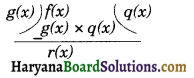
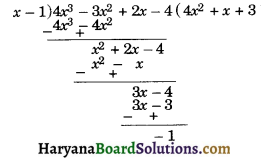
Here, we study the division of polynomials where a polynomial f(x) is divided by an another polynomial g(x), we get quotient q(x) and remainder r(x). We can express it in the form of long division as
HBSE 10th Class Maths Notes Chapter 2 Polynomials 1
By Euclid division algorithm it follows that f(x) = g(x) × q(x) + r(x)
Where r(x) = 0 or degree of r(x) < degree of g(x).
This rule is known as the division algorithm for polynomials.
Remarks: (i) If r(x) = 0, then polynomial g(x) is a factor of f(x).
(ii) If α is a zero of the polynomial f(x), then (x – α) is a factor of f(x).

For example : Divide polynomial f(x) = 4x3 – 3x2 + 2x – 4 by other polynomial g(x) = -1. Find the quotient and remainder.
HBSE 10th Class Maths Notes Chapter 2 Polynomials 2
Here, quotient q(x) = 4x2 + x + 3
and remainder r(x) = -1
∵ f(x) = g(x) × q(x) + r(x)
∴ 4x3 – 3x2 + 2x – 4 = (x – 1)(4x2 + x + 3) + (-1)

HBSE 10th Class Maths Notes Chapter 2 Polynomials Read More »

HBSE 9th Class Maths Important Questions Chapter 9 Areas of Parallelograms and Triangles

Haryana State Board HBSE 9th Class Maths Important Questions Chapter 9 Areas of Parallelograms and Triangles Important Questions and Answers.

Haryana Board 9th Class Maths Important Questions Chapter 9 Areas of Parallelograms and Triangles

Very Short Answer Type Questions

Question 1.
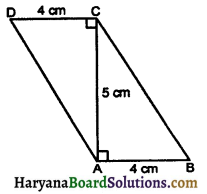
In the given figure ABCD is a quadrilateral and AC is one of its diagonal. Show that ABCD is a parallelogram and finds its area.
HBSE 9th Class Maths Important Questions Chapter 9 Areas of Parallelograms and Triangles 1
Solution:
We have,
∠ACD = ∠CAB (each angle = 90°)
But these are alternate interior angles.
∴ AB || CD
and AB = CD = 4 cm
∴ ABCD is a parallelogram.
Area of parallelogram ABCD = base × height
= AB × AC
= 4 × 5
= 20 cm2
Hence,
ar (||gm ABCD) = 20 cm2.

Question 2.
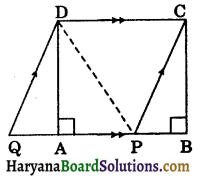
In the given figure, ABCD and QPCD are rectangle and parallelogram respectively. If area of ΔQPD is 35 cm2, then find the area of rectangle ABCD.
HBSE 9th Class Maths Important Questions Chapter 9 Areas of Parallelograms and Triangles 2
Solution:
Since rectangle ABCD and parallelogram QPCD are on the same base CD and between the same parallels CD and BQ.
∴ ar (rectangle ABCD) = ar(||gm QPCD)…(i)
[since rectangle is also a parallelogram]
Now, ΔQPD and parallelogram QPCD are on the same base QP and between the same parallels QP and CD.
ar (ΔQPD) = \(\frac{1}{2}\)ar (||gm QPCD) …..(ii)
From (i) and (ii), we get
ar (ΔQPD) = \(\frac{1}{2}\)ar (rectangle ABCD) [Using (i)]
⇒ 35 = \(\frac{1}{2}\)ar (rectangle ABCD),
[It is given that ar (AQPD) = 35 cm2]
⇒ 70 = ar (rectangle ABCD)
Hence,
ar (rectangle ABCD)= 70 cm2.

HBSE 9th Class Maths Important Questions Chapter 9 Areas of Parallelograms and Triangles

Question 3.
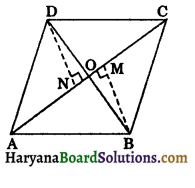
In the given figure, triangles DAC and BAC are on same base AC. If vertex B and D are on opposite side of AC such that area of ΔDAC is equal to area of ΔBAC. Prove that OD = OB.
HBSE 9th Class Maths Important Questions Chapter 9 Areas of Parallelograms and Triangles 3
Solution:
Draw BM ⊥ AC and DN ⊥ AC.
ar (ΔDAC) = ar (ΔBAC), (given)
HBSE 9th Class Maths Important Questions Chapter 9 Areas of Parallelograms and Triangles 4
⇒ \(\frac{1}{2}\)AC × DN = \(\frac{1}{2}\)AC × BM
⇒ DN = BM ……(i)
In ΔDNO and ΔBMO, we have
∠DNO = ∠BMO,
(by construction each = 90°)
∠DON = ∠BOM
(vertically opposite angles)
DN = BM (as proved above)
∴ ΔDNO ≅ ΔBMO,
(By AAS congruence rule)
⇒ OD = OB (CPCT) Hence proved

Question 4.
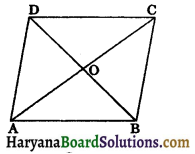
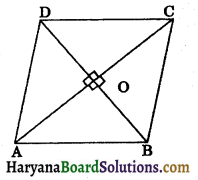
In a rhombus ABCD, AC and BD are its diagonals. Show that area of ABCD is equal to \(\frac{1}{2}\)(AC × BD)
HBSE 9th Class Maths Important Questions Chapter 9 Areas of Parallelograms and Triangles 5
Solution:
Given: A rhombus ABCD whose diagonals AC and BD intersect at O.
To prove : ar (rhombus ABCD) = \(\frac{1}{2}\)(AC × BD).
Proof : Since diagonals of rhombus bisect each other at right angles.
∴ AO ⊥ BD and OC ⊥ BD
Now
⇒ ar (rhombus ABCD) = ar (ΔDAB) + ar (ΔBCD)
⇒ ar (rhombus ABCD) = \(\frac{1}{2}\)(BD × AO) + (BD × OC)
⇒ ar (rhombus ABCD) = \(\frac{1}{2}\)(AO + OC)
⇒ ar (rhombus ABCD) = \(\frac{1}{2}\)(BD × AC)
⇒ ar (rhombus ABCD) = \(\frac{1}{2}\)(AC × BD).
Hence proved

Question 5.
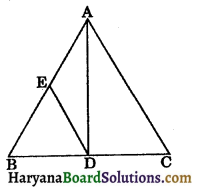
In the given figure, AD is the median of ΔABC and DE is the median of ΔABD. Show that:
ar (ΔABC) = 4 × ar(ΔBED).
HBSE 9th Class Maths Important Questions Chapter 9 Areas of Parallelograms and Triangles 6
Solution:
Since AD is the median of AABC.
∴ ar (ΔABD) = ar (ΔACD)
[∵ a median divides the triangle into two triangles of equal areas]
⇒ ar (ΔABD)= \(\frac{1}{2}\)ar (ΔABC) …(i)
Again, DE is the median of ΔABD.
∴ ar (ΔBED) = \(\frac{1}{2}\)ar (ΔABD)
⇒ ar (ΔBED) = \(\frac{1}{2} \cdot \frac{1}{2}\)ar(ΔABC) [using (i)]
⇒ ar (ΔBED) = \(\frac{1}{4}\)ar (ΔABC)
⇒ ar (ΔABC) = 4 ar (ΔBED).
Hence proved

HBSE 9th Class Maths Important Questions Chapter 9 Areas of Parallelograms and Triangles

Question 6.
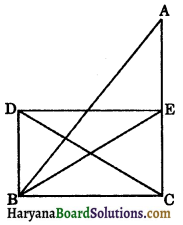
In fig. 9.78 BD || CA, E is the mid point of CA and BD = \(\frac{1}{2}\)CA. Prove that ar (ABC) = 2 ar (DBC)
HBSE 9th Class Maths Important Questions Chapter 9 Areas of Parallelograms and Triangles 7
Solution:
Join DE. Since, BD = CE and BD || CE. Therefore, BCED is a parallelogram.
∴ Triangles DBC and EBC are on the same base BC and between the same prallels BC and DE.
∴ ar (DBC) = ar (EBC) …(i)
In ΔABC, BE is the median and we know that a median divides the triangles into two triangles of equal areas.
∴ ar (EBC) = \(\frac{1}{2}\)ar (ABC)
⇒ ar (ABC) = 2 ar (EBC)
⇒ ar (ABC) = 2 ar (DBC) [Using (i)]
Hence, ar (ABC) = 2 ar (DBC). Proved

Short Answer Type Questions

Question 1.
In the given figure, ABCD and ABFE are parallelogram on the same base AB. Prove that :
(i) ar (ΔADB) + ar (ΔBFA) = ar (llgm ABFE)
(ii) If area of ||gm ABCD is 72 cm2
HBSE 9th Class Maths Important Questions Chapter 9 Areas of Parallelograms and Triangles 8
Find the area of ΔBFA.
Solution:
(i) Since parallelograms ABCD and ABFE are on the same base AB and between the same parallels AB and CE.
∴ ar (||gm ABCD) = ar (||gm ABFE) …(i)
ΔBFA and parallelogram ABFE are on the same base AB between the same parallels AB and FE.
∴ ar (ΔBFA) = \(\frac{1}{2}\)ar (||gm ABFE) …(ii)
ΔADB and parallelogram ABCD are on the same base AB and between the same parallels AB and CD.
∴ ar (ΔADB) = \(\frac{1}{2}\)ar (||gm ABCD) ….(iii)
Adding (ii) and (iii), we get
ar (ΔBFA) + ar (ΔADB) = \(\frac{1}{2}\)ar (||gm ABFE) + \(\frac{1}{2}\)ar (ABCD)
⇒ ar (ΔADB) + ar (ΔBFA) = \(\frac{1}{2}\)ar (||gm ABFE) + ar (||gm ABFE),
[∵ From (i) ar (||gm ABCD) = ar (||gm ABFE)
∴ \(\frac{1}{2}\)ar (||gm ABCD) = \(\frac{1}{2}\)ar (||gm ABFE)]
⇒ ar (ΔADB) + ar (ΔBFA) = ar (||gm ABFE). Hence proved

(ii) From (i) and (ii), we get
ar (ΔBFA) = \(\frac{1}{2}\)ar (||gm ABCD)
⇒ ar (ΔBFA) = \(\frac{1}{2}\) × 72,
It is given that
ar (||gm ABCD = 72 cm2)
⇒ ar (ΔBFA) = 36 cm2
Hence ar (ΔBFA) = 36 cm2.

HBSE 9th Class Maths Important Questions Chapter 9 Areas of Parallelograms and Triangles

Question 2.
ABCD is a parallelogram in which BC is produced to E such that CE = BC (see fig 9.80). AE intersects CD at F. If ar(DFB)= 3 cm2, find the area of the parallelogram ABCD. [NCERT Exemplar Problems]
HBSE 9th Class Maths Important Questions Chapter 9 Areas of Parallelograms and Triangles 9
Solution:
In ΔEAB
Since, FC || AB (∵ CD || AB) and C is the mid point of BE. Therefore, F is the mid point of CD
∴ BF is the median in ΔBCD.
Since, we know that a median divides a
triangle into two triangles of equal areas.
∴ ar(CFB) = ar (DFB)
Now ar (BCD) = ar (CFB) + ar (DFB)
⇒ ar (BCD) = 2 ar (DFB)
⇒ ar (BCD) = 2 × 3 = 6 cm2
Since, BD is a diagonal of parallelogram ABCD and we know that a diagonal divides the parallelogram into two triangles of equal areas.
∴ ar (||gm ABCD) = 2 × ar (BCD)
= 2 × 6 = 12 cm2
Hence,
ar (||gm ABCD)= 12 cm2.

Question 3.
In the given figure PQR is a triangle in which PM divides QR in the ratio a : b.
Show that ar(ΔPQM)/ar(ΔPRM) = a/b.
HBSE 9th Class Maths Important Questions Chapter 9 Areas of Parallelograms and Triangles 10
Solution:
Given : In ΔABC, PM divides QR in the ratio a : b.
To prove ar(ΔPQM)/ar(ΔPRM) = a/b
Construction : Draw PN ⊥ QR.
HBSE 9th Class Maths Important Questions Chapter 9 Areas of Parallelograms and Triangles 11
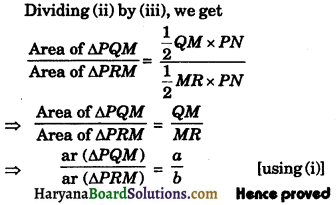
Proof : Since QM : MR = a : b
⇒ \(\frac{Q M}{M R}=\frac{a}{b}\) …..(i)
Area of ΔPQM = \(\frac{1}{2}\)QM × PN …..(ii)
and Area of ΔPRM = \(\frac{1}{2}\)MR × PN …..(iii)
Dividing (ii) by (iii), we get
HBSE 9th Class Maths Important Questions Chapter 9 Areas of Parallelograms and Triangles 12

Question 4.
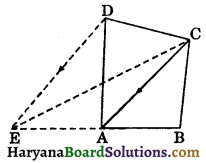
In the given figure, AC is the diagonal of quadrilateral ABCD and DE is drawn parallel to AC, which meets BA produced at point E such that ED = AC. Prove that ar (ΔCBE) = ar (quad. ABCD)
HBSE 9th Class Maths Important Questions Chapter 9 Areas of Parallelograms and Triangles 13
Solution:
Since
ED || AC and ED = AC
∴ ACDE is a parallelogram.
Since ΔACD and parallelogram ACDE are on the same base AC and between the same parallels AC and DE.
∴ ar (ΔACD) = \(\frac{1}{2}\)ar (||gm ACDE) ……(i)
Similarly, ΔACE and parallelogram ACDE are on the same base AC and between the same parallels AC and DE.
∴ ar (ΔACE) = \(\frac{1}{2}\)ar (||gm ACDE) ……(ii)
From (i) and (ii), we get
ar (ΔACE) = ar (ΔACD)
⇒ ar(ΔACE) + ar(ΔABC) = ar(ΔACD) + ar(ΔABC)
[Adding ar (SABC) on both sides]
⇒ ar (ΔCBE) = ar (quadrilateral ABCD).
Hence proved

HBSE 9th Class Maths Important Questions Chapter 9 Areas of Parallelograms and Triangles

Question 5.
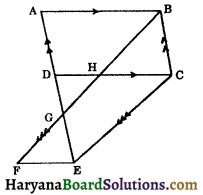
In the figure AB || CD || EF, BC || AE and CE || BF. Prove that ar (CEFH) = ar (ABCD).
HBSE 9th Class Maths Important Questions Chapter 9 Areas of Parallelograms and Triangles 14
Solution:
Since,
AB || CD and AD || BC [∵ AE || BC]
∴ ABCD is a parallelogram.
Now CD || EF and CE || BF
⇒ HC || EF and CE || HF
∴ CEFH is a parallelogram.
Again,
AE || BC and CD || EF
⇒ GE || BC and HC || FE
∴ GECB is a parallelogram.
Now parallelogram GECB and ABCD are on the same base BC and between the same parallels AE and BC.
∴ ar (||gm GECB) = ar (||gm ABCD) …(i)
Parallelograms GECB and CEFH are on the same base CE and between the same parallels CE and BF.
∴ ar (||gm GECB)= ar (||gm CEFH) …(ii)
From (i) and (ii), we get
ar (||gm CEFH) = ar (||gm ABCD). Hence proved

Question 6.
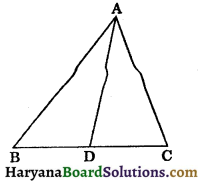
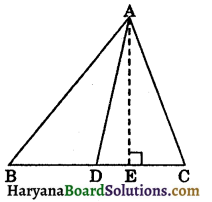
In the given figure, D is a point on the side BC of ΔABC such that BD : CD = 2 : 3. Show that:
ar (ΔACD) = \(\frac{3}{5}\)ar (ΔABC).
HBSE 9th Class Maths Important Questions Chapter 9 Areas of Parallelograms and Triangles 15
Solution:
Draw AE ⊥ BC
In ΔABC, we have
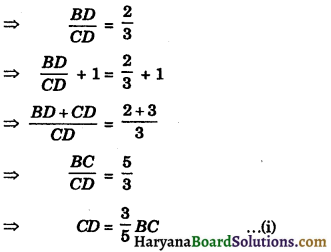
BD : CD = 2 : 3
HBSE 9th Class Maths Important Questions Chapter 9 Areas of Parallelograms and Triangles 16
Now ar (ΔABC) = \(\frac{1}{2}\) × BC × AE ……(i)
HBSE 9th Class Maths Important Questions Chapter 9 Areas of Parallelograms and Triangles 17
and ar (ΔACD) = \(\frac{1}{2}\) × CD × AE
⇒ ar (ΔACD) = \(\frac{1}{2}\) × \(\frac{3}{5}\) × BC × AE
[From (1), CD = \(\frac{3}{5}\)BC]
⇒ ar (ΔACD) = \(\frac{3}{5}\)(\(\frac{1}{2}\) × BC × AE)
⇒ ar (ΔACD) = \(\frac{3}{5}\)ar (ΔABC) [using (ii)]
Hence proved

HBSE 9th Class Maths Important Questions Chapter 9 Areas of Parallelograms and Triangles

Question 7.
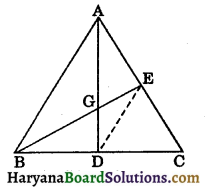
The medians AD and BE of a triangle ABC intersect at G. Prove that :
ar (ΔABG) = ar (quad. GECD).
HBSE 9th Class Maths Important Questions Chapter 9 Areas of Parallelograms and Triangles 18
Solution:
Since D and E are the mid points of BC and AC respectively.
∴ DE || AB
Now, ΔABE and ΔABD are on the same base AB and between the same parallels AB and ED.
∴ ar (ΔABE) = ar (ΔABD) …(i) (By theorem 9.2)
In a triangle ABC, BE is the median and we know that a median divides the triangle into, two triangles of equal areas.
∴ ar (ΔABE) = ar (ΔCBE) …(ii)
From (i) and (ii), we get
ar (ΔABD) = ar (ΔCBE)
⇒ ar (ΔABD) – ar (ΔGBD) = ar (ΔCBE) – ar (ΔGBD)
⇒ ar (ΔABG) = ar (quad. GECD). Hence proved

Question 8.
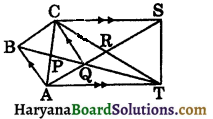
In the figure AB || CQ and CS || AT. Prove that:
(i) ar (ΔAPQ) = ar (ΔCPB)
(ii) ar (ΔACR) = ar (ΔSRT)
(iii) ar (quad. BCRQ) = ar (ΔSRT).
HBSE 9th Class Maths Important Questions Chapter 9 Areas of Parallelograms and Triangles 19
Solution:
(i) Since, ΔABQ and ΔBAC are on the same base AB and between the same parallels AB and CQ.
∴ ar (ΔABQ) = ar (ΔBAC) (By theorem 9.2)
⇒ ar(ΔABQ) – ar(ΔABP) = ar(ΔBAC) – ar(ΔABP)
⇒ ar (ΔAPQ) = ar (ΔCPB) …(i)
(ii) Since, ΔACT and ΔAST are on same base AT and between the same parallels AT and CS.
∴ ar (ΔACT) = ar (ΔAST)
⇒ ar(ΔACT) – ar (ΔART) = ar(ΔAST) – ar(ΔART)
⇒ ar (ΔACR) = ar (ΔSRT)
(iii) ar (ΔACR) = ar (ΔSRT)
⇒ ar (ΔAPQ) + ar (quad. PQRC) = ar (ΔSRT)
⇒ ar (ΔCPB) + ar (quad. PQRC) = ar (ΔSRT) [using (i)]
⇒ ar (quad. BCRQ) = ar (ΔSRT). Hence proved

Question 9.
In the given figure, D is the mid point of side AB of the SABC, E is any point on BC such that DE || FC. Prove that FE bisects the ΔABC.
HBSE 9th Class Maths Important Questions Chapter 9 Areas of Parallelograms and Triangles 20
Solution:
Given: D is the mid point of the side AB of ΔABC. E is the point on BC such that DE || FC.
To prove : FE bisects ΔABC.
Construction : Join CD.
Proof : Since ΔFCD and ΔFCE are on the same base FC and between the same parallels FC and DE.
∴ ar (ΔFCD) = ar (ΔFCE)
⇒ ar (ΔFCD) + ar (ΔACF) = ar (ΔFCE) + ar (ΔACF)
⇒ ar (ΔACD) = ar (quad. AFEC) …(i)
In ΔABC, CD is the median.
ar (ΔACD) = \(\frac{1}{2}\)ar (ΔABC) …(ii)
From (i) and (ii), we get
ar (ΔACD) = ar (quad. AFEC) = \(\frac{1}{2}\)ar (ΔABC).
Hence, FE bisects ΔABC. Hence proved

HBSE 9th Class Maths Important Questions Chapter 9 Areas of Parallelograms and Triangles

Question 10.
Through the vertex A of a parallelogram ABCD, line AEF is drawn to meet BC at E and DC produced at F. Show that the triangles BEF and DCE are equal in area.
Solution:
Given: In a||gm ABCD, through vertex A, a straight line AEF is drawn to meet BC at E and DC produced at F.
To prove : ar (ΔBEF) = ar (ΔDCE).
Construction : Join BD.
HBSE 9th Class Maths Important Questions Chapter 9 Areas of Parallelograms and Triangles 21
Proof: Since ΔABF and ||gm ABCD are on the same base AB and between the same parallels AB and DF.
∴ ar (ΔABF) = \(\frac{1}{2}\)ar (||gm ABCD ……(i)
Diagonal BD divides parallelogram ABCD into two triangles of equal area.
∴ ar (ΔBCD) = ar (||gm ABCD) ……(ii)
From (i) and (ii), we get
ar (ΔABF) = ar (ΔBCD) …(iii)
Now, ΔABE and ΔDBE are on the same base BE and between the same parallels BE and AD.
∴ ar (ΔABE) = ar (ΔDBE) ……(iv)
Subtracting (iv) from (iii), we get
ar (ΔABF) – ar (ΔABE) = ar (ΔBCD) – ar (ΔDBE)
⇒ ar (ΔBEF) = ar (ΔDCE). Hence proved

Question 11.
In the given figure, ABCD is a parallelogram. P is any point on AB. CB and DP are produced to meet Q. Prove that:
(i) ar (ΔCPQ) = ar (ΔBDQ)
(ii) If P is the mid point of AB, then prove that:
ar (ΔPBC) + ar (ΔPBD) = \(\frac{1}{2}\)ar (||gm ABCD).
HBSE 9th Class Maths Important Questions Chapter 9 Areas of Parallelograms and Triangles 22
Solution:
(i) Since ΔPBC and ΔPBD are on the same base PB and between the same parallels PB and CD.
∴ ar(ΔPBC) = ar (ΔPBD) ……(i)
⇒ ar (ΔPBC) + ar (ΔPBQ) = ar (ΔPBD) + ar (ΔPBQ)
⇒ ar (ΔCPQ) = ar (ΔBDQ).
(ii) ∵ Diagonal BD divides parallelogram ABCD into two triangles of equal areas.
∴ ar (ΔBAD) = \(\frac{1}{2}\)ar (||gm ABCD) …….(ii)
In ΔBAD, DP is the median.
∴ ar (ΔPBD) = \(\frac{1}{2}\)ar (ΔBAD)
⇒ ar (ΔPBD) = \(\frac{1}{2}\) · \(\frac{1}{2}\)ar (||gm ABCD) [using (ii)]
⇒ ar (ΔPBD) = \(\frac{1}{4}\)ar (||gm ABCD) ……(iii)
From (i) and (iii), we get
ar (ΔPBC) = ar (ΔPBD) = \(\frac{1}{4}\)ar (||gm ABCD)
Now, ar (ΔPBC) + ar (ΔPBD) = \(\frac{1}{4}\)ar (||gm ABCD + \(\frac{1}{4}\)ar (||gm ABCD)
⇒ ar (ΔPBC) + ar (ΔPBD) = \(\frac{1}{2}\)ar (||gm ABCD). Hence proved

Long Answer Type Questions

Question 1.
If the area of an equilateral triangle is equal to the area of a square, prove that the perimeter of the equilateral triangle is greater than the perimeter of the square.
Solution:
Let the side of the equilateral triangle be x units and side of the square be y units.
∴ Area of equilateral triangle = \(\frac{\sqrt{3}}{4} x^2\) square units
and area of a square = y2 square units
According to question,
Area of equilateral triangle = Area of a square
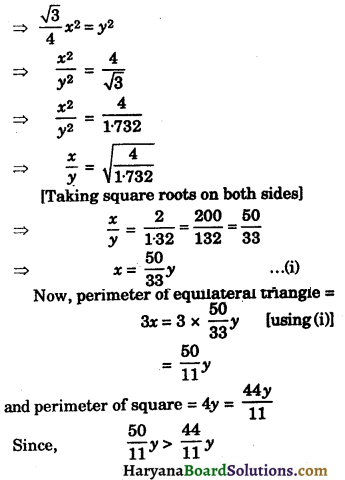
HBSE 9th Class Maths Important Questions Chapter 9 Areas of Parallelograms and Triangles 23
Therefore, perimeter of an equilateral triangle is greater than perimeter of a square.
Hence proved

HBSE 9th Class Maths Important Questions Chapter 9 Areas of Parallelograms and Triangles

Question 2.
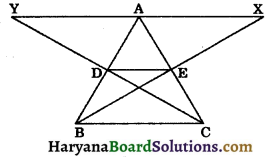
In the given figure, D and E are respectively the mid points of the sides AB and AC of a ΔABC. If XY || BC and BEX and CDY are straight lines, prove that:
(i) ar (ΔADY) = ar (ΔAEX)
(ii) ar (ΔACY) = ar (ΔBX).
HBSE 9th Class Maths Important Questions Chapter 9 Areas of Parallelograms and Triangles 24
Solution:
Since D and E are the respectively mid points of the sides AB and AC.
Therefore, DE || BC
⇒ BC || DE || XY
(i) In ΔAEX and ΔCEB, we have
∠AEX = ∠CEB (vertically opposite angles)
∠AXE = ∠CBE
[∵ XY || BC ⇒ alternate interior angle AXE and CBE are equal]
and AE = EC
[∵ E is the mid point of AC]
∴ ΔAEX ≅ ΔCEB
(By AAS congruence rule)
⇒ ar (ΔAEX) = ar (ΔCEB) …(i)
Similarly, ΔADY ≅ ΔBDC
⇒ ar (ΔADY) = ar (ΔBDC) …(ii)
But ΔBDC and ΔCEB are on the same base BC and between the same parallels DE and BC.
∴ ar(ΔBDC) = ar (ΔCEB) …(iii)
From (i), (ii) and (iii), we get
ar (ΔADY) = ar (ΔAEX) …(iv)
(ii) Now, ΔDEB and ΔEDC are on the same base DE and between the same parallels DE and BC.
∴ ar (ΔDEB) = ar (ΔEDC)
⇒ ar (ΔDEB) + ar (ΔADE) = ar (ΔEDC) + ar (ΔADE)
⇒ ar (ΔABE) = ar (ΔACD)
⇒ ar (ΔACD) = ar (ΔABE) …..(v)
Adding (iv) and (v), we get
ar (ΔADY) + ar (ΔACD) = ar (ΔAEX) + ar (ΔABE)
⇒ ar (ΔACY) = ar (ΔABX). Hence proved

Question 3.
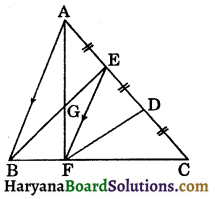
In the figure, ABC is a triangle in which E and D are the points on AC such that AE = ED = CD. EF drawn parallel to AB and FD is joined. If AF and BE intersect at G, then prove that:
(i) ar (ΔAEG) = ar (ΔBFG)
(ii) ar (ΔAFD) = ar (quad. BEDF)
(iii) ar (ΔAFC) = 3 ar (ΔFED).
HBSE 9th Class Maths Important Questions Chapter 9 Areas of Parallelograms and Triangles 25
Solution:
(i) ΔABE and ΔABF are on the same base AB and between the same parallels AB and EF.
HBSE 9th Class Maths Important Questions Chapter 9 Areas of Parallelograms and Triangles 26
ar (ΔABE) = ar (ΔABF)
ar (ΔABE) – ar (ΔABG) = ar (ΔABF) – ar (ΔABG)
⇒ ar(ΔAEG) = ar (ΔBFG)
(ii) ar (ΔAEG) = ar (ΔBFG) (as proved above)
⇒ ar (ΔAEG) + ar (quad. GEDF) = ar (ΔBFG) + ar (quad. GEDF)
[Adding ar (quad. GEDF) on both sides]
⇒ ar (ΔAFD) = ar (quad. BEDF)
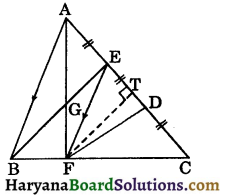
(iii) Draw FT ⊥ AC
Let AE = ED = CD = x
ar (ΔAEF) = \(\frac{1}{2}\)AE × FT
⇒ ar (ΔAEF) = \(\frac{1}{2}\) × x × FT ……(i)
Similarly,
ar (ΔFED) = \(\frac{1}{2}\) × x × FT …(ii)
and ar (ΔCDF) = \(\frac{1}{2}\) × x × FT …(iii)
From (i), (ii) and (iii), we get
ar (ΔAEF) = ar (ΔCDF) = ar (ΔFED) ……(iv)
Now, ar (ΔAFC) = ar (ΔAEF) + ar (ΔFED) + ar (ΔCDF)
⇒ ar (ΔAFC) = ar (ΔFED)+ ar (ΔFED) + ar (ΔFED) [using (iv)]
⇒ ar (ΔAFC)= 3 ar (ΔFED). Hence proved

HBSE 9th Class Maths Important Questions Chapter 9 Areas of Parallelograms and Triangles

Question 4.
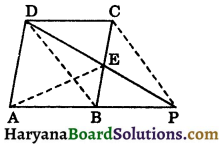
In a parallelogram ABCD, the side AB is produced to point P such that BP = AB. A line DP intersects BC at E. Prove that:
(i) BPCD is a parallelogram
(ii) ar (ΔCEP) = \(\frac{1}{2}\)ar (ΔAED).
HBSE 9th Class Maths Important Questions Chapter 9 Areas of Parallelograms and Triangles 27
Solution:
(i) Since ABCD is a parallelogram.
∴ AB || CD
⇒ BP || CD [∵ AB = BP]
and AB = CD
AB = BP (given)
∴ BP = CD
Thus, BP = CD and BP || CD
⇒ BPCD is a parallelogram.

(ii) Since, BPCD is a parallelogram and BC and DP are its diagonals.
We know that in a parallelogram a diagonal divides the parallelogram into two triangles of equal areas.
∴ ar (ΔCBP) = ar (ΔCBD)
⇒ ar (ΔCBP) = \(\frac{1}{2}\)ar (||gm BPCD)…(i)
We know that diagonals of a parallelogram bisect each other.
∴ E is the mid point of BC.
⇒ ar (ΔCEP) = ar (ΔBEP)
[a median divides the triangle into two triangles of equal areas]
⇒ ar (ΔCEP) = \(\frac{1}{2}\)ar (ΔCBP) …(ii)
From (i) and (ii), we get
ar (ΔCEP) = \(\frac{1}{2} \cdot \frac{1}{2}\)ar (||gm BPCD)
⇒ ar (ΔCEP) = \(\frac{1}{4}\)ar (||gm BPCD) …(ii)
Parallelograms ABCD and BPCD are on the same base CD and between the same parallels CD and AP.
∴ ar (||gm ABCD) = ar (||gm BPCD) …(iv)
From (iii) and (iv), we get
ar (ΔCEP) = \(\frac{1}{4}\)ar (||gm ABCD)
4 ar (ΔCEP) = ar (||gm ABCD) …(v)
Now, ΔAED and parallelogram ABCD are on the same base AD and between the same paralles AD and BC.
∴ ar (ΔAED) = \(\frac{1}{2}\)ar (||gm ABCD)
⇒ 2 ar (ΔAED) = ar (||gm ABCD) …(vi)
From (v) and (vi), we get
4 ar (ΔCEP) = 2 ar (ΔAED)
⇒ ar (ΔCEP) = \(\frac{2}{4}\)ar (ΔAED)
⇒ ar (ΔCEP) = \(\frac{1}{2}\)ar (ΔAED). Hence proved

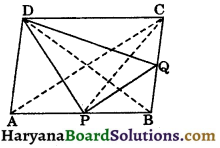
Question 5.
P and Q are respectively the mid points of the sides AB and BC of a parallelogram ABCD. Prove that ar (ΔDPQ) = \(\frac{3}{8}\)ar (||gm ABCD).
HBSE 9th Class Maths Important Questions Chapter 9 Areas of Parallelograms and Triangles 28
Solution:
Given : P and Q are respectively the mid points of the side AB and BC of a parallelogram ABCD.
To prove : ar (ΔDPQ) = \(\frac{3}{8}\)ar (||gm ABCD).
Construction : Join AC, BD and CP.
Proof : Since in ΔABC, P is the mid point of AB.
∴ CP is the median of ΔABC.
We know that a median divides the triangle into two triangles of equal areas.
∴ ar (ΔPBC) = \(\frac{1}{2}\)ar (ΔABC) …(i)
In ΔPBC, Q is the mid point of BC.
∴ PQ is the median of ΔPBC.
∴ ar (ΔPBQ) = \(\frac{1}{2}\)ar (ΔPBC)
⇒ 2 ar (ΔPBQ) = ar (ΔPBC) …….(ii)
From (i) and (ii), we get
2 ar (ΔPBQ) = \(\frac{1}{2}\)ar (ΔABC)
⇒ 4 ar (ΔPBQ) = ar (ΔABC) …….(iii)
Since, a diagonal divides the parallelogram into two triangles of equal area.
∴ ar (ΔABC) = \(\frac{1}{2}\)ar (||gm ABCD)..(iv)
From (iii) and (iv), we get
4 ar (ΔPBQ) = \(\frac{1}{2}\)ar (||gm ABCD)
⇒ ar (ΔPBQ) = \(\frac{1}{8}\)ar (||gm ABCD)…(v)
Since, diagonal BD divides parallelogram ABCD into two triangles of equal area.
∴ ar (ΔDAB) = \(\frac{1}{2}\)ar (||gm ABCD)..(vi)
In ΔDAB, DP is the median.
∴ ar (ΔDAP) = \(\frac{1}{2}\)ar (ΔDAB) …(vii)
From (vi) and (vii), we get
ar (ΔDAP) = \(\frac{1}{2} \cdot \frac{1}{2}\)ar (||gm ABCD)
ar (ΔDAP) = \(\frac{1}{4}\)ar (||gm ABCD) …..(8)
Similarly,
ar (ΔDCQ) = \(\frac{1}{4}\)ar (||gm ABCD) …..(9)
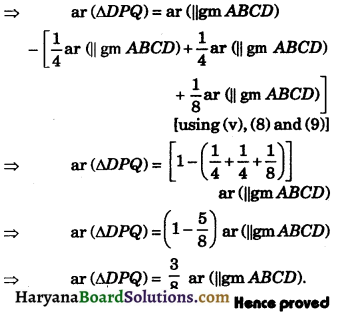
Now, ar (ΔDPQ) = ar (||gm ABCD) – [ar (ΔDAP) + ar (ΔDCQ) + ar (ΔPBQ)]
⇒ ar (ΔDPQ) = ar (||gm ABCD)
HBSE 9th Class Maths Important Questions Chapter 9 Areas of Parallelograms and Triangles 29

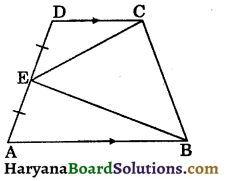
Question 6.
In the given figure, ABCD is a trapezium in which E is the mid point of AD. If E is joined to vertices B and C, prove that :
ar (ΔABE) + ar (ΔCDE) = \(\frac{1}{2}\)ar (trap. ABCD).
HBSE 9th Class Maths Important Questions Chapter 9 Areas of Parallelograms and Triangles 30
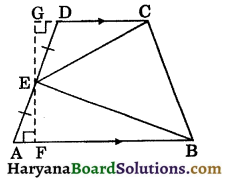
Solution:
Draw EF ⊥ AB and produced to opposite of EF meets CD produced at G.
HBSE 9th Class Maths Important Questions Chapter 9 Areas of Parallelograms and Triangles 31
Since, AB || CG
∴ ∠DGE = ∠AFE = 90° (alternate interior angles)
In ΔAFE and ΔDGE, we have
∠AFE = ∠DGE (Each = 90°)
∠AEF = ∠DEG (vertically opposite angles)
and AE = ED (∵ E is the mid point of AD)
∴ ΔAFE ≅ ΔDGE (By AAS congruence rule)
⇒ EF = EG (CPCT) ……(i)
Now, ar (ΔABE) = \(\frac{1}{2}\)AB × EF …(ii)
and ar (ΔCDE) = \(\frac{1}{2}\)CD × GE …(iii)
Adding (ii) and (iii), we get
ar (ΔABE) + ar (ΔCDE) = \(\frac{1}{2}\)AB × EF + \(\frac{1}{2}\)CD × GE
⇒ ar (ΔABE) + ar (ΔCDE) = \(\frac{1}{2}\)(AB × EF + CD × EF) [using (1)]
⇒ ar (ΔABE) + ar (ΔCDE) = \(\frac{1}{2}\)(AB + CD) × EF
⇒ ar (ΔABE) + ar (ΔCDE) = \(\frac{1}{2} \cdot \frac{1}{2}\)(AB + CD) × 2EF
⇒ ar (ΔABE) + ar (ΔCDE) = \(\frac{1}{2} \cdot \frac{1}{2}\)(AB + CD) × GF
⇒ ar (ΔABE) + ar (ΔCDE) = \(\frac{1}{2}\)ar (trap. ABCD).
Hence proved

HBSE 9th Class Maths Important Questions Chapter 9 Areas of Parallelograms and Triangles

Question 7.
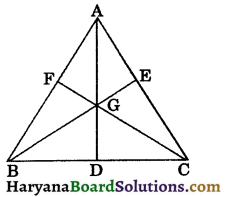
In a triangle ABC, if the medians AD, BE and CF intersect at G. Show that:
ar (ΔABG) = ar (ΔACG) = ar (ΔBCG)
= \(\frac{1}{3}\)ar (ΔABC).
Solution:
Given : In a triangle ABC, medians AD, BE and CF intersect at G.
To prove: ar (ΔABG) = ar (ΔACG) = ar (ΔBCG)
= \(\frac{1}{3}\)ar (ΔABC).
Proof : We know that the median of a triangle divides it into two triangles of equal areas.
HBSE 9th Class Maths Important Questions Chapter 9 Areas of Parallelograms and Triangles 32
In ΔABC, AD is the median.
∴ ar (ΔABD) = ar (ΔACD) ….(i)
In ΔGBC, GD is the median.
∴ ar(ΔGBD) = ar (ΔGCD) …(ii)
Subtracting (ii) from (i), we get
ar (ΔABD) – ar (ΔGBD) = ar (ΔACD) – ar (ΔGCD)
⇒ ar (ΔABG) = ar (ΔACG) … (iii)
Similarly,
ar (ΔABG) = ar (ΔBCG) …(iv)
From (iii) and (iv), we get
ar (ΔABG) = ar (ΔACG) = ar (ΔBCG) …(v)
Now, ar(ΔABC) = ar (ΔABG) + ar (ΔACG) + ar (ΔBCG)
⇒ ar (ABC) = ar (ΔABG) + ar (ΔABG) + ar (ΔABG) [using (v)]
⇒ ar (ΔABC) = 3 ar (ΔABG)
⇒ ar(ΔABG) = \(\frac{1}{3}\)ar (ΔABC) …(vi)
From (v) and (vi), we get
ar (ΔABG) = ar (ΔACG)
= ar (ΔBCG)
= \(\frac{1}{3}\)ar (ΔABC). Hence proved

Question 8.
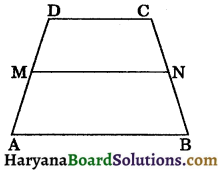
In the given figure, ABCD is a trapezium in which AB || CD, AB = 40 cm and CD = 30 cm. If M and N are respectively the mid points of AD and BC, prove that:
(i) MNCD is a trapezium
(ii) ar (trap. ABNM) = \(\frac{15}{13}\) ar(trap. MNCD).
HBSE 9th Class Maths Important Questions Chapter 9 Areas of Parallelograms and Triangles 33
Solution:
(i) Join DN and produce it to meet AB produced at O.
In ΔDCN and ΔOBN, we have
∠DCN = ∠OBN (∵ CD || OA)
CN = BN
(∵ N is the mid point of BC)
and ∠CND = ∠BNO (vertically opp. angles)
∴ ΔDCN ≅ ΔOBN (By ASA congruence rule)
⇒ CD = OB (CPCT) …(i)
and DN = ON (CPCT)
HBSE 9th Class Maths Important Questions Chapter 9 Areas of Parallelograms and Triangles 34
⇒ N is the mid point of OD.
In ΔAOD, M is the mid point of AD and N is the mid point of OD.
∴ MN || AO and MN = \(\frac{1}{2}\)AO
⇒ MN = \(\frac{1}{2}\)(AB + BO)
⇒ MN = \(\frac{1}{2}\)(AB + CD)
[From (i), OB = CD]
⇒ MN = \(\frac{1}{2}\)(40 + 30) = \(\frac{1}{2}\) × 70 = 35 cm
Now, MN || AO and CD || AB (given)
⇒ MN || AB and CD || AB
⇒ MN || CD
⇒ MNCD is a trapezium.

(ii) Since, M and N are respectively the mid points of AD and BC.
Therefore trapeziums MNCD and ABNM have the same height, say h cm.
ar (trap. ABNM) = \(\frac{1}{2}\)(AB + MN) × h
⇒ ar (trap. ABNM = \(\frac{1}{2}\)(40 + 35) × h = \(\frac{75}{2}\) × h ….(ii)
and ar (trap. MNCD) = \(\frac{1}{2}\)(MN + CD) × h
⇒ ar (trap. MNCD)= \(\frac{1}{2}\)(35 + 30) × h = \(\frac{65}{2}\) × h …..(iii)
Dividing (ii) by (iii), we get
HBSE 9th Class Maths Important Questions Chapter 9 Areas of Parallelograms and Triangles 35

Question 9.
ABCD is a trapezium in which AB || CD and E is the mid point of BC. Prove that:
ar (ΔAED) = \(\frac{1}{2}\)ar (trap. ABCD).
HBSE 9th Class Maths Important Questions Chapter 9 Areas of Parallelograms and Triangles 36
Solution:
Given : AB || CD and E is the mid point of BC.
To prove : ar (ΔAED) = \(\frac{1}{2}\)ar (trap. ABCD).
Construction : Join AC and BD.
Proof: ΔACD and ΔBCD are on the same base CD and between the same parallels AB and CD.
∴ ar (ΔACD) = ar (ΔBCD) …(i)
In ΔABC, AE is the median.
∴ ar (ΔAEB) = \(\frac{1}{2}\)ar (ΔABC) …(ii)
In ΔBCD, DE is the median.
∴ ar (ΔDEC) = \(\frac{1}{2}\)ar (ΔBCD) …….(iii)
Adding (ii) and (iii), we get
ar (ΔAEB) + ar (ΔDEC) = \(\frac{1}{2}\)ar (ΔABC) + \(\frac{1}{2}\)ar (ΔBCD)
⇒ ar (ΔAEB) + ar (ΔDEC) = \(\frac{1}{2}\)[ar (ΔABC) + ar (ΔBCD)]
⇒ ar (ΔAEB) + ar (ΔDEC) = \(\frac{1}{2}\)[ar (ABC) + ar (ΔACD)] [using (i)]
⇒ ar (ΔAEB) + ar (ΔDEC) = \(\frac{1}{2}\)ar (trap.ABCD) …..(iv)
Now,
ar (trap. ABCD) = ar (ΔAEB) + ar (ΔAED) + ar (ΔDEC)
⇒ ar (trap. ABCD) = ar (ΔAEB) + ar (ΔDEC) + ar (ΔAED)
⇒ ar (trap. ABCD) = \(\frac{1}{2}\)ar (trap. ABCD) + ar (ΔAED)
⇒ ar (ΔAED) = ar (trap. ABCD) – \(\frac{1}{2}\)ar (trap. ABCD)
⇒ ar (ΔAED) = \(\frac{1}{2}\)ar (trap. ABCD). Hence proved

HBSE 9th Class Maths Important Questions Chapter 9 Areas of Parallelograms and Triangles

Question 10.
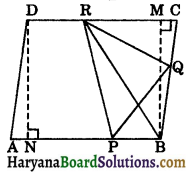
ABCD is a parallelogram in which P is a point on AB such that AP : PB = 2 : 1 and Q is a point on BC such that BQ : QC = 2 : 1 and R is a point on CD such that CR : DR = 2 : 1. Prove that :
(i) ar (trap. APRD) = ar (trap. PBCR)
(ii) ar (ΔPBR) = \(\frac{1}{6}\)ar (||gm ABCD)
(iii) ar (ΔRCQ) = \(\frac{1}{2}\)ar (ΔRQB)
(iv) 2 ar (ΔPBR) = 3 ar (ΔRCQ).
Solution:
Draw
BM ⊥ CD and DN ⊥ AB
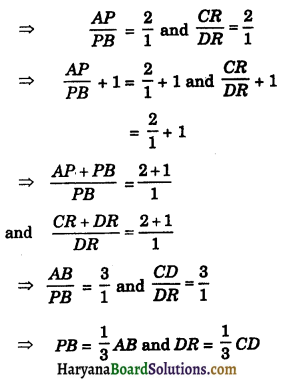
AP : PB = 2 : 1 and CR : DR = 2 : 1
HBSE 9th Class Maths Important Questions Chapter 9 Areas of Parallelograms and Triangles 37
AP = AB – PB
and CR = CD – DR
⇒ AP = AB – \(\frac{1}{3}\)AB
and CR = CD – \(\frac{1}{3}\)CD
⇒ AP = \(\frac{2}{3}\)AB and CR = \(\frac{2}{3}\) CD
Similarly, CQ = \(\frac{1}{3}\)BC and BQ = \(\frac{2}{3}\)BC
(i) Area of trap. APRD = \(\frac{1}{2}\)(AP + DR) × DN
= \(\frac{1}{2}\left(\frac{2}{3} A B+\frac{1}{3} C D\right) \times D N\)
= \(\frac{1}{2}\left(\frac{2}{3} A B+\frac{1}{3} A B\right) \times D N\)
= \(\frac{1}{2}\)AB × DN
HBSE 9th Class Maths Important Questions Chapter 9 Areas of Parallelograms and Triangles 38
Hence,
ar (trap. APRD) = \(\frac{1}{2}\)AB × DN …(i)
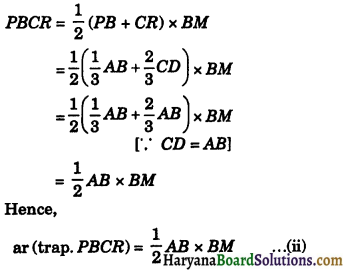
Similarly,area of trap.
HBSE 9th Class Maths Important Questions Chapter 9 Areas of Parallelograms and Triangles 39
Since, perpendiculars BM and DN are between the parallel sides AB and CD.
∴ BM = DN ……(iii)
From (i), (ii) and (iii), we get
ar (trap. APRD) = ar (trap. PBCR)

(ii) ar (ΔPBR) = \(\frac{1}{2}\)PB × DN
⇒ ar (ΔPBR) = \(\frac{1}{2} \times \frac{1}{3}\)AB × DN
ar (ΔPBR) = \(\frac{1}{6}\)AB × DN
ar (ΔPBR) = \(\frac{1}{6}\)ar (||gm ABCD)
[∵ ar (||gm ABCD) = AB × DN]

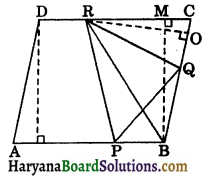
(iii) Draw RO ⊥ BC
ar (ΔRCQ) = \(\frac{1}{2}\)CQ × RO
⇒ ar (ΔRCQ) = \(\frac{1}{2} \times \frac{1}{3}\)BC × RO
⇒ ar (ΔRCQ) = \(\frac{1}{6}\)BC × RO
⇒ 6 ar (ΔRCQ) = BC × RO …(iv)
and ar (ΔRQB) = \(\frac{1}{2}\) × BQ × RO
⇒ ar (ΔRQB) = \(\frac{1}{2} \times \frac{2}{3}\) BC × RO
⇒ 3 ar (ΔRQB) = BC × RO …(v)
HBSE 9th Class Maths Important Questions Chapter 9 Areas of Parallelograms and Triangles 40
From (iv) and (v), we get
6 ar (ΔRCQ) = 3 ar (ΔRQB)
⇒ ar (ΔRCQ) = \(\frac{3}{6}\)ar (ΔRQB)
⇒ ar (ARCQ) = \(\frac{1}{2}\)ar (ΔRQB)

(iv) ar (ΔRCB) = \(\frac{1}{2}\)CR × BM
⇒ ar (ΔRCB) = \(\frac{1}{2} \times \frac{2}{3}\)CD × BM
⇒ ar (ΔRCB) = \(\frac{1}{3}\)CD × BM …(vi)
Again, ar (ARCB) = \(\frac{1}{2}\)BC × RO ……(vii)
From (vi) and (vii), we get
\(\frac{1}{2}\)BC × RO = \(\frac{1}{3}\)CD × BM
⇒ RO = \(\frac{2}{3} \times \frac{C D \times B M}{B C}\)
Putting the value of RO in (iv), we get
ar (ΔRCQ) = \(\frac{1}{6} B C \times \frac{2}{3} \frac{C D \times B M}{B C}\)
⇒ ar (ΔRCQ) = \(\frac{1}{9}\)CD × BM
⇒ 9 ar (ΔRCQ) = CD × BM ……(viii)
From IInd part, we have
ar (ΔPBR) = \(\frac{1}{6}\)AB × DN
⇒ 6 ar (ΔPBR) = CD × BM ……(ix)
[∵ From (iii), BM = DN and AB = CD]
From (viii) and (ix), we get
6 ar (ΔPBR) = 9 ar (ΔRCQ)
⇒ ar (ΔPBR)= \(\frac{9}{6}\)ar (ΔRCQ)
⇒ ar (ΔPBR) = \(\frac{3}{2}\)ar (ΔRCQ)
⇒ 2 ar (ΔPBR) = 3 ar (ΔRCQ). Hence proved

HBSE 9th Class Maths Important Questions Chapter 9 Areas of Parallelograms and Triangles

Multiple Choice Questions

Choose the correct option in each of the following:

Question 1.
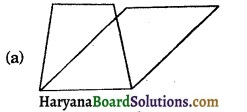
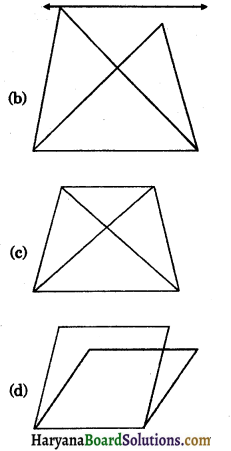
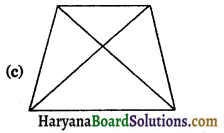
Out of the following given figures, which are on the same base and between the same parallels :
HBSE 9th Class Maths Important Questions Chapter 9 Areas of Parallelograms and Triangles 41
HBSE 9th Class Maths Important Questions Chapter 9 Areas of Parallelograms and Triangles 42
Answer:
HBSE 9th Class Maths Important Questions Chapter 9 Areas of Parallelograms and Triangles 43

Question 2.
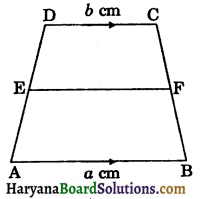
In the given figure, ABCD is a trapezium in which AB || CD such that AB = a cm and CD = b cm. If F and E are the mid points of BC and AD respectively, then ar(ABFE)/ar(EFCD) is equal to: [NCERT Exemplar Problems]
HBSE 9th Class Maths Important Questions Chapter 9 Areas of Parallelograms and Triangles 44
(a) \(\frac{a}{b}\)
(b) \(\frac{(3 a+b)}{(a+3 b)}\)
(c) \(\frac{(a+3 b)}{(3 a+b)}\)
(d) \(\frac{(2 a+b)}{(3 a+b)}\)
Answer:
(b) \(\frac{(3 a+b)}{(a+3 b)}\)

HBSE 9th Class Maths Important Questions Chapter 9 Areas of Parallelograms and Triangles

Question 3.
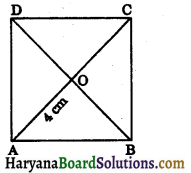
In the given figure, ARCD is a square, if diagonals AC and BD intersect at O and AO = 4 cm, then the area of square ABCD is :
HBSE 9th Class Maths Important Questions Chapter 9 Areas of Parallelograms and Triangles 45
(a) 32 cm2
(b) 64 cm2
(c) 16 cm2
(d) 20 cm2
Answer:
(a) 32 cm2

Question 4.
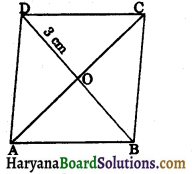
In the given figure, ABCD is a rhombus. If OD = 3 cm and area of rhombus ABCD = 24 cm2, then length of diagonal AC is :
HBSE 9th Class Maths Important Questions Chapter 9 Areas of Parallelograms and Triangles 46
(a) 6 cm
(b) 8 cm
(c) 16 cm
(d) 10 cm
Answer:
(b) 8 cm

Question 5.
If two parallelograms are on the same base and between the same parallels. The ratio of their areas is : [NCERT Exemplar Problems]
(a) 1 : 3
(b) 1 : 2
(c) 1 : 1
(d) 2 : 1
Answer:
(c) 1 : 1

Question 6.
If a triangle and a parallelogram have a same base and are between the same parallels, then ratio of areas of parallelograms to the triangle is : [NCERT Exemplar Problems]
(a) 1 : 4
(b) 4 : 1
(c) 1 : 2
(d) 2 : 1
Answer:
(d) 2 : 1

Question 7.
If medians of a triangle ABC intersect at G, then ratio of ar (ΔBCG) : ar (ΔABC) is :
(a) 1 : 3
(b) 3 : 1
(c) 1 : 2
(d) 2 : 1
Answer:
(a) 1 : 3

HBSE 9th Class Maths Important Questions Chapter 9 Areas of Parallelograms and Triangles

Question 8.
The area of a parallelogram ABCD is 36 cm2, then area of figure obtained by joining the mid points of the sides of parallelogram ABCD is :
(a) 36 cm2
(b) 18 cm2
(c) 20 cm2
(d) 24 cm2
Answer:
(b) 18 cm2

Question 9.
If diagonal AC divides the quadrilateral ABCD into two triangles of equal area, then ABCD is a: [NCERT Exemplar Problems]
(a) rhombus
(b) parallelogram
(c) rectangle
(d) need not be any of (a), (b) or (c)
Answer:
(d) need not be any of (a), (b) or (c)

Question 10.
ΔΑΒC and ΔΑΡQ are two equilateral traingles such that P is the mid point of AB, then ratio of ar (ΔAPQ) : (ΔABC) is:
HBSE 9th Class Maths Important Questions Chapter 9 Areas of Parallelograms and Triangles 47
(a) 1 : 2
(b) 1 : 4
(c) 3 : 4
(d) 4 : 1
Answer:
(b) 1 : 4

HBSE 9th Class Maths Important Questions Chapter 9 Areas of Parallelograms and Triangles Read More »

HBSE 8th Class Science Solutions Chapter 9 Reproduction in Animals

Haryana State Board HBSE 8th Class Science Solutions Chapter 9 Reproduction in Animals Textbook Exercise Questions and Answers.

Haryana Board 8th Class Science Solutions Chapter 9 Reproduction in Animals

HBSE 8th Class Science Reproduction in Animals Textbook Questions and Answers

Question 1.
Explain the importance of reproduction in organisms.
Answer:
Reproduction is very important for the organisms. The organisms reproduce to produce young ones like them. It carries on their generation. If reproduction does not take place, no living being would survive on earth. Secondly, specials characters of an organism are carried over to its next generation through reproduction only.

Question 2.
Describe the process of fertilization in human beings,
Answer:
Human beings reproduce sexually. In human beings fertilization takes place internally i.e. inside female body. Males eject sperms inside females body. Sperms and ovum fuse to form the fertilized egg called zygote. During this process the nucleus of the sperm fuses with the nucleus of the ovum thus forming a single nucleus.
Thus zygote is formed with a single nucleus, this completes the process of fertilization.

HBSE 8th Class Science Solutions Chapter 9 Reproduction in Animals

Question 3.
Choose the most appropriate answer:
(a) Internal fertilisation occurs:
(i) in female body
(ii) outside female body.
(iii) in male body.
(iv) outside male body.
Answer:
(a) In female body

(b) A tadpole develops into an adult frog by the process of:
(i) fertilization
(ii) metamorphosis.
(iii) embedding
(iv) budding.
Answer:
(b) metamorphosis

(c) The number of nuclei present in a zygote is:
(i) none
(ii) one
(iii) two
(iv) four
Answer:
(c)two.

Question 4.
Indicate whether the following sentences as True (T) or False (F):
(a) Oviparous animals give birth to young ones. ( )
(b) Each sperm is a single cell. ( )
(c) External fertilisation take place in frog. ( )
(d) A new human individual developed from a cell called gamete. ( )
(e) Egg laid after fertilisation is made up of a single cell. ( )
(f) Amoeba reproduces by budding. ( )
(g) Fertilisation is necessary even in asexual reproduction. ( )
(h) Binary fission is a method of asexual reproduction. ( )
(i) A zygote is formed as a result of fertilisation. ( )
(j) An embryo is made up of a single cell.( )
Answer:
(a) False
(b) True
(c) True
(d) False
(e) True
(f) False
(g) False
(h) True
(i) True
(j) False.

Question 5.
Give two differences between a zygote and a foetus?
Answer:
(i) Zygote is made up of a single cell while foetus is made up of many cells.
(ii) Zygote does not have well developed limbs, foetus has well developed and identifiable limbs.
(iii) Zygote is formed by the fertilization of sperms and ovum, foetus is formed by the repeated divisions of the zygote .

Question 6.
Define asexual reproduction. Describe the two methods of asexual reproduction in animals.
Answer:
Asexual reproduction is that type of reproduction in which only single parent is involved. Asexual reproduction takes place by different methods like budding, binary fission etc. Let us discuss these two methods:
(i) Budding:
This type of reproduction takes place in Hydra and Bacteria. A part of the organism starts bulging out. Slowly it grows and develops into a separate individual.

(ii) Binary fission:
In this type of reproduction, a single organism gets divided into two. This type of reproduction takes place in Amoeba. The nucleus of the Amoeba gets divided into two followed by division of their bodies, each part getting one nucleus and developing into separate individual.

HBSE 8th Class Science Solutions Chapter 9 Reproduction in Animals

Question 7.
In which female reproductive organ does the embryo get embedded?
Answer:
Uterus.

Question 8.
What is metamorphosis? Give examples.
Answer:
Drastic changes which take place during the development of an animal is called metamorphosis. Animals like frog, butterfly undergo metamorphosis.

Question 9.
Differentiate between internal fertilisation and external fertilisation.
Answer:
Internal fertilisation takes place inside the body of the female while the external fertilisation takes place outside the body of the female.
In case of internal fertilisation sperms are ejaculated in female’s body by the male. In external fertilisation sperms are discharged in I open.

Question 10.
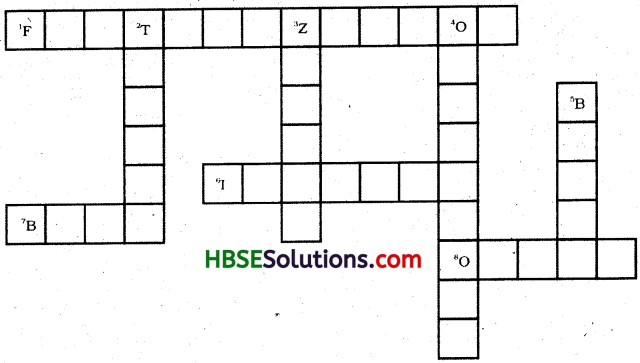
Complete the cross-word puzzle using the hints given below.
Across:
1. The process of the fusion of the gametes.
6. The type of fertilization in hen.
7. The term used for bulges observed on the sides of the body of Hydra.
8. Eggs are produced here.

Down:
2. Sperms are produced in these male reproductive organs.
3. Another term for the fertilized egg.
4. These animals lay eggs.
5. A type of fission in amobea.
HBSE 8th Class Science Solutions Chapter 9 Reproduction in Animals-1
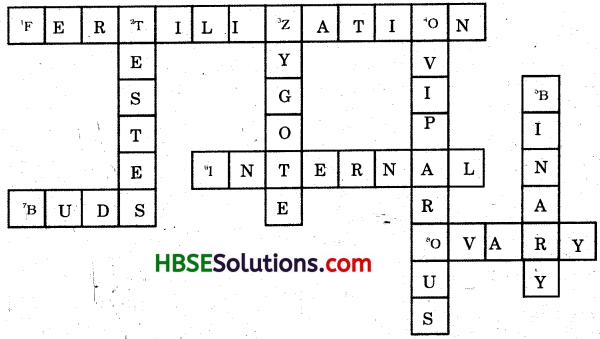
Answer:
HBSE 8th Class Science Solutions Chapter 9 Reproduction in Animals-2

Extended Learning – Activities And Projects

1. Visit a poultry farm. Talk to the manager of the farm and try to find out the answers to the following:
(a) What are layers and broilers in a poultry farm?
(b) Do hens lay unfertilised eggs?
(c) How can you obtain fertilised and unfertilised eggs?
(d) Are the eggs that we get in the stores fertilised or unfertilised?
(e) Can you consume fertilised eggs?
(f) Is there any difference in the nutritional value of the fertilised and unfertilised eggs?
Answer:
For self attempt.

2. Observe live hydra yourself and learn how they reproduce by doing the following activity:
During the summer months collect water weeds from ponds or ditches along with the pond water and put them in a glass jar. After a day or so you may see several hydra clinging to the sides of the jar.

Hydra is transparent, jelly-like and with tentacles. It clings to the jar with the base of its body. If the jar is shaken, the hydra will contract instantly into a small blob, at the same time drawing its tentacles in.

Now take out few hydras from the jar and put them on a watch glass. Using a hand lens or a binocular or dissection microscope, observe the changes that are taking place in their body. Note down your observations.
Answer:
For self attempts.

3. The eggs we get from the market are generally the unfertilized ones. In case you wish to observe a developing chick embryo, get a fertilized egg from the poultry or hatchery which has been incubated for 36 hours or more. You may then be.able to see a white disc-like structure on the yolk. This is the developing embryo. Sometimes if the heart and blood vessels have developed you may even see a red spot.
Answer:
For self attempt.

HBSE 8th Class Science Solutions Chapter 9 Reproduction in Animals

4. Talk to a doctor. Find out how twinning: occurs. Look for any twins in your neighbourhood, or among your Mends. Find out ifthe twins are identical or non-identical. Also find out why identical twins are always of the same sex? If you know of any story about twins, write it in your own words.
You could visit the following website for information on twins: www.keepkidshealthy.com/twins/ expecting_twins.html.
For more information , on animal reproduction, you can vjsit:

  • www.Saburchill.com/chapters/ chap0031.html
  • healthhowstuffworks.com/human- reproduction.htm
  • www.teenshealth.org/teen/sexual_health

Answer:
For self attempt.

HBSE 8th Class Science Reproduction in Animals Important Questions and Answers

Very Short Answer Type Questions

Question 1.
Name different modes of reproduction.
Answer:
Sexual reproduction and asexual reproduction.

Question 2.
Define sexual reproduction.
Answer:
When male and female organisms are involved in reproduction, it is called sexual reproduction.

Question 3.
Define asexual reproduction.
Answer:
When only single parent involved, reproduction is called asexual reproduction.

Question 4.
What is another name for ovum or sperm?
Answer:
Gametfe.

Question 5.
What is fertilization?
Answer:
When male and female gametes fuse, it is called fertilization.

Question 6.
What is formed when male and female gametes fuse?
Answer:
Zygote.

HBSE 8th Class Science Solutions Chapter 9 Reproduction in Animals

Question 7.
Name female reproductory organs.
Answer:
Ovaries, oviduct, uterus.

Question 8.
Name male reproductory organs.
Answer:
Testes, sperm ducts and penis.

Question 9.
Name the female gamete produced by ovaries.
Answer:
Ova.

Question 10.
Which male organ produce male gamete?
Answer:
Testes.

Question 11.
Name male gamete produced by testes.
Answer:
Sperms.

Question 12.
Name the hind of fertilization *hich take, pUce inside fem.le. body.
Answer:
Internal fertilization.

Question 13.
What kind of fertilization takes place in humans?
Answer:
Internal fertilization.

Question 14.
What type of fertilization takes place in frogs?
Answer:
External fertilization.

Question 15.
What does a zygote develop into?
Answer:
Embryo.

HBSE 8th Class Science Solutions Chapter 9 Reproduction in Animals

Question 16.
Where does an embryo grow in case of internal fertilization?
Answer:
In uterus.

Question 17.
What does an embryo grow into?
Answer:
Foetus.

Question 18.
Where does an embryo grow in case of external fertilization?
Answer:
Out side in open.

Question 19.
What are the animals called, who give birth directly to young one?
Answer:
Viviparous animals.

Question 20.
Give at least two examples of viviparous animals.
Answer:
Humans and cows.

Question 21.
What are the animals called, who lay eggs first?
Answer:
Oviparous animals.

Question 22.
Give any two examples of oviparous animals.
Answer:
Hen, Frog.

Question 23.
How many developing stages an egg of a frag undergoes to become an adult?
Answer:
Three: Egg, Tadpole, larvae, adult.

Question 24.
What do we call the sudden and extreme changes taking place during the development of an animal?
Answer:
Metamorphosis.

Question 25.
Name any two methods of asexual reproduction.
Answer:
Budding and Binary fission.

HBSE 8th Class Science Solutions Chapter 9 Reproduction in Animals

Question 26.
Name any animal undergoing budding for reproduction.
Answer:
Hydra.

Question 27.
Name tuny animal undergoing Binary fission to reproduce,
Answer:
Amoeba.

Short Answer Type Questions

Question 1.
What is reproduction? Why is it important?
Answer:
Reproduction is giving birth to organisms of same kind. Reproduction is important to continue life on earth and to maintain different special characters of different species.

Question 2.
What are different modes of reproduction?
Answer:
Reproduction takes place by two methods. In one method a single parent is involved in the process of reproduction. This is called asexual reproduction. In second method both male and female i.e. both parents are involved in the process of reproduction. This kind of reproduction is called sexual reproduction.

Question 3.
What are the names of male reproductory organs in human beings?
Answer:
In human beings male reproductory organs are a pair of testes, sperm ducts and a penis. Testes are responsible for producing male gametes called sperms. They are transported to the sperm ducts and through the penis, they are ejaculated in female body.

Question 4.
Explain the reproductory organs of female in human beings.
Answer:
In human beings the female reproductoiy organs are a pair of ovaries, oviducts or fallopian tubes and the uterus. Ovaries are responsible to produce female gamete called ova, which fertilize with male sperm in female fallopian tube and travels to uterus for its development into embryo and the foetus.

Question 5.
Describe the human male and female gametes.
Answer:
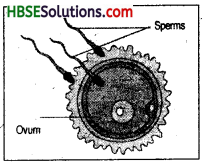
In human beings the males produce the gamete called sperms. Sperms are very small in size. They have a head with a middle piece which end into a tail. It is a single cell. Similarly, female gamete ova is produced by ovaries. Every ova is a single cell and one matured ova is released by one ovary every month.

HBSE 8th Class Science Solutions Chapter 9 Reproduction in Animals

Question 6.
What is fertilisation?
Answer:
When a male and a female gamete come in contact with each other they fuse. The male sperm enters the female ova and the nucleus of the sperm fuses with nucleus of the ova and results into a single nucleus. This whole process is called fertilization. In short fertilisation is the fusion of male and female gametes.
HBSE 8th Class Science Solutions Chapter 9 Reproduction in Animals-3

Question 7.
Explain how external fertilization takes place?
Answer:
In this case the females lay eggs in slow moving streams. The males also release sperms on this cluster of eggs. The sperms move in water with the help of tail and when come in contact with egg, they get fertilized.

Question 8.
How is an embryo formed put of a zygote?
Answer:
Zygote is a single cell formed by the fusion of male and female gametes. It undergoes repeated numbers of division to form a lot of many cells, so that the limbs and other parts can be developed. Thus a single zygote gets divided to form an embryo.

Question 9.
How is an embryo formed in case of hens?
Answer:
In hens zygote divides many times and reaches the oviduct. During this a protective outer coating is formed around the embryo. The complete embryo develops inside this protective shell. This embryo is laid by the hen along with the shell as an egg. This egg finally hatches after ‘ three weeks to produce chick.

Question 10.
What is budding?
Answer:
Budding is an asexual method of reproduction in animals. It needs only a single parent to reproduce. The body of the animal starts developing a small bulging structure called bud which slowly grows and have itself disconnected from the parent animal and becomes a separate individual. This is called budding. Animals like hydra reproduce through budding.

Question 11.
What do you mean by binary fission?
Answer:
Binary fission is a method of asexual reproduction. In this method the body of the animal divides into two halves. The nucleus of the body divides into two and this is followed by the division of the whole body. So, two organisms get produced with separate nuclei. Animals like Amoeba reproduce by this method.

HBSE 8th Class Science Solutions Chapter 9 Reproduction in Animals

Question 12.
What is cloning?
Answer:
Cloning is a method of producing an identical organism, a body part or only a cell. The produced organism or cell is completely identical to its original organism or cell. This method has been used many times in animals to produce identical clones.

Long Answer Type Questions

Question 1.
What do you mean by reproduction? Write about different modes of reproduction.
Answer:
Reproduction is the process of producing young ones of the same kind. Reproduction is a very important process. It is the only means of keeping the life on the earth.
There are two modes of reproduction:
(i) Sexual Reproduction:
Reproduction process in which a male and a female parents are involved is called sexual reproduction. In this process both parents produce gametes which fertilize to produce a zygote, which further develops into a baby. Human beings, cows, dogs etc. reproduce sexually.

(ii) Asexual Reproduction:
When a single parent is responsible for producing a young one, it is called asexual reproduction. Budding, fragmentation, spore formation Binary fission etc. are different methods of asexual reproduction. Microorganisms like Hydra, Amoeba, bacteria etc. reproduce asexually.

Question 2.
Draw and describe the male reproductive organs in humans.
Answer:
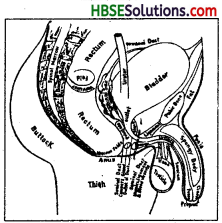
Male reproductive organs consist of a pair of testes, sperm ducts and penis. Testes are responsible for producing male gamete called sperm. Sperm is very small in size. It has a head, a middle piece and a tail. Sperms travel through sperm ducts and penis, and are released in female body for fertilization.
HBSE 8th Class Science Solutions Chapter 9 Reproduction in Animals-4

Question 3.
Draw and explain the Female Reproductive organs in human.
Answer:
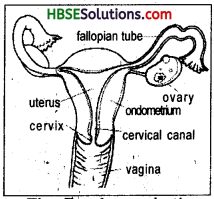
Female reproductive organs consist of a pair of ovaries, oviduct or fallopian tubes and uterus.
HBSE 8th Class Science Solutions Chapter 9 Reproduction in Animals-5
Ovaries produce the female gamete called Ova. Every month an ovary produces an ovum. The ovum and sperm fertilize inside fallopian tubes and the fertilized zygote travels to the uterus and attach with its wall to develop into the foetus.

Question 4.
What is fertilization? How does it take place?
Answer:
Fertilization is the process by which the male and female gametes fuse to form the zygote. The sperms from a male are transferred into the female body. They swim to the fallopian tubes with help of their tails and one of them enters the ovum to fertilize. When the sperm enters the ovum, the nucleus of both the gametes fuse with each other to form the fertilized zygote.

The fertilized egg is called zygote. This zygote develops into foetus by repeated cell division. When the fertilization takes in the body of female, it is called internal fertilization. But many animals release their gametes into water and fertilization takes place outside the body of female, then the fertilization is called the external fertilization.

HBSE 8th Class Science Solutions Chapter 9 Reproduction in Animals

Question 5.
What is asexusal reproduction? Describe different methods of asexual reproduction.
Answer:
The reproduction in which only a single parent is involved is called asexual reproduction. This type of reproduction takes place mostly in microoganisms. Following are the methods of asexual reproduction:
(i) Budding:
This type of reproduction takes place in Hydra. The body of the hydra starts developing small bulges. These bulges are called buds. These buds grow in size and finally get detached from its body and become a separate individual.

(ii) Binary Fission:
This type of reproduction takes place in Amoeba. The body of the organism divides into two. The nucleus of the organism divides into two and then the body of Amoeba divides, each part getting each nucleus and thus becoming two separate individuals.

Reproduction in Animals Class 8 HBSE Notes

1. Each living being reproduce to give birth to young ones exactly like them.
2. The process by which young ones are produced is called reproduction.
3. Reproduction is of two types: Sexual reproduction and asexual reproduction.
4. When a male and a female gamete fuse to give birth to a young ones, then it is called sexual reproduction.
5. When a single parent is involved in reproduction, then it is called asexual reproduction.
6. Reproductive organs in males and females are different. In females the reproductive organs are ovaries oviducts and uterus. In males the reproductive organs are a pair of testes, sperm ducts and penis.
7. Ovaries produce female gamete called ovum and male gamete called sperms are produced by testes.
8. Ovum and sperm fuse to form egg called Zygote. The process of fusion of ovum and sperm is called fertilization.
9. Fertilization is of two types: When it takes place inside the females body, then it is called internal fertilization, but when ovum and sperms fuse out side the body, it is called external fertilization.
10. Embryo is formed from the zygote by repeated divisions, which grows in the uterus of the female in case of internal fertilization. Embryo grows into foetus when it gets well developed limbs.
11. When animals give birth to a young one it is called a viviparous animals e.g. man, cow etc. When animals lay eggs, they are called oviparous animals e.g. hen, butterfly, etc.
12. In asexual reproduction organisms reproduce by budding binary fission, fragmentation etc.

HBSE 8th Class Science Solutions Chapter 9 Reproduction in Animals Read More »

HBSE 9th Class Maths Important Questions Chapter 8 Quadrilaterals

Haryana State Board HBSE 9th Class Maths Important Questions Chapter 8 Quadrilaterals Important Questions and Answers.

Haryana Board 9th Class Maths Important Questions Chapter 8 Quadrilaterals

Very Short Answer Type Questions

Question 1.
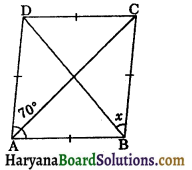
In the figure 8.54, ABCD is a parallelogram. Find the measure of x.
HBSE 9th Class Maths Important Questions Chapter 8 Quadrilaterals 1
Solution:
Since ABCD is a parallelogram.
∴ ∠C = ∠A ⇒ ∠C = 70°
In ΔCBD, we have
BC = CD
⇒ ∠CDB = ∠CBD, (angles opposite to equal sides are equal)
⇒ ∠CBD = x
and ∠CDB + ∠CBD + ∠C = 180°
(sum of interior angles of a triangle = 180°)
⇒ x + x + 70° = 180°
⇒ 2x = 180° – 70°
⇒ 2x = 110°
⇒ x = \(\frac{110^{\circ}}{2}\) = 55°
Hence,measure of x = 55°.

Question 2.
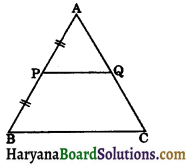
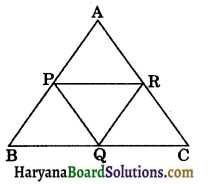
In the figure 8.55, P, Q and R are the mid points of AB, BC and CA respectively. If PQ = 2.5 cm, QR = 3.0 cm and PR = 3.5 cm, calculate AB, BC and CA.
HBSE 9th Class Maths Important Questions Chapter 8 Quadrilaterals 2
Solution:
Since, P and R are the mid points of AB and AC respectively.
∴ PR = \(\frac{1}{2}\)BC (By theorem 8.9)
⇒ 3.5 = \(\frac{1}{2}\)BC
⇒ BC = 3.5 × 2 = 7 cm
Again, Q and R are the mid points of BC and AC respectively.
∴ QR = \(\frac{1}{2}\)AB,
⇒ 3.0 = \(\frac{1}{2}\)AB
⇒ AB = 3 × 2 = 6 cm
and similarly, P and Q are the mid points of AB and BC respectively.
∴ PQ = \(\frac{1}{2}\)AC
⇒ 2.5 = \(\frac{1}{2}\)AC
⇒ AC = 2.5 × 2 = 5 cm
Hence, AB = 6 cm, BC = 7 cm and AC = 5 cm.

HBSE 9th Class Maths Important Questions Chapter 8 Quadrilaterals

Question 3.
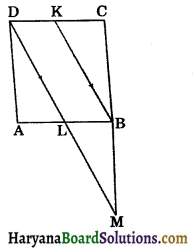
In a parallelogram ABCD, K is the mid point of side CD and DM is drawn parallel to BK, which meets CB produced at M and cut side AB at L. Prove that:
(i) AD = \(\frac{1}{2}\)CM
(ii) DM = 2BK.
Solution:
(i) In ΔCDM, K is the mid point of CD.
and BK || DM, (Given)
HBSE 9th Class Maths Important Questions Chapter 8 Quadrilaterals 3
B is the mid point of CM. [By theorem 8.10]
⇒ CM = 2BC …..(i)
Since, ABCD is a parallelogram.
∴ AD = BC …..(ii)
(Opposite sides of parallelogram)
From (i) and (ii), we get
CM = 2AD
AD = \(\frac{1}{2}\)CM
Hence proved

(ii) In ΔMCD, B and K are respectively the mid points of CM and CD
∴ BK = \(\frac{1}{2}\)DM
⇒ DM = 2BK. Hence proved

Short Answer Type Questions

Question 1.
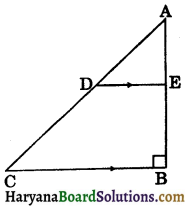
In the figure 8.57, ABC is a right angled triangle, D is the mid point of AC and E is the point on AB such that DE || BC. If AE = 6 cm and area of ΔADE = 22.5 cm2. Find the area of a ΔABC.
HBSE 9th Class Maths Important Questions Chapter 8 Quadrilaterals 4
Solution:
Since,
DE || BC
∴ ∠AED = ∠ABC = 90°
Area of right ΔADE = \(\frac{1}{2}\)DE × AE
⇒ 22.5 = \(\frac{1}{2}\)DE × 6, [∵ ar ΔADE = 22.5 cm2 and AE = 6 cm]
⇒ \(\frac{22.5 \times 2}{6}\) = DE
⇒ DE = \(\frac{15}{2}\) = 7.5 cm
Since, D is the mid point of AC and DE || BC.
∴ E is the mid point of AB. [By theorem 8.10]
⇒ AB = 2 × AE = 2 × 6 = 12 cm
Since, D and E are mid points of AC and AB respectively.
∴ BC = 2 × DE
= 2 × 7.5 = 15 cm
Now, area of right
ΔABC = \(\frac{1}{2}\)BC × AB
= \(\frac{1}{2}\) × 15 × 12
= 90 cm2
Hence,
Area of ΔABC = 90 cm2.

HBSE 9th Class Maths Important Questions Chapter 8 Quadrilaterals

Question 2.
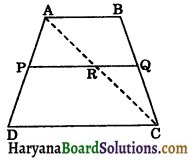
ABCD is a trapezium in which AB || CD. P and Q are mid points of AD and BC respectively such that PQ || CD. If AB = 8 cm and CD = 10 cm, find the length of PQ.
Solution:
Join AC intersects PQ at R.
In ΔADC,
P is the mid point of AD and PR || CD.
[∵ PQ || CD]
∴ R is the mid point of AC.
HBSE 9th Class Maths Important Questions Chapter 8 Quadrilaterals 5
Thus, P and R are the mid points of AD and AC respectively.
∴ PR = \(\frac{1}{2}\)CD,
⇒ PR = \(\frac{1}{2}\) × 10
⇒ PR = 5 cm ……(1)
Since, AB || CD and PQ || CD, (Given)
Therefore, AB || PQ
⇒ AB || QR
In ΔCAB, QR || AB and R is the mid point of AC.
∴ Q is the mid point of BC.
⇒ QR = \(\frac{1}{2}\)AB,
⇒ QR = \(\frac{1}{2}\) × 8
⇒ QR = 4 cm ……(ii)
Adding (i) and (ii), we get
PR + QR = 5 + 4 ⇒ PQ = 9 cm
Hence, PQ = 9 cm.

Question 3.
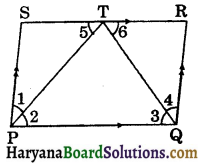
In the figure 8.59, PQRS is a parallelogram. Bisector of ∠P and ∠Q meets SR in T. Prove that PQ = 2QR.
HBSE 9th Class Maths Important Questions Chapter 8 Quadrilaterals 6
Solution:
Since ABCD is a parallelogram.
∴ PQ || SR and PT intersects them.
⇒ ∠5 = ∠2, …..(i)
(Alternate interior angles)
∠1 = ∠2 …..(ii)
[PT is the bisector of ZP]
From (i) and (ii), we get
∠1 = ∠5
⇒ PS = ST ……(iii)
(Sides opposite to equal angles are equal)
Similarly, we can prove that
QR = TR ……(iv)
Adding (iii) and (iv), we get
PS + QR = ST + TR
⇒ QR + QR = SR, [∵ PS = QR]
⇒ 2QR = PQ, [∵ SR = PQ]
⇒ PQ = 2QR. Hence proved

Question 4.
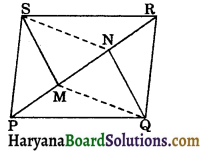
In the figure 8.60, PQRS is a parallelogram in which line segments SM and QN trisects the diagonal PR. Prove that:
(i) SM || QN and SM = QN,
(ii) SMQN is a parallelogram.
HBSE 9th Class Maths Important Questions Chapter 8 Quadrilaterals 7
Solution:
(i) Since SM and QN trisects the diagonal PR.
∴ PM = MN = NR
⇒ PM = NR
⇒ PM + MN = NR + MN
(Adding MN on both sides)
⇒ PN = MR ……(i)
Now, PQRS is a parallelogram.
∴ PQ || RS and PR intersects them.
∠QPR = ∠SRP,
(Alternate interior angles)
⇒ ∠QPN = ∠SRM …..(ii)
In ΔPQN and ΔRSM, we have
PQ = RS, (Opposite sides of a parallelogram)
∠QPN = ∠SRM, [From (ii)]
and PN = MR [From (i)]
∴ ΔPQN = ΔRSM,
[By SAS congruence rule]
⇒ QN = SM, (CPCT)
and ∠PNQ = ∠RMS, (CPCT)
But these are alternate interior angles.
∴ QN || SM
Hence, SM || QN and SM = QN.

(ii) Since, SM || QN and SM = QN Proved
∴ SMQN is a parallelogram. Hence proved

HBSE 9th Class Maths Important Questions Chapter 8 Quadrilaterals

Question 5.
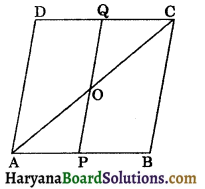
ABCD is a parallelogram in which P and Q are points on the sides AB and CD such that PB = DQ. Prove that OP = OQ.
Solution:
Since, ABCD is a parallelogram.
∴ AB || CD and AC intersects them.
∴ ∠DCA = ∠BAC
(alternate interior angles)
HBSE 9th Class Maths Important Questions Chapter 8 Quadrilaterals 8
⇒ ∠QCO = ∠PAO …..(i)
and AB = CD, (opposite sides of a parallelogram)
⇒ AB – PB = CD – DQ
[∵ it is given that PB = DQ]
⇒ AP = CQ,
Now, in ΔAOP and ΔCOQ, we have
∠PAO = ∠QCO, [from (i)]
∠AOP = ∠COQ, (Vertically opposite angles)
and AP = CQ, [From (ii)]
ΔAOP ≅ ΔCOQ,
[By AAS congruence rule]
⇒ OP = OQ, [By CPCT]
Hence proved

Question 6.
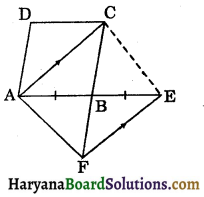
In the figure 8.62, ABCD is a parallelogram. AB is produced to E such that BE = AB. EF meets CB produced at F and parallel to AC. Prove that:
(i) AFEC is a parallelogram.
(ii) AF = EC.
HBSE 9th Class Maths Important Questions Chapter 8 Quadrilaterals 9
Solution:
(i) Since AC || FE and CF intersects them.
∴ ∠ACF = ∠EFC, (Alternate interior angles)
⇒ ∠ACB = ∠EFB ……(i)
Now, in ΔABC and ΔEBF, we have
∠ABC = ∠EBF, (Vertically opposite angles)
∠ACB = ∠EFB, [From (i)]
and AB = BE, (Given)
∴ ΔABC ≅ ΔEBF, (By AAS congruence rule)
⇒ AC = EF, (CPCT)
Now, AC = EF
and AC || EF, (Given)
∴ AFEC is a parallelolgram.

(ii) Since AFEC is a paralleogram.
∴ AF = EC, (Opposite sides of a parallelogram)
Hence proved

Question 7.
The figure ABCD is a trapezium in which AB || CD. P and Q are the mid points of diagonals BD and AC respectively. BQ joined and produced meets CD at R. Prove that:
(i) PQ || CD
(ii) PQ = \(\frac{1}{2}\)(CD – AB).
OR
Prove that the line joining the mid points of the diagonals of a trapezium is parallel to the parallel sides of the trapezium. [NCERTExemplar Problems]
HBSE 9th Class Maths Important Questions Chapter 8 Quadrilaterals 10
Solution:
In ΔBAQ and ΔRCQ, we have
AQ = QC, (∵ Q is the mid point of AC)
∠BAQ = ∠RCQ, [∵ AB || CD and AC intersects them)
and ∠AQB = ∠CQR, (vertically opposite angles)
ΔBAQ ≅ ΔRCQ, [by AAS congruence rule]
⇒ BQ = RQ and AB = CR, (CPCT) …(i)
(i) In ΔBRD, P and Q are the mid points of BD and BR respectively.
∴ PQ || DR ⇒ PQ || CD.
⇒ PQ || AB and AB || CD (given)
(ii) In ΔBRD, P and Q are the mid points of BD and BR respectively.
∴ PQ = \(\frac{1}{2}\)DR, (by theorem 8.9)
⇒ PQ = \(\frac{1}{2}\)(CD – CR)
PQ = \(\frac{1}{2}\)(CD – AB), [from (i), CR = AB]
Hence proved

HBSE 9th Class Maths Important Questions Chapter 8 Quadrilaterals

Question 8.
In the figure 8.64, ABCD is a parallelogram in which BD is a diagonal. P, Q and R are the mid points of BD, BC and CD respectively. If ΔPQR is an equilateral triangle, then prove that parallelogram ABCD is a rhombus not a square.
HBSE 9th Class Maths Important Questions Chapter 8 Quadrilaterals 11
Solution:
In ΔDBC, R and P are the mid points of CD and BD respectively.
RP || BC and RP = \(\frac{1}{2}\)BC, (By theorem 8.9)
RP || CQ and RP =CQ,
[∵ Q is the mid point of BC]
∴ PQCR is parallelogram. [by theorem 8.8]
Since ΔPQR is an equilateral triangle.
∴ RP = PQ and ∠P = 60° …(i)
Thus, adjacent sides of a parallelogram are equal.
Therefore, PQCR is a rhombus.
∴ PQ = CQ = CR = PR
Now, CR = CQ
⇒ 2CR = 2CQ
⇒ CD = BC,
[∵ Q and R are the mid points of BC and CD respectively]
Thus, adjacent sides of a parallelogram ABCD are equal.
Therefore, ABCD is a rhombus.
But ∠P= 60° ⇒ ∠C = 60° [∵ ∠P = ∠C]
∴ ABCD is a rhombus not a square.

Long Answer Type Questions

Question 1.
ABCD is a quadrilateral in which AD = BC. E, F, G and H are the mid points of AB, BD, CD and AC respectively. Prove that EFGH is a rhombus.
Solution:
In ΔDCB, G and Fare mid points of CD and BD respectively.
∴ GF || BC
and GF = \(\frac{1}{2}\)BC ……(i)
HBSE 9th Class Maths Important Questions Chapter 8 Quadrilaterals 12
In ΔACB, H and E are mid points of AC and AB respectively.
∴ HE || BC
and HE = \(\frac{1}{2}\)BC ……(ii)
From (i) and (ii), we get
HE || GF
and HE = GF = \(\frac{1}{2}\)BC … (iii)
∴ EFGH is a parallelogram. (by theorem 8.8)
Similarly, in ΔBAD, E and F are mid points of AB and BD respectively.
∴ EF ||AD
and EF = \(\frac{1}{2}\)AD …(iv)
In ΔCAD, G and H are mid points of CD and AC respectively.
∴ HG || AD
and HG = \(\frac{1}{2}\)AD …(v)
From (iv) and (v), we get
HG = EF = \(\frac{1}{2}\)AD …(vi)
But, AD = BC (given) …(vii)
From (iii), (vi) and (vii), we get
HE = EF = GF = HG
Thus, in a parallelogram EFGH,
HE = EF = GF = HG.
Therefore, EFGH is a rhombus.
Hence proved

HBSE 9th Class Maths Important Questions Chapter 8 Quadrilaterals

Question 2.
P and R are the mid points of opposite sides AB and CD of a parallelogram ABCD respectively. AR and CP are joined and if S and Q are mid points of AR and CP respectively. Prove that PQRS is a parallelogram.
Solution:
Since ABCD is a parallelogram.
∴ AB = CD, (opposite sides of a parallelogram)
HBSE 9th Class Maths Important Questions Chapter 8 Quadrilaterals 13
⇒ \(\frac{1}{2}\)AB = \(\frac{1}{2}\)CD,
⇒ PB = DR and AP = CR …(i)
[∵ P and R are the mid points of AB and CD]
In ΔARD and ΔCPB, we have
DR = PB, (as proved above)
AD = BC,
(opposite sides of a parallelogram)
and ∠D = ∠B (opposite angles of a parallelogram)
∴ ΔARD ≅ ΔCPB, (by SAS congruence rule)
⇒ AR = CP, (CPCT)
\(\frac{1}{2}\)AR = \(\frac{1}{2}\)CP
⇒ RS = PQ
[∵ S and Q are mid points of AR and CP respectively]
and ∠1 = ∠4, (CPCT) … (iii)
Now, AR = CP, (as proved above)
⇒ AR – RS = CP – PQ,
[∵ RS = PQ, from (ii)]
⇒ AS = CQ ……(iv)
⇒ ∠A = ∠C, (opposite angles of parallelogram)
⇒ ∠A – ∠1 = ∠C – ∠1
⇒ ∠A – ∠1 = ∠C – ∠4,
[from (iii), ∠1 = ∠4]
⇒ ∠2 = ∠3 …(v)
Now, in ΔASP and ΔCQR, we have
AS = CQ, [from (iv)]
∠2 = ∠3, [from (v)]
and AP = CR, [from (i)]
∴ ΔASP ≅ ΔCQR, (by SAS congruence rule)
⇒ SP= QR, (CPCT) … (vi)
Thus, from (ii) and (vi), we get
RS = PQ and SP = QR
Hence, PQRS is a parallelogram. Proved

Question 3.
The figure 8.67, represents a trapezium ABCD in which AB || CD and AD = BC. Prove that:
(i) ∠DAB = ∠CBA
(ii) diagonal AC = diagonal BD,
(iii) OA = OB and OC = OD.
HBSE 9th Class Maths Important Questions Chapter 8 Quadrilaterals 14
Solution:
Given : A trapezium ABCD in which AB || CD and AD = BC.
To prove : (i) ∠DAB = ∠CBA,
(ii) diagonal AC = diagonal BD,
(iii) OA = OB and OC = OD.
HBSE 9th Class Maths Important Questions Chapter 8 Quadrilaterals 15
Construction : Draw DP ⊥ AB and CQ ⊥ AB.
Proof: (i) Since DP ⊥ AB and CQ ⊥ AB.
∴ DP || CQ
and PQ || CD, (∵ AB || CD)
∴ PQCD is a parallelogram.
⇒ DP = CQ ……(i)
(opposite sides of a parallelogram)
In ΔAPD and ΔBQC, we have
∠APD = ∠BQC, (Each = 90°)
Hyp. AD = Hyp. BC, (given)
and DP = CQ, [from (i)]
∴ ΔAPD ≅ ΔBQC,
[by RHS congruence rule]
⇒ ∠DAP = ∠CBQ, (CPCT)
⇒ ∠DAB = ∠CBA …(ii)
(ii) In ΔDAB and ΔCBA, we have
AD = BC, (given)
∠DAB = ∠CBA, [from (ii)]
and AB = AB, (common)
∴ ΔDAB ≅ ΔCBA,
(by SAS congruence rule)
⇒ BD = AC, (CPCT)
and ∠ADB = ∠BCA, (CPCT)
⇒ ∠ADO = ∠BCO …(iii)
(iii) In ΔAOD and ΔBOC, we have
⇒ ∠AOD = ∠BOC, (vertically opposite angles)
∠ADO = ∠BCO, [From (iii)]
and AD = BC, (given)
∴ ΔAOD ≅ ΔBOC, (by AAS congrunce rule)
⇒ OA = OB and OD = OC, (CPCT)
Hence proved

HBSE 9th Class Maths Important Questions Chapter 8 Quadrilaterals

Question 4.
If through the middle point of the base of a triangle, a straight line is drawn parallel to one of the sides, prove that its intercepts on the internal and external bisectors of the vertical angle is equal to the other side.
Solution:
Given : P is the mid point of side BC of ΔABC. RK is drawn parallel to AB through P, such that RK is the intercept between AK and AR, the internal and external bisectors at ∠A.
HBSE 9th Class Maths Important Questions Chapter 8 Quadrilaterals 16
To prove: RK = AC.
Proof : ∵ AB || RK and transversal AK intersects them.
∠1 = ∠5 …..(i) (alternate interior angles)
and ∠1 = ∠2 …(ii)
AK bisects ∠A
From (i) and (ii), we get
∠2 = ∠5
⇒ AQ = KQ, ……..(iii)
(sides opposite to equal angles are equal)
∵ AR intersects parallel lines AB and RK.
∴ ∠3 = ∠6, …(iv)
(alternate interior angles)
and ∠3 = ∠4, …(v)
(AR bisects ∠MAC)
From (iv) and (v), we get
∠4 = ∠6
⇒ AQ = RQ ……(vi)
From (iii) and (vi), we get
AQ = KQ = RQ
⇒ AQ = \(\frac{1}{2}\)(KQ + RQ)
⇒ AQ = \(\frac{1}{2}\)RK ..(vii)
In ΔABC, PQ || AB and P is the mid point of BC.
∴ Q is the mid point of AC. (By theorem 8·10)
⇒ AQ = \(\frac{1}{2}\)AC …(viii)
From (vii) and (viii), we get
\(\frac{1}{2}\)RK = \(\frac{1}{2}\)AC
⇒ RK = AC. Hence proved

Question 5.
In the figure 8.70, AD = \(\frac{1}{2}\)AB, P is the mid point of AB, S is the mid point of DQ and PQ || BR. Prove that:
(i) AS || BR
(ii) QR = \(\frac{1}{3}\)DR.
HBSE 9th Class Maths Important Questions Chapter 8 Quadrilaterals 17
Solution:
(i) ∵ AD = \(\frac{1}{2}\)AB
AP = PB, (∵ P is the mid point of AB)
∴ AD = AP = PB …..(i)
In ΔDPQ, A is the mid point of DP and S is the mid point of DQ.
∴ AS || PQ
But BR || PQ (given)
∴ AS || BR
Now, AS || PQ || BR and a transversal BD making equal intercepts i.e., AP = PB.
Therefore, other transversal DR will also make equal intercepts i.e.,
SQ = QR …..(ii)
But, DS = SQ, …..(iii) (∵ S is the mid point of DQ)
From (ii) and (iii), we get
DS = SQ = QR
Now, DR = DS + SQ + QR
⇒ DR = QR + QR + QR
⇒ DR = 3QR
⇒ QR = \(\frac{1}{3}\)DR. Hence proved

HBSE 9th Class Maths Important Questions Chapter 8 Quadrilaterals

Question 6.
Show that quadrilateral formed by joining the mid points of the sides of a square, is also a square. [NCERT Exemplar Problems]
Solution:
Given : A square ABCD in which P, Q, R and S are the mid points of sides AB, BC, CD and DA respectively. PQ, QR, RS and SP are joined
HBSE 9th Class Maths Important Questions Chapter 8 Quadrilaterals 18
To prove : PQRS is a square.
Construction : Join AC and BD.
Proof: In ΔDAC, S and R are the mid points of AD and CD respectively.
∴ SR || AC and SR = \(\frac{1}{2}\)AC, …..(i)
In ΔBAC, P and Q are the mid points of AB and BC respectively.
∴ PQ || AC and PQ = \(\frac{1}{2}\)AC…(ii)
From (i) and (ii), we get
PQ || SR and PQ = SR
∴ PQRS is a parallelogram.
In ΔPBQ and ΔRCQ, we have
PB = CR,
[∵ AB = CD ⇒ \(\frac{1}{2}\)AB = \(\frac{1}{2}\)CD]
BQ = CQ, (∵ Q is the mid point of BC)
and ∠PBQ = ∠RCQ, (Each = 90°)
∴ ΔPBQ ≅ ΔRCQ, (By SAS congruence rule)
⇒ PQ = RQ (CPCT)
But, PQ = SR
(Opposite sides of parallelogram)
and SP = RQ
∴ PQ = RQ = SR = SP
Now, PQ || AC and PS || BD
PM || OL ⇒ LP || OM
∴ OLPM is a parallelogram.
∠LPM = ∠MOL …(iii)
(Opposite angles of parallelogram)
Since, diagonals of square bisect each other at 90°.
∠AOB = 90°
⇒ ∠MOL = 90° ……(iv)
From (iii) and (iv), we get
∠LPM = 90°
Thus, in a parallelogram PQRS,
PQ = QR = RS = SP
and ∠P = 90°
Hence, PQRS is a square.

Question 7.
In the figure 8.72, sides BC and DA of a quadrilateral produced respectively to M and N such that bisectors of ∠A and ∠C meets respectively M and N. Prove that:
∠M + ∠N = \(\frac{1}{2}\)(∠A + ∠C).
HBSE 9th Class Maths Important Questions Chapter 8 Quadrilaterals 19
Solution:
In ΔABM, we have
∠1 + ∠B + ∠M = 180°,
[∵ Sum of interior angles of a triangle = 180°]
⇒ \(\frac{1}{2}\)∠A + ∠B + ∠M = 180° …….(i)
[∵ AM is the bisector of ∠A]
In ΔCND, we have
∠4 + ∠D + ∠N = 180°
⇒ \(\frac{1}{2}\)∠C + ∠D + ∠N = 180° …(ii)
[∵ CN is the bisector of ∠C]
Adding (i) and (ii), we get
\(\frac{1}{2}\)∠A + ∠B + ∠M + \(\frac{1}{2}\)∠C + ∠D + ∠N = 180° + 180°
⇒ \(\frac{1}{2}\)∠A + ∠C + ∠B + ∠D + ∠M + ∠N = 360° ….(ii)
But, ∠A + ∠B + ∠C + ∠D = 360°,
[∵ Sum of angles of a quadi. = 360°] …(iv)
From (iii) and (iv), we get
\(\frac{1}{2}\)∠A + \(\frac{1}{2}\)∠C + ∠B + ∠D + ∠M + ∠N = ∠A + ∠B + ∠C + ∠D
⇒ ∠M + ∠N = ∠A + ∠C – \(\frac{1}{2}\)∠A – \(\frac{1}{2}\)∠C
⇒ ∠M + ∠N = \(\frac{1}{2}\)∠A + \(\frac{1}{2}\)∠C
∠M + ∠N = \(\frac{1}{2}\)(∠A + ∠C).
Hence proved

HBSE 9th Class Maths Important Questions Chapter 8 Quadrilaterals

Question 8.
ABCD is a parallelogram in which Pis the mid point of AB and DP bisects 2D. Prove that:
(i) BC = PB.
(ii) PC bisects ∠C.
(iii) ∠DPC = 90°.
Solution:
(i) Since ABCD is a parallelogram.
∴ AB || CD and DP intersects them.
HBSE 9th Class Maths Important Questions Chapter 8 Quadrilaterals 20
⇒ ∠CDP = ∠APD …..(i) (Alternate interior angles)
and ∠CDP = ∠ADP, … (ii)
[∵ DP is the bisector of ∠D]
From (i) and (ii), we get
∠APD = ∠ADP
⇒ AD = AP …(iii)
(Sides opposite to equal angles are equal)
In parallelogram ABCD, we have
AD = BC, …(iv)
(∵ Opposite sides of parallelogram)
and AP = PB, …(v)
(∵ P is the mid point of AB)
From (iii), (iv) and (v), we get
BC = PB. Hence proved

(ii) ∵ BC = PB
⇒ ∠CPB = ∠PCB …….(vi)
(Angles opposite to equal sides are equal)
and ∠CPB = ∠DCP, …(vii)
(Alternate interior angles)
From (vi) and (vii), we get
∠DCP = ∠PCB
Hence, PC bisects ZC. Hence proved

(iii) AD || BC and CD intersects them.
∴ ∠C + ∠D = 180°,
(Sum of co-interior angles is 180°)
⇒ \(\frac{1}{2}\)∠C + \(\frac{1}{2}\)∠D = \(\frac{180^{\circ}}{2}\)
⇒ ∠DCP + ∠CDP = 90° ….(viii)
[∵ PD and CP are bisectors of ∠D and ∠C respectively]
Now in ΔDPC, we have
ΔDCP + ΔCDP + ΔDPC = 180°
[∵ Sum of interior angles of a triangle = 180°]
⇒ 90° + ∠DPC = 180° [Using (viii)]
⇒ ∠DPC = 180° – 90° = 90°.
Hence proved

Question 9.
ABCD is a rhombus. PABQ is a straight line such that PA = AB = BQ. Prove that PD and QC when produced meet at right angle.
Solution:
Let PD and QC when produced meet at point R.
Since, ABCD is a rhombus.
AB = BC = CD = AD …(i) (Sides of a rhombus)
and PA = AB = BQ(Given) …(ii)
HBSE 9th Class Maths Important Questions Chapter 8 Quadrilaterals 21
From (i) and (ii), we get
PA = AD
⇒ ∠1 = ∠2 …..(iii)
(Angles opposite to equal sides)
and BQ = BC
⇒ ∠3 = ∠4 …(iv)
In ΔPAD, we have
Ext. ∠DAB = ∠1 + ∠2,
[∵ Ext. angle is equal to sum of its opp. interior angles]
⇒ ∠DAB = ∠1 + ∠1 = 2∠1 …(v)
Similarly,
Ext. ∠CBA = ∠3 + ∠4
⇒ ∠CBA = ∠3 + ∠3 = 2∠3 …(vi)
Adding (v) and (vi), we get
∠DAB + ∠CBA = 2∠1 + 2∠3
= 2(∠1 + ∠3) …(vii)
Now, ABCD is a rhombus.
∴ AD || BC and AB intersects them.
⇒ ∠DAB + ∠CBA = 180° …..(viii)
[Sum of co-interior angles is 180°]
From (vii) and (viii), we get
2(∠1 + ∠3) = 180°
⇒ ∠1 + ∠3 = \(\frac{180^{\circ}}{2}\) = 90° …(ix)
In ΔPQR, we have
∠1 + ∠3 + ∠R = 180°, (∵ Sum of interior angles of a triangle is 180°)
⇒ 90° + ∠R = 180°, [Using (ix)]
⇒ ∠R = 180° – 90°
⇒ ∠R = 90°
Hence, PD and QC when produced meet at right angle. Proved

HBSE 9th Class Maths Important Questions Chapter 8 Quadrilaterals

Question 10.
In the figure 8.75, ABCD is a square in which P, Q and R are the mid points of sides AB, BC and CD respectively. Prove that :
(i) ∠PQR = 90°,
(ii) if a line is drawn through P and parallel to QR bisects AD.
HBSE 9th Class Maths Important Questions Chapter 8 Quadrilaterals 22
Solution:
(i) Join BD. Since ABCD is a square
∴ AB = BC
⇒ \(\frac{1}{2}\)AB = \(\frac{1}{2}\)BC
⇒ PB = BQ,
[∵ P is the mid point of AB and Q is the mid point of BC]
⇒ ∠1 = ∠2 ……(i)
[Angles opposite to equal sides are equal]
Similarly, ∠3 = ∠4 ……(ii)
In ΔPBQ,
∠1 + ∠2 + ∠B = 180°, (∵ Sum of interior angles of a triangle = 180°)
⇒ ∠1 + ∠2 + 90° = 180°,
(∵ Each angle of a square is 90°)
⇒ ∠1 + ∠2 = 180° – 90° = 90°…(iii)
Similarly, ∠3 + ∠4 = 90° …(iv)
Adding (iii) and (iv), we get
∠1 + ∠2 + ∠3 + ∠4 = 90° + 90°
⇒ ∠2 + ∠2 + ∠3 + ∠3 = 180°
⇒ 2(∠2+ ∠3) = 180°
⇒ ∠2+ ∠3 = \(\frac{180^{\circ}}{2}\) = 90° …….(v)
But, ∠2 + ∠3 + ∠PQR = 180°, (linear pair)
⇒ 90° + ∠PQR = 180°, [using (v)]
⇒ ∠PQR = 90°.
(ii) In ΔCBD, Q and R are the mid points of BC and CD respectively.
∴ QR || BD,
and QR || PS, (given)
∴ PS || BD
In ΔADB, PS || BD and P is the mid point of AB.
∴ S is the mid point of AD.
Hence, PS bisects AD. Proved

Multiple Choice Questions

Choose the correct option in each of the following:

Question 1.
Three angles of a quadrilateral are 70°, 85° and 90°. It’s fourth angle is :
(a) 90°
(b) 115°
(c) 100°
(d) 85°
Answer:
(b) 115°

Question 2.
The angles of quadrilateral are in the ratio 1 : 2 : 3 : 4. The greatest of these angles is :
(a) 120°
(b) 140°
(c) 144°
(d) 108°
Answer:
(c) 144°

HBSE 9th Class Maths Important Questions Chapter 8 Quadrilaterals

Question 3.
If two adjacent sides of a parallelogram are equal, then it is a :
(a) rectangle
(b) square
(c) kite
(d) rhombus
Answer:
(d) rhombus

Question 4.
If diagonals of a parallelogram are equal, then it is a :
(a) square only
(b) rectangle only
(c) rhombus only
(d) both (a) and (b)
Answer:
(d) both (a) and (b)

Question 5.
D and E are the mid points of the sides AB and AC respectively of ΔABC. DE is produced to F. To prove that CF is equal and parallel to DA, we need an additional information which is : [NCERT Exemplar Problems]
(a) ∠DAE = ∠EFC
(b) AE = EF
(c) DE = EF
(d) ∠ADE = ∠ECF
Answer:
(c) DE = EF

Question 6.
If diagonals of a quadrilateral bisect each other at right angles, then it is :
(a) parallelogram
(b) square
(c) rectangle
(d) kite
Answer:
(b) square

Question 7.
In a square ABCD, the diagonals bisect at O, then ΔAOB is :
(a) an isosceles but not a right angled triangle
(b) an isosceles right angled triangle
(c) an equilateral triangle
(d) a right angled but not an isosceles triangle.
Answer:
(b) an isosceles right angled triangle

HBSE 9th Class Maths Important Questions Chapter 8 Quadrilaterals

Question 8.
A quadrilateral is a rectangle but not a square when :
(a) it’s diagonals do not bisect each other
(b) it’s diagonals are not equal
(c) it’s diagonals are not perpendicular
(d) all angles are not equal.
Answer:
(c) it’s diagonals are not perpendicular

Question 9.
The bisectors of any two adjacent angles of a parallelogram intersect at :
(a) 90°
(b) 45°
(c) 80°
(d) 100°
Answer:
(a) 90°

Question 10.
The bisectors of the angles of a parallelogram enclose a :
(a) rectangle
(b) parallelogram
(c) kite
(d) both (a) and (b)
Answer:
(a) rectangle

HBSE 9th Class Maths Important Questions Chapter 8 Quadrilaterals Read More »

HBSE 9th Class Maths Important Questions Chapter 10 Circles

Haryana State Board HBSE 9th Class Maths Important Questions Chapter 10 Circles Important Questions and Answers.

Haryana Board 9th Class Maths Important Questions Chapter 10 Circles

Very Short Answer Type Questions

Question 1.
AB and CD are two parallel chords of a circle whose diameter is BC. Prove that AB = CD.
Solution:
Since AB || CD and transversal BC cuts them.
HBSE 9th Class Maths Important Questions Chapter 10 Circles 1
∴ ∠ABC = ∠DCB
(Alternate interior angles)
\(\widehat{A C}=\widehat{B D}\) …(i)
[∵ Equal arcs of a circle subtends equal angles at the circumference]
Since BC is a diameter.
HBSE 9th Class Maths Important Questions Chapter 10 Circles 2
⇒ chord AB = chord CD.
Hence proved

Question 2.
In the given figure, if O is the centre of a circle and OP is perpendicular to the chord AC. Show that BC = 20P.
HBSE 9th Class Maths Important Questions Chapter 10 Circles 3
Solution:
Since O is the centre of a circle.
∴ O is the mid point of AB and OP ⊥ AC.
AP = PC [By theorem 10.3]
⇒ P is the mid point of AC.
Thus O is the mid point of AB and Pis the mid point of AC.
⇒ OP || BC and OP = \(\frac{1}{2}\)BC
[By mid point theorem]
⇒ BC = 20P. Hence proved

HBSE 9th Class Maths Important Questions Chapter 10 Circles

Question 3.
Two circles whose centres are O and O’ intersecting at P and Q. Through P, a straight line l parallel to OO’ is drawn to meets the circles at A and B. If M is the mid point of OO’, prove that AP = PB.
HBSE 9th Class Maths Important Questions Chapter 10 Circles 4
Solution:
Draw
OC ⊥ AB
O’D ⊥ AB and MP ⊥ AB
Since OC ⊥ AB, MP ⊥ AB and O’D ⊥ AB.
OC || MP || O’D
and M is the mid point of OO’.
∴ P is the mid point of CD.
⇒ CP = PD ….(i)
∵ OC ⊥ AP and AP is a chord.
∴ AC = CP ….(ii)
O’D ⊥ PB and PB is a chord.
∴ BD = PD ….(iii)
From (i), (ii) and (iii), we get
AC = CP = PD = BD …(iv)
⇒ AC = PD [using (iv)]
⇒ 2AC = 2PD
⇒ AP = PB Hence proved

Question 4.
Prove that a diameter is the longest chord in a circle.
Solution:
Given: AB is a diameter of a circle C(O, r) and CD is a chord of the circle.
HBSE 9th Class Maths Important Questions Chapter 10 Circles 5
To prove : Diameter
AB > chord CD.
Proof : Since diameter passes through the centre.
∴ Diameter is nearer to the centre than chord CD.
But, of any two chords of a circle, the one which is nearer to the centre is larger.
∴ AB > CD
Hence, a diameter is the longest chord in a circle.
Proved

HBSE 9th Class Maths Important Questions Chapter 10 Circles

Question 5.
In the given figure, AB is a diameter of the circle whose centre is O. If ∠ADC = 120°, calculate the ∠BAC.
HBSE 9th Class Maths Important Questions Chapter 10 Circles 6
Solution:
Since, AB is a diameter of the circle.
∠ACB = 90° [∵ Angle in a semicircle is 90°]
Since, ABCD is a cyclic quadrilateral.
∠ABC + ∠ADC = 180°
[∵ sum of opposite angles of cyclic quadrilateral is 180°]
⇒ ∠ABC + 120° = 180°
⇒ ∠ABC = 180° – 120° = 60°
In right ΔACB, we have
∠ACB + ∠ABC + ∠BAC = 180°
[∵ sum of angles of a triangle is 180°]
⇒ 90° + 60° + ∠BAC = 180°
⇒ 150° + ∠BAC = 180°
⇒ ∠BAC = 180° – 150°
Hence, ∠BAC = 30°.

Question 6.
In the given figure, ∠ACB = 45° and ∠BDC = 40°. Calculate ∠CAB and ∠ABC.
HBSE 9th Class Maths Important Questions Chapter 10 Circles 7
Solution:
∠CAB = ∠BDC [∵ Angles in a same segment are equal]
⇒ ∠CAB = 40°
In ΔABC, we have
∠CAB + ∠ABC + ∠ACB = 180°
[sum of angles of a triangle is 180°]
⇒ 40° + ∠ABC + 45o = 180°
⇒ 85° + ∠ABC = 180°
⇒ ∠ABC = 180° – 85°
⇒ ∠ABC = 95°
Hence ∠CAB = 40° and ∠ABC = 95o.

Question 7.
In the given figure, ∠BAD = 88°. Find the values of x and y.
HBSE 9th Class Maths Important Questions Chapter 10 Circles 8
Solution:
Since, ABCD is a cyclic quadrilateral.
∴ ∠BCD + ∠BAD = 180°
[∵ sum of opp. angles of a cyclic quadrilateral is 180°]
⇒ x + 88° = 180°
⇒ x = 180° – 88°
⇒ x = 92°
⇒ ∠BCD + ∠FCD= 180°
(By linear pair axiom)
⇒ 92° + ∠FCD = 180°
⇒ ∠FCD = 180° – 92° = 88°
Since, CDEF is a cyclic quadrilateral.
∴ ∠FCD + ∠FED = 180°
⇒ 88° + ∠FED = 180°
⇒ ∠FED = 180° – 88°
⇒ ∠FED = 92°
⇒ ∠y = 92°
Hence, x = 92° and y = 92°.

HBSE 9th Class Maths Important Questions Chapter 10 Circles

Question 8.
An equilateral triangle of side 8 cm is inscribed in a circle. Find the radius of the circle.
Solution:
Let ABC be an equilateral triangle of side 8 cm and AD be its median.
HBSE 9th Class Maths Important Questions Chapter 10 Circles 9
Let G be centroid of AABC, then
HBSE 9th Class Maths Important Questions Chapter 10 Circles 10
⇒ \(\frac{A D}{A G}=\frac{3}{2}\)
⇒ \(\frac{A G}{A D}=\frac{2}{3}\)
⇒ AG = \(\frac{2}{3}\)AD …….(i)
Since, D is the mid point of BC i.e.,
BD = CD.
∴ AD ⊥ BC [By theorem 10.4]
We know that in an equilateral triangle centroid coincides with the circumcentre.
Therefore G is the circumcentre with circumradius GA.
BD = \(\frac{1}{2}\)BC
⇒ BD = \(\frac{1}{2}\) × 8 = 4 cm
In right ΔADB, we have
⇒ AB2 = BD2 + AD2
(By Pythagoras theorem)
⇒ 82 = 42 + AD2
⇒ 82 – 42 = AD2
⇒ (8 + 4) (8 – 4) = AD2
⇒ 12 × 4 = AD2
⇒ AD2 = 48
⇒ AD = \(\sqrt{48}=\sqrt{4 \times 4 \times 3}\)
= 4\(\sqrt{3}\) cm
AG = \(\frac{2}{3}\)AD [From (i)]
⇒ AG = \(\frac{2}{3} \times 4 \sqrt{3}\)
⇒ \(\frac{8 \sqrt{3}}{3}\)
Hence,radius of the circle = \(\frac{8 \sqrt{3}}{3}\) cm.

Short Answer Type Questions

Question 1.
AB and CD are two chords of a circle such that AB = 24 cm and CD= 32 cm and AB || CD. If the distance between AB and CD is 4 cm, find the radius of the circle.
Solution:
Draw OP ⊥ AB, OQ ⊥ CD and join OA and OC.
Since, OP ⊥ AB
∴ AP = PB = \(\frac{1}{2}\)AB
(By theorem 10.3)
AP = \(\frac{1}{2}\) × 24 = 12 cm
Again, OQ ⊥ CD
∴ CQ = QD = \(\frac{1}{2}\)CD
(By theorem 10.3)
∴ CQ = \(\frac{1}{2}\) × 32 = 16 cm
HBSE 9th Class Maths Important Questions Chapter 10 Circles 11
Let radius of the circle be r сm and OQ be x cm.
In right triangle OPA, we have
OA2 = AP2 + OP2
(By Pythagoras theorem)
⇒ r2 = 122 + (OQ + QP)2
⇒ r2 = 144 + (x + 4)2
⇒ r2 = 144 + x2 + 16 + 8x
⇒ r2 = 160 + x2 + 8x …(i)
In right ΔOQC, we have
CO2 = CQ2 + OQ2
⇒ r2 = 162 + x2 …(ii)
From (i) and (ii), we get
⇒ 160 + x2 + 8x = 162 + x2
⇒ 160 + 8x = 256
⇒ 8x = 256 – 160
⇒ 8x = 96
⇒ x = \(\frac{96}{8}\) = 12 cm
Putting the value of x in equation (ii), we get
r2 = 162 + (12)2
⇒ r2 = 256 + 144
⇒ r2 = 400
⇒ r= \(\sqrt{400}=\sqrt{20 \times 20}\)
= 20 cm
Hence,radius of the circle = 20 cm.

HBSE 9th Class Maths Important Questions Chapter 10 Circles

Question 2.
In the given figure, AB and CD are two parallel chords of a circle whose centre is O, such that AB = 30 cm, AO = OC = 17 cm, OM ⊥ AB, ON ⊥ CD and distance between AB and CD is 23 cm. Find the length of chord CD.
HBSE 9th Class Maths Important Questions Chapter 10 Circles 12
Solution:
Since,
OM ⊥ AB
AM = MB = \(\frac{1}{2}\)AB
⇒ AM = \(\frac{1}{2}\) × 30 = 15 cm
In right ΔOMA, we have
AO2 = AM2 + OM2
(By Pythagoras theorem)
⇒ 172 = 152 + OM2
⇒ 172 – 152 = OM2
⇒ (17 + 15) (17 – 15) = OM2
⇒ 32 × 2 = OM2
⇒ OM = \(\sqrt{32 \times 2}=\sqrt{4 \times 4 \times 2 \times 2}\)
⇒ OM = 8 cm
Distance between AB and CD is 23 cm i.e.,
MN = 23 cm
ON = MN – OM
⇒ ON = 23 – 8 = 15 cm
In right ΔONC, we have
OC2 = CN2 + ON2
⇒ 172 = CN2 + 152
⇒ CN2 = 172 – 152
⇒ CN2 = (17 + 15) (17 – 15)
⇒ CN2 = 32 × 2 = 64
⇒ CN = \(\sqrt{64}\) = 8 cm
Since, ON ⊥ CD
⇒ CN = \(\frac{1}{2}\)CD
⇒ 8 = \(\frac{1}{2}\)CD
⇒ CD = 8 × 2 = 16 cm
Hence,length of chord CD = 16 cm.

Question 3.
Of any two chords of a circle, show that the one which is nearer to the centre is larger.
Solution:
Given: Two chords AB and CD of a circle C(O, r), OP ⊥ AB and OQ ⊥ CD such that
OP < OQ.
HBSE 9th Class Maths Important Questions Chapter 10 Circles 13
To prove: AB > CD.
Construction : Join OA and OC.
Proof : Since OP ⊥ AB and OQ ⊥ CD.
AP = \(\frac{1}{2}\)AB and CQ = \(\frac{1}{2}\)CD ……..(i)
Since, OA = OC = r
OP < OQ (given)
⇒ OQ > OP
⇒ OQ2 > OP2 …(i)
In right ΔOPA and ΔOQC, we have
OA2 = OP2 + AP2
and CO2 = OQ2 + CQ2
⇒ OP2 + AP2 = OQ2 + CQ2 [∵ OA = OC = r]
⇒ OP2 + AP2 = OQ2 + CQ2 > OP2 + CQ2 [using (ii)]
⇒ OP2 + AP2 > OP2 +CQ2
⇒ AP2 > CQ2
⇒ AP > CQ
⇒ 2AP > 2CQ
⇒ AB > CD [using (i)]
Hence AB > CD. Proved

Question 4.
In the given figure, O is the centre of the circle. Prove that ∠a = ∠b + ∠c.
HBSE 9th Class Maths Important Questions Chapter 10 Circles 14
Solution:
In ΔACF, we have
∠b = ∠1 + ∠2 [∵ Exterior angle is equal to sum of its two opposite interior angles]
⇒ ∠2 = ∠b – ∠1 …..(i)
In ΔAED, we have
∠4 = ∠1 + ∠c …(ii)
[∵ Exterior angle is equal to sum of it opposite two interior angles]
∠2 = ∠4 ……(iii)
[Angles in a same segment of a circle are equal]
Arc AB subtends ∠a at the centre and ∠2 at the remaining part of the circle.
∴ ∠a = 2∠2
⇒ ∠a = ∠2 + ∠2
⇒ ∠a = ∠2 + ∠4 [Using (iii)]
⇒ ∠a = ∠b – ∠1 + ∠1 + ∠c [Using (ii) and (iii)]
⇒ ∠a = ∠b + ∠c.
Hence proved

HBSE 9th Class Maths Important Questions Chapter 10 Circles

Question 5.
Prove that the line joining the mid points of two parallel chords of a circle passes through the centre.
Solution:
Given : AB and CD are two parallel chords of a circle whose centre is O. P and Q are the mid points of AB and CD respectively.
HBSE 9th Class Maths Important Questions Chapter 10 Circles 15
To prove : PQ is a straight line.
Construction : Join OP and OQ, draw OR || AB
but CD || AB ∴ OR || CD.
Proof : Since P is the mid point of AB.
∴ OP ⊥ AB [By theorem 10.4]
⇒ ∠APO = 90°
Again, Q is the mid point of CD.
∴ OQ ⊥ CD
⇒ OQC = 90°
∴ OR || CD (By construction)
∠QOR = ∠OQC
(Alternate interior angles)
⇒ ∠QOR = 90°
and OR || AB
∠POR = ∠APO
(Alternate interior angles)
⇒ ∠POR = 90° …..(ii)
Adding (i) and (ii), we get
∠QOR + ∠POR = 90° + 90°
⇒ ∠QOP = 180°
∴ POQ is a straight line. Hence proved

Question 6.
In the given figure, a diameter AB of a circle bisects a chord CD. If AD || BC, prove that chord CD is also a diameter of the circle.
HBSE 9th Class Maths Important Questions Chapter 10 Circles 16
Solution:
Given : A circle with centre o in which diameter AB bisects chord CD and AD || BC.
To prove : CD is also a diameter of the circle.
Proof: Since AD || BC and transversal CD cut them.
∴ ∠ADC = ∠BCD
(Alternate interior angles)
⇒ ∠ADO = ∠BCO
In ΔBOC and ΔAOD, we have
∠BCO = ∠ADO
(As proved above)
CO = OD[∵ AB bisects CD]
∠BOC = ∠AOD
(Vertically opposite angles)
∴ ΔΒΟC ≅ ΔΑOD (By ASA congruence rule)
⇒ CO = OD
∴ O is the mid point of CD.
∵ O is the centre of circle.
So, CD is also a diameter of the circle.
Hence proved

Question 7.
AB and CD are equal chords of a circle with centre 0, when produced these chords meet at P. Prove that : [NCERT Exemplar Problems]
(i) PB = PD
(ii) AP = PC.
Solution:
Given : AB and CD are equal chords of a circle and when produced AB and CD meet at P.
HBSE 9th Class Maths Important Questions Chapter 10 Circles 17
To prove : (i) PB = PD
(ii) AP= PC.
Construction : Draw OL ⊥ AB and OM ⊥ CD.
Proof : Since OL ⊥ AB and OM ⊥ CD.
∴ L is the mid point of AB and M is the mid point of CD.
∵ AB = CD (given)
⇒ \(\frac{1}{2}\)AB = \(\frac{1}{2}\)CD
⇒ AL = CM and BL =DM…(i)
∵ AB = CD
∴ OL = OM …(ii)
[∵ Equal chords are equidistant from the centre]
In right ΔOLP and ΔOMP, we have
∠OLP = ∠OMP (Each is 90°)
hyp. OP= hyp. OP (common)
OL = OM [As proved in (ii)]
∴ ΔOLP ≅ ΔOMP [By RHS congruence rule]
⇒ PL = PM (CPCT) … (iii)
Subtracting (i) from (iii), we get
PL – BL = PM – DM
⇒ PB = PD
Adding (i) and (iii), we get
AL + PL = CM + PM
⇒ AP = PC
Hence, (i) PB = PD (ii) AP = PC. Proved

HBSE 9th Class Maths Important Questions Chapter 10 Circles

Question 8.
In an equilateral triangle, prove that the centroid and the circumcentre coincide.
Solution:
Given : An equilateral triangle ABC such that D, E and Fare respectively the mid points of the sides BC, CA and AB.
HBSE 9th Class Maths Important Questions Chapter 10 Circles 18
To prove: The centroid and circumcentre are coincide.
Construction : Draw medians AD, BE and CF.
Proof : Let medians AD, BE and CF intersect at G. So, G is the centroid of ΔABC.
∵ ABC is an equilateral triangle
∴ AB = BC = CA
⇒ \(\frac{1}{2}\)AB = \(\frac{1}{2}\)BC = \(\frac{1}{2}\)CA
⇒ \(\frac{1}{2}\)AB = \(\frac{1}{2}\)CA
⇒ BF = CE ……(i)
In ΔBFC and ΔCEB, we have
BF = CE [As proved in (i)]
∠B = ∠C [Each = 60°]
BC = BC [Common]
∴ ΔBFC ≅ ΔCEB
(By SAS congruence rule)
⇒ CF = BE (CPCT) … (ii)
Similarly, ΔABD ≅ ΔBCE
(By SAS congruence rule)
⇒ AD = BE (CPCT) …(iii)
From (ii) and (iii), we get
AD = BE = CF ….(iv)
But we know that centroid divide the medians in the ratio 2 : 1. So the centroid is the point located at \(\frac{2}{3}\) of the distance from a vertex along a median. The centre of the circumcircle of this triangle is called the circumcentre.
From (iv), we get
AD = BE = CF
⇒ \(\frac{2}{3}\)AD = \(\frac{2}{3}\)BE = \(\frac{2}{3}\)CF
⇒ GA = GB = GC
⇒ G is the equidistant from the vertices.
⇒ G is the circumcentre of the ΔABC.
Hence, G is the centroid as well as circumcentre of ΔABC.
Proved

Question 9.
In the given figure, OA, OB and OD are radii of the circle and AB is a chord when DO and AB are produced meet at point C such that OB = BC. Prove that b° = \(\frac{1}{3}\)a°.
HBSE 9th Class Maths Important Questions Chapter 10 Circles 19
Solution:
Since, OB = BC (given)
∠BCO = ∠BOC = b° …(i)
[Angles opp. to equal sides are equal]
In ΔOBC, we have
∠OBA = ∠BCO + ∠BOC
[Exterior angle is equal to sum of two opposite interior angles]
∠OBA = b° +6° = 2b°
In ΔOBA, we have
OB = OA [Radii of the same circle]
⇒ ∠OBA = ∠OAB
⇒ 2b° = ∠OAB
⇒ ∠OAB = 2b° ……(ii)
Now in ΔOCA, we have
∠AOD = ∠OCA + ∠OAC
∠AOD = b° + 2b° [using (i) and (ii)]
a° = 3b°
b° = \(\frac{1}{3}\)a°
Hence proved

Question 10.
The circumcentre of the triangle ABC is O. Prove that ∠OBC + ∠BAC = 90°. [NCERT Exemplar Problems]
Solution:
Let O be the circumcentre of triangle ABC.
Join BO and CO.
∵ OB = OC (equal radii of same circle)
⇒ ∠OBC = ∠OCB …..(i)
(Angles opp. to equal sides are equal)
Since, arc BC subtends ∠BOC at the centre and ∠BAC at the remaining part of the circle.
HBSE 9th Class Maths Important Questions Chapter 10 Circles 20
Therefore, ∠BOC = 2∠BAC …..(ii)
(By theorem 10.8)
In ΔBOC, we have
∠OBC + ∠OCB + ∠BOC = 180°,
[∵ Sum of angles of a triangle is 180°]
⇒ ∠OBC + ∠OBC + 2∠BAC = 180° [Using (i) and (ii)]
⇒ 2∠OBC + 2∠BAC = 180°
⇒ 2(∠OBC + ∠BAC)= 180°
⇒ ∠OBC + ∠BAC = \(\frac{180^{\circ}}{2}\)
⇒ ∠OBC + ∠BAC = 90° Hence proved

HBSE 9th Class Maths Important Questions Chapter 10 Circles

Question 11.
Prove that the circle drawn on any one equal sides of an isosceles triangle as diameter, bisects the base.
Solution:
Given: A triangle ABC in which AB = AC and a circle is drawn by taking AB as diameter intersecting BC at D.
HBSE 9th Class Maths Important Questions Chapter 10 Circles 21
To prove: BD = CD.
Construction : Join AD.
Proof : ∠ADB = 90°
(Angle in a semicircle is 90°)
But, ∠ADB + ∠ADC = 180°
(By linear pair axiom)
⇒ 90° + ∠ADC = 180°
⇒ ∠ADC = 180° – 90°
⇒ ∠ADC = 90°
In ΔADB and ΔADC, we have
∠ADB = ∠ADC [Each is 90°]
Hyp. AB = Hyp. AC (given)
AD = AD (Common)
∴ ΔADB ≅ ΔADC
(By RHS congruence rule)
⇒ BD = CD (CPCT)
Hence, BD = CD. Proved

Question 12.
In the given figure, AB and CD are chords of a circle whose centre is O. If AB and CD intersect at P inside the circle. Prove that ∠AOC + ∠BOD = 2∠BPD.
HBSE 9th Class Maths Important Questions Chapter 10 Circles 22
Solution:
Join AD.
Arc AC subtends ∠AOC at the centre and ∠ADC at the remaining part of the circle.
∠AOC = 2∠ADC ….(i)
[By theorem 10.8]
HBSE 9th Class Maths Important Questions Chapter 10 Circles 23
Similarly, arc BD subtends ∠BOD at the centre and ∠BAD at remaining part of the circle.
∴ ∠BOD = 2∠BAD …(ii)
Adding (i) and (ii), we get
∠AOC + ∠BOD = 2∠ADC + 2∠BAD
∠AOC + ∠BOD = 2(∠ADP + ∠DAP) … (iii)
In ΔAPD, we have
∠BPD = ∠ADP + ∠DAP
[∵ Exterior angle is equal to sum of its two opp. interior angles]
⇒ 2∠BPD = 2(∠ADP + ∠DAP)…(iv)
From (iii) and (iv), we get
∠AOC + ∠BOD = 2∠BPD. Hence proved

Question 13.
D and E are respectively the points on equal sides AB and AC of an isosceles triangle ABC such that AD = AE. Prove that points B, C, E and D are concyclic.
OR
If a line is drawn parallel to the base of an isosceles triangle to intersect its equal sides, prove that the quadrilateral so formed is cyclic. [NCERT Exemplar Problems]
Solution:
In ΔABC, we have
AB = AC (given)
⇒ ∠B = ∠C [Angles opposite to equal sides are equal]
In ΔADE, we have
HBSE 9th Class Maths Important Questions Chapter 10 Circles 24
AD = AE (given)
⇒ ∠1 = ∠2 [Angles opp. to equal sides are equal]
In ΔABC, we have
∠A + ∠B + ∠C = 180° …….(i)
[∵ Sum of angles of a triangle is 180°]
In ΔADE, we have
∠A + ∠1 + ∠2 = 180° …..(ii)
From (i) and (ii), we get
∠A + ∠B + ∠C = ∠A + ∠1 + ∠2
⇒ ∠B + ∠C = ∠1 + ∠2
⇒ ∠B + ∠B = ∠2 + ∠2
[∵ ∠C = ∠B and ∠1 = ∠2]
⇒ 2∠B = 2∠2
⇒ ∠B = ∠2
⇒ ∠B = 180° – ∠3
[∵ ∠2 + ∠3 = 180° (By linear pair axiom)
⇒ ∠2 = 180° – ∠3]
⇒ ∠B + ∠3 = 180° – ∠3 + ∠3
[Adding ∠3 on both sides]
⇒ ∠B + ∠DEC = 180°
Similarly, ∠C + ∠BDE = 180°
Thus, in a quadrilateral BCED, sum of opposite angles is 180°.
Therefore, quadrilateral BCED is cyclic.
Hence, B, C, E and D are concyclic. Proved

HBSE 9th Class Maths Important Questions Chapter 10 Circles

Question 14.
ABCD is a cyclic quadrilateral in which AD and BC when produced meet at P such that AP = PB. Prove that :
(i) ABCD is a cyclic trapezium
(ii) DP = CP.
Solution:
Given : A cyclic quadrilateral ABCD in which AD and BC when produced meet at P such that AP = PB.
HBSE 9th Class Maths Important Questions Chapter 10 Circles 25
To prove: (i) ABCD is a cyclic trapezium.
(ii) DP = CP.
Proof: In ΔPAB, we have
AP = PB (given)
⇒ ∠A = ∠B [Angles opposite to equal sides are equal]
∵ ABCD is a cyclic quadrilateral
∴ ∠A + ∠C = 180°
[Sum of opp. angles of a cyclic quad. is 180°]
⇒ ∠B + ∠C = 180° [∵ ∠A = ∠B]
But, these are consecutive interior angles.
∴ AB || CD
⇒ ABCD is cyclic trapezium.
Now, AB || CD and a transversal PB cuts them,
∠1 = ∠B …..(ii) (Corresponding angles)
Again, AB || CD and a transversal AP cuts them
∠3 = ∠A …..(iii) (Corresponding angles)
From (i), (ii) and (iii), we get
∠3 = ∠1
⇒ DP = CP [Sides opposite to equal angles are equal]
Hence, (i) ABCD is a cyclic trapezium, (ii) DP = CP.
Hence Proved

Question 15.
The diagonals AC and BD of cyclic quadrilateral ABCD intersect at right angles at E (see in figure). A line l through E and perpendicular to AB meets CD at F. Prove that F is the mid point of CD.
HBSE 9th Class Maths Important Questions Chapter 10 Circles 26
Solution:
Given : The diagonals AC and BD of a cyclic quadrilateral ABCD intersect at 90° at E. A line l through E and ⊥ to AB meets CD at F.
To prove: CF = DF.
Proof: ∠AEB = 90°
[∵ AC and BD intersect at 90°]
⇒ ∠1 + ∠2 = 90° …..(i)
EM ⊥ AB (given).
In right AEMB, we have
∠2 + ∠3 + ∠EMB = 180°
[∵ Sum of angles of a triangle is 180°]
⇒ ∠2 + ∠3 +90° = 180°
⇒ ∠2 + ∠3 = 180° – 90°
⇒ ∠2 + ∠3 = 90° ……(ii)
From (i) and (ii), we get
∠1 + ∠2 = ∠2 + ∠3
⇒ ∠1 = ∠3 …..(iii)
But, ∠1 = ∠4 ….(iv)
(Vertically opposite angles)
and ∠5 = ∠3 ……(v)
(Angles in a same segment are equal).
From (iii), (iv) and (v), we get
∠4 = ∠5
⇒ EF = FC …..(vi)
[Sides opp. to equal angles are equal]
Similarly, ∠6 = ∠7 3
⇒ EF = FD…(7)
From (vi) and (7), we get
CF = DF. Hence proved

Question 16.
The bisector of ∠B of an isosceles triangle ABC with AB = AC meets the circumcircle of ΔABC at P (see in figure). If AP and BC are produced meet at Q, prove that CQ = CA,
HBSE 9th Class Maths Important Questions Chapter 10 Circles 27
Solution:
Join CP.
∠1 = ∠2 (BP is the bisector of ∠B)
∠3 = ∠2 …..(ii)
(Angles in a same segment are equal)
AB = AC (given)
∠B = ∠4 (Angles opp. to equal sides are equa)
⇒ ∠1 + ∠2 = ∠4
⇒ ∠2 + ∠2 = ∠4 [∵ ∠1 = ∠2]
⇒ ∠4 = 2∠2
⇒ ∠4 = 2∠3
[From (ii), ∠2 = ∠3) …(iii)
In ΔACQ, we have
∠ACB = ∠3 + ∠Q
[∵ Exterior angle is equal to sum of its two opposite interior angles
⇒ ∠4 = ∠3 + ∠Q
⇒ 2∠3 = ∠3 + ∠Q
[From (iii), ∠4 = 2∠3]
⇒ 2∠3 – ∠3 = ∠Q
⇒ ∠3 = ∠Q
⇒ AC = CQ [Sides opposite to equal angles are equal]
⇒ CQ = CA. Hence proved

HBSE 9th Class Maths Important Questions Chapter 10 Circles

Question 17.
Prove that the sum of the angles in the four segments exterior to a cyclic quadrilateral is equal to 6 right angles.
HBSE 9th Class Maths Important Questions Chapter 10 Circles 28
Solution:
Given : A cyclic quadrilateral PQRS and angles A, B, C and D are in the four external segments.
To prove: ∠A + ∠B + ∠C + ∠D = 6 right angles.
Construction : Join DR and DQ.
Proof : Since, PAQD is a cyclic quadrilateral.
∠1 + ∠A = 180° ……(i)
[Sum of opp. angles of cyclic quadrilateral is 180°]
Similarly, ∠2 + ∠B = 180° …..(ii)
and ∠3 + ∠C = 180° …..(iii)
Adding (i), (ii) and (iii), we get
∠1 + ∠A + ∠2 + ∠B + ∠3 + ∠C = 180° + 180° + 180°
⇒ ∠A + ∠B + ∠C + ∠1 + ∠2 + ∠3 = 540°
⇒ ∠A + ∠B + ∠C + ∠D = 540°
[∵ ∠1 + ∠2 + ∠3 = ∠D]
⇒ ∠A + ∠B + ∠C + ∠D = 6 × 90°
Hence, ∠A + ∠B + ∠C + ∠D = 6 right angles.
Proved

Question 18.
If two sides of a cyclic quadrilateral are parallel, prove that:
(i) remaining two sides are equal.
(ii) both diagonals are equal.
Solution:
Given : A cyclic quadrilateral ABCD in which AB || CD.
To prove: (i) AD = BC, (ii) AC = BD.
HBSE 9th Class Maths Important Questions Chapter 10 Circles 29
Proof: Since, ABCD is cyclic quadrilateral.
∴ ∠BAD + ∠BCD = 180° …(i)
[Sum of opp. angles of cyclic quadrilateral is 180°]
AB || CD and a transversal BC cuts them.
∴ ∠ABC + ∠BCD = 180° …(ii)
[∵ Consecutive interior angles are supplementary]
From (i) and (ii), we get
∠BAD + ∠BCD = ∠ABC + ∠BCD
∠BAD = ∠ABC …..(iii)
Now in ΔADB and ΔBCA, we have
∠BAD = ∠ABC
[As proved above in (iii)]
∠ADB = ∠BCA [Angles in a same segments are equal]
AB = AB (Common)
∴ ΔDAB ≅ ΔBCA
(By AAS congruence rule)
⇒ AD = BC (CPCT)
and BD = AC (CPCT)
Hence, (i) AD = BC, (ii) AC = BD. Proved.

HBSE 9th Class Maths Important Questions Chapter 10 Circles

Long Answer Type Questions

Question 1.
In the given figure, two circles of radii 10 cm and 12 cm intersect each other at A and B. If the length of common chord is 16 cm, find the distance between their centres.
HBSE 9th Class Maths Important Questions Chapter 10 Circles 30
Solution:
Join OB and OB’.
In ΔAOO’ and ΔBOO’, we have
AO = BO [Each is 10 cm]
AO’ = BO’ [Each is 12 cm]
OO’ = OO (Common)
ΔAOO’ ≅ ΔBOO’
[By SSS congruence rule]
HBSE 9th Class Maths Important Questions Chapter 10 Circles 31
⇒ ∠AOO’ = ∠BOO’ [СРСТ]
⇒ ∠AOM = ∠BOM…..(i)
In ΔAOM and ΔBOM, we have
AO = BO [Each is 10 cm]
∠AOM = ∠BOM [As proved above in (i)]
OM = OM [Common]
ΔAOM ≅ ΔBOM [By SAS congruence rule]
⇒ ∠AMO = ∠BMO [CPCT]
But ∠AMO + ∠BMO = 180° [By linear pair axiom]
⇒ ∠AMO + ∠AMO = 180°
⇒ 2∠AMO = 180°
⇒ ∠AMO = \(\frac{180}{2}\) = 90°
∴ OM ⊥ AB
⇒ AM = BM = \(\frac{1}{2}\)AB
⇒ AM = BM = \(\frac{1}{2}\) × 16 = 8 cm
In right ΔAMO, we have ,
AO2 = OM2+ AM2 [By Pythagoras theorem]
⇒ 102 = OM2 + 82
⇒ 102 – 82 = OM2
⇒ (10 + 8)(10 – 8) = OM2
⇒ 18 × 2 = OM2
⇒ 36 = OM2
OM = \(\sqrt{36}=\sqrt{6 \times 6}\)
= 6 cm ……(ii)
In right ΔAO’M, we have
AO’ = O’M2 + AM2
⇒ 122 = O’M2 + 82
⇒ 122 – 82 = O’M2
⇒ (12 + 8)(12 – 8) = O’M2
⇒ 20 × 4 = O’M2
⇒ 80 = O’M2
⇒ O’M = \(\sqrt{80}\)
⇒ O’M = \(\sqrt{4 \times 4 \times 5}=4 \sqrt{5}\) cm …..(iii)
⇒ OO’ = OM + O’M
⇒ OO’ = 6 + 4\(\sqrt{5}\) [using (ii) and (iii)]
Hence, distance between their centres is (6 + 4\(\sqrt{5}\)) cm.

Question 2.
AB and AC are two chords of a circle of radius r such that AB = 2AC. If p and q are the distances of AB and AC from the centre, prove that 4q2 = p2 + 3r2. [NCERT Exemplar Problems]
Solution:
We have
AB = 2AC ⇒ AC = \(\frac{1}{2}\)AB
Since, CM ⊥ AB and BN ⊥ AC
∴ OM ⊥ AB and ON ⊥ AC
⇒ BM = \(\frac{1}{2}\)AB and CN = \(\frac{1}{2}\)AC
In right ΔOMB, we have
HBSE 9th Class Maths Important Questions Chapter 10 Circles 32
OB2 = BM2 + OM2
(By Pythagoras theorem)
HBSE 9th Class Maths Important Questions Chapter 10 Circles 33
In right ΔONC, we have
OC2 = CN2 + ON2
⇒ r2 = \(\frac{r^2-p^2}{4}\) + q2 [Using (i)]
⇒ 4r2 = r2 – p2 + 4q2
⇒ 4r2 – r2 + p2 = 4q2
⇒ p2 + 3r2 = 4q2
⇒ 4q2 = p2 + 3r2. Hence proved

HBSE 9th Class Maths Important Questions Chapter 10 Circles

Question 3.
In the given figure, O is the centre of the circle, ∠BCO = 30°. Find the value of x and y. [NCERT Exemplar Problems]
HBSE 9th Class Maths Important Questions Chapter 10 Circles 34
Solution:
∠AOD = ∠OEC = 90°
But these are corresponding angles
∴ OD || BC
⇒ ∠COD = ∠OCE (alternate interior angles)
⇒ ∠COD = 30° …….(i)
Arc CD subtends ∠COD at the centre and ∠CBD at the remaining part of the circle
∴ ∠COD = 2∠CBD
⇒ 30° = 2y [Using (i)]
⇒ y = \(\frac{30^{\circ}}{2}\) = 15°
Again arc AD substends ∠AOD at the centre and ∠ABD at the remaining part of the circle
∠AOD = 2∠ABD
⇒ 90° = 2∠ABD
⇒ ∠ABD = \(\frac{90}{2}\) = 46°
In triangle ABE, we have
∠AEC = ∠A + ∠B
⇒ 90° = x + ∠ABD + ∠DBC
⇒ 90° = x + 45° + y
⇒ 90° = x + 45° + 15°
⇒ 90° = x + 60°
⇒ x = 30° = 30°
Hence, x = 30° and y = 15°.

Question 4.
In the given figure, ABCD is a cyclic quadrilateral inscribed in a circle with centre O. CD is produced to E such that
∠ADE = 75°. If ∠ABO = 40°, find :
(i) ∠CAB (ii) ∠OAC.
HBSE 9th Class Maths Important Questions Chapter 10 Circles 35
Solution:
∠ADE + ∠CDA = 180° (By linear pair axiom)
⇒ 75° + ∠CDA = 180°
⇒ ∠CDA = 180° – 75°
⇒ ∠CDA = 105°
Since, ABCD is a cyclic quadrilateral.
∴ ∠ABC + ∠CDA = 180°
[∵ Sum of opposite angles of a cyclic quadrilateral is 180°]
⇒ ∠ABC + 105° = 180°
⇒ ∠ABC = 180° – 105°
⇒ ∠ABC = 75°
AO = BO [Equal radii of same circle]
⇒ ∠OAB = ∠OBA
[Angles opposite to equal sides are equal]
⇒ ∠OAB = 40° ……(i)
Arc subtends ZAOC at the centre and ∠ABC at the remaining part of the circle.
∴ ∠AOC = 2∠ABC
⇒ ∠AOC = 2 × 75° [∵ ∠ABC = 75°]
⇒ ∠AOC = 150°
OA = OC
⇒ ∠OAC = ∠OCA
Let ∠OAC = ∠OCA = x°
In ΔAOC, we have
∠OAC + ∠OCA + ∠AOC = 180°
[∵ Sum of angles of a triangle is 180°]
⇒ x° + x° + 150° = 180
⇒ 2x° = 180° – 150°
⇒ 2x° = 30°
⇒ x° = \(\frac{30^{\circ}}{2}\) = 15°
⇒ ∠OAC = 15°
∠CAB = ∠OAC + ∠OAB
⇒ ∠CAB = 15° + 40°
⇒ ∠CAB = 55°
Hence, (i) ∠CAB = 55°, (ii) ∠OAC = 15°.

HBSE 9th Class Maths Important Questions Chapter 10 Circles

Question 5.
In the given figure, I is the incentre of ΔABC. AI when produced meets the circumcircle of ΔABC. If ∠ABC = 35° and ∠ACB = 70°, calculate :
(i) ∠IAB (ii) ∠DBC (iii) ∠BID.
HBSE 9th Class Maths Important Questions Chapter 10 Circles 36
Solution:
Join BI and BD.
We know that, sum of angles of a triangle is 180°.
∴ In ΔABC, we have
∠ABC + ∠ACB + ∠BAC = 180°
⇒ 35° + 70° + ∠BAC = 180°
⇒ 105° + ∠BAC = 180°
⇒ ∠BAC = 180° – 105°
⇒ ∠BAC = 75°
HBSE 9th Class Maths Important Questions Chapter 10 Circles 37
(i) ∵ AI is the bisector of ∠BAC.
∴ ∠BAD = ∠CAD = \(\frac{1}{2}\)∠BAC …(i)
⇒ ∠BAD = \(\frac{1}{2}\) × 75°
⇒ ∠IAB = 37.5° [∵ ∠BAD =∠IAB]
(ii) ∠CAD = \(\frac{1}{2}\)∠BAC [From (i)]
∠CAD = \(\frac{1}{2}\) × 75° = 37.5°
⇒ ∠DBC = ∠CAD [Angles in the same segment of a circle are equal]
⇒ ∠DBC = 37.5° …..(ii)
(iii) ∵ BI is the bisector of ∠ABC.
∴ ∠ABI = ∠CBI = \(\frac{1}{2}\)∠ABC
⇒ ∠CBI = \(\frac{1}{2}\) × 35°
⇒ ∠CBI = 17.5° ……(iii)
Adding (ii) and (iii), we get
∠DBC + ∠CBI = 37.5° + 17.5°
⇒ ∠DBI = 55°
∠ACB = ∠ADB [Angles in a same segment of a circle are equal]
⇒ 70° = ∠ADB
⇒ ∠ADB = 70°
⇒ ∠IDB = 70° ……(iv)
In ΔIBD, we have
∠DBI + ∠IDB + ∠BID = 180°
[Sum of angles of a triangles is 180°]
⇒ 55° + 70° + ∠BID = 180°
⇒ 125° + ∠BID = 180°
⇒ ∠BID = 180° – 125°
⇒ ∠BID = 55°
Hence, (i) ∠IAB = 37.5°
(ii) ∠DBC = 37.5°
(iii) ∠BID = 55°.

Question 6.
In the given the values, if \(\frac{x}{2}=\frac{y}{3}=\frac{z}{5}\), then find the values of x, y and z.
HBSE 9th Class Maths Important Questions Chapter 10 Circles 38
Solution:
Let \(\frac{x}{2}=\frac{y}{3}=\frac{z}{5}\) = k
⇒ x = 2k, y = 3k, z = 5k …(i)
Since, ABCD is a cyclic quadrilateral.
∠A + ∠BCD= 180° …..(ii)
[Sum of opposite angles of cyclic quadrilateral is 180°]
∠BCD + ∠z = 180° …..(iii)
From (ii) and (iii), we get
∠A + ∠BCD = ∠BCD + ∠z
⇒ ∠A = ∠z …..(iv)
∠BCE = ∠z
(Vertically opposite angles) …(v)
In ΔBEC, we have
∠ABC = ∠BEC + ∠BCE [∵ Exterior angle is equal to sum of its two interior opp. angles]
⇒ ∠ABC = x° + z° …..(vi)
In ΔCDF, we have
∠ADC = ∠CFD + ∠DCF
[∵ Exterior angle is equal to sum of its two opposite interior angles]
⇒ ∠ADC = yo + zo …..(7)
But,∠ABC + ∠ADC = 180°
[∵ Sum of opposite angles of cyclic quadrilateral is 180°]
⇒ x° + z° + y° + z° = 180°[Using (vi) and (7)]
⇒ x° + y° + 2z° = 180°
⇒ 2k + 3k + 2 × 5k = 180°
⇒ 15k = 180°
⇒ k = \(\frac{180^{\circ}}{15}\) = 12°
∴ x = 2 × 12° = 24°,
y = 3 × 12° = 36°
and z = 5 × 12° = 60°
Hence, x = 24°, y = 36° and z = 60°.

HBSE 9th Class Maths Important Questions Chapter 10 Circles

Question 7.
Prove that the angle bisectors of the angles formed by producing opposite sides of cyclic quadrilateral (provided they are not parallel), intersect at right angles.
Solution:
Given : ABCD is cyclic quadrilateral in which opposite sides AD and BC when produced meet at P and opposite sides AB and DC when produced meet at Q. Bisectors of ∠APB and ∠AQD meet at point R.
HBSE 9th Class Maths Important Questions Chapter 10 Circles 39
To prove: ∠PRQ = ∠SRQ = 90°.
Construction : Since PR and QR are the bisectors of ∠APB and ∠AQD respectively.
∴ ∠1 = ∠2 and ∠3 = ∠4 …(i)
∠PDC = ∠ABC
[Exterior angle of a cyclic quadrilateral is equal to its opposite interior angle]
⇒ ∠PDM = ∠SBP …..(ii)
We know that sum of angles of a triangle is 180°.
In ΔPDM and ΔPBS, we have
∠PDM + ∠1 + ∠PMD = 180° …(iii)
∠SBP + ∠2 + ∠PSB = 180° …..(iv)
From (iii) and (iv), we get
∠PDM + ∠1 + ∠PMD = ∠SBP + ∠2 + ∠PSB
⇒ ∠PDM + ∠1 + ∠PMD = ∠PDM + ∠1 + ∠PSB
[Using (ii) and (i)]
⇒ ∠PMD = ∠PSB
⇒ ∠CMR = ∠RSQ
[∵ ∠CMR = ∠PMD (vertically oppoiste angles) and ∠PSB = ∠RSQ]
⇒ ∠QMR = ZRSQ ……(v)
In ΔQMR and ΔQSR, we have
∠3 = ∠4 [From (i)]
∠QMR = ∠RSQ [From (v)]
We know that if two angles of Ist triangle are equal to two angles of IInd triangle, then third angle of first triangle is also equal to the third angle of IInd triangle.
∴ ∠QRM = ∠QRS
But,∠QRM + ∠QRS = 180° (Linear pair axiom)
⇒ ∠QRM + ∠QRM = 180°
⇒ 2∠QRM = 180°
⇒ ∠QRM = \(\frac{180^{\circ}}{2}\) = 90°
⇒ ∠QRM = ∠QRS = 90°
Hence, ∠PRQ = ∠SRQ = 90°. Proved

Question 8.
D and E are respectively the points on equal sides AB and AC of an isosceles triangle ABC such that B, C, E and D are concyclic. If O is the point of intersection of CD and BE, prove that AO is the perpendicular bisector of line segment DE.
Solution:
In ΔABC, we have
AB = AC (given)
⇒ ∠B = ∠C ……(i)
[Angles opposite to equal sides are equal]
∠3 = ∠4 ……(ii)
[Angles in same segment of a circle are equal]
HBSE 9th Class Maths Important Questions Chapter 10 Circles 40
BCED is a cyclic quadrilateral.
∴ ∠B + ∠E = ∠C + ∠D= 180° [Sum of opposite angles of a cyclic quadrilateral is 180°]
⇒ ∠B + ∠E = ∠B + ∠D [Using (i)]
⇒ ∠D = ∠E ……(iii)
Subtracting (ii) from (iii), we get
∠D – ∠3 = ∠E – ∠4
⇒ ∠5 = ∠6
⇒ DO = EO …….(iv)
[Sides opposite to equal angles are equal]
From (iii), we have
∠D = ∠E
180° – ∠D = 180° – ∠E
⇒ ∠ADE = ∠AED
⇒ AD = AE ……(v)
In ΔADO and ΔAEO, we have
AD = AE [From (v)]
DO = EO [From (iv)]
AO = AO [Common]
∴ ΔADO ≅ ΔAEO (By SSS congruence rule)
⇒ ∠1 = ∠2 (CPCT)
In ΔAMD and ΔAME, we have
AD = AE [From (v)]
AM = AM [Common]
∠1 = ∠2 [As proved above]
∴ ΔAMD ≅ ΔAME
[By SAS congruence rule]
⇒ DM = ME (CPCT)
and ∠AMD = ∠AME (CPCT)
But, ∠AMD + ∠AME = 180° (By linear pair axiom)
⇒ ∠AMD + ∠AMD = 180°
⇒ 2∠AMD = 180°
⇒ ∠AMD = \(\frac{180^{\circ}}{2}\) = 90°
Hence, AO is the perpendicular bisector of line segment DE. Proved

HBSE 9th Class Maths Important Questions Chapter 10 Circles

Multiple Choice Questions

Choose the correct option in each of the following:

Question 1.
A circle divides a plane on which it lies into :
(a) 4 parts
(b) 2 parts
(c) 3 parts
(d) None of these
Answer:
(c) 3 parts

Question 2.
If the diagonals of a cyclic quadrilateral are the diameters of the circle through the vertices of a quadrilateral, then quadrilateral is a:
(a) square
(b) rectangle
(c) parallelogram
(d) rhombus
Answer:
(b) rectangle

Question 3.
Every cyclic parallelogram is a :
(a) rectangle
(b) square
(c) rhombus
(d) kite
Answer:
(a) rectangle

Question 4.
Angles in the same segment of a circle are :
(a) complementary
(b) supplementary
(c) equal
(d) unequal
Answer:
(c) equal

HBSE 9th Class Maths Important Questions Chapter 10 Circles

Question 5.
The length of a chord which is at a distance of 8 cm from the centre of a circle of radius 17 cm, is :
(a) 25 cm
(b) 30 cm
(c) 15 cm
(d) 20 cm
Answer:
(b) 30 cm

Question 6.
The region between a chord and either of it arcs is called :
(a) sector of a circle
(b) segment of a circle
(c) quadrant of a circle
(d) secant of a circle
Answer:
(b) segment of a circle

Question 7.
If AB = 12 cm, BC = 16 cm and AB is perpendicular to BC, then the radius of the circle passing through the points A, B and C is : [NCERT Exemplar Problems]
(a) 6 cm
(b) 8 cm
(c) 10 cm
(d) 12 cm
Answer:
(c) 10 cm

Question 8.
An equilateral triangle of side 9 cm is inscribed in a circle. The radius of the circle is :
(a) 2\(\sqrt{3}\) cm
(b) 3 cm
(c) 3\(\sqrt{3}\) cm
(d) \(\sqrt{3}\) cm
Answer:
(c) 3\(\sqrt{3}\) cm

Question 9.
In the given figure, AB and CD are two parallel chords such that BC is the diameter of the circle and AB = 6 cm, then length of CD is :
HBSE 9th Class Maths Important Questions Chapter 10 Circles 41
(a) 5 cm
(b) 9 cm
(c) 7 cm
(d) 6 cm
Answer:
(d) 6 cm

HBSE 9th Class Maths Important Questions Chapter 10 Circles

Question 10.
In the given figure, O is the centre of the circle, then length of AD is :
HBSE 9th Class Maths Important Questions Chapter 10 Circles 42
(a) 5 cm
(b) 4 cm
(c) 9 cm
(d) 3 cm
Answer:
(d) 3 cm

Question 11.
In the given figure, O is the centre of the circle. If OD ⊥ AC, OB = 5 cm, OD = 3 cm, then length of BD is :
HBSE 9th Class Maths Important Questions Chapter 10 Circles 43
(a) 2\(\sqrt{13}\) cm
(b) 3\(\sqrt{13}\) cm
(c) 4\(\sqrt{13}\) cm
(d) \(\sqrt{51}\) cm
Answer:
(a) 2\(\sqrt{13}\) cm

Question 12.
In the given figure, O is the centre of a circle and A is point on the circle. If ∠OAB = 40°, then ∠ACB is equal to : [NCERT Exemplar Problems]
HBSE 9th Class Maths Important Questions Chapter 10 Circles 44
(a) 60°
(b) 40°
(c) 70°
(d) 50°
Answer:
(d) 50°

HBSE 9th Class Maths Important Questions Chapter 10 Circles Read More »

HBSE 9th Class Maths Important Questions Chapter 12 Heron’s Formula

Haryana State Board HBSE 9th Class Maths Important Questions Chapter 12 Heron’s Formula Important Questions and Answers.

Haryana Board 9th Class Maths Important Questions Chapter 12 Heron’s Formula

Very Short Answer Type Questions

Question 1.
Each side of an equilateral triangle measures 8 cm. Find :
(i) area of the triangle
(ii) height of the triangle.
Solution:
Each side of an equilateral triangle (a) = 8 cm, we know that
(i) Area of the equilateral triangle = \(\frac{\sqrt{3}}{4} a^2\)
\(\frac{\sqrt{3}}{4} \times(8)^2\)
= 16\(\sqrt{3}\) cm2

(ii) Again, area of the triangle = \(\frac{1}{2}\) × base × height
⇒ 16\(\sqrt{3}\) = \(\frac{1}{2}\) × 8 × height
⇒ 16\(\sqrt{3}\) = 4 × height
⇒ height = \(\frac{16 \sqrt{3}}{4}\)
⇒ height = 4\(\sqrt{3}\) cm
Hence, (i) area of the triangle = 16\(\sqrt{3}\) cm2, (ii) height = 4\(\sqrt{3}\) cm.

Question 2.
If perimeter of an equilateral triangle is equal to its area. Find the area of the equilateral triangle.
Solution:
Let a be the side of an equilateral triangle, then
perimeter of triangle = 3a …..(i)
and area of the triangle = \(\frac{\sqrt{3}}{4} a^2\) …..(2)
According to question,
Perimeter of triangle = Area of triangle
⇒ 3a = \(\frac{\sqrt{3}}{4} a^2\) [using (i) and (ii)]
\(\frac{3 \times 4}{\sqrt{3}}=\frac{a^2}{a}\)
4\(\sqrt{3}\) = a [∵ 3 = \(\sqrt{3}\) × \(\sqrt{3}\)]
a= 4\(\sqrt{3}\) units
Putting the value of a in (ii), we get
Area of the equilateral triangle
= \(\frac{\sqrt{3}}{4} \times(4 \sqrt{3})^2\)
= \(\frac{\sqrt{3}}{4} \times 48\)
= 12\(\sqrt{3}\) square units
Hence,
Area of equilateral triangle = 12\(\sqrt{3}\) square units.

HBSE 9th Class Maths Important Questions Chapter 12 Heron’s Formula

Question 3.
Find the percentage increase in the area of an equilateral triangle if its each side is doubled.
Solution:
Let the side of an equilateral triangle be a units, then
area of the triangle = \(\frac{\sqrt{3}}{4} a^2\)
Side of new triangle when side is doubled = 2a units
HBSE 9th Class Maths Important Questions Chapter 12 Heron’s Formula 1
HBSE 9th Class Maths Important Questions Chapter 12 Heron’s Formula 2
Hence, percentage increase in area of the triangle = 300%.

Question 4.
In a quadrilateral ABCD, diagonal AC = 36 cm and the lengths of the perpendicular from B and D to AC are 18 cm and 15 cm respectively. Find the area of the quadrilateral.
Solution:
Diagonal AC = 36 cm, BE = 18 cm and DF = 15 cm.
HBSE 9th Class Maths Important Questions Chapter 12 Heron’s Formula 3
Area of the quadrilateral ABCD = \(\frac{1}{2}\) × diagonal × (sum of perpendiculars)
= \(\frac{1}{2}\) × AC × (BE + DF)
= \(\frac{1}{2}\) × 36 × (18 + 15)
= 18 × 33
= 594 cm2
Hence, area of quadrilateral ABCD = 594 cm2.

Question 5.
The lengths of two adjacent sides of a parallelogram are respectively 48 cm and 36 cm. One of its diagonal is 44 cm. Find the area of the parallelogram.
Solution:
We know that diagonal of a parallelogram divides the parallelogram into two triangles of equal areas
HBSE 9th Class Maths Important Questions Chapter 12 Heron’s Formula 4
∴ Area of parallelogram ABCD = 2 × Area of ΔABC
Sides of ΔABC are
a = 44 cm, b = 36 cm and c = 48 cm
s = \(\frac{44+36+48}{2}\)
⇒ s = \(\frac{128}{2}\)
⇒ s = 64 cm
By Heron’s formula, we have
Area of ΔABC = \(\sqrt{s(s-a)(s-b)(s-c)}\)
= \(\sqrt{64(64-44)(64-36)(64-48)}\)
= \(\sqrt{64 \times 20 \times 28 \times 16}\)
= \(\sqrt{2 \times 2 \times 16 \times 2 \times 2 \times 5 \times 2 \times 2 \times 7 \times 16}\)
= 2 × 2 × 2 × 16\(\sqrt{35}\)
= 128\(\sqrt{35}\)
area of parallelogram ABCD = 2 × Area of ΔABC
= 2 × 128\(\sqrt{35}\)
= 256\(\sqrt{35}\) cm2
Hence,area of parallelogram
ABCD = 256\(\sqrt{35}\) cm2.

HBSE 9th Class Maths Important Questions Chapter 12 Heron’s Formula

Question 6.
Find the area of a parallelogram whose one diagonal is 7.2 cm and the perpendicular distance of this diagonal from an opposite vertex is 3.4 cm.
Solution:
Since we know that diagonal of a parallelogram divides it into two triangles of equal area.
∴ Area of parallelogram ABCD = 2 × Area of ΔACD
Area of ΔACD = \(\frac{1}{2}\) × base × height
HBSE 9th Class Maths Important Questions Chapter 12 Heron’s Formula 5
= \(\frac{1}{2}\) × AC × DM
= \(\frac{1}{2}\) × 7.2 × 3.4
= 12.24 cm2
Area of parallelogram ABCD = 2 × Area of ΔACD
= 2 × 12.24
= 24.48 cm.
Hence,area of parallelogram ABCD = 24.48 cm2.

Question 7.
The area of a trapezium field is 780 m2. The perpendicular distance between the two parallel sides is 24 m. If one parallel side exceeds the other by 15 m, find the lengths of the parallel sides.
Solution:
Let one parallel side be x m, then
other parallel side = (x – 15) m
Area of trapezium field = \(\frac{1}{2}\) × (sum of parallel sides) × distance between them
⇒ 780 = \(\frac{1}{2}\)(x + x – 15) × 24
⇒ 780 = (2x – 15) × 12
⇒ \(\frac{780}{12}\) = 2x – 15
⇒ 65 = 2x – 15
⇒ 65 + 15 = 2x
⇒ 80 = 2x
⇒ x = \(\frac{80}{2}\) = 40 m
Hence, lengths of parallel sides are 40 m and 40 – 15 = 25 m.

Question 8.
The cross-section of a canal is trapezium in shape. If the canal 18 m wide at the top, 12m wide at the bottom and the area of the cross-section is 135 m2, find its depth.
Solution:
Cross-section of a canal is the shape of a trapezium. Its parallel sides are 18 m and 12 m.
Area of cross-section = 135 m2
Let depth of cross-section be x m.
∴ Area of cross-section = \(\frac{1}{2}\)(sum of parallel sides) × distance between them
⇒ 135 = \(\frac{1}{2}\)(18 + 12) × x
⇒ 135 × 2 = 30 × x
⇒ \(\frac{135 \times 2}{30}\) = x
⇒ 9 = x
⇒ x = 9 m
Hence, depth of cross section is 9 m.

HBSE 9th Class Maths Important Questions Chapter 12 Heron’s Formula

Short Answer Type Questions

Question 1.
The lengths of the sides of a triangle are 8 cm, 12 cm and 16 cm. Find the height corresponding to the longest side.
Solution:
Length of the sides of a triangle are a = 8 cm, b = 12 cm and c = 16 cm
s = \(\frac{a+b+c}{2}\)
s = \(\frac{8+12+16}{2}\)
s = \(\frac{36}{2}\) = 18 cm
By Heron’s formula, we have
Area of the triangle = \(\sqrt{s(s-a)(s-b)(s-c)}\)
= \(\sqrt{18(18-8)(18-12)(18-16)}\)
= \(\sqrt{18 \times 10 \times 6 \times 2}\)
= \(\sqrt{3 \times 3 \times 2 \times 2 \times 5 \times 3 \times 2 \times 2}\)
= 2 × 2 × 3\(\sqrt{15}\)
= 12\(\sqrt{15}\) cm2
Again,
area of the triangle = \(\frac{1}{2}\) × base × height
12\(\sqrt{15}\) = \(\frac{1}{2}\) × 16 × height
[∵ Base = longest side of the triangle]
12\(\sqrt{15}\) = 8 × height
⇒ height = \(\frac{12 \sqrt{15}}{8}\)
⇒ height = \(\frac{3 \sqrt{15}}{2}\) cm
Hence, area of the triangle = 12\(\sqrt{15}\) cm2
and height = \(\frac{3 \sqrt{15}}{2}\) cm.

Question 2.
The height of an equilateral triangle measures 12 cm. Find the area of the triangle correct to 2 places of decimal. [Use \(\sqrt{3}\) = 1.732]
Solution:
Let each side of an equilateral triangle be a cm.
Height of the triangle = 12 cm (given)
We know that,
Area of the equilateral triangle = \(\frac{\sqrt{3}}{4} a^2\) …….(i)
Again, area of the triangle = \(\frac{1}{2}\) × base × height
⇒ area of the triangle = \(\frac{1}{2}\) × a × 12
⇒ area of the triangle = 6a
⇒ \(\frac{\sqrt{3}}{4} a^2=6 a\) [using (i)]
⇒ \(\frac{a^2}{a}=\frac{6 \times 4}{\sqrt{3}}\)
⇒ a = 8\(\sqrt{3}\) cm
Putting the value of a in (i), we get
area of the equilateral triangle = \(\frac{\sqrt{3}}{4} \times(8 \sqrt{3})^2\)
= \(\frac{\sqrt{3}}{4} \times 192\)
= 48\(\sqrt{3}\)
= 48 × 1.732
= 83.14 cm2.
Hence, area of the equilateral triangle = 83.14 cm2.

Question 3.
Base of an isosceles triangle is \(\frac{3}{2}\) times each of the equal sides. If its perimeter is 28 cm, find the area and height of the triangle.
Solution:
Let each equal sides of an isosceles triangle be x cm, then according to question,
Base of isosceles triangle = \(\frac{3}{2}\)x
Perimeter of triangle = 28 cm (given)
⇒ x + x + \(\frac{3}{2}\)x = 28
⇒ \(\frac{2 x+2 x+3 x}{2}\) = 28
⇒ 7x = 28 × 2
⇒ x = \(\frac{28 \times 2}{7}\)
⇒ x = 8 cm
∴ Equal sides are 8 cm and 8 cm and
base = \(\frac{3}{2}\) × 8 = 12 cm
Here a = 8 cm, b = 8 cm and c = 12 cm
s = \(\frac{\text { Perimeter }}{2}=\frac{28}{2}\)
= 14 cm
By Heron’s formula, we have
Area of the triangle = \(\sqrt{s(s-a)(s-b)(s-c)}\)
=\(\sqrt{14(14-8)(14-8)(14-12)}\)
= \(\sqrt{14 \times 6 \times 6 \times 2}\)
= \(\sqrt{2 \times 7 \times 6 \times 6 \times 2}\)
= 2 × 6\(\sqrt{7}\)
= 12\(\sqrt{7}\) cm2
Again, Area of triangle = \(\frac{1}{2}\) × base × height
12\(\sqrt{7}\) = \(\frac{1}{2}\) × 12 × height
12\(\sqrt{7}\) = 6 × height height
height = \(\frac{12 \sqrt{7}}{6}\)
height = 2\(\sqrt{7}\) cm
Hence,area of the triangle = 12\(\sqrt{7}\) cm2
and height = 2\(\sqrt{7}\) cm.

HBSE 9th Class Maths Important Questions Chapter 12 Heron’s Formula

Question 4.
In the right triangle, the sides containing the right angle, one side exceeds the other by 4 cm. If area of the triangle is 96 cm2, find the perimeter of the triangle.
Solution:
Let the sides containing right angle be x cm and (x + 4) cm.
HBSE 9th Class Maths Important Questions Chapter 12 Heron’s Formula 6
Then
Area of triangle = \(\frac{1}{2}\) × base × height
⇒ 96 = \(\frac{1}{2}\) × (x + 4) × x
⇒ 96 × 2 = x2 + 4x
⇒ 192 = x2 + 4x
⇒ x2 + 4x – 192 = 0
⇒ x2 + (16 – 12) – 192 = 0
⇒ x2 + 16x – 12x – 192 = 0
⇒ x(x + 16) – 12(x + 16) = 0
⇒ (x + 16) (x – 12) = 0
⇒ x + 16 = 0 or x – 12 = 0
⇒ x = – 16 or x = 12
Since side of a right triangle cannot be negative.
So, we neglect x = – 16 cm
∴ x = 12 cm
⇒ AB = 12 cm
and BC = 12 + 4 = 16 cm
In right triangle ABC, we have
AC2 = BC2 + AB2
(By Pythagoras theorem)
⇒ AC2 = 162 + 122
⇒ AC2 = 256 + 144
⇒ AC2 = 400
⇒ AC = \(\sqrt{400}\)
⇒ AC = + 20 cm
[Neglect x = -20]
⇒ AC = 20 cm
∴ Perimeter of the triangle
ABC = AB + BC + AC
= 12 + 16 + 20
= 48 cm
Hence,perimeter of the triangle = 48 cm.

Question 5.
The area of a right triangle is 150 cm2. If its altitude exceeds the base by 5 cm, calculate the perimeter of the triangle.
Solution:
Let base (BC) be x cm.
Altitude (AB) = (x + 5) cm
HBSE 9th Class Maths Important Questions Chapter 12 Heron’s Formula 7
Area of the triangle = \(\frac{1}{2}\) × base × height
⇒ 150 = \(\frac{1}{2}\) × x × (x + 5)
⇒ 150 × 2 = x2 + 5x
⇒ 300 = x2 + 5x
⇒ x2 + 5x – 300 = 0
⇒ x2 + (20 – 15)x – 300 = 0
⇒ x2 + 20x – 15x – 300 = 0
⇒ x(x + 20) – 15(x + 20) = 0
⇒ (x + 20) (x – 15) = 0
⇒ x + 20 = 0 or x – 15 = 0
⇒ x = – 20 or x = 15
Since, side of the right triangle cannot be negative.
So, we neglect x = – 20
⇒ x = 15 cm
⇒ BC = 15 cm
and AB = 15 + 5 = 20 cm
In right triangle ABC, we have
⇒ AC2 = BC2 + AB2
⇒ AC2 = 152 + 202
⇒ AC2 = 225 + 400
⇒ AC2 = 625
⇒ AC = \(\sqrt{625}\)
⇒ AC = ± 25
So,
Perimeter of the triangle = AB + BC + AC
= 20 + 15 + 25
= 60 cm
Hence,perimeter of the triangle = 60 cm.

HBSE 9th Class Maths Important Questions Chapter 12 Heron’s Formula

Question 6.
A triangle and a rhombus have the same base and the same area. If the sides of the triangle are 30 cm, 32 cm and 34 cm and rhombus stands on the base 32 cm, find the height of the rhombus.
Solution:
Sides of the triangle are a = 30 cm, b = 32 cm and c = 34 cm
s = \(\frac{a+b+c}{2}\)
⇒ s = \(\frac{30+32+34}{2}\)
⇒ s = \(\frac{96}{2}\)
⇒ s = 48 cm
By Heron’s formula, we have
Area of the triangler = \(\sqrt{s(s-a)(s-b)(s-c)}\)
= \(\sqrt{48(48-30)(48-32)(48-34)}\)
= \(\sqrt{48 \times 18 \times 16 \times 14}\)
= \(\sqrt{4 \times 4 \times 3 \times 3 \times 3 \times 2 \times 4 \times 4 \times 2 \times 7}\)
= 2 × 3 × 4 × 4\(\sqrt{21}\)
= 96\(\sqrt{21}\) cm2
Since, rhombus has base 32 cm and rhombus and triangle have same base and same area.
∴ Area of rhombus = area of triangle
⇒ base × height = 96\(\sqrt{21}\)
⇒ 32 × height = 96\(\sqrt{21}\)
⇒ height = 96\(\frac{96 \sqrt{21}}{32}\)
⇒ height = 3\(\sqrt{21}\) cm
Hence,
height of the rhombus = 3\(\sqrt{21}\) cm.

Question 7.
In the given figure, sides of a ΔABC are 13 cm, 15 cm and 14 cm. PBC is a right angled triangle right angled at Pin which BP =9 cm. Find the area of shaded region.
HBSE 9th Class Maths Important Questions Chapter 12 Heron’s Formula 8
Solution:
Sides of the ΔABC are
a = 13 cm, b = 15 cm and c = 14 cm
∴ s = \(\frac{1}{2}\)
⇒ s = \(\frac{42}{2}\) = 21 cm
By Heron’s formula, we have
Area of the ΔABC = \(\sqrt{s(s-a)(s-b)(s-c)}\)
= \(\sqrt{21(21-13)(21-15)(21-14)}\)
= \(\sqrt{21 \times 8 \times 6 \times 7}\)
= \(\sqrt{3 \times 7 \times 2 \times 2 \times 2 \times 2 \times 3 \times 7}\)
= 2 × 2 × 3 × 7
= 84 cm2
In right ΔPBC, we have
BC2 = BP2 + CP2
⇒ 152 = 92 + CP2
⇒ 152 – 92 = CP2
⇒ (15 + 9) (15 – 9) = CP2
⇒ 24 × 6 = CP2
⇒ CP = \(\sqrt{24 \times 6}\)
⇒ CP = \(\sqrt{2 \times 2 \times 2 \times 3 \times 3 \times 2}\)
⇒ CP = 2 × 2 × 3 = 12 cm
Area of right ΔPBC = \(\frac{1}{2}\) × BP × PC
= \(\frac{1}{2}\) × 9 × 12 = 54 cm2
Area of the shaded region = Area of ΔABC – Area of ΔPBC
= 84 – 54 = 30 cm2
∴ Area of the shaded region = 30 cm2.

HBSE 9th Class Maths Important Questions Chapter 12 Heron’s Formula

Question 8.
Calculate the area of quadrilateral ABCD, in which ∠ABD = 90°,BCD is an equilateral triangle of side 20 cm and AD = 25 cm.
Solution:
BCD is an equilateral triangle of side 20 cm.
HBSE 9th Class Maths Important Questions Chapter 12 Heron’s Formula 9
Area of equilateral ABCD = \(\frac{\sqrt{3}}{4} \times(20)^2\)
= 100\(\sqrt{3}\) = 100 × 1.732
= 173.2 cm2
In right ΔABD, we have
AD2 = AB2 + BD2
(By Pythagoras theorem)
⇒ 252 = AB2 + 202
⇒ 252 – 202 = AB2
⇒ 625 – 400 = AB2
⇒ 225 = AB2
⇒ AB = 225
⇒ AB = 15 cm
Area of right ΔABD = \(\frac{1}{2}\) × base × height
= \(\frac{1}{2}\) × AB × BD
= \(\frac{1}{2}\) × 15 × 20
= 150 cm2
Area of quadrilateral ABCD = 173.2 + 150
= 323.2 cm2
Hence, area of quadrilateral
ABCD = 323.2.cm2.

Question 9.
Calculate the area of quadrilateral ABCD in which ∠A = 90°, AB = 36 cm, BC = 42 cm, CD = 39 cm and AD = 27 cm.
Solution:
In right ΔABD, we have
BD2 = AB2 + AD2
⇒ BD2 = 362 + 272
⇒ BD2 = 1296 + 729
⇒ BD2 = 2025
⇒ BD = \(\sqrt{2025}\)
⇒ BD = 45 cm
HBSE 9th Class Maths Important Questions Chapter 12 Heron’s Formula 10
Area of right ΔABD = \(\frac{1}{2}\) × base × height
= \(\frac{1}{2}\) × AB × AD
= \(\frac{1}{2}\) × 36 × 27
= 486 cm2
Sides of the ΔBCD are
a = 39 cm, b = 42 cm and c = 45 cm
s = \(\frac{a+b+c}{2}\)
= \(\frac{39+42+45}{2}\)
= \(\frac{126}{2}\) = 63 cm
By Heron’s formula, we have.
Area of ΔBCD = \(\sqrt{s(s-a)(s-b)(s-c)}\)
= \(\sqrt{63(63-39)(63-42)(63-45)}\)
= \(\sqrt{63 \times 24 \times 21 \times 18}\)
= \(\sqrt{3 \times 3 \times 7 \times 2 \times 2 \times 2 \times 3 \times 3 \times 7 \times 2 \times 3 \times 3}\)
= 2 × 2 × 3 × 3 × 3 × 7
= 756 cm2
Area of quadrilateral ABCD = 486 + 756 = 1242 cm2
Hence, area of the quadrilateral
ABCD = 1242 cm2.

HBSE 9th Class Maths Important Questions Chapter 12 Heron’s Formula

Question 10.
Two diagonals of a parallelogram are 12 cm and 16 cm. If its one side is 10 cm, find the area of a parallelogram.
Solution:
Let AC and BD are two diagonals of a parallelogram ABCD. We know that diagonals of a parallelogram bisect each other.
HBSE 9th Class Maths Important Questions Chapter 12 Heron’s Formula 11
∴ AO = OC = \(\frac{16}{2}\) = 8 cm
BO = OD = \(\frac{12}{2}\) = 6 cm
Thus the sides of ΔAOB are
a = 8 cm, b = 6 cm, c = 10 cm
∴ s = \(\frac{a+b+c}{2}\)
= \(\frac{8+6+10}{2}\)
= \(\frac{24}{2}\) = 12 cm
By Heron’s formula, we have
Area of ΔAOB = \(\sqrt{s(s-a)(s-b)(s-c)}\)
= \(\sqrt{12(12-8)(12-6)(12-10)}\)
= \(\sqrt{12 \times 4 \times 6 \times 2}\)
= \(\sqrt{2 \times 2 \times 3 \times 2 \times 2 \times 2 \times 3 \times 2}\)
= 2 × 2 × 2 × 3
= 24 cm2
Since we know that diagonals of a parallelogram divide it into four triangles of equal areas.
∴ area of parallelogram ABCD = 4 × area of ΔAOB
= 4 × 24
= 96 cm2
Hence,area of parallelogram
ABCD = 96 cm2.

Question 11.
In the figure, AOBC is rhombus, three of whose vertices lie on the circle with centre O. If the area of the rhombus is 50\(\sqrt{3}\) cm2, find the radius of the circle.
HBSE 9th Class Maths Important Questions Chapter 12 Heron’s Formula 12
Solution:
Let the radius of the circle be x cm.
AO = OC = OB = x cm.
Since, we know that, in rhombus diagonals bisect each other at right angle.
∴ OD = CD = \(\frac{x}{2}\) and AD = BD = \(\frac{A B}{2}\)
∠ADO = 90°
In right ΔADO, we have
AO2 = OD2 + AD2
(By Pythagoras theorem)
HBSE 9th Class Maths Important Questions Chapter 12 Heron’s Formula 13
Thus lengths of diagonals of a rhombus are
AB = \(\sqrt{3}\)x and OC = x
Area of rhombus = \(\frac{1}{2}\) × Product of diagonals
⇒ 50\(\sqrt{3}\) = \(\frac{1}{2}\) × \(\sqrt{3}\)x × x
⇒ \(\frac{50 \sqrt{3} \times 2}{\sqrt{3}}\) = x2
⇒ 100 = x2
⇒ x = \(\sqrt{100}\) = 10 cm
Hence, radius of the circle is 10 cm.

Question 12.
AOBC is a rhombus, three of whose vertices lie on the circle with centre O. If the radius of the cricle is 12 cm, find the area of the rhombus.
HBSE 9th Class Maths Important Questions Chapter 12 Heron’s Formula 14
Solution:
Join AB and OC.
We know that in a rhombus diagonals bisect each other at right angle.
∴ OD = CD = \(\frac{12}{2}\) = 6 cm
AD = BD = \(\frac{1}{2}\)AB
and ∠ADO = 90°
In right ΔADO, we have
AO2 = OD2 + AD2
(By Pythagoras theorem)
⇒ 122 = 62 + AD2
⇒ 122 – 62 = AD2
⇒ (12 + 6) (12 – 6) = AD2
⇒ 18 × 6 = AD2
⇒ AD = \(\sqrt{2 \times 3 \times 3 \times 2 \times 3}\)
⇒ AD = 2 × 3\(\sqrt{3}\)
⇒ AD = 6\(\sqrt{3}\) cm
⇒ AB = 2 × AD
AB = 2 × 6\(\sqrt{3}\)
AB = 12\(\sqrt{3}\) cm
Thus, diagonals of a rhombus are
OC = 12 cm
and AB = 12\(\sqrt{3}\) cm
Area of the rhombus = \(\frac{1}{2}\) × Product of diagonals
= \(\frac{1}{2}\) × 12 × 12\(\sqrt{3}\)
= 72\(\sqrt{3}\) cm2
Hence,area of the rhombus = 72\(\sqrt{3}\) cm2.

HBSE 9th Class Maths Important Questions Chapter 12 Heron’s Formula

Long Answer Type Questions

Question 1.
If area of an isosceles triangle is 60 c2 and its each equal side is 13 cm, find :
(i) Base of the triangle
(ii) Height of the triangle.
HBSE 9th Class Maths Important Questions Chapter 12 Heron’s Formula 15
Solution:
Let base of an isosceles triangle be 2x cm.
Draw, AD ⊥ BC
Here,
a= 13 cm, b = 13 cm and c = 20 cm
HBSE 9th Class Maths Important Questions Chapter 12 Heron’s Formula 16
⇒ 602 = (13 + x)(13 – x)x2
[Squaring on both sides]
⇒ 3600 = (132 – x2)x2
[∵ (a + b)(a – b) = a2 – b2]
⇒ 3600 = (169 – x2)x2
⇒ 3600 = 169x2 – x4
⇒ x4 – 169x2 + 3600 = 0
Let x2 = y, we get
y2 – 169y + 3600 = 0
⇒ y2 – (144 + 25)y + 3600 = 0
⇒ y2 – 144y – 25y + 3600 = 0
⇒ y(y – 144) – 25(y – 144) = 0
⇒ (y – 144) (y – 25) = 0
⇒ y – 144 = 0 or y – 25 = 0
⇒ y = 144 or y = 25
⇒ x2 = 144 or x2 = 25 [∵ y = x2]
⇒ x = \(\sqrt{144}\) or x = \(\sqrt{25}\)
[Taking square root on both sides]
⇒ x = ± 12 or x = ± 5.
Since base of an isosceles triangle cannot be negative.
∴ We neglect negative values of x.
∴ x = 12 or x = 5
⇒ BC = 2 × 12 or BC = 2 × 5
⇒ BC = 24 cm or BC = 10 cm
Since AD ⊥ BC and ABC is an isosceles triangle.
∴ BD = CD = x
There are two cases arise :
Case I: When x = 12,
In right triangle ABD, we have
AB2 = BD2 + AD2
[By Pythagoras theorem]
⇒ 132 = 122 + AD2
⇒ 132 – 122 = AD2
⇒ 169 – 144 = AD2
⇒ 25 = AD2
⇒ AD = \(\sqrt{25}\) = 5 cm

Case II: When x = 5,
In right triangle ABD, we have
AB2 = BD2 + AD2
⇒ 132 = 52 + AD2
⇒ 132 – 52 = AD2
⇒ (13 + 5) (13 – 5) = AD2
⇒ 18 × 8 = AD2
\(\sqrt{18 \times 8} \) = AD
\(\sqrt{3 \times 3 \times 2 \times 2 \times 2 \times 2}\) = AD
3 × 2 × 2 = AD
⇒ AD = 12 cm
Hence, (i) Base of the isosceles triangle = 24 cm or 10 cm.
(ii) Height of the isosceles triangle = 5 cm or 12 cm.

HBSE 9th Class Maths Important Questions Chapter 12 Heron’s Formula

Question 2.
The perimeter of a right triangle is 40 cm and its hypotenuse is 17 cm. Calculate its area and verify the result by using Heron’s formula.
Solution:
Let base of a right traingle be x cm.
HBSE 9th Class Maths Important Questions Chapter 12 Heron’s Formula 17
Perimeter of triangle = 40 cm (given)
⇒ AB + BC + AC = 40
⇒ AB + x + 17 = 40
⇒ AB = 40 – 17 – x
⇒ AB = (23 – x) cm
In right triangle ABC, we have
AC2 = BC2 + AB2
(By Pythagoras theorem)
⇒ 172 = x2 + (23 – x)2
⇒ 289 = 22 + 529 + x2 – 46x
⇒ 289 = 2x2 – 46x + 529
⇒ 2x2 – 46x + 529 – 289 = 0
⇒ 2x2 – 46x + 240 = 0
⇒ x2 – 23x + 120 = 0
⇒ x2 – (15 + 8)x + 120 = 0
⇒ x2 – 15x – 8x + 120 = 0
⇒ x(x – 15) – 8(x – 15) = 0
⇒ (x – 15) (x – 8) = 0
⇒ x – 15 = 0 or x – 8 = 0
x = 15 or x = 8
∴ BC = 15 cm or BC = 8 cm
AB = 23 – 15 cm or AB = 23 – 8
⇒ AB = 8 cm or AB = 15 cm
Area of triangle = \(\frac{1}{2}\) × base × height
= \(\frac{1}{2}\) × BC × AB
= \(\frac{1}{2}\) × 15 × 8
= 60 cm2
Here a = 17, b = 15 and c = 8
and Perimeter of the triangle (2s) = 40 cm
⇒ s = \(\frac{40}{2}\) = 20
By Heron’s formula
Again, Area of the triangle = \(\sqrt{s(s-a)(s-b)(s-c)}\)
= \(\sqrt{20(20-17)(20-15)(20-8)}\)
= \(\sqrt{20 \times 3 \times 5 \times 12}\)
= \(\sqrt{4 \times 5 \times 3 \times 5 \times 3 \times 4}\)
= 4 × 3 × 5 = 60 cm2
Hence, in both cases area of the triangle is same.
Verified

Question 3.
In an equilateral ΔABC, O is the point of concurrence of altitudes AD, BE and CF such that OD = 8 cm, OE = 10 cm and OF = 12 cm. Find the area of the triangle ABC.
Solution:
Let side of an equilateral ΔABC be x cm, then
HBSE 9th Class Maths Important Questions Chapter 12 Heron’s Formula 18
Area of ΔABC = \(\frac{\sqrt{3}}{4} x^2\) …(i)
Again, Area of ΔABC = Area of ΔBOC + Area of ΔAOC + Area of ΔAOB
HBSE 9th Class Maths Important Questions Chapter 12 Heron’s Formula 19
Putting the value of x in (i), we get
Area of ΔABC = \(\frac{\sqrt{3}}{4} \times(20 \sqrt{3})^2\)
= \(\frac{\sqrt{3}}{4}\) × 1200
= 300\(\sqrt{3}\)
= 300 × 1.732
= 519.6 cm2
Hence,
Area of ΔABC = 519.6 cm2.

HBSE 9th Class Maths Important Questions Chapter 12 Heron’s Formula

Question 4.
A field is in the shape of a trapezium whose parallel sides are 32 m and 20 m and non-parallel sides are 10 m and 14 m. Find the area of the field.
Solution:
Through vertex C, draw CE || AD intersecting AB at E and draw CF ⊥ EB.
HBSE 9th Class Maths Important Questions Chapter 12 Heron’s Formula 20
∵ AE || CD and AD || CE.
∴ AECD is a paralleogram.
CE = AD = 10 m,
AE = CD = 20 m
Then BE = AB – AE
⇒ BE = 32 – 20 = 12 m
Sides of ΔCEB are a = 10 m, b = 14 m and c = 12 m
∴ s = \(\frac{a+b+c}{2}\)
⇒ s = \(\frac{10+14+12}{2}\)
⇒ s = 18 m
By Heron’s formula, we have
HBSE 9th Class Maths Important Questions Chapter 12 Heron’s Formula 21
Again, area of ΔCEB = \(\frac{1}{2}\) × base × height
⇒ 24\(\sqrt{6}\) = \(\frac{1}{2}\) × 12 × CF
⇒ \(\frac{24 \sqrt{6} \times 2}{12}\) = CF
⇒ 4\(\sqrt{6}\) = CF
⇒ CF = 456 m
∴ Area of trapezium ABCD = \(\frac{1}{2}\)(sum of parallel sides) × distance between them
= \(\frac{1}{2}\)(32 + 20) × 4\(\sqrt{6}\) m
= 104\(\sqrt{6}\) m2.
Hence, area of trapezium = 104\(\sqrt{6}\) m2

Question 5.
The area of a rhombus is 216 cm2. If its one diagonal is 24 cm, find :
(i) length of its other diagonal
(ii) perimeter of the rhombus.
Solution:
(i) Area of a rhombus = 216 cm2
Length of its one diagonal = 24 cm
Let the length of other diagonal be x cm.
HBSE 9th Class Maths Important Questions Chapter 12 Heron’s Formula 22
Area of rhombus = \(\frac{1}{2}\) × Product of diagonals
216 = \(\frac{1}{2}\) × 24 × x
216 = 12 × x
x = \(\frac{216}{12}\) = 18 cm.

(ii) We know that in a rhombus diagonals bisect each other at right angle.
∴ ∠AOB = 90°
and AO = OC = \(\frac{18}{12}\) = 9 cm
OB = OD = \(\frac{24}{2}\) = 12 cm

In right ΔAOB, we have
AB2 = AO2 + OB2
(By Pythagoras theorem)
⇒ AB2 = 92 + 122
⇒ AB2 = 81 + 144
⇒ AB2 = 225
⇒ AB = \(\sqrt{225}\)
⇒ AB = 15 cm
∴ Perimeter of the rhombus = 4 × side
= 4 × 15
= 60 cm
Hence (i) Length of other diagonal = 18 cm.
(ii) Perimeter of the rhombus = 60 cm.

HBSE 9th Class Maths Important Questions Chapter 12 Heron’s Formula

Question 6.
The perimeter of a rhombus is 100 cm and one of its shorter diagonal is 30 cm long. Find the length of other diagonal and area of rhombus.
Solution:
Perimeter of a rhombus = 100 cm
Side of the rhombus = \(\frac{100}{4}\) = 25 cm
Length of its one diagonal = 30 cm
Let length of its other diagonal = 2x cm
HBSE 9th Class Maths Important Questions Chapter 12 Heron’s Formula 23
We know that in a rhombus diagonals bisect each other at right angle.
∴ ∠AOB = 90°
and AO = OC = \(\frac{2 x}{2}\) = x cm
BO = OD = \(\frac{30}{2}\) = 15 cm
In right ΔAOB, we have
AB2 = AO2 + OB2
(By Pythagoras theorem)
⇒ 252 = x2 + 152
⇒ x2 = 252 – 152
⇒ x2 = (25 + 15) (25 – 15)
⇒ x2 = 40 × 10
⇒ x2 = 400
⇒ x = \(\sqrt{400}\) = 20 cm
So,the length of other diagonal = 2 × 20 × 40 cm
Area of the rhombus = \(\frac{1}{2}\) × Product of diagonals
= \(\frac{1}{2}\) × 30 × 40 = 600 cm2
Hence, length of other diagonal = 40 cm
and area of the rhombus = 600 cm2.

Question 7.
ABCD is a square with each side 16 cm. P is a point on DC such that, area of ΔAPD : area of trapezium ABCP = 7 : 25. Find the length of CP.
Solution:
Each side of the square = 16 cm
Let, CP = x cm, then
PD = (16 – x) cm
HBSE 9th Class Maths Important Questions Chapter 12 Heron’s Formula 24
Area of right ΔAPD = \(\frac{1}{2}\)PD × AD
= \(\frac{1}{2}\) × (16 – x) × 16
= 8(16 – x)
Area of the trapezium ABCP = 2 (sum of parallel sides) × distance between them
= \(\frac{1}{2}\)(16 + x) × 16 = 8(16 +x)
According to question,
Area of ΔAPD : Area of trapezium ABCP = 7 : 25
⇒ 8(16 – x) : 8(16 + x) = 7 : 25
⇒ \(\frac{8(16-x)}{8(16+x)}=\frac{7}{25}\)
⇒ \(\frac{16-x}{16+x}=\frac{7}{25}\)
⇒ 25(16 – x) = 7(16 + x)
⇒ 400 – 25x = 112 + 7x
⇒ 400 – 112 = 25x + 7x
⇒ 288 = 32x
⇒ x = \(\frac{288}{32}\)
⇒ x = 9 cm
Hence, length of CP = 9 cm.

Question 8.
An equilateral triangle is circumscribed and a square is inscribed in a circle of radius 7 cm. Prove that ratio of areas of square : equilateral triangle is 2 : 3\(\sqrt{3}\).
Solution:
Let ΔABC be circumscribed and square PQRS be inscribed in a circle of radius 7 cm.
HBSE 9th Class Maths Important Questions Chapter 12 Heron’s Formula 25
QS = 2 × radius
⇒ QS = 2 × 7
= 14 cm
Area of a square = \(\frac{1}{2}\) × (diagonal)2
= \(\frac{1}{2}\) × 142
= 98 cm2
We know that in equilateral triangle orthocentre is same as centroid.
∴ AO : OD = 2 : 1
⇒ \(\frac{A O}{O D}=\frac{2}{1}\)
⇒ AO = 2 × OD
⇒ AO = 2 × 7 = 14 cm
⇒ AD = AO + OD
⇒ AD = 14 + 7 = 21 cm
Let side of an equilateral triangle be x cm. We know that, in equilateral triangle perpendicular bisects the corresponding sides.
∴ BD = CD = \(\frac{x}{2}\) cm
In right triangle ADB, we have
AB2 = BD2 + AD2
(By Pythagoras theorem)
HBSE 9th Class Maths Important Questions Chapter 12 Heron’s Formula 26
Hence, area of the square : area of equilateral triangle = 2 : 3\(\sqrt{3}\). Proved

HBSE 9th Class Maths Important Questions Chapter 12 Heron’s Formula

Question 9.
In the given figure, ABCD is square with AC = 12 cm. A point Pon AB such that PQ ⊥ AC, PR ⊥ BD and Q, R are respectively mid points of AO and OB. Find the length of QR.
HBSE 9th Class Maths Important Questions Chapter 12 Heron’s Formula 27
Solution:
We know that, in a square, diagonals are equal and bisect each other at 90°.
AO = OB = \(\frac{1}{2}\) = 6 cm and
∠AOB = 90°
∠PQO = 90°, ∠PRO = 90°
[∵ PQ ⊥ AC, PR ⊥ BD]
In a quadrilateral PQOR, we have
∠PQO + ∠QOR + ∠PRO + ∠QPR = 360°
⇒ 90° + 90° + 90° + ZQPR = 360°
⇒ 270° + ∠QPR = 360°
⇒ ∠QPR = 360° – 270°
⇒ ∠QPR = 90°
Since, Q and R are mid points of AO and OB respectively.
∴ QO = OR = \(\frac{6}{2}\) = 3 cm
Thus, in a quadrilateral PQOR, each angle is 90° and adjacent sides are equal.
∴ PQOR is a square of side 3 cm.
Area of the square PQOR = 3 × 3 = 9 cm2
Again, area of the square PQOR
= \(\frac{1}{2}\) (diagonal)2
⇒ 9 = \(\frac{1}{2}\)QR2
⇒ 9 × 2 = QR2
QR = \(\sqrt{18}\)
QR = \(\sqrt{3 \times 3 \times 2}\)
QR = 3\(\sqrt{2}\) cm
Hence, length of QR = 3\(\sqrt{2}\) cm.

Question 10.
In the given figure, square PQRS is inside the square ABCD such that each side of PQRS can be extended to pass through the vertex of ABCD. Length of side of square ABCD is \(\sqrt{73}\) cm. P and Q are points on AQ and BR so that AP = BQ = 3 cm. Find the length of PR.
HBSE 9th Class Maths Important Questions Chapter 12 Heron’s Formula 28
Solution:
∠AQB + ∠AQR = 180°
(By linear pair axiom)
⇒ ∠AQB + 90° = 180°
⇒ ∠AQB = 180° – 90°
⇒ ∠AQB = 90°
In right ΔAQB, we have
AB2 = AQ2 + BQ2
⇒ (\(\sqrt{73}\))2 = AQ2 + 32
⇒ 73 = AQ2 + 9
⇒ 73 – 9 = AQ2
⇒ 64 = AQ2
⇒ AQ = \(\sqrt{64}\) = 8 cm
⇒ PQ = AQ – AP
⇒ PQ = 8 – 3 = 5 cm
Area of square PQRS = (5)2
= 25 cm2
Again,
area of square PQRS = \(\frac{1}{2}\) × (diagonal)2
⇒ 25 = \(\frac{1}{2}\) × PR2
⇒ 25 × 2 = PR2
⇒ PR2 = 50
⇒ PR = \(\sqrt{50}\)
⇒ PR = \(\sqrt{2 \times 5 \times 5}\)
⇒ PR = 5\(\sqrt{2}\) cm
Hence,lenght of PR = 5\(\sqrt{2}\) cm.

HBSE 9th Class Maths Important Questions Chapter 12 Heron’s Formula

Question 11.
Triangle PQR inside the triangle ABC such that P, Q and R are the mid points of AH, BH and CH respectively and PQ = 13 cm, QR = 14 cm and PR = 15 cm. Prove that ratio of areas ΔPQR : ΔABC = 1 : 4.
HBSE 9th Class Maths Important Questions Chapter 12 Heron’s Formula 29
Solution:
Sides of the ΔPQR are a = 13 cm, b = 14 cm, c = 15 cm
∴ s = \(\frac{a+b+c}{2}\)
⇒ s = \(\frac{13+14+15}{2}\)
⇒ s = \(\frac{42}{2}\) = 21 cm
By Heron’s formula, we have
Area of ΔPQR = \(\sqrt{s(s-a)(s-b)(s-c)}\)
= \(\sqrt{21(21-13)(21-14)(21-15)}\)
= \(\sqrt{21 \times 8 \times 7 \times 6}\)
= \(\sqrt{3 \times 7 \times 2 \times 2 \times 2 \times 7 \times 2 \times 3}\)
= 2 × 2 × 3 × 7
= 84 cm2
In ΔABH, P and Q are the mid points of AH and BH respectively.
∴ PQ = \(\frac{1}{2}\)AB
(By mid point theorem)
⇒ 13 = \(\frac{1}{2}\)AB
⇒ AB = 26 cm
Similarly, in ΔBHC, Q and R are the mid points of BH and CH respectively.
∴ QR = \(\frac{1}{2}\)BC
⇒ 14 = \(\frac{1}{2}\)BC
⇒ BC = 28 cm
and in ΔAHC, P and R are the mid points of AH and CH respectively.
∴ PR = \(\frac{1}{2}\)AC
⇒ 15 = \(\frac{1}{2}\)AC
⇒ AC = 30 cm
Thus, the sides of ΔABC are a = 26 cm, b = 28 cm and c = 30 cm
HBSE 9th Class Maths Important Questions Chapter 12 Heron’s Formula 30
Hence, area of ΔPQR : area of ΔABC = 1 : 4. Proved

Question 12.
An isosceles triangle ABC is circumscribed in a circle with centre ‘O’ such that AB = 9 cm, BC = 6 cm and AC = 9 cm. Find the area of shaded region.
HBSE 9th Class Maths Important Questions Chapter 12 Heron’s Formula 31
Solution:
Draw OD ⊥ BC,OE ⊥ AC and OF ⊥ AB
Let radius of the circle be r сm.
Sides of the triangle ABC are a = 9 cm, b = 9 cm and c = 6 cm
HBSE 9th Class Maths Important Questions Chapter 12 Heron’s Formula 32
HBSE 9th Class Maths Important Questions Chapter 12 Heron’s Formula 33
Again,
area of ΔABC = area of ΔBOC + area of ΔAOC + area of ΔAOB
18\(\sqrt{2}\) = \(\frac{1}{2}\) BC × OD + \(\frac{1}{2}\) AC × OE + \(\frac{1}{2}\) AB × OF
HBSE 9th Class Maths Important Questions Chapter 12 Heron’s Formula 34
HBSE 9th Class Maths Important Questions Chapter 12 Heron’s Formula 35

HBSE 9th Class Maths Important Questions Chapter 12 Heron’s Formula

Multiple Choice Questions

Choose the correct option in each of the following:

Question 1.
The sides of a triangle are 5 cm, 6 cm and 7 cm, then its semiperimeter is :
(a) 6 cm
(b) 7 cm
(c) 8 cm2
(d) 9 cm
Answer:
(d) 9 cm

Question 2.
The base and hypotenuse of a right triangle are 8 cm and 10 cm long. Its area is :
(a) 40 cm2
(b) 24 cm2
(c) 30 cm2
(d) 35 cm2
Answer:
(b) 24 cm2

Question 3.
The length of each side of an equilateral triangle having an area of 9\(\sqrt{3}\) cm2 is:
(a) 36 cm
(b) 8 cm
(c) 6 cm
(d) 4 cm
Answer:
(c) 6 cm

HBSE 9th Class Maths Important Questions Chapter 12 Heron’s Formula

Question 4.
Length of median of an equilateral triangle is 3 cm. Each side of the triangle is :
(a) 2\(\sqrt{3}\) cm
(b) 3\(\sqrt{3}\) cm
(c) 4\(\sqrt{3}\) cm
(d) 2\(\sqrt{6}\) cm
Answer:
(a) 2\(\sqrt{3}\) cm

Question 5.
The perimeter of an equilateral triangle is 60 m. The area is :
(a) 10\(\sqrt{3}\) m2
(b) 15\(\sqrt{3}\) m2
(c) 20\(\sqrt{3}\) m2
(d) 100\(\sqrt{3}\) m2
Answer:
(d) 100\(\sqrt{3}\) m2

Question 6.
Area of an equilateral triangle is 16\(\sqrt{3}\) cm2. Its perimeter is:
(a) 36 cm
(b) 30 cm
(c) 24 cm
(d) 12 cm
Answer:
(c) 24 cm

Question 7.
The sides of a triangle are 13 cm, 14 cm and 15 cm. Its area is :
(a) 80 cm2
(b) 84 cm2
(c) 91 cm2
(d) 105 cm2
Answer:
(b) 84 cm2

HBSE 9th Class Maths Important Questions Chapter 12 Heron’s Formula

Question 8.
The sides of a triangle are 35 cm, 54 cm and 61 cm respectively. The length of its longest altitude is :
(a) 16\(\sqrt{5}\) cm
(b) 10\(\sqrt{5}\) cm
(c) 24\(\sqrt{5}\) cm
(d) 28 cm
Answer:
(c) 24\(\sqrt{5}\) cm

Question 9.
Area of an isosceles right triangle is 8 cm2. The length of its hypotenuse is :
(a) \(\sqrt{32}\) cm
(b) \(\sqrt{16}\) cm
(c) \(\sqrt{48}\) cm
(d) \(\sqrt{24}\) cm
Answer:
(a) \(\sqrt{32}\) cm

Question 10.
Each side of an equilateral triangle measures 4 cm. Height of the triangle is :
(a) \(\sqrt{3}\) cm
(b) 2\(\sqrt{3}\) cm
(c) 3\(\sqrt{2}\) cm
(d) \(\sqrt{2}\) cm
Answer:
(b) 2\(\sqrt{3}\) cm

HBSE 9th Class Maths Important Questions Chapter 12 Heron’s Formula Read More »

HBSE 9th Class Maths Important Questions Chapter 11 Constructions

Haryana State Board HBSE 9th Class Maths Important Questions Chapter 11 Constructions Important Questions and Answers.

Haryana Board 9th Class Maths Important Questions Chapter 11 Constructions

Very Short Answer Type Questions

Question 1.
With the help of protractor, draw an angle of 110°. Bisect it to get an angle of measure 55°. [NCERT Exemplar Problems]
Solution:
Steps of construction:
Step – I: Draw a ray BC.
Step – II: Construct ∠ABC = 110°, with the help of protractor.
HBSE 9th Class Maths Important Questions Chapter 11 Constructions 1
Step – III: Taking B as centre and a suitable radius, draw an arc intersecting ray AB and BC at Q and P respectively.
Step – IV: Taking P and Q as the centres and radius more than \(\frac{1}{2}\)PQ, draw two arcs intersecting each other at D.
Step – V: Draw ray BD. Ray BD is required bisector of ∠ABC. On measuring with the help of the protractor, we get ∠CBD = ∠ABD = 55°.

Question 2.
Draw adjacent supplementary angles. Bisect each of the two angles. Verify that the two bisecting rays are perpendicular to each other.
Solution:
Steps of construction :
Step – I: Draw ∠AOB = 180°.
HBSE 9th Class Maths Important Questions Chapter 11 Constructions 2
Step – II: Draw ray OC such that it divides ∠AOB into two adjacent supplementary angles.
i.e., ∠AOC + ∠BOC = 180°.
Step – III: Draw the bisector OD of ∠AOC as followed by the steps in 1.
Step – IV: Draw the bisector OE of ∠BOC as followed by the steps in 1.
Verification: Since ray OD is the bisector of ∠AOC.
∴ ∠AOD = ∠COD = \(\frac{1}{2}\)∠AOC…(i)
Similarly, QE is the bisector of ∠BOC.
∴ ∠BOE = ∠COE = \(\frac{1}{2}\)∠BOC …..(ii)
Adding (i) and (ii), we get
∠COD + ∠COE = \(\frac{1}{2}\)∠AOC + \(\frac{1}{2}\)∠BOC
⇒ ∠COD + ∠COE = \(\frac{1}{2}\)(∠AOC + ∠BOC)
⇒ ∠DOE = \(\frac{1}{2}\) × 180°
[∵ ∠AOC and ∠BOC are supplementary angles]
⇒ ∠DOE = 90°
DO ⊥ OE
Yes, bisecting rays are perpendicular to each other.

HBSE 9th Class Maths Important Questions Chapter 11 Constructions

Question 3.
Draw a circle whose centre is O. Draw its chord AB, draw the perpendicular bisector of line segment AB. Does it pass through the centre of the circle.
Solution:
Steps of construction:
Step – I: With the help of compass and scale draw a circle of radius 4.5 cm (say) whose centre is O.
Step – II: Draw chord AB of suitable length.
Step – III: Taking A as the centre and radius more than \(\frac{1}{2}\)AB draw two arcs one on each side of AB.
HBSE 9th Class Maths Important Questions Chapter 11 Constructions 3
Step – IV: Taking B as the centre and same radius as before, draw two arcs intersecting previous arc at C and D respectively.
Step – V: Join CD, intersecting AB at M. So, CD is the perpendicular bisector of AB. Yes, perpendicular bisector CD passes through the centre of the circle.

Question 4.
Draw a circle whose centre is O. Draw its two chords PQ and QR such that PQ ≠ RS. Do they intersect at point O?
Solution:
Steps of construction:
Step – I: Draw a circle of suitable radius whose centre is O.
Step – II: Draw two chords PQ and QR of suitable lengths.
HBSE 9th Class Maths Important Questions Chapter 11 Constructions 4
Step – III: Draw the perpendicular bisector AB of chord PQ as followed by the steps in 3.
Step – IV: Similarly draw the perpendicular bisector CD of chord QR.
Step – V: AB and CD intersect each other at point O.
Yes, perpendicular bisectors of chord PQ and chord QR intersect each other at point O.

Question 5.
Draw a line segment of length 10 cm with the help of ruler and compass to obtain a length of 7.5 cm.
Solution:
Steps of construction :
Step – I: Draw a line segment of length 10 cm.
Step – II: Draw the perpendicular bisector PQ of line AB as followed by the steps in 3 intersecting AB at M.
∴ AM = MB = \(\frac{10}{2}\) = 5 cm.
HBSE 9th Class Maths Important Questions Chapter 11 Constructions 5
Step – III: Similarly, draw the perpendicular bisector of AM intersecting AM at N.
∴ AN = NM = \(\frac{5}{2}\) = 2.5 cm
Now, BN = BM + NM
⇒ BN = 5 cm + 2.5 cm
⇒ BN = 7.5 cm
Hence, we obtain BN of length 7.5 cm.

HBSE 9th Class Maths Important Questions Chapter 11 Constructions

Question 6.
Using ruler and compass only, construct the following angles :
(a) 120° (b) 150° (c) 37\(\frac{1^{\circ}}{2}\)
Solution:
(a) Steps of construction:
Step – I: Draw a ray AB with initial point A.
Step – II: Taking A as centre and a suitable radius, draw an arc intersecting AB at P.
Step – III: Taking P as centre and same radius as before, draw an arc intersecting the previous arc at Q.
HBSE 9th Class Maths Important Questions Chapter 11 Constructions 6
Step – IV: Taking Q as centre and same radius as before, draw an arc intersecting the previous arc at R.
Step – V: Join AR and produced it to C. Then ∠CAB = 120° is required angle.

(b) Steps of construction:
Step – I: Draw a ray AB with initial point A.
Step – II: Taking A as centre and a suitable radius, draw an arc intersecting AB at P.
Step – III: Taking P as centre and same radius as before, draw an arc intersecting previous arc at Q.
HBSE 9th Class Maths Important Questions Chapter 11 Constructions 7
Step – IV: Taking Q as centre and same radius as before, draw an arc intersecting previous arc at R. Join AR and produced it to C. Then ZCAB = 120°.
Step – V: Taking R as centre and same radius as before, draw an arc intersecting previous arc at S. Join AS. Then ∠CAS = 180° – 120° = 60°.
Step – VI: Draw bisector AD of ∠CAS.
∴ ∠CAD = \(\frac{1}{2}\) × ∠CAS
⇒ ∠CAD = \(\frac{1}{2}\) × 60° = 30°
∠DAB = 120° + 30° = 150°.
Hence, ∠DAB = 150° is the required angle.

(c) Steps of construction:
Step – I: Draw a ray AB with initial point A.
Step – II: Draw ∠CAB = 60° as followed by the steps in Construction 11.3.
Step – III: Draw ∠DAB = 90° as followed by the steps in 1. of Ex. 11:1. Then
∠DAC = 90° – 60° = 30°.
HBSE 9th Class Maths Important Questions Chapter 11 Constructions 8
Step – IV: Draw bisector AE of ∠DAC.
∴ ∠DAE = ∠CAE = \(\frac{30^{\circ}}{2}\) = 15°
∠EAB = 90° – ∠DAE
⇒ ∠EAB = 90° – 15° = 75°.
Step – V: Draw the bisector AF of ∠EAB.
∴ ∠FAB = \(\frac{1}{2}\)∠EAB
⇒ ∠FAB = \(\frac{75^{\circ}}{2}\) = 37\(\frac{1^{\circ}}{2}\)
Hence, ∠FAB = 37\(\frac{1^{\circ}}{2}\) is the required angle.

Question 7.
Construct an equilateral triangle, if one of its altitude is 3.2 cm. [NCERT Exemplar Problems]
HBSE 9th Class Maths Important Questions Chapter 11 Constructions 9
Solution:
Steps of construction:
Step – I: Draw a line l.
Step – II: Mark any point D on the line l.
Step – III: At point D, draw DX ⊥ l and cut off AD = 3.2 cm.
Step – IV: Construct ∠DAB = 30° and ∠DAC = 30° intersecting l at B and C respectively.
Then ABC is the required triangle.

HBSE 9th Class Maths Important Questions Chapter 11 Constructions

Question 8.
Construct a triangle ABC such that AB = 6 cm, BC = 6 cm and median CM = 4.3 cm.
Solution:
Steps of construction:
Step – I: Draw a line segment AB = 6 cm.
Step – II: Draw the bisector of AB intersecting AB at M.
HBSE 9th Class Maths Important Questions Chapter 11 Constructions 10
Step – III: Taking M as the centre and radius 4.3 cm draw an arc.
Step – IV: Taking B as the centre and radius 6 cm, draw another arc which intersects the previous arc at point C.
Step – V: Join AC and BC, then ABC is the required triangle.

Question 9.
Construct an isosceles triangle whose base 6 cm and vertical angle is 60°.
Solution:
Steps of construction:
Step – I: Draw a line segment BC = 6 cm.
HBSE 9th Class Maths Important Questions Chapter 11 Constructions 11
Step – II: Construct ∠CBP = 60°, below the line segment BC.
Step – III: Construct ∠PBQ = 90°.
Step – IV: Draw the perpendicular bisector XY of BC, intersecting BQ at O.
Step – V: Taking O as the centre and radius OB, draw a circle intersecting XY at A.
Step – VI: Join AB and AC, then ABC is the required triangle.

Question 10.
Construct right angled triangle whose hypotenuse measures 7 cm and the length of one of whose sides containing the right angle is 5 m.
Solution:
Steps of construction:
Step – I: Draw a line segment BC = 7 cm.
Step – II: Draw the perpendicular bisector of BC intersecting BC at O.
HBSE 9th Class Maths Important Questions Chapter 11 Constructions 12
Step – III: Taking O as centre and radius OB, draw a semi-circle on BC.
Step – IV: Taking B as the centre and radius equal to 5 cm, draw an arc, interscting the semicircle at A.
Step – V: Join AB and AC. Then ABC is the required triangle.

HBSE 9th Class Maths Important Questions Chapter 11 Constructions

Question 11.
Construct a right angled triangle in which ∠B = 90°, hypotenuse AC = 13 cm and the sum of the remaining sides AB and BC is 17 cm.
Solution:
Sum of the remaining two sides = 17 cm (given)
Let one of its side be x, then other its side is (17 – x) cm
hypotenuse = 13 cm
In right triangle, we have
(hypotenuse)2 = (one side)2 + (other side)2
⇒ 132 = x2 + (17 – x)2
⇒ 169 = x2 + 289 + 32 – 34x
⇒ 0 = 2x2 – 34x + 289 – 169
⇒ 2x2 – 34x + 120 = 0
⇒ x2 – 17x + 60 = 0
⇒ x2 – 12x – 5x + 60 = 0
⇒ x(x – 12) -5 (x – 12) = 0
⇒ (x – 12) (x – 5) = 0
⇒ x – 12 = 0 or x – 5 = 0
x = 12 or x = 5
So, sides are 12 cm and 17 – 12 = 5 cm.
So, we construct a right triangle in which ∠B = 90°, hypotenuse (AC) = 13 cm and other sides AB = 12 cm and BC = 5 cm.
HBSE 9th Class Maths Important Questions Chapter 11 Constructions 13
Steps of construction:
Step – I: Draw a line segment AC = 13 cm.
Step – II: Draw the perpendicular bisector of AC intersecting AC at O.
Step – III: Taking O as the centre and radius AO, draw a semicircle on AC.
Step – IV: Taking A as the centre and radius equal to 12 cm, draw an arc interscting the semicircle at B.
Step – V: Join AB and BC. The ABC is the required triangle.

Question 12.
Construct a triangle ABC whose perimeter is 12 cm and sides are in the ratio 3 : 4 : 5.
Solution:
Steps of construction:
Step – I: Draw a line segment PQ = 12 cm (= perimeter).
Step – II : At the point Q, draw an acute ∠PQX with PQ.
Step – III: Divide QX into 3 + 4 + 5 = 12 equal parts.
HBSE 9th Class Maths Important Questions Chapter 11 Constructions 14
Step – IV: Join Q12 to P.
Step – V: From Q3, draw BQ3 || PQ12 intersecting PQ at B.
Step – VI: From Q7, draw CQ7 || PQ12 intersecting PQ at C.
Step – VII: Taking B as centre and radius as QB, draw an arc.
Step – VIII: Taking C as the centre and radius as CP, draw another arc, which intersects the previous arc at A.
Step – IX: Join AB and AC, then ABC is the required triangle.

Question 13.
Construct a triangle having its perimeter 11.5 cm and ratio of the angles as 3 : 4 : 5.
Solution:
Ratio of angles = 3 : 4 : 5
Sum of ratios = 3 + 4 + 5 = 12
HBSE 9th Class Maths Important Questions Chapter 11 Constructions 15
Ist angle = \(\frac{13}{2}\) × 180°
[∵ Sum of angles of a triangle is 180°]
⇒ Ist angle = 45°
⇒ IInd angle = \(\frac{4}{12}\) × 180°
⇒ IInd angle = 60°
IIIrd angle = \(\frac{5}{12}\) × 180°
⇒ IIIrd angle = 75°.
Let base angles be 45° and 60° and perimeter of triangle is 11.5 cm (given).
Now we construct a ΔABC as follows:
Steps of construction:
Step – I: Draw a line segment PQ = 11.5 cm.
Step – II: At the point Q construct ∠PQX = 45° and at the point P construct ∠QPY = 60°.
Step – III: Draw the bisectors of ∠PQX and ∠QPY intersecting at A.
Stop – IV: Draw the perpendicular bisectors of AQ and AP intersecting PQ at B and C respectively.
Step – V: Join AB and AC, then ABC is the required triangle.

HBSE 9th Class Maths Important Questions Chapter 11 Constructions

Question 14.
Construct a triangle ABC, the lengths of whose medians are 5 cm, 5 cm and 6 cm. Measure the length of sides of ΔABC.
Solution:
In a ΔABC, let medians AD = 5 cm, BE = 6 cm and CF = 5 cm. We need to construct a ΔABC.
Steps of construction:
Step – I: Construct a triangle AXD with sides AX = 5 cm, AD = 5 cm and XD = 6 cm.
HBSE 9th Class Maths Important Questions Chapter 11 Constructions 16
Step – II: Draw the medians AP and XR intersecting each other at point G.
Step – III: Extend GP to B such that GP = PB.
Step – IV: Join BD and produced to it C such that BD = CD.
Step – V: Join A to C, then ABC is the required triangle and AD its median.
On measuring the sides of ΔABC, we get AB = 5.95 cm, AC = 6.5 cm, BC = 6.5 cm.

Question 15.
Construct a rhombus whose diagonals are 4 cm and 6 cm in lengths. [NCERT Exemplar Problems]
Solution:
We know that, diagonals of a rhombusbisect each other at right angles.
Let AC and BD are diagonals of a rhombus and bisect each other at O.
Steps of construction:
Step – I: Draw diagonal AC of length 6 cm.
Step – II: Draw perpendicular bisector XY of AC intersecting AC at O.
HBSE 9th Class Maths Important Questions Chapter 11 Constructions 17
Step – III: From O, cuts OB = OD = 2 cm.
Step – IV: Join AB, BC, CD and DA. Then ABCD is the required rhombus.

Multiple Choice Questions

Choose the correct option in each of the following:

Question 1.
Which of the following angle cannot be constructed using ruler and compass only: [NCERT Exemplar Problems]
(a) 22°\(\frac{1^{\circ}}{2}\)
(b) 67\(\frac{1^{\circ}}{2}\)
(c) 40°
(d) 37\(\frac{1^{\circ}}{2}\)
Answer:
(c) 40°

Question 2.
Which of the following angle cannot be constructed using ruler and compass only:
(a) 60°
(b) 150°
(c) 65°
(d) 22\(\frac{1^{\circ}}{2}\)
Answer:
(c) 65°

HBSE 9th Class Maths Important Questions Chapter 11 Constructions

Question 3.
Which of the following angle can be constructed using ruler and compass only:
(a) 85°
(b) 115°
(c) 47\(\frac{1^{\circ}}{2}\)
(d) 75°
Answer:
(d) 75°

Question 4.
Which of the following angle can be constructed using ruler and compass only:
(a) 82\(\frac{1^{\circ}}{2}\)
(b) 92°
(c) 100°
(d) 122\(\frac{1^{\circ}}{2}\)
Answer:
(a) 82\(\frac{1^{\circ}}{2}\)

Question 5.
It is not possible to construct a triangle when its sides are :
(a) 4 cm, 2 cm and 6 cm
(b) 7 cm, 4 cm and 5 cm
(c) 4 cm, 5 cm and 8 cm
(d) 5 cm, 12 cm and 13 cm
Answer:
(a) 4 cm, 2 cm and 6 cm

Question 6.
It is possible to construct a triangle when its sides are :
(a) 5 cm, 6 cm and 13 cm
(b) 5 cm, 7 cm and 12 cm
(c) 6 cm, 4 cm and 9 cm
(d) 3 cm, 5 cm and 10 cm
Answer:
(c) 6 cm, 4 cm and 9 cm

HBSE 9th Class Maths Important Questions Chapter 11 Constructions

Question 7.
It is possible to construct a triangle when its angles are :
(a) 40°, 55°, 60°
(b) 55°, 60°, 65°
(c) 50°, 70°, 80°
(d) 67°, 63°, 51°
Answer:
(b) 55°, 60°, 65°

Question 8.
The construction of ΔABC in which BC = 8 cm, ∠C = 50° is possible when (AC + BC) is :
(a) 10 cm
(b) 8 cm
(c) 7 cm
(d) 6 cm
Answer:
(a) 10 cm

Question 9.
The construction of ΔABC in which AB = 5 cm, ∠B = 70° is not possible when (BC + AC) is :
(a) 7 cm
(b) 8.5 cm
(c) 4.5 cm
(d) 9 cm
Answer:
(c) 4.5 cm

Question 10.
The construction of a triangle ABC in which AB = 4 cm, ∠A = 60° is not possible when difference of BC and AC is equal to: [NCERT Exemplar Problems]
(a) 3.5 cm
(b) 4.5 cm
(c) 3 cm
(d) 2.5 cm
Answer:
(b) 4.5 cm

HBSE 9th Class Maths Important Questions Chapter 11 Constructions

Question 11.
The construction of a triangle ABC, given that BC = 6 cm, ∠B = 45° is not possible when difference of AB and AC is equal to : [NCERT Exemplar Problems]
(a) 6.9 cm
(b) 5.2 cm
(c) 5.0 cm
(d) 4.0 cm
Answer:
(a) 6.9 cm

Question 12.
The construction of triangle ABC, given that BC = 3 cm, ∠C = 60° is possible when difference of AB and AC is equal to : [NCERT Exemplar Problems]
(a) 3.2 cm
(b) 31 cm
(c) 3 cm
(d) 2.8 cm
Answer:
(b) 31 cm

HBSE 9th Class Maths Important Questions Chapter 11 Constructions Read More »

HBSE 10th Class Hindi Vyakaran वाक्य-भेद

Haryana State Board HBSE 10th Class Hindi Solutions Hindi Vyakaran Vaakhy-bhed वाक्य-भेद Exercise Questions and Answers.

Haryana Board 10th Class Hindi Vyakaran वाक्य-भेद

वाक्य-भेद : रचना के अनुसार, रचनांतरण

वाक्य-रचना

वाक्य के भेद Class 10 HBSE Hindi Vyakaran प्रश्न 1.
वाक्य किसे कहते हैं? सोदाहरण उत्तर दीजिए।
उत्तर:
सार्थक शब्दों के उस समूह को वाक्य कहते हैं, जो अपेक्षित अर्थ को प्रकट करता हो।
वर्णों से शब्द बनते हैं और शब्दों से वाक्य। वाक्य में कम-से-कम दो शब्द-कर्ता और क्रिया होना आवश्यक है किंतु बातचीत में कभी-कभी विवशता की स्थिति में एक शब्द से भी वाक्य का काम लेना पड़ता है; जैसे-
(क) कहाँ जा रहे हो?
(ख) विद्यालय।
(ग) क्या काम करते हो?
(घ) व्यापार।
उपर्युक्त वाक्यों में दूसरा और चौथा वाक्य एक-एक शब्द का ही है। सुनने वाला इसका अभिप्राय समझ जाता है।

वाक्य के तत्त्व

Vakya Bhed Class 10 HBSE Hindi Vyakaran प्रश्न 2.
वाक्य के प्रमुख तत्त्वों का सोदाहरण उल्लेख कीजिए।
उत्तर:
वाक्य में छह तत्त्व होते हैं
(1) योग्यता
(2) आकांक्षा
(3) आसक्ति
(4) सार्थकता
(5) पद-क्रम ।
(6) अन्वय

1. योग्यता:
इसका अर्थ यह है कि वाक्य में प्रयुक्त शब्दों में अपने प्रकरण के अनुसार अर्थ व्यक्त करने की योग्यता या क्षमता होनी चाहिए। जैसे-
‘दीवार खाती है।’ यह शब्द-समूह वाक्य नहीं हो सकता क्योंकि दीवार खाने की योग्यता नहीं रखती। इसी प्रकार, ‘घोड़ा घास पीता है’ यह शब्द-समूह भी वाक्य नहीं कहला सकता क्योंकि ‘घास’ पीने का पदार्थ नहीं है। अतः सही वाक्य हो सकता है-घोड़ा घास खाता है या घोड़ा पानी पीता है।

2. आकांक्षा:
वाक्य अपने-आप में पूर्ण होना चाहिए। उससे कुछ आकांक्षा या जिज्ञासा नहीं झलकनी चाहिए। जैसे-‘रात को जागता है। इस वाक्य को सुनकर श्रोता को यह जानने की जिज्ञासा बनी रहती है कि क्रिया का कर्ता कौन है। अतः पूर्ण वाक्य इस प्रकार ही बनेगा-चौकीदार रात को जागता है।

3. आसक्ति (निकटता):
‘आसक्ति’ का अर्थ है-निकटता या समीपता। बोलते अथवा लिखते समय वाक्य के शब्दों में निकटता या समीपता नितांत आवश्यक है। अगर शब्द थोड़ी-थोड़ी देर बाद या रुक-रुक कर बोले जाएँ तो वे वाक्य नहीं बनाते। वाक्य तो एक निरंतर प्रवाह में बोला या लिखा जाना चाहिए। स्वाभाविक ठहराव और बलाघात की और बात है जिन्हें दिखाने के लिए विराम चिह्नों का समुचित प्रयोग किया जाता है।

4. सार्थकता:
यह वाक्य का सर्वाधिक अनिवार्य तत्त्व है। वाक्य का प्रत्येक शब्द सार्थक होना चाहिए। उसमें निरर्थक शब्दों का प्रयोग तभी हो सकता है जबकि वे कुछ-न-कुछ अर्थ प्रकट करते हों। ‘कच-कच्’ शब्द निरर्थक है, लेकिन “क्या कच-कच् लगा रखी है?” इस वाक्य में यह शब्द ‘व्यर्थ की बकवास’ के अर्थ में प्रयुक्त हुआ है। अतः सार्थक बन गया है।

5. पद-क्रम:
वाक्य में सभी पदों का एक निश्चित क्रम रहता है। यह क्रम ही वाक्य को व्यवस्थित एवं सार्थक बनाता है। उदाहरण के रूप में, हिंदी में प्रायः कर्ता के बाद कर्म और उसके बाद क्रिया का प्रयोग किया जाता है। जैसे-“मोहन पत्र लिखता है” किंतु “पत्र मोहन लिखता है” या “लिखता है मोहन पत्र” ऐसा शब्द-समूह वाक्य नहीं कहलाते क्योंकि इनमें पद-क्रम नहीं है।

6. अन्वय:
अन्वय का अभिप्राय यह है कि वाक्य में लिंग, वचन, पुरुष, काल, कारक आदि के अनुसार क्रिया का प्रयोग होना चाहिए। इस मेल के बिना वाक्य के अर्थ में भ्रम उत्पन्न हो जाता है। इस प्रकार के मेल को ही अन्वय कहते हैं। उदाहरणार्थ, निम्नलिखित वाक्य देखिएगीता सुंदर नाचते हैं-अशुद्ध गीता सुंदर नाचती है-शुद्ध प्रथम वाक्य में कर्ता के अनुसार क्रिया का प्रयोग नहीं है, इसलिए उसे शुद्ध वाक्य नहीं कहा जाता।

HBSE 10th Class Hindi Vyakaran वाक्य-भेद

रचना की दृष्टि से वाक्य-भेद

Vakya Ke Bhed Class 10 HBSE Hindi Vyakaran प्रश्न 3.
रचना की दृष्टि से वाक्य कितने प्रकार के होते हैं? प्रत्येक का सोदाहरण वर्णन कीजिए।
उत्तर:
रचना की दृष्टि से वाक्य के तीन भेद होते हैं
(1) सरल वाक्य,
(2) संयुक्त वाक्य,
(3) मिश्रित वाक्य।

1. सरल वाक्य:
जिस वाक्य में एक ही मुख्य क्रिया हो, उसे सरल वाक्य कहते हैं; जैसे-
(क) राम पुस्तक पढ़ता है।
(ख) लड़के फुटबॉल से खेल रहे हैं।
(ग) शीला के भाई मोहन ने क्रिकेट के मैच में शतक बनाकर सभी को हैरान कर दिया।
उपर्युक्त वाक्यों में मुख्य क्रिया एक ही है। अतः ये छोटे-बड़े होते हुए भी सरल वाक्य हैं।

2. संयुक्त वाक्य:
जिस वाक्य में दो या दो से अधिक सरल या मिश्रित वाक्य किसी योजक द्वारा जुड़े हुए हों, उसे संयुक्त वाक्य कहते हैं; जैसे-
(क) राम आज दिल्ली गया और शाम तक लौट आया।
(ख) आप चाय लेंगे या आपके लिए कॉफी बनवाऊँ?
(ग) कल मोहन आएगा और सोहन भी आएगा।
(घ) सत्य बोलो किंतु कटु सत्य न बोलो।
(ङ) वह बीमार है, अतः जाने में असमर्थ है।
उपर्युक्त वाक्यों को देखने से स्पष्ट हो जाता है कि संयुक्त वाक्य में दो उपवाक्य समान स्तरीय एवं स्वतंत्र होते हैं तथा योजक से जुड़े होते हैं।

3. मिश्र या मिश्रित वाक्य:
जिस वाक्य में एक प्रधान उपवाक्य और एक या एक से अधिक गौण उपवाक्य हों तथा वे गौण उपवाक्य प्रधान उपवाक्य पर आश्रित हों तो वह मिश्र या मिश्रित वाक्य कहलाता है; जैसे-
(क) राम ने कहा कि वह आज स्कूल नहीं जाएगा।
(ख) जब मैं स्टेशन पहुँचा, गाड़ी छूट चुकी थी।
(ग) जो व्यक्ति समय की कीमत नहीं समझता, उसे पछताना पड़ता है।
उपर्युक्त वाक्यों में से प्रत्येक में एक प्रधान उपवाक्य है और दूसरा गौण वाक्य प्रधान उपवाक्य पर आश्रित है। अतः ये तीनों मिश्र वाक्य हैं।

आश्रित वाक्य के भेद:
आश्रित वाक्य के तीन भेद होते हैं-
(i) संज्ञा उपवाक्य:
यदि उपवाक्य प्रधान वाक्य के उद्देश्य, कर्म या पूरक के रूप में संज्ञा के समान आए तो संज्ञा उपवाक्य होता है; जैसे-
मेरे जीवन का लक्ष्य है कि मैं समाज-सेवा करूँ। इस वाक्य में ‘कि मैं समाज-सेवा करूँ’ प्रधान उपवाक्य की क्रिया है’ का उद्देश्य है। अतः यह संज्ञा उपवाक्य है। सीता ने कहा कि आज मुझे घर जाना है। यहाँ भी ‘आज मुझे घर जाना है’-यह उपवाक्य ‘कहा’ क्रिया का कर्म है। संज्ञा वाक्य के आरंभ में प्रायः ‘कि’ योजक का प्रयोग होता है।

(ii) विशेषण उपवाक्य:
प्रधान उपवाक्य की किसी संज्ञा, सर्वनाम या संज्ञा पदबंध की विशेषता प्रकट करने वाले उपवाक्य को विशेषण उपवाक्य कहते हैं। इस प्रकार के उपवाक्यों से पूर्व जो, जिसने, जैसे, जितना आदि शब्दों का प्रयोग होता है; जैसे-
(क) मैंने एक बिल्ला देखा जो कुत्ते जितना बड़ा था।
(ख) जो विद्यार्थी योग्य होते हैं, उन्हें सभी शिक्षक चाहते हैं।

(iii) क्रियाविशेषण उपवाक्य-जब आश्रित या गौण उपवाक्य का प्रयोग क्रियाविशेषण की भाँति हो तो वह क्रियाविशेषण उपवाक्य कहलाता है। ऐसे वाक्यों का आरंभ ‘जब भी’ अथवा ‘जहाँ-जहाँ’ जैसे शब्दों से होता है; जैसे
(क) जब-जब धर्म को खतरा होता है, ईश्वर अवतार लेते हैं।
(ख) जहाँ-जहाँ प्रधानमंत्री गए, लोगों ने उनका स्वागत किया।
इन वाक्यों में ‘जब-जब’ तथा ‘जहाँ-जहाँ’ से आरंभ होने वाले उपवाक्य प्रधान उपवाक्य की क्रिया के समय या स्थान की जानकारी दे रहे हैं। अतः ये क्रियाविशेषण उपवाक्य हैं।

क्रियाविशेषण उपवाक्य पाँच प्रकार के होते हैं
(i) कालवाची क्रियाविशेषण उपवाक्य
(क) ज्यों ही मैं स्टेशन पर पहुंचा, त्यों ही गाड़ी ने सीटी बजाई।
(ख) जब पानी बरस रहा था, तब मैं सो रहा था।
(ग) जब-जब मैंने बाहर जाने की तैयारी की, तब-तब घर में कोई-न-कोई बीमार पड़ गया।

(ii) रीतिवाची क्रियाविशेषण उपवाक्य-
(क) मैंने वैसा ही किया है जैसा आपने बताया था।
(ख) वह उसी प्रकार खेलता है, जैसा उसके कोच सिखाते हैं।

(iii) परिमाणवाची क्रियाविशेषण उपवाक्य(क) जैसे-
(क) जैसे आमदनी बढ़ती जाती है, वैसे-वैसे महँगाई बढ़ती जाती है।
(ख) तुम जितना पढ़ोगे, उतना ही तुम्हारा लाभ होगा।

(iv) परिणामवाची (कार्य-कारण) क्रियाविशेषण उपवाक्य-
(क) वह आएगा अवश्य क्योंकि उसको पैसे लेने हैं।
(ख) यदि तुमने परिश्रम किया होता तो तुम सफल हो जाते।
(ग) यद्यपि तुम मोटे-ताजे हो तो भी उससे जीत नहीं पाओगे।
(घ) वह तुम्हारे पास आ रहा है ताकि कल का कार्यक्रम बना सके।

(v) स्थानवाची क्रियाविशेषण उपवाक्य-
(क) जहाँ तुम पढ़ते थे, वहीं मैं भी पढ़ता था।
(ख) जिधर तुम जा रहे हो, उधर आगे रास्ता बंद है।
(ग) जहाँ तुम्हारे भाई गए हैं, वहीं तुम भी जाओ।

HBSE 10th Class Hindi Vyakaran वाक्य-भेद

वाक्य-रचनांतरण

प्रश्न 4.
वाक्य-रचनांतरण किसे कहते हैं? उदाहरण सहित समझाइए तथा उसके भेदों के नाम भी लिखिए।
उत्तर:
एक प्रकार के वाक्य को दूसरे प्रकार के वाक्य में बदलना वाक्य-रचनांतरण कहलाता है। यह रचनांतरण तीन प्रकार का होता है
(1) रचना की दृष्टि से रचनांतरण।
(2) अर्थ की दृष्टि से रचनांतरण।
(3) वाक्य की दृष्टि से रचनांतरण।

1. रचना की दृष्टि से वाक्य-रचनांतरण:
रचना की दृष्टि से वाक्य के तीन भेद हैं-साधारण वाक्य, मिश्र वाक्य और संयुक्त वाक्य । साधारण वाक्य से मिश्र या संयुक्त वाक्य बनाना, मिश्र वाक्य से सरल या संयुक्त वाक्य बनाना तथा संयुक्त वाक्य से सरल या मिश्र वाक्य बनाना रचना की दृष्टि से वाक्य-रचनांतरण के अंतर्गत आता है। इस प्रकार के परिवर्तन में वाक्यों के मूल अर्थ का ध्यान रखा जाता है। परिवर्तन करते समय कुछ शब्द अपनी ओर से भी लगाए जा सकते हैं; जैसे
सरल – मोहन हिंदी पढ़ने के लिए शास्त्री जी के यहाँ गया है।
मिश्र – मोहन को हिंदी पढ़नी है इसलिए वह शास्त्री जी के यहाँ गया है।
संयुक्त – मोहन को हिंदी पढ़नी है और इसलिए वह शास्त्री जी के यहाँ गया है। कुछ अन्य उदाहरण-

(1) सरल – मोहन के घर पहुंचने से पूर्व उसके पिता चल चुके थे।
मिश्र – जब मोहन घर पहुंचा तब उसके पिता चल चुके थे।
संयुक्त – मोहन घर पहुंचा तो उसके पिता चल चुके थे।

(2) सरल – मैंने एक बहुत बीमार आदमी को देखा।
मिश्र – मैंने एक आदमी को देखा जो बहुत बीमार था।
संयुक्त – मैंने एक आदमी को देखा और वह बहुत बीमार था।

मिश्र वाक्यों से साधारण वाक्य

मिश्र वाक्यसाधारण वाक्य
1. वह मनुष्य पशु के समान है जिसके पास विद्या नहीं है।
अथवा
यदि मनुष्य के पास विद्या नहीं है तो वह पशु के समान है।
1. विद्या के बिना मनुष्य पशु के समान है।
2. मैंने उसे समझाया तब घर भेजा।2. मैंने उसे समझाकर घर भेजा।
3. जो विद्यार्थी मेहनती होते हैं, वे सफल होते हैं।3. मेहनती विद्यार्थी सफल होते हैं।
4. सीता ने एक आदमी देखा जो मोटा था।4. सीता ने एक मोटा आदमी देखा।
5. मेरी पत्नी को राशन खरीदना था, अतः वह बाज़ार गई है।5. मेरी पत्नी राशन खरीदने बाज़ार गई है।
6. जो व्यक्ति विद्वान होता है, उसकी सर्वत्र पूजा होती है।6. विद्वान व्यक्ति की सर्वत्र पूजा होती है।

2. अर्थ की दृष्टि से वाक्य-रचनांतरण-
अर्थ की दृष्टि से वाक्य के आठ भेद होते हैं। उनमें से विधिवाचक को मूलाधार माना जाता है। अर्थ की दृष्टि से एक प्रकार के वाक्य में रचनांतरण की विधि निम्नांकित है
1. विधानवाचक-मोहन स्कूल जाता है।
2. निषेधवाचक मोहन स्कूल नहीं जाता है।
3. प्रश्नवाचक-क्या मोहन स्कूल जाता है?
4. आज्ञावाचक-मोहन, स्कूल जाओ।
5. विस्मयवाचक-अरे, मोहन स्कूल जाता है!
6. इच्छावाचक-मोहन स्कूल जाए।
7. संदेहवाचक-मोहन स्कूल गया होगा।
8. संकेतवाचक-मोहन स्कूल जाता तो ……….।
इसी प्रकार, अन्य वाक्यों का भी अर्थ की दृष्टि से विभिन्न प्रकार के वाक्यों में परिवर्तन किया जा सकता है।

3. वाक्य की दृष्टि से वाक्य रचनांतरण-
कर्तृवाच्य से कर्मवाच्य और भाववाच्य के अंतरण का अध्ययन ‘वाक्य : कर्तृ, अकर्तृ वाच्य नामक अध्याय से किया जाएगा।

HBSE 10th Class Hindi Vyakaran वाक्य-भेद

प्रश्न 5.
नीचे लिखे मिश्रित और संयुक्त वाक्यों को साधारण वाक्यों में बदलिए”
(क) मेरा विचार है कि आज घूमने चलें।
(ख) सोहन ने एक पुस्तक पढ़ी जो अत्यंत पुरानी थी।
(ग) अच्छे विद्यार्थी पढ़ने के समय पढ़ते हैं और खेलने के समय खेलते हैं।
(घ) मैंने एक व्यक्ति को देखा जो बहुत लंबा था।
(ङ) अध्यापक चाहता है कि उसके सभी शिष्य अच्छे बनें।
(च) हमें चाहिए कि केवल बातें ही न बनाएँ कुछ करके भी दिखाएँ।
(छ) बालिकाएँ गा रही हैं और नाच रही हैं।
(ज) जब शाम होती है, बस्ती के सारे बच्चे मैदान में खेलने आते हैं।
(झ) अध्यापक उन विद्यार्थियों को दंड देता है जो समय पर नहीं आते, पाठ याद नहीं करते और आपस में झगड़ते हैं।
उत्तर:
(क) मेरे विचार से आज घूमने चलें।
(ख) सोहन ने एक अत्यंत पुरानी पुस्तक पढ़ी थी।
(ग) अच्छे, विद्यार्थी समय पर पढ़ते और खेलते हैं।
(घ) मैंने एक बहुत लंबा व्यक्ति देखा।
(ङ) अध्यापक अपने शिष्यों को अच्छा बनते देखना चाहता है।
(च) हमें केवल बातें न बनाकर कुछ करके भी दिखाना चाहिए।
(छ) बालिकाएँ गा-नाच रही हैं।
(ज) शाम होते ही बस्ती के सारे बच्चे मैदान में खेलने आते हैं।
(झ) अध्यापक समय पर न आने वाले, पाठ याद न करने वाले तथा आपस में झगड़ने वाले विद्यार्थियों को दंड देता है।

HBSE 10th Class Hindi Vyakaran वाक्य-भेद

प्रश्न 6.
निम्नलिखित वाक्यों को सामने दिए हुए संकेत के अनुसार बदलिए
(क) सुरेश ने वह पुस्तक नहीं पढ़ी है। – (प्रश्नवाचक)
(ख) उसने घर आकर भोजन नहीं किया है। – (प्रश्नवाचक)
(ग) नितिन ने खाना नहीं खाया है। – (प्रश्नवाचक)
(घ) कृपया पत्र लिख दीजिए। – (आज्ञावाचक)
(ङ) राम घर पर है। – (संदेहवाचक)
(च) बच्चा स्कूल नहीं जाएगा। – (संकेतवाचक)
(छ) सुरेश ने वह पुस्तक पढ़ी है। – (निषेधवाचक)
(ज) उसने नदी में स्नान कर दान दिया। – (निषेधवाचक)
(झ) वाह! क्या सुंदर दृश्य है। – (विधानवाचक)
(ञ) क्या आज स्कूल में छुट्टी है? – (विधानवाचक)
(ट) अभी बाज़ार से फल लाओ। – (इच्छावाचक)
(ठ) सीता गा रही है। – (विस्मयादिबोधक)
(ड) उसने नदी में स्नान कर दान दिया। – (प्रश्नवाचक)
उत्तर:
(क) क्या सुरेश ने वह पुस्तक नहीं पढ़ी है?
(ख) क्या उसने घर आकर भोजन नहीं किया है?
(ग) क्या नितिन ने खाना नहीं खाया है?
(घ) पत्र लिखो।
(ङ) राम घर पर होगा।
(च) यदि छुट्टी होगी तो बच्चा स्कूल नहीं जाएगा।
(छ) सुरेश ने वह पुस्तक नहीं पढ़ी है।
(ज) उसने नदी में स्नान नहीं किया और न ही दान दिया।
(झ) वाह! बहुत सुंदर दृश्य है।
(ञ) आज स्कूल में छुट्टी है।
(ट) अभी बाज़ार से फल ले आएँ।
(ठ) वाह! सीता गा रही है।
(ड) क्या उसने नदी में स्नान कर दान दिया?

HBSE 10th Class Hindi Vyakaran वाक्य-भेद

परीक्षोपयोगी अन्य महत्त्वपूर्ण प्रश्नोत्तर

प्रश्न 1.
वाक्य की परिभाषा लिखिए और तीन पूर्ण वाक्य लिखिए।
उत्तर:
एक सार्थक शब्द-समूह को, जिससे एक पूर्ण भाव की अभिव्यक्ति हो, उसे वाक्य कहते हैं; जैसे
(क) राम ने कल एक पत्र लिखा।
(ख) रात्रि के समय चंद्रमा चमकता है।
(ग) प्राचार्य ने कहा कि कल विद्यालय बंद रहेगा।

प्रश्न 2.
नीचे लिखे वाक्यों में कुछ साधारण वाक्य, कुछ मिश्रित वाक्य और कुछ संयुक्त वाक्यांश हैं। उनके ठीक-ठीक नाम लिखिए।
(1) मोहन ने कहा कि मैं जिस सिनेमाघर में गया उसमें टिकट नहीं मिला।
(2) जो विद्वान होता है, उसे सभी आदर देते हैं।
(3) मैं चाहता हूँ कि तुम परिश्रम करो और परीक्षा में सफल होओ।
(4) वह आदमी पागल हो गया है।
(5) स्त्री कपड़े सीती है।
(6) झूठ बोलना महापाप है।
(7) हमारे जीवन का आधार केवल धन नहीं बल्कि कई और पदार्थ भी हैं।
(8) अपना काम देखो।
(9) जब राजा नगर में आया तब उत्सव मनाया गया।
(10) जो, पत्र मिला है, उसे शीला ने लिखा होगा।
उत्तर:
(1) मिश्र वाक्य,
(2) मिश्र वाक्य,
(3) मिश्र वाक्य,
(4) सरल वाक्य,
(5) सरल वाक्य,
(6) सरल वाक्य,
(7) संयुक्त वाक्य,
(8) सरल वाक्य,
(9) मिश्र वाक्य,
(10) मिश्र वाक्य।

HBSE 10th Class Hindi Vyakaran वाक्य-भेद

प्रश्न 3.
नीचे लिखे कथनों में जो सही हैं उन पर (1) का तथा जो गलत हैं उन पर (x) का चिह्न लगाइए
(1) सरल और मिश्र वाक्यों में दोनों वाक्य हमेशा समान स्तर के होते हैं।
(2) मिश्र वाक्य में एक वाक्य आश्रित होता है।
(3) टिकाऊ लघु वाक्य है।
(4) पदक्रम सभी भाषाओं में एक-सा होता है।
(5) प्रेरणार्थक के चार भेद होते हैं।
(6) जाना क्रिया का प्रेरणार्थक साथ भेजना है।
उत्तर:
(1) सरल और मिश्र वाक्यों में दोनों वाक्य हमेशा समान स्तर के होते हैं। ✗
(2) मिश्र वाक्य में एक वाक्य आश्रित होता है। ✓
(3) टिकाऊ लघु वाक्य है। ✓
(4) पदक्रम सभी भाषाओं में एक-सा होता है। ✗
(5) प्रेरणार्थक के चार भेद होते हैं। ✗
(6) जाना क्रिया का प्रेरणार्थक साथ भेजना है। ✓

प्रश्न 4.
संयुक्त एवं मिश्रित वाक्य का अंतर स्पष्ट कीजिए।
उत्तर:
संयुक्त वाक्य में दो या दो से अधिक वाक्य, उपवाक्य योजक शब्दों द्वारा जुड़े होते हैं। इन वाक्यों में कोई प्रधान या उपप्रधान नहीं होता। सभी समान स्तर के होते हैं। मिश्र वाक्य में दो या दो से अधिक साधारण वाक्य या उपवाक्य होते हैं लेकिन इनमें से एक वाक्य प्रधान होता है और दूसरा गौण होता है। गौण वाक्य प्रधान उपवाक्य पर आश्रित होते हैं; जैसे-
संयुक्त वाक्य-
(क) उसकी कमीज लाल और पैंट सफेद है।
(ख) आप चाय लेंगे या आपके लिए कॉफी बनाऊँ।

मिश्र वाक्य-
(क) राम ने कहा वह कल स्कूल नहीं आएगा।
(ख) ज्यों ही पुलिस आई, लोग तितर-बितर होने लगे।

HBSE 10th Class Hindi Vyakaran वाक्य-भेद

प्रश्न 5.
रचना की दृष्टि से निम्नलिखित वाक्यों का भेद निर्धारित कीजिए
(क) हमारे घर के समीप एक पाठशाला है।
(ख) तुलसीदास ने कहा है कि विनाशकाल में मनुष्य की बुद्धि भ्रष्ट हो जाती है।
(ग) जैसे ही हम लोग बगीचे में पहुँचे, एक व्यक्ति के चिल्लाने की आवाज़ सुनाई दी।
(घ) देश को ऊँचा उठाना है तो दूसरों के नहीं, अपने दोषों को सुधारो।
(ङ) पिता जी बाहर गए हैं, कल तक लौट आएँगे।
उत्तर:
वाक्य क्रम – रचना की दृष्टि से वाक्य-भेद
(क) – सरल वाक्य
(ख) – मिश्र वाक्य
(ग) – मिश्र वाक्य
(घ) – मिश्र वाक्य
(ङ) – संयुक्त वाक्य

HBSE 10th Class Hindi Vyakaran वाक्य-भेद Read More »

HBSE 9th Class Maths Important Questions Chapter 13 Surface Areas and Volumes

Haryana State Board HBSE 9th Class Maths Important Questions Chapter 13 Surface Areas and Volumes Important Questions and Answers.

Haryana Board 9th Class Maths Important Questions Chapter 13 Surface Areas and Volumes

Very Short Answer Type Questions

Question 1.
Three cubes each with 7 cm edge are joined end to end. Find the total surface area of the resulting cuboid.
Solution:
Since three cubes each with 7 cm edge are joined end to end.
HBSE 9th Class Maths Important Questions Chapter 13 Surface Areas and Volumes 1
∴ Dimensions of resulting cuboid are
l = 7 + 7 + 7 = 21 cm
b = 7 cm and h = 7 cm
Total surface area of the resulting cuboid
= 2(lb + bh + hl)
= 2(21 × 7 + 7 × 7 + 7 × 21)
= 2(147 + 49 + 147)
= 2 × 343
= 686 cm2
Hence, total surface area of resulting cuboid = 686 cm2.

Question 2.
Find the length of longest pole that can be put in a room of dimensions 12 m × 9 m × 8 m.
Solution:
Dimensions of the room are
l = 12 m, b = 9 m and h = 8 m
Length of a diagonal of a room
= \(\sqrt{l^2+b^2+h^2}\)
= \(\sqrt{12^2+9^2+8^2}\)
= \(\sqrt{144+81+64}\)
= \(\sqrt{289}\) = 17 m
Hence,length of a diagonal of a room = 17 m.

HBSE 9th Class Maths Important Questions Chapter 13 Surface Areas and Volumes

Question 3.
The length and breadth of a hall are 16 m and 10 m. The sum of the areas of the floor and the flat roof is equal to the sum of the areas of the four walls. Find the total surface area.
Solution:
We have,
The length and breadth of a hall are 16 m and 10 m.
Let the height of the hall be h m.
Area of floor and flat roof = 2 × l × b
= 2 × 16 × 10
= 320 m2
Area of four walls of a hall = 2(l + b) × h
= 2(16 + 10) × h = 52h
According to question,
Area of floor and flat roof = Area of four walls
⇒ 320 = 52h
⇒ h = \(\frac{320}{52}\)
⇒ h = 6.15 m (approx.)
The total surface of the hall
= 2(lb + bh + hl)
= 2(16 × 10 + 10 × 6.15 + 6.15 × 16)
= 2(160 + 61.5 + 98.4)
= 2(319.9) = 639.8 m2
Hence, total surface area of a hall = 639.8 m2.

Question 4.
A well is 7.2 m deep. The cost of cementing its inner surface at 75 paise per dm2 is Rs. 11880. Determine the radius of the well.
Solution:
We have,
Depth of well (h) = 7.2 m
Rate of cementing of inner surface of well 75 paise/dm2 = Rs. 0.75 per dm2
Total cost of cementing the well = Rs. 11880
C.S.A. of the well = \(\frac{\text { Total cost }}{1 \mathrm{dm}^2 \cos t}\) = \(\frac{11880}{0.75}\)
= 15840 dm2 = 158.4 m2 …….(i)
Let the radius of the well be r m.
C.S.A. of the well = 2πrh
⇒ 158.4 = 2 × \(\frac{22}{7}\) × r × 7.2
⇒ 158.4 = \(\frac{316.8}{7}\)r
⇒ r = \(\frac{158.4 \times 7}{316.8}\)
⇒ r = 3.5 m
Hence,radius of the well = 3.5 m.

Question 5.
A rectangular sheet of paper 44 cm by 20 cm is rolled along its length and a cylinder is formed. Find the total surface area of cylinder.
Solution:
We have,
Length of rectangular sheet (l) = 44 cm
Breadth of rectangular sheet (b) = 20 cm
Since, rectangular sheet of paper is rolled along its length.
Height of the cylinder (h) = 20 cm
and base circumference of cylinder of radius r cm = 44 cm
⇒ 2πr = 44
⇒ 2 × \(\frac{22}{7}\) × r = 44
⇒ \(\frac{44}{7}\) × r = 44
⇒ r = \(\frac{44 \times 7}{44}\) = 7 cm
Total surface area of the cylinder
= 2πr(h + r)
= 2 × \(\frac{22}{7}\) × 7(20 + 7)
= 44 × 27 = 1188 cm2
Hence, total surface area of the cylinder = 1188 cm2.

HBSE 9th Class Maths Important Questions Chapter 13 Surface Areas and Volumes

Question 6.
The radii of the two cylinders are in the ratio 3 : 4 and their heights are in the ratio 4 : 5. Determine the ratio of their curved surface areas.
Solution:
We have,
Ratio of radii of two cylinders = 3 : 4
Let radii of two cylinders be 3x and 4x and ratio of heights of two cylinders = 4 : 5
Let heights of two cylinders be 4h and 5h.
C.S.A. of the Ist cylinder = 2 × π × 3x × 4h …(i)
C.S.A. of the IInd cylinder = 2 × π × 4x × 5h …(ii)
Dividing (i) by (ii), we get
⇒ \(\frac{\text { C.S.A. of the Ist cylinder }}{\text { C.S.A. of the IInd cylinder }}=\frac{2 \times \pi \times 3 x \times 4 h}{2 \times \pi \times 4 x \times 5 h}\)
⇒ \(\frac{\text { C.S.A. of the Ist cylinder }}{\text { C.S.A. of the IInd cylinder }}=\frac{3}{5}\)
⇒ C.S.A. of the Ist cylinder : C.S.A. of the IInd cylinder = 3 : 5
Hence, required ratio of two cylinders = 3 : 5.

Question 7.
The curved surface area of the cylinder is \(\frac{2}{3}\) of the total surface area of a cylinder whose length is 27 cm. Find the radius of the cylinder.
Solution:
We have,
Length of the cylinder (h) = 27 cm
Let radius of the cylinder be r cm.
∴ Curved surface area of the cylinder = 2лrh
= 2πr × 27 = 54πr
and total surface area of the cylinder
= 2πr(h+r) = 2πr(27 + r)
According to question,
Curved surface area of cylinder = \(\frac{2}{3}\) of total surface area of cylinder
54πr = \(\frac{2}{3}\) of 2πr(27 + r)
⇒ 54πr = \(\frac{4 \pi r}{3}\)(27 + r)
⇒ \(\frac{3 \times 54 \pi r}{4 \pi r}\) = 27 + r
⇒ 40.5 = 27+ r
⇒ r = 40.5 – 27
⇒ r = 13.5 cm
Hence, radius of the cylinder = 13.5 cm.

Question 8.
A cylindrical roller 2.5 m in length, 1.75 m in radius when rolled on a road was found to cover the area of 5500 m2. How many revolutions did it make?
Solution:
We have,
Length of the roller (h) = 2.5 m
Radius of the roller (r) = 1.75 m
and total area covered by roller = 5500 m2
Area covered by roller in one revolution
= C.S.A. of the roller
= 2πrh
= 2 × \(\frac{22}{7}\) × 2.5
= 44 × 0.25 × 2.5
= 27.5 m2
No. of revolutions = \(\frac{\text { Total area }}{\text { Area covered in one revolution }}\)
= \(\frac{5500}{27.5}\)
= 200
Hence, no. of revolutions makes by roller = 200.

HBSE 9th Class Maths Important Questions Chapter 13 Surface Areas and Volumes

Question 9.
Find the ratio of the curved surface areas of two cones, if the diameters of their bases are equal and slant heights are in the ratio 3 : 5.
Solution:
We have,
Diameters of bases of two cones are equal.
Therefore radius of their bases are also equal.
Slant height of Ist cone (l1) : Slant height of IInd cone (l2) = 3 : 5
Let slant height of Ist cone be 3x, second cone be 5x and same radius of their bases be r
\(\frac{\text { Curved surface area of Ist cone }}{\text { Curved surface area of IInd cone }}=\frac{\pi r l_1}{\pi r l_2}\)
\(\frac{\pi r \times 3 x}{\pi r \times 5 x}\) = 3 : 5
Hence,required ratio = 3 : 5.

Question 10.
Radii of two spheres are in the ratio 2 : 3. Find the ratio of their surface areas.
Solution:
We have, Ratio of radii of two spheres = 2 : 3
Let radii of two spheres be 2 and 3x, then
Surface area of Ist sphere = 4π(2x)2
= 4π × 4x2 = 16πx2
Surface area of IInd sphere = 4π(3x)2
= 4π × 9x2 = 36x2
Now, \(\frac{\text { Surface area of Ist sphere }}{\text { Surface area of IInd sphere }}\)
= \(\frac{16 \pi x^2}{36 \pi x^2}\)
⇒ \(\frac{\text { Surface area of Ist sphere }}{\text { Surface area of IInd sphere }}=\frac{4}{9}\)
⇒ Surface area of Ist sphere : Surface of IInd sphere = 4 : 9
Hence, required ratio of two spheres = 4 : 9.

Question 11.
The volume of a cuboid is 720 m3. Its length is 12 m and its breadth and height are in the ratio 5 : 3. Find the breadth and height of the cuboid.
Solution:
We have, Length of a cuboid = 12 m
Ratio of breadth and height = 5 : 3
Let the breadth of a cuboid be 5x and height be 3x
and volume of a cuboid = 720 m3
l × b × h = 720
12 × 5x × 3x = 720
180x2 = 720
x2 = \(\frac{720}{180}\)
x2 = 4
x = \(\sqrt{4}\) = 2
∴ breadth of a cuboid = 5 × 2 = 10 m
and height of a cuboid = 3 × 2 = 6 m
Hence, breadth and height of a cuboid are 10 m and 6 m respectively.

HBSE 9th Class Maths Important Questions Chapter 13 Surface Areas and Volumes

Question 12.
The dimensions of a metallic cuboid are 54 cm × 36 cm × 24 cm. It is melted and recast into a cube. Find the surface area of the cube.
Solution:
We have,
Dimensions of the metallic cuboid = 54 cm × 36 cm × 24 cm
∴ Volume of the cuboid = 54 × 36 × 24
= 46656 cm3
Since cuboid is melted and recast into a cube.
Let the edge of new cube be a cm.
∴ Volume of a cube = Volume of cuboid
⇒ a3 = 46656
⇒ a = \(\sqrt[3]{46656}\)
⇒ a = 36 cm
Surface area of the cube = 6a2
= 6 × (36)2
= 7776 cm2
Hence,surface area of the cube = 7776 cm2.

Question 13.
A cone and a cylinder have same heights and same volumes. Find the ratio of their bases radii.
Solution:
Let the radii of bases of cone and cylinder be r1 and r2.
Let their heights be h.
According to question,
Volume of the cone = Volume of the cylinder
⇒ \(\frac{1}{3} \pi r_1{ }^2 h=\pi r_2{ }^2 h\)
⇒ \(\frac{r_1^2}{r_2^2}=\frac{3 \pi h}{\pi h}\)
⇒ \(\frac{r_1{ }^2}{r_2{ }^2}=3\)
⇒ \(\frac{r_1}{r_2}=\frac{\sqrt{3}}{1}\)
⇒ r1 : r2 = \(\sqrt{3}\) : 1
Hence, required ratio of radii of bases of cone and cylinder = \(\sqrt{3}\) : 1.

Question 14.
Find the volume of the largest right circular cone that can be cut out from a cube whose edge is 21 cm.
Solution:
The base of the cone will the circle inscribed in a face of the cube and its height will be equal to the an edge of cube.
Edge of the cube = 21 cm
HBSE 9th Class Maths Important Questions Chapter 13 Surface Areas and Volumes 2
∴ Radius of base of the cone (r) = \(\frac{21}{2}\)
= 10.5 cm
Height of the cone (h) = 21 cm
Volume of the cone cut out = \(\frac{1}{3}\)πr2h
= \(\frac{1}{3} \times \frac{22}{7}\) × (10.5)2 × 21
= 22 × 110.25
= 2425.5 cm3
Hence,volume of the cone cut out = 2425.5 cm3.

HBSE 9th Class Maths Important Questions Chapter 13 Surface Areas and Volumes

Question 15.
If h, c and V are respectively the height, the curved surface area and volume of a cone, then prove that :
3πVh3 – c2h2 + 9V2 = 0.
Solution:
Let r be radius and h be the height of a cone.
∴ Slant height (l) = \(\sqrt{h^2+r^2}\)
Volume of a cone (V) = \(\frac{1}{3}\)πr2h
and curved surface area (c) = πrl
⇒ c = πr(\(\sqrt{h^2+r^2}\))
⇒ c2 = π2r2 (h2 + r2)
Now, L.H.S. = 3πVh3 – c2h2 + 9V2
= 3π × \(\frac{1}{3}\)πr2h × h3 – π2r2 × (h2 + r2) × h2 + 9 × \(\left(\frac{1}{3} \pi r^2 h\right)^2\)
= π2r2h4 – π2r2h4 – π2r4h2 + 9 × \(\frac{1}{9}\)π2r4h2
= -π2r4h2 + πr4h2
= 0 = R.H.S.
∴ L.H.S. = R.H.S. Hence proved.

Question 16.
The diameter of copper sphere is 6 cm. The sphere is melted and is drawn into a long wire of uniform circular section. If the length of wire is 36 cm, find its radius.
Solution:
We have,
Diameter of copper sphere = 6 cm
∴ Radius of copper sphere (R) = \(\frac{6}{2}\) = 3 cm
Length of wire (h) = 36 cm
Let radius of wire be r сm.
Since, copper sphere is melted and is drawn into a circular wire.
∴ Volume of circular wire = Volume of sphere
∴ πr2h = \(\frac{4}{3}\)πR3
⇒ π × r2 × 36 = \(\frac{4}{3}\)π × (3)3
⇒ r2 = \(\frac{4 \pi \times 3 \times 3 \times 3}{3 \times \pi \times 36}\)
⇒ r2 = 1
⇒ r = 1 cm
Hence, radius of wire = 1 cm.

HBSE 9th Class Maths Important Questions Chapter 13 Surface Areas and Volumes

Short Answer Type Questions

Question 1.
An open box is made of wood 5 cm thick. Its external length is 1.50 m, breadth 1.30 m and height 0.90 m. Find the cost of painting the inner surface of the box at 75 paise per 100 cm2.
Solution:
External dimensions of the box are
l = 1.50 m = 150 cm
b = 1.30 m = 130 cm
h = 0.90 m = 90 cm
Thickness of the wood = 5 cm. Therefore inner dimensions of the box are
l = 150 cm – 2 × 5 cm
= 140 cm
b = 130 cm – 2 × 5 cm
= 120 cm
h = 90 cm – 2 × 5 cm
= 80 cm
Inner surface area of the box = 2(lb + bh + hl)
= 2(140 × 120 + 120 × 80 + 80 × 140)
= 2(16800 + 9600 + 11200)
= 2(37600) = 75200 cm2
∵ 100 cm2 painting cost of box = 75 paise
i.e., Rs. \(\frac{75}{100}\)
∴ 1 cm2 painting cost of box = Rs. \(\frac{75}{100 \times 100}\)
∴ 75200 cm2 painting cost of box = Rs. \(\frac{75 \times 75200}{100 \times 100}\)
= Rs. 564
Hence, painting cost of inner surface area of the box = Rs. 564.

Question 2.
A class room is 8 m long, 6 m wide and 4 m high. It has two doors 2.5 m by 1.5 m and three windows 1.5 m by 80 cm.
Find:
(i) Area of the walls excluding doors and windows.
(ii) The cost of distempering at the rate of Rs. 5.40 per m2.
Solution:
Dimensions of the class room are
l = 8 m, b = 6 m and h = 4 m
(i) Surface area of walls of the class room
= 2(l + b) × h = 2(8 + 6) × 4
= 2 × 14 × 4 = 112 m2
Area of 1 door = 2.5 × 1.5 = 3.75 m2
Area of 2 doors = 2 × 3.75 = 7.5 m2
Area of 1 window = 1.5 m × 80 cm
= 1.5 m × 0·80 m
= 1.2 m2
Area of 3 windows = 3 × 1.2 = 3.6 m2
Area of 2 doors + Area of 3 windows = 7.5 + 3.6 = 11.1 m2
Area of the walls of the class room excluding doors and windows
= 112 – 11.1 = 100.9 m2.

(ii) ∵ 1 m2 distempering cost of walls = Rs. 5.40
∴ 100.9 m2 distempering cost of walls
= Rs. 5.40 × 100.9
= Rs. 544.86
= Rs. 544.80 (approx.)
Hence, (i) Area of the walls excluding doors and windows is 100.9 m2.
(ii) cost of distempering of walls of a class room = Rs. 544.80 (approx.)

HBSE 9th Class Maths Important Questions Chapter 13 Surface Areas and Volumes

Question 3.
Lateral surface area of a cuboid is 486 m2. Its breadth is 12 m and length and height are in the ratio 5 : 3. Find the length and height of the cuboid.
Solution:
We have,
Lateral surface area of cuboid = 486 m2
Breadth of a cuboid = 12 m
Ratio of length : height = 5 : 3
Let the length and height of the cuboid be 5x and 3x respectively.
Lateral surface area of a cuboid = 2(l + b) × h
⇒ 486 = 2(5x + 12) × 3x
⇒ 486 = 30x2 + 72x
⇒ 30x2 + 72x – 486 = 0
⇒ 5x2 + 12x – 81 = 0
⇒ 5x2 + (27 – 15)x – 81 = 0
⇒ 5x2 + 27x – 15x – 81 = 0
⇒ x(5x + 27) – 3(5x + 27) = 0
⇒ (5x + 27) (x – 3)= 0
⇒ 5x + 27 = 0 or x – 3 = 0
⇒ x = \(\frac{-27}{5}\) or x = 3
Since, length and height are not negative,
so we neglect x = \(\frac{-27}{5}\)
∴ x = 3
Length of cuboid = 5 × 3 = 15 m
height of cuboid = 3 × 3 = 9 m
Hence, length and height of the cuboid = 15 m and 9 m.

Question 4.
The dimensions of the cuboid are in the ratio 5 : 3 : 2 and the lateral surface area is 288 m2. The outer surface area of the cuboid is painted with colour enamel at the rate of Rs. 6 per m2. Find the total cost of painting.
Solution:
We have,
Ratio of the dimensions of the cuboid = 5 : 3 : 2
Let the dimensions of the cuboid as l = 5x m, b = 3x m and h = 2x m
Lateral surface area of the cuboid = 288 m2 (given)
⇒ 2(5x + 3x) × 2x = 288
⇒ 32x2 = 288
⇒ x2 = \(\frac{288}{32}\)
⇒ x2 =9
⇒ x = \(\sqrt{9}\) = 3 m
∴ 15 × 3 = 15 m, b = 3 × 3 = 9 m and h = 2 × 3 = 6 m
Outer surface area of the cuboid = 2(lb + bh + hl)
= 2(15 × 9 + 9 × 6 + 6 × 15)
= 2(135 + 54 + 90)
= 2 × 279 = 558 m2
∵ 1 m2 colour painted cost = Rs. 6
∴ 558 m2 colour painted cost= Rs. (558 × 6)
= Rs. 3348
Hence,
total cost of painting = Rs. 3348.

Question 5.
The cost of papering of four walls of a room at Rs. 1.5 per square metre is Rs. 324. The height of the room is 4.5 m. If ratio of length and breadth of a room is 5 : 3, find them.
Solution:
We have,
height of a room 4.5 m
Ratio of length and breadth of a room = 5 : 3
Let the length and breadth of a room be 5x m and 3x m.
Area of four walls of a room = 2(l + b) × h
= 2(5x + 3x) × 4.5
= 2 × 8x × 4.5 = 72x ……(1)
Rate of papering of four walls of a room = 1.5 per m2
Total cost of papering = Rs. 324
Area of four walls of a room = \(\frac{\text { Total cost }}{1 \mathrm{~m}^2 \cos t}\)
Area of four walls of a room = \(\frac{324}{1.5}\)
Area of four walls of a room = 216 m2 …….(2)
From (1) and (2), we get
72x = 216
⇒ x = \(\frac{216}{72}\)
⇒ x = 3 m
Length of a room= 5 × 3 = 15 m
Breadth of a room= 3 × 3 = 9 m
Hence, length and breadth of a room= 15m, 9 m.

HBSE 9th Class Maths Important Questions Chapter 13 Surface Areas and Volumes

Question 6.
A cylindrical metallic pipe is 20 cm long. The difference between the total surface area and inner surface area is 1232 cm2. Find the radius of the pipe.
Solution:
We have,
Length of metallic pipe (h) = 20 cm
Let the radius of the metallic pipe be r cm.
Then,total surface area of metallic pipe
= 2πr(h + r)
= 2 × \(\frac{22}{7}\) × r(20 + r)
and lateral surface area = 2πrh
22 × \(\frac{22}{7}\) × r × 20
According to question,
Total surface area – Lateral surface area
= 1232
HBSE 9th Class Maths Important Questions Chapter 13 Surface Areas and Volumes 3
Since, radius of the pipe cannot be negative, therefore, we neglect r = – 14 cm.
∴ r = 14 cm

Question 7.
The total surface area of a hollow metallic cylinder open both ends of external radius 10 cm and height 14 cm is 576π cm2. Taking r to be inner radius. find the thickness of the metal in the cylinder.
Solution:
We have,
External radius of the hollow metallic cylinder (R) = 10 cm
Height of the hollow metallic cylinder (h) = 14 cm
Let inner radius of the hollow metallic cylinder be r cm.
and total surface area of the hollow metallic cylinder open both ends
= 1408 cm2
⇒ 2πRh + 2πrh + 2π(R2 – r2) = 576 π
⇒ 2πh(R + r) + 2π (R + r) (R – r) = 576 π
⇒ 2π(R + r) [h + R – r] = 576 π
⇒ (10 + r) (14 + 10 – r) = \(\frac{576 \pi}{2 \pi}\)
⇒ (10 + r) (24 – r) = 288
⇒ 240 – 10r + 24r – r2 = 288
⇒ 240 + 14r – r2 = 288
⇒ r2 – 14r + 288 – 240 = 0
⇒ r2 – 14r + 48 = 0
⇒ r2 – (8 + 6)r + 48 = 0
⇒ r2 – 8r – 6r + 48 = 0
⇒ r(r – 8) -6 (r – 8) = 0
⇒ (r – 8)(r – 6) = 0
⇒ r – 8 = 0 or r – 6 = 0
⇒ r = 8 or r = 6
When r = 8, then thickness of the metal in the cylinder = 10 – 8 = 2 cm.
When r = 6, then thickness of the metal in the cylinder = 10 – 6 = 4 cm.
Hence, thickness of the metal in the cylinder = 2 cm or 4 cm.

Question 8.
60 two rupees coins are placed one above the other to form a right circular cylinder. If each coin has radius 1.6 cm and thickness 0.3 cm, find its total surface area.
HBSE 9th Class Maths Important Questions Chapter 13 Surface Areas and Volumes 4
Solution:
We have,
Radius of each circular 2 rupees coin (r) = 1.6 cm
Number of 2 rupees coins = 60
and thickness of the 2 rupees coin= 0.3 cm
Since, two rupees coins are placed one above the other.
Therefore, radius of the new formed. cylinder (R) = radius of the 2 rupees coin
= 1.6 cm
and height of the new cylinder (h) = Thickness × no. of coins
= 0·3 × 60 = 18 cm
∴ Total surface area of the new cylinder
= 2πR(h + R)
= 2 × \(\frac{22}{7}\) × 1.6(18 + 1.6)
= \(\frac{70.4 \times 19.6}{7}\)
= 197.12 cm2
Hence, total suface area of the new cylinder 197.12 cm2.

HBSE 9th Class Maths Important Questions Chapter 13 Surface Areas and Volumes

Question 9.
A rectangular box 40 cm long, 30 cm wide and 25 cm deep had the same total surface area as that of a cylindrical tin of radius 18 cm. Calculate the height of the cylindrical tin correct to 2 decimal places.
Solution:
We have,
Length, breadth and height of a rectangular box are 40 cm, 30 cm and 25 cm respectively.
Total surface area of the box = 2(lb + bh + hl)
= 2(40 × 30 + 30 × 25 + 25 × 40)
= 2(2950) = 5900 cm2
Now,radius of the cylindrical tin (r) = 18 cm
Let height of the cylindrical tin be h cm.
∴ Total surface area of cylindrical tin
= 2πr(h + r)
= 2 × \(\frac{22}{7}\) × 18(h + 18)
= \(\frac{792}{7}\)(h + 18)
According to question
T.S.A. of rectangular box = T.S.A. of the cylindrical tin
⇒ 5900 = \(\frac{792}{7}\)(h + 18)
⇒ \(\frac{5900 \times 7}{792}\) = h + 18
⇒ 52.15 (approx.) = h + 18.
⇒ h = 52.15 – 18
⇒ h = 34.15 cm (approx.)
Hence, height of the cylindrical tin = 34.15 cm (approx.).

Question 10.
The circumference of the base of a 14 m high conical tent is 66 metres. Calculate the length of canvas used in making the tent if width of canvas is 2.5 m. [User π = \(\frac{22}{7}\)]
Solution:
We have,
Height of the conical tent (h) = 14 m
Circumference of base of the conical tent = 66 m
⇒ 2πr = 66
⇒ 2× \(\frac{22}{7}\) × r = 66
⇒ \(\frac{44}{7}\) × r = 66
⇒ r = \(\frac{66 \times 7}{44}\)
⇒ r = 10.5 m
⇒ \(\sqrt{h^2+r^2}\)
⇒ \(\sqrt{14^2+(10.5)^2}\)
⇒ \(\sqrt{196+110.25}\)
⇒ \(\sqrt{306.25}\)
⇒ l = ± 17.5 m
⇒ l = 17.5 m
Area of canvas used in making the tent = C.S.A. of the conical tent
= πrl
= \(\frac{22}{7}\) × 10.5 × 17.5
= 577.5 m2
Width of the canvas = 2.5 m, (given)
Length of the canvas = \(\frac{\text { C.S.A. of the canvas }}{\text { Width of the canvas }}=\frac{577.5}{2.5}\)
= 231 metres
Hence, required length of the canvas = 231 metres.

Question 11.
A tent of height 8.25 m is in the form of a right circular cylinder with radius of base 15 m and height 5.5 m, surmounted by a right circular cone of the same base. Find the cost of canvas of the tent at the rate of Rs. 40 per m2.
HBSE 9th Class Maths Important Questions Chapter 13 Surface Areas and Volumes 5
Solution:
We have, Total height of the tent = 8.25 m
Height of the cylindrical portion (h) = 5.5 m
∴ Height of the conical portion = 8.25 – 5.5
= 2.75 m
and radius of base of cylinder and base of cone (r) = 15 m
⇒ l = \(\sqrt{h^2+r^2}\)
⇒ l = \(\sqrt{2.75^2+15^2}\)
⇒ l = \(\sqrt{7.5625+225}\)
⇒ l = \(\sqrt{232.5625}\)
⇒ l = 15.25 m
Required area of canvas of tent = C.S.A. of cylindrical portion + C.S.A. of conical portion
= 2πrh + πrl = πr(2h + l)
= \(\frac{22}{7}\) × 15(2 × 5.5 + 15.25)
= \(\frac{330}{7}\) × 26.25
= 1237.5 m2
∵ 1 m2 canvas cost = Rs. 40
∴ 1237.5 m2 canvas cost = Rs. 40 × 1237.5 = Rs. 49500
Hence,cost of canvas = Rs. 49500.

HBSE 9th Class Maths Important Questions Chapter 13 Surface Areas and Volumes

Question 12.
A cone and a hemisphere have equal bases and have equal total surface areas. Find the ratio of their heights.
Solution:
We have,
A cone and a hemisphere have equal bases
i.e., they have equal base radius.
∴ Let radius of a cone and a hemisphere be r.
HBSE 9th Class Maths Important Questions Chapter 13 Surface Areas and Volumes 6
Let heights of a cone and hemisphere be h1 and h2 respectively, then
slant height of a cone (l1) = \(\sqrt{h_1^2+r^2}\)
According to question,
Total surface area of a cone = Total surface area of a hemisphere
⇒ πrl + πr2= 3πr2
⇒ πr(l + r) = 3πг2
HBSE 9th Class Maths Important Questions Chapter 13 Surface Areas and Volumes 7
[∵ height of a hemisphere = radius of hemisphere]
⇒ h1 : h2 = \(\sqrt{3}\) : 1
Hence, required ratio of heights of cone and a hemisphere = \(\sqrt{3}\) : 1.

Question 13.
Curved surface area of a cone having base radius as 60 cm and height as 45 cm is same as the surface area of the sphere. Find the radius of the sphere.
Solution:
We have, Base radius of a cone (r1) = 60 cm
Height of the cone (h) = 45 cm
Slant height of the cone (l) = \(\sqrt{h^2+r_1^2}\)
= \(\sqrt{45^2+60^2}\)
= \(\sqrt{2025+3600}\)
= \(\sqrt{5625}\) = 75 cm
Let radius of the sphere be r2 cm.
According to question,
Curved surface area of a cone = Surface area of a sphere
⇒ πr1l = 4πr22
⇒ π × 60 × 75 = 4 × π × r22
⇒ 60 × 75 = 4 × r22
⇒ \(\sqrt{2025+3600}\) = r22
⇒ 15 × 75 = r22
⇒ r2 = \(\sqrt{15 \times 75}\)
⇒ r2 = \(\sqrt{15 \times 15 \times 5}\)
⇒ r2 = 15\(\sqrt{5}\) cm
Hence,radius of the sphere = 15\(\sqrt{5}\) cm.

Question 14.
A solid is the form of a right circular cylinder with hemispherical ends whose total length is 2.7 mand diameter of each hemispherical end is 0.7m. Find the total surface area of the solid.
HBSE 9th Class Maths Important Questions Chapter 13 Surface Areas and Volumes 8
Solution:
We have,
Radius of each end of hemispherical end (r) = \(\frac{0.7}{2}\) = 0.35 m
Total length of the solid = 2.7 m
∴ Length of the cylinder (h) = 2.7 – 2 × 0.35
= 2.7 – 0.7 = 2.0 m
Total surface area of the solid = Curved surface area of the cylindrical portion + 2 × curved surface area of hemispherical end
= 2πrh + 2 × 2πr2
= 2πr(h + 2r)
= 2 × \(\frac{22}{7}\) × 0.35(2 + 2 × 0.35)
= 2.2 × 2.7 = 5.94 m2
Hence, total surface area of the solid = 5.94 m2.

HBSE 9th Class Maths Important Questions Chapter 13 Surface Areas and Volumes

Question 15.
The edges of three metallic cubes are in the ratio of 3 : 4 : 5. These cubes are melted and recast into a single cube whose diagonal is 12\(\sqrt{3}\) cm. Find the edges of three cubes.
Solution:
We have,
Ratio of the edges of three metallic cubes = 3 : 4 : 5
Let the edges of three metallic cubes be 3x cm, 4x cm and 5x cm.
Sum of the volumes of three cubes = (3x)3 + (4x)3 + (5x)3 = 27x3 + 64x3 + 125x3
= (27 + 64 + 125)x3
= 216x3
Let the edge of single new cube be a cm.
Diagonal of a single new cube= 12\(\sqrt{3}\) cm (given)
a\(\sqrt{3}\) = 12\(\sqrt{3}\)
a = \(\frac{12 \sqrt{3}}{\sqrt{3}}\)
a = 12 cm
Volume of a single new case = a3
= (12)3 = 1728 cm3
Since, three cubes are melted and recast into a single cube.
∴ Sum of the volumes of three cubes = Volume of a single new cube
⇒ 216x3 = 1728
⇒ x3 = \(\frac{1728}{216}\)
⇒ x3 = 8
⇒ x = \(\sqrt{3}{8}\) = 2 cm
∴ Edges of three metallic cubes are 3 × 2 cm, 4 × 2 cm and 5 × 2 cm
= 6 cm, 8 cm and 10 cm
Hence, edges of the three metallic cubes = 6 cm, 8 cm and 10 cm.

Question 16.
A solid cube is cut into three cuboids of equal volumes. Find the ratio of the total surface area of cube to one of the cuboid.
Solution:
Let the edge of the solid cube be a units.
Since, cube is cut into three cuboids of equal volumes.
Dimensions of each of the cuboid are length = a units, breadth = a units
and height = \(\frac{a}{3}\) units
Total surface area of the cube = 6a2
and total surface area of the one cuboid.
HBSE 9th Class Maths Important Questions Chapter 13 Surface Areas and Volumes 9
Hence, ratio of the total surface area of cube to one of the cuboid = 9 : 5.

Question 17.
A cone of radius 8 cm is filled with water. If the water is poured into a cylinder of radius 12 cm, the height of the water rises 1.8 cm, find the height of the cone.
Solution:
We have,
Radius of a cone (r) = 8 cm
Radius of a cylinder (R) = 12 cm
Water level in the cylinder (H) = 1.8 cm
Let the height of the cone be h cm.
HBSE 9th Class Maths Important Questions Chapter 13 Surface Areas and Volumes 10
Since, water of cone poured into a cylinder.
∴ Volume of water in cone = Volume of water in cylinder upto height 1.8 cm
HBSE 9th Class Maths Important Questions Chapter 13 Surface Areas and Volumes 11
Hence,height of the cone = 12.15 cm.

HBSE 9th Class Maths Important Questions Chapter 13 Surface Areas and Volumes

Question 18.
Find the number of coins having 2.8 cm as diameter and 0.25 cm as thickness, to be melted to form a right circular cylinder of height 10 cm and diameter 5.6 cm.
Solution:
We have, Diameter of a coin (d) = 2.8 cm
∴ Radius of a coin (r) = \(\frac{2.8}{2}\) = 1.4 cm
Thickness of a coin (h) = 0.25 cm
Let the number of coins be x.
Volume of 1 coin = πr2h
\(\frac{22}{7}\) × 1.4 × 1.4 × 0.25
Volume of x coins = x × \(\frac{22}{7}\) × 1.4 × 1.4 × 0.25
Diameter of recast cylinder (D) = 5.6 cm, (given)
∴ Radius of recast cylinder (R) = \(\frac{5.6}{2}\)
= 2.8 cm.
And height of recast cylinder (H) = 10 cm, (given)
∴ Volume of recast cylinder = πR2H
= \(\frac{22}{7}\) × 2.8 × 2.8 × 10
Since x coins melted and recast a cylinder.
∴ Volume of x coins = Volume of recast cylinder
⇒ x × \(\frac{22}{7}\) × 1.4 × 1.4 × 0.25 = \(\frac{22}{7}\) × 2.8 × 2.8 × 10
⇒ x × 1.4 × 1.4 × 0.25 = 2.8 × 2.8 × 10
⇒ x = \(\frac{2.8 \times 2.8 \times 10}{1.4 \times 1.4 \times 0.25}\)
⇒ x = 160
Hence, number of coins = 160.

Question 19.
Water is being pumped out through a circular pipe whose internal diameter is 7 cm. If the speed of water is 72 cm per sec. how many litres of water are being pumped out in 2 hours?
Solution:
We have,
Diameter of circular pipe (d) = 7 cm
∴ Radius of circular pipe (r) = \(\frac{7}{2}\) = 3.5 cm
= 0.035 m3
Speed of water flow through a pipe = 72 cm/sec
= \(\frac{\frac{72}{100}}{\frac{1}{60 \times 60}}\) m/hr
= \(\frac{72}{100}\) × 60 × 60 m/hr
= 2592 m/hr
∴ In 2 hrs. length of water that flows through a pipe (h) = 2592 × 2 m = 5184 m
Volume of water in 2 hrs. that flows through a pipe = πr2h
\(\frac{22}{7}\) × (0.035)2 × 5184
= 19.9584 m3
= 19958.4 litres
Hence, volume of water in 2 hrs. that flows through a pipe = 19958.4 litres.

Question 20.
Cost of painting the total surface area of a cylinder at the rate of Rs. 5 per m2 is Rs. 1540. The height of the cylinder is 3 times its radius of the base. Find the volume of the cylinder.
Solution:
Let the radius of the base of a cylinder be x m, then
Height of the cylinder = 3x m
Rate of painting= Rs. 5 per m2, (given)
Total cost of painting = Rs. 1540, (given)
HBSE 9th Class Maths Important Questions Chapter 13 Surface Areas and Volumes 12
So, radius of cylinder = 3.5 m and height of the cylinder = 3 × 3.5 = 10.5 m
∴ Volume of the cylinder = πr2h
= \(\frac{22}{7}\) × (3.5)2 × 10.5
= 404.25 m3
Hence,volume of the cylinder = 404.25 m3.

HBSE 9th Class Maths Important Questions Chapter 13 Surface Areas and Volumes

Long Answer Type Questions

Question 1.
Ratio of length and breadth of a room is 4 : 3. The cost of papering the walls at Rs. 1.5 per m2 is Rs. 265.5 and cost of carpeting the floor of a room is at Rs. 140 per m2 is Rs. 15120. If 1 door and 2 windows occupy 12 m2, then find the dimensions of the room.
Solution:
We have,
Ratio of length : breadth = 4 : 3
Let length and breadth of a room be 4x m and 3x m respectively.
Rate of carpeting the floor = Rs. 140 per m2
Total cost of carpeting the floor = Rs. 15120
Floor area of the room = \(\frac{\text { Total cost }}{1 \mathrm{~m}^2 \cos t}\)
\(\frac{15120}{140}\) = 108 m2 …(i)
Again,floor area of the room = 4x × 3x
⇒ Floor area of the room = 12x2 …(ii)
From (i) and (ii), we get
⇒ 12x2 = 108
⇒ x2 = \(\frac{108}{12}\)
⇒ x2 = 9
⇒ x = \(\sqrt{9}\) = ±3
So, length of room = 4 × 3 = 12 m and
breadth of the room = 3 × 3 = 9 m.
Let the height of the room be h m.
Area of four walls of a room = 2(l + b) × h
= 2(12 + 9) × h
= 2 × 21 × h = 42h m2.
Area of four walls of a room excluding 1 door and 2 windows = (42h – 12) m2 …(iii)
Rate of the papering the walls = Rs. 1.5 per m2
Total cost of the papering of the walls = Rs. 265.5
Area of four walls of a room excluding 1 door 2 windows
\(\frac{\text { Total cost }}{1 m^2 \cos t}=\frac{265.5}{1.5}\)
= 177 m2 ……(iv)
From (iii) and (iv), we get
42h – 12 = 177
⇒ 42h = 177 + 12
⇒ 42h = 189
⇒ h = \(\frac{189}{42}\)
h = 4.5 m
Hence, dimensions of a room are 12 m × 9 m × 4.5 m.

Question 2.
A solid cylinder has total surface area of 180π. Its curved surface area is \(\frac{3}{5}\) of its total surface area. Find the radius and height of the cylinder.
Solution:
We have,
Total surface area of a cylinder = 180π
2πrh + 2πr2 = 180π ……(i)
According to question,
Curved surface area of a cylinder = \(\frac{3}{5}\) of its total surface area
⇒ 2πrh = \(\frac{3}{5}\) of 180π
⇒ 2πrh = 108π ……(ii)
Subtracting (ii) from (i), we get
Total surface area – curved surface area
= 180π – 108π
⇒ 2πrh + 2πr2 – 2πrh = 72π
⇒ 2πr2 = 72π
⇒ r2 = \(\frac{72 \pi}{2 \pi}\)
⇒ r2 = 36
⇒ r = \(\sqrt{36}\)
⇒ r = ±6 cm
Since, radius of the cylinder cannot be negative.
Therefore, we neglect r = -6 cm
∴ r = 6 cm
Putting the value of r in (ii), we get
2π × 6 × h = 108π
⇒ 12πh = 108π
⇒ h = \(\frac{108 \pi}{12 \pi}\)
⇒ h = 9 cm
Hence, radius and height of a cylinder are 6 cm and 9 cm respectively.

HBSE 9th Class Maths Important Questions Chapter 13 Surface Areas and Volumes

Question 3.
A conical tent has the area of its base as 154 m and that of its curved surface area Rs 550 m2. Find the height of the tent.
Solution:
We have,
Base area of a conical tent = 154 m2
⇒ πr2 = 154
⇒ r2 = \(\frac{154}{\pi}\)
⇒ r2 = \(\frac{154 \times 7}{22}\)
⇒ r2 = 7 × 7
⇒ r = \(\sqrt{7 \times 7}\) = 7 m
and curved surface area of a conical tent = 550 m2
⇒ πrl = 550
⇒ \(\frac{22}{7}\) × 7 × l = 550
⇒ 22 × l = 550
⇒ l = \(\frac{550}{22}\)
⇒ l = 25 m
Now l2 = h2 + r2
⇒ h2 = l2 – r2
⇒ h2 = (25)2 – (7)2
⇒ h2 = (25 + 7) (25 – 7)
⇒ h2 = 32 × 18
⇒ h = \(\sqrt{32 \times 18}\)
⇒ h = \(\sqrt{2 \times 2 \times 2 \times 2 \times 2 \times 2 \times 3 \times 3}\)
⇒ h = 2 × 2 × 2 × 3
⇒ h = 24 m
Hence height of the tent = 24 metres.

Question 4.
A semicircular thin sheet of metal of diameter 28 cm is bent and an open conical cup is made. Find the height and surface area of the cup.
Solution:
We have, Diameter of the semicircular sheet (d) = 28 cm
∴ Radius of the semicircular sheet (r) = \(\frac{28}{2}\)
= 14 cm
Perimeter of the semicircular sheet = πr
= π × 14 = 14π
Let r1 be the base radius, h be the height of conical cup.
Circumference of the circular top of the conical cup = Perimeter of the semicircular sheet
2πr1 = 14π
r1 = \(\frac{14 \pi}{2 \pi}\)
r1 = 7 cm
HBSE 9th Class Maths Important Questions Chapter 13 Surface Areas and Volumes 13
and slant height of the conical cup (l) = 14 cm
l2 = h2 + r12
⇒ h2 = l2 – r12,
⇒ h2 = 142 – 72
⇒ h2 = (14 + 7)(14 – 7)
⇒ h2 = 21 × 7
⇒ h = \(\sqrt{21 \times 7}\)
⇒ h = \(\sqrt{3 \times 7 \times 7}\)
⇒ h = 7\(\sqrt{3}\) cm
Curved surface area of the conical cup
= πr1l
= \(\frac{22}{7}\) × 7 × 14
= 308 cm2
Hence, height of the conical cup is 7\(\sqrt{3}\) cm and curved surface area of the conical cup is 308 cm2.

HBSE 9th Class Maths Important Questions Chapter 13 Surface Areas and Volumes

Question 5.
A right triangle whose sides are 12 cm and 16 cm is made to revolve about its hypotenuse. Find the surface area of the double cone so formed.
Solution:
Let ABC be right triangle, right angled at A whose sides AB and AC measure 12 cm and 16 cm respectively, then
Hypotenuse (BC) length = \(\sqrt{12^2+16^2}\)
= \(\sqrt{144+256}\)
= \(\sqrt{400}\) = 20 cm
HBSE 9th Class Maths Important Questions Chapter 13 Surface Areas and Volumes 14
By revolving ΔABC around its hypotenuse BC, the double cone solid is generated. This solid consists of two cones (BAA’) and (CAA’).
AO or A’O is the radius of the common base of the double cone.
Let BO = x and AO = y, then
OC = 20 – x
OC and OB are the heights of the double cones (CAA’) and (BAA’) respectively.
In right ΔAOB, we have
AB2 = AO2 + OB2
(By Pythagoras theorem)
⇒ 122 = y2 + x2
⇒ x2 + y2 = 144 … (1)
In right ΔAOC, we have
AC2 = AO2 + OC2
⇒ 162 = y2 + (20 – x)2
⇒ 256 = y2 + 400 + x2 – 40x
⇒ 256 = 144 + 400 – 40x [using (1)]
⇒ 256 = 544 – 40x
⇒ 40x = 544 – 256
⇒ 40x = 288 ⇒ x = \(\frac{288}{40}\) = 7.2 cm
Putting the value of x in (1), we get
(7.2)2 + y2 = 144
⇒ 51.84 + y2 = 144
⇒ y2 = 144 – 51.84
⇒ y2 = 92.16
⇒ y = \(\sqrt{92.16}\) = 9.6 cm
Thus radius of double cone so formed is 9.6 cm and slant heights of cone (CAA’) is 16 cm and cone (BAA’) is 12 cm.
Surface area of double cone is generated = C.S.A. of the cone (CAA’) + C.S.A. of the cone (BAA’)
= π × AO × AC + π × AO × AB
= π[9.6 × 16 + 9.6 × 12]
= π[153.6 + 115.2]
= \(\frac{22}{7}\) × 268.8 = 844.8 cm2
Hence, surface area of double cone so formed = 844.8 cm2.

Question 6.
A solid toy is in the form of a right circular cylinder with a hemispherical shape at one end and a cone at the other end. Their common diameter is 7 cm and heights of the cylindrical and conical portions are 12 cm and 8.4 cm respectively. Find the total surface area of the solid toy.
Solution:
We have,
Common diameter of the cylinder, a hemisphere and a cone (d) = \(\frac{7}{2}\) 7 cm
∴ Common radius of the cylinder, a hemisphere and a cone (r) = 3.5 cm
Height of the cylinder (H) = 12 cm
and height of the cone (h) = 8.4 cm
HBSE 9th Class Maths Important Questions Chapter 13 Surface Areas and Volumes 15
∴ Slant height of the cone (l) = \(\sqrt{h^2+r^2}\)
= \(\sqrt{(8.4)^2+(3.5)^2}\)
= \(\sqrt{70.56+12.25}\)
= \(\sqrt{82.81}\)
= 9.1 cm
Total surface area of the solid toy = C.S.A. of the hemispherical portion + C.S.A. of the cylindrical portion + C.S.A. of the conical portion
= 2πr2 + 2πrH + πrl = πr(2r + 2H + l)
= \(\frac{22}{7}\) × 3.5(2 × 3.5 + 2 × 12 + 9.1)
= 11 × (7 + 24 + 9.1) = 11 × 40.1
= 441.1 cm2
Hence, total surface area of the solid toy = 441.1 cm2.

HBSE 9th Class Maths Important Questions Chapter 13 Surface Areas and Volumes

Question 7.
Rain water which falls on a flat rectangular surface of length 6 m and breadth, 4 m is transferred into a cylindrical vessel of internal radius 20 cm. What will be the height of water in the cylindrical vessel if the rain fall is 1 cm? Give your answer to the nearest integer. (use π = 3.14)
Solution:
We have Length of rectangular surface (l) = 6 m = 600 cm
Breadth of rectangular surface (b) = 4 m = 400 cm
Height of rain fall on rectangular surface (h) = 1 cm
∴ Volume of water of rain fall = l × b × h
= 600 × 400 × 1
and internal radius of cylindrical vessel (r) = 20 cm
Let the height of water in the cylindrical vessel be h’ cm.
Volume of water in the cylindrical vessel
= πr2h’
= 3.14 × 202 × h’
According to question,
Rain water which falls on a flat rectangular surface is transferred into a cylindrical vessel.
Therefore,volume of water of rain fall = volume of water in the cylindrical vessel
⇒ 600 × 400 × 1 = 3.14 × 202 × h’
⇒ \(\frac{600 \times 400}{3 \cdot 14 \times 20^2}\) = h’
⇒ \(\frac{600 \times 400}{3.14 \times 400}\) = h’
⇒ h’ = \(\frac{600}{3.14}\)
⇒ h’ = 191.082 cm = 191 cm
Hence, height of water in the cylindrical vessel = 191 cm.

Question 8.
A cylindrical water tank of diameter 3.0 m and height 2.4 m is being fed by a pipe of diameter 4.8 cm through which water flows at the rate of 5 m/sec. Calculate the time taken by pipe to fill the tank.
Solution:
We have,
Diameter of the cylindrical tank (D) = 3 m
∴ Radius of the cylindrical tank (R) = \(\frac{3}{2}\) = 1.5 m = 150 cm
Height of the cylindrical tank (H) = 2.4 m = 240 cm
Diameter of the pipe (d) = 4.8 cm
∴ Radius of the pipe (r) = \(\frac{4.8}{2}\) = 2.4 cm
HBSE 9th Class Maths Important Questions Chapter 13 Surface Areas and Volumes 16
Speed of the water that flows through the pipe = 5 m/sec
Length of water that flows through the pipe in 1 sec (h) = 5 m = 500 cm
Volume of water that flows in 1 second
= πr2h = \(\frac{22}{7}\) × (2.4)2 × 500
Let the time taken by pipe to fill the tank be x seconds.
Volume of water that flows in x seconds
= x × \(\frac{22}{7}\) × (2.4)2 × 500
Volume of the water of cylindrical water tank = πR2H
= π × (150)2 × 240
= \(\frac{22}{7}\) × 150 × 150 × 240
Since, cylindrical water tank is being fed by a pipe.
∴ Volume of water that flows in x seconds = Volume of the water of cylindrical water tank
⇒ x × \(\frac{22}{7}\) × (2.4)2 × 500
= \(\frac{22}{7}\) × 150 × 150 × 240
⇒ x × 2.4 × 2.4 × 500 = 150 × 150 × 240
⇒ x × 2880 = 5400000
⇒ x = \(\frac{5400000}{2880}\)
⇒ x = 1875 seconds
⇒ x = 31 minutes 15 seconds
Hence,time taken by the pipe = 31 min 15 sec.

Question 9.
The diameter of the cylinder is increased by 25%, then how many percent its height must be decreased so that its volume may remain same.
Solution:
Let the diameter of the cylinder be 2x and its height be h
Radius of the cyļinder = \(\frac{2 x}{2}\) = x
∴ Volume of the cylinder = πx2h
Since, diameter is increased by 25%. Then Increased diameter = 2x + 25% of 2x
= 2x + \(\frac{25}{100}\) × 2x
= 2x + \(\frac{x}{2}=\frac{5 x}{2}\)
New radius = \(\frac{5 x}{4}\)
Let new height be h’.
HBSE 9th Class Maths Important Questions Chapter 13 Surface Areas and Volumes 17
Hence,decrease % in height = 36%.

HBSE 9th Class Maths Important Questions Chapter 13 Surface Areas and Volumes

Question 10.
A solid metal sphere, 6 cm in diameter, is formed into a cylindrical tube 10 cm in external diameter and 4 cm in length. Find the thickness of the tube.
Solution:
We have,
Diameter of solid sphere = 6 cm
∴ Radius of solid sphere (r) = \(\frac{6}{2}\) = 3 cm
Length of cylindrical tube (h) = 4 cm
External diameter of the cylindrical tube = 10 cm
∴ External radius of the cylindrical tube (r1) = \(\frac{10}{2}\) = 5 cm
Let the internal radius of cylindrical tube be r2 cm.
Since, cylindrical tube formed from metal sphere.
∴ Volume of metal of cylindrical tube = Volume of metal sphere
⇒ π[r12 – r22] × h = \(\frac{4}{3}\)πr3
⇒ π[52 – r22] × 4 = \(\frac{4}{3}\)π × (3)3
⇒ (25 – r22) × 4 = \(\frac{4}{3}\) × 3 × 3 × 3
⇒ 25 – r22 = 3 × 3
⇒ r22 = 25 – 9
⇒ r22 = 16
⇒ r22 = 42
⇒ r2 = 4 cm
∴ Thickness of the tube = r1 – r2
= 5 – 4 = 1 cm
Hence, thickness of the tube = 1 cm.

Question 11.
A cylindrical container is filled with ice cream whose diameter is 12 cm and height 15 cm. Whole ice-cream is distributed to 10 children in equal cones having hemispherical tops. If the height of the conical portion is four times the radius of its base, find the height of the ice-cone.
Solution:
We have,
Diameter of cylindrical container = 12 cm
∴ Radius of cylindrical container (R) = \(\frac{12}{2}\) = 6 cm
Height of the cylindrical container (H) = 15 cm
∴ Volume of ice-cream in cylindrical container = πR2H
= π × 62 × 15 = 540π cm3
HBSE 9th Class Maths Important Questions Chapter 13 Surface Areas and Volumes 18
Let radius of base of cone ice-cream be x cm, then height of the conical portion = 4x cm
∴ Volume of 1 ice-cream cone = Volume of conical portion + Volume of hemispherical portion
= \(\frac{1}{3}\)πx2 × 4x + \(\frac{2}{3}\)πx3
= \(\frac{1}{3}\)π[4x3 + 2x3]
= \(\frac{1}{3}\)π × 6x3 = 2πx3
Volume of 10 ice-cream cones = 10 × 2πx3 = 20πx3 cm3
Since, ice-cream of cylindrical container is distributed to 10 children in equal ice-cream cones.
∴ Volume of 10 ice-cream cones = Volume of ice cream in cylindrical container
⇒ 20πx3 = 540π
⇒ x3 = \(\frac{540 \pi}{20 \pi}\)
⇒ x3 = 27
⇒ x3 = 33
⇒ x = 3 cm
∴ Radius of ice-cream cone = 3 cm
and height of the conical portion = 4 × 3 = 12 cm
∴ Height of the ice-cream cone = 12 + 3 = 15 cm
Hence, height of the ice-cream cone = 15 cm.

HBSE 9th Class Maths Important Questions Chapter 13 Surface Areas and Volumes

Question 12.
The radius of a right circular cylinder increases by 20% and its height decreases by 20%. Find the percentage change in its volume.
Solution:
Let the radius of cylinder be r and its height be h, then
Volume of cylinder (V1) = πr2h
After increasing radius by 20%.
New radius = r + 20% of r
= r + \(\frac{20}{100}\) × r
= r + \(\frac{r}{5}=\frac{6 r}{5}\)
After decreasing height by 20%.
HBSE 9th Class Maths Important Questions Chapter 13 Surface Areas and Volumes 19
Hence, volume of cylinder increases by 15.2%.

Question 13.
The total surface area of a hollow metal cylinder, open both tops, is 3168 cm2. Length of cylinder is 21 cm and volume of metal used in making the cylinder is 4158 cm3. Find the thickness of the metal.
HBSE 9th Class Maths Important Questions Chapter 13 Surface Areas and Volumes 20
Solution:
Let the external radius of hollow cylinder be R cm and internal radius of hollow cylinder be r сm.
We have,
Length of hollow cylinder (h) = 21 cm
Volume of metal used in making the hollow cylinder = 4158 cm3
⇒ π(R2 – r2) × h = 4158
⇒ π(R + r) (R – r) × 21 = 4158
⇒ π(R + r) (R – r) = \(\frac{4158}{21}\) = 198 …(1)
and total surface area = 3168 cm2
⇒ 2πRh + 2πrh + 2π(R2 – r2) = 3168
⇒ 2πh(R + r) + 2π(R + r) (R – r) = 3168
⇒ 2π(R + r) [h + R – r] = 3168
⇒ π(R + r) [21 + R – r] = \(\frac{3168}{2}\) = 1584 ……(2)
Dividing (1) by (2), we get
\(\frac{\pi(R+r)(R-r)}{\pi(R+r)[21+R-r]}=\frac{198}{1584}\)
⇒ \(\frac{R-r}{21+R-r}=\frac{1}{8}\)
⇒ 8R – 8r = 21 +R – r
⇒ 7R – 7r = 21
⇒ 7(R – r) = 21
⇒ R – r = \(\frac{21}{7}\) = 3 ……(3)
Putting this value in (1), we get
⇒ π(R + r) × 3 = 198
⇒ \(\frac{22}{7}\) × 3(R + r) = 198
⇒ \(\frac{66}{7}\)(R + r) = 198
⇒ R + r = \(\frac{198 \times 7}{66}\)
⇒ R + r = 21 …….(4)
On adding (3) and (4), we get
R – r = 3
R + r = 21
2R = 24
⇒ R = \(\frac{24}{2}\) = 12 cm
Putting the value of R in (4), we get
12 + r = 21
⇒ r = 21 – 12 = 9 cm
Thickness of the metal
= R – r = 12 – 9 = 3 cm
Hence, thickness of the metal = 3 cm.

HBSE 9th Class Maths Important Questions Chapter 13 Surface Areas and Volumes

Question 14.
6 Tennis balls, diameter 70 mm each are placed in cylindrical card tube. Prove that volume of unfilled space in the tube is 33.33% of volume of the tube.
HBSE 9th Class Maths Important Questions Chapter 13 Surface Areas and Volumes 21
Solution:
We have,
Diameter of each tennis ball = 70 mm
∴ Radius of each tennis ball (r) = \(\frac{70}{2}\) = 35cm
Volume of 1 tennis balls = \(\frac{4}{3}\)πr3
= \(\frac{4}{3} \times \frac{22}{7} \times(35)^3\)
= \(\frac{539000}{3} \mathrm{~mm}^3=\frac{539}{3} \mathrm{~cm}^3\)
Volume of 6 tennis ball = \(\frac{539}{3}\) × 6
= 1078 cm3
Radius of the cylindrical card tube (r) = 35 mm = 3.5 cm
Height of the cylindrical card tube
(h) = 6 × diameter of 1 tennis ball
= 6 × 70 = 420 mm
= 42 cm
∴ Volume of the cylindrical card tube
= πr2h = \(\frac{22}{7}\) × (3.5)2 × 42
= 1617 cm3
Volume of unfilled space in the tube = Volume of the cylindrical card tube – Volume of 6 tennis balls
= 1617 – 1078
= 539 cm3
Volume of unfilled space % in the tube
= \(\frac{539}{1617}\) × 100%
= \(\frac{100}{3}\)% = 33.33%
Hence, volume of unfilled space is 33.33% of tube.
Hence proved.

Multiple Choice Questions

Choose the correct option in each of the following:

Question 1.
The length, breadth and height of cuboid are 12 cm, 10 cm and 7 cm. Its total surface area is :
(a) 274 cm2
(b) 548 cm2
(c) 840 cm2
(d) 308 cm2
Answer:
(b) 548 cm2

Question 2.
The total surface area of a cube is 150 cm, then its volume is :
(a) 125 cm3
(b) 120 cm3
(c) 110 cm3
(d) 100 cm3
Answer:
(a) 125 cm3

HBSE 9th Class Maths Important Questions Chapter 13 Surface Areas and Volumes

Question 3.
If total surface area of a cube is equal to its volume. Edge of cube is :
(a) 5 cm
(b) 6 cm
(c) 7 cm
(d) 8 cm
Answer:
(b) 6 cm

Question 4.
Length of the longest pole that can be put in a room of demensions (10 m × 10 m × 5 m) is :
(a) 15 m
(b) 16 m
(c) 10 m
(d) 12 m
Answer:
(a) 15 m

Question 5.
The maximum length of pencil that can be placed in a rectangular box of dimensions (6 cm × 4 cm × 2\(\sqrt{3}\) cm) is :
(a) 8 cm
(b) 6\(\sqrt{3}\) cm
(c) 5\(\sqrt{3}\) cm
(d) 4\(\sqrt{3}\) cm
Answer:
(a) 8 cm

Question 6.
A 4 cm cube cut into 1 cm cubes. The total surface area of all the small cubes is :
(a) 96 cm2
(b) 64 cm2
(c) 24 cm2
(d) 384 cm2
Answer:
(d) 384 cm2

Question 7.
Two cubes each with 5 cm edge are joined end to end. The volume of resulting cuboid is :
(a) 125 cm3
(b) 150 cm3
(c) 250 cm3
(d) 300 cm3
Answer:
(c) 250 cm3

HBSE 9th Class Maths Important Questions Chapter 13 Surface Areas and Volumes

Question 8.
If three cubes of metal whose edges are 9 cm, 12 cm and 15 cm made into a single cube, then edge of the new cube so formed is :
(a) 15 cm
(b) 16 cm
(c) 18 cm
(d) 21 cm
Answer:
(c) 18 cm

Question 9.
The perimeter of one face of a cube is 32 cm. The lateral surface area of cube is :
(a) 256 cm2
(b) 384 cm2
(c) 216 cm2
(d) 300 cm2
Answer:
(a) 256 cm2

Question 10.
The length of a diagonal of a cube is 6\(\sqrt{3}\) cm. Surface area of the cube is :
(a) 648 cm2
(b) 432 cm2
(c) 216 cm2
(d) 144 cm2
Answer:
(c) 216 cm2

HBSE 9th Class Maths Important Questions Chapter 13 Surface Areas and Volumes Read More »

HBSE 10th Class Hindi Vyakaran संज्ञा

Haryana State Board HBSE 10th Class Hindi Solutions Hindi Vyakaran Sangya संज्ञा Exercise Questions and Answers.

Haryana Board 10th Class Hindi Vyakaran संज्ञा

विकारी

जिन शब्दों में लिंग, वचन, कारक, काल, वाच्य आदि के कारण परिवर्तन होता है, उन्हें विकारी शब्द कहते हैं। संज्ञा, सर्वनाम, विशेषण, क्रिया आदि विकारी शब्द हैं क्योंकि इनके मूल रूप में लिंग, वचन और कारक के कारण परिवर्तन आ जाता है।

संज्ञा

संज्ञा HBSE 10th Class Hindi Vyakaran प्रश्न 1.
संज्ञा की परिभाषा देते हुए उसके भेदों के नाम लिखिए।
उत्तर:
संज्ञा का शाब्दिक अर्थ है-नाम। यह नाम किसी भी वस्तु, व्यक्ति, प्राणी या भाव का हो सकता है। अतः संज्ञा की परिभाषा इस प्रकार से दी जा सकती है-किसी वस्त, स्थान, प्राणी या भाव के नाम का बोध कराने वाले शब्दों को ‘संज्ञा’ कहते हैं; जैसे राम, मोहन, हिमालय, गुलाब, लड़का, मनुष्य, गाय, प्रेम, ऊँचा आदि।

संज्ञा के तीन भेद हैं-
(1) जातिवाचक
(2) व्यक्तिवाचक
(3) भाववाचक।

HBSE 10th Class Hindi Vyakaran संज्ञा

संज्ञा 10th Class Hindi Vyakaran HBSE  प्रश्न 2.
जातिवाचक संज्ञा की परिभाषा देते हुए उसके कुछ उदाहरण भी दीजिए।
उत्तर:
जिन शब्दों से किसी जाति के सभी पदार्थों या प्राणियों का बोध हो, उन्हें जातिवाचक संज्ञा कहते हैं; जैसे पुस्तक, नदी, पर्वत, गाँव, प्रदेश, सेना आदि जातिवाचक संज्ञाएँ हैं।
(i) घोड़ा, गाय, शेर, कोयल, मोर, बैल आदि पशु-पक्षियों के नाम हैं।
(ii) आम, केला, कमल, गुलाब आदि फल-फूलों के नाम हैं।
(iii) पर्वत, नदी, पुस्तक, पैन, घड़ी आदि वस्तुओं के नाम हैं।
(iv) शिक्षक, लेखक, चित्रकार, लोहार आदि व्यावसायिक नाम हैं।
(v) नगर, गाँव, चौराहा आदि स्थानवाचक नाम हैं।
(vi) लड़का, लड़की, नर, नारी आदि मनुष्य जाति के नाम हैं।

प्रश्न 3.
व्यक्तिवाचक संज्ञा किसे कहते हैं? उदाहरण सहित व्याख्या कीजिए।
उत्तर:
जिन शब्दों से किसी व्यक्ति, स्थान, वस्तु आदि के नाम का ज्ञान हो, उन्हें व्यक्तिवाचक संज्ञा कहते हैं; जैसे राम, मोहन, भारत, करनाल, हिमालय, यमुना आदि।
(i) रमेश, सीता, मोहन, सुमन आदि व्यक्तियों के नाम हैं।
(ii) भारत, श्रीलंका, करनाल आदि स्थानों के नाम हैं।
(iii) हिमालय, कैलाश आदि पर्वतों के नाम हैं।
(iv) गंगा, यमुना, सरस्वती, हिंद महासागर आदि नदियों और समुद्रों के नाम हैं।
(v) पद्मावत, रामचरितमानस, साकेत, कामायनी आदि पुस्तकों के नाम हैं।

प्रश्न 4.
भाववाचक संज्ञा की सोदाहरण परिभाषा दीजिए।
उत्तर:
जिन शब्दों से व्यक्ति, वस्तु आदि के धर्म, गुण, भाव, दशा आदि का बोध होता हो, उन्हें भाववाचक संज्ञा कहा जाता है; जैसे मधुरता, वीरता, बचपन आदि।
(i) मित्रता, सज्जनता, शत्रुता आदि गुण-दोष हैं।
(ii) आनंद, क्रोध, श्रद्धा, भक्ति आदि भाव हैं।
(iii) बचपन, यौवन, बुढ़ापा आदि दशाएँ हैं।

संज्ञा के अन्य दो भेद

प्रश्न 5.
संज्ञा के द्रव्यवाचक एवं समूहवाचक अन्य दो भेदों की उदाहरण सहित परिभाषा दीजिए।
उत्तर:
1. द्रव्यवाचक: जिन शब्दों से किसी धातु अथवा द्रव्य का बोध हो, उन्हें द्रव्यवाचक संज्ञा कहते हैं; जैसे सोना, चाँदी, लोहा, दूध, तेल पानी आदि।
2. समूहवाचक: जिन शब्दों से व्यक्ति, वस्तु, स्थान आदि के समूह अथवा समुदाय का ज्ञान हो, उन्हें समूहवाचक संज्ञा कहते हैं; जैसे कक्षा, संघ, गाँव आदि। लेकिन अगर हम गहराई के साथ विचार करें तो पता चलता है कि ये जातिवाचक संज्ञा में ही समाहित हो जाते हैं।

व्यक्तिवाचक संज्ञा का जातिवाचक संज्ञा के रूप में प्रयोग

HBSE 10th Class Hindi Vyakaran संज्ञा

प्रश्न 6.
व्यक्तिवाचक संज्ञा जातिवाचक संज्ञा के रूप में कब और कैसे प्रयुक्त होती है?
उसर-जब अपने विशेष गुणों या अवगुणों के कारण व्यक्तिवाचक संज्ञा अधिक का बोध कराने लगे तब वह जातिवाचक संज्ञा बन जाती है; जैसे-
देश में आज भी जयचंदों और विभीषणों की कमी नहीं है।
इस वाक्य में जयचंद और विभीषण शब्द व्यक्तिवाचक संज्ञाएँ नहीं हैं। यहाँ जयचंद का अर्थ है ‘देशद्रोही लोग’ और ‘विभीषण’ का अर्थ है ‘घर के भेदी’। अतः ये शब्द जातिवाचक हो गए हैं। कुछ अन्य उदाहरण देखिए-
(क) उसकी बात विश्वास करने योग्य है, वह बिल्कुल भीष्म पितामह है।
(ख) कलियुग में हरिश्चंद्र कहाँ मिलते हैं?
(ग) हमें आज जयचंदों पर कड़ी नज़र रखनी होगी।

जातिवाचक संज्ञा का व्यक्तिवाचक संज्ञा के रूप में प्रयोग

प्रश्न 7.
जातिवाचक संज्ञा व्यक्तिवाचक संज्ञा के रूप में कैसे प्रयोग होती है? उदाहरण देकर समझाइए।
उत्तर:
जब कोई जातिवाचक संज्ञा व्यक्ति विशेष के लिए प्रयुक्त हो, तब वह जातिवाचक संज्ञा होती हुई भी व्यक्तिवाचक संज्ञा बन जाती है; जैसे
(i) भारत गांधी का देश है।
(ii) नेहरू भारत के प्रथम प्रधानमंत्री थे।
उपर्युक्त वाक्यों में प्रयुक्त जातिवाचक संज्ञाएँ ‘गांधी’ और ‘नेहरू’, व्यक्ति विशेष की ओर संकेत कर रही हैं। इसलिए ये जातिवाचक होती हुई भी व्यक्तिवाचक संज्ञाएँ हैं।

टिप्पणियाँ:
1. जब कभी द्रव्यवाचक संज्ञा शब्द बहुवचन के रूप में द्रव्यों का बोध कराता है, तब वह जातिवाचक संज्ञा बन जाता है; जैसे यह फर्नीचर कई प्रकार की लकड़ियों से बना है।
इसी प्रकार, समूहवाचक संज्ञा जब बहुत-सी समूह इकाइयों का बोध कराती है, तब वे बहुवचन में प्रयुक्त होते हैं; जैसे
(i) दोनों सेनाएँ आपस में बड़े जोरों से लड़ीं।
(ii) इस गाँव में हरिजनों के घर-परिवार रहते हैं।

2. जब कभी भाववाचक संज्ञा शब्द बहुवचन में प्रयुक्त होते हैं, तब वे जातिवाचक संज्ञा बन जाते हैं; जैसे-
(i) बुराइयों से सदा बचो।
(ii) आपस में उनकी दूरियाँ बढ़ती गईं।

3. कुछ भाववाचक शब्द मूल शब्द होते हैं; जैसे प्रेम, घृणा आदि। अधिकांश भाववाचक शब्द यौगिक होते हैं; जैसे अच्छाई, बुढ़ापा आदि।

HBSE 10th Class Hindi Vyakaran संज्ञा

भाववाचक संज्ञाओं की रचना

प्रश्न 8.
भाववाचक संज्ञाएँ किस प्रकार के शब्दों से और कैसे बनती हैं?
उत्तर:
भाववाचक संज्ञाएँ अमूर्त एवं मानसिक संकल्पनाएँ होती हैं। भाववाचक संज्ञाएँ नीचे दिए गए शब्दों से बनती हैं
HBSE 10th Class Hindi Vyakaran संज्ञा -1

भाववाचक संज्ञाओं की रचना
HBSE 10th Class Hindi Vyakaran संज्ञा -2
HBSE 10th Class Hindi Vyakaran संज्ञा -3
HBSE 10th Class Hindi Vyakaran संज्ञा -4
HBSE 10th Class Hindi Vyakaran संज्ञा -5
HBSE 10th Class Hindi Vyakaran संज्ञा -6

HBSE 10th Class Hindi Vyakaran संज्ञा

HBSE 10th Class Hindi Vyakaran संज्ञा -7
HBSE 10th Class Hindi Vyakaran संज्ञा -8

HBSE 10th Class Hindi Vyakaran संज्ञा

संज्ञा शब्दों की रूप-रचना

प्रश्न 9.
रूप-रचना किसे कहते हैं तथा रूप-परिवर्तन कैसे होता है?
उत्तर:
निम्नलिखित वाक्यों को ध्यान से पढ़िए-
लड़का जा रहा है। (‘लड़का’ मूल शब्द)
तीन लड़का जा रहा है। (अशुद्ध वाक्य)
तीन लड़के जा रहे हैं। (शुद्ध वाक्य, ‘लड़का’ का बहुवचन रूप।)
उस लड़का ने पुस्तक देखी। (अशुद्ध वाक्य)
उस लड़के ने पुस्तक देखी। (शुद्ध वाक्य)
‘लड़का’ परसर्ग के साथ आने वाला रूप। सभी लड़का को परिश्रम से पढ़ना चाहिए। (अशुद्ध वाक्य)
सभी लड़कों को परिश्रम से पढ़ना चाहिए। (शुद्ध वाक्य) ‘लड़का’ का बहुवचन परसर्ग के साथ आने वाला रूप।
उपर्युक्त वाक्यों से स्पष्ट है कि संज्ञा शब्द कभी अपने मूल रूप में प्रयुक्त होता है और कभी परिवर्तित रूप में। ये परिवर्तन रूप-रचना के अंतर्गत आते हैं। रूप-रचना में बताया जाता है कि कहाँ शब्द अपने मूल रूप में आता है और कहाँ परिवर्तित रूप में तथा शब्द के रूप में परिवर्तन कैसे होता है।

प्रश्न 10.
संज्ञा के कितने रूपावली वर्ग होते हैं?
उत्तर:
संज्ञा के चार रूपावली वर्ग होते हैं
(1) पुल्लिंग आकारांत लड़का, बच्चा, कमरा, खिलौना आदि।
(2) पुल्लिंग आकारांत से भिन्न-घर, मुनि, माली, गुरु, चाक, चौबे, जौ आदि।
(3) स्त्रीलिंग इ/ईकारांत तथा इया प्रत्ययांत-विधि, रीति, नदी, कोठरी, बेटी, बुढ़िया आदि।
(4) स्त्रीलिंग इ/ईकारांत आदि से भिन्न-माता, बहन, वस्तु, बहू, बालू, गौ आदि।

HBSE 10th Class Hindi Vyakaran संज्ञा

वचन

प्रश्न 11.
वचन किसे कहते हैं? हिंदी में वचन कितने प्रकार के होते हैं? उदाहरण सहित उत्तर दीजिए।
उत्तर:
संज्ञा अथवा अन्य विकारी शब्दों के जिस रूप से संख्या का बोध हो, उसे वचन कहते हैं, जैसे लड़का, पुस्तकें आदि। हिंदी में वचन दो प्रकार के माने गए हैं-
1. एकवचन
2. बहुवचन।
1. एकवचन: शब्द के जिस रूप से एक वस्तु या एक व्यक्ति का बोध हो, उसे एकवचन कहते हैं; जैसे लड़का, घोड़ा, नदी, वृक्ष, पक्षी आदि।
2. बहुवचन: शब्द के जिस रूप से एक से अधिक वस्तुओं या व्यक्तियों का बोध हो, उसे बहुवचन कहते हैं; जैसे लड़के, घोड़े, नदियाँ, स्त्रियाँ आदि।

प्रश्न 12.
उदाहरण देकर एकवचन और बहुवचन का अंतर बताइए।
उत्तर:
जिन शब्दों से किसी वस्तु के एक होने का पता चले, उसे एकवचन और जिन शब्दों से वस्तु के एक से अधिक होने का पता चले, उन्हें बहुवचन कहते हैं; जैसे पुस्तक, मेज़, लड़का। ये शब्द एकवचन के उदाहरण हैं। इसी प्रकार, पुस्तकें, मेजें, लड़कों आदि बहुवचन शब्द हैं।

प्रश्न 13.
गणनीय एवं अगणनीय संज्ञाओं का अंतर स्पष्ट कीजिए।
उत्तर:
गणनीय संज्ञाएँ उन्हें कहते हैं जो गिनी जा सकें; जैसे लड़का, पैन, पुस्तक, गिलास, वृक्ष, आदमी आदि। अगणनीय संज्ञाएँ उन्हें कहते हैं जिन्हें गिना न जा सके, केवल तोला या नापा जा सके; जैसे आटा, दूध, पानी, तेल आदि।

HBSE 10th Class Hindi Vyakaran संज्ञा

वचन प्रयोग संबंधी कुछ नियम

प्रश्न 14.
हिंदी भाषा में वचन-प्रयोग संबंधी सामान्य नियमों का उदाहरण सहित वर्णन कीजिए।
उत्तर:
हिंदी भाषा में एक वस्तु या व्यक्ति के लिए एकवचन तथा एक से अधिक वस्तुओं और व्यक्तियों के लिए बहुवचन का प्रयोग किया जाता है। हिंदी में इनके अतिरिक्त कुछ और भी नियम हैं जो वचन प्रयोग में प्रयुक्त होते हैं; यथा
(क) सम्मान व्यक्त करने के लिए एकवचन को बहुवचन में प्रयुक्त किया जाता है जैसे
(i) पिता जी दिल्ली गए हैं।
(ii) गुरु जी कक्षा में हैं।
(iii) मंत्री जी मंच पर पधार चुके हैं।
(iv) श्रीकृष्ण हिंदुओं के अवतार हैं। यहाँ एकवचन का प्रयोग बहुवचन में हुआ है। इसे आदरार्थक बहुवचन कहते हैं।

(ख) हिंदी में हस्ताक्षर, प्राण, दर्शन, होश आदि का बहुवचन में प्रयोग होता है; जैसे
(i) तुम्हारे हस्ताक्षर बहुत सुंदर हैं।
(ii) तुम्हारे प्राण बच गए, यही गनीमत है।
(iii) आपके तो दर्शन भी दुर्लभ हो गए हैं।
(iv) आज का समाचार सुनकर उसके होश उड़ गए।

(ग) कुछ एकवचन शब्द गण, लोग, जन, समूह, वृंद आदि हिंदी शब्दों के साथ जुड़कर बहुवचन में प्रयुक्त होते हैं; यथा-
(i) आज मज़दूर लोग हड़ताल पर हैं।
(ii) अध्यापक-वृंद परीक्षाओं में व्यस्त हैं।
(iii) अपार जन-समूह दिखाई दे रहे हैं।
(iv) कृषक-वृंद हल चला रहे हैं।
(v) छात्रगण आजकल अनुशासनहीनता पर उतर आए हैं।

(घ) जाति, सेना, दल शब्दों के साथ प्रयुक्त होने से एकवचन का बहुवचन में प्रयोग-
(i) नारी जाति प्रगति-पथ पर अग्रसर है।
(ii) छात्र-सेना हड़ताल पर है।
(iii) सेवा-दल रोगियों की सेवा कर रहा है।

(ङ) व्यक्तिवाचक एवं भाववाचक संज्ञाएँ सदा एकवचन में रहती हैं; जैसे
(i) राम खेल रहा है।
(ii) सत्य की सदा जीत होती है।
(iii) उसने झूठ नहीं बोला।
(iv) प्रेम सदा अमर रहता है।

(च) कुछ शब्द सदा एकवचन में ही रहते हैं। जैसे-जनता, वर्षा, आग; जैसे
(i) आग कितनी तेज़ जल रही है।
(ii) जनता सदा पिसती रहती है।
(iii) कितनी अच्छी वर्षा हो रही है।

(छ) बहुवचन के स्थान पर एकवचन का प्रयोग-कभी-कभी जातिवाचक संज्ञा अपनी सारी जाति या समूह की बोधक होती हुई भी अधिक संख्या, परिमाण या गुण को सूचित करने के लिए एकवचन में प्रयुक्त होती है; जैसे
(i) आज का मानव स्वार्थी हो गया है।
(ii) कुत्ता स्वामिभक्त होता है।
(iii) मथुरा का पेड़ा विश्व भर में प्रसिद्ध है।
(iv) उसने जुए में बहुत रुपया लुटाया है।
(v) बाज़ार में अंगूर सस्ता बिक रहा है।

वचन बदलने के नियम
1. अकारांत शब्दों के अंतिम ‘आ’ को ए कर देने से बहुवचन-
एकवचन – बहुवचन
कपड़ा – कपड़े
बेटा – बेटे
बच्चा – बच्चे
लोटा – लोटे
घोड़ा – घोड़े
पंखा – पंखे
लड़का – लड़के
घड़ा – घड़े

अपवाद: नेता, राजा, पिता, योद्धा, मामा, नाना, चाचा, सूरमा आदि शब्द इस नियम के अपवाद हैं।

HBSE 10th Class Hindi Vyakaran संज्ञा

2. आकारांत तथा अकारांत शब्दों के अंतिम ‘अ’, ‘आ’ को ‘एं’ कर देने से बहुवचन-
अकारांत शब्द-
पुस्तक – पुस्तकें
नहर – नहरें
बहिन – बहिनें
आँख – आँखें
रात – रातें
दीवार – दीवारें
गाय – गायें
कलम – कलमें
सड़क – सड़कें
बोतल – बोतलें
किताब – किताबें

आकारांत शब्द-
कथा – कथाएँ
माला – मालाएँ
अध्यापिका – अध्यापिकाएँ
गाथा – गाथाएँ
विद्या – विद्याएँ
भावना – भावनाएँ
माता – माताएँ
आत्मा – आत्माएँ
लता – लताएँ
कन्या – कन्याएँ
झील – झीलें

3. इकारांत तथा ईकारांत शब्दों के अंत में ‘याँ’ जोड़ने से बहुवचन। इस अवस्था में ई का इ भी हो जाता है।

घोड़ी – घोड़ियाँ
शक्ति – शक्तियाँ
समिति – समितियाँ
रोटी – रोटियाँ
निधि – निधियाँ
लड़की – लड़कियाँ
राशि – राशियाँ
बेटी – बेटियाँ
पंक्ति – पंक्तियाँ
नदी – नदियाँ
रात्रि – रात्रियाँ
लिपि – लिपियाँ
रीति – रीतियाँ
स्त्री – स्त्रियाँ

4. उकारांत, ऊकारांत, एकारांत, ओकारांत शब्दों में एँ जोड़कर बहुवचन। ‘ऊ’ का ‘उ’ भी हो जाता है।

धेनु – धेनुएँ
गौ – गौएँ
धातु – धातुएँ
वधू – वधुएँ
बहु – बहुएँ
वस्तु – वस्तुएँ
ऋतु – ऋतुएँ

5. ‘या’ अथवा ‘इया’ से समाप्त होने वाले शब्दों में केवल अनुस्वार जोड़कर बहुवचन बनाना-

बिटिया – बिटियाँ
चिड़िया – चिड़ियाँ
चुहिया – चुहियाँ
बुढ़िया – बुढ़ियाँ
गुड़िया – गुड़ियाँ
कुतिया – कुतियाँ
बछिया – बछियाँ
डिबिया – डिबियाँ

HBSE 10th Class Hindi Vyakaran संज्ञा

6. ‘अ’ तथा ‘आ’ से समाप्त होने वाले शब्दों में अंतिम ‘अ’ या ‘आ’ के स्थान पर ओं लगाकर बहुवचन बनाना-

घर से – घरों से
झील पर – झीलों पर
घोड़े पर – घोड़ों पर
माता की – माताओं की
बंदर का – बंदरों का
खरबूजा – खरबूजों

7. उकारांत या ऊकारांत शब्दों के अंत में ‘ओं’ प्रत्यय लगाकर बहुवचन बनाना। ऐसे शब्दों में अंतिम ‘ऊ’ को ‘उ’ हो जाता है।

ऋतु – ऋतुओं
बहू – बहुओं
धातु – धातुओं
वधू – वधुओं
वस्तु – वस्तुओं
चाकू – चाकुओं
धेनू – धेनुओं
डाकू – डाकुओं

8. इकारांत तथा ईकारांत शब्दों के संबोधन बहुवचन में ‘यो’ प्रत्यय लगाकर बहुवचन बनाना। प्रत्यय पूर्व स्वर दीर्घ का हस्व हो जाता है।

लड़की! – लड़कियो!
मुनि! – मुनियो!
भाई! – भाइयो!
सिपाही! – सिपाहियो!

9. ‘अ’ और ‘आ’ अंत वाले शब्दों में ओं लगाकर बहुवचन बनाना-

बहन – बहनों
माता – माताओं
कन्या – कन्याओं
भ्राता – भ्राताओं

वाक्य-रचना पर वचन का प्रभाव

प्रश्न 15.
वाक्य-रचना पर वचन-परिवर्तन या वचन का क्या प्रभाव पड़ता है? उदाहरण सहित उत्तर दीजिए।
उत्तर:
वचन-परिवर्तन के कारण वाक्य के विभिन्न अंगों में भी परिवर्तन होता है। वचन परिवर्तन विशेषण, क्रिया, क्रियाविशेषण को प्रभावित करता है; जैसे

1. बालक ने अच्छा गीत गाया। – एकवचन
बालकों ने अच्छे गीत गाए। – बहुवचन

लड़की पुस्तक पढ़ रही है। – एकवचन
लड़कियाँ पुस्तकें पढ़ रही हैं। -बहुवचन

2. बच्चा चलता-चलता गिर पड़ा। – एकवचन
बच्चे चलते-चलते गिर पड़े। – बहुवचन

HBSE 10th Class Hindi Vyakaran संज्ञा

लिंग

प्रश्न 16.
लिंग किसे कहते हैं? उदाहरण सहित उत्तर दीजिए।
उत्तर:
जिस संज्ञा शब्द से किसी पुरुष जाति या स्त्री जाति का पता चले, उसे लिंग कहते हैं अर्थात् जिन चिह्नों से शब्दों का स्त्रीवाचक या पुरुषवाचक होने का पता चले, उन्हें लिंग कहते हैं; जैसे ‘छात्र’ पुल्लिंग तथा ‘छात्रा’ स्त्रीलिंग है।

प्रश्न 17.
हिंदी में लिंग कितने प्रकार के होते हैं? उदाहरण देकर समझाइए।
उत्तर:
हिंदी में मुख्यतः दो प्रकार के लिंग माने जाते हैं-
1. पुल्लिंग
2. स्त्रीलिंग।

1. पुल्लिंग: जिन संज्ञा शब्दों से पुरुष जाति का बोध हो, उन्हें पुल्लिंग कहते हैं; जैसे बेटा, हाथी, कुत्ता आदि।
2. स्त्रीलिंग: जिन संज्ञा शब्दों से स्त्री जाति का बोध हो, उन्हें स्त्रीलिंग कहते हैं; जैसे लड़की, रानी, कुतिया, बकरी आदि।

टिप्पणी:
हिंदी में जड़ वस्तुओं के लिंग के लिए समस्या है; जैसे पर्वत, नदी, हवा, दही, घी आदि में स्त्रीलिंग या स्त्री जाति तथा पुल्लिंग या पुरुष जाति जैसी कोई चीज़ नहीं होती किंतु व्याकरणिक दृष्टि से संज्ञा शब्द का स्त्रीलिंग या पुल्लिंग . होना ज़रूरी है। सजीव प्राणियों में नर या मादा लगाकर भी लिंग निर्धारित कर लिया जाता है; यथा नर भेड़िया या मादा भेड़िया आदि।

हिंदी में कुछ ऐसे भी शब्द हैं जिनमें लिंग-परिवर्तन नहीं होता; यथा प्रधानमंत्री, राष्ट्रपति, डॉक्टर, प्रिंसिपल, मैनेजर आदि। इन पदों पर पुरुष भी हो सकते हैं तथा नारी भी। ऐसे पदवाची शब्द उभयलिंगी शब्द कहलाते हैं।

HBSE 10th Class Hindi Vyakaran संज्ञा

लिंग संबंधी युग्म शब्द

प्रश्न 18.
हिंदी में लिंग संबंधी युग्म शब्दों से क्या अभिप्राय है? उदाहरण सहित स्पष्ट कीजिए।
उत्तर-हिंदी में पुल्लिंग तथा उनके स्त्रीलिंग रूपों के लिए पृथक-पृथक शब्द प्रचलित हैं, उन्हें युग्म शब्द कहते हैं, जैसे-
माता-पिता – विद्वान्-विदुषी
पुरुष-स्त्री – सम्राट्-साम्राज्ञी
गाय-बैल – विधुर-विधवा
राजा-रानी – वर-वधू

हिंदी तथा संस्कृत के लिंग शब्दों में अंतर

प्रश्न 19.
संस्कृत में प्रचलित लिंग से हिंदी में पाई जाने वाली भिन्नता को व्यक्त कीजिए।
उत्तर:
कुछ संस्कृत शब्दों में प्रचलित लिंगों की हिंदी में भिन्नता पाई जाती है; जैसे संस्कृत में आत्मा, महिमा, पुल्लिंग माने जाते हैं किंतु हिंदी में ये स्त्रीलिंग के रूप में स्वीकार किए गए हैं। ‘अग्नि’ शब्द भी ऐसा ही है।

लिंग परिवर्तन संबंधी नियम

(क) अकारांत तत्सम शब्दों के ‘अ’ को ‘आ’ कर देने से-

पुल्लिंग – स्त्रीलिंग
सुत – सुता
प्रिय – प्रिया
छात्र – छात्रा
शिष्य – शिष्या
पूज्य – पूज्या
बाल – बाला
तनुज – तनुजा
कांत – कांता
आचार्य – आचार्या
मूर्ख – मूर्खा

(ख) अकारांत शब्दों के अंतिम ‘अ’ या ‘आ’ को ‘ई’ कर देने से-

देव – देवी
मृग – मृगी
पहाड़ – पहाड़ी
कबूतर – कबूतरी
दास – दासी
सुअर – सुअरी
पुत्र – पुत्री
चाचा – चाची
साला – साली
लड़का – लड़की
घोड़ा – घोड़ी
मामा – मामी
बेटा – बेटी
गधा – गधी
भतीजा – भतीजी
बंदर – बंदरी
बकरा – बकरी
भाँजा – भाँजी

HBSE 10th Class Hindi Vyakaran संज्ञा

(ग) परिवर्तन के बिना शब्दों के अंत में ‘नी’ प्रत्यय लगाकर

सिंह – सिंहनी
भील – भीलनी
ऊँट – ऊँटनी
मज़दूर – मज़दूरनी
जाट – जाटनी
सियार – सियारनी
शेर – शेरनी
मोर – मोरनी
राजपूत – राजपूतनी

(घ) परिवर्तन के बिना शब्दों के अंत में ‘आनी’ प्रत्यय जोड़ने से

देवर – देवरानी
भव – भवानी
नौकर – नौकरानी
सेठ – सेठानी
मेहतर – मेहतरानी
चौधरी – चौधरानी
रुद्र – रुद्राणी
क्षत्रिय – क्षत्राणी
इन्द्र – इन्द्राणी
जेठ – जेठानी

(ङ) अंतिम स्वर में कुछ परिवर्तन करके ‘इन’ प्रत्यय लगाने से

नाइ – नाइन
कुम्हार – कुम्हारिन
तेलि – तेलिन
पड़ोसी – पड़ोसिन
ठठेरा – ठठेरिन
धोबी – धोबिन
दर्जी – दर्जिन
माली – मालिन
भक्त – भक्तिन
जुलाहा – जुलाहिन
ग्वाला – ग्वालिन
कहार – कहारिन
चमार – चमारिन
भंगी – भंगिन
नाती – नातिन
दूल्हा – दूल्हिन
पापी – पापिन

HBSE 10th Class Hindi Vyakaran संज्ञा

(च) अंतिम स्वर के स्थान पर ‘आइन’ प्रत्यय लगाकर तथा अन्य स्वरों में कुछ परिवर्तन करके-

लाला – ललाइन
ठाकुर – ठकुराइन
चौबे – चौबाइन
गुरु – गुरुआइन
मिसिर – मिसराइन
बाबू – बबुआइन
चौधरी – चौधराइन

(छ) अंतिम ‘अ’ या ‘आ’ को ‘इया’ बनाकर-

बंदर – बंदरिया
बूढ़ा – बुढ़िया
कुत्ता – कुतिया
डिब्बा – डिबिया

(ज) शब्दों के अंतिम ‘अक’ को ‘इका’ बनाकर-

पाठक – पाठिका
लेखक – लेखिका
गायक – गायिका
बालक – बालिका
अध्यापक – अध्यापिका
उपदेशक – उपदेशिका
सेवक – सेविका
पाचक – पाचिका
निरीक्षक – निरीक्षिका
नायक – नायिका

(झ) अंतिम ‘वान’ और ‘मान’ के स्थान पर ‘अती’ लगाकरगुणवान
HBSE 10th Class Hindi Vyakaran संज्ञा -9

(ञ) कुछ पुल्लिंग शब्दों के स्त्रीलिंग में विशेष रूप बन जाते हैं
HBSE 10th Class Hindi Vyakaran संज्ञा -10

प्रश्न 20.
लिंग-परिवर्तन के कारण हिंदी में होने वाले परिवर्तनों का उल्लेख कीजिए।
उत्तर:
लिंग-परिवर्तन के कारण हिंदी भाषा में दो स्तरों पर परिवर्तन देखा जा सकता है
1. शब्द स्तर पर।
2. वाक्य स्तर पर।।
1. शब्द स्तर पर होने वाले परिवर्तन का वर्णन पहले किया जा चुका है।
2. वाक्य स्तर पर होने वाले परिवर्तन निम्नलिखित हैं-
(i) अच्छा गायक अच्छा गीत गाता है।
अच्छी गायिका अच्छा गीत गाती है।

(ii) तुम्हारा लड़का पढ़ता-पढ़ता सो गया।
तुम्हारी लड़की पढ़ती-पढ़ती सो गई।

(iii) मेरा पुत्र विद्यालय जाता है।
मेरी पुत्री विद्यालय जाती है।
उपर्युक्त वाक्यों को देखने पर स्पष्ट हो जाता है कि लिंग-परिवर्तन के कारण वाक्यों की क्रिया में, विशेषण में, क्रियाविशेषण में तथा संबंध कारकीय प्रयोगों में परिवर्तन आ जाता है।

HBSE 10th Class Hindi Vyakaran संज्ञा

प्रश्न 21.
निम्नलिखित वाक्यों में रेखांकित शब्दों के लिंग तथा वचन बताएँ
1. मेरे पास एक पुस्तक है।
2. अध्यापक विद्यार्थियों को पढ़ा रहा है।
3. बालिका ने भिखारी को रोटी दी।
4. बाज़ार में फूल नहीं मिलते।
5. खेत में किसान हल चलाता है।
उत्तर:
1. पुस्तक-स्त्रीलिंग एकवचन।
2. अध्यापक-पुल्लिंग बहुवचन।
विद्यार्थियों-पुल्लिंग बहुवचन।
3. बालिका स्त्रीलिंग बहुवचन।
रोटी-स्त्रीलिंग एकवचन।
4. फूल-पुल्लिंग एकवचन।
5. किसान-पुल्लिंग एकवचन।

कारक

प्रश्न 22.
कारक की परिभाषा देते हुए उसके रूपों का वर्णन कीजिए।
उत्तर:
“कारक’ शब्द का अर्थ है-क्रिया को करने वाला अर्थात क्रिया को पूरी करने में किसी-न-किसी भूमिका को निभाने वाला।

परिभाषा: संज्ञा या सर्वनाम के जिस रूप से उसके संबंध का वाक्य के दूसरे शब्दों से पता चले, उसको कारक कहते हैं। यह संबंध-ज्ञान कभी तो पृथक शब्द के रूप में या चिहनों के रूप में होता है तथा कभी यह मूल शब्द में घुला-मिला रहता है। कभी मूल शब्द में केवल कुछ विकार हो जाता है तथा परसर्ग के रूप में भी जुड़ा रहता है।

कारकों का रूप प्रकट करने के लिए उनके साथ जो शब्द-चिह्न लगे रहते हैं, उन्हें विभक्ति कहते हैं। इन कारक-चिह्नों को परसर्ग भी कहते हैं।
कारक सहित शब्द के दो रूप होते हैं मूल रूप एवं विकारी रूप। शब्द के इन दोनों रूपों में कभी विभक्ति का प्रयोग होता है और कभी नहीं होता; जैसे
1. मोहन पुस्तक पढ़ता है। (मोहन कर्ता, पुस्तक कर्म, दोनों विकार रहित)
2. मोहन ने पुस्तक को फेंक दिया। (मोहन कर्ता, पुस्तक कर्म, दोनों के साथ परसर्ग चिह्न ‘ने’ और ‘को’)
3. बालकों से पुस्तक ले लो। (बालक कर्ता में विकार और परसर्ग दोनों परंतु पुस्तक विकार रहित)

HBSE 10th Class Hindi Vyakaran संज्ञा

कारक के भेद

प्रश्न 23.
हिंदी कारकों के कितने भेद होते हैं? उदाहरण सहित स्पष्ट कीजिए।
उत्तर:
हिंदी में कारकों के आठ भेद माने जाते हैं
(i) कर्ता-क्रिया को करने वाला।
(ii) कर्म-जिस पर क्रिया का प्रभाव या फल पड़े।
(iii) करण-जिस साधन से क्रिया संपन्न हो।
(iv) संप्रदान-जिसके लिए क्रिया की जाए।
(v) अपादन-जिससे अलगाव हो।
(vi) अधिकरण-क्रिया के संचालन का आधार।
(vii) संबंध-क्रिया का अन्य पदों से संबंध सूचित करने वाला।
(viii) संबोधन-जिससे संज्ञा को पुकारा जाए।

प्रश्न 24.
हिंदी में प्रयुक्त होने वाले कारकों के चिह्नों या विभक्तियों का उल्लेख कीजिए।
उत्तर:
हिंदी में आठ कारक हैं। इनके नाम और चिह्न निम्नलिखित प्रकार से हैं
कारक – विभक्ति चिहन या परसर्ग
1. कर्ता – ने अथवा कुछ नहीं
2. कर्म – को अथवा कुछ नहीं
3. करण – से, के द्वारा, के साथ (साधन)
4. संप्रदान – को, के लिए
5. अपादान – से पार्थक्य
6. संबंध – का, के, की (रा, रे, री या ना, ने, नी)
7. अधिकरण – में, पर
8. संबोधन – हे, रे, अरे, री, अरी, ओ (संबोधन शब्द से पूर्व जुड़ता है)

नोट- ये परसर्ग संज्ञा शब्दों से अलग लिखे जाते हैं लेकिन सर्वनामों के साथ जुड़कर आते हैं; यथा-
1. राम ने रावण को बाण से मारा।
2. तुमको, उसने, आपकी इत्यादि।

HBSE 10th Class Hindi Vyakaran संज्ञा

कारक संबंधी नियम

प्रश्न 25.
हिंदी के सभी कारकों का सोदाहरण परिचय दीजिए।
उत्तर:
1. कर्ता कारक क्रिया करने वाले को कर्ता कारक कहते हैं। इसका परसर्ग ‘ने’ है। इसका प्रयोग सकर्मक धातुओं के साथ भूतकाल में होता है। वर्तमान और भविष्यत काल में इस परसर्ग का प्रयोग नहीं होता।
मोहन पत्र लिखता है। (वर्तमान काल)
मोहन पत्र लिखेगा। (भविष्यत काल)
मोहन ने पत्र लिखा। (भूतकाल)
इन तीनों वाक्यों में लिखने की क्रिया करने वाला मोहन है। अतः मोहन ही कर्ता है।
यद्यपि कर्ता की मूल विभक्ति ‘ने’ है तथापि कभी-कभी अन्य विभक्तियों के साथ भी कर्ता का बोध होता है; जैसे-

अब मोहन को सो जाना चाहिए।
कृष्णा को आज दिल्ली जाना होगा।
यात्री को आज हरिद्वार पहुंचना है।
यहाँ ‘मोहन’, ‘कृष्णा’ तथा ‘यात्री’ के लिए ‘को’ कर्ता कारक है।

असमर्थता के लिए कर्ता के साथ ‘से’ विभक्ति का प्रयोग होता है; जैसे-
रोगी से बैठा नहीं जा रहा है।

कर्मवाच्य एवं भाववाच्य में कर्ता के साथ क्रमशः ‘से’, ‘के द्वारा’ विभक्ति का प्रयोग किया जाता है; जैसे
1. मोहन से पुस्तक पढ़ी गई।
2. सिपाहियों द्वारा चोर पीटा गया।
3. बच्चों द्वारा चित्र बनाए गए।

2. कर्म कारक:
क्रिया का फल जिस शब्द पर पड़ता है, उसे कर्म कारक कहते हैं। कर्म कारक की विभक्ति ‘को’ होती है। कभी-कभी विभक्ति का प्रयोग नहीं होता।
इन पुस्तकों को उठा लो।
राम को कहो।
रवि पुस्तक पढ़ता है।
इन वाक्यों में ‘पुस्तकों को’ ‘राम को’ तथा ‘पुस्तक’ कर्म कारक के प्रयोग हैं। द्विकर्मक वाक्यों में मुख्य और गौण दो कर्म होते हैं। मुख्य कर्म क्रिया के समीप रहता है। उसमें विभक्ति नहीं लगती; यथा-शिक्षक ने विद्यार्थी को पाठ पढ़ाया।
यहाँ पाठ मुख्य कर्म है और विद्यार्थी गौण कर्म।

3. करण कारक:
जिस शब्द रूप की सहायता से क्रिया का व्यापार होता है, उसे करण कारक कहते हैं। इसके विभक्ति चिह्न हैं-‘से’, ‘द्वारा’, ‘के द्वारा’, ‘के साथ’; यथा-
राम ने रावण को बाण से मारा।
मुझे पत्र द्वारा सूचित करना।
मज़दूर ने गुड़ के साथ रोटी खाई।
बच्चों ने पैंसिल से चित्र बनाया।
शिकारी ने बंदूक से शेर को मारा।

HBSE 10th Class Hindi Vyakaran संज्ञा

4. संप्रदान कारक:
जिसके लिए क्रिया की जाती है, संज्ञा या सर्वनाम के उस रूप को संप्रदान कारक कहा जाता है; जैसे राजा भिखारी को दान देता है। यहाँ भिखारी के लिए दान दिया जाता है, इसलिए यहाँ ‘भिखारी’ संप्रदान कारक है। इसके विभक्ति चिह्न हैं-‘के लिए’, ‘को’ या ‘के वास्ते’ आदि। अन्य उदाहरण-
मैंने आप के लिए भोजन छोड़ा।
पिता ने पुत्र को पुस्तक दी।
वह अपने भाई के लिए दवाई साया।
सैनिक देश की रक्षा के वास्ते सीमा पर डटे हुए हैं।

5. अपादान कारक:
संज्ञा के जिस रूप से एक वस्तु तथा व्यक्ति के दूसरी वस्तु तथा व्यक्ति से पृथक होने, डरने, सीखने, लजाने अथवा तलना करने का भाव हो, उसे अपादान कारक कहते हैं। इसमें ‘से’ विभक्ति चिहन का प्रयोग होता है, यथा
वृक्षों से पत्ते गिरते हैं।
में घर से आया हूँ।
गंगा हिमालय से निकलती है।

6. संबंध कारक:
शब्द के जिस रूप से किसी व्यक्ति या पदार्थ का दूसरे व्यक्ति या पदार्थ से संबंध प्रकट होता है, उसे संबंध कारक कहते हैं। ‘का’, ‘के’, ‘की’ इसके विभक्ति चिहून हैं। संज्ञा सर्वनाम पुल्लिंग के साथ ‘का’, स्त्रीलिंग के साथ ‘की’ तथा बहुवचन के साथ ‘के’ परसर्ग का प्रयोग होता है; यथा
शीला सीता की बहिन है।
राम के दो भाई हैं।
आपकी पुस्तक मेरे पास है।

7. अधिकरण कारक:
संज्ञा या सर्वनाम के जिस रूप से किसी के आधार का बोध होता है, उसे अधिकरण कारक कहते है। जैसे रुपया मेरे हाथ में है। बच्चा छत पर है। यहाँ हाथ में और छत पर’ अधिकरण कारक हैं। अतः ‘में’, ‘पर’ तथा ‘के ऊपर’ इसकी विभक्तियों हैं; यथा
पानी में मगरमच्छ रहता है।
पुस्तक मेज़ पर रखी है।
छत के ऊपर गेंद पड़ी है।
अनेक बार ‘के मध्य’, ‘के बीच’, ‘के भीतर’ आदि का भी प्रयोग होता है; जैसे-
घर के भीतर चलो।।
इस डिबिया के अंदर कितनी गोलियों हैं?

कभी-कभी विभक्ति रहित अधिकरण का भी प्रयोग होता है; जैसे-
तुम्हारे घर क्या होगा?
इस जगह पूर्ण शांति है।

8. संबोधन कारक: संज्ञा के जिस रूप से किसी को पुकारा जाए, उसे संबोधन कारक कहते हैं। इसमें शब्द से पूर्व है, अरे, ओ, अजी आदि का प्रयोग होता है; जैसे-
रामू! घर चलो।
अरे पुत्र! मेरे पास आओ।
भाई साहब! मेरी बात सुनो।
बहुवचन में शब्दांत में ‘ओ’ प्रत्यय लगता है; यथा-
बच्चो! शोर मत करो।
हे बालक! तुम कहीं चले गए थे।

HBSE 10th Class Hindi Vyakaran संज्ञा

कारकों को एक दृष्टि में समझने के लिए निम्नलिखित तालिका देखिए-
HBSE 10th Class Hindi Vyakaran संज्ञा -11

परीक्षोपयोगी महत्त्वपूर्ण प्रश्न

प्रश्न 1.
संज्ञा किसे कहते हैं? कोई तीन उदाहरण लिखिए।
उत्तर:
जो शब्द किसी व्यक्ति, वस्तु, स्थान और भाव का बोध कराएँ, उन्हें संज्ञा कहते हैं। उदाहरणार्थ-पुस्तक, दिल्ली, वृक्ष, घृणा आदि।

प्रश्न 2.
संज्ञा के कितने भेद होते हैं? प्रत्येक का एक-एक उदाहरण दीजिए।
उत्तर:
संज्ञा के निम्नलिखित तीन भेद होते हैं
(1) व्यक्तिवाचक संज्ञा; जैसे हिमालय, राम, करनाल आदि।
(2) जातिवाचक संज्ञा; जैसे मनुष्य, नगर, पुस्तक आदि।
(3) भाववाचक संज्ञा; जैसे अच्छाई, मिठास, बुराई, भलाई आदि।

प्रश्न 3.
नीचे दिए गए गद्यांश को ध्यान से पढ़िए और संज्ञा शब्दों को छाँटकर उसके तीनों भेदों के दो-दो उदाहरण दीजिए।
“मोहन एक अच्छा लड़का है। एक दिन वह पहाड़ पर गया। उस पहाड़ को हिमालय पर्वत कहा जाता है। गंगा नदी हिमालय से ही निकलती है। मोहन की बचपन से ही यह इच्छा थी कि वह पहाड़ों की ऊँचाई और नदियों की गहराई को निकटता से देखे।” उसने इनको हरिद्वार में देखा। इनकी सुंदरता देखकर वह प्रसन्न हो गया।
उत्तर:
व्यक्तिवाचक संज्ञा-शब्द: मोहन, हिमालय, गंगा, हरिद्वार।
जातिवाचक संज्ञा-शब्द: लड़का, दिन, पहाड़, पर्वत, नदी।
भाववाचक संज्ञा-शब्द: बचपन, इच्छा, ऊँचाई, गहराई, सुंदरता, प्रसन्न।

प्रश्न 4.
द्रव्यवाचक और समूहवाचक संज्ञाओं के दो-दो उदाहरण देकर वाक्यों में प्रयोग कीजिए।
उत्तर:
द्रव्यवाचक संज्ञाएँ: सोना एवं लकड़ी
सोना: सोने से आभूषण बनाए जाते हैं।
लकड़ी: आजकल लकड़ी बहुत महँगी हो गई है।

समूहवाचक संज्ञाएँ: सेना एवं कक्षा
सेना: भारतीय सेना अपनी बहादुरी के लिए प्रसिद्ध है।
कक्षा: अध्यापक कक्षा को पढ़ा रहा है।

HBSE 10th Class Hindi Vyakaran संज्ञा

प्रश्न 5.
नीचे दिए गए शब्दों से भाववाचक संज्ञा बनाइएअच्छा, लड़का, सुंदर, शत्रु, बच्चा, लड़ना, बुरा, बूढ़ा, कड़वा, गरम, अपना, मीठा, पंडित, चतुर, बुनना।
उत्तर:
अच्छा-अच्छाई
लड़का-लड़कपन
सुंदर-सुंदरता
शत्रु-शत्रुता
बच्चा-बचपन
लड़ना-लड़ाई
बुरा-बुराई
बूढ़ा-बुढ़ापा
कड़वा-कड़वाहट
गरम-गरमी
अपना-अपनापन
मीठा-मिठास
पंडित-पांडित्य
चतुर-चतुराई
बुनना-बुनावट

प्रश्न 6.
निम्नलिखित पुल्लिंग शब्दों के स्त्रीलिंग रूप लिखिएबेटा, चूहा, लड़का, बंदर, नाती, धोबी, नौकर, मोर, शेर, सदस्य, लेखक, कवि, देवर, माली, श्रीमान।
उत्तर:
बेटा-बेटी
चूहा-चुहिया
लड़का-लड़की
बंदर-बंदरिया
नाती-नातिन
धोबी-धोबिन
नौकर-नौकरानी
मोर-मोरनी
शेर-शेरनी
सदस्य-सदस्या
पुस्तक-पुस्तकें.
लेखक-लेखिका
कवि-कवयित्री
देवर-देवरानी
माली-मालिन
श्रीमान श्रीमती

HBSE 10th Class Hindi Vyakaran संज्ञा

प्रश्न 7.
निम्नलिखित शब्दों के मूल विभक्ति में बहुवचन रूप लिखिएजाति, बहन, रोटी, पुस्तक, माला, कक्षा, बस, कहानी, महिला, राज, गुड़िया, बहू, कमरा, चिड़िया, परछाई।
उत्तर:
जाति-जातियाँ
बहन-बहनें
रोटी-रोटियाँ
माला-मालाएँ
कक्षा-कक्षाएँ
बस बसें
कहानी-कहानियाँ महिला-महिलाएँ
राज-राजगण। गुड़िया-गुड़ियाँ
बहू-बहुएँ कमरा कमरे
चिड़िया-चिड़ियाँ
परछाई-परछाइयाँ

प्रश्न 8.
नीचे दिए गए वाक्यों में बहुवचन के गलत प्रयोगों को पहचानिए और उन्हें सही रूप में लिखिए
1. उन स्त्री ने खाना खा लिया।
2. दो लड़के आ रहा हैं।
3. महिलाओं लड़ रही हैं।
4. उन कमरे में बिजली नहीं है।
5. उसकी रुचिएँ फिल्म देखना और कहानी पढ़ना हैं।
6. भारत में कई पवित्र नदियाँ हैं।
उत्तर:
शुद्ध रूप-
1. उन स्त्रियों ने खाना खा लिया।
2. दो लड़के आ रहे हैं।
3. महिलाएँ लड़ रही हैं।
4. उन कमरों में बिजली नहीं है। .
5. उसकी रुचि फिल्में देखना और कहानियाँ पढ़ना है।
6. भारत में अनेक पवित्र नदियाँ हैं।

HBSE 10th Class Hindi Vyakaran संज्ञा

प्रश्न 9.
कारक किसे कहते हैं? कारक के भेदों का परिचय दीजिए।
उत्तर:
संज्ञा या सर्वनाम के जिस रूप से उसका क्रिया के साथ संबंध ज्ञात हो, उसे कारक कहते हैं। भेद-कारक के आठ भेद माने जाते हैं, जिनका संक्षिप्त परिचय इस प्रकार है-
1. कर्ता कारक (क्रिया को करने वाला)
2. कर्म कारक (जिस पर क्रिया का प्रभाव या फल पड़े)
3. करण कारक (जिस साधन से क्रिया हो)
4. संप्रदान कारक (जिसके लिए क्रिया की गई हो)
5. अपादान कारक (अलग होने का भाव)
6. अधिकरण कारक (क्रिया के संचालन का आधार)
7. संबंध कारक (क्रिया से भिन्न किसी अन्य पद से संबंध बताने वाला)
8. संबोधन कारक (संबोधित करने वाले शब्द)

प्रश्न 10.
‘ने’ परसर्ग का प्रयोग करते हुए निम्नलिखित वाक्यों को बदलिए
1. राम खाना खा रहा है।
2. श्याम मोहन को पुस्तक देता है।
3. गोपाल रोटी खा चुका।
4. आप यह क्यों कह रहे हैं?
5. प्रधानमंत्री सूखाक्षेत्र का दौरा कर रहे हैं।
उत्तर:
1. राम ने खाना खा लिया है।
2. श्याम ने मोहन को पुस्तक दी है।
3. गोपाल ने रोटी खा ली है।
4. आपने यह क्यों कहा है?
5. प्रधानमंत्री ने सूखाक्षेत्र का दौरा किया है।

प्रश्न 11.
निम्नलिखित वाक्यों से कारकों को छाँटकर उनके नाम लिखिए
1. मोहन चाकू से फल काट रहा है।
2. मोहन ने सोहन को अपनी पुस्तक दे दी है।
3. रमेश को स्कूल जाना है।
4. वह इलाज के लिए दिल्ली आ रहा है।
5. गंगा हिमालय से निकलती है।

6. मैं कलम से पत्र लिखूगा।
7. वह दुकान पर नहीं है।
8. वह कल घर पर था।
9. परीक्षा मार्च में होगी।
10. मैं शाम को आऊँगा।
उत्तर:
1. मोहन (कत्ता), फल (कम), चाकू से (करण)।
2. मोहन ने (कत्ता) सोहन को (कम) पुस्तक (कम)।
3. रमेश को (कत्ता) स्कूल (अधिकरण)।
4. वह (कत्ता) इलाज के लिए (संप्रदान) दिल्ली (अधिकरण)।
5. गंगा (कत्ता) हिमालय से (अपादन)।
6. मैं (कत्ता) कलम से (करण) पत्र (कम)।
7. वह (कत्ता) दुकान पर (अधिकरण)।
8. वह (कत्ता) घर पर (अधिकरण)।
9. परीक्षा (कम) मार्च में (अधिकरण)।
10. मैं (कत्ता) शाम को (अधिकरण)।

HBSE 10th Class Hindi Vyakaran संज्ञा

प्रश्न 12.
निम्नलिखित शब्दों में से गणनीय और अगणनीय संज्ञा शब्दों की अलग-अलग सूची बनाइएपेड़, कुर्सी, पानी, किताब, हवा, नदी, गेहूँ, आटा, दूध, घर।
उत्तर:
1. गणनीय संज्ञा-शब्द-पेड़, कुर्सी, किताब, नदी, घर।
2. अगणनीय संज्ञा-शब्द-पानी, हवा, गेहूँ, आटा, दूध।

प्रश्न 13.

ऐसे दो वाक्य बनाइए, जिनमें व्यक्तिवाचक संज्ञा जातिवाचक संज्ञा के रूप में प्रयुक्त हुई हो।
उत्तर:
(1) देश में जयचंदों की कमी नहीं है।
(2) कंसों से बचकर रहो।

प्रश्न 14.
कर्म और संप्रदान अथवा करण और अपादान कारकों का अंतर स्पष्ट करते हुए दो-दो उदाहरण दीजिए।
उत्तर:
कर्म और संप्रदान-प्रायः ‘को’ परसर्ग कर्म के लिए आता है लेकिन अनेक बार संप्रदान कारक के लिए भी ‘को’ परसर्ग का प्रयोग हो जाता है। संप्रदान कारक में किसी को कुछ देने अथवा कुछ उपकार करने का भाव होता है। अतः जहाँ देने या करने की क्रिया हो, वहाँ संप्रदान कारक माना जाएगा शेष प्रयोगों में कर्म कारक; यथा-
संप्रदान कारक : मैंने सीता को पैन दिया।
कर्म कारक: मैंने श्याम को बुलाया।

करण और अपादान:
करण और अपादान दोनों कारकों में से’ परसर्ग का प्रयोग होता है। इसलिए दोनों के अंतर का प्रश्न उत्पन्न होता है। जहाँ ‘से’ परसर्ग अलग होने का भाव प्रकट करे, वहाँ अपादान कारक होगा और जहाँ ‘से’ परसर्ग साधन के अर्थ में आता है, वहाँ करण कारक होगा। यथा-
अपादान कारक-
वृक्षों से पत्ते गिरते हैं।
लड़के स्कूल से आए हैं।

करण कारक-
मोहन रिक्शा से आया है।
पेड़ों से हमें लकड़ी मिलती है।

प्रश्न 15.
व्यक्तिवाचक, जातिवाचक एवं भाववाचक संज्ञा के दो-दो उदाहरण देकर उन्हें वाक्यों में प्रयोग कीजिए।
उत्तर:
1. व्यक्तिवाचक संज्ञा:
उदाहरण-चंडीगढ़, गंगा।
वाक्य-(i) चंडीगढ़ पंजाब की राजधानी है।
(ii) गंगा हमारी पवित्र नदी है।

2. जातिवाचक संज्ञा:
पशु एवं पुस्तक।
वाक्य-
(i) राम के घर पशु नहीं हैं।
(ii) पुस्तकों में ज्ञान भरा पड़ा है।

3. भाववाचक संज्ञा:
वीरता, प्रेम।
वाक्य-
(i) वीरता मानव का महान गुण है।
(ii) प्रेम से सबको जीता जा सकता है।

HBSE 10th Class Hindi Vyakaran संज्ञा

प्रश्न 16.
निम्नलिखित गद्यांश को पढ़कर इसमें से संज्ञा शब्द छाँटकर उनके नाम लिखिए
एक दिन आनंद की इस दीवार में एक दरार पड़ गई और तब मुझे सोचना पड़ा कि अपने घर, अपने पड़ोस, अपने नगर की सभाओं में समता, सहारा, ज्ञान और आनंद के उपहार पाकर भी मेरी स्थिति एकदम हीन है और हीन भी इतनी कि मेरा कहीं भी कोई अपमान कर सकता है।
उत्तर:
संज्ञा शब्द – संज्ञा का नाम
आनंद – भाववाचक संज्ञा
दीवार – जातिवाचक संज्ञा
दरार – भाववाचक संज्ञा
घर – जातिवाचक संज्ञा
पड़ोस – जातिवाचक संज्ञा
नगर – जातिवाचक संज्ञा
सभा – जातिवाचक संज्ञा
समता – भाववाचक संज्ञा
सहारा – भाववाचक संज्ञा
ज्ञान – भाववाचक संज्ञा
उपहार – भाववाचक संज्ञा
स्थिति – भाववाचक संज्ञा
हीन – भाववाचक संज्ञा
अपमान – भाववाचक संज्ञा

प्रश्न 17.
दो ऐसे वाक्य बनाइए जिनमें जातिवाचक संज्ञा व्यक्तिवाचक संज्ञा के रूप में प्रयुक्त हुई हो।
उत्तर:
(1) पंडित जी हमारे प्रधानमंत्री थे।
(2) भारत गाँधी का देश है।
यहाँ पंडित’ और ‘गाँधी’ जातिवाचक संज्ञाएँ होती हुई भी व्यक्ति विशेष की ओर संकेत कर रही हैं।

प्रश्न 18.
पाँच ऐसी भाववाचक संज्ञाएँ लिखिए जो मूलतः भाववाचक संज्ञाएँ न हों अपित अन्य शब्दों से बनी हुई हों। जैसे-चढ़ना (क्रिया) से चढ़ाई।
उत्तर:
भाववाचक संज्ञाएँ – शब्द जिनसे ये संज्ञाएँ बनी हैं।
कालिमा – ‘काला’ विशेषण से
मिलन – “मिलना’ क्रिया से
ममता – ‘मम’ सर्वनाम से
मनुष्यत्व – ‘मनुष्य’ जातिवाचक संज्ञा से
निकटतां – ‘निकट’ अव्यय से।

प्रश्न 19.
निम्नलिखित वाक्यों में मोटे अक्षरों में मुद्रित संज्ञाओं से लिंग, वचन और कारक बताइए
(क) पढ़ते समय मेरी आँखों से पानी निकलता है।
(ख) बिजली के चले जाने पर हम मोमबत्ती जलाते हैं।
(ग) उद्यान में फूल खिल रहे हैं।
(घ) प्रकाश से अंधकार नष्ट होता है।
(ङ) उसे तार द्वारा सूचित कर रहा हूँ।
उत्तर:
HBSE 10th Class Hindi Vyakaran संज्ञा -12

HBSE 10th Class Hindi Vyakaran संज्ञा

प्रश्न 20.
तीन उदाहरण देकर लिंग परिवर्तन के कारण वाक्य स्तर पर होने वाले परिवर्तन स्पष्ट कीजिए।
उत्तर:
1. अच्छा गायक अच्छा गीत गाता है। अच्छी गायिका अच्छा गीत गाती है।
यहाँ लिंग परिवर्तन से विशेषण तथा क्रिया में परिवर्तन हुआ है।

2. तुम्हारा पुत्र पढ़ता-पढ़ता सो गया। तुम्हारी पुत्री पढ़ती-पढ़ती सो गई।
यहाँ लिंग-परिवर्तन के कारण संबंध कारक, क्रियाविशेषण तथा क्रिया पद में परिवर्तन हुआ है।

3. मेरी बेटी महाविद्यालय जाती है। मेरा बेटा महाविद्यालय जाता है।
यहाँ लिंग परिवर्तन के कारण विशेषण तथा क्रिया में परिवर्तन हुआ है।

प्रश्न 21.
आदरार्थक बहुवचन से क्या तात्पर्य है? उदाहरण देकर समझाइए।
उत्तर:
एकवचन संज्ञा के साथ जब आदर के लिए बहुवचन का प्रयोग किया जाता है तो उसे आदरार्थक बहुवचन कहते हैं। यथा
1. मंत्री जी मंच पर पधार गए हैं।
2. प्रधानमंत्री रूस गए हैं।
3. प्राचार्य महोदय अपने कार्यालय में हैं।
4. महात्मा गांधी हमारे राष्ट्रपिता थे।
उपर्युक्त वाक्य में एक व्यक्ति का वर्णन है परंतु आदर-प्रदर्शन के लिए बहुवचन का प्रयोग किया गया है।

प्रश्न 22.
निम्नलिखित अप्राणिवाचक संज्ञा शब्दों का लिंग बताइएहीरा, दाँत, चाँदी, चंद्रमा, चैत्र, लंका, शस्त्र, विस्तार
उत्तर:
हीरा-पुल्लिंग
दाँत-पुल्लिंग
चाँदी-स्त्रीलिंग
चंद्रमा-पुल्लिंग
चैत्र-पुल्लिंग
लंका-स्त्रीलिंग
शस्त्र-पुल्लिंग
विस्तार-पुल्लिंग

प्रश्न 23.
निम्नलिखित मोटे एवं रेखांकित पदों का कारक बताइए
(क) सुनीता स्कूल से आई है।
(ख) रात को आकाश में तारे चमकते हैं।
(ग) रमेश को स्कूल जाना है।
(घ) शिकारी ने पक्षी को मार गिराया।
(ङ) मैंने पेंसिल से चित्र बनाया है।
(च) बालक ने भिखारी को रुपया दिया।
उत्तर:
(क) सुनीता- कर्ता कारक
(ख) रात को- अधिकरण कारक
(ग) रमेश को- कर्ता कारक
(घ) पक्षी को- कर्म कारक
(ङ) पेंसिल से- करण कारक
(च) भिखारी को- संप्रदान कारक।

HBSE 10th Class Hindi Vyakaran संज्ञा

प्रश्न 24.
किन-किन कारणों से संज्ञा शब्दों में रूपांतर होता है? एक-एक उदाहरण देकर स्पष्ट कीजिए।
उत्तर:
संज्ञा शब्दों में लिंग, वचन और कारक के कारण परिवर्तन होता है। यथा-
लिंग- लड़का-लड़की, नर-नारी।
वचन- बेटा-बेटे नारी-नारियाँ।
कारक- पिता-पिता ने पिता को, पिता से, पिता के लिए, पिता का, पिता में, हे पिता!

प्रश्न 25.
पाँच ऐसे शब्द लिखिए जो सदा स्त्रीलिंग ही हों।
उत्तर:
रोटी, गाय, कोयल, मोभी, मैना।

प्रश्न 26.
पाँच ऐसे शब्द लिखिए जो नित्य पुल्लिंग रूप में ही प्रयुक्त होते हों।
उत्तर:
कौआ, तोता, खरगोश, उल्लू, खटमल।

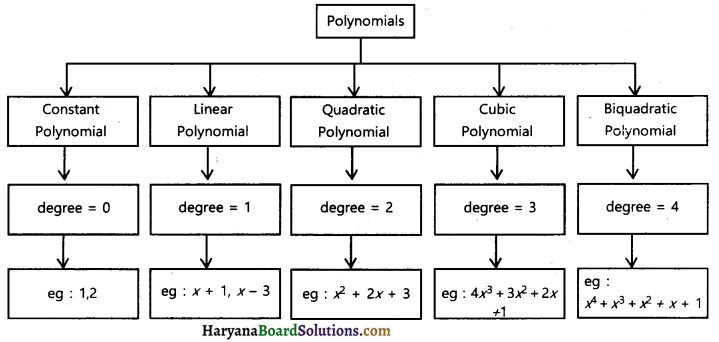
HBSE 10th Class Hindi Vyakaran संज्ञा Read More »

HBSE 10th Class Hindi Vyakaran विशेषण

Haryana State Board HBSE 10th Class Hindi Solutions Hindi Vyakaran Visheshan विशेषण Exercise Questions and Answers.

Haryana Board 10th Class Hindi Vyakaran विशेषण

विशेषण

Visheshan Exercise HBSE 10th Class प्रश्न 1.
विशेषण किसे कहते हैं? सोदाहरण उत्तर दीजिए।
उत्तर:
विशेषण वह शब्द है जो संज्ञा या सर्वनाम की विशेषता बताता है; जैसे काली गाय, मोटा लड़का, ऊँचा मकान, लाल किताब आदि। इन वाक्यों में प्रयुक्त काली, मोटा, ऊँचा एवं लाल शब्द गाय, लड़का, मकान एवं किताब की विशेषता बताते हैं।

विशेषण अभ्यास प्रश्न Class 10 HBSE  प्रश्न 2.
विशेष्य किसे कहते हैं? सोदाहरण समझाइए।
उत्तर:
विशेषण जिस संज्ञा या सर्वनाम की विशेषता प्रकट करते हैं, उसे विशेष्य कहते हैं; जैसे
(क) मेरे पास एक नीला पैन है।
(ख) राम के पास लाल कुत्ता है।
(ग) बालक चंचल है। उपर्युक्त वाक्यों में पैन, कुत्ता एवं बालक विशेष्य हैं क्योंकि विशेषण इनकी विशेषता प्रकट कर रहे हैं।

HBSE 10th Class Hindi Vyakaran विशेषण

विशेषण के भेद

Hindi Vyakaran Visheshan HBSE 10th Class प्रश्न 3.
विशेषण के कितने भेद हैं? प्रत्येक का उदाहरण सहित वर्णन कीजिए।
उत्तर:
हिंदी में विशेषण के सामान्यतः चार भेद हैं-
(1) गुणवाचक विशेषण,
(2) संख्यावाचक विशेषण,
(3) परिमाणवाचक विशेषण तथा
(4) सार्वनामिक विशेषण।

1. गुणवाचक विशेषण: जो शब्द संज्ञा या सर्वनाम के गुण-दोष, रूप-रंग, आकार, स्थान, काल, दशा, स्थिति, शील-स्वभाव आदि की विशेषता प्रकट करे, उसे गुणवाचक विशेषण कहते हैं; यथा-
गुण – सरल, योग्य, उदार, ईमानदार, बुद्धिमान, परिश्रमी, वीर।
दोष – अयोग्य, कुटिल, दुष्ट, क्रोधी, पापी, कपटी, नीच।
आकार-प्रकार – गोल, चौरस, चौड़ा, खुरदरा, लंबा, मुलायम।
रंग-रूप – गीरा, काला, गेहुँआ, गुलाबी, सुंदर, आकर्षक, लाल।
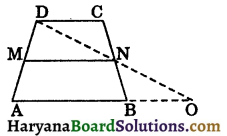
अवस्था – बलवान, कमज़ोर, रोगी, दरिद्र, अमीर, गरीब, छोटा।
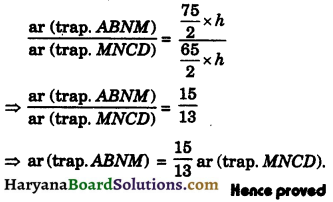
स्वाद – खट्टा, कड़वा, मीठा, फीका।
गंध – सुगंधित, गंधहीन, दुर्गंधपूर्ण।
स्थिति – अगला, पिछला, बाहरी, ऊपरी, निचला।
देश-काल – पंजाबी, बनारसी, प्राचीन, नवीन, भारी।

2. संख्यावाचक विशेषण:
जिन विशेषण शब्दों से संख्या का बोध हो, उन्हे संख्यावाचक विशेषण कहते हैं; जैसे एक, चार, दूसरा, चौथा, सातवाँ आदि।
संख्यावाचक विशेषण के भेद-संख्यावाचक विशेषण के भेद निम्नलिखित हैं-

(क) निश्चित संख्यावाचक विशेषण
(i) गणनासूचकं: जो वस्तुओं या प्राणियों की गणना का ज्ञान कराएँ; जैसे दो पुस्तकें, चार केले, दस लड़कियाँ, चार कुर्सियाँ आदि।
(ii) क्रमसूचक: जो क्रम का ज्ञान कराएँ; जैसे पहला लड़का, दूसरा आदमी, पहली मंजिल, प्रथम पंक्ति आदि।
(i) आवृत्तिसूचक: जो गुना का बोध कराते हैं; जैसे दुगुना, चौगुना, तिगुना आदि।
(iv) समुदायसूचक: जो समूह का ज्ञान कराएँ; जैसे एक दर्जन केले, चारों लड़के, सैकड़ों लोग आदि।
(v) प्रत्येकसूचक: जो शब्दों में से प्रत्येक का बोध कराएँ; जैसे हर घड़ी, प्रतिवर्ष, प्रत्येक लड़का आदि।

नोट- निश्चित संख्यावाचक विशेषणों में ‘ओं’ लगाकर उन्हें अनिश्चित संख्यावाचक विशेषण भी बनाया जा सकता है; यथा दर्जनों, सैकड़ों आदि।

(ख) अनिश्चित संख्यावाचक विशेषण:
जिन विशेषणों से वस्तु, प्राणी या पदार्थ की संख्या का निश्चित बोध नहीं होता, उन्हें अनिश्चित संख्यावाची विशेषण कहते हैं; जैसे कुछ विद्यार्थी, कुछ पशु, थोड़े घर, बहुत आम आदि।

3. परिमाणवाचक विशेषण:
संज्ञा या सर्वनाम शब्दों की माप-तोल की विशेषता को प्रकट करने वाले विशेषणों को परिमाणवाचक विशेषण कहते हैं। इसके भी दो भेद हैं
(क) निश्चित परिमाणवाचक विशेषण-जो परिमाणवाचक विशेषण संज्ञा या सर्वनाम का निश्चित परिमाण बताएँ जैसे एक लीटर पानी, दो किलो चीनी, दो मीटर कपड़ा आदि।
(ख) अनिश्चित परिमाणवाचक विशेषण-जो परिमाणवाचक विशेषण संज्ञा या सर्वनाम का निश्चित परिमाण न बताएँ; जैसे कुछ पानी, कुछ चीनी, कम अनाज, बहुत-सा कपड़ा आदि।

नोट- कभी-कभी परिमाणवाचक विशेषण शब्दों में ‘ओं’ प्रत्यय लगाकर भी अनिश्चित परिमाणवाचक विशेषण बन जाते हैं; यथा मनों गेहूँ, सेरों दूध।

4. सार्वनामिक विशेषण: जो सर्वनाम अपने सार्वनामिक रूप में ही संज्ञा की विशेषता प्रकट करें या संज्ञा के विशेषण के रूप में प्रयुक्त होते हैं, उन्हें सार्वनामिक विशेषण कहा जाता है; जैसे यह घर हमारा है। यह बालक अच्छा है। उस श्रेणी में अध्यापक नहीं है। तुम किस गली में रहते हो। इन वाक्यों में प्रयुक्त शब्द यह, उस, किस आदि सर्वनाम संज्ञा के विशेषण के रूप में प्रयुक्त हुए हैं, अतः ये सार्वनामिक विशेषण हैं।

सार्वनामिक विशेषण के भेद-
सार्वनामिक विशेषण चार प्रकार के होते हैं-
(i) निश्चयवाचक/सकेतवाचक सार्वनामिक विशेषण: ये विशेषण संज्ञा की ओर निश्चयार्थ में संकेत करने वाले होते हैं; . जैसे यह पुस्तक वहाँ से नहीं मिली।
(ii) अनिश्चयवाचक सार्वनामिक विशेषण: जिन विशेषणों से संज्ञा की ओर निश्चित संकेत नहीं मिलता, उन्हें अनिश्चयवाचक सार्वनामिक विशेषण कहते हैं; जैसे कोई सज्जन आए हैं।
(iii) प्रश्नवाचक सार्वनामिक विशेषण: ये विशेषण संज्ञा की प्रश्नात्मक विशेषता की ओर संकेत करते हैं; यथा-
(क) कौन व्यक्ति आया है?
(ख) किस लड़के ने तुम्हें यहाँ भेजा है?
(ग) इनमें से क्या चीज तुम लोगे?
(घ) कौन-सी गेंद चाहिए तुम्हें?
(iv) संबंधवाचक सार्वनामिक विशेषण
(क) जो आदमी कल आया था वह बाहर खड़ा है।
(ख) वह विद्यार्थी सामने आ रहा है जिसको आपने पुरस्कार दिया था।

HBSE 10th Class Hindi Vyakaran विशेषण

विशेषण की रूप-रचना

विशेषण अभ्यास प्रश्न HBSE 10th Class प्रश्न 4.
विशेषणों की रूप-रचना का सोदाहरण उल्लेख कीजिए।
उत्तर:
विशेषणों की रूप-रचना संज्ञा की रूप-रचना के साथ पर्याप्त सीमा तक मिलती है। दोनों में रूपावली का वर्ग-निर्धारण लिंग और शब्द के ध्वन्यात्मक स्वरूप (आकारांत, ईकारांत आदि) पर होता है तथा रूपावली वचन (एकवचन, बहुवचन) तथा विभक्ति (मूल-परसर्ग रहित, तिर्यक-परसर्ग सहित) के अनुसार चलती है।
विशेषण की रूप-रचना को समझने हेतु नीचे दी गई रूपावली को ध्यानपूर्वक देखिए-

रूपावली वर्ग-1

पुल्लिंग आकारांत

विभक्तिएकवचनबहुवचन
मूलअच्छा (लड़का)अच्छे (लड़के)
(परसर्ग रहित तिर्यक)अच्छे (लड़के को)अच्छे (लड़कों को)

संज्ञा रूपावली वर्ग-1 के समान यहाँ रूप चल रहे हैं किंतु यह ध्यान रखना है कि संज्ञा तिर्यक बहुवचन में ‘ओं’ विभक्ति प्रत्यय लगता है, यहाँ ‘ए’ । ये प्रत्यय मात्रा के रूप में (‘) लगते हैं।

रूपावली वर्ग-2

पुल्लिंग आकारांत से भिन्न

विभक्तिएकवचनबहुवचन
मूलसुंदर (घर)सुंदर (घर)
तिर्यकसुंदर (घर में)सुंदर (घरों में)

स्त्रीलिंग विशेषण

विभक्तिएकवचनबहुवचन
मूलअच्छी/सुंदर (लड़की)अच्छी/सुंदर (लड़कियाँ)
तिर्यकअच्छी/सुंदर (लड़की ने)अच्छी/सुंदर (लड़कियों ने)

उपर्युक्त रूपावली से स्पष्ट है कि केवल पुल्लिंग आकारांत विशेषणों के मूल रूप (जैसे-अच्छा, मोटा आदि) में ‘ए’ (‘) के योग से (मोटा से मोटे एवं अच्छा से अच्छे) रूप-परिवर्तन होता है। आकारांत विशेषण के स्त्रीलिंग रूप ‘ई’ लगाकर बनते हैं; जैसे अच्छा से अच्छी, मोटा से मोटी।

HBSE 10th Class Hindi Vyakaran विशेषण

विशेषण के उद्देश्य और विधेय स्थिति

Visheshan Class 10th HBSE प्रश्न 5.
उद्देश्य-विशेषण और विधेय-विशेषण की सोदाहरण परिभाषा दीजिए।
उत्तर:
उद्देश्य-विशेषण-जो विशेषण विशेष्य से पूर्व लगकर उसकी विशेषता व्यक्त करते हैं, उन्हें उद्देश्य-विशेषण कहते हैं; यथा-
(क) गोरा लड़का गीत गा रहा है।
(ख) काली बिल्ली दूध पी गई।
इन दोनों वाक्यों में प्रयुक्त ‘गोरा’ एवं ‘काली’ उद्देश्य-विशेषण हैं।

विधेय-विशेषण: जब विशेषण विशेष्य के पश्चात आता है तो उसे विधेय-विशेषण कहते हैं; जैसे
(क) वह गाय सफेद है।
(ख) घोड़ा लाल है।
(ग) राम की कार नीली है।
यहाँ सफेद’, ‘लाल’ एवं ‘नीली’ विधेय-विशेषण हैं।

विशेषणों का तुलना में प्रयोग

प्रश्न 6.
विशेषणों की तुलना से क्या अभिप्राय है? उदाहरण देकर समझाइए।
उत्तर:
विशेषण विशेष्य की विशेषता बताते हैं तथा यह विशेषता गुण, परिमाण अथवा संख्या की दृष्टि से होती है। दो या दो से अधिक प्राणियों, वस्तुओं या पदार्थों में प्रायः एक जैसे गुण नहीं होते। तुलना के द्वारा ही इस अंतर को स्पष्ट किया जा सकता है।
तुलना व्यक्तियों, वस्तुओं आदि के गुणों के मिलान को तुलना कहते हैं।

प्रश्न 7.
तुलना के आधार पर विशेषणों की कितनी अवस्थाएँ होती हैं? उदाहरण देकर स्पष्ट कीजिए।
उत्तर:
तुलना के आधार पर विशेषणों की तीन अवस्थाएँ होती हैं
(1) मूलावस्था,
(2) उत्तरावस्था तथा
(3) उत्तमावस्था।
1. मूलावस्था: इस अवस्था में किसी प्रकार की तुलना नहीं होती, विशेषतः सामान्य रूप होता है; जैसे वह बालिका चंचल है। आम मीठां है।

2. उत्तरावस्था: इसमें दो व्यक्तियों या वस्तुओं की तुलना द्वारा एक को दूसरे से अधिक या न्यून दिखाया जाता है; जैसे
(क) राम श्याम से अधिक मोटा है।
(ख) मेरी पुस्तक आपकी पुस्तक से अच्छी है।

3. उत्तमावस्था-इसमें दो या अधिक व्यक्तियों या वस्तुओं की तुलना की जाती है तथा उनमें से किसी एक को सबसे अधिक या सबसे कम श्रेष्ठ दिखाया जाता है; यथा
(क) मेरी कलम सबसे सुंदर है।।
(ख) मोहन कक्षा के सभी विद्यार्थियों से बहादुर है।

HBSE 10th Class Hindi Vyakaran विशेषण

तुलनाबोधक प्रत्यय

प्रश्न 8.
तुलनाबोधक प्रत्यय किसे कहते हैं? उदाहरण सहित वर्णन कीजिए।
उत्तर:
तुलना करने हेतु विशेषणों के पीछे जिन प्रत्ययों का प्रयोग किया जाता है, उन्हें तुलनाबोधक प्रत्यय कहते हैं। हिंदी में संस्कृत तथा उर्दू से आए प्रत्ययों का ही प्रयोग किया जाता है। संस्कृत में उत्तरावस्था के लिए ‘तर’ तथा उत्तमावस्था के लिए ‘तम’ प्रत्यय का प्रयोग किया जाता है। कुछ उदाहरण देखिए
HBSE 10th Class Hindi Vyakaran विशेषण 1

प्रविशेषण

प्रश्न 9.
प्रविशेषण किसे कहते हैं? सोदाहरण उत्तर दीजिए।
उत्तर:
जो शब्द विशेषण की विशेषता व्यक्त करें, उन्हें प्रविशेषण कहते हैं। उदाहरणार्थ निम्नलिखित वाक्य देखिए
(क) मोहन बहुत चतुर है।
(ख) राम बहुत अधिक चालाक है।
(ग) सुरेश अत्यधिक चतुर है।
(घ) कृपाराम बहुत परिश्रमी व्यक्ति है।
(ङ) वहाँ लगभग बीस आदमी थे।
हिंदी के प्रमुख प्रविशेषण निम्नांकित हैं-
बहुत, बहुत अधिक, अधिक, अत्यधिक, अत्यंत, बड़ा, कम, खूब, थोड़ा, ठीक, पूर्ण, लगभग आदि।

विशेषण का संज्ञावत् प्रयोग

प्रश्न 10.
विशेषणों का संज्ञावत् प्रयोग कैसे होता है? सोदाहरण वर्णन कीजिए।
उत्तर:
विशेषणों का संज्ञावत् प्रयोग प्रायः देखने को मिलता है; जैसे
(क) उस मोटे को देखो। यहाँ ‘मोटा’ शब्द मोटे व्यक्ति के लिए प्रयोग किया गया है।
(ख) अमीरों और गरीबों के बीच की खाई बढ़ती जा रही है।
(ग) बड़ों के बीच में बोलना उचित नहीं।

विशेषण की रचना

प्रश्न 11.
विशेषणों की रचना किस प्रकार की होती है?
उत्तर:
कुछ शब्द मूलतः विशेषण होते हैं; जैसे अच्छा, बुरा, मीठा आदि किंतु कुछ विशेषणों की रचना प्रत्यय या उपसर्ग आदि के योग से होती है; जैसे-
प्रत्यय से- चाय वाला, सुखद, बलशाली, ईमानदार, नश्वर आदि।
उपसर्ग से- दुर्बल, लापता, बेहोशी, निडर आदि।
उपसर्ग एवं प्रत्यय दोनों से- दोनाली, निकम्मा आदि। विशेषण कई प्रकार के शब्दों से भी बनते हैं, जैसे-
संज्ञा से-
नागपुर – नागपुरी
आदर – आदरणीय
धन – धनी

सर्वनाम से-
मैं – मुझसा
वह – वैसा
आप – आपसी
यह – ऐसा

क्रिया से-
चलना – चालू
भूलना – भुलक्कड़
भागना – भगोड़ा
हँसना – हँसोड़

अव्यय से-
नीचे – निचला
बाहर – बाहरी
भीतरी –
ऊपर – ऊपरी

HBSE 10th Class Hindi Vyakaran विशेषण

विद्यार्थियों के अभ्यासार्थ कुछ महत्त्वपूर्ण विशेषण दिए जा रहे हैं-
HBSE 10th Class Hindi Vyakaran विशेषण 2
HBSE 10th Class Hindi Vyakaran विशेषण 3
HBSE 10th Class Hindi Vyakaran विशेषण 4
HBSE 10th Class Hindi Vyakaran विशेषण 5
HBSE 10th Class Hindi Vyakaran विशेषण 6
HBSE 10th Class Hindi Vyakaran विशेषण 7
HBSE 10th Class Hindi Vyakaran विशेषण 8

HBSE 10th Class Hindi Vyakaran विशेषण

विशेषण संबंधी महत्त्वपूर्ण बातें
(1) हिंदी में विशेषण का लिंग एवं वचन विशेष्य के अनुसार ही होता है; जैसे काला कुत्ता, काली गाय, काले बैल।
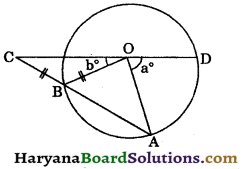
(2) कारक-चिह्नों का प्रयोग केवल विशेष्य के साथ होता है; जैसे बुरे आदमी के साथ मत जा। नए कमरे का द्वार खुला नहीं था।
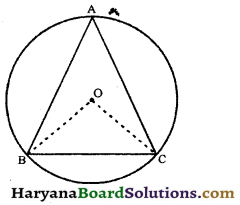
(3) कभी-कभी विशेषण का प्रयोग संज्ञा की भाँति होता है; जैसे
(क) वीरों ने देश की सुरक्षा की।
(ख) विद्वानों का आदर करो।

यहाँ वीर एवं विद्वान विशेषण होते हुए भी संज्ञा के रूप में प्रयुक्त हुए हैं।

परीक्षोपयोगी महत्त्वपूर्ण प्रश्न

प्रश्न 1.
विशेषण क्या है? विशेषण के तीन उदाहरण दीजिए।
उत्तर:
जो शब्द संज्ञा तथा सर्वनाम की विशेषता बताएँ, उन्हें विशेषण कहते हैं; जैसे
(क) सफेद गाय (सफेद विशेषण)
(ख) मीठा आम (मीठा विशेषण)
(ग) छह विद्यार्थी (छह विशेषण)
(घ) विद्वान व्यक्ति (विद्वान विशेषण)

प्रश्न 2.
विशेषण के कौन-कौन से चार भेद हैं? प्रत्येक भेद का एक-एक उदाहरण दीजिए।
उत्तर:
(क) गुणवाचक विशेषण-नीली कमीज।
(ख) परिमाणवाचक विशेषण-दो मीटर कपड़ा।
(ग) संख्यावाचक विशेषण-चार कलमें।
(घ) सार्वनामिक विशेषण-यह मकान।

प्रश्न 3.
नीचे दिए गए वाक्यों में से निश्चित और अनिश्चित परिमाणवाचक विशेषणों को अलग-अलग पहचानिए-
(क) वह कक्षा में प्रथम आया।
(ख) कुछ फल लाओ।
(ग) मेरी कमीज में दो मीटर कपड़ा लगेगा।
(घ) थोड़ी मिठाई ले आओ।
(ङ) एक लीटर दूध पचास रुपए का मिलता है।
उत्तर:
निश्चित परिमाणवाचक
(क) वह कक्षा में प्रथम आया।
(ख) मेरी कमीज में दो मीटर कपड़ा लगेगा।
(ग) एक लीटर दूध पचास रुपए का मिलता है।

अनिश्चित परिमाणवाचक विशेषण
(क) कुछ फल लाओ।
(ख) थोड़ी मिठाई ले आओ।

HBSE 10th Class Hindi Vyakaran विशेषण

प्रश्न 4.
सर्वनाम और सार्वनामिक विशेषणों में अंतर स्पष्ट कीजिए।
उत्तर:
जब सर्वनाम (यह, वह, मैं, तुम आदि) संज्ञा के स्थान पर प्रयुक्त होते हैं, तब वे सर्वनाम कहलाते हैं लेकिन जब वही सर्वनाम संज्ञा शब्द के साथ अर्थात् संज्ञा से पहले प्रयुक्त होता है तो वह सार्वनामिक विशेषण बन जाता है; जैसे-
यह पुस्तक मेरी है। (यह – विशेषण)
यह मेरे साथ है। (यह – सर्वनाम)
यह आम कच्चा है और यह पक्का – इस वाक्य में पहला ‘यह’ आम संज्ञा के साथ आया है। अतः यह विशेषण है। दूसरा ‘यह’ बिना संज्ञा के अकेले संज्ञा के स्थान पर आया है। अतः सर्वनाम है।

प्रश्न 5.
नीचे दिए गए वाक्यों में से सर्वनाम के प्रयोग और सार्वनामिक विशेषण के प्रयोग को पहचानिए-
(1) घर में कोई है।
(2) कोई सज्जन आए हुए हैं।
(3) वह घोड़ा दौड़ रहा है।
(4) वह विद्यालय गया।
(5) यह मेरा घर है।
(6) क्या यह किताब तुम्हारी है?
उत्तर:
(1) घर में कोई है। (सर्वनाम प्रयोग)
(2) कोई सज्जन आए हैं। (सार्वनामिक प्रयोग)
(3) वह घोड़ा दौड़ रहा है। (सार्वनामिक प्रयोग)
(4) वह विद्यालय गया। (सर्वनाम प्रयोग)
(5) यह मेरा घर है। (सार्वनामिक प्रयोग)
(6) क्या यह किताब तुम्हारी है? (सार्वनामिक प्रयोग)

प्रश्न 6.
विशेषण की तुलना के तीनों प्रकारों के नाम लिखिए और दो-दो उदाहरण दीजिए।
उत्तर:
(1) मूलावस्था-
(क) मोहन अच्छा बालक है।
(ख) राजेश सुंदर बालक है।

(2) उत्तरावस्था-
(क) मोहन राम से भला लड़का है।
(ख) महेश राजकुमार से सुंदर है।

(3) उत्तमावस्था-
(क) सोहन कक्षा में सबसे बहादुर विद्यार्थी है।
(ख) मुनीश अपने परिवार में सबसे परिश्रमी बालक है।

HBSE 10th Class Hindi Vyakaran विशेषण

प्रश्न 7.
नीचे दिए गए विशेषणों को उनके सामने दी गई अवस्थाओं से मिलाकर उचित स्थान पर लिखिए-
उच्चतर, गुरुतम, कठोर, लघु, तीव्रतर, अधिकतर, कुटिलतर, उत्कृष्ट, न्यूनतम, निकटतम
मूलावस्था – …………….
उत्तरावस्था – …………….
उत्तमावस्था – …………….
उत्तर:
मूलावस्था – कठोर, लघु, उत्कृष्ट।
उत्तरावस्था – उच्चतर, तीव्रतर, अधिकतर, कुटिलतर।
उत्तमावस्था – गुरुतम, न्यूनतम, निकटतम।

प्रश्न 8.
निम्नलिखित शब्दों से विशेषण बनाइएधर्म, भारत, वह, रोज़, दिन, पूजा, पढ़ना, रक्षा, अपमान, पाप, बहना, नगर, बीतना, लखनऊ।
उत्तर:
शब्द – विशेषण
धर्म – धार्मिक
रक्षा – रक्षक
भारत – भारतीय
अपमान – अपमानित
वह – वही या वैसा
पाप – पापी
रोज़ – रोज़ाना
बहना – बहावपूर्ण
दिन – दैनिक
नगर – नागरिक
पूजा – पूज्य
बीतना – व्यतीत
पढ़ना – पढ़ाकू
लखनऊ – लखनवी

प्रश्न 9.
निम्नलिखित वाक्यों का उत्तर हाँ/नहीं में दीजिए
(i) विशेषण क्रियाओं की विशेषता बताता है।
(ii) जिन वस्तुओं की नाप-तौल की जा सके, उनके वाचक शब्दों को परिमाणवाचक विशेषण कहते हैं।
(iii) कुछ, कई, काफी, निश्चित संख्यावाचक विशेषण हैं।
(iv) मूलावस्था में विशेषण का तुलनात्मक रूप नहीं होता।
(v) जिस शब्द का प्रयोग संज्ञा से पूर्व अथवा बाद में किया जाए, उसे सार्वनामिक विशेषण कहा जाता है।
(vi) जिन वस्तुओं की गिनती की जा सके, उनके वाचक शब्दों को संख्यावाचक विशेषण कहते हैं।
उत्तर:
(i) नहीं,
(ii) हाँ,
(iii) नहीं,
(iv) हाँ,
(v) नहीं,
(vi) हाँ।

HBSE 10th Class Hindi Vyakaran विशेषण

प्रश्न 10.
प्रविशेषण किसे कहते हैं? कुछ उदाहरण देकर समझाइए।
उत्तर:
जो शब्द विशेषणों की विशेषता बताएँ, उन्हें प्रविशेषण कहते हैं; जैसे
(i) राम बहुत सुंदर बालक है।
(ii) वह बहुत अच्छा गीत गाती है।
(iii) वह महा कंजूस व्यक्ति है।

प्रश्न 11.
नीचे दिए गए वाक्यों के शुद्ध रूप लिखिए
(i) अच्छा लड़के क्रिकेट खेल रहे हैं।
(ii) बड़े दुकानों में अच्छा सामान नहीं मिलता।
(iii) कागज़ और पेंसिलें सस्ते हैं।
(iv) हरा वाली साड़ी दिखाओ।
(v) मैं और सीता बूढ़ा हूँ।
(vi) क्या किताबें इस काला संदूक में है?
उत्तर:
(i) अच्छे लड़के क्रिकेट खेल रहे हैं।
(ii) बड़ी दुकानों से अच्छा सामान नहीं मिलता।
(iii) कागज़ और पेंसिलें सस्ती हैं।
(iv) हरी वाली साड़ी दिखाओ।
(v) मैं और सीता बूढ़े बूढ़ी हैं।
(vi) क्या किताबें इस काले संदूक में हैं?

प्रश्न 12. निम्नलिखित संख्यावाचक शब्दों को पहचानकर उनके नाम लिखिए।
द्वितीय, बीस, तिगुना, तीनों, दर्जन, प्रथम, दुगुना, पाँचों, पाँव, पच्चीसी, ढाई।
उत्तर:
द्वितीय – क्रमवाचक
दुगुना – आवृत्तिवाचक
बीस – पूर्ण संख्याबोधक
पाँचों – समुदायवाचक
तिगुना – आवृत्तिवाचक
पाँव – अपूर्ण परिमाणबोधक
तीनों – समुदायवाचक
ढाई – अपूर्ण संख्याबोधक
दर्जन – समुच्चयवाचक
पच्चीसी – समुच्चयबोधक
प्रथम – क्रमवाचक

HBSE 10th Class Hindi Vyakaran विशेषण

प्रश्न 13.
निम्नलिखित वाक्यों से विशेषण छाँटकर उनके भेद का निर्देश कीजिए
(क) साधारण इक्के के घोड़े भारतीय दरिद्रता के अलबम हैं।
(ख) यह पैसा मेरी खून-पसीने की कमाई का फल है।
(ग) थोड़ी मिठाई और कुछ फल ले आओ, आज त्योहार का दिन है।
(घ) यह मेरी पुस्तक है, आपकी नहीं।
(ङ) दस रुपए ले लो और बाज़ार से एक किलो दही ले आओ।
उत्तर:
(क) साधारण इक्के के – गुणवाचक विशेषण।
भारतीय – गुणवाचक विशेषण।

(ख) यह – सर्वनाम विशेषण।
खून-पसीने की – गुणवाचक विशेषण।
मेरी – प्रविशेषण (खून-पसीने का विशेषण)।

(ग) थोड़ी – अनिश्चित परिमाणवाचक विशेषण।
कुछ – अनिश्चित संख्यावाचक विशेषण ।

(घ) यह – सार्वनामिक विशेषण।

(ङ) दस – निश्चित संख्यात्मक विशेषण।
एक किलो – निश्चित परिमाणवाचक विशेषण।

प्रश्न 14.
निम्नलिखित वाक्यों में प्रयुक्त सार्वनामिक विशेषणों और सर्वनामों को छाँटकर लिखिए
(1) वह विद्यालय जाएगा।
(2) वह विद्यार्थी विद्यालय जाएगा।
(3) इस घर में कौन रहता है?
(4) बच्चा रो रहा है, इसे गोद में उठा लो।
(5) वे तुम्हारी पुस्तकें हैं और ये मेरी।
उत्तर:
(1) वह – सर्वनाम
(2) वह विद्यार्थी – सार्वनामिक विशेषण
(3) इस घर – सार्वनामिक विशेषण
(4) इसे – सर्वनाम
(5) वे पुस्तकें – सार्वनामिक विशेषण
(6) ये – सर्वनाम।

HBSE 10th Class Hindi Vyakaran विशेषण

प्रश्न 15.
वाक्य में क्रिया का प्रयोग विशेषण के अनुसार होता है या विशेष्य के? दो उदाहरण देकर स्पष्ट कीजिए।
उत्तर:
वाक्य में क्रिया का प्रयोग हमेशा विशेष्य के अनुसार होता है, विशेषण के अनुसार नहीं। विशेषण का प्रयोग भी विशेष्य के अनुसार होता है; यथा-
दो लड़के पढ़ रहे हैं। – दो लड़कियाँ पढ़ रही हैं।
कुछ पुरुष जा रहे हैं। – कुछ स्त्रियाँ जा रही हैं।
उपर्युक्त वाक्यों से स्पष्ट है कि क्रियाएँ विशेष्यों के अनुसार ही आती हैं, विशेषणों के अनुसार नहीं।

प्रश्न 16.
प्रविशेषण एवं विधेय-विशेषण का सोदाहरण अंतर स्पष्ट कीजिए।
उत्तर:
प्रविशेषण शब्द विशेषण की विशेषता बताते हैं किंतु विधेय-विशेषण वह विशेषण है जो संज्ञा के बाद में प्रयुक्त होते हैं; जैसे
(क) मोहन अत्यंत सुंदर है इस वाक्य में अत्यंत सुंदर विशेषण की विशेषता बता रहा है। अतः यह प्रविशेषण है।
(ख) मोहन सुंदर है। वाक्य में सुंदर मोहन के बाद प्रयुक्त हुआ है। अतः यह विधेय-विशेषण है।

प्रश्न 17.
विशेषण कितने प्रकार के शब्दों से बनते हैं? प्रत्येक के दो-दो उदाहरण लिखिए।
उत्तर:
विशेषण निम्नलिखित प्रकार के शब्दों से बनते हैं
(1) संज्ञा से – नागपुर-नागपुरी, अंबाला-अंबालवी।
(2) सर्वनाम से – यह-ऐसा, वह-वैसा।
(3) क्रिया से – हँसना-हँसोड़, बेचना-बिकाऊ।
(4) अव्यय से – बाहर-बाहरी, भीतर-भीतरी।
(5) उपसर्ग से – दुः-दुर्बल, स-सबल।
(6) उपसर्ग तथा प्रत्यय – दोनों के प्रयोग से-दोनाली, निकम्मा।

HBSE 10th Class Hindi Vyakaran विशेषण

प्रश्न 18.
चार ऐसे वाक्य लिखिए जिनमें विशेषण संज्ञा के रूप में प्रयोग किए गए हों।
उत्तर:
(1) वीरों ने देश की रक्षा की।
(2) बहादुरों का सदा सम्मान होता है।
(3) गुणी की सर्वत्र पूजा होती है।
(4) बड़ों का आदर करो।

प्रश्न 19.
निम्नलिखित वाक्यों में से संज्ञा शब्दों एवं विशेषणों को चुनिए-
(1) अकबर महान सम्राट था।
(2) विद्वान जन सदा पूजे जाते हैं।
(3) कहानी सुनते-सुनते रात बीत गई।
उत्तर:
संज्ञा – अकबर, सम्राट, जन, कहानी, रात।
विशेषण – महान, विद्वान, सुनते-सुनते।

HBSE 10th Class Hindi Vyakaran विशेषण Read More »