Author name: Prasanna

HBSE 10th Class Social Science Important Questions Geography Chapter 4 Agriculture

Haryana State Board HBSE 10th Class Social Science Important Questions Geography Chapter 4 Agriculture Important Questions and Answers.

Haryana Board 10th Class Social Science Important Questions Geography Chapter 4 Agriculture

Multiple Choice Questions

Agriculture Important Questions HBSE 10th Class Question 1.
Agriculture is a ………….. in India.
(a) Primary activity
(b) Secondary activity
(c) Tertiary activity
(d) Non-economic activity.
Answer:
(a) Primary activity

Agriculture Class 10 Important Questions HBSE Question 2.
Type of agriculture that is practised on the small patches of land with the help of primitive tools like hoe, dao and digging sticks, and family/community labour:
(a) Primitive subsistence farming
(b) Commercial farming
(c) Plantation agriculture
(d) All of these.
Answer:
(a) Primitive subsistence farming

Class 10 Agriculture Important Questions HBSE Question 3.
Which of the following conditions is not favourable for primitive subsistence farming?
(a) Fertility of soil
(b) Monsoon
(c) Favourable atmosphere
(d) Sufficient capital.
Answer:
(d) Sufficient capital.

Sst Class 10 Geography Chapter 4 Important Questions HBSE Question 4.
‘Slash and burn’ agriculture is known as in north-eastern states :
(a) Jhumming
(b) Podu
(c) Valre
(d) Khil.
Answer:
(a) Jhumming

Geography Ch 4 Class 10 Important Questions HBSE Question 5.
Through which of the following names the ‘slash and burn’ agriculture is known, in Mexico and central America ?
(a) Ladang
(b) Milpa
(c) Jhumm
(d) All of these.
Answer:
(b) Milpa

Important Questions For Class 10 Geography Chapter 4 HBSE Question 6.
Which of the following types of agriculture is done in densely populated areas ?
(a) Intensive subsistence farming
(b) Primitive subsistence farming
(c) Plantation agriculture
(d) Commercial agriculture.
Answer:
(a) Intensive subsistence farming

HBSE 10th Class Social Science Important Questions Geography Chapter 4 Agriculture

Agriculture Chapter Class 10 Important Questions HBSE Question 7.
Which of the following crops is a commercial crop of Punjab and Haryana ?
(a) Bajra
(b) Wheat
(c) Jowar
(d) Millet.
Answer:
(b) Wheat

Class 10 Chapter 4 Geography Important Questions HBSE Question 8.
Which of the following is a Rabi crop ?
(a) Rice
(b) Maize
(c) Wheat
(d) Cotton.
Answer:
(c) Wheat

Class 10 Geography Chapter 4 Important Questions HBSE Question 9.
The crops sown in the summer between the Rabi and Kharif season are known as :
(a) Rabi
(b) Kharif
(c) Zaid
(d) All of these.
Answer:
(c) Zaid

Class 10 Geography Chapter Agriculture Important Questions HBSE Question 10.
Which of the following countries is the second largest producer of rice ?
(a) USA
(b) China
(c) Russia
(d) India
Answer:
(d) India

Agriculture Class 10 Important Questions And Answers HBSE Question 11.
Which is the second most important cereal crop of India :
(a) Wheat
(b) Rice
(c) Maize
(d) Bajra.
Answer:
(a) Wheat

Chapter 4 Geography Class 10 Important Questions HBSE Question 12.
Which of the following is the third most important food crop with respect to area and production ?
(a) Jowar
(b) Bajra
(c) Wheat
(d) Rangi
Answer:
(a) Jowar

Important Questions Of Ch Agriculture Class 10 HBSE Question 13.
Which of the following states is the largest producer of jowar ?
(a) Rajasthan
(b) Maharashtra
(c) Assam
(d) Punjab
Answer:
(b) Maharashtra

HBSE 10th Class Social Science Important Questions Geography Chapter 4 Agriculture

Class 10 Geography Chapter 4 Agriculture Extra Questions HBSE Question 14.
The largest bajra producing state of India is :
(a) Karnataka
(b) Rajasthan
(c) Uttar Pradesh
(d) Tamil Nadu.
Answer:
(b) Rajasthan

Class 10 Geography Chapter 4 Agriculture Question Answer HBSE  Question 15.
The largest producer and consumer of the pulses in the world is ……………
(a) Russia
(b) India
(c) China
Answer:
(b) India

Question 16.
In which of the following crop production does India rank first in the world ?
(a) Oil seeds
(b) Wheat
(c) Rice
(d) All of these.
Answer:
(a) Oil seeds

Question 17.
Which of the following crops is grown as a Kharif crop in North India and Rabi crop in South India ?
(a) Sesamum
(b) Wheat
(c) Bajra
(d) Ragi.
Answer:
(a) Sesamum

Question 18.
Which of the following is the largest producer of groundnut ?
(a) Karnataka
(b) Gujarat
(c) Assam
(d) Andhra Pradesh.
Answer:
(b) Gujarat

HBSE 10th Class Social Science Important Questions Geography Chapter 4 Agriculture

Question 19.
Which of the following is a leading tea producing state of India ?
(a) Assam
(b) Kerala
(c) Karnataka
(d) Andhra Pradesh.
Answer:
(a) Assam

Question 20.
Which of the following crops is initially cultivated on the Baba Budan Hills ?
(a) Tea
(b) Coffee
(c) Rubber
(d) Jute.
Answer:
(b) Coffee

Question 21.
Which of the following is an equatorial crop ?
(a) Tea
(b) Coffee
(c) Rubber
(d) Jute.
Answer:
(c) Rubber

Question 22.
Which of the following is not a fibre crop ?
(a) Cotton
(b) Jute
(c) Hemp
(d) Rubber.
Answer:
(d) Rubber.

Question 23.
Which country is believed to be the original home of the cotton plant ?
(a) India
(b) China
(c) Bhutan
(d) Japan.
Answer:
(a) India

Question 24.
Which of the following crops is known as golden fibre ?
(a) Wheat
(b) Cotton
(c) Jute
(d) Tea.
Answer:
(c) Jute

HBSE 10th Class Social Science Important Questions Geography Chapter 4 Agriculture

Fill in the blanks

1. India is an ……………. important country.
Answer:
agriculturally.

2. Agriculture is an age-old ………… activity in our country.
Answer:
economic.

3. ………….. subsistence agriculture is practised on small ………… of land.
Answer:
primitive, patches.

4. ………….. is the staple food crop of a majority of the people in India.
Answer: Rice.
5. Bajra grows well on …………… soils and shallow ………… soil.
Answer:
sandy, black.

6. Tea cultivation is an example of …………… agriculture.
Answer:
plantation.

7. India is the largest producer of ………….. and ………….. in the world.
Answer:
fruits, vegetables.

8. ……………….. is not a new phenomenon for India.
Answer:
Globalisation.

Match the following
Match Column A with Column B.

Column A (Country Name)Column B (Name in Country)
1. Mexico(a) Jhumming
2. Venzuela(b) Ladang
3. Brazil(c) Rey
4. 1ndoneia(d) MiIpa
5. Vietnam(e) Roca
6. india(f) Conuco

Answer:

Column A (Country Name)Column B (Name in Country)
1. Mexico(d) MiIpa
2. Venzuela(f) Conuco
3. Brazil(e) Roca
4. 1ndoneia(b) Ladang
5. Vietnam(c) Rey
6. india(a) Jhumming

Short Answer Type Questions

Question 1.
What is agriculture?
Answer:
Agriculture is a science and art of cultivating soil, raising crops and rearing livestock including animal husbandry and forestry.

Question 2.
How much of Indian population is engaged in agricultural activities?
Answer:
Two-third of Indian population is engaged in agricultural activities.

Question 3.
Which type of farming is practised in a few pockets in India?
Answer:
Primitive subsistence farming is practised in a few pockets in India.

Question 4.
Give the name of the farm equipments used in primitive subsistence farming?
Answer:

  • Hoe
  • Dao
  • Digging sticks.

Question 5.
What type of farming depends upon monsoon?
Answer:
Primitive subsistence farming.

HBSE 10th Class Social Science Important Questions Geography Chapter 4 Agriculture

Question 6.
In which states is the Jhumming practised?
Answer:

  • Assam
  • Meghalaya
  • Mizoram
  • Nagaland.

Question 7.
What is Dippa?
Answer:
The ‘slash and bum’ agriculture practised in Bastar district of Chhattisgarh, and in Andaman and Nicobar Islands is called Dippa.

Question 8.
By which name is the ‘slash and bum’ agriculture practised in South-Eastern Rajasthan known?
Answer:
‘Valre’ or ‘Waltre’.

Question 9.
Where is intensive subsistence farming practised?
Answer:
Intensive subsistence farming is practised in areas of high population pressure on

Question 10.
What is the main characteristic feature of intensive subsistence farming practice?
Answer:
Intensive subsistence farming is labour-intensive farming.

Question 11.
What is plantation agriculture?
Answer:
The plantation is a type of commercial farming, in which a single crop is grown on a large area.

Question 12.
Write any five plantation crops produced in India.
Answer:
Tea
Coffee
Rubber
Sugar cane
Banana.

HBSE 10th Class Social Science Important Questions Geography Chapter 4 Agriculture

Question 13.
Write some important factors which affect the development of plantation agriculture.
Answer:

  • Transport
  • Communication
  • Market.

Question 14.
How many cropping seasons are there in India?
Answer:
India has three cropping seasons – Rabi, Kharif and Zaid.

Question 15.
Name the major rabi crops of India.
Answer:

  • Wheat
  • Barley
  • Peas
  • Gram
  • Mustard.

Question 16.
Name the major kharif crops of India.
Answer:

  • Rice
  • Maize
  • Jowar
  • Bajra
  • Jute
  • Soyabean
  • Groundnut
  • Moong
  • Urad
  • Tur (arhar)
  •  Cotton.

Question 17.
Name the important zaid crops of India.
Answer:

  • Watermelon
  • Muskmelon
  • Cucumber
  • Vegetables.

Question 18.
Which varieties of rice are grown in Assam, West Bengal and Orissa ?
Answer:
Aus, Aman and Boro.

Question 19.
Name the two staple crops of India.
Answer:
Rice and Wheat.

HBSE 10th Class Social Science Important Questions Geography Chapter 4 Agriculture

Question 20.
What is the average temperature required for rice cultivation?
Answer:
Above 25°C.

Question 21.
In which states of India, is rice grown with the help of irrigation?
Answer:

  • Punjab
  • Haryana
  • Western Uttar Pradesh
  • Low rainfall areas of Rajasthan. ,

Question 22.
Name the wheat-producing areas of India.
Answer:
(i) Indo-Gangetic Plain
(ii) Black soil areas of the Deccan.

Question 23.
Write the names of important millets grown in India.
Answer:
Jowar, Bajra and Ragi.

Question 24.
Name the important jowar-producing states of India.
Answer:

  • Maharashtra
  • Karnataka
  • Madhya Pradesh
  • Andhra Pradesh.

Question 25.
Name the major bajra producing states of India in 2015-16.
Answer:

  • Rajasthan
  • Uttar Pradesh
  • Maharashtra
  • Gujarat
  • Haryana.

Question 26.
Write the name and average temperature of crop which is used as food and fodder?
Answer:
Maize, 18°-27°.

Question 27.
Name the major maize producing states of India.
Answer:

  • Karnataka
  • Madhya Pradesh
  • Uttar Pradesh
  • Bihar
  • Andhra Pradesh

Question 28.
Write the names of major pulse crops of India.
Answer:

  • Tur (Arhar)
  • Urad
  • Moong
  • Masur
  • Peas
  •  Gram. ‘

Question 29.
Write the names of major pulse producing states of India.
Answer:

  • Madhya Pradesh
  • Rajasthan
  • Maharashtra
  • Uttar Pradesh
  • Karnataka.

Question 30.
In which type of areas is sugar cane grown?
Answer:
It is grown in tropical, as well as, sub-tropical areas.

HBSE 10th Class Social Science Important Questions Geography Chapter 4 Agriculture

Question 31.
Mention the major sugar cane producing states of India.
Answer:

  • Uttar Pradesh
  • Maharashtra
  • Karnataka
  • Tamil Nadu
  • Andhra Pradesh
  • Telangana
  • Bihar
  • Punjab
  • Haryana.

Question 32.
Mention a few oil seed crops.
Answer:

  • Mustard
  • Coconut
  • Til (Sesamum)
  • Soyabean
  • Castor
  • Cotton
  • Linseed
  • Sunflower
  • Groundnut.

Question 33.
In which type of areas is the tea plant grown?
Answer:
The tea plant grows well in tropical and sub-tropical climates endowed with deep and fertile well-drained soil, rich in humus and organic matter.

Question 34.
Name the largest producer of groundnut in India in 2015-16.
Answer:
Gujarat was the largest producer of groundnut followed by Rajasthan and Andhra Pradesh in 2015-16.

Question 35.
Mention any four tea-producing states of India.
Answer:

  • Assam
  • West Bengal
  • Tamil Nadu
  • Kerala.

Question 36.
Which variety of coffee is produced in India?
Answer:
Arabica variety.

Question 37.
Name the country which is the largest producer of fruits and vegetables in the world?
Answer:
India.

Question 38.
What are climatic requirements for rubber?
Answer:
Rubber requires moist and humid climate, with rainfall of more than 200 cm and temperature above 25°C.

HBSE 10th Class Social Science Important Questions Geography Chapter 4 Agriculture

Question 39.
Write the names of any two fibre crops grown in India.
Answer:
(i) Jute
(ii) Cotton.

Question 40.
What is sericulture?
Answer:
Rearing of silkworms for the production of silk fibre is known as sericulture.

Question 41.
Write the names of major fibre crops.
Answer:
Cotton, jute, hemp and natural silk are four major fibre crops.

Question 42.
What is the bloodless revolution?
Answer:
Bhoodan-Gramdan Movement initiated by Vinobha Bhave is known as the bloodless revolution.

Question 43.
When and where did Champaran Movement start ?
Answer:
Champaran Movement started in 1917 in Bihar.

Question 44.
Why was Champaran Movement started ?
Answer:
This was started because farmers of that region were forced to grow indigo on their land.

Question 45.
Why organic farming is much in vogue today ?
Answer:
Because it is practised without factory-made chemicals such as fertilisers and pesticides.

Question 46.
What are the two components of national food security system?
Answer:
(i) Buffer Stock, and
(ii) Public Distribution System (PDS).

Question 47.
What is the main function of the Food Corporation of India?
Answer:
The Food Corporation of India (FCI) procures foodgrains from the farmers at the government announced Minimum Support Price (MSP).

Question 48.
What is public distribution system?
Answer:
PDS is a programme which provides foodgrains and other essential commodities at subsidised prices in rural and urban areas.

Question 49.
How many categories are the consumers divided into?
Answer:
(i) Below Poverty Line (BPL)
(ii) Above Poverty Line (APL).

Question 50.
What is green revolution?
Answer:
A phenomenal and sustained increase in production of agricultural crops is known as green revolution.

HBSE 10th Class Social Science Important Questions Geography Chapter 4 Agriculture

Question 51.
What is Gross cultivated Area ?
Answer:
The net sown area and the land cultivated more than once in a year is called Gross cultivated Area.

Short Answer Type Questions – I

Question 1.
What is agriculture? Name the types of farming practised in India.
Answer:
Agricutlure is an art and science of cultivating soil, raising crops and rearing livestock.

Major types of farming practised in India are :

  • Primitive subsistence farming
  • Intensive subsistence farming, and
  • Commercial farming.

Question 2.
Mention the local names of slash and bum agriculture by mentioning the states or regions.
Answer:

Local  Nameskn0wn Contries or regions
1. BewarMadhya Pradesh
2. PoduAndhra Pradesh
3. Pama DabiOdisha
4. KumariWestern Ghats
5. WairaSouth-East Rajasthan

Question 3.
What do you understand by intensive subsistence farming ? Mention its features also.
Answer:
This type of agriculture is practised in those areas or regions where the cultivable land is limited and the density of population is very high. Major features of intensive agriculture are –

  • It is labour-intensive farming.
  • Under this, high doses of biochemical inputs and irrigation are used for obtaining higher production.
  • In this farming, per hectare yield is high.

Question 4.
What is commercial farming? Mention any two commercial crops and their producing states.
Answer:
The type of farming in which crops are grown mainly for selling in the market, is called commercial agriculture.
Example:
(i) Tea produced in Assam and North Bengal.
(ii) Sugar cane produced in Uttar Pradesh, Maharashtra, Karnataka, Tamil Nadu, Bihar, Punjab and Haryana.

Question 5.
What is plantation agriculture? Mention its major features.
Answer:
Plantation is a type of commercial farming, in which, a single crop is grown on a large area. Example : coffee, tea etc. Its major features are-

  • Higher doses of modem inputs, like High Yielding Variety (HYV) seeds, chemical fertilisers, insecticides and pesticides are used in order to obtain high productivity.
  • Plantation covers large tracts of land with the help of migrant labourers.
  • All the produce is used as raw material in respective industries.

Question 6.
Write in brief the geographical conditions required for the growth of wheat.
Answer:
The geographical conditions required for the growth of wheat are the following:

  • Cool climate in growing season.
  • Bright sunshine while ripening.
  • Annual rainfall between 50 to 75 cm.
  • Alluvial or black soil.

Question 7.
Give an account of production regions of wheat.
Answer:
Two important wheat production regions of India are – The Ganga-Satluj plains in north-west India, and black soil region of the Deccan. The important wheat producing states are Punjab, Haryana, Uttar Pradesh, Bihar, Rajasthan and a part of Madhya Pradesh.

Question 8.
Why are pulses are grown in rotation with other crops? Name the major pulse producing states of India.
Answer:
Pulses are rich source of protein. Being leguminous crops, all these crops except arhar help in restoring soil fertility by fixing nitrogen from the air. Therefore, these are mostly grown in rotation with other crops. Major pulse producing states are Madhya Pradesh, Uttar Pradesh, Rajasthan, Maharashtra and Karnataka.

HBSE 10th Class Social Science Important Questions Geography Chapter 4 Agriculture

Question 9.
What is the position of India in the world in the production of –
(i) Groundnut
(ii) Rape seed.
Answer:
(i) In 2016, India was the second largest producer of groundnut in the world, after China.
(ii) In rape seed production, India was the third largest producer in the world, after Canada and China in 2016.

Question 10.
Give an account of tea producing states of India.
Answer:
Major tea producing states of India are Assam, hills of Darjeeling and Jalpaiguri district in West Bengal, Kerala and Tamil Nadu. Other states are Himachal Pradesh, Uttarakhand, Meghalaya, Andhra Pradesh and Tripura.

Question 11.
Write a brief note about coffee production in India.
Answer:

  • India produces about 4.05 per cent of the world’s coffee production as per the year 2016.
  • The Arabica variety produced in India is in great demand all over the world.
  • Initially, its cultivation was introduced on the Baba Budan Hills.
  • Today, it is produced in Karnataka, Kerala and Tamil Nadu.

Question 12.
What is the importance of rubber for the Indian Economy?
Answer:

Rubber is an important industrial raw material.

  • It is mainly used in auto industry.
  • It is also a major input for the footwear industry.
  • India earns foreign exchange by exporting raw rubber and rubber products.

Question 13.
Name any four factors that have distorted the cropping pattern in India.
Answer:

  • High minimum support price.
  • High subsidies for various inputs.
  • Committed FCI purchases.
  • Assured means of irrigation.

Question 14.
Discuss the favourable conditions for cultivation of rubber. Mention major rubber producing states in India.
Answer:

  • Rubber is grown in tropical and sub-tropical areas. ‘
  • It requires moist and humid climate, with rainfall of more than 200 cm and temperature above 25°C.
  • Major rubber producing states of India are Kerala, Tamil Nadu, Karnataka, Andaman and Nicobar Islands and Garo hills of Meghalaya.

Question 15.
What is Interculture ?
Answer:
Interculture is an agricultural practice, in which two crops are raised simultaneously, in order to maintain the fertility and productivity of soil.

Short Answer Type Questions – II

Question 1.
What is the importance of agriculture in Indian economy?
Answer:
The importance of agriculture in Indian economy is as follows :

  • Agriculture contributes about 57 per cent to the national income of the country.
  • Two-third of country’s population is engaged in agricultural activities.
  • Agriculture provides raw material for various industries.
  • Agriculture provides livelihood for more than 60 per cent of its population.
  • India earns foreign exchange by exporting agricultural products.
  • Agriculture contributes 29% to the gross domestic product.

Question 2.
Differentiate between subsistence farming and commercial farming.
Question 3.
Write briefly about the three cropping seasons of India.
OR
Describe any three main features of Rabi crop season.
OR
Describe any three main features of Kharif season.
Answer:
(i) Rabi:
Rabi crops are sown in winter, from October to December and harvested in summer, from March to April. Some of the important rabi crops are wheat, barley, peas, gram and mustard.

(ii) Kharif:
Kharif crops are grown with the onset of monsoon and harvested in September-October. Some of the important kharif crops are p. ddy, maize, jowar, bajra, tur, moong, urad, cotton, jute, groundnut and soyabean.

(iii) Zaid:
Zaid crops are grown in a short season during the summer, in between the Rabi and Kharif season. Some of the important zaid crops are watermelon, muskmelon, cucumber, vegetables and fodder crops.

Subsistence Fanning:

  • Implemented in areas where there is comparatively more pressure on land
  • Many cropping patterns
  • Use of labour to perform cultivation
  • Smaller land holdings
  • Requires lesser investment of capital
  • Production is carried out to meet food demands, extra is sold in the market

Commercial Fanning:

  • Implemented in areas where there is comparatively lesser pressure on land
  • Single cropping pattern
  • Use of huge machines to perform cultivation
  • Use of heavy machinery supported by the big landholdings with large plantations
  • Requires large investment of capital
  • Production is carried out for commercial purposes

HBSE 10th Class Social Science Important Questions Geography Chapter 4 Agriculture

Question 4.
Distinguish between rabi and kharif crops.
Answer:
Kharif Crop:

  • Kharif crops are sown with the beginning of the rainy season.
  • Kharif crops are sown with the beginning of the rainy season.
  • They require shorter day length.
  • Sowing month is from June – July.
  • Harvesting month is from September – Octobe
  • Examples: Rice, maize, cotton, groundnut, jowar, bajra, etc.

rabi Crop:

  • Rabi crops are sown after the end of the monsoon, i.e. during the winter season.
  • They require warm climate for seed germination and cold climate to grow.
  • They require longer day length.
  • Sowing month is from October – November.
  • Harvesting month is from March – April
  • Examples: Wheat, peas, gram, oilseeds, barley, etc.

Question 5.
Which are the two staple food crops of India ? Compare and contrast the climatic and soil requirments of the two.
Answer:
Rice and wheat are two staple food crops of India –
Rice:

  • It requires an average temperature of 25°C, with minor variations during the sowing, growing and the harvesting seasons.
  • It requires rainfall above 100 cm.
  • It requires loamyvsmd alluvial soil.
  • The main rice producing states are West Bengal, Andhra Pradesh, Uttar Pradesh, Bihar, Punjab, Orissa, Karnataka, Assam and Maharashtra

Wheat:

  • It requires a different climate during the sowing and harvesting season, low temperature during the period of sowing, but high during the harvesting period. An average of 21°C should be maintained.
  • Rainfall of50-75cm is sufficient.
  • Loamy domat and black soil is required.
  • The main wheat producing states are Punjab, Haryana, Western Uttar Pradesh and Madhya Pradesh.

Question 6.
What are the important types of millets? Write the favourable conditions required to grow them. Also mention their producing states.
Answer:
Jowar, bajra and ragi are the important types of millets grown in India. They have very high nutritional value. Their favourable climatic conditions and producing states are as under –

  • Jowar is a rain-fed crop, mostly grown in the moist areas which hardly needs irrigation. In 2015-16, Maharashtra was the largest producer of Jowar, followed by Karnataka, Andhra Pradesh and Madhya Pradesh.
  • Bajra grows well on sandy soils and shallow black soil. In 2015-16, Rajasthan was the largest producer of bajra, followed by Uttar Pradesh, Maharashtra, Gujarat’and Haryana.
  • Ragi is a crop of dry regions and grows well on red, black, sandy, loamy and shallow black soil, Karnataka is the largest producer of ragi, followed by Tamil Nadu, Himachal Pradesh, Uttarakhand, Sikkim, Jharkhand and Arunachal Pradesh.

HBSE 10th Class Social Science Important Questions Geography Chapter 4 Agriculture

Question 7.
Explain the favourable climatic conditions required for the production of maize. Name the major maize producing states in India.
Answer:
Maize is a kharif crop, used both as food, and fodder. The favourable conditions required for its cultivation are :

  • Temperature: It requires temperature between 21°C to 27°C.
  • Rainfall: It grows well in the areas of 50-100 cm of rainfall.
  • Soil: It needs old alluvial soil for its best growth.

Major maize producing states are Karnataka, Uttar Pradesh, Bihar, Andhra Pradesh and Madhya Pradesh.

Question 8.
What are the favourable conditions for sugar cane cultivation? Mention the major sugar cane producing states.
Answer:

  • Sugar cane is a tropical, as well as, a Sub-tropical crop.
  • It grows well in hot and humid climate with a temperature of 21°C to 27°C and an annual rainfall between 75cm. and 100 cm. Irrigation is required in the regions of low rainfall.
  • It can be grown on a variety of soils and needs manual labour from sowing to harvesting.
  • The major sugarcane producing states are Uttar Pradesh, Maharashtra, Karnataka, Tamil Nadu, Andhra Pradesh, Bihar, Punjab and Haryana.

Question 9.
Distinguish between geographical conditions required for the production of Tea and Coffee.
Answer:
Tea:

  • Temperature: Ideal temperature for the growth of plant is 15″C to 28°C.
  • Rainfall: It requires an annual rainfall of about 150-200 cm.
  • Soil: The plant requires red and laterite soil.
  • Producers: Tamil Nadu, Kerala and Karnataka.

Coffee:

  • Temperature: Ideal temperature for the growth of plant is 20°C to 30°C.
  • Rainfall: It requires an annual rainfall of about 150-300 cm.
  • Soil: The plant requires a light loamy soil.
  • Producers: Assam, West Bengal, Tamil Nadu and Kerala.

Question 10.
Write a note on horticulture crops.
Answer:

  • India is currently the largest producer of fruits and vegetables in the world. It is a producer of both tropical and temperate fruits.
  • Mangoes of Maharashtra, Andhra Pradesh, Uttar Pradesh and West Bengal are in great demand all over the world.
  • Oranges of Nagpur and Cherrapunjee (Meghalaya) are also exported.
  •  Banana grows well in areas with rainfall more than 150 cm. Leading banana producing states are Kerala, Tamil Nadu and Maharashtra.
  • Lichi and guava of Uttar Pradesh and Bihar, pineapples of Meghalaya, grapes of Andhra Pradesh and Maharashtra, apples, pears, apricots and walnuts of Jammu and Kashmir and Himachal Pradesh are also in great demand all over the world.
  • India is an important producer of pea, cauliflower, onion, cabbage, tomato, potato and brinjal.

HBSE 10th Class Social Science Important Questions Geography Chapter 4 Agriculture

Question 11.
Write the names of four major fibre crops of India? Name the major producing states of any two crops.
Or
Write major producing states of cotton alongwith physical requirements for its cultivation?
Answer:
Name of Fibre Crops: Cotton, jute, hemp and natural silk are four major fibre crops oflndia.
Major Producing States:
(i) Cotton : India is the original home of cotton. India was second largest producer, after China in 2016. Major cotton producing states are Gujarat, Maharashtra, Madhya Pradesh, Karnataka, Andhra Pradesh, Tamil Nadu, Uttar Pradesh, Punjab and Haryana.

Physical Requirements:

  • Cotton requires more than 21°C of temperature. Bright sunshine is necessary for its growth.
  • 50-100 cm of rainfall is required.
  • 210 frost-free days are a must during ripening days.
  • Deep domat and black soil are required.
  • Cotton in mainly grown in Maharashtra and Gujarat.

(ii) Jute: Jute is known as the golden fibre. Major jute producing states are West Bengal, Bihar, Assam, Odisha and Meghalaya.

Question 12.
Write the uses and names the major producing states of jute along with geographical conditions for its cultivation.
Answer:
Uses of Jute: Jute is known as the golden fibre. It is used to make gunny bags, ropes, mats, yam, carpets and other artistic materials.
Major Producing States: Major jute producing states in India are West Bengal, Bihar, Assam, Orissa and Meghalaya, in which, West Bengal is the largest jute producing state.

Geographical conditions:

  •  Jute requires temperature of 30°C.
  • Near about 150 cm. rainfall is required.
  • Hot and humid climate is required.
  • Well drained fertile loamy soil required.
  • Eastern states of the country are ideal for jute cultivation.

Question 13.
Compare the geographical conditions required for the production of cotton and jute.
Answer:

Uses of Jute:
Jute is known as the golden fibre. It is used to make gunny bags, ropes, mats, yam, carpets and other artistic materials.

Major Producing States:
Major jute producing states in India are West Bengal, Bihar, Assam, Orissa and Meghalaya, in which, West Bengal is the largest jute producing state.

  • Geographical conditions:
  • Jute requires temperature of 30°C.
  • Near about 150 cm. rainfall is required.
  • Hot and humid climate is required.
  • Well drained fertile loamy soil required.
  • Eastern states of the country are ideal for jute cultivation.

HBSE 10th Class Social Science Important Questions Geography Chapter 4 Agriculture

Question 14.
Suggest any five measures which have necessitated agricultural reforms.
Answer:
Reforms in agriculture are necessary because of the following reasons :
(i) Sustained uses of land without compatible techno-institutional changes have hindered the pace of agricultural development.
(ii) Most of the farmers still depend on monsoon because large parts of the country still do not have irrigation facilities.
(iii) Farmers still depend on natural fertility in order to carry on their agriculture, i.e. they lack material resources.
(iv) For raising the agricultural production and productivity levels to produce sufficient food for the growing population.
(v) To overcome environmental, economic and social constraints, agricultural reforms have to be seriously implemented.
(vi) The declining share of agriculture in GDP is a matter of serious concern because decline and stagnation in agriculture will lead to decline in other spheres of economy.

Question 15.
What do you understand by Bhoodan or Gramdan?
Answer:
The Bhoodan or Gramdan movement was initiated by Vinoba Bh’ave. It was also known as Bloodless Revolution. Vinoba Bhave took a padyatra to spread Gandhiji’s message. In the village of Pochampalli in Andhra Pradesh, some poor landless villagers demanded land for their economic well-being. He assured the farmers that after talks with the Indian government, he would try to do this. At the same time, Shri Ram Chandra Reddy offered 80 acres of his land to be distributed among 80 landless villagers. This act was known as ‘Bhoodan’. Similarly, some zamindars offered to distribute some villages among the landless. It was known as Gramdan.

Question 16.
Give suitable reasons for the declining food production in India.
Or
Why has Indian agriculture started to show a declining trend in food production.
Answer:
The main reasons are as follows:

  • The competition for land between non-agricultural purposes such as housing etc. and agriculture, has resulted in reduction in the net sown area.
  • Fertilisers, pesticides and insecticides are now being held responsible for degrading the soil.
  • Periodic scarcity of water has led to reduction in area under irrigation.
  • Misuse of water and chemical fertilisers has led to water logging and salinity.
  • There has been a gradual shift from cultivation of food crops to cultivation of fruits, vegetables, oil seeds, industry-based crops etc.

Question 17.
Study the table given on Textbook page 44 and explain why is the growth rate in agriculture decelerating? How can we overcome this problem ?
Answer:
From the table, it is clear that though the GDP growth rate is increasing over the years, it is not generating sufficient employment opportunities in the country. The growth rate in agriculture is decelerating.

  • The Indian government is going ahead with reduction in public investment in the agricultural sector, particularly in irrigation, power, rural roads, market and mechanisation.
  • Subsidy on fertilizers has been decreased leading to increase in the cost of production.
  • Reduction in import duties on agricultural products has proved detrimental to agriculture in the country.
  • Farmers are withdrawing their investment from agriculture, causing a downfall in the employment in agriculture.

HBSE 10th Class Social Science Important Questions Geography Chapter 4 Agriculture

To overcome the problem we have to take certain measures:
(i) Use of agricultural techniques which are environmentally sustainable.
(ii) Use of Bio-technology in modifying different crops and to increase the yield per hectare. It reduces dependence on insecticides and also requires less water,

Question 18.
“In 2010-11, about 52 per cent of the total work force was employed by the farm sector which makes more than half of the Indian population dependent on agriculture for sustenance” What does this statement implies for Indian economy in future ? Also mention the reforms or efforts brought by the government to improve the condition of Indian agriculture.
Answer:
Agriculture, being the backbone of the Indian economy, has registered a declining trend from 1951 onwards, which leads to decline in other spheres of the economy also having wider implications for society.
Effort made to improve and modernise agriculture :

  • Establishment of Indian Council of Agricultural Research (ICAR).
  • Agricultural universities.
  • Veterinary services.
  • Animal breeding and horticulture development.
  • Research and Development in the field of meterology and weather forecast etc.
  • Improving the rural infrastructure.

Long Answer Type Questions

Question 1.
What are the major types of farming practised in India? Describe any one farming system in India.
OR
What are the types of farming in different parts of India? Describe the primitive subsistence agriculture?
OR
Mention the local names of ‘slash and burn’ agriculture by mentioning the Indian states or regions.
Answer:
Major Types of Farming in India: In the different parts of India, following major farming systems have been in practice:

  • Primitive subsistence farming.
  • Intensive subsistence farming.
  • Commercial farming
  • Plantation farming.

Primitive Subsistence Farming:
Primitive subsistence farming is a type of primitive agriculture. At present, this type of farming is practised in a few pockets of India. In this method of farming, a patch of ground is cultivated for a period of few years, until the soil is 5 partly exhausted or overrun by weeds, and after that, the land is left to natural vegetation, while cultivation is carried on elsewhere. In due course, the original patch of land is cultivated again, when the natural growth has restored fertility. This type of farming is also called ‘slash and bum’ agriculture or shifting agriculture.

HBSE 10th Class Social Science Important Questions Geography Chapter 4 Agriculture

Main Features of Primitive Subsistence Farming/Agriculture:

  • This type of agriculture is practised on small patches of land.
  • This type of agriculture is practised with the help of primitive tools like hoe, dao and digging sticks, and family or community labour.
  • This type of farming depends upon monsoon, natural fertility of the soil and suitability of other environmental conditions to the crops grown.
  • In this type of agriculture, the land productivity is very low.
  • It allows nature to replenish the fertility of the soil.
  • This type of agriculture has no use of manure and fertilisers.
  • In this type of agriculture the farmers produce cereals and other food crops to sustain their family.
  • This type of agriculture is known by different names in different regions of India as shown in the table below
Local Names:Known ragions:
1. JhummingAssam, Meghalaya, Mizoram and Nagaland.
2. PamlouManipur
3. DipaBastar (Chhattisgarh) and Andaman and Nicobar Islands.
4. Bewar or DahiyaMadhya Pradesh
5. Podu or PendaAndhra Pradesh
6. Pama Dabi or Koman or BringaOrissa
7. KumariWestern Ghats
8. Vaìre or WaltreSouth-eastern Rajasthan
9. KhiIHimalayan belt
10. KuruwaJharkhand

Question 2.
Write an essay on the foodgrain crops grown in India.
Answer:
Foodgrains crops grown in India are as following:
(i) Rice:
Rice is a staple food crop of India. Though, it is considered to be a crop of tropical humid areas, it has about 3,000 varieties which are grown in different agro-climatic regions. These are successfully grown from sea level to about 2,000 metre altitude and from humid areas in eastern India to dry, but irrigated areas of Punjab, Haryana, Western Uttar Pradesh and Northern Rajasthan. In Southern States and West Bengal, the climatic conditions allow the cultivation of two or three crops of Rice in an agricultural year, but in the Himalayas and North-Western parts of India, it is grown as a kharif crop during south-west monsoon season. India is the second largest producer of rice in the world, after China. India contributes 22 per cent of rice production in the world.

It is a kharif crop which requires the following geographical conditions:
(a) Temperature: It requires high temperature, above 25°C to grow.
(b) Rainfall: It requires high humidity with annual rainfall above 100 cm. In the areas of less rainfall, it grows with the help of irrigation.
(c) Soil: Rice can be grown in a variety of soils including silts, loams and gravels, but it is best grown in alluvial soil with clayey sub-soil.

(ii) Wheat:

  • Wheat is the second most important cereal crop in India. It’is the main food crop in North and North-Western part of India. It is a rabi crop which requires the following geographical conditions.
  • It requires a different climate during the sowing and harvesting season, low temperature during the period of sowing, but high during the harvesting period. An average of 21°C should be maintained.
  • Rainfall of50-75cm is sufficient.
  • Loamy domat and black soil is required.
  • The main wheat producing states are Punjab, Haryana, Western Uttar Pradesh and Madhya Pradesh

(iii) Jowar: Jowar is the third most important food crop in India, with respect to its area and production. It is a rainfed kharif crop grown in moist areas which hardly needs irrigation. The main jowar producing states are Maharashtra, Karnataka, Andhra Pradesh and Madhya Pradesh etc.

(iv) Bajra: Bajra is a kharif crop. It grows well on sandy soils and shallow black soil. The main bajra producing states are Rajasthan, Uttar Pradesh, Maharashtra, Gujarat and Haryana.

(v) Ragi: Ragi is very rich in iron, calcium and other micronutrients and roughage. It is a crop grown in dry regions. It grows well on red, black, sandy, loamy and shallow black soils. The main ragi producing states are Karnataka, Tamil Nadu, Uttarakhand, Sikkim, Jharkhand and Arunachal Pradesh etc.

HBSE 10th Class Social Science Important Questions Geography Chapter 4 Agriculture

(vi) Maize:
Maize is a kharif crop, used both as food, and fodder. The favourable conditions required for its cultivation are :
(i) Temperature: It requires temperature between 21°C to 27°C.
(ii) Rainfall: It grows well in the areas of 50-100 cm of rainfall.
(iii) Soil: It needs old alluvial soil for its best growth.

(vii) Pulses: India is the largest producer and consumer of pulses in the world. These are the main sources of protein in a vegetarian diet. Major pulses are Tur (Arhar), Urad, Moong, Masur, Peas and grain. These are grown in both seasons-kharif and rabi. Being leguminous crops, they help restore soil fertility, except Tur (Arhar). The main producing states of pulses are Madhya Pradesh, Uttar Pradesh, Rajasthan, Maharashtra and Karnataka, etc.

Map Work

Question 1.
On an outline map of India, show the rice growing areas.
Answer:
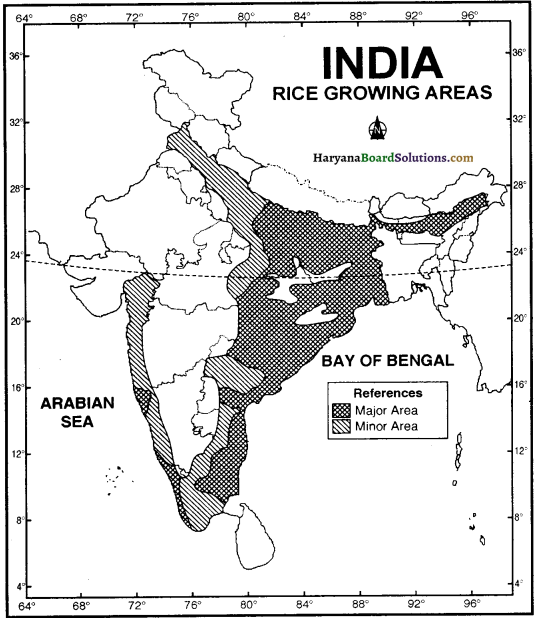
HBSE 10th Class Social Science Important Questions Geography Chapter 4 Agriculture - 1

Question 2.
On an outline map of India, show the oilseed producing regions.
Answer:
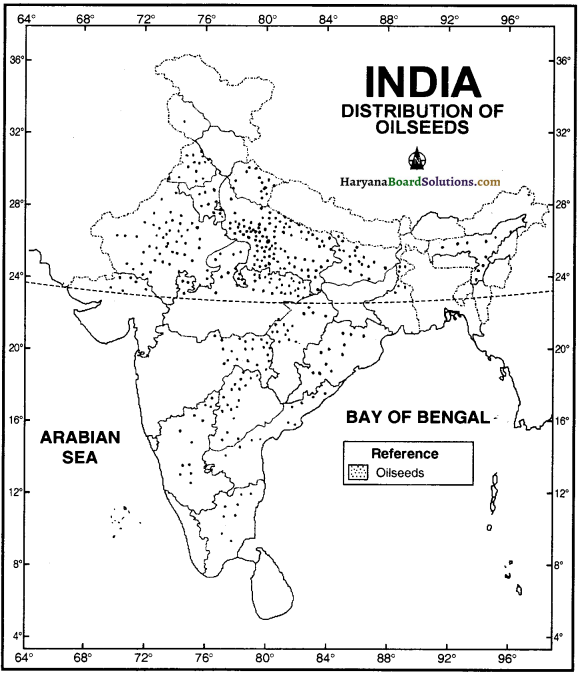
HBSE 10th Class Social Science Important Questions Geography Chapter 4 Agriculture - 2

Question 3.
On an outline map of India, show the sugarcane growing areas.
Answer:
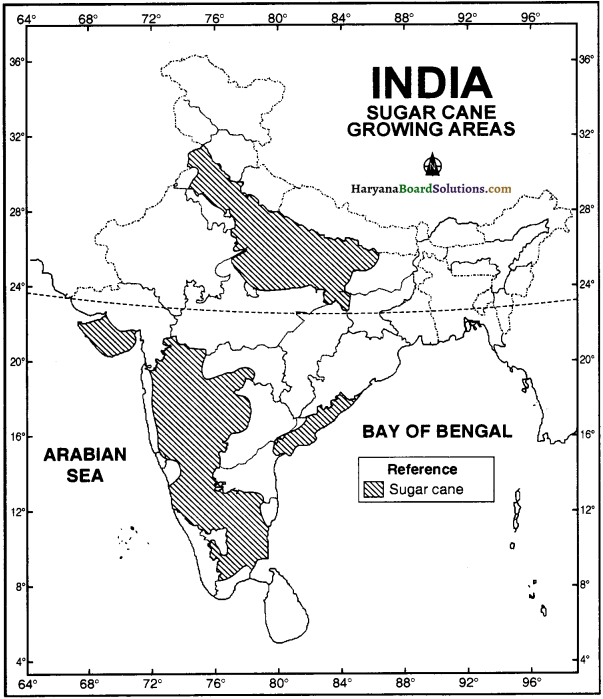
HBSE 10th Class Social Science Important Questions Geography Chapter 4 Agriculture - 3

Question 4.
On an outline map of India, show the distribution of groundnut.
Answer:
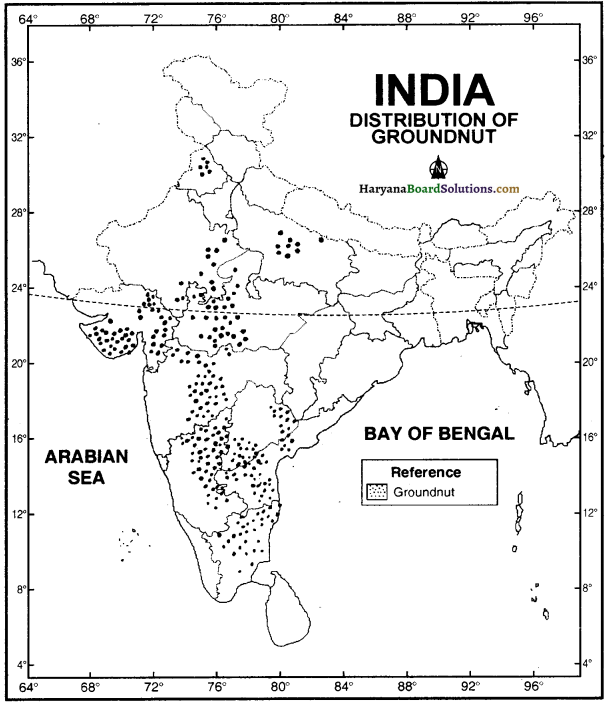
HBSE 10th Class Social Science Important Questions Geography Chapter 4 Agriculture - 4

Question 5.
On an outline map of India, show:
(i) Cotton producing areas,
(ii) Jute producing areas.
Answer:
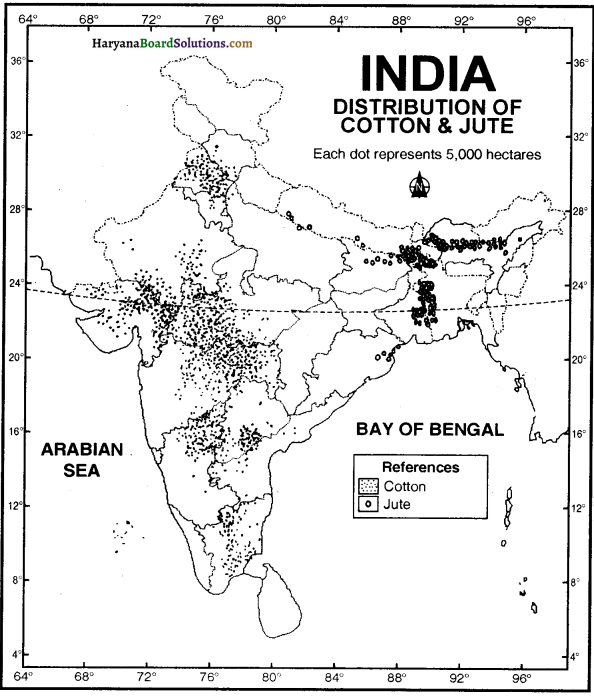
HBSE 10th Class Social Science Important Questions Geography Chapter 4 Agriculture - 5

Question 6.
On an outline map of India, show:
(i) Tea growing areas,
(ii) Coffee growing areas.
Answer:
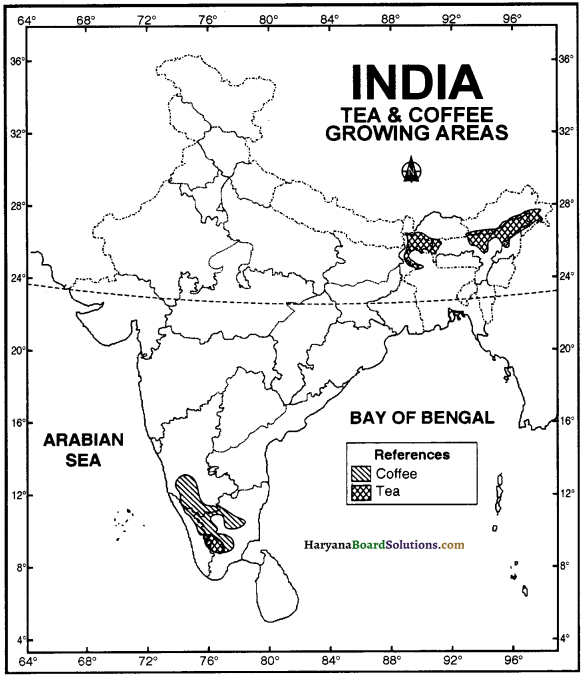
HBSE 10th Class Social Science Important Questions Geography Chapter 4 Agriculture - 6

HBSE 10th Class Social Science Important Questions Geography Chapter 4 Agriculture Read More »
HBSE 10th Class Social Science Important Questions Geography Chapter 1 Resource and Development

Haryana State Board HBSE 10th Class Social Science Important Questions Geography Chapter 1 Resource and Development Important Questions and Answers.

Haryana Board 10th Class Social Science Important Questions Geography Chapter 1 Resource and Development

Multiple Choice Questions

Resources And Development Important Questions HBSE Question 1.
Everything available in our environment which can be used to satisfy our needs, can be termed as : ’
(a) Development
(b) Resources
(c) Planning
(d) Product.
Answer:
(b) Resources

Class 10 Geography Chapter 1 Very Short Questions And Answers HBSE Question 2.
On the basis of origin, resources are classified into the following types :
(a) Biotic and Abiotic
(b) Natural and Man-made
(c) Renewable and Non-renewable
(d) Potential and Developed.
Answer:
(a) Biotic and Abiotic

HBSE 10th Class Important Questions Geography Chapter 1 Question 3.
Which type of resource is the rock?
(a) Biotic
(b) Abiotic
(c) Individual
(d) All of these.
Answer:
(b) Abiotic

Important Questions Resource and Development HBSE 10th Class Question 4.
Which of the following is a renewable resource?
(a) Wind energy
(b) Forest
(c) Solar Power
(d) All of these.
Answer:
(d) All of these.

Question 5.
Which of the following is a non-recyclable resource?
(a) Fossil fuel
(b) Wind energy
(c) Animal
(d) HumAnswer:
Answer:
(a) Fossil fuel

HBSE 10th Class Social Science Important Questions Geography Chapter 1 Resource and Development

Question 6.
Which of the following resources belong to the nation?
(a) National Resources
(b) Developed Resources
(c) Biotic Resources
(d) Abiotic Resources.
Answer:
(a) National Resources

Question 7.
Which of the following are the subset of stock?
(a) Stock
(b) Potential Resources
(c) Reserve
(d) National Resources.
Answer:
(c) Reserve

Question 8.
When was Rio de Janeiro Earth Summit convened?
(a)1990
(b)1991
(c) 1992
(d) 1995.
Answer:
(c) 1992

Question 9.
“There is enough to fulfil everybody’s need and not for anybody’s greed.” Who made this statement?
(a) Jawaharlal Nehru
(b) Mahatma Gandhi
(c) Subhash Chandra Bose
(d) Manmohan Singh.
Answer:
(b) Mahatma Gandhi

Question 10.
Which of the following is the most widespread soil in India?
(a) Alluvial
(b) Black
(c) Laterite
(d) Red and Yellow.
Answer:
(a) Alluvial

HBSE 10th Class Social Science Important Questions Geography Chapter 1 Resource and Development

Question 11.
In which of the following areas is the alluvial soil found?
(a) Northern Plains
(b) Hilly areas
(c) Desert Plains
(d) None of these.
Answer:
(a) Northern Plains

Question 12.
What is old alluvial soil called?
(a) Khadar
(b) Bangar
(c) Black
(d) Forest Soil.
Answer:
(b) Bangar

Question 13.
Which of the following soils is most fertile?
(a) Khadar
(b) Bangar
(c) Laterite
(d) Arft.
Answer:
(a) Khadar

Question 14.
Which of the following soils is most suitable for growing cotton?
(a) Laterite Soil
(b) Black Soil
(c) Alluvial Soil
(d) Forest Soil.
Answer:
(b) Black Soil

Question 15.
Which of the following soils is also called Regur Soil?
(a) Alluvial
(b) Black
(c) Red
(d) Laterite.
Answer:
(b) Black

HBSE 10th Class Social Science Important Questions Geography Chapter 1 Resource and Development

Question 16.
Which of the following soils is developed due to intense leaching?
(a) Alluvial Soil
(b) Black Soil
(c) Red Soil
(d) Laterite Soil.
Answer:
(d) Laterite Soil.

Question 17.
Which of the following soils is generally sandy in texture and saline in nature?
(a) Arid Soil
(b) Black Soil
(c) Laterite Soil
(d) Red Soil.
Answer:
(a) Arid Soil

Question 18.
Which of the following soils is found in hilly areas?
(a) Alluvial soil
(b) Red soil
(c) Forest soil
(d) Black soil.
Answer:
(c) Forest soil

Question 19.
Which of the following methods is used in the Himalayas for soil conservation?
(a) Terrace Farming
(b) Strip Cropping
(c) Shelter Belts
(d) None of these.
Answer:
(a) Terrace Farming

Question 20.
The method of growing long strips of grass between the crops refers to:
(a) Strip Cropping
(b) Crop Rotation
(c) Terrace Farming
(d) Contour Ploughing
Answer:
(a) Strip Cropping

Fill in the blanks

1. …………… are a function of human activities.
Answer:
Resources.

2. Urban development authorities are …………… by the government to land.
Answer:
empowered, acquire.

3. The development of resources depends on ………….. and lavel of their
Answer:
technology, feasibility.

4. ………….. are the subset of the stock.
Answer:
Reserves.

5. Today, geographical area of India is ………….. million sQuestion km
Answer:
3.28.

HBSE 10th Class Social Science Important Questions Geography Chapter 1 Resource and Development

6. The land under permanent …………. has also
Answer:
pasture, decreased.

7. ………….. soils as a whole are very …………….
Answer:
Alluvial, fertile.

8. The land that becomes unfit for …………. is known as ……………
Answer:
cultivation, bad-land.

Match the following

Match Column A with Column B :
Column A Resource Name Column B Type of Resource

1. Livestock(a) Renewable
2. Water(b) Non-Renewable
3. Fossil Fuels(c) Community owned
4. Village Ponds(d) National
5. Railways(e) Biotic Resource

Answer:

1. Livestock(e) Biotic Resource
2. Water(a) Renewable
3. Fossil Fuels(b) Non-Renewable
4. Village Ponds(c) Community owned
5. Railways(d) National

Very Short Answer ’Type Questions

Question 1
How can the resources be classified on the basis of their origin?
Answer:
On the basis of their origin, resources can be classified into two types:
(1) Biotic,
(2) Abiotic.

Question 2.
What are Biotic Resources?
Answer:
Resources which are obtained from biosphere and have life are called biotic resources. For example— human beings and plants.

Question 3.
What are Abiotic Resources?
Answer:
All those things which are composed of non-living things are called abiotic resources. For example, rocks and minerals.

HBSE 10th Class Social Science Important Questions Geography Chapter 1 Resource and Development

Question 4.
What type of resource is solar energy?
Answer:
Renewable resource.

Question 5.
How can the resources be classified on the basis of their status of development?
Answer:
On the basis of the status of development, resources can be classified into four types:

  • Potential resources
  • Developed resources
  • Stock
  • Reserve.

Question 6.
What is resource planning?
Answer:
Resource Planning is a widely-accepted strategy for judicious use of resources.

Question 7.
What are international resources? Kai Board 2017
Answer:
These are resources regulated by certain international institutions, and no individual country can utilise them on their own accord.

Question 8.
What is the total geographical area of India?
Answer:
3.28 million sq. km.

Question 9.
Write the main reasons for land degradation.
Answer:
Some human activities such as deforestation, over grazing, mining and quarrying too have contributed significantly in land degradation.

HBSE 10th Class Social Science Important Questions Geography Chapter 1 Resource and Development

Question 10.
What is Soil Profile?
Answer:
Soil Profile is the vertical section of soil, from the ground surface to the parent rock.

Question 11.
How can the alluvial soil be classified on the basis of age?
Answer:
On the basis of its age, the alluvial soil is divided into two parts:
(1) Khadar (New alluvial)
(2) Bangar (Old alluvial).

Question 12.
Why is the black soil tilled immediately after the first monsoon shower?
Answer:
Because this soil becomes sticky when very wet and difficult to plough.

Question 13.
What is a bad land?
Answer:
It is a land which is unsuitable for cultivation. Mainly soil erosion converts fertile land into bad land.

Question 14.
State any two reasons for soil erosion.
Answer:
(i) Over-grazing
(ii) Deforestation.

Question 15.
What are the types of soil erosion?
Answer:

  • Wind erosion
  • Sheet erosion
  • Gully erosion.

Question 16.
What are shelter belts?
Answer:
Rows of trees which are planted in between the crops are known as shelter belts.

Question 17.
What is Global Warming?
Answer:
Global Warming is the increase in temperature of planet earth on the whole.

Question 18.
Give an example of reserve resource.
Answer:
Hydro-electric power.

Question 19.
What is resource planning?
Answer:
Resource planning is a method that leads us towards achievement of sustainable development.

Short Answer Type Questions

Question 1.
What is a Resource? Give two examples. : 2017
Answer:
All the useful elements of environment which satisfy our basic needs are called resources.
Examples – Coal, water, air, flora and fauna, rocks and metals, etc.

Question 2.
Explain the relationship between nature, technology and institutions.
Answer:
Nature contains resources. These resources are converted into usable form with the help of technology. Human beings interact with nature through technology and create institutions to accelerate their economic development.

Question 3.
Write any two differences between renewable and non-renewable resources.
OR
Classify resources on the basis of exhaustibility.
Answer:
Renewable Resources:

  • These can be renewed in a short time.
  • These do not cause any pollution to the environment.
  • Their examples are – Air, water, solar energy.

Non-renewable Resources:

  • These cannot be renewed.
  • These cause pollution to the environment.
  • Their examples are – minerals, oil and coal.

Question 4.
What is sustainable development?
Answer:
Sustainable development means development that should take place wihout damaging the environment, and development in the present should not compromise with the needs of the future generations.

HBSE 10th Class Social Science Important Questions Geography Chapter 1 Resource and Development

Question 5.
Write a short note on the Rio-de-Janeiro Earth Summit, 192,
Answer:
The iio-de-Janeiro Earth Summit was held in June 1992. loo heads of different states met in Brazil for first International Earth Summit. The Summit was convened for addressing the urgent problems of environmental protection and socio-economic development.

Question 6.
Write the steps involved in the process of Resource Planning.
Answer:
(1) Identification and inventory of resources across the regions of the country. This involves surveying, mapping, quantitative and qualitative estimation and measurement of the resources.
(2) Evohring a planning structure endowed with appropriate technology, skill and institutional set up, to implement the resource development plase
(3) Matching the resource development plans with overall national development plAnswer:

Question 7.
Why is there a need to conserve resources?
Answer:
There is a need to conserve resources because:

  • Most of the resources have limited supply.
  • Over-utilisation of resources may cause environmental problems.
  • Over-utilisation of resources may cause socio-economic problems.

Question 8.
Mention the factors which the land use pattern of India depends upon.
Answer:
The use of land is determined by physical as well as human factors :
(i) Physical factors: Topography, climate and soil types.
(ii) Human factors: Population density, technological capability, culture and traditions.

Question 9.
What is the difference between Net Sown Area and Gross Sown Area?
Answer:
Area sown once in a year is known as the Net Sown Area, while area, sown more than once in an agricultural year, plus Net Sown Area is known as the Gross Sown Area or Gross Cropped Area.

Question 1o.
What is the meaning of the conservation of natural resources?
Answer:
Conservation of natural resources means judicious and planned use of natural resources so that we can get the maximum benefit from these resources over the longest period of time.

Question 11.
How can Indian soils be classified?
Answer:
The Indian soils can be classified into the following types:

  • Alluvial Soil
  • Black Soil
  • Latente Soil
  • Red and Yellow Soil
  • Arid Soil,
  • Forest Soil.

Question 12.
What are the differences between the alluvial soil found in the upper course of rivers and that found in the lower course?
Answer:
Alktvial Soil in the Uppbir Cotrfse:

  • The soil particles are bigger in size.
  • The soils are more coarse.
  • This soil is less fertile

ADtndal Soil in the Lower Course:

  • The soil particles are smaller in size.
  • The soils are less coarse.
  • This soil is more fertile.

Question 13.
What do you understand by gully erosion?
Answer:
Gully erosion takes place when the running water cuts deep ravines in the absence of vegetation. This type of erosion makes soil unfit for cultivation.

HBSE 10th Class Social Science Important Questions Geography Chapter 1 Resource and Development

Question 14.
What is the difference between sheet erosion and wind erosion?
Answer:
When the top layer of the soil is removed over a large area by running water, it is called sheet erosion. On the other hand, wind blows loose soil off flat or sloping land, which is known as the wind erosion.

Short Answer Type Questions – II

Question 1.
Classify resources on the basis of their origin and exhaustability.
Answer:
On the basis of origin:
(i) Biotic Resources:
All those resources which are obtained from the biosphere and have life are known as biotic resources.
For example – forest, livestock etc.

(ii) Abiotic Resources:
All those resources which are composed of non-living things are called abiotic resources. Abiotic resources can be renewable as well as non-renewable resources.
For example – Land and water are renewable, while iron and bauxite are non-renewable abiotic resources.

On the basis of exhaustibility:
(i) Renewable Resources:
These are the natural resources which can be used again and again, or can be reproduced by physical, chemical or mechanical processes.
For example – solar energy, air, water etc.

(ii) Non-renewable Resources:
These are the natural resources that cannot be renewed or reproduced at all, or within a reasonable time.
For example – Oil, gas and coal.

Question 2.
Explain the classification of resources on the basis of ownership.
Answer:
(i) Individual Resources:
Resources which are owned privately by individuals are known as individual resources.
For example – plots, fields, houses, cars etc.

(ii) Community Owned Resources:
The resources which are accessible to all the members of the community are known as community resources. For example – Village ponds, public parks, playgrounds etc.

(iii) National Resources:
The resources which belong to the nation are known as national resources. All resources within political boundaries are national resources because the government has the power to acquire even the private properties.

(iv) International Resources:
These resources are owned and regulated by international institutions. The oceanic resources beyond 200 nautical miles of the Exclusive Economic Zone belong to the open ocean and no individual country cqn utilise these without the concurrence of international institutions.

HBSE 10th Class Social Science Important Questions Geography Chapter 1 Resource and Development

Question 3.
Explain the classification of resources on the basis of the status of development.
Answer:
(i) Potential Resources: Resources which are found in a region, but have not been utilised are called potential resources.
For example – Gujarat and Rajasthan have a lot of potential for the development of wind and solar energy, but so far they have not been developed fully.

(ii) Developed Resources: Resources which are surveyed, and their quality and quantity have been determined for utilisation.
For example – Water resources and coal.

(iii) Stock:
Materials in the environment which have the potential to satisfy human needs, but human beings do not have the appropriate technology to access them are included among stock. For example – Water is a compound of two inflammable gases – Hydrogen and Oxygen, which can be used as a rich source of energy, but we do not have the required technical know-how to use them for this purpose.

(iv) Reserves:
These are the subset of stock, which can be put into use with the help of existing technical know-how, but their proper use has been postponed for meeting the future needs. For example – Forest reserves, iron-ore reserves etc.

Question 4.
Write a note on Agenda 21.
Answer:
It is the declaration signed by more than 100 heads of states, in Rio-de-Janeiro Earth Summit, 1992, held in Brazil. It is signed at the United Nations Conference on Environment and Development (UNCED). It aims at achieving global sustainable development. It is an agenda to combat environmental damage, poverty, disease through global co-operation on common interests, mutual needs and shared responsibility.

Question 5.
How land is a natural resource of utmost importance? Write a note on land as a relief feature of India.
Answer:
Land is very important as a natural resource because :

  • All economic activities are performed on land.
  • It supports natural vegetation.
  • Most of the minerals are formed in land.
  • It is used for transport and communication system.

India has land, under a variety of relief features :

  • About 43 per cent of the land area is plain, which provides facilities for agriculture and industry.
  • Mountains account for 30 percent of the total surface area of the country and ensure perennial flow of rivers, provide facilities for tourism and ecological aspects.
  • About 27 per cent of the country is the plateau region. It possesses rich reserves of minerals, fossil fuels and forests.

Question 6.
Suggest three measures for conservation of resources.
Answer:
Three measures for conservation of resources are:

  • Preventing wastage and misuse of resources.
  • Use of alternatives or substitutes of non-renewable resources.
  • Judicial and careful resource utilisation.

HBSE 10th Class Social Science Important Questions Geography Chapter 1 Resource and Development

Question 7.
Explain any four reasons responsible for land degradation in India.
OR
How is over-irrigation responsible for land degradation in Punjab?
OR
How is cement industry responsible for land degradation?
Answer:
(i) Mining:
Mining is one of the major factors responsible for land degradation.
In states like Jharkhand, Chhattisgarh, Madhya Pradesh and Odisha, deforestation due to mining has caused severe land degradation.

(ii) Over-grazing:
During the long dry period, grass is grazed to the ground and tom out by the roots by animals. This leads to loosening of soil and it is easily washed away by rains. In states like Gujarat, Rajasthan, Madhya Pradesh and Maharashtra, overgrazing is one of the main causes for land degradation.

(iii) Over-irrigation:
In the states of Punjab, Haryana, Western Uttar Pradesh, over-irrigation is responsible for land degradation. Due to water-logging, this leads to increase in salinity and alkalinity in the soil.

(iv) Processing of Minerals:
The processing of minerals, such as- grinding of limestone for cement industry and calcite and soap stone for ceramic industry, generates huge quantity of dust in the atmosphere. It retards the process of infilteration of water into the soil after it settles down on the land. In recent years, industrial effluents, as waste, have become a major source of land and water pollution in many parts of the country.

Question 8.
Suggest some methods to control land degradation and to conserve soil.
Answer:
(i) Afforestation: The best way to conserve soil is to increase area under forests. Indiscriminate felling of trees should be stopped and efforts should be made to plant trees in new areas.

(ii) Restricted Grazing of Animals: Animals should be moved over different pastures so as to avoid erosion of soil. Fodder crops should be grown in larger quantity.

(iii) Constructing Dams (Much of soil erosion by river floods can be avoided by constructing dams across rivers. This checks the speed of water and protects soil from erosion.

HBSE 10th Class Social Science Important Questions Geography Chapter 1 Resource and Development

(iv) Proper Farming Technique:
(a) Crop Rotation: If the same crop is sown in the same field, year after year, it consumes certain nutrients from the soil, making it infertile. Crop rotation can check this type of erosion.

(b) Settled Agriculture: Checking and reducing shifting agriculture by persuading the tribal people to switch over to settled agriculture.

(c) Terracing and Contour Ploughing: Terracing and contour ploughing across the hill slopes is very effective and one of the oldest methods of soil conservation. Hill slope is cut into a number of terraces, having horizontal top and steep slopes on the back and front. Contour ploughing involves the construction of bank along the contour.

(d) Shelter Belts and Strip Cropping: Strips of grass are left to grow between the crops. This method of strip cropping breaks up the force of the wind. Planting lines of trees to create shelter is called shelter belts. These shelter belts have contributed significantly to the stabilisation of sand dunes, and in increasing agriculture in the desert in Western India.

Question 9.
There are different reasons for land degradation in different states of India. Explain.
Answer:
The following are the different reasons for land degradation in different states of India :

  • In states like Gujarat, Rajasthan, Madhya Pradesh and Maharashtra, over-grazing is one of the main reasons for land degradation.
  • In the states of Jharkhand, Chhattisgarh, Madhya Pradesh and Odisha, deforestation due to mining has caused severe land degradation.
  • In the states of Punjab, Haryana and Western Uttar Pradesh, over-irrigation is responsible for increasing salinity and alkalinity in the soil.
  • In the hilly regions of India, continuous deforestation is mainly responsible for land degradation.

Question 10.
How is it possible to reverse land degradation? Explain by giving examples of the village of Sukhomajri and Jhabua district.
Answer:
The village of Sukhomajri and Jhabua district have shown that it is possible to reverse land degradation.

  • Tree density in Sukhomajri increased from 13 per hectare in 1976 to 1,272 per hectare in 1992.
  • Regeneration of the environment leads to economic well-being, as a result of greater resource availability, improved agriculture and animal care, and consequently, increased incomes. Average annual household income in Sukhomajri ranged from ₹10,000 – ₹15,000 between 1979 and 1984.
  • People’s management is essential for ecological restoration. With people being made the decision-makers by the Madhya Pradesh government, 2.9 million hectares or about 1 per cent of India’s land area, are being greened across the state through watershed management.

Question 11.
Mention the major features of alluvial soil.
Answer:
Alluvial soil is the most widely spread and important soil in India. The main features of this soil are following:

  • This soil, as a whole, is very fertile and widely spread.
  • This soil consists of various proportions of sand, silt and clay.
  • Mostly, this soil contains adequate proportion of potash, phosphoric acid and lime.
  • These are transported soils. Most of the soils are derived from the sediments deposited by rivers, as in the Indo-Gangetic plain
  • In the upper course of the river, this soil is coarse, but in the middle course, it is medium, and fine grained in the lower course.
  • Apart from the size of their grains or particles, soils are described according to their age as well. They are old alluvial and new alluvial. Locally, the old alluvial is called ‘Bangar’ and the new alluvial is called ‘Khadar’.
  • This soil contains humus in adequate quantity, thus this soil is very fertile.

Question 12.
Distinguish between Khadar and Bangar.
Answer:
Khadar:

  • It is new alluvial soil.
  • It is found in the low areas of the valley, (bottom of a valley) which are flooded every year.
  • This soil is finer in texture.
  • This soil is more fertile.

Bangar:

  • It is old alluvial soil.
  • It is found in the higher reaches, about 30m above the flood level.
  • This soil is coarse in texture.
  • This soil is less fertile.

HBSE 10th Class Social Science Important Questions Geography Chapter 1 Resource and Development

Question 13.
How is the red and yellow soil formed? Mention its distribution and important characteristics.
Answer:
Formation:
Red soil develops due to weathering of ancient crystalline igneous rocks in the areas of low rainfall, in the eastern and southern parts of the Deccan plateau.

Location:
Yellow and red soils are found in parts of Odisha, Chhattisgarh, southern parts of the middle Ganga Plain and along the piedmont zone of the Western Ghats.

Characteristics:

  • These soils are loamy in deep depressions and in uplands they consist of loose gravels and highly coarse materials.
  • These soils develop a reddish colour due to diffusion of iron in crystalline and metamorphic rocks, but they look yellow in hydrated form.
  • These soils are deficient in phosphoric acid and nitrogenous materials, but are rich
    in potash, but crops are cultivated with the use of fertilizers. .
  • These soils do not retain moisture. Wheat, rice, cotton, pulses etc. are grown in these
    soils.

Long Answer Type Questions

Question 1.
Explain the land use pattern of India. Why is it important to know the land-use pattern of a country?
Answer:
(A) Land use pattern of India :

  • The net sown area has decreased from 46-26% (1960-61) to 45-5% (2014-15). This means that more and more agricultural land is being used in other activities. This is a good sign.
  • The land under forests has increased from 18-11% in 1960-61 to 23-3% in 2014-15, yet it is far below the scientific norms.
  • The land under permanent pasture is very low, i.e. only 3-3%. This shows the tremendous pressure of livestock population on agricultural land. Cattle are reared mainly on the farm wastes, grain chafts and a few fodder crops.
  • Area under current fallow land has also increased, which shows that agricultural conditions have become hard due to water scarcity.
  • A part of the land is termed as wasteland, and the land put to other non-agricultural uses. Wasteland includes rocky, arid and desert areas, and land put to other non-agricultural uses includes settlements, roads, railways, industries etc.

HBSE 10th Class Social Science Important Questions Geography Chapter 1 Resource and Development

(B) (i) For any country, the availability of total land is fixed. It cannot be changed.
(ii) In view of the increasmg pressure on land for various purposes, it is necessary to plan for the proper use of all the available land.
(iii) To fulfil the economic needs cf the people and for maintaining the ecological balance, it is very important to know the land-use pattern of a country.

Question 2.
What is soil? How is it important as a resource? Explain the major factors responsible for the formation of soil. What is soil erosion?
Answer:
Soil: Soil is the uppermost layer of the earth’s crust. It is a living system. It consists of organic (humus) and inorganic materials. Importance of Soil as a Resource: Soil is the most important renewable natural resource. It is the medium of plant growth and supports different types of living organisms on the earth. It takes millions of years to form the soil upto a few centimetre in depth.

Factors responsible for the formation of soil are as follows:

  • Relief, parent rock or bed rock, climate, vegetation and other forms of life, and time are important factors for the formation of soil.
  • Various forces of nature, such as change in temperature, actions of running water, wind and glaciers, activities of decomposers etc. contribute to the formation of soil.
  • Chemical and organic change which take place in the soil are equally important.

Soil Erosion: g0ii erosion is the removal of soil by the forces of nature, like wind and water, more rapidly than the various soil forming processes can replace it. Generally, there is a balance between the soil forming process and the erosional process. The balance can be disturbed by natural or human factors.

Question 3.
Give a brief account of the major soil types found in India.
OR
Write an essay on classification of soils in India.
OR
Write a note on Black Soil.
OR
Mention some important features of Arid Soil.
OR
Write a note on forest Soil and Laterite soils.
Answer:
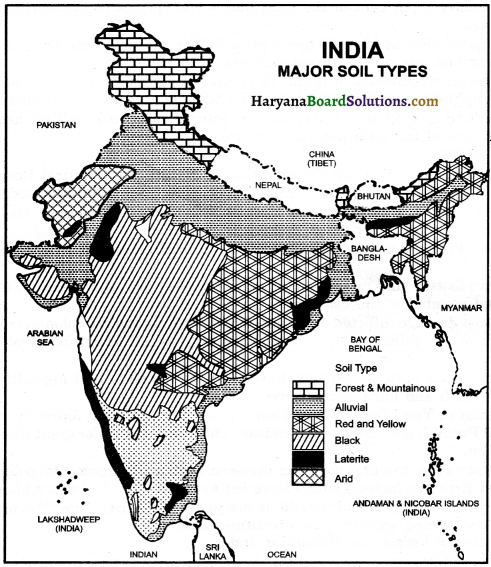
Major types of soils and their characteristics – The main types of the soils in India are the following :
1. Alluvial Soils:
Alluvial Soil is the most widely spread and important soil in India. It is spread over a vast area of the northern plains, beginning from the Punjab in the west to the Brahmaputra Valley in the east. As a whole, these soils are very fertile. Mostly, these soils contain adequate proportion of potash, phosphoric acid and lime. This soil contains adequate quantity of humus. On the basis of its age, alluvial soil is divided into two parts –

  • Khadar (new alluvial)
  • Bangar (Old Alluvial).

2. Black Soil:
Black soils are black in colour and are also known as Regur Soils. These soils cover the plateaus of Maharashtra, Saurashtra, Malwa, Madhya Pradesh, Chhattisgarh, and extend in the South-East direction along the Godavari and the Krishna Valleys. This soil is ideal for growing cotton, tobacco, oil seeds and sugarcane. This soil is formed by weathering of volcanic (Basalt) rocks formed by the Deccan lava.

These soils are made up of fine clayey materials. It is well known for its capacity to hold moisture and is rich in soil nutrients, such as calcium carbonate, potash, magnesium and lime, but poor in phosphoric contents. Development of deep cracks during hot weather helps in the proper aeration of the soil. These soils are sticky when wet and difficult to work on, unless tilled immediately after the first shower or during the pre-monsoon period.

HBSE 10th Class Social Science Important Questions Geography Chapter 1 Resource and Development

3. Laterite Soils:
Laterite soils are commonly found in the hilly areas. Such soils are found in Karnataka, Kerala, Tamil Nadu, Madhya Pradesh, and the hilly areas of Odisha and Assam. They develop in areas with high temperature and heavy rainfall. These are a result of intense leaching, owing to heavy rains.

These soils are acidic in nature. Humus content of the soil is low because most of the micro-organisms particularly, the decomposers like bacteria, get destroyed due to high temperature. Due to lack of nitrogen, potassium and organic elements, the laterite soils lack fertility and are not suitable for cultivation, but when the soils are manured and irrigated, some crops like tea and coffee can be cultivated very well in them.

4. Forest Soil:
These soils are formed due to mechanical weathering, caused by snow, rain, temperature variation etc. These soils are found in the hilly region. These soils are very rich in humus, but are deficient in potash, phosphorus and lime. These soils are especially suitable for plantation of tea, coffee, spices and tropical fruits. These soils are heterogenous in nature and their characteristics change with mountain environment and altitude. These soils are loamy and silty in valley sides, and coarsely grained in the upper slopes. They are acidic, with low humus content in the snow covered areas. They are fertile in the lower parts of the valleys.

5. Arid Soil:
This soil is found in Rajasthan, Punjab and Haryana. These soils range from
red to brown in colour. These soils are mostly covered with sand particles and are infertile, but if irrigation facilities are available, they can prove to be quite useful, as is the case with Western Rajasthan. Other features are as follows : ‘ Raj’ 2015

  • These soils contain considerable amount of soluble salts.
  • These soils contain low percentage of organic matter due to dry climate and absence of vegetation.
  • These soils are alkaline in nature, as there is no rainfall to wash soluble salts.
  • The lower horizon of the soil is occupied by ‘Kankar’ because of the increasing calcium content, downwards. The ‘Kankar’ layer formations in the bottom horizons, restrict the infiltration of water.
  • These soils are infertile, but with irrigation and fertilizers, the drought-resistant and salt-tolerent dry crops such as barley, cotton, wheat, millets, maize, pulses etc. can be grown.

6. Red and Yellow Soil:
These soils are found in parts of Odisha, Chhattisgarh, Southern parts of the middle Ganga Plain and along the Piedmont zone of the Western Ghats. These soils are deficient in phosporic acid and nitrogenous materials, but are rich in potash. Crops grown in these types of soils are cultivated with the use of fertilizers. Crops like wheat, rice, cotton, pulses are grown in these soils.

Question 4.
Explain the major types of soil erosion prevailing in India. Also explain some methods which can be used for soil conservation. ‘Raj. Hoard 2017
Answer:
Major Types of Soil Erosion prevailing in India :
(A) Water Erosion:
Water is a powerful agent of soil erosion. Following are the major types of erosion caused by water –
(i) Sheet Erosion:
When the top layer of the soil is removed over a large area by running water, it is called sheet erosion.
(ii) Rill Erosion:
This is the second stage of sheet erosion. If erosion continues unchecked for a sufficient time, rills or small finger-shaped grooves, which are a few centimetres in depth, may develop on the landscape.
Over a period of time, the fine rills increase in number and also become deeper and wider, and resemble the twigs, branches and trunk of a tree. This is called rill erosion.

HBSE 10th Class Social Science Important Questions Geography Chapter 1 Resource and Development

(iii) Gully Erosion:
This is the third stage of sheet erosion. With further erosion of the soil, the rills may deepen and become enlarged, and are ultimately turned into gullies. The main cause of gully erosion is the removal of vegetation, particularly of trees with their wide¬spread binding roots. Gullies cut up agricultural land and the entire area may be turned into a bad land. It is also responsible for the formation of ravines.

(B) Wind Erosion:
When the wind blows the loose soil off flat or sloping land, this erosion is called wind erosion.

Measures for Soil Conservation:
(i) Crop Rotation: If the same crop is sown in the same field, year after year, this consumes certain nutrients from the soil, making it infertile. Crop rotation can check this type of erosion.
(ii) Terrace Cultivation: Steps can be cut out on the slopes to make terraces. This restricts erosion in the hilly areas.
(iii) Strip Cropping: Large fields can be divided into strips. Strips of grass are left to
grow between the crops. This breaks the force of the wind.
(iv) Contour Ploughing: Ploughing along the contour lines can slow down the flow of water down the slopes.
(v) Shelter Belts: Planting lines of trees to create shelter also works to break the force ‘ of the wind.

Map Work

Question 1.
On an outline map of India, show the following :
(a) Alluvial Soil
(b) Black Soil
(c) Red and Yellow Soil
(d) Laterite Soil
(e) Arid Soil
(f) Forest and Mountainous soils.
Answer:
HBSE 10th Class Social Science Important Questions Geography Chapter 1 Resource and Development - 1

HBSE 10th Class Social Science Important Questions Geography Chapter 1 Resource and Development Read More »
HBSE 10th Class Social Science Important Questions Civics Chapter 8 लोकतंत्र की चुनौतियाँ

Haryana State Board HBSE 10th Class Social Science Important Questions Civics Chapter 8 लोकतंत्र की चुनौतियाँ Important Questions and Answers.

Haryana Board 10th Class Social Science Important Questions Civics Chapter 8 लोकतंत्र की चुनौतियाँ

लोकतंत्र की चुनौतियाँ Important Questions Civics HBSE 10th Class प्रश्न-
चुनौती किसे कहते हैं?
उत्तर-
चुनौती किसी प्रमुख समस्या को कहा जाता है जिसका समाधान संभव है।

HBSE 10th Class लोकतंत्र की चुनौतियाँ Important Questions Civics प्रश्न-
किसी लोकतंत्र के समक्ष कितनी प्रकार की चुनौतियाँ हो सकती है?
उत्तर-
किसी लोकतंत्र के समक्ष प्रायः तीन प्रकार की चुनौतियाँ हो सकती है। यह चुनौतियाँ हैं- 1. बुनियादी चुनीती. 2. विस्तार की चुनौती, 3. नींव मजबूत करने की चुनौती।

Chapter 8 लोकतंत्र की चुनौतियाँ Important Questions HBSE 10th Class प्रश्न-
बुनियादी चुनौती के कोई दो उदाहरण दीजिए।
उत्तर-
लोकतंत्र की बुनियादी चुनौती के दो उदाहरण निम्नलिखित हैं:
1. जहाँ लोकतंत्र नहीं है, वहां लोकतंत्र की स्थापना करना। 2. लोकतांत्रिक हस्तारण की समस्याएँ।

प्रश्न-
लोकतंत्र के प्रसार से संबंधित कोई दो चुनौतियाँ बताइए।
उत्तर-
1. लोकतंत्र का दायरा बढ़ाने हेतु अधिक समूहों की भागीदारी पर जोर;
2. लोकतंत्रीय व्यवस्था में नागरिकों के अधिकारों का सूचारू प्रयोजन।

प्रश्न-
लोकतंत्र की नींव मजबूत करने के चुनौतियों में किन्हीं दो का उदाहरण दें।
उत्तर-
1. लोकतंत्र के मार्ग की बाधाओं को दूर करना, ध न-बल के जोर को करना;
2. राजनीति में अपराधीकरण का उन्मूलन।

HBSE 10th Class Social Science Important Questions Civics Chapter 8 लोकतंत्र की चुनौतियाँ

प्रश्न-
भारत जैसे लोकतंत्रीय राज्य के समक्ष किन्हीं पाँच चुनौतियों का वर्णन कीजिए।
उत्तर-
1. राजनीतिक ईकाइयों का कमजोर संचालन; 2. चुनावों में धन-बल की आवश्यक भूमिका; 3. सामाजिक वर्गों में तनाव; 4. गरीबी व निरक्षरता; 5. साम्प्रदायिकता। .

प्रश्न-
किन्हीं दो देशों का नाम बताइए जहाँ लोकतंत्र की बहाली की जरूरत है?
उत्तर-
म्यांमार व पाकिस्तान।

प्रश्न-
किन्हीं दो देशों के नाम बताइए जहाँ सामाजिक तनाव हिंसक रूप धारण कर चुके हैं?
उत्तर-
यूगोस्लाविया, श्रीलंका।

प्रश्न-
उदाहरण देकर बताइए कि किस देश में सामाजिक वर्गों में सद्भावना की भावना हो?
उत्तर-
बेल्जियम।

प्रश्न-
अमरीकी व्यवस्था की कोई एक समस्या बताइए जो अंतर्राष्ट्रीय संगठनों की राह में बाधा बनती हो?
उत्तर-
अमरीकी व्यवस्था की यह मांग कि वह समस्त संसार पर अपना अधिपत्य स्थापित करना चाहती है।

प्रश्न-
राजनीति सुधार क्यों जरूरी है?
उत्तर-
लोकतंत्र की चुनौतियों का मुकाबला करने के लिए राजनीतिक सुधार जरूरी होते हैं

प्रश्न-
कौन-से कानून लोकतंत्र में सफल नहीं हो पाते?
उत्तर-
वह सभी कानून जो लोकतंत्र को कमजोर बनाते हैं, वह लोकतंत्र में सफल नहीं होते। लोकतंत्र में लोकमत अनुरूप कानून बनाएं जाने चाहिए।

प्रश्न-
राजनीतिक सुधार किसे कहते हैं? क्या कोई एक सुनिश्चत सुधारों की सूची बनायी जा सकती है?
उत्तर-
लोकतंत्र की विभिन्न चुनौतयों के विषय में सभी सुझाव या प्रस्ताव लोकतांत्रिक सुधार राजनीतिक सुधार कहे जाते हैं। राजनीतिक सुधारों को कोई एक सुनिश्चित तैयार करना संभव नहीं है। इसका मुख्य कारण यह है कि विभिन्न देशों में विभिन्न लोगों की अपनी ही लोकतंत्र से जुड़ी समस्याएं होती है। फलस्वरूप कोई एक सुनिश्चित सूची तैयार करना कठिन है। क्या कार की गड़बड़ी जाने बिना हम कार को ठीक करने का उपाय कैसे बता सकते हैं?

प्रश्न-
क्या कानून मात्र से लोकतंत्र में राजनीतिक सुध र लाए जा सकते हैं?
उत्तर-
अच्छे कानून लोकतंत्र के संचालन के लिए अच्छा वातावरण तैयार कर सकते हैं। परंतु मात्र कानूनों से सुधारों की संभावना करना बिल्कुल सही नहीं होगा नियम-कानूनों में बदलाव करने से लोकतंत्र में बदलाव नहीं आ जाता। क्या क्रिकेट में एल.बी.डब्ल्यु. से संबंधित नियमों में बदलाव से क्रिकेट के खेल में बदलाव नहीं आ जाएगा बदलाव तो खिलाड़ियों, प्रशिक्षिकों व प्रशासकों में भी करना होगा।

प्रश्न-
उदाहरण देकर बताइए कि कई बार अच्छे कानून भी सही राजनीतिक सुधार नहीं ला पाते?
उत्तर-
अच्छे कानून के परिणाम भी कई बार उल्टे निकलते हैं। जैसे कई राज्यों ने दो से ज्यादा बच्चों वाले लोगों के पंचायत चुनाव लड़ने पर रोक लगा दी है। इसके चलते अनेक गरीब लोग और महिलाएं लोकतांत्रिक अवसर से वंचित हुई जबकि ऐसा करने के पीछे यह मंशा न थी। आमतौर पर किसी चीज की मनाही करने वाले कानून राजनीति मे ज्यादा सफल नहीं होते।
प्रश्न-राजनीतिक सुधारों व लोकतांत्रिक कामकाज के संबंधों पर संक्षिप्त चर्चा कीजिए।
उत्तर-राजनीतिक सुधारों व लोकतांत्रिक कामकाज के बीच संबंध होता है। लोकतांत्रिक कामकाज को जितना अधिक मजबूत बनाया जाएगा राजनीति सुधार उतनी तीव्रता से अपने आप होते जाएंगे। लोकतंत्र परीक्षण का एक साधन है। लोगों की भागीदारी जितनी अधिक होगी, राजनीतिक सुधारों की सम्भावना में उतनी तीव्रता अधिक होगी।

प्रश्न-
राजनीतिक दलों के सुधार हेतु कोई दो सुधार बताइए। . उत्तर-लोकसभा का पिछल चुनाव लड़ने वाले प्रत्येक उम्मीदार की संपति औसतन एक करोड़ रूपए से ज्यादा की थी। यह डर व्यक्त किया जा रहा है कि अब चुनाव लड़ना सिर्फ अमीरों या उनका समर्थन रखने वालों के लिए ही संभव है। अधिकतर राजनीतिक दल बड़े व्यावसायिक घरानों के चंदों पर निर्भर है। इस संबंध में निम्नलिखित दो सुधार बताइए जा सकते हैं-

1. प्रत्येक राजनीतिक दल के वित्तीय लेखा-जोखा को सार्वजनिक कर दिया जाना चाहिए। इसका लेखा सरकारी ऑडिटरों से कराया जाना चाहिए।
2. चुनाव का खर्च सरकार को उठना चाहिए। पाटियों की चुनावी खर्च के लिए सरकार कुछ रकम दे। नागारिको को भी दलों और राजनीतिक कार्यकताओं को चंदा देने के लिए प्रोत्साहित किया जाना चाहिए। ऐसे चंदों पर आयकर में छूट मिलनी चाहिए।

HBSE 10th Class Social Science Important Questions Civics Chapter 8 लोकतंत्र की चुनौतियाँ

प्रश्न-
बताइए कि लोकतंत्र के समक्ष कौन-सी प्रमुख चुनौतियाँ हैं।
उत्तर-
संसार में आज भी लगभग एक-चौथाई भाग में लोकतंत्र नहीं है। इन इलाकों में लोकतंत्र के लिए बहुत ही मुश्किल चुनौतियाँ है। इन देशों में लोकतांत्रिक व्यवस्था की तरफ जाने और लोकतांत्रिक सरकार गठित करने के लिए जरूरी बुनियादी आधार बनाने की चुनौती है। इनमें मौजूदा गैर-लोकतांत्रिक शासन व्यवस्था को गिराने सत्ता पर सेना के नियंत्रण को समाप्त करने और एक संप्रभु तथा कारगर शासन व्यवस्था को स्थापित करने की चुनौती है।

अधिकांश स्थापित लोकतांत्रिक व्यवस्थाओं के सामने अपने विस्तार की चुनौती है। इसमें लोकतांत्रिक शासन के बुनियादी सिद्धांतों को सभी इलाकों सभी सामाजिक समूहों और विभिन्न संस्थाओं में लागू करना शामिल है। स्थानीय सरकारों को अधिक अधिकार संपन्न बनाना, संघ की सभी इकाइयों के लिए संघ के सिद्धांतों को व्यावहारिक स्तर पर लागू करना, महिलाओं और अल्पसंख्यक समूहों की उचित भागीदारी सुनिश्चित करना आदि ऐसी ही चुनौतियाँ है। इसका यह भी मतलब है कि कम-से-कम ही चीजें लोकतांत्रिक नियंत्रण के बाहर रहनी चाहिए। भारत और दुनिया के सबसे पुराने लोकतंत्रों में एक अमरीका जैसे देशों के सामने भी यह चुनौती है।।

तीसरी चुनौती लोकतंत्र को मजबूत करने की है। हर लोकतांत्रिक व्यवस्था के सामने किसी-न-किसी रूप में यह चुनौती है ही। इसमें लोकतांत्रिक संस्थाओं और बरतावों को मजबूत बनाना शामिल है। यह काम इस तरह से होना चाहिए कि लोग लोकतंत्र से जुड़ी अपनी उम्मीदों को पूरा कर सकें। लेकिन अलग-अलग समाजों में आम आदमी की लोकतंत्र से अलग-अलग अपेक्षाएं होती है इसलिए यह चुनौती दुनिया के अलग-अलग हिस्सों में अलग अर्थ और अलग स्वरूप ले लेती है। संक्षेप में कहें तो इसका मतलब संस्थाओं की कार्य पद्धति को सुधारना और मजबूत करना होता है ताकि लोगों की भागीदारी और नियंत्रण में वृद्धि हो।

प्रश्न-
लोकतंत्र में राजनीतिक सुधारों पर चर्चा कीजिए।
उत्तर-
मात्र-कानून-संवैधानिक बदलावों को ला देने भर से लोकतंत्र को चुनौतियों को हल नहीं किया जा सकता है। ये क्रिकेट के नियमों की तरह है ए.बी. डब्ल्यू. के नियम में बदलाव से बल्लेबाजों द्वारा अपनाए जाने वाले बल्लेबाजी के नकारात्मक दांव-पेंच को कम किया जा सकता है पर यह कोई भी नहीं सोच सकता कि सिर्फ नियमों में बदलाव कर देने भर से क्रिकेट का खेल सुधर जाएगा। यह काम तो मुख्यतः खिलाड़ियों, प्रशिक्षकों और क्रिकेट-प्रशासकों के करने से ही होगा। इसी प्रकार राजनीतिक सुधारों को काम भी मुख्यतः राजनीतिक कार्यकर्ता, दल, आंदोलन और राजनीतिक रूप से सचेत नागरिकों के द्वारा ही हो सकता है। राजनीति में अच्छे काम करने के लिए बढ़ावा देने वाले कानूनों के सफल होने की संभावना अधिकक होती है। सबसे बढ़िया कानून वे हैं जो लोगों को लोकतांत्रिक

सुधार करने की ताकत देते हैं। सूचना का अधिकार-कानून लोगों को जानकार बनाने और लोकतांत्रिक के रखवाले के तौर पर सक्रिय करने का अच्छा उदाहरण है। ऐसा कानून भ्रष्टचार पर अंकुश लगाता है। और भ्रष्टाचार पर रोक लगाने तथा कठोर दंड आयद करने वाले मौजूदा कानूनों की मदद करता है। लोकतांत्रिय व्यवस्था में सुधार हेतु आम नागरिकों की राजनीतिक भागीदारी का स्तर बढ़ाना जरूरी होता है। राजनीतिक सुधार के किसी भी प्रस्ताव में अच्छे समाधान की चिंता होने के साथ-साथ यह सोच भी होनी चाहिए कि इन्हें कौन और लागू करेगा। यह मान लेना समझदारी नहीं कि संसद कोई ऐसा कानून बना देगी तो हर राजनीतिक दल और सांसद के हितों के खिलाफ हो। पर लोकतांत्रिक आंदोलन, नागरिक संगठन और मीडिया पर भरोसा करने वाले उपायों के सफल होने की संभवना होती है।

प्रश्न-
आपकी दृष्टि में लोकतंत्रीय व्यवस्था में क्या मुख्य तत्व होने चाहिए?
उत्तर-
लोकतंत्रीय व्यवस्था में मुख्यतया निम्नलिखित तत्व होने चाहिए-

  1. लोगों द्वारा चुने गए शासक ही सारे प्रमुख फैसले लें;
  2. चुनाव में लोगों को वर्तमान शासकों को बदलने और अपनी पसंद जाहिर करने का पर्याप्त अवसर और विक्लप मिलना चाहिए। ये विकल्प और अवसर हर किसी को बराबरी में उपब्ध होने चाहिए।
  3. विकल्प चुनने के इस तरीके से ऐसी सरकार का गठन होना चाहिए जो संविधान के बुनियादी नियमों और नागरिकों के  अधिकारों को मानते हुए काम करे।
  4. लोकतंत्रीय व्यवस्था में भाग लेने वाले अधिकारियों को लोभ-लालच से ऊपर उठ अच्छा शासन देना चाहिए।
  5. लोकतंत्रीय व्यवस्था में कहीं भी भेदभाव की स्थिति का प्रोत्साहन नहीं किया जाना चाहिए।
  6. शासकों को लोगों की शिकायतों को सुनने की आदत होनी चाहिए।

विकल्पीय प्रश्न

प्रश्न 1.
निम्नलिखित में सही व गलत का चयन कीजिए।
(i) लोकतंत्र की एक प्रमुख चुनौती बुनियादी आधार बनाने की होती है।
(ii) लोकतांत्रिक व्यवस्था में महिलाओं की भागीदारी लोकतंत्र की एक बुनियादी चुनौती है।
(iii) म्यांमार में सैनिक शासन के चलते लोकतंत्र बहाल करना कठिन है।
(iv) बेल्जियम सामाजिक सामंजस्य का एक मुख्य उदाहरण है।
(v) भारत में एकात्मक व्यवस्था सफल हो पायी है।?
उत्तर-
(i) सही,
(ii) गलत,
(iii) सही,
(iv) सही,
(v) गलत।

प्रश्न 2.
सही विकल्प का चयन कीजिए।
(i) निम्नलिखित में से कौन-सा एक देश लोकतंत्र की आधारीय चुनौती का सामना कर रहा है।
(a) भारत
(b) अमेरिका
(c) ग्रेटब्रिटेन
(d) सऊदी अरब
उत्तर-
(d) सऊदी अरब

(ii) निम्नलिखित में से कौन-सा एक देश लोकतंत्र के विस्तार से संबंधित चुनौती का सामना रहा है?
(a) पाकिस्तान
(b) म्यांमार
(c) सऊदी अरब
(d) भारत
उत्तर-
(d) भारत

(iii) लोकतंत्र की परिभाषा में निम्न प्रमुख हैं
(a) सत्ता के लोगों के प्रतिनिधियों के हाथों में होना
(b) राजनीतिक संस्थाओं का प्रसार
(c) लोक-कल्याणकारिता
(d) उपर्युक्त सभी।
उत्तर-
(d) उपर्युक्त सभी।

HBSE 10th Class Social Science Important Questions Civics Chapter 8 लोकतंत्र की चुनौतियाँ

(iv) निम्नलिखित एक देश में जातीय सहयोग है:
(a) यूगोस्लाविया
(b) बेल्जियम
(c) श्रीलंका
(d) इनमें से कोई नहीं
उत्तर-
(b) बेल्जियम

(v) निम्नलिखित देश में महिलाओं को मताधिकार प्राप्त नहीं है।
(a) भारत
(b) अमेरिका
(c) सऊदी अरब
(d) दक्षिणी अफ्रीका
उत्तर-
(c) सऊदी अरब

HBSE 10th Class Social Science Important Questions Civics Chapter 8 लोकतंत्र की चुनौतियाँ Read More »
HBSE 10th Class Social Science Important Questions Economics Chapter 1 विकास

Haryana State Board HBSE 10th Class Social Science Important Questions Economics Chapter 1 विकास Important Questions and Answers.

Haryana Board 10th Class Social Science Important Questions Economics Chapter 1 विकास

विकास Important Questions Economics HBSE 10th Class प्रश्न 1.
राष्ट्रीय आय किसे कहते हैं?
उत्तर-
राष्ट्रीय आय का तात्पर्य उस सकल आय से है जिसे देश के अंदर उत्पन्न भी वस्तुओं और सेवाओं के मूल्य के साथ-साथ विदेशों से प्राप्त आय को जोड़कर प्राप्त किया जाता है।

HBSE 10th Class विकास Important Questions Economics प्रश्न 2.
साक्षरता दर से आपका क्या तात्पर्य है?
उत्तर-
सात वर्ष और उससे अधिक आयु के लोगों में साक्षरता के अनुपात को साक्षरता दर कहते हैं।

Chapter 1 विकास Important Questions HBSE 10th Class प्रश्न 3.
निवल हाजिरी अनुपात का अर्थ स्पष्ट करें।
उत्तर-
6-10 वर्ष की आयु के स्कूल जाने वाले कुल बच्चों का उस आयु-वर्ग कुल बच्चों के साथ अनुपात को निवल हाजिरी अनुपात करते हैं।

प्रश्न 4.
शिशु मृत्यु दर की परिभाषा बताइए।
उत्तर-
किसी वर्ष में पैदा हुए 1000 जीवित बच्चों में से एक वर्ष की आयु से पहले मर जाने वाले बच्चों के अनुपात __ को शिशु मृत्युदर कहते हैं।

HBSE 10th Class Social Science Important Questions Economics Chapter 1 विकास

प्रश्न 5.
शरीर द्रव्यमान सूचकांक क्या है?
उत्तर-
शरीर द्रव्यमान सूचकांक अल्पपोषित वयस्कों का गणना करने का एक तरीका है।

प्रश्न 6.
मानव विकास सूचकांक किसे कहते हैं?
उत्तर-
वह सूचकांक जिसके माध्यम से विश्व के किसी भी देश के मानव विकास के स्तर को जाना जाता हे, मानव विकास सूचकांक कहलाता है।

प्रश्न 7.
प्रति व्यक्ति आय क्या होती है?
उत्तर-
प्रति व्यक्ति आय का तात्पर्य उस राशि से है जिसे कुल राष्ट्रीय आय में कुल जनसंख्या को भाग देकर प्राप्त किया जाता है। इसे औसत आय भी कहते हैं। प्रति व्यक्ति आय = राष्ट्रीय आय / कुल जनसंख्या

प्रश्न 8.
किसी तीन प्रकार की अर्थव्यवस्थाओं के नाम लिखिए।
उत्तर-
(क) पूँजीवादी अर्थव्यवस्था, (ख) समाजवादी अर्थव्यवस्था, (ग) मिश्रित अर्थव्यवस्था।

प्रश्न 9.
प्रति व्यक्ति आय के आधार पर देशों को किन-किन अर्थव्यवस्थाओं में बाँटा गया है?
उत्तर-
प्रति-व्यक्ति आय के आधार पर विश्व के देशों को निम्नलिखित अर्थव्यवस्था में बाँटा गया हैं.
(क) विकसित अर्थव्यवस्था,
(ख) विकासशील अर्थव्यवस्था

प्रश्न 10.
विश्व बैंक ने प्रति व्यक्ति आय के आधार पर विश्व के देशों को किन-किन भागों में बाँटा है?
उत्तर-
विश्व बैंक ने प्रति व्यक्ति आय के आधार पर विश्व के देशों को तीन भाग में बाँटा है
(क) अधिक आय वाले देश, (ख) मध्ययम आय वाले देश, (ग) निम्न आय वाले देश

प्रश्न 11.
किसी देश की आर्थिक प्रगति मापने के दो प्रमुख आधार कौन-कौन से हैं?
उत्तर-
किसी देश की आर्थिक प्रगति मापने के दो प्रमुख आधार निम्नलिखित हैं
(क) उस देश की प्रति-व्यक्ति, आय, (ख) उस देश की राष्ट्रीय आय।

प्रश्न 12.
विकसित अर्थव्यवस्था का क्या अभिप्राय है?
उत्तर-
विकसित अर्थव्यवस्था का अभिप्राय उस अर्थव्यवस्था से है जहाँ आर्थिक उत्पादन की दर जनसंख्या वृदृधि दर से अधिक हो।

प्रश्न 13.
किसी देश की प्रति व्यक्ति आय 70, 000 रुपये है। यह देश किस प्रकार की आयवाला देश कहा जाएगा?
उत्तर-
मध्यम आय वाला देश।

प्रश्न 14.
विश्व बैंक की विश्व विकास रिपोर्ट 2006 के अनुसार कौन देश समृद्ध और कौन देश निम्न आय वाले देशों की श्रेणी में आते हैं?
उत्तर-
विश्व बैंक की विश्व विकास रिपोर्ट 2006 के अनुसार वे देश जिनकी 2004 में प्रति व्यक्ति आय 10, 066 डॉलर प्रति वर्ष या उससे अधिक है, समृद्ध देश हैं और वे देश जिनकी प्रति व्यक्ति आय 825 डॉलर प्रति वर्ष या उससे कम है उन्हें निम्न आय देश कहा गया है।

प्रश्न 15.
भारत किस आय वर्ग के देशों में आता है?
उत्तर-
भारत निम्न आय वाले देशों की रेणी में आता है क्योंकि उसकी प्रति व्यक्ति आय 2004 में केवल 620 डॉलर प्रतिवर्ष थी।

प्रश्न 16.
समद्ध देशों को आमतौर पर किस नाम से पुकारा जाता है?
उत्तर-
विकसित देश।

प्रश्न 17.
निवल राज्य घरेलू उत्पाद को दूसरा क्या नाम दिया जा सकता है?
उत्तर-
राज्य की प्रति व्यक्ति आय।

HBSE 10th Class Social Science Important Questions Economics Chapter 1 विकास

प्रश्न 18.
आमतौर से किसी देश का विकास किन चीजों से निर्धारित किया जा सकता है?
उत्तर-
आमतौर से किसी देश का विकास उसकी निम्नलिखित चीजों से निर्धारित किया जा सकता है
(क) प्रति-व्यक्ति आय,
(ख) औसत साक्षरता स्तर,
(ग) लोगों का स्वास्थ्य स्तर।

प्रश्न 19.
केरल में शिशु मृत्यु दर कम क्यों है?
उत्तर-
केरल में शिशु मृत्यु दर कम है क्योंकि वहाँ शिक्षा एवं स्वास्थ्य की मौलिक सुविधाएँ पर्याप्त मात्रा में उपलब्ध हैं।

प्रश्न 20.
किन राज्यों में लोगों के स्वास्थ्य एवं पौषणिक स्तर बेहतर होने की … है?
उत्तर-
उन राज्यों में जहाँ जन वितरण प्रणाली ठीक प्रकार काम करती है जैसे-तमिलनाडु में ग्रामीण क्षेत्रों के 75% लोग राशन की दुकानों का इस्तेमाल करते हैं।

प्रश्न 21.
UNDP द्वारा प्रकाशित मानव विकास रिपोर्ट देशों की तुलना किस आधार पर करती है?
उत्तर-
UNDP द्वारा प्रकाशित मानव विकास रिपोर्ट देशों की तुलना लोगों की शैक्षिक एवं स्वास्थ्य स्तर तथा प्रति व्यक्ति आय के आधार पर करती है।

प्रश्न 22.
मानव विकास रिपोर्ट 2006 के अनुसार मानव विकास सूचकांक के संदर्भ में विश्व में भारत का क्रमांक कितना है?
उत्तर-
मानव विकास रिपोर्ट 2006 के अनुसार विश्व में मानव विकास सूचकांकक के संदर्भ में भारत का क्रमाक 126

प्रश्न 23.
मानव विकास रिपोर्ट 2006 के अनुसार भारत के नागरिकों की प्रति व्यक्ति आय कितनी थी?
उत्तर-
3, 139 रुपये।

प्रश्न 24.
यदि दुनिया के लोग कच्चे तेल का प्रयोग मौजूदा तरीके से करते रहे तो यह भंडार कितने दिनों तक चल सकेगा?
उत्तर-
यदि दुनिया के लोग कच्चे तेल का प्रयोग मौजूदा तरीके से करते रहे तो यह भंडार 43 वर्षों में खत्म हो जाएगा।

प्रश्न 25.
धारणीयता से आप क्या समझते हैं?
उत्तर-
धारणीयता का अर्थ है विकास के एक निश्चित स्तर को प्राप्त करना इसके बाद इस प्राप्त स्तर को और ऊँचा उठाने का प्रयास करना या कम से कम ऐसी कोशिश करना जिससे आनेवाली पीढ़ियों के लिए यह स्तर बना रहे।

HBSE 10th Class Social Science Important Questions Economics Chapter 1 विकास

प्रश्न 26.
विकास का क्या तात्पर्य है?
उत्तर-
विकास अथवा प्रगति की धारणा सदा से मानव के साथ रही है। वास्तव में हमारी इच्छाएँ और आकांक्षाएँ व्यक्तिगत जीवन में हमें आगे बढ़ने की प्रेरणा देती हैं। हम इसी तरह के विचार देश के बारे में भी रख सकते हैं। हमें किन आवश्यक वस्तुओं की आवश्यकता है? सभी का जीवन बेहतर कैसे हो सकता है? लोग आपस में मिल-जुलकर कैसे रह सकते हैं? क्या और अधिक समानता हो सकती है? यदि हाँ, तो कैसे? विकास इन सभी प्रश्नों पर विचार करने तथा इन लक्ष्यों को प्राप्त करने के उपायों से जुड़ा है।

प्रश्न 27.
“विकास के लिए लोग मिले-जुले लक्ष्यों को देखते हैं।” सिद्ध कीजिये।
उत्तर-
(क) हमारा जीवन द्रव्य या उससे खरीदी जा सकने वाली भौतिक वस्तुओं के साथ-साथ अन्य अभौतिक वस्तुओं पर भी निर्भर करता हैं इसलिये विकास के लिए लोग मिले-जुले लक्ष्यों को देखते हैं।
(ख) उदाहरण के तौर पर, यदि महिलाएँ वेतन भोगी कार्य करती हैं तो घर और समाज में उनका आदर बढ़ता है। यह भी सच है कि यदि हम महिलाओं का आदर करते हैं तो । घर में उनके काम-काज में भी हाथ बटायेंगे। आजकल कामकाजी महिलाओं को अधिक स्वीकार भी किया जाता है। सुरक्षित वातावरण में ज्यादा महिलाएँ विभिन्न प्रकार की नौकरियाँ या व्यापार कर सकती हैं।

प्रश्न 28.
राष्ट्रीय विकास से आपका क्या अभिप्राय हैं?
उत्तर-
(क) देश के विकास के विषय में विभिन्न लोगों की धारणाएँ भिन्न या परस्पर विरोधी हो सकती हैं। . (ख) लेकिन क्या सभी विचारों को बराबर महत्त्व दिया जा सकता है? विचारों में यदि परस्पर विरोध हो तो निर्णय किस प्रकार हो?
(ग) सभी के लिए सही और न्यायपूर्ण राह क्या होगी? किसी काम को करने का बेहतर तरीका क्या हो सकता है? क्या इस विचार से बहुत से लोगों का लाभ होगा या नहीं? राष्ट्रीय विकास का अभिप्राय इन सब प्रश्नों पर विचार करना

प्रश्न 29.
क्या देशों में तुलना के लिए कुल आय एक अच्छा मापदण्ड है?
उत्तर-
(क) देशों के बीच तुलना के लिए कुल आय एक अच्छा मापदण्ड नहीं है। क्योंकि अलग-अलग देशों की जनसंख्या भी अलग-अलग होती है। कुल आय की तुलना करने से व्यक्ति की औसत आय का पता नहीं चलता है। यह कैसे पता चलेगा कि किस देश के लोग बेहतर स्थिति में हैं।
(ख) इसलिए हम औसत आय जिसे प्रति व्यक्ति आय भी कहा जाता है, की तुलना करते हैं।

प्रश्न 30.
विश्व बैंक रिपोर्ट, 2006 के अनुसार देशों के वर्गीकरण के लिए क्या मापदण्ड इस्तेमाल किया गया है?
उत्तर-
(क) विश्व बैंक की विश्व विकास रिपोर्ट, 2006 में देशों का वर्गीकरण के लिए औसत आय या प्रति व्यक्ति आय को मापदण्ड के रूप में इस्तेमाल किया गया है।
(ख) वे देश जिनकी 2004 में प्रति व्यक्ति आय 10, 066 डॉलर प्रति वर्ष या उससे अधिक है, समृद्ध देश हैं और वे देश जिनकी प्रति व्यक्ति आय 825 डॉलर प्रतिवर्ष या उससे कम है उन्हें निम्न आय वाला देश कहा जाता है।
(ग) भारत निम्न आय वर्ग की श्रेणी में आता है क्योंकि यहाँ लोगों की प्रतिव्यक्ति आय 2004 में 620 डॉलर प्रति वर्ष थी।
(घ) समृद्ध देशों को आमतौर से विकसित देश कहा जाता है। जिसमें मध्य पूर्व और कुद अन्य छोटे देश शामिल नहीं हैं।

प्रश्न 31.
नागरिक कितनी भौतिक वस्तुएँ और सेवाएँ इस्तेमाल कर कसते हैं, इसके लिए आय पर्याप्त संकेतक नहीं है। सोदाहरण समझाइए।
उत्तर-
(क) यह सत्य है कि आय पूर्ण रूप से इस बात का पर्याप्त संकेतक नहीं है कि नागरिक कितनी वस्तुएँ एवं सेवाएँ इस्तेमाल कर सकते हैं।
(ख) जो धन जेब में रखा हो, वह जरूरी नहीं कि एक बेहतर जीवन जीने के लिए आवश्यक वस्तुएँ एवं सेवाएँ खरीद सके।
(ग) उदाहरण के लिए, साधारण तौर पर धन से प्रदूषण-मुक्त वातावरण नहीं खरदा जा सकता है। इसी प्रकार, धन से बिना मिलावट की दवाएँ नहीं खरीदी जा सकती हैं जब तक हम ऐसे समुदाय में जाकर नहीं रहने लगें जहाँ ये सुविधाएँ पहले से मौजूद हों।
(घ) जब तक पूरा समुदाय बचाव के लिए कोई ठोस कदम नहीं उठाता तब तक पैसे के बल पर छू तहा बीमारियों से भी बचा नहीं जा सकता है।

प्रश्न 32.
अल्पोषित वयस्कों की गणना का तरीका क्या
उत्तर-
अल्पोषित वयस्कों की गणना के एक तरीके को पोषण वैज्ञानिक, शरीर द्रव्यमान सूचकांक कहते हैं। इसे मापने के लिए किसी व्यक्ति का वजन किलोग्राम में और उसकी लंबाई मीटर में लीजिए। इसके बाद वजन को लंबाई के वर्ग से भाग दीजिाये। यदि यह संख्या 18.5 से कम है तो वह व्यक्ति अल्पपोषित कहा जाएगा और यदि यह शरीर द्रव्यमान सूचकांक 25 से अधिक है तो वह व्यक्ति अतिवजनी है।

प्रश्न 33.
आय के महत्त्व के बारे में इससे क्या सीख निकाल सकते हैं कि केवल जिसकी प्रति-व्यक्ति आय कम है, उसका मानव विकास क्रमांक पंजाब से बेहतर है?
उत्तर-
कुछ चयनित राज्यों की प्रति व्यक्ति आय-
HBSE 10th Class Social Science Solutions Economics Chapter 1 विकास 7

उपरोक्त तालिका के विश्लेषण से स्पष्ट है कि इन तीनों राज्यों में पंजाब की प्रति व्यक्ति आय सबसे ज्यादा है और बिहार की सबसे कम। अर्थात् पंजाब में एक व्यक्ति एक वर्ष में औसतन 26,000 रुपये कमाता है, जबकि बिहार में वह केवल 5,7000 रुपये कमाता है।

अब इन्हीं राज्यों के कुछ और आँकड़ों पर नजर डालते हैं
HBSE 10th Class Social Science Solutions Economics Chapter 1 विकास 8

उपरोक्त तालिका से स्पष्ट है कि केरल में 1000 जीवित बच्चों में से 11 बच्चे एक वर्ष की आयु से पहले ही मार जाते हैं। जबकि पंजाब में यही अनुपात 49 है जो केरल की तुलना में 5 गुना है। दूसरी ओर 1995-96 में 1 से 5 कक्षा तक का निवल हाजिरी अनुपात पंजाब में 81 था जबकि केरल में यही अनुपात 91 था। इससे स्पष्ट होता है कि मानव विकास क्रमांक का मापना सिर्फ आय से नहीं बल्कि किसी राज्य में स्वास्थ्य और शिक्षा की स्थिति से भी हो सकता है।

प्रश्न 34.
क्या यह कहना सही होगा कि पर्यावरण का अवक्रमण केवल राष्ट्रीय मुद्दा नहीं है? उदाहरण देकर सचित्रण कीजिये।
उत्तर-
यह सत्य है कि पर्यावरण का अवक्रमण केवल राष्ट्रीय मुद्दा नहीं बल्कि अंतर्राष्ट्रीय मुद्दा है। दुनिया के प्रायः सभी देश पर्यावरण की समस्या से ग्रसित हैं। यही कारण है कि पर्यावरण की सुरक्षा के लिये अंतर्राष्ट्रीय स्तर पर सामूहिक प्रयास किये जा रहे हैं।
प्रकृति कभी मानव के बीच विभेद नहीं करती है। भौगोलिक सीमायें मनुष्यों ने तय की हैं। प्रकृति और पर्यावरण के विनाश के लिए मनुष्य जिम्मेदार है। वातावरण में प्रदूषण के कारण यदि ओजोन परत में छिद्र हो गया है और सूर्य से निकलने वाली हानिकारक विकिरणों के कारण पृथ्वी के पर्यावरण को नुकसान पहुंच रहा है तो इसका खामियाजा किसी देश विशेष को नहीं वरन सभी देशों को भुगतना पड़ रहा है। इसी प्रकार ग्लोबल वार्मिग के कारण अन्टारर्कटिक में बर्फ के पिघलने से समुद्री जल स्तर में वृद्धि हो रही है। इसका प्रभाव संपूर्ण विश्व पर पड़ता है।

HBSE 10th Class Social Science Important Questions Economics Chapter 1 विकास

प्रश्न 35.
मान लीजिए कि दो देशों में केवल 4-4 परिवार हैं। निम्नलिखित तालिका का ध्यान से अध्ययन कीजिए और नीचे लिखे सवालों का जवाब दीजिये।
HBSE 10th Class Social Science Solutions Economics Chapter 1 विकास 9
(i) रिक्त स्थान को इस तरह भरिए कि दोनों देश x और Y की औसत आय एक हो।
उत्तर-
14,000 रुपये
(ii) अब यह बताइए कि कौन सा देश बेहतर है और क्यों?
उत्तर-
उपरोक्त दोनों देशों में देश Y की स्थिति बेहतर है।
हाँलाकि दोनों देशों की औसत आय 12, 500 रुपये है, लेकिन देश X में चार परिवारों में तीन गरीब है तथा एक अमीर जिसकी आय 35, 000 रुपये है। दूसरी और देश Y में चारों परिवारों की आय लगभग समान है। यहाँ लोग न तो बहुत गरीब हैं, न बहुत अमीर।

प्रश्न 36.
“अलग-अगल लोगों के विकास के लक्ष्य भिन्न हो सकते हैं।” सिद्ध कीजिये।
उत्तर-
(क) समाज में विभिन्न वर्ग के लोग रहते हैं। उनके विकास के लक्ष्य भी अलग-अलग हो सकते हैं। जैसे-एक भूमिहीन ग्रामीण मजदूर काम करने के अधिक दिन तथा बेहतर मजदूरी चाहता है, वहीं एक समृद्ध किसान अपनी उपज के लिए ज्यादा समर्थन मूल्य की आशा करता हैं एक शहरी बेरोजगार युवक अपने लिए रोजगार चाहता है। शहर के एक अमीर परिवार का लड़का अपना जीवन स्वछंद तरीके से जीना चाहता है। आधुनकि लड़के-लड़कियाँ फैशन के दौड़ में किसी से पीछे नहीं रहना चाहती हैं।
(ख) इस प्रकार, सभी लोग ऐसी चीजें चाहते हैं जो उनके लिए सर्वाधिक महत्त्वपूर्ण हैं। जिससे वह अपनी इच्छाओं व आकांक्षाओं की पूर्ति कर सकें।
(ग) वास्तव में, कई बार दो व्यक्ति या दो गुट ऐसी चीजें चाह सकते हैं जिनमें परस्पर विरोध भी हो सकता है। उदाहरण के तौर पर, एक लड़की अपने भाई के बराबर अवसर और आजादी चाहती है और यह भी आशा रखती है कि घर के कामकाज में वह भी हाथ बंटायेगा लेकिन हो सकता है कि भाई को यह सब पसंद नहीं हो।
(घ) उद्योगपति चाहते हैं कि अधिक से अधिक बिजली पाने के लिए नदियों पर बाँध बनाए जाएँ, लेकिन इस कारण जो लोग बेघर हो जाएंगे और जिनकी जमीन जलमग्न हो सकती है वे उसका विरोध करेंगे। यह भी हो सकता है कि अपने खेतों की सिंचाई के लिए वे लोग केवल चैक बाँध या तालाब पसंद करें।
(ङ) इस तरह स्पष्ट है कि अलग-अलग लोगों के विकास के लक्ष्य भिन्न हो सकते हैं। यह भी हो सकता है कि जो एक के लिए विकास है वह किसी दूसरे के लिए विनाशकारी सिद्ध हो।

प्रश्न 37.
आप कैसे कह सकते हैं कि औसतें तुलना के लिहाज से उपयोगी होती हैं?
उत्तर-
यह सत्य हे कि औसतें तुलना के लिहाज से उपयोगी हैं, इससे असमानताएँ छुपती हैं। उदाहरण के तौर पर हम दो देश क और ख को लेते हैं और मान लेते हैं कि प्रत्येक देश में पाँच निवासी हैं।
दो देशों की तुलना
HBSE 10th Class Social Science Solutions Economics Chapter 1 विकास 10

उपरोक्त तालिका से स्पष्ट है कि हालाँकि दोनों देशों की औसत आय में बहुत भिन्नता हनी है, फिर भी क्या हमें देशों में रहने में बराबर खुशी हागीं? हममें से कुछ लोग देश ‘ख’ में रहना पसंद कर सकते हैं यदि हमें यह आवश्यवास हो कि हम उस देश के पाँचवें नागरिक होंगे। लेकिन यदि हमारी नागरिकता संख्या लॉटरी के जरिए निश्चित हो तो शायद हममें से ज्यादा लोग देश ‘क’ में रहना पंसद करेगे। क्योंकि देश ‘क’ के लोग ने तो ज्यादा बमीर हैं न बहुत गरीब जबकि देश ‘ख’ के ज्यादार नागरिक गरीब हैं और सिर्फ एक व्यक्ति बहुत अमीर है। इसलिए यहा कहा जाता है कि हालांकि औसत आम-तुलना के लिए उपयोगी हैं परंतु इससे यह पता नहीं चलता कि इस आय का वितरण किस प्रकार हुआ है।

प्रश्न 38.
किसी क्षेत्र या देश के विकास को मापने के लिए औसत आय के अलावा और कौन से मापदण्ड महत्त्वपूर्ण होते हैं और क्यों?
उत्तर-
जिस प्रकार व्यक्तिगत विकास के लिए बेहतर आय के साथ-साथ सुरक्षा, आजादी, दूसरों से आदर और बराबरी का व्यवहार पाना आदि तथ्य महत्त्वपूर्ण होता है, इसी प्रकार जब हम किसी क्षेत्र या देश के विकास के बारे में सोचते हैं।तो औसत आय के अलावा अन्य लक्षणों का भी महत्त्व होता है। इस तथ्य को निम्नलिखित उदाहरण के माध्यम से समझा जा सकता है।

चयनिम राज्यों की प्रति व्यक्ति आय
HBSE 10th Class Social Science Solutions Economics Chapter 1 विकास 11

उपरोक्त तालिका से स्पष्ट है कि इन तीनों राज्यों में पंजाब की प्रति व्यक्ति आय सबसे ज्यादा हे और बिहार की सबसे कम। यदि विकास को मापने के लिए प्रति व्यक्ति आय को

आधार बनाया जाए तो इन तीनों में पंजाब सबसे अधिक विकसित और बिहार सबसे कम विकसित माना जाएगा।
अब इन तीनों राज्यों के कुछ और आँकड़ों पर दृष्टिपात करते हैं।
HBSE 10th Class Social Science Solutions Economics Chapter 1 विकास 12

उपरोक्त आँकड़ों के अध्ययन से स्पष्ट है कि केवल में 1000 जीवित पैदा हुए बच्चों में से 11 बच्चे 1 वर्ष की आयु तक पहुँचने से पहले मर जाते हैं। लेकिन पंजाब में यही अनुपात 49 है जो करल की तुलना में 5 गुना ज्यादा है वर्ष 2001 में केरल में साक्षरता दर 91% थी जबकि पंजाब में मात्र 70% थी। इसी प्रकार 1995-96 में कक्षा 1 से पाँच तक का निवल हाजिरी केरल में 91% पंजाब में 81% और बिहार मे मात्र 41% थी। दुखद स्थिति यह है कि यह हमारी आजादी के 56 वर्ष बाद की कहानी है।

प्रश्न 39.
मानव विकास रिपोर्ट 2006 के आधार पर भारत व उसके पड़ोसी देशो की तुलना कीजिये।
उत्तर-
पिछले लगभग एक दशक में औसत आय के साथ-साथ शिक्षा एवं स्वास्थ्य से जुड़े मानक व्यपक स्तर पर विकास के माप लिए इस्तेमाल किए जाने लगे हैं। यू.एन.डी. पी.द्वारा प्रकाशित मानव विकास रिपोर्ट देशों की तुलना लोगों के शैक्षिक एवं स्वास्थ्य स्तर और प्रति व्यक्ति आय के आध र पर करती है। मावन विकास रिपार्ट 2006 के आँकड़ों के अध्ययन से कइ महत्त्वपूर्ण तथ्यों का पता चलता है।

वर्ष 2004 के लिए भारत व उसके पड़ोसी देशों के कुछ

उपरोक्त आँकड़ों के अध्ययन से स्पषट है कि हमारे पड़ज्ञेस का एक छज्ञेआ सा देश, श्रीलंका हर मायने में भारत से आगे हैं श्रीलंका के विकास सूचकांक का क्रमांक 93 है जबकि भारत 126वें स्थान पर है। यह भी गौरतलब है कि हालांकि नेपाल की प्रति व्यक्ति आय भारत की तुलना में आध ी हैं फिर भी वह भारत से आयु संभाविता और साक्षरता दर में बहुत पीछे नहीं है।

HBSE 10th Class Social Science Important Questions Economics Chapter 1 विकास

प्रश्न 40.
धारणीयता से आप क्या समझते हैं? क्या मौजूदा किस्म और स्तर का विकास धारतणीय हैं? उदाहरण के साथ स्पष्ट कीजिये।
उत्तर-
धारणीयता का अर्थ है विकास के एक निश्चित स्तर को प्राप्त करना। तत्पश्चात् इस प्राप्त स्तर को और ऊँचा उठाने का प्रयास करना या कम से कम ऐसी कोशिश करना जिससे आने वाली पीढ़ियों के लिए यह स्तर बना रहे लेकिन 20वीं सदी के उत्तारर्ध में कई वैज्ञानिकों ने यह चेतावदी दी है कि मौजूदा किस्म और स्तर का विकास धारणीय नहीं है।

केद्रीय भूमिगत जल बोर्ड, जलसंसाधन मंत्रालय, भरता सरकार की एक रिपोर्ट के अनुसार हमारे देया के कई हिस्सों में भूमिगत जल के अति उपयोग का खतरा पसैदा हो गया है। देश के 306 जिलों में पिछले 20 वष्रे में पानी के स्तर में 4 मीटर से अधिक की गिरावट आई है देश लगभग एक-तिहाई हिस्सा, भूमिगत जल का अति उपयोग कर रहा हैं यदि जल संसाधन का उपयोग इसी प्रकार होता रहा तो अगले 25 वर्षों में देश का 60% हिस्सा इसका अति उपयोग कर रहा होगा।

1995 के विश्व ऊर्जा की BP स्टेस्टिकल रिव्यू के कच्चे तेल के आँकड़ों से पता चलता है कि यदि दुलिया के लोग कच्चे तेल का प्रयोग मौजूदा तरीके से करते रहे तो यह भंडार अगले 43 सालों में समाप्त हो जाएगा। भारत जैसे कुछ देश कच्चे तेल के आयात पर निर्भर हैं जिनके लिए कच्चे तेल की कीमतें बढ़ना-उनकी अर्थव्यवस्था पर अतिरिक्त बाझे बढ़ा देता है। वहीं, दूसरी ओर संयुक्त राज्य अमेरिका जैसे देश हैं जिनके पास अतिरिक्त भंडार तो कम है पर वे सैन्य व आर्थिक बल पर इसे पाना चाहते हैं।

वस्तुनिष्ठ प्रश्न

प्रश्न 1. निम्नलिखित कथनों के आगे सत्य/असत्य लिखें।

(i) सन् 1950-51 भारत में प्रति-व्यक्ति आय लगभग 2, 551 रुपये थी।
(ii) वस्तुओं अथवा सेवाओं के प्रयोग को उपभोग कहा जाता है।
(iii) पूँजीवादी अर्थव्यवस्था को नियोजित अर्थव्यवस्था भी कहते हैं।
(iv) डाक सेवा को हम प्राथमिक क्षेत्र की आर्थिक क्रिया कह सकते हैं।
(v) स्टील ऑथोरिटी ऑफ इंडिया लिमिटेड सार्वजनिक क्षेत्र का उद्यम है।
(vi) पूर्ति का तात्पर्य वस्तु की उस मात्रा से है जिसे विक्रेता बाजार में रखने को तैयार होता है।
(vii) भारत में वर्तमान में लगभग 75% लोग प्राथमिक क्षेत्रों में लगे हैं।
उत्तर-
(i) असत्य,
(ii) सत्य,
(iii) असत्य,
(iv) असत्य,
(v) सत्य,
(vi) सत्य,
(vii) असत्य।

प्रश्न 2. निम्नलिखित वाक्यों में रिक्त स्थानों की पूर्ति करें।

(i) भारत में वर्तमान में लगभग ……% पुरुष साक्षर
(ii) सन् 1951 में केवल ………..% महिलाएँ ही साक्षर थीं।
(iii) ……….. अर्थव्यवस्था मुक्त बाजार और नियोजित अर्थव्यवस्था का मिश्रण है।
(iv) जिन देशों में प्रति-व्यक्ति आय कम से कम ………. रुपये हो; अधिक आय वाले देश कहे जाते हैं।
(v) हिन्दुस्तान लीवर ……….. क्षेत्र की कंपनी है।
(vi) पूँजीवादी अर्थव्यवस्था में साधनों का स्वामित्व …….. हाथा
(vii) सन् 2000-01 में भारत में प्रति व्यक्ति आय …………. थी।
उत्तर-
(i) 75,
(ii) 9,
(iii) मिश्रित,
(iv) 4,35, 000,
(v) निजी,
(vi) निजी,
(vii) 16, 500 रुपये।

प्रश्न 3. निम्नलिखित सूचियों का सही मिलान करें।

सूची A — सूची B
(i) आर्थिक नियोजन — (A) सरकार तथा व्यक्तियों द्वारा मिलकर चलाये जाते हैं,
(ii) मिश्रित उद्योग — (B) दिये विकल्पों में से सबसे उत्तम को छाँटना
(iii) माँग –(C) वस्तु की वह मात्रा जिसे खरीदने के लिए लोग मूल्य देने को तैयार हों
(iv) सार्वजनिक उद्यमी –(D) विकासशील देश
(v) कम आय वाले देश — (E) सरकारी उत्पादक
(vi) खान खोदना –(F) उत्पादन के कारक
(vii) भूमि और श्रम –(G) प्राथमिक उद्योग
उत्तर-
(i) B,
(ii)A,
(iii) C,
(iv) E,
(v) D,
(vi) G
(vii) F.

प्रश्न 4. निम्नलिखित प्रश्नों के चार विकल्प दिए गए हैं।

सही विकल्प का चयन करें।

1. आर्थिक विकास को मापने की विधि है:
(क) व्यय
(ख) आय
(ग) क और ख दोनों
(घ) इनमें कोई नहीं
उत्तर-
(ख) आय

2. हमारा बेहतर जीवन निर्भर करता है:
(क) भौतिक व अभौतिक वस्तुओं पर
(ख) सिर्फ भौतिक वस्तुओं पर
(ग) सिर्फ अभौतिक वस्तुओं पर
(घ) इनमें कोई नहीं
उत्तर-
(क) भौतिक व अभौतिक वस्तुओं पर

HBSE 10th Class Social Science Important Questions Economics Chapter 1 विकास

3. देशों की तुलना करने के लिए सबसे महत्त्वपूर्ण है:
(क) राष्ट्रीय आय
(ख) व्यय
(ग) सैनिक शक्ति
(घ) इनमें कोई नहीं
उत्तर-
(क) राष्ट्रीय आय

4. औसत आय का दूसरा नाम है:
(क) राष्ट्रीय आय
(ख) प्रति व्यक्ति आय
(ग) सकल घरेलू उत्पाद
(घ) इनमें कोई नहीं
उत्तर-
(ख) प्रति व्यक्ति आय

5. विश्व विकास रिपोर्ट 2006, के अनुसार समृद्ध देश वह हैं जिनकी प्रति-व्यक्ति आय है:
(क) 12,000 डॉलर प्रतिवर्ष
(ख) 14,500 डॉलर प्रतिवर्ष
(ग) 9,050 डॉलर प्रतिवर्ष
(घ) 10, 066 डॉलर प्रतिवर्ष
उत्तर-
(घ) 10, 066 डॉलर प्रतिवर्ष

6. निम्न आय देश वह हैं जिनकी प्रति व्यक्ति आय
(क) 925 डॉलर प्रतिवर्ष या उससे कम
(ख) 625 डॉलर प्रतिवर्ष या उससे कम
(ग) 825 डॉलर प्रतिवर्ष या उससे कम
(घ) 1,000 डॉलर प्रतिवर्ष या उससे कम
उत्तर-
(ग) 825 डॉलर प्रतिवर्ष या उससे कम

7. वर्ष 2004 में भारत की प्रति व्यक्ति आय कितनी थी?
(क) 720 डॉलर
(ख) 620 डॉलर
(ग) 520 डॉलर
(घ) 900 डॉलर
उत्तर-
(ख) 620 डॉलर

8. तमिलनाडु के ग्रामीण क्षेत्रों में कितने लोग राशन की दुकानों का इस्तेमाल करते हैं?
(क) 75%
(ख) 85%
(ग) 55%
(घ) 88%
उत्तर-
(क) 75%

9. भारतीय संविधान के अनुसार 14 वर्ष की आयु तक के सभी बच्चों को निःशुलक, अनिवार्य शिक्षा का लक्ष्य पूरा करना थाः
(क) 1960 तक
(ख) 1970 तक
(ग) 1990 तक
(घ) 1985 तक
उत्तर-
(क) 1960 तक

10. यदि किसी वयस्क व्यक्ति का शरीर द्रव्यमान सूचकांक इस संख्या से कम है तो उस व्यक्ति को अल्पोषित कहा जाएगाः
(क) 17.5
(ख) 19.5
(ग) 18.5
(घ) 20.5
उत्तर-
(ग) 18.5

11. यदि किसी वयस्क व्यक्ति का शरीर द्रव्यमान सूचकांक इस संख्या अधिक है तो उसे अतिवजनी माना जाएगाः
(क) 24
(ख) 25
(ग) 26 .
(घ) 27.
उत्तर-
(ख) 25

12. 20वीं सदी के दूसरे भाग में, बहुत से वैज्ञानिक यह चेतावनी देते आ रहे हैं कि मौजूदा किस्म और स्तर का विकासः
(क) धारणीय है
(ख) अधारणीय है।
(ग) क और ख दोनों
(घ) इनमें कोई नहीं
उत्तर-
(ख) अधारणीय है।

HBSE 10th Class Social Science Important Questions Economics Chapter 1 विकास

13. यदि हमारे देश में भूमिगत जल के इस्तेमाल का मौजूदा तरीका बरकरार रहा तो अगले 25 वर्षों में देश का कितना हिस्सा इस साध न का अति उपयोग कर रहा होगा?
(क) 40 प्रतिशत
(ख) 50 प्रतिशत
(ग) 60 प्रतिशत
(घ) 90 प्रतिशत
उत्तर-
(ग) 60 प्रतिशत

14. 306 जिलों की खबरों के अनुसार वहाँ पिछले 20 वर्षों में पानी के स्तर में कितनी गिरावट आई है:
(क) 2 मीटर
(ख) 3 मीटर
(ग) 3.5 मीटर
(घ) 4 मीटर
उत्तर-
(घ) 4 मीटर

15. भूमिगत जल उदाहरण है:
(क) नवीनीकरण साधन
(ख) गैर-नवीनीकरण साधन
(ग) क और ख दोनों
(घ) इनमें कोई नहीं
उत्तर-
(क) नवीनीकरण साधन

16. जो संसाधन वर्षों के इस्तेमाल के बाद खत्म हो जाते हैं, उन्हें कहते हैं:
(क) गैर-नवीनीकरण साधन
(ख) नवीनीकरण साधन
(ग) मानव-निर्मित साधन
(घ) इनमें कोई नहीं
उत्तर-
(क) गैर-नवीनीकरण साधन

17. यदि दुनिया के लोग कच्चे तेल का प्रयोग मौजूदा तरीके से करते रहे तो कितने सालों के बाद यह भंडार खत्म हो जाएगा?
(क) 41 साल
(ख) 42
(ग) 43 साल
(घ) 44 साल
उत्तर-
(ग) 43 साल

18. पर्यावरण प्रदूषण की समस्या है:
(क) स्थानीय
(ख) अन्तर्राष्ट्रीय
(ग) राष्ट्रीय
(घ) इनमें कोई नहीं
उत्तर-
(ख) अन्तर्राष्ट्रीय

19. वर्ष 2004 में भारत में प्रति व्यक्ति आय थी:
(क) 4, 390 डॉलर
(ख) 3, 139 डॉलर
(ग) 1, 027 डॉलर
(घ) 2, 225 डॉलर
उत्तर-
(ख) 3, 139 डॉलर

20. वर्ष 2004 में भारत का विकास सूचकांक क्रमांक कितना था?
(क) 126
(ख) 93
(ग) 134
(घ) 137
उत्तर-
(क) 126

21. वर्ष 2004 में भारत और उसके पड़ोसी देशों में किस देश का विकास सूचकांक क्रमांक सबसे उपर थाः
(क) भारत
(ख) पाकिस्तान
(ग) नेपाल
(घ) श्रीलंका
उत्तर-
(क) भारत

HBSE 10th Class Social Science Important Questions Economics Chapter 1 विकास

22. वर्ष 2004 में भारत में लोगों की जन्म के समय आयु संभावित कितनी थी?
(क) 64 वर्ष
(ख) 74 वर्ष
(ग) 63 वर्ष
(घ) 62 वर्ष
उत्तर-
(क) 64 वर्ष

23. वर्ष 2004 में भारत में 15+ वर्ष की जनसंख्या के लिए साक्षरता दर कितनी थी?
(क) 91%
(ख) 61%
(ग) 41%
(घ) 50%
उत्तर-
(ख) 61%

HBSE 10th Class Social Science Important Questions Economics Chapter 1 विकास Read More »
HBSE 10th Class Social Science Important Questions Economics Chapter 2 भारतीय अर्थव्यवस्था के क्षेत्रक

Haryana State Board HBSE 10th Class Social Science Important Questions Economics Chapter 2 भारतीय अर्थव्यवस्था के क्षेत्रक Important Questions and Answers.

Haryana Board 10th Class Social Science Important Questions Economics Chapter 2 भारतीय अर्थव्यवस्था के क्षेत्रक

भारतीय अर्थव्यवस्था के क्षेत्रक Class 10 प्रश्न उत्तर HBSE प्रश्न-1.
सकल घरेलू उत्पाद क्या है? यह क्या प्रदर्शित करता है?
उत्तर-
प्राथमिक, द्वितीयक एवं तृतीयक तीनों क्षेत्रकों के उत्पादों के योगदान को देश का सकल घरेलू उत्पाद कहते हैं यह किसी देश के भीतर किसी विशेष वर्ष में उत्पादित सभी अंतिम वस्तुओं और सेवाओं का मूल्य है। जी.डी.पी. किसी देश के अर्थव्यवस्था की विशालता प्रदर्शित करता है।

HBSE 10th Class Important Questions Economics Chapter 2 भारतीय अर्थव्यवस्था के क्षेत्रक प्रश्न-2.
जी.डी.पी. मापन कैसे करते हैं?
उत्तर-
भारत में जी.डी.पी. मापन का कार्य केंद्र सरकार के मंत्रालय द्वारा किया जाता है। यह मंत्रालय राज्यों एवं केंद्र शासित क्षेत्रों के विभिन्न सरकारी विभागों की सहायता से वस्तुओं और सेवाओं की कुल संख्या और उनके मूल्य से संबंधित सूचनाएँ एकत्र करता है और जी.डी.पी. का अनुमान लगता है।

Chapter 2 भारतीय अर्थव्यवस्था के क्षेत्रक Important Questions HBSE 10th Class प्रश्न-3.
क्या अल्प बेरोजगारी की स्थिति सिर्फ कृषि क्षेत्रक में है?
उत्तर-
अल्प बेरोजगारी की स्थिति कृषि के अतिरिक्त अन्य क्षेत्रकों में भी हो सकती है। जैसे, शहरों में सेवा क्षेत्रक में काम करनेवाले हजारों अनियमित श्रमिक हैं जो दैनिक रोजगार की तलाश करते हैं। वे प्लम्बर, पेंटर, मरम्मत आदि कार्य करते हैं। फिर भी, उनमें से कई को काम नहीं मिलता है। वे इस तरह के कार्य इसलिए करते हैं क्योंकि उनके पास बेहतर अवसर नहीं हैं।

HBSE 10th Class Social Science Important Questions Economics Chapter 2 भारतीय अर्थव्यवस्था के क्षेत्रक

प्रश्न-4.
तृतीयक क्षेत्रक अन्य क्षेत्रकों से अलग कैसे है? सोदाहरण व्याख्या कीजिये।
उत्तर-
(क) तृतीयक क्षेत्रक अन्य क्षेत्रकों से भिन्न है क्योंकि इस क्षेत्रक की गतिविधियाँ प्राथमिक एवं द्वितीयक क्षेत्रक के विकास में मद्द करती हैं।
(ख) ये गतिविधियाँ स्वयं वस्तुओं का उत्पादन नहीं करती हैं बल्कि उत्पादन प्रक्रिया आर्थिक सहयोग देती हैं।
(ग) परिवहन, भंडारण, संचार बैंक सेवाएँ, व्यापार आदि तृतीयक गतिविधियाँ सेवाओं का सृजन करती हैं, इसलिए तृतीयक क्षेत्रक को सेवा क्षेत्रक भी कहा जाता है।

प्रश्न-5.
भारत में सेवा क्षेत्रक में दो विभिन्न प्रकार के लोग नियोजित हैं। क्या आप इस कथन से सहमत हैं? ये विभिन्न प्रकार के लोग कौन हैं?
उत्तर-
भारत में सेवा क्षेत्रक में दो विभिन्न प्रकार के लोग नियोजित हैं। एक ओर लोग परिवहन, भडारण, संचार, बैंक सेवाएँ, व्यापार आदि सार्वजनिक सेवाओं से जुड़े हैं तो दूसरी ओर हमें शिक्षकों, डॉक्टरों, वकील, धोबी, नाई, मोची आदि व्यक्तिगत सेवाएँ उपलब्ध कराने वाले लोगों की आवश्यकता होती है।

प्रश्न-6.
आर्थिक क्रियाओं को किन-किन प्रमुख भागों में बाँटा जाता है? सोदाहरण स्पष्ट करें।
अथवा
किसी अर्थव्यवस्था में प्राथमिक, दवितीयक और तृतीयक क्षेत्रों का अर्थ स्पष्ट करते हुए प्रत्येक के कम से कम तीन-तीन उदाहरण दें?
उत्तर-
आर्थिक क्रियाओं को उनके स्वरूपों के आधार पर प्रमुख रूप से तीन भागों में बाँटा गया है-1. प्राथमिक क्रियायें 2. द्वितीयक क्रियायें 3. तृतीयक क्रियायें।

इन क्रियाओं के अर्थ को निम्न प्रकार से स्पष्ट कर सकते

1. प्राथमिक क्रियायें-इनका तात्पर्य उन क्रियाओं से है जो प्रकृतिक प्रदत्त संसाधनों पर ही आश्रित होती हैं। इनमें प्रकृति से प्राप्त किये गये उपहारों को ज्यों का त्यों प्रयोग किया जाता है। जैसे कृषि, खनन, मछली पालन आदि। देश में आर्थिक विकास के साथ-साथ प्राथमिक क्रियाओं पर निर्भरशीलता कम होती जाती है। अर्थात् जो देश जितना अधिक विकसित होता है उसकी जनता का उतना ही कम भाग प्राथमिक क्रियाओं में संलग्नन होता है।

2. दृवितीयक क्रियायें-ये वे क्रियायें हैं जो प्रकृति पर आधारित तो हैं परंतु प्रकृति से ज्यों की त्यों ग्रहण न की जाकर प्रकृति प्रदत्त सामग्री के आधार पर किसी नवीन वस्तु का सृजन किया जाता है। इन क्रियाओं में मुख्य रूप से उद्योगों को शामिल किया जाता है। इस प्रकार की क्रियायें विकसित देशों में प्रचुरता से की जाती हैं। इस प्रकार के उद्योग औद्योगीकरण, मशीनीकरण, तकनीकीकरण तो करते ही हैं। साथ ही नगरीकरण में भी महत्त्वपूर्ण भूमिका निभाते हैं। इस प्रकार की क्रियाओं पर बल दिये जाने से नागरिकों के जीवन का स्तर उन्नत होता है। द्वितीयक क्षेत्र प्राथमिक क्षेत्र की उन्नति में भी महत्त्वपूर्ण भूमिका निभाते हैं। साथ ही तृतीयक क्षेत्र का भी आधार तैयार होता है। यही कारण है कि इस क्षेत्र को सहयोगी क्षेत्र कहा जाता है।

3. तृतीयक क्रियायें-यह वह क्षेत्र है जहाँ किसी वस्तु का _ उत्पादन या निर्माण नहीं किया जाता बल्कि केवल सेवायें प्रदान की जाती हैं। प्रशासनिक सेवाएँ हों या बीमा सुविधा; सभी तृतीयक क्रियाओं के ही उदाहरण हैं।

प्रश्न-7.
“सेवा क्षेत्रक में कुछ ऐसी अपरिहार्य सेवाएँ भी हैं जो प्रत्यक्ष रूप से वस्तुओं के उत्पादन में सहायता नहीं करती हैं।” उदाहरण दीजिये।।
उत्तर-
(i) सेवा क्षेत्रक में कुछ ऐसी अपरिहार्य सेवाएँ भी हैं जो प्रत्यक्ष रूप से वस्तुओं के उत्पादन में सहायता नहीं करती हैं। जैसे, शिक्षकों, डॉक्टरों, धोबी, नाई मोची एवं वकील जैसे व्यक्तिगत सेवाएँ उपलब्ध कराने वाले और प्रशासनिक एवं लेखाकरण कार्य करने वाले लोगों की आवश्कयता होती है।
(ii) वर्तमान समय में सूचना प्रौद्योगिकी पर आधारित कुछ नवीन सेवाएँ जैसे-इंटरनेट कैफे, ए.टी.एम. बूथ, कॉल सेंटर, सॉफ्टवेयर कंपनी आदि भी महत्त्वपूर्ण हो गई।

प्रश्न-8.
भारत में तृतीयक क्षेत्रक के महत्त्व का क्या कारण है?
उत्तर-
भारत में तृतीयक क्षेत्रक के महत्त्वपूर्ण होने के निम्नलिखित कारण है-

  • किसी भी विकासशील देश में बुनियादी सेवाओं जैसे अस्पताल, शैक्षिक संस्थाओं, डाक व तार सेवा, थाना, कचहरी, नगर निगम, रक्षा, परिवहन, बैंक, बीमा कपंनी आदि सेवाओं के प्रबधन की जिम्मेदारी सरकार उठाती है।
  • कृषि एवं उद्योग के विकास से परिवहन, व्यापार, भंडारण आदि का विकास होता है। प्राथमिक एवं द्वितीयक क्षेत्रक का जितना विकास होगा, ऐसी सेवाओं की माँग उतनी ही अधिक होगी।
  • आय में बढ़ोत्तरी होने पर लोग कई अन्य सेवाओं जैसे रेस्तराँ, पर्यटन, शापिंग, निजी अस्पताल, निजी विद्यालय, व्यावसायिक प्रशिक्षण आदि की माँग करते हैं।
  • पिछले कुछ वर्षों से सूचना व संचार प्रौद्योगिकी पर आधारित कुछ नवीन सेवाओं की माँग काफी बढ़ी है, जिस कारण इन सेवाओं के उत्पादन में तीव्र गति से वृद्धि हो रही है।

प्रश्न-9.
अल्प बेरोजगारी की स्थिति कब पैदा होती है?
उत्तर-
अल्प बेरोजगारी की स्थिति तब पैदा होती है जब लो

  1. काम करना नहीं चाहते हैं।
  2. सुस्त ढंग से काम करते हैं।
  3. अपनी क्षमता से कम काम करते हैं।
  4. उनके काम के लिए भुगतान नहीं किया जाता है।

प्रश्न-10.
संगठित क्षेत्रक किसे कहते हैं? उदाहरण सहित बताइये।
उत्तर-

  • संगठित क्षेत्रक में वे उद्यम अथवा कार्य स्थान आते हैं जहाँ रोजगार की अवधि नियमित होती है इसलिए लोगों के पास सुनिश्चित काम होता है।
  • ये क्षेत्रक सरकार द्वारा पंजीकृत होते हैं और उन्हें सरकारी नियमों व विनियमों का पालन करना पड़ता है। इन नियमों व विनियमों का अनेक विधियों जैसे-कारखाना अधि नियम, न्यूनतम मजदूरी अधिनियम, सेवानुदान अधिनियम, दुकान एवं प्रतिष्ठान अधिनियम आदि में उल्लेख किया गया है।
  • इसे संगठित क्षेत्रक इसलिए कहते हैं क्योंकि इसकी कुछ औपचारिक प्रक्रिया एवं कार्यविधि है।
  • कुछ लोग स्वतः नियोजित होते हैं लेकिन वे भी सरकार के समक्ष स्वयं को पंजीकृत कराते हैं तथा नियमों एवं विनियमों का पालन करते है।

प्रश्न-11.
“असंगठित क्षेत्रक में और अधिक रोजगार की जरूरत के अलावा श्रमिकों को सरंक्षण और सहायता की भी आवश्यकता है।” सिद्ध कीजिये।
उत्तर-

  • संगठित क्षेत्रक के अनेक उद्यम कर-वंचन एवं श्रमिकों को संरक्षण प्रदान करने वाली विधियों के अनुपालन से बचने के लिए असंगठित क्षेत्रक के रूप में काम करते हैं। परिणामतः बहुत अधिक श्रमिक असंगठित क्षेत्र में काम करने के लिए विवश हैं।
  • असंगठित क्षेत्र में श्रमिकों का शोषण होता है। उनको आय कम और अनियमित होती है। उन्हें रोजगार सुरक्षा का लाभ प्राप्त नहीं है।
  • 1990 ई. के बाद संगठित क्षेत्र के रोजगार में कमी आई है। अत: लोग असंगठित क्षेत्र में कार्य करने के लिए विवश हैं। अतः असंगठित क्षेत्रक में और अधिक रोजगार की जरूरत के अलावा श्रमिकों को सरंक्षण और सहायता की भी आवश्यकता है।

प्रश्न-12.
सरकार किसानों व उपभोक्ताओं को कैसे लाभ पहुँचाती है?
उत्तर-
(i) कुछ आर्थिक गतिविधियाँ ऐसी होती हैं, जिन्हें सरकारी समर्थन की जरूरत पड़ती है। निजी क्षेत्रक उन उत्पादनों या व्यवसायों को तब तक जारी नहीं रख सकते, जब तक उन्हें सरकारी प्रोत्साहन नहीं मिले। जैसे, उत्पादन मूल्य पर बिजली की बिक्री से औद्योगिक उत्पादन लागत में वृद्धि हो सकती है। अनेक छोटी इकाइयाँ बंद हो सकती है। ऐसी स्थिति में सरकार उस दर पर बिजली उत्पादन ओर वितरण के लिए कदम उठाती है जिस पर ये उद्योग बिजली खरीद सकते हैं। सरकार लागत का कुछ हिसा वहन करती है।
(ii) इसी तरह सरकार किसानों को उचित मूल्य दिलाने के लिए उनसे चावल और गेहूँ खरीदती है। इसे अपने गोदामों में भण्डारित करती है और राशन दुकानों के माध्यम से उपभोक्ताओं को कम मूल्य पर बेचती है। इस प्रकार सरकार किसानों व उपभोक्ताओं को सहायता पहुँचाती है।

HBSE 10th Class Social Science Important Questions Economics Chapter 2 भारतीय अर्थव्यवस्था के क्षेत्रक

प्रश्न-13.
“भारत में विकास प्रक्रिया से जी.डी.पी. में तृतीयक क्षेत्रक की हिस्सेदारी में वृद्धि हुई है।” क्या आप इस कथन से सहमत हैं? विस्तार से बताइए।
उत्तर-
वर्ष 1973 और 2003 के बीच तीस वर्षों में यद्यपि सभी क्षेत्रकों में उत्पादन में वृद्धि, परंतु सबसे अधिक वृद्धि तृतीयक क्षेत्र में हुई। परिणामतः वर्ष 2003 में भारत में प्राथमिक क्षेत्रक को प्रतिस्थापित करते हुए तृतीयक क्षेत्र सबसे बड़े उत्पादक क्षेत्र के रूप में उभरा।
HBSE 10th Class Social Science Solutions Economics Chapter 2 भारतीय अर्थव्यवस्था के क्षेत्रक 17

ठीक इसी प्रकार 1973 से 2003 के बीच जी.डी.पी. के विकास पर नजर डालें तो पता लगता है, कि जी.डी.पी. में तीनों क्षेत्रकों की हिस्सेदारी में परिवर्तन हुआ है। 1973 में जी.डी.पी. में तृतीयक क्षेत्रक का हिस्सा मात्र 35 प्रतिशत था जो 2003 में बढ़कर 55 प्रतिशत हो गया। जबकि प्राथमिक एवं द्वितीयक क्षेत्रक के जी.डी.पी. में योगदान में या तो कोई परिवर्तन नहीं हुआ या फिर उनकी हिस्सेदारी में कमी आई।

प्रश्न-14.
कृषि क्षेत्रक से प्रछन्न बेरोजगारी की समाप्ति के लिए किए जा सकने वाले उपायों की व्याख्या कीजिए।
उत्तर-
(i) भूमि की सिंचाई हेतु कुओं के निर्माण हेतु सरकार व्यय कर सकती है अथवा बैंक आसन शर्तो पर ऋण प्रदान कर सकता है।
(ii) कई खेतों की सिंचाई हेतु नये बाँध का निर्माण किया जा सकता है या नहर खेदी जा सकती है।
(iii) सरकार परिवहन और फसलों के भण्डारण पर तथा बेहतर ग्रामीण सड़कों के निर्माण पर मुद्रा निवेश कर सकती है।
(iv) अर्द्ध-ग्रामीण क्षेत्रों में स्थित उन उद्योगों व सेवाओं की पहचान करना और उन्हें बढ़ावा देना जहाँ ज्यादा लोगों को रोजगार मिल सके।

प्रश्न-15.
उन उपायों को बताइए जिन्हें आप असंगठित क्षेत्रक में श्रमिकों के सरंक्षण में सहायक मानते हैं।
उत्तर-
(i) ग्रामीण क्षेत्रों में किसानों को समय से बीज, कृषि-उपकरणों, साख, भण्डारण सुविधा और विपणन केंद्र की पर्याप्त सुविधा प्रदान करने की जरूरत है।
(ii) लघु उद्योगों को कच्चे माल की प्राप्ति और उत्पाद विपणन के लिए सरकारी मद्द की आवश्यकता होती है।
(iii) सामाजिक भेदभाव को दूर करना अत्यन्त आवश्यक

प्रश्न-16.
क्या असंगठित क्षेत्रके के श्रमिकों को संरक्षण दिया जाना चाहिए? कारण बताइए?
उत्तर-

(i) संगठित क्षेत्रक में अत्यधिक माँग होने पर ही रोजगार की संभावना बनती है। इसके अलावा संगठित क्षेत्रक में रोजगार के अवसरों में अत्यन्त धीमी गति से वृद्धि हो रही
(ii) कई बार संगठित क्षेत्रक के अनेक उद्यम कर वंचन एवं श्रमिकों को संरक्षण प्रदान करने वाले नियमों व कानूनों के अनुपालन से बचने के लिए असंगठित क्षेत्रक के रूप में काम करते हैं। इसकारण बहुत श्रमिक असंगठित क्षेत्र में काम करने के लिए विवश हैं।
(iii) असंगठित क्षेत्र में क्षमिकों का शोषण होता है। उन्हें उचिः मजदूरी नहीं मिलती और कम वेतन पर काम करना पड़ता है।
(iv) असंगठित क्षेत्र में रोजगार संरक्षण नहीं है और न ही इसमें कोई अन्य लाभ हैं। इसलिए असंगठित क्षेत्र के श्रमिकों को संरक्षण दिया जाना चाहिए।

प्रश्न-17.
‘असंगठित क्षेत्रक के श्रमिक सामाजिक भेदभाव के भी शिकार हैं।’ क्या आप सहमत हैं? कारण बताइए।
उत्तर-

(i) बहुसंख्यक श्रमिक अनुसूचित जाति, जनजाति और पिछड़ी जातियों से संबंधित होते हैं जो असंगठित क्षेत्र में रोजगार करते हैं।
(ii) कार्य के बँटवारे के समय उनकी जाति को भी आधार बनाया जाता है।
(iii) यदा-कदा बेगार पर काम करने का समाचार भी सुना और पढ़ा जाता है।
(iv) असंगठित क्षेत्रक में प्रायः भूमिहीन कृषि श्रमिक, छोटे व सीमांत किसान, कारीगर जैसे-बुनकर, लुहार, बढ़ई, सुनार आदि काम करते हैं और उनका शोषण किया जाता है।

प्रश्न-18.
क्या सार्वजनिक क्षेत्रक का होना अपरिहार्य है?
सरकार की भूमिका की छानबीन करते हुए अपने उत्तर की पुष्टि कीजिए।
उत्तर-
सार्वजनिक क्षेत्रक में अधिकांश परिसंपत्तियों पर सरकार का स्वामित्व होता है और सरकार ही सभी सेवाएँ उपलब्ध कराती है। सार्वजनिक क्षेत्र का ध्येय लाभ कमान नहीं होता है।
कई चीजों की जरूरत समाज के सभी सदस्यों को होती है। लेकिन निजी क्षेत्रक उन्हें उचित कीमत पर उपलब्ध नहीं कराते हैं। इसका कारण यह है कि इनमें से कुछ चीजों पर बहुत अधिक खर्च आता है, जो निजी क्षेत्रकों की क्षमता से बाहर होता है। फिर, यदि वे इन चीजों को उपलब्ध कराते भी हैं तो इसके लिए काफी ऊँची कीमत वसूलते है। जैसे, सड़कों, पुलों, रेलवे, पत्तनों, बिजली आदि का निर्माण और बाँध से सिंचाई की सुविधा उपलब्ध कराना। इसलिए सरकार ऐसे भारी व्यय स्वयं उठाती है और सभी लोगों के लिए इन सुविधाओं को सुनिश्चित करती है। इसलिए सार्वजनिक क्षेत्रक का होना अपरिहार्य है।

प्रश्न-19.
विकसित देशों का इतिहास क्षेत्रकों के महत्त्व के संबंध में क्या संकेत करते हैं?
उत्तर-
(i) अधिकांश विकसित देशों के इतिहास से यह पता चलता है कि विकास की प्रारंभिक अवस्थाओं में प्राथमिक क्षेत्रक का महत्त्वपूर्ण योगदान होता है।
(ii) कृषि प्रणाली में परिवर्तन के साथ-साथ कृषि क्षेत्रक समृद्ध होता गया और उत्पादन में भी वृद्धि हुई। इस अवस्था में अधिकांश उत्पादित वस्तुएँ प्राकृतिक उत्पाद थीं, जो प्राथमिक क्षेत्रक में आती थीं और अधिकांश लोगों को इसी क्षेत्रक में रोजगार मिलता था।
(iii) कारखानों के बनने व प्रचार-प्रसार से बहुत से लोग कृषि से हटकर इन कारखानों में काम करने लगे। इस कारण
उत्पादन भी बढ़ा और रोजगार की दृष्टि से द्वितीयक क्षेत्रक सबसे महत्त्वपूर्ण हो गया। .
(iv) पिछले सौ वर्षों में विकसित देशों में द्वितीयक क्षेत्रक से तृतीयक क्षेत्रक की ओर पुनः बदलाव देखने को मिला है।
कुल उत्पादन की दृष्टि से सेवा क्षेत्रक का महत्त्व बढ़ गया;
साथ ही सेवा क्षेत्रक में रोजगार में भी वृद्धि हुई है। विकसित देशों में यही सामान्य पैटर्न देखा गया है।

HBSE 10th Class Social Science Important Questions Economics Chapter 2 भारतीय अर्थव्यवस्था के क्षेत्रक

प्रश्न-20.
आप कैसे कह सकते हैं कि कृषि क्षेत्रक में अल्प बेरोजगारी की स्थिति है?
उत्तर-
(i) भारत में आधे से अधिक लोग प्राथमिक क्षेत्रक, मुख्यतः कृषि क्षेत्र में काम कर रहे हैं। जिसका जी.डी.पी. में योगदान मात्र एक-चौथाई है।
(ii) द्वितीय एवं तृतीयक क्षेत्रक आधे से भी कम लोगों को रोजगार प्रदान करते हैं परंतु जी.डी.पी. में इनका योगदान तीन-चौथाई है।
(iii) इसका अर्थ यह है कि कृषि क्षेत्र में लगे श्रमिक अपनी क्षमता से काम उत्पादन कर रहे हैं तथा कृषि कार्य में आवश्यकता से अधिक लोग ले हुए हैं। यदि इन्हें कृषि क्षेत्र से हटा दिया जाए तो भी उत्पादन पर कोई असर नहीं पड़ेगा। दूसरे शब्दों में, कृषि क्षेत्रक में श्रमिकों में अल्प बेरोजगारी है।
(iv) उदाहरण के तौर पर, यदि एक छोटे किसान के पास मात्र दो हेक्टेयर असिंचित भूमि है जो सिंचाई के लिए केवल वर्षा पर निर्भर है और ज्वार एवं अरहर जैसी फसलें उपजाती है और उसके परिवार में पाँच सदस्य हैं जो साल भर उसी भूमि पर काम करते हैं। इसका अर्थ यह है कि उनका श्रम प्रयास विभाजित है। प्रत्येक व्यक्ति कुछ काम करता दिख रहा है परंतु किसी को भी पूर्ण रोजगार प्राप्त नहीं है। यह अल्प-बेरोजगा री की स्थिति है, जहाँ लोग अपनी क्षमता से कम काम करते हैं। कुछ लोगों के पास कोई रोजगार नहीं है और वे बेकार बैठे दिखाई देते हैं। इस किस्म की अल्प-बेरोजगारी को इसीलिए प्रच्छन्न बेरोजगारी भी कहा जाता है।

वस्तुनिष्ठ प्रश्न

निम्नलिखित प्रश्नों के चार विकल्प दिए गए हैं।

सही विकल्प का चयन करें।

प्रश्न 1.
जब हम प्राकृतिक संसाधनों का उपयोग कर किसी वस्तु का उत्पादन करते हैं तो इसे कहा जाता है-
(क) क्षेत्रक
(ख) प्राथमिक क्षेत्र की गतिविधि
(ग) द्वितीयक क्षेत्रक की गतिविधि
(घ) तृतीयक क्षेत्रक की गतिविधि
उत्तर-
(ख) प्राथमिक क्षेत्र की गतिविधि

प्रश्न 2.
तृतीयक क्षेत्रक का दूसरा नाम है
(क) उत्पादन क्षेत्रक
(ख) बाजार क्षेत्रक
(ग) सेवा क्षेत्रक
(घ) इनमें से कोई नहीं
उत्तर-
(ग) सेवा क्षेत्रक

प्रश्न 3.
प्राथमिक, द्वितीयक एवं तृतीयक क्षेत्रक के विविध उत्पादन कार्यों से काफी मात्रा में उत्पादन होता है-
(क) वस्तुओं का
(ख) सेवाओं का
(ग) क और ख दोनों
(घ) इनमें से कोई नहीं
उत्तर-
(ग) क और ख दोनों

प्रश्न 4.
उत्पादित वस्तुओं और सेवाओं की गणना के लिए ध्यान में रखा जाता है
(क) प्रारंभिक वस्तुओं व सेवाओं का
(ख) अंतिम वस्तुओं व सेवाओं का
(ग) क और ख दोनों
(घ) सिर्फ अंतिम वस्तुओं का
उत्तर-
(ख) अंतिम वस्तुओं व सेवाओं का

प्रश्न 5.
तीनों क्षेत्रकों के उत्पादों के योगफल को कहते हैं
(क) राष्ट्रीय आय
(ख) प्रति व्यक्ति आय
(ग) वैश्वीकरण
(घ) सकल घरेलू उत्पाद
उत्तर-
(घ) सकल घरेलू उत्पाद

HBSE 10th Class Social Science Important Questions Economics Chapter 2 भारतीय अर्थव्यवस्था के क्षेत्रक

प्रश्न 6.
विकसित देशों के विकास की प्रारंभिक अवस्था में किस क्षेत्रक का महत्त्वपूर्ण योगदान रहा है?
(क) प्राथमिक
(ख) द्वितीयक
(ग) तृतीयक
(घ) सेवा क्षेत्रक
उत्तर-
(क) प्राथमिक

प्रश्न 7.
कारखानों के अस्तित्व में आने व उनके प्रचार-प्रसार के किस क्षेत्रक का महत्त्व बढ़ा?
(क) प्राथमिक
(ख) द्वितीयक
(ग) तृतीयक
(घ) सेवा क्षेत्रक
उत्तर-
(ख) द्वितीयक

प्रश्न 8.
विकसित देशों में अधिकांश श्रमजीवी लोग किस क्षेत्रक में नियोजित हैं?
(क) सेवा क्षेत्रक
(ख) प्राथमिक
(ग) द्वितीयक
(घ) तृतीयक
उत्तर-
(घ) तृतीयक

प्रश्न 9.
भारत में 2003 ई. में कौन सा क्षेत्रक सबसे बड़े उत्पादक क्षेत्रक के रूप में उभरा?
(क) प्राथमिक
(ख) द्वितीयक
(ग) तृतीयक
(घ) इनमें से कोई नहीं
उत्तर-
(ग) तृतीयक

प्रश्न 10.
वर्ष 1973 और 2003 के बीच औद्योगिक उत्पादन में कितनी बढ़ोत्तरी हुई?
(क) 5 गुना
(ख) 6 गुना
(ग) 7 गुना
(घ) 8 गुना
उत्तर-
(ख) 6 गुना

प्रश्न 11.
वर्ष 1973-2003 के बीच औद्योगिक रोजगार में कितनी वृद्धि हुई?
(क) 2.5 गुना
(ख) 3 गुना
(ग) 4 गुना
(घ) 5 गुना
उत्तर-
(क) 2.5 गुना

प्रश्न 12.
वर्ष 1973-2003 के मध्य सेवा क्षेत्रक में उत्पादन में कितनी वृद्धि हुई?
(क) 10 गुना
(ख) 11 गुना
(ग) 12 गुना
(घ) 20 गुना
उत्तर-
(ख) 11 गुना

प्रश्न 13.
देश में कितने लागे कृषि क्षेत्रक में काम कर रहे हैं?
(क) आधे से अधिक
(ख) आधे से कम
(ग) 75 प्रतिशत
(घ) 50 प्रतिशत
उत्तर-
(क) आधे से अधिक

प्रश्न 14.
प्राथमिक क्षेत्रक का जी.डी.पी. में योगदान है
(क) तीन-चौथाई
(ख) दो-तिहाई
(ग) एक-चौथाई
(घ) इनमें से कोई नहीं
उत्तर-
(ग) एक-चौथाई

HBSE 10th Class Social Science Important Questions Economics Chapter 2 भारतीय अर्थव्यवस्था के क्षेत्रक

प्रश्न 15.
द्वितीयक एवं तृतीयक क्षेत्रक का जी.डी.पी. में हिस्सा है-
(क) एक-चौथाई
(ख) तीन-चौथाई
(ग) दो-तिहाई
(घ) एक-तिहाई
उत्तर-
(ख) तीन-चौथाई

प्रश्न 16.
उल्प-बेरोजगारी का दूसरा नाम है
(क) मौसमी बेरोजगारी
(ख) चक्रीय बेरोजगारी
(ग) तकनीकी बेरोजगारी
(घ) प्रछन्न बेरोजगारी
उत्तर-
(घ) प्रछन्न बेरोजगारी

प्रश्न 17.
भारत में विद्यालय जाने के आयु वर्ग में कितने बच्चे आते हैं?
(क) 15 करोड़
(ख) 17 करोड़
(ग) 18 करोड़
(घ) लगभग 20 करोड़
उत्तर-
(घ) लगभग 20 करोड़

प्रश्न 18.
हमारे देश में विद्यालय जाने के आयु-वर्ग में कितने बच्चे विद्यालय जाते हैं?
(क) एक-तिहाई
(ख) दो-तिहाई
(ग) एक-चौथाई
(घ) तीन-चौथाई
उत्तर-
(ख) दो-तिहाई

प्रश्न 19.
योजना आयोग के एक अध्ययन के अनुसार अकेले शिक्षा क्षेत्र में लगभग कितने रोजगार का सृजन किया जा सकता है?
(क) लगभग 20 लाख
(ख) लगभग 10 लाख
(ग) लगभग 15 लाख
(घ) लगभग 30 लाख
उत्तर-
(क) लगभग 20 लाख

प्रश्न 20.
योजना आयोग के एक अध्ययन के अनुसार पर्यटन क्षेत्र में सुधार से प्रतिवर्ष कितने अतिरिक्त रोजगार का सृजन हो सकता है?
(क) 35 लाख से अधिक
(ख) 40 लाख
(ग) 20 लाख
(घ) 30 लाख
उत्तर-
(क) 35 लाख से अधिक

प्रश्न 21.
राष्ट्रीय ग्रामीण रोजगार गांरटी अधिनियम 2005 के अंतर्गत सक्षम लोगों को वर्ष में कितने दिनों तक काम की गारंटी दी गई है?
(क) 50 दिन
(ख) 150 दिन
(ग) 300 दिन
(घ) 100 दिन
उत्तर-
(घ) 100 दिन

प्रश्न 22.
केंद्र सरकार AIEGA 2005 को सबसे पहले कितने जिलों में लागू किया था?
(क) 100
(ख) 200
(ग) 300
(घ) 350
उत्तर-
(ख) 200

प्रश्न 23.
भारत में लगभग कितने प्रतिशत ग्रामीण परिवार छोटे व सीमांत किसानों की श्रेणी में आते हैं?
(क) 60
(ख) 70
(ग) 80
(घ) 85
उत्तर-
(ग) 80

प्रश्न 24.
सार्वजनिक क्षेत्रक में परिसंपत्तियों पर किसका स्वामित्व होता है?
(क) सरकार
(ख) व्यक्ति
(ग) संस्था
(घ) समाज
उत्तर-
(क) सरकार

HBSE 10th Class Social Science Important Questions Economics Chapter 2 भारतीय अर्थव्यवस्था के क्षेत्रक

प्रश्न 25.
रेलवे एवं डाकघर उदाहरण हैं
(क) सार्वजनिक क्षेत्रक
(ख) निजी क्षेत्रक
(ग) मिश्रित क्षेत्रक
(घ) इनमें कोई नहीं
उत्तर-
(क) सार्वजनिक क्षेत्रक

प्रश्न 26.
निजी क्षेत्रक में परिसंपत्तियों पर किसका स्वामित्व होता है?
(क) सरकार
(ख) एकल व्यक्ति या कंपनी
(ग) राजनीतिक दल
(घ) समाज
उत्तर-
(ख) एकल व्यक्ति या कंपनी

प्रश्न 27.
रिलायंस इण्डस्ट्रीज लिमिटेड उदाहरण है
(क) सरकारी
(ख) निजी क्षेत्रक
(ग) सामाजिक क्षेत्रक
(घ) इनमें से कोई नहीं
उत्तर-
(ख) निजी क्षेत्रक

प्रश्न 28.
विश्व में निरक्षरों की संख्या सबसे अधिक है
(क) पाकिस्तान
(ख) आयरलैंड
(ग) श्रीलंका
(घ) भारत
उत्तर-
(घ) भारत

HBSE 10th Class Social Science Important Questions Economics Chapter 2 भारतीय अर्थव्यवस्था के क्षेत्रक Read More »
HBSE 10th Class Social Science Important Questions Civics Chapter 7 लोकतंत्र के परिणाम

Haryana State Board HBSE 10th Class Social Science Important Questions Civics Chapter 7 लोकतंत्र के परिणाम Important Questions and Answers.

Haryana Board 10th Class Social Science Important Questions Civics Chapter 7 लोकतंत्र के परिणाम

HBSE 10th Class Civics लोकतंत्र के परिणाम Important Questions and Answers

लोकतंत्र के परिणाम Important Questions Civics HBSE 10th Class प्रश्न-1.
बताइए कि लोकतांत्रिक व्यवस्था की सबसे बड़ी उपलब्धि क्या होती है?
उत्तर-
लोकतांत्रिक व्यवस्था की सबसे बड़ी उपलब्धि स्वयं लोकतांत्रिक व्यवस्था होती है। लोग अपनी शासकीय व्यवस्था स्वयं बनाते हैं तथा स्वयं शासन करते हैं।

HBSE 10th Class लोकतंत्र के परिणाम Important Questions Civics प्रश्न-2.
क्या लोकतंत्र का शासन बहुमत का शासन होता है? यदि हाँ, तो लोकतंत्र गरीबों का शासन होना चाहिए। वह बहुमत में होते हैं। (इन्टैक्टस प्रश्न : पृष्ठ : 95)
उत्तर-
नि:संकोच लोकतंत्र बहुत का शासन होता है। परन्तु गरीब बहुमत में होते अवश्य हैं, शासन उनका नहीं होता। गरीबों के वोट खरीद लिये जाते हैं। अपनी आर्थिक गरीबी के कारण वह अपने राजनीतिक अधिकारों का सही प्रयोग नहीं कर पाते।

Chapter 7 लोकतंत्र के परिणाम Important Questions HBSE 10th Class प्रश्न-3.
क्या आप सोचते हैं कि लोकतंत्र को अनेक परीक्षाओं से गुजरना पड़ता है? स्पष्ट करें। (इन्टैक्सट प्रश्न : पृष्ठ : 98)
उत्तर-
लोकतंत्र सदैव चुनौतियों से भरी व्यवस्था होती है: प्रतिदिन नयी चुनौतियाँ एवं नए लोकतंत्र जितनी परीक्षाओं से गुजरता है, यह उतना ही मजबूत होता है।

HBSE 10th Class Social Science Important Questions Civics Chapter 7 लोकतंत्र के परिणाम

प्रश्न-4.
क्या लोकतंत्र में निर्णय लेने में देरी से ऐसी सरकार कम प्रभाव हो जाती है? तर्क दीजिए।
उत्तर-
लोकतंत्र में निर्णय लेने की प्रक्रिया में अनेकों विचारों व लोगों की बातें सुननी पड़ती हैं। इससे लोकतांत्रिक व्यवस्था कम प्रभावी नहीं होते, अपितु किए गए फैसलों को अधिक मान्यतः मिलती है।

प्रश्न-5.
बांग्लादेश में कितने लोग लोकतंत्र को बेहतर समझते हैं तथा कितने तानाशाही को?
उत्तर-
लोकतंत्र को बेहतर व्यवस्था समझने वाले लगभग 69% हैं। जहाँ तानाशाही को बेहतर समझने वालों का प्रतिशत 6 है।

प्रश्न-6.
पाकिस्तान में लोकतंत्र के प्रति लोगों के विचारों का मूल्यांकन करें।
उत्तर-
पाकिस्तान में लोगों के मन लोकतंत्र से सम्बन्धित विचार कुछ अधिक अच्छे नहीं हैं। 37% लोग इसे बेहतर मानते हैं। 49% लोगों के लिए लोकतांत्रिक व्यवस्था हो अथवा न हो, कोई फर्क नहीं पड़ता।

प्रश्न-7.
श्रीलंका में कितने प्रतिशत लोग लोकतंत्र को बेहतर तथा कितने प्रतिशत लोग तानाशाही को बेहतर समझते हैं?
उत्तर-
श्रीलंका में 71% लोग लोकतंत्र को तथा 11 प्रतिशत लोग तानाशाही को बेहतर समझते हैं।

प्रश्न-8.
भारत में लोगों का कितना प्रतिशत लोकतंत्र को तथा कितना प्रतिशत तानाशाही को बेहतर मानते हैं?
उत्तर-
भारत में 70% लोग लोकतंत्र को तथा 9% लोग तानाशाही को बेहतर समझते हैं।

प्रश्न-9.
किन प्रमुख दक्षिणी एशियायी देशों में लोगों का कितना प्रतिशत लोकतंत्र के लिए भरपूर समर्थन देता है? उदाहरण सहित बताइए।
उत्तर-
श्रीलंका में 98%, बांग्लादेश में 96%, भारत में 95%, नेपाल में 94% तथा पाकिस्तान में 81% लोग लोकतंत्र को भरपूर समर्थन देते हैं।

प्रश्न-10.
उदाहरण देकर बताइए कि लोकतांत्रिक व तानाशाही देशों में विकास दर कितनी है?
उत्तर-
1990-2000 के आंकड़ों से स्पष्ट होता है कि लोकतांत्रिक देशों की औसतन विकास दर 3.95% रही है जबकि तानाशाहियों में यह दर 4.42% रही है।

प्रश्न-11.
उदाहरण देकर बताइए कि लोकतंत्रीय व तानाशाही देशों में गरीब देशों में विकास दर कितनी रही
उत्तर-
1990-2000 के आंकड़ों से स्पष्ट होता है कि लोकतांत्रिक व तानाशाही देशों में गरीब देशों की विकास दर में कोई अत्यधिक अंतर नहीं है। पहली श्रेणी का विकास दर 4. 34% तथा दूसरी श्रेणी का विकास दर 4.28 था।

प्रश्न-12.
स्पष्ट कीजिए कि लोकतंत्र सबसे बेहतर प्रणाली क्यों बतायी जाती है?
उत्तर-
लोकतंत्र सबसे बेहतर प्रणाली बतायी जाती है। इस तथ्य की पुष्टि निम्नलिखित से स्पष्ट है:

  • नागरिकों में समानता को बढ़ावा देता है;
  • व्यक्ति की गरिमा को बढ़ाता है;
  • इससे फैसलों में बेहतरी आती है;
  • टकरावों को टालने सँभालने का तरीका देता है और
  • इसमें गलतियों को सुधारने की गुंजाइश होती है।

प्रश्न-13.
आप इस बात की कल्पना कर सकते हैं कि सरकार आपके तथा आपके परिवार के बारे में राशन कार्ड, मतदान पहचान-पत्र आदि बहुत जानकारी रखती है। सरकार के बारे में जानकारी के लिए आप कौन-कौन-से स्रोत हैं? (इन्टैक्सट प्रश्न : पृष्ठ : 91)
उत्तर-
हमारे पास सरकार के बारे में जानकारी के लिए अनेकों स्रोत है। समय-समय पर सरकार के अनेकों विभागों की वार्षिक रिपोर्ट प्रकाशित होती रहती है। संसद की कार्यवाही को दूसरे दिन समाचार-पत्रों में पढ़ने को मिलता है। हम समाचार-पत्रों व अनेकों वार्षिक रिपोर्टों में सरकार के बारे में जानकारी प्राप्त करते रहते हैं।

प्रश्न-14.
क्या आर्थिक संवृद्धि का लाभ सब देशों को बराबर हुआ है? राष्ट्र के धन में अपनी हिस्सेदारी बढ़ाने के लिए गरीब किस तरह आवाज उठा सकते हैं? संसद में धन में अपनी हिस्सेदारी बढ़ाने के लिए गरीब देश क्या करें? (इन्टैक्सट प्रश्न : पृष्ठ : 93)
उत्तर-
आर्थिक संवृद्धि का लाभ लोकतांत्रिक देशों की अपेक्षा तानाशाहियों को अधिक होता है। तानाशाही देशों में विकास दर औसत 4.42 है जब कि गरीब देशों में ऐसी दर 3. 95% गरीबों को राष्ट्र के धन में अपनी हिस्सेदारी बढ़ाने के लिए नयी योजनाओं व रोजगार के अवसरों की वृद्धि के लिए आवाज उठानी चाहिए। संसार में गरीब देश अपने धन की वृद्धि के लिए एक-दूसरे के साथ व्यापार बढ़ाने का प्रयास करें तथा संसार में एक प्रकार की अर्न्तराष्ट्रीय अर्थव्यवस्था की माँग करें।

HBSE 10th Class Social Science Important Questions Civics Chapter 7 लोकतंत्र के परिणाम

प्रश्न-15.
क्या आप समझते हैं कि लोकतांत्रिक शासन के अंदर भी भारी आर्थिक असमानता हो सकती है? (इन्टैक्सट प्रश्नः पृष्ठ : 94)
उत्तर-
गरीब देशों के अन्दर भी आपसी भारी आर्थिक असमानता हो सकती है। दक्षिण अफ्रीका और ब्राजील जैसे देशों में ऊपरी 20 फीसदी लोगों का ही कुल राष्ट्रीय आय के 60 फीसदी हिस्से पर कब्जा है जबकि सबसे नीचे के 20 फीसदी लोग राष्ट्रीय आय के मात्र 3 फीसदी हिस्से पर जीवन बसर करते हैं। डेनमार्क और हंगरी जैसे मुल्क इस मामले में कहीं ज्यादा बेहतर कहें जाएँगे।

प्रश्न-16.
क्या आप सोचते हैं कि गरीब वर्ग के आगे सदा अवसरों की असमानता बरकरार रहेगी? (इन्टैक्सट प्रश्न : पृष्ठः 94)
उत्तर-
यह एक अजीब तर्क है कि जो आज गरीब वर्ग है वह सदा ही गरीब वर्ग रहेगा। इतिहास उदाहरण है कि गरीब अमीर बनते रहे हैं तथा गरीब देश अमीर बनते रहे हैं। भारत में
गरीबी रेखा के नीचे रहने वाले लोगों की संख्या में कमी आयी है। भारत की आर्थिक स्थिति 1991 के बाद निरन्तर बेहतर हुई

प्रश्न-17.
लोकतंत्र में एक जाँच-परख समाप्त होती है तो दूसरी जाँच-परख आरम्भ हो जाती है, ऐसा क्यों?
उत्तर-
लोकतंत्र सदैव रहने वाले एक परीक्षा का उदाहरण है। एक जाँच-परख की समाहित के साथ दूसरी जाँच-परख का उभरना स्वाभाविक होता है। लोगों की एक माँग पूरी होती है तो दूसरी माँग तुरन्त खड़ी हो जाती है। एक शिकयत समाप्त होती है ता दूसरी शिकायत उभर आती है। शिकायतों का बना रहना लोकतंत्र की सफलता की गवाही है। इससे संकेत होता है कि लोग सत्ता के प्रयोग करने वाले लोगों के कामकाज का मूल्यांकन करते रहते हैं।

प्रश्न-18.
‘गरिमा व आजादी की चाह ही लोकतंत्र का आधार है। व्याख्या कीजिए।
उत्तर-
गरिमा और आजादी की चाह ही लोकतंत्र का आध र है। दुनिया भर की लोकतांत्रिक व्यवस्थाएँ इस चीज को __ मानती हैं-कम-से-कम सिद्धांत के तौर पर तो जरूर।
अलग-अलग लोकतांत्रिक व्यवस्थाओं में इन बातों पर अलग-अलग स्तर का आचरण होता है। लोकतांत्रिक सरकारें सदा नागरिकों के अधिकारों का सम्मान नहीं करतीं। फिर जो समाज लंबे समय तक गुलामी में रहे हैं उनके लिए यह एहसास करना आसान नहीं है कि सभी व्यक्ति बराबर हैं। यहाँ स्त्रियों की गरिमा का ही उदाहरण लें। दुनिया के अधिकांश समाज पुरुष-प्रधान समाज रहे हैं। महिलाओं के लंबे संघर्ष के बाद अब जाकर यह माना जाने लगा है कि महिलाओं के साथ गरिमा और समानता का व्यवहार लोकतंत्र की जरूरी शर्त है।

प्रश्न-19.
क्या आप मानते हैं कि लोग अपने अधिकारों के प्रति अपेक्षाकृत अधिक चौकस हुए हैं?
‘उत्तर-
भारत में लोकतांत्रिक व्यवस्था ने कमजोर और भेदभाव का शिकार हुई जातियों के लोगों के समान दर्जे और समान अवसर के दावे को बल दिया है। आज भी जातिगत भेदभाव और दमन के उदाहरण देखने को मिलते हैं पर इनके पक्ष में कानूनी या नैतिक बल नहीं होता। संभवतः इसी अहसास के चलते आम लोग अपने लोकतांत्रिक अधिकारों के प्रति ज्यादा चौकस हुए हैं।

प्रश्न-20.
संसार में अपनायी जाने वाली लोकतांत्रिक व्यवस्थाओं के प्रभाव को संक्षिप्त मूल्यांकन कीजिए।
उत्तर-
आज दुनिया के सौ देश किसी-न-किसी तरह मकी लोकतांत्रिक व्यवस्था चलाने का दावा करते हैं। इनका औपचारिक संविधान है, इनके यहाँ चुनाव होते हैं और राजनीतिक दल भी हैं। साथ ही, वे अपने नागरिकों को कुछ बुनियादी अधिकारों की गारंटी देते हैं। लोकतंत्र के ये तत्व तो अधिकांश देशों में समान हैं पर सामाजिक स्थिति, अपनी आर्थिक उपलब्धि और अपनी संस्कृतियों के मामले में ये देश एक-दूसरे से काफी अलग-अलग हैं। स्पष्ट है कि इन सबका लोकतांत्रिक शासन व्यवस्था के नतीजों पर भी असर पड़ता है और एक जगह जो उपलब्धि हो वह दूसरी जगह भी उसी तरह दिखे यह जरूरी नहीं है। इन लोकतांत्रिक व्यवस्थाओं के अनुभव अलग-अलग हैं। इनकी शासन प्रणालियों के प्रभाव भी अलग-अलग हैं। परन्तु इन सबके बावजूद लोगों की लोकतंत्र में आस्था है।

प्रश्न-21.
क्या आप समझते हैं कि लोकतंत्र में फैसले लेने में जो देरी होती है, वह बेकार में जाती है?
उत्तर-
एक गैर-लोकतांत्रिक देश में फैसले जल्दी लेता है। परन्तु वह ऐसे फैसले लेता है। लेकिन यह सरकार ऐसे फैसले भी ले सकती है जिस लोग स्वीकार न करें और तब ऐसे फैसलों _से परेशानी हो सकती है। इसकी तुलना में लोकतांत्रिक सरकार सारी प्रक्रिया को पूरा करने में ज्यादा समय ले सकती है। लेकिन इसने पूरी प्रक्रिया को माना है इसलिए इस बात की ज्यादा संभावना है कि लोग उसके फैसलों को मानेगे और वे ज्यादा प्रभावी होंगे। इस प्रकार लोकतंत्र में फैसला लेने में जापे वक्त लगता है वह बेकार नहीं जाता। हमें यह भी याद रखना चाहिए कि लोकतंत्र में फैसले किन्हीं कायदा-कानूनों से लिये जाते हैं। ऐसी व्यवस्था में शासन-कार्यों में देरी जरूर लगती है। परन्तु किन्हीं कार्यों के लिए कायदा-कानून के कारण देरी लगती है तो ऐसी देरी बेकार नहीं होती।

प्रश्न-22.
लोकतंत्रीय व्यवस्था के परीक्षण हेतु उसकी संस्थाओं व व्यवहारों पर चर्चा करें।
उत्तर-
लोकतांत्रिक व्यवस्था को उसके नतीजों के आधार पर तौलें तो हमें उसकी संस्थाओं व व्यवहारों पर नजर डालनी पड़ेगी: नियमित तथा निष्पक्ष चुनाव, प्रमुख नीतियों और नए कानूनों पर खुली सार्वजनिक पड़ेगी: नियमित तथा निष्पक्ष चुनाव, प्रमुख नीतियों और नए कानूनों पर खुली सार्वजनिक चर्चा और सरकार तथा इसके कामकाज के बारे में जानकारी पाने का नागरिकों का सूचना का अधिकार। इन पैमानों पर लोकतांत्रिक शासकों का रिकॉर्ड मिला जुला रहा है। नियमित और निष्पक्ष चुनाव कराने और खुली सार्वजनिक चर्चा के लिए उपयुक्त स्थितियाँ बनाने के मामले में लोकतांत्रिक व्यवस्थाएँ ज्यादा सफल हुई हैं। लोकतांत्रिक सरकारें लोगों की जरूरतों और माँगों का ध्यान रखने वाली हों और कुल मिलाकर भ्रष्टाचार से मुक्त शासन दें। इन दो मामलों में भी लोकतांत्रिक सरकारों का रिकॉर्ड प्रभावशाली नहीं है। लोकतांत्रिक व्यवस्थाएँ अक्सर लोगों को उनकी जरूरतों के लिए तरसाती हैं और पर ऐसे चुनाव कराने में जिसमें सबको अवसर मिले अथवा हर फैसले पर सार्वजनिक बहस कराने के मामले में उनका रिकॉर्ड ज्यादा अच्छा नहीं रहा है। नागरिकों के साथ सूचनाओं का साझा करने के मामले में भी उनका रिकॉर्ड खराब रहा है। पर इनकी तुलना जब हम गैर लोकतांत्रिक शासनों से करते हैं तो इन क्षेत्रों का भी उनका प्रदर्शन बेहतर ही ठहरता है। आबादी के एक बड़े हिस्से की माँगों की उपेक्षा करती हैं। भ्रष्टाचार के आम किस्से इस बात की गवाही देते हैं कि लोकतांत्रिक सरकारें कम भ्रष्ट हैं या लोगों की जरूरतों के प्रति संवेदनशील हैं-यह कहने का कोई आधार नहीं है।

HBSE 10th Class Social Science Important Questions Civics Chapter 7 लोकतंत्र के परिणाम

प्रश्न-23.
यह जानते हुए भी तानाशाही में आर्थिक विकास दर अधिक अच्छी है, फिर भी तानाशाही की अपेक्षा हम लोकतंत्रीय व्यवस्था को क्यों बेहतर समझते हैं?
उत्तर-
तानाशाही और लोकतांत्रिक शासन वाले देशों के आर्थिक विकास दर में अंतर भले ज्यादा हो लेकिन इसके बावजूद लोकतांत्रिक व्यवस्था का चुनाव ही बेहतर है क्योंकि इसके अन्य अनेक सकारात्मक फायदे हैं। लोकतंत्रीय व्यवस्थाएँ आर्थिक असमानता कम करती है। यह व्यवस्थाएँ राजनीतिक समानता पर आधारित होती हैं। कहीं-न-कहीं ऐसी व्यवस्थाएँ आर्थिक समानता को दूर करने का प्रयास भी करती हैं। यह सद्भावनापूर्ण सामाजिक जीवन भी उपलब्ध कराती है लोकतांत्रिक व्यवस्थाएँ आमतौर पर अपने अंदर की प्रतिद्वंद्विताओं को सँभालने की प्रक्रिया विकसित कर लेती हैं। इससे इन टकरावों के विस्फोटक या हिंसक रूप लेने का अंदेशा कम हो जाता है। लोकतांत्रिक व्यवस्थाएँ बहुमत का शासन अवश्य होता है। परन्तु इसमें अल्पमत के हितों का भी ध्यान रखा जाता है। बहुमत के

विकल्पीय प्रश्न

प्रश्न 1. निम्नलिखित में रिक्त स्थानों को उपयुक्त शब्दों में भरिए-

(i) आर्थिक विकास दर की दृष्टि से तानाशाही का रिकार्ड लोकतांत्रिक व्यवस्थाओं से …………………. हैं।
(ii) भारत की अपेक्षा पाकिस्तान का ……………….. का अनुभव अपेक्षाकृत अच्छा नहीं रहा है।
(iii) लोकतंत्र ………………… की अपेक्षा अधिक वैधपूर्ण सरकार होती है।
(iv) लोकतंत्र में टकरावों को टालने-संभालने को तरीका .. ……………….. होता है।
(v) श्रीलंका में . ……………… प्रतिशत लोग लोकतंत्र को बेहतर समझते हैं।
उत्तर-
(i) बेहतर
(ii) लोकतंत्र,
(iii) तानाशाही,
(iv) अधि क,
(v)711

प्रश्न 2. निम्नलिखित में सही का चयन कीजिए।

(i) प्रायः देखा गया है कि लोकतंत्र में चुनाव नियमित व निष्पक्ष होते हैं।
(ii) लोकतंत्र में आर्थिक समानता में वृद्धि का संभालना अधिक होती है।
(iii) पाकिस्तान में लोग लोकतंत्र की बहाली के लिए जन आंदोलन चलाते रहे हैं।
(iv) श्रीलंका में लोकतंत्रीय ताल-मेल बढ़ाने पर जोर दिया जा रहा है।
(v) बेल्जियम सामाजिक विभाजन की समस्या को हल करने में विफल रहा है।
उत्तर-
(i) सही,
(ii) सही
(iii) गलत,
(iv) गलत,
(v) गलत!

HBSE 10th Class Social Science Important Questions Civics Chapter 7 लोकतंत्र के परिणाम Read More »