Author name: Bhagya

HBSE 9th Class Maths Important Questions Chapter 10 वृत्त

Haryana State Board HBSE 9th Class Maths Important Questions Chapter 10 वृत्त Important Questions and Answers.

Haryana Board 9th Class Maths Important Questions Chapter 10 वृत्त

परीक्षोपयोगी अन्य महत्त्वपूर्ण प्रश्न:

प्रश्न 1.
सिद्ध करें कि वृत्त की बराबर जीवाएं केंद्र पर बराबर कोण बनाती हैं।
हल :
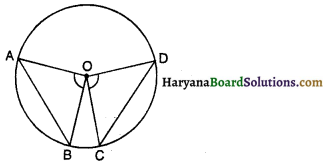
दिया है : एक वृत्त जिसका केंद्र 0 है तथा दो जीवाएं AB व CD बराबर हैं।
सिद्ध करना है : ∠AOB = ∠COD.
HBSE 9th Class Maths Important Questions Chapter 10 वृत्त 1

प्रमाण : ∆AOB तथा ∆COD में,
OA = OC [एक वृत्त की त्रिज्याएं]
OB = OD [एक वृत्त की त्रिज्याएं]
AB = CD [दिया है]
अतः ∆AOB ≅ ∆COD [भुजा-भुजा-भुजा सर्वांगसमता]
⇒ ∠AOB = ∠COD [सर्वांगसम त्रिभुजों के संगत भाग] [इति सिद्धम]

प्रश्न 2.
सिद्ध करो कि तीन असरेख बिंदुओं से होकर एक और केवल एक वृत्त जाता है।
हल :
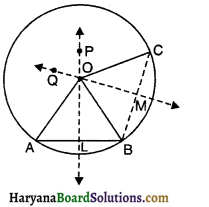
HBSE 9th Class Maths Important Questions Chapter 10 वृत्त 2

दिया है : तीन अंसरेख बिंदु A, B और C हैं।
सिद्ध करना है : बिंदुओं A, B और C से होकर जाने वाला एक और केवल एक ही वृत्त है।
रचना : रेखाखंड AB और BC खींचिए। AB और BC के लंब समद्विभाजक क्रमशः PL और QM खींचिए। क्योंकि AB, BC के समांतर नहीं है, इसलिए PL भी QM के समांतर नहीं होगा। इसलिए वे किसी बिंदु 0 पर प्रतिच्छेद करेंगे। OA, OB और OC को मिलाइए।
प्रमाण : O, AB के लंब समद्विभाजक PL पर स्थित है।
∴ OA = OB ………………(i)
इसी प्रकार, OB = OC ………………(ii)
इसलिए (i) और (ii) से,
OA= OB = OC = r, माना।
त्रिज्या r लेकर और 0 केंद्र मानकर एक वृत्त खींचिए। वह बिंदुओं A, B और C से होकर जाएगा।

इससे यह सिद्ध होता है कि A, B और C से होकर एक वृत्त जाता है। अब हम यह सिद्ध करेंगे कि A, B और C से होकर जाने वाला केवल यही एक वृत्त है। यदि संभव हो, तो मान लीजिए कि A, B और C से जाने वाला दूसरा वृत्त भी है, जिसका केंद्र 0′ और त्रिज्या s है।

तब O’, PL और QM के लंब समद्विभाजक पर अवश्य स्थित होगा। क्योंकि दो रेखाएं एक से अधिक बिंदुओं पर प्रतिच्छेद नहीं कर सकती हैं, अतः O’ और O संपाती होंगे। इसलिए, OA = O’A = r (= s) है। अर्थात A, B और C से जाने वाला एक और केवल एक ही (अद्वितीय) वृत्त है।

HBSE 9th Class Maths Important Questions Chapter 10 वृत्त

प्रश्न 3.
यदि एक वृत्त की दो प्रतिच्छेदी जीवाएं प्रतिच्छेद बिंदु से जाने वाले व्यास से समान कोण बनाएं, तो सिद्ध कीजिए कि वे जीवाएं बराबर हैं।
हल :
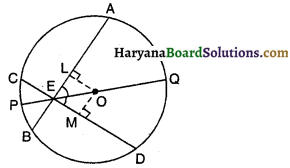
HBSE 9th Class Maths Important Questions Chapter 10 वृत्त 3

दिया है : एक वृत्त, जिसका केंद्र 0 है, की दो जीवाएं AB और CD बिंदु । E पर प्रतिच्छेद करती हैं। E से होकर जाने वाला PQ एक ऐसा व्यास है कि ∠AEQ = ∠DEQ है।
सिद्ध करना है : AB = CD.
रचना : जीवाओं AB और CD पर क्रमशः OL तथा OM लंब खींचिए।
प्रमाण : ∠LOE = 180° – 90° – ∠LEO = 90° – ∠LEO [त्रिभुज के कोणों के योग के कारण]
= 90° – ∠AEQ
= 90° – ∠DEQ [∵ ∠AEQ = ∠DEQ]
= 90° – ∠MEO = ∠MOE
त्रिभुजों OLE तथा ONE में,
∠LEO = ∠MEO [दिया है]
∠LOE = ∠MOE [प्रमाणित]
EO = EO [उभयनिष्ठ]
अतः, ∆OLE ≅ ∆OME [कोण-कोण-भुजा सर्वांगसमता]
इससे प्राप्त होता है- OL = OM [सर्वांगसम त्रिभुजों के संगत भाग]
इसलिए AB = CD [क्योंकि केंद्र से समान दूरी पर स्थित जीवाएं समान होती हैं।]
[इति सिद्धम]

प्रश्न 4.
सिद्ध करो कि एक ही वृत्तखंड के कोण समान होते हैं।
हल :
दिया है : एक वृत्त जिसका केंद्र 0 है तथा ∠ACB और ∠ADB वृत्त के एक ही वृत्तखंड में बने दो कोण हैं।
सिद्ध करना है : ∠ACB = ∠ADB.
रचना : OA और OB को मिलाइए।
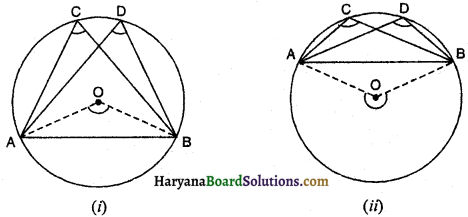
HBSE 9th Class Maths Important Questions Chapter 10 वृत्त 4

प्रमाण : ∠AOB = 2 ∠ACB …………….. (i)
किसी चाप द्वारा वृत्त के केंद्र पर बना कोण शेष भाग पर बने कोण का दुगुना होता है]
और ∠AOB = 2 ∠ADB …………………..(ii)
समीकरण (i) व (ii) से,
∴ 2 ∠ACB = 2 ∠ADB
या ∠ACB = ∠ADB [इति सिद्धम]

HBSE 9th Class Maths Important Questions Chapter 10 वृत्त

प्रश्न 5.
सिद्ध करो कि चक्रीय चतुर्भुज के सम्मुख कोणों के किसी भी युग्म का योग 180° होता है।
हल :
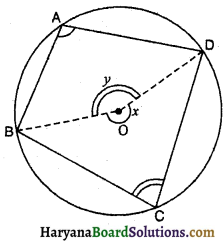
HBSE 9th Class Maths Important Questions Chapter 10 वृत्त 5

दिया है : एक चक्रीय चतुर्भुज ABCD है।
सिद्ध करना है : ∠BAD + ∠BCD = 180° तथा
∠ADC + ∠CBA = 180°
रचना : माना कि शीर्षों A, B, C और D से जाने वाले वृत्त का केंद्र 0 है। OB और OD को मिलाइए।
प्रमाण : ∠BAD = \(\frac{1}{2}\) ∠BOD
= \(\frac{1}{2}\) x ………………..(i)
[∵ वृत्त के शेष भाग पर बना कोण केंद्र पर बने कोण का आधा होता है]
और ∠BCD = \(\frac{1}{2}\)∠BOD = \(\frac{1}{2}\) y ……………. (ii)
[वृत्त के शेष भाग पर बना कोण केंद्र पर बने कोण का आधा होता है]
समीकरण (i) और (ii) को जोड़ने पर,
∠BAD + ∠BCD = \(\frac{1}{2}\)x + \(\frac{1}{2}\)y
= \(\frac{1}{2}\) (x + y)
= \(\frac{1}{2}\) × 360° = 180° [क्योंकि x + y = 360°]
क्योंकि चतुर्भुज के कोणों का योग 360° होता है।
∠ADC + ∠CBA = 360° – ( ∠BAD + ∠BCD )
= 360° – 180° = 180°
अतः ∠BAD + ∠BCD = 180°
तथा ∠ADC + ∠CBA = 180° [इति सिद्धम]

प्रश्न 6.
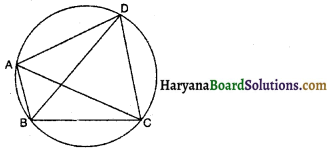
आकृति में, ABCD एक चक्रीय चतुर्भुज है, जिसमें AC और BD विकर्ण हैं। यदि ∠DBC = 55° तथा ∠BAC = 45° हो, तो ∠BCD ज्ञात कीजिए।
HBSE 9th Class Maths Important Questions Chapter 10 वृत्त 6

हल :
अतः,
∠CAD = ∠DBC = 55° (एक वृत्तखंड के कोण)
∠DAB = ∠CAD + ∠BAC
= 55° + 45° = 100°
परन्तु, ∠DAB + ∠BCD = 180° (चक्रीय चतुर्भुज के सम्मुख कोण)
इसलिए, ∠BCD = 180° – 100° = 80°

HBSE 9th Class Maths Important Questions Chapter 10 वृत्त

Multiple choice Questions with Answers:

प्रश्न 1.
किसी तल के उन सभी बिन्दुओं के समूह को क्या कहा जाता है जो तल के एक स्थिर बिन्दु से समान दूरी पर हो-
(A) आयत
(B) वृत्त
(C) वर्ग
(D) समचतुर्भुज
उत्तर-
(B) वृत्त

प्रश्न 2.
वृत्त का केन्द्र वृत्त के ___________ में स्थित होता है।
(A) बहिर्भाग
(B) परिधि
(C) अभ्यन्तर
(D) परिमाप
उत्तर-
(C) अभ्यन्तर

प्रश्न 3.
एक बिन्दु जिसकी वृत्त के केन्द्र से दूरी त्रिज्या से अधिक हो वृत्त के ___________ में स्थित होता है। (A) बहिर्भाग
(B) परिमाप
(C) अभ्यन्तर
(D) वृत्तखण्ड
उत्तर-
(A) बहिर्भाग

HBSE 9th Class Maths Important Questions Chapter 10 वृत्त

प्रश्न 4.
वृत्त की सबसे बड़ी जीवा वृत्त का ___________ होता है।
(A) परिमाप
(B) अर्धव्यास
(C) केन्द्र
(D) व्यास
उत्तर-
(D) व्यास

प्रश्न 5.
एक चाप ___________ होता है, जब इसके सिरे एक व्यास के सिरे हों।
(A) अर्धव्यास
(B) अर्धवृत्त
(C) लघु वृत्तखण्ड
(D) दीर्घ वृत्तखण्ड
उत्तर-
(B) अर्धवृत्त

प्रश्न 6.
वृत्तखण्ड एक चाप तथा ___________ के बीच का भाग होता है।
(A) परिधि
(B) त्रिज्या
(C) जीवा
(D) केन्द्र
उत्तर-
(C) जीवा

HBSE 9th Class Maths Important Questions Chapter 10 वृत्त

प्रश्न 7.
निम्नलिखित में से कौन-सा कथन सत्य है?
(A) एक वृत्त में समान लम्बाई की परिमित जीवाएँ होती हैं ।
(B) यदि एक वृत्त को तीन बराबर चापों में बाँट दिया जाए, तो प्रत्येक भाग दीर्घ चाप होता है
(C) वृत्त की एक जीवा, जिसकी लम्बाई त्रिज्या से दोगुनी हो, वृत्त का व्यास है
(D) त्रिज्यखण्ड, जीवा एवं संगत चाप के बीच का क्षेत्र होता है।
उत्तर-
(C) वृत्त की एक जीवा, जिसकी लम्बाई त्रिज्या से दोगुनी हो, वृत्त का व्यास है

प्रश्न 8.
दो वृत्त सर्वांगसम होते हैं, यदि उनकी ___________ बराबर हों।
(A) त्रिज्याएँ
(B) जीवाएँ
(C) चाप
(D) लम्ब रेखाएँ
उत्तर-
(A) त्रिज्याएँ

प्रश्न 9.
सर्वांगसम वृत्तों की बराबर ___________ उनके केन्द्रों पर बराबर कोण अन्तरित करती हैं।
(A) त्रिज्याएँ
(B) जीवाएँ
(C) अर्धव्यास
(D) लम्ब रेखाएँ
उत्तर-
(B) जीवाएँ

HBSE 9th Class Maths Important Questions Chapter 10 वृत्त

प्रश्न 10.
सम्पूर्ण वृत्त की लम्बाई को उसकी ___________ कहा जाता है-
(A) क्षेत्रफल
(B) व्यास
(C) परिधि
(D) आयतन
उत्तर-
(C) परिधि

प्रश्न 11.
एक वृत्त के केन्द्र से एक जीवा पर डाला गया लम्ब जीवा को ___________ करता है।
(A) समत्रिभाजित
(B) समचतुर्भाजित
(C) असमद्विभाजित
(D समद्विभाजित
उत्तर-
(D) समद्विभाजित

प्रश्न 12.
एक वृत्त के केन्द्र से एक जीवा को समद्विभाजित करने के लिए खींची गई रेखा जीवा पर ___________ का कोण बनाती है।
(A) 90°
(B) 120°
(C) 60°
(D) 180°
उत्तर-
(A) 90°

HBSE 9th Class Maths Important Questions Chapter 10 वृत्त

प्रश्न 13.
दो बिन्दुओं से होती हुई कितनी रेखाएँ खींची जा सकती हैं ?
(A) केवल दो
(B) केवल एक
(C) तीन
(D) चार
उत्तर-
(B) केवल एक

प्रश्न 14.
एक बिन्दु से होते हुए कितने वृत्त खींचे जा सकते हैं ?
(A) एक
(B) दो
(C) चार
(D) अनगिनत
उत्तर-
(D) अनगिनत

प्रश्न 15.
तीन असरेखी बिन्दुओं से होता हुआ खींचा जा सकता है-
(A) एक वृत्त
(B) दो वृत्त
(C) कोई वृत्त नहीं
(D) तीन वृत्त
उत्तर-
(A) एक वृत्त

HBSE 9th Class Maths Important Questions Chapter 10 वृत्त

प्रश्न 16.
निम्नलिखित में से कौन-सा कथन सत्य है ?
(A) एक वृत्त की बराबर जीवाएँ केन्द्र से समान दूरी पर होती हैं
(B) एक वृत्त के केन्द्र से समदूरस्थ जीवाएँ लम्बाई में समान होती हैं
(C) (A) और (B) दोनों
(D) (A) और (B) दोनों नहीं
उत्तर-
(C) (A) और (B) दोनों

प्रश्न 17.
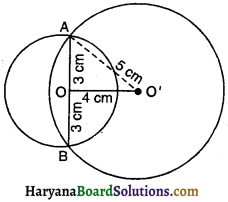
5 सें०मी० तथा 3 सें०मी० त्रिज्या वाले दो वृत्त दो बिन्दुओं पर प्रतिच्छेद करते हैं तथा उनके केन्द्रों के बीच की दूरी 4 सें०मी० है। उभयनिष्ठ जीवा की लम्बाई होगी-
HBSE 9th Class Maths Important Questions Chapter 10 वृत्त 7

(A) 6 cm
(B) 5 cm
(C) 7 cm
(D) 8 cm
उत्तर-
(A) 6 cm

प्रश्न 18.
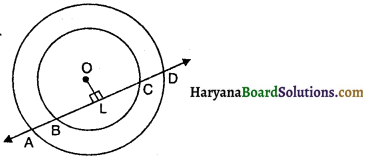
संलग्न आकृति में यदि एक रेखा दो संकेन्द्री वृत्तों (एक ही केन्द्र वाले वृत्त) को, जिनका केन्द्र 0 है, A, B, C और D पर प्रतिच्छेद करे तो निम्नलिखित में से कौन-सा कथन सत्य होगा ?
HBSE 9th Class Maths Important Questions Chapter 10 वृत्त 8

(A) AB = BC
(B) AB = BD
(C) AB = CD
(D) AC = CD
उत्तर-
(C) AB = CD

HBSE 9th Class Maths Important Questions Chapter 10 वृत्त

प्रश्न 19.
एक चाप द्वारा केन्द्र पर अन्तरित कोण वृत्त के शेष भाग के किसी बिन्दु पर अन्तरित कोण का ___________ होता है।
(A) आधा
(B) एक-तिहाई
(C) तीन-गुना
(D) दुगुना
उत्तर-
(D) दुगुना

प्रश्न 20.
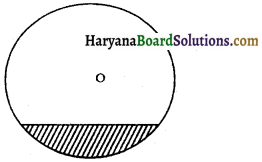
आकृति में, वृत्त के छायांकित भाग को कहते हैं-
HBSE 9th Class Maths Important Questions Chapter 10 वृत्त 9

(A) दीर्घ त्रिज्याखंड
(B) दीर्घ वृत्तखंड
(C) लघु त्रिज्याखंड
(D) लघु वृत्तखंड
उत्तर-
(D) लधु वृत्तखंड

प्रश्न 21.
संलग्न आकृति में ∠x का मान होगा-
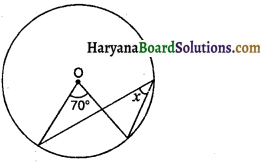
HBSE 9th Class Maths Important Questions Chapter 10 वृत्त 10

(A) 70°
(B) 140°
(C) 35°
(D) 105°
उत्तर-
(C) 35°

HBSE 9th Class Maths Important Questions Chapter 10 वृत्त

प्रश्न 22.
संलग्न आकृति में, तीन बिन्दु A, B और C किसी वृत्त पर इस प्रकार स्थित हैं कि जीवाएं AB और AC केन्द्र 0 पर क्रमशः 90° और 110° के कोण अंतरित करती हैं। ∠BAC का मान होगा-
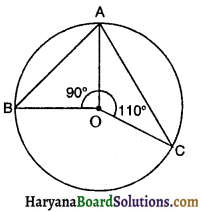
HBSE 9th Class Maths Important Questions Chapter 10 वृत्त 11

(A) 90°
(B) 110°
(C) 160°
(D) 80°
उत्तर-
(D) 80°

प्रश्न 23.
संलग्न आकृति में, O वृत्त का केन्द्र हो तो ∠x का मान होगा-
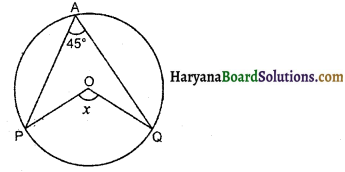
HBSE 9th Class Maths Important Questions Chapter 10 वृत्त 12

(A) 90°
(B) 45°
(C) 22\(\frac{1}{2}\)°
(D) 135°
उत्तर-
(A) 90°

प्रश्न 24.
संलग्न आकृति में, 0 वृत्त का केन्द्र हो तो ∠x का मान होगा-
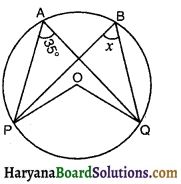
HBSE 9th Class Maths Important Questions Chapter 10 वृत्त 13

(A) 70°
(B) 35°
(C) 171
(D) 105°
उत्तर-
(B) 35°

HBSE 9th Class Maths Important Questions Chapter 10 वृत्त

प्रश्न 25.
चक्रीय चतुर्भुज के सम्मुख कोणों के प्रत्येक युग्म का योग ……………… होता है।
(A) 90°
(B) 135°
(C) 180°
(D) 360°
उत्तर-
(C) 180°

प्रश्न 26.
संलग्न आकृति में, O वृत्त का केन्द्र है तो ∠x और ∠y का मान होगा-
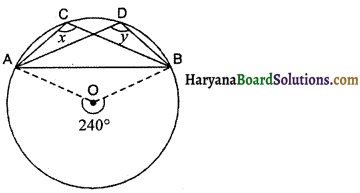
HBSE 9th Class Maths Important Questions Chapter 10 वृत्त 14

(A) ∠x = ∠y = 120°
(B) ∠x = ∠y = 240°
(C) ∠x = ∠y = 480°
(D) ∠x = 120°, ∠y = 240°
उत्तर-
(A) ∠x = ∠y = 120°

प्रश्न 27.
दी गई आकृति में, ABCD एक चक्रीय चतुर्भुज है, जिसमें AC और BD विकर्ण हैं। यदि ∠DBC = 55° तथा ∠BAC = 45° हो, तो ∠BCD का मान होगा-
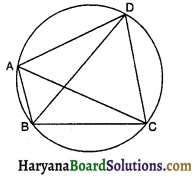
HBSE 9th Class Maths Important Questions Chapter 10 वृत्त 15

(A) 100°
(B) 50°
(C) 40°
(D) 80°
उत्तर-
(D) 80°

HBSE 9th Class Maths Important Questions Chapter 10 वृत्त

प्रश्न 28.
संलग्न आकृति में, ∠PQR = 100° है जहाँ P, Q और R केन्द्र 0 वाले एक वृत्त पर स्थित बिन्दु हैं ∠OPR का मान होगा-
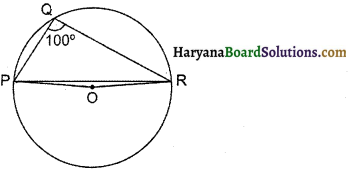
HBSE 9th Class Maths Important Questions Chapter 10 वृत्त 16

(A) 160°
(B) 10°
(C) 20°
(D) 200°
उत्तर-
(B) 10°

प्रश्न 29.
आकृति में, ∠ABC = 69° और ∠ACB = 31° हों, तो ∠BDC का मान होगा-
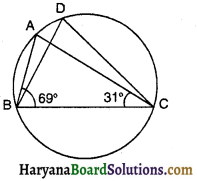
HBSE 9th Class Maths Important Questions Chapter 10 वृत्त 17

(A) 100°
(B) 90°
(C) 80°
(D) 110°
उत्तर-
(C) 80°

प्रश्न 30.
संलग्न आकृति में, केन्द्र O वाले एक वृत्त पर तीन बिन्दु A, B और C इस प्रकार हैं कि ∠BOC = 30° तथा ∠AOB = 60° है। यदि चाप ABC के अतिरिक्त वृत्त पर D एक बिन्दु है, तो ∠ADC का मान होगा-
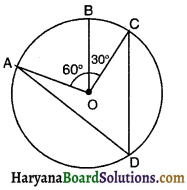
HBSE 9th Class Maths Important Questions Chapter 10 वृत्त 18

(A) 45°
(B) 30°
(C) 15°
(D) 50°
उत्तर-
(A) 45°

HBSE 9th Class Maths Important Questions Chapter 10 वृत्त

प्रश्न 31.
संलग्न आकृति में, एक वृत्त पर A, B, C और D चार बिन्दु हैं। AC और BD एक बिन्दु E पर इस प्रकार प्रतिच्छेद करते हैं कि ∠BEC = 130° तथा ∠ECD = 20° है। ∠BAC का मान होगा-
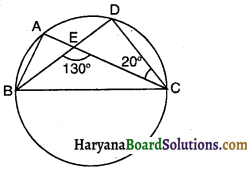
HBSE 9th Class Maths Important Questions Chapter 10 वृत्त 19

(A) 150°
(B) 110°
(C) 70°
(D) 105°
उत्तर-
(B) 110°

प्रश्न 32.
संलग्न आकृति में, ABCD एक चक्रीय चतुर्भुज है जिसके विकर्ण एक बिन्दु E पर प्रतिच्छेद करते हैं। यदि ∠DBC = 70° और ∠BAC = 30° हो, तो ∠BCD का मान होगा-
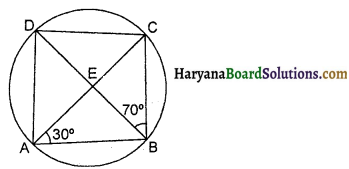
HBSE 9th Class Maths Important Questions Chapter 10 वृत्त 20

(A) 50°
(B) 140°
(C) 100°
(D) 80°
उत्तर-
(D) 80°

प्रश्न 33.
अर्धवृत्त में बना प्रत्येक कोण होता है-
(A) एक समकोण
(B) दो समकोण
(C) अर्ध समकोण
(D) न्यून कोण
उत्तर-
(A) एक समकोण

HBSE 9th Class Maths Important Questions Chapter 10 वृत्त

प्रश्न 34.
वृत्त के दीर्घ वृत्तखण्ड में किसी जीवा द्वारा बना कोण ___________ कोण होता है।
(A) सम
(B) अधिक
(C) न्यून
(D) दो सम
उत्तर-
(C) न्यून

प्रश्न 35.
निम्नलिखित में से कौन-सा कथन सत्य है ?
(A) एक ही वृत्तखण्ड के कोण बराबर होते हैं
(B) अर्धवृत्त में बना कोण समकोण होता है
(C) चक्रीय चतुर्भुज के सम्मुख कोणों का योग 180° होता है।
(D) उपरोक्त सभी
उत्तर-
(D) उपरोक्त सभी

HBSE 9th Class Maths Important Questions Chapter 10 वृत्त Read More »
HBSE 10th Class Maths Notes Chapter 15 Probability

Haryana State Board HBSE 10th Class Maths Notes Chapter 15 Probability Notes.

Haryana Board 10th Class Maths Notes Chapter 15 Probability

Introduction
In class IX, we have learnt about experimental (or empirical) probabilities of events which were bases on the results of actual experiments.
Suppose we toss a coin 1000 times and get head say, 430 times and tail 570 times. Then we would say that in a single throw of a coin the probability of getting a head is \(\frac{430}{1000}\) i.e, 0.430 and getting a tail is \(\frac{570}{1000}\) i.e, 0.570. These probabilities are based on the results of an actual experiment of tossing a coin 1000 times. For this reason, these are called experimental or empirical probabilities.

Let us recall some of the basic terms and results that we have studied in the class IX along with a few new ones which are normally used in study of probability.
1. Experiment: Any process that yields a result or an observation is called experiment.
2. Trial: Performing an experiment once is called a trial.
3. Outcome: A particular result of an experiment is called an outcome.
4. Sample space: The set of all possible outcomes of an experiment is called sample space. The individual outcomes in a sample space are called sample points.
e.g. one toss of a coin results in the outcomes (H. T). If the coin in fair, then each out come is equally likely. Two tosses of a coin results in the outcomes (H H, H T, T H, T T).

5. Event: Any subset of the sample space is called an event. If A is an event, then n (A) is the number of same points that belongs to A. e.g. consider the experiment of tossing a die here S = (1, 2, 3, 4, 5, 6)
If A is the event that an odd number occurs, then A = {1, 3, 5}
If E is the even number greater than 4 occurs then E = {6}
6. Equally likely events: If one event cannot be expected in preference to other event then they are said to be equally likely.
For example when we throw a die once, each of the numbers (1, 2, 3, 4, 5, 6) has the of showing up. So, 1, 2, 3, 4, 5, 6 are outcomes of throwing a die.
7. Impossible Event: An event which cannot occur is called an impossible event. eg. throwing a die, 7 will never comes up. So, getting 7 is an impossible event. The probability of an impossibe event is zero.
8. Sure Event: An event which is certain to occur is called a sure event eg. in a single throwing of die, the event to get a number less than 7 is a sure event. The probability of a sure event is 1.
9. Complimentary event: If E denotes the happening of an event and ‘not E’ its not happening the event, then E and “not E” are the complimentary events.
∴ P(E) + P(not E) = 1 P(E) = 1 – P (not E)

10. Probability: The probability of an event A, denoted by P(A), is a measure of the possibility of the event occuring as the result of an experiment.
11. Empirical probability: The probability that a fair die will show a four when thrown is \(\frac{1}{6}\), using an argument based on equally likely outcomes.
12. Theoretical probability: It is P(E) of an event is the fraction of times we expect E to occur.
13. Elementary Event: An event having only one outcome is called an elementary event.
14. Random Experiments: The experiments which have not fixed results are called random experiments.
15. Favourable outcome: The possible outcomes for a given event are called favourable outcomes.
16. Die (Dice): A small cube with its faces numbered from 1 to 6. When the die is thrown, the probability that any particular number from 1 to 6 is obtained on the face landing upper most is \(\frac{1}{6}\).
17. At least: As much as.
18. At most: Not more than.

HBSE 10th Class Maths Notes Chapter 15 Probability

Probability-A Theoretical Approach
In mathematics probability is the numerical value assigned to the likelihood that a particular event will take place. For instance, if we throw an unbiased die, we have equal chances of scoring any of the numbers 1, 2, 3, 4, 5, and 6. Since there is one chance in six of throwing a 3, the probability of the event occuring is said to be \(\frac{1}{6}\). Similarly when tossing a coin the probability that it lands head is consider to be \(\frac{1}{2}\).

Theoretical probability (also called classical probability) of an event E, written as P(E), is defined as
P(E) \(=\frac{\text { Number of outcomes favourable to } \mathrm{E}}{\text { Number of all possible outcomes of the experiment }}\)

Remark: The value of probability of an event cannot be negative or greater than 1.
Some information related to the playing cards

  • A deck of playing cards has in all 52 cards.
  • 52 cards divided into 4 suits (spades, clubs, hearts and diamonds). Each suit has 13 cards.
  • Cards of heart and diamond are red cards.
  • Cards of spades and clubs are black cards.
  • King, Queen and Jack are called face cards. Thus, there are in all 12 face cards.
  • The total number of non face card is 52 – 12 = 40.

HBSE 10th Class Maths Notes Chapter 15 Probability Read More »
HBSE 10th Class Maths Notes Chapter 10 Circles

Haryana State Board HBSE 10th Class Maths Notes Chapter 10 Circles Notes.

Haryana Board 10th Class Maths Notes Chapter 10 Circles

Introduction
We have studied in class IX that a circle is a collection of all the points in a plane which are at a constant distance from a fixed point. The constant distance is called the radius and fixed point is known as the centre. We have also studied various terms related to a circle like chord, sector, segment, arc etc.

In this chapter we shall learn about tangents to a circle and some of their properties. Let us now examine the different situations that can arise when a line and a circle are given in a plane.

Tangent of a circle
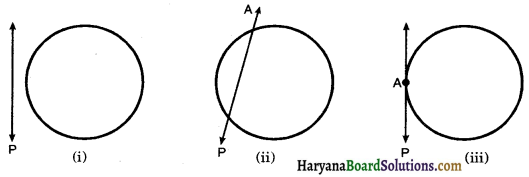
Consider a circle with centre O and a line P in the plane of the circle. There are three types of possibilities arise as shown in the figures below:
HBSE 10th Class Maths Notes Chapter 10 Circles 1
In the figure (i), the line P and the circle have no common point hence, the line P is known as a non intersecting line with respect to the circle.
In the figure (ii), the line P intersects the circle in two distinct points A and B. It is called a secant of the circle.
In the figure (iii), the line P intersects the circle in one and only one point A and is said to be a tangent to the circle. The point A at which the tangent line meets the circle is called the Point of contact.

Normal: The line containing the radius through the point of contact is also sometimes called the normal to the circle at the point.
Supplementary angles: Two angles having sum 180° are called supplementary angles.
Co-interior angles: Interior angles on the same side of the transversal are called co-interior angles or consecutive interior angles.
Concentric circles: Circles having the same centre are called concentric circles.
Parallelogram: A quadrilateral having each pair of opposite sides equal and parallel is called parallelogram.

Rhombus : A parallelogram having all the sides equal is called a rhombus.
Circumscribed circle: The circumscribed circle or circumcircle of a polygon is a circle passing through all the vertices of the polygon. The centre of this circle is called circumcentre and its radius is called the circumradius.

Inscribed circle: Inscribed circle or incircle of a polygon is the largest circle that can be contained in the polygon and it touches each side of the polygon at a point. Hence each side of the polygon is a tangent to the incircle. The centre of this circle is called incentre and its radius is called inradius.

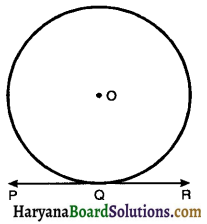
A line which intersects the circle at only one point is known as the tangent to the circle. In the given figure PQR is a tangent to the circle and point Q is the point of contact.

HBSE 10th Class Maths Notes Chapter 10 Circles

The word tangent to a circle has been derived from the latin word “Tangere”, which means ‘to touch’ and was introduced by the Denish mathematician Thomas Fineke in 1583.

The tangent to a circle is a special case of the secant, when the two end points of its chord coincide.
HBSE 10th Class Maths Notes Chapter 10 Circles 2

Some Properties of tangent to a circle
Theorem 10.1:
The tangent at any point of a circle is perpendicular to the radius through the point of contact.
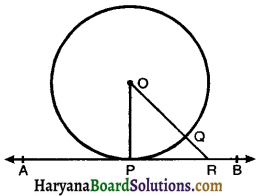
Given: A circle with centre O and a tangent AB to the circle at a point P.
To Prove: OP ⊥ AB.
Construction: Take any point R, other than P on the tangent AB. Join OR. Suppose OR meets the circle at Q.
Proof :
OP = OQ (Radii of the same circle)
But OP < OQ + QR
OP < OR
HBSE 10th Class Maths Notes Chapter 10 Circles 3
Thus, OP is shorter than any other line segment joining O to any point of AB, other than P.
We know that among all line segment joining the point O to a point on AB, the shortest one is perpendicular to AB.
Hence, OP ⊥ AB. Proved

HBSE 10th Class Maths Notes Chapter 10 Circles

Number of Tangents from a point on a circle
To get an idea of the number of tangents from a joint on a circle, let us perform the following activity:
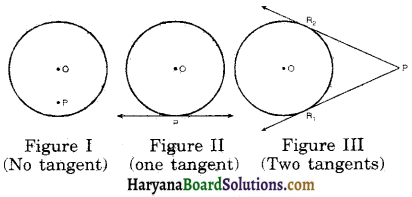
HBSE 10th Class Maths Notes Chapter 10 Circles 4
From figure (III) PR1 and PR2 are two tangents drawn from a point P lying outside the circle. These tangents touch the circle at R1 and R2 respectively. So, R1 and R2 are called points of contact of tangenta PR1 and PR2.
(i) There is no tangent to a circle passing through a point lying inside the circle.
(ii) There is one and only one tangent to a circle passing through a point lying on the circle.
(iii) There are exactly two tangents to a circle through a point lying outside the circle.

Length of Tangent: The length of segment of the tangent from the external point P and point of contact with the circle is called the length of the tangent from the point P to the circle.
From figure (III), PR1 and PR2 are the length of tangents from P to the circle.

Theorem 10.2:
The lengths of tangents drawn from an external point to a circle are equal.
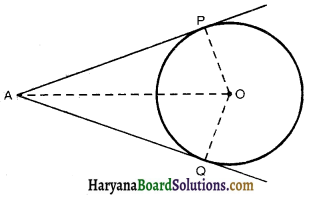
Given: AP and AQ are two tangents from a point A to a circle C (O, r).
To Prove: AP = AQ
Construction: Join OA, OP and OQ.
Proof: AP is a tangent at P and OP is the radius through P.
HBSE 10th Class Maths Notes Chapter 10 Circles 5
Similarly AQ is a tangent at Q and OQ is the radius through Q.
∴ OQ ⊥ AQ
In the right ΔOPA and ΔOQA, we have
OP = OQ [equal radii of the same circle]
AO = AO [common]
∠OPA = ∠OQA [each is 90°]
∴ ΔOPA ≅ ΔOQA [By RHS congruence]
⇒ AP = AQ [By CPCT Proved]
Hence, AP = AQ. Proved

HBSE 10th Class Maths Notes Chapter 10 Circles Read More »

HBSE 10th Class Maths Notes Chapter 7 Coordinate Geometry

Haryana State Board HBSE 10th Class Maths Notes Chapter 7 Coordinate Geometry Notes.

Haryana Board 10th Class Maths Notes Chapter 7 Coordinate Geometry

Introduction
We have studied in previous classes that how to locate the position of a point in co-ordinate plane of two dimensions in terms of two co-ordinates. The distance of a point from the y-axis is called its x-co-ordinate or abscissa. The distance of a point from the x-axis is called its y co-ordinate or ordinate. The coordiantes of a point on the x-axis are of the form (x, 0), and of a point on the y-axis are of the form (0, y).

In is chapter, we shall extend our knowledge by learning how to find the distance between the two points whose co-ordinates are given, and to find the area of the triangle formed by three given points. We shall also learn about how to find the co-ordinates of the point which divides a line segment joining two given points in a given ratio.

1. Plane-It is a flat surface, which extends indefinitely in all directions. The surface of a sheet of paper, the surface of a smooth green board, the surface of a smooth table top are some examples of a plane.
2. Co-ordinate axes-To locate the position of a point in a plane, two mutually perpendicular lines are drawn. One of them is horizontal known as x-axis and other is vertical known as y-axis. These axes are combindely called co-ordinate axes.
3. Origin-The point of intersection of two Axes is called origin.
4. Quadrants-The axes divide a plane into four parts called quadrants.
5. Collinear points-If three or more pointa lie on the same line, they are called collinear points. Otherwise, they are called non-collinear points.

HBSE 10th Class Maths Notes Chapter 7 Coordinate Geometry

Distance Formula
a1 = a = 0
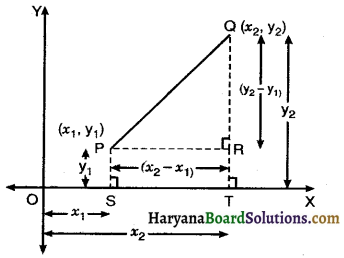
Let P (x1, y1) and Q(x2, y2) be the given points in the plane. Draw PS ⊥ x-axis, QT ⊥ x-axis and PR ⊥ QT from P, Q and P respectively. Then
OS = x1, OT = x2, PS = y1, QT = y2
PR = ST = OT – OS = x2 – x1 and QR = QT – RT = y2 – y1
ΔQRP is a right angled triangle, right angled at R.
HBSE 10th Class Maths Notes Chapter 7 Coordinate Geometry 1
∴ PQ2 = PR2 + QR2 [By Pythagoras theorem]
PQ2 = (x2 – x1)2 + (y2 – y1)2
PQ = \(\sqrt{\left(x_2-x_1\right)^2+\left(y_2-y_1\right)^2}\)
Hence, distance between any two points
\(=\sqrt{\begin{array}{r}
(\text { difference of abscissa })^2+ \\
\text { (difference of ordinates) }^2
\end{array}}\)
It is called the distance formula.
Remark: (i) The distance of a point P(x, y) from the origin O(0, 0) is given by
OP = \(\sqrt{(x-0)^2+(y-0)^2}=\sqrt{x^2+y^2}\)
HBSE 10th Class Maths Notes Chapter 7 Coordinate Geometry 2
(ii) If three points A, B and C are collinear then AB + BC = AC.
(iii) Properties of different types of quadrilaterals
(a) Square : In a square, all sides and diagonals are equal
(b) Rectangle : In a rectangle opposite sides and diagoals are equal.
(c) Parallelogram : In a parallelogram opposite sides are equal.
(d) Paralleogram but not a rectangle : In this case opposite sides are equal but diagonals are not equal
(e) Rhombus but not a square : In this case all sides are equal, but diagonals are not equal.

Section Formula
By section formula we find out the coordinates of the point which divides the line segment joining the two given points in a given ratio internally.
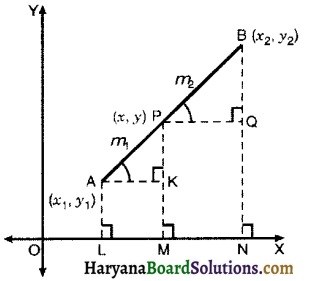
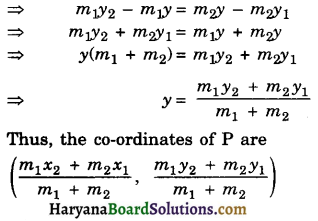
Let P(x, y) be the point dividing the line segment joining the points. A(x1, y1) and B(x2, y2) internally in the ratio m1 : m2.
HBSE 10th Class Maths Notes Chapter 7 Coordinate Geometry 3
Draw AL ⊥ OX; PM ⊥ OX, BN ⊥ OX, Also draw AK ⊥ PM and PQ ⊥ BN. Then, OL = x1, OM = x, AL = y1, PM = y and BN = y2. ON = x2.
AK = LM = OM – OL = x – x1
PQ = MN = ON – OM
= x2 – x
PK = PM – KM = y – y1
BQ = BN – QN = y2 – y
In right ΔAKP and ΔPQB.
∠AKP = ∠PQB (Each is 90°)
∠AKP = ∠BPQ (Corresponding ∠s)
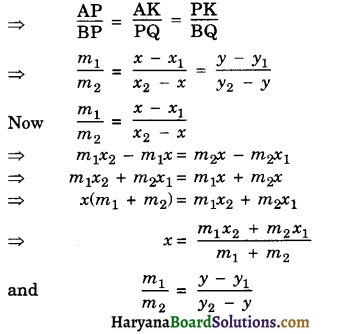
ΔAKP ~ ΔPQB [By AA similarity criterion]
HBSE 10th Class Maths Notes Chapter 7 Coordinate Geometry 4
HBSE 10th Class Maths Notes Chapter 7 Coordinate Geometry 5
Remarks: (1) If P is the mid point of AB then m1 : m2 = 1 : 1.
Then co-ordinates of P are
\(\left(\frac{x_1+x_2}{2}, \frac{y_1+y_2}{2}\right)\)
(2) If the ratio in which P divides AB is k : 1. Then the coordiantes of the point P are
\(\left(\frac{k x_2+x_1}{k+1}, \frac{k y_2+y_1}{k+1}\right)\)

HBSE 10th Class Maths Notes Chapter 7 Coordinate Geometry

Co-ordinates of the Centroid of a Triangle
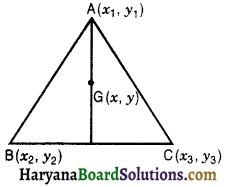
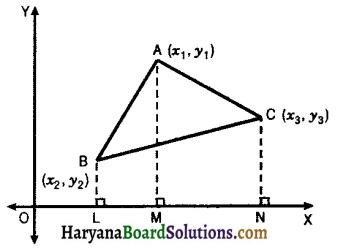
Let A(x1, y1), B(x2, y2) and C(x3, y3) be the vertices of a given ΔABC. Let D be the mid point of BC. Let G(x, y) be centroid of the triangle as shown in figure.
Co-ordinates of the point D are \(\left(\frac{x_2+x_3}{2}, \frac{y_2+y_3}{2}\right)\)
Since centroid divides each median in the ratio 2 : 1.
HBSE 10th Class Maths Notes Chapter 7 Coordinate Geometry 6
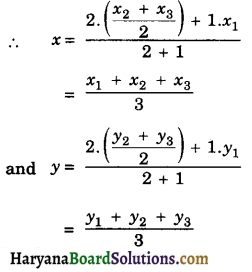
∴ G divides AD in the ratio 2 : 1
HBSE 10th Class Maths Notes Chapter 7 Coordinate Geometry 7
Hence, the coordinates of the centroid of the triangle are \(\left(\frac{x_1+x_2+x_3}{3}, \frac{y_1+y_2+y_3}{3}\right)\)

Area of Triangle
Let A(x1, y1) B(x2, y2) and C(x3, y3) be the vertices of the given ΔABC. Draw BL, AM and CN perpendicular to the x-axis.
Then, LM = (x1 – x2), LN = (x3 – x2)
MN = (x3 – x1)
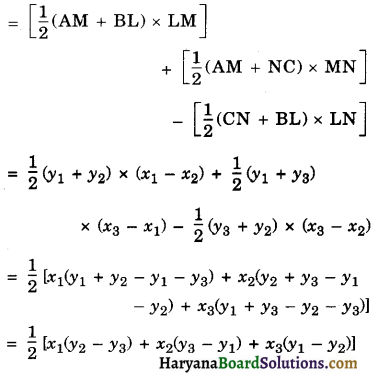
Now, Area of ΔABC = ar(Trap BLMA) + ar(Trap AMNC) – ar(Trap BLNC)
HBSE 10th Class Maths Notes Chapter 7 Coordinate Geometry 8
Since, the area is never negative, we have
Area (ΔABC) = \(\frac{1}{2}\)[(x1(y2 – y3) + x2(y3 – y1) + x3(y1 – y2)]

HBSE 10th Class Maths Notes Chapter 7 Coordinate Geometry

Condition for the collinearity of three points
If three points A (x1, y1), B (x2, y2) and C(x3, y3) are collinear.
Then Area of ΔABC = 0
HBSE 10th Class Maths Notes Chapter 7 Coordinate Geometry 9
⇒ \(\frac{1}{2}\)[x1(y2 – y3) + x2(y3 – y1) + x3(y1 – y2)
⇒ x1(y2 – y3) + x2(y3 – y1) + x3(y1 – y2)
= 0
Remark : To find the area of a polygon we divide it in triangles and take numerical value of the area of each of the triangles.

HBSE 10th Class Maths Notes Chapter 7 Coordinate Geometry Read More »
HBSE 10th Class Maths Notes Chapter 9 त्रिकोणमिति का अनुप्रयोग

Haryana State Board HBSE 10th Class Maths Notes Chapter 9 त्रिकोणमिति का अनुप्रयोग Notes.

Haryana Board 10th Class Maths Notes Chapter 9 त्रिकोणमिति का अनुप्रयोग

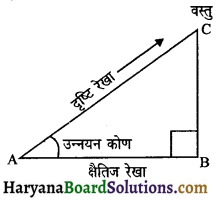
→ उन्नयन कोण- यदि वस्तु हमारी आँख के स्तर से ऊपर हो अर्थात् आँख की क्षैतिज रेखा से ऊपर हो तो हमें वस्तु को देखने के लिए अपनी आँखों को ऊपर की ओर उठाना पड़ेगा। इस प्रक्रिया में हमारी दृष्टि रेखा क्षतिज रेखा से एक कोण से ऊपर की ओर घूम जाती है। इस कोण को, वस्तु का उन्नयन कोण (Angle of elevation) कहते हैं।
HBSE 10th Class Maths Notes Chapter 9 त्रिकोणमिति का अनुप्रयोग 1

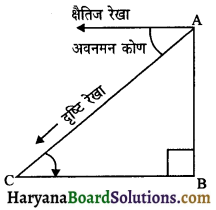
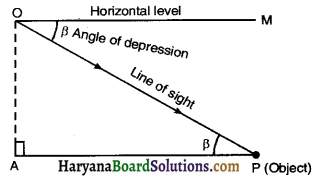
→ अवनमन कोण-यदि वस्तु हमारी आँख के स्तर से नीचे हो अर्थात् वस्तु हमारी आँख की क्षैतिज रेखा से नीचे हो तो हमें वस्तु को देखने के लिए अपनी आँख को नीचे की ओर झुकाना पड़ेगा। इस प्रक्रिया में हमारी दृष्टि रेखा क्षैतिज रेखा से एक कोण पर नीचे की ओर घूम जाती है। इस कोण को वस्तु का अवनमन कोण (Angle of depression) कहा जाता है।
HBSE 10th Class Maths Notes Chapter 9 त्रिकोणमिति का अनुप्रयोग 2

→ सर्वसमिका-एक या अधिक चरों वाले उस समीकरण को सर्वसमिका कहा जाता है जोकि संबंधित सभी मानों के लिए संतुष्ट हो जाता है अर्थात् चरों के सभी मानों के लिए समीकरण का बायाँ पक्ष, दाएं पक्ष के समान होता है।

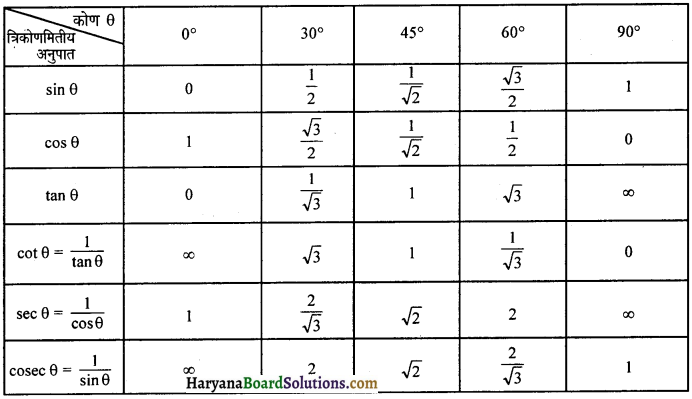
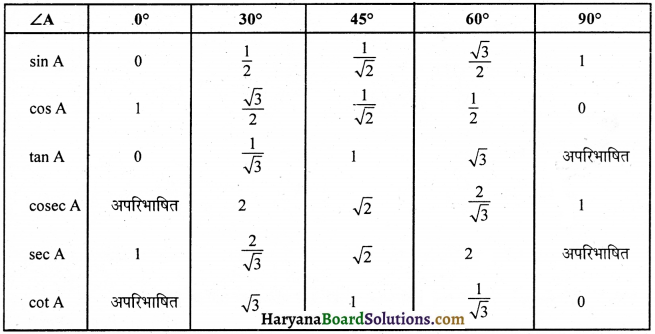
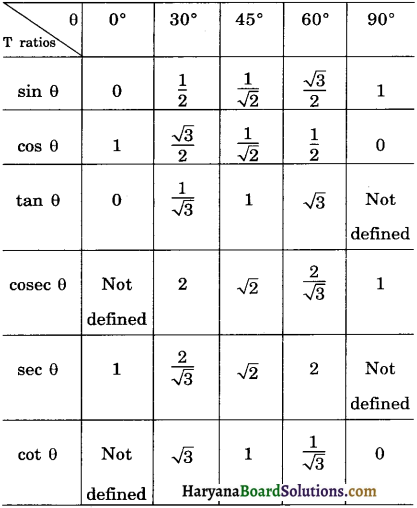
प्रमुख त्रिकोणमितीय कोणों के मान निम्नलिखित सारणी में दिए गए हैं-
HBSE 10th Class Maths Notes Chapter 9 त्रिकोणमिति का अनुप्रयोग 3

HBSE 10th Class Maths Notes Chapter 9 त्रिकोणमिति का अनुप्रयोग Read More »

HBSE 10th Class Maths Notes Chapter 14 Statistics

Haryana State Board HBSE 10th Class Maths Notes Chapter 14 Statistics Notes.

Haryana Board 10th Class Maths Notes Chapter 14 Statistics

Introduction
In the earlier classes, we have already learnt about the representation of given data into ungrouped as well as grouped frequency distributions and its representation through various graphs such as bar graphs, histograms, frequency polygons etc and you have also studied about measures of central tendency such as mean, median and mode of an ungrouped data. In this chapter, we shall learn how to calculate mean, median and mode for the grouped data. We shall also discuss the concept of cumulative frequency distribution and learn how to draw cumulative frequency curves, called Ogives.

1. Statistics: The branch of mathematics in which we study to extract meaningful information from the collected data. It is the area of study dealing with the presentation, analysis and interpretation of the data. It seems to have been derived from the Latin word ‘status’ or German word ‘statistik’ or Italian word ‘statista’.
2. Data: The facts or figures, which are numerical or otherwise, collected with a definite purpose are called data. Data is the plural form of the Latin word datum.
3. Observation: Every factor figure of the data is called an observation.
4. Frequency: The number of times a particular observation occurs is called the frequency of the observation.
5. Grouped frequency distribution: If the data are very large and the range is large, we put the data in groups of suitable size and mention the frequency of each group. Such a distribution is called grouped frequency distribution.

6. An inclusive frequency distribution: The upper limit of one class does not coincide with the lower limit of the next class. Such as, 1 – 10, 11 – 20, ……… is known as an inclusive frequency distribution.
7. An exclusive frequency distribution: The upper limit of one class coincides with the lower limit of the next class such as 1 – 10, 10 – 20, ……… is known as an exclusive frequency distribution.
8. Measures of Central Tendency: The numerical expressions which represent the characteristic of a group are called Measures of Central Tendency or Average. Mean, Median and Mode are three measures of central tendency (averages).
9. Class interval: Each group into which the raw data is condensed is called a class interval. Each class is bounded by two figures, which are called the class limits. The figures on the left side of the classes are called lower limits while figures on the right are known as upper limits.
10. Class size: The difference between the true upper limit and true lower limit of a class is called its class size.
11. Class Mark: The class mark of the class interval is the value midway between its true lower limit and true upper limit.
Class mark of a class = \(\frac{\text { True upper limit + True lower limit }}{2}\)
12. Cumulative Frequency: The cumulative frequency of a class interval is the sum of frequencies of all classes up to that class (including the frequency of that particular class).
13. Mean of grouped data: We know that if x1, x2, x3, ………., xn be n observations with respective frequencies f1, f2, f3, …….., fn, their mean is given by
\(\bar{x}=\frac{f_1 x_1+f_2 x_2+f_3 x_3+\ldots \ldots+f_n x_n}{f_1+f_2+f_3+\ldots \ldots+f_n}\)
We can write this in short form
\(\bar{x}=\frac{\sum_{i=1}^n f_i x_i}{\sum_{i=1}^n f_i}\)
It is more briefly written as \(\bar{x}=\frac{\Sigma f_i x_i}{\Sigma f_i}\), It is understood that varies from 1 to n. The Greek letter ‘Σ’ (capital sigma) is particularly used for writing summations.
With this assumption we can have the following three methods to calculate the mean of grouped data.

HBSE 10th Class Maths Notes Chapter 14 Statistics

(a) Direct Method
1. For each class, find the class mark xi, as
\(x_i=\frac{\text { lower limit }+\text { upper limit }}{2}\)
2. Find the product of each xi with the corresponding fi, and find the algebraic sum of these products, i.e. Σfixi.
3. Find the sum of all the frequencies i.e., Σfi
4. Calculate the value of \(\bar{x}\), using the formula.
\(\bar{x}\) = \(\frac{\Sigma f_i x_i}{\Sigma f_i}\)

(b) Assumed Mean Method (Shortcut Method)
In case the values of the variable are very large in magnitude ie., the values of xi are very large in magnitude then computation of the mean \(\bar{x}\) becomes rather tedious and lengthy. To make calculation easier we use assumed mean method to find \(\bar{x}\).

Here, we choose an arbitrary constant a, also called assumed mean and subtract it from each of the value xi. The reduced value di = xi – a is called the deviation of x from a.

While using this method, we go through the following steps:
1. For each class interval find class mark xi, as xi = \(\frac{1}{2}\)(lower limit + upper limit)
2. Assume a suitable value of xi in the middle of xi‘ s as the assumed mean.
3. Find out the deviations of the mid value of each from the assumed mean (di = xi – a).
4. Calculate the product of deviation (di) with corresponding frequency (fi) for each class.
5. Find the algebraic sum of these products ie., Σfidi.
6. Find the sum of all the frequencies ie., Σfi
7. Calculate the value of \(\bar{x}\), using the formula
\(\bar{x}\) = \(a+\frac{\sum f_i d_i}{\sum f_i}\)

(c) Step Deviation Method
The shortcut method discussed is further simplified or calculations are reduced to a great extent by adopting step deviation method. Scaling down the deviation (from the assumed mean) by a step (further dividing by a common factor), will reduce the calculation to a minimum.

Here we choose an arbitrary constant a (also called assumed mean) and subtract it from each of the value xi. The reduced value (xi – a) is called the deviation of xi from ‘a’. These deviations are then divided by constant h, where h is the suitable divisor of all the di‘s.

HBSE 10th Class Maths Notes Chapter 14 Statistics

In this method; we go through the following steps:
1. For each class interval, calculate the class mark xi by using the formula,
xi = \(\frac{1}{2}\)(lower limit + upper limit)
2. Choose the assumed mean ‘a’ in the middle of xi.
3. Calculate the values of di (di = xi – a)
4. Calculate the values of ui {ui = \(\frac{x_i-a}{h}\), where h is the class width}
5. Find the product of each ui with the corresponding fi.
6. Find the algebraic sum of these products i.e. Σfiui
7. Find the sum of all the frequencies i.e., Σfi.
8. Calculate the mean \(\bar{x}\) by using formula.
\(\bar{x}\) = \(a+\left(\frac{\Sigma f_i u_i}{\Sigma f_i}\right) h\)

Mode of Grouped Data
Recall from class IX that the mode of statistical data is the value among the observations which occurs most frequently. In other words, mode of a statistical data is the value of the observations which has maximum frequency.

In a grouped frequency distribution, it is not possible to determine the mode by looking at the frequencies. Here, we can only locate a class with the maximum frequency, called the modal class. The mode of grouped data is a value inside the modal class, and is given by the formula.
Mode = \(l+\left(\frac{f_1-f_0}{2 f_1-f_0-f_2}\right) \times h\)
Where,
l = Lower limit of the modal class
f1 = Frequency of the modal class
f0 = Frequency of the class preceding the modal class
f2 = Frequency of the class succeeding the modal class
h = Size of the class interval (assuming all class sizes to be equal)

Remark: In some cases, It is possible that more than one value may have the same maximum frequency. In such a case the data is said to be multimodal. Though grouped data can also be multimodal, we shall restrict ourselves to unimodal data only i.e. the data having a single mode.

Median of Grouped Data
Median of a distribution is the value of the middle-most observation which divides it exactly in two equal parts when the data are arranged in ascending (or descending order).

(a) Median of an ungrouped data:
Arrange the data in ascending or descending order. Let the total number of observations be n
(i) If n is odd, the median is the value of the \(\left(\frac{n+1}{2}\right)^{\text {th }}\) observation.
(ii) If n is even, the median is mean of the \(\left(\frac{n}{2}\right)^{\text {th }}\) and \(\left(\frac{n}{2}+1\right)^{\text {th }}\) observations.

(b) Median of discrete series:
Arrange the terms in ascending or descending order. Then prepare a cumulative frequency distribution table. Let the total frequency be n
(i) If n is odd, then median = size of the \(\left(\frac{n+1}{2}\right)^{\text {th }}\) term.
(ii) If n is even then
median = \(\frac{1}{2}\)[size of the \(\left(\frac{n}{2}\right)^{\text {th }}\) term + size of the \(\left(\frac{n}{2}+1\right)^{\text {th }}\) term]

(c) Cumulative frequency distribution:
The frequencies are expressed as cumulative total against the class intervals in cumulative frequency distribution. It is of two types:
For example
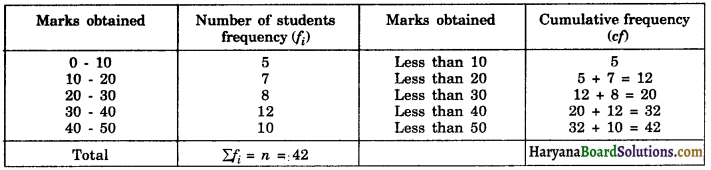
(i) Less than type :
HBSE 10th Class Maths Notes Chapter 14 Statistics 1

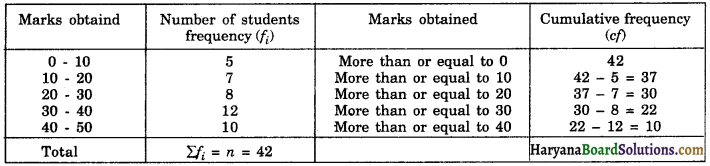
(ii) More than type :
HBSE 10th Class Maths Notes Chapter 14 Statistics 2

(d) Median of grouped or continuous frequency distribution:
In order to calculate the median of the grouped data or continuous frequency distribution, we go through the following ahead steps:
(1) Prepare a cumulative frequency distribution and obtain n = Σfi
(2) Find \(\frac{n}{2}\)
(3) Locate the class whose cumulative frequency is greater than (and nearest to) \(\frac{n}{2}\). This class is the median class.
(4) Calculate the median using the formula given by:
Median = \(l+\left(\frac{\frac{n}{2}-c f}{f}\right) \times h\)
Where l = lower limit of median class
n = number of observations
cf = Cumulative frequency of class preceding the median class
f = frequency of median class
h = class size (assuming class size to be equal)

(e) Empirical relation between mean, median and mode.
3 Median = Mode + 2 Mean

HBSE 10th Class Maths Notes Chapter 14 Statistics

Graphical Representation of Cumulative Frequency Distribution
In class IX, we have learnt about representing statistical data by using bar graphs, histograms and frequency polygons. In this section, we shall learn about to represent cumulative frequency distribution through cumulative frequency curves or ogives.

As we already know that cumulative frequency distribution are of two types, namely, less than type and more than type, accordingly there are two types of cumulatives frequency curves (or ogives).
(a) Less than ogive:
To draw a less than ogive, we go through the following steps:

  • Prepare a less than cumulative frequency distribution from the given ordinary frequency distribution.
  • Mark the upper class limits along the x-axis choosing a suitable scale.
  • Mark the cumulative frequencies along the y-axis choosing a suitable scale.
  • On joining these points successively by a free hand smooth curve, we get a cumulative frequency curve or an ogive (of less than type).

(b) More than ogive:
To draw a more than ogive, we go through the following steps:

  • Prepare a more than frequency distribution from the given ordinary frequency distribution.
  • Mark the lower class limits along the x-axis choosing a suitable scale.
  • Mark the cumulative frequencies along the y-axis choosing a suitable scale.
  • On joining these points successively by free hand smooth curve, we get a cumulative frequency curve or an ogive of more than type.

Remark 1: Draw any one of the two types of ogives for the given distribution. Take a point P(0, \(\frac{n}{2}\)) on the y-axis and draw PM || x-axis cutting the above curve at a point M. Again draw MN perpendicular to x-axis, cutting the x-axis at point N. Then median = x co-ordinate of point N.

Remark 2: Draw both types of ogives i.e., less than type and more than type for the given distribution on the same graph paper. Mark A as the point of intersection of these two ogives. Draw AP perpendicular to x-axis, cutting x-axis at P. Then median = x co-ordinate of point P.

Remark 3: For drawing ogive, it should be ensured that the class intervals are continuous.

HBSE 10th Class Maths Notes Chapter 14 Statistics Read More »
HBSE 10th Class Maths Notes Chapter 9 Some Applications of Trigonometry

Haryana State Board HBSE 10th Class Maths Notes Chapter 9 Some Applications of Trigonometry Notes.

Haryana Board 10th Class Maths Notes Chapter 9 Some Applications of Trigonometry

Introduction
We have studied about trigonometric ratios in earlier classes. In this chapter, we shall use the trigonometric ratios, to solve the problems regarding the heights and distances of various objects. Two common terms used in this chapter are angle of elevation and angle of depression.
1. Elevation: The height to which something is raised above a point of reference.
2. Depression: The depth to which something is lowered below a point of reference.
3. Line of sight: The line drawn from the eye of an observer to the point in the object viewed by the observer.
4. Complementary angles: Two angles having a sum of 90°, are called complementary angles.
HBSE 10th Class Maths Notes Chapter 9 Some Applications of Trigonometry 1
5. Speed = Distance/Time
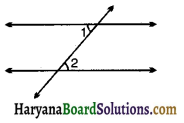
6. Alternate interior angle: The pair of angles on opposite sides of the transversal but inside the two lines are called alternate interior angles.
If the two lines are parallel, then the alternate interior angles formed are equal.

HBSE 10th Class Maths Notes Chapter 9 Some Applications of Trigonometry

Heights and Distances
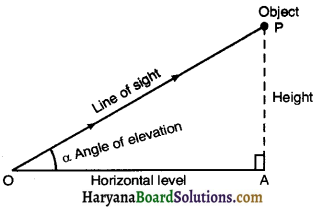
Angle of Elevation: If a person is looking up at an object, the acute angle measured from the horizontal level to the line of sight when the object being viewed is called the angle of elevation. Here
HBSE 10th Class Maths Notes Chapter 9 Some Applications of Trigonometry 2
O is the point of observation, P is the position of the object, OP is the line of sight. OA is horizontal level and α is the angle of elevation.

Angle of Depression: The angle between the line of sight and horizontal level through the eye of the observer, when the object being viewed is below the horizontal level is called angle of depression. Here position of observer is at O. OM is the horizontal level through O. OP is the line of sight. β is the angle of depression when the object at P is observed from O.
HBSE 10th Class Maths Notes Chapter 9 Some Applications of Trigonometry 3

Remarks:
(a) Numerically the angle of elevation is equal to the angle of depression.
(b) The angle of elevation and angle of depression both are measured with the horizontal.
(c) The angle of elevation or depression increases as the observer moves towards the object.

HBSE 10th Class Maths Notes Chapter 9 Some Applications of Trigonometry Read More »
HBSE 10th Class Maths Notes Chapter 8 त्रिकोणमिति का परिचय

Haryana State Board HBSE 10th Class Maths Notes Chapter 8 त्रिकोणमिति का परिचय Notes.

Haryana Board 10th Class Maths Notes Chapter 8 त्रिकोणमिति का परिचय


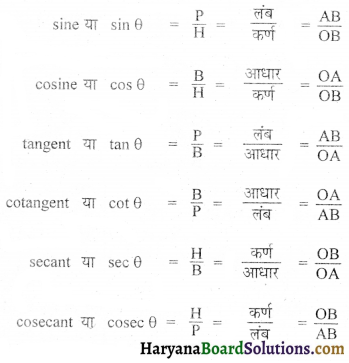
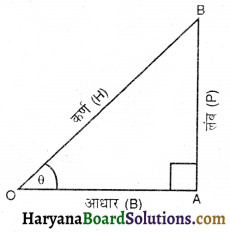
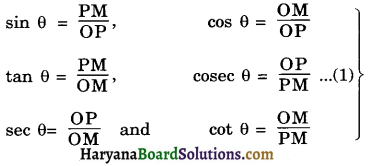
HBSE 10th Class Maths Notes Chapter 8 त्रिकोणमिति का परिचय 1
HBSE 10th Class Maths Notes Chapter 8 त्रिकोणमिति का परिचय 2

→ विभिन्न त्रिकोणमितीय अनुपातों में संबंध-
cosec θ = \(\frac{1}{\sin \theta}\);
sec θ = \(\frac{1}{\cos \theta}\);
cot θ = \(\frac{1}{\tan \theta}\);
tan θ = \(\frac{\sin \theta}{\cos \theta}\);
cot θ = \(\frac{\cos \theta}{\sin \theta}\).

→ मूलभूत त्रिकोणमितीय सर्वसमिकाएँ-
मुख्य सूत्र
(i) sin2 θ + cos2 θ = 1
(ii) sec2 θ = 1 + tan2 θ
(iii) cosec2 θ = 1 + cot2 θ
मुख्य सूत्र से प्राप्त अन्य सूत्र
(i) sin2 θ = 1 – cos2 θ
cos2 θ = 1 – sin2 θ
(ii) sec2 θ – tan2 θ = 1
sec2 θ – 1 = tan2 θ
(iii) cosec2 θ – cot2 θ = 1
cosec2 θ – 1 = cot2 θ

HBSE 10th Class Maths Notes Chapter 8 त्रिकोणमिति का परिचय

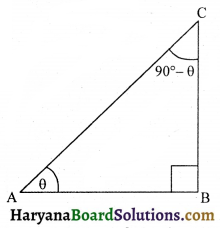
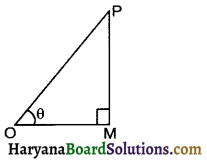
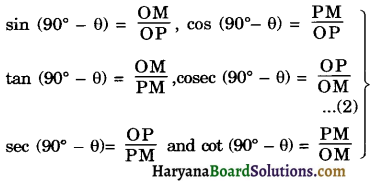
→ पूरक कोणों के त्रिकोणमितीय अनुपात- समकोण ΔABC में यदि 0° ≤ θ ≤ 90°
तो,
(i) sin (90° – θ) = \(\frac{\mathrm{AB}}{\mathrm{AC}}\) = cos θ,
(ii) cos (90° – θ) = \(\frac{\mathrm{BC}}{\mathrm{AC}}\) = sin θ,
(iii) tan (90° – θ) = \(\frac{\mathrm{AB}}{\mathrm{BC}}\) = cotθ,
(iv) cot (90° – θ) = \(\frac{\mathrm{BC}}{\mathrm{AB}}\) = tan θ,
(v) sec (90° – θ) = \(\frac{\mathrm{AC}}{\mathrm{BC}}\) = cosec θ.
(vi) cosec (90° – θ) = \(\frac{\mathrm{AC}}{\mathrm{AB}}\) = sec θ.
HBSE 10th Class Maths Notes Chapter 8 त्रिकोणमिति का परिचय 3

→ sin A या cos A का मान कभी भी 1 से अधिक नहीं होता, जबकि sec A या cosec A का मान सदैव 1 से अधिक या 1 के बराबर होता है।

→ विशिष्ट कोणों के त्रिकोणमितीय अनुपात-
HBSE 10th Class Maths Notes Chapter 8 त्रिकोणमिति का परिचय 4

HBSE 10th Class Maths Notes Chapter 8 त्रिकोणमिति का परिचय Read More »
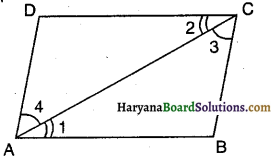
HBSE 9th Class Maths Important Questions Chapter 15 प्रायिकता

Haryana State Board HBSE 9th Class Maths Important Questions Chapter 15 प्रायिकता Important Questions and Answers.

Haryana Board 9th Class Maths Important Questions Chapter 15 प्रायिकता

परीक्षोपयोगी अन्य महत्त्वपूर्ण प्रश्न:

प्रश्न 1.
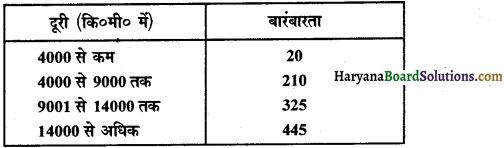
टायर बनाने वाली एक कंपनी तय की गई उन दूरियों का एक रिकार्ड रखती थी, जिसके पहले टायर को बदल देने की आवश्यकता पड़ी। सारणी में 1000 स्थितियों के परिणाम दिखाए गए हैं।

HBSE 9th Class Maths Important Questions Chapter 15 प्रायिकता 1

यदि आप इस कंपनी से एक टायर खरीदते हैं, तो इस बात की प्रायिकता क्या होगी कि
(i) 4000 कि०मी० की दूरी तय करने से पहले ही इसे बदलना आवश्यक होगा?
(ii) यह 9000 कि०मी० से भी अधिक दूरी तक चलेगा?
(iii) 4000 कि०मी० और 14000 कि०मी० के बीच की कोई दूरी तय करने के बाद इसे बदलना आवश्यक होगा?
हल :
संभाव्य परिणामों की कुल संख्या = 20 + 210 + 325 + 445 = 100
(i) उस टायर की बारंबारता, जिसे 4000 कि०मी० की दूरी तय करने से पहले बदलना आवश्यक हो, 20 है।
अतः, P (4000 कि०मी० की दूरी तय करने से पहले टायर बदलना आवश्यक हो)
= \(\frac{20}{1000}\) = 0.02

(ii) उस टायर की बारंबारता जो 9000 कि०मी० से भी अधिक दूरी तय करेगा = 325 + 445 = 770
अतः,P (टायर 9000 कि०मी० से भी अधिक दूरी तक चलेगा) = \(\frac{770}{1000}\) = 0.77

(iii) उस टायर की बारंबारता जिसे 4000 कि०मी० और 14000 कि०मी० के बीच की दूरी तय कर लेने के बाद बदलना आवश्यक होगा = 210 + 325 = 535
अतः, P (4000 कि०मी० और 14000 कि०मी० के बीच की कोई दूरी तय करने के बाद टायर को बदलना आवश्यक हो)
= \(\frac{535}{1000}\) = 0.535.

HBSE 9th Class Maths Important Questions Chapter 15 प्रायिकता

प्रश्न 2.
एक थैले में 3 लाल, 5 काली और 4 सफेद गेंदें हैं। थैले में से एक गेंद यादृच्छया निकाली गई। निकाली गई गेंद के
(i) सफेद?
(ii) लाल?
(iii) काली? होने की प्रायिकता क्या है?
हल :
(i) थैले में 4 सफेद गेंद हैं। तो सफेद गेंद निकलने की 4 संभावनाएं हैं और थैले में से एक गेंद की संभावित परिणाम की संभावना 12 है।

∴ P (सफेद गेंद निकालना) = \(\frac{4}{12}=\frac{1}{3}\)

(ii) P (लाल गेंद निकालना) = \(\frac{3}{12}=\frac{1}{4}\)

(iii) P (काली गेंद निकालना) = \(\frac{5}{12}\)

प्रश्न 3.
एक थैले में 3 लाल और 2 नीली गोलियां हैं। एक गोली यादृच्छया (at random) निकाली जाती है। नीली गोली के निकलने की प्रायिकता क्या है?
हल :
गोली को यादृच्छिक रूप से निकालने का अर्थ है कि परिणाम सम-संभावी हैं।
परिणामों की कुल संख्या = 3 + 2 = 5
चूंकि थैले में 2 नीली गोलियां हैं, अतः कुल 5 परिणाम में ।
से, अनुकूल परिणाम = 2
इसलिए, P (एक नीली गोली) = \(\frac{2}{5}\)

प्रश्न 4.
1 से 30 तक अंकित टिकटों को अच्छी तरह से मिलाकर एक बॉक्स में डाला जाता है तथा उसमें से एक टिकट निकाली जाती है। प्रायिकता (probability) ज्ञात कीजिए, जबकि टिकट पर अंकित अंक
(i) अभाज्य संख्या हो,
(ii) सम पूर्ण वर्ग हो,
(iii) 7 से भाज्य संख्या हो।
हल :
संभाव्य परिणामों की कुल संख्या = 30
(i) 1 से 30 तक अंकित टिकटों में अभाज्य संख्या वाले टिकट = 2, 3, 5, 7, 11, 13, 17, 19, 23, 29
अतः अनुकूल परिणामों की कुल संख्या = 10
∴ अभाज्य संख्या वाला टिकट निकलने की प्रायिकता = \(\frac{10}{30}=\frac{1}{3}\)

(ii) संपूर्ण वर्ग वाले टिकट = 4, 16
अतः अनुकूल परिणामों की संख्या = 2
∴ सम पूर्ण वर्ग वाले टिकट निकलने की प्रायिकता = \(\frac{2}{30}=\frac{1}{15}\)

(iii) 7 से भाज्य संख्या वाले टिकट = 7, 14, 21, 28
अतः अनुकूल परिणामों की संख्या = 4
∴ 7 से भाज्य संख्या वाले टिकट निकलने की प्रायिकता = \(\frac{4}{30}=\frac{2}{15}\)

HBSE 9th Class Maths Important Questions Chapter 15 प्रायिकता

प्रश्न 5.
रिक्त स्थानों की पूर्ति कीजिए :
(i) निश्चित घटना की प्रायिकता ___________ होती है।
(ii) असंभव घटना की प्रायिकता ___________ होती है।
(iii) किसी घटना (निश्चित और असंभव के अतिरिक्त) की प्रायिकता ___________ के बीच में होती है।
(iv) एक पासे को एक बार उछाला गया। अभाज्य संख्या प्राप्त होने की प्रायिकता ___________ है।
हल :
(i) 1
(ii) 0
(iii) 0 और 1
(iv) \(\frac{1}{2}\)

प्रश्न 6.
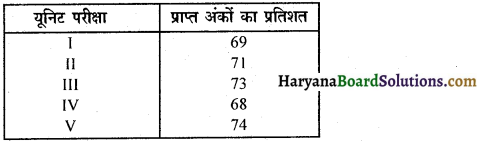
एक विद्यार्थी द्वारा मासिक यूनिट परीक्षा में प्राप्त किए गए अंकों का प्रतिशत नीचे दिया गया है-

HBSE 9th Class Maths Important Questions Chapter 15 प्रायिकता 3

इन आंकड़ों के आधार पर इस बात की प्रायिकता ज्ञात कीजिए कि एक यूनिट परीक्षा में वह विद्यार्थी 70% से अधिक अंक प्राप्त करता है।
हल :
यहाँ पर,
कुल संभाव्य परिणामों की संख्या = यूनिट (I + II + III + IV + V) = 5
70% से अधिक अंक प्राप्त करने के अनुकूल परिणामों की संख्या = यूनिट (II + III + V) = 3
∴ P (70% से अधिक प्राप्त करना) = \(\frac{3}{5}\) = 0.6

प्रश्न 7.
52 पत्तों की ताश की गड्डी से चिड़ी के बादशाह, बेगम और गुलाम को अलग करके शेष को अच्छी तरह से फेंट दिया गया है। शेष पत्तों में से एक पत्ता निकाला जाता है। निम्न की प्राप्ति की प्रायिकता ज्ञात कीजिए :
(i) पान
(ii) बादशाह।
हल :
(i) बादशाह, बेगम और गुलाम को अलग करके शेष बचे पत्तों की संख्या = 52 – 3 = 49 पत्ते
अब 49 पत्तों में 13 पान के पत्ते हैं।
अर्थात अनुकूल परिणामों की संख्या = 13
तथा संभाव्य परिणामों की कुल संख्या = 49
अब, P (पान) = अनुकूल परिणामों की संख्या / संभाव्य परिणामों की कुल संख्या
= \(\frac{13}{49}\)

(ii) 49 पत्तों में 3 बादशाह हैं क्योंकि 1 बादशाह को निकाल दिया गया है।
∴ अनुकूल परिणामों की संख्या = 3
अब, P (बादशाह) = अनुकूल परिणामों की संख्या / संभाव्य परिणामों की कुल संख्या
= \(\frac{3}{49}\)

HBSE 9th Class Maths Important Questions Chapter 15 प्रायिकता

Multiple Choice Questions with Answers:

प्रश्न 1.
किसी घटना के घटने की प्रायिकता होती है-
(A) 0 से 0.5 के बीच
(B) 0 से 1 के बीच
(C) 0 से 2 के बीच
(D) 0 से 5 के बीच
उत्तर-
(B) 0 से 1 के बीच

प्रश्न 2.
एक सिक्के को 1000 बार उछालने पर निम्नलिखित बारम्बारताएँ प्राप्त हुईं- चित – 455; पट – 545. इसमें पट प्राप्ति की प्रायिकता होगी-
(A) \(\frac{91}{200}\)
(B) \(\frac{1}{2}\)
(C) \(\frac{109}{200}\)
(D) 0
उत्तर-
(C) \(\frac{109}{200}\)

प्रश्न 3.
उपरोक्त प्रश्न नं० 2 में एक चित के आने की घटना की प्रायिकता है-
(A) 0.455
(B) 4.55
(C) 5.45
(D) 0.545
उत्तर-
(A) 0.455

HBSE 9th Class Maths Important Questions Chapter 15 प्रायिकता

प्रश्न 4.
दो सिक्कों को एक साथ 500 वार उछालने पर हमें प्राप्त होता है। दो चितः 105 बार; एक चित :275 वार; कोई भी चित नहीं-120 बार। इसमें एक चित के आने की घटना की प्रायिकता है-
(A) 0.275
(B) 2.75
(C) 0.55
(D) 0.21
उत्तर-
(C) 0.55

प्रश्न 5.
उपरोक्त प्रश्न नं0 4 में दो चित के आने की घटना की प्रायिकता है-
(A) 0.21
(B) 0.105
(C) 0.55
(D) 0.24
उत्तर-
(A) 0.21

प्रश्न 6.
उपरोक्त प्रश्न नं० 4 में कोई भी चित नहीं आने की घटना की प्रायिकता है-
(A) 0.21
(B) 0.12
(C) 0.55
(D) 0.24
उत्तर-
(D) 0.24

HBSE 9th Class Maths Important Questions Chapter 15 प्रायिकता

प्रश्न 7.
एक क्रिकेट मैच में एक महिला बल्लेबाज खेली गई 30 गेंदों में 6 बार चौका मारती है, चौका मारे जाने की प्रायिकता
(A) \(\frac{4}{5}\)
(B) \(\frac{3}{5}\)
(C) \(\frac{1}{5}\)
(D) \(\frac{2}{5}\)
उत्तर-
(C) \(\frac{1}{5}\)

प्रश्न 8.
एक क्रिकेट मैच में, एक महिला बल्लेबाज खेली गई 30 गेदों में 6 बार चौका मारती है। चौका न मारे जाने की प्रायिकता होगी-
(A) \(\frac{4}{5}\)
(B) \(\frac{3}{5}\)
(C) \(\frac{1}{5}\)
(D) \(\frac{2}{5}\)
उत्तर-
(A) \(\frac{4}{5}\)

प्रश्न 9.
तीन सिक्कों को एक साथ 200 बार उछाला गया है तथा इनमें विभिन्न परिणामों की बारम्बारताएँ हैं :

HBSE 9th Class Maths Important Questions Chapter 15 प्रायिकता 2

28 यदि तीनों सिक्कों को पुनः एक साथ उछाला जाए, तो दो चित के आने की प्रायिकता होगी
(A) \(\frac{23}{200}\)
(B) \(\frac{9}{25}\)
(C) \(\frac{77}{200}\)
(D) \(\frac{7}{50}\)
उत्तर-
(B) \(\frac{9}{25}\)

HBSE 9th Class Maths Important Questions Chapter 15 प्रायिकता

प्रश्न 10.
एक थैले में 3 लाल, 5 काली और 4 सफेद गेंदें हैं। थैले में से एक गेंद यदृच्छया निकाली गई। निकाली गई गेंद के सफेद होने की प्रायिकता होगी-
(A) \(\frac{5}{12}\)
(B) \(\frac{1}{4}\)
(C) \(\frac{1}{3}\)
(D) \(\frac{1}{2}\)
उत्तर-
(C) \(\frac{1}{3}\)

प्रश्न 11.
एक थैले में 3 लाल, 5 काली और 4 सफेद गेंदें हैं। थैले में से एक गेंद यदृच्छया निकाली गई। निकाली गई गेंद के लाल होने की प्रायिकता होगी-
(A) \(\frac{1}{5}\)
(B) \(\frac{3}{5}\)
(C) शून्य
(D) \(\frac{2}{5}\)
उत्तर-
(B) \(\frac{3}{5}\)

प्रश्न 12.
एक थैले में 3 लाल और 2 नीली गोलियां हैं। एक गोली यदृच्छया (at random) निकाली जाती है। नीली गोली के निकलने की प्रायिकता होगी
(A) \(\frac{1}{5}\)
(B) \(\frac{3}{5}\)
(C) शून्य
(D) \(\frac{2}{5}\)
उत्तर-
(D) \(\frac{2}{5}\)

HBSE 9th Class Maths Important Questions Chapter 15 प्रायिकता

प्रश्न 13.
सारणी-

HBSE 9th Class Maths Important Questions Chapter 15 प्रायिकता 4

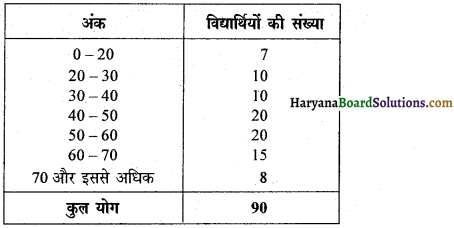
इस सारणी में एक विद्यार्थी द्वारा 20 से कम अंक प्राप्त करने की प्रायिकता होगी
(A) \(\frac{7}{90}\)
(B) \(\frac{17}{90}\)
(C) \(\frac{7}{10}\)
(D) \(\frac{27}{90}\)
उत्तर-
(A) \(\frac{7}{90}\)

प्रश्न 14.
प्रश्न नं0 13 की सारणी के अनुसार एक विद्यार्थी द्वारा 60 या उससे अधिक अंक प्राप्त करने की प्रायिकता होगी
(A) \(\frac{15}{90}\)
(B) \(\frac{23}{90}\)
(C) \(\frac{8}{90}\)
(D) \(\frac{67}{90}\)
उत्तर-
(B) \(\frac{23}{90}\)

प्रश्न 15.
प्रश्न नं० 13 की सारणी के अनुसार एक विद्यार्थी द्वारा 70 या उससे अधिक अंक प्राप्त करने की प्रायिकता होगी-
(A) \(\frac{15}{90}\)
(B) \(\frac{23}{90}\)
(C) \(\frac{8}{90}\)
(D) \(\frac{82}{90}\)
उत्तर-
(C) \(\frac{8}{90}\)

HBSE 9th Class Maths Important Questions Chapter 15 प्रायिकता

प्रश्न 16.
प्रश्न नं० 13 की सारणी के अनुसार एक विद्यार्थी द्वारा 30 से कम अंक प्राप्त करने की प्रायिकता होगी-
(A) \(\frac{7}{90}\)
(B) \(\frac{10}{90}\)
(C) \(\frac{3}{90}\)
(D) \(\frac{17}{90}\)
उत्तर-
(D) \(\frac{17}{90}\)

प्रश्न 17.
सांख्यिकी के बारे में विद्यार्थियों का मत जानने के लिए 200 विद्यार्थियों का सर्वेक्षण किया गया। प्राप्त आंकड़ों को नीचे दी गई सारणी में लिख लिया गया है-

HBSE 9th Class Maths Important Questions Chapter 15 प्रायिकता 5

प्रायिकता ज्ञात कीजिए कि यदृच्छया चुना गया विद्यार्थी सांख्यिकी पसंद करता है
(A) \(\frac{27}{40}\)
(B) \(\frac{13}{40}\)
(C) 1
(D) शून्य
उत्तर-
(A) \(\frac{27}{40}\)

प्रश्न 18.
अच्छी प्रकार से फेंटी गई, 52 पत्तों की ताश की गड्डी में से एक पत्ता खींचा गया है। एक इक्के की प्राप्ति की प्रायिकता होगी-
(A) \(\frac{1}{52}\)
(B) \(\frac{2}{26}\)
(C) \(\frac{1}{13}\)
(D) \(\frac{3}{52}\)
उत्तर-
(C) \(\frac{1}{13}\)

HBSE 9th Class Maths Important Questions Chapter 15 प्रायिकता

प्रश्न 19.
एक मौसम केंद्र के रिकॉर्ड को देखने से पता चलता है कि पिछले 250 क्रमागत दिनों में किए गए मौसम पूर्वानुमानों में से 175 बार उसके पूर्वानुमान सही रहे हैं। एक दिए हुए दिन पर पूर्वानुमान के सही होने की प्रायिकता होगी-
(A) 0.3
(B) 0.7
(C) 0.5
(D) 0.4
उत्तर-
(B) 0.7

प्रश्न 20.
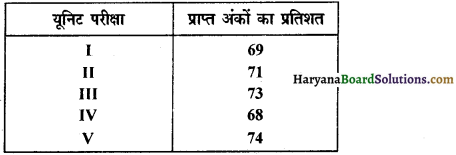
एक विद्यार्थी द्वारा मासिक यूनिट परीक्षा में प्राप्त किए गए अंकों का प्रतिशत नीचे दिया गया है-

HBSE 9th Class Maths Important Questions Chapter 15 प्रायिकता 6

इन आंकड़ों के आधार पर इस बात की प्रायिकता क्या होगी कि एक यूनिट परीक्षा में वह विद्यार्थी 70% से अधिक अंक प्राप्त करता है-
(A) 0.6
(B) 0.4
(C) 0.5
(D) 0.2
उत्तर-
(A) 0.6

प्रश्न 21.
निश्चित घटना की प्रायिकता _____________ होती है।
(A) शून्य
(B) शून्य से 1 के बीच
(C) \(\frac{1}{2}\)
(D) 1
उत्तर-
(D) 1

HBSE 9th Class Maths Important Questions Chapter 15 प्रायिकता

प्रश्न 22.
असम्भव घटना की प्रायिकता _____________ होती है।
(A) एक
(B) \(\frac{1}{2}\)
(C) शून्य
(D) \(\frac{3}{2}\)
उत्तर-
(C) शून्य

प्रश्न 23.
एक पासे को एक बार उछाला गया। अभाज्य संख्या प्राप्त होने की प्रायिकता होगी
(A) \(\frac{1}{2}\)
(B) \(\frac{1}{3}\)
(C) \(\frac{2}{3}\)
(D) \(\frac{1}{6}\)
उत्तर-
(A) \(\frac{1}{2}\)

प्रश्न 24.
1 से 30 तक अंकित टिकटों को अच्छी तरह से मिलाकर एक बॉक्स में डाला जाता है तथा उसमें से एक टिकट निकाली जाती है। निकाली गई टिकट पर अंकित अंक 7 से भाज्य संख्या होने की प्रायिकता होगी-
(A) \(\frac{1}{30}\)
(B) \(\frac{1}{15}\)
(C) \(\frac{2}{15}\)
(D) \(\frac{1}{10}\)
उत्तर-
(C) \(\frac{2}{15}\)

HBSE 9th Class Maths Important Questions Chapter 15 प्रायिकता

प्रश्न 25.
आटे की उन ग्यारह थैलियों में, जिन पर 5 कि०ग्रा० अंकित है, वास्तव में आटे के निम्नलिखित भार (कि०ग्रा० में) हैं:
4.97 5.05 5.08 5.03 5.00 5.06 5.08 4.98 5.04 5.07 5.00
यादृच्छया चुनी गई एक थैली में 5 कि०ग्रा० से अधिक आटा होने की प्रायिकता होगी-
(A) \(\frac{7}{11}\)
(B) \(\frac{6}{11}\)
(C) \(\frac{5}{11}\)
(D) \(\frac{10}{11}\)
उत्तर-
(A) \(\frac{7}{11}\)

प्रश्न 26.
एक सिक्के को एक बार उछालने पर पट प्राप्त करने की प्रायिकता होती है-
(A) \(\frac{1}{2}\)
(B) \(\frac{1}{3}\)
(C) \(\frac{2}{3}\)
(D) \(\frac{1}{6}\)
उत्तर-
(A) \(\frac{1}{2}\)

HBSE 9th Class Maths Important Questions Chapter 15 प्रायिकता Read More »
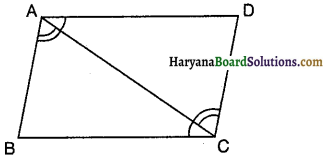
HBSE 9th Class Maths Important Questions Chapter 8 चतुर्भुज

Haryana State Board HBSE 9th Class Maths Important Questions Chapter 8 चतुर्भुज Important Questions and Answers.

Haryana Board 9th Class Maths Important Questions Chapter 8 चतुर्भुज

परीक्षोपयोगी अन्य महत्त्वपूर्ण प्रश्न:

प्रश्न 1.
सिद्ध कीजिए कि चतुर्भुज के कोणों का योग 360° होता है।

HBSE 9th Class Maths Important Questions Chapter 8 चतुर्भुज 1

हल :
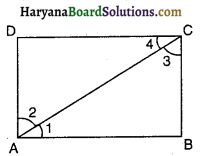
दिया है : ABCD एक चतुर्भुज है।
सिद्ध करना है : ∠A + ∠B + ∠C + ∠D = 360°
रचना : विकर्ण AC को मिलाओ।
प्रमाण : ∆ABC में,
∠1 + ∠B + ∠3 = 180° [त्रिभुज के कोणों का योग] …………… (i)
∆ACD में,
∠2 + ∠4 + ∠D = 180° [त्रिभुज के कोणों का योग] …………… (ii)
समीकरण (i) व (ii) को जोड़ने पर,
∠1 + ∠2 + ∠B + ∠3 + ∠4 + ∠D = 180° + 180°
[∵ ∠1 + ∠2 = ∠A
तथा ∠3 + ∠4 = ∠D ]
∠A + ∠B + ∠C + ∠D = 360°
अतः चतुर्भुज के कोणों का योग 360° होता है। [इति सिद्धम]

HBSE 9th Class Maths Important Questions Chapter 8 चतुर्भुज

प्रश्न 2.
सिद्ध कीजिए कि किसी समांतर चतुर्भुज का एक विकर्ण उसे दो सर्वांगसम त्रिभुजों में बांटता है।
हल :
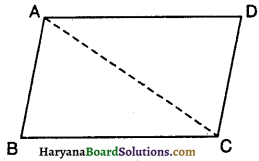
HBSE 9th Class Maths Important Questions Chapter 8 चतुर्भुज 2

दिया है : ABCD एक समांतर चतुर्भुज है और AC उसका एक विकर्ण है।
सिद्ध करना है : ∆ABC = ∆ADC
प्रमाण : जैसा कि हम जानते हैं कि समांतर चतुर्भुज की सम्मुख भुजाएं समांतर होती हैं।
∆ABC व ∆ADC में,
AC = AC [उभयनिष्ठ]
∠1 = ∠2 [एकांतर कोण]
∠3 = ∠4 [एकांतर कोण]
∴ ∆ABC = ∆ADC [कोण-भुजा-कोण सर्वांगसमता] [इति सिद्धम]

प्रश्न 3.
सिद्ध कीजिए कि किसी समांतर चतुर्भुज की सम्मुख भुजाएं समान होती हैं।
हल :

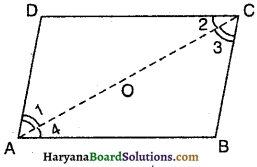
HBSE 9th Class Maths Important Questions Chapter 8 चतुर्भुज 3

दिया है : चतुर्भुज ABCD एक समांतर चतुर्भुज है।
सिद्ध करना है : AB = DC तथा AD = BC
रचना : A तथा C को मिलाएं।
प्रमाण : ∆ADC तथा ∆CBA में,
∵ ∠DAC = ∠BCA [एकांतर कोण] B
AC = AC [उभयनिष्ठ भुजा]
∠DCA = ∠BAC [एकांतर कोण]
∴ ∆ADC = ∆CBA [कोण-भुजा-कोण सर्वांगसमता]
इस प्रकार,
AB = DC व AD = BC [सर्वांगसम त्रिभुजों के संगत भाग]
अतः समांतर चतुर्भुज की सम्मुख भुजाएं समान होती हैं। [इति सिद्धम]

HBSE 9th Class Maths Important Questions Chapter 8 चतुर्भुज

प्रश्न 4.
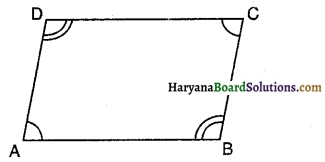
सिद्ध कीजिए कि समांतर चतुर्भुज के सम्मुख कोण समान होते हैं।

HBSE 9th Class Maths Important Questions Chapter 8 चतुर्भुज 4

हल :
दिया है : चतुर्भुज ABCD एक समांतर चतुर्भुज है।
सिद्ध करना है : ∠A = ∠C तथा ∠B = ∠D.
प्रमाण : ∵ AB || DC तथा AD इनको प्रतिच्छेद करती है।
∴ ∠A + ∠D = 180° [प्रतिच्छेदी रेखा के एक ही तरफ के आंतरिक कोण] ……………. (i)
अब
∵ AD || BC तथा DC इनको प्रतिच्छेद करती है।
∴ ∠A + ∠C = 180° [प्रतिच्छेदी रेखा के एक ही तरफ के आंतरिक कोण] ……………. (ii)
समीकरण (i) व (ii) से,
∠A + ∠D = ∠D + ∠C
∠A = ∠C
इसी प्रकार, यह सिद्ध किया जा सकता है कि
∠B = ∠D [इति सिद्धम]

प्रश्न 5.
सिद्ध कीजिए कि चतुर्भुज में यदि सम्मुख कोण समान हों वह समांतर चतुर्भुज होता है।

HBSE 9th Class Maths Important Questions Chapter 8 चतुर्भुज 5

हल :
दिया है : चतुर्भुज ABCD, जिसमें
∠A = ∠C तथा
∠B = ∠D
सिद्ध करना है : चतुर्भुज ABCD एक समांतर चतुर्भुज है।
प्रमाण : चतुर्भुज ABCD में,
∠A = ∠C (दिया है)…(i) तथा
∠B = ∠D (दिया है)…(ii) समीकरण (i) व (ii) से, हमें प्राप्त होता है।
∴ ∠A + ∠B = ∠C + ∠D
∵ चतुर्भुज के चारों कोणों का योग 360° होता है।
∵ ∠A + ∠B + ∠C + ∠D = 360°
⇒ ∠A + ∠B = ∠C + ∠D = 180°
अब, रेखा AB, AD तथा BC को A तथा B पर प्रतिच्छेद करती है।
तथा ∠A + ∠B = 180° [आसन्न आंतरिक कोण]
∴ AD || BC …………….(iii)
इसी प्रकार, (i) व (ii) से, हमें प्राप्त होता है।
∠A + ∠D = ∠B + ∠C = 180°
रेखा AD, AB तथा CD को A तथा D पर प्रतिच्छेद करती है,
∠A + ∠D = 180° [आसन्न आंतरिक कोण]
∴ AB || DC ……………(iv)
समीकरण (iii) व (iv) से, हमें प्राप्त होता है, चतुर्भुज ABCD एक समांतर चतुर्भुज है। [इति सिद्धम]

HBSE 9th Class Maths Important Questions Chapter 8 चतुर्भुज

प्रश्न 6.
यदि चतुर्भुज के विकर्ण परस्पर समद्विभाजित करते हों, तो वह समांतर चतुर्भुज होता है।

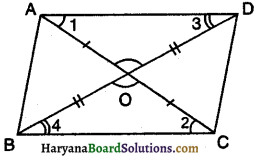
HBSE 9th Class Maths Important Questions Chapter 8 चतुर्भुज 6

हल :
दिया है : चतुर्भुज ABCD जिसमें विकर्ण AC तथा BD, O पर इस प्रकार प्रतिच्छेद करते हैं कि OA = OC तथा OB = OD
सिद्ध करना है : चतुर्भुज ABCD एक समांतर चतुर्भुज है।
प्रमाण : ∆AOD तथा ∆COB में,
OA = OC [दिया है]
∠AOD = ∠COB [शीर्षाभिमुख कोण]
OD = OB [दिया है]
∴ ∆AOD ≅ ∆COB [भुजा-कोण-भुजा सर्वांगसमता]
∴ ∠1 = ∠2 तथा ∠3 = ∠4
[सर्वांगसम त्रिभुजों के संगत भाग]
क्योंकि, यह प्रतिच्छेदी रेखा AC, द्वारा बनाए गए एकांतर कोण हैं, जो कि AD तथा BC को प्रतिच्छेद करती है।
∴ AD || BC ………………(i)
इसी प्रकार, हम सिद्ध कर सकते हैं कि,
AB || DC ………….. (ii)
समीकरण (i) व (ii) से, हमें प्राप्त होता है, चतुर्भुज ABCD एक समांतर चतुर्भुज है। [इति सिद्धम]

प्रश्न 7.
एक चतुर्भुज समांतर चतुर्भुज होता है यदि उसकी सम्मुख भुजाओं का एक युग्म परस्पर समान तथा समांतर हो।

HBSE 9th Class Maths Important Questions Chapter 8 चतुर्भुज 7

हल :
दिया है : एक चतुर्भुज ABCD जिसमें, AB || DC तथा AB = DC है।
सिद्ध करना है : ABCD एक समांतर चतुर्भुज है। रचना : A तथा C को मिलाएं।
प्रमाण : AB || DC और तिर्यक रेखा AC उनको प्रतिच्छेद करती है।
∴ ∠BAC = ∠DCA (एकांतर कोण)…(i)
अब, ∆ABC तथा ∆CDA में,
AB = DC (दिया है)
AC = AC (उभयनिष्ठ)
∠BAC = ∠DCA [(i) से]
∴ ∆ABC ≅ ∆CDA [भुजा-कोण-भुजा सर्वांगसमता]
अब, AD तथा BC दो रेखाएं हैं तथा तिर्यक रेखा AC इनको प्रतिच्छेद करती है इसलिए एकांतर कोण ACB तथा कोण CAD समान है।
इस प्रकार,
AD || BC
अब, AB || DC
तथा AD || BC
इसलिए, ABCD एक समांतर चतुर्भुज है। [इति सिद्धम]

HBSE 9th Class Maths Important Questions Chapter 8 चतुर्भुज

प्रश्न 8.
एक चतुर्भुज के कोण 1 : 2 : 3 : 4 के अनुपात में हैं। इस चतुर्भुज के सभी कोण ज्ञात कीजिए।
हल :
माना चतुर्भुज के कोण = (1x), (2x), (3x), (4x)
हम जानते हैं कि
चतुर्भुज के कोणों का योग = 360°
x + 2x + 3x + 4x = 360°
10x = 360°
x = \(\frac{360^{\circ}}{10}\) = 36°
अतः चतुर्भुज के कोण = (1 × 36)°, (2 × 36)°, (3 × 36)°, (4 × 36)°
= 36°, 72°, 108°, 144°.

प्रश्न 9.
सिद्ध कीजिए कि एक चतुर्भुज में यदि सम्मुख भुजाएं समान हों तो वह समांतर चतुर्भुज होता है।

HBSE 9th Class Maths Important Questions Chapter 8 चतुर्भुज 8

हल :
दिया है : चतुर्भुज ABCD जिसमें AB = DC तथा AD = BC हैं।
सिद्ध करना है : चतुर्भुज ABCD एक समांतर चतुर्भुज है।
रचना : A तथा C को मिलाएं।
प्रमाण : ∆ABC तथा ∆CDA में,
AB = DC [दिया है]
AD = BC[दिया है]
AC = AC [उभयनिष्ठ]
∆ABC ≅ ∆DAC [भुजा-भुजा-भुजा सर्वांगसमता]
∴ ∠1 = ∠3
तथा ∠2 = ∠4 [सर्वांगसम त्रिभुजों को संगत भाग] …………(i)
अब, रेखा AC, AB तथा CD को A तथा C पर प्रतिच्छेद करती है इसलिए एकांतर आंतरिक कोण
∠2 = ∠4 [जैसे कि समीकरण (i) में सिद्ध किया है]
∴ AB || CD …………..(ii)
इसी प्रकार, रेखा AC, CB तथा AD को C तथा A पर प्रतिच्छेद करती है इसलिए एकांतर आंतरिक कोण
∠1 = ∠3 [जैसे कि समीकरण (i) में सिद्ध किया है]
∴ BC || AD ……………(iii)
समीकरण (ii) व (iii) से, हमें प्राप्त होता है।
ABCD एक समांतर चतुर्भुज है। [इति सिद्धम]

HBSE 9th Class Maths Important Questions Chapter 8 चतुर्भुज

प्रश्न 10.
सिद्ध कीजिए कि यदि तीन या अधिक रेखाएं दी हों और उनके द्वारा एक तिर्यक रेखा पर बनाए गए अंतः खंड समान हों तो किसी P अन्य तिर्यक रेखा पर संगत अंतः खंड भी समान होते हैं।

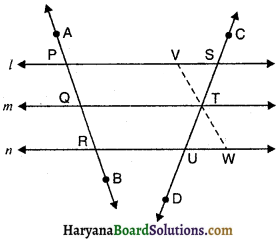
HBSE 9th Class Maths Important Questions Chapter 8 चतुर्भुज 9

हल :
दिया है : l, m, n, तीन समांतर रेखाएं हैं तथा दो तिर्यक रेखाएं AB तथा CD इन्हें क्रमशः P, Q, R तथा S, T, U बिंदुओं पर प्रतिच्छेद करती हैं तथा साथ ही PQ = QR
सिद्ध करना है : ST = TU
रचना : T से AB के समांतर VTW खींचे।
प्रमाण :
PQ || VT (रचना से)
PV || QT (दिया है)
∴ PVTQ एक समांतर चतुर्भुज है।
⇒ PQ = VT …………….(i)
इसी प्रकार, QTWR एक समांतर चतुर्भुज है।
⇒ QR = TW ………….(ii)
क्योंकि, PQ = QR [दिया है]
∴ VT = TW [(1) तथा (ii) से] …………..(iii)
पुनः l, n के समांतर है तथा तिर्यक रेखा CD इनको प्रतिच्छेद करती है।
∴ ∠VST = ∠TUW [∵ एकांतर कोण] ……………(iv)
∆VST तथा ∆WUT में,
VT = TW [(iii) से]
∠VST = ∠TUW [(iv) से]
तथा, ∠VTS = ∠WTU [शीर्षाभिमुख कोण]
∴ ∆VST = ∆WUT [कोण-भुजा-कोण सर्वांगसमता]
इस प्रकार,
ST = UT [सर्वांगसम त्रिभुजों के संगत भाग][इति सिद्धम]

HBSE 9th Class Maths Important Questions Chapter 8 चतुर्भुज

Multiple Chpice Questions with Answers:

प्रश्न 1.
चार रेखाखण्डों से बनी बन्द आकृति को कहा जाता है-
(A) त्रिभुज
(B) चतुर्भुज
(C) पंचभुज
(D) षड्भुज
उत्तर-
(B) चतुर्भुज

प्रश्न 2.
चतुर्भुज के चारों कोणों का योग होता है-
(A) 180°
(B) 270°
(C) 360°
(D) 540°
उत्तर-
(C) 360°

प्रश्न 3.
जिस चतुर्भुज में सम्मुख भुजाओं का केवल एक युग्म समान्तर हो उसे कहा जाता है-
(A) समलम्ब
(B) समान्तर चतुर्भुज
(C) आयत
(D) समचतुर्भुज
उत्तर-
(A) समलम्ब

HBSE 9th Class Maths Important Questions Chapter 8 चतुर्भुज

प्रश्न 4.
किसी समान्तर चतुर्भुज का एक विकर्ण उसे ___________ सर्वांगसम त्रिभुजों में विभाजित करता है।
(A) 4
(B) 3
(C) 1
(D) 2
उत्तर-
(D) 2

प्रश्न 5.
प्रत्येक कोण समकोण नहीं होता है-
(A) आयत का
(B) वर्ग का
(C) त्रिभुज का
(D) घन का
उत्तर-
(C) त्रिभुज का

प्रश्न 6.
एक समान्तर चतुर्भुज में ____________ बराबर होते/होती हैं।
(A) सम्मुख भुजाएँ
(B) संलग्न कोण
(C) संलग्न भुजाएँ
(D) विकर्ण
उत्तर-
(A) सम्मुख भुजाएँ

प्रश्न 7.
किसी समान्तर चतुर्भुज का गुण है-
(A) सम्मुख भुजाएँ बराबर
(B) सम्मुख कोण बराबर
(C) विकर्ण परस्पर समद्विभाजित करने वाले
(D) उपरोक्त सभी
उत्तर-
(D) उपरोक्त सभी

HBSE 9th Class Maths Important Questions Chapter 8 चतुर्भुज

प्रश्न 8.
आयत का प्रत्येक कोण ___________ का होता है।
(A) 45°
(B) 90°
(C) 1350
(D) 180°
उत्तर-
(B) 90°

प्रश्न 9.
एक समचतुर्भुज के विकर्ण परस्पर ___________ होते हैं।
(A) लम्ब
(B) समान्तर
(C) बराबर
(D) समान्तर व बराबर
उत्तर-
(A) लम्ब

प्रश्न 10.
एक समान्तर चतुर्भुज के कोणों के समद्विभाजक एक __________ बनाते हैं।
(A) वर्ग
(B) समचतुर्भुज
(C) आयत
(D) त्रिभुज
उत्तर-
(C) आयत

प्रश्न 11.
एक चतुर्भुज के कोण 3 : 5 : 9 : 13 के अनुपात में हैं। इसका सबसे छोटा कोण होगा-
(A) 156°
(B) 108°
(C) 60°
(D) 36°
उत्तर-
(D) 36°

HBSE 9th Class Maths Important Questions Chapter 8 चतुर्भुज

प्रश्न 12.
एक चतुर्भुज के कोण 3 : 5 : 9 : 13 के अनुपात में हैं। इसका सबसे बड़ा कोण होगा-
(A) 156°
(B) 108°
(C) 60°
(D) 36°
उत्तर-
(A) 156°

प्रश्न 13.
वर्ग का गुण है-
(A) विकर्ण बराबर होते हैं ।
(B) विकर्ण परस्पर समकोण पर समद्विभाजित करते हैं
(C) (A) और (B) दोनों
(D) (A) और (B) दोनों नहीं
उत्तर-
(C) (A) और (B) दोनों

प्रश्न 14.
आयत का गुण है-
(A) प्रत्येक कोण 90° का होता है
(B) विकर्ण बराबर होते हैं
(C) विकर्ण परस्पर समद्विभाजित करते हैं
(D) उपरोक्त सभी
उत्तर-
(D) उपरोक्त सभी

HBSE 9th Class Maths Important Questions Chapter 8 चतुर्भुज

प्रश्न 15.
एक समान्तर चतुर्भुज का एक कोण 60° है इसका आसन्न कोण होगा-
(A) 60°
(B) 120
(C) 90°
(D) 30°
उत्तर-
(B) 120°

प्रश्न 16.
एक समान्तर चतुर्भुज का एक कोण 75° है। इसका सम्मुख कोण होगा-
(A) 75°
(B) 15°
(C) 105°
(D) 285°
उत्तर-
(A)75°

प्रश्न 17.
एक समान्तर चतुर्भुज के दो आसन्न कोण क्रमशः 70° व 110° हैं। अन्य दो कोण होंगे-
(A) 100°, 80°
(B) 105°, 75°
(C) 110°, 70°
(D) 120°, 60°
उत्तर-
(C) 110°, 70°

प्रश्न 18.
एक चतुर्भुज के तीन कोण 70%, 100°, 110° हैं इसका चौथा कोण होगा-
(A) 110°
(B) 100°
(C) 70°
(D) 80°
उत्तर-
(D) 80°

HBSE 9th Class Maths Important Questions Chapter 8 चतुर्भुज

प्रश्न 19.
किसी त्रिभुज की किन्हीं दो भुजाओं के मध्य-बिन्दुओं को मिलाने वाला रेखाखण्ड तीसरी भुजा के समान्तर और उसका __________ होता है।
(A) आधा
(B) एक-चौथाई
(C) एक-तिहाई
(D) दुगुना
उत्तर-
(A) आधा

प्रश्न 20.
किसी त्रिभुज की एक भुजा के मध्य-विन्दु से दूसरी भुजा के समान्तर खींची गई रेखा तीसरी भुजा को __________ करती है।
(A) समत्रिभाजित
(B) समद्विभाजित
(C) समचतुर्भाजित
(D) समद्विभाजित नहीं
उत्तर-
(B) समद्विभाजित

प्रश्न 21.
∆ABC में D, E और Fक्रमशः भुजाओं AB, BC और CA के मध्य-बिन्दु हैं। बताइए बिन्दुओं D, E और F को मिलाने पर ∆ABC _________ सर्वांगसम त्रिभुजों में विभाजित हो जाता है।
(A) दो
(B) तीन
(C) चार
(D) पाँच
उत्तर-
(C) चार

HBSE 9th Class Maths Important Questions Chapter 8 चतुर्भुज

प्रश्न 22.
किसी चतुर्भुज की भुजाओं के मध्य-बिन्दुओं को एक क्रम से मिलाने वाले रेखाखण्डों द्वारा बना चतुर्भुज एक ___________ होता है।
(A) समचतुर्भुज
(B) आयत
(C) वर्ग
(D) समान्तर चतुर्भुज
उत्तर-
(D) समान्तर चतुर्भुज

HBSE 9th Class Maths Important Questions Chapter 8 चतुर्भुज Read More »
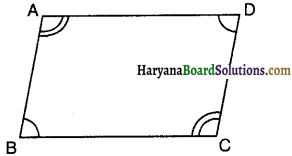
HBSE 10th Class Maths Notes Chapter 8 Introduction to Trigonometry

Haryana State Board HBSE 10th Class Maths Notes Chapter 8 Introduction to Trigonometry Notes.

Haryana Board 10th Class Maths Notes Chapter 8 Introduction to Trigonometry

Introduction
In our daily life we measure the distances or heights by using some mathematical techniques which come under a branch of mathematics called trigonometry The word trigonometry is derived from the Greek words tri means three), gon (means sides), metron (means measure). Thus, trigonometry is the study of relationship between the sides and angles of a triangle Early even today trigonometrical technique used to find out the distances of the stars and planets from the Earth by astronomers. It is also used in Engineering and Physical science. In the present chapter, we shall study some ratios of the sides of a right triangle with respect to its acute angles, called trignometric ratios of the angle or briefly T-ratios. We shall also calculate the values of the trigonometric ratios for some specific angles, define them for angles 0° and 90° and establish some identities involving these ratios called trigonometric identities.

1. Trigonometry: Trigonometry is the study of relationship between the sides and angles of a triangle.
2. Trigonometric Ratios: The trigonometric ratios of an acute angle in a right triangle express the relationship between the angle and the length of its sides.
3. Trigonometrie Identity: An equation involving trigonometrie ration of an angle is cnlled a trigonometric identity, if it is true for all values of the angles involved.
4. sin θ: sin θ is the abbreviation used for sine of angle θ.
5. cos θ: cos θ is the abbreviation used for cosine of angle θ.
6. tan θ: tan θ is the abbreviation used for tangent of angle θ.
7. cosec θ: cosec θ is the abbreviation used for cosecant of angle θ.
8. sec θ: sec θ is the abbreviation used for secant of angle θ.
9. cot θ: cot θ is the abbreviation used for cotangent of angle θ.
10. Complementary angles: Two angles having sum 90° are called complementary angles.

HBSE 10th Class Maths Notes Chapter 8 Introduction to Trigonometry

Trigonometric Ratios
We shall define the trigonometric ratios for an acute angle of a right angled triangle. Let us take a right triangle ABC right angled at B.
Here, ∠CAB and ∠ACB both are acute angles.
The side BC which is opposite to the ∠A we call it the opposite side to ∠A and side AB which is adjacent to ∠A is called adjacent side to ∠A and AC is the hypotenuse of right triangle.
HBSE 10th Class Maths Notes Chapter 8 Introduction to Trigonometry 1
There are six trigonometric ratios of ∠A in right triangle ABC which are defined as follows:
HBSE 10th Class Maths Notes Chapter 8 Introduction to Trigonometry 2
HBSE 10th Class Maths Notes Chapter 8 Introduction to Trigonometry 3
The ratios defined above are generally written in short form as sin A, cos A, tan A, cosec A, sec A and cot A respectively and ratios cosec A, sec A, and cot A are respectively the reciprocals of the ratios sin A, cos A and tan A.
Note: Position of the sides changes when we consider ∠C in place of ∠A as follows:
HBSE 10th Class Maths Notes Chapter 8 Introduction to Trigonometry 4
1. sine C = \(\frac{\mathrm{AB}}{\mathrm{AC}}\)
2. consine C = \(\frac{\mathrm{BC}}{\mathrm{AC}}\)
3. tangent C = \(\frac{\mathrm{AB}}{\mathrm{BC}}\)
4. cosecant C = \(\frac{\mathrm{AC}}{\mathrm{AB}}\)
5. secant C = \(\frac{\mathrm{AC}}{\mathrm{BC}}\)
6. cotangent C = \(\frac{\mathrm{BC}}{\mathrm{AB}}\)
So, the trigonometric ratios of an acute angle in a right triangle express the relationship between the angles and lengths of its sides.

Remark:
(1) sin A is not the product of ‘sin’ and A. The symbol ‘sin’ separated from the angle A has no meaning. Similarly, cos A is not the Product of cos’and A. Similar interpretations follows for other trigonometric ratios also.
(2) Since the hypotenuse is the longest side in a right triangle, the value of sin A or cos A is always less than 1 (or in particular, equal to 1).
(3) The values of cosec A and sec A cannot be smaller than 1.

HBSE 10th Class Maths Notes Chapter 8 Introduction to Trigonometry

(a) Relationship between the trignometric ratios of an angle:
Consider a right triangle ABC in which ∠B = 90° and ∠A = θ
Then, tan θ = \(\frac{\mathrm{BC}}{\mathrm{AB}}\)
HBSE 10th Class Maths Notes Chapter 8 Introduction to Trigonometry 5

Trigonometric Ratios of Some Specific Angles
In this section, we will find the values of the trigonometric ratio of 30°, 45°, 60°, 90° and 0°.
(a) Trigonometric Ratios of 30° and 60°
HBSE 10th Class Maths Notes Chapter 8 Introduction to Trigonometry 6
Consider an equilateral ΔABC with each side of length 2a. We know that each angle of an equilateral triangle is 60°. Therefore, ∠A = ∠B = ∠C = 60°. Draw AD ⊥ BC.
We know that in equilateral Δ, the perpendicular from vertex on the base, bisects the bruse and also the vertical angle.
∴ D is the midpoint of BC
⇒ BD = DC = a.
Also, AD is the bisector of ∠A,
∴ ∠BAD = ∠CAD = \(\frac{60^{\circ}}{2}\) = 30°
Now, in right ΔADB,
AB2 = BD2 + AD2
[By Pythagoras theorem]
(2a)2 = a2 + AD2
4a2 = a2 + AD2
AD2 = 4a2 – a2 = 3a2
AD = \(\sqrt{3}\)a
Trigonometric Ratios of 30°
In right ΔADB, we have
Base (AD) = \(\sqrt{3}\)a, Perpendicular (BD) = a, Hypotenuse (AB) = 2a and ∠BAD = 30°.
HBSE 10th Class Maths Notes Chapter 8 Introduction to Trigonometry 7
Trigonometric Ratios of 60°
In right ΔABD, we have
Base (BD) = a, Perpendicular (AD) = \(\sqrt{3}\)a, Hypotenuse (AB) = 2a and ∠ABD = 60°.
HBSE 10th Class Maths Notes Chapter 8 Introduction to Trigonometry 8

(b) Trigonometric Ratios of 45°
Consider a right triangle ABC, right angled at B such that ∠A = 45°.
∵ ∠A + ∠B + ∠C = 180°
[sum of ∠s of a triangle]
⇒ 45° + 90° + ∠C = 180°
⇒ ∠C + 135° = 180°
⇒ ∠C = 180° – 135°
= 45°
∴ ∠A = ∠C
⇒ AB = BC
HBSE 10th Class Maths Notes Chapter 8 Introduction to Trigonometry 9
Let AB = BC = a. Then,
AC2 = AB2 + BC2
[By Pythagoras theorem]
AC2 = a2 + a2
AC2 = 2a2
AC = \(\sqrt{2}\)a
Now, in right ΔABC, we have
∠A = 45°, Base (AB) = a, Perpendicular (BC) = a, Hypotenuse (AC) = \(\sqrt{2}\)a.
HBSE 10th Class Maths Notes Chapter 8 Introduction to Trigonometry 10

(c) Trigonometric Ratios of 0° and 90°
Let ∠BAC = θ be an acute angle and let P be a point on its side AB. Draw PM ⊥ AC.
It is evidence from ΔPMA, that as becomes smaller and smaller, line segment PM also becomes smaller and smaller, and finally when θ becomes 0°, the point P will coincide with M. Consequently, we have,
PM = 0, AP = AM
HBSE 10th Class Maths Notes Chapter 8 Introduction to Trigonometry 11
HBSE 10th Class Maths Notes Chapter 8 Introduction to Trigonometry 12
(Not defined)
From ΔPMA, it is evident that as θ increases, the line segment AM becomes smaller and smaller and finally when θ becomes 90°, the point M will coincide A. Consequently, we have
AM = 0, AP = PM
HBSE 10th Class Maths Notes Chapter 8 Introduction to Trigonometry 13
Table of Values of Trigonometric ratios of 0°, 30°, 45°, 60° and 90°
HBSE 10th Class Maths Notes Chapter 8 Introduction to Trigonometry 14

HBSE 10th Class Maths Notes Chapter 8 Introduction to Trigonometry

Trigonometric Ratios of Complementary Angles
Complementary Angles: Two angles are said to be complementary, if their sum is 90°.
Thus, θ and (90° – θ) are complementary angles.
Trigonometric Ratios of Complementary Angles:
HBSE 10th Class Maths Notes Chapter 8 Introduction to Trigonometry 15
Consider a ΔOMP such that ∠M = 90°, ∠POM = 0.
Then, ∠OPM = (90° – θ) is its o complementary angle.
For the reference angle θ, we have
HBSE 10th Class Maths Notes Chapter 8 Introduction to Trigonometry 16
For the reference angle (90° – θ), we have
Base = PM, Perpendicular = OM and Hypotenuse = OP.
HBSE 10th Class Maths Notes Chapter 8 Introduction to Trigonometry 17
From (1) and (2), we get
sin (90° – θ) = cos θ
cos (90° – θ) = sin θ
tan (90° – θ) = cot θ
cosec (90° – θ) = sec θ
sec (90° – θ) = cosec θ
cot (90° – θ) = tan θ

Trigonometric Identities
An equation involving trigonometric ratios of an angle is called a trigonometric identity, if it is true for all values of the angles involved.
Fundamental Trigonometric Identities
1. sin2 θ + cos2 θ = 1
2. sec2 θ = 1 + tan2 θ
3. cosec2 θ = 1 + cot2 θ
In right ΔABC, right angled at B, we have
BC2 + AB2 = AC2 ……(1) [By Pythagoras theorem]
HBSE 10th Class Maths Notes Chapter 8 Introduction to Trigonometry 18
1. Dividing each term of (1) by AC2, we get
HBSE 10th Class Maths Notes Chapter 8 Introduction to Trigonometry 19
These fundamental identities can be expressed in the following forms:
(i) sin2 θ = 1 – cos2 θ
or sin θ = \(\sqrt{\left(1-\cos ^2 \theta\right)}\)
(ii) cos2 θ = 1 – sin2 θ
or cos θ = \(\sqrt{\left(1-\sin ^2 \theta\right)}\)
(iii) sec2 θ – tan2 θ = 1
(iv) tan2 θ = sec2 θ – 1
or tan θ = \(\sqrt{\sec ^2 \theta-1}\)
(v) cosec2 θ – cot2 θ = 1
(vi) cot2 θ = cosec2 θ – 1
or cot θ = HBSE 10th Class Maths Notes Chapter 8 Introduction to Trigonometry 20

HBSE 10th Class Maths Notes Chapter 8 Introduction to Trigonometry Read More »