Class 9

HBSE 9th Class Science Important Questions Chapter 4 Structure of the Atom

Haryana State Board HBSE 9th Class Science Important Questions Chapter 4 Structure of the Atom Important Questions and Answers.

Haryana Board 9th Class Science Important Questions Chapter 4 Structure of the Atom

Very Short-Answer Type Questions

Question 1.
How are materials formed?
Answer:
Materials are formed with the combination of atoms and molecules.

Question 2.
What is known as Atom?
Answer:
Atom is the microscopic indivisible particles that have an independent existence.

Question 3.
During which century did Dalton agree an atom to be indivisible?
Answer:
During 19th century, Dalton agreed an atom to be indivisible.

Question 4.
Which are the basic particles of an atom ?
Answer:
The basic particles of an atom are electrons, protons and neutrons.

Question 5.
Define isobars with examples.
Answer:
Atoms of different elements which have same mass number but different atomic numbers are known as isobars. For example, calcium (20Ca40) and argon (18Ar40) are isobars.

Question 6.
What is meant by electron ?
Answer:
In an atom, the negatively charged particle whose mass is \(\frac {1}{2000}\) part mass of a proton that revolves around the nucleus is called an electron.

Question 7.
Which scientist gets the honor of discovering electron?
Answer:
J.J. Thomson.

Question 8.
Which charge does remain on an electron?
Answer:
Negative (-ve) charge.

Question 9.
Which scientist discovered the canal Rays?
Answer:
The German scientist, E. Goldstein.

HBSE 9th Class Science Important Questions Chapter 4 Structure of the Atom

Question 10.
Which other name is called as the canal rays ?
Answer:
Canal rays are also called as positive rays.

Question 11.
Which electron are canal rays attracted towards in the electronic field ?
Answer:
Towards negative electron.

Question 12.
How are electron and proton represented ?
Answer:
Electron is represented by e~ and proton is represented by p+.

Question 13.
What is the mass and charge of proton ?
Answer:
The mass of proton is 1 unit and the charge is +1.

Question 14.
How much is the charge on an electron ?
Answer:
An electron has -1 charge.

Question 15.
Why is atom electrically neutral ?
Answer:
Because in an atom the number of electrons and protons mutually balance the charges.

Question 16.
Which discovery enabled J.J. Thomson to win the Nobel Prize in Physics ?
Answer:
For discovery of‘electron’.

Question 17.
When was J.J. Thomson born ?
Answer:
J.J. Thomson was born on 18 December, 1856.

Question 18.
What is the mass of‘alpha’ particles ?
Answer:
The mass of ‘alpha’ particles is 4u.

HBSE 9th Class Science Important Questions Chapter 4 Structure of the Atom

Question 19.
What are alpha particles?
Answer:
Alpha particles are binary-charged helium particles.

Question 20.
Which scientist is known as the father of nuclear physics?
Answer:
E. Rutherford is called as the father of nuclear physics.

Question 21.
When was E. Rutherford born?
Answer:
E. Rutherford was born on 30 August 1871.

Question 22.
According to Rutherford, where does the entire mass of an atom lie in ?
Answer:
In the micronucleus of the atom.

Question 23.
Compare the size of the nucleus with respect to that of the size of an atom.
Answer:
The size of the nucleus is 1O3 times less than that of the size of an atom.

Question 24.
Which charge does atom-nucleus have?
Answer:
Positive charge.

Question 25.
Of which element’s nucleus is known as proton?
Answer:
Of hydrogen nucleus.

Question 26.
What was the proposal of Neils Bohr regarding the revolving of electrons?
Answer:
According to Neils Bohr electrons revolve in a certain energy orbit.

Question 27.
According to Neils Bohr model, when an electron returns from a higher level orbit to a lower level orbit, then the difference of energy gets radiated into which form?
Answer:
Electromagnetic radiation or in the form of light.

Question 28.
Which particles does the nucleus of an atom have?
Answer:
Protons and Neutrons.

HBSE 9th Class Science Important Questions Chapter 4 Structure of the Atom

Question 29.
How many a maximum number of electrons can be accommodated in the first and second orbit of an atom?
Answer:
In the first orbit, two and in the second orbit, maximum of eight electrons can be accommodated.

Question 30.
Write down the name of the lightest atom.
Answer:
Hydrogen.

Question 31.
Write down the name of that atom which does not have any neutron.
Answer:
Protium (11H ) which is an isotope of hydrogen.

Question 32.
Write down the number of proton and neutron present in the nucleus of helium.
Answer:
There are two protons and two neutrons in the nucleus of helium.

Question 33.
When and who discovered the neutron ?
Answer:
Chadwick discovered neutron in 1932.

Question 34.
In the structure of atom the electrons of which orbit determine the properties of atoms.
Answer:
The electrons in the last shell (valence shell).

Question 35.
In a single molecule of water, how many atoms of hydrogen and oxygen are there?
Answer:
In a single molecule of water, there are two atoms of hydrogen and one atom of oxygen.

Question 36.
Which atoms are chemically active?
Answer:
The atoms whose outermost shells are not complete are chemically active.

Question 37.
Which atoms are chemically neutral?
Answer:
Those atoms whose outermost shells are complete are chemically neutral. For example; helium and neon.

Question 38.
Give names of two bivalent atoms.
Answer:
(i) Calcium (Ca)
(ii) Berkelium (Be).

HBSE 9th Class Science Important Questions Chapter 4 Structure of the Atom

Question 39.
What is the valency of chlorine?
Answer:
One.

Question 40.
What will be the number of neutrons in the atom of the element whose atomic number is 19 and mass number is 39?
Answer:
Neutron = mass number – atomic number = 39 – 19 = 20

Question 41.
Why is the mass of the atom M and its ion M+ same?
Answer:
Because both have same number of neutrons and protons.

Question 42.
Write dow n two isotopes of uranium.
Answer:
23592U and 23892U

Question 43.
Which two of the following nuclei are isotopes mutually?
90Z231, 91Z230, 88Z230, 90Z233
Answer:
90Z231 and 90Z233

Question 44.
How many isotopes does carbon have ?
Answer:
Carbon has two isotopes 12 C and 14 C .

Question 45.
What are the atoms called that belong to only one element, which has same atomic number but different mass number?
Answer:
Isotopes.

Question 46.
What is the average mass of isotopes of chlorine?
Answer:
The average mass of isotopes of chlorine used to be 35.5u.

Question 47.
Which of the followings are nuclear isotopes?
88Z226, 87Z236,88Z238,88Z238
Answer:
88Z226, 88Z238,

Question 48.
Which radioactive isotope is used in the treatment of cancer ?
Answer:
Isotope of cobalt of mass number 60.

Question 49.
Which fuel is used in a nuclear plant ?
Answer:
In a nuclear plant, isotope of uranium (U-235) is used as fuel.

Question 50.
Which elements isotopes are used in treatment of goitre disease ?
Answer:
Isotopes of iodine are used in the treatment of goitre disease.

Question 51.
Write down names of two isobaric elements.
Answer:
Calcium and argon are isobaric elements.

HBSE 9th Class Science Important Questions Chapter 4 Structure of the Atom

Short-Answer Type Questions

Question 1.
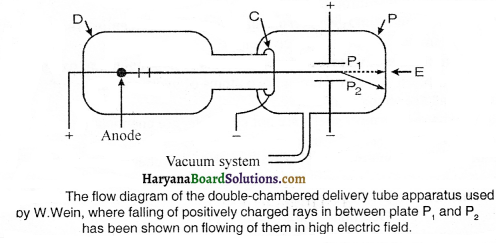
Why are canal rays called as positive charged rays ?
Answer:
Falling of the canal rays towards negative electrons in the electric field shows that these rays are jointly made up of positively charged particles.
HBSE 9th Class Science Important Questions Chapter 4 Structure of the Atom - 1

Question 2.
Write down the properties of canal rays.
Answer:
Following are the properties of canal rays:
(1) These rays move in a straight line.
(2) These rays are bent towards negative electrode in electric and magnetic field.
(3) They have mass many times more than the mass of electron.

Question 3.
Why are electrons called as planetary electrons in an atom ?
Answer:
In an atom, electrons revolve in their respective fixed large elliptical orbits just like planets in the sky revolve around the sun in their large elliptical orbits. Hence, electrons are called as planetary electrons.

Question 4.
Enunciate similarities and dissimilarities between protons and neutrons.
Answer:
Similarities between protons and neutrons:
(1) Mass of proton and neutron is approximately equal to a single atomic mass unit.
(2) Proton and neutron both exist in the nucleus of an atom.

Dissimilarities between protons and neutrons:
(1) Protons are positively charged particles, whereas neutrons are neutral particles.
(2) The mass of a neutron is somewhat more than that of the mass of a proton.

Question 5.
Write down the difference between electron and neutron.
Answer:
Following is the difference between electron and neutron.

Electron:
1. Electron possesses negative (-ve) charge.
2. They revolve around in different orbits outside the nucleus.
3. Their mass is the 1/2000th part by mass of a hydrogen atom.

Neutron:
1. Neutron possesses negligible charge.
2. They remain inside the nucleus.
3. Their mass is almost the same to that of the mass of an atom of hydrogen.

Question 6.
Write down the difference between electron and proton.
Answer:
Following is the difference between electron and proton :
Electron:
1. They possess unit (-ve) charge on them.
2. Their mass is l/’2000th part mass of an atom of hydrogen.
3. They revolve around in their respective orbits outside the nucleus.

Proton:
1. They possess unit (+ve) charge on them.
2. Their mass is almost the same to that of the mass of an atom of hydrogen.
3. They remain in the nucleus.

HBSE 9th Class Science Important Questions Chapter 4 Structure of the Atom

Question 7.
Explain the essential properties of the atomic nucleus.
Answer:
The essential properties of the atomic nucleus are as follows:
(1) The size of the atomic nucleus is 105 times smaller than the size of the atom itself i.e., its size is 10-5A or 10-15 m.
(2) Atomic nucleus is positively charged.
(3) Absolute mass of the atom remains to withstand into the nucleus.
(4) Most of the space around the atomic nucleus remains unoccupied.

Question 8.
Compare the properties of atomic nuclei and electron.
Answer:
The comparison of properties of atomic nucleus and electron is as follows:

Atomic Nucleus:
1. It possesses +ve charge on it.
2. It is situated in the central part.
3. Its mass is almost equal to that of the mass of the atom.

Electron:
1. It possesses (-ve) charge on it.
2. It revolves around the nucleus.
3. Its mass is l/2000th part mass of hydrogen atom.

Question 9.
What are the fundamental contributions of E. Rutherford to understand the structure of atom ?
Answer:
To understand the structure of atom, E. Rutherford gave a model of atom, according to which electrons were assumed revolving around the nucleus in their pre-planned orbits, it was just like as the planets in our solar system revolve around the sun in their fixed orbits. Besides, he told that the absolute mass of atom lies in its 4vely charged nucleus which is of the size 10-15 m .

Question 10.
Is the number of electrons in different shells of an atom constant or inconstant ? Illustrate with examples.
Answer:
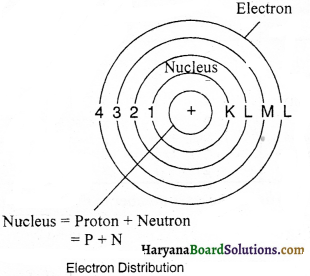
The number of electrons in different shells of an atom is constant. The distribution of electrons in different shells is done on the basis of Quantum Equation i.e., 2n2; where n indicates the serial number of the orbit like:

QuantumOrbitMaximum electron
1K2 x 12 = 2
0L2 x 22 = 8
3M2 x 32 = 18
4N2 x 42 = 32

HBSE 9th Class Science Important Questions Chapter 4 Structure of the Atom - 2

This distribution of electrons was conceived by Bohr and Bury. According to them, the valence shell (outermost shell) cannot accommodate more than eight electrons and second last shell cannot accommodate more than 18 electrons.

Example:
Hydrogen has only single orbit where only 1 electron is there. 2 electrons of helium revolve in the first orbit. Lithium has 3 electrons out of which the third electron enters the second shell. Similarly in the atom of calcium there are 20 electrons out of which in the first shell there are 2, in the second and third orbit 8-8 and in the fourth shell there are 2 electrons.

HBSE 9th Class Science Important Questions Chapter 4 Structure of the Atom

Question 11.
Define valency. How is it related to atomic structure?
Answer:
Valency:
Valency of an atom is the number of valence electrons, whereas valence electrons are the electrons of the valence shell of any atom. The valency of an element and the valency of the electrons present in its outermost shell have the following relationship :
(1) The elements that have 1-4 electrons in their valence shells, their valency is equal to that of the electrons present in the valence shell.

(2) The elements that have 5-8 electrons in their valence shells, their valency is equal to the (8-electrons existing) outermost shell of the element.

(3) In the valence shell of helium, due to two electrons, its outermost shell gets filled up completely, that is why the valency of helium is zero. Similarly, the valency of other active gases is zero because the outermost shells get accommodated.

Normally, valency of metals = number of electrons present in the outermost shell and valency of non-metals = 8- number of electrons present in the outermost shell. Therefore, we can say that valency is related to the atomic structure, since the valency of electrons present in the valence shell is known only by atomic structure.

Question 12.
What are valence electrons? How many valence electrons are there in Mg and Al ?
Answer:
Valence electrons present in the outermost orbit are known as valence electrons.
The atomic serial number of Mg and A1 is 12 and 13 respectively. Their electronic configuration is:
Mg – 2,8,2
Al – 2,8,3
Therefore, we come to know that the number of valence electrons in Mg and Al is 2 and 3 respectively.

Question 13.
Describe the distribution of electrons in different orbits of the following atoms : lithium, nitrogen, neon, magnesium and silicon.
Answer:

ElementAtomic numberDistribution of Electrons in different shells
NKLM
Lithium (Li)321
Nitrogen (N)725
Neon (Ne)1028
Magnesium (Mg)12282
Silicon (Si)14284

Question 14.
In the given hint 2040Ca , write down the mass number of calcium, atomic number, electronic configuration and atomic structure.
Answer:
Mass number = 40
Atomic number = 20
Electronic configuration = 2, 8, 8,2

Structure of nucleus :
Number of protons = 20
Number of neutrons = 40 – 20 = 20

HBSE 9th Class Science Important Questions Chapter 4 Structure of the Atom

Question 15.
How many of the following are protons and neutrons ?
14N7 14C6 15P15
Answer:
(1) 14N7
Atomic mass = 14
Atomic number = 7
Number of protons = 7
Number of neutrons = Atomic mass – atomic number = 14 – 7 = 7

(2) 14C6
Atomic mass = 14
Atomic number = 6
Number of protons = 6
Number of neutrons = Atomic mass – atomic number
= 14 – 6 = 8

(3) 15P15
Atomic mass = 31
Atomic number = 15
Number of protons = 15
Number of neutrons = Atomic mass – atomic number
= 31 – 15 = 16

Question 16.
Explain the chemical neutrality and chemical reactivity of atom.
Answer:
The chemical properties of an atom depend upon the schematic system of setting up of electrons in it. When the valence shell of an atom of an element gets filled up completely, then that element does not participate in chemical reaction, that is, such an atom is chemically neutral, for example neon, argon, etc. When the outermost shell of an atom of any element is not completely filled up, then such an atom is chemically reactive. The law of chemical reactivity depends upon the distribution system of electrons.

Question 17.
Why are inert or inactive gases behaviourally inactive?
Answer:
The valence shell in inert gases remains filled up completely. In helium, being the first orbit it gets completed due to two electrons. In rest of the inert gases it gets filled up with 8 electrons. Thereby, the electronic configuration of inert gases used to be stable. The cause of neutrality of these elements is the difficulty of entrance or exit of the electrons. It needs more energy to out electrons out of them more on so they also do not have the efficiency of acquiring electrons.

Question 18.
Boron has two isotopes 5B10 (19%) and 5B11 (81%). Find average atomic weight for Boron.
Answer:
Average atomic mass of Boron atom = [10 x \(\frac {19}{100}\) + 11 x \(\frac {81}{100}\) ]
= \(\left[\frac{190}{100}+\frac{891}{100}\right]\) = [1.90 + 8.91] = 10.81 = 11

Essay Type Questions

Question 1.
Who discovered the nucleus of atom and how ?
Answer:
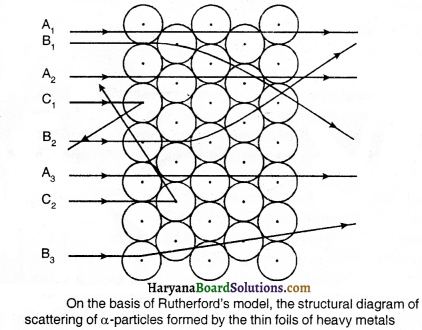
The nucleus of atom was discovered by Ernest Rutherford by experimenting with the scattering of alpha particles.
HBSE 9th Class Science Important Questions Chapter 4 Structure of the Atom - 3
In this experiment, Rutherford happened to bombard a high speed stream of alpha particles on a thin foil of gold and he found that after striking the gold leaf, the alpha particles generally deflect from their path by an angle of 1°. One of the smallest parts of the alpha particles get scattered by a larger angular deflecting and come back after getting deflected very little.

It is a general fact that alpha particles are too much energetic particles. Their deflection of forming of bigger angle shows that they had hit against the total mass of atom of the substance. On the basis of this demonstration, he concluded that:

(i) The central part of the atom i. e., the nucleus is solid and has positive charge. The nucleus possesses approximately the total mass of the atom.
(ii) This central part of atom has a very’ small size as compared to the atom itself.

HBSE 9th Class Science Important Questions Chapter 4 Structure of the Atom

Question 2.
What new concept was introduced in Neils Bohr model of an atom by him ?
Answer:
Neils Bohr proposed a model of atom in 1912 A.D., which was basically based upon the new concept. These concepts are:
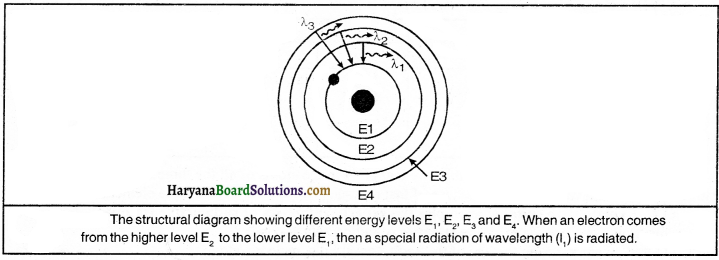
HBSE 9th Class Science Important Questions Chapter 4 Structure of the Atom - 4
(1) Electrons revolve around the nucleus in fixed orbits and each orbit has a different radius.
(2) Each orbit does have its definite energy. Accordingly, the orbit located near the nucleus possesses the least energy and the orbit situated farthest from the nucleus possesses the maximum energy.
(3) When an electron moves to the orbit of a lower energy level from the higher energy level, then the difference of energy is emitted in the form of electromagnetic radiation or in the form of light.
(4) All around the nucleus to fill up the different orbits or shells the number of electrons does have a definite number.
(5) Electrons can constantly revolve in a stable orbit in the form of electromagnetic waves without radiating energy.
(6) If energy is propagated to the electron with a definite energy level, it can enter the orbit with a higher energy level.

Question 3.
What are the similarities in the electronic configuration of the following atoms?
(i) Lithium, Sodium, Potassium
(ii) Helium, Neon, Argon
(iii) Beryllium, Magnesium and Calcium.
Answer:
(i) Lithium, Sodium, Potassium:

ElementAtomic NumberElectron Distribution
KLMN
Lithium321
Sodium11281
Potassium192881

In the above electron distribution, we learn that there is only one or single electron in the valence shell of all the three atoms of the elements i.e. Lithium, Sodium and Potassium due to that reason the valency of all these elements is the same.

(ii) Helium, Neon, and Argon:

ElementAtomic NumberElectron Distribution
KLMN
Helium22
Neon1028
Argon182-88

From the above electron distribution, it is learned that the valence shells (outermost shells) of the atoms of all the three elements i.e., Helium, Neon and Argon are completely filled up, due to that reason their valency is zero or all these elements are inert or inactive.

(iii) Beryllium, Magnesium and Calcium:

ElementAtomic NumberElectron Distribution
KLMN
Beryllium422
Magnesium12282
Calcium202882

From the above electron distribution we learn that in the atoms of all three elements, there are two electrons in the valence shell. Because of that reason, all the valency of all these elements is 2.

Question 4.
Explain with suitable examples the experimental uses of radioactive isotopes.
Answer:
Following are the experimental uses of radioactive isotopes :
(1) It can help in fixing the age of the earth, rocks, hills, meteors, etc.
(2) It can be used to find the thickness of paper, glass, plastic, etc.
(3) It can be used in finding out the cracks and crevices in the pipes.
(4) It helps in knowing the wear and tear in the machines.
(5) Isotopes are used in the treatment of different diseases in the medical field; e.g., CO-60 for curing cancer; isotope of iodine for curing thyroid, isotope of phosphorus for leukemia (blood cancer), etc.
(6) The radiations emitted through the radioactive isotopes are used in the form of high disease resistance in growing crops like wheat, paddy and groundnut (peanut).
(7) Isotopes are used in reforming fertilizers.
(8) Isotope Fe-59 is used to examine anemia

HBSE 9th Class Science Important Questions Chapter 4 Structure of the Atom

Question 5.
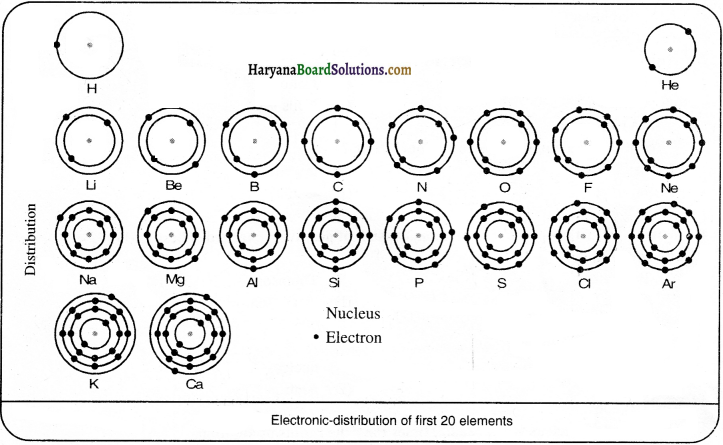
Show the electronic distribution of the first 20 elements in the Periodic Table.
Answer:
The electronic distribution of the first 20 elements in the periodic table is:

AtomHintNumber of ElectronsArrangement of electrons in orbitsDistribution of electronsValency
HydrogenH11 in the first orbit11
HeliumHe22 in the first orbit22
LithiumLi32 in the first orbit + 1 in the second orbit2, 11
BeryliumBe42 in the first orbit + 2 in the second orbit2,22
BoronB52 in the first orbit + 3 in the second orbit2, 33
CarbonC62 in the first orbit + 4 in the second orbit2,44
NitrogenN72 in the first orbit + 5 in the second orbit2,53
Oxygen082 in the first orbit + 6 in the second orbit2, 62
FluorineF92 in the first orbit + 7 in the second orbit2,71
NeonNe102 in the first orbit + 8 in the second orbit2,80
SodiumNa112 in the first orbit + 8 in the second orbit+ 1 in the third orbit2, 8, 11
MagnesiumMg122 in the first orbit + 8 in the second orbit + 2 in the third orbit2, 8,22, 8,3
AluminiumAl132 in the first orbit + 8 in the second orbit + 3 in the third orbit2, 8,32, 8,4
SiliconSi142 in the first orbit + 8 in the second orbit + 4 in the third orbit2, 8,42,8,5
PhosphorusP152 in the first orbit + 8 in the second orbit + 5 in the third orbit2,8,52, 8,6
Sulphurs162 in the first orbit + 8 in the second orbit + 6 in the third orbit2, 8,62, 8,7
ChlorineCl172 in the first orbit + 8 in the second orbit + 7 in the third orbit2, 8,72, 8, 8
ArgonAr182 in the first orbit + 8 in the second orbit + 8 in the third orbit2, 8, 82, 8, 8, 1
PotassiumK192 in the first orbit + 8 in the second orbit+ 8 in the third orbit + 1 in the fourth orbit2, 8, 8, 12, 8, 8, 2
CalciumCa202 in the first orbit + 8 in the second orbit + 8 in the third orbit + 2 in the fourth orbit2, 8, 8, 22, 8,3

HBSE 9th Class Science Important Questions Chapter 4 Structure of the Atom - 5

Practical Work

Experiment 1:
Prove experimentally that when two bodies are rubbed against each other, charge is produced.

Procedure:
(1) Take a comb and rub it against the dry hair. Bring the comb near to the paper-bits. We notice the comb attracts the paper-bits to it. This proves that on rubbing two bodies against each other, a charge gets produced.

(2) Rub a glass rod with a silken cloth on bringing this glass rod near to the balloon, the balloon will get attracted to the charged glass rod. Thus, the experiment proves that on rubbing the glass rod against the silken cloth, the glass rod gets charged.

HBSE 9th Class Science Important Questions Chapter 4 Structure of the Atom

Experiment 2:
Explain with an experiment Rutherford’s scattering of alpha (a) particles.

Procedure:
To understand Rutherford’s scattering alpha (a ) particles experiment is performed in the open ground. Suppose a child is standing in front of a wall with their eyes shut. Now, ask him to throw some stones against the wall from at a short distance. On striking every stone against the wall, he will hear a sound.

If he repeats the activity ten times, he will hear the sound ten times. But if the child with his eyes shut throws the stones against a wall surrounded with barbed wire, most of the stones will not strike against that boundary and hence, no sound will be heard. As there is enough blank space in between the boundary, through which the stone escapes.

Quick Review of the Chapter

1. Which scientist discovered Canal Rays ?
(A) Dalton
(B) Li. Thomson
(C) E. Goldstein
(D) Neils Bohr
Answer:
(C) E. Goldstein

2. Which scientist discovered electrons ?
(A) Thomson
(B) Dalton
(C) Goldstein
(D) Neils Bohr
Answer:
(A) Thomson

3. When was J.J. Thomson awarded Nobel Prize ?
(A) in 1878
(B) in 1902
(C) in 1906
(D) in 1912
Answer:
(C) in 1906

4. Which scientist proposed that an atom consists of positively charged sphere and the electrons are embedded in it ?
(A) Rutherford
(B) Thomson
(C) Dalton
(D) Neils Bohr
Answer:
(B) Thomson

HBSE 9th Class Science Important Questions Chapter 4 Structure of the Atom

5. E. Rutherford discovered
(A) atom
(B) nucleus
(C) proton
(D) neutron
Answer:
(B) nucleus

6. The radius of nucleus is times than the radius of an atom.
(A) 105
(B) 104
(C) 103
(D) 102
Answer:
(A) 105

7. Which scientist told that when electrons revolve in discrete orbits, then energy ?
(A) Neils Bohr
(B) Rutherford
(C) Dalton
(D) Thomson
Answer:
(A) Neils Bohr

8. Who is the author of the book ‘Atomic Theory’ ?
(A) Rutherford
(B) Thomson
(C) Neils Bohr
(D) both (A) and (B)
Answer:
(C) Neils Bohr

9. Charge on nucleus of an atom is:
(A) zero charge
(B) negative charge
(C) positive charge
(D) no charge
Answer:
(C) positive charge

10. When was neutron discovered?
(A) in 1902
(B) in 1912
(C) in 1922
(D) in 1932
Answer:
(D) in 1932

11. Who discovered neutron?
(A) J. Chadwick
(B) J ,J. Thomson
(C) Neil Bohr
(D) None of the above
Answer:
(A) J. Chadwick

12. The characteristic of electron is not:
(A) uncharged
(B) mass same as proton
(C) found in nucleus
(D) it has negative charge
Answer:
(D) it has negative charge

13. The characteristic of electron is not:
(A) positively charged
(B) represents by e-
(C) negatively charged
(D) lightest particle
Answer:
(A) positively charged

HBSE 9th Class Science Important Questions Chapter 4 Structure of the Atom

14. The characteristic of proton is not:
(A) found in nucleus
(B) represents by p+
(C) mass 1 unit
(D) negatively charged
Answer:
(D) negatively charged

15. The first electron shell of an atom can have maximum electrons.
(A) 2
(B) 8
(C) 18
(D) 32
Answer:
(A) 2

16. The maximum number of electrons in third electron shell can be:
(A) 8
(B) 12
(C) 18
(D) 32
Answer:
(C) 18

17. The number of electrons in fourth electron shell can be:
(A) 8
(B) 18
(C) 32
(D) 2
Answer:
(C) 32

18. What will be the atomic number of an element having 6 electrons in its M shell?
(A) 8
(B) 16
(C) 24
(D) 34
Answer:
(B) 16

19. The number of electrons present in outermost shell of neon:
(A) 2
(B) 8
(C) 18
(D) 32
Answer:
(B) 8

HBSE 9th Class Science Important Questions Chapter 4 Structure of the Atom

20. Which of the following element is inert gas?
(A) neoft
(B) argon
(C) cripton
(D) all of the above
Answer:
(D) all of the above

21. The number of electrons present in the outermost shell of fluorine
(A) 2
(B) 5
(C) 7
(D) 17
Answer:
(C) 7

22. The number of electrons in electrons in outermost shell can be:
(A) 2
(B) 8
(C) 18
(D) 32
Answer:
(B) 8

23. What is the number of neutrons in hydrogen
(A) zero
(B) one
(C) two
(D) four
Answer:
(A) zero

24. Protium is an isotope of which element ?
(A) helium
(B) hydrogen
(C) lithium
(D) nitrogen
Answer:
(B) hydrogen

25. The symbol of tritium is:
(A) 11H
(B) 12H
(C) 13H
(D) 14H
Answer:
(C) 13H

HBSE 9th Class Science Important Questions Chapter 4 Structure of the Atom

26. Deuterium is an isotope of which element?
(A) uranium
(B) lithium
(C) helium
(D) hydrogen
Answer:
(D) hydrogen

27. …………. is used as fuel in atomic furnace.
(A) Lithium
(B) Helium
(C) Uranium
(D) Beryllium
Answer:
(C) Uranium

28. The isotope of which element is used in the treatment of cancer ?
(A) Cobalt
(B) Iodine
(C) Boron
(D) Chlorine
Answer:
(A) Cobalt

29. the isotope of iodine is used in the treatment of ……………. disease
(A) atomic nucleus
(B) electron
(C) proton
(D) neutron
Answer:
(A) atomic nucleus

30. If K and L shell of an atom are full, then the number of electrons in it will be:
(A) 16
(B) 8
(C) 17
(D) 18
Answer:
(D) 18

31. For Which invection is Rutherfords alpha scattering experement responsible?
(A) atomic nucleus
(B) electron
(C) proton
(D) neutron
Answer:
(A) atomic nucleus

HBSE 9th Class Science Important Questions Chapter 4 Structure of the Atom

32. The number of electrons in Cl ion is:
(A) 16
(B) 8
(C) 17
(D) 18
Answer:
(D) 18

33. Which is correct electronic configuration of sodium ?
(A) 2, 8
(B) 8, 2, 1
(C) 2,8,1
(D) 8,2
Answer:
(C) 2, 8, 1

34. The fundamental particle of an atom is not:
(A) electron
(B) positron
(C) proton
(D) neutron
Answer:
(B) positron

35. Which one of the following is a correct electronic configuration of chlorine?
(A) 2, 7, 8
(B) 2, 8, 7
(C) 7, 8, 2
(D) 1, 8, 8
Answer:
(B) 2, 8, 7

HBSE 9th Class Science Important Questions Chapter 4 Structure of the Atom Read More »
HBSE 9th Class Science Important Questions Chapter 9 Force and Laws of Motion

Haryana State Board HBSE 9th Class Science Important Questions Chapter 9 Force and Laws of Motion Important Questions and Answers.

Haryana Board 9th Class Science Important Questions Chapter 9 Force and Laws of Motion

Very Short-Answer Type Questions

Question 1.
Define force.
Answer:
Force is that external factor that changes or tends to change the position of rest or speed and direction of moving object.

Question 2.
What is balanced force?
Answer:
When two or more forces acting on a body have zero resultant, then such forces are called balanced force.

Question 3.
What is unbalanced force ?
Answer:
When the resultant of two or more forces is not zero, such forces are called unbalanced force.

Question 4.
Which force works when a rubber ball is pressed between palms ?
Answer:
It is an example of a balanced force.

Question 5.
Which scientist has established the laws to control the motion of objects firstly?
Answer:
Sir Isaac Newton.

Question 6.
What is the angle of inclination?
Answer:
The angle made by an inclined plane with horizontal is called the angle of inclination.

Question 7.
Define frictional force.
Answer:
It is the opposing force that comes between the two surfaces in contact when a body moves or tends to move on another body.

Question 8.
Write the effect of frictional force.
Answer:
Frictional force reduces the motion of body.

HBSE 9th Class Science Important Questions Chapter 9 Force and Laws of Motion

Question 9.
Why the bicycle stops when we stop pedaling?
Answer:
The frictional force between the tyre of the bicycle and road reduces its motion and stops the bicycle.

Question 10.
Why powder is spread on the carom board in carom game?
Answer:
The powder is spread on the carom board to reduce the frictional force between carom board and coin.

Question 11.
What is the law of conservation of momentum?
Answer:
According to law of conservation of momentum, in absence of any external force, the total momentum of a system remains conserved.

Question 12.
Write Newton’s second law of motion?
Answer:
The rate of change of momentum of an object is proportional to the applied unbalanced force in the direction of force. ‘

Question 13.
What is meant by momentum?
Answer:
The momentum of an object is the product of mass and velocity. It is denoted by p.
or p = mv

Question 14.
What is SI unit of momentum?
Answer:
Kilogram metre per second (kg ms-1).

Question 15.
Momentum is a scalar quantity or vector.
Answer:
Momentum is a vector quantity, because it has both magnitude and direction.

Question 16.
In which direction, the momentum works ?
Answer:
Momentum works in the direction of velocity.

Question 17.
What is the relation among force, mass and acceleration ?
Answer:
Force = Mass x Acceleration (F = ma)

HBSE 9th Class Science Important Questions Chapter 9 Force and Laws of Motion

Question 18.
What is the SI unit of force ?
Answer:
The SI unit of force is Newton.

Question 19.
Define one Newton force.
Answer:
One Newton force is that force which produces an acceleration of 1 ms-2 in a body of mass 1 kg.

Question 20.
What is negligible action ?
Answer:
When a body affects the other by applying force, then we say that there is negligible action between first and second body.

Question 21.
How many types of inertia is ?
Answer:
There is two types of inertia:
(i) Inertia of rest
(ii) Inertia of motion.

Question 22.
Write the concept of force on the basis of momentum.
F = \(\frac{p_2-p_l}{t_2-t_l}\)

Question 23.
How much force will be required to produce an acceleration of 2mS“2 in 6 kg object ?
Answer:
Force (F) = Mass (m) x Acceleration (a) = 6 x 2 = 12 N

Question 24.
A person pushes a box of 40 kg with a force of 80 N. What will be the acceleration of box ?
Answer:
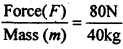
Acceleration (a) = HBSE 9th Class Science Important Questions Chapter 9 Force and Laws of Motion - 1 = 2 ms-2

Question 25.
Write Newton’s third law of motion.
Answer:
According to Newton’s third law of motion, “The action and reaction are always equal and in opposite direction.”

Question 26.
What is inertia ?
Answer:
That property of objects which opposes the change in its motion or state of rest is called inertia.

Question 27.
Is the existence of a single force is possible ?
Answer:
No, the existence of a single force is not possible. The force is always in pairs.

Question 28.
Which force offers us the motion in a desired direction ?
Answer:
The force which offers us the motion in a desired direction is the reaction of the earth opposite to the force applied by our body.

HBSE 9th Class Science Important Questions Chapter 9 Force and Laws of Motion

Question 29.
Are the action and reaction imposed on an object ?
Answer:
No, action and reaction (force) are imposed on two different objects.

Question 30.
Write the name of two forces which arise without the contact of two objects.
Answer:
(i) magnetic force
(ii) force of gravity.

Question 31.
How the fruit from tree falls towards the earth ?
Answer:
Due to force of gravity.

Question 32.
Why is it difficult to climb on a smooth pole ?
Answer:
Due to less reaction.

Question 33.
Why oil is used in machines ?
Answer:
To reduce the friction.

Question 34.
Why is it difficult to walk on sand ?
Answer:
Due to more friction between feet and sand.

Question 35.
Compare the frictional force between the surfaces of solids and liquids.
Answer:
The frictional force between the surfaces of liquids is much less than the frictional force between the surfaces of solids.

HBSE 9th Class Science Important Questions Chapter 9 Force and Laws of Motion

Question 36.
A small piece of stone and a truck are moving with same motion. On which, the larger force will be imposed to stop both of them ?
Answer:
The larger force will be required to stop the truck, because it will have large momentum.

Question 37.
By which force, we can walk on road without slipping.
Answer:
Due to frictional force, we can walk on road without slipping.

Question 38.
Why it becomes difficult to walk on a green mossy road in rainy season ?
Answer:
The frictional force becomes less on mossy road so it becomes difficult to walk on such a road.

Question 39.
Which Newton’s law of motion helps us in the measurement of force ?
Answer:
Newton’s second law of motion helps us in the measurement of force.

Question 40.
According to which Newton’s Law of motion, jet aeroplanes fly ?
Answer:
They fly according to Newton’s third law of motion.

Question 41.
Why the player runs before jump ?
Answer:
To increase the momentum so that the jump can be high.

Question 42.
Force is a scalar quantity or Vector.
Answer:
Force is a vector quantity.

Question 43.
What is the total momentum of rifle and bullet after firing from rifle ?
Answer:
Zero.

Question 44.
How much acceleration will be produced if 1 newton (N) force is applied on an object of 1 kg mass ?
Answer:
1 ms-2

HBSE 9th Class Science Important Questions Chapter 9 Force and Laws of Motion

Short-Answer Type Questions

Question 1.
What is meant by force ? What can be the effect on object by applying force on that ?
Answer:
Force is that external factor which changes or tends to change the position of rest or speed and direction of moving object.
Effects:
Following are the effects on body, when force is applied :
(i) Speed of object can be changed due to which the object moves fast or slow.
(ii) The direction of motion of object can be changed and can move body in rest.
(iii) Shape of the object can be changed.

Question 2.
Give five examples of force in daily life.
Answer:
Examples of force in daily life are as follows :
(i) When a force is applied on a rubber ball, it elongated. It is due to force.
(ii)When a spring is stretched, its length increases due to muscular force.
(iii) The steam gives its energy to steam engine due to that the steam engine moves forward.
(iv) A rolling ball can be stopped by muscular force.
(v) Petrol produces mechanical force by its energy, due to that bus, car etc. moves.

Question 3.
What is inclinded plane ? What are its uses ?
Answer:
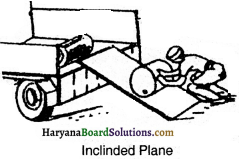
A smooth plane which makes an angle with horizontal plane is called inclinded plane, e.g. knife, axe, screw, hilly roads, stairs etc. A man lifting a heavy weight with the help of inclinded plane made of wooden piece is shown in below fi.
HBSE 9th Class Science Important Questions Chapter 9 Force and Laws of Motion - 2

Uses of inclinded plane:
The uses of inclinded plane are as follows:
(i) A heavy weight can be lifted by small force by using inclinded plane.
(ii) Heavy weight is loaded or unloaded in trucks by using it.
(iii) Screw also works on the principle of inclinded plane.

Question 4.
Distinguish between balanced and unbalanced forces.
Answer:
The difference between balanced and unbalanced forces are as follows :
Balanced Force Unbalanced Force
1. When balanced forces act together on a body, their resultant is zero.
2. The balanced force can’t move a body which is in rest position.
3. This force cannot change the speed and direction of moving body.
4. This force always changes the size of body.

1. When unbalanced forces act together on a body, their resultant is not zero.
2. The unbalanced force can move a body which is in rest position.
3. This force can change the speed and direction of a moving body.
4. This force does not always change the size of body.

Question 5.
What is meant by inertia ? Clarify by example.
Answer:
The property of bodies which opposes the change in motion of body or state of rest is called inertia.

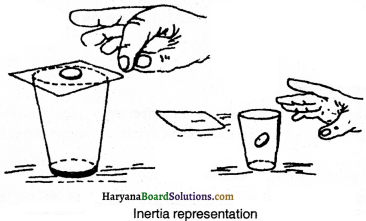
Experiment:
Set a coin on a stiff playing card covering an empty glass tumbler. Give the card a sharp horizontal flick with a finger. You will see the card moves ahead but the coin will fall in glass. When the card is shoot fast, then due to property of inertia, the coin tries to remain in rest position. In this way, when the card moves, the coin falls in glass.
HBSE 9th Class Science Important Questions Chapter 9 Force and Laws of Motion - 3

Question 6.
What are the types of inertia ? Explain with example.
Answer:
Inertia is of two types:
1. Intertia of rest: The property of body by which the body resists its rest position until an external force is not applied on it.
Example: A book on table does not move due to inertia of rest.

HBSE 9th Class Science Important Questions Chapter 9 Force and Laws of Motion

2. Inertia of motion: The property of body by which it resists its state of motion, until an external force is not applied on it.
Example: A passenger sitting in a bus or cart falls forward when the moving bus or cart stops suddenly. In such situation, the lower portion of body of passenger comes in rest as the bus or cart stops, but the upper portion tries to remain in motion, due to this passenger falls forward. –

Question 7.
What happens when a wet cloth is jerked ? Clarify your explanation.
Answer:
When we jerk the wet cloth, the cloth displaced from its position to inertia and they detached from cloth and escape in environment. Thus, the cloth dries fast.

Question 8.
In javelin throw, if a player crosses the fixed line, he fouls, but the playes usually fail to stop on this line, why ?
Answer:
When in javelin throw competition, a player runs and reaches the fixed line, his whole body comes in motion. When he tries to stop his feet on fixed line, the upper portion remains in motion due to inertia of motion and the player crosses the fixed line and fouls.

Question 9.
Why the rider falls backward when the horse starts running suddenly?
Answer:
The rider falls backward when the horse starts running suddenly because due to suddenly running the horse, it comes in motion but the rider tries to remain in rest due to inertia of rest and falls backward.

Question 10.
Why the rider falls forward when a running horse stops suddenly?
Answer:
The rider falls forward when a running horse stops suddenly because the horse and rider are in motion when it is running and when horse
stops suddenly it comes in rest but the rider tries to remain in motion due to inertia of motion and falls forward.

Question 11.
Why are the tyres of vehicles made rough and treaded ?
Answer:
The movement of vehicles is due to the frictional force between road and tyres. If their tyres are smooth then the friction will be less betw een road and tyre, so that it will be difficult to control the vehicle. In order to control vehicles, the tyres are made rough and treaded so that the friction between tyre and road increases and grip of tyres with road will be firm.

Question 12.
Define and explain Newton’s first law of motion.
Answer:
Newton’s first law of motion:
An object continuous to be a state of rest or of uniform motion along a straight line unless acted upon by an unbalanced force. This law is also known as “Galileo’s Law of Inertia.” e.g. a ball rolling on floor can move far due to less friction. If the friction reduces to zero by any mean, the ball will move with initial velocity for a certain time.

HBSE 9th Class Science Important Questions Chapter 9 Force and Laws of Motion

Question 13.
Prove that Newton’s first law of motion can be called the law of inertia.
Answer:
According to Newton’s first law of motion, an object continuous to be a state of rest or of uniform motion along a straight line unless acted upon by an unbalanced force. In other word, all objects oppose the change in their state of motion. This tendency of the objects to oppose the change in their state of motion is called inertia. Thus, Newton’s first law of motion is also called the law of inertia.

Question 14.
Prove that the mass of a body is the measure of its inertia.
Answer:
The quantity of matter in a body is its mass. In this way, the mass is the measure of inertia of body. A body having large mass has large inertia.

Explanation:
If we kick a football it moves so far. but if we kick a stone, it will not move and our foot gets wound, because in comparison of football, stone has larger capacity to oppose the change in motion due to its larger mass. The mass of a body is the measure of its inertia.Thus, the inertia of a stone is more.

Question 15.
Define and explain Newton’s second law of motion with the help of this law, obtain equation of force.
Answer:
Newton’s second law of motion : The force applied on a body is proportional to the product of its mass and acceleration. If we kick a ball, it will move quickly because its acceleration becomes more. In this way, a cricketer stops a moving ball slowly, so that the change in motion of ball takes much time. He moves his hands in the direction of ball and the acceleration of ball becomes less in comparison of initial and less force is required to stop the ball. Let us consider a body has mass m and a force F produces an acceleration a in it. According to Newton’s second law of motion,
F ∝ m x a
or F = K ma ………..(i)
here, K , is a constant, whose value depends upon the units of mass, force and acceleration.
Let m = 1 kg, a = 1 m s-2 and f = 1 N
then, putting the value of F, m and a in eQuestion (i)
1 = K x 1 x 1
or K = 1
F = 1 x ma
Force = Mass x Acceleration

Question 16.
Define and explain Newton’s third law of motion.
Answer:
Newton’s third law of motion:
To every action, there is an equal and opposite reaction and they act on two different bodies. Action and reaction are equal and in opposite direction.

For example:
(i) A ball presses the earth with a force, the earth pushes the ball upwards with same force.
(ii) When a person swims, he pushes the water backward, he moves forward, by this reaction.

HBSE 9th Class Science Important Questions Chapter 9 Force and Laws of Motion

Question 17.
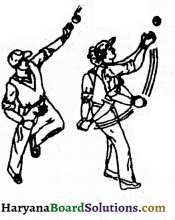
Explain why does cricket player pulls his hands backward while catching a fast moving cricket ball ?
Answer:
The momentum of moving ball is more. When player catches the ball, he pulls his hands backward so that momentum of ball takes some time to become zero. In this way, momentum of ball, rate of change and the force applied on hand will become less and there is no hurt on hands.
HBSE 9th Class Science Important Questions Chapter 9 Force and Laws of Motion - 4

Question 18.
Why larger force is required to stop a ship than car moving on road ?
Answer:
The frictional force between the tyres of car and road is more. Therefore the car stops quickly by applying lesser force. The frictional force between the surfaces of liquids is much less than the frictional force between the surfaces of solids. Due to this reason, the ship experiences less friction in water. Thus, larger force is required to stop a ship than car.

Question 19.
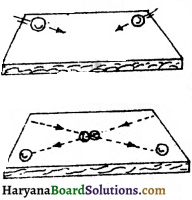
When there is negligible reaction between two bodies how the direction changes when two moving objects strike? Clarify with figure.
Answer:
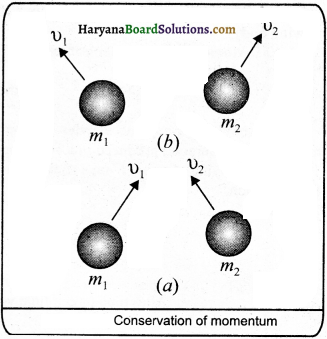
When there is negligible reaction between two bodies, one body affects the other by force. The collision between two marbles is an example of negligible reaction. In figure two marbles are shown moving towards each-other. The direction of their motion is shown by arrow. It is clear from figure that the direction of marble changes after collision. Two forces act in this action. One is that which has accelerated one marble and second is that which has accelerated the other marble.
HBSE 9th Class Science Important Questions Chapter 9 Force and Laws of Motion - 5

Question 20.
What is meant by action and reaction ? What is the relation between them ? In which law of motion, these are described ?
Answer:
If a body applies some force on other, then it is the active force on other body. In response, the force which second body applied on first is the reactive force on first body. The relation between action and reaction : The force of action and reaction are equal and in opposite directions. An important fact is that the force of action and reaction always act on different bodies. These are described in third law of motion.

Question 21.
Give some examples of Newton’s third law of motion in daily life.
Answer:
Following are the examples of Newton’s third law of motion :
(i) The bullet moves forward when trigger is pressed and due to reaction force, the gun recoils backward.
(ii) The person pushes the water backward while swimming and moves forward due to tne reaction or
water.
(iii) When a person jumps from boat at river-shore, the boat displaced far from shore due to reaction of water on that.
(iv) We press the earth backward while walking and
due to force of reaction the earth pushes our feet forward and we move. .
(v) The ores push the water backward and due to reaction, the boat move forward.
(vi) When a player jumps up, he pushes the surface of earth downward, so that he gets reaction.
HBSE 9th Class Science Important Questions Chapter 9 Force and Laws of Motion - 6

Question 22.
Why the boat moves in opposite direction when a person jumps to shore from the boat ? Explain.
Answer:
A person applies force in upward to get the necessary motion at the time of jumping from boat. His reaction is on boat, which according to Newton’s third law of motion is in opposite direction. As a result of this, the boat move far on opposite direction.

HBSE 9th Class Science Important Questions Chapter 9 Force and Laws of Motion

Question 23.
Explain in brief, the relation between Newton’s first and second law of motion.
Answer:
The Newton’s first law of motion is the part of second law. It can be clarify on the basis of following fact:
According to second law of motion,
F = m a
if F = 0, then
m a = 0 m = 0,
a = 0
But mass, m cannot be zero, because it is a constant quantity. So, if acceleration a is zero, the change in velocity will also be zero. Therefore, there is no change in the position of body. If it is in rest, it will remain in rest, and if it is in motion, it will remain in motion unless external force is not applied. This is the statement of Newton’s first law of motion. Thus Netwon’s first law of motion is the part of second law.

Question 24.
What is the reason that a fast moving bullet makes a round hole in glass but on throwing the stone, the glass damages ?
Answer:
The size of bullet is small and that of stone is big so that the glass does not move when bullet is striked, only that part move where the bullet is striked and makes a hole, but there is no hole when stone is striked because whole glass moves and damaged.

Numerical Questions

Question 1.
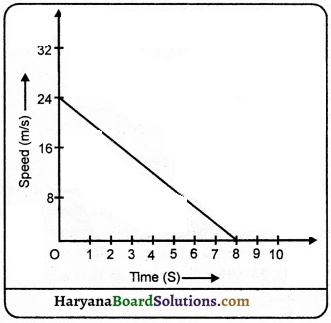
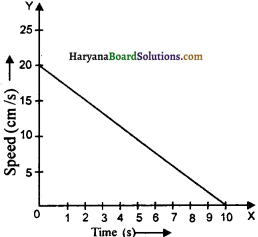
Speed-time graph of a moving coin on table is shown in fig. . The weight of coin is 10 g.
How much force the table exerts to stop the coin?
Solution:
Here,
Initial velocity (u) = 24 ms-1
Final velocity (v) = 0 ms-1
Time (r) = 8 sec
Mass (m) = 10g = \(\frac {10}{1000}\) kg
HBSE 9th Class Science Important Questions Chapter 9 Force and Laws of Motion - 7
We know that,
Acceleration (a) = \(\frac{v-u}{t}=\frac{0-24}{8}\) = \(\frac {-24}{8}\) = -3 ms-2
∴ Force(F) = m.a
\(\left(\frac{10}{1000} \times-3\right)\) N
= – 0.03 N
(- ve sign shows that force decreases the motion.)

Question 2.
A cricket ball of mass 70g is moving with a velocity of 0.5 ms-1. A cricket player stops it in 0.5 s. Calculate the force applied by the player to stop
the ball.
Solution:
Mass of the ball (m) 70g =\(\frac {70}{1000}\)= 0.07 kg
Initial velocity of ball (u) = 0.5 ms-1
Final velocity of ball (v) = 0
The time taken to stop the ball, (t) = 0.5s
We know that, v = u + at
a = \(\frac{v-u}{t}=\frac{0-0.5}{0.5}=\frac{-0.5}{0.5}\) = -1 ms-2
Thus, the force applied by the player to stop the ball
(F) = ma
= 0.07 x -1N = -0.07 N
(-ve sign shows that force is working against momentum.)

Question 3.
How much acceleration will be produced in the object ¡fa force of 200 N is applied on an object of 5 kg mass?
Solution: Here,
Mass(m) = 5kg
Force (F) = 200N
Acceleration (a) = ?
We know that, F = ma
a = \(\frac{F}{m}=\frac{200}{5}\) = 40 ms-2

HBSE 9th Class Science Important Questions Chapter 9 Force and Laws of Motion

Question 4.
A constant force is working on an object of 5 kg mass for 2 seconds. It increases the velocity of object from 3ms1 to 7ms-1. Calculate the value of applied force. Now, what will be the final velocity if the force works for 5 seconds on object?
Solution:
Here,
Mass of object (m) = 5 kg
Initial velocity of object (u) = 3 ms-1
Final velocity of object (v) = 7 ms-1
Time (t) = 2s
Acceleration (a) = ?
We know that.
a = \(\frac{v-u}{t}=\frac{7-3}{2}\)ms-2 = \(\frac {4}{2}\) = 2 ms-2
The force applied on object (F) = ma
= 5 x 2 = 10 N

In second stage,
Initial velocity of object (u) = 3 ms-1
Final velocity of object (v) = ?
Time (t) = 5s
Acceleration (a) = 2 ms-2
We know that,
v = u + a = 3 + 2 x 5 = 13 ms-1

Question 5.
How much force is required to stop a car of mass 1000 kg and a loaded truck of mass 10,000 kg moving both with a velocity of 5ms in 2 seconds?
Solution:
Here.
Initial velocity of both (u) = 5ms
Final velocity of both (v) = O
time (t) = 2 s
Acceleration (a) = ?
We know that, v = u + at
a = \(\frac{v-u}{t}=\frac{0-5}{2}=\frac{-5}{2}\) = ms-1

Mass of the car (m1) = 1000 kg
Mass of the truck (m2) = 10,000 kg
The necessary force to stop the car (F1) = m1 a
= 1000 x \(\frac {-5}{2}\) N
= – 2500 N
Thus, necessary force to stop the car = – 2500 N
(-ve sign shows that force is working against momentum.)
In same way, the necessary force to stop the truck (F2) = m2 a
= 10000 x \(\frac {-5}{2}\)N
= – 25000 N
Therefore, the necessary force required to stop the truck is more than that of car.

HBSE 9th Class Science Important Questions Chapter 9 Force and Laws of Motion

Question 6.
Which will require more force – to accelerate a body of mass 2 kg with a rate of 5 ms-2 or to accelerate a both of mass 4kg with a rate of 2 m-2?
Solution:
Here,
m1 = 2kg
a1 = 5 ms-2
Force (F1) = m1a1 = 2 x 5 = 10 N
m2 = 4 kg
a2 = 2 ms-2
Force(F2) = m2a2 = 4 x 2 = 8N
In this way F1> F2
∴ Large force will required to accelerate the object of 2 kg mass with a velocity of 5 ms-2

Question 7.
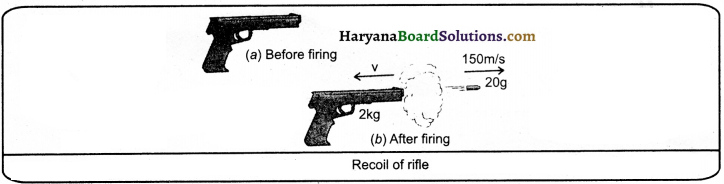
A bullet of mass 20 g is horizontally fired with a velocity of 150 ms from a pistol of mass 2 kg. What is the recoil velocity of the pistol?
Solution:
Mass of bullet, m1 = 20 g ( = 0.02 kg)
Mass of pistol. m2 = 2 kg
The initial velocity of bullet (u1) and pistol (u2) is zero, respeciively.
That is u1 = u2 = 0
Final velocity of bullet, v1 = + 150 ms-1
The direction of bullet is taken + ve according to left to right system. Suppose, recoil velocity of pistol is v.
Total momentum of bullet and pistol before firing = (2 + 0.02) kg x o ms-1
= 0 kg ms-1
Total momentum after firing = 0.02 kg x (+ 150 ms-1) + 2 kg x v ms-1
= (3 + 2v)kg ms-1
According to the law of conservation of momentum,
Total momentum after firing = Total momentum before firing
3 + 2v = 0
2v = -3
v = \(\frac {-3}{2}\)
v = -1.5 ms-1
(-ve sign shows that the pistol recoils opposite to the direction of bullet i.e. right lo left.)
HBSE 9th Class Science Important Questions Chapter 9 Force and Laws of Motion - 8

Question 8.
A coin is moving with a velocity of 24 cm s rolls with an acceleration of 3 cm2 and stops in 8 s. Find the distance covered by the coin.
Solution:
Here,
Initial velocity (u) = 24 cm s
Final velocity (v) = 0
Acceleration (a) = – 3 cm s2
Time (t) = 8s
Distance (s) = ?
We know that, Distance (s) = ut + \(\frac {1}{2}\) at
= 24 x 8 + \(\frac {1}{2}\) x (-3) x (8)2
= 192 – 96
= 96 cm

HBSE 9th Class Science Important Questions Chapter 9 Force and Laws of Motion

Question 9.
In which the more force will require-to produce an acceleration of 5 ms in mass 10 g or to produce an acceleration of 2 ms2 in mass 20 g?
Solution:
In first stage, Mass (m) = 10 g = \(\frac {10}{1000}\) kg
Acceleration (a) = 5 ms-2
The necessary force (F) = m x a
= \(\frac {10}{1000}\) x 5
= 0.05 N
In second stage, Mass (m) = 20 g = \(\frac {20}{1000}\) kg
Acceleration (a) = 2 ms-2
The necessary force (F) = m x a = \(\frac {20}{1000}\) x 2 = 0.04N
Thus, larger force will be required to produce an acceleration of 5 ms2 in an object of mass 10 g. Answer:

Question 10.
A bullet of mass 20 g moving with a velocity of 16 ms-1 enters ¡n a sand bag and comes in rest after 0.05 s. Find,
(a) depth of penetration ¡n sand
(b) the average resistive force applied by sand.
Solution:
Here,
(a) Initial velocity (u) = 16 ms-1
Final velocity (v) = 0
Time (t) = 0.05 s
Distance (s) = ?
Average resistive force (F) = ?

We know that,
Acceleration (a) = \(\frac{v-u}{t}=\frac{0-16}{0.05}\) = 0.05
= \(\frac{v-u}{t}=\frac{0-16}{0.05}\)
= \(\frac{-16 \times 100}{5}\) = – 320 ms-2
s = ut + \(\frac {1}{2}\) at2
= 16 x 0.05 + \(\frac {1}{2}\) x (-320) x (0.05)2
or s = 0.8 – 0.4 = 0.4m
(b) Mass (m) = 20 g = \(\frac {20}{1000}\) kg
Average resistive force (F) = m x a = \(\frac {20}{1000}\) x -320 = -6.4 N

Question 11.
How much will be the change in momentum of an object of mass 5kg, If Its speed:
(i) reduces from 20 ms-1 to 0.20 ms-1
(ii) Increases from 30 ms1 to 40 ms-1.
Solution:
Here,
Mass of the body (m) = 5kg
Initial velocity (u) = 20 ms1
Final velocity (v) = 0.20 ms1
Initial momentum (p1) = m x u = 5 x 20 = 100 kg ms-1
Final momentum (P2) = m x v = 5 x 0.20 = 1.00 kg ms-1
Thus, decrease in momentum = p1 – p2 = 100 – 1 = 99 kg ms-1
Initial velocity (u) = 30 ms1
Final velocity (v) = 40 ms1
initial momentum (p1) = m x v = 5 x 30 = 150 kg ms-1
Final momentum (p2) = m x v = 5 x 40 = 200 kg ms-1
Thus, increase in momentum = 200 – 150 = 50 kg ms-1

Question 12.
A driver accelerates a car In first stage with 1.8 ms-2 and in second stage with 1.2 ms-2 acceleration. Find the ratio of forces applied by engine in both stages.
Solution:
Let,
The mass of car = m kg
Acceleration in first stage = (a1) = 1.8 ms-2
∴Force in first stage (F1) = m x a1 = m x 1.8m = 1.8 m N
Acceleration in second stage (a2) = 1.2 ms-2
∴Force in first stage (F2) = m x a2 = m x 1.2 = 1.2m N
\(\frac{F_1}{F_2}=\frac{1.8 \mathrm{~m}}{1.2 \mathrm{~m}}=\frac{18}{12}=\frac{3}{2}\)
F1:F2 = 3:2

HBSE 9th Class Science Important Questions Chapter 9 Force and Laws of Motion

Question 13.
On applying a force for 1.2 s on an object, its speed increases from 1.8 ms-1 to 4.2 ms-1. The same force is applied for 2 s again. How much change in speed will be in 2s?
Solution:
Initial velocity in first stage (u) = 1.8 ms-1
Final velocity (v) = 4.2 ms-1
Time (t) = 1.2 s
According to formula, v = u + at
or u + at = v
1.8 + a x 1.2 = 4.2
or 1.2a = 4.2 – 1.8
or 1.2a = 2.4
or a = \(\frac {2.4}{1.2}\) = 2 ms-1
∴ Acceleration = 2 ms-2
initial velocity in second stage (u) = 4.2 ms
Time (t) = 2s
Acceleration (a) = 2 ms2
Final velocity (v) = u + at = 4.2 + 2 x 2 = v = 4.2 + 4 = v = 8.2 ms-1
Thus, change in speed in 2s = 8.2 – 4.2 = 4 ms-1

Do Yourself

(1) How much force will require to produce an acceleration of 2ms2 in an object of mass 12 kg? What
will be the acceleration, if force is doubled?
Answer:
24N, 4 ms-2

(2)Aperson pushes a box of mass 50kg by a force of 80 N. What will be the acceleration of box ? What will be the acceleration of box if its mass is reduced to half?
Answer:
1.6 ms-2, 3.2 ms-2
(3) A motorcycle is moving with a velocity of 90 kmh1 and on applying brakes, stops in 5s. Calculate the force applied by brake on motorcycle, if its mass including driver is 200 kg.
Answer:
1000 N

(4) A rifle of mass 3 kg fires a bullet of mass 0.03 kg. The bullet leaves the barrel of the rifle at a velocity of 100 ms. ¡f the bullet takes 0.003 second to move through the barrel, calculate the force experienced by the rifle due to its recoil.
Answer:
1000 N

HBSE 9th Class Science Important Questions Chapter 9 Force and Laws of Motion

(5) Calculate that force which offers a velocity of 30 ms in lOs to a car, if the mass of car is 1500 kg.
Answer:
4500 N

(6) A car starts from rest and moves for 2 minutes with an uniform acceleration of 0.1 ms2. Calculate the distance covered by the car.
Answer:
720 m

(7) Calculate that force which will produce an acceleration of 0.40 ms-2 in a toy car of mass 0.25 kg.
Answer:
0.1N

(8) An object is dropped froma height of 20 metres. 1f g = 10 ms-2 then, calculate the velocity when it strikes to earth. Find the time taken to fall from that height.
Answer:
20 ms-1, 2s

(9) The velocity-time graph of a ball of mass 20 g moving in straight line on a long table is giyen in figure. How much force will be table offer to ball to take it in rest?
HBSE 9th Class Science Important Questions Chapter 9 Force and Laws of Motion - 9
Answer:
0.0004 N

(10) A bullet of mass 10 g leaves the barrel with a velocity of 300 ms1 in 0.0035 s. How much force was exerted by the rifle on bullet?
Answer:
857.14 NJ

(11) A car is moving with a speed of 108 kmh1 and takes 4s to stop after applying brakes. Calculate the force on car after applying brakes. Total mass of car including passengers, is 1000 kg.
Answer:
750 N

(12) A force of SN produces an acceleration of 10 ms-2 in mass m1 and 20 ms-2 in mass ms-2. What will be the acceleration produced by this force, if both the masses are combined?
Answer:
6.67 ms-2
(13)A resultant force of 15 N is applied on an object kept on a frictionless horizontal plane produces an acceleration of 5 ms-2. Find the mass of object.
Answer:
3kg

(14) On applying a force of 5 N on mass in1, an acceleration of 8 ms2 is produced and by applying same force on mass ms-2, produces an acceleration of 24 ms-2 . How much acceleration will be produced by in combined mass by this force. 1f both masses becomes one by tieing?
Answer:
6 ms-2

HBSE 9th Class Science Important Questions Chapter 9 Force and Laws of Motion

(15) Two hockey players of opposite teams, while trying to hit a hockey ball in the ground collide and immediately get entangled. One has a mass of 60 kg and is moving with a velocity of 5 ms-2 while the other has a mass of 55 kg and is moving faster with a velocity of 6 ms towards the first player. In which direction and with what velocity will they move after they get entangled ? Assume the frictional force between the feet of the two players and the ground is negligible.
Answer:
Right to left and with velocity of 0.26 ms

Essay Type Questions

Question 1.
How Galileo proved that the object will move with a ceaseless speed if a balanced force is not applied on that object?
Answer:
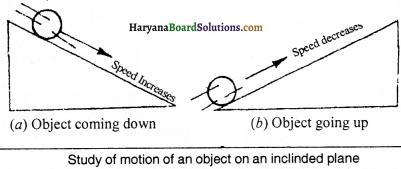
On the basis of experiments written ahead, Galileo first of all told that the object will move with a ceaseless speed if a balanced force is not applied on that object. Galileo studied the motion of objects on a double inclined plane. He observed that velocity of a body increases when it rolls down the inclined plane and decreases when it climbs upon as shown in fig.
HBSE 9th Class Science Important Questions Chapter 9 Force and Laws of Motion - 10
Thus, he concluded that if the body moves on smooth plane then its speed neither increases nor decreases but its speed will remain ceaseless.
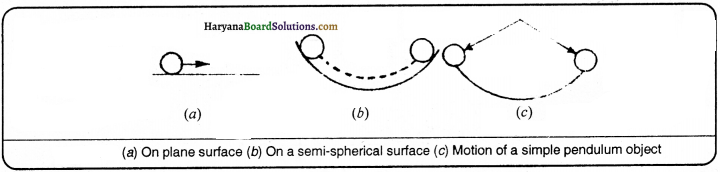
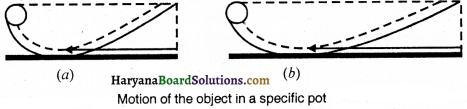
Now, he imagine that if a ball is allowed to go down by touching a hollow semi-spherical surface, it will reach the same height to which it was dropped. He concluded on the basis of motion of bob pendulum because the bob of pendulum attains that height from where it started moving. Semi-spherical surface works the same which thread does in pendulum.
HBSE 9th Class Science Important Questions Chapter 9 Force and Laws of Motion - 11
After that he told that the shape of pot is taken as showm in fig., then the ball or object reaches the same height in this situation also. Yet, it has to cover large distance to do so.
HBSE 9th Class Science Important Questions Chapter 9 Force and Laws of Motion - 12
Now, if the slope on the other side of pot is decreased, the ball covers the more distance to reach that height. In this way he concluded that if the slope is decreasing to one side of pot, the ball will cover the large distance. If there is no slope the surface becomes plane the ball will cover infinite distance and move with constant velocity.

Question 2.
What is the momentum of body ? Establish a relation between the momentum and force of a moving body.
Answer:
Momentum: The momentum of body is the product of its mass (m) and velocity (v). It is denoted by ‘p’
Momentum = Mass x Velocity
or p = mv
We know that a body accelerates if some force is applied to it. According to Newton’s second law of motion, the acceleration produced in a body depends upon the force applied on that. If by applying a force, ‘F’ on a body of mass m, produces an acceleration of ‘a’ then according to second law of motion
F = ma
a = \(\frac {F}{m}\) ………….(1)
Suppose, Initial velocity of body = v1ms-1
After time (t) the final velocity = v2 ms-1
Then a = \(\frac{v_2-v_1}{t}\)
From eqs. (i) and (ii) is
\(\frac{F}{m}=\frac{v_2-v_1}{t}\)
F = \(\frac{m\left(v_2-v_1\right)}{t}\)
F = \(\frac{m v_2-m v_1}{t}\)
But mv1 = p1 (Initial momentum)
and mv2 = P2 (Final momentum)
F = \(\frac{p_2-p_1}{t}\)
F = rate of chance of momentum.
Thus, the force applied on a body is equal to the change in momentum in unit time.

HBSE 9th Class Science Important Questions Chapter 9 Force and Laws of Motion

Question 3.
What do you understand by conservation of momentum ? Prove the law of conservation of momentum in mathematical way.
Answer:
Conservation Law of Momentum : According to this law, the total momentum of a group of objects remains constant until it is not act upon by external force.
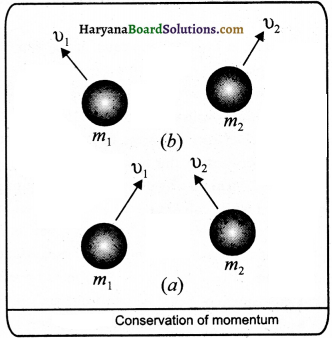
Activity: To prove this law, suppose two objects A and B of mass m1 and m2 are moving with velocities u1 and u2 respectively. Let both react with each other till time t. After action, their velocities become v1 arid v2as
shown in fig.
if any external force does not act, then the rate of change in momentum of object A is m1 \(\frac{\left(v_1-u_1\right)}{t}\) In the same way the rate of change in momentum of object B is m2 \(\frac{\left(v_2-u_2\right)}{t}\) If a force F1 is exerted on A by B and F2 on B by A, then according to Newton’s second law of motion,

F1 = m1\(\frac{\left(v_1-u_1\right)}{t}\) ………….(1)
and F2 = m2\(\frac{\left(v_2-u_2\right)}{t}\) ………….(2)
According to Newton’s third law of motion, F1 and F2 act equally and ¡n opposite direction.
F1 = -F2 ………….(3)
From eqs. (1), (2) and (3), is
m1 = \(\frac{\left(v_1-u_1\right)}{t}\) = m2
or m1(v1 – u1) = m2 (v2 – u2)
or m1v1 – m2u1 = m2v2 + m2u2
or m1v1 + m2v2 = m1u1 + m2u2
or m1 u1 + m2u2 = m1v1 + m2v2 ………(4)
HBSE 9th Class Science Important Questions Chapter 9 Force and Laws of Motion - 13

Thus, total momentum before collision m1u1 + m2 u2 is equal to total momentum after collision m2v2 . This is the law of conservation of momentum.

Question 4.
What is meant by friction ? Prove that it is a boon as well as curse.
Answer:
Friction: The opposing force that comes into play when a body moves on another surface or through a fluid (liquid or gas) is called friction.
Friction as a boon: The friction is a necessary evil because nothing is possible without it, that is:
(i) We cannot move if there is no friction between road and feet.
(ii) The vehicles cannot move if there is no friction between road and tyres.
(iii) The nail can be insisted in wall only due to friction.
(iv) Only due to friction, the match stick burns.
(v) It is possible to write on blackboard due to friction between chalk and blackboard.
(vi) Due to friction, we can write on copy.
(vii) The vehicles can be stopped only by friction.
(viii) The belts related to electric motors can move on wheels due to friction.

HBSE 9th Class Science Important Questions Chapter 9 Force and Laws of Motion

Friction as a curse: Besides a necessary evil, friction is harmful to us as:
(i) Due to friction the parts of machine get bear and tear.
(ii) Due to friction, the efficiency of machines is not 100%.
(iii) More energy is spent due to friction.
(iv) Due to friction, our shoes tear.
(v) Due to friction, the tyres of vehicles reduces.

Question 5.
Write the methods of reducing friction. Explain any one out of them.
Answer:
Methods of Reducing Friction : Friction can he reduced by following methods:
(i) The frictional force can be reduced by planing the depresions on the surface of body
(ii) Oil or lubricant educes the friction between two surfaces. Due to this the oil is put in the part machines and the friction can be reduced.
(iii) The mixture of water and soap can minimise the friction between two surfaces.
(iv) The friction can be minimize by using ball-bearings.
(v) When we sprinkle powder on a carom board, the powder tills up the depressions and the coin
(vi) In order to reduce friction, special shape is given to vehicles.
(vii) By polishing two surfaces and by putting coaltar on roads, the friction can be reduced.

To reduce the friction by using ball-bearIng : Ball-bearings are used in machines to reduce friction. Small balls are there in ball-bearings which are kept between the sliding surfaces of machines. You will have seen them in the wheels of cycle. These reduces the friction which save energy and work.

Practical Work ‘ .

Activity I.
Two activities to show the effect of force which proves that the force can change the size of body.

Procedure:
(i) Take a spring and pull it towards outside by holding its two ends. You, will see the size of spring increase, which shows the force applied on spring by us. It proves that the force can change the size of body.
(ii) Take a spherical rubber ball and press it between your palms. You will see that on pressing, the size of ball becomes some long. It proves that the force can change the size of body.

Activity 2.
Perform on activity to show that a body starts moving only when the force applied by us is more than frictional force.

Procedure:
Take a box and tell to children to push it. You will see that the box does not move if they apply less force, because the frictional force between the lower surface of box and rough surface of floor balances the force applied to push and due to this the box does not move. The children push the box with large force, but box does not move. This is because of that the friction force is still balances the pushing force. If the children push the box with much more force, then pushing force will become more than frictional force. Here, the unbalanced force is working and the box is moving. It proves that if the force applied by us is more than frictional force, the body moves.

HBSE 9th Class Science Important Questions Chapter 9 Force and Laws of Motion

Activity 3.
Perform an activity to show the effect of action and reaction. .

Procedure:
(i) Take a big rubber balloon and inflate it fully.
(ii) Tie its neck using a thread. Also using adhesive tape, fix a straw on the surface of this balloon.
(iii) Pass a thread through the straw and hold one end of the thread in your hand or fix it on the wall.
(iv) Now remove the thread tied on the neck of balloon.
(v) Now the air escape from the mouth of the balloon and the straw and balloon will move in opposite direction which shows reaction.

Procedure 2:
(i) Take a test tube of good quality glass material and put a small amount of water in it.
(ii) Place a stop cork at the mouth of it. Now suspend the test tube horizontally by two strings.
(iii) Heat the test tube with a burner until water vaporises and the cork blows out.
(iv) We observe that the test tube recoils in the direction

Quick Review of the Chapter

1. When a force is applied on a body, its :
(A) motion can change
(B) size can change
(C) direction of motion can change
(D) all of the above
Answer:
(D) all of the above

2. If the resultant of all forces acting on a body is zero, then all forces acting on body is called :
(A) balanced force
(B) unbalanced force
(C) frictional force
(D) none of these
Answer:
(A) balanced force

3. Unit of force is:
(A) joule
(B) metre per second square
(C) Newton
(D) metre per second
Answer:
(C) Newton

4. If the resultant of all forces acting on a particle is not zero, then forces are called:
(A) balanced force
(B) unbalanced force
(C) frictional force
(D) none of these
Answer:
(B) unbalanced force

5 Which scientist has established the laws of controlling the motion of objects firstly ?
(A) Sir Isaac Newton
(B) C.V. Raman
(C) Rutherford
(D) Neils Bohr
Answer:
(A) Sir Isaac Newton

HBSE 9th Class Science Important Questions Chapter 9 Force and Laws of Motion

6. Newton’s laws of motion are:
(A) 2 ‘
(B) 3
(C) 4
(D) 5
Answer:
(B) 3

7. Newton first law of motions is called:
(A) Law of friction
(B) Law of conservation of momentum
(C) Law of inertia
(D) Law of gravity
Answer:
(C) Law of inertia

8. The rate of change of momentum of a body is proportional to the force applied and in the direction in which force is applied. This is Newton’s:
(A) first law
(B) second law
(C) third law
(D) fourth law
Answer:
(B) second law

9. The product of mass and velocity of an object is called:
(A) momentum
(B) inertia
(C) friction
(D) force
Answer:
(A) momentum

HBSE 9th Class Science Important Questions Chapter 9 Force and Laws of Motion

10. SI unit of momentum is:
(A) kg-2
(B) kg ms-1
(C) kg m
(D) kg mh-1
Answer:
(B) kg ms

11. The relation among F, m and a is:
(A) F = \(\frac {m}{a}\)
(B) Fa = m
(C) F = ma
(D) none of these
Answer:
(C) F = ma

HBSE 9th Class Science Important Questions Chapter 9 Force and Laws of Motion

12. The force required to produce an acceleration of 1 mc2 in a body of mass 1 kg is:
(A) 1 Newton
(B) 2 Newton
(C) 3 Newton
(D) 4 Newton
Answer:
(A) I Newton

13. The force which acts without the contact of two objects is:
(A) magnetic force
(B) inertia
(C) friction
(D) all of the above
Answer:
(A) magnetic force

14. According to which force, the apple faits on earth from tree?
(A) force of gravity
(B) inertia
(C) force of magnet
(D) frictional force
Answer:
(A) force of gravity

15. It is difficult to walk on sand because the friction between feet and sand is:
(A) less
(B) more
(C) normal
(D) not there
Answer:
(B) more

HBSE 9th Class Science Important Questions Chapter 9 Force and Laws of Motion

16. A piece of stone and a truck is moving with same speed. In order to stop both, which one will require more force to stop?
(A) truck
(B) stone
(C) none on them
(D) both require equal.
Answer:
(A) truck ‘

17. Which of the following force move the object?
(A) Gravitational force
(B) Unbalanced force
(C) Balanced force
(D) Frictional force
Answer:
(B) Unbalanced force

18. Why the lubricant is used in machines?
(A) To increase friction
(B) To decrease friction
(C) To zero friction
(D) To clarity
Answer:
(B) To decrease friction

19. The dust detached from carpet when beaten with stick because of:
(A) inertia of rest
(B) motion of carpet
(C) motion of stick
(D) force
Answer:
(A) inertia of rest

20. If an external force ¡s working on a body, It accelerates in the dxrection of force. The acceleration produced is proportional to:
(A) applied force
(B) velocity
(C) mass
(D) inertia
Answer:
(A) applied force

21. If the mass of two objects A and B is 6 kg and 34 kg respectively, then:
(A) the inertia of object A is more than B
(B) the inertia of B is more than A
(C) inertia of A and B are same
(D) inertia of A and B are zero
Answer:
(B) the inertia of B is more than A

22. According to Newton’s third law of motion, the force related to action and reaction should apply on:
(A) one body
(B) same bodies
(C) always different bodies
(D) is not necessary to have equal result but their direction should be same
Answer:
(C) always different bodies

HBSE 9th Class Science Important Questions Chapter 9 Force and Laws of Motion

23. The explanation of falling forward when get down from bus can be done by:
(A) Newton ‘s first law of motion
(B) Newton ‘s second law of motion
(C) Newton’s third law of motion
(D) all of the above
Answer:
(A) Newton’s first law of motion

24. Launching of rocket ¡s based on the principle of:
(A) Newton’s first law of motion
(B) Newton’s second law of motion
(C) Newton’s third law of motion
(D) all of the above
Answer:
(C) Newton’s third law of motion

25. If the mass of an object m, velocity y, acceleration a, then the momentum (p) will be:
(A) p = mv
(B) p = \(\frac {m}{a}\)
(C) p = ma
(D) p = \(\frac {m}{a}\)
Answer:
(A) p = mv

26. Which one of the following has mo inertia?
(A) a rubber ball
(B) a piece of stone
(C) a cycle
(D) a train
Answer:
(D) a train

HBSE 9th Class Science Important Questions Chapter 9 Force and Laws of Motion

27. The branch of a tree sheds its leaves when it is shedding fastly:
(A) due to mass
(B) due to inertia
(C) due to weight
(D) due to acceleration
Answer:
(B) due to inertia

28. If an object of mass 30 kg has the momentum of 120 kg ms’, then its velocity will be:
(A) 4 ms-1
(B) 8 ms-1
(C) 2 ms-1
(D) 1 ms-1
Answer:
(A) 4 ms-1

29. When a running bus stops suddenly, you falls forward and when starts running suddenly from rest you falls backward, It Is
(A) due to mass
(B) due to weight
(C) due to motion
(D) due to inertia
Answer:
(D) due to inertia

30. The mass of a cart is 1500 kg. If the cart is to bring in rest with negative acceleration (retardation) of 1.7 ms-2, then the force between the cart and road will be
(A) 882.35 N
(B) 2550 N
(C) 1500N
(D) 2550 kgm
Answer:
(B) 2550 N

31. A bullet of mass 10 g moving in a straight line with a velocity of 150 ms-1 strikes with a wooden piece and stops after 0.03 s. How far the bullet will penetrate the wood?
(A) 2.25 km
(B) 2.25 m
(C) 22.5m
(D) 15m
Answer:
(B) 2.25 m

32. A body of mass 1 kg moving in a straight line with a velocity of 10 ms-1 strikes with a wooden piece of mass 5 kg which is in rest. After that both move in straight line together. The total momentum before collision will be
(A) 10 kg ms-2
(B) 2 kg ms-1
(C) 50kgms-1
(D) 10kg ms-1
Answer:
(D) 10kg ms-1

HBSE 9th Class Science Important Questions Chapter 9 Force and Laws of Motion Read More »

HBSE 9th Class Maths Solutions Chapter 13 पृष्ठीय क्षेत्रफल एवं आयतन Ex 13.7

Haryana State Board HBSE 9th Class Maths Solutions Chapter 13 पृष्ठीय क्षेत्रफल एवं आयतन Ex 13.7 Textbook Exercise Questions and Answers.

Haryana Board 9th Class Maths Solutions Chapter 13 पृष्ठीय क्षेत्रफल एवं आयतन Exercise 13.7

[नोट-जब तक अन्यथा न कहा जाए, π = \(\frac{22}{7}\) लीजिए।]

प्रश्न 1.
उस लंब वृत्तीय शंकु का आयतन ज्ञात कीजिए, जिसकी
(i) त्रिज्या 6 सें०मी० और ऊंचाई 7 सें०मी० है।
(ii) त्रिज्या 3.5 सें०मी० और ऊंचाई 12 सें०मी० है।
हल :
(i) यहां पर,
शंकु की त्रिज्या (r) = 6 सें०मी०
शंकु की ऊंचाई (h) = 7 सें०मी०
∴ शंकु का आयतन (V) = \(\frac{1}{3}\)πr2h
= \(\frac{1}{3}\) × \(\frac{22}{7}\) × 6 × 6 × 7 = 264 सें०मी०3 उत्तर

(ii) यहां पर,
शंकु की त्रिज्या (r) = 3.5 सें०मी० = \(\frac{35}{10}=\frac{7}{2}\) सें०मी०
शंकु की ऊंचाई (h) = 12 सें०मी०
∴ शंकु का आयतन (V) = \(\frac{1}{3}\)πr2h
= \(\frac{1}{3} \times \frac{22}{7} \times \frac{7}{2} \times \frac{7}{2}\) × 12 = 154 सें०मी०3 उत्तर

HBSE 9th Class Maths Solutions Chapter 13 पृष्ठीय क्षेत्रफल एवं आयतन Ex 13.7

प्रश्न 2.
शंकु के आकार के उस बर्तन की लीटरों में धारिता ज्ञात कीजिए जिसकी
(i) त्रिज्या 7 सें०मी० और तिर्यक ऊंचाई 25 सें०मी० है।
(ii) ऊंचाई 12 सें०मी० और तिर्यक ऊंचाई 13 सें०मी० है।
हल :
(i) यहां पर,
शंकु के आकार के बर्तन की त्रिज्या (r) = 7 सें०मी०
शंकु के आकार के बर्तन की तिर्यक ऊंचाई (l) = 25 सें०मी०
शंकु के आकार के बर्तन की ऊंचाई (h) = \(\sqrt{\ell^2-r^2}\)
= \(\sqrt{(25)^2-(7)^2}\) सें०मी०
= \(\sqrt{625-49}\) सें०मी०
= \(\sqrt{576}\) सें०मी०
= 24 सें०मी०
अतः शंकु के आकार के बर्तन का आयतन (V) = \(\frac{1}{3}\)πr2h
= \(\frac{1}{3}\) × \(\frac{1}{3}\) × 7 × 7 × 24 सें०मी०3
= 1232 सें०मी०3
इस प्रकार शंकु के आकार के बर्तन की धारिता = \(\frac{1232}{1000}\) = 1.232 लीटर उत्तर (∵ 1 लीटर = 1000 सें०मी०3)

(ii) यहां पर,
शंकु के आकार के बर्तन की ऊंचाई (h) = 12 सें०मी०
शंकु के आकार के बर्तन की तिर्यक ऊंचाई (l) = 13 सें०मी०
शंकु के आकार के बर्तन की त्रिज्या (r) = \(\sqrt{\ell^2-h^2}\)
= \(\sqrt{(13)^2-(12)^2}\) सें०मी०
= \(\sqrt{169-144}\) सें०मी०
= \(\sqrt{25}\) सें०मी०
= 5 सें०मी०
अतः शंकु के आकार के बर्तन का आयतन (V) = \(\frac{1}{3}\)πr2h
= \(\frac{1}{3} \times \frac{22}{7}\) × 5 × 5 × 12 सें०मी०3
= \(\frac{2200}{7}\) सें०मी०3
इस प्रकार शंकु के आकार के बर्तन की धारिता = \(\frac{2200}{7 \times 1000}=\frac{11}{35}\) लीटर उत्तर (∵ 1 लीटर = 1000 सें०मी०3)

प्रश्न 3.
एक शंकु की ऊंचाई 15 सेंमी० है। यदि इसका आयतन 1570 सें०मी०3 है, तो इसके आधार की त्रिज्या ज्ञात कीजिए (π = 3.14 प्रयोग कीजिए।)
हल :
यहां पर,
शंकु की ऊंचाई (h) = 15 सें०मी०
शंकु के आधार की त्रिज्या (r) = ?
शंकु का आयतन (V) = 1570 सें०मी०3
⇒ \(\frac{1}{3}\)πr2h = 1570
या \(\frac{1}{3}\) × 3.14 × r2 × 15 = 1570
या 15.70 r2 = 1570
या r2 = \(\frac{1570}{15.70}\)
या r2 = 100
या r = 10 सें०मी०
अतः शंकु के आधार की त्रिज्या (r) = 10 सें०मी० उत्तर

प्रश्न 4.
यदि 9 सें०मी० ऊंचाई वाले एक लंब वृत्तीय शंकु का आयतन 48 π सें०मी०3 है, तो इसके आधार का व्यास ज्ञात कीजिए।
हल :
यहां पर,
शंकु की ऊंचाई (h) = 9 सें०मी०
शंकु का आयतन (V) = 48 π सें०मी०3
⇒ \(\frac{1}{3}\)πr2h = 48 π
या \(\frac{1}{3}\) × π × r2 × 9 = 48 π
या 3r2 = 48
या r2 = \(\frac{48}{3}\)
या r2 = 16
या r = 4 सें०मी०
अतः शंकु के आधार का व्यास (d) = 2r = 2 × 4 = 8 सें०मी० उत्तर

HBSE 9th Class Maths Solutions Chapter 13 पृष्ठीय क्षेत्रफल एवं आयतन Ex 13.7

प्रश्न 5.
ऊपरी व्यास 3.5 मी० वाले शंकु के आकार का एक गड्ढा 12 मी० गहरा है। इसकी धारिता किलोलीटरों में कितनी है ?
हल :
यहां पर,
शंकु का व्यास (d) = 3.5 मी० = \(\frac{35}{10}=\frac{7}{2}\)
शंकु की त्रिज्या (r) = \(\frac{7}{2 \times 2}\) मी० = \(\frac{7}{4}\) मी०
शंकु की गहराई (h) = 12 मी०
शंकु का आयतन (V) = \(\frac{1}{3}\)πr2h
= \(\frac{1}{3} \times \frac{22}{7} \times \frac{7}{4} \times \frac{7}{4} \times 12\) मी०3
= \(\frac{77}{2}\) मी०3 = 38.5 मी०3
इस प्रकार शंकु के आकार के गड्ढे की धारिता = 38.5 कि०लीटर उत्तर (∵ 1 मी०3 = 1 कि०लीटर)

प्रश्न 6.
एक लंब वृत्तीय शंकु का आयतन 9856 सें०मी०3 है। यदि इसके आधार का व्यास 28 सें०मी० है. तो ज्ञात कीजिए: [B.S.E.H. March, 2017, 2018]
(i) शंकु की ऊंचाई,
(ii) शंकु की तिर्यक ऊंचाई,
(iii) शंकु का वक्र पृष्ठीय क्षेत्रफल।
हल :
HBSE 9th Class Maths Solutions Chapter 13 पृष्ठीय क्षेत्रफल एवं आयतन Ex 13.7 1
(i) यहां पर,
शंकु के आधार का व्यास (d) = 28 सें०मी०
शंकु के आधार की त्रिज्या (r) = \(\frac{28}{2}\) सें०मी० = 14 सें०मी०
शंकु का आयतन (V) = 9856 सें०मी०3
⇒ \(\frac{1}{3}\)πr2h = 9856
या \(\frac{1}{3} \times \frac{22}{7}\) × 14 × 14 × h = 9856
या \(\frac{616}{3}\)h = 9856
h = \(\frac{9856 \times 3}{616}\) = 48 सें०मी०
अतः शंकु की ऊंचाई = 48 सें०मी० उत्तर

(ii) शंकु की तिर्यक ऊंचाई (l) = \(\sqrt{(r)^2+(h)^2}\)
= \(\sqrt{(14)^2+(48)^2}\)
= \(\sqrt{196+2304}\) सें०मी०
= \(\sqrt{2500}\) = 50 सें०मी०
अतः शंकु की तिर्यक ऊंचाई = 50 सें०मी० उत्तर

(iii) शंकु का वक्र पृष्ठीय क्षेत्रफल = πrl
= \(\frac{22}{7}\) × 14 × 50 सें०मी०2
= 2200 सें०मी०2 उत्तर

HBSE 9th Class Maths Solutions Chapter 13 पृष्ठीय क्षेत्रफल एवं आयतन Ex 13.7

प्रश्न 7.
भुजाओं 5 सें०मी०, 12 सें०मी० और 13 सें०मी० वाले एक समकोण त्रिभुज ABC को भुजा 12 सें०मी० के परित घुमाया जाता है। इस प्रकार प्राप्त ठोस का आयतन ज्ञात कीजिए।
हल :
HBSE 9th Class Maths Solutions Chapter 13 पृष्ठीय क्षेत्रफल एवं आयतन Ex 13.7 2
इस प्रकार बना ठोस शंकु आकृति में दर्शाया गया है।
इस शंकु की त्रिज्या (r) = 5 सें०मी०
इस शंकु की ऊंचाई (h) = 12 सें०मी०
इस शंकु का आयतन (V) = \(\frac{1}{3}\)πr2h
= \(\frac{1}{3}\)π × 5 × 5 × 12 सें०मी०3
= 100π सें०मी०3 उत्तर

प्रश्न 8.
यदि प्रश्न 7 के त्रिभुज ABC को यदि भुजा 5 सें०मी० के परित घुमाया जाए, तो इस प्रकार प्राप्त ठोस का आयतन ज्ञात कीजिए। प्रश्नों 7 और 8 में प्राप्त किए गए दोनों ठोसों के आयतन का अनुपात भी ज्ञात कीजिए।
हल :
HBSE 9th Class Maths Solutions Chapter 13 पृष्ठीय क्षेत्रफल एवं आयतन Ex 13.7 3
इस प्रकार प्राप्त ठोस शंकु आकृति में दर्शाया गया है।
इस शंकु की त्रिज्या (r) = 12 सें०मी०
इस शंकु की ऊंचाई (h) = 5 सें०मी०
इस शंकु का आयतन (V) = \(\frac{1}{3}\)πr2h
\(\frac{1}{3}\)π × 12 × 12 × 5 सेंमी०3
= 240π सें०मी०3 उत्तर
दोनों शंकुओं के आयतनों का अनुपात = 100π : 240π
= 5 : 12 उत्तर

HBSE 9th Class Maths Solutions Chapter 13 पृष्ठीय क्षेत्रफल एवं आयतन Ex 13.7

प्रश्न 9.
गेहूं की एक ढेरी 10.5 मी० व्यास और ऊंचाई 3 मी० वाले एक शंकु के आकार की है। इसका आयतन ज्ञात कीजिए। इस ढेरी को वर्षा से बचाने के लिए केनवास से ढका जाना है। वांछित केनवास का क्षेत्रफल ज्ञात कीजिए।
हल :
यहां पर,
शंक्वाकार ढेरी का व्यास (d) = 10.5 मी० = \(\frac{105}{10}=\frac{21}{2}\)
शंक्वाकार ढेरी की त्रिज्या (r) = \(\frac{21}{2 \times 2}\) मी० = \(\frac{21}{4}\) मी०
शंक्वाकार ढेरी की ऊंचाई (h) = 3 मी०
∴ शंक्वाकार ढेरी का आयतन (V) = \(\frac{1}{3}\)πr2h
= \(\frac{1}{3} \times \frac{22}{7} \times \frac{21}{4} \times \frac{21}{4} \times 3\) मी०3
= \(\frac{693}{8}\) मी०3 = 86.625 मी०3
अतः गेहूं का आयतन = 86.625 मी०3 उत्तर
HBSE 9th Class Maths Solutions Chapter 13 पृष्ठीय क्षेत्रफल एवं आयतन Ex 13.7 4
अतः गेहूं को ढ़कने के लिए 99.825 मी०2 केनवास की आवश्यकता पड़ेगी। उत्तर

HBSE 9th Class Maths Solutions Chapter 13 पृष्ठीय क्षेत्रफल एवं आयतन Ex 13.7 Read More »

HBSE 9th Class Maths Solutions Chapter 10 वृत्त Ex 10.4

Haryana State Board HBSE 9th Class Maths Solutions Chapter 10 वृत्त Ex 10.4 Textbook Exercise Questions and Answers.

Haryana Board 9th Class Maths Solutions Chapter 10 वृत्त Exercise 10.4

प्रश्न 1.
5 सें०मी० तथा 3 सें०मी० त्रिज्या वाले दो वृत्त दो बिंदुओं पर प्रतिच्छेद करते हैं तथा उनके केंद्रों के बीच की दूरी 4 सें०मी० है। उभयनिष्ठ जीवा की लंबाई ज्ञात कीजिए।
हल :
HBSE 9th Class Maths Solutions Chapter 10 वृत्त Ex 10.4 1
माना O व O’ केंद्र वाले दो वृत्त हैं जिनकी त्रिज्याएं क्रमशः 3 सें०मी० व 5 सें०मी० हैं।
∴ O’A = 5 सें०मी, OO’ = 4 सें०मी
समकोण त्रिभुज AOO’ में,
AO’2 = AO2 + OO’2
⇒ (5)2 = AO2 + (4)2
⇒ AO2 = 25 – 16
⇒ AO2 = 9
⇒ AO = 3
अतः उभयनिष्ठ जीवा AB है अर्थात 2AO या 2 × 3 = 6 सें०मी० उत्तर

HBSE 9th Class Maths Solutions Chapter 10 वृत्त Ex 10.4

प्रश्न 2.
यदि एक वृत्त की दो समान जीवाएं वृत्त के अंदर प्रतिच्छेद करें, तो सिद्ध कीजिए कि एक जीवा के खंड दूसरी जीवा के संगत खंडों के बराबर हैं।
हल :
HBSE 9th Class Maths Solutions Chapter 10 वृत्त Ex 10.4 2
दिया है : AB तथा CD वृत्त की दो समान जीवाएं हैं, O वृत्त का केंद्र है। AB तथा CD, P पर प्रतिच्छेद करती हैं।
सिद्ध करना है:
(i) AP = PD
(ii) PB = CP
रचना : OM ⊥ AB, ON ⊥ CD खींचिए। OP को मिलाओ।
प्रमाण: AM = MB = \(\frac{1}{2}\) AB [∵ वृत्त के केंद्र से जीवा पर खींचा गया लंब जीवा को समद्विभाजित करता है]
इसी प्रकार CN = ND = \(\frac{1}{2}\)CD [वृत्त के केंद्र से जीवा पर खींचा गया लंब जीवा को समद्विभाजित करता है]
⇒ AM = ND तथा MB = CN …..(i) [∵ AB = CD दिया है]
अब ΔOMP तथा ΔONP में,
OM = ON [एक वृत्त की समान जीवाएं केंद्र से समान दूरी पर होती हैं।
∠OMP = ∠ONP [∵ प्रत्येक 90°]
OP = OP [उभयनिष्ठ]
∴ ΔΟΜΡ ≅ ΔΟΝΡ [समकोण-कर्ण-भुजा सर्वांगसमता]
⇒ MP = PN ….. (ii) [सर्वांगसम त्रिभुजों के संगत भाग]
समीकरण (i) तथा (ii) को जोड़ने पर,
AM + MP = ND + PN
⇒ AP = PD [इति सिद्धम]
समीकरण (i) में से समीकरण (ii) घटाने पर,
MB – MP = CN – PN
⇒ PB = CP [इति सिद्धम]

प्रश्न 3.
यदि एक वृत्त की दो समान जीवाएं वृत्त के अंदर प्रतिच्छेद करें, तो सिद्ध कीजिए कि प्रतिच्छेद बिंदु को केंद्र से मिलाने वाली रेखा जीवाओं से बराबर कोण बनाती है।
हल :
HBSE 9th Class Maths Solutions Chapter 10 वृत्त Ex 10.4 3
दिया है : केंद्र O वाले वृत्त की दो समान जीवाएं AB तथा CD वृत्त के अंदर परस्पर बिंदु E पर प्रतिच्छेदित होती हैं।
सिद्ध करना है : ∠OEB = ∠OED
रचना : O से OL ⊥ AB तथा OM ⊥ CD खींचिए।
प्रमाण : ∵ AB = CD [दिया है]
⇒ OL = OM [समान जीवाएं केंद्र से समान दूरी पर होती हैं]
ΔOEL तथा ΔOEM में,
OL = OM [प्रमाणित]
OE = OE [उभयनिष्ठ]
∠OLE = ∠OME [प्रत्येक = 90°]
∴ ΔOEL ≅ ΔOEM [समकोण-कर्ण-भुजा सर्वांगसमता]
∴ ∠OEL = ∠OEM [सर्वांगसम त्रिभुजों के संगत भाग]
या ∠OEB = ∠OED [इति सिद्धम]

HBSE 9th Class Maths Solutions Chapter 10 वृत्त Ex 10.4

प्रश्न 4.
यदि एक रेखा दो संकेंद्री वृत्तों (एक ही केंद्र वाले वृत्त) को, जिनका केंद्र O है, A,B,C और D पर प्रतिच्छेद करे, तो सिद्ध कीजिए AB =CD है (आकृति अनुसार)।
HBSE 9th Class Maths Solutions Chapter 10 वृत्त Ex 10.4 4
हल :
HBSE 9th Class Maths Solutions Chapter 10 वृत्त Ex 10.4 5
दिया है : दो संकेंद्री वृत्त जिनका केंद्र O है। एक रेखा इन्हें A, B, C तथा D बिंदुओं पर प्रतिच्छेद करती है।
सिद्ध करना है : AB = CD
रचना : O से OL ⊥ AD खींचिए।
प्रमाण : बड़े वृत्त में,
OL ⊥ AD
∴ AL = LD …(i) [∵ केंद्र से जीवा पर खींचा गया लंब उसे समद्विभाजित करता है]
इसी प्रकार छोटे वृत्त में,
OL ⊥ BC
∴ BL = LC …(ii) [∵ केंद्र से जीवा पर खींचा गया लंब उसे समद्विभाजित करता है]
समीकरण (ii) को (i) में से घटाने पर,
AL – BL = LD – LC
⇒ AB = CD [इति सिद्धम]

प्रश्न 5.
एक पार्क में बने 5 मी० त्रिज्या वाले वृत्त पर खड़ी तीन लड़कियां रेशमा, सलमा एवं मनदीप खेल रही हैं। रेशमा एक गेंद को सलमा के पास, सलमा मनदीप के पास तथा मनदीप रेशमा के पास फेंकती है। यदि रेशमा तथा सलमा के बीच और सलमा तथा मनदीप के बीच की प्रत्येक दूरी 6 मी० हो, तो रेशमा और मनदीप के बीच की दूरी क्या है ?
हल :
माना तीन लड़कियां रेशमा, सलमा तथा मनदीप एक वृत्त की परिधि पर क्रमशः बिंदु A, B तथा C पर खड़ी हैं। वृत्त की त्रिज्या 5 मी० है।
प्रश्नानुसार AB = BC = 6 मी०
AC = ? OA, OB तथा OC को मिलाओ।
AB = BC [दिया है]
∴ बिंदु B, AC के लंबार्धक पर स्थित है।
OA = OC [एक ही वृत्त की त्रिज्याएं]
∴ बिंदु O, AC के लंबार्धक पर स्थित है।
∴ OB, AC का लंबार्धक है जो AC को D बिंदु पर प्रतिच्छेदित करती है।
∴ AD = DC
∴ AC = 2 AD
माना OD = x मी०
HBSE 9th Class Maths Solutions Chapter 10 वृत्त Ex 10.4 6
तो DB = (5 – x) मी०
समकोण ΔOAD में,
AD2 = OA2 – OD2
= (5)2 – (x)2 …….(i)
समकोण ΔABD में,
AD2 = AB2 – DB2
= (6) – (5 – x)2
समीकरण (i) तथा (ii) की तुलना से,
(5)2 – (x)2 = (6)2 – (5 – x)2
या 25 – x2 = 36 – (25 + x2 – 10x)
या 25 – x2 = 36 – 25 – x2 + 10x
या -10 x = 36 – 25 – 25
या -10x = -14
या x = \(\frac{14}{10}\) = 1.4 मी०
अतः OD = 1.4 मी०
अब AD2 = (5)2 – (x)2
= 25 – (1.4)2
= 25 – 1.96 = 23.04
AD = \(\sqrt{23.04}\) = 4.8 मी०
⇒ AC = 2AD = 2 × 4.8 = 9.6 मी०
अतः रेशमा व मनदीप के मध्य की दूरी = 9.6 मी० उत्तर

HBSE 9th Class Maths Solutions Chapter 10 वृत्त Ex 10.4

प्रश्न 6.
20 मी० त्रिज्या का एक गोल पार्क (वृत्ताकार) एक कालोनी में स्थित है। तीन लड़के अंकुर, सैय्यद तथा डेविड इसकी परिसीमा पर बराबर दूरी पर बैठे हैं और प्रत्येक के हाथ में एक खिलौना टेलीफोन आपस में बात करने के लिए है। प्रत्येक फोन की डोरी की लंबाई ज्ञात कीजिए।
हल :
माना तीन लड़के अंकुर, सैय्यद तथा डेविड वृत्त की परिधि पर एक-दूसरे से बराबर दूरी पर बिंदु A, B व C पर बैठे हैं। इसलिए ABC समबाहु त्रिभुज है। वृत्त की त्रिज्या 20 मी० है। A से AL ⊥ BCखींचिए। क्योंकि त्रिभुज समबाहु है इसलिए यह लंब केंद्र O में से भी गुजरता है।
माना समबाहु त्रिभुज की प्रत्येक भुजा = 2x मी० है
तो BL = \(\frac{\mathrm{BC}}{2}=\frac{2 x}{2}\) = x मी० [∵ OL ⊥ BC है]
समकोण ΔABL में
HBSE 9th Class Maths Solutions Chapter 10 वृत्त Ex 10.4 7
OL = AL – AO = (\(\sqrt{3}\)x – 20) मी०
समकोण ΔOBL में
HBSE 9th Class Maths Solutions Chapter 10 वृत्त Ex 10.4 8
OB2 = OL2 + BL2
(20)2 = (\(\sqrt{3}\)x – 20) + (x)2
400 = 3x2 + 400 – 40\(\sqrt{3}\)x + x2
4x2 – 40\(\sqrt{3}\)x = 0
4x (x – 10\(\sqrt{3}\)) = 0
⇒ 4x = 0
⇒ x = \(\frac{0}{4}\) = 0 जो कि संभव नहीं है।
या x – 10\(\sqrt{3}\) = 0
x = 10\(\sqrt{3}\)
∴ BC = 2 BL = 2 × 10\(\sqrt{3}\) = 20\(\sqrt{3}\) मी०
अतः प्रत्येक फोन की डोरी की लंबाई = 20\(\sqrt{3}\) मी० उत्तर

HBSE 9th Class Maths Solutions Chapter 10 वृत्त Ex 10.4 Read More »

HBSE 9th Class Maths Solutions Chapter 4 दो चरों वाले रैखिक समीकरण Ex 4.4

Haryana State Board HBSE 9th Class Maths Solutions Chapter 4 दो चरों वाले रैखिक समीकरण Ex 4.4 Textbook Exercise Questions and Answers.

Haryana Board 9th Class Maths Solutions Chapter 4 दो चरों वाले रैखिक समीकरण Exercise 4.4

प्रश्न 1.
(i) एक चर वाले
(ii) दो चर वाले समीकरण के रूप में y = 3 का ज्यामितीय निरूपण कीजिए।
हल :
(i) y = 3 के लिए ज्यामितीय निरूपण :
HBSE 9th Class Maths Solutions Chapter 4 दो चरों वाले रैखिक समीकरण Ex 4.4 - 1
संख्या रेखा पर बिंदु A एक घर में रैखिक समीकरण y = 3 को प्रदर्शित करता है।

(ii) y = 3
⇒ (0) x + y = 3
या y = 3 – (0)x

x135– 1
y3333

HBSE 9th Class Maths Solutions Chapter 4 दो चरों वाले रैखिक समीकरण Ex 4.4 - 2
आलेख में रेखा l, y = 3 को प्रदर्शित करती है।

HBSE 9th Class Maths Solutions Chapter 4 दो चरों वाले रैखिक समीकरण Ex 4.4

प्रश्न 2.
(i) एक चर वाले
(ii) दो चर वाले समीकरण के रूप में 2x + 9 = 0 का ज्यामितीय निरूपण कीजिए।
हल :
(i) यहां पर,
2x + 9 = 0
या 2x = – 9
या x = \(\frac {-9}{2}\)
HBSE 9th Class Maths Solutions Chapter 4 दो चरों वाले रैखिक समीकरण Ex 4.4 - 3
संख्या रेखा पर बिंदु A एक चर में रैखिक समीकरण 2x + 9 = 0 को प्रदर्शित करता है।

(ii) यहां पर,
2x + 9 = 0
⇒ 2x + (0)y + 9 = 0
(दो चर में समीकरण)
या 2x = -9 – (0)y
x = \(\frac{-9-(0) y}{2}=-\frac{9}{2}\)

x\(-\frac{9}{2}\)\(-\frac{9}{2}\)\(-\frac{9}{2}\)\(-\frac{9}{2}\)
y135-3

आलेख में रेखा l, 2x + 9 = 0 को प्रदर्शित करती है।
HBSE 9th Class Maths Solutions Chapter 4 दो चरों वाले रैखिक समीकरण Ex 4.4 - 4

HBSE 9th Class Maths Solutions Chapter 4 दो चरों वाले रैखिक समीकरण Ex 4.4 Read More »

HBSE 9th Class Maths Solutions Chapter 4 दो चरों वाले रैखिक समीकरण Ex 4.3

Haryana State Board HBSE 9th Class Maths Solutions Chapter 4 दो चरों वाले रैखिक समीकरण Ex 4.3 Textbook Exercise Questions and Answers.

Haryana Board 9th Class Maths Solutions Chapter 4 दो चरों वाले रैखिक समीकरण Exercise 4.3

प्रश्न 1.
दो चरों वाले निम्नलिखित रैखिक समीकरणों में से प्रत्येक का आलेख खींचिए :
(i) x + y = 4
(ii) x – y = 2
(iii) y = 3k
(iv) 3 = 2x + y
हल :
(i) यहां पर,
x + y = 4
⇒ y = 4 – x

X123
y321

HBSE 9th Class Maths Solutions Chapter 4 दो चरों वाले रैखिक समीकरण Ex 4.3 - 1

(ii) यहां पर,
x – y = 2
⇒ x = 2 + y

X123
y– 101

HBSE 9th Class Maths Solutions Chapter 4 दो चरों वाले रैखिक समीकरण Ex 4.3 - 2

(iii) यहां पर,
y = 3x

x-1012
y-3036

HBSE 9th Class Maths Solutions Chapter 4 दो चरों वाले रैखिक समीकरण Ex 4.3 - 3

(iv) यहां पर,
3 = 2x + y
y = – 2x + 3

X123
y1– 1– 3

HBSE 9th Class Maths Solutions Chapter 4 दो चरों वाले रैखिक समीकरण Ex 4.3 - 4

HBSE 9th Class Maths Solutions Chapter 4 दो चरों वाले रैखिक समीकरण Ex 4.3

प्रश्न 2.
बिंदु (2, 14) से होकर जाने वाली दो रेखाओं के समीकरण लिखिए। इस प्रकार की और कितनी रेखाएं हो सकती हैं, और क्यों?
हल :
बिंदु (2,14) से होकर जाने वाली दो रेखाओं की समीकरणें निम्नलिखित हैं.
(i) 7x – y = 0
(ii) x + y = 16
इस प्रकार के अनंतः अनेक समीकरण लिखे जा सकते हैं क्योंकि एक बिंदु से होती हुई अनंतः अनेक रेखाएं खींची जा सकती हैं।

प्रश्न 3.
यदि बिंदु (3) समीकरण 3y = ax + 7 के आलेख पर स्थित है, तो a का मान ज्ञात कीजिए।
हल :
क्योंकि बिंदु (3, 4) समीकरण 3y = ax + 7 के आलेख पर स्थित है इसलिए यह इसका हल है।
अतः x = 3, y = 4 समीकरण में रखने पर हमें प्राप्त होता है
3(4) = a(3) + 7
या 12 = 3a + 7
या 12 – 7 = 3a
या 5 = 3a
या a = \(\frac {5}{3}\) उत्तर

HBSE 9th Class Maths Solutions Chapter 4 दो चरों वाले रैखिक समीकरण Ex 4.3

प्रश्न 4.
एक नगर में टैक्सी वा किराया निम्नलिखित है : [B.S.E.H. March, 2017]
पहले किलोमीटर का किराया 8 रुपये है और उसके बाद की दूरी के लिए प्रति किलोमीटर का किराया 5 रुपये है। यदि तय की गई दूरी x किलोमीटर हो, और कुल किराया y रुपये हो, तो इसका एक रैखिक समीकरण लिखिए और उसका आलेख खींचिए।
हल :
यहां पर,
पहले 1 कि०मी० के लिए टैक्सी का किराया = 8 रुपये
अगले प्रति कि०मी० के लिए टैक्सी का किराया = 5 रुपये
कुल दूरी = x कि०मी०
कुल किराया = y रुपये
प्रश्नानुसार,
8 × 1 + 5 × (x – 1) = y
या 8 + 5x – 5 = y
या 5x + 3 = y
उचित रैखिक समीकरण है,
या 5x – y + 3 = 0
⇒ y = 5x + 3

X01– 1
y38– 2

HBSE 9th Class Maths Solutions Chapter 4 दो चरों वाले रैखिक समीकरण Ex 4.3 - 5

प्रश्न 5.
निम्नलिखित आलेखों में से प्रत्येक आलेख के लिए दिए गए विकल्पों से सही समीकरण का चयन कीजिए:
आकृति I के लिए
(i) y = x
(ii) x + y = 0
(iii) y = 2x
(iv) 2 + 3y = 7x

आकृति II के लिए
(i) y = x + 2
(ii) y = x – 2
(iii) y = -x + 2
(iv) x + 2y = 6
HBSE 9th Class Maths Solutions Chapter 4 दो चरों वाले रैखिक समीकरण Ex 4.3 - 6
हल :
आकृति I की ग्राफ रेखा पर बिंदु (-1, 1), (0, 0) तथा (1, -1) दिए हुए हैं। जांच करने पर ये तीनों बिंदु समीकरण x + y = 0 को संतुष्ट करते हैं।
इसलिए इस ग्राफ का समीकरण x + y = 0 है।
जांच:
x + y = 0
(0, 0) के लिए
0 + 0 = 0
⇒ 0 = 0

x + y = 0
(-1, 1) के लिए
– 1 + 1 = 0
⇒ 0 = 0

x + y = 0
(1, -1) के लिए
-1 + 1 = 0
⇒ 0 = 0

आकृति II की ग्राफ रेखा पर बिंदु (-1, 3), (0, 2) तथा (2,0) दिए हुए हैं। जांच करने पर यह तीनों बिंदु समीकरण y = -x + 2 को संतुष्ट करते हैं।
इसलिए इस ग्राफ का समीकरण y = -x + 2 है।
जांच: y = -x + 2
(-1, 3) के लिए
3 = -(-1) + 2
या 3 = 1 + 2
या 3 = 3

y = -x + 2
(0, 2) के लिए
2 = -0 + 2
या 2 = 2

y = – x + 2
(2, 0) के लिए
0 = -2 + 2
या 0 = 0

HBSE 9th Class Maths Solutions Chapter 4 दो चरों वाले रैखिक समीकरण Ex 4.3

प्रश्न 6.
एक अचर बल लगाने पर एक पिंड द्वारा किया गया कार्य पिंड द्वारा तय की गई दूरी के अनुक्रमानुपाती होता है। इस कवन को दो चरों वाले एक समीकरण के रूप में व्यक्त कीजिए और अचर बल 5 मात्रक लेकर इसका आलेख खींचिए। यदि पिंड द्वारा तय की गई दूरी (i) 2 मात्रक, (ii) 0 मात्रक हो, तो आलेख से किया हुआ कार्य ज्ञात कीजिए।
हल :
माना पिंड द्वारा चली गई दूरी = x मात्रक
व पिंड द्वारा किया गया कार्य = y मात्रक
प्रश्नानुसार,
y ∝ r
⇒ y = kx
(यहां पर k समानुपात को हटाने का मान है तथा इसे स्थिरांक कहा जाता है)
क्योंकि k = 5 (दिया है)
∴ y = 5x

X21-1
y105-5

HBSE 9th Class Maths Solutions Chapter 4 दो चरों वाले रैखिक समीकरण Ex 4.3 - 7
(i) यदि वस्तु द्वारा चली गई दूरी (x) = 2 मात्रक
वस्तु द्वारा किया गया कार्य (y) = 10 मात्रक उत्तर
(ii) यदि वस्तु द्वारा चली गई दूरी (x) = 0 मात्रक
वस्तु द्वारा किया गया कार्य (y) = 0 मात्रक उत्तर

प्रश्न 7.
एक विद्यालय की कक्षा IX की छात्राएं यामिनी और फातिमा ने मिलकर भूकंप पीड़ित व्यक्तियों की सहायता लिए प्रधानमंत्री राहत कोष में 100 रुपये अंशदान दिया। एक रैखिक समीकरण लिखिए जो इन आंकड़ों को संतुष्ट करती है। (आप उनका अंशदान x रुपये और y रुपये मान सकते हैं)। इस समीकरण का आलेख खींचिए।
हल:
माना यामिनी द्वारा दिया गया धन = x रुपये
तथा फातिमा द्वारा दिया गया धन = y रुपये
प्रश्नानुसार,
x + y = 100
⇒ y = 100 – x

X204060100
y8060400

HBSE 9th Class Maths Solutions Chapter 4 दो चरों वाले रैखिक समीकरण Ex 4.3 - 8

HBSE 9th Class Maths Solutions Chapter 4 दो चरों वाले रैखिक समीकरण Ex 4.3

प्रश्न 8.
अमरीका और कनाडा जैसे देशों में तापमान फारेनहाइट में मापा जाता है, जबकि भारत जैसे देशों में तापमान सेल्सियस में मापा जाता है। यहां फारेनहाइट को सेल्सियस में रूपांतरित करने वाला एक रैखिक समीकरण दिया गया है।
F = (\(\frac {9}{5}\))C + 32
(i) सेल्सियस को x-अक्ष और फारेनहाइट को y-अक्ष मानकर ऊपर दिए गए रैखिक समीकरण का आलेख खींचिए।
(ii) यदि तापमान 30°C है, तो फारेनहाइट में तापमान क्या होगा?
(iii) यदि तापमान 95° F है, तो सेल्सियस में तापमान क्या होगा?
(iv) यदि तापमान 0°C है, तो फारेनहाइट में तापमान क्या होगा? और यदि तापमान 0°F है, तो सेल्सियस में तापमान क्या होगा?
(v) क्या ऐसा भी कोई तापमान है जो फारेनहाइट और सेल्सियस दोनों के लिए संख्यात्मकतः समान है? यदि हाँ, तो उसे ज्ञात कीजिए।
हल :
(i) सेल्सियस तापमान को x-अक्ष और फारेनहाइट तापमान को -अक्ष पर दर्शाने पर,
F = (\(\frac {9}{5}\))C + 32

C0– 40– 25
F32– 40– 13

HBSE 9th Class Maths Solutions Chapter 4 दो चरों वाले रैखिक समीकरण Ex 4.3 - 9

(ii) यहां पर C = 30°C
∴ F = \(\frac {9}{5}\) × 30 + 32 = 54 +32 = 86°F उत्तर

(iii) यहां पर F = 95°F
∴ 95 = (\(\frac {9}{5}\)) × C + 32
या \(\frac {9}{5}\)C = 95 – 32
या \(\frac {9}{5}\)C = 63
या C = 63 × \(\frac {5}{9}\) = 35°C उत्तर

(iv) यहां पर C = 0°
∴ F = (\(\frac {9}{5}\))(o) + 32 = 32°F उत्तर
यदि, F = 0°
∴ 0 = (\(\frac {9}{5}\)) × C + 32
या \(\frac {9}{5}\)C = – 32
या C =
c = 63 x 2 – 35°C उत्तर c = 00 F- 2)(0) + 32 = 32°F उत्तर F = 0° 0 = ()xc+32
c = \(\frac{-32 \times 5}{9}=\frac{-160}{9}\) = – 17.8°C (लगभग) उत्तर

(v) माना
C = F = x°
∴ x = \(\frac {9}{5}\)x + 32
या 5x = 9x + 160
या 5x – 9x = 160
या – 4x = 160
या x = \(\frac {160}{-4}\) = – 40
अतः – 40° पर फारेनहाइट और सेल्सियस दोनों के मान समान होंगे।

HBSE 9th Class Maths Solutions Chapter 4 दो चरों वाले रैखिक समीकरण Ex 4.3 Read More »

HBSE 9th Class Maths Solutions Chapter 2 बहुपद Ex 2.3

Haryana State Board HBSE 9th Class Maths Solutions Chapter 2 बहुपद Ex 2.3 Textbook Exercise Questions and Answers.

Haryana Board 9th Class Maths Solutions Chapter 2 बहुपद Exercise 2.3

प्रश्न 1.
x3 + 3x2 + 3x + 1 को निम्नलिखित से भाग देने पर शेषफल ज्ञात कीजिए
(i) x + 1
(ii) x – \(\frac {1}{2}\)
(iii) x
(iv) x + π
(v) 5 + 2x
हल :
यहाँ पर
P(x) = x3 + 3x2 + 3x + 1
(i) x + 1 का शून्यक – 1 है
p(-1) = (-1)3 + 3 (-1)3 + 3 (-1) + 1
= – 1 + 3(1) + 3(-1) + 1
= – 1 + 3 – 3 + 1
= 4 – 4 = 0
अतः शेषफल प्रमेय के अनुसार x3 + 3x2 + 3x + 1 को x + 1 से भाग देने पर शेषफल 0 (शून्य) प्राप्त होता है। उत्तर

(ii) x – \(\frac {1}{2}\) का शून्यक \(\frac {1}{2}\) है
HBSE 9th Class Maths Solutions Chapter 2 बहुपद Ex 2.3 - 1
अतः शेषफल प्रमेय के अनुसार x3 + 3x2 + 3x + 1 को x – \(\frac {1}{2}\) से भाग देने पर शेषफल \(\frac {27}{2}\) प्राप्त होता है। उत्तर

(iii) x का शून्यक 0 है
p(0) = (0)3 + 3 (0)2 + 3 (0) + 1
= 0 + 0 + 0 + 1
= 1
अतः शेषफल प्रमेय के अनुसार x3 + 3x2 + 3x + 1 को x से भाग देने पर शेषफल 1 प्राप्त होता है। उत्तर

(iv) x + π का शून्यक -π है
p(-π) = (-π)3 + 3 (-π)2 + 3 (-π) + 1
= -π3 + 3 (π2) – 3π + 1
अतः शेषफल प्रमेय के अनुसार x3 + 3x2 + 3x + 1 को x + π से भाग देने पर शेषफल – π3 + 3π2 – 3π + 1 प्राप्त होता है। उत्तर

(v) 5 + 2x का शून्यक \(\frac {-5}{2}\) है
HBSE 9th Class Maths Solutions Chapter 2 बहुपद Ex 2.3 - 2
अतः शेषफल प्रमेय के अनुसार x3 + 3x2 + 3x + 1 को 5 + 2x से भाग देने पर शेषफल \(\frac {-27}{8}\) प्राप्त होता है। उत्तर

HBSE 9th Class Maths Solutions Chapter 2 बहुपद Ex 2.3

प्रश्न 2.
x3 – ax2 + 6x – a को x – a से भाग देने पर शेषफल ज्ञात कीजिए। [B.S.E.H. March, 2020] हल :
माना p(x) = x3 – ax2 + 6x – a
x – a का शून्यक a है
P(a) = (a)3 – a(a)2 + 6(a) – a
= a3 – a3 + 6a – a
= 5a
अतः शेषफल प्रमेय के अनुसार x3 – ax2 + 6x – a को x – a से भाग देने पर शेषफल 5a प्राप्त होता है। उत्तर

प्रश्न 3.
जाँच कीजिए कि 7 + 3x, 3x3 + 7x का एक गुणनखंड है या नहीं।
हल:
माना p (x) = 3x3 + 7x
जब 7 + 3x = 0
या 3x = – 7
या x = \(\frac {-7}{3}\)
अतः
HBSE 9th Class Maths Solutions Chapter 2 बहुपद Ex 2.3 - 3
क्योंकि p(\(\frac {-7}{3}\)) ≠ 0
∴ 7 + 3x दिए गए बहुपद 3x3 + 7x का गुणनखंड नहीं है। उत्तर

HBSE 9th Class Maths Solutions Chapter 2 बहुपद Ex 2.3 Read More »

HBSE 9th Class Maths Solutions Chapter 10 वृत्त Ex 10.3

Haryana State Board HBSE 9th Class Maths Solutions Chapter 10 वृत्त Ex 10.3 Textbook Exercise Questions and Answers.

Haryana Board 9th Class Maths Solutions Chapter 10 वृत्त Exercise 10.3

प्रश्न 1.
वृत्तों के कई जोड़े (युग्म) खींचिए। प्रत्येक जोड़े में कितने बिंदु उभयनिष्ठ हैं ? उभयनिष्ठ बिंदुओं की अधिकतम संख्या क्या है ?
हल :
HBSE 9th Class Maths Solutions Chapter 10 वृत्त Ex 10.3 1
(1) स्थिति (i) में वृत्तों का कोई उभयनिष्ठ बिंदु नहीं है। इसलिए इस अवस्था में इनके उभयनिष्ठ बिंदु 0 हैं।
(2) स्थिति (ii) में वृत्तों का उभयनिष्ठ बिंदु A है। इसलिए इस अवस्था में इनके उभयनिष्ठ बिंदु 1 हैं।
(3) स्थिति (iii) में वृत्तों के उभयनिष्ठ बिंदु B और C हैं। इसलिए इस अवस्था में इनके उभयनिष्ठ बिंदु 2 हैं।
इसलिए वृत्तों के युग्म खींचने पर इनके अधिक से अधिक 2 उभयनिष्ठ बिंदु हो सकते हैं।

प्रश्न 2.
मान लीजिए आपको एक वृत्त दिया है। एक रचना इसके केंद्र को ज्ञात करने के लिए दीजिए।
हल :
HBSE 9th Class Maths Solutions Chapter 10 वृत्त Ex 10.3 2
रचना के चरण :

  1. तीन बिंदु A, B तथा C वृत्त की परिधि पर लीजिए।
  2. AB तथा BC को मिलाइए।
  3. AB तथा BC के लंब समद्विभाजक PQ तथा RS खींचे, जो एक-दूसरे को O पर प्रतिच्छेद करते हैं। तब, O वृत्त का केंद्र है।

HBSE 9th Class Maths Solutions Chapter 10 वृत्त Ex 10.3

प्रश्न 3.
यदि दो वृत्त परस्पर दो बिंदुओं पर प्रतिच्छेद करें, तो सिद्ध कीजिए कि उनके केंद्र उभयनिष्ठ जीवा के लंब समद्विभाजक पर स्थित हैं।
हल :
HBSE 9th Class Maths Solutions Chapter 10 वृत्त Ex 10.3 3
दिया है :
दो वृत्त जिनके केंद्र O तथा P हैं। एक-दूसरे को A व B बिंदुओं पर प्रतिच्छेदित करते हैं।
सिद्ध करना है : OP, AB का लंब समद्विभाजक है।
रचना : OA, OB, PA व PB को मिलाओ। माना OP, AB को M पर प्रतिच्छेदित करती है।
प्रमाण : ΔOAP और ΔOBP में,
OA = OB [एक ही वृत्त की त्रिज्याएं]
PA = PB [एक ही वृत्त की त्रिज्याएं]
OP = OP [उभयनिष्ठ]
∴ ΔOAP ≅ ΔOBP [भुजा-भुजा-भुजा सर्वांगसमता]
या ∠AOP = ∠BOP [सर्वांगसम त्रिभुजों के संगत भाग]
अर्थात ∠AOM = ∠BOM ………(i)
अब ΔAOM और ΔBOM में,
OA = OB [एक ही वृत्त की त्रिज्याएं]
∠AOM = ∠BOM [समीकरण (i) से]
और OM = OM [उभयनिष्ठ]
∴ ΔΑΟΜ ≅ ΔBOM [भुजा-कोण-भुजा सर्वांगसमता]
या AM = BM [सर्वांगसम त्रिभुजों के संगत भाग] …(ii)
तथा ∠AMO = ∠BMO [सर्वांगसम त्रिभुजों के संगत भाग] …(iii)
परंतु ∠AMO + ∠BMO = 180° [रैखिक युग्म]
∴ ∠AMO = ∠BMO = 90° ….(iv)
∴ OM अर्थात OP, AB का लंब समद्विभाजक है। [समीकरण (ii) और (iv) से]
[इति सिद्धम]

HBSE 9th Class Maths Solutions Chapter 10 वृत्त Ex 10.3 Read More »

HBSE 9th Class Maths Solutions Chapter 13 पृष्ठीय क्षेत्रफल एवं आयतन Ex 13.6

Haryana State Board HBSE 9th Class Maths Solutions Chapter 13 पृष्ठीय क्षेत्रफल एवं आयतन Ex 13.6 Textbook Exercise Questions and Answers.

Haryana Board 9th Class Maths Solutions Chapter 13 पृष्ठीय क्षेत्रफल एवं आयतन Exercise 13.6

[नोट-जब तक अन्यथा न कहा जाए, π = \(\frac{22}{7}\) लीजिए।]

प्रश्न 1.
एक बेलनाकार बर्तन के आधार की परिधि 132 सें०मी० और उसकी ऊंचाई 25 सें०मी० है। इस बर्तन में कितने लीटर पानी आ सकता है ? (1000 सें०मी०3 = 1 लीटर)
हल :
यहां पर,
बेलनाकार बर्तन की ऊंचाई (h) = 25 सें०मी०
बेलनाकार बर्तन के आधार की परिधि = 132 सें०मी०
⇒ 2πr = 132
⇒ 2 × \(\frac{22}{7}\) × r = 132
या r = \(\frac{132 \times 7}{2 \times 22}\) = 21 सें०मी०
∴ बेलनाकार बर्तन का आयतन (V) = πr2h
= \(\frac{22}{7}\) × 21 × 21 × 25 सें०मी०3
= 34650 सें०मी०3
अतः बर्तन में जितने लीटर पानी आ सकता है = \(\frac{34650}{1000}\) लीटर
= 34.65 लीटर उत्तर

प्रश्न 2.
लकड़ी के एक बेलनाकार पाइप का आंतरिक व्यास 24 सें०मी० है और बाहरी व्यास 28 सें०मी० है। इस पाइप की लंबाई 35 सें०मी० है। इस पाइप का द्रव्यमान ज्ञात कीजिए, यदि 1 सें०मी०3 लकड़ी का द्रव्यमान 0.6 ग्राम है।
हल :
यहां पर,
बेलनाकार पाइप का अंतः व्यास (d) = 24 सें०मी०
बेलनाकार पाइप की अंतः त्रिज्या (r) = \(\frac{24}{2}\) = 12 सें०मी०
बेलनाकार पाइप का बाह्य व्यास (D) = 28 सें०मी०
बेलनाकार पाइप की बाह्य त्रिज्या (R) = \(\frac{28}{2}\) = 14 सें०मी०
बेलनाकार पाइप की लंबाई (h) = 35 सें०मी०
इस प्रकार पाइप में लगी लकड़ी का आयतन (V) =
बाह्य आयतन – आंतरिक आयतन = πh (R2 – r2)
= \(\frac{22}{7}\) × 35 [(14)2 – (12)2] सें०मी०3
= 110 [196 – 144] सें०मी०3
= 110 × 52 = 5720 सें०मी०3
1 सें०मी०3 लकड़ी का द्रव्यमान = 0.6 ग्राम
अतः 5720 सें०मी०3 पाइप का द्रव्यमान = 5720 × 0.6 ग्राम = 3432 ग्राम
= 3.432 किलोग्राम उत्तर

HBSE 9th Class Maths Solutions Chapter 13 पृष्ठीय क्षेत्रफल एवं आयतन Ex 13.6

प्रश्न 3.
एक सोफ्ट ड्रिंक (soft drink) दो प्रकार के पैकों में उपलब्ध है : (i) लंबाई 5 सें०मी० और चौड़ाई 4 सें०मी० वाले एक आयताकार आधार का टिन का डिब्बा जिसकी ऊंचाई 15 सें०मी० है और (ii) व्यास 7 सें०मी० वाले वृत्तीय आधार और 10 सें०मी० ऊंचाई वाला एक प्लास्टिक का बेलनाकार डिब्बा। किस डिब्बे की धारिता अधिक है और कितनी अधिक है ?
हल :
यहां पर,
आयताकार आधार वाले डिब्बे की लंबाई (l) = 5 सें०मी०
आयताकार आधार वाले डिब्बे की चौड़ाई (b) = 4 सें०मी०
आयताकार आधार वाले डिब्बे की ऊंचाई (h) = 15 सें०मी०
∴ आयताकार आधार वाले डिब्बे का आयतन (V) = l × b × h = 5 × 4 × 15 = 300 सें०मी०3
बेलनाकार डिब्बे की ऊंचाई (h) = 10 सें०मी०
बेलनाकार डिब्बे के आधार का व्यास (d) = 7 सें०मी०
बेलनाकार डिब्बे के आधार की त्रिज्या (r) = \(\frac{7}{2}\) = सें०मी०
∴ बेलनाकार डिब्बे का आयतन (V) = πr2h
\(\frac{22}{7} \times \frac{7}{2} \times \frac{7}{2}\) × 10 सें०मी०3
= 385 सें०मी०3
∵ 385 > 300 ∴ बेलनाकार डिब्बे की धारिता अधिक है।
अतः बेलनाकार डिब्बे की धारिता जितनी अधिक है = 385 – 300 सें०मी०3
= 85 से०मी०3 उत्तर

प्रश्न 4.
यदि एक बेलन का पार्श्व पृष्ठीय क्षेत्रफल 94.2 सें०मी०2 है और उसकी ऊंचाई 5 सें०मी० है, तो ज्ञात कीजिए:
(i) आधार की त्रिज्या,
(ii) बेलन का आयतन (70 = 3.14 लीजिए)।
हल :
(i) यहां पर,
बेलन की ऊंचाई (h) = 5 सें०मी०
बेलन का पार्श्व पृष्ठीय क्षेत्रफल = 94.2 सें०मी०2
⇒ 2πrh = \(\frac{942}{10}\) सें०मी०2
या 2 × 3.14 × r × 5 = \(\frac{942}{10}\)
या \(\frac{2 \times 314 \times r \times 5}{100}\) = \(\frac{942}{10}\)
या \(\frac{314 r}{10}\) = \(\frac{942}{10}\)
या r = \(\frac{942}{10} \times \frac{10}{314}\) = 3 सें०मी०
अतः बेलन के आधार की त्रिज्या (r) = 3 सें०मी० उत्तर

(ii) बेलन का आयतन = πr2h
= 3.14 × 3 × 3 × 5 सें०मी०3
= 3.14 × 45 = 141.3 सें०मी०3 उत्तर

प्रश्न 5.
10m गहरे एक बेलनाकार बर्तन की आंतरिक वक्र पृष्ठ को पेंट कराने का व्यय 2200 रुपए है। यदि पेंट कराने की दर ₹ 20 प्रति मी०2 है, तो ज्ञात कीजिए :
(i) बर्तन का आंतरिक वक्र पृष्ठीय क्षेत्रफल,
(ii) आधार की त्रिज्या,
(iii) बर्तन की धारिता।
हल :
(i) बेलनाकार बर्तन के आंतरिक वक्र पृष्ठ पर पेंट कराने का व्यय = ₹ 2200
बेलनाकार बर्तन के आंतरिक वक्र पृष्ठ पर पेंट कराने की दर = ₹ 20 प्रति मी०2
अतः बेलनाकार बर्तन का आंतरिक वक्र पृष्ठीय क्षेत्रफल
= \(\frac{2200}{20}\) मी०2
= 110 मी०2 उत्तर

(ii) बेलनाकार बर्तन की गहराई (h) = 10 मी०
बेलनाकार बर्तन का आंतरिक वक्र पृष्ठीय क्षेत्रफल = 110 मी०2
⇒ 2πrh = 110
या 2 × \(\frac{22}{7}\) × r × 10 = 110
या \(\frac{440}{7}\)r = 110
या r = \(\frac{110 \times 7}{440}=\frac{7}{4}\) मी० = 1.75 मी०
अतः बेलनाकार बर्तन के आधार की त्रिज्या (r) = 1.75 मी० उत्तर

(iii) बेलनाकार बर्तन का आयतन (V) = πr2h
= \(\frac{22}{7} \times \frac{7}{4} \times \frac{7}{4}\) × 10 मी०3 = 96.25 मी०3
अतः बेलनाकार बर्तन की धारिता = 96.25 किलोलीटर (∵ 1 मी०3 = 1 kl) उत्तर

HBSE 9th Class Maths Solutions Chapter 13 पृष्ठीय क्षेत्रफल एवं आयतन Ex 13.6

प्रश्न 6.
ऊंचाई 1 मी० वाले एक बेलनाकार बर्तन की धारिता 15.4 लीटर है। इसको बनाने के लिए कितने वर्ग मीटर धातु की शीट की आवश्यकता होगी ? [B.S.E.H. March, 2020]
हल :
यहां पर,
बेलनाकार बर्तन की ऊंचाई (h) = 1 मी०
बेलनाकार बर्तन की धारिता = 15.4 लीटर
बेलनाकार बर्तन का आयतन (V) = \(\frac{154}{10 \times 1000}\)मी०3
HBSE 9th Class Maths Solutions Chapter 13 पृष्ठीय क्षेत्रफल एवं आयतन Ex 13.6 1

प्रश्न 7.
सीसे की एक पेंसिल (lead pencil) लकड़ी के एक बेलन के अभ्यंतर में ग्रेफाइट (graphite) से बने ठोस बेलन को डालकर बनाई गई है। पेंसिल का व्यास 7 मि०मी० है और ग्रेफाइट का व्यास 1 मि०मी० है। यदि पेंसिल की लंबाई 14 सें०मी० है, तो लकड़ी का आयतन और ग्रेफाइट का आयतन ज्ञात कीजिए।
हल :
यहां पर,
पेंसिल का व्यास (d) = 7 मि०मी०
पेंसिल की त्रिज्या (r) = \(\frac{7}{2}\) मि०मी० = \(\frac{7}{20}\) सें०मी०
पेंसिल की लंबाई (h) = 14 सें०मी०
अतः पेंसिल का आयतन (V) = πr2h
= \(\frac{22}{7} \times \frac{7}{20} \times \frac{7}{20}\) × 14 सें०मी०3
= \(\frac{539}{100}\) सें०मी०3
= 5.39 सें०मी०3
ग्रेफाइट के सिक्के का व्यास (d) = 1 मि०मी०
ग्रेफाइट के सिक्के की त्रिज्या (r1) = \(\frac{1}{2}\) मि०मी० = \(\frac{1}{20}\) सें०मी०
ग्रेफाइट के सिक्के का आयतन (V) = πr12h
= \(\frac{22}{7} \times \frac{1}{20} \times \frac{1}{20}\) × 14 सें०मी०3
= \(\frac{11}{100}\) सें०मी०3
= 0.11 सें०मी०3
इस प्रकार पेंसिल में लगी लकड़ी का आयतन = 5.39 – 0.11 = 5.28 सें०मी०3 उत्तर

HBSE 9th Class Maths Solutions Chapter 13 पृष्ठीय क्षेत्रफल एवं आयतन Ex 13.6

प्रश्न 8.
एक अस्पताल (hospital) के एक रोगी को प्रतिदिन 7 सें०मी० व्यास वाले एक बेलनाकार कटोरे में सूप (soup) दिया जाता है। यदि यह कटोरा सूप से 4 सें०मी० ऊंचाई तक भरा जाता है, तो इस अस्पताल में 250 रोगियों के लिए प्रतिदिन कितना सूप तैयार किया जाता है ?
हल :
यहां पर,
बेलनाकार कटोरे का व्यास (d) = 7 सें०मी०
बेलनाकार कटोरे की त्रिज्या (r) = \(\frac{7}{2}\) सें०मी०
कटोरे में सूप की ऊंचाई (h) = 4 सें०मी०
कटोरे में सूप का आयतन = πr2h
= \(\frac{22}{7} \times \frac{7}{2} \times \frac{7}{2}\) × 4
= 154 सें०मी०3
1 रोगी को दिया जाने वाला सूप = 154 सें०मी०3
250 रोगियों को दिया जाने वाला सूप = 154 × 250 सें०मी०3
= 38500 सें०मी०3
= \(\frac{38500}{1000}\) = 285 लीटर (∵ 1000 सें०मी०3 = 1 लीटर)
अतः अस्पताल में प्रतिदिन जितने लीटर सूप तैयार होता है = 38.5 लीटर उत्तर

HBSE 9th Class Maths Solutions Chapter 13 पृष्ठीय क्षेत्रफल एवं आयतन Ex 13.6 Read More »

HBSE 9th Class Maths Solutions Chapter 2 बहुपद Ex 2.2

Haryana State Board HBSE 9th Class Maths Solutions Chapter 2 बहुपद Ex 2.2 Textbook Exercise Questions and Answers.

Haryana Board 9th Class Maths Solutions Chapter 2 बहुपद Exercise 2.2

प्रश्न 1.
निम्नलिखित पर बहुपद 5x – 4x2 + 3 के मान ज्ञात कीजिए
(i) x = 0 (ii) x = – 1 (iii) x = 2
हल :
(i) यहाँ पर बहुपद = 5x – 4x2 + 3
x = 0 रखने पर
5x – 4x2 + 3 = 5(0) – 4(0)2 + 3
= 0 – 0 + 3 = 3 उत्तर

(ii) यहाँ पर x = – 1 रखने पर
बहुपद = 5x – 4x2 + 3
5x – 4x2 + 3 = 5(-1) – 4(-1)2 + 3
= – 5 – 4(1) + 3
= – 5 – 4 + 3
= – 9 + 3 = – 6 उत्तर

(iii) यहाँ पर
x = 2 रखने पर
बहुपद = 5x – 4x2 + 3
5x – 4x2 + 3 = 5 (2) – 4(2)2 +3
= 10 – 4(4) + 3
= 10 – 16 + 3
= 13 – 16 = – 3 उत्तर

HBSE 9th Class Maths Solutions Chapter 2 बहुपद Ex 2.2

प्रश्न 2.
निम्नलिखित बहुपदों में से प्रत्येक बहुपद के लिएp p(0), P (1) और p (2) ज्ञात कीजिए-
(i) p(y) = y2 – y + 1
(ii) p(t) = 2 + t + 2t2 – t3
(iii) p(x) = x3
(iv) P(x) = (x – 1) (x + 1)
हल :
(i) यहाँ पर
P(y) = y2 – y + 1
y = 0 रखने पर
P (0) = (0)2 – (0) + 1
= 0 – 0 + 1 = 1 उत्तर

y = 1 रखने पर
P(1) = (1)2 – (1) + 1
= 1 – 1 + 1 = 1 उत्तर

y = 2 रखने पर
p(2) = (2)2 – (2) + 1
= 4 – 2 + 1
= 5 – 2 = 3 उत्तर

(ii) यहाँ पर
p(t) = 2 + t + 2t2 – t3
= – t3 + 2t2 + t + 2
t = 0 रखने पर
p(0) = – (0)3 + 2(0)3 + (0) + 2
= – 0 + 0 + 0 + 2 = 2 उत्तर
t = 1 रखने पर
p(1) = -(1)3 + 2 (1)2 + (1) + 2
= – 1 + 2 + 1 + 2
= – 1 + 5 = 4 उत्तर

t = 2 रखने पर
p(2) = – (2)3 + 2(2)2 + (2) + 2
= – 8 + 8 + 2 + 2
= – 8 + 12 = 4 उत्तर

(iii) यहाँ पर p(x) = x3
x = 0 रखने पर
p(0) = (0)3 = 0 उत्तर
x = 1 रखने पर
p(1) = (1)3 = 1 उत्तर
x = 2 रखने पर
p(2) = (2)3 = 2 × 2 × 2 = 8 उत्तर

(iv) यहाँ पर
P(x) = (x – 1) (x + 1)
= (x)2 – (1)2 = x2 – 1
x = 0 रखने पर
p(0) = (0)2 – 1 = – 1 उत्तर
x = 1 रखने पर
p(1) = (1)2 – 1 = 1 – 1 = 0 उत्तर
x = 2 रखने पर
P (2) = (2)2 – 1 = 4 – 1 = 3 उत्तर

प्रश्न 3.
सत्यापित कीजिए कि दिखाए गए मान निम्नलिखित स्थितियों में संगत बहुपद के शून्यक हैं
(i) p(x) = 3x + 1; x = – \(\frac {1}{3}\)
(ii) p(x) = 5x – π, x = \(\frac {4}{5}\)
(iii) p(x) = x2 – 1; x = 1, – 1
(iv) p(x) = (x + 1) (x – 2), x = – 1, 2
(v) p (x) = x2, x = 0
(vi) p(x) = lx + m; x = –\(\frac {m}{l}\)
(vii) p(x) = 3x2 – 1; x = –\(\frac{1}{\sqrt{3}}, \frac{2}{\sqrt{3}}\)
(viii) p(x) = 2x + 1, x = \(\frac {1}{2}\)
हल :
(i) यहाँ पर
P(x) = 3x + 1
x = – \(\frac {1}{3}\) रखने पर
p(- \(\frac {1}{3}\)) = 3(- \(\frac {1}{3}\)) + 1
= – 1 + 1 = 0
अतः –\(\frac {1}{3}\) बहुपद 3x + 1 का शून्यक है। उत्तर

(ii) यहाँ पर
p(x) = 5x – π
x = \(\frac {4}{5}\) रखने पर
p(\(\frac {4}{5}\)) = 5(\(\frac {4}{5}\)) – π
= 4 – π ≠ 0
अतः \(\frac {4}{5}\) बहुपद 5x – π का शून्यक नहीं है। उत्तर

(iii) यहाँ पर
p(x) = x2 – 1
x = 1 रखने पर p(1) = (1)2 – 1 = 1 – 1 = 0
x = – 1 रखने पर p(-1) = (-1)2 -1 = 1 – 1 = 0
अतः 1 व – 1 बहुपद x2 – 1 के शून्यक हैं। उत्तर

(iv) यहाँ पर
p(x) = (x + 1) (x – 2)
= x2 + x – 2x – 2
= x2 – x – 2
x = – 1 रखने पर
P(-1) = (-1)2 – (-1) – 2
= 1 + 1 – 2 = 2 – 2 = 0
x = 2 रखने पर
p(2) = (2)2 – (2) – 2
= 4 – 2 – 2 = 4 – 4 = 0
अतः – 1 व 2 बहुपद (x + 1) (x – 2) के शून्यक हैं। उत्तर

(v) यहाँ पर
P(x) = x2
x = 0 रखने पर
P(0) = (0)2 = 0
अतः 0 बहुपद x2 का शून्यक है। उत्तर

(vi) यहाँ पर
p(x) = lx + m
x = – \(\frac {m}{l}\) रखने पर
p(-\(\frac {m}{l}\)) = l (-\(\frac {m}{l}\)) +m
= – m + m = 0
अतः –\(\frac {m}{l}\) बहुपद lx + m का शून्यक है। उत्तर

(vii) यहाँ पर
p(x) = 3x2 – 1
HBSE 9th Class Maths Solutions Chapter 2 बहुपद Ex 2.2 - 1

(viii) यहाँ पर
p(x) = 2x + 1
x = \(\frac {1}{2}\) रखने पर
p(\(\frac {1}{2}\)) = 2(\(\frac {1}{2}\)) + 1
= 1 + 1
= 2 ≠ 0
अतः \(\frac {1}{2}\) बहुपद 2x + 1 का शून्यक नहीं है। उत्तर

HBSE 9th Class Maths Solutions Chapter 2 बहुपद Ex 2.2

प्रश्न 4.
निम्नलिखित स्थितियों में से प्रत्येक स्थिति में बहुपद का शून्यक ज्ञात कीजिए –
(i) p(x) = x + 5
(ii) P(x) = x – 5
(iii) P(x) = 2x + 5
(iv) p(x) = 3x – 2
(v) p(x) = 3x
(vi) P(x) = ax; a ≠ 0
(vii) P(x) = cx + d; c ≠ 0, c, d वास्तविक संख्याएँ हैं।
हल :
बहुपद का शून्यक ज्ञात करने के लिए आवश्यक है-
P(x) = 0
(i) x + 5 = 0
या x = 0 – 5 = – 5
अतः बहुपद x + 5 का शून्यक = – 5 उत्तर

(ii) x – 5 = 0
या x = 0 + 5 = 5
अतः बहुपद x – 5 का शून्यक = 5 उत्तर

(iii) 2x + 5 = 0
⇒ 2x = 0 – 5 = – 5
या x = – \(\frac {5}{2}\)
अतः बहुपद 2x + 5 का शून्यक = – \(\frac {5}{2}\) उत्तर

(iv) 3x – 2 = 0
⇒ 3x = 0 + 2 = 2
या x = \(\frac {2}{3}\)
अतः बहुपद 3x – 2 का शून्यक = \(\frac {2}{3}\) उत्तर

(v) 3x = 0
या x = \(\frac {0}{3}\) = 0
अतः बहुपद 3x का शून्यक = 0 उत्तर

(vi) ax = 0
या x = \(\frac {0}{a}\) = 0
अतः बहुपद ax का शून्यक = 0 उत्तर

(vii) cx + d = 0
या cx = 0 – d = – d
या x = –\(\frac {d}{c}\)
अतः बहुपद cx + d का शून्यक = – \(\frac {d}{c}\) उत्तर

HBSE 9th Class Maths Solutions Chapter 2 बहुपद Ex 2.2 Read More »

HBSE 9th Class Maths Solutions Chapter 4 दो चरों वाले रैखिक समीकरण Ex 4.2

Haryana State Board HBSE 9th Class Maths Solutions Chapter 4 दो चरों वाले रैखिक समीकरण Ex 4.2 Textbook Exercise Questions and Answers.

Haryana Board 9th Class Maths Solutions Chapter 4 दो चरों वाले रैखिक समीकरण Exercise 4.2

प्रश्न 1.
निम्नलिखित विकल्पों में कौन-सा विकल्प सत्य है, और क्यों?
y = 3x + 5 का
(i) एक अद्वितीय हल है
(ii) केवल दो हल हैं
(iii) अपरिमित रूप से अनेक हल हैं
हल :
विकल्प (iii) सत्य है क्योंकि x के प्रत्येक मान के लिएy का एक संगत मान होता है तथा विलोमतः भी सत्य है।

HBSE 9th Class Maths Solutions Chapter 4 दो चरों वाले रैखिक समीकरण Ex 4.2

प्रश्न 2.
निम्नलिखित समीकरणों में से प्रत्येक समीकरण के चार हल लिखिए :
(i) 2x + y = 7
(ii) πx + y = 9
(iii) x = 4y
हल :
(i) यहां पर,
2x + y = 7
या y = 7 – 2x
यदि x = 0, तो y = 7 – 2 (0) = 7 – 0 = 7
यदि x = 1, तो y = 7 – 2 (1) = 7 – 2 = 5
यदि x = 2, तो y = 7 – 2 (2) = 7 – 4 = 3
यदि x = 3, तो y = 7 – 2 (3) = 7 – 6 = 1
अतः अभीष्ट चार हल हैं : (0, 7), (1, 5), (2, 3), (3, 1) उत्तर

(ii) यहां पर,
πx + y = 9
या y = 9 – πx
यदि x = 0, तो y = 9 – π(0) = 9 – 0 = 9
यदि x = 1, तो y = 9 – π(1) = 9 – π
यदि x = 2, तो y = 9 – π(2) = 9 – 2π
यदि x = – 1, तो y = 9 – π(-1) = 9 + π
अतः अभीष्ट चार हल हैं : (0, 9), (1, 9 – π), (2, 9 – 2π), (-1, 9 + π) उत्तर

(iii) यहां पर,
x = 4y
यदि y = 0, तो x = 4(0) = 0
यदि y = 1, तो x = 4(1) = 4
यदि y = -1, तो x = 4(-1) = -4
यदि y = 2, तो x = 4(2) = 8
अतः अभीष्ट चार हल हैं : (0, 0), (4, 1), (-4, -1), (8, 2) उत्तर

प्रश्न 3.
बताइए कि निम्नलिखित हलों में कौन-कौन समीकरण.x – 2y = 4 के हल हैं और कौन-कौन हल नहीं हैं:
(i) (0, 2)
(ii) (2, 0)
(iii) (4, 0)
(iv) (\(\sqrt{2}\), 4\(\sqrt{2}\))
(v) (1, 1)
हल :
(i) यहां पर, x – 2y = 4
समीकरण में x = 0, y = 2 रखने पर,
0 – 2(2) = 4
या 0 – 4 = 4 या
या – 4 = 4 (जो कि असत्य है।)
∴ (0, 2) समीकरण का हल नहीं है। उत्तर

(ii) यहां पर,
x – 2y = 4
समीकरण में x = 2, y = 0 रखने पर,
2 – 2(0) = 4
या 2 – 0 = 4
या 2 = 4 (जो कि असत्य है।)
∴ (2, 0) समीकरण का हल नहीं है। उत्तर

(iii) यहां पर,
x – 2y = 4
समीकरण में x = 4, y = 0 रखने पर
4 – 2 (0) = 4
या 4 – 0 = 4
या 4 = 4 (जो कि सत्य है।)
∴ (4, 0) समीकरण का हल है। उत्तर

(iv) यहां पर,
x – 2y = 4
समीकरण में x = \(\sqrt{2}\), y= 4\(\sqrt{2}\) रखने पर,
\(\sqrt{2}\) – 2(4\(\sqrt{2}\)) = 4
या \(\sqrt{2}\) – 8\(\sqrt{2}\) = 4
या – 7\(\sqrt{2}\) = 4 (जो कि असत्य है।)
∴ (\(\sqrt{2}\), 4\(\sqrt{2}\)) समीकरण का हल नहीं है। उत्तर

(v) यहां पर,
x – 2y = 4
समीकरण में x = 1,y = 1 रखने पर,
1 – 2(1) = 4
या 1 – 2 = 4
या – 1 = 4 (जो कि असत्य है।)
∴ (1, 1) समीकरण का हल नहीं है। उत्तर

HBSE 9th Class Maths Solutions Chapter 4 दो चरों वाले रैखिक समीकरण Ex 4.2

प्रश्न 4.
k का मान ज्ञात कीजिए जबकि x = 2, y = 1 समीकरण 2x + 3y = k का एक हल हो।
हल :
यहां पर, 2x + 3y = k
समीकरण में x = 2,y = 1 रखने पर,
2(2) + 3 (1) = k
या 4 + 3 = k
या k = 7 उत्तर

HBSE 9th Class Maths Solutions Chapter 4 दो चरों वाले रैखिक समीकरण Ex 4.2 Read More »