Author name: Prasanna

HBSE 12th Class Chemistry Solutions Chapter 1 ठोस अवस्था

Haryana State Board HBSE 12th Class Chemistry Solutions Chapter 1 ठोस अवस्था Textbook Exercise Questions and Answers.

Haryana Board 12th Class Chemistry Solutions Chapter 1 ठोस अवस्था

प्रश्न 1.1.
‘अक्रिस्टलीय’ पद को परिभाषित कीजिए। अक्रिस्टलीय ठोसों के कुछ उदाहरण दीजिए।
उत्तर:
वे ठोस जिनमें अवयवी कणों (परमाणुओं, अणुओं या आयनों) की व्यवस्था केवल लघु परासी (short range) होती है तथा इनमें केवल कुछ दूरी तक ही नियमित एवं पुनरावृत्त पैटर्न (Repeating Pattern) होता है, उन्हें अक्रिस्टलीय ठोस कहते हैं। काँच, रबर तथा प्लास्टिक अक्रिस्टलीय ठोसों के उदाहरण हैं।

प्रश्न 1.2.
काँच, क्वार्ट्ज जैसे ठोस से किस प्रकार भिन्न है? किन परिस्थितियों में क्वार्ट्ज को काँच में रूपांतरित किया जा सकता है?
उत्तर:
काँच, सिलिका का अक्रिस्टलीय रूप है। इसका गलनांक निश्चित नहीं होता क्योंकि इसमें दीर्घ परासी नियमित संरचना नहीं होती। गर्म करने पर यह मुलायम हो जाता है। क्वार्ट्ज सिलिका (SiO2) का क्रिस्टलीय रूप है। इसका गलनांक निश्चित होता है तथा इसमें दीर्घ परासी नियमित व्यवस्था होती है। जब क्वार्ट्ज को गर्म करते हैं तथा गलित अवस्था में इसको तेजी से ठंडा किया जाता है तो यह काँच में रूपान्तरित हो जाता है।

HBSE 12th Class Chemistry Solutions Chapter 1 ठोस अवस्था

प्रश्न 1.3.
निम्नलिखित ठोसों का वर्गीकरण आयनिक, धात्विक, आण्विक, सहसंयोजक या अक्रिस्टलीय में कीजिए:
(i) टेट्राफॉस्फोरस डेकॉक्साइड (P4O10)
(ii) अमोनियम फॉस्फेट, (NH4)3PO4
(iii) SiC
(iv) I2
(v) P4
(vi) प्लास्टिक
(vii) ग्रेफाइट
(viii) पीतल
(ix) Rb
(x) LiBr
(xi) Si
उत्तर:
(i) टेट्राफॉस्फोरस डेकॉक्साइड (P4O10) – आण्विक ठोस
(ii) अमोनियम फॉस्फेट, (NH4)3 PO4 – आयनिक ठोस
(iii) SiC (सिलिकन कार्बाइड) – सहसंयोजी ठोस (नेटवर्क ठोस)
(iv) I2 ( आयोडीन ) – आण्विक ठोस
(v) P4 (फॉस्फोरस) – आण्विक ठोस
(vi) प्लास्टिक – अक्रिस्टलीय
(vii) ग्रेफाइट – सहसंयोजी ठोस (नेटवर्क ठोस)
(viii) पीतल – धात्विक ठोस
(ix) Rb (रूबिडियम ) – धात्विक ठोस
(x) LiBr ( लीथियम ब्रोमाइड) – आयनिक ठोस
(xi) Si ( सिलिकन) – सहसंयोजी ठोस ( नेटवर्क ठोस )।

प्रश्न 1.4.
(i) उपसहसंयोजन संख्या का क्या अर्थ है ?
(ii) निम्नलिखित परमाणुओं की उपसहसंयोजन संख्या क्या होती है?
(क) एक घनीय निविड संकुलित संरचना
(ख) एक अंत: केंद्रित घनीय संरचना।
उत्तर:
(i) किसी ठोस संरचना में एक कण (परमाणु, अणु या आयन) के निकटतम कणों (गोलों) की संख्या को उपसहसंयोजन संख्या कहते हैं।
(ii) (क) एक घनीय निविड संकुलित संरचना में उपसहसंयोजन संख्या 12 होती है।
(ख) एक अंत: केंद्रित घनीय संरचना में उपसहसंयोजन संख्या 8 होती है।

प्रश्न 1.5.
यदि आपको किसी अज्ञात धातु का घनत्व एवं एकक कोष्ठिका की विमाएं ज्ञात हैं तो क्या आप उसके परमाण्विक द्रव्यमान की गणना कर सकते हैं? स्पष्ट कीजिए ।
उत्तर:
जब किसी अज्ञात धातु का घनत्व एवं एकक कोष्ठिका की विमाएं (dimension) ज्ञात हैं तो उसके परमाणु द्रव्यमान की गणना निम्नलिखित सूत्र से कर सकते हैं-
घनत्व (d) = \(\frac{\mathrm{z} \times \mathrm{M}}{\mathrm{a}^3 \times \mathrm{N}_{\mathrm{A}}}\)
यहाँ z = एक एकक कोष्ठिका में परमाणुओं की संख्या
M = परमाणु द्रव्यमान a= एकक कोष्ठिका के कोर की लम्बाई
NA = आवोगाद्रो संख्या
M के अलावा अन्य, मान सूत्र में रखकर, परमाणु द्रव्यमान (M) ज्ञात किया जा सकता है।

प्रश्न 1.6.
किसी क्रिस्टल की स्थिरता उसके गलनांक के परिमाण (magnitude) द्वारा प्रकट होती है’, टिप्पणी कीजिए। किसी आँकड़ा पुस्तक (data book) से जल, एथिल ऐल्कोहॉल, इथिल ईथर तथा मेथेन के गलनांक एकत्र करें। इन अणुओं के मध्य अंतराआण्विक बलों के बारे में आप क्या कह सकते हैं?
उत्तर:
किसी ठोस में कणों के मध्य आकर्षण बल अधिक होगा तो उसका गलनांक भी उच्च होगा तथा वह अधिक स्थायी होगा। इस प्रकार हम क्रिस्टल के स्थायित्व को गलनांक के परिमाण से समझा सकते हैं। अत: क्रिस्टलों का स्थायित्व, उसके गलनांक के समानुपाती होता है।

जल, एथिल ऐल्कोहॉल, डाइएथिल ईथर तथा मेथेन के गलनांक का क्रम निम्न प्रकार होता है:
मेथेन < डाइएथिल ईथर < एथिल ऐल्कोहॉल < जल।
अतः इन यौगिकों में अन्तराआण्विक आकर्षण बल का क्रम भी गलनांक जैसा ही होगा। जल में प्रबलतम अन्तराअणुक आकर्षण बल हाइड्रोजन बन्ध है अतः इसका गलनांक उच्चतम है, जबकि मेथेन में अन्तराअणुक आकर्षण बल सबसे दुर्बल है अतः इसका गलनांक न्यूनतम है।

प्रश्न 1.7.
निम्नलिखित युग्मों के पदों में कैसे विभेद करोगे?
(i) षट्कोणीय निविड संकुलन एवं घनीय निविड संकुलन
(ii) क्रिस्टल जालक एवं एकक कोष्ठिका
(iii) चतुष्फलकीय रिक्ति एवं अष्टफलकीय रिक्ति।
उत्तर:
(i) षट्कोणीय निविड संकुलन ( hexagonal close. packing) में प्रत्येक तीसरी परत, पहली परत के समान होती है अतः इसे AB, AB….. संरचना भी कहते हैं। इसमें एक गोला, 6 गोलों से घिरा होता है जिनके केन्द्रों को मिलाने पर षट्कोण बनता है, अतः इसे षट्कोणीय निविड संकुलन कहते हैं; जबकि घनीय निविड संकुलन (cubic close packing) में प्रत्येक चौथी परत, पहली परत के समान होती है अत: इसे ABC, ABC….. संरचना कहते हैं।

(ii) जब क्रिस्टल में प्रत्येक कण को बिन्दु द्वारा दर्शाया जाए तब इन अवयवी कणों की त्रिविमीय व्यवस्था के आरेख को क्रिस्टल जालक कहते हैं अर्थात् अन्तराल या दिक् स्थान (space) में कणों (बिन्दुओं) की नियमित त्रिविमीय व्यवस्था को क्रिस्टल जालक कहते हैं जबकि एकक कोष्ठिका (unit cell) किसी क्रिस्टल जालक का वह सबसे छोटा भाग है जिसकी विभिन्न दिशाओं में पुनरावृत्ति से पूर्ण जालक का निर्माण होता है।

(iii) चार गोलों से बनी रिक्ति को चतुष्फलकीय रिक्ति कहते हैं। इन चार गोलों के केन्द्र को मिलाने पर एक चतुष्फलक बनता है। दो त्रिकोणीय रिक्तियों से बनी रिक्ति को अष्टफलकीय रिक्ति कहते हैं । यह रिक्ति छः गोलों से घिरी होती है लेकिन इसमें दो त्रिकोणीय रिक्तियों का अतिव्यापन नहीं होता।

प्रश्न 1.8.
निम्नलिखित जालकों में से प्रत्येक की एकक कोष्ठिका में कितने जालक बिंदु होते हैं?
(i) फलक-केंद्रित घनीय,
(ii) फलक – केंद्रित चतुष्कोणीय,
(iii) अंतःकेन्द्रित।
उत्तर:
(i) फलक- केन्द्रित घनीय तथा
(ii) फलक – केन्द्रित चतुष्कोणीय दोनों जालकों की एकक कोष्ठिका में चार जालक बिन्दु (परमाणु) होते हैं लेकिन
(iii) अन्तः केन्द्रित जालक की एकक कोष्ठिका में दो जालक बिन्दु होते हैं ।

अंतः केन्द्रित घनीय एकक कोष्ठिका (Body Centred Cubic Unit Cell):
अंतः केन्द्रित घनीय जालक की एकक कोष्ठिका में कुल दो परमाणु होते हैं जिसको निम्न प्रकार समझा सकते हैं

एक अंत: केंद्रित घनीय (bcc) एकक कोष्ठिका में एक परमाणु उसके प्रत्येक कोने पर और इनके अतिरिक्त एक परमाणु उसके अंत: केंद्र में होता है। इसमें अंत: केंद्र का परमाणु पूर्णतया उस एकक कोष्ठिका से ही सम्बन्धित होता है तथा कोने के परमाणु एकक कोष्ठिकाओं के मध्य सहभाजित होते हैं अतः

(a) 8 कोने के परमाणु × \(\frac { 1 }{ 8 }\) परमाणु प्रति एकक कोष्ठिका = 8 × \(\frac { 1 }{ 8 }\) = 1 परमाणु
(b) 1 अंत: केंद्र परमाणु = 1 × 1 = 1 परमाणु
अतः एक एकक कोष्ठिका में परमाणुओं की कुल संख्या = 2 परमाणु
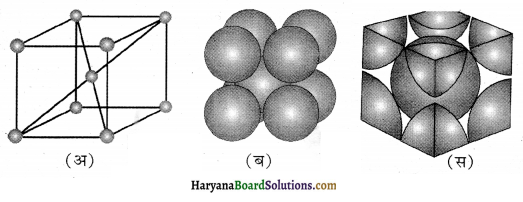
HBSE 12th Class Chemistry Solutions Chapter 1 Img 1

फलक- केन्द्रित घनीय एकक कोष्ठिका (Face Centred Cubic Unit Cell):
फलक – केन्द्रित घनीय जालक की एकक कोष्ठिका में कुल चार परमाणु होते हैं जिसे निम्न प्रकार समझा सकते हैं।
फलक- केंद्रित घनीय (fcc) एकक कोष्ठिका में एक-एक परमाणु- सभी कोनों पर और घन के सभी फलकों के केंद्रों पर पाए जाते हैं। फलक के केंद्र पर उपस्थित प्रत्येक परमाणु दो निकटवर्ती एकक कोष्ठिकाओं के मध्य सहभाजित होता है अतः प्रत्येक परमाणु का केवल 1/2 भाग एक एकक कोष्ठिका में सम्मिलित होता है तथा कोने के परमाणु 8 एकक कोष्ठिकाओं के मध्य सहभाजित होते हैं अतः

(a) 8 कोने के परमाणु × \(\frac { 1 }{ 8 }\) परमाणु प्रति एकक कोष्ठिका = 8 × \(\frac { 1 }{ 8 }\) = 1 परमाणु
(b) 6 फलक-केंद्रित परमाणु × \(\frac { 1 }{ 2 }\) परमाणु प्रति एकक कोष्ठिका = 6 × \(\frac { 1 }{ 2 }\) = 3 परमाणु
अतः एक एकक कोष्ठिका में परमाणुओं की कुल संख्या = 1 + 3 = 4 परमाणु
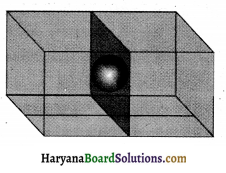
HBSE 12th Class Chemistry Solutions Chapter 1 Img 2

HBSE 12th Class Chemistry Solutions Chapter 1 ठोस अवस्था

प्रश्न 1.9.
समझाइए:
(i) धात्विक एवं आयनिक क्रिस्टलों में समानता एवं विभेद का आधार।
(ii) आयनिक ठोस कठोर एवं भंगुर होते हैं।
उत्तर:
(i) धात्विक एवं आयनिक क्रिस्टलों में समानता एवं विभेद निम्नलिखित हैं।
समानताएँ:
(1) धात्विक ठोस तथा आयनिक ठोस दोनों ही कठोर होते हैं।
(2) धात्विक ठोस तथा आयनिक ठोस दोनों के गलनांक उच्च होते हैं।
(3) धात्विक ठोस तथा आयनिक ठोस दोनों ही गलित अवस्था में विद्युत के चालक होते हैं।

विभेद:
(1) धात्विक क्रिस्टल में अवयवी कण धनायन होते हैं जो मुक्त तथा गतिशील इलेक्ट्रॉनों के समुद्र में डूबे रहते हैं। जबकि आयनिक ठोस में अवयवी कण धनायन तथा ऋणायन होते हैं।
(2) धात्विक ठोस में धात्विक बन्ध होता है जबकि आयनिक ठोस में आयनिक बन्ध होता है।
(3) धात्विक ठोस आघातवर्धनीय एवं तन्य होते हैं जबकि आयनिक ठोस भंगुर होते हैं।
(4) धात्विक ठोस विद्युत के अच्छे चालक होते हैं जबकि आयनिक ठोस कुचालक होते हैं, क्योंकि आयन गतिशील नहीं होते।

(ii) आयनिक ठोस कठोर तथा भंगुर होते हैं क्योंकि इनमें आयनों के मध्य प्रबल स्थिर विद्युत आकर्षण बल होता है तथा बल लगाने पर समान आवेश की पर्तें एक-दूसरे के सामने आ जाती हैं जिससे प्रतिकर्षण होता है तथा यौगिक टुकड़े-टुकड़े हो जाता है अर्थात् भंगुर होता है।

प्रश्न 1.10.
निम्नलिखित के लिए धातु के क्रिस्टल में संकुलन क्षमता की गणना कीजिए:
(i) सरल घनीय,
(ii) अंत: केंद्रित घनीय,
(iii) फलक के न्द्रित घनीय।
( यह मानते हुए कि परमाणु एक-दूसरे के संपर्क में हैं ।)
उत्तर:
(i) सरल घनीय धातु क्रिस्टल की संकुलन क्षमता 52.4%,
(ii) अन्तः केन्द्रित घनीय धातु क्रिस्टल की संकुलन क्षमता 68% तथा
(iii) फलक- केन्द्रित घनीय धातु क्रिस्टल की संकुलन क्षमता 74% होती है।

षट्कोणीय निविड संकुलन (hcp) तथा घनीय निवि संकुलन (ccp या fcc) संरचनाओं में संकुलन क्षमता:
घनीय निविड संकुलन (ccp) क्रिस्टल की संकुलन क्षमता 74% होती है जिसकी गणना निम्न प्रकार की जाती है
hcp तथा fcc (ccp) की संकुलन क्षमता समान होती है। चित्र के अनुसार एकक कोष्ठिका के कोर (Edge) या किनारे की लम्बाई ‘a’ हो तथा फलक विकर्ण AC = b हो, तो
△ABC में,
AC2 = b2 = BC2 + AB2
= a2 + a2 = 2a2
या b = √2 a
यदि गोले का अर्धव्यास (त्रिज्या ) r हो, तो
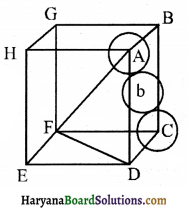
HBSE 12th Class Chemistry Solutions Chapter 1 Img 3
b = 4r = √2 a
या a = \(\frac { 4r }{ √2 }\) = 2√2r
या r = \(\frac { a }{ 2√2 }\)
ccp संरचना में प्रति एकक कोष्ठिका 4 गोले होते हैं । अतः चार गोलों का कुल आयतन 4 × (4/3) πr3 के बराबर होगा और घन का आयतन a3 या (2√2r)3 होता है । अतः
संरचना की संकुलन क्षमता
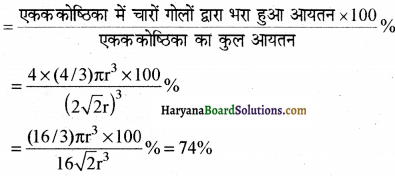
HBSE 12th Class Chemistry Solutions Chapter 1 Img 4

अन्तःकेन्द्रित ( काय- केन्द्रित ) (bec) घनीय संरचनाओं की संकुलन क्षमता (Packing Efficiency of Body- centred Cubic Structure):
अंत: केंद्रित घनीय क्रिस्टल की संकुलन क्षमता 68% होती है जिसकी गणना निम्न प्रकार की जाती है
चित्र से स्पष्ट है कि केंद्र में स्थित परमाणु विकर्ण पर स्थित अन्य दो परमाणुओं के संपर्क में हैं।
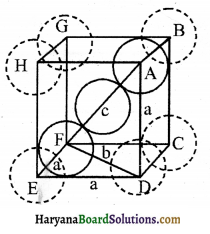
HBSE 12th Class Chemistry Solutions Chapter 1 Img 5
△EFD में,
b2 = a2 + a2 = 2a2
b = √2 a
अब △AFD में,
c2 = a2 + b2 = a2 + 2a2 = 3a2
c=√3a
काय विकर्ण (Body diagonal) ‘c’ की लंबाई 4r के बराबर है, जहाँ गोले का अर्धव्यास (त्रिज्या) है, क्योंकि विकर्ण पर स्थित तीनों गोले एक-दूसरे के संपर्क में हैं । अतः
√3a = 4r
a = \(\frac { 4r }{ √3 }\)
अतः r = \(\frac { √3 }{ 4 }\)a
इस संरचना में परमाणुओं की कुल संख्या 2 है अतः उनका आयतन
2 × (4/3)πr3 होगा तथा घन का आयतन a3 = \(\left(\frac{4}{\sqrt{3}} \mathrm{r}\right)^3\) है।
अतः, संरचना की संकुलन क्षमता
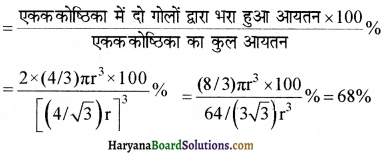
HBSE 12th Class Chemistry Solutions Chapter 1 Img 6

HBSE 12th Class Chemistry Solutions Chapter 1 ठोस अवस्था

सरल घनीय संरचना की संकुलन क्षमता (Packing Efficiency of Simple Cubic Structure):
सरल घनीय क्रिस्टल की संकुलन क्षमता 52.4 प्रतिशत होती है जिसकी गणना निम्नलिखित है।
एक सरल घनीय जालक में परमाणु केवल घन के कोनों पर स्थित होते हैं। घन के किनारों पर स्थित कण एक-दूसरे के सम्पर्क में रहते हैं।
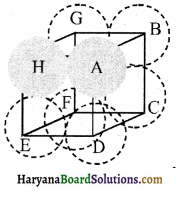
HBSE 12th Class Chemistry Solutions Chapter 1 Img 7

इसलिए घन की भुजा की लंबाई ‘a’ और प्रत्येक कण की त्रिज्या, r में निम्न संबंध है।
a = 2r
अतः घनीय एकक कोष्ठिका का आयतन = a3 = (2r)3 = 8r3 चूँकि सरल घनीय एकक कोष्ठिका में केवल 1 परमाणु उपस्थित व्होता है।
इसलिए घेरे गए त्रिविमीय स्थान का आयतन = \(\frac { 4 }{ 3 }\)πr3
अतः, संरचना की संकुलन क्षमता
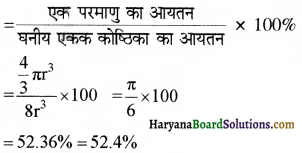
HBSE 12th Class Chemistry Solutions Chapter 1 Img 8

प्रश्न 1.11.
चाँदी का क्रिस्टलीकरण fice जालक में होता है। यदि इसकी कोष्ठिका के कोरों की लंबाई 4.07 × 10⁻⁸cm तथा घनत्व 10.5 g cm-3 हो तो चाँदी का परमाण्विक द्रव्यमान ज्ञात कीजिए।
उत्तर:
प्रश्नानुसार, एकक कोष्ठिका के कोर (edge) की लम्बाई a = 4.07 × 10⁻⁸ cm तथा घनत्व (d) = 10.5 g cm-3
z = 4 क्योंकि fcc की एकक कोष्ठिका में परमाणुओं की संख्या 4 होती है। NA = आवोगाद्रो संख्या = 6.022 × 10⁻²³
घनत्व (d) = \(\frac{\mathrm{zM}}{\mathrm{a}^3 \mathrm{~N}_{\mathrm{A}}}\)
परमाणु द्रव्यमान ज्ञात करना है अतः 10-23
M = \(\frac{\mathrm{d} \times \mathrm{a}^3 \times \mathrm{N}_{\mathrm{A}}}{\mathrm{z}}\) = \(\frac{10.5 \times\left(4.07 \times 10^{-8}\right)^3 \times 6.022 \times 10^{23}}{4}\) = 106.57
अतः चाँदी का परमाणु द्रव्यमान = 106.57

प्रश्न 1.12.
एक घनीय ठोस दो तत्वों P एवं Q से बना है। घन के कोनों पर Q परमाणु एवं अंत:- केंद्र पर P परमाणु स्थित हैं । इस यौगिक का सूत्र क्या है? P एवं Q की उपसहसंयोजन संख्या क्या है?
उत्तर:
एकक कोष्ठिका में घन के कोनों पर स्थित परमाणु का योगदान \(\frac { 1 }{ 8 }\) होता है जबकि अंत: केन्द्र पर स्थित परमाणु का योगदान 1 होता है।
अतः एक एकक कोष्ठिका में:
Q परमाणुओं की संख्या = 8 ( कोनों पर ) × \(\frac { 1 }{ 8 }\) = 1
P परमाणुओं की संख्या = 1 ( कायकेन्द्रित या अन्तः केन्द्रित ) × 1 = 1
अतः यौगिक का सूत्र PQ होगा।
अंत:केन्द्र (कायकेन्द्रित) पर स्थित परमाणु, कोनों पर स्थित सभी परमाणुओं के सम्पर्क में रहता है अतः P की उपसहसंयोजन संख्या 8 होगी। इसी प्रकार Q की उपसहसंयोजन संख्या भी 8 होगी।

प्रश्न 1.13.
नायोबियम का क्रिस्टलीकरण अंतःकेन्द्रित घनीय संरचना में होता है । यदि इसका घनत्व 8.55 g cm-3 हो तो इसके परमाण्विक द्रव्यमान 93 u का प्रयोग करके परमाणु त्रिज्या की गणना कीजिए।
उत्तर:
अंतःकेंद्रित घनीय संरचना ( bcc) में एक एकक कोष्ठिका में परमाणुओं की संख्या 2 होती है।
अतः
z = 2, M = 93 u, NA = 6.022 × 10²³
d = 8.55 g cm-3
घनत्व (d) = \(\frac{z \times M}{a^3 \times N_A}\)
चूंकि परमाणु त्रिज्या ज्ञात करनी है अतः
a3 = \(\frac{\mathrm{z} \times \mathrm{M}}{\mathrm{d} \times \mathrm{N}_{\mathrm{A}}}\)
a3 = \(\frac{2 \times 93}{8.55 \times 6.022 \times 10^{23}}\)
a3 = 3.61 × 10⁻²³ cm3
a = 3.305 × 10⁻⁸ cm = 3.305 × 10⁻¹⁰ m
a = 3.305 × 10² pm (पिकोमीटर) = 330.5 pm
लेकिन bcc की एकक कोष्ठिका में विकर्ण, परमाणु की त्रिज्या का चार गुना होता है।
अतः
4r = √3a
4r = √3 × 330.5
r = \(\frac{\sqrt{3} \times 330.5}{4}\) = 143.1 pm.
अतः नायोबियम की परमाणु त्रिज्या = 143.1pm

प्रश्न 1.14.
यदि अष्टफलकीय रिक्ति की त्रिज्या हो तथा निविड संकुलन में परमाणुओं की त्रिज्या R हो, तो r एवं R में संबंध स्थापित कीजिए।
उत्तर:
संलग्न चित्र में एक अष्टफलकीय रिक्ति को दिखाया गया है। सुविधा के लिए 6 में से केवल 4 गोलों को ही दिखाया गया है। रिक्ति के ऊपर व नीचे के गोलों को नहीं दर्शाया गया है।
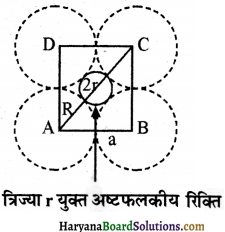
HBSE 12th Class Chemistry Solutions Chapter 1 Img 9
माना कि वर्ग ABCD की प्रत्येक भुजा की लम्बाई = a cm समकोण त्रिभुज ABC में, विकर्ण AC है तो-
AC = \(\sqrt{A B^2+B C^2}\) = \(\sqrt{a^2+a^2}\) = √2.a.
लेकिन AC = 2R + 2r
∴ 2R + 2r = √2a
लेकिन a = 2R
∴ 2R + 2r = √2.2R
इस समीकरण को 2R से भाग देने पर,
1 + \(\frac { r }{ R }\) = √2
\(\frac { r }{ R }\) = √2 – 1 = 1.414 – 1 = 0.414
अतः = \(\frac { r }{ R }\) = 0.414
r = अष्टफलकीय रिक्ति की त्रिज्या
R = परमाणु (गोले ) की त्रिज्या

HBSE 12th Class Chemistry Solutions Chapter 1 ठोस अवस्था

प्रश्न 1.15.
कॉपर fcc जालक के रूप में क्रिस्टलीकृत होता है जिसके कोर की लंबाई 3.61 × 10⁻⁸ cm है। यह दर्शाइए कि गणना किए गए घनत्व के मान तथा मापे गए घनत्व 8.92 g cm-3 में समानता है।
उत्तर:
fcc संरचना में z = 4 (एकक कोष्ठिका में परमाणुओं की संख्या)
Cu का परमाणु द्रव्यमान (M) = 63.5 होता है।
कोर की लम्बाई a = 3.61 × 10⁻⁸ cm
घनत्व (d) = \(\frac{M \times z}{N_A \times a^3}\)
d = \(\frac{63.5 \times 4}{\left(6.022 \times 10^{23}\right) \times\left(3.61 \times 10^{-8}\right)^3}\)
d = \(\frac{63.5 \times 4}{6.022 \times 10^{23} \times 47.04 \times 10^{-24}},\)
d = 8.966 = 8.97 g cm-3
चूंकि मापा गया घनत्व 8.92 g cm-3 है। अतः गणना किए गए घनत्व तथा मापे गए घनत्व में समानता है।

प्रश्न 1.16.
विश्लेषण द्वारा ज्ञात हुआ कि निकैल ऑक्साइड का सूत्र Ni0.98O1.00 है । निकैल आयनों का कितना अंश Ni2+ और Ni-3+ के रूप में विद्यमान है?
उत्तर:
निकल ऑक्साइड का सूत्र Ni0.98O1.00 है जिसमें Ni2+ तथा Ni3+ दोनों आयन उपस्थित हैं।
सूत्रानुसार Ni = 98 तथा O-2 = 100 है।
माना Ni2+ आयन = x
अतः Ni3+ आयन = 98 – x
अतः कुल धनावेश = (x × 2) + [(98 – x) × 3]
तथा कुल ऋणावेश = 100 × 2
यौगिक उदासीन होता है अतः कुल धनावेश = कुल ऋणावेश होगा
(x × 2) + [(98 – x) × 3] = 100 × 2
(2x) + (294 – 3x) = 200
– x = – 94
x = 94
अतः Ni2+ आयनों का अंश (प्रतिशत)
\(\frac { 94 }{ 98 }\) × 100 = 95.9 = 96%
Ni3+ आयनों का अंश (प्रतिशत) = 100 – 96 = 4%

प्रश्न 1.17.
अर्धचालक क्या होते हैं? दो मुख्य अर्धचालकों का वर्णन कीजिए एवं उनकी चालकता – क्रियाविधि में विभेद कीजिए।
उत्तर:
अर्धचालक (Semiconductors) – अर्धचालक वे ठोस होते हैं जिनकी चालकता 10-6 से 104 ohm m-1 के बीच की होती है अर्थात् इनकी चालकता चालकों से कम तथा विद्युतरोधी से अधिक होती है। अर्धचालकों में संयोजक बैंड एवं चालक बैंड के मध्य ऊर्जा अंतराल कम होता है। अतः कुछ इलेक्ट्रॉन चालक बैंड में जा सकते हैं अतः ये अल्प चालकता दर्शा सकते हैं। ताप बढ़ने के साथ अर्धचालकों की विद्युत चालकता बढ़ती है, क्योंकि अधिक संख्या में इलेक्ट्रॉन चालक बैंड में चले जाते हैं। उदाहरण-सिलिकन एवं जरमेनियम, इन्हें आंतर या नैज अर्धचालक (Intrinsic semiconductors) कहते हैं। नैज-अर्धचालकों की चालकता व्यवहारिक उपयोग की दृष्टि से बहुत कम होती है।
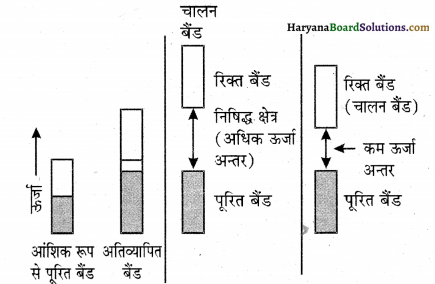
HBSE 12th Class Chemistry Solutions Chapter 1 Img 17

प्रश्न 1.18.
नानस्टॉइ कियोमीट्री क्यूप्रस ऑक्साइड, (Cu2O) प्रयोगशाला में बनाया जा सकता है। इसमें कॉपर तथा ऑक्सीजन का अनुपात 2 : 1 से कुछ कम है। क्या आप इस तथ्य की व्याख्या कर सकते हैं कि यह पदार्थ p- प्रकार का अर्धचालक है?
उत्तर:
नॉनस्टॉइकियोमीट्री क्यूप्रस ऑक्साइड (Cu2O) में कॉपर तथा ऑक्सीजन का अनुपात 2:1 से कुछ कम है। अतः कुछ क्यूप्रस आयन (Cu+) अपने स्थान से गायब होकर पीछे धनात्मक छिद्र छोड़ देते हैं, लेकिन विद्युत उदासीनता को बनाए रखने के लिए कुछ Cu+1 आयन, Cu+2 में परिवर्तित हो जाते हैं। (Cu, Cu+ तथा Cu+2 दोनों ऑक्सीकरण अवस्था दर्शाता है।) इसमें धनात्मक छिद्र होते हैं अतः यह p-प्रकार का चालक है।

प्रश्न 1.19.
फेरिक ऑक्साइड, ऑक्साइड आयन के षट्कोणीय निविड संकुलन में क्रिस्टलीकृत होता है जिसकी तीन अष्टफलकीय रिक्तियों में से दो पर फेरिक आयन होते हैं । फेरिक ऑक्साइड का सूत्र ज्ञात कीजिए ।
उत्तर:
फेरिक ऑक्साइड में ऑक्साइड आयन षट्कोणीय निविड संकुलन व्यवस्था में है जिसमें प्रत्येक ऑक्साइड आयन के लिए एक अष्टफलकीय रिक्ति होती है जिनमें तीन में से दो रिक्तियाँ Fe+3 आयन द्वारा भरी होती हैं । अतः प्रत्येक O2- आयन के लिए Fe+3 आयनों की संख्या =2/3
अतः Fe+3 तथा O-2 का अनुपात = \(\frac { 2 }{ 3 }\):1 (Fe: O)
अतः फेरिक ऑक्साइड का सूत्र Fe2O3 होगा।

प्रश्न 1.20.
निम्नलिखित को p- प्रकार या n – प्रकार के अर्धचालकों में वर्गीकृत कीजिए।
(i) In से डोपित Ge
(ii) B से डोपित Si
उत्तर:
(i) In से डोपित Ge, p-प्रकार का अर्धचालक होता है क्योंकि Ge के संयोजी कोश में चार इलेक्ट्रॉन हैं (14वां वर्ग)। जब इसको In (13वें वर्ग) से डोपित करते हैं जिसके बाह्यतम कोश में तीन इलेक्ट्रॉन हैं, तो Ge केवल तीन बन्ध ही बनाता है अतः बन्ध बनाने के लिए एक इलेक्ट्रॉन की कमी है इसलिए यह इलेक्ट्रॉन न्यून (धनात्मक) छिद्र होगा, अतः यह p – प्रकार का अर्धचालक होगा।

(ii) यह भी (i) के समान p-प्रकार का अर्धचालक ही होगा क्योंकि B 13वें वर्ग का तथा Si. 14वें वर्ग का तत्व है।

प्रश्न 1.21.
सोना (परमाणु त्रिज्या = 0.144 nm ) फलक- केंद्रित एकक कोष्ठिका में क्रिस्टलीकृत होता है। इसकी कोष्ठिका के कोर की लंबाई ज्ञात कीजिए।
उत्तर:
प्रश्नानुसार सोने (Au) की परमाणु त्रिज्या r = 0.144 nm. फलक – केन्द्रित एकक कोष्ठिका में, फलक विकर्ण =4r=√2a
अतः a = \(\frac { 4r }{ √2 }\) = 2√2 r
= 2 × 1.414 × 0.144 nm = 0.407 nm
अतः एकक कोष्ठिका के कोर (Edge) की लम्बाई = 0.407

प्रश्न 1.22.
बैंड सिद्धांत के आधार पर (i) चालक एवं रोधी (ii) चालक एवं अर्धचालक में क्या अंतर होता है?
उत्तर:
(i) चालक वे ठोस होते हैं जिनकी चालकता 104 से 107 ohm-1 m-1 के मध्य होती है तथा रोधी (विद्युतरोधी) वे ठोस होते हैं जिनकी चालकता बहुत ही कम 10-20 से 10-10 ohm-1 m-1 की परास में होती है।

चालकों में बैंड आंशिक रूप से भरा होता है या यह एक उच्च ऊर्जा वाले रिक्त चालकता बैंड के साथ अतिव्यापन करता है अतः विद्युत क्षेत्र में इलेक्ट्रॉन आसानी से प्रवाहित हो जाते हैं जिससे धातु (चालक) चालकता दर्शाती हैं। जबकि विद्युतरोधी में पूर्ण पूरित संयोजी बैंड एवं उच्च रिक्त बैंड (चालकता बैंड) में ऊर्जा अन्तराल अधिक होता है जिससे इलेक्ट्रॉन चालकता बैंड में नहीं जा सकते, अतः इनकी चालकता नगण्य होती है।

(ii) चालक में आंशिक भरे बैंड होते हैं या अतिव्यापित बैंड होते हैं जिनमें इलेक्ट्रॉन का प्रवाह आसानी से हो जाता है जबकि अर्धचालकों में संयोजी बैंड तथा चालन बैंड के मध्य अंतराल कम होता है अतः कुछ इलेक्ट्रॉन चालन बैंड में चले जाते हैं, अतः इनकी चालकता कम होती है।

प्रश्न 1.23.
उचित उदाहरणों द्वारा निम्नलिखित पदों को परिभाषित कीजिए:
(i) शॉट्की दोष,
(ii) फ्रेंकेल दोष,
(iii) अंतराकाशी दोष,
(iv) F-केंद्र।
उत्तर:
(b) शॉट्की दोष या शॉट्की त्रुटि (Schottky defect) – यह मुख्य रूप से आयनिक ठोसों का रिक्तिका दोष (vacancy defect) है। विद्युत उदासीनता को बनाए रखने के लिए क्रिस्टल से गायब होने वाले धनायनों और ऋणायनों की संख्या बराबर होती है अर्थात् धनायन तथा ऋणायन दोनों ही अपने स्थान से गायब हो जाते हैं। सरल रिक्तिका दोष की भाँति, शॉट्की दोष से भी पदार्थ का घनत्व कम हो जाता है। आयनिक ठोसों के ऐसे दोषों में संख्या महत्वपूर्ण हो ती है।
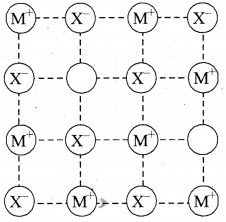
HBSE 12th Class Chemistry Solutions Chapter 1 Img 18
जैसे NaCl में कमरे के ताप पर लगभग 106 शॉट्की युगल प्रति cm3 होते हैं। एक cm3 में करीब 1022 आयन होते हैं। इस प्रकार प्रति 1016 आयनों में एक शॉट्की दोष होता है। शॉट्की दोष उन आयनिक पदार्थों में होता है जिनमें धनायन और ऋणायन लगभग समान आकार के होते हैं तथा जिनकी समन्वयी संख्या उच्च होती है। उदाहरण NaCl, KCl, CsCl | AgBr में फ्रेंकेल तथा शॉट्की दोनों ही प्रकार के दोष होते हैं।

(ii) किसी क्रिस्टल जालक में जब कुछ अवयवी कण अंतरांकाशी स्थल पर उपस्थित होते हैं तो इसे अंतराकाशी दोष कहते हैं। इससे पदार्थ का घनत्व बढ़ जाता है। रिक्तिका दोष तथा अंतराकाशी दोष अनआयनिक ठोसों में पाए जाते हैं। आयनिक ठोसों में विद्युत उदासीनता रहना आवश्यक है। अतः इन दोषों को फ्रेंकेल तथा शॉट्की दोषों के रूप में वर्गीकृत किया जाता है।
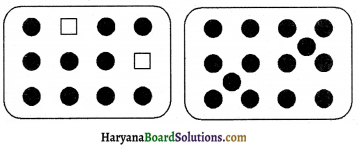
HBSE 12th Class Chemistry Solutions Chapter 1 Img 12

(iii) अन्तराकाशी दोष (Interstitial defect ) – किसी क्रिस्टल जालक में जब कुछ अवयवी कण अंतरांकाशी स्थल पर उपस्थित होते हैं तो इसे अंतराकाशी दोष कहते हैं। इससे पदार्थ का घनत्व बढ़ जाता है। रिक्तिका दोष तथा अंतराकाशी दोष अनआयनिक ठोसों में पाए जाते हैं। आयनिक ठोसों में विद्युत उदासीनता रहना आवश्यक है। अतः इन दोषों को फ्रेंकेल तथा शॉट्की दोषों के रूप में वर्गीकृत किया जाता है।

(iv) F- केन्द्र–नानस्टॉइकियोमीट्री दोष में धातु का आधिक्य हो F-केन्द्र उत्पन्न होता है, जैसे NaCl के क्रिस्टल को सोडियम वाष्प के साथ गर्म करते हैं तो सोडियम परमाणु क्रिस्टल की सतह पर जम जाते हैं। Cl आयन क्रिस्टल की सतह में विसरित हो जाते हैं तथा Na के साथ मिलकर NaCl बनाते हैं, ऐसा होने पर Na, इलेक्ट्रॉन देकर Na+ बनाता है। यह निकला हुआ इलेक्ट्रॉन विसरण द्वारा क्रिस्टल के ऋणायनिक स्थान (CI के कारण रिक्त) में चला जाता है। इस अयुग्मित इलेक्ट्रॉनयुक्त ऋणायनिक रिक्तिका को F-केन्द्र कहते हैं। (यह रंग केंद्र के लिए जर्मन शब्द फारबेनजेनटर से आया है) इससे NaCl के क्रिस्टलों का रंग पीला हो जाता है।

HBSE 12th Class Chemistry Solutions Chapter 1 ठोस अवस्था

प्रश्न 1.24.
ऐलुमिनियम घनीय निविड संकुलित संरचना में क्रिस्टलीकृत होता है। इसका धात्विक अर्धव्यास 125 pm है।
(i) एकक कोष्ठिका के कोर की लंबाई ज्ञात कीजिए ।
(ii) 1.0 cm3 ऐलुमिनियम में कितनी एकक कोष्ठिकाएं होंगी?
उत्तर:
(i) घनीय निविड संकुलित संरचना में एकक कोष्ठिका का फलक विकर्ण (Face diagonal) परमाणु त्रिज्या (अर्धव्यास) का चार गुना होता है।
लेकिन, फलक विकर्ण = √2 × कोर की लम्बाई
कोर की लम्बाई = \(\frac { फलक विकर्ण }{ √2 }\)
फलक विकर्ण = 4 × 125 pm = 500 pm
अतः एकक कोष्ठिका के कोर की लम्बाई
= \(\frac { 500 }{ √2 }\) = 353.6 = 354 pm = a

(ii) एक एकक कोष्ठिका का आयतन = a3
a = 354 pm = 354 × 10-8 m
= 3.54 × 10⁻⁸ cm
अत: a3 = (3.54 × 10⁻⁸ cm)3

अत: 1cm3 ऐलुमिनियम में एकक कोष्ठिकाओं की संख्या
= \(\frac{1.00}{\left(3.54 \times 10^{-8}\right)^3}\) = 2.25 × 10²²

प्रश्न 1.25.
यदि NaCl को SrCl2 के 103 मोल % से डोपित किया जाए तो धनायनों की रिक्तियों का सांद्रण क्या होगा?
उत्तर:
Na का आवेश +1 है जबकि Sr का आवेश +2 है अतः NaCl में SrCl2 मिलाने पर प्रति Sr2+ एक धनायन रिक्ति होगी क्योंकि 2Na+ के स्थान पर एक Sr2+ आएगा।
अतः 100 मोल NaCl में 10-3 मोल SrCh मिलाने पर 10-3 मोल धनायन रिक्ति उत्पन्न होगी। ( SrCl2 10-3 मोल % मिलाया गया है।) अतः NaCl के एक मोल में धनायन रिक्तियों की संख्या
= \(\frac{10^{-3}}{100}\) × 6.022 × 10²³ ( आवोगाद्रो संख्या )
= 6.022 × 10¹⁸ धनायन रिक्ति प्रति मोल

प्रश्न 1.26.
निम्नलिखित को उचित उदाहरणों से समझाइए:
(i) लोहचुंबकत्व
(iii) फेरीचुंबकत्व
(ii) अनुचुंबकत्व
(iv) प्रतिलोहचुंबकत्व
(v) 12-16 और 13-15 वर्गों के यौगिक।
उत्तर:
(i) अनुचुम्बकीय (Paramagnetic): वे पदार्थ जो चुंबकीय क्षेत्र की ओर दुर्बलता से आकर्षित होते हैं उन्हें अनुचुंबकीय पदार्थ कहते हैं। ये चुम्बकीय क्षेत्र की दिशा में ही चुम्बकित हो जाते हैं। ये चुंबकीय क्षेत्र की अनुपस्थिति में अपना चुंबकत्व खो देते हैं अतः इनका चुम्बकीय गुण अस्थायी होता है, इस गुण को अनुचुम्बकत्व कहते है । अनुचुंबकत्व गुण के लिए पदार्थ में एक अथवा अधिक अयुग्मित इलेक्ट्रॉनों की उपस्थिति आवश्यक है। जो कि चुम्बकीय क्षेत्र की ओर आकर्षित होते हैं। उदाहरण – O2, TiO, CuO, Cu2+, Fe3+, VO2, TiO2, Cr3+ आदि।

(ii) प्रतिचुंबकीय (Dimagnetic ): प्रतिचुंबकीय पदार्थ वे होते हैं जो चुंबकीय क्षेत्र में रखने पर दुर्बल रूप से प्रतिकर्षित होते हैं। ये चुंबकीय क्षेत्र की विपरीत दिशा में दुर्बल रूप से चुंबकित होते हैं। प्रतिचुंबकत्व उन पदार्थों में होता है जिनमें सभी इलेक्ट्रॉन युग्मित होते हैं। इलेक्ट्रॉनों के युग्मन के कारण इनके चुंबकीय आघूर्ण आपस में निरस्त हो जाते हैं क्योंकि इलेक्ट्रॉनों का चक्रण विपरीत होता है, अतः इनका चुंबकीय गुण नष्ट हो जाता है । उदाहरण – V2O5, TiO2, Zn+2, Na+, K+, Mg2+, बेन्जीन (C6H6), सोडियम क्लोराइड (NaCl) तथा जल (H2O) आदि।

(iii) लोहचुम्बकीय (Ferromagnetic ): वे पदार्थ जिन्हें चुम्बकीय क्षेत्र में रखने पर उसकी ओर बहुत प्रबलता से आकर्षित होते हैं, उन्हें लोहचुम्बकीय पदार्थ तथा पदार्थों के इस गुण को लोहचुम्बकत्व कहते हैं। प्रबल आकर्षणों के अतिरिक्त ये स्थायी रूप से चुम्बकित किए जा सकते हैं। इनमें भी अयुग्मित इलेक्ट्रॉन पाए जाते हैं। ठोस अवस्था में, लोहचुम्बकीय पदार्थों के धातु आयन छोटे खण्डों के रूप में एक साथ समूह बना लेते हैं, इन्हें डोमेन कहते हैं।

प्रत्येक डोमेन छोटे चुम्बक की भाँति व्यवहार करता है। लोहचुम्बकीय पदार्थ के अचुम्बकीय भाग में डोमेन अनियमित रूप से व्यवस्थित होते हैं और उनका चुम्बकीय आघूर्ण निरस्त हो जाता है। पदार्थ को चुम्बकीय क्षेत्र में रखने पर सभी डोमेन चुम्बकीय क्षेत्र की दिशा में अभिविन्यासित ( Oriented) हो जाते हैं और प्रबल चुम्बकीय प्रभाव उत्पन्न करते हैं । चुम्बकीय क्षेत्र हटा लेने पर भी डोमेनों का क्रम वही रहता है और लोहचुम्बकीय पदार्थ स्थायी चुम्बक बन जाते हैं। उदाहरण– Fe, Co, Ni, Gd तथा CrO2 आदि। लोहचुम्बकीय गुण के कारण ही CrO2 को कैसेट की टेप बनाने में प्रयुक्त करते हैं।
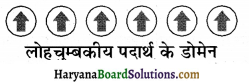
HBSE 12th Class Chemistry Solutions Chapter 1 Img 10

(iv) प्रतिलोहचुम्बकीय (Antiferromagnetic): ये पदार्थ भी डोमेन संरचना में लोहचुम्बकीय पदार्थों के ही समान होते हैं लेकिन इनके डोमेन एक-दूसरे की विपरीत दिशाओं में अभिविन्यासित होने के कारण इनका चुम्बकीय आघूर्ण नष्ट हो जाता है। इस गुण को प्रति लोहचुम्बकत्व कहा जाता है।
उदाहरण – V2O3, Cr2O3, Fe2O3, FeO, Col, NiO, MnO, Mn2O2, Mn2O3 आदि।
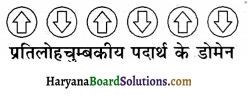
HBSE 12th Class Chemistry Solutions Chapter 1 Img 11

(v) 12-16 और 13-15 वर्गों के यौगिक- वर्ग 13 तथा 15 एवं वर्ग 12 तथा 16 के तत्वों के मिश्रण से अनेक प्रकार के ठोस पदार्थ बनाए गए हैं। वर्ग 13-15 के यौगिक InSb, AlP तथा GaAs हैं। गैलियम आर्सेनाइड (GaAs) तथा त्वरित प्रतिसंवेदी (Fast response) अर्धचालक होते हैं; ZnS, Cas, Case तथा HgTe, वर्ग 12-16 के यौगिकों के उदाहरण हैं।  इन यौगिकों में बंध पूर्णतया सहसंयोजक नहीं होते तथा इनके आयनिक गुण दोनों तत्वों की विद्युत ऋणता पर निर्भर करते हैं। ये भी अर्धचालक होते हैं।

HBSE 12th Class Chemistry ठोस अवस्था Intext Questions

प्रश्न 1.1.
ठोस कठोर क्यों होते हैं?
उत्तर:
ठोसों में उपस्थित अवयवी कणों का निविड संकुलन (Close packing) होता है जिसके कारण इनमें कण पास-पास होते हैं तथा ये कण गति नहीं करते, केवल अपनी माध्य स्थिति के दोनों ओर कम्पन करते हैं; अतः ठोस कठोर होते हैं।

प्रश्न 1.2.
ठोसों का आयतन निश्चित क्यों होता है?
उत्तर:
ठोसों में कणों की व्यवस्था निश्चित दूरी पर होती है तथा इनके कणों में कोई गति नहीं होती एवं कणों के मध्य रिक्त स्थान बहुत ही कम होता है। इन पर दाब का भी कोई प्रभाव नहीं होता, अतः इनका आयतन निश्चित होता है।

प्रश्न 1.3.
निम्नलिखित को अक्रिस्टलीय तथा क्रिस्टलीय ठोसों में वर्गीकृत कीजिए।
पॉलियूरिथेन, नैफ्थैलीन, बेन्जोइक अम्ल, टेफ्लॉन, पोटैशियम नाइट्रेट, सेलोफेन, पॉलिवाइनिल क्लोराइड, रेशा काँच, ताँबा।
उत्तर:
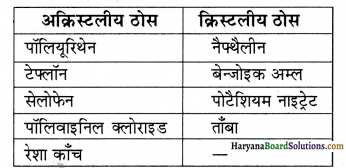
HBSE 12th Class Chemistry Solutions Chapter 1 Img 13

प्रश्न 1.4.
एक ठोस के अपवर्तनांक का सभी दिशाओं में समान मान प्रेक्षित होता है। इस ठोस की प्रकृति पर टिप्पणी कीजिए। क्या यह विदलन गुण प्रदर्शित करेगा?
उत्तर:
ठोस के अप्रवर्तनांक (भौतिक गुण) का मान सभी दिशाओं में समान प्रेक्षित हो रहा है, अतः यह ठोस समदैशिक (Isotropic) है इसी कारण यह अक्रिस्टलीय ठोस है। यह विदलन का गुण प्रदर्शित नहीं करेगा।

प्रश्न 1.5.
उपस्थित अंतराआण्विक बलों की प्रकृति के आधार पर निम्नलिखित ठोसों को विभिन्न संवर्गों में वर्गीकृत कीजिए-
पोटैशियम सल्फेट, टिन, बेन्जीन, यूरिया, अमोनिया, जल, जिंक सल्फाइड, ग्रेफाइट, रूबिडियम, ऑर्गन, सिलिकन कार्बाइड।
उत्तर:
अंतराआण्विक बलों की प्रकृति के आधार पर उपर्युक्त ठोसों के विभिन्न संवर्ग निम्न प्रकार होंगे-
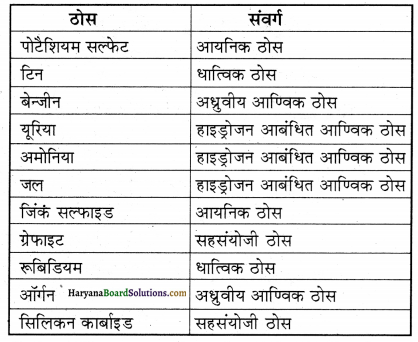
HBSE 12th Class Chemistry Solutions Chapter 1 Img 14

प्रश्न 1.6.
ठोस A, अत्यधिक कठोर तथा ठोस एवं गलित दोनों अवस्थाओं में विद्युतरोधी है और अत्यंत उच्च ताप पर पिघलता है। यह किस प्रकार का ठोस है?
उत्तर:
ठोस A, सहसंयोजक ठोस है तथा इसका उदाहरण हीरा है जो कि अत्यधिक कठोर है। यह ठोस एवं गलित दोनों ही अवस्थाओं में विद्युतरोधी है अर्थात् विद्युत का चालन नहीं करता और अत्यंत उच्च ताप पर पिघलता है क्योंकि इसका गलनांक उच्च होता है।

प्रश्न 1.7.
आयनिक ठोस गलित अवस्था में विद्युत चालक होते हैं परंतु ठोस अवस्था में नहीं, व्याख्या कीजिए।
उत्तर:
आयनिक ठोस में, ठोस अवस्था में भी आयन तो होते हैं लेकिन ये आयन स्वतंत्र नहीं होते हैं, अत: ठोस अवस्था में ये विद्युत का चालन नहीं करते। गलित अवस्था में आयन स्वतंत्र हो जाते हैं, अत: इस अवस्था में इन स्वतंत्र आयनों के कारण ही विद्युत का चालन होता है।

HBSE 12th Class Chemistry Solutions Chapter 1 ठोस अवस्था

प्रश्न 1.8.
किस प्रकार के ठोस विद्युत चालक, आघातवध्र्य और तन्य होते हैं?
उत्तर:
धात्विक ठोस विद्युत चालक, आघातवर्ध्य तथा तन्य होते हैं क्योंकि धात्विक ठोस के उदाहरण धातुएँ हैं तथा धातुओं में ये सभी गुण पाए जाते हैं।

प्रश्न 1.9.
‘जालक बिन्दु’ से आप क्या समझते हैं?
उत्तर:
किसी क्रिस्टल में अवयवी कणों (परमाणु, अणु या आयन) की त्रिविमीय व्यवस्था में प्रत्येक कण को एक बिंदु (point) द्वारा दर्शाया जाता है। इसे जालक बिन्दु कहते हैं।

प्रश्न 1.10.
एकक कोष्ठिका (unit cell) को अभिलक्षणित (characterise) करने वाले पैरामीटरों के नाम बताइए।
उत्तर:
एकक कोष्ठिका को अभिलक्षणित करने के लिए निम्नलिखित पैरामीटर आवश्यक होते हैं-

  • एकक कोष्ठिका में अवयवी कणों की संख्या
  • संकुलन क्षमता (packing efficiency)
  • उपसहसंयोजन संख्या (coordination number)
  • किनारे की लम्बाई या अक्षीय दूरी a,b तथा c.
  • अक्ष्षीय कोण α, β तथा γ ।

प्रश्न 1.11.
निम्नलिखित में विभेद कीजिए-
(i) षट्कोणीय और एकनताक्ष एकक कोष्ठिका
(ii) फलक-केंद्रित और अंत्य-कें द्रित एकक कोष्ठिका।
उत्तर:
(i) षट्कोणीय एकक कोष्ठिका केवल आद्य (primitive) प्रकार की होती है। इसमें एक भुजा की लंबाई दो अन्य भुजाओं से भिन्न होती है (a = b ≠ c) । इसमें अक्षीय कोण α = β = 90° तथा γ = 120° होता है। इसके फलकों पर चिह्नित कोण 60° हैं। एकनताक्ष कोष्ठिका में आद्य तथा अंत्य-केन्द्रित (end centred) विविधताएं होती हैं। इसमें भी एक भुजा की लंबाई, दो अन्य भुजाओं से भिन्न होती है (a = b ≠ c) । अक्षीय कोण α = β = 90° तथा β ≠ 120° होता है। इसमें असमान भुजाएँ दो फलकों के मध्य 90° से भिन्न हैं।

(ii) फलक-केन्द्रित एकक कोष्ठिका में अवयवी परमाणु सभी कोनों पर और घन के सभी फलकों के केंद्रों पर पाए जाते हैं जबकि अन्त्य-केन्द्रित एकक कोष्ठिका में अवयवी परमाणु सभी कोनों पर और घन के केवल दो समानान्तर फलकों के केंद्रों पर पाए जाते हैं। अतः फलक-केन्द्रित एकक कोष्ठिका में परमाणुओं की कुल संख्या 4 होती है जबकि अंत्य-केन्द्रित एकक कोष्ठिका में परमाणुओं की कुल संख्या 2 होती है।

प्रश्न 1.12.
स्पष्ट कीजिए कि एक घनीय एकक कोष्ठिका के-
(i) कोने और
(ii) अंतःकेन्द्र पर उपस्थित परमाणु का कितना भाग सन्निकट कोष्ठिका से सहभाजित होता है।
उत्तर:
एक घनीय एकक कोष्ठिका के कोने पर स्थित परमाणु आठ एकक कोष्ठिका से सम्पर्क में रहता है। अत: उसका एक एकक कोष्ठिका में योगदान \(\frac { 1 }{ 8 }\) होता है। अत: कोने वाले परमाणुओं का कुल योगदान
(i) 8 कोने × \(\frac { 1 }{ 8 }\) प्रति कोना परमाणु = 8 × \(\frac { 1 }{ 8 }\) = 1 परमाणु

(ii) अंतः केंद्र का परमाणु पूर्णतया उसी एकक कोष्ठिका से संबंधित होता है जिसमें वह उपस्थित होता है।
अत: 1 अंत:केन्द्र परमाणु = 1 × 1 = 1 परमाणु

प्रश्न 1.13.
एक अणु (परमाणु) की वर्ग निविड संकुलित परत में द्विविमीय उपसहसंयोजन संख्या क्या है?
उत्तर:
एक अणु की वर्ग निविड संकुलित (square close packing) परत में द्विविमीय उपसहसंयोजन संख्या 4 होती है क्योंक इसमें प्रत्येक गोला चार निकटवर्ती गोलों के सम्पर्क में रहता है।

प्रश्न 1.14.
एक यौगिक षट्कोणीय निविड संकुलित संरचना बनाता है। इसके 0.5 मोल में कुल रिक्तियों की संख्या कितनी है? उनमें से कितनी रिक्तियाँ चतुष्फलकीय हैं?
उत्तर:
षट्कोणीय निविड संकुलित संरचना (Hexagonal close packed structure) में प्रत्येक कण के लिए 2 चतुष्फलकीय रिक्तियाँ तथा एक अष्टफलकीय रिक्ति होती है। अत: इसके 0.5 मोल में-
रिक्तियों की कुल संख्या
= 0.5 × NA × 3, (NA = आवोगाद्रो संख्या)
= 1.5 × 6.022 × 1023
≈ 9.033 × 10²³
तथा इनमें से चतुष्फलकीय रिक्तियाँ
= 0.5 × NA × 2
= 1 NA = 1 × 6.022 × 1023
≈ 6.022 × 10²³

प्रश्न 1.15.
एक यौगिक, दो तत्वों M और N से बना है। तत्व N, ccp संरचना बनाता है और M के परमाणु चतुष्फलकीय रिक्तियों के 1/3 भाग को अध्यासित (ग्रहण) करते हैं। यौगिक का सूत्र क्या है?
उत्तर:
ccp संरचना में एकक कोष्ठिका में परमाणुओं की कुल संख्या 4 होती है। परमाणु N,ccp संरचना बना रहा है। अत: परमाणु N की संख्या = 4
चतुष्फलकीय रिक्तियों की कुल संख्या = 2 × 4 = 8
(क्योंक चतुष्फलकीय रिक्तियों की संख्या, परमाणुओं की संख्या की दुगुनी होती है।)
चूंकि चतुष्फलकीय रिक्तियों के \(\frac { 1 }{ 3 }\) भाग को परमाणु M अध्यासित कर रहा है अत: परमाणु M की संख्या = 8 × \(\frac { 1 }{ 3 }\)
इसलिए N : M
4 : \(\frac { 8 }{ 3 }\) = 12 : 8 = 3 : 2
अत: यौगिक का सूत्र N3M2 या M2N3 होगा।

प्रश्न 1.16.
निम्नलिखित में से किस जालक में उच्यतम संकुलन क्षमता है?
(i) सरल घनीय,
(ii) अंतःकेन्द्रित घन और
(iii) षट्कोणीय निविड संकुलित जालक।
उत्तर:
उपर्युक्त में से षट्कोणीय निविड संकुलित जालक की संकुलन क्षमता उच्चतम (74%) होती है। सरल घन की संकुलन क्षमता 52.4% तथा अन्तःकेन्द्रित घन की संकुलन क्षमता 68% होती है।

HBSE 12th Class Chemistry Solutions Chapter 1 ठोस अवस्था

प्रश्न 1.17.
एक तत्व का मोलर द्रव्यमान 2.7 × 10⁻²kg mol-1 है, यह 405 pm लंबाई की भुजा वाली घनीय एकक कोष्ठिका बनाता है। यदि उसका घनत्व 2.7 × 10⁻³ kg m-3 है तो घनीय एकक कोष्ठिका की प्रकृति क्या है?
उत्तर:
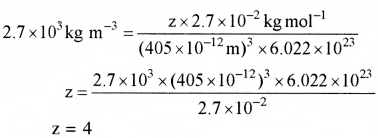
घनत्व, d = \(\frac{\mathrm{zM}}{\mathrm{a}^3 \cdot \mathrm{N}_{\mathrm{A}}}\)
घनत्व, d = 2.7 × 10³ kg m-3
z = एक एकक कोष्ठिका में उपस्थित परमाणुओं की संख्यां
a3 = एकक कोष्ठिका का आयतन
a = एकक कोष्ठिका के कोर की लम्बाई = 405 pm
= 405 × 10-12m
NA = आवोगाद्रो संख्या = 6.022 × 10²³
M = मोलर द्रव्यमान = 2.7 × 10⁻² kg mol-1 मान रखने पर
HBSE 12th Class Chemistry Solutions Chapter 1 Img 15
चूंकि एक एकक कोष्ठिका में परमाणुओं की संख्या 4 है अतः एकक कोष्ठिका ccp या fcc होगी।

प्रश्न 1.18.
जब एक ठोस को गरम किया जाता है तो किस प्रकार का दोष उत्पन्न हो सकता है ? इससे कौनसे भौतिक गुण प्रभावित होते हैं और किस प्रकार?
उत्तर:
जब एक ठोस को गर्म किया जाता है तो रिक्तिका दोष (vacancy defect) या शॉट्की दोष उत्पन्न हो सकता है। इससे कुछ जालक स्थल (lattice site) रिक्त हो जाते हैं इसलिए ठोस का घनत्व कम हो जाता हैं क्योंकि द्रव्यमान की तुलना में आयतन अधिक हो जाता है।

प्रश्न 1.19.
निम्नलिखित किस प्रकार का स्टॉइकियोमीट्री दोष दर्शाते हैं?
(i) ZnS
(ii) AgBr
उत्तर:
(i) ZnS में फ्रेंकेल दोष पाया जाता है क्योंकि धनायन तथा ऋणायन के आकार में अन्तर अधिक है।
(ii) AgBr फ्रेंकेल तथा शॉट्की दोनों प्रकार के दोष दर्शाता है।

प्रश्न 1.20.
समझाइए कि एक उच्च संयोजी धनायन को अशुद्धि की तरह मिलाने पर आयनिक ठोस में रिक्तिकाएं किस प्रकार प्रविष्ट होती हैं?
उत्तर:
एक उच्च संयोजी धनायन को अशुद्धि की तरह मिलाने पर आयनिक ठोस में रिक्तिकाएं प्रविष्ट हो जाती हैं क्योंक उच्च संयोजी धनायन मिलाने पर वह निम्न संयोजी धनायन की अधिक संख्या को विस्थापित करता है। जैसे NaCl में SrCl2 मिलाने पर एक Sr2+ दो Na+ को विस्थापित करता है जिसमें से एक Na+ के स्थान पर तो एक Sr2+ आ जाता है लेकिन एक रिक्तिका उत्पन्न हो जाती है।

प्रश्न 1.21.
जिन आयनिक ठोसों में धातु आधिक्य दो के कारण ऋणायनिक रिक्तिका होती हैं, वे रंगीन होते हैं। इं उपयुक्त उदाहरण की सहायता से समझाइए।
उत्तर:
जिन आयनिक ठोसों में धातु आधिक्य दोष के कार ऋणायनिक रिक्तिका होती हैं, वे रंगीन होते हैं। इसे निम्नलिखि उदाहरण द्वारा समझा सकते हैं-
जब NaCl के क्रिस्टल को सोडियम वाष्प के साथ किया जाता है, तो सोडियम परमाणु क्रिस्टल की सतह पर जम जा हैं। Cl आयन क्रिस्टल की सतह में विसरित हो जाते हैं और Na परमाणुओं के साथ मिलकर NaCl बना देते हैं। Na+ आयन बनाने लिए Na से एक इलेक्ट्रॉन निकलकर क्रिस्टल के ऋणायनिक स्था को ग्रहण करता है ।

जिससे क्रिस्टल में सोडियम का आधिक्य होता है अयुग्मित इलेक्ट्रॉनों युक्त ऋणायनिक रिक्तिकाओं को F- केन्द्र कह हैं। ये NaCl के क्रिस्टलों को पीला रंग प्रदान करते हैं क्यों क्रिस्टल पर पड़ने वाले प्रकाश से ये इलेक्ट्रॉन ऊर्जा को अवशोष्षि करके उत्तेजित हो जाते हैं। इसी प्रकार लीथियम का आधिक्य LiCl क्रिस्टल को गुलाबी रंग देता है और पोटैशियम का आधिक्य KCl क्रिस्टल को बैंगनी बनाता है।

प्रश्न 1.22.
वर्ग 14 के तत्व को n – प्रकार के अर्धचालक में उपयुक्त अशुद्धि द्वारा अपमिश्रित (doping) करके रूपान्तरित करना है। यह अशुद्धि किस वर्ग से संबंधित होनी चाहिए?
उत्तर:
वर्ग 14 के तत्व को n- प्रकार के अर्धचालक में रूपान्तरित करने के लिए 15 वें वर्ग के तत्व के साथ अपमिश्रित करना होगा। जैसे Si के साथ P (फॉस्फोरस) मिलाते हैं क्योंक 15 वें वर्ग के बाह्यतम कोश में 5 इलेक्ट्रॉन होते हैं, उनमें से 4 इलेक्ट्रॉन तो बन्ध बनाने में प्रयुक्त हो जाते हैं तथा बचा हुआ पांचवाँ इलेक्ट्रॉन विस्थापित होता है। यहाँ चालकता में वृद्धि ऋणावेशित (Negative) इलेक्ट्रॉन के कारण होती है। अत: इसे n- प्रकार का अर्धचालक कहते हैं।

प्रश्न 1.23.
किस प्रकार के पदार्थों से अच्छे स्थायी चुंबक बनाए जा सकते हैं, लोह चुम्बकीय अथवा फेरीचुम्बकीय? अपने उत्तर का औचित्य बताइए।
उत्तर:
लौहचुंबकीय पदार्थों से अच्छे स्थायी चुंबक बनाए जाते हैं क्योंक ये चुंबकीय क्षेत्र की ओर प्रबलता से आकर्षित होते हैं। ठोस अवस्था में, लोहचुंबकीय पदार्थों के धातु आयन छोटे खंडों में एक साथ समूहित हो जाते हैं, इन्हें डोमेन कहते हैं।

प्रत्येक डोमेन एक छोटे चुंबक की तरह व्यवहार करता है। लोहचुंबकीय पदार्थ के अचुंबकीय टुकड़े में डोमेन अनियमित रूप से अभिविन्यासित (oriented) होते हैं अत: उनका चुंबकीय आघूर्ण निरस्त हो जाता है। इस पदार्थ को चुंबकीय क्षेत्र में रखने पर सभी डोमेन चुंबकीय क्षेत्र की दिशा में अभिविन्यासित हो जाते हैं जिससे प्रबल चुंबकीय प्रभाव उत्पन्न होता है तथा चुंबकीय क्षेत्र को हटा लेने पर भी डोमेनों का क्रम बना रहता है अतः लोहचुंबकीय पदार्थ (ferromagnetic substance) स्थायी चुंबक बन जाते हैं।

HBSE 12th Class Chemistry Solutions Chapter 1 Img 16

HBSE 12th Class Chemistry Solutions Chapter 1 ठोस अवस्था Read More »
HBSE 10th Class Science Notes Chapter 13 Magnetic Effects of Electric Current

Haryana State Board HBSE 10th Class Science Notes Chapter 13 Magnetic Effects of Electric Current Notes.

Haryana Board 10th Class Science Notes Chapter 13 Magnetic Effects of Electric Current

Magnetic Field and Magnetic Field Lines

Magnet and magnetism:
Substances that have property of attracting metals such as iron, nickel, cobalt, etc. are called magnets. This property of attraction possessed by magnets is called magnetism.

Bar magnet:
A magnet in the shape of a bar having two magnetic poles, nam&y the north pole and the south pole is known as a bar magnet.

HBSE 10th Class Science Notes Chapter 13 Magnetic Effects of Electric Current

Magnetic field:
The region surrounding the magnet in which magnetic force can be experienced is called magnetic field. Field lines are drawn to describe the extent of the magnetic peki.

Magnetic compass:
Magnetic compass is a small instrument which helps us to locate the -direction. The compass has a dial on which directions namely North N, South S, East E, and West W are marked.

Magnetic Field Due to a current-carrying conductor

Magnetic field formed due to a linear (straight) conductor carrying current:

It depends upon the following two factors —

  • The magnetic field produced due to the current passing in the conductor is proportional to the electric current i.e. magnetic field intensity α electric current.
  • The magnetic field intensity goes on decreasing as the distance from the conductor increases i.e. magnetic field intensity α 1/distance.

Right Hand Thumb Rule:

  • The direction of magnetic field associated with the electric current can be found with the help of the ‘Right Hand Thumb Rule’.
  • For knowing the direction of magnetic field, imagine that you are holding the conducting wire in your right hand so that your thumb points in the direction of the current (I), then the direction in which your fingers encircle the wire will give the direction of magnetic field around the wire.

HBSE 10th Class Science Notes Chapter 13 Magnetic Effects of Electric Current

Magnetic field produced due to a current carrying loop of wire:
The magnetic field B produced at the centre of the coil is —

  • Directly proportional to the current (I) flowing through it i.e. B α I
  • Inversely proportional to the radius (r) of the loop i.e. B α 1
  • Directly proportional to the total number of turns N of the coil i.e. B α N. This means if a ring is made up of closely spaced N turns, the magnetic field at the centre of the ring will be N times stronger. Thus, magnetic field intensity
    points in the direction of the current (I), then the direction in which your fingers encircle the wire will give the direction of magnetic field around the wire.

Magnetic field produced due to a current carrying loop of wire:

The magnetic field B produced at the centre of the coil is —

  • Directly proportional to the current (I) flowing through it i.e. B α I
  • Inversely proportional to the radius (r) of the loop i.e. B α 1/r
  • Directly proportional to the total number of turns N of the coil i.e. B α N. This means if a the magnetic field at the centre of the ring will be N times stronger. Thus, magnetic field intensity
\(B \propto \frac{(\text { No. of turns } N \text { ) (Electric current } \mathrm{I})}{\text { (Radius of ring } r \text { ) }}\)

Solenoid:

  • A long met wire turned several times to form the structure of a coiled cylinder is known as a solenoid.
  • On passing electric current, a magnetic field is produced inside the solenoid. The magnetic field resulting due to N turns will be N times stronger than the magnetic Seki resulting by each circular coil.

The factors on which the strength of the magnetic field produced by a current carrying solenoid depends are —

  • Number of turns (N) In the solenoid: More the number of turns (N) in the solenoid, stronger will be the magnetic field produced.
  • Strength of the current (I): Greater the current (I) passing through solenoid, stronger will be the magnetic field produced.
  • Nature of core material: If material such as a soft iron cylinder is used in making the solenoid core, the magnetic field will be quite strong.

HBSE 10th Class Science Notes Chapter 13 Magnetic Effects of Electric Current

Electromagnet:

A soft iron core placed inside a solenoid behaves like a powerful magnet when a current is passed through solenoid. Such a magnet (with magnetic field around) is called an electromagnet.

Force on a Current-Carn’in Conductor in a Magnetic Field

Fleming’s left hand rule:

Arrange your left hand such that the tore finger, the center finger and thumb remain at right angle to each other. Adjust your hand in such a way that the forefinger points in the direction of magnetic field and the centre finger points in the direction of current, then the direction in which the thumb points will be the direction of magnetic force.

Electric motor:
An electric motor is a rotating device which converts electric energy into mechanical energy.

Principie of electric motor:

  • When a current carrying conductor (or a coil) is placed in a magnetic field, the conductor experiences force and it rotates.
  • It is used in electric fan, mixer-grinder, washing machine, DVD players, etc.

Electromagnetic induction:

  • When the magnetic line of force passing through a closed circuit change, voltage and hence a current is induced in It. This phenomenon is called electromagnetic induction. The voltage produced is called induced force (e.m.f.) and the current is called induced current.
  • The direction of electric current can be found out with the help of Fleming’s right hand rule.

Fleming’s right hand rule:
Arrange the forefinger, middle finger and thumb of a right hand at right angle to one another. Adjust the forefinger in the direction of magnetic field, and thumb pointing in the direction of motion of conductor. The direction of middle finger will then indicate the direction of induced electric current.

Galvanometer:
A galvanometer is an instrument that can detect the presence of current in a circuit i.e. whether the current is flowing in the circuit or not.

Electric generator:

An electric generator is a device which converts mechanical energy into electric energy. The electric generator works on the principle of electromagnetic induction.

Types of electric current:

  • DC current: The current that always flows in the same direction is known as direct current (DC). Batteries used in radio/cell phone, watch, laptop, etc. works on DC.
  • AC current: The current that changes direction after equal intervals of time is known as alternating current (AC). Appliances such as fan, tubelight, TV, refrigerator. etc. run on AC Current.

HBSE 10th Class Science Notes Chapter 13 Magnetic Effects of Electric Current

Domestic Electric Circuits:
The current that comes to our house from the power stations is Alternate Current (AC). From power station, this power is transmitted to our houses through thick underground cables or over head electric poles and cables.

Three main wires enter the main board of our house. They are :

  • Wire with red coloured insulation. This wire is known as live wire or positive.
  • Wire with black coloured insulation. This wire is known as neutral wire or ‘negative’.
  • Wire with green coloured insulation. This wire is known as earth (or earthing) wire.

Short circuit:
If positive (live) and negative wires touch each other accidently, such a situation is called short-circuit

Fuse:
A fuse is a safety device made out of small metallic strip with a low melting point. It works on the heating effect of the electric current.

HBSE 10th Class Science Notes Chapter 13 Magnetic Effects of Electric Current

Overloading:
If a large number of electrical appliances are switched on simultaneously, they start drawing large amount of current from the mains. When the current drawn exceeds the safety limit it is called over loading. Overloading may cause short- circuit. Fuse can help in preventing short-circuit.

HBSE 10th Class Science Notes Chapter 13 Magnetic Effects of Electric Current Read More »

HBSE 10th Class Maths Important Questions Chapter 7 निर्देशांक ज्यामिति

Haryana State Board HBSE 10th Class Maths Important Questions Chapter 7 निर्देशांक ज्यामिति Important Questions and Answers.

Haryana Board 10th Class Maths Important Questions Chapter 7 निर्देशांक ज्यामिति

परीक्षोपयोगी अन्य महत्त्वपूर्ण प्रश्न :

प्रश्न 1.
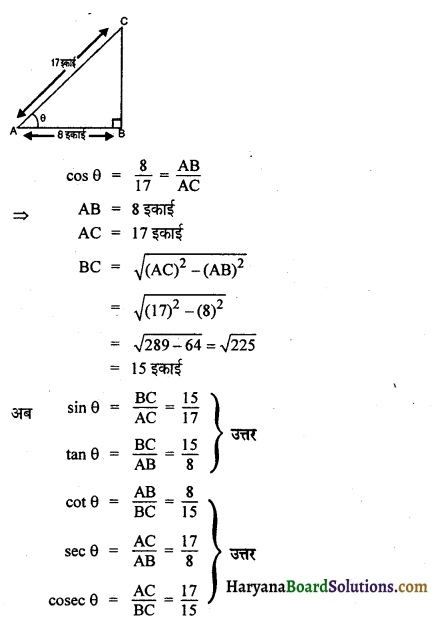
यदि cos θ = \(\frac {8}{17}\) हो तो कोण θ के अन्य पाँच त्रिकोणमितीय अनुपात ज्ञात करो ।
हल :
माना ΔABC में कोण B समकोण है तथा ∠A = θ तो
HBSE 10th Class Maths Important Questions Chapter 7 निर्देशांक ज्यामिति - 1

प्रश्न 2.
यदि ∠B और ∠Q ऐसे न्यून कोण हों जिससे कि sin B = sin Q, तो सिद्ध कीजिए कि ∠B = ∠Q
हल :
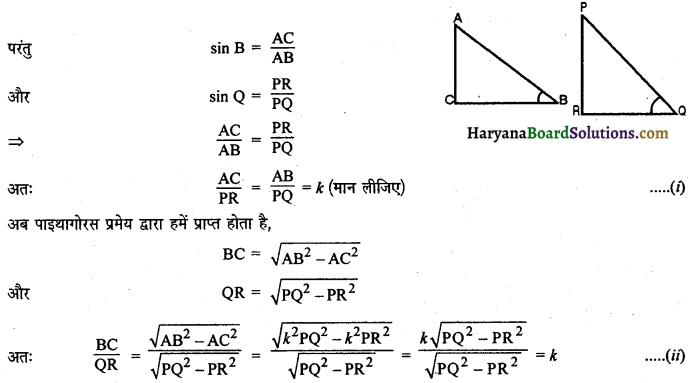
माना दो समकोण त्रिभुज ABC और PQR जहाँ sin B = sin Q
HBSE 10th Class Maths Important Questions Chapter 7 निर्देशांक ज्यामिति - 2
समीकरण (i) और (ii) से हमें प्राप्त होता है,
\(\frac{A C}{P R}=\frac{A B}{P Q}=\frac{B C}{Q R}\)
⇒ ΔACB ~ ΔPRQ
अतः ∠B = ∠Q

HBSE 10th Class Maths Important Questions Chapter 7 निर्देशांक ज्यामिति

प्रश्न 3.
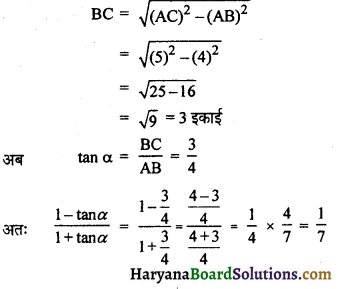
यदि sec α = \(\frac {5}{4}\) हो तो \(\frac{1-\tan \alpha}{1+\tan \alpha}\) का मान ज्ञात कीजिए ।
हल :
HBSE 10th Class Maths Important Questions Chapter 7 निर्देशांक ज्यामिति - 3
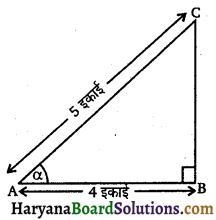
माना ΔABC में कोण ∠B समकोण है तथा ∠A = α तो
sec α = \(\frac{5}{4}=\frac{\mathrm{AC}}{\mathrm{AB}}\)
⇒ AC = 5 इकाई
AB = 4 इकाई
HBSE 10th Class Maths Important Questions Chapter 7 निर्देशांक ज्यामिति - 4

प्रश्न 4.
यदि sin (A + B) = \(\frac{\sqrt{3}}{2}\) और sin (A – B) = \(\frac{1}{\sqrt{2}}\), 0° < A + B ≤ 90°, A > B, तो A और B का मान ज्ञात कीजिए ।
हल :
यहाँ पर,
sin (A + B) = \(\frac{\sqrt{3}}{2}\)
⇒ sin (A + B) = sin 60°
⇒ A + B = 60° ……………..(i)
तथा sin (A – B) = \(\frac {1}{2}\)
⇒ sin (A – B) = sin 30°
⇒ A – B = 30° ……………..(ii)
समीकरण (i) और (ii) को जोड़ने पर,
2A = 90° या A = \(\frac {90°}{2}\) = 45°
A का मान समीकरण (i) में रखने पर,
45° + B = 60°
⇒ B = 60° – 45° = 15°
अतः A = 45° व B = 15°

HBSE 10th Class Maths Important Questions Chapter 7 निर्देशांक ज्यामिति

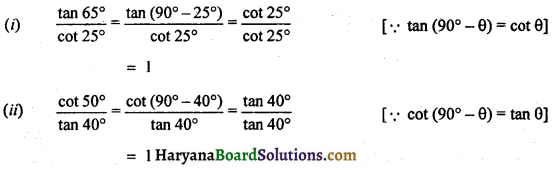
प्रश्न 5.
निम्नलिखित का मान ज्ञात कीजिए-
(i) \(\frac{\tan 65^{\circ}}{\cot 25^{\circ}}\)
(ii) \(\frac{\cot 50^{\circ}}{\tan 40^{\circ}}\)
हल :
HBSE 10th Class Maths Important Questions Chapter 7 निर्देशांक ज्यामिति - 5

प्रश्न 6.
HBSE 10th Class Maths Important Questions Chapter 7 निर्देशांक ज्यामिति - 14
हल :
HBSE 10th Class Maths Important Questions Chapter 7 निर्देशांक ज्यामिति - 6

प्रश्न 7.
cot 85° + cos 75° को 0° और 17° के बीच के कोणों के त्रिकोणमितीय अनुपातों के पदों में व्यक्त कीजिए ।
हल :
यहाँ पर,
cot 85° + cos 75°
= cot (90° – 5°) + cos(90° – 15°)
= tan 5° + sin 15°

प्रश्न 8.
मान निकालिए-
(i) sin220° + sin2 70°
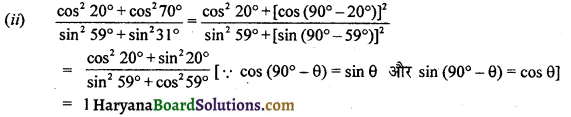
(ii) \(\frac{\cos ^2 20^{\circ}+\cos ^2 70^{\circ}}{\sin ^2 59^{\circ}+\sin ^2 31^{\circ}}\)
हल :
(i) sin2 20° + sin2 70° = sin2 20° + [sin (90° – 20°)]2
= sin2 20° + cos2 20°
= 1

HBSE 10th Class Maths Important Questions Chapter 7 निर्देशांक ज्यामिति - 7

HBSE 10th Class Maths Important Questions Chapter 7 निर्देशांक ज्यामिति

प्रश्न 9.
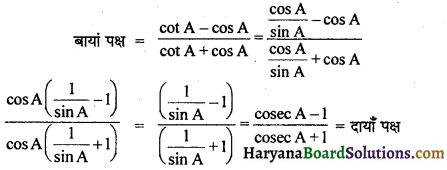
सिद्ध कीजिए :
HBSE 10th Class Maths Important Questions Chapter 7 निर्देशांक ज्यामिति - 15
हल :
HBSE 10th Class Maths Important Questions Chapter 7 निर्देशांक ज्यामिति - 8

प्रश्न 10.
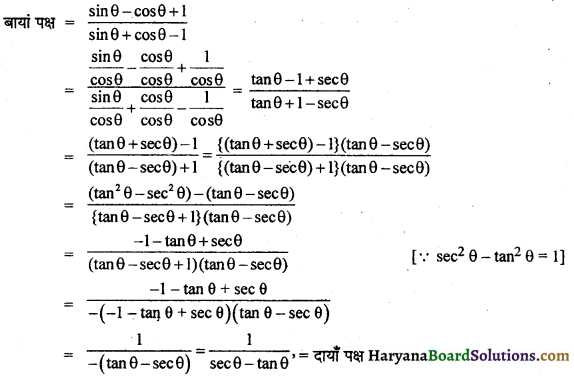
सिद्ध कीजिए :
\(\frac{\sin \theta-\cos \theta+1}{\sin \theta+\cos \theta-1}=\frac{1}{\sec \theta-\tan \theta}\)
हल :
यहाँ पर,
HBSE 10th Class Maths Important Questions Chapter 7 निर्देशांक ज्यामिति - 9

प्रश्न 11.
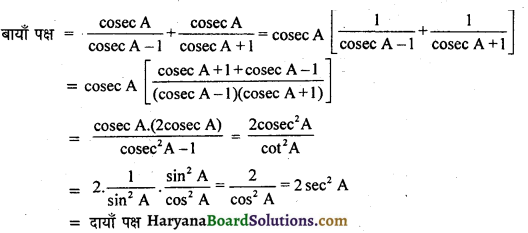
HBSE 10th Class Maths Important Questions Chapter 7 निर्देशांक ज्यामिति - 16
हल :
यहाँ पर,
HBSE 10th Class Maths Important Questions Chapter 7 निर्देशांक ज्यामिति - 10

प्रश्न 12.
7 sec2 B – 7tan2 B का मान ज्ञात कीजिए
हल :
यहाँ पर, 7 sec2 B – 7 tan2 B
= 7 (1 + tan2B) – 7 tan2 B [∵ 1 + tan2θ = sec2θ]
= 7 + 7 tan2 B – 7 tan2 B
= 7

HBSE 10th Class Maths Important Questions Chapter 7 निर्देशांक ज्यामिति

प्रश्न 13.
सिद्ध कीजिए कि sin6θ + cos6θ + 3sin2θ cos2θ = 1
हल :
यहाँ पर,
बायाँ पक्ष = sin6θ + cos6θ + 3sin2θ cos2θ
= (sin2θ)3 + (cos2θ)3 + 3 sin2θ cos2θ (sin2θ + cos2θ) [∵ sin2θ + cos2θ = 1]
= (sin2θ + cos2θ)3 [∵ a3 + b3 + 3ab (a + b) = (a + b)3]
= (1)3
= 1 = दायाँ पक्ष

प्रश्न 14.
यदि a cosθ + b sinθ = m तथा a sinθ – b cosθ = n, है, तो A का मान ज्ञात कीजिए । a2 + b2 = m2 + n2
हल :
यहाँ पर, m = a cosθ + b sinθ
और n = a sin θ – b cos θ
दायाँ पक्ष = m2 + n2
= (a cosθ + b sinθ)2 + (a sinθ – b cosθ)2
= a2 cos2θ + b2 sin2θ + 2ab sinθ cosθ + a2 sin2 θ + b2 cos2 θ – 2 ab sinθ cosθ
= a2 cos2θ + a2 sin2θ + b2 sin2 θ + b2 cos2 θ
= a2 (cos2 θ + sin2 θ) + b2 (sin2 θ + cos2 θ)
= a2 + b2 [∵ sin2 θ + cos2θ = 1]
= बायाँ पक्ष

HBSE 10th Class Maths Important Questions Chapter 7 निर्देशांक ज्यामिति

प्रश्न 15.
θ का मान ज्ञात कीजिए, यदि sin (θ + 36°) = cos θ, जहाँ θ + 36°, एक न्यून कोण है।
हल :
यहाँ पर दिया गया है।
या sin (θ + 36°) = cos θ
⇒ cos [90° – (θ + 36°)] = cos θ
या 90° – (θ + 36°) = θ
या 90° – θ – 36° = θ
या 54° = θ + θ
या 2θ = 54°
या θ = 27°

प्रश्न 16.
सिद्ध कीजिए कि-
sin4θ – cos4θ = sin2θ – cos2θ = 2sin2θ – 1 = 1 – 2cos2θ
हल :
यहाँ पर
बायाँ पक्ष
= sin4θ – cos4θ
= (sin2θ)2 – (cos2θ)2
= (sin2θ – cos2θ) (sin2θ + cos2θ)
= (sin2θ – cos2θ) × 1
= sin2θ – cos2θ
पुन: sin2θ – cos2θ = sin2θ -[1 – sin2θ]
= sin2θ – 1 + sin2θ
= 2sin2θ – 1
इसी प्रकार sin2θ – cos2θ = (1 – cos2θ) – cos2θ
= 1- cos2θ – cos2θ
= 1 – 2cos2θ = बायाँ पक्ष

HBSE 10th Class Maths Important Questions Chapter 7 निर्देशांक ज्यामिति

प्रश्न 17.
सिद्ध कीजिए कि tan 6° tan 12°tan 78° tan 84° = 1
हल :
यहाँ पर
बायाँ पक्ष = tan 6° tan 12° tan 78° tan 84°
= tan 6° tan 12° tan (90° – 12°) tan (90° – 6°)
= tan 6° tan 12° cot 12° cot 6° [∵ tan (90° – θ) = cot θ]
= tan 6° tan 12° \(\frac{1}{\tan 12^{\circ}} \cdot \frac{1}{\tan 6^{\circ}}\)
[∵ cot θ = \(\frac {1}{tan θ}\)]
= 1 = दायाँ पक्ष

प्रश्न 18.
sin2 6° + sin2 12° + sin2 78° + sin2 84° = 2
हल :
यहाँ पर,
बायाँ पक्ष = sin2 6° + sin2 12° + sin2 78° + sin2 84°
= sin2 6° + sin2 12° + [sin (90° – 12°)]2 + [sin (90° – 6°)]2
= sin2 6° + sin2 12° + cos2 12° + cos2 6° [∵ sin (90° – θ) = cos θ]
= (sin2 6° + cos2 6°) + (sin2 12° + cos2 12°)
= 1 + 1 [∵ sin2 θ + cos2 θ = 1]
= 2 = दायाँ पक्ष

प्रश्न 19.
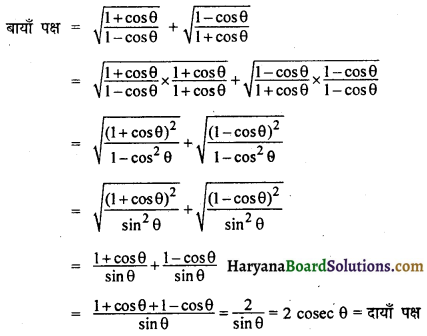
सिद्ध कीजिए कि : \(\sqrt{\frac{1+\cos \theta}{1-\cos \theta}}+\sqrt{\frac{1-\cos \theta}{1+\cos \theta}}\) = 2cosec θ
हल :
यहाँ पर
HBSE 10th Class Maths Important Questions Chapter 7 निर्देशांक ज्यामिति - 11

HBSE 10th Class Maths Important Questions Chapter 7 निर्देशांक ज्यामिति

प्रश्न 20.
यदि cos 4A = sin (A – 20°), जहाँ 4A एक न्यूनकोण है, तो A का मान ज्ञात कीजिए ।
हल :
यहाँ पर,
cos 4A = sin (A – 20°)
⇒ sin(90° – 4A) = sin (A – 20°)
⇒ 90° – 4A = A – 20°
या 90° + 20° = A + 4A
या 5A = 110°
या A = \(\frac {110°}{5}\) = 22°

प्रश्न 21.
सिद्ध कीजिए कि cos 35°. cosec 55° = 1
हल :
यहाँ पर,
बायाँ पक्ष = cos 35°. cosec 55°
= cos 35°. cosec (90° – 35°)
= cos 35°. sec 35° [∵ cosec (90°- θ) = sec θ]
= cos 35°. \(\frac{1}{\cos 35^{\circ}}\) [∵ sec θ = \(\frac {1}{cos θ}\)]
= 1 = दायाँ पक्ष

प्रश्न 22.
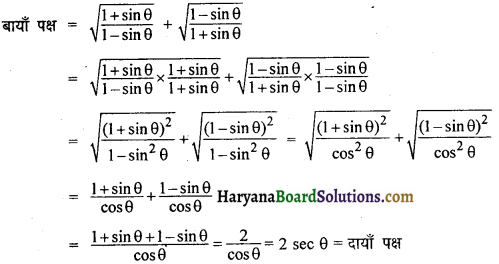
सिद्ध कीजिए कि : \(\sqrt{\frac{1+\sin \theta}{1-\sin \theta}}+\sqrt{\frac{1-\sin \theta}{1+\sin \theta}}\) = 2sec θ
हल :
यहाँ पर,
HBSE 10th Class Maths Important Questions Chapter 7 निर्देशांक ज्यामिति - 12

प्रश्न 23.
यदि A = 30°, तो बताइए कि sin 3A = 3 sin A – 4 sin3 A
हल :
यहाँ पर,
A = 30° के लिए
बायाँ पक्ष = sin 3A = sin 90° = 1 …………..(i)
दायाँ पक्ष = 3 sin A – 4 sin3 A
= 3 sin 30° – 4 sin3 30°
= 3 (\(\frac {1}{2}\)) – 4 (\(\frac {1}{2}\))3
= \(\frac{3}{2}-4\left(\frac{1}{8}\right)=\frac{3}{2}-\frac{1}{2}=\frac{3-1}{2}=\frac{2}{2}\)
= 1 ……………..(ii)
अतः समीकरण (i) और (ii) से स्पष्ट है कि बायाँ पक्ष =.दायाँ पक्ष

HBSE 10th Class Maths Important Questions Chapter 7 निर्देशांक ज्यामिति

प्रश्न 24.
यदि sin (A – B) = \(\frac {1}{2}\), cos (A + B) = \(\frac {1}{2}\), 0° < A + B ≤ 90°, A > B, तो A और B ज्ञात कीजिए ।
हल :
यहाँ पर,
⇒ sin (A – B) = \(\frac {1}{2}\)
⇒ sin (A – B) = sin 30°
A – B = 30° ………………(i)
तथा cos (A + B) = \(\frac {1}{2}\)
⇒ cos (A + B) = cos 60°
⇒ A + B = 60° …………….(ii)
समीकरण (i) और (ii) को जोड़ने पर,
2A = 90° या A = \(\frac {90°}{2}\) = 45°
A का मान समीकरण (i) में रखने पर,
45° – B = 30°
⇒ B = 45° – 30° = 15°
अतः A = 45° व B = 15°

प्रश्न 25.
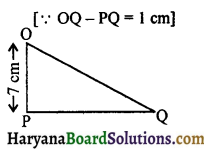
ΔOPQ में, जिसका कोण P समकोण है, OP = 7 cm और OQ – PQ = 1 cm | sin Q और cos Q के मान ज्ञात कीजिए ।
हल :
HBSE 10th Class Maths Important Questions Chapter 7 निर्देशांक ज्यामिति - 13
समकोण ΔOPQ से हमें प्राप्त होता है।
OQ2 = OP2 + PQ2
⇒ (1 + PQ)2 = OP2 + PQ2 [∵ OQ – PQ = 1 cm]
⇒ 1 + PQ2 + 2PQ = OP2 + PQ2
⇒ 1 + 2PQ = (7)2
⇒ 2PQ = 49 – 1
⇒ PQ = \(\frac {48}{2}\) = 24 cm और OQ = 1 + PQ = 1 + 24 = 25 cm
अत: sin Q = \(\frac {7}{25}\) और cos Q = \(\frac {24}{25}\)

बहुविकल्पीय प्रश्न :

प्रश्न 1.
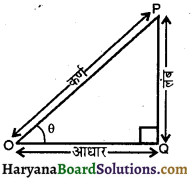
संलग्न समकोण त्रिभुज POQ में sin θ का मान होगा-
HBSE 10th Class Maths Important Questions Chapter 7 निर्देशांक ज्यामिति - 17
(A) \(\frac {PQ}{OP}\)
(B) \(\frac {OQ}{OP}\)
(C) \(\frac {PQ}{OQ}\)
(D) \(\frac {OP}{PQ}\)
हल :
(A) \(\frac {PQ}{OP}\)

HBSE 10th Class Maths Important Questions Chapter 7 निर्देशांक ज्यामिति

प्रश्न 2.
प्रश्न 1 की आकृति में cos θ का मान होगा-
(A) \(\frac {PQ}{OP}\)
(B) \(\frac {OQ}{OP}\)
(C) \(\frac {PQ}{OQ}\)
(D) \(\frac {OP}{OQ}\)
हल :
(A) \(\frac {OQ}{OP}\)

प्रश्न 3.
\(\frac{\sin 20^{\circ}}{\cos 70^{\circ}}\) का मान होगा :
(A) 2 sin 20°
(B) 0
(C) – 1
(D) 1
हल :
(D) 1

प्रश्न 4.
sin230° + cos230° का मान है :
(A) 0
(B) 1
(C) -1
(D) 2 cos230°
हल :
(B) 1

HBSE 10th Class Maths Important Questions Chapter 7 निर्देशांक ज्यामिति

प्रश्न 5.
यदि cos θ = \(\frac {12}{13}\) हो, तो sin θ का मान है :
(A) \(\frac {13}{12}\)
(B) \(\frac {12}{5}\)
(C) \(\frac {5}{13}\)
(D) 1
हल :
(C) \(\frac {5}{13}\)

प्रश्न 6.
रिक्त स्थान भरें : cosec2θ = ……………….. + cot2θ.
(A) 1
(B) sin2θ
(C) tan2θ
(D) -1
हल :
(A) 1

प्रश्न 7.
\(\frac{2 \tan 45^{\circ}}{1+\tan ^2 45^{\circ}}\) का मान है :
(A) cos 90°
(B) tan 90°
(C) sin 90°
(D) sin 45°
हल :
(C) sin 90°

प्रश्न 8.
यदि tan A = \(\frac {5}{12}\), तो cos A का मान है :
(A) \(\frac {5}{13}\)
(B) \(\frac {12}{5}\)
(C) \(\frac {13}{5}\)
(D) \(\frac {12}{13}\)
हल :
(D) \(\frac {12}{13}\)

HBSE 10th Class Maths Important Questions Chapter 7 निर्देशांक ज्यामिति

प्रश्न 9.
यदि cot A = \(\frac {7}{24}\), तो sin A का मान है :
(A) \(\frac {24}{7}\)
(B) \(\frac {24}{25}\)
(C) \(\frac {25}{24}\)
(D) \(\frac {7}{25}\)
हल :
(B) \(\frac {24}{25}\)

प्रश्न 10.
\(\frac{2 \tan 60^{\circ}}{1+\tan ^2 60^{\circ}}\) का मान है :
(A) sin 60°
(B) cos 60°
(C) tan 30°
(D) sin 30°
हल :
(A) sin 60°

प्रश्न 11.
\(\frac {1}{tan θ}\) को कहा जाता है-
(A) cosec θ
(B) sec θ
(C) cot θ
(D) sin θ
हल :
(C) cot θ

HBSE 10th Class Maths Important Questions Chapter 7 निर्देशांक ज्यामिति

प्रश्न 12.
cos2 θ + sin2 θ का मान सदैव होता है-
(A) शून्य
(B) 1
(C) 2
(D) 3
हल :
(B) 1

प्रश्न 13.
यदि cos A = \(\frac {7}{25}\) हो, तो tan A का मान होगा :
(A) \(\frac {25}{7}\)
(B) \(\frac {24}{7}\)
(C) \(\frac {24}{25}\)
(D) \(\frac {25}{24}\)
हल :
(B) \(\frac {24}{7}\)

प्रश्न 14.
HBSE 10th Class Maths Important Questions Chapter 7 निर्देशांक ज्यामिति - 18
(A) 0
(B) -1
(C) 1
(D) इनमें से कोई नहीं
हल :
(C) 1

प्रश्न 15.
व्यंजक sin θ (cosec θ – sin θ) का सरल रूप होगा-
(A) sin2 θ
(B) tan2 θ
(C) cot2 θ
(D) cos2 θ
हल :
(D) cos2 θ

HBSE 10th Class Maths Important Questions Chapter 7 निर्देशांक ज्यामिति

प्रश्न 16.
tan4 A + tan2 A को sec A के रूप में लिखा जा सकता है-
(A) sec4 A – sec2 A
(B) sec4 A – sec2 A
(C) sec4 A . sec2 A
(D) sec4 A – sec4 A
हल :
(A) sec4 A – sec2 A

प्रश्न 17.
3cot2A – 3cosec2A का मान होगा-
(A) शून्य
(B) -6
(C) -3
(D) 3
हल :
(C) – 3

प्रश्न 18.
cosec (90° – θ) का मान है :
(A) sec θ
(B) sin θ
(C) 1
(D) 0
हल :
(A) sec θ

प्रश्न 19.
\(\frac{1-\tan ^2 30^{\circ}}{1+\tan ^2 30^{\circ}}\) का मान है :
(A) cos 60°
(B) tan 60°
(C) sin 60°
(D) tan 30°
हल :
(A) cos 60°

HBSE 10th Class Maths Important Questions Chapter 7 निर्देशांक ज्यामिति

प्रश्न 20.
यदि tan θ = \(\frac {15}{8}\) हो, तो sin θ का मान होगा :
(A) \(\frac {15}{17}\)
(B) \(\frac {17}{8}\)
(C) \(\frac {8}{15}\)
(D) 1
हल :
(A) \(\frac {15}{17}\)

प्रश्न 21.
रिक्त स्थान भरें : sec2θ – tan2θ = …………………
(A) 1
(B) -1
(C) 0
(D) 2sec2θ
हल :
(A) 1

प्रश्न 22.
(1 + sin θ) (1 – sin θ) का सरल रूप होगा-
(A) sin2 θ
(B) cos2 θ
(C) tan2 θ
(D) sec2 θ
हल :
(B) cos2 θ

प्रश्न 23.
(1 + cos θ) (1 – cosθ) का सरल रूप होगा-
(A) sin2 θ
(B) cos2 θ
(C) tan2 θ
(D) cosec2 θ
हल :
(A) sin2 θ

HBSE 10th Class Maths Important Questions Chapter 7 निर्देशांक ज्यामिति

प्रश्न 24.
3 sin 30° – 4 sin3 30° का मान है :
(A) sin 60°
(B) sin 90°
(C) 0
(D) इनमें से कोई नहीं
हल :
(B) sin 90°

प्रश्न 25.
tan 45° – sin 30° का मान होगा :
(A) 1
(B) – 1
(C) 0
(D) \(\frac {1}{2}\)
हल :
(D) \(\frac {1}{2}\)

प्रश्न 26.
sin A . cosec A बराबर है :
(A) 2 sec A
(B) cos2 A
(C) 1
(D) 0
हल :
(C) 1

प्रश्न 27.
निम्नलिखित में से कौन-सा कथन असत्य है ?
(A) tan (90° – θ) = cot θ
(B) cot (90° – θ) = tan θ
(C) sec (90° – θ) = cosec θ
(D) cosec (90° – θ) = sin θ
हल :
(D) cosec (90° – θ) = sin θ

HBSE 10th Class Maths Important Questions Chapter 7 निर्देशांक ज्यामिति

प्रश्न 28.
निम्नलिखित में से कौन-सा कथन सत्य है ?
(A) cosec (90° – θ) = sec θ
(B) cosec (90° – θ) = sec θ
(C) cosec (90° – θ) = cot θ
(D) cosec (90° – θ) = tan θ
हल :
(A) cosec (90° – θ) = sec θ

प्रश्न 29.
यदि cosec θ = 2 हो तो tan θ का मान होगा :
(A) \(\frac{\sqrt{3}}{2}\)
(B) \(\frac{1}{\sqrt{3}}\)
(C) \(\frac {1}{2}\)
(D) \(\frac{2}{\sqrt{3}}\)
हल :
(B) \(\frac{1}{\sqrt{3}}\)

प्रश्न 30.
sin 39° – cos 51° का मान होगा :
(A) 0
(B) 1
(C) 2
(D) -1
हल :
(A) 0

प्रश्न 31.
यदि 2 sin θ = \(\sqrt{3}\) हो तो θ का मान होगा-
(A) 60°
(B) 45°
(C) 30°
(D) 0°
हल :
(A) 60°

HBSE 10th Class Maths Important Questions Chapter 7 निर्देशांक ज्यामिति

प्रश्न 32.
यदि sin A = \(\frac {5}{13}\), तो sec A का मान है :
(A) \(\frac {13}{5}\)
(B) \(\frac {13}{12}\)
(C) \(\frac {12}{13}\)
(D) \(\frac {12}{5}\)
हल :
(B) \(\frac {13}{12}\)

प्रश्न 33.
cosec 25° – sec 65° का मान होगा-
(A) -1
(B) 0
(C) 1
(D) 2
हल :
(B) 0

प्रश्न 34.
\(\frac{\tan 64^{\circ}}{\cot 26^{\circ}}\) का मान होगा :
(A) 0
(B) 1
(C) – 1
(D) 2 tan 64°
हल :
(B) 1

प्रश्न 35.
sin 60°. cos 30° बराबर है :
(A) 1
(B) \(\frac{2 \sqrt{3}}{4}\)
(C) \(\frac {4}{3}\)
(D) \(\frac {3}{4}\)
हल :
(D) \(\frac {3}{4}\)

HBSE 10th Class Maths Important Questions Chapter 7 निर्देशांक ज्यामिति

प्रश्न 36.
cos 45° – sin 45° का मान होगा-
(A) -1
(B) 0
(C) 1
(D) 2
हल :
(B) 0

प्रश्न 37.
6sec2θ – 6tan2θ बराबर है :
(A) 1
(B) – 6
(C) 6
(D) 0
हल :
(C) 6

प्रश्न 38.
\(\frac{\cos 20^{\circ}}{\sin 70^{\circ}}+\frac{\cos \theta}{\sin \left(90^{\circ}-\theta\right)}\) का मान होगा-
(A) 1
(B) – 1
(C) 2
(D) – 2
हल :
(C) 2

HBSE 10th Class Maths Important Questions Chapter 7 निर्देशांक ज्यामिति

प्रश्न 39.
sin θ. cos (90° – θ) + cos θ. sin (90° – θ) का मान होगा-
(A) – 1
(B) 1
(C) 2
(D) -2
हल :
(B) 1

प्रश्न 40.
cos θ . cos (90° – θ) – sin θ . sin (90° – θ) का मान होगा-
(A) – 1
(B) 1
(C) 2
(D) शून्य
हल :
(D) शून्य

HBSE 10th Class Maths Important Questions Chapter 7 निर्देशांक ज्यामिति

प्रश्न 41.
ΔABC में, जिसका कोण B समकोण है AB = 24 cm और BC = 7 cm है। cos A का मान है-
(A) \(\frac {7}{25}\)
(B) \(\frac {24}{25}\)
(C) \(\frac {7}{24}\)
(D) इनमें से कोई नहीं
हल :
(B) \(\frac {24}{25}\)

प्रश्न 42.
sin 81° + tan 71° को 0° और 45° के कोणों के बीच में निरूपित किया जा सकता है-
(A) sin 9° + tan 19°
(B) cos 9° + cot 19°
(C) tan 9° + cot 19°
(D) sec 9° + cosec 19°
हल :
(B) cos 9° + cot 19°

प्रश्न 43.
ΔABC में, जिसका कोणं B समकोण है, AB = 24 cm और BC = 7 cm है। cos C का मान है-
(A) \(\frac {7}{25}\)
(B) \(\frac {7}{24}\)
(C) \(\frac {24}{25}\)
(D) इनमें से कोई नहीं
हल :
(A) \(\frac {7}{25}\)

HBSE 10th Class Maths Important Questions Chapter 7 निर्देशांक ज्यामिति

प्रश्न 44.
रिक्त स्थान भरें : tan2θ = ………………….. -1
(A) cot2θ
(B) sec2θ
(C) cosec2θ
(D) cos2θ
हल :
(B) sec2θ

प्रश्न 45.
\(\frac{\cos ^2 20^{\circ}+\cos ^2 70^{\circ}}{\sin ^2 59^{\circ}+\sin ^2 31^{\circ}}\) का मान होगा-
(A) 2
(B) -2
(C) 1
(D) – 1
हल :
(C) 1

प्रश्न 46.
ΔABC में, जिसका कोण B समकोण है, AB = 24 cm और BC = 7 cm है । sin C का मान है-
(A) \(\frac {7}{25}\)
(B) \(\frac {7}{24}\)
(C) \(\frac {24}{25}\)
(D) इनमें से कोई नहीं
हल :
(A) \(\frac {7}{25}\)

प्रश्न 47.
ΔABC में, जिसका कोण B समकोण है, AB = 24 cm और BC = 7 cm है। sin C का मान है-
(A) \(\frac {24}{25}\)
(B) \(\frac {7}{25}\)
(C) \(\frac {7}{24}\)
(D) इनमें से कोई नहीं
हल :
(A) \(\frac {24}{25}\)

HBSE 10th Class Maths Important Questions Chapter 7 निर्देशांक ज्यामिति

प्रश्न 48.
\(\frac{\cos \left(90^{\circ}-\theta\right)}{\sin \theta}+\frac{\sin \theta}{\cos \left(90^{\circ}-\theta\right)}\)
का मान होगा-
(A) 1
(B) 2
(C) 3
(D) 4
हल :
(B) 2

प्रश्न 49.
sin 60° – cos 30° का मान होगा-
(A) -1
(B) 1
(C) 0
(D) 2
हल :
(C) 0

HBSE 10th Class Maths Important Questions Chapter 7 निर्देशांक ज्यामिति

प्रश्न 50.
cos θ × sec θ बराबर है :
(A) -1
(B) 1
(C) 0
(D) 2 cos
हल :
(B) 1

HBSE 10th Class Maths Important Questions Chapter 7 निर्देशांक ज्यामिति Read More »

HBSE 12th Class Chemistry Solutions Chapter 3 वैद्युत रसायन

Haryana State Board HBSE 12th Class Chemistry Solutions Chapter 3 वैद्युत रसायन Textbook Exercise Questions and Answers.

Haryana Board 12th Class Chemistry Solutions Chapter 3 वैद्युत रसायन

प्रश्न 3.1.
निम्नलिखित धातुओं को उस क्रम में व्यवस्थित कीजिए जिसमें वे एक-दूसरे को उनके लवणों के विलयनों में से प्रतिस्थापित करती हैं-
Al, Cu, Fe, Mg एवं Zn.
उत्तर:
दी गई धातुओं का एक-दूसरे को उनके लवणों के विलयनों में प्रतिस्थापित करने का क्रम निम्नलिखित है। यह इनकी क्रियाशीलता का घटता क्रम है-
Mg Al Zn Fe Cu

प्रश्न 3.2.
नीचे दिए गए मानक इलेक्ट्रॉड विभवों के आधार पर धातुओं को उनकी बढ़ती हुई अपचायक क्षमता के क्रम में व्यवस्थित कीजिए –
K+/K = – 2.93 V, Ag+/Ag = 0.80 V.
Hg2+/Hg = 0.79 V
Mg2+/Mg = – 2.37 V, Cr3+/Cr = – 0.74 V
उत्तर:
जब धातु का ऑक्सीकरण विभव उच्च होता है अर्थात् धातु आयन का अपचयन विभव निम्न (Low) होता है तो उस धातु की इलेक्ट्रॉन देने की प्रवृत्ति अधिक होती है तथा वह प्रबल अपचायक होता है। अतः दिए गए मानक इलेक्ट्रॉड विभव (अपचयन विभव) मानों के आधार पर इन धातुओं की अपचायक क्षमता का बढ़ता क्रम निम्न प्रकार होगा-
Ag < Hg < Cr < Mg < K

HBSE 12th Class Chemistry Solutions Chapter 3 वैद्युत रसायन

प्रश्न 3.3.
उस गैल्वैनी सेल को दर्शाइए जिसमें निम्नलिखित अभिक्रिया होती है—
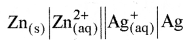
Zn(s) + 2Ag+(aq) → Zn2+(aq) + 2Ag(s),
अब बताइए-
(i) कौन-सा इलेक्ट्रॉड ऋणात्मक आवेशित है?
(ii) सेल में विद्युत धारा के वाहक कौन से हैं?
(iii) प्रत्येक इलेक्ट्रॉड पर होने वाली अभिक्रिया क्या है?
उत्तर:
दी गयी अभिक्रिया के आधार पर गैल्वेनी सेल (विद्युत रासायनिक सेल) को निम्न प्रकार से दर्शाया जा सकता है-
HBSE 12th Class Chemistry Solutions Chapter 3 IMG 1
(i) इस सेल में Zn | Zn+2 इलेक्ट्रॉड ऋणात्मक आवेशित है अतः यह ऐनोड होगा।
(ii) सेल में विद्युत धारा के वाहक इलेक्ट्रॉन हैं तथा धारा का प्रवाह. सिल्वर इलेक्ट्रॉड से जिंक इलेक्ट्रॉड की ओर होता है क्योंकि विद्युत धारा का प्रवाह, इलेक्ट्रॉन के प्रवाह की विपरीत दिशा में होता है।
(iii) कैथोड पर होने वाली अभिक्रिया निम्नलिखित है-
2Ag+ +2e → 2Ag
तथा ऐनोड पर होने वाली अभिक्रिया निम्नलिखित है-
Zn → Zn2+ +2e

प्रश्न 3.4.
निम्नलिखित अभिक्रियाओं वाले गैल्वेनी सेल का मानक सेल विभव परिकलित कीजिए-
(i) 2Cr(s) + 3Cd2+(aq) → 2Cr3+(aq) + 3Cds
(ii) Fe2+ (aq) + Ag+ (aq) → Fe3+(aq) + Ag(s)
उपरोक्त अभिक्रियाओं के लिए △rG एवं साम्य स्थिरांकों की भी गणना कीजिए ।
उत्तर:
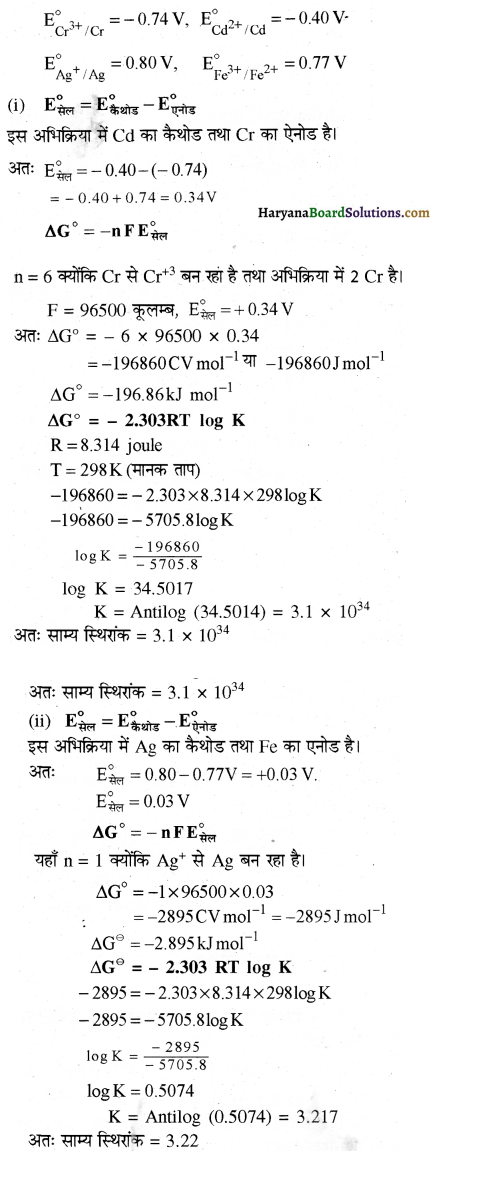
सक्रियता श्रेणी से –
HBSE 12th Class Chemistry Solutions Chapter 3 IMG 2

प्रश्न 3.5.
निम्नलिखित सेलों की 298 K पर नेस्ट समीकरण एवं emf लिखिए-
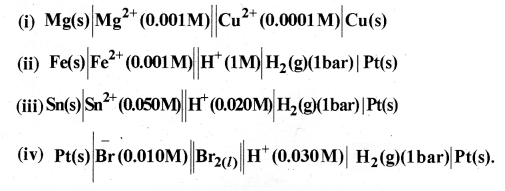
HBSE 12th Class Chemistry Solutions Chapter 3 IMG 3
उत्तर:
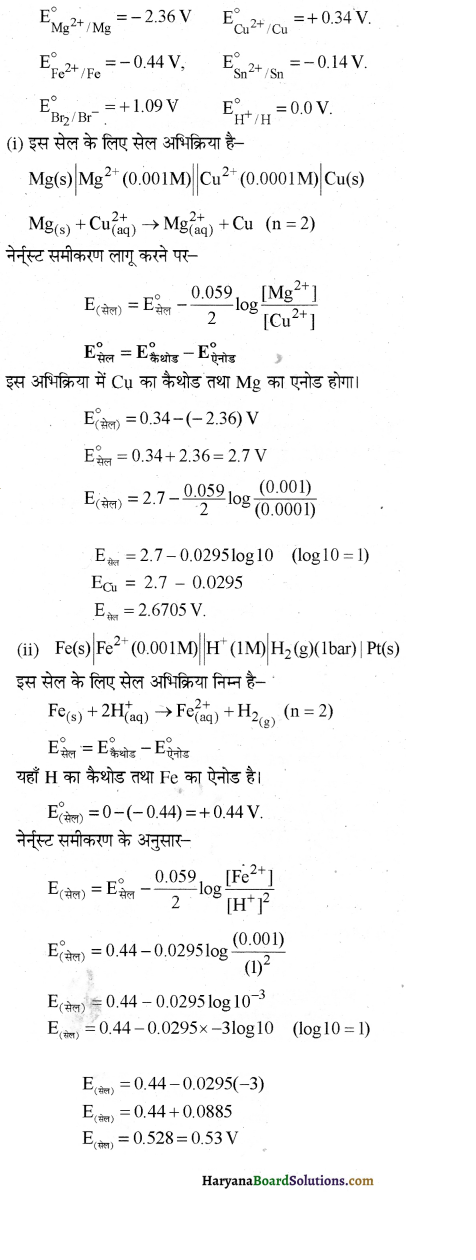
सक्रियता श्रेणी से –
HBSE 12th Class Chemistry Solutions Chapter 3 IMG 4
HBSE 12th Class Chemistry Solutions Chapter 3 IMG 5
HBSE 12th Class Chemistry Solutions Chapter 3 IMG 30

HBSE 12th Class Chemistry Solutions Chapter 3 वैद्युत रसायन

प्रश्न 3.6.
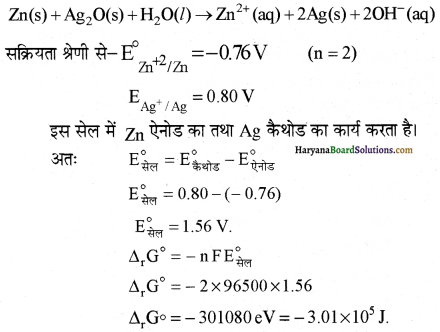
घड़ियों एवं अन्य युक्तियों में अत्यधिक उपयोग में आने वाली बटन सेलों में निम्नलिखित अभिक्रिया होती है-
उत्तर:
Zn(s) + Ag2O(s) + H2O(1) Zn2+(aq) + 2Ag(s) + 2OH(aq)
सक्रियता श्रेणी से –
HBSE 12th Class Chemistry Solutions Chapter 3 IMG 6

प्रश्न 3.7.
किसी वैद्युत अपघट्य के विलयन की चालकता एवं मोलर चालकता की परिभाषा दीजिये। सांद्रता के साथ इनके परिवर्तन की विवेचना कीजिए।
उत्तर:
चालकता (k) – प्रतिरोधकता ( या विशिष्ट प्रतिरोध) के व्युत्क्रम (विपरीत) को चालकता कहते हैं। चालकता को विशिष्ट चालकत्व भी कहते हैं। इसका प्रतीक K है तथा K = \(\frac { 1 }{ p }\)

अथवा किसी सान्द्रता पर विलयन की चालकता उसके इकाई आयतन का चालकत्व होता है जिसे इकाई दूरी पर स्थित इकाई अनुप्रस्थ काट क्षेत्रफल वाले दो इलेक्ट्रॉडों के मध्य रखा गया हो ।

मोलर चालकता (∧m) – किसी दी गई सांद्रता पर एक विलयन की मोलर चालकता उस विलयन के आयतन का चालकत्व है, जिसमें वैद्युत अपघट्य का एक मोल घुला हो तथा जो एक-दूसरे से इकाई दूरी पर स्थित, A अनुप्रस्थ काट क्षेत्रफल वाले दो इलेक्ट्रॉडों के मध्य रखा गया हो।
अथवा
मोलर चालकता किसी वैद्युत अपघट्य के विलयन के उस आयतन का चालकत्व है जिसे चालकता सेल के इकाई दूरी पर स्थित इलेक्ट्रॉडों के मध्य रखा गया है एवं जिनका अनुप्रस्थ काट क्षेत्रफल इतना है कि वह विलयन के उस आयतन (V) को रख सकें, जिसमें वैद्युत अपघट्य का एक मोल घुला हो । अतः एक मोल विद्युत अपघट्य को विलयन में घोलने पर प्राप्त आयनों की चालकता को मोलर चालकता कहते हैं।

वैद्युत अपघट्य की सांद्रता में परिवर्तन से चालकता तथा मोलर चालकता दोनों परिवर्तित होती हैं। प्रबल तथा दुर्बल दोनों प्रकार के वैद्युत अपघट्यों की सांद्रता कम करने पर चालकता हमेशा कम होती है क्योंकि तनुता बढ़ाने पर प्रति इकाई आयतन में विद्युतधारा ले जाने वाले आयनों की संख्या कम हो जाती है।
सान्द्रता कम होने पर मोलर चालकता बढ़ती है क्योंकि वह कुल आयतन (V) बढ़ जाता है जिसमें एक मोल वैद्युत अपघट्य उपस्थित हो। (∧m = kV) तथा आयतन में वृद्धि k में कमी की तुलना में अधिक होती है।

प्रश्न 3.8.
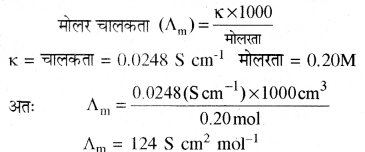
298 K पर 0.20M KCl विलयन की चालकता 0.0248 S cm-1 है। इसकी मोलर चालकता का परिकलन कीजिए ।
उत्तर:
HBSE 12th Class Chemistry Solutions Chapter 3 IMG 7

प्रश्न 3.9
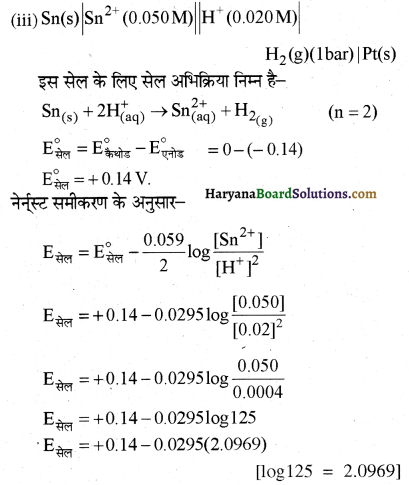
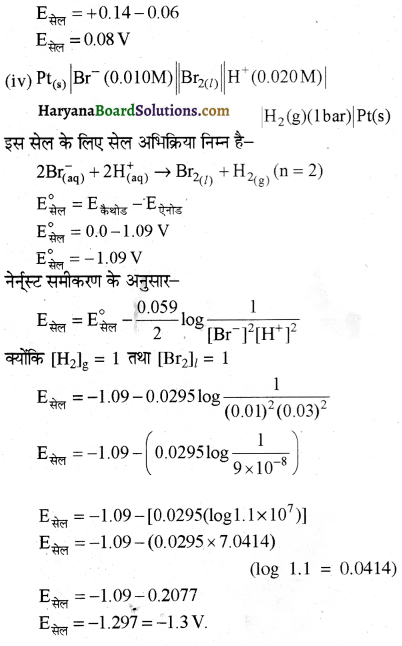
298 K पर एक चालकता सेल जिसमें 0.001 M KCl विलयन है, का प्रतिरोध 1500Ω है। यदि 0.001 M KCl विलयन की चालकता 298 K पर 0.146 × 10⁻³ S cm-1 हो तो सेल स्थिरांक क्या है ?
उत्तर:
सेल स्थिरांक (G*) = HBSE 12th Class Chemistry Solutions Chapter 3 IMG 8 = \(\frac { K }{ G }\)
प्रतिरोध R = \(\frac { 1 }{ G }\)
अतः सेल स्थिरांक = चालकता × प्रतिरोध
चालकता (k) = 0.146 × 10⁻³S cm-1
प्रतिरोध R = 1500Ω
अतः सेल स्थिरांक = 0.146 × 10-3 × 1500
सेल स्थिरांक = 0.219 cm cm-1

प्रश्न 3.10
298K पर सोडियम क्लोराइड की विभिन्न सांद्रताओं पर चालकता का मापन किया गया जिसके आँकड़े निम्नलिखित हैं-
सांद्रता/M 0.001 0.010 0.020 0.050 0.100 102 × k/S m1 1.237 11.85 23.15 55.53106.74 सभी सांद्रताओं के लिए ∧m का परिकलन कीजिए एवं ∧m तथा C1/2 के मध्य एक आलेख खींचिए । ∧om का मान ज्ञात कीजिए ।
उत्तर:
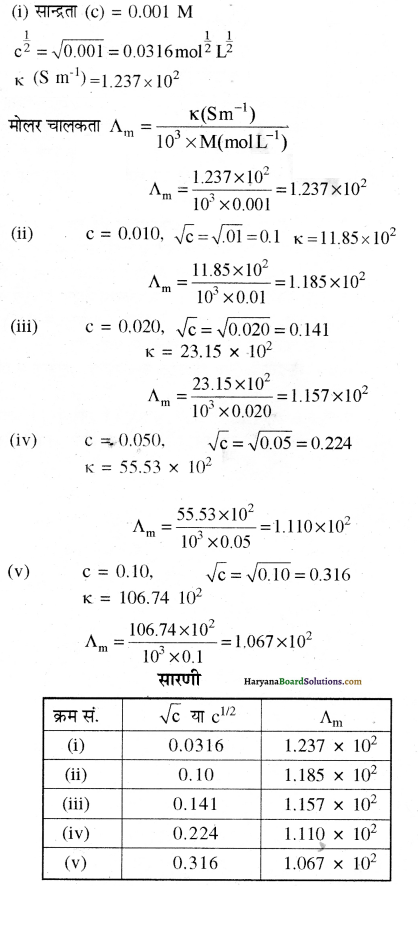
HBSE 12th Class Chemistry Solutions Chapter 3 IMG 9
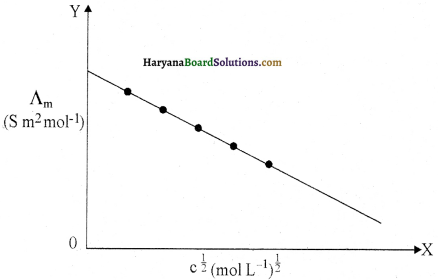
m C1/2 के मध्य आलेखित करने पर एक सीधी रेखा प्राप्त होती है जिसमें ∧m का मान C1/2 के साथ कम होता है।
HBSE 12th Class Chemistry Solutions Chapter 3 IMG 10
ग्राफ का शून्य सान्द्रता तक बहिर्वेशन करके ∧0m का मान ज्ञात किया जाता है जो कि लगभग 1.255 × 10² m2 mol-1 आता है।
अतः ∧0m = 1.255 × 10² m2 mol-1

प्रश्न 3.11
0.00241 M ऐसीटिक अम्ल की चालकता 7.896 × 10⁻⁵S cm-1 है। इसकी मोलर चालकता को परिकलित कीजिए। यदि ऐसीटिक अम्ल के लिए ∧0m का मान 390.5 S cm2 mol-1 हो तो इसका वियोजन स्थिरांक क्या है?
उत्तर:
मोलर चालकता (∧m) = HBSE 12th Class Chemistry Solutions Chapter 3 IMG 12
चालकता (k) = 7.896 × 10⁻⁵S cm-1,
मोलरता = 0.00241M
अतः ∧m = \(\frac{7.896 \times 10^{-5} \times 1000}{0.00241}\)
m = 32.76 S cm2 mol-1

वियोजन की मात्रा,
α = \(\frac{\Lambda_{\mathrm{m}}}{\Lambda_{\mathrm{m}}^{\circ}}\)
\(\Lambda_{\mathrm{m}}^0\) = 390.5 S cm2 mol-1
अतः α = \(\frac { 32.76 }{ 390.5 }\) = 8.4 × 10⁻²
वियोजन स्थिरांक (Ka) = \(\frac{c \alpha^2}{1-\alpha}\)
α = 8.4 × 10⁻²
अतः Ka = \(\frac{0.00241 \times\left(8.4 \times 10^{-2}\right)^2}{1-8.4 \times 10^{-2}}\)
Ka = \(\frac{0.00241 \times 70.56 \times 10^{-4}}{1-0.084}\)
Ka = \(\frac{0.1700 \times 10^{-4}}{0.916}\)
Ka = 0.1855 × 10⁻⁴
Ka = 1.85 × 10⁻⁵

प्रश्न 3.12.
निम्नलिखित के अपचयन के लिए कितने आवेश की आवश्यकता होगी ?
(i) 1 मोल Al3+ को Al में
(ii) 1 मोल Cu2+ को Cu में
(iii) 1 मोल \(\mathrm{MnO}_4^{-}\) को Mn2+ में ।
उत्तर:
(i) इलेक्ट्रॉड अभिक्रिया है – Al3+ + 3e → Al
अतः 1 मोल Al3+ के अपचयन के लिए 3F आवेश की आवश्यकता होगी क्योंकि इस अभिक्रिया में 3 मोल इलेक्ट्रॉन प्रयुक्त हो रहे हैं तथा 3 फैराडे = 3 × 96500 कूलॉम (C) = 289500 C

(ii) अभिक्रिया – Cu2+ +2e → Cu
1 मोल Cu2+ के अपचयन के लिए 2F आवेश की आवश्यकता होगी तथा 2 फैराडे
= 2 × 96500 C = 193000 C

(iii) अभिक्रिया – MnO4 → Mn2+
MnO4 में Mn का ऑक्सीकरण अंक +7 है तथा यह Mn2+ बना रहा है अतः इसमें 5 इलेक्ट्रॉन प्रयुक्त हो रहे हैं। इसलिए 1 मोल MnO4 के Mn2+ में अपचयन के लिए 5F आवेश की आवश्यकता होगी तथा
5F = 5 × 96500 C = 482500 C

HBSE 12th Class Chemistry Solutions Chapter 3 वैद्युत रसायन

प्रश्न 3.13.
निम्नलिखित को प्राप्त करने में कितने फैराडे विद्युत की आवश्यकता होगी ?
(i) गलित CaCl2 से 20.0g Ca
(ii) गलित Al2O3 से 40.0 g Al
उत्तर:
(i) गलित CaCl2 से Ca प्राप्त करने में कैथोड पर निम्न अभिक्रिया होगी-
Ca2+ + 2e → Ca
Ca का 1 मोल = 40g (परमाणु द्रव्यमान)
अतः अभिक्रिया के अनुसार 40g Ca प्राप्त करने के लिए आवश्यक विद्युत की मात्रा : = 2 F
तो 20 g Ca प्राप्त करने के लिए 1 F विद्युत की आवश्यकता होगी।

(ii) गलित Al2O3 से Al प्राप्त करने के लिए कै थोड पर अभिक्रिया – Al3+ +3e → Al
Al का परमाणु द्रव्यमान = 27 g = 1 मोल
अतः अभिक्रिया के अनुसार 27 g Al प्राप्त करने के लिए आवश्यक विद्युत = 3 F
तो 40 g Al के लिए = \(\frac{3 F \times 40}{27}\) = 4.44F विद्युत आवश्यक होगी।

प्रश्न 3.14.
निम्नलिखित को ऑक्सीकृत करने के लिए कितने कूलॉम विद्युत आवश्यक है ?
(i) 1 मोल H2O को O2 में ।
(ii) 1 मोल FeO को Fe2O3 में ।
उत्तर:
(i) H2O से 02 बनने की अभिक्रिया निम्नलिखित है-
2H2O → O2 + 4H+ + 4e
यहाँ 2 मोल H2O से 4 मोल इलेक्ट्रॉन निकल रहे हैं अतः 1 मोल H2O से 2 मोल इलेक्ट्रान निकलेंगे इसलिए 1 मोल H2O के ऑक्सीकरण के लिए आवश्यक विद्युत की मात्रा = 2F = 2 × 96,500 कूलॉम
विद्युत की मात्रा = 1,93,000 कूलॉम

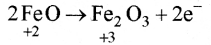
(ii) FeO से Fe2O3 का बनना निम्नलिखित अभिक्रिया के अनुसार होता है-
HBSE 12th Class Chemistry Solutions Chapter 3 IMG 11
यहाँ Fe2+ से Fe3+ बन रहा है अतः 1 मोल FeO को Fe2O3 में आक्सीकृत करने के लिए आवश्यक विद्युत की मात्रा = 1F = 96,500 कूलॉम।

प्रश्न 3.15.
Ni(NO3)2 के एक विलयन का प्लैटिनम इलेक्ट्रॉडों के बीच 5 ऐम्पियर की धारा प्रवाहित करते हुए 20 मिनट विद्युत अपघटन किया गया। Ni की कितनी मात्रा कैथोड पर निक्षेपित होगी?
उत्तर:
प्रवाहित की गई विद्युत की मात्रा – Q = I t
I = 5 ऐम्पियर, t = समय सेकण्ड = 20 × 60s
Q = 5 × 20 × 60 = 6000C

कैथोड पर निम्नलिखित अभिक्रिया होगी-
Ni2+ + 2e → Ni

Ni का परमाणु द्रव्यमान = 58.7 (1 मोल)
अभिक्रिया के अनुसार 2F या 2 × 96500C विद्युत प्रवाहित करने पर प्राप्त Ni की मात्रा = 58.7g
अतः 6000C विद्युत प्रवाहित करने पर प्राप्त Ni-
= \(\frac{58.7 \times 6000}{2 \times 96500}\) = 1.824 g
अतः Ni की कैथोड पर निक्षेपित मात्रा = 1.8248 g

प्रश्न 3.16.
ZnSO4, AgNO3 एवं CuSO4 विलयन वाले तीन वैद्युत अपघटनी सेलों A,B,C को श्रेणीबद्ध किया गया एवं 1.5 ऐम्पियर की विद्युतधारा, सेल B के कैथोड पर 1.45 g सिल्वर निपेक्षित होने तक लगातार प्रवाहित की गई। विद्युतधारा कितने समय तक प्रवाहित हुई? निपेक्षित कॉपर एवं जिंक का द्रव्यमान क्या होगा?
उत्तर:
सेल B के कैथोड पर सिल्वर के निक्षेपित होने में निम्नलिखित अभिक्रिया प्रयुक्त होती है-
Ag+ +e → Ag
Ag का परमाणु द्रव्यमान = 108g (1 मोल)
108 g Ag के निक्षेपण के लिए आवश्यक विद्युत की मात्रा = 96500 C
अतः 1.45 g सिल्वर के निक्षेपण के लिए
= \(\frac{96500}{108}\) × 1.45
= 1295.6 C विद्युत आवश्यक होगी।
आवेश Q = I t, t = \(\frac { Q }{ I }\) = \(\frac{1295.6}{1.5}\) = 863.73 सेकंड
अतः मिनट में समय = \(\frac{863.73}{60}\) = 14.39 = 14.40 मिनट
अतः विद्युत धारा 14.40 मिनट तक प्रवाहित हुई।
Cu के निक्षेपण के लिए आवश्यक अभिक्रिया
Cu2+ + 2e → Cu
Cu का परमाणु द्रव्यमान = 63.5g (1 मोल)
अतः 2 × 96500 C विद्युत से प्राप्त कॉपर 63.5 g
1295.6C विद्युत से प्राप्त कॉपर = \(\frac{63.5 \times 1295.6}{2 \times 96500}\) = 0.426 g
अतः निक्षेपित कॉपर का द्रव्यमान = 0.426 g
Zn के निक्षेपण के लिए आवश्यक अभिक्रिया-
Zn2+ +2e → Zn
Zn का परमाणु द्रव्यमान = 65 g (1 मोल)
2 × 96500 C विद्युत से प्राप्त जिंक = 65g
अतः 1295.6 C विद्युत से प्राप्त जिंक
= \(\frac{65 \times 1295.6}{2 \times 96500}\) = 0.436 g
अतः निक्षेपित जिंक का द्रव्यमान = 0.436 g

प्रश्न 3.17.
सारणी 3.1 में दिए गए मानक इलेक्ट्रॉड विभवों की सहायता से अनुमान लगाइए कि क्या निम्नलिखित अभिकर्मकों के बीच अभिक्रिया संभव है?
(i) Fe3+ (aq) और I(aq)
(ii) Ag+ (aq) और Cu(s)
(iii) Fe3+(aq) और Br (aq)
(iv) Ag(s) और Fe3+(aq)
(v) Br2(aq) और Fe2+(aq)
उत्तर:
(i) Fe3+(aq) और I (aq) के बीच अभिक्रिया संभव है
क्योंकि HBSE 12th Class Chemistry Solutions Chapter 3 IMG 13 का मान HBSE 12th Class Chemistry Solutions Chapter 3 IMG 14 मान से अधिक है तथा इसके लिए HBSE 12th Class Chemistry Solutions Chapter 3 IMG 15 है। यह अभिक्रिया निम्न प्रकार होगी-
Fe3+ + I (aq) → Fe2+ (aq) + \(\frac { 1 }{ 2 }\) I2

(ii) Ag+(aq) तथा Cu(s) के मध्य अभिक्रिया भी संभव है।
क्योंकि HBSE 12th Class Chemistry Solutions Chapter 3 IMG 16 का मान HBSE 12th Class Chemistry Solutions Chapter 3 IMG 17 मान से अधिक है तथा इसके लिए HBSE 12th Class Chemistry Solutions Chapter 3 IMG 18 एवं यह अभिक्रिया निम्न प्रकार होगी-
2Ag+ (aq) + Cu(s) → Cu2+ (aq) + 2Ag(s)

(iii) Fe3+ (aq) तथा Br (aq) के बीच अभिक्रिया संभव नहीं है क्योंकि HBSE 12th Class Chemistry Solutions Chapter 3 IMG 19 का मान HBSE 12th Class Chemistry Solutions Chapter 3 IMG 20 मान से कम है तथा इसके लिए सैल HBSE 12th Class Chemistry Solutions Chapter 3 IMG 21 अतः Br आयन Fe3+ आयनों का अपचयन नहीं कर सकते।

(iv) Ag(s) तथा Fe3+ (aq) के बीच भी अभिक्रिया संभव नहीं है क्योंकि HBSE 12th Class Chemistry Solutions Chapter 3 IMG 22 का मान HBSE 12th Class Chemistry Solutions Chapter 3 IMG 23 मान से कम है तथा इसके लिए HBSE 12th Class Chemistry Solutions Chapter 3 IMG 24 अतः Ag, Fe+3 का अपचयन नहीं कर सकता ।

(v) Br2(aq) तथा Fe2+ (aq) के बीच अभिक्रिया होगी क्योंकि HBSE 12th Class Chemistry Solutions Chapter 3 IMG 25 का मान, HBSE 12th Class Chemistry Solutions Chapter 3 IMG 26 मान से अधिक है तथा इसके लिए HBSE 12th Class Chemistry Solutions Chapter 3 IMG 27 अतः Fe2+, Br2 का अपचयन कर सकता है। यह अभिक्रिया निम्न प्रकार होगी-
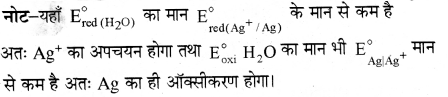
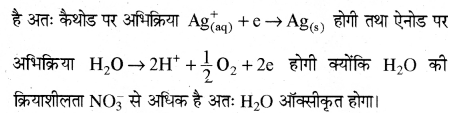
Fe2+ (aq) + Br2 (aq) → Fe3+ (aq) + 2Br (aq)

प्रश्न 3.18.
निम्नलिखित में से प्रत्येक के लिए वैद्युत अपघटन से प्राप्त उत्पाद बताइए-
(i) सिल्वर इलेक्ट्रॉडों के साथ AgNO3 का जलीय विलयन
(ii) प्लैटिनम इलेक्ट्रॉडों के साथ AgNO3 का जलीय विलयन
(iii) प्लैटिनम इलेक्ट्रॉडों के साथ H2SO4 का तनु विलयन
(iv) प्लैटिनम इलेक्ट्रॉडों के साथ CuCl2 का जलीय विलयन |
उत्तर:
(i) सिल्वर इलेक्ट्रॉडों के साथ AgNO3 के जलीय विलयन का वैद्युत अपघटन करने पर ऐनोड पर सिल्वर इलेक्ट्रॉड अभिक्रिया में भाग लेगा क्योंकि यह क्रियाशील इलेक्ट्रॉड है अतः
कैथोड पर – Ag+ से Ag बनेगा (अपचयन)
Ag+ (aq) + e → Ag(s) तथा
ऐनोड पर – Ag का Ag+ में ऑक्सीकरण होगा
Ag(s)→ Ag (aq) + e ̄
HBSE 12th Class Chemistry Solutions Chapter 3 IMG 28

(ii) प्लैटिनम इलेक्ट्रॉडों के साथ AgNO3 के जलीय विलयन का विद्युत अपघटन करने पर Pt अभिक्रिया में भाग नहीं लेगा क्योंकि यह अक्रिय इलेक्ट्रॉड है अतः कैथोड पर अभिक्रिया IMG होगी तथा ऐनोड पर अभिक्रिया
HBSE 12th Class Chemistry Solutions Chapter 3 IMG 29

(iii) प्लैटिनम इलेक्ट्रॉडों के साथ H2SO4 के तनु विलयन का विद्युत अपघटन करने पर निम्नलिखित अभिक्रियाएँ होंगी क्योंकि SO- आयन H2O की तुलना में कम क्रियाशील है।
कैथोड पर 2H+ + 2e → H2 (अपचयन)
एनोड पर_H2O → 2H+ + \(\frac { 1 }{ 2 }\)O2 + 2e (ऑक्सीकरण)

(iv) प्लैटिनम इलेक्ट्रॉडों के साथ CuCl2 के जलीय विलयन का विद्युत अपघटन करने पर निम्नलिखित अभिक्रियाएँ होंगी-
कैथोड पर – Cu2+ + 2e → Cu
Cu2+, H2O (H+) से अधिक क्रियाशील है।
ऐनोड पर – 2Cl – 2e → Cl2
Cl,H2O(ŌH) से अधिक क्रियाशील है।

HBSE 12th Class Chemistry वैद्युत रसायन Intext Questions

प्रश्न 3.1.
निकाय Mg2+| Mg का मानक इलेक्ट्रॉड विभव आप किस प्रकार ज्ञात करेंगे?
उत्तर:
निकाय Mg2+| Mg का मानक इलेक्ट्रॉड विभव ज्ञात करने के लिए इसे मानक हाइड्रोजन इलेक्ट्रॉड (SHE) से जोड़कर सेल का विद्युत वाहक बल ज्ञात करते हैं। विद्युत वाहक बल ज्ञात करने के लिए वोल्टमीटर या पोटेन्शियोमीटर (विभवमापी) प्रयुक्त किया जाता है। मानक हाइड्रोजन इलेक्ट्रॉंड एक संदर्भ इलेक्ट्रॉड है जिसका इलेक्ट्रॉड विभव शून्य होता है। अतः सेल का विद्युत वाहक बल (emf) दूसरी अर्ध सेल (Mg2+| Mg) के मानक इलेक्ट्रॉड विभव (अपचयन विभव) के बराबर होगा। यहाँ Mg2+| Mg कैथोड के रूप में लिया जाता है।

प्रश्न 3.2.
क्या आप एक जिंक के पात्र में कॉपर सल्फेट का विलयन रख सकते हैं?
उत्तर:
जिंक के पात्र में कॉपर सल्फेट (CuSO4) का विलयन नहीं रखा जा सकता क्योंकि Zn, Cu से अधिक क्रियाशील धातु है अर्थात् Cu से Zn अधिक अपचायक है। अतः यह कॉपर सल्फेट के विलयन से क्रिया करके ZnSO4 बना देता है तथा Cu धातु अवक्षेपित हो जाती है।
\(\mathrm{Zn}_{(\mathrm{s})}+\mathrm{Cu}^{+2} \mathrm{SO}_{4(\mathrm{aq})}^{-2} \rightarrow \mathrm{Zn}^{+2} \mathrm{SO}_{4(\mathrm{aq})}^{-2}+\mathrm{Cu}_{(\mathrm{s})}\)

प्रश्न 3.3.
मानक इलेक्ट्रॉड विभव की तालिका का निरीक्षण कर तीन ऐसे पदार्थ बताइए जो अनुकूल परिस्थितियों में फेरस आयनों को ऑक्सीकृत कर सकते हैं।
उत्तर:
Fe+3/Fe+2 के लिए E° का मान 0.77 V है अतः वे पदार्थ जिनके लिए E° का मान इससे अधिक होता है वे Fe+2 को Fe+3 में ऑक्सीकृत कर सकते हैं। मानक इलेक्ट्रॉड विभव की तालिका के आधार पर ये पदार्थ हैं-
(i) \(\mathrm{Cr}_2 \mathrm{O}_7^{2-}\) (अम्लीय माध्यम में ),
(ii) जलीय Br2 या Cl2 तथा
(iii) जलीय Ag+

HBSE 12th Class Chemistry Solutions Chapter 3 वैद्युत रसायन

प्रश्न 3.4.
pH = 10 के विलयन के संपर्क वाले हाइड्रोजन इलेक्ट्रॉड के विभव का परिकलन कीजिए।
उत्तर:
विलयन का pH = 10 है अतः [H+] = 10-10 mol L-1 हाइड्रोजन इलेक्ट्रॉड के लिए-
नेर्न्स्ट समीकरण निम्न प्रकार होगा-
\(\mathrm{E}_{\mathrm{H}^{+} / \mathrm{H}}=\mathrm{E}_{\mathrm{H}^{+} / \mathrm{H}}^{\circ}-\frac{\mathrm{RT}}{\mathrm{nF}} \ln \frac{1}{\left[\mathrm{H}^{+}\right]}\)
अतः हाइड्रोजन इलेक्ट्रॉडड का विभव = – 0.59 V

प्रश्न 3.5.
एक सेल के emf का परिकलन कीजिए, जिसमे निम्नलिखित अभिक्रिया होती है। दिया गया है E°(सेल) =1.05 V
Ni(s) + 2Ag+(0.002M) → Ni2+(0.160M)+2Ag(s)
उत्तर:
किसी सेल का emf
HBSE 12th Class Chemistry Solutions Chapter 2 Img 58

प्रश्न 3.6.
एक सेल जिसमें निम्नलिखित अभिक्रिया होती है- 2Fe3+(aq) + 21(aq) → 2Fe2+(aq) + I2(S) का 298 K ताप पर E° सेल = 0.236 V है। सेल अभिक्रिया की मानक गिब्ज ऊर्जा एवं साम्य स्थिरांक का परिकलन कीजिए।
उत्तर:
(a) मानक गिब्ज ऊर्जा △G° = -nFE° सेल
n = 2 (सम्पूर्ण अभिक्रिया के लिए)
F = 96500C, E° सेल = 0.236 V
मान रखने पर,
△G° = – 2 × 96500 × 0.236
△G° = – 45548 J mol-1
या △G° = – 45548 KJ mol-1

(b) साम्य स्थिरांक का परिकलन निम्नलिखित सूत्र से किया जाता है-
△G° = – 2.303RT log KC
log KC = – \(\frac{\Delta \mathrm{G}^{\circ}}{2.303 \mathrm{RT}}\)
△G° = – 45.548 J mol-1
R = 8.314J, T = 298 K
मान रखने पर,
log KC = – \(\frac{-45548}{2.303 \times 8.314 \times 298}\)
log KC = \(\frac { 45548 }{ 5705.848 }\)
log KC = 7.9826
KC = Antilog (7.9826)
KC = 9.6 × 10⁷

प्रश्न 3.7.
किसी विलयन की चालकता तनुता के साथ क्यों घटती है?
उत्तर:
किसी विलयन की तनुता बढ़ाने पर प्रति इकाई आयतन में विद्युत धारा ले जाने वाले आयनों की संख्या कम हो जाती है अतः विलयन की चालकता घट जाती है।

प्रश्न 3.8.
जल की \(\Lambda_m^o\) ज्ञात करने का एक तरीका बताइए।
उत्तर:
जल एक बहुत दुर्बल विद्युत अपघट्य माना जाता है अतः कोलराउश के नियम से जल के लिए \(\Lambda_m^o\) ज्ञात कर सकते हैं क्योंक HCl, NaOH तथा NaCl प्रबल विद्युत अपघट्य हैं जिनके लिए \(\Lambda_m^o\) के मान \(\Lambda_m\) तथा c1/2 के मध्य ग्राफ़ के बहिर्वेशन से प्राप्त कर सकते हैं। अतः \(\Lambda_m^o\) के मानों का प्रयोग कर निम्नलिखित समीकरण द्वारा जल के लिए \(\Lambda_m^o\) ज्ञात किया जा सकता है-
HBSE 12th Class Chemistry Solutions Chapter 2 Img 57

प्रश्न 3.9.
0.025 mol L-1 मेथेनॉइक अम्ल की मोलर चालकता 46.1 S cm2 mol-1 है। इसकी वियोजन की मात्रा एवं वियोजन स्थिरांक का पस्किलन कीजिए। दिया गया है-
λ ° (H+) = 349.6 S cm2 mol-1 एवं λ ° (HCOO) = 546. S cm2 mol-1
उत्तर:
दिया गया है-सान्द्रता c = 0.025 molL-1, मोलर चालकता (\(\Lambda_{\mathrm{m}}\)) = 46.1 Scm2 mol-1 HCl के लिए सीमान्त मोलर चालकता
\(\Lambda_{\mathrm{HCl}}^{\circ}=\lambda_{\mathrm{H}^{+}}^{\circ}+\lambda_{\mathrm{Cl}^{-}}^0\)
\(\Lambda_{\mathrm{HCl}}^{\circ}\) = 349.6 + 54.6 = 404.2S cm2 mol-1
वियोजन की मात्रा (α) = \(\frac{\Lambda_{\mathrm{m}}}{\Lambda_{\mathrm{m}}^{\mathrm{o}}}\) = \(\) = 0.114
वियोजन स्थिरांक, K = \(\frac{c \alpha^2}{(1-\alpha)}\)
K = \(\frac{0.025 \times(0.114)^2}{(1-0.114)}\)
K = \(\frac{0.025 \times 0.012996}{0.886}\)
K = \(\frac{3.249 \times 10^{-4}}{0.886}\)
K = 3.667 × 10-4
= 3.67 × 10⁻⁴ mol L-1
अतः वियोजन स्थिरांक (K) = 3.67 × 10⁻⁴ mol L-1

प्रश्न 3.10.
यदि एक धात्विक तार में 0.5 ऐम्पियर की धारा 2 घंटों के लिए प्रवाहित होती है तो तार में से कितने इलेक्ट्रॉन प्रवाहित होंगे?
उत्तर:
आवेश (Q) = धारा × समय
Q = 0.5 × 2 × 60 × 60 = 3600 कूलम्ब
एक इलेक्ट्रॉन का आवेश = 1.6 × 10⁻¹⁹ कूलम्ब
अतः 3600 कूलम्ब में इलेक्ट्रॉनों की संख्या
= \(\frac{3600}{1.6 \times 10^{-19}}\) = 2.25 × 10²² इलेक्ट्रॉन
अतः धात्विक तार में से 2.5 × 10²² इलेक्ट्रॉन प्रवाहित होंगे।

HBSE 12th Class Chemistry Solutions Chapter 3 वैद्युत रसायन

प्रश्न 3.11.
उन धातुओं की एक सूची बनाइए जिनका वैद्युत अपघटनी निष्कर्षण होता है।
उत्तर:
ऐलुमिनियम (Al), सोडियम (Na) तथां मैग्नीशियम (Mg) ऐसी धातुएँ हैं जिनका वैद्युत अपघटनी निष्कर्षण होता है। ये अधिक क्रियाशील धातुएँ हैं क्योंकि इनके E° के मान अधिक ऋणात्मक होते हैं। अतः इनके लिए उपयुक्त रासायनिक अपचायक उपलब्ध नहीं है तथा ये स्वयं प्रबल अपचायक हैं।

प्रश्न 3.12.
निम्नलिखित अभिक्रिया में \(\mathrm{Cr}_2 \mathrm{O}_7^{2-}\) आयनों के एक मोल के अपचयन के लिए कूलॉम में विद्युत की कितनी मात्रा की आवश्यकता होगी?
\(\mathrm{Cr}_2 \mathrm{O}_7^{2-}+14 \mathrm{H}^{+}+6 \mathrm{e}^{-} \rightarrow 2 \mathrm{Cr}^{3+}+7 \mathrm{H}_2 \mathrm{O}\)
उत्तर:
दी गई अभिक्रिया में 1 मोल \(\mathrm{Cr}_2 \mathrm{O}_7^{2-}\) आयनों के अपचयन के लिए 6 मोल इलेक्ट्रॉन प्रयुक्त हो रहे हैं। 1 मोल इलेक्ट्रॉन प्रयुक्त होने के लिए आवश्यक विद्युत की मात्रा, 1 फैराडे ( 96500 कूलॉम) होती है। अतः 6 मोल इलेक्ट्रॉन प्रयुक्त होने पर आवश्यक विद्युत की मात्रा = 6 फैराडे = 96500 × 6 = 579000 कूलॉम = 5.79 × 10⁵ कूलॉम।

प्रश्न 3.13.
चार्जिंग के दौरान प्रयुक्त पदार्थों का विशेष उल्लेख करते हुए लेड संचायक सेल की चार्जिंग क्रियाविधि का वर्णन रासायनिक अभिक्रियाओं की सहायता से कीजिए।
उत्तर:
एक संचायक सेल को उपयोग में लेने के बाद विपरीत दिशा में विद्युत धारा के प्रवाह से पुनः आवेशित कर पुनः उपयोग में लाया जा सकता है। लेड संचायक सेल में ऐनोड लैड का तथा कैथोड लैड डाइऑक्साइड (PbO2) से भरे हुए लैड ग्रिड का होता है। 38% सल्फ्यूरिक अम्ल (H2SO4) का विलयन वैद्युतअपघट्य के रूप में कार्य करता है। जब बैटरी उपयोग में आती है तो निम्नलिखित अभिक्रियाएँ सम्पन्न होती हैं-
ऐनोड – \(\mathrm{Pb}(\mathrm{s})+\mathrm{SO}_4^{2-}(\mathrm{aq}) \rightarrow \mathrm{PbSO}_4(\mathrm{~s})+2 \mathrm{e}^{-}\)
कैथोड – \(\begin{aligned}
\mathrm{PbO}_2(\mathrm{~s})+ & \mathrm{SO}_4{ }^{2-}(\mathrm{aq})+4 \mathrm{H}^{+}(\mathrm{aq})+2 \mathrm{e}^{-} \\
\rightarrow & \mathrm{PbSO}_4(\mathrm{~s})+2 \mathrm{H}_2 \mathrm{O}(\mathrm{l})
\end{aligned}\)
कैथोड एवं ऐनोड दोनों अभिक्रियाओं को मिलाकर नेट सेल अभिक्रिया निम्न प्रकार होती है-
Pb(s) + pbO2(s) + 2H2SO4(aq) → 2pbSO4(s) + 2H2O(l)

बैटरी को चार्ज (आवेशित) करने पर अभिक्रिया एकदम विपरीत हो जाती है तथा कैथोड एवं ऐनोड भी बदल जाते हैं।
कैथोड – PbO2, ऐनोड – PbSO4(s), Pb तथा चार्जिंग अभिक्रिया निम्न प्रकार होगी-
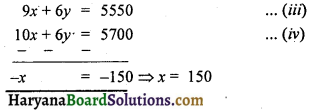
2PbSO4(s) + 2H2O → Pb(s) + PbO2(s) + 2H2SO4(aq)

प्रश्न 3.14.
हाइड्रोजन को छोड़कर ईंधन सेलों में प्रयुक्त किये जा सकने वाले दो अन्य पदार्थ सुझाइए।
उत्तर:
हाइड्रोजन के अलावा CO (कार्बन मोनो ऑक्साइड) तथा मेथेन (CH4) को भी ईंधन सेलों में प्रयुक्त किया जा सकता है।

प्रश्न 3.15.
समझाइए कि कैसे लोहे पर जंग लगने का कारण एक वैद्युत रासायनिक सेल बनना माना जाता है।
उत्तर:
लोहे पर जंग लगने को वैद्युत रासायनिक घटना माना जाता है क्योंकि इसमें निम्न प्रकार से वैद्युत रासायनिक सेल का निर्माण होता है जिसमें कैथोड तथा ऐनोड बनकर उन पर अपचयन एवं ऑक्सीकरण का प्रक्रम होता है। लोहे से बनी हुई किसी वस्तु के किसी निश्चित स्थान पर जब ऑक्सीकरण की प्रक्रिया होती है तो वह स्थान ऐनोड का कार्य करता है तथा इसे हम निम्नलिखित अभिक्रिया से दर्शा सकते हैं-
ऐनोड – 2Fe(s) → 2Fe2+ + 4e

ऐनोड से प्राप्त इलेक्ट्रॉन, धातु के द्वारा प्रवाहित होकर इसके दूसरे स्थान पर पहुँच जाते हैं तथा वहाँ H+ की उपस्थिति में ऑक्सीजन क अपचयन करते हैं (माना जाता है कि H+ आयन CO2 के जल में घुलने से बने H2CO3 से प्राप्त होते हैं। वायुमंडल में उपस्थित अन्य अम्लीय ऑक्साइडों के जल में घुलने से भी H+ उपलब्ध हो सकते हैं)। यह स्थान कैथोड की तरह व्यवहार करता है तथा यहाँ पर होने वाली अभिक्रिया निम्नलिखित है-

O2(g) + 4H+(aq) + 4e → 2H2O(l);
2Fe(s) + O2(g) + 4H+(aq) → 2Fe2+(aq) + 2H2O(l);

इसके पश्चात् वायुमंडलीय ऑक्सीजन के द्वारा फेरस आयन (Fe2+) और अधिक ऑक्सीकृत होकर फेरिक आयनों (Fe3+) में परिवर्तित हैं जो जलयोजित फेरिक ऑक्साइड (Fe2O3. × H2O ) बना लेते हैं तथा यही जंग का रासायनिक संघटन है तथा इसके साथ ही हाइड्रोजन आयन पुनः उत्पन्न हो जाते हैं।

HBSE 12th Class Chemistry Solutions Chapter 3 वैद्युत रसायन Read More »

HBSE 10th Class Maths Important Questions Chapter 3 दो चरों वाले रखिक समीकरण युग्म

Haryana State Board HBSE 10th Class Maths Important Questions Chapter 3 दो चरों वाले रखिक समीकरण युग्म Important Questions and Answers.

Haryana Board 10th Class Maths Important Questions Chapter 3 दो चरों वाले रखिक समीकरण युग्म

परीक्षोपयोगी अन्य महत्त्वपूर्ण प्रश्न :

प्रश्न 1.
जसलीन ने एक पेंसिल और एक रबड़ 3 रु० में खरीदी। ऐसी ही दो पेंसिल व 5 रबड़ के लिए जतिन ने 12 रु० दिए। इस स्थिति को बीजगणितीय एवं ग्राफीय रूपों में व्यक्त कीजिए ।
हल :
माना 1 पेंसिल का मूल्य x रु० तथा एक रबड़ का मूल्य ५ रु० हो तो रैखिक समीकरण-युग्म होगा-
x + y = 3 ……….(i)
2x + 5y = 12 ………….(ii)
HBSE 10th Class Maths Important Questions Chapter 3 दो चरों वाले रखिक समीकरण युग्म - 1
ग्राफीय निरूपण के लिए,
x + y = 3
2x + 5y = 12

⇒ x = 3 – y

x03
y30

⇒ x = \(\frac{12-5 y}{2}\)

x61
y02

ग्राफ पेपर पर बिंदु A (0, 3) व B (3, 0) लेकर उन्हें मिलाकर रेखा AB प्राप्त करें जो समीकरण (i) को निरूपित करेगी तथा बिंदु C (6, 0) तथा बिंदु D (1, 2) लेकर मिलाकर रेखा CD प्राप्त करें जो समीकरण (ii) को निरूपित करेगी।
दोनों रेखाएँ AB और CD परस्पर बिंदु R (1, 2) पर प्रतिच्छेद करती हैं । अतः 1 पेंसिल का मूल्य 1 रु० व 1 रबड़ का मूल्य 2 रु०

HBSE 10th Class Maths Important Questions Chapter 3 दो चरों वाले रखिक समीकरण युग्म

प्रश्न 2.
निम्नलिखित समीकरणों को हल कीजिए :
\(\frac{2 x}{3}+\frac{y}{2}\) = 3
\(\frac{x}{2}-\frac{2 y}{3}=\frac{1}{6}\)
हल :
यहाँ पर,
\(\frac{2 x}{3}+\frac{y}{2}\) = 3
⇒ 4x + 3y = 18 (दोनों ओर 6 से गुणा करने पर) …………(i)
तथा \(\frac{x}{2}-\frac{2 y}{3}=\frac{1}{6}\)
⇒ 3x – 4y = 1 (दोनों ओर 6 से गुणा करने पर) …………(ii)
समीकरण (i) को 4 से तथा समीकरण (ii) को 3 से गुणा करने पर व जोड़ने पर,
16x + 12y = 72
9x – 12y = 3
या 25x = 75
या x = \(\frac {75}{25}\) = 3
x का मान समीकरण (i) में रखने पर,
4(3) + 3y = 18
या 3y = 18 – 12
या y = \(\frac {6}{3}\) = 2
अतः x = 3 व y = 2

प्रश्न 3.
समीकरणों 2x + y = 6 और 2x – y + 2 = 0 को आलेखित कीजिए। अक्ष के साथ इन समीकरणों को निरूपित करने वाली रेखाएँ जो त्रिभुज बनाती हैं उसके शीर्ष ज्ञात कीजिए। इस प्रकार बने त्रिभुजाकार क्षेत्र को छायांकित कीजिए ।
हल :
यहाँ पर
2x + y = 6 ……….. (i)
2x – y + 2 = 0 ……….. (ii)
समीकरण (i) से,
y = 6 – 2x

x03
y30

बिंदुओं A (0, 6) और B(3, 0) को आलेखित कर रेखा AB प्राप्त कीजिए जो समीकरण (i) को निरूपित करती है।
समीकरण (ii) से
y = 2x + 2

x03
y30

HBSE 10th Class Maths Important Questions Chapter 3 दो चरों वाले रखिक समीकरण युग्म - 2
बिंदुओं P(0, 2) और Q (- 1, 0) को आलेखित कर रेखा PQ प्राप्त कीजिए
जो समीकरण (ii) को निरूपित करती है ।
अब (i) रेखा AB और PQ का प्रतिच्छेदन बिंदु T(1, 4) है।
(ii) रेखा AB, x- अक्ष को B (3, 0) पर काटती है ।
(iii) रेखा PQ, x – अक्ष को Q (-1, 0) पर काटती है ।
इस प्रकार, त्रिभुज के शीर्ष (1, 4), (3, 0) तथा (- 1, 0) हैं । अभीष्ट
छायांकित क्षेत्र आकृति में दर्शाया गया है।

HBSE 10th Class Maths Important Questions Chapter 3 दो चरों वाले रखिक समीकरण युग्म

प्रश्न 4.
निम्नलिखित समीकरणों को हल कीजिए :
\(\frac{x}{2}+\frac{2 y}{3}\) = – 1
\(\frac{x}{3}-\frac{y}{2}=\frac{13}{6}\)
हल :
यहाँ पर
\(\frac{x}{2}+\frac{2 y}{3}\) = – 1
⇒ 3x + 4y = – 6 (दोनों ओर 6 से गुणा करने पर ) …………… (i)
तथा \(\frac{x}{3}-\frac{y}{2}=\frac{13}{6}\)
⇒ 2x – 3y = 13 (दोनों ओर 6 से गुणा करने पर ) … (ii)
समीकरण (i) को 3 से तथा समीकरण (ii) को 4 से गुणा करने पर,
9x + 12y = – 18 … (iii)
8x – 12y = 52 … (iv)
समीकरण (iii) व (iv) को जोड़ने पर,
17x = 34
या x = \(\frac {34}{17}\) = 2
x का मान समीकरण (i) में रखने पर,
3 (2) + 4y = – 6
या 4y = – 6 – 6
या y = \(\frac {- 12}{4}\) = – 3
अतः x = 2 व y = -3

प्रश्न 5.
निम्नलिखित समीकरणों को हल कीजिए :
\(\frac{2 x}{3}-\frac{3 y}{2}\) = – 2
\(\frac{x}{2}+\frac{4 y}{3}=\frac{25}{3}\)
हल :
यहाँ पर,
\(\frac{2 x}{3}-\frac{3 y}{2}\) = – 2
⇒ 4x – 9y = – 12 (दोनों ओर 6 से गुणा करने पर ) …………(i)
तथा \(\frac{x}{2}+\frac{4 y}{3}=\frac{25}{3}\)
⇒ 3x + 8y = 50 (दोनों ओर 6 से गुणा करने पर ) …………(ii)
समीकरण (i) को 8 से तथा समीकरण (ii) को 9 से गुणा करने पर,
32x – 72y = – 96 …………….(iii)
27x + 72y = 450 ………….. (iv)
समीकरण (iii) व (iv) को जोड़ने पर प्राप्त होगा,
59x = 354
या x = \(\frac {354}{59}\) = 6
x का मान समीकरण (i) में प्रतिस्थापित करने पर,
4(6) – 9y = -12
या – 9y = – 12 – 24
या y = \(\frac {-36}{-9}\) = 4
अतः अभीष्ट हल x = 6 व y = 4

HBSE 10th Class Maths Important Questions Chapter 3 दो चरों वाले रखिक समीकरण युग्म

प्रश्न 6.
निम्नलिखित रैखिक समीकरण-युग्म को विलोपन विधि से हल कीजिए-
– 6x + 5y = 2 और 5x + 6y = 9
हल :
यहाँ पर
– 6x + 5y = 2 …………(i)
– 5x + 6y = 9 …………..(ii)
समीकरण (i) को 6 से तथा समीकरण (ii) को 5 से गुणा करने पर,
– 36x + 30y = 12 ………….(iii)
– 25x + 30y = 45 ………….(iv)
घटाने पर
HBSE 10th Class Maths Important Questions Chapter 3 दो चरों वाले रखिक समीकरण युग्म - 3
x = \(\frac {-33}{11}\) = 3
या x = 3 को समीकरण (i) में रखने पर,
या – 6 (3) + 5y = 2
या – 18 + 5y = 2
या 5y = 2 + 18
या 5y = 20
या y = \(\frac {20}{5}\) = 4
अतः अभीष्ट हल x = 3 व y = 4

प्रश्न 7.
रैखिक समीकरण – युग्म 2x + 3y = 7 और 6x – 5y = 11 को वज्र-गुणन विधि से हल कीजिए ।
हल :
यहाँ पर
2x + 3y – 7 = 0 ….(i)
व 6x – 5y – 11 = 0
वज्र – गुणन विधि से हल करने के लिए
HBSE 10th Class Maths Important Questions Chapter 3 दो चरों वाले रखिक समीकरण युग्म - 4

प्रश्न 8.
हल कीजिए :
\(\frac{2}{x}+\frac{3}{y}\) और \(\frac{5}{x}-\frac{4}{y}\) = – 2
हल :
यहाँ पर,
2(\(\frac {1}{x}\)) + 3(\(\frac {1}{y}\)) = 13 ………….(i)
5(\(\frac {1}{x}\)) – 4(\(\frac {1}{y}\)) = – 2 ………….(ii)
समीकरण (i) व (ii) में \(\frac {1}{x}\) = p व \(\frac {1}{y}\) = q प्रतिस्थापित करने पर प्राप्त होता है-
2p + 3q = 13 ………….(iii)
5p – 4q = -2 ………….(iv)
समीकरण (iii) को 4 से व (iv) को 3 से गुणा करने व जोड़ने पर प्राप्त होता है-
HBSE 10th Class Maths Important Questions Chapter 3 दो चरों वाले रखिक समीकरण युग्म - 5
या p = \(\frac {46}{23}\) = 2
p का मान समीकरण (iii) में प्रतिस्थापित करने पर
2 (2) + 3q = 13
या 3q = 13 – 4
या q = \(\frac {9}{3}\) = 3
p और q का मान पुनः प्रतिस्थापित करने पर \(\frac {1}{x}\) = p और \(\frac {1}{y}\) = q
\(\frac {1}{x}\) = 2 और \(\frac {1}{y}\) = 3
⇒ x = \(\frac {1}{2}\) व y = \(\frac {1}{3}\).

HBSE 10th Class Maths Important Questions Chapter 3 दो चरों वाले रखिक समीकरण युग्म

प्रश्न 9.
समीकरण – युग्म 2x – 3y = 1 और kx + 5y= 7 में k का वह मान ज्ञात कीजिए जिसके लिए युग्म का अद्वितीय हल हो ।
हल :
यहाँ पर
2x – 3y = 1 ……………(i)
kx + 5y = 7 ……………(ii)
a1 = 2, b1 = – 3
a2 = k, b2 = 5
अद्वितीय हल होने के लिए आवश्यक है,
\(\frac{a_1}{a_2} \neq \frac{b_1}{b_2}\)
⇒ \(\frac{2}{k} \neq \frac{-3}{5}\)
या k ≠ \(\frac {10}{-3}\)
अतः \(\frac {10}{-3}\) के अतिरिक्त k के सभी मानों के लिए दिए गए समीकरण – युग्म का एक अद्वितीय हल होगा।

प्रश्न 10.
k का ऐसा मान ज्ञात कीजिए जिसके लिए समीकरण – युग्म 2x + ky = 1 और 3x – 5y = 7 का कोई हल न हो।
हल :
यहाँ पर
2x + ky – 1 = 0 ……..(i)
3x – 5y – 7 = 0 ………(ii)
a1 = 2, b1 = k, c1 = – 1
a2 = 3, b2 = – 5, c2 = – 7
समीकरण-युग्म का कोई हल न होने के लिए आवश्यक है कि,
\(\frac{a_1}{a_2}:=\frac{b_1}{b_2} \neq \frac{c_1}{c_2}\)
⇒ \(\frac {2}{3}\) = \(\frac {k}{- 5}\)
या 3k = – 10
या k = \(\frac {-10}{3}\)
अतः k = \(\frac {-10}{3}\) के लिए समीकरण -युग्म का कोई हल नहीं होगा ।

प्रश्न 11.
k के किस मान के लिए समीकरण – युग्म x + 2y + 7 = 0 व 2x + ky + 14 = 0 संपाती रेखाएँ प्रदर्शित करेगी?
हल :
यहाँ पर
x + 2y + 7 = 0 …………(i)
2x + ky + 14 = 0 ………….(ii)
⇒ a1 = 1, b1 = 2, c1 = 7, a2 = 2, b2 = k, c2 = 14
संपाती रेखाएँ अर्थात् अनंत अनेक हल होने के लिए आवश्यक है
HBSE 10th Class Maths Important Questions Chapter 3 दो चरों वाले रखिक समीकरण युग्म - 6
अतः k = 4 के लिए समीकरण-युग्म की रेखाएँ संपाती होंगी।

प्रश्न 12.
पाँच वर्ष पहले नीता की आयु, गीता की आयु की तीन गुनी थी। दस वर्ष पश्चात् नीता की आयु, गीता की आयु की दुगुनी होगी। इस समय नीता और गीता की आयु क्या है ?
हल :
माना गीता की वर्तमान आयु = x वर्ष
तथा नीता की वर्तमान आयु = y वर्ष
प्रश्नानुसार पाँच वर्ष पहले, y – 5 = 3(x – 5)
या y – 5 = 3x – 15
या y – 3x = – 15 + 5
या y – 3x = – 10 ………….(i)
प्रश्नानुसार दस वर्ष बाद,
y + 10 = 2 (x + 10)
या y + 10 = 2x + 20
या y = 2x + 20 – 10
या y = 2x + 10 ………….(ii)
y का मान समीकरण (i) में रखने पर,
2x + 10 – 3x = – 10
या 2x – 3x = – 10 – 10
– x = – 20
या x = 20
∴ गीता की वर्तमान आयु = 20 वर्ष
तथा नीता की वर्तमान आयु = 2 × 20 + 10 = 50 वर्ष

HBSE 10th Class Maths Important Questions Chapter 3 दो चरों वाले रखिक समीकरण युग्म

प्रश्न 13.
किसी भिन्न के अंश और हर दोनों में से प्रत्येक में यदि 1 जोड़ दें, तो वह \(\frac {4}{5}\) बन जाती है। परंतु यदि प्रत्येक में से 5 घटा दें, तो वह \(\frac {1}{2}\) हो जाती है । वह भिन्न ज्ञात कीजिए ।
हल :
माना भिन्न का अंश = x
तथा भिन्न का हर = y
∴ भिन्न = \(\frac {x}{y}\)
पहली शर्त के अनुसार, \(\frac{x+1}{y+1}=\frac{4}{5}\)
या 5x + 5 = 4y + 4
या 5x – 4y = 4 – 5
या 5x – 4y = – 1 ………….(i)
दूसरी शर्त के अनुसार, \(\frac{x-5}{y-5}=\frac{1}{2}\)
या 2x – 10 = y – 5
या 2x – y = – 5 + 10
या 2x – y = 5 ………….(ii)
समीकरण (i) को 1 से तथा समीकरण (ii) को 4 से गुणा करने पर,
HBSE 10th Class Maths Important Questions Chapter 3 दो चरों वाले रखिक समीकरण युग्म - 7
या x = \(\frac {-21}{-3}\) = 7
x = 7 को समीकरण (i) में रखने पर,
5 (7) – 4y = – 1
या 35 – 4y = – 1
या – 4y = – 1 – 35
या – 4y = – 36
या y = \(\frac {-36}{-4}\) = 9
अतः अभीष्ट भिन्न = \(\frac {7}{9}\)

प्रश्न 14.
दो अंकों वाली एक संख्या के अंकों का योग 8 है । अंकों को पलटने पर प्राप्त होने वाली संख्या दी गई संख्या से 36 अधिक है । वह संख्या ज्ञात कीजिए ।
हल :
माना संख्या की इकाई का अंक = x और दहाई का अंक = y
तो संख्या = 10y + x
∴ अंकों को पलटने पर प्राप्त संख्या = 10x + y
पहली शर्त के अनुसार,
x + y = 8 …….. (i)
दूसरी शर्त के अनुसार,
(10x + y) – (10y + x) = 36
या 10x + y – 10y – x = 36
या 9x – 9y = 36
x – y = 4 ………… (ii) (दोनों ओर 9 से भाग करने पर)
समीकरण (i) और (ii) को जोड़ने पर,
x – y = 4 …….. (ii)
x + y = 8 …….. (i)
2x = 12 ⇒ x = \(\frac {12}{2}\) = 6
x का मान समीकरण (i) में रखने पर,
या y = 8 – 6 = 2
अतः अभीष्ट संख्या = 10 × 2 + 6 = 26

HBSE 10th Class Maths Important Questions Chapter 3 दो चरों वाले रखिक समीकरण युग्म

प्रश्न 15.
तीन कुर्सियों और दो मेजों का मूल्य 1850 रु० है । पाँच कुर्सियों और तीन मेजों का मूल्य 2850 रु० है । दो कुर्सियों और दो मेजों का मूल्य ज्ञात कीजिए ।
हल :
माना कि एक कुर्सी का मूल्य = x रुपए
और एक मेज का मूल्य = y रुपए
पहली शर्त के अनुसार,
3x + 2y = 1850 ……. (i)
दूसरी शर्त के अनुसार,
5x + 3y = 2850 ……. (ii)
समीकरण (i) को 3 से तथा समीकरण (ii) को 2 से गुणा करने पर,
HBSE 10th Class Maths Important Questions Chapter 3 दो चरों वाले रखिक समीकरण युग्म - 8
x का मान समीकरण (i) में रखने पर,
3 × 150 + 2y = 1850
या 450 + 2y = 1850
या 2y = 1850 – 450
या 2y = 1400
y = \(\frac {1400}{2}\) = 700
∴ 2 कुर्सियों और 2 मेजों का मूल्य = 2x + 2y
= 2 × 150 + 2 × 700
= 300 + 1400 = 1700 रुपए

प्रश्न 16.
स्टेशन A से स्टेशन B के 2 टिकटों और स्टेशन A से स्टेशन C के 3 टिकटों के लिए 795 रु० देने पड़ते हैं। परंतु स्टेशन A से B के 3 और A से C के 5 टिकटों के लिए कुल 1300 रु० देने पड़ते हैं। स्टेशन A से B का और स्टेशन A से C तक का किराया ज्ञात कीजिए ।
हल :
माना, स्टेशन A से स्टेशन B तक किराया = x रु०
तथा स्टेशन A से स्टेशन C तक किराया = y रु०
प्रश्नानुसार,
2x + 3y = 795 ……….(i)
3x + 5y = 1300 ……….(ii)
समीकरण (i) को 3 से तथा समीकरण (ii) को 2 से गुणा कर घटाने पर,
HBSE 10th Class Maths Important Questions Chapter 3 दो चरों वाले रखिक समीकरण युग्म - 9
या y = 215
y का मान समीकरण (i) में रखने पर,
2x + 3 × 215 = 795
या 2x = 795 – 3 × 215
x = \(\frac{795-645}{2}=\frac{150}{2}\) = 75
अतः स्टेशन A से स्टेशन B तक किराया = 75 रु०
और स्टेशन A से स्टेशन C तक किराया = 215 रु०

प्रश्न 17.
यदि एक आयत की लंबाई को 2 मात्रक बढ़ा दें और उसकी चौड़ाई को 2 मात्रक घटा दें, तो उसका क्षेत्रफल 28 वर्ग मात्रक घट जाता है । यदि लंबाई को 1 मात्रक कम कर दें और चौड़ाई को 2 मात्रक बढ़ा दें, तो क्षेत्रफल 33 वर्ग मात्रक बढ़ जाता है । आयत की विमाएँ (dimensions) ज्ञात कीजिए ।
हल :
माना आयत की लम्बाई = x मात्रक
तथा आयत की चौड़ाई = y मात्रक
तो आयत का क्षेत्रफल = xy वर्ग मात्रक
पहली शर्त के अनुसार,
(x + 2) (y – 2) = xy – 28
या xy – 2x + 2y – 4 = xy – 28
या – 2x + 2y = xy – 28 – xy + 4
या – 2x + 2y = – 24
या x – y = 12 ……………(i)
दूसरी शर्त के अनुसार,
या (x – 1) (y + 2) = xy + 33
या xy + 2x – y – 2 = xy + 33
या 2x – y = xy + 33 – xy + 2
या 2x – y = 35 ……………(ii)
समीकरण (ii) को समीकरण (i) में से घटाने पर,
HBSE 10th Class Maths Important Questions Chapter 3 दो चरों वाले रखिक समीकरण युग्म - 10
या x = 23
x का मान समीकरण (i) में रखने पर,.
23 – y = 12
या – y = 12 – 23
या – y = – 11
या y = 11
अतः आयत की लंबाई = 23 मात्रक
तथा आयत की चौड़ाई = 11 मात्रक

HBSE 10th Class Maths Important Questions Chapter 3 दो चरों वाले रखिक समीकरण युग्म

प्रश्न 18.
हल कीजिए :
\(\frac{5}{x}-\frac{4}{y}\) = – 2 और \(\frac{2}{x}+\frac{3}{y}\) = 13
हल :
यहाँ पर
5(\(\frac {1}{x}\)) – 4(\(\frac {1}{y}\)) = – 2 …………..(i)
2(\(\frac {1}{x}\)) + 3(\(\frac {1}{y}\)) = 13 …………..(ii)
माना \(\frac {1}{x}\) = p व \(\frac {1}{y}\) = q समीकरण (i) व (ii) में प्रतिस्थापित करने पर प्राप्त होता है-
5p – 4q = – 2 …………..(iii)
2p + 3q = 13 …………..(iv)
समीकरण (iii) को 3 से तथा (iv) को 4 से गुणा करके जोड़ने पर प्राप्त होता है-
HBSE 10th Class Maths Important Questions Chapter 3 दो चरों वाले रखिक समीकरण युग्म - 11
या p = \(\frac {46}{23}\) = 2
p का मान समीकरण (iii) में रखने पर
5 (2) – 4q = – 2
⇒ – 4q = – 2 – 10
⇒ q = \(\frac {-12}{-4}\) = 3
p और q का मान पुनः प्रतिस्थापित करने पर
\(\frac {1}{x}\) = p और \(\frac {1}{y}\) = q
\(\frac {1}{x}\) = 2 और \(\frac {1}{y}\) = 3
⇒ x = \(\frac {1}{2}\) और y = \(\frac {1}{3}\)

प्रश्न 19.
एक व्यक्ति नदी की धारा की दिशा में 2 घंटे में 20 कि०मी० और धारा के विरुद्ध 2 घंटे में 4 कि०मी० नाव चला सकता है। स्थिर जल में इस व्यक्ति की नाव चलाने की चाल और धारा की चाल ज्ञात कीजिए ।
हल :
माना स्थिर जल में नाव की चाल = x कि०मी० / घंटा
और धारा की चाल = y कि०मी० / घंटा
अतः जल के बहाव की ओर नाव की चाल = (x + y) कि०मी० / घंटा
और जल के बहाव के विपरीत नाव की चाल = (x – y) कि०मी० / घंटा
पहली शर्त के अनुसार, 20 = (x + y) × 2
या x + y = 10 ………..(i)
दूसरी शर्त के अनुसार, 4 = (x – y) × 2
या x – y = 2 ………..(ii)
समीकरण (i) और समीकरण (ii) को जोड़ने पर,
2x = 12 ⇒ x = \(\frac {12}{2}\) = 6
x का मान समीकरण (i) में रखने पर,
6 + y = 10
या y = 10 – 6 = 4
अतः स्थिर जल में नाव की चाल = 6 कि०मी० / घंटा
और धारा की चाल = 4 कि०मी० / घंटा

प्रश्न 20.
हल कीजिए : \(\frac{1}{2 x}-\frac{1}{y}\) = – 1, \(\frac{1}{x}+\frac{1}{2y}\) = 8
हल :
यहाँ पर,
\(\frac {1}{2}\)(\(\frac {1}{x}\)) – \(\frac {1}{y}\) = – 1 …………(i)
\(\frac {1}{x}\) + \(\frac {1}{2}\)(\(\frac {1}{y}\)) = 8 …………(ii)
समीकरण (i) व (ii) में \(\frac {1}{x}\) = p व \(\frac {1}{y}\) = q प्रतिस्थापित करने पर प्राप्त होता है ।
\(\frac {1}{2}\)p – q = – 1
या p – 2q = – 2 …………(iii)
p + \(\frac {1}{2}\)q = 8
या 2p + q = 16 …………(iv)
समीकरण (iv) को 2 से गुणा करके समीकरण (iii) में जोड़ने पर प्राप्त होता है ।
HBSE 10th Class Maths Important Questions Chapter 3 दो चरों वाले रखिक समीकरण युग्म - 12
या p = \(\frac {30}{5}\) = 6
p का मान समीकरण (iii) में रखने पर
6 – 2q = – 2
⇒ – 2q = – 2 – 6
⇒ q = \(\frac {-8}{-2}\) = 4
p और q का मान पुनः प्रतिस्थापित करने पर – \(\frac {1}{x}\) = p और \(\frac {1}{y}\) = q
\(\frac {1}{x}\) = 6 और \(\frac {1}{y}\) = 4
⇒ x = \(\frac {1}{6}\) और y = \(\frac {1}{4}\)

बहुविकल्पीय प्रश्न

प्रश्न 1.
यदि दो चरों वाले रैखिक समीकरण के ग्राफ में l और m रेखाएँ एक-दूसरे को प्रतिच्छेद करें तो-
(A) समीकरण -युग्म के अनेक हल होते हैं
(B) समीकरण-युग्म का अद्वितीय हल होता है
(C) समीकरण -युग्म का कोई हल नहीं होता
(D) समीकरण-युग्म के दो हल होते हैं
हल :
(B) समीकरण-युग्म का अद्वितीय हल होता है

HBSE 10th Class Maths Important Questions Chapter 3 दो चरों वाले रखिक समीकरण युग्म

प्रश्न 2.
यदि दो चरों वाले रैखिक समीकरण के ग्राफ में p और q रेखाएँ एक-दूसरे के समांतर हों तो ………………………
(A) समीकरण -युग्म के अनेक हल होते हैं
(B) समीकरण-युग्म का अद्वितीय हल होता है
(C) समीकरण -युग्म का कोई हल नहीं होगा
(D) समीकरण -युग्म के दो हल होते हैं।
हल :
(C) समीकरण-युग्म का कोई हल नहीं होगा

प्रश्न 3.
समीकरणों a1x + b1y + c1 = 0 और a2x + b2y + c2 = 0 में यदि \(\frac{a_1}{a_2} \neq \frac{b_1}{b_2}\), तो निम्नलिखित में कौन-सा सत्य है?
(A) समांतर रेखाएँ
(B) प्रतिच्छेदित रेखाएँ
(C) संपाती रेखाएँ
(D) इनमें से कोई नहीं
हल :
(B) प्रतिच्छेदित रेखाएँ

प्रश्न 4.
समीकरणों a1x + b1y + c1 = 0 और a2x + b2y + c2 = 0 में यदि \(\frac{a_1}{a_2}=\frac{b_1}{b_2}=\frac{c_1}{c_2}\) तो निम्नलिखित में कौन-सा सत्य है ?
(A) प्रतिच्छेदित रेखाएँ
(B) संपाती रेखाएँ
(C) समांतर रेखाएँ
(D) इनमें से कोई नहीं
हल :
(B) संपाती रेखाएँ

प्रश्न 5.
समीकरणों a1x + b1y + c1 = 0 और a2x + b2y + c2 = 0 में यदि \(\frac{a_1}{a_2}=\frac{b_1}{b_2} \neq \frac{c_1}{c_2}\), तो निम्नलिखित में कौन-सा सत्य है ?
(A) प्रतिच्छेद करती हुई रेखाएँ
(B) संपाती रेखाएँ
(C) समांतर रेखाएँ
(D) इनमें से कोई नहीं
हल :
(C) समांतर रेखाएँ

HBSE 10th Class Maths Important Questions Chapter 3 दो चरों वाले रखिक समीकरण युग्म

प्रश्न 6.
समीकरणों x + y = 5, x – y = 5 और x = 0 को आलेखित करने पर बनने वाले त्रिभुज का x – अक्ष पर स्थित शीर्ष होगा-
(A) (0, 5)
(B) (5, 0)
(C) (0, – 5)
(D) (0, 0)
हल :
(B) (5, 0)

प्रश्न 7.
ग्राफ में दर्शाए गए रैखिक युग्म के कितने हल होंगे?
(A) कोई नहीं
(B) एक
(C) दो
(D) अपरिमित रूप से अनेक
हल :
(A) कोई नहीं
HBSE 10th Class Maths Important Questions Chapter 3 दो चरों वाले रखिक समीकरण युग्म - 13

प्रश्न 8.
HBSE 10th Class Maths Important Questions Chapter 3 दो चरों वाले रखिक समीकरण युग्म - 14
(A) (0, 2)
(B) (0, – 4)
(C) (6, 0)
(D) (0, 6)
हल :
(C) (6, 0)

HBSE 10th Class Maths Important Questions Chapter 3 दो चरों वाले रखिक समीकरण युग्म

प्रश्न 9.
संलग्न ग्राफ में दर्शाए गए रैखिक युग्म 2x – 4y – 10 = 0 व x – 2y = 5 के अभीष्ट हलों की संख्या होगी-
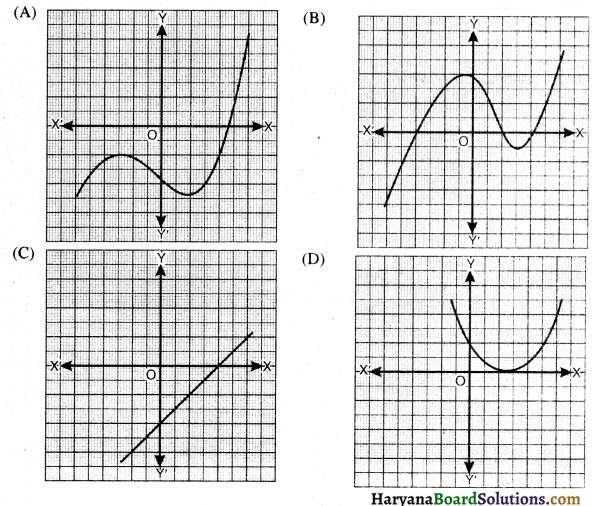
HBSE 10th Class Maths Important Questions Chapter 3 दो चरों वाले रखिक समीकरण युग्म - 15
(A) कोई नहीं
(B) केवल एक
(C) दो
(D) अपरिमित रूप से अनेक
हल :
(D) अपरिमित रूप से अनेक

प्रश्न 10.
राम की आयु श्याम की आयु से 8 वर्ष अधिक है। दोनों की आयु का योगफल 28 वर्ष है तो राम की आयु होगी-
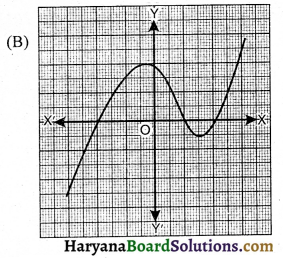
(A) 18 वर्ष
(B) 10 वर्ष
(C) 8 वर्ष
(D) 16 वर्ष
हल :
(A) 18 वर्ष

प्रश्न 11.
एक संख्या दूसरी संख्या से दोगुनी है और इनका योगफल 150 है, तो बड़ी संख्या होगी-
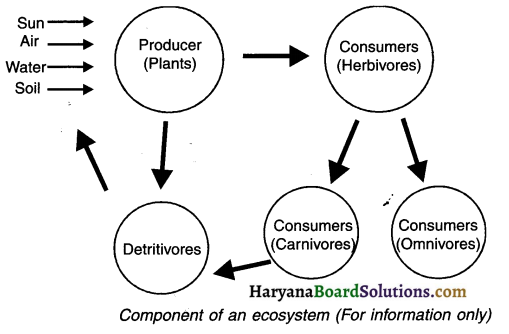
(A) 25
(B) 50
(C) 75
(D) 100
हल :
(D) 100

HBSE 10th Class Maths Important Questions Chapter 3 दो चरों वाले रखिक समीकरण युग्म

प्रश्न 12.
एक संख्या को 2 से गुणा करके 6 जोड़ने पर 28 प्राप्त होता है । इसका रैखिक समीकरण होगा-
(A) 2x + 28 = 6
(B) 2x + 6 = 28
(c) \(\frac {x}{2}\) + 6 = 28
(D) \(\frac{x+6}{2}\) = 28
हल :
(B) 2x + 6 = 28

प्रश्न 13.
रैखिक समीकरणों के युग्म 2x – ky + 3 = 0 तथा 3x + 2y – 1 = 0 का कोई हल नहीं है, के लिए k का मान ………………. है ।
(A) \(\frac {-4}{3}\)
(B) \(\frac {4}{3}\)
(C) 6
(D) – 6
हल :
(A) \(\frac {-4}{3}\)

प्रश्न 14.
समीकरणों x – 2y – 3 = 0 तथा 3x + ky – 1 = 0 के अद्वितीय हल के लिए k का मान होगा-
(A) k ≠ 6
(B) k ≠ 3
(C) k ≠ – 6
(D) इनमें से कोई नहीं
हल :
(C) k ≠ – 6

प्रश्न 15.
समीकरणों a1x + b1y + c1 = 0 और a2x + b2y + c2 = 0 में \(\frac{a_1}{a_2} \neq \frac{b_1}{b_2}\),
(A) कोई हल नहीं
(C) अद्वितीय हल
हल :
(C) अद्वितीय हल

HBSE 10th Class Maths Important Questions Chapter 3 दो चरों वाले रखिक समीकरण युग्म

प्रश्न 16.
k के किस मान के लिए, निम्नलिखित रैखिक समीकरणों के युग्म के एक अद्वितीय (unique) हल है ?
4x + ky + 8 = 0
2x + 2y + 5 = 0
(A) k ≠ 4
(B) k ≠ 2
(C) k = 4
(D) इनमें से कोई नहीं
हल :
(A) k ≠ 4

प्रश्न 17.
k के किस मान के लिए, निम्नलिखित रैखिक समीकरणों के युग्म के अपरिमित रूप से अनेक हल हैं?
kx + 4y + 6 = 0
3x + 8y + 12 = 0
(A) k = 6
(B) k = 3
(C) k = 2
(D) k = 1.5
हल :
(D) k = 1.5

प्रश्न 18.
k के किस मान के लिए, निम्नलिखित रैखिक समीकरणों का कोई हल नहीं है ?
6x + 4y + k = 0
3x + 2y + 5 = 0
(A) k = 10
(B) k ≠ 10
(C) k = 5
(D) k = 2.5
हल :
(B) k ≠ 10

HBSE 10th Class Maths Important Questions Chapter 3 दो चरों वाले रखिक समीकरण युग्म

प्रश्न 19.
समीकरण – युग्म 5x + 2y = 16 और 7x – 4y = 2 में ……………………. होंगे।
(A) अनेक हल
(B) कोई हल नहीं
(C) अद्वितीय हल
(D) दो हल
हल :
(C) अद्वितीय हल

प्रश्न 20.
समीकरण – युग्म \(\sqrt{2}\)x – \(\sqrt{3}\)y = 0 और \(\sqrt{5}\)x + \(\sqrt{2}\)y = 0 का हल होगा-
(A) (0, 0)
(B) (1, 1)
(C) (-1, – 1)
(D) \(\sqrt{2}\), \(\sqrt{3}\)
हल :
(A) (0, 0)

प्रश्न 21.
समीकरण-युग्म x + y = 7 और 2x – 3y = 11 में से x का निराकरण करने पर y का मान …………………. होगा।
(A) \(\frac {32}{5}\)
(B) \(\frac {3}{5}\)
(C) \(\frac {5}{3}\)
(D) \(\frac {5}{32}\)
हल :
(B) \(\frac {3}{5}\)

HBSE 10th Class Maths Important Questions Chapter 3 दो चरों वाले रखिक समीकरण युग्म

प्रश्न 22.
समीकरण ax + by – c = 0 जहाँ x – अक्ष पर मिलता है, वह बिंदु होगा-
(A) (\(\frac {-c}{a}\), 0)
(B) (0, \(\frac {c}{b}\))
(C) (0, \(\frac {c}{a}\))
(D) (\(\frac {c}{a}\), 0)
हल :
(D) (\(\frac {c}{a}\), 0)

प्रश्न 23.
समीकरण-युग्म 3x – 5y = 1 और 5x + 2y = 19 को हल करने पर x का मान होगा
(A) \(\frac {97}{31}\)
(B) \(\frac {52}{31}\)
(C) \(\frac {31}{97}\)
(D) \(\frac {31}{52}\)
हल :
(A) \(\frac {97}{31}\)

प्रश्न 24.
समीकरणों 2x + 3y – 5 = 0 तथा kx – 6y – 8 = 0 के एक अद्वितीय हल के लिए, k का मान होगा-
(A) k ≠ 4
(B) k ≠ – 4
(C) k ≠ – 6
(D) इनमें से कोई नहीं
हल :
(B) k ≠ – 4

प्रश्न 25.
समीकरणों a1x + b1y + c1 = 0 और a2x + b2y + c2 = 0 में \(\frac{a_1}{a_2}=\frac{b_1}{b_2}=\frac{c_1}{c_2}\), तो निम्नलिखित में कौन-सा सत्य है ?
(A) अद्वितीय हल
(B) कोई हल नहीं
(C) अपरिमित हल
(D) इनमें से कोई नहीं
हल :
(C) अपरिमित हल

HBSE 10th Class Maths Important Questions Chapter 3 दो चरों वाले रखिक समीकरण युग्म

प्रश्न 26.
‘K’ का वह मान, जिनके लिए रैखिक समीकरणों kx + 3y + (3 – k) = 0 तथा 12x + ky – k = 0 के युग्म के अपरिमित रूप से अनेक हल हैं,
(A) – 6
(C) 12
(B) – 12
(D) + 6
हल :
(A) – 6

प्रश्न 27.
समीकरणों a1x + b1y + c1 = 0 और a2x + b2y + c2 = 0 में यदि \(\frac{a_1}{a_2}=\frac{b_1}{b_2} \neq \frac{c_1}{c_2}\), तो निम्नलिखित में कौन-सा सत्य है ?
(A) अद्वितीय हल
(B) कोई हल नहीं
(C) अपरिमित हल
(D) इनमें से कोई नहीं
हल :
(B) कोई हल नहीं

प्रश्न 28.
किसी भिन्न के अंश में 1 जोड़ने और उसके हर में से 1 घटाने पर 1 प्राप्त होता है। यदि यह भी ज्ञात हो कि उसके हर में 1 जोड़ने पर \(\frac {1}{2}\) प्राप्त होता है, तो भिन्न होगी –
(A) \(\frac {2}{5}\)
(B) \(\frac {5}{2}\)
(C) \(\frac {3}{5}\)
(D) \(\frac {5}{3}\)
हल :
(C) \(\frac {3}{5}\)

प्रश्न 29.
किसी भिन्न के हर में 5 जोड़ने और उसके अंश में से 5 घटाने पर \(\frac {1}{7}\) प्राप्त होता है। यदि उसके अंश में से 3 घटाया जाए और उसके हर में 3 जोड़ा जाए, तो \(\frac {1}{3}\) प्राप्त होता है, तो भिन्न होगी-
(A) \(\frac {7}{9}\)
(B) \(\frac {9}{7}\)
(C) \(\frac {5}{9}\)
(D) \(\frac {2}{9}\)
हल :
(A) \(\frac {7}{9}\)

HBSE 10th Class Maths Important Questions Chapter 3 दो चरों वाले रखिक समीकरण युग्म

प्रश्न 30.
दो अंकों वाली एक संख्या के अंकों का योग 8 है। अंकों को पलटने पर प्राप्त होने वाली संख्या दी गई संख्या से 36 अधिक है । वह संख्या होगी-
(A) 62
(B) 26
(C) 35
(D) 53
हल :
(B) 26

प्रश्न 31.
एक परिमेय संख्या का हर अंश से 5 अधिक है । यदि हर और अंश में से 2-2 घटा दिए जाएं तो संख्या \(\frac {2}{7}\) बन जाती है । परिमेय संख्या होगी-
(A) \(\frac {1}{6}\)
(B) \(\frac {4}{9}\)
(C) \(\frac {2}{7}\)
(D) \(\frac {3}{8}\)
हल :
(B) \(\frac {4}{9}\)

प्रश्न 32.
एक संख्या दो अंकों की बनी है, जिसके अंकों का योग 8 है। यदि संख्या में 18 जोड़ दिया जाए तो अंक अपना स्थान बदल लेते हैं । संख्या होगी-
(A) 26
(B) 62
(C) 35
(D) 44
हल :
(C) 35

प्रश्न 33.
दो अंकों वाली एक संख्या के अंकों का योग 9 है। अंकों का परस्पर क्रम बदलने पर प्राप्त संख्या दी गई संख्या से 27 अधिक है । दी गई संख्या होगी-
(A) 63
(B) 36
(C) 27
(D) 72
हल :
(B) 36

HBSE 10th Class Maths Important Questions Chapter 3 दो चरों वाले रखिक समीकरण युग्म

प्रश्न 34.
एक व्यक्ति कुछ मासिक वेतन पर नौकरी शुरू करता है और प्रत्येक वर्ष उसके वेतन में एक नियत वृद्धि होती रहती है । यदि 4 वर्ष के बाद उसका वेतन 1800 रु० हो तो उसका आरंभिक वेतन ……………….. होगा ।
(A) 1300 रु०
(B) 50 रु०
(C) 1000 रु०
(D) 1200 रु०
हल :
(A) 1300 रु०

प्रश्न 35.
चक्रीय चतुर्भुज के सम्मुख कोणों का योग होता है-
(A) 90°
(B) 180°
(C) 360°
(D) 270°
हल :
(B) 180°

प्रश्न 36.
1500 रु० हो और 10 वर्ष के बाद उसका वेतन होगा ।
(A) 26 मी०, 10 मी०
(B) 20 मी०, 16 मी०
(C) 22 मी०, 14 मी०
(D) इनमें से कोई नहीं
हल :
(B) 20 मी०, 16 मी०

प्रश्न 37.
राम ने 5 कुर्सियाँ और 2 मेजें 1625 रु० की खरीदीं। श्याम ने 1 मेज और 2 कुर्सियाँ 750 रु० की खरीदीं। प्रति कुर्सी और प्रति मेज, मूल्य क्रमशः होगा-
(A) 125 रु०; 500 रु०
(B) 500 रु०; 125 रु०
(C) 175 रु०; 400 रु०
(D) 400 रु०; 175 रु०
हल :
(A) 125 रु०; 500 रु०

HBSE 10th Class Maths Important Questions Chapter 3 दो चरों वाले रखिक समीकरण युग्म

प्रश्न 38.
3 कुर्सियाँ और 2 मेजों का मूल्य 700 रु० है और 5 कुर्सियों और 3 मेजों का मूल्य 1100 रु० है । 2 कुर्सियों और 2 मेजों का मूल्य होगा-
(A) 400 रु०
(B) 500 रु०
(C) 1800 रु०
(D) 600 रु०
हल :
(D) 600 रु०

प्रश्न 39.
एक संख्या दूसरी से 5 अधिक है, संख्याओं का योगफल 75 हो तो छोटी संख्या होगी-
(A) 35
(B) 40
(C) 45
(D) 30
हल :
(A) 35

प्रश्न 40.
दो संख्याओं का अनुपात 5 : 7 है और योगफल 360 है तो बड़ी संख्या होगी –
(A) 150
(B) 180
(C) 210
(D) 240
हल :
(C) 210

प्रश्न 41.
दो संख्याओं का अनुपात 5 : 4 है और यदि प्रत्येक संख्या में 10 जोड़ दिया जाए तो अनुपात 6 : 5 बन जाता है । संख्याएँ होंगी-
(A) 50, 40
(B) 40, 30
(C) 60, 50
(D) 45, 35
हल :
(A) 50, 40

HBSE 10th Class Maths Important Questions Chapter 3 दो चरों वाले रखिक समीकरण युग्म

प्रश्न 42.
दो संख्याओं का अनुपात 3 : 4 है, यदि प्रत्येक संख्या में से 7 घटा दिया जाए तो अनुपात 2 : 3 बन जाता है । संख्याएँ होंगी-
(A) 22, 29
(B) 21, 28
(C) 23, 31
(D) 28, 35
हल :
(B) 21,28

प्रश्न 43.
दो धनात्मक पूर्णांकों का अंतर 36 है। इन पूर्णांकों में 4 : 3 का अनुपात है। ये पूर्णांक होंगे-
(A) 144, 108
(B) 108, 72
(C) 180, 144
(D) 216, 180
हल :
(A) 144, 108

HBSE 10th Class Maths Important Questions Chapter 3 दो चरों वाले रखिक समीकरण युग्म Read More »

HBSE 10th Class Science Notes Chapter 4 Carbon and Its Compounds

Haryana State Board HBSE 10th Class Science Notes Chapter 4 Carbon and Its Compounds Notes.

Haryana Board 10th Class Science Notes Chapter 4 Carbon and Its Compounds

Carbon is a non-metallic element. Its symbol is C.

In spite of being present in such a small quantity, carbon is an extremely important element. All the living things, plants and animals are made up of carbon based compounds known as organic compounds.

The atomic number of carbon is 6. This makes the valency of carbon as 4. This makes carbon quite a unique element. Hence, carbon joins with other elements by sharing electrons and forming covalent bonds.

HBSE 10th Class Science Notes Chapter 4 Carbon and Its Compounds

Types of bonds:

  • Ionic bond: The bond that takes place between a metal and a non-metal is called an ionic bond. Bond between sodium (Na) metal and chlorine (Cl) non-metal to form NaCl, H2SO4, etc.
  • Covalent bond: The bond that takes place between two non-metals is called an covalent bond. Bond between hydrogen (H) and hydrogen (H), Hydrochloric acid (HCl), methane (CH4), etc.

Versatile Nature of Carbon:

Catenation:
Carbon has a unique ability to bond with other atoms of carbon and form long chain. This unique property of carbon is called catenation.

Bonding by carbon:
Carbon atom bonds with the help of three types of covalent bonds namely, single bond, double bond and triple bond.

The structures formed by the three types of covalent bonds of carbon can be of the following types:

  • Normal chain
  • Branched (Iso) chain or
  • Cyclic chain

HBSE 10th Class Science Notes Chapter 4 Carbon and Its Compounds

The two important properties of carbon that help it to form a large number of compounds are

  • Catenation and
  • Tetravalency.

Saturated and Unsaturated Carbon Compounds:

Hydrocarbons: Compounds containing hydrogen and carbon are called hydrocarbons.

Hydrocarbons having single covalent bonds between their carbon atoms are called saturated hydrocarbons. Alkanes are the main class of saturated hydrocarbons.

Hydrocarbons having either double or triple covalent bonds between their carbon atoms are called unsaturated hydrocarbons. Alkenes and alkynes are the main classes of unsaturated hydrocarbons.

Chains, Branches and Rinss

Isomers and isomerism:
Property of catenation possessed by carbon gives rise to a large number of compounds with different structural formula and different physical properties.

Organic compounds that have same molecular formula but different structural formula are called isomers and the phenomenon is called isomerism.

On the basis of their structures (arrangement of carbon atoms), hydrocarbon compounds can be classified into following three categories:

  • Straight chain compounds
  • Branched chain compounds
  • Ring structures OR Cyclic compounds

Will you be my Friend

Heteroatom:

  • The atom or group of atoms of an element that replaces hydrogen in a hydrocarbon is called an heteroatom.
  • Oxygen (O), nitrogen (N), sulphur (S), halogens such as fluorine (F), chlorine (Cl), bromine (Br) and iodine (I)) are typical heteroatoms that replace hydrogen.

Functional groups:

  • A heteroatom (i.e. an atom or a group of atoms) which imparts specific properties to the organic compound they are attached to is called a functional group.
  • Thus, the functional group decides the physical and chemical properties of the carbon compound, irrespective of the length of the carbon chain. Halogen, alcohol, carboxylic acid, etc. are examples of functional groups.

HBSE 10th Class Science Notes Chapter 4 Carbon and Its Compounds

Homologous Series

  • The series of organic compounds in which a particular functional group attaches to the carbon chain in place of hydrogen atom is called a homologous series.
  • Each compound of the homologous series differs from its previous or later compound by (CH2). For example, the alkanes namely methane (CH4), ethane (C2H6), propane (C3H8), etc.

Nomenclature of Carbon Compounds

IUPAC names:

  • Organic compounds or hydrocarbons have two names, (a) Common name and (b) IUPAC name. IUPAC names are names given by IUPAC.
  • Example: Methyl alcohol is a general (common) name where as methanol is its IUPAC name.

Chemical Properties of Carbon Compounds

Combustion:
Carbon present in all its allotropes burn in sufficient amount of oxygen. On burning it produces carbon dioxide and water and liberate heat and light. These reaction are oxidation reactions.

Oxidation:
Oxidation is the reaction in which carbon compounds take up oxygen in the presence of oxidizing agents to give another compound.

Addition (Hydrogenation) reaction:
A reaction in which adding one molecule to an organic compound gives a new but single organic compound is called addition reaction.

Substitution reaction:
A reaction in which one or more hydrogen atoms of a hydrocarbon are substituted (replaced) by some other atom(s) (such as chlorine) is called a substitution reaction.

Some Important Carbon Compounds – Ethanol and Ethanoic Acid

Ethanol:

  • Ethanol is the second member of the homologous series of alcohol. Its formula is C2H5OH.
  • Ethanol or ethyl alcohol is the most common and most widely used alcohol and hence is also simply called alcohol.

Ethanoic acid:

  • Ethanoic acid is the second member of the homologous series of carboxylic acids.
  • Its formula is CH2COOH. The common name of ethanoic acid is acetic acid.

Soaps and Determents

Soap:

  • A molecule of soap is a sodium or potassium salt of long chain carboxylic acid.
  • Each long chain soap molecule is made up of two parts. They are: (1) a polar head and (2) a polar tail.

HBSE 10th Class Science Notes Chapter 4 Carbon and Its Compounds

Detergents:

  • Detergent is a chemical substance used for cleaning purposes.
  • A molecule of detergent is ammonium or sulphonate salt of long chain carboxylic acid.
  • In detergent, the functional group sodium sulphonate (-SO3Na) is attached to the long chain of hydrocarbon.

HBSE 10th Class Science Notes Chapter 4 Carbon and Its Compounds Read More »

HBSE 10th Class Maths Important Questions Chapter 2 बहुपद

Haryana State Board HBSE 10th Class Maths Important Questions Chapter 2 बहुपद Important Questions and Answers.

Haryana Board 10th Class Maths Important Questions Chapter 2 बहुपद

परीक्षोपयोगी अन्य महत्त्वपूर्ण प्रश्न :

प्रश्न 1.
रैखिक बहुपद y = 2x + 3 का आलेखीय निरूपण कीजिए तथा इसके शून्यक का मान लिखिए ।
हल :
यदि x = – 2 तो y = 2 (-2) + 3 = – 4 + 3 = – 1
यदि x = 2 तो
y = 2(-2) + 3 = – 4 + 3 = – 1

x– 22
Y = 2x + 3– 17

HBSE 10th Class Maths Important Questions Chapter 2 बहुपद - 1
ग्राफ पेपर पर A (- 2, – 1) तथा B (2, 7) लेकर उन्हें मिलाइए जिससे y = 2x + 3 का आलेखीय निरूपण प्राप्त होगा
ग्राफ से पता चलता है कि सरल रेखा x-अक्ष को \(\frac {-3}{2}\) पर प्रतिच्छेद करती है। इसलिए बहुपद का शून्यक \(\frac {-3}{2}\) है।

HBSE 10th Class Maths Important Questions Chapter 2 बहुपद

प्रश्न 2.
द्विघात बहुपद y = x2 – 3x – 4 का आलेखीय निरूपण कीजिए तथा इसके शून्यकों का मान लिखिए।
हल :
x के विभिन्न मान लेने पर y के प्राप्त मान निम्न सारणी में हैं ।
HBSE 10th Class Maths Important Questions Chapter 2 बहुपद - 2
अब ग्राफ पेपर A (- 2, 6), B (-1, 0), C (0, – 4), D (1, – 6), E ( 2, – 6), F ( 3, 4), G ( 4, 0) तथा H (5, 6) लेकर इन्हें मुक्त हाथ से मिलाने पर ऊपर की ओर खुला परवलय प्राप्त होगा ।
ग्राफ से पता चलता है कि परवलय x – अक्ष को – 1 व 4 पर प्रतिच्छेद करता है। इसलिए इसके शून्यक – 1 व 4 हैं।

प्रश्न 3.
किसी बहुपद p(x) के लिए, y = p(x) का ग्राफ नीचे आकृति में दिया है। प्रत्येक स्थिति में, p(x) के शून्यकों की संख्या ज्ञात कीजिए ।
HBSE 10th Class Maths Important Questions Chapter 2 बहुपद - 3
HBSE 10th Class Maths Important Questions Chapter 2 बहुपद - 4
हल :
(i) शून्यकों की संख्या 2 है क्योंकि ग्राफ x – अक्ष को दो बिंदुओं पर प्रतिच्छेद करता है ।
(ii) शून्यकों की संख्या शून्य है क्योंकि ग्राफ x – अक्ष को किसी भी बिंदु पर प्रतिच्छेदित नहीं करता ।
(iii) शून्यकों की संख्या 1 है क्योंकि ग्राफ x – अक्ष को केवल एक बिंदु पर प्रतिच्छेद करता है ।
(iv) शून्यकों की संख्या 2 है क्योंकि ग्राफ x – अक्ष को दो बिंदुओं पर प्रतिच्छेद करता है ।
(v) शून्यकों की संख्या 3 है क्योंकि ग्राफ x – अक्ष को तीन बिंदुओं पर प्रतिच्छेद करता है ।

HBSE 10th Class Maths Important Questions Chapter 2 बहुपद

प्रश्न 4.
द्विघात बहुपद x2 + 7x + 12 के शून्यक ज्ञात कीजिए और शून्यकों तथा गुणांकों के बीच के संबंध की सत्यता की जाँच कीजिए ।
हल :
यहाँ पर
p(x) = x2 + 7x + 12
= x2 + 4x + 3x + 12
= x(x + 4) + 3 (x + 4)
= (x + 4) (x + 3)
बहुपद p(x) के शून्यकों के लिए
p(x) = 0
⇒ (x + 4) (x + 3) = 0
⇒ x + 4 = 0 या x + 3 = 0
⇒ x = – 4 या x = – 3
अतः बहुपद x2 + 7x + 12 के शून्यक α = – 4 और β = – 3 हैं।
HBSE 10th Class Maths Important Questions Chapter 2 बहुपद - 5

प्रश्न 5.
एक द्विघात बहुपद ज्ञात कीजिए जिसके लिए निम्नलिखित शून्यक दिए गए हों –
(i) -4, 2
(ii) – 3, 5
(iii) 4, – 1
(iv) 3, – 2
हल :
(i) यहाँ पर,
दिए गए शून्यक = – 4 और 2
शून्यकों का योग = – 4 + 2 = – 2
शून्यकों का गुणनफल = – 4 × 2 = – 8
वांछित बहुपद = x2 – (शून्यकों का योग ) x + शून्यकों का गुणनफल
= x2 – (-2)x + (-8)
= x2 + 2x – 8

(ii) यहाँ पर,
दिए गए शून्यक = – 3 और 5
शून्यकों का योग = – 3 + 5 = 2
शून्यकों का गुणनफल = – 3 × 5 = – 15
वांछित बहपद = x2 – (शून्यकों का योग) x + शून्यकों का गुणनफल
= x2 – 2x – 15

(iii) यहाँ पर,
दिए गए शून्यक = 4 और – 1
शून्यकों का योग = 4 – 1 = 3
शून्यकों का गुणनफल = 4 × (-1) = – 4
वांछित बहुपद = x2 – (शून्यकों का योग) x + शून्यकों का गुणनफल
= x2 – 3x – 4

(iv) यहाँ पर,
दिए गए शून्यक = 3 और – 2
शून्यकों का योग = 3 + (-2) = 1
शून्यकों का गुणनफल = 3 × (-2) = -6
वांछित बहुपद = x2 – (शून्यकों का योग)x + शून्यकों का गुणनफल
= x2 – x – 6

HBSE 10th Class Maths Important Questions Chapter 2 बहुपद

प्रश्न 6.
जाँच कीजिए कि त्रिघात बहुपद p(x) = 3x3 – 5x2 – 11x – 3 के शून्यक 3, -1 और –\(\frac {1}{3}\) हैं। इसके पश्चात् शून्यकों तथा गुणांकों के बीच के संबंध की सत्यता की जाँच कीजिए ।
हल :
दिए हुए बहुपद की ax2 + bx2 + cx + d से तुलना करने पर प्राप्त होता है
a = 3, b = – 5, c = – 11, d = – 3
अब x = 3 के लिए p(3) = 3 × 33 – (5 × 32) – (11 × 3) – 3 = 81 – 45 – 33 – 3 = 0
x = – 1 के लिए p (- 1) = 3 × (-1)3 – 5 × (-1)2 – 11 × (-1) – 3 = – 3 – 5 + 11 – 3 = 0
HBSE 10th Class Maths Important Questions Chapter 2 बहुपद - 6a
और αβγ = 3 × (-1) × (-\(\frac {1}{3}\)) = 1 – \(\frac{-(-3)}{3}=\frac{-d}{a}\)

प्रश्न 7.
बहुपद 3x3 + x2 + 2x + 5 को x2 + 2x + 1 से भाग कीजिए।
हल :
HBSE 10th Class Maths Important Questions Chapter 2 बहुपद - 7
अतः भागफल 3x – 5 व शेषफल = 9x + 10

प्रश्न 8.
3x2 – x3 – 3x + 5 को x – 1 – x2 से भाग दीजिए और विभाजन एल्गोरिथ्म की सत्यता की जाँच कीजिए ।
हल :
HBSE 10th Class Maths Important Questions Chapter 2 बहुपद - 8
यहाँ पर
भाज्य = p(x) = 3x2 – x3 – 3x + 5
= – x3 + 3x2 – 3x + 5
भाजक = g (x) = x – 1 – x2 = -x2 + x – 1
अतः भागफल = q(x) = x – 2 तथा शेषफल = r(x) = 3

अब भाजक × भागफल + शेषफल
= g(x) × q(x) + r(x)
= (- x2 + x – 1) × (x – 2) + 3
= – x3 + x2 – x + 2x2 – 2x + 2 + 3
= – x3 + 3x2 – 3x + 5
= भाज्य = p(x)
अतः विभाजन एल्गोरिथ्म सत्यापित होता है ।

HBSE 10th Class Maths Important Questions Chapter 2 बहुपद

प्रश्न 9.
बहुपद p(x) = x4 – 5x + 6 को बहुपद g(x) = x2 – 2 से भाग कीजिए। भागफल तथा शेषफल ज्ञात कीजिए।
हल :
HBSE 10th Class Maths Important Questions Chapter 2 बहुपद - 9
अतः भागफल = x2 + 2 व शेषफल = – 5x + 10

प्रश्न 10.
यदि x2 + 1; x4 + x3 + 8x2 + ax + b का गुणनखंड हो तो a तथा b का मान ज्ञात कीजिए ।
हल :
HBSE 10th Class Maths Important Questions Chapter 2 बहुपद - 10
क्योंकि x2 + 1 दिए गए बहुपद x4 + x3 + 8x2 + ax + b का गुणनखंड है।
इसलिए शेषफल = 0
⇒ (a – 1)x + (b – 7) = 0x + 0
दोनों ओर x की समान घातों के गुणांकों की तुलना करने पर
तथा a – 1 = 0 ⇒ a = 1
तथा b – 7 = 0 ⇒ b = 7

प्रश्न 11.
निम्नलिखित द्विघात बहुपदों के शून्यकों का योग ज्ञात कीजिए-
(i) x2 + 7x + 10
(ii) x2 – 2x – 8
हल :
(i) दिया गया द्विघात बहुपद = x2 + 7x + 10
यहाँ पर a = 1, b = 7, c = 10
∴ शून्य का योग = \(\frac{-b}{a}=\frac{-7}{1}\) = – 7

(ii) दिया गया
द्विघात बहुपद = x2 – 2x – 8
यहाँ पर, a = 1, b = – 2, c = – 8
∴ शून्यकों का योग = \(\frac{-b}{a}=\frac{-(-2)}{1}\) = 2

HBSE 10th Class Maths Important Questions Chapter 2 बहुपद

प्रश्न 12.
निम्नलिखित द्विघात बहुपदों के गुणनफल ज्ञात कीजिए-
(i) x2 + 7x + 10
(ii) x2 – 2x – 8
हल :
(i) दिया गया द्विघात बहुपद = x2 + 7x + 10
यहाँ पर, a = 1, b = 7, c = 10
∴ शून्यकों का गुणनफल = \(\frac{c}{a}=\frac{10}{1}\) = 10

(ii) दिया गया द्विघात बहुपद = x2 – 2x – 8
यहाँ पर, a = 1, b = – 2, c = – 8
∴ शून्यकों का गुणनफल = \(\frac{c}{a}=\frac{-8}{1}\) = – 8

बहुविकल्पीय – प्रश्न :

प्रश्न 1.
घात 1 के बहुपद को ……………… बहुपद कहा जाता है
(A) रैखिक
(B) द्विघात
(C) त्रिघात
(D) शून्य
हल :
(A) रेखिक

प्रश्न 2.
इनमें से कौन – सा बहुपद (Polynomial) है ?
(A) \(\frac{1}{x-1}\)
(B) \(\sqrt{x}\) + 2
(C) \(\frac{1}{x^2+2 x+7}\)
(D) x3 + 1
हल :
(D) x3 + 1

HBSE 10th Class Maths Important Questions Chapter 2 बहुपद

प्रश्न 3.
निम्नलिखित में से कौन-सा रैखिक बहुपद है-
(A) 2y2 – 3y + 4
(B) 4x + 2
(C) x3 + 1
(D) y2 – 2.
हल :
(B) 4x + 2

प्रश्न 4.
3z + 4 कैसा बहुपद है ?
(A) शून्य
(B) रैखिक
(C) द्विघात
(D) त्रिघात
हल :
(B) रेखिक

प्रश्न 5.
घात 2 के बहुपद को ………………. बहुपद कहा जाता है ।
(A) रेखिक
(B) शून्य
(C) दिवान
(D) त्रिघात
हल :
(C) दिवान

प्रश्न 6.
निम्नलिखित में से कौन-सा द्विघात बहुपद है-
(A) 2x2 – 3x – 5
(B) y2 – 2
(C) 2 – x2 + \(\sqrt{3}\)x
(D) उपर्युक्त सभी
हल :
(D) उपर्युक्त सभी

HBSE 10th Class Maths Important Questions Chapter 2 बहुपद

प्रश्न 7.
निम्नलिखित में से कौन-सा द्विघात बहुपद नहीं है-
(A) 2x2 + 3x – 5
(B) y2 – 2
(C) 2 – x3
(D) 2 – x2
हल :
(C) 2 – x3

प्रश्न 8.
\(\sqrt{5}\)V2 – \(\frac {2}{3}\)V कैसा बहुपद है ?
(A) शून्य
(B) त्रिघात
(C) द्विघात
(D) रैखिक
हल :
(C) द्विघात

प्रश्न 9.
घात 3 के बहुपद को ……………. बहुपद कहा जाता है ।
(A) त्रिघात
(B) द्विघात
(C) रैखिक
(D) शून्य
हल :
(A) त्रिघात

HBSE 10th Class Maths Important Questions Chapter 2 बहुपद

प्रश्न 10.
निम्नलिखित में से कौन-सा त्रिघात बहुपद है-
(A) 2 – x2
(B) 2 – x3
(C) 2 – x
(D) 2x – 3
हल :
(B) 2 – x3

प्रश्न 11.
इनमें से कौन-सा बहुपद (Polynomial) है?
(A) \(\sqrt{x}\) + 1
(B) \(\frac{1}{x^3+1}\)
(C) \(\frac{1}{x^2+1}\)
(D) x3 + 1
हल :
(D) x3 + 1

प्रश्न 12.
चर x के बहुपद p(x) में x की कौन-सी घात बहुपद की घात कहलाती है-
(A) उच्चतम
(B) न्यूनतम
(C) मध्यम
(D) स्थिर पद की
हल :
(A) उच्चतम

प्रश्न 13.
रैखिक बहुपद में बहुपद की घात होती है-
(A) शून्य
(B) 1
(C) 2
(D) 3
हल :
(B) 1

HBSE 10th Class Maths Important Questions Chapter 2 बहुपद

प्रश्न 14.
यदि a, b तथा c वास्तविक संख्याएँ हों तथा a ≠ 0 हो तो द्विघात बहुपद का व्यापक रूप होता है-
(A) ax3 + bx + c
(B) ax3 + bx2 + c
(C) ax2 + bx + c
(D) ax + bc
हल :
(C) ax2 + bx + c

प्रश्न 15.
x2 – 2x – 8 द्विघात बहुपद के शून्यकों का योगफल …………….. है।
(A) 2
(B) 4
(C) 6
(D) 8

प्रश्न 16.
निम्नलिखित में कौन-सा व्यंजक द्विघात बहुपद है?
(A) 5x2 – 7x – 6
(B) 5x – 7
(C) \(\frac{1}{5 x^2-7 x-6}\)
(D) इनमें से कोई नहीं
हल :
(A) 5x2 – 7x – 6

प्रश्न 17.
बहुपद x2 – 11 के शून्यक हैं-
(A) \(\sqrt{11}\), \(\sqrt{11}\)
(B) \(\sqrt{11}\), – \(\sqrt{11}\)
(C) 11, – 11
(D) इनमें से कोई नहीं
हल :
(B) \(\sqrt{11}\), – \(\sqrt{11}\)

HBSE 10th Class Maths Important Questions Chapter 2 बहुपद

प्रश्न 18.
यदि p (x) = x2 – 3x – 4 हो तो p (2) का मान होगा-
(A) – 14
(B) – 10
(C) 6
(D) – 6
हल :
(D) – 6

प्रश्न 19.
रैखिक बहुपद ax + b का शून्यक होगा-
(A) \(\frac {b}{a}\)
(B) \(\frac {-b}{a}\)
(C) \(\frac {a}{b}\)
(D) \(\frac {-a}{b}\)
हल :
(B) \(\frac {-b}{a}\)

प्रश्न 20.
संलग्न आकृति में किसी बहुपद p(x) के लिए y = p(x) का ग्राफ दर्शाया गया है । p(x) के शून्यकों की संख्या होगी –
HBSE 10th Class Maths Important Questions Chapter 2 बहुपद - 11
(A) शून्य
(B) 3
(C) 2
(D) 1
हल :
(D) 1

HBSE 10th Class Maths Important Questions Chapter 2 बहुपद

प्रश्न 21.
संलग्न आकृति में किसी बहुपद p(x) के लिए y = p(x) का ग्राफ दर्शाया गया है। p(x) के शून्यकों की संख्या होगी-
HBSE 10th Class Maths Important Questions Chapter 2 बहुपद - 12
(A) 3
(B) 2
(C) 1
(D) शून्य
हल :
(A) 3

प्रश्न 22.
किसी बहुपद p(x) के लिए y = p(x) का ग्राफ संलग्न आकृति में दर्शाया गया है। p(x) के शून्यकों की संख्या होगी-
HBSE 10th Class Maths Important Questions Chapter 2 बहुपद - 13
(A) 3
(B) 2
(C) 1
(D) शून्य
हल :
(B) 2

प्रश्न 23.
किसी बहुपद p(x) के लिए y = p(x) का ग्राफ संलग्न आकृति में दर्शाया गया है । ग्राफ के अनुसार p(x) के शून्यकों की संख्या होगी-
HBSE 10th Class Maths Important Questions Chapter 2 बहुपद - 14
(A) 1
(B) 2
(C) 3
(D) 4
हल :
(D) 4

प्रश्न 24.
किसी बहुपद p(x) के लिए y = p(x) का ग्राफ संलग्न आकृति में दर्शाया गया है । ग्राफ के अनुसार p(x) के शून्यकों की संख्या होगी-
HBSE 10th Class Maths Important Questions Chapter 2 बहुपद - 15
(A) शून्य
(B) 1
(C) 2
(D) 3
हल :
(A) शून्य

HBSE 10th Class Maths Important Questions Chapter 2 बहुपद

प्रश्न 25.
किसी बहुपद p(x) के लिए y = p(x) के ग्राफ नीचे दिखाए गए हैं। किस ग्राफ में p(x) के शून्यकों की संख्या तीन होगी-
HBSE 10th Class Maths Important Questions Chapter 2 बहुपद - 16
हल :
HBSE 10th Class Maths Important Questions Chapter 2 बहुपद - 17

प्रश्न 26.
घात n के किसी बहुपद के अधिक से अधिक कितने शून्यक हो सकते हैं?
(A) n + 3
(B) n + 2
(C) n + 1
हल :
(C) n

प्रश्न 27.
बहुपद 2x2 – 8x + 6 के शून्यकों का योग होगा-
(A) 4
(B) 3
(C) – 3
(D) – 4
हल :
(A) 4

प्रश्न 28.
6x2 – 7x – 3 बहुपद के शून्यक …………….. हैं ।
(A) \(\frac{-1}{3}, \frac{3}{2}\)
(B) \(\frac{-7}{3}, \frac{-3}{6}\)
(C) \(\frac{7}{6}, \frac{3}{6}\)
(D) इनमें से कोई नहीं
हल :
(A) \(\frac{-1}{3}, \frac{3}{2}\)

HBSE 10th Class Maths Important Questions Chapter 2 बहुपद

प्रश्न 29.
यदि α व β द्विघात बहुपद ax2 + bx + c (a ≠ 0) के दो शून्यक हों तो α + β का मान होगा-
(A) \(\frac {c}{a}\)
(B) \(\frac {-c}{a}\)
(C) \(\frac {-b}{a}\)
(D) \(\frac {b}{a}\)
हल :
(C) \(\frac {-b}{a}\)

प्रश्न 30.
द्विघात बहुपद x2 + 7x + 10 के शून्यकों का योग होगा-
(A) 10
(B) – 10
(C) 7
(D) – 7
हल :

प्रश्न 31.
द्विघात बहुपद x2 – 3 के शून्यकों का योग होगा-
(A) शून्य
(B) – 3
(C) 3
(D) – \(\sqrt{3}\)
हल :
(A) शून्य

प्रश्न 32.
द्विघात बहुपद 4x2 – 4x + 1 के शून्यक हैं-
(A) \(\frac{1}{2}, \frac{1}{2}\)
(B) –\(\frac{1}{2}, -\frac{1}{2}\)
(C) 1, \(\frac{1}{4}\)
(D) –\(\frac{1}{4}\), 1
हल :
\(\frac{1}{2}, \frac{1}{2}\)

HBSE 10th Class Maths Important Questions Chapter 2 बहुपद

प्रश्न 33.
द्विघात बहुपद x2 – 2x – 8 के शून्यकों का गुणनफल होगा-
(A) – 2
(B) 2
(C) – 8
(D) 8
हल :
(C) – 8

प्रश्न 34.
द्विघात बहुपद x2 – 15 के शून्यकों का गुणनफल होगा-
(A) – 1
(B) शून्य
(C) 15
(D) – 15
हल :
(D) – 15

प्रश्न 35.
द्विघात बहुपद 4k2 + 8k के शून्यकों का गुणनफल होगा-
(A) शून्य
(B) 2
(C) – 2
(D) 8
हल :
(A) शून्य

HBSE 10th Class Maths Important Questions Chapter 2 बहुपद

प्रश्न 36.
द्विघात बहुपद 3x2 – x – 4 के शून्यक होंगे-
(A) 1, – \(\frac {4}{3}\)
(B) – 1, \(\frac {4}{3}\)
(C) – 1, – \(\frac {4}{3}\)
(D) 1, \(\frac {4}{3}\)
हल :
(B) – 1, \(\frac {4}{3}\)

प्रश्न 37.
द्विघात बहुपद 3x2 + 1 + 4x के दो शून्यक होंगे-
(A) 1, \(\frac {1}{3}\)
(B) 1, – \(\frac {1}{3}\)
(C) – 1, \(\frac {1}{3}\)
(D) – 1, – \(\frac {1}{3}\)
हल :
(D) – 1, – \(\frac {1}{3}\)

प्रश्न 38.
द्विघात बहुपद x2 – 3 के दो शून्यक होंगे-
(A) 3 व – 3
(B) 2 व – 2
(C) \(\sqrt{2}\)व – \(\sqrt{2}\)
(D) \(\sqrt{3}\)व – \(\sqrt{3}\)
हल :
(D) \(\sqrt{3}\)व – \(\sqrt{3}\)

प्रश्न 39.
निम्नलिखित में कौन-सा व्यंजक द्विघात बहुपद है?
(A) 2x + 3
(B) 3x2 – 5x + 4
(C) \(\frac{1}{2 x^2+3 x+5}\)
(D) इनमें से कोई नहीं
हल :
(B) 3x2 – 5x + 4

HBSE 10th Class Maths Important Questions Chapter 2 बहुपद

प्रश्न 40.
निम्नलिखित में से किस द्विघात बहुपद के शून्यकों का योग तथा गुणनफल क्रमशः 7 व -5 होगा ?
(A) x2 – 7x – 5
(B) x2 + 7x – 5
(C) x2 – 7x + 5
(D) x2 + 7x + 5
हल :
(A) x2 – 7x – 5

प्रश्न 41.
बहुपद x2 – 5 के शून्यक हैं-
(A) \(\sqrt{5}\) और –\(\sqrt{5}\)
(B) \(\sqrt{5}\), \(\sqrt{5}\)
(C) 5, – 5
(D) इनमें से कोई नहीं
हल :
(A) \(\sqrt{5}\) और –\(\sqrt{5}\)

प्रश्न 42.
निम्नलिखित में से किस द्विघात बहुपद के शून्यकों का योग तथा गुणनफल क्रमशः \(\frac {-1}{4}\) व \(\frac {1}{4}\) होगा ?
(A) 4x2 – x – 1
(B) 4x2 + x – 1
(C) 4x2 – x + 1
(D) 4x2 + x + 1
हल :
(D) 4x2 + x + 1

प्रश्न 43.
निम्नलिखित में से किस द्विघात बहुपद के शून्यकों का योग और गुणनफल क्रमशः शून्य व \(\sqrt{5}\) होगा ?
(A) x2 + \(\sqrt{5}\)
(B) x2 – \(\sqrt{5}\)
(C) x2 – 5
(D) x2 + 5
हल :
(A) x2 + \(\sqrt{5}\)

HBSE 10th Class Maths Important Questions Chapter 2 बहुपद

प्रश्न 44.
यदि किसी त्रिघात बहुपद ax3 + bx2 + cx + d के शून्यक α, β व γ हों तो α + β + γ का मान होगा–
(A) \(\frac {b}{a}\)
(B) \(\frac {-b}{a}\)
(C) \(\frac {c}{a}\)
(D) \(\frac {-d}{a}\)
हल :
(B) \(\frac {-b}{a}\)

प्रश्न 45.
यदि किसी त्रिघात बहुपद ax3 + bx2 + cx + d के शून्यक α, β व γ हों तो αβ + βγ + γα का मान होगा-
(A) \(\frac {-c}{a}\)
(B) \(\frac {-b}{a}\)
(C) \(\frac {c}{a}\)
(D) \(\frac {-d}{a}\)
हल :
(C) \(\frac {c}{a}\)

प्रश्न 46.
यदि किसी त्रिघात बहुपद ax3 + bx2 + cx + d के शून्यक α, β व γ हों तो αβγ का मान होगा-
(A) \(\frac {d}{a}\)
(B) \(\frac {-b}{a}\)
(C) \(\frac {c}{a}\)
(D) \(\frac {-d}{a}\)
हल :
(D) \(\frac {-d}{a}\)

HBSE 10th Class Maths Important Questions Chapter 2 बहुपद

प्रश्न 47.
किसी त्रिघात बहुपद के अधिक से अधिक कितने शून्यक हो सकते हैं?
(A) 4
(B) 3
(C) 2
(D) 1
हल :
(B) 3

प्रश्न 48.
त्रिघात बहुपद 2x3 – 5x2 – 14x + 8 के शून्यकों का योग होगा-
(A) \(\frac {5}{2}\)
(B) \(\frac {-5}{2}\)
(C) – 7
(D) 4
हल :
(A) \(\frac {5}{2}\)

प्रश्न 49.
त्रिघात बहुपद 3x3 – 5x2 – 11x – 3 के दो शून्यकों को एक साथ लेकर उनके गुणनफलों का योग होगा-
(A) \(\frac {-5}{3}\)
(B) \(\frac {-11}{3}\)
(C) – 1
(D) \(\frac {11}{3}\)
हल :
(B) \(\frac {-11}{3}\)

प्रश्न 50.
त्रिघात बहुपद 2x3 – 5x2 – 14x + 8 के शून्यकों का गुणनफल होगा-
(A) \(\frac {5}{2}\)
(B) \(\frac {-5}{2}\)
(C) – 4
(D) – 7
हल :
(C) – 4

HBSE 10th Class Maths Important Questions Chapter 2 बहुपद

प्रश्न 51.
त्रिघात बहुपद 3x3 – 5x2 – 11x – 3 के शून्यकों का गुणनफल होगा-
(A) \(\frac {5}{3}\)
(B) \(\frac {-11}{3}\)
(C) – 1
(D) 1
हल :
(D) 1

प्रश्न 52.
बहुपद 2x2 + 3x + 1 को x + 2 से भाग करने पर शेषफल प्राप्त होगा-
(A) 3
(B) – 3
(C) 2
(D) – 2
हल :
(A) 3

प्रश्न 53.
x2 – 2x – 3 के गुणनखंड होंगे-
(A) (x – 1) (x – 3)
(B) (x + 1) (x – 3)
(C) (x + 1) (x + 3)
(D) (x – 1) (x + 3)
हल :
(B) (x + 1) (x – 3)

प्रश्न 54.
निम्नलिखित में कौन-सा व्यंजक द्विघात बहुपद है ?
(A) \(\frac{1}{3 x^2+5 x-6}\)
(B) 3x + 5
(C) 2x2 + 5x + 4
(D) इनमें से कोई नहीं
हल :
(C) 2x2 + 5x + 4

HBSE 10th Class Maths Important Questions Chapter 2 बहुपद

प्रश्न 55.
बहुपद x2 – 7 के शून्यक हैं-
(A) \(\sqrt{7}\), \(\sqrt{7}\)
(B) 7, – 7
(C) \(\sqrt{7}\), –\(\sqrt{7}\)
(D) इनमें से कोई नहीं
हल :
(C) \(\sqrt{7}\), –\(\sqrt{7}\)

प्रश्न 56.
निम्नलिखित में से किस त्रिघात बहुपद के शून्यकों का योग व गुणनफल क्रमशः 2 व – 14 होगा ?
(A) x3 – 2x2 – 7x + 14
(B) x3 + 2x2 + 7x + 14
(C) x3 + 2x2 – 7x – 14
(D) x3 – 2x2 – 7x – 14
हल :
(A) x3 – 2x2 – 7x + 14

प्रश्न 57.
निम्नलिखित में से किस त्रिघात बहुपद के शून्यकों का योग व गुणनफल क्रमशः \(\frac {5}{3}\) व 1 होगा ?
(A) 3x3 + 5x2 – 11x – 3
(B) 3x3 – 5x2 – 11x – 3
(C) 3x3 + 5x2 + 11x – 3
(D) 3x3 + 5x2 + 11x + 3
हल :
(B) 3x3 – 5x2 – 11x – 3

HBSE 10th Class Maths Important Questions Chapter 2 बहुपद

प्रश्न 58.
निम्नलिखित में से किस त्रिघात बहुपद के दो शून्यकों को एक साथ लेकर उनके गुणनफलों का योग – 7 होगा ?
(A) 2x3 + 5x2 + 14x + 8
(B) 2x3 – 5x2 + 14x – 8
(C) 2x3 – 5x2 – 14x + 8
(D) 2x3 – 5x2 + 14x + 8
हल :
(C) 2x3 – 5x2 – 14x + 8

HBSE 10th Class Maths Important Questions Chapter 2 बहुपद Read More »

HBSE 10th Class Science Notes Chapter 11 Human Eye and Colourful World

Haryana State Board HBSE 10th Class Science Notes Chapter 11 Human Eye and Colourful World Notes.

Haryana Board 10th Class Science Notes Chapter 11 Human Eye and Colourful World

Human eye:
The human eye is one of the most valuable and sensitive sense organs. It enables us to see the wonderful world and its colours.

Working of eyes:

  • The light rays coming from the object enter the eye through cornea.
  • The muscular diaphragm called iris controls the amount of light that enters the eye.
  • There is a hole in the iris called the pupil of eye.
  • After passing through the pupil, the light rays are incident on the convex eye-lens.
  • Ciliary muscles hold the eye lens. They change the thickness of the eye lens while focusing which helps in proper viewing of the objects.
  • The screen on which the image is formed in the eye is called retina. Retina consists of a large number of light sensitive cells.
  • The retina sends these signals to the brain through optic nerve.

HBSE 10th Class Science Notes Chapter 11 Human Eye and Colourful World

Power of Accommodation

Accommodation power of an eye:
The ability of the eye lens to adjust its focal length as per requirement so that objects can be seen clearly is called accommodation power of an eye.

Near point of an eye:
The minimum distance at which the objects can be seen clearly without contracting the eye lens i.e. without any strain is called the least distance of the distinct vision or near point of an eye. For a young adult having normal vision, the near point of the eye is 25 cm.

Far point of an eye :
The farthest distance up to which the eye can see objects clearly is called far point of an eye. The farthest point of a person with normal vision lies at an infinite distance. Thus, a person with normal vision can see objects clearly from 25 cm to infinite distance.

Cataract:
In old aged people when the eye lens becomes milky and cloudy, the vision becomes hazy or even opaque due to the formation of a membrane over the lens. This condition is called cataracts.

Defects of Vision and Their Correction

Types of defect of vision:

  • Near sightedness or Myopia
  • Far sightedness or Hypermetropia
  • Presbyopia

Near-sightedness or Myopia:
When the lens is unable to become thin, the light rays converge more than they should. So, the image gets formed before the retina rather than on it. Hence, distant objects cannot be seen clearly. This defect is known as near-sightedness or myopia.

HBSE 10th Class Science Notes Chapter 11 Human Eye and Colourful World

Far-sightedness (hypermetropia):
If eye lens does not become thick as per the requirement, then the rays coming from nearby objects gets less converged and hence are focused behind the retina. Hence, nearby objects cannot be seen clearly. This type of defect is known as far-sightedness or hypermetropia.

Presbyopia:
As a person grows older, the power of accommodation of an eye usually decreases.
→ The near point of aged people recedes and they find it difficult to see nearby objects clearly without spectacles. Such a defect is called presbyopia.

Refraction of Light through a Prism and Dispersion of White Light by a Glass Prism

Prism:
A prism is a portion of a transparent medium bounded by two plane faces inclined to each other at a certain angle.

Dispersion of light:
Splitting of white light into its seven constituent colours on passing through a transparent medium like a glass prism is called dispersion of light. The band of colours formed after dispersion is known as spectrum.

On the screen, we get a band of seven colours in the following order from bottom to top:
Violet, Indigo, Blue, Green, Yellow, Orange and Red (VIBGYOR).

HBSE 10th Class Science Notes Chapter 11 Human Eye and Colourful World

Rainbow:
A rainbow is a natural spectrum visible in the sky after rain shower. Rainbow is formed when the water droplets present in the atmosphere disperse the sunlight falling on them.

Atmospheric Refraction:

Atmospheric refraction is the deviation of light or other electromagnetic waves from a straight line as it passes through the atmosphere due to the variation in air density. Phenomena such as twinkling of stars, early sunrise and delayed sunset occur due to this effect.

Scattering of light:
The deflection of light by minute particles and molecules in all the directions is known as scattering of light. The colour of scattered light depends upon the size of scattering particles.

HBSE 10th Class Science Notes Chapter 11 Human Eye and Colourful World

Tyndall effect:
The scattering of light in the nature due to small particles present in the atmosphere is called Tyndall effect.

HBSE 10th Class Science Notes Chapter 11 Human Eye and Colourful World Read More »

HBSE 10th Class Science Important Questions Chapter 15 Our Environment

Haryana State Board HBSE 10th Class Science Important Questions Chapter 15 Our Environment Important Questions and Answers.

Haryana Board 10th Class Science Important Questions Chapter 15 Our Environment

Question 1.
What do you mean by environment? State its main components.
Answer:
Environment:

  • The air, water and land in or on which people, animals and plants live is called environment.
  • Biotic components such as plants and animals and abiotic components such as air, water, soil, etc. are the two components of environment.

HBSE 10th Class Science Important Questions Chapter 15 Our Environment

Question 2.
Discuss the types of waste generated in our house.
Answer:
1. Unwanted or unusable items, remains or leftovers or by-products of household garbage together are termed as waste.
2. Waste is generated in our house on a daily basis.
3. These wastes are mainly in two major forms – solids and liquids.
4. It is easier to handle and manage liquid waste in comparison to solid forms.
5. Vegetables and fruits peels, scales, bones, metal wastes, glasses, plastic and polythene, etc. are all solid wastes.

Further, we can divide waste into biodegradable and non-biodegradabie waste:

1. The waste materials, which are broken down to simpler substances by biological processes, are called biodegradable wastes, while those which cannot be broken down to simpler substances are called non-biodegradable wastes.
2. For example, vegetables and fruits are biodegradable, while glass, plastics and polythene, etc. are non-biodegradable.
3. Non-biodegradable materials are inert. They remain in the environment for a long time and cause harm to our environment.

Question 3.
What do you mean by biodegradable and non-biodegradable waste?
Answer:
Further, we can divide waste into biodegradable and non-biodegradable waste:

1. The waste materials, which are broken down to simpler substances by biological processes, are called biodegradable wastes, while those which cannot be broken down to simpler substances are called non-biodegradable wastes.
2. For example, vegetables and fruits are biodegradable, while glass, plastics and polythene, etc. are non-biodegradable.
3. Non-biodegradable materials are inert. They remain in the environment for a long time and cause harm to our environment.

HBSE 10th Class Science Important Questions Chapter 15 Our Environment

Question 4.
What is an ecosystem? Explain.
Answer:
1. The biotic system and the physical environment (i.e. the abiotic components) around it together form an interacting system which is called an ecosystem.

2. Thus, an ecosystem consists of biotic components comprising of living organisms and abiotic components comprising physical factors such as temperature, rainfall, wind, soil and minerals.
Example – Garden ecosystem:

3. A garden consists of different plants, such as grasses, trees; flower bearing plants like rose, jasmine, sunflower, etc. It also consists of animals like frogs, insects and birds.

4. All these living organisms interact with each other and their growth, reproduction and other activities are affected by the abiotic components of ecosystem. Thus, garden is an ecosystem.

5. Deserts, forests, sea, ponds and lakes are other examples of natural ecosystems. Gardens, aquarium and crop-fields are man-made (artificial) ecosystems.

6. Every ecosystem merges with another.

HBSE 10th Class Science Important Questions Chapter 15 Our Environment

Question 5.
State and explain the components of an ecosystem.
Answer:
Each ecosystem consists of two main components – (A) Biotic component and (B) Abiotic component.
(A) Biotic components:

(i) Producers (Autotrophic): Producers are autotrophic. They possess chlorophyll and prepare food for themselves and other organisms as well through the process of photosynthesis.
→ In the terrestrial ecosystem, green plants are producers while in aquatic ecosystem, algae acts as producers.

(ii) Consumers (Heterotrophic): These type of organisms cannot produce food for themselves. Therefore, these organisms consume other organisms or their products as food. These consumers are also called heterotrophic.

The consumers can further be classified into the following four categories:
(a) Herbivores:

  • The herbivores are also called the first order consumers.
  • They obtain their food from green plants.

(b) Carnivores:

  • The carnivores depend upon herbivores and other carnivores animals to obtain their food.
  • The carnivores, which consume herbivores, are called second order consumers while the carnivores, which consume other carnivorous animals for their food are called third or higher order consumers.

(c) Omnivores:

  • The third category of consumers is the omnivores animals who consume both plants as well as animals as their food.

(d) Decomposers and transformers:

  • Decomposers are the last type of consumers.
  • The decomposers obtain their food by decomposing dead bodies of plants and animals.
  • The decomposers convert complex organic matter into simple organic constituents and then transform these constituents into inorganic ones and consume them as food.

HBSE 10th Class Science Important Questions Chapter 15 Our Environment

(B) Abiotic components:

  • All the non-living factors of an ecosystem are called abiotic components.
  • Temperature, water, light, wind, pH, mineral elements, topography and habitat, are included in abiotic components.

HBSE 10th Class Science Important Questions Chapter 15 Our Environment 1

Question 6.
Explain food chain and trophic levels giving suitable examples.
Answer:
1. No living organism is independent.
2. Each organism has to depend on other for its food requirement. Thus, organisms form a chain in which they depend on other for their food. This is termed as food chain.
3. Each step or level of a food chain forms a trophic level.
4. The producers form the first trophic level, the herbivores form the second and the carnivores form the third level.

HBSE 10th Class Science Important Questions Chapter 15 Our Environment 2

An example of food chain has been given below :
Grass → Insects Grasshopper → Rats Snakes Hawks

1. A food chain generally starts with primary producers and ends with carnivores.
2. The autotrophs or the producers are at the first trophic level. They produce energy for themselves.
3. The autotrophs are consumed by herbivores i.e. the primary consumers. The carnivores (the secondary consumers) consume herbivores.
4. This way, the producers are at the first trophic level, the primary consumers (herbivores) at second, small carnivores i.e. secondary consumers at the third level and large carnivores or tertiary consumers at the fourth trophic level.

Question 7.
Explain the flow of energy in an ecosystem. OR Flow of energy in an ecosystem is
Answer:
1. Each step or level of a food chain forms a trophic level.
2. The producers i.e. the green plants form the first trophic level. Only they are capable to capture the energy present in the sunlight and convert it into chemical energy. This chemical energy supports all the activities of all the consumers and hence the living world.
3. The energy then moves up to higher level organisms i.e. herbivores.
4. Carnivores eat herbivores.
5. The energy that the green plants capture from the sun is not received back by the sun. Similarly, the energy which is passed to the herbivores does not come back to the autotrophs.
6. Thus, as energy moves from one trophic level to the other, it is no longer available to the previous the other, it is no longer available to the previous level. Here, we can sum up that the flow of energy in an ecosystem is always unidirectional.
HBSE 10th Class Science Important Questions Chapter 15 Our Environment 3

HBSE 10th Class Science Important Questions Chapter 15 Our Environment

Question 8.
Discuss important conclusions that we derive from the flow of energy in the ecosystem.
Answer:
1. The producers i.e. green plants in a terrestrial ecosystem capture about 1% of the energy of sunlight that falls on their leaves and convert them into food energy.

2. The primary consumers eat green plants to gain energy. When these consumers eat the greens, some amount of energy is used up in digestion and doing physiological and other physical works, some in growth and reproduction and a majority of energy is lost as heat into the environment.

3. On an average only 10% of the food that these consumers eat is used by their bodies and is available for the next level of consumers.

4. From this it is concluded that the value 10 percent can be taken as the average value for the amount of organic matter present at each step and available for the next level of consumers.

5. As seen, a very less amount of energy is available for the next level of consumers in the food chain. Hence, the chain cannot contain several levels. As a result, there are only 3-4 levels in the food chains. The available energy drops drastically after four trophic levels.

6. The producers form the largest number whereas the top level consumers occur in the smallest number.

Question 9.
Explain food web.
Answer:
1. No living organism is independent. Each organism has to depend on other for its food requirement. Thus, organisms form a chain in which they depend on other for their food. This is termed as food chain.
2. The length and complexity of food chains greatly vary.
3. Generally, each organism of a trophic level is eaten by two or more other kinds of organisms which in turn are eaten by several other organisms.
4. Hence, the relationship among individuals in the food chain is not represented by a straight line but as a series of branching lines which together form the food web.
5. For example, both squirrel and grasshopper that are secondary consumers eat plants (i.e. producers). Squirrel is further eaten by eagle, fox as well as dogs.

HBSE 10th Class Science Important Questions Chapter 15 Our Environment

Question 10.
Explain the concept of biological magnification or biomagnification.
Answer:
1. Pesticides and other chemicals are sprinkled on crops to protect them from diseases or pests.
2. There is no control over the amount of pesticides used. Hence, gradually, with the passage of time, the amount of these chemicals increase in the soil and water bodies.
3. The pesticides then enter the body of plants through soil or water.
4. Later, when herbivores consume these plants, pesticides enter their bodies too; and when carnivores eat affected herbivores, the pesticides enter the bodies of carnivores too.
5. These pesticides and other harmful chemicals are not degradable. So they get accumulated at each trophic level of a food chain.
6. This phenomenon of progressive accumulation of pesticides at each level in a food chain is called biological magnification.
7. Humans occupy the top level of any food chain. Hence, the maximum concentration of these chemicals get accumulated in human bodies.

Question 11.
How is ozone formed? Where is the ozone layer located? How is it useful to us?
Answer:
Formation of ozone:
1. Ozone layer is located at the higher levels of the atmosphere i.e. in stratosphere.
2. Ozone (O3) is a type of gas. It is formed by three atoms of oxygen.
3. Ozone is formed by the action of ultraviolet (UV) radiation on oxygen (O2) molecule.
4. The higher energy of UV radiation convert some oxygen (O2) molecule into free oxygen (O) atoms.
HBSE 10th Class Science Important Questions Chapter 15 Our Environment 4

The free oxygen atom (O) then combines with a molecule of oxygen (O2) and this is how a molecule of ozone O3 is formed.
O + O2 → O3 (Ozone)

Importance:
The ozone layer absorbs harmful ultraviolet rays coming from the sun and protects us.

HBSE 10th Class Science Important Questions Chapter 15 Our Environment

Question 12.
Give a brief idea of the depletion of the ozone layer.
Answer:
1. The ozone layer in the stratosphere of the earth protects us from harmful radiations of the sun.
2. Unfortunately, this layer is depleting and this is posing a serious problem for our planet.
3. The amount of ozone in the atmosphere began to drop sharply in the 1980s and since then it has been getting worse.
4. The main cause for the ozone depletion is the addition of chlorine (Cf) in the atmosphere.
5. Appliances like AC and refrigerators contain a compound called Chlorofluorocarbon (CFC). Release of chlorine from CFCs during the use of such appliances is the major cause for ozone layer depletion.
6. In 1987, the United Nations Environment Programme (UNEP) successfully got an agreement done to freeze CFC production at the base year level of 1986.

Question 13.
What is household waste? Why should we reduce it?
Answer:
1. Unwanted or unusable items, remains, left over, or by-products of household garbage together are termed as waste.
2. This waste not only occupies a major amount of land where it is thrown but also spreads disease and epidemics.
Hence, we should reduce the amount of waste we produce so that our future generations may lead a quality life.

Question 14.
Differentiate between biodegradable waste and non-biodegradable waste.
Answer:

BiodegradableNon-biodegradable waste
The wastes, which can be broken down by biological processes, are called biodegradable wastes.The wastes, which cannot be broken down by biological processes, are called non-biodegradable waste.
These wastes are converted into biodegradable forms by decomposers.Decomposers cannot convert this waste into simpler forms.
Kitchen wastes such as vegetable and fruit,peels, scales, bones, etc. are biodegradable.Plastic, polythene bags, glass, etc. are non – biodegradable.

HBSE 10th Class Science Important Questions Chapter 15 Our Environment

Question 15.
Differentiate between producers and consumers.
Answer:

ProducersConsumers
These organisms are autotrophic.These organisms are heterotrophic.
Producers make use of sunlight and produce their own food.Consumers do not produce their own food but remain dependent on others.
Green plants in terrestrial ecosystem and algae in aquatic ecosystem act as producers.Herbivores carnivores and omnivores are consumers.
Producers are not divided into trophic levels.Consumers are divided into various trophy levels.

Question 16.
Why is Improper disposal of waste a curse to environment?
Answer:
1. Disposal of waste means ‘to get rid of waste’. If we do not dispose the waste properly, it can harm human health and safety and also pollute the environment.
2. Improper storage or disposal of waste contaminates surface and groundwater.
3. Birds and animals feed on such wastes. This decreases their longevity.
4. Owing to all these reasons we can say that improper disposal of waste is a curse to environment.

Question 17.
Why are crop fields known as artificial ecosystems?
Answer:
1. Ecosystems which are modified and managed by human beings are called artificial ecosystems.
2. In crop-fields, humans themselves grow plants according to the season, types of soil, demand of the crop, etc.
3. In crop fields, humans prepare the soil for farming. They sow the seeds, irrigate the field, control the pests and put the fertilizers.
4. Since, most of the activities of the crop fields are controlled by humans, crop-fields are called artificial ecosystems

Question 18.
Suggest one word for each of the following statements/ definitions
(a) The physical and biological world where we live in
(b) Each level of food chain where transfer of energy takes place
(c) The physical factors like temperature, rainfall, wind and soil of an ecosystem
(d) Organisms which depend on the producers either directly or indirectly for food
Answer:
(a) Environment
(b) Trophic level
(c) Abiotic factors
(d) Consumers (heterotrophs)

Question 19.
Why decomposers and transformers are necessary in environment?
Answer:
Decomposers and transformers:

  • Decomposers are the last type of consumers.
  •  The decomposers obtain their food by decomposing dead bodies of plants and animals.
  • The decomposers convert complex organic matter into simple organic constituents and then transform these constituents into inorganic forms and consume them as food.
  • Hence, decomposers and transformers are needed in the environment.

Question 20.
Why the food chain has only few trophic levels?
Answer:
1. On an average only 10% of the food that the individuals consume is available for the next trophic level. This value is quite less.
2. Naturally, as the trophic level rises the percentage of available energy reduces drastically and so the trophic level cannot continue to several levels.

HBSE 10th Class Science Important Questions Chapter 15 Our Environment

Question 21.
The food chain generally starts with primary producers and ends with carnivores. Give reason.
Answer:
1. No living organism is independent.
2. Each organism has to depend on other for its food requirement. Thus, organisms form a chain in which they depend on other for their food. This is termed as food chain.
3. Each step or level of a food chain forms a trophic level.
4. The producers form the first trophic level, the herbivores form the second and the carnivores form the third level.
5. Thus, a food chain generally starts with primary producers and ends with carnivores.

Question 22.
How does bio-magnification affect humans?
Answer:
1. When any harmful chemicals such as DDT, BHC, enter in food chain, the concentration of these chemicals increase at every next trophic level. This phenomenon is called bio-magnification.
2. Humans occupy the top level of any food chain. Hence, there is maximum concentration of harmful chemicals in humans. 3. In other words bio-magnification is highest at the human level. Naturally, higher the percentage of chemicals in body, higher the damage to the body.

Question 23.
Use of pesticides and other chemicals should be controlled. Give reason.
Answer:
1. Pesticides or similar chemicals are used on field crops to protect them from pests.
2. This leads to an increase of these chemicals in the soil or water bodies.
3. From soil or water, they enter in the plants and from there to herbivores, carnivores and omnivores.
4. These chemicals are not degradable and hence they get accumulated progressively at each trophic level.
5. These chemicals cause several disease in organisms in a longer run.
6. Consumption of these chemicals may also affect the future generation.
7. As a result, the use of pesticides and other chemicals should be controlled.

Question 24.
Select the mismatched pair in the following and correct it.
(a) Biomagnification — Accumulation of chemicals at the successive trophic levels of a food chain
(b) Ecosystem — Biotic components of environment
(c) Aquarium — A man-made ecosystem
(d) Parasites — Organisms which obtain food from other living organisms
Answer:
Statement (b): An ecosystem consist of biotic components (comprising living organisms) and abiotic components (comprising physical factors like temperature etc.) of environment.

HBSE 10th Class Science Important Questions Chapter 15 Our Environment

Question 25.
How can the amount of household waste be reduced?
Answer:
1. Buy loose fruits and vegetables instead of buying in plastic bags to reduce plastic waste.
2. Avoid usage of disposable items like pens and razors. Instead, use reusable ones.
3. Instead of disposable diapers, reusable nappies should be used for children.
4. Rather than carrying grocery in plastic bags from supermarket, it is advisable to carry reusable bags to the store.
5. Instead of using use-and-throw batteries, people must insist on using rechargeable batteries.
6. Kitchen waste should be filled in bags or containers before disposing it at a proper designated place.

Question 26.
State two advantages of paper bags over plastic bags during shopping.
Answer:
1. Paper bags can be recycled without polluting environment unlike plastic bags,
2. If paper bags are not recycled and they get littered and deposited in the soil, they do not pollute the soil or other environment unlike non-biodegradable plastic bags.

Question 27.
Why is government stressing upon the use of jute/cloth carrying bags?
Answer:
1. Cloth/jute bags are easily biodegradable. Also, they do not cause environmental pollution.
2. Use of cloth bags would reduce the use of harmful non-biodegradable plastic bags.

Question 28.
Write harmful effects of using plastic bags on the environment. Suggest alternatives to plastic bags.
Answer:
Harmful effects of plastic bags:

  • If plastic bags get deposited in the soil for long, they make the soil barren.
  • On burning plastic bags, a lot of toxic gases get released in the atmosphere.

Alternatives to plastic bags: Using jute/cloth bags.

Very Short Answer Type Question:

Question 1.
Define environment.
Answer:
The air, water and land in or on which people, animals and plants live is called environment.

Question 2.
What are biotic components?
Answer:
Living things which form an important component of an ecosystem are called biotic components. For example, animals, plants, fungi and bacteria.

HBSE 10th Class Science Important Questions Chapter 15 Our Environment

Question 3.
What do you mean by abiotic components?
Answer:
Non-living things that influence the ecosystem are called abiotic components. For example, temperature, wind, humidity, soil, minerals, etc.

Question 4.
What is waste (household)?
Answer:
Unwanted or unusable items remains or left over or by-products of household garbage together are termed as waste.

Question 5.
Define biodegradable waste (or items).
Answer:
The waste (or items) that can be converted into simpler substances without causing harm to the environment is called biodegradable waste. For example, vegetable and fruit peel, newspaper, etc.

Question 6.
Define non-biodegradable waste.
Answer:
Those substances which cannot be converted into simple substances by biological processes are called non-biodegradable waste. For example, plastic, glass, etc.

Question 7.
What is ecosystem?
Answer:
The biotic system and the physical environment around it (i.e. the abiotic components) together form an interacting system called an ecosystem.

Question 8.
Give examples of any two types of ecosystem along with their examples.
Answer:
(i) Terrestrial ecosystem: Forest, grass land and deserts,
(ii) Marine ecosystem: Lake, pond, river, etc.

HBSE 10th Class Science Important Questions Chapter 15 Our Environment

Question 9.
Give examples of two man-made ecosystem.
Answer:
Garden, aquarium, crop-field, etc. are man-made ecosystems.

Question 10.
What is trophic level?
Answer:
A trophic level is the group of organisms within an ecosystem which occupy the same level in a food chain. For example, herbivores.

Question 11.
Raju’s mother brought an aquarium for him. Raju who is very fond of it later added two carnivorous fishes to it. Do you think Raju did a good job?
Answer:
No. By adding carnivorous fish to the aquarium, Raju is threatening its ecosystem. The carnivores fishes would eat the herbivores and the aquarium ecosystem would soon collapse.

Question 12.
State the role of decomposers.
Answer:
Decomposers are the last type of consumers. They convert complex organic matter into simpler forms.

Question 13.
Why is aquarium known as an artificial ecosystem?
Answer:
Humans build aquarium by putting plants, fishes and other small living organisms. Water, sand, light, etc. are also made available by the humans. Together all these components form a food chain and hence an ecosystem.

HBSE 10th Class Science Important Questions Chapter 15 Our Environment

Question 14.
Define food chain.
Answer:
Living organisms of an ecosystem depend on each other for their food requirement and form a chain which is known as food chain.

Question 15.
Define food web.
Answer:
The network of interconnected food chains functioning in an ecosystem is called food web.

Question 16.
In a food chain comprising of frogs, insects, birds and grass, which organism is likely to have maximum concentration of harmful non- biodegradable chemicals in its body?
Answer:
In this food chain, birds exist at the top most trophic level. Hence, birds will have maximum concentration of harmful non-biodegradable chemicals in their body.

Question 17.
Why there are only few trophic levels in a food chain?
Answer:
Very less amount of usable energy is available as food to the next trophic level individuals. Hence, there cannot be several trophic levels in a food chain.

Question 18.
Why a food chain is not shown as a branched chain but as a web?
Answer:
In a food chain, generally each organism is eaten by two or more other types of organisms which in turn are eaten by several other organisms. As a result, the chain cannot be represented as a linear chain but as a series of branching lines known as food web.

Question 19.
In a food chain consisting of snake, insect, grass and frog, assign an appropriate trophic level to frog.
Answer:
Grass → Insect → Frog → Snake. Frog occupies 3rd trophic level.

HBSE 10th Class Science Important Questions Chapter 15 Our Environment

Question 20.
In the food chain given below, which of the organism will have –
(i) Maximum available energy?
(ii) Maximum concentration of pesticides?
Phytoplankton → Zooplankton → Fish → fish eating birds.
Answer:
(i) Phytoplankton
(ii) Fish eating birds

Question 21.
Observe the food chain –
Plant (1000kJ)→ Goat → Lion
(a) If autotrophs occupying the first trophic level are called produces, what are herbivores called as?
(b) How much energy does the lion get in above food chain?
Answer:
(a) Primary consumer, (b) 10 kJ

Question 22.
In the following food chain, grass provides 4000 J energy to the grasshopper. How much energy will be available to snakes and frogs? Grass, Grasshopper, Frogs, Snakes
Answer:
As per 10% law of energy through trophic level. Frogs will get 400 J and snakes 40 J of energy.
HBSE 10th Class Science Important Questions Chapter 15 Our Environment 5
Question 23.
Write the appropriate names of the trophic levels Z and X in the figure given below:
Answer:
HBSE 10th Class Science Important Questions Chapter 15 Our Environment 6

Question 24.
State the scientific term used for progressive accumulation of harmful chemicals at each trophic level of food chain.
Answer:
Biological magnification

HBSE 10th Class Science Important Questions Chapter 15 Our Environment

Question 25.
What is biological magnification?
Answer:
When harmful chemicals and pesticides such as DDT, BHC, etc. enter in the food chain, their concentration increases with each trophic level. This phenomenon is called biological magnification.

Question 26.
State a way to prevent accumulation of harmful chemicals in our bodies.
Answer:
One of the ways is to eat vegetarian food. By doing so, chemicals entered in animals in concentrated form will not enter into our bodies.

Question 27.
Why is food chain having two steps most advantageous in terms of energy?
Answer:
As the trophic level increases, the amount of energy available for the consumers decreases. In a two- step food chain maximum energy will be transferred from producers (plants) to primary consumers.

Question 28.
What is ozone?
Answer:
Ozone (O3) is a gaseous molecule formed by three atoms of oxygen. It is a deadly poisonous gas.

Fill in the blanks:

1. The main components of ecosystem are …………….
Answer: Biotic and ablotic

2. Abiotic components can be divided into ……….. categories.
Answer: Two

3. ………. wastes are easier to handle and manage.
Answer: Liquid

HBSE 10th Class Science Important Questions Chapter 15 Our Environment

4. The waste materials which are broken down easily are called ………… wastes.
Answer: Biodegradable

5. Biodegradable waste is broken down by ………… process.
Answer: Biological

6. The biotic community together with the physical environment forms an interacting system, which is called, the ……………
Answer: Ecosystem

7. Terrestrial ecosystem : Green plants; Aquatic ecosystem …………….
Answer: Algae

8. …………….. are called first order consumers.
Answer: Herbivores

9. Freshwater ecosystem and marine ecosystem are a part of ……………… ecosystem.
Answer: Aquatic

10. Forest, grasslands and deserts are included in ………….. ecosystems.
Answer: Terrestrial

11. Consumers can be sub-divided into …………. categories.
Answer: Four

12. ……….. converts complex organic matter into simple organic constituents.
Answer:
Decomposers

HBSE 10th Class Science Important Questions Chapter 15 Our Environment

13. …………. forms the third trophic level of a food chain.
Answer: Carnivores

14. The flow of energy in an ecosystem is in ………. direction(s).
Answer: One

15. One needs to clean an aquarium in regular interval because ……………………..
Answer:
It does not have sufficient number of decomposers to decomposers the waste generated in the aquarium.

16. The green plants capture about energy of sunlight.
Answer: 1%

17. As per the law of energy percent energy is available to a trophic level after producers.
Answer: 10

18. ………………………… out of rat, peacock, wheat grains and snakes will have maximum concentration of harmful chemicals.
Answer: Peacock

19. Ozone layer is located in the ……………….
Answer:  Stratosphere

20. The depletion of the ozone layer was first noticed around the year ……………..
Answer: 1980

21. When chlorine reacts with ozone, it removes an atom of ………….. one by one.
Answer: 0

HBSE 10th Class Science Important Questions Chapter 15 Our Environment

22. The compound that depletes the ozone layer is ………….
Answer: Chlorofluorocarbon (CFC)

True Or False:

1. Producers are autotrophic. — True
2. At the end each ecosystem merges with the other. — True
3. Each ecosystem has mainly three components. — False
4. Scales and bones are biodegradable waste. — True
5. Consumers are heterotrophic. — True
6. Decomposers convert simple organic constituents into organic constituents. — False
7. Lower the trophic level, higher the organisms. — False
8. Biological magnification is highest at decomposors level. — False
9. Carnivores can be called secondary consumers as well as tertiary consumers. — True
10. Herbivores form the first trophic level of a food chain. — False
11. Ozone layers protect us from infrared radiation. — False
12. The main factor responsib’e for the depletion of ozone layer is the addition of Cl ions in atmosphere. — True
13. Full form of UNEP is United Nations Ecological Programme. — False
14. The UNEP succeeded in forging an agreement to freeze CFC production at levels. — 1986

HBSE 10th Class Science Important Questions Chapter 15 Our Environment Read More »

HBSE 10th Class Science Notes Chapter 10 Light Reflection and Refraction

Haryana State Board HBSE 10th Class Science Notes Chapter 10 Light Reflection and Refraction Notes.

Haryana Board 10th Class Science Notes Chapter 10 Light Reflection and Refraction

Light:

  • When light falls on an object let us say a book, or a table, etc., it gets reflected, The reflected light rays reach our eyes and enable us to see the object.
  • Light waves do not require a material medium (like solid, liquid or gas) for their propagation and hence are called non-mechanical waves.
  • When light is incident on a surface separating two medias such as air and water, then some part of incident light is reflected, some part is transmitted and some part of it is absorbed by that surface.

Reflection of Light

Reflection :

The phenomenon of sending back the light rays which fall on the surface of an object when light is incident on it, is called reflection of light.

Types:

  • Regular reflection and
  • Irregular (diffused) reflection

HBSE 10th Class Science Notes Chapter 10 Light Reflection and Refraction

Image:

When a number of rays emerging from a point of an object, after reflection or refraction, ‘meet’ or ‘appear to meet’ at another point, then the point of meeting is called the image of the first point.

Types:

  • Real image and
  • Virtual image

Real Image: When the rays of light after reflection or refraction ‘actually meet’ at a point, the image formed is called a real image.

Virtual Image: When the rays of light after reflection or refraction ‘do not actually meet’ but ‘appear to meet’ at a point, the image formed is called a virtual image.

A polished/shining surface which reflects almost all the light incident on it is called a mirror.

Types of mirror:

(1) Plane mirror and (2) Spherical mirror.
Further, spherical mirrors are of two types. They are: (a) Concave mirror and (b) Convex mirror.

Spherical Mirrors

Plane mirror :
A plane mirror is a thin, flat and smooth sheet of glass having a shining coat of silver metal on one side. For example, mirror used in vehicles,in dressing tables, etc.

Spherical mirror :
Unlike plane mirrors, spherical (curved) mirrors converge or diverge the parallel light rays incident on them.

Concave mirror:
The spherical mirror in which light rays converge to form an image is called a concave mirror (or converging mirror).
HBSE 10th Class Science Notes Chapter 10 Light Reflection and Refraction 1

Convex mirror:
A spherical mirror in which light rays diverge to form an image is called a convex mirror (or diverging mirror).
HBSE 10th Class Science Notes Chapter 10 Light Reflection and Refraction 2

Image Formation by Spherical Mirrors and Representation of Images Formed by Spherical Mirrors Using Ray Diagrams

  • The image of an object formed by a spherical mirror (or a lens) can be obtained and studied by constructing a ray diagram.
  • Two rays are sufficient to draw a ray diagram because by intersecting two reflected rays we can obtain the position of the image formed.

HBSE 10th Class Science Notes Chapter 10 Light Reflection and Refraction

Converging (Concave) mirror:

When parallel rays are incident on concave mirror,on reflection, they converge i.e. come closer to each other and meet at a point called principal focus (F). Hence, concave mirror is also called a converging mirror.
HBSE 10th Class Science Notes Chapter 10 Light Reflection and Refraction 3

Diverging (Convex) mirror:

When parallel rays are incident on convex mirror, on reflection, they diverge i.e. spread out from each other. Hence, convex mirror is also called a diverging mirror.

HBSE 10th Class Science Notes Chapter 10 Light Reflection and Refraction 4

Relation between radius of curvature (R) and focal length (f) of a spherical mirror:

Focal length\((f)=\frac{1}{2} R=\frac{R}{2}\)
Obtaining Images through concave., and convex mirrors

Positions at which we can place an object to obtain images from a concave mirror and summary of the images formed:
HBSE 10th Class Science Notes Chapter 10 Light Reflection and Refraction 5

Summary of images formed in a concave mirror

Position of objectPosition of ImageSize of imageNature of Image
1. At infinity
2. Beyond C(i.e. 2F)
3. On C (i.e. on 2F)
4. Between F and C
5. On principal focus F
6. Between P and F
At F
Between F and C
On C
Beyond C
At infinity
Behind the mirror
Highly diminished
Diminisified
Same as object size
Enlarged
Highly enlarged
Enlarged
Real and inverted
Real and inverted
Real and inverted
Real and inverted
Real and inverted
Virtual and erect

HBSE 10th Class Science Notes Chapter 10 Light Reflection and Refraction

Positions at which we can place an object to obtain Images from a convex mirror and summary of the images formed:
HBSE 10th Class Science Notes Chapter 10 Light Reflection and Refraction 6

Summary of images formed in a convex mirror

Position of objectPosition of imageSize of imageNature of image
1. At infinity

2. Anywhere between infinity and pole P of the mirror

At focus F, behind the mirror

Between pole P and focus F, behind the mirror

Highly diminished

Diminished

Virtual and erect

Virtual and erect

Sign Convention for Reflection by Spherical Mirrors

Summary of New Cartesian Sign Convention for reflection by spherical mirror:
HBSE 10th Class Science Notes Chapter 10 Light Reflection and Refraction 12

Mirror Formula and Magnification :

  • The relationship between the object distance (u), image distance (v) and focal length (f) of a mirror is called the mirror formula.
    As per mirror formula:\(\frac{1}{u}+\frac{1}{v}=\frac{1}{f}\)
  • The ratio of image height (h’) to object height (h) is called the magnification (m).
    Thus, for spherical mirrors, magnification \((m)=\frac{\text { Height of image }\left(h^{\prime}\right)}{\text { Height of object }(h)} \quad \text { i.e. } m=\frac{h^{\prime}}{h}\)
  •  In terms of object distance (u) and image distance (y), magnification (m) can be expressed as, \(m=\frac{h^{\prime}}{h}=-\frac{v}{u}\)

HBSE 10th Class Science Notes Chapter 10 Light Reflection and Refraction

Summary of size of image, type of image and magnification for various mirrors
HBSE 10th Class Science Notes Chapter 10 Light Reflection and Refraction 8

Refraction of Light

Refraction:
When a ray of light enters obliquely from one transparent medium to another transparent medium, its velocity changes due to which it gets deviated from its original direction at the surface separating two medias. This is called refraction.

HBSE 10th Class Science Notes Chapter 10 Light Reflection and Refraction 9

Medium:
A transparent substance in which light can travel is called a medium. Air, water, gas, glass, kerosene, etc. are examples of mediums.

  • Optically rarer medium: A medium in which the speed of light is more is called optically rarer medium. For example, air.
  • Optically denser medium: A medium in which the speed of light is less (compared to optically rarer medium) is called an optically denser medium. For example glass and water (in comparison to air).

Relative Refractive index :

  • The ratio of speed of light v1 in medium 1 to the speed of light v2 in medium 2 is known as the relative refractive index of medium 2 with respect to medium 1 (except the medium of vacuum).
  • It is denoted by η21 i.e. refractive index of medium 2 with respect to medium 1.

∴ Refractive index \(\eta_{21}=\frac{\text { Speed of light in medium } 1}{\text { Speed of light in medium } 2}=\frac{v_1}{v_2}\)

Moreover, Absolute refractive index \(\eta_{\mathrm{m}}=\frac{\text { Speed of light in vacuum }}{\text { Speed of light in medium }}=\frac{\mathrm{c}}{\mathrm{v}}\)

HBSE 10th Class Science Notes Chapter 10 Light Reflection and Refraction

Snell’s law:
The ratio of sine of angle of incidence to the ratio of sine of angle of refraction is constant.
∴ \(\eta_{21}=\frac{\sin \theta_1}{\sin \theta_2}\)

Refraction by Spherical Lenses and Formation of Images

Lens: A lens is a piece of transparent glass bound by two spherical surfaces.

Types: Convex (Converging) lens:
A lens which is thick at the center and tapered at the upper and lower ends is called a convex lens.
HBSE 10th Class Science Notes Chapter 10 Light Reflection and Refraction 13

Concave (Diverging) lens:
A lens which is thin in the middle but thicker at the edges is called concave lens.
HBSE 10th Class Science Notes Chapter 10 Light Reflection and Refraction 14

Positions at Which we can place an object in front of convex lens and the summary of images formed:
HBSE 10th Class Science Notes Chapter 10 Light Reflection and Refraction 15

Summary of images formed by convex lens

No.Position of the objectPosition of the imageSize of imageNature of image
1At infinite distanceOn opposite side of lens at F2Highly diminishedReal & inverted
2Beyond 2F1On opposite side of lens between F2 & 2F2DiminishedReal & inverted
3At 2F1On opposite side of lens at 2F2Same as objectReal & inverted
4Anywhere between
F1 & 2F1
On opposite side of lens beyond 2F2EnlargedReal & inverted
5At F1At infinityHighly enlargedReal & inverted
6Anywhere between O & F1On the same side of the lens as the object beyond 2F1EnlargedVirtual & erect

HBSE 10th Class Science Notes Chapter 10 Light Reflection and Refraction

Summary of images formed by concave lens

No.Position of the ObjectPosition of the ImageSize of ImageNature of Image
1.At infinityOn the same side of a lens as the object at focus F1Highly diminishedVirtual & erect
2.Between O & infinityOn the same side as object between O & focus F1Diminished lens as the objectVirtual & erect

Summary of New Cartesian Sign Convention followed for refraction of light through spherical lenses

HBSE 10th Class Science Notes Chapter 10 Light Reflection and Refraction 16

HBSE 10th Class Science Notes Chapter 10 Light Reflection and Refraction 17

Power of Lens

The power of lens (P) is the “Reciprocal of the focal length (f) of lens”.
∴ Power of lens (P) = \(\frac{1}{f}\)
HBSE 10th Class Science Notes Chapter 10 Light Reflection and Refraction 18

HBSE 10th Class Science Notes Chapter 10 Light Reflection and Refraction Read More »

HBSE 10th Class Science Notes Chapter 3 Metals and Non-metals

Haryana State Board HBSE 10th Class Science Notes Chapter 3 Metals and Non-metals Notes.

Haryana Board 10th Class Science Notes Chapter 3 Metals and Non-metals

Physical Properties of metals

Metals: Those elements which lose electrons to become positive ions are called metals. For example, magnesium (Mg) is a metal since it loses 2 electrons to become positive ion Mg2+.

Physical properties of metals:

  • Luster
  • Hardness
  • Malleability
  • Ductility
  • Conductivity of heat
  • Melting and boiling points
  • Electrical conductivity
  • Sonorous and
  • Alloys.

Physical Properties of Non-metals

Non-metals:
Elements that form negative ions by gaining electrons are called non-metals. For example, oxygen forms oxide ion O-2 by gaining electron and hence oxygen is a non-metal.

HBSE 10th Class Science Notes Chapter 3 Metals and Non-metals

Allotrope:
Some elements possess the property of existing in two or more different forms in the same physical state. Such property is called allotropy. The different forms of the elements are called allotropes. Example : Carbon

What Happens when Metals are Burnt in Air:

Metals combine with oxygen to form metal oxides.
Metal + Oxygen gas → Metal oxides

Amphoteric oxides:  Some metal oxides react with both acids and bases to produce salt and water. Such metal oxides are called amphoteric oxides.

Reaction of metal with water (H2O):
Metals on reaction with water form metal oxides and produce hydrogen gas. Metal oxides that are soluble in water dissolve in it to further form metal metal hydroxide.
Metal + Water → Metal oxide + Hydrogen gas + Heat Metal oxide + Water → Metal hydroxide

Reaction of Metals will, Acids

Those metals which react with dilute acids produce metal salt and hydrogen gas.
Metal + Dil. acid → Salt corresponding to metal + Hydrogen gas

Reaction of Metals with Solutions of Other Metal Salts

When metals react with solutions of salts of other metals, the more reactive metals displace less reactive metals from their salt solutions.
Metal A + Salt solution of metal B → Salt solution of metal A + Metal B

The Reactivity Series

Activity (reactivity) series: The arrangement of metals in decreasing order of their reactivities is called the activity or reactivity series of metals.
HBSE 10th Class Science Notes Chapter 3 Metals and Non-metals 1
Activity series : Relative reactivities of metals

HBSE 10th Class Science Notes Chapter 3 Metals and Non-metals

Information that we get from reactivity series of metals:

  • A more reactive metal will displace a less reactive metal (i.e. a metal below it in the reactivity series) from its solution.
  • Metals present at the top of the activity series are less electropositive and do not occur freely in nature. On the other hand, metals at the bottom of the series are more electropositive and generally occur freely in nature.

How do Metals and Non-metals React

Chemical bond : The phenomenon through which atoms of a molecule of a compound attract each other and combine is known as a chemical bond.

Chemical bonds are of two types. They are:

  • Ionic bond: The bond formed between a metal and a non-metal is called an ionic bond. For example, sodium (Na) metal and chlorine (Cl) non-metal bond with each other through ionic bond and form NaCl (common salt).
  • Covalent bond: The bond formed between two non-metals is called a covalent bond. For example, two hydrogen (H) atoms join with each other through a covalent bond and form a hydrogen molecule (H2).

HBSE 10th Class Science Notes Chapter 3 Metals and Non-metals

Properties of ionic compounds

  • Physical nature: Ionic compounds are obtained in solid form. They are hard and brittle.
  • Melting point and boiling point: Their melting and boiling points are high.
  • Solubility: They are soluble in water but insoluble in organic solvents such as kerosene, petrol, etc.
  • Conduction of electricity: An ionic compound cannot conduct electricity in solid form.

Occurrence of Metals:

Mineral:
The elements or compounds that occur naturally in the earth’s crust are called minerals. Sea-water also contains salts of metals such as sodium chloride, magnesium chloride, etc.

Ores:
Those minerals from which the metals can be extracted, conveniently and profitably are called ores.

Gangue:
Impurities such as sand, mud, etc. present in the ore are called gangue.

HBSE 10th Class Science Notes Chapter 3 Metals and Non-metals

Metal occur in the earth in the following forms:

  • In free state (Least reactive metals). For example, silver (Ag), gold (Au) and platinum (Pt).
  • In the form of compounds (Highly reactive metals). For example, potassium (K), sodium, Magnesium (Mg), Aluminium (AI), etc.
  • In the form of oxides/sulphates/carbonates (Moderately reactive metals). For example, zinc (Zn), Iron (Fe), Lead (Pb),

Steps Involved in extracting metal from its ore:
HBSE 10th Class Science Notes Chapter 3 Metals and Non-metals 2

Corrosion:

Corrosion: The erosion reaction that takes place between a metal and water or moisture when they come in contact with each other is called metallic erosion or corrosion.

Ways to prevent corrosion of iron:

  • Galvanizing: The process of applying zinc is called galvanizing and the iron on which it is applied is then called galvanized iron.
  • Make alloys: An alloy is a homogeneous mixture of two or more metals or metal and non – metal. Stainless steel, brass, gold jewellery, etc. are alloys.

HBSE 10th Class Science Notes Chapter 3 Metals and Non-metals Read More »