Author name: Prasanna

HBSE 10th Class English Solutions Footprints without Feet Chapter 7 The Necklace

Haryana State Board HBSE 10th Class English Solutions Footprints without Feet Chapter 7 The Necklace Textbook Exercise Questions and Answers.

Haryana Board 10th Class English Solutions Footprints without Feet Chapter 7 The Necklace

HBSE 10th Class English The Necklace Textbook Questions and Answers

The Necklace Solutions HBSE 10th Class

Read and Find Out (Page – 39)

1. What kind of person is Mme Loisel? Why is she always unhappy?
Answer:
Mme Loisel was a pretty young lady born in a family of clerks. She felt that she was born for all the delicacies and luxuries. Instead, she had to live a simple and economical life. She completely disliked her circumstances. This made her angry and unhappy.

2. What kind of a person is her husband?
Answer:
Her husband was a clerk in the office of the Board of Education. Unlike Mme Loisel, he was content with his life. While Mme Loisel used to suffer thinking about luxuries and delicacies, he could derive great sense of satisfaction even from a humble ‘potpie’. He was also a loving husband, as is seen from his behaviour towards his wife. He readily parted with the four hundred francs that he had saved to buy a gun, so that Mme Loisel would be able to wear a nice dress to the Minister’s ball. This shows that his wife’s happiness was more important to him.

The Necklace Important Questions HBSE 10th Class

Readand Find Out (Page – 41)

1. What fresh problem now disturbs Mme Loisel?
Answer:
After buying a pretty dress, Mme Loisel was bothered by yet another problem. She had no jewel to adorn herself with. She said that she would have a poverty-stricken look. Her husband suggested that she should wear some natural flowers. However, she refused and said that there was nothing more humiliating than to have a shabby air in the midst of rich women.

2. How is the problem solved?
Answer:
Mme Loisel’s husband solved this problem. He told his wife to request her friend, Mme Forestier to lend her some jewels. When she went to Mme Forestier, the latter brought a jewel case, so that Mme Loisel could choose whichever jewels she liked.

The Necklace Solution HBSE 10th Class

HBSE 9th Class English Solutions Footprints without Feet Chapter 1 A Triumph of Surgery

Rand Find Out (Page – 42)

1. What do M. and Mme Loisel do next?
Answer:
When M. and Mme Loisel realized that the necklace was missing, they tried finding out where she could have lost it. They concluded that it could have been dropped in the cab. They did not know its number. Therefore, Loisel went over the track where they had walked. When he found nothing, he went to the police and to the cab offices. He even put an advertisement in the newspapers, offering a reward. He then asked Matilda to write a letter to Mme Forestier, explaining that she had broken the clasp of the necklace and would get it repaired. This gave them time to find the necklace. However, they eventually decided to replace the necklace with a new one.

2. How do they replace the necklace?
Answer:
Loisel asked Matilda to write a letter to Mme Forestier, explaining that she had broken the clasp of the necklace and would get it repaired. They found a chaplet of diamonds in a shop of the Palais-Royal. This necklace seemed to be exactly like the one that had been lost. They could buy it for thirty-six thousand francs. Loisel had eighteen thousand francs, which his father had left him. He borrowed the rest from various sources. Finally, he bought the necklace and gave it to Matilda for her to take it back to Mme Forestier.

Necklace Chapter Class 10 Questions And Answers HBSE

Think about It

1. The course of the Loisel’s life changed due to the necklace. Comment.
Answer:
The course of the Loisel’s life changed due to the necklace. After replacing the lost necklace with a new one, they had to repay all the money that they had borrowed to buy the new necklace. They sent away the maid and changed their lodgings. They rented some rooms in an attic. Matilda learnt the odious work of a kitchen. She washed the dishes, soiled linen, their clothes and dishcloths. She took down the refuse to the street each morning and brought up the water, stopping at each landing to catch her breath. She went to the grocer’s, the butcher’s, and the fruiterer’s, with her basket on her arm, shopping, haggling to save her money. Loisel worked in the evenings, putting the books of some merchants in order. At night, he did copying at five sous a page. This lasted for ten years, and at the end of the said period, they were able to repay their lenders.

2. What was the cause of Matilda’s ruin? How could she have avoided it?
Answer:
The cause of Matilda’s ruin was her dissatisfaction with whatever life offered to her. She was always unhappy. She felt that she was bom for all the delicacies and luxuries. She disliked her circumstances.
She could have avoided this situation by being content with what she had.

Necklace Class 10 Solutions HBSE

HBSE 9th Class English Solutions Footprints without Feet Chapter 1 A Triumph of Surgery

3. What would have happened to Matilda if she had confessed to her friend that she had lost her necklace?
Answer:
If Matilda would have confessed to her friend that she had lost her necklace, she might have been in lesser trouble than what she faced after having replaced the necklace. Her friend would definitely be angry with her. Most probably, she would have asked Matilda to replace it. She would have given her the details from where she had bought the necklace and how much it had cost her. Matilda would thus have known that the jewels in the necklace were not real diamonds. It would have cost her a far lesser amount to replace it. Matilda would thus have saved herself and her husband from all the troubles they went through.

4. If you were caught in a situation like this, how would you have dealt with it?
Answer:
This question requires you to use your own perspective as well as your analytical skills. The answer to the question would vary from one person to another. It is suggested that you read the text carefully and try attempting it on your own.

The Necklace Chapter HBSE 10th Class

Talk about It

1. The characters in this story speak in English. Do you think this is their language? What clues are there in the story about the language its characters must be speaking in?
Answer:
The characters in the story speak in English but this is not their language. They must be speaking French and there are many clues from which it can be proved. Like the currency they used was ‘francs’, the Minister’s ball invination carried some specific French words, the name of the jewellery shop Palais-Royal and the names of the characters in the story, shows the French backdrop.

2. Honesty is the best policy.
Answer:
Do it yourself.

3. We should be content with what life gives us.
Answer:
Do it yourself.

HBSE 9th Class English Solutions Footprints without Feet Chapter 1 A Triumph of Surgery

HBSE 10th Class English The Necklace Important Questions and Answers

Very Short Answer Type Questions

Class 10 Footprints Without Feet Chapter 7 Question Answer HBSE Question 1.
When did the party end? What did Matilda find when she reached home?
Answer:
The party ended at four o’clock in the morning. Matilda and her husband returned their home. She stood in front of the mirror to see herself again. But she was shocked to find that she had lost the necklace.

Necklace Questions And Answers HBSE 10th Class Question 2.
What would Matilda often dream of?
Answer:
Matilda would often dream of all the delicacies, luxuries, elegant dinners, marvellous dishes, rich silver, beautiful dresses, jewels, adoration and a life of glory. She would escape into her dreams from the dullness of her very humble existence.

HBSE 9th Class English Solutions Footprints without Feet Chapter 1 A Triumph of Surgery

Question 3.
Why did Matilda throw the invitation spitefully?
Answer:
Matilda was simply displeased when her husband showed the invitation. She felt humiliated and threw the invitation spitefully as she had nothing beautiful enough to wear at such a grand gathering.

Question 4.
Describe Mme Loisel’s success at the ball.
Or
Do you think Mme Loisel had an enjoyable evening at the ball? Give reasons for your answer. [CBSE 2014]
Answer:
Mme Loisel was the centre of attraction at the ball. Her beauty, her grace, her joy and the gorgeous smile captivated all. Men sought to be presented to her. She danced happily at her conquest of all.

Question 5.
How was Mme Loisel’s condition after ten years?
Answer:
Ten years of poverty and hardship took away Matilda’s youth and beauty. Now she had become a strong and hard woman, who was poorly dressed with untidy hair and red ragged hands.

Question 6.
Why was Matilda’s friend astonished to see her at the end of the story?
Answer:
Mme Forestier, Matilda’s friend, could not recognise her as she seemed to be an old and worn out poor woman. Matilda was no longer in her former beautiful and joyous self.

Question 7.
Comment on the use of irony in the text.
Answer:
The irony in the story is based on the fact that the Loisels spend 10 years of toil and frugality paying for a necklace which turns out to be a cheap imitation.

Short Answer Type Questions

Question 1.
Why did Matilda think that she was born in a family of clerks due to some error of destiny?
Answer:
Matilda was a young and beautiful lady with high dreams and aspirations. She had, no hopes, no fame and no wealth. She had lost all her hopes of marrying a rich man. Realising that her dreams are high and to fulfil those she should have been born into an affluent family, she termed her birth in the family of clerks some error of destiny.

Question 2.
What did Matilda and her husband do to find the necklace?
Answer:
They checked into the folds of Matilda’s dress, her cloak and pockets. Her husband went back on the route to the party venue to search for the necklace. He returned at seven o’clock. Then he informed the police. He also gave an advertisement in the newspaper and also announced a reward. But the necklace was found nowhere.

HBSE 9th Class English Solutions Footprints without Feet Chapter 1 A Triumph of Surgery

Question 3.
Why did Matilda not like to visit her rich friends?
Answer:
Matilda was bom in the family of clerks but her dreams were very high. She dreamt of a grand house, costly dishes, good dresses and jewels. She was disillusioned that she was not able to get them. When she visited her rich friend, she really suffered because she became intensely conscious of her poverty in the presence of her rich friend. She suffered more when she returned to her modest and miserable surroundings.

Question 4.
What excuse did Loisels put up to explain the delay in returning the necklace?
Answer:
Loisels had lost the necklace and needed time to find an identical one. Thus, Loisels wrote a letter to Mme Forestier with an excuse that the clasp of the necklace was broken and they needed time to get it repaired.

Question 5.
How did Loisels manage to pay for the necklace?
Answer:
The necklace cost Loisels thirty six thousand francs. Loisel had to chip in his entire inheritance of eighteen thousand francs and the rest he had to borrow from the usurers.

Question 6.
How did Mme Loisel now know the life of necessity? [CBSE 2016]
Answer:
To pay the debt of eighteen thousand francs, Loisels let go of their decent living. They lived
in impoverished neighbourhood. Matilda had to cook, clean, wash, mend, bring water and bargain with the butcher and grocer. Her husband worked day and night to save every sou.

Question 7.
What do you think of Mme Loisel as a husband? Cite instances from the text to support your answer.
Answer:
Mme Loisel was a caring and supportive husband. He sacrificed his wishes and the money he inherited from his father for his wife. This can be shown when he gave four hundred francs saved for the gun to her wife so that she could buy a new dress for Minister’s ball.

Essay Type Questions

Question 1.
Do you think that Matilda’s dream was fulfilled at the Ball party? Why did the people in the party want to mix up with her?
Answer:
Matilda always believed in pomp and show although her means did not support her. After getting invitation for the Ball party, she wanted to present herself for this occasion. She did not want to show her poverty-stricken image amidst the rich ladies and gentlemen of the society. To attend this party, she purchased a new costume. Later on, she changed her mind and expressed her desire for a jewel. It was beyond the means of Mr. Loisel. So, he advised her to take the necklace from her friend. Matilda also took the necklace from her friend, Mme Forestier and wore at the Ball party. She enjoyed the party a lot and danced with much enthusiasm. Her only intention was to get admiration from others. This way Matilda’s dream was fulfilled.

Matilda was very elegant and graceful. She was the most beautiful lady. That is why all the men noticed her. All the people asked her name and wanted to mix up with her. Her personality was really appealing.

HBSE 9th Class English Solutions Footprints without Feet Chapter 1 A Triumph of Surgery

Question 2.
Mme Loisel’s disposition invites her doom. Comment in the context of the text you’ve read.
Answer:
Mme Loisel belongs to a family of clerks. Her existence is quite average. They live on meagre income, enough for basic needs but not to fulfil aspirations. She gets married to a clerk and is so caught up with her dreams of wealth and pleasure that she is out of touch with the truths of her real life. In order to keep up appearances just to flatter her pride, she blows up four hundred francs on a gorgeous dress. And, not contented, she goes on borrowing a necklace from her friend. And, all of this is just to impress the wealthy and the rich with her beauty and glamour. No doubt, her pride is flattered and her wish of fine dining, expensive dresses and jewels satisfied but at a great price. Unfortunately, the necklace is lost and the couple has to cough up their entire inheritance and borrow as well to replace it. Repayment of the debt eats away the next ten years of their youth. They live poor. All the household chores and cares of a life of poverty visit them. Hence, her disposition invites her doom.

Question 3.
Mme Forestier proved to be a true friend. Elucidate. [CBSE 2015]
Answer:
Mme Forestier turns out to be an interesting character. She plays a vital role in the story.
As a friend to Matilda, we find her to be really genuine as she helps Matilda in the hour of her need. When Mme Loisel needs to borrow jewels, she turns to Mme Forestier. Mme Forestier does not refuse. Displaying her generosity, she opens up the entire array of her jewels for Matilda to choose from. Also, she is considerate when Loisels delay the return of the necklace. Surprisingly, at the end of the story, she concludes the entire narrative. Without even a moment’s hesitation, she reveals to Matilda that her necklace was just a fake. She is not at all worried in the light of the fact that she may have to return the necklace. It shows her honesty. Rather, she, like a true friend, feels bad for Matilda at her unnecessary suffering. We find her sympathising with Mme Loisel. She is indeed a gem of a friend.

Question 4.
Do you think the story is aptly titled? Justify your answer.
Answer:
The whole narrative of the story ‘ The Necklace’ revolves around a young woman Matilda, who in her foolish pride borrows a necklace inviting misery and sorrow for herself as well as for her husband. The necklace has lost and the Loisels fall into a tremendous debt. They spend the next ten years of their life in paying debt for the replacement of the lost necklace. Their entire life moves around impoverished, everyday saga of misery and hunger and the necklace, in fact, changes the very course of their life. Also, it is against the backdrop of the necklace that Matilda’s pride and dishonesty are highlighted. At the same time, the necklace serves a twist at the end as it turns out to be a fake one. The story is, hence, most aptly titled as the necklace is, in fact, the leading character of this ironic tale of desire, the doom and the tragedy.

The Necklace Summary

‘The Necklace’ Introduction

About the Author

  • Henri Rene Albert Guy de Maupassant (5 August 1850 – 6 July 1893) was a French writer, remembered as a master of the short story form, and as a representative of the naturalist school of writers. He who depicted human lives, destinies and social forces in disillusioned and often pessimistic terms.
  • Maupassant was a protege of Gustave Flaubert and his stories are characterised by economy of style and efficient, effortless denouements (outcomes).
  • He wrote some 300 short stories, six novels, three travel books, and one volume of verse. His first published story, “Boule de Suif’ (“Ball of Fat”, 1880), is often considered his masterpiece.
  • Guy De Maupassant penned his own epitaph: “I have coveted everything and taken pleasure in nothing.”

Gist of the Story

Matilda, a young and pretty lady was bom into a family of clerks. She was simple and had married a pretty office clerk. She dared not to visit his friendly schoolmate’s house which was richly furnished. One day Mr Loisel and Mme Loisel got invitation of dinner from the Minister of Public Instruction. The husband felt elated to get the select invitation but the wife got irritated because she didn’t have proper clothes and jewellery to wear. Her husband gave her money to buy a dress. She got herself a very beautiful dress for the ball but was still sad as she didn’t have any jewellery to wear. At her husband’s suggestion, Mme Loisel went to Mme Forestier’s house, she got ready to lend her entire jewellery. However, she borrowed only the diamond necklace.

Mme Loisel danced at the ball with enthusiasm. She looked pretty. It made her swell with joy. After the party her husband wrapped her shoulders in modest wraps while exiting the gate. They hired a carriage and reached home instantly. She noticed that the necklace was missing. They looked all around but they didn’t find it, then Loisel found a chaplet of diamonds in a shop. It was exactly like the lost necklace, they bought it for thirty six thousand francs. They handed the jewel to Mme Forestier but she did not open it.

The Loisel sent away the maid and lived in rented room in an attic. They led miserable life for few years. This way, they repaid their loan. When Mrs Loisel met Mme Forestier while they were taking a walk she revealed that her false necklace was only worth five hundred francs.

HBSE 9th Class English Solutions Footprints without Feet Chapter 1 A Triumph of Surgery

‘The Necklace’ Summary

Brief Introduction: This story revolves around Matilda and her necklace. Matilda had to pay a lot for pomp and show.

Matilda, pretty young lady: Matilda was a very pretty, young lady. But, unfortunately, she was bom into a family of clerks. She did not want to be married either to a rich or distinguished person. She was simple but unhappy. She married to a petty clerk in the office of the Board of Education.

Pained at her miserable condition: She was pained at her miserable condition. She was bom for all delicacies and luxuries. She suffered from the poverty of her apartment, the shabby walls and the worn chairs. All these things always pained her. She loved attractive frocks, dishes and jewels.

An invitation card given to Mr. Loisel: Matilda’s husband, Mr. Loisel was given a printed card. It was an invitation card for a dinner organised by the Minister of Public Instruction. At this place, her husband worked. He anticipated that his wife would be delighted to get the invitation. But she was annoyed. She told that she had nothing to wear on such a big occasion. She would not go there without a dress. He should give it to others. Hearing this, his husband got annoyed. He was also frustrated to hear such a thing. Then he asked her about the cost of the dress. She told that it would cost 400 francs. He agreed to pay the amount which he had kept to buy a gun for his hunting parties.

Day of the Ball approached: The day of the ball approached. But Mme Loisel was sad, and anxious. Her husband asked her the reason of anxiety. He also asked her what the matter was. At this, Matilda replied that she had not got a jewel. It was a humiliating thing for her to be in the company of rich ladies. An idea struck in Mr. LoiseTs mind. He told her to borrow jewels from her friend, Mme Forestier.

Matilda reached at Mme Forestier’s house: Matilda reached at Mme Forestier’s house and narrated her the entire story. Hearing her story, Mme Forestier went to open her jewel case and told her to choose any item whatever she liked. After seeing a lot of items, Matilda’s eyes fell on a diamond necklace. Her friend gave it to her happily. She became happy and went to her house.

Mme Loisel more elegant: The Ball started. Mme Loisel was looking very beautiful and elegant. She was the most attractive personality in the party. All wanted to get mix up with her and also to be introduced to her.

Mme Loisel’s necklace got lost: After the party finished, all the people went home. Mme Loisel had a full view of herself in her glory before the mirror. She cried noisily. There was no necklace around her neck. The necklace was lost. Knowing this, Mr. Loisel went out of his room, searched the necklace into the streets, went to cab offices to police and also advertised in newspapers, offering a reward. But it did not work. No necklace was found. They were hopeless now. They went into the shop and found the same necklace valued at forty thousand francs. Ultimately, they got it for thirty-six thousand francs.

Miserable condition of Mme Loisel: To purchase the necklace, Mr. Loisel took eighteen thousand francs which his father had left and borrowed the rest. Later they purchased the same type of necklace and gave to Mme Forestier. She did not open the jewel box and kept it in the case. Later on, the scenario completely changed. Her condition became miserable. Now Mme Loisel washed the dishes and linen, did all the household chores and rented some rooms in the attic. Mr. Loisel worked in the evening at some merchant’s office. He did copying at five sous a page at night. They had to toil hard to pay their debts. After ten years, they paid all their debts.

False Necklace: One day, Mme Loisel met Mme Forestier while taking a walk. But she did not recognise her. Matilda told her that she had to do a lot of struggle due to her necklace. She also narrated the entire story pertaining to the necklace. She had to work hard to buy the lost necklace. It changed the entire course of action of her life. At this, Mme Forestier replied, ‘Oh! My poor Matilda, my necklace was false.’ It was not worth more than five hundred francs.

HBSE 9th Class English Solutions Footprints without Feet Chapter 1 A Triumph of Surgery

Lesson at a Glance

  • Matilda (Mme Loisel) was a very pretty, young and attractive lady.
  • Due to errors of destiny, she was bom into a family of clerks.
  • It was her perception that she was only bom for all delicacies and luxuries of life.
  • The poverty of her apartment, the shabby walls and the worn chairs always tortured and angered her.
  • She only liked lavish food served in marvellous dishes.
  • One day, her husband gave her a printed card. It was an invitation to a ball party.
  • At this, she did not feel delighted. Instead she threw the invitation card upon the table.
  • When her husband told about the party, she told that she didn’t have a proper dress. So, she could not attend this party.
  • She also told her husband to give this card to some colleague whose wife was better fitted out.
  • Mr. Loisel asked her about the cost of a good and fancy dress. She told him that it would cost four hundred francs.
  • As the day of the ball approached, Mme Loisel was very anxious and dejected.
  • After this, she told that she did not have a jewel to adorn herself with. Her look seems to be poverty-stricken. So she would not attend the party.
  • Her husband also told to wear some natural flowers but she did not get ready.
  • Then he advised her to borrow jewels from her friend Mme Forestier.
  • She went to Mme Forestier’s house and told her about the necklace. Then she brought before Mme Loisel a large jewel-case.
  • After going through a lot of items, she chose a superb necklace of diamonds. She was very happy after seeing this.
  • When she asked her friend Mme Forestier about this, she replied affirmatively.
  • Mme Loisel wore this and she was looking elegant and gracious. All the men looked at her and also wanted to have her company.
  • She enjoyed the party and danced with more enthusiasm.
  • After reaching her house when she removed the wraps from her shoulders before the glass, she found that there was no necklace around her neck. She cried suddenly.
  • Mr. Loisel went out in search of the lost necklace. He went to the police, cab offices and also gave an advertisement in the newspapers.
  • At the end of the day, they had become hopeless. Now, they went to a shop of the Palais-Royal and bought a necklace for thirty-six thousand francs.
  • Apart from eighteen thousand francs of Mr. Loisel’s father, he borrowed the rest.
  • She handed over the diamond necklace to Mme Forestier.
  • Mme Loisel now knew the horrible life of necessity. To pay this debt, they sent away the maid, changed their lodgings and rented some rooms in an attic. She also washed the dishes, clothes and dishcloths etc.
  • The husband also worked in evenings and put the books of some merchants in order.
  • Mme Loisel was too old now. She had become a strong and hard woman. Now she spoke in a loud tone.
  • One Sunday, she met a woman walking with a child. It was Mme Forestier.
  • Now Matilda narrated the entire story of her miserable condition. And the necklace was only responsible for this.
  • At this, Mme Forestier said that it was the false necklace. It was not worth than five hundred francs.

Character Sketch

Matilda: Matilda (Mme Loisel) was a beautiful, elegant and charming lady. Although she wanted to lead a luxurious life but she did not have the means to do so. She married to a petty clerk in the office of the Board of Education. She was simple but always remained unhappy. Matilda got an invitation to the Ball party. But she replied negatively to her husband and told about the fancy dresses. When it was made available to her, she demanded a necklace. She only believed in fun and frolic. Although she did not have the proper means yet she wanted to lead a luxurious life. She wanted appreciation and admiration from others. She felt happy when people appreciated her beauty, elegance and grace just to show off a day at the Ball party. She lost her necklace which she had borrowed from Mme Forestier. For this, she had to lead a miserable life for almost ten years. This way it can be said that Matilda did not know how to live within limited resources. She always believed in living beyond means. That is why she suffered from this sort of problem.

Mr Loisel: Mr Loisel was just opposite to his wife. He adopted all means to fulfil the desire of Mrs. Loisel. He was an honest and down-to-earth man. When he got the invitation to a ball with his wife, he felt elated. He suggested his wife to borrow a necklace from her rich friend Mme Forestier. But, unfortunately Matilda lost her necklace and he used his hard-earned savings to buy a diamond necklace. For this, he had to work very hard to repay the debt. He was a man who lived his life within his means.

HBSE 9th Class English Solutions Footprints without Feet Chapter 1 A Triumph of Surgery

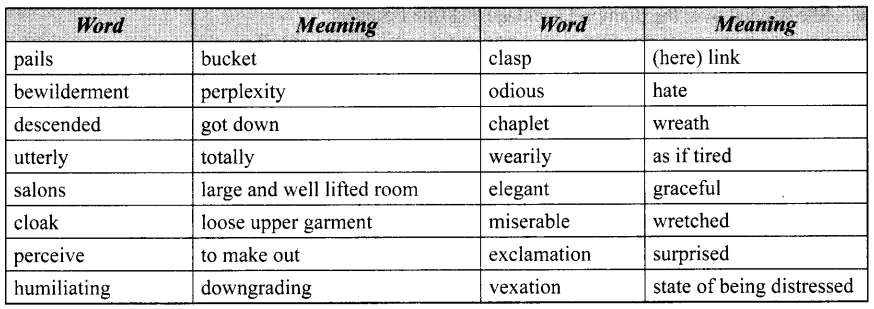
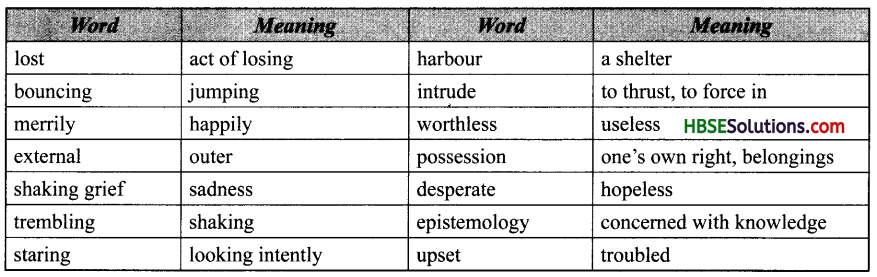
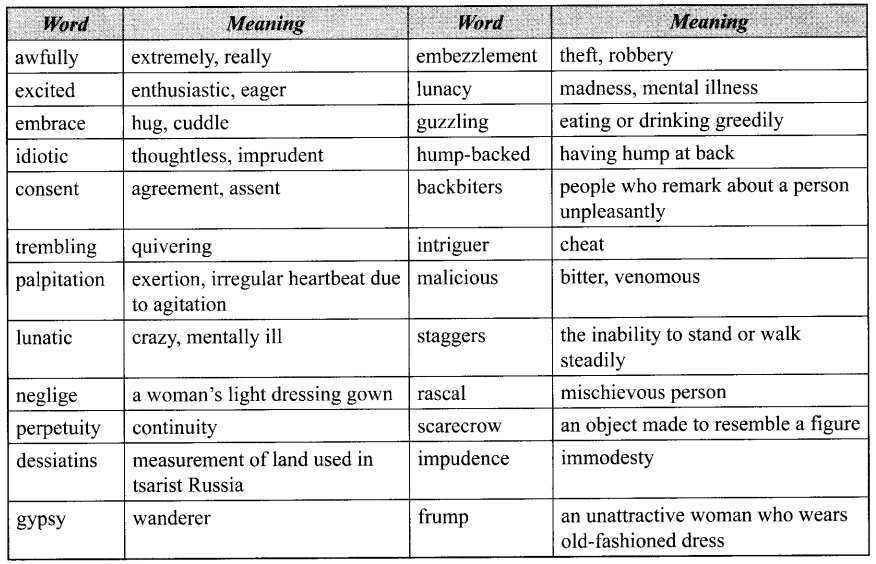
‘The Necklace’ Word-Meanings

HBSE 10th Class English Solutions Footprints without Feet Chapter 7 The Necklace 1 HBSE 10th Class English Solutions Footprints without Feet Chapter 7 The Necklace 2

HBSE 10th Class English Solutions Footprints without Feet Chapter 7 The Necklace Read More »

HBSE 11th Class Sanskrit Solutions Shashwati Chapter 6 आहारविचारः

Haryana State Board HBSE 11th Class Sanskrit Solutions Shashwati Chapter 6 आहारविचारः Textbook Exercise Questions and Answers.

Haryana Board 11th Class Sanskrit Solutions Shashwati Chapter 6 आहारविचारः

HBSE 11th Class Sanskrit आहारविचारः Textbook Questions and Answers

1. संस्कृतेन उत्तरत
(क) एषः पाठः कस्मात् ग्रन्थात् उद्धृतः?
(ख) चरकसंहितायाः रचयिता कः?
(ग) कीदशं भोजनम इन्द्रियाणि दृढीकरोति?
(घ) अजीर्णे भुजानस्य कः दोषः भवति?
(ङ) कीदृशं भोजनं श्लेष्माणं परिहासयति?
(च) कीदृशं भोजनं बलाभिवृद्धिम् उपजनयति?
(छ) इष्टसर्वोपकरणं भोजनं कुत्र अश्नीयात्?
(ज) कथं भुञानस्य उत्स्नेहनस्य समाप्तिः न नियता?
(झ) अतिविलम्बितं हि भुजानः कां न अधिगच्छति?
(ञ) जल्पतः हसतः अन्यमनसः वा भुजानस्य के दोषाः भवन्ति?
उत्तराणि:
(क) एषः पाठः ‘चरक संहिता’ इति ग्रन्थात् उद्धृतः।
(ख) चरकसंहितायाः रचयिता ‘आयुर्वेदाचार्यचरकः’ अस्ति।
(ग) स्निग्धं भोजनम् इन्द्रियाणि दृढीकरोति।
(घ) अजीर्णे भुञानस्य भुक्तम् आहारजातं पूर्वस्य आहारस्य अपरिणतरसम्।
(ङ) उष्णं भोजनं श्लेष्माणं परिहासयति।
(च) स्निग्धं भोजनं बलाभिवृद्धिम् उपजनयति।
(छ) इष्टेदेशे इष्टसर्वोपकरणं भोजनम् अश्नीयात्।
(ज) अतिद्रुतं भुञानस्य उत्स्नेहनस्य समाप्तिः न नियता।
(झ) अतिविलम्बितं हि भुजानः तृप्तिं न अधिगच्छति।
(ञ) जल्पतः हसतः अन्यमनसा वा भुञानस्य त एव दोषाः भवन्ति।

HBSE 11th Class Sanskrit Solutions Chapter 6 आहारविचारः

2. उचितक्रियापदैः रिक्तस्थानानि पूरयत
(क) बहु भुक्तं आहारजातम् ……………….
(ख) अजल्पन अहसन् ……………….
(ग) उष्णं हि भुज्यमानम् ……………….
(घ) उष्णं भोजनं उदरस्य अग्निम् ……………….
(ङ) स्निग्धं भुज्यमानं भोजनम् शरीरम् ……………….
(च) मात्रावद् हि भुक्तं सुखम् ……………….
(छ) अतिद्वतं हि न ……………….
(ज) उष्णं भोजनं वातम् ……………….
उत्तराणि:
(क) पच्यते।
(ख) भुजीत।
(ग) स्वदते।
(घ) उदीरयति।
(ङ) उपचिनोति।
(च) विपच्यते।
(छ) अश्नीयात्।
(ज) अनुलोमयति।

3. अधोलिखितपदानां वाक्येषु प्रयोगं कुरुत
शीघ्रम्, उष्णम्, स्निग्धम्, तैलादियुक्तम्, विवर्धयति, अतिद्रुतम्, अतिविलम्बितम्, पच्यते।
उत्तराणि:

शब्दअर्थबाक्यप्रयोग
शीघ्रमूजल्दीशीघ्रं भोजनं कदापि न कर्त्तव्यम्।
उष्णम्गर्मउष्णं हि भुज्यमानं स्वदते।
तैसादियुतचिकनास्निग्धं भोजनम् अति लाभप्रदं भवति।
विवर्धयतितेल आदि से युक्ततैलादियुक्तं भोजनं बलाभिवृद्धिं करोति।
अतिद्नुतम्बढ़ाता हैमात्रावद् भुक्तम् आयुः विवर्धयति।
अतिविलम्बितमूअतिशीघ्रअतिद्रुतं न अश्नीयात्।
पच्यतेबहुत देरअतिविलम्बितं भोजनं हानिकारकं भवति।

4. अधोलिखितप्रकृतिप्रत्ययविभागं योजयत
यथा- जृ + क्त नपुं. प्र. एकवचनम् = जीर्णम्।
अश् + शतृ पुं. प्रथमा एकवचनम् = ………………
अभि + वृध् + णिच् लट् प्र. पु. एकवचनम् = ………………
उप + सृज् कर्मवाच्य, लट्, प्र. पु. एकवचनम् = ………………
इष् + क्त पुं. सप्तमी एकवचनम् = ………………
भुज् + शानच्, पुं. षष्ठी एकवचनम् = ………………
न हसन् इति = ………………
प्र + कुप् + णिच् लट्, प्र. पु. एकवचनम् = ………………
जन् + क्त स्त्रीलिङ्गम् = ………………
उप + चि लट्. प्र. पु. एकवचनम् = ………………
अभि + नि + वृत् + णिच, लट्लकार, प्र. पु. एकवचनम् = ………………
उत्तराणि:
अश् + शतृ पुं. प्रथमा एकवचनम् = अश्नन्।
अभि + वृध् + णिच् लट् प्र. पु. एकवचनम् = अभिवर्धयति।
उप + सृज् कर्मवाच्य, लट्, प्र. पु. एकवचनम् = उपसृज्यते।
इष् + क्त पुं. सप्तमी एकवचनम् = इष्टे
भुज् शानचु, पुं. षष्ठी एकवचनम् = भुख्जानस्य।
न हसनु इति = अहसन्।
प्र + कुप् + णिच् लट्, प्र. पु. एकवचनम् = प्रकोपयति।
जन् + क्त स्त्रीलिङ्गम् = जाता।
उप + चि लट्. प्र. पु. एकवचनम् = उपचिनोति।
अभि + नि + वृत् + णिच्, लट्लकार, प्र. पु. एकवचनम् = अभिनिर्वतयति।

5. अधोलिखितानां पदानां सन्धिच्छेदं कुरुत
जीर्णेऽश्नीयात्, चोष्माणं, पूर्वस्याहारस्य, प्रकोपयत्याशु, दोषेष्वग्नौ, अभ्यवहृतम्, तस्माजीणे, चाश्नीयात् ।
उत्तराणि:
जीर्णेऽश्नीयात्-जीर्णे + अश्नीयात् ।
चोष्माणं-च + ऊष्माणम्।
पूर्वस्याहारस्य-पूर्वस्य + आहारस्य।
प्रकोपयत्याशु-प्रकोपयति + आशु।
दोषेष्वग्नौ दोषेषु + अग्नौ।
अभ्यवहृतम्-अभि + अवहृतम्।
तस्माजीणे-तस्मात् + जीर्णे।
चाश्नीयात्-च + अश्नीयात्।

6. अधोलिखितेषु पदेषु विभक्तिं वचनं च दर्शयत
मुखेषु, सर्वान्, हृदये, वृद्धिम, जराम्, भुञानस्य।
उत्तराणि:
मुखेषु = सप्तमी विभक्ति, बहुवचनम्।
सर्वान् = द्वितीया विभक्ति, बहुवचनम्।
हृदये = सप्तमी विभक्ति, एकवचनम्।
वृद्धिम् = द्वितीया विभक्ति, एकवचनम्।
जराम् = द्वितीया विभक्ति, एकवचनम्।
भुजानस्य = षष्ठी विभक्ति, एकवचनम् ।

7. पाठात् चित्वा विलोमशब्दान् लिखत
यथा-विरुद्धम् = ‘अविरुद्धम्
अतिविलम्बितम् = …………..
जल्पन् = …………..
हसन् = …………..
जीर्णे = …………..
इष्टम् = …………..
तन्मनाः = …………..
अतिद्रुतम् = …………..
उत्तराणि:
अतिविलम्बितम् = अनतिविलम्बितम्
जल्पन् = अजल्पन्
हसन् = अहसन्
जीर्णे = अजीर्णे
इष्टम् = अनिष्टम्
तन्मनाः = अन्यमनाः
अतिद्रुतम् = अतिविलम्बितम्

8. इष्टे देशे ……………. चाश्नीयात् इत्यस्य गद्यांशस्य आशयं हिन्दी भाषया स्पष्टं कुरुत इष्टे देशे इष्टसर्वोपकरणं चाश्नीयात् । इष्टे हि देशे इष्टः सर्वोपकरणैः सह भुजानो नानिष्टदेशजैर्मनोविघातकरैभविर्मनोविघातं प्राप्नोति। तस्मादिष्टेदेशे तथेष्टसर्वोपकरणं चाश्नीयात् ।
आशयः
प्रस्तुत गद्यांश आयुर्वेदाचार्य चरक प्रणीत ‘चरकसंहिता’ के ‘आहारविचारः’ नामक पाठ से उद्धृत है। इस गद्यांश में बताया गया है कि हमें भोजन इच्छित स्थान पर या मन पसन्द जगह पर ही करना चाहिए। भोजन का स्थान साफ-सुथरा होना चाहिए। घर में रसोई घर अथवा डाइनिंग हाल, आदि स्थानों पर ही भोजन करना चाहिए। इसके साथ खाने के लिए जो भी इच्छित भोज्य पदार्थ हों उनके साथ ही भोजन करना चाहिए। इच्छित भोज्य पदार्थों में खाने के साथ चटनी, मुरब्बा, सलाद आदि होने चाहिए। इस प्रकार से भोजन करने से स्वास्थ्य ठीक रहता है। इच्छित स्थान पर इच्छित द्रव्यों के साथ भोजन करने पर नापसन्द स्थान में उत्पन्न होने वाले मानसिक कष्ट को देने वाले भावों से मन को दुःख की अनुभूति नहीं होती।

HBSE 11th Class Sanskrit आहारविचारः Important Questions and Answers

अतिरिक्त प्रश्नोत्तराणि

I. अधोलिखितान् गद्यांशान् पठित्वा एतदाधारितानां प्रश्नानाम् उत्तराणि संस्कृतेन लिखत
(निम्नलिखित गद्यांशों को पढ़कर नीचे दिए गए प्रश्नों के उत्तर संस्कृत में लिखिए।)

(1) स्निग्धमश्नीयात, स्निग्धं हि भज्यमानं स्वदते, क्षिप्रं जरां गच्छति, वातमनलोमयति, शरीरमपचिनोत, दृढी-करोतीन्द्रियाणि, बलाभिवृद्धिमुपजनयति, वर्णप्रसादं चाभिनिवर्तयति, तस्मात् स्निग्धमश्नीयात् ।

(i) कीदृशं भुज्यमानं स्वदते? |
(ii) स्निग्धं भुज्यमानं कम् अनुलोमयति?
(iii) स्निग्धं भुक्तम् कानि दृढीकरोति?
उत्तराणि:
(i) स्निग्धं भुज्यमानं स्वदते।।
(ii) स्निग्धं भुज्यमानं वातम् अनुलोमयति।
(iii) स्निग्धं भुक्तम् इन्द्रियाणि दृढीकरोति।

(2) इष्टे देशे इष्टसर्वोपकरणं चाश्नीयात् । इष्टे हि देशे इष्टैः सर्वोपकरणैः सह भुञ्जानो नानिष्टदेशजैर्मनोविघातकरैर्भावैर्मनोविघातं प्राप्नोति । तस्मादिष्टे देशे तथेष्टसर्वोपकरणं चाश्नीयात्।
(i) कुत्र किम् अश्नीयात् ?
(ii) सर्वोपकरणैः सह भुजानः किं न प्राप्नोति?
(iii) अयं गद्यांश कस्मात् पाठात् सङ्कलितः?
उत्तराणि:
(i) इष्टे देशे इष्टसर्वोपकरणं च अश्नीयात् ।
(ii) सर्वोपकरणैः सह भुजानः अनिष्टदेशजैः मनोविघातकरैः भावैः मनोविघातं न प्राप्नोति।
(iii) अयं गद्यांशः ‘आहारविचारः’ इति पाठात् सङ्कलितः ।

II. रेखांकित पदानि आधत्य प्रश्ननिर्माणं करुत
(रेखांकित पदों के आधार पर प्रश्न निर्माण कीजिए।)

(i) स्निग्धं हि भुज्यमानं स्वदते।
(ii) इष्टे देशे सर्वोपकरणं चाश्नीयात्।
(iii) आहारजातं सर्वशरीरघातून अप्रदूषयत् आयुरेवाभिवर्धयति।.
(iv) अतिद्रुतं भुजानस्य गुण्योपलब्धिः न नियता।
उत्तराणि:
(i) कीदृशं हि भुज्यमानं स्वदते?
(ii) इष्टे कस्मिन् सर्वोपकरणं चाश्नीयात्?
(iii) आहारजातं कान अप्रदषयत आयरेवाभिवर्धयति
(iv) अतिद्रुतं भुजानस्य का न नियता?

HBSE 11th Class Sanskrit Solutions Chapter 6 आहारविचारः

बहुविकल्पीय-वस्तुनिष्ठ प्रश्नाश्च

III. अधोलिखित दश प्रश्नानां प्रदत्तोत्तरविकल्पेषु शुद्धविकल्पं लिखत
(निम्नलिखित दस प्रश्नों के दिए गए विकल्पों में से शुद्ध विकल्प लिखिए)

1. आयुर्वेदाचार्य चरकः कस्य रचयिता आसीत् ?
(A) आयुर्वेदस्य
(B) चरकस्य
(C) चरकसंहितायाः
(D) चाणक्यस्य
उत्तरम्:
(C) चरकसंहितायाः

2. कीदृशं भोजनं श्लेष्माणं परिहासयति?
(A) जीर्णम्
(B) स्निग्धम्
(C) अजीर्णम्
(D) उष्णम्
उत्तरम्:
(D) उष्णम्

3. ‘अतिद्रुतम्’ इति पदस्य विग्रहोऽस्ति
(A) द्रुतस्य अत्ययः
(B) द्रुतम् अति
(C) द्रुताय अतिः
(D) अति द्रुतम्
उत्तरम्:
(A) द्रुतस्य अत्ययः

4. ‘चाश्नीयात’ अस्य सन्धिविच्छेदः अस्ति
(A) चाश्नी + यात्
(B) च + अश्नीयात्
(C) चा + श्नीयात्
(D) चाश् + नीयात्
उत्तरम्:
(B) च + अश्नीयात्

5. ‘दोषेषु + अग्नौ’ अत्र सन्धियुक्त पदम् अस्ति
(A) दोषवाग्नौ
(B) दोषावाग्नौ
(C) दोषेष्वग्नौ
(D) दोष्वग्नौ
उत्तरम्:
(C) दोषेष्वग्नौ

6. ‘भुजानस्य’ इति पदे कः प्रत्ययः?
(A) शतृ
(B) शानच्
(C) क्त
(D) मतुप्
उत्तरम्:
(B) शानच्

7. ‘सह’ इति उपपदयोगे का विभक्तिः ?
(A) चतुर्थी
(B) षष्ठी
(C) तृतीया
(D) सप्तमी
उत्तरम्:
(C) तृतीया

8. ‘जीणे’ पदस्य किं विलोमपदम्?
(A) आजीर्णे
(B) न जीर्णे
(C) अति जीर्णे
(D) अजीर्णे
उत्तरम्:
(D) अजीर्णे

9. ‘तृप्तिम्’ इति पदस्य पर्यायपदं किम्?
(A) अतृप्तिम्
(B) सन्तुष्टिम्
(C) वेतृप्तिम्
(D) असन्तुष्टिम्
उत्तरम्:
(B) सन्तुष्टिम्

10. ‘शीघ्रम्’ इति पदस्य पर्यायपदं किम्?
(A) अशीघ्रम्
(B) अत्युग्रम्
(C) उग्रम्
(D) आशु
उत्तरम्:
(D) आशु

IV. निर्देशानुसारं रिक्तस्थानानि पूरयत
(निर्देश के अनुसार रिक्त स्थान को पूरा कीजिए)

(i) ‘भवत्याहार’ अस्य सन्धिविच्छेदः …………. अस्ति ।
(ii) ‘इष्टेदेशे’ अत्र विशेष्य पदं ………………. अस्ति ।
(iii) ‘जीर्णम्’ अत्र प्रकृति प्रत्यय विभागः ……….. अस्ति ।
उत्तराणि:
(i) ‘भवति + आहार’
(ii) देशे
(iii) जीर्ण + क्त

(ख)
(i) ‘इष् + क्त पुं० सप्तमी’ अत्र निष्पन्नं रूपम् ……… अस्ति ।
(ii) ‘दोषेषु’ इति पदस्य विलोमपदम् …………. वर्तते।
(iii) ‘इन्द्रियाणि’ इति पदस्य पर्यायपदम् ……………. वर्तते।
उत्तराणि:
(i) इष्टः
(ii) गुणेषु
(iii) करणानि

(ग) अधोलिखितपदानां संस्कृत वाक्येषु प्रयोग करणीयः
(निम्नलिखित पदों का संस्कृत वाक्यों में प्रयोग कीजिए)
(i) जीर्णे,
(ii) सह,
(iii) अजल्पन्।
उत्तराणि:
(i) जीर्णे (पच जाने पर)-सर्वदा भोजनं जीर्णे अश्नीयात्।
(ii) सह (साथ)-सर्वोपकरणैः सह अश्नीयात्।
(iii) अजल्पन (बिना बात किए)-सर्वदा अजल्पन् अश्नीयात् ।

गद्यांशों के सरलार्थ एवं भावार्थ

1. उष्णमश्नीयात्, उष्णं हि भुज्यमानं स्वदते, भुक्तं चाग्निमौदर्यमुदीरयति, क्षिप्रं जरां गच्छति, वातमनुलोमयति, श्लेष्माणं च परिहासयति, तस्मादुष्णमश्नीयात्।

शब्दार्थ-आहारः = भोजन। उष्णमश्नीयात् (उष्णम् + अश्नीयात्) = गर्म खाना चाहिए। भुज्यमानम् = खाया जाता हुआ। स्वदते = स्वादिष्ट लगता है। अग्नि = जठरानल। औदर्यम् = उदर में होने वाला। उदीरयति = बढ़ाता है। क्षिप्रं जरां गच्छति = शीघ्र पच जाता है। अनुलोमयति = नीचे ले जाता है, बाहर निकालता है। श्लेष्माणम् = कफ को। परिहासयति = नष्ट करता है।

प्रसंग-प्रस्तुत गद्यांश ‘शाश्वती प्रथमो भागः’ पुस्तक के अन्तर्गत ‘आहारविचारः’ नामक पाठ से उद्धृत है। यह पाठ चरक-प्रणीत ‘चरकसंहिता’ के ‘विमानस्थानम्’ नामक अध्याय से संकलित है।

सन्दर्भ-निदेश-इस गद्यांश में गर्म भोजन के महत्त्व के विषय में बताया गया है।

सरलार्थ-गर्म भोजन खाना चाहिए। क्योंकि गर्म भोजन खाया जाता हुआ स्वादिष्ट लगता है। खाया गया भोजन पेट की आग को बढ़ाता है। अर्थात् पाचन शक्ति ठीक रहती है। शीघ्र ही पच जाता है। गैस को नीचे की ओर ले जाता है अर्थात् गैस बाहर निकालता है तथा कफ को नष्ट करता है। इसलिए गर्म भोजन खाएँ।

भावार्थ भाव यह है कि गर्म भोजन स्वादिष्ट लगता है, पाचन शक्ति को बढ़ाता है, जल्दी पच जाता है, गैस निकालता है और कफ को समाप्त करता है। अतः स्वस्थ रहने के लिए गर्म भोजन करना चाहिए।

2. स्निग्धमश्नीयात्, स्निग्धं हि भुज्यमानं स्वदते, क्षिप्रंजरां गच्छति, वातमनुलोमयति, शरीरमुपचिनोति, दृढीकरोतीन्द्रियाणि, बलाभिवृद्धिमुपजनयति, वर्णप्रसादं चाभिनिवर्तयति; तस्मात् स्निग्धमश्नीयात्। मात्रावदश्नीयात, मात्रावद्धि भुक्तं वातपित्तकफानपीडयदायुरेव विवर्धयति केवलम् सुखं विपच्यते, न चोष्माणमुपहन्ति, अव्यथं च परिपाकमेति, तस्मान्मात्रावदश्नीयात्।

शब्दार्थ-स्निग्धम् = घी, तेल आदि चिकनाई से युक्त। उपचिनोति = बढ़ाता है। दृढीकरोति = मजबूत करता है। वर्णप्रसादम् = रंग रूप में। अभिनिवर्तयति = निखार लाता है। उपजनयति = उत्पन्न करता है।

प्रसंग-प्रस्तुत गद्यांश ‘शाश्वती प्रथमो भागः’ पुस्तक के अन्तर्गत ‘आहारविचारः’ नामक पाठ से उद्धृत है। यह पाठ चरक-प्रणीत ‘चरकसंहिता’ के ‘विमानस्थानम्’ नामक अध्याय से संकलित है। ..

सन्दर्भ-निर्देश-इस गद्यांश में घी, तेल आदि की चिकनाई से युक्त भोजन के महत्त्व के विषय में बताया गया है। .

सरलार्थ घी, तेल आदि की चिकनाई से युक्त भोजन करना चाहिए। निश्चय ही चिकनाई से युक्त भोजन खाया जाता हुआ – स्वादिष्ट लगता है। जल्दी पच जाता है। (पेट में विद्यमान) हवा को बाहर निकालता है। शरीर को बढ़ाता है तथा इन्द्रियों को मजबूत बनाता है। शरीर की शक्ति में भी वृद्धि होती है। रंग रूप में निखार लाता है। इसलिए चिकनाई से युक्त भोजन खाना चाहिए।

भोजन उचित मात्रा में लेना चाहिए। अर्थात् न अधिक खाएँ और न कम खाएँ। क्योंकि उचित मात्रा में खाया जाता हुआ भोजन वात, पित्त और कफ को कष्ट न देता हुआ न केवल आयु को ही बढ़ाता है, अपितु आसानी से पच जाता है और गर्मी (पाचन शक्ति) को भी नहीं मारता तथा बिना कष्ट के सरलता से हजम हो जाता है। अतः उचित मात्रा में ही भोजन खाना चाहिए।

भावार्थ-भाव यह है कि भोजन में चिकने पदार्थों का प्रयोग लाभप्रद होता है। इस प्रकार के भोजन से गैस नहीं बनती है। इसके साथ ही सन्तुलित मात्रा में ही भोजन करना चाहिए। इससे पाचन शक्ति ठीक रहती है।

3. जीर्णेऽश्नीयात् अजीर्णे हि भुञानस्याभ्यवहृतमाहारजातं पूर्वस्याहारस्य रसमपरिणतमुत्तरेणाहार-रसेनोपसृजत् सर्वान् दोषान् प्रकोपयत्याशु, जीर्णे तु भुञानस्य स्वस्थानस्थेषु दोषेष्वग्नौ चोदीर्णे जातायां च बुभुक्षायां विवृतेषु च स्रोतसां मुखेषु विशुद्धे चोद्गारे हृदये विशुद्धे वातानुलोम्ये विसृष्टेषु च बातमूत्रपुरीषवेगेषु अभ्यवहृतमाहारजातं सर्वशरीरधातूनप्रदूषदायुरेवाभिवर्धयति केवलम्, तस्माजीर्णेऽश्नीयात्।। वीर्याविरुद्धमश्नीयात्, अविरुद्धवीर्यमश्नन् हि विरुद्धवीर्याहारजैर्विकारैर्नोपसृज्यते। तस्माद् वीर्याविरुद्धमश्नीयात् ।

शब्दार्थ जीर्णे = पच जाने पर। अजीर्णे = न पचने पर। भुञानस्याभ्यवहृतमाहारजातं (भुञानस्य + अभ्यवहृतम् + आहारजातम्) = खाने वाले के, खाए हुए, भोजन को। आहाररसेन = बाद में खाए हुए भोजन के रस से। उपसृजत् = मिला हुआ। . प्रकोपयत्याशु (प्रकोपयति + आशु) = शीघ्रता से बढ़ाता है। स्वस्थानस्थेषु = अपने-अपने स्थानों पर विद्यमान्। चोदीर्णे (च + उदीणे) = और उद्दीप्त होने पर। जातायाम् = पैदा होने पर। विवृतेषु = खुल जाने पर । स्रोतसां मुखेषु = मल-मूत्र आदि के निकलने के रास्ते। चोद्गारे (च + उद्गारे) = और भावना, विचार। वातानुलोम्ये = वायु के अनुकूल होने पर। विसृष्टेषु = त्यागने पर। अप्रदूषयत् = प्रदूषित न करता हुआ। वीर्याविरुद्धम् = शक्ति के विरुद्ध न हो। अश्नन् = खाते हुए। आहारजातैः = आहार से पैदा होने वाले। उपसृज्यते = ग्रस्त होता है।

प्रसंग-प्रस्तुत गद्यांश ‘शाश्वती प्रथमो भागः’ पुस्तक के अन्तर्गत ‘आहार-विचारः’ नामक पाठ से उद्धृत है। यह पाठ चरक-प्रणीत ‘चरक-संहिता’ के ‘विमानस्थानम’ नामक अध्याय से संकलित है।

सरलार्थ-पहले खाए गए भोजन के पच जाने पर ही भोजन करना चाहिए। पहले खाए हुए भोजन के न पचने पर भोजन करने वाले का खाया हुआ भोजन अच्छी तरह से न पचे हुए पहले भोजन के साथ मिलकर सारे दोषों को शीघ्रता से बढ़ा देता है। अर्थात् पूर्वकृत न पचने वाला भोजन इस बाद में किए भोजन के साथ मिलकर अनेक प्रकार की बीमारियों को उत्पन्न करता है।

पहले खाए हुए भोजन के पच जाने पर तो भोजन करने वाले के दोष अपने-अपने स्थानों पर स्थित रहते हैं। जठराग्नि तेज हो जाती है। भूख (भोजन की इच्छा) पैदा हो जाती है। मल-मूत्र आदि के निकलने के मार्ग खुल जाते हैं, चित्तवृत्ति शुद्ध हो जाती है, हृदय शुद्ध हो जाता है, वायु अनुकुल हो जाती है और गैस (वाय) मूत्र, मल का वेग समाप्त हो जाता है। इस प्रकार से किया हआ भोजन शरीर के सम्पूर्ण तत्त्वों को दूषित न करता हुआ केवल आयु को ही बढ़ाता है। अतः पहले किए हुए भोजन के पच जाने पर ही भोजन करना चाहिए।

जो भोजन शक्ति को कम करने वाला न हो, वही खाना चाहिए। शक्ति के अविरुद्ध भोजन करने वाला निश्चय से शक्ति को कम करने वाले भोजन से उत्पन्न होने वाले विकारों से ग्रस्त नहीं होता। उसके शरीर में किसी प्रकार का विकार (बीमारी) उत्पन्न नहीं होता। इसलिए ऐसा भोजन करना चाहिए जो शक्ति को कम करने वाला न हो। शक्ति विरोधी भोजन करने से शरीर में अनेक प्रकार के विकार अथवा रोग उत्पन्न हो जाते हैं। इसलिए शक्ति में वृद्धि करने वाले भोज्य पदार्थ ही खाने चाहिए।

भावार्थ-भाव यह है कि पूर्वकृत भोजन के पच जाने के बाद ही पुनः भोजन करना चाहिए। ऐसा करने से गैस, पित्त, कफ आदि विकार उत्पन्न नहीं होते। इसके साथ ही शरीर एवं बुद्धि की शक्ति को बढ़ाने वाले खाद्य पदार्थ ही खाने चाहिए। इसके विपरीत भोजन खाने से शरीर में अनेक प्रकार के रोग उत्पन्न हो जाते हैं।

HBSE 11th Class Sanskrit Solutions Chapter 6 आहारविचारः

4. इष्टे देशे इष्टसर्वोपकरणं चाश्नीयात्। इष्टे हि देशे इष्टैः सर्वोपकरणैः सह भुञ्जानो नानिष्टदेशजैर्मनोविघातकरैभविर्मनोविघातं प्राप्नोति । तस्मादिष्टेदेशे तथेष्टसर्वोपकरणं चाश्नीयात्। नातिद्भुतमश्नीयातः अतिद्भुतं हि भुजानस्योत्स्नेहनमवसादनं भोजनस्याप्रतिष्ठानं च भोज्यदोष; साद्गुण्योपलब्धिच नियता, तस्मान्नातिद्रुतमश्नीयात्।

शब्दार्थ-इष्टे = इच्छित या मनपसंद। इष्टसर्वोपकरणम् (इष्टसर्व + उपकरणम्) = इच्छित समस्त भोज्य पदार्थ (अचार, चटनी, आदि)। भुञ्जानो (भुजानः) = खाता हुआ। नानिष्टदेशजैः (न + अनिष्टदेशजैः) = मनपसंद के विरुद्ध स्थान में पैदा होने वाले। मनोविघातकरैः = मन को दुःख पहुँचाने वाले । न अतिद्रुतम् = अत्यधिक शीघ्र नहीं। उत्स्नेहनम् = उल्टे रास्ते की ओर जाना (उल्टी, डकार आदि)। अवसादनम् = कष्टकारक। अप्रतिष्ठानम् = उचित स्थान पर न पहुँचना। भोज्यदोषसाद् = खाने योग्य पदार्थों के दोषों के वशीभूत हो जाना। गुण्योपलब्धि = गुणों की प्राप्ति।

प्रसंग-प्रस्तुत गद्यांश ‘शाश्वती प्रथमो भागः’ पुस्तक के अन्तर्गत ‘आहार-विचारः’ नामक पाठ से उद्धृत है। यह पाठ चरक-प्रणीत ‘चरक-संहिता’ के ‘विमानस्थानम्’ नामक अध्याय से संकलित है।

सन्दर्भ-निर्देश-इस गद्यांश में बताया गया है कि मनपसंद स्थान पर इच्छा के अनुसार ही भोज्य पदार्थ खाने चाहिए।

सरलार्थ-मनपसंद स्थान पर इच्छित समस्त भोज्य पदार्थों (आचार, चटनी आदि) के साथ ही भोजन करना चाहिए। क्योंकि इच्छित स्थान पर इच्छा के अनुसार भोज्य पदार्थों के साथ भोजन करने वाला नापसन्द स्थान में होने वाले, मानसिक कष्ट को देने वाले मनोविकारों से मानसिक दुःख को प्राप्त नहीं होता। अतः इच्छित स्थान पर तथा इच्छित द्रव्यों के साथ भोजन करना चाहिए।

भोजन बहुत जल्दी-जल्दी नहीं करना चाहिए। अत्यन्त शीघ्रता से भोजन करने से उल्टी, डकार आदि होने से स्थिति कष्टदायक हो सकती है। भोजन के अप्रतिष्ठित होने से अपच आदि भोज्यदोष उत्पन्न हो जाते हैं, अतः उनसे भोजन के गुणों की प्राप्ति भी निश्चित नहीं होती। इसलिए भोजन अत्यन्त शीघ्रतापूर्वक नहीं खाना चाहिए।

भावार्थ भाव यह है कि मनपसंद स्थान पर मनपसंद भोज्य पदार्थ ही खाने चाहिए। मनपसंद स्थान से अभिप्राय रसोई घर, डायनिंग टेबल या शुद्ध स्वच्छ स्थान से है। इसके साथ भोजन जल्दी-जल्दी नहीं करना चाहिए। अतिशीघ्र भोजन करने से खाना ठीक से नहीं पचता। इस कारण उल्टी, डकार आदि कष्ट हो सकते हैं। अतः खाना जल्दी-जल्दी नहीं खाना चाहिए।

5. नातिविलम्बितमश्नीयात्; अतिविलम्बितं हि भुञ्जानो न तृप्तिमधिगच्छति, बहुभुक्तं शीतीभवत्याहारजातं विषमंच पच्यते, तस्मानातिविलम्बितमश्नीयात् । अजल्पन्नहसन् तन्मना भुञ्जीत, जल्पतो हसतोऽन्यमनसो वा भुञानस्य त एव दोषा भवन्ति य एवातिद्रुतमश्नतः तस्माद-जल्पनहसंस्तमना भुञ्जीत।

शब्दार्थ-अतिविलम्बितम् = बहुत देर करके। तृप्तिमधिगच्छति (तृप्तिम् + अधिगच्छति) = सन्तुष्टि को प्राप्त। शीतीभवति = ठण्डा होता है। विषमम् = कठिनता से। अजल्पम् = बिना बोलते हुए। तन्मना = एकाग्र/शान्त मन से। अन्यमनसः = चंचल चित्त वाले का। अतिद्रुतम् = अतिशीघ्र।

प्रसंग-प्रस्तुत गद्यांश ‘शाश्वती प्रथमो भागः’ पुस्तक के अन्तर्गत ‘आहार-विचारः’ नामक पाठ से उद्धृत है। यह पाठ चरक-प्रणीत ‘चरक-संहिता’ के ‘विमानस्थानम्’ नामक अध्याय से संकलित है।

सन्दर्भ-निर्देश-इस गद्यांश में बताया गया है कि बहुत धीरे-धीरे तथा बोलते हुए भोजन नहीं करना चाहिए।

सरलार्थ-भोजन बहुत देर करके (धीरे-धीरे) नहीं खाना चाहिए। क्योंकि बहुत देर करके खाने वाला (खाने से) सन्तुष्टि को प्राप्त नहीं करता। वह बहुत (आवश्यकता से अधिक) खा जाता है। सारा भोजन ठण्डा हो जाता है और कठिनता से पचता है। इसलिए बहुत देर करके भोजन नहीं करना चाहिए।

बिना बोलते हुए, बिना. हँसते हुए एकाग्रचित्त होकर भोजन करना चाहिए। बात करते हुए, हँसते हुए या चंचल चित्त वाला होकर भोजन करने वाले को उन्हीं दोषों की प्राप्ति होती है जो अतिशीघ्र भोजन करने वाले की होती है। इसलिए न बोलते हुए एवं न हँसते हुए शान्तचित्त से ही भोजन करना चाहिए।

भावार्थ भाव यह है कि बहुत धीरे-धीरे भोजन करने से सन्तुष्टि नहीं मिलती। बहुत धीरे भोजन करने से व्यक्ति अधिक मात्रा में भोजन कर लेता है। भोजन करते समय एकाग्रता का होना आवश्यक है। मौन होकर शान्त भाव से बिना हँसते हुए भोजन करने से मन तथा शरीर दोनों निरोग रहते हैं।

आहारविचारः (वाणी (सरस्वती) का वसन्त गीत) Summary in Hindi

पाठ-परिचय प्रस्तुत पाठ चरक मुनि द्वारा प्रणीत चरकसंहिता के ‘विमानस्थानम्’ प्रकरण के ‘रसविमान’ नामक प्रथम अध्याय से संकलित है। यहाँ प्रयुक्त ‘विमान’ शब्द का अर्थ रोगात्मक दोषों एवं ओषधियों के विज्ञान से है। इस पाठ में बताया गया है कि स्वास्थ्य का मूल आधार उचित आहार है। भोजन के प्रकार, उसकी मात्रा और उचित समय आदि का विधान ही इस पाठ का वर्ण्य-विषय है।

HBSE 11th Class Sanskrit Solutions Shashwati Chapter 6 आहारविचारः Read More »

HBSE 10th Class English Solutions First Flight Poem 2 Fire and Ice

Haryana State Board HBSE 10th Class English Solutions First Flight Poem 2 Fire and Ice Textbook Exercise Questions and Answers.

Haryana Board 10th Class English Solutions First Flight Poem 2 Fire and Ice

HBSE 10th Class English Fire and Ice Textbook Questions and Answers

Fire And Ice Solutions HBSE 10th Class

Thinking about the Poem

1. There are many ideas about how the world will ‘end’. Do you think the world will end someday? Have you ever thought about what would happen if the sun got so hot that it ‘burst’, or grew colder and colder?
Answer:
The poet has presented two ideas about the end of this world. Nothing is permanent in this world and everything will perish one day. If the sun gets too hot, and everything will turn into ashes. And, on the contrary, if the sun grows colder and colder, life from the universe will vanish. Nothing will remain in this world as the Sun is the source of life.

2. For Frost, what do ‘fire’ and `ice’ stand for? Here are some ideas:

greed
avarice
cruelty
lust
conflict
fury
intolerance
rigidity
insensitivity
coldness
indifference
hatred.
Answer:
“Fire’ stands for greed, avarice, lust, conflict and fury.
‘Ice’stands for cruelty, insensitivity, coldness, indifference and hatred.

Fire And Ice Solution HBSE 10th Class

HBSE 10th Class English Solutions First Flight Poem 2 Fire and Ice

3. What is the rhyme scheme of the poem? How does it help in bringing out the contrasting ideas in the poem?
Answer:
The rhyme scheme of the poem is as follows:
1st stanza: a b a a
2nd stanza: a b a b a

The contrasting ideas of ‘fire’ and `ice’are presented using this rhyme scheme. He mentions that both fire and ice are probable ends of this world. While he talks about how fire represents desire and can, therefore, be a cause of the end of the world, he also mentions ice in the poem to symbolise that the coldness and indifference towards one another will also be enough to end the world. In the second stanza, he says that he knows enough of hate in the world to be sure that even destruction through ice would be sufficient to bring about the end of the world.

HBSE 10th Class English Fire and Ice Important Questions and Answers

I. Short Answer Type Questions (20-30 words & 2 marks each)

Fire And Ice Question Answer HBSE 10th Class Question 1.
Which underlying idea is represented in the poem ‘Fire and Ice’?
Answer:
The poet compares fire to ‘desire’and ice to ‘hatred’. Both of these are surging exponentially. If we don’t keep a check on their rapid growth, the world will perish. Therefore, we must control our desires and hatred.

Class 10 English Poem Fire And Ice Question Answers HBSE Question 2.
Why did the poet say about the world perishing twice?
Answer:
The poet said about the world perishing twice because, at first if some parts of the world are left out of apocalypse through fire, the remaining parts would definitely be destroyed by ice.

Fire And Ice Answers HBSE 10th Class Question 3.
How is ice sufficient to bring destruction?
Answer:
In the poem, ‘ice’ denotes hatred. It does not matter what type of hatred it is. There is much hatred in this world. It will certainly destroy.

II. Short Answer Type Questions (40-50 words & 3 marks each)

Fire And Ice Question And Answer HBSE 10th Class Question 1.
What do ‘fire’ and `ice’ stand for and what is the general opinion regarding the world?
Answer:
Fire stands for fury, hatred, anger, cruelty; ice stands for insensitivity, coldness and intolerance. In general, it is the opinion of some people that fire will destroy the world while some say that ice will destroy it.

HBSE 10th Class English Solutions First Flight Poem 2 Fire and Ice

Fire And Ice Class 10 Question Answer HBSE Question 2.
What does the poet say regarding the end of the world?
Answer:
It is a universal truth that everything has a beginning and it will certainly come to an end. Either ‘fire’ or ‘ice’may cause the end of the world. Some day the existing world will certainly end.

III. Long Answer Type Questions (100-120 words & 5 marks each)

Fire And Ice Central Idea HBSE 10th Class Question 1.
Why does the poet say he is in favour of fire ending the world?
Answer:
In this poem, the poet has used an analogy between fire and greed. In his opinion, the nature of fire is just like that of desire, greed, lust or avarice. The more we try to satisfy these, the more they grow. They spread like fire spreading throughout a forest and embracing trees, animals in its agony and leaving nothing but the ash. Likewise, the never-ending desires of humans pose a danger to this world. It can be seen from the past trends. The forest cover has been shrinking. Since the inception of Industrial Revolution, many animal species have become extinct and some are in endangered category. All this happened and is still happening because of human’s never satisfying greed. The poet could visualise the ramifications of uncontrolled desires and this is why he is in favour of fire ending the world.

Fire And Ice Poem Question Answer HBSE 10th Class Question 2.
How can ice end the world?
Answer:
The word ‘ice’ is a metaphor representing cruelty, hate, coldness, unkind nature and rigidity. Time has seen it all, how a feeling of hatred in one person spreads to thousands of them, wiping out an entire generation or a community, e.g., Hitler’s hatred for a particular faith inspired him for his infamous atrocities. There had been wars to become the ultimate superpower and the intention to carry out such cowardly acts was based on unkind nature of an individual.
So, considering all this in mind, the poet referred ice as a way of ending this world.

Question 3.
Is it possible to avoid the end of the world? How can we prevent the fire and ice to carry out the ending of this world? Answer:
Yes, it is possible to avoid the apocalypse. If we humans are responsible for the catasrophe so far, we also have the capability to deter. To save this world from fire and ice, we must act upon our necessities and not desires. We must go for inner engineering to know, observe, analyse and learn the ways this nature works. Moral education should be inculcated at a young age, knowledge about feeling of being content should be imparted, to control the feelings of anger, lust, hatred, we must practise meditation. All these little steps will produce a large return towards the benefit of
humankind and thus deter our world from evils.

Question 4.
Some say the world will end in
fire some say in ice.
From what I’ve tasted of desire
I hold with those who favour fire.
On the basis of the given passage, explain how will the world end? Substantiate.
Answer:
Through the given passage, the poet wants to convey two things about the world. According to some people, the world will end in fire. But some people also opine that the world will end in ice. Both of these are the contradictory opinions. But one similar thing between them is that both of them would destroy everything in the world. In the poem, fire stands for desire and ice stands for hatred.

So, the poet gives a clear message to us that nothing is eternal in this world. Everything will perish either in fire or ice. Hatred and desire will end this world. This fire of passions and desire will lead the end of the world. Cold reasoning and hate will lead this world to destruction. But the poet is with those who think that fire of passions and desires will lead to the destruction of this world.

HBSE 10th Class English Solutions First Flight Poem 2 Fire and Ice

Reference To Context

Read the extracts given below and answer the questions that follow:

1. Some say the world will end in fire
Some say in ice.
From what I’ve tasted of desire
I hold with those who favour fire.

Paraphrase: The poet expresses that the world would end in two ways – either by ice or by fire. It is the opinion of some people that the world would end in fire. It denotes that fiery desires and passion will lead to the destruction of the world. On the other hand, some people opine that the world would end in ice. Hatred, jealousy etc. will lead to the destruction of this world.

Choose the correct option:

(a) Who are ‘some’ in the given stanze?
(i) Aliens
(ii) Martians
(iii) Humans
(iv) All of these
Answer:
(iii) Humans

(b) What does ‘fire’ here symbolise?
(i) Hatred
(ii) Desire
(iii) Satisfaction
(iv) None of these
Answer:
(ii) Desire

(c) The world would end in either of ways.
(i) one
(ii) two
(iii) three
(iv) none of these
Answer:
(ii) two

(d) What does the poet compare fire and ice with?
(i) Constructive features of human emotions
(ii) Destructive features of human emotions
(iii) Both (i) and (ii)
(iv) Neither (i) nor (ii)
Answer:
(ii) Destructive features of human emotions

(e) What is the rhyming scheme of the given extract?
(i) aaab
(ii) abab
(iii) aabb
(iv) abaa
Answer:
(iv) abaa

2. But if it had to perish twice,
I think I know enough of hate
To say that for destruction ice
Is also great
And would suffice

Paraphrase: If this world has to perish twice, ice would be stronger or more effective in doing this work. Hatred will lead towards the destruction of this world. Ice is sufficient enough to cause the destruction of this world.

Choose the correct option:

(a) What would be more effective in the end of this world?
(i) Fire
(ii) Ice
(iii) Fury
(iv) Intolerance
Answer:
(ii) Ice

HBSE 10th Class English Solutions First Flight Poem 2 Fire and Ice

(b) What poetic device has the poet used in the line, “To say that for destruction, ice is also great”?
(i) Imagery
(ii) Alliteration
(iii) Oxymoron
(iv) Metaphor
Answer:
(i) Imagery

(c) _______ is also good for destruction.
(i) Belief
(ii) Ice
(iii) Honesty
(iv) None of these
Answer:
(ii) Ice

(d) What would be a better option to end the earth?
(i) Ice
(ii) Fire
(iii) Both (i) and (ii)
(iv) None of these
Answer:
(iii) Both (i) and (ii)

(e) What would be the consequences if we don’t control our emotions?
(i) It will lead us on the verge of destruction.
(ii) It will lead us on the verge of death.
(iii) It will lead to chaos.
(iv) None of these
Answer:
(i) It will lead us on the verge of destruction.

Fire and Ice Summary

Fire and Ice Introduction

Central Idea of the Poem

It is a universal truth that nothing is permanent in this world. On the one hand, some people think that the world will end in fire while on the other hand, some people think that the world will end in ice. The poet equates the fire with desire and ice with hate. As the ice destroys the world melting slowly, in the same way hatred will also destroy the world. Because greed, hatred, strife, intolerance, etc., bring much destruction to the society. So, human beings should live peacefully.

Fire and Ice Summary

‘Fire and Ice’ is a short poem by Robert Frost. In this poem, the poet refers to two predictions of how the world will end. Some say it will end in fire whereas others say it will end in ice. According to the poet, ‘fire’ stands for desire, greed, avarice or lust. The more you try to satisfy them, the more they grow. There is no end to it. They spread rapidly like fire and engulf your whole life. One becomes selfish and sometimes cruel too. On the other hand, ‘ice’ according to the poet, stands for hatred, coldness and rigidity. One becomes insensitive and indifferent towards the feelings of others. The poet says that both fire and ice are growing with such a rapid pace that the world would soon perish either way, in fire or in ice.

Poem at a Glance

  • It is the perception of poet that the world will certainly come to an end.
  • This world will end either in fire or in ice.
  • Fire has been compared to human emotion of desire or passions.
  • Ice has been compared to hate.
  • Fire or ice can destroy the world once but hatred can destroy it twice.
  • So, we should try to live peacefully in this world.

HBSE 10th Class English Solutions First Flight Poem 2 Fire and Ice

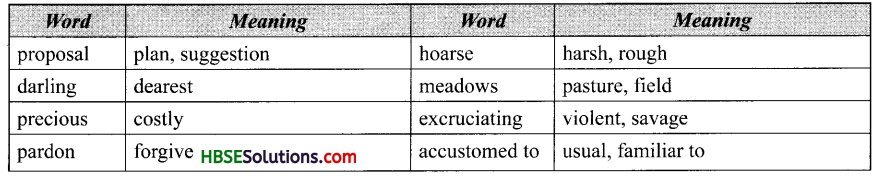
Fire and Ice Word-Meanings

HBSE 10th Class English Solutions First Flight Poem 2 Fire and Ice 1 HBSE 10th Class English Solutions First Flight Poem 2 Fire and Ice 2

HBSE 10th Class English Solutions First Flight Poem 2 Fire and Ice Read More »

HBSE 10th Class English Solutions First Flight Poem 1 Dust of Snow

Haryana State Board HBSE 10th Class English Solutions First Flight Poem 1 Dust of Snow Textbook Exercise Questions and Answers.

Haryana Board 10th Class English Solutions First Flight Poem 1 Dust of Snow

HBSE 10th Class English Dust of Snow Textbook Questions and Answers

Dust Of Snow Solutions HBSE 10th Class

Thinking about the Poem

1. What is a “dust of snow”? What does the poet say has changed his mood? How has the poet’s mood changed?
Answer:
A “dust of snow” means particles of snow. The poet’s mood changed because of shaking down something from the hemlock tree. He was holding the day in regret when this dust of snow fell on him and this simple little thing brought him some joy.

2. How does Frost present nature in this poem? The following questions may help you to think of an answer.
(i) What are the birds that are usually named in poems? Do you think a crow is often mentioned in poems? What images come to your mind when you think of a crow?
(ii) Again, what is “a hemlock tree”? Why doesn’t the poet write about a more ‘beautiful tree such as a maple, or an oak, or a pine?
(iii) What do the “crow’ and ‘hemlock’ represent – joy or sorrow? What does the dust of snow that the crow shakes off a hemlock tree stand for?
Answer:
(i) In poems, usually birds like nightingales and sparrows are mentioned. Frost has presented nature in quite an unconventional manner. The poet has used a crow in this poem. A crow is usually not mentioned in poems. A crow is usually considered to be dark, black and foreboding. That is why other poets usually mention singing nightingales or beautiful white doves in their poems.
(ii) A hemlock tree is a poisonous tree with small white flowers. The poet has not written about a more beautiful tree such as a maple, or oak, or pine because these trees symbolise beauty and happiness. Frost wanted to symbolise the feelings of sadness, despondency and regretfulness, that is why he has used a hemlock tree.
(iii) The crow and the hemlock tree represent sorrow and grief. The dust of snow that is shaken off by the crow stands for joy that Frost experiences. He has, therefore, used an unconventional tree and bird in order to contrast them with joy in the form of snow.

Dust Of Snow Important Questions HBSE 10th Class

HBSE 9th Class English Solutions First Flight Poem 1 Dust of Snow

3. Have there been times when you felt depressed or hopeless? Have you experienced a similar moment that changed your mood that day?
Answer:
Several times I felt depressed or hopeless. One day, one of my classmates told me that I had got only 40 marks in English out of 80. At that time, I felt depressed and dejected. But after an hour, the result was announced and I got 75 out of 80. The English teacher also congratulated me on my success, and after this, I felt relaxed and happy.

HBSE 10th Class English Dust of Snow Important Questions and Answers

I. Short Answer Type Questions (20-30 words & 2 marks each)

First Flight Poems HBSE 10th Class Question 1.
What is the underlying message for us in our hectic life with reference to the poem, ‘Dust of Snow’?
Answer:
The underlying message for us in our hectic life is that we should enjoy nature more often and should have a positive attitude even towards simple acts because they can lead to the learning of greater lessons of enjoying life.

Dust Of Snow Meaning HBSE 10th Class Question 2.
Why does the poet say that he had saved some part of the day he had rued?
Answer:
In the morning, the poet was sad and listless. He thought that the entire day would go waste. But, the falling of dust of snow on him changed his mood suddenly. It brought a ray of hope in him. This way he felt that he had saved some part of the day.

II. Short Answer Type Questions (40-50 words & 3 marks each)

Dust Of Snow Thinking About The Poem HBSE 10th Class Question 1.
Why did the poet use poetically uncommon bird and tree?
Answer:
The poet appears to be in a depressive and sorrowful mood. In this kind of state, one can not look at the beautiful things which nature has to offer, only gloomy and miserable thoughts strike in one’s mind. Therefore, the poet has used the poetically uncommon bird and tree which reflect his depressed state of mind.

10th Class Dust Of Snow Question Answer HBSE 10th Class Question 2.
Does the poet present a bright and pleasant side of nature in the poem?
Answer:
No, the poet does not present a bright and pleasant side of nature in the poem. He presented the situation as a dull and depressive cold day. The fall of fine dust of snow does bring a sudden change in the mood of the poet by uplifting his spirits and refreshing his mind.

Dust Of Snow Poem Question Answer HBSE 10th Class Question 3.
What message does the poet want to convey through the poem ‘Dust of Snow’?
Answer:
The poet conveys that sadness, hopelessness and disappointment do come into the life of mankind. It makes them feel dejected and depressed. But there is always happiness behind sadness. If sadness comes, happiness is bound to come in our life. As the poet was sad and low in spirits in the morning but the falling of dust of snow on him brought a sudden change in his mood. So, we should not get disheartened in any circumstance.

III. Long Answer Type Questions (100-120 words & 5 marks each)

Dust And Snow Question Answer HBSE 10th Class Question 1.
No matter how ordinary or unimportant an incident may be, it’s the reaction or the response that matters. Taking inspiration from the poet’s reaction write how inherent values can be picked up and learnt. Mention any two lessons for students like you that could be useful.
Answer:
Yes, response matters a lot. Inherent values can be picked up by adopting a positive attitude towards nature, because nature is a great teacher. Each little thing in nature can teach us some important lessons at times and even a small flake of snow has its own significance. We should not judge anything by its appearance. Although crow and hemlock tree are considered as bad omen but even then they can bring cheerfulness in uplifting poet’s mood. So nothing is useless in nature. Nature is very beautiful. One should live one’s present cheerfully.

Class 10th Poem Dust Of Snow HBSE Question 2.
Robert Frost opens before us a new world in which at times evil doer by chance do a good act before us. Discuss the philosophy of life with reference to the poem ‘Dust of Snow’.
Answer:
Robert Frost opened a different world before us through the poem ‘Dust of Snow’. It gives us a philosophy of life that at times when we are completely dejected and in bad mood, we get surprised. In fact, it also depicts his philosophy of life through which he passed. In the poem, ‘Dust of Snow’ the poet is wandering in a dejected mood. The whole mood changes when bad omen of crow is shown. Snow falls from the hemlock tree and mood of the poet changes. So evil is released by good luck.

HBSE 9th Class English Solutions First Flight Poem 1 Dust of Snow

Solution Of Dust Of Snow HBSE 10th Class Question 3.
In life, people feel sad and frustrated. It is his thinking that things will never change.
But suddenly change occurs in his life and his sadness is converted into happiness.
Discuss it on the basis of the poem, ‘Dust of Snow’.
Answer:
Life is full of miseries. The circumstances in life never remain the same. They keep on changing with the passage of time. So far the poem is concerned, the poet is in sad and frustrated mood. At the beginning of the day, he feels sad. He feels that his entire day has been wasted. But, it does not happen. The falling of the fine dust of snow on him brings a sudden change in his mood. He realises that all is not lost. Although he has lost the most part of the day. The change of landscape has changed his mood. His spirits are not listless. The sudden change has changed his heart and mood. So, we should not be sad and disappointed.
Life is a cycle. Happiness and sorrow are its two wheels.

Dust Of Snow Class 10 Solutions HBSE Question 4.
Has given my heart
A change of mood
And saved some part
of a day I had rued.
What type of change in the mood does the poet talk about? Discuss it with reference to the given passage.
Answer:
The famous poet, Robert Frost has given a vivid description about the change of his mood. The arrival of a crow and its sitting on the hemlock tree is not a very big incident. It is a very ordinary incident. The poet has used symbolism here. Here crow denotes an ‘ill omen’ and hemlock tree symbolises ‘Poison’. But these things create a deep impression on the mind of the poet. According to the poet, this is a dull and disappointing day and it is not good for him.

But the falling of flakes and dust of snow on him are good or welcome signs for the poet. This phenomenon has suddenly changed the mood of the poet. His mood is now better and spirits are highly enthusiastic. He realises that the whole day has not gone waste. The moment the snow falls on him is the most happiest moment of the day. They lift up his mood and also gladden his heart. Ultimately, he realises that at least some part of the day has been spent happily. Now the moment of disappointment has changed into a happier one.

Reference To Context

Read the extracts given below and answer the questions that follow:

1. The way a crow
Shook down on me
The dust of snow
From a hemlock tree

Paraphrase: The poet was walking by a hemlock tree in the morning hour. He was perhaps in a bad mood. Hemlock tree is considered to be a poisonous tree. As he was walking, a crow threw some dust of snow on him. The “crow’ and ‘hemlock tree’ denote “sadness’ and ‘gloom’. The poet thought that day was not good for him.

Choose the correct option:

(a) Which tree is covered with snow?
(i) Acacia
(ii) Hemlock
(iii) Areca palm
(iv) None of these
Answer:
(ii) Hemlock

(b) Which bird shook down the tree?
(i) Sparrow
(ii) Ostrich
(iii) Crow
(iv) None of these
Answer:
(iii) Crow

(c) The crow was on a …………………. tree.
(i) hemlock
(ii) palm
(iii) coconut
(iv) mango
Answer:
(i) hemlock

HBSE 9th Class English Solutions First Flight Poem 1 Dust of Snow

(d) What is the rhyme scheme of the given extract?
(i) abab
(ii) cdcd
(iii) abcd
(iv) Free Verse
Anwer:
(i) abab

(e) What does “Dust of Snow” represent?
(i) The cool weather
(ii) The healing power of nature
(iii) The nature of mankind
(iv) The particles of snow
Answer:
(ii) The healing power of nature

2. Has given my heart
A change of mood
And saved some part
Of a day I had rued.

Paraphrase: The falling of the snow on the poet’s head made his mood upbeat. Till now, he had spent his day in a bad mood but now his mood had changed and also saved some part of the day. The poet here emphasises that inauspicious things can also bring joy and happiness to us.

Choose the correct option:

(a) What did lift the mood of the poet instantly?
(i) Falling of the snow on his head
(ii) Falling of the leaves of trees on his head
(iii) Drizzling on his body
(iv) All of these
Answer:
(i) Falling of the snow on his head

(b) What does the poet talk about here?
(i) Change of his mood
(ii) Change of his nature
(iii) Change of his habits
(iv) All of these
Answer:
(i) Change of his mood

HBSE 9th Class English Solutions First Flight Poem 1 Dust of Snow

(c) The poet saved same part of the ……………… being rued.
(i) night
(ii) day
(iii) life
(iv) all of these
Answer:
(ii) day

(d) What can inauspicious things even bring too?
(i) Only sadness
(ii) Joy and happiness
(iii) Nothing
(iv) Our past memories
Answer:
(ii) Joy and happiness

(e) What does the poet suggest through this?
(i) Dust of snow is very useful.
(ii) Crow is an insignificant bird.
(iii) Hemlock tree has a lot of importance.
(iv) Small things can bring big changes in life.
Answer:
(iv) Small things can bring big changes in life.

Dust of Snow Summary

Dust of Snow Introduction

About the Poet

Robert Frost was born on March 26, 1874 in San Francisco, California, to journalist William Prescott Frost, Jr., and Isabelle Moodie. His mother was a Scottish immigrant, and his father descended from Nicholas Frost of Tiverton, Devon, England, who had sailed to New Hampshire in 1634 on the Wolfrana. Frost was a descendant of Samuel Appleton, one of the early settlers of Ipswich, Massachusetts, and Rev. George Phillips, one of the early settlers of Watertown, Massachusetts. His notable works are A Boy’s Will, North of Boston, etc. Frost’s father was a teacher and later an editor of the San Francisco Evening Bulletin (which later merged with The San Francisco Examiner), and an unsuccessful candidate for city tax collector. After his death on May 5, 1885, the family moved across the country to Lawrence, Massachusetts, under the patronage of Robert’s grandfather William Frost, Sr., who was an overseer at a New England mill. Frost graduated from Lawrence High School in 1892. Frost’s mother joined the Swedenborgian church and had him baptized in it, but he left it as an adult. Although known for his later association with rural life, Frost grew up in the city, and he published his first poem in his high school’s magazine. He attended Dartmouth College for two months, long enough to be accepted into the Theta Delta Chi fraternity. Frost returned home to teach and to work at various jobs, including helping his mother teach her class of unruly boys, delivering newspapers, and working in a factory maintaining carbon arc lamps. He did not enjoy these jobs, feeling his true calling was poetry. Frost was honoured frequently during his lifetime, receiving four of his Pulitzer Prizes for Poetry for his book “New Hampshire’. He became one of America’s rare “public literary figures, almost an artistic institution.” He was awarded the Congressional Gold Medal in 1960 for his poetic works. On July 22, 1961, Frost was named poet laureate of Vermont. He died on January 29, 1963 at the age of 88 in Boston.

Central Idea of the Poem

Through this poem, the poet conveys that worst time often comes in the life of mankind. But a little good thing can change the entire course of action. The crow, dust and the hemlock tree symbolise bad things which make the people believe that something wrong is bound to happen. The poet is in quite disappointed mood. When he comes out of his home to wander in the snow, a crow shakes and snow falls on him. It makes him quite happy. So, the poet conveys that one should hope for the best even in the worst situation.

Dust of Snow Summary

The short poem by Robert Frost throws light upon the unimaginable healing power of nature and tiny things. From a bad mood to ill-health, there is nothing that can’t be cured by nature. The poet was experiencing one such bad day when a crow’s movement near a hemlock tree dusted snow upon him. The soft and cold touch of snow changes the poet’s mood from despondency to happiness. He starts feeling soothed and refreshed. In this way, a simple moment proves to be very significant and saves the rest of the day of the poet from being wasted and held in regret. The black crow is a symbol of death and fear.

Since the crow is not associated with goodness, it is ironic that in this poem, it is doing a good deed by shaking off the snow. The poet uses the elements of the fearsome crow and poisonous hemlock tree to do something good – shake the white, pure snow off the branches.

The poem, “Dust of Snow’ reiterates that the little things in life can make huge changes in our future. It also shows that if we can take the hard times of life in stride, eventually something will happen to change our situation into happier times. The simple things we do for others can make all the difference. Just think about those random acts of kindness we do and how much they brighten our day and sometimes change our future.

HBSE 9th Class English Solutions First Flight Poem 1 Dust of Snow

Poem at a Glance

On a winter day, the poet was quite upset and sitting under the hemlock tree.
Suddenly, a crow alighted on the hemlock tree.
The snowflakes fell down on the poet while he was sitting under the tree.
The falling of snowflakes on the poet made a tremendous effect on him.
Now, he was feeling refreshed.
It changed the mood of the poet and also his mental state.
A little thing saved the entire day of the poet.

Dust of Snow Word-Meanings

HBSE 10th Class English Solutions First Flight Poem 1 Dust of Snow 1 HBSE 10th Class English Solutions First Flight Poem 1 Dust of Snow 2

HBSE 10th Class English Solutions First Flight Poem 1 Dust of Snow Read More »

HBSE 10th Class English Solutions First Flight Poem 5 The Ball Poem

Haryana State Board HBSE 10th Class English Solutions First Flight Poem 5 The Ball Poem Textbook Exercise Questions and Answers.

Haryana Board 10th Class English Solutions First Flight Poem 5 The Ball Poem

HBSE 10th Class English The Ball Poem Textbook Questions and Answers

The Ball Poem Solutions HBSE 10th Class

Thinking about the Poem

1. Why does the poet say, “I would not intrude on him”? Why doesn’t he offer him money to buy another ball?
Answer:
The poet says so because the boy has lost his ball. He is quite unhappy. He wants the boy to learn the meaning of loss on his own. He does not offer him money to buy another ball because according to him, money or another ball is worthless. The boy was trying to understand his responsibility because he had lost something, which could not be brought back.

2. staring down/All his young days into the harbour where/His ball went…”
Do you think the boy has had the ball for a long time? Is it linked to the memories of days when he played with it?
Answer:
Yes, it seems like the boy has had the ball for a long time. He had more affection with the ball. When it bounced into the water, all his memories of the childhood days flashed in his mind. This led to a realisation that those moments would not come back, just like the ball. He can buy new balls but the moments which had gone would never come again.

The Ball Poem HBSE 10th Class

HBSE 10th Class English Solutions First Flight Poem 5 The Ball Poem

3. What does “in the world of possessions” mean?
Answer:
“In the world of possessions” means the materialistic world. Here everything and every action is made to possess something, whether it is the possession of land, property, money, or anything else. This would make the boy realise that this is the world of possessions where one can possess more things by buying them. One cannot buy what has been lost.

HBSE 10th Class English Solutions First Flight Poem 5 The Ball Poem

4. Do you think the boy has lost anything earlier? Pick out the words that suggest the answer.
Answer:
No, it seems that the boy has not lost anything earlier. The words that suggest so are ‘He senses first responsibility, in the world of possessions’.

5. What does the poet say the boy is learning from the loss of the ball? Try to explain this in your own words.
Answer:
The poet suggests that from the loss of the ball, the boy is just learning about the loss and how it hurts. The boy gets upset with this loss. The boy is learning what it means to lose something. Every man has to stand up after such losses. The boy too will learn how to stand up and leave the losses behind as he would have understood the true meaning and nature of loss.

The Ball Poem Summary HBSE 10th Class

6. Have you ever lost something you liked very much? Write a paragraph describing how you felt then, and saying whether — and how — you got over your loss.
Answer:
Yes, I have lost numerous things, but the loss of a dictionary really shocked me. The price of money does not matter here but the dictionary of Dr. Kamil Bulke – from English to Hindi really was an indispensable book to me, because I had leamt a lot of words and their uses from it. It not only enriched my vocabulary but also helped me learn idioms and phrases. I had bought it by saving my pocket money, that is why I really liked it much. Finally my loss was compensated. One of my friends suggested me to go to the store where I got an old piece of dictionary. I got really happy and purchased it. This way I overcome the loss.

HBSE 10th Class English The Ball Poem Important Questions and Answers

I. Short Answer Type Questions (20-30 words & 2 marks each)

Ball Poem Solutions HBSE 10th Class Question 1.
How was the ball valuable for the boy?
Answer:
The ball was valuable for the boy is obvious from his reaction after losing it. He was much disappointed, dejected, shocked, fixed and stared at the place constantly where the ball had fallen.

The Ball Poem Class 10 HBSE Question 2.
What responsibility is the poet referring to?
Answer:
The poet is referring to the responsibility of the boy, who lost his ball and then stands up and bears the loss through self-understanding.

The Ball Poem Word Meaning HBSE 10th Class Question 3.
Write the sum and substance of the poem ‘The Ball Poem’.
Answer:
The poet, John Berryman tells us how quickly our childhood can go, like the pace at which the ball is lost in the poem and how at times we must face the hardships like loss unsuspectingly in our life.

First Flight Poems HBSE 10th Class Question 4.
What is the boy’s state of mind at the loss of his ball?
Answer:
The boy is very disturbed at the loss of his ball. He keeps staring at the ball with his desperate eyes.

HBSE 10th Class English Solutions First Flight Poem 5 The Ball Poem

II. Short Answer Type Questions (40-50 words & 3 marks each)

The Ball Poem Summary Class 10 HBSE Question 1.
“And no one buys a ball back. Money is external.” What does these lines denote?
Answer:
These lines denote that no one can buy something that is lost for good. Here, the poet has compared money with an external thing. Nobody can buy the boy that very ball which he has lost. Money is a medium of possessing things. Even money cannot buy a ball back to the boy. The poet wants to make the boy aware of the loss.

HBSE 10th Class English Solutions First Flight Poem 5 The Ball Poem

A Ball Poem Summary HBSE 10th Class Question 2.
What message does the poet want to convey through ‘The Ball Poem’?
Answer:
The poet has given a very positive message through the poem. He has tried to convey that gain and loss are the part and parcel of life. But one must be aware about the knowledge of loss. We may repent over the losses we have suffered from. But one must try to face even the adverse circumstances with good stead.

The Ball Poem Vocabulary HBSE 10th Class Question 3.
How did the boy react to the loss of the ball or was he fearful of something? Explain on the basis of the poem.
Answer:
When the ball of the boy lost, he was very upset. He was not fearful of anyone. He was really shocked, grief-stricken and disappointed. The ball might be a little thing and easily available, but the loss of the ball taught a lesson to the boy. Money can give only external happiness and satisfaction. It can not give us emotional satisfaction.

Question 4.
Write the theme of the poem, ‘The Ball Poem’.
Answer:
Each individual has fascination for something. But if we lose something that we love, we
should not feel disappointed, desperate and dejected. We should just try to bear the loss through our understanding. This is what the poem is all about.

Question 5.
Why does the poet say, “Balls will be lost always”?
Answer:
Here, balls symbolise man’s possession. These are dearer to us than the others. But nothing is permanent in this world. Everything is transitory. When we lose something, we suffer from a sense of loss. It happens in everyone’s life. That is why the poet says the ball will always be lost.

Question 6.
Why did the poet not console the boy?
Answer:
There are two reasons behind it. Firstly, the boy was too shocked and grief-stricken to know about the loss of the ball. Secondly, the boy was trying to bear the loss on his own through self-understanding which is much more lasting. Due to these reasons, the poet did not console the boy.

III. Long Answer Type Questions (100-120 words & 5 marks each)

Question 1.
What is the epistemology of loss in this world of possessions? How far has the child learned to stand up in life? Substantiate it on the basis of the poem.
Answer:
The poet has tried to show that gain or loss are the part and parcel of life. These are the two facets of the same coin. At the loss of his ball, the boy is very depressed and dejected. It is not only the matter of an ordinary ball but the boy’s association and memories with the ball. The ball once lost will be lost for ever. But what is the ultimate solution to this problem? In this materialistic world, it is the notion of people that money can buy everything. But this notion is totally wrong. Money has its own limitations. It can compensate the financial losses to certain extent but it can not compensate the losses that a person suffers emotionally or internally. No money can buy back that ball that has been lost for good. It cannot buy even the lost childhood. But even in the adverse circumstances, the boy will have to stand in good stead. He must not repent over the losses. On the contrary, he should have to go ahead in his life.

Question 2.
Elaborate the idea that “one should learn to accept and let go and not stick to something that we can not have.”
Answer:
It is important for everyone to experience to accept the loss and be bold and get on with life. Staying strong is the only way to survive. One should understand that the past is gone and will never come back. Sometimes loss helps us to grow up and we are able to face hardships like loss. We also leam to accept and let go and not to stick to something which we can not have.

HBSE 10th Class English Solutions First Flight Poem 5 The Ball Poem

HBSE 10th Class English Solutions First Flight Poem 5 The Ball Poem

Question 3.
Why is it important for everyone to experience loss and to stand up after it?
Answer:
It is important for everyone to experience loss and to stand up after it in order to be strong and to get on with life. One must be strong irrespective of how much it hurts inside. Staying strong is the only way to survive. Moreover, one needs to leam to accept and let go and not cling to something that they can never have. One should understand that the past is gone and it will never come back. Sometimes loss helps us to grow up and face hardships. So, we must look at it with positive perspective.

Question 4.
I would not intrude on him,
A time, another ball, is worthless. Now
He senses first responsibility
In a world of possession.
On the basis of the given passage, what message does the poet want to convey through this?
Answer:
Through this, the poet has tried to convey that this world is materialistic. The boy who has lost his ball must understand the profoundness or intensity of loss. Although the ball is a small thing and it does not matter if it gets lost, he must understand to take the responsibility from the very beginning of his life. Another ball is worthless for the boy. Because he has lost something dear to him. He suffers from a sense of loss. He senses responsibility when his possessed ball is lost. The main thing that the poet wants to convey to us is that money cannot compensate for the loss of boy. Through this the poet also realises what is his first responsibility in such a world. The boy must inculcate the value of loss or gain from his childhood because then only he can become a sensible and rational man in the latter part of his life.

HBSE 10th Class English Solutions First Flight Poem 5 The Ball Poem

Reference To Context

Read the extracts given below and answer the questions that follow:

1. What is the boy now, who has lost his ball,
What, what is he to do? I saw it go
Merrily bouncing, down the street, and then
Merrily over – there it is in the water!

Paraphrase: In this paragraph, the poet is talking about a boy who has lost his ball while playing. He wants to know about him and his reaction after losing his ball. He said that the ball was bouncing and jumping up and down into the street. The ball skipped from the hands of the boy and lost into the water for ever.

Choose the correct option:

(a) Which thing was bouncing merrily down the street?
(i) Ball
(ii) Water
(iii) Poet
(iv) Boy
Answer:
(i) Ball

(b) Where did the ball go ultimately?
(i) Rooftop
(ii) Water
(iii) Road
(iv) Pit
Answer:
(ii) Water

(c) After bouncing, the ball went down the
(i) street
(ii) corner
(iii) home
(iv) nowhere
Answer:
(i) street

HBSE 10th Class English Solutions First Flight Poem 5 The Ball Poem

(d) “Merrily bouncing, down the street, and then
Merrily over-there it is in the water!”
Which literary device has been used here?
(i) Metaphor
(ii) Alliteration
(iii) Simile
(iv) Anaphora
Answer:
(iv) Anaphora

(e) About whom does the poet talk about?
(i) A boy who has lost his ball.
(ii) A boy who has lost his memory
(iii) A boy who has lost his pen.
(iv) A boy who has lot his school bag
Answer:
(i) A boy who has lost his ball.

2. No use to say ‘O there are other balls’:
An ultimate shaking grief fixes the boy
As he stands rigid, trembling, staring down
All his young days into the harbour where
His ball went.

Paraphrase: There is no advantage of consoling the boy by saying that he will get another ball in lieu of the lost ball. The boy is very disappointed. He is shaking with grief. He is trembling with fear. He is staring at the ball that has gone into the harbour. The loss of the ball reminds him of his childhood days that have been lost in the harbour.

Choose the correct option:

(a) What fixes the boy unlimitedly?
(i) Happiness
(ii) Grief
(iii) Madness
(iv) Calmness
Answer:
(ii) Grief

(b) How is the boy standing?
(i) Laughing
(ii) Rigid
(iii) Fearful
(iv) Joking
Answer:
(ii) Rigid

(c) The boy is in because his ball has been lost.
(i) bad mood
(ii) anger
(iii) imagination
(iv) grief
Answer:
(iv) grief

HBSE 10th Class English Solutions First Flight Poem 5 The Ball Poem

(d) Where has the ball gone?
(i) Into the harbour
(ii) Into the room
(iii) Into the field
(iv) Nowhere
Answer:
(i) Into the harbour

(e) What is the condition of the boy?
(i) He is very happy.
(ii) He trembles with fear
(iii) He is in high temper.
(iv) All of these
Answer:
(ii) He trembles with fear

3. I would not intrude on him;
A dime, another ball, is worthless. Now
He senses first responsibility
In a world of possessions.

HBSE 10th Class English Solutions First Flight Poem 5 The Ball Poem

Paraphrase: The poet does not want to intrude on the boy. He cannot console the boy saying that he can buy him another ball. He says so because the new ball will not bring the sense of belonging to the boy. It is the time for the boy to learn the responsibility of taking care of the things. He must realise what is his first responsibility in this world.

Choose the correct option:

(a) What does the boy sense?
(i) Taste of ice-cream
(ii) A gust of wind
(iii) Presence of a dog in bushes
(iv) First responsibility
Answer:
(iv) First responsibility

HBSE 10th Class English Solutions First Flight Poem 5 The Ball Poem

(b) What is worthless here?
(i) Another bottle of milk
(ii) A dime for another ball
(iii) Company of friends
(iv) Putting efforts in something
Answer:
(ii) A dime for another ball

(c) The ‘world of possessions’ depicts that the world is .
(i) transient
(ii) materialistic
(iii) spiritual
(iv) none of these
Answer:
(ii) materialistic

(d) What should the boy realise?
(i) His first responsibility
(ii) His first priority
(iii) Both (i) and (ii)
(iv) None of these
Answer:
(i) His first responsibility

(e) What will the new ball not bring?
(i) Attitude
(ii) Belongingness
(iii) Manners
(iv) All of these
Answer:
(ii) Belongingness

4. People will take
Balls, balls will be lost always, little boy.
And no one buys a ball back. Money is external.
He is learning, well behind his desperate eyes,
The epistemology of loss, how to stand up
Knowing what every man must one day know
And most know many days, how to stand up.

Paraphrase: In this materialistic world, many of his belongings will be lost. The poet says that the boy is learning how to withstand the sense of losses. Once a ball has been lost, it can be replaced with another one. Here money is external. It can buy us ball but not the memories and emotions related with it. The boy with his hopeless eyes sees the nature of loss and also thinks how to come out of that situation. The poet says that one must learn to accept the miseries of life and stand up again. This is the truth of life.

Choose the correct option:

(a) What is the boy learning?
(i) How to gain
(ii) The epistemology of loss
(iii) How to become passive
(iv) How to compensate
Answer:
(ii) The epistemology of loss

(b) What must every person learn at the end of the day?
(i) To run away
(ii) To stand up even in odds
(iii) To cook
(iv) To laugh
Answer:
(ii) To stand up even in odds

(c) The boy sees this loss with _________ eyes.
(i) desperate
(ii) optimistic
(iii) gazing
(iv) all of these
Answer:
(i) desperate

HBSE 10th Class English Solutions First Flight Poem 5 The Ball Poem

(d) What is external here?
(i) Ball
(ii) Money
(iii) Harbour
(iv) None of these
Answer:
(ii) Money

(e) What does the poet say?
(i) One must accept the miseries of life.
(ii) One must not accept the miseries of life.
(iii) One must be ignorant from all these.
(iv) None of these
Answer:
(i) One must accept the miseries of life.

The Ball Poem Summary

The Ball Poem Introduction

About the Poet

  • John Berryman was bom on October 25, 1914 in McAlester, Oklahoma in America. He was a renowned scholar and famous American poet.
  • He was concerned with the literary movement, viz., Confessional Poetry.
  • The Dream Songs’ is one of his notable works. It is an intensely personal sequence of 385 poems.
  • He was bestowed with Pulitzer Prize for Poetry, Bollingen Prize, etc.
  • He died on January 7, 1972.

Central Idea of the Poem

In this poem, the poet has described the grief of a boy over the loss of his ball. This is the world of materialism. In this materialistic world, the things which you love will not always remain with you. In this life, you will be forced to do things that you do not want to do and you will have to give up the things which you love the most. All these may happen due to circumstances. In spite of all the circumstances, you must have to stand in good stead. It does not matter how much does it hurt. It teaches us to leam to accept and do not cling onto something that you can never have.

The Ball Poem Summary

In ‘ The Ball Poem ’, the poet has narrated the desperation and disappointment of a boy who has lost his ball. It was more lovable to him. For a common man, the loss of a ball is of minor significance. But to a little boy, this is not so. Money is external; it cannot buy back our love. It can also not replace the things that we love. The loss of the ball will teach the boy a lesson. This way he will leam how to accept the loss with tolerance and pleasure. Everyone has to lose something or the other in this world if he has to survive and fulfil his obligations. It is the part and parcel of life. But if you lose something you will have to stand up to be strong and get on with your life.

Poem at a Glance

  • This poem is about a boy who lost his ball while playing.
  • He saw the ball bouncing down the street.
  • But ultimately it fell down into the river and lost for good.
  • All the incidents occur before the boy but he is unable to do anything.
  • He only repents at the loss of a ball.
  • Although the loss of a ball is considered to be an ordinary incident but the poet has given a deep thought to it.
  • According to the poet, the loss of the ball is the loss of childhood and his dreams.
  • If it is lost once, it never comes back again.
  • The child is sad that the ball he has lost cannot be brought back.
  • At last, change comes in the life of a boy.
  • He draws this conclusion that loss is a part of human life.
  • One should not grieve over one’s loss.
  • The loss cannot break one’s spirits.
  • One should face such losses with courage and determination.

HBSE 10th Class English Solutions First Flight Poem 5 The Ball Poem

The Ball Poem Word-Meanings

HBSE 10th Class English Solutions First Flight Poem 5 The Ball Poem 1

HBSE 10th Class English Solutions First Flight Poem 5 The Ball Poem Read More »

HBSE 11th Class Maths Solutions Haryana Board

Haryana Board HBSE 11th Class Maths Solutions

HBSE 11th Class Maths Solutions in English Medium

HBSE 11th Class Maths Chapter 1 Sets

HBSE 11th Class Maths Chapter 2 Relations and Functions

HBSE 11th Class Maths Chapter 3 Trigonometric Functions

HBSE 11th Class Maths Chapter 4 Principle of Mathematical Induction

HBSE 11th Class Maths Chapter 5 Complex Numbers and Quadratic Equations

HBSE 11th Class Maths Chapter 6 Linear Inequalities

HBSE 11th Class Maths Chapter 7 Permutations and Combinations

HBSE 11th Class Maths Chapter 8 Binomial Theorem

HBSE 11th Class Maths Chapter 9 Sequences and Series

HBSE 11th Class Maths Chapter 10 Straight Lines

HBSE 11th Class Maths Chapter 11 Conic Sections

HBSE 11th Class Maths Chapter 12 Introduction to three Dimensional Geometry

HBSE 11th Class Maths Chapter 13 Limits and Derivatives

HBSE 11th Class Maths Chapter 14 Mathematical Reasoning

HBSE 11th Class Maths Chapter 15 Statistics

HBSE 11th Class Maths Chapter 16 Probability

HBSE 11th Class Maths Solutions in Hindi Medium

HBSE 11th Class Maths Chapter 1 समुच्चय

HBSE 11th Class Maths Chapter 2 संबंध एवं फलन

HBSE 11th Class Maths Chapter 3 त्रिकोणमितीय फलन

HBSE 11th Class Maths Chapter 4 गणितीय आगमन का सिद्धांत

HBSE 11th Class Maths Chapter 5 सम्मिश्र संख्याएँ और द्विघातीय समीकरण

HBSE 11th Class Maths Chapter 6 रैखिक असमिकाएँ

HBSE 11th Class Maths Chapter 7 क्रमचय और संचयं

HBSE 11th Class Maths Chapter 8 द्विपद प्रमेय

HBSE 11th Class Maths Chapter 9 अनुक्रम तथा श्रेणी

HBSE 11th Class Maths Chapter 10 सरल रेखाएँ

HBSE 11th Class Maths Chapter 11 शंकु परिच्छेद

HBSE 11th Class Maths Chapter 12 त्रिविमीय ज्यामिति का परिचय

HBSE 11th Class Maths Chapter 13 सीमा और अवकलज

HBSE 11th Class Maths Chapter 14 गणितीय विवेचन

HBSE 11th Class Maths Chapter 15 सांख्यिकी

HBSE 11th Class Maths Chapter 16 प्रायिकता

HBSE 11th Class Maths Solutions Haryana Board Read More »

HBSE 10th Class English Solutions First Flight Chapter 6 The Hundred Dresses Part 2

Haryana State Board HBSE 10th Class English Solutions First Flight Chapter 6 The Hundred Dresses Part 2 Textbook Exercise Questions and Answers.

Haryana Board 10th Class English Solutions First Flight Chapter 6 The Hundred Dresses Part 2

HBSE 10th Class English The Hundred Dresses Part 2 Textbook Questions and Answers

Class 10 English Chapter 6 The Hundred Dresses 2 Question Answer HBSE

Oral Comprehension Check (Page 74)

1. What did Mr Petronski’s letter say? (मि० पेट्रोंसकी के पत्र में क्या कहा गया था?)
Answer:
Miss Mason received a letter from Wanda’s father, Mr Petronski. The letter said that Wanda would not come to school any more. They were moving to a big city. In that city, there would be no more fun on names. There were plenty of funny names in the city.
(मिस मेसन को वाण्डा के पिता मि० पेट्रोंसकी का पत्र मिला। पत्र में कहा गया था कि अब वाण्डा स्कूल में नहीं आएगी। वे एक बड़े शहर में जा रहे थे। उस शहर में, नामों को लेकर मजाक नहीं किया जाएगा। शहर में बहुत सारे मजाकिया नाम पाए जाते थे

HBSE 10th Class English Solutions First Flight Chapter 6 The Hundred Dresses Part 2

2. Is Miss Mason angry with the class, or is she unhappy and upset ?
(क्या मिस मेसन कक्षा से नाराज है, अथवा क्या वह दुखी और परेशान है?)
Answer:
Miss Mason is not angry with the class. She is unhappy and upset with the class. She feels sad that Wanda has left because the other students made fun of her. She calls it unfortunate. She advises the class to think and not hurt anyone’s feelings because of a longer name.
(मिस मेसन कक्षा से नाराज नहीं है। वह कक्षा के व्यवहार से दुखी और परेशान है। उसे महसूस होता है कि वाण्डा ने स्कूल इसलिए छोड़ा क्योंकि दूसरे विद्यार्थी उसका मजाक उड़ाते थे। वह इसे दुर्भाग्यपूर्ण मानती है। वह कक्षा से विचार करने और किसी के लंबे नाम के कारण उसकी भावनाओं को आहत न करने की सलाह देती है।)

3. How does Maddie feel after listening to the note from Wanda’s father? (वाण्डा के पिता के नोट को सुनने के पश्चात् मैडी को कैसा महसूस होता है?)
Answer:
Maddie is very sad. She feels greatly hurt. She has a very sick feeling in the bottom of her stomach. She has a feeling to go and tell Wanda that they hadn’t meant to make fun of her and hurt her feelings.
(मैडी बहुत उदास है। वह बहुत अधिक आहत महसूस करती है। अपने पेट के निचले हिस्से में वह बहुत अस्वस्थ महसूस करती है। वह वाण्डा के पास जाकर यह बताने की सोचती है कि उनका भाव उसका मजाक उड़ाने अथवा उसकी भावनाओं को आहत करना नहीं था।)

4. What does Maddie want to do? (मैडी क्या करना चाहती है?)
Answer:
Maddie wants to go to Wanda at once and feel sorry for her behaviour. She wants to tell her that they hadn’t meant to hurt her feelings. She wants to tell Wanda that they thought her to be smart and her dresses were beautiful.
(मैडी तुरंत वाण्डा के पास जाना चाहती है और अपने व्यवहार के लिए क्षमा माँगना चाहती है। वह उसे बताना चाहती थी कि उनका भाव उसकी भावनाओं को आहत करना नहीं था। वह वाण्डा को बताना चाहती है कि वे उसे चुस्त मानते थे और उसकी सभी पोशाकें सुंदर थीं।)

Hundred Dresses Part 2 HBSE 10th Class

Oral Comprehension Check (Page 76)

1. What excuses does Peggy think up for her behaviour ? Why ?
(पेग्गी अपने व्यवहार के लिए कौन-से बहाने सोचती है? क्यों?)
Answer:
Peggy is also sad that Wanda has left the school. But she tries to make excuses for her behaviour. She says that she didn’t call her a foreigner. She also did not make fun of her name. She only thought that Wanda was dumb and had no sense to know that they were mocking at her.
(पेग्गी भी उदास है कि वाण्डा ने स्कूल छोड़ दिया है। लेकिन वह अपने व्यवहार के लिए बहाने बनाने का प्रयास करती है। वह कहती है कि वह उसे विदेशी नहीं कहती थी। वह उसके नाम का भी मजाक नहीं उड़ाती थी। वह तो वाण्डा को केवल गूंगी मानती थी और यह मानती थी कि उसमें इतनी बुद्धि ही नहीं थी कि वह यह समझ सके कि वे उसका मजाक उड़ा रहे थे।)

2. What are Maddie’s thoughts as they go to Boggins Heights ? (जब वे बोगिंस हाईट्स जाती है तो मैडी क्या सोच रही होती है?)
Answer:
Maddie goes to Boggins Heights in order to meet Wanda. On the way she hopes that they will find Wanda. She wants to tell her that they are sorry. The whole school thinks that she is just wonderful.
(मैडी वाण्डा से मिलने के लिए बोगिंस हाईट्स जाती है। रास्ते में वह सोचती है कि वह वाण्डा को ढूँढ़ लेंगी। वह उसे बताना चाहती है कि उन्हें खेद है। सारा स्कूल सोचता है कि वह सिर्फ एक अद्भुत लड़की है।)

3. Why does Wanda’s house remind Maddie of Wanda’s blue dress ? (वाण्डा का घर मैडी को उसकी नीली पोशाक की याद क्यों दिलाता है?)
Answer:
Wanda’s house is simple, shabby but clean. The house reminds Maddie of Wanda’s blue dress because both look similar. Wanda’s faded blue cotton dress was also shabby but clean.
(वाण्डा का घर सादा, भद्दा दिखने वाला लेकिन साफ है। वह घर मैडी को वाण्डा की नीली पोशाक की याद दिलाता है क्योंकि दोनों एक-जैसे दिखते थे। वाण्डा की रंग उड़ी हुई नीली पोशाक देखने में तो भद्दी थी परंतु साफ थी।)

4. What does Maddie think hard about ? What important decision does she come to ? (मैडी किस विषय में जोर लगाकर सोचती है? वह किस महत्त्वपूर्ण निर्णय पर पहुँचती है?)
Answer:
She decides that in future she will not just stand by see girls making fun of others. She will speak up if she finds someone treating others unkindly. She won’t mind even losing Peggy’s friendship for that. She will never make anybody unhappy.
(वह निर्णय लेती है कि भविष्य में वह लड़कियों को किसी दूसरे का मजाक उड़ाते हुए चुपचाप सहन नहीं करेगी। भविष्य में यदि वह किसी को भी किसी के साथ निर्दयता का व्यवहार करता देखेगी तो अपनी आवाज उठाएगी। वह इसके लिए पेग्गी की मित्रता के खो जाने की भी परवाह नहीं करेगी। वह कभी किसी को भी दुखी नहीं करेगी।)

Hundred Dresses Part 2 Summary HBSE 10th Class

HBSE 10th Class English Solutions First Flight Chapter 6 The Hundred Dresses Part 2

Oral Comprehension Check (Page 79)

1. What did the girls write to Wanda ? (लड़कियों ने वाण्डा को क्या लिखा?)
Answer:
Maddie and Peggy wrote a letter to Wanda. In the letter, they wrote about Wanda’s pretty drawings. They asked her if she liked her new place and her new teacher. They had meant to feel sorry for their behavior. But in the end, it turned out to be just a friendly letter.
(मैडी और पेग्गी ने वाण्डा को एक पत्र लिखा। पत्र में उन्होंने वाण्डा के सुंदर चित्रों के बारे में लिखा। उन्होंने उससे पूछा कि क्या उसे अपना नया स्थान और नई शिक्षक पसंद आ गई है। वे अपने व्यवहार के लिए खेद प्रकट करना चाहती थीं। लेकिन आखिर में, वह केवल एक मैत्री पत्र के रूप में ही प्रतीत हुआ।)

2. Did they get a reply? Who was more anxious for a reply, Peggy or Maddie? How do you know?
(क्या उन्हें उत्तर प्राप्त हुआ? उत्तर के लिए कौन ज्यादा उत्तेजित हो रही थी, पेग्गी या मैडी? आपको कैसे पता चला?)
Answer:
No, they did not get a reply to their letter. Maddie was more anxious for a reply. Peggy had begun to forget the whole incident. But Maddie still couldn’t sleep properly. She tried to go to sleep making speeches
about Wanda.
(नहीं, उन्हें अपने पत्र का कोई उत्तर प्राप्त नहीं हुआ। उत्तर के लिए मैडी अधिक उत्तेजित थी। पेग्गी ने तो सारी घटना को ही भूलना शुरू कर दिया था। लेकिन मैडी अभी भी ठीक ढंग से नहीं सो सकती थी। वह वाण्डा के बारे में भाषण बना-बनाकर सोने का प्रयास करती थी।)

3. How did the girls know that Wanda liked them even though they had teased her ?
(लड़कियों को कैसे पता चला कि वाण्डा उन्हें पसंद करती थी यद्यपि वे उसे चिड़ाया करती थी?)
Answer:
In her letter Wanda wrote that two special drawings should be given to Peggy and Maddie. She wished all a merry Christmas. This shows that Wanda liked the girls.
(अपने पत्र में वाण्डा ने लिखा कि उसके दो खास चित्र पेग्गी और मैडी को दे दिए जाएँ। वह सभी को खुशहाल क्रिसमस की बधाई देती है। इससे पता चलता है कि वाण्डा लड़कियों को पसंद करती थी।)

The Hundred Dresses Part 2 Solutions HBSE 10th Class

Thinking about the Text

1. Why do you think Wanda’s family moved to a different city? Do you think life there was going to be different for their family?
(आपके विचार में वाण्डा का परिवार एक दूसरे शहर में क्यों गया था? क्या आपके विचार में उनके परिवार का जीवन एक भिन्न प्रकार का होगा?)
Answer:
It is possible that Wanda’s family moved to a different city in order to avoid the racial prejudice. In a big city people are busy with their own life and have no time to make fun of others only because of their funny names. Moreover, there are other people with funny names and Wanda will not feel isolated.
(यह संभव हो सकता है कि वाण्डा के परिवार ने जातीय भेदभाव से बचने के लिए दूसरे शहर में जाने का निर्णय लिया हो। एक बड़े शहर में लोग अपने जीवन के साथ ही व्यस्त रहते हैं और उनके पास दूसरों के मजाकिया नामों का मजाक उड़ाने का समय ही नहीं होता। साथ-ही-साथ वहाँ पर मजाकिया नामों वाले बहुत-से लोग होते हैं। इससे वाण्डा वहाँ पर अलग-थलग महसूस नहीं करेगी।)

2. Maddie thought her silence was as bad as Peggy’s teasing. Was she right?
(मैडी सोचती थी कि उसकी चुप्पी, पेग्गी के चिड़ाने जितनी ही बुरी थी। क्या वह सही थी?)
Answer:
Yes, Maddie thought that her silence was as bad as Peggy’s teasing. She thought that she was a cowards because she did not stop Peggy from teasing Wanda. Remaining silent amounted to supporting Peggy. She was right in thinking so.
(हाँ, मैडी सोचती थी कि उसकी चुप्पी भी पेग्गी के चिड़ाने के जितनी ही बुरी थी। वह स्वयं को कायर मानती थी क्योंकि वह पेग्गी को वाण्डा को चिड़ाने से नहीं रोकती थी। शांत रहने का मतलब पेग्गी को समर्थन देना था। ऐसा वह बिल्कुल सही सोच रही थी।)

3. Peggy says, “I never thought she had the sense to know we were making fun of her anyway. I thought she was too dumb. And gee, look how she can draw!” What led Peggy to believe that Wanda was dumb ? Did she change her opinion later ?
(पेग्गी कहती है, “मैंने तो कभी सोचा भी नहीं था कि उसमें ऐसी बुद्धि भी है जिससे उसे पता चल जाएगा कि हम उसका मजाक उड़ा रहे थे। मैं तो उसे बिल्कुल गूंगी मानती थी। और हाँ, वह कितने अच्छे चित्र बना लेती है।” पेग्गी वाण्डा को गूंगी क्यों मानती थी? क्या बाद में उसने अपना दृष्टिकोण बदल लिया? ) ,.
Answer:
Peggy and other girls often teased Wanda. They made fun of her by asking her how many dresses she had. But Wanda never got angry. She would only draw her mouth tight. She would reply innocently that she had hundred dresses. She said everything silently and seriously. That is why Peggy thought that Wanda was dumb. Peggy changed her opinion later.
(पेग्गी और दूसरी लड़कियाँ प्रायः वाण्डा का मजाक उड़ाया करती थीं। वे उससे यह पूछकर कि उसके पास कितनी पोशाकें हैं उसका मजाक उड़ाती थीं। लेकिन वाण्डा को कभी गुस्सा नहीं आता था। वह केवल अपने मुँह को कसकर बंद कर लेती थी। वह भोलेपन से उत्तर दिया करती थी कि उसके पास एक सौ पोशाकें हैं। वह सब कुछ शांत और गंभीर भाव से कहती थी। यही कारण था कि पेग्गी वाण्डा को गूंगी समझती थी। पेग्गी ने बाद में अपने दृष्टिकोण को बदला।)

The Hundred Dresses Part 2 Questions And Answers HBSE

HBSE 10th Class English Solutions First Flight Chapter 6 The Hundred Dresses Part 2

4. What important decision did Maddie make ? Why did she have to think hard to do so ?
(मैडी ने क्या महत्त्वपूर्ण निर्णय लिया? उसे ऐसा करने के लिए बहुत अधिक क्यों सोचना पड़ा?)
Answer:
Maddie decided that in future she would not just stand silently when someone was making fun of others. She would speak up even if that meant breaking Peggy’s friendship. She would not make anybody unhappy.
(मैडी ने निर्णय लिया कि भविष्य में वह उस समय एक मूकदर्शक बनकर खड़ी नहीं रहेगी जब कोई दूसरों का मजाक उड़ा रहा होगा। वह अपनी आवाज उठाएगी चाहे इससे पेग्गी की मित्रता ही क्यों न टूट जाए। वह किसी को भी दुख नहीं पहुंचाएगी।)

5. Why do you think Wanda gave Maddie and Peggy the drawings of the dresses ? Why are they surprised ?
(आपके विचार में वाण्डा ने मैडी और पेग्गी को पोशाकों के चित्र क्यों दिए थे ? वे हैरान क्यों हैं?)
Answer:
Wanda was a girl with a golden heart. Although Peggy made fun of her and Maddie kept silent, she never hated them. In her letter she asked her teacher to give a drawing each to.Peggy and Maddie. This shows that Wanda did not hate them. She was above petty things like dresses etc. She had great human qualities.
(वाण्डा एक सुनहरी हृदय वाली लड़की थी। यद्यपि पेग्गी उसका मजाक उड़ाया करती थी और मैडी उसे चुपचाप देखा करती थी, फिर भी वह उनसे नफरत नहीं करती थी। टीचर के नाम अपने पत्र में वह अपना एक-एक चित्र पेग्गी और मैडी को देने के लिए कहती है। इससे पता चलता है कि वाण्डा उनसे घृणा नहीं करती थी। वह पोशाकों जैसी छोटी-छोटी चीजों से कहीं ऊपर थी। उसमें महान् मानवीय गुण थे।)

Hundred Dresses Part 2 Question Answer HBSE 10th Class

6. Do you think Wanda really thought the girls were teasing her ? Why or Why not?
(आपके विचार में क्या वाण्डा सचमुच जानती थी कि लड़कियाँ उसे चिड़ा रही हैं? क्यों अथवा क्यों नहीं ?)
Answer:
Yes, she really thought so. She was an intelligent and sensitive girl. She had more understanding and maturity of mind than others. But she was very wise. She never hated even those who laughed at her. She forgave Peggy and Maddie and gifted them two of her drawings.
(हाँ, वह सचमुच में ऐसा सोचती थी। वह एक बुद्धिमान और भावुक लड़की थी। उसमें दूसरों की अपेक्षा अधिक समझ और मन की परिपक्वता थी। लेकिन वह बहुत बुद्धिमान थी। वह कभी उनसे भी नफरत नहीं करती थी जो उस पर हँसते थे। उसने पेग्गी और मैडी को क्षमा कर दिया और अपने दो चित्र उन्हें भेंट कर दिए।)

Thinking about Language

I. Here are thirty adjectives describing human qualities. Discuss them with your partner and put them into two word webs (given below) according to whether you think they show positive or negative qualities. You can consult a dictionary if you are not sure of the meanings of some of the words. You may also add to the list the positive or negative ‘pair of a given word.

kind, sarcastic, courteous, arrogant, insipid, timid, placid, cruel, haughty, proud, zealous, intrepid, sensitive, compassionate, introverted, stolid, cheerful, contented, thoughtless, vain, friendly, unforgiving, fashionable, generous, talented, lonely, determined, creative, miserable, complacent

HBSE 10th Class English Solutions First Flight Chapter 6 The Hundred Dresses Part 2 1
Answer:
Meant for class level. These adjectives can be classified as given below :
im

The Hundred Dresses Part 2 Solution HBSE 10th Class

II. What adjectives can we use to describe Peggy, Wanda and Maddie ? You can choose adjectives from the list above. You can also add some of your own.

1. Peggy
2. Wanda
3. Maddie
Answer:
1. Peggy : sarcastic, arrogant, cruel, haughty, proud, zealous, thoughtless, vain, unforgiving.
2. Wanda : kind, courteous, intrepid, sensitive, compassionate, introverted, contented, friendly, generous, talented, lonely, determined, creative, complacent.
3. Maddie : insipid, timid, placid, stolid.

HBSE 10th Class English Solutions First Flight Chapter 6 The Hundred Dresses Part 2

Hundred Dresses Part 2 Solutions HBSE 10th Class

III. 1. Find the sentences in the story with the following phrasal verbs.

lined up
thought up
took off
stood by
Answer:
(a) “Yeah, a hundred and all lined up,” said Wanda.
(b) Peggy, who had thought up this game, and Maddie, her inseparable friend, were always the last to leave.
(c) Miss Mason took off her glasses.
(d) She had stood by silently and that just as bad as Peggy had done.

2. Look up these phrasal verbs in a dictionary to find out if they can be used in some other way. (Look at the entries for line, think, take and stand in the dictionary.) Find out what other prepositions can go with these verbs. What does each of these phrasal verbs mean?
Answer:
Line with-
lined with trees
line up (form a queue)
line something up (arrange or organize)

Think up-
(make a plan)
think about (recall)
think ahead (anticipate)
think back (recall, reconsider)
Think over (reflect upon)

Take off-
(remove)
take on (assume)
take out (bring out )
take over (take charge of)
take away (bought)

Stand by-
(stand near, give support)
stand back (move back)
stand down (leave the witness box)
stand in (take someone’s place)
stand out (be prominent)

3. Use at least five such phrasal verbs in sentences of your own.
Answer:
(i) Line with : This road is lined with beautiful trees.
(ii) Think about : I thought about what I had done and felt regret.
(iii) Took off : He took off his shirt and jumped into the river.
(iv) Stood by : My friend has always stood by me through thick and thin.
(v) Take over : The new manager has taken over the charge of his office.

The Hundred Dresses 2nd HBSE 10th Class

IV. Colours are used to describe feelings, moods and emotions. Match the following ‘colour expressions’ with a suggested paraphrase.

(i) the Monday morning blues — feel embarrassed/angry/ashamed
(ii) go red in the face – feel very sick, as if about to vomit
(iii) look green – sadness or depression after a weekend of fun .
(iv) the red carpet – the sign or permission to begin an action
(v) blue-blooded – a sign of surrender or acceptance of defeat, a wish to stop fighting
(vi) a green belt in an unlawful act; while doing something wrong
(vii) a blackguard a photographic print of building plans; a detailed plan or scheme
(viii) a grey area
land around a town or city where construction is prohibited
by law
(ix) a white flag :- an area of a subject or a situation where matters are not very clear
(x) a blueprint – a dishonest person with no sense of right or wrong
(xi) red-handed – a special welcome
(xii) the green light – of noble birth or from a royal family
Answer:
(i) the Monday morning blues – sadness or depression after a weekend of fun (ii) go red in the face — feel/embarrassed/angry/ashamed
(ii) look green – feel very sick, as if about to vomit
(iv) the red carpet – a special welcome
(v) blue-blooded – of noble birth or from a royal family
(vi) a green belt — land around a town or city where construction is prohibited by law
(vii) a blackguard – a dishonest person with no sense of right or wrong
(viii) a grey area – an area of a subject or a situation where matters are not very clear
(ix) a white flag – a sign of surrender or acceptance of defeat, a wish to stop fighting
(x) a blueprint – a photographic print of building plans; a detailed plan or scheme
(xi) red-handed – in an unlawful act; while doing something wrong
(xii) the green light – the sign or permission to begin an action.

HBSE 10th Class English Solutions First Flight Chapter 6 The Hundred Dresses Part 2

The Hundred Dresses Part 2 HBSE 10th Class

Speaking

Role Play The story of Wanda Petronski presents many characters engaged in many kinds of behaviour (teasing, playing, sitting in class. ….). Form groups. Choose an episode or episodes from the story. Assign roles to each member of the group from that episode, and try to act it out like a play, using the words in the story.
Answer:
For doing at class level.

Writing

1. Look again at the letter which Wanda’s father writes to Miss Mason, Wanda’s teacher. Mr Petronski is not quite aware how to write a formal letter in English. Can you rewrite it more appropriately ? Discuss the following with your partner before you do so.

The format of a formal letter: How to begin the letter and how to end it; the language of the letter needs to be formal. (Avoid informal words like “holler” and fragments like “No more ask why funny name.”) Write complete sentences.
Answer:
For discussion with a partner at class level. The following language shall help in understanding the appropriateness of language for such letters. The formal letter shall be written like the one given below:

Dear Miss Mason
I am father of Wanda Petronski. I wish to inform you that my daughter, Wanda, shall not be able to come to your school any more. Jake is also leaving your school. We all are moving away to another city. In a big city nobody makes fun of someone because of his long and funny name. We hope that in that city we shall have good times.

Thanking you
Yours sincerely
Jan Petronski

2. Are you interested in drawing and painting ? Ritu Kumar, one of India’s best known dress designers, has no formal training in designing. She started by sketching ideas for her own dresses, and getting them stitched by a tailor. Ritu’s friends liked her dresses so much that they asked her to design clothes for them, and even paid her for it!

Imagine you are going to make a career out of your hobby. What sort of things will you need to learn ? Write a paragraph or two on this topic after consulting an expert or doing reference work on your chosen area.
Answer:
Students should themselves undertake such tasks.

3. Rewrite a part of the story as if Wanda is telling us her own story.
Answer:
I have left my old school as my family has moved to a big city. In that school, I had a very bad time. There was racial discrimination. Some girls laughed at me because of my strange and long name. They considered me a foreigner. Although, they did not say it openly, yet it was clear that they made fun of me because of my poverty. I came to the school daily in a blue faded dress. That is why they asked me how many dresses I had in my closet. I always tried to evade their answers. I said that I had a hundred dresses. And when my back was turned, I could hear their laughter and giggling. My teacher, Miss Mason was a kind and understanding teacher. The two girls, Peggy and Maddie also joined the girls in making fun of me. However, Maggie never said anything. But she did not stop Peggy either. My father was hurt when I told him these things. In the end, he decided to leave that city and move to a big city. Now, in this city, I am at peace. However, I often remember my school and my teacher.

HBSE 10th Class English The Hundred Dresses Part 2 Important Questions and Answers

Very Short Answer Type Questions

Question 1.
What was the content of Mr Petronski’s letter ?
Answer:
The letter said that Wanda would come no more to that school because students made fun of her strange name.

Question 2.
Where was Wanda’s family moving ?
Answer:
Her family was moving to a big city.

Question 3.
Who read Mr Petronski’s letter to the class ?
Answer:
Miss Mason read Mr Petronski’s letter to the class.

Question 4.
What happened when Miss Mason read the letter ?
Answer:
There was a deep silence in the class.

Question 5.
What did Miss Mason say about the hurting of any one’s feeling ?
Answer:
She said that it was unfortunate and sad to hurt someone’s feelings.

HBSE 10th Class English Solutions First Flight Chapter 6 The Hundred Dresses Part 2

Question 6.
Why did Maddie have a sick feeling at the bottom of her stomach ?
Answer:
Maddie felt it very bad of making fun of Wanda by Peggy for her poverty.

Question 7.
Where did Peggy and Maddie go that evening after the school hours ?
Answer:
They both went to the Boggins Heights to meet Wanda.

Question 8.
What did Wanda’s house remind Maddie of ?
Answer:
Wanda’s shabby but clean house reminded Maddie of her faded blue cotton dress.

Question 9.
Who did Maddie and Peggy write a letter to ?
Answer:
They wrote a letter to Wanda

Question 10.
What gift did Wanda give to Peggy ?
Answer:
She gave her the drawing of a dress with green colour.

Question 11.
What gift did Wanda give to Maddie ?
Answer:
She gave her the drawing of a dress with blue colours.

Question 12.
What did Maddie find when she looked at the drawing intently ?
Answer:
She found that the head and face in the drawing resembled her own.

Short Answer Type Questions

Question 1.
Which drawing did Wanda ask to give to Peggy ? (वाण्डा ने पेग्गी को कौन-सा चित्र देने के लिए कहा?)
Answer:
Wanda wrote in the letter that she would like Peggy to have the drawing of the green dress with the red trimming.
(वाण्डा ने अपने पत्र में लिखा कि वह चाहेगी कि पेग्गी लाल गोटा लगी हुई हरी पोशाक का चित्र ले जाए।)

Question 2.
Where had Maddie pinned Wanda drawing in her bed room ? (मैडी ने वाण्डा के चित्र को अपने कमरे में कहाँ लगा दिया?).
Answer:
Maddie carried Wanda’s drawing carefully. She pinned her drawing over a torn place in the pinkflowered wall paper in her bedroom. The shabby room came alive from the brilliancy of the colours.
(मैडी वाण्डा के चित्र को सावधानीपूर्वक ले गई। उसने उस चित्र को अपने शयनकक्ष की गुलाबी फूलों वाले दीवारी कागज के एक फटे हुए स्थान पर लगा दिया। शानदार रंगों के कारण वह भद्दा-सा दिखने वाला कमरा सजीव हो उठा।)

Question 3.
What did Wanda do for the dresses ? .. (वाण्डा ने पोशाकों का क्या किया था?)
Answer:
Wanda gave away hundred dresses to the girls and blue as well as green to Maddie and Peggy respectively. .
(वाण्डा ने सभी सौ पोशाकें लड़कियों को दे दी और नीली तथा हरी पोशाकें क्रमशः मैडी और पेग्गी को दे दी।)

Question 4.
Mention the important conclusion of Maddie. (मैडी के द्वारा लिए गए महत्त्वपूर्ण निष्कर्ष के विषय में बताइए।)
Answer:
Maddie was deeply troubled. She took up an important decision. She found that if anyone speaks unkindly she would speak up. She would not make anybody unhappy again.
(मैडी बहुत अधिक व्यथित थी। उसने एक महत्त्वपूर्ण निर्णय लिया। उसने तय किया कि यदि कोई निर्दयतापूर्वक बोलता है तो वह उसके खिलाफ बोलेगी। अब वह कभी भी किसी को दुखी नहीं करेगी।)

Question 5.
How did Peggy and Maddie find Wanda house at Boggins Heights ? (पेग्गी और मैडी ने बोगिंस हाईट्स पर वाण्डा के घर को कैसे पाया?)
Answer:
They found that it was a little white house. Straws of old grass stuck up here and there along the pathway. The house and its little yard looked shabby but clean.
(उन्होंने पाया कि वह एक छोटा-सा सफेद घर था। पुराने घास के तिनके रास्ते के साथ-साथ लगे हुए थे। घर और उसका छोटा-सा आँगन भद्दे दिख रहे थे परंतु स्वच्छ थे।)

Question 6.
How was Room Thirteen decorated ? (कमरा नंबर तेरह कैसे सजाया गया?)
Answer:
Room Thirteen was decorated with Christmas bells and a small tree. (कमरा नंबर तेरह क्रिसमस घंटियों और एक छोटे-से पेड़ के साथ सजाया गया।)

Essay Type Question

Question 1.
What did Wanda’s father wrote in his letter ? How did Maddie feel after listening to that . letter ?
(वाण्डा के पिता ने अपने पत्र में क्या लिखा? उस पत्र को सुनकर मैडी को कैसा लगा?)
Answer:
In his letter, Wanda’s father had informed Miss Mason that Wanda would not come to the school any more. They were moving to a big city. In that city nobody would consider her name funny and laugh at her. The entire class became silent and felt bad about Wanda. Miss Mason understood their feelings. She told them that no one should hurt anyone’s feelings because his or her name was long or funny. She said that what had happened in the school about Wanda was bad. She asked them to think about that. Maddie listened to what Miss Mason said about Wanda. She could not concentrate on her studies. She had a sick feeling. It was true that she had never made fun of Wanda herself. But at the same time, she had not objected Peggy’s asking Wanda about her dresses. She felt that she was a coward.

(अपने पत्र में, वाण्डा के पिता ने मिस मेसन को सूचित किया था कि अब वाण्डा उस स्कूल में और अधिक नहीं आएगी। वे एक बड़े शहर में जा रहे थे। उस शहर में कोई भी उसके नाम को मजाकिया नहीं मानेगा और उस पर हँसेगा नहीं। सारी कक्षा शांत हो गई और उन्हें वाण्डा के बारे में बुरा लगा। मिस मेसन ने उनकी भावनाओं को समझ लिया। उसने उन्हें बताया कि किसी को भी दूसरे की भावनाओं को आहत नहीं करना चाहिए क्योंकि उसका नाम लंबा है अथवा मजाकिया। उसने कहा कि स्कूल में वाण्डा के साथ जो कुछ भी हुआ वह बुरा था। उसने उन्हें उसके बारे में विचार करने को कहा। मैडी ने मिस मेसन के द्वारा वाण्डा के बारे में कही गई सारी बातें सुनीं। वह अपनी पढ़ाई पर ध्यान केंद्रित न कर सकी। उसे एक अस्वस्थ भावना का अहसास हो रहा था। यह सच था कि उसने स्वयं कभी वाण्डा का मजाक नहीं उड़ाया था। लेकिन साथ-ही-साथ उसने कभी भी पेग्गी के द्वारा वाण्डा से उसकी पोशाकों के बारे में पूछे जाने का विरोध नहीं किया था। उसे लगता था कि वह तो कायर है।)

HBSE 10th Class English Solutions First Flight Chapter 6 The Hundred Dresses Part 2

Question 2.
What did Maddie decide to do after listening to the letter from Wanda’s father ? (वाण्डा के पिता के पत्र को सुनने के पश्चात् मैडी ने क्या करने का निर्णय लिया?)
Answer:
Maddie wondered if she could do anything. She wanted to meet Wanda and tell her that she had never meant to hurt her feelings. She made up her mind to go to her house and tell Wanda that she had won the contest and her hundred dresses were beautiful. She decided that she would find out Wanda Petronski. She and Peggy would go to her house to meet her. When school was over, Maddie told Peggy to go to Wanda’s house. They walked towards her colony. On the way, Peggy said that she had never called Wanda a foreigner. She always thought that Wanda was a dumb girl. She never imagined that Wanda could sense the girls had been making fun of her. Maddie said nothing. She just wanted to meet Wanda and tell her that they were sorry for their rude treatment. She would request her not to move away.

(मैडी हैरान थी कि क्या वह कुछ कर सकती थी। वह वाण्डा से मिलकर उसे यह बताना चाहती थी कि उसका आशय कभी भी उसकी भावनाओं को आहत करना नहीं था। उसने अपना मन बनाया कि वह वाण्डा के घर जाएगी और उसे बताएगी कि उसने मुकाबला जीत लिया है और उसकी सौ पोशाकें बहुत सुंदर थीं। उसने तय कर लिया कि वह वाण्डा पेट्रोसकी का पता लगाएगी। वह और पेग्गी उससे मिलने के लिए उसके घर जाएँगी। जब स्कूल की छुट्टी हुई तो मैडी न पेग्गी से वाण्डा के घर चलने को कहा। वे उसकी कालोनी की ओर चले। रास्ते में पेग्गी ने कहा कि उसने वाण्डा को कभी भी विदेशी नहीं कहा है। वह तो हमेशा ही वाण्डा को एक गूंगी लड़की मानती थी। वह कभी भी ऐसा नहीं मानती थी कि वाण्डा को पता होगा कि अन्य लड़कियाँ उसका मजाक उड़ा रही हैं। मैडी ने कुछ नहीं कहा। वह तो केवल वाण्डा से मिलना चाहती थी और उसे यह बताना चाहती थी कि उन्हें अपने अभद्र व्यवहार का खेद है। वह उससे वहाँ से न जाने की प्रार्थना करेगी।)

Question 3.
What happened when Maddie and Peggy reached to Wanda’s house ? What decision did Maddie make ?
(जब मैडी और पेग्गी वाण्डा के घर पहुँचे तो क्या हुआ? मैडी ने क्या निर्णय लिया?)
Answer:
Peggy and Maddie found Wanda’s house in Boggins Heights. The house looked shabby but clean. It reminded Maddie of Wanda’s one dress. But there was no one in the house. Peggy knocked at the door. There was no response. Wanda and her family had already left the place. They came back. Peggy said that her asking Wanda about her dresses actually helped her. Otherwise, perhaps she might not have won the drawing contest. But Maddie was not satisfied. She could not sleep that night. She thought of Wanda, her drawings and her house. At last she made a decision. She decided that she would not keep quiet if someone made fun of anybody before her. She would not mind even she had to lose Peggy’s friendship. She had no way of making things right with Wanda, but now she would never make anybody unhappy.

(पेग्गी और मैड़ी ने बोगिंस हाईट्स में वाण्डा का घर खोज निकाला। घर भद्दा लेकिन स्वच्छ दिखाई दे रहा था। यह मैडी को वाण्डा की एक पोशाक की याद दिला रहा था। लेकिन घर में कोई नहीं था। पेग्गी ने दरवाजे पर दस्तक दी। लेकिन किसी ने उत्तर नहीं दिया। वाण्डा और उसका परिवार पहले ही उस स्थान को छोड़कर जा चुके थे। वे वापस आ गईं। पेग्गी ने कहा कि पोशाकों के बारे में उसके द्वारा पूछे गए सवालों ने उसकी बहुत अधिक मदद की है। वरना, शायद वह चित्रकारी मुकाबला नहीं जीत सकती थी। लेकिन मैडी संतुष्ट नहीं थी। वह उस रात सो न सकी। वह वाण्डा, उसके चित्रों और उसके घर के बारे में सोचती रही। अंततः उसने एक निर्णय लिया। उसने तय किया कि भविष्य में यदि कोई उसके सामने किसी का भी मजाक उड़ाएगा तो वह चुप नहीं. रहेगी। इसके लिए वह पेग्गी की मित्रता के खो जाने की भी परवाह नहीं करेगी। उसके पास वाण्डा के साथ मामलों को सही करने का कोई रास्ता नहीं था, लेकिन अब वह किसी को भी दुखी नहीं करेगी।)

Question 4.
What did Peggy and Maddie write to Wanda ? What happened on the last day of the school before Christmas ?
(पेग्गी और मैडी ने वाण्डा को क्या लिखा? क्रिममस से पहले स्कूल के आखिरी दिन क्या हुआ?)
Answer:
Peggy and Maddie wrote a letter to Wanda. They praised Wanda’s drawings. They wrote to her that she had won the contest. A number of days passed but there was no answer from Wanda. Peggy had begun to forget the whole incident. Maddie tried to sleep at night making speeches about Wanda. Then it was Christmas time. On the last day of the school, Miss Mason received a letter from Wanda. She showed the letter to the class and read it. Wanda had written that the girls could keep those hundred dresses because in her new house she had hundred new ones. She had gifted the green dress with the red trimmings to Peggy. She wrote that Maddie could have the blue dress. She wished merry Christmas to all. They accepted the drawings. On the way home Peggy and Maddie held their drawings very carefully:

(पेग्गी और मैडी ने वाण्डा को एक पत्र लिखा। उन्होंने वाण्डा के चित्रों की प्रशंसा की। उन्होंने उसे लिखा कि उसने मुकाबला जीत लिया था। बहुत दिन बीत गए परंतु वाण्डा का कोई पत्र नहीं आया। पेग्गी ने तो इस सारी घटना को ही भूलना शुरू कर दिया था। मैडी रात को वाण्डा के बारे में भाषण तैयार करते हुए सोने का प्रयास करती थी। तब क्रिसमस के त्योहार का समय आ गया। स्कूल में आखिरी दिन मिस मेसन को वाण्डा का एक पत्र प्राप्त हुआ। उसने वह पत्र कक्षा को दिखाया और उसे पढ़ा। वाण्डा ने लिखा था कि लड़कियाँ उन सभी सौ पोशाकों को अपने पास रख सकती थीं क्योंकि उसके नए घर में उसके पास सौ पोशाकें और
थीं। उसने लाल गोटे वाली हरी पोशाक पेग्गी को भेंट कर दी। उसने लिखा कि नीली पोशाक मैडी ले सकती थी। उसने सभी को क्रिसमस की शुभ कामनाएँ दीं। उन्होंने चित्रों को स्वीकार कर लिया। घर लौटते समय पेग्गी और मैडी अपने चित्रों को बड़ी सावधानी से सँभाल रही थीं।)

Question 5.
How did Maddie and Peggy realize that Wanda loved them ? (मैडी और पेग्गी ने कैसे महसूस किया कि वाण्डा उन्हें प्यार करती थी?)
Answer:
Maddie was missing Wanda too much. There were tears in her eyes. She felt sad to think that she would never see Wanda again. She felt that Wanda had been nice to her. She gazed at the drawing for a long time. Suddenly, she noticed the face and head in the drawing. It looked like her own head and face. She was excited to find that Wanda had made that drawing specially for her. She ran to Peggy’s house. She told Peggy that Wanda had drawn the drawing for her. Then they saw her drawing also. There was Peggy’s face in the drawing. Peggy was also happy to see that the face and head of the drawing looked like her. Peggy told Maddie that Wanda really liked them. There were tears in Maddie’s eyes every time, she thought of Wanda Petronski.

(मैडी को वाण्डा की बहुत अधिक याद आ रही थी। उसकी आँखों में आँसू थे। वह यह सोचकर उदास हो जाती थी कि अब कभी वह वाण्डा से नहीं मिल पाएगी। उसे लगता था कि वाण्डा उसके प्रति अच्छी थी। वह बहुत देर तक चित्र की ओर निहारती रही। अचानक ही उसने चित्र में बने चेहरे और सिर को देखा। यह उसके सिर और चेहरे जैसा था। वह यह जानकर उत्तेजित हुई कि वाण्डा ने वह चित्र खासतौर पर उसी के लिए बनाया था। वह भागकर पेग्गी के घर गई। उसने पेग्गी को बताया कि वाण्डा ने वह चित्र उसी के लिए बनाया था। तब उन्होंने उसका चित्र भी देखा। इस चित्र में पेग्गी का चेहरा था। पेग्गी भी यह देखकर खुश . . थी कि चित्र का चेहरा और सिर उसके जैसा दिखाई देता है। पेग्गी ने मैडी को बताया कि वाण्डा सचमुच ही उन्हें पसंद करती थी। जब भी मैडी वाण्डा पेट्रोसकी के विषय में सोचती थी तो हर बार उसकी आँखों में आँसू आ जाते थे।)

HBSE 10th Class English Solutions First Flight Chapter 6 The Hundred Dresses Part 2

Multiple Choice Questions

Question 1.
Who wrote a letter to Miss Mason ?
(A) Mr Petronski
(B) the headmistress .
(C) Peggy .
(D) Maddie
Answer:
(A) Mr Petronski

Question 2.
What was the content of Mr Petronski’s letter ?
(A) grant leave to Wanda for one month
(B) Wanda will not come to school any more
(C) Wanda will attend the school regularly
(D) none of the above
Answer:
(B) Wanda will not come to school any more

Question 3.
Who read Mr Petronski’s letter to the class ?
(A) the headmistress
(B) Peggy
(C) Maddie
(D) Miss Mason
Answer:
(D) Miss Mason

Question 4.
Who visited Boggins Heights that evening ?
(A) Peggy
(B) Maddie
(C) both (A) and (B)
(D) none of the above
Answer:
(C) both (A) and (B)

Question 5.
Where had Wanda’s family gone ?
(A) to a village
(B) to a big city
(C) to their own country
(D) none of the above
Answer:
(B) to a big city

HBSE 10th Class English Solutions First Flight Chapter 6 The Hundred Dresses Part 2

Question 6.
Who has hurt the feelings of Wanda ?
(A) Peggy
(B) Maddie
(C) Miss Mason
(D) the whole class
Answer:
(D) the whole class

Question 7.
Who wrote a letter to Wanda ?
(A) Miss Mason
(B) the headmistress
(C) both Peggy and Maddie
(D) none of the above
Answer:
(C) both Peggy and Maddie

Question 8.
Where did Peggy and Maddie mail the letter to Wanda ?
(A) Boggirts Heights
(B) the big city
(C) Poland
(D) none of the above
Answer:
(A) Boggins Heights

Question 9.
How did Wanda’s house at Boggins Heights look ?
(A) shabby
(B) clean
(C) both (A) and (B)
(D) beautiful
Answer:
(C) both (A) and (B)

Question 10.
Who is Miss Mason ?
(A) headmistress
(B) teacher
(C) Wanda’s mother
(D) a student
Answer:
(B) teacher

Question 11.
Who did Wanda send a letter to ?
(A) Peggy
(B) Maddie
(C) the headmistress
(D) Miss Mason
Answer:
(D) Miss Mason

Question 12.
Who was really troubled over Wanda’s incident ?
(A) Peggy
(B) Maddie
(C) Miss Mason
(D) all of the above
Answer:
(B) Maddie

Question 13.
What drawing did Peggy get ?
(A) the green coloured dress with red trimmings
(B) the blue coloured dress the hundred dresses
(D) all of the above
Answer:
(A) the green coloured dress with red trimmings

HBSE 10th Class English Solutions First Flight Chapter 6 The Hundred Dresses Part 2

Question 14.
What drawing did Maddie get ?
(A) the green dress with red trimmings
(B) the blue dress
(C) all the hundred dresses
(D) none of the above
Answer:
(B) the blue dress

Question 15.
Who did Maddie find in her bedroom drawing ?
(A) Peggy
(B) Wanda Petronski.
(C) Maddie herself
(D) an unknown girl
Answer:
(C) Maddie herself

The Hundred Dresses Part 2 Important Passages for Comprehension

Read the following passages and answer the questions that follow :

PASSAGE 1

While the class was circling the room, the monitor from the principal’s office brought Miss Mason a note. Miss Mason read it several times and studied it thoughtfully for a while. Then, she clapped her hands.
“Attention, class. Everyone back to their seat.”
When the shuffling of feet had stopped and the room was still and quiet, Miss Mason said, “I have a letter from Wanda’s father that I want to read to you.”
Miss Mason stood there a moment and the silence in the room grew tense and expectant. The teacher adjusted her glasses slowly and deliberately. Her månner indicated that what was coming—this letter from Wanda’s father—was a matter of great importance. Everybody listened closely as Miss Mason read the brief note.

Word-meanings : Circling = moving around (आसपास घूमना); shuffling = making sound of feet while walking (चलते समय पैरों से आवाज़ करना); tense = serious (गंभीर); deliberately = knowingly (जान-बूझकर); brief = short (संक्षिप्त )

Questions :

(a) What happened when the class was circling the room ?
(b) Why did Miss Mason read the letter of Wanda’s father several times ?
What happened when she said that she wanted to read the letter to the class ?
(d) How did Miss Mason treat the letter of Wanda’s father ?
(e) Find a word from the passage which means ‘showed’.
Answers :
(a) The monitor from the principal’s office came and brought a note to Miss Mason.
(b) She read it several times because it had important things about the class.
(c) The shuffling of feet stopped and the room became calm and quiet.
(d) She treated the letter as something very important.
(e) ‘indicated’.

PASSAGE 2

A deep silence met the reading of this letter. Miss Mason took off her glasses, blew on them and wiped them on her soft white handkerchief. Then she put them on again and looked at the class. When she spoke her voice was very low.
“I am sure that none of the boys and girls in Room Thirteen would purposely and deliberately hurt anyone’s feelings because his or her name happened to be a long, unfamiliar one. I prefer to think that what was said was said in thoughtlessness. I know that all of you feel the way I do, that this is a very unfortunate thing to have happened—unfortunate and sad, both. And I want you all to think about it.”

Word-meanings : Unfamiliar = unacuainted (अपरिचित); thoughtlessness = without thinking (बिना सोचे); unfortunate = unlucky (अभागा)

Questions :

(a) What happened when Miss Mason read the letter ?
(b) How did Miss Mason behave after reading the letter ?
(c) What did Miss Mason say about the hurting of anyone’s feelings ?
(d) What advice did she give to the class ?
(e) Find a word from the passage which means ‘injure’.
Answers :
(a) There was a deep silence in the class.
(b) She took off her glasses, blew on them and wiped them on her handkerchief. ”
(c) She said that it was ‘unfortunate and sad’ to hurt someone’s feeling. .
(d) She advised the class to think about the incident deeply.
(e) ‘hurt.

PASSAGE 3

The first period was a study period. Maddie tried to prepare her lessons, but she could not put her mind on her work. She had a very sick feeling in the bottom of her stomach. True, she had not enjoyed listening to Peggy ask Wanda how many dresses she had in her closet, but she had said nothing. She had stood by silently, and that was just as bad as what Peggy had done. Worse. She was a coward. At least Peggy hadn’t considered they were being mean but she, Maddie, had thought they were doing wrong. She could put herself in Wanda’s shoes.

Word-meanings : Closet = almirah (अलमारी ); coward = lacking courage (कायर); mean = with bad meantality (कमीना)

Questions :

(a) How did Maddie feel in the first period ?
(b) How did Maddie behave when Peggy teased Wanda ?
(c) What had Maddie not enjoyed ?
(d) Why did Maddie think that she herself was a coward & mean?
(e) Find words from the passage which mean the same as : (a) almirah, (b) lacking courage.
Answers :
(a) In the first period, Maddie had a very sick feeling at the bottom of her stomach.
(b) She felt very bad.
(c) She had not enjoyed listening to Peggy ask Wanda how many dresses she had in her closet.
(d) Maddie thought that she herself was a coward because she remained silent when Peggy teared Wanda.
(e) (a) closet, (b) coward.

PASSAGE 4

“I think that’s where the Petronskis live,” said Maddie, pointing to a little white house. Wisps of old grass stuck up here and there along the pathway like thin kittens. The house and its sparse little yard looked shabby but clean. It reminded Maddie of Wanda’s one dress, her faded blue cotton dress, shabby but clean.
There was not a sign of life about the house. Peggy knocked firmly on the door, but there was no answer. She and Maddie went around to the backyard and knocked there. Still there was no answer.
There was no doubt about it. The Petronskis were gone. How could they ever make amends ? ‘ They turned slowly and made their way back down the hill.

Word-meanings : Wisps = pieces (टुकड़े); kittens = young ones of cats (बिल्ली के बच्चे); sparse = not dense (पतला); shabby = simple and cheap (सादा एवं सस्ता)।

Questions :

(a) Why did Maddie and Peggy go Wanda’s house?
(b) How did Wanda’s house look ?
(c) What did Wanda’s house remind Maddie of?
(d) Were Maddie and Peggy able to meet Wanda ?
(e) Find a word from the passage which means ‘young ones of cats’.
Answers :
(a) They went to Wanda’s house to feel sorry what they had done to Wanda.
(b) Wanda’s house looked shabby but clean.
(c) Wanda’s house reminded Maddie of Wanda’s one dress, her faded blue cotton dress.
(d) No, they were not able to meet her as Wanda’s family had already moved to another city:
(e) ‘kittens’.

PASSAGE 5

Maddie turned this idea carefully over in her head, for if there were anything in it she would not have to feel so badly. But that night she could not get to sleep. She thought about Wanda and her faded blue dress and the little house she had lived in. And she thought of the glowing picture those hundred dresses made—all lined up in the classroom. At last Maddie sat up in bed and pressed her forehead tight in her hands and really thought. This was the hardest thinking she had ever done. After a long, long time, she reached an important conclusion.

She was never going to stand by and say nothing again.
If she ever heard anybody picking on someone because they were funny looking or because they had strange names, she’d speak up. Even if it meant losing Peggy’s friendship. She had no way of making things right with Wanda, but from now on she would never make anybody else that unhappy again.

Word-meanings : Faded = insipid (फीका); glowing = beautiful (सुंदर); conclusion = result (परिणाम); picking on someone = teasing someone (किसी को तंग करना) |

HBSE 10th Class English Solutions First Flight Chapter 6 The Hundred Dresses Part 2

Questions :

(a) Maddie could not sleep that night. What did she think about ?
(b) What did Maddie do at last ?
(c) What was the hardest thing she had ever done ?
(d) What decision did Maddie take that night ?
(e) Find a phrase from the passage which means ‘teasing someone’.
Answers :
(a) She thought Wanda and her faded blue dress and her little house.
(b) She sat up in bed and pressed her forehead tight in her hands and really thought about the matter.
(c) Thinking really was the hardest thing she had ever done.
(d) She decided that from now onwards she would not make anybody unhappy again.
(e) “picking on someone’.

PASSAGE 6

Now it was Christmas time and there was snow on the ground. Christmas bells and a small tree decorated the classroom. On the last day of school before the holidays, the teacher showed the class a letter she had received that morning.
“You remember Wanda Petronski, the gifted little artist who won the drawing contest? Well, she has written me, and I am glad to know where she lives, because now I can send her medal. I want to read her letter to you.” The class sat up with a sudden interest and listened intently.

Word-meanings : Decorated = (here) beautiful (सुंदर), gifted = talented (गुणी), glad=happy (प्रसन्ना )

Questions :

(a) Name the chapter and its author.
(b) When and how was the classroom decorated?
(c) From whom did the teacher receive the letter and when?
(d) Why was the teacher glad to have this letter?
(e) How did the class react to what the teacher was saying?
Answers :
(a) The name of the chapter is ‘The Hundred Dressés-II’ and author is Eleanor Estes.
(b) The classroom was decorated with bells and small tree on the occasion of christmas.
(c) The teacher received the letter from wanda that morning.
(d) The teacher was glad to receive this letter because she came to know where Wanda lived.
(e) The class sat up with a sudden interest and listened intently.

PASSAGE 7

On Saturday Maddie spent the afternoon with Peggy. They were writing a letter to Wanda Petronski. It was just a friendly letter telling about the contest and telling Wanda she had won. They told her how pretty her drawings were. And they asked her if she liked where she was living and if she liked her new teacher. They had meant to say they were sorry, but it ended up with their just writing a friendly letter, the kind they would have written to any good friend, and they signed it with lots of X’s for love. They mailed the letter to Boggins Heights, writing ‘Please Forward’ on the envelope.

Days passed and there was no answer, but the letter did not come back, so maybe Wanda had received it. Perhaps she was so hurt and angry she was not going to answer. You could not blame her.

Word-meanings : Contest = competition (मुकाबला); mailed = sent by post (डाक से भेजना); maybe = perhaps (शायद); blame = censure (दोष लगाना)।

Questions :

(a) What did they write about in the letter?
(b) What did they mean to say by their letter ?
(c) What did they write to Wanda about her drawings ?
(d) Why did they write “Please Forward’ on the letter ?
(e) Find out a word from the passage similar in meaning to ‘Censure’.
Answers :
(a) They wrote about the painting contest and told Wanda that she had won.
(b) They meant to say sorry him their letter.
(c) They wrote to Wanda that her drawing were very pretty.
(d) They wrote ‘Please Forward’ on the letter because Wanda’s family was not living at Boggins Heights, now. They had moved to a new place.
(e) Blame.

The Hundred Dresses Part 2 Summary in English

The Hundred Dresses Part 2 Introduction in English

In this Lesson the author teaches us a lesson of not to hurt anybody’s feelings. All the girls in the school made fun of Wanda, a Polish girl. As a result she left the school. Then the feeling of repentance arose among the students who teased Wanda. Peggy and Maddie even goes to her house to stop her from leaving that place but they could not meet her as she had already left. They write a letter to her accepting their fault. Wanda sends a letter to Miss Mason on the eve of Christmas. She greets everybody ‘Merry Christmas’ and give them the gifts of her paintings.

HBSE 10th Class English Solutions First Flight Chapter 6 The Hundred Dresses Part 2

The Hundred Dresses Part 2 Summary in English

The students were circling the room and admiring the dress designs made by Wanda. A notice from the principal’s office came. Miss Mason told the class that she had received a letter from Wanda’s father. She said that she was going to read it before the class. The students got ready to listen. In his letter, Wanda’s father had informed Miss Mason that Wanda would not come to the school any more. They were moving to big city. In that city nobody would consider her name funny and laugh at her.

The entire class became silent and felt bad about Wanda. Miss Mason understood their feelings. She told them that no one should hurt anyone’s feelings because his or her name was long or funny. She said that what had happened in the school about Wanda, was bad. She asked them to think about that. Maddie listened to what Miss Mason said about Wanda. She could not concentrate on her studies. She had a sick feeling. It was a true that she had never made fun of Wanda herself. But at the same time, she had not enjoyed Peggy’s asking Wanda about her dresses. On such occasions, she said nothing and stood silently. But that was also bad. She felt that she was a coward and never stopped Peggy from making fun of Wanda.

Maddie wondered if she could do anything. She wanted to meet Wanda and tell her that she had never meant to hurt her feelings. She made up her mind to go to her house and tell Wanda that she had won the contest and her hundred dresses were beautiful. She decided that she would find out Wanda Petronski. She and Peggy would go to her house to meet her. When school was over, Maddie told Peggy to go to Wanda’s house. They walked towards her colony. On the way, Peggy said that she had never called Wanda a foreigner. She always thought that Wanda was a dumb girl. She never imagined that Wanda could sense the girls had been making fun of her. Maddie said nothing. She just wanted to meet Wanda and tell her that they were sorry for their rude treatment. She would request her not to move away.

After sometime, Peggy and Maddie found Wanda’s house in the Boggins Heights. The house looked shabby but clean. It reminded Maddie of Wanda’s one dress. But there was no one in the house. Peggy knocked on the door. There was no response. Wanda and her family had already left the place. They came back. Peggy said that her asking Wanda about her dresses actually helped her. Otherwise, perhaps she might not have won the drawing contest. But Maddie was not satisfied. She could not sleep that night. She thought of Wanda, her drawings and her house. At last, she made a decision. She decided that she would not keep quiet if someone made fun of anybody before her. She would not mind even she had to lose Peggy’s friendship. She had no way of making things right with Wanda, but now she would never make anybody unhappy.

On Saturday, Peggy and Maddie wrote a letter to Wanda. It was just a friendly letter. They praised Wanda’s drawings. They wrote to her that she had won the contest. They mailed it to Boggins Heights with the request that it be sent to her new address: A number of days passed but there was no answer from Wanda. Peggy had begun to forget the whole incident. Maddie tried to sleep at night making speeches about Wanda.

Then it was Christmas time. On the last day of the school, Miss Mason received a letter from Wanda. She showed the letter to the class and read it. Wanda had written that the girls could keep those hundred dresses because in her new house she had hundred new ones. She had gifted the green dress with the red trimmings to Peggy. She wrote that Maddie could have the blue dress. She wished merry Christmas to all. They accepted the drawings. On the way home Peggy and Maddie held their drawings very carefully. They pinned the drawings in their bed rooms.

Maddie was missing Wanda too much. There were tears in her eyes. She felt sad to think that she would never see Wanda again. She felt that Wanda had been nice to her. She gazed at the drawing for a long time. Suddenly, she noticed the face and head in the drawing. It looked like her own head and face. She was excited to find that Wanda had made that drawing specially for her. She ran to Peggy’s house. She told Peggy that Wanda had drawn the drawing for her. Then they saw her drawing also. There was Peggy’s face in the drawing. Peggy was also happy to see that the face and head of the drawing looked like her. Peggy told Maddie that Wanda really liked them. There were tears in Maddie’s eyes every time she thought of Wanda Petronski.

The Hundred Dresses Part 2 Summary in Hindi

The Hundred Dresses Part 2 Introduction in Hindi

(इस लेख में लेखक हमें सबक सिखाता है कि हमें किसी भी व्यक्ति की भावनाओं को ठेस नहीं पहुँचानी चाहिए। स्कूल में सभी लड़कियाँ वाण्डा नाम की पोलैंड वासी एक लड़की का मजाक उड़ाया करती थीं। परिणामस्वरूप उसने स्कूल छोड़ दिया। तब उन विद्यार्थियों में, जो वाण्डा को चिड़ाया करते थे, पश्चाताप की भावना पैदा हुई। पेग्गी और मैडी तो उसके घर भी जाती हैं ताकि उसे वह स्थान छोड़कर जाने से रोक सकें लेकिन वे उससे नहीं मिल सकी क्योंकि वह पहले ही जा चुकी थी। वे अपनी गलती को स्वीकार करते हुए उसे एक पत्र लिखती हैं। वाण्डा क्रिसमस की पूर्व संध्या पर मिस मेसन को एक पत्र लिखती है। वह सभी को ‘क्रिसमस की शुभकामनाएँ देती है और उन्हें अपने चित्रों के उपहार देती है।)

HBSE 10th Class English Solutions First Flight Chapter 6 The Hundred Dresses Part 2

The Hundred Dresses Part 2 Summary in Hindi

छात्र कमरे का चक्कर लगा रहे थे और वाण्डा द्वारा बनाए गए डिज़ाइनों की प्रशंसा कर रहे थे। प्रिंसिपल के कमरे से एक नोटिस आया। मिस मेसन ने कक्षा को बताया कि उसे वाण्डा के पिता से एक पत्र मिला है। उसने कहा कि वह इस पत्र को कक्षा में पढ़ने जा रही है। छात्र पत्र को सुनने के लिए तैयार हो गए। अपने पत्र में वाण्डा के पिता ने मिस मेसन को बताया कि वाण्डा अब स्कूल में नहीं आएगी। वे एक बड़े शहर में जा रहे हैं। उस शहर में कोई भी उसके नाम को हास्यपूर्ण नहीं समझेगा और उस पर हँसेगा नहीं।
सारी कक्षा शांत हो गई और उन्हें वाण्डा के बारे में बहुत दुःख हुआ। मिस मेसन उनकी भावनाओं को समझ गई। उसने उन्हें बताया कि किसी को किसी की भावनाओं को इसलिए ठेस नहीं पहुँचानी चाहिए क्योंकि उसका नाम लंबा या हास्यपूर्ण है। उसने कहा कि स्कूल में वाण्डा के बारे में जो कुछ हुआ वह बुरा था। उसने उन्हें कहा कि वे इस बारे में सोचें। मैडी ने उसके बारे में सोचा जो कुछ मिस मेसन ने वाण्डा के बारे में कहा। वह अपनी पढ़ाई पर ध्यान नहीं दे पाई। उसे बीमारी जैसी भावनाएँ महसूस हुईं। यह सच था कि उसने खुद कभी वाण्डा का मजाक नहीं उड़ाया था। मगर इसके साथ-साथ, उसने कभी भी पेग्गी को तब नहीं रोका था जब वह वाण्डा से उसकी पोशाकों के बारे में पूछती थी। ऐसे अवसरों पर वह कछ नहीं कहती थी और खामोश खडी रहती थी। मगर यह बात भी बुरी थी। उसने महसूस किया कि वह कायर है और उसने कभी भी पेग्गी को वाण्डा का मजाक उड़ाने से नहीं रोका।

मैडी को हैरानी हुई कि क्या वह कुछ कर सकती है। वह वाण्डा से मिलना चाहती थी और उसे बताना चाहती थी कि उसका इरादा कभी भी उसकी भावनाओं को ठेस पहुँचाना नहीं था। उसने फैसला किया वह उसके घर जाएगी और वाण्डा को बताएगी कि उसने प्रतियोगिता जीत ली है और उसकी सौ पौशाकें बहुत सुंदर हैं। उसने फैसला किया कि वह वाण्डा पेट्रोस्की को ढूंढ निकालेगी। वह और पेग्गी उससे मिलने उसके घर जाएँगी। जब स्कूल का समय खत्म हो गया तो मैडी ने पेग्गी से वाण्डा के घर चलने को कहा। वे उसकी कॉलोनी की तरफ चल दी। रास्ते में पेग्गी ने कहा कि उसने कभी भी वाण्डा को विदेशी नहीं कहा था। वह सदा सोचती थी कि वाण्डा बुद्ध लड़की है। उसने कभी कल्पना भी नहीं की थी कि वाण्डा को इस बात का आभास होगा कि लड़कियाँ उसका मजाक उड़ा रही हैं। मैडी ने कुछ नहीं कहा। वह तो केवल वाण्डा से मिलना चाहती थी और उसे बताना चाहती थी कि वे उसके प्रति किए गए अपने अभद्र व्यवहार के लिए शर्मिंदा हैं। वह उससे प्रार्थना करेगी कि वह उस शहर को छोड़कर न जाए।

कुछ देर बाद पेग्गी और मैडी को बोगिंज़ हाईट्स में वाण्डा का घर मिल गया। घर सस्ता मगर साफ था। इससे मैडी को वाण्डा की वह एकमात्र पोशाक याद आ गई। मगर घर में कोई नहीं था। पेग्गी ने दरवाजे पर दस्तक दी। कोई उत्तर नहीं मिला। वाण्डा और उसका परिवार पहले ही वहाँ से जा चुका था। वे वापिस आ गईं। पेग्गी ने कहा कि उसके द्वारा वाण्डा को उसकी पोशाकों के बारे में पूछने से वास्तव में उसे फायदा हुआ था। नहीं तो शायद वह ड्राइंग प्रतियोगिता न जीत पाती। मगर मैडी संतुष्ट नहीं थी। वह उस रात को सो नहीं सकी। वह वाण्डा, उसकी ड्राइंग और उसके घर के बारे में सोचती रही। अंत में उसने एक फैसला किया। उसने फैसला किया कि भविष्य में अगर कोई उसके सामने किसी का मजाक उड़ाएगा तो वह चुप नहीं रहेगी। अगर ऐसा करने से उसे पेग्गी की मित्रता भी गँवानी पड़े तो भी वह परवाह नहीं करेगी। उसके सामने वाण्डा से माफी माँगने का कोई रास्ता नहीं था। मगर वह अब किसी को भी दुःखी नहीं करेगी।

शनिवार को पेग्गी और मैडी ने वाण्डा को एक पत्र लिखा। यह केवल एक मित्रतापूर्ण पत्र था। उन्होंने वाण्डा की ड्राइंगों की तारीफ की। उन्होंने उसे लिखा कि वह प्रतियोगिता जीत गई है। उन्होंने वह पत्र बोगिंज़ हाईट्स के पते पर भेज दिया और साथ ही यह प्रार्थना भी लिख दी कि इसे उसके नए पते पर भेज दिया जाए। कई दिन बीत गए, मगर वाण्डा से कोई जवाब नहीं आया। पेग्गी ने सारी घटना को भूलना आरंभ कर दिया। मैडी रात को वाण्डा के बारे में भाषण बनाते हुए सोने का प्रयत्न करती थी।

फिर क्रिसमस का समय आ गया। स्कूल के अंतिम दिन, मिस मेसन को वाण्डा से एक पत्र मिला। उसने वह पत्र कक्षा को दिखाया और उसे पढ़कर सुनाया। वाण्डा ने उसे लिखा था कि लड़कियाँ उन सौ पोशाकों की ड्राइंगों को रख सकती हैं क्योंकि उसके घर में सौ नई पोशाकें हैं। उसने लाल सजावट वाली हरी पोशाक पेग्गी को उपहार में दी। उसने लिखा कि मैडी नीली पोशाक ले सकती है। उसने सबको क्रिसमस की बधाई दी। उन्होंने ड्राइंगों को स्वीकार कर लिया। घर के रास्ते में पेग्गी और मैडी ने अपनी ड्राइंगों को सावधानी से पकड़े रखा। उन्होंने अपनी ड्राइंगों को अपने-अपने बेडरूम में लगा दिया।

मैडी को वाण्डा की बहुत याद आ रही थी। उसकी आँखों में आँसू थे। उसे यह सोचकर उदासी हुई कि वह अब वाण्डा को कभी नहीं मिल पाएगी। उसे महसूस हुआ कि वाण्डा उसके प्रति अच्छी थी। वह ड्राइंग को बड़ी देर तक देखती रही। अचानक उसने ड्राइंग के सिर और चेहरे पर ध्यान दिया। यह उसके अपने सिर और चेहरे की तरह लगता था। उसे यह सोचकर उत्तेजना हुई कि वाण्डा ने वह ड्राइंग विशेष तौर पर उसके लिए बनाई थी। वह भागकर पेग्गी के घर गई। उसने पेग्गी को बताया कि वाण्डा ने उसके लिए ही ड्राइंग बनाई थी। तब उन्होंने पेग्गी की ड्राइंग भी देखी। ड्राइंग में पेग्गी का चेहरा था। पेग्गी को भी यह देख कर खुशी हुई कि ड्राइंग का सिर और चेहरा उससे मिलता है। पेग्गी ने मैडी को कहा कि वाण्डा सचमुच उनसे प्यार करती थी। जब भी मैडी वाण्डा पेट्रोंसकी के बारे में सोचती थी तो उसकी आँखों में आँसू आ जाते थे।

The Hundred Dresses Part 2 Translation in Hindi

[PAGES73-74] : जिस समय कक्षा कमरे का चक्कर लगा रही थी, मॉनिटर प्रधानाचार्य कार्यालय से मिस मेसन के लिए एक नोट लेकर आया। मिस मेसन ने उसे कई बार पढ़ा और थोड़ी देर के लिए उसका ध्यानपूर्वक अध्ययन किया। तब उसने अपने हाथों से ताली बजाई।
“सभी बच्चो, सुनिए, सभी अपनी-अपनी सीटों पर वापस चले जाएँ।” जब पैरों के रगड़ने की आवाज बंद हो गई और कमरा पूर्ण रूप से शांत हो गया, मिस मेसन ने कहा, “मेरे पास वाण्डा के पिता का पत्र है जो मैं आपको पढ़कर सुनाना चाहती हूँ।”
मिस मेसन एक क्षण के लिए वहाँ खड़ी रही और कमरे के अंदर की खामोशी तनावपूर्ण तथा उत्सुकतापूर्ण हो गई थी। अध्यापिका ने धीरे-से और जान-बूझकर के अपने चश्मों को ठीक करके लगाया। उसका भाव दिखा रहा था कि क्या होने जा रहा था यह वाण्डा के पिता की ओर से पत्र था। प्रत्येक ने बड़े ध्यान के साथ सुना। जब मिस मेसन ने उसे छोटे-से नोट को पढ़ा।

प्रिय अध्यापक,

अब मेरी वाण्डा आपके स्कूल में नहीं आएगी, जेक भी नहीं आएगा। अब हम एक बड़े शहर में जा रहे हैं अब हमें ‘पोलक’ कहकर पुकारा जाना और अधिक नहीं सुनना है। अब हमें और अधिक यह नहीं सुनना है कि यह मजाकिया नाम क्यों है। बड़े शहर में मजाकिया नामों वाले बहुत-से लोग होते हैं।

भवदीय
जॉन पेट्रोंसकी

इस पत्र को पढ़े जाने के समय गहरी खामोशी रही। मिस मेसन ने अपना चश्मा उतारा, उसने शीशों पर फूंक मारी और उन्हें अपने नर्म सफेद रूमाल के साथ पोंछ दिया। तब उसने चश्में को पुनः पहन लिया और कक्षा की ओर देखा। जब वह बोली तो उसकी आवाज बहुत धीमी थी।

“मुझे पक्का यकीन है कि कमरा नंबर तेरह में किसी भी लड़के या लड़की ने जान-बूझकर किसी की भावनाओं को इस कारण तो ठेस नहीं पहुँचाई होगी कि उसका नाम लंबा है अथवा अपरिचित है।

मैं यही सोचना पसंद करूँगी कि जो कुछ भी कहा गया है वह बिना सोच-विचार के कहा गया है। मैं जानती हूँ कि आप सभी भी मेरी तरह ही सोचते होंगे, और ऐसा घटित होना एक बहुत ही दुर्भाग्यपूर्ण घटना है दुर्भाग्यपूर्ण और दुखद दोनों, और मैं चाहती हूँ कि आप . सभी इसके बारे में विचार करें।”

पहला पीरियड पढ़ाई करने का पीरियड था। मैडी ने अपने पाठ तैयार करने की कोशिश की। लेकिन वह अपने दिमाग को अपने काम पर नहीं लगा पाई। उसे अपने पेट के सबसे निचले हिस्से में बहुत अस्वस्थता महसूस हो रही थी। सचमुच, उसे पेग्गी द्वारा वाण्डा को यह पूछते हुए सुनना बिल्कुल अच्छा नहीं लगा था कि उसके पास अलमारी में कितनी पोशाकें हैं, लेकिन उसने तो कुछ नहीं कहा था। वह तो चुपचाप खड़ी रहती थी और वह भी उतना ही बुरा काम था जितना कि पेग्गी ने किया था। उससे भी बुरा था। वह एक कायर थी। कम-से-कम पेग्गी ने ऐसा तो नहीं सोचा था कि वे नीचता वाला काम कर रही है, परंतु उसने, मैडी ने, ऐसा अवश्य सोचा था। वह स्वयं को वाण्डा की स्थिति में रखकर महसूस कर सकती थी।

हे भगवान! क्या वह अब कुछ भी नहीं कर सकती थी? काश वह वाण्डा को यह बता सकती कि उसका भाव उसकी भावनाओं को ठेस पहुँचाना नहीं था। वह पीछे की ओर घूमी और चोरी से पेग्गी की ओर देखा, लेकिन पेग्गी ने ऊपर आँख उठाकर नहीं देखा। वह अपनी पढ़ाई में गहराई से डूबी हुई लग रही थी। ठीक है, चाहे पेग्गी को अच्छा लगे या बुरा मैडी को कुछ-न-कुछ तो करना था। उसे वाण्डा पेट्रोंसकी को ढूँढना था। हो सकता है कि वह अभी न गई हो। शायद पेग्गी भी उसके साथ Heights पर चढ़ जाएगी, और वे वाण्डा को बताएँगी कि उसने, मुकाबला जीत लिया है, तथा यह कि वे उसे होशियार मानती थी और उसकी सौ पोशाकें सुंदर थीं।

[PAGE 75] : जब दोपहर बाद स्कूल से छुट्टी हुई, पेग्गी ने बनावटी लापरवाही के भाव से कहा, “अरे, आओ जाकर देखते हैं अतः पेग्गी के दिमाग में भी वही विचार था। मैडी खिल उठी। सचमुच ही पेग्गी ठीक कह रही थी।”

दोनों लड़कियाँ तेजी के साथ उस भवन से बाहर निकलीं और बोगिंस हाईट्स की ओर जाने लगी, नगर का वह हिस्सा जहाँ नवंबर मास की शाम को बूंदा-बाँदी वाली, नमीयुक्त, मनहूस डरावनी हवा चल रही थी।

“तो आखिर” पेग्गी ने कर्कश स्वर में कहा, “मैंने तो उसे कभी विदेशी नहीं कहा अथवा उसके नाम का मजाक नहीं उड़ाया। मैंने कभी ऐसा नहीं सोचा था कि उसमें इतनी बुद्धि होगी कि वह जान जाएगी कि हम उसका मजाक उड़ा रहे हैं। मैं तो उसे बिल्कुल गूंगी समझती थी और देखो वह कैसे चित्र बना सकती है।” ।

मैडी कुछ भी नहीं कह सकी। वह तो सिर्फ यह आशा लगाए थी कि उन्हें वाण्डा मिल जाए। वह उसे बताना चाहती थी कि उन्हें इस बात का खेद था कि उन्होंने उसके साथ ऐसा व्यवहार किया था और किस प्रकार से सारा स्कूल उसे एक अद्भुत लड़की समझता था और कृपया वह वहाँ से कहीं न जाए और हर कोई उसके साथ अच्छा व्यवहार करेगा।

दोनों लड़कियाँ जल्दी-से आगे बढ़ती गईं। वे अँधेरा होने से पहले पहाड़ी के शिखर पर पहुँचने की आशा लगाए थी।

“मेरे विचार में पेट्रोसकी यहीं पर रहते हैं,” मैडी ने एक छोटे-से सफेद घर की ओर इशारा करते हुए कहा। पगडंडी के साथ-साथ इधर-उधर पुरानी घास के छोटे-छोटे गट्ठर से लटक रहे थे जैसे कि वे बिल्ली के बच्चे हों घर और उसका छोटा-सा आँगन देखने में भद्दा परंतु साफ प्रतीत होता था। यह मैडी को वाण्डा की एक पोशाक की याद दिला रहा था, उसकी रंग उड़ी हुई नीली पोशाक जोकि देखने में भद्दी परंतु साफ लगती थी।

घर के आस-पास जीवन के होने का कोई संकेत नहीं था। पेग्गी ने दरवाजे पर जोर-से दस्तक दी, लेकिन कोई उत्तर नहीं मिला। वह और मैडी पीछे वाले आँगन की तरफ गए और वहाँ जाकर दस्तक दी। वहाँ भी कोई उत्तर नहीं मिला।

HBSE 10th Class English Solutions First Flight Chapter 6 The Hundred Dresses Part 2

[PAGE 76] : इसके बारे में कोई संदेह नहीं था। पेट्रोसकी जा चुके थे वे कभी भी अपना पश्चाताप कैसे व्यक्त कर सकेंगी? वे धीमे-से मुड़ी और पहाड़ी से नीचे उतरने का रास्ता लिया।
“चलो, कुछ भी हो” पेग्गी ने कहा, “अब वह जा चुकी है, अतः अब हम क्या कर सकते हैं? इसके अतिरिक्त जब मैं उससे उसकी सभी पोशाकों के बारे में पूछ रही थी, तो संभवतः वह अपनी चित्रकारी के लिए अच्छे विचार प्राप्त कर रही थी। वरना शायद वह उस मुकाबले को जीत न पाती।” .

मैडी ने इस विचार को ध्यानपूर्वक अपने दिमाग में घुमाया क्योंकि यदि इसमें कुछ भी ऐसी बात थी तो उसे इतना बुरा लगना ही नहीं चाहिए था। लेकिन उस रात वह सो न सकी। वह वाण्डा और उसकी रंग उड़ी हुई नीली पोशाक और उस छोटे-से घर जिसमें वह रहती थी, के बारे में सोचती रही। और वह उन चमकदार सौ पोशाकों से बने नजारे के बारे में सोचती रही। सभी कक्षा के कमरे में एक पंक्ति में थीं। अंततः मैडी बिस्तर पर उठ बैठी और अपने माथे को अपने हाथों से कसकर दबाया और सचमुच में सोचने लगी। यह सबसे गहन विचार था जो मैडी ने कभी किया था। काफी देर के बाद वह एक निष्कर्ष पर पहुँची।

वह न तो कभी किसी ऐसी बात का साथ देगी और न ही कभी कुछ कहेगी। .
यदि कभी वह किसी को किसी के साथ अभद्रता का व्यवहार करता देखेगी सिर्फ इस कारण से कि वे दिखने में मजाकिया हैं, या, फिर उनके अजीबो-गरीब नाम हैं तो वह चुप नहीं रहेगी। चाहे इससे पेग्गी की मित्रता ही क्यों न खो जाए। अब उसके पास वाण्डा से रिश्ते सुधारने का कोई रास्ता नहीं बचा था, लेकिन अब के बाद से वह कभी भी दोबारा किसी को इतना दुखी नहीं करेगी।

[PAGE 77]: शनिवार के दिन मैडी ने दोपहर बाद का समय पेग्गी के साथ बिताया। वे वाण्डा पेट्रोसकी को पत्र लिख रही थी। यह एक मित्रता भरा पत्र था जिसमें उसे मुकाबले के बारे में और वाण्डा की विजय के बारे में बता रही थी। उन्होंने उसे बताया कि उसकी चित्रकारियाँ कितनी सुंदर थीं और उन्होंने उससे पूछा कि क्या उसे वह जगह पसंद आ गई थी जहाँ वह रह रही थी और कि क्या उसे अपनी नई टीचर पसंद आ गई थी। उनका कहने का भाव था कि उन्हें खेद है। किंतु अंत में यह एक मित्रों वाले पत्र के रूप में समाप्त हो गया, एक ऐसा पत्र जो वे किसी एक अच्छे मित्र को लिखती, उन्होंने इस पर प्यार के अनेक प्रतीकों के रूप में x अक्षर बनाकर इसे Boggins Heights के पते पर डाक में डाल दिया और लिफाफे पर लिख दिया, “कृपया अग्रेषित करें।”

कई दिन बीत गए परंतु कोई उत्तर नहीं आया लेकिन पत्र भी वापस नहीं आया, शायद वह वाण्डा को मिल गया हो। शायद वह इतनी आहत और क्रोधित हो कि पत्र का उत्तर ही न देना चाहती हो। आप उसे दोष नहीं दे सकते थे।

कई सप्ताह बीत गए परंतु वाण्डा ने अभी भी उत्तर नहीं दिया। पेग्गी ने इस सारे मामले को भूलना शुरू कर दिया था और मैडी रात को वाण्डा के बारे बातें करते हुए स्वयं को सुला लेती थी, उसे लड़कियों की भारी भीड़ों से बचाते हुए जो उसे यह कह कर सताने की कोशिश कर रही होती-“तुम्हारे पास कितनी पोशाकें हैं?” और इससे पहले कि वाण्डा अपने होठों को एक पतली रेखा के रूप में कसकर बंद कर लेती जैसा कि वह उत्तर देने से पहले किया करती थी। तब मैडी चिल्ला उठती, “बंद करो।” तब हर कोई शर्मिंदा महसूस करता जैसाकि वह स्वयं को किया करती थी।

अब क्रिसमस का समय था और जमीन बर्फ से ढक गई थी। क्रिसमस की घंटियों और एक छोटे-से वृक्ष ने कक्षा के कमरे को सजा दिया। छुट्टियों से पहले स्कूल के आखिरी दिवस को अध्यापिका ने कक्षा को एक पत्र दिखाया जो उसे उस सुबह ही मिला था।

[PAGE 78] : क्या आपको वाण्डा पेट्रोंसकी की याद है, वह छोटी-सी प्रतिभावान कलाकार जिसने चित्रकारी मुकाबला जीता था? हाँ, उसने मुझे पत्र लिखा है, और मैं यह जानकर प्रसन्न हूँ कि वह कहाँ रहती है, क्योंकि अब मैं उसे पदक भेज़ सकती हूँ। मै उसका पत्र आपको पढ़कर सुनाती हूँ।”

कक्षा एकदम से पैदा हुई रुचि के साथ ध्यान से सुनने के लिए बैठ गई।
प्रिय मिस मेसन,

आप और कमरा नंबर तेरह कैसे हैं? कृपया लड़कियों से कह दीजिएगा कि वे उन सौ पोशाकों को अपने पास रख सकती हैं क्योंकि मेरे नए घर में मेरे पास सौ नई पोशाकें हैं, मेरी अलमारी में सारी पोशाकें पंक्ति में रखी हैं। मैं चाहूँगी कि पेग्गी नाम की लड़की लाल गोटे वाली हरे रंग की पोशाक का चित्र रख ले; और उसकी सहेली मैडी नीले वाली पोशाक ले। क्रिसमस के समय मुझे उस स्कूल की बहुत याद आ रही है और नई शिक्षक आपकी बराबरी की नहीं है। आपको तथा सबको शुभ क्रिसमस।

आपकी अपनी
वाण्डा पेट्रोसकी

स्कूल से घर लौटते समय मैडी और पेग्गी अपने-अपने चित्रों को बड़ी सावधानी से पकड़े हुए थीं। सभी घरों की खिड़कियों पर मालाएँ और पवित्र पेड़ के पत्ते लटक रहे थे। करियाने की दुकान के बाहर क्रिसमस ट्री गड्डियों में बाँधकर रखे गए थे और खिड़की में मीठी पिपरमिंट और फूलों से भरे बर्तन जिनमें पारदर्शक चमकदार कागज लगे थे, वे बँधे हुए थे। हवा क्रिसमस की भाँति सुगंधित थी और प्रकाश की चमक बर्फ पर हर जगह भिन्न-भिन्न रंगों का प्रदर्शन कर रही थी।

“वाह!” पेग्गी ने कहा “इससे पता चलता है कि वह सचमुच हमें पसंद करती है। इससे पता चलता है कि उसे हमारा पत्र मिल गया था और यह उसका यह बताने का एक तरीका है कि सब कुछ ठीक ठाक है, और यही सब है।”

“मैं भी ऐसी ही आशा करती हूँ,” मैडी ने उदासीपूर्वक कहा। वह उदास थी क्योंकि वह जानती थी कि वह फिर कभी उस कसे हुए होठों वाली पोलैंड वासी लड़की को नहीं देख पाएगी और फिर कभी भी अपने बीच की बात को नहीं सुधार पाएगी।

वह घर चली गई और उसने अपने चित्र को सोने वाले गुलाबी फूलों वाली दीवारी कागज की फटी हुई जगह के ऊपर पिन लगाकर चिपका दिया। शानदार रंगों के कारण वह भद्दा-सा दिखने वाला कमरा चमक उठा। मैडी अपने बिस्तर पर बैठ गई और चित्र की ओर देखने लगी। वह पास खड़ी रहती थी और कुछ नहीं बोलती थी लेकिन फिर भी वाण्डा उससे कितनी अच्छी तरह से पेश आई थी।

[PAGE 79] : आँसुओं ने उसकी आँखों को धुंधला कर दिया और वह बहुत देर तक उस चित्र को देखती रही। तब जल्दी से उसने अपनी आँखों को रगड़ा और ध्यान से चित्र का अध्ययन किया। पोशाक में दिए गए रंग इतने स्पष्ट थे कि उसने चित्र में बने चेहरे और सिर की तरफ मुश्किल से ही कोई ध्यान दिया था। लेकिन वह उसके (मैडी) जैसा प्रतीत होता था। वह उसके अपने मुँह की भाँति दिखाई देता था। वह सचमुच में उसके जैसा क्यों दिखाई दे रहा था। वाण्डा ने सचमुच ही यह चित्र उसके लिए बनाया था। उत्तेजनापूर्वक वह भागकर पेग्गी के पास गई।

“पेग्गी।” उसने कहा, “मुझे अपने वाला चित्र देखने दो।”
“क्या बात है?” पेग्गी ने पूछा, जब वे खट-खट की आवाज करती हुई ऊपर उस कमरे में गई जहाँ वाण्डा का चित्र बिस्तर पर उल्टा पड़ा था। मैडी ने उसे ध्यानपूर्वक उठाया।
“देखो! उसने तुम्हारा चित्र बनाया है। यह तुम हो।” उसने विस्मयपूर्वक कहा। और चित्र का सिर और चेहरा पेग्गी की तरह दिख रहा था।
“मैंने क्या कहा था?” पेग्गी ने कहा, “वह सचमुच हमें पसंद करती थी, किसी भी तरह से।”
“हाँ, वह अवश्य ही पसंद करती होगी,” मैडी ने सहमति प्रकट की तथा उसने आँखें झपकते हुए उन आँसुओं को हटा दिया जो हर बार निकल आते थे, जब वह वाण्डा बारे मे सोचती थी कि वह किस तरह से स्कूल के प्रांगण में धूप वाली जगह पर अकेली खड़ी रहा करती थी। जब वह हँस रही लड़कियों के समूह को भावशून्य ढंग से देखने के बाद चल दी होती थी, यह कहने के बाद, “निश्चित रूप से एक सौ, और सभी एक पंक्ति में रखी हुई।”

HBSE 10th Class English Solutions First Flight Chapter 6 The Hundred Dresses Part 2

The Hundred Dresses Part 2 Word-Meanings in Hindi

[PAGE 73] : Circling = moving round (आसपास घूमना); thoughtfully = thinking deeply (गहरा सोचना); shuffling = making sound of feet while walking (चलते समय पैरों से आवाज़ करना); tense = serious (गंभीर); deliberately = intentionally (जान-बूझकर); indicated = showed (दिखाया); listened closely = heard attentively (ध्यान से सुना); holler = cry loudly (जोर-से चीखना); pollack = a word suggesting anger (गुस्सा दर्शाने वाला शब्द); plenty = enough (काफी); unfamiliar = unacquainted (अपरिचित)।

[PAGE 74] : Thoughtlessness == without thinking (बिना सोचे); unfortunate = unlucky (अभागा); stood by = supported (सहारा दिया); coward = lacking courage (कायर); mean = with bad mentality (कमीना); stoleaglance = looked secretly (चोरी से देखा)।

[PAGE 75] : Pretended = showy (दिखावापूर्ण); casualness = carelessness (लापरवाही); glowed= became hopeful (आशावान); forbidding = bad (बुरा); drizzly = rainy (बरसात वाला); damp = wet (गीला); dismal = sad (उदास); gruffly = roughly (कठोरता से); dumb = unfeeling (बिना भावना के); gee = exclamation of joy (खुशी की अभिव्यक्ति); wisps = pieces (टुकड़े); pathway = footpath (फुटपाथ); kittens = young ones of cats (बिल्ली के बच्चे); shabby = simple and cheap (सादा एवं सस्ता)।

[PAGE 76] : Make amends = patch up (समझौता करना); probably = perhaps (शायद); glowing = beautiful (सुंदर); conclusion = result (परिणाम); picking on someone = teasing someone (किसी को तंग करना)।

[PAGE 77]: Mailed = sent by post (डाक से भेजना); defending = protecting (बचाना); tease = trouble someone (किसी को तंग करना); decorated = beautiful (सुंदर)।

[PAGE 78] : Gifted = talented (गुणी); intently = with attention (ध्यान से); trimming = decorating (सजाना); wreaths = garlands (मालाएँ); holly = a plant (एक पौधा); grocery = a provisions shop (किरयाने की दुकान); stacked = kept (रखा); candy = a sweet (मिठाई); cornucopias = decorative containers (सजावटी डिब्बे); shiny = bright (चमकीला); reflected = shown back (परावर्तित किया); brilliancy = brightness (चमक)।

[PAGE 79] : Blurred = unclear (धुंधला); gazed = looked intently (ध्यान से देखा); vivid = clear (स्पष्ट); stolidly = without any feeling (बिना सोचे)।

HBSE 10th Class English Solutions First Flight Chapter 6 The Hundred Dresses Part 2 Read More »

HBSE 10th Class English Solutions First Flight Chapter 11 The Proposal

Haryana State Board HBSE 10th Class English Solutions First Flight Chapter 11 The Proposal Textbook Exercise Questions and Answers.

Haryana Board 10th Class English Solutions First Flight Chapter 11 The Proposal

HBSE 10th Class English The Proposal Textbook Questions and Answers

The Proposal Chapter HBSE 10th Class

Before You Read 

Activity

1. The word ‘proposal has several meanings. Can you guess what sort of proposal the play is about?
(i) a suggestion, plan or scheme for doing something
(ii) an offer for a possible plan or action
(iii) the act of asking someone’s hand in marriage
Answer:
(iii) The act of asking someone’s hand in marriage

2. Do you think Indian and Russian weddings have any customs in common? With the help of a partner, fill in the table below.

Customs similar to Indian onesCustoms different from Indian ones

Answer:

Customs similar to Indian onesCustoms different from Indian ones
1. ReceptionNo fight by the groom to get bride
2. Ring ceremonyNo need to answer any question
3. Organising contestsNo stealing of bride’s shoes
4. Wedding lasts for two days

Proposal Class 10 HBSE

HBSE 10th Class English Solutions First Flight Chapter 11 The Proposal

Thinking about the Play

1. What does Chubukov at first suspect that Lomov has come for? Is he sincere when he later says “And I’ve always loved you, my angel, as if you were my own son”? Find reasons for your answer from the play.
Answer:
Chubukov suspects that Lomov has come to borrow money. He is not at all sincere when he says so. He has decided that he will not give Lomov any money if he tries borrowing from him. If he had truly meant what he has said, then he would not have thought of not giving him money. He said so only because Lomov had come with the proposal to marry his daughter.

2. Chubukov says of Natalya: “… as if she won’t consent! She’s in love; egad, she’s like a lovesick cat…” Would you agree? Find reasons for your answer.
Answer:
Chubukov thought that Lomov was a very suitable candidate for his daughter. He had been waiting for this proposal for a long time. When Lomov expressed his doubt regarding Natalya’s consent to the proposal, Chubukov immediately told him that she was in love with him. However, this was not true. Natalya did not seem to be in love with Lomov at any point in the play. It seemed that she was more attached to her land, meadows and dogs than to Lomov. Their argument of trivial matters suggests that neither Lomov nor Natalya was in love with each other.

3. (i) Find all the words and expressions in the play that the characters use to speak about each other, and the accusations and insults they hurl at each other. (For example, Lomov in the end calls Chubukov an intriguer; but earlier, Chubukov has himself called Lomov a “malicious, doublefaced intriguer.” Again, Lomov begins by describing Natalya as “an excellent housekeeper, not bad-looking, well educated.”)
Answer:
(i) Lomov calls Chubukov – Intriguer, grabber
(ii) Lomov calls Natalya – Well educated, an excellent housekeeper, not bad-looking
(iii) Natalya calls Lomov – the rascal, monster
(iv) Chubukov calls Lomov – My precious

(ii) Then think of five adjectives or adjectival expressions of your own to describe each
character in the play.
Answer:
Chubukov – cunning, mean, insensible
Lomov – weak, frail, stupid, simpleton
Natalya – immature, foolish, parsimonious, miserly, mingy

(iii) Can you now imagine what these characters will quarrel about next?
Answer:
From the play, it is clear that they quarrel over petty matters and will do so even later on.

Chapter 11 The Proposal HBSE 10th Class English

Thinking about Language

I. 1. This play has been translated into English from the Russian original. Are there any expressions or ways of speaking that strike you as more Russian than English? For example, would an adult man be addressed by an older man as my darling or my treasure in an English play?

1. Read through the play carefully, and find expressions that you think are not used in contemporary English, and contrast these with idiomatic modern English expressions that also occur in the play.
Answer:
Expressions not used in contemporary English

  1. “my darling”; “my beauty”, “my precious”“my angel” (In this play, an older man is addressing to an adult man)
  2. “…and so on…” (It is used to complete a sentence)
  3. “…and all that sort of thing.”
  4. “the scarecrow”; “the stuffed sausage”; “the wizen-faced frump” (derogatory remarks to insult each other)

Modern English expressions

  • “Madam”, “my heart; “honoured Natalya Stepanovna” (used by Lomov for Natalya)
  • “Honoured Stepan Stepanovitch” (used by Lomov for Chubukov)
  • “My dear fellow” (Chubukov addressing Lomov)
  • “malicious, double-faced intriguer”; “fool” (Chubukov insulting Lomov)

2. Look up the following words in a dictionary and find out how to pronounce them. Pay attention to how many syllables there are in each word, and find out which syllable is stressed, or said more forcefully.

palpitations
interfere
implore
thoroughbred
pedigree
principle
evidence
misfortune
malicious
embezzlement
architect
neighbours
accustomed
temporary
behaviour
documents
Answer:
Do it yourself.

HBSE 10th Class English Solutions First Flight Chapter 11 The Proposal

3. Look up the following phrases in a dictionary to find out their meaning, and then use each in a sentence of your own.
(i) You may take it that
(ii) He seems to be coming round
(iii) My foot’s gone to sleep
Answer:
(i) You may take it that I am lying, but in fact it will help you in the long run.
(ii) He seems to be coming round after the trauma of his father’s death.
(iii) After the three hour long yoga session, my foot’s gone to sleep.

II. Reported Speech

A sentence in reported speech consists of two parts: a reporting clause, which contains the reporting verb, and the reported clause. Look at the following sentences.

(a) “I went to visit my grandma last week,” said Mamta.
(b) Mamta said that she had gone to visit her grandma the previous week.

In sentence (a), we have Mamta’s exact words. This is an example of direct speech. In sentence (b), someone is reporting what Mamta said. This is called indirect speech or reported speech. A sentence in reported speech is made up of two parts — a reporting clause and a reported clause.

In sentence (b), Mamta said is the reporting clause containing the reporting verb said. The other clause — that she had gone to visit her grandma last week — is the reported clause.
Notice that in sentence (b) we put the reporting clause first. This is done to show that we are not speaking directly, but reporting someone else’s words. The tense of the verb also changes; past tense (went) becomes past perfect (had gone).

Here are some pairs of sentences in direct and reported speech. Read them carefully, and do the task that follows:

1. (i) LOMOV : Honoured Stepan Stepanovitch, do you think I may count on her
consent? (Direct Speech)
(ii) Lomov asked Stepan Stepanovitch respectfully if he thought he might count on her
consent. (Reported Speech)
2. (i) LOMOV : I’m getting a noise in my ears from excitement. (Direct Speech)
(ii) Lomov said that he was getting a noise in his ears from excitement. (Reported Speech)
3. (i) NATALYA : Why haven’t you been here for such a long time? (Direct Speech)
(ii) Natalya Stepanovna asked why he hadn’t been there for such a long time. (Reported Speech)
4. (i) CHUBUKOV : What’s the matter? (Direct Speech)
(ii) Chubukov asked him what the matter was. (Reported Speech)
5. (i) NATALYA : My mowers will be there this very day! (Direct Speech)
(ii) Natalya Stepanovna declared that her mowers would be there that very day. (Reported Speech)

You must have noticed that when we report someone’s exact words, we have to make some changes in the sentence structure. In the following sentences fill in the blanks to list the changes that have occurred in the above pairs of sentences. One has been done for you.

1. To report a question, we use the reporting verb…………….asked……………. (as in Sentence Set 1).
2. To report a statement, we use the reporting verb
3. The adverb of place here changes to
4. When the verb in direct speech is in the present tense, the verb in reported speech is in the…………….tense (as in Sentence Set 3).
5. If the verb in direct speech is in the present continuous tense, the verb in reported speech changes to ……………. tense. For example, changes to was getting.
6. When the sentence in direct speech contains a word denoting respect, we add the adverb ……………. in the reporting clause (as in Sentence Set 1).
7. The pronouns I, me, our and mine, which are used in the first person in direct speech, change according to the subject or object of the reporting verb such as ……………., ………………. or ………….. in reported speech.
Answer:
1. To report a question, we use the reporting verb asked.
2. To report a statement, we use the reporting verb declared.
3. The adverb of place here changes to there.
4. When the verb in direct speech is in the present tense, the verb in reported speech is in the past tense.
5. If the verb in direct speech is in the present continuous tense, the verb in reported speech changes to past continuous tense. For example, am getting changes to was getting.
6. When the sentence in direct speech contains a word denoting respect, we add the adverb respectfully in the reporting clause.
7. The pronouns I, me, our and mine, which are used in the first person in direct speech, change according to the subject or object of the reporting verb such as he/she, him/her, their or his/her in reported speech.

III. Here is an excerpt from an article from the Times of India dated 27 August 2006.
Rewrite it, changing the sentences in direct speech into reported speech. Leave the other sentences unchanged.

“Why do you want to know my age? If people know I am so old, I won’t get work!” laughs 90-year-old A. K. Hangal, one of Hindi cinema’s most famous character actors. For his age, he is rather energetic. “What’s the secret?” we ask. “My intake of everything is in small quantities. And I walk a lot,” he replies. “I joined the industry when people retire. I was in my 40s. So I don’t miss being called a star. I am still respected and given work, when actors of my age are living in poverty and without work. I don’t have any complaints,” he says, adding, “but yes, I have always been underpaid.” Recipient of the Padma Bhushan, Hangal never hankered after money or materialistic gains. “No doubt I am content today, but money is important. I was a fool not to understand the value of money earlier,” he regrets.
Answer:
90-year-old A.K. Hangal, one of Hindi cinema’s most famous character actors, asked why we wanted to know his age. If people knew he was that old, he would not get work. For his age, he is rather energetic. We asked him what the secret was. He replied that his intake of everything was in small quantities and he walked a lot. He said that he had joined the industry when people retired. He had been in his 40s. So he did not miss being called a star. He was still respected and given work, when actors of his age were living in poverty and without work. He said he did not have any complaints, adding that he had always been underpaid. Recipient of the Padma Bhushan, Hangal never hankered after money or materialistic gains. He said that no doubt he was content at present, but money was important. He said regretfully that he was a fool not to understand the value of money before.

Speaking and Writing

1. Anger Management: As adults, one important thing to learn is how to manage our temper. Some of us tend to get angry quickly, while others remain calm. Can you think of three ill-effects that result from anger? Note them down. Suggest ways to avoid losing your temper in such situations. Are there any benefits from anger?
Answer:
Anger is a basic human emotion. It is usually experienced as an unpleasant feeling. When it gets out of control, it can lead to numerous problems, like ill-effects to health, tension, accidents, etc.

  • Anger can result in domestic violence.
  • It affects rational thinking. Hence, it leads to wrong decisions.
  • It reduces emotional feelings and causes physiological arousal.

Tips to prevent Anger

Certainly, there is no benefit from anger. Following tips can be helpful.

  • Meditation
  • Sense of discipline
  • Improve your analytical capacity
  • Be sociable
  • Be tolerant

HBSE 10th Class English Solutions First Flight Chapter 11 The Proposal

2. In pairs, prepare a script based on the given excerpt from The Home and the World by Rabindranath Tagore. You may write five exchanges between the characters with other directions such as movements on stage and way of speaking, etc.

One afternoon, when I happened to be specially busy, word came to my office room that Bimala had sent for me. I was startled.
“Who did you say had sent for me?” I asked the messenger.
“The Rani Mother”.
“The Bara Rani?”
“No, sir, the Chota Rani Mother.”

The Chota Rani! It seemed a century since I had been sent for by her. I kept them all waiting there, and went off into the inner apartments. When I stepped into our room I had another shock of surprise to find Bimala there with a distinct suggestion of being dressed up. The room, which from persistent neglect, had latterly acquired an air of having grown absentminded, had regained something of its old order this afternoon. I stood there silently, looking enquiringly at Bimala.

She flushed a little and the fingers of her right hand toyed for a time with the bangles on her left arm. Then she abruptly broke the silence. “Look here! Is it right that ours should be the only market in all Bengal which allows foreign goods?”

“What, then, would be the right thing to do?” I’asked.
“Order them to be cleared out!”
“But the goods are not mine.”
“Is not the market yours?”
“It is much more theirs who use it for trade.”
“Let them trade in Indian goods, then.”
“Nothing would please me better. But suppose they do not?”
“Nonsense! How dare they be so insolent? Are you not…”
“I am very busy this afternoon and cannot stop to argue it out. But I must refuse to tyrannise.”
“It would not be tyranny for selfish gain, but for the sake of the country.”
“To tyrannise for the country is to tyrannise over the country. But that I am afraid you will never understand.” With this I came away.
Answer:
Sahib is sitting in his office room. It is afternoon. He seems to be very busy. All of a sudden, a messenger comes to him and says that Bimla had sent a message for him. Hearing this, he gets surprised.

Sahib asked the messenger suddenly. “Who did you had sent for me? The messenger speaks hesitatingly that the Rani Mother has sent me. Sahib tells Bara Rani? Messenger says, no, the Chota Rani Mother.

It seems that the Chota Rani had been sent for by her since ages. When the messenger entered the room, he gets surprised and asks Bimla to get dressed. The room was not properly arranged. The messenger stood there silently and enquired about Bimla.

Bimla flushed a little and the fingers of her right hand toyed with the bangles on her left arm. She broke the silence and told that it should be the only market in Bengal which allows foreign goods.

Sahib asked, “What would be the right thing to do?” The Rani Sahib ordered them to be cleared out. Sahib told that goods do not belong to him. It seems to be the trade done by the English merchants. But, let them sell Indian goods. Sahib does not approve it. He advocates for the traders. He seems a bit confused how to convey his thoughts to Rani Mother. He can’t stop selling foreign goods in Bengal. The Rani advocates for the country. But Sahib thinks it would be selfish to drive away the traders though he prefers ‘Swadeshi goods. Sahib fails to communicate and convey his feelings. Above all, he was busy and had no time to discuss over the matter for a long time. Taking an excuse he left the place, immediately.

3. In groups, discuss the qualities one should look for in a marriage partner. You might consider the following points.
Personal qualities
– Appearance or looks
– Attitudes and beliefs
– Sense of humour

Value system
– Compassion and kindness
– Tolerance, ambition
– Attitude to money and wealth

Education and professional background
Answer:
Marriage partner should be co-operative, compassionate, tolerant and kind. She should have
sense of humour. Education also plays a significant role. She should be professional, rational and active. Money and wealth also should be taken into consideration. Honesty and integrity, respect and affection, etc. should be there.

4. Are there parts of the play that remind you offilm scenes from romantic comedies? Discuss this in groups, and recount to the rest of the class episodes similar to those in the play.
Answer:
Do it yourself.

HBSE 10th Class English Solutions First Flight Chapter 11 The Proposal

HBSE 10th Class English The Proposal Important Questions and Answers

Short Answer Type Questions (20-30 words & 2 marks each)

Question 1.
What was Chubukov’s reaction when Lomov told him the reason of his coming home?
Answer:
Lomov visited Chubukov to ask for her daughter’s hand for marriage. Listening that, Chubukov became overwhelmed with joy. He embraced and kissed Lomov and told him that he had expected that to happen. He further told Lomov that he had always loved him as his own son.

Question 2.
Why did Lomov want to marry Natalya despite knowing that Natalya was not his real love?
Answer:
Though Natalya was not Lomov’s real love, he still wanted to marry her. It was so because he was already at a critical age of 35 and wanted to lead a quiet and regular life. Moreover, he would never get married if he kept looking for an ideal love and also Natalya was beautiful and educated.

Question 3.
Who is Lomov and why does he visit Chubukov?
Answer:
Lomov is a landowner in Russia. He is about thirty-five years old which is a critical age for marriage. He visits Chubukov’s house in his best dress to put his proposal for Natalya. But Chubukov thought that he had come here to borrow money.

Question 4.
What did Lomov say to Nataya and Chubukov to prove that he is the rightful owner of Meadows?
Answer:
Lomov told Nataya and Chubukov that his aunt’s grandmother had given the Meadows for free use of Chubukov’s grandfather’s peasants on temporary basis. That is why he is the rightful owner of Meadows.

Short Answer Type Questions (40-50 words & 3 marks each)

Question 1.
Was Lomov a quarrelsome person?
Answer:
Yes, Lomov was a quarrelsome person. He came to Chubukov’s house to ask Natalya’s hand for marriage but started arguing about the meadow. Later, he kept on proving that his dog Squeezer was better than Chubukov’s dog Guess. During all this, he did not care of his health and his proposal of getting married to Natalya.

Question 2.
How was Natalya not convinced that Oxen Meadows were owned by Lomov?
Answer:
When Lomov said that his Oxen Meadows touched Natalya’s birchwoods, a verbal duel started between them. Natalya asserted that they owned Oxen Meadows for nearly 300 years. It was ridiculous if somebody else claimed it to be his own. Natalya’s father, Chubukov also joined the quarrel.

Question 3.
Why did the marriage proposal remain unmade during Lomov’s first visit?
Answer:
The proposal of Lomov remained unmade during his visit to Chubukov’s house as he was very nervous. He did not understand how to put forward his proposal of marriage. But, somehow he told about it to Natalya’s father. When Natalya came, they began to quarrel on a piece of land. He got very much excited and left the room, cursing and threatening the old
man and his daughter. In this chaos, he forgot everything about his proposal.

Question 4.
What happened when Lomov was thought to be almost dead?
Answer:
Lomov had come with the proposal of marrying Natalya. When he fell unconscious in an armchair, both the father and the daughter got worried. Natalya started crying thinking Lomov to be dead. Chubukov called for a doctor and he threatned to shoot himself or cut his throat. When Lomov became conscious, Chubukov grabbed the opportunity to bless them for a happy married life.

Question 5.
What was the matter of controversy about dogs?
Answer:
Natalya claims that Squeezer, her dog, is better than Guess, who is the dog of Lomov. He claims that Guess is a first rate dog. Each one wants to dominate the other on dog. Lomov says that Squeezer is overshot. His lower jaw is shorter than the upper. But Natalya says that Guess is very old and ugly. This was the only matter of controversy. 6. What do you learn about Natalya from the play, “The Proposal?? Ans. Natalya is the only daughter of the landowner, Chubukov. She was very possessive about her land. She was a short-tempered lady. She used to quarrel with anyone even on petty matters. She always pinpointed the amount of help she had offered to her neighbours. She did not want to give a part of it to anyone.

HBSE 10th Class English Solutions First Flight Chapter 11 The Proposal

Essay Type Question

Question 1.
Justify the title of the play ‘The Proposal’.
Answer:
The title of the play ‘The Proposal is very appropriate.A thirty-five year old bachelor, Lomov wants
to propose Natalya for marriage. He goes to her house with the same purpose. Being confused, he doesn’t propose at once. He beats about the bush. He talks irrelevantly. As Natalya doesn’t know that he has come to propose her, she thinks that he has come to claim Oxen Meadows as his own. She starts quarrelling. This results in one after another quarrel. After Chubukov’s interference, Natalya comes to know that he has come to propose her. Then atonce she forgets the issue of fighting. Then the proposal is made and accepted. Finally, they getengaged. Thus, it can be said that the title of the play is quite apt.

Question 2.
‘Discussions and disputes seldom solve a problem’. Describe the dispute between Natalya and Lomov over the dogs and their superiority.
Answer:
Natalya and Lomov had a hot discussion over the superiority of their dogs – Squeezer and Guess. Lomov was aware of the fact that despite many qualities, Guess had two major defects, i.e., the dog was old and short in the muzzle. Lomov was proud of his dog’s pure breed and its well sprung ribs. It was also a good hunter. On the other hand, Natalya’s Squeezer was a bad hunter. Natalya pointed out that her dog Squeezer was better than Guess. She remarked that Guess was old, ugly and a worn out cab horse. She also called Guess a lame dog. Though Lomov had come there to propose Natalya as he wanted to marry her, they involved themselves in silly arguments – that also over petty issues. Their main purpose was sidelined in the dispute. But such petty arguments should never come in the way of matrimony. Rather it is the attribute of tolerance and acceptance that paves the way to good relationship.

Question 3.
What are the main points of pleading between Chubukov and Lomov over Oxen Meadows?
Answer:
On hearing about quarrel between Natalya and Lomov, Chubukov comes at the spot.
Immediately Natalya asks her father about the ownership of Oxen Meadows. Chubukov too pleaded that these were the properties of theirs. But Lomov denied their ownership. He pointed out that it was his aunt’s grandmother who gave the meadows to the peasants of Chubukov’s grandfather on the pretext that they would prepare bricks for his aunt. 4. Neighbours must have a cordial relationship which Lomov and Natalya do not have.

Question 4.
Describe the first fight between them.
Answer:
Lomov and Natalya were next-door neighbours. One day, Lomov came to Natalya to propose
her. Natalya, who didn’t know that he had come to propose her, thought that he had come to claim Oxen Meadows as his own. When Chubukov, Natalya’s father, interfered with them and also pleaded that the Oxen Meadows were the properties of Chubukov, the fight aggravated. For a few moments, Lomov’s real purpose was overshadowed by that issue and he continued the bias that meadows belonged to his aunt’s grandmother who gave them to the peasants of Chubukov’s grandfather on the condition that they would prepare bricks for her. So how it would be considered as Natalya’s property. Though both Lomov and Chubukov, Natalya’s father, were very rich landlords, they quarrelled over a tiny piece of land, called, “Oxen Meadows. But that was not the end of quarrel. Natalya didn’t agree with Lomov’s explanation. Instead, she offered to make a present of it to Lomov who, in turn, rejected the suggestion. And the quarrel continued endlessly. Such first meeting of Lomov and Natalya had in itself seeds of things (quarrels over petty issues)
to be expected in their married life.

Question 5.
Natalya and Lomov lose their temper on trivial issues. It shows their poor skills at anger management. Suggest some ways that help you in maintaining cordial relationship with people around you.
Answer:
Anger is a basic human emotion. Someone controls over anger but someone gets outburst
within a very short span of time. Angry people even lose their temper on trivial issues. But anger should be controlled. It always leads to destruction. In the play, Natalya and Lomov lose their temper on petty issues. It could somehow be controlled by them. Some ways that help us in maintaining cordial relationships with people around us are:

  • good behaviour
  • etiquette
  • manners
  • give due respect to others
  • be co-operative
  • patience

Question 6.
“In the first place, I’m already 35-a critical age, so to speak. In the second place, I ought to lead a quiet and regular life. I suffer from palpitations. I’m excitable and always in my right eyebrow. But the very worst of all is the way I sleep.” On the basis of the passage given what does the author want to say through this?
Answer:
Through this passage, the author wants to highlight the physical features and mental state of Lomov. This is conversation between Lomov and Chubukov. Lomov was a funny man. He was physically weak but economically sound. He was a rich bachelor and he wanted to marry Natalya. He was 35 years old. He wanted to lead a quiet and regular life. But the worst things about him was the way he slept. He always suffered from palpitations. Sometimes he got upset. His tips also trembled with fear. At this critical age, be would never get married if he kept looking for an ideal life. So, the only intention of Lomov was to get married at any cost because he was just on verge of expiry of marriage. After getting married he wanted to lead a quiet and regular life.

Question 7.
“Don’t excite yourself, my precious one. Allow me, your Guess certainly has his good points. He’s purebred, firm on his feet, has well spring ribs, and all that. But, my dear man, if you want to know the truth, that dog has two defects he is old and he’s short in the muzzle.” In the given passage, what has been discussed here?
Answer:
Through this passage, the author has discussed the merits and defects of Guess, the dog.
Chubukov tells that Guess has numerous merits. He has certainly some good points. His bred is pure. He has very firm or strong feet on which he can stand at stretch. He has well-spring ribs. But that is not the reality of the dog. There are two defects in dog. The dog is short and old in the muzzle. So, Chubukov asks Lomov not to excite himself. Guess is loyal and obedient to his master. He keeps a strict vigil on his master’s house. His master also likes him and takes proper care of the dog. This way Guess is a the good and loyal servant to his master. Except a few defects, Guess is a fit and fine.

HBSE 10th Class English Solutions First Flight Chapter 11 The Proposal

Reference To Context

Read the extracts given below and answer the questions that follow:

1. CHUBUKOV : [aside] He’s come to borrow money. Shan’t give him any!
[aloud] What is it, my beauty?
LOMOV : You see, Honoured Stepanitch… I beg pardon Stepan Honouritch… I
mean, I’m awfully excited, as you will please notice… In short, you alone can help me, though I don’t deserve it, of course… and haven’t any right to count on your assistance….

Choose the correct option:

(a) What does Lomov need?
(i) Money
(ii) Help
(iii) Property
(iv) All of these
Answer:
(ii) Help

(b) Who has been referred to as ‘beauty’in the above extract?
(i) Lomov
(ii) Money
(iii) Natalya
(iv) None of these
Answer:
(iii) Natalya

(c) Lomov stutters while speaking to Chubukov because he is awfully.
(i) sad
(ii) excited
(iii) depressed
(iv) none of these
Answer:
(ii) excited

(d) Who does not rely on anyone’s assistance?
(i) Lomov
(ii) Chubukov
(iii) Natalya
(iv) Stepanitch
Answer:
(i) Lomov

(e) Find out a word from the passage similar in meaning to ‘support.’
(i) contradict
(ii) oppose
(iii) helpless
(iv) assistance
Answer:
(iv) assistance

2. I’ve been hoping for it for a long time. It’s been my continual desire. [Sheds a tear] And I’ve always loved you, my angel, as if you were my own son. May God give you both – His help and His love and so on, and so much hope… What am I behaving in this idiotic way for? I’m off my balance with joy, absolutely off my balance! Oh, with all my soul… I’ll go and call Natalya, and all that.

Choose the correct option:

(a) For how long has Chubukov been hoping?
(i) For 1 minute
(ii) For a long time
(iii) For 1 hour
(iv) None of these
Answer:
(ii) For a long time

(b) Who considers himself behaving in an idiotic way?
(i) Lomov
(ii) Natalya
(iii) Chubukov
(iv) None of these
Answer:
(iii) Chubukov

(c) Natalya getting married to Lomov has been Chubukov’s continual
(i) dejection
(ii) desire
(iii) inspiration
(iv) none of these
Answer:
(ii) desire

HBSE 10th Class English Solutions First Flight Chapter 11 The Proposal

(d) Who is referred to as “angle’ here?
(i) Chubukov
(ii) Lomov
(iii) Natalya
(iv) Stepanitch
Answer:
(ii) Lomov

(e) Find out a word from the passage opposite in meaning to “despair.’
(i) decide
(ii) reject
(iii) hope
(iv) degrade
Answer:
(iii) hope

3. Natalya Stepanovna is an excellent housekeeper, not bad-looking, well-educated. What more
do I want? But I’m getting a noise in my ears from excitement. [Drinks] And it’s impossible for me not to marry. In the first place, I’m already 35 — a critical age, so to speak. In the second place, I ought to lead a quiet and regular life. I suffer from palpitations, I’m excitable and always getting awfully upset; at this very moment my lips are trembling, and there’s a twitch in my right eyebrow. But the very worst of all is the way I sleep. I no sooner get into bed and begin to go off, when suddenly something in my left side gives a pull, and I can feel it in my shoulder and head… I jump up like a lunatic, walk about a bit and lie down again, but as soon as I begin to get off to sleep there’s another pull! And this may happen twenty times…

Choose the correct option:

(a) Who is Natalya Stepanovna?
(i) An excellent orator
(ii) An excellent housekeeper
(iii) A good scholar
(iv) A good sportswoman
Answer:
(ii) An excellent housekeeper

(b) How old is Lomov?
(i) Twenty-five years old
(ii) Thirty years old
(iii) Thirty-five years old
(iv) Forty years old
Answer:
(iii) Thirty-five years old

(c) Lomov suffers from
(i) palpitations
(ii) asthma
(iii) influenza
(iv) none of these
Answer:
(i) palpitations

(d) What happens with Lomov while he goes for sleeping?
(i) He faints from time to time.
(ii) He gets one pull after another.
(iii) Both (i) and (ii)
(iv) Neither (i) nor (ii)
Answer:
(ii) He gets one pull after another.

(e) Find out a word from the passage similar in meaning to ‘maniac’.
(i) sensible
(ii) reasonable
(iii) sane
(iv) lunatic
Answer:
(iv) lunatic

4. But you can see from the documents, honoured Natalya Stepanovna. Oxen Meadows, it’s true, were once the subject of dispute, but now everybody knows that they are mine. There’s nothing to argue about. You see my aunt’s grandmother gave the free use of these Meadows in perpetuity to the peasants of your father’s grandfather, in return for which they were to make bricks for her. The peasants belonging to your father’s grandfather had the free use of the Meadows for forty years, and had got into the habit of regarding them as their own, when it happened that…

Choose the correct option:

(a) What were once the subject of dispute?
(i) Oxen Meadows
(ii) Oxen Shadows
(iii) Sea Springs
(iv) None of these
Answer:
(i) Oxen Meadows

HBSE 10th Class English Solutions First Flight Chapter 11 The Proposal

(b) Oxen Meadows belongs to whom?
(i) Natalya
(ii) Lomov
(iii) Ivan Vassilevitch
(iv) None of these
Answer:
(ii) Lomov

(c) The peasants belonging to Natalya’s father’s grandfather made ………….. for her in return.
(i) bricks
(ii) cement
(iii) iron
(iv) plastic
Answer:
(i) bricks

(d) How many years did they make free use of the Meadows?
(i) Twenty years
(ii) Twenty-five years
(iii) Forty years
(iv) Fifty years
Answer:
(iii) Forty years

(e) Find out a word from the passage similar in meaning to “permanently’.
(i) temporarily
(ii) perpetuity
(iii) momentary
(iv) transitory
Answer:
(ii) perpetuity

5. What a surprise! We’ve had the land for nearly three hundred years, and then we’re suddenly told that it isn’t ours! Ivan Vassilevitch, I can hardly believe my own ears. These meadows aren’t worth much to me. They only come to five dessiatins, and are worth perhaps 300 roubles, but I can’t stand unfairness. Say what you will, I can’t stand unfairness.

Choose the correct option:

(a) What can the speaker not tolerate?
(i) People
(ii) Fairness
(iii) Unfairness
(iv) None of these
Answer:
(iii) Unfairness

(b) What is the cost of these meadows?
(i) 300 roubles
(ii) 400 roubles
(iii) 500 roubles
(iv) None of these
Answer:
(i) 300 roubles

(c) …………….. can hardly believe her own ears.
(i) Natalya
(ii) Lomov
(iii) Vassilevitch
(iv) Stepanitch
Answer:
(i) Natalya

(d) What is ‘dessiatins’?
(i) A unit of land measurement in Russia
(ii) A unit of land measurement in England
(iii) Both (i) and (ii)
(iv) None of these
Answer:
(i) A unit of land measurement in Russia

(e) Find out a word from the passage similar in meaning to ‘value.’
(i) frugal
(ii) worth
(iii) worthless
(iv) insignificant
Answer:
(ii) worth

6. I can make you a present of them myself, because they’re mine! Your behaviour, Ivan Vassilevitch, is strange, to say the least! Up to this we have always thought of you as a good neighbour, a friend; last year we lent you our threshing-machine, although on that account we had to put off our own threshing till November, but you behave to us as if we were gypsies. Giving me my own land, indeed! No, really, that’s not at all neighbourly! In my opinion, it’s even impudent, if you want to know.

Choose the correct option:

(a) What is the matter of dispute between both the characters?
(i) Land
(ii) Meadows
(iii) Cows
(iv) None of these
Answer:
(ii) Meadows

HBSE 10th Class English Solutions First Flight Chapter 11 The Proposal

(b) Till which month did the narrator put off their own threshing?
(i) October
(ii) November
(iii) December
(iv) None of these
Answer:
(ii) November

(c) Last year Natalya lent Lomov their
(i) threshing-machine
(ii) binding-machine
(iii) washing-machine
(iv) all of these
Answer:
(i) threshing-machine

(d) How is the behaviour of Ivan Vassilevitch?
(i) Rude
(ii) Strange
(iii) Good
(iv) Ill-tempered
Answer:
(ii) Strange

(e) Find out a word from the passage opposite in meaning to “respectful.’
(i) impudent
(ii) sycophant
(iii) dissident
(iv) satisfied
Answer:
(i) impudent

7. Don’t excite yourself, my precious one. Allow me. Your Guess certainly has his good points.
He’s purebred, firm on his feet, has well-sprung ribs, and all that. But, my dear man, if you want to know the truth, that dog has two defects: he’s old and he’s short in the muzzle.

Choose the correct option:

(a) What are the major defects of Guess, according to the speaker?
(i) Old and short in the muzzle
(ii) Young and stout
(iii) Short and thin
(iv) None of these
Answer:
(i) Old and short in the muzzle

(b) What kind of breed is the dog?
(i) Purebred
(ii) Mixedbred
(iii) Monobred
(iv) None of these
Answer:
(i) Purebred

HBSE 10th Class English Solutions First Flight Chapter 11 The Proposal

(c) Chubukov asks Lomov not to himself.
(i) oppress
(ii) enthuse
(iii) incite
(iv) excite
Answer:
(iv) excite

(d) What are the good points of Guess?
(i) Weak feet and well sprung ribs
(ii) Firm feet and well sprung ribs
(iii) Flexible feet and inflexible ribs
(iv) All of these
Answer:
(ii) Firm feet and well sprung ribs

(e) Find out a word from the passage similar in meaning to definitely’.
(i) excitedly
(ii) uncertainly
(iii) certainly
(iv) roughly
Answer:
(iii) certainly

The Proposal Summary

The Proposal Introduction

  • Anton Pavlovich Chekhov (29 January, 1860 — 15 July, 1904) is considered one of the greatest writers of short fiction in history.
  • He completed his school education in 1879.
  • He was a physician, short-story writer and playwright of Russia.
  • “The Seagull’, ‘Uncle Vanya’, ‘The Three Sisters’ and ‘The Cherry Orchard are some of his notable plays.
  • He was bestowed with the coveted Pushkin Prize for the best literary production.

Gist of the Lesson

In ‘The Proposal, the author Anton Chekhov has given a detailed description of the marriage. Its theme is based on two people who love each other by fighting. It is a story about Stepanovitch Chubukov and his neighbour Lomov. Natalya is the daughter of Chubukov. The main purpose of the play is to increase their estates and land properties.

Lomov enters the house of Chubukov with a request. Chubukov thinks that Lomov has come to take some money. But that is not true. Instead Lomov has come to ask for Natalya’s hand. At this, Chubukov gets happy and embraces Lomov. Chubukov gives his consent and also tells him that Natalya is also in love with him. Natalya is beautiful and educated. So he wants to lead a happy and married life with Natalya.

When Natalya comes and asks about his visit, he changes the track of conversation. Lomov tells that he has great respect for his family. When Lomov talks about Oxen Meadows, birchwoods, there starts a verbal duel between the two. At this, Natalya refuses Lomov’s claim.

Lomov calls Chubukov a land grabber and threatens to drag Chubukov into the court. They start abusing each other. Chubukov calls Lomov the villain and the scarecrow. Natalya calls Lomov ‘a rascal’. They also quarrel over their dogs. They also want to prove each other’s dog superior. Lomov’s heart starts palpitating. But after a few moment, he regains his consciousness and Chubok tells him that Natalya is ready to marry. But ultimately they tie a nupital knot. And they start leading their married life.

The Proposal Summary

Lomov and Chubukov meet: Lomov in a formal evening dress comes to visit Chubukov. He is so excited about the purpose of his visit that he beats around the bushes rather than saying his purpose.

Lomov asks for Natalya’s hand: After gathering courage, Lomov finally speaks up to Chubukov that he has come to ask for Natalya, his daughter’s hand in marriage.

Chubukov calls Natalya: Chubukov becomes very happy at the proposal of Lomov and calls Natalya. Lomov asks Chubukov whether she will accept his proposal. Chubukov consoles him by saying that she is like a lovesick cat and will accept his proposal.

Lomov’s thoughts about Natalya: Lomov thinks that Natalya is an amazing house-keeper, educated and beautiful. He should not miss this opportunity of getting married at the age of thirtyfive.

Lomov’s reasons of getting married: Lomov suffers from serious diseases like palpitation, excitement and insomnia. Therefore, he wants to settle down and have a peaceful married life.

Natalya enters the drawing-room: Natalya sees Lomov in drawing-room and welcomes him. She compliments his dress which excites Lomov before he can tell his proposal.

Lomov’s claim of Oxen Meadows: Lomov starts talking how their families had good relations over many decades and also his Oxen Meadows touch their birchwoods.

Lomov and Natalya quarrel: Natalya opposes Lomov’s claim of calling Oxen Meadows his as the meadows belongs to her family. They both quarrel over the ownership of the Oxen Meadows. Lomov goes out after listening to the insults of her family.

Natalya gets to know the proposal: Chubukov enters the drawing room and gets angry on how Lomov dared to come with marriage proposal for his daughter and insulted him afterwards.

Natalya feels sad: After knowing about the proposal, Natalya becomes sad and repents for the fight she picked up with Lomov. Chubukov goes out to call Lomov.

Natalya pacifies Lomov: Natalya calms down Lomov by saying that the Oxen Meadows belongs to him. But Lomov is still disturbed and therefore, he starts praising his dog Guess, that he purchased for 125 roubles.

Another fight between Lomov and Natalya: Natalya says that her dog, Squeezer which she purchased for 85 roubles, is better than his dog Guess. They both start fighting over the qualities of their dogs.

Lomov falls unconscious: Chubukov also sides with his daughter rather than ending their quarrel. While throwing abuses at each other, Lomov falls into the armchair. Both Chubukov and Natalya think he is dead. She laments that her chance of getting married to Lomov has gone.

HBSE 10th Class English Solutions First Flight Chapter 11 The Proposal

Lomov and Natalya decide to marry: After a few moments, Lomov regains his consciousness and without missing this opportunity, Chubukov tells him that Natalya is ready to marry him. He asks them to kiss each other. Later, they playfully debate over their dogs’ qualities again.

Lesson at a Glance

  • Chubukov and Lomov are neighbours. They both are landowners.
  • Lomov is thirty-five years old and he wants to live a peaceful married life.
  • Lomov goes to Chubukov’s house to ask for his daughter Natalya’s hand in marriage.
  • In Lomov’s opinion, Natalya is an amazing housekeeper and not bad looking either.
  • After coming to her house, he forgets the purpose of his visit and starts fighting with Natalya over the ownership of Oxen Meadows.
  • Chubukov enters and asks what the matter is about. He supports his daughter in the quarrel.
  • Lomov threatens them to go to the court. They further abuse one another.
  • Later, Natalya comes to know about the marriage proposal Lomov has come up with. She is annoyed with her father that he did not tell her about the proposal.
  • She asked her father to bring Lomov back, else she would end her life.
  • Lomov comes back and this time they start quarrelling over their dogs.
  • Natalya asserts that her dog Squeezer is better than Lomov’s dog Guess.
  • Chubukov also takes his daughter’s side and says that Squeezer is the best dog in the district.
  • In between all this fighting, Lomov becomes excited and his palpitations start rising.
  • He falls down in the chair and loses his consciousness.
  • Chubukov gets confused and threatens to cut his throat or shoot himself.
  • Gradually, Lomov regains his consciousness and Chubukov tells them to get married soon.

Character Sketch

Lomov: Lomov was a funny man. He was physically weak but economically sound. He was a rich bachelor who wanted to marry Natalya. He was not really in love with Natalya but wanted to marry her because he thought that she was a good-housekeeper and beautiful. Lomov said if he had desired for an ideal or real love, he would never have got married. It was his feeling that at the age of 35, he must lead a quiet and regular life. When he went to propose her, Natalya thought that he had come to claim Oxen Meadows as his own. That is why quarrel took place between them. They even quarrelled over their dogs. Before finally proposing to her, he fainted and after that shouted a lot but finally succeeded to get acceptance.

Chubukow: Chubukov was a landowner. He loved his daughter a lot. He was in search ofa good match for his daughter. He called Lomov, angel, treasure etc. He was a cunning man. Whenever Chubukov fought with Natalya, he supported his daughter. He even abused Lomov and told him to leave his house.

Natalya: Natalya was a very short-tempered girl. She was much concerned about the honour of her family and land. She had even hot discussion with Lomov about the ownership of Oxen Meadows and her dog, Squeezer. She was also ready to tie a nupital knot.

Word-Meanings

HBSE 10th Class English Solutions First Flight Chapter 11 The Proposal 1 HBSE 10th Class English Solutions First Flight Chapter 11 The Proposal 2

HBSE 10th Class English Solutions First Flight Chapter 11 The Proposal Read More »

HBSE 10th Class English Solutions First Flight Chapter 10 The Sermon at Benares

Haryana State Board HBSE 10th Class English Solutions First Flight Chapter 10 The Sermon at Benares Textbook Exercise Questions and Answers.

Haryana Board 10th Class English Solutions First Flight Chapter 10 The Sermon at Benares

HBSE 10th Class English The Sermon at Benares Textbook Questions and Answers

The Sermon At Benares Word Meaning HBSE 10th Class

Before You Read

Activity

Use a dictionary or ask for your teacher’s help as you discuss the following questions in groups.

1. What is a sermon ? Is it different from a lecture or a talk ? Can this word also be used in a negative way or as a joke (as in “my mother’s sermon about getting my work done on time …”) ?
Answer:
A sermon is a ‘spoken or written discourse on a religious or moral subject. It is serious in nature. It is different from a lecture or a talk because a lecture or a talk can be on any subject, while a sermon is on religion or a moral subject.
The word “sermon’ can be used in a negative way or as a joke also. In that case it means a taunt, an irony or a sarcasm. For example, “Mohan is always sermonizing on any topic.”

2. Find out the meanings of these words and phrases given in the box :
afflicted with
be composed
desolation
lamentation
procure
be subject to
Answer:
Afflicted with means to be affected with bodily or mental trouble.
Be composed means to have control over our mental faculties or to at peace with self.
Desolation means a ruined or neglected state.
Lamentation means expressing one’s sorrow or grieving.
Procure means to obtain, to get, to find, etc.
Be subject to means to be governed by some rules, etc.

3. Have you heard of the Sermon on the Mount ? Who delivered it ? Who do you think delivered a sermon at Benares ?
Answer:
I think the ‘Sermon on the Mount’ was delivered by Jesus Christ. ‘A Sermon at Benares’ was delivered by Gautama Buddha. It was his first sermon after he got Enlightenment.

Sermon At Benares Class 10 Question Answer HBSE

HBSE 10th Class English Solutions First Flight Chapter 10 The Sermon at Benares

Thinking about the Text

1. When her son dies, Kisa Gotami goes from house to house. What does she ask for? Does she get it ? Why not?
(जब उसका बेटा मर जाता है, किसा गौतमी घर-घर जाती है। वह क्या माँगती है ? क्या उसे वह मिलता है? क्यों नहीं?)
Answer:
Gotami goes from door to door and asks for a medicine which could bring her dead son back to life. She does not get it because there is no medicine that can revive the dead. It is so because death is inevitable. – (गौतमी घर-घर जाती है और ऐसी औषधि की माँग करती है जो उसके मृत बेटे को जीवित कर दे। वह इसे प्राप्त नहीं करती है क्योंकि ऐसी कोई औषधि नहीं है जो मृत को जिन्दा कर सके। ऐसा इसलिए है क्योंकि मृत्यु अटल है।)

2. Kisa Gotami again goes from house to house after she speaks with the Buddha. What does she ask for, the second time around ? Does she get it ? Why not?
(बुद्ध से बात करने के पश्चात् किसा गौतमी फिर घर-घर जाती है। वह दूसरे चक्कर में क्या माँगती है ? क्या उसे वह मिलता है ? क्यों नहीं ?)
Answer:
When she goes door to door for the second time, she asks for a handful of mustard-seed. But there is one condition. She wants mustard-seed from a house where there has not been any death. She does not get it because she finds no house in which there has never been a death. Death spares nobody who has been born.
(जब वह दूसरी बार घर-घर जाती है, तो वह एक मुट्ठी सरसों के बीजों की माँग करती है। लेकिन एक शर्त है। उसे ऐसे घर से सरसों के बीज चाहिएँ जिस घर में कभी कोई मौत न हुई हो। वह इसे प्राप्त नहीं कर सकी क्योंकि उसे कोई ऐसा घर नहीं मिलता है जिसमें कभी किसी की मौत न हुई हो। जिस किसी का भी जन्म हुआ है मौत उसे नहीं छोड़ती है।)

3. What does Kisa Gotami understand the second time that she failed to understand the first time ? Was this what the Buddha wanted her to understand ?
(दूसरी बार में किसा गौतमी की समझ में क्या आता है जो वह पहली बार समझने में नाकाम रही थी ? क्या बुद्ध उसे यही समझाना चाहते थे ?)
Answer:
Now Gotami understands that death is inevitable. She thinks over the fate of men. She realises that man’s life is like the light of the city which flickers and extinguishes again. Yes, it is the very thing that Gautama the Buddha wanted her to understand.
(अब गौतमी को समझ आ जाता है कि मृत्यु अटल है। वह मनुष्यों के भाग्य के बारे में सोचती है। वह सोचती है कि मनुष्य का जीवन शहरी रोशनियों की तरह है जो बार-बार टिमटिमाती रहती हैं। हाँ, गौतम बुद्ध उसे यही बात समझाना चाहते थे।)

4. Why do you think Kisa Gotami understood this only the second time ? In what way did the Buddha change her understanding ?
(आपके विचार में किसा गौतमी ने यह बात दूसरी बार में ही क्यों सीखी ? बुद्ध ने उसकी समझ को कैसे बदल दिया?)
or
How did Kisa Gotami come to realize the fact that death is the common end of life.
(किसा गौतमी ने यह कैसे समझा कि मृत्यु जीवन का सामान्य अंत है?)
Answer:
She understood this only the second time because she finds not even a single family in which there has been no death. Then they asked her not to remind them of their deep grief. Thus in a wise manner, Buddha made her understand that death is inevitable.
(उसने यह बात केवल दूसरी बार में सीखी क्योंकि उसे एक भी परिवार ऐसा नहीं मिला जिसमें किसी की मौत न हुई हो। तब उन लोगों ने उससे कहा कि वह उनको उनके गहरे दुःखों की याद न दिलाए। इस प्रकार से एक बुद्धिमतापूर्ण तरीके से, बुद्ध ने उसको यह समझा दिया कि मृत्यु अटल है।)

5. How do you usually understand the idea of ‘selfishness’? Do you agree with Kisa Gotami that she was being ‘selfish in her grief?’
(आप प्रायः ‘स्वार्थ’ के विचार को कैसे समझते हैं ? क्या आप किसा गौतमी से सहमत हैं कि वह अपने दुःख के कारण स्वार्थी हो गई थी ?)
Answer:
The idea of ‘selfishness’means thinking of oneself only and only of those things that concern one only. I agree with Kisa Gotami that she is selfish in her grief. She now understands that death is common to all. One should not grieve over a thing which is inevitable.
(‘स्वार्थीपन’ के विचार का अर्थ है केवल अपने बारे में सोचना या फिर उन चीज़ों के बारे में सोचना जिनका केवल एक व्यक्ति से ही सम्बन्ध है। मैं किसा गौतमी से सहमत हूँ कि वह अपने दुःख के कारण स्वार्थी है। अब उसकी समझ में आ गया है कि मृत्यु सभी के लिए साझी है। व्यक्ति को किसी अटल चीज़ के ऊपर दुःख प्रकट नहीं करना चाहिए।)

The Sermon At Benares Summary HBSE 10th Class

Thinking about Language

I. This text is written in an old-fashioned style, for it reports an incident more than two millennia old. Look for the following words and phrases in the text, and try to rephrase them in more current language, based on how you understand them.

  1.  give thee medicine for thy child
  2. Pray tell me
  3. Kisa repaired to the Buddha
  4. there was no house but someone had died in it
  5. kinsmen
  6. Mark !

Answer:

  1. Give the medicine to your child
  2. I request you to tell me
  3. Kisa went to the Buddha
  4. There was no house in which someone had not died
  5. Relatives
  6. Listen /pay attention

II. You know that we can combine sentences using words like and, or, but, yet and then. But sometimes no such word seems appropriate. In such a case we can use a semicolon (:) or a dash (-) to combine two clauses.
She has no interest in music ; I doubt she will become a singer like her mother. The second clause here gives the speaker’s opinion on the first clause.
Here is a sentence from the text that uses semicolons to combine clauses. Break up the sentence into three simple sentences. Can you then say which has a better rhythm when you read it, the single sentence using semicolons, or the three simple sentences ?
For there is not any means by which those who have been born can avoid dying; after reaching old age there is death ; of such a nature are living beings.
Answer :
There is not any means by which the born can avoid dying. After reaching old age there is death. Living beings are of such a nature.
The three simple sentences have more beauty and rhythm than the single sentence using semicolons.

The Sermon At Benares Class 10 Questions And Answers HBSE

HBSE 10th Class English Solutions First Flight Chapter 10 The Sermon at Benares

Speaking

The Buddha’s sermon is over 2500 years old. Given below are two recent texts on the topic of grief. Read the texts, comparing them with each other and with the Buddha’s sermon. Do you think the Buddha’s ideas and way of teaching continue to hold meaning for us? Or have we found better ways to deal with grief? Discuss this in groups or in class.

I. A GUIDE TO COPING WITH THE DEATH OF A LOVED ONE

Martha is having difficulty sleeping lately and no longer enjoys doing things with her friends. Martha lost her husband of 26 years to cancer a month ago.
Anya, age 17, doesn’t feel like eating and spends the days in her room crying. Her grandmother recently died.
Both of these individuals are experiencing grief. Grief is an emotion natural to all types of loss or significant change.

Feelings of Grief
Although grief is unique and personal, a broad range of feelings and behaviours are commonly experienced after the death of a loved one.

* Sadness. This is the most common, and it is not necessarily manifested by crying.
Anger.”This is one of the most confusing feelings for a survivor. There may be frustration at not being able to prevent the death, and a sense of not being able to exist without the loved one.
Guilt and Self-reproach. People may believe that they were not kind enough or caring enough to the person who died, or that the person should have seen the doctor sooner.
Anxiety. An individual may fear that she/he won’t be able to care for herself/himself.
Loneliness. There are reminders throughout the day that a partner, family member or friend is gone. For example, meals are no longer prepared the same way, phone calls to share a special moment don’t happen.’
Fatigue. There is an overall sense of feeling tired.
* Disbelief. This occurs particularly if it was a sudden death.

Helping Others Who Are Experiencing Grief
When a friend, loved one, or co-worker is experiencing grief–how can we help? It helps to understand that grief is expressed through a variety of behaviours.
Reach out to others in their grief, but understand that some may not want to accept help and will not share their grief. Others will want to talk about their thoughts and feelings or reminisce.
Be patient and let the grieving person know that you care and are there to support him or her.

II. GOOD GRIEF

AMITAI ETZIONI

Soon after my wife died — her car slid off an icy road in 1985 — a school psychologist warned me that my children and I were not mourning in the right way. We felt angry; the proper first stage, he said, is denial.
In late August this year, my 38-year-old son, Michael, died suddenly in his sleep, leaving behind a 2-year-old son and a wife expecting their next child.

There is no set form for grief, and no ‘right way to express it. There seems to be an expectation that, after a great loss, we will progress systematically through the well-known stages of grief. It is wrong, we are told, to jump to anger or to wallow too long in this stage before moving towards acceptance.

But I was, and am, angry. To make parents bury their children is wrong; to have both my wife and son taken from me, for forever and a day, is cruel beyond words.

A relative from Jerusalem, who is a psychiatrist, brought some solace by citing the maxim: ‘we are not to ask why, but what.’ The ‘what’ is that which survivors in grief are bound to do for one another. Following that advice, my family, close friends and I keep busy, calling each other and giving long answers to simple questions like, “How did your day go today?” We try to avoid thinking about either the immediate past or the bereft future. We take turns playing with Max, Michael’s two-year-old son. Friends spend nights with the young widow, and will be among those holding her hand when the baby is born.
Focusing on what we do for one another is the only consolation we can find.
Answer:
To be discussed at class level.

HBSE 10th Class English Solutions First Flight Chapter 10 The Sermon at Benares

Writing

Write a page (about three paragraphs) on one of the following topics. You can think about the ideas in the text that are relevant to these topics, and add your own ideas and experiences to them.
1. Teaching someone to understand a new or difficult idea
2. Helping each other to get over difficult times
3.” Thinking about oneself as unique, or as one among billions of others
Answers:
1. Teaching someone to understand a new or difficult idea
It is very difficult to teach someone to understand a new or difficult idea. Generally people don’t like to change their old or settled ideas or opinions. When James Watt discovered steam engine, people laughed at him. They said that no force other than that of horses could pull wagons. But with the passage of time, they were adapted to it. In the same way, when Copernicus said that the Sun is stationary and the earth revolves round it, people laughed at him.
Thus if you have a new or difficult idea and want it to be understood, you will have to work hard. You should be prepared to be the object of people’s satire or even violence. But if you are true, you should not lose heart. If your idea is workable, people will learn it sooner or later.
You should make people understand your idea by giving practical examples. You should demonstrate to them that your idea has practical benefits. You should never give up. Only this way you can teach others to understand your idea.

2. Helping each other to get over difficult times

Our life is a mixture of joys and sorrows. It is a cycle of good and difficult times. Man is a social animal. He lives in society. Therefore it is not possible to avoid the sufferings and difficulties of others. If we find someone in a difficult time, we must extend our helping hand to him.
But sometimes, the whole community or group of people face difficult times. For example, there can be flood, an earthquake or a draught. When such a calamity is there, many people suffer. In such a situation, the best remedy is to work together and fight the calamity together. One good example of this was the calamity of Tsunami which struck the people of Tamil Nadu a few years ago. Then the people worked together and faced the calamity.
When such a difficult time comes, we should not think only of ourselves. But we must work collectively. We must pool our resources together and distribute them among all of us. The younger and able bodied people must help the weaker and older people. Children and women should also be given preference. We must teach others the lesson of courage.

3. Thinking about oneself as unique, or as one among billions of others

It is not a good idea to think about oneself as unique, or as one among billions of others. If we nourish such an idea it will do us more harm than good. Moreover, having this kind of idea means that we are very proud of ourselves. And we know that pride is an evil. Pride has a fall.
History is full of examples where this kind of idea led to destruction. Hitler believed that he was one of a kind in billions. He thought that he belonged to a superior caste. He got millions of Jews killed. He attacked other countries in order to establish the superiority of the Germans. But what was the result? His egotism resulted in the Second World War and there was a lot of destruction.
Guru Nanak has said, “O Nanak, remain low and humble. When the storm comes, the tall and proud trees are uprooted. But the humble grass remains unaffected.” Thus be like a drop of water and mix with the ocean. Don’t become a stone which comes in the way of others and earns curses.

HBSE 10th Class English The Sermon at Benares Important Questions and Answers

Very Short Answer Type Questions

HBSE 10th Class English Solutions First Flight Chapter 1 A Letter to God

Question 1.
When was Siddhartha Gautama born ?
Answer:
Siddhartha Gautama was born in 563 B.C.

Question 2.
At what age was Siddhartha married ?
Answer:
He was married at the age of sixteen years.

Question 3.
What did Gautama chance to see one day?
Answer:
One day he chanced to see a sick man, an old man, a dead man’s funeral procession and a monk.

Question 4.
At what age did Gautama leave home for enlightenment ?
Answer:
He left home at the age of twenty-five for enlightenment.

Question 5.
How long did Gautama wander in search of wisdom ?
Answer:
He wandered for seven years in search of wisdom.

Question 6.
After how many days of meditation did he get enlightenment ?
Answer:
He got enlightenment after the meditation of seven days.

HBSE 10th Class English Solutions First Flight Chapter 10 The Sermon at Benares

Question 7.
What is the meaning of Buddha ?
Answer:
The meaning of Buddha is the Awakened or Enlightened.

Question 8.
Where did Buddha give his first sermon ?
Answer:
Buddha gave his first sermon at Benares.

Question 9.
What did Buddha ask Kisa Gotami to bring ?
Answer:
Buddha asked Gotami to bring a handful of mustard-seeds from a house where no one had died.

Question 10.
What did Kisa Gotami realise in the end ?
Answer:
In the end she realised that death is inevitable.

Short Answer Type Questions

Question 1.
Who was Gautama Buddha? Where was he born ?
Answer:
Gautama Buddha was a prince in northern India. He was born in a royal family. His full name was Siddhartha Gautama and he was sent away for schooling at the age of twelve. He married Yashodhara when he returned after four years.
(गौतम बुद्ध उत्तर भारत का एक राजकुमार था। उसका जन्म एक शाही परिवार में हुआ था। उसका पूरा नाम सिद्धार्थ गौतम था और उसे बारह वर्ष की आयु में शिक्षा ग्रहण करने के लिए भेजा गया। जब वह चार वर्ष बाद लौटा तो उसकी शादी यशोधरा से कर दी गई।)

Question 2.
How did Siddhartha Gautama get the name of Buddha? (सिद्धार्थ गौतम ने बुद्ध का नाम कैसे हासिल किया ?)
Answer:
Siddhartha Gautama sat under a big peepal tree, where he vowed to stay until enlightenment came. He was enlightened after seven days. He began to teach and share his new understandings. Then he came to be known as Buddha.
(सिद्धार्थ गौतम यह प्रतिज्ञा करके पीपल के एक बड़े पेड़ के नीचे बैठ गए कि जब तक ज्ञान की प्राप्ति नहीं होगी उठेंगे नहीं। सात दिन के पश्चात् उन्हें ज्ञान की प्राप्ति हुई। उन्होंने अपने नए ज्ञान का प्रचार-प्रसार करना शुरु कर दिया। तब वे बुद्ध के नाम से जाने जाने लगे।)

Question 3.
What did Buddha ask the lady to do? (बुद्ध ने महिला से क्या करने को कहा ?)
Answer:
Buddha asked the lady to bring a handful of mustard-seeds. But these must be taken from a house where no one had ever lost a child, husband or a friend. Then he would be able to help her..
(बुद्ध ने महिला से एक मुट्ठी सरसों के बीज लाने को कहा। लेकिन उसे ये बीज एक ऐसे घर से लाने थे जिसमें कभी किसी बच्चे, पति या मित्र की मृत्यु न हुई हो। तब वह उसकी मदद कर सकेगा।)

Question 4.
What does Gautama Buddha say about the life and death of human beings ? (गौतम बुद्ध मनुष्यों के जीवन और मृत्यु के बारे में क्या कहते हैं ?)
Answer:
Gautama Buddha says that the life of human beings in this world is troubled, brief and combined with pain. It is because there is not any means by which those that have been born can avoid dying.
(गौतम बुद्ध कहते हैं कि इस संसार में मनुष्यों का जीवन कष्टों से भरा और पीड़ा से युक्त है। ऐसा इसलिए है क्योंकि ऐसा कोई तरीका नहीं है कि जिसने जन्म लिया है वह मृत्यु से बच जाए।)

Question 5.
Can an aggrieved person get peace of mind by weeping or grieving? (क्या एक दुःखी आदमी रोने से और विलाप करने से शांति हासिल कर सकता है ?)
Answer:
No, nobody can get peace of mind by weeping or grieving. Rather, his pain will be greater and his body will suffer by doing so. He will make himself sick and pale.
(नहीं, कोई भी व्यक्ति रोने या विलाप करने से मन की शांति हासिल नहीं कर सकता है। बल्कि, उसकी पीड़ा और ज्यादा होगी और ऐसा करने से उसका शरीर भी पीड़ित होगा। वह अपने-आपको बीमार और कमजोर बना लेगा।)

HBSE 10th Class English Solutions First Flight Chapter 10 The Sermon at Benares

Question 6.
Where did Buddha preach his first sermon? (बुद्ध ने अपना पहला उपदेश कहाँ दिया था ?)
Answer:
After attainment of enlightenment, Buddha preached his first sermon at the holy city of Benares. which is situated on the sacred river Ganges.
(ज्ञान की प्राप्ति के पश्चात्, बुद्ध ने अपना पहला उपदेश पवित्र नगरी बनारस में दिया था जोकि पवित्र नदी गंगा के तट पर स्थित है।)

Question 7.
Why did the Buddha choose Benares to preach his first sermon?
(बुद्ध ने अपना पहला धर्मोपदेश का प्रचार करने के लिए बनारस को क्यों चुना?)
Answer:
Benares is considered to be the most holy place on the banks of the sacred river Ganges. Many people come here to get rid of their sorrows and sufferings and to repent for their sins. As the Buddha wanted to lesson their sorrows and sufferings, he chose Benares to preach his first sermon.
(बनारस को पवित्र नदी गंगा के किनारे सबसे पवित्र स्थान माना जाता है। बहुत-से लोग अपने दुःखों और कष्टों से छुटकारा पाने के लिए आते हैं। जैसा कि बुद्ध अपने दुःखों और कष्टों को कम करना चाहते थे। उन्होंने अपने पहले धर्मोपदेश का प्रचार करने के लिए बनारस को चुना।)

Essay Type Question

Question 1.
Who was Gautama Buddha? What made him renounce his royal life and become a monk ?
(गौतम बुद्ध कौन थे ? किस कारण से वे अपना शाही जीवन छोड़कर भिक्षु बन गए ?)
Answer:
Gautama Buddha was born in 563 B.C. He was born in a royal family. His name was Siddhartha Gautama. At the age of twelve, he was sent away for schooling. He studied all the sacred Hindu scriptures. At the age of sixteen he married a princess. They had a son. For ten years the couple passed a happy life. Siddhartha had been shielded from the sufferings of the world. However, when he was twenty-five, Siddhartha saw a sick man, then an aged man, then a funeral procession. Finally, he came across a monk begging for alms. This was his first encounter with the harsh realities of life. These sights made him so sad that he decided to renounce the worldly pleasures. He left his family and became a monk. He went out into the world to seek spiritual knowledge.
” (गौतम बुद्ध का जन्म 563 ई०पू० में हुआ था। उनका जन्म एक शाही परिवार में हुआ था। उनका नाम सिद्धार्थ गौतम था। बारह वर्ष की आयु में, उसे शिक्षा ग्रहण करने के लिए भेज दिया गया। उन्होंने हिन्दू धर्म के सभी पवित्र धार्मिक ग्रन्थों का अध्ययन किया। सोलह वर्ष की आयु में एक राजकुमारी से उसकी शादी हो गई। उनका एक बेटा था। दस वर्ष तक दम्पति खुशहाल जीवन व्यतीत करते रहे। सिद्धार्थ को संसार के कष्टों से दूर रखा गया था। लेकिन, जब वह पच्चीस वर्ष का था तो एक दिन उसने एक बीमार आदमी को, एक वृद्ध आदमी को, एक मृत आदमी की शव-यात्रा को देखा। अंत में, उसने एक भिक्षु को देखा जो भिक्षा माँग रहा था। जीवन की कड़वी सच्चाइयों से यह उसका पहला साक्षात्कार था। इन दृश्यों ने उसे इतना उदास कर दिया कि उसने सांसारिक सुखों का त्याग करने का मन बना लिया। उसने अपने परिवार का त्याग कर दिया और एक भिक्षु बन गया। वह बाहरी संसार में आध्यात्मिक ज्ञान की खोज में चला गया।)

Question 2.
Why did Siddhartha come to be called the Buddha ? Where did he give his first sermon? (सिद्धार्थ को बुद्ध क्यों कहा जाने लगा ? उन्होंने अपना पहला उपदेश कहाँ दिया ?)
Answer:
Siddhartha Gautama wandered for seven years in search of wisdom and truth. Finally, he sat down under a big peeple tree to meditate. He vowed to stay there until he got enlightenment. After seven days, Gautama got enlightenment. He named the tree as the ‘Bodhi Tree’. , that is ‘The tree of wisdom.’ He became known as the Buddha’ which means ‘enlightened’ or the awakened’. He began to teach and to spread his message of wisdom and truth. The Buddha gave his first sermon at Benares. It is the holiest of places on the bank of the Ganges. His first sermon reflects his wisdom about one kind of suffering i.e. death. Here the Buddha tells about the universality of death which is inevitable and can’t be escaped.
(सिद्धार्थ गौतम ने सात वर्ष तक ज्ञान और सत्य की खोज की। अंत में वे पीपल के एक बड़े पेड़ के नीचे समाधि में बैठ गए। उन्होंने प्रतिज्ञा की कि जब तक ज्ञान की प्राप्ति नहीं होगी उठेंगे नहीं। सात दिनों के बाद गौतम को ज्ञान की प्राप्ति हुई। उन्होंने उस वृक्ष का नाम ‘बोधि वृक्ष’ अर्थात् ‘ज्ञान का वृक्ष’ रख दिया। वे बुद्ध के नाम से जाने जाने लगे जिसका अर्थ है ‘प्रकाशमयी’ और ‘जागृत’ । उन्होंने ज्ञान और सच्चाई के अपने संदेश का प्रचार करना शुरु कर दिया। बुद्ध ने अपना पहला उपदेश बनारस में दिया। यह गंगा के तट पर स्थित स्थानों में सबसे पवित्र स्थान है। उसका पहला उपदेश उसके ज्ञान की झलक देता है एक प्रकार के मृत्यु रूपी दुःख का वर्णन करता है। यहाँ पर बुद्ध मृत्यु की सार्वभौमिकता के बारे में बताते हैं जोकि अटल है और इससे बचा नहीं जा सकता।)

Question 3.
How did the Buddha made Kisa Gotami realize that death is inevitable ? (बुद्ध ने किसा गौतमी को इस बात का अहसास कैसे कराया कि मृत्यु अटल है ?) Or
Why did Kisa Gotami go from house to house? In what way did the Buddha change her understanding?
(किसा गौतमी घर-घर क्यों गई? बुद्ध ने उसकी सोच को कैसे बदला?)
Or
Why did Kisa Gotami go to the Buddha ? What did the Buddha say to her and why? (किसा गौतमी बुद्ध के पास क्यों गई? बुद्ध ने उससे क्या कहा और क्यों?)
Or
Who was Kisa Gotami? How did Buddha Change Kisa Gotami’s understanding of life and death? (किसा गौतमी कौन थी? बुद्ध ने किसा गौतमी की जीवन और मृत्यु की सोच को कैसे बदला?) [2020 (Set-D)]
Answer:
A lady named Kisa Gotami had only one son. One day, her son died. She wanted that her child should become alive again. She wanted some medicine to bring her son to life. People called her mad. At last she came across a man. He advised her to meet the Buddha. She approached the Buddha with a request to give her a medicine so that her only son could be live again. After a deep thought, the Buddha asked her to bring a handful of mustard-seed. But there was a condition. She must bring it from a house where no one had died. Kisa Gotami went from door to door to get the mustard-seed. She found mustard-seed in every home but she could not find a house where nobody had ever died. By evening, she was sad and tired. She saw the lights of the city. They were trimming. Soon there was darkness of the night. Now she considered the fate of man. Now . she realised that death is inevitable. No one can escape it.
(किसा गौतमी नाम की एक महिला का एकमात्र बेटा था। एक दिन उसका बेटा मर गया। वह चाहती थी कि उसका बच्चा फिर से जीवित हो जाए। वह कोई औषधि चाहती थी जो उसके बेटे को जीवित कर दे। लोग उसे पागल कहते थे। अंततः वह एक आदमी से मिली। उसने उसे बुद्ध से मिलने की सलाह दी। वह एक प्रार्थना के साथ बुद्ध के पास पहुँची कि उसे कोई औषधि दी जाए ताकि उसका एकमात्र बेटा फिर से जीवित हो सके। गहरे विचार के बाद, बुद्ध ने उसे एक मुट्ठी सरसों के बीज लाने को कहा। लेकिन वहाँ एक शर्त थी। उसे ये बीज ऐसे घर से लाने थे जहाँ कभी किसी की मौत न हुई हो। किसा गौतमी घर-घर सरसों के बीज लेने के लिए गई। उसे सरसों के बीज तो हर घर में मिले लेकिन कहीं ऐसा कोई घर नहीं मिला जिसमें किसी की मौत न हुई हो। शाम तक वह थक चुकी थी और उदास थी। उसने शहर की रोशनियों को देखा। वे टिमटिमा रही थीं। शीघ्र ही रात्रि का अंधेरा छा गया। अब मनुष्य का भाग्य उसकी समझ में आ गया। अब उसे अहसास हो गया कि मृत्यु अटल है। कोई भी इससे नहीं बच सकता।)

Multiple Choice Questions

Question 1.
Gautama was born in :
(A) 563 B.C.
(B) 483 B.C.
(C) 463 B.C.
(D) 383 B.C.
Answer:
(A) 563 B.C.

HBSE 10th Class English Solutions First Flight Chapter 10 The Sermon at Benares

Question 2.
Which family did Gautama belong to?
(A) farmer
(B) royal
(C) monk
(D) none of the above
Answer:
(B) royal

Question 3.
In his childhood what was Gautama shielded from ?
(A) pleasures
(B) money
(C) wisdom
(D) sorrows of world
Answer:
(D) sorrows of world

Question 4.
Gautama was sent for schooling at the age of.
(A) eight years
(B) ten years
(C) twelve years
(D) sixteen years
Answer:
(C) twelve years

Question 5.
Gautama was married at the age of :
(A) sixteen years
(B) twenty years
(C) thirty years
(D) he was never married
Answer:
(A) sixteen years

Question 6.
At what age did Gautama leave home for wisdom ?
(A) sixteen years
(B) twenty years
(C) twenty two years
(D) twenty five years
Answer:
(D) twenty five years

Question 7.
Gautama left home in search of …..
(A) power
(B) money
(C) enlightenment
(D) all of the above
Answer:
(C) enlightenment

Question 8.
Where did Gautama give his first sermon?
(A) Benares
(B) Patna
(C) Haridwar
(D) Gaya
Answer:
(A) Benares

Question 9.
What is inevitable?
(A) life
(B) enlightenment
(C) death
(D) youth
Answer:
(C) death

HBSE 10th Class English Solutions First Flight Chapter 10 The Sermon at Benares

Question 10.
For how many years did Gautama wander in search of enlightenment ?
(A) five years
(B) seven years
(C) ten years
(D) sixteen years
Answer:
(B) seven years

Question 11.
Kisa Gotami went from house to house demanding a handful of …….
(A) rice
(B) food
(C) mustard seed
(D) all of the above
Answer:
(C) mustard seed

Question 12.
According to Buddha the life how is the life of the mortals in this world?
(A) troubled
(B) brief
(C) combined with pain
(D) all of the above
Answer:
(D) all of the above

Question 13.
Gautama Buddha was born in ……. ……. India.
(A) northern
(B) southern
(C) central
(D) eastern
Answer:
(A) northern

The Sermon at Benares Important Passages for Comprehension

Read the following passages and answer the questions that follow :

PASSAGE 1

Gautama Buddha (563 B.C.-483 B.C.) began life as a prince named Siddhartha Gautama, in northern India. At twelve, he was sent away for schooling in the Hindu sacred scriptures and four years later he returned home to marry a princess. They had a son and lived for ten years as befitted royalty. At about the age of twenty-five, the Prince, heretofore shielded from the sufferings of the world, while out hunting chanced upon a sick man, then an aged man, then a funeral procession, and finally a monk begging for alms. These sights so moved him that he at once became a beggar and went out into the world to seek enlightenment concerning the sorrows he had witnessed.

Word-meanings : Sacred = pious (पवित्र); scriptures = religious books (धार्मिक पुस्तकें); befitted = suited (उचित था); royalty = kingly family (शाही परिवार); heretofore= till then (तब तक) shielded = protected (रक्षा की); funeral procession = procession on a dead body for cremation (शव-यात्रा)।

Questions :

(a) What did Siddhartha Gautama study ?
(b) When was he married ?
(c) When did he see a sick and old man ?
(d) What was the effect of these sights on Gautama ?
(e) Find a word from the passage which means “holy books’.
Answers :
(a) Siddhartha Gautama studied holy books.
(b) He was married at the age of sixteen.
(c) He saw an old and sick man when he went out for hunting.
(d) On seeing these sights, he decided to renounce the world and become a beggar.
(e) ‘Scriptures.’

PASSAGE 2

He wandered for seven years and finally sat down under a fig tree, where he vowed to stay until enlightenment came. Enlightened after seven days, he renamed the tree the Bo Tree (Tree of Wisdom) and began to teach and to share his new understandings. At that point he became known as the Buddha (the Awakened or the Enlightened). The Buddha preached his first sermon at the city of Benares, most holy of the dipping places on the River Ganges.

HBSE 10th Class English Solutions First Flight Chapter 10 The Sermon at Benares 1

Questions :

(a) How long did the Buddha wander in search of wisdom ?
(b) After how many days of meditation did he get enlightenment ?
(c) Why did he name the tree as the “Tree of Wisdom’?
(d) Where did he give his first sermon ?
(e) Find a word from the passage which means ‘took a pledge’.
Answers :
(a) He wandered for seven years in search of wisdom.
(b) He got enlightenment after seven days.
(c) He named it as such because under it he got ‘Enlightenment, i.e., wisdom.
(d) He gave his first sermon at Benares.
(e) ‘Vowed.’

HBSE 10th Class English Solutions First Flight Chapter 10 The Sermon at Benares

PASSAGE 3

Poor Kisa Gotami now went from house to house, and the people pitied her and said, “Here is mustard – seed; take it !” But when she asked, “Did a son or daughter, a father or mother, die in your family ?” They answered her, “Alas ! the living are few, but the dead are many. Do not remind us of our deepest grief.” And there was no house but some beloved one had died in it.

Kisa Gotami became weary and hopeless, and sat down at the wayside watching the lights of the city, as they flickered up and were extinguished again. At last the darkness of the night reigned everywhere. And she considered the fate of men, that their lives flicker up and are extinguished again. And she thought to herself, “How selfish am I in my grief! Death is common to all; yet in this valley of desolation there is a path that leads him to immortality who has surrendered all selfishness.”

HBSE 10th Class English Solutions First Flight Chapter 10 The Sermon at Benares 2

Questions :

(a) What did Kisa Gotami ask the villagers ?
(b) What reply did Kisa Gotami get ?
(c) What happened to Kisa Gotami in the end ?
(d) What did Kisa Gotami realize in the end ?
(e) Name the chapter.
Answers :
(a) Kisa Gotami asked the villagers to give her a handful of mustard.
(b) She got the answer that many members of their families had died earlier.
(c) In the end she became weary and hopeless.
(d) In the end she realized that death is common to all.
(e) The name of chapter is “The Sermon at Benares”.

PASSAGE 4

And the girl said, “Please tell me, sir, who is it?” And the man replied, “Go to Salyamuni the Buddha.”
Kisa Gotami repaired to the Buddha and cried, “Lord and Master, give me the medicine that will cure my boy.”
The Buddha answered, “I want a handful of mustard-seed.” And when the girl in her joy promised to procure it, the Buddha added, “The mustard-seed must be taken from a house where no one has lost a child, husband, parent or friend.”

HBSE 10th Class English Solutions First Flight Chapter 10 The Sermon at Benares 3

Questions :

(a) Name the chapter.
(b) What suggestion did a man give to Gotami?
(c) What request did Gotami make to the Buddha?
(d) What did Buddha ask the girl to do?
(e) Find a word from the passage which means the same as ‘to get’.
Answers :
(a) Chapter : The Sermon at Benares.
(b) A man suggested her to go to Salyamuni the Buddha.
(c) She requested the Buddha to give her medicine that could cure her son.
(d) Buddha asked her to bring a handful of mustard-seed from a house where no one has not lost a family member.
(e) Repaired.

The Sermon at Benares Summary in English

The Sermon at Benares Introduction in English

Gautama Buddha was born in 563 B.C. He was a philosophical fellow even in his childhood. He was sent for schooling at the age of twelve. He was married at the age of sixteen. They had a son. When he was twenty-five years old, one day when he was going for hunting he caught sight of a sick man, an aged man, a dead man’s funeral procession and a monk. He realised that this world is a home of sufferings. He left home in search of wisdom. He wandered for seven years and got enlightenment.

HBSE 10th Class English Solutions First Flight Chapter 10 The Sermon at Benares

The Sermon at Benares Summary in English

Gautama Buddha was born in 563 B.C. He was born in a royal family. He was a prince. His name was Siddhartha Gautama. At the age of twelve he was sent away for schooling. He studied all the sacred Hindu scriptures. He returned after four years. At the age of sixteen he married a princess. They had a son. For ten years the couple passed a happy life. Siddhartha had been shielded from the suffering of the world. However, when he was twenty-five, Siddhartha saw a sick man, then an aged man, then a funeral procession. Finally, he came across a monk begging for alms. This was his first encounter with the harsh realities of life. These sights made him so sad that he decided to renounce the worldly pleasures. He left his family and became a beggar. He went out into the world to seek spiritual knowledge.

Siddhartha Gautama wandered for seven years in search of wisdom and truth. Finally, he sat down under a fig tree to meditate. He vowed to stay there until he got enlightenment. After seven days, Gautama got enlightenment. He named the tree as the ‘Bodhi Tree’, that is ‘The tree of wisdom’. He became known as the Buddha’ which means “enlightened’ or ‘the awakened’. He began to teach and to spread his message of wisdom and truth. He became known as the Buddha (the enlightened).

Buddha gave his first sermon at Benares. It is the holiest of places on the bank of the Ganges. His first sermon reflects his wisdom about one inscrutable kind of suffering i.e. death. Here, the Buddha tells about the universality of death which is inevitable and can’t be escaped.

A lady named Kisa Gotami had an only son. One day, her son died. She wanted that her child should become alive again. She wanted some medicine to bring her son to life. People called her mad. At last she came across a man. He advised her to meet the Buddha. She approached Buddha with a request to give her a medicine so that her only son could be live again. After a deep thought, the Buddha asked her to bring a handful of mustard-seed. But there was a condition. She must bring it from a house where no one had died. Kisa Gotami went from door-to-door to get the mustard-seed. She found mustard-seed in every home but she could not find a house where nobody had died. By evening, she was sad and tired. She saw the lights of the city. Soon there was darkness of the night. Now she considered the fate of man. Now she realised that death is inevitable. No one can escape it.

She came back to the Buddha and asked for his blessings. The Buddha in his sermon told her that our life is brief and painful. Everyone who takes birth has to die. The vessel made by the potter is not permanent. It has to break one day. In the same way, everyone has to die. Death spares none. A father cannot save his son. Everyone grieves when someone dear dies. But grieving cannot bring the dead back to life. So death and sufferings are unavoidable. The wise persons do not grieve as they know the truth. Weeping does not bring peace to the mind. On the other hand a person’s pain becomes greater by grieving. His body also suffers. One who has learnt to control his grief shall have peace of mind. That person is blessed, who has overcome his sorrow.

The Sermon at Benares Summary in Hindi

The Sermon at Benares Introduction in Hindi

(गौतम बुद्ध का जन्म 563 ई०पू० में हुआ था। वह बचपन से ही दार्शनिक विचारों का था। बारह वर्ष की आयु में उसे शिक्षा ग्रहण करने के लिए भेजा गया। सोलह वर्ष की आयु में उसकी शादी हो गई। उनका एक बेटा था। जब वह पच्चीस वर्ष का था, एक दिन जिस समय वह शिकार करने जा रहा था तो उसकी नज़र एक बीमार आदमी, एक वृद्ध आदमी, एक मृत आदमी की शव-यात्रा और एक भिक्षु पर पड़ी। उसने महसूस किया कि यह संसार दुःखों का घर है। उसने ज्ञान की खोज में घर छोड़ दिया। वह सात साल तक भटकता रहा और ज्ञान की प्राप्ति हो गई।)

The Sermon at Benares Summary in Hindi

गौतम बुद्ध का जन्म 563 ई०पू० में हुआ था। उसका जन्म एक शाही परिवार में हुआ था। वह एक राजकुमार था। उसका नाम सिद्धार्थ गौतम था। बारह साल की उम्र में उसे स्कूली शिक्षा के लिए भेजा गया। उसने सारे पवित्र हिन्दू धार्मिक ग्रंथों का अध्ययन किया। वह चार वर्ष बाद लौटा। सोलह साल की उम्र में उसकी शादी एक राजकुमारी से हुई। उनका एक बेटा हुआ। दस साल तक इस युगल ने बड़ा प्रसन्नतापूर्वक जीवन व्यतीत किया। सिद्धार्थ को अब तक संसार के दुःखों से दूर रखा गया था। मगर जब वह पच्चीस साल का था तो सिद्धार्थ ने एक बीमार व्यक्ति देखा, फिर एक बूढ़ा व्यक्ति देखा और फिर उसने एक शव-यात्रा देखी। अंत में, उसने एक भिक्षु को देखा जो भीख माँग रहा था। यह उसका जीवन की वास्तविकताओं से पहला साक्षात्कार था। इन दृश्यों ने उसे इतना उदास कर दिया कि उसने सांसारिक सुखों को त्याग देने का प्रण कर लिया। उसने अपने परिवार को छोड़ दिया और एक भिक्षु बन गया। वह संसार में आध्यात्मिक ज्ञान की खोज में निकल पड़ा।

सिद्धार्थ गौतम सात साल तक ज्ञान और सच्चाई की खोज में भटकता रहा। अंत में, वह मनन करने के लिए एक वट वृक्ष के नीचे बैठ गया। उसने प्रण किया कि वह वहाँ पर तब तक बैठा रहेगा जब तक उसे ज्ञान की प्राप्ति नहीं हो जाती। सात दिन के बाद उसे आध्यात्मिक ज्ञान मिला। उसने उस वृक्ष का नाम ‘बोधि वृक्ष’ रख दिया अर्थात् ‘ज्ञान का वृक्ष’ । उसे लोग ‘बुद्ध’ के नाम से जानने लगे अर्थात् “ज्ञान वाला” अथवा “जागृत”। उसने शिक्षा देना और ज्ञान और सच का संदेश फैलाना आरंभ कर दिया।
बुद्ध ने अपना पहला उपदेश बनारस में दिया। यह गंगा के तट पर सबसे पवित्र स्थान है। उसका पहला उपदेश रहस्यमयी कष्ट अर्थात् मृत्यु के बारे में उसके ज्ञान को दर्शाता है। इसमें बुद्ध मृत्यु की सार्वभौमिकता के बारे में बताता है जोकि अटल है और उससे बचा नहीं जा सकता।

HBSE 10th Class English Solutions First Flight Chapter 10 The Sermon at Benares

किसा गौतमी नाम की एक स्त्री का एकमात्र बेटा था। एक दिन उसके बेटे की मृत्यु हो गई। वह चाहती थी कि उसका बेटा फिर से जीवित हो जाए। वह चाहती थी कि कोई ऐसी औषधि मिल जाए जो उसके बेटे को जीवित कर दे। लोगों ने उसे पागल कहा। आखिर उसे एक आदमी मिला। उसने उसे सलाह दी कि वह बुद्ध से मिले। वह बुद्ध के पास आई और उससे प्रार्थना की कि वह उसे कोई औषधि दे ताकि उसका बेटा फिर से जी उठे। काफी गहरे विचार के बाद बुद्ध ने उसे कहा कि वह एक मुट्ठी भर सरसों के बीज ले आए। मगर एक शर्त थी। उसे सरसों उस घर से लानी थी जहाँ कोई भी व्यक्ति नहीं मरा था। किसा गौतमी सरसों लाने के लिए घर-घर गई। उसे सरसों तो हर घर में मिली मगर ऐसा कोई घर नहीं मिला जहाँ कभी किसी की मृत्यु नहीं हुई हो। शाम तक, वह उदास हो गई और थक गई। उसने शहर की रोशनियाँ देखीं। शीघ्र ही रात का अंधेरा हो गया। अब उसने मनुष्य के भाग्य के बारे में सोचा। अब उसने महसूस किया कि मौत अवश्यम्भावी है। इससे कोई भी नहीं बच सकता।

वह बुद्ध के पास लौट आई और उससे आशीर्वाद माँगा। अपने उपदेश में बुद्ध ने उसे बताया कि हमारा जीवन संक्षिप्त और कष्टपूर्ण है। हर प्राणी जो जन्म लेता है, मरता है। कुम्हार द्वारा बनाया गया बर्तन स्थायी नहीं है। एक दिन इसे टूट जाना है। इसी प्रकार हर व्यक्ति को मरना है। मौत किसी को नहीं छोड़ती। कोई पिता अपने बच्चे को नहीं बचा सकता। जब कोई प्रिय मरता है तो हर व्यक्ति रोता है। मगर रोने से मरा हुआ व्यक्ति वापस नहीं आ जाता। इसलिए मौत और कष्ट अटल हैं। अक्लमंद व्यक्ति अफसोस नहीं करते क्योंकि वे सच को जानते हैं। रोने से मन को शांति नहीं मिलती। इसके विपरीत विलाप करने से व्यक्ति की पीड़ा बढ़ जाती है। उसके शरीर को भी कष्ट होता है। वह व्यक्ति जिसने अपने दुःख पर काबू पाना सीख लिया है, उसे मन की शांति मिलती है। जिसने अपने दुःख पर काबू पा लिया है, उसे आशीर्वाद मिलता है।

The Sermon at Benares Translation in Hindi

[PAGE 133]: गौतम बुद्ध (563 ईस्वी पूर्व-483 ईस्वी पूर्व) ने अपना जीवन उत्तरी भारत में सिद्धार्थ गौतम के नाम से शुरु किया था। 12 वर्ष की आयु में, उसे हिन्दू धार्मिक ग्रन्थों का अध्ययन करने के लिए भेज दिया गया और चार वर्ष पश्चात् एक राजकुमारी से शादी करने के लिए वह घर लौटा। उनका एक बेटा था तथा दस वर्ष तक उन्होंने एक शाही परिवार वाला जीवन बिताया। लगभग 25 वर्ष की आयु में, राजकुमार, जिसे अब से पहले तक संसार के कष्टों से बचाकर रखा गया था, शिकार पर जाते समय उसे एक बीमार आदमी, फिर एक बूढ़ा आदमी, फिर एक मृत आदमी की शवयात्रा और अन्त में भीख माँग रहा एक भिक्षु मिल गया। इन दृश्यों ने उसे इतना हिला दिया कि वह तुरन्त उन दुःखों के बारे में ज्ञान प्राप्त करने के लिए बाहरी संसार में चला गया जो उसने देखे थे। वह सात साल तक घूमता रहा और अंततः एक पीपल के वृक्ष के नीचे बैठ गया, जहाँ उसने तब तक बैठे रहने की प्रतिज्ञा की जब तक उसे ज्ञान की प्राप्ति नहीं हो जाती।

[PAGE 134] : सात साल के पश्चात् ज्ञान की प्राप्ति होने पर उसने उस वृक्ष का पुनः नामकरण करते हुए उसे बोधि वृक्ष (ज्ञान का पेड़) का नाम दे दिया और वहाँ पर उपदेश देना तथा अपनी नई समझ का प्रसार करना शुरु कर दिया। उस समय वह बुद्ध (जागृत एवं ज्ञानी) के रूप में प्रसिद्ध हो गया। बुद्ध ने अपना पहला उपदेश बनारस शहर में दिया था, जो गंगा नदी पर स्थित स्नान घाटों में सबसे अधिक प्रसिद्ध है। उस उपदेश को सुरक्षित रखा गया जो यहाँ पर दिया गया। इससे एक अति कठिन प्रकार के दुःख के बारे में बुद्ध की बुद्धिमता का पता चलता है।

किसा गौतमी का एक इकलौता पुत्र था, और वह मर गया। अपने दुःख में वह उस मृत बच्चे को अपने सभी पड़ोसियों के पास लेकर गई, और उनसे औषधि की माँग की और लोग कहते थे, “वह पागल हो गई है। यह लड़का मर गया है।”

अंततः किसा गौतमी एक आदमी से मिली जिसने उसकी प्रार्थना का उत्तर दिया, “मैं तुम्हें तुम्हारे बच्चे के लिए औषधि नहीं दे सकता हूँ लेकिन मैं एक चिकित्सक को जानता हूँ जो औषधि दे सकता है।”
और औरत ने कहा, “भगवान के लिए मुझे बताइए, श्रीमान जी, वह कौन है ?” और उस आदमी ने उत्तर दिया, “शाक्यमुनि, बुद्ध के पास जाओ।”
किसा गौतमी बुद्ध के पास चली गई और रोते हुए बोली, “भगवान और स्वामी, मुझे औषधि दीजिए जो मेरे लड़के को ठीक कर देगी।”

बुद्ध ने उत्तर दिया, “मुझे मुट्ठी-भर सरसों के दाने चाहिएँ।” और जब औरत ने अपनी प्रसन्नता में इसे प्राप्त करवाने का वायदा किया तो बुद्ध ने आगे कहा, “सरसों के दाने ऐसे घर से हासिल करने हैं जिस घर में किसी बच्चे, पति, माता-पिता या फिर मित्र की मौत न हुई हो।”

बेचारी किसा गौतमी घर-घर भटकती रही तथा लोग उस पर दया व्यक्त करते हुए कहते, “ये रहे सरसों के दाने, इन्हें ले लो!” लेकिन जब वह पूछती, “क्या कोई बेटा या बेटी, पिता या माता की तुम्हारे परिवार में मृत्यु हुई है ?” वे उसे उत्तर देते, “अफसोस! जीवित तो बहुत थोड़े हैं परन्तु मृत अनेकों हैं। हमें हमारे अत्यन्त गहरे दुःखों की याद न दिलाओ। तथा वहाँ कोई ऐसा घर नहीं था जहाँ किसी प्रियजन की मृत्यु न हुई हो।

किसा गौतमी हताश और निराश हो गई, और सड़क के किनारे बैठकर शहर की रोशनियों को निहारने लगी, जैसे-जैसे वे चमक रही थीं और फिर लुप्त हो जाती थीं। अंत में रात का अन्धेरा सभी जगह छा गया। तथा वह मनुष्य के भाग्य के बारे में सोचने लगी कि उनके जीवन टिमटिमाते हैं और फिर बुझ जाते हैं। तथा वह अपने मन में सोचने लगी, “मैं अपने दुःख में कितनी स्वार्थी हूँ! मृत्यु तो सभी के लिए सांझी है, फिर भी गहरे दुःखों की इस घाटी में, एक रास्ता है जो ऐसे व्यक्ति को अमरता की ओर ले जाता है जिसने सारे स्वार्थों का त्याग कर दिया है।”

बुद्ध ने कहा, “इस संसार में नश्वर लोगों का जीवन कष्टों से भरा हुआ है और बहुत छोटा तथा पीड़ा से युक्त है।”

[PAGE 135] : क्योंकि कोई भी ऐसा तरीका नहीं है कि जिसका इस पृथ्वी पर जन्म हुआ है उसकी मृत्यु न हो। बुढ़ापे में पहुँचने के पश्चात् मौत आती है। जीवित जीवों की प्रवृत्ति ऐसी ही होती है। क्योंकि पके हुए फलों के नीचे गिरने का खतरा पहले होता है, इसलिए नश्वर जीव जब जन्म लेते हैं तो उनके लिए हमेशा मौत का खतरा है। जिस प्रकार कुम्हार के द्वारा बनाए गए मिट्टी के सभी बर्तनों का अंत टूटने से होता है, नश्वर जीवों का जीवन भी वैसा ही होता है। छोटे तथा बड़े दोनों ऐसे जो मूर्ख हैं तथा वे जो बुद्धिमान हैं सभी मृत्यु के वश में आ जाते हैं। सभी मृत्यु के अधीन हैं। .

“वे, जिनकी मृत्यु आ जाती है, जीवन से प्रस्थान कर जाते हैं, एक पिता अपने पुत्र को नहीं बचा सकता है, न ही सम्बन्धी अपने किसी रिश्तेदार को। देख लीजिए। जिस समय सम्बन्धी देख रहे होते हैं और विलाप कर रहे होते हैं एक-एक करके नश्वरों को उसी प्रकार से उठाकर ले जाया जाता है जैसे किसी बैल को वध करने के लिए ले जाया जाता है। इसलिए संसार मृत्यु और जीर्णता से पीड़ित है, इसलिए बुद्धिमान लोग संसार की सीमाओं का ज्ञान रखते हुए दुःख प्रकट नहीं करते हैं।”

“न तो रोने से और न ही दुःखी होने से किसी व्यक्ति को मन की शांति मिलती है, बल्कि इसके विपरीत उसकी पीड़ा और बढ़ जाती है और उसका शरीर पीड़ित होता है। वह स्वयं को बीमार और कमजोर बना लेता है, फिर भी उसके विलाप करने से मृत को नहीं बचाया जा सकता है। वह जिसे शांति चाहिए होती है उसे विलाप करने, शिकायत करने और दुःखी होने के तीर को निकाल बाहर फैंक देना चाहिए। वह जिसने इस तीर को बाहर निकाल लिया है और शांत हो गया है उसे मन की शांति मिलेगी। वह जिसने सारे दुःखों पर काबू पा लिया है, वह सारे दुःखों से मुक्त हो जाएगा और भगवान का आशीर्वाद प्राप्त करेगा।”

The Sermon at Benares Word-Meanings in Hindi

[PAGE 133] : Sacred = pious (पवित्र); scriptures = religious books (धार्मिक पुस्तकें); befitted = suited (उचित था); royalty =kingly family (शाही परिवार); heretofore=till then (तब तक); shielded = protected (रक्षा की); chanced upon = saw by chance (संयोग से देखा); funeral procession = procession of a dead body for cremation (शव-यात्रा); monk= mendicant (भिक्षु); alms = beggings (भिक्षा); enlightenment = spiritual knowledge (आध्यात्मिक ज्ञान); witnessed = saw (देखा); vowed = swore (कसम खाई)।

[PAGE 134] : Preached = gave sermons ; sermon = preaching; dipping places = place where people take bath (नहाने के स्थान); preserved = protected (रक्षा की); reflects = shows (दिखाना); inscrutable = mysterious (रहस्यपूर्ण); at length = in the end (अंत में); physician = doctor (डॉक्टर); repaired = (here) went (गया); mustard-seed = an oil seed (सरसों); procure= get (प्राप्त करना); grief = sorrow (दुःख); weary = tired (थक गई); hopeless = in despair (दुःख में); flickered up = shone (चमका); extinguished = put out (बुझ गया); desolation = deep sorrow (गहरा दुःख); immortality = deathlessness (अमरत्व); surrendered = submitted (हार मान लेना/समर्पण करना); mortals = human beings (नश्वर)।

HBSE 10th Class English Solutions First Flight Chapter 10 The Sermon at Benares

(PAGE 135] : Earthen vessels =’pot made of baked clay (मिट्टी का बर्तन); potter = one who makes pots (कुम्हार); overcome = controlled by (नियंत्रित होना); depart= go away (चले जाना); kinsmen = relatives (रिश्तेदार); mark = look (देखना); lamenting = grieving (अफसोस करना); slaughter = killing (वध करना); afficted with = affected by (पीड़ित होना); decay = rotting/degeneration (गलत/पतन होना); pale = yellow (पीला); composed = controlled (शांत); blessed = the one who gets blessing (जिसे आशीर्वाद मिला हो)।

HBSE 10th Class English Solutions First Flight Chapter 10 The Sermon at Benares Read More »

HBSE 10th Class English Solutions First Flight Chapter 5 The Hundred Dresses Part 1

Haryana State Board HBSE 10th Class English Solutions First Flight Chapter 5 The Hundred Dresses Part 1 Textbook Exercise Questions and Answers.

Haryana Board 10th Class English Solutions First Flight Chapter 5 The Hundred Dresses Part 1

HBSE 10th Class English The Hundred Dresses Part 1 Textbook Questions and Answers

The Hundred Dresses Part 1 Summary In Hindi HBSE

Before You Read

1. How do we judge the people around us by their money, wealth, and possessions? Or is there something of more enduring value to look for in a person?
(हम अपने इर्द-गिर्द लोगों की परख कैसे करते हैं उनके रुपया-पैसा, धन अथवा संपत्ति से? या और कोई चिरस्थायी मूल्य वाली वस्तु है जिसके गुण किसी व्यक्ति में पाकर उसकी परख करते हैं?) .
Answer:
In today’s life we usually judge the people around us by their money, wealth and possessions. But it is not of enduring value. We should judge people by their human qualities. It is the most enduring and appropriate.
(आज के जीवन में हम अपने इर्द-गिर्द के लोगों की परख उनके रुपए-पैसे, धन और संपत्ति के आधार पर करते हैं। लेकिन ये चीजें चिरस्थायी महत्त्व वाली नहीं हैं। हमें लोगों की परख उनके मानवीय गुणों के आधार पर करनी चाहिए। यही सबसे अधिक चिरस्थायी और उचित है।)

2. This story is a sensitive aecount of how a poor young girl is judged by her classmates. Wanda Petronski is a young Polish girl who goes to school with other American children in an American town. These other children see Wanda as ‘different’ in many ways. Can you guess how they treat her ?
(यह कहानी एक रोचक वर्णन है कि एक छोटी गरीब लड़की की परख उसके सहपाठियों के द्वारा कैसे की जाती है। वाण्डा पेट्रोंसकी पोलैंड वासी एक छोटी लड़की है जोकि एक अमेरिकी कस्बे में अमेरिकी बच्चों के साथ स्कूल जाती है। ये दूसरे बच्चे वाण्डा को कई प्रकार से अपने से भिन्न पाते हैं। क्या आप अनुमान लगा सकते हो कि वे उससे कैसे व्यवहार करते हैं।) .
Answer:
These other children see Wanda as different’ in many ways. It may be because of her different physical appearance. Secondly her name is long and different from the names of other students. Thirdly, she wears the same dress everyday. So they make fun of her.
(ये दूसरे बच्चे वाण्डा को विभिन्न प्रकार से अपने से अलग पाते हैं। ऐसा उसकी शारीरिक बनावट की भिन्नता के कारण हो सकता है। दूसरे उसका नाम अन्य बच्चों की तुलना में लंबा और भिन्न है। तीसरे वह हर रोज़ एक ही पोशाक पहनकर आती है। इसलिए वे उसका मजाक उड़ाते हैं।)

The Hundred Dresses Part 1 Questions And Answers HBSE

HBSE 10th Class English Solutions First Flight Chapter 5 The Hundred Dresses Part 1

3. Read the information in the box below. Find out more about this community (or about a related topic) from an encyclopedia, or the Internet.
(नीचे खाने में दी गई जानकारी को पढ़िए। इस समुदाय के बारे में विश्वकोष या इंटरनेट से और अधिक जानकारी हासिल कीजिए (या किसी और संबंधित विषय पर)

The Polish-American Community in the United States

The first Polish immigrants arrived in America in 1608, but the largest wave of Polish immigration occurred in the early twentieth century, when more than one million Poles migrated to the United States. The Polish State did not exist at that time, and the immigrants were identified according to their country of origin rather than to ethnicity. They were identified as Russian Poles, German Poles and Austrian Poles.

One of the most notable Polish-American communities is in Chicago and its suburbs; so Chicago is sometimes called the second largest ‘Polish’city in the world, next only to Warsaw, the capital of Poland. Polish-Americans were sometimes discriminated against in the United States, as were the Irish, Italians, and Jews.

According to the United States 2000 Census, 667,414 Americans of age Five years and older reported Polish as the language spoken at home, which is about 1.4 percent of the people who speak languages other than English, or 0.25 percent of the U.S. population.
Answer:
For self-attempt.

Class 10 English Hundred Dresses Part 1 Solutions HBSE

Oral Comprehension Check (Page 65)

1. Where in the classroom does Wanda sit and why ?
(कक्षा-कक्ष में वाण्डा कहाँ बैठती है और क्यों?)
Answer:
Wanda sits in the next to the last seat in the last row in Room Thirteen. She sits in the corner of the room. There is noise by the scuffling of feet and roar of laughter. Wanda is not rough and noisy. But she sits there as she does not mix with other students.
(वाण्डा कमरा नंबर तेरह में आखिरी पंक्ति की अंतिम सीट से आगे बैठती है। वह कमरे के कोने में बैठती है। वहाँ पर पैरों के रगड़े जाने और हँसी के ठहाकों का शोर है। वाण्डा अभद्र और शोर करने वाली नहीं है। लेकिन वह वहाँ इसलिए बैठती है क्योंकि वह दूसरे बच्चों के साथ घुली-मिली नहीं है।)

Hundred Dresses Part 1 Summary HBSE

2. Where does Wanda live ? What kind of a place do you think it is ?
(वाण्डा कहाँ रहती है? यह किस तरह का स्थान है?) .
Answer:
Wanda lives at Boggins Heights. It is not a clean place. It is muddy. That is why, Wanda’s feet are usually caked with mud on her way to school daily.
(वाण्डा बोगिंस हाईट्स पर रहती है। यह एक साफ-सुथरा स्थान नहीं है। यह कीचड़ भरा है, यही कारण है कि वाण्डा के पाँव हर रोज़ स्कूल आते समय धूल से सन जाते हैं।)

3. When and why do Peggy and Maddie notice Wanda’s absence ? (पेग्गी और मैडी वाण्डा की अनुपस्थिति पर कब और क्यों ध्यान देती हैं?)
Answer:
Peggy and Maddie notice Wanda’s absence on Wednesday. It was because Wanda had made them late to school. They used to make fun of her for her muddy shoes.
(पेग्गी और मैडी बुधवार के दिन वाण्डा की अनुपस्थिति पर ध्यान देती हैं। ऐसा इसलिए था क्योंकि उस दिन वे वाण्डा के कारण स्कूल से लेट हो गई थीं। वे प्रायः उसके मिट्टी से सने जूतों के कारण उसका मजाक उड़ाती थीं।)

4. What do you think “to have fun with her” means ?
(इस कथन का क्या अर्थ है, “उसके साथ मजाक करें”?)
Answer:
“To have fun with her” means to laugh at her or to make a fool of her.
(“उसके साथ मजाक करें” का अर्थ है उस पर हँसे या उसको मूर्ख बनाएँ।)

Hundred Dresses Part 1 HBSE

Oral Comprehension Check (Page 67)

1. In what way was Wanda different from the other children ?
(वाण्डा दूसरे बच्चों से किस प्रकार भिन्न थी?)
Answer:
Wanda was different from the other children because her name was long and strange. Secondly, she always wore a faded blue dress. It didn’t hang right. She didn’t have any friends.
. (वाण्डा दूसरे बच्चों से भिन्न थी क्योंकि उसका नाम लंबा और अजीब था। दूसरे वह हमेशा हल्के नीले रंग की ही पोशाक पहनती थी। वह उसे ठीक प्रकार से नहीं पहनकर आती थी। उसका कोई भी मित्र नहीं था।)

2. Did Wanda have a hundred dresses ? Why do you think she said she did ? (क्या वाण्डा के पास एक सौ पोशाकें थीं? आपके विचार में उसने ऐसा क्यों कहा?)
Answer:
No, Wanda did not have a hundred dresses. She said this because she was making a hundred drawings of different kinds of dresses for the contest.
(नहीं, वाण्डा के पास एक सौ पोशाकें नहीं थीं। उसने ऐसा इसलिए कहा क्योंकि वह मुकाबले के लिए विभिन्न प्रकार की पोशाकों के चित्र बना रही थी।)

HBSE 10th Class English Solutions First Flight Chapter 5 The Hundred Dresses Part 1

3. Why is Maddie embarrassed by the questions Peggy asks Wanda ? Is she also like Wanda, or is she different ?
(पेग्गी द्वारा वाण्डा से प्रश्न पूछे जाने पर मैडी क्यों घबरा जाती है? क्या वह भी वाण्डा की तरह है या उससे भिन्न है?)
Answer:
Maddie is embarrassed by the questions Peggy asks Wanda because she was also poor. She is like Wanda in temperament though she is an American
(पेग्गी द्वारा वाण्डा से पूछे गए प्रश्नों से मैडी घबरा जाती है क्योंकि वह भी गरीब थी। अमेरिकी मूल की होने पर भी उसका स्वभाव बिल्कुल वाण्डा जैसा है।)

The Hundred Dresses Part 1 Solutions HBSE

Oral Comprehension Check (Page 70)

1. Why didn’t Maddie ask Peggie to stop teasing Wanda ? What was she afraid of ? (मैडी ने पेग्गी से क्यों नहीं कहा कि वह वाण्डा को चिढ़ाना बंद कर दे? वह किस बात से डरी हुई थी?)
Answer:
Maddie didn’t ask Peggy to stop teasing Wanda because she didn’t have the courage to say so. Secondly, she was afraid of losing her friendship with Peggy. Moreover, she shuddered to think what would happen if Peggy started making fun of Maddie instead of Wanda.
(मैडी ने पेग्गी से नहीं कहा कि वह वाण्डा को चिढ़ाना बंद कर दे क्योंकि उसके अन्दर ऐसा कहने का साहस नहीं था। दूसरे, उसे पेग्गी के साथ मित्रता टूट जाने का डर था। लेकिन फिर भी वह सोचकर काँपने लग जाती थी कि यदि पेग्गी ने वाण्डा के स्थान पर उसका मजाक उड़ाना शुरू कर दिया तो उसका क्या होगा।)

2. Who did Maddie think would win the drawing contest ? Why? (मैडी के विचार में चित्रकारी मुकाबला कौन जीतेगा और क्यों?)
Answer:
Maddie thought that Peggy would win the girls’ medal as she drew better than anyone else in the room.
(मैडी सोचती थी कि लड़कियों का पदक पेग्गी जीतेगी क्योंकि वह कमरे में अन्य सभी से अच्छे चित्र बनाती थी।)

3. Who won the drawing contest? What had the winner drawn ? (चित्रकारी मुकाबला किसने जीता? विजेता ने क्या बनाया था?)
Answer:
Wanda won the drawing contest. She had drawn the designs of one hundred dresses. These were all different and all beautiful.
(चित्रकारी मुकाबला वाण्डा ने जीता था। उसने एक सौ पोशाकों के नमूने बनाए थे। वे सभी भिन्न थे और सभी संदर थे।)

The Hundred Dresses Part 1 HBSE

Thinking about the Text

HBSE 10th Class English Solutions First Flight Chapter 5 The Hundred Dresses Part 1

1. How is Wanda seen as different by the other girls ? How do they treat her ? (दूसरी लड़कियाँ वाण्डा को किस प्रकार अलग देखती हैं ? वे उसके साथ कैसे व्यवहार करती हैं ?)
Answer:
The other girls see Wanda as different because of her origin and dress. She is Polish by origin. Her name is long and strange. She always wears the same faded blue dress. Her feet are usually caked with dry mud. The other girls often make fun of her.

(दूसरी लड़कियाँ वाण्डा को उसके जन्म और उसकी पोशाक के कारण भिन्न देखती हैं। जन्म से वह पोलैंड वासी है। उसका नाम लंबा और विचित्र है। वह हमेशा रंग उड़े हुए नीले रंग की एक ही पोशाक पहनती है। उसके पाँव हमेशा सूखी मिट्टी से सने रहते हैं। दूसरी लड़कियाँ प्रायः उसका मजाक उड़ाती रहती हैं।)

2. How does Wanda feel about the dresses game ? Why does she say that she has a hundred dresses ?
(पोशाकों वाले खेल के विषय में वाण्डा क्या महसूस करती है? वह क्यों कहती है कि उसके पास एक सौ पोशाकें हैं?)
Answer:
Wanda feels badly about the dresses game. She tells them that she has a hundred dresses at home. In fact, she doesn’t have these dresses. She says so because she is making a hundred drawings of dresses.
(पोशाकों वाले खेल के बारे में वाण्डा को बुरा लगता है। वह उन्हें बताती है कि उसके पास घर पर एक सौ पोशाकें हैं। वास्तव में उसके पास ये पोशाकें नहीं हैं। वह ऐसा इसलिए कहती है क्योंकि वह एक सौ पोशाकों के चित्र बना रही है।)

3. Why does Maddie stand by and not do anything ? How is she different from Peggy ? (Was Peggy’s friendship important to Maddie ? Why? Which lines in the text tell you this ?)
(मैडी पेग्गी का साथ क्यों देती है और वह कुछ नहीं करती है? वह किस प्रकार पेग्गी से अलग है। क्या पेग्गी की मित्रता मैडी के लिए महत्त्वपूर्ण थी? क्यों? अध्याय में कौन-सी लाइन आपको इसके बारे में बताती है?)
Answer:
In her heart Maddie does not like that Peggy should make fun of Wanda. But she stands by and does nothing because she doesn’t have the courage to do so. She does not want to lose Peggy’s friendship. She is different from Peggy as she doesn’t make fun of Wanda. Peggy’s friendship is important to her because she is the best-liked girl in the whole room. The lines are : “She was Peggy’s best friend and Peggy was the best-liked girl in the whole room. Peggy could not possibly do anything that was really wrong.”
(अपने हृदय से मैडी नहीं चाहती कि पेग्गी वाण्डा का मजाक उड़ाए। लेकिन वह उसका साथ देती है और कुछ नहीं करती है क्योंकि उसमें ऐसा करने का साहस नहीं है। वह पेग्गी की मित्रता को खोना नहीं चाहती। वह पेग्गी से अलग है क्योंकि वह वाण्डा का मज़ाक नहीं बनाना चाहती। पेग्गी से मित्रता उसके लिए महत्त्वपूर्ण है क्योंकि वह पूरे कक्ष में सबसे अधिक पसंद की जाने वाली लड़की है।
ये पंक्तियाँ उसके बारे में बताती हैं “वह पेग्गी की सबसे पक्की मित्र थी और पेग्गी पूरे कमरे में सबसे अधिक पसंद की जाने वाली लड़की थी। पेग्गी संभवतः कुछ भी ऐसा काम नहीं कर सकती थी जो गलत हो।”)

4. What does Miss Mason think of Wanda’s drawings ? What do the children think of them ? How do you know?
(मिस मेसन वाण्डा की ड्राइंग के विषय में क्या सोचती थी? बच्चे उसके बारे में क्या सोचते थे? आप कैसे जानते हो?)
Answer:
Miss Mason thinks of Wanda’s drawings as “exquisite”, “all different and all beautiful”. The children think of them as amazing’. They stop short and gasp when they look at these drawings. The reaction of children shows that the dresses were beautiful. They praise their dazzling colours and lavish designs.
(मिस मेसन वाण्डा की चित्रकारी को “शानदार” मानती है, “बिल्कुल भिन्न और सुंदर।” बच्चे उन्हें विस्मयकारी मानते हैं। जब उन्होंने उन चित्रों की ओर देखा तो वे रुककर हैरानी’ से देखने लगे। बच्चों की प्रतिक्रियाएँ दिखाती हैं कि वे पोशाकें बहुत सुंदर थीं। वे उनके चमकदार रंगों और शानदार नमूनों की प्रशंसा करते हैं।)

The Hundred Dresses Part 1 Question Answer HBSE

Thinking about Language

I. Look at these sentences :

(a) She sat in the corner of the room where the rough boys who did not make good marks sat, the corner of the room where there was most scuffling of feet, …
(b) The time when they thought about Wanda was outside of school hours …
These italicised clauses help us to identify a set of boys, a place, and a time. They are answers to the questions ‘What kind of rough boys ?’ ‘Which corner did she sit in ?’ and ‘What particular time outside of school hours ?’ They are ‘defining’ or ‘restrictive’ relative clauses. (Compare them with the ‘non-defining’ relative clauses discussed in Unit 1.)

Combine the following to make sentences like those above.

1. This is the bus (what kind of bus ?). It goes to Agra. (use which or that)
2. I would like to buy (a) shirt (which shirt ?). (The) shirt is in the shop window. (use which or that)
3. You must break your fast at a particular time (when ?). You see the moon in the sky. (use when)
4. Find a word (what kind of word ?). It begins with the letter Z. (use which or that)
5. Now find a person (what kind of person). His or her name begins with the letter 2. (use whose)
6. Then go to a place (what place ?). There are no people whose name begins with Z in that place.(use where)
Answer:
1. This is the bus which (that) goes to Agra.
2. ‘I would like to buy the shirt which is in the shop window.
3. You must break your fast when you see the moon in the sky.
4. Find a word which begins with the letter Z.
5. Now find a person whose name begins with the letter Z.
6. Then go to a place where there are no people whose name begins with Z.

HBSE 10th Class English Solutions First Flight Chapter 5 The Hundred Dresses Part 1

II. The Narrative Voice

This story is in the third person’that is, the narrator is not a participant in the story. But the narrator often seems to tell the story from the point of view of one of the characters in the story. For example, look at the italicised words in this sentence. Thank goodness, she did not live up on Boggins Heights or have a funny name. Whose thoughts do the words ‘Thank goodness’ express ? Maddie’s, who is grateful that although she is poor, she is yet not as poor as Wanda, or as different’. (So she does not get teased; she is thankful about that.)

1. Here are two other sentences from the story. Can you say whose point of view the italicised words express ?

(i) But on Wednesday, Peggy and Maddie, who sat down front with other children who got good marks and who didn’t track in a whole lot of mud, did notice that Wanda wasn’t there.
(ii) Wanda Petronski. Most of the children in Room Thirteen didn’t have names like that. They had names easy to say, like Thomas, Smith or Allen.
Answer:
(i) The italicised words express the point of view of Peggy and Maddie.
(ii) These italicised words express the point of view of other children excluding Peggy and Maddie.

2. Can you find other such sentences in the story ? You can do this after you read the second part of the story as well.
Answer:
The other such sentences are there in the second part of the story which are as follows: “Goodness! Wasn’t there anything she could do ? If only she could tell Wanda she hadn’t meant to hurt her feelings.”

III. Look at this sentence. The italicised adverb expresses an opinion or point of view.
Obviously, the only dress Wanda had was the blue one she wore every day. (This was obvious to the speaker.)

Other such adverbs are apparently, evidently, surprisingly, possibly, hopefully, incredibly, luckily. Use these words appropriately in the blanks in the sentences below. (You may use a word more than once, and more than one word may be appropriate for a given blank.)

1. …………….., he finished his work on time.
2. ………………,it will not rain on the day of the match.
3. ……………., he had been stealing money from his employer.
4. Television is …………….. to blame for the increase in violence in society.
5.’ The children will …………………. learn from their mistakes.
6. I can’t ………….. lend you that much money.
7. The thief had …………. been watching the house for many days.
8. The thief …………….. escaped by bribing the jailor.
9. ……………… no one had suggested this before.
10. The water was ………………. hot.
Ans.
1. Surprisingly
2. Hopefully
3. Possibly
4. evidently
5. apparently
6. possibly
7. incredibly
8. luckily
9. Incredibly
10. incredibly

HBSE 10th Class English Solutions First Flight Chapter 5 The Hundred Dresses Part 1

HBSE 10th Class English The Hundred Dresses Part 1 Important Questions and Answers

Very Short Answer Type Questions

Question 1.
Where did Wanda Petronski live ?
Answer:
She lived at Boggins Heights.

Question 2.
Where did Wanda use to sit in the class ?
Answer:
She used to sit in the seat next to the last.

Question 3.
Who was Peggy’s best friend ?
Answer:
Maddie was Peggy’s best friend.

Question 4.
Who was Miss Mason ?
Answer:
She was Peggy’s class teacher.

Question 5.
Why were Wanda’s shoes always mud caked ?
Answer:
Wanda’s shoes were always mud caked because she had to come on foot all the way from Boggins Height to the school.

Question 6.
What was strange about Wanda’s name?
Answer:
She had a long name which was a funny one.

Question 7.
What was the attitude of the other children towards Wanda ?
Answer:
They often made fun of her.

Question 8.
What was Wanda’s response to Peggy’s question about dresses?
Answer:
She said that she had one hundred dresses, all lined up in her closet.

HBSE 10th Class English Solutions First Flight Chapter 5 The Hundred Dresses Part 1

Question 9.
How did Peggy react when she saw an animal mistreated ?
Answer:
When Peggy saw an animal mistreated, she would cry for hours.

Question 10.
What kind of dress did Wanda wear ?
Answer:
She always wore a faded blue dress.

Short Answer Type Questions

Question 1.
Who was Maddie? (AST anta eft?)
Answer:
Maddie belonged to a poor family. She wore old clothes which were given by others. Her parents were not rich.’ They lived in a simple house.
(मैडी का संबंध एक गरीब परिवार से था। वह दूसरों के द्वारा दिए गएं पुराने कपड़े पहनती थी। उसके माता-पिता अमीर नहीं थे। वे एक साधारण मकान में रहते थे।)

Question 2.
What was the opinion of the judges about Wanda?
(वाण्डा के प्रति निर्णायकों का क्या मत था?)
Answer:
Wanda had drawn one hundred designs of dresses, which were all different and all beautiful. In the opinion of the judges any one of the drawings was worthy of winning the prize. So she was declared winner of the girls medal.
(वाण्डा ने पोशाकों के एक सौ नमूने चित्रित किए थे, जोकि सभी भिन्न और सुंदर थे। निर्णायकों के मतानुसार इन सभी चित्रों में से कोई एक पुरस्कार का पात्र था। इसलिए उसे लड़कियों के पदक का विजेता घोषित कर दिया गया।)

Question 3.
How can you say that Peggy was a soft girl ? (आप कैसे कह सकते हो कि पेग्गी एक सौम्य स्वभाव की लड़की थी?)
Answer:
Peggy was not really cruel. She protected smaller children from bullies. If she saw an animal mistreated, she would cry for hours.
(पेग्गी एक निर्दयी लड़की नहीं थी। वह छोटे बच्चों को धौंस जमाने वालों से बचाती थी। यदि वह किसी जानवर के साथ गलत व्यवहार होता देखती थी तो वह घंटों चिल्लाती रहती थी।)

Question 4.
Maddie wrote a note for Peggy but she tore it away. Why? (मैडी ने पेग्गी के लिए एक नोट लिखा परंतु उसने उसे फाड़ दिया। क्यों?)
Answer:
Maddie wanted that Peggy should stop teasing and making fun of Wanda. So she wrote a note to . Peggy. But she lacked courage to give that note to Peggy fearing lest she should lose Peggy’s friendship. So she tore the note.
(मैडी चाहती थी कि पेग्गी वाण्डा को चिढ़ाना और उसका मजाक उड़ाना बंद कर दे। इसलिए उसने पेग्गी को एक नोट लिखा। लेकिन उसमें इतना साहस नहीं था कि वह नोट पेग्गी को दे दे क्योंकि उसे पेग्गी की मित्रता के खो जाने का भय था। इसलिए उसने वह नोट फाड़ दिया।)

Essay Type Question

Question 1.
What does this story tell us about Wanda Petronski? (यह कहानी हमें वाण्डा पेट्रोसकी के विषय में क्या बताती है?)
Or
Give a brief character sketch of Wanda Petronski. (वाण्डा पेट्रोसकी का चरित्र-चित्रण कीजिए।) Or
What do you learn about Wanda Petronski from the stroy “The Hundred Dresses”? (“The Hundred Dresses” कहानी से वाण्डा पेट्रोंसकी के विषय में तुमने क्या सीखा?) Or
Answer:
Wanda Petronski was a Polish girl. Her family had immigrated to America. She studied in a school with other American students. She belonged to a very poor family. Daily she came to school in a faded blue dress. It was clean but not properly ironed. She used to sit in the corner of room number thirteen in the last row. This was a corner where the rough boys, who did not make good marks, sat. Wanda did not sit there because she was rough and noisy. On the contrary she was very quiet. But she came on foot from Boggins Heights area and brought a lot of dirt with her shoes. She was a reserve girl and did not speak much in the class. No one had ever heard her laugh.

(वाण्डा पेट्रोसकी पोलैंड मूल की रहने वाली थी। उसका परिवार अमेरिका विस्थापित हो गया था। वह अन्य अमेरिकी विद्यार्थियों के साथ एक स्कूल में पढ़ती थी। वह एक बहुत ही गरीब परिवार से संबंध रखती थी। हर रोज़ वह रंग उड़ी हुई एक नीले रंग की पोशाक में स्कूल आती थी। वह साफ तो होती थी परंतु उस पर सही प्रकार से प्रैस नहीं की होती थी। वह कमरा नंबर तेरह में आखिरी पंक्ति में बैठा करती थी। यह वह कोना था जिसमें वे लड़के बैठते थे जिनके अच्छे अंक नहीं आते थे। वाण्डा वहाँ इसलिए नहीं बैठती थी कि वह अभद्र और शोर मचाने वाली थी। इसके बिल्कुल विपरीत वह बहुत शांत थी। परंतु वह बोगिंस हाईट्स से पैदल स्कूल आती थी और अपने जूतों के साथ ढेर सारी धूल मिट्टी लेकर आती थी। वह एक आत्मकेंद्रित लड़की थी और कक्षा में अधिक नहीं बोलती थी। कभी किसी ने भी उसे हँसते हुए नहीं सुना था।)

HBSE 10th Class English Solutions First Flight Chapter 5 The Hundred Dresses Part 1

Question 2.
Who were Peggy and Maddie? How did they and other girls make fun of Wanda? (पेग्गी और मैडी कौन थी? वे और दूसरी लड़कियाँ वाण्डा का मजाक कैसे उड़ाती थीं?)
Answer:
Peggy and Maddie were the two classmates of Wanda. Peggy was the most popular girl in the school. She was pretty and had curly hair. She belonged to a rich family. She had many pretty clothes. Maddie was her closest friend. Peggy and Maddie were not bad girls but they used to have some fun with Wanda Petronski. The students in Wanda’s class found her name funny. Wanda was always alone in her class. Peggy made fun of Wanda and asked her how many dresses she had in her closet. Wanda replied that she had one hundred dresses. Then Peggy would ask her whether the dresses were of silk or velvet. Wanda would reply that she had dresses of velvet as well as silk. The girls would ask her how many pairs of shoes she had. At this Wanda would tell them that she had sixty pairs of shoes. The girls would suppress their laugh while talking to her. But as soon as Wanda’s back was turned, they would burst into peals of laughter.

(पेग्गी और मैडी वाण्डा की दो सहपाठी थीं। पेग्गी स्कूल में सबसे प्रसिद्ध लड़की थी। वह सुंदर थी और उसके धुंघराले बाल थे। उसका संबंध एक अमीर परिवार के साथ था। उसके पास बहुत-से सुंदर कपड़े थे। मैडी उसकी सबसे निकटतम सहेली थी। पेग्गी और मैडी बुरी लड़कियाँ नहीं थीं लेकिन वे वाण्डा पेट्रोंसकी के साथ मजाक कर लिया करती थी। वाण्डा की कक्षा के विद्यार्थियों को उसका नाम मजाकिया लगता था। वाण्डा अपनी कक्षा में हमेशा अकेली रहती थी। पेग्गी वाण्डा को मजाक करती थी और उससे पूछती थी कि उसकी अलमारी में उसके पास कितनी पोशाकें हैं। वाण्डा उत्तर देती थी कि उसके पास सौ पोशाकें हैं। तब पेग्गी उससे पूछती थी कि क्या वे पोशाकें रेशम की हैं या मखमल की। तब वाण्डा उत्तर देती थी कि उसके पास रेशमी और मखमली दोनों प्रकार की पोशाकें हैं। लड़कियाँ उससे पूछती थीं कि उसके पास कितने जोड़ी जूते हैं। इस पर वाण्डा उन्हें बताती थी कि उसके पास साठ जोड़ी जूते हैं। उससे बातें करते समय तो लड़कियाँ अपनी हँसी को दबाकर रखती थीं लेकिन जैसे ही वाण्डा अपनी पीठ घुमाती थी, तो वे ठहाके लगाकर हँसना शुरू कर देती थी।)

Question 3.
What do you know about Maddie? (आप मैडी के विषय में क्या जानते हो ?)
Answer:
Maddie was one of the classmates of Wanda. She was Peggy’s best friend. Maddie herself was a poor girl. She used to wear the clothes given by other persons. So she was sympathetic to Wanda. She and Peggy were fast friends. That is why she never said anything when Peggy made fun of Wanda. But she herself never laughed at Wanda. She did not like Peggy’s asking Wanda about the dresses. Whenever, Peggy mocked at Wanda, Maddie felt bad. She wished that Peggy would stop teasing Wanda Petronski. Maddie decided to write a note for Peggy asking her to stop making fun of Wanda but she could not muster the courage to give the note to her.

(मैडी वाण्डा की एक सहपाठी थी। वह पेग्गी की सबसे पक्की सहेली थी। मैडी स्वयं एक गरीब लड़की थी। वह हमेशा दूसरे लोगों द्वारा दिए गए कपड़े पहना करती थी। इसलिए उसे वाण्डा के प्रति सहानुभूति थी। वह और पेग्गी पक्की सहेलियाँ थीं। इसलिए जब भी पेग्गी वाण्डा का मजाक उड़ाती थी तो मैडी कुछ नहीं करती थी। लेकिन वह स्वयं कभी भी वाण्डा पर नहीं हँसती थीं। वह पेग्गी के द्वारा वाण्डा को उसकी पोशाकों के बारे में पूछना पसंद नहीं करती थी। जब भी पेग्गी वाण्डा का मजाक उड़ाती थी तो मैडी को बुरा लगता था। उसकी इच्छा थी कि पेग्गी वाण्डा का मजाक उड़ाना बंद कर दे। मैडी ने पेग्गी के लिए एक नोट लिखने का भी निर्णय लिया जिसमें वह पेग्गी से वाण्डा का मजाक उड़ाना बंद करने को कहेगी लेकिन वह उस नोट को पेग्गी को देने के लिए साहस नहीं जुटा सकी।)।

Question 4.
When did Peggy and Maddie notice Wanda’s absence from school?
(पेग्गी और मैडी ने वाण्डा की स्कूल से अनुपस्थिति पर कब ध्यान दिया?)
Answer:
Wanda did not come to school on Monday. But nobody noticed her. She did not come on Tuesday also. But when she missed the school on Wednesday also, Peggy and Maddie noted her absence. They wondered why she had not come to school. Maddie remembered Wanda talking about one of her dresses which was pale blue with coloured trimmings. Then Maddie thought about the drawing and colour contest in the school. The girls were to design dresses and the boys were to design motorboats. Maddie thought that Peggy would win the contest as she was very good in designing.

(वाण्डा सोमवार के दिन स्कूल नहीं आई। लेकिन किसी ने भी उसकी ओर ध्यान नहीं दिया। वह मंगलवार को भी नहीं आई। लेकिन जब वह बुधवार को भी स्कूल नहीं आई तो पेग्गी और मैडी ने उसकी अनुपस्थिति पर ध्यान दिया। वे हैरान थीं कि वह स्कूल क्यों नहीं आई है। मैडी को वाण्डा की वह बात याद आ रही थी जब वह हल्के नीले रंग की गोटा लगी हुई पोशाक के बारे में बात कर रही थी तब मैडी ने स्कूल में होने वाले चित्रकारी और रंगों के मुकाबले के बारे में सोचा। लड़कियों को पोशाकों के नमूने बनाने थे और लड़कों को मोटर वाली किश्तियों के। मैडी सोचती थी कि पेग्गी ही चित्रकारी प्रतियोगिता का पदक जीतेगी क्योंकि नमूने बनाने में वह माहिर थी।)

Question 5.
Describe the scene where Wanda’s dress drawings are displayed? Who won the drawing contest for the girls ?
(उस दृश्य का वर्णन कीजिए जहाँ वाण्डा की पोशाकें प्रदर्शित की गई थीं ? लड़कियों के लिए चित्रकारी मुकाबला किसने जीता था ?)
Answer:
The next day it was drizzling. Peggy and Maddie hurried to their school as Miss Mason would announce the results of the drawing contest. They did not wait for Wanda. When the girls reached their school they were surprised. There were hundreds of designs of dresses displayed in the room. Then Miss Mason announced the names of the winners. Jack Beggles had won for the boys. She said that all the hundred designs of dresses had been made by one girl and she had won the Medal. Her name was Wanda Petronski. But Wanda was absent. The children clapped their hands in joy. Maddie asked Peggy to look at the blue dress about which Wanda had told them earlier. They appreciated the drawings made by Wanda.

(अगले दिन दा-बाँदी हो रही थी। पेग्गी और मैडी जल्दी से स्कूल गईं क्योंकि मिस मेसन चित्रकारी मुकाबले का परिणाम घोषित करने जा रही थी। उन्होंने वाण्डा की प्रतीक्षा नहीं की। जब लड़कियाँ अपने स्कूल पहुंची तो वे बहुत हैरान थीं। कमरे में पोशाकों के सैकड़ों नमूने प्रदर्शन के लिए थे। तब मिस मेसन ने विजेताओं के नामों की घोषणा की। जैक बेग्गल्ज़ ने लड़कों का पदक जीता था। उसने कहा कि पोशाकों के सारे सैकड़ों नमूने एक ही लड़की के द्वारा बनाए गए हैं और उसी ने ही पदक जीता था। उसका नाम वाण्डा पेट्रोंसकी था। लेकिन वाण्डा अनुपस्थित थी। बच्चों ने खुशी से तालियाँ बजाईं। मैडी ने वाण्डा से कहा कि वह उस नीली पोशाक को देखे जिसके बारे में वाण्डा ने उन्हें पहले बताया था। उन्होंने वाण्डा के द्वारा बनाए गए चित्रों की प्रशंसा की।)

HBSE 10th Class English Solutions First Flight Chapter 5 The Hundred Dresses Part 1

Multiple Choice Questions

Question 1.
Who was Wanda ?
(A) a Polish girl
(B) a French girl
(C) anAmerican girl
(D) an English girl
Answer:
(A) a Polish girl

Question 2.
Who was the most popular girl of the school ?
(A) Wanda
(B) Peggy
(C) Maddie
(D) Miss Mason
Answer:
(B) Peggy

Question 3.
Who was Peggy’s closest friend ?
(A) Wanda
(B) Maddie
(C) both (A) and (B)
(D) none of the above
Answer:
(B) Maddie

Question 4.
Wanda’s class used to sit in Room No. :
(A) ten
(B) eleven
(C) twelve
(D) thirteen
Answer:
(D) thirteen

Question 5.
Where did Wanda Petronski live ?
(A) Poland
(B) Boston
(C) Boggins Heights
(D) London
Answer:
(C) Boggins Heights

Question 6.
On which particular day was Wanda’s absence noticed ?
(A) Sunday
(B) Monday
(C) Tuesday
(D) Wednesday
Answer:
(D) Wednesday

Question 7.
How did the other girls treat Wanda ?
(A) they made fun of her
(B) they helped her in studies
(C) they sympathised with her
(D) all of the above
Answer:
(A) they made fun of her

HBSE 10th Class English Solutions First Flight Chapter 5 The Hundred Dresses Part 1

Question 8.
What was the contest for the boys ?
(A) dress designs
(B) motorboats
(C) motorbikes
(D) all of the above
Answer:
(B) motorboats

Question 9.
Who was the first winner among the boys ?
(A) Thomas
(B) Smith
(C) Jack Beggles
(D) Bounce
Answer:
(C) Jack Beggles

Question 10.
What was the contest for the girls ?
(A) dress designs
(B) motorboats designs
(C) both (A) and (B)
(D) none of the above
Answer:
(A) dress designs

Question 11.
Who was the first winner among the girls ?
(A) Peggy
(B) Wanda
(C) Maddie
(D) Miss Mason
Answer:
(B) Wanda

Question 12.
Who decides to write a note to Peggy ?
(A) Maddie
(B) Wanda
(C) Smith
(D) Jack Beggles
Answer:
(A) Maddie

Question 13.
Who was Wanda’s friend in the school ?
(A) Peggy
(B) Maddie
(C) both (A) and (B)
(D) she had no friend in the school
Answer:
(D) she had no friend in the school

Question 14.
Who did Peggy protect small children from ?
(A) bullies
(B) clever
(C) foolish
(D) teacher
Answer:
(A) bullies

HBSE 10th Class English Solutions First Flight Chapter 5 The Hundred Dresses Part 1

Question 15.
Where were Wanda’s designs at display?
(A) Room No. Ten
(B) Room No. Eleven
(C) Room No. Twelve
(D) Room No. Thirteen
Answer:
(C) Room No. Twelve

The Hundred Dresses Part 1 Important Passages for Comprehension

Read the following passages and answer the questions that follow :

PASSAGE 1

Today, Monday, Wanda Petronski was not in her seat. But nobody, not even Peggy and Madeline, the girls who started all the fun, noticed her absence. Usually Wanda sat in the seat next to the last seat in the last row in Room Thirteen. She sat in the corner of the room where the rough boys who did not make good marks sat, the corner of the room where there was most scuffling of feet, most roars of laughter when anything funny was said, and most mud and dirt on the floor.

Wanda did not sit there because she was rough and noisy. On the contrary, she was very quiet and rarely said anything at all. And nobody had ever heard her laugh out loud. Sometimes she twisted her mouth into a crooked sort of smile, but that was all.

Word-meanings : Rough = indisciplined (अनुशासनहीन); scuffing of feet = creating noise by thumping shoes (पैर पटककर शोर करना); on the contrary = on the other hand (इसके विपरीत); roars = cries (चीखे); rarely = very seldom (बहुत कम); crooked sort = awkward ( बेढंगी) :

HBSE 10th Class English Solutions First Flight Chapter 5 The Hundred Dresses Part 1

Questions :

(a) Where did Wanda Petronski usually sit ?
(b) Did Peggy and Madeline notice Wanda’s absence ?
(c) How did most of the boys create fun in the classroom?
(d) What kind of a girl was Wanda ?
(e) Find words or phrases from the passage which mean the same as :
(i) on the other hand,
(ii) very seldom.
Answers :
(a) She usually sat in the corner next to the last seat in the last row.
(b) No, Peggy and Madeline did not notice Wanda’s absence.
(c) They created fun by scuffling their feet on the ground and laughing loudly.
(d) Wanda was a quiet and calm girl.
(e) (i) on the contrary, (ii) rarely.

PASSAGE 2

Nobody knew exactly why Wanda sat in that seat, unless it was because she came all the way from Petronski, once she sat in the corner of the room.
The time when they thought about Wanda was outside of school hours – at noon-time when they were coming back to school or in the morning early before school began, when groups of two or three, or even more, would be talking and laughing on their way to the school yard.
Then, sometimes, they waited for Wanda – to have fun with her.

Word-meanings : Caked with = covered with (से ढकी हुई); exactly = correctly (सही ढंग से) I

Questions :

(a) Where did Wanda come from ?
(b) What happened after Wanda sat in the corner of the room ?
(c) When did classmates think of Wanda ?
(d) Why did they wait for Wanda ?
(e) Find a word in the passage which means ‘precise’.
Answers :
(a) Wanda came from Boggins Heights.
(b) After she sat in the corner of the room nobody thought much of her.
(c) They thought of her outsides of school hours.
(d) They waited for her to have fun with her.
(e) exactly

PASSAGE 3

Peggy was the most popular girl in school. She was pretty, she had many pretty clothes and her hair was curly. Maddie was her closest friend. The reason Peggy and Maddie noticed Wanda’s absence was because Wanda had made them late to school. They had waited and waited for Wanda, to have some fun with her, and she just hadn’t come.

They often waited for Wanda Petronski – to have fun with her.
Wanda Petronski. Most of the children in Room Thirteen didn’t have names like that. They had names easy to say, like Thomas, Smith or Allen. There was one boy named Bounce, Willie Bounce, and people thought that was funny, but not funny in the same way that Petronski was.

Word-meanings : Popular = famous (प्रसिद्धा ); curly hair = wavy hair (घुंगराले बाल)

Questions :

(a) Name the chapter.
(b) Who was Maddie’s closest friend ?
(c) Why did most of the children not like Wanda’s name?
(d) Why had Peggy and Maddie waited for Wanda ?
(e) Find out a word from the passage similar in meaning to ‘famous’.
Answers :
(a) The name of the chapter is ‘The Hundred Dresses-i’.
(b) Peggy was Maddie’s closest friend.
(c) They did not like Wanda’s name because it was a long and funny name.
(d) They wanted to have some fun with Wanda.
(e) Popular

PASSAGE 4

Wanda didn’t have any friends. She came to school alone and went home alone. She always wore a faded blue dress that didn’t hang right. It was clean, but it looked as though it had never been ironed properly. She didn’t have any friends, but a lot of girls talked to her. Sometimes, they surrounded her in the school yard as she stood watching the little girls play hopscotch on the worn hard ground.

“Wanda,” Peggy would say in a most courteous manner as though she were talking to Miss Mason. “Wanda,” she’d say, giving one of her friends a nudge, “tell us. How many dresses did you say you had hanging up in your closet ?”
“A hundred,” Wanda would say.

“A hundred!” exclaimed all the little girls incredulously, and the little ones would stop playing hopscotch and listen.

Word-meanings : Didn’t hang right = not fit properly (ठिक से न आना ); ironed = pressed with iron (प्रेस करना); surrounded = circled (दायरा बनाना); hopscotch = a kind of game (एक प्रकार का खेल); incredulously = showing disbelief (अविश्वास प्रकट करते हुए) |

Questions :
(a) What kind of dress did Wanda wear ?
(b) How did Peggy make fun of Wanda ?
(c) Did Wanda have many friends ?
(d) What would Wanda say when Peggy questioned her about dresses ?
(e) Find a word from the passage which means “polite’.
Answers :
(a) She wore a faded blue dress.
(b) Peggy made fun of Wanda by asking a question about how many dresses she had at home.
(c) No, Wanda did not have many friends.
(d) Wanda would say that she had a hundred dresses lined up in her closet.
(e) courteous.

PASSAGE 5

Finally Wanda would move up the street, her eyes dull and her mouth closed, hitching her left shoulder every now and then in the funny way she had, finishing the walk to school alone.

Peggy was not really cruel. She protected small children from bullies. And she cried for hours if she saw an animal mistreated. If anybody had said to her, “Don’t you think that is a cruel way to treat Wanda ?” She would have been very surprised. Cruel ? Why did the girl say she had a hundred dresses ? Anybody could tell that was a lie. Why did she want to lie ? And she wasn’t just an ordinary person, else why did she have a name like that? Anyway, they never made her cry.
As for Maddie, this business for asking Wanda every day how many dresses and how many hats, and how many this and that she had was bothering her.

Word-meanings : Bullies = those who frighten the weaker persons (धौंसिया); mistreated = behaved cruelly (क्रूरतापूर्ण व्यवहार); cruel = unkind (निर्दयी); ordinary = simple (साधारण)।

Questions :

(a) Name the chapter.
(b) Who protected small children from bullies ?
(c) What was bothering Maddie ?
(d) What did Peggy think was clearly a lie ?
(e) Find out a word from the passage which means “those who use their strength to frighten weaker people’.
Answers:
(a) The name of the chapter is ‘The Hundred Dresses-l’.
(B) Peggy protected small children from bullies.
(c) The business for asking Wanda every day how many dresses, she had was bothering Maddie.
(d) Peggy thought that the girl’s saying that she had one hundred dresses was clearly a lie.
(e) Bullies.

HBSE 10th Class English Solutions First Flight Chapter 5 The Hundred Dresses Part 1

PASSAGE 6

Sometimes, when Peggy was asking Wanda those questions in that mocking polite voice, Maddie felt embarrassed and studied the marbles in the palm of her hand, rolling them around and saying nothing herself. Not that she felt sorry for Wanda, exactly. She would never have paid any attention to Wanda if Peggy hadn’t invented the dresses game. But suppose Peggy and all the others started in on her next ? She wasn’t as poor as Wanda, perhaps, but she was poor. Of course she would have more sense than to say she had a hundred dresses. Still she would not like for them to begin on her. She wished Peggy would stop teasing Wanda Petronski.

Word-meanings : Mocking = making fun of (मज़ाक उड़ाना); embarrassed = ashamed of (शर्मसार होना); invented = discovered (आविष्कार किया); teasing = bothering (परेशान करना) |

Questions :

(a) How did Maddie feel and behave when Peggy mocked Wanda ?
(b) What made Maddie pay attention to Wanda ?
(c) What was the fear in Maddie’s mind when she saw Peggy mocking Wanda ?
(d) What did Maddie wish ?
(e) Name the chapter and its writer.
Answers :
(i) Maddie felt embarrassed and studied the marbles in the palm of hand, rolling them around but said nothing.
(ii) Peggy’s invention of the dresses game, made Maddie pay attention to Wanda. (iii) The fear in Maddie’s mind was that Peggy and other girls may start mocking her too.
(iv) Maddie wished that Peggy would stop tearing Wanda.
(v) Chapter : ‘The Hundred Dresses-l’. Writer : ‘Eleanor Estes’

PASSAGE 7

Today, even though they had been late to school, Maddie was glad she had not had to make fun of Wanda. She worked her arithmetic problems absent-mindedly. “Eight times eight-let’s see …” She wished she had the nerve to write Peggy a note, because she knew she never would have the courage to speak right out to Peggy, to say, “Hey, Peg, let’s stop asking Wanda how many dresses she has.” When she finished her arithmetic she did start a note to Peggy. Suddenly she paused and shuddered. She pictured herself in the school yard, a new target for Peggy and the girls. Peggy might ask her where she got the dress that she had on, and Maddie would have to say it was one of Peggy’s old ones that Maddie’s mother had tried to disguise with new trimmings so no one in Room Thirteen would recognise it.

Word-meanings : Absent-mindedly = without thinking much paused-stopped (बिना सोचे-समझे); shuddered = trembled (काँपने लगी); target = mark (निशाना); disguise = conceal (छुपाना) |

Questions :

(a) Why was Maddie glad ?
(b) How did Maddie want to ask Peggy not to make fun of Wanda ?.
(c) What made Maddie feel ‘shuddered’?
(d) How did Maddie think Peggy would humiliate her ?
(e) Find a word from the passage which means ‘trembled’.
Answers :
(a)Maddie was glad she had not had to make fun of Wanda.
(b) She wanted to ask Peggy not to make fun of Wanda by writing a note to her.
(c) She shuddered when she thought that Peggy would find Maddie a new target for making fun of her.
(d) She thought that Peggy would humiliate her by pointing out that she was wearing a dress given to her by her (Peggy’s) mother.
(e) ‘shuddered’.

The Hundred Dresses Part 1 Summary in English

The Hundred Dresses Part 1 Introduction in English

This is a beautiful story about a small girl Wanda by Eleanor Estes Ester. Wanda used to go to school on foot and sit next to the last bench in one corner of her room. All the girls of her class used to make fun of her poverty and funny name. She never quarrelled with anyone. She was always calm. When a drawing competition was held in her school, Wanda took part in that competition. He made design of one hundred dresses. All the designs were very beautiful. She was selected for the first prize. This surprised everyone very much.

The Hundred Dresses Part 1 Summary in English

This is a story about a Polish girl. Her name was Wanda Petronski. Her family had immigrated to America. She studied in a school with other American students. She belonged to a very poor family. Daily she came to school in a faded blue dress. It was clean but not properly ironed. She used to sit in the corner of room number thirteen in the last row. This was a corner where the rough boys, who did not make good marks, sat. They made a lot of noise. There was the most noise of the feet when some fun occurred. Wanda did not sit there because she was rough and noisy. On the contrary she was very quiet. But she came on foot from Boggins Heights area and brought a lot of dirt with her shoes.

She was an introvert girl and did not speak much in the class. No one had ever heard her laugh. Nobody really thought much about Wanda. Students thought of Wanda only outside the school hours. They waited for her while she was going to or coming from home. They waited for her in order to have fun with her. Two girls of her class, Peggy and Maddie, often talked to her and made fun of her. Peggy was the most popular girl in the school. She was pretty and had curly hair. She belonged to a rich family. She had many pretty clothes. Maddie was her closest friend.

Peggy and Maddie were not bad girls but they used to have some fun with Wanda Petronski. The students in Wanda’s class found her name funny. Wanda was always alone in her class. Wanda did not have any friend but a lot of girls talked to her. They surrounded her in the school yard. Peggy made fun of Wanda and asked her how many dresses she had in her closet. Wanda replied that she had one hundred dresses. These dresses were of different colours and designs. Then Peggy would ask her whether the dresses were of silk or velvet. Wanda would reply that she had dresses of velvet as well as silk. The girls would ask her how many pairs of shoes she had. At this Wanda would tell them that she had sixty pairs of shoes. The girls would suppress their laugh when talking to her. But as soon as Wanda’s back was turned, they would burst into peals of laughter.

Peggy was rich but she was not arrogant. She was not cruel. On the other hand, she saved younger girls from bullies. But she and other girls could not understand why Wanda told a lie about her dresses and shoes. But the girls only made fun of Wanda. They never made her cry.

Maddie herself was a poor girl. She used to wear the clothes given by other persons. So she was sympathetic to Wanda. She and Peggy were fast friends. That is why she never said anything when Peggy made fun of Wanda. But she herself never laughed at Wanda. She did not like Peggy’s asking Wanda about the dresses. Whenever, Peggy mocked at Wanda, Maddie felt bad. She wished that Peggy would stop teasing Wanda Petronski. Maddie decided to write a note for Peggy asking her to stop making fun of Wanda but she could not muster the courage to do so.

Wanda did not come to school on Monday. But nobody missed her. She did not come on Tuesday also. But when she missed the school on Wednesday also, Peggy and Maddie noted her absence. They wondered why she had not come to school. Maddie remembered Wanda talking about one of her dresses which was pale blue with coloured trimmings. Then Maddie thought about the drawing and colour contest in the school. The girls were to design dresses and the boys were to design motorboats. Maddie thought that Peggy would win the contest as she was very good in designing.

Next day it was drizzled. Peggy and Maddie hurried to their school as Miss Mason would announce the results of the drawing contest. They did not wait for Wanda. When the girls reached their school they were surprised. There were hundreds of designs of dresses displayed in the room. Then Miss Mason announced names of the winners. Jack Beggles had won for the boys. She said that all the hundred designs of dresses had been made by one girl and she had won the Medal. Her name was Wanda Petronski.
But Wanda was absent. The children clapped their hands in joy. Maddie asked Peggy to look at the blue dress about which Wanda had told them earlier. They appreciated the drawings made by Wanda.

The Hundred Dresses Part 1 Summary in Hindi

The Hundred Dresses Part 1 Introduction in Hindi

(यह वाण्डा नाम की एक छोटी-सी लड़की के बारे में Eleanor Estes द्वारा लिखित एक सुंदर कहानी है। वाण्डा पैदल स्कूल जाया करती थी और अपने कमरे के कोने में आखिरी सीट से पहले वाली सीट पर बैठा करती थी। उसकी कक्षा की सभी लड़कियाँ उसकी गरीबी और उसके मजाकिया नाम का उपहास उड़ाया करती थीं। वह कभी किसी के साथ झगड़ा नहीं करती थी। वह हमेशा शांत रहती थी। जब उसके स्कूल में एक चित्रकारी प्रतियोगिता का आयोजन किया गया तो उसने भी इस प्रतियोगिता में हिस्सा लिया। उसने एक सौ पोशाकों के चित्र बनाए। सभी चित्र बहुत ही सुंदर थे। उसे प्रथम पुरस्कार के लिए चुना गया। उसकी इस उपलब्धि से प्रत्येक बहुत हैरान था।)

The Hundred Dresses Part 1 Summary in Hindi

यह एक पोलिश (पोलैंड के मूल की) लड़की की कहानी है। उसका नाम वाण्डा पेट्रोंसकी था। उसका परिवार अमेरिका में आकर बसा हुआ था। वह एक स्कूल में अन्य अमेरिकी छात्रों के साथ पढ़ती थी। वह एक बहुत गरीब घर की लड़की थी। वह हर रोज स्कूल में मंद पड़े नीले रंग की पोशाक पहनकर आती थी। यह साफ-सुथरी होती थी मगर इस पर सही तरीके से इस्री नहीं की होती थी। वह कमरा नंबर तेरह की आखिरी पंक्ति में एक कोने में बैठती थी। यह वह कोना था जहाँ पर ऐसे लड़के बैठते थे जो या तो बहुत बातूनी थे या पढ़ाई में कमजोर थे। वे बहुत अधिक शोर मचाते थे। जब कोई मजाक की बात होती थी तो पैरों का बहुत अधिक शोर होता था। वाण्डा वहाँ इसलिए नहीं बैठती थी क्योंकि वह पढ़ाई में कमजोर और ज्यादा शोर मचाती थी। इसके विपरीत वह बहुत शांत थी। मगर वह बोगिंस हाईट्स के इलाके से पैदल आती थी और अपने पैरों के साथ बहुत अधिक मिट्टी लाती थी।

HBSE 10th Class English Solutions First Flight Chapter 5 The Hundred Dresses Part 1

वह एक अंतर्मुखी लड़की थी और कक्षा में अधिक नहीं बोलती थी। किसी ने उसे कभी हँसते हुए नहीं देखा था। कोई भी वाण्डा के बारे में अधिक नहीं सोचता था। छात्र वाण्डा के बारे में केवल स्कूल के समय के बाद सोचते थे। जब वह घर को जा रही होती थी या घर से आ रही होती थी तो वे उसका इंतजार करते थे। वे उसका मजाक उड़ाने के लिए उसका इंतज़ार करते थे। उसकी कक्षा की दो लड़कियाँ, पेग्गी और मैडी, अकसर उससे बात करती थीं और उसका मजाक उड़ाती थीं। पेग्गी स्कूल की सबसे लोकप्रिय लड़की थी। वह सुंदर थी और उसके बाल घुघराले थे। वह एक अमीर परिवार से थी। उसके पास बहुत-सी अच्छी-अच्छी पोशाकें थीं। मैडी उसकी सबसे पक्की सहेली थी।

– पेग्गी और मैडी बुरी लड़कियाँ नहीं थीं मगर वे वाण्डा पेट्रोसकी का कुछ मजाक उड़ाया करती थीं। वाण्डा की कक्षा के छात्र सोचते थे कि उसका नाम मज़ाकिया है। वाण्डा कक्षा में सदा अकेली थी। वाण्डा का कोई मित्र नहीं था मगर उससे बहुत-सी लड़कियाँ बातें करती थीं। वे उसे स्कूल के प्रांगण में घेर लेती थीं। पेग्गी वाण्डा का मजाक उड़ाती थी और उससे पूछती थी कि उसकी अलमारी में कितनी पोशाकें हैं। वाण्डा उत्तर देती थी कि उसके पास एक सौ पोशाकें हैं। ये पोशाकें अलग-अलग रंगों और डिज़ाइनों की थीं। तब पेग्गी उससे पूछती थी कि क्या वे पोशाकें रेशम की हैं या मखमल की। वाण्डा उत्तर देती थी कि उसकी पोशाकें रेशम की और मखमल दोनों की हैं। लड़कियाँ उससे पूछती थीं कि उसके पास कितने जोड़ी जूते हैं। इस पर वाण्डा उन्हें बताती कि उसके पास साठ जोड़े जूते हैं। लड़कियाँ उससे बात करते समय अपनी हँसी को दबाए रखती थीं। मगर ज्यों ही वाण्डा की पीठ मुड़ती, वे ज़ोर-ज़ोर से हँस देती थीं।

पेग्गी अमीर थी मगर वह घमंडी नहीं थी। वह क्रूर भी नहीं थी। इसके विपरीत वह छोटी लड़कियों को धौंसिया लड़कियों से बचाती थी। मगर वह और अन्य लड़कियाँ यह नहीं समझ पाती थीं कि वाण्डा अपनी पोशाकों और जूतों के बारे में झूठ क्यों बोलती थी। मगर लड़कियाँ वाण्डा का केवल मजाक उड़ाती थीं। वे उसे कभी भी रुलाती नहीं थीं।

मैडी स्वयं एक गरीब लड़की थी। वह अन्य लोगों के द्वारा दिए गए कपड़े पहनती थी। इसलिए वह वाण्डा के प्रति सहानुभूतिपूर्ण थी। वह और पेग्गी पक्की सहेलियाँ थीं। इसीलिए जब पेग्गी वाण्डा का मजाक उड़ाती थी तो वह कुछ नहीं बोलती थी। मगर वह स्वयं कभी भी वाण्डा पर नहीं हँसती थी। वह इस बात को पसंद नहीं करती थी कि पेग्गी वाण्डा से उसकी पोशाकों के बारे में पूछे। जब भी पेग्गी वाण्डा पर हँसती थी तो मैडी को बुरा लगता था। वह चाहती थी कि पेग्गी वाण्डा पेट्रोंसकी को तंग करना बंद कर दे। मैडी ने फैसला किया कि वह पेग्गी को एक चिट्ठी लिखेगी और उससे कहेगी कि वह वाण्डा का मजाक उड़ाना बंद कर दे मगर वह ऐसा करने का साहस नहीं जुटा पाई।

वाण्डा सोमवार को स्कूल नहीं आई। मगर किसी को भी उसकी अनुपस्थिति खली नहीं। वह मंगलवार को भी नहीं आई। मगर जब वह बुधवार को भी स्कूल नहीं आई तो पेग्गी और मैडी को उसकी अनुपस्थिति का आभास हुआ। उन्हें इस बात पर हैरानी हुई कि वाण्डा स्कूल क्यों नहीं आई। मैडी को याद आया कि वाण्डा ने एक ड्रैस के बारे में कहा था जो हल्के नीले रंग की थी और जिसमें रंगीन सजावट लगी हुई थी। तब मैडी ने स्कूल में हुए ड्राइंग और रंग के मुकाबले के बारे में सोचा। लड़कियों ने पोशाकों के डिज़ाइन बनाने थे और लड़कों ने मोटरबोटों के चित्र बनाने थे। मैडी ने सोचा कि पेग्गी मुकाबले को जीतेगी क्योंकि वह डिज़ाइनिंग में बहुत अच्छी थी।

अगले दिन बूंदा-बाँदी आरंभ हो गई। पेग्गी और मैडी स्कूल जल्दी-जल्दी गईं क्योंकि मिस मेसन ने ड्राइंग के मुकाबले के परिणाम घोषित करने थे। उन्होंने वाण्डा का इंतज़ार नहीं किया। जब लड़कियाँ अपने स्कूल में पहुँची तो वे हैरान हो गईं। कमरें में पोशाकों के सैकड़ों डिज़ाइन प्रदर्शित किए हुए थे। तब मिस मेसन ने विजेताओं के नाम घोषित किए। लड़कों की तरफ से जैक बेग्गल्ज़ ने इनाम जीता था। उसने कहा कि पोशाकों के सभी सौ डिज़ाइन एक ही लड़की ने बनाए थे और उसी ने इनाम जीता है। उसका नाम है वाण्डा पेट्रोसकी।

मगर वाण्डा अनुपस्थित थी। बच्चों ने खुशी से तालियाँ बजाईं। मैडी ने पेग्गी से कहा कि वह उस नीली पोशाक को देखे जिसके बारे में वाण्डा ने पहले उन्हें बताया था। उन्होंने वाण्डा के द्वारा बनाए गए चित्रों की सराहना की।

From the Diary of Anne Frank Translation in Hindi

[PAGE 64] : आज, सोमवार वाण्डा पेट्रोंसकी अपनी सीट पर नहीं थी। लेकिन पेग्गी और मेडलीन सहित उन सभी लड़कियों ने जिन्होंने उसका मजाक उड़ाना शुरू किया था। किसी ने भी उसकी गैर-हाजिरी पर ध्यान नहीं दिया। आमतौर पर वाण्डा कमरा न० 13 में आखिरी सीट से आगे बैठती थी। वह कमरे के एक कोने में बैठती थी जहाँ पर अभद्र लड़के जो अच्छे अंक नहीं लेते थे बैठते थे, कमरे के इस कोने में अधिकतर बच्चे पैर रगड़कर शोर करते थे, अधिकतर बच्चे जरा-सी भी मजाक की बात होने पर जोर से हँसते थे और फर्श पर सबसे अधिक मिट्टी और धूल पड़ी होती थी।

वाण्डा वहाँ इसलिए नहीं बैठती थी कि वह अभद्र थी या शोर मचाती थी। इसके बिल्कुल विपरीत वह बहुत शांत थी और कभी-कभार ही कुछ बोलती थी। और किसी ने भी उसे कभी भी जोर से हँसते हुए नहीं सुना था। कई बार वह अपने मुँह को मरोड़कर हल्की मुस्कान भर लेती थी, बस इतना ही।

सचमुच में यह कोई भी नहीं जानता था कि वाण्डा उस सीट पर क्यों बैठती थी क्योंकि ऐसा था कि वह Boggins Height से सारे रास्ते पैदल चलकर आई थी और उसके पाँव सूखी मिट्टी से सने होते थे। लेकिन जब वाण्डा पेट्रोंसकी कमरे के एक कोने में बैठ जाती थी तो कोई भी उसके बारे में कुछ नहीं सोचता था।

वे वाण्डा के बारे में केवल स्कूल के समय बाद ही सोचते थे-या तो दोपहर के समय जब वे स्कूल में वापस आ रहे होते थे या सवेरे जल्दी स्कूल लगने से पहले, जब दो या तीन समूहों अथवा इससे भी अधिक स्कूल प्राँगण तक आते समय बातें करते रहते थे या हँसते रहते थे।

तब कई बार तो वे वाण्डा की प्रतीक्षा भी करते थे-ताकि उसके साथ मजाक कर सकें।
अगला दिन, मंगलवार था। वाण्डा उस दिन भी स्कूल नहीं आई थी। और फिर किसी ने भी उसकी अनुपस्थिति पर ध्यान नहीं दिया। लेकिन बुधवार को पेग्गी और मैडी जोकि बाकी बच्चों के साथ अगली सीटों पर बैठती थीं और अच्छे अंक प्राप्त करती थीं और जोकि मिट्टी वाले रास्ते पर चलकर नहीं आती थीं, उन्होंने देखा कि वाण्डा नहीं आ रही थी। पेग्गी स्कूल की सबसे प्रसिद्ध लड़की थी। वह सुंदर थी, उसके पास बहुत-सी सुंदर पोशाकें थी और उसके बाल घुघराले थे। मैडी उसकी सबसे नजदीकी सहेली थी। पेग्गी और मैडी ने वाण्डा की अनुपस्थिति का कारण इसलिए सोचा क्योंकि वाण्डा ने उन्हें स्कूल से लेट कर दिया था।

[PAGE 65] : वे बहुत देर तक वाण्डा की प्रतीक्षा करती रहीं, ताकि उसके साथ कुछ मजाक कर सकें, और वह आई ही नहीं। वे उसके साथ मजाक करने के लिए हमेशा वाण्डा पेट्रोसकी की प्रतीक्षा करती थी।
वाण्डा पेट्रोंसकी। कमरा नं० 13 में अधिकतर बच्चों के नाम इस तरह के नहीं थे। उनके ऐसे नाम थे जो आसानी से कहे जा सकें जैसे थॉमस, स्मिथ, अलैन। एक लड़के का नाम बाउन्स भी था-विली बाउन्स और लोग उसके नाम को मजाकिया मानते थे लेकिन उतना मजाकिया नहीं जितना कि पेट्रोंसकी को।

वाण्डा का कोई भी मित्र नहीं था। वह अकेली स्कूल आती थी और अकेली ही घर जाती थी। वह हमेशा ही रंग उड़ी हुई एक नीले रंग की पोशाक पहनती थी जो उसे ठीक से नहीं आती थी। वह साफ तो थी लेकिन ऐसा लगता था कि कभी भी उस पर ठीक प्रकार से प्रैस नहीं की गई थी। उसका कोई भी मित्र नहीं था, परंतु बहुत सारी लड़कियाँ उससे बात करती थीं। कई बार वह जब छोटी लड़कियों को टूटे-फूटे और कठोर मैदान में hopscotch(टप्पा) का खेल खेलते देखती थी तो दूसरी लड़कियाँ उसे घेर लेती थीं। _ “वाण्डा” पेग्गी अति विशिष्टता के साथ कहती थी जैसे कि वह मिस मेसन से बातें कर रही हो, वह अपनी एक सहेली को एक प्यार भरा धक्का देकर कहती थी “वाण्डा, हमें बताइए, तुम्हारे पास तुम्हारी अलमारी में कितनी पोशाकें लटक रही हैं।”

[PAGE66] : “एक सौ” वाण्डा कहती थी “एक सौ!” सभी छोटी लड़कियाँ अविश्वसनीय ढंग से आचंभित हो जाती थीं, और उनसे भी छोटी लड़कियाँ तो hopscotch का खेल बंद करके उसकी बात सुनती थी।
“हाँ, एक सौ, सभी एक पंक्ति में रखी हुई हैं” वाण्डा कहती थी और फिर उसके पतले होंठ खामोशी में इकडे मिल जाते थे।
“वे कैसी लगती हैं? सभी रेशमी हैं, मैं शर्त के साथ कह सकती हूँ, पेग्गी कहती थी।
“हाँ, सभी रेशमी हैं, सभी प्रकार के रंगों की हैं।”
“मखमली भी हैं?”
“हाँ, मखमली भी हैं, एक सौ पोशाकें हैं,” वाण्डा बिना किसी भावना के पुनः दोहराती, “सभी पोशाकें मेरी अलमारी में पंक्ति में रखी हैं।”

तब वे उसे जाने देती और तब जब वह अधिक दूर भी नहीं गई होती तो वे हँसी की चीखें और ठहाके लगाए बिना नहीं रह सकती थीं।
एक सौ पोशाकें! स्पष्टतया, वाण्डा के पास केवल एक ही नीले रंग वाली पोशाक थी जिसे वह हर रोज पहनकर आती थी। इसलिए वह क्यों कहती थी कि उसके पास सौ पोशाकें हैं? क्या कहानी है।

“तुम्हारे पास कितने जोड़ी जूते हैं?”
“साठ जोड़े! सारे जूते अलमारी में पंक्ति में रखे हैं?
बहुत बढ़ा-चढ़ाकर कही गई इस विनम्रता की चीखें इस उत्तर का स्वागत करतीं। “क्या सभी जूते एक-जैसे हैं?”
“अरे, नहीं, प्रत्येक जोड़ी अलग-किस्म की है। सभी रंगों के हैं। सभी एक पंक्ति में रखे हैं।”

पेग्गी और उसकी कभी जुदा न होने वाली सहेली मैडी जिन्होंने इस खेल के विषय में सोचा था, वहाँ से सबसे बाद में जाती थी। अंततः वाण्डा भी गली में आगे को बढ़ती उसकी आँखें नीरस और मुँह बंद होता तथा वह हर थोड़ी देर के बाद अपने कंधे को जैसी कि उसकी आदत थी झटक देती थी और स्कूल तक अपना रास्ता अकेले ही पूरा करती।

पेग्गी वास्तव में निर्दयी नहीं थी। वह छोटे-छोटे बच्चों की धौंस जमाने वालों से रक्षा करती थी। और यदि वह किसी जानवर के साथ दुर्व्यवहार होता देखती थी तो वह घंटों चिल्लाती थी यदि कोई उससे कहता, “क्या आपके विचार में कि वाण्डा के साथ ऐसा व्यवहार करना निर्दयी नहीं है? तो उसे बहुत हैरानी महसूस होती। निर्दयतापूर्वक? तो उस लड़की ने ऐसा क्यों कहा कि उसके पास एक थी? कोई भी समझ सकता था कि वह एक झूठी बात थी। वह झूठ क्यों बोलना चाहती थी। और वह एक साधारण व्यक्ति मात्र नहीं थी, वरना उसका ऐसा नाम क्यों था? कुछ भी हो वे उसे कभी रुलाती नहीं थी।”

जहाँ तक मैडी का संबंध है, वाण्डा से हर रोज यह पूछा जाना कि उसके पास कितनी पोशाकें, कितने टोप, कितनी ये चीजें, और कितने वे चीजें हैं, उसे परेशान करने लगी थी।

HBSE 10th Class English Solutions First Flight Chapter 5 The Hundred Dresses Part 1

(PAGE 67] : मैडी स्वयं गरीब थी। वह प्रायः दूसरों के पहने हुए कपड़े पहना करती थी। भगवान का शुक्र है कि वह Boggins Height पर नहीं रहती थी और उसका मजाकिया नाम नहीं था।

कई बार जब पेग्गी वाण्डा से अपनी विनम्र और मजाकिया शैली में प्रश्न पूछती थी, तो मैडी परेशान हो जाती थी और अपने हाथ में पकड़ी गोलियों को गिनने लग जाती थी और उन्हें इधर-उधर घुमाने लग जाती थी और कहती कुछ नहीं थी। ऐसा नहीं कि वह वास्तव में वाण्डा के लिए दुखी हो रही थी। यदि पेग्गी यह पोशाकों वाला खेल न खेलती तो उसका वाण्डा की ओर कभी भी ध्यान न गया होता। परंतु मान लो पेग्गी और दूसरी लड़कियों ने अगली बार अपना निशाना बना लिया? शायद वह वाण्डा जितनी गरीब नहीं थी लेकिन वह थी गरीब । निसंदेह उसमें यह कहने कि उसके पास सौ पोशाकें हैं की ज्यादा बुद्धि थी। फिर भी वह नहीं चाहती थी कि वे उसी पर शुरू हो जाए। वह चाहती थी कि पेग्गी वाण्डा पेट्रोसकी को चिढ़ाना बंद कर दे।

यद्यपि आज उन्हें स्कूल से देर हो गई थी, मैडी प्रसन्न थी क्योंकि आज उसे वाण्डा का मजाक नहीं उड़ाना पड़ा था। उसने अपने गणित के प्रश्न अनमने ढंग से पूरे कर लिए ‘आठ गुणा आठ-कितना होता है’-इसकी इच्छा थी कि काश वह पेग्गी को एक पत्र लिखने का साहस कर सके क्योंकि वह जानती थी कि वह कभी भी पेग्गी को यह कहने का साहस नहीं कर सकेगी, “अरे पेग्गी,

आओ हम वाण्डा से यह पूछना बद कर दें कि उसके पास कितनी पोशाकें हैं। जब उसने अपने गणित के प्रश्न हल कर लिए तो उसने पेग्गी को एक पर्ची लिखनी आरंभ की। अचानक ही वह रुक गई और काँप उठी। उसने अपने मन में कल्पना की कि वह स्कूल प्रांगण में खड़ी है, और पेग्गी तथा उसकी सहेलियों के लिए एक नया निशाना है। शायद पेग्गी उससे पूछ ले कि जो पोशाक उसने पहन रखी है वह कहाँ से प्राप्त की है, और मैडी को शायद कहना पड़े कि वह पेग्गी की पुरानी पोशाकों में से एक थी जिस पर मैडी की माँ ने गोटा-पट्टी लगाकर छिपाने की कोशिश की थी ताकि कमरा नं० 13 में कोई उसे पहचान न ले।”

[PAGE 68] : काश पेग्गी अपनी इच्छा से ही वाण्डा का मजाक उड़ाना बंद कर दे। चलो छोड़ो, मैडी ने अपना हाथ अपने छोटे-छोटे सुनहरी बालों में फेरा जैसे कि वह बेचैन करने वाले उन विचारों को दूर भगा दे। इससे क्या अंतर पड़ना था? धीरे-धीरे मैडी ने उस परची जो लिखनी शुरू की थी के छोटे-छोटे टुकड़े कर दिए। वह पेग्गी की सबसे घनिष्ठ मित्र थी और पेग्गी पूरे कमरे में सर्वप्रिय लड़की थी पेग्गी सम्भवतः कोई भी ऐसा काम नहीं कर सकती थी, जो गलत हो, उसने सोचा।

जहाँ तक वाण्डा का संबंध था वह तो मात्र एक लड़की थी जो Boggins Height पर रहती थी और स्कूल के प्रांगण में अकेली खड़ी रहती थी। उसने कभी किसी से कुछ भी नहीं कहा था। एकमात्र समय जब उसने स्कूल प्रांगण में अपनी सौ पोशाकों के बारे में कुछ कहा था। मैडी को याद था कि किस तरह उसने अपनी एक पोशाक के बारे में बताया था, हल्के नीले रंग की जिस पर विभिन्न रंगों के गोटे लगे हुए थे और उसे एक और पोशाक की याद आ रही थी जो गहरे रंग की थी और जिसकी कमर पर एक पेटी बनी हुई थी “इसमें तो तुम एक क्रिसमस ट्री की तरह लगोगी।” लड़कियों ने प्रशंसा करने का नाटक करते हुए कहा।

वाण्डा और उसकी अलमारी में एक पंक्ति में रखी सौ पोशाकों के विषय में सोचते हुए, मैडी को हैरानी होने लगी कि ड्राईंग और रंगों के मुकाबले में कौन जीतेगा। लड़कियों के लिए पोशाकों के चित्र बनाने का मुकाबला था और लड़कों के लिए मोटर वाली किश्तियों के चित्र बनाने का। निःसंदेह लड़कियों का पदक पेग्गी जीतेगी। पेग्गी पूरे कमरे में सबसे अच्छा चित्रांकन करती.थी। कम-से-कम प्रत्येक के दिमाग में यही बात थी। वह किसी पत्रिका में दिए गए चित्र को देखकर उसके जैसा चित्र बना सकती थी या किसी फिल्मी सितारे के सिर का चित्र बना सकती थी जिसे देखकर आप उसकी पहचान बता सकते थे। ओह, मैगी को पक्का यकीन था कि पेग्गी ही जीतेगी। ठीक है, कल अध्यापक विजेताओं के नाम घोषित करेंगे तब उन्हें पता चल जाएगा।

अगले दिन बूंदा-बाँदी हो रही थी। पेग्गी का छाता लेकर मैगी और पेग्गी जल्दी-जल्दी स्कूल गईं। स्वाभाविक रूप से ऐसे दिन उन्होंने ओलिवर स्ट्रीट के कोने पर खड़े होकर वाण्डा की प्रतीक्षा नहीं की। उसके बाद की सड़क, जो दूर स्थित थी जो रेल की पटरियों के नीचे से होकर जाती थी और ऊपर पहाड़ी पर जाती थी वह Boggins Heights जाती थी। कुछ भी हो उस दिन वे स्कूल से लेट होने का मौका नहीं पाना चाहती थी, क्योंकि आज का दिन महत्त्वपूर्ण था।

[PAGE 69] : “आपके विचार में क्या आज विजेताओं के नामों की घोषणा मिस मेसन करेंगी?” पेग्गी ने पूछा। “हाँ मुझे ऐसी आशा है, जैसे ही हम प्रवेश करेंगे,” मैडी ने कहा, “निःसंदेह तुम ही जीतोगी, पेग्गी।”

“ऐसी ही आशा है,” पेग्गी ने उत्सुकतापूर्वक कहा। जिस क्षण उन्होंने कक्षा में प्रवेश किया तो वे अचानक ठहर गई और हाँफने लगी। सारे कमरे में चित्र-ही-चित्र थे, प्रत्येक सिरे और खिड़की के बाहर निकले शेल्फों पर, चमकदार रंग और शानदार तथा प्रभावशाली नमूने थे, सभी बड़े-बड़े लपेटने वाले कागजों के ऊपर बने हुए थे। उनकी संख्या लगभग सौ होगी और वे सभी एक पंक्ति में रखे थे। वे चित्र अवश्य ही मुकाबले के लिए रखे गए होंगे। वे मुकाबले के लिए ही थे। हर कोई वहीं रुक गया और सीटियाँ बजाने लगा या धीमे स्वर में प्रशंसा करने लगा।

जैसे ही कक्षा एकत्रित हई मिस मेसन ने विजेताओं के नामों की घोषणा की। लड़कों में जैक बेग्गल्ज़ ने मुकाबला जीता था, उसने कहा और उसका किश्ती के बाहर की तरफ लगी हुई मोटर वाला नमूना बारह नंबर कमरे में नुमाइश के लिए पड़ा था, वहाँ दूसरे लड़कों के चित्र भी पड़े थे। – ‘जहाँ तक लड़कियों की बात है,’ उसने कहा, “यद्यपि अधिकतर लड़कियों द्वारा एक या दो चित्र ही प्रस्तुत किए गए-एक लड़की ने और कमरा नंबर तेरह को इसके लिए गर्व करना, चाहिए- इस एक लड़की ने वास्तव में ही सौ चित्र बनाए थे। सभी विभिन्न प्रकार के और सभी सुंदर थे। जजों (निर्णायकमंडल) के दृष्टिकोण में उन चित्रों में से कोई-सा भी इनाम जीतने का पात्र था। मुझे यह कहते हुए अति प्रसन्नता हो रही है कि लड़कियों के पदक की विजेता वाण्डा पेट्रोंसकी है।

[PAGE70] : दुर्भाग्यवश, वाण्डा कुछ दिनों से स्कूल से गैर-हाजिर चल रही है और वह उस प्रशंसा को प्राप्त करने के लिए वहाँ नहीं है जो उसे मिलनी चाहिए। आओ आशा करें कि वह कल स्कूल आ जाए। अब इस कक्षा के विद्यार्थियों, आप चुपचाप लाइन बनाकर उस कमरे का चक्कर लगाएँ और उसके शानदार चित्रों को देखें।”

बच्चे एकदम से तारीफ करने लगे, और लड़के तो अपने पाँवों को फर्श पर पटकने का अवसर पाकर, अपनी उँगलियों को मुँह में डालने और सीटियाँ बजाने का अवसर पाकर प्रसन्न थे, यद्यपि उनकी पोशाकों में कोई रुचि नहीं थी।
“पेग्गी देखो” मैडी धीरे-से बोली “ये रही वह नीले वाली पोशाक जिसके बारे में उसने हमें बताया था। क्या यह सुंदर नहीं है?” “हाँ” पेग्गी ने कहा, “और वहाँ वह हरे रंग की पोशाक है, बच्चे और मैंने सोचा कि मैं भी इसे चित्रित कर सकती थी।”

From the Diary of Anne Frank Word-Meanings in Hindi

[PAGE 63]:Possessions =wealth/things kept (दौलत/पास रखी वस्तुएँ); enduring = long lasting (देर तक चलने वाली);account=detail (विस्तार);judged = assessed (मूल्यांकन किया);encyclopedia=book dealing with all branches of knowledge (fagachtgt); immigrants = settlers in another country (Farcit); occurred = took place (ufca ESTT); identified =recognised (पहचाना); ethnicity =pertaining to race (जाति संबंधी); treat= behave with (व्यवहार करना); notable = famous (प्रसिद्ध); suburbs = outskirts of the city (बाहरी बस्ती); discriminated = made discrimination (भेदभाव किया); census = counting of people (जनगणना)।

[PAGE 64] : Rough = (here) indisciplined (अनुशासनहीन); scuffling of feet = creating noise by thumping shoes (पैर पटककर शोर करना); roars=cries (शोर चीखें); on the contrary = on the other hand (इसके विपरीत); rarely = very seldom (बहुत कम); twisted=moved (हिले); crooked sort=awkward (बेढंगी); caked with =covered with (से ढकी हुई); curly hair = wavy hair (घुघराले बाल)।

[PAGE 65] : Faded = dim coloured (मद्धम रंग की); hang right= fit properly (सही ढंग से फिट होना); ironed = pressed with iron (प्रेस करना); surrounded = encircled (दायरा बनाना); hopscotch = a kind of game (एक प्रकार का खेल); courteous = polite (विनम्र); nudge = a gentle push (हल्का-सा इशारा करना)।

[PAGE 66] : Incredulously = showing disbelief (अविश्वास प्रकट करते हुए); velvet = a kind of cloth (मखमल); stolidly = without showing any feeling (बिना भावना के); peals of laughter = loud laughter (जोरदार हँसी); obviously = apparently (स्पष्ट रूप से); exaggerated = enhanced (बढ़ा-चढ़ाकर कहना); greeted = welcomed (स्वागत किया); inseparable = that which cannot be separated (अभिन्न); hitching = catching (पकड़ना); protected = saved (बचाया); bullies = those who frighten the weaker persons (धौंसिया); cruel = unkind (क्रूर)।

[PAGE 67] : Mocking = making fun of (मज़ाक उड़ाना); embarrassed = ashamed of (शर्मसार होना); exactly = correctly (सही ढंग से); invented = discovered (आविष्कार किया); teasing = bothering (परेशान करना); absent-mindedly = without thinking much (बिना सोचे-समझे); paused = stopped (रुकी); shuddered = trembled (काँपने लगी); target = person chosen for attack (निशाना); disguise = conceal (छुपाना)।

[PAGE 68] : Trimmings = ornamentation of a dress (पोशाक की सजावट); accord = wish (इच्छा); blonde hair = golden hair (सुनहरी बाल); scarcely = hardly (मुश्किल से ही); brilliant = shining (चमकता हुआ); sash = scarf (स्काफ); pretended = false (झूठ); admiration = praise (तारीफ); probably = perhaps (शायद); announce = declare (घोषणा करना); drizzling = light rain (बूंदा-बाँदी)।

HBSE 10th Class English Solutions First Flight Chapter 5 The Hundred Dresses Part 1

[PAGE 69] : Eagerly with eagerness (उत्सुकता से); gasped = breathed with open mouth (खुले मुँह से साँस लेना); ledge = outer part (बाहरी भाग); windowsill = lower portion of a window (खिड़की का नीचे का भाग); dazzling = shining (चमकता हुआ); lavish = grand (भव्य); wrapping = outer cover of something wrapped (बाहरी कवर); contest = competition (प्रतियोगिता); murmured = muttered (बुड़बुड़ाना); admiringly = in a praising manner (प्रशंसात्मक रूप से); assembled = gathered (इकट्ठे हुए) exhibition = on show (दिखाना); sketches = drawings (ड्राइंग)।

[PAGE 70] : Unfortunately = unluckily (दुर्भाग्यपूर्ण); applause = praise (तारीफ); exquisite = beautiful (सुंदर); stamp = strike floor with feet (पैरों से फर्श थपथपाना); whispered = spoke in a low voice (काना-फूसी करना)।

HBSE 10th Class English Solutions First Flight Chapter 5 The Hundred Dresses Part 1 Read More »

HBSE 10th Class English Solutions First Flight Chapter 7 Glimpses of India

Haryana State Board HBSE 10th Class English Solutions First Flight Chapter 7 Glimpses of India Textbook Exercise Questions and Answers.

Haryana Board 10th Class English Solutions First Flight Chapter 7 Glimpses of India

HBSE 10th Class English Glimpses of India Textbook Questions and Answers

Part I: A Baker From Goa

Glimpses Of India Class 10 Solutions HBSE

Discuss in class

1. What images of people and of places come to your mind, when you think of our country ? (जब आप अपने देश के बारे में सोचते हो तो आपके मन में लोगों और स्थानों की कौन-कौन सी तस्वीरें आती हैं?)
Answer:
When I think of my country the images of the variety of India come to my mind. I visualize people wearing different dresses, speaking different languages and having different customs. There is geographical variety also. I think of different places like snow-clad mountains, deserts, plains, forests, etc.
(जब मैं अपने देश के बारे में सोचता हूँ तो भारत की भिन्न-भिन्न तस्वीरें मेरे दिमाग में आती हैं। मैं लोगों को भिन्न-भिन्न तरह की पोशाकें पहने, भिन्न-भिन्न भाषाएँ बोलते और भिन्न-भिन्न रीति-रिवाज़ मनाते हुए देखता हूँ। इसमें भौगोलिक विभिन्नता भी है। मैं भिन्न-भिन्न स्थानों; जैसे बर्फ से ढके पर्वतों, मरुस्थलों, मैदानों और जंगलों इत्यादि के बारे में सोचता हूँ।)

HBSE 10th Class English Solutions First Flight Chapter 7 Glimpses of India

2. What parts of India have you lived in, or visited ? Can you name some popular tourist destinations?
(आप भारत के किस भाग में रह चुके हैं या यात्रा कर चुके हैं? क्या आप कुछ प्रसिद्ध पर्यटक स्थलों के नाम बता सकते हो?)
Answer:
I have lived in the north of India. There are many popular tourist destinations in this part of India. These are : The Baradari of Patiala, The Red Fort of Delhi, The Taj Mahal in Agra, Qutub Minar, Humayun Tomb, Raj Ghat, etc. Forts, palaces and other monuments in Gwalior, Jaipur, etc.
(मैं भारत के उत्तर में रह चुका हूँ। भारत के इस भाग में बहुत-से प्रसिद्ध पर्यटक स्थल हैं। ये हैं-पटियाला की बारादरी, दिल्ली का लाल किला, आगरा का ताजमहल, कुतुबमीनार, हुमायु का मकबरा, राजघाट इत्यादि । ग्वालियर और जयपुर के किले, महल और अन्य यादगार चीजें।)

3. You may know that apart from the British, the Dutch and the French, the Portuguese have also played a part in the history of our country. Can you say which parts of India show French and Portuguese influences ?
(आप शायद जानते हो कि अंग्रेजों के अलावा डचों, फ्रांसीसियों और पुर्तगालियों ने भी हमारे देश के इतिहास में भूमिका निभाई है। क्या आप बता सकते हो कि हमारे देश के किन भागों पर फ्रांसीसियों और पुर्तगालियों का प्रभाव था?)
Answer:
We can see the French influence in Pondicherry because France ruled it for years. In the same way, we find the Portuguese influence in Goa as it was ruled by Portugal.
(हम फ्रांसीसी प्रभाव को पांडिचेरी में देख सकते हैं, क्योंकि फ्रांस ने उस पर वर्षों तक शासन किया था। उसी प्रकार से हम पुर्तगाली प्रभाव को गोआ में देख सकते हैं, क्योंकि गोआ पर पुर्तगाल का शासन था।)

4. Can you say which parts of India grow (i) tea, (ii) coffee ? (क्या आप बता सकते हो कि भारत के किन भागों में (i) चाय, (ii) कॉफी पैदा होती है?)
Answer:
Assam and Darjeeling in the north-east grow tea and Western Ghats grow coffee.
(उत्तर-पूर्व में आसाम, दार्जिलिंग में चाय का उत्पादन होता है और पश्चिमी घाटों पर कॉफी का उत्पादन होता है।)

Chapter 7 Glimpses of India HBSE 10th Class English

Oral Comprehension Check (Page 86)

1. What are the elders in Goa nostalgic about?:
(गोआ के बुजुर्ग किस बात का शौक के साथ वर्णन करते हैं?)
Answer:
The elders of Goa are nostalgic about the Portuguese and their famous loaves of bread.
(गोआ के बुजुर्ग पुर्तगालियों और उनकी पावरोटियों का शौक के साथ वर्णन करते हैं।)

2. Is bread-making still popular in Goa ? How do you know ?
(क्या पावरोटी बनाना गोआ में अभी भी प्रसिद्ध है? आप कैसे जानते हो?)
Answer:
Yes, bread-making is still popular in Goa. The furnaces where bread is made still exist there. The thud and jingle of the traditional baker’s bamboo can still be heard in the morning. This is clear from the sentences, : ‘The fire in the furnaces has not yet been extinguished…’ ।
(हाँ, गोआ में पावरोटी बनाया जाना अभी भी प्रसिद्ध है। भट्टियाँ, जहाँ पावरोटी बनाई जाती है, गोआ में अभी भी पाई जाती हैं। बेकर की धानी की ठक-ठक और झंकार प्रातःकाल के समय में अभी भी सुनी जा सकती है। यह बात इस वाक्य से स्पष्ट है’भट्टी की आग अभी तक भी नहीं बुझाई जा सकी है…..।’) .

3. What is the baker called ?
(बेकर को किस नाम से पुकारा जाता है?)
Answer:
The baker is called pader in Goa.
(गोआ में बेकर को पेदर के नाम से पुकारा जाता है।)

4. When would the baker come everyday ? Why did the children run to meet him ?
(बेकर हर रोज कब आता था? बच्चे उससे मिलने के लिए क्यों भागते थे?)
Answer:
He would come twice a day. Once in the morning and again after selling all his breads. The children ran to meet him because they were fond of the ‘bread-bangles’ sold by him.
(बेकर दिन में दो बार आता था। एक बार तो वह सुबह के समय आता था और दोबारा तब आता था जब उसकी सारी पावरोटियाँ बिक जाती थीं। बच्चे उससे मिलने के लिए दौड़ते थे, क्योंकि वे उसके द्वारा बेचे जाने वाले पावगजरों को बहुत पसंद करते थे।)

HBSE 10th Class English Solutions First Flight Chapter 7 Glimpses of India

HBSE 10th Class English Chapter 7 Glimpses of India

Oral Comprehension Check (Page 87)

1. Match the following. What is a must
(i) as marriage gifts ? – cakes and bolinhas
(ii) for a party or a feast ? – sweet bread called bol
(iii) for a daughter’s engagement ?- bread
(iv) for Christmas ? – sandwiches.
Answer:
(i) as marriage gifts – sweet bread called bol
(ii) for a party or a feast – bread
(iii) for a daughter’s engagement – sandwiches
(iv) for Christmas – cakes and bolinhas

2. What did the bakers wear : (i) in the Portuguese days, ?
(बेकर क्या पहनते थे? (i) पुर्तगालियों के दिनों में?)
(ii) when the author was young?
(ii) जब लेखक छोटा था?)
Answer:
(i) In the Portuguese days, the bakers wore the kabai. It was a single-piece long frock that reached down to the knees. (ii) When the author was young, the bakers wore a shirt and trousers which were shorter than full-length ones and longer than half pants.
(i) पुर्तगालियों के दिनों में बेकर कबाई पहनते थे। यह एक ही कपड़े से बनी लंबी फ्रॉक होती थी जो घुटनों तक पहुँचती थी।
(ii) जब लेखक छोटा था तो उन दिनों बेकर कमीज और पैंट पहनते थे जोकि पूरी पैंट की लम्बाई से छोटी होती थी और निक्कर से लम्बी होती थी।)

3. Who invites the comment —“he is dressed like a pader” ? Why? .
(किस पर यह टिप्पणी की जाती है “उसने पेदर जैसी पोशाक पहन रखी है”? क्यों?)
Answer:
Any one who wears a half pant which reaches just below the knees invites this comment because trousers like that used to be the typical dress of a baker or pader.
(कोई भी जो घुटनों से नीचे आने वाली निक्कर पहनता है, उस पर यह टिप्पणी की जाती है क्योंकि इस तरह की पैंटे बेकर अर्थात् पेदर के द्वारा पहनी जाती थी।)

4. Where were the monthly accounts of the baker recorded ?
(बेकर का मासिक हिसाब कहाँ दर्ज किया जाता था?)
Answer:
They recorded the accounts on some wall in pencil.
(वे हिसाब को किसी दीवार पर पैंसिल के साथ दर्ज करते थे।)

5. What does a jackfruit-like appearance’ mean?
(‘कटहल जैसा लगने’ का क्या अर्थ है?) ।
Answer:
It means fat and plump like the jackfruit itself.
(इसका मतलब है कटहल की तरह मोटा और गोल-मटोल होना।)

Thinking about the Text

1. Which of these statements are correct ?

(i) The pader was an important person in the village in old times.
(ii) Paders still exist in Goan villages.
(iii) The paders went away with the Portuguese.
(iv) The paders continue to wear a single-piece long frock.
(v) Bread and cakes were an integral part of Goan life in the old days.
(vi) Traditional bread-baking is still a very profitable business.
(vii) Paders and their families starve in the present times.
Answer:
(i) correct,
(ii) correct,
(iii) incorrect,
(iv) incorrect,
(v) correct,
(vi) incorrect,
(vii) incorrect.

2. Is bread an important part of Goan life ? How do you know this ?
(क्या पावरोटी गोआ के जीवन का एक अभिन्न अंग है? आप यह कैसे जानते हो?)
Answer:
Yes, bread is an important part of Goan life. It is clear from marriage gifts, cakes and bolinhas for Christmas, etc.
(हाँ, पावरोटी गोआ के जीवन का एक अभिन्न अंग है। यह बात शादी के उपहारों, केक, बोलिनाह, क्रिसमस इत्यादि से स्पष्ट है।)

3. Tick the right answer. What is the tone of the author when he says the following ?

(i) The thud and the jingle of the traditional baker’s bamboo can still be heard in some places. (nostalgic, hopeful, sad)
(ii) Maybe the father is not alive but the son still carries on the family profession. (nostalgic, hopeful, sad)
(iii) I still recall the typical fragrance of those loaves. (nostalgic, hopeful, naughty)
(iv) The tiger never brushed his teeth. Hot tea could wash and clean up everything so nicely, after all. (naughty, angry, funny)
(v) Cakes and bolinhas are a must for Christmas as well as other festivals. (sad, hopeful, matter-of-fact)
(vi) The baker and his family never starved. They always looked happy and prosperous. (matter-of-fact, hopeful, sad)
Answer:
(i) nostalgic, (ii) hopeful, (iii) nostalgic, (iv) naughty, (v) matter-of-fact, (vi) matter-of-fact.

HBSE 10th Class English Solutions First Flight Chapter 7 Glimpses of India

Writing

I. In this extract, the author talks about traditional bread-baking during his childhood days. Complete the following table with the help of clues on the left. Then write a paragraph about the author’s childhood days.

CluesAuthor’s childhood days
the way bread was baked
the way the pader sold bread
what the pader wore
when the pader was paid
how the pader looked

Answer:

CluesAuthor’s childhood days
the way bread was bakedAge-old time-tested furnaces still exist. The fire still burns in them. The baker still arrives in some places with the old thud and jingle.
the way the pader sold breadThe pader made his musical entry with ‘jhang, jhang’ sound with his bamboo staff. He wished ‘Good morning’ and breads were sold in minutes.
what the pader woreHe wore kabai, a single-piece long frock reaching down to the knees.
when the pader was paidHe was paid at the end of the month
how the pader lookedHe looked fat and plump.

Author’s Childhood Days

The author remembers his childhood days. He recollects that the baker was an important part of the village in those days. He was called pader. He used to come twice a day to sell his bread. He carried a bamboo stick. With this stick he made a musical sound, jhang, jhang’ sound with his bamboo staff. He placed his basket on the vertical bamboo. He wished ‘Good morning’ to the lady of the house. The bread was usually bought by the maid servant of the house. The author as a child would climb a bench or the parapet to peep into his basket of loaves of bread. He and other children longed for bread-bangles which were sweet bread of special make. Bread was an essential part of every function. The bread-seller collected his bills at the end of the month. The accounts were generally written on a wall in pencil. The bread-sellers were well off. It was evident from their plump bodies.

II.

1. Compare the piece from the text (on the left below) with the other piece on Goan bakers (on the right). What makes the two texts so different ? Are the facts the same ? Do both writers give you a picture of the baker ?

Our elders are often heard reminiscing nostalgically about those good old Portuguese days, the Portuguese and their famous loaves of bread. Those eaters of loaves might have vanished but the makers are stIll there. We still have amongst us the mixers, the moulders and those who bake the loaves. Those age-old, time-tested furnaces still exist. The fire in the furnaces had not yet been extinguished. The thud and the jingle of the traditional baker’s bamboo, heralding his arrival in the morning, can still be heard in some places.

May be the father is not alive but the son still carries on the family profession.

After Goa’s liberation, people used to say nostalgically that the Portuguese bread vanished with the paders. But the paders have managed to survive because they have perfected the art of door-to-door delivery service. The paders pick up the knowledge of bread-making from traditions in the family. The leavened, oven-baked bread is a gift of the Portuguese to india.

[Adaptedfrom Nandakumar Kama:  ‘The Unsung Lives of Goan Paders’]

Answer:
The two texts tell about the Goan Paders. But they are different because they differently about the same thing. The first text tells us about paders and the things with which they make bread. The
second text emphasises the fact that Portuguese bread vanished when Goa was liberated and the · Portugueses left Goa. The facts in both the texts relate to bread-making. The facts are almost the same. Both the writers give us a picture of the baker. But the first text gives a more elaborate picture than the one given by the second text.

2. Now find a travel brochure about a place you have visited. Look at the description in the brochure. Then write your own account, adding details from your own experience, to give the reader a picture of the place, rather than an impersonal, factual description.
Answer : For self-attempt.

HBSE 10th Class English Solutions First Flight Chapter 7 Glimpses of India

Group Discussion

1. In groups, collect information on how bakeries bake bread now and how the process has · changed over time.
Answer:
For self-attempt.

2. There are a number of craft-based professions which are dying out. Pick one of the crafts below. Make a group presentation to the class about the skills required, and the possible reasons for the decline of the craft. Can you think of ways to revive these crafts ?
(i) Pottery,
(ii) Batik work
(iii) Dhurri (rug) weaving
(iv) Embroidery
(v) Carpentry
(vi) Bamboo weaving
(vii) Making jute products
(viii) Handloom
Answer:
For self-attempt.

Part II: Coorg

Thinking about the Text

1. Where is Coorg ?
(कुर्ग कहाँ पर है?)
Answer:
Coorg lies midway between Mysore and the coastal town of Mangalore. It is situated in the Karnatka state of India.
(कुर्ग मैसूर और तटीय नगर मंगलौर के मध्य मार्ग पर स्थित है। यह भारत के कर्नाटक राज्य में स्थित है।)

2. What is the story about the Kodavu people’s descent ? [B.S.E.H. 2019
(कोडावु लोगों के वंश के बारे में क्या कहानी प्रचलित है?)
Answer:
According to the story, a part of Alexander’s army moved south along the coast. As their return became impractical, they settled there. They married among the locals..
(कहानी के अनुसार, सिकन्दर की सेना का एक भाग तट के साथ-साथ दक्षिण की ओर चला गया। जब उनकी वापसी असंभव हो गई, तो वे वहीं बस गए। उन्होंने स्थानीय लोगों में शादी कर ली।)

3. What are some of the things you now know about
(i) the people of Coorg?
(ii) the main crop of Coorg?
(iii) the sports it offers to tourists ?
(iv) the animals you are likely to see in Coorg ?
(v) its distance from Bangalore, and how to get there?
(आप इनके बारे में अब कौन-कौन सी बातें जानते हो?) (कुर्ग के लोग?) (कुर्ग की मुख्य फसल?) (पर्यटकों के लिए यहाँ जो खेल हैं?) (आप कुर्ग में कौन-से पशु देख पाओगे?) (बंगलौर से इसकी दूरी और यहाँ पहुँचा कैसे जाता है?)
Answer:
I now know about all the things given from (i) to (v) here. The text gives the whole information in the following way:
(i) The people of Coorg are greatly independent. They are of Greek or Arabic descent.
(ii) The main crop of Coorg is coffee.
(iii) Coorg offers adventurous sports like river rafting, canoeing, rappelling, rock climbing and mountain biking to tourists.
(iv) The animals one is likely to see in Coorg are Macaques, Malabar squirrel, langurs and loris.
(v) The distance between Bangalore and Coorg is around 260 km. One can reach Coorg by Air, by Rail and by Road.

(मैं इन सभी चीज़ों के बारे में जानता हूँ जो यहाँ (i) से (v) तक दी गई हैं। अध्याय में इन सभी बातों के बारे में निम्नलिखित जानकारी दी गई है-

(i) कुर्ग लोग पूर्णतया स्वतंत्र रहने वाले लोग हैं। वे यूनानियों और अरबों के वंशज हैं।
(ii) missing
(iii) कुर्गों के साहसिक खेल हैं जैसे रिवर रैफ्टिंग, नौका चलाना, रस्सियों के सहारे पहाड़ियों पर चढ़ना-उतरना, चट्टानों पर चढ़ना और पर्वतारोहण इत्यादि
(iv) कुर्ग क्षेत्र में दिखाई दिए जाने वाले पशु हैं-अफ्रीकी लंगूर, मालाबारी गिलहरियाँ, लंगूर और तोते।
(v) बंगलौर और कुर्ग के बीच की दूरी लगभग 260 कि०मी० है। कुर्ग में हवाई जहाज से, रेल से और सड़क मार्ग द्वारा जाया जा सकता है।)

4. Here are six sentences with some words in italics. Find phrases from the text that have the same meaning. (Look at the paragraphs indicated)
(i) During monsoons it rains so heavily that tourists do not visit Coorg. (para 2)
(ii) Some people say that Alexander’s army moved south along the coast and settled there. (para 3)
(iii) The Coorg people are always ready to tell stories of their sons’ and fathers’ valour. (para 4)
(iv) Even people who normally lead an easy and slow life get smitten by the high-energy adventure sports of Coorg. (para 6)
(v) The theory of the Arab origin is supported by the long coat with embroidered waist-belt they wear. (para 3)
(vi) Macaques, Malabar squirrels observe you carefully from the tree canopy. (para 7)
Answer:
(i) to keep many visitors away.
(ii) as the story goes
(iii) more than willing to recount
(iv) the most laidback individuals become converts to
(v) draws support from
(vi) keep a watchful eye

HBSE 10th Class English Solutions First Flight Chapter 7 Glimpses of India

Thinking about Language

Collocations

Certain words ‘go together’. Such ‘word friends’ are called collocations. The collocation of a word is “the company it keeps’. For example, look at the paired sentences and phrases below. Which is a common collocation, and which one is odd ? Strike out the odd sentence or phrase.
(a) ‘How old are you?’
‘How young are you ?’
(b) a pleasant person
a pleasant pillow

1. Here are some nouns from the text.
culture
monks
surprise
experience
weather
tradition

Work with a partner and discuss which of the nouns can collocate with which of the adjectives given below. The first one has been done for you.

unique
terrible
unforgettable
serious
ancient
wide
sudden

(i) culture : unique culture, ancient culture
(ii) monks ……………………
(iii) surprise ……………………
(iv) experience : ……………………
(v) weather : ……………………
(vi) tradition : ……………………
Answer:
The following shall collocate together :
(ii) monks z serious monks, unique monks
(iii) surprise : terrible surprise, sudden surprise
(iv) experience : unique experience, terrible experience, unforgettable experience.
(v) weather : pleasant weather, terrible weather, unique weather
(vi) tradition : unique tradition, ancient tradition.

2. Complete the following phrases from the text. For each phrase, can you find at least one other word that would fit into the blank ?

(i) tales of……………………
(ii) coastal ……………………
(iii) a piece of ……………………
(iv) evergreen ……………………
(v) Plantations
(vi) ……………………bridge
(vii) wild ……………………
You may add your own examples to this list.
Answer:
(i) tales of valour
(ii) coastal town
(iii) a piece of heaven
(iv) evergreen rainforests
(v) coffee plantations
(vi) rope bridge
(vii) wild elephants

Some other examples :

Tales of heroism
hilly areas/terrains
river beds
Tibetan settlements
adventure sports

Part III: Tea from Assam

Thinking about Language

I. 1. Look at these words : upkeep, downpour, undergo, dropout, walk-in. They are built up from verb (keep, pour, go, drop, walk) and an adverb or a particle (up, down, under, out, in). Use these words appropriately in the sentences below. You may consult a dictionary.

(i) A heavy ___has been forecast due to low pressure in the Bay of Bengal.
(ii) Rakesh will ______major surgery tomorrow morning.
(iii) My brother is responsible for the ______of our family property.
(iv) The _______ rate for this accountancy course is very high.
(v) She went to the Enterprise Company to attend a _ ___ interview.
Answer:
(i) downpour
(ii) undergo
(iii) upkeep
(iv) dropout
(v) walk-in

2. Now fill in the blanks in the sentences given below by combining the verb given in brackets with one of the words from the box as appropriate.

over
by
through
out
updown

(i) The Army attempted unsuccessfully to ______ the Government. (throw)
(ii) Scientists are on the brink of a major ______ in cancer research. (break)
(iii) The State Government plans to build a ______ for Bhubaneshwar to speed up traffic on the main highway. (pass)
(iv) Gautama’s ______ on life changed when he realised that the world is full of sorrow.(look)
(v) Rakesh seemed unusually ______after the game. (cast)
Answer:
(1) overthrow (ii) breakthrough (iii) bypass (iv) outlook (v) downcast

II. Notice how these -ing and -ed adjectives are used.

(a) Chess is an interesting game. — I am very interested in chess.
(b) Going trekking in the Himalayas this summer is an exciting idea. — We are very excited about the trek.
(c) Are all your school books this boring? — He was bored as he had no friends there.

The -ing adjectives show the qualities that chess, trekking, or these books have : they cause interest, excitement, or boredom in you. The -ed/-en adjectives show your mental state, or your physical state: how you feel in response to ideas, events or things.

1. Think of suitable -ing or-ed adjectives to answer the following questions. You may also use words from those given above. How would you describe :

(i) a good detective serial on television ? _____
(ii) a debate on your favourite topic ‘Homework Should Be Banned’ ? _____
(iii) how you feel when you stay indoors due to incessant rain ? _____
(iv) how you feel when you open a present ? _____
(v) how you feel when you watch your favourite programme on television ? _____
(vi) the look on your mother’s face as you waited in a queue ? _____
(vii) how you feel when tracking a tiger in a tiger reserve forest ? _____
(viii) the story you have recently read, or a film you have seen ? _____
Answer:
(i) interesting
(ii) exciting
(iii) bored
(iv) thrilled
(v) excited
(vi) worrying
(vii) excited
(viii) interesting

HBSE 10th Class English Solutions First Flight Chapter 7 Glimpses of India

2. Now use the adjectives in the exercise above, as appropriate, to write a paragraph about Coorg.
Answer:
A visit to Assam was really interesting. It was an invigorating. The magnificent scenery was invigorating. I felt excited and thrilled to visit this beautiful place. I was thrilled when I read that Assam tea is the best in the world. The wildlife and the panoramic view of the entire misty landscape excited me. A walk among the hills was thrilling. But the idea that man is creating pollution here also made me worried. However, the whole scene of tea plantations was breathtaking.

1. Read the following passage about tea.

India and tea are so intertwined together that life without the brew is unimaginable. Tea entered our life only in the mid-nineteenth century when the British started plantations in Assam and Darjeeling! In the beginning though, Indians shunned the drink as they thought it was a poison that led to umpteen diseases. Ironically, tea colonised Britain where it became a part of their social diary and also led to the establishment of numerous tea houses. Today, scientific research across the world has attempted to establish the beneficial qualities of tea-a fact the Japanese and the Chinese knew anyway from ancient times, attributing to it numerous medicinal properties.
[Source : ‘History : Tea Anytime’, by Ranjit Biswas from Literary Review, The Hindu, 1 October 2006]

Collect information about tea, e.g. its evolution as a drink, its beneficial qualities. You can consult an encyclopedia or visit Internet websites. Then form groups of five and play the following roles. Imagine a meeting of a tea planter, a sales agent, a tea lover (consumer), a physician and a tea-shop owner. Each person in the group has to put forward his/her views about tea. You may use the following words and phrases.

  • I feel _
  • It is important to know_
  • I disagree with you _
  • I think that tea _
  • I would like you to know _
  • I agree with _
  • It is my feeling _
  • I suggest _
  • May I know why you _
  • I am afraid _

Answer:
For self-attempt at class level. Students should consult an encyclopedia or visit some Internet sites for getting this information. Then they may form groups and play these roles.

2. You are the sales executive of a famous tea company and you have been asked to draft an advertisement for the product. Draft the advertisement using the information you collected for the role play. You can
draw pictures or add photographs and make your advertisement colourful.
Answer:
For self-attempt as in case of Question 1 above.

HBSE 10th Class English A Baker From Goa Important Questions and Answers

Part I: A Baker From Goa

Very Short Answer Type Questions

Question 1.
What do the elders of Goa remember nostalgically?
Answer:
They remember nostalgically the old Portuguese days and the loaves of bread.

Question 2.
What are the time tested things which still exit in Goa?
Answer:
The furnaces of the bakers of Goa are time tested things which still exist there.

Question 3.
When did the baker come daily?
Answer:
He came daily twice. Once in the morning when he set out for his selling and the other time after selling the breads.

Question 4.
What was the baker’s place in Goa is the author’s childhood days?
Answer:
In those days the baker was the friend, companion and guide.

HBSE 10th Class English Solutions First Flight Chapter 7 Glimpses of India

Question 5.
How is the entry of the baker described?
Answer:
The entry of the baker is described as musical.

Question 6.
What did the author and the other children do to look into the baker’s basket?
Answer:
They would climb a bench or the parapet to look into the baker’s basket.

Question 7.
What is the name of the dress worn by baker in olden days?
Answer:
It was known with the name of kabai.

Question 8.
What is the baker called in Goa?
Answer:
The baker is called ‘pader’in Goa.

Question 9.
What is the financial status of a baker of Goa?
Answer:
A bakes of Goa is mostly in a sound financially position.

Question 10.
What is a kabai?.
Answer:
A kabai is a type of frock made out of single piece of cloth.

Short Answer Type Questions

Question 1.
What are the childhood memories described by the author in this extract?
(इस अध्याय में लेखक के द्वारा बचपन की किन-किन यादों का वर्णन किया गया है?)
Answer:
The author passed his childhood days in Goa. In this extract, he remembers his old days in Goa when the village baker occupied an important place in life. Although, with the passage of time, people do not . eat so much bread, yet the village bakers are still there.
(लेखक ने अपने बचपन के दिन गोआ में बिताए थे। इस अध्याय में वह गोआ में अपने बचपन के दिनों को याद करता है जब गाँव के बेकर का जीवन में महत्त्वपूर्ण स्थान होता था। यद्यपि समय बीतने के साथ-साथ लोगों ने पावरोटी खाना कम कर दिया है, फिर भी ग्रामीण बेकर वहाँ पर पाए जाते हैं।) .

Question 2.
What marks of the Portuguese way of life can still be seen in Goa?
(पुर्तगाली जीवन के तरीकों के कौन-कौन से संकेत अभी भी गोआ में देखे जा सकते हैं?)
Answer:
Goa was once occupied by the Portuguese. They were famous for preparing the loaves of bread. They left Goa long ago. But the traditional work of the bakers can still be seen in Goa. The furnaces in which the bread was baked still exist there.
(गोआ पर पुर्तगालियों का कब्जा था। वे पावरोटियाँ तैयार करवाने के लिए प्रसिद्ध थे। वे काफी समय पहले गोआ से चले गए। लेकिन गोवा में बेकरों का परंपरागत काम अभी भी देखा जा सकता है। जिन भट्टियों में पावरोटी पकाई जाती थी वे अभी भी वहाँ पर हैं।)

Question 3.
What does the author recall about the visit of the baker to his village?
(लेखक अपने गाँव में बेकर की यात्रा के बारे में क्या बातें याद करता है?)
Answer:
The author recalls that a baker used to visit the village twice a day. He used to be the author’s friend and guide. He used to carry a bamboo stick. The sound of this stick used to wake up the author and others from sleep.
(लेखक याद करता है कि एक बेकर दिन में दो बार उनके गाँव में आता था। वह लेखक का मित्र और मार्गदर्शक हुआ करता था। वह एक बाँस का डंडा उठाए रखता था। डंडे की आवाज़ लेखक और अन्य लोगों को नींद से जगा देती थी।)

Question 4.
How was the village baker very important for special occasions in the village?
(गाँव में विशिष्ट अवसरों पर गाँव का बेकर अति महत्त्वपूर्ण कैसे हो जाता था?) .
Answer:
The village baker was specially important for festive occasions. The villagers were much fond of the sweet bread known as ‘bol’. Marriage gifts were meaningless without these sweet breads. Sandwiches, cakes and bolinhas were a must for Christmas as well as other festivals. These were made with the bread.
(त्योहारों के अवसरों पर गाँव का बेकर अति महत्त्वपूर्ण हो जाता था। गाँव वाले उसकी मीठी पावरोटी ‘बोल’ के बहुत शौकीन थे। इन मीठी पावरोटियों के बिना शादी के उपहार अर्थहीन थे। क्रिसमस और अन्य त्योहारों के लिए सैंडविच, केक और बोलिनाह अति आवश्यक होते थे। ये पावरोटी से बनते थे।)

HBSE 10th Class English Solutions First Flight Chapter 7 Glimpses of India

Question 5.
Describe the bread-seller’s dress. (पावरोटी विक्रेता की पोशाक का वर्णन करें।).
Answer:
The baker or the bread-seller wore a special, peculiar dress. It was known as the ‘kabai’. It was a single-piece long frock. It reached down to his knees. During narrator’s childhood Bakers wore trousers which were shorter than full-length and longer than half pants.
(बेकर अर्थात् पावरोटी विक्रेता एक विशेष और विचित्र किस्म की पोशाक पहनता था। इसे कबाई के नाम से जाना जाता था। यह एक ही कपड़े से बनी लम्बी फ्रॉक होती थी। यह घुटनों से नीचे तक जाती थी। लेखक के बचपन के दिनों में बेकर कमीज़)

Question 6.
When did the baker collect his bills? What showed that the bakers were prosperous?
(बेकर अपने बिलों का संग्रह कब करता था? किस बात से पता चलता था कि बेकर अमीर थे?)
Answer:
The baker usually collected his bills at the end of the month. In the household, the baker’s monthly accounts used to be recorded on some wall in pencil. Baking was a profitable business in those days. Their families never starved. Their plump bodies showed that they were prosperous.
(बेकर प्रायः महीने के अंत में अपने बिलों का संग्रह करता था। घर में बेकर के महीने के हिसाब को किसी दीवार पर पेंसिल के साथ लिख दिया जाता था। उन दिनों में बेकिंग का कार्य बहुत फायदे वाला था। उनके परिवार कभी भूखे नहीं मरते थे। उनके मोटे-ताजे शरीर दिखाते थे कि वे सम्पन्न लोग थे।)

Question 7.
When would the baker come everyday? Why did the children run to the baker?
(बेकर हर रोज किस समय आता था? बच्चे बेकर के पास क्यों भागे आते थे?)
Answer:
The baker would come twice a day. Once in the morning when he set out on his selling round, and then again after emptying his basket. In the morning the children ran to him to have bread-bangles.
(बेकर दिन में दो बार आया करता था। एक बार तो सुबह के समय जब वह अपनी बिक्री की फेरी पर निकलता था और दूसरी बार तब जब अपनी टोकरी खाली करके लौटता था। सुबह के समय बच्चे उसके पास से पाव-गजरे लेने के लिए भाग कर जाते थे।)

Question 8.
How did the baker make his entry in the morning?
(सुबह के समय बेकर अपना आगमन कैसे करता था?)
Answer:
In the morning the baker made his musical entry on the scene with the “jhang-jhang’ sound of his specially made staff. One hand supported the basket on his head and the other banged the bamboo on the ground.
(सुबह के समय बेकर दृश्य पर आगमन एक विशेष रूप से बनाई गई बाँस की लंबी छड़ी की ‘झंग-झंग’ जैसी संगीतमयी आवाज़ के साथ करता था। उसका एक हाथ सिर पर टोकरी को थामे रखता था और दूसरा हाथ जमीन पर बाँस को पटकता रहता था।)

Essay Type Question

Question 1.
How is the effect of the traditional bread bakers can still be seen in Goa of today?
(परम्परागत बेकरों का प्रभाव आज के गोआ में भी कैसे देखा जा सकता है?)
Answer:
The author remembers his old days in Goa when the village baker occupied an important place in life. Bread eating was very common in those days. Apart from eating bread daily, bread held an important place at the time of Christmas, marriages and other functions. Although, with the passage of time, people do not eat so much bread today, yet the village bakers are still there. The Portugueses were famous for earns the loaves of bread. They left Goa long ago. But the traditional work of the bakers can still be seen in Goa. The furnaces in which the bread was baked still exist there. The sound of the traditional bakers’ bamboo can still be heard. These bakers are known as Pader in Goa even today. . .

(लेखक गोआ में अपने पुराने दिनों की याद करता है जब गाँव के बेकर का उनके जीवन में महत्त्वपूर्ण स्थान होता था। उन दिनों में पावरोटी खाने का बहुत प्रचलन था। हर रोज पावरोटी खाए जाने के अतिरिक्त पावरोटी का क्रिसमस, शादियों तथा अन्य उत्सवों पर अति महत्त्वपूर्ण स्थान होता था। यद्यपि समय के बीतने के साथ-साथ लोग अब इतनी ज्यादा पावरोटी नहीं खाते हैं लेकिन अभी भी गाँवों में बेकर हैं। पुर्तगाली पावरोटियाँ तैयार करवाने के लिए बहुत प्रसिद्ध थे। उन्होंने काफी समय पहले गोआ को छोड़ दिया। लेकिन बेकरों का परम्परागत काम अभी भी गोआ में देखा जा सकता है। जिन भट्टियों में पावरोटी पकाई जाती थी अभी भी वहाँ पर हैं। बेकर के परम्परागत बाँस (धानी) की आवाज़ अभी भी सुनी जा सकती है। इन बेकरों को गोआ में आज भी पेदर के नाम से जाना जाता है।)

Question 2.
What was the importance of the baker in the village? What kind of dress did he wear?
(गाँव में बेकर का क्या महत्त्व होता था? वह किस तरह की पोशाक पहनता था?)
Answer:
The village baker was specially important for all occasions. The villagers were much fond of the sweet bread known as ‘Bol’. Marriage gifts were meaningless without these sweet breads. San and bolinhas were a must for Christmas as well as other festivals. These were made with the bread. Thus the presence of a baker’s furnace was very essential in each village. The baker or the bread-seller wore a special, peculiar dress. It was known as the ‘kabai’. It was a single-piece long frock. It reached.down to his knees. During narrator’s childhood bakers wore trousers which were shorter than full-length and longer than half pants. Even today if someone wears a half pant, he is said to be dressed like a pader.

(गाँव का बेकर सभी अवसरों पर विशेष रूप से महत्वपूर्ण होता था। ग्रामीण उसकी मीठी पावरोटी, जिसे ‘बोल’ कहा जाता था, के बहुत अधिक शौकीन थे। इन मीठी पावरोटियों के बिना शादी के उपहार महत्त्वहीन होते थे। सैंडविच, केक और बोलिनाह क्रिसमस तथा अन्य अवसरों के लिए अति आवश्यक होते थे। ये पावरोटी से बनाए जाते थे। अतः प्रत्येक गाँव में बेकर की भट्टी का होना बहुत जरूरी था। बेकर अर्थात् पावरोटी विक्रेता एक खास तरह की और विचित्र पोशाक पहनता था। इसे ‘कबाई’ के नाम से जाना जाता था। यह एक ही कपड़े से बनी लम्बी फ्रॉक होती थी। यह उसके घुटनों से नीचे तक जाती थी। लेखक के बचपन के दिनों में बेकर पैंटें पहनते थे जोकि पूरी पैंट की लम्बाई से कम और निक्कर की लम्बाई से अधिक होती थी। यदि आज भी कोई निक्कर पहनता है, तो ऐसा कहा जाता है कि उसने पेदर की तरह पोशाक पहन रखी थी।)

HBSE 10th Class English Solutions First Flight Chapter 7 Glimpses of India

Question 3.
Give a pen-portrait of a Goan Village baker.
(गोवा के एक ग्रामीण बेकर का चित्रण कीजिए।)
Answer:
A Goan village baker used to sell all kinds of bread loaves. He used to come in the morning with a basket of breads loaves on his head. He made a musical entry on the scene with the ‘jhang-jhang’ of his bamboo stick. He used to wear a peculiar dress known as the ‘kabai’. It was a single-piece long frock reaching down to the knees. The baker usually collected his bills at the end of the month. Baking was indeed a profitable profession in the old days. The baker always looked happy and prosperous. He had a plump physique.

(गोवा का एक ग्रामीण बेकर सभी प्रकार के पाव बेचा करता था। वह सुबह के समय सभी प्रकार के पाव अपने सिर पर टोकरी में भरकर लाता था। वह अपनी बाँस की छड़ी की झंग-झंग की संगीतमयी आवाज़ के साथ दृश्य पर अपना आगमन करता था। वह एक विचित्र तरह की पोशाक पहनता था जिसे ‘कबाई’ कहते थे। यह कपड़े के एक ही टुकड़े से बनी विशेष प्रकार की फ्रॉक होती थी जो घुटनों से नीचे तक आती थी। बेकर महीने के अंत में अपने बिल एकत्र किया करता था। उन पुराने दिनों में बेकरी का व्यवसाय लाभ का काम था। बेकर हमेशा प्रसन्न और खुशहाल दिखाई देता था। शारीरिक रूप से वह गोल-मटोल होता था ।)

Multiple Choice Questions

Question 1.
Where were bakers specially found in India ?
(A) Goa
(B) Karnataka
(C) Assam
(D) all of the above
Answer:
(A) Goa

Question 2.
Who ruled over Goa?
(A) British
(B) Portuguese
(C) French
(D) Dutch
Answer:
(B) Portuguese

Question 3.
In the olden days baker in Goa was known as :
(A) baker
(B) pader
(C) kabai
(D) bolinhas
Answer:
(B) pader

Question 4.
What did the children like to buy ?
(A) bread
(B) bangle-bread
(C) bol
(D) cake
Answer:
(B) bangle-bread

Question 5.
Which name is used for the sweet bread?
(A) bol
(B) kabai
(C) pedar
(D) cake
Answer:
(A) bol

Question 6.
The bakers used to wear…………
(A) kabai
(B) bol
(C) pedar
(D) all of the above
Answer:
(A) kabai

HBSE 10th Class English Solutions First Flight Chapter 7 Glimpses of India

Question 7.
When were the bills collected?
(A) daily
(B) weekly
(C) fortnightly
(D) at the end of the month
Answer:
(D) at the end of the month

Question 8.
What type of people are bakers?
(A) poor
(B) prosperous
(C) both (A) and (B)
(D) starving
Answer:
(B) prosperous

Question 9.
How are bakers in their physique?
(A) weak
(B) sick looking
(C) plump
(D) all of the above
Answer:
(C) plump

Question 10.
The elders in Goa are nostalgic about :
(A) the portuguese people
(B) the good old Portuguese days
(C) their famous loaves of bread
(D) all of the above
Answer:
(D) all of the above

Question 11.
The baker used to come ………….. daily.
(A) only once
(B) twice
(C) thrice
(D) four times
Answer:
(B) twice

Question 12.
Who is the author of the lesson “A Baker from Goa’?
(A) Lucio Rodrigues
(B) Lokesh Abrol
(C) Arup Kumar Datta
(D) Gavin Maxwell
Answer:
(A) Lucio Rodrigues

A Baker From Goa Important Passages for Comprehension

Read the following passages and answer the questions that follow :

PASSAGE 1

Our elders are often heard reminiscing nostalgically about those good old Portuguese days, the Portuguese and their famous loaves of bread. Those eaters of loaves might have vanished but the makers are still there. We still have amongst us the mixers, the moulders and those who bake the loaves. Those age-old, time-tested furnaces still exist. The fire in the furnaces has not yet been extinguished. The thud and jingle of the traditional baker’s bamboo, heralding his arrival in the morning, can still be heard in some places. Maybe the father is not alive but the son still carries on the family profession. These bakers are, even today, known as pader in Goa.

Word-meanings : Reminiscing = remembering (याद करना); vanished = disappeared (गायब हो गया); moulders = those who mould (फफूंद बनाने वाले); extinguished = put out (बुझा देना); furnaces = ovens (भट्ठियाँ)

HBSE 10th Class English Solutions First Flight Chapter 7 Glimpses of India

Questions :

(a) What do the elders remember nostalgically?
(b) Whom do the residents of Goa still have among them?
(c) What are the time tested things which still exist there?
(d) How are the bakers known as in Goa?
(e) Find a word from the passage which means “put out’.
Answers :
(a) They remember nostalgically the old Portuguese days and the loaves of bread.
(b) They still have the mixers, the moulders and bakers of bread.
(c) The furnaces of the bakers are the time-tested things which still exist there.
(d) The bakers are known as pader.
(e) ‘extinguished’.

PASSAGE 2

During our childhood in Goa, the baker used to be our friend, companion and guide. He used to come at least twice a day. Once, when he set out in the morning on his selling round, and then again, when he returned after emptying his huge basket. The jingling thud of his bamboo woke us up from sleep and we ran to meet and greet him. Why was it so? Was it for the love of the loaf ? Not at all. The loaves were bought by some Paskine or Bastine, the maid-servant of the house! What we longed for were those bread-bangles which we chose carefully. Sometimes it was sweet bread of special make.

Word-meanings : Greet = welcome (स्वागत करना); longed for = wished for (इच्छा करना)

Questions :

(a). What was the baker’s place in Goa in the author’s childhood days?
(b) What happened after the author woke up on hearing the baker’s jingling sound?
(c) Who bought the loaves?
(d) What did the narrator long for?
(e) Find a phrase from the passage which means “wished for’.
Answers :
(a) In those days the baker was the friend, companion and guide.
(b) He ran to meet and greet him.
(c) The maid-servant of the house bought the loaves of bread.
(d) The author longed for ‘bread-bangles’.
(e) ‘longed for’.

PASSAGE 3

The baker made his musical entry on the scene with the ‘jhang, jhang’ sound of his specially made bamboo staff. One hand supported the basket on his head and the other banged the bamboo on the ground. He would greet the lady of the house with “Good morning” and then place his basket on the vertical bamboo. We kids would be pushed aside with a mild rebuke and the loaves would be delivered to the servant. But we would not give up. We would climb a bench or the parapet and peep into the basket, somehow. I can still recall the typical fragrance of those loaves. Loaves for elders and the bangles for the children. Then we did not even care to brush our teeth or wash our mouths properly. And why should we? Who would take the trouble of plucking the mango-leaf for the toothbrush? And why was it necessary at all ? The tiger never brushed his teeth. Hot tea could wash and clean up everything so nicely, after all!

Word-meanings : Supported = helped (सहारा देना); banged = beat with (ठक-ठक करना); greet = welcome (स्वागत करना); fragrance = smell (सुगन्ध) |

Questions :

(a) Who would push aside the kids and why ?
(b) Why did the kids climb the bench or the parapet ?
(c) What did the baker have for the kids and the elders ?
(d) How did the narrator brush his teeth ?
(e) What did the writer (as a child) think about brushing his teeth ?
Answers :
(a) The baker pushed aside the kids to deliver the loaves to the servant.
(b) They climbed the bench or the parapet to peep into the bakers’s basket.
(c) The baker had loaves for the elders and bangles for the children.
(d) The narrator brushed his teeth with a mango leaf.
(e) The writer thought that there wasn’t any need of brushing teeth as hot tea can do it so nicely.

HBSE 10th Class English Solutions First Flight Chapter 7 Glimpses of India

PASSAGE 4

Marriage gifts are meaningless without the sweet bread known as the bol, just as a party or a feast loses its charm without bread. Not enough can be said to show how important a baker can be said to show how important a baker can be for a village. The lady of the house must prepare sandwiches on the occasion of her daughter’s engagement. Cakes and bolinhas are a must for Christmas as well as other festivals. Thus, the presence of the baker’s furnace in the village is absolutely essential.

Word-meanings : Feast = grand party (प्रीतिभोज, दावत); charmi = attraction (आकर्षण ); absolutely = completely (पूरी तरह ); essential = necessary (आवश्यक ) |

Questions :

(a) Name the chapter and the writer.
(b) What makes marriage gifts meaningless?
(c) When does a party or a feast lose its charm?
(d) What has the lady of the house to do on the occassion of her daughter’s engagement?
(e) What is a must for Christmas?
Answers :
(a) Chapter : A Baker From Goa.
Writer : Lucio Rodrigues.
(b). Marriage gifts are meaningless without the sweet bread known as the bol. . (c) A party or a feast loses its charm without bread.
(d) She must prepare sandwiches on such a occassion.
(e) Cakes or bolinhas are a must for Christmas.

PASSAGE 5

Not enough can be said to show how important a baker can be for a village. The lady of the house must prepare sandwiches on the occasion of her daughter’s engagement. Cakes and bolinhas are a must for Christmas as well as other festivals. Thus, the presence of the baker’s furnace in the village is absolutely essential.
The baker or bread-seller of those days had a peculiar dress known as the Kabai. It was a single-piece long frock reaching down to the knees. In our childhood we saw bakers wearing a shirt and trousers which were shorter than full-length ones and longer than half pants. Even today, anyone who wears a half pant which reaches just below the knees invites the comment that he is dressed like a pader !

Word-meanings : Furnace = an oven (बट्टी ); peculiar = strange (विचित्र ); childhood = the state of a child(बचपन)

Questions :

(a) Name the chapter.
(b) On which occasion must the lady of the house prepare sandwiches ?
(c) What is a must for Christmas ?
(d) When is one said to be dressed like a pader ?
(e) Find a word opposite in meaning to ‘partially’.
Answers :
(a) The name of the chapter is ‘A Baker from Goa’.
(b) The lady of the house must prepare sandwiches on the occasion of her daughter’s engagement.
(c) Cakes and bolinhas are a must for Christmas.
(d) When one is wearing a shirt and trousers which were shorter than full length ones and longer than half pants, he is said to be dressed like a pader.
(e) Absolutely

Part II. Coorg

Very Short Answer Type Questions

Question 1.
Where is Coorg situated ?
Answer:
Coorg is situated midway between Mysore and the coastal town of Mangalore.

Question 2.
What are the people of Coorg a descent of ?
Answer:
The people of Coorg are a descent of Greek and Arab people.

Question 3.
Which crops grow in Coorg in plenty ?
Answer:
Coffee and spices grow in Coorg in plenty.

Question 4.
What is the best time of the year to visit Coorg ?
Answer:
The best time of the year to visit Coorg is between September and March.

Question 5.
Why did a part of Alexander’s army settle here?
Answer:
A part of Alexander army settled here because their return had become impractical.

Question 6.
What is so similar between the Kodavus and the Arabs ?
Answer:
The long black coat with an embroidered waistbelt is so similar to the one worn by the Arabs.

Question 7.
What kind of tales do the Coorg people tell their children ?
Answer:
They tell them the stories of bravery of their sons and fathers.

Question 8.
Who was the first chief of Indian Army?
Answer:
The first chief of Indian Army was General Cariappa.

Question 9.
Which river flows through Coorg ?
Answer:
The river Kaveri flows through Coorg.

Question 10.
Which hills are found there in Coorg ?
Answer:
The Brahmagiri hills are found there in Coorg.

Question 11.
What is the district headquarters of Coorg ?
Answer:
Madikeri is the district headquarters of Coorg.

HBSE 10th Class English Solutions First Flight Chapter 7 Glimpses of India

Short Answer Type Questions

Question 1.
What does the writer say about Coorg ? (लेखक कुर्ग के बारे में क्या कहता है?)
Answer:
The writer says that Coorg is the smallest district of Karnataka. It is known as Kodagu also. Coorg lies between the coastal town of Mangalore and Mysore. It is a very beautiful place. The writer says that it must have come from the kingdom of God.
(लेखक कहता है कि कुर्ग कर्नाटक का सबसे छोटा ज़िला है। इसे कोडागु के नाम से भी जाना जाता है। कुर्ग तटीय नगर मंगलौर और मैसूर के मध्य मार्ग पर स्थित है। यह एक अति सुन्दर स्थान है। लेखक कहता है कि यह तो अवश्य ही भगवान् के राज्य से आया है।)

Question 2.
What is Coorg famous for ? What is the best season to visit Coorg ? (कुर्ग किसलिए प्रसिद्ध है? कुर्ग जाने के लिए सबसे बढ़िया मौसम कौन-सा है?)
Answer:
Coorg is famous for its coffee plantations, evergreen rainforests and spices. Thirty per cent of its area is covered with the evergreen rainforests. The best season to visit this place is from September to March. The air is full of coffee flavour.
(कुर्ग अपने कॉफी बागानों, सदाबहार वर्षा वनों और मसालों के लिए प्रसिद्ध है। इसके तीस प्रतिशत भू-क्षेत्र पर सदाबहार वर्षा वन पाए जाते हैं। इस क्षेत्र की सैर करने का सबसे बढ़िया मौसम सितंबर से लेकर मार्च तक है। हवा कॉफी की गंध से भरपूर होती है।)

Question 3.
What does the writer say about the people of Coorg ? (लेखक कुर्ग के लोगों के विषय में क्या कहता है?).
Answer:
The writer says that the people of Coorg are independent and brave. They are of Greek or Arabic descent. According to a story, a part of Alexander’s army did not return and was settled here. They married among the locals. This culture can be seen in the martial traditions, marriage and religious customs.
(लेखक,कहता है कि कुर्ग लोग स्वतंत्र और बहादुर हैं। वे यूनानियों और अरबों के वंशज हैं। एक कहानी के अनुसार, सिकन्दर की सेना का एक भाग वापस नहीं लौटा और यहीं पर बस गया। उन्होंने स्थानीय लोगों में शादियाँ कीं। यह संस्कृति उनकी युद्ध परम्पराओं, शादी और धार्मिक रीति-रिवाजों में झलकती है।)

Question 4.
What supports the theory that the people of Coorg originated from the Arabs ?
(इस सिद्धान्त को किस बात से बल मिलता है कि कुर्ग लोगों की उत्पत्ति अरबों से हुई है?)
Answer:
According to a theory, the people of Coorg originated from the Arabs. It is evident from the long, black coat worn by the people. It is like the kuffia worn by the Arabs and the Kurds.
(एक सिद्धान्त के अनुसार, कुर्ग लोगों की उत्पत्ति अरबों से हुई है। यह बात इन लोगों के द्वारा पहने जाने वाले काले लम्बे कोट से स्पष्ट होती है। यह अरबों और कुर्दो के द्वारा पहने जाने वाले कुफिया के समान है।)

Question 5.
What does the writer say about the bravery of the Coorgi people ? . (लेखक कुर्गी लोगों की बहादुरी के बारे में क्या कहता है?)
Answer:
The writer says that the Coorgi people are brave people. Their tales of bravery are famous. The Coorg regiment is one of the most decorated in the Indian Army. The first Chief of the Indian Army, General Cariappa, was a Coorgi. Even today, the Kodavus are the only people in India who are allowed to carry firearms without licence.
(लेखक कहता है कि कुर्गी लोग बहादुर लोग होते हैं। उनकी बहादुरी की कहानियाँ प्रसिद्ध हैं। भारतीय सेना की कुर्ग रेजिमेंट सबसे अधिक सुसज्जित है। भारतीय सेना का पहला मुखिया जनरल करियप्पा एक कुर्गी था। आज भी, भारत में कोडावु केवल मात्र ऐसे लोग हैं, जिन्हें बिना लाइसेंस के आग्नेयास्त्र रखने की अनुमति है।)

Essay Type Question

Question 1.
Where is Coorg situated ? What is it famous for ?
(कुर्ग कहाँ पर स्थित है? यह किसलिए प्रसिद्ध है?) ।
Answer:
Coorg is the smallest district of Karnataka. It is known as Kodagu also. Coorg lies between the coastal town of Mangalore and Mysore. It is a very beautiful place. The writer says that it must have come from the kingdom of God. Coorg is famous for its coffee plantations, evergreen rainforests and spices. Thirty per cent of its area is covered with the evergreen rainforests. The best season to visit this place is from September to March. The air is full of coffee flavour.

(कुर्ग कर्नाटक का सबसे छोटा जिला है। इसे कोडागु के नाम से भी जाना जाता है। कुर्ग तटीय नगर मंगलौर और मैसूर के मध्य मार्ग पर स्थित है। यह एक अति सुन्दर स्थान है। लेखक कहता है कि यह तो अवश्य ही भगवान के राज्य से आया है। कुर्ग अपने कॉफी बागानों, सदाबहार वर्षा वनों और मसालों के लिए प्रसिद्ध है। इसके तीस प्रतिशत भू-क्षेत्र पर सदाबहार वर्षा वन पाए जाते हैं। इस क्षेत्र की सैर करने का सबसे बढ़िया मौसम सितंबर से लेकर मार्च तक है। हवा कॉफी की गंध से भरपूर होती है।)

Question 2.
What does the author say about the people of Coorg ?
(लेखक कुर्ग लोगों के विषय में क्या कहता है?)
Answer:
The writer says that the people of Coorg are independent and brave. They are of Greek or Arabic descent. According to a story, a part of Alexander’s army did not return and was settled here. They married among the locals. This culture can be seen in the martial traditions, marriage and religious customs. According to an another theory Coorg people originated from the Arabs. It is evident from the long, black coat worn by the people. It is like the kuffia worn by the Arabs and the Kurds. Coorgi homes have a tradition of hospitality. They are brave people. Their tales of bravery are famous. The Coorg Regiment is one of the most decorated in the Indian Army. The first Chief of the Indian Army, General Cariappa, was a Coorgi. Even today, the Kodavus are the only people in India who are allowed to carry firearms without licence.
(लेखक कहता है कि कुर्ग लोग स्वतंत्र और बहादुर हैं। वे यूनानियों और अरबों के वंशज हैं। एक कहानी के अनुसार, सिकन्दर की सेना का एक भाग वापस नहीं लौटा और यहीं पर बस गया। उन्होंने स्थानीय लोगों में शादियाँ कीं। यह संस्कृति उनकी युद्ध परम्पराओं, शादी और धार्मिक रीति-रिवाज़ों में झलकती है। एक सिद्धान्त के अनुसार, कुर्ग लोगों की उत्पत्ति अरबों से हुई है। यह बात इन लोगों के द्वारा पहने जाने वाले काले लम्बे कोट से स्पष्ट होती है। यह अरबों और कुर्दो के द्वारा पहने जाने वाले कुफिया के समान है। कुर्गी लोगों की अतिथि-सत्कार की अपनी एक परंपरा है। वे बहुत बहादुर लोग हैं। उनकी बहादुरी की कहानियाँ प्रसिद्ध हैं। भारतीय सेना की कुर्ग रेजिमेंट सबसे अधिक सुसज्जित है। भारतीय सेना का पहला मुखिया जनरल करियप्पा एक कुर्गी था। आज भी, भारत में कोडावु केवल मात्र ऐसे लोग हैं, जिन्हें बिना लाइसेंस के आग्नेयास्त्र रखने की अनुमति है।)

Question 3.
What does the writer say about the natural beauty of Coorg?
(लेखक कुर्ग की प्राकृतिक सुंदरता का वर्णन कैसे करता है?)
Or
Write a note on the climate and natural wealth of Coorg.
(कुर्ग की प्रकृति और प्राकृतिक संपत्ति पर नोट लिखें।)
Answer:
Coorg is situated in Karnataka midway between Mysore and the coastal town of Mangalore. It looks like a piece of heaven that must have drifted from the kingdom of God. This is a land of rolling hills. It is a home of evergreen rainforests, spices and coffee plantations. Evergreen forests cover thirty percent of Coorg district. The river Kaveri flows through Coorg. Big elephants are also found here. Birds, bees and butterflies are there to give the visitors company. The climb to the Brahmagiri hills brings (the visitors) into a panoramic view of the entire misty landscape of Coorg. It is said that the people searching for the heart and soul of India visit Coorg.

(कुर्ग कर्नाटक राज्य में मैसूर और तटीय कस्बे मंगलौर के मध्य में स्थित है। यह स्वर्ग के एक अंश की तरह लगता है जो अवश्य ही भगवान के राज्य से भटक कर आया होगा। यह घुमावदार पहाड़ियों वाली भूमि है। यह सदाबहार-वर्षा वाले वनों, मसालों और कॉफी के बागानों का घर है। सदाबहार वन कुर्ग जिले के 30 प्रतिशत भू-भाग को घेरते हैं। कावेरी नदी कुर्ग से होकर बहती है। यहाँ पर बड़े-बड़े हाथी भी पाए जाते हैं। पर्यटकों को संगति प्रदान करने के लिए यहाँ पक्षी, मधुमक्खियाँ और तितलियाँ पाई जाती हैं। ब्रह्मगिरी पहाड़ियों की चढ़ाई चढ़ते समय हमें पूरे कुर्ग के धुंधले भू-भाग का नजारा नजर आ जाता है। ऐसा कहा जाता है कि भारत के दिल और आत्मा की खोज करने वाले भ्रमणकारी कुर्ग अवश्य आते हैं।)

HBSE 10th Class English Solutions First Flight Chapter 7 Glimpses of India

Multiple Choice Questions

Question 1.
In which state of India is Coorg situated ?
(A) Karnataka
(B) Goa
(C) Kerala
(D) Tamilnadu
Answer:
(A) Karnataka

Question 2.
Coorg is famous for its :
(A), coffee plantation
(B) evergreen rainforests
(C) spices
(D) all of the above
Answer:
(D) all of the above

Question 3.
The best season to visit Coorg is :
(A) September to March
(B) April to June
(C) July to August
(D) all the years
Answer:
(A) September to March

Question 4.
How much area of Coorg is covered by evergreen forests ?
(A) ten per cent
(B) twenty per cent
(C) thirty per cent
(D) forty per cent
Answer:
(C) thirty per cent

Question 5.
From which river do Coorg get water ?
(A) Krishna
(B) Kaveri
(C) Narmada
(D) Tapi
Answer:
(B) Kaveri

Question 6.
The Coorgi people are famous for the tradition of :
(A) enmity
(B) selfishness
(C) cleverness
(D) hospitality
Answer:
(D) hospitality

Question 7.
Coorg is descents of :
(A) Greeks
(B) Arabs
(C) Hindus
(D) both (A) and (B)
Answer:
(D) both (A) and (B)

Question 8.
Who was General Cariappa ?
(A) the first chief of Indian Army
(B) a great political leader
(C) a great coffee planter
(D) a british officer
Answer:
(A) the first chief of Indian Army

HBSE 10th Class English Solutions First Flight Chapter 7 Glimpses of India

Question 9.
The freshwater fish of Coorg is :
(A) whale
(B) shark
(C) mahaseer
(D) dolphin
Answer:
(C) mahaseer

Question 10.
We can reach Coorg by :
(A) air
(B) rail
(C) road
(D) all of the above of the above

Question 11.
What is the district headquarter of Coorg?
(A) Mangalore
(B) Bangalore
(C) Mysore
(D) Madikeri
Answer:
(D) Madikeri

Question 12.
What is the distance between Bangalore and Coorg?
(A) 135 kms
(B) 260 kms
(C) 300 kms
(D) 335 kms
Answer:
(B) 260 kms

Question 13.
What is Nisargadhama?
(A) a river
(B) an island
(C) a city
(D) a coffee plantation
Answer:
(B) an island

Question 14.
Who is the writer of the lesson ‘Coorg’?
(A) Lucio Rodrigues
(B) Lokesh Abrol
(C) Arup Kumar Datta
(D) Gavin Maxwell
Answer:
(B) Lokesh Abrol

Coorg Important Passages for Comprehension

Read the following passages and answer the questions that follow :

PASSAGE 1

Midway between Mysore and the coastal town of Mangalore sits a piece of heaven that must have drifted from the kingdom of god. This land of rolling hills is inhabited by a proud race of martial men, beautiful women and wild creatures.

Coorg, or Kodagu, the smallest district of Karnataka, is home to evergreen rainforests, spices and coffee plantations. Evergreen rainforests cover thirty per cent of this district. During the monsoons, it pours enough to keep many visitors away. The season of joy commences from September and continues till March. The weather is perfect, with some showers thrown in for good measure. The air breathes of invigorating coffee. Coffee estates and colonial bungalows stand tucked under tree canopies in prime corners.

Word-meanings :
Coastal =of the coast (तटीय); drifted = carried along (बह जाना); inhabited = resided by (निवासी); canopies = hanging covers (छतरी) |

Questions :

(a) Where is Coorg situated ?
(b) What does the author say about the people of Coorg?
(c) Which crops grow in Coorg in plenty ?
(d) What is the best time of the year to visit Coorg?
(e) Find a word from the passage which means ‘health giving’.
Answers :
(a) Coorg is situated between Mysore and the coastal town of Mangalore.
(b) The author says that the Coorg is inhabited by proud race of martial men and beautiful women.
(c) Spices and coffee grow in Coorg in plenty.
(d) The best period to visit Coorg is between September and March.
(e) ‘invigorating.

HBSE 10th Class English Solutions First Flight Chapter 7 Glimpses of India

PASSAGE 2

The fiercely independent people of Coorg are possibly of Greek or Arabic descent. As one story goes, a part of Alexander’s army moved south along the coast and settled here when return became impractical. These people married amongst the locals and their-culture is apparent in the martial traditions, marriage and religious rites, which are distinct from the Hindu mainstream. The theory of Arab origin draws support from the long, black coat with an embroidered waist-belt worn by the Kodavus. Known as kuppia, it resembles the kuffia worn by the Arabs and the Kurds.

Word-meanings : Fiercely = great (बहुत अधिक); descent = ancestry (वंश); apparent = clear (स्पष्ट)

Questions :

(a) What does the author say about the descent of the people of Coorg ?.
(b) Why did a part of Alexander’s army settle here?
(c) Which things show that their culture is distinct from the Hindu mainstream ?
(d) What is so similar between the Kodavus and the Arabs ?
(e) Find a word from the passage which means ‘different’.
Answers :
(a) The author says that the people of Coorg are possibly of Greek or Arabic descent.
(b) They settled here because their return had become impractical.
(c) Their martial traditions, marriage and religious rites show that they are distinct from the Hindu mainstream.
(d) The long black coat with an embroidered waist-belt known as kuppia or kuffia is so similar to the one worn by the Arabs.
(e) ‘distinct.

PASSAGE 3

Coorgi homes have a tradition of hospitality, and they are more than willing to recount numerous tales of valour related to their sons and fathers. The Coorg Regiment is one of the most decorated in the Indian Army, and the first Chief of Indian Army, General Cariappa, was a Coorgi. Even now, Kodavus are the only people in India permitted to carry firearms without a licence.

The river, Kavery, obtains its water from the hills and forests of Coorg. MaHaseer — a large freshwater fish — abound in these waters. Kingfishers dive for their catch, while squirrels and langurs drop partially eaten fruit for the mischief of enjoying the splash and the ripple effect in the clear water. Elephants enjoy being bathed and scrubbed in the river by their mahouts.

Word-meanings : Hospitality = reception of guests (मेहमान-नवाज़ी); recount = narrate (वर्णन करना) I

Questions :

(a) What kind of tales do the Coorgi people tell their children ?
(b) Which famous Coorgi is mentioned in this paragraph ?
(c) What does the narrator say about the Coorg Regiment ?
(d) Which wild animals are described here ?
(e) Find a word from the passage which means ‘many’.
Answers :
(a) They tell them the tales of bravery of their sons and fathers.
(b) The first Chief of Indian Army, General Cariappa, was a Coorgi.
(c) The writer says that Coorg Regiment has won many medals and awards for actions of bravery in battlefields. .
(d) Squirrels, langurs, kingfishers, elephants, etc. are described here. (e) ‘numerous’. .

PASSAGE 4

The climb to the Brahmagiri hills brings you into a panoramic view of the entire misty landscape of Coorg. A walk across the rope bridge leads to the sixty-four acre island of Nisargadhama. Running into Buddhist monks from India’s largest Tibetan settlement, at nearby Bylakuppe, is a bonus. The monks, in red, ochre and yellow robes, are amongst the many surprises that wait to be discovered by visitors searching for the heart and soul of India, right here in Coorg.

Word-meanings : Panoramic = beautiful (सुन्दर); misty = full of mist (धुंध भरा); landscape = land scene (धरती का दृश्य) ; bonus = plus point (अच्छी बात) |

Questions :

(a) Name the chapter and its author.
(b) What view is seen from the Brahmagiri hills?
(c) How can one reach Nisargadhama island?
(d) What is bonus for the visitors who visit Coorg ?
(e) Find words from the passage which mean the same as :
(a) view of wide area of land, (b) full of mist.
Answers :
(a) Chapter : Coorg.
Author : Lokesh Abrol.
(b) A panoramic view of the entire misty landscape of Coorg is seen from the Brahmagiri hills.
(c) One can reach Nisargadhama island having a walk across the rope bridge.
(d) India’s largest Tibetan settlement, at nearby Bylakuppe, is a bonus for the visitors who visit Coorg.
(e) (a) landscape, (b) misty.

HBSE 10th Class English Solutions First Flight Chapter 7 Glimpses of India

Part III. Tea from Assam

Very Short Answer Type Questions

Question 1.
Which state did Pranjol belong to?
Answer:
Pranjol belonged to Assam a North-Eastern State of India.

Question 2.
What was Pranjol’s father?
Answer:
Pranjol’s father was the manager of a tea garden in upper Assam.

Question 3.
Where were Pranjol and Rajvir going ?
Answer:
They were going to Assam to visit Pranjol’s home in summer vacation.

Question 4.
What could Rajvir see as far as his eyes could see?
Answer:
There were tea bushes as far as his eyes could see.

Question 5.
According to Rajvir how many cups of tea are drunk daily throughout the world?
Answer:
According to Rajvir over eighty crore cups of tea are drunk daily throughout the world.

Question 6.
When was tea drunk first in China ?
Answer:
Tea was first drunk in China 2700 B.C.

Question 7.
Where was Pranjol’s father Tea Estate situated ?
Ans.
It was situated at Dhekiabari.

Question 8.
Where was tea first drunk ?
Answer:
Tea was first drunk in China.

Question 9.
Why did Bodhidharma cut off his eyelids?
Answer:
He cut off his eyelids because he felt sleepy during meditations.

Question 10.
When did tea come to Europe ?
Answer:
Tea came to Europe in the sixteenth century.

Question 11.
Who cut off his eyelids?
Answer:
Bodhidharma, an ancient Buddhist ascetic, cut off his eyelids.

Short Answer Type Questions

Question 1.
Who were Pranjol and Rajvir? Where were they going? (प्रांजल और राजवीर कौन थे? वे कहाँ जा रहे थे?)
Answer:
Pranjol and Rajvir were friends. Pranjol belonged to Assam. He was studying in a school in Delhi. Rajvir was his classmate. Pranjol’s father was the manager of a tea-garden in Upper Assam. Pranjol invited Rajvir to visit his home during the summer vacation. Both of them travelled to Assam in a train.
. (प्रांजल और राजवीर मित्र थे। प्रांजल आसाम का रहने वाला था। वह दिल्ली के एक स्कूल में पढ़ रहा था। राजवीर उसका . एक सहपाठी था। प्रांजल का पिता ऊपरी आसाम के एक चाय-बागान का प्रबंधक था। प्रांजल ने ग्रीष्मावकाश में राजवीर को अपने घर आमंत्रित किया। दोनों ने एक रेलगाड़ी से आसाम की यात्रा की।)

Question 2.
What did Rajvir and Pranjol do after the train pulled out of the station? (जब रेलगाड़ी स्टेशन से बाहर निकली तो राजवीर और प्रांजल ने क्या किया?)
Answer:
When the train pulled out of the station, Pranjol became busy in reading a detective book. Rajvir was looking out of the train. It was green, green everywhere. He had never seen so much greenery before.
(जब रेलगाड़ी स्टेशन से बाहर निकली तो प्रांजल एक जासूसी किताब पढ़ने में व्यस्त हो गया। राजवीर रेलगाड़ी से बाहर देख रहा था। चारों ओर हरा-ही-हरा था। उसने पहले कभी भी इतनी हरियाली नहीं देखी थी।)

HBSE 10th Class English Solutions First Flight Chapter 7 Glimpses of India

Question 3.
Which story of a Chinese emperor is associated with the discovery of tea? (चाय की उत्पत्ति के साथ चीनी सम्राट की कौन-सी कहानी जुड़ी हुई है?)
Answer:
According to one legend a Chinese emperor discovered tea by chance. He always boiled water before drinking it. One day a few leaves of the twigs burning under the pot fell into the water. As a result, the boiled water got a delicious flavour. It is said they were tea leaves.
(एक दंत कथा के अनुसार एक चीनी सम्राट् ने संयोगवश ही चाय की खोज कर दी। वह पानी को पीने से पहले हमेशा उबालता था। एक दिन बर्तन के नीचे जल रही टहनियों के कुछ पत्ते पानी में गिर गए। इसके परिणामस्वरूप, उबले हुए पानी से स्वादिष्ट गंध आने लगी। ऐसा कहा जाता है कि वे चाय की पत्तियाँ थीं।)

Question 4.
What is the Indian legend about the discovery of tea?
(चाय की खोज के बारे में भारतीय दंत कथा क्या है?)
OR
What is the Indian legend regarding tea ?
(चाय के बारे में भारतीय दंत कथा क्या है?)
Answer:
According to an Indian legend, Bodhidharma, an ancient Buddhist monk, felt sleep during meditations. So he cut off his eyelids. Ten tea plants grew out of the eyelids. The leaves of these plants when put in hot water and drunk banished sleep.
(एक भारतीय दंत कथा के अनुसार, बोधिधर्म, एक प्राचीन बौद्ध भिक्षुक को समाधि के दौरान नींद आती थी। इसलिए उसने अपनी पलकें काट दीं। इन पलकों पर चाय के दस पौधे उग आए। इन पौधों की पत्तियों को जब गर्म पानी में डालकर पिया गया तो नींद दूर भाग गई।)

Question 5.
Where was tea first drunk? When did tea come to Europe? (चाय पहली बार कहाँ पी गई? चाय यूरोप में कब आई?)
Answer:
It is believed that tea was first drunkinChina in2700 B.C.Words like chai’ and ‘chini areChinese. Tea came to Europe in the sixteenth century. At first it was used more as a medicine than as a beverage.
(ऐसा माना जाता है कि चाय पहली बार 2700 ई० पू० चीन में पी गई। ‘चाय’ और ‘चीनी’ जैसे शब्द चीन से संबंधित हैं। यूरोप में चाय का आगमन सोलहवीं सदी में हुआ। पहले-पहले तो इसका प्रयोग एक पेय पदार्थ की अपेक्षा एक औषधि के रूप में अधिक किया जाता था।)

Question 6.
What is the best season for tea Production? (चाय उत्पादन के लिए सर्वोत्तम मौसम क्या है?).
Answer:
Rajvir and Pranjol reached Assam in the sprouting season. This season lasts from May to July. The best tea is produced during this season.
(राजवीर और प्रांजल चाय के अंकुरण काल में आसाम पहुँचे। यह मौसम मई से जुलाई तक चलता है। इस मौसम के दौरान सर्वोत्तम चाय का उत्पादन होता है।)

Essay Type Question

Question 1.
Where were Pranjol and Rajvir going? What did Rajvir see when he looked out of the train on the way? .
(प्रांजल और राजवीर कहाँ जा रहे थे? जब राजवीर ने रेलगाड़ी से बाहर रास्ते पर देखा तो उसने क्या पाया?)
Answer:
Pranjol belonged to Assam. He was studying in a school in Delhi. Rajvir was his classmate. Pranjol’s father was the manager of a tea-garden in Upper Assam., Pranjol invited Rajvir to visit his home during the summer vacation. Both of them travelled to Assam in a train. When the train stopped on the way at a station, a vendor called, ‘chai-garam … garam-chai, they took tea and started sipping it. Rajvir told Pranjol that over eighty crore cups of tea are drunk every day throughout the world. Pranjol started reading his detective book again. But Rajvir looked out of the window of the moving train. There was beautiful scenery outside. Soon the soft green paddy fields were left behind and there were tea bushes everywhere. Rajvir was fascinated by the magnificent view of tea gardens.

(प्रांजल आसाम का रहने वाला था। वह दिल्ली के एक स्कूल में पढ़ रहा था। राजवीर उसका एक सहपाठी था। प्रांजल का पिता ऊपरी आसाम के एक चाय-बागान का प्रबंधक था। प्रांजल ने ग्रीष्मावकाश में राजवीर को अपने घर आमंत्रित किया। दोनों ने एक रेलगाड़ी से आसाम की यात्रा की। जब रेलगाड़ी रास्ते में एक स्टेशन पर रुकी तो एक फेरीवाले ने आवाज़ लगाई “चाय-गर्म, गर्म-चाय……”। उन्होंने चाय ली और पीना शुरु कर दिया। राजवीर ने प्रांजल को बताया कि पूरे विश्व में हर रोज 80 करोड़ से भी ज्यादा कप चाय पी जाती है। प्रांजल फिर से अपनी जासूसी किताब पढ़ने लग जाता है। लेकिन राजवीर चल रही गाड़ी की खिड़की से बाहर देखता है। बाहर सुंदर दृश्य था। शीघ्र ही धान के हरे-भरे खेत पीछे रह गए और चारों ओर चाय की झाड़ियाँ थीं। चाय के बागों के शानदार दृश्यों को देखकर राजवीर आकर्षित हो रहा था।)

Question 2.
What did Rajvir tell Pranjol about the discovery of tea ? (राजवीर ने प्रांजल को चाय की खोज के बारे में क्या बताया?)
Answer:
Rajvir said that no one really knows who discovered tea. He told Pranjol that there were many legends attached to discovery of tea. According to one story a Chinese emperor discovered tea by chance. He always boiled water before drinking it. One day a few leaves of the twigs burning under the pot fell into the water. As a result, the boiled water got a delicious flavour. It is said they were tea leaves. According to another Indian legend, Bodhidharma, an ancient Buddhist monk, felt sleep during meditations. So he cut off his eyelids. Ten tea plants grew out of the eyelids. The leaves of these plants when put in hot water and drunk banished sleep. It is believed that tea was first drunk in China in 2700 B.C. Words like ‘chai’ and ‘chini’ are Chinese. Tea came to Europe in the sixteenth century. At first it was used more as a medicine than as a beverage.

(राजवीर ने कहा कि वास्तव में कोई नहीं जानता कि चाय की खोज किसने की। उसने प्रांजल को बताया कि चाय की खोज के बारे में दंत कथाएँ प्रचलित हैं। एक दंत कथा के अनुसार एक चीनी सम्राट् ने संयोगवश ही चाय की खोज कर दी। वह पानी को पीने से पहले हमेशा उबालता था। एक दिन बर्तन के नीचे जल रही टहनियों के कुछ पत्ते पानी में गिर गए। इसके परिणामस्वरूप उबले हुए पानी से स्वादिष्ट गंध आने लगी। ऐसा कहा जाता है कि वे चाय की पत्तियाँ थीं। एक दूसरी भारतीय दंत कथा के अनुसार, बोधिधर्म, एक प्राचीन बौद्ध भिक्षुक, को समाधि के दौरान, नींद आती थी। इसलिए उसने अपनी पलकें काट दीं। इन पलकों पर चाय के दस पौधे उग आए। इन पौधों की पत्तियों को जब गर्म पानी में डालकर पिया गया तो नींद दूर भाग गई। ऐसा माना जाता है कि चाय पहली बार 2700 ई० पू० चीन में पी गई। ‘चाय’ और ‘चीनी’ जैसे शब्द चीन से संबंधित हैं। यूरोप में चाय का आगमन सोलहवीं सदी में हुआ। पहले-पहले तो इसका प्रयोग एक पेय पदार्थ की अपेक्षा एक औषधि के रूप में अधिक किया जाता था।)

HBSE 10th Class English Solutions First Flight Chapter 7 Glimpses of India

Multiple Choice Questions

Question 1.
Which state did Pranjol belong to ?
(A) Assam
(B) Goa
(C) Karnataka
(D) Delhi
Answer:
(A) Assam

Question 2.
Pranjol and Rajvir were student in a school in :
(A) Dhekiabari
(B) Mariani
(C) Delhi
(D) none of the above
Answer:
(C) Delhi

Question 3.
Pranjol and Rajvir go to Assam by :
(A) air
(B) train
(C) taxi
(D) ship
Answer:
(B) train

Question 4.
Assam is famous for the production of :
(A) tea
(B) coffee
(C) bread
(D) all of the above
Answer:
(A) tea

Question 5.
Tea was first drunk in ………..
(A) China
(B) Europe
(C) India
(D) America
Answer:
(A) China

Question 6.
What was Pranjol’s father ?
(A) a bank manager
(B) a school manager
(C) a tea-garden manager
(D) a transport manager
Answer:
(C) a tea-garden manager

Question 7.
Tea came to Europe in ……………………. century.
(A) fifteenth
(B) sixteenth
(C) seventeenth
(D) eighteenth
Answer:
(B) sixteenth

Question 8.
Tea was first drunk in China in :
(A) 2000 B.C
(B) 2300 B.C
(C) 2700 B.C
(D) 3100 B.C
Answer:
(C) 2700 B.C

Question 9.
How many cups of tea are drunk across the world daily?
(A) eighty thousand
(B) eighty lakh
(C) eighty crore
(D) eighty million
Answer:
(C) eighty crore

Question 10.
Tea was mainly drunk in Europe as ……..
(A) medicine
(B) sleep banishing drink
(C) soft drink
(D) all of the above
Answer:
(A) medicine

Tea from Assam Important Passages for Comprehension

Read the following passages and answer the questions that follow :

PASSAGE 1

The train pulled out of the station. Pranjol buried his nose in his detective book again. Rajvir too was an ardent fan of detective stories, but at the moment he was keener on looking at the beautiful scenery.
It was green, green everywhere. Rajvir had never seen so much greenery before. Then the soft green paddy fields gave way to tea bushes.
It was a magnificent view. Against the backdrop of densely wooded hills a sea of tea bushes stretched as far as the eye could see. Dwarfing the tiny tea plants were tall sturdy shade-trees and amidst the orderly rows of bushes busily moved doll-like figures. In the distance was an ugly building with smoke billowing out of tall chimneys.

Word-meanings : Pulled out = came out (बाहर आना); detective = suspenseful (जासूसी); dwarfing = making others look small (छोटा करते हुए)।

Questions :

(a) What was Rajvir looking at?
(b) What kind of a scenery was it ?
(c) What was there as far as the eye could see?
(d) What was there in the distance ?
(e) Find a word from the passage which means ‘spread’.
Answers:
(a) Rajvir was looking at the beautiful scenery outside.
(b) The scenery was very beautiful. There was greenery everywhere.
(c) There were tea bushes as far as the eye could see.
(d) In the distance there was an ugly building with smoke coming out of its chimney.
(e) ‘stretched’.

HBSE 10th Class English Solutions First Flight Chapter 7 Glimpses of India

PASSAGE 2

“I have been reading as much as I could about tea,” Rajvir said. “No one really knows who discovered tea but there are many legends.”
“What legends?”
“Well, there’s the one about the Chinese emperor who always boiled water before drinking it. One day a few leaves of the twigs burning under the pot fell into the water giving it a delicious flavour. It is said they were tea-leaves.”
“Tell me another !” scoffed Pranjol.“We have an Indian legend too. Bodhidharma, an ancient Buddhist ascetic, cut off his eyelids because he felt sleepy during meditations. Ten tea plants grew out of the eyelids. The leaves of these plants when put in hot water and drunk banished sleep.

Word-meanings : legends = myths (किवदंतियाँ); twigs = branches (टहनियाँ); delicious = tasty (स्वादिष्ट)।

Questions :

(a) What kind of water did the Chinese emperor drink?
(b) What happened when a few leaves of the twigs fell into the water kept for boiling ?
(c) What did Bodhidharma cut off his eyelids ?
(d) What banished sleep ?
(e) Find a word from the passage which means ‘tasty’.
Answers :
(a) He drank boiled water.
(b) The water got a delicious flavour.
(c) He cut off his eyelids because he felt sleepy during meditations.
(d) The tea leaves when put in hot water and drunk banished sleep.
(e) delicious’.

PASSAGE 3

We have an Indian legend too. Bodhidharma, an ancient Buddhist ascetic, cut off his eyelids because he felt sleepy during meditations. Ten tea plants grew out of the eyelids. The leaves of these plants when put in hot water and drunk banished sleep.

“Tea was first drunk in China,” Rajvir added, “as far as 2700 B.C.! In fact words such as tea, chai and chini are from Chinese. Tea came to Europe only in the sixteenth century and was drunk more as medicine than as beverage.”

Word-meanings : Meditation = deep thought (साधना चिन्तन); ascetic = monk (भिक्षु); banished = put off (दूर करना); beverage = a drink (पेय) |

Questions :

(a) Who cut off his eyelids and why?
(b) What kind of plants grew out of the eyelids?
(c) When was tea first drunk in China? When did it come to Europe?
(d) What purpose was tea drunk in Europe for?
(e) Find from the passage words that means :
(i) a story from the past that may or may not be true
(ii) any type of drink except water
Answers :
(a) Bodhidharma cut off his eyelids because he felt sleepy during meditation.
(b) Tea plants grew out of the eyelids.
(c) Tea was first drunk in China in 2700 B.C. Tea came to Europe in the sixteenth century.
(d) Tea was drink in Europe as medicine.
(e) (i) legend, (ii) beverage

A Baker From Goa Summary

A Baker From Goa Introduction in English

This is a pen-portrait of a traditional Goan village baker who still has an important place in society. What changes take place in the life of the baker with the passage of time a glimpse is presented in this extract.

A Baker From Goa Summary in English

In this extract, the author remembers his old days in Goa when the village baker occupied an important place in life. Although, with the passage of time, people do not eat so much bread, yet the village bakers are still there. The Portuguese were famous for preparing loaves of bread. They left Goa long ago. But the traditional work of the bakers can still be seen in Goa. The furnaces in which the bread was baked still exist there. The sound of the traditional baker’s bamboo can still be heard. Someone in the baker’s family still carries on the business and the tradition. These bakers are known as Pader in Goa even today.

The author recalls that a baker used to visit the village twice a day. He used to be the author’s friend and guide. He used to carry a bamboo stick. The sound of this stick used to wake up the authors and others from sleep. The servants from the different houses bought loaves. But the author ran to the baker for buying breadbangles.

The baker’s bamboo stick was a special one. He made the sound “jhang, jhang’ by banging his bamboo on the ground. With one hand the baker supported the basket of bread on his head and with the other he struck the ground with the bamboo. Whenever, someone came to him buy bread, he placed the basket on the bamboo. The author and the others looked into his basket. In those times, it was a fashion to eat bread with hot tea. The author was so fond of bread that he would not even brush his teeth before eating it.

The village baker was specially important for all occasions. The villagers were much fond of the sweet bread known as ‘Bol’. Marriage gifts were meaningless without these sweet breads. Sandwiches, cakes and bolinhas were a must for Christmas as well as other festivals. These were made with the bread. Thus the presence of a baker’s furnace was very essential in each village. On all occasions the villagers needed one or another type of cake which could be baked in the furnace.

The baker or the bread-seller wore a special, peculiar dress. It was known as the “kabai’. It was a singlepiece long frock. It reached down to his knees. During narrator’s childhood, Bakers wore trousers which were shorter than full-length and longer than half pants. Even today if someone wears a half pant, he is said to be dressed like a pader.

The baker usually collected his bills at the end of the month. In the household, the baker’s monthly accounts used to be recorded on some wall in pencil. Baking was a profitable business in those days. The bakers used to be well off. Their families never starved. Their plump bodies showed that they were happy.

A Baker From Goa Introduction in Hindi

(गोआ के एक परम्परागत गाँव के बेकर, जिसका वहाँ के समाज में अभी भी एक महत्त्वपूर्ण स्थान है, का इस पाठ में पैन-चित्रण किया गया है। समय के बीतने के साथ-साथ उस बेकर के जीवन में क्या परिवर्तन आते हैं, इसकी एक झलक इस पाठ में दी गई है।)

A Baker From Goa Summary in Hindi

इस अंश में लेखक गोआ में अपने पुराने दिनों को याद करता है जब गाँव का बेकर (पावरोटी आदि बनाने वाला) जीवन में एक महत्त्वपूर्ण स्थान रखता था। यद्यपि, समय के बीतने के साथ लोग अब इतनी अधिक पावरोटी नहीं खाते, मगर गाँव में बेकर अब भी हैं। पुर्तगाली लोग पावरोटी बनाने के लिए प्रसिद्ध थे। वे गोआ को बहुत पहले ही छोड़ गए। मगर गोआ में बेकर के परम्परागत काम को अब भी देखा जा सकता है। वे भट्ठियाँ जिनमें पावरोटी बनाई जाती थी अब भी वहाँ विद्यमान हैं। परम्परागत बेकरों की बाँस की छड़ी की आवाज़ को अभी भी सुना जा सकता है। बेकर के परिवार में से कोई-न-कोई अभी भी उस व्यवसाय और परम्परा को आगे बढ़ाए हुए है। गोआ में इन बेकरों को आज भी पेदर कहा जाता है।

लेखक याद करता है कि एक बेकर गाँव में रोज दो बार आता था। वह लेखक का मित्र एवं पथ-प्रदर्शक होता था। उसने बाँस की एक छड़ी उठाई होती थी। इस छड़ी की आवाज़ से लेखक और अन्य लोग नींद से जाग जाते थे। अलग-अलग घरों के नौकर पावरोटी खरीदते थे। मगर लेखक पावगजरों को खरीदने के लिए बेकर के पास भाग जाया करता था।

बेकर की बाँस की छड़ी विशेष होती थी। उस बाँस को ज़मीन पर पटककर वह ‘बैंग-बैंग’ की आवाज़ पैदा करता था। बेकर एक हाथ से अपने सिर पर पावरोटी की टोकरी को सहारा देता था और दूसरे से वह बाँस को ज़मीन पर पटकता था। जब भी कोई उसके पास पावरोटी खरीदने के लिए आता था तो वह टोकरी को बाँस पर रखता था। लेखक और अन्य लोग उसकी टोकरी में देखते थे। उन दिनों में गरम चाय के साथ पावरोटी खाने का रिवाज़ था। लेखक पावरोटी का इतना शौकीन था कि वह इसे खाने से पहले अपने दाँत भी साफ नहीं करता था।

HBSE 10th Class English Solutions First Flight Chapter 7 Glimpses of India

गाँव का बेकर प्रत्येक अवसर पर विशेष तौर पर महत्त्वपूर्ण होता था। गाँव वाले उस मीठी पावरोटी, जिसे ‘बोल’ कहा जाता था, के विशेष शौकीन थे। इन मीठी पावरोटियों के बिना शादी के उपहारों का कोई अर्थ नहीं था। क्रिसमस एवं अन्य त्योहारों पर सैंडविच, केक और बोलिनाह बहुत जरूरी होते थे। ये पावरोटी से बनाए जाते थे। इस प्रकार बेकर की भट्ठी का प्रत्येक गाँव में होना बहुत आवश्यक था। सभी अवसरों पर गाँव वालों को किसी-न-किसी प्रकार के केक की जरूरत होती थी जिसे भट्ठी में बनाया जाता था।

बेकर या पावरोटी बेचने वाला एक विशेष प्रकार की पोशाक पहनता था। इसे ‘कबाई’ कहा जाता था। यह एक ही टुकड़े की लम्बी फ्रॉक होता था, यह उसके घुटनों तक आता था। लेखक के बचपन के दिनों में बेकर ऐसी पैन्टें पहनते थे जो पूरी लम्बी पैन्ट से छोटी होती थीं और आधी लंबाई की पैन्ट से लम्बी होती थीं। आज भी अगर कोई आधी लंबाई की पैन्ट पहनता है तो कहा जाता है कि उसने पेडर जैसे कपड़े पहने हैं। बेकर अपना बिल आमतौर पर महीने के अन्त में लेता था। घर में बेकर के महीने भर के हिसाब को किसी दीवार पर पेन्सिल से लिखा जाता था। उन दिनों में पावरोटी बनाना फायदे का कारोबार था। बेकर लोग समृद्ध होते थे। उनके परिवार कभी भी भूखे नहीं रहते थे। उनके मोटे शरीर इस बात को दर्शाते थे कि वे प्रसन्न हैं।

A Baker From Goa Word-Meanings

[PAGE 85] : Traditional = conventional (परम्परागत); baker = one who bakes bread (पावरोटी आदि बनाने वाला); reminiscing = remembering (याद करना); nostalgically = fondly (स्नेह से); loaves = pieces of bread (पावरोटी); vanished = disappeared (गायब हो गया); moulders = those who mould (फफूंद बनाने वाले); exist = being still there (मौजूद होना); furnaces = ovens (भट्ठियाँ); extinguished = put out (बुझा देना); thud and jingle = falling sound along with musical sound (गिरने की संगीतमय आवाज़ के साथ)।

[PAGE 86] : Heralding = announcing (घोषणा करना); carries on = continues (जारी रखना); profession = occupation (व्यवसाय); pader = a kind of baker (एक प्रकार का बेकर); longed = wished (इच्छा की); staff = a long stick (लम्बी छड़ी); supported = helped (सहारा देना); banged = beat with (ठक-ठक करना); greet= welcome (स्वागत करना); vertical = straight (सीधी); mild = light (हल्का ); rebuke = chide (डाँटना); parapet = wall on the edge of roof (मुंडेर); peep = see (देखना); fragrance = smell (सुगन्ध)।

[PAGE 87] : Feast = grand party (प्रीतिभोज, दावत); absolutely = completely (पूरी तरह); peculiar = strange (विचित्र); starved = die of hunger (भूख से मरना); prosperous = well to do (खुशहाल); plump = having a soft round body (गोल मटोल); testimony = statement (कथन, सबूत); jackfruit = a kind of vegetable (कटहल)। .

A Baker From Goa Translation in Hindi

गोआ से एक बेकर

[PAGES 85-86] : यह गोआ के एक परम्परागत गाँव के बेकर का पैन से किया गया चित्रण है जिसका समाज में अभी भी महत्त्वपूर्ण स्थान है।
हमारे पूर्वजों को प्रायः पुर्तगाल शासन के उन पुराने अच्छे दिनों को शौक के साथ याद करते हुए सुना जाता है, पुर्तगालियों और उनकी प्रसिद्ध पावरोटियों को। उन पांवरोटियों को खाने वाले तो लुप्त हो गए हैं, परन्तु बनाने वाले अभी वहीं पर हैं। हमारे बीच में अब भी मिश्रण तैयार करने वाले, साँचों में ढालने वाले और उन्हें पकाने वाले अभी भी विद्यमान हैं। वे युगों पुरानी समय की कसौटी पर खरी उतरने वाली भट्टियाँ अभी भी हैं। उन भट्टियों की आग अभी तक बुझाई नहीं जा सकी है। बेकर की परम्परागत धानी की संगीतमय आवाज़ अभी भी बंद नहीं हुई है, जो प्रातःकाल के आगमन की उद्घोषणा करती है और कुछ स्थानों पर अभी भी सुनाई देती है। इन बेकरों को गोआ में अभी भी पेदरों के नाम से जाना जाता है।

[PAGE 86] : गोआ में हमारे बचपन के दौरान, बेकर हमारा मित्र (साथी और मार्गदर्शक) हुआ करता था। वह दिन में कम-से-कम दो बार आता था। एक बार जब वह सुबह के समय अपनी बिक्री की फेरी पर आता था तब और दूसरी बार तब, जब वह अपनी बहुत बड़ी टोकरी को खाली करके आता था। उसकी धानी (बाँस) की संगीतमय आवाज़ करती झंकार हमें नींद से जगा देती थी और हम उससे मिलने और उसका स्वागत करने के लिए भागते थे। ऐसा क्यों था? क्या यह पावरोटियों के प्रति प्यार के कारण था? बिल्कुल भी नहीं। पावरोटियाँ तो घर की नौकरानी पेस्किन या बेस्टिन के द्वारा लाई जाती थीं। जिस चीज़ की हमें इच्छा होती थी वे पावगजरे थे जिनका हम बड़ी सावधानी के साथ चयन करते थे। कई बार तो वह एक मीठी पावरोटी होती थी।

बेकर उस दृश्य पर अपना संगीतमय प्रवेश विशेष रूप से बनाई गई बाँस की लम्बी छड़ी की ‘झंग-झंग’ जैसी आवाज़ के साथ करता था। उसका एक हाथ सिर पर टोकरी को थामे रखता था और दूसरा ज़मीन पर बाँस को ठक-ठक मारता रहता था। वह ‘प्रातःकाल’ के साथ घर की महिला का अभिवादन किया करता था और तब अपने लम्बवत् बाँस (धानी) के ऊपर टोकरी को रख देता था। बच्चों को एक हल्की-सी डाँट के साथ दूर कर दिया जाता था और पावरोटियाँ नौकरों को सौंप दी जाती थीं। लेकिन हम हार नहीं मानते थे। हम किसी बेंच या मुंडेर पर चढ़ जाते और किसी-न-किसी तरह उसकी टोकरी के अंदर झाँकते। मैं अब भी उन पावरोटियों की विशिष्ट गंध को महसूस कर सकता हूँ। बड़ों के लिए पावरोटियाँ और बच्चों के लिए गजरे। उस समय हम अपने दाँतों को ब्रश से साफ करने या अपना मुँह धोने की भी परवाह नहीं किया करते थे। और करते भी क्यों? दाँतों के ब्रश के लिए आम के पत्तों को तोड़ने का कष्ट कौन करता? और यह किसी भी तरह से जरूरी क्यों था? बाघ कभी भी अपने दाँतों पर ब्रश नहीं करता है। गर्म चाय इन्हें अच्छी तरह से धो देती थी और साफ़ कर देती थी।

[PAGE 87] : मीठी पावरोटी जो ‘बोल’ के नाम से जानी जाती है शादी के उपहार निरर्थक हैं, उसी प्रकार के जैसे कोई पार्टी या दावत पावरोटी के बिना। इस बात को व्यक्त करने के लिए कि गाँव के लिए बेकर कितना महत्त्वपूर्ण होता है पर्याप्त नहीं कहा जा सकता है। घर की मालकिन को अपनी बेटी की सगाई पर सैंडविच अवश्य तैयार करने होते हैं। क्रिसमस और अन्य त्योहारों के लिए केक और बोलिनाह जरूरी होते हैं। इस प्रकार से गाँव में बेकर की भट्टी की उपस्थिति अति आवश्यक है।

उन दिनों में बेकर अथवा पावरोटी-विक्रेता की एक विशेष पोशाक हुआ करती थी जिसे कबाई कहा जाता था। यह एक ही कपड़े से बनी लंबी फ्रॉक होती थी जो घुटनों तक आती थी। अपने समय में हमने बेकरों को कमीज और पैंट पहने देखा था जोकि पूरी लंबाई की पैंट से छोटी होती थी और आधी लंबाई की पैंट से लम्बी होती थी। यहाँ तक कि अगर आज भी कोई घुटनों से नीचे तक की निक्कर पहनता है तो उस पर यह टिप्पणी होती है कि उसने पेदर जैसी पोशाक पहन रखी है।

प्रायः महीने के अंत में बेकर अपनी वसूली किया करता था। महीने का हिसाब किसी दीवार पर पेंसिल के साथ लिख दिया जाता था। पुराने दिनों में बेकर का धन्धा सचमुच लाभकारी होता था। बेकर और उसका परिवार कभी भूखे नहीं मरते थे। वह, उसका परिवार और उसके नौकर हमेशा खुश और खुशहाल नज़र आते थे। उनका गोल-मटोल शरीर इस बात का खुला प्रमाण हुआ करता था। यदि आज भी देखने में कोई व्यक्ति कटहल जैसा शरीर रखता है तो उसकी तुलना आसानी से एक बेकर के साथ की जा सकती है।

Coorg Summary

Coorg Introduction in English

Coorg is a coffee producing area in Karnataka State of India. It is situated midway between Mysore and the coastal town of Mangalore. This land is famous for it rainforests and spices.

Coorg Summary in English

Coorg is a small district of Karnataka. It is known as Kodagu also. Coorg lies between the coastal town of Mangalore and Mysore. It is a very beautiful place. The writer says that it must have come from the kingdom of God. It is the smallest district of Karnataka.

Coorg is famous for its coffee plantations, evergreen rainforests and spices. Thirty per cent of its area is covered with the evergreen rainforests. The best season to visit this place is from September to March. The weather is perfect. The air is full of coffee flavour. There are beautiful colonial bungalows in prime corners.

The people of Coorg are independent and brave. They are of Greek or Arabic descent. According to a story, a part of Alexander’s army did not return and was settled here. They married among the locals. This culture can be seen in the martial traditions, marriage and religious customs. Another theory says that these people originated from the Arabs. It is evident from the long, black coat worn by the people. It is like the kuffia worn by the Arabs and the Kurds.
Coorgi homes have a tradition of hospitality. They are brave people. Their tales of bravery are famous. The Coorg regiment is one of the most decorated in the Indian Army. The first Chief of the Indian Army, General Cariappa, was a Coorgi. Even today, the Kodavus are the only people in India who are allowed to carry firearms without licence.

There are a variety of natural scenes which can be enjoyed by the tourists. Kaveri, the only river of the area, gets its water from Coorgi hill. This river is full of Mahaseer, a large freshwater fish. One can see elephants, kingfishers, squirrels and langurs enjoying themselves in the lap of nature. Birds, bees and butterflies give one a good company here. Elephants enjoy being bathed here by their mahouts. The river and mountain offer various adventurous games like river rafting, canoeing, rappelling, rock climbing and mountain biking. The trekkers find numerous walking trails in this area. From the Brahmagiri hills one can enjoy a panoramic view of the entire landscape of Coorg. There is a sixty-four acre island of Nisargadhama near by. It can be reached through a ropebridge. Buddhist monks are settled in Bylakuppe which is very close to this place. Their red, ochre and yellow robes are very attractive to look at.

Coorg Introduction in Hindi

(कुर्ग भारत के कर्नाटक राज्य का कॉफी उत्पादक क्षेत्र है। यह मैसूर और तटीय शहर मंगलौर के मध्य मार्ग में स्थित है। यह क्षेत्र वर्षा वनों और मसालों के उत्पादन के लिए प्रसिद्ध है।)

Coorg Summary in Hindi

कुर्ग कर्नाटक का एक छोटा-सा ज़िला है। इसे कोडागु भी कहा जाता है। यह तटीय शहर मंगलौर और मैसूर के बीच पड़ता है। यह एक बहुत सुन्दर स्थान है। लेखक कहता है कि यह अवश्य ही भगवान् के प्रदेश से आया होगा। यह कर्नाटक का सबसे छोटा ज़िला है।
कुर्ग अपने कॉफी के बागानों, सदाबहार जंगलों और मसालों के लिए प्रसिद्ध है। इस इलाके का तीस प्रतिशत भाग सदाबहार जंगलों से ढका हुआ है। इस इलाके में आने का सबसे अच्छा मौसम सितम्बर और मार्च के बीच में है। मौसम एकदम सही है। हवा कॉफी की सुगन्ध से भरी हुई है। हर सुन्दर कोने में सुन्दर अंग्रेजों के जमाने के बंगले हैं।

HBSE 10th Class English Solutions First Flight Chapter 7 Glimpses of India

कुर्ग के लोग स्वतन्त्र और बहादुर हैं। वे यूनानी या अरब वंश के हैं। एक कहानी के अनुसार, सिकन्दर की सेना का एक भाग वापस नहीं लौटा और यहीं पर बस गया। उन्होंने स्थानीय लोगों के बीच शादियाँ कर लीं। यह संस्कृति बहादुरी के रीति-रिवाज़ों, शादी और धार्मिक कार्यक्रमों में नज़र आती है। एक अन्य सिद्धांत कहता है कि ये लोग अरबों के वंशज हैं। यह बात इन लोगों द्वारा पहने जाने वाले लम्बे कोटों से झलकती है। ये कोट अरबों और कुर्ड लोगों द्वारा पहने जाने वाले कुफिया की तरह होते हैं।

कुर्गी-घरों में मेहमान-नवाजी की परम्परा है। वे लोग बहादुर हैं। उनकी बहादुरी के किस्से प्रसिद्ध हैं। कुर्ग रेजिमेन्ट भारतीय सेना में सबसे अधिक सम्मानित रेजिमेन्ट है। भारतीय सेना का पहला चीफ, जनरल करियप्पा एक कुर्गी था। आज भी कोडावु भारत के एकमात्र ऐसे लोग हैं जिन्हें बिना लायसेन्स के आग्नेयास्त्र रखने की अनुमति है।

यहाँ बहुत-से प्राकृतिक नज़ारे हैं, पर्यटक जिनका आनन्द ले सकते हैं। इस इलाके की एकमात्र नदी कावेरी को अपना पानी कुर्ग की पहाड़ियों से मिलता है। यह नदी ताजे पानी की मछली महासीर से भरी है। यहाँ पर हाथी, किंगफिशर, गिलहरियाँ और लंगूर प्रकृति का आनन्द उठाते हुए देखे जा सकते हैं। यहाँ पक्षी, मधुमक्खियाँ और तितलियाँ अच्छी संगत देती हैं। हाथी अपने महावतों द्वारा नहलाए जाने का आनन्द लेते हैं। नदी और पर्वत रोमांचकारी खेलों, जैसेकि रिवर रैफ्टिंग (रेफ्ट किश्ती में सफर), नौका विहार, रैपेलिंग, पर्वतारोहण और पर्वत हाइकिंग का अवसर प्रदान करते हैं। भ्रमणकारियों को इस इलाके में कई अच्छे रास्ते मिलते हैं। ब्रह्मगिरि की पहाड़ियों से व्यक्ति कुर्ग के सारे इलाके का मनोरम दृश्य देख सकता है। पास में ही चौंसठ एकड़ का निसर्गधाम नाम का द्वीप है। इस तक रस्से के एक पुल द्वारा जाया जा सकता है। बाइलाकुपे में बौद्ध भिक्षु बसे हुए हैं जोकि पास में ही है। उनके लाल, गेरुए और पीले पहनावे देखने में बहुत आकर्षक लगते हैं।

Coorg Word-Meanings

[PAGE 90] : Coastal = of the coast (तटीय); drifted = carried along (बह जाना); inhabited = resided by (निवासी); martial= concerning war (युद्ध-सम्बन्धी); wild = untamed, natural (जंगली); spices = condiments (मसाले); plantations = big fields (बड़े खेत, बागान); pours = rains (बरसात); commences = begins (आरम्भ होना); showers = rains (बरसात); invigorating = strength giving (शक्ति देने वाला); tucked = placed (रखा पड़ा); canopies = hanging covers (छतरी); prime = of the best quality (सर्वोत्तम); fiercely = (here) great (बहुत अधिक); descent = ancestry (वंश); apparent = clear (स्पष्ट); religious rites = religious ceremony (धार्मिक रिवाज़); distinct = separate (अलग); origin = lineage (वंश)।

[PAGE 91] : Embroidered = work of needle and thread (कढ़ाई का काम); resembles = being similar (शक्ल का मिलना); hospitality = reception of guests (मेहमान-नवाज़ी); recount = narrate (वर्णन करना); numerous = many (कई); valour = bravery (बहादुरी); most decorated = most rewarded (सबसे अधिक पुरस्कृत); firearms = weapons, etc. (हथियार आदि); abound in = be in plenty (प्रचुरता में); partially = in part (आंशिक); ripple =round waves formed in water (लहरें); scrubbed = rubbed (रगड़ना); mahout = man who controls the elephant (महावत); converts = people who change (लोग जो बदल जाते हैं); adventure = risky work (जोखिम भरा काय); rafting = sailing in a raft (रेफ्ट किश्ती में सफर करना); canoeing = sailing in a canoe (नौका विहार); rappelling = going down a cliff by a rope (रस्सी के सहारे सीधी चट्टान से उतरना)।

[PAGE 92] : Trails = paths for walking (चलने के रास्ते); region = area (इलाका); trekkers = those who undertake walking tours (भ्रमणकारी); macaques = monkeys (बंदर); squirrels = a kind of animal (गिलहरियाँ); langurs = a,kind of monkey (लंगूर); panoramic = beautiful (सुन्दर); misty = full of mist (धुंध भरा); landscape = land scene (धरती का दृश्य); settlement = place of residence (रहने का स्थान); bonus = plus point (अच्छी बात); monks = mendicants (भिक्षु); ochre = a colour (गेरुआ, भगवा रंग); robes = dresses (पोशाक)।

Coorg Translation in Hindi

कुर्ग कॉफी, वर्षा वनों और मसालों के लिए प्रसिद्ध देश है।

[PAGES 90-91] : मैसूर और तटीय नगर मंगलौर के मध्य मार्ग में स्वर्ग का एक भाग रखा है जोकि भगवान के राज्य से कहीं भटककर आ गया है। उतार-चढ़ाव वाली पहाड़ियों का यह क्षेत्र वीर पुरुषों, सुन्दर स्त्रियों तथा वन्य जीवों का निवास स्थान है।

कुर्ग अथवा कोडागु, कर्नाटक का सबसे छोटा ज़िला सदाबहार वनों, मसालों और कॉफी के बागानों का घर है। इस जिले के 30 प्रतिशत क्षेत्र पर सदाबहार वन हैं। मानसून के दौरान यहाँ इतनी ज्यादा वर्षा होती है कि बहुत-से पर्यटक स्वयं को यहाँ से दूर ही रखते हैं। खुशियों का मौसम सितम्बर से शुरु होकर मार्च तक चलता है। मौसम हर तरह से ठीक रहता है, कभी कुछ ज्यादा वर्षा भी हो जाती है। हवा में शक्ति-वर्धक कॉफी की गंध भरी होती है। कॉफी पैदा करने वाले क्षेत्र तथा औपनिवेशिक काल के बंगले अति सुन्दर कोनों में वृक्ष रूपी छतरों के नीचे सुरक्षित खड़े नज़र आते हैं।

आक्रामक रूप से स्वतंत्र रहने वाले कुर्ग लोग संभवतया यूनानी या अरबी लोगों के वंशज हैं। एक कहानी के अनुसार सिकन्दर की सेना तट के साथ-साथ दक्षिण की ओर चली गई और जब वापसी असंभव हो गई तो वे लोग यहीं पर बस गए। इन लोगों ने स्थानीय लोगों में शादियाँ कर ली और इनकी संस्कृति सैनिक परम्पराओं, शादी और धार्मिक रीतियों में साफ दिखाई देती है, जो कि हिन्दू धर्म की मुख्य धारा से अलग है। अरबी वंश से उत्पत्ति के सिद्धांत को उनके लम्बे, काले कोट, जिस पर कढ़ाई वाली कमर-पेटी, जिसे कोडावु लोग पहनते हैं, से पता चलता है, कुपिया के नाम से प्रसिद्ध यह कुफ़िया जैसा लगता है, जिसे अरबी और कुर्द लोग पहनते हैं। .

[PAGE 91] : कुर्गी घरों में अति सत्कार की एक परंपरा है, और वे अपने बेटों तथा पिताओं की वीरता की कहानियों को सुनाने के लिए सदा तत्पर रहते हैं। कुर्ग रेजिमेंट भारतीय सेना की सबसे अधिक सुसज्जित रेजिमेंट है और भारतीय सेना का पहला मुखिया, जनरल करियप्पा एक कुर्गी था। आज भी भारत में कोडावु एकमात्र ऐसे लोग हैं, जिन्हें बिना लाइसेंस के आग्नेयास्त्र रखने की अनुमति है।

कावेरी नदी पहाड़ियों और कुर्ग के जंगलों से इस क्षेत्र का जल हासिल करती है। महासीर जो कि ताजे पानी की एक मछली है इस क्षेत्र में बहुत अधिक संख्या में पाई जाती है। राम चिरैया पक्षी अपना शिकार करने के लिए इसमें गोते लगाते हैं, जबकि गिलहरियाँ और लंगूर आधे खाए हुए फलों को इसमें गिराकर पानी की छपाक और छोटी-छोटी उठने वाली तरंगों का आनन्द लेते हैं। हाथी नदी में अपने महावतों के द्वारा नहलाए जाने और रगड़े जाने का आनन्द लेते हैं।

सबसे अधिक शांत स्वभाव वाले लोग भी बहुत ताकत वाले साहसिक कारनामें अपना लेते हैं जैसेकि नदी में रैफ्टिंग करना, नौका चलाना, रस्सियों के सहारे पहाड़ी पर चढ़ना-उतरना, चट्टानों पर चढ़ना और पर्वतारोहण करना। इन क्षेत्रों में अनेकों पगडंडियाँ पैदल चलने वालों की सबसे अधिक पसन्द वाली चीज़ हैं।

[PAGE 92] : यहाँ पर पक्षी, मधुमक्खियाँ और तितलियाँ आपकी संगति करने के लिए विद्यमान हैं। अफ्रीकी लंगूर, मालबारी गिलहरियाँ, लंगूर और पतले तोते वृक्षों के छत्रों में बैठे हुए आपको बड़े गौर से देखते रहते हैं। लेकिन जंगली हाथियों को देखने के लिए मैं एक तरफ होकर चलना पसन्द करता हूँ।

ब्रह्मगिरी पहाड़ियों की चढ़ाई करने के पश्चात् आप कुर्ग के सम्पूर्ण धुंधले भू-दृश्य का अवलोकन कर सकते हो। रस्सियों से बने एक पुल को पैदल पार करके आप चौंसठ एकड़ क्षेत्र में बने निसर्गधाम द्वीप पर पहुँच जाते हो। वहाँ पर भारत की सबसे बड़ी तिब्बती (बस्ती बाइलाकुप्पे) में भिक्षुकों से अचानक भेंट हो जाने पर आपको अतिरिक्त प्रसन्नता का लाभ प्राप्त हो जाता है। लाल, गेरुए और पीले परिधान पहने हुए भिक्षुक जो बहुत-से अजूबों के मध्य में हैं, जो आगन्तुकों द्वारा भारत की आत्मा और दिल की टोह की प्रतीक्षा करते हैं, यहाँ पर वे कुर्ग में ही हैं।

तथ्य संचिका
कैसे पहुँचा जाए
मादीकेरी, जिला मुख्यालय कुर्ग का केवल मात्र एक प्रवेशद्वार है। रहस्यमयी पहाड़ियों, हरे-भरे जंगलों और कॉफी के बागान आप पर जादू कर देंगे। सचमुच में एक कुर्गी अनुभव के लिए कोई पर्यटक विश्राम गृह, कॉफी बागान या किसी घर में ठहर जाइए।
हवाई जहाज से : निकटतम हवाई अड्डे मंगलौर 135 कि०मी० और बंगलौर 260 कि०मी० हैं। मंगलौर के लिए मुम्बई से उड़ान है, जबकि बंगलौर के लिए अहमदाबाद, चेन्नई, दिल्ली, गोवा, हैदराबाद, कोच्चि, कोलकाता, मुम्बई और पुणे से उड़ान है।
रेल से ; निकटतम रेलवे मुख्यालय मैसूर, मंगलौर और हासन में है। ,
सड़क से : बंगलौर से कुर्ग जाने के दो रास्ते हैं। दोनों की दूरी लगभग एक-समान (250-260 कि०मी०) है। मैसूर से होकर जाने वाला रास्ता अधिक प्रचलित है। दूसरा रास्ता नीलमंगल, कुनिगल, चनरायणापतना से होकर जाता है।

HBSE 10th Class English Solutions First Flight Chapter 7 Glimpses of India

Tea from Assam Summary

Tea from Assam Introduction in English

This is a very short description of Assam, a North-Eastern State of India. This state is famous for its tea plantations. In this extract Pranjol, a youngster from Assam, is Rajvir’s classmate at school in Delhi. Pranjol’s father is the manager of a tea-garden in Upper Assam and Pranjol has invited Rajvir to visit his home during the summer vacation.

Tea from Assam Summary in English

Pranjol belonged to Assam. He was studying in a school in Delhi. Rajvir was his classmate. Pranjol’s father was the manager of a tea-garden in Upper Assam. Pranjol invited Rajvir to visit his home during the summer vacation. Both of them travelled to Assam in a train. When the train stopped on the way at a station, a vendor called, ‘chai-garam … garam-chai’. They took tea and started sipping it. Rajvir told Pranjol that over eighty crore cups of tea are drunk every day throughout the world.

Pranjol started reading his detective book again. But Rajvir looked out of the window of the moving train. There was beautiful scenery outside. Soon the soft green paddy fields were left behind and there were tea bushes everywhere. Rajvir was fascinated by the magnificent view of tea gardens. There were shade trees also. He was very excited. Pranjol didn’t share Rajvir’s excitement because he had been born and brought up on a plantation. He told Rajvir that Assam has the largest concentration of tea plantation in the world.

Rajvir said that no one really knows who discovered tea. He told Pranjol that there are many legends attached to tea, to discovery of tea. According to one story a Chinese emperor discovered tea by chance. He always boiled water before drinking it. One day a few leaves of the twigs burning under the pot fell into the water. As a result, the boiled water got a delicious flavour. It is said they were tea leaves. According to another Indian legend, Bodhidharma, an ancient Buddhist monk, felt sleep during meditations. So he cut off his · eyelids. Ten tea plants grew out of the eyelids. The leaves of these plants when put in hot water and drunk banished sleep.

Rajvir told Pranjol that tea was first drunk in China in 2700 B.C. Words like ‘chai’ and ‘chini’ are Chinese. Tea came to Europe in the sixteenth century. At first it was used more as a medicine than as a beverage. Both Rajvir and Pranjol reached Mariani junction. Pranjol’s parents received them on the platform. They took them in a car to Dhekiabari, the tea estate managed by Pranjol’s father. On both sides of the road there were acres and acres of tea bushes. Women with bamboo baskets on their backs were plucking the new tea leaves. They had come there in the sprouting season. Rajvir said that this season lasts from May to July The best tea is produced during this season. Pranjol’s father told Rajvir that he knew many things about tea plantations. He said that he would learn more about tea there..

Tea from Assam Introduction in Hindi

(यह भारत के उत्तर-पूर्वी राज्य आसाम का एक संक्षिप्त विवरण है। यह राज्य अपने चाय बागानों के लिए प्रसिद्ध है। इस अंश में प्रांजल, आसाम का एक छोटा लड़का दिल्ली के एक स्कूल में राजवीर का सहपाठी है। प्रांजल के पिता ऊपरी आसाम में एक चाय बागान के प्रबंधक हैं और प्रांजल राजवीर को ग्रीष्मावकाश में अपने घर पर आमंत्रित करता है।)

Tea from Assam Summary in Hindi

प्रांजल आसाम का रहने वाला था। वह देहली के एक स्कूल में पढ़ता था। राजवीर उसका सहपाठी था। प्रांजल का पिता ऊपरी आसाम में चाय के एक बाग का प्रबंधक था। प्रांजल ने राजवीर को गर्मी की छुट्टियों में अपने घर आने के लिए आमंत्रित किया। दोनों ने एक रेलगाड़ी से आसाम के लिए यात्रा की। रास्ते में जब एक स्टेशन पर गाड़ी रुकी तो एक चाय वाले ने कहा, “चाय गरम, गरम चाय”। उन्होंने चाय ली और उसे पीना आरंभ कर दिया। राजवीर ने प्रांजल को कहा कि सारे संसार में प्रतिदिन अस्सी करोड कप से अधिक चाय पी जाती है।

प्रांजल ने अपनी जासूसी पुस्तक फिर से पढ़नी आरंभ कर दी। मगर राजवीर चलती हुई गाड़ी से बाहर देखने लगा। बाहर का दृश्य सुन्दर था। शीघ्र ही धान के नर्म हरे खेत पीछे रह गए और चारों तरफ चाय की झाड़ियाँ थीं। राजवीर चाय के बागों के शानदार नज़ारे से आकर्षित हो गया। वहाँ पर छायादार वृक्ष भी थे। वह बहुत उत्तेजित हो गया। प्रांजल ने राजवीर की उत्तेजना में कोई भाग नहीं लिया क्योंकि उसका पालन-पोषण चाय के बागानों में ही हुआ था। उसने राजवीर को बताया कि आसाम में संसार के सबसे ज्यादा चाय के बागान हैं।

राजवीर ने कहा कि इस बात का किसी को पूरा ज्ञान नहीं है कि चाय की खोज किसने की। उसने प्रांजल को बताया कि चाय की खोज के साथ बहुत-सी किवदंतियाँ जुड़ी हुई हैं। एक कहानी के अनुसार एक चीनी सम्राट् ने संयोग से इसकी खोज कर दी। वह पानी सदा उबालकर पिया करता था। एक दिन बर्तन के नीचे जलती हुई टहनियों के कुछ पत्ते पानी में गिर गए। परिणामस्वरूप, पानी में स्वादिष्ट सुगंध आ गई। यह कहा जाता है कि वे चाय के पत्ते थे। एक अन्य भारतीय कहानी के अनुसार, बोधिधर्म, नाम के एक प्राचीन बौद्ध भिक्षु को, साधना के दौरान नींद आया करती थी। इसलिए उसने अपनी पलकों को काटकर फेंक दिया। उसकी पलकों से चाय के दस पौधे पैदा हुए। इन पौधों के पत्तों को गर्म पानी में डालकर पीने से नींद गायब हो जाती थी।

राजवीर ने प्रांजल को बताया कि सबसे पहले चाय को 2700 ईसा पूर्व चीन में पिया गया। ‘चाय’ और ‘चीनी’ जैसे शब्द चीन के हैं। चाय यूरोप में सोलहवीं शताब्दी में आई। शुरु में इसे पेय पदार्थ से अधिक एक दवाई के रूप में पिया जाता था। राजवीर और प्रांजल दोनों मैरियानी स्टेशन पहुंचे। प्रांजल के माता-पिता ने उनका प्लेटफार्म पर स्वागत किया। वे उन्हें कार में धेकियाबारी ले गए, जोकि चाय का बाग था जहाँ प्रांजल के पिता प्रबंधक थे। सड़क के दोनों ओर कई-कई एकड़ों तक चाय की झाडियाँ थीं। अपनी पीठ पर बाँस की टोकरियाँ रखे हुए औरतें चाय के ताजे पत्तों को तोड़ रही थीं। वे वहाँ पर नई पत्तियाँ उगने के मौसम में आए थे। राजवीर ने कहा कि यह मौसम मई से जुलाई तक चलता है। इस मौसम के दौरान सर्वोत्तम चाय उगती है। प्रांजल के पिता ने राजवीर से कहा कि वह चाय के बागों के बारे में बहुत कुछ जानता है। उसने कहा कि वह वहाँ पर चाय के बारे में और बहुत कुछ सीखेगा।

Tea from Assam Word-Meanings

[PAGE 94] : Vendor = seller (फेरी वाला, विक्रेता); high-pitched = sharp sound (तीखी आवाज़); sipped = drink with lips (चुस्की लेना); steaming = emitting steam (धुआँ छोड़ना); whew = word of exclamation (विस्मय का . शब्द); pulled out = came out (बाहर आना); detective = suspenseful (जासूसी); ardent = strong (तीव्र); keener = very much (बहुत अधिक); magnificent = beautiful (सुन्दर); backdrop = background (पृष्ठभूमि); densely wooded = thick forest (घना जंगल); stretched = spread (फैला हुआ); dwarfing = making others look small (छोटा करते हुए); sturdy = strong (मज़बूत)।

[PAGE 95] : Billowing out = coming out (बाहर आना); excitedly = with excitement (उत्तेजना से); concentration = with a large number (बड़ी संख्या में); legends = myths (किवदंतियाँ); twigs = branches (टहनियाँ); delicious = tasty (स्वादिष्ट); flavour = smell (सुगंध); scoffed = laughed (हँसे); ascetic = monk (भिक्षु); eyelids = the layers covering the eyes (पलकें); meditations = deep thoughts (साधना चिन्तन); banished = removed (दूर करना); beverage=adrink (पेय); clattered = made aclattering sound (खड़खड़ की आवाज़ करना); veered =moved (हिला); pruned = cut (काटना); aprons = outer dress (एप्रन); sprouted = grown (उगना)।

[PAGE 96] : Second-flush = second season (दूसरा मौसम); lasts == remains (रहना); yields = gives out (प्रदान करना)।

Tea from Assam Translation in Hindi

(PAGE 94] : प्रांजल, आसाम का एक छोटा लड़का, दिल्ली के एक स्कूल में राजवीर का सहपाठी है। प्रांजल के पिता ऊपरी आसाम में एक चाय बागान के प्रबंधक हैं और प्रांजल राजवीर को ग्रीष्मावकाश में अपने घर पर आमंत्रित करता है।

“चाय-गर्म, गर्म-चाय…….” एक फेरी वाले ने ऊँचे स्वर में आवाज़ लगाई। वह उनकी खिड़की तक आया और पूछा, “चाय, साहब?” “हमें दो कप दे दो,” प्रांजल ने कहा।
उन्होंने भाप उठाते हुए गर्म पेय पदार्थ के चूंट भरे। उनके विभाग में लगभग हर व्यक्ति चाय पी रहा था।
“क्या आप जानते हो कि हर रोज पूरे विश्व में 80 करोड़ से भी अधिक चाय के कप पिए जाते हैं?” राजवीर ने कहा।

हैरानी के साथ प्रांजल ने कहा, “चाय वास्तव में बहुत लोकप्रिय है।”
गाड़ी स्टेशन से बाहर आ गई। प्रांजल फिर से अपनी जासूसी की पुस्तक पढ़ने लग जाता है। राजवीर भी जासूसी की कहानियों का बहुत बड़ा प्रशंसक था, लेकिन उस समय वह सुंदर दृश्यों को देखने में रुचि ले रहा था।
चारों ओर हरियाली-ही-हरियाली थी। राजवीर ने पहले कभी इतनी अधिक हरियाली नहीं देखी थी। तब धान के हरे खेतों का स्थान चाय की झाड़ियों ने ले लिया।

यह एक शानदार दृश्य था। घने जंगलों वाली पहाड़ियों की पृष्ठभूमि के लिए चाय की पहाड़ियों का सागर वहाँ तक फैला हुआ था जहाँ तक नज़र जाती थी। बड़े और शक्तिशाली छायादार पेड़ों के नीचे चाय के छोटे पौधे थे जो क्रमबद्ध पंक्तियों के बीच में गुड़ियों जैसी छोटी तस्वीरों की भाँति झाड़ियों की तरह हिलते थे। दूर एक भद्दी-सी ईमारत थी जिसकी चिमनी में से धुंआ बाहर आ रहा था।

PAGE 95] : “अरे, चाय का बाग!” राजवीर ने जोश सहित कहा। प्रांजल जिसका जन्म और पालन-पोषण बागान में ही हुआ था, ने राजवीर की उत्सुकता में भागीदारी नहीं की। __“अरे, अब यह चाय का प्रदेश है” उसने कहा! आसाम संसार में चाय का सबसे बड़ा उत्पादन केंद्र है। तुम्हें यहाँ इतने बागान दिखाई देंगे कि इसमें तुम्हारा पूरा जीवन निकल जाएगा!
“मैं चाय के बारे में जितना पढ़ सकता था पढ़ता रहा हूँ,” राजवीर ने कहा। “कोई भी नहीं जानता कि चाय की खोज किसने की लेकिन बहुत-सी दंत कथाएँ प्रचलित हैं।”
“कौन-सी दंत कथाएँ?”
“अच्छा, इनमें से एक दंत कथा एक चीनी सम्राट् के बारे में है जो पीने से पहले अपने पानी को उबालता था। एक दिन बर्तन के नीचे जल रही टहनियों के कुछ पत्ते पानी में गिर गए जिससे इसमें एक स्वादिष्ट गंध आ गई। ऐसा कहा जाता है कि वे चाय के पत्ते थे।”

HBSE 10th Class English Solutions First Flight Chapter 7 Glimpses of India

“मुझे कोई दूसरी कहानी बताओ!” प्रांजल ने मजाक उड़ाते हुए कहा।
“हमारे यहाँ एक भारतीय दंत कथा भी है। बोधिधर्म नाम का एक प्राचीन बौद्ध तपस्वी था। उसने अपनी पलकें इसलिए काट दी थीं क्योंकि उसको समाधि के दौरान नींद आ जाती थी। इन पलकों में चाय के दस पौधे उग आए। इन पौधों के पत्तों को जब गर्म पानी में डाला गया और पिया गया तो उससे नींद गायब हो गई।”
“चाय पहली बार चीन में पी गई,” राजवीर ने बात को आगे बढ़ाते हुए कहा, “2700 ई० पू० की बात है! ‘वास्तव में ‘चाय’ और ‘चीनी’ जैसे शब्द चीन से आए हैं। यूरोप में चाय का आगमन सोलहवीं सदी में हुआ था और इसे एक पेय की अपेक्षा दवाई के रूप में अधिक पिया जाता था।”
रेलगाड़ी मैरियानी जंक्शन पर प्रवेश कर गई। लड़कों ने अपना सामान उठाया और भीड़ भरे प्लेटफार्म से अपने रास्ते पर आगे बढ़ गए।

प्रांजल के माता-पिता उनकी प्रतीक्षा कर रहे थे।
शीघ्र ही वे धेकियाबारी की ओर यात्रा कर रहे थे, वह चाय बागान जिसका प्रबंधक प्रांजल का पिता था।
एक घंटे के पश्चात् कार ने मुख्य सड़क पर अचानक एक मोड़ लिया। उन्होंने एक पुल को पार किया और धेकियाबारी चाय बागान में प्रवेश किया।

पथरीली सड़क के दोनों ओर चाय की झाड़ियों के अनेक एकड़ खेत थे, सभी एक-जैसी ऊँचाई पर सफाई के साथ छांटकर काटी गई थीं, अपनी पीठों पर, बांस की टोकरियाँ लगाए चाय तोड़ने वालों की टोलियाँ जिन्होंने प्लास्टिक के एपरन पहने हुए थे, हाल ही में उगी हुई पत्तियों को तोड़ रहे थे।

(PAGE 96] : प्रांजल के पिता ने चाय की पत्तियों से भरे एक ट्रेलर को खींच रहे ट्रैक्टर के गुजर जाने के लिए, कार की गति कम कर ली।
“यह पौधों का दूसरी बार फूटना (अंकुरित होना) है, क्या ऐसा नहीं है, मि० बरुआ?” राजवीर ने पूछा। “यह मई से जुलाई तक चलता है और इसमें सर्वोत्तम चाय का उत्पादन होता है।”
“ऐसा लगता है कि आपने यहाँ आने से पहले पूरी तैयारी की है,” प्रांजल के पिता ने हैरानीपूर्वक पूछा।
“हाँ, मि० बरुआ,” राजवीर ने स्वीकार किया, “लेकिन मैं यहाँ रहते हुए और बहुत कुछ सीखना चाहता हूँ।”

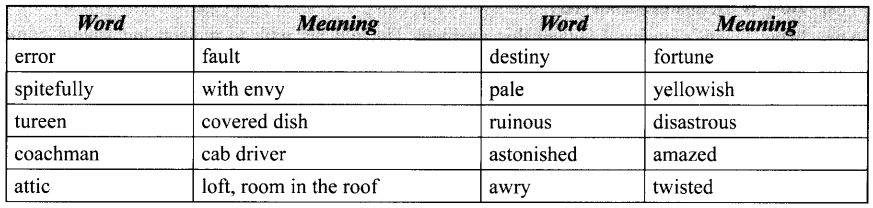
HBSE 10th Class English Solutions First Flight Chapter 7 Glimpses of India Read More »