Author name: Bhagya

HBSE 10th Class Maths Solutions Chapter 6 Triangles Ex 6.5

Haryana State Board HBSE 10th Class Maths Solutions Chapter 6 Triangles Ex 6.5 Textbook Exercise Questions and Answers.

Haryana Board 10th Class Maths Solutions Chapter 6 Triangles Ex 6.5

Question 1.
Sides of triangles are given below. Determine which of them are right triangles. In case of a right triangle, write the length of its hypotenuse.
(i) 7 cm, 24 cm, 26 cm
(ii) 3 cm, 8 cm, 6 cm
(iii) 50 cm, 80 cm, 100 cm
(iv) 13 cm, 12 cm, 5 cm.
Solution:
(i) The given sides of the triangle are 7 cm, 24 cm, 25 cm,
The longest side = 25cm.
The triangle is right angled if
(the longest side)2 = (sum of squares of other two sides) (by Pythagoras theorem)
(25)2 = (7)2 + (24)2
625 = 49 + 576
625 = 625
The given sides make a right triangle and length of hypotenuse = 25cm.

(ii) The given sides of the triangle are 3cm, 8 cm, 6 cm.
The longest side = 8 cm
(the longest side)2 = (sum of the squares of other two sides) (by Pythagoras theorem)
(8)2 = (3)2 + (6)2
64 = 9 + 36
But 64 ≠ 45
The given sides do not make a right triangle.

Haryana Board Solutions for 10th Class Maths Chapter 6 Triangles Ex 6.5

(iii) The given sides of the triangle Eire 50 cm, 80 cm, 100 cm.
The longest side = 100 cm,
(the longest side)2 = (sum of the squares of other two sides) (by Pythagoras theorem)
(100)2 = (50)2 + (80)2
10000 = 2500 + 6400
But 10000 ≠ 8900
∴ The given sides do not mEike a right triangle.

(iv) The given sides of the triangle are 13 cm, 12 cm, 5 cm.
The longest side = 13 cm.
(the longest side)2 = (sum of the squares of other two sides) (by Pythagoras theorem)
(13)2 = (12)2 + (5)2
169 = 144 + 25
169 = 169
∴ The given sides make a right triangle and length of hypotenuse = 13 cm.

Question 2.
PQR is a triangle right angled at P and M is a point on QR such that PM ⊥ QR. Show that PM2 = QM.MR.
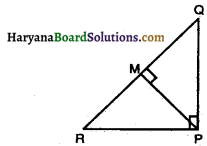
Haryana Board 10th Class Maths Solutions Chapter 6 Triangles Ex 6.5 1

Solution:
Given : A right ∆PQR in which ∠P = 90° and PM ⊥ QR.
To Prove : PM2 = QM.MR
Proof : In right ∆QPR, PM ⊥ QR.
∆RPM ~ ∆PQM [By theorem 6.7]
⇒ \(\frac{\mathrm{MR}}{\mathrm{PM}}=\frac{\mathrm{PM}}{\mathrm{QM}}\)
[Corresponding sides of similar triangles sere proportional]
⇒ PM2 = QM × MR
Hence Proved.

Haryana Board Solutions for 10th Class Maths Chapter 6 Triangles Ex 6.5

Question 3.
In given figure, ABD is a triangle right angled at A and AC ⊥ BD. Show that
(i) AB2 = BC.BD
(ii) AC2 = BC.DC
(iii) AD2 = BD.CD
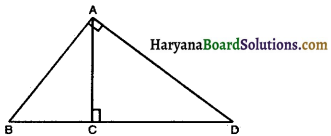
Haryana Board 10th Class Maths Solutions Chapter 6 Triangles Ex 6.5 2

Solution:
Given : A right triangle in which ∠A = 90° sind AC ⊥ BD.
To Prove :
(i) AB2 = BC.BD
(ii) AC2 = BC.DC
(iii) AD2 = BD.CD
Proof :
(i) In right ∆BAC, AC ⊥ BD.
∆BAC ~ ∆BDA [By theorem 6.7]
⇒ \(\frac{\mathrm{AB}}{\mathrm{BD}}=\frac{\mathrm{BC}}{\mathrm{AB}}\)
[Corresponding sides of similar triEingles are proportional]
⇒ AB2 = BC.BD
Hence Proved.

(ii) Similsirly, ∆ABC~ ∆DAC [By theorem 6.7]
\(\frac{\mathrm{AC}}{\mathrm{DC}}=\frac{\mathrm{BC}}{\mathrm{AC}}\)
[Corresponding sides of similar triEingles Eire proportional]
⇒ AC2 = BC.CD
Hence Proved.

(iii) Similarly, ∆DAC ~ ∆DBA [By theorem 6.7]
\(\frac{\mathrm{CD}}{\mathrm{AD}}=\frac{\mathrm{AD}}{\mathrm{BD}}\)
[Corresponding sides of similar triangles are proportional]
⇒ AD2 = BD.CD
Hence Proved.

Haryana Board Solutions for 10th Class Maths Chapter 6 Triangles Ex 6.5

Question 4.
ABC is an isosceles triangle right angled at C. Prove that AB2 = 2AC2.
Solution:
Given : ∆ABC is an isosceles triangle right angled at C.
i.e., AC = BC
To Prove : AB2 = 2AC2
Proof : In right ∆ACB
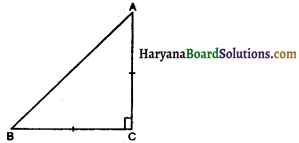
Haryana Board 10th Class Maths Solutions Chapter 6 Triangles Ex 6.5 3

AB2 = BC2 + AC2 [By Pythagoras theorem]
⇒ AB2 = AC2 + AC2 [∵ BC = AC]
⇒ AB2 = 2AC2.
Hence Proved.

Question 5.
ABC is an isosceles triangle with AC = BC. If AB2 = 2AC2, prove that ABC is a right triangle.
Solution:
Given: ∆ABC is an isosceles triangle in which AC = BC and AB2 = 2AC2
To Prove : ∆ABC is a right triangle.
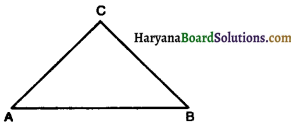
Haryana Board 10th Class Maths Solutions Chapter 6 Triangles Ex 6.5 4

Proof : In ∆ABC, AC = BC and AB2 = 2AC2
⇒ AB2 = AC2 + AC2
⇒ AB2 = BC2 + AC2 [v AC = BC]
⇒ ABC is right angle triangle.
[By converse of Pythagoras theorem]
Hence Proved.

Question 6.
ABC is an equilateral triangle of side 2a. Find each of its altitudes.
Solution :
Side of equilateral ∆ = 2a.
And AD is its altitude. We know that altitude bisects its corresponding side.
i.e., BD = CD = a
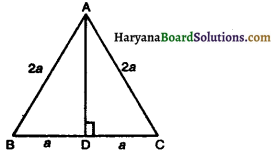
Haryana Board 10th Class Maths Solutions Chapter 6 Triangles Ex 6.5 5

Now right triangle ∆ADC.
AC2 = AD2 + CD2 [By Pythagoras theorem]
⇒ (2a)2 = AD2 + a2
⇒ 4a2 = AD2 + a2
⇒ AD2 = 4a2 – a2 = 3a2
⇒ AD = √3a
Hence, Altitude = √3a.

Haryana Board Solutions for 10th Class Maths Chapter 6 Triangles Ex 6.5

Question 7.
Prove that the sum of the squares of the sides of a rhombus is equal to the sum of the squares of its diagonals.
Given : ABCD is a rhombus
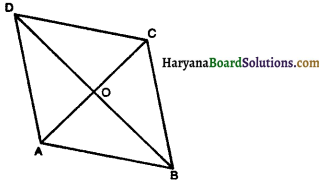
Haryana Board 10th Class Maths Solutions Chapter 6 Triangles Ex 6.5 6

Proof: We know that diagonals of a rhombus bisect each other at right angle
∴ ∠AOB = ∠BOC = ∠COD = ∠AOD = 90° and AO = CO, OD = BO.
In right ∆AOB, AB2 = OA2 + OB2 [By Pythagoras theorem]
AB2 = (\(\frac{1}{2}\) AC)2 + (\(\frac{1}{2}\) BD)2
[∵ OA = OC and OB = OD]
⇒ AB2 = 7 AC2 + 7BD2
⇒ 4AB2 = AC2 + BD2 ……………(1)
Similarly, we have
4BC2 = AC2 + BD2 ……………….(2)
4CD2 = AC2 + BD2 ……………….(3)
4AD2 = AC2 + BD2 ……………….(4)
Adding (1), (2), (3) and (4), we get
4(AB2 + BC2 + CD2 + AD2) = 4(AC2 + BD2)
⇒ AB2 + BC2 + CD2 + AD2 = AC2 + BD2
Hence Proved.

Question 8.
In given figure, O is a point in the interior of a triangle ABC, OD ⊥ BC, OE ⊥ AC and OF ⊥ AB. Show that
(i) OA2 + OB2 + OC2 – OD2 – OE2 – OF2 = AF2 + BD2 + CE2
(ii) AF2 + BD2 + CE2 = AE2 + CD2 + BF2.
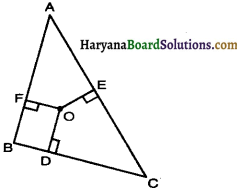
Haryana Board 10th Class Maths Solutions Chapter 6 Triangles Ex 6.5 7

Solution: Given: A ∆ABC in which OD ⊥BC, OE ⊥ AC, OF ⊥ AB.
To Prove :
(i) OA2 + OB2 + OC2 – OD2 – OE2 – OF2 = AF2 + BD2 + CE2
(ii) AF2 + BD2 + CE2 = AE2 + CD2 + BF2
Construction : Join OB, OC and OA.
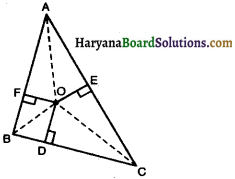
Haryana Board 10th Class Maths Solutions Chapter 6 Triangles Ex 6.5 8

Proof :
(i) By Pythagoras theorem for each of the right triangles namely ∆OFA, ∆ODB, and ∆OEC, we get
OA2 = OF2 + AF2 …………….(1)
OB2 = OD2 + BD2 ……………(2)
OC2 = OE2 + CE2 ……………..(3)
Adding (1), (2) and (3), we get
OA2 + OB2 + OC2 = OF2 + AF2 + OD2 + BD2 + OE2 + CE2 = AF2 + BD2 + CE2
⇒ OA2 + OB2 + OC2 – OD2 – OE2 – OF2 = AF2 + BD2 + CE2
Hence Proved.

Haryana Board Solutions for 10th Class Maths Chapter 6 Triangles Ex 6.5

(ii) In right triangles ODB and ODC, we have
OB2 = OD2 + BD2 …………….(4) [By Pythagoras theorem]
OC2 = OD2 + CD2 ……………..(5)
Subtracting (5) from (4), we get
OB2 – OC2 = BD2 – CD2 ………….(6)
Similarly OC2 – OA2 = CE2 – AE2 ……………(7)
and OA2 – OB2 = AF2 – BF2 ……………(8)
Adding (6), (7) and (8), we get
OB2 – OC2 + OC2 – OA2 + OA2 – OB2 = BD2 – CD2 + CE2 – AE2 + AF2 – BF2
⇒ 0 = BD2 – CD2 + CE2 – AE2 + AF2 – BF2
⇒ AF2 + BD2 + CE2 = AE2 + CD2 + BF2
Hence Proved.

Question 9.
A ladder 10 m long reaches a window 8m above the ground. Find the distance of the foot of the ladder from the base of the wall.
Solution :
Let AC be ladder and AB be wall and BC be the distance of the ladder from wall.
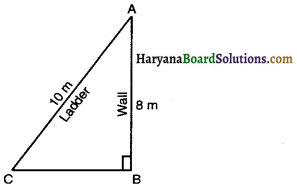
Haryana Board 10th Class Maths Solutions Chapter 6 Triangles Ex 6.5 9

∴ AB = 8 m
AC = 10 m
In right ∆ABC, AC2 = BC2 + AB2
⇒ 102 = BC2 + 82
⇒ 100 = BC2 + 64
⇒ BC2 = 100 – 64
⇒ BC2 = 36
⇒ BC = 6m.
Hence, distance of the foot of the ladder from base of the wall = 6m.

Question 10.
A guy wire attached to a vertical pole of height 18m is 24m long and has a stake attached to the other end. How far from the base of the pole should the stake be driven so that the wire will be taut ?
Solution :
Let AC be guy wire and AB be vertical pole and BC be distance of the stake from the base of the pole.
∴ AB = 18m, AC = 24m,
In right ∆ABC,
AC2 = BC2 + AB2 [By Pythagoras theorem]
⇒ (24)2 = BC2 + (18)2
⇒ 576 = BC2 + 324
⇒ BC2 = 576 – 324
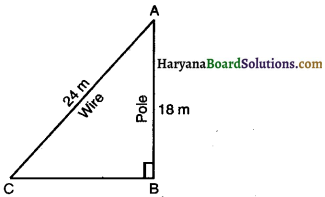
Haryana Board 10th Class Maths Solutions Chapter 6 Triangles Ex 6.5 10

⇒ BC2 = 252
⇒ BC = √252
⇒ BC = 6√7 m
Hence, distance of stake from the base of the pole = 6√7 m.

Haryana Board Solutions for 10th Class Maths Chapter 6 Triangles Ex 6.5

Question 11.
An aeroplane leaves an airport and flies due north at a speed of 1000 km/hr. At the same time, another aeroplane leaves the same airport and flies due west at a speed of 1200 km/hr. How far apart will be the two planes after 1\(\frac{1}{2}\)hours?
Solution:
Let point B represents the position of airport. Then distance covered by first plane in the north direction (AB) = Speed × Time
= 1000 × 1\(\frac{1}{2}\)
= 1000 × \(\frac{3}{2}\)
= 1500 km
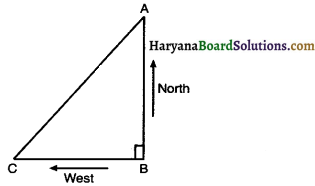
Haryana Board 10th Class Maths Solutions Chapter 6 Triangles Ex 6.5 12

and distance covered by second plane in the west direction (BC) = Speed × Time
= 1200 × \(\frac{1}{2}\)
= 1200 × \(\frac{3}{2}\) = 1800 km.

Now, in right ∆ABC,
AC2 = BC2 + AB2
[By Pythagoras theorem]
⇒ AC2 = (1800)2 + (1500)2
⇒ AC2 = 3240000 + 2250000
⇒ AC2 = 5490000
⇒ AC = \(\sqrt{5490000}\)
⇒ AC = 300√61 km
Hence, distance between two planes = 300√61 km.

Question 12.
Two poles of heights 6 m and 11 m stand on a plane ground. If the distance between the feet of the poles is 12 m, find the distance between their tops.
Solution:
Let AB and CD be two poles, BD be distance between the feet of two poles and AC be distance between their tops.
∴ AB = 11 m, BD = 12 m, CD = 6 m
∠B = ∠D = 90°
CE || BD
∠AEC = 90°, CE = 12m, AE = 11 – 6 = 5 m
Now, in right ∆AEC,
∴ AC2 = CE2 + AE2 [By Pythagoras theorem]
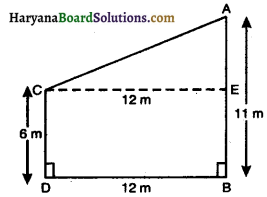
Haryana Board 10th Class Maths Solutions Chapter 6 Triangles Ex 6.5 13

⇒ AC2 = 122 + 52
⇒ AC2 = 144 + 25
⇒ AC2 = 169
⇒ AC = √169
⇒ AC = 13 m.
Hence, distance between tops of two poles = 13 m.

Haryana Board Solutions for 10th Class Maths Chapter 6 Triangles Ex 6.5

Question 13.
D and E are points on the sides CA and CB respectively of a triangle ABC right angled at C. Prove that AE2 + BD2 = AB2 + DE2.
Solution :
Given : A triangle ABC in which ∠C = 90°, D and E are points on the sides CA and CB respectively.
To Prove : AE2 + BD2 = AB2 + DE2
Proof: In right ∆ACE,
AE2 = AC2 + CE2 ………………(1)
[By Pythagoras theorem]
In right ∆DCB,
BD2 = BC2 + DC2 ………………(2)
In right ∆ABC,
AB2 = BC2 + AC2 ……………….(3)
In right ∆DCE,
DE2 = EC2 + CD2 ………………..(4)
Adding (1) and (2), we get
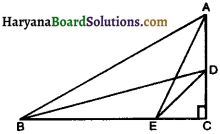
Haryana Board 10th Class Maths Solutions Chapter 6 Triangles Ex 6.5 14

AE2 + BD2 = AC2 + BC2 + CE2 + CD2
AE2 + BD2 = AB2 + DE2 [Using (3) and (4)]
Hence Proved.

Question 14.
The perpendicular from A on side BC of a ∆ABC intersects BC at D such that DB = 3CD (see figure). Prove that 2AB2 = 2AC2 + BC2.
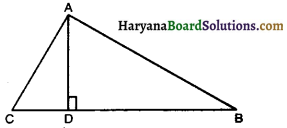
Haryana Board 10th Class Maths Solutions Chapter 6 Triangles Ex 6.5 15

Solution :
Given : A ∆ABC such that AD ⊥ BC and DB = 3CD
To Prove: 2AB2 = 2AC2 + BC2
Proof: DB = 3CD (given)
Now BC = DB + CD
⇒ BC = 3CD + CD [. DB = 3CD]
⇒ BC = 4CD
⇒ CD = \(\frac{1}{4}\)BC
⇒ and BD = 3CD = \(\frac{3}{4}\)BC
In right ∆ADB ,
AB2 = BD2 + AD2 ………………..(1)
In right ∆ADC,
AC2 = CD2 + AD2 …………………(2)
Subtracting (2) from (1), we get
AB2 – AC2 = BD2 + AD2 – CD2 – AD2
⇒ AB2 – AC2 = (\(\frac{3}{4}\)BC)2 – (\(\frac{1}{4}\)BC)2
[∵ BD = \(\frac{3}{4}\)BC and CD = \(\frac{1}{4}\)BC]
⇒ AB2 – AC2 = \(\frac{9}{16}\) BC2 – \(\frac{9}{16}\) BC2
⇒ AB2 – AC2 = \(\frac{8}{16}\)BC2
⇒ AB2 – AC2 = \(\frac{1}{2}\)BC2
⇒ 2AB2 – 2AC2 = BC2
⇒ 2AB2 = 2AC2 + BC2
Hence Proved.

Haryana Board Solutions for 10th Class Maths Chapter 6 Triangles Ex 6.5

Question 15.
In an equilateral triangle ABC, D is a point on side BC such that BD = \(\frac{1}{3}\)BC. Prove that 9AD2 = 7AB2.
Solution :
Given : An equilateral ∆ABC such that BD = \(\frac{1}{3}\)BC.
To Prove: 9AD2 = 7AB2
Construction : Draw AE ⊥ BC and Join AD.
Proof: Let each side of equilateral triangle be x units.
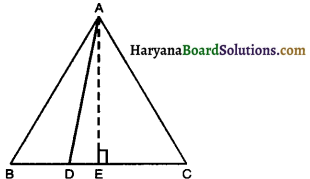
Haryana Board 10th Class Maths Solutions Chapter 6 Triangles Ex 6.5 16

BD = \(\frac{1}{3}\)BC
⇒ BD = \(\frac{x}{3}\)
We know that in equi1ateral perpendicular bisects its corresponding opposite side
BE = EC = \(\frac{x}{2}\)
DE = BE – BD
DE = \(\frac{x}{2}\) – \(\frac{x}{3}\)
DE = \(\frac{x}{6}\)
In right ∆AED, AD2 = AE2 + DE2 ……………..(1)
[By Pythagoras theorem]
In right ∆AEB, AB2 = BE2 + AE2
[By Pythagoras theorem]
AE2 = AB2 – BE2
Put AE2 = AB2 – BE2 in (1), we get
AD2 = 2 BE2 + DE2
AD2 = x2 – (\(\frac{x}{2}\))2 + (\(\frac{x}{6}\))2
⇒ AD2 = x2 – \(\frac{x^2}{4}+\frac{x^2}{36}\)
⇒ AD2 = \(\frac{36 x^2-9 x^2+x^2}{36}\)
⇒ AD2 = \(\frac{28 x^2}{36}\)
⇒ AD2 = \(\frac{7}{9}\) x2
⇒ AD2 = \(\frac{7}{9}\) AB2
⇒ 9AD2 = 7AB2
Hence Proved.

Haryana Board Solutions for 10th Class Maths Chapter 6 Triangles Ex 6.5

Question 16.
In an equilateral triangle prove that three times the square of one side is equal to four times the square of one of its aftitudes.
Solution :
Given : A triangle ABC in which AB = BC = CA and AD ⊥ BC.
To Prove: 3AB2 = 4AD2
Proof: In right ∆ADB and right ∆ADC.
AB = AC (Given)
∠ADB = ∠ADC (Each is 90°)
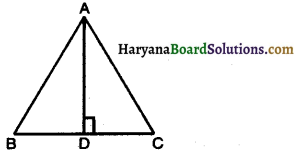
Haryana Board 10th Class Maths Solutions Chapter 6 Triangles Ex 6.5 17

AD = AD (Common)
∴ ∆ADB ≅ ∆ADC (By RHS congruence criterion)
⇒ BD = CD (CPCT)
In right ∆ADB, AB2 = AD2 + BD2 [By Pythagoras theorem]
⇒ AB2 = AD2 + (\(\frac{1}{2}\)AB)2
[∵ BD = CD
∴ BD = \(\frac{1}{2}\)AB]
⇒ AB2 = 4AD2 + \(\frac{1}{4}\)AB2
⇒ 4AB2 = 4AD2 + AB2
⇒ 3AB2 = 4 AD2
Hence Proved.

Question 17.
Tick the correct answer and justify. In ∆ABC, AB = 6√3 cm, AC = 12 cm and BC = 6 cm. The angle B is :
(A) 120°
(B) 60°
(C) 90°
(D) 45°
Solution :
In ∆ABC,
AC2 = 122
⇒ AC2 = 144
BC2 + AB2 = (6)2 + (6√3)2
⇒ BC2 + AB2 = 36 + 108
⇒ BC2 + AB2 = 144
∴ AC2 = BC2 + AB2
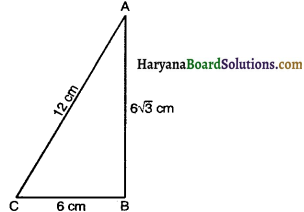
Haryana Board 10th Class Maths Solutions Chapter 6 Triangles Ex 6.5 18

By converse of Pythagoras theorem,
∠B = 90°
Correct answer = (C)
Solution is also justified.

HBSE 10th Class Maths Solutions Chapter 6 Triangles Ex 6.5 Read More »

HBSE 6th Class English Solutions A Pact with the Sun Chapter 10 A Strange Wrestling Match

Haryana State Board HBSE 6th Class English Solutions A Pact with the Sun Chapter 10 A Strange Wrestling Match Textbook Exercise Questions and Answers.

Haryana Board 6th Class English Solutions A Pact with the Sun Chapter 10 A Strange Wrestling Match

HBSE 6th Class English A Strange Wrestling Match Textbook Questions and Answers

HBSE 6th Class Questions Answers A Strange Wrestling Match Question 1.
Why was Vijay Singh’s weakness? Which awkward situation did it push him into?
Answer:
Vijay Singh’s weakness was that of boasting. It pushed him into awkward situation.

A Strange Wrestling Match Summary Question Answer HBSE 6th Class Question 2.
Was the old woman’s gift to Vijay Singh eccentric? Why?
Answer:
Yes, the old woman’s gift to Vijay Singh was eccentric. The old woman thrust a small packet into his hands. When Vijay Singh later opened it, he found it containing a lump of salt and an egg.

Strange Wrestling Match HBSE 6th Class Questions Answers Question 3.
Why did Vijay Singh ask the ghost disguised as Natwar to come closer?
Answer:
Vijay singh asked the ghost disguised as Natwar came closer because he wanted to size up his enemy like all good wrestlers.

HBSE 6th Class English Solutions A Pact with the Sun Chapter 10 A Strange Wrestling Match

Question 4.
What made the ghost speechless? Why?
Answer:
Vijay Singh made some insulting remarks about the ghost. Then he said that he wanted to fight a ghost. Such things made the ghost speechless. Generally people fled away feeling scared, when they met him. But here Vijay Singh wanted to fight him.

Question 5.
Why did Vijay Singh say “Appearances can be deceptive?”
Answer:
Vijay Singh said, “Appearances can be deceptive” because the ghost claimed to be Natwar although he actually was a rascal of a ghost. Vijay Singh wanted to say that he was stronger than the ghost.

HBSE 6th Class English A Strange Wrestling Match Important Questions and Answers

Question 1.
Where does the Haunted Desert lie?
Answer:
The Haunted Desert is ten miles to the west on the road to Jaisalmer. The landmark is an ugly black rock that looks like the head of a camel.

Question 2.
‘The old woman was well-known for her eccentricities. How?
Answer:
When Vijay Singh went out to fight a ghost, she came forward and thrust a small packet of salt and an egg in his hand.

Question 3.
“Appearances can be deceptive”. Who said this to whom?
Answer:
Vijay Singh said to the ghost.

Question 4.
Who did the person Vijay Singh met claim to be? Who he actually was?
Answer:
The person Vijay Singh met claimed to be Natwar. He was actually a plain lying ghost.

HBSE 6th Class English Solutions A Pact with the Sun Chapter 10 A Strange Wrestling Match

A Strange Wrestling Match Word Meanings

massive (मासिव) = बड़े, विशाल, shoulders (शोल्डर्स) = कंधे, muscular (मस्क्यूलर)- मांसपेशियों वाला, arms (आम्स) = भुजायें, towered (टोवड) = छाया रहना, giant (जायन्ट)- दैत्य, wrestler (रेसलर) = पहलवान, shortcoming (शार्टकमिंग) = कमी, wrestler (रेसलर) = पहलवान, awakward (अवकवाड) = अजीब सी, situations (सिच्यूसन्स) = परिस्थिति, boasting (बोस्टिंग) = शेखी, surrounded (सरआउन्डेड) = घिरा हुआ, proclaimed (प्रोक्लेमड) = घोषणा की, stout (स्टाअट)मजबूत, lesson (लेसन) = सबक, murmurs (मर्मरस) = बुदबुदाहट, applause (एपलाउज) = प्रशंसा, roam (रोम) = भटकना, strange (स्ट्रेन्ज) = अजीब, shrieks (सीक्ज) = चीखें, moans (मोनस) = विलाप, mighty (माइटी) = मजबूत, haunted (हाउन्टेड) = भूतिया, Desert (डेजट) = रेगिस्तान, nonchalantly (नोनचेलेन्टली) = बिना जोश के, fairy (फेयरी) = परी, admirers (एडमायरस)- प्रशंसक, landmark (लेन्डमार्क) = जमीन के निशान, ugly (अगली) = भद्दा, sand (सेंड) = बालू, रेत, wilderness (वाइल्डरनेस) = निर्जनता, ghost (घोस्टस) = भूत, turmed up (टर्नडअप) = उमड़ पड़ा, bid (बिड) = कहना, farewell (फेयरवेल) = विदा, came forward (केमफारवड) = आगे आई, thrust (थ्रस्ट) = डाल दी, sunset (सनसेट) = सूर्यास्त, deepened (डिप-अड) = गहराती गई, shone (सोने) = चमका, destination (डेस्टिनेशन) = गंतव्य स्थान, lump (लम्प) = ढेर, salt (साल्ट) = नमक, eccentricities (एसेन्ट्रीसिटीस) = सनकियाँ।, realised (रिलाइज्ड) = महसूस किया, brave (ब्रेव) = बहादुर, show (श्यो) = दिखाना, way (वे)रास्ता, size up (साइजअप) = आंकलन करना, परखना, enemy (इनेमी) = शत्रु, peered (पीअड’) = झांका, plain (प्लेन) = सीधा-सादा, longing (लोगिंग) = चाह रहा था, Insult (इनसल्ट) = अपमानित, generally (जनरली) = साधारण रूप से, horror (हॉरर) = भय, fainted (फेनटेड) = बेहोश हो जाते थे, unfeeling (अनफीलिंग) = भावनाहीन, creature (क्रीचर) = प्राणी, make sense (मेकशेन्स) = मतलब हो ना, bored (बोरअड) = उबाऊ, stupid (स्टूपिड) = मूर्ख, worthless (वर्थलैस)-बेकार speechless (स्पीचलेस) = अवाक, चुप, marshalling (मार्शलिंग) = दिखाते हुए, attempt (अटेम्पट) = प्रयास, scornfully (स्कोर्नफूली) = उपेक्षा से. frankly (फ्रेन्कली) = स्पष्ट रूप से, appearance (अपियरेन्सज) = चेहरे, आकृति (यहाँ पर), deceptive (डिसेपटिव) = धोखा देने वाले, rascal (रास्कल) = दुष्ट आदमी, demonstration (डेमोन्स्ट्रेशन) = प्रदर्शन।

A Strange Wrestling Match Summary in English

Vijay Singh who was a wrestler was a bit boastful at times. Once he boasted that he could defeat a ghost. When he was going to fight against the ghost an old woman gave him small packet containing an egg and a luinp of salt. Vijay Singh came across a ghost calling himself Natwar. He demoralised the ghost by demonstrating his strength crushing what the ghost thought was a piece of rock. Tbfe ghost was so nervous that he admitted his defeat in the wrestling about without wrestling with him. He requested him to rest at night in his house and enjoy his hospitality that night.

Vijay Singh played some tricks on him. He created the appearance of a sleeping man with the help of a bolster and a coverlet and himself stood away from there. Late at night the ghost struck this sleeping man with a heavy blow. He took him for dead. But Vijay Singh in the early morning pretended that some insects were there which tried to disturb him in his sleep. The ghost fled from the cave leaving his ill-gotten wealth.

HBSE 6th Class English Solutions A Pact with the Sun Chapter 10 A Strange Wrestling Match

A Strange Wrestling Match Summary in Hindi

विजय सिंह जो कि एक पहलवान था कभी-कभार शेखी मारता रहता था। एक बार उसने शेखी मारी कि वह भूत को भी हरा सकता है। जब वह भूत के विरुद्ध लड़ने के लिए जा रहा था तो एक बूडत्र स्त्री ने उसे एक छोटा पैकेट दिया जिसमें एक अंडा तथा नमक की डली (टुकड़ा) थी। विजय सिंह एक भूत के पास आया जो अपने आप को नटवर कह रहा था। उसने भूत को हतोत्साहित करने के लिए अपनी ताकत का जिसे भूत सोच रहा था कि चट्टान का टुकड़ा था, को चूर्ण-चूर्ण प्रदर्शन करके किया।

भूत इतना बेचैन हो गया कि उसने कुश्ती के मुकाबले के बिना ही हार स्वीकार की ली। उसने उसी रात उससे उसके घर पर आराम करने और अतिथि सत्कार को स्वीकार करने की प्रार्थना की। विजयसिंह ने कुछ चालाकियाँ उस पर खेली। उसने एक सोते हुए आदमी की आकृति एक मसनद तथा छोटी चादर का सहारा लेकर खड़ी कर दी और खुद दूर खड़ा हो गया। देर रात में भूत ने सोए हुए आदमी पर भारी प्रहार कर दिया। उसने उसे मरा हुआ समझकर छोड़ दिया। लेकिन विजयसिंह ने बहाना बनाया कि कुछ कीड़े-मकोड़े वहाँ पर थे जो उसकी नींद में व्यवधान पहुँचा रहे थे। भूत गुफा से गलत तरीके से कमाये गये धन को छोड़कर भाग गया।

HBSE 6th Class English Solutions A Pact with the Sun Chapter 10 A Strange Wrestling Match Read More »

HBSE 6th Class English Solutions A Pact with the Sun Chapter 9 What Happened to the Reptiles

Haryana State Board HBSE 6th Class English Solutions A Pact with the Sun Chapter 9 What Happened to the Reptiles Textbook Exercise Questions and Answers.

Haryana Board 6th Class English Solutions A Pact with the Sun Chapter 9 What Happened to the Reptiles

HBSE 6th Class English What Happened to the Reptiles Textbook Questions and Answers

What Happened to the Reptiles Question Answer HBSE 6th Class Question 1.
In what way is Pambupatti different from any other village?
Answer:
Prem had fainted on reaching Pambupatti. An old man was bending over him when he opened his eyes. He looked after him for the next few days. The old man even rubbed Prem’s feet. Even the neighbours and strangers – came to visit Prem. It was different from any other village. The people fight with those who pray to another god.

What Happened to the Reptiles HBSE 6th Class Questions Answers Question 2.
Why is Prem determined not to return to his village?
Answer:
There was an atmosphere of hate and violence in Prem’s village. The people fought with those who prayed to another god. They even burnt down the places of worship of one another. Many houses, including Prem’s house were burnt down. He was forced by circumstances to run away from his village. Therefore, he was determined not to return to his village.

HBSE 6th Class English Solutions A Pact with the Sun Chapter 9 What Happened to the Reptiles

HBSE 6th Class Questions Answers What Happened to the Reptiles Question 3.
Why did Makara dislike tortoises, snakes and lizards? Write a line about each.
Answer:
Makara disliked tortoises because they are slow and stupid. Moreover, they carry their houses on their backs.
He dislikes snakes because they are slimy and they make funny noises. Besides, they are were’d creatures.
He dislikes weird because they have strange habits and some of them even changed colours. Hence, they cannot be trusted.

Question 4.
What went wrong when the tortoises, snakes and lizards left the forest?
Answer:
A strange smell of rotting fruit on the ground and rotting animals in the river began to fill the forest when the tortoises left it.
The rats took over the forest. They ate up the eggs of the lizards and the crocodiles when the snakes left the forest.
The rats turned somersaults on the crocodiles’ backs fearlessly. There were also many huge frogs. They began to eat the baby crocodiles. Even the insects grew bigger and nastier in millions. This happenea when the lizards left the forest.

Question 5.
Why do you think Prem wants to tell the story of the reptiles to the people of his village?
Answer:
Prem wants to make the people of his village understand that each of us has a place in this strange and funny world. Different religions are the creations of men. The people should not fight in the name of religion. They should not burn one another’s homes or places of worship. Therefore, he wants to tell the story of the reptiles to the people of his village.

Question 6.
Do you agree that it is difficult not to go along with someone who is very strong and powerful? Express your views frankly and clearly.
Answer:
I don’t agree with this statement. The masses are asses. Most of them are brainless creatures. They go along with the strong and powerful like dumb-driven cattle. They become the victims of greed. Their self interests overpower their minds to agree to the wishes of the powerful persons. They don’t realise that each of us has a place in this strange and funny world. They are not far-sighted. I would never accept the wrong decisions thrust on me by any powerful person.

HBSE 6th Class English Solutions A Pact with the Sun Chapter 9 What Happened to the Reptiles

Question 7.
If you were a baby crocodile, would you tell Makara that he was wrong? What would you say to convince him?
Answer:
If I were a baby crocodile, I would certainly tell Makara that he was wrong. I would tell him about the evil results of his hasty, stupid and cruel decisions. A strange smell of rot would fill the forest in the absence of tortoises. No other creature would eat up the rotten fruits on the ground or rotting animals in the rivers. The rats would eat up the eggs of the lizards and the crocodiles in the absence of snakes. Huge frogs, insects and rats would cause a nuisance in the absence of lizards. I would convince him about the fact that each of the creatines has its own utility in this strange world.

HBSE 6th Class English What Happened to the Reptile Important Questions and Answers

Question 1.
What was it that made Prem leave his own village?
Answer:
The conmunal riots in Prem’s village had made life unsafe for the residents. There was tension and chaos every where. So Prem left his own village.

Question 2.
What are reptiles? What is the peculiar physical feature of reptiles?
Answer:
Snakes, crocodiles, turtles, lizards are all reptiles. A reptile has scales on its body and it lays eggs.

Question 3.
Why did Makara ask tortoises not to come to the monthly meeting?
Answer:
Makara sent a letter to the tortoises not to come to the monthly meeting because he wanted to declare that day that tortoises were not needed in the forest.

Question 4.
How did the whole forest belong to Makara and his group only?
Answer:
Makara, the biggest crocodile of the forest had announced in the three monthly meetings that they did not need tortoises, snakes and lizards respectively. So they were ordered to leave the forest. Hence the whole forest now belonged to Makara and his group.

HBSE 6th Class English Solutions A Pact with the Sun Chapter 9 What Happened to the Reptiles

Question 5.
How did the forest become normal and peaceful again?
Answer:
It was a terrible time for the crocodiles when the tortoises, snakes and lizards had left the forest. A small crocodile pointed out what had gone wrong. They knew that Makara was not all that strong and right. They called all their reptile friends back to Pambupatti. Their arrival marked the beginning of normal and peaceful life again in the forest.

What Happened to the Reptiles Meanings

believe (बिलिव)-trust = विश्वास करना। true (ट्रयू)-real सत्य। edge (ऐज)-brink = सिरा। cliff (क्लिफ)-the top and rugged face of a rocky mass (खड़ी चटटान) vast (वेस्ट)-extremely large in size = विस्तीर्ण। stretches (स्ट्रेचिस)-spreads = फैला हुआ है, many (मैनी) -a number of = अनेक pray (प्रे)-worship = पूजा, प्रार्थना करना। temple (टेंपल)- the place where Hindus worship = मंदिर, forest (फॉरेस्ट)-woods = वन। mosque (मॉस्क्यू)-the place where Muslims worship = fall away (अवे)-far off = दूरी पर, terrible (टैरिबल)-fearful = भयानका happened (हैप्पण्ड)-took place = घटित हुई, started (स्टार्टिड)-began = प्रारंभ किया। in the middle of-during, बीच में। lay-lying as sleep सोया पड़ा होना। violence-outrage हिंसा, दंगा-फसाद। mine-belonging to me मेरा, managed arranged to do = प्रबंध करना। grab-pick up = उठना। statue-image = मूर्ति। further-ahead = आगे। seemed-appeareds = दिखाई पड़ना, finally in the end = अंत में। gathered-assembled = इकट्ठे हुए। fainted-lost consciousness = मूर्छित हो गया, shining-glittering = चमकना। bending bowing = झुकना। looked after-tended = देख-भाल की। stream-rivulet = नदी। rubbed-pressed = दबाया, मला। gently-softly = नर्मी से। strangers- unknown people = अजनबी लोग, seems-looks = दीखाई पड़ना।

What Happened to the Reptiles Summary in English

The people of Prem’s Village went mad. They started fighting with one another. They burnt one another’s places of worship and homes. Prem ran to a village named Pambupatti. He fainted there. An old man was nursing him when he opened his eyes. Even strangers came to see him. He was delighted to find such a difference in the behaviour of the people there.

The old man told him a story about the village. There were only crocodiles, snakes, tortoises and lizards there. Timely meetings were held there. Makara used to be the president of the meetings. He was a strong and powerful crocodile. He planned to turn out the tortoises, snakes and lizards turn by turn from the forest. He gave wrong arguments. Nobody dare oppose him. A strange smell of rot filled the forest. Rats became all powerful there. The frogs and insects created a nuisance. It all happened when the tortoises, snakes and lizards were made to leave the forest. Good sense prevailed over Makara then. All the creatures were asked to return. The forest was back to normal. Prem decided to tell this story to the people of his village.

HBSE 6th Class English Solutions A Pact with the Sun Chapter 9 What Happened to the Reptiles

What Happened to the Reptiles Summary in Hindi

प्रेम के गाँव के लोग पागल हो गए। वे एक-दूसरे के साथ लड़ने लगे। उन्होंने एक-दूसरे के पूजास्थलों और घरों को जला दिया। प्रेम, पम्बूपट्टी नामक गाँव में दौड़ता हुआ पहुँच गया। वह वहाँ मूर्छित हो गया। जब उसकी आँखें खुलीं, एक बूढ़ा आदमी उसकी सेवा कर रहा था। अजनबी लोग भी उससे मिलने आए थे। वहाँ के लोगों के व्यवहार में इतना अन्तर देखकर वह आनन्दित हो गया।

बूढ़े आदमी ने उसे, उस गाँव की एक कहानी सुनाई। वहाँ केवल मगरमच्छ, साँप, कछुए और छिपकलियाँ रहती थीं। समय-समय पर वहाँ बैठकें हुआ करती थीं। मगर, उन बैठकों का सभापति हुआ करता था। वह दबंग और शक्तिशाली मगरमच्छ था। उसने बारी-बारी से कछुओं, साँपों और छिपकलियों को जंगल से बाहर निकालने की योजना बनाई। उसने गलत तर्क पेश किए। उसका विरोध करने की किसी में हिम्मत नहीं थी। जंगल में एक विचित्र गंध फैल गई। वहाँ पर चूहे सशक्त बन गए। मेंढ़कों और कीड़े-मकोड़ों ने तबाही मचा दी। ये सब  घटनायें तब घटी जब कछुओं, साँपों और छिपकलियों को जंगल से निकाल दिया गया। तब मगर के अन्दर सद्बुद्धि जागी। सभी जीवधारियों को लौटने का आदेश मिला। जंगल में फिर से सामान्य स्थिति पैदा हो गई। प्रेम ने अपने गाँव के लोगों को यह कहानी सुनाने का निर्णय लिया।

HBSE 6th Class English Solutions A Pact with the Sun Chapter 9 What Happened to the Reptiles Read More »

HBSE 6th Class English Solutions A Pact with the Sun Chapter 8 A Pact with the Sun

Haryana State Board HBSE 6th Class English Solutions A Pact with the Sun Chapter 8 A Pact with the Sun Textbook Exercise Questions and Answers.

Haryana Board 6th Class English Solutions A Pact with the Sun Chapter 8 A Pact with the Sun

HBSE 6th Class English A Pact with the Sun Textbook Questions and Answers

A Pact with the Sun Question Answer HBSE 6th Class Question 1.
What did the physicians ask Saeeda’s mother to do to get well? Did their advice help her? If not, why not?
Answer:
The physicians forbade normal food and asked her to remain perfectually confined to her small dingy room. The room was to be deprived of sunshine and fresh air.

A Pact with the Sun HBSE 6th Class Questions Answers Question 2.
What did the specialist prescribe in addition to medicine?
Answer:
The specialist asked her to leave the dark hovel and occupy a bigger room at windows open. He asked her to sit in the sun every morning from eight to nine.

HBSE 6th Class English Solutions A Pact with the Sun Chapter 8 A Pact with the Sun

HBSE 6th Class Questions Answers A Pact with the Sun Question 3.
What did Saeeda tell the sunrays to do?
Answer:
Saeeda told the sunrays to come next day with lots of warmth and brightness.

Question 4.
Why were the sunrays keen to go down to the earth the next day?
Answer:
The sun rays were keen to go down because they had given their word to Saeeda. So they didn’t want that people of the earth should turn against them.
(i) What is your own formula for keeping good health?
Answer:
Do it yourself.

(ii) Who would you recommend to a patient in your neighbourhood-the physicians contacted first or the specialist contacted next? Give reasons for your choice.
Answer:
Do it yourself.

(iii) When would you make a pact with the sun? Wheh you are going on a picnic, or when you are playing a cricket match? Think of other occasions.
Answer:
Do it yourself.

HBSE 6th Class English A Pact with the Sun Important Questions and Answers

Question 1.
The doctor and his advice became a subject of noisy commentary among all present. How?
Answer:
The doctor and his advice become a subject of noisy commentary among all present. Some favoured while others opposed it. Exposure to sun and air for someone afflicted with chronic cough was dangerous, an experienced lady de¬clared. A younger neighbour nearly quarrelled with her over this.

HBSE 6th Class English Solutions A Pact with the Sun Chapter 8 A Pact with the Sun

Question 2.
Whose advice did Saeeda’s mother follow? What did she say at last?
Answer:
Saeeda’s mother followed the doctor’s advice. She said that she would carry out the instructions to the letter. She also asked to move her bed into the next room and let her sit in the sun on her charpoy for an hour daily.

Question 3.
How was the road to earth blocked?
Answer:
The road to earth was blocked by an army of thick, mucky clouds.

Question 4.
What advice does she still follow?
Answer:
She still follows the doctor’s advice of fresh sunshine and lungful of fresh air.

A Pact with the Sun Word Meanings

fever (फीवर)= बुखार, cough (कफ)= खांसी, body ache (बॉडीएक)= शरीर का दर्द, joints (ज्वायन्टस)= जोड़ों, physicians (फीजिसियन्स)= चिकित्सकों, improvement (इम्प्रोवमेंट)= सुधार, relapsed (रिलप्स्ड)= पूर्व स्थिति में आ जाना, complaint (कम्पलेन्ट)= शिकायत, substituted (सब्ट्यूटेड)= स्थानापन्न किया, forbidden (फोरबिडन)= मना किया गया, perpetually (परपेच्यूअली) = लगातार रूप से, confined (कन्फाइन्ड)= सीमित था। _dingy (डीजी)= गन्दा, fastened (फास्टेअन्ड)= चिपकाया, deprived (डिप्राइवेड)= वंचित किया, sunshine (सनशाइन)= सूर्य की रोशनी, critical (क्रीटिकल)= आलोचक, persuaded (परस्यूडेड)= मनाया, consult (कन्सल्ट)= परामर्श करना, heeded (हीडड)= ध्यान दिया, trinkets (ट्रिकेन्टस)= कम कीमत का गहना, medicine (मेडिसीन)= दवाई, prescribed (प्रीस्क्राइब्ड)= लागू की, effective (इफैक्टिव)= प्रभावी, chapati (चपाती)= रोटी, vegetables (वेजिटेबलस)= सब्जियाँ, addition (एडिसन) = अलावा, emphatically (एम्फाटिकली)= जोर देकर कहना, hovel (होवल)= छप्पर, झोपड़ी, occupy (ओक्यूपाई)= ग्रहण करना, concluded (कन्क्लू डेड)= समाप्त किया, noisy (नोइजी)= शोरगुल से, commentary (कोमेन्टरी)= टीका-टिप्पणी, favoured (फेवरअड)= पक्ष लिया, exposure (एक्सपोजर)= उजागर होना, afflicted (एप्लिक्टड)= प्रभावित किया, chronic cough (क्रोनिक कफ)= पुरानी खांसी, quarrelled (क्वैरेलेड)= झगड़ा किया, exhausted (एग्जास्टेड)= पका हुआ, participate (पार्टिसिपेट)= भाग लिया, debate (डिबेट)= वाद-विवाद, quiet (क्वायेंट)= शांत, consequences (कन्सिक्वेसेंज) = परिणाम, instructions (इस्ट्रेक्शन्स)= निर्देश, charpoy (चारपॉय)= चारपाई, overcast (ऑवरकास्ट)= छाये रहना, dejected (डिजेक्टड)= हताश, muttered (मटअरड)= बुदबुदाई, cured (क्योड)= ईलाज किया गया, lament (लीमेन्ट)= विलाप, stumbled (स्टंबलेड)= ठोकर लगी, लड़ खाड़ा गई, chilly (चीली)= ठण्ड, Disheartened (डिस्हार्टअन्ड)= हताश होना; हतोत्साहित होना, remnant (रेमनेन्ट)= बाकी, शेष, entangled (इन्टंगल्ड)= उलझी हुई थी, language (लवेज)= भाषा, foreign (फोरेन)= अनभिज्ञ, grown-ups (ग्रओनअप)= वयस्क, fluently (फल्यूऐन्टली)= धारा प्रवाह, communicate (कम्यूनिकेट)= बातचीत करना, Almighty (अलमाइटी)= भगवान, addressed (एड्सड)= संबोधित किया, ray (रे)= किरण, brightness (ब्राइटनेस)= चमकीलापन, hour (आवर)घंटा, sprightly (सप्राइटली)= उत्साहपूर्वक, embellished (एम्बेलिशड)= सजाई, सजाया, journey (जर्नी)= यात्रा, off (ऑफ)= छुट्टी, blocked (ब्लोअक्ड)= रोक दिया, mucky (मकी)= कूड़ा-करकट, गंदगी, lark (लाक)= अठखेलियाँ, हँसी मजाक, quiet (क्वाइट)= शान्त, pact (पेक्ट)= समझौता, given my word (गिवनमाईवड)= वायदा कर लिया, pierce (पीअयस) = प्रवेश करना, (आर-पार जाना), staged (स्टेन्ड)= प्रदर्शित किया, revolt (रिवोल्ट)= विद्रोह, fancy (फैन्सी)= कल्पना, heavens (हैवन्स)= स्वर्ग, relented (रिलेन्टड)= मान गया (यहाँ), mind (माइन्ड)= ध्यान करना, rushed (रशड)= भागी, guard (गाड)= अवरोध, courtyard (कोर्टयाड)= आंगन, focussed (फोकसअड)= केन्द्रित की, battalion (बटालियन)= सेना की टुकड़ी, flee (प्ली)= भागना, post (पोस्ट)= चौकियाँ, shooting (शूटिंग)= चीरते हुए (यहाँ), bewildered (बिविल्डड) भ्रमित, host (होस्ट)= मेजबान, approaching (एप्रोचिंग)= पहुंचते हुए, welled (वेल्ड अप)= भर गई (कुएं की तरह), gratitude (ग्रेटिट्यूड)= कृतज्ञता, reclining (रिक्लआइनिंग)= झुकी हुई, bolsters (बोलस्टस)= तकिया, मसनद, breathed (ब्रीद्ड)= सांस ली, glowed (ग्लोअड)= चमका, fragrance (फ्रेगरेन्स)= सुगन्ध , chanted (चेन्टेड)= गाया, tune (ट्यून)= ताल, recovered (रिकवड)= ठीक हो गई, lungfuls (लंगफूल्स) = फेफड़े भरे हुए।

HBSE 6th Class English Solutions A Pact with the Sun Chapter 8 A Pact with the Sun

A Pact with the Sun Summary in English

Saeeda’s mother did not receive proper medical treatment. She was even not allowed to take healthy food, sunshine and fresh air. At last she consulted a good physician who prescribed both good medicine and health-building atmosphere like sunshine, fresh air etc. But the sky remained overcast with clouds for a few days, Saeeda made a special request to the sun rays to come to help her mother recover from her illness. The sunrays promised her to came the next day. They remained true to their promise, overcoming all the problems on the way.

A Pact with the Sun Summary in Hindi

सईदा की माँ उचित इलाज नहीं करवा पाई थी। उसको भोजन, धूप तथा ताजा हवा की भी इजाजत नहीं दी गई थी। अन्त में उसने एक अच्छे चिकित्सक से सलाह-मशविरा किया जिसने उसे अच्छी दवाई तथा स्वास्थ्य बनाने वाला वातावरण जैसे कि सूर्य की रोशनी, ताजा हवा इत्यादि की सलाह दी। लेकिन आसमान कई दिनों तक बादलों से ढका रहा। सईदा ने अपनी माँ की बीमारी से उबारने के लिए सूरज की किरणों को आने के लिए विशेष प्रार्थना की। सूर्य की किरणों ने अगले दिन आने का वायदा किया। वे रास्ते में सभी बाधाओं को जीतकर अपने वायदों पर खरी उतरीं।

HBSE 6th Class English Solutions A Pact with the Sun Chapter 8 A Pact with the Sun Read More »

HBSE 6th Class English Solutions A Pact with the Sun Chapter 7 The Wonder Called Sleep

Haryana State Board HBSE 6th Class English Solutions A Pact with the Sun Chapter 7 The Wonder Called Sleep Textbook Exercise Questions and Answers.

Haryana Board 6th Class English Solutions A Pact with the Sun Chapter 7 The Wonder Called Sleep

HBSE 6th Class English The Wonder Called Sleep Textbook Questions and Answers

The Wonder Called Sleep Question Answer HBSE 6th Class Question 1.
What is the most obvious advantage of sleep?
Answer:
The most obvious advantage of sleep is that our body recovers from fatique caused by the day’s activities.

The Wonder Called Sleep HBSE 6th Class Questions Answers Question 2.
What happens to our body when we sleep ?
Answer:
When we sleep, our muscles and heart beak becomes slower. Our temperature and blood pressure slow down.

HBSE 6th Class Questions Answers The Wonder Called Sleep Question 3.
Define a dream in your own words.
Answer:
Dream is a mental state which takes place when we are asleep, it may indicate about the problem one is facing but nothing can’t be said for sure don’t the dreams related with future activities.

HBSE 6th Class English Solutions A Pact with the Sun Chapter 7 The Wonder Called Sleep

Question 4.
Why are dreams important ? Mention two reasons.
Answer:
They are important because they can help us to sleep through noise or other disturbances. Second, they may reveal a great deal about one’s problems and also help in their solution.

Question 5.
Why has sleep been called a wonder ?
Answer:
Sleep has been called a wonder because it has many surprising things in its 7 store.

Question 6.
Describe briefly to the class an improbable dream you have had.
Answer:
Do it yourself.

Question 7.
Grandmothers and mothers sing nice little songs while rocking little ones to sleep. Such a song is called a lullaby. Do you remember a lullaby in your own language ? Tell the class in English what the lullaby says.
Answer:
Do it yourself.

HBSE 6th Class English The Wonder Called Sleep Important Questions and Answers

Question 1.
Define ‘sleep’ in your own words.
Answer:
Sleep is a state when body and mind ‘ come to rest, some dreams may happen but the ‘ rest of the time our mind is out of worldly affair.

Question 2.
Are all our dreams probable?
Answer:
Only some dreams are probable, that means that many of the things that happen in dreams could happen when we are awake.

Question 3.
What have certain doctors found about dreams?
Answer:
Certain doctors have found that one’s dreams after all reveal a great deal about one’s problems and that, if understood correctly, they can provide a key to the solution of many problems.

Question 4.
What can dreams never tell ?
Answer:
Dreams can never tell about future.

HBSE 6th Class English Solutions A Pact with the Sun Chapter 7 The Wonder Called Sleep

Question 5.
What is the theme of the poem ‘Lights Out’?
Answer:
The theme of the poem ‘Lights Out’ is that the sleep is indispensable. No other attraction can cause us not to sleep. But nobody knows what causes sleep.

The Wonder Called Sleep Word Meanings

exactly (एक्जैक्टली)= एकदम ठीक, unconscious (अन्कॉसेन्स)= बेहोशी, recovers (रिकवअर्स)= उभर जाना, पुनः प्राप्त होना, fatigue (फैटिग)= थकावट, activities (एक्टिविटिज) = गतिविधियाँ, wake up (वेकअप)= उठना, जगना, happened (हेपन्ड)= घटित हुआ, remember (रिमेम्बर)- याद करना, dream (ड्रीम)= सपना, darkness (डार्कनेस)= अंधेरापन, sink (सिंक)= डूबना, muscles (मस्अलस)= माँसपेशियाँ, relax (रिलेक्स) आराम करना, temperature (टेम्प्रेचर) = तापमान, blood pressure (ब्लडप्रेशर)= रक्तचाप, ever active (एवर एक्टिव)= हमेशा सक्रिय, consciously (कान्शअली)= होश में, heartbeat (हार्टबीट)= दिल की धड़कन, breathing (ब्रेनिंग)= सांस लेते हुए, forgotten (फारगोटन)= भूल जाना, probable (प्रोबेबल)= संभव, awake (अवेक)= जगना, several (सेवरेल)= कई। reasons (रीजन्स)= कारण, disturbances (डिस्ट्रबेन्सेज)- परेशानियाँ, alarm clock (अलार्म-क्लाक)= खतरे की घंटी वाली घड़ी, doorbell (डोरबेल) = दरवाजे की घंटी, ringing (रिंगिंग)= बजाते हुए, reveal (रीविल)= उजागर करना, understood (अन्डरस्टूड)= समझा, solution (सोल्यूशन)- हल, experience (एक्सपिरिअन्स)= अनुभव, falling asleep (फालिंगएसलिप)= नींद में जाते हुए, borders (बोडस)सीमायें, unfathomable (अनफेदमेबल) = गहराई का पता नहीं लगा पाये। straight (स्ट्रेयट)- सीधा.

HBSE 6th Class English Solutions A Pact with the Sun Chapter 7 The Wonder Called Sleep

The Wonder Called Sleep Summary in English

A good sleep enables our body and brain to recover from fatigue. When we sleep, we dream. We may not always recall the dream we had. During sleep, our heart beat becomes slower and our temperature and blood pressure go down. Dream play a vital role in our sleep. They help us sleep through noise and other disturbances. They may have some bearing on our problems but they are unable to tell the future.

The Wonder Called Sleep Summary in Hindi

एक अच्छी नींद हमारे शरीर और दिमाग को थकावट से उबरने में मदद करती है। हम हमेशा जिन सपनों को देखते हैं याद नहीं रख सकते हैं। नींद के दौरान हमारे दिल की ध ड़कन धीमी हो जाती है और हमारा तापमान तथा रक्तचाप नीचे चला जाता है। सपने हमारी नींद में महत्त्वपूर्ण भूमिका निभाते हैं। वे हमें शोर गुल तथा अन्य व्यवधानों से सोने में मदद करते हैं। वे हमारी समस्याओं पर प्रभाव डाल सकते हैं परन्तु वे भविष्य के बारे में नहीं बता सकते हैं।

HBSE 6th Class English Solutions A Pact with the Sun Chapter 7 The Wonder Called Sleep Read More »

HBSE 6th Class English Solutions A Pact with the Sun Chapter 4 The Old-Clock Shop

Haryana State Board HBSE 6th Class English Solutions A Pact with the Sun Chapter 4 The Old-Clock Shop Textbook Exercise Questions and Answers.

Haryana Board 6th Class English Solutions A Pact with the Sun Chapter 4 The Old-Clock Shop

HBSE 6th Class English The Old-Clock Shop Textbook Questions and Answers

The Old Clock Shop Question Answer HBSE 6th Class Question 1.
What made Ray think the visitor was not really a shopper?
Answer:
The visitor was a man closer to fifty. He approached the counter without any sign of friendliness in his eyes. Moreover, he had a gun and a restless hand in the coat pocket. It made Ray think that the visitor was not really a shopper.

Summary Of The Old Clock Shop Class 6 HBSE Question 2.
Why do you think he had come to the shop?
Answer:
The older man was in need of money. He was down on his luck. He had come there to get some loan by pawning his wrist watch.

HBSE 6th Class English Solutions A Pact with the Sun Chapter 4 The Old-Clock Shop

HBSE 6th Class English The Old-Clock Shop Question 3.
How did Ray communicate with him?
Answer:
Ray was deaf. He pushed a notepad and a pencil across the counter. He wrote on the notepad, “May I help you?” The man wrote back, “How much will you give me for this (wrist watch)?” In this way, Ray communicated with him through the notepad.

Question 4.
What do you think the man said to his friend who waited at the door?
Answer:
The older man’s friend was waiting at the door. Both of them were down on their luck. They were ready to try something they would feel sorry about in future. (Perhaps they had come to loot the shop-owner on gun-point). I think, the older man asked his friend not to cause any harm to the shop-keeper.

Question 5.
Ray was not a pawnbroker. Why then did he lend money to people in exchange for their old watches and clocks?
Answer:
No doubt, Ray was not a pawnbroker but he was kind hearted. He realized the need of the poor people. He could not say ‘No to the needy people who placed their old watches or clocks before him.

Question 6.
‘The watch was nothing special and yet had great powers.” In what sense did it have ‘great power’?
Answer:
The watch was something to exchange a way out of a bad situation. The man was down on his luck. He would exchange his watch for something which would bring good luck for him. Therefore, the non-special watch had great powers.

Question 7.
Do you think the man would ever come back to pick up the watch?
Answer:
Ray paid a fifty dollar note to the older man as loan against the watch. The watch wasn’t worth that much. The over-payment is an indication that the man would never come back to pick up the watch. There is another indication that the watch had great powers. It would change the old man’s condition. Therefore, he would come back to pick it up as soon as he can.

Question 8.
When did the unfriendly face of the visitor turn truly friendly?
Answer:
The older man approached the counter with an unfriendly face. Ray felt afraid but smiled at the unfriendly face. He also pointed to his ears and shook his head from side to side. The older man got surprised when he studied the note pad. (He learnt that ray was deaf). Ray’s words”May I help you?” turned the unfriendly face of the visitor into truly friendly.

HBSE 6th Class English Solutions A Pact with the Sun Chapter 4 The Old-Clock Shop

The Old-Clock Shop Word Meanings

arrived – approached = आ पहुँची थी, shoppers customers = ग्राहक, thick – compact = मोटी, yeteven then = फिर भी, deaf – one who cannot hear = बहरा, rush- gust = झोंका, hit – struck = प्रहार किया, twenties – aged between twenty and twenty nine = बीस से उन्नतीस वर्ष की आयु के बीच। closer nearer = समीप। remained – stayed = ठहरा रहा, approached – came near = पास आया। sign – clue = संकेत। growing – increasing by degrees = बढती हुई। slowly – at an easy pace = मंद गति से। Notepad – a pad to write notes = कागजों की गद्दी (गड्डी), unfriendly – hostile = शत्रुतापूर्ण, pointed – showed the direction of = संकेत करना, shook – moved = हिलाया। surprise – wonder = आश्चर्य, studied – read = पढ़ा, chance – occasion = अवसर, closely – from a quite near distance = बहुत नजदीक से, shape form = शक्ल, restless – uneasy = अशांत, still – calm = शांत, directly – straight = सीधे। macking of ridicule = उपहास वाली, looked – seemed = दिखाई पड़ना। luck – fortune = भाग्य, later – afterwards = बाद में, ticked on – produced sound like a clock = घड़ी की तरह टिक-टिक की आवाज करना, message – what one wants to say = संदेश, Pick up – to take = लेना, चुनना, loan – (debt) credit = ऋण, Pawnbroker – one who lends money on some security = गिरवी रखने वाला, needy – one who wants something = जरूरतमंद, placed = kept = रखना, loaned – gave on credit. = ऋण देना, interest money paid for use of something = ब्याज, easier – cooler = शांत, Wrist – the front part of the hand = कलाई, Noticed – observed = निहारा, grey – brownish = भूरी, special – peculiar = विशेष, Exchange = to change a thing with another thing = विनिमय, way out – solution = रास्ता, situation – condition = हालत, need – urgency = जरूरत। need – (here) require, = चाहते हो, worth having value = काबिल, कीमत के योग्य, reached into – put hand inside = अन्दर हाथ डाला, pulled out – brought out = बाहर निकाला, seemed – appeared = दिखाई पड़ना, turning – to take a turn = मुड़ना, merry – happy = शुभ, Together – jointly = एक साथ, all the while – all the time = सारा समय।

The Old-Clock Shop Summary in English

It was a snowy Christmas evening. Ray was working on a clock in his old clock shop. He stood up after finishing his work. Just then he saw two men. One was in his twenties. The other was closer to fifty. They did not look like customers. The younger man stayed at the door. The older man approached the counter. Ray felt afraid and pointed to his deaf ears. He wrote on the note pad, “May I help you?” The old man was down on his luck.

Ray understood that the older man was needy. He had something like a gun in his pocket. He showed his wrist watch to Ray. The watch seemed to have great powers. Ray offered a fifty-dollar note to him. He had loaned more than he should. The older man thanked Ray. He wished him Merry Christmas’. He also promised that he would pick up his watch as soon as he could.

HBSE 6th Class English Solutions A Pact with the Sun Chapter 4 The Old-Clock Shop

The Old-Clock Shop Summary in Hindi

क्रिसमस की एक बर्फीली शाम थी। घड़ियों की अपनी पुरानी दुकान में रे एक घड़ी की मरम्मत कर रहा था। अपना काम समाप्त करके वह खड़ा हो गया। तभी उसे दो आदमी दिखाई दिए। एक की आयु बीस वर्ष से अधिक थी। दूसरे की आयु पचास वर्ष के करीब थी। वे ग्राहकों जैसे दिखाई नहीं पड़ते थे। छोटी आयु वाला व्यक्ति दरवाजे के पास ठहरा रहा। बड़ी आयु वाला व्यक्ति काऊंटर के पास पहुँचा। रे को भय लगा और उसने अपने बहरे कानों की तरफ इशारा किया। उसने नोटपैड के ऊपर लिखा, “क्या मैं आपकी मदद कर सकता हूँ।” बड़ी आयु वाला व्यक्ति भाग्य का मारा हुआ था।

रे समझ गया कि बड़ी आयु वाला व्यक्ति जरूरतमंद है। उसकी जेब में बंदूक जैसी कोई चीज थी। उसने रे को अपनी कलाई घड़ी दिखाई। ऐसा लगता था कि घड़ी में महान शक्तियां थीं। रे ने पचास-डालर वाला एक नोट उसे दिया। उसे जितना ऋण देना चाहिए था उससे अधिक ऋण दे दिया था। बड़ी आयु वाले व्यक्ति ने रे का धन्यवाद किया। उसने रे को क्रिमसम की शुभकामना दी। उसने यह भी वचन दिया कि वह बहुत जल्दी ही अपनी घड़ी वापस लेने आएगा।

HBSE 6th Class English Solutions A Pact with the Sun Chapter 4 The Old-Clock Shop Read More »

HBSE 6th Class English Solutions A Pact with the Sun Chapter 6 The Monkey and the Crocodile

Haryana State Board HBSE 6th Class English Solutions A Pact with the Sun Chapter 6 The Monkey and the Crocodile Textbook Exercise Questions and Answers.

Haryana Board 6th Class English Solutions A Pact with the Sun Chapter 6 The Monkey and the Crocodile

HBSE 6th Class English The Monkey and the Crocodile Textbook Questions and Answers

Class 6 English Chapter 5 The Monkey and the Crocodile Question Answer Question 1.
The monkey was happy living in the fruit tree, but his happiness was not complete. What did he miss?
Answer:
He missed the companion to talk and share the fruits with him. He was quite lonely.

HBSE 6th Class The Monkey and the Crocodile Chapter 5 Question Answer Question 2.
What did the two friends generally talk about?
Answer:
The two friends generally talked about birds, animals, nearby villages and villagers difficulties etc.

Chapter 5 Question Answer HBSE 6th Class The Monkey and the Crocodile Question 3.
Why was the crocodile’s wife annoyed with her husband one day?
Answer:
The crocodile’s wife was annoyed with her husband one day because she had to wait for her husband too much. She also had to manage her little babies in his absence.

HBSE 6th Class English Solutions A Pact with the Sun Chapter 6 The Monkey and the Crocodile

Question 4.
Why was the crocodile unwilling to invite his friend home?
Answer:
The crocodile was unwilling to invite his friend home because he did not want to betray his friend as his wife wanted to eat his heart.

Question 5.
What did the crocodile tell the monkey midstream?
Answer:
The crocodile told the monkey midstream that his wife wanted to eat his heart. So he would have to kill him.

Question 6.
How did the monkey save himself?
Answer:
The monkey was sensible and clever. So he said that he had not brought the heart with himself. He said his heart was on the tree.

Question 7.
What does the last sentence of the story suggest? What would the crocodile tell his wife?
Answer:
The crocodile would tell his wife that the monkey had filled the fruits with his heart. So you can eat these fruits and enjoy eating the heart. May be, the crocodile’s wife is also foolish like her husband and so she may believe him.

HBSE 6th Class English The Monkey and the Crocodile Important Questions and Answers

Question 1.
Where did the monkey live?
Answer:
The monkey lived in a fruit tree on a river bank.

Question 2.
How did the monkey and the crocodile become good friends?
Answer:
The monkey needed a companion. Everytime the monkey used to offer him some fruits and also send some for his wife. They met regularly and talked to each other so they became good friends.

Question 3.
Why did the crocodile’s wife demand for monkey’s heart?
Answer:
One day, the crocodile spent more time than usual with monkey. The crocodile’s wife was fed up with managing the young ones alone. So she demanded for monkey’s heart to get rid of monkey once for all.

HBSE 6th Class English Solutions A Pact with the Sun Chapter 6 The Monkey and the Crocodile

Question 4.
Why did crocodile finally decide to betray his friend?
Answer:
The crocodile finally decided to betray his friend because his wife got very annoyed and went deep into the reier. The crocodile loved his wife very much. So he finally decided to betray his friend and please his life-partner.

Question 5.
What did the monkey do as he reached the tree?
Answer:
The monkey climbed the tree. He offered some fruits to the crocodile for his wife. He also declared that they wouldn’t meet again.

The Monkey and the Crocodile Word Meanings

bank (बैंक) = किनारा, fruit ( फूूट) = फल, heart’s content ( हटर्डकन्टेन्ट) = दिल भरकर, lonely (लोनली) = एकान्त, crocodile (क्रोकोडाइल) = मगरमच्छ, rive] regularly (रेग्यूलरली) = नियमित रूप से, crocodile (क्रोकोडाइल) = मगरमच्छ, tired (टायर्ड) =थका होना, difficulties (डिफिक्लेटीज) = परेशानियाँ, raising (रेजिंग) = उगाने में, crops (क्रोपस) = फसलें, lack (लेक) = कमी, annoyed (एनायड) = चिड़चिड़ा गई।, climb (क्लाइम्ब) = चढ़ना, obvious (ऑॅवियस) = स्पष्ट, sarcasm (सरकाज्म) =ताना मारना, foolish (फूलिश) = बेवकूफ, occasionally (ओकेजनली) = यदा-कदा, taste (टेस्ट) = स्वाद, furious (फ्यूरिअस) = गुस्से में, dived (डाइव्ड) = गोता लगाया, bottom (बोटम) = नीचे का तल, pester (पेस्टर) = परेशान करना, serious (सिरिअस) = गंभीर, dilemma (डिलेमा) = दुविधा, life-partner (लाईफपार्टनर) = जीवन साथी, betray (बिट्रे) = विश्वासधात करना, invite (इनवाइट) = न्यौता देना (निमंत्रण देना), meal ( मील ) = भोजन, Pleasure (प्लेजर) = खाशी, swimmer (स्विमर) = तैराक, set out (सेटआउट) = रवाना होना, current (करेन्ट) = धारा, hide (हाइड) = छिपना, intention ( इन्टेन्शन = इरादा, hesitatingly (हंजिटेंटिगली) = हिचकिचाहट के साथ, survive (सरवाईव) = जिंदा रहना, Good bye (गुडबाय) = अलविदा, scared (स्केअड ) = भयभीत होना, distressed (डिस्ट्रेस्ड) = बेचैन, sensible (सेंसिबल) = सयाना, clever (क्लेवर) = चतुर, calmly (कामली) = शांति से, compared (कम्पेअड) = तुलना की, foolish (फुलिस) = बेवकूफी, brought (ब्रोट) = ले आता, innocently (इनोसेन्टली) = भोलेपन से, carried (केरिड) = ले जाना, confidence (कॉन्फिडन्स) = विश्वास, mistake (मिस्टेक) = भूल, hissed (हिस्ड) = फुंफकारा, turn (टर्न) = चक्कर, heaved (हीवड) = सांस छोड़ी, sigh (साई) = चाह, relief (रीलिफ) = राहत, plucked (प्लक्ड) = तोड़ा, wiser (वाईजर) = अधिक बुद्धिमान, shed (शेड) = गिराया (आँसू), tears ( टियअस ) = आँसू, genuine (जेन्यूआइन) = सही, असली, hurry (हरी) = जल्दी।

HBSE 6th Class English Solutions A Pact with the Sun Chapter 6 The Monkey and the Crocodile

The Monkey and the Crocodile Summary in English

There lived a monkey in a fruit tree on the bank of a river. He cultivated friendship with a crocodile. He provided him with delicious fruits to eat and to take them home for his wife. They frequently met and talked. This annoyed the crocodile’s wife because her husband got late due to this. She didn’t appreciate his friendship with the monkey. The crocodile’s wife thought of teaching a lesson to the monkey. So she wanted to eat away the monkeys heart. First the crocodile didn’t want to betray his friend but later he gave into his wife. He invited the monkey to his house. The monkey came to know of this plan in the mid-stream. He kept his cool and persuaded the crocodile on a pretext to swim back to the tree as he had forgotten to bring the heart with him. The crocodile was taken in. Thus the monkey saved his life.

The Monkey and the Crocodile Summary in Hindi

एक बार एक नदी के किनारे एक फल के पेड़ पर एक बंदर रहता था। उसने एक मगरमच्छ से दोस्ती कर ली। वह उसे खाने तथा अपनी पत्नी के पास ले जाने के लिए स्वादिष्ट फल प्रदान करता था। वे बारम्बार मिलते और बातचीत करते थे। इससे मगरमच्छ की पत्नी को बड़ी चिढ़ हो गई क्योंकि इस वजह से उसका पति देर से आने लगा। मगरमच्छ की पत्नी ने बन्दर को सबक सिखाने की सोची। इसलिए वह बंदर के दिल को खाना चाहती थी। पहले तो मगरमच्छ अपने मित्र से विश्वासघात नहीं करना चाहता था परन्तु बाद में अपनी पत्नी के सामने उसने आत्मसमर्पण कर दिया। उसने बन्दर को अपने घर निमन्त्रित कर लिया। बन्दर को जब वह धारा के बीच में था तब इस योजना का पता चला। उसने अपनी शांति बनाए रखी और पेड़, जहाँ वह अपना दिल लाना भूल गया था के बहाने पर वापस जाने के लिए मना लिया। मगरमच्छ धोखा खा गया। इस प्रकार से बन्दर ने अपनी जिन्दगी बचाई।

HBSE 6th Class English Solutions A Pact with the Sun Chapter 6 The Monkey and the Crocodile Read More »

HBSE 10th Class Maths Solutions Chapter 6 Triangles Ex 6.1

Haryana State Board HBSE 10th Class Maths Solutions Chapter 6 Triangles Ex 6.1 Textbook Exercise Questions and Answers.

Haryana Board 10th Class Maths Solutions Chapter 6 Triangles Ex 6.1

Question 1.
Fill in the blanks using the correct word given in the brackets :
(i) All circles are ……………… (congruent, similar)
(ii) All squares are …………….. (similar, congruent)
(iii) All triangles are similar (isosceles, equilateral)
(iv) Two polygons of the same number of sides are similar, if (a) their corresponding angles are ………………. and (b) their corresponding sides are ………………… (equal, proportional)
Solution:
(i) All circles are similar.
(ii) All squares are similar.
(iii) All equilateral triangles are similar.
(iv) Two polygons of the same number of sides are similar if (a) their corresponding angles are equal and (b) their corresponding sides are proportional.

Haryana Board Solutions for 10th Class Maths Chapter 6 Triangles Ex 6.1

Question 2.
Give two different examples of pair of :
(i) Similar figures
(ii) non-similar figures
Solution:
(i) (a) Pair of equilateral triangles are similar figures.
(b) Pair of circles are similar figures.

(ii) (a) A pair of a triangle and a square are non-similar figures.
(b) A pair of a square and a rectangle are non-similar figures.

Haryana Board Solutions for 10th Class Maths Chapter 6 Triangles Ex 6.1

Question 3.
State whether the following quadrilaterals are similar or not.

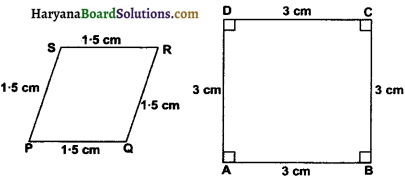
Haryana Board 10th Class Maths Solutions Chapter 6 Triangles Ex 6.1 1

Solution:
The two quadrilaterals PQRS and ABCD are not similar because their corresponding angles are not equal.

HBSE 10th Class Maths Solutions Chapter 6 Triangles Ex 6.1 Read More »

HBSE 10th Class Maths Solutions Chapter 5 Arithmetic Progressions Ex 5.4

Haryana State Board HBSE 10th Class Maths Solutions Chapter 5 Arithmetic Progressions Ex 5.4 Textbook Exercise Questions and Answers.

Haryana Board 10th Class Maths Solutions Chapter 5 Arithmetic Progressions Ex 5.4

Question 1.
Which term of the AP: 121, 117, 113, ……………… is its first negative term?
Solution:
The given sequence of AP is 121, 117, 113, ……………
Here a = 121
d = a2 – a1
= 117 – 121 = – 4
Let nth term of AP be the first negative term,
an = a + (n – 1)d < 0
a + (n – 1)d < 0
= 121 + (n – 1) × (- 4) < 0
= 121 – 4n + 4 < 0
125 – 4n < 0
125 < 4n 4n > 125
⇒ n > \(\frac{125}{4}\)
⇒ n > 31.26
Hence, 32th term of the AP is the first negative term.

Haryana Board Solutions for 10th Class Maths Chapter 5 Arithmetic Progressions Ex 5.4

Question 2.
The sum of the third and the seventh terms of an AP is 6 and their product is 8. Find the sum of first sixteen terms of the AP.
Solution :
Let a be the first term and d be the common difference of AP. Then,
According to question :
a3 + a7 = 6
⇒ a + (3 – 1)d + a + (7 – 1)d = 6
⇒ a + 2d + a + 6d = 6
⇒ 2a + 8d = 6
⇒ a + 4d = 3
⇒ a = 3 – 4d ……………..(1)
And a3 × a7 = 8
⇒ (a + 2d)(a + 6d) = 8
⇒(3 – 4d+ 2d)(3 – 4d + 6d) = 8
[From equation (1) put a = 3 – 4d]
⇒ (3 – 2d) (3 + 2d) = 8
⇒ 9 – 4d2 = 8
⇒ 4d2 = 9 – 8
⇒ 4d2 = 1
⇒ d2 = \(\frac{1}{4}\)
d = ± \(\frac{1}{2}\)

Case I:
If d = \(\frac{1}{2}\)
Putting the value of d in equation (1), we get
a = 3 – 4 × \(\frac{1}{2}\)
a = 3 – 2 = 1
a = 1
Now S16 = \(\frac{16}{2}\) [2 × 1 + (16 – 1) × \(\frac{1}{2}\)]
S16 = 8[2 + \(\frac{15}{2}\)]
S16 = 8 × \(\frac{19}{2}\)
⇒ S16 = 76.

Case II:
If d = – \(\frac{1}{2}\)
Putting the value of d in equation (1), we get
a = 3 – 4 × (- \(\frac{1}{2}\))
⇒ a = 3 + 2 = 5
Now, S16 = \(\frac{16}{2}\) [2 × 5 + (16 – 1) ×(- \(\frac{1}{2}\))]
⇒ S16 = 8 [10 – \(\frac{15}{2}\)]
S16 = 8 × \(\frac{5}{2}\)
⇒ S16 = 20
Hence, S16 = 76 or S16 = 20.

Haryana Board Solutions for 10th Class Maths Chapter 5 Arithmetic Progressions Ex 5.4

Question 3.
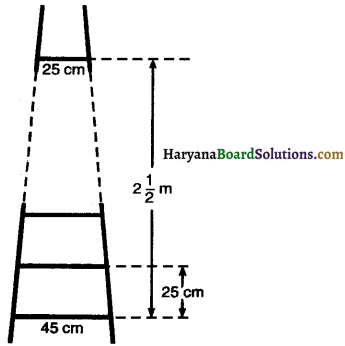
A ladder has rungs 25 cm apart (See figure). The rungs decrease uniformly in length from 45 cm at the bottom to 25 cm at the top. If the top and the bottom rungs are 2 \(\frac{1}{2}\) m apart, what is the length of the wood required for the rungs?

Haryana Board 10th Class Maths Solutions Chapter 5 Arithmetic Progressions Ex 5.4 1

Solution:
We have,
Gap between two consecutive rungs = 25 cm
Distance between bottom and top rungs = 2\(\frac{1}{2}\) m = 250 cm
Number of rungs = \(\frac{250}{25}\) + 1 = 11
Since, rungs are decreasing uniformly in length from 45 cm at the bottom to 25 cm at the top.
Therefore, the lengths of rungs form an AP in which a = 45, a11 = 25
Required length of wood for rungs = S11
= \(\frac{11}{2}\) (45 + 25)
[∵ Sn = \(\frac{n}{2}\) (a + l)]
= \(\frac{11}{2}\) × 70
= 385 cm
or = 3.85 m
Hence, required length of wood for rungs = 3.85 m.

Haryana Board Solutions for 10th Class Maths Chapter 5 Arithmetic Progressions Ex 5.4

Question 4.
The houses of a row are numbered consecutively from 1 to 49. Show that there is a value of x such that the sum of the numbers of the houses preceding the house numbered x is equal to sum of numbers of the houses following it. Find this value of x.
Solution:
Let there be a value of x such that the sum of the numbers of the houses preceding the house numbered x is equal to the sum of the num¬bers of the houses following it i.e. :
House No. 1, 2, 3, …………….., (x – 1), x, (x + 1), ……………, 49.
Now, Sx – 1 = S49 – Sx

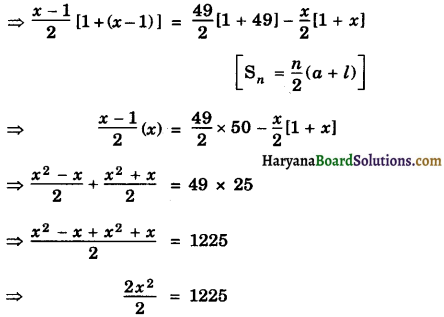
Haryana Board 10th Class Maths Solutions Chapter 5 Arithmetic Progressions Ex 5.4 2

x2 = 1225
x = √ 1225
x = ± 35.
Since, x can’t be negative. Therefore, x = 35.

Haryana Board Solutions for 10th Class Maths Chapter 5 Arithmetic Progressions Ex 5.4

Question 5.
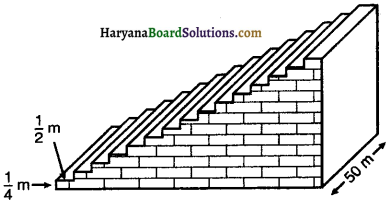
A small terrace at a football ground comprises of 15 steps each of which is 50 m long and built of solid concrete. Each step has a rise of \(\frac{1}{4}\) m and a tread of \(\frac{1}{2}\) m (see figure). Calculate the total volume of concrete required to build the terrace.

Haryana Board 10th Class Maths Solutions Chapter 5 Arithmetic Progressions Ex 5.4 3

Solution:
We have, Length and breadth of each step are 50 m and \(\frac{1}{2}\) m respectively.
Height of first step = \(\frac{1}{4}\) m
Height of second step = \(\frac{1}{4}+\frac{1}{4}=\frac{2}{4}\) m
Height of third step = \(\frac{1}{4}+\frac{1}{4}+\frac{1}{4}=\frac{3}{4}\) m
and so on.
Volume of concrete to build the first step = 50 × \(\frac{1}{2} \times \frac{1}{4}=\frac{25}{4}\) m3
[∵ Volume of cuboidal step = L × B × H]
Volume of concrete to build the second step = 50 × \(\frac{1}{2} \times \frac{1}{4}=\frac{50}{4}\) = m3
Volume of concrete to build the third step = 50 × \(\frac{1}{2} \times \frac{3}{4}=\frac{75}{4}\) m3
and so on.
The sequence of volume of concrete 0f steps are: \(\frac{25}{4}, \frac{50}{4}, \frac{75}{4}, \ldots\)
a2 – a1 = \(\frac{50}{4}-\frac{25}{4}=\frac{25}{4}\)
a3 – a2 = \(\frac{75}{4}-\frac{50}{4}=\frac{25}{4}\)
∵ a2 – a1 = a3 – a2
∴ The sequence forms an AP in which a = \(\frac{25}{4}\) and d = \(\frac{25}{4}\).
Now, total volume of concrete = Sum of volumes of concrete ta build 15 steps
= S15
= \(\frac{15}{2}\left[2 \times \frac{25}{4}+(15-1) \times \frac{25}{4}\right]\)
= \(\frac{15}{2}\left[\frac{25}{2}+14 \times \frac{25}{4}\right]\)
= \(\frac{15}{2}\left[\frac{25}{2}+\frac{175}{2}\right]\)
= \(\frac{15}{2} \times \frac{200}{2}\)
= 15 × 50
= 750 m3
Hence, the total volume of concrete = 750 m3.

HBSE 10th Class Maths Solutions Chapter 5 Arithmetic Progressions Ex 5.4 Read More »

HBSE 9th Class Maths Solutions Chapter 13 Surface Areas and Volumes Ex 13.9

Haryana State Board HBSE 9th Class Maths Solutions Chapter 13 Surface Areas and Volumes Ex 13.9 Textbook Exercise Questions and Answers.

Haryana Board 9th Class Maths Solutions Chapter 13 Surface Areas and Volumes Exercise 13.9

[This exercise is not from examination point of view]

Question 1.
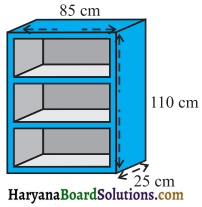
A wooden bookshelf has external dimensions as follows: Height = 110 cm, Depth = 25 cm, Breadth = 85 cm (see Fig. 13.31). The thickness of the plank is 5 cm everywhere. The external faces are to be polished and the inner faces are to be painted. If the rate of polishing is 20 paise per cm2 and the rate of painting is 10 paise per cm2, find the total expenses required for polishing and painting the surface of the bookshelf.
HBSE 9th Class Maths Solutions Chapter 13 Surface Areas and Volumes Ex 13.9 1
Solution:
We have
External dimensions of bookshelf are
Height = 110 cm, depth = 25 cm and breadth = 85 cm
Thickness of the plank = 5 cm
∴ Internal dimensions of bookshelf are Height = 110 – 4 × 5 = 90 cm
(there are 4 plank)
Breadth = 85 – 2 × 5 = 75 cm
Depth = 25 – 5 = 20 cm
Area to be polished = (110 × 85 + 2 × 110 × 25 + 2 × 85 × 25 + 4 × 75 × 5 + 2 × 110 × 5)
= 9350 + 5500 + 4250 + 1500 + 1100
= 21700 cm2
Rate of polishing = 20 paise/cm2
Cost of polishing = Rs. 21700 × \(\frac{20}{100}\)
= Rs. 4340
Area to be painted= 6 × 75 × 20 + 2 × 90 × 20 + 75 × 90
= 9000 + 3600 + 6750
= 19350 cm2
Cost of painting = 10 paise/cm2
Cost of painting = Rs. \(\frac{19350 \times 10}{100}\)
= Rs. 1935
Total expenses = Rs. 4340 + Rs. 1935
= Rs. 6275
Hence, total expenses = Rs. 6275.

HBSE 9th Class Maths Solutions Chapter 13 Surface Areas and Volumes Ex 13.9

Question 2.
The front compound wall of a house is decorated by wooden spheres of diameter 21 cm, placed on small supports as shown in Fig. 13.32. Eight such spheres are used for this purpose, and are to be painted silver. Each support is a cylinder of radius 1.5 cm and height 7 cm and is to be painted black. Find the cost of paint required if silver paint costs 25 paise per cm2 and black paint costs 5 paise per cm2.
HBSE 9th Class Maths Solutions Chapter 13 Surface Areas and Volumes Ex 13.9 2
Fig. 13.32
Solution:
We have,
Diameter of sphere = 21 cm
∴ Radius of sphere (R) = \(\frac{21}{2}\) = 10.5 cm
Radius of cylinder (r) = 1.5 cm
Height of cylinder (h) = 7 cm
Surface area for silver paint = 8(C.S.A. of the sphere – base area of cylinder on which sphere is resting)
= 8(4πR2 – πr2)
= 8π(4R2 – r2)
= 8π[4 × (10.5)2 – (1.5)2]
= 8 × \(\frac{22}{7}\)[4 × 110.25 – 2.25]
= 8 × \(\frac{22}{7}\)[438.75]
= 11031.43 cm2 (approx.)
Rate of silver paint = 25 paise/cm2
Cost of silver paint = Rs. \(\frac{11031.43 \times 25}{100}\)
= Rs. 2757.86 (approx.)
Surface area to be black painted = 8 C.S.A. of cylinder
= 8 × 2πrh
= 8 × 2 × \(\frac{22}{7}\) × 1.5 × 7
= 528 cm2
Rate of black paint = 5 paise/cm2
Cost of black paint = Rs. \(\frac{528 \times 5}{100}\) = Rs. 26.4
Total cost of painting = 2757.86 + 26.4
= Rs. 2784.26
Hence, total cost of painting = Rs. 2784.26.

HBSE 9th Class Maths Solutions Chapter 13 Surface Areas and Volumes Ex 13.9

Question 3.
The diameter of a sphere is decreased by 25%. By what percent does its curved surface area decrease?
Solution:
Let the diameter of sphere be 2x.
∴ Radius of the sphere (r1) = x
Curved surface area of sphere = 4πx2
After decreasing its diameter by 25%, then
New diameter = 2x – 25% of 2x
= \(2 x-\frac{25}{100} \times 2 x\)
= \(2 x-\frac{x}{2}=\frac{3 x}{2}\)
New radius (r2) = \(\frac{3 x}{4}\)
Curved surface area of new sphere
= \(4 \pi r_2^2=4 \pi \times\left(\frac{3 x}{4}\right)^2\)
= \(\frac{4 \pi \times 9 x^2}{16}=\frac{9 \pi x^2}{4}\)
Decrease in curved surface area
= \(4 \pi x^2-\frac{9 \pi x^2}{4}\)
= \(\frac{16 \pi x^2-9 \pi x^2}{4}\)
= \(\frac{7 \pi x^2}{4}\)
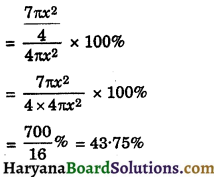
Decrease % in curved surface area
HBSE 9th Class Maths Solutions Chapter 13 Surface Areas and Volumes Ex 13.9 3
Hence, decrease % in curved surface area = 43.75%.

HBSE 9th Class Maths Solutions Chapter 13 Surface Areas and Volumes Ex 13.9 Read More »

HBSE 6th Class Social Science Solutions History Chapter 12 इमारतें, चित्र तथा किताबें

Haryana State Board HBSE 6th Class Social Science Solutions History Chapter 12 इमारतें, चित्र तथा किताबें Textbook Exercise Questions and Answers.

Haryana Board 6th Class Social Science Solutions History Chapter 12 इमारतें, चित्र तथा किताबें

HBSE 6th Class History इमारतें, चित्र तथा किताबें Textbook Questions and Answers

कल्पना करो:

तुम एक मंदिर के मण्डप में बैठे हो। अपने चारों तरफ़ के दृश्य का वर्णन करो।
उत्तर:
मैं ऐहोल (कर्नाटक) के दुर्गा मंदिर में दर्शन करने आया हूँ, वहाँ दर्शन करने के पश्चात् मण्डप में बैठा हूँ। मैं देख रहा हूँ कि यहाँ भजन-कीर्तन हो रहे हैं। मंडप के एक कोने में शायद, ग्रामीण लोगों की सभा आयोजित की गई है। उसमें किसी महत्त्वपूर्ण ग्रामीण मुद्दे पर बातचीत चल रही है। मंडल के दूसरे कोने पर एक पाठशाला चलाई जा रही है। शायद आज परीक्षा का दिन है, इसलिए बच्चों को मंदिर के आंगन में परस्पर काफी दूरी पर विठाया गया है। यहाँ कीर्तन मंडली माँ भगवती का गुणगान कर रही है। मण्डप के बीच में एक हवन कुण्ड बना है। इसमें वेद-मंत्रों से यज्ञ किया जा रहा है। यह समूचा एक विशाल और गोलाकार कक्ष है जिसके बाहर एक प्रदक्षिणा पथ है, लोग उसमें चारों ओर घूम कर परिक्रमा कर रहे हैं।

HBSE 6th Class Social Science Solutions History Chapter 12 इमारतें, चित्र तथा किताबें

आओ याद करें:

इमारतें चित्र तथा किताबें HBSE 6th Class Social Science प्रश्न 1.
निम्नलिखित का सुमेल करो:
(i) स्तूप – (क) देवी-देवता की मूर्ति स्थापित करने की जगह
(ii) शिखर – (ख) टीला
(iii) मण्डप – (ग) स्तूप के चारों तरफ वृत्ताकार पथ का रास्ता
(iv) गर्भगृह – (घ) मंदिर में लोगों के इकट्ठा होने की जगह
(v) प्रदक्षिणापथ – (ङ) गर्भगृह के ऊपर शृंगाकार निर्माण
उत्तर:
(i) – (ख)
(ii) – (छ)
(iii) – (घ)
(iv) – (क)
(v) – (ग)

Class 6 History Chapter 12 HBSE Social Science प्रश्न 2.
खाली जगहों को भरो:
(क) ———— एक बड़े गणितज्ञ थे।
(ख) ———— में देवी-देवताओं की कहानियाँ मिलती हैं।
(ग) ———— को संस्कृत रामायण का लेखक माना जाता है।
(घ) ——— और ———— दो तमिल महाकाव्य है।
उत्तर:
(अ) बराहमिहिर
(ब) पुराणों
(स) बाल्मिकी
(द) शिलापदिकम, मणिमेकलाई

आओ चर्चा करें:

HBSE 6th Class Social Science इमारतें चित्र तथा किताबें प्रश्न 3.
धातुओं के प्रयोग पर जिन अध्यायों में चर्चा हुई है, उनकी सूची बनाओ। धातु से बनी किन-किन चीजों के बारे में चर्चा हुई है या उन्हें दिखाया गया है?
उत्तर:
वैदिक काल से लोहे की खोज होने के संकेत मिलते हैं। वैदिककाल का वर्णन हमारी पुस्तक के अध्याय (6) में हैं। इसमें कृषि कार्य हेतु हल में लोहे का फाल और अस्त्र-शस्त्रों के बल पर ही आर्यों ने राज्य विस्तार किया था और “मगध” राज्य की उन्नति हुई। संक्षेप में यह कहा जा सकता है कि कृषि कार्यों का चयन और स्थाई तौर पर निवास करने के बाद बनने वाले सभी सामाजिक संगठनों यथा-जाति, समुदाय, समिति, गण, संघ, राज्य, साम्राज्य में लोहे के विविध उपयोगों का उल्लेख हुआ है। इन अध्यायों में वर्णित चीजें हैं:
(i) लोहे की फाल
(ii) भाला, तीर, कुल्हाड़ी, दराँती, गैंती जैसे कृषि औजार
(iii) तोमर, गदा, परशु, मुद्गर, तलवार, बरछा, तेग भिन्दिपाल, चक्र, कवच, मेखला जैसे आयुध और सामाजिक सन्जा
(iv) लोहे के विशाल संदूक।

धातु-कर्म का आरंभ वस्तुतः हड़प्पा नगर सभ्यता से हुआ। इसमें ताँबे और टिन से मिश्रित धातु काँसा बनाने का उल्लेख हुआ है। ताँबे को गलन-भट्टियों का उल्लेख भी है। इस सभ्यता के अचानक पतन का कारण यह बताया गया है कि ईट के भट्ठे और ताँबे की गलन भट्टियों की संख्या बढ़ जाने के कारण ईधन की खपत बढ़ गई थी। लोगों ने बड़े पैमाने पर वन-विनाश करना शुरू किया और एक स्थिति ऐसी आई कि सिन्धु-घाटी की उर्वरा भूमि ऊसर अनुपजाऊ बन गई। जल-स्रोत सूख गए। जीवन की आवश्यक दशाएँ बिगड़ जाने के कारण ही लोग इन नगरों को त्याग कर अन्यत्र चले गये थे।

HBSE 6th Class Social Science Solutions History Chapter 12 इमारतें, चित्र तथा किताबें

प्रश्न 4.
एन.सी.आर.टी. की पाठ्यपुस्तक पृष्ठ संख्या 130 पर लिखी कहानी को पढ़ों। जिन राजाओं के बारे में तुमने अध्याय 6 और 11 में पढ़ा है उनसे यह बंदर राजा कैसे भिन्न या समान था?
उत्तर:
इस अध्याय में बंदर राजा का स्वभाव अपनी संपूर्ण जाति के लिए बलिदान हो जाने का है। वह पेड़ की शाखाओं का पुल बनाकर एक ओर से उसको अपने कंधे पर टिकाए रहता है, परन्तु अपने पूरे दल के नदी पार करते ही मर जाता है। वह अपनी जाति के लिए अपने प्राणों को दाँव पर लगा देता है। इसमें मनुष्य राजा का स्वभाव ठीक मौर्यकाल के साम्राज्य चन्द्रगुप्त जैसा दिखाया गया है। वह गुप्तचरों को भेजकर पता लगवाता है कि नदी में बहकर आने वाला, आम का मीठा फल कौन से वन में और किस पेड़ पर लगता है? साथ ही गुप्तचरों से यह पता कराता है कि उन फलों को कौन खाते हैं? वह वन में भी अपना नियंत्रण रखना चाहता है तथा यह निश्चय करता है कि उस आम को खाने वाले बंदरों का वह वंश-नाश कर देगा।

ठीक उसी तरह जैसे चन्द्रगुप्त ने छल-बल और कौशल तीनों शक्तियों का प्रयोग चाणक्य के मार्गदर्शन करके नंद वंश का नाश किया था। वह गुप्तचर व्यवस्था और कठोर दण्ड व्यवस्था हम इस पुस्तक के अध्याय छ: में मौर्य शासन में देखते हैं। इसका उल्लेख मैगस्थनीज की इंडिका और चाणक्य के अर्थशास्त्र में हुआ है। मनुष्य राजा को जब बाद में अपनी गलती का एहसास होता है तो वह बंदर राजा का दाह-कर्म और श्राद्ध आदि करके प्रायश्चित करता है- उसकी यह प्रवृत्ति वैदिक-काल की है। बंदर राजा के बलिदान का गुण हमें गण, संघ आदि के वर्णन में दिखाई पड़ता है। उदाहरणार्थ-लिच्छवि एवं शाक्य गण के राजकुमार क्रमशः सिद्धार्थ (गौतम बुद्ध) और वर्धमान महावीर ने मानव जाति के उपकार हेतु घर-द्वार, राज-पाट त्यागकर ज्ञान प्राप्ति हेतु तपस्या की थी।

प्रश्न 5.
और भी जानकारी इकट्ठी कर किसी महाकाव्य से एक कहानी सुनाओ।
उत्तर:
तमिल भाषा का महाकाव्य शिलापदिकम है। इसको इलान्गो ने लगभग 1800 वर्ष पूर्व लिखा था। इसमें कुम्हार (कावेरीपत्तनम) में रहने वाले एक शादीशुदा बनिए कोकलन को माधवी नाम की एक वेश्या के साथ प्यार हो जाता है। वह अपनी पत्नी कन्नगी की उपेक्षा करता है और उसको त्याग देता है। अन्ततः कन्नगी के साथ उसके संबंध पुनः बनते हैं और एक दिन जब वह कावेरीपत्तनम छोड़कर मदुराई जाता है तो पांड्य राजा का दरबारी आभूषणकार उस पर आभूषण चोरने का झूठा आरोप लगा देता है। राजा जब कोकलन को मृत्युदंड देता है तो उसकी पत्नी कन्नगी इस अन्याय को देखकर इतनी दु:खी और क्रोधित हो जाती है कि समूचे मदुराई नगर का विध्वंस कर देती है।

आओ करके देखें:

प्रश्न 6.
इमारतों तथा स्मारकों को अन्य प्रकार से सक्षम व्यक्तियों (विकलांग) के लिए और अधिक प्रवेश योग्य कैसे बनाया जाए? इसके लिए सुझावों की एक सूची बनाओ।
उत्तर:
भिन्न-भिन्न योग्यताओं वाले लोगों को भवन और स्मारकों की जानकारी कराने के लिए निम्नलिखित उपाय किए जा सकते हैं:
1. संचार के मुद्रित माध्यम अर्थात् समाचार पत्र, पत्रिका, सामयिक निबंध, आदि का प्रकाशित कराना और ग्रामीण स्तर तक प्रसार व्यवस्था विकसित करना। इनमें पुरातत्वीय भवनों और स्मारकों के चित्र भी छापे जाएँ।
2. इलैक्ट्रानिक संचार माध्यमों यथा-रेडियो, दूरदर्शन, सिनेमा, चलचित्र आदि से विभिन्न पुरातत्व स्थलों की जानकारी कराना। पुराणों में वर्णित कहानियाँ और उपन्यास आदि की कहानी का मंचन भी कराया जा सकता है।
3. बस्ती, गाँव, उपनगर एवं जिला स्तर पर कई नुक्कड़ नाटक, प्रदर्शनी, मंचन (रामलीला/ध्रुवचरित आदि) आयोजित करना।
4. पाठ्यक्रम के हिन्दी, संस्कृत, अंग्रेजी आदि भाषा-अध्ययन में ऐतिहासिक दृष्टांतों, उपाख्यानों एवं कथाओं की पाठ-योजना बनाना।
5. मेले, त्योहारों एवं उत्सवों से जुड़ी हुई कहानियों दंतकथाओं को प्रकाशित कराना, इन्हें सचित्र प्रकाशित कराया जाए ताकि कहानी में वर्णित भवन और स्मारकों का दर्शन भी कराया जा सके।
6. पर्यटन मंत्रालय को सशक्त बनाकर और स्थान-स्थान पर पर्यटन केन्द्र एवं विभाग स्थापित करके तथा विवरणिकाएँ प्रकाशित एवं वितरित करके।

प्रश्न 7.
कागज के अधिक से अधिक उपयोगों की सूची बनाओ।
उत्तर:
कागज के उपयोग:
1. पुस्तक प्रकाशन में
2. लिखने-पढ़ने में
3. खिलौने यथा-कागज की नाव, कोट-पैंट, दिन-रात, रॉकेट, जहाज आदि बनाने में
4. घर एवं स्कूल को झंडियाँ, झालर आदि बनाकर सजाने में
5. प्लेट, कप, गिलास, गुलदस्ता, फूल आदि बनाने में
6. कार्यालीय कार्य-पत्र-लेखन, परिपत्र, अधिसूचना, सूचना, शासकीय-अर्धशासकीय आदि लिखने में
7. व्यावसायिक कार्य-पैकेट, थैलियाँ लेखा-पंजी, रजिस्टर आदि बनाने में
8. टिकट, रसीद, दस्तावेज, प्रलेख, पत्र- मुद्रा (कागजी नोट) आदि तैयार करने में।

प्रश्न 8.
इस अध्याय में बताए गए स्थानों में से तुम्हें किसी एक को देखने का मौका मिले तो किसे चुनोगे और क्यों?
उत्तर:
मेरा चयन अजन्ता और एलोरा की गुफाएँ का होगा? ये गुफाएँ महाराष्ट्र राज्य में हैं। ये यहाँ मालेगाँव और धुले में हैं। विगत कई शताब्दियों में इन गांवों की पहाड़ियाँ काट-काट कर कई बौद्ध मठ एवं विहार (गुफानुमा) बनते रहे है।। इनमें कुछ गुफाओं के अन्दर की दीवारें ज्यामितिक (रेखागणितीय) आकृतियाँ में चित्रित हैं। ये बहुत ही आकर्षक और नयनाभिराम हैं। इन चित्रों में प्रयुक्त रंग आज से 1500 वर्ष पहले का होने पर भी एकदम नई चमक-दमक वाला है। इसको उन दिनों गेरु जैसे खनिजों और पौधों के वास्तविक रंगों से तैयार किया जाता था।

इन तथ्यों को मैं समझ चुका हूँ कि गहरी और विस्तृत गुफाएँ होने के कारण लोगों ने इनमें चित्रकारी किसी मसाल आदि को जलाकर उसके उजाले में ही की होगी। आयत, वृत्त, वर्ग, कोण, कर्ण, विकर्ण आदि से सज्जित ये गुफाएँ, धुंधला-अंधकार और इनमें दमकते हुए प्राकृतिक रंग मेरी कल्पना में साकार होने लगे हैं। अत: जीवन में अवसर मिलने पर मैं अवश्य ही इन गुफाओं को देखने जाऊँगा। गुप्त काल की ये गुफाएँ चन्द्रगुप्त विक्रमादित्य के शौर्य और सौन्दर्यबोध (कला एवं कलाकारों का संरक्षण) एवं संवत् वर्ष आरंभ करने की उनकी अध्यात्मिक सूझ-बूझ एवं सद्विवेक तथा ‘शकारि’ कहलाने का गौरव-ध्वज हैं।

HBSE 6th Class Social Science Solutions History Chapter 12 इमारतें, चित्र तथा किताबें

HBSE 6th Class History नए साम्राज्य और राज्य Important Questions and Answers

अति लघु उत्तरात्मक प्रश्न

प्रश्न 1.
मरूतस्वामी पहियागाड़ी में क्यों बैठा होगा?
उत्तर:
संभवत: वह विकलांग था और उसका भाई उसका मनोरंजन कराने कुतुबमीनार में लाया था।

प्रश्न 2.
पहिया गाड़ी को कहाँ तक ले जाया गया?
उत्तर:
धातु की चादरों के पायदान तक।

प्रश्न 3.
महरौली का लौह-स्तंभ किसने बनवाया होगा?
उत्तर:
इसमें चन्द्रवंश का उल्लेख है लेकिन इतिहासकारों ने अब पुष्टि कर ली है कि वह चन्द्रगुप्त विक्रमादित्य था।

प्रश्न 4.
लौह-स्तंभ की विशेषता क्या है?
उत्तर:
खुले वातावरण में लगातार 1500 वर्ष रहने पर भी उसमें अभी तक जंग नहीं लगा है।

प्रश्न 5.
अमरावती के विशाल स्तूप का भग्नावशेष क्या संकेत देता है?
उत्तर:
अमरावती (आंध्र-प्रदेश) के विशाल स्तूप का भग्नावशेष इसमें प्रयुक्त पत्थरों की नक्काशी आज से लगभग 2000 वर्ष पूर्व की होने का संकेत देता है।

प्रश्न 6.
मंदिर का गर्भगृह सर्वाधिक महत्त्वपूर्ण भाग क्यों था?
उत्तर:
इसमें मूर्ति प्रतिष्ठित की जाती है।

HBSE 6th Class Social Science Solutions History Chapter 12 इमारतें, चित्र तथा किताबें

प्रश्न 7.
स्तूपों में जंगले और फाटक कब लगने शुरू हुए?
उत्तर:
शक, सातवाहन और कुषाण काल में। कुषाण वंश का प्रसिद्ध शासक कनिष्क था जिसके शासन काल में निर्मित सर्वाधिक स्तूप इसी शैली के थे।

प्रश्न 8.
ईंटों से निर्मित टीले जैसे स्तूप किस काल के हैं?
उत्तर:
मौर्य वंश के तीसरे प्रभावशाली और महान शासक अशोक के शासनकाल के उदाहरणार्थ: अरावली का स्तूप।

प्रश्न 9.
भितरगाँव के मंदिर की क्या विशेषता है?
उत्तर:
उसके ऊपर (गर्भगृह के ठीक उपर) पवित्र स्थल (देव-मूर्ति) का संकेत देने वाले शिखर को बनाया गया है। शंक्वाकार इन शिखरों को बनाने में बहुत ही कुशल-श्रम की आवश्यकता रही होगी।

प्रश्न 10.
मण्डप क्या हैं?
उत्तर:
मंदिर का एक हिस्सा जो एक विशाल कक्ष की बनावट का होता है। इसमें लोग सभा, बैठक आदि आयोजित कर सकते हैं।

प्रश्न 11.
स्तूप या मंदिर निर्माण के चरणों को बताइए।
उत्तर:
राजा या रानी द्वारा निश्चित स्थान पर स्तूप/मंदिर बनवाने का संकल्प लिया जाना+समितियों में वार्ता,(राजकोष से आवश्यक धन की व्यवस्था)-विशेष गुणवत्ता वाले पत्थर की खान का खोजना विशाल शिलाएँ प्राप्त करना→मानव या पशु शक्ति (बैलगाडी आदि) से निश्चित स्थान तक उनका परिवहन (दुलाई)-शिलाओं की नक्काशी-शिलाओं को खंभों एवं दीवार की पट्टियों का आकार देना और उन्हें सही स्थान पर लगाना।

प्रश्न 12.
उड़ीसा के उज्जैन मठ की क्या विशेषता है?
उत्तर:
एक चट्टान को तराशकर उसको दो मंजिला भवन का रूप दिया गया है। इसमें अनेक कमरे बनाए गए हैं। कमरों के प्रवेश द्वार, दूसरी मंजिल का बरामदा, स्तंभों की तकनीकी आदि दर्शनीय है।

HBSE 6th Class Social Science Solutions History Chapter 12 इमारतें, चित्र तथा किताबें

प्रश्न 13.
मंदिर या स्तूप की सजावट/चित्रकारी आदि के लिए दान देने वाले लोगों का पता कैसे लगता है?
उत्तर:
स्तूपों/मंदिरों की दीवारों, जंगलों तथा खंभों पर सैकड़ों लोगों के नाम लिखे गए (उत्कीर्ण) हैं।

प्रश्न 14.
मंदिरों, स्तूपों, पुस्तकों, भवनों आदि को बनवाने/लिखवाने के पीछे उस काल के राजाओं की क्या मंशा रहती थी?
उत्तर:
राज्य के सभी कलाकार, दस्तकार, शिल्पी, बढ़ई आदि को रोजगार मिले, कलाओं में क्रमश: निखार आए, भावी पीढ़ी को प्रेरणा मिले एवं राज्य में सर्वत्र समृद्धि का आगमन हो।

प्रश्न 15.
मणिमेकलाई महाकाव्य किसने लिखा?
उत्तर:
इस तमिल महाकाव्य को सत्तानर ने लिखा।

प्रश्न 16.
पुराणों की कथा-वस्तु क्या रही होगी?
उत्तर:
सृष्टि की उत्पत्ति, राजाओं का वर्णन, देवी-देवताओं की गाथा तथा उनकी उपासना करने के नियम आदि।

प्रश्न 17.
क्या वेदों की तरह ही शूद्र और महिलाओं को पुराणों की कथा सुनने की अनुमति नहीं थी?
उत्तर:
समाज के सभी वर्गों (महिलाएँ, दास, दासी तथा शूद्र आदि) को पुराणों की कथा सुनने का अधिकार था।

प्रश्न 18.
पुराण और महाभारत का संकलन करने वाला विद्वान कौन था?
उत्तर:
कृष्ण द्वैपायन व्यास।

HBSE 6th Class Social Science Solutions History Chapter 12 इमारतें, चित्र तथा किताबें

प्रश्न 19.
रामलीला का मुख्य आधार क्या है?
उत्तर:
बाल्मीकि एवं तुलसीदास कृत रामायण की कथा-वस्तु।

प्रश्न 20.
जातक ग्रंथों में बहुधा किन विषयों पर कहानियाँ
उत्तर:
पशु-पक्षियों, मनुष्यों, चमत्कारपूर्ण घटनाओं आदि पर।

प्रश्न 21.
जातक तथा पंचतंत्र की कहानियाँ कब लिखी
उत्तर:
गुप्तवंश के शासकों के शासन काल में।

प्रश्न 22.
जातक कथाएँ कहाँ चित्रित हैं?
उत्तर:
अजन्ता की गुफाओं में।

प्रश्न 23.
“भरहुत” (मध्य प्रदेश) के स्तूप में कौन सी कहानी चित्रित है?
उत्तर:
बंदरों के राजा की कहानी।

प्रश्न 24.
काई-लुन ने आरंभ में कागज कैसे बनाया?
उत्तर:
चीन के इस निवासी ने “पेपरिस” नामक घास, कपड़ों, रेशों, रस्सियों तथा पेड़ों की छाल का बारीक चूर्ण बनाया और इसके पश्चात उन्हें जल में भिगोया। इस लुगदी को दबाया, धोया तथा अन्त में धूप में सुखाया।

HBSE 6th Class Social Science Solutions History Chapter 12 इमारतें, चित्र तथा किताबें

प्रश्न 25.
कागज बनाने की कला भिन्न-भिन्न देशों में कौन से क्रम में फैली थी?
उत्तर:
लगभग 1900 वर्ष पूर्व-चीन में आविष्कार+1800 वर्ष पूर्व बगदाद (ईराक), यूरोप,अफ़्रीका-लगभग 1400 वर्ष पूर्व कोरिया, जापान,संपूर्ण संसार में।

प्रश्न 26.
कागज का आविष्कार होने से पहले पांडुलिपि किसमें तैयार होती थी?
उत्तर:
भूर्ज (भोज) वृक्ष की छाल, ताड़ पत्र आदि पर।

लघु उत्तरात्मक प्रश्न

प्रश्न 1.
स्तूप क्या है? इनका ढाँचा बताइए।
उत्तर:
गौतम बुद्ध या उनके अनुयायियों का श्मशान गृह अथवा कन। उनके दाँत, हड्डी अथवा उनके जीवन काल की प्रमुख चीजों को शव-स्मृति मंजूषा में रख कर इनमें गाड़ा जाता है। गड्ढे को पाट कर उसके केन्द्र बिन्दु से दोनों ओर अर्धवृत्ताकार ऊँचा गुबंद/टीला बना दिया जाता है। इसके चारों ओर जंगलें डालकर गोलाकार पथ निकाला जाता है। इसको प्रदक्षिणा कहते हैं। इसके ऊपर पत्थर की मुड़ी हुई स्लेटों को जमाया जाता है।

प्रश्न 2.
स्तूपों के चारों ओर प्रदक्षिणा पथ का रहना क्या दर्शाता है?
उत्तर:
प्रदक्षिणा का नियम वस्तुतः सूर्य के चारों ओर पृथ्वी की परिक्रमा के भौतिक दर्शन से लिया गया है। सूर्य प्रकाश एवं ऊर्जा स्रोत है और उसके चारों ओर घूमते समय पृथ्वी का कण-कण इससे प्रदीप्त और उर्जावान बनता है। ठीक इसी तरह बुद्ध और बुद्ध के अनुयायियों के शव-अवशेष भी पूज्य माने जाते हैं अत: लोग शव-स्मृति-चिह्नों की पेटिका को भूमि में गहरा गाड़ कर उसके ऊपर मिट्टी भरकर ईंटों का टीला-सा बनाते हैं। इसकी परिक्रमा की जाती है।

उक्त के अलावा जैन, बुद्ध और हिन्दु धर्म की उपासना विधि में समानता भी इससे प्रकट होती है। उल्लेखनीय है कि मंदिरों के चारों ओर भी प्रदक्षिणा पथ बना होता है और श्रद्धालु भक्त उसकी परिक्रमा करते हैं।

प्रश्न 3.
कुछ प्रमुख स्तूपों के नाम लिखिए जिनका निर्माण उत्तर वैदिक काल से गुप्तकाल तक की अवधि में हुआ।
उत्तर:
1. साँची का स्तूप (मध्य प्रदेश)
2. सारनाथ स्तूप (उत्तर प्रदेश)
3. अमरावती स्तूप (आंध्र प्रदेश)
4. भरहुत स्तूप (मध्य प्रदेश)
5. काले चैत्य (महाराष्ट्र)।

HBSE 6th Class Social Science Solutions History Chapter 12 इमारतें, चित्र तथा किताबें

प्रश्न 4.
उत्तर वैदिक काल से लेकर गुप्तकाल तक निर्मित कुछ मंदिरों के नाम लिखिए।
उत्तर:
1. देवगढ़ मंदिर (झाँसी, मध्य प्रदेश).
2. भितरगाँव मंदिर (कानपुर, उत्तर प्रदेश),
3. कैलाश मंदिर (एलोरा, महाराष्ट्र),
4. मीनाक्षी मंदिर (मदुराई, तमिलनाडु),
5. महाबलीपुरम के रथ मंदिर (तमिलनाडु) तथा
6. बोधगया मंदिर (बिहार)।

प्रश्न 5.
प्राचीन काल के समाज पर एक संक्षिप्त टिप्पणी लिखिए।
उत्तर:
प्राचीन भारत के समाज में गाँवों को बहुत अधिक महत्त्व दिया गया था। अधिसंख्यक लोग गाँव में रहते थे। उनका प्रमुख व्यवसाय कृषि था। धर्म ने समाज के प्रत्येक अंग और क्रिया-कलाप को प्रभावित किया था। भारतीय समाज उस काल में चार वर्णों (जातियों) में विभाजित था-
(i) ब्राह्मण
(ii) क्षत्रिय,

प्रश्न 6.
अजन्ता की गुफाओं में की गई चित्रकारी की दो विशेषताएँ लिखिए।
उत्तर:
गुप्त शासकों के संरक्षण में चित्रकारी ने चरम उत्कर्ष प्राप्त किया। इस युग के चित्र महाराष्ट्र और मध्य प्रदेश स्थित गुफाओं में मिलते हैं। अजन्ता में 27 गुफाएँ हैं। इनमें जातक कथाओं के दृश्य और बुद्ध की आकर्षक मूर्तियाँ चित्रित हैं। इस चित्रकारी की दो विशेषताएँ हैं-(0 इनमें मित्रता, प्रेम, क्रोध, खुशी, बेचैनी तथा घृणा जैसे मनोविकार और मनोवृत्तियों को अभिव्यक्त किया गया है। (10 भिन्न-भिन्न कोणों तथा कथाओं पर आधारित गौतम बुद्ध की सर्वाधिक सुन्दर मूर्तियाँ बनाई गई हैं।

HBSE 6th Class Social Science Solutions History Chapter 12 इमारतें, चित्र तथा किताबें

इमारतें, चित्र तथा किताबें Class 6 HBSE Notes in Hindi

1. अविस्मरणीय अनुभव कब होता है?: जब कुछ ऐसा देखा जाए जो मन में छाप छोड़ दे।
2. महरौली के लौह-स्तंभ की ऊँचाई और इसमें प्रयुक्त लोहा कितना है?: ऊँचाई 7.2 मीटर तथा 3 टन से अधिक लोहा।
3. यह लौह स्तंभ किसने बनाया?: चन्द्रगुप्त विक्रमादित्य या चन्द्रगुप्त (द्वितीय) ने।
4. स्तूप का क्या अर्थ है?: एक टोला।
5. स्तूप के मध्य भाग की मंजूषा में क्या रखा गया?: बुद्ध या उनके अनुयायियों के दाँत, हड्डी अथवा अस्थियाँ (राख) या भस्म।
6. स्तूप के मध्य भाग की मंजूषा का क्या नाम है?: शव की स्मृति चिह्न पेटी।
7. क्या शव के स्मृति-चिह्न वाला संदूक अनावृत्त रहता है?: नहीं, भूमि में गड़ा रहता है और उसके ऊपर गुंबदाकार एक डाँचा बना दिया जाता है।
8. प्रदक्षिणा पथ क्या है? स्तूप के चारों ओर जंगलों से घिरा हुआ वृत्ताकार पथ (रास्ता)।
9. स्तूपों का निर्माण कब आरंभ हुआ?: आज से लगभग 2000 वर्ष पहले।
10. मंदिर के हिस्से कौन-कौन से थे?: गर्भगृह, शिखर, मंडप आदि।
11. स्तूप और मंदिर का निर्माण कराने के लिए आर्थिक अनुदान कौन देते थे?: राजा, रानी, शिल्प, संघ, व्यापारी, माला बनाने वाले, गंधी, स्वर्णकार, लोहार एवं कुम्हार तथा कुछ अन्य लोग।
12. अजंता एवं एलोरा के गुफा-गृह किनके लिए बनाए गए?: बौद्ध भिक्षुओं के निवास हेतु।
13. भित्ति चित्रकारी के रंग कैसे बनाए गए हैं?: पौधों की पत्तियाँ और चूना, गेरुआ आदि खनिजों से।
14. महाकाव्य क्या है?: आदर्श चरित्र वाले पुरुष और महिलाओं के जीवन और कार्य का विवरण एवं उनमें समाविष्ट देवी-देवताओं का वर्णन।

HBSE 6th Class Social Science Solutions History Chapter 12 इमारतें, चित्र तथा किताबें

15. तमिल महाकाव्य शिलापविकरम का केन्द्रीय भाव क्या है?: चरित्रवान पत्नी जीवन की प्रत्येक परीक्षा को अपने पतिव्रत – बल से देती है।
16. “सिलप्पदिकारम” में महिला के कौन से महान गुण को निर्मित किया गया हैं?: पतिव्रता या पतिव्रत धर्म को।
17. कालीदास प्रकृति प्रेमी था, यह कैसे पता लगता है?: वह मानसूनी हवा के बहने जैसी प्राकृतिक घटनाओं को भी नायिका के माध्यम से प्रियतम/तमा की ठवन या गति कहता है।
18. पुराण क्या है?: पुरातन देवी-देवताओं की कथाएँ।
19. रामायण के रचयिता कौन हैं: आदिकवि बाल्मीकि।
20. महाभारत और पुराणों का संकलन किसने दिया?: वेदव्यास मुनि ने।
21. भारत में महाभारत और रामायण के किन-किन भाषाओं में अनूदित ग्रंथ मिलते हैं?: संस्कृत, हिन्दी, अंग्रेजी सहित संविधान में स्वीकार की गई लगभग पन्द्रह भाषाओं में।
22. जातक कथाएँ और पंचतंत्र की कथाएँ किन्होंने लिखी?: उस काल के जन-सामान्य या आम लोगों ने।
23. बन्दर, राजा की कहानी से क्या शिक्षा मिलती है?: पशुओं से मनुष्य की प्रगाढ़-मैत्री और मनुष्य में गलती का प्रायश्चित करने का भाव।
24. यह मनुष्य के किस गुण को प्रकट करती है?: प्रकृति और जीवमात्र के साथ आत्मीयता का भाव।

HBSE 6th Class Social Science Solutions History Chapter 12 इमारतें, चित्र तथा किताबें Read More »