Author name: Prasanna

HBSE 10th Class Science Important Questions Chapter 9 Heredity and Evolution

Haryana State Board HBSE 10th Class Science Important Questions Chapter 9 Heredity and Evolution Important Questions and Answers.

Haryana Board 10th Class Science Important Questions Chapter 9 Heredity and Evolution

Question 1.
‘Every new generation accumulates variation during reproduction.’ Explain the statement.
Answer:
1. Organisms have two modes of reproduction,

  • Asexual reproduction and
  • Sexual reproduction. Offspring are born through any of these modes.

2. During reproduction, these offspring inherit two things from their previous generation. They are –

  • A common basic body design and
  • Some fine (i.e. minor) variations.

3. When the offspring grow and reproduce the next generation, the new generation offspring will again inherit two things.
They are –

  • Same basic body design along with differences given by their previous generations and
  • Some fine new variations.

4. This way with each new generation born, the variations get accumulated.

HBSE 10th Class Science Important Questions Chapter 9 Heredity and Evolution

Question 2.
Explain: Parental generation, First generation and Second generation.
Answer:
(a) Parental generation (P):
The first set of parents crossed is called parental generation. The parental generation is denoted by ‘P’.

(b) First generation (F1):
All the offspring born from the first set of parents crossed are said to be belonging to the First generation. The First generation is denoted by F1

(c) Second generation (F2):
All the offspring born from the F1 generation are said to be belonging to the Second generation. The Second generation is denoted by F2.

Question 3.
Explain with the help of a diagram how variation (or diversity) is created over succeeding generations.
Answer:
1. As shown in the diagram, consider a single bacteria at the top reproduces on its own asexually.
2. It gives birth to two individuals. The two individuals reproduced will have

  • Similar body design like their previous (parental) generation and
  • Some minor variations/ differences of their own.

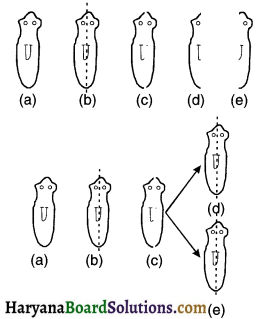
HBSE 10th Class Science Important Questions Chapter 9 Heredity and Evolution 1

3. Each of these organisms in turn may give birth to two individuals in the next i.e. first generation. So, there are in total four organisms in the second generation.

4. As can be seen, each of the four individuals in the bottom row is somewhat different from each other. Each one has

  • The common body design inherited from its previous generation along with
  • Some unique differences of its own. So, each organism although similar, is not the exact copy and hence shows variation.

5. Since this is an example of asexual reproduction, the differences are very minor. In case of sexual reproduction, the changes would be much diversed.

HBSE 10th Class Science Important Questions Chapter 9 Heredity and Evolution

Question 4.
What is the most obvious outcome of reproduction? What do the rules of heredity determine?
Answer:
1. The most obvious outcome of reproductive process is that similar designs of individuals are maintained generation after generation.
2. The rules of heredity determine the process by which traits and characteristics get transferred from one generation to another.

Question 5.
Organisms undergo variation during reproduction. Do all these variations survive?
Answer:
1. Although organisms undergo variation, all the variations do not survive.
2. Depending upon the nature of variations, different individuals would gain different kinds of advantages from the variations.
3. An individual has to withstand several environmental effects and changes. So, organisms having variations which can adapt to the environment survive, others may not.

Question 6.
What do you mean by heredity? Explain.
Answer:
Heredity:
1. Heredity means the transmission of characters from parents to offspring. For example, eggs laid by a sparrow will hatch sparrow and not any other bird. Similarly, a dog gives birth only to pups.
2. Thus, in this sense, it can be said that heredity is continuity of features from one generation to another. This is the essence of heredity.
3. Hereditary information is present in the fertilized egg i.e. zygote.
4. The zygote develops into the same organism to which it belongs. And so the new organisms produced resemble their parents.

HBSE 10th Class Science Important Questions Chapter 9 Heredity and Evolution

Question 7.
Explain the following terms:
Answer:
1. Heredity: The transmission of parental traits to their offspring is called heredity. This transmission always follows certain principles or laws.
2. Genetics: The study of how inherited traits (or say heredity) are passed-on and the variations occurring therein is called genetics.
3. Trait: A trait is a particular characteristic, quality or tendency that someone or something has. For example, height, skin or eye colour, certain behaviour, etc.
4. Inherited trait: A feature or a characteristic of an organism that it has received in its genes from its parents is called an inherited trait.

Question 8.
Why there are two versions for each trait in each child?
Answer:
In a sexual reproduction, the father as well as the mother contributes equal amounts of genetic material to the child. This means that each trait that the child has can be influenced by the DNA of the father as well as mother. Thus, for each trait there will be two versions in each child.

Question 9.
What are the fundamental characteristics of inheritance of traits?
Answer:
The fundamental characteristics of inheritance of traits are as follows:
(i) A unit of inheritance is called as a gene. Each gene controls a character(s).
(ii) Genes have two alternative forms for each inherited trait.
(iii) From the two alternative traits, the trait which is expressed is known as a dominant trait whereas, the trait which is not expressed is known as a recessive trait.
(iv) From two alternative traits for an expression of a character, one trait may be dominant over the other.
(v) The dominant trait is represented by capital letter (Generally ‘T’) while the recessive trait is represented by the small letter (‘t’).
(vi) The unexpressed/recessive trait may be expressed in any future generation.
(vii) In sexual reproduction both the parents give equal amount of chromatin material/genetic material to make a zygote. So, each inherited trait is influenced by both the parents equally.

HBSE 10th Class Science Important Questions Chapter 9 Heredity and Evolution

Question 10.
Explain Mendel’s contribution through his study of inheritance of characteristics. OR In Mendel’s study, the ‘T’ gene is dominant while the ‘t’ gene is recessive. Explain in detail with an example. OR Explain Gregor Johann Mendel’s experiment showing inheritance of any one character.
Answer:
1. Mendel studied garden pea plants for the expression of a character. The character under study was the height of plants
2. He observed two contrasting expressions of height — tall plants and dwarf plants/short plants.
3. For the purpose of his study, Mendel took pure tall plants (TT) and pure short plants (tt).

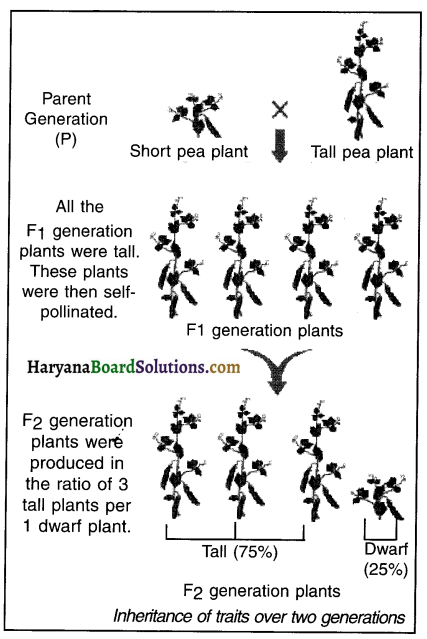
(i) Cross-pollination between parent (P) generation plants:
Mendel performed cross-pollination between TT — pure tall plants and tt — pure short plants. These TT and ft are known as a parent (P) generation plants.
HBSE 10th Class Science Important Questions Chapter 9 Heredity and Evolution 2

Observation:
The plants that got produced from Parent (P) generation are known as First (F1 generation) plants. Mendel observed that all the plants of F1 generations were as tall as TT of P generation i.e. as tall as their parents. So, Mendel thought that only one parental trait i.e. of tallness (instead of both trait i.e. tallness and shortness) was inherited by the F1 generation plants.

(ii) Self-pollination of (a) Tall Parental Generation plants and (b) F1 generation plants:
In the second phase, Mendel performed self-pollination of
(a) Tall i.e. U Parental Generation plants and
(b) F1 generation plants.

Observation:
(a) The new plants produced by the self-pollination of Tall i.e. U Parental Generation plants were all tall.
(b) The new plants produced i.e. the second (F2) generation plants by the self-pollination of F1 generation plants were a mix of tall and short plants. Mendel observed that in F2 generation, around 75°/° of the plants were tall and 25% of the plants were short. This means the ratio of tall short plant in the F2 generation was 3:1.

Thus, in the second trial, Mendel concluded that in the first trial, the F1 generation plants had inherited both the traits i.e. the trait of tallness and dwarfism, from their parent (P) generation but, only the trait of tallness got expressed. However, when he self-pollinated the F1 generation plants, both the traits i.e. the trait of tallness and dwarfness could be seen in the F2 generation plants.

Question 11.
What did Mendel conclude from his experiment on pea plants?
Answer:
Mendel’s conclusion:
1. The contrasting characters (traits) i.e. tallness and shortness of the pea plant are determined by factors.
2. Two copies (i.e. in pairs) of such factors are present in sexually reproducing organism and they are known as a ‘gene’.
3. These two may be identical, or may be different, depending on the parentage.
4. When individuals having contrasting features are crossed, the feature which gets expressed is known as a dominant feature (trait) and the one that does not get expressed is known as a recessive feature (trait).
5. Tall plants are represented by ‘TT’ as well as ‘Tt’, but short plants are represented by ‘tt’. This means that presence of even single copy of‘T’ is enough to make a plant tall, but for a plant to be short, both the copies have to be ‘t’. Hence, T is called a dominant trait whereas ‘t’ is called a recessive trait.

HBSE 10th Class Science Important Questions Chapter 9 Heredity and Evolution

Question 12.
Explain Mendel’s experiment on inheritance of two characters simultaneously. OR Explain Mendel’s experiment with different seeds. OR Explain the inheritance of seed colour and shape of the seed of pea plant Pisum Sativum.
Answer:
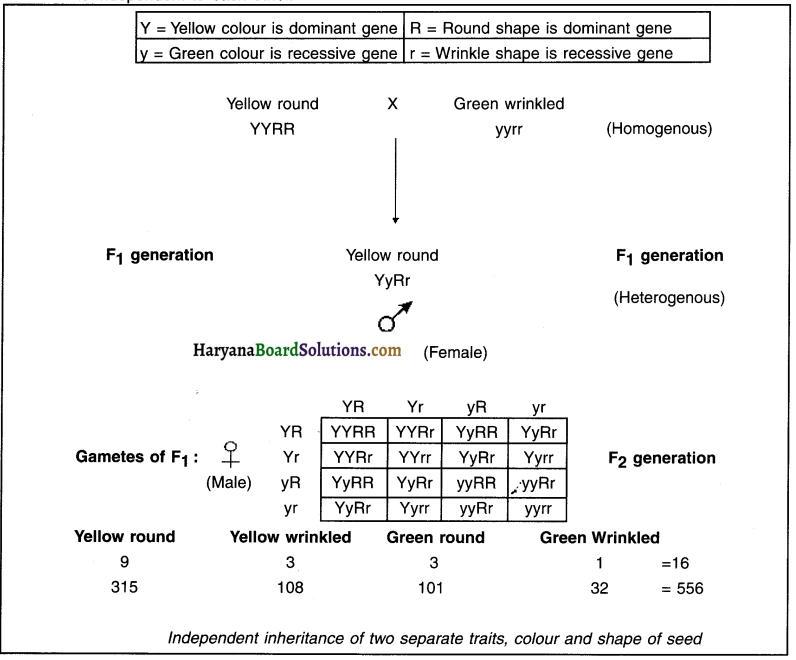
1. Mendel performed an experiment to study garden pea plants having two different characters. The two characters that the pea plant had were –

  • Colour of the seeds and
  • Shape of the seeds

2. Mendel wanted to study how the traits express themselves when the plants contain two characters as mentioned above rather than one.
At first, Mendel selected the following two pure breeding pea plants:
(a) Plants with yellow colour seed and round shape seeds.
(b) Plants with green colour seed and wrinkled shape seeds.

  • He considered these plants as parent plants.
  • Mendel performed cross-pollination between both these parent plants and obtained the F1 generation.

1. Observation of F1 generation plants:

  • All the plants of F1 generation had yellow coloured seeds having round shape.
  • This means that ‘yellow colour’ and ‘round seeds’ were dominating characteristics (traits) in the F1 generation.
  • In the second trial, he performed self-pollination between the F1 plants to obtain F2 generation.

HBSE 10th Class Science Important Questions Chapter 9 Heredity and Evolution

2. Observation of F2 generation plants:
Mendel obtained four different types of F2 generation plants as mentioned below:
(a) Yellow and round seed plants
(b) Yellow and wrinkled seed plants
(c) Green and round seed plants
(d) Green and wrinkled seed plants

This indicates that characteristics (traits) of colour yellow and green and characteristics (traits) of shape round and wrinkled are inherited independently from each other.

The ratio in which Mendel obtained the plants was —

  • (Yellow round) : (Green round) : (Yellow wrinkled) : (Green wrinkled) = 9 : 3 : 3 : 1
  • The results obtained in F2 generation clearly indicate that the inheritance of two different characters is independent to each other.
HBSE 10th Class Science Important Questions Chapter 9 Heredity and Evolution 3

Question 13.
How does the mechanism of heredity work in terms of genes control?
Answer
1. The DNA found in the cells is the fundamental source of genetic information for making specific proteins in the cell.
2. In general, a segment of DNA which provides information to synthesize protein is known as a gene.
3. In plants as well as organisms, the characters (traits) get expressed due to specific reactions. These reactions take place with the help of enzymes.
4. The enzymes as well as several hormones are made up of proteins.
5. So, when a specific gene undertakes synthesis of a specific protein it results in expression of a specific character.

Example:
1. Let us consider height (tallness) as a characteristic of a plant.
2. Plants have hormones that trigger growth. This means height of plants depend upon the amount of a particular harmone.
3. A particular type of enzyme works as a catalyst for this hormone. And the synthesis of this enzyme is regulated by gene located on the DNA.
4. Thus, if the enzyme is synthesized in required amount and if it works efficiently, a lot of quality hormone can be produced which will then boost the height of the plant.
5. However, it the gene has altered due to some reason, the enzyme will become less efficient.
6. This will result in less amount of hormone in the plant and hence it will be of dwarf size.
7. From this example, it can be clearly said that genes control the characteristics or traits.

HBSE 10th Class Science Important Questions Chapter 9 Heredity and Evolution

Question 14.
Describe sex determination in human beings in detail.
Answer:
Sex determination:
1. In sexual reproduction, the mechanism to determine the sex of an organism is known as sex determination.
2. In human beings, the sex is determined by genes located on the chromosomes.
3. These genes are inherited by the offspring from their parents.
4. In humans, each cell contains 23 pairs of chromosomes.
5. Out of these, 22 pairs are autosomes and one pair is of sex chromosomes.
6. These 22 pairs of autosomes are same in males as well as females. Only the 23 pair differs.
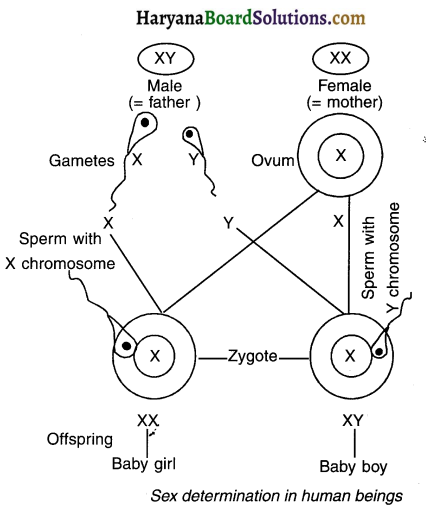
7. In females, the 23 pair contains two similar ‘X’ sex chromosomes i.e. the 23 pair is ‘XX’.
8. In males, the 23rd pair contains one ‘X’ sex chromosome and one ‘Y’ sex chromosome i.e. the 23’’ pair is ‘XV’. The ‘Y’ sex chromosome is smaller than the ‘X’ sex chromosome.
9. Out of all the sperms, 50% sperms contain ‘X’ chromosome while the other 50% sperms contain ‘Y’ chromosome.
HBSE 10th Class Science Important Questions Chapter 9 Heredity and Evolution 4

Sex of the foetus:
1. If a sperm carrying ‘X’ chromosome fuses with the ‘X’ chromosome of female egg i.e. if ‘XX’ combination occurs, female will be produced.
2. However, if a sperm carrying ‘Y’ chromosome fuses with the ‘X’ chromosome of female egg, i.e. if ‘XY’ combination occurs, male will be produced.
3. Since male sperm carries both ‘X’ and ‘Y’ chromosomes and female carries only ‘X’ and ‘X’ chromosomes, males are responsible for the sex of the child born.
4. When zygote is formed and the embryo starts developing, the gonads (organs that produce sex cells) are undifferentiated.
5. Later, the gonads develop either into testes or ovaries.
6. If the zygote contains the Y sex chromosomes, the gonad differentiates into testes.
7. These testes then produce male sex hormones and stimulate development of a male individual.
8. Similar process takes place if the zygote contains only ‘X’ chromosome.

Question 15.
What are sex chromosomes? Which sex chromosomes are found in male and female human beings? State the chromosome responsible for the development of male child in human beings.
Answer:
1.The chromosomes that determine the sex of the new born baby are called sex chromosomes. X chromosome and Y chromosome together form the pair of sex chromosomes in male human beings. Thus, the male contains XV sex chromosomes.
2. In female, both the sex chromosomes are X. So, the female sex chromosomes are called XX.
3. A male child can take birth only when the zygote receives Y chromosome from the male human being.

HBSE 10th Class Science Important Questions Chapter 9 Heredity and Evolution

Question 16.
Every organism resembles its parents. Give reason.
Answer:
1. When male and female sex cells fertilize, zygote is formed.
2. Zygote develops into an organism.
3. Zygote contains heredity information from the parents.
4. This information is passed on to the next generations.
5. Hence, every organism will resemble its parents.

Question 17.
What is natural selection? Explain.
Answer:
1. Natural selection is a central concept of evolution. In general terms it is also called ‘survival of the fittest’.
2. Natural selection can be considered as the one ‘selected by nature’.
3. When organisms develop certain favourable traits i.e. the traits that are more suited for nature to select, the organisms survive and hence reproduce. These organisms then pass their traits to the next generation.
4. Over time this process allows organisms to adapt to their environment. The organisms better adapted to their environment tend to survive and produce more offspring.

Question 18.
Give an example of beetles to understand the concept of natural selection.
Answer:
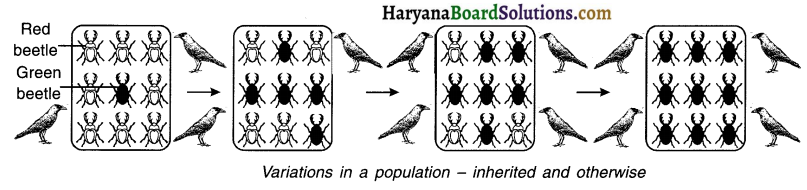
1. Consider a group of 12 red beetles. They live in bushes mat have green leaves.
2. The population of beetles will grow by sexual reproduction and so every generation produced will show variations.
3. Let us consider that crows feed on these beetles. The more beetles the crows eat, the fewer beetles will remain for reproduction.
4. Now, suppose, a colour variation arises during reproduction. Under this, one of the beetle reproduced attains ‘green colour’ instead of red.
HBSE 10th Class Science Important Questions Chapter 9 Heredity and Evolution 5
5. When this green coloured beetle undergoes reproduction, it passes this green colour to its progeny. So, all the new beetles reproduced from this green coloured beetle are green.
6. Because green-coloured beetles get merged with green leaves, now the crows cannot see green coloured beetles on the green leaves and therefore cannot eat them. As a result, the green beetles do not get eaten, while the red beetles continue to be eaten.
7. In conclusion, the population of green beetles increase whereas that of red beetles decline drastically.
8. Here, the beetles that adapted the green colour became more suited to nature and so got ‘selected by nature (i.e. natural selection)’ for remaining alive.

HBSE 10th Class Science Important Questions Chapter 9 Heredity and Evolution

Question 19.
Give an example of beetles to understand the concept of genetic drift.
Answer:
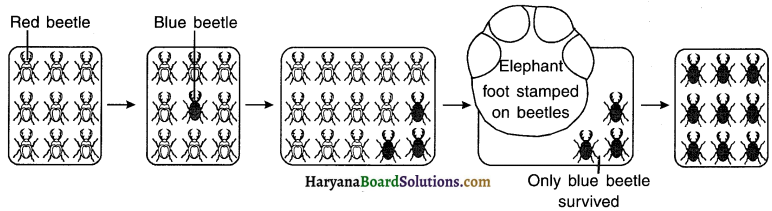
1. Consider a group of 12 red beetles. They live in bushes that have green leaves.

2. The population of beetles will grow by sexual reproduction and so every generation produced will show variations.

3. A colour variation arises during reproduction and few of the new beetles born are of blue colour
instead of red. The blue beetle can pass the colour on to its progeny, so that all its progeny beetles are blue.

4. Crows living in the bush feed on the beetles. They can see both red as well as blue beetles and thereiore can eat both the varieties.

5. Initially, in the population, most of the beetles are of red coloured and only few are blue. At this point, a sudden and an unexpected change takes place. An elephant comes and stamps on the bushes where the beetles live.

6. By chance, the stamping of elephant kills mostly red beetles. The few beetles that have survived are mostly blue.

7. Now, the beetle population again slowly expands, but the beetles in the population are mostly blue.

8. Here, the change in colour as a variation seen in the beetles did not increase their chance of survival, the way it happened when the beetles adopted a green colour. The blue coloured beetle survived simply by chance because the elephant foot got stamped on the red beetles and not the blue.

9. From this we conclude that accidents in small populations can change the frequency of some genes in a population, even if they give no survival advantage This concept is called genetic drift. Genetic drift resulted in variation but did not give any advantage of adaptation to the beetles.
HBSE 10th Class Science Important Questions Chapter 9 Heredity and Evolution 6

Question 20.
What is genetic drift? Explain.
Answer:
Genetic drift:
The sudden and random change in the gene frequency that occurs by chance in a small population is known as genetic drift.’

Explanation:
1. When a large group of population migrates or dies due to natural calamity, certain traits get eliminated from the population.
2. As a result, in the remaining population the gene frequency is altered. So, in the next progenies some different kind of variations arise.
3. At times due to genetic drift, the population may get free of some unfavourable character and at times, it is also possible that some important character is lost.

Importance:
1. Genetic drift influences evolution.
2. It is possible that the population becomes different because there is a probability that each population may fix a different genotype.

HBSE 10th Class Science Important Questions Chapter 9 Heredity and Evolution

Question 21.
What is evolution? Explain.
Answer:
Evolution:
1. Evolution is a type of gradual formation of new plants or organisms from the pre-existing primitive plants or animals respectively by Constant and relatively long time changes.
2. The word ‘evolution’ has been derived from Latin word ‘evolvere’ which means to untold’ or ‘unroll’.
3. Evolution is the sequence of gradual changes, which have taken place over millions of years in primitive plants and animals from which new species are formed.
4. Evolution is a constant process taking place in the organisms since life originated. In fact, all the varieties of organisms, which we see around us. have evolved from some ancestors that lived on this earth long time ago.

Question 22.
Explain acquired and Inherited traits (characteristics).
Answer:
(A) Acquired traits:
1. Acquired trait means a trait or characteristic of an organism that it has not inherited but has developed in response to the environment.
2. For example, if an organism starves for sometime and reduces its weight, then it ¡s called acquired trait.
3. The reduced weight due to starvation will not change DNA of the cells.
4. As a result, reduced weight is not a trait, which can be. inherited by future generations of organisms that will starve.
5. Other examples are cut tail of a mouse, a man who knows how to swim, or speak German or roller skate, or may have a scar on the face due to accident. None of these traits will be passed on to the future generations because these traits have not altered the genes of the organisms.
6. Thus, the changes in the non-reproductive body cells of an organism cannot be transmitted to its progeny.
7. Only those traits will be inherited to their progeny where in change has occurred in the genes in gametes of organisms during the process of reproduction.

(B) Inherited trait :
1. A trait of an organism, which is caused by a change in its DNA, is known as inherited trait.
2. For example, suppose a population of red beetles is living in bushes with green leaves.
3. Suppose a colour variation arises during reproduction in the gene of reproductive cells and one green colour beetle arises instead of red.
4. Here, the colour of this beetle is an inherited trait, which can be transmitted to the next generations.

Question 23.
Explain the terms: (a) Variations (b) Acquired variations.
(a) Variations:

  • Any difference that occurs between cells, individual organisms, or groups of organisms of any species either by genetic differences or by the effect of environmental factors on the expression of the genetic potential is called variation.
  • Organisms may show variation in their physical appearance, metabolism, rate of fertility, mode of reproduction, behaviour, etc.

(b) Acquired variations :

  • An acquired characteristic (variation) is a change which is acquired not due to heredity but due to response to the environmental factors.
  • Acquired variation may occur in the function or structure of an organism caused after birth due to reasons such as disease, Injury, accident, repeated use or misuse, or other environmental factors.
  • Acquired variations are limited to the organism that acquires the variation. Such variations than vanish and with the death of that organism and hence do not get inherited.

HBSE 10th Class Science Important Questions Chapter 9 Heredity and Evolution

Question 24.
Differentiate between acquired and inherited traits.
Answer:

Acquired traitsInherited traits
1. It is a trait of an organism that is not inherited but developed in response to the environment.
2. These changes do not occur in the genes of gametes of the organism.
3. These changes are considered as changes in the non-reproductive body cells.
4. Cut tail of a rat expertise to play a game etc. are acquired characteristics.
1. It is a trait of an organism, which is caused by a change in its DNA.
2. These changes occur in the genes of the gametes of the organisms.
3. These changes are considered to be changes in the reproductive body cells.
4. Colour of eyes, skin, facial characteristics, etc. are hereditary characteristics.

Question 25.
What is speciation? Explain.
Answer:
Speciation: The process of evolution of new species that occurs when members of similar population no longer interbreed to produce fertile off spring is known as speciation.

Speciation due to geographical isolation:
1. Suppose due to some reason the population of a given species gets divided into two groups.
2. These groups then get separated from each other geographically by certain barriers like rivers, seas, mountain ranges, or even natural calamities.
3. This means these two groups got geographically isolated and they will not be able to interbreed and hence exchange genes.
4. Over a period, both groups might adapt to its environment through natural selection and develop their gene pool.
5. Eventually, the gene pools of both populations might become so different that the new species of these organisms would evolve in different populations.
6. Thus, due to process of random change in gene frequency (gene drift), after thousands of years individuals become so different that they cannot reproduce with each other and so new species are formed.
7. Thus, geographical isolation leads to reproductive isolation due to which there is no gene flow between two separated groups of population.
8. Thus, we may get completely new species of population.

Other reasons of speciation:
Other reasons can be changes in DNA, change in number of chromosomes, gene cells of two isolated groups of populations, which cannot fuse with each other, etc.

Question 26.
How are organisms classified? OR What do you mean by characteristics as the base of classification? Explain.
Answer:
1. When we classify organisms by grouping them in certain way, it helps us to study them properly.
2. One of the basic methods of classifying the organisms is on the basis of similarities they possess.
3. For classifying we will have to decide which characteristics show ‘fundamental differences’ or say important differences and which show ‘basic differences’ or say less important differences.

Characteristics as a base of classification:

1. A characteristic means a particular type of appearance (form) or behaviour (function).
2. We humans have four limbs (two hands and two legs) and it is our appearance characteristic.
3. Plants perform photosynthesis is a behaviour (function) characteristic.
4. Some basic characteristics are shared by most organisms. For example, cell is the basic unit of life in all organisms. However, the characteristics of the next level of classification would be shared by most, but not all organisms.
5. At cell level, the classification could be whether the cell has a nucleus or not.
For example, cells – of bacteria do not have nucleus, while the cells of most other organisms do.
6. Further, organisms that have nucleus in their cells can be classified as uni-cellular or multi-cellular.
7. Among multi-cellular organisms, classification can be done as whether they undergo photosynthesis or not.
8. The multi-cellular organisms that do not undergo photosynthesis can be further classified as,whether the skeleton is inside the body or around the body.
9. By classifying in this manner we can develop a hierarchy of organisms.

HBSE 10th Class Science Important Questions Chapter 9 Heredity and Evolution

Question 27.
Giving an example of humans to explain what increases the probability of two species having a common ancestor.
Answer:
The more characteristics two species will have in common, the more closely they will be related. And the more closely they are related, the more are the chances of them being having a recent common ancestor.
Example:
A brother and a sister are closely related. They have common ancestors in the first generation before them, namely, their parents. Now, the girl and her first cousin are also related, but less than the girl and her brother. The reason for this is that although cousins have common ancestors i.e. their grandparents, in the second generation but the parents of these two cousins are different. So, the cousins are less related.

Question 28.
It is believed that non-living material must have given rise to life. How can one say this?
Answer:
1. If we keep on forming small groups of species with recent common ancestors, then eventually we can reach at a stage of forming super-groups of these groups with more distant common ancestors, and so on.
2. Theoretically, if we keep going backwards like this we may reach to a notion that originally there were a single species at the very beginning of evolutionary time.
3. If that is the case, then at some point in the history of the earth, non-living material must have given rise to life.

Question 29.
How did life originate on earth?
Answer:
It is believed that life must have developed from simple inorganic molecules which were present on earth soon after it was formed.
2. It was also speculated that the conditions on earth at that time could have given rise to more complex organic molecules that were necessary for life.
3. It is believed that the first primitive organisms would have arisen from further chemical synthesis.

Question 30.
What do you mean by evidences of evolution? In what way homologous organs and analogous organs give evidence for evolution?
Answer:
Evidence for evolution: Certain significant sources which provide proofs for evolution are called evidences for evolution.

The main ones are:
(1) Evidences through homologous organs,
(2) Evidence through analogous organs and
(3) Evidence through fossils

(1) Evidences through homologous organs:

  • Those organs that have same internal structure but different functions are called homologous organs.
  • For example, the basic design of internal structure of bones of forelimbs of a frog, lizard, bird, bat and man is same, even though these organs perform different functions.
  • This indicates that all these forelimbs have evolved from a common ancestral animal, which had a same basic internal structure.

(2) Analogous organs:

  • Those organs, which have different designs but similar appearance and carry out similar functions are called analogous organs.
  • For example, wings of insects and birds have different structures but perform similar functions.
  • Thus, the presence of analogous organs in different animals provide evidence that they are not evolved from common ancestors, still they perform similar functions to survive prevailing environment.

Question 31.
Differentiate between homologous organs and analogous organs.
Answer:
1. When we classify organisms by grouping them in certain way, it helps us to study them properly.
2. One of the basic methods of classifying the organisms is on the basis of similarities they possess.
3. For classifying we will have to decide which characteristics show fundamental differences’ or say important differences and which show basic differences’ or say less important differences.

Characteristics as a base of classification:
1. A characteristic means a particular type of appearance (form) or behaviour (function).
2. We humans have four limbs (two hands and two legs) and it Is our appearance characteristic.
3. Plants perform photosynthesis is a behaviour (function) characteristic.
4. Some basic characteristics are shared by most organisms. For example, cell is the basic unit of life in all organisms. However, the characteristics of the next level of classification would be shared by most, but not all organisms.
5. At cell level, the classification could be whether the cell has a nucleus or not. For example, cells
of bacteria do not have nucleus, while the cells of most other organisms do.
6. Further, organisms that have nucleus in their cells can be classified as uni-cellular or multi-cellular.
7. Among multi-cellular organisms, classification can be done as whether they undergo photosynthesis or not.
8. The multi-cellular organisms that do not undergo photosynthesis can be further classified as, whether the skeleton Is Inside the body or around the body.
9. By classifying in this manner we can develop a hierarchy of organisms.

HBSE 10th Class Science Important Questions Chapter 9 Heredity and Evolution

Question 27.
Giving an example of humans to explain what increases the probability of two species having a common ancestor.
Answer:
The more characteristics two species will have in common, the more closely they will be related. And the more closely they are related, the more are the chances of them being having a recent common ancestor.
Example:
1. A brother and a sister are closely related. They have common ancestors in the first generation before them, namely, their parents.
2. Now, the girl and her first cousin are also related, but less than the girl and her brother. The reason for this is that although cousins have common ancestors i.e. their grandparents, in the second generation but the parents of these two cousins are different. So, the cousins are less related.

Question 28.
It is believed that non-living material must have given rise to life. How can one say this?
Answer:
1. It we keep on forming small groups of species with recent common ancestors, then eventually we can reach at a stage of forming super-groups of these groups with more distant common ancestors, and so on.
2. Theoretically, if we keep going backwards like this we may reach to a notion that originally there were a single species at the very beginning of evolutionary time.
3. It that is the case, then at some point in the history of the earth, non-living material must have given rise to life.

Question 29.
How did life originate on earth?
Answer:
1. It is believed that life must have developed from simple inorganic molecules which were present on earth soon after it was formed.
2. It was also speculated that the conditions on earth at that time could have given rise to more
complex organic molecules that were necessary for life.
3. It is believed that the first primitive organisms would have arisen from further chemical synthesis.

Question 30.
What do you mean by evidences of evolution? in what way homologous organs and analogous organs give evidence for evolution?
Answer:
Evidence for evolution: Certain significant sources which provide proofs for evolution are called evidences for evolution.
The main ones are:
(1) Evidences through homologous organs
(2) Evidence through analogous organs and
(3) Evidence through fossils

(1) Evidence.s through homologous organs:

  • Those organs that have saine internal structure but iterent functions are called homologous organs.
  • For example, the basic design of internal structure of bones of forel,mbs of a frog, lizard, bird, bat and man is same. even though these organs perform different functions.
  • This Nidicates that all these forelimbs have evolved from a common ancestral animal, which had a same basic internal structure.

(2) Analogous organs:

  • Those organs, which have different designs but similar appearance and carry out similar functions are called analogous organs
  • For example, wings of insects and birds have different structures but perform similar functions
  • Thus, the presence of analogous organs in different animals provide evidence that they are not evolved from common ancestors still they perform similar functions to survive prevailing environment.

HBSE 10th Class Science Important Questions Chapter 9 Heredity and Evolution

Question 31.
Differentiate between homologous organs and analogous organs.
Answer:

Homologous organsAnalogous organs
1. These organs have similar internal structure.
2. These organs perform different functions.
3. These organs have evolved from a common ancestor.
4. For example, forelimbs of a frog, lizard, a bird, bat and a man are homologous
1. These organs have different basic design.
2. These organs perform similar functions.
3. These organs have not evolved from a common ancestor.
4. Wings of insects and birds are examples of analogous organs.

Question 32.
What are fossils? How do they provide evidence for evolution? OR What are fossils?
Answer:
1. The remains of dead organisms buried under the earth for millions of years are known as fossils.
2. Fossils are impressions of dead plants or animals that lived in the past.
3. When plants or animals die, the micro-organisms get decomposed in the presence of moisture and oxygen.
4. However, sometimes due to environmental conditions, their bodies do not decompose completely.
5. Such body parts of the plants and animals become fossil and can be available on digging the earth.
6. Fossils can be in the form of imprints, burrow of a worm, or even an actual bone.

Example:

  • If the dead leaf gets caught in the mud, leaf will not decompose completely.
  • The mud around the leaf will set around it as a mould which will then slowly become hard to form a rock and retain the impression of the leaf. Thus fossil of a leaf is formed.
  • By studying these fossils, scientists learn how organisms evolved over time.

Question 33.
Describe any three methods of tracing evolutionary relationships among organisms.
Answer:
Evidence for evolution: Certain significant sources which provide proofs for evolution are called evidences for evolution.
The main ones are:
(1) Evidences through homologous organs
(2) Evidence through analogous organs and
(3) Evidence through fossils

(1) Evidences through homologous organs:

  • Those organs that have saine internal structure but different functions are called homologous organs.
  • For example, the basic design of internal structure of bones of forel,mbs of a frog, lizard, bird, bat and man is same. even though these organs perform different functions.
  • This Nidicates that all these forelimbs have evolved from a common ancestral animal, which had a same basic internal structure.

(2) Analogous organs:

  • Those organs, which have different designs but similar appearance and carry out similar functions are called analogous organs
  • For example, wings of insects and birds have different structures but perform similar functions
  • Thus, the presence of analogous organs in different animals provide evidence that they are not evolved from common ancestors still they perform similar functions to survive prevailing environment.

1. The remains of dead organisms buried under the earth for millions of years are known as fossils.
2. Fossils are impressions of dead plants or animals that lived in the past.
3. When plants or animals die, the micro-organisms get decomposed in the presence of moisture and oxygen.
4. However, sometimes due to environmental conditions, their bodies do not decompose completely.
5. Such body parts of the plants and animals become fossil and can be available on digging the earth.
6. Fossils can be in the form of imprints, burrow of a worm, or even an actual bone.

Example:

  • If the dead leaf gets caught in the mud, leaf will not decompose completely.
  • The mud around the leaf will set around it as a mould which will then slowly become hard to form a rock and retain the impression of the leaf. Thus fossil of a leaf is formed.
  • By studying these fossils, scientists learn how organisms evolved over time.

HBSE 10th Class Science Important Questions Chapter 9 Heredity and Evolution

Question 34.
Mention three important features of fossils which help in the study of evolution.
Answer:
(i) Fossils represent how the ancient species were preserved.
(ii) Fossils help in establishing evolutionary relationship between organisms and their ancestors.
(iii) Fossils help in knowing the time period in which organisms lived.

Question 35.
How can you say that eyes evolved in stages?
Answer:
1. The eye is an important organ for animals.
2. It is a complicated organ which cannot be generated by a single DNA change.
3. The eyes of animals have been created in stages after many generations.
4. First of all, eye was formed in planaria (flat-worm).
5. The eyes of planaria are very simple and are just like ‘eyes-spots’ which detect light.
6. These simple eyes provide a survival advantage to planaria.
7. Thus eye seems to be a very popular adaptation. Gradually, it becomes a complex organ.
8. Most of the animals like insects, octopus, invertebrates and vertebrates have eyes.
9. The structure of eye in above organisms is different which suggests the evolution of eye and is an example of evolution taken place stages.

Question 36.
How can you say that birds are very close to reptiles? OR Give reason. Birds are closely related to reptiles.
Answer:
1. In some dinosaurs, feathers could not be used for flying but provided insulation in cold weather. But, later they might have become useful for flight. Birds however later adapted to flights.
2. Thus, presence of feathers in the birds tells us that birds are quite closely related to reptiles, since dinosaurs which had feathers were reptiles.

Question 37.
Explain how wild cabbage has evolved over the years. OR Explain evolution by stages of analogous organs with the help of artificial section of evolution method.
Answer:
1. As per the definition of analogous organs, the organs that have different basic design but similar appearance and carry out similar functions are called analogous organs.
2. From this concept, it is said that very dissimilar looking structures evolved from common ancestral body design. But all these guesses are about history, which is very old.
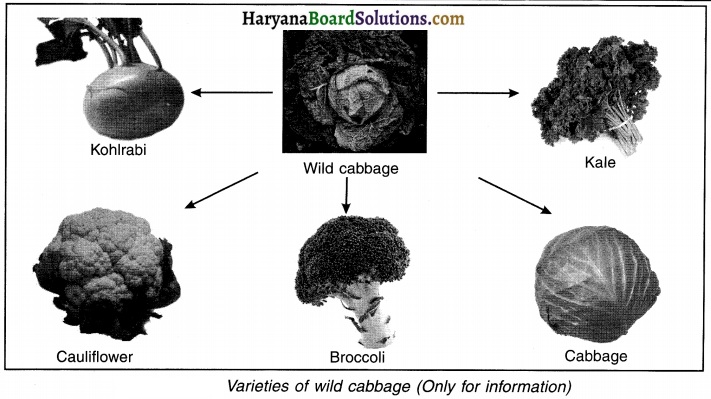
3. A present day example to prove this concept can be of wild cabbage.
4. If we study cabbage, we can learn that cabbage provides evidence that a completely dissimilar ‘ looking plant can evolve from it by the process of evolution.
5. Before more than 2000 years, the farmers cultivated wild cabbage as food plant.
6. With the passage of time, farmers gave various modifications to it.
7. Some farmers obtained broccoli (a kind of vegetable) while others obtained sterile flowers and developed cauliflower.
8. Some other farmers selected swollen parts of wild cabbage and developed another variety known as kohlrabi.
9. Some farmers have developed slightly large leaves of wild cabbage and their leafy vegetable is called kale.
10. Thus, now wild cabbage is the ancestor of cabbage, broccoli, cauliflower, kohlrabi and kale varieties, which are obtained by farmers by performing artificial selection. Moreover, all these varieties look different from their ancestor i.e. wild cabbage.
HBSE 10th Class Science Important Questions Chapter 9 Heredity and Evolution 7

Question 38.
It is incorrect to consider evolution as progress. Explain.
Answer:
1. Actually, no real ‘progress’ has taken place in the idea of evolution.
2. Evolution is simply the generation of diversity and the shaping of the diversity by environmental selection.
3. The only progressive trend that is seen in evolution is that with time more and more complex body designs have emerged. This does not mean that the older designs were inefficient. Many older and simpler designs still survive.
4. One of the simplest life forms bacteria still inhabit the most inhospitable habitats like hot springs, deep-sea thermal vents and the ice in Antarctica.
5. Hence, it is incorrect to consider evolution as progress.

HBSE 10th Class Science Important Questions Chapter 9 Heredity and Evolution

Question 39.
How can you say that humans have not evolved from different races and that they all belonged to only one region of the world?
Answer:
1. Across the earth, there is a great diversity in humans.
2. For quite a long time, man thought about different races of human.
3. Initially, human race was identified on the basis of skin colour and the humans were known as yellow, black, white or brown.
4. However, in the recent years, it has been proved that all the human beings have evolved from a single species called the Homo sapiens.
5. By research, it has been established that we all have emerged from Africa.
6. Our genetic foot prints can be traced back to Africa.
7. A couple of hundred thousand years ago, some of our ancestors left Africa while others stayed back.
8. Those who left Africa slowly spread over the planet from Africa to West Asia to Central Asia, Eurasia, South Asia and East Asia.
9. Humans also migrated to islandsof Indonesia and Philippines, Australia and reached America.
10. They went with groups, sometimes separating from each other and mixing with each other, even moving in and out of Africa.
11. Thus, humans have all evolved from Homo sapiens and initially belonged to Africa.

Question 40.
Differentiate between dominant trait and recessive trait.
Answer:

Dominant traitRecessive trait
These traits can be seen in F1 generation.
Dominant trait is found in F1 as well as F2 generation in larger quantities.
F1 generation is a cross of two plants with different traits.
These traits cannot be seen in F1 generation.
Recessive trait is found in F2 generation, that too in lesser quantity.
F2 generation is a self-pollination of F1 generation.

Question 41.
Give the pair of contrasting traits of the following characters in pea plant and mention which is dominant and which recessive.
(i) Yellow seed
(ii) Round seed
Answer:

CharacterContrasting traits
DominantRecessive
(i)  Seed colour
(ii)   Seed type
yellow
round
green
wrinkled

Question 42.
Why did Mendel choose pea plant for his experiments? OR Mendel selected pea plant (Pisum sativum) for his experiments to study inheritance. Give reason.
Answer:
1. Pea plants are very small and so it is quite easy to manage them. Also, they grow easily.
2. They produce a large number of progeny and so the characters they show can be studied more accurately on a larger scale.
3. Pea plants have both male and female reproductive organs. As a result, they can either self-pollinate themselves or cross-pollinate with another plant. This helps in understanding the traits properly.
4. Pea plants have sharply defined and contrasting traits such as height (tall, dwarf), seed colour (yellow, green), etc.
5. They are annual plants. So, every year, one can obtain a new generation plant.
6. These characteristics of the pea plant make it quite favourable for performing research. Hence, Mendel choose this plant.

HBSE 10th Class Science Important Questions Chapter 9 Heredity and Evolution

Question 43.
Males are responsible for the sex of the child produced. Give reason.
Answer:
1. Sex of the child is determined by the sex chromosomes that its zygote contains.
2. If the zygote contains ‘Y’ sex chromosome over and above ‘X’ chromosome, it will turn into male and if both sex chromosomes are ‘X’, the child born will be a female.
3. A female sex cell contains ‘XX’ sex chromosome whereas a male contains ‘XY’ chromosome.
4. Thus, a female can always donate ‘X’ chromosome but it is the male that can provide ‘Y’ chromosome to female ‘X’ chromosomes and produce a male.
5. However, if the male donates ‘X’ chromosome, a female will be born.
6. Thus, males and not females are responsible for the sex of the child produced.

Question 44.
Changes in the non-reproductive body cells of an organism cannot be transmitted to its progeny. Give reason.
Answer:
1. Only those traits will be inherited to their progeny wherein change has occurred in the genes in gametes of organisms during the process of reproduction.
2. For example, if an organism starves for some time and reduces its weight, then It is called acquired trait.
3. The reduced weight due to starvation will not change DNA of the cells.
4. As a result, reduced weight is not a trait, which can be inherited by future generations of organisms that will starve.
5. Thus, the changes in the non-reproductive body cells of an organism cannot be transmitted to its progeny

Question 45.
Does genetic combination of mothers play a significant role in determining the sex of a new born?
Answer:
1. The mothers have a pair of XX chromosomes. This means that all children whether boy or girl can inherit X-chromosome only from their mother.
2. Only males have XV chromosome. One of these two will be passed on to the offspring. So, whether the sex of the new born will be male or female can be decided only through the male chromosome. Hence, genetic combination of mothers does not play a significant role in determining sex of the new born.

Question 46.
Why do all the gametes formed in human females have only X-chromosome?
Answer:
The genetic making of the females is such that their sex chromosomes have only X chromosomes. This means both the chromosomes in the female germ cells have X chromosome. So, naturally, the gametes formed in human females have only X-chromosomes.

Question 47.
A woman has only daughters. Analyze the situation genetically and provide a suitable explanation.
Answer:
1. Man contains both X and Y chromosomes. This means males have XV chromosome. So, it is mans sex cells that determine the sex of the child born.

2. Women contain only XX chromosomes so she can contribute X chromosome only. A woman has only daughters. This indicates that in every fusion, the sperm of the male carrying X-chromosome got fertilized with the X chromosome of the female ovum. So, if a boy were to be born, the Y chromosome from male should have travelled and fertilized with X chromosome of the female.

HBSE 10th Class Science Important Questions Chapter 9 Heredity and Evolution

Question 48.
Why reduction in weight of beetle bug cannot be considered as an inherited trait?
Answer:
1. The weight of the beetle bug got reduced because of starvation. It did not change the DNA of the germ (sex) cells. Change in non-reproductive tissues cannot be passed on to the DNA of the germ cells.

2. Since the DNA is not changed, the change i.e. low weight cannot be inherited by the progeny of a starving beetle.

3. Hence, even if some generations of beetles are low in weight because of starvation, it cannot be considered as an example of evolution because the change is not inherited over generations. When such scarcity of food gets over and the beetle get sufficient food the new beetles will be healthy.

Question 49.
‘Experience of an Individual during its lifetime cannot be passed on to its progeny and cannot direct evolution’ What do you mean by this statement? Explain giving example.
Answer:
Change in non-reproductive tissues cannot be passed on to the DNA of the germ cells. Hence the experiences of an individual during its lifetime can neither be passed on to its progeny nor can such experiences result in evolution.

Example:
1. If we breed a group of mice, all their progeny will have tails.
2. Suppose we remove the tails of each generation of these mice by surgery then it does not mean that the progeny is tailless.
3. Artificially removing the tail does not bring any change in the genes of the germ cells of the mice.
4. So, the cut-tall that a generation of mice experienced cannot become a trait to be passed on to the next generation.

Question 50.
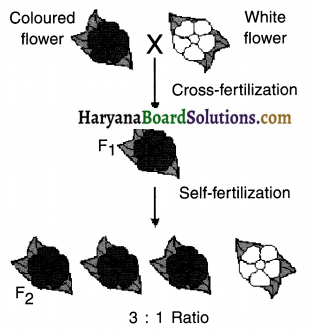
Work out which trait would be considered dominant and which one recessive in the given figure.
Answer:
Stage 1 (F1 generation):
When a cross occurs between a coloured flower plant and a white flower plant, the F1 generation plant produced has all the coloured flowers. This means ‘the coloured flowered trait’ is dominant over ‘white flowered trait’.

Stage 2 (F2 generation):
Although, the white flowered trait did not get expressed in F1 generation. it did get expressed in F2 generation. This means the ‘white flowered trait’ is the recessive trait.
HBSE 10th Class Science Important Questions Chapter 9 Heredity and Evolution 8

Question 51.
Sakhaaram, a poor farmer has 2 daughters. He feels that he should have a son who can help him in his farming work. So when his wife again gets pregnant, he tells her that this time she should not give birth to a girl again. If she does so, he will abandon her. So, she insists her to go for sonography and remove foetus it is found to be of a female.
Now, answer the following questions:

HBSE 10th Class Science Important Questions Chapter 9 Heredity and Evolution

Questions:
1. Who is the responsible for the sex of the children? — Sakhaaram or his wife?
2. ‘Owing to the poor condition of Sakhaaram, removing the female foetus is a good solution.’ State your comments.
3. Which sex chromosome of Sakhaaram did not do its job of giving birth to a male child in previous cases?
4. The village sarpanch advised Sakhaaram to accept the born child irrespective of the sex as it is God’s decision and also because that is the only legal way. Which values has Sarpanch shown?
Answers:
1. Sex of the child gets determined by the chromosome of the male parent. Hence, Sakhaaram is responsible for the sex of the children.
2. Removing female foetus is a crime. Sakhaaram can be jailed for doing so. Moreover, socially, such an act disturbs the sex-ratio.
3. Y-chromosome.
4. The Sarpanch has shown the values of morality, empathy towards Sakhaaram and care and concern towards his wife. Moreover, the Sarpanch also displayed the values of awareness towards the laws of our country.

Question 52.
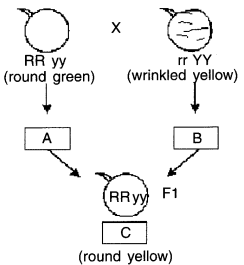
Given below is the experiment carried out by Mendel to study inheritance of two traits in garden pea:
(a) What do the letters A, B and C represent?
(b) State the objective for which Mendel performed this experiment.
Answer:
(a) A = gamete of round green (RY) plant
B = gamete of wrinkled (ry)
C = F1 generation (all round yellow)
HBSE 10th Class Science Important Questions Chapter 9 Heredity and Evolution 9

(b) Mendel’s objective was to show independent inheritance of traits or to prove law of independent assortment.

Question 53.
The legendary Milkha Singh, also known as ‘The Flying Sikh’ is the source of inspiration for millions of indians who aspire to become a great runner. However, Milkha’s son Jeev is a golfer and not a runner.
Now answer the following questions:

Questions:
1. Didn’t Jeev inherit the running skill from Milkha Singh? Why or why not?
2. Which type of traits is running?
Answers:
1. Skills such as running, swimming, acting, dancing, etc. cannot be inherited because such skills are acquired skills. Milkha Singh acquired it by extreme hard work and dedication. His son acquired the skills of golfing.
2. Running is an acquired skill. It can be acquired by putting dedicated and planned effort in the field of one’s choice.

Question 54.
Explain whether the traits like eye colour or height are genically Inherited or not. Do power to lift weight and reading French also belong to same category? Justify your answer.
Answer:
(a) Colour of eye and height are genetically inherited.
Reason:
Traits such as colour of eye and height cannot be changed or acquired during a life because they are controlled by the genes which an individual inherits from the parents.

(b) Power to lift weight and reading French can be acquired during life time.
Reason:
1. These traits are achieved by an individual by experience and practice. Hence, these are acquired characters.
2. These acquired characters do not change DNA of germ cells and so they cannot be inherited or passed to the next generation.

HBSE 10th Class Science Important Questions Chapter 9 Heredity and Evolution

Question 55.
Which of the following traits cannot be passed on the progeny? Justify your answer.
(i) Rudimentary eyes of planaria.
(ii) Absence of tail in a mouse (after surgical removal)
(iii) Low weight of a starving beetle.
Answer:
(i) Trait number
(ii) Absence of tail in a mouse (after surgical removal) and
(iii) Low weight of a starving beetle cannot be passed on the progeny.

Reason:
These traits are present in non-reproductive tissues. So, they do not change the DNA of the germ cells.

Very Short Answer Type Questions 

Question 1.
Define heredity.
Answer:
The process of transmission of characters from parents to the offspring is known as heredity.

Question 2.
Define genetics
Answer:
The branch of science which deals with heredity and variation is known as genetics

Question 3.
In a sexual reproduction, offspring is similar to the characteristics of parents however it is not identical to the parents. Justify this statement.
Answer:
Inheritance from previous generation includes carrying forward the basic body structure along with minor variations. Hence It is rightly said that though offspring is similar it is not identical to the parent.

Question 4.
Why would you say that asexual reproduction is not suitable for introducing variation in species?
Answer:
Asexual reproduction involves a single parent. The offspring produced has same set of chromosomes which exhibit little or no variation. Hence asexual reproduction is not suitable for introducing variation in species.

Question 5.
How can we say that variation In species Increases the probability of survival?
Answer:
Variation improves the adaptability of the species according to the climatic conditions. This increases the chances of survival.

Question 6.
State the types of earlobes that can be seen in humans.
Answer:
We can see two types of earlobes in humans. They are —
(i) Attached earlobes Le, earlobes which are attached to the side of the head.
(ii) Free earlobes i.e. earlobes which seem hanging and hence unattached to the side of the head.

Question 7.
Point out a variation that has been observed in human beings.
Answer:
Free or attached earlobes is a variation that can be observed in human beings.

HBSE 10th Class Science Important Questions Chapter 9 Heredity and Evolution

Question 8.
What is meant by a pure plant (or pure line plant)?
Answer:
A breed or strain of animals or plants that maintains a high degree of consistency in certain characters as a result of inbreeding for generations is called a pure breed of plant or animal. Such a plant of animal maintains homozygous for all genes.

Question 9.
Who is considered as a ‘father of genetics’?
Answer:
Gregor Johann Mendel is considered as a ‘father of Genetics’.

Question 10.
What is the contribution of Gregor Johann Mendel?
Answer:
Gregor Johann Mendel established Mendelian Inheritance Laws. He made major contributions in genetics.

Question 11.
Which term did Mendel use to describe genes?
Answer:
Mendel used the word ‘factor’ to describe genes.

Question 12.
Name the plant on which Mendel performed his experiments.
Answer:
Mendel performed experiments on Pisum Sativum (Garden pea)

Question 13.
What do you mean by dominant and recessive traits?
Answer:
While inheriting the traits from parent, the allele of a gene that masks the other variants is called as the dominant trait whereas the one that gets masked is called as recessive trait.

HBSE 10th Class Science Important Questions Chapter 9 Heredity and Evolution

Question 14.
What are F1 and F2 generations?
Answer:
F1 is the first generation reproduced from two distinct parental type of same species. F2 is the second generation reproduced from breeding of F1 generation.

Question 15.
What did Mendel observe in F1 progeny when he crossbred a tall and a short plant?
Answer:
Mendel observed that there were no medium height plants. All the plants in F1 progeny were tall in height.

Question 16.
What was the second observation that Mendel make from F2 progeny of garden peas plant?
Answer:
Mendel found that 75% of F2 generation plant produced from F1 progeny were tall whereas 25% of them were short heighted.

Question 17.
If TT and Tt trait combination produces tall plants, which of the traits is a dominant trait?
Answer:
In the above stated combination of traits, T is the dominant trait for tallness.

Question 18.
How did Mendel prove that the traits are independently Inherited by the progeny?
Answer:
When Mendel cross pollinated one plant with yellow and round seeds with another plant having green and wrinkled seeds, he observed that the F2 progeny generated four different types of plants with the different combinations of the above mentioned traits. This proves that the traits are independently inherited by progeny.

Question 19.
What is the phenotype ratio of Mendel’s experiment done to study inheritance of a single character?
Answer:
3:1

Question 21.
What is the genotype ratio of Mendel’s experiment done to study InherItance of a single character?
Answer:
1:2:1

Question 22.
What is the phenotype ratio of Mendel’s experiment to study inheritance of two characters?
Answer:
9:3:3:1

HBSE 10th Class Science Important Questions Chapter 9 Heredity and Evolution

Question 23.
State the correct sequence for the expression of tall trait in pea plant.
(A) A lot of hormone will be made
(B) A gene provides information for protein
(C) A hormone triggers the growth in height
(D) An enzyme works efficiently
Answer:
(B) – (D) – (A) – (C)

Question 24.
Write expanded form of DNA.
Answer:
Deoxyribonucleic acid

Question 25.
What is a gene?
Answer:
Gene is considered to be the basic unit of heredity. A section of DNA in a cell which provides information of a protein is called as gene for that protein.

Question 26.
How is the sex of an offspring determined in human beings?
Answer:
The genes inherited from the parents determines the sex of the offspring in human beings. If an X chromosome is inherited from father, the sex will be female whereas if Y chromosome is inherited from father, the sex will be male.

Question 27.
Give an example of an animal in which sex is not genetically determined.
Answer:
In snails, sex is not determined genetically.

Question 28.
Would a new born child with XX pair of chromosome be a boy or a girl?
Answer:
The new born child with XX pair of chromosome would be a girl.

Question 29.
What is the difference between the sex chromosome of a male and a female?
Answer:
Women have a perfect pair of sex chromosomes and both are called X whereas men have a mismatched pair in which one is X with a normal length and the other is Y which is of shorter length.

HBSE 10th Class Science Important Questions Chapter 9 Heredity and Evolution

Question 30.
Suppose, a gene of brown eyes is dominant to a gene of blue eyes. What would be the eye colour of a child born If he inherits gene of blue eyes from mother and a gene of brown eyes from father.
Answer:
The child have brown coloured eyes.

Question 31.
It a woman with brown hair gene b marries a man with black hair gene B, what would be the hair colour of offspring born with the below mentioned combination?
(i) bb, (ii) Bb, (iii) BB
Answer:
Offspring born with contrition bb would have brown hair whereas the offspring born with the combinations Bb and BB would have black hair

Question 32.
How would you differentiate an acquired trait from an inherited trait?
Answer:
The trait of an organism that is passed on from the DNA of a parent to an offspring is an inherited flit whereas the trait that an organism develops as a response to the environment and through me experience is an acquired trait.

Question 33.
Do young once of mice whose tails have been cut are born without tails? Justify your name.
Answer:
The young ones are born with tails because cutting the tail of parent mice does not after the genes of mice

Question 34.
What is evolution?
Answer:
The change introduced in the offspring from the parents through variation in species is known as evolution.

HBSE 10th Class Science Important Questions Chapter 9 Heredity and Evolution

Question 33.
Name the scientist who first came up with the theory of evolution.
Answer:
Changes Darwin first introduced the theory of evolution.

Question 38.
Which are the two basic factors responsible for evolution?
Answer:
Heredity and deflation are the two basic factors responsible for evolution.

Question 37.
What are the two population of one species who cannot reproduce called as?
Answer:
Such poputation are called as independent population.

Question 38.
What is natural selection?
Answer:
The process whereby organisms get batter adapted to their environment tend to survive and produce more oftsprng is called …….. .

Question 39.
State any three reason which cause speciation.
Answer:
Geographical isolation, changes in DNA. emergence of a variation n population. etc are few of the newly reasons which can cause speciation.

Question 40.
How can geographical isotation impact specistion in species which reproduce:
(i) asexualy,
(ii) sexually?
Answer:
In case of asexual reproduction geographical isolation may not result in speciation because the offspring are reproduced from already existing parent throught salt fertilization. it has high chance of speciation in case of sexual reproduction as geoephically isolated species may rarely get involved in cross fertilization.

HBSE 10th Class Science Important Questions Chapter 9 Heredity and Evolution

Question 41.
What do you mean by genetic drift?
Answer:
The sudden and random changes in the gene frequency occurring in a small population by chance is known as a genetic drift.

Question 42.
I am able to inculcate diversity in organisms without any adaptations that too simply by chancing the frequency of certain genes in a population. identify me.
Answer:
Genetic drift

Question 43.
On what basis do we classify organisms? Give an example.
Answer:
We can classify organisms based on characteristics i.e. the appearance or behavior. The ability to do photosynthesis is a characteristic which helps us classify these organisms in plant kingdom.

Question 44.
What are the homologous characteristics of organisms? Give an example.
Answer:
The organs having similar origin and similar basic structure but may perform different functions are homologous organs. For example, frogs. lizards, birds and humans. All of these have limbs with similar structures but they are used to perform different functions.

Question 45.
Describe analogous organs with an example.
Answer:
Analogous organs are the organs which have similar functions even though they might have different origin. For example, the wings of a bat and a butterfly perform the functions of flying but they do not have common ancestry.

HBSE 10th Class Science Important Questions Chapter 9 Heredity and Evolution

Question 46.
What are fossils?
Answer:
When the organisms die, their body gets decomposed and then gets absorbed in nature. But at times, the body or few parts of body remains without getting decomposed completely. Such preserved traces of organisms are called fossils.

Question 47.
Which evolutionary explanation is true for the feathers?
(1) Birds are very closely related to reptiles
(2) Birds and bat are very closely related to each other.
Answer:
Statement I

Question 48.
What Is the ‘relative way’ to find the age of a fossil?
Answer:
Relative way compares the depth of two fossils at which they are found in earth’s surface. The fossil that is found near to surface of earth is more recent than fossil that is discovered at deeper layer.

Question 49.
Which fossil dId we discover in Narmada Valley recently?
Answer:
A skull of a dinosaur was discovered in Narmada valley a few years ago.

Question 50.
How does the dating method work for calculating the age of a fossil?
Answer:
In dating method, the different isotopes (Carbon-14) of the same element found in fossil are compared to the current available element for calculating the age of a fossil.

Question 51.
What is the possible explanation of evolution of complex organs like eyes?
Answer:
It can be explained that the evolution of such complex organs took place at regular stages. For example, it may have started with a rudimentary eye which initially just detected light.

Question 52.
Give an example of an animal having rudimentary eye.
Answer:
Planaria is a type of flat-worm having rudimentary eye.

Question 53.
Mention one characteristIc which lndicates close relation between birds and reptiles
Answer;
Existence of feathers on the body of few dinosaurs (who were reptiles) and also on the body of birds indicates a close relationship between birds and reptiles.

Question 54.
Give an example of evolution through artificial selection. OR List any six vegetables which have been evolved from wild cabbage due to artificial selection.
Answer:
Humans, through artificial selection have cultivated wild cabbage by focusing on various characteristics. This resulted in evolution to multiple types of vegetables such as cauliflower, broccoli, kohlrabi, kale, cabbage and red cabbage.

Question 55.
How can variation in population help us in understanding evolution?
Answer:
We know that minor changes in DNA during reproduction is the basic event In evolution. If we compare DNA of different species over the period of time this can help us in understanding evolution of species.

Question 56.
Give an example which proves that older body designs and characteristics are not in efficient.
Answer:
Bacteria, which are the simplest and oldest body designs are successfully surviving in conditions such as hot springs, deep-sea thermal vents and ice in Antarctica. This proves that older body designs and characteristics are not inefficient.

HBSE 10th Class Science Important Questions Chapter 9 Heredity and Evolution

Question 57.
Where were the earliest traces of human species found? What is the name of that species?
Answer:
The earliest traces of human beings known as Homo sapiens have been found in Africa.

Fill in the Blanks:

1. During reproduction, an offspring inherits two things from its previous generation, common basic body design and …………..
Answer: some fine (minor) variations

2. Variations in the new generation occur due to ……………
Answer: DNA copying

3. Selection of variants by environmental factors forms the basis for …………………
Answer: evolutionary processes

4. The rules of determine the process by which traits and charactenstics are reliably inherited.
Answer: Heredity

5. If the traits get expressed in the first generation, they are known as …………..
Answer: Dominant traits

6. The DNA segment which is responsible for the synthesis of a specific type of protein is called ……………..
Answer: Gene

7. The lowest part of the ear pinna is known as an …………..
Answer: Ear-lobe

HBSE 10th Class Science Important Questions Chapter 9 Heredity and Evolution

8. …………… can change their sex on their own.
Answer: Snails

9. It is the chromosome of ……………….. that determines the sex of the child born.
Answer: male sex cell

10. In layman language, the phrase related to natural selection is ……………..
Answer: survival of the fittest

11. A trait developed in response to the environment is called ………………..
Answer: acquired trait

12. Acquired traits are ……. in nature.
Answer: temporary

13. Genetic drift leads to accumulation of …………………
Answer: different changes (variation)

14. The of eyes provide survival advantage to them……………..
Answer: planaria

15. Thus, presence of feathers in the birds tells us that birds are quite closely related to…………
Answer: reptiles

16. …………. used to be the most common way of identifying human races.
Answer: Skin colour

True OR False

1. Organisms have two modes of reproduction. — True
2. Suppose a bactena is able to survive better in a heat wave. This means that quite likely the next generation will be able to survive in a heat-wave — True
3. Organisms undergo variation and most variations survive resulting in high rate of survival of those organisms. — False
4. If a trait A exists in 8% of a population of an asexually reproducing species and a trait B exists in 42% of the same population, it means population with trait A must have arisen earlier and is more stable to variation. — False
5. Practically, the father contributes more amount of genetic material to the child as compared to the mother. — False
6. In Mendel’s experiment, in the first place, no ‘medium-height’ plants were produced. This means the plants gained trait only from one of the parent and not both and so his first experiment failed. — False
7. In Mendel’s experiments F1 progeny was obtained by cross pollination. — True
8. In Mendel’s experiments F2 progeny was obtained by cross pollination. — False
9. In Mendel’s experiments, characters of both the parents were observed in F2 generation. — True
10. The enzyme synthesis in the cell is controlled by genes. — True
11. In general, the pea plant shows cross-pollination. — True
12. In some reptiles, change in temperature of the fertilized egg determines the sex of the newborn. — True
13. The size of both the chromosome in women is same, while it is unequal in men. — True
14. A child who inherits a Y chromosome from her father will be a girl, and one who inherits an X chromosome from him will be a boy. — False
15. If a person is on dieting and loses weight, he is said to have acquired a trait. — True
16. An inherited trait alters the DNA. — True
17. If a person from Ahmedabad who loves living in mountains migrates to Himalayas and lives there for 20 years, his child when born will develop similar love for the mountains. — False
18. Our forelimbs are similar to lizards. — True
19. It is believed that both, human beings and chimpanzees have a common ancestor. — True
20. Practically speaking, there is no real ‘progress’ in the idea of evolution. — True

Match the Following:

Question 1.

Column I.Column II.
1. Gene
2. New combination
3. Y-chromosome
4. Inheritance
p. Genetical trait
q. Segment of DNA
r. Mitosis
s. Male sex

Answer:
(1- q), (2 – r), (3 – s), (4 – p)

Question 2.

Column I.Column II.
1. Ammonites
2. Snail
3 Planaria
4. Dinosaurs having feathers
p. Reptilia
q. Eye-spots for the first time
r. Can change sex
s. Fossils

Answer:
(1 – s), (2 – r), (3 – q), (4 – p)

HBSE 10th Class Science Important Questions Chapter 9 Heredity and Evolution

Question 3.

Column I.Column II.
1. Variation
2. Natural selection
3. Artificial selection
4. Dating fossils
p. Ratios of isotopes
q. Change in form or function of the organism
r. Change in variety through selective hybridization
s Evolution of species

Answer:
(1 – q), (2 – s), (3 – r), (4 – p)

HBSE 10th Class Science Important Questions Chapter 9 Heredity and Evolution Read More »
HBSE 10th Class Science Important Questions Chapter 12 Electricity

Haryana State Board HBSE 10th Class Science Important Questions Chapter 12 Electricity Important Questions and Answers.

Haryana Board 10th Class Science Important Questions Chapter 12 Electricity

Question 1.
What do you mean by electric charge?
Answer:
Electric charge:

  • ‘Charge’ or ‘electric charge’ is the fundamental quantity of electricity.
  • Electric charge or simply charge is of two types, (1) Positive (+) charge and (2) negative (-) charge.
  • If electric charge flows through a conductor such as metal wire, we say that there is electric current in the conductor.
  • Equal amount of positive (+ve) charge + Equal amount of negative (-ve) charge = zero (O)
  • The SI. unit of electric charge is columb ‘C’.
  • An electron possesses a ‘negative charge of 1.6 x 10⁻¹⁹ C’ whereas a proton possesses a ‘positive charge of 1.6 x 10⁻¹⁹ C’.

HBSE 10th Class Science Important Questions Chapter 12 Electricity

Question 2.
State the properties of electric charge.
Answer:
(A) Like charges repel each other i.e. when a proton-proton or electron-electron interact, they repel.
(B) Unlike charges attract each other ie. when a proton and an electron interact, they attract each other.

Question 3.
What is a free electron?
Answer:
1. Metals have a property to lose electrons and form positive ions.

2. The outer most electrons move randomly around the nucleus.

3. These electrons work as glue and bind the protons at their place and thus make them immovable.
HBSE 10th Class Science Important Questions Chapter 12 Electricity 2
4. Under normal circumstances, in metallic materials the force of attraction between these outermost electrons (or say valence electrons) and the nucleus (which is positively charged) is quite less.

5. These electrons separate from their parent atom and move randomly.

6. These electrons are known as free (or conducting) electrons and are responsible for conducting electricity or say conduction.

7. Electric current can flow very easily through material which contain a large number of free electrons. Hence such a material is called a conductor. For example, metals such as copper, silver and aluminium are conductors.

HBSE 10th Class Science Important Questions Chapter 12 Electricity

Question 4.
Resolve the mystery behind the conventional current and actual flow of electric current. OR ‘In a circuit diagram, we put arrows on connecting wires pointing from the positive terminal of the cell to the negative terminal of the cell’. Explain. OR Explain conventional current and its flow.
Answer:
1. In the earlier times, when scientists did not have knowledge about electrons, it was thought that electric current was a flow of positive charge. Hence, the direction of flow of positive charges was considered as the direction of electric current. This flow came to be known as ‘conventional current’.

2. Later, negatively charged electrons were discovered and it was fund that electrons were responsible for the flow of electric current.

3. Thus, it was proved that the actual flow of electric charge was not from ‘positive to negative’ but from ‘negative to positive’.

4. However, in practice we still take direction of electric current as ‘positive to negative’ i.e. the path of conventional current. We do this by putting the arrows from positive terminal of batteries to negative terminal.

5. Thus, flow of conventional current (positive to negative) is opposite to the actual direction of flow of electrons (negative to positive).

Question 5.
Define electric current and state and explain its unit.
Answer:
Electric current:
1. The rate of flow of electric charge is known as electric current. In other words, the net quantity of electric charge that flows through any cross-section of a conductor is known as the electric current.
Thus? electric current \(=\frac{\text { Quantity of electric charge }}{\text { Time }}\)

2. Thus, if Q is the amount of electric charge passing through any cross-section of a conductor in time t then, electric current (I) = \(\frac{Q}{t}\)

3. If a quantity of one Coulomb (1Q) electric charge passes through the conductor in 1 second, then we can say that an electric current of one ampere (1A) is flowing through the conductor.

4. SI unit of electric current is Coulomb/second (C/s).

5. Electric current is also measured in Ampere (A), after the French scientist Andre-Marie Ampere.

6. Milliampere (mA) and microampere (.iA) are smaller units to measure electric current.

7. 1 mA = 10-3 A and 1 μA = 10-6 A.

8. An instrument called Ammeter is used to measure the electric current.

Question 6.
What is ampere? Explain.
Answer:
1. Ampere (A) is the main unit in which electric current is measured. The unit is Ampere (A) after the French scientist Andre Ampere.
2. Milliampere (mA) and microampere (pA) are smaller units to measure electric current.
3. 1 mA =10-3 A and 1 μA = 10-6 A.
4. An instrument called Ammeter is used to measure the electric current.
5. Ammeter is ‘connected in series’ in the electric circuit.

HBSE 10th Class Science Important Questions Chapter 12 Electricity

Question 7.
Draw a schematic diagram of an electric circuit and explain it.
Answer:
1. The figure shown here is a basic electric circuit. It comprises of a cell, an electric bulb, an ammeter (connected in series) and a key or say switch to control the circuit.

2. When key (switch) is turned on, the electric current starts flowing from positive terminal of the cell to the negative terminal, through the bulb and the ammeter.

3. The bulb will glow and ammeter will show a reading which ascertains flow of electric current in the circuit.
HBSE 10th Class Science Important Questions Chapter 12 Electricity 1

Question 8.
Define electric circuit and switch.
(a) Electric circuit:
A continuous and closed path along which electric current flows is called an electric circuit.

(b) Switch:
A switch is a component that provides a connecting link between the cell i.e. battery and other electrical components of electric circuit.

Question 9.
State the relationship between 1 ampere and 1 coulomb.
Answer:
If 1 coulomb charge passes through the conductor in 1 second, then we say that electric current of 1 ampere is flowing through the conductor.
1 ampere = \(\frac{1 \text { Coulomb }}{1 \text { Second }}\)
∴ \(1 A=\frac{1 C}{1 s}=1 \mathrm{Cs}^{-1}\)

Question 10.
State and explain the relation between quantity of charge and number of electrons flowing through a conductor.
Answer:
1. If the number of electrons passing through the cross-section of conductor in time ‘t’ equals to ‘n’, then the quantity of charge passing through the cross-section will be Q = ne.

2. In this sense, equation \(I=\frac{Q}{t}\) can be represented as \(I=\frac{n e}{t}\),
where e = 1.6 x 10⁻⁹ C charge of electron.

HBSE 10th Class Science Important Questions Chapter 12 Electricity

Question 11.
How many electrons will be required to produce 1 Ampere electric current in a conductor?
Answer:
1. If 1 coulomb electric charge i.e. Q passes through a conductor in 1 second, then 1 Ampere electric current will flow through the conductor.

2. Now, current I = 1A, charge Q = 1C and time t = 1s

3. We know that Q = ne (where e = 1.6 x 10⁻¹⁹ C)
Also we know that I\(=\frac{Q}{t}=\frac{n e}{t}\)
∴ No.of electrons \(\mathrm{n}=\frac{\mathrm{l} . t}{\mathrm{e}}=\frac{1 \times 1}{1.6 \times 10^{-19}}\)
= 6.25 x 10¹⁸

4. Thus, 6.25 x 10¹⁸ electrons will be required to produce 1 Ampere electric current in a conductor.

Question 12.
A current of 0.5 A is drawn by a filament of an electric bulb for 10 minutes. Find the amount of electric charge that flows through the circuit.
Answer:
We are given, I = 0.5 A, t = 10 min = 600 s.
Now, Q = It = 0.5 A x 600 s= 300 C

Question 13.
While connecting a torch with battery, an electric current of 64 mA flows through the bulb. If this torch glows for 10 mm, how many electrons will pass through the bulb? (charge of electron =e = 1.6 x 10⁻¹⁹ C)
Answer:
I = 64 mA = 64 x 10-3A,t = 10min = 10 x 60
=600s, e=1.6 x 10⁻¹⁹ C
HBSE 10th Class Science Important Questions Chapter 12 Electricity 3
= 24000 x 1016
n = 24 x 1019 electrons

Question 14.
1800 C electric charge is passing through an electric bulb in one hour. How much current will pass through the electric bulb?
Answer:
Q = 1800 C, time t = 1 hr = 3600s
Electric current \(I=\frac{Q}{t}=\frac{1800}{3600}=0.5\) current will pass through the electric bulb.

Question 15.
Give a general idea of electric potential and electrical potential difference.
Answer:
1. As shown in the figure, pour larger quantity of water in vessel A and lesser quantity of water in vessel B. Connect these two vessels with a tube.

2. Vessel A contains more water than vessel B and so water in vessel A will have higher pressure.

3. Hence, water will flow from vessel A to vessel B. In other words, water flows through the tube due to ‘water pressure difference’ or say ‘water potential difference’.

4. Similarly, if an ‘electric potential difference’ is created between two points, then the electric current can also be made to flow from one point to another.

5. The difference in electric potential that exists between the two points is known as electric potential difference.

Electric potential:

  • When you bring some electric charge near another charge, the former charge may experience a force of attraction or repulsion. So, work has to be done to move it against the force of repulsion or towards the force of attraction.
  • In other words, in order to maintain equilibrium between these two charges, some work has to be done.
  • This work is stored in the form of potential energy.
  • The work done on the charge is called electric potential.

HBSE 10th Class Science Important Questions Chapter 12 Electricity

Question 16.
What is electric potential difference? Explain the unit used for measuring potential difference.
Answer:
(a) Electric potential difference:
The amount of work done to take a unit positive charge from a given point say A to point B in a circuit carrying some current is known as the electrical potential difference between the two points.
→ Thus, electric potential difference \((V)=\frac{\text { Work done }(W)}{\text { Electric charge }(Q)}\)
\( \quad V=\frac{W}{Q}\)

(b) Voltage:
(1) In practice, electric potential difference is known as voltage. Its SI unit is joule/coulomb or volt (V).
(2) If the work done to bring 1-coulomb electric charge from one point to another is 1 joule, then the potential difference between these two points is called 1 volt. (V)
Thus, 1 volt \(=\frac{1 \text { joule }}{1 \text { Coulomb }}\) \(1 \mathrm{~V}=1 \mathrm{JC}^{-1}\)
(3) Electric potential difference (V) is measured with a device called voltmeter.
(4) The voltmeter is connected in parallel across the two points of which the potential difference is measured.

Question 17.
Define electric potential and state its unit.
Answer:
Electric potential difference:
The amount of work done to take a unit positive charge from a given point say A to point B in a circuit carrying some current is known as the electrical potential difference between the two points.
→ Thus, electric potential difference \((V)=\frac{\text { Work done }(W)}{\text { Electric charge }(Q)} \)
\(\quad V=\frac{W}{Q}\)

Question 18.
Define 1 volt and state its unit. OR what is voltmeter? How is It connected in an electric circuit?
Answer:
Voltage:
(1) In practice, electric potential difference is known as voltage. Its SI unit is joule/coulomb or volt (V).

(2) If the work done to bring 1-coulomb electric charge from one point to another is 1 joule, then the potential difference between these two points is called 1 volt. (V)
Thus, 1 volt \(=\frac{1 \text { joule }}{1 \text { Coulomb }}\) \(1 \mathrm{~V}=1 \mathrm{JC}^{-1}\)

(3) Electric potential difference (V) is measured with a device called voltmeter.

(4) The voltmeter is connected in parallel across the two points of which the potential difference is measured.

HBSE 10th Class Science Important Questions Chapter 12 Electricity

Question 19.
Name the device used to measure electric potential difference and state how it is connected in an electric circuit.
Answer:
Voltmeter:
1. The device used to measure potential difference between any two points of a circuit is called voltmeter (Volt + meter).
2. Voltmeter is connected in a parallel connection.
HBSE 10th Class Science Important Questions Chapter 12 Electricity 4

Question 20.
List two differences between voltmeter and ammeter.
Answer:

VoltmeterAmmeter
1. It measures potential difference between two points in a circuit.1. It measures potential difference between two points in a circuit.
2. It is connected in parallel with the component across which potential difference is to be measured.2. It is connected in parallel with the component across which potential difference is to be measured.
1 Volt = \(\frac{1 \text { joule }}{1 \text { coulomb }}\)1 ammeter =\(\frac{1 \text { coulomb }}{1 \text { second }}\)

Question 21.
How much work Is done in moving a charge of 2 C across two points having a potential difference 12 V?
Answer:
The amount of charge Q, that flows between two points at potential difference V (= 12 V) is 2 C.
Thus, the amount of work W, done in moving the charge is W = VQ = 12 V x 2C = 24J.

HBSE 10th Class Science Important Questions Chapter 12 Electricity

Question 22.
How much work is to be done to take 2 C electric charge from the potential of 6 V to the potential of 12 V?
Q=2C
Electric potential difference V = 12V – 6V = 6V
Now \(V=\frac{W}{Q}\)
∴ Work W = VQ = 6 x 2 = 12J

Symbols of some commonly used components in circuit diagrams

HBSE 10th Class Science Important Questions Chapter 12 Electricity 6

Question 23.
Perform an activity to verify Ohm’s law
Answer:
Aim: Verification of Ohm’s law
Apparatus and material : 0.5 meter long nichrome wire (or an electric bulb), batteries of 1.5 V, voltmeter, ammeter and key.

Procedure:

1. Prepare an electric circuit by connecting XV nichrome wire (or an electric bulb) as resistance first with one 1.5 V battery, ammeter and a key.
2. Then connect voltmeter between two ends of wire as shown.
3. When you switch on the key, the electric current will flow through the circuit.
4. Measure the current (I) in ammeter and potential difference (V) in the voltmeter.
5. Similarly, connect two, three and finally four batteries in the circuit and each time measure the values of current I and voltage V.
6. Record all the values of I and V in the table.

HBSE 10th Class Science Important Questions Chapter 12 Electricity 7

Observation table:
HBSE 10th Class Science Important Questions Chapter 12 Electricity 8

Plot values of V and I on the graph.

Conclusion:

  1. On plotting these values we observe that the graph is a straight line passing through the origin.
  2. As you increase the number of batteries, the electric current in the conductor increases in a constant proportion with the increase in voltage V.
  3. The ratio of V and I i.e. VII always remains constant.

HBSE 10th Class Science Important Questions Chapter 12 Electricity 9

Question 24.
State Ohm’s law and explain its unit.
Answer:
Ohm’s law:
1. In a definite physical situation, the electric current (I) flowing through the conductor is directly proportional to the potential difference (V) applied across it, provided its temperature and other physical conditions remain same.

2. Thus, I α V or say V α I.
∴ V = I R (where, R is the proportionality by constant and it represents resistance R of the circuit)
V/I = Constant Also, Resistance \((\mathrm{R})=\frac{\text { Voltage }(\mathrm{V})}{\text { Electric current }(\mathrm{l})}\)

3. The SI unit of resistance is volt/ampere which is called ohm and it is denoted by Ω (Omega).
∴ 1 ohm \((\Omega)=\frac{1 \text { volt }(V)}{1 \text { ampere }(i)}\)

4. When 1 volt potential difference (V) is applied across the conductor and 1 ampere (I) current flows through it, then resistance of the conductor is said to be 12.

5. The symbol HBSE 10th Class Science Important Questions Chapter 12 Electricity 10represents resistance R in the circuit.
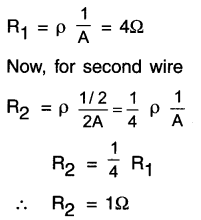
HBSE 10th Class Science Important Questions Chapter 12 Electricity

Question 25.
Discuss the factors on which strength of electric current ¡n a given conductor depends. OR How can you say that the current flowing in a circuit is strong or weak? Discuss.
Answer:
Ohms law says, current \((\mathrm{I})=\frac{\mathrm{V} \text { (Potential difference) }}{\mathrm{R} \text { (Resistance) }}\)

From this relation we draw two conclusions. They are –
(i) I α V (if R = constant) (ii) I α\(\frac{1}{R}\)(if V = constant)

From 1st:
1. Since, current (I) is directly proportional to potential difference V, if value of V is doubled, the current (I) flowing through it will also get doubled.
2. If V is halved, the current will also get halved,

From 2nd:
1. Current (I) is inversely proportional to resistance (R). So, if the value of resistance is doubled, the current (I) flowing will get halved.
2. If resistance is halved, the current (I) will get doubled.

Conclusion:
The strength of electric current in a given conductor depends on —
(i) Potential difference (V) across the ends of the conductor (ii) Resistance (R) of the conductor

Question 26.
Define resistance and variable resistance and bring out the difference between resistance and resistor
Answer:
(a) Resistance:
1. Resistance refers to the property of the conductor by virtue of which it opposes the flow of current through it.

2. Resistance is equal to the ratio of potential difference applied across the conductor to the current flowing through it.
Thus, Resistance \((\mathrm{R})=\frac{\text { Potentialdifference }(\mathrm{V})}{\text { Current }(\mathrm{l})} \quad\)
∴ \(\mathrm{R}=\frac{\mathrm{V}}{\mathrm{l}}\)

(b) Vanable resistance:
1. A component used for regulating (i.e. increasing or decreasing) the current without changing the voltage source is called a variable resistor and the concept is called variable resistance.

2. In other words, variable resistance allows us to adjust the resistance between two points in a circuit. Rheostat is one such device that helps to change resistance in the circuit. Thus, resistor creates resistance.
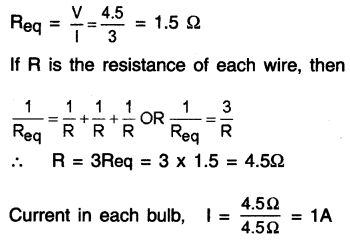
HBSE 10th Class Science Important Questions Chapter 12 Electricity

Question 27.
Explain the cause of resistance in conductors and insulators.
Answer:
1. Flow of free electrons In a fixed direction results in flow of electric current in a conductor.
2. These freely moving electrons collide with atoms or molecules of conductor. This retards their motion.
3. Motion of electrons means that the electric current gets opposed. This is called resistance (R) of the conductor.
4. Metals such as aluminum, steel, copper, etc. have a large number of free electrons and so they offer low resistance to the flow of electric current. Metals are good conductors.
5. Insulators such as wood, plastic, rubber, etc. do not have free electrons. Hence, no current flows through them. So, their resistance is very high. Insulators are poor conductors.

Question 28.
Define resistance (resistivity) of a substance and explain its unit.
Answer:
1. The resistance (R) of a conductor is directly proportional to the length of the conductor and inversely proportional to the area of its cross-section.

2.  Let the length of the conductor be I and its cross-sectional area be A, then,
Resistance R α length l arid also R α \(\frac{1}{A}\)
∴ \(R \alpha \frac{I}{A}=\rho \frac{I}{A}\) = (where ρ (rho) is constant and called the resistivity of conducting material.)

3. We can also say, ρ = \(R \frac{A}{l}\)

4. The S.l unit of resistivity \(\rho=\frac{\text { Unit of resistance } x \text { Unit of area }}{\text { Unit of length }}=\frac{\Omega \mathrm{xm}^2}{\mathrm{~m}}=\Omega \mathrm{m} \text { (Ohm meter) }\)

Question 29.
List the factors on which the resistance of a conductor depends. Write the formula showing relation of resistance with these factors.
Answer:
At constant temperature, the resistance of a conductor depends on the following factors:
(i) Length: Resistance R of a conductor is directly proportional to its length L i.e. R α L
(ii) Area of cross-section: Resistance R of a conductor is inversely proportional to the area of cross-section A i.e, \(R \propto \frac{1}{A}\)
(iii) Nature of material: Resistance depends on the nature of material. For example, resistance of copper wire is quite less as compared to nichrome wire.

Combining all these factors we get —
R α \(\frac{L}{A}\)  or say R = ρ\(\frac{L}{A}\) (Where p is the proportionality constant and is called ‘resistivity’ or ‘specific resistance’ which depends on the nature of the material.)

Question 30.
Classify solids on the basis of their resistivity values.
Answer:
On the basis of resistivity values, we can classify solids as:
(i) Conductors (metals and alloys):

  • Metals and their alloys have very low resistivity in the range of 10-8 to 10-6 Ω m.
  • These are known as good conductors of electricity.
  • Copper, aluminium, iron, etc. are metals. Nichrome, constantan, manganin, etc. are metallic alloys.

HBSE 10th Class Science Important Questions Chapter 12 Electricity

(ii) Insulators:

  • Insulators are substances that have very large resistivity. They have resistivity of more than 1 m. Insulators such as glass, hard rubber, etc. have very high resistivity range of 1012 to 1017 Ωm.

Electrical resistivity of some substances at 200 C. (For information only)
HBSE 10th Class Science Important Questions Chapter 12 Electricity 11
You need not memorize these values. You can use these values for solving numerical problems.

Question 31.
Differentiate between Conductors and Insulators.
Answer:

ConductorsInsulators
Conductors contain large number of free electrons.Insulators do not contain free electrons
Conductors can conduct electricity.Insulator cannot conduct electricity.
Metallic elements like silver, aluminium, copper etc. are conductors.Rubber, plastic, etc. are insulators.

Question 32.
(a) How much current will an electric bulb draw from a 220 V source, If the resistance of the bulb filament is 1200 Ω? (b) How much current will an electric heater coil draw from a 220 V source, If the resistance of the heater coil is 100 Ω? (Text book example 12.3)
Answer:
(a) We are given V = 220 V; R = 1200Ω We have current I = 220 V/1200 Ω = 0.18 A.
(b) We are given, V = 220 V, R = 100Ω. We have current I = 220 V/100 Ω = 2.2 A.

HBSE 10th Class Science Important Questions Chapter 12 Electricity

Question 33.
The potential difference between the terminals of an electric heater is 60 V when it draws a current of 4 A from the source. What current will the heater draw If the potential difference is increased to 120 V? (Text book example 12.4)
Answer:
We are given, potential difference V = 60 V, current I = 4 A.
According to Ohm’s law, \(R=\frac{V}{l}=\frac{60 \mathrm{~V}}{4 \mathrm{~A}}=15 \Omega\)
When the potential difference is increased to 120 V the current is given by —
current = \(\frac{V}{R}=\frac{120 V}{15 \Omega}=8 A\)
The current through the heater becomes 8 A.

Question 34.
Resistance of a metal wire of length 1 m is 26Ω at 20°C. lithe diameter of the wire is 0.3 mm, what will be the resistivity of the metal at that temperature? Using Table 12.2, predict the material of the wire. (Text book example 12.5)
Answer:
We are given the resistance R of the wire = 26Ω, diameter = 0.3 mm = 3 x 10 m, and the length I of the wire = 1m.
Therefore, the resistivity of the given metallic wire is ρ= (RA/I) = (Rπd2/4l)
Substitution of values in this gives ρ = 1.84 x 10⁻⁶ Ωm
The resistivity of the metal at 20°C is 1.84 x 10⁻⁶ Ωm.

We are given, potential difference V = 60 V, current I = 4 A.
According to Ohm’s law, \(R=\frac{V}{l}=\frac{60 \mathrm{~V}}{4 \mathrm{~A}}=15 \Omega\)
When the potential difference is increased to 120 V the current is given by —
current = \(\frac{V}{R}=\frac{120 V}{15 \Omega}=8 A\)
The current through the heater becomes 8 A.

Question 35.
A wire of given material having length I and area of cross-section A has a resistance of 4 ? What would be the resistance of another wire of the same material having length 1/2 and area of cross-section 2A? (Text book example 12.6)
Answer:
For first wire
HBSE 10th Class Science Important Questions Chapter 12 Electricity 12
The resistance of the new wire is 1Ω.

Question 36.
If an electric bulb connected to 220 V line draws an electric current of 0.5 A, then what will be the resistance of the filament of the bulb?
Answer:
I = 0.5A,V=220V
According to Ohm’s law, \(R=\frac{V}{l}=\frac{220}{0.5}=440 \Omega\)

Question 37.
The resistance of a resistive wire having length l and area of cross-section A is 4Ω. If the length of same type of wire is 1/2 and the area of cross-section 2A, what will be the resistance of wire?
Answer:
For the first wire \(R=\rho \frac{l}{A}\)-, for the second wire,\(\mathrm{R}^{\prime}=\rho^{\prime} \frac{I^{\prime}}{\mathrm{A}^{\prime}}\)

HBSE 10th Class Science Important Questions Chapter 12 Electricity

Question 38.
There are more than one ways of combining resistors in a circuit. Explain them very briefly.
OR Why does the need of combining resistors in more than one way arises in a circuit?
Answer:
1. Apart from potential difference, current in circuit also depends on resistance R.

2. All electrical circuits do not require the same amount of resistance.

3. In order to obtain the desired resistance, resistors need to be connected in two different ways.
They are: Connecting resistors in (A) series and in (B) parallel.

4. If we want to increase total resistance, then we need to connect the resistors in series and if we want to decrease the resistance, we need to connect individual resistors in parallel.
HBSE 10th Class Science Important Questions Chapter 12 Electricity 13

Question 39.
With the help of suitable diagrams state the two methods of connecting resistors in a circuit. There are two methods of joining the resistors. They are:

(1) Joining resistors In a series connection:

  • When two or more resistors are connected end-to-end consecutively, such a connection is called a series connection.
  • As shown in the figure, three resistors R1, R2 and R3 are connected end-to-end.

HBSE 10th Class Science Important Questions Chapter 12 Electricity 14

(2) Joining resistors in a parallel connection:

  • When two or more resistors are connected between the same two points of a circuit, they are said to be connected in a parallel connection (because they are connected in parallel and not end-to-end).
  • The diagram here shows resistors R1, R2 and R3 connected in parallel between the two points A and B.

HBSE 10th Class Science Important Questions Chapter 12 Electricity 15

HBSE 10th Class Science Important Questions Chapter 12 Electricity

Question 40.
Explain the series connection of resistors and derive the formula of equivalent resistance.
Answer:
Series connection of resistors:
1. When two or more resistors are connected end-to-end consecutively such a connection is called a series A connection.

2. As shown in figure, consider three resistances R1, R2 and R3 connected in senes. Suppose a current I flows through the circuit when a cell of voltage V is connected across the combination.
HBSE 10th Class Science Important Questions Chapter 12 Electricity 16
By Ohm’s law, the potential differences across the three resistances will be,
V1 = IR1, V2 = IR2, V3 = IR3,

If R be the equivalent resistance of the senes combination, then on applying a potential difference V across it, the same current I must flow through it. Therefore,
V = IR
But V=V1 + V2 +V2
∴ IRS = IR1 + IR2 + IR2 OR Rs = R1 + R2 + R3

Question 41.
State the characteristics of series connection of resistors.
Answer:
1. In series connection of resistors, the current (I) flowing through each resistance is same.
2. The total voltage drop across all the resistances connected in series equals to the sum of voltage drop across each resistance Le. V = V1 + V2 + …………………………. + Vn.
3. The equivalent resistance of resistors connected in series is equal to the algebraic sum of all resistors.
4. The magnitude of equivalent resistance i.e. R is always larger than the largest resistance of the circuit. In other words, equivalent resistance R is larger than any other resistance of the circuit.

Question 42.
An electric lamp, whose resistance is 20Ω and a conductor of 4Ω resistance are connected to a 6 V battery (as shown In figure). Calculate (a) the total resistance of the circuit, (b) the current through the circuit, and (c) the potential difference across the electric lamp and conductor.
Answer:

HBSE 10th Class Science Important Questions Chapter 12 Electricity 41
The resistance of electric lamp, R1 = 20Ω
The resistance of the conductor connected in series, R2 = 4Ω
Then the total resistance in the circuit
R =R1 + R2
Rs =20Ω + 4Ω=24Ω
The total potential difference across the two terminals of the battery
V = 6V.
Now by Ohm’s law, the current through the circuit is given by
I =V/Rs=6V/24.Ω = 0.25A.
Applying Ohm’s law to the electric lamp and conductor separately, we get potential difference across the electric lamp,
V1 =20Ω 2 x 0.25A = 5V;
Potential difference across the conductor, V2 = 4Ω x 0.25 A = 1 V.
Suppose we replace the series combination of electric lamp and conductor by a single and equivalent resistor. Its resistance must be such that a potential difference of 6 V across the battery terminals will cause a current of 0.25 A in the circuit. The resistance R of this equivalent resistor would be
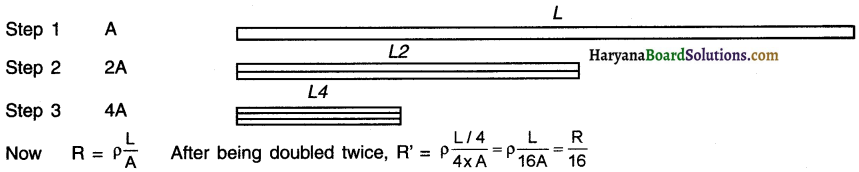
R =V/l = 6V/0.25A = 24Ω
This is the total resistance of the series circuit. It is equal to the sum of the two resistances.

HBSE 10th Class Science Important Questions Chapter 12 Electricity

Question 43.
In order to get the current 0.5 A in the circuit by connecting a bulb of resistance 20Ω with 12 V battery, how much should be the value of resistance connected in series? What will be the voltage drop across the bulb?
Answer:
If the resistance connected in series with bulb is R1 and resistance of bulb is R2 then the circuit will be as shown in the figure here.
V=12 V, l=0.5A, R2=20Ω, R1=?

HBSE 10th Class Science Important Questions Chapter 12 Electricity 18
Using Ohm’s law,
Here, bulb and R1 are in series,\(R=\frac{V}{J}=\frac{12}{0.5}=24 \Omega\)
therefore equivalent resistance
R=R1+R2 ……………………… (1)
Substituting the value of R and R2 in equation (1)
24=20+R2
∴ R2 = 24 – 20 = 4Ω
The voltage drop across the bulb, V2 = IR2 = (0.5) (4) = 2 V

Question 44.
When an electric heater is given a voltage 120 V, an electric current of 2 A passes through It. If the heater is given a voltage of 240 V, how much electric current will flow through it? What will be the resistance of the coil of the heater?
V1 = 120V, I1 = 2A, V2 = 240V, I1 =?
Answer:
Resistance of heater coil \(R=\frac{V_1}{L_1}=\frac{120}{2}=60 \Omega\)
Now, according to Ohms’ law,
HBSE 10th Class Science Important Questions Chapter 12 Electricity 17

HBSE 10th Class Science Important Questions Chapter 12 Electricity

Question 45.
Define parallel connection of resistances and derive the resistance equation for equivalent resistance.
Answer:
1. When two or more resistances are connected between the same two points of a circuit, the resistances are said to be connected in parallel.

2. As shown in figure, consider three resistances R1, R2 and R3 connected in parallel. Suppose a current I flows through the circuit when a cell of voltage V is connected across the combination.

3. The current I at point A is divided into three parts l1, l2 and l3 through the resistances R1, R2 and R3 respectively.
These three parts recombine at point B to give the same current I. Total current flowing in the circuit,
l=l1+ l2 + l3
HBSE 10th Class Science Important Questions Chapter 12 Electricity 31

As all the three resistances have been connected between the same two points A and B, so voltage V across each of them is same. By Ohm’s law,
\(I 1=\frac{V}{R_1}, \quad 12=\frac{V}{R_2}, \quad I 3=\frac{V}{R_3}\)

If Rp be the equivalent resistance of the parallel combination, then,
HBSE 10th Class Science Important Questions Chapter 12 Electricity 20

Question 46.
State the characteristics of parallel connection of resistors.
Answer:
1. The sum of the current flowing through each resistor equals to total current flowing ¡n the circuit
i.e. l=l1+ l2 + …………………. +ln
2. The voltage drop across each resistor remains the same.
3. The magnitude of equivalent resistance i.e. R is always smaller than the smallest resistance.
4. The reciprocal of equivalent resistance R is equal to the sum of reciprocal of individual resistors
i.e \(\frac{1}{R}=\frac{1}{R_1}+\frac{1}{R_2}+\ldots \ldots \ldots \ldots+\frac{1}{R_n}\)

HBSE 10th Class Science Important Questions Chapter 12 Electricity

Question 47.
In the circuit diagram given in figure  suppose the resistors R1, R2 and R3 have the values 5Ω, 10Ω, 30Ω, respectively, which have been connected to a battery of 12 V. Calculate (a) the current through each resistor, (b) the total current In the circuit, and (c) the total circuit resistance. (Textbook Example – 12.8)
Answer:
R1=5Ω, R2=10Ω and R3=30Ω
Potential difference across the battery, V = 12 V.
This is also the potential difference across each of the individual resistor; therefore, to calculate
the current in the resistors, we use Ohm’s law.
The current l., through R1 = V/R1
l1 =12 V/5Ω = 2.4 A.
The current 12, through R1 = V/R1
I2 =12 V/10Ω = 1.2 A.
The current I3, through R3 = V/R3
I3 =12 V/30Ω = 0.4A.
The total current in the circuit,
I =I1 +I2+I3=(2.4+1.2+0.4)A = 4A
The total resistance is given by
\(\frac{1}{R_p}=\frac{1}{5}+\frac{1}{10}+\frac{1}{30}=\frac{1}{3}\)
Thus, RP = 3Ω.

Question 48.
lf in given figure R1=10Ω, R2=40Ω, R3=30Ω, R4=20Ω, R5=60Ω, and a 12V battery is connected to the arrangement. Calculate (a) the total resistance In the circuit, and (b) the total current flowing in the circuit. (Textbook Example 12.9)
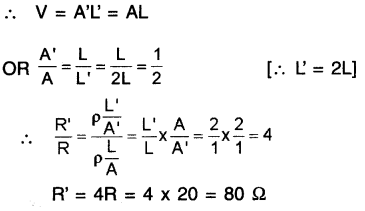
Answer:
Suppose we replace the parallel resistors R1 and R2 by an equivalent resistor of resistance, R’. Similarly we replace the
parallel resistors R3, R4 and R5 by an equivalent single resistor of resistance R1. Then, we have
1/R’ = 1/10 + 1/40 = 5/40; that is R’ = 8Ω.
Similarly,
1/ R” = 1/30 + 1/20 + 1/60 = 6/60; that is, R” = 10 Ω.
Thus, the total resistance,
R= R’+ R”= 18Ω
To calculate the current, we use Ohm’s law, and get
I =V/R= 12V/18Ω = 0.67A.

HBSE 10th Class Science Important Questions Chapter 12 Electricity

Question 49.
Three resistors are connected In parallel with the 30 V battery. The electric current of 7.5 A flows through circuit from battery. If the values of two resistors are 10 Ω and 12 Ω, determine the value of the third resistor.
Answer:
V = 30 V, 1= 7.5 A, R1= 10Ω, R2 = 12Ω, R3 = ?
The equivalent resistance of circuit R =\(\frac{\mathrm{V}}{\mathrm{l}}=\frac{30}{7.5}!\) = 4Ω
Now, R1, R2 and R3 are connected in parallel.
∴ R3 = 15Ω
HBSE 10th Class Science Important Questions Chapter 12 Electricity 22

Question 50.
Find the electric current ¡n the following circuit:
Answer:
(A) Here, resistance R1 is connected in parallel where as R2 and R3 are connected in series
Equivalent resistance of R2 and R3 is, R’ = R2 + R3 = 30 + 30 = 60Ω
Now R1 and R’ are connected in parallel and so their equivalent resistance is, \(\frac{1}{R}=\frac{1}{R_1}+\frac{1}{R^{\prime}}\)
∴ \(R=\frac{R_1 \times R^{\prime}}{R_1+R^{\prime}}=\frac{30 \times 60}{30+60}=\frac{1800}{90}=20 \Omega\)

HBSE 10th Class Science Important Questions Chapter 12 Electricity 23

(B) Total current flowing in the circuit \(I=\frac{V}{R}=\frac{2}{20}=0.1 \mathrm{~A}\)

Question 51.
State advantages and disadvantages of a series connection.
Answer:
Advantages of series connection:

  • Series connection of resistors helps to control the current in the circuit.
  • The fuse is connected in series with AC mains as well as with the electrical appliance. Thus, when a short circuit occurs in any electrical appliance, the fuse wire melts and stops electric current. Thus, senes connection prevents damage to electrical appliances.

Disadvantages of series connection:

  • In series connection, the voltage gets divided. Due to this, the appliances give less output.
  • If fault occurs in one appliance or at one part of the circuit, the current stops flowing in the entire circuit and other appliances also stop working.

Question 52.
State advantages and disadvantages of a parallel connection.
Answer:
Advantages of parallel connection:

  • Voltage drop does not occur in parallel connection. As a result, appliances operate with full efficiency.
  • If more than one appliances are connected in parallel and if an appliance stops working, even then the circuit will not break, and the other appliances will keep on working efficiently.
  • The equivalent resistance in the parallel connection of resistor decreases, hence more current can be obtained.

Disadvantages of a parallel connection:

  • In parallel connection, total resistance R of the circuit decreases, so total current increases. Hence, the current flow cannot be controlled.
  • Bulbs having different voltages lets say 220 V, and 240 V, when connect in parallel and given voltage lets say 220 V, then only that bulb which has voltage rating of 220 V will light up with full efficiency.

HBSE 10th Class Science Important Questions Chapter 12 Electricity

Question 53.
Differentiate between series connection of resistors and parallel connection of resistors.
Answer:

Series ConnectionParallel Connection
When two or more resistors are connected end to end consecutively, such a connection is called a series connection.When two or more resistances are connected between the same two points, they are said to be connected in parallel (because they become parallel to each other).
In series connection, the resistors are connected across two points say A and B of the circuit in such a way that equal amount of current flows through each resistor and the current flows in only one path.In parallel connection, the resistors are connected across two points say A and B of the circuit in such a way that equal amount of voltage drops across two ends of each resistor and the current flows in more than one path.
In this connection, equal amount of current (I) flows through each resistors but voltage (V) of the battery gets divided among the three resistors.In parallel connection, voltage drop (V) across two ends of each resistor remains same but the current (I) that flows in the circuit gets divided into three parts at point A.
Here, equivalent resistance R = R1+R2+R3Here, equivalent resistance \(\frac{1}{R}=\frac{1}{R_1}+\frac{1}{R_2}+\frac{1}{R_3}\)
The magnitude of equivalent resistance R is always larger than the largest resistance of the circuit.The magnitude of equivalent resistance l is always smaller than the smallest resistance.

Question 54.
Differentiate between resistance and resistivity.
Answer:

ResistanceResistivity
Resistance is the ratio of the voltage applied between the two ends of a conductor to the electric current flowing through the conductor.
Thus, R=\(\frac{\mathrm{V}}{\mathrm{l}}\)
Resistivity of a substance is the resistance offered by a conducting wire of unit length and unit cross-section area. Thus, \(\left(\rho=\frac{R \cdot A}{I}\right)\)
Resistance depends on various factors such as type of substance, temperature, pressure, cross-section area, etc.It depends on type of substance, temperature of the conductor and pressure exerted on conductor.
Its SI unit is OhmΩIts SI unit is ohm-meter Ωm.

Question 55.
What is heating effect of electric current?
Answer:
1. When electric current is passed through a high resistance wire, the resistance wire becomes hot and produces heat.
2. Here, electrical energy ¡s converted into heat energy which is known as the heating effect of electric current.
3. The heat produced in an electrical appliance depends on electric current and resistance.

Question 56.
Explain electrical energy and derive its formula. OR Obtain the equation of heat energy for current flowing through a resistor for a specific time period.
Answer:
1. Suppose electric current is flowing through some resistor (R).
2. This results in continuous production of electric charges (Q).
3. The work done (W) by the battery of voit (V) for keeping the electric charges (Q) in continuous flow is,
W = V x Q
∴ W = V x I x t ( ∵ Q = I x t as per the definition of electric current)
Also, as per Ohm’s law, V = I. R
∴ W = l.R x lt = I2Rt
4. Thus, current flowing through a resistor R for time t is I.
5. W is the electrical energy consumed when current I flows through a resistor R in the circuit for time t.
6. This electrical energy gets converted into heat energy.
Thus, heat energy (H) = I2 Rt
7. This equation is also called Joule’s law of heating.
8. The SI unit of electrical energy (W) or say heat energy (H) is joule (J).
9. The other units are Watt second (Ws) as well as Kilowatt – hour (kWh) or simply unit.

HBSE 10th Class Science Important Questions Chapter 12 Electricity

Question 57.
100 J of heat is produced each second in a 4Ω resistance. Find the potential difference across the resistor.
Answer:
H=100J, R=4Ω, t=1 s, V=?
We have the current through the resistor as
HBSE 10th Class Science Important Questions Chapter 12 Electricity 24
Thus the potential difference across the resistor, V is
V =IR
=5A x 4Ω
= 20V.

Question 58.
5A current flows through an electric Iron. If the resistance of electric iron is 44Ω then how much energy will be consumed in 5 minutes?
Answer:
l = 5A; R = 44Ω,t = 5min =5 x 60 = 300s.
Electricalenergy w = l2Rt
= (5)2(44) (300) = 330000 = x 105 J

Question 59.
Discuss some practical applications of heating effect of electric current.
Answer:
Practical (daily life) applications of heating effect of electric current:
(i) Household heating appliances: Electric iron, toaster, sandwich maker, room heater, electric kettle, etc. ail such appliances make use of heating effect of electric current.

(ii) Electric bulbs: When electricity s passed through the filament of the electric bulbs, the bulbs light up. Here, heating effect is used for emitting light.

(iii) Electric fuse: Electric fuse is a safety device which works on the heating effect of electric current.

Question 60.
How is the heating effect of electric current used to light an electric bulb? Explain.
Answer:
1. The incandescent lamp or electric bulb is a glass which is filled with inactive nitrogen and argon gas.
2. A strong metal such as tungsten which has a very high melting point of 33800 C is used for making the filaments of these bulbs.
3. On passing electric current the filament becomes hot and emits light.

HBSE 10th Class Science Important Questions Chapter 12 Electricity

Question 61.
What is a fuse? How does the heating effect of electric current works on fuse? OR How does the fuse work?
Answer:
Fuse:

  • A fuse is a safety device which works on the heating effect of electric current. It is connected in series with the device.
  • It consists of a piece of wire made of metal or alloy having appropriate melting point.
  • If the current larger than the specified amount flows through the circuit, the fuse wire becomes hot. This melts the fuse wire and the circuit gets broken. The connected device does not get electric supply and so it gets safeguarded against over-supply of electricity.
  • Fuse for domestic purposes have rating of lA, 2A, 3A, 5A, 10A, etc.

HBSE 10th Class Science Important Questions Chapter 12 Electricity 25

Question 62.
Define electric power and state and explain its unit.
Answer:
Electric power:
1. The electrical energy consumed (or heat energy generated) in unit time ¡s called electric power.
2. In other words, electric power is the rate of electric energy.
3. It is denoted by R
HBSE 10th Class Science Important Questions Chapter 12 Electricity 26
4. The SI unit of power is joule/second or watt (W).

1 Unit power:

  • If 1A current flows through the circuit through a battery of 1V, the power consumed will be 1 W.
  • We have, P = IV
    ∴ 1 watt = 1 voIt x 1 ampere = 1 VA

Question 63.
Explain the practical unit of electrical energy. What do you mean by 1 unit power?
Answer:
1. \(\text { Power } P=\frac{\text { electric energy }(\mathrm{W})}{\text { time.(t) }}\)
∴ Electrical energy (W) = Power (P) x time (t) watt x second = joule
2. Thus, the unit of electrical energy is watt. second.
3. The larger unit of electrical energy is kWh.
1 kWh = 1000 watt x 3600 seconds
= 3.6 x 10⁶ watt.seconds
= 3.6 x 10⁶ joules (J)
4. kWh is a practical unit of energy which is used in every day life.
5. It is also called a ‘unit’.
6. Thus, 1 unit 1kWh = 3.6 x 10⁶ joules.
7. When a 1000 W bulb is on for 1 hour, the energy consumed is equal to 1 unit.

Question 64.
An electric iron consumes energy at a rate of 840 W when heating is at the maximum rate and 360 W when the heating is at the minimum. The voltage is 220 V. What are the current and the resistance in each case?
Answer:
We know that the power input is P = Vl
Thus, the current I = P/v
(a) When heating is at the maximum rate,
I = 840 W/220 V = 3.82 A; and the resistance of the electric iron is R = V/I = 220 V/3.82 A = 57.60 .

(b) When heating is at the minimum rate,
1= 360 W/220 V= 164 A; and the resistance of the electric iron is
R= V/l= 220 V/1 .64 A= 134.15Ω

Question 65.
An electric bulb is connected to a 220 V generator. The current is 0.50 A. What is the power of the bulb?
Answer:
P =Vl=220V x 0.50A=110 J/S=110 W.

Question 66.
An electric refrigerator rated 400 W operates 8 hour/day. What is the cost of the energy to operate it for 30 days at Rs 3.00 per kWh?
Answer:
The total energy consumed by the refrigerator in 30 days would be
400 W x 8.0 hour/day x 30 days = 96000 Wh = 96 kWh
Thus the cost of energy to operate the refrigerator for 30 days is
96 kWh x ₹ 3.00 per kWh = ₹ 288.00

Question 67.
In a house, if three bulbs of 100 W, 60 W and 30 W are used 2 hours per day, how many units of electrical energy will be consumed in 30 days?
Answer:
Energy consumed per sec P = 100 W + 60 W + 40 W= \(\frac{100}{200}\) W = kWh
P = 0.2 kWh
∴ Energy consumed per day = P x t = 0.2 kWh x 2 = 0.4 kWh
∴ Energy consumed in 30 days = 0.4 x 30 = 12 kWh
Now 1 unit = 1 kWh
∴ Energy consumed in 30 days = 12 units

HBSE 10th Class Science Important Questions Chapter 12 Electricity

Question 68.
For the circuit shown in figure below, determine the equivalent resistance between A and B. Also find the current flowing from the battery.
HBSE 10th Class Science Important Questions Chapter 12 Electricity 27
Answer:
As shown in the figure (part-a), R2 and R3 are connected in series. Their equivalent resistance
R’ =R2+R3=5+5=10Ω
Now R’ is parallel with R4 (Figure Part b) equivalent resistance,
HBSE 10th Class Science Important Questions Chapter 12 Electricity 29
Now R” and R1 are connected in series (Figure Part c). equivalent resistor across A and B,

HBSE 10th Class Science Important Questions Chapter 12 Electricity 28
∴ R =R”+R1
= 5+5
= 10Ω
The current flowing from the battery,
\(I=\frac{V}{R}=\frac{10 V}{10 \Omega}=1 \mathrm{~A}\)

Question 69.
As shown in the figure the resistance are connected with a 12 V battery. Determine (a) Equivalent circuit resistance (b) Current flowing through the circuit.
(A) To determine equivalent resistance of the circuit, we fill first obtain :
(i) Equivalent resistance of R1 and R2 which are connected in parallel and
(ii) Equivalent resistance of R3, R4 and R5
Answer:
HBSE 10th Class Science Important Questions Chapter 12 Electricity 30
(ii) Equivalent resistance of R3, R4 and R5
\(\frac{1}{R^{\prime \prime}}=\frac{1}{R_3}+\frac{1}{R_4}+\frac{1}{R_5}=\frac{1}{30}+\frac{1}{20}+\frac{1}{60}=\frac{1}{10}\)
∴ R=\(\frac{10}{1}\) = 10Ω
Now, R’ and R” are connected in series and so equivalent resistance
R =R’+R”=8+10=18Ω
Thus, the equivalent resistance of the entire circuit is 18Ω

(C) Current flowing through the circuit
\(I=\frac{V}{R}=\frac{12}{18}\) = 0.66 A
Thus, 0.66 A current flows in the circuit.
HBSE 10th Class Science Important Questions Chapter 12 Electricity

Question 70.
A child has drawn the electric circuit to study Ohm’s law as shown in the figure here. His teacher told that the circuit diagram needs correction. Study the circuit diagram and redraw it after making all corrections.
Answer:
The circuit diagram given in the question has three errors. They are:
(i) Ammeter is connected in parallel with R and voltmeter connected in series. In reality, ammeter should be connected in series and voltmeter in parallel.
(ii) The current is drawn from negative terminal and enters the battery through positive which
(iii) Cells are not connected in series combination in the battery of the circuit.
The correct diagram is figure 12.31.
HBSE 10th Class Science Important Questions Chapter 12 Electricity 32
Question 71.
Three 2Ω resistors’, A, B and C, are connected as shown in the figure. Each of them dissipates energy and can withstand a maximum power of 18W without melting. Find the maximum current that can flow through the three resistors.
Answer:
Resistance, R = 2Ω
Maximum power, Pmax = 18W
Maximum current, Imax =?
We know that P = I2R
\(I=\sqrt{\frac{P}{R}}=\sqrt{\frac{18}{2}}=3 A=I_{\max }\)
HBSE 10th Class Science Important Questions Chapter 12 Electricity 33

Maximum current that can flow through 2Ω resistor is 3A. This current divides along B and C because in parallel combination, voltage across B and C remain same and so,\(I \propto \frac{1}{R}\)
Since, B and C have same resistance i.e. 2Ω each, same current i.e., \(\frac{3}{2}\) = 1.5 A flows through B as well as C.

HBSE 10th Class Science Important Questions Chapter 12 Electricity

Question 72.
What is electrical resistivity? in a series electrical circuit comprising a resistor made up of a metallic wire, the ammeter reads 5 A. The reading of the ammeter decreases to half when the length of the wire is doubled. Why?
Answer:
Resistivity: The property of a material to resist the flow of electric current is called its resistivity. It is denoted as ρ. The SI unity of resistivity is Ωm
The resistance of a uniform conductor is:
\(R=\rho \frac{1}{A}\)
Where,
I = the length of the conductor
ρ = the electrical resistivity of the material
A = the cross-sectional area
Now, if I is doubled, then R also gets doubled.
HBSE 10th Class Science Important Questions Chapter 12 Electricity 34
When, R is doubled, I becomes \(\frac{1}{2}\)

Question 73.
B1, B2 and B3 are three identical bulbs connected as shown in Figure. When all the. three bulbs glow, a current of 3A is recorded by the ammeter A.
Answer:
(i) What happens to the glow of the other two bulbs when the bulb B1 gets fused?
(ii) What happens to the reading of A1, A2, A3 and A when the bulb B2 gets fused?
(iii) How much power is dissipated in the circuit when all the three bulbs glow together?
Resistance of combination of three bulbs in parallel

HBSE 10th Class Science Important Questions Chapter 12 Electricity 36
HBSE 10th Class Science Important Questions Chapter 12 Electricity 35
(i) When bulb B1 gets fused, the currents in B2 and B3 remain same. This means, I2 = I3 = 1A. The reason for this is that the voltage across the B2 and B3 bulb remains same. As a result, they keep illuminating with same intensity as before.

(ii) When bulb B2 gets fused, the current in B2 becomes zero and current in B1 and B3 remains 1 A. The reason for this is that the voltage across blub B1 and B3 remain same.
Total current I = 1 + 12 + 13 = 1 + 0 + 1 = 2A
Current in ammeter A2 = 0 Current in ammeter A1 = 1A
Current in ammeter A3 = 1A Current in ammeter A = 2A

HBSE 10th Class Science Important Questions Chapter 10 Light Reflection and Refraction

(iii) When all the three bulbs are connected.
Power dissipated, \(P=\frac{V^2}{R_{e q}}=\frac{(4.5)^2}{1.5}=13.5 \mathrm{~W}\)

Question 74.
A given length of a wire is doubled on itself and this process is repeated once again. By what factor does the resistance of the wire change?
Answer:
HBSE 10th Class Science Important Questions Chapter 12 Electricity 37

Question 75.
A wire of length I and area of cross-section A was drawn Into a wire of double its length by melting It. If Its original resistivity and resistance were p and R respectively, what will be its new resistivity and resistance?
Answer:
The volume of the wire remains same in both cases.
Volume = Area of cross-section x Length
HBSE 10th Class Science Important Questions Chapter 12 Electricity 38
Thus, the resistivity ρ remains the same.

Question 76.
A household uses the following electric appliances:
(i) Refrigerator of rating 400 W for two hours each day.
(ii) Two electrIc fans of rating 80 W each for twelve hours each day.
(iii) Six electric tubes of rating 18 W each for 6 hours each day.
Calculate the electricity bill of the household for the month of June if the cost per unit of electric energy is 3.00.
Answer:
1. Energy consumed by refrigerator of rating 400 W for ten hours each day
= P x t = 400W x 2h =\(\frac{400}{1000}\) kW x 2h = 0.8kWh

2. Energy consumed by two electric fans of rating 80 W each for twelve hours each day
= 2 x P x t = 2×80 W x 12 h = \(\frac{160}{1000}\) kW x 12 h = 1.92 kWh

3. Energy consumed by six electric tubes of rating 18 W each for six hours each day
=6 x P x t = 6 x 18 W x 6h = \(\frac{108}{1000}\) W x 6h = 0.648 kWh

4. Total energy consumed in the month of June (30 days)
= (0.8 + 1.92 + 0.648) x 30 kWh
= 6.568 x 30 = 197.04 kWh

HBSE 10th Class Science Important Questions Chapter 12 Electricity

5. Electricity bill for the month of June
= ₹ 197.04 x 3 = ₹ 591.12 = ₹ 591 (approx)

Very Short Answer Type Question :

Question 1.
What is electric charge? State Its types.
Answer:
Electric charge is the basic property of a matter carried by some elementary particles. The charge can be of two types namely positive charge and negative charge.

Question 2.
State the basic difference between static electricity and current electricity.
Answer:
Static electricity refers to the physical effect caused by the stationery charges whereas current electricity refers to physical effect caused by the moving charges.

Question 3.
What is conventional current? State the direction of flow of conventional current.
Answer:
The existence of electric current due to the flow of positive charges is known as conventional current. The direction of flow of conventional current is from the positive terminal to the negative terminal of a battery.

Question 4.
What is an open circuit?
Answer:
An electric circuit through which no current flows is called an open circuit.
Question 5.
What is a closed circuit?
Answer:
An electric circuit through which current flows continuously is called a closed circuit.
Question 6.
What is the function of an ammeter? How should it be connected in a circuit?
Answer:
Ammeter is used to measure the electric current in a circuit. It should be connected n series with the circuit.
Question 7.
Should the resistance of an ammeter be low or high? Give reason.
Answer:
Ammeter is used to measure the current and is connected in series with the circuit. If, ammeter has a high resistance, it will reduce the current flowing through the circuit and give an inaccurate result of measure of electric current. Hence, ammeter should have as low resistance as possible.

Question 8.
A charge of 900 C flows through a cross section of a conductor for 5 minutes. Calculate the electric current drawn by the conductor.
Answer:
Q = 900 t = 5 (mEnutes) x 60 (second) = 300 s
We know that \(I=\frac{Q}{t}\) ∴ \(I=\frac{900}{300}=3 A\)
Thus, electric current drawn by this circuit is 3 A.

HBSE 10th Class Science Important Questions Chapter 12 Electricity

Question 9.
Provided here is an electric circuit consisting of a bulb, battery and a key. I want to measure the potential difference potential difference between the two terminals of the bulb. Redraw the circuit by adding required device which can measure the potential difference.
HBSE 10th Class Science Important Questions Chapter 12 Electricity 39
Answer:
HBSE 10th Class Science Important Questions Chapter 12 Electricity 40

Question 10.
How much amount of charge can be moved from point to B If the work of 12 joule is done with the potential difference of 4 volt between these two points?
Answer:
W = 12J V = 4V
We know that V Volt \(=\frac{\mathrm{W}(\text { Joule })}{\mathrm{Q}(\text { Coulomb })}\)
∴ \(4=\frac{12}{Q}\)
∴ Q = 3C
Thus, 3C of charge can be moved from point A to B if work of 12 joule is done with potential difference of 4 volt between these points.

Question 11.
Heena Madam asked Rohit to draw a circuit containing Resister ‘R’ connected with a battery along with an ammeter to measure the current flowing through R. Rohit has drawn the circuit provided here and it has some errors in it. Rectify and redraw the circuit.
HBSE 10th Class Science Important Questions Chapter 12 Electricity 42
Answer:
HBSE 10th Class Science Important Questions Chapter 12 Electricity 43

Question 12.
Match the following components with their correct symbols.
HBSE 10th Class Science Important Questions Chapter 12 Electricity 44
Answer:
(1-b), (2-c)

Question 13.
Point out the errors in the circuit drawn below which measures the volt across resistor R.
HBSE 10th Class Science Important Questions Chapter 12 Electricity 46

Error 1 : Voltmeter is connected in series. It should be connected in parallel in order to measure the voltage.
Error 2 : The key is open. Hence the electric current cannot flow. It should be closed.

Question 14.
Two students perform experiments on two given resistors R1 and R2 and plot the V-l graphs as shown in diagram 1 and 2 respectively. If R1> R2, which of two diagrams correctly represent the situation on the plotted curves? Justify your answer.
HBSE 10th Class Science Important Questions Chapter 12 Electricity 45
Resistance is the slope of graph V-l. The graph with higher slope indicates that the resistance for that particular graph is higher. We can see from diagram 1 that R1> R2 hence diagram 1 correctly represents the situation.

Question 15.
What is the relationship between the potential coefficient and electric current flowing through a conductor in a circuit Who kind out this relation?
Answer:
The potential difference across a conductor is directly proportional to the electric current flowing through it in a circuit. This relation was found out by German physicist George Simon Ohm.
HBSE 10th Class Science Important Questions Chapter 12 Electricity

Question 16.
Calculate the potential difference of the battery in circuit provided here.
Answer:
l = 2.5mA = 2.5 x 10⁻³A, R = 20 KΩ
= 20 x 103 Ω
We know that V = IR
∴ V = (2.5 x 10⁻³A) x (20 x 103Ω) = 50V
Thus, the battery connected in this circuit has a voltage rating of 50 V.

Question 17.
What is the nature of a graph plotted with electric current at X-axis and potential difference at Y-axis?
Answer:
The graph plotted with electric current at X-axis and potential difference at Y-axis is a straight line passing through origin.

Question 18.
In an electric circuit, what change in electric current can we observe if we double the resistance keeping potential difference constant?
Answer:
1. Suppose, initially current and resistance of the circuit is I1 α R2 respectively.
2. After the resistance is doubled, current and resistance are I2 and R2 (R2 = 2R1)
HBSE 10th Class Science Important Questions Chapter 12 Electricity 47

Hence, if we double the resistance, current gets halved.

Question 19.
What is the relation between the resistance of a conductor and electric current flowing through it?
Answer:
In an electric circuit, the current is inversely proportional to the resistance of the conductor.

Question 20.
Classify below provided materials as (1) Good conductor, (2) Resistor, (3) Poor conductor and (4) Insulator.
Nichrome, Drinking water, Tungsten, Diamond.
Answer:
Good conductor: Tungsten, Resistor: Nichrome,
Poor conductor: Drinking water, Insulator: Diamond

Question 21.
On which factors does the resistance of a conductor depend?
Answer:
Resistance of a conductor depends on:

  • Cross-sectional area,
  • Length,
  • Nature of material.

Question 22.
What is the relation of resistance with length and cross-sectional area of a conductor?
Answer:
Resistance is directly proportional to the length and inversely proportional to the area of cross-section of a conductor.

Question 23.
Choose the combination with highest resistance.
(a) A wire of length 2m and cross sectional area 2m2
(b) A wire of length 4m and cross sectional area of 2m2
(c) A wire of length 2m and cross sectional area 4m2
(d) A wire of length 4m and cross sectional area of 4m2
Answer:
The combination with a wire of length 4m and cross sectional area of 2m2 will provide maximum resistance.

Question 24.
A wire of resistivity ρ is stretched to three times its length. What will be Its new resistivity?
Answer:
The resistivity of a material depends on the nature of the material of the wire and not its dimensions. Hence, the resistivity p will remain unchanged even if it is stretched three times.

HBSE 10th Class Science Important Questions Chapter 12 Electricity

Question 25.
Based on the resistivity of three distinct materials provided here, classify the materials Into conductors, alloys and insulators:
(a) 100 x 10-6
(b) 1.84 x 10⁻⁶
(c) 1.36 x 10⁻¹⁰
Answer:
(a)-Alloy, (b)-Conductor, (c)-lnsulator

Question 26.
What happens to the resistance of a conductor. when its area of cross-section ¡s increased?
Answer:
\(R \propto \frac{1}{A}\) So, as the area of cross-section is increases, the resistance decreases.

Question 27.
The following table gives the resistivity of three samples:
HBSE 10th Class Science Important Questions Chapter 12 Electricity 48

Which of these is suitable for making heating elements of electrical appliances and why?
Answer:
Sample C has highest resistivity. Hence, it is most suitable for making heating elements of electrical appliances.

Question 28.
Haresh has purchased a coil of nichrome for his school project. He wants to cut out a segment from this coil such that resistance of the segment is 2 ohm. If the cross-sectional area of this coil is 3.14 x 10 m2 and the resistivity of nichrome Is 100 x 10 ohm m, what should be the length of segment that Haresh needs to cut from coil?
Answer:
R=2Ω
A =3.14 x 10⁻⁶ m2
ρ =100 x 10-6  Ωm
I  = ?
HBSE 10th Class Science Important Questions Chapter 12 Electricity 49

Question 29.
Two wires of equal length, one of copper and the other of nichrome have the same resistance. Which wire will be thicker?
Answer:
Nichrome wire is thicker than copper wire.

Question 30.
Arrange the below-mentioned metals In order such that the metal with lowest conductivity comes first and the one with highest conductivity comes last.
(a) Copper
(b) Mercury
(c) Silver
(d) Iron
Answer:
(c), (a), (d), (b)

Question 31.
Which are the methods of joining resistors In a circuit?
Answer:
There are two combination of joining resistors in a circuit. They are
(1) Series connection and
(2) Parallel connection

Question 32.
Name the physical quantities which remain same in all the resistors when (i) they are connected In series, (ii) they are connected In parallel.
Answer:
(i) When the resistors are connected in series, the electric current is same for all the resistors.
(ii) When the resistors are connected in parallel, the voltage across each of the resistors is same.

Question 33.
Calculate the equivalent resistance in the combination of resistance shown here.
HBSE 10th Class Science Important Questions Chapter 12 Electricity 50
Answer:
Here, R1 and R2 are connected in parallel connection and R3 is in series.
∴ equivalent resistance \(R=\frac{R_1 R_2}{R_1+R_2}+R_3\)
∴ R = \(\frac{5 \times 5}{5+5}\)+2.5=2.5+2.5 R =5Ω

Question 34.
Calculate the voltage of battery connected in circuit provided here.
HBSE 10th Class Science Important Questions Chapter 12 Electricity 51
Answer:
We know that V = IR
∴ V = 2A x (6+2+3)Ω
V = 22V

Question 35.
Draw a schematic diagram of an electric circuit comprising of 3 cells, a parallel combination of two bulbs and plug key in the ON mode connected with an ammeter and a voltmeter.
Answer:
HBSE 10th Class Science Important Questions Chapter 12 Electricity 52

Question 36.
Two resistors are connected in a parallel combination such that the equivalent resistance s 1 ohm. If one of the resistors has a value of 2 ohm, calculate the value for the other resistor.
Answer:
We know that for parallel combination,
\(R=\frac{R_1 R_2}{R_1+R_2}\)
(But equivalent resistance = 1Ω and R1 = 2Ω)
∴ \(1=\frac{2 R_2}{2+R_2}\)
∴ 2+R2=2R2
∴ R2 = 2Ω

Question 37.
Out of the two wires X and Y shown below, which one has greater resistance? Justify.
HBSE 10th Class Science Important Questions Chapter 12 Electricity 53
Answer:
The resistance is directly proportional to the length of the wire. Now we can see that wire Y is longer than X and hence it will offer higher resistance.

Question 38.
What would be the equivalent resistance of a parallel combination of resistors made by cutting a wire of resistor R in three equal parts. What will be the effect on resistivity of each of the segments?
Answer:
Resistance of wire (with resistance R) when cut in 3 equal parts would have resistance R/3 for each segment.
Let’s say resistances are r1, r2 and r3
∴ equivalent resistance = \(\frac{r_1 r_2 r_3}{r_1+r_2+r_3}\)
But, r1 = r2 = r3 = R/3
∴ equivalent resistance \(=\frac{\frac{\mathrm{R}^3}{27}}{\mathrm{R}}\)
∴ equivalent resistance \(=\frac{\mathrm{R}^2}{27}\)
Resistivity of the segments will remain the same as it was in the wire before cutting it because resistivity does not depend on the length of material.

Question 39.
Why do we use copper and aluminium wires for transmission of electric current?
Answer:
Because both copper and aluminium have low resistivity and hence high conductivity

Question 40.
Which one is having lesser resistance? A 220 V, 60 W bulb or a 220 V, 40 W bulb?
Answer:
1.  We know that P = V2/R
∴ R=V2/P
2. Now, Voltage applied is same for both the bulbs, hence relative value of resistances of both the bulbs are dependent on the value of powers.
Now, R α 1/P
Therefore, more the power less the resistance.
Hence, the bulb with 60W rating will have lesser resistance than the bulb with 40W rating.

Question 41.
Give one reason which justifies that parallel circuits are preferred in domestic wiring.
Answer:
In parallel circuit, if one device gets damaged and stops working, there is no effect in the functioning of other connected devices. Hence, parallel circuits are preferred in domestic wiring.

Question 42.
Write relation between heat energy produced In a conductor when a potential difference V is applied across its terminals and a current I flows through in time t. What is this relation known as?
Answer:
Heat energy can be expressed as H = Vit. This is also known as Joule’s law of heating

Question 43.
State the relationship between 1 Volt and 1 Joule.
Answer:
1 Volt \(=\frac{\text { 1Joule }}{1 \text { Coulomb }} \text { or } 1 \mathrm{~V}=\frac{1 \mathrm{~J}}{1 \mathrm{C}}\)

Question 44.
As per the Joule’s law of heating, on which parameters does the heat produced In a resistor depend?
Answer:
The heat produced in a resistor is directly proportional to (a) square of current, (b) resistance and (c) time for which the current flows through resistor.

Question 45.
State the difference between the wire used In the element of an electric heater and in a fuse wire.
Answer:
Wire used in electric heater should have a high resistivity and high melting point allowing the wire to produce heat without melting down where as a fuse wire should have a low resistance and low melting point so that it can protect the appliance connected with it due to fluctuating current.

Question 46.
List two characteristics of the material used in electric heating devices.
Answer:
Material used in heater wire should have

  • High Resistivity and
  • High melting point.

Question 47.
An electric iron draws a current of 3.5 A when connected with a voltage source of 220V. Calculate the energy consumed by iron if it is kept on for 2 hour.
Answer:
I = 3.5A
V = 220V
t = 2hr
energy consumed E =?
We know that E = Vit
=220 x 3.5 x 2
=1540 Wh
∴ E= 1.54 kWh

HBSE 10th Class Science Important Questions Chapter 12 Electricity

Question 48.
Why do we use tungsten for making bulb filaments?
Answer:
The filament in bulb should have the capacity to retain extremely hot temperature so that it can emit light. As tungsten has a very high melting point (3380°C). It can retain heat without melting down and so it is used for making bulb filaments.

Question 49.
How does use of a fuse wire protect electrical appliance?
Answer:
Fuse wire has a very low melting point. A fuse is connected in series with the appliance. Hence if more than an acceptable amount of current flows in the circuit, the fuse wire melts down due to heating effect and breaks the circuit. This helps
in protecting the appliance against the damage caused by fluctuating current.

Question 50.
Melting points of three metals are provided here: (a) 3380 °C, (b) 1085 °C, (c) 232°C. Which of these metal can be used to produce a fuse wire, a bulb and an electric transmission line.
Answer:
Metal with melting point 3380°C, should be used for producing bulb, metal with melting point 1085 °C should be used for producing electrictransmission line and the metal with melting point 232 °C should be used for producing fuse wire.

Question 51.
400 J of heat is produced in 4s in a 4Ω resistor. Find potential difference across the resistor.
Answer:
H = 400J, t = 4s and R = 4Ω.
We know that,
H=I2Rt
∴ I2=H/Rt
∴ I =5A
We Also know that,
H = V/t
∴ V=H/It
∴ V = 20V

Question 52.
How much electric energy can be consumed by a 150W toaster in lo minutes?
Answer:
P = 150 W, t = 10 minutes = 10 x 60 seconds
= 600 seconds
We know that electric energy E = Pt
∴ E = 150 x 600 = 90,000 J
∴ E =90 x 103 J

Question 53.
Can a fuse wire of capacity 3A protect a circuit consuming 1 kW electric power when connected with a voltage source of 220V?
Answer:
The electric circuit that has a 1 kW power at 220 V will draw electric current I = P/V
∴ \(I=\frac{1000}{220}\) = 4.54 A
Hence, the fuse wire of 3A current rating cannot protect this circuit as it will require a fuse wire of More than, 4.54 A rating.

Question 54.
What is the commercial unit of electrical energy? Represent it in terms of joules. Commercial unit of energy is kW h. It can be represented in Joules as follows:
Answer:
1 Kilowatt hour = 1000 watt hour
We know that 1 watt = 1 joule / seconds
∴ 1 kWh = \(\frac{1000 \text { joule }}{\text { second }}\) x 3600 (second) second
∴ 1 kWh = 3.6 x 10⁶ joules

Question 55.
An electric device operates at 24 V and has a resistance of 8Ω. Calculate the power consumed by the device and current flowing through it.
Answer:
Voltage = 24V and R = 8Ω
We know that I = V/R
∴ I = 3A
And, P=Vl
∴ P = 24 x 3
∴ P = 72W

Question 56.
An electric current of 5.0 A flows through a 12Ω resistor. What is the rate at which heat energy is produced in the resistor?
Answer:
l = 5A and R=12Ω
Rate of consumption of energy is the power and
we know that,
P = I2R
∴ P=(5)2 x 12
∴ P = 300W

HBSE 10th Class Science Important Questions Chapter 12 Electricity

Fill in the blanks:

1. …………………. is expressed by the amount of charge flowing through a particular area in unit time.
Answer: Electric current

2. Coulomb charge constitute electrons.
Answer:  6 x 10¹⁸

3. In ………………… combination of resistance, the magnitude of equivalent resistance is greater than the largest resistance.
Answer: Series

4. The work done on the electric charge to maintain its equilibrium with the other charge is called ………………
Answer: Electric potential

5. A/An ………………. (instrument) measures electric current in a circuit whereas a/an (instrument) is used to measure the potential difference.
Answer: ammeter, voltmeter

6. Chemical reaction within a cell is responsible for generating ……………………. across its terminals.
Answer:  potential difference

7. A device called ………………… is used to change electric current flowing in a circuit by keeping potential difference constant.
Answer: rheostat

8. Joule/Coulomb is the SI unit for ………………………
Answer:  potential difference

9. Voltmeter is connected in …………………….. and ammeter is connected in ………………..
Answer: Parallel; Series

10. The graph of potential difference v/s electric current is a and it validates Law.
Answer: straight line, Ohm’s

11. The unit Volt/Ampere can also be represented as and is symbolized as ……………………..
Answer: Ohm

12. If we increase the cross sectional area of a conductor, the amount of current flowing through it ………. whereas the resistance …………………….. .
Answer: increases, decreases

13. The resistance of any conduction substance is …………….. proportional to length of the substance.
Answer: Directly

14. The resistance of a conductor is proportional to area of cross-section of the substance.
Answer: Inversely

15. ………….. is widely used as a filament in electric bulbs.
Answer: Tungsten

HBSE 10th Class Science Important Questions Chapter 12 Electricity

16. In a combination of resistance, all the resistors are simultaneously connected together between two points in a circuit, whereas in a combination, resistors are connected end to end consecutively between two points in a circuit.
Answer: parallel, series

17. In an electric circuit, a part of the source energy is consumed in the form of useful work whereas a fraction of this energy gets expended in form of…………………
Answer:  heat

18. Heat produced in a resistor is directly proportional to ………………….., and ……………………..  of electric current flowing through the circuit and also time during which the current flows through circuit.
Answer: resistance, square

19. Devices such as electric iron and electric heater works on the principle of …………… Law.
Answer:  Joule’s

20. A porcelain cartridge encases a ……………… which protects the appliances from fluctuating currents.
Answer: fuse wire

21. 1 kWh =………………….
Answer:  3.6 x 10⁶ joule

22. If you run ……………… watt bulb for 1 hour, the energy consumed will be 1 unit.
Answer: 103

23. A fuse wire should have relatively …………………… (higher/lower) melting point than the conductor it is connected with.
Answer: lower

24. ………………………………. can be termed as the rate of consumption of energy.
Answer: Power

25. Electric energy consumed is the product of power and …………….
Answer:  time

True OR False:

1. The direction of electric current flowing through a conductor is from the negative terminal to positive terminal of a battery which is opposite to the direction of conventional current. — True
2. The electric current in a circuit gets doubled as we double the length of a conductor through which the current flows. — False
3. 6 x 10¹² electrons flowing through a conductor in one second constitutes one microampere of electric current. — True
4. In a series combination of resistors, equal amount of electric current flows through each resistor whereas, in a parallel circuit, the current gets divided proportionately among each resistors. — True
5. A voltmeter should be connected in a series combination and an ammeter should be connected in a parallel combination with the conductor through which we want to calculate current and voltage. — False
6. The V-l graph provided here is a straight line with constant resistance and it validates the Ohm’s law — False
7. Two resistors of same material with different length and same cross-sectional area will have different resistivity, — False
8. Resistance as well as resistivity of a material are dependent on the temperature of that material. — True
9. Material A has a resistivity of 5.2 x 10⁻⁸ and material B has a resistivity of 49 x 10-8. In this case, A can be chosen over B to produce electric transmission lines. — True
10. In a series combination of a resistors 1 equal amount of potential difference is observed across each resistor whereas in a parallel combination, potential difference gets divided based on the value each resistor. — False
11. Equivalent resistance in a parallel combination is higher than the highest individual resistance of the resistor connected in circuit. — False

12. Electric bulbs are filled with non-reactive noble gas to prolong the life of filament. — True
13. A large amount of power consumed by an electric bulb is used in emitting light and the remaining amount gets dissipated in the form of heat. — False
14. A fuse wire of 4A current rating is incapable of protecting an appliance with a rating of 5A. — True
15. Fuse wires are always connected in parallel to the circuit because they have very low resistance hence any high fluctuating amount of current would pass through the fuse without harming the appliance connected with it. — False
16. Rate of doing work is the product of voltage applied in the circuit and the current flowing through it. — True
17. 1 kW h is the energy consumed when one Watt of power is utilized for one hour.– False

HBSE 10th Class Science Important Questions Chapter 12 Electricity

Match the Following:
Question 1.

CharacteristicResistivity
1. Insulatora. 2.6 x 10⁻⁸
2. Poor conductorb. 100 x 10-6
3. Resistorc. 1.36 x 10¹⁰
4. Good conductord. 3.4 x 10⁻²

Answer:
(1-c), (2-d), (3-b), (4-a)

Question 2.

Physical QuantityCharacteristic
1. Resistancea. Directly proportional to potential difference applied
2. Electric currentb. Dependent on the direction of flow of current
3. Heat in a resistorc. Directly proportional to square of electric current
4. Powerd. Inversely proportional to cross-sectional area
e. Product of potential difference and electric current

Answer: (1-c), (2-a), (3-e), (4-d)

Question 3.

DeviceDescription
1. Rheostata. Converts heat energy into light energy
2. Ammeterb. Protects appliances from fluctuating current
3. Voltmeterc. Can change current by keeping voltage source constant
4. Fused. Should be connected n parallel to the conductor
e. Used to measure electric current

Answer:
(1-c),(2-e),(3-d),(4-b)

HBSE 10th Class Science Important Questions Chapter 12 Electricity Read More »

HBSE 10th Class Science Important Questions Chapter 11 Human Eye and Colourful World

Haryana State Board HBSE 10th Class Science Important Questions Chapter 11 Human Eye and Colourful World Important Questions and Answers.

Haryana Board 10th Class Science Important Questions Chapter 11 Human Eye and Colourful World

Question 1.
Explain the functions of the main parts of a human eye along with a diagram.
Answer:
The human eye is one of the most valuable and sensitive sense organs. It enables us to see the wonderful world and its colours.
Structure and working of human eyes:
1. The human eye is the best natural optical instrument whose construction and working can be compared with a camera.

Working of eyes:

1. The light rays coming from the object enter the eye through cornea. The cornea forms a transparent bulge in front of the eye-balls. The eye-ball is almost spherical shaped and has a diameter of about 2.3 cm.

2. Just behind the cornea, there lies a dark muscular diaphragm called ins which controls the amount of light that enters the eye.

HBSE 10th Class Science Important Questions Chapter 11 Human Eye and Colourful World

3. There is a hole in the iris which is the aperture of the eye i.e. the pupil of eye.

  • The size of this aperture or pupil is controlled by iris.

4. After passing through the pupil, the light rays are incident on the eye-lens.
The eye lens is a convex lens made of transparent jelly like material.

HBSE 10th Class Science Important Questions Chapter 11 Human Eye and Colourful World 1

5. Ciliary muscles hold the eye lens.

  • Ciliary muscles change the thickness of the eye lens while focusing. In other words, the focal length of eye lens can be changed by changing its shape with the help of ciliary muscles. This helps in proper viewing of the objects.

6. The screen on which the image is formed in the eye is called retina.

  • The retina is a delicate membrane having a large number of light sensitive cells.
  • When light rays falls on retina, its light sensitive cells generate electrical signals.

7. The retina sends these signals to the brain through optic nerve.

  • The brain interprets the image of the object. The eye lens forms an inverted real image of the objects on the retina.
  • This interpretation allows us to see the objects.

HBSE 10th Class Science Important Questions Chapter 11 Human Eye and Colourful World

Question 2.
Explain accommodation power of an eye.
Answer:
Accommodation power of an eye:
1. The ability of the eye lens to adjust its focal length as per requirement so that objects can be seen clearly is called accommodation power of an eye.
2. With the help of ciliary muscles, an eye can focus the images of the distant objects as well as the near by objects on its retina by changing the focal length of its lens.
3. When the eyes are looking at a distant object, the ciliary muscles are relaxed, the lens is thin and focal length is more. This enables eye to see the distant object clearly.
4. Similarly when the ciliary muscles contract, the curvature of the eye lens increase and focal length decreases. This enables to see nearby objects clearly.

Question 3.
Explain Near point of an eye and far point of an eye.
Answer:
(i) Near point of an eye :

  • The minimum distance at which the objects can be seen clearly without contracting the eye lens
    i. e. without any strain is called the least distance of the distinct vision or near point of an eye.
  • For a young adult having normal vision, the near point of the eye is 25 cm.

HBSE 10th Class Science Important Questions Chapter 11 Human Eye and Colourful World 2

(ii) Far point of an eye :

  • The farthest distance up to which the eye can see objects clearly is called far point of an eye.
  • The farthest point of a person with normal vision lies at an infinite distance. This is so because the maximum distance an individual can see cannot be measured.
  • Thus, a person with normal vision can see objects clearly from 25 cm to infinite distance.

HBSE 10th Class Science Important Questions Chapter 11 Human Eye and Colourful World

Question 4.
How do ciliary muscles help to see nearby and far objects?
Answer:
1. The lens of our eyes is made up of a fibrous jelly-like material. Because the lens is made with such flexible material its shape or say curvature can be changed while seeing the object. The ciliary muscles have the ability to change the curvature and hence the focal length of the eyes.

2. When the ciliary muscles are in relaxed position, the lens remains thin. So, the focal length of the lens increases and we can see far-off objects clearly.

3. When we look at objects closer to us (for example, while reading), the ciliary muscles contract. This increases the curvature of the eye lens and the lens become thicker. The focal length decreases and so we are able to see nearby objects clearly.

Question 5.
What is cataract?
Answer:
1. Sometimes, in old aged people, the crystalline lens of the eyes becomes milky and cloudy.
2. As a result, the vision becomes hazy or even opaque due to the formation of a membrane over the lens. This condition is called cataract.
3. Cataract causes partial or complete loss of vision. The vision can be restored through cataract surgery-

Question 6.
How does defect of vision occur? Name the different types of defects of vision.
Answer:
1. The light rays coming from an object passes through the eye lens and forms an image on the retina of the eye.
2. To see objects clearly, image should be formed exactly on retina.
3. For this, the ciliary muscles in the eye change the thickness of the eye lens which results in the change of focal length of the eye.
4. When thickness of this lens does not change with respect to the object distance, the object cannot be seen properly. This is known as defect of vision.
5. The vision becomes blurred due to such refractive defects.

Types of defect of vision:

  • Near sightedness or Myopia
  • Far sightedness or Hypermetropia
  • Presbyopia

HBSE 10th Class Science Important Questions Chapter 11 Human Eye and Colourful World

Question 7.
What is the cause of short (near) sightedness in eye ? How can short sightedness defect be removed ? OR Write a short note on near sightedness or myopia.
Answer:
1. To see distant objects, the eye lens should become thin.
2. When the lens is unable to do so, the light rays converge more than they should. So, the image gets formed before the retina rather than on it. Hence, distant objects cannot be seen clearly.
3. This defect is known as near sightedness or myopia. Myopia arises due to

  • Excessive curvature of the lens or
  • Elongation of the eye ball.

4. To correct this defect, concave lens of appropriate focal length is used.
HBSE 10th Class Science Important Questions Chapter 11 Human Eye and Colourful World 3

Question 8.
Write a short note on far sightedness (hypermetropia).
Answer:
1. If eye lens does not become thick as per the requirement, then the rays coming from nearby objects gets less converged and hence are focused behind the retina.
2. Due to this, the image is formed behind the retina and not exactly on the retina. Hence, nearby objects cannot be seen clearly.
3. The near point for person suffering from such defects is more than the normal near point of 25 cm. So, he has to keep a reading material at a distance much beyond 25 cm for reading comfortably.
4. This type of defect is known as far sightedness or hypermetropia.
5. This defect occurs due to less convergence of the light rays.
6. To correct this defect, convex lens of appropriate focal length is used.

HBSE 10th Class Science Important Questions Chapter 11 Human Eye and Colourful World 4

Question 9.
Write a short note on aging-eye (presbyopia).
Answer:
Presbyopia:
1. Presbyopia which literally means aging eye’, is an age related eye condition which makes it difficult to see objects that are too close.
2. As a person grows older, the power of accommodation of an eye usually decreases.
3. The near point of aged people recedes and they find It difficult to see nearby objects clearly without spectacles. Such a defect is called presbyopia.
4. This defect arises due to weakened ciliary muscles and loss of elasticity of eye lens.
HBSE 10th Class Science Important Questions Chapter 11 Human Eye and Colourful World 5

5. At times, people also find it difficult to see even distant objects without spectacles i.e. they suffer from both myopia as well as hypermetropia. Vision of such people can be cured using spectacles of bifocal lens.
6. The upper part of bifocal lens is made up of concave lens and its lower part is made up of convex lens.

HBSE 10th Class Science Important Questions Chapter 11 Human Eye and Colourful World

Question 10.
Enlist the defects of vision in human eyes and their remedies.
Answer:

Defects of visionRemedies
1. Near sightedness (Myopia)Using concave lens of appropriate focal length can cure it.
2. Far sightedness (Hypermetropia)Using convex lens of appropriate focal length can cure it.
3. PresbyopiaUsing spectacles of bifocal lens i.e. convex and concave together can cure it.

Question 11.
What is a prism? Draw its diagram.
Answer:
Prism:
1. A prism is a portion of a transparent medium bounded by two plane faces inclined to each other at a certain angle.
2. As shown in the figure, the prism has two triangular bases and three rectangular lateral surfaces (or faces). These surfaces are inclined to each other.
3. The angle between the two lateral faces is called the angle of prism.
HBSE 10th Class Science Important Questions Chapter 11 Human Eye and Colourful World 7

Question 12.
Draw a ray diagram to show the path of a light ray that enters the glass prism obliquely. Label on it the angle of incidence and angle of deviation.
Answer:
1. The figure here shows the principle section ABC of a glass prism.
2. Ray PQ is an incident ray on face AB.
3. On entering the denser medium (grass) from rarer medium (air), the ray PQ bends towards the normal along the path QR. This means ray PQ got refracted.
HBSE 10th Class Science Important Questions Chapter 11 Human Eye and Colourful World 9
4. Ray QR again undergoes refraction when it hits face AC. The ray now travels from denser medium to rarer medium (air). Hence, it bends away from the normal. It emerges out as ray RS.
5. Angle ‘D’ between the incident ray PO and the emergent ray is called the angle of deviation i.e. the angle at which the incident ray deviates.
6. Angle ‘e’ made by the emergent ray with the normal to the retracting face ‘AC’ is called the angle of emergence. An important result is – i + e = A + D i.e. Angle of incidence + Angle of emergence = Angle of prism + Angle of deviation

HBSE 10th Class Science Important Questions Chapter 11 Human Eye and Colourful World

Question 13.
What is dispersion of light? Which are the colours of the spectrum obtained from the dispersion through a glass prism?
Answer:
Dispersion of light:
1. Splitting of white light into its seven constituent colours on passing through a transparent medium like a glass prism is called dispersion of light.
2. When white light is incident on a prism, the prism decomposes the white light and hence a band of seven colours is obtained on the screen.
3. The band of these colours is known as spectrum.
On the screen, we get a band of seven colours in the following order from bottom to top:
Violet, Indigo, Blue, Green, Yellow, Orange and Red (VIBGYOR)

Question 14.
What is the reason behind formation of spectrum and refraction of light into seven colours?
Answer:
1. All the constituent colours of a white light have saine velocity in vacuum. However, when white light passes through a transparent medium like glass, water, glycerin, etc., velocity of the constituent colour changes and due to this, deviation of the different constituent colours occurs at different angles.
2. Each colour has a unique refractive index. Hence, the seven colours of the spectrum get refracted in different proportions.

Example:

  • The velocity of violet light is least and so it bends the most.
  • The velocity of red light is highest and so it bends the least.
  •  Hence, in a spectrum of prism, red colour is at the top while violet colour is at the bottom of the spectrum.

Question 15.
Explain the dispersion of white light by a glass prism using necessary figure. OR Explain
Answer:
1. Take two identical prisms P1 and P2 having same angles.
2. Arrange these prisms as shown in the figure.
3. Incident a beam of white light on prism P1.
4. The light coming out of the prism P1 will consist of seven colours.
HBSE 10th Class Science Important Questions Chapter 11 Human Eye and Colourful World 10

5. Arrange prism P2 if such a way that the band of seven colours of prism P1 falls properly on P2 and finally gives white beam of light on a screen.
6. From this experiment, Newton established that a white light is composed of seven constituent colours.
7. This way we can understand the structure of white light through the phenomenon of dispersion of light.

HBSE 10th Class Science Important Questions Chapter 11 Human Eye and Colourful World

Question 16.
Explain formation of a rainbow with a neat diagram.
Answer:
Rainbow:
1. A rainbow is a natural spectrum visible in the sky after rain shower.
2. Rainbow is formed when the water droplets present in the atmosphere disperse the sunlight tailing on diem.
3. Note that a rainbow is always formed in the direction opposite to that of the sun.

Formation:

1. When sunlight falls on the atmospheric water drops, they first disperse the incident light and then reflect it internally (not necessarily total internal reflection).
2. Finally the light gets refracted again while it is coming out of rain drops.
3. We see different colours in a rainbow because light enters into our eye through dispersion and internal reflection.
4. In a rainbow, water droplets act as small prisms.
5. The colour at the bottom of the rainbow is violet while the top most colour is red. Such a rainbow is called a primary rainbow.
HBSE 10th Class Science Important Questions Chapter 11 Human Eye and Colourful World 11

Question 17.
Draw the structure of rainbow formation.
Answer:
Rainbow:
1. A rainbow is a natural spectrum visible in the sky after rain shower.
2. Rainbow is formed when the water droplets present in the atmosphere disperse the sunlight tailing on diem.
3. Note that a rainbow is always formed in the direction opposite to that of the sun.

HBSE 10th Class Science Important Questions Chapter 11 Human Eye and Colourful World

Formation:

1. When sunlight falls on the atmospheric water drops, they first disperse the incident light and then reflect it internally (not necessarily total internal reflection).
2. Finally the light gets refracted again while it is coming out of rain drops.
3. We see different colours in a rainbow because light enters into our eye through dispersion and internal reflection.
4. In a rainbow, water droplets act as small prisms.
5. The colour at the bottom of the rainbow is violet while the top most colour is red. Such a rainbow is called a primary rainbow.
HBSE 10th Class Science Important Questions Chapter 11 Human Eye and Colourful World 11

Question 18.
What is atmospheric retraction? Which phenomena results from it?
Atmospheric refraction :
1. Atmosphere consists of layers of different densities spread across it. This means the density of atmosphere is not same everywhere.
2. The layer at lower altitude from the earth has more density than that at the higher altitude.
3. Due to this difference, the refractive index of atmosphere continuously decreases as one moves from lower to higher altitudes.
4. Moreover, the physical conditions of the refracting medium i.e. the atmospheric air keeps on changing. As a result, we feel that the position of an object in the atmosphere is changing.
5. This phenomenon is called atmospheric refraction or the refraction of light by earth’s atmosphere.
6. Phenomena such as twinkling of stars, early sunrise and delayed sunset occur due to this effect.

Question 19.
Write a note on twinkling of stars. OR Stars seem higher than they actually are. Explain. OR Explain twinkling of stars in detail.
Answer:
1. Density of atmosphere is not uniform everywhere.
2. There are different layers of atmosphere with different refractive indices.
3. Atmospheric layer at lower altitude is colder and denser compared to layer at higher altitude.
4. When the light travels from star at rarer medium towards earth at denser medium, in bends towards normal.
5. Thus, due to refraction towards normal,the position of star appears higher from its actual position.

HBSE 10th Class Science Important Questions Chapter 11 Human Eye and Colourful World 12

Reason for twinkling of stars:
1. The physical condition of refracting medium .e. the earth’s atmosphere is not stationary. Hence, the position of star seems to be changing continuously.
2. This results in the continuous change in the path of the rays coming from the stars and continuous change in the intensity of light. This leads to twinkling of stars.
3. Light from a star is refracted or say bent as it leaves the space and enters the earth’s atmosphere.
4. Air at higher altitude is rare whereas near the earth’s surface it is dense.
5. As a result, when light from the star comes down, the dense air bends the light more.
6. Due to this, refraction of star’s light, the star appears to be at a higher position than it actually is.

HBSE 10th Class Science Important Questions Chapter 11 Human Eye and Colourful World

Question 20.
Why do we experience early sunrise and delayed sunset when actually it is not so? OR Our day is longer by four minutes. Give reason.
Answer:
1. Actual sunrise means actual appearance of the sun at the horizon.
2. When the sun is slightly below the horizon,the sun rays pass from less dense air to more dense air in the atmosphere and get refracted downwards.
3. Due to this atmospheric refraction, the sun appears to be raised above the horizon when actually it is still slightly below the horizon. Thus, we can see sunrise two minutes before it actually comes to horizon.

HBSE 10th Class Science Important Questions Chapter 11 Human Eye and Colourful World 13
4. In the same way, when sun is setting i.e. when it moves below the horizon, it is seen to us for two minutes.
5. In total, 2 minutes early sunrise and 2 minutes delayed sunset make our day longer by four minutes.
6. Thus, we experience early sunrise and delayed sunset when actually it is not so.

Question 21.
What is scattering of light? On what factors does it depend?
Answer:
Scattering of light:

  • The deflection of light by minute particles and molecules in all the directions is known as scattering of light.
  • The colour of scattered light depends upon the size of scattering particles.
  • For example, minute particles scatter light of small wavelength such as blue colour.
  • Whereas bigger particles scatter light of larger wavelength such as red colour.
  • If the size of scattering particles is much bigger, the scattered light appears white.

Question 22.
Describe Tyndall effect.
Answer:
Tyndall effect:
1. The earth’s atmosphere is a heterogeneous mixture of smoke particles, tiny water droplets and air particles.
2. When light falls on such colloidal particles, a path of light beam becomes visible.
3. This phenomenon is known as Tynciall effect.
4. The light rays reach us after getting deflected in all directions from these particles.
5. Commercially, Tyndall effect helps in determining the density of aerosol and other colloidal particles that are emitted.

HBSE 10th Class Science Important Questions Chapter 11 Human Eye and Colourful World 14

Examples:

  • When a fine beam of sun light enters a room filled with smoke through a small hole, a path of light beam can be seen due to Tyndall effect.
  • When sunlight enters a canopy of dense forests, Tyndall effect can be seen due to scattering of light through tiny water droplets of the mist.
  • Sometimes smoke emitted by the combustion of engine oil appears blue in colour.

HBSE 10th Class Science Important Questions Chapter 11 Human Eye and Colourful World

Question 23.
Why does clean sky appear blue in colour?
Answer:
1. The sunlight is made up of seven colours.
2. When sunlight passes through the atmosphere, most of the longer wavelength lights such as red, orange, yellow, etc. present in it do not get scattered much by the molecules of the air and other fine particles and hence pass through straight.
3. The shorter wavelength blue light is however scattered all around the sky by air molecules in the atmosphere.
4. The wavelength of red light is about 1.8 times more than that of blue colour.
5. Thus, when sunlight passes through the atmosphere the tine particles in the air scatter blue colour more strongly than red.
6. As a result, the sky appears blue.

Question 24.
Why does sun appear reddish at sunrise and sunset?
Answer:
1. White light coming from the sun has to travel a large distance in the atmosphere before reaching to the observer.
2. During sunrise or sunset, most of the blue colour present in sunlight has been scattered out and it is away from our sight.
3. As a result, only red light remains present in the beam of sunlight and so only red colour reaches our eye.
HBSE 10th Class Science Important Questions Chapter 11 Human Eye and Colourful World 15

Question 25.
Why do some people use spectacles with bifocal lenses?
Answer:
1. Some people suffer from near-sightedness (myopia) as well far-sightedness (hypermetropia).
2. Myopia can be cured with concave lens whereas hypermetropia with convex lens. Spectacles with bifocal lens have two lenses namely concave and convex to overcome this problem.
3. Hence, people suffering from both myopia as well as hypermetropia wear bifocal lens.

Question 26.
In the figure, a narrow beam of white light is shown to pass through a triangular glass prism. After passing through the prism it produces a spectrum XV on a screen.
(a) State the colour seen at X and Y.
(b) Why do different colours of white light bend through different angles with respect to the incident beam of light?
Answer:
HBSE 10th Class Science Important Questions Chapter 11 Human Eye and Colourful World 16
(a) ‘X’ represents violet colour and ‘Y’ represents red.
(b) The refractive index of glass is different for different colours.
Hence, the different colours present in the white light bend at different angles at the prism.

Question 27.
A beam of white light falling on a glass prism gets split up into seven colours marked 1 to 7 as shown in the diagram.
A student makes the following statements about the spectrum observed on the screen:
Answer:
HBSE 10th Class Science Important Questions Chapter 11 Human Eye and Colourful World 17
(a) The colours at positions marked 3 and 5 are similar to the colour of the sky and the core of a hard boiled egg respectively. Is the statement made by the student correct or incorrect? Justify.
(b) Which two positions correspond closely to the colour of the colour of —
(i) A solution of potassium permanganate? (ii) ‘Danger’ or stop signal lights?
Answer:
The colours of the spectrum observed on the screen are in the order:
HBSE 10th Class Science Important Questions Chapter 11 Human Eye and Colourful World 18

(a) The statement made by the student is incorrect. The colour at position 3 is yellow while the sky is blue. The colour at position 5 is blue while the core of the boiled egg is yellow.
(b) (i) Solution of potassium permanganate is violet coloured. Position 7 corresponds to this colour.
(ii) Danger or stop signal lights are of red colour. Position 1 corresponds to this colour.

HBSE 10th Class Science Important Questions Chapter 11 Human Eye and Colourful World

Question 28.
Stars and planets both belong to space, even then stars twinkle but planets do not. Give reason.
Answer:
1. The stars are very far from us and so they may be considered as the point sources of light.
2. Compared to stars, planets are much nearer to the earth and so planets appear quite big.
3. Hence, planets cannot be considered a single point source of light but collection of a very large number of point sources of light.
4. Thus, on the whole, the brightness of the planet always remains the same and it does not appear to twinkle. But the atmospheric refraction affects stars more since they are point sources of light and so stars twinkle.

Question 29.
Why are danger signal lights red in colour? OR Signal lights used to indicate danger are red in colour. Give reason.
Answer:
1. Wavelength of red colour is quite large. It does, not allow light to scatter much.
2. Thus when red coloured light is used, it gets scattered least in fog or smoke and so it can be seen from a long distance.
3. Hence, red coloured light is used to indicate danger.

Question 30.
There was a beautiful village in a Himalayan valley. When trains passed from the village, the whistle and the sound of train, mixed with the sound of waterfall, seemed to be very pleasant to everyone. Children loved this and so they used to play near the railway track. On one foggy day, a group of children found that a fishplate was missing from the track. This worried all the villagers. One of the children Raghav placed his ear on the railway track and tried to know if a train was coming. He asked his friends to inform the nearest railway station and he himself put-off his red shirt and started running towards the train, waving his red shirt. The engine driver sensed some danger and stopped the train. A major accident was averted.

Questions:

  1. Name the two physical phenomena of science used by Raghav.
  2. Why did Raghav use his red shirt instead of any other coloured shirt or cloth?
  3. What moral values do you learn from Raghav?

Answers:

  1. (a) Sound travels through a medium. (b) Scattering of light
  2. The red light is least scattered by fog or smoke. Hence, it can be seen from a large distance.
  3. (a) Proper knowledge of science and its right application.
    (b) Concern for others and awareness about things.

Question 31.
Four friends went bicycling in a park. It was monsoon and the weather was extremely pleasant. They played several games. Suddenly, Shweta observed seven colours in the sky. She said to others, “Look! What a beautiful rainbow!” Shivani, one of the four friends, asked her what a rainbow was. Shweta explained about it and gave other details to all. Everyone got delighted and felt thankful.

Questions:

  1. What would have been the position of the sun when Shweta was facing the rainbow?
  2. Which device can be used to obtain such a phenomenon at home?
  3. What moral value do you learn from Shweta?

Answers:

  1. The sun was behind Shweta.
  2. A small prism can be used to form a rainbow at home.
  3. Shweta delivered the values of sharing knowledge and helping others.

HBSE 10th Class Science Important Questions Chapter 11 Human Eye and Colourful World

Question 32.
Bhavan studies in class 5. He sits in 10th bench. He is extremely fond of junk food and mostly carries food items such as pasta, maggi, etc. in his lunch. Off late his teacher finds that Bhavin faces difficulty In reading the blackboard text. The teacher advises Bhavin’s mother that he should only bring healthy lunch with loads of green vegetables and fruits.

Questions:

  1. Name the eye defect Bhavin is suffering from.
  2. What are two possible deformities related to his eye defect?
  3. What values do you learn from this?

Answers:

  1. Bhavin is suffering from myopia (near-sightedness)
  2. Increased thinness of lens due to excessive curvature of the eye lens and eyeball defect due to elongation of the eyeball.
  3. The teacher displayed the values of concern and awareness.

Very Short Answer Type Question :

Question 1.
State the structure of cornea.
Answer:
Cornea has a transparent bulged structure. It is located at the front of the eye ball.

Question 2.
Give an Idea about structure of eye ball.
Answer:
Eye ball is nearly a spherical shaped structure having a diameter of about 2.3 cm.

Question 3.
What is the role of eye lens?
Answer:
The eye lens does the task of adjusting focal length required to focus objects at different distances on retina.

HBSE 10th Class Science Important Questions Chapter 11 Human Eye and Colourful World

Question 4.
What is Iris?
Answer:
Iris is a dark muscular structure lying behind the cornea. It controls the size of the pupil.

Question 5.
How are functions of cornea and pupil related?
Answer:
It is cornea that allows the light to enter but it is pupil that regulates and controls the amount of light that should enter the eye.

Question 6.
What kind of image is created on retina?
Answer:
Real and inverted.

Question 7.
What do the light-sensitive cells located on retina do?
Answer:
When light falls on light-sensitive cells, the cells get activated. They then generate electric signals and send them to the brain.

Question 8.
What role does the brain play In vision?
Answer:
The brain interprets the electric signals sent by the retina. It then processes them so that we can see the objects.

Question 9.
What is power of accommodation?
Answer:
The ability of the eye lens to adjust its focal length as per the requirement so that objects can be seen clearly is called accommodation power of the eye.

Question 10.
What is the farthest distance upto which the eye can see objects clearly called?
Answer:
Far point of an eye

Question 11.
State the distance of near point and far point of the eye.
Answer:
Near point: Minimum distance 25 cm, Far point: Infinite

Question 12.
How many types of common defects of vision arise in eye? Name them.
Answer:
Myopia, Hypermetropia, Presbyopia

HBSE 10th Class Science Important Questions Chapter 11 Human Eye and Colourful World

Question 13.
What is cataract?
Answer:
Sometimes, the crystalline lens of people of old age becomes milky and dowdy which results in partial or complete loss of vision. This is called cataract.

Question 14.
What causes refractive defect of vision?
Answer:
When the thickness of the eye lens cannot be adjusted to clearly focus the object, the object cannot be seen properly. This is the cause of refractive defect of vision.

Question 15.
State the causes of hypermetropia.
Answer
(i) The focal length of the eye lens is too long.
(ii) The eye ball has become too small.

Question 16.
What is presbyopla? What causes it?
Answer:
Presbyopia is an age related eye condition which makes it difficult to see the objects that are too close; Weakened ciliary muscles and loss of elasticity of eye lens.

Question 17.
How can one get rid of presbyopia?
Answer:
By wearing bi-focal lens i.e. a lens consisting of both concave and convex lens.

Question 18.
How does the focal length of the eye lens change when we shift looking from a distant object to a nearby object?
Answer:
The focal length of the eye lens decreases.

Question 19.
Why does it take some time to see the objects In a dim room when we enter the room from bright sunlight outside?
Answer:
The light.sensitive cells of retina are less sensitive in dim light. Hence, it takes time to get the cells activated and see the object.

Question 20.
What is angle of prism?
Answer:
The angle between two rectangular lateral faces of the prism is called the angle of prism.

Question 21.
What is dispersion of light?
Answer:
The splitting of white light into its various components or say 7 colours is called dispersion of light.

Question 22.
What made Newton believe that the sunlight is made up of seven colours?
Answer:
Newton allowed sunlight to pass through one prism. He then focused the spectrum on an inverted prism. On this he got the sunlight again. This made him believe that sunlight is made of seven colours.

HBSE 10th Class Science Important Questions Chapter 11 Human Eye and Colourful World

Question 23.
What determines the colour of an object?
Answer:
The colour of light which Is reflected from the object

Question 24.
Why does green leaf looks green?
Answer:
(A) It absorbs all colours except green

Question 25.
Answer the following questions:
(i) An object reflects all the colours of incident light. What should be the colour of that object? An object absorbs all the colours of incident light. What should be the colour of that object?
Answer:
(i) White; (ii) Black

Question 26.
Why danger signals and signs are of red colour?
Answer:
Red colour has the largest wavelength and it is least scattered by fog and dust. Hence, its visibility is the highest. As a result

Question 27.
What Is a rainbow? What causes It?
Answer:
A rainbow is a natural spectrum appearing in the sky after the raw. Dispersion of sunlight by tiny water droplets.

Question 28.
State two examples where in you can see the rainbow even on a sunny day i.e. other than during monsoon.
Answer:
We can see a rainbow through a waterfall and through a fountain when the sun is behind us.

HBSE 10th Class Science Important Questions Chapter 11 Human Eye and Colourful World

Question 29.
What is internal reflection?
Answer:
When a ray of light enters a medium from another (example: from air to water droplet) and gets reflected within that second medium before moving out of that medium then such a reflection is called internal reflection.
HBSE 10th Class Science Important Questions Chapter 11 Human Eye and Colourful World 19

Question 30.
What is atmospheric retraction?
Answer:
Atmospheric retraction is the deviation of light or other electromagnetic waves from a straight line as it passes through the atmosphere due to the variation in air density.

Question 31.
Why is the density of earth’s atmosphere non-uniform everywhere?
Answer:
Because it consists of layers of different densities

Question 32.
Define Tyndall effect.
Answer:
The scattering of light in the nature due to small particles present in the atmosphere is called Tyndall effect.

Question 33.
Why can we see sun about two minutes before the actual sunrise?
Answer:
Because of the refraction of the light by atmosphere

Question 34.
Why does the sky appear dark to passengers flying at very high altitudes?
Answer:
Scattering of light is not possible at such heights. Hence, ………………….

Fill in the Blanks:

1. The light rays coming from the object first enter the eye through ……………
Answer:
Cornea

2. Retina is a …………. type of screen.
Answer:
Light-sensitive

3. An aperture of an eye behind the cornea at the center is known as ………………
Answer:
Pupil

HBSE 10th Class Science Important Questions Chapter 11 Human Eye and Colourful World

4. Through the optic nerves, the electrical signals are sent to the …………..
Answer:
Brain

5. The focal length of tens changes with the change in the ……….. of an eye lens.
Answer:
Curvature

6. The ability of an eye to adjust focal length of the eye lens as per requirement is known as of ……………. an eye.
Answer:
Accommodation power

7. Least distance of distinct vision is also called ……………
Answer:
Near point of an eye

8. Myopia is also known as ……………….
Answer:
Near sightedness

9. If lens remain thin and does not become thick as per requirement, rays coming from nearby object are less refracted and are focused behind…
Answer:
The retina

10. The angle of incidence at which the angle of refraction is 900 is called …………
Answer:
Critical angle

11. Splitting of white light into seven colours is known as …………….
Answer:
Dispersion

12. In ………….. medium, violet coloured light is deviated maximum.
Answer:
Transparent

13. Recombining the seven colours of spectrum gives …………. colour.
Answer:
White

14. The deflection of light by minute particles and molecules in all the directions is known as …………….
Answer:
Scattering of light

HBSE 10th Class Science Important Questions Chapter 11 Human Eye and Colourful World

15. If the size of scattering particle is much bigger the scattering light appears ………….. coloured.
Answer:
White

16. When Newton further tried to split the colours of the spectrum of white light by using another prism
Answer:
He could not get any more colours.

17. Any light tat gives a spectrum similar to that of sunlight is often referred as ………….
Answer:
White light

18. In total refractions and reflections take place in the water droplet for the formation of a rainbow.
Answer:
Three

19. In Tyndall effect, the light rays reach us after deflection of light in all the direction from …………….
Answer:
Colloidal particles

20. The time difference between the actual sunset and apparent sunset is about …………….
Answer:
2 minutes

True Or False

1. A muscular diaphragm behind the cornea is known as pupil. — False
2. The ciliary muscles helps in changing the thickness of the eye lens. — True
3. If eye lens do not become thin as per requirement but remain thick only, then rays coming from distant object after being refracted by lens can be focused before the retina. — True
4. In bifocal lens, the lower part of a small circular section is made up of convex lens. — True
5. Contact lens is widely used to remove the defect of eye. — True
6. Cataract causes only partial loss of vision. — False
7. Myopia can be cured with convex lens. — False
8. A water droplet can act like a small prism. — True
9. Atmospheric layer at lower altitude is colder and denser as compared to layer at higher altitude. — True
10. When the sun is below the horizon, sunhiit reaches to our eyes after being reflected in the atmosphere. — False

HBSE 10th Class Science Important Questions Chapter 11 Human Eye and Colourful World

Match the Following 

Column I.Column II.
(1) Myopia(p) The focal length of the eye lens increases
(2) Hypermetropia(q) The focal length of the eye lens decreases
(3) Presbyopia(r) The power of accommodatior of the eye decreases with ageing

Answer: 1-q, 2-p, 3-r

Column I. Column II.
(1) Twinkle of stars(a) Tiny water droplets present (or suspended) in the atmosphere
(2) Blue coloured sky(b) Band of colours
(3) Rainbow(c) Scattering of light
(4) Spectrum(d) Uneven atmosphere

Answer: 1-d, 2-c, 3-a, 4-b

HBSE 10th Class Science Important Questions Chapter 11 Human Eye and Colourful World Read More »

HBSE 10th Class Maths Important Questions Chapter 15 Probability

Haryana State Board HBSE 10th Class Maths Important Questions Chapter 15 Probability Important Questions and Answers.

Haryana Board 10th Class Maths Important Questions Chapter 15 Probability

Short Answer Type Questions

Question 1.
If the probability of winning a game is 0.07, what is probability of lossing it?
Solution :
P (winning a game) = 0.07 (given)
P (winning a game) + P (lossing a game) = 1
0.07 + P (lossing a game) = 1
P (lossing a game) = 1 – 0.07
= 0.93

HBSE 10th Class Maths Important Questions Chapter 15 Probability

Question 2.
If probability of ‘not E’ = 0.95, then find P (E).
Solution :
Probability of “not E’ = 0.95 (given)
P (E) + P (not E) = 1
P (E) + 0.95 = 1
P (E) = 1 – 0.95
P (E) = 0.05

Question 3.
A die is thrown once. Find the probability of getting ‘at most’?
Solution :
A die is thrown once, the possible numbers are: 1, 2, 3, 4, 5, 6
The numbers ‘at most’ are = 1, 2
Let E be event of getting at most 2
Number of outcomes to favourable event E = 2
P (E) = \(\frac{2}{6}=\frac{1}{3}\)

Question 4.
A dice is thrown once, find the probability of getting
(i) composite number
(ii) a prime numbers.
Solution :
A dice is thrown once, the possible numbers are: 1, 2, 3, 4, 5, 6
The numbers of all possible outcomes = 6
(i) The composite numbers are 4, 6
Let E1 be event of a getting of composite number
Number of outcomes to favourable event
E1 = 2
P (E1) = \(\frac{2}{6}=\frac{1}{3}\)

(ii) The prime number are 2, 3, 5
Let E2 be event of a getting of a prime number
Number of outcomes to favourable to event
E2= 3
P (E2) = \(\frac{3}{6}=\frac{1}{2}\)

HBSE 10th Class Maths Important Questions Chapter 15 Probability

Question 5.
A child has a die whose six faces show the letters as shown below:
HBSE 10th Class Maths Important Questions Chapter 15 Probability - 1
The die is thrown once. What is the probability of getting
(i) A?
(ii) C?
Solution :
In throwing the die any one of the six faces may come upward
The number of all possible outcomes = 6
(i) Since, there are two faces with letter A
Let E1 be event of getting faces with letter A
Number of outcomes to favourable to event E1 = 2

(ii) The prime numbers from 1 to 20 are 2, 3, 12, 15, 18 i.e. 6 numbers
Let E3 be event of drawn card a divisible by 3
Number of outcomes to favourable to event
P(E3) = \(\frac {3}{10}\)

Question 7.
If a number x is chosen at random from the numbers -3, -2, -1, 0, 1, 2, 3. What is the probability that x2 ≤ 4?
Solution :
A number x is chosen at random from the numbers -3, -2, -1, 0, 1, 2, 3
x2 = 9, 4, 1, 0, 1, 4, 9
The number all possible outcomes = 7
The numbers x2 ≤ 4 are 4, 1, 0, 1, 4, 9 i.e. 5 numbers
Let E be event of chosen at random x2 ≤ 4
Number of outcomes to favourable to event E = 5
∴ P (E) = \(\frac {5}{7}\)

HBSE 10th Class Maths Important Questions Chapter 15 Probability

Question 8.
A pair of dice is thrown once. What is probability of getting a doublet?
Solution :
A pair of dice is thrown once. The number of all possible outcomes = 6 × 6 = 36
HBSE 10th Class Maths Important Questions Chapter 15 Probability - 2
Some number on both dice are:
(1, 1), (2, 2), (3, 3), (4, 4), (5, 5), (6, 6) i.e. 6 faces are doublet.
Let E be event of getting the same number on both dice.
Number of outcomes to favourable to event E = 6
∴ P (E) = \(\frac{6}{36}=\frac{1}{6}\)

Question 9.
A piggy bank contains hundred coins of Rs. 1, twenty coins of Rs. 2, fifteen coins of Rs. 5 and ten coins of Rs. 10. If it is equally likely that one coin will fall, when the bank is turned upside down,
(i) will be a Rs. 2 coin,
(ii) will not be Rs. 5 coin.
Solution :
Total number of coins = 100 + 20 + 15 = 145
The number of all possible outcomes 145
(i) Number of Rs 2 coins = 20
Number of favourble outcomes = 20
∴ P (Rs. 2 coins) = \(\frac{20}{145}=\frac{4}{29}\)

(ii) Number of coins other than Rs. 5 coins = 100 + 20 + 10 = 130
Number of favourable outcomes = 130
∴ P (will not be a Rs 5 coins) = \(\frac{130}{145}=\frac{26}{29}\)

HBSE 10th Class Maths Important Questions Chapter 15 Probability

Question 10.
A die is thrown twice. Find the probability that (i) 5 will come up at least once. (ii) 5 will not come up either time.
Solution :
A die is thrown twice. The number of all possible outcomes 36
HBSE 10th Class Maths Important Questions Chapter 15 Probability - 3
(i) The number 5 will come up at least once are (1, 5), (2, 5), (3, 5), (4, 5), (5, 5), (6, 5), (5, 1), (5, 2), (5, 3), (5, 4), (5, 5), (5, 6) i.e. 11 faces
Let E be the event of getting 5 will come up at least once
∴ Number of outcomes to favourable to event E = 11
∴ P (E) = \(\frac {11}{36}\)

(ii) P (5 will not come up either time)
= 1 – P(E)
= 1 – \(\frac {11}{36}\)
= \(\frac {25}{36}\)

Question 11.
The probability of selecting a blue marble at random from a jar that contains only blue, black and green marbles is. The prolability of selecting a black marble at random from the same jar is. If the jar contains 11 green marbles, find the total number of marbles in the jar.
Solution :
Let the number of marbles of blue and black be x and y respectively.
Total number of marbles = x + y + 11
Number of all possible outcomes = x + y +11
According to question
P (black marbles) = \(\frac {1}{4}\) (given)
HBSE 10th Class Maths Important Questions Chapter 15 Probability - 4
Putting the value of y in the equ. (2), we get
x = \(\frac{5+11}{4}=\frac{16}{4}\) = 4
Hence, total number of marbles in the jar
= 4 + 5 + 11
= 20

Question 12.
A card is drawn at random from a well shuffled deck of playing cards. Find the probability that the card drawn is :
(i) a card of space or an ace
(ii) a black king
(iii) neither a jack nor a king
(iv) either a king or a queen
Solution :
Total playing cards = 52
Number of all possible outcomes = 52
(i) Number of cards of spade or an ace = 13 + 3 = 16
Number of favourable outcomes = 16
∴ P (spade or an ace) = \(\frac {16}{52}\) = \(\frac {4}{13}\)

(ii) Number of black king cards = 2
Number of favourable outcomes = 2
∴ P (a black king) = \(\frac {2}{52}\) = \(\frac {1}{26}\)

(iii) Number of cards of Jack or King = 4 + 4 = 8
Number of cards other than Jack and King = 52 – 8 = 44
Number of favourable outcomes = 44
∴ P (neither jack or king) = \(\frac {44}{52}\) = \(\frac {11}{13}\)

(iv) Number of cards of either a king or a queen = 4 + 4 = 8
Number of cards other than Jack amd King = 8
Number of favourable outcomes = 8
∴ P (either a king or a queen) = \(\frac {8}{52}\) = \(\frac {2}{13}\).

HBSE 10th Class Maths Important Questions Chapter 15 Probability

Question 13.
The king, queen and jack of clubs are removed. The remaining cards are mixed together and then a card is drawn at random from it. Find the probability of getting (i) a face card (ii) a card of heart (iii) a card of clubs (iv) a queen of diamond.
Solution :
Since, king, queen and jack of clubs are removed from a deck of 52 cards.
∴ Number of all possible outcomes
= 52 – 3 = 49
(i) Number of face cards = 12 – 3 = 9
Number of favourable outcomes = 9
∴ P (a face card) = \(\frac {9}{49}\)

(ii) Number of cards of heart in deck = 13
Number of favourable outcomes = 13
∴ P (a card of heart) = \(\frac {13}{49}\)

(iii) Number of cards of clubs 13 – 3 = 10
Number of favourable outcomes = 10
∴ P (a card of clubs) = \(\frac {10}{49}\)

(iv) There is only one queen of diamond number of favourable outcomes = 1
∴ P (a queen of diamond) = \(\frac {1}{49}\)

Question 14.
All red face cards are removed from a pack of playing cards. The remaining cards are well shuffled and them a card is drawn at random from them. Find the probability that the drawn card is (i) a red card (ii) a face card and (iii) a card of clubs.
Solution :
Since, all red face cards are removed from a pack of playing cards.
Remaining cards = 52 – 6 = 46
Number of all possible outcomes = 46
(i) Remaining red cards = 26 – 6 = 20
Number of favourable outcomes = 20
P (a red card) = \(\frac {20}{46}\) = \(\frac {10}{23}\)

(ii) Number of face cards = 6
Number of favourable outcomes = 6
P (a face card) = \(\frac {6}{46}\) = \(\frac {3}{23}\)

(iii) Number of cards of clubs = 13
Number of favourable outcomes = 13
P (a card of club) = \(\frac {13}{46}\)

Fill in the Blanks

Question 1.
Experiments which have not fixed results experiment are called ______ experiment.
Solution :
Random

HBSE 10th Class Maths Important Questions Chapter 15 Probability

Question 2.
An event having only one _______ called an elementary event.
Solution :
outcome

Question 3.
The possible outcomes for a given event are called _______ outcomes.
Solution :
favourable

Question 4.
King, Queen and Jack are called ______ cards.
Solution :
face

Question 5.
The total number of non-face cards are ______ .
Solution :
40

Question 6.
Cards of spaced and clubs are ______ cards.
Solution :
black

HBSE 10th Class Maths Important Questions Chapter 15 Probability

Question 7.
Value of probability of an event cannot be _______ or greater than 1.
Solution :
negative.

Multiple Choice Questions

Choose the correct answer each of the following :

Question 1.
Cards bearing numbers 2, 3, 4, ……. 11 are kept in a bag. A card is drawn at random from the bag. The probability of getting a card with a prime number is :
(a) \(\frac {1}{2}\)
(b) \(\frac {2}{5}\)
(c) \(\frac {3}{10}\)
(d) \(\frac {5}{9}\)
Solution :
(a) \(\frac {1}{2}\)

Numbers are 2, 3, 4, 5, 6, 7, 8, 9, 10, 1
Prime numbers are, 2, 3, 5, 7, 11 = 5
p(E) = \(\frac{5}{10}=\frac{1}{2}\)
So, correct choice is (a)

Question 2.
If an event cannot occur, then its probability is :
(a) 1
(b) \(\frac {3}{4}\)
(c) \(\frac {1}{2}\)
(d) 0
Solution :
(d) 0

The event which can not occur is said to be impossible event and probability of impossible event is zero.
So correct option (d) is correct.

HBSE 10th Class Maths Important Questions Chapter 15 Probability

Question 3.
An event is very unlikely to happen. Its probability is closest to:
(a) 0.0001
(b) 0.001
(c) 0.01
(d) 0·1
Solution :
(a) 0.0001

In an event is vary unlikely to happen, its probability should be quite small.
Hence the option (a) is correct.

Question 4.
Which of the following cannot be probability of an event?
(a) 5%
(b) 0.9
(c) 1·1
(d) 0.1
Solution :
(c) 1·1

The probability lies between 0 and 1 so correct choice is (c).

Question 5.
The probability of certain event is :
(a) 1
(b) 0
(c) \(\frac {1}{2}\)
(d) None of these
Solution :
(a) 1

Question 6.
The probability of an impossible event is :
(a) \(\frac {1}{3}\)
(b) 0
(c) 1
(d) None of these
Solution :
(b) 0

HBSE 10th Class Maths Important Questions Chapter 15 Probability

Question 7.
The chance that a non leap year contains 53 sundays is:
(a) \(\frac {2}{7}\)
(b) \(\frac {1}{7}\)
(c) \(\frac {3}{7}\)
(d) \(\frac {1}{365}\)
Solution :
(b) \(\frac {1}{7}\)

Question 8.
The probability that in a family of 3 children there will be at least one boy is:
(a) \(\frac {1}{8}\)
(b) \(\frac {6}{8}\)
(c) \(\frac {4}{8}\)
(d) \(\frac {7}{8}\)
Solution :
(d) \(\frac {7}{8}\)

HBSE 10th Class Maths Important Questions Chapter 15 Probability Read More »

HBSE 10th Class Science Important Questions Chapter 8 How do Organisms Reproduce?

Haryana State Board HBSE 10th Class Science Important Questions Chapter 8 How do Organisms Reproduce Important Questions and Answers.

Haryana Board 10th Class Science Important Questions Chapter 8 How do Organisms Reproduce?

Question 1.
Explain reproduction. Why is it vital? OR Reproduction is not necessary for maintaining the life of an Individual then why do organisms reproduce?
Answer:
Reproduction:
1. The production of new organisms from the existing organisms of same species is known as reproduction.
2. Every organism remains alive for a limited time. In other words, one that takes birth has to die at some point of time.
3. Considering this fact, if an organism does not reproduce, it is quite likely that one day its species will become extinct. Not only this, even if one species vanishes, it disturbs the entire environmental cycle.
4. Hence, even though, the organism does not need to undergo reproduction for maintaining his own life, it reproduces so that it may continue the existence of its species. And this is the reason why reproduction is vital for the survival of the species.

HBSE 10th Class Science Important Questions Chapter 8 How do Organisms Reproduce?

Question 2.
Organisms of the same species look similar. What is the role of DNA copying in this? OR Discuss the meaning and need of DNA copying.
Answer:
1. All organisms of a particular species look similar. For example, dogs look like dogs and a human looks like another. This happens because the designs of their bodies are similar.
2. Naturally, if the body designs are to be similar, the blueprints for these designs should be similar. Thus, similar blue prints lead to formation of similar bodies.

Producing copies of DNA:

1. The first and foremost task of the reproduction process is to make ‘copies of blueprints of body design’. This is done by creating copies of DNk
2. The nucleus of cells contains chromosomes and chromosomes contain genetic material called DNA. DNA contains information about protein synthesis.
3. If the information is changed, there will be a change in protein synthesis, which will eventually change the body design. In such case, one organism may look quite different than the other and we would not be able to classify an organism into a specific species. Therefore, the most basic work in the process of reproduction is to create a DNA copy. Cells undergo certain chemical reactions to build the copies of their DNA.

Question 3.
Why only DNA copying is not sufficient for creating similar organisms? What else should be done? OR ‘Although DNA copying is the basic activity for creating similar organisms, It does not ensure survival’. Explain.
Answer:
1. A cell that undergoes reproduction creates two copies of DNA. Then, both these copies need to be separated from each other.
2. Production of a new cell takes place through the process called ‘cell division’.
3. It is not possible to keep one copy of DNA inside the cell and simply push out the second copy. The second copy of DNA would not survive this way.
4. In order to make the DNA survive, a complete ‘cell apparatus’ or simply a complete cell will have to be produced. The new cell will safely contain and preserve the second copy of the DNA.

HBSE 10th Class Science Important Questions Chapter 8 How do Organisms Reproduce?

Question 4.
How does DNA copying leads to variation In organisms? Is this variation harmful?
Answer:
1. During cell division, a cell divides to give rise to two cells. Although, the two cells will be similar but will not be exactly identical. It is quite obvious that the process of copying the DNA will have some variations. Hence, the generated DNA copies will be similar, but may not be identical to the original.

2. At times, some variations in DNA copying are so drastic that the new DNA copy cannot work with the cellular apparatus it inherits. Such a new born cell will eventually die.

3. In conclusion, the cells that survive after the cell division are (1) similar to each other as well as (2) different i.e. show variation. This inbuilt tendency for variation during reproduction is the basis for evolution which is useful for the organism to adapt to ever changing environment.

Question 5.
Is a reproduced cell identical? What happens If this ¡s not the case?
Answer:
1. Whether the new cell formed will be identical or not depends on how accurately the sequence of information has been copied.
2. Copy error is a rare event, still at times it may take place.
3. If the newly produced cell is not identical, there may occur changes in its characteristics.
4. If these changes are not compatible with the existing cellular system, the cell may die.

Question 6.
What is meant by creation of additional cellular apparatus?
Answer:
1. When a cell undergoes division, it must make copy of the cell DNA. However, simply making a copy of DNA is not sufficient during cell division, since the DNA molecule itself cannot survive and carry out all the functions of a cell.
2. The DNA will require all the other parts of the cell i.e. the cellular organelles such as nucleus. mitochondria, Golgi body, etc. so that the DNA can survive in the newly formed whole cell. This would be a fully functional cell and hence called a cellular apparatus or simply a cell.
3. Creating an addItional cellular apparatus means to produce a copy of all the parts of the cell (other than DNA).

HBSE 10th Class Science Important Questions Chapter 8 How do Organisms Reproduce?

Question 7.
What is a clone? Why do offspring formed by asexual reproduction exhibit remarkable similarity?
Answer:
1. A clone is an identical genetic copy of either a piece of DNA, or a cell or a whole organism. Many organisms produce clones through asexual reproduction.
2. A clone genetically identical to the parent i.e. it possesses the exact copy of DNA of its parent and hence it shows remarkable similarity to the parent as well as to one another.

Question 8.
What is niche? Explain.
Answer:
Niche:
1. A niche is the role and position a species plays in the environment, how the species meets its needs for food and shelter, how it survives and how it reproduces.
2. Different species of organisms have different niches.
3. For example, the way a lion gathers Its food or shelter or reproduces are quite different from that of a crocodile i.e. the niches of two organisms vary.

Important aspects with respect to niches are —

  • Variation is seen among niches of various species.
  • The niches can change because the causes for their changes are not under the control of the organisms. Changes could be due to change in the temperature of the earth, which can go up or down, variation in water level, meteor hits, etc.
  • Minor variations in the body designs with respect to a changing niche increases the chances of survival of the organism.

HBSE 10th Class Science Important Questions Chapter 8 How do Organisms Reproduce?

Question 9.
Give an example where in variation in species becomes a boon for surviving in the changed niche.
Answer:
1. Suppose a population of reproducing organism was suited to a particular niche.
2. A drastic change occurs in the niche, which can wipe out the entire population because the population cannot withstand such a drastic change.
3. Assume a population of bacteria living in temperate waters. If the temperature of water increases to global warming, most of these bacteria would die. But if in some individuals of this population, some variations exist which can allow them to with stand such changes. then these individuals will survive and the entire population will not wipe off.
4. Thus, we can say variation in the species can save the existence of that species in this world. Thus, variation is useful for the survival of species.

Question 10.
What is asexual reproduction? State its types.
Answer:
Asexual reproduction :
The method of producing a new plant (or animal) without the act of fertilization of gametes is called asexual reproduction.

Types:

  • Fission
  • Fragmentation
  • Regeneration
  • Budding
  • Vegetative propagation and
  • Spore formation.

Question 11.
Explain the fission method of asexual reproduction.
Answer:
Fission :
1. Fission is the simplest method of asexual reproduction in unicellular organisms such as bacteria and protozoa.
2. In fission process, a unicellular organism divides to form two or more new organisms.

Types : (A) Binary fission and (B) Multiple fission

(A) Binary fission:

  • Many bacteria and protozoa simply split into two equal halves during cell division.
  • In binary fission, the nucleus lengthens and then divides into two parts.
  • After that the cytoplasm divides into two parts. This results in two daughter cells.

HBSE 10th Class Science Important Questions Chapter 8 How do Organisms Reproduce?

(1) Binary fission in amoeba:
Amoeba has no definite shape. Hence, binary fission can take place from any place (or say plane) of the amoeba cell resulting into two daughter cells.
HBSE 10th Class Science Important Questions Chapter 8 How do Organisms Reproduce 1

(2) Binary fission in leishmania:

  • Some unicellular organisms like leishmania shows somewhat more organized binary fission of their bodies.
  • Leishmania has a whip-like i.e. longitudinal structure at one end of the cell. So in leishmania, binary fission takes place in a definite orientation (plane) unlike amoeba.
  • Leishmania causes an infectious disease called kala-azar or say black fever.

HBSE 10th Class Science Important Questions Chapter 8 How do Organisms Reproduce 2

(B) Multiple fission:
1. In multiple fission, the parent organism divides to form many new organisms at the same time.
2. Malarial parasite, plasmodium, divides into many daughter cells simultaneously by multiple fission.

HBSE 10th Class Science Important Questions Chapter 8 How do Organisms Reproduce 3

Question 12.
How is binary fission in amoeba different than that in lelshmania?
Answer:
1. In amoeba, binary fission can happen at any place or say plane of the cell.
2. Leishmania has a whip-like i.e. longitudinal structure at one end of the cell. So, in leishmania, binary fission takes place in a definite orientation (plane).

Question 13.
Differentiate between binary fission and multiple fission.
Answer:

Binary fissionMultiple fission
The parent nucleus divides into two parts.
Cyst is not formed.
Amoeba and paramoecium reproduce through a binary system.
The parent nucleus divides into several parts.
A cyst is formed around the organism.
Amoeba and plasmodium reproduce through multiple fission.

HBSE 10th Class Science Important Questions Chapter 8 How do Organisms Reproduce?

Question 14.
What is fragmentation?
Answer:
1. The process wherein the body of a multi-cellular organism breaks (fragments) into two or more pieces and on maturing each piece grows to form a complete new organism is known as fragmentation.

HBSE 10th Class Science Important Questions Chapter 8 How do Organisms Reproduce 4
2. Simple asexual reproduction method can work even in multi-cellular organisms provided the organisms have relatively simple body organization. For example spirogyra, a simple multi-cellular organism reproduces through fragmentation.

Question 15.
Why fragmentation reproduction method works well only for few multi-cellular organisms? Why there is a need of more complex way of reproduction for most of the multi-cellular organisms?
Answer:
1. Although multi-cellular organisms like spirogyra reproduces through fragmentation, such multi-cellular organisms have simple body organization.
2. When the body organization is complex, the multi-cellular organisms cannot simply divide and reproduce. They need to reproduce through a more complex way of reproduction.

Reason:

  • Many multi-cellular organisms are not simply a random collection of cells. Such organisms have specialized cells. The cells are organized as tissues, and tissues are organized into organs. The organs are placed at definite positions in the body.
  • In such a carefully organized situation, cell-by-cell division is impractical.
  • Also, in multi-cellular organisms, different cell types perform different specialized functions. So, reproduction in such organisms is also the function of a specific type of cells. Hence, multi-cellular organisms need to reproduce through a more complex way of reproduction.

HBSE 10th Class Science Important Questions Chapter 8 How do Organisms Reproduce?

Question 16.
Write a note on regeneration.
Answer:
1. In some plants and animals, if some parts of their bodies get cut, they have the ability to regenerate and form a complete new organism. This method of reproduction is called regeneration.
HBSE 10th Class Science Important Questions Chapter 8 How do Organisms Reproduce 5
2. If such individuals somehow get cut or broken up into many pieces, many of these pieces grow into separate individuals.
3. For example, simple animals like hydra and planaria can be cut into any number of pieces and each piece would grow into a complete organism.
4. Regeneration is carried out by specialized cells. These cells perform repeated cell division and form large numbers of cells or say cell-mass. From this mass of cells, different cells undergo changes to become various cell types and tissues.
5. These changes take place in an organized sequence which is referred as ‘development’.
6. Note that regeneration is not the same as reproduction because getting cut to reproduce is not the way to reproduce for most of the organisms.

Question 17.
Name the process by which planaria grows. Explain the basic features of this process.
Answer:
Planaria grows through regeneration.

Basic features:

  • Regeneration is carried out by specialized cells. These cells perform repeated cell division and form large numbers of cells or say cell-mass.
  • From this mass of cells, different cells undergo changes to become various cell types and tissues.

Question 18.
What is budding? Explain.
Answer:
1. In budding, a small part of the body of the parent organism grows out as a ‘bud’. It then detaches from parent and becomes a new organism. For example, hydra and planaria reproduce through budding.
HBSE 10th Class Science Important Questions Chapter 8 How do Organisms Reproduce 6
2. During budding, hydra makes use of regenerative cells for reproduction.
3. A bud develops as an outgrowth due to repeated cell division at one specific site. These buds develop into tiny individuals and when they mature fully, they get detached from the parent body and become new independent individuals.

Question 19.
Differentiate between fragmentation and budding.
Answer:

FragmentationBudding
1. Here, the body of a multicellular organism breaks into two or many pieces.
2. Since the body breaks into small pieces, the method is called fragmentation.
3. Spirogyra reproduces through fragmentation.
1. Here, a bud is formed from the body of the organism which then detaches from the organism.
2. Since only a part of the plant swells and emerges as a bud, it is called budding.
3. Hydra and planaria reproduce through budding.

HBSE 10th Class Science Important Questions Chapter 8 How do Organisms Reproduce?

Question 20.
Explain vegetative propagation. OR What is vegetative propagation? Draw a labeled diagram to show vegetative propagation.
Answer:
1. Vegetative propagation is an asexual method of reproduction which occurs only in plants.
2. In vegetative propagation, new plants are reproduced from the plant parts such as roots, stem and leaves of old plants, without taking help of any reproductive organs.
HBSE 10th Class Science Important Questions Chapter 8 How do Organisms Reproduce 8
3. There are many plants in which parts such as root, stem and leaves develop into new plants under appropriate conditions.
4. Similarly, buds produced in the notches along the leaf margin of bryophyllum fall on the soil and develop into new plants is also an example of vegetative propagation.
5. This property of vegetative propagation is used in methods such as layering or grafting for growing plants such as sugarcane, roses and grapes.

Question 21.
State the advantages of vegetative propagation.
Answer:
Advantages of vegetative propagation:
1. Plants raised by vegetative propagation can bear flowers and gifts earlier than those produced from seeds.
2. Vegetative propagation is also helpful in growing plants such as banana, orange, rose and jasmine that have lost the capacity to produce seeds.
3. The plants produced are genetically similar to the parent plant and so have similar characteristics as the parent plant.

HBSE 10th Class Science Important Questions Chapter 8 How do Organisms Reproduce?

Question 22.
Name the plant that reproduces through leaves. List two advantages of this method of reproduction.
Answer:
Bryophyllum is a plant that reproduces through leaves.
Advantages:

  • Many buds are produced in the notches along the margin of a single leaf. Each leaf bud of bryophyllum can produce a plant.
  • One single leaf reproduces a large number of young plants. This helps in survival of the species.

Question 23.
What is a spore? Explain asexual reproduction through spore formation. OR Explain asexual reproduction in rhizopus.
Answer:
1. A spore is a microscopic reproductive unit of plants which is covered by a protective coat.
2. When the coat of spore bursts, the spores spread into air. These airborne spores settle on food and under favourable condition, germinate to produce new plants.

Example:
1. A bread mould such as rhizopus is a simple multi-cellular organism (fungi). Numerous spores are produced in rhizopus within sacs called sporangia (singular: sporangium).
2. The sporangia are knob (or blob) like tiny structures present at the top of the thread like structures called hyphae. The sporangia contain cells or spores.
HBSE 10th Class Science Important Questions Chapter 8 How do Organisms Reproduce 7
3. When these sporangia bursts, the spores get scattered by rain, wind or insects and under suitable conditions develop into a new rhizopus plant, when they come in contact with a moist substance such as bread.

Question 24.
What is sexual reproduction? Explain very briefly how it takes place.
Answer:
Sexual reproduction :
1. The mode of reproduction that takes place with the help of both male sex cells and female sex cells is known as sexual reproduction.
2. The sex cells involved in sexual reproduction are called gametes.
3. During sexual reproduction, a male gamete unites with a female gamete to produce a ‘zygote’.
4. As time passes, the zygote develops into a new organism.

HBSE 10th Class Science Important Questions Chapter 8 How do Organisms Reproduce?

Question 25.
Discuss the important aspects of variation occurring during DNA copying.
Answer:
1. Creation of two new cells from one cell involves copying of the DNA’ as well as copying the ‘cellular apparatus’.

2. Although, the two cells will be similar but will not be exactly identical. It is quite obvious that copying of DNA will not be 100% accurate and there will be some variations in the copied version. These variations are known as copying errors. These errors or variations lead to variations in population of organisms.

3. The negative effect of variation is that at times, the variation developed in new cells lead to the death of the cells and even organisms. The positive side of variation is that the species develop resistance to adapt to various environments. This enables the population to survive when a change in the environment occurs.

4. Every individual organism cannot be protected by variations, but variations developed in a population due to DNA copying are useful for ensuring the survival of the species. Thus, ideally, variations in the reproduction are helpful for the organisms.

5. It is a known fact that DNA-copying mechanisms are not absolutely accurate. However, these mechanisms are so accurate that they maintain the speed of variation in such a manner that the DNA copies formed adapt to the cellular apparatus and hence do not die.

Question 26.
How is the process of making variants speeded up by sexual mode of reproduction?
Answer:
1. A single cell divides to form two cells and it involves copying of two things,

  • DNA and
  • Cellular apparatus.

2. Copying of DNA leads to variation. Moreover, the newly formed DNA copy already contains variations accumulated from previous generations.
3. Owing to these two sources of variations, the two different individuals in a population would have quite different patterns of accumulated variations.
4. When variations from two or more individuals combine, it leads to creation of new combinations of variants. Moreover, each combination would be novel, since each would have come from two different individuals.
5. The sexual mode of reproduction incorporates such a process of combining DNA from two different individuals during reproduction.

Question 27.
How in sexually reproducing organisms, the number of chromosomes and the DNA content maintained at a constant level in each generation?
Answer:
1. In humans, both male and female germ-cells have 46 chromosomes each.
2. In sexually reproducing organisms, each new generation is the combination of the DNA copies from its two parents. So, logically, the new generation organism should have double the chromosome (i.e. 46 + 46 = 92) in its body, but it does not work this way.
3. The germ-cells of sexually reproducing organisms undergo meiosis. Meiosis reduces the number of chromosome to half.
4. Under meiosis, when two haploid germ cells from two individuals combine during sexual reproduction they form diploid zygote which makes the number of chromosome and the DNA content same as its previous generation i.e. 46.

HBSE 10th Class Science Important Questions Chapter 8 How do Organisms Reproduce?

Question 28.
How are the germ cells different in higher or say complex organisms?
Answer:
As the body design becomes more complex i.e. in higher organisms, the germ cells become specialized and show some differences. They are listed below.

Male gametesFemale gametes
These are called sperms.
They are smaller and motile i.e. they move.
These are called egg cells.
They are larger and contain nutrients.

Question 29.
Draw the diagram of a flower and explain its reproductive parts.
Answer:
1. Flowering plants belong to the group of angiosperms. The reproductive parts of angiosperms are located in the flower. So, we can say that flower is the reproductive organ of the plant. The four main reproductive parts of a flower are:

  • Stamen,
  • Pistil,
  • Petal and
  • Sepal

2. Stamen and pistil contain germ-cells (gametes).
(i) Unisexual flower: If the flower contains only one part out of stamen or pistil then such a flower is called unisexual. For example, papaya and watermelon.

(ii) Bisexual flower: If the flower contains both stamen as well as pistil the flower is called bisexual. For example. hibiscus and mustard.
HBSE 10th Class Science Important Questions Chapter 8 How do Organisms Reproduce 9
(iii) Male reproductive part: Stamen is the male reproductive part. It produces yellowish coloured pollen grains. Stamen is made up of two parts namely (a) anther and (b) filament.

(iv) Female reproductive part: Pistil (or carpel) is the female reproductive part. It is present at the centre of a flower. It is made of three parts namely, (a) ovary, (b) style and (c) stigma. The swollen bottom part is the ovary, middle elongated part is the style and the terminal part which may be sticky is the stigma. The ovary contains ovules and each ovule contains an egg cell.

HBSE 10th Class Science Important Questions Chapter 8 How do Organisms Reproduce?

Question 30.
Explain the process of sexual reproduction in flowering plants.
Answer:
Main processes of sexual reproduction:
(a) Pollination:
1. Flowering plants have male and female reproductive parts for conducting sexual reproduction.
2. The ovary (the female reproductive part) contains ovules and each ovule has a female egg-cell. On the other hand, the stamen (the male reproductive part) produces pollen grain which contains male germ-cell.
3. The female and male germ-cells fuse with each other. If the cells fertilize, they produce a zygote. The zygote then grows into a new plant.
4. Thus, for the formation of a zygote and hence a new plant, the pollen needs to travel from the stamen to the stigma. This is called pollination.

HBSE 10th Class Science Important Questions Chapter 8 How do Organisms Reproduce 10

(b) Fertilization:
1. After the pollen grain lands on a suitable stigma, it has to reach the female germ-cells which are in the ovary For this, a tube grows out of the pollen grain and travels through the style to reach the ovary.
2. The process of fusing of male gamete from the pollen grain and the female gamete in the ovary is called fertilization. Fertilization leads to formation of zygote.

(c) Seed germination:
1. After fertilization, the zygote divides several times to form an embryo within the ovule.
2. The ovule develops a tough coat and eventually develops Into a seed. The ovary containing the seed grows rapidly and ripens to form a fruit. By this time, the petals, sepals, stamens, style and stigma may wither and fall-off.
3. The seed contains the future plant or embryo which develops into a seedling under appropriate conditions. This process is known as germination.

Question 31.
What is pollination? State its types and define them.
Answer:
1. For reproduction of a new plant, the pollen grain must travel from stamen (male reproductive part) to stigma (female reproductive part).
2. The travel of the pollen grain from stamen to stigma is called pollination.

There are two types of pollination. They are:
1. Self-pollination: If the transfer of pollen to the stamen occurs in the same flower, it is known as self-pollination.
2. Cross-pollination:

  • If the transfer of pollen to the stamen occurs from one flower to another, it is known as cross-pollination.
  • The transfer of pollen from one flower to another takes place by agents such as wind, water, insects or animals.

HBSE 10th Class Science Important Questions Chapter 8 How do Organisms Reproduce?

Question 32.
What do you mean by a unisexual and a bisexual flower?
Answer:
1. Unisexual flower: If the flower contains only one part out of stamen or pistil then such a flower is called unisexual. For example, papaya and watermelon.
2. Bisexual flower: If the flower contains both stamen as well as pistil the flower is called bisexual. For example. hibiscus and mustard.

Question 33.
Give a brief idea about the reproductive organs stamen and carpel (pistil) OR Male reproductive parts and female reproductive parts of a flower.
Answer:
1. Male reproductive part: Stamen is the male reproductive part. It produces yellowish coloured pollen grains. Stamen is made up of two parts namely

  • anther and
  • filament.

2. Female reproductive part: Pistil (or carpel) is the female reproductive part. It is present at the centre of a flower. It is made of three parts namely,

  • ovary,
  • style and
  • stigma.

The swollen bottom part is the ovary, middle elongated part is the style and the terminal part which may be sticky is the stigma. The ovary contains ovules and each ovule contains an egg cell.

Question 34.
State the functions of petals and sepals.
Answer:
Function of petal:

  • Petals are modified leaves that surround the reproductive parts of flowers.
  • Generally, petals are of bright colour and hence attract insects for conducting pollination.

Function of sepal:

  • Sepals are the lower or outermost part of the flower.
  • Their main function is to fold the closed bud and protect it from cold and other environmental effects.

HBSE 10th Class Science Important Questions Chapter 8 How do Organisms Reproduce?

Question 35.
Give a brief idea about changes that a human body experiences in early childhood.
Answer:
(a) Changes in infancy:

  • Our body changes drastically between the period of infancy and childhood. Several changes occur in this period.
  • Our height and weight increase as we grow.
  • First, we acquire milk teeth then we lose them and acquire permanent teeth.
  • All these changes can be grouped under the general process of growth,which the body becomes larger.

(b) Changes in the early teenage:  In early teenage years, a whole new set of changes occur which are not just restricted to enlargement of body.

(i) Changes common to boys and girls include —

  • The changes in the early teenage are changes in the appearance of a human, changes in the body proportions, attaining new features, sensations, etc.
  • Thick and dark hair start growing in armpits and the genital area between the thighs.
  • Thin hair appear on legs, arms and even face.
  • The skin becomes oily and sometimes pimples begin to develop.
  • We start becoming conscious and aware of our own bodies as well as bodies of others in new ways.

(ii) Other changes (Secondary sexual changes):

(a) In girls:

  • The breasts start increasing. The nipples become dark.
  • The ovary starts secreting female sex hormones. Hence, girls begin to menstruate at around this time.

(b) In boys:

  • The testes start secreting male sex hormones.
  • The penis occasionally becomes enlarged and erect, either in daydreams or at night.
  • The facial hair becomes thick and the soft voice starts becoming cracked and later, deep.
  • The body becomes more muscular and shoulder and chest become broad.

HBSE 10th Class Science Important Questions Chapter 8 How do Organisms Reproduce?

Question 36.
Which uncommon (secondary sexual) changes do boys and girls experience during puberty?
Answer:
Other changes (Secondary sexual changes):
(a) In girls:

  • The breasts start increasing. The nipples become dark.
  • The ovary starts secreting female sex hormones. Hence, girls begin to menstruate at around this time.

(b) In boys:

  • The testes start secreting male sex hormones.
  • The penis occasionally becomes enlarged and erect, either in daydreams or at night.
  • The facial hair becomes thick and the soft voice starts becoming cracked and later, deep.
  • The body becomes more muscular and shoulder and chest become broad.

Question 37.
Discuss some important features of changes that human body experiences.
Answer:
1. The changes that occur in humans from infancy to childhood, to teenage and finally to fully grown matured body takes place quite slowly over several years. Moreover, neither do all these changes happen together at the same time in one person, nor do they happen at an exact age.

2. In some people, the changes happen early and quickly, while in others, they can happen slowly.

3. Each change takes its own time to get completed. For example, when thick hair starts growing on a boy’s face, they do not grow all of a sudden and in perfect manner on entire face. Initially, the hair grows in a scattered manner and gradually it becomes uniform and complete.

4. The changes are not uniform in all humans. For example, one may have a thick, full grown beard while another may have very less growth of facial hair. Similarly, different people will have different shaped noses or fingers. patterns of hair growth, or size and shape of breast or penis, etc. All of these changes signify that the body is becoming matured with time.

HBSE 10th Class Science Important Questions Chapter 8 How do Organisms Reproduce?

Question 38.
Why does the body show sexual maturation during teenage?
Answer:
1. The bodies of multi-cellular organisms need special kind of cells to carry out specialized functions. Producing germ-cells so that they can participate in sexual reproduction is one such specialized function. Both plants and animals develop special tissues for this function.

2. The growth of the body and maturation of the reproductive tissues happen in a contrasting manner. The reproductive tissues do not mature during the growth stage of the body. The tissues begin to mature when the general body growth begins to slow clown. The stage when the reproductive tissues start to mature is known as puberty.

Question 39.
What is the pre-requisite for sexual reproduction In humans?
Answer:
1. The bodies of individuals must have matured to the stage of reproduction.
2. The reproductive organs must have developed to a stage where they can undergo sexual reproduction.
For example, in men penis is a special reproductive organ. It should be able to become erect to participate in the process of reproduction.
3. In mammals such as humans, the baby is carried in the mother’s body for a long period, and will be breast-fed later. The female reproductive organs and breasts will need to mature to accommodate these possibilities.
4. Just like humans, animals must also be able to identify that they are sexually matured to undergo mating. For sexual mode or reproduction, the germ-celLs of male and female should join with each other. This can happen in two ways. They are:
(a) When individuals (plants and humans) release the germ-cells Out of their bodies.
(b) When two individuals (animals) join their bodies together internal transfer of germ-cels for fuaion.

Question 40.
What is puberty ? Explain what happens when a boy or a girl attains it.
Answer:
1. The age at which a body starts producing gametes and girls and boys become biologically capable to reproduce is known as puberty.
2. Generally, girls attain puberty at the age of 12 years, while-boys reach puberty at the age of 13 to 14 years.
3. On attaining puberty, testes start producing sperm and ovaries start producing eggs.
4. The sex hormones start getting secreted.
5. The time between childhood and adulthood is known as ‘adolescence’.
6. Many changes take place during puberty, such as new hair growth, body becomes more muscular, voice deepens, shoulders and chest broadens, etc.
7. The penis becomes larger and capable of becoming erect.
8. In humans, the baby is carried in mother’s body for a long period and will be breast fed after birth.
9. The female breast and reproductive organs develop to accommodate these possibilities.

HBSE 10th Class Science Important Questions Chapter 8 How do Organisms Reproduce?

Question 41.
Why does the body of human beings mature sexually?
Answer:
1. Every organism participates in reproduction. In order to reproduce, the organism must produce sex cells in its body.
2. Reproduction requires certain specialized cells which the body starts producing during the time of puberty.
3. So, for reproduction which is carried out by specialized cells, human beings mature sexually.

Question 42.
Draw a labelled diagram of human male reproductive system and explain it.
Answer:
The male reproductive system: The human male reproductive system consists of parts which produce male gametes and parts that transfer the gametes to the site of fertilization.

Main reproductive organ:
Testes:

  • Testes are paired, oval shaped glands which produce the male gametes and secrete sex hormones, testosterone.
  • The testes lie in muscular pouch called scrotum present outside the abdominal cavity.
  • The temperature of testes remains 230 C below the body temperature. This is essential for the formation of sperms.
  • Testes secrete the male sexual hormone called testosterone.

HBSE 10th Class Science Important Questions Chapter 8 How do Organisms Reproduce 11

Path of motion of sperm:

Vas deferens:

  • The sperms formed are released into a long tube called vas deferens where they remain stored until they are released from the body.
  • When the sperm is moving through the vas deterens, glands like the prostate and the semin vesicles add their secretions to the sperm and make it fluid. Fluid form makes the transport C sperm easier. Moreover, the fluid also provides nutrition.
  • The was deferens joins with urinary duct which comes out from urinary bladder.
  • Now, it is known as urethra.

HBSE 10th Class Science Important Questions Chapter 8 How do Organisms Reproduce?

Urethra:
Urethra transfers the sperms to an organ called penis. in males, both sperm as well as urine pass through urethra.

HBSE 10th Class Science Important Questions Chapter 8 How do Organisms Reproduce 12

Penis:

  • The penis opens up outside the body through a hole-like structure.
  • The sperms may be either released outside the body through this pore or may be released into the vagina of a woman’s body during mating.
  • Sperms are tiny bodies that mainly consist of genetic material. They have a long tail that helps them to move towards the female germ-cell.

Question 43.
Draw a labeled diagram of female reproductive system and explain how the system works.
Answer:
1. A pair of ovaries, oviduct, fallopian tube, uterus and vagina are the main parts of a female reproductive system.
2. The female reproductive system is more complicated than male because it takes care of fertilization and the development of embryo till the birth.

(i) Ovaries:

  • Two oval shaped ovaries lie inside the abdominal cavity.
  • The function of ovaries is to produce female sex cells called ova or eggs.
  • The ovaries also secrete female sex hormones called estrogen and progesterone.

HBSE 10th Class Science Important Questions Chapter 8 How do Organisms Reproduce 13

(ii) Fallopian tubes (oviducts): Fallopian tubes are a pair of tubes.

  • The funnel-shaped open end of the tubes lies just above the ovaries. This end of the tube receives ova (female egg cells) from the ovary. Then the tube carries it to the uterus.
  • The upper part of fallopian-tube also does the work of fertilizing the ova in case it receives sperm cells.

HBSE 10th Class Science Important Questions Chapter 8 How do Organisms Reproduce?

(iii) Uterus:
The two fallopian tubes unite to form a thick walled muscular bag like structure called uterus.

(iii) Uterus:

  • The two fallopian tubes unite to form a thick walled muscular bag-like structure called uterus.
  • Uterus looks like an inverted triangle. It receives ovum from oviduct.
  • Fertilized ovum develops and grows in the uterus.

(iv) Cervix:
The lower one-third part of uterus is called cervix.

(v) Vagina:

  • Uterus opens into tubular structure called vagina.
  • Vagina receives sperms through penis.

Question 44.
Explain the stages from release of ovum to embryo till child birth in females. OR Explain implantation and child birth in females.
Answer:
When a girl is born, the ovaries already contain thousands of immature eggs. When she reaches the age of about 10-12 years i.e. when she attains puberty, the sex hormones cause the ova (sex cells or germ cells) to become mature.

Ovulation:

  • Every month one of the ovaries produces one ovum.
  • After the ovum becomes matured, it is released from the ovary into the oviduct (fallopian tube). This is known as ovulation.

Fertilization:

  • Before ovulation, the inner wall of uterus becomes thick and its blood capillaries become full of blood.
  • During sexual intercourse the man ejaculates (releases) the sperms in the vagina.
  • The sperms then travel upwards into the fallopian tube. If it finds a matured ovum it unites with
    it in the upper part of the tube and fertilizes it. Here, we say fertilization has taken place. The fertilized ovum is known as zygote.

Embryo formation:
1. The fertilized ovum gets implanted on the lining of the uterus, starts dividing and forms a hollow ball of cells called embryo.
2. The embryo gets nutrition from mother’s blood through a disc-like special tissue called placenta.
3. The exchange of oxygen, nutrients and waste products takes place through the placenta.
4. The embryo continues to develop in the uterus for nine months.
5. As the foetus grows, the muscles of uterus keep expanding to accommodate the foetus.
6. Finally, the child comes out of the female body (i.e. is born) due to the rhythmic contraction of the uterus muscles.

HBSE 10th Class Science Important Questions Chapter 8 How do Organisms Reproduce 14

Question 45.
Write a note on placenta.
Answer:
1. Placenta is a temporary organ which is made up of disc-shaped special tissue. It develops in the uterus when the female becomes pregnant.
2. One side of the placenta has villi. This side faces the mother’s body.
3. On the mother’s side are blood spaces, which surround the villi. This provides a large surface area for glucose and oxygen to pass from the mother to the embryo.
4. The other side of the placenta has an umbilical cord which connects to the foetus.
5. The waste generated by the foetus is removed by transferring it into the mother’s blood through the placenta.

HBSE 10th Class Science Important Questions Chapter 8 How do Organisms Reproduce?

Question 46.
Explain menstrual cycle in females.
Answer:
Menstrual cycle In females:
1. When a girl reaches the age of about 10-12 years i.e. when she attains puberty, the sex hormones cause the ova (sex cells) to become mature.
2. Every month one of the ovaries produce one ovum.
3. After the ovum becomes matured, it is released from the ovary into the oviduct (fallopian tube). This is known as ovulation.
4. Before ovulation, the inner wall of uterus becomes thick and its blood capillaries full of blood.
5. At this stage, utews prepares itself to receive a fertilized ovum.
6. The thick lining makes itself ready for implantation of embryo.
7. In the ovum does not receive a sperm, it will not get fertilized and hence no embryo will develop in the uterus. Such an egg will live for one day.
8. Now, the thick wall (lining) of uterus along with the blood vessels and dead ovum will come out of the vagina in the form of blood and mucous. This is known as menstruation.
9. Menstruation lasts for about 2-8 days. Since the ovary releases one egg every month, the uterus also prepares itself every month to receive a fertilized egg. When menstruation is over, the inner wall of uterus starts building up again so that it may receive the next fertilized ovum.
10. Again if the ovum does not get fertilized, menstruation will occur after 28 days.
11. The process of menstruation stops when a woman gets pregnant i.e. when the ovum gets fertilized.
12. Once the pregnant woman delivers the baby, the menstruation restarts, after some months.

Question 47.
“If a boy or a girl has started becoming sexually mature, he/she can participate In sexual acts and give birth to children.” Do you agree with this statement? Explain your view.
Answer:
1. The process of sexual maturation is gradual and it occurs while general body growth is still going on. During such a period some may think that the body and the mind is ready for sexual act and giving birth to a child, but it is not so. During such a time there are many different kinds of pressures about these issues.
2. There can be pressure from our friends for participating in many activities, whether we really want to or not. There can be pressure from families to get married and start having children.
3. There can be pressure from government agencies to avoid having children.
4. Under such situation, one cannot decide what is wrong and what is right.
5. Hence, some degree of sexual maturation does not necessarily mean that the body or the mind is ready for sexual acts or for having and bringing up children.

Question 48.
What are sexually transmitted diseases? Name a few of them. Also name the responsible vectors.
Answer:
Sexually transmitted diseases:

  • The infectious diseases which are spread from an infected person to a healthy person through sexual contact are called sexually transmitted diseases (STDs).
  • These disease can be caused either by bacteria or by virus.
  • Syphilis and gonorrhoea are bacterial diseases whereas AIDS and warts are viral disease.
  • AIDS is caused by a virus called Human Immuno Deficiency Virus (HIV).

HBSE 10th Class Science Important Questions Chapter 8 How do Organisms Reproduce?

Question 49.
What is contraception? List out the methods of contraception and explain them.
Answer:
Contraception :
The method to prevent pregnancy in women is called contraception. Methods adopted to prevent pregnancy are called contraceptive methods.

Methods:
(1) Birth control tools:

  • Under this method, a mechanical barrier is created which prevents the entry of sperm into the genital tract. As a result, fertilization does not occur.
  • The tools include condoms to be worn on penis andlor diaphagm worn in the vagina by female.
  • Another tool s placing Intra-Uterine Contraceptive Devices (IUCDs) like Copper-T into the uterus of females to prevent pregnancy.

(2) Birth control pills:
There are oral pills that a women can take. These pills change the hormonal balance of the body so that the eggs are not released by the ovaries and fertilization is prevented.

(3) Surgical methods:

  • In males, a small portion of vas deterens is surgically removed or tied.
  • This process is known as vasectomy and it prevents the sperms from entering urethra. (Note: ectomy means to remove by surgery)
  • In females, the fallopian tube is surgically cut and tied. This process is known as tubectomy. It will not allow the sperm to reach the uterus.

(4) Abortion:
Another method is to surgically remove the foetus from the body of pregnant women. However, this is not a method to prevent pregnancy but to prevent child-birth after pregnancy.

HBSE 10th Class Science Important Questions Chapter 8 How do Organisms Reproduce?

Question 50.
State the disadvantages of contraception.
Answer:
Disadvantages of contraception:

  • Oral pills change hormonal balance of a woman’s body and hence cause several side-effects.
  • Copper-T causes Irritation in the uterus and hence leads to side effects.
  • If the surgery to block a portion of vas deferens or fallopian tube is not done properly it may cause infections.

Question 51.
Why contraceptive methods play an Important role In avoiding unwanted pregnancy?
Answer:
1.  Sexual act may lead to pregnancy. Pregnancy will put a lot of biological, physical and mental stress on woman, If the woman is not ready to handle it. her health will be adversely affected.
2. So, there are several ways devised to avoid pregnancy until both man and woman are ready to handle the situation and responsibility to give birth to a child. This gives rise to the need of adopting contraceptive methods to avoid pregnancy.

Question 52.
List any two reasons why the government has banned prenatal sex determination by law.
Answer:
(i) To stop people from forcefully aborting female foetus.
(ii) To maintain the female-male sex ratio in the society.

HBSE 10th Class Science Important Questions Chapter 8 How do Organisms Reproduce?

Question 53.
“Cell division is a type of reproduction in unicellular organisms.” Justify.
Answer:
1. Unicellular organisms such as bacteria simply split into two equal halves during cell division to produce two new individuals. For example, plasmodium which is a unicellular organism divides into many daughter cells and each cell turns out to be an individual.
2. Thus we can say that in unicellular organism, cell division is a type of reproduction.

2. “Multicellular organisms cannot divide cell by cell”. List two reasons to justify this statement.

  • Multicellular organisms have complex bodies.
  • Their bodies consist of set specialized cells for carrying out specifIc functions. The cells then get organized as tissues and tissues as organs which then together form the entire body. Each organ performs a specific function.
  • Owing to such complex structure of multicellular organisms, cell by cell division for reproduction is flot possible.

3. Colonies of yeast fail to multiply in water, but multiply in sugar solution. Give reason.

  • All living organisms need energy to perform activities like respiration, movement, reproduction, etc.
  • Yeast Is also a living organism and so it also requires energy to reproduce i.e. multiply.
  • Yeast does not receive any nutrition in water arid so the colony of yeast does not multiply in water.
  • Sugar solution provides nutrition to the yeast which in turn gives it energy. Hence, the colonies of yeast multiply in the sugar solution.

4. Why does bread mould grow profusely on a moist slice of bread rather than on a dry slice of bread?

  • Moist environment of bread slice offers moisture as well as nutrients to the bread mould. Moisture is one of the basic requirements for mould to grow and hence it grows profusely.
  • Dry slice of bread offers nutrients but not moisture. Hence,mould does not grow on dry bread.

5. Why fertilization cannot take place In flowers If pollination does not occur?

  • During pollination, the pollen grains i.e. the male gametes enter the stigma i.e. the female reproductive organ with an objective of fusing with the female gamete.
  • Naturally, if pollination does not occur, the female and male gametes cannot unite and fertilization cannot occur.

6. Contraceptive pills helps in stopping pregnancy. Give reason.

  • The oral contraceptive pills contain a combination of hormones which stop the production of ova. This prevents fertilization.
  • Similarly, the vaginal pills contain chemical known as spermicide which kills sperms.
  • In any case, the fertilization of ovum is prevented.
  • Thus, contraceptive pills help in stopping pregnancies.

HBSE 10th Class Science Important Questions Chapter 8 How do Organisms Reproduce?

Question 54.
What is female foeticide? Explain.
Answer:
Female foeticide:
1. The killing of unborn girl child is known as female foeticide.
2. Some people are not interested to have a girl child and are only interested in a boy.
3. In order to find out whether the foetus in the pregnant lady is male or female, people illegally make use of an ultrasound technique called sonography. This process is called sex-determination.
4. If the foetus is that of female, people get it removed by surgery or medications.
5. Government has put a strict ban on such sonographies and female foeticide. In fact these acts are now criminal acts.
6. By female foeticide, child sex ratio is reducing at an alarming rate in the society.

Question 55.
Differentiate between asexual and sexual reproduction.
Answer:

Asexual reproductionSexual reproduction
The reproduction of a new organism from single parent is known as asexual reproduction.The reproduction of a new organism, from two parents of opposite sex is known as sexual reproduction.
No sex cells (gametes) are involved while reproduction.Sex cells (gametes) are involved while reproduction.
In asexual reproduction, certain body parts of the parent separate off and form new organisms of same kind.In sexual reproduction, the reproductive organs of both the sex develop, produce gametes and after copulation, conducts fertilization. The fertilized egg develops in the same organism.
Fission, regeneration, budding, etc are the examples of asexual reproduction.The waste generated by the foetus is removed by transferring it into the mother’s blood through the placenta.

Question 56.
List any two differences between pollination and fertilization.
Answer:

PollinationFertilization
The transfer of pollen grains from the anther to the stigma of a flower as called pollination.Fertilization is the fusion of male germ-cell with female germ cell in the ovule.
Pollination takes place with the help of an agent such as wind or insect.Fertilization takes place with the development of pollen tube which carries male gamete to the female gamete in the ovule.
Pollination leads to fertilization and hence formation of embryo.Fertilization leads to the formation of zygote.

HBSE 10th Class Science Important Questions Chapter 8 How do Organisms Reproduce?

Question 57.
Differentiate between puberty in males and puberty in females.
Answer:

Puberty in malesPuberty in females
1. Boys attain puberty at the age of 13-14 years
2. Testes of boys start producing sperms.
3. Voice of boys become deep.
4. Pene becomes larger and capable of getting erect.
5. Muscles of boys become strong and broad.
Girls attain puberty at the age 10-12 years.
Ovaries of girls start producing ovum.
Voice of girls become shrill.
Breasts and reproductive organs develop.
Muscles of girls remain soft.

Question 58.
Distinguish between the functions of ovary and testes.
Answer:

OvaryTestes
1. Ovary produces female germ-cells/ova.
2. Ovaries are located inside the female body in a pelvic cavity.
3. Ovary secrete female hormone oestrogen.
Testes produces male germ-cells or sperms.
Testes are situated outside the body in a pouch like structure called scrotum,
Testes produces male hormone called testosterone.

Question 59.
Differentiate between male reproductive system and female reproductive system.

Male reproductive systemFemale reproductive system
1. It consists of testes, scrotum, epididymis, vas deferens. seminal vesicle, prostate gland and penis.
2. Testes, the organs that produce sex cells, lie outside the abdominal cavity in the muscular pouch.
1. It contains of ovaries, fallopian tubes, uterus and vagina.
2. Ovaries, the organs that produce sex cells,lie inside the abdominal cavity.

Question 60.
Differentiate between vasectomy and tubectomy.

VasectomyTubectomy
1. In this method, a small portion of male vas deferens is surgically removed and both cut ends are tied properly.
2. This method prevents the sperms from entering the urethra.
In females a small portion of oviduct is surgically removed and tied up from the tips.
This method prevents ovum from entering oviduct.

HBSE 10th Class Science Important Questions Chapter 8 How do Organisms Reproduce?

Question 61.
Identify A, B and C in the given diagram and write their functions.
Answer:
HBSE 10th Class Science Important Questions Chapter 8 How do Organisms Reproduce 15
Part-A: It is stigma. Pollen lands on stigma. The stigma then provides proper conditions for the germination of pollen and develops pollen tube for transferring the pollen further.
Part-B : It is pollen tube. It grows from the pollen grain and travels through style. It carries the male germ cell to the ovary for fertilization.
Part-C: It is female germ cell in the ovary, It unites with the male germ-cell to carry out fertilization.

Question 62.
Name those parts of a flower which serve the same function as the following do in animals:
(i) Testes, (ii) Ovary, (iii) Eggs, (iii) Sperms
Answer:

Part of animal

Part of plant which performs the same function
Testes
Ovary
Eggs
Sperm

Anther
Ovary of the carpel
Egg present in ovule
Pollen grains in the anther

Question 63.
Would a planaria cut vertically into two halves into two individuals? Complete the given figure D and E by indicating the regenerated regions.
Answer:
Planaria has a very good capability to regenerate. Hence, even if we cut its body into two vertical halves, each piece of the body of planaria will grow into two complete individuals.
HBSE 10th Class Science Important Questions Chapter 8 How do Organisms Reproduce 16

Question 64.
Trace the path of sperm during ejaculation and mentIon the gland and their functions associated with the male reproductive system.
Path of sperm during ejaculation:
Testes → Epididymis → Vas deferens → Urethra → Penis → Released outside the body
Answer:
Glands associated with male reproductive system and their functions:
(a) Testes: Secretes the hormone testosterone and spermatogenesis
(b) Prostate gland: Makes the semen medium alkaline
(c) Seminal vesicle: Adds fluid content to semen

HBSE 10th Class Science Important Questions Chapter 8 How do Organisms Reproduce?

Question 65.
In the given figure, label the parts and mention their functions.
(a) Production of egg (b) Site of fertilization (c) Site of implantation (d) Entry of the sperms
(Note: We have directly given the image and marked the asked parts. Students will be given a blank diagram.)
HBSE 10th Class Science Important Questions Chapter 8 How do Organisms Reproduce 17
Answer:

Part

Function

(a) Ovary
(b) Oviduct
(c) Uterus
(d) Vagina

Produces eggs
Site of fertilization
Site for implantation
Sperms enters from here into the female body

Very Short Answer Type Questions 

Question 1.
How can we identify if two distinct organisms belong to same species?
Answer:
Two distinct organisms would have resembling physical traits of a particular species. These traits helps in identifying if two organisms are from the same species or not.

Question 2.
Why would you say that a parent and a child are similar but not completely identical?
Answer:
Although in reproduction, DNA copying takes place but this biochemical reaction is not an exact copy. Some minor variations take place each time DNA is copied. Hence it can be said that a parent and a child are similar but not completely identical.

Question 3.
What happens if protein synthesis of DNA changes?
Answer:
It will change the body design of the organism.

HBSE 10th Class Science Important Questions Chapter 8 How do Organisms Reproduce?

Question 4.
How does DNA copying leads to variation?
Answer:
During cell division, a cell divides to give rise to two cells. Although, the two cells will be similar but will not be exactly identical. It is quite obvious that the process of copying the DNA will have some variations. Hence, DNA copies generated will be similar, but may not be identical to the original and show some variation.

Question 5.
What is the full form of DNA?
Answer:
Deoxyribonucleic Acid

Question 6.
How are the newly formed cells with respect to their parent cells?
Answer:
The cells that survive after the cell division are
1. similar to each other as well as
2. different i.e. show variation.

Question 7.
Which two main aspects are Involved during creation of two new cells from one cell?
Answer:
It involves
1. Copying of the DNA and
2. Copying the cellular apparatus.

Question 8.
When does the newly formed copies of DNA separate?
Answer:
Newly formed copies of DNA separate when the additional cellular apparatus is formed at the time of cell division.

Question 9.
What is coying error?
Answer:
When a new cell is formed from existing cells, the new cell will be similar but will not be exactly identical. The copying of DNA will not be 100% accurate and there will be some variations in the copied version. These variations are known as copying errors.

HBSE 10th Class Science Important Questions Chapter 8 How do Organisms Reproduce?

Question 10.
State one positive and one negative effect of copying error or say variation.
Answer:
The negative effect of variation is that at times, the variation developed in new cells lead to the death of the cells and even organisms. The positive side of variation is that the species develop resistance to adapt to various environments. This increases the chances of survival.

Question 11.
What is a clone?
Answer:
A clone is an identical genetic copy of a piece of DNA, or a cell or a whole organism. Many organisms produce clones through asexual reproduction.

Question 12.
What is a niche? Give one example.
Answer:
A niche is the role and position a species plays in the environment, how the species meets its needs for food and shelter, how it survives and how it reproduces.
For example, a lion gathers its food, shelter or reproduces in a specific way which is quite different from that of a crocodile.

Question 13.
State any two climatic factors which can affect and change the niche of a species.
Answer:
Drastic change in temperature and differing water levels are two of the many climatic factors which can have an effect on niche.

Question 14.
How can we classify the types of reproduction based on the number of parent organism involved in it?
Answer:
Reproduction can be classified into two types as
(i) Asexual reproduction and
(ii) Sexual reproduction

HBSE 10th Class Science Important Questions Chapter 8 How do Organisms Reproduce?

Question 15.
Mention any four types of asexual reproduction.
Answer:
(i) Fission
(ii) Budding
(iii) Regeneration
(iv) Vegetative propagation

Question 16.
Look at the diagrams provided here and identify the type of asexual reproduction show in them.
HBSE 10th Class Science Important Questions Chapter 8 How do Organisms Reproduce 18
(i) Fission,
(ii) Budding

Question 17.
State the types of fission. Explain them briefly and give one example of each.
Answer:
Types: Binary fission and multiple fission

(i) In binary fission, a cell splits into two halves to form two individual cells.
Example: Amoeba.

(ii) In multiple fission, the parent cell divides into multiple daughter cells simultaneously.
Example: Plasmodium.

Question 18.
Give examples of two organisms which are capable of regeneration.
Answer:
Planaria and hydra are capable of regeneration.

Question 19.
How does rhizopus reproduce? Is this method sexual/asexual?
Answer:
Rhizopus reproduces through spore formation. This method is asexual.

Question 20.
Give examples of animals that reproduce
(i) sexually and
(ii) asexually. (Give two examples of each).
Answer:
(i) Dogs and humans reproduce sexually.
(ii) Hydra and amoeba reproduce asexually.

HBSE 10th Class Science Important Questions Chapter 8 How do Organisms Reproduce?

Question 21.
Which method is used for growing sugarcane? Give two other examples of plants which can be grown through same method.
Answer:
Sugarcane Is grown through grafting which is a type of vegetative propagation. Roses and grapes can also be grown through grafting.

Question 22.
Choose the odd one out from the following. Justify your answer.
Answer:
Bryophyllum, Hibiscus, Spirogyra. Hydra, Planaria.
Odd one: Hibiscus Reason: Except hibiscus, all the organisms mentioned reproduce asexually.

Question 23.
Can a dog reproduce through regeneration? Justify your answer.
Answer:
A dog has a very complex multicellular body formation and hence each organ is formed with specialized cells which are meant for specific function. In this case, one type of cell cannot reproduce to form entire body of a dog. Hence ………………

Question 24.
Why do we notice minute variations among two organisms of the same population?
Answer:
The DNA copying mechanism although similar is not absolutely accurate. This results in minor variations in DNA copying. Hence, we notice
some dissimilarity between two organisms of same species,

Question 25.
How does a zygote get the energy to develop into tissue and eventually Into organs?
Answer:
The female gamete generally consists of food reserve which can be utilized as energy source when it forms zygote by combining with a male gamete.

HBSE 10th Class Science Important Questions Chapter 8 How do Organisms Reproduce?

Question 26.
Name the reproductive organs found in a flower. Also classify them as male and female.
Answer:
Stamen and carpel are reproductive organs found in a flower. Stamen is male whereas carpel is a female reproductive organ.

Question 27.
What is a unisexual flower?
Answer:
If the flower contains only one part out of stamen or pistil then such a flower is called unisexual flower.

Question 28.
What is a bisexual flower?
Answer:
If the flower contains both stamen as well as pistil, the flower is called bisexual flower.

Question 29.
Give two examples each of unisexual and bisexual flowering plants.
Answer:
Unisexual: Papaya arid watermelon Bisexual: Hibiscus and mustard

HBSE 10th Class Science Important Questions Chapter 8 How do Organisms Reproduce?

Question 30.
Differentiate between pollen grain and ovule.
Answer:
Pollen grain, found in stamen consists of male germ-cells whereas ovule, found in the ovary of carpel consists of female germ-cells.

Question 31.
What are the constituents of carpel? Mention in the order of occurrence from bottom to top.
Answer:
Carpel Consists of

  • Ovary at the bottom,
  • Style in the middle and
  • Stigma at the top.

Question 32.
Which are the external agents responsible for cross-pollination of angIosperms?
Answer:
External agents such as wind, water and animals are responsible for cross-pollination.

Question 33.
What happens to the pollen grain after it lands on a stigma?
Answer:
Once a pollen grain lands on a stigma, a pollen tube grows out of the grain to reach the egg cells in ovary through the style.

Question 34.
Which are the three commonly used plant propagation techniques for growing garden plants?
Answer:
The three plant propagation techniques are:

  • Grafting,
  • Cutting and
  • Layering

HBSE 10th Class Science Important Questions Chapter 8 How do Organisms Reproduce?

Question 35.
What is the difference between germination and fertilization?
Answer:
The process of sprouting of a seed into a seedling and eventually into a plant under suitable conditions is called germination. whereas fusion of male and female germ-cells is called fertilization.

Question 36.
Point out any two signs indicating onset of puberty in girls and boys.
Answer:
1. Frequently developing pimples on face
2. Thick hair starts growing in pubic region

Question 37.
Mention any two signs which indicate the onset of puberty In boys.
Answer:
1. Development of thick facial hair growth
2. Occasional enlargement of penis

Question 38.
Mention any two signs which indicate the onset of puberty In girls.
Answer:
1. Increase in the size of breasts
2. Beginning of menstruation at regular interval of time

Question 39.
Where does the formation of sperm cells take place in male reproductive system?
Answer:
The formation of sperm cells take place in testes.

Question 40.
Name the male and female sex cells produced In human body along with the organs that produce them.
Answer:
1. Testes produces sperms which are male sex cells
2. Ovary produces eggs which are female sex cells

Question 41.
Below mentioned are the parts of male reproductive system. Arrange them in the order from the point where sperm formation takes place to the point where semen is transmitted out of the reproductive system. Urethra, Testes, Seminal vesicle, Vas deference, Prostate gland.
Answer:
Testes, Vas deference, Seminal vesicle, Prostate gland, Urethra.

HBSE 10th Class Science Important Questions Chapter 8 How do Organisms Reproduce?

Question 42.
Name three major sex hormones which are responsible for reproduction in humans.
Answer:
Testosterone, estrogen and progesterone

Question 43.
What is the function of placenta?
Answer:
Function of placenta is to provide nutrition to the foetus through mother’s blood and to collect the waste generated by foetus and discard it through mother’s blood.

Question 44.
What is the frequency of menstrual cycle and how long does one cycle lasts?
Answer:
The frequency of menstrual cycle is approximately one month and it lasts for 2 to 8 days.

Question 45.
Name any two sexually transmitted bacterial Infections.
Answer:
Gonorrhea and syphilis are sexually transmitted disease caused by bacterial infections.

Question 46.
What is the full form of AIDS? Which organism is responsible for infecting this disease?
Answer:
AIDS stands for Acquired Immuno Deficiency Syndrome. This disease is caused by Human Immunodeficiency Virus.

Question 47.
Why is it recommended to use a condom while engaging in a sexual act?
Answer:
Using a condom can prevent transmission of sexually transmitted disease. Moreover, it can also prevent occurrence of unwanted pregnancy. Hence it is advisable to use a condom while engaging in a sexual act.

Question 48.
What do you mean by abortion?
Answer:
Abortion is a surgical method used to terminate an unwanted pregnancy wherein the embryo/foetus is surgical removed from the uterus.

HBSE 10th Class Science Important Questions Chapter 8 How do Organisms Reproduce?

Question 49.
Mention any two surgical methods with small description adopted to permanently
prevent pregnancy.
Answer:
1. Vasectomy in which the vas deference in male is blocked for semen to ejaculate and
2. tubectomy in which the fallopian tube in female is blocked to prevent egg from reaching the uterus.

Fill in the Blanks:

1. The most fundamental activity that occurs in reproduction for maintaining the structure of the organism is ………………..
Answer:
DNA copying.

2. The white cotton-like mass that appears on the bread which is kept moist for few days is ………………..
Answer:
Mould (Fungus)

3. Which causes kala-azar reproduces through
Answer:
Leishmania, fission

4. Plasmodium and amoeba reproduce through fission. The only difference is, former reproduces through …………… fission whereas later reproduces through ……………. fission.
Answer:
multiple, binary

HBSE 10th Class Science Important Questions Chapter 8 How do Organisms Reproduce?

5. ……………. is the simplest method of asexual reproduction in unicellular organisms.
Answer:
Budding

6. Fission is …………….. of types.
Answer:
Two

7. An algae which reproduces by the asexual reproduction method called fragmentation is……………..
Answer:
Spirogyra

8. The cut part of plant stem (having roots is fixed to ground) which is used in the process of grafting is …………………
Answer:
Stock

9. Generally, in sexual reproduction …………….. gamete contains food stores whereas ………….. gamete possesses motility.
Answer:
female, male

10. ………………. is the future shoot where as ……………… is the future root of a germinated seed.
Answer:
Plumule, radicle

11. The ovary in a flower transforms to become a ………… after fertihzing.
Answer:
fruit

12. Anther and filament are the constituents of …………… in a flowering plant.
Answer:
stamen

13. Pollen grain landed on a stigma reaches the egg cell through ………………….
Answer:
pollen tube

14. A single cell produced after the fertilization of male and female gametes is called as …………………..
Answer:
zygote

15. After fertilization, zygote divides multiple times to form alan within an …………………..
Answer:
embryo, ovule

HBSE 10th Class Science Important Questions Chapter 8 How do Organisms Reproduce?

16. ………………….. hormone is responsible for regulating the formation of sperms.
Answer:
Testosterone

17. After the sperm fertilizes egg to form a zygote. it gets attached to the lining of with the help of a tissue known as …………………..
Answer:
uterus, placenta

18. Menstruation lasts for about …………….. days.
Answer:
2to8

19. …………… should be used during a sexual intercourse to avoid transmission of STDs and to avoid unwanted pregnancy.
Answer:
Condoms

HBSE 10th Class Science Important Questions Chapter 8 How do Organisms Reproduce?

20. In males, a small portion of ……………. is cut to prevent sperms from entering urethra.
Answer:
Vas deferens

True Or False:

1. Reproduction is as important life process as respiration and excretion for sustaining the life of an individual. — False
2. Although not identical, copied DNA should be similar to the parent cell in order to sustain body design in a species of a particular niche. — True
3. Due to minor variations in a niche gradual extinction of a species is observed. Hence. maintaining a niche is very important for survival of a species over time. — False
4. Copy error is a common event during cell division. — False
5. A single-cell parasite which is responsible for causing malaria reproduces through multiple fission. — True
6. Hydra can propagate and reproduce through regeneration as well as budding. — True
7. Plants are capable of propagating themselves from the parts like roots, stems and leaves due to which a new propagation is also possible for those plants which have lost the capacity to produce seeds. — True
8. Generally, male germ-cells are motile and relatively smaller whereas female germ-cells contain food reserves and hence are relatively larger. — True
HBSE 10th Class Science Important Questions Chapter 8 How do Organisms Reproduce?
9. Mustard and watermelon are the types of angiosperms which reproduce bisexually. — False
10. Carpel found as a reproductive organ of an angiosperm consists of yellowish coloured pollen grains. — False
11. The tough coat in which embryo is formed eventually gets converted into a seed. — True
12. As the human body is growing to its adulthood, sexual maturity also occurs simultaneously to its growth. — False
13. Male reproductive organ which produces sperm is present in scrotum inside the abdominal cavity. — False
14. The temperature in a small muscular sac consisting testes is relatively lower than that of abdominal cavity. This is ideal for the growth of male gametes. –True
15. Both the ovaries produce eggs every month in a female reproductive system. — False
16. The two female sex hormones are produced Inside the uterine cavity and released in the body. — False
17. The inner lining of vagina prepares itself every month to nourish an embryo attached in its walls. — False
18. Condoms are such type of contraceptive tools which are also capable of preventing transmission of sexually transmitted diseases — True
19. Copper-T is a type of contraceptive device placed in uterus to prevent pregnancy. However, using it may cause minor side-effects. — True
20. Prenatal sex determination is a criminal offence as per indian law. — True

Match the Following 

Question 1.

OrganismType of reproduction
1. Planaria
2. Bryophyllum
3. Rhizopus
4. Hydra
a. Spore formation
b. Fragmentation
c. Vegetative propagation
d. Budding
e. Fission
f. Regeneration

Answer: (1-f), (2-c), (3-a), (4-d)

HBSE 10th Class Science Important Questions Chapter 8 How do Organisms Reproduce?

Question 2.

Birth control methoExample
1. Barrier method
2. Surgical method
a. Vasectomy
b. Contraception
c. Condom

Answer: (1-c), (2-a)

Question 3.

Column IColumn II
1. Prostate gland
2. Cervix
3. Oviduct
4. Placenta
a. A special tissue that develops between embryo and the uterus wall
b. Fertilization takes place here
c. Mouth of uterus
d. Secretory gland in the passage of sperms

Answer: (1 – d), (2 – c), (3 – b), (4 – a)

HBSE 10th Class Science Important Questions Chapter 8 How do Organisms Reproduce?

Question 4.

Column IColumn II
1. Approximate life of an unfertilized egg
2. Girls attain puberty
3. Menstruation in female
4. Development of embryo in uterus of female
a. At least 9 months
b. 10 to 12 years
c. 2 to 8 days
d. About 1 day

Answer: (1 – d), (2 – b), (3 – c), (4 – a)

HBSE 10th Class Science Important Questions Chapter 8 How do Organisms Reproduce? Read More »

HBSE 10th Class Maths Important Questions Chapter 12 Areas related to Circles

Haryana State Board HBSE 10th Class Maths Important Questions Chapter 12 Areas related to Circles Important Questions and Answers.

Haryana Board 10th Class Maths Important Questions Chapter 12 Areas related to Circles

Short/Long Answer Type Questions

Question 1.
Find the area of a quadrant of a circle whose circumference is 44 cm.
Solution :
Let the radius of a circle be r cm.
The circumference of a circle = 44 cm (given)
HBSE 10th Class Maths Important Questions Chapter 12 Areas related to Circles - 1

Question 2.
The short hand and long hand of clock are 4 cm and 6 cm long respectively. Find the sum of distances travelled by their tips in 48 hours.
Solution :
The distance travelled by shorthand in 12 hours = 2πr
= 2 × π × 4
[∴ r = 4 cm]
The distance travelled by shorthand in 48 hours = 4 × 8x
= 32πcm
The distance travelled by long hand in 12 hours = 4 × 2лR
= 4 × 2π × 6
[∴ R = 6 cm]
Total distance travelled by their tips in 48 hours = 32π + 48л
= 80π cm.

HBSE 10th Class Maths Important Questions Chapter 12 Areas related to Circles

Question 3.
If the angle of a major sector of a circle is 250°. Then find the angle of minor sector.
Solution :
We have
Angle of major sector = 250°
∴ Angle of minor sector = 360° – 250° = 110°

Question 4.
If an arc of a circle subtends an angle of 60° at the centre and if the area of minor sector is 231 cm2, then find the radius of the circle.
Solution :
We have sector angle (θ) = 60°
Let radius of circle be r cm
Area of minor sector = 231 cm2
HBSE 10th Class Maths Important Questions Chapter 12 Areas related to Circles - 2
Hence, radius of the circle = 21 cm

HBSE 10th Class Maths Important Questions Chapter 12 Areas related to Circles

Question 5.
The perimeter of a sector of a circle of radius 5.2 cm is 16.4 cm. Find the area of the sector.
Solution :
We have
Radius of sector of a circle (r) = 5.2 em
Let sector angle be θ
Perimeter of a sector of a circle = 16.4 cm (given)
HBSE 10th Class Maths Important Questions Chapter 12 Areas related to Circles - 3

Question 6.
Find the area of sector of a circle of radius 6 cm whose central angle is 30°. (take π = 3.14)
Solution :
We have
Radius of a circle (r) = 6 cm
Sector angle (θ) = 30°
Area of a sector = \(\frac{\pi^2 \theta}{360^{\circ}}\)
= \(\frac{3.14 \times 6^2 \times 30^{\circ}}{360^{\circ}}\)
= 3.14 × 3
= 9.42 cm2

Question 7.
In the given figure is a sector of circle of radius 10.5 cm. Find the perimeter of sector.
(Take π = 22/7)
HBSE 10th Class Maths Important Questions Chapter 12 Areas related to Circles - 4
Solution :
We have
Radius of a sector of circle (r) = 10.5 cm
Sector angle (θ) = 60°
Perimeter of sector = \(\frac{2 \pi r \theta}{360^{\circ}}\)
= \(\frac{2 \times 22}{7} \times \frac{10.5 \times 60}{360^{\circ}}\)
= 22 × 0.5
= 11 cm2

HBSE 10th Class Maths Important Questions Chapter 12 Areas related to Circles

Question 8.
In the given figure, AOB is a sector of angle 60° of a circle with centre O and radius 17 cm. If AP ⊥ OB and AP = 15 cm, find the area of shaded region.
HBSE 10th Class Maths Important Questions Chapter 12 Areas related to Circles - 5
Solution :
We have
Radius of circle (r) = AO 17 cm
∠APO = 90° and AP = 15 cm,
sector angle (θ) = 60°
In right triangle AOP
⇒ AO2 = AP2 + OP2
172 = 152 + OP2
172 – 152 = OP2
(17 + 15) (17 – 15) = OP2
32 × 2 = OP2
OP = \(\sqrt{m}\) = 8 cm
Area of shaded region
= Area of sector AOBA – area of Δ AOP
HBSE 10th Class Maths Important Questions Chapter 12 Areas related to Circles - 6

Question 9.
In the given figure two arcs, A and B. Are A is part of the circle with centre O and radius OP. Arc B is part of the circle with centre M and radius PM, where M is the midpoint of PQ. Show that area enclosed by two arcs is equal to (\(\sqrt{3}\) – \(\frac {π}{6}\)) cm2
HBSE 10th Class Maths Important Questions Chapter 12 Areas related to Circles - 7
Solution :
We have
Radius of semicircle (PBQ)
R = 5 cm
Area of semicircle (A1) = \(\frac {1}{2}\)πR²
= \(\frac {1}{2}\) × π × 52
= \(\frac {25π}{2}\) cm2
Let ∠MOQ = ∠MOP = Q1
In the right ΔOMQ, we have
sin θ1 = \(\frac{\mathrm{MQ}}{\mathrm{OQ}}=\frac{5}{10}=\frac{1}{2}\)
sin θ1 = sin 30°
θ1 = 30°
∠POQ = 2θ = 2 × 30° = 60°
Area enclosed by are A and chord PQ (A2)
HBSE 10th Class Maths Important Questions Chapter 12 Areas related to Circles - 8
= 25(\(\sqrt{3}\) – \(\frac {π}{6}\))
So, required area = 25(\(\sqrt{3}\) – \(\frac {π}{6}\))
Hence Proved

HBSE 10th Class Maths Important Questions Chapter 12 Areas related to Circles

Question 10.
Find the area of shaded region in the givem figure, where arcs drawn with centres A, B, C, D intersect in pairs at midpoints P, Q, Rand S of the sides AB, BC, CD and DA respectively of square ABCD of side 12 cm.
[use π = 3.14]
HBSE 10th Class Maths Important Questions Chapter 12 Areas related to Circles - 9
Solution :
We have
side of a square = 12 cm
Area of a square (ABCD)= 12 × 12 = 144 cm2
Radius of each sector (r) = \(\frac {12}{2}\) = 6cm
Each sector angle (θ) = 90°
Area of each sector = \(\frac{\pi r^2 \theta}{360^{\circ}}\)
= \(\frac{3.14 \times 6^2 \times 90}{360^{\circ}}\)
= 3.14 × 9
= 28.26 cm2
Area of 4 sectors = 28.26 × 4
= 113.04 cm2
Area of shaded region
= Area of square – 4 sectors area
= 144 – 113.04
= 30.96 cm2
= 7 cm

Question 11.
In the adjoining figure ABCD is a trapezium with AB || DC and ∠BCD = 30°. In figure BGEC is a sector of a circle with centre C and AB = BC = 7 cm, DE = 4 cm and BF = 3.5 cm, find the area of the shaded region. [use x = \(\frac {22}{7}\)]
HBSE 10th Class Maths Important Questions Chapter 12 Areas related to Circles - 10
Solution :
We have
AB = 7 cm, DE = 4 cm and BF = 3.5 cm
DC= DE + EC = 4 + 7 = 11 cm
Area of trapezium ABCD
= \(\frac {1}{2}\)(AB + DC) × BF
= \(\frac {1}{2}\)(7 + 11) × 3.5
= 9 × 3.5
= 31.5 cm2
Area of sector BGEC = \(\frac {θ}{360°}\) πr²
= \(\frac {30°}{360°}\) × \(\frac {22}{7}\) × 72
= \(\frac{22 \times 7}{12}\)
= 12.83 cm2
Area of shaded region = Area of trapezium – sector area
= 31.5 – 12.83
= 18.67 cm2

HBSE 10th Class Maths Important Questions Chapter 12 Areas related to Circles

Question 12.
The side of a square is 10 cm, find the area between inscribed and circumscribed circle of the square.
HBSE 10th Class Maths Important Questions Chapter 12 Areas related to Circles - 11
Solution:
Let ABCD be a square of side 10 cm
Radius of inscribed circle (r) = 5 cm
∴ Area of inscribed circle (A1) = πr²
= π × 52
= 25π cm2
In right ΔABC, we have
AC2 = AB2 + BC2
AC2 = 102 + 102
AC2 = 100 + 100
AC = 200
AC = \(\sqrt{2 \times 10 \times 10}\) = 10\(\sqrt{2}\) cm
Radius of circumscribed circle (R) = \(\frac{10 \sqrt{2}}{2}\)
= 5\(\sqrt{2}\)
Area of a circumscribed circle (A2) = πR²
= π × (5\(\sqrt{2}\))2
= 50π
Required area = A2 – A1
= 50π – 25π
= 25π cm2

Question 13.
In the give figure, the boundary of the shaded region consists of four semicircular ares, the smallest two being equal. If the diameter of the largest is 14 cm and of the smallest is 3.5 cm, find.
(i) length of the boundary
(ii) the area of the shaded region.
HBSE 10th Class Maths Important Questions Chapter 12 Areas related to Circles - 12
Solution :
We have,
Diameter of the biggest circle = 14 cm
∴ radius of the biggest circle (r1) = \(\frac {14}{2}\) = 7 cm and diameter of the smallest circle = 3.5 cm
∴ radius of the two smallest circle (r2) = \(\frac {3.5}{2}\)
and radius of the circle (II) = r3 = \(\frac {7}{2}\) = 3.5 cm
(i) length of the boundary = πr1 + 2 × πr2 × πr3
= \(\frac {22}{7}\) × 7 + 2 × \(\frac {22}{7}\) × \(\frac {3.5}{2}\) + \(\frac {22}{7}\) × 3.5
= \(\frac {22}{7}\) [7 + 3.5 + 3.5]
= \(\frac {22}{7}\) × 14
= 44 cm

(ii) The area of the shaded region
HBSE 10th Class Maths Important Questions Chapter 12 Areas related to Circles - 13
Hence, (i) length of the boundary = 44 cm
(ii) Area of the shaded region = 86.625 cm2

HBSE 10th Class Maths Important Questions Chapter 12 Areas related to Circles

Question 14.
In the given, the side of square is 28 cm, and radius of each circle is half of the length of the side of the square, where O and O’ are centers of the circle. Find the area of shaded area.
HBSE 10th Class Maths Important Questions Chapter 12 Areas related to Circles - 14
Solution :
Side of the square = 28 cm (given)
∴ Area of sqaure = 28 × 28 = 784 cm2
∴ Radius of each circle is half of the length of the side of the square (given)
∴ Radius of each circle (r) = \(\frac {1}{2}\) × 28 = 14cm
Area of two circles = 2πr²
= 2 × \(\frac {22}{7}\) × 142
= 44 × 2 × 14
= 1232 cm2
Area of two quadrants = 2 × \(\frac{\pi r^2 \theta}{360^{\circ}}\)
= 2 × \(\frac {22}{7}\) × \(\frac{14^2 \times 90}{360}\)
= 44 × 7
= 308 cm2
Area of shaded region = Area of square + area of two circles – area of two quadrants
= 784 + 1232 – 308
= 1708 cm2

Question 15.
In the given figure, Δ ABC is right angles triangle in which ∠A = 90°. Semicircles are drawn on AB, AC and BC as diameters. Find the area of shaded region.
HBSE 10th Class Maths Important Questions Chapter 12 Areas related to Circles - 15
Solution :
In Δ ABC, we have
∠A = 90°, AB = 3 cm, AC = 4 cm
BC2 = AB2 + AC2
[By Pythagoras theorem]
⇒ BC2 = 32 + 42
= 9 + 16 = 25
BC = 5 cm
Area of semicircle with radius \(\frac {3}{2}\) cm (A1)
= \(\frac {1}{2}\)π × (\(\frac {3}{2}\))2 = \(\frac {9}{8}\)π cm2
Area of semicircle with radius \(\frac {4}{2}\) cm (A2)
= \(\frac {1}{2}\)π × 22 = \(\frac {4π}{2}\)་cm2
Area of semicircle with radius \(\frac {5}{2}\) cm (A3)
= \(\frac {1}{2}\)π × (\(\frac {5}{2}\))2
= \(\frac {25}{8}\)π cm2
Area of right triangle ABC = \(\frac {1}{2}\) × 3 × 4 = 6cm2
area of shaded region = A1 + A2 – (A3 – A4)
HBSE 10th Class Maths Important Questions Chapter 12 Areas related to Circles - 16

Question 16.
Sides of a triangular field are 15 m, 16 m and 17. With the three corners of the field a cow, a uffalo and a horse are tied separately with ropes of length 7 m each to graze in the field. Find the area of the field which cannot be grazed by the three animals.
Solution :
We have,
Radius of each sector is = 7 m
Sides of triangle are 15 m, 16 m and 17 m respectively.
Let a cow, a buffalo and a horse are tied respectively with vertex A, B and C separately.
Let ∠A = x1°, ∠B = x2°, ∠C = x3°
The area of the field which can graze by three animals Sum of the areas of three sectors with sector angles x1°, x2°, x3° and radius 7m.
HBSE 10th Class Maths Important Questions Chapter 12 Areas related to Circles - 17
HBSE 10th Class Maths Important Questions Chapter 12 Areas related to Circles - 18

HBSE 10th Class Maths Important Questions Chapter 12 Areas related to Circles

Question 17.
In the adjoining figure, O is the centre and BOC is the diameter of the circle. Find the area of the shaded region. (use π = 3.14)
HBSE 10th Class Maths Important Questions Chapter 12 Areas related to Circles - 19
Solution :
We have,
AB = 6 cm, AC = 8 cm and BOC is the diameter of the circle.
In right ΔBAC,
BC2 = AB2 + AC2
[By Pythagoras theorem]
BC2 = 62 + 82
BC2 = 36 + 64
BC2 = 100
BC = \(\sqrt{100}\) = 10 cm.
Radius of the circle = \(\frac {10}{2}\) = 5 cm.
Therefore,
OP = OQ = 5 cm
(equal radii of the circle)
Shaded region area = Semi-circle area drawn as BC diameter – ΔABC area + segment PRQ area
= \(\frac {1}{2}\)π × (5)2 – \(\frac {1}{2}\) × 6 × 8 + area of quadrant POQ – area of ΔPOQ
= \(\frac {1}{2}\) × 3.14 × 25 – 24 + \(\frac {1}{4}\)π × (5)2 – \(\frac {1}{2}\) × 5 × 5
= 39.25 – 24 + \(\frac {1}{4}\) × 3.14 × 25 – 12.5
= 15.25+ 19.625 – 12.5
= 34.875 – 12.5
= 22.375 = 22.38 cm2. (approx)
Hence, area of shaded region = 22.38 cm2.
(approx)

Fill in the Blanks

Question 1.
The region between an are and the ……….. joining the centre to the end points of the arc is called a sector of the circle.
Solution :
Two raddi

HBSE 10th Class Maths Important Questions Chapter 12 Areas related to Circles

Question 2.
A ……….. of a circle is a line segment joining any two points on the circle.
Solution :
chord

Question 3.
The length of the complete circle is called its……….
Solution :
circum- ference

Question 4.
The region between a chord and either of its …………. is called a segment of the circle.
Solution :
src

Question 5.
The cicles which have same centre and different …………. are called concentric circle.
Solution :
raddi

HBSE 10th Class Maths Important Questions Chapter 12 Areas related to Circles

Question 6.
If the perimeter of a circle is equal to that of a square, then the ratio of their areas is ……..
Solution :
14 : 11

Multiple Choice Questions

Choose the correct answer for each of the following :

Question 1.
The circumferences of two circles are in the ratio 3 : 4. The ratio between their areas is:
(a) 9 : 4
(b) 16 : 9
(c) 3 : 4
(d) 9 : 16
Solution :
HBSE 10th Class Maths Important Questions Chapter 12 Areas related to Circles - 20

HBSE 10th Class Maths Important Questions Chapter 12 Areas related to Circles

Question 2.
The areas of two circles are in the ratio 16 : 25. The ratio of their circumference is:
(a) 4 : 5
(b) 5 : 4
(c) 16 : 25
(d) 25 : 16
Solution :
HBSE 10th Class Maths Important Questions Chapter 12 Areas related to Circles - 21

Question 3.
The area of a circle is 13.86 cm2, the circumference of the circle is :
(a) 13.6 cm
(b) 13.2 cm
(c) 6.6 cm
(d) 13.4 cm
Solution :
(b) 13.2 cm

Given, area of circle 13.86 cm2
⇒ πr² = 13.86
3.14 r² = 13.86
r² = \(\frac {13.86}{3.14}\)
r = 2.1 cm
∴ circumference = 2πr
= 2 × \(\frac {22}{7}\) × 2.1
= 13.2 cm
So correct choice is (b).

HBSE 10th Class Maths Important Questions Chapter 12 Areas related to Circles

Question 4.
Area of the largest triangle that can be inscribed in a semicircle of radius r units is :
(a) r2 sq. units
(b) \(\frac {1}{2}\)r2 sq. units
(c) 2r2 sq. units
(d) \(\sqrt{2}\)r2 sq. units
Solution :
(a) r2 sq. units

Area of triangle = \(\frac {1}{2}\)base × height
HBSE 10th Class Maths Important Questions Chapter 12 Areas related to Circles - 22
= \(\frac {1}{2}\) × 2r × r
= r2 sq. units.
Hence correct choice is (a).

Question 5.
The area of sector of central angle of a circle with radius 4r is:
HBSE 10th Class Maths Important Questions Chapter 12 Areas related to Circles - 23
Solution :
Area of sector = \(\frac{\pi r^2 \theta}{360^{\circ}}\)
= \(\frac{\pi(4 r)^2 x}{360}\)
= \(\frac{2 \pi \cdot x r^2}{45^{\circ}}\)
Hence, correct choice is (b).

HBSE 10th Class Maths Important Questions Chapter 12 Areas related to Circles

Question 6.
If the sum of the circumference of two circles with radii R1 and R2 is equal to the circumference of a circle of radius R, then :
(a) R1 + R2 = R
(b) R1 + R2 > R
(c) R1 + R2 < R
(d) Nothing definite can be said about the relation among R1, R1 and R.
Solution :
(a) R1 + R2 = R

2πR = 2πR1 + 2πR2
2πR = 2 × (R1 + R2)
R = R1 + R2
Hence correct choice is (a).

Question 7.
If the perimeter of circle is equal to that of a square, then ratio of their area is
(a) 22 : 7
(b) 14 : 11
(c) 7 : 22
(d) 11 : 14
Solution :
(b) 14 : 11

Perimeter of circle = 2πr
Perimeter of square = 4a
A.T.Q. 2π = 4a
side of square a = \(\frac {πr}{2}\)
HBSE 10th Class Maths Important Questions Chapter 12 Areas related to Circles - 24
So required ratio = 14: 11
So correct choice is (b).

HBSE 10th Class Maths Important Questions Chapter 12 Areas related to Circles

Question 8.
If the circumference of a circle and the perimeter of a square are equal, then :
(a) Area of circle = Area of the square
(b) Area of circle > Area of the square
(c) Area of circle < Area of the square
(d) Nothing definite can be said about the relation between the areas of the circle and square
Solution :
HBSE 10th Class Maths Important Questions Chapter 12 Areas related to Circles - 25
HBSE 10th Class Maths Important Questions Chapter 12 Areas related to Circles - 26

HBSE 10th Class Maths Important Questions Chapter 12 Areas related to Circles Read More »

HBSE 10th Class Maths Important Questions Chapter 6 Triangles

Haryana State Board HBSE 10th Class Maths Important Questions Chapter 6 Triangles Important Questions and Answers.

Haryana Board 10th Class Maths Important Questions Chapter 6 Triangles

Short/Long Answer Type Questions

Question 1.
In the adjoining figure, DE || BC, find the length of side AD, given that AE = 1.8 cm, BD = 7.2 cm and CE = 5.4 cm.
HBSE 10th Class Maths Important Questions Chapter 6 Triangles - 1
Solution :
We have
AE = 1.8 cm, BD = 7.2 cm, CE = 5.4 cm and DE || BC
∴ \(\frac{\mathrm{AD}}{\mathrm{BD}}=\frac{\mathrm{AE}}{\mathrm{CE}}\)
[By theorem 6.1 (BPT)]
⇒ \(\frac{\mathrm{AD}}{\mathrm{7.2}}=\frac{\mathrm{1.8}}{\mathrm{5.4}}\)
⇒ AD = \(\frac{7.2 \times 1.8}{5.4}\)
⇒ AD = \(\frac{7.2 \times 1.8}{54}\) = 2.4 cm

HBSE 10th Class Maths Important Questions Chapter 6 Triangles

Question 2.
In the given fig. ∠D = ∠E and \(\frac{\mathrm{AD}}{\mathrm{DB}}=\frac{\mathrm{AE}}{\mathrm{EC}}\) prove that ΔBAC is an isosceles triangle.
HBSE 10th Class Maths Important Questions Chapter 6 Triangles - 2
Solution :
We have, In triangle ABC,
\(\frac{\mathrm{AD}}{\mathrm{DB}}=\frac{\mathrm{AE}}{\mathrm{EC}}\)
⇒ DE || BC (By converse of BPT)
DE || BC and AD is a transversal line
∠D = ∠B (Corresponding angles) … (1)
DE || BC and AC is a transversal line, So, ∠E = ∠C (Corresponding angles) …(2)
But ∠D = ∠E ……(3)
From equ. (1), (2) and (3) we get
∠B = ∠C
⇒ AB = AC [Sides opp. to equal angles are equal]
Hence Proved.

Question 3.
In the adjoining figure, DE || AC and DC || AP. Prove that \(\frac{\mathrm{BE}}{\mathrm{EC}}=\frac{\mathrm{BC}}{\mathrm{CP}}\)
HBSE 10th Class Maths Important Questions Chapter 6 Triangles - 3
Solution :
In ΔABP, we have DC || AP
∴ \(\frac{\mathrm{AD}}{\mathrm{BD}}=\frac{\mathrm{BC}}{\mathrm{CP}}\) …….(1)
[By BPT]
Again, In ΔABC, we have
DE || AC
∴ \(\frac{\mathrm{AD}}{\mathrm{BD}}=\frac{\mathrm{BE}}{\mathrm{EC}}\) ……….(2)
From equation (1) and (2), we get
∴ \(\frac{\mathrm{AD}}{\mathrm{BD}}=\frac{\mathrm{BE}}{\mathrm{EC}}\)
Hence Proved.

Question 4.
In the adjoining figure, if ΔABC ~ ΔDEF and their sides of length (in cm) are marked along them, then find the lengths of the sides of each triangle.
HBSE 10th Class Maths Important Questions Chapter 6 Triangles - 4
Solution :
We have, ΔABC ~ ΔDEF
HBSE 10th Class Maths Important Questions Chapter 6 Triangles - 5
⇒ 2x – 1 = \(\frac {18}{2}\) and 4x + 4 = 3x + 9
⇒ 2x = 9 + 1 and 4x – 3x = 9 – 4
⇒ 2x = 10 and x = 5
⇒ x = 5 and x = 5
Substituting the value of x in the length of sides of two triangles, we get
AB = 2x – 1 = 5 × 2 – 1 = 9 cm
BC = 2x + 2 = 5 × 2 + 2 = 12 cm
AC = 3x = 5 × 3 = 15 cm
DE = 18, EF = 3x + 9
= 3 × 5 + 9 = 24 cm
And DF = 6 × x = 6 × 5 = 30 cm
Hence, sides of ΔABC are 9cm, 12 cm, 15 cm, and sides of ΔDEF are 18 cm, 24 cm and 30 cm.

HBSE 10th Class Maths Important Questions Chapter 6 Triangles

Question 5.
In similar triangle ABC and PQR, AD and PM are the medians respectvely, prove that \(\frac{\mathrm{AD}}{\mathrm{PM}}=\frac{\mathrm{AB}}{\mathrm{PQ}}\)
HBSE 10th Class Maths Important Questions Chapter 6 Triangles - 6
Solution :
Given : AD and PM are medians of ΔABC and ΔPQR and ΔABC ~ ΔPQR.
To prove : \(\frac{\mathrm{AD}}{\mathrm{PM}}=\frac{\mathrm{AB}}{\mathrm{PQ}}\)
Proof : ΔABC ~ ΔPQR
∴ ∠B = ∠Q
(Corresponding ∠S of similar triangles)….(1)
HBSE 10th Class Maths Important Questions Chapter 6 Triangles - 7
and ∠B = ∠Q [proved above] …………..(1)
From (1), ∠2, ΔABC ~ ΔPQM [By SAS similarity criterian]
⇒ \(\frac{\mathrm{AB}}{\mathrm{PQ}}=\frac{\mathrm{AD}}{\mathrm{QM}}\)
[Corrosponding sides of similar triangles]

Question 6.
X is a point on side BC of ΔABC, XM and XN are drawn parallel to AB and AC respectively meeting AB in N and AC in M. MN produced meets CB produced at T. Prove that TX2 = TB × TC
Solution :
In ΔTCM, XN||CM
∴ ΔTXN ~ ΔTCM
HBSE 10th Class Maths Important Questions Chapter 6 Triangles - 8
HBSE 10th Class Maths Important Questions Chapter 6 Triangles - 9

HBSE 10th Class Maths Important Questions Chapter 6 Triangles

Question 7.
Given ΔABC ~ ΔPQR, if \(\frac{\mathrm{AB}}{\mathrm{PQ}}=\frac{\mathrm{1}}{\mathrm{3}}\) then \(\frac{a r(\triangle \mathrm{ABC})}{a r(\Delta \mathrm{PQR})}\) = …………..
Solution :
Since ΔABC ~ ΔPQR
HBSE 10th Class Maths Important Questions Chapter 6 Triangles - 25

Question 8.
ΔABC and ΔBDE are two equilateral triangle such that D is the mid point of BC. Ratio of the areas of triangles ABC and BDE is …………………
HBSE 10th Class Maths Important Questions Chapter 6 Triangles - 10
Solution :
Let each side of equilateral ABC be 2x units then BD = \(\frac {2x}{2}\) [D is the mid point of BC]
⇒ BD = x units
Each of anlge ΔABC is 60° (equilateral Δ)
Each angle of ΔBDE is 60° (equilateral Δ)
ΔABC ~ ΔBDE (By AAA similarity criterian)
HBSE 10th Class Maths Important Questions Chapter 6 Triangles - 26

Question 9.
The area of two similar triangles are in the ratio 16 : 18. Find the ratio of its sides.
Solution :
Let ΔABC ~ ΔPQR
HBSE 10th Class Maths Important Questions Chapter 6 Triangles - 11

Question 10.
If the ratio of corresponding medians of two similar triangles are 9 : 16, then find the ratio of their area.
Solution :
We have,
Ratio of corresponding medians of two similar triangles = 9 : 16
We know that, Ratio of the areas of two similar triangles is equal to the square of the ratio of their corresponding medi
= 81 : 256

HBSE 10th Class Maths Important Questions Chapter 6 Triangles

Question 11.
If ΔABC – ΔDEF in which AB = 1.6 cm and DE = 2.4 cm. Find the ratio of areas of ΔABC and ΔDEF.
Solution :
∵ ΔABC ~ ΔDEF
HBSE 10th Class Maths Important Questions Chapter 6 Triangles - 12

Question 12.
HBSE 10th Class Maths Important Questions Chapter 6 Triangles - 27
HBSE 10th Class Maths Important Questions Chapter 6 Triangles - 13
Solution :
We have, In ΔABC, MN || BC
∴ ΔAMN ~ ΔABC
HBSE 10th Class Maths Important Questions Chapter 6 Triangles - 14
Substituting the value of \(\frac {AM}{AB}\) in the equation (1), we get
HBSE 10th Class Maths Important Questions Chapter 6 Triangles - 28

Question 13.
In the given figure, ∠ACB = 90° and CD ⊥ AB. Prove that CD2 = BD × AD.
HBSE 10th Class Maths Important Questions Chapter 6 Triangles - 15
Solution :
Given : A ΔABC i. which ∠ACB = 90° and CD ⊥ AB
To prove : CD2 = BD × AD
Proof: In Right ΔADC,
∠1 + ∠2 + ∠ADC = 180°
⇒ ∠1 + ∠2 + 90° = 180°
⇒ ∠1 + ∠2 = 180° – 90°
⇒ ∠1 + ∠2 = 90° …………..(1)
Similary in right ΔACB,
∠2 + ∠3 = 90° ……….(2)
From (1) and (2), we get
∠1 + ∠2 = ∠2 + ∠3
⇒ ∠1 = ∠3.
In ΔADC and ∠CDB
∠1 = ∠3 (proved above)
∠ADC = ∠CDB (each = 90°)
∴ ΔADC ~ ΔCDB
[By AA similarity criterion]
∴ \(\frac{\mathrm{AD}}{\mathrm{CD}}=\frac{\mathrm{CD}}{\mathrm{BD}}\)
⇒ CD2 = BD × AD
Hence Proved

HBSE 10th Class Maths Important Questions Chapter 6 Triangles

Question 14.
ΔABC is a right triangle in which ∠C = 90° and CD ⊥ AB. If BC = a, CA = b, ABC and CD = p, then prove that :
(i) cp = ab
(ii) \(\frac{1}{\mathrm{p}^2}=\frac{1}{\mathrm{a}^2}+\frac{1}{\mathrm{~b}^2}\)
Solution :
(i) Area of right ΔABC
= \(\frac {1}{2}\) base × height
= \(\frac {1}{2}\) a × b
= \(\frac {1}{2}\) ab …(1)
HBSE 10th Class Maths Important Questions Chapter 6 Triangles - 16
Again, Area of right ΔABC
= \(\frac {1}{2}\) × base × height
= \(\frac {1}{2}\) × c × p
= \(\frac {1}{2}\) × cp …(2)
From (1) and (2), we get
\(\frac {1}{2}\)ab = \(\frac {1}{2}\)cp
⇒ ab = cp
Hence Proved

(ii) In right ΔACB,
AB2 = BC2 + AC2
⇒ c2 = a2 + b2 ……………(3)
HBSE 10th Class Maths Important Questions Chapter 6 Triangles - 17
Hence Proved

Question 15.
If P and Q are points on sides CA and CB respectively of ΔABC, right angled at C. Prove that (AQ2 + BP2) – (AB2 + PQ2)
Solution :
Given: A right triangle ABC in which ∠C = 90°, P and Q are points on sides CA and CB respectively.
Construction: Join AQ, BP and PQ.
HBSE 10th Class Maths Important Questions Chapter 6 Triangles - 18
To prove : AQ2 + BP2 = AB2 + PQ2
Proof : In right ΔACQ. we have
AQ2 = AC2 + QC2 ……………(1)
In right ΔBPC, we have
BP2 = CP2 + BC2 ………………(2)
Adding equ. (1) and (2), we get
AQ2 + BP2 = AC2 + QC2 + CP2 + BC2
= (AC2 + BC2) + (CP2 + QC2)
= AB2 + PQ2
[∵ AC2 + BC2 = AC2 and CP2 + QC2 = PQ2]

Fill in the Blanks

Question 1.
If the basector of an angle of a triangle ………….. the opposite side then triangle is an equilateral triangle.
Solution :
bisects

HBSE 10th Class Maths Important Questions Chapter 6 Triangles

Question 2.
Thales theorem is also known as basic ………
Solution :
proportionality

Question 3.
All equilateral triangles are …………
Solution :
similar

Question 4.
Phythagoras theorem is sometimes also referred to as the ……………. theorem.
Solution :
Baudhayan

Question 5.
If a line divides any two sides of a triangle in the same ………… then line is parallel to the third side.
Solution :
ratio

HBSE 10th Class Maths Important Questions Chapter 6 Triangles

Question 6.
If corresponding angles of two triangles are equal, then they are known as ………….. triangles.
Solution :
equiangular.

Multiple Choice Questions

Question 1.
In equilateral ΔABC, AD is altitude. Then 4AD2 equals.
(a) 2BD2
(b) 2DC2
(c) BC2
(d) 3AB2
Solution :
(d) 3AB2

In ΔADB and ΔADC
AB = AC
∠ADB = ∠ADC
AD = AD
∴ ΔADB ≅ ΔADC
∴ BD = CD (CPCT)
HBSE 10th Class Maths Important Questions Chapter 6 Triangles - 19
In right ΔADB AB2 = AD2 + BD2
AB2 = AD2 + \(\frac {1}{4}\)AB2
⇒ 4AD2 = 3AB2
So correct choice is (d)

Question 2.
In rhombus PQRS, PQ2 + QR2 + RS2 + SP2 = ?
(a) OP2 + OQ2
(b) OQ2 + OR2
(c) OR2 + OS2
(d) PR2 + QS2
HBSE 10th Class Maths Important Questions Chapter 6 Triangles - 20
Solution :
(d) PR2 + QS2

4PQ2 = PR2 + QS2
4QR2 = PR2 + QS2
4RS2 = PR2 + QS2
4PS2 = PR2 + QS2
∴ PQ2 + QR2 + RS2 + PS2 = PR2 + QS2
So correct choice is (d)

HBSE 10th Class Maths Important Questions Chapter 6 Triangles

Question 3.
In figure, DE || BC, AD = 2.4 cm, AE = 3.2 cm, CE = 4.8 cm. The value of BD is :
HBSE 10th Class Maths Important Questions Chapter 6 Triangles - 21
(a) 3.6 cm
(b) 4.2 cm
(c) 4.0 cm
(d) None of these.
Solution :
(a) 3.6 cm

Given AD = 2.4 cm
AE = 3.2 cm
EC = 4.8 cm
Let DB = x
We know that \(\frac{\mathrm{AD}}{\mathrm{BD}}=\frac{\mathrm{AE}}{\mathrm{EC}}\)
HBSE 10th Class Maths Important Questions Chapter 6 Triangles - 22
Hence correct choice is (a)

Question 4.
In the given figure, ∠BAC = 90° and AD ⊥ BC, then,
[NCERT Exemplar Problems]
(a) BD.CD = AD2
(b) AB.AC = BC2
(c) BC.CD = BC2
(d) AB.AC = AD2
HBSE 10th Class Maths Important Questions Chapter 6 Triangles - 23
Solution :
(a) BD.CD = AD2

Since
ΔBDA ~ ΔADC
⇒ \(\frac{\mathrm{BD}}{\mathrm{AD}}=\frac{\mathrm{AD}}{\mathrm{CD}}\)
⇒ AD2 = BD.CD
So correct choice is (a).

HBSE 10th Class Maths Important Questions Chapter 6 Triangles

Question 5.
If ΔABC – ΔEDF and ΔABC is not similar to ADEF, then which of the following is not true?
[NCERT Exemplar Problems]
(a) BC.EF = AC.FD
(b) AB.EF = AC.DE
(c) BC.DE = AB.EF
(d) BC.DE = AB.FD.
Solution :
(c) BC.DE = AB.EF

ΔABC ~ ΔEDF
ΔABC not similar to ΔDEF
ΔABC ~ ΔEDF
HBSE 10th Class Maths Important Questions Chapter 6 Triangles - 24

HBSE 10th Class Maths Important Questions Chapter 6 Triangles Read More »

HBSE 10th Class Science Important Questions Chapter 2 Acids, Bases and Salts

Haryana State Board HBSE 10th Class Science Important Questions Chapter 2 Acids, Bases and Salts Important Questions and Answers.

Haryana Board 10th Class Science Important Questions Chapter 2 Acids, Bases and Salts

Question 1.
Chemically, how can the elements found in nature be divided?
Answer:
1. In present times, 114 elements are known to us.
2. These elements combine in several ways and give rise to a very large number of compounds.
3. On the basis of their chemical properties aU the compounds can be added to three groups. They are:

  • Acids,
  • Bases and
  • Salts.

4. Thus, all the compounds of this world belong to one or the other group.
5. In this sense, a compound may be acidic, basic or a salt.

HBSE 10th Class Science Important Questions Chapter 2 Acids, Bases and Salts

Question 2.
What is an acid?
Answer:
Acids: An acid is a compound having hydrogen which when dissolved in water releases ie. dissociates hydrogen ions (H+) (to be specific (H3O+ ions).
Example:
HBSE 10th Class Science Important Questions Chapter 2 Acids, Bases and Salts 1

Hydrochloric acid (HCl), sulphuric acid (H2SO4,) nitric acid (HNO3), etc. are all examples of acids.
(Note: Water H2O also has hydrogen in it but when you add water to water, it does not release hydrogen ions (H+). Hence, water is not acid. Similarly, NaOH has hydrogen but it does not release hydrogen ions (H+) when dissolved in water. NaOH is a base. So, only those substance which on dissolving to water release hydrogen ions (H+) are called acids.)

Testing of acid:
If you put acid on blue litmus paper, the blue litmus paper will turn red. This means the substance put is acid.

Question 3.
What is a base?
(a) Bases:
1. A base is a metal hydroxide substance which when dissolved in water release hydroxide (OH) ions. (Second definition: A metal hydroxide or a metal oxide substance when dissolved in acid produces salt and water and hence is called a base.)

2. Sodium hydroxide (NaOH), calcium hydroxide (Ca(OH)2, potassium hydroxide (KOH), Calcium oxide (CaO), etc. are bases
HBSE 10th Class Science Important Questions Chapter 2 Acids, Bases and Salts 2

Testing of base:
If you put base on red litmus paper, the red litmus paper will turn blue. This means the substance put is base.

Question 4.
What is a salt?
Answer:
A salt is an ionic compound which is formed from the neutralization reaction of an acid and a base. Thus, we get salt when we react an acid with a base.
Note:
(1) When an acid and a base are mixed in right proportion, both acid and base lose their properties. In other words, they neutralize each other. Such a reaction is called neutralization reaction.
(2) When salt is dissolved in water it gets ionized into anions and cations)

HBSE 10th Class Science Important Questions Chapter 2 Acids, Bases and Salts

Question 5.
State two ways to test if the substance is acid.
Whether a substance is an acid or not can be tested with any of the given methods:
Answer:
1. Litmus paper: If you place a drop of a given substance on a moist litmus paper and it turns red, then the substance is acid.
2. Test with metals:  If you put metal in an aqueous substance and the reaction releases hydrogen gas then it means that the aqueous substance is acid.

Question 6.
What are olfactory indicators?
Answer:
1. Olfactory means ‘relating to the sense of smell’. Those substances whose smell changes in acidic or basic solutions are called olfactory indicators.
2. When an acid or a base is added to an olfactory substance, the characteristic smell of that substance cannot be detected.

Question 7.
How does onion and vanilla essence help in finding if a substance is acid or a base?
Answer:
1. If you add onion juice (or vanilla essence) to a base, the onion juice (or vanilla) will lose its smell. However, it will not lose the smell if added to acid.
2. Thus change in smell will help us to find out if the substance added to onion (or vanilla) is acidic or basic.

Question 8.
State three properties of acids and bases.
Answer:
Properties of acid:

  • Acids are sour in taste
  • They turn blue colour litmus paper into red
  • Acids react with base and form salt and water

Properties of bases:

  • Bases are bitter in taste
  • They change red litmus paper to blue
  • Bases react with acids to form salt and water

HBSE 10th Class Science Important Questions Chapter 2 Acids, Bases and Salts

Question 9.
What happens when an acid reacts with metal? Give one example.
Answer:
When acid reacts with metal, metallic salt of that metal and hydrogen gas are produced.
Acid + Metal →  Salt of Metal + Hydrogen gas
Example:
1. When zinc metal is added to sulphuric acid the reaction gives out zinc sulphate which is a salt and hydrogen gas.
HBSE 10th Class Science Important Questions Chapter 2 Acids, Bases and Salts 3

Question 10.
What happens when a base reacts with a metal? Give one example.
Answer:
When a strong base reacts with certain metals, it produces salt and hydrogen gas.
Base + Metal → Salt + Hydrogen gas
Example:
1. When sodium hydroxide (NaOH) reacts with certain metals like zinc Zn, salt and hydrogen gas are produced.
HBSE 10th Class Science Important Questions Chapter 2 Acids, Bases and Salts 4

Question 11.
When zinc metal is treated with dilute HCl or dilute H2SO4, hydrogen gas is evolved, but with dilute HNO3 hydrogen gas is not evolved. Explain.
Answer:
Zinc metals reacts with dilute HCl and dilute H2SO4 evolving hydrogen gas. Since Zn metal is more reactive than H2 gas, Zn can displace H2 gas from dilute HCl and dilute H2SO4 solutions.
Reaction:
HBSE 10th Class Science Important Questions Chapter 2 Acids, Bases and Salts 5
Hydrogen gas is not evolved by the reaction of Zn metal with dilute HNO3, because HNO3 is a strong oxidizing agent and H2 gas evolved during reaction is oxidized to H2O. Therefore, H2 gas is not obtained during the reaction of Zn with HNO3.

Question 12.
What happens when an acid reacts with metal carbonate or metal hydrogen carbonate? Give one example.
Answer:
Reaction of acid with metal carbonate or metal hydrogen carbonate:
When acids react with metal carbonate or metal hydrogen carbonate, most acids produce salt, water and carbon dioxide gas.

HBSE 10th Class Science Important Questions Chapter 2 Acids, Bases and Salts 6

HBSE 10th Class Science Important Questions Chapter 2 Acids, Bases and Salts

Question 13.
What happens when carbon dioxide in less proportion and excess proportion is passed through the solution of lime water? OR State the reactions that take place when carbon dioxide is passed through lime water (calcium hydroxide solution).
Answer:
On passing carbon dioxide in less proportion through lime water (calcium hydroxide solution), the solution turns milky because a white milky precipitate of calcium carbonate is formed.
HBSE 10th Class Science Important Questions Chapter 2 Acids, Bases and Salts 7
On passing excess carbon dioxide through lime water, precipitate of calcium carbonate dissolves due to formation of soluble calcium bicarbonate.
HBSE 10th Class Science Important Questions Chapter 2 Acids, Bases and Salts 8

Question 14.
What happens when an acid and a base react? Give one example.
Answer:
Reaction of acid with base:

  • When acid reacts with base, salt and water are produced.
  • Since base neutralizes the effect of acid, this reaction is called neutralization reaction.
    Acid → Base → Salt + Water

Example:
When sodium hydroxide, a base reacts with hydrochloric acid, it produces salt and water.
HBSE 10th Class Science Important Questions Chapter 2 Acids, Bases and Salts 9

Question 15.
What is formed when copper oxide reacts with dilute hydrochloric acid? State the change in colour that you will observe along with the balanced chemical reaction. OR What happens when a metal oxide reacts with acid? Give one example.
Answer:
Reaction of acid with metal oxide:
1. When acid reacts with metal oxide, salt and water are produced.
Acid + Metal oxide → Salt + Water

2. When hydrochloric acid reacts with copper oxide, a salt of copper (Il) chloride is formed.
Example:
HBSE 10th Class Science Important Questions Chapter 2 Acids, Bases and Salts 10
The colour of the solution is bluish-green due to the formation of copper chloride.

Question 16.
What happens when a non-metallic oxide reacts with a base?
Answer:
When a non-metallic oxide reacts with base, the reaction gives out salt and water.
Example:
HBSE 10th Class Science Important Questions Chapter 2 Acids, Bases and Salts 11

Question 17.
How are hydrogen ions produced when an acid is dissolved in water? Explain with necessary chemical equations. Also mention method of writing the hydrogen ions so formed.
Answer:
1. When an acid (or an acidic substance) dissolves in water, it produces hydrogen (H+) ions.
2. This happens because all acids contain positively charged hydrogen (H+) ions.
Example:
HBSE 10th Class Science Important Questions Chapter 2 Acids, Bases and Salts 12
Thus, hydrogen ion must always be written as H+(aq) or hydronium ion (H3O+).

HBSE 10th Class Science Important Questions Chapter 2 Acids, Bases and Salts

Question 18.
Write a brief note on base and alkali.
Answer:
Base:

  • Chemical or substances which are hydroxides of metal and have a bitter taste are called bases.
  • All metal oxides and metal hydroxide are bases.
  • Fo example, sodium hydroxide (NaOH), calcium oxide (CaO), calcium hydroxide Ca(OH)2, etc. are bases.
  • Washing soda (Na2CO3 10H3O), baking soda(NaHCO3), etc. are also bases or basic substances.

Alkali:

  • Those bases which can dissolve in water are called alkalis.
  • Sodium hydroxide (NaOH). potassium hydroxide (KOH), etc. are alkalis or say water soluble bases.
  • When a base (or a basic substance) is dissolved in water, it always produces hydroxide (OH) ions.
  • Thus base is a substance which dissolves in water to produce hydroxide (OH) ions in solution.

Example:
HBSE 10th Class Science Important Questions Chapter 2 Acids, Bases and Salts 14

As shown in the above reaction, when sodium hydroxide which is a base, is dissolved in water it produces hydroxide (OH) ions over and above sodium (Na+) ions.

HBSE 10th Class Science Important Questions Chapter 2 Acids, Bases and Salts 15

Here, when potassium hydroxide is dissolved in water, it gives hydroxide (OH) ions and potassium ions.

Question 19.
State the ions responsible for acidic and basic behaviour. Explain the acidic and basic behaviour by reaction with water.
Answer:
H+ or H3O+ ions in aqueous solution are responsible for acidic character and OH ions in an aqueous solution are responsible for basic character.
HBSE 10th Class Science Important Questions Chapter 2 Acids, Bases and Salts 16

H+(aq) ions are formed in aqueous solution of HCl. So it can be said that HCl is an acid.
HBSE 10th Class Science Important Questions Chapter 2 Acids, Bases and Salts 17

OH ions are formed in an aqueous solution of NaOH. So NaOH is a base.

Question 20.
One should dissolve acid in water cautiously. Give reason. OR During dilution, acid must be added to water, not vice-versa.
Answer:
1. The process of dissolving an acid or a base is highly exothermic.
2. If one adds acid to water suddenly and in large amount or if one adds water to acid, the reaction will emit a lot of heat. This can even break the glass container.
3. The hot contents may come out of the container with an explosion and burn our eyes and body.
4. Hence, while making dilute solution of acid, acid must only be added to water that too slowly and by stirring continuously.

Question 21.
What Is dilution? How do you prepare a dilute acid?
Answer:
1. The process of mixing an acid or base with water decreases the concentration of ions (H3O/OH) per unit volume. The acid/base so formed is called dilute acid/base.
2. For making dilute acid one should slowly add concentrated acid in small amounts to water and stir continuously.

Question 22.
Write a short note on strong and weak acids.
Answer:
Strong acids:
1. An acid which gets completely ionized completely in water or say which completely dissociates in water and produce a large amount of hydrogen [H+] ions (or say hydronium [H3O+] ions) is called a strong acid.
2. Depending upon their structures, different acids produce different number of H+ ions. For example, 1 mole of hydrochloric acid will produce more hydrogen [H+] ions as compared to 1 mole acetic acid.

Weak acids:
1. An acid which does not ionize completely (i.e. does not dissociate completely in water) and thus produce a small amount of hydrogen [H+] ions (or say H3O+ ions) is called a weak acid.
2. For example, when acids such as acetic acid, lactic acid, citric acid, tartaric acid, etc. are dissolved in water, they do not completely ionize and so are called weak acids.

HBSE 10th Class Science Important Questions Chapter 2 Acids, Bases and Salts

Question 23.
Write a short note on strong and weak bases.
Answer:
Strong base:

  • A base, which completely ionizes in water and thus produces a large amount of hydroxide (OH) ions, is called a strong base or a strong alkali.
  • For example, when sodium hydroxide (NaOH) and potassium hydroxide (KQH) are dissolved in water, they completely get ionized and so are called strong bases.

Weak base:

  • A base, which does not ionize completely in water and thus produces a small amount of hydroxide (OH) ions, is called a weak base or a weak alkali.
  • For example, ammonium hydroxide (NH4OH) and calcium hydroxide Ca(OH)2 when dissolved in water do not completely ionize in water and so are considered weak bases.

Question 24.
Explain the methods of measuring the strength of an acid or a base. Strength (or weakness) of an acid or a base can be measured through following methods:
Answer:
(a) Through universal indicator :
1. Universal indicator is a mixture of many different indicators or say dyes which when added to a solution, changes the colour of the solution and thus indicate its pH value.

(b) Through pH scale:
1. To measure the acidic/basic nature of an aqueous solution, a scale called pH scale has been developed.
2. The pH scale measures concentration of hydrogen [H+] ions in the solution.
3. In German language, P of pH stands for ‘potenz’ i.e. power.
4. The scale points range from O to 14. 0 means very acidic and 14 means very alkaline. Scale point means neutral solution.
5. A lower pH value means there is higher concentration of H+ ions and hence the solution is acidic. So, as one moves towards O from 7, the solution goes on becoming more and more acidic.
6. Similarly, a higher pH value means there is lower concentration of H+ (and higher concentration of OH) ions and hence the solution is basic. So, as one moves from 7 to 14, the basicity of the solution increases.

HBSE 10th Class Science Important Questions Chapter 2 Acids, Bases and Salts

Question 25.
Write a note on pH scale.
Answer:
Through pH scale:
1. To measure the acidic/basic nature of an aqueous solution, a scale called pH scale has been developed.
2. The pH scale measures concentration of hydrogen [H+] ions in the solution.
3. In German language, P of pH stands for ‘potenz’ i.e. power.
4. The scale points range from O to 14. 0 means very acidic and 14 means very alkaline. Scale point means neutral solution.
5. A lower pH value means there is higher concentration of H+ ions and hence the solution is acidic. So, as one moves towards O from 7, the solution goes on becoming more and more acidic.
6. Similarly, a higher pH value means there is lower concentration of H+ (and higher concentration of OH) ions and hence the solution is basic. So, as one moves from 7 to 14, the basicity of the solution increases.
HBSE 10th Class Science Important Questions Chapter 2 Acids, Bases and Salts 18

Question 26.
How do you measure the strength of an acid or a base?
Answer:
1. The strength of an acid is determined by the number of H ions it produces, where as strength of a base is determined by the number of OH ions the base produces.

2. If we take 1 molar concentration (1 mole or 1 m acid dissolved in 1 litre of solution) of hydrochloric acid and acetic acid, then the acid which produces more number of H+ ions will be considered the stronger among the two. In this case, hydrochloric is a strong acid whereas acetic acid is weak.

3. Using the same method one can find the strength or weakness of a base. However, in base, the OH ions are released and hence they are counted (instead of H+).

Question 27.
Discuss the importance of pH In daily life.
Answer:
Importance of pH In everyday life:
(1) Importance of pH in existence of living beings:

  • The physiological reactions occurring in our body takes place between a narrow range of 7.0 to 7.8 pH. If due to any reason the pH range gets disturbed, we may face several problems in the body.
  • Even other living beings cannot tolerate more changes in their pH level.
  • For example, when acid rain (i.e. rain having pH level of 5.6) falls into water reservoirs like rivers, ponds, etc., it decreases pH level of these water bodies and makes them highly acidic.
  • Under such circumstances, existences of aquatic organisms like fish, microorganisms and vegetation is risked.

(2) Importance of pH in soil:

  • Shrubs grow well if the pH level of soil is maintained between 6.5 to 7.3.
  • The soil having pH <6.5 is called acidic soil, and that having pH > 7.3 is called alkaline.

(3) Importance of pH indigestion of food:

  • Stomach plays an important role in digesting food.
  • When we eat food, stomach secretes hydrochloric acid, The pH of this acid ¡s between 1 and 3.
  • At such a low value of pH, an enzyme called pepsin becomes active which helps in digesting food.

(4) Importance of pH in stopping tooth decay:

  • The outer layer of the teeth is made up of calcium phosphate. This layer does not dissolve in water but gets decayed when pH of inner side of mouth becomes less than 5.5. This causes tooth decay.
  • When we eat food, bacteria decomposes the food particles that remain in the mouth and produce acid. This decreases the pH in the mouth.

(5) Self-defence by animals and plats through chemical warfare:

  • When a honey bee bites a human being, pain, irritation and swelling is felt at the site of bite.
  • This occurs because the honey bee releases acidic poison into human body during the bite.
  • To neutralize the effect of this acid to some extent, substances like baking soda are applied around the bite. Stinging hair of nestle leaves injects methanoic acid and causes burning pain.

Question 28.
Indigestion causes pain and irritation. Suggest how to cure this. OR How does baking soda help in relieving stomach pain and Irritation?
Answer:
1. During indigestion, the stomach produces excessive acid. This causes pain and irritation.
2. To neutralize the effect of the acid, bases must be used. Such bases are called antacids i.e. anti-acids.
3. Magnesium hydroxide (Milk of magnesia) is one such antacid. Baking soda is also a mild base which helps in neutralizing excess acid. (Note: Eno available in medical store is also one type of antacid.)

HBSE 10th Class Science Important Questions Chapter 2 Acids, Bases and Salts

Question 29.
When tooth pH goes below 5.5 it leads to decay. How would you prevent it?
Answer:
1. When pH in the mouth goes below 5.5, the bacteria of the mouth start producing acids and decaying the teeth.
2. The best way to prevent this is to clean the mouth properly after eating.
3. Toothpastes are basic in nature. Hence, cleaning the teeth with tooth paste neutralizes excess acid and prevents tooth decay.

Question 30.
What is acid rain? How does it affect aquatic life?
Answer:
1. If the pH of rain water becomes less than 5.6, then such rain is called acid rain.
2. When such acid water flows in water bodies such as rivers, ponds and lakes, it increases the acidity of these water sources.
3. The living organisms including humans have quite a narrow pH band of 7.0 to 7.8. Hence, even slightest change in water source makes survival difficult.

Question 31.
Why distilled (pure) water is used as a solvent in laboratories ? How does distilled water self – ionise?
Answer:
1. Distilled (pure) water is neutral. So in laboratories a solution is made using distilled water in order to get a correct pH value.
2. When an acid or a base is added to distilled water, the solution produces hydronium (H3O+) and hydroxide (OH) ions respectively through self ionization of water. The self-ionization reaction is as under:
HBSE 10th Class Science Important Questions Chapter 2 Acids, Bases and Salts 19

Question 32.
The aqueous solution of the salt produced by neutralization of weak acid and strong base possesses basic nature, while aqueous solution of salt produced by neutralization reaction of weak base and strong acid possess acidic nature – Explain.
Answer:
1. When the pH level of an aqueous solution increases more than 7, the solution goes on becoming basic.
2. In a neutralization reaction, when a weak acid and a strong base react, the salts obtained in the reaction hydrolyse to produce hydroxide [OH] ions.
3. As the level of [OH] ions increases in the solution, the solution becomes basic in nature.
4. In case, when in neutralization reaction, reaction takes place between a weak base and a strong acid, the salt obtained in the reaction hydrolyses in water to produce hydronium [H3O+] ions.
5. The increased level of [H3O+] ions in the aqueous solution makes the solution acidic.
6. Thus, the aqueous solution of the salt produced by neutralization reaction of weak acid and strong base possesses basic nature, while aqueous solution of salt produced by neutralization reaction of weak base and strong acid possess acidic nature.

Question 33.
What is neutralization reaction?
Answer:
Neutralization reaction:
1. When an acid and a base are mixed in right proportion, both acid and base lose their properties. Such a reaction is called neutralization reaction.

2. Thus, the reaction of acid and base is called a neutralization reaction. Moreover, reaction of acid and base gives us ‘salt’ and ‘water’.

Neutralization reaction can be generalized as follows:
HBSE 10th Class Science Important Questions Chapter 2 Acids, Bases and Salts 20
Where, H refers to hydrogen ion
OH refers to hydroxide ion
MX refers to Salt
HOH refers to water (H2O)
HBSE 10th Class Science Important Questions Chapter 2 Acids, Bases and Salts 21

Question 34.
What s a salt?
Answer:
1. A salt is an ionic compound which is formed by the neutralization reaction of an acid and a base. Thus, we get salt when we react an acid with a base.
2. When we dissolve a salt in water it will get ionized and release cation (i.e. the positive +ve ion) and anion (i.e. the negative -ve ion).
HBSE 10th Class Science Important Questions Chapter 2 Acids, Bases and Salts 22

3. ‘Salt’ is a general name and it does not refer only to NaCl i.e. sodium chloride. There exists a huge number of salts other than NaCl.
4. NaCl i.e. common salt so formed can be further used to produce several other products.
5. Sodium hydroxide (NaOH), baking soda (NaHCO3), washing soda (Na2CO3 10H2O), bleaching powder (CaOCl2) are all examples of salts.

Question 35.
How does a salt gets its name?
Answer:
The general form of naming a salt is ‘cation anion’. This means the name of cation (i.e. the positive +ve ion) of the salt will be put first and then name of its anion (i.e. the negative -ve ion) will be put second.
Example:
(a) NaCl: In NaCl salt, sodium Na+ has positive ions i.e. cations and chlorine CF has negative ions i.e. anions. Hence, we call NaCl salt as sodium chloride.

(b) K2SO4: Applying the same rule, the name of this salt is potassium sulphate.

HBSE 10th Class Science Important Questions Chapter 2 Acids, Bases and Salts

Question 36.
What is a family of salts?
Answer:
1. There are several types of salts. The properties of all the salts are not completely different. In other words, properties of several salts are similar.
2. In general, salts having same type of cations (+ve ions) or anions (-ve) belong to the same family.
Example:
(a) Family of sodium salts (salts having Na ion): Na2SO4, NaCl, NaNO3, Na2CO3
(b) Family of chloride salts (salts having C ion): NaCl NH4Cl
(c) Family of sulphate salts (salts having SO4 ion): K2SO4, Na2SO4, Ca2SO4, MgSO4, CuSO4

Preparation of Important Salts
List of important salts that we will study in this section.
HBSE 10th Class Science Important Questions Chapter 2 Acids, Bases and Salts 23

Question 37.
What is brine? State its two important uses.
Answer:
1. The concentrated solution of sodium chloride i.e. concentrated solution of NaCl + H2O is called brine.
2. Brine is used for preparing many compounds, however two products are prepared directly using brine.
They are:

  • Caustic soda (sodium hydroxide) and
  • Baking soda (sodium hydrogen carbonate).

Question 38.
Write a note on causltc soda (sodium hydroxide). OR Write a note on chlor-alkali process. Chemical name of caustic soda: Sodium hydroxide
Answer:
Chemical formula: NaOH
Preparation:
1. When electricity is passed through brine, it gets decomposed and produces three products. They are:

  • Sodium hydroxide,
  • Chlorine gas and
  • Hydrogen gas.

Reaction:
HBSE 10th Class Science Important Questions Chapter 2 Acids, Bases and Salts 24

2. The chlorine gas is produced at anode (+ve electrode) and hydrogen at cathode. Sodium hydroxide is formed near the cathode.

3. The process of preparing NaOH is also called chlor-alkali process because the process gives out sodium hydroxide which is an alkali and chlorine.

HBSE 10th Class Science Important Questions Chapter 2 Acids, Bases and Salts

Question 39.
State uses of the products formed in the chior-alkali process.
Answer:
Uses of products formed in chlor-aikali process:

  • NaOH: Making soap and detergent, paper, artificial fibres, de-greasing metals, etc.
  • Chlorine gas: To disinfect water, added in swimming pools, making PVC, CFCs and pesticides
  • Hydrogen gas: As a fuel, for making fertilizers and in making margarine

Question 40.
Write a note on preparation of baking soda.
Answer:
Chemical name of baking soda: Sodium hydrogen carbonate
Chemical formula: NaHCO3

Preparation:
When brine reacts with ammonia in the presence of carbon dioxide gas, it produces sodium hydrogen carbonate and ammonium chloride.

HBSE 10th Class Science Important Questions Chapter 2 Acids, Bases and Salts 24

Baking soda is a mild, non-corrosive basic salt.

Question 41.
Give an idea and preparation about soda ash. OR What happens when you heat baking soda? OR State and explain the reaction of baking soda when it Is heated during cooking. OR State the preparation of sodium carbonate.
Answer:
Chemical name of soda ash: Sodium carbonate
Chemical formula: Na2CO3
Preparation:
When baking soda gets heated during cooking, it produces sodium carbonate (soda ash) along with carbon dioxide and water.
HBSE 10th Class Science Important Questions Chapter 2 Acids, Bases and Salts 26

Question 42.
What happens when baking soda is heated or mixed with water? When baking soda is heated or mixed with water than following action takes place:
Answer:
HBSE 10th Class Science Important Questions Chapter 2 Acids, Bases and Salts 27
Carbon dioxide produced during this reaction causes bread or cake to rise making them soft and spongy.

Question 43.
Mention uses of baking soda:
Answer:
1. Baking socia is a soda (or a salt) commonly used in kitchen for making cakes, crispy pakoras, khaman, etc.
2. It is used for making baking powder commonly used in kitchen.
3. It is also used in making antacids. Antacids cure acidity of stomach.
4. To make soda-acid fire extinguishers
5. To make several industrial products

HBSE 10th Class Science Important Questions Chapter 2 Acids, Bases and Salts

Question 44.
How is washing soda prepared?
Answer:
Chemical name of washing soda: Sodium carbonate decahydrate
Chemical formula: Na2CO3 10H2O
Preparation:
When sodium carbonate (i.e. soda ash) is dissolved in water, and recrystallized it gives washing soda crystals containing 10 molecules of water of crystallization.
HBSE 10th Class Science Important Questions Chapter 2 Acids, Bases and Salts 28
Washing soda is a basic salt.

Question 45.
What does the number 10 represents In the formula Na2CO3 10H2O i.e. the formula of washing soda?
Answer:
The number 10 in the formula Na2CO3 10H2O tells us that there are lo water molecules in washing soda. Hence, it is also called decahydrate.

Question 46.
State the uses of washing soda.
Answer:
Uses of washing soda:

  • It is used in making glass and paper.
  • It is used for making sodium based compounds such as borax.
  • It is used as a cleaning agent such as washing powder and soap.
  • For removing permanent hardness of water.

Question 47.
Write a note on preparation of bleaching powder and its uses.
Answer:
Chemical name of bleaching powder: Calcium oxy-chloride
Chemical formula: CaOCl2
HBSE 10th Class Science Important Questions Chapter 2 Acids, Bases and Salts 29
Preparation:
1. It is prepared by the action of chlorine on slaked lime (Calcium hydroxide).
2. On passing chlorine gas over dry slaked lime (CaCOH2), bleaching powder is obtained.

Uses of bleaching powder:

  • For bleaching cotton and linen clothes in textile industry, for bleaching wood pulp in paper-making factories and bleaching washed clothes in laundries.
  • As an oxidizing agent in many chemical industries.
  • For disinfecting drinking water to make it free of germs.

Question 48.
State the uses of bleaching powder.
Answer:
Uses of bleaching powder:

  • For bleaching cotton and linen clothes in textile industry, for bleaching wood pulp in paper-making factories and bleaching washed clothes in laundries.
  • As an oxidizing agent in many chemical industries.
  • For disinfecting drinking water to make it free of germs.

Question 49.
What is plaster of Paris? State its chemical name and preparation.
Answer:
Chemical name of plaster of Paris (POP): Calcium sulphate hemihydrate (hemi = half or say 1/2)
Chemical formula: CaSO4 \(\frac{1}{2}\)H2O (OR 2CaSO4 . H2O)

Preparation:
CaSO 2H2O refers to a compound called gypsum. Its chemical name is calcium sulphate dehydrate (de =2).
HBSE 10th Class Science Important Questions Chapter 2 Acids, Bases and Salts 30

  • On heating gypsum at 373 K, it loses water molecules and forms calcium sulphate hemihydrate (Plaster of Paris) and \(1 \frac{1}{2}\) molecule of water.
  • In CaSO4 . \(\frac{1}{2}\)H2O, the half molecule of water is attached as water of crystallization.
  • Plaster of Paris is a white powder. On adding water, it again turns to gypsum having hard solid mass.

Question 50.
What do doctors use to join the fractured bones?
Answer:
1. Doctors use white powder of plaster of Paris to join the fractured bones.
2. On adding water to this powder, it forms a paste which can be easily applied on the fractured area. When the paste becomes dry it becomes solid hard substance called gypsum.
HBSE 10th Class Science Important Questions Chapter 2 Acids, Bases and Salts 31

Question 51.
What is water of crystallization? Give examples.
Answer:
(a) The fix number of water molecules present in one formula unit of salt is called water of crystallization.
Examples:
(1) Calcium suphate hemihydrate (CaSO4. H2O) contains 1/2 i.e. half molecule of water of crystallization.
(2) Sodium carbonate decahydrate (Na2CO3 . 10H2O) contains 10 molecules of water of crystallization.

HBSE 10th Class Science Important Questions Chapter 2 Acids, Bases and Salts

Question 52.
List out two differences between acids and base on the basis of their chemical properties.
Answer:

AcidBase
1. When acids are dissolved in water they release (H+) ions.
2. Acid reacts with lime stone to liberate carbon dioxide gas.
1. When bases are dissolved in water they release (OH) ions.
2. Base reacts with oils to form soapy solution.

Question 53.
State two difference between organic acid and mineral acid.
Answer:

Organic acid

Mineral acid

1. Acids present in plants and animais i.e. occurring naturally are called organic acids.
Example: Citric acid, lactic acid, etc. are organic acids.
1. Acids prepared from minerals found in earth are called mineral acids.
Example: Hydrochloric acid, sulphuric acid, etc. are mineral acids.

Question 54.
What will be the action of the following substances on litmus paper? Dry HCl gas, Moistened NH3 gas, Lemon juice, Carbonated soft drink, Curd, Soap solution.
Answer:
1. Dry HCl gas: No change on litmus paper
2. Moistened NH3 gas: Red litmus will turn blue.
3. Lemon juice: Blue litmus will turn red.
4. Carbonated soft drinks: They contain carbonic acid. So blue litmus will turn red.
5. Curd: It contains lactic acid. So, blue litmus will turn red.
6. Soap solution: It is basic. So, red litmus will turn blue.

Question 55.
Name the acid present in ant sting and give its chemical formula. Also give the common method to get relief from the discomfort caused by the ant sting.
Answer:
When ant stings, it releases formic acid (or methanoic acid) in our body. Its chemical formula is HCOOH. Mix some baking soda with water and apply it on the sting. Baking soda is basic and so it will neutralize the acidic effect and provide relief.

Question 56.
What happens when nitric acid is added to egg shell?
Answer:
Egg shells contain calcium carbonate (CaCO3). When nitric acid (HNO3) is added to it, it results in brisk effervescence due to the formation of CO2 gas. The reaction is as follows.
HBSE 10th Class Science Important Questions Chapter 2 Acids, Bases and Salts 33

Question 57.
A student prepared solutions of (i) an acid and (ii) a base in two separate beakers. She forgot to label the solutions and litmus paper is not available In the laboratory. Since both the solutions are colourless, how will she distinguish between the two?
Answer:
Since the student does not have litmus, she can use any other indicator like methyl orange, phenolphthalein, etc. She can also use a natural indicator such as turmeric.

HBSE 10th Class Science Important Questions Chapter 2 Acids, Bases and Salts

Question 58.
When zinc metal is treated with a dilute solution of a strong acid, a gas s evolved, which is utilized in the hydrogenation of oil. Name the gas evolved. Write the chemical equation of the reaction involved and also write a test to detect the gas formed.
Answer:
When zinc reacts with dilute solution of strong acid (like hydrochloric acid HCl), it forms salt and hydrogen gas is evolved which is used in hydrogenation of oil.
HBSE 10th Class Science Important Questions Chapter 2 Acids, Bases and Salts 41
To test the presence of H2 gas take a burning candle near the mouth of the test tube. The gas burns with a pop sound indicating presence of hydrogen gas.

Question 59.
How would you distinguish between baking powder and washing soda by heating?
Answer:
On heating baking soda (NaHCO3), carbon dioxide (CO2) gas is produced. It turns lime water milky.
HBSE 10th Class Science Important Questions Chapter 2 Acids, Bases and Salts 42

If you heat washing soda (Na2CO3 . 10H2O), water of crystallization is given out and the sail becomes anhydrous. The presence of water of crystallization given as product can be tested b treating it with anhydrous CuSO4. It is white coloured which turns blue when it comes in contact ol anhydrous CuSO4.
HBSE 10th Class Science Important Questions Chapter 2 Acids, Bases and Salts 43

Question 60.
Salt A commonly used in bakery products on heating gets converted Into another salt B Which itself Is used for removal of hardness of water and a gas C is evolved. The gas C when passed through lime water, turns It milky. Identify A, B and C.
Answer:
Salt A: It is used in bakery and also gives Na2CO3 . Hence it is sodium bicarbonate NaHCO3.
Salt B: It is sodium carbonate Na2CO3 because it is used for removal of hardness of water.
Gas C: It turns lime water milky and hence gas C is carbon dioxide CO2.
HBSE 10th Class Science Important Questions Chapter 2 Acids, Bases and Salts 44

Question 61.
A compound X of sodium is commonly used In kitchen for making crispy pakoras. It is also used for curing acidity in the stomach. Identify X. What is its chemical formula? State the reaction which takes place when it is heated during cooking.
Answer:
Compound X: Sodium bicarbonate or sodium hydrogen carbonate or baking soda
Formula: NaHCO3
Chemical reaction:
HBSE 10th Class Science Important Questions Chapter 2 Acids, Bases and Salts 45

Question 62.
For making cake, baking powder is taken. If at home your mother uses baking soda instead of baking powder in cake,
(a) How will it affect the taste of the cake and why?
(b) How can baking soda be converted into baking powder?
(c) What is the role of tartaric acid added to baking soda?
Answer:
(a) Baking powder contains tartaric acid. This acid reacts with sodium carbonate (Na2CO3) produced during decomposition of NaHCO3 and neutralizes it.
If only sodium hydrogen carbonate (baking soda) is used in making cake, then sodium carbonate formed from it by the action of heat (during baking) will give a bitter taste to cake.
(b) By adding tartaric acid to baking soda we can convert baking soda into baking powder.
(c) Tartaric acid neutralizes the sodium carbonate formed during decomposition of NaHCO3. Hence, it makes the cake tasty and prevents it from becoming bitter in taste.

Question 63.
“The aqueous solution of the salt produced by neutralization of weak acid and strong base possesses basic nature, while aqueous solution of salt produced by neutralization of weak base and strong acid possesses acidic nature.” Explain.
Answer:
1.
HBSE 10th Class Science Important Questions Chapter 2 Acids, Bases and Salts 46
2. When we react carbonic acid which is a weak acid with a strong base of sodium hydroxide what we get is sodium carbonate.
3. The aqueous solution of sodium carbonate contains higher concentration of OH ions. Hence, the solution possesses basic nature.
HBSE 10th Class Science Important Questions Chapter 2 Acids, Bases and Salts 47

4. When we react hydrochloric acid which is a strong acid with a weak base, we get ammonium chloride.
5. This aqueous solution contains higher concentration of H+(aq) ions compared to the concentration of OH+ (aq) ions. Therefore solution possesses acidic nature.

Question 64.
Identify compound X on the basis of the reactions given below. Also, write the name and chemical formulae of A, B and C.
Answer:
HBSE 10th Class Science Important Questions Chapter 2 Acids, Bases and Salts 50

Question 65.
While eating food, you spill some curry on your white shirt. You immediately scrub It with soap.
What happens to its yellow colour on scrubbing with soap? Why? What happens to this stain. when the shirt is washed with plenty of water?
Answer:
When we scrub the shirt with soap, its colour changes from yellow to reddish brown. This happens because soap is basic in nature and the colour of turmeric changes from yellow to reddish brown in basic medium. If we wash the shirt with plenty of water, the stain will again turn yellow.

Very Short Answer Type Questions

Question 1.
How can we broadly classify all the compounds known to us?
Answer:
All the compounds that exist can be classified as

  • Acids,
  • Bases or
  • Salts.

HBSE 10th Class Science Important Questions Chapter 2 Acids, Bases and Salts

Question 2.
What are acids? Name two acids.
Answer:
Substances which when dissolved in water release hydrogen ions (H+) are called acids. Hydrochloric acid and sulphuric acid are two common acids.

Question 3.
State two properties of acids.
Answer:
Acids are sour in taste, Acids conduct electricity when dissolved in water, Acids react with metals to form salt and hydrogen gas.

Question 4.
What are bases?
Answer:
Bases are hydroxides of metals which give hydroxide (OH) ions when mixed with water.

Question 5.
State two properties of bases.
Answer:
Bases have a bitter taste. They change red litmus paper to blue.

Question 6.
What is salt?
Answer:
A salt is an ionic compound which is formed from the neutralization reaction of an acid and a base. Thus, we get salt when we react an acid with a base.

Question 7.
Read the paragraph and point out the erroneous statement.
Answer:
Acids are sour and they release H+ ions. Bases are bitter and they released H3O+ ions. Also, bases turn litmus paper blue. Litmus is an artificial indicator to test presence of acids.

  • Bases are sour
  • Litmus is natural
  • Bases release H+ ions Statement (i) and (iii) are erroneous.

Question 8.
Name two natural and synthetic indicators.
Answer:
1. Natural: Litmus and turmeric,
2. Synthetic: Methyl orange and phenolphthalein.

Question 9.
A knife, which is used to cut a fruit, was immediately dipped into water containing drops of blue litmus solution. If the colour of the solution changes to red, what inference can be drawn about the fruit and why?
Answer:
Since the colour of blue litmus turned red, the fruit is acidic.

HBSE 10th Class Science Important Questions Chapter 2 Acids, Bases and Salts

Question 10.
What is an olfactory indicator?
Answer:
A substance whose smell changes in acidic or basic solution is called an olfactory indicator.

Question 11.
Name two olfactory indicators.
Answer:
Onion and vanilla extract.

Question 12.
What is a concentrated acid?
Answer:
An acid that contains minimum amount of water is called a concentrated acid.

Question 13.
What is a dilute acid?
Answer:
An acid obtained by mixing concentrated acid with large amount of water is called a dilute acid.

Question 14.
Name a substance that does not contain hydroxide ion yet it acts as a base. Also give its formula.
Answer:
Ammonia (NH3)

Question 15.
You are given gold, silver and platinum. Which of these will not react with acid easily? Why?
Answer:
None. Because all are noble metals.

Question 16.
What will happen if you add zinc granules to dilute sulphuric acid?
Answer:
Bubbles containing H2 gas will be formed on zinc granules.

Question 17.
Rasika took some dilute sulphuric acid in a test tube and added a few pieces of zinc granules to it. Her friend Shyam was supposed to write the observation in the journal but he was absent that day. As a science student write the observation that must have taken place in this experiment.
Answer:
We can observe that bubbles form on the surface of zinc granules indicating formation of gas. When we pass this gas through the soap solution, the gas gets trapped in soap molecules and bubbles are formed. The gas is hydrogen and it burns with a pop sound when a burning candle is brought near it.

Question 18.
What will be produced when you pass carbon dioxide gas through lime water?
Answer:
A milky precipitate of calcium carbonate (CaCO3).

Question 19.
Take a small amount of copper oxide in a beaker and add dilute hydrochloric acid in it. State the chemical reaction.
Answer:
CuO + 2HCl CuCl2 + H2O

Question 20.
You might have seen lemon or tamarind juice being used to clean tarnished surface of copper vessels. Explain why these sour substances are effective in cleaning the vessels?
Answer:
Copper is metal whereas lemon juice and tamarind are acidic. When acid reacts with metal oxides, salt and water is formed. This makes the metal vessels shiny again

Question 21.
Why lemonade should not be prepared in copper vessel?
Answer:
Lemon is highly acidic and reacts vigorously with copper metal and causes copper poisoning. Hence………..

HBSE 10th Class Science Important Questions Chapter 2 Acids, Bases and Salts

Question 22.
Take about 0.5 g of sodium carbonate (Na2CO3) in test tube A and about 0.5 g of sodium hydrogencarbonate (NaHCO3) in test tube B. Add about 2 mL of dilute HCl in both the test tubes. State the observation of this experiment.
Answer:
When acids react with metal carbonates and metal hydrogen carbonates, they produce salt, water and carbon dioxide gas. This happens in both the test-tubes.

Question 23.
Look at the reaction given below and mention what will happen if you pass excess carbon dioxide from it. Also state the reaction.
HBSE 10th Class Science Important Questions Chapter 2 Acids, Bases and Salts 51
Answer:
On passing excess carbon dioxide through the given solution, precipitate of calcium carbonate dissolves due to formation of soluble calcium ‘ bicarbonate.
HBSE 10th Class Science Important Questions Chapter 2 Acids, Bases and Salts 52

Question 24.
What is neutralization reaction?
Answer:
When acid and base mix in right proportions, both of them lose their properties and produce salt and water. Such a reaction is called neutralization : reaction.

Question 25.
What will be the colour of solution if you add two drops of phenolphthalein solution in dilute NaOH solution?
Answer:
The solution will become pink.

Question 26.
Why does the colour of phenolphthalein
Answer:
NaOH gets neutralized by acid. Hence, the colour of phenolphthalein changes.

Question 27.
Give the neutralization reaction of potassium hydroxide with sulphuric acid.
Answer:
HBSE 10th Class Science Important Questions Chapter 2 Acids, Bases and Salts 53

Question 28.
Write one word for the following:
(a) Water soluble base
(b) A substance which dissociates on dissolving in water to produce hydroxide ions.
Answer:
(a) Alkali
(b) Base

Question 29.
Write one word for the following:
(a) A substance which dissociates on dissolving in water to produce hydrogen ions.
(b) A reaction between an acid and a base to form salt and water.
Answer:
(a) Acid,
(b) neutralization

Question 30.
Give reason in one sentence: ‘Solution of sulphuric acid conducts electricity whereas alcohol does not’.
Answer:
Solution of sulphuric acid contains charged ions H+ and SO4-2 which helps in conducting electricity whereas alcohol does not. Hence,………..

Question 31.
Although compounds like alcohol and glucose contain hydrogen, they are not acids. Why?
Answer:
Although alcohol and glucose contain hydrogen, they do not give hydrogen ions in water and hence are not categorized as acids.

Question 32.
HBSE 10th Class Science Important Questions Chapter 2 Acids, Bases and Salts 54What is happening in this reaction?
Answer:
Here, when potassium hydroxide, a base is subjected to water, it generates hydroxide (OH) ions. Which out of the solutions of glucose,

Question 33.
Which out of the solutions of glucose, alcohol, hydrochloric acid, sulphuric acid and sodium hydroxide, will not conduct electricity?
Answer:
Glucose and alcohol will not conduct electricity because they will not release ions.

HBSE 10th Class Science Important Questions Chapter 2 Acids, Bases and Salts

Question 34.
What will happen it you add water to strong acid for producing a dilute acid?
Answer:
A lot of heat will be produced. This may splash out the acid and burn our bodies. Even the glass container may break.

Question 35.
What is dilution?
Answer:
Mixing acid or base with water results in decrease in the concentration of H3O+ or OH ions per unit volume. Such a process ¡s called dilution and the acid/base is called diluted.

Question 36.
An experiment was done in which about 1g solid NaCl was taken in a clean and dry test tube. Then some concentrated sulphuric acid was added to the test tube. The reaction produced hydrochloric acid. On the basis of the above activity, what do you infer about the acidic character of : (i) Dry HCl gas, (ii) HCl solution?
Answer:
The experiment suggests that hydrochloric acid produces hydrogen ions in the presence of water. But, dry hydrochloric acid does not release hydrogen ions. Thus, only HCl solution is acidic whereas dry HCl is not.

Question 37.
What is a universal Indicator?
Answer:
An indicator which can pass through a series of colour changes over a wide range of H3O+ ion concentration is called universal indicator. It is a mixture of several indicators.

Question 38.
What is pH scale?
Answer:
A scale that measures the concentration of hydrogen ion in a solution is called a pH scale.

Question 39.
Arrange the following in an increasing order of their pH values: NaOH solution blood, lemon juice.
Answer:
NaOH < Blood < Lemon juice

Question 40.
Why 1M HCl solution will have a higher concentration of H ions compared to 1M CH3COOH solution?
Answer:
1. HCl i.e. hydrochloric acid is a strong acid. Hence, HCl molecules dissociate completely into H+ ions and Cl ions and produce more H+ ions.
2. CH3COOH i.e. acetic acid is a weak acid and so it does not dissociate completely. Hence, it produces less H+ ions. As a result

Question 41.
A student added a few drops of liquid P into distilled water. He observed that the pH of the water decreased. Can you guess the pH of the liquid P?
Answer:
We know that pH of distilled water is 7. On adding liquid P, the pH of the water decreased which means that P could be any acid such as HCl or H3SO4, etc.

Question 42.
Which type of substances are taken for getting relief from acidity?
Answer:
Basic substances or say antacids

Question 43.
Separate the following acids into strong acids and weak acids. Hydrochloric acid, citric acid, acetic acid, nitric acid, formic acid, sulphuric acid.
Answer:
Strong acid: Hydrochloric acid, nitric acid and sulphuric acid:
Weak acid: Citric acid acetic acid and formic acid

Question 44.
What do you mean by family of salts?
Answer:
1. There are several types of salts. The properties of all the salts are not completely different, In other words, properties of several salts are similar.
2. In general, salts having same type of cations (+ve ions) or anions (-ve) belong to the same family.

HBSE 10th Class Science Important Questions Chapter 2 Acids, Bases and Salts

Question 45.
Which salt do you obtain by the reaction of hydrochloric acid and sodium hydroxide?
Answer:
Sodium chloride (NaCl)

Question 46.
Name two salts that you can directly prepare from brine.
Answer:
(1) Caustic soda (sodium hydroxide) and
(2) Baking soda (sodium hydrogen carbonate).

Question 47.
State chemical reaction for preparing caustic soda.
Answer:
Reaction:
HBSE 10th Class Science Important Questions Chapter 2 Acids, Bases and Salts 55

Question 48.
What is chlor-alkali process?
Answer:
When electricity is passed through an aqueous solution of sodium chloride, it decomposes to form sodium hydroxide and chlorine gas. This process is called chlor-alkali process.

Question 49.
How does the soda-acid fire-extinguisher extinguish the fire?
Answer:
Soda-acid fir-extinguisher extinguishes the fire by stopping the contact of air with fire.

Question 50.
How is bleaching powder produced? State is reaction.
Answer:
Bleaching powder is produced by the action of chlorine on dry slaked lime (Calcium hydroxide)
Ca(OH)2 + Cl2 → CaOCl + H2O

Question 51.
State two uses of bleaching powder.
Answer:
(a) For bleaching cotton and linen in textile industry.
(b) For disinfecting drinking water.

Question 52.
What is baking powder?
Answer:
Baking powder is a mixture of baking soda and a mild edible acid such as tartaric acid.

Question 53.
Why baking soda is used in making antacid?
Answer:
Baking soda is alkaline and so it neutralizes excess acid in the stomach and provides relief from acidity. Hence, it is …………..

Question 54.
Recrystallization of sodium carbonate gives washing soda. State the reaction.
Answer:
Na2CO3 + 10H2O → Na2CO3 10H2O

HBSE 10th Class Science Important Questions Chapter 2 Acids, Bases and Salts

Question 55.
State two uses of washing soda.
Answer:
(a) To prepare glass and soap,
(b) To remove permanent hardness of water

Question 56.
State two uses of POP.
Answer:
(a) Doctors use POP for setting fractured bones.
(b) It is used for making false and decorative ceilings.

Fill in the Blanks:

1. When NaOH is added to a cloth strip treated with onion extracts, the onion smell ……………………..
Answer:
Cannot be detected OR Vanishes.

2. Cloth strip treated with onion + dilute. NaOH solution = …………………… (state observation)
Answer:
Onion smell will not be detected in the cloth and the cloth will change to green colour.

3. H+ ions cannot separate from HCl molecules in the absence of …………..
Answer:
Water

4. For a neutralization reaction, H X + M OH → ………………..
Answer:
MX + HOH

5. Universal indicator is used for …………………
Answer:
Obtaining approximate pH of a solution.

6. In pH scale, scale points O’ = and
Answer:
O = very acidic, 14 = very basic

7. Generally, with the universal indicator is used to measure pH.
Answer:
Paper impregnated

8. Higher the hydronium ion concentration, is the pH value.
Answer:
Lower

9. If OH> 10-7, solution will be
Answer:
Basic

10. If a red litmus paper is dipped into a solution and it turns blue, then it can be said that the solution has pH range between
Answer:
7and 14

11. In order to have good growth and development of shrubs, the soil should have pH
Answer:
Near 7

12. Bacteria present in the mouth produce base by degradation of food particles left in the mouth after eating.
Answer:
False

13. Two substances that have almost equal neutral pH are ………………..
Answer:
Blood and water

HBSE 10th Class Science Important Questions Chapter 2 Acids, Bases and Salts

14. The pH values of aqueous solutions A, B, C and D are 2.9, 3.5, 1.6 and 4.2 respectively. The correct order of their acidic strength is …………………….
Answer:
C>A> B>D

15. …………….. decreases the pH inside the mouth.
Answer:
Acids

16. Aqueous solution of is applied around the place of bite, to get relief from the effect of bite of honey bee.
Answer:
Baking soda

17. The sting of nettle leaves inject (name of the compound) in the body.
Answer:
4 Methanoic acid

18. The other name and formula of calcium sulphate hemihydrate …………..
Answer:
Plaster of Paris : CaSO4 \(\frac{1}{2}\)H2O.

True Or False

1. The solution which has no effect on any litmus paper is neutral. — True
2. Tartaric acid is stronger than nitric acid. — False
3. As a thumb rule, all organic acids are weak acids and mineral acids are strong acids. — True
4. H3O+ = OH = 10-7 — True
5. Sodium hydroxide and magnesium hydroxide are basic and hence work quite well in curing stomach acidity. — False
6. Hydrogen ions cannot exist alone. — True
7. HCl solution is acidic but its dry form is not. — True
8. Dissolution of acid (or base) in water releases is an endothermic process. — False
9. Limestone, marble and chalk are forms of calcium carbonate. — True
10. The pH of a neutral solution is O. — False
11. The pH of gastric juices is about 1.2. — False
12. You need to heat gypsum at 378 K for forming calcium sulphate hemihydrate. — False
13. Carbon dioxide gas is mainly responsible for making the cake soft. — True
14. If we make the crystals moist, we can see blue colour of copper sulphate reappearing. — True

Match the Following

1. Match the acids given in Column (A) with their correct source given in Column (B)

Column (A)

Column (B)
(a) Lactic acid
(b) Acetic acid
(c) Citric acid
(d) Oxalic acid

(i) Tomato
(ii) Lemon
(iii) Vinegar
(iv) Curd

Answer:
(a-4) (b-3) (c-2) (d-1)

HBSE 10th Class Science Important Questions Chapter 2 Acids, Bases and Salts

2. Match the important chemicals given in Column (A) with the chemical formulae given in Column (B)

Column (A)Column (B)
(a) Plaster of Paris
(b) Gypsum
(C) Bleaching Powder
(d) Slaked Lime
(i) Ca(OH)2
(ii) CaSO4
(iii) CaSO4 1/2 H2O
(iv) CaOCl2 . 2H2O

Answer:
(a-2) (b-3) (c-4) (d-1)


HBSE 10th Class Science Important Questions Chapter 2 Acids, Bases and Salts Read More »

HBSE 10th Class Maths Important Questions Chapter 8 Introduction to Trigonometry

Haryana State Board HBSE 10th Class Maths Important Questions Chapter 8 Introduction to Trigonometry Important Questions and Answers.

Haryana Board 10th Class Maths Important Questions Chapter 8 Introduction to Trigonometry

Short/Long Answer Type Questions

Question 1.
If tan2A = cot (A – 24°). Find A.
Solution :
We have,
tan 2A = coat (A – 24°)
tan 2A = tan (90° – (A – 24))
[∴ tan (90 – θ) = cotθ]
⇒ 2A = 90° – (A – 24°)
⇒ 2A = 90° – A + 24°
⇒ 2A + A = 114°
⇒ 3A = 114°
⇒ A = \(\frac {114}{3}\) = 38°

HBSE 10th Class Maths Important Questions Chapter 8 Introduction to Trigonometry

Question 2.
If cos3A = sin (A – 34°), where A is an acute angle, find the value of A.
Solution :
We have,
cos 3A = sin (A – 34°)
⇒ sin (90° – 3A) = sin (A – 34°)
[∴ sin (90 – θ) = cos θ]
⇒ 90° – 3A = A – 34°
⇒ 90° + 34° = A + 3A
⇒ 124° = 4A
⇒ A = \(\frac {124°}{4°}\)
⇒ A = 31° Hence proved

Question 3.
The value of (tan 1° tan 2° …. tan 89°) is equal to ?
Solution :
We have, tan 1° tan 2° tan 3° ….. tan 43° tan 44° tan 45° tan 46° tan 47° ….. tan 87° tan 88° tan 89° = tan 1° tan 2° tan 3° ….. tan 43° tan 44°
1. tan (90° – 44°) tan (90° – 43°) ….. tan (43° – 3°). tan (90° – 2°). tan (90° – 1°).
= tan 1° tan 2° tan 3° ….. tan 43° tan 44° : 1. cot 44° cot 43°….. cot 3° cot 2° cot 1
= tan 1° × \(\frac {1}{tan 1°}\) . tan 2° × \(\frac {1}{tan 2°}\) . tan 3° × \(\frac {1}{tan 3°}\) ……… tan 43° × \(\frac {1}{tan 43°}\) . tan 44° × \(\frac {1}{tan 44°}\) . 1
= 1 × 1 × 1 × 1 × 1 × 1 = 1

HBSE 10th Class Maths Important Questions Chapter 8 Introduction to Trigonometry

Question 4.
The value of (sin2θ + \(\frac{1}{1+\tan ^2 \theta}\)) = _____
Solution :
We have,
sin2θ + \(\frac{1}{1+\tan ^2 \theta}\) = sin2θ + \(\frac{1}{\sec ^2 \theta}\)
[∴ 1 + tan2θ = sec2θ)
= sin2θ + cos2θ
= 1 Hence proved

Question 5.
(1 + tan2θ) (1 – sinθ) (1 + sinθ)
Solution :
(1 + tan2θ) (1 – sinθ) (1 + sinθ)
= sec2θ (1 – sin2θ)
= sec2θ × cos2θ
= \(\frac{1}{\cos ^2 \theta}\) × cos2θ
= 1 Hence proved

Question 6.
Prove that : \(\frac{\tan A-\sin A}{\tan A+\tan A}=\frac{\sec A-1}{\sec A+1}\)
Solution :
We have,
HBSE 10th Class Maths Important Questions Chapter 8 Introduction to Trigonometry - 1
HBSE 10th Class Maths Important Questions Chapter 8 Introduction to Trigonometry - 2

Question 7.
Prove the following identify, where the angles involved are acute angles for which the expression is defined.
\(\frac{1+\cot ^2 \mathrm{~A}}{1+\tan ^2 \mathrm{~A}}\) = (\(\frac{1-\cot A}{1-\tan A}\))2
Solution :
We have,
HBSE 10th Class Maths Important Questions Chapter 8 Introduction to Trigonometry - 3

HBSE 10th Class Maths Important Questions Chapter 8 Introduction to Trigonometry

Question 8.
Prove that
HBSE 10th Class Maths Important Questions Chapter 8 Introduction to Trigonometry - 12
Solution :
HBSE 10th Class Maths Important Questions Chapter 8 Introduction to Trigonometry - 4

Question 9.
Prove that :
HBSE 10th Class Maths Important Questions Chapter 8 Introduction to Trigonometry - 13
Solution :
We have
HBSE 10th Class Maths Important Questions Chapter 8 Introduction to Trigonometry - 14
HBSE 10th Class Maths Important Questions Chapter 8 Introduction to Trigonometry - 5

HBSE 10th Class Maths Important Questions Chapter 8 Introduction to Trigonometry

Question 10.
Prove that:
HBSE 10th Class Maths Important Questions Chapter 8 Introduction to Trigonometry - 15
Solution :
We have,
HBSE 10th Class Maths Important Questions Chapter 8 Introduction to Trigonometry - 6
= R.H.S
L.H.S. = R.H.S. Hence proved

Question 11.
Prove that:
HBSE 10th Class Maths Important Questions Chapter 8 Introduction to Trigonometry - 16
Solution :
We have,
HBSE 10th Class Maths Important Questions Chapter 8 Introduction to Trigonometry - 7

Question 12.
If sin θ + cos θ = \(\sqrt{3}\), then prove that tan θ + cot θ = 1
Solution :
We have,
sin θ + cos θ = \(\sqrt{3}\)
⇒ (sin θ + cos θ)2 = \(\sqrt{3}\)2
⇒ sin2θ + cos2θ + 2sin θ cos θ = 3
⇒ 1 + 2 sinθ cosθ = 3
⇒ sinθ cosθ = \(\frac {2}{2}\) = 1 ………..(1)
Now L.H.S. = tanθ + cotθ
= \(\frac{\sin \theta}{\cos \theta}+\frac{\cos \theta}{\sin \theta}\)
= \(\frac{\sin ^2 \theta+\cos ^2 \theta}{\sin \theta \cos \theta}\)
= \(\frac {1}{1}\)[using equ. (1)]
= 1 = R.H.S.
L.H.S. = R.H.S. Hence proved

HBSE 10th Class Maths Important Questions Chapter 8 Introduction to Trigonometry

Question 13.
If sin A + sinA2 = 1, then find the value of the expression cos2A + cost4A.
Solution :
We have, sin A + sin2A = 1
⇒ sin A = 1 – sin2A
⇒ sin A = cos2A
squaring both sides, we get
sin2A = cos4A
⇒ 1 – cos2A = cos4A
⇒ 1 = cos2A + cos4A
⇒ cos2A + cos4A = 1.
Hence proved

Fill in the Blanks

Question 1.
____ is the study of relationship between the sides and angles of a triangle.
Solution :
Trigonometry

Question 2.
An equation involving trignometric ratios of an angle is called a trignometeric.
Solution :
identity

HBSE 10th Class Maths Important Questions Chapter 8 Introduction to Trigonometry

Question 3.
The word is derived from the Greek words tri (means three), gon (means sides), metron (means measure).
Solution :
Trigonometry

Question 4.
In a right triangle, aide opposite to right angle is known as _______ .
Solution :
hypotenuse

Question 5.
cot θ is the abbrevation used for ________ of angle θ.
Solution :
cotangent

Question 6.
The ratio of the sides of a triangle with respect to its acute angle are called trigonometric ____ of the angle.
Solution :
ratios

HBSE 10th Class Maths Important Questions Chapter 8 Introduction to Trigonometry

Question 7.
If ΔABC is right, right angled at C, then value of cos (A + B) is ______.
Solution :
0 (zero).

Multiple Choice Questions

Question 1.
If cos A = \(\frac {12}{13}\), then cot A is :
(a) \(\frac {12}{5}\)
(b) \(\frac {13}{12}\)
(c) \(\frac {13}{5}\)
(d) \(\frac {5}{12}\)
Solution :
(a) \(\frac {12}{5}\)

Let us draw the triangle ABC in which ∠B = 90°
Then cos A = \(\frac{\mathrm{AB}}{\mathrm{AC}}=\frac{12}{13}\)
Let AB = 12k and AC = 13k
where k is a positive integer
By using Pythagoars Theorem, we have
AC2 = AB2 + BC2
(13k)2 = (12k)2 + BC2
BC2 = (13k)2 – (12k)2
BC2 = 169k2 – 144k2
BC2 = 25k2
\(\sqrt{\mathrm{BC}^2}\) = 5k
cot A = \(\frac{\mathrm{AB}}{\mathrm{BC}}=\frac{12 k}{5 k}=\frac{12}{5}\)
HBSE 10th Class Maths Important Questions Chapter 8 Introduction to Trigonometry - 8

Question 2.
The rod AC of TV disc antena is fixed at right angles to wall AB and a rod CD is supporting the disc as shown in given figure. If AC = 1.5 cm long and CD = 3m, then sec θ + cosec θ is :
(a) \(\frac {41}{12}\)
(b) \(\frac {41}{13}\)
(c) \(\frac {26}{12}\)
(d) \(\frac {15}{41}\)
Solution :
(b) \(\frac {41}{13}\)

The rod AC of TV disc antena is fixed at right angles to wall AB and rod CD is supporting the disc as shown. In right triangle ACD, we have
CD2 = AD2 + AC2
[By Phythogoras Theorem]
⇒ 32 = AD2 + 1.52
⇒ 32 – (1.5)2 = AD2
⇒ AD2 = 9 – 2.25
⇒ AD2 = 6.75
⇒ AD = \(\sqrt{6.75}\)
⇒ AD = 2.6 om (approx)
⇒ sec θ + cosec θ = \(\frac{C D}{A D}+\frac{C D}{A C}\)
HBSE 10th Class Maths Important Questions Chapter 8 Introduction to Trigonometry - 9

HBSE 10th Class Maths Important Questions Chapter 8 Introduction to Trigonometry

Question 3.
If 4 tan θ = 3, then [latex]\frac{4 \sin \theta-\cos \theta+1}{4 \sin \theta+\cos \theta+1}[/latex] is :
(a) \(\frac {13}{5}\)
(b) \(\frac {5}{21}\)
(c) \(\frac {13}{21}\)
(d) \(\frac {12}{13}\)
Solution :
(c) \(\frac {13}{21}\)

We have, 4 tan θ = 3
⇒ tan θ = \(\frac{3}{4}=\frac{\mathrm{BC}}{\mathrm{AB}}\)
consider a triangle ABC in which ∠B = 90°
Let BC be 3k and AB be 4k wherek is positive integer.
In right triangle ABC, we have
AC2 = AB2 + BC2
= (4k)2 + (BC)2
= 16k2 + 9k2
= 25k2
AC = \(\sqrt{25 k^2}\)
= 5k
sin θ = \(\frac{3 k}{5 k}=\frac{3}{5}\)
and cos θ = \(\frac{4 k}{5 k}=\frac{4}{5}\)
HBSE 10th Class Maths Important Questions Chapter 8 Introduction to Trigonometry - 10

Question 4.
If sin (A + 2B) = \(\frac{\sqrt{3}}{2}\) and cos (A + 4B) = 0, A > B and A + 4B ≤ 90°, then A and B is :
(a) 30°, 45°
(b) 15°, 45°
(c) 60°, 15°
(d) 30°, 45°
Solution :
(d) 30°, 45°

We have,
sin (A + 2B) = \(\frac{\sqrt{3}}{2}\)
⇒ sin (A + 2B) = sin 60°
⇒ A + 2B = 60° ………(1)
And cos (A + 4B) = 0
⇒ Cos (A + 4B) = cos 90°
⇒ A + 4B = 90° ……(2)
Subtracting equation (2), from (1), we get
HBSE 10th Class Maths Important Questions Chapter 8 Introduction to Trigonometry - 11
⇒ B = \(\frac{\sqrt{-30}}{-2}\) = 15°
Substituting the value of B in equ. (1), we get
A + 2 × 15 = 60°
⇒ A + 30° = 60°
⇒ A = 60 – 30 = 30°
Hence, A = 30° and B = 15°

HBSE 10th Class Maths Important Questions Chapter 8 Introduction to Trigonometry

Question 5.
The value of sin 23° cos 67° + cos 23° sin 67° is:
Solution :
We have, sin 23° cos 67° + cos 23° sin 67°
= sin 23° cos (90° – 23°) + cos23° sin (90° – 23°)
= sin 23° sin 23° + cos 23° cos 23°
= sin2 23° + cos223°
= 1 [sin2θ + cos2θ = 1]

Question 6.
The value of sin 32° cos 58° + cos 32° sin 58° is:
(a) 0
(b) 1
(c) 2
(d) 3
Solution :
(b) 1

We have sin 32° cos 58° + cos 32° sin 58°
= sin 32° cos (90° – 32°) + cos 32° sin (98° – 32°)
= sin 32° sin 32° + cos 32° cos 32°
= sin232° + cos2 32°
= 1 [∴ sin2θ + cos2θ = 1]

HBSE 10th Class Maths Important Questions Chapter 8 Introduction to Trigonometry

Question 7.
\(\frac{\cos 80^{\circ}}{\sin 10^{\circ}}\) + cos 59° cosec 31° = :
(a) 0
(b) 1
(c) 2
(d) 3
Solution :
(c) 2

We have, \(\frac{\cos 80^{\circ}}{\sin 10^{\circ}}\) + cos 59° cosec 31°
= \(\frac{\cos \left(90^{\circ}-10^{\circ}\right)}{\sin 10^{\circ}}\) + cos 59° cosec (90° – 5°)
= \(\frac{\sin 10^{\circ}}{\sin 10^{\circ}}\) + cos 59° sec 59°
= \(\frac{\sin 10^{\circ}}{\sin 10^{\circ}}+\frac{\cos 59^{\circ}}{\cos 59^{\circ}}\)
= 1 + 1 = 2

HBSE 10th Class Maths Important Questions Chapter 8 Introduction to Trigonometry Read More »

HBSE 10th Class Science Important Questions Chapter 1 Chemical Reactions and Equations

Haryana State Board HBSE 10th Class Science Important Questions Chapter 1 Chemical Reactions and Equations Important Questions and Answers.

Haryana Board 10th Class Science Important Questions Chapter 1 Chemical Reactions and Equations

Question 1.
What is physical and chemical change? List out few examples of both.
Answer:
(A) Physical change:

  • Change in the physical properties of a substance is known as physical change.
  • Colour, shape size, temperature, odour, appearance, etc. are all physical properties. Depending upon the process one or more of these properties may change.

Examples of physical change:
Melting of ice, Heating water, Breaking an object, Dissolving sugar/salt in water, etc.

HBSE 10th Class Science Important Questions Chapter 1 Chemical Reactions and Equations

(B) Chemical change:
When a substance combines with another substance such that one or more new product is formed through chemical reaction then such a change is called chemical change. In short, chemical change means chemical reaction.
Examples:

  • Souring of milk when it is left at room temperature in summer
  • Rusting of iron tawa or iron items when exposed to a humid atmosphere
  • Fermenting grapes for making wine
  • Cooking food
  • Digestion of food

In all these cases the nature and identity of original substances change due to occurrence of chemical reaction.

Question 2.
How can one find out if a chemical reaction has taken place?
Answer:
If one or more following changes are observed in a process then we can say that a chemical reaction has taken place:

  • Gas has evolved
  • Formation of precipitation
  • Change in colour
  • Change in state
  • Change in temperature

Question 3.
What is a chemical reaction and a chemical equation? How does chemical equation gives idea about atoms, molecules and elements present in it?
Answer:
Chemical reaction :
1. A process in which one or more reactants are chemically. changed into one or more new products is known as a chemical reaction.
2. A chemical equation is the symbolic representation of a chemical reaction.

HBSE 10th Class Science Important Questions Chapter 1 Chemical Reactions and Equations

Chemical equation :
1. The chemical formula of a compound gives the chemical composition of atoms and molecules of the elements present there in.
2. Thus, a chemical equation represents the types of atoms of an element and their numbers present in the compounds involved.

Examples :

  • Water molecule is expressed as H2O. Here, H represents hydrogen whereas O represents oxygen.
  • The subscript 2 of H indicates that H2O is formed from 2 atoms of hydrogen and 1 atom of oxygen.
  • Similarly, CH4 indicates that it is formed from 1 atom of carbon and 4 atoms of hydrogen.

Question 4.
What are reactants and products? Explain with an example.
Answer:
The elements/compounds that undergo chemical reaction are called reactants while those produced during the reaction are called products. Example: When magnesium is burnt in oxygen it gets converted to magnesium oxide.
HBSE 10th Class Science Important Questions Chapter 1 Chemical Reactions and Equations 1

Question 5.
What is descriptive-equation?
Answer:
An equation described using sentences is called a descriptive-equation or sentence-equation.
Example: When magnesium ribbon is burnt in oxygen, it gets converted to magnesium oxide.

Question 6.
What is a word-equation?
Answer:
1. Writing a chemical equation in the form of words i.e. name of reactants and products is called word-equation.
HBSE 10th Class Science Important Questions Chapter 1 Chemical Reactions and Equations 2

2. The reactants are written on left hand side (L.H.S.) with plus sign between reactants. Products are written on Right Hand Side (R.H.S.) with a plus sign between products.
3. The arrow head points towards the products and shows the direction of the reaction i.e. formation of products from reactants.

HBSE 10th Class Science Important Questions Chapter 1 Chemical Reactions and Equations

Question 7.
What is a chemical equation?
Answer:
1. The method of representing a chemical reaction using symbols and formulae of substances involved (i.e. reactants and products) is known as a chemical equation. Example: When a magnesium ribbon is burnt in oxygen, it gets converted to magnesium oxide.

2. Magnesium will be represented as Mg’, oxygen as O2 and magnesium oxide as ‘MgO’. Thus, the chemical equation is:
Mg + O2 → MgO

3. This is just a skeletal chemical equation, It needs to be balanced.
(Note: This chemical equation is unbalanced. The correct chemical equation after balancing would be : Mg + O2 → 2MgO)

Question 8.
What is balancing a chemical-equation? Why is it necessary to balance It?
Answer:
The process of adding atoms to the elements on one or both sides i.e. reactant and product side so that the numbers of atoms of elements on each side becomes equal is known as balancing a chemical equation. Such an equation is called a balanced equation.

Need of balancing:
1. As per the universal law of conservation of mass, mass can neither be created nor destroyed in a chemical reaction. In other words, the total mass of the elements present in the products of chemical reaction should be equal to the total mass of the elements present in the reactants.

2. Now atoms have mass. Hence. in order to fulfill the above condition we need to make sure that the number of atoms in each element remains same on both the sides.
(a) Mg + O2 → MgO Unbalanced. Hence, wrong chemical equation
(b) 2Mg + O2 → 2MgO ….. Balanced. Hence, correct chemical equation

Question 9.
Mention steps for balancing a chemical equation giving an example of reaction of heated iron with steam. Consider the following example:
1. When heated iron metal reacts with steam, it forms iron oxide and hydrogen.
Skeletal equation:
HBSE 10th Class Science Important Questions Chapter 1 Chemical Reactions and Equations 3

Steps for balancing the above equation:

Step 1:
Take a note of each molecule on left hand side and right hand side and count the number of atoms in each.

Element Present

No. of atoms in reactants (LHS)

No. of atoms in Products (RHS)

Fe

1

3

H

22
O1

4

Step 2:
1. Ideally one should start balancing an equation from the most complex compound Le. the one that has maximum number of atoms. Moreover, one can start balancing from any side i.e. reactant side or product side. In the selected compound, select the element that contains maximum number of atoms.

HBSE 10th Class Science Important Questions Chapter 1 Chemical Reactions and Equations

2. As we can see here, the most complex compound of the equation is Fe3O4 and the element in it with maximum number of atoms is oxygen. So, we start balancing one equation by first balancing oxygen on L.H.S. and R.H.S.

To balance oxygen atoms:
HBSE 10th Class Science Important Questions Chapter 1 Chemical Reactions and Equations 4

3. We cannot alter the formulae of a compound to equalize the number of atoms. For example, to balance oxygen atoms we cannot add 4 atoms of oxygen to H2O as H2O4 or (H2O)4 or (H24O).

4. The correct way is to put a co-efficient number to the compound. We take the co-efficient ‘4’ and put in into H2O to make it 4H2O.
The reaction now becomes (To balance hydrogen atoms): Fe + 4H2O → Fe3O4 + H2
(Note that oxygen became 4 in reactant but now hydrogen became 8)

Step 3:
1. Both ‘Fe’ and ‘H’ are unbalanced but, the most complex compound i.e. the compound with highest number of atoms is 4H2O. So we will balance hydrogen atoms first.
HBSE 10th Class Science Important Questions Chapter 1 Chemical Reactions and Equations 4

The new equation is: Fe + 4H2O → 4 Fe3O4 + 4H2

Step 4:
By looking at the above equation we can see that atoms of all except ‘Fe’ are balanced
To balance Fe:
HBSE 10th Class Science Important Questions Chapter 1 Chemical Reactions and Equations 6

The final reaction then is : 3Fe + 4H2O → Fe3O4 + 4H2

Step 5:
Finally to check the correctness of the equation balanced, we count atoms of each element on both the sides of the equation.

No. of atomsIn reactants (LHS)In ProductsStatus
Fe33Balanced
H88Balanced
O44Balanced

The equation is now balanced

Step 6:
1. Although the equation is now balanced it does not tells us in which state do reactants react and products emerge. So, the final step involves putting signs of states of elements/compounds involved.
(Note: It is not necessary to show state unless specified.)

HBSE 10th Class Science Important Questions Chapter 1 Chemical Reactions and Equations

2. The solid, liquid, aqueous and gaseous forms are represented as (s), (I), (aq) and (g) respectively.
The word aqueous (aq) means a compound is present as solution in water.
The final equation along with states is: 3Fe(S) + 4H2O(g) → Fe3O4(s) + 4H2(g)

3.  In H2O, the symbol (g) is used. This means that water is present in the form of steam.

Question 10.
How can a chemical equation be represented more informatively?
A chemical equation can be made more Informative in following three ways:

(a) By indicating physical state of reactants and products.
We can mention the states of reactants and products namely solid (s), liquid (I), aqueous (aq) and gaseous (g).

Example: Zn(s) + H2SO4(aq) → ZnSO4(aq) + H2(g)
(b) By indicating ‘change In heat’ that takes place in the reaction.

Example:
1. When carbon reacts with oxygen, carbon dioxide is formed and heat is released.
C(s) + O2(g) → CO2(g) + Heat
2. In this reaction heat or heat energy is released. Hence, the reaction tells us that burning of carbon in oxygen is an exothermic i.e. heat releasing reaction.

(c) By indicating the conditions under which the reaction takes place.
Sometimes, the reaction takes place under conditions such as sunlight, atmospheric pressure, catalysts. Mentioning such conditions makes a reaction more informative.

HBSE 10th Class Science Important Questions Chapter 1 Chemical Reactions and Equations

Example:
The mixture of carbon monoxide and hydrogen gas is compressed under 300 atmospheric pressure and then passed over a catalyst zinc oxide and chromium oxide and heated to 300°C to form methanol (methyl alcohol)
HBSE 10th Class Science Important Questions Chapter 1 Chemical Reactions and Equations 7

Question 11.
Enlist ways of making a chemical equation more informative along with one example of each.
Answer:
HBSE 10th Class Science Important Questions Chapter 1 Chemical Reactions and Equations 8

Question 12.
Write the skeletal equation for the following reactions:
(i) Hydrogen sulphide reacts with sulphur dioxide to form sulphur and water.
(ii) Methane on burning combines with oxygen to produce carbon dioxide and water.
Answer:
(i) H2S + SO2 → S + H2O
(ii) CH4 + O2 → CO2 + H2O

Question 13.
Balance the following skeletal equations:
(i) BaCl2 + H2SO4 → BaSO4 + HCl
(ii) FeCl2 + H2S → HCl + FeS
(iii) Fe + H2O → Fe3O4 + H2
(iv) NH3 + CuO → Cu + N2 + H2O
Answer:
(i) BaCl2 + H2SO4 → BaSO + 2HCl
(ii) FeCl2 + H2S → 2HCl + FeS
(iii) 3Fe + 4H2O → Fe3O4 + 4H2
(iv) 2NH3 + 3CuO → 3Cu + N2 + 3H2O

Question 14.
It is necessary to balance a chemical reaction. Give reason.
Answer:
1. In a chemical reaction, atoms are neither created nor destroyed but, just exchanged.
2. Thus, the number of atoms of the reactants and products should remain same.
3. Moreover, as per the law of conservation, the chemical equation must be balanced.
4. Hence, it is necessary to balance a chemical reaction.

HBSE 10th Class Science Important Questions Chapter 1 Chemical Reactions and Equations

Question 15.
Enlist few important types of chemical reactions.
Answer:
Types of chemical reactions:
(1) Combination reaction
(2) Decomposition reaction
(3) Displacement reaction
(4) Double displacement reaction
(5) Oxidation and reduction reaction

Question 16.
What is combination reaction? Explain with the help of example of calcium oxide.
Answer:
Combination reaction:
A reaction in which two or more substances (elements or compounds) combine to form a single substance is called combination reaction.
Example: When calcium oxide and water are mixed, calcium oxide reacts vigorously with water to produce slaked lime (calcium hydroxide) and release a large amount of heat.
HBSE 10th Class Science Important Questions Chapter 1 Chemical Reactions and Equations 9
Here, calcium oxide and water combined to produce a single product, calcium hydroxide.

Question 17.
State two examples of combination reaction that take place in presence of oxygen.
Answer:
HBSE 10th Class Science Important Questions Chapter 1 Chemical Reactions and Equations 10

Since oxygen is added in these reactions, these are also called oxidation reactions.

HBSE 10th Class Science Important Questions Chapter 1 Chemical Reactions and Equations

Question 18.
What is an exothermic reaction? State one example.
Answer:
A chemical reaction in which heat is released (evolved) along with the formation of products is called an exothermic reaction. (Note: Exothermic is not a major type of reaction unlike combination reaction, displacement reaction, etc.)
Example:
(i) Burning of natural gas —

HBSE 10th Class Science Important Questions Chapter 1 Chemical Reactions and Equations 11

(ii) Respiration
(iii) Decomposition of vegetable matter into compost.

Question 19.
What is endothermic reaction? Give example.
Answer:
Endothermic reaction: A reaction in which heat is absorbed or say required is called endothermic reaction.
Example: HBSE 10th Class Science Important Questions Chapter 1 Chemical Reactions and Equations 12
When calcium carbonate is supplied heat, calcium oxide and carbon dioxide are formed.

Question 20.
Why is respiration considered exothermic reaction? Explain. OR Explain how food helps in respiration with the help of chemical reaction.
Answer:
1. Food gives us energy which helps us to survive.
2. When we eat food, our body starts digestion process. During digestion the food gets broken into simple substances. For example, carbohydrate present in rice, potato, etc. breaks down to form glucose.
3. The glucose then combines with oxygen present in the body cells and provide energy. This reaction is known as respiration.
HBSE 10th Class Science Important Questions Chapter 1 Chemical Reactions and Equations 13
Since heat energy is released during respiration, it is known as exothermic reaction.

Question 21.
What is decomposition reaction? State its types.
Answer:
Decomposition reaction :
1. A reaction in which a single reactant (substance) breaks down i.e. decompose to form two or more substances is called decomposition reaction.
2. Decomposition reaction is opposite reaction of combination reaction.
3. To decompose a compound, heat, electric current, light, etc. are supplied during the decomposition reaction.

Type of decomposition reaction:

  • Thermal decomposition,
  • Electrical decomposition,
  • Light decomposition reaction.

HBSE 10th Class Science Important Questions Chapter 1 Chemical Reactions and Equations

Question 22.
Define thermal decomposition, giving example of lime stone.
Answer:
Thermal decomposition : The decomposition reaction done by supplying heat is known as thermal decomposition reaction.
Example :
When lime stone (calcium carbonate) is heated, it decomposes to give calcium oxide and carbon dioxide.
HBSE 10th Class Science Important Questions Chapter 1 Chemical Reactions and Equations 14

Question 23.
What is electrical decomposition? Explain with the help of an example.
Answer:
Electrical decomposition reaction (Electrolysis) :
1. The decomposition reaction done by supplying electric current is known as electrical decomposition reaction or electrolysis reaction.

2. For example, by adding one or two drops of sulphuric acid to water and supplying Direct Current (DC) to it, its electrical decomposition takes place and it decomposes into hydrogen and oxygen.
HBSE 10th Class Science Important Questions Chapter 1 Chemical Reactions and Equations 15
Electrolysis reaction can be studied through an instrument called voltameter.

Question 24.
What happens when silver bromide is exposed to light? OR State and explain light decomposition reaction with the help of an example.
Answer:
1. When silver bromide is exposed to light it decomposes to form silver metal and bromine vapour.

2. The decomposition of silver bromide took place in the presence of light and hence the reaction is light decomposition reaction.
HBSE 10th Class Science Important Questions Chapter 1 Chemical Reactions and Equations 16

Question 25.
State and explain types of decomposition reaction.
Answer:
Thermal decomposition : The decomposition reaction done by supplying heat is known as thermal decomposition reaction.
Example :
When lime stone (calcium carbonate) is heated, it decomposes to give calcium oxide and carbon dioxide.
HBSE 10th Class Science Important Questions Chapter 1 Chemical Reactions and Equations 14

Electrical decomposition reaction (Electrolysis) :
1. The decomposition reaction done by supplying electric current is known as electrical decomposition reaction or electrolysis reaction.

2. For example, by adding one or two drops of sulphuric acid to water and supplying Direct Current (DC) to it, its electrical decomposition takes place and it decomposes into hydrogen and oxygen.
HBSE 10th Class Science Important Questions Chapter 1 Chemical Reactions and Equations 15
Electrolysis reaction can be studied through an instrument called voltameter.

HBSE 10th Class Science Important Questions Chapter 1 Chemical Reactions and Equations

1. When silver bromide is exposed to light it decomposes to form silver metal and bromine vapour.
2. The decomposition of silver bromide took place in the presence of light and hence the reaction is light decomposition reaction.
HBSE 10th Class Science Important Questions Chapter 1 Chemical Reactions and Equations 16

Question 26.
What is a displacement reaction? State its types.
Answer:
When a more reactive element displaces (removes) less reactive element from its compound it is called displacement reaction.
Types:
(a) Single displacement reaction (or simply displacement) and (b) Double displacement reaction

Question 27.
What is displacement (or single displacement) reaction? Give two examples.
Answer:
In single displacement reaction, the more reactive element reacts with a compound and takes the place of another element i.e. displaces (or remove) the less reactive element.
Example:
(1) HBSE 10th Class Science Important Questions Chapter 1 Chemical Reactions and Equations 17
Iron is more reactive than copper. Hence, when iron reacts with solution of copper sulphate, it removes (or displaces) copper and gets attached to sulphate.

(2) HBSE 10th Class Science Important Questions Chapter 1 Chemical Reactions and Equations 18
Lead which is more reactive than copper when reacts with copper chloride displaces copper and forms lead chloride.

Question 28.
Explain displacement reaction of zinc with copper sulphate.
Answer:
1. Zinc is more active metal than copper. Hence, when zinc strip is kept in copper sulphate solution, it displaces copper fram copper sulphate and forms zinc sulphate and copper.

2. The blue colour of copper sulphate fades and the solution becomes colourless.
HBSE 10th Class Science Important Questions Chapter 1 Chemical Reactions and Equations 19

Question 29.
What is double displacement reaction? Give one example.
Answer:
1. A reaction in which two different ions of group of atoms in the reactant molecule are displaced by each other is called double-displacement reaction.

2. A white substance insoluble in water is formed as precipitate and hence the reaction is also called precipitation reaction.
Example:
HBSE 10th Class Science Important Questions Chapter 1 Chemical Reactions and Equations 20

3. When the aqueous solution of sodium sulphate reacts with aqueous solution of barium chloride a white precipitate of BaSO4 is formed.

4. In this double displacement reaction, sulphate ions \(\mathrm{SO}_4^{2-}\) are displaced by chloride ions Cl and vice-versa. Thus, double displacement shows exchange of ions.

Question 30.
How does ion exchange take place in a double-displacement reaction?
Example:
Answer:
When silver nitrate solution is added to sodium chloride solution, then a white precipitate of silver chloride is formed along with sodium nitrate solution.
HBSE 10th Class Science Important Questions Chapter 1 Chemical Reactions and Equations 21

Ion exchange:
1. In this reaction, silver ions (Ag+) of silver nitrate react with chloride ions (Cl) of sodium chloride to form a new compound called silver chloride (Ag+Cl or simply AgCl).
2. Sodium ions (Nat) of sodium chloride react with nitrate ions (NO3) of silver nitrate to form sodium nitrate
(Na+NO or NaNO3).

HBSE 10th Class Science Important Questions Chapter 1 Chemical Reactions and Equations

Question 31.
State the double displacement reaction of hydrogen sulphide gas with copper sulphate solution.
Answer:
When hydrogen sulphide gas is passed through copper sulphate solution, black precipitate of copper sulphide is formed along with sulphuric acid solution.
HBSE 10th Class Science Important Questions Chapter 1 Chemical Reactions and Equations 22

Question 32.
Define and very briefly explain oxidation reaction, reduction reaction and redox reaction.
Answer:
Oxidation reaction :
In a chemical reaction, if oxygen is added to or hydrogen is removed from an element, molecule or a compound, it is called an oxidation reaction.

Reduction:

  • To every oxidation reaction, simultaneously there occurs a reduction reaction.
  • The opposite reaction of oxidation reaction in which hydrogen is added to or oxygen is removed from an element, molecule or a compound is called reduction.

Redox:
In a redox reaction, oxidation and reduction reactions take place simultaneously. Hence, the entire reaction is called Redox (Red = reduction, ox = oxidation) reaction.

Oxidation and reduction can be understood with a simple table:
HBSE 10th Class Science Important Questions Chapter 1 Chemical Reactions and Equations 23

Question 33.
What is a redox reaction? Explain with examples. OR Explain briefly oxidation and reduction reactions.
Answer:
Oxidation reaction :
In a chemical reaction, if oxygen is added to or hydrogen is removed from an element, molecule or a compound, it is called an oxidation reaction.
For Example:
HBSE 10th Class Science Important Questions Chapter 1 Chemical Reactions and Equations 24

In this reaction, oxygen is added and so hydrogen gets oxidized. Hence, it is an oxidation reaction.

Reduction reaction :

  • To every oxidation reaction, simultaneously there occurs a reduction reaction.
  • The opposite reaction of oxidation reaction n which hydrogen is added to or oxygen is removed from an element, molecule or a compound is called reduction.

For Example:

HBSE 10th Class Science Important Questions Chapter 1 Chemical Reactions and Equations 26

In this reaction, oxygen is removed from CuO and so it is a reduction reaction.

HBSE 10th Class Science Important Questions Chapter 1 Chemical Reactions and Equations

Redox reaction:
Since reduction reaction and oxidation occur simultaneously, the reaction is called redox
(Note: Reduction Red and Oxidation = Ox. Thus, redox reaction.)
For Example:
HBSE 10th Class Science Important Questions Chapter 1 Chemical Reactions and Equations 27
In this reaction —

  • HO is formed from H2 Since H2 got added to Oxygen O. So it is an oxidation reaction,
  • CuO got converted into Cu because oxygen got removed and so it is reduction reaction.
  • Since oxidation and reduction have taken place simultaneously, this whole reaction is called a redox reaction.

Question 34.
State two redox reactions.
ZnO + C → Zn + CO
MnO2 + 4HCl → MnCl2 + 2H2O + Cl2
In first reaction carbon is oxidized to CO and ZnO is reduced to Zn. In second reaction HCl is oxidized to Cl2 whereas MnO2 is reduced to MnCl2.

Question 35.
Define different types of chemical reactions and give one example of each.
Answer:
Types of chemical reactions:
1. Combination reaction:
A reaction in which two or more substances (elements or compounds) combine to form a single substance is called combination reaction.

Example:
When calcium oxide and water are mixed, calcium oxide reacts vigorously with water to produce slaked lime (calcium hydroxide) and release a large amount of heat.
HBSE 10th Class Science Important Questions Chapter 1 Chemical Reactions and Equations 28

2. Decomposition reaction: A reaction in which a single reactant (substance) breaks down i.e. decompose to form two or more substances is called decomposition reaction.

Types:
(a) Thermal decomposition :
Example: When lime stone (calcium carbonate) is heated, it decomposes to give calcium oxide and carbon dioxide.
HBSE 10th Class Science Important Questions Chapter 1 Chemical Reactions and Equations 29

(b) Electrical decomposition reaction (Electrolysis) :
Example: Adding one or two drops of sulphuric acid to water and supplying Direct Current (DC) to it, its electrical decomposition takes place and it decomposes into hydrogen and oxygen.
HBSE 10th Class Science Important Questions Chapter 1 Chemical Reactions and Equations 30

(c) Light decomposition reaction:
Example: When silver bromide is exposed to light it decomposes to form silver metal and bromine vapour.
HBSE 10th Class Science Important Questions Chapter 1 Chemical Reactions and Equations 31

3. Displacement reaction:
When a more reactive element displaces (removes) less reactive element from its compound it is called displacement reaction.

Types:
(a) Single displacement reaction (or simply displacement):

HBSE 10th Class Science Important Questions Chapter 1 Chemical Reactions and Equations 34
Iron is more reactive than copper. Hence, when iron reacts with solution of copper sulphate, it removes (or displaces) copper and gets attached to sulphate.

(b) Double displacement reaction:
Example:
HBSE 10th Class Science Important Questions Chapter 1 Chemical Reactions and Equations 35

When the aqueous solution of sodium sulphate reacts with aqueous solution of barium chloride a white precipitate of BaSO4 is formed.

HBSE 10th Class Science Important Questions Chapter 1 Chemical Reactions and Equations

4. Redox reaction:
The reaction in which reduction reaction and oxidation reaction occur simultaneously is called redox reaction
HBSE 10th Class Science Important Questions Chapter 1 Chemical Reactions and Equations 36

Question 36.
What is corrosion? Write a brief note.
Answer:
1. When a metal comes in contact with humid air, moisture or a chemical such as acid, the surface of metal starts getting eaten up. This is called corrosion.
2. Corrosion is mainly caused by the oxidation of metals in humid air. Rusting of iron is the most common form of corrosion.
3. Due to corrosion, silver ornaments become black and a green coating gets deposited on copper vessels.
4. Corrosion damages vehicles, bridges, iron rails, ships and other metal structures.
5. Corrosion of iron is a serious problem. It causes huge sum to be spent on maintaining iron structures and replacing corroded parts.

Question 37.
What is rancidity?
Answer:
1. Oxidation affects food that contains fats and oils.
2. When food items (such as snacks like pun, chakni, chavana, etc) prepared using fat and oils are kept for longer period, they develop an unpleasant smell and taste. We then say that the food item has become rancid.
3. One can reduce the rate of rancidity by keeping the food items in air-tight containers. This, slows down oxidation of food.
4. Packets of chips are flushed with nitrogen to prevent chips from becoming rancid.

Question 38.
Explain the following terms with one example each. (a) Corrosion, (b) Rancidity.
Answer:
Types of chemical reactions:
1. Combination reaction:
A reaction in which two or more substances (elements or compounds) combine to form a single substance is called combination reaction.

Example:
When calcium oxide and water are mixed, calcium oxide reacts vigorously with water to produce slaked lime (calcium hydroxide) and release a large amount of heat.
HBSE 10th Class Science Important Questions Chapter 1 Chemical Reactions and Equations 28

2. Decomposition reaction: A reaction in which a single reactant (substance) breaks down i.e. decompose to form two or more substances is called decomposition reaction.

HBSE 10th Class Science Important Questions Chapter 1 Chemical Reactions and Equations

Types:
(a) Thermal decomposition :
Example: When lime stone (calcium carbonate) is heated, it decomposes to give calcium oxide and carbon dioxide.
HBSE 10th Class Science Important Questions Chapter 1 Chemical Reactions and Equations 29

(b) Electrical decomposition reaction (Electrolysis) :
Example: Adding one or two drops of sulphuric acid to water and supplying Direct Current (DC) to it, its electrical decomposition takes place and it decomposes into hydrogen and oxygen.
HBSE 10th Class Science Important Questions Chapter 1 Chemical Reactions and Equations 30

(c) Light decomposition reaction:
Example: When silver bromide is exposed to light it decomposes to form silver metal and bromine vapour.
HBSE 10th Class Science Important Questions Chapter 1 Chemical Reactions and Equations 31

3. Displacement reaction: When a more reactive element displaces (removes) less reactive element from its compound it is called displacement reaction.

Types:
(a) Single displacement reaction (or simply displacement):

HBSE 10th Class Science Important Questions Chapter 1 Chemical Reactions and Equations 34
Iron is more reactive than copper. Hence, when iron reacts with solution of copper sulphate, it removes (or displaces) copper and gets attached to sulphate.

(b) Double displacement reaction:
Example:
HBSE 10th Class Science Important Questions Chapter 1 Chemical Reactions and Equations 35

When the aqueous solution of sodium sulphate reacts with aqueous solution of barium chloride a white precipitate of BaSO4 is formed.

4. Redox reaction:
The reaction in which reduction reaction and oxidation reaction occur simultaneously is called redox reaction
HBSE 10th Class Science Important Questions Chapter 1 Chemical Reactions and Equations 36

1. When a metal comes in contact with humid air, moisture or a chemical such as acid, the surface of metal starts getting eaten up. This is called corrosion.
2. Corrosion is mainly caused by the oxidation of metals in humid air. Rusting of iron is the most common form of corrosion.
3. Due to corrosion, silver ornaments become black and a green coating gets deposited on copper vessels.
4. Corrosion damages vehicles, bridges, iron rails, ships and other metal structures.
5. Corrosion of iron is a serious problem. It causes huge sum to be spent on maintaining iron structures and replacing corroded parts.

HBSE 10th Class Science Important Questions Chapter 1 Chemical Reactions and Equations

Question 39.
Differentiate between exothermic reaction and endothermic reaction.

Exothermic reaction

Endothermic reaction

1. A chemical reaction in which heat is released (evolved) along with the formation of products is called an exothermic reaction.
2. For example, burning of natural gas, respiration, etc.
1. A reaction in which heat is absorbed or say required is called endothermic reaction.
2. For example, reaction of calcium oxide with water.

Question 40.
Give examples of each characteristic change that determine occurrence of a chemical reaction.

ExampleChange in characteristic
1. When zinc reacts with sulphuric acid, bubbles of hydrogen gas are produced.Here, gas has evolved. Also, temperature rises.
2. Adding potassium iodide solution to solution of lead nitrate forms a yellow precipitate of lead iodideFormation of precipitation. Also, colour changes to yellow
3. When citric acid is added to purple coloured potassium permanganate, the solution becomes colourless.Change in colour
4. When water is added to quick lime, slaked lime is formed and a lot of heat energy is released.Change in temperature
5. Burning of candle wax produces water and carbon dioxideChange in state of substance from solid to liquid when it undergoes combustion reaction.

Question 41.
Balance the following equations.
KMnO4 + HCl → KCl + MnCl2 + H2O + Cl2
Balanced equation:
2KMnO4+ 16HCl → 2KCl + 2MnCl2 + 8H4O(l)  + 5Cl2

Question 42.
Explain how calcium oxide gets converted into slaked lime and how slaked lime gets converted  into calcium carbonate?
Answer:
1. When calcium oxide or say quick lime (CaO) is dissolved in water, solution of calcium hydroxide i.e. slaked lime (Ca(OH)2) is produced.
HBSE 10th Class Science Important Questions Chapter 1 Chemical Reactions and Equations 37

2. Calcium hydroxide is filtered and the filtered solution is applied to the walls as white wash.

3. On applying to the walls, calcium hydroxide reacts with the carbon dioxide (CO2) of the air and forms insoluble white thin layer of calcium carbonate (CaCO3) on the walls.
HBSE 10th Class Science Important Questions Chapter 1 Chemical Reactions and Equations 40

Question 43.
What happens when carbon dioxide and water react in the same ratio?
Answer:
When six molecules of carbon dioxide and six molecules of water undergo reaction, glucose is formed along with with evolution of oxygen gas.
HBSE 10th Class Science Important Questions Chapter 1 Chemical Reactions and Equations 39

Question 44.
State the respiration reaction.
Answer:
When food glucose. combines with oxygen present in the body cells, it gives energy to the body through respiration process.
HBSE 10th Class Science Important Questions Chapter 1 Chemical Reactions and Equations 41

Question 45.
State the decomposition reaction of sodium chloride. OR State the electrolysis reaction of sodium chloride.
Answer:
When electric current is passed through molten sodium chloride, it undergoes electrolysis and decomposes into sodium metal and chlorine gas.
HBSE 10th Class Science Important Questions Chapter 1 Chemical Reactions and Equations 42

Question 46.
What happens when lead is placed in copper chloride solution?
Answer:
When a strip of lead (Pb) is p)aced in copper chloride (CuCl2) solution, more active lead displaces copper from the solution.

HBSE 10th Class Science Important Questions Chapter 1 Chemical Reactions and Equations 43

Question 47.
Magnesium is a reactive metal. What will happen if you put it in hydrochloric acid solution?
Answer:
Magnesium metal will react with hydrochloric acid to form magnesium chloride and hydrogen gas.
HBSE 10th Class Science Important Questions Chapter 1 Chemical Reactions and Equations 44
In this displacement reaction, magnesium displaces hydrogen from hydrochloric acid solution. This displacement reaction occurs because magnesium is more reactive than hydrogen.

Question 48.
How can the black coating of copper oxide be removed chemically?
Answer:
The black coating of copper oxide can be removed chemically by passing hydrogen gas over heated copper oxide. The black coating will turn brown in colour since oxygen will be removed by hydrogen.
CuO+H2 → Cu+H2O

Question 49.
State the ascending order of reactivity for metals Cu, Ag and Fe on the basis of reactions given below:
Answer:
(i) Fe(s) + CuSO4(aq) → FeSO4(aq) + Cu(s)
(ii) Cu(s) + FeSO4(aq) → No reaction
(iii) Cu(s) + 2AgNO3(aq) → Cu(NO3)(aq) + 2Ag(s)
(iv) 2Ag(s) + Cu(NO3)2 → No reaction
Based on the given reactions, ascending order of reactivity of Cu, Ag and Fe is – Ag < Cu < Fe

HBSE 10th Class Science Important Questions Chapter 1 Chemical Reactions and Equations

Question 50.
State the reaction when iron (III) oxide is heated with aluminum powder. Also state the type of reaction.
Answer:
When iron (III) oxide is heated with aluminium powder, aluminium oxide and iron metal is formed.
HBSE 10th Class Science Important Questions Chapter 1 Chemical Reactions and Equations 45
This is a displacement reaction. In this displacement reaction, a more reactive metal, aluminium displaces a less reactive metal, iron, from its oxide, iron (III) oxide.

Question 51.
Three test tubes are taken and marked as ‘X’, ‘Y’ and ‘Z’. In test tube X, iron nail is dipped in water. In test tube Y, Iron nail is dipped in mixture of water and oil. In test tube Z, iron nail is added with dry CaCl2. In which test tube, the iron nail will rust? Why?
Answer:
The iron nail which is dipped in test-tube containing water i.e. test-tube X will rust.
Reason: It is a property of iron that when it comes in contact of moisture it starts rusting.

Question 52.
Why do most of the metal articles become dull, when left in open air?
Answer:
Metal articles left in an open air reacts with the gases or say the air of atmosphere. Such metals then form a layer of oxide compound on their surface. This makes the metal lose their luster and become dull.

Question 53.
Why is photosynthesis considered as an endothermic reaction?
Answer:
1. An endothermic reaction is one which requires energy to occur.
2. In photosynthesis reaction, sunlight acts as an energy. Plants use this energy to form glucose from carbon dioxide and water. Hence, this reaction is called an endothermic reaction.

Question 54.
When the guests arrived at Mrs. Sudha Murthy’s house her daughter Nitya got very excited.
Answer:
She offered lemonade to the guests to which they agreed. Nitya went into kitchen and gathered ingredients such as lemon, sugar, water, salt, etc. and started preparing the lemonade in a large copper vessel. When Mrs. Murthy came to kitchen she stopped Nitya from using a copper vessel and asked to use a steel vessel. Why do you think she asked Nitya to do so?

  • Lemon is acidic in nature, It contains citric acid.
  • Although citric acid of lemon does not cause any harm but when it is put in vessel made of copper, it starts reacting with copper. This causes copper-poisoning in human body which leads to gastro-intestinal problems.
  • Here, Nityas mother displayed value of awareness and concern about social health.

Question 55.
A student mixed solutions of lead (II) nitrate and potassium Iodide.
(a) Can you tell the colour of precipitate formed?
(b) Which type of chemical reaction is this? Provide your reason.
Answer:
(a) The precipitate formed is of yellow colour.
(b) The reaction is as follows:
Pb(NO3)2 + 2Kl → 2Pbl2 + KNO3
In the reaction, lead and potassium exchange their Ions and hence the reaction is a double displacement reaction.

Question 56.
Ritesh had a blue coloured salt in test-tube. The teacher did not tell the name of the salt. The teacher asked Ritesh to heat the salt. On heating it became white. Then the teacher asked him to add water, The salt again turned blue. Which salt did Ritesh have in the test-tube? State the reason for changes in colour.
Answer:
1. The substance is copper sulphate (CuSO2 . 5H2O). It is blue in colour.
2. On heating it loses water and so what remains is white coloured CUSO4.
3. On adding water it again becomes hydrated and regains blue colour.

Question 57.
Complete the missing components/variables given as x and y in the following reactions.
HBSE 10th Class Science Important Questions Chapter 1 Chemical Reactions and Equations 46
Answer:
HBSE 10th Class Science Important Questions Chapter 1 Chemical Reactions and Equations 47

Question 58.
Identify the reducing agent in the following reactions.
(a) 4NH3 + 5O2 → 4NO + 6H2O
(b) H2O + F2 → HF + HOF
Answer:
(a) In this reaction, NH3 is the reducing agent because it gives hydrogen and gets oxidized to NO.
(b) H2O is the reducing agent because the electronegative F gets added and so H2O gets oxidized to HOF.

HBSE 10th Class Science Important Questions Chapter 1 Chemical Reactions and Equations

Question 59.
Identify the oxidizing agent (oxidant) in the following reactions.
(a) Pb3O4 + 8HCl → 3PbCl2 + Cl2 + 4H2O
(b) 2Mg + O2 → 2MgO
Answer:
(a) HCl has been oxidized to Cl2 (Removal of H) and Pb3O4 has been reduced to PbCl2 (Removal of O). Hence, Pb3O4 is the oxidizing agent (oxidant).
(b) Mg has been oxidized to MgO (Addition of oxygen O). Hence, O2 is the oxidant.

Question 60.
Grapes hanging on the plant do not ferment but after being plucked from the plant can be fermented. Under what conditions do these grapes ferment? Is It a chemical or a physical change?
Answer:
1. When grapes are attached to the plant, they receive oxygen right upto the cell level. As a result, they undergo aerobic respiration and do not ferment.
2. When grapes are plucked, the oxygen does not reach the cell level and so the aerobic respiration does not occur.
3. Fermentation takes place only in the absence of oxygen I.e. under anaerobic condition. As a result, grapes start fermenting after being plucked.

Question 61.
During the reaction of some metals with dilute hydrochloric acid, following observations were made.
(A) Silver metal does not show any change
(B) The temperature of the reaction mixture rises when aluminium (Al) is added.
(C) The reaction of sodium metal is found to be highly explosive
(D) Some bubbles of a gas are seen when lead (Pb) is reacted with the acid
Explain these observations giving suitable reasons.
Answer:
(a) In the reactivity series, silver lies below hydrogen which means silver is less reactive than hydrogen. So, silver cannot displace hydrogen when reacted with acid.

(b) The reaction of Al with dilute HCl is exothermic i.e., heat is produced in the reaction. As a result, the temperature of the reaction mixture rises. The reaction is as follows.
2Al + 6HCl → 2AlCl3 + 3H2 + Heat

(c) Sodium is a very reactive metal. It reacts explosively (extremely rapidly) with hydrochloric acid to form sodium chloride and hydrogen along with the evolution of heat. H2 gas produced catches fire immediately.

(d) Lead is present just above the hydrogen in the activity series of metals. Hence, it is slightly more reactive and displaces hydrogen from acid very slowly that too upto a small extent. Hence, only bubbles of H2 are seen to be evolved.

Question 62.
Why do we store silver chloride in dark coloured bottles?
Answer:
Dark coloured bottles interrupt the path of light and prevent them from directly entering into the bottles. Storing silver chloride in dark coloured bottles does not allow the light to reach silver chloride in the bottles. This prevents its decomposition. If the silver chloride is not stored in dark bottles, the following reaction would take place.
HBSE 10th Class Science Important Questions Chapter 1 Chemical Reactions and Equations 48

Question 63.
A magnesium ribbon Is burnt in oxygen to give a white compound X accompanied by emission of light. If the burning ribbon is now placed in an atmosphere of nitrogen, it continues to burn and forms a compound Y.
(A) Write the chemical formulae of X and Y.
(B) Write a balanced chemical equation, when X is dissolved in water.
Answer:
The reaction for the first statement is:
HBSE 10th Class Science Important Questions Chapter 1 Chemical Reactions and Equations 49
(A) The chemical formulae of X and Y are: X = MgO; Y = Mg3N2
(B)
HBSE 10th Class Science Important Questions Chapter 1 Chemical Reactions and Equations 50

Very Short Answer Type Questions

Question 1.
What is physical change?
Answer:
Change in the physical properties of a substance is known as physical change.

HBSE 10th Class Science Important Questions Chapter 1 Chemical Reactions and Equations

Question 2.
What can change under physical change?
Answer:
Colour, shape, temperature, appearance or odour.

Question 3.
Give few examples of physical change.
Answer:
Melting of ice, heating water, breaking an object, dissolving sugar/salt in water.

Question 4.
What is chemical change?
Answer:
When a substance combines with another substance such that one or more new product is formed it is called chemical change. In short, chemical change is chemical reaction.

Question 5.
Give two examples of chemical change.
Answer:
(a) Rusting if iron,
(b) Souring of milk when it is left at room temperature for long.

Question 6.
Define reactants and products.
Answer:
The substances that undergo chemical reaction are called reactants while those produced during the reaction are called products.

Question 7.
What is word equation?
Answer:
Writing a chemical equation in the form of words i.e. name of reactants and products is called word-equation.

HBSE 10th Class Science Important Questions Chapter 1 Chemical Reactions and Equations

Question 8.
State one example of word equation.
Answer:
Hydrogen + chlorine = Hydrochloric acid

Question 9.
Define chemical equation.
Answer:
The method of representing a chemical reaction using symbols and formulae of substances involved (i.e. reactants and products) is known as a chemical equation.

Question 10.
State the law of conservation of mass.
Answer:
In a chemical reaction, mass can neither be created nor be destroyed. The total mass in the universe remains constant.

Question 11.
Write skeletal equation for: When heated iron metal reacts with steam, it forms iron oxide and hydrogen.
Answer:
Fe + H2O → Fe3O4 + H2

Question 12.
When you burn a silvery-white metal P, it burns with dazzling flame and produces white powder Q. What Is metal P and what is powder Q.
Answer:
Metal P is magnesium and white powder is magnesium oxide.

Question 13.
A chemical equation states 200 atm. on the arrow between LHS and RHS what does it mean?
Answer:
It means the reaction took place under 200 atmospheric pressure.

HBSE 10th Class Science Important Questions Chapter 1 Chemical Reactions and Equations

Question 14.
What is a catalyst?
Answer:
A substance that increases the rate of reaction without itself undergoing any permanent change is called a catalyst. For example, sunlight.

Question 15.
Match the following:
HBSE 10th Class Science Important Questions Chapter 1 Chemical Reactions and Equations 51
Answer:
(a – ii) (b – iv) (c – i) (d – iii)

Question 16.
Write the balanced chemical equation for the following:
Answer:
The mixture of carbon monoxide and hydrogen gas is compressed under 300 atmospheric pressure and then passed over a catalyst zinc oxide and chromium oxide heated to 300°C to form methanol (methyl alcohol)

HBSE 10th Class Science Important Questions Chapter 1 Chemical Reactions and Equations 52

Question 17.
What is a combination reaction?
Answer:
A reaction in which two or more substances combine to form a single substance is called combination reaction.

Question 18.
Balance: MnO2 + HCl → MnCl2 + Cl2 + H2O
Answer:
4 MnO2 + 4HCl → MnCl2 + Cl2 + 2H2O

Question 19.
Define exothermic reaction.
Answer:
A chemical reaction in which heat is released along with the formation of products is called an exothermic reaction.

HBSE 10th Class Science Important Questions Chapter 1 Chemical Reactions and Equations

Question 20.
State a chemical reaction for exothermic reaction.
Answer:
Burning of natural gas:
HBSE 10th Class Science Important Questions Chapter 1 Chemical Reactions and Equations 53

Question 21.
What is endothermic reaction?
Answer:
A reaction in which heat is absorbed or say required is called endothermic reaction.

Question 22.
Give an equation showing endothermic reaction.
Answer:
HBSE 10th Class Science Important Questions Chapter 1 Chemical Reactions and Equations 54

Question 23.
Classify the following chemical reactions into endothermic and exothermic.
(i) Electrolysis of water,
(ii) Burning of natural gas,
(iii) Decomposition of calcium carbonate and
(iv) Burning of magnesium ribbon in air.
Answer:
Exothermic reaction: (ii) and (iv),
Endothermic reaction: (I) and (iii)

Question 24.
Why does the colour of copper sulphate change when an ¡ron nail is dipped in it?
Answer:
Iron displaces copper from CuSO4 to form FeSO4 which is pale green in colour. Hence,

Question 25.
Define decomposition reaction.
Answer:
A reaction in which a compound splits into two or more simpler substances is called decomposition reaction.

Question 26.
State the types of decomposition reaction.
Answer:
(a) Electrical decomposition
(b) Thermal decomposition and
(c) Light decomposition.

Question 27.
When a white salt is heated it decomposes to produce brown fumes. Which is this salt?
Answer:
Lead nitrate Pb(NO3)2

HBSE 10th Class Science Important Questions Chapter 1 Chemical Reactions and Equations

Question 28.
If you strongly heat iron salt, its colour changes to brown along with emitting smell like burning of sulphur.
(a) What is the iron salt?
(b) Which type of reaction is this?
Answer:
(a) Ferrous sulphate
(b) Decomposition.

Question 29.
If you burn hydrogen in the presence of oxygen it will give water whereas if you electrolyse water it will give out hydrogen and oxygen.
(a) Which type of reaction takes place in first situation?
(b) Which type of reaction takes place in second situation?
Answer:
(a) Combination
(b) displacement.

Question 30.
What is formed when silver bromide is exposed to light?
Answer:
Silver metal and bromine vapour.

Question 31.
What is displacement reaction?
Answer:
The reaction in which a more reactive metal displaces the less reactive (or active) metal from its salt solution is called displacement reaction.

Question 32.
State chemical equation for;
(a) Iron reacting with steam,
(b) Magnesium reacting with dilute hydrochloric acid.
Answer:
(a) 3Fe + 4H2O → Fe3O4 + 4H2
(b) Mg + 2HCl → MgCl + H2

Question 33.
Look at the chemical equation.

HBSE 10th Class Science Important Questions Chapter 1 Chemical Reactions and Equations 55
(i) Identity ‘X’ and ‘Y’,
(ii) What type of reaction is this?
Answer:
(i) ‘X’ is Na2SO4 and ‘Y’ is BaSO4,
(ii) It is a double displacement as well as a precipitate reaction.

HBSE 10th Class Science Important Questions Chapter 1 Chemical Reactions and Equations

Question 34.
What is double displacement reaction?
Answer:
A chemical reaction in which two compounds react by an exchange of ions to form two new compounds is called double displacement reaction.

Question 35.
Look at reaction and state what is more reactive, ‘Mn’ or ‘Al’ and why.
3MnO2 + Al → 3Mn + 2Al2O3
Answer:
‘Al’ is more reactive than ‘Mn’ since ‘Al’ displaces ‘Mn’ from its oxide.

Question 36.
What is ion exchange?
Answer:
The process in which ions of one substance are replaced by similarly charged ions or another substance is called ion exchange.

Question 37.
Define oxidation reaction.
Answer:
The chemical reaction in which oxygen is added to a substance or hydrogen is removed from a substance is called oxidation.

Question 38.
What is reduction reaction?
Answer:
The reaction in which hydrogen is added to a substance or oxygen is removed from a1 substance is called reduction.

Question 39.
Why redox reaction Is called so?
Answer:
In redox reaction, oxidation as well as reduction occurs simultaneously. Hence, the reaction is called redox (reduction oxidation) reaction.

Question 40.
Give redox reaction when hydrogen suiphide reacts with chlorine.
Answer:
H2S+Cl2 → S+2HCl

HBSE 10th Class Science Important Questions Chapter 1 Chemical Reactions and Equations

Question 41.
Give the redox reaction when zinc oxide Is heated with carbon.
Answer:
ZnO+C → Zn+CO

Question 42.
What is oxidized and what is reduced in the following equation?
SO2 + 2H2S → 3S + 2H2O
Answer:
SO2 changes to S i.e; oxygen is reduced. H2S changes to S i.e. hydrogen is removed through oxidation.

Question 43.
State two common effects of oxidation in daily life.
Answer:
Oxidation causes
(a) Corrosion of metals and
(b) Rancidity in food.

Question 44.
What is corrosion?
Answer:
When a metal comes in contact of humid air, moisture or a chemical such as acid,the surface of metal starts getting eatenup.
This is called corrosion.

Question 45.
Give two examples of corrosion.
Answer:
(a) Silver ornaments turn black and
(b) Green coating gets deposited on copper vessel.

Question 46.
Give a chemical reaction showing rusting of iron.
Answer:
4Fe + 3O2 + 2xH2O → 2Fe2O3 x H2O
(Note: Here ‘x’ indicates the number of molecules of water and it keeps on varying.)

HBSE 10th Class Science Important Questions Chapter 1 Chemical Reactions and Equations

Question 47.
What is rancidity?
Answer:
The condition where in due to oxidation of fatty and oily foods such as snacks the food develops unpleasant smell and taste is called rancidity.

Fill in the Blanks

1. Formation of …………… is a proof as well as one of the indicators of chemical reaction.
Answer:
Precipitation

2. The characteristic of ………………. is observed to assure occurrence of chemical reaction when citric acid is added to potassium permanganate.
Answer:
Change in colour

3. Matter can neither be created, nor be destroyed. It is called the law of ………………
Answer:
conservation of mass.

4. On adding solution of substance ‘X’ to solution of ‘KI’, a yellow solid separates out from the solution. Now answer the two questions. (a) The substance ‘X’ is , (b) The solid yellow substance is ………………..
Answer: (a) Lead nitrate, (b) Lead iodide

5. Balancing in equation should be started from ………………
Answer:
The most complex substance in the reaction.

6. The reaction 2AgBr → 2Ag + Br2 is used in ……………
Answer:
Black and white photography.

7. ……………………. is formed when iron is heated with sulphur.
Answer:
Iron suiphide

8. Calcium oxide reacting vigorously with water to form slaked like is a type of ………………….. reaction.
Answer:
Combination

9. ………………….. is a more reactive metal among Fe and Mg.
Answer:
Mg

10. Formula for ferrous sulphate crystals is………………..
Answer:
FeSO2 . 7H2O

HBSE 10th Class Science Important Questions Chapter 1 Chemical Reactions and Equations

11. On passing electric current through water, ………………….. is/are obtained.
Answer:
Hydrogen and oxygen

12. Silver chloride when exposed to sunlight turns
Answer:
Grey

13. Hydrogen gas burns rapidly with sound.
Answer:
Popping

14. On submerging iron nail in copper sulphate solution the nail turns coloured.
Answer:
Reddish-brown

15. Generally, the double displacement reaction takes place in
Answer:
Solutions

16. Packets of chips are flushed with to prevent rancidity.
Answer:
Nitrogen

True Or False

1. ‘Respiration is an endothermic reaction’. — False.
2. ‘Adding potassium iodide to solution of lead nitrate gives green precipitate of lead iodide’. — False.
3. ‘Descriptive equation = Word equation’. — False
4. ‘It is mandatory to write physical states in chemical equation’. — False
5. ‘A decomposition reaction is similar to combination reaction’. — False
6. ‘Ferric oxide formed due to decomposition of ferrous sulphate is obtained in liquid state’. — False
7. During electrolysis of water, the volume of gas collected on negative electrode is same as the volume of gas collected on the positive electrode. — False
8. In reaction, \(\mathrm{MnO}_4^{2-} \rightarrow \mathrm{MnO}_2+\mathrm{MnO}_4^{1-}\mathrm{MnO}_4{ }^{2-}\) acts both as oxidizing agent as well as reducing agent. —  True
9. In a double displacement reaction, one of the insoluble product precipitates. — True
10. The major cause of corrosion is hydrogenation. — False
11. Lime stone (CaCO3) decomposes on heating with evolution of CO2. — True
12. Calcium hydroxide combines slowly with oxygen present in air to form a white layer of calcium carbonate on the wall. — False
13. Among the following reactions only reaction number (ii) is a double displacement reaction.
(i) Pb + CuCl2 → PbCl2 + Cu
(ii) Na2SO4 + BaCl2 → BaSO4 + 2NaCl
(iii) C + O2 → CO2
(iv) CH4 + 2O2 → CO2 + 2H2O — True
HBSE 10th Class Science Important Questions Chapter 1 Chemical Reactions and Equations
14. Exposure of silver chloride to sunlight for a long duration turns it grey due to the formation of silver by decomposition of silver chloride. — True
15 The proportion by volume of H2 and O2 gases obtained t electrodes during electrolysis of water is 1 :1. — False
16. Precipitate obtained in precipitation reaction is soluble in water. — True
17. An element X when exposed to moist air turns reddish brown giving rise to a new compound Y. Here, X is Fe and Y is Fe2O3. — True
18. When lead (II) nitrate decomposes it produces lead (II) oxide, nitrogen dioxide and oxygen gas. In the balanced equation the value of co-officient of nitrogen dioxide is 4. — True
19. You cannot perform an oxidation reaction without a simultaneous reduction reaction. — True

Match the Following:

Question 1.

A

B

1. Formation of iron sulphate and copper from iron and copper sulphate

a. Decomposition reaction
2. Formation of water from H2 and O2

b. Combination reaction

3. Formation of ferric oxide, sulphur dioxode from ferrous sulphate

c. Displacement reaction

Answer: (1-c), (2-b), (3-a)

HBSE 10th Class Science Important Questions Chapter 1 Chemical Reactions and Equations

Question 2.

A

B

1. Copper sulphate

a. Blue

2. Ferrous sulphate

b. Green

3. Barium sulphate

Answer: (1-a), (2-b)

Question 3.

1. Iron nail dipped in copper sulphatea. Turns grey
2. Silver chloride kept in China dish under sunlightb. Turns brown
c. Turns faded blue

Answer: (1-a) ,(2-b)

HBSE 10th Class Science Important Questions Chapter 1 Chemical Reactions and Equations Read More »

HBSE 10th Class Science Important Questions Chapter 4 Carbon and Its Compounds

Haryana State Board HBSE 10th Class Science Important Questions Chapter 4 Carbon and Its Compounds Important Questions and Answers.

Haryana Board 10th Class Science Important Questions Chapter 4 Carbon and Its Compounds

Question 1.
Give a brief introduction of carbon.
Answer:
1. Carbon is a non-metallic element. Its symbol is C.

2. The amount of carbon in the atmosphere and earth’s crust is very less. Earth’s crust contain 0.02% carbon in the form of minerals such as carbonates, hydrogen carbonates, coal and petroleum. The atmosphere contains only 0.03% of carbon in the form of carbon dioxide.

3. In spite of being present in such a small quantity, carbon is an extremely important element. All the long things, plants and animals are made up of carbon based compounds known as organic compounds.

HBSE 10th Class Science Important Questions Chapter 4 Carbon and Its Compounds

Atomic number and electron sharing:

1. The atomic number of carbon is 6. So, it has 2 electrons in Its first shell and 4 in the second or say outermost shell.

2. This makes the valency of carbon as 4 (i.e. 4 electrons in the outermost shell). This makes carbon quite a unique element. To complete the octet configuration, carbon either needs to lose 4 electrons or gain 4 electrons, both of which are not possible. Hence, carbon joins with other elements by sharing electrons and forming covalent bonds.

Question 2.
Explain electronic configuration, valency and bonding of carbon with other elements. OR ‘Carbon has a unique way of bonding’. Explain.
Answer:
1. The atomic number of carbon is 6. Hence, there are 2 electrons in its first (K) shell and 4 in second (L) i.e. outermost shell. Thus, carbon has 6 protons and 6 electrons.

2. The reactivity of an element is explained by its tendency to attain a completely filled outer shell to attain noble gas configuration.

3. Elements forming ionic compounds achieve noble gas configuration by either losing or gaining electrons from the outermost shell. The case of carbon is diUerent since it has 4 electrons in its outermost shell.

4. Carbon has to either gain or lose 4 electrons to attain noble gas configuration. The problem in doing this is discussed below:

  • Carbon can gain 4 electrons to form C anion. If carbon does this, it will be difficult for the nucleus with 6 protons to hold 10 electrons (6 existing + 4 borrowed) Le. 4 extra electrons.
  • Carbon can lose 4 electrons to form C4-’ cation. This would require a large amount of energy to remove 4 electrons leaving behind a carbon cation with 6 protons in its nucleus holding on to just 2 electrons.

Solution:
1. To overcome these problems, carbon neither accepts, nor gains but shares its valence electrons with other atoms of carbon or with atoms of other elements. The shared electrons belong to the outer shells of both the atoms. This way both the atoms attain noble gas configuration.

2. The bond formed by sharing of electrons in this manner is known as covalent bond.

3. Not only carbon but many other elements form molecules by sharing electrons and forming covalent bonds.

HBSE 10th Class Science Important Questions Chapter 4 Carbon and Its Compounds

Question 3.
What do you mean by covalent bond and covalent compounds? Explain briefly with one example.
Answer:
Covalent bond and compounds :
1. Covalent compounds consist of molecules which are groups of atoms in which one or few pairs of atoms share the electrons by bonding.

2. In ionic bond, elements develop bonds by gaining or losing electrons but, in covalent bonds. elements develop bonds by sharing electrons.

3. For example, two atoms of hydrogen, each of them having one electron, share their electrons of the outermost orbit by forming a covalent bond and attain dual closed shell configuration of their nearby inert element, helium.

4. Here, both the hydrogen atoms jointly share the electrons for becoming inert and stable.

5. Only those electrons that are present in the outermost orbit of the atoms take part in bond formation.

6. The electron pair that takes part in sharing is known as bonding electron pair or bond electron pair.

Question 4.
What is an ionic bond and a covalent bond? Explain giving differences. OR State the key differences between an IonIc bond and a covalent bond.
Answer:

Ionic bond (Electrovalent bond)

Covalent bond

1. The bond that takes place between a metal and a non-metal is called an ionic bond.
2. Bonding happens by ‘complete transfer of electrons’.
Example: Bond between sodium (Na) metal and chlorine (Cl) non-metal to form NaCl, H2SO4, etc.
1. The bond that takes place between two non-metals is called an covalent bond.
2. Bonding happens by mutual sharing of electrons’.
Example: Bond between hydrogen (H) and hydrogen (H), Hydrochloric acid (HCl), methane (CH4), etc.

HBSE 10th Class Science Important Questions Chapter 4 Carbon and Its Compounds

Question 5.
Explain covalent bonding In hydrogen molecule. OR Explain covalent single bond with the help of an example.
Answer:
1. The atomic number of hydrogen is 1 and so hydrogen atom possesses one electron.

2. Hydrogen atom requires one more electron to achieve the closed shell configuration of near by inert element, helium.

3. Hence, two atoms of hydrogen, each having one electren, will share their one electron by forming a covalent bond, thus giving rise to hydrogen (H2) molecule.

4. Both these atoms will attain dual closed shell configuration like that of helium.
HBSE 10th Class Science Important Questions Chapter 4 Carbon and Its Compounds 1
5. The electron pair that takes part in sharing is called bonding electron pair or bond electron pair.

6. The single line between two hydrogen atoms represent single covalent bond.

Question 6.
Explain covalent bonding in chlorine molecule.
Answer:
1. The atomic number of chlorine is 17 and so its electronic configuration is (2, 8, 7).
2. The chlorine atom will share the electron of its outermost orbit to attain the closed octet configuration of nearby inert gas.
3. Each chlorine atom requires one electron to attain octet configuration.
4. Hence, two chlorine atoms will share one-one electron with each other, form a single covalent bond, will attain octet configuration and form chlorine molecule.
HBSE 10th Class Science Important Questions Chapter 4 Carbon and Its Compounds 2
Question 7.
Explain covalent bonding in oxygen. OR Explain covalent double bond with the help of an example.
Answer:
1. The atomic number of oxygen is 8 and so its electronic configuration is (2, 6).
2. Since the valency of oxygen is 2, each oxygen atom will share 2 electrons from its outermost orbit to complete the octet configuration.
3. Hence, two oxygen atoms will share two-two electrons with each other, form double covalent bond, will attain octet configuration and will form one oxygen (O2) molecule.
4. Because of the double covalent bond, this compound is called divalent compound.
HBSE 10th Class Science Important Questions Chapter 4 Carbon and Its Compounds 3
The double line between two oxygen atoms represent double covalent bond.

HBSE 10th Class Science Important Questions Chapter 4 Carbon and Its Compounds

Question 8.
Explain covalent bonding in nitrogen. OR Explain covalent triple bond with the help of an example.
Answer:
1. The atomic number of nitrogen is 7 and so its electronic configuration is (2, 5).
2. Since the valency of nitrogen is 3, each nitrogen atom will share 3 electrons from its outermost orbit to complete octet configuration.
3. Hence, two nitrogen atoms will share three-three electrons with each other, form triple covalent bond, attain octet configuration and form nitrogen molecule.
4. Because of the triple covalent bond, this compound is called trivalent compound.
HBSE 10th Class Science Important Questions Chapter 4 Carbon and Its Compounds 4

Question 9.
Explain the formation of covalent bonds in water molecule (H2O).
Answer:
1. Oxygen is a central atom in the molecule of water. The atomic number of oxygen is 8,
so its electronic configuration is (2, 6)
2. Thus, oxygen has 6 electrons in its L shell and it needs two more electrons to fill the L shell.
3. The atomic number of hydrogen is 1 and so hydrogen atom possesses 1 electron in its K shell.
4. Oxygen shares two of its valence electrons with one electron each of K shell of two hydrogen atoms to form a molecule of water (H2O).
5. This way oxygen atom of water attains the electronic configuration of its nearest noble gas neon (Ne), while hydrogen atom attains the electronic configuration of its nearest noble gas helium (He) which has two electrons in its K shell.
HBSE 10th Class Science Important Questions Chapter 4 Carbon and Its Compounds 5

HBSE 10th Class Science Important Questions Chapter 4 Carbon and Its Compounds

Question 10.
Explain covalent bonding in ammonia (NH3) molecule.
Answer:
1. Nitrogen is a central atom in the molecule of ammonia. The atomic number of nitrogen is 7, so its electronic configuration is (2, 5).
2. Nitrogen has five electrons in its L shell and so it needs three more electrons to fill the L shell.
3. Nitrogen shares three of its valence electrons with one electron each of K shell of three hydrogen atoms to form a molecule of ammonia (NH3).
4. Thus, nitrogen atom of ammonia attains the electronic configuration of its nearest noble gas neon (Ne), which has eight electrons in its L shell, while hydrogen atom attains the electronic configuration of its nearest noble gas helium (He), which has two electrons in its K shell.

HBSE 10th Class Science Important Questions Chapter 4 Carbon and Its Compounds 6

Question 11.
Explain covalent bonding in methane (CH4) molecule.
Answer:
1. Carbon is a central atom in the molecule of methane. The atomic number of carbon is 6, so its electronic configuration is (2, 5).
2. Thus, carbon has four electrons in its L shell and it needs four more electrons to fill the L shell.
3. Carbon shares its four valence electrons with one electron each of K shell of four hydrogen atoms to form a molecule of methane (CH4).
4. This way carbon atom of methane attains the electronic configuration of its nearest noble gas neon (Ne), which has eight electrons in its L shell, while hydrogen atom attains the electronic configuration of its nearest noble gas helium (He), which has two electrons in its K shell.

HBSE 10th Class Science Important Questions Chapter 4 Carbon and Its Compounds 7

Question 12.
State the properties of covalent compounds (or carbon compounds).
Answer:
Properties of covalent compounds (or carbon compounds):

  • Covalent compounds exists in all the three forms i.e. solid, liquid and gas.
  • They have weak force of attraction between the molecules.
  • They have lower melting and boiling points.
  • They are non-conductors of electricity.
  • Generally they are insoluble in water but soluble in organic solvents.

HBSE 10th Class Science Important Questions Chapter 4 Carbon and Its Compounds

Question 13.
How does carbon bond with other atoms of carbon? OR Explain catenation.
Answer:
(i) Catenation:

  • Carbon has a unique ability to bond with other atoms of carbon and form long chain. This unique
    property of carbon is called catenation.
  • Catenation results in formation of large molecules. Moreover, the ability of carbon to bond with several elements results in formation of a large number of carbon based compounds.

(ii) Bonding by carbon:

  • Carbon atom bonds with the help of three types of covalent bonds namely, single bond, double bond and triple bond.

(a) Single bond compound (Saturated compound):

  •  If carbon atom joins with another carbon atom with the help of only single bond then the compound formed is called a saturated compound.

(b) Double or triple bond (Un-saturated compound):

  • If carbon atom joins with other carbon atoms via, double or triple bond, then the compounds formed are called unsaturated compounds.
  • The carbon-carbon bond is very strong and hence stable. This gives rise to a large number of compounds with several carbon atoms linked with each other.

(iii) The structures formed by the three types of covalent bonds of carbon can be of the following types:

  • Normal chain,
  • Branched (Iso) chain or
  • Cyclic chain

HBSE 10th Class Science Important Questions Chapter 4 Carbon and Its Compounds

Question 14.
Why is carbon called tetravalent? How does It help carbon to bond?
Answer:
The valency of carbon is 4, ie. carbon has 4 electrons in its outermost shell. Hence, carbon is called tetravalent.
1. Since the valency of carbon is 4, it is capable of bonding with four other atoms of carbon or some mono-valent atoms i.e. atoms having one valency.
2. This way, carbon forms compounds with oxygen, hydrogen, nitrogen, sulphur, chlorine and many other elements and gives rise to several compounds.

Question 15.
State the two important properties of carbon that help it to form a large number of compounds.
Answer:
The two important properties of carbon that help it to form a large number of compounds are:
(1) Catenation:

  • Carbon has a unique ability to bond with other atoms of carbon and form long chain. This unique property of carbon is called catenation.
  • Catenation results in formation of large molecules. Moreover, the ability of carbon to bond with several elements results in formation of a large number of carbon based compounds.
  • Carbon atom bonds with the help of three types of covalent bonds namely, single bond, double bond and triple bond.

(2) Tetravalency:

  • The valency of carbon is 4, i.e. carbon has 4 electrons in its outermost shell. Hence, carbon is called tetravalent.
  • Since the valency of carbon is 4, it is capable of bonding with four other atoms of carbon or some mono-valent atoms i.e. atoms having one valency.
  • This way, carbon forms compounds with oxygen, hydrogen, nitrogen, sulphur, chlorine and many other elements and gives rise to several compounds.

(3) Other reasons:

  • Carbon forms very strong bonds with other elements and so the compounds formed are extremely stable.
  • No other element shows the property of catenation to the extent of carbon.

Question 16.
What are hydrocarbons? How are they classified?
Answer:
Hydrocarbons:

  • Compounds containing hydrogen and carbon are called hydrocarbons.
  • In organic chemistry, hydrocarbons are considered to be the simplest organic compounds.

Classification of hydrocarbons:

  • Hydrocarbons are classified on the basis of the number of covalent bonds between carbon-carbon atoms.
  • Thus, on the basis of covalent bonds, hydrocarbons can be classified as—

(I) Saturated hydrocarbons:

  • Hydrocarbons having single covalent bonds between their carbon atoms are called saturated hydrocarbons.
  • Alkanes are the main class of saturated hydrocarbons.

HBSE 10th Class Science Important Questions Chapter 4 Carbon and Its Compounds

Question 17.
Give a classification of hydrocarbons. OR Differentiate between saturated and unsaturated hydrocarbons.
Answer:
Hydrocarbons can be classified into —
(i) Saturated hydrocarbons and
(ii) Unsaturated hydrocarbons

Saturated hydrocarbons

Unsaturated hydrocarbons

These hydrocarbons have single covalent bond between their carbon atoms.These hydrocarbons have either double or triple covalent bonds between their carbon atoms.
Alkanes are the main class of saturated hydrocarbons.Unsaturated hydrocarbons have two sub-types namely,
(1) Alkenes and (2) Alkynes.
Alkanes have single covalent bonds between their carbon atoms.Alkenes have double where as alkynes have triple covalent bonds between their carbon atoms.
Hydrocarbons under alkanes have suffix ‘ane’.Hydrocarbons under alkenes have suffix ‘ene’ and those under alkynes have suffix ‘yne’.
Methane, propane, butane, etc. are alkanes.Ethene, propene, butene, etc. are alkenes where as ethyne, propyne, butyne, etc. are alkynes.
General formula of alkanes is CnH2n+2 where n no. of carbon atoms.General formula of alkenes is CnH2n and that of alkynes is CnH2n-2 where, n = no. of carbon atoms.

Question 18.
Give the molecular, electronic and structural formula of methane
Answer:
1. Methane is the first member of the alkane series hydrocarbon.
2. Molecular formula, electronic formula and structural formula of methane are as under.
HBSE 10th Class Science Important Questions Chapter 4 Carbon and Its Compounds 8

Question 19.
With the help of the example of ethane, show how to draw the structure of a hydrocarbon.
Answer:
1. Ethane is a hydrocarbon formed by joining carbon and hydrogen.
2. The molecular formula of ethane is C2H6.

HBSE 10th Class Science Important Questions Chapter 4 Carbon and Its Compounds

Steps to draw the structure:

Step-1:
1. Since ethane is a saturated hydrocarbon, it will have a single covalent bond. First we link two carbon atoms by single bond.
2. Here, one valency of carbon is used. Now, three valencies are to be filled.

C – C

Step-2:
1. We now attach hydrogen atoms with carbon to satisfy remaining three valencies of carbon. This gives us the following structure.
2. Each carbon atom is bonded by a single covalent bond with carbon as well as hydrogen. So, all the valencies are filled and the structure is completed.
HBSE 10th Class Science Important Questions Chapter 4 Carbon and Its Compounds 9

Question 20.
Draw the electron dot structure of ethane.
Answer:
HBSE 10th Class Science Important Questions Chapter 4 Carbon and Its Compounds 10

Question 21.
Give the molecular, electronic and structural formula of ethene.
Answer:
Molecular, electronic and structural formula of ethene are as under —
HBSE 10th Class Science Important Questions Chapter 4 Carbon and Its Compounds 11

Question 22.
Give the molecular formula of ethyne and draw its electronic structure and bond structure.
Answer:
Ethyne (Acetylene):
1. Ethyne is the first member of the alkyne series.
2. Its molecular, electronic and structural formula are as follows —
HBSE 10th Class Science Important Questions Chapter 4 Carbon and Its Compounds 12

HBSE 10th Class Science Important Questions Chapter 4 Carbon and Its Compounds

Question 23.
Give formula and structure of first six alkanes
Answer:
Formula and structure of first six alkanes
HBSE 10th Class Science Important Questions Chapter 4 Carbon and Its Compounds 13

Question 24.
Explain Isomers and Isomerism.
Answer:
Isomers and Isomerism:
1. Property of catenation possessed by carbon gives rise to a large number of compounds with different structural formula and different physical properties.

2. Organic compounds that have same molecular formula but different structural formula are called isomers and the phenomenon is called isomerism.

3. ‘Iso’ indicates a branched chain whereas normal (-n) Indicates a straight chain structure.

4. As the number of carbon atoms increase in a chain, the number of isomers also increase.

5. For example, butane (C4H10) has only two isomers whereas hexane (C6-H14) has five isomers.

Example of ‘n’ i.e. normal and ‘iso’ i.e. branched structured hydrocarbons:
HBSE 10th Class Science Important Questions Chapter 4 Carbon and Its Compounds 14

Question 25.
State the characteristics of isomers.
Answer:
Characteristics of isomers:

  • Isomers have same molecular formula but different structural formula.
  • Isomers have different melting and boiling points.
  • They have different chemical properties.

HBSE 10th Class Science Important Questions Chapter 4 Carbon and Its Compounds

Question 26.
Explain the classification of hydrocarbon compounds based on their different structures.
Answer:
On the basis of their structures (arrangement of carbon atoms), hydrocarbon compounds can be classified into following three categories:
(a) Straight chain compounds,
(b) Branched chain compounds
(c) Ring structures OR Cyclic compounds

(a) Straight chain compounds:
Hydrocarbon compounds in which all carbon atoms are arranged linearly i.e. in a straight chain are called straight chain compounds.

For example, propane (C3H8):
HBSE 10th Class Science Important Questions Chapter 4 Carbon and Its Compounds 15

Branched chain compounds:

A hydrocarbon compound in which carbon atoms are arranged in straight chain, as well as possess one or more branches is called a branched chain compound.
For example, Carbon-skeleton of four carbon atoms of butane can be arranged in two different possible ways as follows:
HBSE 10th Class Science Important Questions Chapter 4 Carbon and Its Compounds 16

Now, when we satisfy the remaining valencies of carbon with hydrogen we get the following structures:
HBSE 10th Class Science Important Questions Chapter 4 Carbon and Its Compounds 17

(c) Ring structure OR Cyclic compounds:
Hydrocarbon compounds in which the first carbon atom is directly linked with the end (last) carbon atom, forming ring or cyclic structures are called ring structures or cyclic compounds. For example, cyclohexane (C6H12).
HBSE 10th Class Science Important Questions Chapter 4 Carbon and Its Compounds 18

Question 27.
Is cyclohexane an isomer of hexane? Explain with reason.
Answer:
1. No. The molecular formula of hexane is C6H14 whereas that of cyclohexane is C16H12.
2. Since the molecular formula of cyclohexane is different than hexane it, is not the isomer of hexane.

Question 28.
Draw the structure of benzene.
Answer:
The molecular formula of benzene is C6H6.

HBSE 10th Class Science Important Questions Chapter 4 Carbon and Its Compounds 19

Question 29.
What are cyclic hydrocarbons? Draw structure of two cyclic hydrocarbons.
Answer:
Ring structure OR Cyclic compounds:
Hydrocarbon compounds in which the first carbon atom is directly linked with the end (last) carbon atom, forming ring or cyclic structures are called ring structures or cyclic compounds. For example, cyclohexane (C6H12).
HBSE 10th Class Science Important Questions Chapter 4 Carbon and Its Compounds 18

The molecular formula of benzene is C6H6.

HBSE 10th Class Science Important Questions Chapter 4 Carbon and Its Compounds 19

Question 30.
What are heteroatoms? Explain.
Answer:
Heteroatom:
1. Apart from hydrogen, carbon forms bonds with other elements as well.

2. The atom or group of atoms of an element that replaces hydrogen in a hydrocarbon is called an heteroatom.

3. Oxygen (O), nitrogen (N), sulphur (S), halogens such as fluorine (F), chlorine (Cl), bromine (Br) and iodine (I)) are typical heteroatoms that replace hydrogen.
HBSE 10th Class Science Important Questions Chapter 4 Carbon and Its Compounds 20

HBSE 10th Class Science Important Questions Chapter 4 Carbon and Its Compounds

Question 31.
What are functional groups? Explain.
Answer:
Functional groups:
1. A heteroatom (i.e. an atom or a group of atoms) which imparts specific properties to the organic compound they are attached to is called a functional group. (Note: When an heteroatom attaches to an organic compound, the physical and chemical properties of that compound changes. The heteroatom which Is responsible for changes in these properties Is called functional group.)

2. Thus, the functional group decides the physical and chemical properties of the carbon compound, irrespective of the length of the carbon chain.

3. There are several functional groups. Some of them are listed in the table below.
HBSE 10th Class Science Important Questions Chapter 4 Carbon and Its Compounds 21

Question 32.
Explain how does the name of an organic compound changes when a functional got is attached to it
Answer:
HBSE 10th Class Science Important Questions Chapter 4 Carbon and Its Compounds 22

Question 33.
“The number of carbon atoms in ethane, ethanol and ethanoic acid are same, yet all the three compounds show different physical and chemical properties”. Explain.
Answer:
1. Ethane is an alkane and its formula is C2H6.

2. When functional group hydroxyl – OH attach to ethane, the compound formed is ethanol or ethyl alcohol and its formula is C2H5OH. Similarly, when functional group carboxylic acid – COOH attach to ethane, the compound formed is ethanoic acid which is an acid and its formula is CH3COOH.

3. In a hydrocarbon, the functional group changes the physical and chemical properties of the compound.

4. Now, although the number of carbon atoms in all the three compounds i.e. ethane, ethanol and ethanoic acid are same, yet all the three compounds show different physical and chemical properties because ethane has no functional group, ethanol contains functional group alcohol whereas ethanoic acid consists of another functional group called carboxylic acid.

HBSE 10th Class Science Important Questions Chapter 4 Carbon and Its Compounds

Question 34.
What do you mean by homologous series? Give its characteristics.
Answer:
Homologous series:
1. The series of organic compounds in which a particular functional group attaches to the carbon chain in place of hydrogen atom is called a homologous series.
2. Each compound of the homologous series differs from its previous or later compound by (CH2).
3. For example, the alkanes namely methane (CH4), ethane (C2H6), propane (C3H8) and so on form a homologous series with a definite difference of CH2.
4. Similarly, CH3OH, C2H5OH, C3H7OH is the homologous series of alcohols with functional group – OH and with a definite difference of CH2 between each compound.

Question 35.
State the characteristics of homologous series.
Answer:
Characteristics of homologous series:
1. Each member of the homologous series contains same elements as well as same functional group.

2. Each member of the homologous series can be expressed by a general formula. For example, general formula of alkane series of hydrocarbc,s is CnH2n+2.

3. The difference in molecular formula between two successive members of the series of homologous compounds is CH2.

4. Same prefix or suffix is applied to the nomenclature of each member of the series. For e.g., suffix sane’ is put to each member of the alkane series.

5. Difference between molecular masses of any two successive members of the series is 14u.

6. As the number of carbon and hydrogen increases in the series, the molecular mass of the compound also increases.

  • As the molecular mass of the compound increases, the physical properties such as boiling point, melting point, solubility, etc. also change gradually.

7. The chemical properties of each compound of a homologous series remain same.

Question 36.
What is IUPAC name?
Answer:
IUPAC names:
1. Organic compounds or hydrocarbons have two names, (a) Common name and (b) IUPAC name.

2. IUPAC names are names given by IUPAC (Note: IUPAC = International Union of Pure and Applied Chemistry. These names are also called JUPAC nomenclature.)
Example: Methyl alcohol is an alcohol formed from methane. Methyl alcohol is a general (common) name where as methanol is its IUPAC name.

Question 37.
State the method to name the carbon compounds (hydrocarbons). OR Explain nomenclature of organic compounds.
Answer:
Nomenclature of organic compounds:
(Note: The number of carbon atoms in a hydrocarbon (or any other organic compound) is indicated by using following steps. The table is only for understanding purpose. Actual answer starts after the table.)

No. of carbon atoms

Representation
1 — Carbon atom is indicated by writing:
2 — Carbon atoms are indicated by writing:
3 — Carbon atoms are indicated by writing:
4 — Carbon atoms are indicated by writing:
5 — Carbon atoms are indicated by writing:

‘Meth’
‘Eth’
Prop
‘But’
‘Pent’

Steps for naming:
The names of compounds in homologous series are based on the name of the basic carbon chain which are modified by either a ‘prefix’ or a ‘suffix’ of the functional group.

(i) Identify the ‘number of carbon atoms’ in the compound. (Note: Refer the note above. Based on it, lets say a carbon compound has 3 carbon atoms, then its prefix would be ‘prop’.)

  • If the compound is a saturated hydrocarbon with 3 carbon atoms and without any functional group, it will belong to alkane series and its name would be prop + ane = propane.

(ii) If there is a functional group present, it will be indicated with either a prefix or a suffix. For example, C3H7OH has 3 carbon atoms and has a functional group ‘-OH’ i.e. alcohol. So name of the compound is propanol.

(iii) As discussed in point (ii) if the name of the functional group is to be given as suffix, the name of the carbon chain is modified by replacing the last letter ‘e’ with proper suffix. For example, a 3-carbon chain with a ketone functional group would be named in the following manner:
Propane = Propan + ‘one’ = Propanone.

HBSE 10th Class Science Important Questions Chapter 4 Carbon and Its Compounds

(iv) If the carbon chain is unsaturated (i.e. having double or triple covalent bond), the final ‘ane’ in the name of carbon chain is replaced by ‘ene’ or ‘yne’.
For example, a 3-carbon chain with a propene bond would be called propene and if it has a triple bond, it will be called propyne.

Nomenclature of Organic Compounds based on Functional Groups:
HBSE 10th Class Science Important Questions Chapter 4 Carbon and Its Compounds 28

Question 38.
Discuss chemical properties of carbon compounds briefly.
(Note: Each property can be asked as a separate question.)
Answer:
Chemical properties of carbon compounds:
(i) Combustion:
Carbon present in all its allotropes burn in sufficient amount of oxygen. On burning, it produces carbondioxide and water and liberate heat and light. These reaction are oxidation reactions.

HBSE 10th Class Science Important Questions Chapter 4 Carbon and Its Compounds 29

(ii) Oxidation:

  • Oxidation is the reaction in which carbon compounds take up oxygen in the presence of oxidizing agents to give another compound.
  • There are certain substances which are capable of adding oxygen to others i.e. adding oxygen to reactants. Such materials are called oxidizing agents.
  • HBSE 10th Class Science Important Questions Chapter 4 Carbon and Its Compounds

Example:
Ethanol (ethyl alcohol) gets oxidized into ethanoic acid (i.e. a carboxylic acid) in the presence of oxidizing agent alkaline potassium permanganate or acidified potassium dichromate.
HBSE 10th Class Science Important Questions Chapter 4 Carbon and Its Compounds 30

(iii) Addition (Hydrogenation) reaction:

  • A reaction in which adding one molecule to an organic compound gives a new but single organic compound is called addition reaction.
  • For example, on adding hydrogen to an unsaturated (alkene or alkyne) hydrocarbon in the presence of catalyst such as palladium or nickel gives a single but saturated (alkane) product. This reaction is called addition reaction.

(1) Addition reaction In alkenes:
HBSE 10th Class Science Important Questions Chapter 4 Carbon and Its Compounds 31

(2) Addition reaction in alkynes:

HBSE 10th Class Science Important Questions Chapter 4 Carbon and Its Compounds 32

(iv) Substitution reaction:

  • A reaction in which one or more hydrogen atoms of a hydrocarbon are substituted (replaced) by some other atom(s) (such as chlorine) is called a substitution reaction.
  • Actually saturated hydrocarbons are quite unreactive and remain inert in the presence of most reagents. However, in the presence of sunlight, these compounds ie. alkanes undergo substitution reaction.

Example:
Methane (an alkane) reacts with chlorine in the presence of sunlight to form chloromethane and hydrochloric acid. In this reaction, one hydrogen (H) atom of methane gets substituted by a chlorine (Cl) atom. This converts CH4 into CH3Cl.
HBSE 10th Class Science Important Questions Chapter 4 Carbon and Its Compounds 33
The way chlorine replaced one hydrogen atom from methane, it rapidly replaces each hydrogen atom with chlorine atom one by one.

Question 39
Give an example of addition reaction along with necessary chemical reaction.
Answer:
When hydrogen is added to ethene (an unsaturated hydrocarbon) and heated in the presence of nickel catalyst it gives a single saturated product ethane.
HBSE 10th Class Science Important Questions Chapter 4 Carbon and Its Compounds 35

Question 40.
State the non difference between combustion and oxidation. OR ‘All combustion reactions are also oxidation reactions but, the reverse is not true.
Answer:
1. During combustion, a carbon compound is burnt in the air to give out carbon dioxide and water and liberate heat and light.
2. During oxidation the carbon compounds take up oxygen in the presence of oxidizing agents to give another carbon compound. Hence, all combustion reactions are also oxidation reactions but, the reverse is not true.

HBSE 10th Class Science Important Questions Chapter 4 Carbon and Its Compounds

Question 41.
What is hydrogenation of oils? OR How ¡s vegetable ghee prepared from vegetable oil? OR Explain addition reaction giving example of vegetable oil.
(Note: Hydrogenetaion = Addition of hydrogen)
Answer:
1. Vegetable oils have long unsaturated fats having double bonds between sorne of their carbon atoms.
2. When a vegetable oil (like groundnut oil) is heated with hydrogen gas in the presence of nickel catalyst, the oil turns into a saturated fat called vegetable ghee or say naspati ghee. This reaction is known as hydrogenation of oils.
HBSE 10th Class Science Important Questions Chapter 4 Carbon and Its Compounds 36
Vegetable oil is in liquid form which after hydrogenation turns into semi-solid ghee.

Question 42.
What is ethanol? State its properties.
Answer:
Ethanol: Ethanol is the second member of the homologous series of alcohol. Its formula is C2H2OH.
Ethanol or ethyl alcohol is the most common and most widely used alcohol and hence is also simply called alcohol.

Properties:

  • At room temperature it exists in the liquid form.
  • Ethanol is a very good solvent. It is soluble in water in any proportion.

Question 43.
State the uses and abuses of ethanol.
Answer:
Uses of ethanol:

  • Ethanol is the active ingredient of all alcoholic drinks.
  • Ethanol is a good solvent and so it is also used to make medicines such as tincture iodine, cough syrups and several other tonics.

Abuses:

  • Consuming pure (undiluted) ethanol even in a small quantity can prove lethal.
  • Consuming diluted ethanol that too in small quantity causes drunkenness.
  • People fall prey and addicted to alcoholic dnnks. This ruins individual health, family and society at large.

HBSE 10th Class Science Important Questions Chapter 4 Carbon and Its Compounds

Question 44.
State reactions (chemical properties) of ethanol.
Answer:
Reactions of ethanol:
(i) Reactions with sodium:
Ethanol reacts with sodium and produces sodium ethoxide along with evolution of hydrogen gas.
HBSE 10th Class Science Important Questions Chapter 4 Carbon and Its Compounds 39

(ii) Dehydration:

  • When ethanol is heated with excess concentrated sulphuric acid at 443 K, it gets dehydrated to form ethene.
  • The concentrated sulphuric agent works as a dehydrating agent which removes water from ethanol.

HBSE 10th Class Science Important Questions Chapter 4 Carbon and Its Compounds 40

Question 45.
What is ethanoic acid? State its physical properties.
Answer:
Ethanoic acid:

  • Ethanoic acid is the second member of the homologous series of carboxylic acids.
  • Its formula is CH3COOH. The common name of ethanoic acid is acetic acid.

Properties of ethanoic acid:

  • Ethanoic acid is a weak acid.
  • It is sour in taste. 5-8% solution of ethanoic (acetic) acid in water is called vinegar. Vinegar is widely used as preservative in pickles and in preparation of certain food items.
  • The melting point of pure ethanoic acid is 290 K i.e. just nearly 17° Celsius. As a result, it often freezes in winter.
  • The frozen form of ethanoic acid looks like solid ice or say ‘glacier’. Hence, it is also called ‘glacial acetic (or ethanoic) acid’

Question 46.
Discuss the chemical properties (reactions) of ethanoic acid.
Answer:
Chemical properties (reactions) of ethanoic acid:
(i) Esterification reaction:

  • When acid reacts with alcohols in the presence of little amount of concentrated sulphuric acid, the reaction produces esters. This reaction is called esterification reaction.
  • Ester is a sweet smelling substance.
  • When ethanoic acid reacts with ethanol in the presence of concentrated sulphuric acid, ester is produced.

HBSE 10th Class Science Important Questions Chapter 4 Carbon and Its Compounds 42

(ii) Reaction with base Le. alkali (Saponification reaction):
When the ester formed in above reaction is heated with sodium hydroxide (a base) solution then the ester breaks down to give back original alcohol Le. ethanol and sodium salt of the carboxylic acid.

This reaction is called saponification because ills used in making soap.
HBSE 10th Class Science Important Questions Chapter 4 Carbon and Its Compounds 43

(iii) Reaction with carbonates and hydrogencarbonates:
Ethanoic acid reacts with carbonates and hydrogen carbonates to produce salt, carbon dioxide and water. The salt produced is commonly called sodium acetate.

HBSE 10th Class Science Important Questions Chapter 4 Carbon and Its Compounds 44

Question 47.
What is esterification?
Answer:
Esterification reaction:

  • When acid reacts with alcohols in the presence of little amount of concentrated sulphuric acid, the reaction produces esters. This reaction is called esterification reaction.
  • Ester is a sweet smelling substance.
  • When ethanoic acid reacts with ethanol in the presence of concentrated sulphuric acid, ester is produced.

HBSE 10th Class Science Important Questions Chapter 4 Carbon and Its Compounds 42

Question 48.
What Is an ester? State Its properties.
Answer:
1. Ester is a sweet smelling substance.
2. It is used in making perfumes and as a flavouring agent.
3. On treating ester with sodium hydroxide (a base alkali), the ester converts back to alcohol and sodium salt of carboxylic acid. This reaction is called the saponification process.

HBSE 10th Class Science Important Questions Chapter 4 Carbon and Its Compounds

Question 49.
How does ethanoic acid react with alkali? OR What is saponification? State its reaction.
Answer:
Reaction with base Le. alkali (Saponification reaction):
When the ester formed in above reaction is heated with sodium hydroxide (a base) solution then the ester breaks down to give back original alcohol Le. ethanol and sodium salt of the carboxylic acid.

This reaction is called saponification because ills used in making soap.
HBSE 10th Class Science Important Questions Chapter 4 Carbon and Its Compounds 43

Question 50.
State and explain chemical reaction of ethanoic acid with carbonates and hydrogencarbonates.
Answer:
Reaction with carbonates and hydrogencarbonates:
Ethanoic acid reacts with carbonates and hydrogen carbonates to produce salt, carbon dioxide and water. The salt produced is commonly called sodium acetate.

HBSE 10th Class Science Important Questions Chapter 4 Carbon and Its Compounds 44

Question 51.
What is soap? Draw and explain the structure of its molecule.
Answer:
Soap:
1. A molecule of soap is a sodium or potassium salt of long chain carboxylic acid.
2. Each long chain soap molecule is made up of two parts. They are —

  • a polar head and
  • a polar tail.

The polar head (Hydrophilic end): It is made up of functional group sodium carboxylate ( – COONa). It is ionic ¡n nature. Moreover, it is hydrophilic which means it attracts water (or say dissolves in water).

The non-polar tail (Hydrophobic end): It is a long hydrocarbon chain. It is not ionic. It is hydrophobic which means it repels water (but dissolves in oil) or say dirt.

HBSE 10th Class Science Important Questions Chapter 4 Carbon and Its Compounds 45

Question 52.
What are detergents? Explain their molecular structure.
Answer:
Detergents:

  • Detergent is a chemical substance used for cleaning purposes.
  • A molecule of detergent is ammonium or sulphonate salt of long chain carboxylic acid.
  • In detergent, the functional group sodium sulphonate (-SO3Na) is attached to the long chain of hydrocarbon.

HBSE 10th Class Science Important Questions Chapter 4 Carbon and Its Compounds 46

HBSE 10th Class Science Important Questions Chapter 4 Carbon and Its Compounds

Question 53.
How does a soap cleans the dirt from clothes? Explain.
Answer:
Cleansing action of soap:
1. When soap is added in water that has dirty clothes —

  • The polar head (hydrophilic or ionic end) of the soap molecule dissolves in water whereas the
  • The non-polar tail (hydrophobic end) dissolves in oily dirt.

HBSE 10th Class Science Important Questions Chapter 4 Carbon and Its Compounds 47

2. The soap molecule dissolves and get arranged in a systematic orientation where in the head portion faces towards the water and the tail faces the dirt. Due to this orientation, the oily dirt will get trapped at the centre of the micelle. Such patterns having ring like structures are called micelles and the process is known as micelle formation.

3. The micelles capture the dirt particles within their rings and suspend them in water. Finally, when we brush and rub the clothes, the dirt gets removed from the clothes.

Question 54.
How are micelles formed?
Answer:
1. When soap is added in water that has dirty clothes —

  • The polar head (hydrophilic or ionic end) of the soap molecule dissolves in water whereas the
  • The non-polar tail (hydrophobic end) dissolves in oily dirt.

2. The soap molecule dissolves and get arranged in a systematic orientation where in the head portion faces towards the water and the tail faces the dirt. Due to this orientation, the oily dirt will get trapped at the centre of the micelle. Such patterns having ring like structures are called micelles and the process is known as micelle formation.

Question 55.
What is the advantage of detergent over soap? OR Use of detergent has increased compared to washing soap. Give reason. OR The limitations of soap ¡s overcome by a detergent. Explain.
Answer:
1. Hard water contains calcium (Ca) and magnesium (Mg) salts.
2. When hard water is used during washing, the salts of Ca and Mg react with soap to form insoluble salts or say precipitates of Ca and Mg. Also called scum. The scum does not dissolve in water. Hence, more soap is used for cleaning.
3. On the other hand, detergent reacts with Ca and Mg salts of hard water and forms soluble salts of Ca and Mg. These salts remain in water and so very less amount of detergent is needed for washing.
4. Hence, the use of detergent has increased compared to washing soap.

Question 56.
Differentiate between soap and detergent.
Answer:

Soap

Detergent

Soaps are sodium salts of long chain of carboxylic (fatty) acids.Detergents are sodium salts of long chain of suIphonates.
The functional group in soap is COONa.The functional group in detergent is -SO3Na.
Soap forms insoluble precipitates with calcium and magnesium present in hard water.Detergent does not form insoluble precipitates with calcium and magnesium present in hard water.
Soap is not suitable for washing purposes when the water is hard.Detergent is suitable for washing purposes even if the water is hard.
Cleansing effect of soap is not as good as detergent.Cleansing effect of detergent is better than soap.

Question 57.
Functional groups play a key role in organic compounds. Give reason.
Answer:
1. An atom or a group of atoms responsible for chemical behaviour of the parent molecule is called a functional group.
2. Different molecules that contain same kind of functional group or groups undergo similar reactions.
3. By learning the properties of these functional groups, we can study and understand properties of many organic compounds.
4. As a result, functional groups play a key role in organic compounds.

Question 58.
In a homologous series, as you progress in the series, the physical properties change but chemical properties do not. Give reason.
Answer:
1. In a homologous series, as the series progresses, the number of carbon and hydrogen atoms increase. This means the molecular mass of every next compound in the series is more than the previous compound.

2. Physical properties such as boiling point, melting point, density, solubility, etc. are dependent on the molecular mass. Since, the molecular mass gradually increase in the series, the compounds show change in physical properties.

3. The chemical properties of any homologous series are determined by the functional group of the series. Since, all the compounds of a given series have the same functional group, the chemical properties of all the compounds remain same.

Question 59.
Write the names of the following compounds.
HBSE 10th Class Science Important Questions Chapter 4 Carbon and Its Compounds 48
Answer:
(a) This compound contains five carbon C atoms and  – COOH functional group. Hence, its name is Pentanoic acid.
Derivation of name: Remove ‘e’ from Pentane and add ‘oic acid’ for functional group – COOH = Pentanoic acid.

(b) This corn pound contains five carbon C atoms along with one triple bond. Hence, its name is Pentyne.
Derivation of name: Remove ‘e’ from Pentane and add ‘yne’ = Pentyne.

(c) This compound contains seven carbon C atoms and – CHO functional group. Hence, its name is Heptanal.
Derivation of name: Remove ‘e’ from Heptane and add ‘al’ for functional group – CHO = Heptanal.

(d) This compound contains five carbon C atoms and  – OH functional group. Hence, its name is Pentanol.
Derivation of name: Remove ‘e’ from Pentane and add ‘ol’ for functional group – OH = Pentanol.

Question 60.
Identify and name the functional groups present in the following compounds.
HBSE 10th Class Science Important Questions Chapter 4 Carbon and Its Compounds 49
Answer:
HBSE 10th Class Science Important Questions Chapter 4 Carbon and Its Compounds 50
HBSE 10th Class Science Important Questions Chapter 4 Carbon and Its Compounds 51

Question 61.
How can we differentiate between saturated and unsaturated hydrocarbons on the basis of combustion?
Answer:
1. Saturated hydrocarbons burn with a blue flame i.e. a clean flame which neither emits smoke nor leaves sooty deposit.
2. In unsaturated hydrocarbons, the percentage of carbon is higher. Hence, they burn in air producing a yellow sooty flame.
3. Thus, by studying the type of flame and the residue we can differentiate between saturated and unsaturated hydrocarbons.

HBSE 10th Class Science Important Questions Chapter 4 Carbon and Its Compounds

Question 62.
Why kerosene stove burns with a blue flame but a kerosene lantern with a yellow?
Answer:
1. The construction of stove is such that it allows oxygen-rich air to enter into the stove in sufficient quantity. So, the stove burns with a blue flame.
2. The lantern is covered with glass to prevent the flame from getting extinguished. Hence, there is limited supply of oxygen available to lantern and so it burns with a yellow flame.

Question 63.
A compound X ¡s formed by the reaction of a carboxylic acid C2H4O2 and an alcohol in presence of a few drops of H2SO4. The alcohol on oxidation with alkaline KMnO4 followed by acidification gives the same carboxylic acid as used in this reaction. Give the names and structures of (a) carboxylic acid, (b) alcohol and (c) the compound X. Also write the reaction.
Answer:
(a) Carboxyllc acid having molecular formula C2H4O2 is acetic acid (or ethanoic acid) Its structure is
HBSE 10th Class Science Important Questions Chapter 4 Carbon and Its Compounds 52

(b) Since, an alcohol which on oxidation with alkaline KMnO4 followed by acidification gives ethanoic acid. it must be ethanol. Its structure is CH3CH2 – OH.
HBSE 10th Class Science Important Questions Chapter 4 Carbon and Its Compounds 53

HBSE 10th Class Science Important Questions Chapter 4 Carbon and Its Compounds 54

Question 64.
Which oil and ghee are good for health and which should be avoided?
Answer:
1. Vegetable oils containing unsaturated fat are good for health and hence should be used for cooking. Sun-flower oil, groundnut oil, etc. are some of them.
2. Vegetable ghee contains saturated fat and hence is not good for health.
3. Animal fats found in butter and desi ghee also contain saturated fats. But, they can be eaten in moderate quantity to maintain good health.

Question 65.
What happens when hydrogen atoms of methane are one by one replaced with chlorine atoms in the presence of sunlight?
Answer:
1. Formula of methane is CH4.
2. When one hydrogen is replaced by chlorine, we get chioromethane (CH3Cl), when two hydrogen are replaced by two chlorine atoms we get dichioromethane (CH2Cl2), when three hydrogen atoms are replaced by three chlorine atoms we get chloroform or carbon trichloride (C3Cl4). Finally, when four hydrogen atoms are replaced by four chlorine atoms, we get carbon tetrachioride (CCl4).

Question 66.
Consumption of alcohol should be avoided. Give reason.
Answer:
1. Consuming pure (undiluted) ethanol e. alcohol even in a small quantity can prove lethal.
2. Consuming diluted ethanol that too in small quantity causes drunkenness.
3. People fall prey and addicted to alcoholic drinks, This wins individual health, family and society at large.
4. Due to all these harmful effects, it is said that consumption of alcohol should be avoided.

Question 67.
Ethene is formed when ethanol at 443 K is heated with excess of concentrated sulphuric acid. What is the role of sulphuric acid in this reaction? Write the balanced chemical equation of this reaction.
Answer:
When ethanol is heated with excess of concentrated sulphuric acid at 443 K, it gets dehydrated to form ethene.
HBSE 10th Class Science Important Questions Chapter 4 Carbon and Its Compounds 55
Here, concentrated sulphuric acid acts as a dehydrating agent which removes water molecule from the ethanol molecule.

Question 68.
What is the role of metal or reagents written on arrows in the given chemical reactions?
HBSE 10th Class Science Important Questions Chapter 4 Carbon and Its Compounds 56
Answer:
(a) Nickel (Ni) acts as the catalyst during the reaction.
(b) Conc. H2SO4 increases the rate of the forward reaction. In other words, conc. H2SO4 acts as a catalyst which works as a dehydrating agent.
(c) Alkaline KMnO4 acts as an oxidizing agent and oxidizes ethanol to ethanoic acid.

HBSE 10th Class Science Important Questions Chapter 4 Carbon and Its Compounds

Question 69.
Explain the given reactions with the examples.
(a) Hydrogenation reaction
(b) Oxidation reaction
(c) Substitution reaction
(d) Saponification reaction
(e) Combustion reaction
Answer:
(a) Hydrogen reaction:
Addition of hydrogen to the unsaturated molecule for making it saturated is known as hydrogenation.
Example:
HBSE 10th Class Science Important Questions Chapter 4 Carbon and Its Compounds 57

(b) Oxidation reaction:
The reactions in which an oxidizing agent supplies nascent oxygen for oxidation are called oxidation reactions.
HBSE 10th Class Science Important Questions Chapter 4 Carbon and Its Compounds 58

(c) Substitution reaction:
When one atom or a group of atoms replaces or substitutes another atom or a group of atoms from the molecule, It is known as substitution reaction.

HBSE 10th Class Science Important Questions Chapter 4 Carbon and Its Compounds 59

(d) Saponification reaction:
When esters are hydrolyzed in the presence of a base (NaOH) then the reaction is called saponification reaction.
Example: CH3COOCH3 + NaOH → CH3COONa + CH3OH

(e) Combustion reaction:
Organic compounds burn readily in air to form CO2 and water vapour along with lot of heat. Such a reaction is known as combustion reaction. Example: C2H5OH + 3O2 → 2CO2 + 3H2O + Energy

Very Short Answer Type Question :

Question 1.
State the atomic number of carbon and its electronic configuration.
Answer:
Atomic number Z = 6. Electronic configuration: K – 2, L – 4.

Question 2.
What defines the reactivity of an element?
Answer:
The tendency to lose or gain the electrons so as to complete the outer shell to attain noble gas configuration decides how reactive an element would be.

Question 3.
How does carbon bonds?
Answer:
Carbon shares its valence electrons with other carbon atoms or with atoms of other elements for joining purpose and attaining noble gas configuration. The bond formed while sharing is covalent bond.

Question 4.
What is a covalent bond?
Answer:
A chemical bond formed between two or more atoms by mutual sharing of valence electrons is known as a covalent bond.

Question 5.
Why is carbon called tetravalent?
Answer:
Since the valency of carbon is 4, it is called tetravalent (tetra = 4, valent = valency)

Question 6.
Which two important characteristics of carbon are responsible for formation of a very large number of carbon compounds?
Answer:
Catenation and tetravalency

Question 7.
In which forms is carbon available?
Answer:
In free state carbon occurs as diamond and graphite. In combined state, carbon occurs in the form of compounds such as CO2 in the air, carbonates, fossil fuels, etc.

Question 8.
Why covalent compounds have low melting and boiling point?
Answer:
Covalent bonds of compounds are weaker as compared to ionic bonds. Hence, in general, covalent compounds have lower melting and boiling points.

HBSE 10th Class Science Important Questions Chapter 4 Carbon and Its Compounds

Question 9.
Why covalent compounds are bad conductors of electricity?
Answer:
Compounds having covalent bonds do not have ions or free electrons that conduct electricity. Hence, covalent compounds do not form strong electrolytes and so they are not very good conductors of electricity.

Question 10.
What is the problem with silicon exhibiting catenation property?
Answer:
Silicon can show catenation property by forming compounds with hydrogen which have chains upto seven or eight atoms, but the problem is that these compounds are very reactive.

Question 11.
Draw the electron bond between two oxygen atoms.
Answer:
HBSE 10th Class Science Important Questions Chapter 4 Carbon and Its Compounds 61

Question 12.
In electron dot structure, the valence shell electrons are represented by crosses or dots.
(a) The atomic number of chlorine is 17. Write its electronic configuration
(b) Draw the electron dot structure of chlorine molecule.
Answer:
(a) Electronic configuration of Cl (17):
HBSE 10th Class Science Important Questions Chapter 4 Carbon and Its Compounds 68

(b) Electron dot structure of chlorine molecule:
HBSE 10th Class Science Important Questions Chapter 4 Carbon and Its Compounds 62

Question 13.
Define hydrocarbon. Give two examples.
Answer:
A compound macle up of only hydrogen and carbon is called hydrocarbon. Methane (CR4), ethane (C2H4), etc.

Question 14.
Define saturated hydrocarbons.
Answer:
Hydrocarbons having single covalent bonds between the carbon atoms are called saturated hydrocarbons. For example, methane, ethane, etc.

Question 15.
Define unsaturated hydrocarbons.
Answer:
Hydrocarbons having double or triple covalent bonds between the carbon atoms are called unsaturated hydrocarbons. For example, ethene and ethyne.

HBSE 10th Class Science Important Questions Chapter 4 Carbon and Its Compounds

Question 16.
What are alkanes? Give one example.
Answer:
Saturated hydrocarbons have single covalent bonds arid are called alkanes. For example, methane, ethane, etc.

Question 17.
Draw electron dot structure of ethane.
Answer:
Ethane (C2H6):
HBSE 10th Class Science Important Questions Chapter 4 Carbon and Its Compounds 63

Question 18.
Draw electron dot structure if ethene.
Answer:
Ethene (C2H4):

HBSE 10th Class Science Important Questions Chapter 4 Carbon and Its Compounds 64

Question 19.
What are alkenes and alkynes? Give one example.
Answer:
Unsaturated hydrocarbons have double or triple covalent bonds and are called alkenes and alkynes respectively. Ethane is alkene and ethyne is alkyne.

Question 20.
Which compound is shown here?
Answer:
Benzene
HBSE 10th Class Science Important Questions Chapter 4 Carbon and Its Compounds 65

Question 21.
Name the following structure.
Answer:
HBSE 10th Class Science Important Questions Chapter 4 Carbon and Its Compounds 66
Question 22.
What is heteroatom?
Answer:
In an organic compound, any atom other than carbon or hydrogen is known as heteroatom.

Question 23.
What Is a functional group?
Answer:
An atom or a group of atoms (i.e. heteroatoms) responsible for chemical behavior of the parent molecule is called a functional group.

Question 24.
Mention the functional group containing oxygen.
Answer:
HBSE 10th Class Science Important Questions Chapter 4 Carbon and Its Compounds 67

Question 25.
What is homologous series?
Answer:
The series of organic compounds in which each compound differs from its previous or later compound by (CH2) is called homologous series.

HBSE 10th Class Science Important Questions Chapter 4 Carbon and Its Compounds

Question 26.
What is the difference between molecular masses of any two successive members of the homologous series? Why?
Answer:
Reason:The difference between two successive members of any homologous series is CH2. The atomic mass of carbon is 12 u and that of hydrogen is 1 u. So, the molecular mass of CH2 = 14 (12 x 1+1 x 2).

Question 27.
Why the physical properties of a compounds change as one moves in a homologous series?
Answer:
Physical properties are dependent on the molecular mass. Since, the molecular mass gradually increase in the series, the compounds show change in physical properties.

Question 28.
What do you mean by IUPAC names?
Answer:
Organic compounds or hydrocarbons have two names, (a) Common name and (b) IUPAC name. IUPAC names are names given by IUPAC i.e. International Union of Pure and Applied Chemistry. These names are also called IUPAC nomenclature.

Question 29.
Give common name and IUPAC name of any two compounds.
Answer:

Common nameIUPAC name
(1) Methyl alcohol
(2) Formic acid
Methanol
Methanoic acid

Question 30.
How is the alcohol group represented?
Answer:
R-OH

Question 31.
What are aldehydes and ketones?
Answer:
Aldehydes and ketones are organic compounds  having ( – CHO) and ( – C = O) respectively as their functional groups.

Question 32.
What are carboxylic acids?
Answer:
Organic compounds containing carboxyl (- COOH) groups as their functional group are called carboxylic acids.

Question 33.
Which compound is this:
HBSE 10th Class Science Important Questions Chapter 4 Carbon and Its Compounds 69
Answer:
Propanone

HBSE 10th Class Science Important Questions Chapter 4 Carbon and Its Compounds

Question 34.
List four important properties of carboncorn pounds.
Answer:
(1) Combustion
(2) Oxidation
(3) Addition reaction arid
(4) Substitution reaction

Question 35.
Define complete combustion as a property of carbon compounds.
Answer:
Carbon and all its allotropes burn completely insufficient amount of oxygen. This is known as complete combustion.

Question 36.
Give the reaction when carbon burns insufficient supply of oxygen.
Answer:
HBSE 10th Class Science Important Questions Chapter 4 Carbon and Its Compounds 70

Question 37.
Define oxidation of carbon compounds.
Answer:
Oxidation is the reaction in which carbon compounds take up oxygen in the presence of oxidizing agents to give another compound.

Question 38.
Define addition reaction.
Answer:
The reaction in which an unsaturated (alkene or alkyne) hydrocarbon combines with another substance to give a single but saturated (alkane) product is called addition reaction. Undergoing addition reaction is one of the properties of carbon compounds.

Question 39.
What is substitution reaction?
Answer:
The reaction in which one or more hydrogen atoms of a hydrocarbon are replaced by some other atoms (like chlorine) is called a substation reaction.

Question 40.
What is hydrogenation or hydrogenation of oils?
Answer:
When a vegetable oil (like groundnut oil) is heated with hydrogen in the presence of nickel catalyst, the oil turns into a saturated fat called vegetable ghee or say vanaspati ghee. This reaction is known as hydrogenation of oils.

Question 41.
State two uses of ethanol (alcohol).
Answer:
1. Ethanol is the active ingredient of all alcoholic drinks.
2. Ethanol is a good solvent and so it is also used to make medicines such as tincture iodine, cough syrups and several other tonics.

Question 42.
State the reaction of ethanol with sodium.
OR
A gas is evolved when ethanol reacts with sodium. Name the gas evolved and also write the balanced chemical equation of the reaction involved.
Answer:
Ethanol reacts with sodium and produces sodium ethoxide along with evolution of hydrogen gas.
HBSE 10th Class Science Important Questions Chapter 4 Carbon and Its Compounds 71

Question 43.
What is ethanoic acid?
Answer:
1. Ethanoic acid is the second member of the homologous series of carboxylic acids.
2. Its formula is CH3COOH. The common name of ethanoic acid is acetic acid.

HBSE 10th Class Science Important Questions Chapter 4 Carbon and Its Compounds

Question 44.
Why in few countries a mixture of water and alcohol is used instead of simply water in car radiators?
Answer:
Water freezes at O °C. So, in countries where temperature falls below O°C mixing alcohol with water brings down the freezing point and car radiator can function property.

Question 45.
What is esterification?

Answer:
When ethanoic acid reacts with alcohols in the presence of little amount of concentrated sulphuric acid, the reaction produces esters. This reaction is called esterification reaction.

Question 46.
What is saponification?

Answer:
When the ester (CH3COOC2H5) formed in above reaction is heated with sodium hydroxide (a base) solution then the ester breaks down to give back original alcohol Le. ethanol and sodium salt of the carboxylic acid. This reaction is called saponification because it is used in making soap.

Question 47.
What is a soap molecule formed of?

Answer:
A molecule of soap is a sodium or potassium salt of long chain carboxiylic acid.

Question 48.
Give an idea of the hydrophlllc end of the soap.
Answer:
Hydrophilic end i.e. the polar head of a soap molecule is made up of functional group sodium carboxylate (-COONa). It is ionic in nature. Since it is hydrophilic it attracts water (or say dissolves in water).

Question 49.
Give a brief description of the non-polar tall of the soap.
Answer:
The non-polar tail is a long hydrocarbon chain. It is not Ionic. It is hydrophobic which means it repels water (i.e. it dissolves in oil). The hydrophobic carbon chain dissolves In oil or say dirt.

Question 50.
What are micelles?

Answer:
The soap molecule dissolves and get arranged in a systematic orientation where in the head portion faces towards the water and the tail faces the dirt. Due to this orientation, the oily dirt will get trapped at the centre of the micelle. Such patterns having ring like structures are called micelles. water brings down the freezing point and car radiator can function property.

Fill in the Blanks:

1. Acetic acid melting point : 290 K; Boiling point …………..
Answer:
391 K

2. The correct electron dot structure of a water molecule is …………..
Answer:
HBSE 10th Class Science Important Questions Chapter 4 Carbon and Its Compounds 72

3. ………….. the chief constituent of natural gas.
Answer:
Methane

4. Carbon forms four covalent bonds by sharing its four valence electrons with four univalent atoms, e.g. hydrogen. After the formation of four bonds. carbon attains the electronic configuration of ……………
Answer:
Neon

5. Covalently bonded molecules have ………….. intermolecular force.
Answer:
Weak

6. Covalent compounds have ……………. melting and …………… boiling points.
Answer:
Low; Low.

7. One of the allotrope of carbon is diamond. The other two are ………… and …………..
Answer:
Graphite; Buckminster fullerene.

8. As per an estimate there are about carbon compounds.
Answer:
3 million

HBSE 10th Class Science Important Questions Chapter 4 Carbon and Its Compounds

9. Unsaturated compounds have bonds.
Answer:
Double or triple.

10. The first and simplest member of saturated hydrocarbon group is ……………
Answer:
Methane

11. Isomers are organic compounds having same formula but different formula.
Answer:
Molecular, structural

12. Almost all types of organic compounds have series.
Answer:
Homologous

13. Which out of alkyne, alkane and alkene is unsaturated?
Answer:
Alkene and alkyne

14. Chlorine, bromine and iodine belong to the functíonal group
Answer:
Halogen

15. The name of the compound CH3 — CH2 — CHO is …………….
Answer:
Propanal

16. Atomic mass of carbon is ……………….
Answer:
12u

17. The general formula of alkene is ……………….
Answer:
CnH2n

18. Kerosene will bum with ………………. type of flame.
Answer:
Yellow and sooty

19. We get a clean blue flame in our home stoves because of ……………….
Answer:
Burning saturated hydrocarbons In the presence of sufficient oxygen.

HBSE 10th Class Science Important Questions Chapter 4 Carbon and Its Compounds

20. Substances capable of adding oxygen to others are called …………….
Answer:
Oxidizing agents

21. ….. and …… work as oxidizing alcohols to acids.
Answer:
Alkaline potassium permanganate; Acidified potassium dichromate.

22. Palladium and nickel work as ……………… in addition reaction.
Answer:
Catalysts

23. ………….. are substances that cause a reaction to occur or proceed at a different rate without affecting the reaction.
Answer:
Catalysts

24. Ideally, oils containing should be used for cooking.
Answer:
Unsaturated fatty acids.

25. ……………. an important compound is formed when sodium reacts with ethanol.
Answer:
Sodium ethoxide

26. Heating ethanol in at 443 K with excess concentrated sulphuric acid results in to give ethane.
Answer:
Dehydration of ethanol.

27. Because ethanoic acid freezes in winter it is also called …………..
Answer:
Glacial acid

28 hydrocarbons have a sweet fruity smell.
Answer:
Ester

29. Ester can be converted back into alcohol by treating with ……………
Answer:
Sodium hydroxide

30. Saponification reaction is used to prepare …………..
Answer:
Soap

31. Mast dirt of clothes is in nature.
Answer:
Oily

True Or False

1. Ethanol boils at 156 K. — False
2. Methanol boil at 111 K. — True
3. Nitrogen bonds with nitrogen through triple bond. — True
4. Carbon compounds are found in three shapes namely long chain, branched chain and elliptical rings.– False
5. The compounds of a homologous series show similar physical properties but different chemical properties. — False
6. For IUPAC nomenclature of Ketone compounds, the last alphabet ‘e’ is removed from the name of the hydrocarbon and the suffix ‘one’ is added. — True
7. The hydrocarbons in which any two nearby carbon atoms are combined by a double bond unsaturated hydrocarbons are called alkenes. — True
8. A molecule of detergent is ammonium or sulphonate salt of long chain carboxylic acki. — True
9. Soaps react with calcium and magnesium of hard water and then clean the clothes. — False

Match the Following

Question 1.
HBSE 10th Class Science Important Questions Chapter 4 Carbon and Its Compounds 73
Answer:
(a-iv) (b-ii) (c-i) (d-iii)

HBSE 10th Class Science Important Questions Chapter 4 Carbon and Its Compounds

Question 2.
HBSE 10th Class Science Important Questions Chapter 4 Carbon and Its Compounds 74

Answer:
(a-iv) (b-i) (c-ii) (d-iii)

HBSE 10th Class Science Important Questions Chapter 4 Carbon and Its Compounds Read More »