Class 8

HBSE 8th Class English Solutions Honeydew Chapter 3 Glimpses of the Past

Haryana State Board HBSE 8th Class English Solutions Honeydew Chapter 3 Glimpses of the Past Textbook Exercise Questions and Answers.

Haryana Board HBSE 8th Class English Solutions Honeydew Chapter 3 Glimpses of the Past

HBSE 8th Class English Glimpses of the Past Textbook Questions and Answers

Comprehension Check – I

Class 8 Honeydew Chapter 3 Question Answer HBSE Question 1.
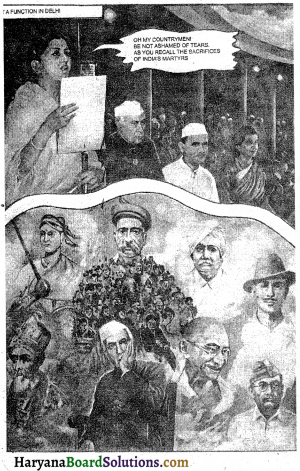
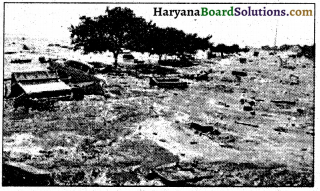
Look at the picture 1 and recall the opening lines of the original song in Hindi. Who is the singer? Who else do you see in this picture?
चित्र 1 को देखो और हिन्दी में वास्तविक गीत की प्रारंभिक पंक्तियाँ याद करो। गायक कौन है? इस तस्वीर में आप और किसे देखते हो?
Answer:
The opening lines of the original song in Hindi are: “Aey mere vatan ke logon, turn khub laga lo naara, ye shubh din hai hum sabka, lehra lo tiranga pyara, par mat bhulo seema par, veero ne hai pran gavayen, Kutchhyaad unhe bhi karlo, Jo laut ke ghar na aaye ………………….”. Lata Mangeshkar is the singer. Pandit Jawahar Lai Nehru, Lai Bahadur Shastri and Indira Gandhi are also seen in this picture.

Glimpses Of The Past HBSE 8th Class Question 2.
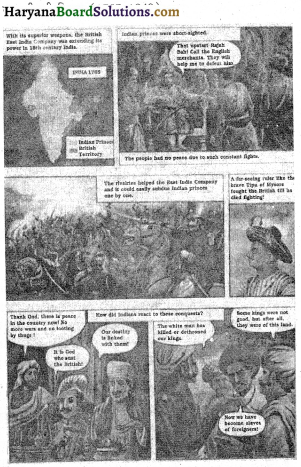
In picture 2 what do you understand by the Company’s ‘superior weapons’?
चित्र 2 में, कम्पनी के ‘सर्वोत्कृष्ठ हथियारों’ से आप क्या समझते हो?
Answer:
The Company’s ‘superior weapons’ mean all their wits, strength, rules and regulations.

Glimpses Of The Past Question Answer HBSE 8th Class Question 3.
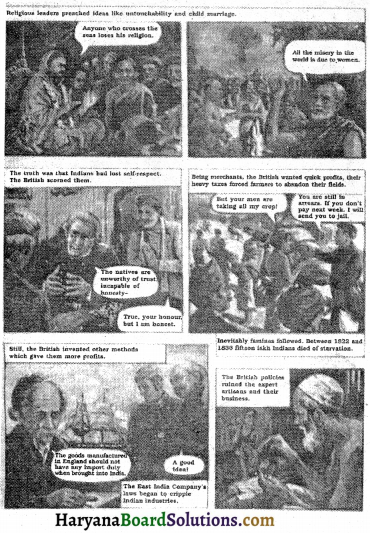
Who is an artisan? Why do you think the artisans suffered? (picture 3)
एक शिल्पी कौन होता है? आप क्या सोचते हो कि क्यों निपुण शिल्पियों के अंगूठे काट दिए गए? (चित्र 3)
Answer:
An artisan is a skilled woikman. The chopped off so that they could not make expert goods.

Glimpses Of The Past Summary In Hindi HBSE 8th Class Question 4.
Which picture, according to you, reveals the first sparks of the fire of revolt?
कौन सा चित्र, आपके अनुसार, विद्रोह की आग की प्रथम चिंगारियाँ प्रस्तुत करता है?
Answer:
The picture about ‘The Company’s Conquest’ reveals the first sparks of the fire of revolt.

HBSE 8th Class English Solutions Honeydew Chapter 3 Glimpses of the Past

Working with The Text

Answer the following questions:
निम्नलिखित प्रश्नों के उत्तर दो:

Glimpses Of The Past Question Answers HBSE 8th Class Question 1.
Do you think the Indian princes were short-sighted in their approach to the events of 1757?
क्या आप सोचते हो भारतीय राजकुमार 1757 की घटनाओं के बारे में अपनी सोच दूरदर्शी नहीं रखते थे?
Answer:
Yes, the Indian princes were short¬sighted as they had been quarrelling with their counterparts on petty issues. They took the outsiders’s help to fight within the native land.

Glimpses Of The Past Summary In English HBSE 8th Class Question 2.
How did the East India Company subdue the Indian princes?
ईस्ट इंडिया कंपनी ने भारतीय राजकुमारों पर जीत किस प्रकार हासिल की?
Answer:
The East India Company subdued the Indian princes by their policy of‘Divide and Rule’.

Class 8 English Chapter 3 Glimpses Of The Past HBSE Question 3.
Quote words used by Raja Ram Mohan Roy to say that every religion teaches the same principles.
राजा राम मोहन राय द्वारा कहो गए वे शब्द करो कि ‘हर धर्म सिद्धांत सिखाता है।’
Answer:“Cows are of different colours but the colour of their milk is the same. Different teachers have different opinions but the essence of every religion is the same.”

Class 8 Honeydew Chapter 3 HBSE Question 4.
In what ways did the British officers exploit Indians?
किस तरह से ब्रिटिश अधिकारियों ने भारतीयों का उत्पीड़न किया?
Answer:
The British officers exploited Indians in every possible way, they could. They imposed heavy taxes on Indian farmers. And reduced import duty on goods manufactured in England and brought to India. Even they cut the thumbs of expert artisans.

HBSE 8th Class English Solutions Honeydew Chapter 3 Glimpses of the Past

Glimpses Of The Past Class 8 Questions And Answers HBSE Question 5.
Name these people.
इन लोगों के नाम बताओ:
(i) The ruler who fought pitched battles against the British and died fighting.
वह शासक जिसने ब्रिटिश के विरुद्ध जमकर युद्ध किया और लड़ते हुए मर गया।
Answer:
Tipu Sultan of Mysore.

(ii) The person who wanted to reform the society.
वे व्यक्ति जो समाज में सुधार लाना चाहते थे।
Answer:
Raja Ram Mohan Roy from Bengal.

(iii) The person who recommended the introduction of English education in India.
वह व्यक्ति जिसने भारत में अंग्रेजी शिक्षा शुरू करने का प्रस्ताव दिया।
Answer:
Lord Macaulay.

(iv) Two popular leaders who led the revolt (Choices may vary.)
दो प्रसिद्ध नेता जिन्होंने विद्रोह का नेतृत्व किया।
Answer:
Nana Saheb and Kunwar Singh.

Glimpses Of The Past Class 8 Question And Answer HBSE Question 6.
Mention the following:
निम्न का उल्लेख करो:
(i) Two examples of social practices prevailing then. .
सामाजिक कुरीतियों के दो उदाहरण।
Answer:
Untouchability and Child-Marriage.

(ii) Two oppres^ve policies oT’tbe British.
ब्रिटिशों की दो उत्पीड़क नीतियाँ।
Answer:
(a) To put the Indians in jails without trial in a court.
(b) The Company’s loot in industrial sector.

(iii) Two ways in which common people suffered.
दो तरीके जिनसे सामान्य लोगों ने परेशानियाँ सहीं।
Answer:
(a) Indian artisans were ruined with the exporting of British machine-made goods.
(b) The Indian farmers had to abandon their fields due to heavily imposed taxes.

(iv) Four reasons for the discontent that led to the 1857 war of independence.
1857 के स्वतंत्रता के युद्ध के चार कारण।
Answer:
(a) The natives had become slaves in their own country.
(b) The East India Company crippled Indian industries and cared a little for Indian’s need.
(c) The huge difference in the treatment of the English men and the Indians.
(d) The use of grease on the bullet was spoiling the customs of Indians as it was made of the fat of cows and pigs.

HBSE 8th Class English Solutions Honeydew Chapter 3 Glimpses of the Past

Working with Language

In colics what the characters speak is put in hubbies. This is direct narration. When we report what the characters speak, we use the method of indirect narration.
Study these examples:
First farmer: Why are your men taking away the entire crop?
Second farmer: Your men have taken away everything.
Officer :
You are still in arrears. If you don’t pay tax next week. I’ll send you to jail.
The first farmer asked the officer why his men were taking away the entire crop.
The second farmer said that their men had taken away everything.
The officer replied that they were still in arrears and warned them that if they did not pay tax the following week, the officer would send the farmers to jail.

1. Change the following sentences into indirect speech:
निम्नलिखित वाक्यों को indirect speech में बदलो:
(i) First Man: We must educate our brothers.
Second Man: And try to improve their material conditions.
Third Man: For that we must convey our grievances to the British Parliament.
Answer:
The first man said that they must educate their brothers.
The second man added that they must try to improve their material conditions also.
The third man suggested that for that they must convey their grievances to the British Parliament.

(ii) First soldier: The white soldier gets huge pay, mansions and servants.
Second soldier: We get a pittance and slow promotions.
Third soldier: Who are the British to abolish our customs?
Answer:
The first soldier said that the white soldier got huge pay, mansions and servants.
The second soldier remarked that they got a pittance and slow promotions.
The third soldier asked who the British were to abolish their customs.

HBSE 8th Class English Solutions Honeydew Chapter 3 Glimpses of the Past

Speaking and Writing

Glimpses Of The Past Class 8 HBSE Question 1.
Play act the role of farmers who have grievances against the policies of the government. Rewrite their ‘speech bubbles’ in dialogue form first.
Answer:
(Roles to be played in the classroom).

Glimpses Of The Past Class 8 Summary In Hindi HBSE Question 2.
Look at the pictures.
HBSE 8th Class English Solutions Honeydew Chapter 3 Glimpses of the Past-8
(i) Ask one another questions about the picture.
→ Where is fox?
Answer:
The fox is inside a well.

→ How did it happen?
Answer:
It happened accidentally.

→ What is the fox thinking?
Answer:
The fox is thinking how to get out of the well.

→ Who is the visitor?
Answer:
The goat is the visitor.

→ What does she want to know?
Answer:
She wants to know if the water of the well is sweet.

→ What’s the fox’s reply?
Answer:
The fox’s reply is that the water of the well is too sweet. Even she had it so much and might faint.

→ What happens next?
Answer:
The fox comes out of the well with the goat’s help.

→ Where is the goat?
Answer:
The goat is inside the well.

→ Where is the fox now?
Answer:
The fox has now come out of the well.

→ What is the goat thinking?
Answer:
The goat is thinking about her mother who used to say “Be careful how you take the advice of people you don’t know.”

HBSE 8th Class English Solutions Honeydew Chapter 3 Glimpses of the Past

(ii) Write the story in your own words. Give it a title.
Answer:
The Fox and The Goat Once there was a fox. It accidentally fell into a well. She was worried. She tried many times to come out of the well but all in vain. She thought, “How do I get out of here?” Just then, a goat was passing by the well. She stopped and peeped into the well. She asked the fox, “Hello! Is this water sweet?” The fox was cunning. It replied, “Too sweet?” I’ve had so much. I might faint.” Then the goat was eager to taste the water. She told the fox to help her to come inside the well. The fox was waiting for the same. It hold her and came out of the well whereas the goat had fallen inside. The fox thanked her and said, “Come out when you can.” The goat was helpless. She remembered her mother saying,“Be careful how you take advice of people you don’t know.”

Chapter 3 Glimpses Of The Past Question Answer HBSE 8th Class Question 3.
Read the following news item.
History Becomes Fun At This School:
Mumbai:
Students in the sixth grade of a certain school in Navi Mumbai love their history lessons thanks to a novel teaching aid. It is not surprising giving the fact that their study material includes comic books and they use their textbooks for reference to put things into perspective. Besides, students are encouraged to tap other sources of information as well. During History classes, students pore over comic strips of historical periods, enact characters of emperors and tyrants, and have animated discussions on the subject. History has become fun.

In the class students are asked to read the comic strip aloud, after which they break up into groups of four, discuss what they have heard and write a summary. Each group leader reads his group’s summary aloud and the whole class jumps into discussion and debate, adding points, disagreeing and qualifying points of view. A sixth grade student says, ‘It’s a lot of fun because everyone gets a chance to express themselves and the summary takes everyone’s ideas into account. ’

According to the school principal the comic strip format and visuals appeal to students. A historian feels that using comics in schools is a great idea. Comic and acting help students understand what characters in the story are actually thinking.
(Adapted from The Times of India, New Delhi dated 3 October 2007)

Based on this news item, write a paragraph about what you think about this new method of teaching History.
Answer:
It is said, “Seeing is ten times better than listening something.” And if the presentation is beautiful, it leaves a greater impact on the learner. The situation is same at the school level teaching. The students are afraid of Social Studies, English and Mathematics sort of subjects. Especially, History is headache for them. But this new comic strip format and visuals have surely made the learning of History easy and interesting. Group discussions, debates and dramatizations creat an everlasting impact on the students because they are ‘learning by doing’. This new method of teaching History has made this subject learnable to the students. It is fun for them rather than a matter of boredom.

HBSE 8th Class English Solutions Honeydew Chapter 3 Glimpses of the Past

Glimpses Of The Past Meaning In Hindi HBSE 8th Class Question 4.
Find the chapters in your History book that correspond to the episodes and events described in this comic. Note how the information contained in a few chapters of History has been condensed to a few pages with the help of pictures and the ‘speech bubbles’.
Answer:
(To be discussed in the classroom).

Question 5.
Create a comic of your own using this story:
Answer:
Who is the strongest? ‘The Sun and the Wind’:
HBSE 8th Class English Solutions Honeydew Chapter 3 Glimpses of the Past-9
Once the Sun and the Wind began to quarrel, each one saying that he was stronger than the other. At last they decided to test each one’s strength. A man with a cloak around his shoulders was passing by. The Wind boasted. ‘Using my strength I can make that man take off the cloak.’ The sun agreed. The Wind blew hard. The man felt so cold that he clasped his cloak round his body as tightly as possible.
Now it was the turn of the Sun which shone very hot indeed. The man felt so hot that he at once removed the cloak from his body. Seeing the man taking off the cloak, the wind conceded defeat.

Glimpses of the Past Para Wise Translation in Hindi

Before You Read

Here are some pic!orial glimpses of the history of our oountry from 1757 to 1857. ‘These pictures and ‘speech bubbles’ thiliheip clarify y4z1r understanding of the conditions that led to the event known as the First War of Independence in 1857.

Word Meaning:
Function: celebration = (समारोह), Ashamed of tears: fill tears in your eyes = (आँखों में आँसू भर लो), Martyrs: one who sacrifices life for one’s country = (शहीद)।

यहाँ 1757 से 1857 तक की हमारे देश के इतिहास की कुछ चित्रात्मक झलकियाँ हैं। ये तस्वीरें और ‘वाच्य (कही गई बातें) बुलबुले’ आपको उन स्थितियों को समझने में मदद करेंगे जो कि उस अवसर की ओर ले गईं जिसे 1857 के प्रथम स्वतंत्रता युद्ध के रूप में जाना जाता है।

1. The Martyrs (शहीद)
दिल्ली के एक समारोह में
HBSE 8th Class English Solutions Honeydew Chapter 3 Glimpses of the Past-1
ए मेरे वतन के लोगों जरा आँख में भर लो पानी जो शहीद हुए हैं उनकी जरा याद करो कुर्बानी ।

2. The Company’s Conquests (1757-1849) कम्पनी की विजय (1757–1849)
HBSE 8th Class English Solutions Honeydew Chapter 3 Glimpses of the Past-2

2.1 अपने सर्वोत्तम हथियारों के साथ ब्रिटिश ईस्ट इंडिया कम्पनी 18वीं शताब्दी के भारत में अपनी शक्ति बढ़ा रही थी।
भारतीय राजकुमार
ब्रिटिश राज्य

2.2 भारतीय राजकुमार दूरदर्शी नहीं थे।
वह नया धनी राजा वाह! मैं अंग्रेजी व्यापारियों को बुलाता हूँ। वे उसे हराने में मेरी मदद करेंगे।
ऐसी निरंतर लड़ाइयों के कारण लोगों को शांति नहीं थी।

2.3 शत्रुओं ने ईस्ट इंडिया कम्पनी की मदद की और वे आसानी से भारतीय राजकुमारों को एक-एक करके जीत सके।

2.4 मैसूर का दूरदर्शी शासक वीर टीपू अपनी अंतिम सांस तक ब्रिटिश लोगों के खिलाफ लड़ा।

2.5 भारतीयों ने इन जीतों पर कैसे प्रतिक्रिया की?
धन्यवाद भगवान, अब देश में शांति है। न और अधिक युद्ध और न ठगों और लूटमारों के द्वारा लूटमार।
हमारा भाग्य उनके साथ जुड़ा हुआ है।
वह भगवान है जिसने ब्रिटिश लोगों को भेजा।

2.6 श्वेत लोगों ने हमारे राजाओं को मार दिया है या सिंहासन से उतार दिया है।
कुछ राजा अच्छे नहीं थे परंतु फिर भी वे इस भूमि के थे।
अब हम विदेशियों के गुलाम बन गए हैं।

Word Meaning: Superior: better than existing = (सर्वोत्कृष्ट), Extending: spreading = (फैला रहे), Territory: land under one ruler = (क्षेत्र), Constant: regular = (निरंतर), Upstart: new became rich = (नया धनी), Short-sighted: one who is not worried about future = ( अल्प/लघु दृष्टि), Conquests: victories = (विजयें)।

HBSE 8th Class English Solutions Honeydew Chapter 3 Glimpses of the Past

3. British Rule (1765-1836)
ब्रिटिश शासन (1765-1836)
धार्मिक गुरुओं ने मूर्खतापूर्ण रीतियों जैसे कि छुआछूत और बाल-विवाह की शिक्षा दी।
HBSE 8th Class English Solutions Honeydew Chapter 3 Glimpses of the Past-3

3.1 कोई भी जो कि समुद्र को पार करता है, अपना धर्म खोता है।

3.2 संसार में सभी दुख महिलाओं के कारण है। वे बहुत भाग्यवान हैं यदि वे सती की तरह जलकर मरती हैं।

3.3 सत्य यह था कि भारतीय अपना आत्म-सम्मान खो चुके थे। ब्रिटिश ने उनसे घृणा की।
इस देश के वासी विश्वास-योग्य नहीं हैं, ईमानदारी के योग्य भी नहीं हैं।
सत्य श्रीमान् लेकिन मैं ईमानदार हूँ।

3.4 व्यापारी होने के नाते, ब्रिटिश तुरंत मुनाफा चाहते थे। उनके भारी करों के कारण किसानों को अपने खेतों को त्यागने के लिए विवश होना पड़ा।
लेकिन आपके आदमी मेरी सारी फसल ले जा रहे हैं।
तुम पर अभी भी उधार है। यदि तुम अगले सप्ताह तक नहीं दोगे तो तुम्हें जेल भेज देंगे।

3.5 अब तक, ब्रिटिश ने अन्य तरीकों को ढूँढ लिया था जिनसे उन्हें अधिक लाभ प्राप्त होता था।
इंग्लैंड में बने सामान पर निर्यात कर नहीं लगना चाहिए जब उन्हें भारत में लाया जाए।
अच्छा विचार है।
ईस्ट इंडिया कंपनी के कानूनों ने भारतीय उद्योगों को रौंदना शुरू किया।

3.6 अनिवार्य रूप से अकालों ने पीछा किया। 1822 और 1836 के मध्य भूख से पंद्रह लाख भारतीयों की जान गई।
ब्रिटिश ने निपुण शिल्पकारों के अंगूठे तक कटवा दिए।

Word Meaning: Absurd: foolish = (मूर्खतापूर्ण), Practices: customs = (रीतियाँ), Misery:problems = (परेशानियाँ), Fortunate:lucky = (भाग्यशाली), Scorned: hatred = (नफरत की), Abandon: to give up entirely = (पूर्णतः खाली कर देना); Natives: persons born within a particular country = (देशवासी), Artisans: skilled workman . = (शिल्पकार)।

4. Ram Mohan Roy (1772-1833)
राम मोहन राय (1772-1833)
4.1 राम मोहन रॉय, बंगाल से एक शिक्षित व्यक्ति समझ गए कि देश में क्या गलत था।
हम अपना वेश न बदलें। हमारी प्राचीन परंपरा महान है। और हम महानतम उपलब्धियों में समर्थ हैं। हमें सबसे पहले अपने समाज को बदलना चाहिए। अंधविश्वास हमें तबाह कर रहे हैं।

4.2 उसने अपनी पत्नी उमा से कहा:

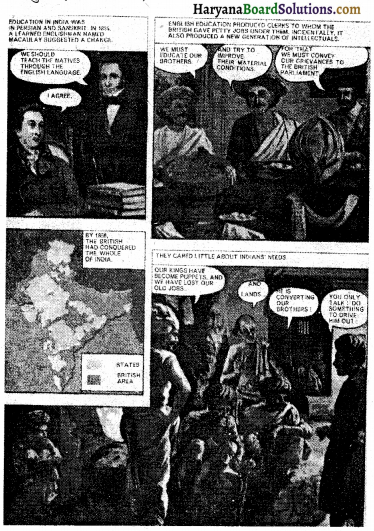
6. Dissatisfaction (1835-1856)
असंतुष्टि (1835-1856)
HBSE 8th Class English Solutions Honeydew Chapter 3 Glimpses of the Past-4

6.1 भारत में शिक्षा संस्कृत और फारसी में थी। 1835 में, एक शिक्षित अंग्रेज मैकॉले ने एक परिवर्तन का सुझाव दिया।
हमें इस देश के वासियों को अंग्रेजी भाषा के माध्यम से पढ़ाना चाहिए।
मैं सहमत हूँ।
6.2 अंग्रेजी शिक्षा ने लिपिकों को उत्पन्न किया जिन्हें ब्रिटिश अपने नीचे तुच्छ नौकरियाँ दिया करते थे। घटनास्वरूप, इससे एक बुद्धिमान नई युवा पीढ़ी का भी उद्भव हुआ।
हमें अवश्य अपने भाइयों को पढ़ाना चाहिए।
और उनकी भौतिक स्थितियों को सुधारने की कोशिश करनी चाहिए।
उसके लिए हमें अवश्य ही अपने दुखों को ब्रिटिश संसद तक पहुँचाना चाहिए।
6.3 1856 तक, ब्रिटिश पूरा भारत जीत चुके थे।
– राज्य
– ब्रिटिश क्षेत्र

6.4 उन्होंने भारतीयों की जरूरतों की जरा सी परवाह न की।
हमारे राजा कठपुतलियाँ बन चुके है और हम अपनी पुरानी नौकरियाँ खो चुके हैं।
और जमीनें।
वह हमारे भाइयों को बदल (धर्म परिवर्तन) रहा है।
तुम केवल बात करते हो मैं ही कुछ करता हूँ उसे बाहर निकालने के लिए।

Word Meaning: Petty: inferior = (dog), Grievances: problems = (कष्ट), Conquered: won = (जीता), Puppets: (कठपुतलियाँ), Converting: changing into = (परिवर्तित करना)।

HBSE 8th Class English Solutions Honeydew Chapter 3 Glimpses of the Past

7. The Sparks (1855-57)
चिंगारियाँ (1855-57)
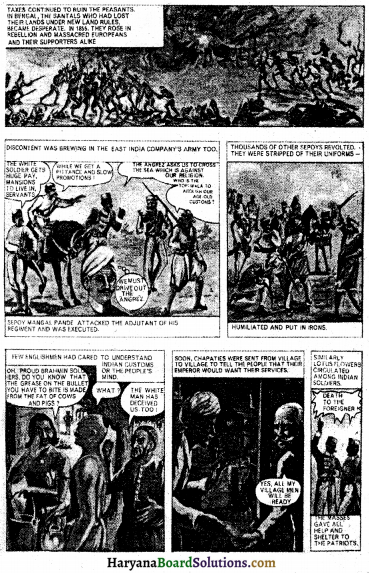
7.1 करों ने किसानों का विनाश करना जारी रखा। बंगाल में, नए भूमि नियमों के अनुसार जो संथाल अपनी जमीनें खो चुके थे, निराश और उत्तेजित हो गए।
7.2 असंतुष्टि की भावना ईस्ट इंडिया कंपनी की सेना में भी धीरे-धीरे पनप रही थी।
गोरे सिपाहियों को भारी तनख्वाहें, रहने के लिए मकान, नौकर मिलते हैं।
जबकि हमें एक दयापूर्ण और धीमी पदोन्नति मिलती है।
अंग्रेज हमें समुद्र पार करने को कहते हैं जो हमारे धर्म के विरुद्ध है। टोपी वाले कौन होते हैं, हमारी सदियों पुरानी परपंराओं को बदलने वाले?
हमें अवश्य ही अंग्रेजों को बाहर निकालना चाहिए।
सिपाही मंगल पांडे ने अपनी रेजीमेंट के उच्चाधिकारी पर आक्रमण कर दिया और उसे सजा दी गई।
HBSE 8th Class English Solutions Honeydew Chapter 3 Glimpses of the Past-5

7.3 हजारों अन्य सिपाहियों ने विद्रोह कर दिया। उनकी वर्दी उतार दी गई।
मारा-पीटा गया और जेलों में डाल दिया गया।

7.4 कुछ अंग्रेजों ने भारतीय परंपराओं अथवा लोगों के मस्तिष्क को समझने की कोशिश की।
ओह, बेचारे ब्राह्मण सिपाहियों, क्या तुम जानते हो गोली का खोल जो तुम मुँह से उतारते हो गाय और सुअर की चर्बी से बना हुआ है?
क्या? गोरे लोगों ने हमें भी धोखा दिया है।

7.5 जल्दी ही, एक गाँव से दूसरे गाँव चपातियाँ भेजी गई लोगों को बताने के लिए कि उनके शासक को उनकी सेवाओं की जरूरत है।
हाँ, मेरे गाँव के सभी लोग तैयार होंगे।

7.6 इसी तरह से, कमल के फूलों को भारतीय सिपाहियों के मध्य वितरित किया गया।
विदेशियों के लिए मृत्यु।
अधिकतर लोगों ने संभव मदद और देशभक्तों को शरण दी।

Word Meaning: Rebellion:one who rebels = (विद्रोही), Mansions: shelter / home = (आवास/मकानं)।

8. Revolt (1857)
विद्रोह (1857).
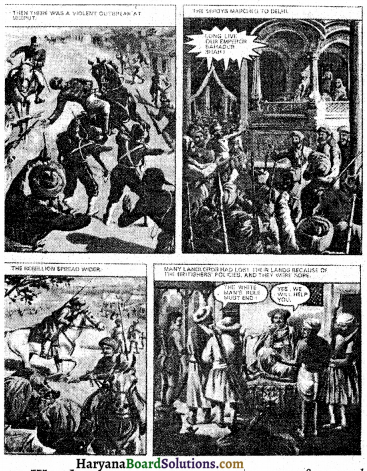
8.1 तब वहाँ मेरठ में एक हिंसात्मक विद्रोह उठ खड़ा हुआ।
8.2 सिपाहियों ने दिल्ली की ओर मार्च किया।
हमारे शासक बहादुर शाह की आयु लम्बी हो।
8.3 विद्रोही दूर-दूर तक फैल गए।
8.4 अधिकतर जमींदार अंग्रेजों की नीतियों के कारण अपनी जमीनें खो चुके थे और वे भरे हुए बैठे थे।
गोरे लोगों का शासन अवश्य समाप्त होना चाहिए।
हाँ, हम आपकी मदद करेंगे।
HBSE 8th Class English Solutions Honeydew Chapter 3 Glimpses of the Past-6
Word Meaning:
Marched: came forward = (आगे आए), Sore: Angry = (क्रोधित/नाराज)।

9. The Fight For Freedom (1857)
स्वतंत्रता के लिए लड़ाई (1857)
HBSE 8th Class English Solutions Honeydew Chapter 3 Glimpses of the Past-7
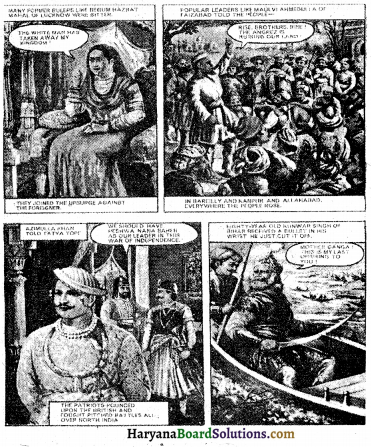
9.1 कई पूर्व शासक जैसे लखनऊ की बेगम हजरत महल क्रोधित थे।
अंग्रेजों ने मेरा राज्य ले लिया है।
उन्होंने विदेशियों के विरुद्ध विद्रोह में हिस्सा लिया।

9.2 फैजाबाद के मौलवी अहमदुल्लाह जैसे प्रसिद्ध नेताओं ने लोगों से कहा:
उठो, भाइयों, उठो! अंग्रेज हमारी जमीन को नष्ट कर रहे हैं।

9.3 अजीमुल्ला खान ने तात्या टोपे से कहा-
“हमें इस स्वतंत्रता की लड़ाई में पेशवा नाना साहेब को अपना नेता बनाना चाहिए।”
देशभक्त ब्रिटिशों पर टूट पड़े और संपूर्ण उत्तर भारत में युद्ध लड़े।

9.4 अस्सी वर्षीय, बिहार के कुंवरसिंह की कलाई में एक गोली लगी। उसने उसे काटकर अलग कर दिया।
‘गंगा माँ! यह मेरी ओर से आपको अंतिम भेंट है।’
बरेली में, कानपुर और इलाहाबाद, सब जगह लोग उठ खडे हुए।

Word Meaning: Independence:freedom = (स्वतंत्रता),Pounced:jumped swiftly = (टूट पड़ना), Upsurge: revolution = (विद्रोह)।

HBSE 8th Class English Solutions Honeydew Chapter 3 Glimpses of the Past

Glimpses of the Past Summary in English

This lesson is a pictorial account of glimpses of the history of our country from 1757 to 1857. It clears the conditions that led to the revolt of 1857. Britishers established East India Company in 18th century for trade purposes. Gradually, they started taking over the states. They followed the principle of divide and rule’. The situation got worst in India. Religious leaders preached absurd … practices like untouchability and child marriage. But Ram Mohan Roy, a learned man from Bengal spreaded the education against these malpractices. Lord Macaulay advocated the English Language teaching in India in 1835. But the sparks of revolt and dissatisfaction had arisen. A sepoy in Meerut, Mangal Pandey outbroke a violence against British rulers. Begum Hazrat Mahal of Lucknow, Maulavi Ahmedulla of Faizabad, Tatya Tope, Peshwa Nana Saheb, sort of patriots co-operated and took part with a great zeal in the fight for freedom.

Glimpses of the Past Summary in Hindi

यह पाठ हमारे देश के इतिहास की 1757 से 1857 की झलक का चित्रात्मक लेखा-जोखा है। यह उन स्थितियों को स्पष्ट करता है जिनके कारण 1857 का विद्रोह हुआ। ब्रिटिश लोगों ने 18वीं शताब्दी के भारत में व्यापार के उद्देश्य से ईस्ट इण्डिया कम्पनी की स्थापना की। धीरे-धीरे उन्होंने राज्यों पर अधिकार करना शुरू कर दिया। उन्होंने ‘फूट डालो और शासन करो’ की नीति का अनुसरण किया। भारत में स्थिति बदतर हो गई। धार्मिक रूढ़िवादियों (नेताओं) ने मूर्खतापूर्ण नीतियों जैसे कि छुआछूत और बाल-विवाह का उपदेश दिया। लेकिन बंगाल के एक शिक्षित व्यक्ति, राम मोहन राय ने इन बुराइयों के विरुद्ध शिक्षा का प्रचार किया। लार्ड मैकाले ने 1835 में भारत में अंग्रेजी भाषा के शिक्षण की वकालत की। लेकिन विद्रोह और असंतुष्टि की चिंगारियाँ उठ चुकी थीं। मेरठ के एक सिपाही, मंगल पाण्डे ने ब्रिटिश शासकों के विरुद्ध विद्रोह कर दिया। लखनऊ की बेगम हजरत महल, फैजाबाद के मौलवी अहमदुल्लाह, तात्या टोपे, पेशवा नाना साहेब, जैसे देशभक्तों ने स्वतंत्रता की लड़ाई में अत्यधिक उत्साह के साथ भाग लिया और सहयोग दिया।

HBSE 8th Class English Solutions Honeydew Chapter 3 Glimpses of the Past Read More »

HBSE 8th Class English Solutions Honeydew Chapter 7 A Visit to Cambridge

Haryana State Board HBSE 8th Class English Solutions Honeydew Chapter 7 A Visit to Cambridge Textbook Exercise Questions and Answers.

Haryana Board HBSE 8th Class English Solutions Honeydew Chapter 7 A Visit to Cambridge

HBSE 8th Class English A Visit to Cambridge Textbook Questions and Answers

Comprehension Check – I

A Visit To Cambridge Solution HBSE 8th Class

Which is the right item:
ठीक उत्तर चिह्नित करो:
1. ‘Cambridge was my metaphor for England’. To the writer,
(i) Cambridge was a reputed university in England.
(ii) England was famous for Cambridge.
(iii) Cambridge was the real England.
“कैम्ब्रिज मेरे लिए इंग्लैंड का रूपक था।” लेखक के लिए
(क) कैम्ब्रिज, इंग्लैंड में एक प्रसिद्ध विश्वविद्यालय था।
(ख) इंग्लैंड, कैम्ब्रिज के लिए प्रसिद्ध था।
(ग) कैम्ब्रिज ही वास्तविक इंग्लैंड था।
Answer:
(iii) Cambridge was the real England. house

2. The writer phoned Stephen Hawking’s
(i) from the nearest phone booth.
(ii) from outside a phone booth.
(iii) from inside a phone booth.
लेखक ने स्टीफन के घर फोन किया
(क) निकटतम फोन कक्षिका से
(ख) एक फोन कक्षिका के बाहर से
(ग) एक फोन कक्षिका के भीतर से।
Answer:
(iii) from inside a phone booth.

HBSE 8th Class English Solutions Honeydew Chapter 7 A Visit to Cambridge

3. Every time he spoke to the scientist, the writer felt guilty because
(i) he wasn’t sure what he wanted to ask.
(ii) he forced the scientist to use his voice synthesiser.
(iii) he was face to face with a legend.
हर समय जब वह वज्ञानिक से बात करता था, लेखक स्वयं को दोषी मानता था क्योंकि
(क) वह इसमें विश्वस्त नहीं था कि वह क्या पूछे।
(ख) उसने वैज्ञानिक को उसका स्वर-संश्लेषक का प्रयोग करने के लिए विवश करता था।
(ग) वह एक चर्चित व्यक्तित्व के सामने था।
Answer:
(ii) he forced the scientist to use his voice synthesiser.

4. “I felt a huge relief …. in the possibilities of my body.” In the given context, the italicised words refer to:
(i) shifting in the wheelchair, turning the wrist.
(ii) standing up, walking.
(iii) speaking, writing.
Answer:
(i) Shifting in the wheelchair turning the wrist.

A Visit To Cambridge HBSE 8th Class

Working with The Text

I. Answer the following questions:
निम्नलिखित प्रश्नों के उत्तर दीजिए:

A Visit To Cambridge Summary HBSE 8th Class Question 1.
(i) Did the prospect of meeting Stephen Hawking make the writer nervous? If so, why? ..
क्या स्टीफन हॉकिंग से मिलने की आशा ने लेखक को नर्वस कर दिया? यदि हाँ, तो कैसे?
Answer:
Yes, but at the same time he was surprised and shocked, because he had completely forgotton the fact that such a worthy author of “A Brief History of Time” could have lived there. He was completely disabled. Although he had become the successor to Issac Newton at the University of Cambridge.

(ii) Did he at the same time feel very excited? If so, why?
क्या वह साथ ही बहुत उत्साहित हो गया? यदि हाँ, तो स्यों?
Answer:
Yes, he felt excited to hear of his presence in England at that time because he felt so much eager to see him that he handled the phone cord carelessly and hurriedly at the phone booth. He wanted to see him as soon as possible. Even ten minutes would do. He suddenly felt weak all over, being himself disabled.

A Visit To Cambridge Summary In Hindi HBSE 8th Class Question 2.
Guess the first question put to the scientist by the writer.
अनुमान लगाइए कि लेखक ने कौन सा पहला प्रश्न वैज्ञानिक (स्टीफन हाकिंग) के समक्ष रखा होगा?
Answer:
The author might have asked him to be brave, take courage and face the hurdles of life.

HBSE 8th Class English Solutions Honeydew Chapter 7 A Visit to Cambridge

Visit To Cambridge HBSE 8th Class Question 3.
Stephen Hawking said: “I’ve had no choice”. Does the writer think there was choice? What was it?
स्टीफन हॉकिंस कहता है– “मेरे पास इसके अतिरिक्त कोई और विकल्प भी तो नहीं है।” क्या लेखक समझता है कि कोई और विकल्प है? यदि है तो क्या है?
Answer:
Yes, the writer feels there is a choice for Stephen Hawking and it is to live creatively with the fact of his broken (disabled) body. He should have kept himself busy in doing creative work so that he might feel his mind preoccupied and therefore not less important in society.

Class 8 Honeydew Chapter 7 HBSE Question 4.
“I could feel his anguish” What could be the anguish?
“मैं उसकी संवेदना का अनुभव कर सकता था।” उसकी क्या संवेदना थी?
Answer:
The writer observed his painful efforts with which he was tapping at the little switch in his hand. He tried to find the words on his computer with difficulty. He had the only bit of movement which was left to him in his long pale fingers. Not only this, his eyes would shut with the feeling of tiredness which disappointed him very much. Hence the writer could feel his anguish. At the same time, Stephen Hawking’s mind was filled with thoughts that came out in such continual but very slow words and sentences that were as hard as a dead body.

Visit To Cambridge Summary HBSE 8th Class Question 5.
What endeared the scientist to the writer so that he said he was looking at one of the most beautiful men in the world?
लेखक ने वैज्ञानिक में क्या देखा जिससे उसने कहा कि विश्व के अत्यंत सुंदर व्यक्तियों में से एक को देख रहा है?
Answer:
The writer asked Stephen if he found it annoying when someone like him (the writer) came and disturbed him in his work. Stephen replied at once in positive but he smiled on one side. His face reflected on unmatchable beauty. The writer was highly impressed over his frank confession. He could not cheat the writer. Whatever he felt he boldly said.

A Visit To Cambridge Question Answer HBSE 8th Class Question 6.
Read aloud the description of ‘the beautiful man’. Which is the most beautiful sentence in the description?
‘सुंदर व्यक्ति’ का वर्णन ऊँचे स्वर में पढ़ो। वर्णन में सबसे सुंदर वाक्य कौन सा है?
Answer:
The most beautiful sentence is the answer flashed. “Yes, I do feel it annoying when some one like the writer comes and disturbs me a
in my work.” In fact when he is compelled to use his pale and long fingers in which only the least energy is left. He feels painful and troublesome at the time of discussion with his visitors when they happen visit him.

HBSE 8th Class English Solutions Honeydew Chapter 7 A Visit to Cambridge

Summary Of A Visit To Cambridge HBSE 8th Class Question 7.
(i) If ‘the lantern’ is the man, what would its ‘walls’ be?
यदि ‘लालटेन’ एक व्यक्ति हो तो इसकी ‘दीवारें’ क्या होंगी?
Answer:
If the lantern is man, its walls are like ; a case made of shadows.

(ii) What is housed within the thin walls?
इन पतली दीवारों में क्या बंद रखा गया है?
Answer:
Within the thin walls, housed light (i.e. incandescence). Our body is not so important. It is irrelevant, i.e. immaterial.

(iii) What general conclusion does the writer draw from the comparison?
लेखक ने तुलना में क्या सामान्य निष्कर्ष निकाला?
Answer:
The writer draws a general conclusion that inside our body is the eternal soul. Everything else is an accessory i.e. extra.

Question 8.
What is the scientist’s message for the disabled?
वैज्ञानिक का अपंगों के लिए क्या संदेश क्या है?
Answer:
The scientist Stephen Hawking’s message for the disabled is that they should take care of only those parts of the body very attentively which God has gifted them free from defects. They should concentrate on what they are good at. They should make the best use of them and Thank God.

Question 9.
What does the writer, refer to the guitar incident? Which idea does it support?
गिटार की घटना की ओर लेखक क्या संकेत करता है? यह किस बात का समर्थन करता है?
Answer:
Stephen Hawking refers to the guitar incident by saying that he had spent many years trying to play Spanish guitar. However its size was larger than himself. So, suddenly on one night he had unstringed it. The idea which supported this action of his was that perhaps its practice created great difficulty for his weak and long fingers a lot while playing on the guitar. It disturbed his peace of mind.

Question 10.
The writer expresses his great gratitude to Stephen Hawking. What is the gratitude for?
लेखक स्टीफन हाकिंग के प्रति महान,आभार प्रकट करता है। यह आभार किसलिए है?
Answer:
The writer expressed his great gratitude to Stephen Hawkiiig because the scientist being handicapped even in maiiy respects. It gave him time inspite of these hurdles. He responded to his question^ with the help of his voice synthesiser. The writer felt humiliated and obliged highly for this kind favour. He had occasionally annoyed gawking but instead of ten minutes, the writer was able to be in company with him for full half an-hour. Hawking had to use his we’ak and little fingers in which was left only little energy. This was a great gratitude hrStephen for allowing the writer to spend his time for talk.

HBSE 8th Class English Solutions Honeydew Chapter 7 A Visit to Cambridge

Question 11.
Complete the following sentences using their appropriate parts from both boxes below.
निम्नलिखित वाक्यों को बॉक्स
(A) और बॉक्स
(B) में दिए गए शब्दों से भरो:
(i) There was his assistant on the line _______ .
(ii) You get fed up with people asking you to be brave, _______ .
(iii) There he was, _______ .
(iv) You look at his eyes which can speak _______ .
(v) It doesn’t do much good to know _______ .

AB
* tapping at a little switch in his hand,* trying to find the words on his computer.
* and I told him* I had come in a wheelchair from India.
* that there are people* on which you are too lazy to draw a cheque.
* as if you have a courage account* smiling with admiration to see you breathing still.
* and they are saying something huge and urgent* it is hard to tell what.

Answer:
(i) There was his assistant on the line and I told him that I had come in a wheelchair from India.
(ii) You get fed up with pedple asking you to be brave, as if you have a courage account on which you are too lazy to draw a cheque.
(iii) There he was, tapping at the little switch in his hand, trying to find the words on his computer.
(iv) You look at his eyes which can speak still and they are saying something huge and urgent, it is hard to tell what.
(v) It doesn’t do much good to know that there are people, smiling with admiration to see you breathing still.

Working With Language

1. Fill in blanks in the sentences below using the appropriate forms of words given in the box.
निम्नलिखित वाक्यों में रिक्त स्थान बॉक्स में दिए गए शब्दों के उपयुक्त रूपों का प्रयोग करे होए भरो:
guide, succeed, chair, travel, pale, draw, true
(i) I met a _______ from an antique land.
(ii) I need special _______ in Mathematics. I can’t count the number of times I have failed in the subject.
(iii) The guide called Stephen Hawking a worthy _______ to Issac Newton.
(iv) His other problems _______ into insignificance beside this unforeseen mishap.
(v) The meeting was _______ by theyoungest member of the board.
(vi) Some people say ‘yours _______ , when they informally refer to themselves.
(vii) wish it had been a _______ match. We would have been spared the noise of celebrations at least.
Answer:
(i) traveller
(ii) guide
(iii) successor
(iv) pale
(v) chaired
(vi) truly
(vii) drawn.

HBSE 8th Class English Solutions Honeydew Chapter 7 A Visit to Cambridge

2. Look at the following words:
निम्नलिखित शब्दों को देखिए:

Walk             Stick

→ Can you create a meaningful phrase using both these words?
क्या तुम इन दोनों शब्दों का प्रयोग करते हुए एक बना सकते हो?
→ It is simple. Adding to the Verb and use it before the noun. Put an article at the beginning. …. a walking stick
Now make six such phrases using the words given in the box:
अब ऐसे: छः वाक्यांश बनाओ जिनमें बॉक्स में दिए गए निम्नलिखित शब्दों का प्रयोग हो:
read/session
smile/face
revolve/chair
walk/to ur
dance/doll
win/chance
Answer:
1. Reading session
2. Walking tour
3. Revolving chair
4. Winning chance
5. Dancing doll
6. .Smiling face

3. Use ‘all’ or ‘both’ in the blanks. Tell your partner why you chose one or the other.
(i) He has two brothers ………………. are lawyers.
(ii) More than ten persons called ………………. of them wanted to see you.
(iii) They ………………. cheered the team.
(iv) ………………. her parents are teachers.
(v) How much have you got? Give me ………………. of it.
Answer:
(i) He has two brothers. Both are lawyers.
(ii) More than ten persons called. All of them wanted to see you.
(iii) They all cheered the team.
(iv) Both her parents are teachers.
(v) How much have you got? Give me all of it.
(‘Both’ is used for the sense of ‘two’. ‘All’ is used for more than two.)

4. Complete each sentence using the right form of the adjective given in brackets.
(i) My Mend has one of the ………………. cars on the road, (fast)
(ii) This is the ………………. story I have ever read, (interesting)
(iii) What you are doing now is ………………. than what you did yesterday. (easy)
(iv) Ramesh and his wife are both ………………. (short)
(v) He arrived ………………. as usual. Even the chief guest came ………………. than he did. (late, early)
Answer:
(i) My friend has one of the fastest cars on the road.
(ii) This is the most interesting story I have ever read.
(iii) What you are doing now is easier than what you did yesterday.
(iv) Ramesh and his wife are both short.
(v) He arrived late as usual. Even the chief guest came earlier than he did.

Speaking and Writing

1. Say the following words with correct stress. Pronounce the parts in bold loudly and clearly.

camelballoon
decentopinion
fearlessenormous
carefulfulfil
fathertogether
governdegree
bottlebefore

→ In a word having more than one syllable the strfessed syllable is the one that is more prominent than the other syllable (s).
→ A word has as many syllables as it has vowels.
man (one syllable)
manner (two syllables)
→ The mark (‘) indicates that the first syllable in ‘manner’ is more prominent than the other.

2. Underline stressed syllables in the following words. Consult the dictionary or ask the teacher if necessary.

artistmistakeaccident
momentcomparesatisfy
relationtableillegal
agreebackwardmountain

Answer:

artistmistakeaccident
momentComparesatisfy
relationtableillegal
agreebackwardmountain

3. Writing a notice for the School Notice Board.
Step 1

  • Discuss why notices are put up on the notice board.
  • What kinds of ‘notices’ have you lately seen on the board?
  • How is a notice different from a letter or a descriptive paragraph?

Step 2

  • Suppose you have lost or found something on the campus.
  • What have you lost or found?
  • You want to write a notice about it. If you have lost something, you want it restored to you in case someone has found it. If you have found something, you want to return it to its owner.

Step 3

  • Write a few lines describing the object you have lost or found. Mention the purpose of the notice in clear terms. Also write your name, class, section and date.

Step 4

  • Let one member of each group read aloud the notice to the entire class.
  • Compare your notice with the other notices, and make changes, if necessary, with the help of the teacher.

Answer:
Notice
LOST ! LOST! LOST!
March 12, 200…..
Lost a FIREMAKER GEOMETRY BOX somewhere in the school campus yesterday. It is in green colour consisting of pens and all other geometrical items. Whosoever finds it, please return it to the undersigned.
Tanya Sachdeva
Class VIII
Section A
Roll No . 14

Or

  • Imagine that you are a journalist.
  • You have been asked to interview the president of the village panchayat.
  • Write eight to ten questions you wish to ask.
    The questions should elicit comments as well as plans regarding water and electricity, cleanliness and school education in the village.
  • कल्पना कीजिए कि आप एक पत्रकार हैं।
  • आपको ग्राम पंचायत के अध्यक्ष का साक्षात्कार करने के लिए कहा गया है।
  • आठ से दस प्रश्न लिखें जो आप पूछना चाहते हैं।
    सवाल टिप्पणियों के साथ-साथ गांव में पानी और बिजली, स्वच्छता और स्कूली शिक्षा के संबंध में योजनाओं को प्राप्त करना चाहिए।

Answer:
I wish to ask following questions:
1. Only a few questions, please at first, have you served with any other local body as a president which you have not mentioned in you biodata?
2. During this long period, I think, you might have faced many social problems while dealing with the scarcity of water, electricity ceanliness and rural education?
3. Good behaviour, tectful social approach, Public popularity, sweet manners 210 meetings managed in 4 years? Wonderful achievement. Well, How much for your services, sir?

HBSE 8th Class English Solutions Honeydew Chapter 7 A Visit to Cambridge

A Visit to Cambridge Passages for Comprehension

Read the passages carefully and answer the questions that follow:

Passage – 1

And I started, because I had quite forgotten that this most brilliant and completely paralysed astrophysicist, the author of A Brief History of Time, one of the biggest best-sellers ever, lived here.
Questions: .
(i) What is the name of the lesson from which this passage has been taken?
(ii) Who i’s “I” in the passage?
(iii) Why did he start?
(iv) Which book had Stephen written?
(v) Define astrophysicist.
(vi) Give opposite words for (a) smallest, (b) recalled, from the passage.
Answers:
(i) The lesson from which this passage has been taken is “A Visit to Cambridge”.
(ii) “I” has been used for the writer “Firdaus Kanga”.
(iii) He felt shocked because he had quite forgotton that how could Stephen Hawking being the most brilliant person could live there.
(iv) Stephen had written “A Brief History of Time.”
(v) An astrophysicist is a scholar of . astrophysics, a branch of physics dealing with the stars and planets.
(vi) (a) biggest (b) forgotten.

Passage – 2

And suddenly I felt weak all over. Growing up disabled, you get fed up with people asking you to be brave, as if you have a courage account on which you are too lazy to draw a cheque. The only thing that makes you stronger is seeing somebody like you, achieving something huge.
Then you know how much is possible and you reach out further than you ever thought you could.
Questions:
(i) If you, god forbid, get disabled, what would you react the people visiting and r asking you “to be brave”?
(ii) Explain “asking you to be brave cheque. ”
(iii) Give noun forms of weak, growing, disabled, brave.
(iv) Use account as a verb, adjective and as a noun.
(v) Remove too in the following sentence and rewrite the sentence without changing its meaning-You are too lazy to draw a cheque.
Answers:
(i) I do feel fed up with such people because they in fact can’t do anything for other to improve my condition. Lip sympathy v is no use to me.
(ii) When certain people encourage us’to be brave again and again, they think we have a large stock of courage which we can use. Such people show only a lip sympathy. They do not suggest concrete stops to face the odd situation nor can
they help us practically.
(iii) Weakness, growth, disability, bravery.
(iv) (a) Account (Verb)-Who will account for the mistake you have committed?
(b) Account (Adjective)-Where is your account book?
(c) Account (Noun)-Please get your account checked up by some approved chartered accountant.
(v) You are so lazy that you do not draw the cheque.

Passage – 3

Surely, I wanted to say, living creatively with the reality of his disintegrating body was a choice? But I kept quiet, because I felt guilty every time I spoke to him, forcing him to respond. There he was, tapping at the little switch in his hand, trying to find the words on his computer with the only bit of movement left to him, his long, pale fingers. Every so often, his eyes would shut in frustrated exhaustion. And sitting opposite him I could feel his anguish, the mind buoyant with thoughts that came out in frozen phrases and sentences stiff as corpses. Questions:
(i) Who is T used in the passage?
(ii) Make adjective forms of creativity, reality, respond, computer, involvement.
(iii) Why did the author feel guilty and what for?
(iv) Why did he (Stephen) tap at a little switch in his hand?
(v) How did his eyes react?
(vi) What choice did the author want to suggest Stephen to face the hurdles caused by his disability?
Answers:
(i) “I” is the author, Firdaus Kanga used in the passage.
(ii) Creative, real, responsive, computerised, involved.
(iii) The author felt guilty every time he spoke to Stephen because he compelled him to speak although he knew Stephen could not speak without his computer-voice which he had to use with a lot of trouble.
(iv) He (Stephen) was disabled. So, he pressed the button in his hand.to find words on his computer and used them for speaking through the computer voice.
(v) His eyes would shut in disappointment.
(vi) The author wanted to say “that Stephen should become creative with the reality of handicapped condition”. This was his choice, which he wanted to suggest to him.

Passage – 4

Before you, like a lantern whose walls are worn so thin you glimpse only the light inside, is the incandescence of a mem. The body, almost irrelevant, exists only like a case made of shadows. So that I, no believer in eternal souls, know that this is what each of us is; everything else an accessory.
Questions:
(i) Explain: “Before you a man.”
(ii) Incandescence means
(iii) Use “accessory” in your own sentence.
(iv) What each of us is?
(v) Irrelevant has ‘ir’ before it as a prefix. Give four other such words.
Answers:
(i) Stephen was infront of the author like a lamp whose thin body could show you the light movement inside shone brightly.
(ii) Incandescence means internal glow or light.
(iii) The accessory of this car is too expensive.
(iv) Each of us is the body, in its inside is the light. It exists only like a case made of shadows. The writer refers this to Stephen who is a thin bodied disabled person. We are not different from him except that he is worm or outdated due to his disability.
(v) ir-relevant, ir-responsible, ir-regular, ir-religious, ir-removable.

HBSE 8th Class English Solutions Honeydew Chapter 7 A Visit to Cambridge

A Visit to Cambridge Para Wise Translation in Hindi

This is the story of a meeting between two extraordinary people, both of them ‘disabled, or ‘differently abled as we now say. Stephen Hawking is one of the greatest scientists of our time. He suffers from a form of paralysis that confines him to a wheelchair, and allows him to‘speak’only by punching buttons on a computer, which speaks for him in a machine-like voice. Firdaus Kanga is a writer and journalist who lives and works in Mumbai. Kanga was born with ‘brittle bones’ that tended to break easily when he was a child. Like Hawking, Kanga moves around in a wheelchair.
The two great men exchange thoughts on what it means to live life in a wheelchair, and on how the so called ‘normal people react to the disabled.

Word Meaning:
Extraordinary:not ordinary = (असाधारण), Disabled:handicapped = (अपंग), Brittle:fragile = (कुरकुरी), Confines: encircle in a limit = (सीमित कर देना) ।

यह दो असाधारण लोगों की एक मुलाकात की कहानी है, दोनों ही ‘असमर्थ’ या जैसा कि हम अब कहते हैं ‘विभिन्न रूप में समर्थ’ हैं। स्टीफन हॉकिंग हमारे समय के महानतम वैज्ञानिकों में से एक है। वह एक प्रकार के अधरंग से ग्रसित हैं जो उन्हें व्हील-चेयर तक सीमित रखता है और उन्हें केवल कम्प्यूटर पर बटन दबाकर बोलने की अनुमति देता है जो उनके लिए एक यंत्र रूपी आवाज में बोलता है। फिरदौस कंग एक लेखक और पत्रकार है जो मुंबई में रहते और कार्य करते हैं। कंग ‘कुरकुरी हड्डियों के साथ पैदा हुए थे जो कि आसानी से टूट जाया करती थीं, जब वे बालक थे। हॉकिंग की तरह, कंग भी व्हील-चेयर में इधर-उधर घूमा करते थे।
दो महान व्यक्ति विचारों का आदान-प्रदान करते हैं कि व्हील-चेयर में जीवन जीने के क्या मायने हैं और ये ‘सामान्य’ कहे जाने वाले लोग ‘अपंग’ लोगों पर किस प्रकार प्रतिक्रियाएँ देते हैं।

Word Meaning:
Metaphor: (रूपक), Strange: surprising = (आश्चर्यजनक), Altogether: completely = (पूर्ण रूप से)।

HBSE 8th Class English Solutions Honeydew Chapter 7 A Visit to Cambridge

1. Cambridge was my metaphor for England, and it was strange that when I left it had become altogether something else, because I had met Stephen Hawking there.
कैम्ब्रिज मेरे लिए इंग्लैंड का रूपक था और यह आश्चर्य की बात थी कि जब मैंने इसे छोड़ा, इसका रूप पूर्ण रूप से कुछ और हो गया था क्योंकि मैं वहाँ पर स्टीफन हॉकिंग से मिला था।

2. It was on a walking tour through Cambridge that the guide mentioned Stephen Hawking, “poor man, who is quite disabled now, though he is a worthy successor to Issac Newton, whose Chair he has at the university.”

Word Meaning:
Guide: (मार्गदर्शक), Disabled: handicapped = (अपंग), Worthy:respectable = (आदरयोग्य), Mentioned: stated = (वर्णन किया), Though: even if = (यद्यपि), Successor: inheritor = (उत्तराधिकारी)।

यह कैम्ब्रिज का भ्रमण करते हुए ही था कि गाइड ने स्टीफन हॉकिंग के नाम का वर्णन किया, जो एक निर्धन व्यक्ति था और । जो अब सर्वथा अपंग हो चुका था, यद्यपि वह इसाक न्यूटन (Issac Newton) का सम्मानयोग्य उत्तराधिकारी भी था और जिसका आचार्य पद (Chair) विश्वविद्यालय में उसके पास है।

3. And I started, because I had quite forgotten that this most brilliant and completely paralysed astrophysicist, the author of A Brief History of Time, one of the biggest best-sellers ever, lived here.

Word Meaning:
Started: began = (आरंभ किया),Forgotten:missed = (भूल गया), Paralysed: handicapped = (विकलांग, अपंग), Ever: always = (सदा)।

और मैं चलता रहा क्योंकि मैं यह सर्वथा भूल गया था कि अत्यंत प्रतिभाशाली और पूर्णरूप से अपंग खगोल-भौतिक वैज्ञानिक तथा A Brief History of Time नाम की पुस्तक का, जो सबसे अधिक बिकने वाली पुस्तकों में से एक थी, लेखक भी यहाँ रहता है।

4. When the walking tour was done, I rushed to a phone booth and, almost tearing the cord so it could reach me outside, phoned Stephen Hawking’s house. There was his assistant on the line and I told him I had come in a wheelchair from India (perhaps he thought I had propelled myself all the way) to write about my travels in Britain. I had to see Professor Hawking – even ten minutes would do. “Half an hour,” he said. “From three-thirty to four.”

Word Meaning:
Rushed: ran fast = (तेज दौड़ा), Booth: temporary shelter = (अस्थायी स्थान), Assistant: helper = (सहायक), Quite: very much = (पूर्णतया), Brilliant: shining, intelligent = (विवेकशील), Astrophysicist: (नक्षत्र भौतिकी के ज्ञाता)।

जब भ्रमण हो चुका, मैं फोन बूथ की ओर दौड़ा और लगभग फोन की डोरी को खींचकर (ताकि यह मुझ तक बाहर की ओर: पहुंच सके) स्टीफन हाकिंग के घर फोन किया। उसका सहायक विद्यमान था ओर मैंने उसे बताया कि मैं व्हील चेयर पर भारत से आया हूँ (संभवतः उसने सोचा कि मैं स्वयं व्हील चेयर पर भारत से सीधा चलाकर आया था) तांकि वह अपनी यात्रा का वर्णन कर सके। मैंने प्रोफेसर हॉकिंग को देखना था। दस मिनट मिले तो भी काम चल जाएगा उसने कहा, “आधा घंटा।” “3.30 से 4 बजे तक।”

5. And suddenly I felt weak all over. Growing up disabled, you get fed up with people asking you to be brave, as if you have a courage account on which you are too lazy to draw a cheque. The only thing that makes you stronger is seeing somebody like you, achieving something huge. Then you know how much is possible and you reach out further than you ever thought you could.

Word Meaning:
Growing: (बड़ा होना), Fed up: tired = (उकता जाना), Disabled: handicapped = (अपंग), Courage: daring act = (साहस)।

और अचानक मैंने सर्वथा निर्बल पाया। यदि लोग तुम्हें वीर कहें अपंग होते हुए तुम उकता जाओगे। ऐसे जैसे तुम्हारे पास साहस का बचत खाता है जिस पर तुम इतना आलसी हो जाते हो कि. जैसे साहस बटोरने का मन न कर रही हो। केवल एक वस्तु है जो तुम्हें शक्तिशाली बना देती है। वह यह है कि किसी अपने जैसे व्यक्ति से मिलो। तुम जानते हो कि कुछ बड़ी वस्तु प्राप्त करना कितना संभव होता है और तुम अपनी आशाओं से भी आगे निकल जाओगे।

HBSE 8th Class English Solutions Honeydew Chapter 7 A Visit to Cambridge

6. “I haven’t been brave,” said his disembodied computer-voice, the next afternoon. “I’ve had no choice.”
Surely, I wanted to say, living creatively with the reality of his disintegrating body was a choice? But I kept quiet, because I felt guilty every time I spoke to him, forcing him to respond.

Word Meaning:
Computer-voice: (कंप्यूटर का स्वर), Surely: certainly = (निश्चित रूप से), Forcing: compelling = (विवश करना), Reality: fact = (वास्तविकता)।

“मैं वीर तो नहीं रहा हूँ” उसकी शरीररहित कम्प्यूटर की आवाज ने अगली दोपहर के पश्चात् कहा, “कि मेरे पास कोई और उपाय नहीं था”।
निश्चय ही उसके टूटते शरीर की वास्तविकता के साथ रचनात्मक ढंग से जीते हुए मैं कहना चाहता था। परंतु मैं शांत रहा क्योंकि जब मैं उससे बोलता था अपने आपको दोषी अनुभव करता था। टिप-टिप करते हुए मैं उसे बोलने के लिए विवश कर रहा था।

7. There he was, tapping at the little switch in his hand, trying to find the words on his computer with the only bit of movement left to him, his long, pale fingers. Every so often, his eyes would shut in frustrated exhaustion. And sitting opposite him I could feel his anguish, the mind buoyant with thoughts that came out in frozen phrases and sentences stiff as corpses.

Word Meaning:
Movement: motion = (गति), Frustrated: disappointed = (विक्षिप्त), Exhaustion: tiredness = (थकावट), Opposite:against = (विपरीत), Buoyant:excited = (उत्साहवर्धक), Anguish: pain = (पीड़ा), Frozen phrases: (स्थिर वाक्यांश, कठोर शब्द समूह), Stiff: hard = (कठोर), Corpses: dead body = (मृतक शरीर)।

वहाँ पर अपने हाथ में छोटे बटन लिए टिप-टिप करते हुए तथा अपने कम्प्यूटर पर शब्द ढूँढने का प्रयास करते हुए थोड़ी-थोड़ी शक्ति के साथ जो शेष उसके पास रह गई थी, अपनी लंबी तथा पीली उंगलियों के साथ करता था। प्रत्येक बार उसकी आँखें निराशापूर्ण थकावट के कारण बंद हो जाती थीं और उसके सम्मुख बैठकर मैं उसकी पीड़ा का अनुभव कर सकता था। उसका मन उन विचारों से उत्तेजित हो जाता था जो जमे हुए वाक्यांशों तथा वाक्यों में आते थे क्योंकि ये शव की भाँति कठोर थे।

8. “A lot of people seem to think that disabled people are chronically unhappy,” I said, “I know that’s not true myself. Are you often laughing inside?”
About three minutes later, he responded, “I find it amusing when people patronise me.”
“And do you find it annoying when someone like me comes and disturbs you in your work?”

Word Meaning:
Disabled: handicapped = (अपंग),Chronically unhappy: very sad = (बहुत उदास), Laughing: smiling = (हँसते हुए), Responded: answered = (उत्तर दिया), Disturbs: (हस्तक्षेप करता है)।

“बहुत से लोग यह सोचते हुए प्रतीत होते हैं कि अपंग लोग बहुत ही उदास रहते हैं”। मैंने कहा। “मैं जानता हूँ कि यह मेरे साथ सत्य नहीं है। क्या तुम बहुधा भीतर से हंसते रहते हो?
लगभग तीन मिनट के पश्चात् उसने उत्तर दिया, “मुझे बहुत हंसी आती है जब लोग मेरा उत्साह बढ़ाते हैं।” “और क्या तुम्हें ज्ञात है कि जब कोई जैसे मैं आकर तुम्हें तुम्हारे कार्य में हस्तक्षेप करता है तो चिढ़ होती है?”

HBSE 8th Class English Solutions Honeydew Chapter 7 A Visit to Cambridge

9. The answer flashed. “Yes.” Then he smiled his one-way smile and I knew, without being sentimental or silly, that I was looking at one of the most beautiful men in the world.

Word Meaning:
Flashed: shone = (चमका), Smiled: (मुस्कराया), One-way smile: (एक दिशा से मुस्कराना), Sentimental: (भावुक)।

उत्तर तत्काल मिला। “हाँ।” तब वह एकतरफा मुस्कुराया और मैं जान गया, मैं भावुक नहीं हुआ और न ही मूर्ख प्रतीत हुआ कि मैं विश्व के अत्यंत सुन्दर पुरुषों में से एक के साथ बात कर रहा हूँ।

10. A first glimpse of him is shocking, because he is like a still photograph – as if all those pictures of him in magazines and newspapers have turned three-dimensional.

Then you see the head twisted sideways into a slump, the torso shrunk inside the pale blue shirt, the wasted legs; you look at his eyes which can speak, still, and they are saying something huge and urgent-it is hard to tell what. But you are shaken because you have seen something you never thought could be seen.

Word Meaning:
Glimpse: (झलकी), Shocking: (भयावह), Still: even now = (अब भी), Threedimensional: (त्रिदिशीय), Twisted= (मुड़ी), Torso: (धड़-प्रतिमा), Huge: big = (बड़ा), Urgent: important = (महत्त्वपूर्ण), Never: (कभी नहीं)।

उसकी पहली झलक भयावह है, क्योंकि वह एक फोटोग्राफ की भाँति है। ऐसे जैसे उसके वे सब चित्र जो पत्रिकाओं तथा समाचार पत्रों में थे, त्रिविमीय हो गए हों।

तब उसका सिर एक ओर मुड़कर एक ढलान बन गई हो। मूर्ति जैसा धड़ सिकुड़कर भद्दी नीली कमीज और सिकुड़ी टांगों में धंस गया। यदि तुम उसकी आँखों में देखो तो वे अब भी बोल सकती थीं और वह कोई बड़ी तथा आवश्यक बात कह रही हैं-यह नहीं कह सकते कि क्या। परंतु तुम हिल जाओगे क्योंकि तुमने वह वस्तु देखी हैं जो तुम कभी नहीं देखने की सोच सकते थे।

11. Before you, like a lantern whose walls are worn so thin you glimpse only the light inside, is the incandescence of a man. The body, almost irrelevant, exists only like a case made of shadows. So that I, no believer in eternal souls, know that this is what each of us is; everything else an accessory.

Word Meaning:
Incandescence: inner glow or light = (आंतरिक प्रकाश), Exists: present = (विद्यमान), Believer: (विश्वास करने वाला), Eternal souls: (अनंत आत्मा), Accessory: (मशीन ठीक रखने के लिए प्रयुक्त होने वाले अतिरिक्त यंत्र अथवा साज-सामग्री)।

अपने सामने लैम्प की भांति जिसकी दीवारें घिस जाएँ और इतनी पतली हो जाएँ कि तुम्हें केवल प्रकाश दिखाई दे, मनुष्य का प्रकाशित शरीर लगभग संबंध रहित, केवल छाया की बनी मूर्ति विद्यमान हो। ताकि मैं जो अनन्त आत्मा में विश्वास नहीं रखता, यह जान जाऊँ कि यही है जो हम प्रत्येक में से एक है। प्रत्येक अन्य वस्तु एक अनावश्यक वस्तु है और अतिरिक्त भी है।

12. “What do you think is the best thing about being disabled?” I had asked him earlier. “I don’t think there is anything good about being disabled.” “I think,” I said, “you do discover how much kindness there is in the world.”
“Yes,” he said; it was a disadvantage of his voice synthesiser that it could convey no inflection, no shades or tone. And I could not tell how enthusiastically he agreed with me.

Word Meaning: Earlier: (पहले),Disadvantage: loss, harm, demerits = (दोष, हानि), Convey: send = (भेजना), Tone: (ध्वनि), Discover: (खोज करना), Synthesiser:connects = (वह जो समन्वय करता है), Shades: shadow = (छाया), Demerits: loss, disadvantage = (दोष), Agreed with: (सहमत होना)।

“तुम्हारे विचार में विकलांग बनने में कौन सी बढ़िया वस्तु है।” मैंने पूर्व में उससे पूछा था। “मैं नहीं समझता कि कोई अच्छी बात विकलांग बनने में है।” “मैं सोचता हूँ,” मैंने कहा, “तुम अवश्य जान लोगे कि विश्व में कितनी दया है”।
“हाँ,” उसने कहा। यहाँ उसकी ध्वनि के उतार-चढ़ाव का संकलन करना हानि थी क्योंकि यह आवाज ऊपर-नीचे नहीं हो सकती थी। कोई धीमी आवाज अथवा लौ उत्पन्न नहीं हो सकती थी और मैं नहीं बता सकता कितने उत्साह-युक्त मुद्रा में वह मुझसे सहमत हो गया।

HBSE 8th Class English Solutions Honeydew Chapter 7 A Visit to Cambridge

13. Every time I shifted in my chair or turned my wrist to watch the time – I wanted to make every one of our thirty minutes count – I felt a huge relief and exhilaration in the possibilities of my body. How little it mattered then that I would never walk, or even stand.
I told him how he had been an inspiration beyond cliche for me, and, surely, for others – did that thought help him?

Word Meaning:
Shifted: change site = (जगह बदलना),Wrist: (कलाई), Relief:rest = (विश्राम), Exhilaration:joy = (आनंद), Possibilities: hopes = (संभावनाएँ), Mattered: (अंतर पड़ना), Inspiration: encouragement = (उत्साह), Beyond: on the other side = (परे), Cliche: out dated, out of use = (प्रयोग न करने लायक)।

प्रत्येक समय जब मैं अपनी कुर्सी बदलता था अथवा अपनी कलाई की घड़ी को समय देखने के लिए एसे मोड़ता था, मैं चाहता था कि मैं अपने तीस मिनट पूरा करने के लिए गिनता रहूँ। जब मैंने अपने शरीर की संभावनाएँ देखीं। मुझे बहुत आराम तथा आनन्द प्राप्त हुआ कितना थोड़ा इसमें अन्तर पड़ता था। जब मैंने अनुभव किया कि मैं तो चलूँगा और न ही खड़ा हो पाऊँगा।
मैंने उसे कहा कि वह मेरे लिए अत्यंत उत्साहवर्धक सिद्ध हुआ था और निचित रूप में, दूसरों के लिए इस विचार ने मेरी बहुत सहायता की।

14. “No,” he said; and I thought how foolish I was to ask. When your body is a claustrophobic room and the walls are growing narrower day by day, it doesn’t do much good to know that there are people outside smiling with admiration to see you breathing still.

Word Meaning:
Claustrophobic: very small and suffocating (दम घुटने वाला),Narrower: (संकुचित), Good: advantage (लाभ), Smiling: (मुस्कराना), Admiration: praise = (प्रशंसा करना), Breathing: (सांस लेना)।

“नहीं,” उसने कहा और मैंने सोचा कि मैंने यह पूछकर कितनी मूर्खता की। जब हमारा शरीर ही एक छोटा तथा दम घुटने वाला कमरा है और इसकी दीवारें दिन-प्रतिदिन संकुचित होती जा रही हैं इससे यह जानना अधिक लाभकारी नहीं कि बाहर भी कुछ लोग हैं जो तुम्हें साँस लेते हुए देखकर मुस्कुराते हुए प्रशंसा कर रहे हैं।

15. “Is there any advice you can give disabled people, something that might help make life better?”
“They should concentrate on what they are good at; I think things like the disabled Olympics are a waste of time.”
“I know what you mean.” I remembered the years I’d spent trying to play a Spanish guitar considerably larger than I was; and how gleefully I had unstringed it one night.

Word Meaning:
Advice: instruction = (HET), Disabled:handicapped = (3741), Concentrate: to think of one thought only = (ध्यान केन्द्रित करना), Good at: specialist at = (विशेषज्ञ), Guitar: a musical Indian instrument = (भारतीय वाद्य यंत्र), Considerably: sufficiently = (पर्याप्त मात्रा में), Gleefully: joyfully = (आनन्दित होकर), Unstringed: without any condition = (बिना किसी शर्त के)।

“क्या कोई संदेश है जो तुम विकलांगों को दे सकते हो, कुछ ऐसी वस्तु जो जीवन को अधिक अच्छा बनाने में सहायक होगी?”
“उन्हें अपना ध्यान केवल उस अंग पर केंद्रित करना चाहिए, जो अच्छा है; मेरे विचार में विकलांगों के ओलम्पिक तो समय की बर्बादी है।”
“मैं जानता हूँ कि तुम्हारा अभिप्राय क्या है।” मुझे वे वर्ष याद हैं जब मैंने वह स्पेनिश गिटार खेली थी जो मुझसे भी बड़ी थी और कितनी प्रसन्नता से मैंने एक रात को इसकी तारें हटा दी थीं।

HBSE 8th Class English Solutions Honeydew Chapter 7 A Visit to Cambridge

16. The half-hour was up. “I think I’ve annoyed you enough,” I said, grinning. “Thank you for…”
“Stay.” I waited. “Have some tea. I can show you the garden.”

Word Meaning:
Annoyed: angry = (नाराज होना), Enough: sufficient = (पर्याप्त), Grinning: laugh with open stet, showing teeth = (ata facich X471)||

आधा घंटा समाप्त हो गया था। “मेरे विचार में मैंने तुम्हें पर्याप्त नाराज कर दिया है।” मैंने दाँत निकाल कर हँसते हुए कहा। इसके लिए धन्यवाद।
“ठहरो।” मैंने प्रतीक्षा की। “कुछ चाय ले लो। मैं तुम्हें उद्यान दिखाऊँगा।”

17. The garden was as big as a park, but Stephen Hawking covered every inch, rumbling along in his motorised wheelchair while I dodged to keep out of the way. We couldn’t talk very much; the sun made him silent, the letters on his screen disappearing in the glare.

Word Meaning: Covered: capped = (ढकना), Rambling along: jumping with long steps = (कूदना), Wheel-chair: a chair moving on wheels used by the handicapped = (अपंग द्वारा प्रयोग की जाने वाली पहिया गाड़ी), Dodged: prevented = (रोका), Screen: curtain = (पर्दा)।

उद्यान इतना बड़ा था जितना कि एक पार्क। परंतु स्टीफन हाकिंग ने प्रत्येक इंच ढक रखा था, अपनी मोटर से चलने वाली पहिया कुर्सी के पास-पास गड़गड़ाहट का शब्द करते हुए जब मैं मार्ग से हटने के लिए रुका। तब हम बहुत अधिक बातचीत नहीं कर सके। सूर्य ने उसे मौन कर दिया क्योंकि पर्दे पर लगे शब्द प्रकाश में लुप्त हो रहे थे।

18. An hour later, we were ready to leave. I didn’t know what to do. I could not kiss him or cry. I touched his shoulder and wheeled out into the summer evening. I looked back; and I knew he was waving, though he wasn’t. Watching him, an embodiment of my bravest self, the one I was moving iowards, the one I had believed in for so many years, alone, I knew that my journey was over. For
now.

Word Meaning:
Touched: contacted = (स्पर्श), Wheeled: (पहियों वाला), Waving: (लहराना, हिलाना), Watching: looking deeply at = (देखना), Embodiment: symbol = (मूर्तरूप), Bravest self: a men of courage = (अत्यंत साहसी व्यक्ति)।

एक घंटे के पश्चात् हम जाने के लिए तैयार हो गए थे। मैं नहीं जानता था कि क्या करूँ। मैं उसे चूम नहीं सका। और न ही चीख सका। मैंने उसका कंधा छुआ और पहिए के द्वारा गर्मी की शाम को बाहर निकल गया। मैंने पीछे देखा और मैं जान रहा था कि वह हाथ हिला रहा है अर्थात् विदाई का संकेत कर रहा है, यद्यपि वह नहीं हिला रहा था। मैं उसे देख रहा था वह मेरी वीरतापूर्ण आत्मा का मूर्त रूप था। वह जिसकी ओर मैं जा रहा था। वह जिस पर मैं इतने वर्षों से विश्वास करता था, केवल मैं अकेला। मैं ‘ जान गया कि मेरी यात्रा समाप्त हो चुकी है। बस, अब तक इतना ही।

HBSE 8th Class English Solutions Honeydew Chapter 7 A Visit to Cambridge

A Visit to Cambridge Summary in English

The author plans a trip to Cambridge. He feels it highly pleasing. Here, he sees Mr. Stephen Hawking. He made a walking tour through Cambridge to see him. Stephen was also a disabled professor although he was a successor to Issac Newton at the Cambridge University. He wrote the famous: “A Brief History of Time”. The author met Henry VII and Elizabeth. I also went there. He wished to see Stephen. He reached there on seeing him. He was shocked to see him using a computer-voice for speaking, a wheel-chair to sit on and long fingers, tapping the key-board with great difficulty. Stephen faced the situation with great difficulty yet bravely. His fingers had a little energy left for movement to him. His eyes would shut in disappointment and he would felt tired. He suffered a great anguish. His mind was full of thoughts on, his body. He said he felt amused when people encouraged him. As for people visit to him, he felt disturbing. His appearance shocked the author as he was like a motionless photograph. He twisted his head side ways and trunk inside the shirt. His legs didn’t work at all. His eyes appeared moving list lessly.

The author observed liveliness in his mind. The thin body existed like a case made of shadows. He felt there was nothing good about being disabled but the author said that we can at least know much kindness left in the world. Stephen agreed through his voice synthesiser. Author compared his own condition with that of Stephen. He thanked God he was a little better although he used wheel-chair. He was contented to think about the possibilities of his own body. He realised that he also could not walk. Stephen had been an inspiration to him. It was unnecessary to see people smiling at Stephen with praise that he was still breathing.
On asking for any advise to the author disabled people, Stephen said, “Concentrate on what you are good at.” He said he had once unstringed guitar although he enjoyed it.

The author now felt guilty of disturbing Stephen with many questions and troubling with his disabled and “computer voiced” body. So, he begged him permission to leave him. He should the author his garden while going himself on wheel-chair. The author could neither kiss his friend. He only touched his shoulder and left him on his wheel-chair.

A Visit to Cambridge Summary in Hindi

लेखक कैम्ब्रिज जाने की योजना बनाता है। इस भ्रमण को वह बहुत आनन्ददायक तथा ज्ञानवर्धक बताता है। यहाँ वह स्टीफन हाकिंग से मिलता है।
वह उसके पास कैम्ब्रिज नगर में पहिए वाली गाड़ी पर चढ़कर मिलने के लिए गया। स्टीफन विकलांग था यद्यपि वह कैम्ब्रिज विश्वविद्यालय में इसॉक न्यूटन का उत्तराधिकारी था। उसने एक प्रसिद्ध पुस्तक लिखी जिसका नाम “A Brief History of Time” था। वहाँ लेखक हेनरी VII तथा एलिजाबेथ I से भी मिला। वह स्टीफन हाकिंग से मिलना चाहता था। जब वह वहाँ पहुँचा तो उसकी दयनीय दशा देखकर उसके मन को बहुत धक्का लगा कि वह बोलने के लिए कम्प्यूटर मशीन का प्रयोग कर रहा था। वह व्हील-चेयर पर बैठा था क्योंकि उसकी टाँगें भी कार्य नहीं कर रही थीं। वह अपनी लम्बी तथा दुर्बल उंगलियों से शब्द पटल पर बहुत कठिनाई से टिप-टिप कर धीरे-धीरे शब्द ढूँढता था। वह स्थिति का सामना बहुत वीरता तथा साहस से कर रहा था। उसकी उँगलियों की गति बहुत धीमी थी। उसकी आँखें निराशा की मुद्रा में बन्द हो जाती थीं। उसका मन विचारों से भरा हुआ था। वह बहुत अधिक पीड़ा का अनुभव करता था। जब लोग उसे प्रोत्साहन देने आते थे, वह मन ही मन में मुस्करा देता था। जहाँ तक लोगों द्वारा उसे मिलने हेतु आने की बात है, वह हस्तक्षेप समझता था।

उसका पूर्ण व्यक्तित्व देखकर लेखक को आघात पहुँचा क्योंकि वह स्वयं एक गतिहीन फोटोचित्र लगता था। उसकी गर्दन उसकी कमीज में छुपी रहती थी। उसकी आँखें कुछ कहती हुई प्रतीत होती थीं जिनको लेखक नहीं समझ सका। बस यूँ कहिए कि वह विद्यमान था–एक ऐसे व्यक्ति की भाति जिसमें एक मृत शरीर दिखाई दे रहा था। उसने अनुभव किया कि विकलांग होने में भी अच्छा कुछ नहीं है। लेखक ने उसकी अपनी स्थिति से तुलना की। उसने ईश्वर का धन्यवाद किया कि उसके शरीर में कार्य करने की संभावनाएँ अधिक थीं परंतु यह उसने अनुभव कर ही लिया था कि वह भी कभी नहीं चल सकेगा। स्टीफन तो लेखक के लिए प्रोत्साहन था। लोगों द्वारा यह देखकर स्टीफन के लिए उस पर मुस्कुराना अनावश्यक था कि वह जीवित है। लेखक द्वारा विकलांगों के लिए कुछ संदेश पूछने पर स्टीफन ने कहा, “जो तुम्हें ईश्वर द्वारा ठीक अंग उपलब्ध हैं तुम केवल उसी पर ध्यान केंद्रित रखो।” उसने कहा कि उसने एक बार अपनी गिटार बहुत वर्षों तक आनन्द से बजाने के पश्चात् एक रात को अचानक उसके तार खोल दिए थे। लेखक ने अब अपने आप को दोषी माना कि वह स्टीफन को कम्प्यूटर ध्वनि द्वारा बोलने पर विवश कर रहा है। वह स्वयं भी तो व्हील-चेयर पर है। स्टीफन ने उसे उद्यान दिखाया और फिर वह चला गया।
उसने स्टीफन को न तो चूमा न ही उसे देखकर पीड़ा से चीखा। बस उसके कन्धों को कोमलता से घुमाया और वहाँ से चला गया।

HBSE 8th Class English Solutions Honeydew Chapter 7 A Visit to Cambridge Read More »

HBSE 8th Class English Solutions Honeydew Chapter 9 The Great Stone Face 1

Haryana State Board HBSE 8th Class English Solutions Honeydew Chapter 9 The Great Stone Face 1 Textbook Exercise Questions and Answers.

Haryana Board 8th Class English Solutions Honeydew Chapter 9 The Great Stone Face 1

HBSE 8th Class English The Great Stone Face 1 Textbook Questions and Answers

Comprehension Check

The Great Stone Face 1 Summary In Hindi HBSE 8th Class

Write ‘True’ or ‘False’ against each of the following statements:
1. The Great Stone Face stood near where Ernest and his mother lived.
2. One would clearly distinguish the features of the Stone Face only from a distance.
3. Ernest loved his mother and helped her in her work.
4. Though not very rich, Gathergold was skilful merchant.
5. Gathergold died in poverty and neglect.
6. The Great Stone Face seemed to suggest that Ernest should not fear the general.
Answer:
1. False
2. True
3. True
4. False
5. True
6. True.

HBSE 8th Class English Solutions Honeydew Chapter 9 The Great Stone Face 1

Working With The Text

Answer the following questions:
The Great Stone Face 1 Summary HBSE 8th Class Question 1.
(i) What was the Great Stone Face?
महान वज्रमुख क्या था?
Answer:
The Great Stone Face was a rocky mountain that appeared above a valley. It had the resemblance of simply a few stone pieces joined together.

(ii) What did young Ernest wish when he gazed at it?
Answer:
The young Ernest wished that it (The Great Stone Face) could speak because it appeared so very kindly that its voice must be pleasant. He further desired that if he ever saw a man with such a face, he should love him dearly.

The Great Stone Face 1 HBSE 8th Class Question 2.
What was the story attributed to the Stone Face?
वज्रमुख से कौन सी कहानी जुड़ी हुई थी?
Answer:
The story was that, some day, a child would be born whose face would resemble the Great Stone Face when in manhood.

The Great Stone Face Summary 8th Class HBSE Question 3.
What gave the people of the valley the idea that the prophecy was about to come true for the first time?
किस बात से घाटी के लोगों के मन में यह विचार उत्पन्न हुआ कि भविष्यवाणी पहली बार ही सत्य होने वाली है?
Answer:
A rumour spread out in the valley that the great man, who looked like the Great Stone Face had appeared at last for the first time. It appeared that long long ago a young man had gone out of the valley to live at a sea port. The man’s name was Gathergold.

Question 4.
(i) Did Ernest see in Gathergold the likeness of the Stone Face?
Answer:
No, he didn’t. He only heard a voice from the Great Stone Face. The voice assured him not to feel afraid of any one. The Stone Face appeared to be saying that so much a man will come certainly. He should not feel afraid.

HBSE 8th Class English Solutions Honeydew Chapter 9 The Great Stone Face 1

(ii) Who did he confide in and how was he proved right?
उसने किसको अपना रहस्य बताया और वह यह सत्य कैसे सिद्ध हुआ?
Answer:
He turned away his face sadly from the gaze of Mr. Gathergold and looked up the valley. Here the Stone Face appeared to tell him. “He will come! Fear not Ernest… the man will come one day.” It means that Ernest had lull confidence in the Great Stone Face who told him the fact. He told him that Gathergold was not the man whom they spoke of And after Gathergold’s, death this fact had proved right that was not the man he required!

Question 5.
(i) What made people believe General Blood-and-Thunder was their man?
किस बात ने लोगों में यह विश्वास उत्पन्न किया कि जनरल ब्लड-तथा-थंडर ही उनका व्यक्ति था?
Answer:
It so happened that another man who was born in the valley, had become a soldier and after great many battles had reached the position of commander entitled Blood-and-Thunder. After getting tired he had wanted to go back and live in the valley during the last years of life. The people of the valley wanted to welcome by holding a great festival. They felt that this General resembled the Stone Face The festival was held in great excitement. Ernest also reached the I festival spot. He was successful in seeing his face. Ernest could not recognise it. So, he felt that the man (Blood and Thunder) was not the man they wanted. The Stone Face also appeared to whisper in his ears that “not fear Ernest, he will come.”

(ii) Ernest compared the man’s face with the Stone Face. What did he conclude?
अर्नस्ट ने उस व्यक्ति के चेहरे की महान वज्रमुख से तुलना की। उसने क्या निष्कर्ष निकाला?
Answer:
Ernest looked at the General’s face and at the same side he saw the Stone Face. However, he could not recognise it because it was different. So he concluded that the general too was not the man whose face resembled the Stone Face.

Working With Language

Question 1.
Look at the following words :
like – likeness
punctual – punctuality
The words on the left are adjectives and those on the right are their noun forms.
Write the noun forms of the following words by adding-ness or – ity to them appropriately. Check the spelling of the new words.
(i) lofty ……………., (ii) able ……………., (iii) happy ……………., (iv) near ……………., (v) noble ……………., (vi) enormous ……………., (vii) pleasant ……………., (viii) dense ……………., (ix) great ……………., (x) stable …………….,
Answer:
(i) loftiness
(ii) ability
(iii) happiness
(iv) nearness
(v) nobility
(vi) enormity
(vii) pleasantness
(viii) density
(ix) greatness
(x) stability

Question 2.
Add -ly to each of the following adjectives, then use them to fill in the blanks.
perfect – near – kind – pleasant – eager
(i) Why didn’t you turn up at the meeting?
We all were …………. waiting for you.
(ii) …………. write your name and address in capital letters.
(iii) I was …………. surprised to see him at the railway station. I thought he was not coming.
(iv) It is …………. believable that I am not responsible for this mess.
(v) He fell over the step and …………. broke his arm.
Answer:
(i) eagerly
(ii) Kindly
(iii) pleasantly
(iv) perfectly
(v) nearly.

Question 3.
Complete each sentence below using the appropriate forms of the verbs in brackets.
(i) I …………. (phone) you when I …………. (get) home from school.
(ii) Hurry up ! Madam …………. (be) annoyed if we …………. (be) late.
(iii) If it …………. (rain) today, we …………. (not) go to the play.
(iv) When you …………. (see) Mandal again, you …………. (not/recognise) him. He is growing a beard.
(v) We are off today. We …………. (write) to you after we …………. (be) back.
Answer:
(i) will phone, get
(ii) will be, are
(iii) rains, will not
(iv) see, will not recognise
(v) will write, are

HBSE 8th Class English Solutions Honeydew Chapter 9 The Great Stone Face 1

Speaking and Writing

Question 1.
Imagine you are Ernest. Narrate the story that his mother told him. Begin like this.
My mother and I were sitting at the door of our cottage. We were looking at the Great Stone Face. I asked her if she had ever seen any one who looked like the Stone Face. Then she told me this story.
Answer:
My mother and I were sitting at the door of our cottage. We were looking at the Great Stone Face. I asked her if she had ever seen anyone who looked like the Stone Face. Then she told me this story, that at some future day, a child should be born near here, who was destined to become the greatest and noblest person of his time and whose face, in manhood, should bear Em exact resemblance to the Great Stone Face. Now the people of our valley still had faith in this old prophecy. But some of them took it to be nothing but idle talk. At all events, the great man of the prophecy had not yet appeared Emd we are still waiting for him eagerly.

Question 2.
Imagine you are Gathergold. Write briefly the incident of your return to the valley.
Begin like this : My name is Gathergold. I left the valley of the Great Stone Face fifty years ago. I am now going back home. Will the people of the valley welcome me? Do they know that I am very rich?
Answer:
My name is Gathergold. I left the valley of the Great Stone Face fifty years ago. I am now going back home. Will the people of the valley welcome me? Do they know that I am very rich? I have reached at my native valley. But, what is this? Why are they shouting, “The Great man has returned?” Oh! perhaps, they are thinking about that old prophecy. They consider me as the Great Stone Face. There was a rumour in the valley that I was to bear a resemblance to the Great Stone Face. I am greatly excited. They all welcomed me. I was excited as well as puzzled, “what-to do”! Above all, I enjoyed the great welcome to my native valley.

The Great Stone Face 1 Passages for Comprehension

Read the passages carefully and answer the questions that follow:

Passage – 1

The Great Stone Face was a work of nature, formed on the perpendicular side of a mountain by some immense rocks, which had been thrown together so that, when viewed at a proper distance, they resembled the features of a human face. If the spectator approached too near, he lost the outline of the enormous face and could see only a heap of gigantic rocks, piled one upon another. But seen hum a distance, the clouds clustering about it, the Great Stone Face seemed positively to be alive.
Questions:
(i) From which lesson has the above passage been taken? Who is the writer of these lines?
(ii) How was the Great Stone Face a work, of nature?
(iii) What was particularly attractive towards this place?
(iv) What did the spectator see if he saw the Grand Stone Face from a distance as well as from nearby?
(v) Write the noun form of resemble, seen.
Answers:
(i) This passage has been taken from the lesson “The Great Stone Face” written by Nathaniel Hawthorne.
(ii) The Grand Stone Face was a work of nature because it was located among the range of high mountains near a wide valley on a rock. It was beautiful in all respects.
(iii) The Great Stone Face was a rock. It resembled the features of a human face.
(iv) The spectator looked at the Great Stone from the distance as wpll as nearby. From nearby, he found it a few stones joined together but from distance the peak of the mountain appeared of like a human face.
(v) resemblance, sight.

Passage – 2

About this time there went a rumour throughout the valley that the great man, who was to bear a resemblance to the Great Stone Face, had appeared at last. It seems that, many years before, a young man had left the valley and settled at a distant seaport. Gathergold, which was his name, had set up as a shopkeeper and, being sharp in business matters, had become so very rich that it would have taken him a hundred years only to count his wealth. In time he thought of his native valley, and decided to go back there, and end his days where he had been bom.
Questions:
(i) What time does this line point to?
(ii) What was the rumour that went throughout the valley?
(iii) Which was the expected great man’s birth place?
(iv) Where had the young great man settled after leaving the valley? What did he do there?
(v) Find out the words from the passage which are opposites of: near, disappeared.
Answers:
(i) This lines points to. the time when a rumour spread in the valley.
(ii) A rumour spread all over the valley that the great man who resembled the Great Stone Face, had appeared.
(iii) The expected great man’s native place was the valley of Great Stone Face which he had left many years ago.
(iv) The young great man had settled at a distant seaport after leaving the valley and set up a shop there.
(v) Near-distant Disappeared – appeared.

HBSE 8th Class English Solutions Honeydew Chapter 9 The Great Stone Face 1

The Great Stone Face 1 Translation in Hindi

Before You Read

Seen from a distance, hilltops and huge rocks seem to assume various shapes. They may resemble an animal or a human figure. People attribute stories to these shapes. Some stories come true, others don’t. The Great Stone Face is one such shape that reminds the inhabitants of the valley of a prophecy. What was it? Did it come true?

Word Meaning : Distance : (दूरी), Hilltops : (पहाड़ियाँ), Huge : big = (बड़ी), Seem : appear = (प्रतीत होती है), Assume : adopt = (अपनाना), Various : different = (विभिन्न), Resemble : take after = (समानता), Figure:physical shape = (चित्र),Assume : (कल्पना), Reminds : (याद दिलाना);Inhabitants : residents =(निवासी), Valley : (घाटी), Prophecy :future-telling = (भविष्यवाणी)।

दूर से देखने पर, पहाड़ियों की चोटियाँ तथा बड़ी-बड़ी चट्टानें विभिन्न आकारों का रूप अपनाती प्रतीत होती हैं। उनका आकार तथा रूप पशुओं और मनुष्य शरीर से मेल खा सकता है। लोग इन आकारों से कहानियाँ जोड़ देते है। कुछ कहानियाँ सत्य हो जाती हैं और कुछ नहीं होती। महान वज्रमुख एक ऐसा आकार है जो घाटी के निवासियों को भविष्यवाणी का स्मरण कराता है। यह भविष्यवाणी क्या थी? क्या यह सत्य हुई?

1. One afternoon, when the sun was going down, a mother and her little boy sat at the door of their cottage, talking about the Great Stone Face. They had only to lift their eyes and there it was, plain to be seen, though miles away, with the sunshine brightening all its features.

Word Meaning: Cottage: hut = (agfeet), Lift : raise, pick up = (3014), Features : qualities = (विशेषताएँ), Brightening : (प्रकाशित करने वाली)।
एक दोपहर पश्चात् शाम को जब सूर्य अस्त हो रहा था एक माँ और उसका छोटा बेटा अपनी कुटिया के द्वार पर बैठे महान वज्रमुख के प्रति बातें कर रहे थे। उन्हें केवल अपनी आँख ऊपर उठानी पड़ी और स्पष्ट देखा जा सकता था, कई मील दूर सूर्य की चमक के साथ-साथ, इसके सभी चित्र (विशेषताएँ) देखे जा सकते थे।

2. And what was the Great Stone Face?
The Great Stone Face was a work of nature, formed on the perpendicular side of a mountain by some immense rocks, which had been thrown together so that, when viewed at a proper distance, they resembled the features of a human face. If the spectator approached too near, he lost the outline of the endrmous face and could see only a heap of gigantic rocks, piled one upon another. But seen from a distance, the clouds clustering about it, the Great Stone Face seemed positively to be alive.

Word Meaning : Immense : thick = (घना), Spectator : viewer = (दर्शक), Seemed : looked = (प्रतीत हुआ)।
और यह महान वज्रमुख क्या था?
महान वज्रमुख एक प्राकृतिक कृति था जो बड़ी-बड़ी चट्टानों के साथ एक पर्वत के पास ऐसी स्थिति में फेंका गया था कि उसका आकार एक मनुष्य के चेहरे से मेल खाता था। यदि दर्शक बहुत निकट आ जाता तो वह उस बड़े मानवीय महान चेहरे की रेखाएँ खो बैठता था। तब उसे केवल विशालकाय चट्टान का ढेर ही दिखाई देता था। परंतु एक दूरी से देखने पर, झुंड बनाते बादलों से घिरा महान वज्रमुख संभवतः सजीव लगा।

3. It was the belief of many people that the valley owed much of its fertility to the benign face that was continually beaming over it.
Word Meaning : Belief : faith = (विश्वास),Valley: ravine = (घाटी)।
यह अनेक लोगों का विश्वास था कि घाटी को अपनी समृद्धता उसी समृद्ध चेहरे से प्राप्त हुई है जो निरंतर उस पर दमक रहा है।

4. A mother and her little boy, as we said earlier, sat at the door of their cottage, gazing at the Great Stone Face and talking about it. The child’s name was Ernest.
Word Meaning : Little : Small = (छोटा), Earlier : Before = (पहले), Cottage: Hut = (झोपड़ी),. Gazing : Starving = (घूरते हुए)।
जैसा हमने पहले कहा, एक माँ और उसका छोटा लड़का अपनी छोटी कुटिया के द्वार पर महान वज्रमुख पर गहरी दृष्टि से देखते हुए इसके बारे में बात कर रहे थे। बालक का नाम अर्नस्ट था।

HBSE 8th Class English Solutions Honeydew Chapter 9 The Great Stone Face 1

5. “Mother,” said he, while the Great Face smiled on him, “I wish that it could speak, for it looks so very kindly that its voice must indeed be pleasant. If I ever see a man with such a face, I should love him very much.”
Word Meaning : Indeed : Really = (वास्तव में),Pleasant: Happy = (सुखद)।
“माँ” उसने कहा, जब बड़ा मुख उस पर मुस्कुराया, “काश। यह बोल सकता। क्योंकि यह बहुत दया से देखता हुआ प्रतीत होता था। इसकी आवाज निस्संदेह बहुत ही सुखदायक होगी। यदि मैं इस प्रकार के मुख वाले व्यक्ति को देख लूँ तो मैं उसे बहुत-बहुत प्यार करूँ।

6. “If an old prophecy should come to pass,” answered his mother, “we may see a man some . time, with exactly such a face as that.”
“What prophecy do you mean, dear Mother?” eageriy inquired Ernest. “Please tell me about it.”
Word Meaning : Exactly : correctly = (ठीक-ठीक),Mean:the meaning of = (का अर्थ । आशय है)। Prophecy : Foretelling = (भविष्यवाणी)।
“यदि एक पुरानी भविष्यवाणी सच्ची हो जाए,” माँ ने उत्तर दिया “हम एक व्यक्ति को देख लें जिसका चेहरा ठीक वैसा ही है जैसा वह है।”
“कौन सी भविष्यवाणी है, माँ” अर्नस्ट ने उत्सुकता से पूछा। “कृपया इसके बारे में मुझे बताओ माँ”।

7. So his mother told him a story that her own mother had told her, when she herself was younger than little Ernest; that, at some future day, a child should be born near here, who was destined to become the greatest and noblest person of his time and whose face, in manhood, should bear an exact resemblance to the Great Stone Face. Many still had faith in this old prophecy. But others took it to be nothing but idle talk. At all events the great man of the prophecy had not yet appeared.

Word Meaning : Manhood : humanity = (मानवता), Idle: Worthless = (बेकार), Resemblance: to look like something = (सादृश प्रतीत होना)।

इसलिए उसकी माँ ने उसे एक कहानी सुनाई जो उसे उसकी खुद की माँ ने सुनाई थी, जब वह स्वयं छोटे अर्नेस्ट से भी छोटी थी। किसी दिन भविष्य में किसी बालक को इस स्थान के निकट जन्म लेना चाहिए जो अपने समय का अत्यंत सज्जन तथा महानतम व्यक्ति बने और जिसका चेहरा मानव जाति में इस महान वज्रमुख से ठीक-ठीक मेल खाए। लोग प्रतीक्षा करने लगे थे और देखते रहे थे परंतु ऐसे चेहरे जैसा उन्होंने कोई नहीं देखा था। कई लोग अभी तक इस भविष्यवाणी में विश्वास रखते थे। पर अन्य इसे बेकार की बात मानते थे। सभी अवसरों पर भविष्यवाणी का आदमी अब तक प्रस्तुत (प्रकट) नहीं हुआ था।

8.“O, Mother,” cried Ernest, clapping his hands above his head, “I do hope that I shall live to see him!”
His mother was an affectionate and thoughtful woman. It was proper, she thought, not to discourage the fanciful hopes of her little boy. So she said to him, “Perhaps you may.”

Word Meaning : Fanciful : thoughful = (विचारपूर्ण), Affectionate : dear = (प्रिय), Fanciful : Assumed = (कल्पित)।
“ओ माँ,” अर्नस्ट चिल्लाया, “मुझे अवश्य यह आशा है कि मैं उसे देखने के लिए जीऊँगा।”
उसकी माँ बहुत स्नेहयुक्त स्वभाव वाली तथा विचारवान महिला थी। उसने सोचा कि इस छोटे बालक की कल्पना से भरी आशाओं को निरुत्साहित करना ठीक नहीं है। अतः उसने उस बालक को कहा, “संभवतः तुम देख सकते हो।”

9. And Ernest never forgot the story that his mother told him. It was always in his mind · whenever he looked upon the Great Stone Face. He spent his childhood in the log-cottage where he was born, was dutiful to his mother and helpful to her in many things, assisting her much with his little hands, and more with his loving heart. In this manner, from a happy yet often pensive child he grew up to be a mild and quiet youth.

Word Meaning : Mind : heart = (हृदय), Valley : locality in the centre of hills = (घाटी), Childhood : (बचपन), Grew up: (बड़ा हुआ), Quiet: silent natured = (मौन, शांत स्वभाव का), Pensive: thoughtful = (चिन्ताग्रस्त)।

और अर्नस्ट कभी वह कहानी भूल नहीं पाया जो उसकी माँ ने उसे सुनाई थी। यह सदा उसके मन में रहती थी जब भी वह उस महान वज्रमुख को देखता था। उसका सारा बचपन लकड़ी की झोपड़ी जहाँ वह पैदा हुआ, अपनी माँ के प्रति कर्तव्यपरायणता में व्यतीत हुआ और अपने छोटे-छोटे हाथों तथा प्यारे हृदय से अपनी माँ की घरेलू कार्य में सहायता करता था। इस विधि से वह एक प्रसन्न फिर भी चिन्ताग्रस्त बालक से बड़ा होकर एक विनम्र व शांत युवक बन गया।

10. Ernest had no teacher, but the Great Stone Face became one to him. When the work of the day was over, he would gaze at it for hours, until he began to imagine that those vast features recognised him, and gave him a smile of kindness and encouragement.

Word Meaning : Until : Till = (जब तक), Imagine : to assume = (कल्पना करना), Encouragement : Motivation = (प्रोत्साहन)।
अर्नस्ट का कोई शिक्षक नहीं था किंतु महान वज्रमुख उनमें से एक था। जब दिन का कार्य समाप्त हो जाता था तो इसे घंटों घूरता रहता था, तब तक जब तक कि वह व्यापक विशेषताओं की कल्पना को स्वीकार नहीं करता और उसे एक दयापूर्ण मुस्कान तथा प्रोत्साहन नहीं मिल जाता।

11. About this time there went a rumour throughout the valley that the great man, who was to bear a resemblance to the Great Stone Face, had appeared at last. It seems that, many years before, a young man had left the valley and settled at a distant seaport.

Word Meaning : Rumor : public opinion = (अफवाह, किवदन्ती), Throughout : all over = (सब जगह), Appeared: show himself = (प्रकट होना), Settled : started living = (रहने लगा), Distant:far = (दूर), Seaport : place where ship stationed on the sea bank = (समुद्र के किनारे जहाज के ठहरने का स्थान)।

लगभग इसी समय, वहाँ एक अफवाह सारी घाटी में फैल गई कि एक महान व्यक्ति जो महान वज्रमुख जैसा लगता था। अंततः प्रकट हो गया है। ऐसा लगता है कि कई वर्ष पूर्व, एक युवक घाटी को छोड़कर एक सुदूर बंदरगाह पर बस गया था। ..

12. Gathergold, which was his name, had set up as a shopkeeper and, being sharp in business matters, had become so very rich that it would have taken him a hundred years only to count his wealth. In time he thought of his native valley, and decided to go back there, and end his days where he had been born.

Word Meaning : Sharp: fine / expert = (निपुण),Native : one’s own birth place = (जन्मभूमि)।

गैदरगोल्ड, जो कि उसका नाम था, एक दुकानदार के रूप में भी स्थापित हो चुका था और व्यापारिक मामलों में चुस्त होने के कारण, इतना अमीर हो चुका था कि उसे अपना धन गिनने में सौ वर्षों का समय लग जाता। उस समय उसे अपनी घाटी की याद आई और वहाँ वापिस जाने का निश्चय किया और अपना अंतिम समय वहीं बिताने की सोची जहाँ उसका जन्म हुआ।

HBSE 8th Class English Solutions Honeydew Chapter 9 The Great Stone Face 1

13. Ernest had been deeply stirred by the idea that the great man, the noble man, the man of prophecy, after so many ages of delay, was at length to be seen in his native valley. While the boy was still gazing up the valley one day and imagining that the Great Stone Face returned his gaze, the noise of wheels was heard, and a crowd of people cried. “Here comes the great Mr Gathergold.”

A carriage, drawn by four horses, dashed round the turn of the road. Within it, thrust partly out of the window appeared the face of an old man with yellow skin.

“The very image of the Great Stone Face!” shouted the people. “Sure enough, the old prophecy is true. Here we have the great man, at last!”

Word Meaning:Noble:ideal = (आदर्श),Ages : many years = (युग/कई वर्षों का समय), Gaze: stare = (एकटक देखना), Drawn : to pull = (खींचना), Shouted : cried = (चिल्लाए)।

अर्नस्ट इस विचार से अति उत्साहित हो गया कि महान व्यक्ति, आदर्श व्यक्ति, भविष्यवाणी का व्यक्ति, इतने युगों की देरी के बाद, उसकी अपनी घाटी में कुछ पलों में दिखाई देने वाला है। जबकि एक दिन लड़का अभी तक घाटी में घूर रहा था और कल्पना कर रहा था कि महान वज्रमुख उसे वापस घूर रहा था, पहियों की आवाज सुनाई दी और लोगों की भीड़ चिल्लाई, “ये आ गए महान मि. गेदरगोल्ड।”

चार घोड़ों द्वारा खींची जाने वाली एक गाड़ी सड़क के मोड़ पर तेजी से आगे दौड़ी। उसमें से, खिड़की में से एक पीली त्वचा वाले वृद्ध व्यक्ति का चेहरा कुछ बाहर निकला।

“महान वज्रमुख का प्रतिबिम्ब है ये!” लोग चिल्लाए। “वाकई में, पुरानी भविष्यवाणी सत्य है। यहाँ हमारे सामने महान व्यक्ति है, अन्ततः!”

14. And, what greatly puzzled Ernest, they seemed actually to believe that here was the likeness which they spoke of. He turned away sadly from the wrinkled shrewdness of that unpleasant face, and gazed up the valley, where the Stone Face seemed to say: He will come! Fear not, Ernest; the man will come!

Word Meaning : Puzzled : disturbed = (घबराहट उत्पन्न कर दी), Actually : really, believe = (विश्वास करना), Seemed : trust = (प्रतीत होता था)।

और जो बात अर्नस्ट को अधिक घबराहट दे रही थी वह यह कि वे लोग वास्तव में ही विश्वास करते प्रतीत हो रहे थे कि यहाँ ही वह समानता है जिसके प्रति वे बातें करते रहते थे। वह उस बेरुखे झुरींदार चेहरे की चतुराई से उदास होकर मुड़ा और घाटी के ऊपर दृष्टि डाली जहाँ वज्रमुख कहता प्रतीत होता था-वह आएगा! डरो मत, अर्नस्ट; वह व्यक्ति आएगा!

15. The years went on, and Ernest grew to be a young man. He attracted little notice from the inhabitants of the valley. They saw nothing remarkable in his way of life, except that, when the labour of the day was over, he still loved to gaze upon the Great Stone Face. Their idea was that this was a folly, but pardonable, because Ernest was industrious, kind and neighbourly.

They did not know that the Great Stone Face had become a teacher to him, and that the sentiment which was expressed in it would enlarge the young man’s heart, and fill it with deeper sympathies than other hearts. They did not know that from this would come a better wisdom than could be learnt from books.

Neither did Ernest know that the thoughts which came to him so naturally, in the fields and at the fireside, were of a higher tone than those which all men shared with him. A simple soul simple as when his mother first told him the old story he beheld the marvellous face looking down the valley, and still wondered, why its human likeness was so long in coming.

Word Meaning : Wondered : surprised = (चकित हो गया), Soul: (आत्मा), Beheld : saw = (देखा), Marvellous: wonderful = (आश्चर्यजनक), Still : even then = (फिर भी)।

कई वर्ष बीत गए, और अर्नस्ट एक युवक बन गया था। घाटी के लोगों द्वारा उसकी ओर कम ही ध्यान आकर्षित किया जाता .. था। उन्होंने उसकी जीवन-शैली में कुछ भी ध्यान देने योग्य नहीं देखा, सिवाय इसके कि जब भी दिन का काम खत्म हो जाता था, वह अभी तक महान वज्रमुख को निहारना पसंद करता था। उनका विचार था कि यह एक मूर्खता थी, परंतु क्षमायोग्य, क्योंकि अर्नस्ट मेहनती, दयालु और पड़ोसी-धर्म निभाने वाला था। वे नहीं जानते थे कि महान वज्रमुख उसका शिक्षक बन गया था।

और जो भाव उसमें व्यक्त किया गया था, उसने युवक का हृदय बड़ा कर दिया था और दूसरों के हृदयों के प्रति उसमें सहानुभूति भर दी थी। वे नहीं जानते थे कि इसे अधिक बुद्धिमता आएगी जितनी किताबों से नहीं सीखी जा सकती थी। न ही अर्नस्ट जानता था कि जो विचार उसमें प्राकृतिक रूप से आए हैं-खेतों में, आग के किनारे, वे उनसे अधिक ऊँची लय के हैं जो उसे अन्य व्यक्तियों ने बताए। एक साधारण आत्मा, वैसा साधारण जैसा वह था, जब उसकी माँ ने उसे पुरानी कहानी सुनाई थी। उसने वह बढ़िया मुख देखा जो घाटी की ओर नीचे देख रहा था। वह अब भी चकित हो रहा था कि इसकी मानवीय समानता ने क्यों आने में अधिक समय लगा दिया है।

HBSE 8th Class English Solutions Honeydew Chapter 9 The Great Stone Face 1

16. By this time poor Mr Gathergold was dead and buried. His wealth, which was the body and spirit of his existence, had disappeared before his death. Since the melting away of his gold, it had been generally agreed that there was no great likeness, after all, between the ruined merchant and the majestic face upon the mountain.

Word Meaning: Melting away:dissolving = (घुल जाना),Buried:drug into the earth = (दफनाना), Generally: commonly = (सामान्यतः), Afterall : (क्यों न हो), Ruined : destroyed = (उजाड़ देना)।

बेचारे गैदरगोल्ड की मृत्यु हो गई थी और उसे मिट्टी में दबाया जा चुका था। उसकी संपत्ति, जो उसके अस्तित्व का शरीर तथा आत्मा थी, उसकी मृत्यु से पहले ही लुप्त हो गई थी जब से उसकी समृद्धि की स्थिति समाप्त हो गई थी। इस बात में सभी सहमत हो गए थे। क्यों न हो, उस उजड़े व्यापारी तथा पर्वत पर खड़े जादुई चेहरे के बीच कोई बहुत बड़ी समानता भी तो नहीं है।

17. It so happened that another son of the valley had become a soldier many years before. After a great deal of hard fighting, he was now a famous commander. He was known on the battlefield by the name of Blood-and-Thunder. Old and tired now, he had lately expressed a desire to return to his native valley.

Word Meaning : Happened : occurred = (घटित हुआ),Commander : (सेना अधिकारी), Lately : (बहुत देर के पश्चात्), Expressed : told = (अभिव्यक्त किया), Desire : want = (इच्छा), Native: belonging to the place of one’s birth = (स्थानीय, देशीय)। ऐसा हुआ कि घाटी का एक दूसरा बेटा बहुत वर्ष पहले सैनिक बन गया था। बहुत घमासान युद्ध के पश्चात् वह अब एक प्रसिद्ध कमांडर बन गया था। युद्ध के मैदान में उसका नाम रक्त और गरज कहा जाता था। वह अब वृद्ध तथा थका हुआ था। वह अब अपने घर घाटी में वापिस आने की इच्छा रखता था।

18. The inhabitants, his old neighbours and their grown up children, prepared to welcome the renowned commander. It was being said that at last the likeness of the Great Stone Face had actually appeared.

Word Meaning : Inhabitants : residents = (निवासी), Prepared : (तैयारी की)।

घाटी के निवासियों, उसके पुराने पड़ोसियों और युवा बच्चों ने उस प्रसिद्ध सैनिक का स्वागत करने का निश्चय किया। विशेषकर इसलिए क्योंकि कहा जा रहा था कि अंततः महान वज्रमुख की समानता वास्तव में मिल गई थी।

19. Great, therefore, was the excitement throughout the valley, and many people who had never once thought of glancing at the Great Stone Face now spent much time in gazing at it, for the sake of knowing exactly how General Blood-and-Thunder looked.

Word Meaning : Excitement:spirit = (उत्साह),Throughout all over = (सब जगह), Glancing: looking slantingly = (टेढ़ी दृष्टि से देखते हुए), For the sake of : (के लिए), Exactly:correctly = (ठीक-ठीक रूप से)।

अतः घाटी भर में उत्साह भरपूर था और बहुत से लोग जिन्होंने एक बार भी महान वज्रमुख पर दृष्टि नहीं डाली थी अब इस पर ध्यान से देखने के लिए बहुत समय व्यतीत करते थे और वह भी केवल यह जानने के लिए कि सेनापति रक्त तथा गरज कैसे दिखाई देते हैं।

20. On the day of the general’s arrival, Ernest and all the other people of the valley left their work, and proceeded to the spot where a great banquet had been prepared. Soldiers stood on guard, flags waved and the crowd roared. Ernest was standing too far back to see Blood-and-Thunder’s .face. However, he could hear several voices.

Word Meaning : Roard : cried hoarse = (जोर से चिल्लाया),Waved : stirred = (हिलाए), Several: many = (बहुत से), Arrival : visit = (पहुँचना), Proceeded : started = (ठीक चल पड़े), Spot : place = (स्थान), Festival : fair = (मेला), On guard : watchful = (पहरे पर)।

सेनापति के पहुंचने वाले दिवस पर अर्नस्ट तथा अन्य दूसरे लोगों ने काम छोड़ दिया और उस स्थान पर पहुँचे जहाँ पर महान समारोह होने वाला था। सैनिक, अंगरक्षक बनकर खड़े हो गए। झंडे लहराए जाने लगे और भीड़ गरजने लगी। अर्नस्ट बहुत दूर पीछे ब्लड तथा थंडर के चेहरे को देखने के लिए खड़ा हुआ था। हालाँकि वह बहुत सी आवाजें सुन सकता था।

21. “It’s the same face, exactly!” cried one man, dancing for joy. “Wonderfully like it, that’s a fact!” replied another. “And why not?” cried a third; “he’s the greatest man of this or any other age, beyond a doubt.”

Word Meaning : Fact : truth = (सत्य), Beyond a doubt : (कोई संदेह नहीं)।
“यह वही चेहरा है, ठीक ठीक वही!” खुशी से नाचता हुआ एक व्यक्ति चिल्लाया।
“विचित्र रूप से उस जैसा, यह पूर्णतः सत्य है!” दूसरे ने उत्तर दिया।
और तीसरा बोला, “और क्यों नहीं?, वह इस अथवा दूसरे युग का निस्संदेह सबसे बड़ा व्यक्ति है।”

22. Ernest at last could see the general’s face; and in the same glance, to the side, he could also see the Great Stone Face. If there was such a likeness as the crowd proclaimed, Ernest could not recognise it.
“Fear not, Ernest,” said his heart, as if the Great Stone Face was whispering to him, “fear not, Ernest; he will come.”

Word Meaning : Glance: look = (देखना),Proclaimed :announced = (घोषणा की), Recognized: knew in person = (पहचाना), Whispering : speaking very low = (धीरे बोलना)।

अर्नस्ट अंततः सेनापति चेहरे को देख सकता था। और एक ही झलक में एक ओर उस महान वज्रमुख को भी देख सकता था। यदि ऐसी ही समानता है जिस पर भीड़ दावा करती है तो अर्नस्ट इसे नहीं पहचान सकता था। “डरो मत अर्नस्ट,” उसके मन ने कहा, ऐसा लगता था जैसे महान चेहरा ही उसके कानों में कह रहा हो; “डरो मत अर्नस्ट; वह आएगा”।

HBSE 8th Class English Solutions Honeydew Chapter 9 The Great Stone Face 1

The Great Stone Face 1 Summary in English

One evening, a mother and her son sat at their cottage door and talking about the Great Stone Face which was rock at a far distance above the mountain near their valley. Thousands of people settled in a valley nearby. Almost all knew about the Great Stone Face. This stone face whs a part of Nature. It resembled a human face! You look at it from far distance, but if you go near, it appeared a piece of rock joined together. The mother and her son were gazing at.

The son’s name was Ernest. He said, “Would that the Great Stone Face were able to speak!” The mother said, “If the prophecy comes true, then we shall be able to see that face! On Ernest’s insistance, she told her the prophecy. If in future, some child should be born and become noble, his face in a man should bear the resemblance with the Great Stone Face. The child expressed his eagerness to speak to such a man. Ernest did not forget this prophecy. He went on gazing this great stone face. He passed his childhood with his mother in that valley and grew up to be a youngman happily.

In those days, a rumour spread that many years ago a youngman had left the valley and settled at a sea port far away. His name was Gathergold. He had set up a shop there and soon became a rich man. After some time, he thought of returning to the valley of his birth.

Now, Ernest behaving the people started looking at the Great Stone Face. One day, he heard the noise of a; carriage, entering the’ valley. It was heard by the people. Gathergold had come. Ernest looked out of his window and bent down. He looked at the man. He was puzzled. He looked at the valley sadly. Gathergold’s face did not match the Great Stone Face.

Years passed. Ernest had grown older. Everyday, he gazed at that Great Stone Face. People thought that this stone face had become Erenest’s teacher. Why had the person been late in coming. Now, Gathergold had died. His property was his body and soul. It disappeared. It was thought that he was not that man.

It so happened that many years before another man had become a soldier from that valley. After fighting many battles, he had become a commander. His name became “Blood and Thunder.” They said, “this commander’s face resembles the Great Stone Face completely. So, they thought of welcoming him. Ernest also visited the fair. He looked at the commander and the Great Stone Face but he did not recognize the face He is not the Great Stone Face. This voice came from the Great Stone Face, “Ernest don’t be afraid, she will come surely.”

HBSE 8th Class English Solutions Honeydew Chapter 9 The Great Stone Face 1

The Great Stone Face 1 Summary in Hindi

एक शाम को एक माँ-बेटा अपनी कुटिया के द्वार पर बैठे महान वज्रमुख की चर्चा कर रहे थे। दूर सामने ऊपर देखने पर बहुत बड़ा मैदान था। इस घाटी पर हजारों लोग रहते थे। सभी महान वज्रमुख से परिचित थे। यह वज्रमुख प्रकृति का एक अंश था। यह मानव चेहरे से मिलता-जुलता था। निकट जाने पर केवल पत्थर की चट्टान प्रतीत होता था परंतु दूर से देखने पर संपूर्ण जीवित मानव लगता था।

यह माँ-बेटा इस चट्टान को घूर कर देख रहे थे। बेटे का नाम अर्नस्ट था। वह बोला, “काश यह बोल सकता।” माँ ने उत्तर दिया, “यदि वह भविष्यवाणी सत्य हो जाए तो हम वह व्यक्ति देख लेंगे।” अर्नस्ट के अनुरोध करने पर माँ ने भविष्यवाणी बता दी, “यदि भविष्य में, एक बालक जन्मेगा जो अपने समय का अत्यंत सज्जन व्यक्ति होगा। उसका चेहरा इस महान वज्रमुख से मेल खाएगा।”

अर्नस्ट इस बात को कभी नहीं भूला। वह इस वज्रमुख को घूर कर देखता था। उसने अपना बचपन उसी घाटी में बिताया था और हँसते-हँसते युवक बन गया था। उन दिनों एक किंवदंती फैल गई कि बहुत वर्ष पहले एक युवक घाटी छोड़कर दूर एक बंदरगाह पर चला गया था। उसका नाम गैदरगोल्ड था। वहाँ उसने दुकान खोल ली थी और शीघ्र ही धनवान हो गया था। फिर कुछ समय के पश्चात् उसने वापिस अपने जन्म स्थान की घाटी में जाने का निश्चय किया।

अब अर्नस्ट लोगों पर विश्वास करके उस वज्रमुख को घूर कर देखने लगा था। एक दिन घाटी में एक बैलगाड़ी के पहियों का स्वर सुनाई दिया। “गैदरगोल्ड आ गया” शोर मच गया। खिड़की से बाहर झुकते हुए उसने बाहर देखा। पीली त्वचा वाला वृद्ध आ गया। लोगों ने कहा, “यही है महान वज्रमुख से मिलते-जुलते चेहरे वाला व्यक्ति”। अर्नस्ट घबरा गया। उसने उदासी से घाटी पर देखा। अपने महान वज्रमुख को कहते सुना, डरो मत, अर्नस्ट वह व्यक्ति अवश्य आएगा। यह वह नहीं था”।

बहुत वर्ष बीत गए। अर्नस्ट और अधिक बड़ा युवक बन गया था। प्रतिदिन वह उस महान वज्रमुख को देखता। लोग समझ गए कि यह मुख ही अर्नस्ट का गुरु बन गया है। उस व्यक्ति ने आने में देर क्यों कर दी? अब मिस्टर गैदरगोल्ड मर चुका था। उसकी संपत्ति जो उसके केवल जीवन का शरीर और आत्मा ही थे, लुप्त हो गए थे। अंततः यह मान लिया गया कि वह व्यक्ति यह नहीं था।

ऐसा हुआ कि एक अन्य व्यक्ति उस घाटी से बहुत वर्ष पहले सैनिक बनकर चला गया था। समय चलते वह कमांडर बन गया था। उसका नाम ‘रक्त तथा गरज’ पड़ गया था। वह वापिस घाटी में आने की बात सोचने लगा। गाँव वालों ने उसका स्वागत किया। लोगों ने कहा, उस कमांडर का चेहरा महान वज्रमुख से पूर्ण रूप से मिलता-जुलता है। यही है वह व्यक्ति” उन्होंने कहा। स्वागत वाले दिन अर्नस्ट भी उस स्वागत मेले पर गया। लोगों के इस भ्रम के बीच अर्नस्ट ने उनमें कोई समानता नहीं पाई। “डरो मत अर्नस्ट, वह व्यक्ति अवश्य आएगा।” यह स्वर महान वज्रमुख की ओर से उसे सुनाई दिए।

HBSE 8th Class English Solutions Honeydew Chapter 9 The Great Stone Face 1 Read More »

HBSE 8th Class English Solutions Honeydew Chapter 2 The Tsunami

Haryana State Board HBSE 8th Class English Solutions Honeydew Chapter 2 The Tsunami Textbook Exercise Questions and Answers.

Haryana Board HBSE 8th Class English Solutions Honeydew Chapter 2 The Tsunami

HBSE 8th Class English The Tsunami Textbook Questions and Answers

Comprehension Check – I

Say whether the following are True or False:
1. Ignesious lost his wife, two children, his father-in-law, and his brother-in-law in the tsunami.
Answer:
True.

2. Sanjeev made it to safety after the tsunami.
Answer:
False.

3. Meghna was saved by a relief helicopter.
Answer:
False.

4. Almas’s father realised that a tsunami was going to hit the island.
Answer:
True.

5. Her mother and aunts were washed away with the tree that they were holding on to.
Answer:
True.

HBSE 8th Class English Solutions Honeydew Chapter 2 The Tsunami

Comprehension Check-II

Answers the following in a phrase or sentence:

Solutions Of Tsunami HBSE 8th Class Question 1.
Why did Tilly’s family come to Thailand?
निम्न में सही या गलत बताओ:
Answer:
Tilly’s family came to Thailand to celebrate Christmas.

Solution Of Tsunami HBSE 8th Class Question 2.
What were the warning signs that both Tilly and her mother saw?
टिली का परिवार थाईलैंड क्यों आया था?
Answer:
Tilly and her mother saw that the sea slowly rose, and started to foam, bubble and whirlpools.

Class 8 Honeydew Chapter 2 HBSE Question 3.
Do you think Tilly’s mother was alarmed by them?
क्या तुम सोचते हो कि टिली की माता उनसे चौकन्नी हो गई थी?
Answer:
No, she wasn’t alarmed by them.

HBSE 8th Class English Solutions Honeydew Chapter 2 The Tsunami

सुनामी कक्षा 8 HBSE Question 4.
Where had Tilly seen the sea behaving in the same strange fashion?
टिली ने समुद्र को इसी अजीब तरीके से व्यवहार करते हुए कहाँ देखा था?
Answer:
She had seen this in her geography class in a video of tsunami.

Class 8 English Chapter 2 The Tsunami Word Meaning HBSE Question 5.
Where did the Smith family and the others on the beach go to escape from the tsunami?
स्मिथ परिवार तथा तट के अन्य लोग सूनामी से बचने कहाँ गये?
Answer:
To escape from tsunami, they take refuge in the third floor of a hotel.

Honeydew Chapter 2 HBSE 8th Class Question 6.
How do you think her geography teacher felt when he heard about what Tilly had done in Phuket?
उसके भूगोल शिक्षक ने कैसा महसूस किया होगा, जब उसने फुकेत में टिली ने जो किया, उसके बारे में सुना होगा?
Answer:
I think, he must be feeling proud of Tilly.

Comprehension Check – III

Answer the following using a phrase or a sentence:

The Tsunami Class 8 Solutions HBSE Question 1.
In the tsunami 150,000 people died in tsunami. How many animals died?
150,000 लोग सूनामी में मर गये। कितने जानवर मरे?
Answer:
Not so many as reported.

Tsunami Solutions HBSE 8th Class Question 2.
How many people and animals died in Yala National Park?
यदला राष्ट्रीय उद्यान में कितने व्यक्ति और जानवर मारे गये?
Answer:
Sixty people and two water buffaloes.

8th Class English Chapter 2 Question Answer HBSE Question 3.
What do people say about the elephants of Yala National Park?
याला राष्ट्रीय उद्यान के हाथियों के बारे में लोग क्या कहते हैं?
Answer:
People said that they have seen elephants running from the Patnangala beach just before an hour of tsunami.

HBSE 8th Class English Solutions Honeydew Chapter 2 The Tsunami

Honeydew Class 8 Chapter 2 Question Answer HBSE Question 4.
What did the dogs in Galle do?
गाले में कुत्तों ने क्या किया?
Answer:
The dogs refused to go for their daily run on the beach.

Working with The Text

Discuss the following questions in class. Then write your own answers.

Question 1.
When he felt the earthquake, do you think Ignesious immediately worried about a tsunami? Give reasons for your answer. Which sentence in the text tells you that the Ignesious family did not have any time to discuss and plan their course of action after the tsunami struck?
क्या तुम सोचते हो इग्नेशियस तुरंत ही सूनामी के बारे में चिंतित हो गया था जब उसने भूकंप महसूस किया था? अपने उत्तर के लिए कारण दो। पाठ का कौन सा वाक्य तुम्हें बताता है कि इग्नेशियस के परिवार के पास विचार-विमर्श का समय नहीं था.और सूनामी के प्रहार करने के बाद अपनी कार्य-योजना तैयार करने का समय नही था?
Answer:
Ignesious was not worried about a tsunami, when he felt the earthquake. He only puts down the television set on the ground so that it might not fall down and he didn’t take any other step to save himself from tsunami. His family ran out of the house just to save themselves from earthquake. The sentence ‘when the tremors stopped, they saw the sea rising’ tells us that they don’t have the time to discuss and plan their course of action after the tsunami struck.

Question 2.
Which words in the list below describe Sanjeev, in your opinion?
आपकी राय में नीचे दी गई सूची में से कौन से शब्द संजीव के विषय में बताते हैं?
(Look up the dictionary for words that you are not sure of.)
(जिन शब्दों मे तुम्हें यकीन न हो, शब्द कोश देखो।)
cheerful, ambitious, brash, careless, frightened, heroic, selfless, heartless, humorous, brave,
Answer:
brave and heroic.
Use words from the list to complete the three sentences below:
(i) I don’t know if Sanjeev was cheerful, humorous or ambitious.
(ii) I think that he was very brave, selfless and heroic.
(iii) Sanjeev was not heartless, careless or frightened.

Question 3.
How are Meghna’s and Almas’s stories similar?
मेघना और अल्मस की कहानियाँ एकसमान कैसे हैं?
Answer:
Meghna and Almas, both lost their families in the disaster of tsunami and both saved their lives by holding some wooden things.

Question 4.
What are the different ways in which Tilly’s parents could have reacted to her behaviour? What would you have done if you have were in their place?
टिली के माता-पिता उसके व्यवहार पर कितने अलग तरीकों से प्रतिक्रिया कर सकते हैं? यदि उनके स्थान पर तुम होते तो क्या करते?
Answer:
Tilly’s parents could have ignored her as she was just a ten years old girl or they might rebuke her for screaming too much. If I would happen to be there, I would have also taken Tilly seriously to take some precautionary steps for the upcoming disaster.

HBSE 8th Class English Solutions Honeydew Chapter 2 The Tsunami

Question 5.
If Tilly’s award was to be shared, who do you think she should share it with- her parents or her geography teacher?
यदि टिली का पुरस्कार बाँटा जाए तो तुम क्या सोचते हो उसे किसके साथ बाँटना चाहिए-अपने माता-पिता या अपने भूगोल शिक्षक?
Answer:
I think, she should share it with her geography teacher as she had given them such an important knowledge.

Question 6.
What are the two different ideas about why so few animals were killed in the tsunami? Which idea do you find more believable?
सूनामी में इतने कम जानवरों के मारे जाने के बारे में दो अलग अनुमान क्या हैं? तुम्हें कौन सा अनुमान ज्यादा विश्वासप्रद लगा?
Answer:
The first idea is that animals possess a sixth sense and know when the earth is going to shake. The second idea is that their a cute hearing help them to find out the earth’s vibration. The second idea is much more believable because, it could be proved scientifically also.

Working with Language

Question 1.
Go through part I carefully and make a list of as many words as you can find that indicate movement of different kinds. (There is one word that occurs repeatedly count how many times!) Put them into three categories.
fast movement slow movement neither slow nor fast Can you explain why there are more words in one column and not in the others?
Answer:

Fast MovementSlowNeither Slow nor Fast
Rushed outMovement FloatingSwept away
The sea-risingRecede
Rushed inWashed away
Jumped into
Rushing back
Rush them
Rushed to

The one word that occurs repeatedly is ‘Rush’ in various forms. It occurs more than about five to six times in the I part only.
There are more words in one column and not in the others because in the disasters’ situations like ‘ The Tsunami’, people’s movement are rather faster than the normal scene.

Question 2.
Fill in the blanks in the sentences below (the verbs given in brackets will give you a clue).
(i) The earth trembled, but not many people felt the ………………. (tremble)
(ii) When the zoo was flooded, there was a lot of …………….. and many animals escaped into the countryside. (confuse)
(iii) We heard with ……………. that the lion had been recaptured. (relieve)
(iv) The zookeeper was stuck in a tree and his …………. was filmed by the TV crew. (rescue)
(v) There was much ……………… in the village when the snake charmer came visiting. (excite)
Answer:
(i) tremor
(ii) confusion
(iii) relief
(iv) resurrection or rescue
(v) excitement

Question 3.
Study the sentences in the columns.

AB
1. Meghna was swept away.The waves swept Meghna away.
2. Almas’s grandfather was hit on the head.Something hit Almas’s grandfather on the head.
3. Sixty visitors were washed away.The waves washed away sixty visitors.
4. No animal carcasses were found.People did not find any animal carcasses.

Compare the sentences in A to the ones in B. Who is the ‘doer’ of the action in every case? Is the ‘doer’ mentioned in A, or in B?
Notice the verbs in A: Svas swept away’, ‘was hit’, Hvere washed away’, ‘were found’. They are in the passive form. The sentences are in the Passive Vocie. In these sentences, the focus is not on the person who does the action.

In B, the ‘doer’ of the action is named. The verbs are in the active form. The sentences are in the Active Voice.
Answer:
(i) The doer of the action is ‘The Waves.
→ The doer is mentioned in column B.

(ii) The doer of the action is ‘Something’.

→ The doer is mentioned in column B.

(iii) The doer of the action is ‘The Waves’.
→ The doer is mentioned in column B.

(iv) The doer of the action is ‘People’.
→ The doer is mentioned in column B.

Say whether the following sentences are in the Active or the Passive voice. Write A or P after each sentence.
1. Someone stole my bicycle
2. The tyres were deflated by the traffic police.
3. I found it last night in a ditch near my house.
4. It had been thrown there.
5. My father gave it to the mechanic.
6. The mechanic repaired it for me.
Answer:
1. Active Voice
2. Passive Voice
3. Active Voice
4. Passive Voice
5. Active Voice
6. Active Voice.

Katchal is one of the largest islands in the central group. It is about 61 sq. miles in area. It is slightly hilly at the centre, but otherwise remarkably flat.

Speaking And Writing

Question 1.
Suppose you are one of the volunteers who went to the Andaman and Nicobar Islands for relief work after Tsunami. You work in the relief camps, distributing food, water and medicine among the victims. You listen to the various stories of bravery of ordinary people even as they fight against odds to bring about some semblance of normalcy in their lives. You admire their grit and determination. Write a diary entry.
You may start in this way.
31 December, 2004
The killer Tsunami struck these islands five days ago. But the victims are being brought in even now. Each one has a story to tell…
Ans.
Feb. 29, 200….
Delhi
10:30 p.m.
I have just returned from Andaman and Nicobar Islands. I went there to work as a volunteer for relief work after tsunami. Tsunami made the condition worst there. The people became homeless. I saw them fighting against all the odds to bring normaly to their lives. They were quite brave, determined and selfless people. I went to the relief camps. The survivors told me the stories of their rescue. I also helped the. Government officials in distributing food, water and medicine among the victims. Their efforts are praiseworthy. Hats off to them! My heart was filled with immense respect for those victims who lost their everything but did not loose their determination.
XYZ.

HBSE 8th Class English Solutions Honeydew Chapter 2 The Tsunami

Question 2.
The story shows how a little girl saved the lives of many tourists when a tsunami struck the beach, thanks to the geography lesson that she learnt very well at school. She remembered the visuals about tsunami and warned her parents.

Do you remember any incident when something that you learnt in the classroom helped you in some way outside the classroom?

Write your experienced in a paragraph of about 90-100 v lords or narrate it to the whole class like an anecdote.
Answer:
(For classroom discussion)
I was sitting with my friends in a restaurant. Suddenly a short-circuit occurred inside the electricity meter and it caught fire. There was a hue and cry. People started running to save themselves from any mishappening.

Unfortunately a service-boy’s clothes caught fire. I recalled what my teacher had told me in ‘First- Aid classes’. I, at once, wrapped the boy in wet blanket throwing him on the ground and rolled him. The fire was extinguished. Fire-Brigade as well as ambulance had been called. There was no further loss of life. In this way, I could apply the learning at school, in my regular life.

The Tsunami Important Comprehension Passages

Read the passages carefully and answer the questions that follow:

Passage – 1

Ignesious was manager of a cooperative society in Katchal. His wife woke him up at 6 a.m. because she felt an earthquake. Ignesious carefully took his television set off its table and put it down on the ground so that it would not fall and break. Then the family rushed out of the house.

When the tremors stopped, they saw the sea rising. In the chaos and confusion, two of his children caught hold of the hands of their mother’s father and mother’s brother, and rushed in the opposite direction. He never saw them again. His wife was also swept away. Only the three other children who came with him were saved.
Questions:
(i) Who is Ignesious?
(ii) Why did his wife wake-him up?
(iii) Where did the family rush?
(iv) Did they know that tsunami is coming?
(v) Who were saved?
(vi) Use ‘rescue’ in your sentence.
Answers:
(i) Ignesious was manager of a cooperative society.
(ii) His wife woke him up because she felt an earthquake.
(iii) The family rushed out of the house.
(iv) No, they didn’t know about it.
(v) Only Ignesious and three other children were saved.
(vi) Rescue: Fire Brigade tried very hard to rescue a child from fire.

HBSE 8th Class English Solutions Honeydew Chapter 2 The Tsunami

Passage – 2

Almas Javed was ten years old. She was a student of Carmel Convent, Port Blair where her father had a petrol pump. Her mother Rahila’s home was in Nancowry island. The family had gone there to celebrate Christmas.

When the tremors came early in the morning, the family was sleeping. Almas’s father saw the sea water recede. He understood that the water would come rushing back with great force. He woke everyone up and tried to rush them to a safer place.

As they ran, her grandfather was hit on the head by something and he fell down. Her father rushed to help him. Then came the fust giant wave that swept both of them away.

Almas’s mother and aunts stood clinging to the leaves of a coconut tree, calling out to her. A wave uprooted the tree, and they too were washed away.
Questions:
(i) Where did Almas Javed read?
(ii) What did her father own?
(iii) Where did family go to celebrate Christmas?
(iv) What did Almas’s father see?
(v) With which Almas’s mother and aunt stood clining?
(vi) Give the meaning of‘recede’.
Answers:
(i) Almas Javed read in Carmel Convent, Port Blair.
(ii) Her father had a petrol pump.
(iii) The family went to Rahila’s home in Nancowry island to celebrate Christmas.
(iv) Almas’s father saw that the sea water was moving back.
(v) Almas’s mother and aunt stood clinging to the leaves of a coconut tree.
(vi) Recede-To move back from where it was.

Passage-3

“The water was swelling and kept coming in,” Penny Smith remembered. “The beach was getting smaller and smaller. I didn’t know what was happening.”

But Tilly Smith sensed that something was wrong. Her mind kept going back to a geography lesson she had taken in England just two weeks before she flew out to Thailand with her family.
Questions:
(i) What is the meaning of swelling of water?
(ii) Why the beach, was getting smaller?
(iii) Who sensed that something was wrong?
(iv) Where did Tilly take her geography lesson?
(v) Write opposite of “swelling”.
Answers:
(i) It means that water was coming in a huge mass.
(ii) The beach was getting smaller because it was filling with water everywhere.
(iii) Tilly sensed that something was wrong.
(iv) She took her geography lesson in her class in England.
(v) Swelling – Shrinking.

HBSE 8th Class English Solutions Honeydew Chapter 2 The Tsunami

Complete Hindi Version, Parawise Along With Word-Meanings

BEFORE YOU READ

Look at the map of the Andaman and Andaman and Nicobar islands given below.
दिए गए अंडमान और निकोबार द्वीप समूह के मानचित्र को देखोः
HBSE 8th Class English Solutions Honeydew Chapter 2 The Tsunami-1
Now read the sentences below. Rewrite the incorrect ones after correcting the mistakes.
अब नीचे दिए गए वाक्यों को पढ़ो। गलत वाक्यों को ठीक करके दुबारा लिखो:
1. Katchal is an island.
True
2. It is part of the Andaman group of islands
No. It is part of the Nicobar group of islands.

3. Nancowry is an island in the Nicobar group.
• True.
4. Katchal and Nancowry are more than a hundred miles apart. (Hint: the scale of the map is given.)
False. Katchai and Nancowry are not more than a hundered miles apart.

5. The Andaman and Nicobar islands are to the west of India.
False. The Andaman and Nicobar islands are to the south-east of India.

6. The Nicobar islands are to the north of the Andaman islands.
• False. The Nicobar islands are to the south of the Andaman islands.

A tsunami is a very large and powerful wave caused by earthquakes under the sea. On December 26, 2004, a tsunami hit Thailand und parts of India such as the Andaman and Nicobar Islands, and the Tamil Nadu coast. Here are some stories of courage and survival.
Did animals sense that a tsunami was coming? Some stories suggest that they did.
HBSE 8th Class English Solutions Honeydew Chapter 2 The Tsunami-2

Word Meaning:
Large: of considerable size = (बड़ा), Powerful: having great strength = (तकातवारी, शक्तिशाली.), Islands: tract of land completely surrounded by water = (द्वीप), Coast: sea-shore = (समुद्रतट), Courage: bravery to control fear, danger, pain etc. = (साहस, हम्मिट), Survival: living beyond another’s life = (जीवन रहने कि स्थिति) .

सूनामी एक बड़ी और शक्तिशाली लहर होती है जो समुद्र के नीचे भूकंप आने से आती है। 26 दिसम्बर 2004 को सूनामी ने थाईलैंड और भारत के हिस्सों जैसे कि अंडमान और निकोबार द्वीप और तमिलनाडु के तट को नुकसान पहुँचाया। यहाँ कुछ वीरता और बचाव की कहानियाँ हैं।
क्या जानवरों के पास समझ होती है कि सूनामी आ रही है? कुछ कहानियाँ सुझाती हैं कि वे ऐसा करते हैं।

I

1. These stories are all from the Andaman and Nicobar archipelago.
Ignesious was manager of a cooperative society in Katchal. His wife woke him up at 6 a.m. because she felt an earthquake. Ignesious carefully took his television set off its table and put it down on the ground so that it would not fall and break. Then the family rushed out of the house.”

Word Meaning:
Manager:person who controls a business = (प्रबन्धक),Archipelago: a group of many islands and the surrounding sea = (द्वीप समूह),Cooperative: working together = (सहकारी)।

ये सभी कहानियाँ अंडमान और निकोबार द्वीप समूह से हैं। इग्नेशियस कच्छल में एक सहकारी समिति का प्रबन्धक था। उसकी पत्नी ने उसे सुबह छह बजे उठा दिया क्योंकि उसने एक भूकंप महसूस किया था। इग्नेशियस ने अपना टेलीविजन सेट मेज से उतार कर नीचे जमीन पर रख दिया ताकि यह गिर कर टूटे नहीं। तब परिवार घर के बाहर भागा।

2. When the tremors stopped, they saw the sea rising. In the chaos and confusion, two of his children caught hold of the hands of their mother’s father and mother’s brother, and rushed in the opposite direction. He never saw them again his wife was also swept away. Only the three other children who came with him were saved.

Word Meaning:
Tremors:slight shake = (थरथराहट, कंपन),Chaos: complete disorder = (अव्यवस्था, गड़बड़), Confusion: disorder = (घबराहट, उलझन)।

जब कम्पन रुका, तब उन्होंने समुद्र को उफनते हुए देखा। इस अव्यवस्था और उलझन में उसके दो बच्चे अपने नाना और मामा के हाथ पकड़कर उल्टी दिशाओं में भाग गये। उसने उन्हें कभी दुबारा नहीं देखा। उसकी पत्नी भी बह गई। केवल तीन दूसरे बच्चे जो उसके साथ थे, बच पाये।

HBSE 8th Class English Solutions Honeydew Chapter 2 The Tsunami

3. Sanjeev was a policeman, serving in the Katchal island of the Nicobar group of islands. He somehow managed to save himself, his wife and his baby daughter from the waves. But then he heard cries for help from the wife of John, the guesthouse cook. Sanjeev jumped into the water to rescue her, but they were both swept away.

Word Meaning: Rescue: save from danger = (खतरे से बचाना)।

संजीव एक पुलिसवाला था जो निकोबार द्वीप समूह के कच्छल द्वीप पर कार्य करता था। वह किसी प्रकार से अपनी पत्नी और अपनी बच्ची को लहरों से बचाने में कामयाब हुआ। लेकिन फिर उसने अतिथि गृह के बावर्ची जॉन की पत्नी की मदद के लिए चीख सुनी। संजीव उसे खतरे से बचाने के लिए पानी में कूदा पर वे दोनों बह गये।

4. Thirteen year old Meghna was swept away along with her parents and seventy-seven other people. She spent two days floating in the sea, holding on to a wooden door. Eleven times she saw relief helicopters overhead, but they did not see her. She was brought to the shore by a wave, and was found walking on the seashore in a daze.

Word Meaning:
Relief helicopters: helicopters bringing help to people = (त्रासदी से समय मदद पहुँचाने वाले हेलिकॉप्टर), Overhead: above one’s head = (सिर के ऊपर), Shore: border of the sea = (समुद्रतट), Daze: to bewilder = (हक्का-बक्का, भौंचक्का)।

तेरह साल की मेघना अपने माता-पिता और सत्तर अन्य लोगों के साथ बह गई। उसने दो दिन समुद्र में लकड़ी के एक दरवाजे को पकड़ कर तैरते हुए गुजारे। ग्यारह बार उसने मददकारी हैलिकॉप्टरों को आकाश में देखा पर वे उसे नहीं देख पाए। वह एक लहर के द्वारा किनारे पर लायी गई और वह भौचक्की सी समुद्र के किनारे चलती पाई गई।

5. Almas Javed was ten years old. She was a student of Carmel Convent, Port Blair where her father had a petrol pump. Her mother Rahila’s home was in Nancowry island. The family had gone there to celebrate Christmas.
When the tremors came early in the morning, the family was sleeping. Almas’s father saw the sea water recede. He understood that the water would come rushing back with great force. He woke everyone up and tried to rush them to a safer place.

Word Meaning:
Recede: move back from where it was = (पीछे हटना या लौटना), Force: power = (बल, शक्ति) Safer: out of danger = (सुरक्षित)।

अल्मॉस जावेद दस साल की थी। वह कॉर्मेल कान्वेंट, पोर्ट ब्लेयर की छात्रा थी जहाँ उसके पिताजी का पेट्रोल पम्प था। उसकी माता राहिला का घर नेनकाउरी द्वीप पर था। परिवार वहाँ क्रिसमस मनाने गया था। । जब बहुत प्रातः थरथराहट हुई, तब परिवार सो रहा था। अल्मॉस के पिताजी ने समुद्र पानी को पीछे हटता देखा। वह समझ गये कि पानी ज्यादा बल के साथ वापिस आयेगा। उसने प्रत्येक को जगाया और उन्हें एक सुरक्षित स्थान पर भगाने की कोशिश की।

HBSE 8th Class English Solutions Honeydew Chapter 2 The Tsunami

6. As they ran, her grandfather was hit on the head by something and he fell down. Her father rushed to help him. Then came the first giant wave that swept both of them away.
Almas’s mother and aunts stood clinging to the leaves of a coconut tree, calling out to her. A wave uprooted the tree, and they too were washed away. The

Word Meaning:
Giant: great height or size, devil = (विशालकाय, दैत्याकार),Clinging: holding tight = (कसकर लिपट जाना), Uprooted: pull up by the roots = (जड़ सहित उखाड़ना)।

जैसे ही वे भागे, उसके दादाजी के सिर पर किसी वस्तु के द्वारा वार हुआ और वे गिर पड़े। उसके पिता उनकी मदद के लिए भागे। तब पहली विशालकाय लहर आई जो उन दोनों को बहा ले गई।
अल्मॉस की माता और आंटी, उसे पुकारते हुए नारियल के वृक्ष की पत्तियों से कस कर लिपटे हुए खड़ी रही। एक लहर ने पेड़ को जड़ से उखाड़ डाला और वे भी बह गईं।

7.Almas saw a log of wood floating. She climbed on to it. Then she fainted. When she woke up, she was in a hospital in Kamorta. From there she was brought to Port Blair.
The little girl does not want to talk about the incident with anyone. She is still traumatized.

अल्मॉस ने एक लकड़ी का लट्ठा तैरते हुए देखा। वह उस पर चढ़ गई। फिर वह बेहोश हो गई। जब वह होश में आई, वह कमोरता के एक अस्पताल में थी। वहाँ से उसे पोर्ट ब्लेयर लाया गया।
यह छोटी लड़की इस घटना के बारे में किसी से बात नहीं करना चाहती। वह अभी भी दुःख और सदमे से ग्रसित है।

II

Tilly Smith (in the picture) is shown with an award that she got for saving many lives when the tsunami struck Phuket beach in Thailand. Though she has won a number of awards, her parents have not allowed their daughter to be interviewed on television and made into a heroine. Why do you think they took that decision?
HBSE 8th Class English Solutions Honeydew Chapter 2 The Tsunami-3
Word Meaning:
Award: prize = (पुरस्कार, इनाम), Struck: hit = (प्रहार करना), Interview: a formal meeting = (साक्षात्कार)।

टिली स्मिथ (चित्र में) एक पुरस्कार के साथ दिखाई गई है जो उसे बहुत सी जिंदगियाँ बचाने के | लिए मिला जब सूनामी ने थाइलैंड के फुकेट तट पर प्रहार किया। हालाँकि उसने कई पुरस्कार जीते हैं तथापि उसके माता-पिता ने अपनी बेटी को टी.वी. पर साक्षात्कार देने और एक हीरोइन बनने की मंजूरी नहीं दी। आप क्या सोचते हैं उन्होंने ऐसा निर्णय क्यों लिया?

8. Now here is a story from Thailand.
The Smith family from south-east England were celebrating Christmas at a beach resort in southern Thailand. Tilly Smith was a ten-year-old schoolgirl; her sister was seven years old. Their parents were Penny and Colin Smith.
It was December 26, 2004. Deadly tsunami waves were already on their way. They had been triggered by a massive earthquake off northern Sumatra earlier that morning.

Word Meaning:
Resort:a place where people go on holiday = (रिसोर्ट, सैरगाह), Deadly:aiming to kill = (घातक, भयंकर), Triggered:caused = (के कारण), Massive: large, heavy and solid = (दीर्घकाय)।

अब यहाँ थाईलैंड से एक कहानी है।
दक्षिण-पूर्व इंग्लैंड का स्मिथ परिवार दक्षिणी थाईलैंड के एक समुद्र तट पर बने रिजॉर्ट पर क्रिसमस मना रहा था। टिली स्मिथ दस साल की स्कूल जाने वाली लड़की थी; उसकी बहन सात साल की थी। उसके माता-पिता पेनी और कॉलिन स्मिथ थे।
यह 26 दिसम्बर 2004 था। भंयकर सूनामी लहरें पहले ही अपने रास्ते पर थीं। उस प्रातःकाल उत्तरी सुमात्रा में एक दीर्घकाय भूकंप के कारण ये उत्पन्न हुई थीं।

9. “The water was swelling and kept coming in,” Penny Smith remembered. “The beach was getting smaller and smaller. I didn’t know what was happening.”

But Tilly Smith sensed that something was wrong. Her mind kept going back to a geography lesson she had taken in England just two weeks before she flew out to Thailand with her family.

Word Meaning: Swelling:grow larger = (बढ़ना, ऊपर उठना)।

“पानी बढ़ता (उठता) जा रहा था और आता जा रहा था।” पेनी स्मिथ याद करती है। “तट छोटा और छोटा होता जा रहा था, मैं नहीं जानती थी कि क्या हो रहा था?”
लेकिन टिली स्मिथ ने पहचाना कि कुछ गलत हो रहा था। उसका दिमाग वापिस उस भूगोल के अध्याय की तरफ जाता रहा जो उसने अपने परिवार के साथ थाइलैंड के लिए उड़ने से अभी दो सप्ताह पहले ही इंग्लैंड में लिया था।

HBSE 8th Class English Solutions Honeydew Chapter 2 The Tsunami

10. Tilly saw the sea slowly rise, and start to foam, bubble and form whirlpools. She remembered that she had seen this in class in a video of a tsunami that hit the Hawaiian islands in 1946. Her geography teacher had shown her class the video, and told them that tsunamis can be caused by earthquakes, volcanoes and landslides.

Word Meaning:
Foam: froth = (झाग), Whirlpools: turns with a high velocity = (भंवर), Volcanoes: a vent in the earth’s crust through which lava etc. is discharged = (ज्वालामुखी), Landslides: (भू-स्खलन, जमीन खिसकना)।

टिली ने देखा समुद्र धीरे-धीरे उफना और झाग बनने शुरू हो गये, बुलबुले और भंवर बने। उसने याद किया कि उसने यह कक्षा में सूनामी के एक वीडियो में देखा था जिसने 1946 में हवाई द्वीप पर प्रहार किया था। उसकी भूगोल शिक्षिका ने वह वीडियो कक्षा में दिखाया था और बताया था कि सूनामी भूकंप, ज्वालामुखौ या भू-स्खलन के कारण उत्पन्न हो सकती हैं।

11. Tilly started to scream at her family to get off the beach. “She talked about an earthquake under the sea. She got more and more hysterical,” said her mother Penny. “I didn’t know what a tsunami was. But seeing my daughter so frightened, I thought something serious must be going on.”

Tilly’s parents took her and her sister away from the beach, to the swimming pool at the hotel. A number of other tourists also left the beach with them. “Then it was as if the entire sea had come out after them. I was screaming, ‘Run!’”

Word Meaning:
Scream: cry out in shrill voice = (डरकर चीख निकालना),Hysterical: laughing or crying in a wild excited way = (अति उत्तेजित होकर हंसना या चिल्लाना), Frightened:fearful = (डरा हुआ), Tourists: one who makes a tour = (पर्यटक)।

टिली डर कर अपने परिवार को समुद्र तट से हटने के लिए चीखने लगी। “वह समुद्र तल के भूकंप के बारे में बात करने लगी। वह और ज्यादा उत्तेजित हो गई।” उसकी माता पेनी ने कहा। “मैं नहीं जानती एक सूनामी क्या थी पर अपनी बेटी को इतना डरा हुआ देखकर मैंने सोचा जरूर कुछ गंभीर हो रहा है।”

टिली के माता-पिता उसे और उसकी बहन को समुद्र तट से दूर होटल के तरण-ताल पर ले आये। अन्य कई पर्यटकों ने भी उनके साथ समुद्र तट छोड़ दिया। “तब यह ऐसा था कि जैसे सारा समुद्र उनके पीछे आ गया हो। मैं डर के मारे चीख रही थी, भागो।”

12. The family took refuge in the third floor of the hotel. The building withstood the surge of three tsunami waves. If they had stayed on the beach, they would not have been alive.
The Smiths later met other tourists who had lost entire families. Thanks to Tilly and her geography lesson, they had been forewarned. Tilly went back to her school in England and told her classmates her terrifying tale.

Word Meaning:
Refuge: shelter or protection from danger = (शरण), Withstood: endured without collapsing = (बिना हिले या गिरे खड़ा रहना), Surge:force = (बल), Forewarned:warned before = (पहले से चेतावनी देना), Terrifying: dreadful = (भयभीत करने वाली)।

परिवार ने होटल की तीसरी मंजिल में शरण ली। वह भवन तीन सूनामी लहरों का बल (झटका) झेलकर भी बिना गिरे खड़ा रहा। यदि वे समुद्र तट पर ही रुकते तो वे जिंदा नहीं बचे होते।
बाद में, स्मिथ अन्य पर्यटकों से मिले जो अपना पूरा परिवार खो चुके थे। टिली और उसके भूगोल अध्याय को धन्यवाद जिसने उन्हें पहले से ही चेतावनी दे दी। टिली इंग्लैंड में अपने स्कूल वापिस गई और अपने सहपाठियों को अपनी भयभीत करने वाली कहानी सुनाई।

HBSE 8th Class English Solutions Honeydew Chapter 2 The Tsunami

III

Look carefully at the picture of the boy and his dog, and try to describe the things that you see, using just words and phrases. Either the teacher or one of the students can write down the words and phrases on the blackboard.
HBSE 8th Class English Solutions Honeydew Chapter 2 The Tsunami-4
This is how you can start-
calm, blue sea …. ruined huts……..
• When do you think this picture was taken?
• Did you know that very few animals actually died in the tsunami?
Answer:
• This picture must have been taken after disaster.
• Yes, we know that very few animals actually died in the tsunami.
ध्यान से लड़के और उसके कुत्ते की तस्वीर को देखो और जो वस्तुएँ तुम देखते हो उनका वर्णन करने का प्रयत्न करो, केवल शब्दों और वाक्यांशों का प्रयोग करके। शिक्षक या कोई एक विद्यार्थी शब्दों और वाक्यांशों को श्यामपट्ट पर लिख सकता है।
तुम इस तरह शुरू कर सकते हो शांत, नीला समुद्र ……… उजड़ी झोपड़ियाँ।
• तुम क्या सोचते हो यह तस्वीर कब ली गई है?
• क्या तुम जानते हो कि वास्तव में सूनामी में बहुत थोड़े जानवर मरे थे?
उत्तर:
यह तस्वीर अवश्य ही सूनामी आपदा के बाद ली गई है। हाँ, हम जानते हैं कि बहुत कम जानवर, सूनामी में मरे थे।

13. Before the giant waves slammed into the coast in India and Sri Lanka, wild and domestic animals seemed to know what was about to happen. They fled to safety.
According to eyewitness accounts,

  1. Elephants screamed and ran for higher ground.
  2. Dogs refused to go outdoors.
  3. Flamingoes abandoned their low-lying breeding areas.
  4. Zoo animals rushed into their shelters and could not be enticed to come back out.

Word Meaning:
Slammed: to shut with force and noise = (धमाके के साथ), Fled: run away = – (भागना), Eyewitness: witness from a person who has seen = (प्रत्यक्षदर्शी, चश्मदीद गवाह), Abandoned: to give up = (त्याग देना), Breeding: to produce offspring = (प्रजनन), Enticed: tempt or persuade = (फुसलाना, लुभाना)।

इससे पहले कि दैत्याकारी लहरें भारत और श्रीलंका के तटों पर धमाका करतीं, जंगली और घरेलू जानवर जानते हुए प्रतीत होते थे कि क्या होने वाला है। वे सुरक्षा के लिए भाग गये।
प्रत्यक्षदर्शियों के अनुसार हाथी डर के मारे चीखने लगे और ऊँचे स्थानों के लिए भागे। — कुत्तों ने बाहर जाने से मना कर दिया। – फ्लेमिंगो (जलीय पक्षी) ने अपना निचला प्रजनन क्षेत्र त्याग दिया। – चिड़ियाघर के जानवर अपने आश्रय स्थल (घर, पिंजरा) की तरफ भागे और वापिस आने के लिए फुसलाये नहीं जा सके।

14. Many people believe that animals possess a sixth sense and know when the earth is going to shake. Some experts believe that animals’ more acute hearing helps them to hear or feel the earth’s vibration. They can sense an approaching disaster long before humans realise what’s going on.

We cannot be sure whether animals have a sixth sense or not. But the fact is that the giant waves that rolled through the Indian Ocean killed more than 150,000 people in a dozen countries; but not many animals have been reported dead.

Word Meaning:
Sixth sense: (छठी इन्द्रिय),Experts: persons with special knowledge = (विशेषज्ञ), Vibration: oscillation = (कंपन, थर्राहट, हिलना), Approaching: coming = (आने वाला), Disaster: misfortune = (घोर संकट)।

बहुत सारे लोग विश्वास करते हैं कि जानवरों के पास एक छठी इन्द्रिय होती है और जानते हैं कि धरती कब हिलने जा रही है। कुछ विशेषज्ञ मानते हैं कि जानवरों की ज्यादा सही सुनने की क्षमता उन्हें धरती का कंपन सुनने या महसूस करने में मदद करती है। वे आने वाले घोर संकट को मनुष्य से काफी पहले जान लेते हैं कि क्या होने जा रहा है।

हमें पूरा यकीन नहीं है कि जानवरों के पास छठी इन्द्रिय है या नहीं। पर यह सच्चाई है कि विशालकाय लहरों ने हिंद महासागर में घूमकर एक दर्जन देशों में 1,50,000 लोगों को मार डाला लेकिन ज्यादा जानवरों के मारे जाने का समाचार नहीं है।

HBSE 8th Class English Solutions Honeydew Chapter 2 The Tsunami

15. Along India’s Cuddalore coast, where thousands of people perished, buffaloes, goats and dogs were found unharmed. The Yala National Park in Sri Lanka is home to a variety of animals including elephants, leopards, and 130 species of birds. Sixty visitors were washed away from the Patanangala beach inside the park; but no animal carcasses were found, except for two water buffaloes. About an hour before the tsunami hit, people at Yala National Park had observed three elephants running away from the Patanangala beach.

Word Meaning:
Perished: to suffer destruction = (नाश होना, मरना),Carcasses: dead body of an animal = (मृत शरीर, कंकाल), Observed: watch carefully = (देखा गया)।

भारत के कुडालोर तट के साथ जहाँ हजारों लोग मर गये, भैंसे, बकरियाँ और कुत्ते बिना नुकसान के पाये गये। श्रीलंका में याला राष्ट्रीय उद्यान, विभिन्न प्रकार के जानवरों-हाथी, चीता और 130 प्रजातियों के पक्षियों का घर है। उद्यान के अंदर पतनांगला तट से साठ दर्शनार्थी बह गये पर किसी जानवर का शव नहीं पाया गया सिवाए दो पानी के भैंसों को छोड़कर। सूनामी से लगभग एक घंटा पहले लोगों ने याला राष्ट्रीय उद्यान में ध्यान दिया कि तीन हाथी पतनांगला तट से भाग रहे थे।

16. A Sri Lankan gentleman who lives on the coast near Galle said his two dogs would not go for their daily run on the beach. “They are usually excited to go on this outing,” he said. But on that day they refused to go, and most probably saved his life.

Word Meaning: Gentleman: good person = (सज्जन व्यक्ति),Excited: to feel strongly = (उत्तेजित होना), Probably: likely to prove true = (संभवतः)।

एक श्रीलंकाई सज्जन, जो गाले के तट के निकट रहते है, ने कहा कि उसके दो कुत्ते अपनी रोजाना की दौड़ के लिए नहीं गये। “वे आमतौर पर बाहर जाने के लिए उत्साहित रहते थे” उसने कहा। पर उस दिन उन्होंने जाने से मना कर दिया और काफी हद तक उसकी जिंदगी बचाई।

The Tsunami Summary in English

A tsunami is a very large and powerftd wave caused by earthquakes under the sea. On December 26,2004, a tsunami hit Thailand and parts of India such as the Andman and Nicobar islands and the Tamil Nadu coast. The lesson is devoted to the stories of courage and survival during the period of the tsunami in the Andaman and Nicobar Achipelago. Ignesious’s wife woke him up at 6 am feeling an earthquake. The family ran out of the house. Then, they at once saw that sea was rising. He lost his wife and two children in the waves. Sanjeev, another victim saved his family but while saVing the life of the wife of John, the waves swept both of them away. Similarly, thirteen year old Meghna was floating in the sea for two days. Almas, too lost entire family and was admitted to a hospital in Kamorta in a traumatized condition. There is another tsunami story from Thailand.

The Smith family from South-east England has gone to celebrate Christmas at aheach resort in southern Thailand. Deadly tsunami waves were already on their way. Tilly Smith, a ten year old school girl recollected her geography lesson and started to scream at her family to get off the beach. The Smith and other tourists also save their lives by taking refuge in the third floor of a hotel.

According to many eyewitnesses, wild and domestic animals seemed to know what was going to happen. Nearly 150,000 people died in dozen countries but not many dnimals have been reported dead. Even, a Sri Lankan gentleman talks about th^jefusal of his dogs to go for outing on that day, who thus saved his master’s life from tsunami disaster.

HBSE 8th Class English Solutions Honeydew Chapter 2 The Tsunami

The Tsunami Summary in Hindi

सूनामी एक बड़ी और शक्तिशाली लहर होती है जो समुद्र के नीचे भूकंप आने से उत्पन्न होती है। 26 दिसम्बर, 2004 को सूनामी ने थाईलैंड और भारत के कुछ हिस्सों जैसे कि अंडमान और निकोबार द्वीप समूह और तमिलनाडु तट को नुकसान पहुँचाया। यह पाठ इस अवधि में हुई वीरता और बचाव की कहानियों को समर्पित है।

द्वीप समूह की कहानियाँ:
अंडमान और निकोबार में भूकंप का झटका महसूस कर, इग्नेशियस की पत्नी ने उसे सुबह छह बजे उठा दिया। सारा परिवार घर के बाहर भागा। तब उन्होंने उसी क्षण देखा कि समुद्र उफन रहा था। उसने अपनी पत्नी और दो बच्चों को लहरों में खो दिया। एक अन्य शिकार संजीव ने अपना परिवार बचा लिया, पर जॉन की पत्नी को बचाते हुए लहरें उन दोनों को बहा ले गईं। इसी प्रकार तेरह साल की मेधना समुद्र में दो दिन तक तैरती रही। अल्मस ने भी अपना परिवार खोया तथा कामोरता के एक अस्पताल में उसे बेहद दयनीय और बीमार अवस्था में भर्ती किया गया।

थाईलैंड से एक अन्य सूनामी कथा:
दक्षिण-पूर्व इंग्लैंड से स्मिथ परिवार क्रिसमस मनाने दक्षिणी थाईलैंड के समुद्र-किनारे रिसॉर्ट पर गया था। घातक सूनामी लहरें पहले ही अपने रास्ते पर थीं। टिली स्मिथ, एक दस साल की स्कूल जाने वाली लड़की ने अपने भूगोल पाठ को याद किया और अपने परिवार पर तट से जाने के लिए चिल्लाने लगी। स्मिथ परिवार और अन्य पर्यटकों ने एक होटल की तीसरी मंजिल में शरण लेकर अपनी जान बचाई।

कई प्रत्यक्ष-साक्षियों के अनुसार, जंगली और घरेलू जानवरों को पता चल चुका था कि क्या होने जा रहा है? लगभग 1,50,000 लोग मर गये, लेकिन ज्यादा जानवरों के मरने की पुष्टि नहीं हुई है। यहाँ तक कि एक श्रीलंकाई सज्जन ने भी उस दिन अपने कुत्तों के बाहर घूमने से मना कर दिए जाने के बारे में बताया, जिन्होंने इस तरह सूनामी आपदा से अपने मालिक की जान बचाई थी।

HBSE 8th Class English Solutions Honeydew Chapter 2 The Tsunami Read More »

HBSE 8th Class English Solutions Honeydew Chapter 5 The Summit Within

Haryana State Board HBSE 8th Class English Solutions Honeydew Chapter 5 The Summit Within Textbook Exercise Questions and Answers.

Haryana Board HBSE 8th Class English Solutions Honeydew Chapter 5 The Summit Within

HBSE 8th Class English The Summit Within Textbook Questions and Answers

Comprehension Check – I

The Summit Within Question Answer HBSE 8th Class Question 1.
Standing on Everest, the writer was
(i) overjoyed.
(ii) very sad.
(Hi) jubilant and sad.
Choose the right item.
एवरेस्ट पर खड़े होकर लेखक:
(क) अत्यंत प्रसन्न हुआ।
(ख) अत्यंत दुखी हुआ।
(ग) प्रसन्न तथा उदास हुआ।
टीक अंश चुनो:
Answer:
(c) jubilant and sad.

The Summit Within Word Meaning HBSE 8th Class Question 2.
The emotion that gripped him was oneof
(a) victory over hurdles.
(b) humility and a sense of smallness.
(c) greatness and self importance.
(d) joy of discovery.
Choose the right item.
उसे जिस भावना ने जकड़ रखा था वह थी:
(क) अधाओं पर विजय
(ख) नम्रता तथा लघुता की भावना
(ग) महानता तथा स्व-महत्त्व
(घ) खोज का आनंद
टीक अंश चुनो:
Answer:
(b) humility and a sense of smallness.

HBSE 8th Class English Solutions Honeydew Chapter 5 The Summit Within

The Summit Within Summary Questions And Answers HBSE 8th Class Question 3.
Choose the right item:
“The summit of the mind’ refers to
(i) great intellectual achievements.
(ii) the process of maturing mentally and spiritually.
(Hi) overcoming personal ambition for common welfare.
(iv) living in the world of thought and imagination.
(v) the triumph of mind over wordly pleasures for a noble cause.
(vi) a fuller knowledge of oneself.
Mark the item (s) not relevant.
मानसिक शिखर संकेत करता है:
(क) महान बौद्धिक उपलब्धियाँ one of
(ख) मानसिक तथा आध्यात्मिक परिपक्वता की प्रक्रिया
(ग) सार्वजनिक कल्याण हेतु व्यक्तिगत आकांक्षाओं पर नियंत्रण
(घ) चिन्तन तथा कल्पना के संसार में निवास करना
(ङ) एक महान उद्देश्य हेतु भौतिक विलासिताओं पर मानसिक विजय पाना
(च) स्वयं के प्रति सम्पूर्ण ज्ञान रखना असंबंधित अंश (अंशों) को चिह्नित करें।
Answer:
(vi) a fuller knowledge of oneself.

Working with The Text

I. Answer the following questions:

(i) What are the three qualities that played a major role in the author’s climb?
वे कौन से तीन गुण हैं जिन्होंने लेखक की चढ़ाई में महत्त्वपूर्ण भूमिका निभाई?
Answer:
A climb to summit means filling in oneself the three qualities of endurance, persistence and will power. The demonstration of these physical qualities no doubt is joyful and delightful for every true climber.

(ii) Why is adyenture, which is risky, also pleasurable?
जोखिम का कार्य जो बहुत ही खतरनाक होता है, क्यों आनन्द देता है?
Answer:
Adventure means a dangerous activity. Climbing a mountain is such an adventure. People have natural urge for undertaking this ) activity.

They possess an internal love for adventure which is not only emotional but also spiritual. It gives the climber a pleasure. He feels happy after successfully completing this climb.Hurdles come in their way during this brave and bold effort. However, he faces it willingly and feels overjoyed because in his mind exists a feeling, a hope to win over. It encourages him to take risk and go on in his mission.

(iii) What was it about Mount Everest that the author found irresistible?
माउंट एवरेस्ट के प्रति ऐसी क्या बात थी जो लेखक को अति-सम्मोहक लगी?
Answer:
When the author reached the top of Everest, he felt elated. He looked from the peak at a distance around. He was lost in another world. Within his mind, he felt a change which was deceptive and unknown. The peak attracted him to itself because it is simply beautiful, lonely, most powerful and rough. So, its climbing could not be given up.

(iv) One does not do it (climb a high peak) for fame alone. What does one do it for, really?
व्यक्ति ऊँची चोटियों की चढ़ाई केवल प्रसिद्धि प्राप्त करने के लिए नहीं करता तो फिर वह वस्तुतः किसलिए करता है?
Answer:
No doubt, one does not climb high peaks for becoming famous alone. There is the feeling of satisfaction of a deep urge present within him to rise above in one’s surroundings. It is also the eternal love for adventure in man. The experience is physical, emotional and spiritual. It is an act of communion with God Almighty.

(v) “He becomes conscious in a special manner of his own smallness in this large universe”. This awareness defines an emotion mentioned in the first paragraph. Which is the emotion? ,
वह इस ब्रह्मांड में अपने छोटेपन के प्रति विशेष रूप से जागरूक हो जाता है।” इस जागरूकता का वर्णन पहले अनुच्छेद में एक उदगार के रूप में किया गया है। वह उदगार क्या है?
Answer:
The writer himself refers to his own sense of smallness. In this universe when he stood on the summit of Everest, he felt “humble”. He does not at all feel proud of his achievement. He thanks God for this achievement. This emotion of humility, makes him all the more great.

HBSE 8th Class English Solutions Honeydew Chapter 5 The Summit Within

(vi) What were the ‘symbols of reverence’ left by members of the team of Everest?
एवरेस्ट पर दल के सदस्यों द्वारा छोड़े गए ‘सम्मान के प्रतीक’ क्या थे?
Answer:
Following were the symbols of reverence offered by the members of climbing expedition on the top of Everest:
(i) A picture of Guru Nanak left by H.P.S. Ahluwalia himself.
(ii) A picture of Goddess Durga left by Mr. Rawat.
(iii) A relic of Buddha left by Phu Doiji, and
(iv) A cross left by Edmund Hillary.
(vii) What, according to the writer, did his experience as an Everester teach him?
लेखक के अनुसार, एक एवरेस्ट आरोही के रूप में उसके अनुभव ने उसे क्या सिखाया?
Answer:
The writer frankly admits that as an Everester, his experience taught him the sense of inspiration to face the difficulties with strong determination. This experience was purposeful. It also taught him to look within i.e. at the internal summit which is higher than the Everest.

2. Write a sentence against each of the following statements. Your sentence should explain the statement. You can pick out sentences from tht text and rewrite them. The first one has been done for you.
(i) The experience changes you completely.
One who has been to the mountains is never the same again.

(ii) Man takes delight in overcoming obstacles.
………………………………………………….

(iii) Mountains are nature at its best.
………………………………………………….
(iv) The going was difficult but the after-effects were satisfying.
………………………………………………….
(v) The physical conquest of a mountain is really a spiritual experience.
………………………………………………….
Answer:
(ii) Climbing presents difficulties. It requires endurance, persistence and will-power. It makes him, elated.
(iii) Beauty and majesty of mountains pose a great challenge as they are the means of communication with God.
(iv) The achievement was praised highly all over the world. The author gains a lot emotionally and spiritually by taking this dual.
(v) It is not only physical, it encourages spiritual love to rise above the surroundings to accept challenge for gling forward and upward on the mountain. It slakes our spirit and takes us to victory up to tjre top.

Working with Language

1. Look at the italicised phrases and their meanings given in brackets:
टेढ़े वाक्यांशों तथा उनके अर्थों को देखो जो कोष्ठक में दिए गए हैं –
• Mountains are nature at its best, (nature’s best form and appearance)
• Your life is at risk, (in danger:you run the risk of losing your life)
• He was at his best / worst in the last meeting. (It was his best / worst performance)

Fill in the blanks in the following dialogues chossing .suitable phrases from those given in the box.
at hand, at once, at all, at a low ebb, at first, sight
I. TEACHER: You were away from school without permission. Go to the principal …………… and submit your explanation.
PUPIL: Yes, Madam. But would you help me write it first?

II. ARUN: Are you unwell?
ILA: No, not . Why do you ask?
ARUN: If you were unwell, I would send you to my uncle.
He is a doctor.

III. MARY: Almost every Indian film has an episode of love ……………. .
DAVID: Is that what makes them so popular in foreign countries?

IV. ASIF: You look depressed. Why are your spirits ……………. today? (Use such in the phrase)
ASHOK: I have to write ten sentences using words that I never heard before.

V. SHIEBA: Your big moment is close
JYOTI: How should I welcome it? SHIEBA: Get up and receive the trophy.. Answer:(i) at once, (ii) at all (iii) at first sight (iv) at a low ebb (v) at hand.

HBSE 8th Class English Solutions Honeydew Chapter 5 The Summit Within

2. Write the noun forms of the following words adding – ance or – ence to each:
(i) endure
(ii) persist
(iii) signify
(iv) confide
(v) maintain
(vi) abhor
Answer:
(i) endure – endurance
(ii) persist – persistence
(iii) signify – significance
(iv) confide – confidence
(v) maintain – maintenance
(vi) abhor – abhorence

3. (i) Match words under A with their meanings under B.

AB
remote* difficult to overcome
means* most prominent
dominant* be overcome/overpowered
formidable* method (s)
overwhelmed* far away from

Answer:

AB
remotefor away from
meansmethod (s)
dominantmost prominent
formidabledifficult to overcome
overwhelmedbe overcome / overpowered

(ii) Fill in the blanks in the sentences below with appropriate words from nunder A.
(a) There were ……………. obstacles on the way, but we reached our destination safely.
(b) We have no ……………… of finding out what happened there.
(c) Why he lives in a house ………………from any town or village is more than I can tell.
(d) …………….. by gratitude, we bowed to the speaker for his valuable advice.
(c) The old castle stands in a …………….. position above the sleepy town.
Answer:
(a) formidable
(b) means
(c) remote
(d) overwhelmed
(e) dominant.

HBSE 8th Class English Solutions Honeydew Chapter 5 The Summit Within

Speaking and Writing

Write a composition describing a visit to the hills, or any place which you found beautiful and inspiring.
Before writing, work in small groups.
Discuss the points given below and decide if you want to use some of these points in your composition.
* Consider this sentence:
Mountains are a means of communion j with God.
* Think of the act of worship or prayer. You believe yourself to be in the presence of the divine power. In a way, you are in communion with that power.
* Imagine the climber on top of the summit – the height attained, limitless sky above, the climber’s last ounce of energy spent, feeling of, gratitude, humility and peace.
* The majesty of the mountains does bring you close to nature and the spirit and joy that lives there, if you have the – ability to feel it.

Some composition may be read aloud to the entire class afterwards.
Answer:
A VISIT TO HILLS
A VISIT TO MATA VAISHNO DEVI
“Mata Vaishno Devi” is the sacred temple of the believers. It is. situated in the state of Jammu and Kashmir. Lacs of people visit this holy temple every year. The believers, the Hindus, the Muslims and the Sikhs touch the feet of the Shrine of Holy Goddess and pray for their spiritual peace.

It is surrounded by slanting hills and mountains with calmly standing green trees. Once I was fortunate to have the Darshan of this holy place. Its mountainous climb is 14 miles’ distance from Katra. Visitors go there on foot or on hired ponies. They sing beautiful tunes of worship in chorus in praise of the Goddess. They offer Parsad at her feet. I also enjoyed the climb on foot. There is a complete peace of mind. During the walk, climber’s last ounce of energy ; is spent. There was peace, gratitude and humility when I attained the height. My eyes fell on the Bhawan. The long green coloured trees gave me a feeling of my nearness to God.

I was close to nature and spirit and got joy that was conspicuous by its presence. I was undoubtedly benefited by this visit. My kind , Mata blessed me and natural hills pacified my spirit in peaceful surroundings.

After performing the act of worship or prayer. We, accompanied by all the members of the family, we returned home and thanked the worthy Gooddess for being kind to us.

The Summit Within Important Comprehension Passages

Read the passages carefully and answer the questions that follow:

Passage – 1

By climbing the summit of Everest you are overwhelmed by a deep sense of joy and thankfulness. It is a joy which lasts a lifetime. The experience changes you completely. The man who has been to the mountains is never the same again.
Questions:
(i) Name the lesson.
(ii) Who is the writer of these lines?
(iii) According to the writer, what are the feelings that dominate one’s mind when one is on the top of the Everest?
same as:
(i) to overpower
(ii) highest point or degree.

Answers:
GO The name of the lesson is ‘The Summit Within’.
(a) The writer of these lines is H.P.S. Ahluwalia.
(iii) According to the writer, One is overwhelmed by a deep sense of joy and thankfulness after having been on the top of the Everest.
(iv) (a) to overpower – overwhelmed.
(b) highest point or degree – Summit.

Passage – 2

Man takes delight in overcoming obstacles. The obstacles in climbing a mountain are physical. A climb to a summit means endurance, persistence and will power. The demonstration of these physical qualities is no doubt exhilarating, as it was for me also.
Questions:
(i) Why does man feels delighted in overcoming obstacles?
(ii) Write the adjective form of delight,
mountains, endurance, persistence, power.
(iii) Use ‘demonstration’ in sentence of your own.
((iv) What are the physical qualities of a climber referred to in the passage?
(v) Change into active voice “Man delights in overcoming obstacles.’
Answers:
(i) Man feels delighted in overcoming obstacles because he is adventurous by nature. He loves taking risks.
(ii) Delight: Delightful: Mountain: mountainous: Endurance: Enduring, Persistence: Persisting: Power: Powerful.
(iii) The research scholar gave the demonstration of his newly invented mobile set.
(iv) The physical qualities referred to here in this passage are his bearing powers persistence to prevent something from happening by using his body.
(v) Man is delighted to overcome obstacles.

HBSE 8th Class English Solutions Honeydew Chapter 5 The Summit Within

Passage – 3

And then there is the fact that Everest is not just a physical climb. The man who has been to the mountain-top becomes conscious in a special manner of his own smallness in this large universe.
Questions:
(i) If it is not just a physical climb, what is it then?
(ii) What does a climber gain by standing at the Everest?
(iii) How will the man at the top will never be the same? Vfhat will he be then?
(iv) Form nouns from-conscious, special.
(v) Form adjectives from: fact, mountain, smallness.
(vi) Use ‘conscious’ in a sentence of your own.
Answers:
(i) It is emotional as well as spiritual climb.
(ii) He gains immensely from the mountain.
(iii) The man at the top of the Everest will change emotionally as well as spiritually. He will be in a connection with the universe from within.
(iv) consciousness, speciality.
(v) Factual, mountainous, small.
(vi) I am fully conscious of what I am doing.

The Summit Within Para Wise Translation in Hindi

Before You Read

Major H.P.S. Ahluwalia was a member of the first successful Indian expedition to Mount Everest in 1965. How did he feel when he stood on the highest point in the world? Let us hear his story in his own words-climbing the summit and, then, the more difficult task of climbing the summit within.

मेजर एच.पी.एस. आहलूवालिया सन् 1965 में एवरेस्ट पर पहले सफल भारतीय पर्वत अभियान का एक सदस्य था। जब वह संसार के उच्चतम बिंदु पर खड़ा था तब उसने कैसा अनुभव किया था? आओ हम उसकी कहानी उसके अपने शब्दों में सुनें-चरम बिंदु पर पहुँचमा और तब, उससे भी मुश्किल कार्य भीतरी चरम बिंदु पर चढ़ना।

Word Meaning: Expedition: (साहसिक यात्रा)।

1. Of all the emotions which surged through me as I stood on the summit of Everest, looking over miles of panorama below us, the dominant one I think was humility. The physical in me seemed to say, “Thank God, it’s all over!”

Word Meaning:
Emotions: (भावनाएँ), Surged: arose = (उभरी), Through: across = (पार), Summit: top = (शिखर), Panorama: view of wide area = (चित्रावली), Dominant: over whelming = (छा जाने वाला), Humility: (नम्रता)। ।

उन सभी भावनाओं में से जो मेरे मन से उभर रही थीं जैसे मैं एवरेस्ट के शिखर पर खड़ा था और मीलों तक सर्वदृश्य के दर्शन . कर रहा था, सबसे अधिक प्रबल भावना थी नम्रता। मेरे भीतर का भौतिक शरीर कहते प्रतीत होता था, “धन्यवाद है ईश्वर का कि सभी कुछ समाप्त हो गया है।”

2. However, instead of being jubilant, there was a tinge of sadness. Was it because I had already done the ultimate’ in climbing and there would be nothing higher to climb and all roads hereafter would lead down?

Word Meaning:
Physical: (भौतिक), Tinge: trace = (चिह्न), Ultimate: upto the last end = (अन्त तक), Hereafter: after this place = (इस स्थान से आगे)।

परंतु आनन्द का अनुभव करने के स्थान पर थोड़ी सी उदासी आ गई। यह उदासी इसलिए थी कि मैंने चढ़ाई करने का पहले ही अंत कर दिया था और सोच लिया था कि अधिक चढ़ाई नहीं करनी पड़ेगी और सब मार्ग यहाँ से नीचे की ओर ही जाएँने?

HBSE 8th Class English Solutions Honeydew Chapter 5 The Summit Within

3. By climbing the summit of Everest you are overwhelmed by a deep sense of joy and thankfulness. It is a joy which lasts a lifetime. The experience changes you completely. The man who has been to the mountains is never the same again.

Word Meaning:
Overwhelmed: surrounded = (इर्द-गिर्द), Sense: feeling = (भावनाएँ), Thankfulness: gratitude = (आभार), Lasts: remains = (रहते हैं), Lifetime:for full life = (आजीवन)।

एवरेस्ट की चोटी पर चढ़कर तुम आनन्द तथा आभार की गहरी भावना से घिर गए हो। यह वह आनन्द है जो जीवन भर रहता है। यह अनुभव तुम्हें पूर्ण रूप से बदल देगा। वह व्यक्ति जो पर्वतों पर गया हुआ है, दोबारा वैसा नहीं होता।

4. As I look back at life after climbing Everest I cannot help remarking about the other summitthe summit of the mind-no less formidable and no easier to climb.

Word Meaning:
Remarking: to notice = (ध्यान से देखना, टिप्पणी करना), Formidable: most powerful of all = (सर्वशक्तिशाली)।

ज्यों ही मैं एवरेस्ट पर चढ़ने के पश्चात् अतीत की ओर झांकता हूँ, मैं यह कहे बिना नहीं रह सकता कि दूसरा शिखर भी है-मन का शिखर जो-कम भयंकर नहीं और न ही चढ़ने में (विजय पाने में) सुगम है।

5. Even when getting down from the summit, once the physical exhaustion had gone, I began asking myself the question why I had climbed Everest. Why did the act of reaching the summit have such a hold on my imagination?

Word Meaning:
Physical exhaustion: bodily tiredness = (शारीरिक थकावट), Hold=control (पकड़), Imagination=thought (कल्पना)।

शिखर से नीचे की ओर उतरने के पश्चात् भी, एक बार शरीरिक थकावट समाप्त हुई, तो मैंने अपने आप से प्रश्न करना आरंभ कर दिया कि मैंने एवरेस्ट पर चढ़ाई क्यों की? शिखर पर पहुँचने के कार्य ने मेरी कल्पना पर इतनी अधिक पकड़ क्यों की थी?

6. It was already a thing of the past, something done yesterday. With every passing day, it would become more remote. And then what would remain? Would my memories fade slowly away?

Word Meaning:
Remote: far = (दूर, अलग), Remain: is left = (बाकी), Memories: rememberances = (स्मृतियाँ), Fade: vanish = (गुम हो जाएँगी)। – यह पहले से ही बीती हुई गतिविधि है जो अभी कल ही तो पूरी हो गई है। हर बीते दिन के साथ-साथ मैं समय की दृष्टि से और भी दूर होता जाऊँगा और तब शेष क्या रहेगा। क्या मेरी सभी स्मृतियाँ लुप्त हो जाएँगी?

7. All these thoughts led me to question myself as to why people climb mountains? It is not easy to answer the question. The simplest answer would be, as others have said, “Because it is there.” It presents great difficulties. Man takes delight in overcoming obstacles.

Word Meaning:
Simplest:very ordinary = (अत्यंत साधारण), Delight:joy = (खुशी),Overcoming: winning over = (जीत की ओर)।

इन सब विचारों ने मुझसे प्रश्न पूछने पर विवश कर दिया कि लोग क्यों पर्वतों पर चढ़ाई करते हैं? इस प्रश्न का उत्तर देना सुगम नहीं है। सब से अधिक साधारण उत्तर होगा जैसा कि दूसरे कहते हैं “क्योंकि यहाँ एवरेस्ट विद्यमान है।” इससे बहुत कठिनाइयाँ आती हैं। मनुष्य को कठिनाइयों पर विजय पाने में आनन्द मिलता है।

8. The obstacles in climbing a mountain are physical. A climb to a summit means endurance, persistence and will power. The demonstration of these physical qualities is no doubt exhilarating, as it was for me also.

Word Meaning:
Obstacles: difficulties = (बाधाएँ), Endurance: toleration = (सहनशीलता), Persistence: power to stop the thing from happening further = (आगे की घटना को बढ़ने से रोकने की ताकत), Will power: firm determination = (पक्का इरादा), Demonstration: show = (कर दिखाना), Exhilarating:joyful = (आन्नदपूर्ण)।

एक पर्वत पर चढ़ने में कठिनाइयाँ भौतिक होती हैं। शिखर पर चढ़ने का अर्थ है सहनशक्ति, आग्रह तथा इच्छाशक्ति। इन भौतिक गुणों का प्रदर्शन करना निस्संदेह आनन्ददायक होता है जैसा कि यह मेरे भीतर था।

HBSE 8th Class English Solutions Honeydew Chapter 5 The Summit Within

9. I have a more personal answer to the question. From my childhood I have been attracted by mountains. I had been miserable, lost, when away from mountains, in the plains. Mountains are nature at its best. Their beauty and majesty pose a great challenge, and like many, I believe that mountains are a means of communion with God.

Word Meaning:
Personal: (व्यक्तिगत), Miserably: badly = (बुरी तरह), Attracted: drawn = (आकर्षित), Plains: (मैदानी क्षेत्र), Nature at its best-best form of nature (पर्वत), pose=present (प्रस्तुत करते हैं), Means of communion with God: (प्रकृति (पर्वत) व्यक्ति को ईश्वर से मिलाती है)।

मेरे पास इस प्रश्न का व्यक्तिगत उत्तर है। मैं बचपन से ही पर्वतों की ओर आकर्षित रहा हूँ। मैं दु:खी रहता था और खो जाता था जब मैं पर्वतों से दूर और मैदानों के भीतर रहता था। पर्वत ही प्रकृति का शिखर हैं। उनका सौंदर्य तथा गौरव एक बहुत बड़ी चुनौती है और बहुतों की भाँति मेरा विश्वास है कि पर्वत तो ईश्वर से मिलने का साधन हैं।

10. Once having granted this, the question remains: Why Everest? Because it is the highest, the mightiest and has defied many previous attempts. It takes the last ounce of one’s energy. It is a brutal struggle with rock and ice. Once taken up, it cannot be given up halfway even when one’s life is at stake.

Word Meaning:
Mightiest: the most powerful = (अत्यंत शक्तिशाली), Defied: reject, oppose = (विरोध किया, विफल कर दिया), Previous: past = (पिछली), Attempt:efforts = (प्रयास), Brutal: wild = (जंगली), Energy: power = (शक्ति, ऊर्जा), Struggle: (संघर्ष), Half way: incomplete = (अधूरा)।

एक बार यह बात मान लेने के पश्चात् प्रश्न उठता है एवरेस्ट क्यों? क्योंकि यह सबसे ऊँची (चोटी) है अत्यंत शक्तिशाली है और उसने पहले बहुत से प्रयासों को विफल किया है। यह ऊर्जा की अन्तिम बूंद ले लेती है। यह चट्टान और हिम के साथ क्रूर संघर्ष है। एक बार हाथ में लेने पर यह आधे मार्ग में नहीं छोड़ी जा सकती चाहे व्यक्ति का जीवन कितना ही जोखिम से भर जाए। … 11. The passage back is as difficult as the passage onwards. And then, when the summit is climbed, there is the exhilaration, the joy of having done something, the sense of a battle fought and won. There is a feeling of victory and of happiness.

Word Meaning:
Passage: road = (मार्ग), Back: return = (वापसी), Forward: further = (आगे), Exhilaration:joy = (आनंद), Sense:feeling = (भावना)।

वापसी का मार्ग उतना ही कठिन है जितना अग्रसर होने का। और तब जब चोटी पर चढ़ जाएँ, भरपूर आनन्द प्राप्त होता है। कुछ कर डालने की प्रसन्नता, युद्ध करने तथा विजयी होने की भावना। एक विजय तथा आनंद से भरी भावना होती है।

12. Glimpsing a peak in the distance, I get transported to another world. I experience a change within myself which can only be called mystical. By its beauty, aloofness, might, ruggedness, and the difficulties encountered on the way, the peak draws me to it – as Everest did. It is a challenge that is difficult to resist.

Word Meaning:
Glimpsing: observing the scenes transported = (97810), Within: inwards = (भीतर की ओर), Mystical: secret = (रहस्यमयी), Aloofness: loneliness = (एकांत), Might: power = (शक्ति), Ruggedness: unevenness = (ऊबड़-खाबड़), Encountered: faced = (सामना किया), Draws: attract = (आकर्षित करती है।)

दूर से शिखर की झांकी देखकर, मैं दूसरे विश्व में स्थानान्तरित हो जाता हूँ। मैं अपने भीतर एक परिवर्तन का अनुभव करता हूँ। इसे केवल रहस्यपूर्ण ही कहा जा सकता है। अपने सौन्दर्य से, एकांत से, शक्ति से, ऊबड़-खाबड़ स्थिति से और मार्ग में आक्रमणरहित कठिनाइयों से यह चोटी मुझे अपनी ओर खींचती है-जैसे एवरेस्ट ने खींचा। यह एक ऐसी चेतावनी है जिसका प्रतिशोध करना कठिन है।

13. Looking back I find that I have not yet fully explained why I climbed Everest. It is like answering a question why you breathe. Why do you help your neighbour? Why do you want to do good acts? There is no final answer possible.

Word Meaning:
Explained: told in details = (विस्तार से बताना), Breathe: (श्वांस लेना), Neighbour: (पड़ोसी), Acts: deeds = (कार्य)।

यदि अतीत को देखा जाए तो मैंने अभी तक विस्तृत रूप से वर्णन नहीं किया है कि मैंने क्यों एवरेस्ट पर चढ़ाई की है। यह तो एक ऐसे प्रश्न का उत्तर देने के समान है कि तुम साँस क्यों लेते हो? अथवा तुम क्यों अपने पड़ोसियों की सहायता करते हो? तुम अच्छे कार्य क्यों करना चाहते हो। कोई पूर्ण उत्तर संभव नहीं है।

HBSE 8th Class English Solutions Honeydew Chapter 5 The Summit Within

14. And then there is the fact that Everest is not just a physical climb. The man who has been to the mountain-top becomes conscious in a special manner of his own smallness in this large universe.

Word Meaning:
Physical climb:the climbing with body = (शारीरिक चढ़ाई),Conscious: away = (जागरूक), Special: particular = (विशेष), Manner: (ढंग), Universe: (ब्रह्मांड)।

और तब यह भी सत्य है कि एवरेस्ट केवल भौतिक चढ़ाई नहीं है। वह व्यक्ति जो चोटी पर गया है पर्याप्त मात्रा में बहुत कुछ सीखता है। वह इस महान ब्रह्मांड में अपने छोटेपन से विशेष ढंग से सचेत हो जाता है।

15. The physical conquest of a mountain is only one part of the achievement. There is more to it than that. It is followed by a sense of fulfilment. There is the satisfaction of a deep urge to rise above one’s surroundings. It is the eternal love for adventure in man. The experience is not merely physical. It is emotional. It is spiritual.

Word Meaning:
Statisfaction: contentment = (संतुष्टि), Conquest: victory = (विजय), Achievement: success = (3981fat), Fulfilment: perfection = ( qui feerfa), Urge: rising feeling of doing something = (कुछ करने की चाह), Surroundings: atmosphere = (वातावरण), Adventure:ajob full of courage and risk = (साहसिक कार्य), Emotion:full of feelings = (भावनात्मक), Spiritual: full of spirit (full of excitement) = (आध्यात्मिक)।

एक पर्वत की भौतिक विजय उपलब्धि का केवल एक भाग है। उसकी तुलना में यह अधिक है। इसका अनुकरण पूर्णतः अथवा उपलब्धि को ध्यान में रखकर होता है। व्यक्ति के आस-पास से ऊँचा उठने की गहरी चाह का संतुष्ट होना आवश्यक है। मनुष्य के मन में साहस की भावना से प्यार स्वाभाविक होता है। अनुभव केवल शारीरिक नहीं होता। यह भावनात्मक भी होता है। यह आध्यात्मिक होता है।

16. Consider a typical climb, towards the summit on the last heights. You are sharing a rope with another climber. You firm in. He cuts the steps in the hard ice. Then he belays and you inch your way up. The climb is grim.

Word Meaning:
Consider: think of = (जरा सोचिए), Typical: particular = (विशेष), Sharing: taking part = (भाग लेना), Firm: to determine = (पक्का होना), The hardice: (कठोर बर्फ), Belays:fixes a rope for ascent = (रस्सी से चढ़ाई निश्चित करता है) Grim: serious = (गंभीर)।

एक विशेष चढ़ाई के प्रति सोचो जो शिखर की ओर अंतिम ऊँचाइयों तक की जाए। तुम दूसरे पर्वतारोही के साथ रस्सी के भागीदार हो। तुमने इसे दृढ़ता से पकड़ रखा है। वह कठोर बर्फ में सीढ़ियों काटता है। तब वह उसे लपेट कर बाँधता है और तुम एक-एक इंच करके ऊपर चढ़ते हो। चढ़ाई गंभीर है।

17. You strain every nerve as you take every step. Famous climbers have left records of the help given by others. They have also recorded how they needed just that help. Else they might have given up. Breathing is difficult.

Word Meaning:
Famous: reputed = (प्रसिद्ध), Record:written proofs = (लिखित या किसी और प्रकार का प्रमाण), Needed: wanted = (चाहते थे), Else: otherwise = (अन्यथा), Breathing: (सांस लेना)।

जब तुम एक पग रखते हो तुम अपनी नस को खींचते हो। प्रसिद्ध पर्वतारोहियों ने उस सहायता का रिकार्ड रखा है जो उनको दूसरों के द्वारा मिली है। उन्होंने यह भी रिकार्ड रखा है कि कैसे उनको सहायता की आवश्यकता पड़ी। अन्यथा वे छोड़ सकते थे। साँस लेना कठिन हो जाता है।

HBSE 8th Class English Solutions Honeydew Chapter 5 The Summit Within

18. You curse yourself for having let yourself in for this. You wonder why you ever undertook the ascent. There are moments when you feel like going back. It would be sheer relief to go down, instead of up.

Word Meaning:
Wonder: feel surprised = (आश्चर्य), Undertook: take up = (उत्तरदायित्व लेना), Ascent: (चढ़ाई), Moments: (क्षण), Relief:rest = (विश्राम), Instead of:in place of = (के स्थान पर), Sheer:only = (केवल, कुछ थोड़ी सी)।

तुम अपने आप को कोसते हो कि तुमने क्या मुसीबत मोल ले ली। तुम चकित होते हो कि क्यों चढ़ाई का कार्य करने के लिए तैयार हो गए। ऐसे क्षण भी आते हैं जब तुम वापिस जाने की बात सोचने लगते हो कि ऊपर की ओर जाने के स्थान पर नीचे जाना आरामदायक होगा।

19. But almost at once you snap out of that mood. There is something in you that does not let you give up the struggle. And you go on. Your companion keeps up with you. Just another fifty feet. Or a hundred, may be.

Word Meaning:
At once: very soon = (शीघ्र ही), Snap: catch = (पकड़ लेना, झपट पड़ना), Mood: feeling = (भावना), Give up: leave = (छोड़ना), Struggle:effort = (संघर्ष), Go on: continue = (जारी रखते हो), Keeps up: takes the courage to support = (साथ देने के लिए साहस करना)।

परंतु लगभग शीघ्र तुम उस मनोदशा को झटका लगाकर त्याग देते हो। कोई बात तो तुम्हारे भीतर है जो तुम्हें यह संघर्ष त्यागने नहीं देती और तुम चलते रहते हो। तुम्हारा साथी तुम्हारे साथ जमा रहता है। 50 फुट और शेष है। अथवा 100 फुट हो सकता है।

20. You ask yourself: Is there no end? You look at your companion and he looks at you. You draw inspiration from each other. And then, without first being aware of it, you are at the summit.

Word Meaning: Companion: (साथी), Inspiration: encouragement = (प्रोत्साहन)।

तुम अपने आप से पूछते हो कि क्या इसका कोई अंत नहीं है। तुम अपने साथी पर दृष्टि डालते हो और वह तुम पर दृष्टि डालता हैं। तुम एक दूसरे से प्रोत्साहन प्राप्त करते हो और तब बिना जाने तुम अपने आप को शिखर पर पाते हो।

21. Looking round from the summit you tell yourself that it was worthwhile. Other silvery peaks appear through the clouds. If you are lucky the sun may be on them. The surrounding peaks look like a jewelled necklace round the neck of your summit.

Word Meaning:
Worthwhile:useful = (लाभकर),Silvery:of silver colour = (रुपहली), Appear: show = (प्रकट होते हैं), Necklace: a jewel worn round the neck by ladies = (महिलाओं द्वारा पहना जाने वाला आभूषण (हंसुली)।

शिखर के चारों ओर देखते हुए तुम अपने आपको कहते हो कि यह चढ़ाई लाभप्रद ही थी। दूसरी रुपहली चोटियाँ बादलों के पार दिखाई दे रही हैं। यदि तुम भाग्यशाली हो तो सूर्य उन पर हो सकता है। आसपास की चोटियाँ एक आभूषणयुक्त हार प्रतीत होता है जो तुम्हारे शिखर के गले के चारों ओर लटका होता है।

22. Below, you see vast valleys sloping into the distance. It is an ennobling, enriching experience to just look down from the summit of a mountain. You bow down and make your obeisance to whichever God you worship.

Word Meaning:
Vast: might = (विशालकाय), Sloping: slanting = (ढलानदार), Ennobling: making one wealthy orgentle = (किसी को सज्जन बनाना), Enriching:making one’s rich = (समृद्ध बनाना), Obeisance: submission, bow down in respect as worship = (श्रद्धा से झुकना)।

नीचे की ओर विशाल चौड़ी घाटियाँ जो दूर तक ढलान के रूप में जा रही हैं। किसी पर्वत की चोटी से केवल नीचे की ओर देखना एक उन्मत करने तथा मन को उज्जवल करने वाला कार्य होता है। जब ईश्वर में तुम विश्वास रखते हो उसके समक्ष झुकते हो।

HBSE 8th Class English Solutions Honeydew Chapter 5 The Summit Within

23. I left on Everest a picture of Guru Nanak. Rawat left a picture of Goddess Durga. Phu Dorji left a relic of the Buddha. Edmund Hillary had buried a cross under a cairn (a heap of rocks and stones) in the snow. These are not symbols of conquest but of reverence.

Word Meaning:
Relic: remains of a holy person = (स्मृति चिह्न), Buried: dug in the earth = (पृथ्वी में गाड़ दिए), Heap: (ढेरी), Symbols: signs = (चिह्न), Conquest: victory = (विजय), Cross: (ईसा मसीह का धर्म चिह्न), Cairn: (पत्थरों और चट्टानों का ढेर), Reverence: respect = (सम्मान)।

मैंने गुरु नानक जी का चित्र एवरेस्ट पर छोड़ दिया, श्री रावत ने देवी दुर्गा माता की प्रतिमा रखी। फू दोरजी ने महात्मा बुद्ध के अवशेष रखे। एडमंड हिलेरी ने एक क्रास चट्टानों तथा पत्थरों के टीले के नीचे बर्फ में दबा दिया। यह विजय के प्रतीक नहीं अपितु (ईश्वर के प्रति) सम्मान के चिह्न हैं।

24. The experience of having climbed to the summit changes you completely.
There is another summit. It is within yourself. It is in your own mind. Each man carries within himself his own mountain peak. He must climb it to reach to a fuller knowledge of himself. It is fearful, and unscalable. It cannot be climbed by anyone else. You yourself have to do it.

Word Meaning:
Within: inside one’s body = (मन के भीतर), Mind: (हृदय); Soul: (आत्मा), Carries: has = (रखता है), Peak: (चोटी), Fuller: complete knowledge = (सम्पूर्ण ज्ञान), Unscalable: that which cannot be climbed = (न चढ़ने योग्य), Else: other person = (दूसरा आदमी)।

चोटी पर चढ़ने का अनुभव तुम्हें पूर्ण रूप से बदल देता है। – एक और शिखर भी है। यह तुम्हारे भीतर है। यह तुम्हारे अपने मन में है। प्रत्येक व्यक्ति के अपने भीतर अपनी पर्वत की चोटी होती है। उसे अवश्य इस पर चढ़ना चाहिए जिससे वह अपने प्रति पूर्ण ज्ञान प्राप्त कर सके। इस पर कोई और नहीं चढ़ सकता। यह तुम्हें स्वयं ही करना होगा।

25. The physical act of climbing to the summit of a mountain outside is akin to the act of climbing the mountain within. The effects of both the climbs are the same. Whether the mountain you climb is physical or emotional and spiritual, the climb will certainly change you. It teaches you much about the world and about yourself.

Word Meaning:
Act:job = (कार्य), Akin to: near = (नजदीक), Effect: (प्रभाव), Certainly: definitely = (निश्चित रूप से)।

बाह्य पर्वत चोटी पर चढ़ने का भौतिक अनुभव भीतरी पर्वत पर चढ़ने के अनुभव से अधिक संबंधित है। दोनों चढ़ाइयों के प्रभाव एक से हैं। पर्वत जिस पर तुम चढ़ते हो वह भौतिक है अथवा आध्यात्मिक अथवा भावात्मक, यह चढ़ाई अवश्य तुम्हें बदल डालेगी। यह तुम्हें इस संसार और तुम्हारे अपने बारे में बहुत कुछ सिखा देती है।

26. I venture to think that my experience as an Everester has provided me with the inspiration to face life’s ordeals resolutely. Climbing the mountain was a worthwhile experience. The conquest of the internal summit is equally worthwhile. The internal summits are, perhaps, higher than Everest.

Word Meaning:
Venture: take risk, courage = (खतरे वाला कार्य), Provided: give me = (देना), Inspiration: urge = (उत्साह), Ordeals: difficulties = (कठिनाइयाँ), Resolutely: with form determination = (पक्का इरादा), Internal: relating to inside the body = (आंतरिक), Perhaps: possible = (संभवतः)।

मैं यह सोचने का साहस कर रहा हूँ कि एवरेस्ट पर चढ़ाई के क्षणों से मेरे अनुभव से मुझे जीवन की कठिनाइयों का दृढ़ निश्चय से सामना करने में बहुत प्रोत्साहन मिला। पर्वत पर चढ़ना एक लाभप्रद अनुभव रहा। आंतरिक शिखर पर विजय पाना समान रूप से लाभदायक रहा। आंतरिक (भीतरी) चोटियाँ संभवतः एवरेस्ट की चढ़ाई की तुलना में अधिक ऊँची हैं।

HBSE 8th Class English Solutions Honeydew Chapter 5 The Summit Within

Summary in English

Major H.P.S. Ahluwalia, the first successful Indian member in the Expedition to Mount Everest in 1965, describes in the following lines his observations while standing on the peak. He opens his mind frankly regarding his succession the summit.

Humility is the main emotion that surrounds him at that moment. He thanks God for its end. However, he felt sad for its having ended, to climb on further. Of course, he was happy for life time. His own self was changed. He wanted to climb his mind. It was not easy to control it but he asked himself as to why he had climbed. The feelings of climbing held him tightly. Well, it had passed. What next? He tells here that climbing presents difficulties which make him happy. The difficulties are physical. Moreover, climbing teaches a sense of toleration and will-power which delights him when he was at the top.

However, Ahluwalia had been attracted to mountains since childhood. He felt bad when away from them. Mountains are nature at best. They are a means of communication with God. People like climbing it because it was the highest and the mightiest. It had defied many attempts climbing on it is a brutal struggle with rock and ice. To climb down was an difficult as climbing up. When one reaches the top, one feels overjoyed at having won. Hence the feeling of happiness.

Now, comes the joy of looking around while on the top. One feels a change in oneself. The peak attracts Ahluwalia towards it. It is an irresistible challenge.

When at the top, one feels nearness to the infinite. It fills courage and confidence. Snows and wind in the difficult surroundings instil a determination to achieve excellence. Ahluwalia says that the world reacted to their achievement with joy. It was praised whole-heartedly. The climber is fully satisfied. Everest is just a physical climb when he gains immensely, climbing is only one part of the achievement. He gets a sense of fulfilment.There is satisfaction. It is eternal love for adventure in man. The experience is emotional and spiritual.

The.climb is grim. When two climbers climb together by holding rope together, they feel their need for one smother. Breathing is difficult. While going down one feels relief. We continue endlessly. Both look at one another in suspense.

Both encourage and inspire each other. They reach the top. Ahluwalia feels the climb worthwhile. At first the silvery peaks and then the bright sun. Peaks look like jewelled necklace round the neck of the summit. Below are sloping valleys. He bows down in respect for God, what so ever He is. They present (busy or fix) all the pictures of Guru Nanak, Goddess Durga, relic of Buddha, Cross-are buried in snow as a symbol of reverence.

The writer Ahluwalia,y is himself a climber. He looks within himself for another summit. It is fearful and unscaleable. The physical climbing is connected to the internal climbing. It changes one’s mind. The writer gets an immense inspiration. It is worthwhile. It is higher than Everest.

Summary in Hindi

मेजर एच.पी.एस. आहलूवालिया जो 1965 में माऊंट एवरेस्ट के पर्वतारोहण अभियान में पहला सफल भारतीय सदस्य था, अपनी भावनाएँ अभिव्यक्त करता है। ये निम्नलिखित हैं

नम्रता उसकी मुख्य भावना थी जो उसे उस समय घेरे हुई थी। उसने इस अभियान की समाप्ति पर ईश्वर का धन्यवाद किया परंतु वह थोड़ा सा उदास भी हो गया क्योंकि आगे कोई चढ़ाई शेष नहीं थी। फिर भी कुल मिलाकर वह प्रसन्न हुआ। उसका मानसिक रूप बदल गया था। वह मन की चढ़ाई करना चाहता था। इस पर नियंत्रण करना सुगम नहीं था। परंतु उसने अपने आपसे पूछा कि उसने यह चढ़ाई क्यों की। चनई के विचार ने उसके मन को खींच लिया था। चलो, ठीक है। यह बीत गई है अब आगे क्या करे। वह कहता था कि चढ़ाई हमारे सामने कठिनाइयाँ प्रस्तुत करती है। ये कठिनाइयाँ भौतिक हैं। इन कठिनाइयों पर विजय पाने में लेखक को आनन्द आता है। इसके अतिरिक्त इससे सहनशीलता तथा इच्छा-शक्ति का विकास होता है जिससे चोटी पर खड़े होने पर हमें आनन्द की प्राप्ति होती है।

परंतु आहलूवालिया को पर्वत अपनी ओर बहुत खींचते हैं। यह आकर्षण उनमें बाल्यावस्था से उत्पन्न हुआ था। जब लेखक पर्वतों से दूर मैदानों में होता था तब उसका मन उदास होता था। पर्वत तो प्रकृति का उच्चशिखर कहलाते हैं। ये ईश्वर से सम्पर्क करने का एक साधन हैं। लोग पर्वतारोहण को पसंद करते हैं क्योंकि यह सबसे ऊँची और सबसे अधिक शक्तिशाली होती है। इसने बहुत से प्रयास विफल किए हैं। इस पर चढ़ाई करना तो चट्टानों तथा बर्फ से पाशविक संघर्ष करना है। नीचे उतरना भी इतना ही कठिन है जितना ऊपर चढ़ना। जब व्यक्ति चोटी पर पहुँचता है तब उसे विजय प्राप्ति का आनन्द आता है।

अब चोटी पर खड़े होकर चारों ओर देखने का आनन्द आता है। व्यक्ति के भीतर एक महान परिवर्तन आ जाता है। चोटी, लेखक को अपनी ओर आकर्षित करती है। यह एक ऐसा आकर्षण है जो रोका नहीं जा सकता।

चोटी पर पहुँचने पर व्यक्ति अत्यंत अधिक घबराता है। पर्वतारोहण हमारे भीतर साहस तथा विश्वास को जन्म देता है। हमारे भीतर दृढ़ निश्चय की भावनाएँ भर देता है। लेखक कहता है कि सारे विश्व ने हमारी उपलब्धि को बहुत सराहा है। देशों ने इस अभियान की भूरि-भूरि प्रशंसा की है। लेखक इससे बहुत संतुष्ट है। एवरेस्ट केवल भौतिक चढ़ाई है। इसमें उसे बहुत लाभ प्राप्त हुआ है। चढ़ाई तो इस उपलब्धि का एक भाग है। मनुष्य जोखिम के प्रति बहुत प्यार करता है। वह संतुष्ट है। यह अनुभव आवश्यक तथा आध्यात्मिक होता है। चढ़ाई गंभीर होती है। जब दो चढ़ाई करने वाले एक साथ रस्सी पकड़कर चढ़ते हैं उन्हें एक दूसरे की आवश्यकता होती है।

यहाँ साँस लेना भी कठिन होता है। नीचे उतरते समय थोड़ा आराम मिलता है। वे लगातार उतरना जारी रखते हैं। दोनों एक दूसरे पर जिज्ञासापूर्ण दृष्टि से देखते हैं। दोनों एक दूसरे को प्रोत्साहित करते हैं। चोटी पर पहुँच कर आहलूवालिया इसे उद्देश्यपूर्ण समझता है। सबसे प्रथम रुपहली चोटियाँ और तब प्रकाशमय सूर्य होता है। चोटियाँ भहने की माला लगती हैं। ये ढलानदार चोटी के चारों ओर ढलान बनाती हैं।

लेखक सम्मानपूर्वक उस ईश्वर को प्रणाम करता है जिसमें वह आस्था रखता है। तभी सम्मानपूर्वक पूजा करते हैं। पर्वतारोहण पूर्ण करने पर उन्होंने गुरु नानक की प्रतिमा, दुर्गा माता की मूर्ति, बुद्ध के अवशेष, ईसाई का क्रॉस वहीं स्थापित किए। लेखक स्वयं एक पर्वतारोही है। आहलूवालिया अपने मन के भीतर एक दूसरी चोटी देखता है। यह चोटी डरावनी तथा अजेय है। भीतरी (आंतरिक) चढ़ाई का संपर्क व्यक्ति के अंतर्मन से है। यह भीतर के मन को बदल देती है। लेखक को इससे बहुत गहरा उत्साह प्राप्त होता है। यह बहुत ही लाभदायक चढ़ाई है। यह एभरेस्ट से भी बड़ी चढ़ाई है।

HBSE 8th Class English Solutions Honeydew Chapter 5 The Summit Within Read More »

HBSE 8th Class English Solutions Honeydew Chapter 8 A Short Monsoon Diary

Haryana State Board HBSE 8th Class English Solutions Honeydew Chapter 8 A Short Monsoon Diary Textbook Exercise Questions and Answers.

Haryana Board 8th Class English Solutions Honeydew Chapter 8 A Short Monsoon Diary

HBSE 8th Class English A Short Monsoon Diary Textbook Questions and Answers

Comprehension Check – I

A Short Monsoon Diary Question Answer HBSE 8th Class Question 1.
Why is the author not able to see Bijju?
लेखक बीजू को क्यों नहीं देख पा रहा है ?
Answer:
The whole atmosphere has been covered by mist. Due to this, mist all over, the author is not able to see Bijju.

A Short Monsoon Diary Summary In Hindi HBSE 8th Class Question 2.
What are the two ways in which the hills appear to change when the mist comes up?
जब धुंध ऊपर आती है तो वे कौन से दो तरीके हैं जिनसे पहाड़ियाँ बदली सी प्रतीत होती हैं ?
Answer:
As the mist comes up, all the birds fall silent. It conceals the hills and covers them in utter silence. It also makes forest as deadly as it were midnight.

HBSE 8th Class English Solutions Honeydew Chapter 8 A Short Monsoon Diary

Comprehension Check-I

A Short Monsoon Diary Lesson Plan HBSE 8th Class Question 1.
When does the monsoon season begin and when does it end? How do you prepare to face the monsoon?
मानसून-सत्र कब शुरू होता है और कब समाप्त होता है ? तुम मानसून का सामना करने के लिए कैसी तैयारी करोगे ?
Answer:
Monsoon begins in the last week of June and ends in the last of August. We will keep some umbrellas and raincoats to be ready to face the monsoon. Moreover, we will also make arrangements for insects and mosquitoes as they breed in a large number during monsoon season.

A Short Monsoon Diary Summary HBSE 8th Class Question 2.
Which hill-station does the author describe in this diary entry?
इस डायरी-लेखा में लेखक ने कौन से हिल-स्टेशन का वर्णन किया है ?
Answer:
The author describes Mussoorie hill- station in this diary entry.

A Short Monsoon Diary HBSE 8th Class Question 3.
For how many days does it rain without stopping? What does the author do on these days?
बिना रुके हुए वर्षा कितने दिन तक होती रही ? इन दिनों लेखक ने क्या किया ?
Answer:
It rained without stopping for about nine days. The author walked through the room, looked out of the window to see umbrellas and late monsoon flowers.

A Short Monsoon Diary Class 8 HBSE Question 4.
Where do the snakes and rodents take shelter? Why?
सर्पों और छछूंदरों ने कहाँ आश्रय लिया ? क्यों ?
Answer:
Snakes and rodents take shelter in roofs, attics and godowns because their holes and burrows were overflooded with rain water.

A Short Monsoon Diary Questions Answers HBSE 8th Class Question 5.
What did the author receive in the mail?
लेखक को डाक में क्या प्राप्त हुआ ?
Answer:
The author received a cheque in the mail.

Working With The Text

A Short Monsoon Diary Class 8 Summary HBSE Question 1.
Look carefully at the diary entries for June 24-25, August 2 and March 23. Now write down the changes that happen as the rains progress from June to March.
24-25 जून, 2 अगस्त और 23 मार्च की डायरी-लेखन को ध्यान से देखो। अब जून से मार्च तक वर्षा के विकास में जो बदलाव हुए, लिखो।
Answer:
On the first day of monsoon, mist covers the hills and all the birds become silent. Rain water was warm and not cold. Some feathery plants were also growing up in this season. In August, there were heavy all night showers of rain. It was a steady tropical downpour. They were unable to see the sun for eight or nine days. Afterwards monsoon changes into winter rain. There were snow and hailstorm. Thus, the weather kept on changing according to the season.

Question 2.
Why did the grandmother ask the children not to kill the Chuchundar?
दादी माँ ने बच्चों को छछूँदर को नहीं मारने के लिए क्यों कहा ?
Answer:
She said that Chuchundars are lucky and bring money. So she prohibits children from killing it.

Question 3.
What signs do we find in Nature which show that the monsoons are hbout to end?
प्रकृति में हमें क्य. चिह्न मिलते हैं जो दर्शाते है कि मानसून ल भभग समाप्त होने को हे ?
Answer:
When the lush monsoon growth reaches its peak and seeds of the cobra lily turns red, these signs show that monsoons are about to end.

HBSE 8th Class English Solutions Honeydew Chapter 8 A Short Monsoon Diary

Question 4.
Complete the following sentences:
निम्नलिखित वाक्यों को पूरा करो :
(i) Bijju is not seen but his voice is heard because
बीजू दिखता नहीं पर उसकी आवाज सुनी जा सकती थी क्योंकि
Answer:
there was mist all over hills.

(ii) The writer describes the hill station and valley as ……………..
लेखक ने पर्वतीय-स्थल और घाटियों (का) की तरह वर्णन किया है।
Answer:
paradise.

(iii) The leopard was successful in ………………… but had to flee when ……….
लेखक ने पर्वतीय-स्थल और घाटियों (का) की तरह वर्णन किया है।
Answer:
The leopard was successful in lifting up a dog but had to flee when Bijju’s mother approached there.

(iv) The minivets are easily noticed because ……..
चमकदार लाल पक्षी आसानी से दिखते थे क्योंक
Answer:
they have bright colours.

(v) It looks like a fashion display on the slopes when …………..
यह पहाड़ी के किनारे पर फैशन का प्रदर्शन प्रतीत होता है जब ……………………..
Answer:
different flowers and plants rear their heads from the rocky crevices.

(vi) During monsoon season, snakes and rodents are found in roofs and attics because …………….
मानसून मौसम के दौरान, सांप और छछूंदर छतां और अटारियों पर मिलते हैं क्योंकि
Answer:
their holes get overflooded with rainwater.

Question 5.
‘Although tin roofs are given to springing unaccountable leaks, there is a feeling of being untouched by, and yet in touch with, the rain.’
(i) Why has the writer used the word, ‘springing’?
(ii) How is the writer untouched by the rain?
(iii) How is the writer in touch with the rain at the same time?
Answer:
(i) The roof has many leaks so it is not in a plain manner. That’s why, the writer has used the word, ‘springing’ for it.
(ii) The rain is not directly pouring on the writer. So, he is untouched by the rain.
(iii) The rain is not directly coming to the writer but the roof is made of tin-sheets. There is crackling sounds of downpour on the tin roofs . The writer is continuosly listening to that noise. So, at the same time, he is in touch with the rain.

Question 6.
mention a few things that can happen when there is endless rain for days together.
कुछ चीजों का वर्णन करो जो हो सकती हैं जब एक साथ कई दिनों से समाप्त न होने वाली वर्षा हो रही हो।
Answer:
When there is endless rain, we are unable to go anywhere. Sun does not appear in the sky. Streets becomes ponds and huge traffic jams on the roads can be seen. Everything becomes wet and smelly. Weather becomes cold. There could be so many diseases as well due to rain water.

Question 7.
What is the significance of cobra lily in relation to the monsoon season, its beginning and end?
कोबरा लिली का मानसून सत्र के दौरान, इसके आरंभ और अंत के संबंध में क्या महत्त्व है ?
Answer:
When the monsoon season begins, first cobra lily rears its head from the ferns and when its seeds started turning red, monsoon season ends. So it can be said that the life-cycle of cobra- lily starts with the “beginning of the monsoon season. And thus, its blooming session comes to an end with the ending of the monsoon season.

HBSE 8th Class English Solutions Honeydew Chapter 8 A Short Monsoon Diary

Working With Language

Question 1.
Here are some words that are associated with the monsoon. Add as many words as you can to this list. Can you find words for these in your languages?
downpour, floods, mist, cloudy, powercuts, cold, umbrella
Answer:
insects, wet clothes, leaking roofs, thunder, lightening, hailstorm, raincoats, crackling sounds on the tin-sheet’s rooves, water- blocked drains, muddy streets …. etc.

Question 2.
Look at the sentences below :
(i) Bijju wandered into the garden in the evening.
(ii) The trees were ringing with birdsong.
Notice the highlighted verbs.
The verb wandered tells us what Bijju did that evening. But the verb was ringing tells us what was happening continually at same time in the past (the birds were chirping one after another).
Now look at the sentences below. They tell us about something that happened in the past. They also tell us about other things that happened continually, at the same time in the past.
Put the verbs in the brackets into their proper forms, The first one is done for you.
(i) We (get out) of the school bus. The bell (ring) and everyone (rush) to class.
Answer:
We got out of the school bus. The bell was ringing and everyone was rushing to class.

(ii) The traffic (stop). Some people (sit) on the road and they (shout) slogans.
Answer:
The traffic stopped. Some people were sitting on the road and they were shouting slogans.

(iii) I (wear) my raincoat. It (rain) and people (get) wet.
Answer:
I wore my raincoat. It was raining and people were getting wet.

(iv) She (see) a film. She (narrate) it to her friends who (listen) carefully.
Answer:
She saw a film. She was narrating it to her friends who were listening carefully.

(v) We (go) to the exhibition. Some people (buy) clothed while others (play) games.
Answer:
We went to the exhibition. Some people were buying clothes while others were playing games.

(vi) The class (is) quiet. Some children (read) books and the rest (draw1).
Answer:
The class was quiet. Some children were reading books and the rest were drawing.

Question 3.
Here are some words from the lesson which describe different kinds of sounds.
drum, swish, ring, tinkle, caw, drip.
I. Match these words with their correct meanings :
(a) to fall in small drops.
Answer:
drip.

(b) to make a sound by hitting a surface repeatedly.
Answer:
drum or ring.

(c) to move quickly through the air, making a soft sound
Answer:
tinkle.

(d) harsh sound made by birds.
Answer:
caw.

(e) to be filled with sound
Answer:
swish.

II. Now fill in the blanks using the correct form of the words given above.
(a) Ramesh …………….. on his desk in impatience.
(b) Rain water …………….. from the umbrella all over the carpet.
(c) The pony …………….. its tail.
(d) The …………….. of breaking glass woke me up.
(e) The …………….. of the raven disturbed the child’s sleep.
Answer:
(a) Ramesh was drumming on his desk in impatience.
(b) Rain water was dripping from the umbrella all over the carpet.
(c) The pony is tinkling its tail.
(d) The ringing of breaking glass woke me up.
(e) The cawing of the raven disturbed the child’s sleep.

Question 4.
And sure enough, I receive a cheque in the mail.
Complete each sentence below by using appropriate phrase from the ones given below.

  • sure enough
  • serious enough
  • big enough
  • brave enough
  • auxious enough
  • colourful enough
  • kind enough
  • fair enough
  • foolish enough

(i) I saw thick black clouds in the sky. And …………… …………… it soon started raining heavily.
(ii) The blue umbrella was …………… for the brother and sister.
(iii) The butterflies are …………… to get noticed.
(iv) The lady was …………… to chase the leopard.
(v) The boy was …………… to call out to his sister.
(vi) The man was …………… to offer help.
(vii) The victim’s injury was …………… for him to get admitted in hospital.
(viii) That person was …………… …………… to repeat the same mistake again.
(ix) He told me he was sorry and he would compensate for the loss. I said, …………….
Answer:
(i) I saw thick black clouds in the sky. And sure enough it soon started raining heavily.
(ii) The blue umbrella was big enough for the brother and sister.
(iii) The butterflies are colourful enough to ‘ get noticed.
(iv) The lady was brave enough to chase the leopard.
(v) The boy was anxious enough to call out to his sister.
(vi) The man was kind enough to offer help.
(vii) The victim’s injury was serious enough for him to get admitted in hospital.
(viii) That person was foolish enough to repeat the same mistake again.
(ix) He told me he was sorry and he would compensate for the loss. I said fair enough.

HBSE 8th Class English Solutions Honeydew Chapter 8 A Short Monsoon Diary

Speaking

Question 1.
Do you believe in superstitions? Why, or why not? Working with your partner, write down three superstitious beliefs that you are familiar with.
Answer:
No, I don’t believe in superstitions because these are just orthodox myths. Nothing good or bad can happen due to these traditional quotations. I am familiar with many superstitious beliefs, three of them are :
(i) Not to move ahead, if a black cat cuts one’s way.
(ii) Not to go for a work out of home, for a few minutes if someone sneezes.
(iii) To wear ‘Tabiz’ etc. for welfare and solution of personal problems.

Question 2.
How many different kinds of birds do you come across in the lesson? How many varieties do you see in your neighbourhood? Are there any birds that you used to see earlier in your neighbourhood but not now? In groups discuss why you think this is happening.
Answer:
Scarlet minivets and drongos birds are mentioned in the lesson. In the neighbourhood, we come across sparrows, crows, pigeons, parrots, and cuckooo birds. There are many other birds that could be seen earlier in our neighbourhood easily but not now. It is happening because of increasing changes in environment these days. Global warming, hunting, deforestation and pollution are some of the reasons for the decreasing number of birds and animals.

Writing

The monsoons are a time of great fun and even a few adventpres : playing in the rain and getting wet, wading through knee-deep water on your way to school, using towels to catch fish, water flooding the house/ classroom, power cuts and so on.
HBSE 8th Class English Solutions Honeydew Chapter 8 A Short Monsoon Diary 1
Write a paragraph describing an incident that occurred during the rains which you can never forget.
Answer:
A Memorable Incident During The Rains:
Once it started raining while I was in the school. I was greatly excited because I love rains. I kept on looking outside the windows. It was raining heavily. Just then the bell for recess period rang. All of us ran out of our classroom. We played and danced in the rains. Soon there was water everywhere in the school grounds.

We made paper boats to float in the rain water. Even our teachers came to enjoy with us. It rained for around two hours. We enjoyed a lot. It was fun. We loved an unusual experience at school except studies and co-curricular activities. It was quite a memorable incident for me during the rains.
Or
Write a poem of your own about the season of spring when trees are in full bloom.
Answer:
Spring Season.
Trees are in full bloom,
Birds are singing,
Here comes the Spring Season,
Cowbells are clinging.
The weather is pleasant,
Happiness everywhere
Flowers are blossoming,
Silence is nowhere

A Short Monsoon Diary Passages for Comprehension

Read the passages carefully and answer the questions that follow :

Passage – I

The first day of monsoon mist. And it’s strange how all the birds fall silent as the mist comes climbing up the hill. Perhaps that’s what makes the mist so melancholy; not only does it conceal the hills, it blankets them in silence too. Only an hour ago the trees were ringing with birdsong. And now the forest is deathly still as though it were midnight.
Through the mist Bijju is calling to his sister. I can hear him running about on the hillside but I cannot see him.
Questions:
(i) Who has written these lines?
(ii) Why were the birds silent?
(iii) Who conceals the hills?
(iv) How is forest described here?
(v) Who was calling to his sister?
(vi) Why is the author not able to see Bijju?
(vii) Write the meaning of‘melancholy’.
Answers:
(i) These lines have been written by Ruskin Bond.
(ii) The birds were silent due to climbing of mist upto the hill.
(iii) Mist conceals the hills.
(iv) Forest is described here as deathly.
(v) Bijju was calling to his sister.
(vi) Due to the mist spread over all the atmosphere, the author was unable to see Bijju.
(vii) Melancholy means sadness.

Passage – 2

Yesterday afternoon the leopard lifted a dog from near the servants’ quarter below the school. In the evening it attacked one of Bijju’s cows but fled at the approach of Bijju’s mother, who came screaming imprecations. As for the leeches, I shall soon get used to a little bloodletting every day.

Other new arrivals are the scarlet minivets (the females are yellow), flitting silently among the leaves like brilliant jewels. No matter how leafy the trees, these brightly coloured birds cannot conceal themselves, although, by remaining absolutely silent, they sometimes contrive to go unnoticed. Along come a pair of drongos, unnecessarily aggressive, chasing the minivets away.
Questions:
(i) From where these lines have been taken?
(ii) Who lifted a dog?
(iii) Why did the leopard flee?
(iv) Name some seasonal visitors mentioned here.
(v) What is the colour of female minivet?
(vi) Why were the minivets unable to hide themselves?
(vii) Give noun form of: silently.
Answers:
(i) ‘These lines have been taken from ‘A Short Monsoon Diary’ written by ‘Ruskin Bond’.
(ii) A leopard lifted a dog.
(iii) The leopard fled at the approach of Bijju’s mother.
(iv) Some seasonal visitors mentioned here i are a leopard, leeches, minivets and drongos.
(v) The colour of female minivet is yellow.
(vi) The minivets were unable to hide themselves because they had bright colours.
(vii) Silently – Silence.

HBSE 8th Class English Solutions Honeydew Chapter 8 A Short Monsoon Diary

Passage – 3

All night the rain has been drumming on the corrugated tin roof. There has been no storm, no thunder, just the steady swish of a tropical downpour. It helps me to lie awake; at the same time, it doesn’t keep me from sleeping.

It is a good sound to read by – the rain outside, the quiet within and, although tin roofs are given to springing unaccountable leaks, there is a feeling of being untouched by, and yet in touch with, the rain.
Questions:
(i) Which season has been mentioned in these lines?
(ii) What does the writer say about the season?
(iii) ‘It is a good sound to read by.’ Explain these words of Ruskin Bond.
(iv) Make sentences with :
(a) Tropical
(b) Quiet.
(v) Which word in the passage means the opposite of ‘fast’?
Answers:
(i) The rainy season has been mentioned here.
(ii) The writer says that the rain has been drumming on the corrugated tin roof since last night. This sound keeps him awake for the whole night.
(iii) The rain is making crackling sound on the tin-sheet. It seems like a musical symmetry. So the writer says that it is a good sound to read by.
(iv) (a) Tropical : There was a tropical downpour whole night.
(b) Quiet : All the students in the classroom were quiet.
(v) Fast – Steady.

Passage – 4

The rain stops. The clouds begin to break up, the sun strikes the hill on my left. A woman is chopping up sticks. I hear the tinkle of cowbells. In the oak tree, a crow shakes the raindrops from his feathers and caws disconsolately. Water drips from a leaking drainpipe. And suddenly, clean and pure, the song of the whistling thrush emerges like a dark sweet secret from the depths of the ravine.
August 12
Endless rain, and a permanent mist. We haven’t seen the sun for eight or nine days. Everything damp and soggy. Nowhere to go. Pace the room, look out of the window at a few bobbing umbrellas. At least it isn’t cold rain. The hillsides are lush as late-monsoon flowers begin to appear wild balsam, dahlias, begonias and ground orchids.
Questions:
(i) What was the woman doing?
(ii) Where was the crow?
(iii) Who can hear the tinkle of cowbells?
(iv) Whose song is mentioned here?
(v) What happened after the endless rain?
(vi) What did the author do in these days?
(vii) Name the flowers mentioned here?
(viii) Which word in the passage means ‘valley’?
Answers:
(i) The woman was chopping up sticks.
(ii) The crow was on the oak tree.
(iii) The author could hear the tinkle of cowbells.
(iv) The song of whistling thrush is mentioned here.
(v) After the endless rain, there was a permanent mist, sun didn’t appear for eight or nine days and everything wear wet there.
(vi) The author walks in the room and looks out of the window in these days.
(vii) The flowers mentioned here are wild balsam, dahlias, begonias and ground orchids.
(viii) Valley – Ravine.

A Short Monsoon Diary Translation in Hindi

Before You Read

Do you know what a diary is? It is a record of personal experiences written day after day over a long period of time. You can also use a diary to note down things you plan to do immediately or in future. One of the most famous diaries published as a book is The Diary of Anne Frank. Here are a few extracts from Ruskin Bond’s diary in which he portrays the silent miracles of nature and life’s little joys and regrets. Read on.

Word Meaning : Personal : private, of a particular person = (निजी, व्यक्तिगत), Experiences: process of gaining knowledge by doing and seeing things = (अनुभव), Published : (प्रकाशित होना), Miracles : amazing and remarkable event = (आश्चर्यजनक घटना, चमत्कार), Portrays:depicts in words = (शब्दों में वर्णन करना)।

क्या तुम जानते हो एक डायरी क्या होती है? यह दिन-प्रतिदिन के निजी अनुभवों का लिखित वर्णन होती है, एक लंबे समय का। तुम एक डायरी भविष्य में या तुरंत की जाने वाली योजनाओं को लिखने के लिए भी प्रयोग कर सकते हों।
सर्व-प्रसिद्ध डायरियों में से एक पुस्तक की तरह प्रकाशित ‘द डायरी ऑफ एनी फ्रैंक’ है।
यहाँ रस्किन बांड की डायरी में से कुछ भाग हैं जिनमें उसने प्रकृति के शांत चमत्कारों का वर्णन किया है और जीवन के क्षणिक सुखों और अफसोसों का। पढ़ो।

I.
1. June 24
The first day of monsoon mist. And it’s strange how all the birds fall silent as the mist comes climbing up the hill. Perhaps that’s what makes the mist so melancholy; not only does it conceal the hills, it blankets them in silence too. Only an hour ago the trees were ringing with birdsong. And now the forest is deathly still as though it were midnight.
Through the mist Bijju is calling to his sister. I can hear him running about on the hillside but I cannot see him.

Word Meaning : Mist: fog = (कोहरा, धुंध), Melancholy : sad = (उदास), Perhaps : (संभवतः, शायद), Conceal : keep secret = (छिपाना, गुप्त रखना), Blankets : covers = (ओढ़ाना, ढांपना)।
24 जून
मानसून धुंध का पहला दिन। और यह अजीब था कि कैसे सब पक्षी चुपचाप बैठ गये थे जब कोहरे ने पहाड़ियों पर चढ़ना शुरू किया। संभवतः यही वह है जिसने धुंध को इतना उदास बना दिया, इसने न केवल पर्वतों को छिपा दिया, इसने उन्हें चुप्पी भी ओढ़ा दी। केवल एक घंटा पहले वृक्ष पक्षियों के गीत से गूंज रहे थे। और अब जंगल ऐसा शोकवत है मानो यह अभी भी अर्धरात्रि
कोहरे के दौरान बीजू अपनी बहिन को बुला रहा है। मैं उसे पहाड़ी पर भागते हुए सुन तो सकता हूँ पर मैं उसे देख नहीं सकता।

2. June 25
Some genuine early-monsoon rain, warm and humid, and not that cold high-altitude stuff we’ve been having all year. The plants seem to know it too, and the first cobra lily rears its head from the ferns as I walk up to the bank and post office.
The mist affords a certain privacy.
A schoolboy asked me to describe the hill station and valley in one sentence, and all I could say was: “A paradise that might have been.”

Word Meaning : Genuine : true = (वास्तविक), Altitude : height above the sea = (समुद्र तल से ऊँचाई), Stuff :filled tightly = (ठूस कर भरना, पदार्थ, तत्व), Ferns : a flowerless plant with feathery green leaves = (फूलरहित पौधा नुकीली पत्तियों के साथ), Paradise : heaven = (स्वर्ग)।
25 जून
थोड़ी वास्तविक पहली-मानसून वर्षा, गर्म और आर्द्रतापूर्ण, और बस वह ठंडा उच्च-आर्द्रता वाला दबाव समाप्त, जो हमारे पास पूरा वर्ष था। पौधे भी इसे जानते हुए प्रतीत होते हैं और पहले नागफनी ने अपने काँटों में से अपना सिर निकाला जब मैं बैंक और डाकघर जा रहा था।
धुंध कुछ समय तक एक निजता दे रही है।
एक स्कूल के लड़के ने मुझे हिल-स्टेशन और घाटी को एक वाक्य में वर्णन करने के लिए कहा और मैं यही कह सकता था”एक स्वर्ग जो हो सकता है।”

HBSE 8th Class English Solutions Honeydew Chapter 8 A Short Monsoon Diary

3. June 27
The rains have heralded the arrival of some seasonal visitors a leopard, and several thousand leeches.
Yesterday afternoon the leopard lifted a dog from near the servants’ quarter below the school. In the evening it attacked one of Bijju’s cows but fled at the approach of Bijju’s mother, who came screaming imprecations.
As for the leeches, I shall soon get used to a little bloodletting every day.

Word Meaning : Heralded : announced = (घोषणा की), Seasonal : according to weather = (मौसमी), Leopard : (तेंदुआ), Leeches: a small blood sucking worm = (जोंक), Imprecations : curses = (शाप, बददुआ)।
जून 27
बरसात ने कुछ मौसमी आगंतुकों के आने की घोषणा की थी-एक तेंदुआ और कई हजार जोंक।
कल दोपहर स्कूल के नीचे, नौकरों के घर के पास से तेंदुए ने एक कुत्ते को उठा लिया। शाम को इसने बीजू की गायों में से एक पर आक्रमण कर दिया पर बीजू की माता के पहुंचने पर भाग गया जो शाप के साथ चिल्लाते हुए आई थी।
जहाँ तक जोंक का है, मैं जल्द ही प्रतिदिन कुछ खून खोने का आदी हो गया।

4. Other new arrivals are the scarlet minivets (the females are yellow), flitting silently among the leaves like brilliant jewels. No matter how leafy the trees, these brightly coloured birds cannot conceal themselves, although, by remaining absolutely silent, they sometimes contrive to go unnoticed. Along come a pair of drongos, unnecessarily aggressive, chasing the minivets away.

A tree creeper moves rapidly up the trunk of the oak tree, snapping up insects all the way. Now that the rains are here, there is no dearth of food for the insectivorous birds.

Word Meaning : Flitting :fly or move lightly and rapidly = (फुदकना),Jewels: precious stone = (कीमती ‘जवाहरात), Contrive : find a way of doing something = (उपाय निकालना), Aggressive : quarrelsome = (लड़ाकू, झगड़ालू), Trunk : main stem of a tree = (तना), Dearth : shortage = (अभाव, कमी), Snapping : to seize with a quick bite = (दांत से तेजी से पकड़ना)।

अन्य नये आगंतुक चमकदार लाल पक्षी हैं (मादाएँ पीले रंग की हैं), पत्तियों के बीच कीमती जवाहरातों की तरह चुपचाप फुदकते हुए। कोई फर्क नहीं पड़ता कि वृक्ष कितना घना है ये चमकदार रंगों वाले पक्षी अपने आप को छिपा नहीं सकते। हालांकि, बिल्कुल शांत रहकर, वे कुछ समय तक न देखे जाने का उपाय निकाल लेते हैं। इसके साथ ड्रोंगों पक्षियों का एक जोड़ा आया, बिना किसी कारण के लड़ाकू, लाल पक्षियों को पकड़ते हुए।

एक वृक्ष लता तेजी से ओक के वृक्ष के तने के ऊपर चढ़ रही थी, सारे रास्ते कीटों को दाँत से पकड़ते हुए। अब चूँकि यहाँ बरसात है, वहाँ कीड़े-मकोड़े खाने वाले पक्षियों के लिए भोजन का कोई अभाव नहीं है।

5. August 2
All night the rain has been drumming on the corrugated tin roof. There has been no storm, no thunder, just the steady swish of a tropical downpour. It helps me to lie awake; at the same time, it doesn’t keep me from sleeping.

It is a good sound to read by – the rain outside, the quiet within and, although tin roofs are given to springing unaccountable leaks, there is a feeling of being untouched by, and yet in touch with, the rain.

Word Meaning:Drumming:falling noisily = (शोर मचाते हुए गिरना),Thunder:flash of lightening = (गरजना), Tropical: (उष्ण कटिबंधीय), Downpour:heavy fall of rain = (मूसलाधार वर्षा), Unaccountable: unanswerable = (अनुत्तरदायी)।

2. अगस्त
सारी रात लहरियादार (नालीदार) टिन की छत पर वर्षा शोर मचाते हुए गिर रही थी। वहाँ कोई तूफान नहीं था, न बादलों का गरजना, बस केवल उष्ण कटिबंधीय मूसलाधार वर्षा का स्थिरता से गिरना। इसने मुझे जगे रहने में मदद की, उसी समय इसने मुझे सोने से नहीं रोका।

पढ़ते हुए यह एक सुंदर ध्वनि थी-बाहर वर्षा, भीतर शांति, यद्यपि टिन की छत में अनगिनत छेद दिख रहे थे फिर भी वहाँ बारिश के साथ स्पर्श न होने का अहसास होते हुए भी, स्पर्श का अहसास है।

6. August 3
The rain stops. The clouds begin to break up, the sun strikes the hill on my left. A woman is chopping up sticks. I hear the tinkle of cowbells. In the oak tree, a crow shakes the raindrops from his feathers and caws disconsolately. Water drips from a leaking drainpipe. And suddenly, clean and pure, the song of the whistling thrush emerges like a dark sweet secret from the depths of the ravine.
August 12
Endless rain, and a permanent mist. We haven’t seen the sun for eight or nine days. Everything damp and soggy. Nowhere to go. Pace the room, look out of the window at a few bobbing umbrellas. At least it isn’t cold rain. The hillsides are lush as late-monsoon flowers begin to appear wild balsam, dahlias, begonias and ground orchids.

Word Meaning : Chopping : cutting into pieces with an axe = (कुल्हाड़ी से टुकड़े-टुकड़े करना), Tinkle : to make sharp small sounds, ring = (तेज छोटी आवाज करना, बजना), Disconsolately:unhappily = (शोकपूर्ण ढंग से), Drainpipe : (नाली की नली), Damp: wet = (गीली, नम)।
3 अगस्त
वर्षा रुकी। बादल टूटने आरंभ हुए, सूर्य ने मेरे बायीं तरफ से पहाड़ी पर प्रहार किया। एक औरत टहनियों को कुल्हाड़ी से काट रही थी। मैंने गाय की घंटियों की खनखनाहट सुनी। ओक के वृक्ष में, एक कौआ अपने पंखों से बारिश की बूंदें झाड़ता है और उदासी से कांव-काव करता है। नाली की नली में से रिसता हुआ पानी गिर रहा है। और अचानक शुद्ध और स्वच्छ, सीटी जैसी गुनगुनाहट लिए सारिका. पक्षी का गीत किसी गहरे मीठे रहस्य की भाँति घाटी की गहराइयों में से निकल कर बाहर आया।
12 अगस्त
कभी न समाप्त होने वाली बरसात और एक स्थायी धुंध। हमने आठ या नौ दिन तक सूर्य नहीं देखा। हर वस्तु गीली और गिलगिली सी। कहीं भी नहीं जा सकते। कक्ष में चलो, खिड़की के बाहर हिलती छतरियों को देखो। कम से कम यह शीतल वर्षा नहीं है। पहाड़ की चोटियाँ हरी-भरी हैं क्योंकि अंतिम मानसून फूल-जंगली बॉलसम, दहलियॉस (गुड़हल), बेगॉनिऑस और जमीनी ऑर्किड्स-दिखने आरंभ हो गए हैं।

HBSE 8th Class English Solutions Honeydew Chapter 8 A Short Monsoon Diary

7. August 31
It is the last day of August, and the lush monsoon growth has reached its peak. The seeds of the cobra lily are turning red, signifying that the rains are coming to an end.

In a few days the ferns will start turning yellow, but right now they are still firm, green and upright. Ground orchids, mauve lady’s slipper and the white butterfly orchids put on a fashion display on the grassy slopes of Landour. Wild dahlias, red, yellow and magenta, rear their heads from the rocky crevices where they have taken hold.

Word Meaning: Crevices : cracks in rock or wall = (par 1 treret os art), Orchid : a kind of plant = (शतावरी का पौधा), Signifying : showing importance = (महत्त्व दर्शाते हुए), Turning : changing into = (बदलते हुए)।
31 अगस्त
यह अगस्त का अंतिम दिन था, और मानसून की पकी फसल अपनी चरमसीमा पर पहुंच चुकी थी। कोबरा लिली के बीज लाल हो रहे थे, यह सुनिश्चित करते हुए कि वर्षा का अंत होने वाला है। कुछ दिनों में नागफनी पीले पड़ने आरंभ हो जाएँगे. पर अभी भी वे ठोस, हरे और सीधे हैं। जमीनी ऑर्किड्स, मॉव लेडी स्लीपर और सफेद तितली के शतावरी के पौधे, पेड़ों की हरी-भरी ढलानों पर फैशन का प्रदर्शन कर रहे हैं। जंगली दहलिऑस, लाल, पीले और गहरे गुलाबी फूल पत्थरों की दरारों से चुपके से सिर बाहर निकालते हैं, जहाँ उन्होंने खुद को जकड़ा हुआ है।

8. Snakes and rodents, flooded out of their holes and burrows, take shelter in roofs, attics and godowns. A shrew, weak of eyesight, blunders about the rooms, much to the amusement of the children. “Don’t kill it,” admonishes their grandmother. “Chuchundars are lucky they bring money!”
And sure enough, I receive a cheque in the mail. Not a very large one, but welcome all the same.

Word Meaning : Rodents : gnawing animal = (दांतों से कुतरने वाला जन्तु (छडूंदर आदि), Burrows: holes made in ground = (बिल), Attics : room on roof = (अटारी), Shrew : animal who moves slowly = (छछूदर), Blunders : make foolish mistakes = (भारी गलती करना), Admonish : to reprove mildly = (धीरे से झिड़कना)।

सांप और कृतक (कुतरने वाले जंतु) अपने छिद्रों और बिलों से बाहर बह गए तथा गोदामों, छतों और अटारियों में आश्रय लिया। बच्चों के मनोरंजन हेतु एक कर्कश, कमजोर दृष्टि की छछूदर कमरे में मूर्खतापूर्वक घूमती है।
“इसे मत मारो” उनकी दादी धीरे से झिड़कती है। “छडूंदर भाग्यशाली होती हैं, वे धन लाती हैं !”
और विश्वासपूर्वक मैंने डाक से एक चेक प्राप्त किया। कोई बहुत बड़ा नहीं, लेकिन सभी का समान स्वागत है।

9. October 3
We have gone straight from monsoon into winter rain. Snow at higher altitudes.
After an evening hailstorm, the sky and hills are suffused with a beautiful golden light.
January 26
Winter Rains in the Hills
In the hushed silence of the house
when I am quite alone, and my friend, who was here
has gone, it is very lonely, very quiet,
as I sit in a liquid silence, a silence within,
surrounded by the rhythm of rain,
the steady drift
of water on leaves, on lemons, on roof,

Word Meaning:Hailstorm: frozen rain drops storm = (ओलावृष्टि का तूफान), Hushed: to make silent = (खामोश करना, चुप करना), Lonely : without companion = (अकेला), Rhythm : (ताल, लय), Drift : being carried along by the currents = (बहाव)।

3. अक्टूबर
हम मानसून से सीधे शरद ऋतु की वर्षा में चले गये। ऊँचे स्थानों पर बर्फ ज्यादा है।
ओलावृष्टि के तूफान की एक शाम के बाद, आकाश और पहाड़ियाँ एक सुंदर सुनहरे प्रकाश से भर गई हैं।
जनवरी 26
पहाड़ियों में शरद ऋतु की वर्षा।
घर के खामोश सन्नाटे में।
जब मैं अकेला हूँ, और मेरे मित्र, जो यहाँ थे चले गए, यह बहुत अकेला है, बहुत शांत जैसे मैं एक गीले सन्नाटे में बैठा हूँ, एक सन्नाटा अंदर, वर्षा की ताल से घिरा हुआ,
स्थिर बहाव,
पानी का पत्तियों पर, नींबुओं पर, छतों पर।

10. drumming on drenched dahlias and window
panes,
while the mist holds the house in a dark caress.
As I pause near a window, the rain stops.
And starts again.
And the trees, no longer green but grey,
menace me with their loneliness.
March 23
Late March. End of winter.
The blackest cloud I’ve ever seen squatted over Mussoorie, and then ithailed marbles for half an hour. Nothing like a hailstorm to clear the sky. Even as I write, I see a rainbow forming.

Word Meaning : Drenched : wet all over = (भीगा हुआ), Panes : sheet of glass in a window = (खिड़की में लगी कांच की पट्टी), Caress : loving or affectionate touch = (लाड़, दुलार), Meance : threaten = (धमकाना)।
भीगे हुए गुल्हड़ों और खिड़की के काँच पर ड्रम बजाते हुए
जबकि धुंध ने घर को गहरे दुलार में पकड़ा हुआ है।
जब मैं एक खिड़की के पास ठहरता हूँ, वर्षा रुकती है।
और दोबारा शुरू होती है।
और वृक्ष, अधिक देर हरे नहीं बल्कि स्लेटी,
अपने अकेलेपन से मुझे धमकाते हैं।
23 मार्च
मार्च का अंत। सर्दी का समापन।
अभी तक का सबसे काला बादल मैंने मसूरी के ऊपर मंडराता देखा और फिर यह आधे घंटे के लिए ओलों के गोले बरसाता रहा। आकाश साफ करने के लिए ओलावृष्टि के समान कुछ नहीं है। यद्यपि जैसे ही मैं लिखता हूँ, मैं एक इन्द्रधनुष बनते हुए देखता

A Short Monsoon Diary Summary in English

Ruskin Bond portrays a beautiful picture of nature and surroundings during the rainy season. On the first day of monsoon all the hills get covered with heavy fog and it appears as if the hills got concealed by the fog. Birds stop singing in this deadly silence. This early monsoon rain is warm and moist. First, cobra lily raises its head from the ferns when the author was going to the bank and post office. He describes hill station and valley as a paradise to a school boy.

With the arrival of rain, some seasonal visitors also make their entry like leopard and thousand of leeches. The leopard becomes successful into lifting a dog. There are minivets and drongos also. The season also give rise to a large number of insects and there were enough food for insectivorous birds.

In the month of August, there is a heavy tropical downpour, which leads to tinroof leakage. The author hears the tinkling of cowbells, caws of a crow who was shading raindrops from his features. During the endless rain, in mid of August, he glances from window to see late monsoon flowers and umbrellas.

On the last day of August, seeds of cobra lily were turning red which indicates that the monsoon season is going to’end. Beautiful flowers on the grassy slopes appeared to him like a fashion display.

Then the monsoon rain transforms itself into winter rain. It comes now with hailstorm. The author feels lonely in this utter silence and describes his feeling through a poem. He notices the blackest cloud over the Mussoorie and then he experiences the formation of a rainbow.

HBSE 8th Class English Solutions Honeydew Chapter 8 A Short Monsoon Diary

A Short Monsoon Diary Summary in Hindi

रस्किन बांड वर्षा ऋतु के दौरान प्रकृति और आसपास का सुन्दर चित्र चित्रित करता है। मानसून के पहले दिन सभी पहाड़ियाँ गहरे कोहरे से भर जाती हैं और ऐसा प्रतीत होता है मानो कोहरे ने पहाड़ियों को छिपा दिया है। इस शोकपूर्ण सन्नाटे में पक्षी गाना रोक देते हैं।

पहली मानसून वर्षा गर्म और आर्द्र थी। पहला कोबरा लिली अपना सिर काँटेदार पत्तियों से निकालता है जब लेखक बैंक और डाकघर के लिए जा रहा था। वह एक स्कूल के लड़के को पर्वतीय-स्थल और घाटी का वर्णन एक स्वर्ग की तरह करता है।.  बारिश के आते ही, कुछ मौसमी आगंतुक जैसे कि तेंदुआ और हजारों जोंकों ने भी अपना आगमन कर लिया। तेंदुआ एक कुत्ते को उठा ले जाने में सफल हुआ। वहाँ चमकीले लाल पक्षी और ड्रोगों पक्षी भी थे। मौसम ने बड़ी संख्या में कोड़े-मकोड़ों को भी जन्म दिया और वहाँ कीड़े-मकोड़े खाने वाले पक्षियों के लिए पर्याप्त भोजन था।

अगस्त के महीने में उष्ण कटिबंधीय भारी मूसलाधार वर्षा हुई जिससे टिन की छत से रिसाव होने लगा। लेखक ने गायों की घंटियों की खन-खन सुनी, कौओं की काय-काय जो अपने पंखों से वर्षा की बूंदें झाड़ रहे थे। अगस्त के बीच में, अंतहीन वर्षा के दौरान, वह खिड़की से झाँकता है अंतिम मानसून फूलों और छातों को देखने के लिए।

अगस्त के अंतिम दिन, कोबरा लिली के बीज लाल होने लगे थे जो बताते थे कि मानसून ऋतु समाप्त होने जा रही है। घास वाले पहाड़ी किनारों पर सुन्दर फूल उसे फैशन-प्रदर्शन की तरह दिख रहे थे।

फिर मानसून वर्षा शरद ऋतु की वर्षा में परिवर्तित हो जाती है। अब यह ओलावृष्टि के साथ आती है। लेखक इस पूर्ण सन्नाटे में अकेला महसूस करता है और अपनी भावनाएँ एक कविता में व्यक्त करता है। वह मसूरी के ऊपर एक सबसे काला बादल देखता
है और फिर वह इन्द्रधनुष का बनना अनुभव करता है।

HBSE 8th Class English Solutions Honeydew Chapter 8 A Short Monsoon Diary Read More »

HBSE 8th Class Hindi Solutions Vasant Chapter 17 बाज और साँप

Haryana State Board HBSE 8th Class Hindi Solutions Vasant Chapter 17 बाज और साँप Textbook Exercise Questions and Answers.

Haryana Board 8th Class Hindi Solutions Vasant Chapter 17 बाज और साँप

HBSE 8th Class Hindi बाज और साँप Textbook Questions and Answers

शीर्षक और नायक

बाज और सांप के प्रश्न उत्तर HBSE 8th Class प्रश्न 1.
लेखक ने इस कहानी का शीर्षक कहानी के दो पात्रों के आधार पर रखा है। लेखक ने इस कहानी के लिए बाज और साँप को ही क्यों चुना होगा? क्या यही कहानी किसी और पात्रों द्वारा भी कही जा सकती है? आपस में चर्चा कीजिए।
उत्तर:
लेखक ने इस कहानी का शीर्षक कहानी के दो नायकों ‘बाज और साँप’ के आधार पर रखा है। लेखक ने इस कहानी के लिए बाज और साँप को ही निम्नलिखित कारणों से चुना होगा

  • दोनों एक-दूसरे के शत्रु हैं।
  • बाज जहाँ साहस-वीरता का प्रतीक है, वहीं साँप आलस्य एवं कायरता का प्रतीक है।
  • लेखक इन दो विरोधी भावों का संघर्ष दिखाकर साहसपूर्ण जीवन को प्रतिष्ठित करना चाहता था। किन्हीं अन्य नायक-नायिका की संभावना की चर्चा विद्यार्थी आपस में करें।

कहानी से

Baaz Aur Saanp Class 8 HBSE Hindi प्रश्न 1.
घायल होने के बाद भी बाज़ ने यह क्यों कहा, “मुझे कोई शिकायत नहीं है?” विचार प्रकट कीजिए।
उतर:
घायल होने के बाद भी बाज ने यह कहा कि ‘मुझे कोई शिकायत नहीं है।’ उसने ऐसा इसलिए कहा क्योंकि उसने अपनी जिंदगी को भरपूर भोगा। जब तक उसके शरीर में ताकत रही तब तक ऐसा कोई सुख नहीं बचा जिसने उसने न भोगा हो। वह अपने जीवन से पूर्णतः संतुष्ट था।

HBSE 8th Class Hindi Solutions Vasant Chapter 16 पानी की कहानी

Baj Aur Saanp Class 8 HBSE Hindi प्रश्न 2.
बाज जिंदगी भर आकाश में ही उड़ता रहा, फिर घायल होने के बाद भी वह उड़ना क्यों चाहता था?
उत्तर:
बाज जिंदगी भर आकाश में उड़ता रहा, उसने आकाश की असीम ऊँचाइयों को अपने पंखों से नापा। बाज साहसी था। अत: कायर की मौत नहीं मरना चाहता था। वह अंतिम क्षण तक संघर्ष करना चाहता था। वह मरने से पहले अंतिम बार आकाश में उड़ लेना चाहता था। अत: उसने इसके लिए एक अतिम प्रयास किया, भले ही वह असफल हो गया।

बाज और सांप HBSE 8th Class प्रश्न 3.
साँप उड़ने की इच्छा को मूर्खतापूर्ण मानता था। फिर भी उसने उड़ने की कोशिश क्यों की?
उत्तर:
साँप उड़ने की इच्छा को मूर्खतापूर्ण मानता था। उसके लिए उड़ने और रेंगने में कोई अंतर न था। पर जब उसने बाज के मन में आकाश में उड़ने के लिए तड़प देखी तब साँप को भी लगा कि इस आकाश के रहस्य का पता लगाना ही चाहिए। तब उसने भी आकास में एक बार उड़ने की कोशिश करने का निश्चय किया।

प्रश्न 4.
बाज के लिए लहरों ने गीत क्यों गाया था?
उत्तर:
बाज के लिए लहरों ने गीत इसलिए गाया था क्योंकि वे बाज के साहसी, बीस्ता एवं स्वतंत्रता-प्रिय रूप को सलाम करना चाहती थीं। वे बाज के जीवन को अन्य लोगों के लिए प्रेरक के रूप में स्थापित करना चाहती थीं। वे बाज के जीवन को अमर मानती थीं।

प्रश्न 5.
घायल बाज को देखकर सांप खुश क्यों हुआ होगा?
उत्तर:
साँप का शत्रु बाज है। बाज साँप को खा जाता है। जब बाज घायल हो गया तब साँप का खुश होना स्वाभाविक था क्योंकि उसका शत्रु मरने वाला था।

कहाची से आगे

प्रश्न 1.
कहानी में से वे पंकिायाँ चुनकर लिखिए जिनसे स्थावता को प्रेरणा मिलती हो।
उत्तर :
“यदि तुम्हें स्वतंत्रता इतनी प्यारी है तो इस चट्टान के किनारे से ऊपर क्यों नहीं उड़ जाने की कोशिश करते। हो सकता है कि तुम्हारे पैरों में अभी इतनी ताकत बाकी हो कि तुम आकाश में उड़ सको। कोशिश करने में क्या हर्ज है?”

प्रश्न 2.
लहरों का गीत सुनने के बाद साँप ने क्या सोचा होगा? क्या उसने फिर से उड़ने की कोशिश की होगी? अपनी कल्पना से आगे की कहानी पूरी कीजिए।
उत्तर :
लहरों का गीत सुनने के बाद माँप ने यह सोचा होगा कि उसके शत्रु बाज का जीवन व्यर्थ नहीं था। पर उसने फिर से उड़ने की कोशिश नहीं की होगी क्योंकि पहले प्रयास में ही उसे कटु अनुभव हो चुका था। वह तो मरते-मरते बचा था। वह दुबारा अपनी जान को जोखिम में नहीं डाल सकता था।

प्रश्न 3.
क्या पक्षियों को उड़ते समय सचमुच आनंद का अनुभव होता होगा या स्वाभाविक कार्य में आनंद का अनुभव होता ही नहीं ? विचार प्रकट कीजिए।
उत्तर :
हाँ, पक्षियों को उड़ते समय सचमुच आनंद का अनुभव होता होगा। वे अपनी उड़ान में किसी भी प्रकार की बाधा सहन नहीं करते। वे उड़ने में आनंद की अनुभूति करते हैं। स्वाभाविक कार्य में भी आनंद का अनुभव होता है। इसके विपरीत थोपे गए अस्वाभाविक कार्य में आनंद का अनुभव नहीं होता।

प्रश्न 4.
मानव ने भी हमेशा पक्षियों की तरह उड़ने की इच्छा मन में रखी है। मनुष्य की इस इच्छा का परिणाम क्या हुआ? आज मनुष्य उड़ने की इच्छा किन साधनों से पूरी करता है?
उत्तर :
मनुष्य ने भी पक्षियों की तरह उड़ने की इच्छा अपने मन में संजो कर रखी है। उसकी इच्छा का परिणाम यह हुआ कि उसने हवाई जहाज का आविष्कार कर दिखाया। आज मनुष्य अपने उड़ने की इच्छा की पूर्ति हवाई जहाज, हेलीकॉप्टर आदि से करता है।

अनुमान और कल्पना

यदि इस कहानी के पात्र बाज और साँप न होकर कोई और होते तब कहानी कैसी होती ? अपनी कल्पना से लिखिए।
विद्यार्थी स्वयं करें।

भाषा की बात

1. कहानी में से अपनी पसंद के पाँच मुहावरे चुनकर उनका वाक्यों में प्रयोग कीजिए।
उत्तर:
मुहावरे :

  1. हिम्मत बाँधना-पुलिस के आने पर ही घर के लोगों की हिम्मत बँधी।
  2. अंतिम साँस गिवना-रोगी अस्पताल के बिस्तर पर अंतिम साँसें गिन रहा है।
  3. मन में आशा जागना-संत की बातें सुनकर मेरे मन में आशा जाग गई।
  4. कसर बाकी न रखना-तुम्हारा काम पूरा करने में मैं कोई कसर बाकी न रखूगा।
  5. प्राण हथेली पर रखकर घूमना-वीर पुरुष अपने प्राण हथेली पर रखकर घूमते हैं।

2. ‘आरामदेह’ शब्द में ‘देह’ प्रत्यय है। ‘देह’ ‘देने वाला’ के अर्थ में प्रयुक्त होता है। देने वाला के अर्थ में ‘द’, ‘पद’, ‘दाता’, ‘दाई’ आदि का प्रयोग भी होता है, जैसे-सुखद. सुखदाता, सुखदाई, सुखप्रद। उपर्युक्त समानार्थी प्रत्ययों को लेकर दो-दो शब्द बनाइए।
उत्तर:

  • द – सुखद, दुखद
  • दाता – अन्नदाता धनदात.
  • आई – दुखदाई, कष्टदाई
  • देह – आरामदेह, कष्टदेह

HBSE 8th Class Hindi बाज और साँप Important Questions and Answers

प्रश्न 1.
जहाँ साँप रहता था, वहाँ कैसा प्राकृतिक दृश्य था?
उत्तर:
समुद्र के किनारे ऊँचे पर्वत की अंधेरी गुफा में एक साँप रहता था। समुद्र की तूफ़ानी लहरें धूप में चमकती, झिलमिलाती और दिनभर पर्वत की चट्टानों से टकराती रहती थीं। पर्वत की अंधेरी घाटियों में एक नदी भी बहती थी। अपने रास्ते पर बिखरे पत्थरों को तोड़ती, शोर मचाती हुई यह नदी बड़े जोर से समुद्र की ओर लपकती जाती थी। जिस जगह पर नदी और का मिलाप होता था, वहाँ लहरें दूध के झाग-सी सफ़ेद दिखाई देती थीं।

प्रश्न 2.
गुफा में बैठा साँप क्या देखता रहता था? वह मन ही मन खुश क्यों होता था?
उत्तर:
अपनी गुफा में बैठा हुआ साँप सब कुछ देखा करता–लहरों का गर्जन, आकाश में छिपती हुई पहाड़ियाँ, टेढ़ी-मेढ़ी बल खाती हुई नदी की गुस्से से भरी आवाजें। वह मन ही मन खुश होता था कि इस गर्जन-तर्जन के होते हुए भी वह सुखी और सुरक्षित है। कोई उसे दुख नहीं दे सकता। सबसे अलग, सबसे दूर, वह अपनी गुफा का स्वामी है। न किसी से लेना, न किसी को देना। दुनिया की भाग-दौड़, छीना-झपटी से वह दूर है। साँप के लिए यही सबसे बड़ा सुख था।

प्रश्न 3.
चट्टान की खोखल में बैठा साँप क्या सोचता रहा? फिर उसने क्या प्रयास किया और उसका क्या परिणाम हुआ?
उत्तर:
चट्टान की खोखल में बैठा हुआ साँप बड़ी देर तक बाज की मृत्यु और आकाश के लिए उसके प्रेम के विषय में सोचता रहा-
“आकाश की असीम शून्यता में क्या ऐसा आकर्षण छिपा है, जिसके लिए बाज ने अपने प्राण गंवा दिए? वह खुद तो मर गया लेकिन मेरे दिल का चैन अपने साथ ले गया। न जाने आकाश में क्या खजाना रखा है? एक बार तो मैं भी वहाँ जाकर उसके रहस्य का पता लगाऊँगा, चाहे कुछ देर के लिए ही हो। कम-से-कम उस आकाश का स्वाद तो चख लूँगा।”

यह कहकर साँप ने अपने शरीर को सिकोड़ा और आगे रेंगकर अपने को आकाश की शून्यता में छोड़ दिया। धूप में क्षण भर के लिए साँप का शरीर बिजली की लकीर-सा चमक गया। किंतु जिसने जीवन भर रेंगना सीखा था, वह भला क्या उड़ पाता? नीचे छोटी-छोटी चट्टानों पर धप्प से साँप जा गिरा। ईश्वर की कृपा से बेचारा बच गया, नहीं तो मरने में क्या कसर बाकी रही थी।

प्रश्न 4.
बाज के मरने के बाद साँप के आश्चर्य का ठिकाना क्यों न रहा? किसका गीत गूंज रहा था?
उत्तर:
साँप के आश्चर्य का ठिकाना तब नहीं रहा जब उसने सुना, चट्टानों के नीचे से एक मधुर, रहस्यमय गीत की आवाज उठ रही है। पहले उसे अपने कानों पर विश्वास नहीं हुआ। कितु कुछ देर बाद गीत के स्वर अधिक साफ सुनाई देने लगे। वह अपनी गुफा से बाहर आया और चट्टान से नीचे झाँकने लगा। सूरज की सुनहरी किरणों में समुद्र का नीला जल झिलमिला रहा था। चट्टानों को भिगोती हुई समुद्र की लहरों में गीत के स्वर फूट रहे थे। लहरों का यह गीत दूर-दूर तक गूंज रहा था।
साँप ने सुना, लहरें मधुर स्वर में गा रही हैं।

प्रश्न 5.
बाज ने मरने से पूर्व एक बार क्या प्रयास किया? उसका क्या परिणाम निकला?
उत्तर:
याज में एक नई आशा जग उठी। वह दूने उत्साह से अपने पायल शरीर को घसीटता हुआ चट्टान के किनारे तक खींच लाया। खुले आकाश को देखकर उसकी आँखें चमक उठीं। उसने एक गहरी, लंबी साँस ली और अपने पंख फैलाकर हवा में कूद पड़ा।

किंतु उसके टूटे पंखों में इतनी शक्ति नहीं थी कि उसके शरीर का बोझ संभाल सकें। पत्थर-सा उसका शरीर लुढ़कता हुआ नदी में जा गिरा। एक लहर ने उठकर उसके पंखों पर जमे खून को धो दिया, उसके थके-मांदे शरीर को सफेद फेन से ढक दिया, फिर अपनी गोद में समेटकर उसे अपने साथ सागर की ओर ले चली।

बाज और साँप गद्यांशों पर आधारित अर्थग्रहण संबंधी प्रश्न

1. एक दिन एकाएक आकाश में उड़ता हुआ खून से लथपथ एक बाज साँप की उस गुफा में आ गिरा। उसकी धरती पर कितने ही जख्मों के निशान थे, पंख खून से सने थे और वह अधमरा-सा जोर-शोर से हाँफ रहा था। ज़मीन पर गिरते ही उसने एक दर्द भरी चीख मारी और पंखों को फड़फड़ाता हुआ धरती पर लोटने लगा। डर से साँप अपने कोने में सिकुड़ गया। किंतु दूसरे ही क्षण उसने भाँप लिया कि बाज जीवन की अंतिम साँसें गिन रहा है और उससे डरना बेकार है। यह सोचकर उसकी हिम्मत बँधी और वह रेंगता हुआ उस घायल पक्षी के पास जा पहुँचा। उसकी तरफ कुछ देर तक देखता रहा, फिर मन ही मन खुश होता हुआ बोला-“क्यों भाई, इतनी जल्दी मरने की तैयारी कर ली?”
प्रश्न:
1. एकाएक क्या हुआ?
2. गिरने वाले की क्या दशा थी?
3. साँप की क्या हालत हुई?
4. साँप बाज से क्या बोला?
उत्तर :
1. एक दिन एकाएक आकाश में उड़ता हुआ बाज घायलावस्था में साँप की गुफा में आ गिरा।
2. बाज के शरीर पर जख्मों के निशान थे, पंख खून से सने थे और वह अधमरा होकर हाँफ रहा था।
3. बाज को देखकर पहले तो साँप अपने कोने में सिकुड़ गया, किंतु दूसरे ही क्षण उसने समझ लिया कि अंतिम साँस गिनते इस बाज से डरना व्यर्थ है। अत: उसमें हिम्मत का संचार हुआ।
4. साँप रेंगता हुआ घायल बाज के पास पहुँचा और मन ही मन खुश होते हुए बोला-क्यों भाई, इतनी जल्दी मरने की तैयारी कर ली।

2. “सो उड़ने का यही आनंद है-भर पाया मैं तो! पक्षी भी कितने मूर्ख हैं। धरती के सुख से अनजान रहकर आकाश की ऊँचाइयों को नापना चाहते थे। किंतु अब मैंने जान लिया कि आकाश में कुछ नहीं रखा। केवल ढेर-सी रोशनी के सिवा वहाँ कुछ भी नहीं, शरीर को सँभालने के लिए कोई स्थान नहीं, कोई सहारा नहीं। फिर वे पक्षी किस बूते पर इतनी डींगें हाँकते हैं, किसलिए धरती के प्राणियों को इतना छोटा समझते हैं। अब मैं कभी धोखा नहीं खाऊँगा, मैंने आकाश देख लिया और खूब देख लिया। बाज तो बड़ी-बड़ी बातें बनाता था, आकाश के गण गाते थकता नहीं था। उसी की बातों में आकर मैं आकाश में कूदा था। ईश्वर भला करे, मरते-मरते बच गया। अब तो मेरी यह बात और भी पक्की हो गई है कि अपनी खोखल से बड़ा सुख और कहीं नहीं है। धरती पर रेंग लेता हूँ, मेरे लिए यह बहुत कुछ है। मुझे आकाश की स्वच्छंदता से क्या लेना-देना ? न वहाँ छत है, न दीवारें हैं, न रेंगने के लिए जमीन है। मेरा तो सिर चकराने लगता है। विल काँप-काँप जाता है। अपने प्राणों को खतरे में डालना कहाँ की चतुराई है?”
प्रश्न :
1. ‘सो उड़ने का यही आनंद है-भर पाया मैं तो!’-यह किसने, किससे कहा?
2. साँप ने क्या बात जान ली थी?
3. साँप ने क्या निश्चय प्रकट किया?
4. साँप के लिए सुख की बात क्या है?
उत्तर:
1. यह बात साँप ने अन्य उड़ने वाले पक्षियों को लक्ष्य करके कही थी।
2. साँप ने यह बात जान ली थी कि इस आकाश में कुछ भी नहीं रखा है। वहाँ रोशनी के सिवाय कुछ भी नहीं है। वहाँ तो शरीर को सँभालने तक के लिए कोई स्थान या सहारा तक नहीं
3. साँप ने यह निश्चय प्रकट किया कि अब मैं आकाश के नाम पर कोई धोखा नहीं खाऊँगा। बाज इसके बारे में बड़ी-बड़ी बातें करता था, पर वास्तविकता इसके उलट है।
4. साँप के लिए यही सुख की बात है कि वह अपनी खोखल में रहे, धरती पर रेंग ले।

बाज और साँप Summary in Hindi

बाज और साँप पाठ का सार

समुद्र के किनारे एक ऊँचे पर्वत की अँधेरी गुफा में एक साँप रहता था। पर्वत की अँधेरे घाटियों में एक नदी भी बहती थी। अपनी गुफा में बैठा साँप सब कुछ देखा करता था। नदी की गरजती लहरों के मध्य भी वह स्वयं को सुखी और सुरक्षित मानता था। वह सबसे अलग था। एक दिन आकाश में उड़ता हुआ खून से लथपथ एक बाज उस साँप की गुफा में आ गिरा।

वह अधमरी अवस्था में था। वह पंखों को फड़फड़ाता धरती पर लोटने लगा। डर के मारे साँप अपने कोने में सिकुड़ गया। पर जब उसने सोचा बाज तो मरने ही वाला है अत: उससे डरना व्यर्थ है। यह सोचकर उसकी हिम्मत बँधी और वह रेंगता हुआ घायल पक्षी के पास जा पहुँचा।

उसने मन में खुश होते हुए बाज से पूछा-“इतनी जल्दी मरने की तैयारी कर ली?” बाज ने आह भरकर कहा-“मेरी आखिरी घड़ी आ पहुँची है लेकिन मुझे कोई शिकायत नहीं है। मैंने जिंदगी का सब सुख भोग लिया है। तुम्हारा यह दुर्भाग्य है कि तुम जिंदगी भर आकाश में उड़ने का आनंद कभी नहीं उठा पाओगे?” साँप बोला-“आकाश में रखा ही क्या है। क्या मैं इस आकाश में रेंग सकता हूँ? मेरे लिए तो गुफा ही भली।”

अचानक बाज ने अपना झुका हुआ सिर ऊपर उठाया। चट्टान की दरारों से पानी गुफा में टपक रहा था। गुफा में भयानक दुर्गध फैली थी। बाज के मुँह से एक करुण चीख फूट पड़ी-“काश, मैं सिर्फ एक बार आकाश में उड़ पाता।” साँप ने बाज से कहा-तुम इस चट्टान के किनारे से ऊपर क्यों नहीं उड़ जाने की कोशिश करते। हो सकता है तुम्हारे पैरों में इतनी ताकत बाकी हो कि तुम आकाश में उड़ सको। बाज में आशा जाग गई। वह अपने घायल शरीर को चट्टान के किनारे तक खींच लाया। वह अपने पंख फैलाकर हवा में कूद पड़ा। वह नदी में जा गिरा। समुद्र की लहर ने उसके जमे खून को धो दिया, सफेद फेन ने उसके शरीर को ढक दिया।

फिर लहर उसे सागर की ओर ले चली। धीरे-धीरे बाज आँखों से ओझल हो गया। साँप बड़ी देर तक बाज की मृत्यु और आकाश के लिए उसके प्रेम के विषय में सोचता रहा। फिर साँप ने अपने शरीर को सिकोड़ा और आगे रेंगकर अपने को आकाश की शून्यता में छोड़ दिया। छोटी चट्टानों पर धम्म से साँप जा गिरा। ईश्वर की कृपा से वह बच गया। साँप हँसते हुए कहने लगा-“यदि उड़ने का यह आनंद है तो मैं भर पाया। पक्षी भी कितने मूर्ख हैं। आकाश में कुछ नहीं रखा।

वहाँ शरीर को संभालने के लिए कोई स्थान नहीं है। पक्षी तो डींगें हाँकते रहते हैं। भला मुझे आकाश की स्वच्छंदता से क्या लेना-देना। अपने प्राणों को खतरे में डालना कहाँ की चतुराई है ? बाज तो बड़ा अभागा था जिसने आकाश की आजादी को प्राप्त करने में अपने प्राणों की बाजी लगा दी।” तभी उसने लहरों का स्वर सुना। मानो वे कह रही थीं-हमारा गीत उन साहसी लोगों के लिए है जो अपने प्राणों को हथेली पर रखे हुए घूमते हैं। वे बाज को निडर बताते हुए उसके साहसी जीवन का गुणगान कर रही थीं।

बाज और साँप शब्दार्थ

पर्वत – पहाड़ (Mountain), गर्जन – तेज आवाज़ (Roar), सुरक्षित = बचाव (Safe), जख्म – घाव (Wounds), दुर्गंध – बदबू (Bad smell), वियोग = अलगाव (Departure), व्याकुल = बेचैन (Restless), शक्ति = ताकत (Power), ओझल – गायब (Disappear), असीम – सीमारहित (endless), शून्यता = खालीपन (emptiness), स्वच्छंदता – खुलापन (Freeness), रहस्यमय – रहस्य भरा (Mysterious), साहस = हिम्मत (Courage), वीरता – बहादुरी (Bravery)।

HBSE 8th Class Hindi Solutions Vasant Chapter 17 बाज और साँप Read More »

HBSE 8th Class Hindi Solutions Vasant Chapter 18 टोपी

Haryana State Board HBSE 8th Class Hindi Solutions Vasant Chapter 18 टोपी Textbook Exercise Questions and Answers.

Haryana Board 8th Class Hindi Solutions Vasant Chapter 18 टोपी

HBSE 8th Class Hindi टोपी Textbook Questions and Answers

कहानी से

टोपी पाठ के प्रश्न उत्तर HBSE 8th Class Hindi प्रश्न 1.
गवरइया और गवरा के बीच किस बात पर बहस हुई और गवरइया को अपनी इच्छा पूरी करने का अवसर कैसे मिला?
उत्तर:
गवरइया और गवरा के बीच आदमी के कपड़े पहनने को लेकर बहस हो रही थी। गवरइया को आदमी द्वारा रंग-बिरंगे कपड़े पहनना अच्छा लग रहा था जबकि गवरा का कहना था कि कपड़ा पहन लेने के बाद आदमी और बदसूरत लगने लगता है। उसका यह भी कहना था कि कपड़े पहन लेने के बाद आदमी की कुदरती खूबसूरती ढंक जाती है।

गवरइया का मन टोपी पहनने को करता था। एक दिन घूरे पर चुगते-चुगते उसे रुई का एक फाहा मिल गया। इसी से उसकी टोपी बनने की इच्छा पूरी होने का अवसर मिल गया।

पाठ 18 टोपी प्रश्न उत्तर HBSE 8th Class Hindi प्रश्न 2.
गवरइया और गवरे की बहस के तर्कों को एकत्र करें और उन्हें संवाद के रूप में लिखें।
उत्तर:
गवरइया – आदमी को देखते हो? कैसे रंग-बिरंगे कपड़े पहनता है। कितना फबता है उन पर कपड़ा।
गवरा – खाक फबता है! कपड़ा पहन लेने के बाद बाद तो आदमी और बदसूरत लगने लगता है।
गवरइया – लगता है आज तुम लटजीरा चुग आए हो?
गवरा – कपड़ा पहन लेने से आदमी की कुदरती खूबसूरती ढंक जाती है।
गवरइया – कपड़े केवल अच्छा लगने के लिए ही नहीं, मौसम की मार से बचने के लिए भी पहनता है आदमी।
गवरा – कपड़ा पहनते ही पहनने वाले की औकात पता चल जाती है। आदमी-आदमी की हैसियत में भेद हो जाता है।
गवरइया – मेरा मन भी टोपी पहनने का करता है।
गवरा – टोपी तू पाएगी कहाँ से?टोपी तो आदमी का राजा पहनता है। मेरी मान तू इस , चक्कर में पड़ ही मत।

HBSE 8th Class Hindi Solutions Vasant Chapter 18 टोपी

प्रश्न 3.
टोपी बनवाने के लिए गवरइया किस किस के पास गई? टोपी बनने तक के एक-एक कार्य को लिखें।
उत्तर:
टोपी बनवाने के लिए गवरइया सबसे पहले धुनिया के पास गई। उससे रुई धुनवा कर वह उसे लेकर कोरी के पास जा पहुंची। उसे कोरी से कतवा लिया। कते सूत को लेकर वह बुनकर के पास गई। उस कते सूत से उसने बुनकर से कपड़ा बुनवाया। कपड़े को लेकर वह दर्जी के पास गई। उसने उस कपड़े से दो सुंदर सी टोपियाँ सिल दीं। एक टोपी अपने पास रखकर दूसरी टोपी गवरइया को दे दी। इस प्रकार गवरइया की टोपी तैयार हो गई।

प्रश्न 4.
गवरइया की टोपी पर दर्जी ने पाँच फुदने क्यों -जड़ दिए?
उत्तर:
गवरइया की टोपी पर दर्जी ने खुश होकर अपनी ओर से पाँच फुदने भी जड़ दिए। इससे टोपी बहुत सुंदर लगने लगी।

लेख से आगे

1. किसी कारीगर से बातचीत कीजिए और परिश्रम का उचित मूल्य नहीं मिलने पर उसकी प्रतिक्रिया क्या होगी? ज्ञात कीजिए और लिखिए।
उत्तर:
यदि कारीगर को उसके परिश्रम का उचित मूल्य न मिले तो वह बेमन से काम करता है। यदि वह मोची को जूते की. मरम्मत का उचित मूल्य नहीं देंगे तो जूते में कोई-न-कोई कमी उभर आती है और वह पैर में चुभती रहती है। कारीगर को काम का पूरा पैसा मिलना ही चाहिए तभी वह फुर्ती के साथ काम करता है।

2. गवरइया की इच्छा पूर्ति का क्रम घूरे पर रुई के मिल जाने से प्रारंभ होता है। उसके बाद वह क्रमशः एक-एक कर कई कारीगरों के पास जाती है और उसकी टोपी तैयार होती है। आप भी अपनी कोई इच्छा चुन लीजिए। उसकी पूर्ति के लिए योजना और कार्य-विवरण तैयार कीजिए।
उत्तर:
मेरे मन में भी एक इच्छा उत्पन्न हुई कि मैं घर के बने पकौड़े खाऊँ।
इसके लिए मैं सब्जीवाले के पास गया। उससे गोभी और आलू खरीदकर लाया। घर में तेल था पर बेसन नहीं था। दुकानदार से बेसन खरीदकर लाया। अब मैंने गोभी-आलू को भली प्रकार धोकर साफ किया और सही आकार में काटा।

इतना काम हो जाने पर मैंने माँ को पुकारा और पकौड़े बनाने का अनुरोध किया। माँ ने गैस जलाकर कढ़ाई में तेल चढ़ा दिया। बेसन का घोल बनाकर आलू-गोभी मिला दिए। उसने मेरे और अपने लिए खूब मात्रा में पकौड़े तल लिए। अब मेरी इच्छा पूरी हुई।

3. गवरइया के स्वभाव से यह प्रमाणित होता है कि कार्य की सफलता के लिए उत्साह आवश्यक है। सफलता के लिए उत्साह की आवश्यकता क्यों पड़ती है, तर्क सहित लिखिए।
उत्तर:
किसी भी काम में सफलता के लिए उत्साह की बहुत आवश्यकता होती है। बिना उत्साह के कोई काम सफल नहीं होता। उत्साह से मन में काम के प्रति चाव पैदा होता है। उत्साह ही हमें कार्य में प्रवृत्त करता है। उत्साह से ही हमें ऊर्जा प्राप्त होती है। उत्साह के अभाव में निराशा उत्पन्न हो जाती है।

HBSE 8th Class Hindi Solutions Vasant Chapter 18 टोपी

अनुमान और कल्पना

1. टोपी पहनकर गवरइया राजा को दिखाने क्यों पहुँची जबकि उसकी बहस गवरा से हुई और वह गवरा के मुंह से अपनी बड़ाई सुन चुकी थी। लेकिन राजा से उसकी कोई बहस हुई ही नहीं थी। फिर भी वह राजा को चुनौती देने को पहुँची। कारण का अनुमान लगाइए।
उत्तर:
गवरइया को तो राजा को नीचा दिखाना था। गवरा ने कहा था कि टोपी तो आदमियों का राजा पहनता है। टोपी उछलते देर नहीं लगती। यही कारण था कि वह फुदनेदार टोपी पहनकर वह राजा से मुकाबला करते उसके महल के कंगूरे पर जा पहुंची। वह यह जताना चाहती थी कि उसकी टोपी राजा की टोपी से बेहतर है। वह राजा पर यह व्यंग्य भी करना चाहती थी कि कारीगरों से बेगार कराना ठीक नहीं है।

2. यदि राजा के राज्य के सभी कारीगर अपने-अपने श्रम का उचित मूल्य प्राप्त कर रहे होते तब गवरइया के साथ उन कारीगरों का व्यवहार कैसा होता?
उत्तर:
यदि राजा के राज्य के सभी कारीगर अपने-अपने श्रम का उचित मूल्य प्राप्त कर रहे होते तो तब गवरइया अपनी सुंदर टोपी दिखाकर राजा को चिढ़ाने नहीं जाती। कारीगर भी अपने श्रम का उचित मूल्य पाकर राजा का काम भी पूरा मन लगाकर करते। तब राजा को किसी प्रकार की शिकायत करने का मौका नहीं आता।

3. चारों कारीगर राजा के लिए काम कर रहे थे। एक रजाई बना रहा था। दूसरा अचकन के लिए सूत कात रहा था। तीसरा बागा बुन रहा था चौथा राजा की सातवीं रानी की दसवीं संतान के लिए झब्बे सिल रहा था। उन चारों ने राजा का काम रोककर गवरड्या का काम क्यों किया?
उत्तर:
यद्यपि चारों कारीगर राजा के लिए विभिन्न कार्य कर रहे थे, पर उन सभी ने राजा का काम रोककर पहले गवरइया का काम किया।

इसका कारण यह था कि राजा का काम बेगार था। उससे उन्हें कुछ नहीं मिलने वाला था। जब गवरइया के काम करने पर प्रत्येक को उसका आधा हिस्सा मिला। इतना पाकर सभी उत्साहित हो गए।

HBSE 8th Class Hindi Solutions Vasant Chapter 18 टोपी

लेख से आगे

1. गाँव की बोली में कई शब्दों का उच्चारण अलग होता है। उनकी वर्तनी भी बदल जाती है। जैसे गवरड्या गौरैया का ग्रामीण उच्चारण है। उच्चारण के अनुसार इस शब्द की वर्तनी लिखी गई है। कुंदना, फुलगेंदा का बदला हुआ रूप है। कहानी में अनेक शब्द हैं जो ग्रामीण उच्चारण में लिखे गए हैं, जैसे-मुलुक-मुल्क, खमा-क्षमा, मजूरी-मजदूरी, मल्लार-मल्हार इत्यादि। आप क्षेत्रीय या गाँव की बोली में उपयोग होने वाले कुछ ऐसे शब्दों को खोजिए और उनका मूल रूप लिखिए, जैसे-टेम-टाइम, टेसन/टिसन-स्टेशन।
उत्तर:
सिरापा – सिर से पाँव तक
अपन – अपना
गफश – गफ्स
इत्ते – इतने
चाम – चमड़ा
पखने – पंख
जुरती – जुटना
पाखी – पक्षी.
हुलस – उल्लास
टहलुओं – सेवकों

2. मुहावरों के प्रयोग से भाषा आकर्षक बनती है। मुहावरे वाक्य के अंग होकर प्रयुक्त होते हैं। इनका अक्षरशः अर्थ नहीं बल्कि लाक्षणिक अर्थ लिया जाता है। पाठ में अनेक मुहावरे आए हैं। टोपी को लेकर तीन मुहावरे हैं; जैसे-कितनों को टोपी पहनानी पड़ती है। शेष मुहावरों को खोजिए और उनका अर्थ ज्ञात करने का प्रयास कीजिए।
उत्तर:
1. आँखों में चमक आना = अंदर की खुशी झलकना। नौकरी मिलते ही राकेश की आँखों में चमक आ गई।
2. ओझल हो जाना = गायब हो जाना। सिपाही को देखते ही चोर आँखों से ओझल हो गया।
3. टोपी उछलना = बेइज्जती होना। भरी सभा में मेरी टोपी उछल गई और तुम चुप रहे।
4. लगुए-भगुए होना = साथ चलकर लाभ उठाने वाले। तुम इन लगुए-भगुओं से बचकर रहना वरना बहुत किरकिरी हो जाएगी।
5. माथे का पसीना पोंछना – घबराहट दिखाई देना। वह इतना घबरा गया है कि माथे का पसीना पोछ रहा है।
6. ठंडी ह भरना = पछताना। मुझे नौकरी छोड़कर ठंडी आह भरनी पड़ रही है।
7. राग अलापना – अपनी बात कहते रहना। तुम एक ही राग अलापते जा रहे हो, कुछ मेरी भी सुनो।
8. आँख में उँगली डालकर देखना – साफ-साफ देखना। यह स्थिति आँख में उँगली डालकर देखने से ही पता चलेगी।

HBSE 8th Class Hindi टोपी Important Questions and Answers

प्रश्न 1.
धुनिया कैसा था?उसकी दशा कैसी थी? उसने गवरइया को क्या कहकर भगाना चाहा?
उत्तर:
धुनिया बेचारा बूढ़ा था। जाड़े का मौसम था। उसकी दशा खराब थी। उसके तन पर वर्षों पुरानी तार-तार हो चुकी एक मिर्जई पड़ी हुई थी। वह काँपते हुए बोला, “तू जाती है कि नहीं! देखती नहीं, अभी मुझे राजा जी के लिए रजाई बनानी है। एक तो यहाँ का राजा ऐसा है जो चाम का दाम चलाता है। ऊपर से तू आ गई फोकट की रुई धुनवाने।” यह कहकर उसने गवरइया को भगाना चाहा।

प्रश्न 2.
कोरी की अवस्था कैसी थी?उसने क्या कहकर गवरड्या का काम करने से मना कर दिया?
उत्तर:
कोरी की कमर झुकी हुई थी। उसने बदन पर धन्जी-धजी हो चुका एक धुस्सा डाल रखा था। वह बड़ी अनिच्छा से बोला, “तुम लोग यहाँ से भागते हो कि नहीं। देखते नहीं, अभी मुझे राजा जी के अचकन के लिए सूत कातने हैं। मुझे फुर्सत नहीं है मुफ्त में मल्लार गाने की।” यह कहकर उसने गवरइया का काम करने से मना कर दिया।

HBSE 8th Class Hindi Solutions Vasant Chapter 18 टोपी

प्रश्न 3.
बुनकर ने क्या बहाना बनाया था?
उत्तर:
बुनकर बहाना बनाते हुए बोला-“हटते हो कि नहीं यहाँ से! देखते नहीं, अभी मुझे राजा जी के लिए बागा बुनना है। अभी थोड़ी देर बाद ही राजा जी के कारिंदे हाजिर हो जाएंगे। साव करे भाव तो चबाव करे चाकर।” इतना कहकर बुनकर अपने काम में मशगूल हो गया।

प्रश्न 4.
वर्जी ने गवरइया का काम किस प्रकार किया?
उत्तर:
दर्जी मुंहमांगी मजूरी मिलने पर टोपी बनाने को तैयार हो गया। ‘कच्च-कच्च’ उसकी कैंची चल उठी और चूहे की तरह ‘सरं-सरं’ उसकी सूई कपड़े के भीतर-बाहर होने लगी। बड़े मनोयोग से उसने दो टोपियाँ सिल दीं। खुश होकर दर्जी ने अपनी ओर से एक टोपी पर पाँच {दने भी जड़ दिए। कँदनेवाली टोपी पहनकर तो गवरइया जैसे आगे में न रही। डेढ़ टाँगों पर ही लगी नाचने, फुदक-फुदककर लगी गवरा को दिखाने, “देख मेरी टोपी सबसे निराली…पाँच फुदनेवाली।”

प्रश्न 5.
जब गवरइया महल के कंगूरे पर बैठी तब राजा क्या करवा रहा था?
उत्तर:
उस वक्त राजा अपने चौबारे पर टहलुओं से खुली धूप में फुलेल की मालिश करवा रहा था। राजा उस वक्त अधनंगा बदन और नंगे सिर था। एक टहलुआ सिर पर चंपी कर रहा था, तो दूसरा हाथ-पाँव की उँगलियाँ फोड़ रहा था, तो तीसरा पीठ पर मुक्की मार रहा था तो चौथा पिंडली पर गुदी काढ़ रहा था।

प्रश्न 6.
इस कहानी से क्या शिक्षा मिलती है?
उत्तर:
इस कहानी से यह शिक्षा मिलती है

  • यदि उत्साहपूर्वक कोई काम किया जाए तो उसमें अवश्य सफलता मिलती है।
  • किसी से अपना काम बेगार में नहीं करवाना चाहिए। पूरी मजदूरी चुकानी चाहिए।

टोपी गद्यांशों पर आधारित अर्थग्रहण संबंधी प्रश्न

1. “कपड़े पहन लेने के बाद आदमी की कुदरती खूबसूरती बँक जो जाती है।” गवरा बोला, “अब तू ही सोच! अभी तो तेरी सुघड़ काया का एक-एक कटाव मेरे सामने है, रोंवें-0वें की रंगत मेरी आँखों में चमक रही है। अब अगर तू मानुस की तरह खुद को सरापा ढंक ले तो तेरी सारी खूबसूरती ओझल हो जाएगी कि नहीं?”
“कपड़े केवल अच्छा लगने के लिए नहीं, गवरइया बोली, “मौसम की मार से बचने के लिए भी पहनता है आदमी।”
प्रश्न:
1. बातचीत किस-किसके मध्य हो रही है?
2. गवरा ने कपड़े न पहनने के पक्ष में क्या-क्या तर्क दिए?
3. गवरइया ने कपड़े पहनने के पक्ष में क्या कहा?
उत्तर:
1. यह बातचीत गवरइया और गवरा के बीच हो रही है।
2. गवरा कपड़े पहनने न पहनने के पक्ष में ये तर्क देता है

  • इससे कुदरती सुंदरता ढंक जाती है।
  • इससे सुघड़ काया दिखाई नहीं देती।

3. गवरइया कपड़े पहनने के पक्ष में यह कहती है कि कपड़े केवल अच्छा लगने के लिए ही नहीं पहने जाते, अपितु इनको पहनकर आदमी मौसम की मार से भी बच जाता है।

HBSE 8th Class Hindi Solutions Vasant Chapter 18 टोपी

2. “टोपी तू पाएगी कहाँ से?” गवरा बोला, “टोपी तो आदमियों का राजा पहनता है। जानती है, एक टोपी के लिए कितनों का टाट उलट जाता है। जरा-सी चूक हुई नहीं कि टोपी उछलते देर नहीं लगती। अपनी टोपी सलामत रहे, – इसी फिकर में कितनों को टोपी पहनानी पड़ती है। ..मेरी मान तो तू इस चक्कर में पड़ ही मत।”

गवरा था तनिक समझदार, इसलिए शक्की। जबकि गवरइया थी जिद्दी और धुन की पक्की। ठान लिया सो ठान लिया, उसको ही जीवन का लक्ष्य मान लिया। कहा गया है-जहाँ चाह, वहीं राह। मामूल के मुताबिक अगले दिन दोनों घूरे पर चुगने निकले। चुगते-चुगते उसे रुई का एक फाहा मिला। “मिल गया… मिल गया… मिल गया…” गवरइया मारे खुशी के घूरे पर लोटने लगी।
प्रश्न:
1. गवरइया ने क्या इच्छा प्रकट की थी?
2. गवरा ने क्या कहकर गवरइया को हतोत्साहित किया?
3. गवरा और गवरइया के स्वभाव में क्या अंतर था?
4. गवरइया की इच्छा की पूर्ति का क्या साधन मिल गया?
उत्तर:
1. गवरइया ने टोपी पहनने की इच्छा प्रकट की थी।
2. गवरा ने यह कहकर गवरइया को टोपी पहनने के प्रति हतोत्साहित किया

  • टोपी तो आदमियों का राजा ही पहनता है।
  • टोपी के लिए कितनों का टाट उल्ट जाता है।
  • टोपी बड़ी जल्दी उछल जाती है।
  • टोपी के लिए दूसरों की खुशामद करनी पड़ती है।

3. गवरा समझदार और शक्की था जबकि गवरइया जिद्दी और धुन की पक्की थी।
4. एक दिन गवरइया को घूरे पर चुगते-चुगते रुई का फाहा मिल गया। इसी रुई के फाहे से उसकी टोपी बन गई।

टोपी Summary in Hindi

टोपी पाठ का सार

एक गवरइया (गौरैया) और एक गवरा (नर गौरैया) थे। दोनों एक-दूसरे को बहुत चाहते थे। एक दिन दोनों में मनुष्य के द्वारा कपड़े पहनने पर बहस छिड़ गई। गवइया कपड़ों को सुंदरता और मौसम की मार से बचने का साधन मानती थी जबकि गवरा इसका विरोध कर रहा था। उसके अनुसार कपड़ों से सुघड़ काया दिखाई नहीं देती और मौसम की मार को झेलने की ताकत भी चली जाती है। गवरइया को आदमी के सिर की टोपी भा गई। उसने टोपी पाने की जिद ठान ली। अगले दिन गवरइया को रुई का फाहा मिल गया तो वह खुश हो उठी। यह उसे टोपी का जुगाड़ प्रतीत हुआ। वह रुई का फाहा लेकर एक धुनाई के पास चली गई और रुई के फाते का धुनने की प्रार्थना करने लगी।

HBSE 8th Class Hindi Solutions Vasant Chapter 18 टोपी

धुनिया ने कहा कि उसे राजा के लिए रजाई बनानी है, मैं मुफ्त में रुई नहीं धुनता। इस पर गवरइया ने कहा कि तुम रुई का आधा हिस्सा ले लेना। यह प्रस्ताव सुनकर धुनिया तुरंत तैयार हो गया। उसने रुई धुन दी तथा आधी रुई ले ली। फिर गवरा-गवरइया एक कोरी के पास धुनी रुई से सूत कतवाने के लिए गए। उसने भी राजा की अचकन के लिए सूत कातने की बात कही। गवरइया ने उसे भी उसे आधा सूत अपने पास रख लेने का प्रस्ताव दिया। वह भी मान गया।

उसने काफी महीन और लच्छेदार सूत कात दिया। इसी शर्त पर उन्होंने बुनकर कपड़ा भी बुनवा लिया। उसने भी आधा कपड़ा अपने पास रख लिया। अब गवरइया कपड़े को लेकर दर्जी के पास पहुँची। दर्जी ने पहले तो कहा कि वह राजा के नवजात बेटे के छब्बे सिलने में व्यस्त है, पर गवरइया ने उसे भी एक टोपी अपने पास रखने का लालच दिया। उसने मन से दो टोपियाँ सिल दी। खुश होकर उसने एक टोपी पर पाँच फुदने भी जड़ दिए। टोपी पहनकर गवरइया नाचने-फुदकने लगी।

अब अपनी टोपी की शान राजा को दिखाने चल दी। वह राजा के महल के कंगूरे पर जा बैठी, उस समय राजा अपने सेवकों से मालिश करवा रहा था। वह नंगे सिर था। गवरइया कंगूरे पर से ही चिल्लाई-“मेरे सिर पर टोपी, राजा के सिर पर टोपी नहीं…..” यह सुनकर राजा ने दोनों हाथों से सिर को ढंक लिया।

उसकी आज्ञा पर एक सिपाही ने गुलेल से गवरइया की टोपी नीचे गिरा दी। टोपी की खूबसूरती देखकर राजा दंग रह गया। अब वह इस टोपी के बनाने वाले की खोज में जुट गया। दर्जी, कोरी, धुनिया सभी को बुलाया गया। धुनिया ने कारण बताते हुए कहा कि गवरइया ने जिस-जिससे काम करवाया, आधा हिस्सा दिया। आपके यहाँ से कुछ भी नहीं मिलता। तमाम बेगार करवाने, सख्ती से लगान वसूलने के बावजूद राजा का खजाना खाली ही रहता था। राजा ने कहा-गवरइया की टोपी को वापस कर दो। गवरइया टोपी पहनकर चली गई। उसने राजा को डरपोक बताया।

टोपी शब्दार्थ

भिनसार – प्रात:काल, सवेरा (morning)। खोते – घोंसले (nest)। झुटपुटा – सवेरे या शाम का समय जब प्रकाश इतना कम हो कि कोई चीज साफ दिखाई न दे, वह समय जब कुछ-कुछ अँधेरा और कुछ-कुछ उजाला हो। लटजीरा = चिचड़ा, एक पौधा (Dimlight aplant)। सरापा – सिर से पाँव तक पहना जाने वाला वस्त्र (Total Cover cloths)। सकत – शक्ति, सामर्थ्य (power)। लफड़ा – उलझन, झंझट (Trouble)। फकत – केवल (only)। अपनः – अपना (own)। फिकर – चिंता, फिक्र (worry)। मत नहीं। मामूल – वह बात जो रोज की जाए, हमेशा की तरह (Daily) कपड़ा बुनते हुए जुलाहे जिससे बाने का सूत फेंकते हैं (Ainstrument)। गफश = गफ्स, घना बुना हुआ। दबीज – मोटा, मजबूर: (hick)। बेगार = बिना मजदूरी का काम (Labour without payment)। मूजी = दृष्ट (Cruelhi फँदने – सत, ऊन आदि का फल या गुच्छा (Cotton)। हुलस – उल्लास, खुशी (Happiness)। इत्ते-सारे – इतने सारे (Too much)। टहलुआ नौकर (servant)। फुलेल = खुशबूदार तेल (scented)। (वनेदार – गुच्छेदार (flowery)। फवगुद्दी = एक छोटी चिड़िया, गौरैया (A bird)। घूरे – कूड़े-करकट का ढेर। चिहाकर = चौंककर, चकित होकर (surprised)। मनुहार = मनाना (flattery)। चाम • त्वचा, चमड़ा (skin)। फोकट = मूल्यरहित, मुफ्त (Free)। उजरत – मजदूरी, मेहनत का बदला, पारिश्रमिक। मल्लार – मल्हार, संगीत का एक राग (a song)। मुलुक – मुल्क, देश (country)। लगुए-भगुए = पीछे चलने वाला (follower), मेल-जोल का व्यक्ति। मशगूल = व्यस्त (busy)। सेंत-मेंत का काम = वह काम जिसके लिए कुछ देना न पड़ा हो (without profit). बिना लाभा पखने – पंख (feather)। खमा – क्षमा (forgiveness)। नायाब – बहुमूल्य, बेशकीमती (valuable)। हुनरमंद. कुशल, गुणी कारीगर (expert)। मानिंद = जैसा, अनुरूप, सरीखा। नफासत = सज्जा, सजा-सँवरा (beautiful)। जुरती – जुटना, एकत्र होना, प्राप्त होना (collected)। पाखी – पक्षी, चिड़िया (bird)। लशकरी – पलटन, सेना (force)। लवाजिमा – यात्रा आदि में साथ रहने वाला सामान। नगीना – सुंदर (beautiful)। अकबकाना = भौंचक्का होना, घबराना (surprised)।

HBSE 8th Class Hindi Solutions Vasant Chapter 18 टोपी Read More »

HBSE 8th Class English Solutions Honeydew Chapter 4 Bepin Choudhury’s Lapse of Memory

Haryana State Board HBSE 8th Class English Solutions Honeydew Chapter 4 Bepin Choudhury’s Lapse of Memory Textbook Exercise Questions and Answers.

Haryana Board HBSE 8th Class English Solutions Honeydew Chapter 4 Bepin Choudhury’s Lapse of Memory

HBSE 8th Class English Bepin Choudhury’s Lapse of Memory Textbook Questions and Answers

Comprehension Check – I

Bepin Choudhury Lapse Of Memory Word Meaning HBSE 8th Class Question 1.
Why did the man stare at Bepin Babu in disbelief?
व्यक्ति ने बिपिन बाबू को अविश्वास भरी निगाहों से क्यों घूरा?
Answer:
The man was constantly reminding him of his trip to Ranchi. But Bepin Babu was as unaware of his trip as he had never been there. He recalled him certain incidents but Bepin Babu rejected all things. So the man stared at Bepin Babu in disbelief.

Bepin Choudhury Lapse Of Memory Translation In Hindi HBSE 8th Class Question 2.
Where did Bepin Babu say he went in October ‘58?
“बिपिन बाबू ने कहाँ बताया कि अक्टूबर ’58 में गये थे?
Answer:
Bepin Babu said that he had gone to Kanpur in Puja with a friend.

Bepin Choudhury Lapse Of Memory Hindi Summary HBSE 8th Class Question 3.
Mention any three (or more) things that Parimal Ghose knew about Bepin Babu.
किन्हीं तीन (या ज्यादा) चीजों का उल्लेख करो जो परिमल घोष बिपिन बाबू के विषय में जानता था।
Answer:
Parimal Ghose knew about Bepin Babu’s family details like his wife’s death, his brother’s mental illness, his cut in the right knee, his dislike for hotel’s food and argument about the moon landing etc.

HBSE 8th Class English Solutions Honeydew Chapter 4 Bepin Choudhury’s Lapse of Memory

Comprehension Check – II

Bepin Choudhury Lapse Of Memory Summary In Hindi HBSE 8th Class Question 1.
Why did Bepin Babu worry about what Parimal Ghose had said?
परिमल घोष ने जो कहा, उसके बारे में बिपिन बाबू चिन्तित क्यों थे?
Answer:
Bepin was worried that how could that person knew so much about him. Parimal said that he was in Ranchi, moreover he gave some intimate details about Bepin’s family but Bepin Babu was sure that he had never been to Ranchi.

Bepin Choudhury Lapse Of Memory Summary HBSE 8th Class  Question 2.
How did he try to decide who was right-his memory, or Parimal Ghose?
उसने कैसे तय करने का प्रयत्न किया कि कौन सही था-उसकी याददाश्त या परिमल घोष?
Answer:
Bepin Babu, decided to ring Dinesh Ivlukerji who was there with him at that time to know who was right. ;

Bepin Choudhury Lapse Of Memory In Hindi HBSE 8th Class Question 3.
Why did Bepin Babu first hesitate to ring up Mr. Mukerji? Why did he finally decide to do so?
पहले, श्रीमान् मुकर्जी को फोन करने में बिपिन बाबू को हिचकिचाहट क्यों हुई? अंत में उसने ऐसा करने का निश्चय क्यों
Answer:
Mr. Mukerji could conclude Bepin Babu was going nuts. Bepin didn’t want to fall in a ridiculous situation due to Dinesh’s ruthless sarcasm. He finally decided to do so because the thought was occupying his mind to a great extent and he was very upset with this.

Bepin Choudhury’s Lapse Of Memory Question Answer HBSE 8th Class Question 4.
What did Mr. Mukerji say? Did it comfort Bepin Babu, or add to his worries?
मि. मुकर्जी ने क्या कहा? क्या इससे बिपिन बाबू को आराम मिला या उनकी चिन्ताओं में बढ़ोत्तरी हुई?
Answer:
Mr. Mukerji made it confirm that he was there in Ranchi in ’58. It makes him more . worried. He even lost his appetite.

HBSE 8th Class English Solutions Honeydew Chapter 4 Bepin Choudhury’s Lapse of Memory

Comprehension Check – III

Bepin Choudhury Lapse Of Memory Summary In English HBSE 8th Class Question 1.
Who was Chunilal? What did he want from Bepin Babu?
चुन्नीलाल कौन था? वह बिपिन बाबू से क्या चाहता था?
Answer:
Chunilal was Bepin Babu’s old friend of school. He wanted some help about a job from Bepin Babu as he was going through a rough ,v time.

Bepin Babu Lapse Of Memory Question Answer HBSE 8th Class Question 2.
Why was Dr. Chanda puzzled? What was unusual about Bepin Babu’s lost of memory?
डॉ. चंदा हैरान क्यों था? बिपिन बाबू की याददाश्त खोन के बारे में क्या था?
Answer:
Dr. Chanda was puzzled to know the symptoms of Bepin’s illness. The unusual thing was that Bepin Babu had forgotton only about his trip to Ranchi, other things were as it is in his mind. If he had lost his memory, he should have forgotton all the other things also.

Comprehension Check – IV

Question 1.
Had Bepin Babu really lost his memory and forgotton all about a trip to Ranchi?
क्या बिपिन बाबू अपनी याददाश्त खो चुके थे और रांची यात्रा के बारे में सब कुछ भूल गए थे?
Answer:
No, Bepin Babu hadn’t lost his memory but actually it was a prank played on him by his school friend Chunilal. He’d never been to Ranchi as he was quite sure from the beginning. But Chunilal made an atmosphere like that he got afflueted by it. The condition became so horrible that he had to consult a physician.

Question 2.
Why do think Chunilal did what he did? Chunilal says he was no money; what is it that he does have?
आप क्या सोचते हैं कि चुन्नीलाल ने जो किया वह क्यों किया? चुन्नीलाल कहता है, “मेरे पास धन नहीं है।” वह क्या है जो उसके पास है?
Answer:
Chunilal did so to teach a lesson to Bepin Babu as he had not helped him in getting a job in his rough times. Chunilal has no money but he possess a good memory.

Working with The Text

Question 1.
The author describes Bepin Babu as a serious and hardworking man. What evidence can you find in the story to support this?
लेखक बिपिन बाबू को एक गंभीर और मेहनती व्यक्ति बताते हैं। इसका समर्थन करने के लिए आपको कहानी में कौन से प्रमाण मिलते हैं?
Answer:
He was doing a responsible job in a big firm. He never get anything wrong in the twenty five years of his service. But now he was unable to work. He had a reputation for being a tireless and conscientious worker. These words support him as a serious and hardworking man.

Question 2.
Why did Bepin Babu change his mind about meeting Chunilal? What was the result of this meeting?
बिपिन बाबू ने चुन्नीलाल से मिलने के बारे में अपना मन क्यों बदला? इस मीटिंग का क्या परिणाम निकला?
Answer:
Bepin Babu changed his mind as he thinks that Chuni could tell him something about the Ranchi trip. The meeting made him more miserable because Chuni said that he was the one who had done booking for his Ranchi trip.

Question 3.
Bepin BtJbu lost consciousness at Hudrop Alls. What do you think was the reason for This?
बिपिन बाबू हुडरू प्रपात पर अपना होश खो बैठे। तुम इसका क्या कारण सोचते हो?
Answer:
The reason was that he was overburdened with the thought of loss of his memory. And unability to understand what was happening with him. It leads him to a serious stage of stress and anxiety.

HBSE 8th Class English Solutions Honeydew Chapter 4 Bepin Choudhury’s Lapse of Memory

Question 4.
How do you think Bepin Babu reacted when he found out that Chunilal had tricked him?
तुम क्या सोचते हो कि बिपिन बाबू ने कैसे प्रतिक्रिया की होगी जब उन्हें पता चला होगा कि चुनीलाल ने उसके साथ चाल खेली थी?
Answer:
I think that Bepin Babu must have regretted for not doing anything for his school- friend Chunilal.

Working with Language

Question 1.
Look at these two sentences:
He had to buy at least five books to last him through the week.
Bepin had to ask Chuni to leave.
Had to is used to. show that it was very important or necessary’for Bepin Babu to do something. He had to choice. We can also use “have to’ / “has to’ in the same way.
Fill in the blanks below using had to/ have to / has to:
(i) I ……….. cut my hair every month.
(ii) We ……….. go for swimming lessons last year.
(iii) She ……….. tell the principal the truth.
(iv) They ……….. take the baby to the doctor.
(v) We ……….. complain to the police about the noise.
(vi) Romit ……….. finish his homework before he could come out to play.
(vii) I ……….. repair my cycle yesterday.
Ans.
(i) have to
(ii) had to
(iii) had to
(iv) had to
(v) had to
(vi) has to
(vii) had to.

HBSE 8th Class English Solutions Honeydew Chapter 4 Bepin Choudhury’s Lapse of Memory

Question 2.
Here are a few idioms that you will find in the story. Look for them in the dictionary, in the following way:
First, arrange “them in the order in which you would find them in dictionary.
(Glue: An idiom is usually listed under the first noun, verb, adjective or adverb in it. Ignore articles or prepositions in the idiom.
To help you, we have put in bold the word Under which you must look for the idiom in the dictionary.)
Answer:
(i) At/from close quarters: to stand near someone to observe something about him.
(ii) Break into a smile: to pass an instant smile to a person.
(iii) Carry on: To continue.
(iv) Have a clean record: To keep something for reference clearly.
(v) Beat about the bush: Not to say something exactly.

Question 3.
Study the sentences in the columns below:

AB
1. I saw this movie yesterday.1. I have seen this movie already.
2. Bepin Babu worked here for a week last year.2. Bepin Babu has worked here since 2003.
3. Chunilal wrote to a publisher last week.3. Chunilal has written to a publisher.
4. I visited Ranchi once, long ago.4. I have visited Ranchi once before.

Compare the sentences in the two columns, especially the verb forms (see-have seen, and so on). Answer the following questions about each pair of sentences.
(i) Which column tells us that Bepin Babu is still working at the same place?
(ii) Which column suggests that Chunilal is now waiting for a reply from the publisher?
(iii) Which column suggests that the person still remembers the movie he saw?
(iv) Which column suggests that the – experience of visi(ahg Ranchi is still fresh in the speaker’s mind?
Answer:
(i) Column B tells us that Bepin Babu is still working at the same place.
(ii) Colunm A suggests so.
(iii) Colunm B suggests so.
(iv) Column B suggests so.

Question 4.
Given below are jumbled sentences. Working in groups, rearrange the words in each sentence to form correct sentences:
You will find that each sentence contains an idiomatic expression that you have come across in the lesson. Underline the idiom and write down its meaning. Then use your dictionary to check the meaning.
One sentence has been worked out for you as an example.
Jumbled sentence: vanished / The car / seemed to / into / thin / have / air.
Answer:
The car seemed to have vanished into thin air.
Idiom: vanished into thin air. disappeared or vanished in a mysterious way.
(i) Stop / and tell me / beating about / what you want / the bush
Answer:Stop beating about the bush and tell me what you want.
Idiom: Beating about the bush-Not to’ say something exactly.

(ii) don’t pay / If / you attention / you might / the wrong train 0 to the announcement/board.
Answer:If you don’t pay attention to the announcement, you might board the wrong tram.
Idiom: Pay attention: to be attentive or careful towards something that is being done or spoken.

(iii) The villagers / tried / the crime / on the young woman / to pin
Answer:The villagers tried to pin the crime on the young woman.
Idiom: To pin the crime: to accuse someone for the crime.

(iv) Bepin Babu / orders to / telling people / under / loved / doctor’s / eat early / that / he was
Answer:Bepin Babu loved telling people that x he has under doctor’s orders to eat early.
Idiom: To eat early – to eat something frequently or at quick intervals.

(v) The students / the teacher / his eyebrows / when/ said that / all their lemons / raised / they had visited
Answer:The teacher raised his eyebrows when the students said that they had visited all their lemons.
Idiom: raised his eyebrows: to look at someone in surprise or anger.

HBSE 8th Class English Solutions Honeydew Chapter 4 Bepin Choudhury’s Lapse of Memory

Speaking and Writing

Question 1.
What do you think happened after Bepin Babu came to know the truth? Was he angry with this friend for playing such a trick on him? Or do you think he decided to help a friend in need?
Answer:
I think Bepin Babu must have regretted his selfish attitude, after he came to know the truth. He was not angry with his friend for a playing such a trick on him. He had learnt a lesson from the situation that he could have helped a friend in need.

Question 2.
Imagine you are Bepin Chaudhury. You have received Chunilal’s letter and feel ashamed that you did not bother to help an old friend down on his luck. Now you want to do something fer him. Write a letter to Chunilal promising to help him soon.
Answer:
Kolkata
Feb. 9, 200….
Dear Chunilal,
I received your letter. Through! it^I came to know that you had played a prank on me. I am not angry with you but I feel ashamed of my attitude. I am extremely sorry for I didn’t bother to help you. You told me that you were down on your luck. Even then, I didn’t help you in getting a job. But now when I have realised my mistake, I want to do something for you. Please tell me how can I help you.> It will be great pleasure to me if I could do something for ydu.
Yours
Bepin Chaudhury

Glimpses of the Past Important Comprehension Passages

Read the passages carefully and answer the questions that follow:

Passage – 1

“What are you saying, Mr Choudhury? You had a fall in Hudroo and cut your right knee. I brought you iodine. I had fixed up a car for you to go to Netarhat the next day but you couldn’t because of the pain in the knee. Can’t you recall anything? Someone else you know was also in

Ranchi at that time. Mr Dinesh Mukerji. You stayed in a bungalow. You said you didn’t like hotel food and would prefer to have our meals cooked by a bawarchi. Mr Mukerji stayed with his sister. You had a big argument about the moon landing, remember? I’ll tell you more: you always carried a bag with your books in it on your sight¬seeing trips. Am I right or not?”
Questions:
(i) Who is the speaker in these lines?
(ii) Who had a cut and where?
(iii) Where did Bepin Babu stay?
(iv) Who always carried books with him?
(v) What he is trying to do?
(vi) Which word in the passage means the opposite of ‘forget’?
Answers:
(i) Parimal Ghose is the speaker in these lines.
(ii) Bepin Babu had a cut in his right knee.
(iii) Bepin Babu stayed bra bungalow.
(iv) Bepin Babu always carried books with him.
(v) He is trying to recall about the trip to Ranchi.
(vi) Forget – remember.

Passage – 2

Was he losing his mind? But how could that be? He was working daily in his office. It was a big firm, and he was doing a responsible job. He wasn’t aware of anything ever going seriously wrong. Only today he spoke for half an hour at an important meeting. And yet…

And yet the man knew a great deal about him. How? He even seemed to know, some intimate details. The bag of books, wiffe’s death, brother’s insanity… The only mistake was about his having gone to Ranchi. Not a mistake; a deliberate lie. In ’58, during the Pujas, he was in Kanpur at his friend Haridas Bagchi’s place. All Bepin Babu had to do was write to no, there was1 no way of writing to Haridas. Bepin Babu suddenly remembered that Haridas had left with his wife for |japan some weeks ago, and he didn’t have his address.
Questions:
(i) Who was losing his mind?
(ii) Who knew a great deal about him?
(Hi) What are the intimate details described here?
(iv) What do you think it was a mistake or alvei
(v) What was he doing in Kanpur?
(vi) Write a sentence Using “losing his mind”.
Answers:
(i) Bepin Babu was losing his mind.
(ii) Parimal Ghose knew a great deal about him.
(iii) The bag of books, wife’s death, brother’s insanity are mentioned here.
(iv) It was a lie.
(v) He was at his friend Haridas Bagchi’s place attending a Puja.
(vi) Ramesh is losing his mind due to overburden of responsibilities.

HBSE 8th Class English Solutions Honeydew Chapter 4 Bepin Choudhury’s Lapse of Memory

Passage – 3

Then Bepin Babu suddenly thought of Dinesh Mukeiji. The man had said that Dinesh was in Ranchi at the same time. The best thing surely would be to ask him. He lived quite near in Beninandan Street. What about going right now? But then, if he had really never been to Ranchi, what would Dinesh think if Bepin Babu asked for a confirmation? He would probably conclude Bepin Babu was going nuts. No; it would be ridiculous to ask him.
And he knew how ruthless Dinesh’s sarcasm could be.
Questions:
(i) Why did Bepin Babu thought of Dinesh Mukerji?
(ii) Where did Dinesh lived?
(iii) Who said that Dinesh was in Ranchi?
(iv) Why it was ridiculous to ask Dinesh?
(v) Which word iru the passage rrieahs the opposite of’doubtfull’?
Answers:
(i) Bepin Babu wanted to ask him about Ranchi trip because he was also there at the same time.
(ii) Dinesh lived in Beninandan Street.
(iii) Parimal said that Dinesh was in Ranchi.
(iv) It was ridiculous because he could make sarcasm of the matter saying that Bepin Babu was going nuts.
(v) Doubtful-confirmation.

Passage – 4

At seven thirty, Bepin Babu’s servant came and announced, “Chuni Babu, sir. Says it’s very important.”

Bepin Babu knew what Chuni had come for. Chunilal had been at school with him. He’d been having a rough time lately and had been coming to see him about a job. Bepin Babu knew it was not possible to do anything for him and, in fact, told him so. But Chuni kept turning up like a bad penny.

Bepin Babu sent word that not only was it not possible for him to see Chuni now, but not in several weeks.
But as soon as the servant stepped out of the room, it struck Bepin Babu that Chuni might remember something about the ’58 trip. There was no harm in asking him.
Bepin Babu hurried down the stairs and into the living room. Chuni was about to leave, but seeing Bepin Babu appear, he turned round hopefully.
Bepin Babu didn’t beat about the bush.
Questions:
(i) Who had came?
(ii) What was reason for Chuni’s arrival?
(iii) Had Bepin helped Chuni Babu?
(iv) Why did he decide to meet Chuni Babu?
(v) Where was Chuni waiting?
(vi) What is the meaning of‘beat about the bush’?
Answers:
(i) Chuni had came.
(ii) Chuni arrived there to see him about a job.
(iii) No, Bepin hadn’t helped Chuni Babu.
(iv) He-decided to meet Chuni because he might tell him something about the Ranchi trip.
(v) Chuni was waiting in the living room.
(vi) Beat about the bush – not to say something exactly and to the point.

HBSE 8th Class English Solutions Honeydew Chapter 4 Bepin Choudhury’s Lapse of Memory

Bepin Choudhury’s Lapse of Memory Para Wise Translation in Hindi

“Do you have a good memory? Has your memory ever played any tricks on you?
Forgetfulness often puts you in a tight spot. But forgetting a part of your life completely may drive you crazy. In this story, Bepin Babu goes nearly crazy because he can’t recollect his stay at Ranchi, He has never been to Ranchi, he insists, though there are many witnesses to the
contrary. What is the suspense all about?
Word Meaning:
Memory: (याददाश्त), Trick: deceive somebody = (चाल, छल),Crazy:wildly excited = (जरूरत से ज्यादा सनकी), To the contrary: (इसके विपरीत, प्रतिकूल)।

  • क्या आपके पास एक अच्छी याददाश्त है? क्या आपकी याददाश्त ने आप पर कोई चाल खेली (चली) है?
  • भूलने की आदत कभी-कभी आपको कठोर परिस्थिति में रख देती है। इस कहानी में बिपिन बाबू लगभग सनकी हो जाते हैं क्योंकि वे रांची में अपना ठहरना स्मरण नहीं कर पाते हैं। वह जोर डालते हैं कि वे कभी रांची नहीं गये लेकिन इसके अपवाद वहाँ कई गवाह थे। इन सभी का क्या रहस्य है?

I

1. Every Monday, on his way back from work, Bepin Choudhury would drop in at Kalicharan’s in New Market to buy books. Crime stories, ghost stories and thrillers. He had to buy at least five at a time to last him through the week. He lived alone, was not a good mixer, had few friends, and didn’t like spending time in idle chat. Today, at Kalicharan’s, Bepin Babu had the feeling that someone was observing him from close quarters. He turned round and found himself looking at a round faced, meek looking man who now broke into a smile.

Word Meaning:
Crime: a severe offence = (374TTE), Thriller: novels which affect with a strong emotion = (रहस्य-रोमांच कथाएँ), Idle chat: unnecessary conversation = (गपशप), Meek: quiet humble = (दब्बू)। .. हर सोमवार काम से वापिस लौटते हुए बिपिन चौधरी नये बाजार में कालीचरण पर किताबें खरीदने के लिए उतरते थे। अपराध

कथा, भूतकथा और रहस्य-रोमांच। उसे एक समय में कम से कम पाँच खरीदनी होती थी ताकि पूरे सप्ताह तक रहे। वह अकेला रहता था, मिलनसार नही था, कम दोस्त थे और गपशप में समय बिताना पसंद नहीं था। आज कालीचरण पर, बिपिन बाबू को ऐसा महसूस हुआ कि कोई उसे बहुत करीब से देख रहा था। वह घूमा और अपना गोल चेहरा, दब्बू से दिखने वाले व्यक्ति द्वारा देखते पाया जो अब मुस्कुराने लगा।

2. “I don’t suppose you recognise me.”
“Have we met before?” asked Bepin Babu. i. The man looked greatly surprised. “We met every day for a whole week. I arranged for a car to take you to the Hudroo falls. In 1958. In Ranchi. My name is Parimal Ghose.”
“Ranchi?”
Now Bepin Babu realised that it was not he but this man who was making a mistake. Bepin Babu had never been to Ranchi. He had been at the point of going several times, but never made it. He smiled and said, “Do you know who I am?”
The man raised his eyebrows, bit his tongue and said, “Do I know you? Who doesn’t know Bepin Choudhury?”
often does. I’ve never been to Ranchi.”
The man now laughed aloud.

Word Meaning:
Raised his eyebrows: (भौंहे चढ़ाना)।

“मुझे नहीं लगता कि आपने मुझे पहचान लिया।”
“क्या हम पहले मिले हैं?” बिपिन बाबू ने पूछा।
आदमी ने बहुत हैरानी से देखा “हम एक सप्ताह तक प्रतिदिन मिले हैं। मैंने तुम्हारे हुडरू प्रपात तक जाने के लिए कार का इंतजाम किया था। 1958 में। रांची में। मेरा नाम परिमल घोष है।”
“रांची?”
अब बिपिन बाबू ने अनुभव किया कि यह वे नहीं किन्तु वह व्यक्ति था जो गलती कर रहा था। बिपिन बाबू कभी रांची नहीं गये। वह कई बार जाने वाले थे पर कभी जा नहीं पाये। वह मुस्कराये और कहा “क्या आप जानते हैं मैं कौन हूँ?”
उस आदमी ने अपनी भौंहे चढ़ाई-अपनी जबान काटी और कहा “क्या मैं आपको जानता हूँ? बिपिन चौधरी को कौन नहीं । जानता?”
बिपिन बाबू अब किताओं की अलमारी की तरफ मुड़े और कहा, “आप अभी भी गलती कर रहे हैं। मैं कभी रांची में नहीं था।”
व्यक्ति अब जोर से हंसने लगा।

HBSE 8th Class English Solutions Honeydew Chapter 4 Bepin Choudhury’s Lapse of Memory

3. “What are you saying, Mr Choudhury? You had a fall in Hudroo and cut your right knee. I brought you iodine. I had fixed up a car for you to go to Netarhat the next day, but you couldn’t because of the pain in the knee. Can’t you recall anything? Someone else you know was also in Ranchi at that time. Mr Dinesh Mukerji. You stayed in a bungalow. You said you didn’t like hotel food and would prefer to have your meals cooked by a bawarchi. Mr Mukerji stayed with his sister. You had a big argument about the moon landing, remember? I’ll tell you more: you always carried a bag with your books in it on your sight-seeing trips. Am I right or not?”

Word Meaning:
Recall: remember = (याद आना), Prefer: like better = (अधिक पसन्द करना, प्राथमिकता देना), Argument: (वाद-विवाद, बहस)।

“आप क्या कह रहे हैं, श्रीमान् चौधरी? आप हुडरू में गिर गये थे और आपके दाहिने घुटने में चोट थी। मैं आपके लिए आयोडीन लाया। अगले दिन मैंने आपके नेतारहाट जाने के लिए एक कार तय की थी पर आप घुटने में पीड़ा के कारण नहीं जा पाये थे। क्या आप कुछ याद नहीं कर सकते? उस समय कोई और भी रांची में था जिसे आप जानते हैं-श्री दिनेश मुकर्जी। आप एक बंगले में ठहरे थे। आपने कहा कि आप को होटल का खाना पसंद नही है और बावर्ची द्वारा पकाये गये खाने को प्राथमिकता देंगे। श्रीमान् मुकर्जी अपनी बहन के साथ ठहरे थे। याद है मेरी और आपकी चाँद पर जाने पर एक बड़ी बहस हुई थी। मैं आपको और बताता हूँ आप हमेशा एक थैला लेकर चलते हैं अपनी किताबों से भरा हुआ, जब भी आप दर्शनीय-स्थलों की यात्रा पर जाते हैं। क्या मैं सही हूँ या नहीं?

4. Bepin Babu spoke quietly, his eyes still on the books.
“Which month in’58 are you talking about?”
The man said, “October.”.
“No, sir,” said Bepin Babu. “I spent Puja in ’58 with a friend in Kanpur. You’re making a mistake.
Good day.”
But the man didn’t go, nor did he stop talking.
“Very strange. One evening I had tea with you in a veranda of your bungalow. You spoke about your family. You said you had no children, and that you had lost your wife ten years ago. Your only brother had died insane, which is why you didn’t want to visit the mental hospital in Ranchi…”
When Bepin Babu had paid for the books and was leaving the shop, the man was still lookir g at him in utter disbelief.

Word Meaning:
Slowly: steadily = (धीरे से), Insane: mad = (पागल), Mental hospital: (मानसिक चिकित्सालय), Utter disbelief: complete surprise = (पूर्ण अविश्वास)।

बिपिन बाबू धीरे से बोले। उनकी आँखें अभी भी किताबों पर थीं।
“तुम ’58 के किस महीने के विषय में बातें कर रहे हो?”
व्यक्ति ने कहा “अक्टूबर।”
“नहीं, महोदय”, बिपिन बाबू ने कहा। “मैंने कानपुर में एक मित्र के यहाँ पूजा में ’58 व्यतीत किया। आप त्रुटि कर रहे हैं। शुभ दिन।”
लेकिन व्यक्ति नहीं गया, न ही उसने बातें बंद की।
“बहुत आश्चर्य। एक संध्या मैंने आपके बंगले के आंगन में आपके साथ चाय पी थी। आपने अपने परिवार के बारे में बताया। आपने कहा कि आपके बच्चे नहीं हैं और आप दस साल पहले अपनी पत्नी को खो चुके हैं। आपका इकलौता भाई पागल होकर मर गया जिसके कारण आप रांची के मानसिक चिकित्सालय नहीं जाना चाहते थे।”
जब बिपिन बाबू किताबों के पैसे चुकाकर दुकान से जा रहे थे, तब भी वह व्यक्ति उन्हें पूर्ण अविश्वास से देख रहा था।

II

5. Bepin Babu’s car was safely parked in Bertram Street by the Lighthouse Cinema. He told the driver as he got into the car, “Just drive by the Ganga, will you, Sitaram.” Driving up the Strand Road, Bepin Babu regretted having paid so much attention to the intruder. He had never been to Ranchi no question about it. It was inconceivable that he should forget such an incident which took place only six or seven years ago. He had an excellent memory. Unless-Bepin Babu’s head reeled.

Word Meaning:
Strand: shore of river = (नदी का किनारा), Intruder: to thrust without invitation = (बिना बुलाये घुसने वाला), Inconceivable:unimaginable = (कल्पना से परे), Head reeled: shaken by a shock = (सिर चकराना)।

बिपिन बाबू की कार लाइट हाऊस सिनेमा वालों ने बर्तराम गली में सावधानी से खड़ी कर दी। जैसे ही वह कार में घुसा उसने ड्राइवर से कहा, “गंगा की तरफ से चलाना, चालक, क्या तुम चलोगे, सीताराम?” बिपिन बाबू ने उस घुसपैठिए पर इतना अधिक ध्यान देने के लिए अफसोस किया। वह कभी रांची में नहीं थे इस बारे में कोई प्रश्न ही नहीं उठता। यह कल्पना से परे था कि वह ऐसी कोई घटना भूल जाएँ जो सिर्फ छह या सात साल पहले घटित हुई हो। उसके पास एक बहुत अच्छी याददाश्त थी। नहीं तो बिपिन बाबू का सिर चकरा जाता।

HBSE 8th Class English Solutions Honeydew Chapter 4 Bepin Choudhury’s Lapse of Memory

6. Was he losing his mind? But how could that be? He was working daily in his office. It was a big firm, and he was doing a responsible job. He wasn’t aware of anything ever going seriously wrong. Only today he spoke for half an hour at an important meeting. And yet…

And yet the man knew a great deal about him. How? He even seemed to know some intimate details. The bag of books, wife’s death, brother’s insanity… The only mistake was about his having gone to Ranchi. Not a mistake; a deliberate lie. In ’58, during the Pujas, he was in Kanpur at his friend Haridas Bagchi’s place. All Bepin Babu had to do was write to – no, there was no way of writing to Haridas. Bepin Babu suddenly remembered that Haridas had left with his wife for Japan: some weeks ago, and he didn’t have his address.

Word Meaning:
Losing his mind: becoming mad = (पागल होना, आपा खोना), Intimate: close and familiar = (अंतरंग), Deliberate:intentional = (जानबूझकर किया गया)।

क्या वह अपना आपा खो रहे थे? पर ऐसा कैसे हो सकता था। वह प्रतिदिन अपने ऑफिस में कार्य करते थे। यह एक बड़ा व्यवसाय संघ था और वह एक जिम्मेदार कार्य कर रहे थे। उसे कभी कुछ गंभीर गलत होने का ज्ञान नहीं था। केवल आज वह आधे घंटे के लिए एक महत्त्वपूर्ण सभा में बोले थे। और फिर भी ….

और फिर भी वह व्यक्ति उनके बारे में एक बड़ी जानकारी जानता हुए प्रतीत होता है। कैसे? और तो और वह कुछ अंतरंग विवरण के बारे में भी जानकार दिखता है। पुस्तकों का थैला, पत्नी की मृत्यु, भाई का पागलपन ………..। गलती सिर्फ रांची जाने के बारे में थी। गलती नहीं, जानबूझकर बोला गया झूठ। सन् ’58 में पूजा के दौरान, वह कानपुर में अपने मित्र हरिदास बागची के घर पर था। बिपिन बाबू को बस अब खत लिखना चाहिए-नहीं, हरिदास को लिखने का कोई रास्ता नहीं था। बिपिन बाबू को अचानक याद आया कि हरिदास कुछ सप्ताह पहले अपनी पत्नी के साथ जापान चले गये थे और उसके पास उसका पता नहीं था।

7. But where was the need for proof? He himself was fully aware that he hadn’t been to Ranchi and that was that.
The river breeze was bracing, and yet a slight discomfort lingered in Bepin Babu’s mind. Around Hastings, Bepin Babu decided to roll up his trousers and take a look at his right knee.

There was the mark of an old inch-long cut. It was impossible to tell when the injury had occurred. Had he never had a fall as a boy and cut his knee? He tried to recall such an incident, but couldn’t.

Then Bepin Babu suddenly thought of Dinesh Mukerji. The man had said that Dinesh was in Ranchi at the same time. The best thing surely would be to ask him. He lived quite near in Beninandan Street. What about going right now? But then, if he had really never been to Ranchi, what would Dinesh think if Bepin Babu asked for a confirmation? He would probably conclude Bepin Babu was going nuts. No; it would be ridiculous to ask him.

Word Meaning:
Bracing: cold but stimulating = (ठंडी पर उत्तेजक),Injury:wound = (घाव, चोट), Surely: (निसंदेह), Ridiculous: absurd (हास्यास्पद, मजाक बनाने लायक)।

किन्तु प्रमाण की आवश्यकता कहाँ थी? वह खुद पूरी तरह से जानते थे कि वह कभी रांची में नही थे और यही सत्य था। नदी की हवा शीतल और मदमाती थी। लेकिन फिर भी कुछ तकलीफ बिपिन बाबू के दिमाग, को घेरे हुई थी। हैस्टिंग के पास, बिपिन बाबू ने अपनी पतलून को मोड़कर अपना दाहिना घुटना देखने का फैसला किया।

वहाँ एक पुराना एक इंच लम्बा कट का निशान था। यह बताना नामुमकिन था कि वह चोट कब लगी। क्या कभी वह एक लड़के की तरह नहीं गिरे और घुटने पर चोट खाई? उसने ऐसी कोई घटना याद करने की कोशिश की, पर नहीं कर पाया।

तब अचानक बिपिन बाबू ने दिनेश मुकर्जी के बारे में सोचा। उस व्यक्ति ने कहा था कि उस समय दिनेश रांची में था। निःसंदेह सबसे उत्तम चीज उससे पूछना होगा। वह काफी नजदीक-बेनीनंदन गली में रहता था। अभी जाना कैसा रहेगा? लेकिन फिर अगर वह वाकई कभी रांची नहीं गया तो दिनेश क्या सोचेगा यदि बिपिन बाबू पुष्टि करने के लिए पूछेगे? हो सकता है वह यह निष्कर्ष निकालें कि बिपिन बाबू सठिया गये हैं। नहीं, उससे पूछना हास्यास्पद होगा।

8. And he knew how ruthless Dinesh’s sarcasm could be.
Sipping a cold drink in his air-conditioned living room, Bepin Babu felt at ease again. Such a nuisance! Just because they have nothing else to do, they go about getting into other people’s hair.

After dinner, snuggling in bed with one of the new thrillers, Bepin Babu forgot all about the man in New Market.
Next day, in the office, Bepin Babu noticed that with every passing hour, the previous day’s encounter was occupying more and more of his mind. If the man knew so much about Bepin Babu, how could he make such a mistake about the Ranchi trip?

Just before lunch Bepin Babu decided to ring up Dinesh Mukerji. It was better to settle the question over the phone; at least the embarrassment on his face wouldn’t show.

Word Meaning:
Ruthless: cruel, pitiless = (निर्दयी, क्रूर),Sarcasm: bitter and ironical, remark = (दुखद व्यंग्य, कटाक्ष), Nuisance: anything offensive or troublesome = (कष्टदायक, बाधा), Snuggling: (चिपके हुए), Embarrassment: mental discomfort = (परेशानी)।

और वह जानता था कि दिनेश का व्यंग्य कितना क्रूर होगा।
अपने वातानुकूलित आवासीय कक्ष में शीतल पेय की चुस्कियाँ लेते हुए बिपिन बाबू आराम महसूस कर रहे थे। एक ऐसी बाधा! सिर्फ इसलिए कि उनके पास करने के लिए कुछ और नहीं है वे दूसरों के काम में दखल देते हैं।

रात के खाने के बाद, बिस्तर में नयी रहस्य-रोमांच कथा के साथ चिपके हुए बिपिन बाबू न्यू मार्केट के उस व्यक्ति के बारे में सब भूल गये।
अगले दिन ऑफिस में बिपिन बाबू ने ध्यान दिया कि हर गुजरते घंटे के साथ पिछले दिन की मुठभेड़ उनका दिमाग और ज्यादा घेर रही थी। यदि वह व्यक्ति बिपिन बाबू के बारे में इतना कुछ जानता है तो रांची यात्रा के बारे में गलती कैसे कर सकता है?

लंच से तुरंत पहले बिपिन बाबू ने दिनेश मुकर्जी को फोन करने का फैसला किया। फोन पर प्रश्न का निवारण करना ज्यादा अच्छा था कम से कम उनके चेहरे पर परेशानी तो नहीं दिखेगी।

HBSE 8th Class English Solutions Honeydew Chapter 4 Bepin Choudhury’s Lapse of Memory

9. Two-Three-Five-Six-One-Six. Bepin Babu dialled the number.
“Hallo.”
“Is that Dinesh? This is Bepin here.”
“Well, well – what’s the news?”
“I just wanted to find out if you recalled an incident which took place in ’58.”
“58? What incident?”
“Were you in Calcutta right through that year? That’s the first thing I’ve got to know.”
“Wait just a minute… ’58… just let me check in my diary.”
For a minute there was silence. Bepin Babu could feel that his heartbeat had gone up. He was sweating a little.

दो-तीन-पाँच-छह-एक-छह। बिपिन बाबू ने नंबर घुमाया।
“हैलो।”
“क्या यह दिनेश है? मैं यहाँ बिपिना”
“अच्छा, अच्छा-क्या समाचार है?”
“बस मैं तुमसे एक घटना जो ’58 में हुई थी, के बारे में जानना चाहता था, यदि तुम्हें याद हो।”
“58? कौन सी घटना?”
“क्या तुम इस साल के दौरान कलकता में थे? यह पहली चीज जो मैं जानना चाहता हूँ।”
“एक मिनट इंतजार करो……. ’58 …. जब मुझे अपनी डायरी जाँचने दो।”
एक मिनट के लिए वहाँ चुप्पी थी। बिपिन बाबू महसूस कर सकते थे कि उनकी हृदयगति तीव्र हो गई थी। उन्हें थोड़ा पसीना भी आ रहा था।

10. “Hallo.”
“Yes.”
“I’ve got it. I’d been out twice.”
“Where?”
“Once in February – nearby – to Krishnanagar to a nephew’s wedding. And then… but you’d know about this one. The trip to Ranchi. You were there too. That’s all. But what’s all this sleuthing about?”
“No. I just wanted to – anyway, thanks.”
Bepin Babu slammed the receiver down and gripped his head with his hands. He felt his head swimming. A chill seemed to spread over his body. There were sandwiches in his tiffin box, but he didn’t eat them. He had lost his appetite.

Word Meaning:
Sleuthing: investigating = (खोजबीन करना), Slammed: with noise = (धमाके के साथ), Appetite: to feel hungryl hunder (भूख)। .
“हैलो।”
“हाँ”
“मुझे मिल गया। मैं दो बार बाहर था।” “कहाँ?”
“एक बार फरवरी में कृष्णा नगर के करीब में भतीजे की शादी में। और फिर-आप इस बारे में जानते हैं-रांची यात्रा। आप भी वहाँ थे। यही सब है। “पर यह सब खोजबीन किसलिए?”
“नहीं। मैं बस यूँ ही चाहता था-कोई बात नहीं, धन्यवाद।”
बिपिन बाबू ने धड़ाम से रिसीवर रखा और अपना सिर हाथों में जकड़ लिया। उसे अपना सिर तैरता हुआ महसूस हुआ। शरीर में कंपकंपी छाने लगी। उसके टिफिन बॉक्स में सैंडविच थे पर उसने उन्हें नहीं खाया। वह अपनी भूख खो चुका था।

HBSE 8th Class English Solutions Honeydew Chapter 4 Bepin Choudhury’s Lapse of Memory

III

11. After lunch-time, Bepin Babu realised that he couldn’t possibly carry on sitting at his desk and working. This had never happened in the twenty-five years he had been with the firm. He had a reputation for being a tireless, conscientious worker. But today his head was in a whirl.

Back home at two-thirty, Bepin Babu lay down in bed and tried to gather his wits together. He knew that it was possible to lose one’s memory through an injury in the head, but he didn’t know of a single instance of someone remembering everything except one particular incident – and a fairly recent and significant one at that. He had always wanted to go to Ranchi; to have gone there, done things, and not to remember was something utterly impossible.

Word Meaning:
Carry on: continue = (जारी),Reputation: fame = (ख्याति),Conscientious: (कर्तव्यनिष्ठ), Head was in a whirl: confused and unable to think clearly (सिर में उथल-पुथल मचना), Gather his wits together: make an effort to become calm = (सूझबूझ से अनुभवों को पुनः याद करने की कोशिश करना)।

दोपहर के खाने के बाद बिपिन बाबू ने अनुभव किया कि वे अपने डेस्क पर बैठकर काम करना जारी नहीं रख सकते। यह पच्चीस वर्ष में कभी नहीं हुआ जब से वह इस संगठन के साथ थे। उनकी एक कर्तव्यनिष्ठ, बिना थके हुए कार्यकर्ता के रूप में पहचान थी। किन्तु आज उनका दिमाग एक भंवर में था।

वापिस घर पर दो बजकर तीस मिनट पर, बिपिन बाबू बिस्तर में लेट गये और अपने अनुभवों को मस्तिष्क में पुनः एकत्रित करने में जुट गए। वह जानते थे कि सर पर चोट लगने के कारण कोई अपनी याददाश्त खो सकता है लेकिन उन्हें ऐसा कोई वाकया याद नहीं आया जिसमें किसी को सब कुछ याद हो केवल एक खास घटना को छोड़कर-और लगभग हाल ही में हुई एक महत्त्वपूर्ण घटना। वह हमेशा रांची जाना चाहते थे; और वहाँ पहुँचने के लिए कार्य किए और उसे याद न रखना पूर्ण रूप से नामुमकिन था।

12. At seven thirty, Bepin Babu’s servant came and announced, “Chuni Babu, sir. Says it’s very. important.”

Bepin Babu knew what Chuni had come for. Chunilal had been at school with him. He’d been having a rough time lately and had been coming to see him about a job. Bepin Babu knew it was not possible to do anything for him and, in fact, told him so. But Chuni kept turning up like a bad penny.

Bepin Babu sent word that not only was it not possible for him to co Chuni now, but not in several weeks.
But as soon as the servant stepped out of the room, it struck Bepis. Babu that Chuni might remember something about the ’58 trip. There was no harm in asking him.
Bepin Babu hurried down the stairs and into the living room. Chuni was about to leave, but seeing Bepin Babu appear, he turned round hopefully.
Bepin Babu didn’t beat about the bush.

Word Meaning:
Having a rough time:having a lot of problems = (मुसीबत का समय),Turning up like a bad penny; appearing at a place where one is not welcome = (ऐसे स्थान पर आना जहाँ स्वागत न हो)।

सात बजकर तीस मिनट पर, बिपिन बाबू के नौकर ने आकर घोषणा की, “महाशय चुन्नी बाबू आये हैं। कहते हैं जरूरी काम है।

बिपिन बाबू जानते थे कि चुन्नी बाबू किसलिए आये थे। चुन्नी बाबू उसके साथ स्कूल में थे। उसका काफी बुरा वक्त चल रहा था और वह नौकरी की तलाश में उसके पास आ रहा था। बिपिन बाबू जानते थे उसके लिए कुछ करना मुमकिन नहीं था। और वास्तव में, उसे ऐसा बताया भी था। पर चुन्नी खोटे सिक्के की तरह आता रहा।

बिपिन बाबू ने कहलवा भेजा कि उसके लिए चुन्नी बाबू से मिलना न केवल अभी बल्कि कुछ सप्ताह तक मुमकिन नहीं है।
लेकिन जैसे ही नौकर ने कदम बाहर निकाला बिपिन बाबू को लगा कि चुन्नी बाबू को ’58 की यात्रा के बारे में कुछ याद हो सकता है। उससे पूछने में कोई नुकसान नहीं है।
बिपिन बाबू तीव्रता से सीढ़ियाँ उतरे और आवासीय कक्ष में गये। चुन्नी जाने ही वाला था, पर बिपिन बाबू को देखकर बड़ी आशा के साथ वह घूम गया।
बिपिन बाबू ने इधर-उधर की बातें नहीं की।

HBSE 8th Class English Solutions Honeydew Chapter 4 Bepin Choudhury’s Lapse of Memory

13. “Listen, Chuni – I want to ask you something. You have a good memory, and you’ve been seeing me off and on for a long time. Just throw your mind back and tell me – did I go to Ranchi in ’58?”
Chuni said, “ ’58? It must have been ’58. Or was it ’59?” “You’re sure that I did go to Ranchi?” Chuni’s look of amazement was not unmixed with worry. “D’ you mean you have doubts about having gone at all?” “Did I go? Do you remember clearly?”

“सुनो, चुन्नी मैं तुमसे कुछ पूछना चाहता हूँ। तुम्हारे पास एक अच्छी याददाश्त है और तुम मुझे आज और एक लंबे समय से देख रहे हो। अपना दिमाग पीछे दौड़ाओ और मुझे बताओ-क्या मैं ’58 में रांची गया था?”

चुन्नी ने कहा ” ’58? यह 58 ही होना चाहिए। या यह ’59 था?” “क्या तुम्हें विश्वास है कि मैं रांची गया था?” चुन्नी की नजरें चिन्ता और आश्चर्य से भरपूर थीं। “तुम्हारा क्या मतलब है कि तुम्हारा सारा संदेह जाने के विषय में ही है”? “क्या मैं गया था? क्या तुम्हें अच्छी प्रकार से याद है?”

14. Chuni sat down on the sofa, fixed Bepin Babu with a long, hard stare and said, “Bepin, have you taken to drugs or something? As far as I know, you had a clean record where such things were concerned. I know that old friendships don’t mean much to you, but at least you had a good memory. You can’t really mean that you’ve forgotten about the Ranchi trip?”

Bepin Babu had to turn away from Chuni’s incredulous stare “Do you remember what my last job was?” asked Chunilal.
“Of course. You worked in a travel agency.”
“You remember that and you don’t remember that it was I who fixed up your railway booking for Ranchi? I went to the station to see you off; one of the fans in your compartment was not working – I got an electrician to fix it. Have you forgotten everything? Whatever is the matter with you? You don’t look too well, you know.”

Word Meaning:
Incredulous: unbelievable = (अविश्वसनीय), Hard stare: to look constantly = (घूरना), Fixed up: booked = (आरक्षण करवाया)।

चुन्नी सोफे पर बैठ गया, बिपिन बाबू को लम्बी और कड़ी निगाहों से देखा और कहा, “बिपिन क्या तुमने नशा या कोई अन्य चीज ली है? जहाँ तक मैं जानता हूँ, ऐसी चीजों से संबंधित तुम्हारा रिकार्ड साफ-सुथरा रहा है। मैं जानता हूँ पुरानी मित्रता तुम्हारे लिए ज्यादा मायने नहीं रखती किन्तु कम से कम तुम्हारे पास एक अच्छी याददाश्त तो है। तुम्हारा मतलब यह नहीं हो सकता कि तुम रांची यात्रा के विषय में भूल गये हो।”

बिपिन बाबू को चुन्नी की अविश्वसनीय नजरों से मुँह फेरना पड़ा। “क्या तुम जानते हो मेरी अन्तिम नौकरी कहाँ थी?” चुन्नीलाल ने पूछा।
“हाँ जरूर तुमने ट्रैवल एजेंसी में काम किया था।”
“तुम्हें वह याद है और तुम्हें यह याद नहीं कि यह मैं था जिसने रांची के लिए तुम्हारी रेलवे बुकिंग की थी। मैं तुम्हें विदा करने स्टेशन गया था, तुम्हारे डिब्बे का एक पंखा नहीं चल रहा था-मैं ही एक बिजली कर्मचारी को इसे सही करने के लिए लाया था। क्या तुम सब कुछ भूल गये हो? तुम्हारे साथ यह सब क्या हो रहा है? तुम्हारी तबियत ज्यादा सही नहीं लग रही है, तुम जानते हो।

15. Bepin Babu sighed and shook his head.
“I’ve been working too hard,” he said at last. “That must be the reason. Must see about consulting a specialist.”
Doubtless it was Bepin’s condition which made Chunilal leave without mentioning anything about a job.

Paresh Chanda was a young physician with a pair of bright eyes and a sharp nose. He became thoughtful when he heard about Bepin Babu’s symptoms. “Look, Dr Chanda,” said Bepin Babu desperately, “You must cure me of this horrible illness. I can’t tell you how it’s affecting my work.”

Dr Chanda shook his head.
“You know what, Mr Choudhury,” he said. “I’ve never had to deal with a case such as yours. Frankly, this is quite outside my field of experience. But I have one suggestion. I don’t know if it’ll work, but it’s worth a try. It can do no harm.”

Word Meaning:
Sighed:take a deep breath = (गहरी सांस लेना),Physician:doctor = (चिकित्सक), Desperately: reckless = (निराशापूर्वक), Horrible:unpleasant = (अप्रिय, भयंकर)।

बिपिन बाबू ने गहरी सांस लेते हुए सिर हिलाया। “मैं बहुत मेहनत कर रहा हूँ।” उसने अंत में कहा। “इसका कुछ कारण होना चाहिए। एक विशेषज्ञ की राय लेनी चाहिए।” निसंदेह यह बिपिन बाबू की अवस्था थी जिसने चुन्नीलाल को नौकरी के बारे में बिना पूछे ही जाने दिया।

परेश चन्दा चमकीली आँखों और तीखी नाक वाला एक तरुण चिकित्सक था। जब उसने बिपिन बाबू के लक्षणों के बारे में सुना तब वह ध्यानमग्न हो गया। “देखो, डॉ. चन्दा” बिपिन बाबू ने निराशापूर्वक कहा। “आप मुझे इस भयंकर बीमारी से मुक्ति दिलाओ। मैं तुम्हें बता नहीं सकता कि यह किस तरह मेरे काम को प्रभावित कर रही है।”

डॉ. चन्दा ने अपना सिर हिलाया।
“क्या आप जानते हैं, श्रीमान् चौधरी” उसने कहा। “मुझे कभी आपके जैसे केस (मामले) का सामना नहीं करना पड़ा। स्पष्ट रूप से, यह मेरे अनुभव के क्षेत्र से बाहर है। लेकिन मेरे पास एक सुझाव है। मैं नही जानता कि क्या ये काम करेगा? पर यह एक अच्छी कोशिश होगी। इससे नुकसान नहीं हो सकता।”
लाया।

HBSE 8th Class English Solutions Honeydew Chapter 4 Bepin Choudhury’s Lapse of Memory

16. Bepin Babu leaned forward anxiously.
“As far as I can make out,” said Dr. Chanda, “And I think you’re of the same opinion – you must have been to Ranchi, but due to some unknown reason, the entire episode has slipped out of your mind. What I suggest is that you go to Ranchi once again. The sight of the place may remind you of your trip. This is not impossible. More than that I cannot do at the moment. I’m prescribing a nerve tonic and a tranquilizer. Sleep is essential, or the symptoms will get more pronounced.”

Bepin Babu felt somewhat better the next morning…
After breakfast, he rang up his office, gave some instructions and then procured a first class ticket for Ranchi for the same evening… ‘ Word

Meaning:
Anxiously: (उत्सुकता, बेचैनी),Tranquilizer:a medicine to reduce stress and anxiety = (तनाव और बेचैनी कम करने की दवा), Procured: obtain = (हासिल करना)।

बिपिन बाबू उत्सुकता से आगे झुके।
“जहाँ तक मैं समझ सका हूँ।” डॉ. चन्दा ने कहा, “और मैं सोचता हूँ आप भी ऐसी राय रखते हैं-आप रांची में थे पर किन्हीं अज्ञात कारणों की वजह से सारा प्रसंग आपके दिमाग से फिसल गया है। मैं जो सुझाव दे रहा हूँ वह यह है कि आपको एक बार और रांची जाना चाहिए। उस स्थान का दृश्य आपको आपकी यात्रा की याद दिला सकता है। यह नामुमकिन नहीं है। इससे ज्यादा मैं कुछ नहीं कर सकता। मैं एक नसों की ताकत की दवा तथा तनाव कम करने वाली दवा का निर्देश लिख रहा हूँ। नींद आवश्यक है अन्यथा लक्षण और ज्यादा उभरेंगे।”

बिपिन बाबू को अगली प्रात: कुछ अच्छा महसूस हुआ।
सुबह के नाश्ते के बाद, उन्होंने अपने ऑफिस में फोन किया, कुछ निर्देश दिए और फिर उसी शाम रांची के लिए पहले दर्जे की टिकट हासिल करने के लिए चले गए।

IV

17. Getting off the train at Ranchi next morning, he realised at once that he had never been there before..

He came out of the station, took a taxi and drove around the town for a while. He realised that the streets, the buildings, the hotels, the bazaars, the Morabadi Hill with none of these had he the slightest acquaintance. Would a trip to the Hudroo Falls help? He didn’t believe so, but, at the same time, he didn’t wish to leave with the feeling that he hadn’t tried enough. So he arranged for a car and left for Hudroo in the afternoon.

Word Meaning: Slightest: a little = (थोड़ा-सा, सूक्ष्म),Acquaintance:familiar with = (जान-पहचान, परिचित होना)।

अगली सुबह ट्रेन से उतरते हुए उसने एक बार में ही जान लिया कि वह यहाँ पहले कभी नहीं आया।

वह स्टेशन से बाहर आया और एक टैक्सी ली तथा कुछ देर शहर के आसपास घूमा। उसने अनुभव किया कि गलियों, भवनों, होटलों, बाजारों, मुराबादी पहाड़ियों-इनमें से किसी के साथ भी वह जरा भी परिचित नहीं था। क्या हुडरू प्रपात की यात्रा मदद करेगी? उसे ऐसा विश्वास नहीं था, पर उसी समय, वह इस इच्छा के साथ नहीं जाना चाहता था कि उसने भरसक प्रयास नहीं किया। इसलिए उसने एक कार का इंतजाम किया और दोपहर में हुडरू के लिए निकल गया।

18. At five o’clock the same afternoon in Hudroo, two Gujarati gentlemen from a group of picnickers discovered Bepin Babu lying unconscious beside a boulder. When he came round, the first thing Bepin Babu said was, “I’m finished. There’s no hope left.”

Next morning, Bepin Babu was back in Calcutta. He realised that there was truly no hope for him. Soon he would lose everything: his will to work, his confidence, his ability, his balance of mind. Was he going to end up in the asylum at…? Bepin Babu couldn’t think any more.

Word Meaning: Unconscious: (बेहोश),Boulder:large stone = (पत्थर का बड़ा टुकड़ा), Asylam: shelter = (आश्रम)।

हुडरू में उसी दोपहर पाँच बजे, पिकनिक मनाने आये दो गुजराती सज्जनों के समूह ने बिपिन बाबू को पत्थर के एक बड़े टुकड़े के पास बेहोश पड़ा पाया। जब वह पास आये, पहली चीज बिपिन बाबू ने कही थी, “मैं समाप्त हो चुका हूँ। अब कोई उम्मीद नहीं । बची है।”

अगली सुबह, बिपिन बाबू वापिस कलकता में थे। उसने अनुभव किया कि वास्तव में उसके लिए कोई उम्मीद नहीं है। जल्दी ही वह सब कुछ खो बैठेगा, उसकी कार्य करने की इच्छा, उसका आत्मविश्वास, उसकी योग्यता, उसका दिमागी संतुलन। क्या वह एकांतवास में समाप्त होने जा रहे हैं? बिपिन बाबू इससे ज्यादा नहीं सोच सके।

19. Back home, he rang up Dr Chanda and asked him to come over. Then, after a shower, he got into bed with an ice bag clamped on his head. Just then the servant brought him a letter which someone had left in the letter box. A greenish envelope with his name in red ink on it. Above the name it said ‘Urgent and Confidential. In spite of his condition, Bepin Babu had a feeling that he … ought to go through the letter. He tore open the envelope and took out the letter. This is what he read.

Word Meaning:
Clamped: appliance for holding things together tightly = (जकड़ने की वस्तु), Confidential: secret = (गोपनीय)।

वापिस घर आकर, उसने डॉ. चन्दा को फोन कर आने के लिए पूछा। तब नहाने के बाद, वह एक बर्फ की थैली अपने सिर पर लेपकर बिस्तर में चले गए। तभी नौकर एक पत्र लाया जो कोई लेटर बॉक्स में डाल गया था। एक हरा सा लिफाफा, लाल स्याही से उसका नाम इस पर लिखा हुआ था। नाम के ऊपर लिखा था- ‘आवश्यक और गोपनीय’। अपनी हालत के बावजूद बिपिन बाबू ने महसूस किया कि पत्र पढ़ना चाहिए। उसने लिफाफा फाड़ कर पत्र निकाला। उसने यह पढ़ा।

HBSE 8th Class English Solutions Honeydew Chapter 4 Bepin Choudhury’s Lapse of Memory

20. Dear Bepin,
I had no idea that affluence would bring about the kind of change in you that it has done. Was it so difficult for you to help out an old friend down on his luck? I have no money, so my resources are limited. What I have is imagination, a part of which I used in retribution of your unfeeling behaviour.

The man in New Market is a neighbour and acquaintance of mine and a capable actor who played the part I wrote for him. Dinesh Mukerji has never been particularly well-disposed towards you; so he was quite willing to help. As for the mark on your knee, you will surely recall that you tripped on a rope in Chandpal Ghat back in 39.

Well, you’ll be all right again now.A novel I’ve written is being considered by a publisher. If he likes it enough, it’ll see me through the next few months.
Yours, Chunilal

Word Meaning:
Affluence: abundance of wealth = (धन की प्रचुरता),Unfeeling:cruel = (निर्दयी), In retribution of: vengeance = (बदला लेने के लिए), well-disposed:friendly with someone = (मित्रवत् होना)।

प्रिय बिपिन,
मुझे अनुमान नहीं था कि धन की अधिकता तुम्हारे अंदर इतना बदलाव ला सकती है जितना ये लाया है। क्या एक पुराने बदनसीब मित्र की मदद करना तुम्हारे लिए इतना कठिन था? मेरे पास धन नहीं था अतः मेरे संसाधन भी सीमित हैं। मेरे पास जो है वह है कल्पनाशक्ति, जिसका एक भाग मैंने तुम्हारे क्रूर व्यवहार का बदला लेने के लिए उपयोग किया।

नये बाजार का व्यक्ति मेरा परिचित और पड़ोसी है और एक काबिल कलाकार जिसने अपना किरदार अदा किया जो मैंने उसके लिए लिखा। दिनेश मुकर्जी की तुमसे कोई खास मित्रता नहीं थी, इसलिए वह मदद करने के लिए एकदम तैयार था। जहाँ तक तुम्हारे घुटने पर निशान है, तुम्हें ’39 में चंद्रपाल घाट में रस्सी की यात्रा याद होगी।

खैर, अब तुम दोबारा ठीक हो जाओगे। मेरे द्वारा लिखा गया एक उपन्यास एक प्रकाशक के द्वारा विचार किया जा रहा है। यदि उसे यह काफी पसंद आया तो यह मुझे अगले कुछ महीनों के अंदर देखेगा।
तुम्हारा, चुन्नीलाल.

Bepin Choudhury’s Lapse of Memory Summary in English

Forgetting is a part of our lives but how it may drive us crazy could be found in this story.
Bepin Babu used to drop in at Kalicharan’s New Market to buy books, on his way back from work. He likes his free time spending in reading thrillers, crime and ghost stories. On one day, he found a man who introduces himself as Parimal Ghose and he gives certain intimate details about him. But very surprisingly Bepin Babu had never met this man before. Neither he has been to Ranchi ever, as the man tries to remind him again and again. Ghose talks about many incidents like the cut of the knee, the death of wife of Bepin Babu, the insanity of his brother. Bepin was familiar with all these incidents but still he was not able to recollect about his trip to Ranchi.

He thought to call Dinesh Mukeiji for confirmation. But stopped to feel that Dinesh would probably make a ruthless sarcasm over the issue.’He was too much upset with the matter so he decided to call Dinesh. He dialled the number and asks Dinesh if he was in Ranchi in ’58. He also said that he was in Ranchi. It made Bepin Babu more miserable. This tortures him to the extent that he was unable to sit and work on his desk in his office.

Afterwards, one of his school-friend Chunilal came. He had been coming there to see about a job. Bepin Babu decided to ask from Chunilal. Chuni looked with amazement and worry. He asked “Bepin, have you taken the drugs or something”? Moreover he said that he had booked a ticket to Ranchi for him.

Then Bepin Babu consulted a physician. He advises him to go to the same place once again because the sights may remind him of the trip.

At reaching Ranchi, he realised at once that he had never been there before1 He was found as being unconscious by two Gujarati gentlemen. Next morning, he came back to Calcutta. He feels that he is finished. Then the servant came with a letter in his hand. The letter said that the whole incident was a prank played by Chunilal to take vengeance of his unpleasant behaviour towards him.

HBSE 8th Class English Solutions Honeydew Chapter 4 Bepin Choudhury’s Lapse of Memory

Bepin Choudhury’s Lapse of Memory Summary in Hindi

भूलना हमारी जिंदगी का एक हिस्सा है पर इस कथा में हमें पता चलता है कि यह किस हद तक हमें पागल बना सकता है।
बिपिन बाबू नया बाजार में अपने काम से वापिस आते हुए कालीचरण की दुकान पर किताबें खरीदने के लिए उतरते थे। उसे अपना खाली समय अपराध कथा, भूतकथा और रहस्य-रोमांच कथा पढ़ते हुए बिताना अच्छा लगता था।

एक दिन उसे एक आदमी मिला जिसने अपना परिचय परिमल घोष के रूप में कराया और उसने उसके बारे में कुछ अंतरंग विवरण दिया। लेकिन आश्चर्यजनक, बिपिन बाबू इस आदमी को पहले कभी नहीं मिले थे। न ही वे कभी रांची गये थे जैसा कि वह व्यक्ति उन्हें बार-बार याद दिलाने की कोशिश करता रहा। घोष ने कई घटनाओं के बारे में बात की, जैसे-घुटने की चोट, बिपिन बाबू की पत्नी की मृत्यु, उसके भाई का पागलपन। बिपिन बाबू इन सभी घटनाओं से परिचित थे पर रांची यात्रा के विषय में स्मरण नहीं कर पा रहे थे।

उसने पुष्टि करने के लिए दिनेश मुकर्जी को बुलाने के बारे में सोचा। किन्तु यह सोचकर रुक गया कि संभवतः दिनेश इस मुद्दे को क्रूर व्यंग्य बना देगा। लेकिन वह इस विषय से इतना परेशान था कि उसने दिनेश को फोन करने का फैसला किया। उसने नंबर घुमाया और दिनेश से पूछा कि क्या वह ’58 में रांची में था? उसने भी कहा कि वह रांची में थे। इसने बिपिन बाबू को और दुखी बना दिया। इस सबने बिपिन बाबू को इस हद तक प्रताड़ित किया कि वह अपने आफिस में अपने डैस्क पर बैठकर कार्य नहीं कर पा रहे थे।

तत्पश्चात्, उसके स्कूल का एक मित्र चुन्नीलाल आया। वह उधर नौकरी के विषय में आ रहा था। बिपिन बाबू ने चुन्नीलाल से पूछने का निश्चय किया। चुन्नी ने अचरज और चिन्ता भरी निगाहों से देखा। उसने पूछा “बिपिन बाबू क्या तुमने नशा या अन्य कोई वस्तु ली है?” और तो और उसने यह कहा कि उसने रांची के लिए उसकी टिकट बुक की थी।

तब बिपिन बाबू ने एक चिकित्सक से सलाह ली। उसने उसे उसी जगह पर दोबारा जाने की सलाह दी चूँकि दृश्य उसे यात्रा की याद दिला सकते हैं।

रांची पहुँचने पर, उसे एक बार में ही महसूस हो गया कि वह पहले यहाँ कभी नहीं आया। वह वहाँ दो गुजराती सज्जनों द्वारा बेहोश पाया गया। अगली सुबह वह कलकत्ता वापिस आ गया। उसने महसूस किया कि वह समाप्त हो चुका है। तब नौकर हाथ में एक पत्र लेकर आया। पत्र कहता था कि पूरी घटना, उसके मित्र चुन्नीलाल द्वारा खेला गया एक मजाक था जो उसने उसकी तरफ उसके अप्रिय व्यवहार का प्रतिशोध लेने के लिए किया था।
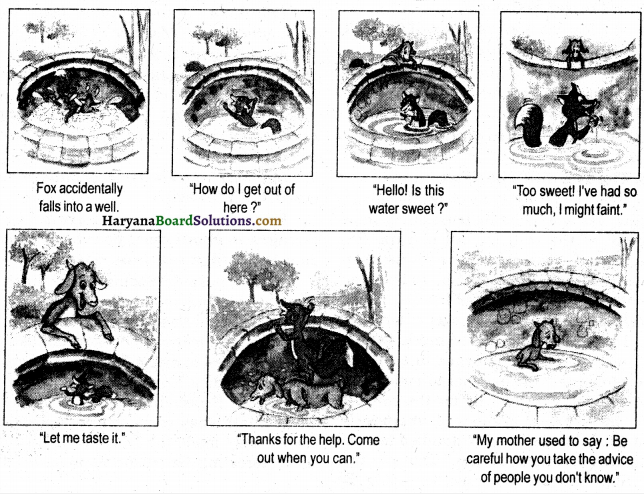
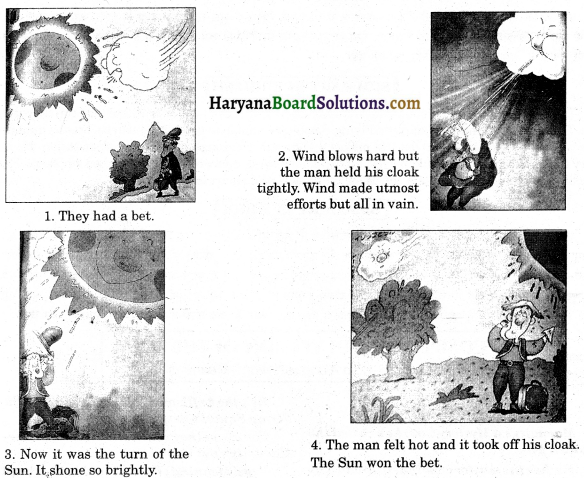
HBSE 8th Class English Solutions Honeydew Chapter 4 Bepin Choudhury’s Lapse of Memory Read More »

HBSE 8th Class Hindi Solutions Vasant Chapter 13 जहाँ पहिया हैं

Haryana State Board HBSE 8th Class Hindi Solutions Vasant Chapter 13 जहाँ पहिया हैं Textbook Exercise Questions and Answers.

Haryana Board 8th Class Hindi Solutions Vasant Chapter 13 जहाँ पहिया हैं

HBSE 8th Class Hindi जहाँ पहिया हैं Textbook Questions and Answers

जंजीरें

“….उन जंजीरों को तोड़ने का, जिनमें वे जकड़े हुए हैं, कोई-न-कोई तरीका लोग निकाल ही लेते हैं…”
1. आपके विचार से लेखक ‘जंजीरों’ द्वारा किन समस्याओं की ओर इशारा कर रहा है?
2. क्या आप लेखक की इस बात से सहमत हैं? अपने उत्तर का कारण भी बताओ।
उत्तर:
1. हमारे विचार से लेखक जंजीरों द्वारा उन सामाजिक समस्याओं की ओर इशारा कर रहा है जो हमें आगे बढ़ने से रोकती हैं। ये एक प्रकार की रूढ़ियाँ हैं।
2 हाँ, हम लेखक की बात से सहमत हैं। जब लोगों में इच्छाशक्ति जागृत हो जाती है तब वे बंधनों से मुक्ति का कोई-न-कोई तरीका अवश्य खोज लेते हैं।

पहिया

Jaha Pahiya Hai Class 8 Summary HBSE प्रश्न 1.
‘साइकिल आंदोलन’ से पुडुकोट्टई की महिलाओं के जीवन में कौन-कौन-से बदलाव आए हैं?
उत्तर:
‘साइकिल आंदोलन’ से पुडुकोट्टई की महिलाओं के जीवन में निम्नलिखित बदलाव आए हैं

  • उनमें आत्मविश्वास का संचार हुआ है।
  • उनकी पुरुषों पर निर्भरता घटी है।
  • अब वे अपने दैनिक कार्य अधिक सुगमता से संपन्न करने लगी हैं।
  • इससे उनकी आय में भी वृद्धि हुई है।
  • वे अपने उत्पाद ज्यादा स्थानों तक बेच आती हैं।
  • आराम करने के लिए ज्यादा समय मिल जाता है। इस प्रकार उनका जीवन ही बदल गया है।

पाठ 13 जहाँ पहिया है प्रश्न उत्तर HBSE 8th Class प्रश्न 2.
शुरुआत में पुरुषों ने इस आंदोलन का विरोध किया, परंतु आर. साइकल्स के मालिक ने इसका समर्थन किया, क्यों?
उत्तर:
शुरुआत में स्त्रियों द्वारा साइकिल चलाने के आंदोलन का पुरुषों ने डटकर विरोध किया। उन्होंने महिलाओं पर फब्तियाँ भी की।

इससे हटकर आर, साइकिल्स के मालिक ने स्त्रियों द्वारा साइकिल चलाने के आंदोलन का भरपूर समर्थन किया। इसका कारण यह था कि उस अकेले डीलर के यहाँ लेडीज साइकिल की बिक्री में साल भर के अंदर 350 प्रतिशत की वृद्धि जो हुई थी। उसकी भरपूर आय हो रही थी। अत: उसे तो समर्थन करना ही था।

Class 8 Hindi Chapter 13 Summary HBSE प्रश्न 3.
प्रारंभ में इस आंदोलन को चलाने में कौन-कौन-सी बाधा आई?
उत्तर:
प्रारंभ में इस आंदोलन को चलाने में ये बाधाएँ आई

  • पुडुकोट्टई के मुख्य इलाकों में रूढ़िवादी मुस्लिम महिलाएँ थीं। उन्होंने इसे हतोत्साहित किया।
  • प्रारंभ में पुरुष वर्ग को महिलाओं का साइकिल चलाना अच्छा न लगा। पुरुष उन पर फब्तियाँ कसते थे।
  • साइकिल चलाने का प्रशिक्षण देने वालों का अभाव था। बाद में प्रशिक्षण शिविर लगाए गए।

HBSE 8th Class Hindi Solutions Vasant Chapter 13 जहाँ पहिया हैं

शीर्षक की बात

जहाँ पहिया है पाठ के प्रश्न उत्तर HBSE 8th Class प्रश्न 1.
आपके विचार से लेखक ने इस पाठ का नाम ‘जहाँ पहिया है’ क्यों रखा होगा?.
उत्तर:
साइकिल में दो पहिए होते हैं। साइकिल इन पहियों से चलकर कहीं भी पहुँच जाती है। जहाँ पहिया है’ वहाँ तक चालक की पहुंच है। इसी भावना को इस पाठ में व्यक्त किया गया है। अतः शीर्षक उचित है।

जहाँ पहिया है HBSE 8th Class प्रश्न 2.
अपने मन से इस पाठ का कोई दूसरा शीर्षक सुझाइए। अपने दिए हुए शीर्षक के पक्ष में तर्क दीजिए।
उत्तर:
हमारे मन से इस पाठ का अन्य शीर्षक यह हो सकता है-
‘महिला साइकिल आंदोलन’
पाठ में साइकिल चलाने को एक आंदोलन के रूप में प्रस्तुत किया गया है। अतः यह शीर्षक भी उचित है। यह आंदोलन महिलाओं को आजादी से संबंधित है। अत: उनको शीर्षक में स्थान देना उचित है।

समझने की बात

“लोगों के लिए यह समझना बड़ा कठिन है कि ग्रामीण औरतों के लिए यह कितनी बड़ी चीज़ है। उनके लिए तो यह हवाई जहाज उड़ाने जैसी बड़ी उपलब्धि है।”
1. साइकिल चलाना ग्रामीण महिलाओं के लिए इतना महत्त्वपूर्ण क्यों है? समूह बनाकर चर्चा कीजिए।
“पुडुकोट्टई पहुँचने से पहले मैंने इस विनम्न सवारी के बारे में इस तरह सोचा ही नहीं था।”

2. साइकिल को विनम्र सवारी क्यों कहा गया है?
उत्तर:
1. विद्यार्थी समूह बनाकर चर्चा करें।
2. साइकिल को विनम्र सवारी इसलिए कहा गया है कि यह किसी से लड़ती-झगड़ती नहीं। पैडल मारते ही चुपचाप विनम्रता से चलने लगती है।

HBSE 8th Class Hindi Solutions Vasant Chapter 13 जहाँ पहिया हैं

साइकिल

1. फातिमा ने कहा, “…मैं किराए पर साइकिल लेती हूँ ताकि मैं आजादी और खुशहाली का अनुभव कर सकूँ।”
साइकिल चलाने से फातिमा और पुड्डुकोट्टई की महिलाओं को ‘आजादी’ का अनुभव क्यों होता होगा?
उत्तर:
साइकिल चलाने से पुडुकोट्टई की महिलाओं को आजादी का अनुभव इसलिए होता होगा क्योंकि इससे उनकी पुरुषों पर निर्भरता लगभग समाप्त हो गई है। अब वे अपना स्वतंत्र जीवन जीती हैं। ”

कल्पना से

1. पुडुकोट्टई में कोई महिला अगर चुनाव लड़ती तो अपना पार्टी-चिह्न क्या बनाती और क्यों?
2. अगर दुनिया के सभी पहिये हड़ताल कर दें तो फिर क्या होगा?
3. “1992 में अंतर्राष्ट्रीय महिला दिवस के बाद अब यह जिला कभी भी पहले जैसा नहीं हो सकता।” इस कथन का अभिप्राय स्पष्ट कीजिए।
4. मान लीजिए आप एक संवाददाता हैं। आपको 8 मार्च 1992 के दिन पुडुकोट्टई में हुई घटना का समाचार तैयार करना है। पाठ में दी गई सूचनाओं और अपनी कल्पना से एक समाचार तैयार करो।
5. इस पाठ के अंत में दी गई कविता पिता के बाद पढ़िए। क्या उस कविता में और फातिमा की बात में कोई संबंध हो सकता है? अपने विचार लिखिए।
उत्तर:
1. पुडुकोट्टई की महिला चुनाव लड़तीं तो वे अपना पार्टी-चिह्न ‘साइकिल’ को ही बनाती, क्योंकि यही उनकी आजादी का प्रतीक चिह्न है।

2. दुनिया का सारा आवागमन रुक जाएगा।

3. अब उस जिले में महिलाओं की स्थिति पहली जैसी नहीं रहेगी। अब वे तरक्की के रास्ते पर बढ़ निकली हैं।

4. महिला जगत में क्रांति 8 मार्च, 1992, पुडुकोट्टई (तमिलनाडु)। इस क्षेत्र में 1500 महिलाओं ने साइकिल चलाने का प्रशिक्षण प्राप्त कर एक नई क्रांति का सूत्रपात किया है। इससे उनमें असीम आत्मविश्वास की लहर देखी गई है। अब वे आजादी का अहसास कर रही हैं।

5. अगले पृष्ठ पर दी गई कविता और फातिमा की बात में काफी संबंध है। दोनों में स्त्रियों की आजादी का अहसास प्रकट होता है। अब स्त्रियाँ भी आजादी और खुशहाली का अनुभव कर रही हैं। कविता में बताया गया है कि वे पिता के उत्तराधिकार को संभालने में पूरी तरह से सक्षम हैं।

HBSE 8th Class Hindi Solutions Vasant Chapter 13 जहाँ पहिया हैं

भाषा की बात

उपसर्गों और प्रत्ययों के बारे में आप जान चुके हैं। इस पाठ में आए उपसर्गयुक्त शब्दों को छौटिए। उनके मूल शब्द भी लिखिए। आपकी सहायता के लिए इस पाठ में प्रयुक्त कुछ उपसर्ग और प्रत्यय इस प्रकार हैं-अभि, प्र, अनु, परि, वि (उपसर्ग), इक, वाला, ता, ना।
पाठ में प्रयुक्त उपसर्गयुक्त शब्द :

अभिअभिव्यक्ति
प्रप्रदान
अनुअनुभव
परिपरिवहन
विविशेष

अन्य शब्द – विरोध प्रशिक्षण आत्मसम्मान पाठ में आए प्रत्यययुक्त शब्द:

इकआर्थिक (अर्थ + इक)
वालासाइकिलवाला
तामूर्खता (मूर्ख + ता)
नापढ़ना

अन्य शब्द :

  1. गतिशीलता (ता)
  2. खुशहाली (ई)
  3. केंद्रित (इत)
  4. सामाजिक (इक)

HBSE 8th Class Hindi जहाँ पहिया हैं Important Questions and Answers

प्रश्न 1.
साइकिल चलाने से स्त्रियों को क्या लाभ पहुँचा है?
उत्तर:
साइकिल चलाने के बहुत निश्चित आर्थिक निहितार्थ हैं। इससे आय में वृद्धि हुई है। यहाँ की कुछ महिलाएँ अगल-बगल के गाँवों में कृषि संबंधी अथवा अन्य उत्पाद बेच आती हैं। साइकिल की वजह से बसों के इंतजार में व्यय होने वाला उनका समय बच जाता है। खराब परिवहन व्यवस्था वाले स्थानों के लिए तो यह बहुत महत्त्वपूर्ण है। दूसरे, इससे इन्हें इतना समय मिल जाता है कि ये लोग अपने सामान बेचने पर ज्यादा ध्यान केंद्रित कर पाती हैं। तीसरे, इससे ये और अधिक इलाकों में जा पाती हैं। अंतिम बात यह है कि अगर वे चाहें तो इससे उन्हें आराम करने | का काफी समय मिल सकता है।

जिन छोटे महिला उत्पादकों को बसों का इंतजार करना पड़ता था, बस स्टॉप तक पहुंचने के लिए भी पिता, माई, पति या बेटों पर निर्भर रहना पड़ता था वे अपना सामान बेचने के लिए कुछ गिने-चुने गाँवों तक ही जा पाती थीं। कुछ को पैदल ही चलना पड़ता था। जिनके पास साइकिल नहीं है वे अब भी पैदल ही जाती हैं। फिर उन्हें बच्चों की देखभाल के लिए या पीने का पानी लाने जैसे घरेलू कामों के लिए भी जल्दी ही भागकर घर पहुँचना पड़ता था। अब जिनके पास साइकिलें हैं वे सारा काम बिना किसी दिक्कत के कर लेती हैं।

केवल पढ़ने के लिए

पिता के बाद:

लड़कियाँ खिलखिलाती हैं तेज धूप में,
लड़कियाँ खिलखिलाती हैं तेज बारिश में,
लड़कियाँ हँसती हैं हर मौसम में।
लड़कियाँ पिता के बाद सँभालती हैं
पिता के पिता से मिली दुकान,
लड़कियाँ वारिस हैं पिता की।
लड़कियों ने समेट लिया
माँ को पिता के बाद,
लड़कियाँ होती हैं माँ।
दुकान पर बैठ लड़कियाँ
सुनती हैं पूर्वजों की प्रतिध्वनियाँ,
उदास गीतों में वे ढूँढ लेती हैं जीवन राग,
धूप में, बारिश में,
हर मौसम में खिलखिलाती हैं लड़कियाँ।

HBSE 8th Class Hindi Solutions Vasant Chapter 13 जहाँ पहिया हैं

जहाँ पहिया हैं गद्यांशों पर आधारित अर्थग्रहण संबंधी प्रश्न

1. भारत के सर्वाधिक गरीब जिलों में से एक है पुडुकोइई। पिछले दिनों यहाँ की ग्रामीण महिलाओं ने अपनी स्वाधीनता, आजादी और गतिशीलता को अभिव्यक्त करने के लिए प्रतीक के रूप में साइकिल को चुना है। उनमें से अधिकांश नवसाक्षर थीं। अगर हम दस वर्ष से कम उम्र की लड़कियों को अलग कर दें तो इसका अर्थ यह होगा कि यहाँ ग्रामीण महिलाओं के एक-चौथाई हिस्से ने साइकिल चलाना सीख लिया है और इन महिलाओं में से 70 हजार से भी अधिक महिलाओं ने ‘प्रवर्शन एवं प्रतियोगिता’ जैसे सार्वजनिक कार्यक्रमों में बड़े गर्व के साथ अपने नए कौशल का प्रदर्शन किया और अभी भी उनमें साइकिल चलाने की इच्छा जारी है। वहाँ इसके लिए कई ‘प्रशिक्षण शिविर’ चल रहे हैं।
प्रश्न:
1. इस गद्यांश में किस इलाके का उल्लेख हुआ है?
2. ग्रामीण महिलाओं ने साइकिल को क्यों चुना?
3. कितनी महिलाओं ने साइकिल चलाना सीख लिया है?
4. इन महिलाओं ने क्या कर दिखाया है?
उत्तर:
1. इस गद्यांश में तमिलनाडु के एक गरीब जिले पुडुकोट्टई का उल्लेख हुआ है।
2. यहाँ की ग्रामीण महिलाओं ने साइकिल को अपनी स्वाधीनता, आजादी और गतिशीलता की अभिव्यक्ति के प्रतीक के रूप में चुना।
3. इस क्षेत्र की ग्रामीण महिलाओं के एक-चौथाई हिस्से ने साइकिल चलाना सीख लिया है।
4. यहाँ की 70 हजार से अधिक महिलाओं ने प्रदर्शन एवं प्रतियोगिता’ में अपने कौशल का प्रदर्शन किया।

2. इस जिले में साइकिल की धूम मची हुई है। इसकी प्रशंसकों में हैं-महिला खेतिहर मजदूर, पत्थर खदानों में मज़दूरी करने वाली औरतें और गांवों में काम करने वाली नसै। बालवाड़ी और आँगनवाड़ी कार्यकर्ता, बेशकीमती पत्थरों को तराशने में लगी औरतें और स्कूल की अध्यापिकाएँ भी साइकिल का जमकर इस्तेमाल कर रही हैं। ग्राम सेविकाएँ और दोपहर का भोजन पहुंचाने वाली औरतें भी पीछे नहीं हैं। सबसे बड़ी संख्या उन लोगों की है जो अभी नवसाक्षर हुई हैं। जिस किसी नवसाक्षर अथवा नई-नई साइकिल चलाने वाली महिला से मैंने बातचीत की, उसने साइकिल चलाने और अपनी व्यक्तिगत आजादी के बीच एक सीधा संबंध बताया।
प्रश्न:
1. इस जिले में किसकी धूम मची है?
2. साइकिल का प्रयोग कौन-कौन कर रही हैं?
3. नवसाक्षर महिला ने लेखक को क्या बताया?
उत्तरः
1. इस सिले में साइकिल चलाने की धूम मची है।
2. साइकिल का प्रयोग ये कर रही हैं

  • खेतिहर महिला मजदूर
  • पत्थर की खदानों में काम करने वाली औरतें
  • गाँव की नसें
  • बालवाड़ी और आँगनवाड़ी की कार्यकर्ता
  • पत्थर तराशने वाली स्त्रियाँ
  • अध्यापिकाएँ

3. एक नवसाक्षर महिला ने लेखक को बताया कि साइकिल चलाने का उसकी व्यक्तिगत आजादी के साथ सीधा संबंध है।

3. साइकिल प्रशिक्षण शिविर देखना एक असाधारण अनुभव है। किलाकुरुचि गाँव में सभी साइकिल सीखने वाली महिलाएं रविवार को इकट्ठी हुई थीं। साइकिल चलाने के आंदोलन के समर्थन में ऐसे आवेग देखकर कोई भी हैरान हुए बिना नहीं रह सकता। उन्हें इसे सीखना ही है। साइकिल ने उन्हें पुरुषों द्वारा थोपे गए दायरे के अंदर रोजमर्रा की घिसी-पिटी चर्चा से बाहर निकलने का रास्ता दिखाया। ये नव-साइकिल चालक गाने भी गाती हैं। उन गानों में साइकिल चलाने को प्रोत्साहन दिया गया है। इनमें से एक गाने की पंक्ति का भाव है-‘ओ बहिना, आ सीखें साइकिल, घूमें समय के पहिए संग।
प्रश्न:
1. क्या एक असाधारण अनुभव है?
2. साइकिल ने महिलाओं को कौन-सा रास्ता दिखाया है?
3. गानों में क्या दिया गया है?
उत्तर:
1. ग्रामीण इलाके में साइकिल प्रशिक्षण शिविर देखना एक असाधारण अनुभव है।
2. साइकिल चलाने ने महिलाओं को पुरुषों द्वारा थोपे गए दायरे से बाहर निकलने का रास्ता दिखाया है। अब वे घिसी-पिटी दिनचर्या से बाहर निकल रही हैं।
3. नव साइकिल चालक गाने भी गाती हैं। उन गानों में साइकिल चलाने को प्रोत्साहन दिया गया है।

HBSE 8th Class Hindi Solutions Vasant Chapter 13 जहाँ पहिया हैं

जहाँ पहिया हैं Summary in Hindi

जहाँ पहिया हैं पाठ का सार

तमिलनाडु में एक ग्रामीण इलाका है-पुडुकोट्टई। यहाँ की महिलाओं ने साइकिल चलाने को एक सामाजिक आंदोलन का रूप दे दिया है। पुडकोट्टई जिले की हजारों नवसाक्षर ग्रामीण महिलाओं के लिए साइकिल चलाना आम बात है। इन महिलाओं ने अपनी स्वाधीनता और गतिशीलता की अभिव्यक्ति के लिए प्रतीक के रूप में साइकिल को चुना है। यहाँ की ग्रामीण महिलाओं के एक-चौथाई हिस्से ने साइकिल चलाना सीख लिया है।

इसे सिखाने के लिए कई प्रशिक्षण शिविर भी चल रहे हैं। इस इलाके की अत्यंत रूढ़िवादी पृष्ठभूमि से आई युवा मुस्लिम लड़कियाँ भी सड़कों पर साइकिलों पर जाती दिखाई दे जाती हैं। जमिला बीवी का कहना है कि यह मेरा अधिकार है। अब हम कहीं भी जा सकते हैं। अब हमें बस का इंतजार नहीं करना पडता। पहले लोग हम पर फब्तियां कसते थे। अब इस जिले में साइकिल की धूम मची हुई है। इसके प्रशंसकों में खेतिहर महिला मजदूर, पत्थर खदानों में काम करने वाली औरतें, गाँवों में काम करने वाली नसें हैं। बालवाड़ी और आँगनवाड़ी के कार्यकर्ता, ग्रामसेविकाएँ, दोपहर का भोजन पहुँचाने वाली औरतें भी साइकिल का भरपूर प्रयोग कर रही हैं।

साइकिल आंदोलन ने महिलाओं को बहुत आत्मविश्वास प्रदान किया है। अब उनकी पुरुषों पर निर्भरता घटी है। कई औरतें तो चार किलोमीटर की दूरी तय कर साइकिल पर पानी भर लाती हैं. साथ में उनके बच्चे भी होते हैं। अब धीरे-धीरे साइकिल चलाने को सामाजिक स्वीकृति मिल गई है। अब तो महिलाएं साइकिल चलाते हुए गाना भी गाती हैं। 1992 में अंतर्राष्ट्रीय महिला दिवस के बाद साइकिल पर सवार होकर 1500 महिलाओं ने तूफान ला दिया।

यहाँ के एक डीलर आर. साइकिल्स की बिक्री साल भर के अंदर 350 प्रतिशत बढ़ गई। यह आंकड़ा भी उसने बड़ी सतर्कता के साथ बताया क्योंकि उसे लगा कि पूछने वाला विक्री कर विभाग का कोई आदमी है।

साइकिल चलाने के अनेक आर्थिक लाभ थे। इससे उनकी आय में वृद्धि हुई, कृषि संबंधी उत्पाद बेचना सरल हो गया, समय की बचत हुई, बसों पर निर्भरता घट गई। इससे ज्यादा इलाके में जाया जा सकता है, आराम करने के लिए काफी समय मिल जाता है। साइकिल प्रशिक्षण से महिलाओं के अंदर आत्मसम्मान की भावना पैदा हुई है। साइकिल उन्हें आजादी और खुशहाली का अहसास कराती है। साइकिल आजादी की प्रतीक बन गई। ग्रामीण महिलाओं के लिए तो हवाई जहाज उड़ाने जैसी बड़ी उपलब्धि है।

HBSE 8th Class Hindi Solutions Vasant Chapter 13 जहाँ पहिया हैं

जहाँ पहिया हैं शब्दार्थ

सामाजिक – समाज संबंधी (Social), व्यक्त – प्रकट (Express), सर्वाधिक – सबसे अधिक (Mast), प्रतीक – चिह्न (Symbol), नवसाक्षर = नई-नई पढ़ी-लिखी (Newly literate), प्रशिक्षण शिविर – ट्रेनिंग कैंप (Training camp), बेशकीमती – बहुमूल्य (Valuable), आत्मविश्वास – अपने ऊपर भरोसा (Self confidence), निर्भरता – दूसरे पर आधारित होना (Dependency), प्रहार – हमला (Blow), आवेग – जोश (Zeal), सतर्कता – सावधानी (Alertness), आर्थिक – धन संबंधी (Financial), उपलब्धि – प्राप्ति (Achievement)

HBSE 8th Class Hindi Solutions Vasant Chapter 13 जहाँ पहिया हैं Read More »

HBSE 8th Class Hindi Solutions Vasant Chapter 16 पानी की कहानी

Haryana State Board HBSE 8th Class Hindi Solutions Vasant Chapter 16 पानी की कहानी Textbook Exercise Questions and Answers.

Haryana Board 8th Class Hindi Solutions Vasant Chapter 16 पानी की कहानी

HBSE 8th Class Hindi पानी की कहानी Textbook Questions and Answers

पाठ से

Hindi Class 8 Chapter 16 HBSE प्रश्न 1.
लेखक को ओस की बूँद कहाँ मिली?
उत्तर:
लेखक को ओस की बूंद एक बेर की झाड़ी पर से मिली। वह झाड़ी पर से उसके हाथ पर आ गई थी। वह ओस की बूंद उसकी कलाई पर से सरककर उसकी हथेली पर आ गई थी।

Pani Ki Kahani Class 8 HBSE प्रश्न 2.
ओस की बूँद क्रोध और घृणा से क्यों काँप उठी?
उत्तर:
ओस की बूँद पेड़ की प्रवृत्ति बताते हुए क्रोध और घृणा से काँप उठी थी। उसके अनुसार ये पेड़ बड़े निर्दयी होते हैं। वे असंख्य जल-कणों को बलपूर्वक पृथ्वी में से खींच लेते हैं। कुछ को तो वे एकदम खा जाते हैं और अधिकांश को सब कुछ छीनकर बाहर निकाल देते हैं।

पानी की कहानी HBSE 8th Class Hindi प्रश्न 3.
हाइड्रोजन और ऑक्सीजन को पानी ने अपना पूर्वज पुरखा क्यों कहा?
उत्तर:
हाइड्रोजन और ऑक्सीजन को पानी ने अपना पूर्वज इसलिए कहा क्योंकि उसका जन्म इन्हीं की रासायनिक क्रिया के परिणामस्वरूप हुआ है। उन्होंने आपस में मिलकर अपना प्रत्यक्ष अस्तित्व गवा दिया और पानी को जन्म दिया।

प्रश्न 4.
‘पानी की कहानी’ के आधार पर पानी के जन्म और जीवन-यात्रा का वर्णन अपने शब्दों में कीजिए।
उत्तर:
पानी का जन्म हाइड्रोजन और ऑक्सीजन की रासायनिक क्रिया के परिणामस्वरूप होता है। उनका अस्तित्व मिटकर ही पानी बनता है। पहले पानी की बूंद भाप के रूप में पृथ्वी के चारों ओर घूमती है। फिर वह ठोस बर्फ का रूप ले लेती है। तब उसका रूप बहुत छोटा हो जाता है। फिर समुद्र में गर्म जलधारा से भेंट होने पर वह पिघल कर पानी बन जाती है।

HBSE 8th Class Hindi Solutions Vasant Chapter 16 पानी की कहानी

प्रश्न 5.
कहानी के अंत और आरंभ के हिस्से को स्वयं से पढ़कर देखिए और बताइए कि ओस की बूंद लेखक को आपबीती सुनाते हुए किसकी प्रतीक्षा कर रही थी?
उत्तर:
विद्यार्थी कहानी के अंत और आरंभ के हिस्से को स्वयं पढ़ें।
ओस की बूँद सूर्य के निकलने की प्रतीक्षा कर रही थी।

पाठ से आगे

1. जलचक्र के विषय में जानकारी प्राप्त कीजिए और पानी की कहानी से तुलना करके देखिए कि लेखक ने पानी की कहानी में कौन-कौन-सी बातें विस्तार से बताई हैं।
उत्तर:
जल का वर्षा द्वारा पृथ्वी पर आना तथा महासागरों से जल वाष्प के रूप में पुनः वायुमंडल में पहुंचना जलचक्र कहलाता है। यह चक्र निरंतर चलता रहता है और पृथ्वी पर जल की मात्रा को स्थिर बनाए रखता है। ‘पानी की कहानी’ में मुख्यतः जल के विभिन्न रूपों की चर्चा की गई है जिन में हैं ठोस (बर्फ), द्रव (पानी) तथा गैस (भाप)।

2. “पानी की कहानी” पाठ में ओस की बूंद अपनी कहानी स्वयं सुना रही है और लेखक केवल श्रोता है। इस आत्मकथात्मक शैली में आप भी किसी वस्तु का चुनाव करके कहानी लिखें।
उत्तर:
विद्यार्थी स्वयं करें।

3, समुद्र के तट पर बसे नगरों में अधिक ठंड और गरमी क्यों नहीं पड़ती?
उत्तर:
समुद्रतटीय इलाकों में जल की उपस्थिति दिन में तापमान को अधिक बढ़ने नहीं देती तथा रात में तापमान को अधिक गिरने नहीं देती अत: यहाँ का तापमान सदैव सुहावना बना रहता है। कोलकाता में दिसंबर के आखिर में भी लोग कुर्ता-पायजामें में सैर करते दिखाई पड़ते हैं।

4. पेड़ के भीतर फव्वारा नहीं होता, तब पेड़ की जड़ों से पत्ते तक पानी कैसे पहुँचता है? इस क्रिया को वनस्पति शास्त्र में क्या कहते हैं? क्या इस क्रिया को जानने के लिए कोई आसान प्रयोग है? जानकारी प्राप्त कीजिए।
उत्तर:
विज्ञान की पुस्तक से विद्यार्थी स्वयं यह जानकारी जुटाएँ।

HBSE 8th Class Hindi Solutions Vasant Chapter 16 पानी की कहानी

अनुमान और कल्पना

1. पानी की कहानी में लेखक ने कल्पना और वैज्ञानिक तथ्य का आधार लेकर ओस की बूंद की यात्रा का वर्णन किया है। ओस की बूंद अनेक अवस्थाओं में सूर्य मंडल, पृथ्वी, वायु, समुद्र, ज्वालामुखी, बादल, नवी और नल से होते हुए पेड़ के पत्ते तक की यात्रा करती है। इस कहानी की भाँति आप भी लोहे अथवा प्लास्टिक की कहानी लिखने का प्रयास कीजिए।
उत्तर:
विद्यार्थी लोहे या प्लास्टिक की कहानी लिखने का प्रयास करें।

2. अन्य पदार्थों के समान जल की भी तीन अवस्थाएँ होती हैं। अन्य पदार्थों से जल की इन अवस्थाओं में एक विशेष अंतर यह होता है कि जल की तरल अवस्था की तुलना में ठोस अवस्था (बर्फ) हल्की होती है। इसका कारण ज्ञात कीजिए।
उत्तर:
जल की तरल अवस्था से ठोस अवस्था (बर्फ) हल्की होती है क्योंकि इसका घनत्व कम होता है। अत: यह तैरती भी है।

3. पाठ के साथ केवल पढ़ने के लिए दी गई पठन-सामग्री ‘हम पृथ्वी की संतान!’ का सहयोग लेकर पर्यावरण संकट पर एक लेख लिखें।
उत्तर:
विद्यार्थी ‘पर्यावरण संकट’ पर एक लेख लिखें।

भाषा की बात

1. किसी भी क्रिया को संपन्न अथवा पूरा करने में जो भी संज्ञा आदि शब्द संलग्न होते हैं, वे अपनी अलग-अलग प्रकार की भूमिकाओं के अनुसार अलग-अलग कारकों में वाक्य में दिखाई पड़ते हैं। जैसे – “वह हाथों से शिकार जकड़ लेती थी।
उत्तर:
जकड़ना क्रिया तभी संपन्न हो पाएगी जब कोई व्यक्ति (वह) जकड़ने वाला हो, कोई वस्तु (शिकार) हो जिसे जकड़ा जाए। इन भूमिकाओं की प्रकृति अलग-अलग है। व्याकरण में ये भूमिकाएँ कारकों के अलग-अलग भेदों जैसे-कर्ता, कर्म, करण आदि से स्पष्ट होती हैं।

अपनी पाठ्यपुस्तक से इस प्रकार के पाँच और उदाहरण खोजकर लिखिए और उन्हें भलीभांति परिभाषित कीजिए।
उत्तर:
विद्यार्थी पाठ्यपुस्तक से ऐसे पाँच उदाहरण खोजकर लिखें।
अन्य उदाहरण:

  • राम हाथ से रस्सी को पकड़ता था।
  • मैंने मित्र को एक पत्र पेन से लिखा था।
  • वह चाकू से सेब को काटकर खाता है।
  • गीता कलम से सुंदर लेख लिखती है।

HBSE 8th Class Hindi Solutions Vasant Chapter 16 पानी की कहानी

HBSE 8th Class Hindi पानी की कहानी Important Questions and Answers

प्रश्न 1.
पेड़ों के बारे में बूंद ने क्या कहा?
उत्तर:
पेड़ों के बारे में बूंद बोली-“वह जो पेड़ तुम देखते हो म! वह ऊपर ही इतना बड़ा नहीं है. पृथ्वी में भी लगभग इतना ही बड़ा है। उसकी बड़ी जड़ें, छोटी जड़ें और जड़ों के रोएँ हैं। वे रोएँ बड़े निर्दयी होते हैं। मुझ जैसे असंख्य जल-कणों को वे बलपूर्वक पृथ्वी में से खींच लेते हैं। कुछ को तो पेड़ एकदम खा जाते हैं और अधिकांश का सब कुछ छीनकर उन्हें बाहर निकाल देते हैं।”

प्रश्न 2.
बूंद कितने दिनों तक साँसत भोगती रही?
उत्तर:
बूंद लगभग तीन दिन तक यह साँसत भोगती रही। वह पत्तों के नन्हें-नन्हें छेदों से होकर जैसे-तैसे जान बचाकर भागी। उसने सोचा था कि पत्ते पर पहुंचते ही उड़ जाएगी। परंतु, बाहर निकलने पर ज्ञात हुआ कि रात होने वाली थी और सूर्य, जो हमें उड़ने की शक्ति देता है, जा चुका है, और वायुमंडल में इतने जल कण उड़ रहे हैं कि उसके लिए वहाँ स्थान नहीं है, तो वह अपने भाग्य पर भरोसा कर पत्तों पर ही सिकुड़ी पड़ी रही। अभी जब उसने लेखक को देखा तो जान में जान आई और रक्षा पाने के लिए उसके हाथ पर कूद पड़ी।

HBSE 8th Class Hindi Solutions Vasant Chapter 16 पानी की कहानी

केवल पढ़ने के लिए

हम पृथ्वी की संतान! प्रदूषण के महासंकट से निपटने के लिए विश्वभर के राष्ट्रों की एक बैठक 5 जून 1972 को स्टॉकहोम (स्वीडन) में हुई थी। इस अवसर पर तत्कालीन प्रधानमंत्री स्व. श्रीमति इंदिरा गाँधी ने अपने अभिभाषण में ‘माता भूमि पुत्रोदह पृथिव्याः” का संदेश दिया था। इस दिवस की स्मृति में ही प्रत्येक वर्ष 5 जून को हम ‘पर्यावरण दिवस’ मनाते हैं। सन् 1992 में रियो डि जेनेरो (ब्राजील) में एक पृथ्वी सम्मेलन आयोजित किया गया जिसका उद्देश्य यही था – ‘पृथ्वी को बचाओ।’

प्रकृति एक विशाल पारिस्थितिकी तंत्र है जिसमें दो प्रकार के प्रमुख घटक शामिल है-जैविक और अजैविक। जैव मंडल का निर्माण भूमि, गगन, अनिल (वायु), अनल (अग्नि), जल नामक पंच तत्त्वों से होता है जिसमें हम छोटे-बड़े एवं जैव-अजैव विविधताओं के बीच रहते आये हैं। इसमें पेड़, पौधों एवं प्राणियों का निश्चित सामंजस्य और सहअस्तित्व का संबंध है जिसे समन्वयात्मक रूप में पर्यावरण के विभिन्न अवयव कहते हैं। पर्यावरण शब्द ‘परि’ और ‘आवरण’ इन दो शब्दों के योग से बना है। परि और आवरण का सम्यक अर्थ है-वह आवरण जो हमें चारों ओर से ढके हुए है, आवृत किये हुए है।

प्रकृति और मानव के बीच का मधुर सामंजस्य बढ़ती जनसंख्या एवं उपभोगी प्रवृत्ति के कारण घोर संकट में है। यह असंतुलन प्रकृति के विरुद्ध तीसरे विश्वयुद्ध के समान है। विश्वभर में वनों का विनाश, अवैध एवं असंगत उत्खनन, कोयला, पेट्रोल, डीजल के उपयोग में अप्रत्याशित अभिवृद्धि और कल कारखानों के विकास के नाम पर विस्तार आदि ने मानव सभ्यता को महाविनाश के कगार पर ला खड़ा कर दिया है। विश्व की प्रसिद्ध नदियाँ जैसे गंगा, यमुना, नर्मदा, राइन, सीन, मास, टेम्स जैसी नदियाँ भयानक प्रदूषित हो चुकी हैं। इनके निकट बसे लोगों का जीवन दूभर हो गया है।

पृथ्वी के ऊपर वायुमंडल के स्ट्रेटोस्फियर में ओजोन गैस की एक मोटी परत है। यह धरती के जीवन की रक्षा कवच है जिससे सूर्य से आने वाली हानिकारक किरणें रोक ली जाती हैं। किन्तु पृथ्वी के ऊपर जहरीली गैसों के बादल बढ़ते जाने के कारण सूर्य की अनावश्यक किरणें बाह्य अंतरिक्ष में परावर्तित नहीं हो पातीं। जिसके कारण पृथ्वी का तापमान (ग्लोबल वार्मिग) बढ़ता जा रहा है।

इससे छोटे-बड़े सभी द्वीप समूहों एवं महाद्वीपों के तटीय क्षेत्रों के डूब जाने का खतरा बढ़ गया है। इसे ग्रीन हाउस प्रभाव कहते हैं। यही स्थिति रही तो मुम्बई जैसे महानगर प्रलय की गोद में समा सकते हैं। पृथ्वी पर बढ़ते तापमान के कारण विश्व सभ्यता को अमृत एवं पोषक जल प्रदान करने वाले ग्लेशियर या तो लुप्त हो गये हैं या लुप्त होने की ओर बढ़ते जा रहे हैं। अमृतवाहिनी गंगा अपने उद्गम गंगोत्री के मूल स्थान से कई किलोमीटर पीछे खिसक चुकी है।

प्राकृतिक आपदाओं में बढ़ोतरी के कारण लाखों लोग शरणार्थी बन चुके हैं। विशेषकर अपने भारत में ही बाँधों, कारखानों, हाइड्रोपावर स्टेशनों के बनने के कारण लाखों वनवासी भाई-बहन बेघर होकर शरणार्थी बने हैं।

पर्यावरण के प्रति गहरी संवेदनशीलता प्राचीन काल से ही मिलती है। अथर्ववेद में लिखा है – ‘माता भूमिः पुत्रोदह पृथिव्याः’ अर्थात् भूमि माता है। हम पृथ्वी के पुत्र हैं। एक जगह यह भी विनय किया गया है। कि ‘हे पवित्र करने वाली भूमि! हम कोई ऐसा काम न करें जिससे तेरे हृदय को आघात पहुंचे। हृदय को आघात पहुंचाने को अर्थ है पृथ्वी के परिस्थितिकी तंत्रों अर्थात् पर्यावरण के साथ क्रूर छेड़छाड़ न करना। हमें प्राकृतिक संसाधनों के अप्राकृतिक एवं बेतहाशा दोहम से बचना होगा।

आज आवश्यकता इस बात की है कि विश्व के तमाम राष्ट्र जलवायु परिवर्तन के गंभीर खतरे को लेकर आपसी मतभेद भुला दें और अपनी-अपनी जिम्मेदारी ईमानदारीपूर्वक निभायें, ताकि समय रहते सर्वनाश से उबरा जा सके। विश्वविनाश से निपटने के लिए सामूहिक एवं व्यक्तिगत प्रयासों की जरूरत है। इस दिशा में अनेक आंदोलन हो रहे हैं। अरण्य रोदन के बदले अरण्य संरक्षण की बात हो रही है। सचमुच हमें आत्मरक्षा के लिए पृथ्वी की रक्षा करनी होगी, ‘भूमि माता है और हम पृथ्वी की संतान’ इस कथन को चरितार्थ करना होगा।

HBSE 8th Class Hindi Solutions Vasant Chapter 16 पानी की कहानी

पानी की कहानी गद्यांशों पर आधारित अर्थग्रहण संबंधी प्रश्न

1. मैं आगे बढ़ा ही था कि बेर की झाड़ी पर से मोती-सी एक बूँद मेरे हाथ पर आ पड़ी। मेरे आश्चर्य का ठिकाना न रहा, जब मैंने देखा कि ओस की बूँद मेरी कलाई पर से सरककर हथेली पर आ गई। मेरी दृष्टि पड़ते ही वह ठहर गई। थोड़ी देर में मुझे सितार के तारों की-सी झंकार सुनाई देने लगी। मैंने सोचा कि कोई बजा रहा होगा। चारों ओर देखा। कोई नहीं। फिर अनुभव हुआ कि यह स्वर मेरी हथेली से निकल रहा है। ध्यान से देखने पर मालूम हुआ कि बूंद के दो कण हो गए हैं और वे दोनों हिल-हिलकर यह स्वर उत्पन्न कर रहे हैं मानो बोल रहे हों।
प्रश्न:
1. लेखक के हाथ पर कब, क्या आ पड़ी?
2. लेखक को कब आश्चर्य हुआ?
3. लेखक को क्या सुनाई देने लगा? उसने क्या सोचा?
4. ध्यान से देखने पर क्या मालूम हुआ?
उत्तर:
1. जब लेखक आगे बढ़ रहा था तब की झाड़ी पर से मोती की एक बूंद उसके हाथ पर आ पड़ी: .
2. उसके आश्चर्य का ठिकाना तब न रहा जब उसने देखा कि ओस की बूँद उसकी कलाई पर से सरक कर हथली पर आ गई है।
3. थोड़ी देर में लेखक को सितार के तारों की-सी झंकार सुनाई देने लगी। तब उसने सोचा कि कोई जजा रहा होगा।
4. ध्यान से देखने पर उसे मालूम हुआ कि बूंद के दो कण हो गए हैं और वे ही हिल-हिलकर स्वर उत्पन्न कर रहे हैं।

2. मैं और गहराई की खोज में किनारों से दूर गई तो मैंने एक ऐसी वस्तु देखी कि मैं चौंक पड़ी। अब तक समुद्र में अंधेरा था, सूर्य का प्रकाश कुछ ही भीतर तक पहुँच पाता था और बल लगाकर देखने के कारण मेरे नेत्र दुखने लगे थे। मैं सोच रही थी कि यहाँ पर जीवों को कैसे दिखाई पड़ता होगा कि सामने ऐसा जीव दिखाई पड़ा मानो कोई लालटेन लिए घूम रहा हो। यह एक अत्यंत सुंदर मछली थी। इसके शरीर से एक प्रकार की चमक निकलती थी जो इसे मार्ग दिखलाती थी। इसका प्रकाश देखकर कितनी छोटी-छोटी अनजान मछलियाँ इसके पास आ जाती थीं और यह जब भूखी होती थी तो पेट भर उनका भोजन करती थी।
प्रश्न:
1. किनारों से दूर जाने पर बूंद क्यों चौंक पड़ी?
2. उस समय समुद्र में कैसा दृश्य था?
3. उसे सामने क्या दिखाई पड़ा?
4. प्रकाश का क्या प्रभाव पड़ता था?
उत्तर:
1. किनारों से दूर जाने पर बूंद ने एक ऐसी विचित्र वस्तु देखी कि वह चौंक पड़ी।
2. उस समय समुद्र में अँधेरा था। सूर्य का प्रकाश कुछ ही भीतर तक पहुँच पाता था। उस अंधकार में आँखें भी दुखने लगी थीं।
3. बूंद को सामने एक ऐसा जीव दिखाई पड़ा मानो वह कोई लालटेन लिए हुए घूम रहा हो। वह एक सुंदर मछली थी। उसके शरीर से एक प्रकार की चमक निकल रही थी।
4. उस मछली के शरीर के प्रकाश को देखकर कितनी अन्य छोटी-छोटी मछलियाँ उसके पास आ जाती थीं। जब वह भूखी होती थी तब वह इनका पेट भर भोजन करती थी।

HBSE 8th Class Hindi Solutions Vasant Chapter 16 पानी की कहानी

पानी की कहानी Summary in Hindi

पानी की कहानी पाठ का सार

लेखक आगे बढ़ा ही था कि बेर की झाड़ी पर से मोती-सी एक बूंद उसके हाथ पर आ पड़ी। बंद के दो कण हो गए थे और वे दोनों हिल-हिलकर स्वर उत्पन्न कर रहे थे। ओस की बूंद प्रसन्नता से बोली-मैं ओस हूँ। लोग मुझे पानी कहते हैं, जल भी कहते हैं। मैं बेर के पेड़ से आई हूँ। लेखक ने उसे झूठी कहा क्योंकि कहीं बेर के पेड़ से भी पानी का फव्वारा निकलता है? पानी ने अपनी कहानी सुनाई-पृथ्वी से असंख्य जलकणों को पेड़ बलपूर्वक खींच लेते हैं कुछ को तो पेड़ एकदम खा जाते हैं और अधिकांश का सब कुछ छीनकर उन्हें बाहर निकाल देते हैं।

पेड़ों को बड़ा करने में जल बिंदुओं ने अपने प्राण नष्ट किए हैं। बूँद बोली कि मैं भूमि के खनिजों को अपने शरीर में घुलाकर आनंद से फिर रही थी कि दुर्भाग्यवश एक रोएँ से मेरा शरीर छू गया। मैं रोएँ में खींच ली गई। मुझे एक कोठरी में बंद कर दिया गया। कोई मुझे पीछे से धक्का दे रहा था।

एक और बूंद मेरा हाथ पकड़कर ऊपर खींच रही थी। उसने अपनी कहानी सुनाई-मेरे पुरखे हद्रजन (हाइड्रोजन) और ओषजन (ऑक्सीजन) नामक दो गैसें सूर्यमंडल में लपटों के रूप में विद्यमान थे। मेरे पुरखे बड़ी प्रसन्नता से सूर्य के धरातल पर नाचते रहते थे। एक दिन एक प्रचंड प्रकाश पिंड सूर्य की ओर बढ़ रहा था।

उसकी भीषण आकर्षण शक्ति के कारण सूर्य का एक भाग टूटकर. उसके पीछे चला गया। सूर्य से टूटा हुआ भाग इतना भारी खिंचाव सँभाल न सका और कई टुकड़ों में टूट गया। उन्हीं में एक टुकड़ा हमारी पृथ्वी है। प्रारंभ में यह एक बड़ा आग का गोला थी। फिर यह ग्रह ठंडा होता चला गया। अरबों वर्ष पहले हाइड्रोजन और ऑक्सीजन की रासायनिक क्रिया के परिणामस्वरूप जल बना। उसके चारों ओर असंख्य साथी बर्फ बने पड़े थे।

तो उनका सौंदर्य निखर उठता था। तब बड़े आनंद का समय था। यह समय लाखों वर्ष तक चला। फिर बूंद बोली-मैं कई मास तक समुद्र में इधर-उधर घूमती रही। फिर एक दिन गर्म धारा से भेंट हो गईं। फलतः मैं पिघल गई और पानी बनकर समुद्र में मिल गई। पहले-पहल मुझे समुद्र का खारापन बिलकुल नहीं भाया। अब सहन होने लगा है। फिर मैंने गहरे में जाना शुरू किया। मार्ग में विचित्र जीव देखे। सामने एक ऐसा जीव दिखाई पड़ा मानो कोई लालटेन लिए हुए घूम रहा हो। यह एक अत्यंत सुंदर मछली थी। इसके शरीर से एक प्रकार की चमक निकल रही थी। वहाँ का सब दृश्य देखने में मुझे कई वर्ष लगे। मेरे ऊपर पानी की कोई तीन मील मोटी तह थी अतः ऊपर लौटना संभव न था।

मैं अपने दूसरे भाइयों के पीछे-पीछे चट्टान में घुस गई। हम एक ऐसे स्थान पर पहुंचे जहाँ ठोस वस्तु का नाम भी न था। बड़ी-बड़ी चट्टानें लाल-पीली पड़ी थीं। फिर एक ऐसा स्थान आया जहाँ पृथ्वी का गर्भ रह-रहकर हिल रहा था। एक बड़े जोर का धड़ाका हुआ और हम बड़ी तेजी से बाहर फेंक दिए गए। हम ऊंचे आकाश में उड़ चले।

हमें पता चला कि पृथ्वी फट गई है और उसमें धुआँ, रेत, पिघली धातुएँ तथा लपटें निकल रही हैं। यह दृश्य बहुत ही शानदार था। लोग उसे ज्वालामुखी कहते हैं। बहुत से भाप जल-कणों के मिलने के कारण हम भारी हो चले थे और नीचे झुक गए और एक दिन बूंद बनकर नीचे कूद पड़े। हम लोग इधर-उधर बिखर गए।

मेरी इच्छा बहुत दिनों से समतल भूमि देखने की थी। इसलिए मैं एक छोटी धारा में मिल गई। बहते-बहते में एक दिन एक नगर के पास पहुंची। मुझे एक मोटे नल में खींच लिया गया। मैं कई दिनों तक नल-नल घूमती रही। मैं एक ऐसे स्थान पर पहुंची जहाँ नल टूटा हुआ था। मैं तुरंत उसमें से निकल भागी और पृथ्वी में समा गई। अंदर-ही-अंदर घूमते-घूमते मैं इस बेर के पेड़ के पास पहुंची। सूर्य निकल आया था। वह बोली-अब मैं तुम्हारे पास नहीं ठहर सकती। तुम मुझे रोककर नहीं रख सकते। वह ओस की बूंद आँखों से ओझल हो गई।

HBSE 8th Class Hindi Solutions Vasant Chapter 16 पानी की कहानी

पानी की कहानी शब्दार्थ

आश्चर्य – हैरानी (Surprise), दृष्टि – नजर (Sight), स्वर – आवाज (Sound), अविश्वास – भरोसा न होना (not belief), बलपूर्वक – ताकत के साथ (forcefully), घृणा = नफ़रत (hatred), प्रयत्न = कोशिश (Effort), शक्ति – ताकत (Power), परिपूर्ण – पूरी तरह भरी (Fully), विद्यमान = मौजूद (Present), प्रचंड – तेज (bold, powerful), अस्तित्व – मौजूदगी (Existence), सौंदर्य – सुंदरता (Beauty), उत्सुकता – जानने की इच्छा (Eagerness), दीर्घजीवी – लंबे समय तक जीवित रहने वाला (Long live), विचित्र = अनोखे (Strange), नेत्र – आँखें (Eyes), चेष्टा – कोशिश (Efforts), ज्वालामुखी (Volcano), ओझल – गायब (Disappear).

HBSE 8th Class Hindi Solutions Vasant Chapter 16 पानी की कहानी Read More »