Class 7

HBSE 7th Class English Solutions An Alien Hand Chapter 1 The Tiny Teacher

Haryana State Board HBSE 7th Class English Solutions An Alien Hand Chapter 1 The Tiny Teacher Textbook Exercise Questions and Answers.

Haryana Board 7th Class English Solutions An Alien Hand Chapter 1 The Tiny Teacher

HBSE 7th Class English The Tiny Teacher Textbook Questions and Answers

Comprehension Check

The Tiny Teacher Summary In Hindi HBSE 7th Class Question 1.
The story of an ant’s life sounds almost untrue.
The italicised phrase means
(i) highly exaggerated.
(ii) too remarkable to be true.
(iii) not based on facts.
Answer:
(i) highly exaggerated.

The Tiny Teacher Question Answers HBSE 7th Class Question 2.
Complete the following sentences:
(i) An ant is the smallest, _____ .
(ii) We know a number of facts about an ant’s life because _____ .
Answer:
(i) the commonest but the wisest insect.
(ii) people have watched their daily behaviour closely.

HBSE 7th Class English Solutions An Alien Hand Chapter 1 The Tiny Teacher

The Tiny Teacher Summary HBSE 7th Class Question 3.
In what ways is an ant’s life peaceful?
Answer:
Ant’s life is very peaceful as each one does its share of work intelligently and bravely and never fights with other members of the group.

Tiny Teacher Summary HBSE 7th Class Question 4.
How long does it take for a grub to become a complete ant?
Answer:
It takes around a period of six weeks for a grub to became a complete ant.

The Tiny Teacher Questions And Answers HBSE 7th Class Question 5.
Why do the worker ants carry the grubs about?
Answer:
Workers after feeding and cleaning them, carry them about daily for airing, exercise and sunshine.

The Tiny Teacher Summary In English HBSE 7th Class Question 6.
What jobs are new ants trained for?
Answer:
The new ants are taught teaching and training. Ants learn their duties from old ants as workers, soldiers, builders, cleaners, etc.

The Tiny Teacher Question Answer HBSE 7th Class Question 7.
Name some other creatures that live in anthills.
Answer:
Other creatures that live in anthills are beetles, lesser breeds of ants and the greenfly.

HBSE 7th Class English Solutions An Alien Hand Chapter 1 The Tiny Teacher

The Tiny Teacher Word Meaning HBSE 7th Class Question 8.
Mention three things we can learn from the “tiny teacher”. Give reasons for choosing these items.
Answer:
Tiny teacher can teach us hardwork, sense of duty, discipline, cleanliness, care for the young ones and loyalty.

Exercises

Discuss the following topics in groups:

Class 7 An Alien Hand Chapter 1 Solution HBSE Question 1.
(i) What problems are you likely to face if you keep ants as pets?
Answer:
If we keep ants as pets then we can face such problems like that ants can spread every where in the house and spoil the foods, etc.

(ii) When a group of bees finds nectar, it informs other bees of its location, quantity, etc. through dancing. Can you guess what ants communicate to their fellow ants by touching one another’s feelers?
Answer:
I think ants by touching one another’s feelers try to communicate their fellow-ants about their mother queen and young ones.

The Tiny Teacher Solution HBSE 7th Class Question 2.
Complete the following poem with words given in the box. Then recite the poem.
Soldiers live in barracks
And birds in ……………….. ,
Much like a snake that rests
In a ……………….. No horse is able
To sleep except in a ……………….. .
And a dog lives well,
Mind you, only in a ……………….. .
To say hi to an ant, if you will,
You may have to climb an ……………….. .
hole, kennel, nests, anthill, stable
Answer:
nests, hole, stable, kennel, anthill.

HBSE 7th Class English Solutions An Alien Hand Chapter 1 The Tiny Teacher

HBSE 7th Class English The Tiny Teacher Important Questions and Answers

Class 7th English An Alien Hand Chapter 1 Question Answer HBSE Question 1.
How do we know a number of facts about tiny ants?
Answer:
We know a number of facts about tiny ants because people have kept ants as pets and have watched their daily behaviour closely.

Question 2.
When does the queen ant bite off its pair of wings?
or
Describe the wedding flight of the queen ant.
Answer:
The ‘queen’ ant bites its pair of wings off after its wedding flight. Its wedding flight takes place on a hot summer day. The queen leaves the nest and goes out to meet a male ant or drone high up in the air. On its return to earth, the queen ant gets rid of its wings and then does nothing but lays eggs.

Question 3.
Why do ants want alien creatures like beetles, lesser breeds of ants and the greenfly?
Answer:
Ants want alien creatures like beetles, lesser breeds of ants and the greenfly because:
(i) some give off smell pleasant to the ants’ senses
(ii) others give sweet juices
(iii) sum are just pets or playthings like cats and dogs to human beings.

HBSE 7th Class English Solutions An Alien Hand Chapter 1 The Tiny Teacher

Multiple Choice Questions (Mcq)

Tick (✓) the correct option:

Question 1.
Which insects are the smallest insects?
(a) the fly
(b) the worm
(c) the mosquito
(d) ant
Answer:
(d) ant ✓

Question 2.
The feeters of ants are also known as
(a) antennae
(b) feathers
(c) wings
(d) legs
Answer:
(a) antennae ✓

Question 3.
The commonest of all kinds of ants are
(a) black ants
(b) red ants
(c) either ‘a’ or ‘b’
(d) none of these
Answer:
(c) either ‘a’ or ‘b’ ✓

HBSE 7th Class English Solutions An Alien Hand Chapter 1 The Tiny Teacher

Question 4.
What are the homes of the ants called?
(a) nests
(b) anthills
(c) either ‘a’ or ‘b’
(d) neither ‘a’ nor ‘b’
Answer:
(b) anthills ✓

Question 5.
How many little rooms does each ‘nest’ have?
(а) a few
(b) not much
(c) thousands of rooms
(d) hundreds of rooms
Answer:
(d) hundreds of rooms ✓

Question 6.
Which of these statements is correct?
(a) workers have their reserved quarters.
(b) workers spend most of their time searching for food.
(c) some rooms of ants serve as store houses for the food.
(d) all of these.
Answer:
(d) all of these. ✓

Question 7.
The queen is the mother of
(a) particular ant
(b) the entire population of the colony
(c) none of the ants
(d) all worms.
Answer:
(b) the entire population of the colony ✓

Question 8.
The queen ant lives for about years.
(a) twelve
(b) ten
(c) fourteen
(d) fifteen
Answer:
(d) fifteen ✓

Question 9.
The is the ant’s cow.
(а) beetle
(b) greenfly
(c) lesser breed of ant
(d) none of these.
Answer:
(b) greenfly ✓

HBSE 7th Class English Solutions An Alien Hand Chapter 1 The Tiny Teacher

Question 10
ants guard the eggs.
(a) worker
(b) soldier
(c) queen
(d) smaller.
Answer:
(b) soldier ✓

Make Sentences

Use the following words in sentences of your own.
(a) entire
(b) population
(c) soldiers
(d) summer
(e) comfortable
(f) peaceful
Answer:
(a) Entire: The entire class was punished by the principal for being noisy.
(b) Population: India has the second highest population in the world.
(c) Soldiers: The soldiers of India fought bravely for the freedom of our country.
(d) Summer: We wear cotton clothes in summer because they absorb heat.
(e) Comfortable: I feel quite comfortable at my uncle’s place.
(f) Peaceful: The peaceful atmosphere in the house was disturbed by the jealousy between the two broth

The Tiny Teacher Word Meanings

Insect-a small animal = कीड़ा, Mosquito-a singing gnat = मच्छर, Worm-a small creeping insect = कीड़ा, Commonest-found everywhere = सामान्य, Wisest-intelligent = होशियार, Facts-truth = असलियत, Creature-living thing = जंतु, Feeler-something someone that feels = स्पर्शक, Greets-meet = अभिनंदन, Direction-side = दिशा, Attention-heed = सावधान, Comfortable-to live comfortably = आरामदायक, Passage-way = रास्ता। Barrack-place for soldier = सैनिकों के रहाने का स्थान, Grub-larva = सूँडी, Bravely-in a brave action = बहादुरी, Peaceful-quiet = शांतिपूर्वाक, Members-Belonging to a group = सदस्य, Bites-make by biting = काटकर, Drone-the male of honey bee = मधुमक्खी , Entire-complete = संपूर्ण, Rid-free = आजादी Hatch-to bring forth young ones from eggs = अंडों, Cocoon-silky case spun by silk worm=किंडा, Perfect-complete = संपूर्ण, Beetle-kind of insect = भृंग, Greenfly-a kind of green ant = हरी मक्खी, Alien-not one’s own = बहारी, Senses-ability to perceive = इंद्रिया ज्ञान, Sense-feeling = अहसास.Discipline-order maintained = अनुशासन, Cleanliness-neatness = सफाई, Loyalty-devotion = निष्ठा।

The Tiny Teacher Summary in English

The ant is the commonest and smallest in¬sects. Ant is the tiny and hardworking creature. Ant uses feelers to talk to other ants. The black and red ants are the most common. These live below the surface of the soil in an anthill. There are hundreds of rooms and passage in which queen lays eggs. Workers, soldiers, cleaners have a separate place to live. Ant’s life is very peaceful.

The queen is the mother of the entire population. Queen takes flight on a hot summer day. Soldiers guard the eggs. The grubs change into cocoons. Ants learn their duty from old ants as workers, soldiers, builders, cleaners etc. The small ant is ready to go into the world.

Ant’s wish beetles, greenfly to live in their nests. Some give off pleasant smell and others give sweet juice. Man is still behind ant in many ways and has to learn hard work, discipline, cleanliness and sense of dutifulness.

The Tiny Teacher Summary in Hindi

चींटी एक सबसे सामान्य और छोटा कीड़ा है। चींटी बहुत छोटी और मेहनती है। चींटी स्पर्शक के द्वारा दूसरी चींटी से बात करती है। काली और लाल चींटी सबसे अधिक पाई जाती हैं। यह धरती के नीचे बांबी (आंट-हिल) में रहती हैं। इनमें सैकड़ों कमरे और रास्ते होते हैं जिनमें रानी अंडे देती है। कार्यकर्ता, सिपाही, सफाई कर्मचारी के रहने के लिए अलग जगह होती है। चींटी की जिंदगी बहुत शांतिपूर्वक होती है।

रानी पूरे समुदाय की माँ होती है। रानी गर्मी वाले दिन अपनी उड़ान लेती है। सिपाही अंडों की रक्षा करती हैं। अंडे रेशम के कीड़े में बदल जाते हैं। चींटी अपना कर्तव्य, बूढ़ी चींटी से जो कार्यकर्ता, सिपाही, निर्माता और सफाई कर्मचारी का काम करती हैं, उनसे सीखती है। तब छोटी चींटी दुनिया में जाने को तैयार हो जाती है।

चींटी भंग और हरी मक्खी को अपने घोंसले में रखना चाहती हैं। कुछ मीठी सुगंध प्रदान करती हैं और कुछ मीठा तरल प्रदान करती हैं।
मनुष्य अभी भी चींटी से बहुत पीछे है और उसे चींटी से मेहनत, अनुशासन, सफाई और कर्त्तव्यनिष्ठा की सीख लेनी चाहिए।

HBSE 7th Class English Solutions An Alien Hand Chapter 1 The Tiny Teacher Read More »
HBSE 7th Class English Solutions An Alien Hand Chapter 2 Bringing Up Kari

Haryana State Board HBSE 7th Class English Solutions An Alien Hand Chapter 2 Bringing Up Kari Textbook Exercise Questions and Answers.

Haryana Board 7th Class English Solutions An Alien Hand Chapter 2 Bringing Up Kari

HBSE 7th Class English Bringing Up Kari Textbook Questions and Answers

Answer the following questions:

Bringing Up Kari Summary In Hindi Class 7 HBSE Question 1.
The enclosure in which Kari lived had a thatched roof that lay on thick tree stumps. Examine the illustration of Kari’s pavilion on page 8 and say why it was built that way.
Answer:
Kari’s pavilion was built under a thatched roof having its support on a thick tree trunk. The support was necessary to save the roof from falling down when he moved about and bumped against the bamboo poles.

Class 7 English Chapter 2 Bringing Up Kari Question Answer Question 2.
Did Kari enjoy his morning bath on the river? Give a reason for your answer.
Answer:
We can say that Kari enjoyed his hath as . he lay down on the sand bank while the narrator rubbed him with clean sand. When narrator rubbed him with water, he squealed with pleasure.

HBSE 7th Class English Solutions An Alien Hand Chapter 2 Bringing Up Kari

Bringing Up Kari Class 7 HBSE Question Answer Question 3.
Finding good twigs for Kari took a long time. Why?
Answer:
It took such a long time to find twigs for Kari because if the twig is mutilated, Kari would not touch it. Narrator had to climb all kind of trees to get delicate and tender twigs.

Question 4.
Why did Kari push his friend into the stream?
Answer:
Kari pushed his friend into the stream because boy was lying flat on the bottom of the river. Kari had tried to save the boy but he had not been successful.

Question 5.
Kari was like a baby. What are the main points of comparison?
Answer:
Kari was like a baby. He had .to be trained to be good. He did a lot of mischief. Like a child he played pranks, and took away all the fruits kept on the plate.

Question 6.
Kari helped himself to all the bananas in the house without anyone noticing it. How did he do it?
Answer:
Kari was quite a cunning baby elephant. Once when he tasted ripe bananas, he developed a taste for it. Now, very clearly he by making his trunk appear like a black snake, took away all the fruits.

Question 7.
Kari learnt the commands to sit and to walk. What were the instructions for each command?
Answer:
Kari was taught to sit down, to walk, go slow etc. For sitting down instruction given was ‘Dhat’ and then Kari was pulled by the ear. It took three weeks to learn ‘Dhat’.

For walking instruction given was ‘Mali’ and his trunk was pulled forward. This was a signal to walk forward. Kari learnt ‘Mali’ after three lessons.

Question 8.
What is “the master call?” Why is it the most important signal for an elephant to learn?
Answer:
Master call is a kind of strange hissing, howling sound. It is a sound of noise as if snake and a tiger are fighting. This call makes you get out of the jungle when everything is dark except stars. This call makes elephant pulls down the trees and take you right to your house.

HBSE 7th Class English Solutions An Alien Hand Chapter 2 Bringing Up Kari

HBSE 7th Class English Bringing Up Kari Important Questions and Answers

Question 1.
How much twigs did Kari need when he was about 2 years old?
Answer:
Kari ate forty pounds of twigs a day to chew arid play with.

Question 2.
Why does one need to have a very sharp hatchet to cut down twigs?
Answer:
One needs to have a very sharp hatchet to cut a twig because if a twig is mutilated an elephant will not touch it.

Question 3.
Read the sentence and answer the questions ‘Suddenly, I heard Kari calling to me in the distance.
(а) Who is T here?
Answer:
‘I’ is the narrator here.

(b) Why did Kari’s call seem like that a baby?
Answer:
Kari’s call seemed like that of a baby as he was still very young.

(c) What did the narrator think on hearing Kari’s call?
Answer:
On hearing Kari’s call, the narrator thought that somebody was hurt.

(d) What did the narrator do then?
Answer:
He came down from his tree and ran very fast to the edge of the forest where he had left Kari.

HBSE 7th Class English Solutions An Alien Hand Chapter 2 Bringing Up Kari

Question 4.
Why did the narrator find himself helpless when he saw the trunk of the elephant above the surface?
Answer:
When the narrator saw the trunk of the elephant above the surface he thought that Kari was drowning. He found himself helpless because the elephant’s weight was four hundred pound that was too heavy for the narrator.

Question 5.
“Next time, I see you stealing fruit you will be whipped.”
(а) Who said this to whom?
Answer:
The narratar said this to Kari.

(b) Which fruit did he steal?
Answer:
He stole bananas.

(c) How was he caught?
Answer:
The narrator mistook Kari’s trunk for a snake. He was so frightened that he went to Kari to seek his company. To his surprise, he found Kari eating banana and the bananas were lying all around him.

Question 6.
What change was observed in Kari when he was scolded for stealing the bananas?
Answer:
When Kari was scolded for stealing the bananas, his pride was so injured that he never stole another thing from the dining room. Whenever, somebody gave him fruit, he made happy sounds so as to thank the giver.

Multiple Choice Questions (Mcq)

Tick (✓) the correct option.

Question 1.
What is the easiest way to lead an elephant?
(a) to take him by the tail
(b) to take him by the ear
(c) to take him by trunk
(d) to beat him with stick
Answer:
(b) to take him by the ear ✓

Question 2.
What is a hatchet?
(a) a small twig
(b) a small axe
(c) a small rope
(d) asmall knife
Answer:
(b) a small axe ✓

Question 3.
Kari became fond of
(a) ripe bananas
(b) unripe bananas
(c) ripe oranges
(d) unripe apples
Answer:
(a) ripe bananas ✓

Question 4.
Where did they use to keep large plates of fruit?
(а) in the fridge
(b) on a table near a window in the kitchen
(c) on a table near a window in the dining room
(d) on a table in the dining room.
Answer:
(c) on a table near a window in the dining room ✓

Question 5.
When the fruits disappeared again the blame was put on
(a) Kari
(b) the servants
(c) the narrator
(d) none of these
Answer:
(c) the narrator ✓

HBSE 7th Class English Solutions An Alien Hand Chapter 2 Bringing Up Kari

Question 6.
Which of the following statements is incorrect?
(a) The narrator found a banana all smashed up in Kari’s pavillion.
(b) Kari was the real thief.
(c) Kari had be trained to be good.
(d) The black snake took the bananas from the plate.
Answer:
(d) The black snake took the bananas from the plate. ✓

Question 7.
How many years does an elephant take to learn the master call?
(a) five weeks
(b) five months
(c) five years
(d) seven years
Answer:
(c) five years ✓

Question 8.
Who is the writer of ‘Bringing Up Kari’?
(a) Dhan Gopal Mukherji
(b) Gopala Mukheiji
(c) Man Gopal Mukherji
(d) Dhan Bhopal Mukherji
Answer:
(a) Dhan Gopal Mukherji ✓

Make Sentences

Frame the sentences of your own with the following words:
(a) pleasure
(b) shining
(c) struggling
(d) touched
(e) drowning
(f) trained
(g) astonishment
Answer:
(a) Pleasure: I find pleasure in helping my friends whenever they need me.
(b) Shining: My mind was delighted to see the shining stars in sky.
(c) Struggling: Some freedom fighters sacrifice their lives while struggling for the freedom of the country.
(d) Touched: Vansh touched the feet of his grandparents before going for his exams.
(e) Drowning: Ramesh was given a bravery award for saving the life of a drowning child.
(f) Trained: Indians are generally trained in making of handicrafts.
(g) Astonishment: To my astonishment, I saw lots of gold with in my mother’s cupboard.

HBSE 7th Class English Solutions An Alien Hand Chapter 2 Bringing Up Kari

Bringing Up Kari Summary in English

The narrator of the story was nine-years old when he was given to take care of five months old elephaiìt, Kan. Both ofthein grew together. The first thing which Kan did was to save the life of a boy. Every morning narrator took Kan for a bath which he enjoyed. After the bath, narrator vent to get delicate and tender twigs. One day the narrator heard a strange sound. 11e ran very fast and found that elephant was struggling very hard in the water.

Kari pushed narrator in water so that the boy could be saved. Narrator tried all to save them but still currei it was pushing them. Kan pushed theni with his trunk and great effort they shot like an arrow. Finally Kan pulled theni both ashore.

Kari was like a baby and full of mischief. One day he developed the taste of bananas and since then he took all steps to steal the bananas. The narrator was scolded by his parents for eating up all the fruits. But finally it was discovered, that it was Kari who had eaten all the fruits. Narrator was very annoyed and scolded him.

The narrator took all efforts to teach elephant to walk and sit down. He was taught to sit down by pulling ear and taught to walk by pulling his trunk forward. Narrator knows that it was very important to teach elephant sit so that one can reach his back.

The most difficult and important thing was to teach master call. Master call is a strange rising sound which can help the care-taker reach home if one is lost in the jungle.

Bringing Up Kari Summary in Hindi

इस कहानी का लेखक जब नौ वर्ष का था तब उसे पाँच महीने के हाथी कारी को ध्यान के लिए सौंपा गया। दोनों एक साथ बड़े हुए। कारी ने एक बच्चे की जिंदगी भी बचाई। हर सुबह लेखक कारी को नहलाने ले जाता था जिसका वह आनंद लेता था।

नहाने के पश्चात्, लेखक उसके लिए नरम और स्वादिष्ट टहनियाँ लेने चला जाता। एक दिन लेखक को बहुत अजीब आवाज सुनाई दी। वह बहुत तेज दौड़ा और उसने देखा कि हाथी पानी में संघर्ष कर रहा था। कारी ने लेखक को पानी में धक्का दे दिया ताकि लड़का बचाया जा सके। लेखक ने उसे बचाने की बहुत कोशिश की पर फिर भी पानी का बहाव धक्का दे रहा था। कारी ने अपनी सूंड से धक्का दिया और वह तीर की तरह ऊपर आ गया। आखिर में कारी ने दोनों को किनारे पर धक्का दिया। . कारी एक बच्चे की तरह था और बहुत शरारती था। एक दिन उसने केले चख लिए और तवसे उसने केले चुराने के लिए सभी उपाय अपनाया। लेखक उसके माता-पिता ने सारे फल चुराने के लिए उसे दोषी ठहराया। पर आखिर में पाया कि कारी ही सारे फल खा रहा था। लेखक बहुत नाराज हुआ और उसे डाँटा।

लेखक ने हाथी को सिखाने की पूरी कोशिश की। उसने उसे चलना और बैठना सिखाया। कान खींचकर बैठना सिखाया गया और सैंड को आगे को खींचकर चलना सिखाया गया। लेखक जानता था कि हाथी को बैठना सिखाना बहुत जरूरी था. क्योंकि तभी उसकी पीठ तक पहुँचा जा सकता था।

सबसे मुश्किल और महत्त्वपूर्ण बात थी ‘मास्टर कॉल’ सिखाना। ‘मास्टर कॉल’ एक तरह की अजीब पुकार होती है जो कि देखभाल करने वाले के लिए हाथी को घर तक पहुँचने में सहायक होती है अगर वह जंगल में खो जाए।

HBSE 7th Class English Solutions An Alien Hand Chapter 2 Bringing Up Kari Read More »

HBSE 7th Class English Solutions Honeycomb Poem 8 Meadow Surprises

Haryana State Board HBSE 7th Class English Solutions Honeycomb Poem 8 Meadow Surprises Textbook Exercise Questions and Answers.

Haryana Board 7th Class English Solutions Honeycomb Poem 8 Meadow Surprises

HBSE 7th Class English Meadow Surprises Textbook Questions and Answers

Working with The Poem

Meadow Surprises Poem Class 7 HBSE Question 1.
Read the lines in which the following phrases occur. Then discuss with your partner the meaning of each phrase in its context.
(i) velvet grass
(ii) drinking straws
(ii) meadow houses
(iv) amazing mound
(v) fuzzy head
Answer:
(i) The meadows are covered with relvet grass which is very soft to walk on.
(ii) The butterfly has long probosics with help of which it sucks nectar.
(iii) Meadow houses means the places where creatures like rabbits, snakes are found.
(iv) Ant has got the ability and co-operation will to collect together. In this co-oroperation they make an amazing mound.
(v) Fuzzy head is the puffy tuft of the dandelion which floats in the air.

HBSE 7th Class English Solutions Honeycomb Poem 8 Meadow Surprises

Meadow Surprises HBSE 7th Class Question 2.
Which line in the poem suggests that you need a keen eye and a sharp ear to 83 enjoy a meadow? Read alound the stanza that contains this line.
Answer:
You may discover these yourself if you look and listen well.

Meadow Surprises Poem Summary HBSE 7th Class Question 3.
Find pictures of the kinds of birds, insects and scenes mentioned in the poem.
Answer:
Self-activity.

Summary Of The Poem Meadow Surprises HBSE 7th Class Question 4.
Watch a tree or a plant, or walk across a field or park at the same time everyday for a week. Keep a diary of what you see and hear. At the end of the week, write a short paragraph or a pern about your experience. Put your writing up on the class bulletin board.
Answer:
Self-activity.

HBSE 7th Class English Meadow Surprises Important Questions and Answers

Meadow Surprises Summary In Hindi HBSE 7th Class Question 1.
How does a butterfly enhance the beauty of the scene?
Answer:
The poem evokes a rich and beautiful image of a butterfly which sits on a buttercup to sip nectar with its so called ‘drinking straws’.

Meadow Surprises Poem Questions Answers HBSE 7th Class Question 2.
Who can enjoy the surprises of a meadow?
Answer:
The one who has a keen eye and a sharp ear can enjoy the surprises of a meadow.

Meadow Surprises Question Answer HBSE 7th Class Question 3.
What is a meadow?
Answer:
A meadow is a green patch of grass or a green field on which cattle graze.

HBSE 7th Class English Solutions Honeycomb Poem 8 Meadow Surprises

Make Sentences

Make sentences of your own from the following words:
(a) meadow
(b) brook
(c) golden
(d) discover
Answer:
(a) Meadow: Cattle graze in the meadow.
(b) Brook: The brook passes through various valleys.
(c) Golden: The peacock has a golden amber on the spokes of its tail.
(d) Surprises: My father gives me many joyful surprises.
(e) Discover: To discover new things is an exceptionable talent.

Meadow Surprises Poem Stanzas for Comprehension

STANZA – 1

Meadow here surprises,
You can find them if you look;
Walk so ftly through the velvet grass,
And listen by the brook.
Questions
(i) What surprises meadows offer?
(ii) What is the quality of the grass?
(iii) How can one listen to the brook?
(iv) Give the opposite of soft?
Answer:
(i) Meadows off surprises in the form of grass and brook.
(ii) The grass is velvet.
(iii) When water flows in the brook, sound in produced.
(iv) Hard.

STANZA – 2

You may see a buttefly
Rest upon a buttercup
And unfold its drinking straws
To sip the nector up.
Questions
(i) Who is you?
(ii) Where does butterfly rest?
(iii) What do drinking straws stand for?
(iv) Where is nectar found?
Answer:
(i) You are the listeners.
(ii) Butterfly rests upon a buttercup.
(iii) Drinking straw stands for the probosics of the butterfly.
(iv) Nectar is found in the flower.

HBSE 7th Class English Solutions Honeycomb Poem 8 Meadow Surprises

STANZA – 3

You may scare a rabbit
Who is sitting very still;
Though at first you may not see him.
When he hops you will.
Questions
(i) How can you scare a rabbit?
(ii) Why will you not see him at first?
(iii) When is rabbit visible?
(iv) Choose a word means ‘to jump’?
Answer:
We can scare a rabbit by running after it.
(ii) It will not be seen first because it is sitting very still.
(iii) Rabbit is visible when it hops.
(iv) Hops.

STANZA – 4

A dandelion whose fuzzy head
Was golden days ago
Has turned to airy parachutes
That flutter when you blow.
Questions
(i) What coloured flower is dandelion?
(ii) Why are parachutes called airy?
(iii) What does ‘flutter’ signify?
(iv) Choose the word which means ‘a rectangular’ apparatus like an umbrella.
Answer:
(i) Dandelion is yellow coloured flower.
(ii) Parachutes have air-pilled in them on which they work.
(iii) ‘flutter’ signifies the movement of petals of dandelion.
(iv) Parachute

STANZA – 5

Explore the meadow houses,
The burrows in the ground,
A nest beneath tall grasses,
The ant’s amazing mound.
Questions
(i) What are the meadows explored for?
(ii) Where are burrows found?
(iii) What is mound made of?
(iv) Choose a word which means ‘below’.
Answer:
(i) Meadows are explored for burrows and nest.
(ii) Burrows are found in the ground.
(Hi) Mound is made up of ant.
(iv) Beneath.

HBSE 7th Class English Solutions Honeycomb Poem 8 Meadow Surprises

Meadow Surprises Poem Translation in Hindi

1. Meadow here……………….. the brook.
हिन्दी अनुवाद- चरगाह हमें हैरानी देते हैं अगर तुम देखो तो तुम पाओगे मखमली घास पर से चलो और जलधारा से आवाज आती है।

Word Meaning: Meadows-open grassland = खुली हरी घास,Brook-a small stream = जलधारा।

2. You may ……………………….. nector up.
हिन्दी अनुवाद- तुम्हें शायद तितली दिखाई दे बटर कप पर आराम करती हुई और वह अपने पीने वाले तिनकों को खोलती है ताकि वह रस को पी सके।

Word Meaning: Straw-the drystalks = तिनका, Sip-drink= पीना।

3. You may ………………………….. you will.
हिन्दी अनुवाद- तुम खरगोश से डर सकते हो जो बहुत शान्त बैठे है जबकि तुम पहले उन्हें न देखो जब वह कूदेगा तुम देखोगे।

Word Meaning: Scare-To make one afraid = डर, hops-tojump = कूदना।

4.Adandelion………………………you blow.
हिन्दी अनुवाद- पीला फूल जिसका फज्जी रूप से उड़ना जो सुनहरे दिन थे वह हवा से भरपूर छाने में बदल गया है जो हवा चलने से उड़ता है।

Word Meaning: Dandelion-a common yellow flowered plant = पीला फूल का पौधा, Fuzzyto fly off in a minute = फज्जी रूप में उड़ना, Parachutes–to a rectangular apparatus like an umbrella = हवाई, जहाज से उतरने का छाता।

5. Explore the………….. amazing mound.
हिन्दी अनुवाद- चरागाह की खोज करो, धरती पर बिल है। लम्बी घास के नीचे घोंसला चीटी का हैरानी से भरपूर पहाड़।

Word Meaning: Burrows-A hole in the earth = बिल, Explore-to discover = खोज, Beneath-Below = नीचे, Mound-Small hill = पहाड़ी, Amazing-Surprising = हैरानी।

HBSE 7th Class English Solutions Honeycomb Poem 8 Meadow Surprises

6. Oh ! Meadow ……………….. listen well.
हिन्दी अनुवाद- ओह! चरागाह हमें हैरानी में डाल देते हैं और कई बार कहना पड़ता है तुम्हें यह बातें स्वयं खोजनी है अगर तुम देखो और ध्यान से सुनो।

Meadow Surprises Poem Summary in English

Meadows offer surprises. When one walks softly on the velvet grass and sees a butterfly resting upon a butter cup. The rabbit-sitting in the meadow is noticed when it hops. Dandelion flutters when air blows. Poet wishes to explore the meadows to find about the burrows, nest and ant’s mound. Thus one has to discover to find the truth about meadow.

Meadow Surprises Poem Summary in Hindi

चरागाह अद्भुत दृश्य दिखाते हैं। जब कोई नम्र मखमली घास पर चलता है और तितली को फूल पर आराम करते देखते हैं खरगोश कूदता हुआ चरागाह पर देखा जाता है। डनडेलियन हवा में उड़ता है जब हवा चलती हैं। कवि चरगाह की खोज करता हैं पता लगाने के लिए बिल के बारे में जानकारी प्राप्त करता है। घोसले के बारे में जानकारी प्राप्त करता है और चींटी के पहाड़ के बारे में पता लगाता है। इसलिए सच्चाई के बारे में खोज करता है।

HBSE 7th Class English Solutions Honeycomb Poem 8 Meadow Surprises Read More »

HBSE 7th Class English Solutions Honeycomb Poem 7 Dad and the Cat and the Tree

Haryana State Board HBSE 7th Class English Solutions Honeycomb Poem 7 Dad and the Cat and the Tree Textbook Exercise Questions and Answers.

Haryana Board 7th Class English Solutions Honeycomb Poem 7 Dad and the Cat and the Tree

HBSE 7th Class English Dad and the Cat and the Tree Textbook Questions and Answers

Dad And The Cat And The Tree HBSE 7th Class Question 1.
Why was Dad sure he wouln’t fail?
Answer:
Dad was sure he would not fall because he was a great climber.

Dad And The Cat And The Tree Question Answer 7th Class Question 2.
Which phrase in the poem expresses Dad’s self-confidence best?
Answer:
A climber like me? Childs play, this is !

Dad And The Cat And The Tree Poem Question Answer HBSE 7th Class  Question 3.
Descrire Plan A and its consequences.
Answer:
Plan A was to climb the tree with the help of aladder. Dad couldnot climb on the ladder as the ladder fell and father landedon the flowerbed.

HBSE 7th Class English Solutions Honeycomb Poem 7 Dad and the Cat and the Tree

Dad And The Cat And The Tree Poem Summary HBSE 7th Class Question 4.
Plan C was a success. What went wrong then?
Answer:
Plan C was a success as he was able to climb up the garden wall. But he landed up on the cat.

Dad And The Cat And The Tree Question Answers HBSE 7th Class Question 5.
The catwas very happy to be in the ground. Pick out the phrase used to express this idea.
Answer:
Pleased as punch to be safe and sound.

Poem Dad And The Cat And The Tree HBSE 7th Class Question 6.
Describe the Cat and Dad situation in the beginning and at the end of the poem.
Answer:
In the beginning of the poem the cat is stuck up on the tree while dad is proudly standing on the ground. While at the end of the poem dad is stuck up on the tree and cat is smiling and smoking on the ground.

Question 7.
Why and when did Dad say each of the following?
(i) Fail?
(ii) Never mind
(iii) Funny joke
(iv) Rubbish
Answer:
(i) The word is uttered by father when mother shows fear about falling of Dad. Father is very confident and is scoffing at mother.

(ii) Father uttered : Never mind’ to hide his embarassment. He said so when he fell on the flower bed from the ladder.

(iii) Falling from the wall sounded very abused to father. At that time he uttered funny joke. He said so when he fell again.

(iv) Dad got angry when mother asked him to be careful otherwise he would break his neck. So father said ‘Rubbish’ in an angry mood.

HBSE 7th Class English Solutions Honeycomb Poem 7 Dad and the Cat and the Tree

Question 8.
Do you find the poem humorous? Read aloud tries which make you laugh.
Answer:
Yes, the poem is humorous. The humorous lines are; then he swung himself up on a branch. It broke.
Easy as winking to a climber like me .”
Stick
up the tree

HBSE 7th Class English Dad and the Cat and the Tree Important Questions and Answers

Question 1.
How does the poet describe the tree?
Answer:
The poet describes the tree as wobbly and tall.

Question 2.
How many plans did Dad carry out? Did any succeed?
Answer:
Dad carried out three plans and the third plan, Plan C succeeded.

Question 3.
Why didn’t Dad follow his wife’s advice?
Answer:
Dad didn’t follow his wife’s advice because he was pretty confident about his climbing abilities.

Question 4.
What did Dad do after falling from the tree after carrying out Plan A?
Answer:
Dad brushed the dirt off his hair and face and his trousers and shirt.

HBSE 7th Class English Solutions Honeycomb Poem 7 Dad and the Cat and the Tree

Question 5.
What was the cat’s reaction?
Answer:
The cat was as pleased as Punch, that means she was very happy as she reached back to the ground safe and sound. She is smiling and smirking.

Question 6.
What was the Mom’s advice?
Answer:
Mom exclaimed persistent protest when Dad became cocky about his climbing ability. She warned him that he might fall. So he ought to be careful.

Question 7.
Is the title of the poem “Dad and the Cat and the Tree” apt? Why do you think so?
Answer:
Yes the title of the poem, “Dad and the Cat and the Tree” is apt because the poem revolves basically around the three. It is about how a CAT gets stuck in the TREE and how DAD decides to rescue it but fails in two of his plans. Infact when he succeeds in it, he actually sticks himself up in the TREE although the CAT is rescued.

Make Sentences:
Make sentences of your own from the following words :
(a) wobbly
(b) scoffed
(c) sprang
(d) safe and sound
Answer:
(а) Wobbly: He is wobbly, so he doesn’t win the race.
(b) Scoffed : He scoffed when Ram entered the party wearing a dirty shirt.
(c) Sprang : I sprang with joy when I got full marks in the test.
(d) Safe and sound: He was safe and sound even after meeting with an accident.

Dad and the Cat and the Tree Poem Stanzas for Comprehension

STANZA – 1

This morning a cat Stuck in our tree.
Dad said, “Right, just Leave it to me.”
The tree was wobbly,
The tree was tall Mum said, “For goodness’
Sake don’t fall!”
Questions
(i) Why is the poet in a tense mood?
(ii) How did dad react?
(iii) Why was it difficult to get on the tree?
(iv) What kind of person is the mother?
Answer:
(i) The poet is in a tense mood because the cat had got stick in the tree.
(ii) Dad tried to show than he is very brave.
(iii) It was difficult to get on the tree because it was tall and shaking.
(iv) Mother is a god-fearing lady.

STANZA – 2

“Fall?” socoffed Dad,
“A climber like me?
Child’s play, this is!
You wait and see.”
He got out the ladder
From the garden shed.
It slipped. He landed
In the flower bed.
Questions:
(i) How did father react to mother’s views?
(ii) What is ‘child’splay’for the father?
(iii) Why was the ladder brought?
(iv) Who slipped in the flower bed?
Answer:
(i) Father thought the mother’s views to be foolish.
(ii) Climbing the tree is the child’s play for the father.
(iii) The ladder was brought to climb the tree.
(iv) Father slipped in the flower bed from the ladder.

HBSE 7th Class English Solutions Honeycomb Poem 7 Dad and the Cat and the Tree

STANZA – 3

“Never mind.” sad Dad,
Brushing the dirt
Off his hair and his face
And his trousers and his shirt,
“We’ll try Plan B.
Stand Out of the way!”
Mum said, “Don’t fall
Again, O.K. ?”
Questions:
(i) How did father try to stop his embarassment?
(ii) What all were covered with diet?
(iii) What was plan B?
(iv) Why were the plans being worked out?
Answer:
(i) Father tried to stop his embarassment by just speaking out “Never mind
(ii) His hair face, trousers and his shirt was covered with dirt.
(iii) Plan B was swing on the branch.
(iv) The plans were being worked out to rescue the cat.

STANZA – 4

“Fall again? Sad Dad,
“Funny joke!”
Then he swung himself up
On a branch. It broke.
Dad landed wallop
Back on the deck.
Mum said, “Stop it,
You’ll break your neck!”
Questions:
(i) How did dad react to his falling again?
(ii) What happened when he swing on the branch?
(iii) Where did father fall?
(iv) Why did mother try to stop dad
Answer:
(i) Dad acted in a very light manner. He took the whole thing to be a light joke.
(ii) When he swing on the branch, it broke.
(iii) Father fell on the deck.
(iv) Mother tried to stop dad so that he would not fall down and break his neck.

STANZA – 5

“Rubbish!” sad Dad,
“Now we’ll try Plan C.
Easy as winking
To a climber like me!”
Then he climber up high
On the garden wall.
Guess what?
He didn’t fall!
Questions:
(i) What does word ‘Rubbish’ indicate ?
(ii) What was plan C?
(iii) Explain ‘easy as winking’?
(iv) Did he succed in climbing the wall?
Answer:
(i) The word ‘Rubbish’ indicates that dad does not wish to believe in defeat.
(ii) The plan ‘C’ was to climb the wall.
(iii) The plan to climb the wall was as easy as winking of an eye.
(iv) Yes, he succeeded in climbing the wall.

STANZA – 6

He gave a great leap
And he landed flat
In the crook of the tree-trunk –
Right on the cat!
The cat gave a yell
And sprang to the ground,
Pleased as Punch to be
Safe and sound.
Questions:
(i) Who is ‘He’.
(ii) Where did he fall?
(iii) Why did cat give a yell?
(iv) Who is safe and sound?
Answer :
(i) ‘He’ is Dad.
(ii) He fell on the crook of the tree trunk.
(iii) The cat gave a yell because Dad almost fell on it.
(iv) The cat is safe and sound.

Dad and the Cat and the Tree Poem Translation in Hindi

1. This morning ……………………. to me.”
हिन्दी अनुवाद- इस सुबह एक बिल्ली हमारे पेड़ में अटक, गई पिताजी ने कहा, ठीक है, यह मुझ पर छोड़ दो।

2. The tree ………………………… don’t fall!”
हिन्दी अनुवाद- पेड हिल रहा था. पेड लम्बा था माँ ने कहा, “अच्छाई के लिए” मत गिरो।

Word Meaning : Wobbly – unsteady = अस्थिर।

3. “Fall?” socoffed …………………. and sce.”
हिन्दी अनुवाद- “गिरा ?” हैड ने डाँटते हुए कहा “मेरी तरह चढ़ने वाला ? बच्चों का खेल, यह है इंतजार करो और देखो।

Word Meaning : Sloffed–To made fun of = उपहास।

4. He got ………… ……………. flower bed.
हिन्दी अनुवाद- वह सीढ़ी से उतरा बगीचे के गोदाम से वह फिसल गया। वह नीचे आया फूलों की क्यारी पर।

5. “Never mind.”…………………… his shirt,
हिन्दी अनुवाद- “कोई बात नहीं पिताजी ने कहा, गन्दगी को साफ करते हुए उसको बालो से और चेहरे से उसकी पतलून व कमीज से।

6. “We’ll try ………………….. Again, O.K.?”
हिन्दी अनुवाद- हम उपाय व की कोशिश करेंगे रास्ते से दूर हो जाओ। माँ ने कहा, “दुबारा मत गिरना ठीक है ?”

7. “Fall again ………………………. It broke.
हिन्दी अनुवाद- “दुबारा गिरे ?” पिताजी ने कहा “मजाकिया चुटकुला है।” तब उसने अपने आप को झुलाया टहनी पर, वह टूट गई।

8. Dad landed…………………… your neck!”
हिन्दी अनुवाद- पिताजी जोर से गिरे डैक के ऊपर माँ ने कहा “उसे रोको, तुम अपनी गर्दन तोड़ लोगे।”

Word Meaning landed Wallop-to pull heavily = जोर से गिरना।

HBSE 7th Class English Solutions Honeycomb Poem 7 Dad and the Cat and the Tree

9. “Rubbish!” sad ………………….. like mel”
हिन्दी अनुवाद- “गन्दगी” पिताजी ने कहा अब उपाय पर काम करेंगे आँख झपकने की तरह आसान करें जैसे चढ़ने वाले के लिए।”

Word Meaning : Winking-to bat lid of the eye = आँख झपकना।

10. Then he ………………………… didn’t fall!
हिन्दी अनुवाद- तब वह ऊँचा चढ़ा बगीचे की दीवार तक सोचो क्या ? वह गिरा नहीं

11. He gave ……………………… the cat!
हिन्दी अनुवाद- वह जोर से कूदा और वह सीधा गिर गया पेड़ के तने के झुके हुए हिस्से में सीधा बिल्ली पर।
Word Meaning : Leap-jump high = कूदना

12. The cat …………………… and sound.
हिन्दी अनुवाद- बिल्ली जोर से चिल्लायी और वह धरती पर कूदी, मूर्ति की तरह खुश सुरक्षित व स्वस्थ।

Word Meaning : Yell-Shout = चिल्लाना, Sprang-tojump = कूदना।

13. So it’s ………………………… Tree.
हिन्दी अनुवाद- इसलिए वह मुस्कुराया और मूर्खता की हँसी हँसने लगा उसके चेहरे पर छलकपन दर्शा रहा था। पर बेचारे बूढ़े पिताजी शान्त पेड़ पर वहाँ अटक गए

Word Meaning : Smirking-To scoff = मूर्खता से हँसना।

Dad and the Cat and the Tree Poem Summary in English

This poem is about a cat which got up stick on the tree. The tree was tall but father thought that it was a child’s play. He got in the ladder which slipped and his hair, trousers,shirts got dirt. Next plan was to get on a branch but it broke. Dad tried on plan C which was to climb on the garden wall. Dad landed up the top of. The tree and the cat fell on the ground with a yell. The poor dad was stick up on the tree.

Mystery of the Talking Fan Poem Summary in Hindi

यह कविता बिल्ली के बारे में है जो पेड़ पर अटक गई। पेड़ ऊँचा था पर पिताजी ने सोचा कि यह बच्चों का खेल है। वह सीढ़ी लाया जो फिसल गई और उसके बाल, पैंट, कमीज धूल से भर गए। अगला उपाय था कि वह टहनी पर चढ़ जाए जो कि टूट गई। पिताजी ने उपाय पर काम करने की बगीचे की दीवार पर चढ़ना था। पिताजी पेड़ के ऊपर चढ़े और बिल्ली धरती पर गिर गई और चिल्लाई। बेचारे पिताजी पेड़ पर अटक गए।

HBSE 7th Class English Solutions Honeycomb Poem 7 Dad and the Cat and the Tree Read More »

HBSE 7th Class English Solutions Honeycomb Poem 9 Garden Snake

Haryana State Board HBSE 7th Class English Solutions Honeycomb Poem 9 Garden Snake Textbook Exercise Questions and Answers.

Haryana Board 7th Class English Solutions Honeycomb Poem 9 Garden Snake

HBSE 7th Class English Garden Snake Textbook Questions and Answers

Working with The Poem

Garden Snake Poem Class 7 HBSE Question 1.
Answer the following questions.
(i) Pick out the line that suggests that the child is afraid of snakes.
(ii) Which line shows a complete change of the child’s attitude towards snakes? Read it aloud.
(iii) “But mother says that kind is good…” What is mother referring to?
Answer:
(i) Some snakes are dangerous they say.
(ii) And tell myself,“There’s no mistake. It is just a harmless garden snake.
(iii) Mother is referring to the snake.

Garden Snake HBSE 7th Class Question 2.
Find the word that refers to the snake’s movements in the grass.
Answer:
Wiggles.

HBSE 7th Class English Solutions Honeycomb Poem 9 Garden Snake

Garden Snake Poem Summary HBSE 7th Class Question 3.
There are four pairs of rhyming words in the poem. Say them a loud.
Answer:
Away – say
Good – food
Grass – pass
Mistake – snake.

Summary Of The Poem Garden Snake HBSE 7th Class Question 4.
A snake has no legs or feet, but it moves very fast. Can you guess how? Discuss in the group.
Answer:
The snake wriggles on its body with help of scales.

Garden Snake Summary In Hindi HBSE 7th Class Question 5.
Can you recall the word used for a cobra’s long sharp teeth? Where did you come across this word first?
Answer:
‘Fang’ is the word used for cobra’s long sharp teeth. I came across this word in a story.

HBSE 7th Class English Garden Snake Important Questions and Answers

Garden Snake Poem Questions Answers HBSE 7th Class Question 1.
Is the poet afraid of garden snake? It yes, why? If no, why not?
Answer:
No, the poet is not afraid of garden snakes because his mother introduced him to harmless snakes too that are found in the garden. So he decides to stand and watch it wiggles.

Make Sentences

wiggle, dangerous
Answer:
(i) Wiggle: Snakes and crocodiles wiggle as they move.
(ii) Dangerous: Bursting crackers can be dangerous.

HBSE 7th Class English Solutions Honeycomb Poem 9 Garden Snake

Garden Snake Poem Stanzas for Comprehension

STANZA – 1

I saw a snake and ran away…
Some snakes are dangerous, they say;
But mothers says that kind is good,
And eats up insects for his food.
Questions:
1. Why did T run away?
2. What kind of a person is the mother?
3. Why does she find the insects to be kind?
4. Choose the word which is antonym of safe?
Answer:
1. I run away because T was afraid of the snake.
2. Mother has a loving kind of personality.
3. She finds the insects to be kind as they eat up insects for food.
4. Dangerous.

STANZA – 2

So when he wiggles in the grass
I’ll stand aside and watch him pass,
And tell myself, “There’s no mistake,
It’s just a harmless garden snake!”
Questions:
1. How has the poet changed?
2. Which word describes the movement of the snake?
3. What makes the poet utter it’s just a harmless garden snake?
4. Choose the reflexive pronoun?
Answer:
1. The poet is now not afraid of the snake. He just wishes to stand aside to watch him.
2. Wriggles.
3. When the snake just watches by without disturbing makes poet utter “its just,- a harmless garden-snake.
4. Myself.

Garden Snake Poem Translation in Hindi

1. I saw ………………………………. his food.
हिन्दी अनुवाद- मैंने साँप देखा और दौड़ा …… कुछ साँप खतरनाक होते हैं, लोग कहते हैं पर माँ कहती है कि कुछ साँप दयालु और अच्छे होते हैं और खाने के लिए कीड़े-मकोड़े खाते हैं

2.So when …………………. garden snake!”
हिन्दी अनुवाद- जब वह घास में रेंगता है मैं एक तरफ खड़ा होकर उससे गुजरते हुए देखता हूँ और अपने आप से कहता हूँ “कोई गलती नहीं है” यह नुकसान न पहुँचाने वाला बगीचे का साँप है।

Word Meaning : Wiggles-to move about = रेंगना, Harmless-without any harm = बिना नुकसान के।

HBSE 7th Class English Solutions Honeycomb Poem 9 Garden Snake

Garden Snake Poem Summary in English

The poet ran away on seeing the snake. The poet feels that snakes are dangerous. But on mothers observation he concludes that snakes are kind. They eat up the insects. The poet just watches from a distance and concludes that snakes are harmless.

Garden Snake Poem Summary in Hindi

कवि साँप को देखकर दौड़ा। कवि महसूस करता है कि साँप खतरनाक है, पर माँ के देखने पर निष्कर्ष निकालता है कि साँप दयालु हैं वह कीड़े-मकोड़े खाता है। कवि दूरी से देखता है और निष्कर्ष पर पहुँचता है कि साँप नुकसान नहीं पहुँचाते।

HBSE 7th Class English Solutions Honeycomb Poem 9 Garden Snake Read More »

HBSE 7th Class English Solutions Honeycomb Poem 5 Trees

Haryana State Board HBSE 7th Class English Solutions Honeycomb Poem 5 Trees Textbook Exercise Questions and Answers.

Haryana Board 7th Class English Solutions Honeycomb Poem 5 Trees

HBSE 7th Class English Trees Textbook Questions and Answers

Trees Question Answer HBSE 7th Class Question 1.
What are the games or human activities which use trees, or in which trees also ‘participate’?
Answer:
The trees are always full of activity. The birds build their nests and children make their tree houses. The children play hide and seek behind the trees. They also offer a place to have tea party.

Summary Of The Poem Trees HBSE 7th Class Question 2.
(i) “Trees are to make no shade in winter.” What does this mean? (Contrast this line with the line immediately before it.
(ii) “Trees are for apples to grow on, or pears.” Do you agree that one purpose of a tree is to have fruit on it? Or do you think this line is humorous?
Answer:
(i) It means that in winner shade is not needed as the people enjoy sun during that time they do not need to stand under trees.

(ii) This is just one of the function of trees to give us fruits. The trees not only provide us fruits but also give us other things such as shade and timber.

HBSE 7th Class English Solutions Honeycomb Poem 5 Trees

Trees Summary HBSE 7th Class Question 3.
With the help of your partner, try to rewrite some lines in the poem, or add new ones of your own as in the following examples.
Trees are for birds to builtd nests in.
Trees are for people to sit under.
Now try to compose a similar poem about water, or air.
Answer:
Water is for fishes to live in, water is for us to survive. Air is for us to breath. Air is for birds to fly in.

HBSE 7th Class English Trees Important Questions and Answers

Trees Poem Solutions HBSE 7th Class Question 1.
How are trees for birds?
Answer:
Trees are for birds as they make nests in it to live and lay their eggs.

Question Answers Of Trees HBSE 7th Class Question 2.
How are trees belonging of children?
Answer:
Children play round the trees and games like Hide and Seek. They make tree houses in it.

Make Sentences:
caught, rake, shade
Answer:

  • Caught: I caught the thief red-handed.
  • Rake : Use the rake to wipe off the leaves.
  • Shade : Trees give shade to the tired travellers.

Trees Poem Stanzas for Comprehension

STANZA – 1

Trees are for birds.
Trees are for children.
Trees are to make tree houses in.
Trees are to swing swings on.
Questions :
(i) How are trees for birds?
(ii) What do children do on trees?
(iii) On which part of tree one can swing?
(iv) Why has each line started with word ‘trees’.
Answer :
(i) The birds make houses on trees and sit on trees.
(ii) Children swing on trees and make trees houses.
(iii) The branches of the trees act as swings.
(iv) The word tree indicates the significance of trees and unuversality.

STANZA – 2

Trees are for the wind to blow through.
Trees are to hide behind in
‘Hide and Seek’.
Trees are to have tea parties under.
Trees are for kites to get caught in.
Questions :
(i) How do trees make the wind blow?
(ii) Who plays ‘hide and seek’?
(iii) How are trees place for enjoyment?
(iv) What does ‘Kites to get caught in’ indicate?
Answer:
(i) When the wind blows the leaves and branches move. This makes the wind blow.
(ii) The children play ‘Hide and seek’.
(iii) The people have tea parties under the trees.
(iv) It indicates that trees are naughty and like to have fun.

HBSE 7th Class English Solutions Honeycomb Poem 5 Trees

STANZA – 3

Trees are make cool shade in summer.
Trees are to make no shade in summer.
Trees are for apples to grow on,
and pears.
Trees are to chop down and call,
“TIMBER-R-R!”
Questions:
(i) How do trees serve as cool shade?
(ii) Name two fruits that are mentioned in the poem?
(iii) What are trees chopped for?
(iv) Choose a word which means ‘to cut’?
Answer:
(i) Trees serve as a cool shade in summer with the spreading of leaves and branches.
(ii) Apples and pears have been mentioned in the poem.
(iii) Trees are chopped for timber.
(iv) Chop.

STANZA – 4

Trees make mothers say,
“What a lovely picture to paint!”
Trees make fathers says,
“What a lot o f leaves to rake this fall!”
Questions:
(i) What do mothers and fathers stand for?
(ii) What is to be planned?
(iii) Choose the infinitive form of verb?
(iv) Write the word which is antonymn of ugly?
Answer :
(i) Mothers and fathers stand for mankind.
(ii) Picture of tree is to be planned.
(iii) To point is the imperative form of verb.
(iv) Lovely.

Trees Poem Translation in Hindi

1. Trees ……….. ………….. swings on.
हिन्दी अनुवाद- पेड़ चिड़ियों के लिए है, पेड़ बच्चों के लिए हैं, पेड़ों पर घर बनाए जाते हैं पेड़ों पर झूला जूले जाते हैं।

Word Meaning : Swings-to sway = झूला।

2. Trees are ……….. caught in.
हिन्दी अनुवाद- पेड़ों से हवा बहती है, पेड़ों के पीछे छुप कर लुका छिपि का खेल खेला जाता है, पेड़ों के नीचे इकट्ठे । चाय दी जाती है पेड़ों से पतंग अटक जाती है।

3. Trees are ……………………….. this fall!”
हिन्दी अनुवाद- पेड़ माँ से कहते हैं “कितनी सुन्दर तस्वीर” पेड़ पिता से कहलवाते हैं “कितनी सुन्दर सुन्दर पत्तियाँ जो कि बटोरी जा सकती हैं।”

HBSE 7th Class English Solutions Honeycomb Poem 5 Trees

Trees Poem Summary in English

This poem gives us how trees are important for us. Tree are home for all like birds, children, trees make the wind to blow give cool shape in summer. Tree give us apples and pears. Trees give timber and joy for all to watch.

Trees Poem Summary in Hindi

इस कविता में हमें पता लगता हैं कि पेड़ किस तरह से हम सब के लिए महत्त्वपूर्ण हैं। पेड़ सब के लिए जैसे चिड़िया, बच्चों के लिए घर है, पेड़ हवा को बहने में सहायक है और गर्मी में ठंडी छाया प्रदान करते हैं पेड़ हमें सेब और नाशपति देते हैं। पेड़ लकड़ी व सब के लिए खुशी प्रदान करते हैं।

HBSE 7th Class English Solutions Honeycomb Poem 5 Trees Read More »

HBSE 7th Class English Solutions Honeycomb Poem 3 The Shed

Haryana State Board HBSE 7th Class English Solutions Honeycomb Poem 3 The Shed Textbook Exercise Questions and Answers.

Haryana Board 7th Class English Solutions Honeycomb Poem 3 The Shed

HBSE 7th Class English The Shed Textbook Questions and Answers

The Shed Poem Class 7 HBSE Question 1.
Answer the following questions
(i) Who is the speaker in the poem?
Answer:
The poet Frank Flynn is the speaker in the poem.

(ii) Is she/he afraid or curious, or both?
He is both afraid as well curious. He is afraid of the ghost and curious to know the truth.

(iii) What is she/he planning to do soon?
Answer:
He/she is planning to take a peep one day and take a look in the shed.

(iv) “But not just yet…” suggests doubt, fear, hesitation, laziness or something else. Choose the word which seeems right to you. Tell others why you chose it.
Answer:
The poet shows fear in depth of his mind. He can not gather courage to go inside the shed lest some ghost should attack him.

HBSE 7th Class English Solutions Honeycomb Poem 3 The Shed

The Shed Poem Class 7th HBSE Question 2.
Is there a room in your house or a house in your neighbourhood/locality where you would rather not go alone, and never at night? If there is such a place and a story to go with it, let others heal all about it.
Answer:
Yes, in our house there is a basement. We are always afraid to go to that place. Infact this place is not fully complete So it is a house for dogs, cats, rats as well as for spiders, cocroaches. Getting into such a place is a great venture and lead may to any accident.

HBSE 7th Class English The Shed Important Questions and Answers

The Shed Poem Class 7 Question Answer HBSE Question 1.
Where does the ghost hide, according to the brother?
Answer:
According to the brother, the ghost hides under rotten floorboards.

The Shed Poem Question Answer HBSE Question 2.
What does the brother threaten the ghost will do?
Answer:
The brother threatens that the ghost would jump out and chop off poet’s head.

The Shed Question Answer HBSE Class 7 Question 3.
Which word in the poem means :
(a) see secretely
(b) rusted and old
(c) the joints of a door
Answer:
(a) peep
(b) rotten/rusty
(c) hinges

Rebel Poem HBSE Class 7 Question 4.
Which insect lives in the shed?
Answer:
A spider lives in the shed.

Make Sentences:
Use the following words in sentences of your own:
staring, inside, listen, dusty, dare
Answer:

  • Staring : I saw someone staring at me.
  • Inside : Let us go inside and have dinner.
  • Listen : Listen to the bells of the temple.
  • Dusty : I cleaned the dusty door.
  • Dare : You should not dare to argue with your teacher.

HBSE 7th Class English Solutions Honeycomb Poem 3 The Shed

The Shed Poem Stanzas for Comprehension

STANZA – 1

There’s a shed at the bottom of our garden With a spider’s web hanging across the door, The hinges are rusty and creak in the wind. When I’m in bed I lie and I listen,
I’ll open that door one day.
Questions:
(i) What is the position of the shed?
(ii) How can we say that shed is not often used?
(iii) Where is the poet at the moment?
(iv) What is the poet eager for?
Answer:
(i) The shed lies in the bottom of the garden.
(ii) The spider’s web is hanging across the door and the hinges are rusty.
(iii) At the moment poet is in his room.
(iv) The poet is eager to enter the shed.

STANZA – 2

There’s a dusty old window around at the side
With thre cracked panes of glass,
I often think there’s someone starting at me
Each time that I pass,
I’ll peep through that window one day.
Questions:
(i) What is the condition of the shed?
(ii) Who is ‘I’?
(iii) What feeling does he get?
(iv) Why does poet not keep through the window every time?
Answer:
(i) The shed is dusty and its window panes are broken.
(ii) T is the poet Frank flynn.
(iii) He feels as if someone is staring at him.
(iv) The poet is afraid that there might be a ghost in the shed.

STANZA – 3

My borther says there’s a
ghost in the shed
Who hides under the rotton floorboards,
And if I everdare to set food inside
He’ll jump out and chop off my head,
But I’ll take a peek one day.
Questions:
(i) What does brother feel?
(ii) What quality does the poet wish to highlight?
(iii) Do you think the story about ghost is true?
(iv) What does word ‘But’ indicate?
Answer:
(i) Brother feels that there is a ghost in the shed.
(ii) The poet wishes to highlight that he is a brave person.
(iii) No, this story is figment of imagination.
(iv) The word, ‘But’ indicates that inspite of all possibilities the poet will look inside the shed.

STANZA – 4

I know that there isn’t really a ghost,
My brother tells lies to
keep the shed for his den;
There isn’t anyone staring or
making strange noises
And the spider has been gone from his web
since I don’t know when,
I’ll go into that shed one day soon,
But not just yet…
Questions:
(i) Why does his brother tell a lie?
(ii) Infact who is making noises?
(iii) Where has the spider gone?
(iv) What does ‘yet’ mean?
Answer:
(i) His brother tells a lie so that he can keep a shed for himself.
(ii) Infact the noises are being made by the spider.
(iii) The spider has gone to hide below the wooden board.
(iv) ‘Yet’ means that the time is not suitable.

HBSE 7th Class English Solutions Honeycomb Poem 3 The Shed

The Shed Poem Translation in Hindi

1. There’s a …………………………. one day.
हिन्दी अनुवाद- बगीचे के तल में एक गोदाम है उसके दरवाजे से मकडी का जाल लटक रहा है। उसके कब्जे पर जंग लगा है और हवा चलने पर आवाज करता है। जब मैं बिस्तर पर लेटा रहता हूँ तो आवाज सुनता हूँ। एक दिन मैं वह दरवाजा खोलूँगा।

Word Meaning : Hinds-movable joint of adoor = कब्जा, Creak-sound made by doorn आवाज, Rusty-reddish crust formed on iron by oxidation = जंग।

2. There’s a ………………………… one day.
हिन्दी अनुवाद- एक तरफ धुल से ढकी खिडकी है जिसके तीन काँच के टुकड़े टूट चुके हैं मुझे हमेशा लगता है कि कोई मुझे घूर रहा है। हर बार जब मैं गुजरता हूँ मैं एक दिन खिड़की से घूरूँगा।

Word Meaning : Dusty-covered with dust = धूल से भरा हुआ, Cracked-broken = टूटा, Panes of-pieces of glass = काँच के टुकड़े।

3. My borther ………………………. one day.
हिन्दी अनुवाद- मेरा भाई कहता है कि गोदाम में भूत है जो कि सड़े हुए फर्श के नीचे छिपा बैठा है, और अगर मैं कभी भी पैर अन्दर रखने की हिम्मत करूँगा तो वह कूद कर मेरा सिर काट देगा, पर मैं एक दिन झाँकूगा।

Word Meaning: Rotten-in bad state = सड़े हुए, Chop-to cut = काटना, Dare-to venture = दुःसाहस करना।

4. I know ……………………………. just yet…
हिन्दी अनुवाद-मैं जानता हूँ कि वहाँ वास्तव में भूत नही है, मेरा भाई उस गोदाम को अपना घर बनाने के लिए झूठ बोलता हूँ। कोई भी न तो घूर रहा है और न अजीब आवाजें कर रहा है। और मकड़ी अपने जाल से चली गई है जबकि मैं नहीं जानता कब, मैं बहुत जल्दी उस गोदाम में जाऊँगा। पर अभी नहीं

Word Meaning : Staring-to look constantly = घूरना, Strange-In a different manner = अजीब।

The Shed Poem Summary in English

In this poem we get description of the shed. A shed is at the bottom of our garden and spider’s web is hanging across the door. The poet lies in the bed to listen to the sounds. In the shed windows are dusty and panes of glass are cracked. The poet peeps through the window. Poet’s brother feels that there is a ghost in the shed who hides under the often floor boards. The poet is sure that there isn’t ghost but a spider who is making a noise.

The Shed Poem Summary in Hindi

इस कविता में हम एक गोदाम का वर्णन पाते हैं। गोदाम हमारे बगीचे के नीचे है और मकड़ी का जाल दरवाजे से लटक रहा है। कवि लेटा इन आवाजों को सुन रहा है। गोदाम में खिड़कियाँ मिट्टी से भरी है और खिड़कियाँ टूटी हैं। कवि खिड़की से झाँक रहा है। कवि का भाई महसूस करता है कि गोदाम में कोई भूत है जो सड़े हुए फर्श के नीचे छिपा है। कवि को पूर्ण रूप से निश्चित है कि वहाँ भूत नहीं है बल्कि एक मकड़ा है जो शोर कर रहा है।

HBSE 7th Class English Solutions Honeycomb Poem 3 The Shed Read More »

HBSE 7th Class English Solutions Honeycomb Poem 1 The Squirrel

Haryana State Board HBSE 7th Class English Solutions Honeycomb Poem 1 The Squirrel Textbook Exercise Questions and Answers.

Haryana Board 7th Class English Solutions Honeycomb Poem 1 The Squirrel

HBSE 7th Class English The Squirrel Textbook Questions and Answers

The Squirrel Poem HBSE 7th Class Question 1.
Why does the poet say the squirrel “wrote question mark for tall”? Draw a squirrel, or find a picture of a squirrel sitting on the ground. How would you describe its tail?
Answer:
Poet finds the tail of the squirrel as a question mark because of the shape it bears. It’s tail is long, bushy and curved.

The Squirrel Poem Summary HBSE 7th Class Question 2.
Do we usually say that an animal ‘wears’ a tail? What do we say? (Think: Does an animal wear a coat? Consult a dictionary if you like, and food out how ‘wear’ is used in different ways).
Answer:
We usually say that animal has a tail not that animal ‘wears’ a tail. Wear is used to indicate to have and to cover.

HBSE 7th Class English Solutions Honeycomb Poem 1 The Squirrel

The Squirrel Poem Class 7 HBSE Question 3.
“He liked to tease and play”. Who is teasing whom? How?
Answer:
Children liked to tease and play with the squirrel. They run around the tree and hide behind the tree.

HBSE 7th Class English The Squirrel Important Questions and Answers

The Squirrel Class 7 Question Answer HBSE Question 1.
Give the rhyming word for way.
Answer:
Play.

Squirrel Poem HBSE 7th Class Question 2.
Which other animal has a curved tail that is never straight?
Answer:
Dog.

Make Sentences:
Wore, Straight, Tease, The other way
Answer:
(a) Wore : I wore a pretty dress on my birthday.
(b) Straight : Sit straight otherwise you’ll spoil your posture.
(c) Tease : Don’t tease the little dog.
(d) The other : You have come in the way wrong direction, go the other way.

The Squirrel Poem Stanzas for Comprehension

STANZA – 1

He wore a question mark for tail,
An overcoat of gray.
He sat up straight to eat a nut.
Questions :
(i) Who is ‘He’?
(ii) What is the shape of questions mark?
(iii) What is the colour of skin?
(iv) What does he like to eat?
Answer:
(i) lie is a squirrel.
(ii) The squirrel’s tail is a question mark.
(iii) The skin is grey in colour.
(iv) He likes to eat a not.

STANZA – 2

He liked to tease and play,
And if we ran around his tree,
He went the other way.
Questions :
(i) Who is the author?
(ii) What does he enjoy?
(iii) Who are ‘We’?
(iv) What does this action of squirrel show?
Answer:
(i) The author is ‘Mildrid Bowers’ Armstrong.
(ii) He enjoys teasing and playing.
(iii) ‘We’are the children.
(iv) This action of squirrel shows action that squirrel is very active.

The Squirrel Poem Translation in Hindi

1. He were a question mark for tail,
An overcoat of gray.
He sat up straight to eat a nut.
हिन्दी अनुवाद – उसने पूँछ के लिए प्रश्न चित्र लगागा उसकी खाल भूरे रंग की हैं वं्ष सीधा बैठ कर मूँगफली खाने लगा।

2. He liked to tease and play,
And if we ran around his tree,
He went the other way.
हिन्दी अनुवाद् – उसको छेड़ना और खेलना पसंद था अगर हम उस पेड़ के चारों तरफ दौड़ते वह दूसरी तरफ चला जाता”।

HBSE 7th Class English Solutions Honeycomb Poem 1 The Squirrel

The Squirrel Poem Summary in English

Squirrel is sitting on the trunk of a tree and eating a nut. It’s tail looks a question mark. Squirrel has a grey skin and likes to eat a nut. He likes to go around the tree and play.

The Squirrel Poem Summary in Hindi

गिलहरी तने पर सीधा बैठ कर मूँगफली खा रही है। उसकी पूँछु प्रश्न चिह्न की तरह लगती है। गिलहरी की खाल गूरे रंग की है और वह मूँगफल्ली खाना पसन्द करती है। वह पेड़ के चारों तरफ जाकर खंलना चाहती हैं।

HBSE 7th Class English Solutions Honeycomb Poem 1 The Squirrel Read More »

HBSE 7th Class Social Science Solutions Geography Chapter 6 Natural Vegetation and Wild Life

Haryana State Board HBSE 7th Class Social Science Solutions Geography Chapter 6 Natural Vegetation and Wild Life Textbook Exercise Questions and Answers.

Haryana Board 7th Class Social Science Solutions Geography Chapter 6 Natural Vegetation and Wild Life

HBSE 7th Class Geography Natural Vegetation and Wild Life Textbook Questions and Answers

Class 7 Geography Chapter 6 Natural Vegetation and Wild Life Question 1.
Answer the following questions:
(i) Which are the two factors on which the growth of vegetation mostly depend?
Answer:
The growth of vegetation mostly depends on following two factors:

  • Temperature
  • Moisture

(ii) Which are the three broad categories of natural vegetation?
Answer:
Three broad categories of natural vegetation are as follow:

  • Forests
  • Grasslands
  • Thorny shrubs.

(iii) Name the two hardwood trees commonly found in tropical evergreen forests.
Answer:
The two hardwood trees commonly found in tropical evergreen forests are:

  • Rosewood
  • Ebony
  • Mahogany (Any two)

(iv) In which part of the world, tropical deciduous forest is found?
Answer:
Tropical deciduous forests are found in the large part of India, northern Australia and in Central America. Teak, sal, neem and shisham are the main trees of these forests.
HBSE 7th Class Social Science Solutions Geography Chapter 6 Natural Vegetation and Wild Life 1

(v) In which cliiftatic condition, citrus fruits are cultivated?
Answer:
Hot dry summer and rainy mild winter season is good for the cultivation of citrus fruits.

(vi) Mention the uses of coniferous forests.
Answer:

  • The wood of trees found in these forests is very soft which is used to make match box and packing boxes.
  • The wood is very useful for making pulp.
  • The wood is used for making news print.
  • Tree helps to control soil erosion.
  • Trees provide shelter to our wildlife.

(vii) In which part of the world seasonal grassland is found?
Answer:
The world seasonal grassland is found in is found in the mid-latitudinal zones and in the interior parts of the continents.

HBSE 7th Class Social Science Solutions Geography Chapter 6 Natural Vegetation and Wild Life

Class 7 Geography Ch 6 Natural Vegetation and Wild Life Question 2.
Tick the correct answer :
(i) Mosses and Lichens are found in :
(a) Desertic vegetation
(b) Tropical evergreen forest
(c) Tundra vegetation
Answer:
(c) Tundra vegetation

(ii) Thorny bushes are found in :
(a) Hot and humid tropical climate
(b) Hot and dry desertic climate
(c) Cold polar climate
Answer:
(b) Hot and dry desertic climate

(iii) In tropical evergreen forest, one of the common animals is :
(a) Monkey
(b) Giraffe
(c) Camel
Answer:
(a) Monkey

(iv) One important variety of coniferous forest is :
(a) Rosewood
(b) Pine
(c) Teak
Answer:
(b) Pine

(v) Steppe grassland is found in :
(a) S. Africa
(b) Australia
(c) Central
Answer:
(c) Central

Class 7th Geography Chapter 6 Natural Vegetation and Wild Life Question 3.
Match the following :

(i) Walrus(a) Soft wood tree
(ii) Cedar(b) An animal of tropical deciduous forest
(iii) Olives(c) A polar animal
(iv) Elephant(d) Temperate grassland in Australia
(v) Campos(e) Throny Shrubs
(vi) Downs(f) A citrus fruit
(g) Tropical grassland of Brazil

Answer:

(i) Walrus(c) A polar animal
(ii) Cedar(a) Soft wood tree
(iii) Olives(f) A citrus fruit
(iv) Elephant(b) An animal of tropical deciduous forest
(v) Campos(g) Tropical grassland of Brazil
(vi) Downs(d) Temperate grassland in Australia

Class 7th Geography Chapter 6 HBSE Question 4.
Give reasons:
(i) The animals in polar region have thick fur and thick skin.
(ii) Tropical deciduous trees shed their leaves in the dry season.
(iii) The type and thinkness of vegetation changes from place to place.
Answer:
(i) The animals in polar region have thick fur and thick skin to protect themselves from the cold climatic conditions.
(ii) Tropical deciduous trees shed their leaves in the dry season to conserve water.
(iii) The type and thickness of vegetation changes from place to place because of the variation in temperature and moisture.

HBSE 7th Class Social Science Solutions Geography Chapter 6 Natural Vegetation and Wild Life

Chapter 6 Natural Vegetation and Wild Life Geography Class 7 Question 5.
Activity:
(i) Collect pictures and photographs of forests and grasslands of different parts of world. Write one sentence below each picture.
(ii) Make a college of rainforest grassland and coniferous forests.
Answer:
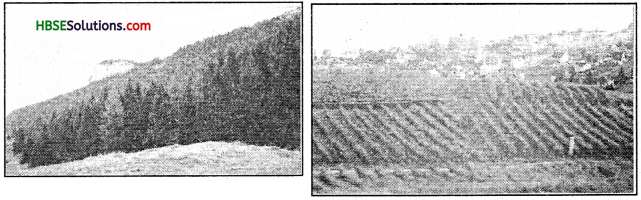
(i) (A)
HBSE 7th Class Social Science Solutions Geography Chapter 6 Natural Vegetation and Wild Life 2
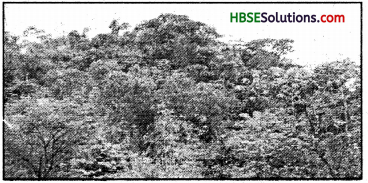
Tropical evergreen forests occur in the regions near the equator and close to the Tropics.

(B)
HBSE 7th Class Social Science Solutions Geography Chapter 6 Natural Vegetation and Wild Life 3
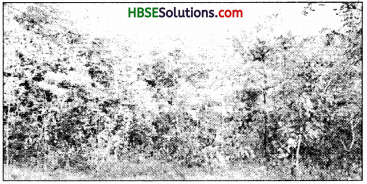
Tropical deciduous forests are the monsoon forests which experience seasonal changes.

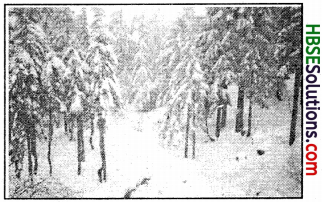
(C)
HBSE 7th Class Social Science Solutions Geography Chapter 6 Natural Vegetation and Wild Life 4
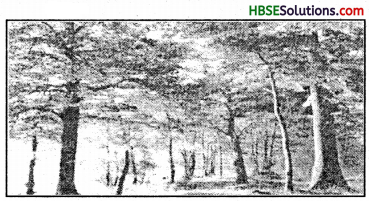
Temperate evergreen forests comprise both hard and soft wood trees like oak, pine, eucalyptus etc.

(D)
HBSE 7th Class Social Science Solutions Geography Chapter 6 Natural Vegetation and Wild Life 5
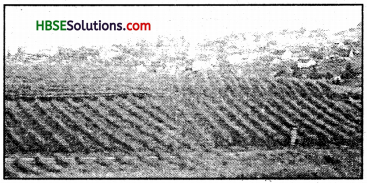
The trees of temperate deciduous forests shed their leaves in dry seasons.

(E)
HBSE 7th Class Social Science Solutions Geography Chapter 6 Natural Vegetation and Wild Life 6
Mediterranean vegetation is mostly found in the areas around the Mediterranean sea in Europe, Africa and Asia. Coniferous (Taiga) forests are found in the higher latitudes (50°-70°) of Northern hemisphere. Tropical grassland grows in the areas of moderate to low amount of rainfall.
HBSE 7th Class Social Science Solutions Geography Chapter 6 Natural Vegetation and Wild Life 7

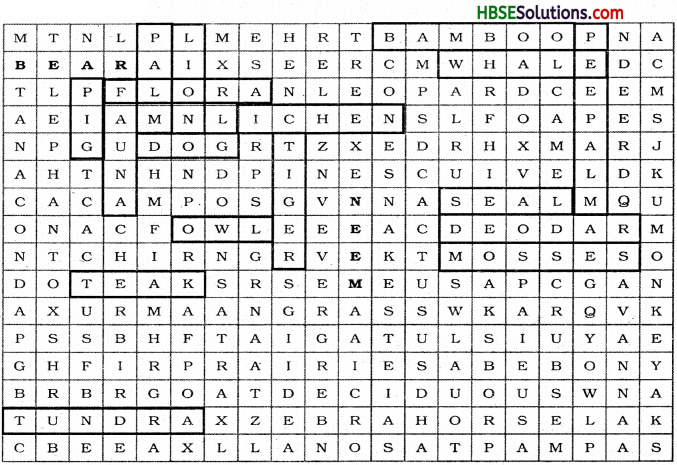
Question 6.
For Fun
HBSE 7th Class Social Science Solutions Geography Chapter 6 Natural Vegetation and Wild Life 8
Answer:
Horizontally : Bamboo, Bear, Whale, Flora, Lichen, Hen, Pine, Seal, Fowl, Chir, Masses, Grass, Taiga, Praire, Fir, Ebony, Goat, Deciduous, Tundra, Zebra, Horse, Lianos, Pampas.

Vertically : Shrub, Ox, Pig, Cactus, Fauna, Lion, Downs, Tiger, Neem, Oak, Camel, Peepal, Oak, Deer, Savanaa, Yak.

HBSE 7th Class Geography Natural Vegetation and Wild Life Important Questions and Answers

Very Short Answer Type Questions

Question 1.
Why do the trees in tropical evergreen forests do not shed their leaves altogether?
Answer:
The trees in tropical evergreen forests do not shed their leaves’ altogether because there is no particular dry season.

Question 2.
Where are tropical deciduous forests found?
Answer:
Tropical deciduous forests are found in the large part of India, northern Australia, and in Central America.

Question 3.
What type of trees are found at higher latitudes?
Answer:
Temperate deciduous forests are found at higher latitudes.

Question 4.
What is the use of wood of coniferous trees?
Answer:
The wood of coniferous trees is used for manufacturing pulp which is used for manufacturing paper and newsprint.

Question 5.
What is the extent of tropical grasslands?
Answer:
The tropical grasslands occur on either side of the equator and extend till the Tropics.

HBSE 7th Class Social Science Solutions Geography Chapter 6 Natural Vegetation and Wild Life

Question 6.
What kind of grass is found in temperate grasslands?
Answer:
Short and nutritious grass is found in temperate grasslands.

Question 7.
Why is vegetation cover scarce in thorny bushes?
Answer:
Vegetation cover is scarce in thorny bushes because of scanty rain and scorching heat.

Short Answer Type Questions

Question 1.
What are the factors on which growth of vegetation depends?
Answer:
Following are the factors on which growth of vegetation depends :

  • The change in height affects the character of vegetations. With the change in height, the climate changes and that changes natural vegetation.
  • The growth of vegetation also depends on temperature and moisture.
  • The growth of vegetation also depends on factors like slope and thickness of soil.

Question 2.
What are three categories of natural vegetation?
Answer:
The three categories of natural vegetations are :

  • Forests : Forests grow where temperature and rainfall are plentiful to support a tree cover. The forests can be (i) dense forests, (ii) open forests.
  • Grasslands : Grasslands include tropical and temperate grasslands. They grow in the region of moderate rain.
  • Shrubs : Thorny shrubs and scrubs grow in the dry region.

Question 3.
Write a short note on temperate grasslands.
Answer:
Tropical grasslands occur oft either side of the equator and extend till the tropics. This vegetation grows in the areas of moderate’ to low amount of rainfall. The grass can grow very tall, about 3 to 4 metres in height. Savannah grasslands of Africa are of this type. Common animals found here are elephants, zebras, giraffes, deer and leopards.

Question 4.
Write three major features of tropical evergreen forests.
Answer:
Major features of tropical evergreen forests are:
These forests are so dense that thick canopies are developed which do not allow the sunlight to penetrate inside the forest. As there is no particular dry season, the trees do not shed their leaves altogether. This keeps the forest evergreen. Hardwood trees such as rosewood, ebony and mahogany are found here.

Question 5.
Where is Tundra type of vegetation found? Why?
Answer:
Tundra type of vegetation includes mosses, lichens and very small shrubs. The main polar areas of Tundra type of vegetation are Europe, Asia and North America. This is found in polar regions. They grow during the very short summer. This is so because polar regions are extremely cold and the growth of natural vegetation is very limited here.

HBSE 7th Class Social Science Solutions Geography Chapter 6 Natural Vegetation and Wild Life

Question 6.
What are the main features of Highlands vegetation?
Answer:
The temperature falls with the rise in the height as in the mountainous area. The factors behind the variety in the types of vegetation in highlands are the climatic changes occurring in the higher altitude.

A succession of the vegetation from the tropical to alpine types in mountains can be notice. Generally, at the foothills, there is belt of deciduous trees. The pine forests are well grown at the height between 1500 metres to 2000 metres.

Long Answer Type Questions

Question 1.
Write a note on the various’ types of grasslands.
Answer:
The various types of grasslands are:

  • Tropical grasslands
  • Temperate grasslands
  • Thorny bushes

1. Tropical grasslands : This type of vegetation grows in the areas of moderate to low amount of rainfall. The grass here can grow very tall, about to 4 metres in height. Savannah grasslands of Africa are of this type. Common animals found here are elephants, zebras, giraffes, deer, leopards etc.

2. Temperate grasslands : This type of vegetation is found in the mid-latitudinal zones and in the interior part of the continents. Grass here is usually short and nutritious. Common animals found in this region are wild buffaloes, bisons, antilopes etc.

3. Thorny bushes : These are found in the dry desert like regions. Tropical deserts are located on the western margins of the continents, which are characterised by such vegetation. Vegetation in the polar regions is also limited. Only mosses, lichens and very small shrubs are found here. It grows during the very short summer. This is called Tundra type of vegetation. Polar animals have thick fur and thick skin which protect them from the cold climate conditions, for example, seal, walruses, musk-oxen, Arctic owl, etc.

Natural Vegetation and Wild Life Class 7 HBSE Notes

  • Evergreen Vegetation : Forest with trees retaining the leaf cover across the year.
  • Natural Vegetation : Original land cover of forest vegetation.
  • Coniferous Trees : The forest in which trees have conical leaves and they don’t shed their leaves all at a time.
  • Wildlife Sanctuary : An area, set aside for preserving its natural vegetation, natural beauty, wildlife etc.
  • Biodiversity : Different species on the earth.
  • Biome : A vast ecosystem with its group of plants and animals is recognised as biome.
  • Eco-system : A system which comprises the physical environment and the’organisms with live therein.
  • Food Chain : Food chain is the transfer of energy from one organism to another in ecological system.
  • Food Web : It is complicated network of several food chains.
  • Herbivores : Animals of those categories which lives on grass and plants.
  • Carnivores : The animals which kill small animals for their food.
  • Habitat: The physical environment in which the animals normally lives.
  • Forests : Extensive area covered with trees.
  • Vegetation : The assemblage of plant species living in association with each other in a given environmental framework is known as vegetation.
  • Fauna : Species of animals.
  • Flora : Plants of a particular region.
  • Conservation : Protection, preservation and efficient utilisation of resources gifted by nature.

HBSE 7th Class Social Science Solutions Geography Chapter 6 Natural Vegetation and Wild Life Read More »

HBSE 7th Class Social Science Solutions Geography Chapter 4 Air

Haryana State Board HBSE 7th Class Social Science Solutions Geography Chapter 4 Air Textbook Exercise Questions and Answers.

Haryana Board 7th Class Social Science Solutions Geography Chapter 4 Air

HBSE 7th Class Geography Air Textbook Questions and Answers

Air Class 7 HBSE Geography Question 1.
Answer the following questions:
(i) What is atmosphere?
Answer:
A huge blanket of air that surrounds the earth is called atmosphere.

(ii) Which two gases make the bulk of the atmosphere?
Answer:
Two gases that make the bulk of the atmosphere are nitrogen and oxygen.

(iii) Which gas creates greenhouse effect in the atmosphere?
Answer:
Carbon dioxide gas.creates greenhouse effect in the atmosphere.

(iv) What is weather?
Answer:
Weather is the sum total of atmospheric conditions of si specific place, at a specific time regarding temperature, humidity, air pressure, clouds, winds etc.

(v) Name three types of rainfall.
Answer:
Three types of rainfall are:
(a) Convectional rainfall
(b) Orographic rainfall
(c) Cyclonic or Frontal rainfall.

(vi) What is air pressure?
Answer:
Air has weight and exerts pressure. Hence, air pressure is an impact which occurs due to air weight.

HBSE 7th Class Social Science Solutions Geography Chapter 4 Air

Air Question Answer HBSE 7th Class Geography  Question 2.
Tick the correct answer:
(i) Which of the following gases protects us from harmful sun rays?
(a) Carbon dioxide
(b) Nitrogen
(c) Ozone
Answer:
(c) Ozone

(ii) The most important layer of the atmosphere is :
(a) troposphere
(b) thermosphere
(c) mesosphere
Answer:
(a) troposphere

(iii) Which of the following layers of the atmosphere is free from clouds?
(a) Troposphere
(b) Stratosphere
(c) Mesosphere
Answer:
(b) Stratosphere

(iv) As we go up the layers of the atmosphere, the pressure ________.
(a) increases
(b) decreases
(c) remains the same
Answer:
(b) decreases

(v) When precipitation comes down to the earth in the liquid form, it is called ________.
(a) cloud
(b) rain
(c) snow
Answer:
(b) rain

HBSE 7th Class Social Science Solutions Geography Chapter 4 Air

Air Class 7 Notes HBSE Geography Question 3.
Match the following :

(i) Trade winds(a) Incoming solar energy
(ii) Loo(b) Seasonal wind
(iii) Monsoon(c) Hotizontal movement of Air
(iv) Wind(d) Layer of ozone gas
(e) Permanent wind
(f) Local wind

Answer:

(i) Trade winds(e) Permanent wind
(ii) Loo(f) Local wind
(iii) Monsoon(b) Seasonal wind
(iv) Wind(c) Hotizontal movement of Air

Air Class 7 Questions HBSE Geography Question 4.
Give reasons:
(i) Wet clothes take longer time to dry on a humid day.
Answer:
On a humid day, evaporation from wet clothes takes place slowly in the atmosphere due to low temperature. Hence wet clothes take longer time to dry on a humid day.

(ii) Amount of insolation decreases from equator towards poles.
Answer:
Insolation comes through vertical rays on equator. As we go iip from equator towards poles, the sun rays become slanting. The slanting rays take up more space, the degree of hotness is felt less. Hence the amount of insolation decreases from equator towards poles.

HBSE 7th Class Geography Air Important Questions and Answers

Very Short Answer Type Questions

Air Class 7 Questions And Answers HBSE Question 1.
What is atomosphere?
Answer:
The huge blanket of air by which our earth is surrounded is called atmosphere.

Class 7th Air HBSE Geography Question 2.
Which two gases are found in the atmosphere in abundance?
Answer:

  • Nitrogen
  • Oxygen.

Question 3.
Name the gases which are found in the atmosphere in lesser quantities?
Answer:

  • Carbon dioxide
  • Helium
  • Ozone
  • Argona
  • Hydrogen.

HBSE 7th Class Social Science Solutions Geography Chapter 4 Air

Question 4.
Write the percentages of different gases found in the atmosphere.
Answer:

  • Nitrogen : 71%
  • Oxygen : 21%
  • Carbon dioxide : 0.3%
  • Argon : 0.93%
  • All others : 0.04%.

Question 5.
Why is stratosphere the most ideal for flying aeroplanes?
Answer:
Stratosphere is almost free from clouds and associated weather phenomenon, making conditions most ideal for flying aeroplanes.

Question 6.
What is weather?
Answer:
Hour-to-hour, day-to-day condition of the atomosphere is called weather.

Short Answer Type Questions

Question 1.
Why is atmosphere essential for human beings?
Answer:

  • It provides us the air we breathe.
  • It protects as from the harmful rays of the sun.
  • It makes the temperature of the earth liveable.

Question 2.
Why is carbon dioxide called a greenhouse gas?
Answer:
Carbon dioxide traps the heat radiated from the earth arid creates a greenhouse effect. Therefore, it is called a greenhouse gas.

Question 3.
What is global warming?
Answer:
The quantity of carbon dioxide increases due to factory smoke or car funies and the heat retained increase the temperature of the earth. This called as global warming.

Question 4.
How is ozone gas important to us?
Answer:
Ozone gas forms a protective layer around the earth it absorbs the harmful ultraviolet radiations of the sun.

HBSE 7th Class Social Science Solutions Geography Chapter 4 Air

Question 5.
Draw diagrams to show (i) Cyclonic rainfall
(ii) Relief rainfall
(iii) Convectional rainfall.
Answer:
HBSE 7th Class Social Science Solutions Geography Chapter 4 Air 1

Question 6.
Draw a diagram showing the layers of atmosphere.
Answer:
HBSE 7th Class Social Science Solutions Geography Chapter 4 Air 2

Long Answer Type Questions

Question 1.
Explain about different layers of atmosphere.
Answer:
There are five different layers of atmosphere :

  • Troposphere
  • Stratosphere
  • Mesosphere
  • Thermosphere
  • Exosphere

Answer:
(i) Troposphere:
Height : Its average height is about 13 km.
Activities : This is the most important layer of the atmosphere. The air we breathe exists here. All weather phenomena like rainfall, fog and hailstorm occur in this layer.
Upper limit: Tropopause.
Temperature : Not beyond 45°C.

(ii) Stratosphere:
Height: It extends upto a height of 50 km.
Activities: This layer is almost free from clouds and associated weather phenomenon making conditions more ideal for flying aeroplanes. It has the ozone layer which protects us from the harmful affect of rays.
Upper limit: Stratopause.
Temperature : The temperature here keeps on rising.

(iii) Mesosphere:
Height : This is the third layer of the atmosphere. It lies above the height of 80 km.
Activities : Meteorites burn up in this layer on entering the space.
Upper limit: Mesopause.

(iv) Thermosphere : Height: 80-400 km.
Its upper limit satropause
Temperature: The temperature is rising.

HBSE 7th Class Social Science Solutions Geography Chapter 4 Air

Question 2.
Name the various gases in the atmosphere and their functions or uses.
Answer:
Nitrogen and oxygen are two gases which make up the bulk of the atmosphere. Carbon dioxide, helium, ozone, argon and hydrogen are found in lesser quantities. Apart from these gases, tiny dust particles are also present in the air.

Their functions and uses are as follows:

  • Nitrogen is the most plentiful gas in the air. When we inhale, we take some amount of nitrogen into our lungs and exhale it. But plants need nitrogen for their survival.
  • Oxygen is the second most plentiful gas in the air. Humans and animals take oxygen from the air as they breathe.
  • Carbon dioxide is another important gas. Green plants use carbon dioxide to make their food and release energy.

Question 3.
Which is the greenhouse gas and what affect does it have?
Answer:
(i) Carbon dixoide-released in the atmosphere creates a greenhouse effect by trapping the heat radiated from the earth. It is therefore called a green house gas and without it the earth would have been too cold to live in. However, when the level in the atmosphere increases due to factory smoke or car fumes, the heat retained increases the temperature of the earth. This is called global warming.

(ii) This rise in temperature causes the snow in the coldest parts of the world to melt.

(iii) As a result, the sea level rises, causing floods in the coastal areas.

(iv) There may be drastic changes in the climate of a place leading to extinction of some plants and animals.

Air Class 7 HBSE Notes

  • Atmosphere : Thick blanket of air around the earth.
  • Ozone : This thin layer of atmosphere which acts as a filter and absorbs ultra violet radiation.
  • Smog: Combination of smoke and fog.
  • Stratosphere : Above troposphere it is a cold but clean layer of air.
  • Periodic Winds : Winds changing their direction periodically with change in the season.
  • Loo : Hot and dry wind that blows over the plains.
  • Evaporation : Change of liquid state of water into water vapour.
  • Wind : Horizontally moving air near the surface of the earth is called a wind.
  • Lapse Rate : The rate at which temperature decreases with altitude is called lapse rate.
  • Radiation : Reflection of solar energy by clouds and particles are called radiation.
  • Molecule : Smallest particles of a substance in free state.
  • Humidity : The amount of water vapour present in the air.
  • Insolation : The amount of solar radiations coming down to the earth.
  • Terrestrial. Radiation : The heat given off by the earth.

HBSE 7th Class Social Science Solutions Geography Chapter 4 Air Read More »

HBSE 7th Class Social Science Solutions Geography Chapter 5 Water

Haryana State Board HBSE 7th Class Social Science Solutions Geography Chapter 5 Water Textbook Exercise Questions and Answers.

Haryana Board 7th Class Social Science Solutions Geography Chapter 5 Water

HBSE 7th Class Geography Water Textbook Questions and Answers

Class 7 Geography Chapter 5 Water Question 1.
Answer the following questions:
(i) What is precipitation?
Answer:
When the water vapour cools, it condenses and form clouds. From there it may fall On the land or sea or rain, snow sleet. This is called precipitation.

(ii) What is water cycle?
Answer:
The process by which water continually changes its form and circulates between oceans, atmosphere and land is known as the water cycle.

(iii) What are the factors affecting the height of the waves?
Answer:
The factors affecting the height of the waves are:

  • Winds
  • Earthquakes, volcanic eruption and landslides on the bottom of the ocean.

(iv) Which factors effect the movement of waves?
Answer:
The factors which effect the movement of waves are :

  • Temperature
  • Winds
  • Gravitational pull of the sun
  • The earth
  • The moon
  • The warm and cold currents.

HBSE 7th Class Social Science Solutions Geography Chapter 5 Water

(v) What are tides and how are they caused?
Answer:
Tides are the rhythmic rise and fall of ocean water that occurs twice in a day. The strong gravitational pull exerted by the sun and the moon on the earth’s surface causes the tides.

(vi) What are ocean currents?
Answer:
Ocean currents are streams of water that flow constantly on the ocean surface in definite directions are called ocean currents.

Class 7 Geography Ch 5 Water Question 2.
Give reasons:
(i) Ocean water is salty.
Answer:
The water of the ocean is salty or saline as it contains large amount of dissolved salts. Most of the salt is sodium chloride or the common table salt.

(ii) The quality of water is deterior-ating.
Answer:
The quality of water is deteriorating day by day because of pollution of the rivers and also due to global warming, the fresh water stored in the ice caps is melting because of rising temperature. The water cycle is therefore disturbed and fresh water available for drinking is decreasing day by day.

Class 7th Geography Chapter 5 Water Question 3.
Tick (√) the correct answer :
(i) The process by which water continually changes in its form and circulates between oceans, atmosphere and land.
(a) Water cycle
(b) Tides
(с) Ocean currents
Answer:
(a) Water cycle

(ii) Generally the warm ocean currents originate near ________.
(a) Poles
(b) Equator
(c) None of these
Answer:
(b) Equator

(iii) The rhythmic rise and fall of ocean water twice in a day is called ________.
(a) Tide
(b) Ocean current
(c) Wave
Answer:
(a) Tide

HBSE 7th Class Social Science Solutions Geography Chapter 5 Water

Class 7th Geography Chapter 5 Question 4.
Match the following :

(i) Caspian sea(a) Largest lake
(ii) Tide(b) Periodic rise and fall of water
(iii) Tsunami(c) Strong seismic waves
(iv) Ocean currents(d) Streams of water moving along definite path
(e) Water cycle

Answer:
(i) (c)
(ii) (a)
(iii) (b)
(iv) (a)

Chapter 5 Water Geography Class 7 Question 5.
For Fun :
Be a Detective
(i) The name of one river is hidden in each of the sentences below. Spot it.
Example : Mandra, Vijayalakshmi and Surinder are my best friends.
Answer:
Ravi.
(a) The snake charmer’s bustee, stables where horses are housed, and the piles of wood, all caught fire accidentally. (Hint: Another name for River Brahmaputra) Answer:
Teesta.

(b) The conference manager put pad, material for reading and a pencil for each participant. (Hint: A distributary on the Ganga-Brahmaputra delta)
Answer:
Padma.

(c) Either jealousy or anger cause a person’s fall (Hint: Name of a juicy fruit!)
Answer:
Orange.

(d) Bhavani germinated the seeds in a pot (Hint: Look for her in West Africa)

(e) “I am a zonal champion now” declared the excited atheletic. (Hint: The river that has he biggest basin in the world)
Answer:
Amazon.

(f) The tiffin box rolled down and all the food fell in dusty potholes. (Hint: Rises in India and journeys through Pakistan)
Answer:
Indus.

(g) Malini leaned against the pole when she felt that she was going to faint. (Hint: Her delta in Egypt is famous)
Answer:
Nile.

(h) Samantha mesmerised everybody with her magic tricks. (Hint: London is situated on her estuary)
Answer:
Thames.

(i) “In this neighbourhood, please don’t yell! Owners of these houses like to have peace”. Warned my father when we moved into our new flat”. (Hint: colour!)
Answer:
Yellow.

(j) ‘Write the following words, Marc!’ “On”, “go”, “in” said the teacher to the little boy in KG Class. (Hint: Rhymes with ‘bongo’)
Answer:
Congo.

Now make some morer on your own and ask your classmates to spot the hidden name. You can do this with any name: that of a lake, mountains, trees, fruits, school items etc.
Carry on Detective

HBSE 7th Class Social Science Solutions Geography Chapter 5 Water

(ii) With the help of an atlas, draw each river which you discoverd in For fun (t), on an outline map of the world.
Answer:
(a) Teesta
(b) Padma
(c) Orange
(d) Niger
(e) Amazon
(f) Indus
(g) Nile
(h) Thames
(i) Yellow
(j) Congo

HBSE 7th Class Geography Water Important Questions and Answers

Very Short Answer Type Questions

Question 1.
What causes evaporation of water?
Answer:
The sun’s heat causes evaporation of water vapour.

Question 2.
Name the major sources of fresh water.
Answer:
Rivers, ponds, springs, glaciers.

Question 3.
Which salt is mainly found in the ocean water?
Answer:
Much of the salt found in the sea-water is sodium chloride or the common tablesalt.

Question 4.
Give reason : Swimmers can float in Dead Sea.
Answer:
Swimmers can float in Dead sea because it increases salt content and makes it dense.

Question 5.
What are the different ways in which movements of ocean water can be classified.
Answer:
The movements in the ocean water can be classified as : (a) waves, (b) tides, (c) currents.

HBSE 7th Class Social Science Solutions Geography Chapter 5 Water

Question 6.
What is the importance of World Water Day?
Answer:
The need to conserve water is reinforced in different ways on World Water Day.

Question 7.
What are waves?
Answer:
When the water on the surface of the ocean rises and falls alternatively, they are called waves.

Short Answer Type Questions

Question 1.
What are the spring tides? When do they occur?
Answer:
High magnitude tides are called spring tides. These tides occur on the full moon and new moon nights when the sun, the moon and the earth are in the same line.

Question 2.
What are neap tides? When do they occur?
Answer:
Low magnitude tides are called neap tides. These tides occur when the moon is in its first and last quarter, and the ocean water get drawn in mutually perpendicular directions by the gravitational pull of the sun and the earth resulting in low tides.

Question 3.
Where do the warm and cold ocean currents originate?
Answer:

  • The warm ocean currents originate near the equator and move towards the poles.
  • The cold currents originate near polar or higher latitudes and move towards tropical or lower latitudes.

Long Answer Type Questions

Question 1.
Distinguish between Wave and Tide.
Answer:

WavesTides
(i) Waves are up and down movement of ocean water due to pushing action of wind.(i) Tides are up and down movement of ocean water due to gravitational pull of the sun and moon.
(ii) Waves occur 24 hours a day.(ii) Tides occur twice a day early in the morning and late at night.
(iii) Waves are not useful. Infact, violent waves can bring destruction.(iii) Tides are very useful.

Question 2.
Is all the water on earth available to us?
Answer:
No, all the water on earth is not available to us. Only 2.8% water is fresh, which we can utilize to fulfill our needs. Rest 97.2% water is saline.

Question 3.
If there is more water than land on this earth, why do so many countries face water scarcity?
Answer:

  • About 97.2% water is saline.
  • Only 2.8% water is fresh which can be utilised by the human beings.
  • Uneven distribution of water also leads to water scarcity.
  • Careless use and wastage of water by human beings is the main cause of water scarcity.

HBSE 7th Class Social Science Solutions Geography Chapter 5 Water

Question 4.
Write the effects of ocean currents.
Answer:

  • The ocean current influences the temperature conditions of the area. Warm currents bring about warm temperatures over the land surface.
  • The areas where the warm and cold currents meet provide the best fishing grounds of the world.
  • The areas where warm and cold currents meet also experience foggy weather making it difficult to navigate.

Water Class 7 HBSE Notes

  • Terraium : It is an artificial enclosure for keeping small house plants.
  • Hydrosphere : Part of earth’s surface covered with water.
  • Tide : The regular rise and fall in sea water is called tide.
  • High Tide : The regular rise of sea water is called high tide.
  • Low Tide : The fall of sea water is called low tide.
  • Ground Water : When the rain water is soaked by ground is called ground water.
  • Hydrological Cycle : The continuous circulation of water among the hydrosphere, atmosphere and lithosphere is called hydrological cycle. Actually the cycle is of very complex nature with a number of sub cycles.
  • Glacier : The moving mass of ice is known as glacier.
  • Salinity : Amount of salt in grams present in 1000 grams of sea water.
  • Water Cycle : The movement of water from sea to air and hack to the sea.
  • Water Conservation : The protection, preservation and careful use of the water.
  • Winds : The undulation on the surface of the water caused by wind blowing over sea.
  • Evaporation : The process by which the water changes into water vapour and enters into atmosphere.
  • Condensation : The change of water vapour into droplets of water or snow is called condensation.
  • Precipitation : The condensation of water vapour in the form of water droplets or ice-crystals and falling on the earth’s surface.

HBSE 7th Class Social Science Solutions Geography Chapter 5 Water Read More »