Author name: Prasanna

HBSE 10th Class Science Solutions Chapter 11 Human Eye and Colourful World

Haryana State Board HBSE 10th Class Science Solutions Chapter 11 Human Eye and Colourful World Textbook Exercise Questions and Answers.

Haryana Board 10th Class Science Solutions Chapter 11 Human Eye and Colourful World

HBSE 10th Class Science Human Eye and Colourful World Textbook Questions and Answers

Question 1.
The human eye can focus on objects at different distances by adjusting the focal length of the eye lens. This is due to
(a) Presbyopia
(b) Accommodation
(c) Near-sightedness
(d) Far-sightedness
Answer:
(b) Accommodation

HBSE 10th Class Science Solutions Chapter 11 Human Eye and Colourful World

Question 2.
The human eye forms the image of an object at its ……….
(a) cornea
(b) iris
(c) pupil
(d) retina
Answer:
(d) retina

Question 3.
The least distance of distinct vision for a young adult with normal vision is about
(a) 25 m
(b) 2.5 cm
(c) 25 cm
(d) 2.5 m
Answer:
(c) 25 cm

Question 4.
The change in focal length of an eye lens ¡s caused by the action of the
(a) pupil
(b) retina
(c) cillary muscles
(d) Iris
Answer:
(c) cillary muscles

HBSE 10th Class Science Solutions Chapter 11 Human Eye and Colourful World

Question 5.
A person needs a lens of power – 5.5 diopters for correcting his distant vision. For correcting his near vision he needs a lens of power +1.5 diopter. What is the focal length of the lens required for correcting (i) distant vision, and (ii) near vision?
Answer:
1. Power of distance viewing part of the lens, Pi = – 5.5 D
Focal length of this part, f1 = \(\frac{1}{P_1}=\frac{1}{-5.5}\) = m = – 18.73 cm (concave lens)

2. The power of the near-vision part is measured relative to the main part of the lens of power – 5.5
∴ P1+P2 = P or – 5.5+P2= + 1.5 or P2=+6.5 D
Focal length of near-vision part, f2 = \(\frac{1}{P_2}=\frac{1}{+6.5}\) m = m = + 15.4 cm (convex lens)

Question 6.
The far point of a myopic person is 80 cm in front of the eye. What is the nature and power of the lens required to correct the problem?
Answer:
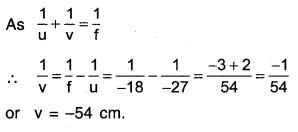
The lens should be able to make the objects at infinity appear at the far point.
∴ For object at infinity, µ = – ∞
Far point distance of the defected eye, v = – 80 cm
HBSE 10th Class Science Solutions Chapter 11 Human Eye and Colourful World 1
A negative sign shows that the lens is a concave lens.
Thus a concave lens of power – 1.25 D is needed to correct the problem.

HBSE 10th Class Science Solutions Chapter 11 Human Eye and Colourful World

Question 7.
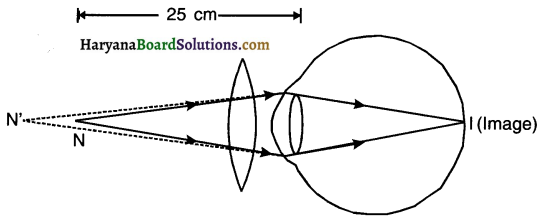
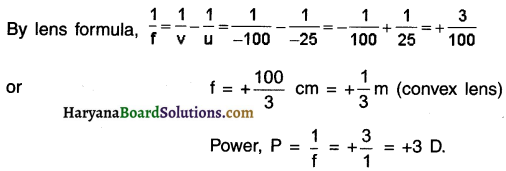
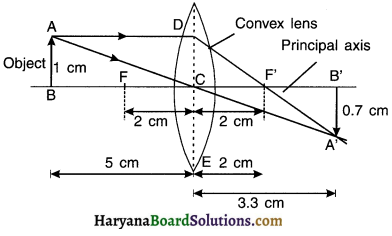
Make a diagram to show how hypermetropia is corrected. The near point of a hypermetropic eye is 1 m. What is the power of the lens required to correct this defect? Assume that the near point of the normal eye is 25 cm.
Answer:
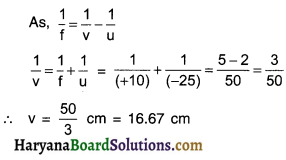
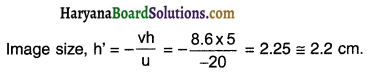
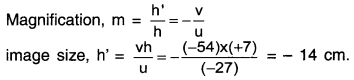
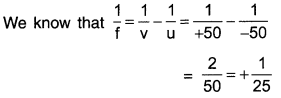
The object placed at 25 cm from the correcting lens must produce a virtual image at 1 m or 100 cm.
u = – 25 cm, y = -100 cm
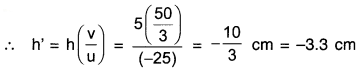
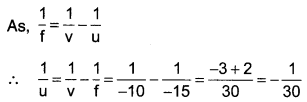
HBSE 10th Class Science Solutions Chapter 11 Human Eye and Colourful World 2
HBSE 10th Class Science Solutions Chapter 11 Human Eye and Colourful World 3

Question 8.
Why is a normal eye not able to see clearly the objects placed closer than 25 cm?
Answer:
At distance less than 25 cm, the ciliary muscles are unable to bulge the eye lens any more. So, the objects cannot be focused on the retina and thus appears blurred.

Question 9.
What happens to the Image distance in the eye when we increase the distance of an object from the eye?
Answer:
1. When we increase the distance of an object from the eye there does not occur any change in the image distance.
2. When the object is moved farther, the ciliary muscles get relaxed and the eye lens become thin. This increases the focal length and the image looks clear.

HBSE 10th Class Science Solutions Chapter 11 Human Eye and Colourful World

Question 10.
Why do stars twinkle?
Answer:
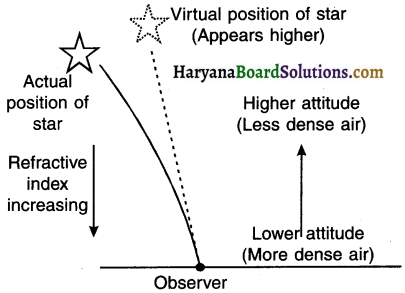
1. Density of atmosphere is not uniform everywhere.
2. There are different layers of atmosphere with different refractive indices.
3. Atmospheric layer at lower altitude is colder P and denser compared to layer at higher altitude.
4. When the light travels from star at a rarer medium towards earth at denser medium, it bends towards normal.
5. Thus, due to refraction towards normal, the position of star appears higher from its actual position.

HBSE 10th Class Science Solutions Chapter 11 Human Eye and Colourful World 4

Reason for twinkling of stars:

  • The physical condition of refracting medium e. the earth’s atmosphere is not stationary. Hence, the position of star seems to be changing continuously.
  • This results in the continuous change in the path of the rays coming from the stars and continuous change in the intensity of light. This leads to twinkling of stars.
  • Light from a star is refracted or say bent as it leaves the space and enters the earth’s atmosphere.
  • Air at higher altitude is rare whereas near the earth’s surface it is dense.
  • As a result, when light from the star comes down, the dense air bends the light more.
  • Due to this, refraction of star’s light, the star appears to be at a higher position than it actually is.

HBSE 10th Class Science Solutions Chapter 11 Human Eye and Colourful World

Question 11.
Explain why the planets do not twinkle.
Answer:
1. The stars are very far from us and so they may be considered as the point sources of light.
2. Compared to stars, planets are much nearer to the earth and so planets appear quite big.
3. Hence, planets cannot be considered a single point source of light but a collection of a very large number of point sources of light.
4. Thus, on the whole, the brightness of the planet always remains the same and it does not appear twinkle. But the atmospheric refraction affects stars more since they are point sources of light and so stars twinkle.

Question 12.
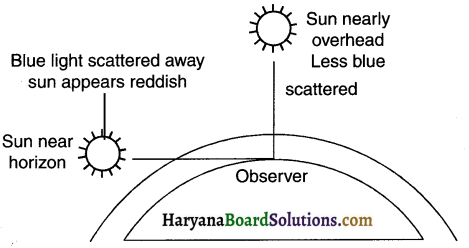
Why does the Sun appear reddish early in the morning?
Answer:
1. White light coming from the sun has to travel a large distance in the atmosphere before reaching to the observer.
2. During sunrise or sunset, most of the blue colour present in sunlight has been scattered out and it is away from our sight.
3. As a result, only red light remains present in the beam of sunlight and so only red colour reaches our eye.
4. As a result, sun appears reddish at sunrise and sunset.

HBSE 10th Class Science Solutions Chapter 11 Human Eye and Colourful World 5

Question 13.
Why does the sky appear dark instead of blue to an astronaut?
Answer:
1. The atmosphere becomes thinner as one moves above the earth.
2. Astronauts travel in the space which is at very high altitudes. At such altitudes, the sun cannot scatter any sunlight because of extremely thin atmosphere. As a result, the sky appears dark and not blue to the astronauts.

HBSE 10th Class Science Human Eye and Colourful World InText Activity Questions and Answers

Textbook Page no – 190

Question 1.
What is meant by power of accommodation of the eye?
Answer:
The ability of the eye lens to adjust its focal length as per the requirement so that the objects can be seen clearly is called the power of accommodation of eyes.

HBSE 10th Class Science Solutions Chapter 11 Human Eye and Colourful World

Question 2.
A person with a myopic eye cannot see objects beyond 1.2 m distinctly. What should be the type of the corrective lens used to restore proper vision?
Answer:
The person should use diverging i.e. concave lens.

Question 3.
What is the far point and near point of the human eye with normal vision?
Answer:
For a human eye with normal vision, the near point is 25 cm lron the eyes whereas the far point is at infinity.

Question 4.
A student has difficulty reading the blackboard while sitting in the last row. What could be the defect the child is suffering from? How can it be corrected?
Answer:
1. Since the student is sitting in the last row, the blackboard is at a far distance. The student is unable to read at far distance means he is suffering from myopia i.e. near-sightedness.
2. The student should use a concave length of suitable focal length to cure this problem.

Activities

Activity – 1

1. Fix a sheet of white paper on a drawing board using drawing pins.
2. Place a glass prism on it in such a way that it rests on its triangular base. Trace the outline of the prism using a pencil.
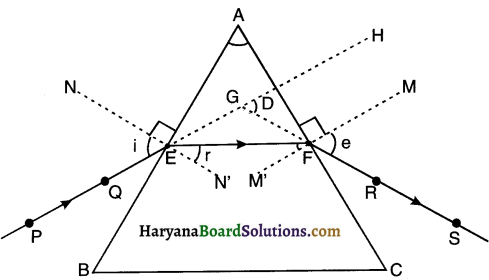
3. Draw a straight line PE inclined to one of the refracting surfaces, say AB, or the prism.
4. Fix two pins, say at points P and Q, on the line PE as shown in Figure.
5. Look for the images of the pins, fixed at P and Q, through the other face AC.
6. Fix two more pins, at points R and S, such that the pins at R and S and the images of the pins at P and Q lie on the same straight line.
7. Remove the pins and the glass prism.
8. The line PE meets the boundary of the prism at point E. Similarly join and produce the points R and S. Let these lines meet the boundary of the prism at E and F, respectively. Join E and F.
9. Draw a perpendicular to the refracting surfaces AB and AC of the prism at point E and F, respectively. Mark the angle of incidence (∠i), the angle of refraction (∠r) and the angle of emergence (∠e) as shown in figure.
10. Discuss the refraction of light through the prism. Try to find a relation between angles i, e, A and D.

HBSE 10th Class Science Solutions Chapter 11 Human Eye and Colourful World 6

Observation and conclusion:

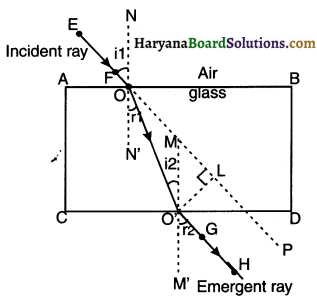
1. The incident ray PE undergoes refraction on hitting the face AB and bends towards the normal NN’ along the path EF. Again as ray EF retracts from glass to air at face AC, it bends away from the normal MM’. Thus, the emergent ray FS bends towards the base of the prism.

HBSE 10th Class Science Solutions Chapter 11 Human Eye and Colourful World

2. We measure the angle of incidence i, angle of prism A, angle of emergence e and the angle of deviation D. On measuring, we can see that, i+e=A+D

Activity 2.

1. Take a thick sheet of cardboard and make a small hole or narrow slit in its middle.
2. Allow sunlight to fall on the narrow slit. This gives a narrow beam of white light.
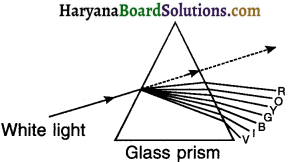
3. Now, take a glass prism and allow the light from the slit to fall on one of its faces as shown in Fig.
4. Turn the prism slowly until the light that comes out of it appears on a nearby screen.
5. What do you observe? You will find a beautiful band of colours. Why does this happen?

HBSE 10th Class Science Solutions Chapter 11 Human Eye and Colourful World 7

Observation and conclusion:

  • The glass prism splits the incident white light into a band of seven colours.
  • The band of colour called spectrum is made up of Violet, Indigo, Blue, Green, Yellow, Orange and Red colours in the said sequence. This is an example of dispersion of light.
  • Red coloured light shows least deviation where as violet-coloured light shows maximum deviation.

HBSE 10th Class Science Solutions Chapter 11 Human Eye and Colourful World

Activity 3.

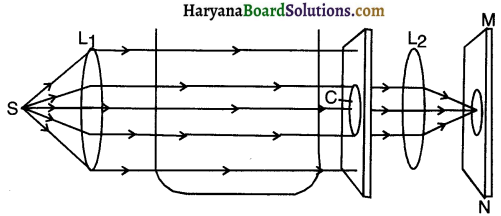
1. Place a strong source (S) of white light at the focus of a converging lens (L1). This lens provides a parallel beam of light.
2. Allow the light beam to pass through a transparent glass tank (T) containing clear water.
3. Allow the beam of light to pass through a circular hole (C) made in a cardboard.
Obtain a sharp image of the circular hole on a screen (MN) using a second converging lens (L2), as shown in Figure.
4. Dissolve about 200 g of sodium thiosulphate (hypo) in about 2 L of clean water taken in the tank.
Add about 1 to 2 mL of concentrated sulphuric acid to the water. What do you observe?

HBSE 10th Class Science Solutions Chapter 11 Human Eye and Colourful World 8

Observation and conclusion:

  • The fine micro-particles will precipitate in few minutes.
  • As the sulphur (colloids) particles begin to form, we will observe that blue light starts appearing from
    three sides of the tank. This demonstrates scattering of light.
  • On observing the tank from the circular hole side, we can first see an image of orange colour and
    then of bright crimson red colour on the screen.
  • Thus, the colloidal sulphur particles scatter the blue component of white light to maximum extent
    which can be seen from three sides of the tank.
  • The least scattered red component gets transmitted through the colloidal solution and reaches the screen.

HBSE 10th Class Science Solutions Chapter 11 Human Eye and Colourful World Read More »

HBSE 10th Class Maths Important Questions Chapter 1 वास्तविक संख्याएँ

Haryana State Board HBSE 10th Class Maths Important Questions Chapter 1 वास्तविक संख्याएँ Important Questions and Answers.

Haryana Board 10th Class Maths Important Questions Chapter 1 वास्तविक संख्याएँ

परीक्षोपयोगी अन्य महत्त्वपूर्ण प्रश्न

प्रश्न 1.
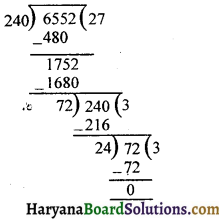
240 और 6552 का HCF यूक्लिड विभाजन एल्गोरिथ्म का प्रयोग करके ज्ञात कीजिए ।
हल :
HBSE 10th Class Maths Important Questions Chapter 1 वास्तविक संख्याएँ - 1
यूक्लिड विभाजन एल्गोरिथ्म से-
6552 = 240 × 27 + 72
240 = 72 × 3 + 24
72 = 24 × 3 + 0
क्योंकि यहाँ पर शेषफल शून्य तथा भाजक 24 है।
इसलिए 240 और 6552 का HCF = 24

HBSE 10th Class Maths Important Questions Chapter 1 वास्तविक संख्याएँ

प्रश्न 2.
दर्शाइए कि कोई भी धनात्मक पूर्णांक 3q या 3q + 1 या 3q + 2 के रूप का होता है, जहाँ q कोई पूर्णांक है।
हल :
माना a एक धनात्मक पूर्णांक है तथा b = 3 हो तो यूक्लिड विभाजन एल्गोरिथ्म से-
a = 3q + r
क्योंकि 0 ≤ r < 3 है, इसलिए संभावित शेषफल 0, 1 या 2 हो सकते हैं ।
अर्थात् a संख्याओं 3q, 3q + 1 या 3q + 2 के रूप का हो सकता है जहाँ q कोई पूर्णांक है ।

प्रश्न 3.
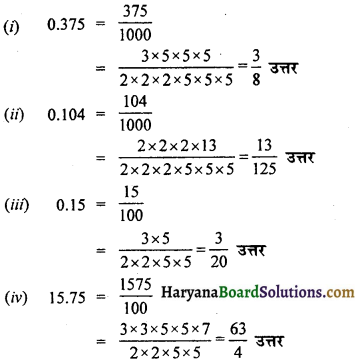
निम्नलिखित संख्याओं को \(\frac {p}{q}\) के रूप में व्यक्त कीजिए-
(i) 0.375
(ii) 0.104
(iii) 0.15
(iv) 15.75
हल :
HBSE 10th Class Maths Important Questions Chapter 1 वास्तविक संख्याएँ - 2

प्रश्न 4.
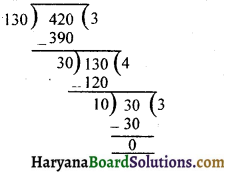
एक मिठाई विक्रेता के पास 420 काजू की बर्फियाँ और 130 बादाम की बर्फियाँ हैं । वह इनकी ऐसी ढेरियाँ बनाना चाहती है कि प्रत्येक ढेरी में बर्फियों की संख्या समान रहे तथा ये ढेरियाँ बर्फी की परात में न्यूनतम स्थान घेरें । इस काम के लिए प्रत्येक ढेरी में कितनी बर्फियाँ रखी जा सकती हैं?
हल :
प्रश्नानुसार, यहाँ पर हमें 420 और 130 का HCF यूक्लिड एल्गोरिथ्म द्वारा ज्ञात करना है-
HBSE 10th Class Maths Important Questions Chapter 1 वास्तविक संख्याएँ - 3
420 = 130 × 3 + 30
130 = 30 × 4 + 10
30 = 10 × 3 +0
क्योंकि यहाँ पर शेषफल शून्य तथा भाजक 10 है ।
इसलिए 420 और 130 का HCF = 10
अतः प्रत्येक प्रकार की बर्फी के लिए मिठाई विक्रेता 10-10 की ढेरी बना सकता है

HBSE 10th Class Maths Important Questions Chapter 1 वास्तविक संख्याएँ

प्रश्न 5.
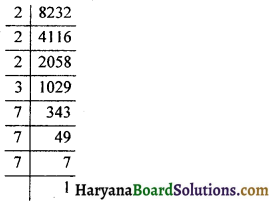
8232 को अभाज्य गुणनखंडों के गुणनफल के रूप में व्यक्त कीजिए ।
हल :
HBSE 10th Class Maths Important Questions Chapter 1 वास्तविक संख्याएँ - 4
8232 = 2 × 2 × 2 × 3 × 7 × 7 × 7
= 23 × 3 × 73

प्रश्न 6.
सिद्ध कीजिए कि \(\sqrt{2}\) एक अपरिमेय संख्या है।
हल :
माना \(\sqrt{2}\) एक परिमेय संख्या है जो कि दिए गए के विपरीत है।
अब \(\sqrt{2}\) = \(\frac {a}{b}\) जहाँ a और b सह-अभाज्य पूर्णांक हैं तथा b ≠ 0 है।
⇒ \(\sqrt{2}\)b = a
दोनों ओर का वर्ग करने पर, 2b2 = a2 ………..(i)
इससे पता चलता है कि a2, 2 से विभाज्य है, इसलिए a भी 2 से विभाज्य होगी। ………..(ii)
⇒ a = 2m जहाँ m एक पूर्णांक है ।
a का मान समीकरण (i) में रखने पर,
2b2 = (2m)2
⇒ 2b2 = 4m2
या b2 = 2m2
इसका अर्थ यह है कि 2 से b2 विभाजित हो जाता है इसलिए b भी 2 से विभाजित होगा । ………….(iii)
इसी प्रकार समीकरण (ii) व (iii) से a और b में कम-से-कम एक उभयनिष्ठ गुणनखंड 2 है। इससे हमारी कल्पना गलत होती है कि a और b सह-अभाज्य हैं । अतः सिद्ध है कि \(\sqrt{2}\) एक परिमेय संख्या नहीं है।
अतः \(\sqrt{2}\) एक अपरिमेय संख्या है।

प्रश्न 7.
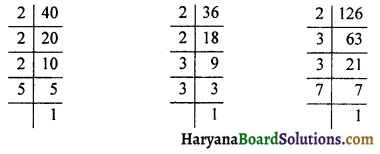
संख्या 40, 36 और 126 का अभाज्य गुणनखंडन विधि द्वारा HCF और LCM ज्ञात कीजिए ।
हल :
HBSE 10th Class Maths Important Questions Chapter 1 वास्तविक संख्याएँ - 5
40 = 2 × 2 × 2 × 5 = 23 × 5
36 = 2 × 2 × 3 × 3 = 22 × 32
126 = 2 × 3 × 3 × 7 = 2 × 32 × 7
∴ HCF(40, 36, 126) = अभाज्य गुणनखंडों की उभयनिष्ठ सबसे छोटी घातों का गुणनफल = 2 उत्तर
LCM(40, 36, 126) = अभाज्य गुणनखंडों की सबसे बड़ी घातों का गुणनफल = 23 × 32 × 5 × 7
= 8 × 9 × 5 × 7 = 2520

HBSE 10th Class Maths Important Questions Chapter 1 वास्तविक संख्याएँ

प्रश्न 8.
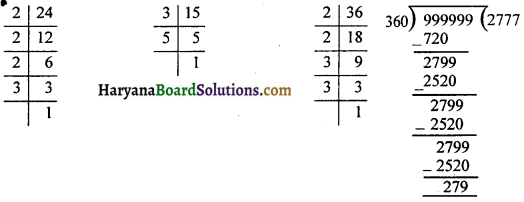
छः अंकों की सबसे बड़ी संख्या ज्ञात कीजिए जो 24, 15 तथा 36 से पूर्णतया विभाज्य हो ।
हल :
यहाँ पर हम पहले 24, 15 व 36 का LCM ज्ञात करेंगे।
HBSE 10th Class Maths Important Questions Chapter 1 वास्तविक संख्याएँ - 6
24 = 2 × 2 × 2 × 3 = 23 × 3
15 = 3 × 5
36 = 2 × 2 × 3 × 3 = 22 × 32
LCM(24, 15, 36) = 23 × 32 × 5 = 8 × 9 × 5 = 360
हम जानते हैं कि छः अंकों की बड़ी से बड़ी संख्या = 999999
अतः अभीष्ट संख्या = 999999 – 279 = 999720

प्रश्न 9.
यदि दो संख्याओं का LCM व HCF क्रमशः 180 व 6 हो तथा इनमें से एक संख्या 30 हो तो दूसरी संख्या ज्ञात कीजिए ।
हल :
यहाँ पर,
LCM = 180
HCF = 6
पहली संख्या = 30
∴ दूसरी संख्या = LCM × HCF / पहली संख्या
= \(\frac{180 \times 6}{30}\)
= 6 × 6 = 36

HBSE 10th Class Maths Important Questions Chapter 1 वास्तविक संख्याएँ

प्रश्न 10.
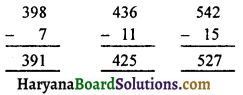
वह बड़े से बड़े धनात्मक पूर्णांक ज्ञात कीजिए जो 398, 436 और 542 को विभाजित करने पर क्रमशः 7, 11 व 15 शेषफल छोड़े?
हल :
यहाँ पर
HBSE 10th Class Maths Important Questions Chapter 1 वास्तविक संख्याएँ - 7
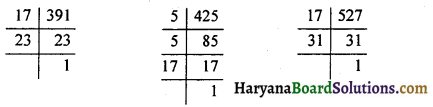
अब हम 391, 425 व 527 का HCF ज्ञात करेंगे-
HBSE 10th Class Maths Important Questions Chapter 1 वास्तविक संख्याएँ - 8
391 = 17 × 23
425 = 5 × 5 × 17 = 52 × 17
527 = 17 × 31
HCF (391, 425, 527) = 17
अतः वांछित पूर्णांक = 17

प्रश्न 11.
सिद्ध कीजिए कि निम्नलिखित संख्याएँ अपरिमेय है-
(i) 3 – 2\(\sqrt{5}\)
(ii) 2\(\sqrt{3}\)
हल :
(i) माना 3 – 2\(\sqrt{5}\) एक परिमेय संख्या है जो कि दिए गए के विपरीत है ।
अब 3 – 2\(\sqrt{5}\) = \(\frac {a}{b}\) जहाँ a और b सह-अभाज्य पूर्णांक हैं तथा b ≠ 0 है।
⇒ 2\(\sqrt{5}\) = 3 – \(\frac {a}{b}\)
या 2\(\sqrt{5}\) = \(\frac{3 b-a}{b}\)
या \(\sqrt{5}\) = \(\frac{3 b-a}{2 b}\)
क्योंकि a और b पूर्णांक हैं जिस कारण \(\frac{3 b-a}{2b}\) एक परिमेय संख्या होगी ।
इसलिए \(\sqrt{5}\) एक परिमेय संख्या होगी जो कि असत्य है क्योंकि \(\sqrt{5}\) एक अपरिमेय संख्या है।
अतः हमारी कल्पना गलत है। इससे सिद्ध होता है कि 3 – 2\(\sqrt{5}\) एक अपरिमेय संख्या है।

(ii) यदि संभव हो तो माना 2\(\sqrt{3}\) एक परिमेय संख्या है।
तो 2\(\sqrt{3}\) = \(\frac {a}{b}\) जहाँ a और b सह-अभाज्य पूर्णांक हैं तथा b ≠ 0 है।
⇒ \(\sqrt{3}\) = \(\frac {a}{2b}\)
क्योंकि a और b पूर्णांक हैं जिस कारण \(\frac {a}{2b}\) एक परिमेय संख्या होगी ।
⇒ \(\sqrt{3}\) एक परिमेय संख्या होगी जो कि असत्य है क्योंकि \(\sqrt{3}\) एक अपरिमेय संख्या है।
अतः हमारी कल्पना गलत है। इससे सिद्ध होता है कि 2\(\sqrt{3}\) एक अपरिमेय संख्या है।

HBSE 10th Class Maths Important Questions Chapter 1 वास्तविक संख्याएँ

प्रश्न 12.
सिद्ध कीजिए कि \(\sqrt{3}\) एक अपरिमेय संख्या है।
हल :
माना \(\sqrt{3}\) एक परिमेय संख्या है जो कि दिए गए के विपरीत है ।
अब \(\sqrt{3}\) = \(\frac {a}{b}\) जहाँ a और b सह-अभाज्य पूर्णांक हैं तथा b ≠ 0 है ।
⇒ \(\sqrt{3}\)b = a
दोनों ओर का वर्ग करने पर,
3b2 = a2 ………..(i)
इससे पता चलता है कि a2, 3 से विभाज्य है, इसलिए a भी 3 से विभाज्य होगी। …………..(ii)
⇒ a = 3m जहाँ m एक पूर्णांक है।
a का मान समीकरण (i) में रखने पर,
3b2 = (3m)2
⇒ 3b2 = 9m2
या b2 = 3m2
इसका अर्थ यह है कि 3 से b2 विभाजित हो जाता है इसलिए b भी 3 से विभाजित होगा । …………..(iii)
इसी प्रकार समीकरण (ii) व (iii) से a और b में कम-से-कम एक उभयनिष्ठ गुणनखंड 3 है। इससे हमारी कल्पना गलत होती है कि a और b सह-अभाज्य हैं । जिस कारण \(\sqrt{3}\) एक परिमेय संख्या नहीं है ।
अतः \(\sqrt{3}\) एक अपरिमेय संख्या है।

प्रश्न 13.
सिद्ध कीजिए कि 3\(\sqrt{2}\) एक अपरिमेय संख्या है।
हल :
यदि सम्भव हो तो माना 3\(\sqrt{2}\) एक परिमेय संख्या है।
तो 3\(\sqrt{2}\) = \(\frac {a}{b}\) जहाँ a और b सह – अभाज्य पूर्णांक हैं तथा b ≠ 0 है।
⇒ \(\sqrt{2}\) = \(\frac {a}{3b}\)
क्योंकि a और b पूर्णांक हैं जिस कारण \(\frac {a}{3b}\) एक परिमेय संख्या होगी ।
⇒ \(\sqrt{2}\) एक परिमेय संख्या होगी जोकि असत्य है क्योंकि \(\sqrt{2}\) एक अपरिमेय संख्या है।
अतः हमारी कल्पना गलत है। इससे सिद्ध होता है कि 3\(\sqrt{2}\) एक अपरिमेय संख्या है।

HBSE 10th Class Maths Important Questions Chapter 1 वास्तविक संख्याएँ

प्रश्न 14.
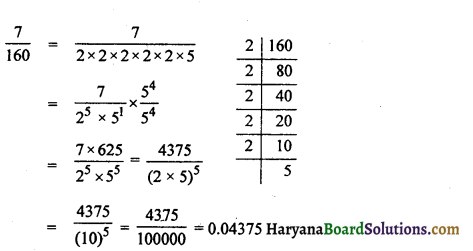
\(\frac {7}{160}\) का दशमलव प्रसार लिखिए ।
हल :
HBSE 10th Class Maths Important Questions Chapter 1 वास्तविक संख्याएँ - 9

प्रश्न 15.
परिमेय संख्या 34.12345 के हर के अभाज्य गुणनखंडों के विषय में आप क्या कह सकते हैं?
हल :
क्योंकि 34.12345 एक सांत दशमलव संख्या है। इसलिए इस हर के अभाज्य गुणनखंडन 2n × 5m के रूप के होंगे, जहाँ n और m पूर्णांक होंगे।

बहुविकल्पीय – प्रश्न :

प्रश्न 1.
निम्नलिखित में से कौन-सी संख्या अपरिमेय नहीं है?
(A) \(\sqrt{2}\)
(B) \(\sqrt{3}\)
(C) \(\sqrt{4}\)
(D) \(\sqrt{5}\)
हल :
(C) \(\sqrt{4}\)

HBSE 10th Class Maths Important Questions Chapter 1 वास्तविक संख्याएँ

प्रश्न 2.
प्रत्येक भाज्य संख्या को एक अद्वितीय रूप से …………….. संख्याओं के गुणनफल के रूप में व्यक्त किया जा सकता है ।
(A) अभाज्य
(B) सम
(C) विषम
(D) भाज्य
हल :
(A) अभाज्य

प्रश्न 3.
यूक्लिड विभाजन प्रमेयिका a = bq + का प्रयोग 17 व 6 के लिए करने पर का मान होगा-
(A) 6
(B) 2
(C) 17
(D) 5
हल :
(D) 5

प्रश्न 4.
यूक्लिड विभाजन प्रमेयिका a = bq + r का प्रयोग 20 व 4 के लिए करने पर का मान होगा-
(A) 5
(B) शून्य
(C) 4
(D) 20
हल :
(B) शून्य

HBSE 10th Class Maths Important Questions Chapter 1 वास्तविक संख्याएँ

प्रश्न 5.
12 व 5 का HCF क्या होगा ?
(A) 5
(B) 12
(C) 1
(D) 60
हल :
(C) 1

प्रश्न 6.
किन्हीं दो अभाज्य संख्याओं का HCF क्या होगा ?
(A) दोनों संख्याओं का गुणनफल
(B) बड़ी संख्या
(C) छोटी संख्या
(D) एक
हल :
(D) एक

प्रश्न 7.
20 व 5 का HCF क्या होगा ?
(A) 1
(B) 5
(C) 20
(D) 4
हल :
(B) 5

प्रश्न 8.
10 व 3 को यूक्लिड विभाजन प्रमेयिका के रूप में लिखा जा सकता है-
(A) 10 = 3 × 3 – 1
(B) 10 = 3 × 3 + 1
(C) 10 = 3 × 1 + 7
(D) 3 = 10 × 3 + 1
हल :
(B) 10 = 3 × 3 + 1

HBSE 10th Class Maths Important Questions Chapter 1 वास्तविक संख्याएँ

प्रश्न 9.
4 व 19 का HCF क्या होगा ?
(A) 4
(B) 19
(C) 1
(D) 76
हल :
(C) 1

प्रश्न 10.
510 व 92 का HCF क्या होगा ?
(A) 2
(B) 81
(C) 27
(D) 243
हल :
(A) 2

प्रश्न 11.
दो धनात्मक पूर्णांकों के LCM और HCF में सम्बन्ध होगा-
(A) HCF > LCM
(B) HCF = LCM
(C) LCM > HCF
(D) इनमें से कोई नहीं
हल :
(B) HCF = LCM (यदि धनात्मक पूर्णांक समान हों) तथा (C) LCM > HCF (यदि धनात्मक पूर्णांक भिन्न हों)

प्रश्न 12.
प्रत्येक धनात्मक विषम पूर्णांक को किस रूप में लिखा जा सकता है, जबकि p कोई पूर्णांक हो ?
(A) 2p+ 1
(B) 2p
(C) 2p + 2
(D) 4p
हल :
(A) 2p + 1

HBSE 10th Class Maths Important Questions Chapter 1 वास्तविक संख्याएँ

प्रश्न 13.
निम्नलिखित में से किस युग्म का HCF, 4 होगा ?
(A) 23, 4
(B) 28, 4
(C) 31, 4
(D) 10, 4
हल :
(B) 28, 4

प्रश्न 14.
निम्नलिखित में से किस युग्म का HCF, 4 नहीं होगा ?
(A) 12, 4
(B) 20, 4
(C) 22, 4
(D) 28, 4
हल :
(C) 22, 4

प्रश्न 15.
निम्नलिखित में से अपरिमेय (irrational) संख्या छाँटिए-
(A) \(\sqrt{36}\)
(B) \(\sqrt{121}\)
(C) \(\sqrt{9}\)
(D) \(\sqrt{8}\)
हल :
(D) \(\sqrt{8}\)

प्रश्न 16.
यदि 306 और 657 का HCF 9 हो, तो उसका LCM क्या होगा ?
(A) 2482
(B) 22338
(C) 2754
(D) 5913
हल :
(B) 22338

प्रश्न 17.
26 व 91 का HCF क्या होगा ?
(A) 26
(B) 867
(C) 13
(D) एक
हल :
(C) 13

HBSE 10th Class Maths Important Questions Chapter 1 वास्तविक संख्याएँ

प्रश्न 18.
1232 व 32 का HCF क्या होगा ?
(A) 16
(B) 616
(C) 8
(D) 2464
हल :
(A) 16

प्रश्न 19.
336 व 54 का HCF क्या होगा ?
(A) 9
(B) 3
(C) 6
(D) 18
हल :
(C) 6

प्रश्न 20.
यदि q कोई पूर्णांक हो तो एक धनात्मक विषम पूर्णांक को लिखा जा सकता है-
(A) 4q
(B) 4q + 1
(C) 4q + 2
(D) 4q + 4
हल :
(B) 4q + 1

प्रश्न 21.
यदि q कोई पूर्णांक हो तो एक धनात्मक विषम पूर्णांक को किस रूप में नहीं लिखा जा सकता?
(A) 6q +1
(B) 6q + 2
(C) 6q + 3
(D) 6q + 5
हल :
(B) 6q + 2

HBSE 10th Class Maths Important Questions Chapter 1 वास्तविक संख्याएँ

प्रश्न 22.
एक मिठाई विक्रेता के पास 420 काजू की बर्फियाँ और 130 बादाम की बर्फियाँ हैं। वह इनकी ऐसी ढेरियाँ बनाना चाहता है कि प्रत्येक ढेरी में बर्फियों की संख्या समान रहे तथा ये ढेरियाँ बर्फी की परात में न्यूनतम स्थान घेरें । इस काम के लिए, प्रत्येक ढेरी में कितनी बर्फियाँ रखी जा सकती हैं?
(A) 30
(B) 130
(C) 20
(D) 10
हल :
(D) 10

प्रश्न 23.
किसी परेड में 616 सदस्यों वाली एक सेना की टुकड़ी को 32 सदस्यों वाले एक आर्मी बैंड के पीछे मार्च करना है। दोनों समूहों को समान संख्या वाले स्तंभों में मार्च करना है। उन स्तंभों की अधिकतम संख्या क्या होगी जिसमें वे मार्च कर सकते हैं?
(A) 8
(B) 32
(C) 4
(D) 2
हल :
(A) 8

प्रश्न 24.
प्रत्येक भाज्य संख्या को अभाज्य संख्याओं के एक गुणनफल के रूप में व्यक्त (गुणनखंडित) किया जा सकता है तथा यह गुणनखंडन अद्वितीय होता है, इस पर कोई ध्यान दिए बिना कि अभाज्य गुणनखंड किस क्रम में आ रहे हैं। इसे कहा जाता है-
(A) यूक्लिड विभाजन प्रमेय
(B) अंकगणित की आधारभूत प्रमेय
(C) बीजगणित की आधारभूत प्रमेय
(D) रेखागणित की आधारभूत प्रमेय
हल :
(B) अंकगणित की आधारभूत प्रमेय

प्रश्न 25.
सबसे छोटी अभाज्य संख्या है-
(A) 2
(B) 3
(C) 1
(D) 5
हल :
(A) 2

HBSE 10th Class Maths Important Questions Chapter 1 वास्तविक संख्याएँ

प्रश्न 26.
सबसे छोटी विषम अभाज्य संख्या है-
(A) 1
(B) 2
(C) 3
(D) 5
हल :
(C) 3

प्रश्न 27.
30 के अभाज्य गुणनखंड होंगे-
(A) 6 × 5
(B) 1 × 30
(C) 2 × 15
(D) 2 × 3 × 5
हल :
(D) 2 × 3 × 5

प्रश्न 28.
दो पूर्णांकों 336 तथा 54 का LCM होगा-
(A) 12
(B) 3024
(C) 6
(D) इनमें से कोई नहीं
हल :
(B) 3024

प्रश्न 29.
72 के अभाज्य गुणनखंड होंगे-
(A) 23 × 33
(B) 23 × 33
(C) 23 × 33
(D) 23 × 32
हल :
(D) 23 × 32

प्रश्न 30.
यदि 96 और 404 का HCF 4 हो तो उनका LCM होगा-
(A) 38784
(B) 9696
(C) 2274
(D) इनमें से कोई नहीं
हल :
(B) 9696

HBSE 10th Class Maths Important Questions Chapter 1 वास्तविक संख्याएँ

प्रश्न 31.
140 के अभाज्य गुणनखंड होंगे-
(A) 22 × 52 × 72
(B) 22 × 52 × 7
(C) 22 × 5 × 7
(D) 2 × 5 × 7
हल :
(C) 22 × 5 × 7

प्रश्न 32.
156 के अभाज्य गुणनखंड होंगे-
(A) 22 × 3 × 13
(B) 22 × 32 × 13
(C) 22 × 32 × 132
(D) 2 × 32 × 13
हल :
(A) 22 × 3 × 13

प्रश्न 33.
12 और 20 के HCF और LCM में सम्बन्ध होगा-
(A) HCF > LCM
(B) HCF < LCM
(C) HCF = LCM
(D) इनमें से कोई नहीं
हल :
(B) HCF < LCM

प्रश्न 34.
6, 72 व 120 का LCM होगा-
(A) 240
(B) 360
(C) 120
(D) 152
हल :
(B) 360

प्रश्न 35.
12, 15 व 21 का LCM होगा-
(A) 420
(B) 315
(C) 410
(D) इनमें से कोई नहीं
हल :
(A) 420

HBSE 10th Class Maths Important Questions Chapter 1 वास्तविक संख्याएँ

प्रश्न 36.
किन्हीं तीन विभिन्न अभाज्य संख्याओं का HCF होगा-
(A) तीनों संख्याओं का गुणनफल
(B) सबसे छोटी संख्या
(C) सबसे बड़ी संख्या
(D) एक
हल :
(D) एक

प्रश्न 37.
किन्हीं तीन विभिन्न अभाज्य संख्याओं का LCM होगा-
(A) सबसे छोटी संख्या
(B) सबसे बड़ी संख्या
(C) तीनों संख्याओं का गुणनफल
(D) एक
हल :
(C) तीनों संख्याओं का गुणनफल .

प्रश्न 38.
17, 23 व 29 का LCM होगा-
(A) 1140
(B) 1139
(C) 1239
(D) इनमें से कोई नहीं
हल :
(D) इनमें से कोई नहीं

प्रश्न 39.
510 व 92 का LCM होगा-
(A) 23460
(B) 3460
(C) 2346
(D) 1800
हल :
(A) 23460

प्रश्न 40.
पूर्णांक 8, 9 और 25 का LCM है-
(A) 1500
(B) 1700
(C) 1800
(D) इनमें से कोई नहीं
हल :
(C) 1800

प्रश्न 41.
यदि 36 व x का HCF व LCM क्रमशः 6 व 180 हो तो x का मान होगा-
(A) 180
(B) 36
(C) 30
(D) 6
हल :
(C) 30

HBSE 10th Class Maths Important Questions Chapter 1 वास्तविक संख्याएँ

प्रश्न 42.
यदि दो संख्याओं का गुणनफल 240 तथा उनका HCF 4 हो तो LCM होगा-
(A) 12
(B) 20
(C) 240
(D) 60
हल :
(D) 60

प्रश्न 43.
यदि दो संख्याओं का HCF व LCM क्रमशः 24 व 360 हो तथा इनमें से एक संख्या 72 हो तो दूसरी संख्या होगी-
(A) 120
(B) 60
(C) 30
(D) 15
हल :
(A) 120

प्रश्न 44.
किसी खेल के मैदान के चारों ओर एक वृत्ताकार पथ है। इस मैदान का एक चक्कर लगाने में सोनिया को 18 मिनट लगते हैं, जबकि इसी मैदान का एक चक्कर लगाने में रवि को 12 मिनट लगते हैं। मान लीजिए वे दोनों एक ही स्थान और एक ही समय पर चलना प्रारंभ करके एक ही दिशा में चलते हैं। कितने समय बाद वे पुनः प्रारंभिक स्थान पर मिलेंगे?
(A) 6 मिनट
(B) 12 मिनट
(C) 18 मिनट
(D) 36 मिनट
हल :
(D) 36 मिनट

प्रश्न 45.
किसी स्कूल की नौवीं कक्षा के सैक्शन-ए में 36 विद्यार्थी तथा सैक्शन -बी में 32 विद्यार्थी हैं । इस स्कूल की लाइब्रेरी में कम से कम कितनी किताबें होनी चाहिएँ ताकि सैक्शन-ए या सैक्शन-बी के विद्यार्थियों को बराबर-बराबर दी जा सके ?
(A) 144
(B) 288
(C) 32
(D) 36
हल :
(B) 288

प्रश्न 46.
\(\sqrt{5}\) हैं :
(A) सम
(B) विषम
(C) परिमेय
(D) अपरिमेय
हल :
(D) अपरिमेय

HBSE 10th Class Maths Important Questions Chapter 1 वास्तविक संख्याएँ

प्रश्न 47.
………………… और अपरिमेय संख्याएँ मिलकर वास्तविक संख्याएँ बनाती हैं?
(A) परिमेय
(B) सम
(C) विषम
(D) अभाज्य
हल :
(A) परिमेय

प्रश्न 48.
\(\sqrt{3}\) है :
(A) परिमेय
(B) अपरिमेय
(C) मिश्रित संख्या
(D) इनमें से कोई नहीं
हल :
(B) अपरिमेय

प्रश्न 49.
निम्नलिखित में से कौन-सी संख्या अपरिमेय नहीं है?
(A) \(\sqrt{2}\)
(B) \(\sqrt{3}\)
(C) \(\sqrt{13}\)
(D) \(\sqrt{16}\)
हल :
(D) \(\sqrt{16}\)

प्रश्न 50.
\(\sqrt{2}\) है-
(A) अपरिमेय
(B) परिमेय
(C) मिश्रित संख्या
(D) इनमें से कोई नहीं
हल :
(A) अपरिमेय

HBSE 10th Class Maths Important Questions Chapter 1 वास्तविक संख्याएँ

प्रश्न 51.
यदि \(\frac {p}{q}\) एक ऐसी परिमेय संख्या हो, जिसमें q = 2n5m जहाँ n और m ऋणेतर पूर्णांक है तो इसका दशमलव प्रसार होगा-
(A) असांत आवर्ती
(B) असांत अनावर्ती
(C) सांत
(D) असांत
हल :
(C) सांत

प्रश्न 52.
निम्नलिखित में से किस संख्या का दशमलव प्रसार असांत आवर्ती होगा ?
(A) \(\frac{3}{2^3}\)
(B) \(\frac{13}{5^3}\)
(C) \(\frac{23}{2^3 5^2}\)
(D) \(\frac{129}{2^2 5^7 7^5}\)
हल :
(D) \(\frac{129}{2^2 5^7 7^5}\)

प्रश्न 53.
निम्नलिखित में से किस संख्या का दशमलव प्रसार सांत होगा-
(A) \(\frac{29}{7^3}\)
(B) \(\frac{2}{5^1}\)
(C) \(\frac{11}{3^1 5^1 7^1}\)
(D) \(\frac{13}{2^3 7^3}\)
हल :
(B) \(\frac{2}{5^1}\)

प्रश्न 54.
निम्नलिखित में से किस संख्या का दशमलव प्रसार असांत आवर्ती होगा ?
(A) \(\frac {3}{8}\)
(B) \(\frac {13}{125}\)
(C) \(\frac {17}{9}\)
(D) \(\frac {7}{80}\)
हल :
(C) \(\frac {17}{9}\)

प्रश्न 55.
\(\frac {3}{8}\) का दशमलव प्रसार होगा-
(A) 0.375
(B) 0.0375
(C) 3.75
(D) 0.00375
हल :
(A) 0.375

HBSE 10th Class Maths Important Questions Chapter 1 वास्तविक संख्याएँ

प्रश्न 56.
निम्नलिखित में से अपरिमेय (irrational) संख्या छाँटिए-
(A) \(\sqrt{9}\)
(B) \(\sqrt{14}\)
(C) \(\sqrt{25}\)
(D) \(\sqrt{36}\)
हल :
(B) \(\sqrt{14}\)

प्रश्न 57.
यदि 124 और 148 का HCF 4 हो, तो उसका LCM क्या होगा ?
(A) 1147
(B) 18352
(C) 4588
(D) इनमें से कोई नहीं
हल :
(C) 4588

प्रश्न 58.
\(\frac {17}{8}\) का दशमलव प्रसार होगा-
(A) 0.2125
(B) 0.02125
(C) 2.125
(D) 21.25
हल :
(C) 2.125

प्रश्न 59.
निम्नलिखित में से अपरिमेय (irrational) संख्या छाँटिए-
(A) \(\sqrt{8}\)
(B) \(\sqrt{16}\)
(C) \(\sqrt{49}\)
(D) \(\sqrt{81}\)
हल :
(A) \(\sqrt{8}\)

HBSE 10th Class Maths Important Questions Chapter 1 वास्तविक संख्याएँ

प्रश्न 60.
यदि 135 और 225 का HCF 45 हो, तो उसका LCM क्या होगा ?
(A) 405
(B) 1125
(C) 675
(D) इनमें से कोई नहीं
हल :
(C) 675

HBSE 10th Class Maths Important Questions Chapter 1 वास्तविक संख्याएँ Read More »

HBSE 10th Class Science Important Questions Chapter 3 Metals and Non-metals

Haryana State Board HBSE 10th Class Science Important Questions Chapter 3 Metals and Non-metals Important Questions and Answers.

Haryana Board 10th Class Science Important Questions Chapter 3 Metals and Non-metals

Question 1.
What are metals?
Answer:
1. Those elements which lose electrons to become positive ions are called metals. For example, magnesium (Mg) is a metal since it loses 2 electrons to become positive ion Mg2+.
2. Metals conduct heat and electricity.
3. They are hard, shiny, heavy and sonorous (i.e. make sound on banging).
4. Iron, copper, gold, aluminium, zinc, lead, etc. are all metals.

HBSE 10th Class Science Important Questions Chapter 3 Metals and Non-metals

Question 2.
Discuss the physical properties of metals.
Answer:
Physical properties of metals :
1. Luster: Metals in their pure state have a shining surface. This property is called metallic luster. For e.g., gold, silver, etc.

2. Hardness: Most of the metals are hard. The hardness of various metals are different.
→ Interestingly metals like sodium and potassium are relatively soft and can be easily cut with a knife.

3. Malleability: Some metals can be hammered and turned into thin sheets. This property of metals is known as malleability. For e.g., gold, silver and aluminium.

4. Ductility: The ability of metals to be drawn into thin wires is called ductility. Metals are generally ductile.

5. Conductivity of heat: Metals are good conductors of heat.

6. Melting and boiling points: Metals have high melting and boiling points.

7. Electrical conductivity: Metals are good conductors of electricity. The power of conduction of heat and electricity is very high for copper, silver and gold metals.

8. Sonorous: Metals produce ringing sound on striking which means they are sonorous.

9. Alloys: Alloys can be prepared by adding one metal to the other. Brass, gold ornaments, stainless steel, etc. are the examples of alloys.

Question 3.
What is malleable and ductile? Explain.
Answer:
1. Some metals can be hammered and turned into thin sheets. This property of the metals is known as malleability.
2. This property is specially found in metals like gold, silver and aluminium. Hence, thin strips can be prepared from gold and silver and very thin paper-like foil can be prepared from aluminium.
3. Some metals are ductile i.e. we can draw thin wires from them. For e.g. gold and silver.
4. For example, about 2 kilometer long wire can be drawn from one gram gold. Wires can also be prepared from metals like copper and aluminium, by drawing.

Question 4.
Several metals conduct electricity even then mainly aluminium and copper are used for making electric wires. Why so?
Answer:
1. Almost all metals conduct electricity, but all metals are not available easily.
2. Metals like gold are very costly and metal like iron, rusts.
3. Aluminium and copper are two such metals which are easily available, cheap, and also do not rust. Hence, they are widely used in making electric wires.

HBSE 10th Class Science Important Questions Chapter 3 Metals and Non-metals

Question 5.
What are non-metals?
Answer:
1. Elements that form negative ions by gaining electrons are called non-metals. For example, oxygen forms oxide ion O-2 by gaining electron and hence oxygen is a non-metal.
2. Carbon, sulphur, hydrogen are other examples of non-metals.

Question 6.
State physical properties of non-metals.
Answer:
Physical properties of non-metals:

  • Non-metals are neither ductile nor malleable.
  • Solid non-metals except iodine, are lusterless.
  • Non-metals except diamond, are soft.
  • Non-metals are bad conductors of heat and electricity. However, graphite is a good conductor of electricity.

Question 7.
“We cannot classify elements only on the basis of their physical properties.” Explain. OR State exceptions of metallic and non-metallic elements.
Answer:
(A) Exceptions found in metals:

  • Although metals are solid but mercury exists as liquid at room temperature.
  • Metals have high melting points but metals namely gallium and caesium have very low melting points.
  • Alkali metals (lithium, sodium and potassium) are so soft that they can be cut with knife. Also, they have low densities and melting point.

(B) Exceptions found in non-metals:

  • Non-metals exists as solids or gases at room temperature but bromine exists as a liquid.
  • Non-metals do not possess lustre but iodine does.
  • Non-metals have low melting point, but diamond, an allotrope of carbon has very high melting and boiling point.
  • Generally, non-metals do not conduct electricity, but graphite, an allotrope of carbon is the only non-metal which conducts electricity.
  • Owing to such exceptions we cannot classify metals or non-metals only on the basis of physical properties. Hence, they can be classified more clearly on the basis of their chemical properties.

HBSE 10th Class Science Important Questions Chapter 3 Metals and Non-metals

Question 8.
What is allotrope? Give an example.
Answer:
Some elements possess the property of existing in two or more different forms in the same physical state. Such property is called allotropy. The different forms of the elements are called allotropes.

Example:

  • Carbon, a non-metal exists in different forms and each of its form is called an allotrope.
  • Diamond and graphite are two well-known allotropes of carbon.

Question 9.
Differentiate between metals and non-metals on the basis of their physical properties.
Answer:

Metals

Non-metals
Metals are in solid form (except mercury).

Non-metals are in solid, liquid or gaseous forms

Metals are malleable and ductile.

Non-metals are neither malleable nor ductile.
Metals are good conductors of heat and electricity.

Non-metals are bad conductors of heat and electricity.

Metals have luster.

Non-metals are lusterless.
Most metals are heavy in weight.

Most non-metals are light in weight.

Generally, metals are hard.

Generally, non-metals are soft.
Metals have higher melting or boiling points.

Non-metals have lower melting or boiling points.

Many metals produce ringing sound.

Non-metals do not produce ringing sound.

For information only:

Before studying the chemical properties of metals, let us take a basic idea of the reactivity series. The chemical properties of metals are determined by the way they react with oxygen, water, acid, etc. All metals do not react with a given element or a compound in the same manner. Some metals react vigorously, some react less vigorously and some do not react at all.

The question then is how do we determine if a metal will react with an element/compound? Or if it will react then in which manner? For this having a basic idea about the reactivity series of metals will make understanding the properties of metals quite easy.

HBSE 10th Class Science Important Questions Chapter 3 Metals and Non-metals

Activity (reactivity) series :

The arrangement of metals in decreasing order of their reactivities is called the activity or reactivity series of metals. The series is given in the adjacent column. Metals above hydrogen are more reactive whereas those below hydrogen are less reactive.

Potassium (K) and sodium (Na) are most reactive metals. Silver (Ag) and gold (Au) are least reactive metals. As we move down from K to Au, the reactivity decreases. This fact will play a very important role in determining the type of reaction that will take place between the metal and the element/compound.

Now let us understand the chemical properties of metals. Note that the points discussed in each property have been arranged in the decreasing order of reactivity i.e. from most reactive metal to the least reactive metal.)
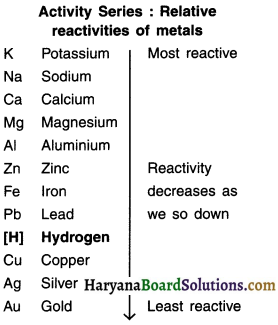
HBSE 10th Class Science Important Questions Chapter 3 Metals and Non-metals 1

Question 10.
How does metal reaòt with oxygen of air?
Answer:
Reaction of metals with oxygen (O2):

  • Metals can easily give electrons to oxygen.
  • Hence, metals combine with oxygen to form metal oxides.

Metal + Oxygen gas → Metal oxides

(1) Potassium (K) and sodium (Na) are so reactive that even if they are simply kept open in the room they react with oxygen (O2) of air. On reacting they start burning very vigorously and catch fire. Hence, they are stored immersed in kerosene.

(2) Metals such as magnesium, aluminium, zinc, etc. are covered with a thin layer of oxide. Hence, they do not react directly with air. So, we need to provide heat to for making them react with oxygen.

(3) Iron on heating in air reacts with the oxygen and forms oxides. Iron does not bum in air the way potassium and sodium does. However, iron fillings do burn vigorously.

(4) When copper s heated in air it combines with oxygen to form black coloured copper (II) oxide.

HBSE 10th Class Science Important Questions Chapter 3 Metals and Non-metals 2

(5) Silver and gold are least reactive. They do not react with oxygen under any case.

Question 11.
What are amphoterlc oxides? State examples
Answer:
Amphoteric oxides:
1. Some metal oxides react with both acids and bases to produce salt and water. Such metal oxides are called amphoteric oxides.
Example:
(i) Reaction with acid:
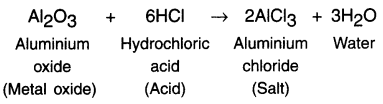
HBSE 10th Class Science Important Questions Chapter 3 Metals and Non-metals 3

(ii) Reaction with base:
HBSE 10th Class Science Important Questions Chapter 3 Metals and Non-metals 4

Question 12.
How do metal oxides react with water?
Answer:
Reaction of metal oxides with water:
Most metal oxides are insoluble in water. However, some dissolve in water and form alkalis.
Example: Sodium oxide and potassium oxide dissolve in water to produce alkalis.
(i) Na2O(s) + H2O(l) → 2NaOH(aq)
(ii) K2O(s) + H2O(l) → 2KOH(aq)

HBSE 10th Class Science Important Questions Chapter 3 Metals and Non-metals

Question 13.
Discuss how metal reacts with water along with necessary chemical reactions.
Answer:
Reaction of metal with water (H2O):
1. Metals on reaction with water form metal oxides and produce hydrogen gas. Metal oxides that are soluble in water dissolve in it to further form metal metal hydroxide.
Metal + Water → Metal oxide + Hydrogen + Heat gas
Metal oxide + Water → Metal hydrxide (on dissolving)
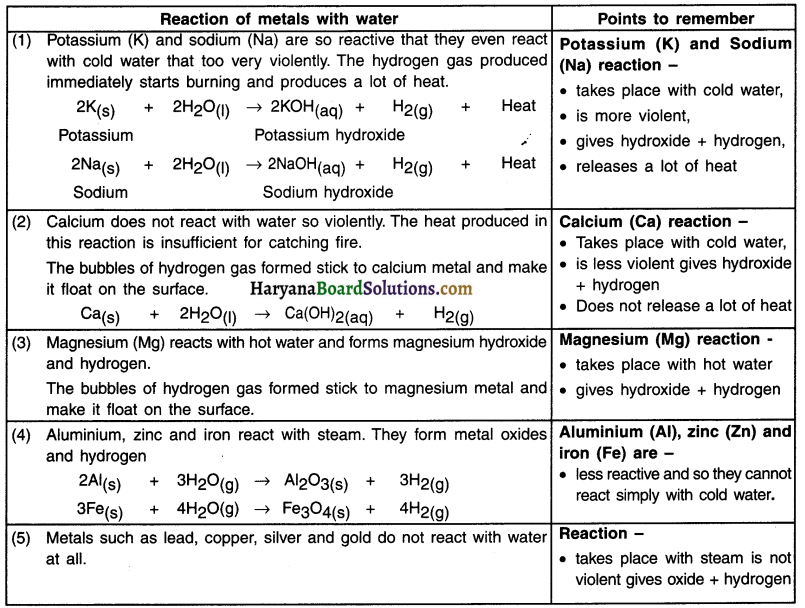
HBSE 10th Class Science Important Questions Chapter 3 Metals and Non-metals 5

Question 14.
State and explain how metals react with dilute acid.
Answer:
Reaction of metals with dilute acid:

  • All metals do not react with dilute acids.
  • Those metals which react with dilute acids produce metal salt and hydrogen gas.
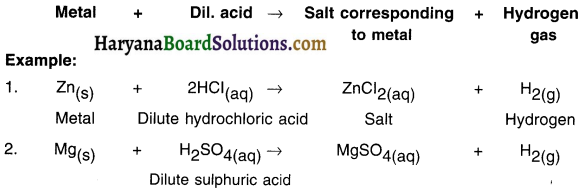
HBSE 10th Class Science Important Questions Chapter 3 Metals and Non-metals 6

Hydrogen gas is liberated if the metal reacts with dilute hydrochloric acid (HCl), dilute sulphuric acid (H2SO4), etc. but, not with dilute nitric acid (HNO3). However, magnesium and manganese metals can react with very dilute nitric acid and produce hydrogen gas.

HBSE 10th Class Science Important Questions Chapter 3 Metals and Non-metals

Question 15.
Why hydrogen gas is liberated when metals react with dilute hydrochloric acid and dilute sulphuric acid but not with nitric acid?
Answer:
1. When metals react with dilute nitric acid (HNO3), they do not produce hydrogen gas.
2. The reason behind this is that nitric acid is a strong oxidizing agent and so it oxidizes H2 produced during the reaction to H2O and its get reduced to any of the nitrogen oxides such as N2O, NO, NO2.

Question 16.
How will be the rate of liberation of hydrogen gas among various metals when they react with dilute acids?
Answer:
1. Metals above hydrogen in the reactivity series liberate hydrogen gas when they react with dilute mineral acid like hydrochloric acid, sulphuric acid. etc. (But not nitric acid).
2. Higher a metal in the reactivity series, the fastest will it liberate the hydrogen gas.
Example:
1. In the reactivity series, the elements magnesium (Mg), aluminium (Al), zinc (Zn), and iron (Fe) are placed above hydrogen in the sequence. Hence, the rate of liberation of hydrogen gas in the descending order will be Mg > Al > Zn > Fe.

Question 17.
Write equations for the reactions of magnesium, aluminium, zinc and iron with dilute hydrochloric acid.
Answer:
(i) Mg(s) + 2HCl(aq) → MgCl2(aq) + H2(g)
(ii) 2Al(s) + 6HCl(aq) → 2AlCl3((aq) + 3H2(g)
(iii) Zn(s)+ 2HCl(aq) →  ZnCl2(aq) + H2(g)
(iv) Fe(s) + 2HCl(aq) → FeCl2(aq) + H2(g)

Question 18.
State and explain how metals react with solutions of other metal salts.
Answer:
Reaction of metals with solutions of other metal salts:
1. When metals react with solutions of salts of other metals, the more reactive metals displace less reactive metals from their salt solutions. This can be stated as follows:

HBSE 10th Class Science Important Questions Chapter 3 Metals and Non-metals 7
Example: When a strip of iron metal is put into solution of copper sulphate CuSO4, the more reactive Fe metal displaces less reactive copper Cu metal.

HBSE 10th Class Science Important Questions Chapter 3 Metals and Non-metals 8

HBSE 10th Class Science Important Questions Chapter 3 Metals and Non-metals

Question 19.
State important chemical properties of metals without writing chemical equations.
Answer:
Chemical properties of metals:
1. Reaction of metals with oxygen (O2):

  • Metals can easily give electrons to oxygen.
  • Hence, metals combine with oxygen to form metal oxides.
    Metal + Oxygen gas → Metal oxides

2. Reaction of metal with water (H2O):

  • Metals on reaction with water form metal oxides and produce hydrogen gas. Metal oxides that are soluble in water dissolve in it to further form metal metal hydroxide.

Metal + Water → Metal oxide + Hydrogen + Heat gas
Metal oxide + Water → Metal hydroxide (on dissolving)

3. Reaction of metals with dilute acid:

  • All metals do not react with dilute acids.
  • Those metals which react with dilute acids produce metal salt and hydrogen gas.

HBSE 10th Class Science Important Questions Chapter 3 Metals and Non-metals 9

4. Reaction of metals with solutions of other metal salts:
When metals react with solutions of salts of other metals, the more reactive metals displace less reactive metals from their salt solutions. This can be stated as follows:

HBSE 10th Class Science Important Questions Chapter 3 Metals and Non-metals 10

Question 20.
What is displacement reaction? Out of copper and iron, which is more reactive? Why iron is placed above copper in the reactivity series?
Answer:
1. The reaction in which a more reactive element displaces (removes) less reactive element from its compound is called a displacement reaction.
2. Iron (Fe) is more reactive than copper (Cu) which means iron will react easily compared to copper. Hence, iron is place above copper in the reactivity series.

HBSE 10th Class Science Important Questions Chapter 3 Metals and Non-metals

Question 21.
Write a detailed note on activity (reactivity) series of metals.
Answer:
Activity (reactivity) series:
The arrangement of metals in decreasing order of their reactivities is called the activity or reactivity series of metals.
Explanation:

  • All metals do not react at same rate.
  • Some metals are more reactive while others are less reactive.
  • Those metals which lose electrons easily and form ions are called more reactive metals. For example, calcium (Ca). On the other hand, less reactive metals do not lose electrons easily. For example, gold (Au).

HBSE 10th Class Science Important Questions Chapter 3 Metals and Non-metals 11

Question 22.
What Information can one gain from reactivity series of metals?
Answer:
One can gain the following Information from reactivity series of metals:
(1) A more reactive metal will displace a less reactive metal (i.e. a metal below it in the reactivity series) from its solution.
(2) Metals present at the top of the activity series are less electropositive and do not occur freely In nature. On the other hand, metals at the bottom of the series are more electropositive and generally occur freely in nature.

Question 23.
Give two differences between chemical properties of metals and non-metals.
Answer:

Metals

Non-metals

1. Metals form basic oxides.
2. Metals can displace hydrogen atoms from their dilute acids.
1. Non-metals form neutral oxides.
2. Since non-metals cannot react with dilute acids, they cannot replace hydrogen atoms from dilute acids.

Question 24.
What is chemical bond? Give Its types along with one example of each.
Answer:
Chemical bond: The phenomenon through which atoms of a molecule of a compound attract each other and combine is known as a chemical bond.
There are two type of chemical bonds. They are :

(i) Ionic bond : The bond formed between a metal and a. non-metal is called an ionic bond. For example, sodium (Na) metal and chlorine (Cl) non-netal bond with each other through ionic bond and form NaCl (common salt).

(ii) Covalent bond : The bond formed between two non-metals is called a covalent bond. For example, two hydrogen (H) atoms join with each other through a covalent bond and form a hydrogen molecule (H2).

HBSE 10th Class Science Important Questions Chapter 3 Metals and Non-metals

Question 25.
Explain how Na and Cl bond to form NaCl (Sodium chloride). OR Give an example to demonstrate how metals and non-metals react.
Answer:
1. Formation of NaCl:
Sodium metal (Na) and non-metal chlorine (Cl) combine with each other through ionic bond.

Element

TypeAtomic No.

Electronic Configuration
(No. of electrons in each shell)
K L M N

(1) Sodium

Metal11281
(2) ChlorineNon-metal17

287

2. As can be seen in the table above, there is 1 electron in the outermost shell (orbit) of sodium (Na) metal.
3. The sodium metal will tend to lose 1 electron from its M shell. On doing so, ‘L’ will become the outermost shell with a stable octet.
4. The nucleus of this atom will still have 11 protons but the number of electrons after giving 1 electron will become 10. Thus, there is a net positive charge with sodium Na+.
5. Chlorine has 7 electrons ¡n its outermost. i.e. ‘M’ shell. It requires only 1 electron to complete its octet and become stable.

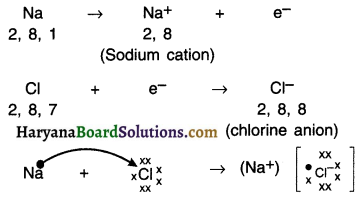
Reaction between sodium (Na) and chlorine (Cl):

1. If sodium and chlorine are reacted, sodium will lose its one electron which chlorine will take-up.
2. On gaining the electron, chlorine atom will get a negative charge, because its nucleus has 17  protons and 18 electrons. This will give us chloride anion Cl.

Both, Na and Cl perform a give and take relation as follows:
HBSE 10th Class Science Important Questions Chapter 3 Metals and Non-metals 12

3. Sodium and chloride ions are oppositely charged and hence they attract each other and hold each other by strong electrostatic force of attraction.
4. Sodium chloride does not exist as an atom but as oppositely charged ions.

Question 26.
Explain the formation of ionic bond In magnesium chloride.
Answer:
1. Since magnesium’s atomic number is 12, its electronic configuration is (2, 8, 2).

2. Magnesium has 2 valence electrons in it and so it will tend to lose them, achieve octet configuration of nearby inert gas and form magnesium ion (Mg2+)

HBSE 10th Class Science Important Questions Chapter 3 Metals and Non-metals 13

3. On the other hand, two chlorine (2,8,1) atoms will accept each of these electrons liberated by magnesium and form two Cl ions. Thus, chlorine will attain an octet configuration of (2, 8, 8).

HBSE 10th Class Science Important Questions Chapter 3 Metals and Non-metals 14

4. Thus, the two electrons lost by magnesium atom are gained by two chlorine atoms (each one gets one electron) and forms magnesium chloride.

HBSE 10th Class Science Important Questions Chapter 3 Metals and Non-metals 15

HBSE 10th Class Science Important Questions Chapter 3 Metals and Non-metals

Question 27.
Give the properties of ionic compounds.
Answer:
Properties of Ionic compounds :
(1) Physical nature :

  • Ionic compounds are obtained in solid form.
  • The ionic compounds are hard due to strong force of attraction between positive and negative ions. Also, they are brittle and break into pieces on applying pressure.

(2) Melting point and boiling point :
In ionic compounds, positive and negative ions are joined strongly due to inter-ionic attraction. As a result, more energy is required to break such compounds and hence their melting and boiling points are high.

(3) Solubility :
Ionic substances (electrovalent compounds) are soluble in water but insoluble in organic solvents such as kerosene, petrol, etc.

(4) Conduction of electricity:
An ionic compound cannot conduct electricity in solid form. However, an ionic compound can conduct electricity when

  • It is dissolved in water or
  • When is in molten state.

5. The necessary condition for conducting electricity through a solution is that the charged particles should move in the solution.

HBSE 10th Class Science Important Questions Chapter 3 Metals and Non-metals

Question 28.
Explain the conduction of electricity in ionic compounds.
Answer:
An ionic compound cannot conduct electricity in solid form. However, an ionic compound can conduct electricity when

  • It is dissolved in water or
  • When it is in molten state.

The necessary condition for conducting electricity through a solution is that the charged particles should move in the solution.

(a) in solids:
The ions cannot move and hence the electricity is not conducted. For example, in solid NaCl (common salt).

(b) ionic compound dissolved in water:
When ionic compounds dissolve in water, the solution so formed contain free-floating ions. When electricity is passed in this solution, the free-floating ions move towards the opposite electrodes. This confirms that ionic compound dissolved in water conducts electricity. For example, NaCl dissolved in water.

(c) Molten ionic compound:
To melt an ionic compound we need to supply heat. The heat overcomes the electrostatic force of attraction between the oppositely charged ions. As a result, the ions start moving freely and conduct electricity. For example, on heating NaCl (common salt). its molten form will conduct electricity.

Question 29.
Ionic compounds have high melting and boiling points. Give reason.
Answer:
Melting point and boiling point :
In ionic compounds, positive and negative ions are joined strongly due to inter-ionic attraction. As a result, more energy is required to break such compounds and hence their melting and boiling points are high.

Question 30.
Solid ionic compounds are bad conductor of electricity, but in aqueous solution they conduct electricity. Give reason.
Answer:
Molten ionic compound:
To melt an ionic compound we need to supply heat. The heat overcomes the electrostatic force of attraction between the oppositely charged ions. As a result, the ions start moving freely and conduct electricity. For example, on heating NaCl (common salt). its molten form will conduct electricity.

HBSE 10th Class Science Important Questions Chapter 3 Metals and Non-metals

Question 31.
What is mineral ore and gangue?
Answer:
(i) Mineral:

  • The elements or compounds that occur naturally in the earth’s crust are called minerals.
  • Sea-water also contains salts of metals such as sodium chloride, magnesium chloride, etc.

(ii) Ores:
Those minerals from which the metals can be extracted, conveniently and profitably are called ores. (Note: Although all minerals contain metals, they are not termed as ‘ores’. The reason behind this is that it is not always practically possible to extract metals from these minerals. Hence, only those minerals in which metals is present in large quantity and from which metals can be extracted conveniently and reasonably are called ores.)

(iii) Gangue:
Impurities such as sand, mud, etc. present in the ore are called gangue.

Question 32.
All ores are minerals but all minerals are not ores. Give reason.
Answer:
(i) Mineral:

  • The elements or compounds that occur naturally in the earth’s crust are called minerals.
  • Sea-water also contains salts of metals such as sodium chloride, magnesium chloride, etc.

(ii) Ores:
Those minerals from which the metals can be extracted, conveniently and profitably are called ores. (Note: Although all minerals contain metals, they are not termed as ‘ores’. The reason behind this is that it is not always practically possible to extract metals from these minerals. Hence, only those minerals in which metals is present in large quantity and from which metals can be extracted conveniently and reasonably are called ores.)

Question 33.
How do metals occur On earth?
Answer:
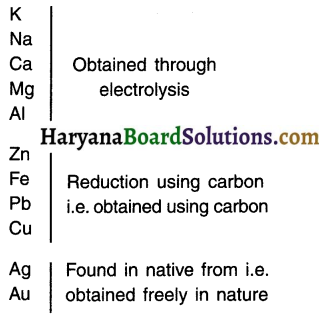
(1) in free state (Least reactive metals):

  • Only those metals which are very less reactive are found in the free state (or say native form) in nature. For example, silver (Ag), gold (Au) and platinum (Pt).
  • Copper and silver are found in the form of oxides and sulphides also.

(2) in the form of compounds (Highly reactive metals):
Highly reactive metals such as potassium (K), sodium, Magnesium (Mg), Aluminium (Al), etc. are so reactive that they are never found in their free form in the nature. They are only found in the form of their compounds.
HBSE 10th Class Science Important Questions Chapter 3 Metals and Non-metals 23

(3) In the form of oxides/sulphates/carbonates (Moderately reactive metals):

Moderately reactive metals such as zinc (Zn), Iron (Fe), Lead (Pbs, eth that lie at the ‘middle of the reactivity series are found in the earth in the form of oxides, sulphides and carbonates.
(Note: Textbook says that highly reactive minerals are found in the form of oxides, suiphides and carbonates. It is a mistake. This can be easily verified by studying section 3.4.4 Extracting Metals in the Middle of the Activity series of the textbook.)

In general —

  • All the metals placed above copper (Cu) are found in nature only in the form of their compounds.
  • Ores of many metals are found in the form of their oxides ie. the metal ore is oxide ore. This is because oxygen is a very reactive element and also it is found in abundance in the earth.
  • Since, the reactivity of metals is different, the method to extract them from nature is also different.
  • Extracting pure metals from their ores require several steps.

Question 34.
Explain In brief how are metals having different reactivities extracted from nature?
Answer:
(1) Least reactive metals:
Metals such as mercury (Hg) and copper (Cu) that lie in the lower section of the activity series are very unreactive.

They are extracted as follows:
(a) Since these metals are very less reactive they get extracted from their oxides simply by heating.
(b) Then, the metals are refined using electrolytic refining.

(2) Moderately reactive metals:

  • Metals such as iron (Fe), zinc (Zn), lead (Pb), etc. lie at the middle of reactivity series and are moderately reactive.
  • In nature, these metals occur in the form of suiphides and carbonates.

HBSE 10th Class Science Important Questions Chapter 3 Metals and Non-metals

They are obtained in pure form as follows:
(a) The sulphide or carbonate ores are first heated (through roasting/calcination) to convert them into oxides.
(b) The metal oxides so formed are then reduced to their corresponding metals using reducing agents such as carbon (C).
(c) Finally, the metals are refined using electrolytic refining.

(3) Highly reactive metals:
Metals such as potassium (K), sodium (Na), calcium (Ca), magnesium (Mg), aluminium (Al), etc. are highly reactive and are placed at the top of the reactivity series.

They are obtained in pure form as follows:
(a) Since these metals are highly reactive, they are extracted using the method of electrolytic reduction or electrolysis. For example, sodium, magnesium and calcium are obtained by the electrolysis of their molten chlorides.

(b) Then, the metals are refined using electrolytic refining.
(Note: All metals extracted have one last common step which is ‘electrolytic refining’. This step removes all the impurities and finally gives us metal in its purest form. This method is discussed in text-book in section 3.4.6 Refining of Metals.)

Question 35.
List out steps involved in extracting metal from its ore.
Answer:
The chart below shows steps for extracting metals from their ores.
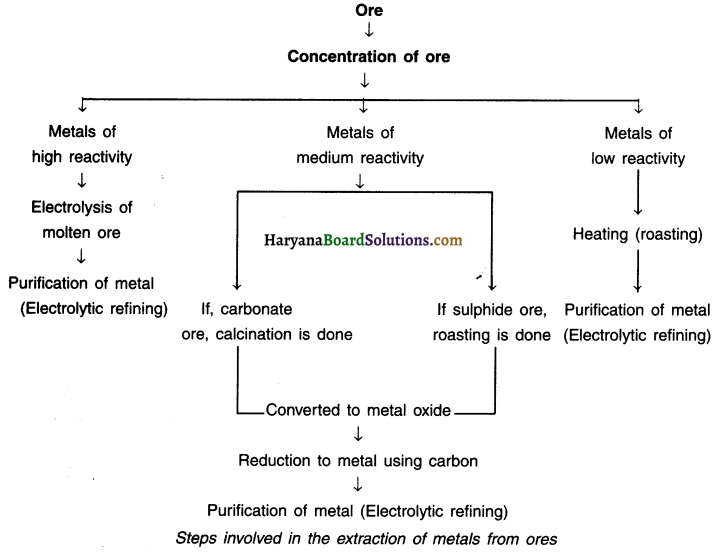
HBSE 10th Class Science Important Questions Chapter 3 Metals and Non-metals 16

Question 36.
How are metals low in activity series extracted from their ores? OR How are less reactive metals extracted from their ores?
Answer:
Metals that lie in the lower section of the activity series are very unreactive. As a result, they easily get extracted from their oxides simply by heating.
Example:
(i) Mercury sulphide (HgS) also known as cinnabar is an ore of mercury.
On heating it, it first gets converted into mercuric oxide (HgO). On heating (HgO), we can obtain mercury (Hg) in pure form.
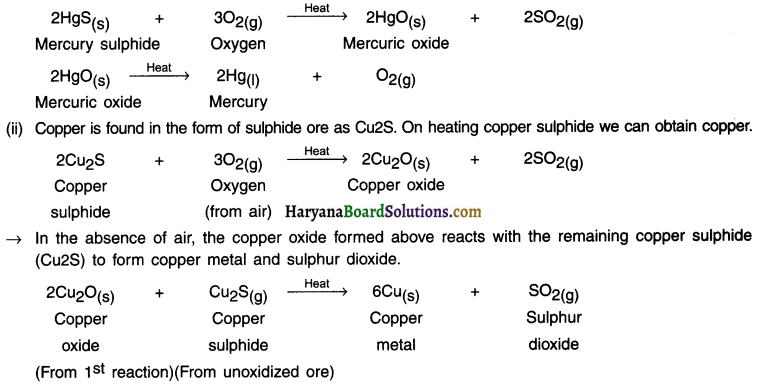
HBSE 10th Class Science Important Questions Chapter 3 Metals and Non-metals 17

Question 37.
How copper is extracted from Its ore?
Answer:
1. Copper is a very less reactive metal. Hence, it is obtained from its ore simply by heating.
2. The chart below shows steps for extracting metals from their ores.
HBSE 10th Class Science Important Questions Chapter 3 Metals and Non-metals 16

Question 38.
How are metals lying in the middle of activity series extracted?
Answer:
1. Metals such as iron (Fe), zinc (Zn), lead (Pb), etc. lie at the middle of reactivity series and are moderately reactive.
2. In nature, these metals occur in the form of sulphide and carbonates.
3. It is easier to obtain metals from their oxides rather than sulphides and carbonates. Hence, the moderately reactive metals are first converted into oxides. This is done as follows:

HBSE 10th Class Science Important Questions Chapter 3 Metals and Non-metals

(a) Roasting:
1. This process is used for suiphide ore. Roasting is the process in which the sulphide ore is heated strongly in the presence of excess air to convert it into metal oxide.
Example:

HBSE 10th Class Science Important Questions Chapter 3 Metals and Non-metals 18

(b) Calcination:
1. This process is used for carbonate ore.
2. Calcination is the process in which the carbonate ore is heated strongly in the limited air to convert it into metal oxide.

HBSE 10th Class Science Important Questions Chapter 3 Metals and Non-metals 19

3. The metal oxides obtained by calcination or roasting are then reduced (converted) into free metal by using reducing agents such as carbon, aluminium, sodium or calcium. The reducing agent to be used again depends on the chemical reactivity of the metal to be extracted.

(i) Reduction of metal oxide using carbon:
The oxides of comparatively less reactive metals like zinc, iron, lead, etc. are reduced using carbon as the reducing agent.

HBSE 10th Class Science Important Questions Chapter 3 Metals and Non-metals 21

(ii) Reduction using aluminium: If the metal oxide is of more reactive metal, then aluminium can be used as a reducing agent to extract metal from its metal oxide. The reason for using aluminium is that aluminium is a more reactive metal and hence it can displace a comparatively less reactive metal from its metal oxide to give free metal.

(iii) Manganese and iron (Fe) metal is extracted from its oxide using aluminium.

HBSE 10th Class Science Important Questions Chapter 3 Metals and Non-metals 22
(iv) Note that this reaction is a displacement reaction as well as reduction and oxidation reaction.

(v) Such displacement reactions are highly exothermic.

HBSE 10th Class Science Important Questions Chapter 3 Metals and Non-metals

Question 39.
What s thermite reaction? Give one example.
Answer:
Thermite reaction:
1. The process or reaction in which a metal is reduced from its oxide using aluminium powder as a reducing agent is called thermite reaction (or thermite process).

2. Thermite reactions are highly exothermic and produce so much heat that the metals are obtained in molten state.
Example:
Iron oxide is reacted with aluminium to obtain iron metal in molten state. The molten iron is then used to weld the railway tracks and machine parts.

HBSE 10th Class Science Important Questions Chapter 3 Metals and Non-metals 24

Question 40.
What is roasting?
Answer:
Roasting:
1. This process is used for sulphide ore. Roasting is the process in which the sulphide ore is heated strongly in the presence of excess air to convert it into metal oxide.
Example:
HBSE 10th Class Science Important Questions Chapter 3 Metals and Non-metals 18

Question 41.
What is calcination?
Answer:
Calcination:
1. This process is used for carbonate ore.
2. Calcination is the process in which the carbonate ore is heated strongly in the limited air to convert it into metal oxide.
HBSE 10th Class Science Important Questions Chapter 3 Metals and Non-metals 19

3. The metal oxides obtained by calcination or roasting are then reduced (converted) into free metal by using reducing agents such as carbon, aluminium, sodium or calcium. The reducing agent to be used again depends on the chemical reactivity of the metal to be extracted.

Question 42.
Explain method to obtain metal using carbon.
Answer:

Reduction of metal oxide using carbon:
The oxides of comparatively less reactive metals like zinc, iron, lead, etc. are reduced using carbon as the reducing agent.

HBSE 10th Class Science Important Questions Chapter 3 Metals and Non-metals 21

Question 43.
Explain method to obtain metal using aluminium.
Answer:
Reduction using aluminium: If the metal oxide is of more reactive metal, then aluminium can be used as a reducing agent to extract metal from its metal oxide. The reason for using aluminium is that aluminium is a more reactive metal and hence it can displace a comparatively less reactive metal from its metal oxide to give free metal.

HBSE 10th Class Science Important Questions Chapter 3 Metals and Non-metals

Question 44.
How are metals present in the top of activity series extracted?
Answer:
1. Metals such as potassium (K), sodium (Na), calcium (Ca), magnesium (Mg), aluminium (Al), etc. are highly reactive and are placed at the top of the reactivity series.

2. The oxides of these metals have more affinity i.e. attraction towards oxygen rather than carbon.

3. Hence, a method called ‘electrolytic reduction or electrolysis’ is used to extract highly reactive metals from their molten chlorides or oxides.

4. Sodium, magnesium and calcium are obtained by the electrolysis of their molten chlorides. Aluminium is obtained by the electrolytic reduction of aluminium oxide.

5. The metal obtained will be at cathode (negative electrode) because metals are positively charged and get attracted to negatively charged electrode (the cathode).

Following reactions take place during electrolysis of sodium chloride to obtain sodium metal:
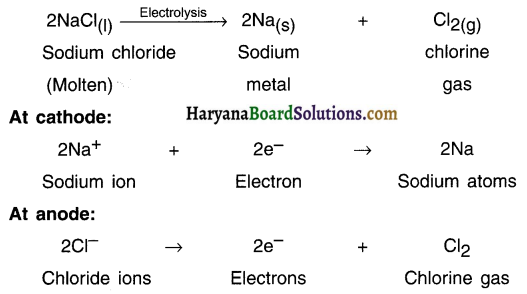
HBSE 10th Class Science Important Questions Chapter 3 Metals and Non-metals 25

Question 45.
How is sodium metal extracted? OR State the reactions taking place during extraction of sodium.
Answer:
1. Sodium is a very reactive metal. Hence, it is extracted with the help of ‘electrolytic reduction (electrolysis)’ method.

2. Metals such as potassium (K), sodium (Na), calcium (Ca), magnesium (Mg), aluminium (Al), etc. are highly reactive and are placed at the top of the reactivity series.

3. The oxides of these metals have more affinity i.e. attraction towards oxygen rather than carbon.

4. Hence, a method called ‘electrolytic reduction or electrolysis is used to extract highly reactive metals from their molten chlorides or oxides.

5. Sodium, magnesium and calcium are obtained by the electrolysis of their molten chlorides. Aluminium is obtained by the electrolytic reduction of aluminium oxide.

6. The metal obtained will be at cathode (negative electrode) because metals are positively charged and get attracted to negatively charged electrode (the cathode).

HBSE 10th Class Science Important Questions Chapter 3 Metals and Non-metals

Question 46.
Explain the procedure to perform electrolysis (electrolytic refining) of metal.
Answer:
Electrolytic refining:
Refining metals using the method of electrolysis is called electrolytic refining.

Electrolysis:
1. A thick rod of impure metal is taken as anode. It is connected to the +ve terminal of the battery.
2. A thin rod of pure metal is taken as cathode. It is connected to the  – ve terminal of the battery.
3. Aqueous acidified solution of salt of metal to be refined (i.e. impure metal) is taken as an electrolyte and filled in the electrolytic vessel.
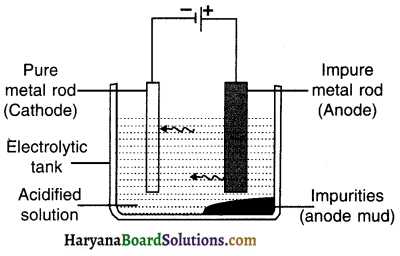
HBSE 10th Class Science Important Questions Chapter 3 Metals and Non-metals 26

Procedure:

  • After setting up the apparatus as shown in the figure, electricity is supplied.
  • On passing the electric current through electrolyte, pure metal from anode dissolves in the solution i.e. the electrolyte. An equivalent amount of pure metal from the solution will get deposited at cathode.

The impurities that move out of the anode rod get divided Into following two parts :
(A) Soluble impurities go into the aqueous solution and
(B) Insoluble impurities get collected below the anode. It is then called anode mud or anodic mud.

Application :
To refine metals such as copper, zinc, gold and silver.

Question 47.
Explain the electrolysis of copper. OR explain procedure to obtain pure copper from its ore using electrolytic reduction.
Answer:
Electrolysis of Copper

  • A thick rod of copper (Impure metal) to be purified is taken as anode and it is connected with the positive terminal of the battery.
  • AcomparatlvelythlnrodofpurecOpperlstaken as cathode and it is connected with the negative
    terminal of the battery
  • Aqueous solution of copper sulphate (salt of copper) is taken as electrolyte. Also, a dilute sulphuric acid Is added to It
  • The copper sulphate solution then becomes acidified copper sulphate solution.
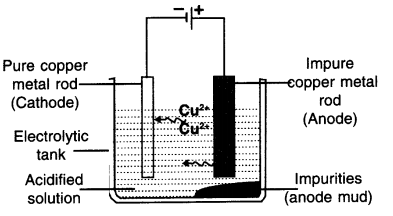
HBSE 10th Class Science Important Questions Chapter 3 Metals and Non-metals 32

Procedure:

  • After setting up the apparatus as shown in the figure, electricity is supplied.
  • The positively charged copper ions i.e. Cu+2 will get attracted towards negatively charged electrodes i.e. cathode.
  • This way pure metal cathode will become thick.
  • The impure copper goes into the solution in the form of ions.

HBSE 10th Class Science Important Questions Chapter 3 Metals and Non-metals

The Impurities that move out of anode of copper gets divided Into following two parts:
(A) Soluble impurities go into the aqueous solution
(B) Insoluble impurities get collected below the anode. It is then called anode mud or anodic mud.
The copper deposited at cathode is almost hundred percent pure.

HBSE 10th Class Science Important Questions Chapter 3 Metals and Non-metals 27

Question 48.
What is corrosion ? State Its advantages and disadvantages.
Answer:
Corrosion:

  • The erosion reaction that takes place between a metal and water or moisture when they come in contact with each other called metallic erosion or corrosion.
  • We can see the effect of air and water i.e. corrosion on surface of many metals.

Examples:
1.  If objects made out of iron remain exposed to moist air for a longer period, their surface becomes brown and flaky. This is nothing but corrosion.
2. Silver articles or ornaments become black after sometime due to exposure to air.
3. A green coloured layer of copper carbonate forms on the surface of copper objects when they remain exposed in air for a long time.
4. Inert metal such as gold, never get corroded.

Disadvantages of corrosion:

  • Every year, corrosion causes loss of crores of rupees in the world.
  • Corrosion also reduces life of objects.

Question 49.
Enlist ways to prevent corrosion of iron. Explain the methods of galvanizing and making alloys for preventing corrosion.
Answer:
Corrosion (rusting) of iron can be prevented by painting, oiling, greasing, galvanizing, anodizing or making alloys.
(a) Galvanizing:

  • Rusting of iron can be prevented by applying a coat of very fine layer of zinc metal on it.
  • The process of applying zinc is called galvanizing and the iron on which it is applied is then called galvanized iron.
  •  For example, iron sheets used in the roofs of house are galvanized iron sheets.

(b) Making alloys:

  • Another effective way to prevent corrosion is to change the properties of metals and non—metals. This can be done by mixing different metals and non-metals.
  • For example, stainless steel is an alloy which is formed by adding chromium and nickel to iron.
    This alloy does not get affected by air, water or alkali and it does not even get corroded.
  • Hence, utensils used in kitchen, instruments used in surgery, big vessels used in industries, etc. are prepared from stainless steel.

HBSE 10th Class Science Important Questions Chapter 3 Metals and Non-metals

Question 50.
What is an alloy? State its preparation and some examples.
Answer:
Alloys:

  • An alloy is a homogeneous mixture of two or more metals or metal and non—metal.
  • There are several advantages of using alloys over metals.

Preparation:

  • For making alloy, first of all the chief metal e. the metal whose alloy is to be made is melted.
  • Then the substance which is to be mixed is added in definite proportion and the mixture is melted again.
  • Then this molten mixture is allowed to cool to obtain alloy.

Examples:

  • On adding a very small amount of carbon (about 0.05%) to iron, it becomes quite hard and strong.
  • Stainless steel is obtained on adding nickel and chromium to iron. This steel is strong and does not corrode.
  • The alloy prepared by adding zinc metal to copper is known as brass.
  • Amalgam is an alloy made by mixing mercury with any metal.

Question 51.
State advantages of alloys with the help of examples.
Answer:
Advantages of alloys:
1. On adding a very small amount of carbon (about 0.05%) to iron, it becomes quite hard and strong.
2. Stainless steel is obtained on adding nickel and chromium to iron. This steel is strong and does not corrode.
3. The alloy prepared by adding zinc metal to copper is known as brass.
4. Brass is used in making cooking vessels, parts of machinery, musical instruments, etc.
5. An alloy which contains mercury is called amalgam.
6. The electrical conductivity of an alloy is less than the pure metal. For example, impure copper has a lesser conductivity compared to pure copper.
7. Melting point of an alloy is less than those of component elements. For example, melting point of the alloy prepared from lead and tin is less and so it is used in soldering electric wires

Question 52.
State important differences between diamond and graphite.
Answer:

Diamonds

Graphite

1. Diamonds are lustrous and transparent
2. Diamond is very rare and expensive
3. Diamond is extremely hard
4. It conducts heat

1. Graphite is opaque and non-lustrous
2. Graphite is very cheap
3. Graphite is very soft
4. It conducts electricity

Question 53.
A non-metal X exists In two different forms Y and Z. Y Is the hardest natural substance, whereas Z is a good conductor of electricity. Identify X, Y and Z.
Answer:
1. The non-metal X is carbon (C). Carbon exists in two different forms called the allotropes of carbon. These allotropes are diamond and graphite.
2. The hardest natural substance is diamond. Hence, Y is diamond. Graphite is good conductor of electricity. Hence, Z is graphite.

HBSE 10th Class Science Important Questions Chapter 3 Metals and Non-metals

Question 54.
Individually, hydrogen gas lacks the capability of combustion. Give reason.
Answer:
1. If you put an ignited match stick into glass jar, it extinguishes. But, if you allow oxygen to mix with hydrogen gas and then try to ignite t, it will ignite with a blue flame.
2. This suggests that hydrogen becomes combustible in presence of oxygen where as individually it is non-combustible.

Question 55.
A metal A, which is used in thermite process, when heated with oxygen gives an oxide B, which is amphoteric in nature. Identify A and B. Write down the reactions of oxide B with HCl and NaOH.
Answer:
1. Metal A is aluminium (Al) which is used in thermite process.
2. Aluminium reacts with oxygen to form aluminium oxide Al2O3 i.e. B which is amphoteric in nature.
4Al + 3O2 → 2Al2O3(s)

Reactions of oxide B i.e. Al2O3 with HCl and NaOH:
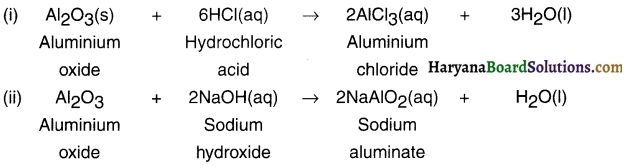
HBSE 10th Class Science Important Questions Chapter 3 Metals and Non-metals 28

Question 56.
lqbal treated a lustrous, divalent element M with sodium hydroxide. He observed the formation of bubbles in reaction mixture. He made the same observations when this element was treated with hydrochloric acid. Suggest how he can identify the produced gas. Write chemical equations for both the reactions.
Answer:
The divalent element M that lqbal used is zinc Zn.
(a) Reaction of zinc with sodium hydroxide:

HBSE 10th Class Science Important Questions Chapter 3 Metals and Non-metals 29

The gas produced gas can be identified by bringing splinter near the gas. The gas will start burning with a pop sound. This suggests that it is hydrogen gas.

Question 57.
A solution of CuSO4 was kept in an iron pot. After few days the iron pot was found to have a number of holes in it. Explain the reason in terms of reactivity. Write the equation of the reaction involved.
Answer:
The solution of CuSO4 means solution of copper sulphate. Iron is a more reactive metal than copper. Hence, it displaces copper from copper sulphate solution.
Reaction:

HBSE 10th Class Science Important Questions Chapter 3 Metals and Non-metals 30
Since, iron takes part in this reaction, it produces holes at places where iron metal has reacted to form iron (II) sulphate.

Question 58.
The principle ‘Less active metals can be displaced from the solution of its salt by the more active metal’ is used ¡n developing the activity series of metals. Explain.
Answer:
1. For preparing the activity series of metals, the metals need to be arranged in decreasing order of their reactivities.

2. For this, it is necessary to determine which metal is more reactive or less reactive than others.

3. Certain reactions are carried out to determine the reactivity level.

4. The reactions can be done either with oxygen, water or even acid. But, all metals cannot undergo reactions using these methods.

5. To overcome the above problem, displacement reaction is carried out on the metals and then their reactivities are
compared.

6. Displacement reaction works on the principle ‘Less active metals can be displaced from the solution of its salt by more active metal’. As a result, this principle is used to determine the activity series.

HBSE 10th Class Science Important Questions Chapter 3 Metals and Non-metals

Question 59.
‘Hydrogen is not a metal even then it is placed in the reactivitý series of metals’. Why?
Answer:
1. The reactivity of metals depends on the ease with which they can lose electrons.

2. Hydrogen is not a metal but still it can lose one electron quite easily compared to many other metals and form positive ions, Hence, hydrogen is placed in the reactivity series of metals.

Question 60.
A non-metal A is an important constituent of our food and forms two oxides B and C. Oxide B is toxic whereas C causes global warming.
(a) Identify A, B and C (b) To which group of Periodic Table does A belong?
Answer:
(a) Non-metal A is carbon. Its two oxides are carbon monoxide (CO) and carbon dioxide. Oxide B is carbon monoxide (CO) as it is toxic while C is carbon dioxide (CO2), because it is responsible for global warming.

(b) Atomic weight of non-metal A is 6. So, its electronic configuration is 2, 4. It is present in 14th group (10 + valence electrons), i.e. group IV of the Periodic Table.

Question 61.
‘Bonding alters the properties of elements.’ Explain this statement by giving examples.
Answer:
1. Sodium metal is highly reactive. It easily reacts with oxygen (O2) of the air and forms sodium oxide (Na2O). Na2O further reacts with water and gives sodium hydroxide (NaOH).

2. Sodium metal is highly active because its configuration is (2, 8, 1) and so it has a tendency to lose one electron from its valence orbit and thus form sodium ion (Na+).

3. Na+ attracts chloride ion (Cl) which has a negative charge. Thus, Na+ and CF combine and form NaCl.

4. Even though individually Na+ and Cl are reactive and non-edible, when they combine by bonding, they lose their original individual properties and form NaCl i.e. common salt which can be consumed without any harm.

5. Thus, bonding alters the properties of elements.

Question 62.
Why should the metal suiphides and carbonates be converted to metal oxides in the process of extraction of metal from them?
Answer:
1. In metallurgy, it is easier to obtain metals from their oxides (by reduction) rather than from carbonate or suiphide ores.
2. As a result, before reduction the ore must be converted into metal oxide and then be reduced.

Question 63.
A metal that exists as a liquid at room temperature is obtained by heating its sulphide in the presence of air. Identify the metal and its ore and give the reaction involved.
Answer:
1. The only metal that exists in liquid state is mercury (Hg). Mercury is obtained from the sulphide ore called cinnabar ore (HgS).

2. Mercury sulphide (HgS) also known as cinnabar is an ore of mercury. On heating it, it first gets converted into mercuric oxide (HgO). On heating (HgO), we can obtain mercury (Hg) in pure form.

HBSE 10th Class Science Important Questions Chapter 3 Metals and Non-metals 33

Question 64.
Compound X and aluminium are used to join railway tracks. (a) Identify the compound X, (b) Name the reaction and (c) Write down its reaction.
Answer:
(a) Compound X is iron (lll) oxide, Fe2O3.
(b) The reaction is known as a thermite reaction.
(c) The reaction that takes place is as follows

HBSE 10th Class Science Important Questions Chapter 3 Metals and Non-metals 31

HBSE 10th Class Science Important Questions Chapter 3 Metals and Non-metals

Question 65.
Switching over to alloys is an effective way to prevent corrosion. Give reason.
Answer:
1. Metals like iron, copper, etc. start getting corroded when they come in contact with air and water.
2. We can improve the anticorrosion properties of the metals by mixing them with certain other metals or non-metals.
3. For example, stainless steel which is an alloy made up of iron, chromium and nickel does not get affected by air, water or alkali and so it does not corrode.
4. Similarly, brass alloy which is made up of copper and zinc prevents corrosion in copper.
5. Thus, switching over to alloys is an effective way of preventing corrosion.

Question 66.
Explain the following
(a) Reactivity of Al decreases if it is dipped in HNO3
(b) Carbon cannot reduce the oxides of Na or Mg
(c) NaCl is not a conductor of electricity in solid state whereas it does conduct electricity in aqueous solution as well as In molten state
Answer:
(a) Nitric acid (HNO3) is an oxidizing agent. When aluminium is dipped in HNO3, an oxide layer of aluminium is formed on the surface of the metal. This prevents it from further reaction. As a result, reactivity of Al decreases.

(b) Na, Mg. etc., metals are quite reactive and are present towards the top portion of the reactivity series. As a result, these metals have more affinity with oxygen than carbon. Therefore, their oxides are stable. To reduce them with carbon, very high temperature is required and at that temperature they will form their corresponding carbides. Hence, their oxides cannot be reduced by carbon.

(c) One of the conditions for conduction of electricity is movement of ions. Ions of solid or dry NaCl cannot move to carry the charge. However, they are free in molten state and in aqueous solution to carry the charge and hence, NaCl conducts electricity in molten state.

Very Short Answer Type Questions

Question 1.
What are metals?
Answer:
The elements which lose electrons to become positively charged Ions are called metals.

Question 2.
State two physical properties of metals.
Answer:
Metals conduct heat and electricity. They are hard, shiny, heavy and sonorous (i.e. make sound on banging).

Question 3.
Define: Thermal conductivity
Answer:
The ability of a material to conduct heat from one end to another is called thermal conductivity.

Question 4.
What is sonority?
Answer:
The characteristic, of metal to produce a deep resonant sound on striking is called the property of sonority.

HBSE 10th Class Science Important Questions Chapter 3 Metals and Non-metals

Question 5.
What makes aluminium and copper the ideal metals for making wires?
Answer:
Both aluminium and copper are easily available, cheap, conduct electricity and do not rust. Hence

Question 6.
Name two metals that do not react with oxygen.
Answer:
Gold and silver

Question 7.
What are non-metals?
Answer:
Elements that form negative ions by gaining electrons are called non-metals.

Question 8.
State two physical properties of non-metals.
Answer:
Non-metals are dull aid are poor conductor of heat and electricity.

Question 9.
How can you say that magnesium oxide is basic?
Answer:
The solution of MgO turns red litmus paper blue. This suggests that

Question 10.
What is an allotrope?
Answer:
Some elements possess the property of existing in two or more different forms in the same physical state. Such a property is called allotropy. The different forms of the elements are called allotropes.

Question 11.
A non-metal exists in two different forms Y and Z. Y Is the hardest natural substance, whereas Z is a good conductor of electricity Identify Y and Z.
Answer:
Y is diamond whereas Z is graphite.

Question 12.
Name the metal that has such a less melting point that It can melt with the heat of your palm.
Answer:
Gallium

Question 13.
Which metal oxides dissolve In water to form alkali? Write their balanced chemical equations.
Answer:
Oxides of reactive metals such as sodium and potassium dissolve in water to form alkali.
Reactions:
Na2O(s) + H2O(l)→ 2NaOH(aq)
K2O(s) + H2O(l) → 2KOH(aq)

Question 14.
Give chemical reaction when an iron strip is put in the solution of copper sulphate.
Answer:
Fe + CuSO4 → FeSO + Cu

HBSE 10th Class Science Important Questions Chapter 3 Metals and Non-metals

Question 15.
What happens when metals react with acids?
Answer:
When metals react with acids they give salt and produce hydrogen gas.

Question 16.
Which metal out of calcium, aluminium, iron and zinc will perform the fastest reaction with acid to liberate hydrogen gas? Arrange the metals in the descending order with respect to the rate of liberation of hydrogen gas.
Answer:
1. Out of the given elements, calcium will liberate hydrogen gas at the fastest rate followed by aluminium, zinc and iron.
2. Arrangement of metals: Ca > Al > Zn > Fe.

Question 17.
Why copper does not react with dilute hydrochloric acid (HCl)?
Answer:
Since copper is not an active metal like Na, K.Zn. etc. it does not react with dilute hydrochloric acid (HCl).

Question 18.
Name two metals which react with dilute HNO3 to evolve hydrogen gas.
Answer:
Manganese (Mn) and magnesium (Mg)

Question 19.
What is the reactivity (activity) series of metals?
Answer:
The arrangement of metals in decreasing order of their reactivities is called the reactivity series of metals

Question 20.
How can you call a metal as more reactive metal?
Answer:
If a metal loses electrons rapidly it forms a positive ion and reacts quickly with other substance such metal is then termed as a more reactive metal.

Question 21.
The following reaction takes place when aluminium powder is heated with MnO2
3MnO2(s) + 4Al(s) → 3Mn(l) + 2Al2O3(l) + Heat
(a) Is aluminium getting reduced?
(b) Is MnO2 getting oxidized?
Answer:
(a) No, aluminium is not getting reduced. it is getting oxidized because there is addition of oxygen.
(b) No, MNO2 is getting reduced because there is removal of oxygen.

Question 22.
What is an ion?
Answer:
An ions an electrically charged atom (or group of atoms)

Question 23.
How is an ion formed?
Answer:
When an atom gains or loses electrons, it forms an ion.

HBSE 10th Class Science Important Questions Chapter 3 Metals and Non-metals

Question 24.
What is cation? OR How is positive ion formed?
Answer:
If an element has 1,2 or 3 electrons in the outermost shell of its atoms, then it loses these electrons and forms a positively charged ion or cation.

Question 25.
What is anion? OR How is negative Ion formed?
Answer:
If an element has 5.6 or 7 electrons In the outermost shell of its atoms, then it gains these electrons and forms a negatively charged ion or anion.

Question 26.
Define: ionic bond.
Answer:
The chemical bond formed by the transfer of electrons from one atom to another is known as an ionic bond.

Question 27.
Show how electrons transfer in the formation of MgCl2 from Its elements.
Answer:
The transfer of electron in the formation of MgCl2 from its elements is shown below:
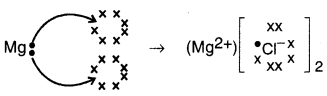
HBSE 10th Class Science Important Questions Chapter 3 Metals and Non-metals 34

Question 28.
How do metals and non-metals combine?
Answer:
Metals and non-metals combine through the transfer of electrons from metals to non-metals to form ionic bonds.

Question 29.
What is gangue?
Answer:
Impurities such as soil, sand, etc. present in the ore is called gangue.

Question 30.
What is concentration of ore?
Answer:
The removal of impurities from the ore is called concentration of ore?

Question 31.
What is mineral?
Answer:
The natural materials in which the metals or their compounds are found in earth are called minerals.

Question 32.
What is ore?
Answer:
Those minerals from which the metals can be extracted conveniently and profitably are called ores.

Question 33.
What is roasting?
Answer:
Roasting is the process in which sulphide ore is heated strongly in the presence of air to convert it into metal oxide.

Question 34.
What is calcination?
Answer:
Calcination is the process in which carbonate ore is heated strongly in the absence of air to convert it into metal oxide.

HBSE 10th Class Science Important Questions Chapter 3 Metals and Non-metals

Question 35.
What is rust?
Answer:
The rust-brown flaky layer that develops on iron when iron is exposed to moist air is called rust.

Question 36.
What is corrosion?
Answer:
The erosion reaction that takes place between a metal and water or moisture when they come in contact is called metallic corrosion.

Question 37.
Can rusting of Iron nail occur In distilled water?
Answer:
Distilled water does not contain dissolved oxygen. Hence, rusting will not occur in it.

Question 38.
Which two things are necessary for corrosion?
Answer:
Presence of air and water

Question 39.
What will you do to prevent corrosion on iron sheets used in the roof of the factories?
Answer:
I would either use galvanized sheets or paint the sheets.

Question 40.
What are the constituents of solder alloy? Which property of solder makes It suitable for welding electrical wires?
Answer:
Solder is an alloy made from 50% lead and 50% tin. Solder has a low melting point and so it is used for soldering i.e. welding electrical wires.

Fill in the Blanks:

1. …………………..is a liquid non-metal.
Answer:
Bromine

2. …………………….. and ………………… are two aliotropes of carbon.
Answer:
Diamond and graphite

HBSE 10th Class Science Important Questions Chapter 3 Metals and Non-metals

3. ……………….. metals (type) are so soft that they can be cut with knife.
Answer:
Alkali

4. Most metals produce ………………… when dissolved in water.
Answer:
Basic oxides

5. When sodium dissolves in water it produces (name of compound).
Answer:
Sodium hydroxide

6. On heating copper, it gets coated with ……………
Answer:
Black coloured layer of copper (II) oxide

7. When calcium reacts with water it produces hydrogen but the hydrogen does not catch tire because ………………..
Answer:
The heat evolved is not sufficient enough to catch fire

8. Although when metal reacts with acids hydrogen gas is evolved, it is not the case when metal reacts with ……………. acid.
Answer:
Nitric

9. On putting pieces of copper in dilute HCl, neither bubbles are produced nor temperature changes. This means that copper …………………………..
Answer:
Does not react with dilute HCl

10. Ionic compounds are also called ……………….
Answer:
Electrovalent compounds

HBSE 10th Class Science Important Questions Chapter 3 Metals and Non-metals

11. The most reactive metals are placed at the ………………….. in the reactivity series.
Answer:
Top

12. In a reactivity series, metals that lie above ………………. are more reactive than the metals that lie below it.
Answer:
H

13. Ores of many metals are found in the form of oxides because ………………
Answer:
Oxygen is very reactive metal and is found in abundance in the earth.

14. Highly reactive metals are mainly extracted with ………………… process.
Answer:
Electrolysis

15. A carbonate ore will undergo while a sulphide ore ………………. before oxidizing.
Answer:
Calcination; Roasting

16. Mercury ore is also called ………………
Answer:
Cinnabar

17. Metal carbonates and metal sulphide must be first reduced to their corresponding oxides because ………
Answer:
It is easier to obtain a metal from Its oxides.

18. Is used as an electrolyte in electrolysis of copper……………………
Answer:
Copper sulphate

19. The unit of for measuring the purity of gold is ………………
Answer:
Carat

HBSE 10th Class Science Important Questions Chapter 3 Metals and Non-metals

20. What is common among magnesium, zinc and iron?
Answer:
They react with vapour to produce hydrogen gas

21. The most common reducing agent for reducing metal oxides is …………………………
Answer:
Carbon

22. Highly reactive metals such as sodium, calcium and aluminium are used as reducing agents because………………………
Answer:
They can displace metals of lower reactivity from their compounds

23. …………….. and ……………….. are reacted to join the railway tracks.
Answer:
Iron (III) oxide; aluminium

24. Carbon cannot reduce very reactive metals such as sodium, magnesium and aluminium because these metals ……….
Answer:
Have more affinity for oxygen rather than carbon

25. In electrolytic refining, the insoluble impurities ……………..
Answer:
Settle at the bottom of anode

26. The erosion reaction of a metal with water or moisture is called …………….
Answer:
Erosion

27. …………………… percentage of carbon added to iron makes it very strong and hard.
Answer:
0.05

28. Steel is formed by mixing ………………. to iron.
Answer:
Nickel and chromium

29. In an alloy, It one of the metals is mercury, the alloy will be known as ………………..
Answer:
Amalgam

HBSE 10th Class Science Important Questions Chapter 3 Metals and Non-metals

True Or False

1. Although iodine is a non-metal, it is lustrous. — True
2. Metalloids are called so because they exhibit the properties of metals as well as non-metals. — True
3. Iron does not burn on heating but iron fillings burn vigorously when sprinkled in the flame. — True
4. Magnesium reacts vigorously with cold water. — False
5. Metals like aluminium, iron and zinc neither react with cold water, nor with hot nor with steam. — False
6. Ionic compounds have low melting and boiling points. — False
7. Ionic compounds have the ability to conduct electricity in their solid forms. — False
8. Electrovalent compounds are soluble in organic solvents such as petrol and kerosene. — False
9. In electronic refining, pure metal is taken as anode. — False


HBSE 10th Class Science Important Questions Chapter 3 Metals and Non-metals Read More »

HBSE 10th Class Maths Important Questions Chapter 11 Constructions

Haryana State Board HBSE 10th Class Maths Important Questions Chapter 11 Constructions Important Questions and Answers.

Haryana Board 10th Class Maths Important Questions Chapter 11 Constructions

Short/Long Answer Type Questions

Question 1.
Construct a triangle with sides 4 cm, 5 cm and 7 cm and then another triangle whose sides are \(\frac {3}{4}\) of the corresponding sides of the first triangle.
Solution :
Steps of Construction :
1. Draw a line segment BC = 5 cm.
2. With B as centre and radius 4 cm draw and arc.
3. With C as centre and radius 7 cm draw another are to intersect the previous are at A.
4. Join AB and AC to get ΔABC
5. Draw any ray BX making an acute angle with BC on the opposite to the vertex A.
HBSE 10th Class Maths Important Questions Chapter 11 Constructions - 1
6. Along BX mark 4 points B1, B2, B3 and B4 such that BB1 = B1B2 = B2B3 = B3B4
7. Join B4C
8. From B3 draw B3C’ || B4C meeting BC at
9. From C’ draw A’C’ || AC meeting AB at A’. Then A’BC’ is required triangle, each of whose side is \(\frac {3}{4}\) of corresponding sides of ΔABC.

Justification: Since
A’C’ || AC
Therefore, A’BC’ ~ ΔABC
\(\frac {A’B}{AB}\) = \(\frac {BC’}{BC}\) = \(\frac {A’C’}{AC}\) = \(\frac {3}{4}\)

HBSE 10th Class Maths Important Questions Chapter 11 Constructions

Question 2.
Construct a triangle with sides 4 cm, 5 cm and 6 cm and then a triangle similar to it whose sides are \(\frac {3}{5}\) times of the corresponding sides of the given triangle.
Solution:
Steps of Construction:
1. Draw a line segment QR = 4 cm.
HBSE 10th Class Maths Important Questions Chapter 11 Constructions - 2
2. With Q as centre and radius 5 cm draw an
3. With R as centre and radius 6 cm draw another are to intersect the previous arc at P.
4. Join PQ and PR to get ΔPQR
5. Draw any ray QX making an acute angle with QR on the opposite to the vertex P.
6. Along QX mark 5 points Q1, Q2, Q3, Q4 and Q5 such that QQ1 = Q1Q2 = Q2Q3 = Q3Q4 = Q4Q5
7. Join Q5R
8. From Q3 draw Q3R’ || Q5R meeting QR at R’
9. From R’ draw R’P’ || PR. Then P’ QR’ is required triangle.
Justification: Since
P’R’ || PR
Therefore, P’QR’ ~ ΔPQR
\(\frac {P’Q}{PQ}\) = \(\frac {QR’}{QR}\) = \(\frac {P’R’}{PR}\) = \(\frac {3}{5}\)

Question 3.
Construct a ΔABC with AB = 6 cm, BC = 5 cm and ∠B = 60°. Now construct another triangle whose sides are \(\frac {2}{3}\) times the corresponding sides of ΔABC.
Solution :
Steps of Construction :
1. Draw a line segment BC = 5 cm.
2. At B, draw ∠CBY = 60°
3. From B, draw and are AB = 6 cm meeting by at A
HBSE 10th Class Maths Important Questions Chapter 11 Constructions - 3
4. Join AC. Thus, ΔABC obtained
5. Draw any ray BX making an acute angle with BC on the side opposite to the vertex A.
6. Along BX mark 3 points B1, B2, and B3 such that BB1 – B1B2 = B2B3
7. Join B3C
8. From B2 draw B2C’ || B3C meeting BC at C
9. From C’ draw A’C’ || AC meeting AB at A’. Then A’BC’ is required triangle, each of whose side is  \(\frac {2}{3}\) of corresponding sides of ΔABC
HBSE 10th Class Maths Important Questions Chapter 11 Constructions - 4
Justification: Since
A’C’ || AC
Therefore, A’BC’ in ΔABC
\(\frac {A’B}{AB}\) = \(\frac {BC’}{BC}\) = \(\frac {A’C’}{AC}\) = \(\frac {2}{3}\)

Question 4.
Construct a ΔABC in which CA = 6 cm, AB = 5 cm and ∠BAC = 45°. Then construct a triangle whose sides are \(\frac {3}{5}\) of the corresponding sides of ΔABC.
Solution:
Steps of Construction:
1. Draw a line segment AB = 5 cm.
HBSE 10th Class Maths Important Questions Chapter 11 Constructions - 14
2. At A, draw ∠BAY = 45°
3. From A draw an arc AC = 6 cm meeting A at C
4. Join BC. Thus, ΔABC obtained.
5. Draw any ray AX making an acute angle with AB on the side opposite to the vertex C.
6. Along AX mark 5 points A1, A2, A3, A4 and A5 such that AA1 = A1A2 = A2A3 = A3A4 = A4A5
7. Join A5B
8. From A3 draw A3B’ || A5B meeting AB at B’
9. From B’ draw B’C’ || BC meeting AC at C’.
Then AB’C’ is required triangle, each of whose side is \(\frac {3}{5}\) of corresponding sides of ΔABC.
Justification: Since
B’C’ || BC
Therefore, AB’C’ ~ ΔABC
\(\frac {AB’}{AB}\) = \(\frac {B’C’}{BC}\) = \(\frac {AC’}{AC}\) = \(\frac {3}{5}\)

HBSE 10th Class Maths Important Questions Chapter 11 Constructions

Question 5.
Draw a ΔABC in which BC = 7 cm, ∠B = 45° and ∠A = 105°. Then construct another triangle whose sides are \(\frac {3}{4}\) times corresponding sides of ΔABC.
Solution:
Steps of Construction:
1. Draw a line segment BC = 7 cm.
HBSE 10th Class Maths Important Questions Chapter 11 Constructions - 6
2. In ΔABC, ∠B = 45°, 2A = 105°
∴ ∠C = 180° – (45° + 105°) = 30°
At B draw and angle ∠B = 45° and draw ∠C = 30° intersecting each other at A to get ΔABC
3. At B draw any ray BX making an acute angle with BC on the side opposite to the vertex A
4. Along BX mark 4 points B1, B2, B3 and B4 such that BB1 = B1B2 = B2B3 = B3B4
5. Join B4C
6. From B3 draw B3C’ || B4C meeting BC at C’
7. From C’ draw C’A’ || AC meeting AB at A
Then A’BC’ is required triangle, each of whose side is \(\frac {3}{4}\) of corresponding sides of ΔABC.

Justification: Since
A’C’ || AC
Therefore, A’BC’ ~ ΔABC
\(\frac {A’B}{AB}\) = \(\frac {BC’}{BC}\) = \(\frac {A’C’}{AC}\) = \(\frac {3}{4}\)

Question 6.
Construct a triangle ABC with side BC = 6 cm, ∠B = 45°, ∠A = 105°. Then construct another triangle whose sides are \(\frac {3}{4}\) times the corresponding sides of ΔABC.
Solution :
Steps of Construction:
1. Draw a line segment BC = 7 cm.
2. In ΔABC, ∠B = 45°, 2A = 105°
∴ ∠C = 180° – (45° + 105°) = 30°
At B draw and angle ∠B = 45° and draw ∠C = 30° intersecting each other at A to get ΔABC
3. At B draw any ray BX making an acute angle with BC on the side opposite to the vertex A
4. Along BX mark 4 points B1, B2, B3 and B4 such that BB1 = B1B2 = B2B3 = B3B4
5. Join B4C
6. From B3 draw B3C’ || B4C meeting BC at C’
7. From C’ draw C’A’ || AC meeting AB at A
Then A’BC’ is required triangle, each of whose side is \(\frac {3}{4}\) of corresponding sides of ΔABC.

Justification: Since
A’C’ || AC
Therefore, A’BC’ ~ ΔABC
\(\frac {A’B}{AB}\) = \(\frac {BC’}{BC}\) = \(\frac {A’C’}{AC}\) = \(\frac {3}{4}\)

HBSE 10th Class Maths Important Questions Chapter 11 Constructions

Question 7.
How many tangents can be constructed to any point on the circle of radius 4 cm ?
Solution :
We know that, if a point lies on the circle, then there is only one tangent to the circle at this point. So, one tangent can be constructed to any point on the circle of radius 4 cm.

Question 8.
Draw a circle of radius 3.5 cm. From a point P, 6 cm from its centre, draw two tangents to the circle.
Solution :
Steps of Construction :
1. Draw a circle with O as the centre and radius 3.5 cm
2. Mark a point P outside the circle such that OP = 6 cm.
3. Join OP and draw prependicular bisector of PO meeting PO at M.,
4. Draw a circle with M as the centre and radius equal to PM = OM intersecting the given circle at points Q and R.
HBSE 10th Class Maths Important Questions Chapter 11 Constructions - 7
5. Join PQ and PR then PQ and PR are required tangents.

Question 9.
Draw a circle of radius 2 cm with centre O and take a point P outside the circle such that OP = 6.5 cm. From P, draw two tangents to the circle.
Solution :
Steps of Construction :
1. Draw a circle with O as the centre and radius 2.0 cm
2. Mark a point P outside the circle such that OP = 6.5 cm.
3. Join OP and draw perpendicular bisector of PO meeting PO at M
HBSE 10th Class Maths Important Questions Chapter 11 Constructions - 8
4. Draw a circle with M as the centre and radius equal to PM = OM intersecting the given circle at points Q and R.
5. Join PQ and PR then PQ and PR are required tangents.

HBSE 10th Class Maths Important Questions Chapter 11 Constructions

Question 10.
Draw a pair of tangents to a circle of radius 5 cm, which are inclined to each other at an angle of 70°.
Solution :
Steps of Construction:
1. Draw a circle with centre O and radius 5 cm
2. Construct raddi OA and OB such that ∠AOB = 360° (90° + 90° + 70°) = 110°.
3. Draw AL ⊥ OA at A and BM ⊥ OB at B. They intersect at P.
4. Then PA and PB are the required tangents inclined to each other at 70°.
HBSE 10th Class Maths Important Questions Chapter 11 Constructions - 9
Justification: PA ⊥ OA and PB ⊥ OB and ∠AOB = 110°
∠APB = 360° – (90° + 90° + 110°)
∠APB = 360° – 290°
∠APB = 70°
Therefore, tangents PA and PB are inclined at 60°

Question 11.
Draw a circle of radius 5 cm. From a point 13 cm away from its centre, construct the pair of tangents to the circle and measure their lengths. Also verify the measurement by actual calculation.
Solution:
Steps of Construction:
1. Draw a circle with centre O of radius 5 cm
2. Mark a point A, 13 cm away from the centre.
3. Join AO and bisect it at M.
4. Draw a circle with M as the centre and radius equal to AM intersects the given circle at points P and Q.
5. Join AP and AQ
HBSE 10th Class Maths Important Questions Chapter 11 Constructions - 10
Then AP and AQ are the required tangents lengths of AP and AQ are 12 cm.

Justification:
Join OP
∴ ∠APO = 90°
[Angle is a semicircle]
AP ⊥ OP
Therefore, AP is a tangent to the given circle. Similarly AQ is a tangent to the given circle.
In right triangle APO, we have
AO2 = PO2 + AP2
132 = 52 + AP2
169 – 25 = AP2
AP = \(\sqrt{144}\)
AP = 12 cm

Fill in the Blanks

Question 1.
The part of a curve between two given points on the curve is known as……….
Solution :
Curve

HBSE 10th Class Maths Important Questions Chapter 11 Constructions

Question 2.
……. is a straight line which touches the circle at one point only.
Solution :
tangent

Question 3.
There can be ……. tangents drawn to the circle from point in side it.
Solution :
no

Question 4.
The angle between radius and tangents is …… a angle.
Solution :
right

Question 5.
To draw a ……. at a given point to the circle, We simply draw radius at this point and draw a line perpendicular through this point.
Solution :
tangent.

Multiple Choice Questions

Choose the correct answer in each of the following:

Question 1.
In the given figure, if PA1 =A1A2 = A2A3 = A4Q and A1B1 || A2B2 || A3B4 || A4B4 || QR. Then A2 divides the line segment PR in the ratio:
HBSE 10th Class Maths Important Questions Chapter 11 Constructions - 11
(a) 2 : 2
(b) 2 : 3
(c) 1 : 2
(d) 3 : 2
Solution :
From fig it is clear that A2 divides the line segment PR in the ratio 2 : 3.
HBSE 10th Class Maths Important Questions Chapter 11 Constructions - 12
So correct choice is (b)

HBSE 10th Class Maths Important Questions Chapter 11 Constructions

Question 2.
In the above figure, A3 divides the line segment PR in the ratio :
(a) 3 : 5
(b) 2 : 3
(c) 3 : 2
(d) 3 : 6
Solution :
A3 divides the line segment PR in the ratio 3 : 2
So, correct choice is (c)

Question 3.
In the above figure A, divides the line segment in the ratio :
(a) 1 : 1
(b) 1 : 2
(c) 1 : 4
(d) 1 : 5
Solution :
Here, A1 divides the line segment in the ratio 1 : 4.
So correct choice is (c).

Question 4.
To divide a line segment AB in the ratio 4 : 7, a ray AX is drawn first such that ∠BAX is an acute angle and then points A1, A2, A3, … are located at equal distances on the ray AX and the point B is joined to:
(a) A12
(b) A11
(c) A10
(d) A9
Solution :
4 + 7 = 11
∴ A11
Hence correct choice is (b).

Question 5.
To construct a triangle similar to a given ΔABC with its sides \(\frac {3}{7}\) of the corresponding sides of ΔABC, first draw a ray BX such that ∠CBX is an acute angle and X lies on the opposite side of A with respect to BC. Then locate points B1, B1, B1, …. on BX at equal distance and next step is to join :
(a) B10 to C
(b) B3 to C
(c) B7 to C
(d) B4 to C
Solution :
B7 to C
So correct choice is (c).

HBSE 10th Class Maths Important Questions Chapter 11 Constructions

Question 6.
To divide a line segment AB in the ratio 3 : 4. We draw a ray ∠BAX, so that is an acute angle and then marks the points on the ray AX at equal distances such that the minimum number of these points is :
(a) 3
(b) 7
(c) 4
(d) 12
Solution :
3 + 4 = 7
So correct choice is (b).

Question 7.
To construct a triangle similar to a given ΔABC with its sides \(\frac {8}{5}\) of the corresponding sides of ΔABC draw a ray BX such that ∠CBX is an acute angle and X is on the opposite side of A with respect to BC. The minimum number of points to be located at equal distances on ray BX is :
(a) 5
(b) 8
(c) 13
(d) 3
Solution :
8
so correct choice is (b).

Question 8.
To divide a line segment AB in the ratio 5 : 6, draw a ray AX such that ∠BAX is an acute angle, then draw a ray by parallel to AX and the points A1, A2, A3, and B1, B2, B3, … are located at equal distances on the ray AX and BY, respectively. Then the points joined are :
(a) A5 and B6
(b) A6 and B5
(c) A4 and B5
(d) A5 and B4
Solution :
So, the points joined are A5 and B6 [By Prop. of similar Δs]
HBSE 10th Class Maths Important Questions Chapter 11 Constructions - 13
So correct choice is (a).

HBSE 10th Class Maths Important Questions Chapter 11 Constructions Read More »

HBSE 10th Class Science Important Questions Chapter 6 Life Processes

Haryana State Board HBSE 10th Class Science Important Questions Chapter 6 Life Processes Important Questions and Answers.

Haryana Board 10th Class Science Important Questions Chapter 6 Life Processes

Question 1.
Only what is visible is alive does not hold true for a life. Explain.
Answer:
1. When we see an animal moving we call it alive. Similarly when we see a green plant we call it alive.
2. Actions that we can see such as running, breathing, laughing, changing colours of leaves, etc. also make us believe that the organism is alive.
3. So, we believe some sort of movement, either growth-related or not as an evidence of being alive.
4. But, a plant which we cannot see growing and animals that breathe without showing any movement are also alive. Hence, it would be wrong to say that what is visible is only alive.

HBSE 10th Class Science Important Questions Chapter 6 Life Processes

Question 2.
How one can differentiate living organisms and non-living things? What are the exceptions here?
Answer:
1. Movement is one of the basic criterions to identify life. All living organisms show movement without any external help.
2. Animals show clear visible movements.
3. Plants show invisible movements inside their body (i.e., movements of various elements and compounds). External movement of plants is quite minute and very slow and so it is difficult to notice.
4. Viruses are an exception here.

Question 3.
What do you mean by molecular movement? Explain.
Answer:
1. The movements of molecules within living organisms which we cannot see through our naked eyes but are critical for carrying life processes such as photosynthesis, respiration, digestion, excretion, etc. are called molecular movements.
2. Molecular movement includes movement of molecules such as oxygen for respiration, movement of compounds such as enzymes, nutrients, hormones, etc.

Need of molecular movement:

  • Living organisms are highly complex, but very well organized structures. Going down they are made of organs, tissues, cells and cell organelles.
  • Therefore it is necessary that molecules move and reach up to cell level so that functions such as growth, maintenance and survival are maintained.
  • For example, oxygen inhaled move throughout the body via, the process of breathing.

Question 4.
What is the connecting link between living organisms and non-living things? Why?
Answer:
Viruses are the connecting link between living organisms and non-living things.

Reason:
1. It is said that molecular movement is necessary in living organisms. Non-living things do not show any molecular movement.
2. In a free environment, viruses do not show any molecular movement. But, when they come in the contact of the host cells they start acting as living organisms in the form of obligate parasite.
3. Thus, viruses on one side do not show molecular movement i.e. behave as non-living things, but under favourable environment they start showing molecular movement and behave like living organisms. Hence, viruses are called a connecting link between living organisms and non-living things.

HBSE 10th Class Science Important Questions Chapter 6 Life Processes

Question 5.
What are life processes? State the important life processes that perform the job of maintaining these processes.
Answer:
Life processes:
1. All living organisms perform certain important functions to maintain their survival. These main functions are called life processes.
2. In other words, the processes which together perform the job of maintenance of the body are known as life processes.
3. Maintenance process requires energy. The energy is used for—

  • Growth and maintenance of organisms and
  • Preventing break-down.

The energy needed to the organism comes from external sources such as food, sun, atmosphere, etc.

The main life processes are:
(1) Nutrition,
(2) Respiration,
(3) Transportation,
(4) Excretion,
(5) Control and co-ordination,
(6) Movement and
(7) Reproduction.

Question 6.
Define and explain each life process very briefly.
Answer:
1. Nutrition:

  • The process of transferring a source of energy which we call food, from outside the body of the organism to the inside is called nutrition.
  • The food consumed is then converted into smaller and smaller units so that it can be absorbed by the body.
  • Most of the food sources are carbon-based. Depending upon the complexity of these carbon sources, different organisms can then use different kind of nutritional processes.

2. Respiration:

  • The process of acquiring oxygen from outside the body, and it in the process of break-down of food-sources for cellular needs, is known as respiration.
  • Through respiration, organisms break down food and release energy.

3. Transportation:

  • The process through which absorbed substances are transported to various parts of the body is called transportation.
  • Transportation system is important to carry food and oxygen from one place to another.
  • This system is also important for carrying waste products from body cells to excretory organs.

HBSE 10th Class Science Important Questions Chapter 6 Life Processes

4. Excretion:
Waste materials produced in various cells of the body are removed by the process of excretion.

5. Control and co-ordination (Chapter 7):
Control and co-ordination make the living organisms adapt to the changing environment and survive there in.

6. Movement (Chapter 7):
The process of movement makes the living organism move from one place to another.

7. Reproduction (Chapter 8):
Reproduction involves multiplication of existing organisms. This enables them to maintain the existence of their species on the earth.)

Question 7.
What are nutrients? Give examples.
Answer:
1. The substances obtained by an organism from the surroundings and used them as a source of energy are called nutrients.
2. For example, carbohydrates, lipids, proteins, mineral, salts, etc.

Question 8.
Why a unicellular organism does not need specific organs for nutrition, respiration and transportation?
Answer:
In unicellular organisms, entire body surface of the organism is in the direct contact with the environment and transfer can take place through entire body. So, a unicellular organism does not need specific organs for nutrition, respiration and transportation.

Question 9.
What is nutrition? Classify the types of nutrition.
Answer:
1. Nutrition:

  • The process of transferring a source of energy which we call food, from outside the body of the organism to the inside is called nutrition.
  • The food consumed is then converted into smaller and smaller units so that it can be absorbed by the body.
  • Most of the food sources are carbon-based. Depending upon the complexity of these carbon sources, different organisms can then use different kind of nutritional processes.

2. Respiration:

  • The process of acquiring oxygen from outside the body, and it in the process of break-down of food-sources for cellular needs, is known as respiration.
  • Through respiration, organisms break down food and release energy.

3. Transportation:

  • The process through which absorbed substances are transported to various parts of the body is called transportation.
  • Transportation system is important to carry food and oxygen from one place to another.
  • This system is also important for carrying waste products from body cells to excretory organs.

4. Excretion:
Waste materials produced in various cells of the body are removed by the process of excretion.

5. Control and co-ordination (Chapter 7):
Control and co-ordination make the living organisms adapt to the changing environment and survive there in.

6. Movement (Chapter 7):
The process of movement makes the living organism move from one place to another.

HBSE 10th Class Science Important Questions Chapter 6 Life Processes

7. Reproduction (Chapter 8):
Reproduction involves multiplication of existing organisms. This enables them to maintain the existence of their species on the earth.)

Types of nutrition:
(1) Autotrophic nutrition,
(2) Heterotrophic nutrition:

  • Saprophytic nutrition
  • Parasitic nutrition
  • Holozoic nutrition

Question 10.
Define autotrophic nutrition and give examples of autotrophes.
Answer:
Autotrophic nutrition:
1. ‘Auto’ means ‘Self’ and ‘Trophe’ means ‘Nutrition’. So, the mode of ‘nutrition’ in which the organism ‘itself’ synthesizes its own food from the simple inorganic materials like carbon dioxide and water with the help of sunÍight, is called autotrophic nutrition.
2. All green plants and some bacteria show autotrophic mode of nutrition.

Question 11.
How do autotrophs fulfill their need of carbon and energy?
Answer:
1. Carbon dioxide (CO2), (2) Water (H2O) and (3) Nutrients are the main food materials that the autotrophic organisms need for their growth and maintenance. These materials fulfill the carbon and energy requirement of the autotrophs.
2. Autotrophs obtain these materials through the process called photosynthesis.
3. During photosynthesis plants take up carbon dioxide from the atmosphere, water from the ground and in the presence of sunlight convert these materials into carbohydrates. The carbohydrate then provides energy to the plants.
4. The excess carbohydrate remains stored as starch within the plants.
5. Autotrophs fulfill their needs of minerals such as nitrogen, phosphorus, iron and magnesium from the soil.

Question 12.
Write a note on photosynthesis. OR Define photosynthesis and enlist Its main events.
Answer:
Photosynthesis:

  • The process by which the green plants make their own food by converting carbon dioxide and water into carbohydrates in the presence of sunlight and chlorophyll is called photosynthesis.
  • Thus, the basic materials used in photosynthesis are carbon dioxide and water.

Chemical equation of photosynthesis:
HBSE 10th Class Science Important Questions Chapter 5 Periodic Classification of Elements 22

Following events take place during photosynthesis:
(1) Absorption of light energy by chlorophyll.
(2) Conversion of light energy to chemical energy and splitting of water molecule into hydrogen and oxygen.
(3) Reduction of carbon dioxide to carbohydrate.

HBSE 10th Class Science Important Questions Chapter 6 Life Processes

Question 13.
Is it necessary that all events of photosynthesis take place one after the other Immediately?
Answer:
Give an example to explain.
No, it is not necessary that all the events of photosynthesis occur one after the other.

Example:
1. The desert plants absorb CO2 at night from the surrounding and repare the intermediate compound before the sun rises.
2. This intermediate compound is then acted upon after the chlorophyll absorbs solar radiation in the morning.

Question 14.
How do plants obtain carbon dioxide (CO2) from the atmosphere?
Answer:
A large number of pores are present on the leaves of plants. These pores are known as stomata. These stomata are responsible for gaseous exchange.
1. During the gaseous exchange, a large amount of water is lost. To control the water loss, the stomata is surrounded by guard cells.
2. The guard cells control the opening and closing of the stomatal pore according to the need of CO2 in the plant.
3. As the need of CO2 arises, the guard cells absorbs water and so due to turgidity (swelling up) the pores get opened.
4. When the need gets satisfied, the guard cells lose the water. So, they tend to shrink. As a result, the pores are closed.

HBSE 10th Class Science Important Questions Chapter 5 Periodic Classification of Elements 23

Question 15.
Draw a labeled diagram of cross-section of a leaf.
Answer:
HBSE 10th Class Science Important Questions Chapter 5 Periodic Classification of Elements 24

HBSE 10th Class Science Important Questions Chapter 6 Life Processes

Question 16.
How do plants obtain water (H2O)?
Answer:
1. Roots of plants have specialized system to absorb underground or land water.
2. The water which is absorbed by roots reaches to the organs of the plants through xylem tissue.
3. In addition to this, the entire surface of plants is also able to absorb water Generally, plants absorb water through a process called osmosis.

Question 17.
State important functions performed by roots of terrestrial plants.
Answer:
1. In terrestnal plants, the root plays a crucial role of absorbing water and salts dissolved in the land water.
2. The root system also absorbs salts of nitrogen, phosphorus iron, magnesium, etc. from the soil.

Question 18.
What is the importance of nitrogen in plants? In which form do plants absorb nitrogen?
Answer
1. In plants, nitrogen is important for protein synthesis as well as for the production of other important substances.
2. Generally, plants absorb nitrogen in form of nitrates [N0O3] or nitrite [NO2] compounds.
3. Sometimes, the plants also take up atmospheric nitrogen prepared by symbiotic bacteria, in the form of organic compounds.

Question 19.
How is chlorophyll important for photosynthesis?
Answer:
1. Photosynthesis occurs in the chloroplast of a plant cell.
2. The chloroplast contains a pigment called chlorophyll to trap light energy.
3. The light energy of the sun is absorbed by the chlorophyll in the form of photons.

Question 20.
Define heterotrophic nutrition, and explain it.
Answer:
1. The term, ‘Hetero’ means ‘others’ and ‘Trophe’ means ‘nutrition’.
2. The mode of nutrition in which the living organisms cannot synthesis their own food material from the simple inorganic material they have and hence have to depend on other organisms for food is known as heterotrophic nutrition.

Question 21.
Describe the types of heterotrophic organisms on the basis of the type of food they consume.
HBSE 10th Class Science Important Questions Chapter 5 Periodic Classification of Elements 26
Answer:
(a) Herbivores: These organisms feed on plants.
– Generally, the food source for organisms is stationary. For example, grass and plants. Herbivores such as cow and goat have to go to these sources to obtain nutrition.

(b) Carnivores: These organisms feed on other animals.

  • The food source is mobile. For example, a lion has to hunt deer which is a moving source of nutrition.

Example: Frog, tiger, lizard, etc.

(c) Omnivores: These organisms feed on plants as well as animals.
Example: human beings, dog, ant, etc.

(d) Scavengers: These organisms feed on dead materials.
Example: Vulture

Question 22.
Describe the type of heterotrophic organisms on the basis of the mode of feeding. OR Discuss the strategies used to take up the nutrition.
HBSE 10th Class Science Important Questions Chapter 5 Periodic Classification of Elements 27

(a) Saprophytic nutrition:

  • Some organisms break down the complex food material outside their bodies and then absorb it. Such a mode of nutrition is called saprophytic nutrition.
  • Saprophytes absorb soluble organic nutrients from the dead parts of the animals, plants, dung, etc.
    Example: Bacteria, fungi, yeast, mushrooms.

(b) Holozoic nutrition:
Some organisms undertake either a part or whole of animals or plants and then break down such sources inside their bodies. Such nutrition is known as holozoic nutrition. Example: Human beings, dog.

(c) Parasitic nutrition:
The organisms that live inside or outside of other organisms and obtain nutrition from them are known as parasites. The mode of their nutrition is called parasitic nutrition.

Example: Several bacteria, lice, tape warm, ascaris, cuscuta (plant).
Parasitic organisms derive nutrition from plants or animals without killing them.

HBSE 10th Class Science Important Questions Chapter 6 Life Processes

Question 23.
Describe the process of nutrition in amoeba with the help of a figure.
Answer:
Amoeba is a unicellular organism. Its mode of nutrition is holozoic.
The various processes involved in nutrition are as follows :

(a) Ingestion: When amoeba comes in contact with food particle, it ingests the food by forming temporary finger-like extensions of the cell surface called pseudopodia.

  • The food is then encaptured into a bag called food vacuole.

(b) Digestion: The complex food particles are broken down into simpler forms and digested in food vacuole with the help of digestive enzymes.
(c) Absorption: The digested food is absorbed directly from food vacuole into cytoplasm by the process of diffusion.
(d) Egestion: The undigested food is moved to the surface of the cell and thrown out.

HBSE 10th Class Science Important Questions Chapter 5 Periodic Classification of Elements 28

Question 24.
Differentiate between autotrophic and heterotrophic nutrition.
Answer:

Autotrophic nutrition

Heterotrophic nutrition

1. In autotrophic nutrition, organisms produce their own food using water, carbon dioxide and sun light.In heterotrophic nutrition, organisms derive energy by digesting organic substances obtained from plants and animals.
2. In this nutrition, organisms obtain energy by producing carbohydrates with the help of carbon dioxide, water and sunlight.In this nutrition, the organisms first eat the food, then digest it into simpler forms and finally obtain energy.
3. Autotrophic nutrition has no further classification.Heterotrophic nutrition can be classified into
(A) Saprophytic, (B) Parasitic and (C) Holozoic nutrition.
4. Example: All green plants and some bacteria.Example: Herbivores, carnivores and omnivores.

Question 25.
Describe the process of nutrition In paramoecium.
Answer:
1. Paramoecium is a unicellular organism whose cell has a definite shape. There is a specific spot in its cell. The entire body is covered with cilia which helps in bring the food to this specific spot.
2. The ingested (= entered) food material is then digested by paramoecium.
HBSE 10th Class Science Important Questions Chapter 5 Periodic Classification of Elements 29

HBSE 10th Class Science Important Questions Chapter 6 Life Processes

Question 26.
Differentiate between saprophytic and parasitic nutrition.
Answer:

Saprophytic nutritionParasitic nutrition
The nutrition in which organisms feed on dead and decaying organic materials is known as saprophytic nutrition.The nutrition in which organisms depend on other living organisms for their nutrition is called parasitic nutrition.
In this nutrition, organisms depend on dead materials.In this nutrition, organisms depend on living organisms.
Unlike parasitic nutrition, there does not exist any relation between a saprophyte and the dead materials on which it feeds.There exists a relation of a host and a parasite.
Example: Bacteria and fungi.Example: Bacteria, fungi, cuscuta plant, etc.

Question 27.
Define digestion. What are the main functions of the human digestive system?
Answer:
In animals, the process of breaking-down the large and complex food material into small and simple absorbable molecules is known as digestion. The main functions of human digestive system are:

  • Ingestion: To take in food
  • Digestion: Converting food into small, simple and absorbable molecules
  • Absorption: To absorb the digested food
  • Egestion: To remove the undigested food from the body

Question 28.
Draw a labeled diagram of human digestive system and list out the main parts associated with the process of digestion.
Answer:
Human digestive system:
1. The function of digestive system is to break down larger molecules of food into smaller forms so that they can be absorbed easily into the body.
2. The human digestive system consists of alimentary canal and its associated glands.

The main organs of the human digestive system are:
Mouth, oesophagus, stomach, small intestine and large intestine.

The main glands associated with digestion are:
Salivary gland, liver and pancreas.
HBSE 10th Class Science Important Questions Chapter 5 Periodic Classification of Elements 30

Question 29.
Explain the process of digestion in humans.
Answer:
Process of digestion In humans:
(1) Buccal cavity

(a) Mouth:

  • Food is ingested through mouth.
  • Humans put food in the mouth through their hands and the digestion starts simultaneously.
  • The mouth (buccal) cavity contains teeth, salivary glands and tongue.

(b) Teeth:

  • Teeth cut the food into small pieces and chew and grind it.

(c) Salivary gland:

  • The salivary gland secretes saliva ¡n our mouth. It is a watery liquid and so it wets (lubricates) the food in mouth. It is easy to swallow wet food.
  • The salivary gland also secretes an enzyme called amylase. Amylase breaks the complex molecule called starch present in the food into sugar.

(d) Tongue:

  • The tongue does the job of properly mixing the food with saliva.
  • The food remains for a very short time in the mouth and hence only a part of food gets digested here.

HBSE 10th Class Science Important Questions Chapter 6 Life Processes

(2) Oesophagus:

  • The partly digested food comes down to oesophagus or say food-pipe.
  • The main function of the oesophagus is to push the food down to stomach.

(3) Stomach:

  • Stomach is a large organ which expands when the food enters it. Moreover, the stomach releases certain juices that help in digestion.
  • The muscular walls of the stomach churn the food thoroughly with these digestive juices.
  • During this process, the food is broken down into smaller pieces and is converted into a semi-solid paste.
  • The wall of stomach contains three tubular glands which secrete gastric juice.

The gastric juice contains:
(A) Dilute hydrochloric acid, (B) An enzyme called pepsin and (C) Mucus

(a) Dilute hydrochloric acid:

  • Since the stomach releases dilute hydrochloric acid, the digestive juices are acidic in nature.
  • The presence of acid enables the enzyme pepsin to digest protein present in the food.
  • Therefore, the function of hydrochloric acid is to create an acidic medium in the stomach.
  • It also kills the bacteria that enter the stomach through food.

(b) Pepsin:
Pepsin is an enzyme that helps in digesting protein and converting food into smaller molecules.

(c) Mucus:
The mucus prevents the damage that the hydrocholic acki may cause to the inner lining of the stomach.

(4) Small Intestine:

  • The partly digested food then moves from stomach to small intestine with the help of sphincter muscles. These muscles release the food in the small intestine in small parts.
  • The small intestine is the longest part of the alimentary canal and hence an extensive coiled structure. Owing to this structure it can fit in a very compact space.
  • The small intestine is the main site for complete digestion of carbohydrates, proteins and fats. It receives secretions from liver and pancreas for this purpose (whose functions are discussed below).

HBSE 10th Class Science Important Questions Chapter 6 Life Processes

(a) Function of bile juice:

  • Liver secretes bile juice.
  • Bile is alkaline in nature and so it converts the acidic food coming from stomach into alkaline form so that enzymes of pancreas can act on it.
  • In addition, the bile salts break the fats present in the food into small globules (droplets), which makes it easy for the enzymes to act and digest them.

(b) Function of pancreatic juice:
The pancreas secrete pancreatic juice, which contains enzymes such as amylase for digesting carbohydrates, trypsin for digesting protein and lipase for digesting fats.

(c) Function of intestinal juice:

  • The glands of the wall of the small intestine secrete intestinal juice.
  • The intestinal juice contains various enzymes, which complete the digestion of carbohydrates into glucose, proteins into amino acids and fats into fatty acids and glycerol.

Question 30.
Explain the process of absorption of food in human body.
Answer:
1. Absorption of food takes place in the small intestine after the food has been digested completely.
2. The inner wall of small intestine contains millions of small, finger-like projections called villi.
3. The presence of villi gives the inner walls of small intestine a very large surface area. This helps in the rapid absorption of digested food.
4. The villi possess numerous blood-vessels which take the absorbed food to each and every cell of the body.
5. The food absorbed in the cells is then used for obtaining energy, building new tissues and repairing old tissues.

Question 31.
Explain the process of assimilation of food and its egestion from the human body
Answer:
Assimilation :

  • Blood receives food which is absorbed from the walls of small Intestine.
  • Blood then carnes this food to all the parts of the body where it is assimilated by the cells.
  • This assimilated food is used by all the cells for obtaining energy, growth arid repair of the body tissues.

Egestion:

  • The unabsorbed food is sent to the large intestine.
  • In the large intestine, most of the water of the undigested food is absorbed again by villi. This makes the undigested food almost solid.
  • This solid form called faeces or stool is removed from the body through the anus.
  • Sphincter muscles present in the anus regulate the removal of this waste material from the body.

Question 32.
What is the function of saliva?
Answer:
Salivary gland:
1. The salivary gland secretes saliva in our mouth. It is a watery liquid and so it wets (lubricates) the food in mouth. It is easy to swallow wet food.
2. The salivary gland also secretes an enzyme called amylase. Amylase breaks the complex molecule called starch present in the food into sugar.

Question 33.
Which gastric juices are released in our stomach? State their roles. OR Why does the stomach release hydrochloric acid?
Answer:
Stomach:
1. Stomach is a large organ which expands when the food enters it. Moreover, the stomach releases certain juices that help in digestion.
2. The muscular walls of the stomach churn the food thoroughly with these digestive juices.
3. During this process, the food is broken down into smaller pieces and is converted into a semi-solid paste.
4. The wall of stomach contains three tubular glands which secrete gastric juice.

Question 34.
Discuss the functions of Intestinal and pancreatic juices.
Answer:
Small intestine:
1. The partly digested food then moves from stomach to small intestine with the help of sphincter muscles. These muscles release the food in the small intestine in small parts.
2. The small intestine is the longest part of the alimentary canal and hence an extensive coiled structure. Owing to this structure it can fit in a very compact space.
3. The small intestine is the main site for complete digestion of carbohydrates, proteins and fats. It receives secretions from liver and pancreas for this purpose (whose functions are discussed below).

(a) Function of bile juice:

  • Liver secretes bile juice.
  • Bile is alkaline in nature and so it converts the acidic food coming from stomach into alkaline form so that enzymes of pancreas can act on it.
  • In addition, the bile salts break the fats present in the food into small globules (droplets), which makes it easy for the enzymes to act and digest them.

HBSE 10th Class Science Important Questions Chapter 6 Life Processes

(b) Function of pancreatic juice:
The pancreas secrete pancreatic juice, which contains enzymes such as amylase for digesting carbohydrates, trypsin for digesting protein and lipase for digesting fats.

(c) Function of intestinal juice:

  • The glands of the wall of the small intestine secrete intestinal juice.
  • The intestinal juice contains various enzymes, which complete the digestion of carbohydrates into glucose, proteins into amino acids and fats into fatty acids and glycerol.

Question 35.
What are villi (Singular — vlllus, Plural — vllli)?
Answer:
The Finger like projections or structures present on the inner surface of the small intestine are known as villi.
Function: Villi increases the surface area of intestine for better absorption of digested food.

Question 36.
How does food move In the alimentary canal?
Answer:
1. The food moves in the alimentary canal by a process called ‘peristalsis’.
2. The circular and longitudinal muscles of the alimentary canal undergo involuntary contraction and relaxation. This results in the wavy movement which is known as ‘peristalsis’.
3. Due to peristalsis, the food is pushed ahead and the passage behind the food gradually closes. This also prevents the backward flow of food.

Question 37.
Differentiate between gastric juice and bile.
Answer:

Gastric juiceBile
1. Gastric juice is released from the three tabular glands of stomach.
2. It is not stored anywhere.
3. It is acidic in nature.
4. It consists of dilute hydrochloric acid, enzyme pepsin and mucus.
5. It makes the food acidic.
1. Bile is secreted by liver.
2. It is stored in gall bladder.
3. It is alkaline in nature.
4. It contains bile acids and salts.
5. It makes the food alkaline.

Question 38.
Explain how different organisms adopt different ways to release energy obtained from food material. OR Explain break-down of glucose by various pathways.
Answer:
1. The food material taken in during the process of nutrition is used in cells to provide energy for various life processes. The process of converting food into energy varies among organisms.

2. In any case, the first step is to break-down glucose which is a 6-carbon molecule, into two 3-carbon  molecule called pyruvate. This process takes place in the cytoplasm.

HBSE 10th Class Science Important Questions Chapter 6 Life Processes

Further conversion of pyruvate:
(1) In absence of oxygen (anaerobic respiration):

  • Conversion of pyruvate in absence of oxygen is called anaerobic respiration.
  • In the absence of oxygen, the conversion of pyruvate may take place in two ways. They are —

(a) The pyruvate may be converted into ethanol and carbon dioxide.
This process takes place in yeast during fermentation.

(b) When our muscles lack oxygen, the pyruvate gets converted into lactic acid which is also a 3-carbon molecule.
When we over-stress our muscles they build up lactic acid which then results in cramps.

(2) In presence of oxygen (aerobic respiration):

  • The conversion of pyruvate in the presence of oxygen is called aerobic respiration.
  • In aerobic respiration, pyruvate breaks down in the mitochondria. This process breaks up the three-carbon pyruvate molecule to give three molecules of carbon dioxide. Water is also formed in this process.
  • Aerobic process releases much greater energy as compared to aerobic process.
  • The energy released during cellular respiration is immediately used to synthesize a molecule called ATP which is used to fuel all other activities in the cell.

HBSE 10th Class Science Important Questions Chapter 6 Life Processes

Question 39.
What is respiration? What are its types?
Answer:
Respiration:
The process of releasing energy from food substances such as glucose, amino acids and fats under the control of enzymes so as to carry Out various life processes by an organism is known as respiration. There are two types of respiration:

  • Aerobic respiration
  • Anaerobic respiration

HBSE 10th Class Science Important Questions Chapter 6 Life Processes

Question 40.
Explain anaerobic respiration.
Answer:
Anaerobic respiration:

  • The respiration which takes place in the absence of oxygen is known as anaerobic respiration.
  • It is seen in microorganisms like bacteria, yeast, fungi, endoparasites and muscle cells.

(a) In yeast (plant):

During anaerobic respiration in yeast (plants), carbon dioxide and ethanol are formed as end products.

HBSE 10th Class Science Important Questions Chapter 5 Periodic Classification of Elements 33

(b) In animal medium (In muscle cells):
HBSE 10th Class Science Important Questions Chapter 5 Periodic Classification of Elements 34

Question 41.
Explain aerobic respiration.
Answer:
Aerobic respiration :

  • The respiration which takes place in the presence of oxygen is known as aerobic respiration.
  • Most of the organisms show aerobic respiration.
  •  It takes place in the cells and so it ¡s also called cellular or internal respiration.
  • During aerobic respiration, digested food (glucose), in the presence of oxygen, is completely broken down into carbon dioxide and water.
  • The energy released during this process is stored in the form of ATP.

The overall equations is as under:
HBSE 10th Class Science Important Questions Chapter 5 Periodic Classification of Elements 35

Aerobic respirationAnaerobic respiration
It takes place in presence of oxygen.It takes paid in absence of oxygen.
End products are CO2 and water.End products are ethanol or lactic acid.
It takes place in cytoplasm and mitochond ria.It takes place only in cytoplasm.
Aerobic respiration produces a considerable amount of energy.Anaerobic respiration produces quite less energy.

Question 43.
Explain: Respiration In plants.
Answer:
Respiration in plants:
1.  All plants need energy for their physiological processes. Like animals, plants also show gaseous exchange (or say respiration).
2. In plants, gaseous exchange takes place through stomata and the large inter-cellular spaces.
3. The gaseous exchange takes place through the process called diffusion. Diffusion mainly occurs through the surface of the plant leaves which is in direct contact with atmosphere.
4. The gases that are exchanged by diffusion are

  • oxygen and
  • carbon dioxide.

5. These gases may enter into plant cells or may move out of the plant cells into atmosphere. The direction of diffusion (i.e. movement of gases) depends upon

  • environmental conditions and
  • requirement of the plant.

6. In general, at night, when there is no photosynthesis, the plants eliminate maximum carbon dioxide (CO2) whereas during daytime plants release oxygen (O2).

HBSE 10th Class Science Important Questions Chapter 6 Life Processes

Question 44.
Why do plant release oxygen during day time and carbon dioxide at night?
Answer:
Exchange of gases or say diffusion of gases is the process of respiration in the plants.

  • Plants perform photosynthesis during day time. So, whatever carbon dioxide (CO2) is generate due to respiration gets used in the photosynthesis. Hence, there is no carbon dioxide remaining to release. As a result, plants only release oxygen.
  • Photosynthesis does not occur at night and hence plants release carbon dioxide.

Question 45.
How do aquatic animals respire?
Answer:
1. For respiration, aquatic animals use oxygen dissolved in water.
2. The amount of oxygen dissolved in water is quite low as compared to amount of oxygen present in air. As a result, the aquatic animals have to put more effort to obtain oxygen required for respiration. So, the rate of breathing in aquatic organisms is quite fast as compared to terrestrial organisms.
3. Fishes take in water through their mouths and force it past the gills where the dissolved oxygen is taken up by the blood.

Question 46.
What are the basic characteristics of respiratory surface in terrestrial animals?
Answer:
Important characteristics of the respiratory surface of terrestrial animals:

  • Terrestrial animals have large surface area of their bodies which remains in contact with oxygen rich atmosphere.
  • This surface is very thin, fine and delicate. The thin walls facilitates diffusion of respiratory gases O2 and CO2 and also H2O in gaseous form.
  • Usually, this surface lies within the body so that it can be properly protected. As a result there are passages that carry the oxygen to this surface from outside.
  • There is also a mechanism for moving the air in and out of this area where oxygen is absorbed.

HBSE 10th Class Science Important Questions Chapter 6 Life Processes

Question 47.
List out few organisms and their respiratory organs.
Answer:
Few organisms and their respiratory organs:

AnimalsRespiratory organs
Unicellular amoeba (Respire through process of diffusion)Cell membrane
Earth wormSkin
InsectsTrachea
Aquatic animals such as fish, prawn,crab and sepiaGills
Frog, lizard, bird and humansLungs

Question 48.
Explain the process of respiration in human beings along with the functions of the respiratory organs and a labelled diagram.
Answer:
Human respiratory system consists of nostril, nasal cavity, pharynx, Iaryngopharynx, trachea, bronchi, lungs, and diaphragm.
The process of respiration and functions of various respiratory organs of human beings are as follows:

1. Nose and nostrils:

  • Human respiratory system starts with nose.
  • Air is taken into the body from nostrils.

2. Nasal cavity:

  • Nostril opens in the nasal cavity which is lined by fine nair and mucus.
  • When air passes through the nasal cavity, the cavity traps the dust particles and microbes of the air and hence prevent them from entering the nose. Thus, filtered air moves further.

HBSE 10th Class Science Important Questions Chapter 5 Periodic Classification of Elements 36

3. Throat:

  • The air then passes through the throat and reaches the lungs.
  • Cartilaginous rings are present in the throat. These rings ensure that the air passage remains open.

4. Lungs:

  • Lungs are the chief respiratory organs.
  •  In the lungs, air passage divides into smaller and smaller tubes which finally end in balloon like structures called alveoli (or alveolar sacs).
  • The walls of alveoli are thin and covered by blood capillaries. This provides a large surface for exchange of gases.

Question 49.
Explain the mechanism of breathing.
Answer:
1. The function of human respiratory system is to breathe in O2 and to breathe out CO2.
2. The alternate process of inspiration (inhalation) and expiration (exhalation) is known as breathing.

(A) Inspiration:

  • During this process, we lift our ribs and flatten our diaphragm. As a result, the chest cavity expands.
  • Due to this, the oxygen rich air from the atmosphere rushes into the lungs and fills the expanded alveoli sacs.
  • The blood then takes this oxygen in the alveolar blood vessels and transports it to all the cells of the body.

(B) Expiration:

  • The blood brings carbon dioxide from all the body cells and release into alveoli. The diaphragm relaxes i.e. moves up and the air containing carbon dioxide is pushed out of the lungs into the atmosphere through nostrils.
  • This process is known as exhalation or expiration.

HBSE 10th Class Science Important Questions Chapter 6 Life Processes

Question 50.
What is a respiratory pigment? Explain human respiratory pigment. Also state its importance.
Answer:
1. When the body surface of an animal is large, only diffusion pressure is not sufficient to transport oxygen to all the parts of the body. So, a specialized pigment called respiratory pigment does this work.
2. In human body, hemoglobin (Hb) which has a very high affinity for oxygen works as the respiratory pigment.
3. Hemoglobin is present in the red blood cells. It carries oxygen from the respiratory surface of the lungs to the body cells.

Question 51.
How is carbon dioxide transported towards lungs in human beings?
Answer:
Carbon dioxide is a respiratory gas to be exhaled out of the body. CO2 is more soluble in water than oxygen. So, majority of CO2 is transported in the dissolved form in blood plasma.

Question 52.
How are the lungs designed to increase the surface area for exchange of gases?
Answer:
Lungs:

  • Lungs are the chief respiratory organs.
  •  In the lungs, air passage divides into smaller and smaller tubes which finally end in balloon like structures called alveoli (or alveolar sacs).
  • The walls of alveoli are thin and covered by blood capillaries. This provides a large surface for exchange of gases.

Question 53.
Differentiate between breathing and respiration.
Answer:

BreathingRespiration
It is a mechanical process.It is a physiological process.
Its cycle mainly consists of inhalation and exhalation.It cycle includes glycolysis and Krebs cycle.
An organism may or may not have the mechanism of breathing.The process of respiration occurs in each and every organism.
Breathing utilizes energy.Respiration releases energy.

Question 54.
State the role of blood in transportation. What are the basic requirements to run this transport system?
Answer:
Role of blood in transportation:

  • Blood is a red coloured connective tissue in liquid form.
  • Blood consists of fluid medium called plasma in which the cells remain in suspended form.
  • Plasma does the work of transporting food, carbon dioxide, salts and nitrogenous wastes in dissolved form.
  • The red blood cells transport oxygen.

Basic requirements to run this system:

  • A pumping organ — To push blood around the body
  • A network of tubes — To reach all the tissues
  • A proper system —To ensure that this network can run properly and be repaired if damaged

HBSE 10th Class Science Important Questions Chapter 6 Life Processes

Question 55.
Explain the structure of human heart along with a figure.
Answer:
1. Human heart is a muscular pumping organ to push blood around the body.
2. Its size is just as much as our fist.

Structure of human heart:
HBSE 10th Class Science Important Questions Chapter 5 Periodic Classification of Elements 37
3. A human heart contains four chambers.
4. Both oxygen and carbon dioxide are transported by blood. So, in order to prevent the mixing of oxygen rich blood with blood containing carbon dioxide, there are four chambers in the heart.

The upper two chambers:

  • These chambers are known as atria (singular : atrium).
  • The left chamber is known as the left atrium while the right chamber is known as right atrium.
  • The walls of atria are thin.

The lower two chambers:

  • The lower chambers are known as ventricles.
  • The left chamber is known as the left ventricle while the right chamber is known as the right ventricle.
  • The walls of the ventricles are thick.
  • All the four chambers are separated from each other by partitions called septa.

Valves:

  • There is a bicuspid valve that allows the oxygenated blood to flow from left atrium to the left ventricle.
  • Also, there is a tricuspid valve that allows deoxygenated blood to flow from right atrium to right ventricle.
  • These valves prevent backward flow of blood from ventricles to the atria i.e. they are one-way valves.

HBSE 10th Class Science Important Questions Chapter 6 Life Processes

Question 56.
Explain the flow of blood in human heart.
(Note : Although all the points of this answer are to be written as printed, but to understand the flow properly, read all the points marked as a’ together and then points marked as ‘b’ together.]
Answer:
HBSE 10th Class Science Important Questions Chapter 5 Periodic Classification of Elements 38

Initially, all the tour chambers of the heart are in relaxed state. This state of the heart is known as the diastolic stage.

  • A-1. During this stage, the deoxygenated blood from various organs (except lungs) passes through superior and inferior venacava and reaches the right atrium.
  • B-1. At the same time, the oxygenated blood from the lungs passes through pulmonary veins and reaches left atrium.

Now, both the atria contract and the following process takes place:
A-2. The tricuspid valve opens and deoxygenated blood from the right atrium is poured Into the right ventricle.
B-2. The bicuspid valve opens and oxygenated blood form the left atrium is poured into the left ventricle.

Now both the ventricles contract and the following process takes place:

A-3. Deoxygenated blood from the right ventricle passes from pulmonary valve and pulmonary arteries and reaches lungs.

  • In lungs, CO2 is removed from blood and O2 from air is added into it.

B-3. Oxygenated blood from the left ventricle passes through aortic valve, aorta and pulmonary arteries and gets distributed to all the parts of the body (except lungs).

  • Thus, the blood flows from right ventricle towards lungs and that from left ventricle towards all the parts of the body, expect lungs.
  • Since the blood circulates twice through the heart, it is called double circulation.
  • The separation of both types of blood in the heart allows a highly efficient oxygen supply system to the body.

Question 57.
With the help of a schematic diagram, show the transport and exchange of oxygen and carbon dioxide.
Answer:
HBSE 10th Class Science Important Questions Chapter 5 Periodic Classification of Elements 39

Schematic representation of transport and exchange of oxygen and carbon dioxide

HBSE 10th Class Science Important Questions Chapter 6 Life Processes

Question 58.
Explain the evolution of heart starting from fishes to mammals. OR Explain the structure of hearts of lower animals (Note: For this question, write point (a) and (b) only).
Answer:
(a) 2-Chambered heart (Fishes):

  • The heart of fishes have only two chambers.
  • The blood is pumped to the grills. It is oxygenated there itself and passed directly to the rest of the body.
  • Thus in fishes, the blood passes only once through the heart during one cycle of passage through the body.

(b) 3-Chambered heart (Amphibians and reptiles):

  • In amphibians and many reptiles, there are three chambers in the heart. The oxygenated and deoxygenated blood gets mixed in the heart of such animals.
  • Such organisms do not need high amount of energy like humans and so they can tolerate some Schematic representation of transport and exchange of oxygen and carbon dioxide

(c) 4-Chambered heart (Birds and mammals including humans):

  • Birds and mammals have a four chambered heart.
  • The separation of both types of blood i.e. oxygenated and deoxygenated in the heart allows a highly efficient oxygen apply system to the body.
  • Such a system of separation is extremely useful for birds and mammals because they require very high energy for maintaining their body temperature.

Question 59.
Write a short note on blood vessels.
Answer:
Blood vessels:
Closed hollow tubes which transport blood from the heart to different organs and from different organs to the heart are called blood vessels. There are three types of blood vessels. They are:
(1) Arteries,
(2) Veins and
(3) Blood capillaries

(1) Arteries:

  • Arteries carry blood from heart to all the organs of the body.
  • For this, heart pumps blood into the arteries under high pressure.
  • To sustain this pressure, walls of arteries are thick.
  • After reaching the organs and tissues, arteries divide into many smaller vessels known as arterioles and finally into capillaries in order to make the blood reach to all the cells.

(2) Veins:

  • Veins collect blood from different parts of the body and bring it back to the heart.
  • Since blood is not under pressure while getting collected from the organs, the walls of veins are thin.
  • Veins have valves to prevent backward flow of blood to ensure that the blood flows only in one direction.

(3) Capillaries:

  • Capillaries are blood vessels having just a single-layered thick cell wall.
  • Exchange of materials between blood and its surrounding talks place through these capillaries.
  • These capillaries join to form venules and then veins.

Question 60.
What role do platelets play when we are Injured and bleeding? OR How does blood clot durIng an injury?
Answer:
1. If we get injured and our blood vessels rupture, the blood starts leaking form these vessels. This is called bleeding.
2. Due to leakage, the pressure of the blood will decrease. This will in turn decrease the efficiency of the pumping system i.e. the heart.
3. To avoid such a situation, blood contains platelet cells. The platelet cells keep on circulating around the body and plug the leaks in the vessels, if any. This clots the blood.

Question 61.
What is lymph? Write a short note on lymphatic system.
Answer:
1. Lymph is a colourless fluid which is also involved in transportation. It is also called tissue fluid. It consists of plasma and proteins.
2. Lymph does not contain red blood cells and so it is pale and colourless. Also, it contains less protein compared to blood.

Lymphatic system:

  • The lymphatic system is a part of the immune system as well as circulatory system.
  • Lymphatic system consists of lymph, lymph vessels, lymphatic capillaries and lymphatic nodes.

Flow of lymphatic system:

  • Lymphatic flow begins in the areas around blood capillaries. In these areas, small amount of tissue fluid drains into lymphatic capillaries through its pores.
  • The lymphatic capillaries then drain into larger lymph vessels that look like thin, transparent veins. Finally these veins open in large veins.

Functions of the lymphatic system:

  • Lymph vessels carry digested and absorbed fats from intestine.
  • It collects intercellular fluid through the medium of lymph vessels and returns ¡t to blood circulation.
  • The system also protects against diseases.

HBSE 10th Class Science Important Questions Chapter 6 Life Processes

Question 62.
Differentiate: Blood and lymph
Answer:

Blood

Lymph

Blood is a red coloured, living connective tissue.Lymph is a colourless, liquid connective tissue
Blood plasma contains RBCs, WBC and Platelets.Lymph plasma contains WBCs.
Blood contains more proteins.Lymph contains less proteins
It clots quicklyIt clots slowly
Blood flows throughout veins and carries oxygen to all the parts of the body.Lymph works for removal of waste and other products that are released in the tissues.
It carries majority of digested food material.It carries digested and absorbed fats from intestine towards the cells.

Question 63.
Differentiate: Atria and ventricles
Answer:

Atria

Ventricles

The upper two chambers of a heart are called atria.The lower two chambers of heart are called ventricles.
The walls of atria are thin.The wall of ventricles are thick.
Blood moves out of atria with lesser pressure.Pressure of blood from ventricles is higher.

Question 64.
Differentiate: Arteries and veins
Answer:

Arteries

Veins

Arteries carry blood from the heart to different organs of the body.Veins collect blood from different organs and send it to the heart.
Here, blood flows with high pressure.Here, blood flows with a lower pressure.
Their walls are thick and elastic.Their walls are thin and non-elastic.
Arteries do not have elastic valves.Veins have a valve to prevent backward flow of blood.

Question 65.
State the need of transportation system in plants.
Answer:
Need of transportation in plants:
1. Different types of substances that are absorbed or synthesized in one part of the body are transported to the various parts of the body. This is known as transportation.
2. Under photosynthesis, plants convert solar energy into chemical energy by utilizing carbondioxide and water.
3. Plants also need other substances which they take up separately by the means of roots. Roots absorb these substances from soil.
4. If the distance between roots and leaves is small, the raw material and energy that roots and leaves possess can easily reach all the parts of the body through simple process called diffusion.
5. But If the distance is long, process of diffusion becomes inefficient in transportation. In such a situation, a proper transport system is required. However, since plants do not move from one place to another, their energy requirement is lesser compared to animals.

Plants have two transport systems. They are:
(A) Xylem — For transporting water and minerals
(B) Phloem — For transporting food material produced by the plants

Question 66.
Explain transport of water In higher plants.
Answer:
Transport of water In higher plants:
1. Higher plants possess xylem for transporting water to all its parts.
2. Xylem contains tracheids and vessels.
3. Xylem tissues of all the organs of a plant are connected end to end with each other to form a network of conducting tubes.

Process of transport:
(a) Through diffusion:

  • The cells of the roots are in direct contact with the soil and they take up ions from the soil.
  • Due to this, a difference is created between the concentration of ions in the roots and that of ions in the soil.
  • The ions present in the soil water are at higher concentration and so the water moves up from soil to the roots through osmosis.
  • This water movement creates a water column under which water is steadily pushed upwards.

HBSE 10th Class Science Important Questions Chapter 6 Life Processes

(b) Through conduction (transpiration):

  • In higher plants transporting water till the highest point of the plant with this system is inefficient.
    As a result, higher plants take help of a process called transpiration.
  • The transpiration or evaporation of water from the leaves create a suction which pulls up water from the xylem vessels.
  • Thus the process of transpiration helps in the upward movement of water from roots to the leaves through the stem.
  • Since the stomata are open during the daytime, the transpiration pull becomes a major driving force in the movement of water in the xylem.

Question 67.
Explain transpiration in brief.
Answer:
Transpiration:
1. The loss of water in the form of water vapour from the aerial parts of the plant is known as transpiration.
2. Plants absorb the water through the roots and transport it to all its parts.
3. This absorption is in fact driven by transpiration that occurs through the tiny pores on the leaves called stomata.
4. Transpiration creates a suction which pulls the water from the xylem cells of roots.
5. Thus, we can say transpiration plays an important role in making it possible for all the parts of the plant to receive water.
6. Transpiration also helps in regulating temperature.

Question 68.
What is translocation? Explain translocation of substances through the phloem tissue. OR How are food and other substances are transported In plants?
Answer:
Transportation of food and other substances:
1. The transportation of food and other substances i.e. the soluble products of photosynthesis is known as translocation.
2. Phloem is the chief tissue for conducting transportation.
3. Phloem transport the products of photosynthesis, some amino acids and other substances.
These products are transported from leaves to the other plant organs, while amino acids and the other products are transported towards the storage organs of roots, fruits, seeds and also to the growing parts of the plant.
4. Sieve tubes and companion cells are important components of the phloem. They can transport the food material in both directions i.e. upward and downward.
5. Sometimes translocation needs energy in the form of ATR in general, molecules like sucrose are transferred into phloem with the energy obtained from ATP. Here, the osmotic pressure in the cell increases, which pushes the food to the adjacent cell.
6. Interestingly in the spring season, the stored food in root or stem is transported to the buds to help them grow.

Question 69.
Differentiate: Xylem and phloem
Answer:

Xylem

Phloem

Xylem transports water and mineral salts in the plants.Phloem transports organic food materials in the plants.
Its transport route is from roots to leaves.Its transport route is from leaves to various plant organs.
Here, transportation occurs in upward direction only.Here, translocation occurs in both upwards as well as downward direction and also in lateral direction. In any and all directions.
Xylem contains tracheids and vessels.Phioen contains sieve tubes and sieve cells.

Question 70.
Differentiate: Transportation and translocation
Answer:

TransportationTranslocation
The process of transporting water and other substances from one part of the plant to others is called transportation.The process of transporting food and other substances from one part of the plant to others is called translocation.
In plants, xylem does the task of transportation.Phloem does the task of translocation.
Xylem mainly transports water and some other substances.Phloem transports food i.e. carbohydrate, amino-acids, plant hormones, etc.
Transpiration plays an important role in transportation.Transpiration is not of much importance in translocation.
Transportation occurs from downward to upward direction only.Translocation can occur in upward as well as downward and lateral direction.

HBSE 10th Class Science Important Questions Chapter 6 Life Processes

Question 71.
What is excretion? Discuss its need.
Answer:
Excretion:

  • The harmful substances produced during several biochemical reactions are known as excretory substances.
  • The biological process of removing these harmful nitrogen-based metabolic wastes in liquid form is known as excretion.
  • Most excreted substances leave the body in the form of urine. Some of them are also lost in sweat and some in air that we breathe out.

Need for excretion:

  • Body cells perform biochemical processes for sustaining life.
  • During these processes, both useful as well as harmful toxic substances are produced.
  • Accumulation of harmful substances in the body can harm the body and so they need to be removed from time to time.
  • The process of removing excretory substances is simple in unicellular organisms.
  • Unicellular organisms remove the excretory substances by simple diffusion from the body surface in the surrounding water.
  • However, excretion is a complex process in multi-cellular organisms and so they possess special organs and even organ-system to perform excretion.

Question 72.
Explain excretory system of humans with a labeled diagram. OR Discuss the removal of urine from the body.
Answer:
Human excretory system is made up of the following organs:
(a) A pair of kidneys,
(b) A pair of ureter,
(c) A urinary bladder and
(d) A urethra

  • Kidneys are located in abdomen on either side of abdomen. Kidney is bean shaped.
  • Urine produced in the kidneys passes through the ureters into urinary bladder.
  • The urinary bladder opens into urethra. Finally, urethra removes the urine outside the body.

Question 73.
Describe the structure of nephron, with labeled diagram.
Answer:
Nephron:

  • Nephron is the main functional unit of kidney.
  • Each human kidney possesses about 10 lakh nephrons.

Structure of nephron:
Bowman’s capsule:

  • Each nephron has a double wailed cup-shaped bag at its upper end which is called Bowman’s capsule.
  • The Bowman’s capsule contains a mass (bundle) of blood capillaries which is called glomerulus.

Tubule:

  • The lower end of the Bowman’s capsule is called tubule.
  • The part of tubule which is near the Bowman’s capsule is quite small and is called the neck.
  • After the neck, the tubule becomes very narrow and coiled.
  • This region of tubule consists of
    (A) A proximal convoluted tubule,
    (B) A Henle’s loop and
    (C) A distal convoluted tubule.
  • The posterior end of nephron is known as collecting tube.
  • Collecting tubule opens into renal pelvis.
  • The renal pelvis opens into ureter.

HBSE 10th Class Science Important Questions Chapter 5 Periodic Classification of Elements 40

HBSE 10th Class Science Important Questions Chapter 6 Life Processes

Question 74.
Explain urine formation in human kidneys.
Answer:
1. The purpose of making urine is to filter out waste products from the blood.
2. Urine contains nitrogenous wastes such as urea or uric acid which are removed from blood in the kidneys.
3. The renal arteries bring the waste material and the blood from the body to the kidney.
4. This blood is filtered out from the blood capillaries into the owman’s capsule.
5. This filtration takes place under heavy pressure and is known as ultrafiltration.
6. Each kidney has large numbers of filtration units called nephrons packed close together. The filtrate passes through the tubular parts of nephron.
7. During this, useful substances such as glucose, amino acid, salts and a major amount of water are reabsorbed by blood capillaries that surround the nephron.
8. The amount of water re-absorbed depends on how much excess water does the body contains and how much of dissolved waste is yet to be excreted.
9. The remaining fluid contains excretory substances called urine.
10. The urine passes from ureter to urinary bladder and gets stored there.
11. When the bladder is filled with urine it expands and creates a pressure which then creates an urge to pass the urine out of the body via, urethra.

Question 75.
How is urine produced?
Answer:
1. The purpose of making urine is to filter out waste products from the blood.
2. Urine contains nitrogenous waste such as urea or uric acid which are removed from blood in the kidneys.
3. It is then no surprise that the basic filtration unit in the kidneys, like in the lungs, is a cluster of very thin-walled blood capillaries.
4. Each capillary cluster in the kidney is associated with the cup-shaped end of a coiled tube called Bowman’s capsule that collects the filtrate
5. Each kidney has large numbers of these filtration units called nephrons packed close together.
6. Some substances in the initial filtrate, such as glucose, amino acids, salts and a major amount of water, are selectively re-absorbed as the urine flows along the tube.
7. The amount of water re-absorbed depends on how much excess water there is in the body and on how much of dissolved waste there is to be excreted.
8. The urine forming in each kidney eventually enters a long tube, the ureter, which connects the kidneys with the urinary bladder.
9. Urine is stored in the urinary bladder until the pressure of the expanded bladder leads to the urge to pass it out through the urethra.
10. The bladder is muscular, so it is under nervous control, as we have discussed elsewhere.
11. As a result, we can usually control the urge to urinate.

Question 76.
Explain excretion in plants.
Answer:
Excretion in plants:
1. For plants, oxygen is one of the end products of photosynthesis and can also be considered as a waste product.
2. Plants emit this oxygen into atmosphere through diffusion process.
3. Plants get rid of excess water through transpiration.
4. For other waste products, many of the plant tissues contain dead cells in themselves.
5. Some of the material is also lost by falling leaves.
6. In the plant cell, vacuoles are the excretory organelle.
7.  Around the root system in the soil, plant excretes some of the waste products.
8. Peeling of the bark is also the example of plant excretion.
9. Resins and gums are excretions of plants.

HBSE 10th Class Science Important Questions Chapter 6 Life Processes

Question 77.
Life on the earth depends on the sun. Give reason.
Answer:
1. All living beings need energy for their survival. They constantly need energy.
2. Food is the source of energy. This food directly or indirectly comes through the green plants.
3. All green plants trap solar energy or light energy and convert it in the form of food through the process of photosynthesis. Thus, the sun is the base of life on the earth.

Question 78.
Two green plants are kept separately in oxygen free containers, one In the dark and the other in continuous light. Which one will live longer? Why?
Answer:
1. The plant which is kept in dark will not be able to conduct photosynthesis. So, the container will soon be filled with the carbon dioxide released by the plant. Hence, the plant will die.
2. On the other hand, the plant kept in light would be able to carry out photosynthesis and thus convert the produced carbon dioxide into oxygen. Hence, this plant would live longer.

Question 79.
Leaves of a healthy potted plant were coated with Vaseline. Will this plant remain healthy for long? Give reasons for your answer.
Answer:
The plant covered with Vaseline will not remain healthy for long because Vaseline would make an impervious layer on the leaves. This will cause the following effects:
(a) Plant will not get oxygen for respiration.
(b) It will not get carbon dioxide for photosynthesis.
(c) Upward movement of water and minerals will be affected due to lack of transpiration.

Question 80.
Why mucus is secreted along with HCl in the stomach?
Answer:
Mucus makes a protective layer on the innermost layer of the stomach and protects it from the effect of HCl.

Question 81.
Why is small intestine in herbivores longer than in carnivores?
Answer:
1. Herbivores mainly eat green plants. So, cellulose found in green plants forms the largest part of an herbivore’s food.
2. Digesting cellulose takes quite a long time. Hence, herbivores have longer small intestine in which the food stays for a longer duration in order to get digested properly.
3. Carnivores do not eat plants and so their diet does not contain cellulose. So, the small intestine is small in them.

HBSE 10th Class Science Important Questions Chapter 6 Life Processes

Question 82.
Why does absorption of digested food occur mainly in the small intestine?
Answer:
Maximum absorption of digested food occurs In small Intestine due to following reasons:
(a) Digestion is completed in small intestine.
(b) Inner lining of small intestine is provided with villi which increase the surface area to ensure better absorption.
(c) Wall of intestine is richly supplied with blood vessels which take the absorbed food to each and every cell of the body.

Question 83.
Hydrochloric acid Is an important constituent of gastric juice. Give reason.
Answer:
1. The stomach secretes gastric juices from its gastric glands for the chemical digestion of food.HCl is one of the constituents of gastric juice.
2.  Hydrochloric acid destroys the bacteria and other microorganisms that enter along with the food and thus prevents the decay of food in stomach.
3. HCl creates acidic medium in the stomach so that the gastric enzyme can act properly.

Question 84.
Name the following —
(a) The process in plants that links light energy with chemical energy
(b) Organisms that can prepare their own food
(c) The cell organelle where photosynthesis occurs
(d) Cells that surround a stomatal pore
(e) Organisms that cannot prepare their own food
(f) An enzyme secreted from gastric glands in stomach that acts on proteins.
Answer:
(a) Photosynthesis
(b) Autotrophs
(c) Chloroplasts
(d) Guard cells
(e) Heterotrophs
(f) Pepsin

Question 85.
What is a residual volume of air in lung? What is its importance
Answer:
1. During the breathe-in cycle, when air is taken in and let out, some amount of air remains in the lungs. This is known as a residual volume of air in lungs.
2. The residual volume of air in lungs is important to provide sufficient time for oxygen to be absorbed and for carbon dioxide to be released. This way the exchange of respiratory gases can be carried out continuously.

HBSE 10th Class Science Important Questions Chapter 6 Life Processes

Question 86.
Name the energy currency ¡n the living organisms. When and where is It produced?
Answer:
1. ATP (Adenosine Triphosphate) is the energy currency in the living organisms. It Is produced at the end of respiration in mitochondria.
2. The energy released during respiration is used to make an ATP molecule from ADP and inorganic phosphate.
HBSE 10th Class Science Important Questions Chapter 5 Periodic Classification of Elements 41

Question 87.
The rate of breathing in aquatic organisms much faster than in terrestrial organisms. Give reason.
Answer:
1. Aquatic organisms like fishes obtain oxygen from water present in dissolved state through their gills.
2. The amount of dissolved oxygen is quite low in water as compared to the amount of oxygen in the air. So, the breathing-rate of aquatic organisms is much higher.
3. Terrestrial organisms use the oxygen present in the atmosphere for respiration. Oxygen is available in plenty in the atmosphere and so terrestrial organisms do not need to breathe very fast.

Question 88.
Give the main points of difference between respiration in plants and respiration in animals.
Answer:

Respiration in plants

Respiration in animals

All parts of plants such as roots, stems and leaves perform respiration Independently.Specific organs or organ system.
Transport of gases occurs quite slow.Transport of gases occurs quite fast.
Respiration in plants occurs at quite slower rate.Respiration in animals occurs at a quicker rate.
Ethanol and carbon dioxide are the end products of respiration in plants.Lactic acid is end the product of respiration

HBSE 10th Class Science Important Questions Chapter 6 Life Processes

Question 89.
Differentiate: Inhalation and Exhalation
Answer:

InhalationExhalation
To breathe-in air into lungs is called inhalation.To breathe-out air from the lungs is called exhalation.
The size of chest cavity increases.The size of chest cavity decreases.
The intercostal muscles and diaphragm contract.The intercostal muscles and diaphragm relax.
The diaphragm comes downward.The diaphragm goes upward.
The ribcage movement is upward and forward.The ribcage movement is downward and inward.

Question 90.
The walls of ventricles are thicker than atria. Give reason.
Answer:
1. The human heart is a constantly pumping organ.
2. The blood flows in very high force in ventricles as compared to atria. Hence, the walls of ventricles are thicker than atria.

Question 91.
What is the need of transportation in human beings? Why circulatory system is a need of human being?
Answer:
1. The circulatory system is very important to transport various substances required for life processes.
2. Circulatory system is important for transporting respiratory gases between lungs and body cells.
3. It is important to transport nutrients (digested) from alimentary canal to body cells.
4. It is important to transport excretory substances towards kidneys.
5. It is also important to transport some of the enzymes and various hormones.

Question 92.
Describe the functions of various blood cells.
Answer:
Functions of various blood cells:
(1) Red blood cells: They contain hemoglobin. Hence, they transport O2 from lungs to the body cells.
(2) White blood cells: They play an important role to provide immunity to the body. They protect the body from micro-organisms.
(3) Blood platelets: When any blood vessel gets cut, the platelets clot the blood and prevent bleeding.

HBSE 10th Class Science Important Questions Chapter 6 Life Processes

Question 93.
What is the importance of the structure of septum in human heart?
Answer:
1. Human heart (and also birds) require high amount of energy. They also need to maintain their body temperature constantly. So, they need constant energy supply and hence constant supply of oxygen.
2. The septum separates the right side and the left side of the heart. As a result, the oxygenated blood and deoxygenated blood remain in separate chambers and do not mix.
3. Such a separation made by septum enables a very efficient supply of oxygen to the body cells.

Very Short Answer Type Question:

Question 1.
What is the Importance of life processes?
Answer:
To maintain the body functions of the living organism and to reproduce.

Question 2.
Name important life processes to maintain life.
Answer:
(i) Nutrition
(ii) Respiration
(iii) Transportation
(iv) Excretion
(v) Control and Co-ordination
(vi) Movement and
(vii) Reproduction.

Question 3.
What happens when the guard cells lose water?
Answer:
They shrink and cause the pore to close

Question 4.
In which from is carbohydrate stored?
Answer:
In plants, the carbohydrates are stored in starch form, while in animals, the carbohydrates are stored in glycogen form.

HBSE 10th Class Science Important Questions Chapter 6 Life Processes

Question 5.
Which is the most common source to provide energy to the living organisms?
Answer:
Carbohydrates are the most common source for providing energy to the living organisms.

Question 6.
Give the summary of photosynthesis in terms of a reaction.
Answer:
6CO2 + 12H2O + Chlorophyll + Sunlight → C6H12O6 + 6O2+ 6H2O

Question 7.
Name the raw materials of photosynthesis.
Answer:
CO2. Water, Sunlight and Chlorophyll (a plant pigment)

Question 8.
Give any two examples of plant parasites.
Answer:
Cascuta and loxanthus

Question 9.
Give any two examples of animal parasites.
Answer:
Liverfiuke and plasmodium

Question 10.
What is the source of oxygen liberated during pbtosynthesis?
Answer:
Water

HBSE 10th Class Science Important Questions Chapter 6 Life Processes

Question 11.
Give examples of plant with variegated leaves.
Answer:
The examples of plant with variegated leaves are money plant and crotons.

Question 12.
What is the site of photosynthesis?
Answer:
Chloroplast found in plant leaf

Question 13.
Define Translocation.
Answer:
Transfer of products of photosynthesis and some other materials through phloem is called as translocation.

Question 14.
A few drops of Iodine solution were added to rice water. The solution turned blue-black in colour. What does this indicate about rice water?
Answer:
The blue-black colour of rice water confirms the presence of starch

Question 15.
Which is the first enzyme to mix with food in the digestive tract?
Answer:
Amylase

Question 16.
What Is the importance of assimilated food in human body?
Answer:
(i) As a fuel to get energy,
(ii) As a material for growth and repair of the body.

HBSE 10th Class Science Important Questions Chapter 6 Life Processes

Question 17.
Define Ingestion.
Answer:
The process by which the organisms take in the food is called ingestion.

Question 18.
Define Egestion.
Answer:
The process of removal of undigested food from the body is called egestion.

Question 19.
Define Peristalsis.
Answer:
The muscles of alimentary canal contract in a designed rhythm to push the food forward, This is called peristalsis.

Question 20.
In nasal cavity, which substance traps the dust particles and microbes present in the air?
Answer:
Mucus

Question 21.
What is the reason for muscular cramps after hard work?
Answer:
During hard work (or exercise) muscles undergo partial breakdown of glucose and forms lactic acid. This lactic acid is accumulated in the muscles and causes muscular cramps.

Question 22.
Give two examples of animals who breathe through their cell membranes?
Answer:
Amoeba. planarian and paramecium.

Question 23.
What is the average breathing rate in an adult man?
Answer:
The average breathing rate In an adult man is 15 to 18 breathe per minute.

Question 24.
What is the name of the area through which the exchange of respiratory gases occurs in a woody stem?
Answer:
Woody stems of plants/trees have lenticels for exchanging respiratory gases.

Question 25.
Which valve regulates the flow of blood from left atrium to left ventricle?
Answer:
Bicuspid value

HBSE 10th Class Science Important Questions Chapter 6 Life Processes

Question 26.
Define Transpiration.
Answer:
The loss of water in the form of vapour through the aerial parts of the plants is called transpiration.

Question 27.
Give the location and function of a companion cell.
Answer:
The companion cells are located just next to sieve tube cells n a phloem tissue. They have nucleus and many other important organelles. They control the function of the sieve tube cell.

Question 28.
Define Pulmonary cIrculation.
Answer:
In human circulatory system, the blood circulatory system which transports blood between the lungs and the heart Is called as pulmonary circulation.

Question 29.
Define Systemic circulation.
Answer:
In human circulatory system, the transportation pathway of blood between various organs (except lungs) and heart is known as systemic circulation.

Question 30.
What is the pulse rate of a healthy adult person?
Answer:
The pulse rate of a healthy adult person is 72 per minute in resting position.

Question 31.
What are the mediums of circulation In human body?
Answer:
Blood and lymph are the mediums of circulation in human body.

HBSE 10th Class Science Important Questions Chapter 6 Life Processes

Question 32.
Arrange these body parts starting from the lower side of the body.
I. Urter, II. Urethra, Ill. Kidney, IV. Renal vein
Answer:
III, I. Il, IV

Question 33.
Define Osmoregulatlon,
Answer:
The process of regulating waste contents and ion concentration in the body is called osmooegulation.

Question 34.
Name two chemical waste products of the human body.
Answer:
The two chemical waste products of the human body are urea and uric acid.

Question 35.
What is Urethra?
Answer:
Urethra is a tube through which urine is passed out from the body.

Question 36.
Define Dialysis.
Answer:
The artificial procedure used for cleaning the blood of a person by separating the waste substance (urea) from it is called dialysis.

Fill in the Blanks

1. Plants store food in the form of ……………..
Answer:
Starch

2. Each stoma consists of minute pore surrounded by a pair of …………..
Answer:
Guard cells

3. Guard cells are present in ……………. of leaves.
Answer:
Stomata

4. In amoeba, the process of obtaining food is called ………….
Answer:
Phagocytosts

HBSE 10th Class Science Important Questions Chapter 6 Life Processes

5. The digested food found in food vacuoles of amoeba is absorbed directly into cytoplasm through ………….
Answer:
Diffusion

6. ………….. is the last step in the respiration process of human beings.
Answer:
Release of carbon

7. The process of food ingestion in amoeba is called …………
Answer:
Phagocytosis

8. ……………. is the largest gland of the body.
Answer:
Liver

9. Pepsin digests………….
Answer:
Proteins

10. In human beings ……….. is a respiratory pigment.
Answer
Hemoglobin

11. When air is blown from mouth into a test-tube containing lime water, the lime water turns milky due to the presence of …………
Answer:
Carbon dioxide

12. During respiration exchange of gases take place in ……………..
Answer:
Alveoli of lungs

13. Lack of oxygen in muscles often leads to cramps among cricketers. This results due to…………..
Answer:
Non-conversIon of glucose to pyruvate

14. The scientific name of voice box of humans is……………..
Answer:
Larynx

15. Blood is a …… liquid tissue.
Answer:
Connective

16. The ………. blood from various organs of the body is received by the right atrium.
Answer:
De-oxygenated

17. Capillaries join together to form ………….
Answer:
Veins

18. The normal rate of heart beat is ………………..
Answer:
72/mm

19. The normal blood pressure is …………..
Answer:
120/80 mmHg

HBSE 10th Class Science Important Questions Chapter 6 Life Processes

20. The instrument to measure blood pressure is called ……………..
Answer:
Sphygmomanometer

21. The extracellular fluid which always flows front body tissues to the heart is called ………………..
Answer:
Lymph

22. At night ……………. is important for water transportation in plants.
Answer:
Root pressure

23. In nephrons, the structure of tubule after the neck is ………………..
Answer:
narrow and coiled

24. The chief nitrogenous waste products in the human beings are and ………………..
Answer:
Urea; uric acid

25. Oxygen liberated during photosynthesis comes from………………..
Answer:
water

26. Life on the earth depends on based molecules.
Answer:
Carbon

27. Plants excretory product(s) other than O2 and CO2 is/are …………………
Answer:
Resins and Gums

True Or False

1. A plant which is not growing visibly is dead. — False
2. Most of the food sources on earth are oxygen based. — False
3. Bacteria can produce their own food. — True
4. The opening and closing of the stomatal pore depends upon oxygen in guard cells. — False
5. The green dots on plant leaves are chloroplasts. — True
6. In amoeba, the undigested food moves to the surface of the cell. — True
7. Lipase is present in pancreatic juice. — True
8. During respiration in humans glucose is oxidized. — True
9. Pepsin is a protein digesting enzyme — True
10. Exit of food from stomach into small intestine as well as from anus to outside the body is regulated by sphincter muscles. — True
11. The internal (cellular) energy reserve in autotrophs is glycogen. — False
12. During deficiency of oxygen in tissues of human beings, pyruvic acid is converted into lactic acid in the chloroplast. — False
13. The direction of diffusion is not fixed. It depends upon the environmental conditions and the requirements of plants. — True
HBSE 10th Class Science Important Questions Chapter 6 Life Processes
14. Among plants, humans and fishes, plants use oxygen at the fastest rate whereas fishes at the lowest rate. — False
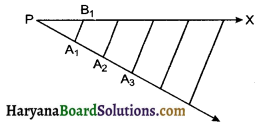
15. Plants have specific respiratory pigments to in take oxygen from the atmosphere. — False
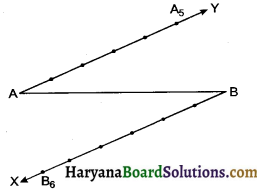
16. In pisces, the heart does not pump oxygenated blood to different parts of the body. — True
17. The blood leaving the tissues becomes richer in oxygen. — False

18. The left atrium receives oxygenated blood from the lungs through pulmonary vein. — True
19. There is independent pathway for transportation in plants. — False
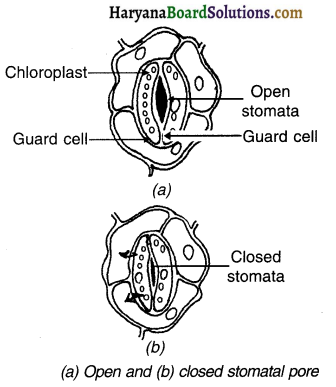
20. Movement of material in xylem occurs through physical fores whereas movement of material in phloem occurs by utilizing energy. — True
21. Complex multi-cellular organisms remove the excretory substances by diffusion. — False
22. Bowman’s capsule brings the waste material along with the blood to the kidneys. — False

Match the Following :

Question 1.

Column-I.Column-II.
A. Unit of Respiration
B. Unit of Excretion
C. Unit of absorption of Digested food
P. Nephron
Q. Villi
R. Alveoli

Answer: (A – R), (B – P), (C – Q)

Question 2.

Column-IColumn-II
A. Transpiration
B. Translocation
C. Photosynthesis
P. Chloroplast
Q. Stomata
R. Phloem

Answer: (A – Q), (B – R), (C – P)

HBSE 10th Class Science Important Questions Chapter 6 Life Processes

Question 3.

Column-IColumn-II
A. Carbohydrates
B. Proteins
C. Fats
P. Fatty acid + glycerol
Q. Amino acid
R. Glucose

Answer: (A – R), (B – Q), (C – P)

Question 4.

Column-IColumn-Il
A. Red blood cells
B. White blood cells
C. Platelets
D. Lymph
R. Fat absorption from small intestine
Q. Providing immunity
R. Carrying O2 from lungs to body cells.
S. blood clotting

Answer: (A – R), (B – Q), (C – S), (D – P)

HBSE 10th Class Science Important Questions Chapter 6 Life Processes Read More »

HBSE 10th Class Science Important Questions Chapter 5 Periodic Classification of Elements

Haryana State Board HBSE 10th Class Science Important Questions Chapter 5 Periodic Classification of Elements Important Questions and Answers.

Haryana Board 10th Class Science Important Questions Chapter 5 Periodic Classification of Elements

Question 1.
How many elements are known to man? Why did he classify them?
Answer:
1. Today, man has discovered 118 elements.
2. All the elements have different properties. These elements are either used individually or in combination with other elements to form an endless variety of substances.
3. Classifying the elements help us to understand their properties and produce various products.

HBSE 10th Class Science Important Questions Chapter 5 Periodic Classification of Elements

Question 2.
Explain Dobereiner’s classification of elements or Dobereiner’s triads.
Answer
1. In 1817, German chemist Johann Wolfgang Dobereiner started classifying elements on the basis of their chemical properties.
2. He discovered that there exists several ‘triads’ or ‘groups of three elements each’ that appeared to have similar chemical properties.
3. Law of Triads: If three elements are arranged in the increasing order of their atomic masses, the atomic mass of the intermediate (i.e. second) element would be almost equal to the average of atomic masses of first and third elements. This is known as Law of Triads. It was given by Dobereiner.

Based on this principle he identified the following three triads:

  • Lithium, Sodium and Potassium,
  • Chlorine, Bromine and Iodine,
  • Calcium, Strontium and Barium.

Example:

  • Atomic mass of Lithium (Li) is 6.9 u, Sodium (Na) is 23.0 u and that of potassium (K) is 39.0 u.
  • Here, the atomic mass of sodium is the average of lithium and potassium i.e. = ((6.9 + 39)/2) = 23. Hence, these three elements form a triad.

HBSE 10th Class Science Important Questions Chapter 5 Periodic Classification of Elements

Question 3.
The elements in the Dobereiner’s table were arranged in such a manner that the atomic mass of the intermediate (i.e. second) element would be almost equal to the average of atomic masses of first and third elements. Demonstrate this with the help of Dobereiner’s triads.
Answer:
1. Table given below shows Dobereiner’s triacis.
2. We can see that in all these three triads, the atomic mass of the second element is equal or nearly equal to the average of atomic mass of first and third element.

HBSE 10th Class Science Important Questions Chapter 5 Periodic Classification of Elements 1

Question 4.
State the limitations of Doberelner’s classification of elements.
Answer:
Limitation of Dobereiner’s classification :

  • Under Dobereiner’s classification, overall only a limited number of elements could be classified into triads.
  • After arranging the elements in triads, it was found that there were certain other elements which could not be classified by Dobereiner’s method.

Question 5.
Explain Newlands’ method of classifying elements (or Newlands’ Law of Octaves)
Answer:
Newlands’ Law of Octaves :
1. When elements are arranged in the increasing order of their atomic masses, properties of every 8th element are found to be similar to the properties of the first element.
2. In 1866, a scientist named John Newlands arranged the elements in the increasing order of their atomic masses.
3. Newlands was the first person to arrange elements in their increasing order of atomic masses.
4. During this arrangement, he found properties of every 8th element to be similar i.e. property of 1st and then 8th element would be similar. Similarly property of 2nd and 9th element would be similar and so on.
5. He called this periodicity pattern as the Law of Octaves (octaves = eight). The law can be compared with the octaves or say 8 notes found in music where in the 8th note is similar to the 1st note.
HBSE 10th Class Science Important Questions Chapter 5 Periodic Classification of Elements 2

Question 6.
Discuss limitations of Newlands’ Law of Octaves. OR How can you say that Newlands’ table worked well with lighter elements only?
Answer:
Limitation of Newlands’ Law of Octaves:
(1) The law of octaves was applicable only upto calcium. After calcium, every 8th element did not possess properties similar to that of 1st
(2) Newlands thought that there were only 56 elements in nature. He also thought that no more elements would be discovered in the future. However, later, several new elements were discovered that could not be arranged in the table as per Newlands’ law.
(3) In order to fit elements any how into his table, Newlands adjusted two elements in the slot even if the properties of elements did not match with other elements.

HBSE 10th Class Science Important Questions Chapter 5 Periodic Classification of Elements

Question 7.
How did Mendeleev drill to arrange the elements into his Periodic Table? OR How did Mendeleev construct his Periodic Table?
Answer:
When in 1869, Russian chemist Dmitri Ivanovich Mendeleev started his work of classifying elements, 63 elements were known to man.
Mendeleev started by examining the relationship of
(a) ‘Atomic mass of an element with
(b) ‘Physical property of the element’ and
(c) Chemical property of the element.

(i) Classification on the basis of chemical properties:

  • For classifying the elements on the basis of chemical properties, Mendeleev started studying the compounds that a particular element formed with oxygen as well as hydrogen.
  •  A compound formed when an element combines with oxygen is called oxide whereas with hydrogen is called hydride. (For example, CaO, NaH, K2H, etc.) The formulae of such oxides and hydrides were taken as ‘one of the basis of classification’.
  • Mendeleev selected hydrogen and oxygen because they are very reactive and form compounds with most elements.

(ii) Classification on the basis of atomic mass:

  • Mendeleev took 63 cards (1 card per element) and on each card he wrote the ‘atomic mass’ as well as ‘properties’ of a particular element.
  • Mendeleev arranged the cards in the increasing order of atomic masses of elements starting from atomic number 1 to 63. Then he put the cards that showed similar properties into single group. This way he arranged elements into 8 groups. Each of these 8 groups were further divided in two sub-blocks, A and B.
  • Hence, while arranging the elements in the increasing order of their atomic masses, he also arranged them in groups on the basis of their chemical properties.
  • Through this classification, he concluded that “The properties of elements are periodic function (i.e. periodic in nature) of their atomic mass.” This law came to be known as Mendeleev’s Periodic Law.

HBSE 10th Class Science Important Questions Chapter 5 Periodic Classification of Elements

Mendeleev’s observation:

1. Mendeleev observed that most of the elements got a place in his periodic table.
2. The elements got arranged in the order of increasing atomic masses.
3. Elements having similar physical and chemical properties occur periodically.

HBSE 10th Class Science Important Questions Chapter 5 Periodic Classification of Elements 3

Question 8.
What observations did Mendeieev make while classifying the elements into his Periodic Table?
Answer:
Mendeleev’s observation:

1. Mendeleev observed that most of the elements got a place in his periodic table.
2. The elements got arranged in the order of increasing atomic masses.
3. Elements having similar physical and chemical properties occur periodically.

HBSE 10th Class Science Important Questions Chapter 5 Periodic Classification of Elements 3

Question 9.
Which criteria did Mendeleev use for developing his periodic table?
Answer:
Criteria used by Mendeieev for developing periodic table:

  • The properties of elements are the periodic function of their atomic masses. Hence, arranging elements in the increasing order of their atomic masses.
  • Elements with similar properties are arranged in the same group.
  • The formula of oxides and hydrides formed by an element.

HBSE 10th Class Science Important Questions Chapter 5 Periodic Classification of Elements

Question 10.
Discuss the anomalies (irregularities) of Mendeleev’s Periodic Table.
Answer:
Anomalies (irregularities) of Mendeleev’s Periodic Table:
(1) Sequence of few elements was inverted:

  •  In Mendeleev’s table, the elements were arranged in increasing order of their atomic masses. However, at few instances Mendeleev did not follow this arrangement.
  • At few places he placed elements with slightly higher atomic mass before elements with lesser atomic mass. This means he inverted his sequence. He did this so that elements with similar properties could be grouped together.

(2) Gaps were kept at few places:

  • Mendeleev had left some blank spaces in his Periodic Table. He was very sure that there exists some elements that would fit these spaces.
  • Mendeleev named those blank places with a Sanskrit numeral prefix called ‘Eka

Example:
‘Eka’ means one place below something. So, Eka-aluminium means one space (left blank) below aluminium. In this manner scandium (Sc), gallium (Ga) and germanium (Ge) discovered later had properties similar to Eka-boron, Eka-aluminium and Eka-silicon respectively.

Question 11.
Discuss the achievements of Mendeleev’s Periodic Table.
Answer:
Achievements of Mendeleev’s Periodic Table:
(1) The gaps that Mendeleev had left in his table got properly filled when new elements were discovered.
(2) Chemists not only accepted Mendeleev’s table but also conferred him as the ‘originator of the concept’ on which Modern Periodic Table is based.
(3) Noble gas elements such as helium (He), neon (Ne), etc. were not known during Mendeleev’s time. So, those elements were not present in his table. But, Mendeleev’s table was so precisely designed that when these gases were discovered they were easily placed in a new separate group without disturbing the existing order.

HBSE 10th Class Science Important Questions Chapter 5 Periodic Classification of Elements

Question 12.
Elements in Mendeleev’s Periodic Table were arranged in increasing order of their atomic masses.
Then why did Mendeleev place cobalt Co (atomic mass 58.93) before element nickel Ni (atomic mass 58.71) when In fact atomic mass of nickel was lesser than cobalt?
Answer:
1. Although mass of cobalt (58.93) was slightly more than Nickel (58.71), even then cobalt was placed before Nickel. Mendeleev did this so that he could maintain the properties of element placed in one group.
2. The properties of Co, Rh and Ir are similar and that of Ni, Pd and Pt are similar. Hence, Mendeleev placed Co before Ni so that elements Co, Rh and Ir having similar properties could be arranged in the same group.

Question 13.
Compare the properties of Eka-aluminium and gallium to sho the brilliant prediction Mendeleev’s table had.
Answer:
1. During Mendeleev’s time, gallium was not discovered. But, Mendeleev proposed properties of elements that could be filled in blank spaces that he left in his table. One such element was eka-aluminium.
2. The properties given by Mendeleev for Eka-aluminium and the actual element gallium that later replaced Eka-aluminium were quite similar. This can be seen in the table below.

Question 14.
Why did Mendeleev leave gaps in the Periodic Table?
Answer:
Gaps were kept at few places:

  • Mendeleev had left some blank spaces in his Periodic Table. He was very sure that there exists some elements that would fit these spaces.
  • Mendeleev named those blank places with a Sanskrit numeral prefix called ‘Eka

Example:
‘Eka’ means one place below something. So, Eka-aluminium means one space (left blank) below aluminium. In this manner scandium (Sc), gallium (Ga) and germanium (Ge) discovered later had properties similar to Eka-boron, Eka-aluminium and Eka-silicon respectively.

Question 15.
Discuss limitations of Mendeleev’s classification.
Answer:
Limitation of Mendeleev’s classification:
(1) Position of hydrogen:
Mendeleev had placed hydrogen (H) element in group 1 i.e. group of alkalis. He did so because like alkali metals, hydrogen combines with halogens and oxygen and sulphur to form compounds having similar formulae.

Contrary to this hydrogen also showed properties similar to elements of group 17 i.e. group of halogens. Thus, hydrogen could be placed in group 17 as well. Due to this confusion hydrogen could not be assigned a fixed place in Mendeleev’s Periodic Table.

HBSE 10th Class Science Important Questions Chapter 5 Periodic Classification of Elements

(2) Position of isotopes:

  • Isotopes are atoms of the same element having similar chemical properties but different atomic masses.
  • Several elements have isotopes. For example, hydrogen has three isotopes and all have separate masses. Even then all these three were placed in one single position as hydrogen element H.

(3) Wrong order of some elements:

Mendeleev had arranged the elements on the basis of increasing order of atomic masses however, he broke this rule for certain elements. For example. he placed cobalt (Co) having larger mass before nickel (Ni) having lesser mass. This made it difficult to predict how many elements can be discovered between such two elements.

Question 16.
State the three limitations of Mendeleev’s Periodic Table.
Answer:
(1) The position of hydrogen could not be correctly assigned.
(2) The table could not assign proper position for the isotopes of various elements.
(3) Some elements were not arranged on the basis of their increasing atomic mass. This posed a question as to how many elements could still take the place between two elements.

Question 17.
What is a periodic table?
Answer:
Periodic table:

  • The Periodic Table is a chart in which all the elements known to us are arranged in a systematic manner.
  • A Periodic Table is divided into rows (periods) and columns (groups).
  • Elements having similar properties are placed in the same group (i.e. vertical column).

(For Information only: Why is Periodic Table called so?

  • During classification of elements it was found that the elements show similar physical and chemical properties after a fix interval or say ‘period’ i.e. the elements are periodic in their nature.
  • The table was then prepared based on the periodic nature or periodicity of elements and so the table is called Periodic Table.)

Question 18.
How was Periodic Law of Mendeleev Improved Into Modern Periodic Law?
Answer:
1. Mendeleev had arranged the elements in his table on the basis of increasing atomic masses. In 1913, Henry Moseley showed that, rather than ‘atomic mass’, ‘atomic number’ is a ‘better fundamental property’. Henry said, atomic number and not atomic mass determine the chemical properties of elements.
2. Looking to the facts, the Periodic Law given by Mendeleev was modified into Modern Periodic Law which states “Properties of elements are a periodic function of their atomic number”.

Question 19.
State Mendeleev’s Periodic Law and Modern Periodic Law.
Answer:
(a) Mendeleev’s Periodic Law:
Properties of elements are the periodic function of their atomic masses.

(b) Modern Periodic Law:
Properties of elements are a periodic function of their atomic numbers.

Question 20.
On what basis were the elements arranged in the Modern Periodic Table? Why?
Answer:
1. The elements in the Modern Periodic Table were arranged on the basis of Modern Periodic Law which states that elements are a periodic function of their atomic numbers.
2. Atomic number (Z) tells us the number of protons in the nucleus of the atom of an element.
3. This number i.e. the atomic number goes on increasing as one moves from one element to the next.
4. Thus, in Modern Periodic Table the elements were arranged in the increasing order of their atomic number Le. Z.

HBSE 10th Class Science Important Questions Chapter 5 Periodic Classification of Elements

Question 21.
Discuss the arrangement of elements In groups and periods in Modern Periodic Table.
Answer:
The Modern Periodic Table has 18 vertical columns known as ‘groups’ and 7 horizontal rows known as ‘periods
(a) Placement of an element in a group:
(i) Elements are placed in a particular group on the basis of the ‘valence electrons’ i.e. elements having same number of valence electrons will be placed same group.

Example:

  • The electronic configuration of fluorine (f) is 2, 7 and that of chlorine (Cl) is 2, 8, 7. This means both these elements have valency = 1. Hence, both these elements are placed in same group i.e. group no. 17.
  • Note that as we go down in a group, the number of shells increase. Fluorine has only 2 shells whereas chlorine has 3.

(b) Placement of an element In a period:
(i) Within a horizontal period, as one moves from left to right, the ‘elements have same number of shells’ but, ‘different valence electrons
(ii) Moreover, on moving left to right, the number of electrons of valence shell increase by 1 unit because the elements are arranged in the increasing order of their atomic number by 1 unit.
(iii) Thus, elements having same number of shells are placed in the same period. For example, Na, Mg, Al, Si, etc. have 3 shells and hence are placed In the 3rd period.

Question 22.
How are electrons arranged in various shells? How do we determine the number of elements in each period on the basis of number of elements in a shell?
Answer:
Arrangement of electrons in a shell:
1. The maximum number of electrons that can be accommodated in a shell depends on the formula 2n2 (where n = the number of given shells from the nucieusý’
2. Letter ‘K’ denotes the first shell, ‘L’ second, M’ third and so on. Thus for shell ‘K, n = 1, for ‘L, n = 2 and for ‘M’, n = 3.
3. By knowing the values of ‘n’ for K, L and M we can derive the number of electrons that each of these shells can hold. It is:

  • K shell = 2(n)2 = 2(1)2 = 2 electrons
  • L shell = 2(n)2 = 2(2)2 2(4) = 8 electrons
  • M shell = 2(n)2 = 2(3)2 = 2(9) = 18 electrons

4. Based on this calculation we say that the 1st period has 2 elements and period has 8 elements.
5. Although M shell can hold 18 electrons but third period can hold only 8 electrons. Therefore, 3 period can hold only 8 elements.

HBSE 10th Class Science Important Questions Chapter 5 Periodic Classification of Elements

Question 23.
What do you mean by periodic properties?
Answer:
1. The properties which are determined by the electronic configuration of elements or which depend on the electronic configuration of elements are known as periodic properties.
2. Also, the properties which show a recurring gradation within the same group or along a period are known as periodic properties.
Example: Valency, atomic radii (atomic size), metallic property, electronegativity, etc. exhibit periodic properties.

Question 24.
Bring out the trends of change In valency, atomic size and metallic and non-metallic properties in groups and periods.
Answer:

CharacteristicGroups

Periods

(1) ValencyAll the elements of a group have same valency.On moving from left to right, the valency of elements increase from 1 to 4 and then goes on decreasing to 0 (zero).
(2) Atomic size (Radius of atom)As we move down in a group, the size of atoms i.e. atomic size increaseOn moving from left to right in a period, the size of the atoms decrease.
(3) Metallic and Non-metallic propertiesGoing down in the group, the metallic property of elements increaseOn moving left to right in a period, the metallic property of elements decreases while non-metallic property increases.

Question 25.
What is valency? How is it calculated?
Answer:
1. Relative ability of an element to combine with other element is known as a valency. OR Valency is the combining capacity of an atom of an element to acquire noble gas configuration.
2. Valency depends on the number of valence electrons that an atom of an element has.
3. The valency of an element is

  • Either equal to the number of electrons in the valence shell OR
  • Equal to eight minus the number of electrons in the valence shell.

Question 26.
Explain the trend of valency within a period and a group. OR How does the valency vary in a period on going from left to right and while going down In a group?
Answer:
1. As you move in the period from left to right, the valency first increases from 1 to 4. Then it decreases from 4 to 0.
2. All the elements in a given group possess equal number of electrons. Hence, valency does not change within a group.

Question 27.
Explain atomic size (atomic radius).
Answer:
Atomic size:

  • The radius of the atom is called the atomic size of the atom.
  • Atomic size (or radius) can be visualized as the distance between the centre of the nucleus and the outermost shell of an isolated atom.
  • Atomic radius is expressed in angstrom (A°), or centimeter (cm) or picometer (pm). 1 pm = 10 12m.
  • For example, the atomic radius of hydrogen atom is 37 pm.

Question 28.
Why does atomic radii increase as we go down in a group, while decrease as we move from left to right in a period? OR Explain the trends in atomic size of elements In a period and a group.
Answer:
Situation in a group :
1. In a group as we move from top to down, new orbits get added in the elements.
2. For example, in the first group, Lithium (Li) has 2 orbits, Sodium (Na) has 3 orbits, Potassium (K) has 4 orbits and so on.
3. Since the orbits increase as we move down, naturally their radii also increase.

Elements of first group

No. of orbitsAtomic Radius (pm)
Li
Na
K
Rb
Cs
2
3
4
5
6

152
186
231
244
262

Situation in a period :

  • In a period, as we move form left to right, no new orbits are added unlike in group.
  • Secondly, in the period, the positive electric charge of nucleus attracts more electrons and so the radii of atoms decrease.
  • Thus, as we move from left to right in a period, the atomic radii decreases.

HBSE 10th Class Science Important Questions Chapter 5 Periodic Classification of Elements 5

HBSE 10th Class Science Important Questions Chapter 5 Periodic Classification of Elements

Question 29.
Explain the trends of the metallic character in a period and a group.
Answer:
Trend of the metallic character in a group:
On moving down in a group, the effective nuclear charge experienced by valence electrons decreases because the outermost electrons are far away from the nucleus. Therefore, tendency of the element to lose electrons increases and electrons can be lost easily. Hence, the metallic character increases on moving down in a group.

Trend of the metallic character In a period:

  • On moving from left to right in a period the effective nuclear charge experienced by valence electrons increases.
  • Therefore, the tendency to lose electrons will decrease.
  • Thus metallic character decreases in a period on moving from left to right.

Question 30.
Explain the trends of the non-metallic character in a period and a group.
Answer:
Trend of the non-metallic character in a group:
On moving down within a group, the non-metallic character decreases.

Trend of the non-metallic character in a period:

  • On moving from left to right in a period, the nuclear charge experienced by valence electrons increases. So, the tendency to attract electrons increase.
  • As a result, the non-metallic character increases in a period on moving from left to right.

Question 31.
What are metalloids or semi-metallic elements? Give example.
Answer:
1. Elements which possess properties of both metals and non-metals are known as metalloids or semi-metallic elements.
2. In the Modern Periodic Table, a zig-zag line separates metals and non-metals. The border line elements such as boron (B), silicon (Si), germanium (Ge), arsenic (As), antimony (Sb), tellurium (Te) and polonium (Po) on this zig-zag line are known as metalloids or semi-metals.

Question 32.
Give difference between ‘Elements of a group’ and ‘Elements of a period’
Answer:

Elements of a groupElements of a period
1. The atomic number of elements increases as we move down within a group.1. The atomic number of elements increases on moving from left to right within a period.
2. All the elements in a group have same number of valence electrons.2. The number of valence electrons of the elements in a group increases.
3. Elements within a group possess similar chemical reactivity.3. Elements within a group do not possess similar chemical reactivity.
4. The atomic radius and metallic character increase on moving down the group.4. The atoms radius and metallic character decrease on moving from left to right within a period.

Question 33.
Possibility of groups instead of triads arose. Explain.
Answer:
1. The method of classifying elements on the basis of triads was given by Dobereiner.
2. Under this method, Dobereiner stated that if three elements having similar chemical properties are arranged in their increasing order of atomic masses, the atomic mass of the intermediate (second) element would be similar to the average of atomic masses of first and third element.
3. However, under this classification, overall only a limited number of elements could be classified and so this method failed later on.
4. It was also discovered that more elements could be added to these triads.
5. For example, fluorine could be added to the triad of chlorine, bromine and iodine. Similarly magnesium could be added to the triad of calcium, strontium and barium.
6. Hence, scientists thought that rather than classifying elements only in triads, perhaps they could be arranged in larger groups.

Question 34.
Newlands’ law of arranging elements came to be known as ‘Law of Octaves’. Give reason.
Answer:
Newlands’ Law of Octaves :
1. When elements are arranged in the increasing order of their atomic masses, properties of every 8th element are found to be similar to the properties of the first element.
2. In 1866, a scientist named John Newlands arranged the elements in the increasing order of their atomic masses.
3. Newlands was the first person to arrange elements in their increasing order of atomic masses.
4. During this arrangement, he found properties of every 8th element to be similar i.e. property of 1st and then 8th element would be similar. Similarly property of 2nd and 9th element would be similar and so on.
5. He called this periodicity pattern as the Law of Octaves (octaves = eight). The law can be compared with the octaves or say 8 notes found in music where in the 8th note is similar to the l note.
HBSE 10th Class Science Important Questions Chapter 5 Periodic Classification of Elements 14

HBSE 10th Class Science Important Questions Chapter 5 Periodic Classification of Elements

Question 35.
Differentiate between groups and periods of Modern Periodic Table.
Answer:

Groups

Periods

1. The vertical columns in the Periodic Table are called groups.The horizontal rows In the Periodic Table are called periods.
2. There are 18 groups.There are 7 periods.
3. Elements of a given group have similar chemical properties.With changing period, the chemical properties of elements in the period also change.
4. Through group number we can find out the number of electrons in the outermost orbit of an atom of an element.Through period number we can find out the number of orbits of atoms.

Question 36.
Two elements X and Y belong to groups 1 and 3 respectively In the same period. Compare these elements with respect to their —
Answer:
(a) Metallic character (b) Size of atoms (c) Formulae of their oxides and chlorides
(a) As one moves in a period from left to right, the metallic character decreases. Hence, the metallic character decreases while moving from X to Y.
(b) As one moves in a period from left to right, the atomic radius decreases. Hence, atoms of element Y are smaller than that of element X.
(c) Oxides of element X and Y: X2O, X2O3, Chlorides of element X and Y: XCl, YCl3

Question 37.
Atomic number of magnesium is 12. What information can you get from this? (Hint: Keep In mind the Modern Periodic Table.)
Answer:
1. The atomic number of magnesium is 12. So, its electronic configuration is (2, 8, 2).
2. From this, we can say that it is positioned in the third period arid second group in the Periodic Table.
3. There are 3 orbits (2, 8, 2) and there are 2 electrons in its outermost orbit.
4. It has 2 electrons in the last orbit and so it will lose these 2 electrons and hence become mg2+ ion. Thus, its vaiency is +2.

Question 38.
Elements of which groups of the Periodic Table can easily lose electrons and elements of which groups of the Periodic Table can easily gain electrons?
Answer:
1. Elements of group IA, IIA, IIIA and that of group IB. IIB and IIIB will easily lose electrons.
2. Elements of group IVA, IVA, VIIIA and VIIIB will neither lose nor gain electrons.
3. Elements of group VA, VIA, VIIA and that of group VB, VIB and VIIB will easily gain electrons.

Question 39.
The position of three elements A, B and C in the Modern Periodic Table is shown below:
HBSE 10th Class Science Important Questions Chapter 5 Periodic Classification of Elements 6
Giving reason for the following statements in one or two sentences.
(a) Element A is a metal.
(b) Atom of element C has a larger size than atom of element B.
(c) Element B has a valency of 3.
Answer:
(a) Element A has 1 valence electron. So it can lose this electron and become electropositive. Hence, we can consider element A as metal.
(b) Element B belongs to 2nd period and so has 2 shells whereas element C belongs to 3rd period and so it has 3 shells. As a result, atoms of element C are bigger than atoms of element B.
(c) Element B belongs to group 13 and so its valency is 3.

HBSE 10th Class Science Important Questions Chapter 5 Periodic Classification of Elements

Question 40.
The atomic number of elements A,B, C, D and E are given below:
HBSE 10th Class Science Important Questions Chapter 5 Periodic Classification of Elements 7
From the above table, answer the following questions:
(a) Which two elements are chemically similar? (b) Which is an inert gas? (c) Which elements belong to 31 d period of Periodic Table? (d) Which element among these is a non-metal?
Answer:
(a) Element C and D have similar electronic configuration, i.e. 2, 8, 2 and 2, 2. Hence, these two elements are similar.
(b) Electronic configuration of element B is 2, 8. Hence, it has 8 electrons in its outermost shell. So, element B is an inert gas.
(c) Atomic number of C is 12 and so its electronic configuration is (2, 8, 2) i.e. it has 3 shells. Hence, element C belongs to 3rd period of the Modern Periodic Table.
(d) Element A (2, 5) is non-metal.

Question 41.
What is meant by periodicity? Why are the properties of elements in the same group similar?
Answer:
1. The properties of the elements n the Modern Periodic Table depend on regular changes that are seen in the electronic configuration of elements arranged in groups and periods. This law is known as periodicity.
2. Valency decides the properties that an element possesses.
3. The electronic configuration of the valence orbit of all the elements in a group is same.
4. Thus, in the same group, properties of an element remains same.

Question 42.
The electronic configuration of an element ‘X’ is 2, 8, 8, 2. To which (a) period and (b) group of the Modern Periodic Table does ‘X’ belong? State its valency. Justify your answer in each case.
Answer:
(a) The electronic configuration of element X states that the element has four shells namely K, L, M and N. Hence, element X belongs to 4th period.
2. There are 2 electrons in the outermost i.e. N shell and so element X belongs to group 2.

Question 43.
Atomic number is considered to be a more appropriate parameter than atomic mass for classification of elements in a periodic table. Why?
Answer:
1. Atomic mass does not properly tell us the properties of elements. Moreover, the elements cannot be arranged in the increasing order of atomic mass because of certain anomalies.
2. The properties of elements depend upon the number of electrons present in the valence shell. The number of electrons can be known by its atomic number. In this regard, an element can be classified in a better way through atomic number.
3. Hence, atomic number is considered to be a more appropriate parameter than atomic mass for classification of elements in the Periodic Table.

HBSE 10th Class Science Important Questions Chapter 5 Periodic Classification of Elements

Question 44.
From the part of a Periodic Table, answer the following questions:
HBSE 10th Class Science Important Questions Chapter 5 Periodic Classification of Elements 9

(a) Atomic number of oxygen is 8. What would be the atomic number of Fluorine?
(b) Out of ‘X’ and ‘Q’ which element has larger atomic size. Give reason for your answer.
(c) Out of ‘Y’ and ‘Z’ which element has smaller atomic size. Give reason for your answer.
Answer:
(a) In the Modern Periodic Table, elements are arranged on the basis of increasing order of their atomic numbers. Fluorine comes after oxygen and so atomic number of fluorine is 9.
(b) As one moves from, left to right in a period, the atomic size of the element goes on decreasing. Hence, atomic size of element Q is smaller than that of element X.
(c) As one moves down from one period to another, the numbers of shells increase. Element Y lies above element Z. So, element Y will have lesser shells than Z and hence Y’s atomic size will be smaller.

Question 45.
The atomic number of an element ‘X’ is 20. Write —
(a) Its valency
(b) Whether it Is a metal or non-metal
(c) The formula & compound formed when the element ‘W reacts with an element ‘Y’ of atomic number 8.
Answer:
(a) Since the atomic number of X is 20, its electronic configuration will be 2, 8, 8, 2. Hence, its valency is 2.
(b) Its valency is 2, so it belongs to group 2 i.e. group of metals. Moreover, since its valency is 2. it will lose 2 electrons which means it shows the property of metal.
(c) Atomic number of Y is 8. So its electronic configuration is (2, 6). In other words, valency of Y is 2. Moreover valency of X is also 2. So, the compound formed by sharing 2 electrons will be compound ‘XV’.

Question 46.
An element X belongs to 13th group of periodic table. State its valency. What will be the formula of its sulphate?
Answer:
Element X belonging to group 13th has 3 valence electrons and so its valency is 3. Sulphate of X = X2(SO4)3.

Question 47.
The elements Li, Na and K, each having one valence electron, are in period 2,3 and 4 respectively of Modern Periodic Table.
(a) In which group of the periodic table should they be?
(b) Which one of them is least reactive?
(c) Which one of them has the largest atomic radius? Give reason to justify your answer in each case.
Answer:
(a) All these elements have 1 valence electron and so they belong to Group 1.
(b) Li is the least reactive. Since Li is 2nd period it has only 2 shells. So, its outermost orbit is very near the nucleus. As a result, is difficult to remove the electron. This makes it least reactive of the three elements.
(c) Element K lies in 4th perioded has 4 shells. Hence, it has largest atomic radius of the three.

Question 48.
Sudha madam asked students to place three elements namely lithium, sodium and potassium in one group or say triad. Now, answer the following questions.
(a) How could she place all the three elements in one group?
(b) What is the name of this group? State the properties of the elements of this group.
Answer:
(a) Sudha madam placed the three elements in the same group because all three elements have similar properties.
(b) The name of this group is ‘alkali metal group’. Properties of the elements of this group are-

  • All these elements are metals.
  • Valency of each element is 1.
  • These metals readily react with water and form alkalis and hydrogen gas.

HBSE 10th Class Science Important Questions Chapter 5 Periodic Classification of Elements

Question 49.
In the Science class this morning, Prakash sir taught students how Newlands classified the elements known to him. He then gave the students an assignment to role-play Newland. Prakash sir gave them some elements along with their atomic weights which are as follows.
HBSE 10th Class Science Important Questions Chapter 5 Periodic Classification of Elements 10
The students were to answer the following questions. Study them and draft your answer.
(a) Which two elements will have similar properties on the basis of Newland’s law of octaves? Justify the reason for your selection.
Answer:
Newlands had arranged the elements in the increasing order of their atomic weights. So, first we arrange the elements.
HBSE 10th Class Science Important Questions Chapter 5 Periodic Classification of Elements 11
As per Newland’s law of Octaves, if elements are arranged in the increasing order of the atomic weights then every 8th element will have properties similar to the just one. Hence, element ‘a’ having atomic mass 2 will have properties similar to element ‘d’ having atomic mass 23. Similarly, element ‘b’ and ‘g’ will can be grouped together.

Question 50.
Introduction to the groups of elements of the Modern Periodic Table
HBSE 10th Class Science Important Questions Chapter 5 Periodic Classification of Elements 12

HBSE 10th Class Science Important Questions Chapter 5 Periodic Classification of Elements 13

Introduction:

118 elements are known to us. Majority of these elements are metals. These metals are not very reactive. They are malleable and ductile and good conductors of heat and electricity. The remaining elements are non-metals and semi-metals (metalloids).

Brief explanation of each group of the Modern Periodic Table is as follows:

(1) Group 1 elements (Alkali metals): Elements of this group are known as ‘Alkali metals’. There are in total 6 alkali metals from Lithium to Francium. Alkali metals are very soft and highly reactive metals. They are so reactive that they have to be stored in substances like oil because if kept open they will start reacting with atmospheric gases.

If they are not found freely then how do we obtain them? Well, chemists extract them from their compounds. Can explode when exposed to air The metals are malleable, ductile and good conductors. They have only 1 valence electron. They are always eager to lose this 1 electron and join with other electron to form a positive ion or say cation.

(2) Group 2 elements (Alkaline earth metals): Elements of this group are known as ‘alkaline earth metals’. There are in total 6 elements from Beryllium to Radium. Alkaline metals are also reactive metals but not as reactive as alkali metals. They have 2 electrons in their outer shell. So, they tend to lose 2 electrons to form positive ions.

(3) Group 3 to Group 12 (Transition metals (elements)): Elements of this group are known as ‘Transition metals’. They are moderately reactive. They are malleable and ductile. They have high melting and boiling points

(4) Group 13 to 16: Group 13 to 16 contains a mix of metals, metalloids and non-metals.

Metalloids: Metalloids are elements that have few properties of metals and few of non-metals.
Metalloids are the smallest class of elements (the other two classes of elements are metals and nonmetals). There are just seven rnetalloids namely boron (B), silicon (Si), germanium (Ge), arsenic (As), antimony (Sb). tellurium (Te) and polonium (PO).

(5) Group 17 (Halogens): Halogens are non-metals. Examples of halogens are Fluorine (F), chlorine (Cl), Bromine (Br), Iodine (I), etc. The term “halogen” means salt-former” and compounds containing halogens are called “salts”.All halogens have 7 electrons in their last shell. So, they gain 1 electron They are highly reactive with alkali metals (group 1) arid alkaline metals (group 2).

HBSE 10th Class Science Important Questions Chapter 5 Periodic Classification of Elements

(6) Group 18 (Noble gases): The 18th group (extreme right group) consists of non-metal elements known as noble gases or inert gases. The valence (outermost) shells of all noble gases are completely filled with electrons (2 for Helium,8 for all others). Hence, the noble gases are very stable and extremely less reactive.There are 6 noble gases that occur naturally. They are helium (He), neon (Ne), argon (Ar), krypton (Kr), xenon (Xe), and the radioactive radon (Rn).

(7) Inner-transItion metals: Inner-transition metals are the elements listed below the Modern Periodic Table. These are 30 rare earth metals.

Why are they placed below the table and not In the table?
If you look at the Modern Periodic Table, you will notice that after the element Lanthanum (atomic number 57), the next element that appears is Hafnium (atomic number 72). This means that the elements with atomic number 58 to 71 are missing. Similarly, after actinium (atomic number 89) the next element that occurs is Rutherfordium (atomic number 104).

The missing elements having atomic number 58 to 71 are placed below the table and are called lanthanides because they exhibit properties similar to element Lanthanum (atomic number 57). Similarly, the missing elements having atomic number 90 to 103 are placed below the table and are called actinides because they exhibit properties similar to element actinium (atomic number 89)

The inner-transition metals were discovered quite recently. Scientists and chemists are yet to determine their exact characteristics and properties. Hence, it was decided to keep these elements separate below the Modern Periodic Table.

(8) The case of hydrogen — an important point: Hydrogen is placed in group 1. However, its position is a matter of discussion. The reason for it follows.
Hydrogen shows similarity to group 1 elements i.e. alkalis as well as to group 17 elements i.e. halogens.

(a) Hydrogen’s similarity with alkalis: Hydrogen has only 1 electron in its valence shell. All the electrons that have 1 electron in their outer shells are placed in group 1 For example, lithium (2, 1), sodium (2, 8, 1) and so on. This means, hydrogen’s electronic configuration resembles that of alkali metals and hence it is placed in group 1. Hence, both alkalis and hydrogen have the tendency to lose 1 electron and become positive ion. The way alkali metals react with halogens (i.e. elements of group 17), oxygen and sulphur, hydrogen also reacts in a similar way. Hence, hydrogen is placed in the grotip of alkalies.

(b) Hydrogen’s simIlarity with halogens: The hydrogen also shows properties to halogens i.e. elements of group 17. All the elements of halogen group are 1 electron short of attaining their octet configuration. For example, Fluorine (2, 7),chlorine (2, 8, 7), etc. Hydrogen with electronic configuration of (1) is also 1 short of attaining octet configuration. So, the way the halogens require 1 electron to complete their configuration and become stable, hydrogen also require 1 electron to complete its configuration.

Hence, both halogens and hydrogen have the tendency to accept 1 electron and become negative ion. Halogens exist as diatornic molecules i.e. the molecule of halogens is made up of 2 atoms. For example, fluorine exists as, F2, chlorine as C12 and so on. Similarly, hydrogen also exists as a diatomic molecule i.e. as H2. Just like halogens, hydrogen also combines with metals and non-metals to form covalent compounds. Considering the above points we conclude that hydrogen also resembles halogens.

(c) Conclusion: Since hydrogen shows properties similar to alkanes (group 1 elements) and halogens (group 2 elements). its position in the periodic table is till date contradictory and hence not fixed. However, we place hydrogen in group I simply for the purpose of convenience (technically, it can be placed in halogen group as well.

Very Short Answer Type Question :

Question 1.
What is the need to classify elements?
Answer:
We can learn a lot about the properties and characteristics of elements when they are systematically classified. Hence, there arose a need to classify them.

Question 2.
What were elements first classified into?
Answer:
When elements were classified for the first time they were classified as metals and non-metals.

Question 3.
Who was Dobereiner?
Answer:
John Wolfgang Dobereiner was a German chemist who in 1817 tried to arrange the elements with similar properties into groups.

Question 4.
What are Dobereiners Triads?
Answer:
Dobereiner identified some elements that could be grouped into groups of three on the basis of the atomic mass of elements. Such groups were called Dobereiner’s Triads.

HBSE 10th Class Science Important Questions Chapter 5 Periodic Classification of Elements

Question 5.
State the principle of Dobereiner’s Triads.
Answer:
When three elements are arranged in the order of increasing atomic masses, the atomic mass of middle element is roughly the average of the atomic masses of other two elements.

Question 6.
The three elements A, B and C with similar properties have atomic masses X, Y and Z respectively. The mass of Y is approximately equal to the average mass of X and Z. What is such an arrangement of elements called as? Give one example of such a set of elements.
Answer:
Such an arrangement of elements is called Dobereiner’s triads.

Example:
Lithium (ll): atomic mass = 6.9, Sodium (Na): atomic mass = 23, Potassium (K): atomic mass = 39
Atomic mass of Na =\(\frac{39+6.9}{2}\)= 23

Question 7.
Can Na, Si, Cl form Dobereiner’s triad?
Answer:
Although the atomic mass of Si Is approximately the average of atomic masses of Na and Cl. still these three elements cannot form Dobereiner’s triads because the properties of these elements are different.

Question 8.
What can be considered as Newland’s biggest discovery?
Answer:
Newland’s thought that on arranging elements on the basis of increasing atomic masses, every 8th element has properties similar to the 1st can be considered his biggest discovery.

Question 9.
Fill the table given below with first seven elements as arranged by Newland’s.
HBSE 10th Class Science Important Questions Chapter 5 Periodic Classification of Elements 15
Answer:
HBSE 10th Class Science Important Questions Chapter 5 Periodic Classification of Elements 16

Question 10.
State Newland’s Law of Octaves.
Answer:
When elements are arranged in the order of increasing atomic masses, the properties of the eight elements (starting from a given element) are repetitions of the properties of the first element.

HBSE 10th Class Science Important Questions Chapter 5 Periodic Classification of Elements

Question 11.
As per Patel Sir, Newland Law of Octaves was applicable only to tighter elements. Did he pass a correct statement? Why?
Answer:
Yes, Reason: Newland’s Law of Octaves is applicable only to lighter elements having mass upto element calcium. After calcium, the 1st and 8th element do not have similar properties.

Question 12.
Define Mendeleev’s Periodic Law.
Answer:
The properties of elements are a periodic function of their atomic masses,

Question 13.
What was the base of classification adopted by Mendeleev?
Answer:
(a) Arranging elements on the basis of increasing atomic masses.
(b) Grouping elements that have similar properties.

Question 14.
Why did Mendeleev leave some gaps in his periodic table?
Answer:
Mendeleev predicted that the gaps will be occupied by elements that would be discovered in some time future.

Question 15.
Magnesium and calcium are metals. Is this enough to classity both these elements into same group? Why?
Answer:
No, Reason: Elements should be put into same group on the basis of some fundamental properties that are common to such elements.

HBSE 10th Class Science Important Questions Chapter 5 Periodic Classification of Elements

Question 16.
Mendeleev had knowledge about how many elements?
Answer:
63

Question 17.
What did Mendeleev focus on while considering chemical properties as one of the bases of classification?
Answer:
While considering chemical properties as one of the bases of classification, Mendeleev concentrated on compounds that the elements formed by combining with oxygen and hydrogen.

Question 18.
Why did Mendeleev consider compounds that elements formed with hydrogen and oxygen as a base of classification?
Answer:
Hydrogen and oxygen are very reactive and they form compounds with most elements. This provides a great help in classifying the elements. Hence,……….

Question 19.
Why were noble gases discovered very late?
Answer:
Elements are discovered on the basis of their reactivity with oxygen. Noble gases are inert i.e, not reactive. Hence, it was quite difficult to imagine existence of such elements.

Question 20.
Why hydrogen dId not find a suitable position in Mendeleev’s Periodic Table?
Answer:
Hydrogen is an element which shows properties similar to the elements of group 1 as well as to the elements of group 17 ie. halogens. Hence, till date where should hydrogen be placed is not correctly determined even in the Modern Periodic Table.

Question 21.
What are isotopes?
Answer:
Atoms of an element having same atomic number but different atomic masses are called isotopes.

Question 22.
Define valency.
Answer:
The combining capacity of an atom of an element to acquire noble gas configuration is called valency.

Question 23.
State Modern Periodic Law.
Answer:
Properties of elements are a periodic function of their atomic number.

HBSE 10th Class Science Important Questions Chapter 5 Periodic Classification of Elements

Question 24.
What are groups in a Modern Periodic Table?
Answer:
The 18 vertical columns of the Modern Periodic Table are called groups.

Question 25.
What are periods?
Answer:
The 7 horizontal rows of the Modern Periodic Table are called periods.

Question 26.
Look at the table given below.
HBSE 10th Class Science Important Questions Chapter 5 Periodic Classification of Elements 17

To which group do these elements belong? Wily?
Answer:
All these elements belong to Group 1 because every element has one valence electron in its outermost shell.

Question 27.
Loot at the table below.
Answer:
HBSE 10th Class Science Important Questions Chapter 5 Periodic Classification of Elements 18

State the electronic configuration of each element. To which period will these elements belong? Why?
Answer:
1. Mg – 2, 8, 2, Si – 2, 8, 4, S – 2, 8, 6 Ar – 2, 8, 8
2. Electrons of all these elements are arranged in 3 shells and so all lie in 3rd period.

HBSE 10th Class Science Important Questions Chapter 5 Periodic Classification of Elements

Question 28.
An element Q lies in group 2 whereas element R lies in group 15 of the periodic table. Now fill the table.
HBSE 10th Class Science Important Questions Chapter 5 Periodic Classification of Elements 19
Answer:
HBSE 10th Class Science Important Questions Chapter 5 Periodic Classification of Elements 20

Question 29.
Why all the elements in spite of belonging to one same period have different properties?
Answer:
Within a period the number of valence electrons is different for each element. So, the tendency to lose or gain electrons for each element varies. Hence …………

Question 30.
Define atomic size (radius).
Answer:
The distance between the centre of the nucleus and the outermost shell of an isolated atom is called atomic radius or atomic size.

Question 31.
What are metalloids?
Answer:
Elements that have some properties of metals and some of non-metals are known as metal bids.

Question 32.
State the number of valence electrons and valency of most of the elements of group 18.
Answer:
Generally, the elements of group 18 have 8 valence electrons and their valency is O (zero).

Question 33.
An element Q lies in group 2 of the periodic table. State the formula of its chloride and oxide.
Answer:
Chloride — XCl2; Oxide XC.

Question 34.
State the formula of the compound formed when an element X of group 14 combines with element Y of group 16.
Answer:
Electronic configuration of X : 2, 8, 4
Electronic configuration of Y : 2, 8, 6
∴ X will combine with 2 atoms of Y.
∴ The formula of compound formed will be XY2.

HBSE 10th Class Science Important Questions Chapter 5 Periodic Classification of Elements

Question 35.
Write the positions of metallic, non-metallic and metalloid elements in the Modern Periodic
Table.
Answer:
In the Modern Periodic Table, metallic elements are on the left side while non-metallic elements are on the right side. Metalloids or semi-elements are in the middle of the Periodic Table.

Question 36.
The construction of Modern Periodic Table owes to research of which scientist?
Answer:
(A) Sir Ramsay
(B) Moseley
(C) Lord Rayleigh
(D) Mendeleev

True or False

1. ………… elements are known to us and out of them are available naturally.
Answer:
118; 98

2. Elements with similar properties were arranged in groups for the first time in the year …………
Answer:
1817

3. It was ………… who found that properties of elements are a periodic function of their atomic masses.
Answer:
Newlands

4. As per the ‘Law of Octaves’, lithium shows properties similar to …………
Answer:
Sodium

5. Newland’s Periodic Table ended at element number named ………… named …………
Answer:
56; Thorium

HBSE 10th Class Science Important Questions Chapter 5 Periodic Classification of Elements

6. The main credit for classifying elements goes to …………  (write full name).
Answer:
Dmitri Ivanovich Mendeleev

7. While considering chemical properties as one of the parameter for classifying the elements, Mendeleev focused on compounds that the elements formed with ……………
Answer:
Hydrogen and oxygen

8. Element X has atomic number 20. It should find its place in ………… period.
Answer:
Fourth

9. Element that took place of Eka-silicon was …………
Answer:
Germanium

10. Atomic mass of Eka-aluminium: 68; Atomic mass of Eka-gallium……………
Answer:
69.7

11. Hydrogen’s properties resemble ………… to ……….. and (Name of groups).
Answer:
Alkalis; halogens

12. In 1913 …………….. showed that the atomic number of an element is a more fundamental property than its atomic mass.
Answer:
Henry Moseley

HBSE 10th Class Science Important Questions Chapter 5 Periodic Classification of Elements

13. Atomic number is denoted as ……………….
Answer:
‘Z’

14. The Modern Periodic Table takes care of limitations of Mendeleev’s Periodic Table. (state the number)
Answer:
Three

15. With respect to group number, hydrogen can be placed in
Answer:
Group number 1 and also 7.

16. The number of shells that can be accommodated in a shell can be calculated using the formula ………..
Answer:
2n2

14. Atomic radius is measured in ………….
Answer:
Pico meter (pm)

18. 1 pm = ………………………
Answer:
10-12m

19. Noble gases are also known as ……………..
Answer:
Inert gases

20. Metallic elements have …………….. electrons n their outermost orbit.
Answer:
1 to 3

21. If you move from right to left in a period, the atomic radius will ……………..
Answer:
Increase

22. Boron, silicon and germanium are examples of
Answer:
Metalloids (or semi-metals)

23. Oxides of elements tend to be basic.
Answer:
Metallic

HBSE 10th Class Science Important Questions Chapter 5 Periodic Classification of Elements

24. Non-metals are electro-
Answer:
Negative

True or False
1. Triads are written in the increasing order of their atomic number. — False
2. Look at the table below.
HBSE 10th Class Science Important Questions Chapter 5 Periodic Classification of Elements 21
Do these elements satisfy even to be a triad? (Yes = True, No = False) — True (Yes)
3. Dobereiner could identify only three triads and so his system of classification was not useful. — True
4. Newlands’ law failed after calcium — True
5. Newlands thought that after 63rd element no more elements will be discovered — False
6. Newlands put nickel and carbon in same slot — False
7. Newlands’ law worked well for heavier elements — False
8. Mendeleev knew about 7 more elements as compared to Newlands. — True
9. Nickel (atomic mass 58.93) appeared before cobalt (atomic mass 58.71) in Mendeleev’s periodic table. So as to group them together on the basis of similar properties. — False
10. Mendeleev’s Table did not consist of noble gases. — True
11. Halogens have valency of 7. — True
12. The position of hydrogen in the Modern Periodic Table is till date a matter of argument. — True
13. An element having atomic number 25.5 can be easily placed between Mn and Fe. — False
14. Each period signifies a new electronic shell getting filled. — True
15. As we go down in a group, the distance between the outermost electron and the nucleus decreases. — False
16. A zigzag line separates metals from non-metals within the Modern Periodic Table. — True
17. As the effective nucleus charge acting on the valence shell electrons increases across a period, the tendency to lose electrons decrease. — True
18. Metals are electro-positive. — True

HBSE 10th Class Science Important Questions Chapter 5 Periodic Classification of Elements

Match the Following:

Question 1.

I

II

1. Dobereiner
2. Moseley

a. Law of Octaves
b. Triads
c. Modern Periodic Table Law
d. Periodic

Answer:
(1-b), (2-c)

Question 2.

III
1. Noble gases
2. Metalloids
3. Metals
4. Non-metals
a. Te, Po
b. K, Co, Ba
c. Kr, Xe, Ar
d.C, Br, S

Answer:
(1-c), (2-a), (3-b), (4-d)

HBSE 10th Class Science Important Questions Chapter 5 Periodic Classification of Elements Read More »

HBSE 10th Class Science Important Questions Chapter 7 Control and Coordination

Haryana State Board HBSE 10th Class Science Important Questions Chapter 7 Control and Coordination Important Questions and Answers.

Haryana Board 10th Class Science Important Questions Chapter 7 Control and Coordination

Question 1.
What is the importance of control and co-ordination?
Answer:
1. Multicellular organisms are made-up of various organs and organ system.
2. It is a basic need of the body to control and co-ordinate these organs and organ systems, so that they can function properly and accomplish the voluntary as well as involuntary functions.

HBSE 10th Class Science Important Questions Chapter 7 Control and Coordination

Question 2.
What is a stimulus?
Stimulus:
1. An event that encourages an action or creates sensation is called a stimulus. (Plural : Stimuli)
2. All living organisms — humans, plants and animals respond to changes occurring in their surroundings. These changes work as stimuli.
Example:

  • On seeing sudden bright sunlight, our eyes gets closed. Here, the sudden bright light is stimulus whereas closing of eyes is response.
  • If someone pours hot or cold water on us, we can feel it and also differentiate the temperature of water.
  • A sunflower always faces the sun.
  • Thus, heat, light, touch, weather changes, sound, etc. all are examples of external stimuli.
  • If we are hungry, we feel like eating. Thus hunger, thirst, etc. are internal stimuli of the body.

Question 3.
What are receptors? Name few receptors found in human body, their location and function.
Answer:
Receptors:
1. A specialized structure in the human body that receives external stimuli is called a receptor.
2. These receptors are located in our sense organs. The main ones are —

ExampleLocationFunction
1. Gustatory receptors
2. Olfactory receptors
3. Thigmo receptors
4. Photo receptors
5. Audio (phono) receptors
On the surface of the tongue
Nasal epithelium
In the skin
In the eyes
In the internal ear
To detect taste
To detect smell
To detect touch
To detect vision
To detect sound

HBSE 10th Class Science Important Questions Chapter 7 Control and Coordination

Question 4.
What is a nerve cell? Explain its structure, function and working.
Answer:
Nerve cell:
Nerve cells or neurons are the building as well as functional units of the nervous system. They carry information from one part of the body to another.
Nerve cell has three components:
(i) Cell body,
(ii) Dendrites and
(iii) Axon
(i) Cell body: The cell body of a neuron is like a typical animal cell which contains cytoplasm and a nucleus.
A number of short or long fibers stretch out from the cell body. These fibers are called nerve fibers.
(ii) Dendrites: The short fibers on the cell body are known as dendrites.
(iii) Axon: The longest fiber on the cell body is called axon.
HBSE 10th Class Science Important Questions Chapter 7 Control and Coordination 1
Movement of Impulse (working of nerve cell):
1. The end of the dendritic tip receives message from receptors. It then initiates a neuro-chemical reaction due to which an electric impulse known as nerve impulse is produced.
2. The dendrites pass the impulse to the cell body and then to axon upto the end of axon i.e. axon terminal bud.
3. Synapse — The gap between nerve ending of an axon of one neuron and dendrite of the next neuron is called synapse.
4. At the end of the axon terminal bud, the electrical impulse releases certain chemicals.
5. These chemicals cross the gap or synapse and start similar electrical impulse in the dendrite of the next neuron. This is how the impulse or message travels from one neuron to another in the body.
6. Finally with the help of similar synapse, the impulses are delivered from neurons to other cells such as muscle cells or glands.

Question 5.
What happens at the synapse between two neurons?
Answer:
Nerve cell: Nerve cells or neurons are the building as well as functional units of the nervous system. They carry information from one part of the body to another.
Nerve cell has three components:
(i) Cell body,
(ii) Dendrites and
(iii) Axon
(i) Cell body: The cell body of a neuron is like a typical animal cell which contains cytoplasm and a nucleus.
A number of short or long fibers stretch out from the cell body. These fibers are called nerve fibers.
(ii) Dendrites: The short fibers on the cell body are known as dendrites.
(iii) Axon: The longest fiber on the cell body is called axon.

HBSE 10th Class Science Important Questions Chapter 7 Control and Coordination

Question 6.
What is a nervous tissue? What does It specialize in?
Answer:
1. Nervous tissue is made up of organized network of nerve cells or say neurons.
2. Nervous tissue specializes in conducting messages through electrical impulses from one part of the body to another.

Question 7.
Identify the parts of a neuron in a diagram: (1) where information is acquired, (2) through which information travels as an electrical impulse, and (3) where these impulse must be converted Into a chemical signal for onward transmission.
Answer:
Parts of a neuron: a — nucleus, b — cell body, c — dendrite, d — axon, e — nerve ending.

(1) Information is acquired at the end of the dendrite tip (c) of the nerve cell.
(2) Information travels as an electrical impulse through dendrite, cell impulse through dendrite, cell body and along the axon (d) to its end (e).
(3) At synapse, this impulse gets converted into a chemical signal for onward transmission.

Question 8.
Explain reflex action.
Answer:
Reflex action:

  • Reflex action is an involuntary and instant response of the muscles or glands to a stimulus. It takes place without involving the brain.
  • Reflex action is an automatic process. It is the simplest form of response in nervous system.

Example:
(1) We immediately pull-back our hands when we suddenly touch a hot vessel or when someone pricks us a pin.
→ In such cases, we react or say respond before the message can reach our brain. Such a response is called reflex action.
(2) Knee jerk response,
(3) Coughing,
(4) Blinking eyes,
(5) Yawning, movement of diaphragm,
(6) Contraction of pupil,
(7) Sneezing,
(8) Mouth watering or looking or smelling favourite food, etc. are other examples.

HBSE 10th Class Science Important Questions Chapter 7 Control and Coordination

Question 9.
What role does reflex action plays when we suddenly see a bright light or when we cough?
Answer:
1. When we suddenly see a bright light, pupil of our eyes becomes small and it takes some time for the eyes to adjust to the bright light. In this case, reflex action protects the retina from damage that can be caused due to sudden and excessive light.
2. Coughing is another example in which reflex action does the job of clearing our wind pipe.

Question 10.
Explain reflex arc.
Answer:
Reflex arc:

  • The pathway or say the route taken by the nerve impulses in a reflex action is known as the reflex arc.
  • Reflex arcs allow rapid response.

Example:
1. A reflex action is an automatic response to a stimulus. So, when we suddenly touch a hot plate (a stimulus) we quickly, without thinking pull our hand back.
2. This type of very quick and automatic response is called reflex action.
3. The diagram shows the pathway taken by the nerve impulses in this reflex action.

  • The heat is sensed by thermoreceptor in our hand.
  • The receptor fingers an impulse in a sensory neuron which transmits the information to the spinal cord.
  • From spinal cord, the impulse is passed to a relay neuron which in turn passes it to a motor neuron.
    Relay neurons are the communicating neurons between the sensory and motor neurons.
  • The motor neuron transmits the impulse to the muscle of the arm. The muscle then contracts and pulls the hand away from the hot plate.
  • The muscle of arm is an effector because it responds to the stimulus.
    This pathway along which the impulse travels is called the reflex arc.

HBSE 10th Class Science Important Questions Chapter 7 Control and Coordination 2

Question 11.
Reflex actions have also evolved in animals. Explain.
Answer:
1. Generally, animals do not possess the complex neuron network needed for thinking. If at all they possess, the network is very basic. This means that animals cannot think as fast as humans.
2. However, they do need to respond to several sudden situations such as attack from other animals. To tackle such situations, the reflexes of animals are quite evolved.

HBSE 10th Class Science Important Questions Chapter 7 Control and Coordination

Question 12.
How do Involuntary actions and reflex actions differ from each other?
Answer:

Reflex action

Involuntary actions

Reflex actions are very quick.Involuntary actions are not that quick.
Reflex action can involve any muscle or gland.Involuntary actions can involve only smooth muscles and cardiac muscles.
Reflex actions not initiated by brain.Generally, involuntary actions involves brain.
It occurs suddenly in response to some external stimuli,
For example, pulling away hand when it touches a hot vessel.
It does not need any external stimuli, It can go on continuously under normal conditions.
For example, heartbeats, breathing, etc.

Question 13.
How does control and co-ordination take place in humans? Also, explain the functions of nervous system.
Answer:
There are two systems which co-ordinate different activities In humans:
(A) Nervous system and (B) Endocrine system (or Hormonal system)
These two systems work together to control and co-ordinate all our activities such as physical,emotional behaviour and thinking processes.

(A) Nervous system:

  • It controls and co-ordinates all the parts of the body.
  • The nervous system co-ordinates voluntary muscles, thus allowing a person to perform activities such as dancing, reading, writing, etc.
  • The nervous system also co-ordinates certain involuntary functions like heart beat and breathing.
  • The nervous system collects the information from the surrounding, interprets it and then responds accordingly.
  • The nervous system also passes information from one system to other system.
  • The units that make up the nervous system are called nerve cells or neurons. Thus, nerve cells are the functional units of a nervous system.

(B) Endocrine system (or Hormonal system):

  • There are certain glands in the endocrine system which release chemical substances (chemical messengers) called hormones in the body.
  • Generally, hormones regulate the slow activities of the body such as growth, metabolism, etc.
  • The hormones are secreted in a small quantity and reach to the target organ by blood. Generally hormones do not travel long.

HBSE 10th Class Science Important Questions Chapter 7 Control and Coordination

Question 14.
State the organization of human nervous system.
Answer:
Organs of Human Nervous System:
HBSE 10th Class Science Important Questions Chapter 7 Control and Coordination 3

  • The Central Nervous System of a human being is one of the important parts of the control and co-ordination system of the body.
  • The Peripheral Nervous System does the task of establishing communication between the central nervous system and the other parts of the body.

Question 15.
Explain the structure and functioning of human brain along with a diagram.
Answer:
Human brain is divided into three major parts:
(i) Fore brain,
(ii) Mid brain and
(iii) Hind brain.

(I) Fore brain :

  • Fore brain is the main thinking part of the brain.
  • It has regions which receive sensory impulses from various receptors.
  • Separate areas of the fore-brain are specialized for hearing, smell, sight, etc.
  • There are other separate areas where this sensory information is interpreted by putting it together with information from other receptors as well as with information that is already stored in the brain. Finally, a decision is made by the brain considering all the information it gathers.

HBSE 10th Class Science Important Questions Chapter 7 Control and Coordination 4

(ii) Midbrain:

  • Mid brain connects the forebrain and hind brain.
  •  It is the centre for visual and auditory reflexes.

(iii) Hind brain:

  • Hind brain consists of three regions: (A) Cerebellum which lies on dorsal side and (B) Pons and (c) Medulla oblongata.
  • It controls involuntary activities like breathing, heart-beat, blood pressure, peristaltic movements, etc.

HBSE 10th Class Science Important Questions Chapter 7 Control and Coordination

Question 16.
How is the central nervous system protected? OR How is the brain protected from external injuries? OR How are the delicate organs of human nervous system protected? OR Give reason: The central nervous system is well protected.
Answer:
1. The central nervous system (CNS) consists of the brain and spinal cord.
2. The brain is protected by an extremely hard bony-box called cranium (skull). The skull envelopes the brain.
3. Inside the skull, the brain lies within the cerebro-spinal fluid-filled balloon-like structure which provides cushioning and works as a shock absorber.
4. The spinal cord is protected in a hard skeletal structure called a vertebral column or backbone.

Question 17.
How does the nervous tissue cause an action?
Answer:
(a) Role of nervous tissue in causing the action:

  • The neurons receive the stimuli from the surroundings with the help of sensory organs namely eyes, ears, nose, tongue and skin.
  • Then the information is sent to the central nervous system (mostly to the brain).
  • The brain analyzes the stimulus and makes the decision about what has to be done. According to this, the order is formulated. Now this decision order is sent to the related muscles through the neurons.
  • Finally, the muscles act accordingly and thus the whole action response takes place.

(b) Role of muscle tissue in causing the action:

  • When a nerve impulse reaches the muscle, the muscle fibre moves. This movement starts at the cell level.
  • The muscle cells will move by changing their shape so that they can become short.
  • The musde cells have special proteins that change their shape as well as their at angement in the cell in response to the nerve impulses. When this happen, the proteins get arranged in a different manner and hence muscle movement takes place.
  • This movement of muscle is known as voluntary movement of muscle.

Question 18.
Write a note on movement of voluntary muscles.
Answer:
Role of muscle tissue in causing the action:

  • When a nerve impulse reaches the muscle, the muscle fibre moves. This movement starts at the cell level.
  • The muscle cells will move by changing their shape so that they can become short.
  • The musde cells have special proteins that change their shape as well as their at angement in the cell in response to the nerve impulses. When this happen, the proteins get arranged in a different manner and hence muscle movement takes place.
  • This movement of muscle is known as voluntary movement of muscle.

Question 19.
Explain plant movement In brief.
Answer:
Plant movement:

  • Plants remain fixed at a place with their roots in the ground and so they cannot move from one place to another.
  • However, movement of individual parts of a plant such as root, leaves, etc. is possible when they are subjected to some external stimuli like sunlight, gravitational force, water, touch, etc. Such movements of plants are called plant movements.
  • The plant movement with respect to external stimuli falls into two main categories: (I) Tropism and (II) Nastism.

Question 20.
Explain “Plants show two different kinds of movements”. OR State and explain briefly the types of movements in plants.
Answer:
The movement of plants can be classified into two types. They are:
(1) Growth dependant movement:
→ When seeds are planted, they sprout as a plant and grow taller with time. This is directional movement.
(2) Growth independent movement.

HBSE 10th Class Science Important Questions Chapter 7 Control and Coordination

Question 21.
How is co-ordination in plants different from co-ordination in animals? OR Plants co-ordinate slowly as compared to animals. OR Give scientific reason — “In general, the plants cannot respond to stimulus quickly”.
Answer:
1. The change in the environment to which the organisms respond and react is called stimulus (Plural: stimuli). Animals possess nervous system as well as hormones for co-ordinating their activities whereas plants have only hormones for responding to stimulus.
2. Animals have sense organs such as nose, ears and eyes which help them sense things and activities faster.
3. Plants too are capable to sense the effect of gravity, light, water, chemicals and touch but only by the means of their hormones.
4. Thus, plants identify all these environmental changes only with the help of their hormones. So, since plants are devoid of nervous system. they cannot respond to stimulus quickly.

Question 22.
How do some plants respond immediately on touching? Give an example. OR How do sensitive plants detect the touch and show movement?
Answer:
1. Generally, when we touch the plants (like chhui-mui or lajamani), they use electrical or chemical means to convey this information from cell to cell.
2. Here, the cells of plants change their shape by changing the amount of water in them. As a result, the cells may swell-up or shrink. Consequently. the shape of the cell gets changed.
Example:
When we touch the leaves of a chhui-mui (= Lajamani) plant i.e. a sensitive’ or ‘touch-me-not’ plant of mimosa family, it immediately begins to fold-up and droop.

Question 23.
What are tendrils? Explain. OR Explain the movement in the pea plant due to growth.
Answer:
1. In some plants, -a special thread like part arise from various parts of the plant, which are known as tendrils.
2. Such tendrils are highly sensitive to touch. When the thread structure comes in contact of any hard-support, it twists to it and starts growing in that specific direction.
3. Such type of plants are called climbers (t). For example, pea plant.
4. Because this growth is directional, it appears as if the plant is moving.

Question 24.
(a) What is meant by tropism? Explain with example.
(b) Mention the types of tropism. Explain each one in detail.
Answer:
(A) Tropism (Tropic movement) :

  • It the growth movement (response) in a plant organ is due to the effect of an external and directional stimuli, then it is called tropism or tropic movement.
  • It the plant shows growth in the direction of the stimulus, then it is called positive tropism whereas if the plant shows growth away from the stimulus, it is called negative tropism.
  • Plants show movement with respect to five stimuli.

HBSE 10th Class Science Important Questions Chapter 7 Control and Coordination

(B) Types of tropism:

StimulusType of tropism the stimulus causes and its details
1. LightPhotoperiodism:

  • Movement of plant growth in response to light is calledphotoperiodism.
  • Stems respond to light and bend towards it. This is called positive photoperiodism shown by stem.
  • Roots of plants bend away from light. This is called negative photoperiodism shown by roots
2. GravityGeotropism:

  • Movement of plant growth in response to gravity is called geotropism.
  • Stem always grow away from gravity of earth i.e. stems show negative geotropism while root always grow towards the gravity of earth i.e. roots show positive geotropism
3. ChemicalChemotropism:

  • Movement of plant growth in response to a chemicalstimulus is called chemotropism.
  • For example, the growth of pollen tube in the downward direction towards ovule during the process of fertilization.
4. WaterHydrotropism:

  • The movement of a plant growth part in response to water is known as hydrotropism.
  • For example, the roots of plant always grow towards the water. Thus, roots show positive hydrotropism.
5. TouchThigmotropism:

  • The directional movement of a plant growth in response to touch is called thigmotropism.
  • For example, ‘Touch me not’ plant close leaves themselves when touched.

Question 25.
What is the difference between photo nasty and thermonasty?
Answer:
Photonasty is a movement of the plant in response to light, whereas thermonasty is a movement of the plant in response to temperature. For example, flowers of sunflower and lotus open their petals in the morning when sunlight falls on them. Similarly, when temperature is increased, the crocus flower opens up.

Question 26.
What is chemical communication or hormonal co-ordination? Explain. OR What are hormones? Explain.
Answer:
1. One of the major limitations of nerve impulses is that they cannot reach each and every cell of animal body. Hence, there exists another means of communication which is called chemical communication or hormonal co-ordination.
2. Hormonal co-ordination takes place with the help of special chemical compounds called hormones.
The hormones are secreted by various glands of the endocrine system within the body.
3. Hormones are known as chemical co-ordinators or even chemical messengers.
4. Hormones are produced by a group of cells, get transported to a desired location and then act upon the cells of the target area simply by diffusion.
5. Although hormonal co-ordination takes place slowly, it can reach all the desired cells of the body.
6. Adrenaline, thyroxin, insulin, etc. are some of the hormones released in the body.

HBSE 10th Class Science Important Questions Chapter 7 Control and Coordination

Question 27.
Describe plant hormones.
Plant hormone:
1. Plant hormones are special chemical compounds which are synthesized at one place/organ of the plants and migrate to the target organ to act. They play an important role in control and co ordination in plants, as well as in growth, development and responses to the environment.

Control and co-ordination in plants:

  • Hormonal action is the main weapon to respond to various stimuli in the plants.
  • Basically, there are two types of plant hormones. They are —

HBSE 10th Class Science Important Questions Chapter 7 Control and Coordination 5

(A) Growth-promoting hormones:

(i) Auxins:

  • It particularly acts on the areas of shoot-tip and root-ends, It helps the cells to grow longer.
  • When light comes from one side of the plant. auxins diffuse towards the shady side of the shoot.
    The concentration of auxin stimulates the cells to grow longer on the shoot side, away from the light. Consequently, plants appears to bend towards light.

Gibberel lins:

  • It helps in the growth of the cells and the stems.

Cytokinins:

  • It is present in the higher concentration in the areas of the plants where rapid cell division occurs. For example, fruits and seeds.
  • It promotes cell-division.

(B) Growth resisting / inhibitory hormones:

(i) Abscisic Acid (ABA):

  •  It is responsible for wilting and falling of the leaves.
  • It is responsible for the detachment of leaves, flowers and fruits.

Question 28.
Describe human endocrine system and give a list of glands in human body.
Answer:
1. Human nervous system and endocrine system work in the co-ordination with each other.
2. The endocrine system is the network of glands in the body. These glands release hormones.

Hormones:

  • Basically, hormones are the chemical substances (chemical messengers).
  • They play an important role in various metabolic processes.
  • The hormones are secreted in a small quantity and reach to the target organ by blood. Generally, the target organ is nearby.

Glands: There are two types of glands.
They are — (1) Exocrine glands and (2) Endocrine glands.

Main endocrine glands of the human body
HBSE 10th Class Science Important Questions Chapter 7 Control and Coordination 6

Question 29.
Give an idea about the hormones released by glands. Also state the main functions of these hormones.
Answer:

GlandHormone it releasesFunction of the hormone
AdrenalAdrenalineRegulates heart-beat rate, breathing. blood pressure and carbohydrate metabolism. It plays an important role in fright, fight and flight.
ThyroidThyroxinThyroxin regulates carbohydrate, protein and fat metabolism in the body. This enables best balance for growth.
PituitaryGrowth hormone and many other hormonesGrowth hormone regulates growth and development of the body. Also induces other glands
Testes (in males)

HBSE 10th Class Science Important Questions Chapter 7 Control and Coordination

TestosteroneDevelopment and functioning of male sex organs and to develop the secondary sexual characters such as body hair, muscle development, change in voice, etc
Ovaries (in females)Estrogen and progesteroneHelps in fertilization of egg and development of secondary sexual characters such as breast enlargement, changes in physical body, etc.
PancreasInsulinHelps in regulating blood sugar levels

Question 30.
Write a short note on adrenal gland. OR Which hormone is called fight or flIght hormone? State its effect on the body.
Answer:
Adrenal gland:
1. The adrenal gland releases a hormone called adrenaline. Adrenaline hormone is also called fight or flight (run-away) hormone.
2. This hormone is secreted directly into the blood and carried to different parts of the body.

Effects of adrenaline:

  • When adrenaline is released the heart beats become fast and so, more oxygen gets supplied to our heart.
  • The muscles around the small arteries of heart and other organs contract due to which the digestive system and skin receive less blood. This diverts the blood to our skeletal muscles.
  • Moreover, the breathing rate increases due to contractions of the diaphragm and the rib muscles.
  • All these responses together enable the animal and human body to be ready for dealing with the situation of fight or flight i.e. fight or run-away immediately from the situation.

Question 31.
Write a note on thyroid gland and the importance of the hormone It releases.
Answer:
Thyroid gland:
1. Thyroid gland secretes a hormone called thyroxin.
2. Thyroxin controls metabolism rate of carbohydrate, protein and fat.
3. Deficiency of iodine can cause deficiency of thyroxin in the body.
4. Deficiency of iodine in our diet results in hypothyroidism and enlargement of thyroid gland. This results into a disease called goiter.
5. Neck of people suffering from goiter becomes swollen.
6. Goiter can be prevented by consuming iodized salt i.e. salt containing iodine.

Question 32.
It is highly recommended to consume iodized salt on a daily basis. Give reason.
Answer:
Adrenal gland:
1. The adrenal gland releases a hormone called adrenaline. Adrenaline hormone is also called fight or flight (run-away) hormone.
2. This hormone is secreted directly into the blood and carried to different parts of the body.

Effects of adrenaline:

  • When adrenaline is released the heart beats become fast and so, more oxygen gets supplied to our heart.
  • The muscles around the small arteries of heart and other organs contract due to which the digestive system and skin receive less blood. This diverts the blood to our skeletal muscles.
  • Moreover, the breathing rate increases due to contractions of the diaphragm and the rib muscles.
  • All these responses together enable the animal and human body to be ready for dealing with the situation of fight or flight i.e. fight or run-away immediately from the situation.

Question 33.
Write a short note on pancreas.
Answer:
Pancreas:
1. Pancreas is an endocrine gland as well as an exocrine gland.
2. As an endocrine gland. it secretes insulin and glucagon which maintain sugar level in the blood.
3. If insulin is not secreted in proper amounts, the sugar level in blood rises causing many harmful effects.
4. When the sugar level in blood rise, it gets detected by the cells of the pancreas. The cells respond to this rise by producing more insulin. As the blood sugar level falls, insulin secretion is reduced.

HBSE 10th Class Science Important Questions Chapter 7 Control and Coordination

Question 34.
How is hormone secretion regulated?
Answer:
1. Hormone secretion is regulated by the feedback mechanism. In general, a particular gland secretes a specific hormone.
2. The hormone reaches to the target organ and performs its function. when that specific function completed, there is no need of that hormone. so, the message reaches to the brain and the brain stops that gland to secrete the hormone further. this is how hormone secretion is regulated.

Question 35.
Giving response to a stimulus is the basic characteristic of every living organism. give reason.
Answer:
1. The creation of living organisms is such that all of them experience the effects of changes in the atmosphere that surrounds them.
2. These effects work as stimuli for the organisms and they respond by making some changes in their bodies.
3. Slow or fast, but the organism will respond to stimuli such as heat, cold, sound, touch, etc.
4. Thus, response to stimuli is the basic characteristic of every living organisms.

Question 36.
Label the parts of a neuron in the given figure.
HBSE 10th Class Science Important Questions Chapter 7 Control and Coordination 7
Answer:
(a) Dendrite
(b) Cell body
(c) Axon
(d) Nerve ending

Question 37.
We respond very quick to reflexes but very slow to the act of thinking. Give reason.
Answer:
1. Thinking is a complex activity and so it involves a complicated interaction of several nerve impulses that too from many neurons.
2. Thinking center is located in forebrain.
3. When this centre receives signals through sensory nerves from various parts of the body, it analyzes the signals and formulates the instructions. The instructions then transmit from brain to the target organ. This process takes some time and hence the response is slow.
4. In reflex action, initially the brain is not involved in decision making. So, the instruction is generally given by spinal cord before the message could reach the brain for analysis and decision making purpose. As a result, the decision making is quite quick.
5. Hence, we respond very quick to reflexes but very slow to the act of thinking.

Question 38.
Label the parts (a), (b), (c) and (d) and show the direction of flow of electrical signals in Figure.
Answer:
(a) Sensory neuron
(b) Spinal cord (CNG)
(c) Motor neuron
(d) Effector (muscle in arm)
HBSE 10th Class Science Important Questions Chapter 7 Control and Coordination 8

Question 39.
Name the plant hormones responsible for the ………………
(a) elongation of cells
(b) growth of stem
(c) promotion of cell division
(d) falling of senescent leaves
Answer:
(a) Auxiri – elongation of cells
(b) Gibberellin – growth of stem
(c) Cytokinin – promotion of cell division
(d) Abscisic acid – falling of senescent leaves

Question 40.
Out figure (a), (b) and (c), which appears more accurate and why?
Answer:
Figure (a) is more appropriate.
Reason: In a plant, shoots are negatively geotropic and hence grow upwards and roots are positively geotropic and so grow downwards.
HBSE 10th Class Science Important Questions Chapter 7 Control and Coordination 9

Question 41.
Why do multicellular organisms use hormonal system in addition to the nervous system? Multicellular organisms use hormonal system in addition to the nervous system due to following two reasons:
Answer:
1. The nervous system transmit electrical impulses. The electrical impulse can reach only those cells that are connected to the PNS.
2. Secondly, after the generation of the electrical impulses, the cell takes some time to reset or to normalize.
3. As a result, multicellular organisms use hormonal system in addition to the nervous system.

HBSE 10th Class Science Important Questions Chapter 7 Control and Coordination

Question 42.
State the characteristics of animal hormones.
Answer:
Characteristics of animal hormones:
1. Hormones are chemical compounds secreted from specific endocrine glands.
2. Hormones are chemical co-ordinators and are also called chemical messengers.
3. Generally, they control slow activities of the body such as growth and metabolism.
4. They are synthesized at places away from where they need to act. They then travel to the target cells, tissues or organs and act by simple diffusion.
5. They are transported through blood.
6. They are secreted in very small quantities.

Question 43.
Give an idea about hormones related with growth in human.
Answer:
Mainly two hormones are related with growth in humans. They are —
(1) Growth hormone:

  • It is secreted by the pituitary gland.
  • Growth hormone regulates growth and development of the body.

(2) Thyroxln:

  • It is secreted by thyroid gland.
  • Thyroxin regulates carbohydrate, protein and fat metabolism in the body. This is necessary for balanced growth of body.

Question 44.
Which disorders can we face If hormonal balance gets disturbed?
Answer:
If hormones are secreted in inappropriate quantities, we may face the following disorders:
(1) Gigantlsm: It is caused due to excess secretion of growth hormone. Under this disorder, an individual becomes extremely tall.
(2) Dwarfism: Deficiency of growth hormone in childhood leads to dwarfism. Under this disorder, the height of an individual does not grow much and he remains dwarf-sized.

(3) Goiter: It is caused by the deficiency of iodine in our diet.

  • Iodine deficiency affects the synthesis of thyroxin and causes goiter.
  • The thyroid gland gets enlarged which results in enlargement of the neck region.

(4) Diabetes: If insulin hormone is not secreted in sufficient amounts, the sugar level rises in the blood. This causes diabetes.

Question 45.
A person suffering from diabetes is given the injections of insulin. Give reason.
Answer:
1. In human bodies, pancreas release a hormone called insulin which regulates the level of sugar in the blood.
2. When insulin is not secreted in proper amounts, the sugar level in the blood rises and the person may suffer from a disease called diabetes.
3. Diabetes can be harmful for heart, brain, eyes, kidneys, etc.
4. Hence, in order to save the diabetic person from such harmful effects, he is given the injections of insulin which regulates his sugar level in the blood.

HBSE 10th Class Science Important Questions Chapter 7 Control and Coordination

Question 46.
Give differences between: Plant hormones and animal hormones
Answer:

Plant hormones

Animal hormones

1. Although plant hormones are secreted by plant cells there are no glands.1. Animal hormones are secreted by endocrine glands
2. Plant hormones are either growth promoting or growth inhibiting.2. Animals do not have inhibitor hormone for growth.
3. Plant hormones reach to their target site by simple diffusion.3. AnimaI hormones reach to their target site by flowing along with blood.
4. Secretion of plant hormones is not regulated by feedback mechanism.4. Secretion of animal hormones is regulated by feedback mechanism.

Question 47.
Label the endocrine glands shown In the figure. Also state their locations.
HBSE 10th Class Science Important Questions Chapter 7 Control and Coordination 10
Answer:
The endocrine glands and its location are as follows:

GlandsLocation
(a) Pineal glandAttached to dorsal side of brain
(b) Pituitary glandJust below the brain
(c) ThyroidAttached to the windpipe
(d) ThymusLower part of the neck and
upper part of chest

Question 48.
Differentiate between tropic movement and nastic movement.
Answer:

Tropic movementNastic movement
1. The movement of curvature in a plant organ due to the effect of an external and directional stimulus is called tropism.

2. Tropic movement is a directional movement.
3. Examples: Photoperiodism, geotropism, chemotropism, hydrotropism and thermotropism.

1. The movement of plant in response to an external stimulus in which the direction of response is not determined by the direction of stimulus is called nastic movement.
2. Nastic movement is not a directional movement.
3. Examples: Thigmonasty, photonasty and thermonasty.

HBSE 10th Class Science Important Questions Chapter 7 Control and Coordination

Question 49.
Differentiate between response in plants and response in animals.
Answer:

Response in plantsResponse in animals
1. Plants have only hormones for responding to stimulus.
2. Plants respond quite slowly.
3. Plants do not have sensory organs to respond to changes.
4. Plants do not have any muscular system for transfer of information.
1. Animals possess nervous system as well as hormones for co-ordinating their activities.
2. Animals respond quite quickly.
3. Animals have sensory organs to respond to changes.
4. Animals have well developed muscular system for transfer

Question 50.
Differentiate between movement of leaves of sensitive plants and movement of shoot towards light.
Answer:

Movement of leaves of sensitive plantsMovement of shoot towards light
1. It is a nastic movement which does not depend on the direction of stimulus.
2. Here the stimulus is ‘touch’.
3. This movement is caused when a plant is touched at the base which leads to sudden loss of water from that region.
4. This is not a growth movement.
1. It is a tropic movement which depends on the direction of stimulus.
2. Here the stimulus is light’.
3. This movement is caused by unequal growth of two sides of the shoot.
4. This is a growth movement.

Question 51.
Differentiate between central nervous system and Autonomous nervous system.
Answer:

Central nervous systemAutonomous nervous system.
1. It comprises of brain and spinal cord.
2. It regulates voluntary, involuntary and reflex actions.
3. It has no further sub-types.
1. It comprises of special network of nerve fibers.
2. It regulates involuntary activities only.
3. Sympathetic nervous system and para sympathetic nervous system are its two sub-types.

Question 52.
Differentiate between cerebrum and cerebellum.
Answer:

CerebrumCerebellum
1. It is a major part of forebrain.
2. It is divided into four lobes.
3. It co-ordinates tasks like seeing, hearing, touch and smell, etc.
1. It is a major part of hindbrain.
2. No such division occurs.
3. It co-ordinates tasks of body movement such as walking, dancing, riding bicycle, etc.

HBSE 10th Class Science Important Questions Chapter 7 Control and Coordination

Question 53.
Smita’s father was complaining about frequent urination, pain in legs and a frequent weight loss to Smite’s mother and she discussed the things with her daughter, Smita she when returned from her school. Listening to this, Smite said to her mother that her father should visit a doctor, who told her mother that her husband is having an elevated level of blood glucose. He should take care of his diet and should exercise regularly to maintain his normal glucose level. On the basis of given text, answer the following questions.

Questions:
(1) Name the disease he is suffering from and name the hormone, whose deficiency causes it.
(2) Identify the gland that secretes it and mention the function of this hormone.
(3) Explain, how the time and amount of secretion of this hormone is regulated in human system?
(4) What values were shown by Smita and her father’?
Answers:
(1) Smita’s father is suflenng from diabetes. It Is caused by the deficiency of insulin hormone in the body.
(2) Pancreas secretes insulin. Insulin helps in regulating the sugar level in the blood.
(3) When the level of sugar increases in the blood, the body responds by producing more insulin. When blood sugar level falls, secretion of insulin gets reduced.
(4) The values shown by Smita are empathy and alertness in decision making. The values shown by her father are neglecting his health.

Question 54.
On a beautiful sunny day, Pritesh was in a beautiful mood f ride. His father was equally keen and both of them rode on his motorcycle. As soon as they reached the main cross road, they saw a tragic accident of a motorcycle with a car. The rider was not wearing helmet. So, on getting hit, the rider of the motorcycle fell and was again hit by the road divider. Crowd gathered and the rider was immediately shifted to the nearby hospital through an ambulance. Prltesh’s father looked at Pritesh with utmost anger and merciful state at the same time because Pritesh too was not wearing the helmet and he too could meet such an accident.

Questions:
(1) Which part of brain is involved when you are learning to drive a vehicle?
(2) Injury to which part of brain leads to instant death of an individual? Why?
(3) Pritesh became quite fearful. Which gland do you think became more active when he saw the accident? Which hormone was poured in blood? What changes he might have felt in his body?
(4) Which values did Pritesh’s father displayed?
Answers:
(1) Cerebrum and cerebellum are involved while learning to ride.
(2) Injury to medulla oblongata in the brain leads to instant death. This is because all the involuntary activities are controlled by It.
(3) Seeing such an event, the adrenal gland of Pritesh must have become active. As a result. adrenaline hormone must have secreted in blood. Under such situation, Pritesh perspired and his heartbeats and breathing rate increased.
(4) Pritesh’s father showed the value of empathy and respecting one’s life because it is extremely precious. Moreover, he also showed the value of concern of a father for the son.

Question 55.
After studying chapter Control and Co-ordination, you learnt that probably your maid is suffering from one of the diseases discussed in that chapter. The front portion of her neck was bulged out abnormally. On discussing with her you also found that she faced difficulty in breathing and even swallowing food. Now, look at the questions given here and answer them.

Questions:
(1) From which disease do you think your maid is suffering?
(2) What is the main cause of this disease?
(3) How can you help her at an immediate basis?
(4) What values did you display here?
Answers:
(1) The symptoms show that she is suffering from goiter.
(2) Goiter is mainly caused due to deficiency of iodine.
(3) On an immediate basis we can provide her with iodine supplements as well as recommend her to use only iodized salt in her food.
(4) The values of alertness, caring and sound decision making are displayed here.

HBSE 10th Class Science Important Questions Chapter 7 Control and Coordination

Question 56.
There are three plants A, B and C. The flowers of plant A open their petals in bright light during the day but close them when it gets dark at night. On the other hand, the flowers of plants B open their petals at night but close them during the day when there is bright light. The leaves of plant C fold up when touched with fingers or any other solid object.

(a) Name the phenomenon shown by the flowers of (j) plant A, and (ii) plant B.
(b) Name one flower each which behaves like the flower of (i) plant A, and (ii) plant B.
(c) Name the phenomenon exhibited by the leaves of plant C.
(d) Name a plant whose leaves behave like those of plant C.
(e) Which plant(s) exhibit phenomenon based on growth movement?
Answer:
(a) (i) Photonasty (ii) Photonasty
(b) (i) Dandelion flower (ii) Moonflower
(c) Thigmonasty
(d) Sensitive plant (Mimosa pudica)
(e) A and B

Very Short Answer Type Question

Question 1.
Which two body systems are important in control and co-ordination?
Answer:
Hormonal system (= Endocrine system) and Nervous system.

Question 2.
Name main components of a neuron.
Answer:
Dendrites, Cell body and Axon.

Question 3.
What Is the function of dendrite?
Answer:
It carries nerve impulses which has been received from the axis of the previous neuron towards the cell-body of a neuron.

Question 4.
What is the role of axon?
Answer:
It carries nerve impulses from the cell body towards next neuron’s dendrite or tissue.

HBSE 10th Class Science Important Questions Chapter 7 Control and Coordination

Question 5.
Define stimuli.
Answer:
An event that encourages the action or creates sensation is called stimulus. (Plural = Stimuli)

Question 6.
Define Response.
Answer:
The reaction of living organisms against the stimulus induced by the change in the external environment is called response.

Question 7.
Define Co-ordination.
Answer:
Different organs of the body jointly function systematically against the stimuli and react to express proper response against the stimuli. This process is called coordination.

Question 8.
What is a spinal cord? What ¡s its function?
Answer:
Spinal cord is a cylindrical structure which is the extension of medulla oblongata. Spinal cord is a part of Central Nervous System (CNS).

Question 9.
State the function of spinal cord.
Answer:
(i) To conduct sensory information from peripheral nervous system to the brain.
(ii) To conduct motor information from brain to various effectors.

Question 10.
Reflex arc of some animals is much evolved. Why?
Answer:
Because thinking process of the brain of these animals is not so fast. So, the evolved reflex arc serves as an efficient way of performing various functions.

Question 11.
How do we feel that we have eaten enough?
Answer:
The centre of hunger and satiety are located in a separate part of the fore-brain. They give the feeling of being hungry or satisfied.

Question 12.
Name the most important part of the human brain.
Answer:
Cerebrum

Question 13.
State one function each of cerebellum and Pons.
Answer:
Cerebellum maintains balance of body and posture. Pons regulates respiration.

HBSE 10th Class Science Important Questions Chapter 7 Control and Coordination

Question 14.
Give the functions of medulla oblongata.
Answer:
Medulla oblongata controls involuntary functions such as breathing, heart beats, digestion, blood pressure, pristaltic movements of alimentary canal, etc, It also controls reflexes such as coughing, sneezing, swallowing, secretion of saliva and vomiting.

Question 15.
What does CNS stand for?
Answer:
CNS is the abbreviation for Central Nervous System.

Question 16.
Which is the most important part of the human brain?
Answer:
Cerebrum. It is also the largest part of the brain.

Question 17.
State two examples of movement that we make for protecting ourselves.
Answer:
(1) When we suddenly see bright light, we compress our pupils.
(2) We pull back our hand when we touch a hot object.

Question 18.
What are the components of peripheral nervous system?
Answer:
Cranial nerves and spinal nerves

Question 19.
Why thinking Is considered a complex activity?
Answer:
Thinking involves a highly complex interaction of several nerve impulses from many neurons. Hence,……..

Question 20.
How does a muscle cell move?
Answer:
Muscle cells move by changing their shape i.e. either by shortening or elongating.

Question 21.
What are phytohormones?
Answer:
The chemical substances which help in control and co-ordination in plants are known as phytohormones.

Question 22.
Give examples of phytohormones.
Answer:
Auxins, Gibberellins, Cytokinins, Abscisic acid (ABA), Ethylene, etc.

HBSE 10th Class Science Important Questions Chapter 7 Control and Coordination

Question 23.
What is photoperlodism?
Answer:
The developmental response of plants to the relative lengths of light and dark periods is known as photoperiodism.

Question 24.
What are the main types of a plant movement?
Answer:
(i) Growth dependant movement and
(ii) Growth independent movement

Question 25.
Name the plant which shows thigmonasty.
Answer:
Mimosa plant

Question 26.
Give an example of movement of a plant part which is caused by the loss of water.
Answer:
Thigmonastic movement as seen in mimosa plant.

Question 27.
What does a root do in response to gravity? What is this phenomenon known as?
Answer:
In response to gravity, the root grows towards the earth. This phenomenon is known as geotropism.

Question 28.
What does a stem do in response to light? What is this phenomenon known as?
Answer:
Stem bends towards the light. This phenomena is called phototropism. For stems, it is also called positive phototropism.

Question 29.
What does a stem do In response to gravity? What is this phenomenon known as?
Answer:
Stem always grows away from the earth i.e. away from gravity. This is called negative geotropism.

Question 30.
What does a root do in response to light? What Is this phenomenon known as?
Answer:
The roots of the plant bend away from the light.
This is called negative phototropism.

HBSE 10th Class Science Important Questions Chapter 7 Control and Coordination

Question 31.
Name one hormone secreted by the pituitary gland.
Answer:
Thyroid Stimulating Hormone (TSH).

Question 32.
Where are hormones synthesized (made) in the human body?
Answer:
Hormones are made by specialized glands or tissues throughout the body. Most but not all hormones are part of endocrine system.

Question 33.
Which gland secretes the growth hormone ?
Answer:
Pituitary gland

Question 34.
Name the disease caused by the deficiency of insulin hormone in the body.
Answer:
Diabetes

Question 35.
Why are hormones called chemical messengers?
Answer:
Hormones carry information in the form of chemicals which regulate the biological processes of body. Hence,………..

Question 36.
Why both, chemical signal and electrical impulses are needed in higher animals?
Answer:
In higher animals, electrical impulses bring immediate response to only those cells that are connected by nervous tissue while chemical
signals reach to each arid every cells of body. Hence, …..

Question 37.
Which mechanism is considered as a second way of control and co-ordination in our body?
Answer:
Secretion of hormones by the endocrine system is considered as a second way of control and co-ordination in our body.

Question 38.
Where is growth hormone auxin synthesized and where is it diffused?
Answer:
Auxin is synthesized at the shoot tip and is diffused at that side of the shoot which is in shade.

HBSE 10th Class Science Important Questions Chapter 7 Control and Coordination

Question 39.
State the site of secretion as well as the function of growth hormone releasing factor.
Answer:
Site of secretion: Hypothalamus; Function: Stimulates the pituitary gland to release growth hormone.

Fill in the Blanks

1. ………… is the unit of human nervous system.
Answer:
neuron

2. The word ‘reflex’ means …………
Answer:
Sudden action

3. In a neuron, conversion of electrical signal to a chemical signal occurs at/in …………
Answer:
axonal end

4. The highest co-ordinating part …………
Answer:
brain

5. Aging process in the plants is phytochrome
Answer:
Cytokinins

6. …………  causes seed dormancy in plants.
Answer:
ABA

7. The main function of abscisic acid in plants is to …………
Answer:
inhibit growth

8. The substance that triggers the fall of mature leaves and fruits from plants is due to (hormone).
Answer:
abscisic acid

9. The plant movement with respect to external stimuli falls into two main categories which are ……… and ………..
Answer:
Tropism; Nastism

10. In comparison to animals, plants are devoid of …………  for coordinating activities.
Answer:
Nervous system

11. Growth of pollen tube is an example of …………
Answer:
Chemotroplsm

12. The auxin hormone acts particularly on and of …………  the plant body.
Answer:
Shoot; root

13. ………… is also known as a master gland.
Answer:
Pituitary gland

14. Iodine is necessary for the synthesis of …………  hormone.
Answer:
Thyroxln

15. Dwarfism results due to …………
Answer:
Less secretion of growth hormone

16. The hormone which increases the fertility in males is called …………
Answer:
testosterone

True Or False

1. Except unicellular organisms, all respond to stimuli. — False
2. We can feel touch due to thigmo receptors. — True
3. Both neurons and hormones can be considered as messengers. — True
4. Generally, the nervous system co-ordinates fast activities whereas endocrine system co ordinates slow activities. — True
5. Electrical impulses will reach only those cells which are connected by nervous tissue. — True
6. Mid brain is the centre for visual and auditory reflexes. — True
7. A nerve impulse makes the muscle move. — True
8. Generally, hormones travel far off in the body to deliver the message. — False
9. Plants show two types of movement. — True
10. Cytokinin is present in the higher concentration in the areas of the plants where rapid cell division occurs. — True
11. Pancreas maintains carbohydrate, protein and fat metabolism in the body. — False
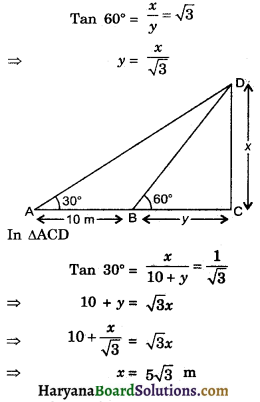
12. Pancreas is an endocrine gland as well as an exocrine gland. — True

HBSE 10th Class Science Important Questions Chapter 7 Control and Coordination

Match the Following 

Question 1.

Column-IColumn-II
A. Photoreceptor
B. Phonoreceptor
C. Olfactory receptor
D. Gustatory receptor
p. Detects smell
q. Detects light
r. Detects taste
s. Detects sound

Answer:
(A q), (B – s), (C – p), (D – r)

Question 2.

Column-IColumn-II
A. Bony protection of brain
B. Membranous covers of brain
C. Shock absorbing liquid surrounding the brain
p. Cerebrospinal fluid
q. Cranium
r. Meninges

Answer:
(A -q), (B – r), (C – p)

HBSE 10th Class Science Important Questions Chapter 7 Control and Coordination

Question 3.

Column-I (Plant action)Column-II (Phytochrome)
A. Promotes growth
B. Promotes cell division
C. Inhibits growth
D. Promotes growth of tendril around support
p. GA
q. Auxin
r. ABA
s. Cytokinin

Answer:
(A – q), (B – s), (C – r), (D – p)

Question 4.

Column-IColumn-II
A. Metabolism of various nutrients
B. Iodized salt
C. Acromegaly
D. Contraction of uterine muscle during childbirth Vasoconstrictor
p.GH
q. Oxytocin
r. Glucocorticoid
s. ADH
t. Thyroxin
u. Prolactin
y. RH

Answer:
(A – r), (B – t), (C – p), (D – q) (E – s)

HBSE 10th Class Science Important Questions Chapter 7 Control and Coordination Read More »

HBSE 10th Class Maths Important Questions Chapter 9 Some Applications of Trigonometry

Haryana State Board HBSE 10th Class Maths Important Questions Chapter 9 Some Applications of Trigonometry Important Questions and Answers.

Haryana Board 10th Class Maths Important Questions Chapter 9 Some Applications of Trigonometry

Short/Long Answer Type Questions

Question 1.
From a point on a bridge across a river the angles depression of the banks on opposite sides of the river are 30° and 45° respectively. If the bridge is at a height of 4m from the banks. Find the width of river.
Solution :
Let A and B represent points on the bank on opposite sides of the river so that AB is the width of river. Pis a on the bridg at a height of 4 m is DP = 4m. We are required to determine the width of the river, which is the length of side AB of ΔAPB
∴ AB = AD + BD
HBSE 10th Class Maths Important Questions Chapter 9 Some Applications of Trigonometry - 1
Angles of depression of the banks on opposite sides of the river are
⇒ ∠APR = 30°
⇒ ∠PAD = 30°
[alternate interior angles]
and ∠BPQ = 45°
∠PBD = 45°
In right triangle APD, we have
tan 30° = \(\frac {PD}{AD}\)
⇒ \(\frac{1}{\sqrt{3}}\) = \(\frac {4}{AD}\)
⇒ AD = 4\(\sqrt{3}\) …………..(1)
In right triangle BPD, we have
tan 45° = \(\frac {PD}{BD}\)
⇒ 1 = \(\frac {4}{BD}\)
⇒ BD = 4 ………….(2)
Adding equ. (1) and (2), we get
AD + BD = 4\(\sqrt{3}\) + 4
= 4 × 1.732 + 4
⇒ AB = 6.928 + 4 = 10.928 m
Hence, width of river = 10.928 m.

HBSE 10th Class Maths Important Questions Chapter 9 Some Applications of Trigonometry

Question 2.
As observed from the top of a 100 m high lighthouse from the sea level, the angles of depression of two ships are 30 and 45°. If one ship is exactly behind the other on same side of lighthouse, find the distance between two ships.
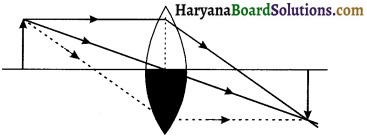
Solution :
Let the AB be the lighthouse of height of 100 m. Let D and C be position of two ships. The angle of depression of two ships are 30° and 45°
HBSE 10th Class Maths Important Questions Chapter 9 Some Applications of Trigonometry - 2
⇒ ∠DAP = 30°
⇒ ∠ADB = 30°
[Alternate interior angles]
and ∠CAP = 45°
⇒ ∠ACB = 45°
In right triangle ADB, we have
tan 30° = \(\frac {AB}{BD}\)
⇒ \(\frac{1}{\sqrt{3}}\) = \(\frac {100}{BD}\)
⇒ BD = 100\(\sqrt{3}\)
⇒ 10 × 1.732 = 173.2 m
In right triangle ACB, we have
tan 45° = \(\frac {AB}{BC}\)
⇒ 1 = \(\frac {100}{BC}\)
⇒ BC = 100 m
⇒ DC = BD – BC
173.2 – 100 = 73.2 m
Hence distance between two ships
= DC = 73.2 m

Question 3.
The angle of elevation of the top of a hill from the foot of a tower is 60° and the angle of depression from the top of the tower of the foot of the hill is 30°. If tower is 50 m high, find the height of hill.
Solution :
Let AB be the hill of height hm and CD be the tower of height 50 m.
HBSE 10th Class Maths Important Questions Chapter 9 Some Applications of Trigonometry - 3
Angle of elevation of the top of a hill from the foot of a tower is 60° i.e. ∠ACB = 60° and angle of depression from top of the tower of the foot of the hill is 30 i.e. ∠BDE = 30°.
⇒ ∠DBC = 30°
[Alternate interior angles]
In right triangle BCD, we have
tan 30° = \(\frac {CD}{BC}\)
⇒ \(\frac{1}{\sqrt{3}}\) = \(\frac {50}{BC}\)
⇒ BC = 50\(\sqrt{3}\) ……..(1)
In right triangle ABC, we have
tan 60° = \(\frac {AB}{BC}\)
⇒ \(\sqrt{3}\) = \(\frac {h}{BC}\)
⇒ h = \(\sqrt{3}\)BC ………..(2)
substituting, the value of BC in equ. (2), we get
h = \(\sqrt{3}\) × 50\(\sqrt{3}\)
= 50 × 3 = 150 m
Hence height of hill = 150 m

HBSE 10th Class Maths Important Questions Chapter 9 Some Applications of Trigonometry

Question 4.
A vertical tower stands on a horizontal plane and is sur mounted by a vertical flag staff of height 6 m. At a point on the plane, the angle of elevation of the bottom and top of the flag staff are 30° and 45° respectvely. Find the height of the tower. Take \(\sqrt{3}\) = 1.73]
Solution :
Let AB be tower of height h m and BC be vertical flag staff of height 6m. At point D on the plane angle of elevation of the bottom and top of the flag staff are 30° and 45° respectively i.e. ∠ADB = 30° and ∠ADC = 45°
In right triangle ABD, we have
HBSE 10th Class Maths Important Questions Chapter 9 Some Applications of Trigonometry - 4
⇒ h = \(\frac{6 \times(1.73+1)}{(\sqrt{3})^2-(1)^2}\)
⇒ h = \(\frac{6 \times 2.73}{3-1}\)
⇒ h = \(\frac{6 \times 2.73}{2}\)
⇒ h = 3 × 2.73
⇒ h = 8.19 m
Hence, height of the tower h = 8.19 m

Question 5.
The angle of elevation of the top of a building from the foot of the tower is 30° and the angle of elevation of the top of the tower from the foot of the building is 60°. If the tower is 48 meters high. Find the height of the building.
Solution :
Let AB be tower of the height 48 m and CD be building of height h m. Angle of elevation of the top of a building from the foot of the tower is 30° Le. ∠CBD = 30° and angle of elevation of top of the tower from the foot of the building is 60° L.E. ∠ACB = 60°,
HBSE 10th Class Maths Important Questions Chapter 9 Some Applications of Trigonometry - 5

Question 6.
An aeroplane when flying at a height of 4000 m. from the ground passes vertically above another aeroplane at an instant when the angles of the elevation of two planes from the same point on the ground are 60° and 45° repectively. Find the vertical distance between the aeroplanes at that instant.
Solution :
Let A and B be position of two aeroplanes. When A be the vertical above B and AC = 4000 m.
Let the angles of elevation of two nlanes from the point A be 60 and 45° respectively i.e. ∠ADC = 60° and ∠BDC = 45°
HBSE 10th Class Maths Important Questions Chapter 9 Some Applications of Trigonometry - 6
Hence, vertical distance between two aeroplanes = 1690.53 m.

HBSE 10th Class Maths Important Questions Chapter 9 Some Applications of Trigonometry

Question 7.
Two men on either side of the cliff 80 m high observes the angles of the elevation of the top of the cliff to be 30° and 60° respectively. Find the distance between the two men.
Solution :
Let the CD be cliff of height 80 m. Let A abd B be position of eyes of two men. The angles of elevation of eyes of two men from top of the cliff be 30° and 60° respectively i.e. ∠CAD = 30° and ∠CBD = 60°.
HBSE 10th Class Maths Important Questions Chapter 9 Some Applications of Trigonometry - 7
Hence, distance between two men = 184.80 m

Question 8.
At a point A, 20 metres above the level of water in a lake, the angle of elevation of a cloud is 30°. The angle of depression of the reflection of the cloud in lake, at A is 60°. Find the distance of cloud from A.
Solution :
Let BR be surface of lake and A be point of observation P be position of cloud and C be the position of reflection of cloud in the lake. Draw AQ ⊥ PR. Angle of elevation of cloud from point A is 30° i.e. ∠PAQ = 30° and angle of depression of reflection of cloud in the lake is 60° i.e. ∠CAQ = 60°
Let PQ be h m, then PR = (h + 20) m and
RC = PR = (h + 20) m
HBSE 10th Class Maths Important Questions Chapter 9 Some Applications of Trigonometry - 8
substituting the value of h in equ. (1), we get
AQ = \(\sqrt{3}\) × 20 = 20\(\sqrt{3}\)m
In right ΔAPQ, we have
⇒ AP2 = AQ2 + PQ2
⇒ AP2 = (20\(\sqrt{3}\))2 + (20)2
⇒ AP2 = 1200 + 400
⇒ AP2 = 1600
⇒ AP = \(\sqrt{1600}\)
⇒ AP = 40
Hence, distance of cloud from point A = 40 m.

HBSE 10th Class Maths Important Questions Chapter 9 Some Applications of Trigonometry

Question 9.
Amit standing on a horizontal plane, find a bird flying at a distance of 200m. From him at an elevation of 30°. Deepak standing on the roof of a 50m hight building, find the angle of elevation of the same bird to be 45°. Amit and Deepak are on opposite sides of the bird. Find the distance of the bird from Deepak.
Solution :
Let A and B be two positions of Amit and Deepak. Let P be position of bird. Bird flying at a distance from A 200 m i.e. AP = 200 m. Angle of elevation of P from Amit is 30° i.e. ∠PAR = 30° and Angle of elevation of P from Deepak is 45° i.e.
∠PBQ = 45°
HBSE 10th Class Maths Important Questions Chapter 9 Some Applications of Trigonometry - 9
In right ΔAPR, we have
sin 30° = \(\frac {PR}{AP}\)
⇒ \(\frac {1}{2}\) = \(\frac{P Q+Q R}{200}\)
⇒ PQ + QR = \(\frac {200}{2}\)
⇒ PQ + 20 = 100 [∴ QR = BS]
⇒ PQ = 100 – 50 = 50 m
In right ΔPBQ, we have
sin 45° = \(\frac {PQ}{PB}\)
⇒ \(\frac{1}{\sqrt{2}}\) = \(\frac {50}{PB}\)
⇒ PB = 50\(\sqrt{2}\) m
Hence, distance of the bird from Deepak is 50\(\sqrt{2}\) m.

Question 10.
A vertical tower stands on a horizontal plane and is sur mounted by a vertical flag staff of height h. At a point on the plane, the angles of elevation of the bottom and top of the flag staff are λ and β respectively. Prove that the height of the tower is \(\frac {h tan α}{tan β – tan α}\)
Solution :
Let AB be the vertical tower of height H and AD be flag staff of height h. The angle of elevation of bottom and top of flag staff are λ and β respectively i.e.
⇒ ∠ACB = α and
∠DCB = β
HBSE 10th Class Maths Important Questions Chapter 9 Some Applications of Trigonometry - 10
Hence proved.

Fill in the Blanks

Question 1.
……… is the height to which something is raised above a point of reference.
Solution :
Elevation

HBSE 10th Class Maths Important Questions Chapter 9 Some Applications of Trigonometry

Question 2.
………. is the depth to which something is lowered below point of reference.
Solution :
depression

Question 3.
Numerically the angle of elevation is… to the angle of depression.
Solution :
equal

Question 4.
The angle of elevation and angle of depression both are measured with the ………. .
Solution :
horizontal

Question 5.
If two lines are ………, then the alternate interior angles formed are equal.
Solution :
parallel

HBSE 10th Class Maths Important Questions Chapter 9 Some Applications of Trigonometry

Question 6.
Two angles having a sum of ………… are called complementary angles.
Solution :
90°

Question 7.
As the ……….. of an object increases, the angles of elevation of its top with the horizontal level also increases.
Solution :
height

Multiple Choice Questions

Choose the correct answer for each of the following:

Question 1.
A 20 m long ladder rests against a wall. If the feet of the ladder is 10 m away from the wall, then angle of the elevation is:
(a) 30°
(b) 60°
(c) 90°
(d) 45°
Solution :
HBSE 10th Class Maths Important Questions Chapter 9 Some Applications of Trigonometry - 11

HBSE 10th Class Maths Important Questions Chapter 9 Some Applications of Trigonometry

Question 2.
When the sun is 30° above the horizontal, the length of the shadow casts by a 50 m high building is :
(a) 50\(\sqrt{3}\) m
(b) 25 m
(c) 25\(\sqrt{3}\) m
(d) \(\frac{50}{\sqrt{3}}\)m
HBSE 10th Class Maths Important Questions Chapter 9 Some Applications of Trigonometry - 12
Solution :
∵ Tan 30° = \(\frac {BC}{AB}\)
⇒ \(\frac{1}{\sqrt{3}}\) = \(\frac {50}{AB}\)
⇒ Length of shadow AB = 50\(\sqrt{3}\) m
Hence correct choice is (a)

Question 3.
The angle of elevation of a tower from a distance 100 m from its foot is 30°. Height of tower is :
(a) 50\(\sqrt{3}\)
(b) 100\(\sqrt{3}\)
(c) \(\frac{100}{\sqrt{3}}\)
(d) \(\frac{50}{\sqrt{3}}\)
Solution :
In ΔABC
HBSE 10th Class Maths Important Questions Chapter 9 Some Applications of Trigonometry - 13
Hence, height of tower = \(\frac{100}{\sqrt{3}}\)m
Hence correct choice is (c).

HBSE 10th Class Maths Important Questions Chapter 9 Some Applications of Trigonometry

Question 4.
A kite is flying at a height of 30 m from the ground. The length of string from the kite to the ground is 60 m. Assuming that there is no slack in the string, the angle of elevation of the kite at the ground is :
(a) 45°
(b) 30°
(c) 60°
(d) 90°
Solution :
In ΔABC
HBSE 10th Class Maths Important Questions Chapter 9 Some Applications of Trigonometry - 16
sin θ = sin 30°
⇒ θ = 30°
Hence angle of elevation 30°
So correct choice is (b).

Question 5.
If the elevation of the Sun changed from 30° to 60°, then difference between the length of shadows of a pole of height 15 m is :
(a) 7.5 m
(b) 15 m
(c) 103 m
(d) 573 m
Solution :
In ΔBCD
HBSE 10th Class Maths Important Questions Chapter 9 Some Applications of Trigonometry - 17
⇒ x + 5\(\sqrt{3}\) = 15\(\sqrt{3}\)
⇒ x = 15\(\sqrt{3}\) – 5\(\sqrt{3}\)
⇒ x = 10\(\sqrt{3}\) m
Hence required difference x = 10\(\sqrt{3}\) m
So correct choice is (c)

HBSE 10th Class Maths Important Questions Chapter 9 Some Applications of Trigonometry

Question 6.
From a window 15 above the ground, the angle of elevation of the top of a tower is α and angle of depression of the foot of the tower is β. Then height of the tower is :
(tan α = \(\frac {5}{3}\), tan β = \(\frac {2}{3}\))
(a) 50 m
(b) 52.5 m
(c) 55 m
(d) 53.5 m
Solution :
Tan α = \(\frac {5}{3}\), Tan β = \(\frac {2}{3}\)
In ΔАВС Tan β = \(\frac{2}{3}=\frac{\mathrm{AB}}{\mathrm{BC}}=\frac{15}{\mathrm{BC}}\)
HBSE 10th Class Maths Important Questions Chapter 9 Some Applications of Trigonometry - 18
= 37.5 m
∴ Height of tower = CD + DE
= 15 + 37.5 m
= 52.5 m
So correct choice is (b).

Question 7.
A, B, C are three collinear points on the ground such that B lies between A and Cand AB = 10 m. If the angles of elevation of the top of a vertical tower at C are respectively 30° and 60° as seen from A and B, then the height of tower is :
(a) 5\(\sqrt{3}\) m
(b) 5 m
(c) \(\frac{10}{\sqrt{3}}\)
(d) \(\frac{20}{\sqrt{3}}\)
Solution :
Let CD = x, and BC = y
In ΔBCD,
HBSE 10th Class Maths Important Questions Chapter 9 Some Applications of Trigonometry - 19
So correct choice is (a).

HBSE 10th Class Maths Important Questions Chapter 9 Some Applications of Trigonometry

Question 8.
A person of height 2 m wants to get a fruit which is on a pole of height \(\frac {10}{3}\)m. If he stands at a distance of \(\frac {4}{3}\)m from the foot of the pole, then the angle at which he should throw the stone, so that it hits the fruits, is :
(a) 15°
(b) 30°
(c) 45°
(d) 60°
Solution :
From the figure
HBSE 10th Class Maths Important Questions Chapter 9 Some Applications of Trigonometry - 20
= Tan 45°
∴ θ = 45°
So correct choice is (c)

HBSE 10th Class Maths Important Questions Chapter 9 Some Applications of Trigonometry Read More »

HBSE 10th Class Science Solutions Chapter 9 Heredity and Evolution

Haryana State Board HBSE 10th Class Science Solutions Chapter 9 Heredity and Evolution Textbook Exercise Questions and Answers.

Haryana Board 10th Class Science Solutions Chapter 9 Heredity and Evolution

HBSE 10th Class Science Heredity and Evolution Textbook Questions and Answers

Question 1.
A Mendelian experiment consisted of breeding tall pea plants bearing violet flowers with short pea plants bearing white flowers. The progeny all bore violet flowers, but almost half of them were short. This suggests that the genetic make-up of the tall parent can be depicted as …………………
(a) TTWW
(b) TTww
(c) TtWW
(d) TtWw
Answer:
(c) TtWW

HBSE 10th Class Science Solutions Chapter 9 Heredity and Evolution

Question 2.
An example of homologous organs is ……………………
(a) our arm and a dog’s fore-leg.
(b) our teeth and an elephant’s tusks.
(c) potato and runners of grass.
(d) all of the above
Answer:
(d) all of the above

Question 3.
In evolutionary terms, we have more in common with ………………
(a) a Chinese school-boy
(b) a chimpanzee
(c) a spider
(d) a bacterium!
Answer:
(a) a Chinese school-boy.

HBSE 10th Class Science Solutions Chapter 9 Heredity and Evolution

Question 4.
A study found that children with light-coloured eyes are likely to have parents with light – coloured eyes. On this basis, can we say anything about whether the light eye colour trait is dominant or recessive? Why or why not?
Answer:

Reason:
1. No, the given information is not enough to consider the dominance or recessiveness of eye colour.

2. However, we can observe that generally in a population, the proportion of the people having light coloured eyes is much less than the people having dark coloured eyes. Based on this observation, we may consider that the light coloured eyes are a recessive trait and dark coloured eyes may be dominant.

Question 5.
How are the areas of study – evolution and classification – interlinked?
Answer:
1. In classification, the groups of organisms are based on the similarities and differences of characteristics of the organisms.

2. The organisms that have more similarities belong to nearer groups while the organisms having lesser similarities i.e. having more differences belong to distant groups.

3. In evolution, a study of identifying hierarchies of characteristics between the species is done. So, in such studies small groups of species with recent common ancestors are formed. Thus, the areas of study – evolution and classification are interlinked.

Question 6.
Explain the terms analogous and homologous organs with examples.
Answer:

Homologous organs

Analogous organs

1. These organs have similar internal structure.
2. These organs perform different functions.
3. These organs have evolved from a common ancestor.
4. For example, forelimbs of a frog, lizard, a bird, bat and a man are homologous
1. These organs have different basic design.
2. These organs perform similar functions.
3. These organs have not evolved from a common ancestor.
4. Wings of insects and birds are examples of analogous organs.

HBSE 10th Class Science Solutions Chapter 9 Heredity and Evolution

Question 7.
Outline a project which aims to find the dominant coat colour in dogs.
Answer:
1. In dogs, the coat colour is either black or white. The character of black coloured coat is indicated by ‘B’ and white coloured coat is indicated by ‘b’.

2. First of all the homozygous/pure parents with opposite characters are fertilized. Thus, applying Mendelian’s law, in the above case, the black coloured coat is a dominant character. So, black coat is dominant trait in dog.
HBSE 10th Class Science Solutions Chapter 9 Heredity and Evolution 1

Question 8.
Explain the importance of fossils in deciding evolutionary relationships.
Answer:
1. The remains of dead organisms buried under the earth for millions of years are known as fossils.
2. Fossils are impressions of dead plants or animals that lived in the past.
3. When plants or animals die, the micro-organisms get decomposed in the presence of moisture and oxygen.
4. However, sometimes due to environmental conditions, their bodies do not decompose completely.
5. Such body parts of the plants and animals become fossil and can be available on digging the earth.
6. Fossils can be in the form of imprints, burrow of a worm, or even an actual bone.

Example:

  • If the dead leaf gets caught in the mud, leaf will not decompose completely.
  • The mud around the leaf will set around it as a mould which will then slowly become hard to form a rock and retain the impression of the leaf. Thus fossil of a leaf is formed.
  • By studying these fossils, scientists learn how organisms evolved over time.

HBSE 10th Class Science Solutions Chapter 9 Heredity and Evolution

Question 9.
What evidence do we have for the origin of life from inanimate matter?
Answer:
1. It is believed that life must have developed from simple inorganic molecules which were present on earth soon after it was formed.
2. It was also speculated that the conditions on earth at that time could have given rise to more complex organic molecules that were necessary for life.
3. It is believed that the first primitive organisms would have arisen from further chemical synthesis.

Question 10.
Explain how sexual reproduction gives rise to more viable variations than asexual reproduction. How does this affect the evolution of those organisms that reproduce sexually?
Answer:
(1) First, in sexual reproduction, there occurs a combination of genetic material of two different parents i.e. a male and a female. Hence, each new generation is a combination of two different parental DNAs.

(2) Second, during the formation of gametes i.e. formation of sperms and ovum, the cell undergoes cell division phase called meiosis.

  • During meiosis, the genetic material gets distributed randomly. Moreover, all the gametes are not always similar and so there are more chances of variation during fertilization, in other words, there are so many sperm cells but only one fertilizes with the ovum. Naturally, this will create variation.
  • Owing to these two reasons, there occur more variations in sexual reproduction as compared to asexual.
  • The combination of different types of gametes which takes place is the root of variations. This also gives rise to new type of characters too. This also favours evolution.

Question 11.
How is the equal genetic contribution of male and female parents ensured in the progeny?
Answer:
1. During gametogenesis (production of male and female sex cells), the meiosis type of cells division occurs.
2. During, meiosis the number of chromosomes becomes half. The DNA gets distributed to half in each gamete.
3. During fertilization, both the types of sex cells get fused and the quantity of DNA remains maintained. Thus, equal genetic contribution of male and female parents is ensured in the progeny.

HBSE 10th Class Science Solutions Chapter 9 Heredity and Evolution

Question 12.
Only variations that confer an advantage to an individual organism will survive in a population. Do you agree with this statement? Why or why not?
Answer:
Yes, this is true.

Reason:

  • If the variation achieved by an organism is helpful to adapt to the surrounding environment then it increases the probability of the survival of that organism.
  • The survived organisms then produces more offspring with such genetic variations and thus the species survives.

HBSE 10th Class Science Heredity and Evolution InText Activity Questions and Answers

Textbook Page no – 143

Question 1.
If a trait A exists in 10% of a population of an asexually reproducing species and a trait B exists in 60% of the same population, which trait is likely to have arisen earlier?
Answer:
Trait B which exists in 60% of population of an asexually reproducing species must have arisen earlier than trait A.

Reason:

  • In asexually reproducing species, DNA copy error takes place, in very small amount and so new traits do not occur very fast.
  • Since, the percentage of trait B is very large as compared to trait A. This suggests that trait B must have arisen quite before to trait A.

Question 2.
How does the creation of variations in a species promote survival?
Answer:
1. Variations in a species are created through two reasons,

  • Due to inaccuracies in DNA copying or
  • During sexual reproduction.

2. Different individuals gain different types of advantages with these variations. Several variations enable the individual to adapt to the environmental conditions. This increases the chances of their survival.

HBSE 10th Class Science Solutions Chapter 9 Heredity and Evolution

3. The individuals that survive then reproduce offspring and the existence of species remains continued.

Textbook Page no – 147

Question 1.
How do Mendel’s experiments show that traits may be dominant or recessive?
Answer:
1. Mendel conducted cross fertilization between pure tall plants (TT) and pure short (tt) plant. This resulted in all (Tt) plants in F1 generation.

2. This shows that single copy of T is enough to make the plant tall. The trait that gets expressed over the other is called the dominant trait and the other recessive.

3. In Mendel’s trial, the trait which gets expressed in 75% individuals in F2 generation after self-fertilization is dominant whereas the trait which appears in 25% individual is recessive.

Question 2.
How do Mendel’s experiments show that traits are inherited independently?
Answer:
1. Mendel performed the experiments of heredity on pea plant. He studied the heredity of two characters simultaneously and performed the dihybrid experiment.

2. On the basis of this experiment we can say that even though the F1 progeny plants were dominant in both the characters, the F2 progeny showed the new combinations. In F2 progeny plants some were tall and wrinkled, while some were short and round.

3. The experiment clearly shows that the factors that control the shape, size and height of the seeds are inherited independently and that is the main reason why new combinations could be seen in F2 generation.

HBSE 10th Class Science Solutions Chapter 9 Heredity and Evolution

Question 3.
A man with blood group A marries a woman with blood group O and their daughter has blood group O. Is this information enough to tell you which of the traits – blood group A or O – is dominant? Why or why not?
Answer:
No, the given information is not enough to determine which trait is dominant.

Reason:

  • The daughter (or any child) receives two copies of genes, one from each parent.
  • The trait of blood group depends on the genotype i.e. the types of genes which get combined. Hence, the provided information is insufficient and so we cannot tell which one is a dominant blood group.

Question 4.
How is the sex of the child determined in human beings?
Answer:
1. In human beings, sex of the child to be born is determined by the sex chromosome of the father.

2. The father or say male contains XY chromosomes and so during spermatogenesis, the male produces two types of sperms. 50% of these sperms have ‘X’ sex chromosome and 50% sperms have ‘Y’ sex chromosome.

3. If the sperm having ‘X’ chromosome fertilizes the ovum, a female child (= a girl) is born and if the sperm having ‘Y’ chromosome fertilizes the ovum, the male child (= a boy) is born.

Textbook Page no – 150

Question 1.
What are the different ways in which individuals with a particular trait may increase in a population?
Answer:
A particular trait may increase in a population through two main ways. They are –

  • Natural selection – It directs evolution with a survival advantage.
  • Genetic drift – It leads to accumulation of different changes.

HBSE 10th Class Science Solutions Chapter 9 Heredity and Evolution

Question 2.
Why are traits acquired during the life-time of an individual not inherited?
Answer:
Change in non-reproductive tissues cannot be passed on to the DNA of the germ cells. Hence the experiences of an individual during its lifetime can neither be passed on to its progeny nor can such experiences result in evolution.

Example:

  • If we breed a group of mice, all their progeny will have tails.
  • Suppose we remove the tails of each generation of these mice by surgery then it does not mean that the progeny is tailless.
  • Artificially removing the tail does not bring any change in the genes of the germ cells of the mice.
  • So, the cut-tail that a generation of mice experienced cannot become a trait to be passed on to the next generation.

Question 3.
Why are the small numbers of surviving tigers a cause of worry from the point of view of genetics?
Answer:
1. A small population generally does not show much variation from generation to generation.
2. A very small population of surviving tigers indicates that very less amount of variation will occur in the genetic characteristics. This means they will not be able to adapt to the major environmental changes if any, in the future.
3. The tigers will not survive and the species will become extinct.

HBSE 10th Class Science Solutions Chapter 9 Heredity and Evolution

Textbook Page no – 151

Question 1.
What factors could lead to the rise of a new species?
Answer:
Factors that can lead to the rise of a new species are:

  • Accumulated variations favourable to natural environment,
  • Geographic isolation of a population,
  • Gene flow,
  • Genetic drift and
  • Natural selection

Question 2.
Will geographical isolation be a major factor in the speciation of a self-pollinating plant species? Why or why not?
Answer:
No, geographical isolation will not be a major factor in the speciation of a self-pollinating plant species.

Reason:

  • Only a single parent is involved in self-pollination. So, there is no gene flow between two geographically isolated populations.
  • If it would be a cross-pollination species, the geographical isolation would be a major factor as it would lead to faster accumulation of variation (genetic drift) in the two geographically separated populations.

Question 3.
Will geographical isolation be a major factor in the speciation of an organism that reproduces asexually? Why or why not?
Answer:
No, geographical isolation will not be a major factor to the speciation that reproduces asexually.

HBSE 10th Class Science Solutions Chapter 9 Heredity and Evolution

Reason:
Asexually reproducing organisms show very little variation over generations. These little variations are not sufficient enough to raise a new species having such variations.

Textbook Page no – 156

Question 1.
Give an example of characteristics being used to determine how close two species are in evolutionary terms.
Answer:
1. One of the ways to determine how close two species are with respect to evolution is to obtain evidence from their homologous organs.

2. For example, the basic design of internal structure of bones of forelimbs of a frog, lizard, bird, bat and man is same, even though these organs perform different functions.

3. This indicates that all these forelimbs have evolved from a common ancestral animal, which had a same basic internal structure.

Question 2.
Can the wing of a butterfly and the wing of a bat be considered homologous organs? Why or why not?
Answer:
No, the wings of a butterfly and the wings of a bat cannot be considered homologous organs.

Reason:
Although the wings of a butterfly and the wings of a bat perform similar function, but the design, structure and components of their wings are very different. Hence, the wings of these two can be considered as analogous organs and not homologous.

Question 3.
What are fossils? What do they tell us about the process of evolution?
Answer:
1. The remains of dead organisms buried under the earth for millions of years are known as fossils.
2. Fossils are impressions of dead plants or animals that lived in the past.
3. When plants or animals die, the micro-organisms get decomposed in the presence of moisture and oxygen.
4. However, sometimes due to environmental conditions, their bodies do not decompose completely.
5. Such body parts of the plants and animals become fossil and can be available on digging the earth.
6. Fossils can be in the form of imprints, burrow of a worm, or even an actual bone.

Example:

  • If the dead leaf gets caught in the mud, leaf will not decompose completely.
  • The mud around the leaf will set around it as a mould which will then slowly become hard to form a rock and retain the impression of the leaf. Thus fossil of a leaf is formed.
  • By studying these fossils, scientists learn how organisms evolved over time.

Textbook Page no – 156

Question 1.
Why are human beings who look so different from each other in terms of size, colour and looks said to belong to the same species?
Answer:
1. Across the earth, there is a great diversity in humans and so we look so different from each other in terms of size, colour and looks.

2. Initially, human race was identified on the basis of skin colour and the humans were known as yellow, black, white or brown. However, in the recent years, it has been proved that all the human beings have evolved from a single species called the Homo sapiens.

3. Hence, in spite of having different skin colour, looks and size, we all belong to the same species.

HBSE 10th Class Science Solutions Chapter 9 Heredity and Evolution

Question 2.
In evolutionary terms, can we say which among bacteria, spiders, fish and chimpanzees have a ‘better’ body design? Why or why not?
Answer:
1. In evolutionary terms, we can say that chimpanzees have a better developed body design.
2. The reason for this is that chimpanzees are highly complex organisms compared to remaining three.

Activities:

Activity -1

Aim: To study inheritance in the type of earlobes.

Background:

  • The lowest part of the ear pinna (external ear) is known as an earlobe.
  • The earlobe may be either closely attached to the (lateral) side of the head, or not-attached i.e. might be free.

HBSE 10th Class Science Solutions Chapter 9 Heredity and Evolution 2

Procedure:

  • Observe the ears of all the students in the class. Prepare a list of students having free or attached earlobes and
  • Find out about the earlobes of the parents of each student in the class. Correlate the earlobe type of each student with that of their parents. Based on this evidence, suggest a possible rule for the inheritance of earlobe types.
  • Students can observe the earlobes of other students. They can also ask about the type of earlobes of their parents.
  • Make a chart as given below. Write 1F’ for the free earlobes and A’ for the attached earlobes.

HBSE 10th Class Science Solutions Chapter 9 Heredity and Evolution 3

Observation:
We can observe that more number of students have inherited the trait of ‘free earlobes’ i.e. trait F as compared to attached earlobes i.e. A.

HBSE 10th Class Science Solutions Chapter 9 Heredity and Evolution

Conclusion:
From studies it has been proved that free earlobe is a dominant trait whereas an attached earlobe is a recessive trait.

Activity 2.

In Fig. 9.3 of textbook, what experiment would we do to confirm that the F2 generation did in fact have a 1:2:1 ratio of TT, it and tt trait combinations?

Observation:
Although the experiment phenotypically shows the ratio of 3 : 1 ratio between tall and dwarf, genetically the ratio is 1 : 2 : 1.
This can be proved by the following experiment. We can raise F3 generation by allowing self-pollination of F3 generation plants.

Then we may calculate ratio for —

  • Tall plants which produced only tall plants. These plants will be pure dominant (TT).
  • Tall plants which produced both tall and dwarf pea plants. These plants are hybrid (Tt).
  • Dwarf plants produced only dwarf plants. This means they are pure recessive (tt).

Observing the data carefully, one can find the appearance of 1 : 2 : 1 ratio of TT Tt and tt trait combination in F3 generation (also known as genotypic ratio).

HBSE 10th Class Science Solutions Chapter 9 Heredity and Evolution Read More »

HBSE 10th Class Science Solutions Chapter 10 Light Reflection and Refraction

Haryana State Board HBSE 10th Class Science Solutions Chapter 10 Light Reflection and Refraction Textbook Exercise Questions and Answers.

Haryana Board 10th Class Science Solutions Chapter 10 Light Reflection and Refraction

HBSE 10th Class Science Light Reflection and Refraction Textbook Questions and Answers

Question 1.
Which one of the following materials cannot be used to make a lens?
(a) Water
(b) Glass
(c) Plastic
(d) Clay
Answer:
(d) Clay

HBSE 10th Class Science Solutions Chapter 10 Light Reflection and Refraction

Question 2.
The Image formed by a concave mirror is observed to be virtual, erect and larger than the object. Where should be the position of the object?
(a) Between the principal focus and the centre of curvature
(b) At the centre of curvature
(c) Beyond the centre of curvature
(d) Between the pole of the mirror and its principal focus.
Answer:
(d) Between the pole of the mirror and its principal focus.

Question 3.
Where should an object be placed in front of a convex lens to get a real image of the size of the object?
(a) At the principal focus of the lens
(b) At twice the focal length
(c) At Infinity
(d) Between the optical centre of the lens and its principal focus.
Answer:
(b) At twice the focal length

Question 4.
A spherical mirror and a thin spherical lens have each a focal length of -15 cm. The mirror and the lens are likely to be …….
(a) both concave
(b) both convex
(c) the mirror Is concave and the lens is convex
(d) the mirror is convex, but the lens is concave
Answer:
(a) both concave

HBSE 10th Class Science Solutions Chapter 10 Light Reflection and Refraction

Question 5.
No matter how far you stand from a mirror, your image appears erect. The mirror is likely to be …………
(a) plane
(b) concave
(c) convex
(d) either plane or convex
Answer:
(d) either plane or convex

Question 6.
Which of the following lenses would you prefer to use while reading small letters found in a dictionary?
(a) A convex lens of focal length 50 cm
(b) A concave lens of focal length 50 cm
(c) A convex lens of focal length 5 cm
(d) A concave lens of focal length 5 cm
Answer:
(c) A convex lens of focal length 5 cm

Question 7.
We wish to obtain an erect image of an object, using a concave mirror of focal length 15 cm. What should be the range of distance of the object from the mirror? What is the nature of the image? Is the image larger or smaller than the object? Draw a ray diagram to show the image formation in this case.
Answer:
1. When the object is placed between the pole and the principal focus of the concave mirror, we get an erect, virtual and enlarged image.
2. We are given that the focal length of concave mirror = 15 cm
3. So, the object should be placed in front of the concave mirror at a distance less than 15 cm.

Question 8.
Name the type of mirror used in the following situations.
(a) Headlights of a car
(b) Side/rear-view mirror of a vehicle
(c) Solar furnace
Support your answer with reason.
Answer:
(a) Concave mirrors are used as reflectors in headlights of cars. When a bulb is located at the focus of the concave mirror, the light rays after reflection from the mirror travel over a large distance as a parallel beam of high intensity.

(b) A convex mirror is used as a side/rear-view mirror of a vehicle because of the following reasons:

  • A convex mirror always forms an erect, virtual and diminished image of an object placed anywhere in front of it.
  • A convex mirror has a wider field of view than a plane mirror of the same size.

(c) Large concave mirrors are used to concentrate sunlight to produce heat in solar furnaces. Concave mirrors are able to raise the temperature drastically.

HBSE 10th Class Science Solutions Chapter 10 Light Reflection and Refraction

Question 9.
One-half of a convex lens is covered with a black paper. Will this lens produce a complete image of the object? Verify your answer experimentally. Explain your observations.
Answer:
As shown in figure, when the lower half of the convex lens is covered with a black paper, it still forms the complete image of the object, but the intensity of the image is reduced.
HBSE 10th Class Science Solutions Chapter 10 Light Reflection and Refraction 1
The rays coming from the object get refracted by the upper half of the lens and meet at the other side of the lens to form the image.

Question 10.
An object 5 cm in length is held 25 cm away from a converging lens of focal length 10 cm. Draw the ray diagram and find the position, size and the nature of the Image formed.
Answer:
The final position, nature and size of the image A’B’ are:
Here, Object size h = +5 cm
Object distance u = – 25 cm
Focal length of lens f = + 10 cm
( ∵ Converging, i.e., Convex lens)
Image distance y =?
Image height h’ =?
HBSE 10th Class Science Solutions Chapter 10 Light Reflection and Refraction 2

HBSE 10th Class Science Solutions Chapter 10 Light Reflection and Refraction 3

Image distance y is positive. This shows that the image formed is real and on the other side of the lens, at 16.67 cm from the lens as shown in the figure. AB : Object, A’B’: Image
Now, Magnification m = \(\frac{h^{\prime}}{h}=\frac{v}{u}\)
HBSE 10th Class Science Solutions Chapter 10 Light Reflection and Refraction 4
The negative (minus) sign shows that the image is inverted, real, diminished (3.3 cm). Figure 10.60 show the positive, size and nature of the image formed.

HBSE 10th Class Science Solutions Chapter 10 Light Reflection and Refraction

Question 11.
A concave lens of focal length 15 cm forms an Image 10 cm from the lens. How far is the object placed from the lens? Draw the ray diagram.
Answer:
Scale: 1 cm = 5 cm
Focal length, f = – 15 cm [f is – ve for a concave lens]
Image distance, v = – 10 cm
[Concave lens forms virtual image on same side as the object, so v is – ve]
HBSE 10th Class Science Solutions Chapter 10 Light Reflection and Refraction 5

Object distance, u = – 30 cm.
The negative sign shows that the object is placed on the left side of the lens.
HBSE 10th Class Science Solutions Chapter 10 Light Reflection and Refraction 6

Question 12.
An object Is placed at a distance of 10 cm from a convex mirror of focal length 15 cm. Find the position and nature of the image.
Answer:
Object distance, u = – 10 cm
Focal length, f = + 15 cm [f is +ve for a convex mirror]
HBSE 10th Class Science Solutions Chapter 10 Light Reflection and Refraction 7

Image distance, v = + 6 cm.
As v is +ve, so a virtual, erect image is formed at a distance 6 cm behind the mirror.

Question 13.
The magnification produced by a plane mirror is +1. What does this mean?
Answer:
Magnification of a mirror \(m=\frac{h^{\prime}}{h}=\frac{-v}{u}\)
Here, for a plane mirror, m = + 1, So, h’ = h and y = – u

  • m = 1 indicates that both ¡mage and object are of same size.
  • Positive sign of m indicates that a virtual image is formed behind the mirror.

HBSE 10th Class Science Solutions Chapter 10 Light Reflection and Refraction

Question 14.
An object 5.0 cm in length is placed at a distance of 20 cm in front of a convex mirror of radius of curvature 30 cm. Find the position of the image, its nature and size.
Answer:
Object size, h = + 5cm
Object distance, u = – 20 cm
Radius of curvature, R = + 3.0 cm [R is +ve for a convex mirror]
Focal length, \(f=\frac{R}{2}\) = + 15 cm
From mirror formula,
HBSE 10th Class Science Solutions Chapter 10 Light Reflection and Refraction 14

HBSE 10th Class Science Solutions Chapter 10 Light Reflection and Refraction 15
A virtual, erect image of height 2.2 cm is formed behind the mirror at a distance of 8.6 cm from the mirror.

Question 15.
An object of size 7.0 cm Is placed at 27 cm in front of a concave mirror of focal length 18 cm. At what distance from the mirror should a screen be placed, so that a sharply focused image can be obtained? Find the size and the nature of the Image.
Answer:
Object size, h = + 7.0 cm
Focal length, t = – 18 cm
Image size, h’ = ?
HBSE 10th Class Science Solutions Chapter 10 Light Reflection and Refraction 10
Object distance, u = – 27 cm
image distance,v = ?
The screen should be placed at a distance of 54 cm on the object side of the mirror to obtain sharp image.
HBSE 10th Class Science Solutions Chapter 10 Light Reflection and Refraction 11
The image is real, inverted and enlarged in size.

HBSE 10th Class Science Solutions Chapter 10 Light Reflection and Refraction

Question 16.
Find the focal length of a lens of power – 2.0 D. What type of lens is this?
Answer:
Here, P = – 2.0 D f =\(\frac{1}{P}=\frac{1}{-2.0 D}\) = – 0.5 m.
Since the power of lens is negative, the lens is concave.

Question 17.
A doctor has prescribed a corrective lens of power +1.5 D. Find the focal length of the lens. Is the prescribed lens diverging or converging?
Answer:
Here P = +1.5D
\(f=\frac{1}{P}=\frac{1}{+1.5 D}=+\frac{10}{15} m\) = + 66.67cm.

  • As the focal length is positive, the prescribed lens is converging.
  • Opposite side at F, real and inverted, highly diminished (point sized)

HBSE 10th Class Science Light Reflection and Refraction InText Activity Questions and Answers

Textbook Page no – 168

Question 1.
Define the principal focus of a concave mirror.
Answer:
The point (F) on the principle axis where the beam of light parallel to the principle axis either actually converges to or diverges from, after reflection from a mirror is called the principle focus (F).

Question 2.
The radius of curvature of a spherical mirror is 20 cm. What is its focal length?
Answer:
R = 20cm.
Focal length (f) = \(\frac{\mathrm{R}}{2}=\frac{20}{2}\) = 10 cm

Question 3.
Name a mirror that can give an erect and enlarged image of an object.
Answer:
Concave mirror

HBSE 10th Class Science Solutions Chapter 10 Light Reflection and Refraction

Question 4.
Why do we prefer a convex mirror as a rear-view mirror in vehicles?
Answer:
A convex mirror is preferred as a rear-view mirror because —

  • Convex mirror always forms a virtual, erect and a diminished (point-like) image of an object placed anywhere in front of it. This means the driver can see the image of person even at a very distant position.
  • Convex mirror has a wider field of view. So it covers a large rear distance. This helps the driver as he can see more.

Textbook Page no – 171

Question 1.
Find the focal length of a convex mirror whose radius of curvature is 32 cm.
Answer:
The radius of curvature and focal length of a convex mirror are positive.
∴ R = + 32cm and f = \(\frac{\mathrm{R}}{2}\) = + 16cm

Question 2.
A concave mirror produces three times magnified (enlarged) real Image of an object placed at 10 cm in front of It. Where is the image located?
Answer:
As the image is real, so magnification m must be negative.
\(m=\frac{h^{\prime}}{h}=-\frac{v}{u}=-3\)
∴ v = 3 x (-10) = – 30 cm.
Thus the image is real and it is located at a distance of 30 cm from the mirror in the front of mirror.

Textbook Page no – 176

Question 1.
A ray of light travelling in air enters obliquely into water. Does the light ray bend towards the normal or away from the normal? Why?
Answer:
1. Light travels faster in rarer medium air and slower in denser medium water.
2. Since the ray of light travelling in air enters obliquely into water, it slows down and bends towards the normal.

Question 2.
Light enters from air to glass having refractive Index 1.50. What is the speed of light in the glass? The speed of light in vacuum is 3 x 10⁸ mr1.
Answer:
1. Refractive index of glass, ng = 1.50
Speed of light in vacuum, c = 3 x 10⁸ ms-1

2. Absolute refractive index of glass, ng = ((c/v))
∴ Speed of light in glass \(v=\frac{c}{n_g}=\frac{3 \times 10^8 \mathrm{~m} / \mathrm{s}}{1.5}=2 \times 10^8 \mathrm{~ms}^{-1}\)

HBSE 10th Class Science Solutions Chapter 10 Light Reflection and Refraction

Question 3.
Find out, from table 10.3 of the text book, the medium having highest optical density. Also find the medium with lowest optical density.
Answer:
1. From table 10.3, diamond has highest refractive index (= 2.42), so it has largest optical density.
2. Air has lowest refractive index (= 1.0003), so it has lowest optical density.

Question 4.
You are given kerosene, turpentine and water. In which of these does the light travel fastest? Use the information given In table 10.3 of the text book.
Answer:
For kerosene, n = 1. 44,   For turpentine oil, n = 1. 47,   For water, n = 1. 33
As water has lowest refractive index, so light travels fastest in this optically rarer medium compared to kerosene and turpentine oil.

Question 5.
The refractive index of diamond is 2.42. What is the meaning of this statement?
Answer:
It indicates that the ratio of speed of light in air to that in diamond is 2.42.

Textbook Page no – 184.

Question 1.
Define 1 dioptre of power of a lens.
Answer:
1 dioptre (1 D) is the power of a lens whose focal length is 1 meter.

Question 2.
A convex lens forms a real and inverted image of a needle at a distance of 50 cm from it. Where is the needle placed ¡n front of the convex lens if the image is equal to the size of the object? Also, find the power of the lens.
Answer:
1. Here, image distance y = + 50 cm (∴ y is positive for real images)
2. As mentioned, the real image is of the same size as the object.

HBSE 10th Class Science Solutions Chapter 10 Light Reflection and Refraction 16
Thus, object (needle) is placed at 50 cm from the lens.

Power of lens:
HBSE 10th Class Science Solutions Chapter 10 Light Reflection and Refraction 17
∴ Focal length (f) = 25 cm = 0.25 m
Now, \(P=\frac{1}{f}=\frac{1}{+25}=+4 D\)
Thus, power of lens = + 4D

Question 3.
Find the power of a concave lens of focal length 2 m.
Answer:
Since the focal length of a concave lens is negative; f = – 2m.
Power \(P=\frac{1}{f}=\frac{1}{-2 m}=-0.5 \mathrm{D}\)

HBSE 10th Class Science Solutions Chapter 10 Light Reflection and Refraction

Activities

Activity 1.

Aim: To study the formation of images by both sides of a large shining spoon.

Apparatus required: A large shining spoon.

Procedure:

  • Take a large shining spoon. Try to view face in its curved surface.
  • Do you get the image? Is it smaller or larger?
  • Move the spoon slowly away from your face. Observe the Image. How does it change?
  • Reverse the spoon and repeat the activity. How does the image look like now?
  • Compare the characteristics of the image on the two surfaces.

Observation and Conclusion:

  • Initially, we can see our tace inside the curved portion of the spoon. The image of our face looks erect and enlarged. As we move the spoon at a farther distance, the image goes on becoming smaller and then gets inverted. The inner portion of the spoon behaves as a concave mirror.
  • When we see the spoon from outer surface, it behaves as a convex mirror. The image formed is erect and small Irrespective of the distance of face from the spoon.

Activity 2.

Aim: To find the approximate focal length of a concave mirror.

Apparatus required: Concave mirror, a sheet of paper and meter scale

Caution: Do not look at the sun directly or even Into a mirror reflecting sunlight. It may damage your eyes.

HBSE 10th Class Science Solutions Chapter 10 Light Reflection and Refraction 18

Procedure:

  • Hold a concave mirror in your hand and direct its reflecting surface towards the sun.
  • Direct the light reflected by the mirror onto a sheet of paper held close to the mirror.
  • Move the sheet of paper back and forth gradually unto you find on the paper sheet a bright, sharp spot of light

Question 1.
Hold the mirror and the paper in the same position for a few minutes. What do you observe? Why?
Answer:
Observation
Initially, the paper turns blackish and emits smoke while burning slowly. The paper then catches fire.

Conclusion:

  • The point at which the sun-rays get converged to produce tire is the principal focus (F) of the concave mirror.
  • The distance of this image of sun at point F gives the approximate value of focal length (t) of the concave mirror.

HBSE 10th Class Science Solutions Chapter 10 Light Reflection and Refraction

Activity 3.

Aim: To locate the image formed by a concave mirror for different positions of the object.

Procedure:
1. Take a concave mirror. Find out its approximate focal length. Let f = 10 cm.

2. Mark a line on a table with a chalk. Place the concave mirror on a stand. Place the stand over the line such that its pole lies over the line.

3. Draw with a chalk two more lines parallel to the previous line such that the distance between any two successive lines is equal to the focal length of the mirror. These lines will correspond to the position of the points P, F and C, respectively.

4. Keep a bright object, say a burning candle, at a position far beyond C. Place a paper screen and move it in front of the
mirror till you obtain a sharp bright image of the candle flame on it.

5. Observe the image carefully. Note down its nature, position arid relative size with respect to the object size.

6. Repeat the experiment by placing the candle —
(a) just beyond C, (b) at C, (C) between F and C, (d) at F, and (e) between P and F

7. In one of the cases, you may not get the image on the screen. Identify the position of the object in such a case. Then, look for its virtual image in the mirror itself.

8. Note down and tabulate your observations.

Observation:
Table 1. Nature, size and position of Images formed by a concave mirror for different positions of the object

HBSE 10th Class Science Solutions Chapter 10 Light Reflection and Refraction 19

Activity 4.

Students should do this activity on their own. Make use of activity 3 for drawing the diagrams.

Activity 5.

Aim: To locate the image formed by a convex mirror for different positions of the object.

Take a convex mirror. Hold it in one hand. Hold a pencil in the upright position in the other hand.

HBSE 10th Class Science Solutions Chapter 10 Light Reflection and Refraction 20

Question 1.
Observe the image of the pencil in the mirror. Is the image erect or inverted? Is it diminished or enlarged?
Answer:
The image is erect, diminished and virtual.

Question 2.
Move the pencil away from the mirror slowly. Does the image become smaller or larger?
Answer:
The image formed is smaller and erect.

Question 3.
Repeat this activity carefully. State whether the image will move closer to or farther away from the focus as the object is moved away from the mirror?
Answer:
As the object is moved away from the mirror, the image moves closer to the focus of the mirror.

HBSE 10th Class Science Solutions Chapter 10 Light Reflection and Refraction

Observation:
HBSE 10th Class Science Solutions Chapter 10 Light Reflection and Refraction 21

Activity 6.

Aim: To demonstrate that convex mirror has a wide field of view.

Question 1.
Observe the Image of a distant object, say a distant tree, in a plane mirror. Could you see a full-length Image?
Answer:
No, we cannot see the full-length image of the object in plane mirror.

Question 2.
Try with plane mirrors of different sizes. Did you see the entire object In the Image?
Answer:
When we try with plane mirrors of different sizes, we find that the entire object in the image is seen only when the size of the plane mirror is at least half the size of the object.

Question 3.
Repeat this activity with a concave mirror. Did the mirror show full length Image of the object?
Answer:
The full length image is not formed even in concave mirror.

Question 4.
Now try using a convex mirror. Did you succeed? Explain your observations with reason.
Answer:
A full length image of the object is obtained in a small convex mirror.

Reasons for these observations:

  • In a plane mirror, size of image is always equal to the size of the object.
  • In case of a concave mirror, when the object is between P and F only then we get an enlarged, virtual
    and erect image behind the mirror. But here, since the object is far away, its full length image cannot be seen.
  • In a convex mirror, the image is always virtual, erect and smaller than the object.

Activity 7.

Aim: To demonstrate refraction of light.

1. Place a coin at the bottom of a bucket filled with water.
2. With your eye to a side above water, try to pick up the coin in one go. Did you succeed in picking up the coin?
3. Repeat the activity. Why did you not succeed in doing in one go?
4. Ask your friends to do this. Compare your experience with theirs.

HBSE 10th Class Science Solutions Chapter 10 Light Reflection and Refraction 23

Observation and conclusion:

  • Due to refraction of light from water, the coin appears to be slightly above its actual position.
  • This visual illusion makes it difficult to identify exact position of the coin and pick it. However, after trying a while we can pick it up.

Activity 8.

1. Place a large shallow bowl on a table and put a coin in it.
2. Move away slowly from the bowl. Stop when the coin just disappears from your sight.
3. Ask a friend to pour water gently into the bowl without disturbing the coin.
4. Keep looking for the coin from your position. Does the coin becomes visible again from your position? How could this happen?

Observation and Conclusion: On pouring water into the bowl, the coin becomes visible again. Moreover, due to refraction of light, the coin appears slightly raised above its actual position. This happens due to refraction of light.

HBSE 10th Class Science Solutions Chapter 10 Light Reflection and Refraction

Activity 9.

1. Draw a thick straight line in ink, over a sheet of white paper placed on a table.
2. Place a glass slab over the line in such a way that one of its edges makes an angle with the line.

Question 1.
Look at the portion of the line under the slab from the sides. What do you observe? Does the line under the glass slab appear to be bent at the edges?
Answer:
We see the line first in the air medium and then in the glass. So, the line under the glass slab appears bent at the edges-due to refraction.

Question 2.
Next, place the glass slab such that it ¡s normal to the line. What do you observe now? Does the part of the line under the glass slab appear bent?
Answer:
Now, the line does not appear bent. The reason for this is that the light rays incident normally at the glass and air do not undergo refraction.

Question 3.
Look at the line from the top of the glass slab. Does the part of the line, beneath the slab, appear to be raised? Why does this happen?
Answer:
Yes, part of the line under the glass slab appears to be raised. This is due to the refraction of light rays when they travel from glass to air.

Activity 10.

1. Fix a sheet of white paper on a drawing board using drawing pins.
2. Place a rectangular glåss slab over the sheet in the middle.
3. Draw the outline of the slab with a pencil. Let us name the outline as ABCO.
4. Take four identical pins.
5. Fix two pins, say E and F, vertically such that the line joining the pins is inclined to the edge AB.
6. Look for the images of the pins E and F through the opposite edge. Fix two other pins, say G and H, such that these pins and the images of E and F lie on a straight line.
7. Remove the pins and the slab.
8. Join the positions of tip of the pins E and F and produce the line up to AB. Let EF meet AB at O. Similarly, join the positions of tip of the pins G and H and produce it up to the edge CD. Let HG meet CD at O’.
9. Join O and O’. Also produce EF up to P, as shown by a dotted line in Figure.

HBSE 10th Class Science Solutions Chapter 10 Light Reflection and Refraction 24

Activity 11.

Aim: To show the converging nature of convex lens.
Caution: Do not look at the Sun directly or through a lens while doing this Activity or otherwise. You may damage your eyes if you do so.

Procedure:

  • Hold a convex lens in your hand. Direct it towards the Sun.
  • Focus the light from the Sun on a sheet of paper. Obtain a sharp bright image of the Sun.
  • Hold the paper and the lens in the same position for a while. Keep observing the paper. What happens? Why? Recall your experience in Activity 2.

HBSE 10th Class Science Solutions Chapter 10 Light Reflection and Refraction

Observation and conclusion:

  • The paper begins to burn producing smoke. Later, it catches fire.
  • We conclude that the light rays from the sun gets converged when they pass through the lens and form a bright spot on the paper. This spot shows the focus of the lens.

HBSE 10th Class Science Solutions Chapter 10 Light Reflection and Refraction 25

Activity 12.

Aim: To locate the position and examine the nature of the image formed by a convex lens for different positions of the object.

1. Take a convex lens. Find its approximate focal length in the way described in Activity 11.

2. Draw five parallel straight lines, using chalk on a long table such that the distance between the successive lines is equal to the focal length of the lens.

3. Place the lens on a lens stand. Place it on the central line such that the optical centre of the lens lies just over the line.

4. The two lines on either side of the lens correspond to F and 2F of the lens respectively. Mark them with appropriate letters such as 2F1, F1, F2 and 2F2, respectively.

5. Place a burning candle, far beyond 2F1 to the left. Obtain a clear sharp image on a screen on the opposite side of the lens.

6. Note down the ‘nature, position and relative size of the image.

7. Repeat this activity by placing the object just behind 2F1, between F1 and 2F1 at F1 at F1, between F1 and O. Note down and tabulate your observations.

Observation and conclusion:

The nature, position and size of the images formed by a convex lens depend on the position of the object in relation, to the points O, F1 and 2F1. After nothing the various characteristics of the image, the observations are mentioned in the table below.

HBSE 10th Class Science Solutions Chapter 10 Light Reflection and Refraction 26

Activity 13.

Aim: To locate the position and examine the nature of the image formed by a concave lens for different positions of the object.

1. Take a concave lens. Place it on a lens stand.
2. Place a burning candle on one side of the lens.
3. Look through the lens from the other side and observe the image. Try to get the image on a screen, if possible. If not, observe the image directly through the lens.
4. Note down the nature, relative size and approximate position of the image.
5. Move the candle away from the lens. Note the change In the size of the image. What happens to the size of the image when the candle is placed too far away from the lens.

HBSE 10th Class Science Solutions Chapter 10 Light Reflection and Refraction

Observation and Conclusion:

  • On observing the image directly through the lens, we can see that the image of the candle is virtual, erect, smaller than the candle and closer to the lens.
  • On moving the candle away from the lens, the size of the image decreases.
  • When the candle is placed very far from the lens, the image becomes highly diminished and appears point-like.

HBSE 10th Class Science Solutions Chapter 10 Light Reflection and Refraction 27

HBSE 10th Class Science Solutions Chapter 10 Light Reflection and Refraction Read More »

HBSE 10th Class Science Solutions Chapter 8 How do Organisms Reproduce?

Haryana State Board HBSE 10th Class Science Solutions Chapter 8 How do Organisms Reproduce? Textbook Exercise Questions and Answers.

Haryana Board 10th Class Science Solutions Chapter 8 How do Organisms Reproduce?

HBSE 10th Class Science How do Organisms Reproduce? Textbook Questions and Answers

Question 1.
Asexual reproduction takes place through budding In
(a) amoeba
(b) yeast
(c) plasmodium
(d) leis mania
Answer:
(b) yeast

HBSE 10th Class Science Solutions Chapter 8 How do Organisms Reproduce?

Question 2.
Which of the following is not a part of the female reproductive system in human beings?
(a) Ovary
(b) Uterus
(c) Vas deferens
(d) Fallopian tube
Answer:
(c) Vas deferens

Question 3.
The anther contains
(a) sepals
(b) ovules
(c) pistil
(d) pollen grains
Answer:
(d) pollen grains

Question 4.
What are the advantages of sexual reproduction over asexual reproduction?
Answer:
The advantages of sexual reproduction over asexual reproduction are as follows:
1. Sexual reproduction involves fusion of male and female gametes from male and female parents to form zygote. Thus, new generation shows variation as DNA copies from two different individuals are received.

2. Sexual reproduction involves gamete formation. Meiosis takes place during male and female gamete formation and new combination of genes occur during meiosis. This also leads to variation. Combining variation from two individuals would create new combination of variants.

3. Sexual reproduction create variation generation after generation, which is useful for survival of species over time.

4. The inbuilt tendency for variation during sexual reproduction is the basis for evolution.

HBSE 10th Class Science Solutions Chapter 8 How do Organisms Reproduce?

Question 5.
What are the functions performed by the testes ¡n human beings?
Answer:
Testes does two functions.

  • To produce sperms (male sex cells) and
  • To produce hormone called testosterone.

Question 6.
Why does menstruation occur?
Answer:
When egg is not fertilized, the thick-spongy and highly vascular inner inning of uterus breaks. This causes menstruation in woman.

Question 7.
Draw a labeled diagram of the longitudinal section of a flower.
Answer:
HBSE 10th Class Science Solutions Chapter 8 How do Organisms Reproduce 1
Flowering plants belong to the group of angiosperms. The reproductive parts of angiosperms are located in the flower. So, we can say that flower is the reproductive organ of the plant. The four main reproductive parts of a flower are:

  • Stamen
  • Pistil
  • Petal and
  • Sepal

HBSE 10th Class Science Solutions Chapter 8 How do Organisms Reproduce?

Stamen and pistil contain germ-cells (gametes).
1. Unisexual flower: If the flower contains only one part out of stamen or pistil then such a flower is called unisexual. For example, papaya and watermelon.

2. Bisexual flower: If the flower contains both stamen as well as pistil the flower is called bisexual For example. hibiscus and mustard.

3. Male reproductive part: Stamen is the male reproductive part. It produces yellowish-coloured pollen grains. Stamen is made up of two parts namely

  • anther and
  • filament.

4. Female reproductive part:
Pistil (or carpel) is the female reproductive part. It is present at the centre of a flower. It is made of three parts namely,

  • ovary,
  • style and
  • stigma.

The swollen bottom part is the ovary, middle elongated part is the style and the terminal part which may be sticky is the stigma. The ovary contains ovules and each ovule contains an egg cell.

Question 8.
What are the different methods of contraception?
Answer:
Contraception :
The method to prevent pregnancy in women is called contraception. Methods adopted to prevent pregnancy are called contraceptive methods.

Methods:
(1) Birth control tools:

  • Under this method, a mechanical barrier is created which prevents the entry of sperm into the genital tract. As a result, fertilization does not occur.
  • The tools include condoms to be worn on penis and/or diaphragm worn in the vagina by female.
  • Another tool is placing lntra-Uterine Contraceptive Devices (IUCDs) like Copper-T into the uterus of females to prevent pregnancy.

(2) Birth control pills:
There are oral pills that a women can take. These pills change the hormonal balance of the body so that the eggs are not released by the ovaries and fertilization is prevented.

(3) Surgical methods:

  • In males, a small portion of the vas deferens is surgically removed or tied.
  • This process is known as vasectomy and it prevents the sperms from entering urethra.
    (Note: ectomy means to remove by surgery)
  • In females, the fallopian tube is surgically cut and tied. This process is known as tubectomy. It will not allow the sperm to reach the uterus.

(4) Abortion:
Another method is to surgically remove the foetus from the body of pregnant women. However, this is not a method to prevent pregnancy but to prevent child-birth after pregnancy.

HBSE 10th Class Science Solutions Chapter 8 How do Organisms Reproduce?

Question 9.
How are the modes for reproduction different in unicellular and multicellular organisms?
Answer:
1. In unicellular organisms, reproduction occurs by simple cell division. For example, through fission and budding.
2. Multi-cellular organisms have complex body organization. So, they have a complex method of reproduction. They undergo sexual reproduction.

Question 10.
How does reproduction help in providing stability to populations of species?
Answer:
1. Every organism that takes birth has to die. if organisms do not reproduce, their species will become extinct.
2. Species can reproduce and gives rise to new offspring. This gives stability to its population.

Question 11.
What could be the reasons for adopting contraceptive methods?
Answer:
Reasons for adopting contraceptive method:

  • To prevent unwanted pregnancies –
  • To control human population
  • To prevent the transmission of sexually transmitted disease.

HBSE 10th Class Science How do Organisms Reproduce InText Activity Questions and Answers

Textbook Page no – 128

Question 1.
What Is the importance of DNA copying in reproduction?
Answer:
Importance of DNA copying:

  • For continuity of species
  • For transmitting hereditary information of parents to off-springs.
  • Occurrence of variation in DNA copying, leads to evolution of a species and its better adaptability to its surroundings.

Question 2.
Why is variation beneficial to the species but not necessarily for the individuals?
Answer:
1. DNA copying occurs at the time of reproduction. DNA copying shows some variations.

2. The variations may not benefit an individual all the time, but when such variations keep on taking place over generations within a large population, they may bring some changes in the species. These changes may help the generation to be better adaptive to the changing surroundings.

3. Thus, variation in individual may not seem beneficial but when studied from the point of view of entire species, it may be beneficial.

Textbook Page no – 133

Question 1.
How does binary fission differ from multiple fission?
Answer:

Binary fission

Multiple fission

1. The parent nucleus divides into two parts.
2. Cyst is not formed.
3. Amoeba and paramoecium reproduce through binary system.
1. The parent nucleus divides into several parts.
2. A cyst is formed around the organism.
3. Amoeba and plasmodium reproduce through multiple fission.

Question 2.
How will an organism be benefited if it reproduces through spores?
Answer:
1. Spore can survive under unfavourable conditions as they are covered by a hard protective coat.
2. Spores can also be carried away easily by agents like wind, water, etc.

HBSE 10th Class Science Solutions Chapter 8 How do Organisms Reproduce?

Question 3.
Can you think of reasons why more complex organisms cannot give rise to new individuals through regeneration?
Answer:
More complex organisms cannot give rise to new individuals through regeneration because

  • In complex organisms, there are specialized cells for performing different functions as well as specialized functions.
  • Complex organisms have tissues and organs which cannot be produced through regeneration. Moreover, the regenerative ability of complex organism is lost due to specialization of tissues and organs.
  • Specialized cells needed to conduct regeneration are not present in complex animals.

Question 4.
Why Is vegetative propagation practiced for growing some types of plants?
Answer:
Advantages of vegetative propagation:

  • Plants raised by vegetative propagation can bear flowers and fruits earlier than those produced from seeds.
  • Vegetative propagation is also helpful in growing plants such as banana, orange, rose and jasmine that have lost the capacity to produce seeds.
  • The plants produced are genetically similar to the parent plant and so have similar characteristics as the parent plant.

Question 5.
Why is DNA copying an essential part of the process of reproduction?
Answer:
The first and foremost task of the reproduction process is to make copies of blueprints of body design’. This is done by creating copies of DNA.

  • Through DNA copying the genetic information of parents is passed to next generation.
  • DNA present in the nucleus of the cell is the source of information for making proteins which helps in designing the body.

Textbook Page no – 140

Question 1.
How is the process of pollination different from fertilization?
Answer:
1. In pollination, there occurs the transfer of pollen grains from anther of the stamen to the stigma of the carpel. So, the main process is transfer of pollen grains.
2. In fertilization, the male gamete fuses with female gamete to form a zygote. So. fertilization is the process of fusion of germ cells.

Question 2.
What is the role of the seminal vesicles and the prostate gland?
Answer:
The seminal vesicles and prostate gland secrete fluids which make transport of sperms easier. Moreover, the fluid also provide nutrition to the sperms.

Question 3.
What are the changes seen girls at the time of puberty?
Answer:
1. The size of the breasts starts increasing. The nipples become dark.
2. The ovary starts secereting female sex hormones. Hence, girls begin to menstruate at around this time.
3. Hair start growing in pubic area and in arm-pits.

HBSE 10th Class Science Solutions Chapter 8 How do Organisms Reproduce?

Question 4.
How does the embryo get nourishment inside the mother’s body?
Answer:
1. The embryo gets nourishment from the mother’s blood with the help of special tissue called placenta.
2. The placenta contains villi on embryo’s side. Glucose, oxygen and important nutrients pass via. villi from the mother to embryo. This is how the embryo gets the nutrition.

Question 5.
If a woman is using a copper-T, will it help In protecting her from sexually transmitted diseases?
Answer:
No, copper-T does not restrict the flow of fluid that enters the vagina. Hence, if the women involves in sex with a person affected with a sexual disease, the fluid from the affected person’s body can enter into the women’s body and cause her sexual disease.

Activities

Activity 1.

Aim: To observe a sexual reproduction method of budding in yeast.

HBSE 10th Class Science Solutions Chapter 8 How do Organisms Reproduce 2

Procedure:

  • Dissolve about 10 gm of sugar in loo mL of water.
  • Take 20 mL of this solution in a test tube and add a pinch of yeast granules to it.
  • Put a cotton plug on the mouth of the test tube and keep it in a warm place.
  • After 1 to 2 hours, put a small drop of yeast culture from the test tube on a slide and cover it with a coverslip.
  • Observe the slide under a microscope.

Observation and conclusion:

  • We can see budding occurring in yeast cells. The nucleus of the cell divides.
  • Bud is an outgrowth on yeast cell surface which develops due to cell division. Here, budding has shown the asexual method of reproduction.

Activity 2.

Aim: To study growth of fungus called rhizopus on a piece of bread.

HBSE 10th Class Science Solutions Chapter 8 How do Organisms Reproduce 3

Procedure:

  • Wet a slice of bread, and keep it in a cool, moist and dark place.
  • Observe the surface of the slice with a magnifying glass.
  • Record your observation for a week.

Observation:
A white cotton-like mass appears on the moist bread which is known as bread mould. Mould is a type of fungus. Later, in most cases it becomes black to produce sporangia which produces spores.

Conclusion:

  • We will be able to see a scattered white cotton type structure on the moist bread. This is called bread mould or fungus.
  • The fungus grown is rhizopus. It becomes black to produce sporangia which produce spores.

Activity 3.

Aim: To observe amoeba and its binary fission under a microscope

HBSE 10th Class Science Solutions Chapter 8 How do Organisms Reproduce 4

Procedure:

  • Observe a permanent slide of amoeba under a microscope.
  • Similarly, observe another permanent slide of amoeba showing binary fission.
  • Now, compare the observations of both the slides.

HBSE 10th Class Science Solutions Chapter 8 How do Organisms Reproduce?

Observation and conclusion:
It can be seen in the slide that amoeba is a unicellular microscopic organism. It does not have an shape i.e. its shape Is irregular.

Binary fission in amoeba:

  • While studying the binary fission in amoeba, we can see that first its nucleus elongates and the divides into two parts.
  • After that the cytoplasm divides into two parts. The cytoplasm gets accumulated around each nucleus. This results in two daughter cells. Each daughter cell grows into an adult organism.

Activity 4.

Aim: To observe filamentous algae under a microscope

HBSE 10th Class Science Solutions Chapter 8 How do Organisms Reproduce 5

Procedure:

  • Collect water from a lake or pond that appears dark green and contains filamentous structures.
  • Put one or two filaments on a slide.
  • Put a drop of glycerine on these filaments and gently cover it with a coverslip.
  • Observe the slide under a microscope.
  • Can you identify different tissues in the spirogyra filaments?

Observation and conclusion:

  • Spirogyra has a filament type structure. It is a multicellular organism which is in the form of green coloured algae.
  • We can observe that the different cells of the spirogyra filament are alike and there is no tissue differentiation.

Activity 5.

Aim: To study vegetative propagation in potato

HBSE 10th Class Science Solutions Chapter 8 How do Organisms Reproduce 6

Procedure:

  • Take a potato and observe its surface. Can notches be seen?
  • Cut the potato into small pieces such that some pieces contain a notch or bud and some do not.
  • Spread some cotton on a tray and wet it. Place the potato pieces on this cotton. Note where the pieces with the buds are placed.
  • Observe changes taking place in these potato pieces over the next few days. Make sure that the cotton is kept moistened.
  • Which potato pieces give rise to fresh green shoots and roots?

HBSE 10th Class Science Solutions Chapter 8 How do Organisms Reproduce?

Observation and conclusion:

HBSE 10th Class Science Solutions Chapter 8 How do Organisms Reproduce 7

New plant grew from that part of potato which had notches (or say buds) whereas the other piece of potato that did not have notches (buds) did not show growth of a new plant.

Activity 6.

Aim: To study vegetative propagation by stem cutting.

Procedure:

  • Select a money plant.
  • Cut some pieces such that they contain at least one leaf.
  • Cut out some other portions between two leaves.
  • Dip one end of all the pieces in water and observe over the next few days.
  • Which ones grow and give rise to fresh leaves?
  • What can you conclude from your observations?

Observation and conclusion:

  • The piece which has at least one leaf develops into fresh leaves and branch. The reason for this is that the money plant contains an auxiliary bud between leaf and stem. This bud develops into new i.e. fresh leave.
  • The other piece i.e. the inter-node piece does not bear buds and.So fresh leaves do not develop on this piece.

Activity 7.

Aim: To observe parts of a seed

HBSE 10th Class Science Solutions Chapter 8 How do Organisms Reproduce 8

Procedure:

  • Soak a few seeds of Bengal gram (chana) and keep them overnight.
  • Drain the excess water and cover the seeds with a wet cloth and leave them for a day. Make sure that the seeds do not become dry.
  • Cut open the seeds carefully and observe the different parts.
  • Compare your observations with the figure and see if you can identify all the parts.

HBSE 10th Class Science Solutions Chapter 8 How do Organisms Reproduce?

Observation and conclusion:

  • The seed consists of two cotyledon i.e. it is dicotyledon.
  • When the seed starts growing, it shows the growth of shoot called pumule’. In future, the root will develop which will be called ‘radicle’.
  • Radicle comes out of the seed during first germination.

HBSE 10th Class Science Solutions Chapter 8 How do Organisms Reproduce? Read More »