Author name: Bhagya

HBSE 7th Class Social Science Solutions History Chapter 5 Rulers and Buildings

Haryana State Board HBSE 7th Class Social Science Solutions History Chapter 5 Rulers and Buildings Textbook Exercise Questions and Answers.

Haryana Board 7th Class Social Science Solutions History Chapter 5 Rulers and Buildings

HBSE 7th Class History Rulers and Buildings Textbook Questions and Answers

LET’S RECALL

Rulers And Buildings Class 7 HBSE Question 1.
How is the ‘Trabeate’ principle of architecture, different from the ‘arcuate’?
Answer:
‘Trabeate’ principle of architecture is different from the ‘arcuate’ principle in the following way:
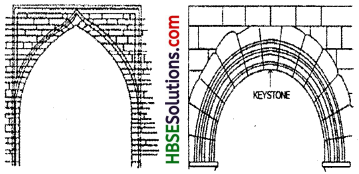
(a) In ‘trabeate’ principle, a horizontal beam is placed across two vertical columns and roofs, doors and windows were made.
HBSE 7th Class Social Science Solutions History Chapter 5 Rulers and Buildings-1
(b) In ‘acruate’ style of architecture, the weight of the superstructure above the door and window was carried by arch.

HBSE 7th Class Social Science Solutions History Chapter 5 Rulers and Buildings

Rulers And Buildings Class 7 Question Answer HBSE Question 2.
What is Shikhara?
Answer:
Shikhara is the pyramid structure on the central shrine of the temple.

Rulers And Buildings Class 7 Questions And Answers HBSE Question 3.
What is Pietra Dura?
Answer:
Pietra Dura is the inlays that depicted the legendary Greek God Orpheus playing the lute. They are coloured, hard stones placed in depressions carved into marble or sandstone creating beautiful ornate pattern.

Class 7 Rulers And Buildings HBSE Question 4.
What was the element of a Mughal Chahar Bagh garden?
Answer:
The elements of a Mughal Chahar Bagh (garden).

  • They were placed with in rectangular walled enclosures.
  • They were divided into quarter by artificial channels.
  • Divided into four equal quarters.
  • Symmetry in the four divisions.

LET’S UNDERSTAND

Class 7 History Rulers And Buildings HBSE Question 5.
How did a temple communicate the importance of a king?
Answer:
Temples were also meant to demonstrate the power, wealth and devotion and parton by the ruler.
(a) The names of the ruler and the god were similar, for example:
Rajarajeshvara temple was built by the king Rajarajadeva for the worship of his god, Rajarajeshvaram.
(b) Temple was the miniature model of the world ruled by the king and his allies.
(c) The other lesser dieties in the temple were gods and goddesses of the allies and subordinates of the ruler.

Rulers And Buildings HBSE 7th Class Question 6.
An inscription in Shahjahan’s diwan-i-khas in Delhi stated: “If there is Paradise on Earth; it is here, it is here, it is here.” How was this image created?
Answer:
Diwan-i-khas was designed in such a way that different elements of Mughal architecture were fused together in a grand harmonious synthesis. It was carefully planned. This image was created as a result of his marvellous architectural skill. It was created by provided all the possible facilities to the subjects (people) by the king.

HBSE 7th Class Social Science Solutions History Chapter 5 Rulers and Buildings

Class 7 History Chapter 5 HBSE Question 7.
How did the Mughal Court suggest that everyone-the rich and the poor, the powerful and the weak received justice equally from the emperor.
Answer:
(a) Behind emperor’s throne were a series of pietra dura inlays that depicted the legendary Greek God Orpheus playing the lute.
(b) It was believed the Orpheus’s music could calm ferocious beasts until they co¬existed together peaceably.
(c) This image communicated that the king’s justice would treat high and the low as equal which create a world where all could live together in harmony.

Question 8.
What role did the Yamuna play in the layout of the Mughal city at Shahjahanabad?
Answer:
The river Yamuna played a crucial role in the layout of the Mughal city at Shahjahanabad in the following ways:
(a) The imperial place commanded the river front. Only specially favoured noble were given access to the river.
(b) Ordinary people had to construct their home in the city away from the river.
(c) Taj Mahal was also constructed on the left edge of this river.
(d) In Agra at Taj Mahal, white marble mausoleum was place on terrace by the edge of the river as the garden was to its south.

LET’S DISCUSS

Question 9.
The rich and the powerful construct large houses today. In what ways were constructions of kings and their courtriers different in the past.
Answer:
The constructions of the kings and their courtiers in the past were different from the construction of large houses by the rich and the powerful.
The constructions of the kings and their courtiers had the safety and security as their major consideration. The houses of the kings and their coutriers had big courtyards, thick walls and huge walls. This constructions were generally surrounded by water bodies.
Today, the constructions of the rich and the powerful are quite different. They have less open areas and meet mainly individual requirements.

Question 10.
Look at picture. How could that building be constructed faster today?
Answer:
HBSE 7th Class Social Science Solutions History Chapter 5 Rulers and Buildings-2
The building could be constructed faster today with the help of latest tools and advanced skills.

LET’S DO

Question 11.
Find out whether there is a statue of or a memorial to a great person in your village or town. Why was it placed there? What purpose does it serve?
Answer:
Try to find out any memorial surrounding you and write a note on it:
Why it was established?
Where it was situated?
Who was the founder?
What is its significance?

Question 12.
Visit and describe any park or garden in your neighbourhood. In what ways is it similar to or different from the gardens of the Mughals?
Answer:
Discuss it with your class teacher in the class room. (Hint: Throw light on Chahar Bhagh and its significance)

HBSE 7th Class Social Science Solutions History Chapter 5 Rulers and Buildings

HBSE 7th Class History Rulers and Buildings Important Questions and Answers

Very Short Answer Type Questions

Question 1.
What are ‘tombs’ referred to?
Answer:
Tombs are safe, protected and grandiose places of rest in this world and the next.

Question 2.
Which style of construction was used in the construction of temples, mosques, tombs attacked to large- stepped wells, between the seventh and tenth century?
Answer:
‘Trabeate’ style of construction was used in the construction of temples, mosque, tombs between seventh and tenth century.

Question 3.
What were the temples and mosques meant to demonstrate?
Answer:
The temples and mosques were meant to demonstrate the power, wealth and prayer.

Question 4.
Why did the king Rajarajesh- wara take the god’s name?
Answer:
The king took the god’s name because it was auspicious and he wanted to appear like a god.

Question 5.
What was qibla?
Answer:
The pedestal on which Shahjhan’s throne was placed was frequently described as the qibla.

Question 6.
What was special about the city of Agra?
Answer:
Agra city was special because nobility had constructed their homes in the city on the banks of the river Yamuna.

HBSE 7th Class Social Science Solutions History Chapter 5 Rulers and Buildings

Short Answer Type Questions

Question 1.
How did Shahjahan adapt the river front garden while laying out the Taj Mahal?
Answer:
While laying out the Taj Mahal, Shahjahan adapted the river-front garden. The white marble mausoleum was placed on a terrace by the edge of the river and the garden was to its south. Shahjahan developed this architectural form as a means to control the access that nobles had jto’the river.

Question 2.
Who were given access to the river-front by Shahjahan?
Answer:
In the city of Shahjahanabad, the imperial palace constructed the river front. Only specially favoured nobles like his eldest son Dara Shukoh were given access to the river. All others had to construct their homes in the city away from river Yamuna.

Question 3.
What were the special features of Humayun’s tomb?
Answer:
The special features of Humayun’s tomb were:
(a) The central towering dome and the tall gateway known as pishtaq became important aspects of Mughal architecture. This tomb structure was first visible in Humayun’s tomb.
(b) The tomb was placed in the centre of a huge Chahar Bagh and built in the tradition known as ‘eight paradises’ a central hall surrounded by eight rooms
(c) The building was constructed with red sandstone, edge with white marble.

Question 4.
How did the Pandaya king Shrimara Shrivallabh loot the temples when he invaded Sri Lanka and defeated the king?
Answer:
Shrimara Shrivallabh removed all the valuables from the temple like the status of the Buddha made entirely of gold in the jewel places and the golden images in the various monastries.

HBSE 7th Class Social Science Solutions History Chapter 5 Rulers and Buildings

Long Answer Type Questions

Question 1.
What was the significance of temples, mosques and tanks?
Answer:
Temples and mosques were the places of worship. They were beautifully constructed.

  • They demonstrated the power, wealth and devotion of the patron.
  • The name of the ruler and the god were very similar. For example: Rajarajeshvara temple was built by Jong Rajarajadeva for the worship of his God, Rajarajeshvaram. Through the rituals of worship in temple one God, Rajarajeshvaram.
  • The kings constructed the largest of the temples.
  • The temple was a miniature model of the world.
  • They worshipped their dieties together in the royal temples as if they brought the just rule of the Gods on earth.

Question 2.
Explain the beginning of the reign of Shahjahan at Agra.
Answer:
In the beginning of his reign, Shahjahan’s capital was at Agra. It is a city where the nobility had constructed their homes on the banks of the river Yamuna. They were set in the midst of formal gardens constructed in the Chahar Bagh format. The Chahar Bagh garden was also desribd the river front garden. In this the dwelling was not located in the middle of the Chahar Bagh at its edge, close to the bank of the river.

Shahjahan took the river front garden in the layout of the Taj Mahal. It was the grandest architectural accomplishment of his reign. Here the white marble mausoleum was placed on a terrace by the edge of the river and garden was to its south.

Question 3.
Who all were involved in the construction of Qutab Minar? Describe the main architectural styles adopted.
Answer:
The Qutab Minar is five storeys high. The first floor was constructed by Qutabuddin Aybak and the ret by Iltutmish around 1229. Over the years it was damaged by lighting and earthquakes and repaired by Alauddin. Khilji, Muhammad Tughluq, Firuz Shah Tughluq and Ibrahim Lodhi. Architectural Styles of Qutab Minar

  • Qutab Minar has a pattern under the balcony by the small arches and geometrical designs.
  • It has two banks of inscriptions under the balcony.
  • The surface of the minar is curved and angular. Placing an inscription on such a surface required great precision. Only the most skilled craftsperson could perform this task.

HBSE 7th Class Social Science Solutions History Chapter 5 Rulers and Buildings

Rulers and Buildings Class 7 HBSE Notes

  • Superstructure: The part of a building above the ground floor.
  • Pietra Dura: Coloured, hard stones placed in depressions carved into marble or sandstone creating beautiful, ornate patterns.
  • Gopuram: The gateway of the temple.
  • Shikhara: A spire like structure over the central shrine of a temple.
  • Mandapa: A structure setup or constructed in front of the main shrine.

HBSE 7th Class Social Science Solutions History Chapter 5 Rulers and Buildings Read More »

HBSE 7th Class Social Science Solutions History Chapter 6 Towns, Traders and Craftpersons

Haryana State Board HBSE 7th Class Social Science Solutions History Chapter 6 Towns, Traders and Craftpersons Textbook Exercise Questions and Answers.

Haryana Board 7th Class Social Science Solutions History Chapter 6 Towns, Traders and Craftpersons

HBSE 7th Class History Towns, Traders and Craftpersons Textbook Questions and Answers

LET S RECALL

Towns, Traders and Craftpersons Class 7 HBSE History Question 1.
Fill in the blanks:

  1. The Rajarajeshvara temple was built in
  2. Ajmer iff associated with the Sufi saint
  3. Hampi was the capital of the Empire.
  4. The Dutch established a settlement at in Andhra Pradesh.

Answer:

  1. Thanjavur (Tamil Nadu)
  2. Muinuddin Chishti
  3. Vijayanagara
  4. Masulipatnam

HBSE 7th Class Social Science Solutions History Chapter 6 Towns, Traders and Craftpersons

Towns, Traders and Craftpersons Class 7 Question Answer HBSE Question 2.
State whether true or false:

  1. We know the name of the architect of the Rajarajeshvara temple from an inscription.
  2. Merchants preferred to travel individually rather than in caravans.
  3. Kabul was a major centre for trade in elephants.
  4. Surat was an important trading port on the Bay of Bengal.

Answer:

  1. True
  2. False
  3. False
  4. False

Towns, Traders and Craftpersons Class 7 Questions And Answers HBSE Question 3.
How was water supplied to the city of Thanjavur?
Answer:
Water was supplied from wells and tanks to the city of Thanjavur.

Class 7 Towns, Traders and Craftpersons HBSE History Question 4.
Who lived in the “Black Town” in cities such as Madras?
Answer:
Merchants and artisans (such as weavers) or craftspersons along with the white rulers (European traders) lived in the cities like Madras during the British rule.

LET’S UNDERSTAND

Class 7 History Towns, Traders and Craftpersons HBSE Question 5.
Why do you think towns grew around temples?
Answer:
(i) Temple towns represented a very important pattern of urbanisation, the process by which cities develop.
(ii) Temples were often central to the economy and society.
(iii) Rulers built temples to demonstrate their devotion to various dieties. They also endowed temples with grants of land and money to carry out elaborate rituals, feed pilgrims and priest and celebrate festivals.
(iv) Pilgrims who flocked to the temples also made donations.
(v) Temple authorities used their wealth to finance trade and banking.
(vi) Generally, a large number of priests, workers, artisans, traders etc. settled near the temple to cater to the needs and those of the pilgrims.
For example: Billasvamin and Somnath in Gujarat.

Towns, Traders and Craftpersons HBSE 7th Class History Question 6.
How important were craftspersons for the building and maintenance of temples?
Answer:
(i) Craftspersons were very important for building and maintenance of temples.
(ii) For instance the Panchalas or Vishwakarama community, consisting of goldsmith, bronzesmith, blacksmiths, masons are carpenters were essential to the building of temples.
(iii) The craftsmen also played an important role in the construction of big buildings for pilgrims, used to visit temples as visitors or tourists and also in construction of tanks and reservoirs, attacked to temples.
(iv) The craftspersons of Bidar were so fapied for their inlay work in copper and silver that it came to be called Bidri.
(v) Weavers such as the Saliyar or Kaikkolars emerged as prosperous communities, making donations to temples.

HBSE 7th Class Social Science Solutions History Chapter 6 Towns, Traders and Craftpersons

Class 7 History Chapter 5 HBSE Question 7.
Why did people from distant lands visit Surat?
Answer:
1. Surat was the most important medieval port on the west coast of Indian subcontinent.
2. It was the emporium of western trade during the Mughal period.
3. Surat was the gateway for trade with west Asia via the Gulf of Ormuz.
4. Surat has also been called the gate of Mecca, because many pilgrim ships get sail from here.
5. There were also several retail and wholesale shops selling cotton textiles.
6. Surat was famous for the textiles with gold lace borders (zari).
Due to all such reasons many people from distant lands visited Surat.

Question 8.
In what ways craft production in cities like Calcutta different from that in cities like Thanjavur?
Answer:

Craft Production in ThanjavurCraft Production in Calcutta
1. Craftspersons were free to be as much creative as they could be.1. Craftspersons had to produce what was demanded by the East India Company.
2. Craftpersons used to live near temple. They always get buyers of their products.2. The craftspersons were force to live in the “Black Towns”. The only buyer of their products was the East India Company.
3. There was no system pf advances.3. There existed system of advances, which meant that they have to weave cloths which were already promised to European agents.
4. Weavers had the freedom of selling their own cloths or weaving by their own patterns.4. Weavers no longer had liberty of selling their own cloths or weaving by their own patterns.
5. They didn’t have to reproduce same designs.5. They had to reproduce the designs supplied to them by the company agents.

LET’S DISCUSS

Question 9.
Compare any one of the cities described in the chapter with a town or a village with which you are familiar. Do you notice any similarities or differences?

HampiAjmer
1. Hampi is located in the Krishna, Tungabhadra basin, which formed the nucleus of the Vijay Nagar Empire, founded in 1336.1. Ajmer is in Rajasthan. It was the capital of the Chauhan kings in the twelfth century. Later, Ajmer became the suba headquarters under the Mughals.
2. The magnificent ruins at Hampi reveal a well fortified city. The architecture of Hampi was distinctive.
The buildings in the royal complex had splendid arches, domes and pillared halls with niches for building sculptures.
2. Ajmer remained a famous pilgirmage centre for the Hindus. There is a holy water tank at Puskar near Ajmer. There is a world wide famous temple of the Brahmaji.
3. Temples were the hub of cultural activities and devadasis (temple dancers) performed before the deity, royalty and masses in the many pillared halls in the virupaksha temple, known today as Navaratri in the south, was one of the most important festivals celebrated at Hampi.3. Ajmer also provides an excellent example of religious co-existence, Khwaja Muinud- din Chishti, the celebrated sufi-saint who settled there in the twelfth century attracted devotees from all creeds.

Question 10.
What were the problems encountered by merchants? Do you think some of these problems persist today?
Answer:
Some of the problems faced by the merchants were as under:

  • They had to travel through forests and there was always the fear of robbers. Therefore, pierchants travelled in caravans.
  • Merchants such as Mulla Abdul Ghafur and Indian Virji Vora, who owned a large number of ships were subdued by the East India Company ships. Then, they have to work as agents of the company instead of running their own business.
  • Yes, such problems do exist today.

HBSE 7th Class History Towns, Traders and Craftpersons Important Questions and Answers

Very Short Answer Type Questions

Question 1.
Give the capital of Cholas.
Answer:
Thanjavur.

Question 2.
Who built Rajarajeshwara temple?
Answer:
King Rajaraja Chola.

Question 3.
What type of a town is Thanjavur?
Answer:
Temple town.

Question 4.
Name an alloy of copper and tin.
Answer:
Bronze.

Question 5.
What is the capital of the Chauhan kings in the 12th century?
Answer:
Ajmer.

Question 6.
Give two groups of weavers that emerged as prosperous communities.
Answer:
Saliyar, Kaikkolars.

HBSE 7th Class Social Science Solutions History Chapter 6 Towns, Traders and Craftpersons

Short Answer Type Questions

Question 1.
Name the trading groups in Masulipatnam.
Answer:
The Golconda nobles, Persian merchants, Telugu Komati Chettis and European traders were the trading groups in Masulipatnam.

Question 2.
What was the ‘system of advances’?.
Answer:
The system of advances was a system under which craftspersons like weavers were given advance payments so that they had to weave cloths for European agents only.

Question 3.
What were the main features of medieval towns?
Answer:
The main features of medieval towns were as under:
(a) The towns probably emerged from large villages.
(b) Towns had mandapika (or mandi of later times) to which nearby villages brought their produce to sell.
(c) Towns also had market streets calle hatta lined with shops.
(d) There were streets for different kinds of artisans such as potters, oil pressers, sugar makers, toddy makers, smiths, stone masons, etc.

Question 4.
How was the architecture of Hampi distinctive?
Answer:
Due to following reasons, the architecture of Hampi was distinctive:
(a) The building in the royal complex had splendid arches, domes and pillared halls with niches for holding sculptures.
(b) There were well planned orchards and pleasure gardens with sculptural motifs such as lotus and corbels.
(c) The Wall of Hampi fort was constructed without using mortar or cement. The technique of wedging bricks together by interlocking was used.

Long Answer Type Questions

Question 1.
Why did Masulipatnam port decline?
Answer:
(a) The Dutch and English companies had settled in Masulipatnam.
(b) But the Qutab Shahi rulers of Golconda exerted their influence on the trade and settlement in the port city of Masulipatnam.
(c) After Mughal occupation of Golconda, Mughal Governor Mir Jurnla who was also a merchant, began to play off the Dutch and English against each other.
(d) Due to this the European Companies looked for alternative and hence, they developed the port city of Madras.
(e) Thus, Masulipatnam lost both its merchants and prosperity and declined.

Question 2.
How was the Indian textile business affected when the European Companies entered in it?
Answer:
The Indian textile business was affected when the European Companies entered it in the following ways:
(i) The demand of Indian textiles increased manifolds.
(ii) This led to a great expansion of the crafts of spinning, weaving, bleaching, dyeing, etc.
(iii) The employment opportunities also increased.
(iv) Indian textile designs became increasingly refined.
(v) But due to the system of advances, the independent craftspersons declined.
(vi) Indian traders, weavers and merchants had to live in “Black Towns” whereas “White” people lived in superior residencies of Fort St. George in Madras or Fort St. William in Calcutta.

HBSE 7th Class Social Science Solutions History Chapter 6 Towns, Traders and Craftpersons

Question 3.
What were the causes of decline of Surat as a commercial town?
Answer:
(i) From 17th century onwards the 1 town of Surat began to decline in the commercial activities.
(ii) The main cause was loss of markets and productivity because of the decline of the Mughal Empire.
(iii) Sea routes were controlled by Portuguese.
(iv) The newly built Bombay port gve tough English competition to the port of Surat.
(v) East India Company shifted its headquarters to Bombay in 1668.

Question 4.
Describe the rise of Bombay, Calcutta and Madras as trading towns.
Answer:
(i) Bombay, Calcutta and Madras rose as nodal cities.
(ii) Crafts and commerce underwent major changes as merchants and artisans (such as weavers) were moved into the Black Towns established by the European Companies with in these new cities.
(iii) The blacks or native traders and crafts persons were confined here.
(iv) The ‘White’ rulers occupied the superior residencies of Fort St. George in Madras or Fort St. William in Calcutta.

Towns, Traders And Craftspersons Class 7 HBSE Notes

  • Hinterland: A piece of land beyond coast is known as hinterland.
  • Administrative Town: It is a town from where the administrative functions are carried on.
  • Temple Town: It is a town with prominent temple or temples.
  • Commercial Town: It is a town where the sale and purchase of commodities takes place.
  • Pilgrimage Towns: Places where people go for pilgrimage are called pilgrimage towns.
  • Chintz: A type of cotton cloth with printed design on it is called Chintz.
  • Black Town: That part of towns where artisans and merchants of Indian origin used to live was called Black Town.
  • Emporium: A place where goods from diverse production centres are bought and sold is called emporium.
  • Hundi: It is a note recording a deposit made by a person. The amount deposited can be claimed in another place by presenting the record of the deposit.
  • Factor: An official merchant of the East India Company is called a factor.
  • Sthapatis: Sculptors who made bronze idols and tall ornamental bell metal lamps are called Sthapatis.

HBSE 7th Class Social Science Solutions History Chapter 6 Towns, Traders and Craftpersons Read More »

HBSE 7th Class English Solutions Honeycomb Chapter 2 A Gift of Chappals

Haryana State Board HBSE 7th Class English Solutions Honeycomb Chapter 2 A Gift of Chappals Textbook Exercise Questions and Answers.

Haryana Board 7th Class English Solutions Honeycomb Chapter 2 A Gift of Chappals

HBSE 7th Class English A Gift of Chappals Textbook Questions and Answers

Comprehension Check

A Gift Of Chappals Word Meaning HBSE 7th Class Question 1.
What is the secret that Meena shares with Mridu in the backyard?
Answer:
Meena shares a secret with Mridu. She tells her that they had found a poor cat outside the gate that morning. She wanted to keep this a secret so that Patti does hot go away.

Class 7 Gift Of Chappals Question Answer HBSE Question 2.
How does Ravi get milk for the kitten?
Answer:
Ravi got the milk for himself from Patti. Patti wanted the tumbler back. He pretended did that he would wash it himself. He ran to put the milk in the coconut shell.

A Gift Of Chappals Questions And Answers HBSE 7th Class Question 3.
Who does he say the kitten’s ancestors are? Do you believe him?
Answer:
Kitten’s ancestors were Mahabalipuram Rishi-Cat. No, we do not believe him.

HBSE 7th Class English Solutions Honeycomb Chapter 1 Three Questions

Gift Of Chappals Summary HBSE 7th Class Question 4.
Ravi has a lot to say about M.P.Poonai. This shows that
(i) he is merely trying to impress Mridu.
(ii) his knowledge of history is sound.
(iii) he has a rich imagination.
(iv) he is an intelligent child.
Which of these statements do you agree/ disagree to?
Answer:
(i) he is merely trying to impress Mridu.

A Gift Of Chappals Question Answer Class 7 HBSE Question 5.
What was the noise that startled Mridu and frightened Mahendran?
Answer:
Mridu was started to hear the kreeching sound coming from the window. Mahendran was frightened and in turn tripped a few chillies over himself.

Comprehension Check

Question 1.
The music master is making lovely music. Read aloud the sentence in the text that expresses this idea.
Answer:
“The music-master’s notes seemed to float up and settle perfectly into the invisible tracks of the melody.

Question 2.
Had the beggar come to Rukku Manni’s house for the first time? Give reasons for your answer.
Answer:
No, Beggar had not come to Rukku Manni’s house for the first time. Mother was heared telling Ravi to send the beggar away as he had been coming every day for the past week. She wanted him to find another to beg from.

Question 3.
“A sharp Y-shaped line had formed between her eyebrows.” What does it suggest to you about Rukku Manni’s mood?
Answer:
Rukku Manni was very angry at the disappearance of Music master’s chappal. She could make out that children had played a trick.

Working With The Text

Question 1.
Complete the following sentences.
(i) Ravi compares Lalli’s playing the violin to
(ii) Trying to hide beneath the tray of chillies, Mahendran
(iii) The teacher played a few notes on his violin, and Lalli
(iv) The beggar said that the kind ladies of the household
(o) After the lesson was over, the music teacher asked Lalli if
Answer:
(i) derailing the train all the time
(ii) tipped a few chillies over himself
(iii) stumbled behind him on her violin
(iv) are very kind soul. I have kept my body and soul together on their gen-erosity for a whole work
(v) If she had seen his chappals as he had reminded having kept them there.

Question 2.
Describe the music teacher, as seen from the window.
Answer:
The music master appeared to be a bony figure. He had a bold head with a tringe of oiled black hair falling around his ears. A gold chain gleamed on his leathery neck and diamond ring glittered on his hand. He was beating the floor with his big toe.

Question 3.
(i) What makes Mridu conclude that the beggar has no money to buy chappals?
(ii) What does she suggest to show her concern?
Answer:
(i) Mridu concludes that beggar has no money to buy the chappal because even when sun is so hot, he is walking bare footed. His bare feet have got large blisters.
(ii) Mridu was very’ worried and suggested that old looking chappal’s lying in the verandah could be given to the beggar.

Question 4.
“Have you children…” she began, and then, seeing they were curiously quiet, went on more slowly, “seen anyone lurking around the verandah?”
(i) What do you think Rukku Manni really wanted to ask?
(ii) Why did she change her question?
(iii) What did she think had happened?
Answer:
(i) Rukku Mani wanted to ask the Children Ravi, Mridu and Meena if they had stolen the Chappal.
(ii) She changed the question when She saw them to be curiously quiet.
(iii) She thought that some stranger might have stolen the Chappal.

Question 5.
On getting Gopu Mama’s chappals, the music teacher tried not to look too happy. Why?
Answer:
The music teacher tried not to look too happy as he wanted to show that he was angry with the behaviour of the naughty children.

HBSE 7th Class English Solutions Honeycomb Chapter 1 Three Questions

Question 6.
On getting a gift of chappals, the beggar vanished in a minute. Why was he in such a hurry to leave?
Answer:
The beggar had been coming to the house for a week; His feet had got blisters due to hot sun. So he disappeared at once on getting the chappals as he did not want to loose the chappals.

Question 7.
Walking towards the kitchen.with Mridu and Meena, Rukku Manni began to laugh. What made her laugh?
Answer:
Ruku Mani began to laught at the thought of that how would her husband react on knowing that she gave his chappal on knowing that she gave his chappal to the music master.

HBSE 7th Class English A Gift of Chappals Important Questions and Answers

Very Short Answer Type Questions

Question 1.
What does Mridu notice when she entered the house?
Answer:
When Mridu entered she noticed a pair of large black slippers. They were covered with dust.

Question 2.
Where had the cat been hidden by the children?
Answer:
The cat had been hidden inside a tom football lined with sacking and filled with sand.

Question 3.
Who had got the milk for the poor kitty and from where?
Answer:
Ravi had got the milk for the poor kitty from the kitchen.

Question 4.
What was the name of the cat?
Answer:
The cat had been named as Mahendravarma Pallava Poonai because it was fine breed of cat.

Question 5.
How did Mahendran land up on the tray of red chillies?
Answer:
When Ravi startled the kitty, he bounced up towards a bamboo tray of red chillies. As, a result he tipped few chillies over himself.

HBSE 7th Class English Solutions Honeycomb Chapter 1 Three Questions

Question 6.
What is the music master’s music compared to?
Answer:
The music master’s notes seemed to float up and moved smoothly into the rails.

Question 7.
How did the beggar try to make himself feel at home?
Answer:
The beggar on reaching the garden, spread the cloth under neem-tree to take a snooze.

Question 8.
What opinion did the beggar form of the ladies of the house?
Answer:
The beggar regarded the ladies of the house to be very generous. They had kept his body and soul together.

Question 9.
How did the beggar win the sympathy of others?
Answer:
The beggar showed his feet to show large link blisters on the soles of his bare feet. This made the people of the house to show concern.

Question 10.
Whose slippers was beggar given to wear?
Answer:
The beggar was given to wear slippers of the music-master as looked shabby to the children. They were of the right size.

Question 11.
Why did music-master get upset on coming out of the house?
Answer:
The music-master got upset because he could not find his chappals where he had kept them. He had bought them from Mount Road.

Question 12.
Whose chappals were given to music-master?
Answer:
Music-master was given chappals of Gopu Mama. The music master felt happy and cursing the children went away.

HBSE 7th Class English Solutions Honeycomb Chapter 1 Three Questions

Short Answer Type Questions

Question 1.
How had the cat been made the member of their family?
Answer:
The cat had been found outside the gate. He was kept inside a torn football lined with sack. He was given milk from coconut half-shell. He had been named Mahendran and given milk to drink by Ravi. He was a fine breed of cat.

Question 2.
How has Ravi talked of the cat to be a descendant of a historical character?
Answer:
The full name of the cat was kept to be Mahendravarma Pollava Poonai. Mahendran was believed to have descended from statue at Mahabalipuram. It was a close relative of the Pallava lion, emblem of Pallava dynasty.

Question 3.
Describe the way Lalli was playing violin.
Answer:
Lalli was learning to play violin from her music master. She played in a very awkward manner. The violin was being played like a train whizzing on and on. While playing she produced kreeching sound.The violin looked quite helpless and unhappy in her hands.

Question 4.
Describe the encounter with the beggar.
Answer:
The beggar had entered the garden of the house. He sat under the neem tree on his upper cloth. The beggar was very confident of getting alms there. But to his disappointment, turned sad on knowing that he was being turned out.

The beggar had large blisters on his feet and feared to go in afternoon heat. The children of the house gave him chappals of the music-master to wear.

Question 5.
Describe the search made by music- master for the chappald.
Answer:
The music master had worn a large pair of black slippers. They had been dragged by Ravi in the backyard. When music master came out of the house, he searched for his chappals. He looked over the railing and crouched near the flower pots. Then it was realised that, the chappals had been given to the beggar. Rukku Manni was angry and Gopu Mama’s Chappals were brought to be worn.

Some Other Questions For Examination

Question 1.
How did the cat react when he heard the sound made by Ravi?
Answer:
The cat was frightened to hear Ravi’s sound. Hejumped up withhair standing onend. He rushed towards a bamboo tray of red chillies that had been set out to dry. He tipped afew chillies over himself when he was tryingto hide beneath it.

Question 2.
Where had the cat been hidden by the children?
Answer:
The cat had been hidden inside a torn football lined with sacking and filled with sand.

Question 3.
What is the music master’s music compared to?
Answer:
The music master’s notes seemed to float up and moved smoothly into the rails.

Question 4.
What opinion did the beggar form of the ladies of the house?
Answer:
The beggar regarded the ladies of the house to be very generous. They had kept his body and soul together.

Question 5.
How did the beggar win the sympathy of others?
Answer:
The beggar showed his feet to show large pink blisters on the soles of his bare feet. This made the people of the house to show concern.

Question 6.
How did Ravi be fool Tapi?
Answer:
Tapi, the grandmother did not like any kitten. Therefore, Ravi had the kitten in a tom football. One day, Tapi saw Ravi take a glass of milk from the kitchen. She doubted about Ravi’s, mischief. Ravi had to drink the whole milk. Paati knew that Ravi could not drink all the milk. Therefore, she asked Ravi to give the tumbler back. He told her that he would wash the tumbler himself. She got helpless and left for her own house.

HBSE 7th Class English Solutions Honeycomb Chapter 1 Three Questions

Question 7.
Describe the way Lalli was playing violin.
Answer:
Lalli was learning to play violin from her music master. She played in a very awkward manner. The violin was being played like a train whizzing on and on. While playing she produced kreeching sound. The violin looked quite helpless and unhappy in her hands.

Multiple Choice Questions

Question 1.
In which city did Mridu live?
(a) Delhi
(b) Mumbai
(c) Chennai
(d) Kolkata
Answer:
(c) Chennai

Question 2.
What was the name of Mridu’s grandfather?
(a) Thatha
(b) Hatha
(c) Katha
(d) Nahatha
Answer:
(a) Thatha

Question 3.
Who was Rukku Manni to Mridu?
(a) mother
(b) friend
(c) aunt
(d) teacher
Answer:
(c) aunt

HBSE 7th Class English Solutions Honeycomb Chapter 1 Three Questions

Question 4.
Where did Mridu take off her slippers?
(а) near a pair of large black slippers
(b) near a pair of red sandals
(c) near the kitten
(d) none of these
Answer:
(а) near a pair of large black slippers

Question 5.
What was the full name of the kitten?
(a) Mahendravika Pallavi Poone
(b) Mahendra Varma Pallavi
(c) Mahendravarma Pallavi Poonai
Answer:
(c) Mahendravarma Pallavi Poonai

Question 6.
‘beringed’means:
(a) lost his ring
(b) is wearing a ring
(c) was wearing a bracelet
(d) none of these
Answer:
(b) is wearing a ring

Question 7.
From where had the music master bought the chappals?
(a) Mount Road
(b) Mount Abby
(c) Mount Pavillion
(d) Queen’s Road
Answer:
(a) Mount Road

HBSE 7th Class English Solutions Honeycomb Chapter 1 Three Questions

Make Sentences

Use the following words in sentences of your own:
(а) Whispered
(b) Gleaming
(c) Appeared
(d) Weired
(e) Impressed
Answer:
Sentences:
(а) Whispered: Sukriti whispered the secret into mother’s ears and got relief.
(b) Gleaming: The wedding lounge was gleaming with stars and lights.
(c) Appeared: Suddenly, a beautiful rainbow appeared in the sky.
(d) Weired: The traveller looked at the stranger with weired looks.
(e) Impressed: Everybody was impressed with the polite behaviour of bride.

A Gift of Chappals Passages for Comprehension

Read the passages carefully and answer the questions that follow:

Passage – 1

She set ………… and scrawny.
Questions:
(i) Who is she?
(ii) What are ‘those1 refer to?
(iii) Which two adjectives are used for toe?
(iv) Where is she at the moment?
Answers:
(i) She is Mridu.
(ii) Those refer to large slippers.
(iii) Long and scrawny.
(iv) She has gone to meet her grandmother’s aunt Rukku Manni.

Passage-2

‘We found ……………… a cat.’
Questions:
(i) Who are ‘we’?
(ii) What was kept a secret?
(iii) Who does not want cat in the house?
(iv) Choose a word which means same as “cry of a cat”?
Answers:
(i) We are Lalli, Ravi and Meena.
(ii) Patti was not aware about the possession of the cat in the house.
(iii) Paati did not want the cat in the house.
(iv) ‘Mewing’.

HBSE 7th Class English Solutions Honeycomb Chapter 1 Three Questions

Passage-2

Then she …………… feed Mahendran.’
Questions:
(i) Who is she?
(ii) What did tumbler contain?
(iii) Why was the milk poured into the coconut¬shell?
(iv) Who is Mahendran?
Answers:
(i) She is Patti.
(ii) The tumbler contained milk.
(iii) The milk was poured into the coconut shell so that the kitten could drink the milk.
(iv) Mahendran is the name of the cat.

Passage – 4

‘Think I’m ……….. about history.
Questions:
(i) Name the speaker.
(ii) What had made speaker utter, “Think I’m joking?”
(iii) Why does he make mention of history?
(iv) Choose a word which means opposite of ‘confused’?
Answers:
(i) Ravi is the speaker.
(ii) The speaker uttered so because he spoke very high of cat, of being symbolic of Pallava kings.
(iii) He makes mention of history because he has been to Mahabalipuram.
(iv) Clear.

Passage – 5

Mahendran looked ………….. his wits.
Questions:
(i) Why was Mahendran alarmed?
(ii) For what purpose had the coconut-shell been kept?
(iii) What consequence did M.P. Poonai have to face?
(iv) Choose a word which means ‘surprised’.
Answers:
(i) Mahendran was alarmed by listening to the shriek of Ravi.
(ii) The coconut-shell had been kept to keep milk for Mahendran.
(iii) M.P. Poonai had bounced with tray of chillies and tipped them over himself.
(iv) Alarmed.

HBSE 7th Class English Solutions Honeycomb Chapter 1 Three Questions

A Gift of Chappals Translation in Hindi

Before you read Mridu is …………and Meena.
मृदु एक जवान लड़की है जो मद्रास में (जिसका नाम अब चेन्नई है) अपने दादा थाता तथा दादी तापी के साथ पल-बढ़ रही है, एक दोपहर को तापी उसे अपनी चाची रुकू मनी के घर अपनी चचेरी बहनों तथा भाइयों लाली, रवि और मीना से मिलवाने ले जाती है।

1.A smiling ……………………. and scrawny.
मुस्कराती हुई रुकुमनी ने दरवाजा खोला। रवि और मीना बाहर आए। रवि मनी को घर के अन्दर ले गया। रुको, मुझे मेरी चप्पल उतारने दो मृदु ने प्रतिवाद करते हुए हुए कहा। उसने अपनी चप्पल को एक बड़े काले जोड़े के पास रख दिया। वह मिट्टी के कारण भूरे रंग के लग रहे थे। तुम चप्पल के अगले हिस्से में हर पैर की अंगुली के स्पष्ट चिह्न देख सकते हो। दो बड़ी अँगुलियों के चिह्न लम्बे और अस्पष्ट लग रहे थे।

Word Meaning: Smiling-with a happy look = मुस्कराते हुए, Rushed out-to come out hurriedly = जल्दी से वाहर आना, Protesteddisapproval = प्रतिवाद करना, Dust-sand = मिट्टी, Clear marks–something which can be seen = स्पष्ट चिह्न, Serawny-to scribble = घसीटना, Toe-a digit of the foot = पैर की अंगुली।

2. Mridu didn’t …. ………………… half-shell.
मृदु के पास आश्चर्यचकित होने के लिए और समय नहीं था कि यह किसकी चप्पल है, क्योंकि रवि उसे घर के पिछले आँगन में घने कड़वे बेर (की साड़ी) के पीछे घसीट कर ले गया। वहाँ पर एक फटी फुटबाल के बीच, एक छोटा सा बिल्ली का बच्चा लेटा था जो कि टाट और रेत से भरा हुआ था। वह आधे नारियल के खोल से दूध पी रहा था।

Word Meaning:Wonder-a strange thing = आश्चर्य, Dragged-to pull forcefully = घसीटना, Backyard-open courtyard = आँगन, BitterSorrow = कड़वा, Torn-not intact = फटा हुआ, Lined-outline = Hita, Sacking–material for making sacs etc. = बोरा बनाने का टाट, Lapping– licking = चाटना।

3. ‘We found …………………………….. a cat.’
‘आज सुबह हमने उसे गेट के बाहर पाया। वह बेचारा म्याऊँ-म्याऊँ कर रहा था’, मीना ने कहा। “यह एक रहस्य है। अम्मा कहती है कि पाटी पाडू मामा का घर छोड़ जाएगी अगर उसे पता चलेगा कि हमारे पास बिल्ली है।”

Word Meaning: Mewing-Sound of cát = बिल्ली की बोली- म्याऊँ-म्याऊँ करना, Secret-hidden from other = गुप्ता

4. ‘People are……………………… the scent.
लोग हमें हमेशा जानवरों के साथ दयावान बने रहने को कहते हैं पर जब हम ऐसा करते हैं तो वह चीखते हैं,”ओ, उसे गन्दी….. .. चीज़ को यहाँ मत लाओ!” रवि ने कहा। “क्या तुम जानते हो कि रसोई से थोड़ा सा दूध लाना कितना मुश्किल है। पाटी ने मुझे अभी हाथ में गिलास के साथ देखा। मैंने उसे कहा कि मुझे बहुत भूख लगी है। मैं इसे पीना चाहता हूँ, पर जिस तरह से उसने मुझे देखा, मुझे उसके आभास को से दूर करने के लिए सारा पीना पड़ा।

Word Meaning: Kind-pleasant = दयालु, Scream–to shout loudly = चीखना, Creature = प्राणी, Scent-smell = सुगन्ध, आभास।

5. Then she………………feed Mahendran.’
तब वह गिलास वापस लेना चाह रही थी। पाटी, पाटी मैं इसे अपने आप धो लूँगा, मैं तुम्हें कष्ट क्यों हूँ, मैंने उससे कहा । मुझे दौड़ना पड़ा और मैंने दूध को नारियल के खोल में डाल दिया। और फिर मैंने दौड़ कर गिलास धो दिया और इसे वापस रख दिया। अब हमें महेन्द्रन को खाना देने का अलग तरीका सोचना है।”

Word Meaning: Wanted-wish = इच्छा, Tumbler-glass = गिलास, Trouble-difficult = मुश्किल, Pour-to put = डालना, Suspicious-to have doubt = शक।

HBSE 7th Class English Solutions Honeycomb Chapter 1 Three Questions

6. ‘Mahendran? …………… kitty-cat name.
‘महेन्द्रण? यह बिल्ली के बच्चे का नाम है. मृदु बहुत प्रभावित हुआ। यह वास्तविक नाम था- न कि सिर्फ प्यारी बिल्ली का नाम।

Word Meaning: Impressed–to leave an impression = प्रभावित किया. Cute-pretty = सुन्दर।

7. ‘Actually his …………… Mridu giggled.
वास्तव में उसका पूरा नाम है महेन्द्रवर्मा पल्लव पूनई। संक्षिप्त में एम. पी. पूनई। यह बिल्ली की एक अच्छी नस्ल है। जरा उसके रोयें देखें। शेर की अयाल की तरह है। और क्या तुम जानते हो कि प्राचीन काल में पल्लव राजाओं का प्रतीक क्या था, नहीं जानते? उसने उत्सुकतापूर्वक मृदु की तरफ देखा। मृदु दाँत भींचकर हँसने लगी।

Word Meaning: Actually-Infact = सचमुच में, Breed-race = नस्ल, Fur-Covering to skin = रोएँ, Mane-long hair on neck of animals = अयाल, Emblem-symbol = प्रतीक, Expectantlyhopefully = आशान्वित होकर, Giggled-to laugh in a suppressed manner = दबी हँसी हँसना।

8. ‘Think I’m ……………………. ancient cat.
तुम सोच रहे हो कि मैं मजाक कर रहा हूँ? ठीक है, जरा इंतजार करो। मैं तुम्हें किसी समय दिखाऊँगा। यह बात स्पष्ट है कि तुम इतिहास के बारे में कुछ नहीं जानते हो। उसने रहस्यमय तरीके से पूछा क्या तुम महाबलि- पुरम गए हो। ठीक है जब हमारी कक्षा महाबलिपुरम गई तो मैंने उसके थाता के-थाता के-थाता के-थांता. …. आदि, आदि की प्रतिमा देखी। सच्चाई यह है कि महेन्द्रन उसी प्राचीन बिल्ली से उत्पन्न हुई है।

Word Meaning: Joking-with joke = मसखरापन, Mysteriously-obscure = गुप्त रूप से, Statue-Cast image of a person = प्रतिमा, Descended to be transmitted from = वंशक्रम, Ancient-belong to past inheritance = प्राचीन।

9.Aclose……………………. ancient Egypt!’
एक पास का रिश्तेदार अगर वैज्ञानिक तरीके से देखें तो शेर के अलावा और कोई नही है। पल्लव शेर, पल्लव राजवंश के प्रतीक। रति टहनी को ऊपर नीचे हिलाते हुए आँखों में चमक के साथ बेर की, झाड़ियों के चारों तरफ घूमता रहा। यह बिल्ली महाबलिपुरम की शृषि-बिल्ली की वंशज के अलावा कोई नहीं है। और अगर मैं तुम्हें सिर्फ याद दिलाऊँ तो वे लोग प्राचीन मिश्र में बिल्ली की पूजा करते थे।

Word Meaning:Relative-blood relation = fender, Scientifically–Related to law of science = वैज्ञानिक रूप से, Emblem-symbol = प्रतीकात्मक, Dynasty-a line of succession of kings = 109. Waving-to shake = हिलाना. Twig-branch of a tree = टहनी. Sparkling-shining = चमक , Remind—-to remember – याद दिलाना, Worshipped-to pray’ = पूजा करना, Ancient— Belong to past = प्राचीन।

10. llow he ……………… Mridu demanded.
वह किसी तरह से अपनी आवाज से प्यार करता था! मीना और मृदु ने एक दूसरे की तरफ देखा। “इस बात का किसी भी चीज से क्या मतलब है?” मृदु ने पूछा

Word Meaning: Exchanged–to change with each other = बदलना, Demanded-to ashed for forcefully = जोर से पूछा।

11. ‘luh! …………………………………….’So?’
‘हूँ! मैं बता रहा हूँ यह बिल्ली मिश्र की भगवान बिल्ली की वंशज है…. नहीं, देवी ! बसटट। या ! यही, बात है। इसलिए?’

Word Meaning: Descended-Sprung from ancestors = वशज।

12. ‘Well, one…………………. with himself.
‘ठीक है वह बिल्ली उस देवी की वंशज है जो कि पल्लव जहाज में छिपकर यात्रा करती थी। और उसके वंशज महाबलिपुरम की ऋषि-बिल्ली थी, जिसकी वंशज है, रवि ने टहनी को महेन्द्रन की तरफ दिखाया- ‘एम.पी. पूनई यहाँ’ वह अपने पर बहुत खुश होकर जोर से चिल्लाया।

Word Meaning: Stowaway-one who hides himself in a ship for securig a free passage = वह जो सुरक्षित यात्रा करने के लिए जहाज में अपने को छिपा लेता है, Shrieked-to shout = चीखना, Pleased-very happy = खुश हुआ, Flourished-toprosper = फलनाफुलना, Twig-branch to tree = टहनी, Whoop-war-cry = गरजना।

HBSE 7th Class English Solutions Honeycomb Chapter 1 Three Questions

13. Mahendran ……………………… his wits.
महेन्द्रन ने चौंक कर ऊपर देखा। वह उस समय अपने पंजों को नारियल के खोल के किनारे से तेज कर रहा था। पर रवि की भयंकर वूपईक …. से क्रीच …. की आवाज थी जो खिड़की से आ रही थी। कितनी अजीब आवाज! अगर मृदु आश्चर्यचकित हो जाती, एम. पी. पूनई अपनी समझ से बहुत अधिक डर गई।

Word Meaning: Alarmed To arouse = चौका देना, Sharpening-Sensitive = कर्कश, Claws-thorry nail of a beast = पंजा. Edge-end = किनारा. Worse-very bad = बुरा. Awful-dreadful = भयंकर. Weird-strange = अजोब. Startledsurprised = हैरान, Frightened-afraid = डर. Wits-brain- समझा

14. Flair standing …… howled miserably.
उसके बाल एक ओर खड़े हो गए। वह उछल कर लाल मिर्च से भरी ट्रे जो सूखने के लिए रखी गई थी से टकरा गई। अपने आपको उसके नीचे छिपाने के लिए, उसने अपने ऊपर कुछ लाल मिर्च गिरा ली। वह दुःखी मन से चिल्लाई ‘भ्याऊँ-म्याऊँ’।

Word Meaning: Bounced-Tolenock = उछल पड़ना, Seurried-Hurriedly = जल्दी-जल्दी, Bamboo-akind of tropical grass = बांस, Hidenot to be seen = छिपना, Beneath-below = नीचे, Tipped-Over spread = उलट लेना, Howled-To shout loudly = चिल्लाना, Miserably-In poor condition = दुखभरी।

15. The ‘kreeching’ …………… said Mridu.
Kreech kreech ……………. musical scale.
That’s Lalli ………………………..grunted Ravi.
“क्रीचिंग’ की आवाज जारी रही। मृदु ने कहा कि “वह आवाज कैसी है?”
‘क्रीच, क्रौच, क्रीच’। यह आवाजें दर्दनाक संगीतमय ताल में आने लगीं। रवि ने गुर्राते हुए कहा, “वह लाली सारंगी सीखने की कोशिश कर रही है।”

Word Meaning: Kreeching = एक तरह की आवाज, Painfully-full of pain = दर्दनाक, Grunted-A harsh sound like hogs = गुर्राते हुए, Violin-a musical instrument = arriti

16. ‘She’ll never ………………….. off track!
‘वह कभी भी कुछ नहीं सीख लेगी। संगीत का गुरु एक रेलगाड़ी की सनसनाहट की तरह ही बजाता रहता है जबकि लाली पूरे समय पटरी से उतरने की कोशिश करती रहती है। पूरी तरह से पटरी से उतर गई।

Word Meaning: Whizzing-A hissing sound = सनसनाहट, Derailing-togooff the rails = पटरी से उतरना।

17.Mriduerept ……………… music-master.
मृदु रेंगती हुई खिड़की के पास गई। लाली कुछ दूरी पर सारंगी और प्रत्यन्चे को गद्देपन से लेकर बैठी थी। उसकी कुहनी बढ़ी हुई और उसकी आँखें एकाग्रता से घूर रही थी। उसके सामने उसके संगीत के अध्यापक अपनी पीठ खिड़की की ओर करके बैठे हुए थे।

Word Meaning: Crept-to move slowly = रंगा. Awkwardly-In a embarassing manor = भद्दापन से. Elbows-jount part of arm = कुहनी. Jutting-a projecting point = बढ़ा हुआ कांना Glazed-to look continuously = भरना. Concentration-bringing to common point = एकाग्रता. Bony figure-very weak = कमजोर. Bowstring-string used in a bow = प्रत्यन्चा, कमानी।

18. lle had ……………………………. big toe.
उनका अधिकांश सिर गंजा था। कुछ चिकने काले बाल कानों के चारों तरफ लटक रहे थे और पुराने नमूने के गुच्छे की तरह प्रतीत हो रहे थे। उसकी चमड़े जैसी गर्दन पर सोने की चेन चमक रही थी। जब उनका हाथ सारंगी पर चल रहा होता।, तो एक हीरे की अगूंठी उनकी अंगुली पर बहुत चमक रही होती थी। उनका पैर सुनहरी पट्टी वाली पोशाक से बाहर दृष्टिगत हो रहा था। वह लगातार अपने बड़े पैर के अंगूठे को जमीन पर घसीटते हुए मार रहे थे।

Word Meaning: Bald-without hair on head = गंजा, Fringe-Trimming of longing thread = किनारा, Tuft-cluster of soft object = गुच्छा , Gleamed-shine = चमकना. Glittered-alot of shine = चमकता हुआ, Glided tomore smoothly = धीरे-धीरे सरकना. Scrawny-to scribble = घसीटना, Fashioned-Pattern = चाल-ढाला.

19. Heplayed ………………… lovely music.
उन्होंने कुछ स्वर बजाए। लाली उनके पीछे अपनी सारंगी पर गिर गई जो उसके हाथों में असमर्थ और नाखुश लग रही थी। कितना फर्क था? संगीत के गुरुजी के स्वर तैरते हुए महसूस हो रहे थे और पूर्ण रूप से मधुर आवाज के अदृश्य ताल में सुचारू रूप से बैठ रहे थे। जब रवि ने कहा कि यह स्वर इस प्रकार से आ रहे थे जैसे कि रेल की पटरी पर रेल बिल्कुल ठीक रूप से सनसनाहट से निकल जाती है। मृदु उस बड़ी अंगूठी वाले हाथ को घूरने लगा जो बिना किसी प्रयास के सारंगी पर चल रहा था और बहुत मधुर संगीत निकल रहा था।

Word Meaning: Stumbled-tofall = गिर जाना, llelpless-in a restless situation = असमर्थ, Floatup-todrifton water = तैरते हुए. Invisiblynot seen = अदृश्य, Melody-Suweet sound = मृदुल आवाज, Whizzing-ahissing sound = सनसनाहट, Stared-to look continuously = घूरना, Effortlessly-withouteffort = बिना प्रयास के।

20. Squawk! ……………………… ‘Amma-oh!’ ‘Ravi, …………………………………… to Tapi.
चीख। वह लाली फिर से पटरी से उतर रही है। “अम्मा” गेट से जोर से आवाज आई. “अम्मा-ओह।”
“रवि उस भिखारी को यहाँ स भेज दो!” माँ पिछल आँगन से चिल्लाई, जहाँ वह टापी से बात कर रही थी। वह पिछले सप्ताह से यहाँ हर रोज आ रहा है और अब उसको भीख मांगने के लिए दूसरा घर ढूँढेंना चाहिए! पाती नं टापी को समझाया।

Word Meaning: Derailing-to make the train leave the track = पटरी से उतरना, Chattingto talk – यातचीता

21. Mridu and ……………………. beg from!’
मृदु और मीना ने रवि का बाहर तक पीछा किया। भिखारी बगीचे में पहुंच चुका था और अपने आप को काफी सुरक्षित महसूस कर रहा था। उसने अपने ऊपर के कपड़े को नीम के पेड़ के नीचे फैला दिया और पेड के तने का सहारा लेकर बैठा था। ऐसा लग रहा था कि जैसे भिक्षा के इंतजार में प्रकट हुआ हो। “जाओ!” रवि ने कठोरता से कहा। “मेरी पाटी कहती हैं कि अब समय आ गया है कि तुम दूसरा घर भीख मांगने के लिए ढूँढ लो!”

Word Meaning: Leaning-inclination = झुकाव, Apparently-seeming = प्रत्यक्ष, Snooxeto take the day short sleep during the day = झपकी लेना, Alms-Relief given to the poor = भिक्षादान लेना. Sternly-harshly = कठोरता से।

HBSE 7th Class English Solutions Honeycomb Chapter 1 Three Questions

22. The beggar …………………… me away.
भिखारी ने अपनी आँखें खोली और बच्चों को एक-एक करके घूरने लगा। “इस घर की महिलायें, उसने भावनापूर्ण आवाज में कहा, बहुत दयालु आत्माएँ हैं। मैंने अपने शरीर और आत्मा को पूरे सप्ताह से उनकी उदारता पर रखा है। मैं विश्वास नहीं कर सकता कि वह मुझे निकाल देंगी।

Word Meaning: Gazed-to look continously = लगातार देखना. Choked-to suffocateगला घोटना, Generosity-nobility of mind = उदारता।

23. He raised ………… with betel-chewing.
24. ‘Ravi, tell ……………………….. fed-up.
Ravi didn’t………………………. and sighed.
“रवि उसे बताओ कि रसोई में कुछ नहीं बचा!” रूकूमनी ने कहा ‘और वह दुबारा न आए उससे कह दो!’ वह बहुत हताश लग रही थी। . रवि को यह सब भिखारी के सामने दुहराना नहीं पड़ा। उसकी माँ ने नीम के पेड़ के नीचे जो कहा वह उन सबके लिए सुनना आसान था। भिखारी बैठ गया और उसने आह भरी।

Word Meaning: Sounded-sensation perceived by the ear = कोलाहल. Repeat-to say again = दुहराना,Sighed-speakina sod voice = आह।

25. Tilgo,…………………………. bare feet.
“मैं जा रहा हूँ, मैं जा रहा हूँ!” उसने थके अन्दाज में कहा ‘मुझे सिर्फ इस पेड़ के नीचे आराम करने दो। बहुत गर्मी है और सड़क पर तारकोल पिघला हुआ है। मेरे पैरों में पहले से ही छाले पड़ गए हैं।’ उसने गुलाबी रंग के छिले हुए छाले दिखाने के लिए अपने नंगे पैर के तलुए आगे बढ़ाए।

Word Meaning: Wearily-tired = थके हुए. Melted-to become liquid = पिघला हुआ। Blistered-with sores = छाले पड़े हुए। Stretched to spread = फैलाना, Peeling-removed the skin छिलका उतरा हुआ, Tar-a black viscous substance got by distillation of wood = तारकोला

26. I suppose………… house somewhere?” I don’t ………………………….. and Meena’s.
‘मेरा अनुमान है कि उसके पास चप्पल खरीदने के लिए पैसे नहीं हैं’. मृदु ने मीना और रवि के कानों में फुसफुसाते हुए कहा।
और पूछा “क्या तुम्हारे पास घर में कहीं पुरानी जोड़ी है?”
“मैं नहीं जानता”, पैर रवि ने कहा। “मेरे (चप्पल) उसके पैरों में आने के लिए बहुत छोटे हैं नहीं तो मैं उन्हें दे देता।” और उसके पैर मृदु और मीना के पैर से बड़े थे।

Word Meaning: Whispered-to speak in _alow voice = अति मन्द स्वर में फुसफुसाते हुए।

27. The beggar …………….afternoon heat. ‘He needs something on his feet! Meena said, her big eyes filling. It’s not fair!’
भिखारी अपने ऊपर के कपड़े को हिला रहा था और अपनी धोती को जोर से बाँध रहा था। उसने अपनी आँखें उठाकर डर के मारे दोपहर की गर्मी से तपती सड़क की तरफ देखा।
“उसे अपने पैरों के लिए कुछ चाहिए’ मीना ने अपनी बड़ी आँखें खोलकर कहा। “यह बात उचित नहीं है।”

Word Meaning: Shaking-to move = हिलाना, Tightening-to tie tightly = जोर से बाँधना, Fearfully-Ina fear = डर के मारे, Gleaming with shine = चमकता हुआ।

28. ‘Ssh.’ saki……………………… the house.
‘चुप-चुप! साकी रवि। “मैं इस बारे में सोच रहा हूँ! बड़बड़ाते हुए’ “यह सही नहीं है, यह सही नहीं है” यह सहायता नहीं करने वाला। दो मिनट में ही उसके पाँव सड़क पर जल रहे होंगे। उसको चप्पल के एक जोड़े की जरूरत है। इसलिए हमें वह कहाँ से मिलते हैं? चलो घर में ढूंढे। उसने मृदु और मीना को घर के अन्दर धक्का दिया।

29. Just as ……………………….. are those?”
जैसे ही उसने बरामदे में कदम रखा. मृदु की आँखें अजीब सी दिखनेवाली चप्पल पर पड़ी जो उसने आते हुए ध्यान में रखी थीं। फुसफुसाते हुए कहा “रवि!” उसने फुसफुसाते हुए कहा, “यह किसके हैं?”

Word Meaning:Notice-observation = ध्यान, Whispered-to say in a low tone – धीमी आवाज में कहा।

HBSE 7th Class English Solutions Honeycomb Chapter 1 Three Questions

30. Ravi turned…………………the garden.
रवि मुड़ा और जर्जर पर मजबूत पुरानी चप्पलों को घूरकर देखा। उसके चेहरे पर चमक थी और उसने स्वीकृति दे दी। ‘यह बिल्कुल सही आकार के हैं, उसने उठाते हुए कहा। मृदु और मीना ने घबराहट में उसका पीछा बगीचे तक किया।

Word Meaning: Glanced-to look = घूरना, Shabby-thread bare = मैली-कुचैली, Sturdystrongly built = मजबूत, Beamed-ashine = चमक, Nodded-moved heed in agreement = स्वीकृति में सिर हिलाना।

31. Herel’ said ………………….. the street.
“यहाँ।’ रवि ने पुरानी चप्पलों को भिखारी के आगे फेंकते हुए कहा। “यह पहन लो और वापस मत आना!” भिखारी चप्पलों की तरफ घूरने लगा। उसने जल्दी से तौलिए को अपने कंधे पर फेंका
और चप्पलें पहन कर चला गया। जाते हुए वह बच्चों को आशीर्वाद देता गया। एक ही पल में वह गली के कोने से गायब हो गया।

Word Meaning: Dropping-to throw = फेंकना, Stared to look constantly = लगातार देखना, Flung-to throw = फेंका, Muttering-mumble = बुदबुदाते हुए. Blessing-to bless = आशिर्वाद, Vanished-todisappear = गायब।।

32. The music-master ………….. put them.
संगीत शिक्षक घर के बाहर आए और अप्रशंसित नजर से तीनों को देखने लगे जो पेड़ के नीचे चुपचाप बैठ कर कंचे खेल रहे थे। तब उन्होंने आँगन में अपनी चप्पलें खोजी, जहाँ पर उन्होंने रखी थीं।

Word Meaning: Unappreciative-not praised = अप्रशंसित, Searched-to find = ढूँढना।

33. ‘Lallir he………………….. them here!’ Ravi, Mridu………………….. the verandah.
‘लाली!’ कुछ पलों के बाद उन्होंने पुकारा। वह जल्द से उनके पास आ गई। “मेरी प्यारी, क्या तुमने मेरी चप्पलें देखी हैं? मुझे याद है कि मैंने उन्हें यहाँ रखा था।” रवि, मृदु और मीना चुपचाप लाली और संगीत-शिक्षक को आंगन के हर कोने में चप्पल ढूँढते देख रहे थे।

34. He scurried …………………. you know?’
वह जल्दी-जल्दी इधर-उधर दौड़ने लगा। उसने हर तरफ देखा और गमलो के बीच में झुककर देखने लगा। बिल्कुल नई थीं मैं उन्हें माउंट रोड खरीदने गया।’ वह कहता रहा, “उनका मूल्य पूरे महीने की फीस के बराबर,, क्या तुम जानते हो?”

Word Meaning: Seurried-to scamper = जल्दी-जल्दी दौड़ना, Crouching-to sit in bent position = झुकना।

35. Soon Lalli ……………….. following her. ‘Where could ……………….. worried Paati.
जल्दी ही लाली अपनी माँ को बताने गई। रुकमनी थकी हुई अवस्था में लग रही थी और पाटी उसका पीछा कर रही थी। “वह कहाँ हो सकते हैं? यह सोचना बहुत परेशानी की बात है कि कोई उनको चुरा कर ले गया। इतने सारे बेचने वाले दरवाजे तक आते हैं, पाती चिंतित हुई।”

Word Meaning:Appeared to be visible = दृष्टिगोचर होना, Harassed-to fatigue = थकाना, Vendors-one who sells something = बेचने वाले।

36. RukkuManni………….. her eyebrows.
रुकूमनी की नजर रवि, मृदु और मीना पर पड़ी जो कि पेड़ के नीचे बैठे थे। “क्या तुम बच्चों ने-” उसने आरंभ किया और फिर देखते हुए कि वह अजीब चुप्पी में थे। वह और धीरे-धीरे बोलने लगी ‘किसी को यहाँ आँगन में घूमते देखा?’ उसकी भौंहों के बीच V-आकार की रेखा खिंच गई।

Word Meaning: Sight-scene = दृश्य, Curiously-showing anxiety = उत्सुकता से , Lurking-to move about aimlessly = घूमना, Eye brow-hairy arch above the eye = भौंहें।

HBSE 7th Class English Solutions Honeycomb Chapter 1 Three Questions

37. Another straight……………. tell herself.
अब मधुर वाणी की जगह बहुत कठोर शब्द निकले। रूकु मनी बहुत गुस्से में थी। मृदु काँपते हुए सोचने लगी। वह इतनी परेशान नहीं होती अगर वह बेचारे भिखारी के पैरों के जख्म के बारे में जानती, उसने अपने आप से कहने की कोशिश की।

Word Meaning: Appeared-to look as if = ऐसा लगा मानो, Soft-not hard = नम्र, मुलायम Shiver-to move with cold = कॉपना. Sores-twounds = जख्म।

38. Taking a………………………. up here?”
गहरी साँस लेते हुए वह चिल्लाई, ‘रुकु मनी यहाँ पर एक भिखारी था। बेचारा, उसके पैरों पर ऐसे जख्म थे।’ ‘फिर?’ रुकु मनी ने दृढ़ता से रवि की तरफ मुड़ते हुए कहा, “तुमने संगीत-शिक्षक की चप्पल उस बूढ़े भिखारी को दे दी जो यहाँ पर आता है?”

Word Meaning: Grimly-in a harsh voice = कठोरता से, Turns up here-romes here = यहाँ आता है।

39. ‘Children these ……………..generous?’ ‘Silly!’ snapped ……………………. his own.’
‘आजकल के बच्चे….’ पाटी ने दहाड़ते हुए कहा।
‘अम्मा क्या तुमने मुझे कर्ण के बारे में नहीं बताया था जो अपनी हर चीज दे देता था, जैसे कि सोने के कुंडल, झुमका। वह | बहुत दयालु और उदार था।’
“मूर्ख !” रुकु मनी ने फटकारते हुए कहा। ‘कर्ण दूसरों की चीजों को नहीं देता था, वह सिर्फ अपनी ही चीजें देता था।’

Word Meaning: Generous-liberal =: उदारचित्त, Snapped-to break with a sharp noise = फटकारना।

40. ‘But my ………………….. have minded?’
‘Ravil’ said Rukku Manni, very angry now. ‘Go inside this minute.’
‘पर मेरी चप्पल भिखारी के पैर में पूरी नही आती…’ रवि ने बहुत जल्दबाजी में कहा, ‘और अम्मा अगर पूरी आती, क्या तुम्हें वास्तव में बुरा नहीं लगता।’ रुकु मनी ने बहुत गुस्से में कहा, रवि, इसी समय अन्दर जाओ”।

Word Meaning: Fit-to be of proper size = पूरे आकार का, Rushed-Hurriedly = जल्दी में, Minded-inclined to think in specified time = बुरा लगना।

41. She hurried ……………………….. to do?
वह जल्दी से अंदर गई और गोपू मामा की लगभग नहीं पहनी गई नई चप्पलें ले लाई। ‘श्रीमान आपको यह बिल्कुल ठीक आएंगी। कृपा इन्हें पहन लीजिए। मुझे बहुत खेद है। मेरा बेटा बहुत शरारती है।’ संगीत शिक्षक की आँखों में चमक आ गई। उसने यह दर्शाते हुए पहनी कि वह बहुत खुश नहीं है। बिल्कुल ठीक, मेरे अनुमान से यह ठीक है…. आजकल बच्चों के मन में बड़ों के लिए कोई आदर नहीं है, क्या करें?

Word Meaning: Hurried-In a great hurry = जल्दी में, Indoors-Inside the house = घर के अन्दर, Naughty-behave badly = शरारती, Respect-honour = आदर।

HBSE 7th Class English Solutions Honeycomb Chapter 1 Three Questions

42. A Hanuman …………….. leave quickly.
हनुमान के अवतार… राम ही ऐसे शरारती बच्चों को बचा सकते हैं। रुकू मनी की आँखों में चमक आई। उसको अच्छा नहीं लगा कि रवि को बन्दर कहा गया, यद्यपि धार्मिक बंदर। वह अचल
और सरल तरीके से अगले दरवाजे पर खड़ी रही। यह स्पष्ट था कि वह चाहती थी वह जल्दी चला जाए।

Word Meaning: Incarnate-embodied in human form = अवतार, Flashed-Sudden blaze = चमक, Stiff-unbending = अचल, Straight-Honest = सरल, Clear-Evident = स्पष्ट।

43. When he ……………………….. to laugh.
जब वह अपनी नयी चप्पलें में झनझनाते हुए चला गया, उसने कहा ‘मृदु, अन्दर आकर कुछ खा लो। ईमानदारी से तुम बच्चे ऐसी बातें कैसे सोचते हो? भगवान का धन्यवाद कि तुम्हारे गोपू मामा काम पर चप्पल पहन कर नहीं जाते….’ जैसे ही वह मृदु और मीना के साथ रसोईघर की तरफ बढ़ी वह अचानक हँसने लगी।

Word Meaning: Clattered-to make a confused ratting sound = झनझनाना, Honestly-In astraightmanner = ईमानदारी से,Towards-In that direction = उस तरफ, Suddenly-A tonce = अचानक।

44. ‘But he’s ……………… music-master?
‘पर जब वह घर आता है तो उसे हमेशा जूते और मोजे उतार कर चप्पल पहनने की बहुत जल्दबाजी होती है। इस शाम को तुम्हारे मामा क्या कहेंगे जब मैं बताऊँगी कि मैंने उनकी चप्पलें संगीत-शिक्षक को दे दी हैं?

Word Meaning: Hurry-to rush = जल्दी में।

A Gift of Chappals Summary in English

Tapi takes Mridu to her aunt Rukku Manni’s house to meet her cousins Lalli, Ravi and Meena. Mridu gets a warm welcome and finds a kitten Mahendren which had been kept as a secret. Ravi is much impressed by the cat as to him it is a breed of Pallava dynasty. Lalli is learning music from her music master. Her way of playing the violin is most absurd and out of place. The master plays the tracks of music in a melody. His music was like the wheels of train fitted smoothly into the rail. Mridu also enjoyed the lovely music played by music master.

The incident of coming of beggar every days for the past week is exaggerated. Arrival of beggar upset the elders in the family. The beggar shows a surprise on refusal to get alms. He only begged to rest under the tree as he had large blisters on his feet and it was very hot. Mridu, Meena and Ravi searched for chappals. They gave him music master’s chappals to wear.

A little later music master came out of the house and searched for his chappals. A lot of confusion was were created and finally Gopu Mama’s chappals were given to the music master

A Gift of Chappals Summary in Hindi

टापी मृदु को उसकी आन्टी रूकू के घर अपने चचेरे भाई-बहिन लाली, रवि और मीना से मिलवाने ले जाती है। मृदु का अच्छा स्वागत होता है और वहाँ पर एक बिल्ली के बच्चे महेन्द्रन को पाती है। इस बात को बिल्कुल गुप्त रखा गया। रवि उस बिल्ली से बहुत प्रभावित है क्योंकि उसके लिए यह पल्लव वंश की है। लाली अपने संगीत के अध्यापक से संगीत सीख रहा है। उसका वायलन बजाने का तरीका बहुत अजीब है। संगीत के गुरु बहुत ही ताल में संगीत की लय दे रहे हैं। यह संगीत ऐसा है जैसे कि एक ट्रेन पटरी पर सुचारू रूप से चल रही हो। मृदु भी इस मधुर संगीत का आनंद ले रही थी।

भिखारी के आने की घटना को बढ़ा-चढ़ा कर दर्शाया गया है। घर के सारे बड़े भिखारी के आने से परेशान हैं। भिखारी भिक्षा न मिलने पर हैरानी व्यक्त करता है। भिखारी सिर्फ पेड़ के नीचे आराम करने की विनती करता है क्योंकि पैरों के नीचे छाले पड़ गए हैं और बाहर बहुत गर्मी है। मृदु, मीना और रवि चप्पल ढूंढ रहे हैं। उन्होंने उसे (भिखारी को) संगीत के गुरू की चप्पलें दे दी।

कुछ देर में संगीत के गुरु घर से बाहर अपनी चप्पल ढूंढने लगे। बहुत उलझन-सी पैदा हो जाती है और अंत में गोपू मामा की चप्पलें संगीत के गुरु को दे दी जाती है।

HBSE 7th Class English Solutions Honeycomb Chapter 2 A Gift of Chappals Read More »

HBSE 10th Class Maths Solutions Chapter 9 Some Applications of Trigonometry Ex 9.1

Haryana State Board HBSE 10th Class Maths Solutions Chapter 9 Some Applications of Trigonometry Ex 9.1 Textbook Exercise Questions and Answers.

Haryana Board 10th Class Maths Solutions Chapter 9 Some Applications of Trigonometry Ex 9.1

Question 1.
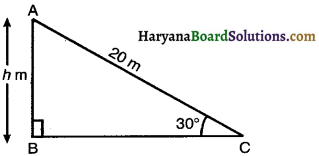
A circus artist is climbing a 20 m long rope, which is tightly stretched and tied from the top of a vertical pole to the ground. Find the height of the pole, if the angle made by the rope with the ground level is 30° (See figure).

Haryana Board 10th Class Maths Solutions Chapter 9 Some Applications of Trigonometry Ex 9.1 1

Solution :
Let height of the pole be h m.
In right ∆ABC, we have
sin 30° = \(\frac{\mathrm{AB}}{\mathrm{AC}}\)
⇒ \(\frac{1}{2}=\frac{h}{20}\)
⇒ h = \(\frac{20}{2}\) = 10 m.
Hence, height of the pole is 10 m.

Haryana Board Solutions for 10th Class Maths Chapter 9 Some Applications of Trigonometry Ex 9.1

Question 2.
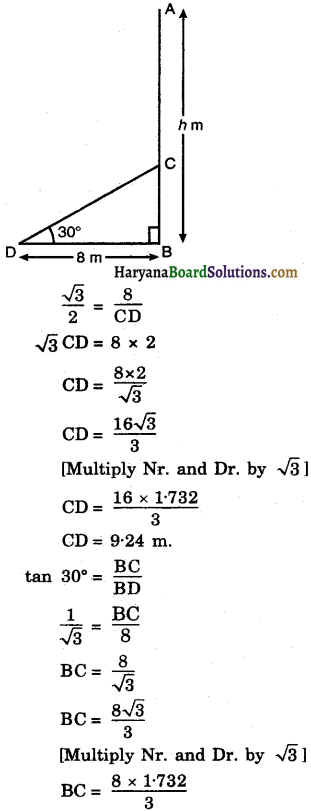
A tree breaks due to storm and the broken part bends so that top of the tree touches the ground making an angle 30° with it. The distance between the foot of the tree to the point where the top touches the ground is 8 m. Find the height of the tree.
Solution:
∠BDC = 30° (given)
In right ∆CBD, we have
cos 30° = \(\frac{\mathrm{BD}}{\mathrm{CD}}\)

Haryana Board 10th Class Maths Solutions Chapter 9 Some Applications of Trigonometry Ex 9.1 2

BC = 4.62
Height of the tree (h) = BC + AC
= BC + CD [∵ AC = CD]
= 462 + 924 = 1386 m.
Hence, height of the tree is 13.86 m.

Question 3.
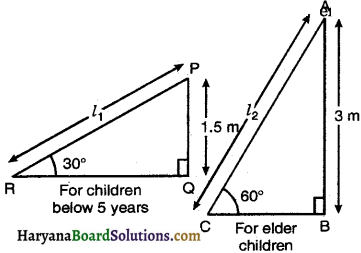
A contractor plans to install two slides for the children to play in a park. For the children below the age of 5 years, she prefers to have a slide whose top is at a height of 15 m, and is inclined at an angle of 30° to the ground, whereas for elder children, she wants to have a steep slide at a height of 3 in, and inclined at an angle of 600 to the ground. What should be. length of the slide in each case?
Solution :
Let l1 is the length of slide for children below the age of 5 years and l2 is th length of the slide for elder children.

Haryana Board 10th Class Maths Solutions Chapter 9 Some Applications of Trigonometry Ex 9.1 3

Point P represents the top of slide l1 and inclined at an angle of 30° to the ground.
i.e., PQ = 15 m and ∠PRQ = 30°
and point A represents the top of slide l2 and inclined at an angle of 60° to the ground.
i.e. AB = 3m and ∠ACB = 60°
In right ∆PQR, we have
sin 30° = \(\frac{\mathrm{PQ}}{\mathrm{PR}}\)
⇒ \(\frac{1}{2}=\frac{1 \cdot 5}{l_1}\)
⇒ l1 = 2 × 1.5 = 3.o m
and in right ∆ABC, we have
sin 60° = \(\frac{\mathrm{AB}}{\mathrm{AC}}\)
⇒ \(\frac{\sqrt{3}}{2}=\frac{3}{l_2}\)
⇒ l2 = \(\frac{3 \times 2}{\sqrt{3}}\)
⇒ l2 = 2√3
Hence, lengths of the slides are 3m and 2√3 m.

Haryana Board Solutions for 10th Class Maths Chapter 9 Some Applications of Trigonometry Ex 9.1

Question 4.
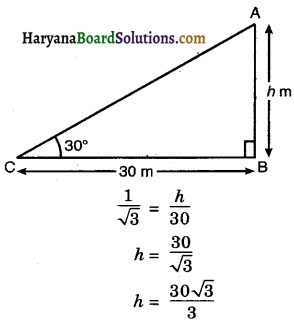
The angle of elevation of the top of a tower from a point on the ground, which is 30 m away from .the foot of tower, is 30°. Find the height of tower.
Solution:
Let AB be the tower of height h m and C be a point on the grourd such that angle of elevation of the top A of tower is 30°
i.e. ∠ACB = 30° and BC = 30 m.
In right ∆ABC, we have
tan 30° = \(\frac{A B}{B C}\)

Haryana Board 10th Class Maths Solutions Chapter 9 Some Applications of Trigonometry Ex 9.1 4

h = 10√3
Hence, height of the tower is 10√3 metres.

Question 5.
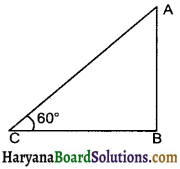
A kite is flying at a height of 60 m above the ground. The string attached to the kite is temporarily tied to a point on the ground. The inclination of the string with the ground is 60°. Find the length of the string, assuming that there is no slack in the string.
Solution :
Let A be the position of kite.
Let C be the position of observer and AC he length of string.
Then ∠ACB = 60°,
height of kite = 60 m.
In right ∆ABC, we have

Haryana Board 10th Class Maths Solutions Chapter 9 Some Applications of Trigonometry Ex 9.1 5

sin 60° = \(\frac{\mathrm{AB}}{\mathrm{AC}}\)
\(\frac{\sqrt{3}}{2}=\frac{60}{\mathrm{AC}}\)
AC = \(\frac{60 \times 2}{\sqrt{3}}\)
AC = \(\frac{120 \sqrt{3}}{3}\)
AC = 40√3.

Hence, length of string = 40√3 metres.

Haryana Board Solutions for 10th Class Maths Chapter 9 Some Applications of Trigonometry Ex 9.1

Question 6.
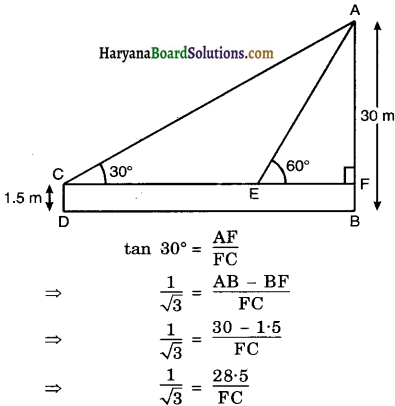
A 1.5 m tall boy is standing at some distance from a 30 m tall building. The angle of elevation from his eyes to the top of the building increases from 30° to 60° as he walks towards the building. Find the distance he walked towards the building.
Solution :
Let AB be the building of height 30 m and CD be the boy of height 15 m
i.e. AB = 30 m and CD = 15 m.
The angle of elevation from the eyes of thy to the top of building is 300 and as the boy walks towards the building the angle of elevation becomes 60°.
Then ∠ACF = 30° and ∠AEF = 60°
In right ∆AFC, we have

Haryana Board 10th Class Maths Solutions Chapter 9 Some Applications of Trigonometry Ex 9.1 6

FC = 28.5√3
and in right ∆AFE, we have
[∴ AF = AB – BF = 30 – 1.5 = AF = 28.5 m]
tan 60° = \(\frac{\mathrm{AF}}{\mathrm{FE}}\)
⇒ √3 = \(\frac{28 \cdot 5}{\mathrm{FE}}\)
⇒ FE = \(\frac{28 \cdot 5}{\sqrt{3}}\)
⇒ FE = \(\frac{28 \cdot 5 \sqrt{3}}{3}\)
⇒ FE = 9.5√3
The distance walked by the boy towards the building = CE
= FC – FE
= 28.5√3 – 9.5√3 = 19√3
Hence, distance walked by the boy towards the building = 19√3 m.

Haryana Board Solutions for 10th Class Maths Chapter 9 Some Applications of Trigonometry Ex 9.1

Question 7.
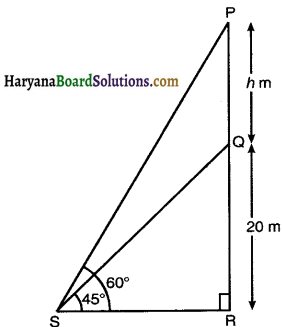
From a point on theground, the angles of elevation of the bottom and the top of a transmission tower fixed at the top of a 20 m high building are 45° and 60° respectiyely. Find the height of the tower.
Solution :
Let PQ be the transmission tower of height h m fixed at the top of 20 m heigh building (QR), angles of elevation of the bottom and top of a transmission tower are 45° and 60° respectively.
i.e. ∠QSR = 45° and ∠PSR = 60°.
In right ∆QSR, we have
tan 45° = \(\frac{\mathrm{QR}}{\mathrm{SR}}\)

Haryana Board 10th Class Maths Solutions Chapter 9 Some Applications of Trigonometry Ex 9.1 7

⇒ 1 = \(\frac{20}{\mathrm{SR}}\)
SR = 20 m.
In right ∆PSR, we have
tan 60° = \(\frac{\mathrm{PR}}{\mathrm{SR}}\)
√3 = \(\frac{\mathrm{PQ}+\mathrm{QR}}{20}\)
√3 = \(\frac{h+20}{20}\)
20√3 = h + 20
h = 20√3 – 20
h = 20(√3 – 1)
Hence, height of the tower is 20(√3 – 1) m.

Question 8.
A statue, 16 m tall, stands on the top of a pedestal. From a point on the ground, the angle of elevation of the top of the statue is 60° and from the same point the angle of elevation of the top of the pedestal is 45°. Find the height of the pedestal.
Solution :
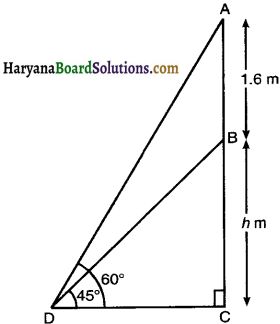
Let BC be the pedestal of height h m and AB be the statue.
Let D be the point of observation.
Then ∠BDC = 45°, ∠ADC = 60°, AB = 1.6 m
In right ∆BCD, we have
tan 45° = \(\frac{\mathrm{BC}}{\mathrm{CD}}\)

Haryana Board 10th Class Maths Solutions Chapter 9 Some Applications of Trigonometry Ex 9.1 8

⇒ 1 = \(\frac{h}{\mathrm{CD}}\)
⇒ CD = h …………….(1)
and right ∆ACD, we have
tan 60° = \(\frac{\mathrm{AC}}{\mathrm{CD}}\)
√3 = \(\frac{\mathrm{AB}+\mathrm{BC}}{\mathrm{CD}}\)
√3 = \(\frac{1 \cdot 6+h}{h}\) [Using (1)]
√3h = 1.6 + h
√3h – h = 1.6
h(√3 – 1) = 1.6
h = \(\frac{1 \cdot 6}{\sqrt{3}-1}\)
h = \(\frac{1 \cdot 6(\sqrt{3}+1)}{(\sqrt{3}-1)(\sqrt{3}+1)}\)
[Multiplying numerator and denominator by (√3 + 1)]
h = \(\frac{1 \cdot 6(\sqrt{3}+1)}{(\sqrt{3})^2-(1)^2}\)
h = \(\frac{1 \cdot 6(\sqrt{3}+1)}{2}\)
Hence, height of pedestal is 0.8(√3 + 1) m.

Haryana Board Solutions for 10th Class Maths Chapter 9 Some Applications of Trigonometry Ex 9.1

Question 9.
The angle of elevation of the top of a building from the foot of the tower is 30° and the angle of elevation of the top of the tower from the foot of the building is 60°. If the tower is 50m high, find the height of the building.
Solution:
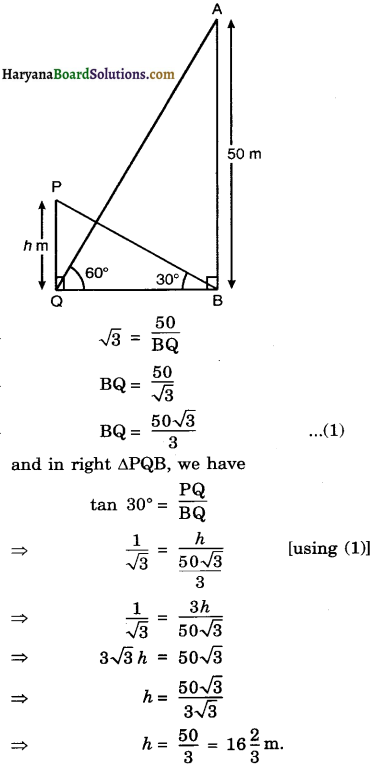
Let AB be tower of height 50m and PQ be the building of height h m.
The angle of elevation of the top of the tower from the foot of the building is 60° i.e. ∠AQB = 60° and angle of elevation of the top of building from the foot of the tower is 30°, i.e., ∠PBQ = 30°
In right triangle ABQ, we have
tan 60° = \(\frac{\mathrm{AB}}{\mathrm{BQ}}\)


Haryana Board 10th Class Maths Solutions Chapter 9 Some Applications of Trigonometry Ex 9.1 9

Hence, height of the building is 16\(\frac{2}{3}\) m.

Question 10.
Two poles of equal heights are standing opposite each other on either side of the road, which is 80 m wide. From a point between them on the road, the angles of elevation of the top of the poles are 60° and 30° respectively. Find the height of the poles and the distances of the point from the poles. [CBSE 2019]
Solution :
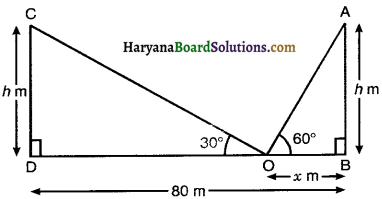
Let AB and CD be two poles of equal height h m, angles of elevation of the top of the poles are 60° and 30° respectively i.e. ∠AOB = 60°, ∠COD = 30° and BD = 80 m.
Let OB = x m, then DO = (80 – x) m
In right ∆ABO, we have
tan 60° = \(\frac{\mathrm{AB}}{\mathrm{BO}}\)

Haryana Board 10th Class Maths Solutions Chapter 9 Some Applications of Trigonometry Ex 9.1 10

⇒ √3 = \(\frac{h}{x}\)
⇒ h = √3x
⇒ x = \(\frac{h}{\sqrt{3}}\) …………..(1)
and right ∆CDO, we have
tan 30° = \(\frac{\mathrm{CD}}{\mathrm{DO}}\)
⇒ \(\frac{1}{\sqrt{3}}=\frac{h}{80-x}\)
⇒ √3h = 80 – x
⇒ √3h = 80 – \(\frac{h}{\sqrt{3}}\) [Using (1)]
⇒ √3h + \(\frac{h}{\sqrt{3}}\) = 80
⇒ \(\frac{3 h+h}{\sqrt{3}}\) = 80
⇒ 4h = 80√3
⇒ h = \(\frac{80 \sqrt{3}}{4}\)
⇒ h = 20√3 m
Putting the value of h in (1), we get
⇒ x = \(\frac{20 \sqrt{3}}{\sqrt{3}}\)
⇒ x = 20 m.
DO = 80 – x = 80 – 20 = 60 m.
Hence height of each pole is 20√3 m and distances of point from pole (AB) is 20 m and from pole (CD) is 60 m.

Haryana Board Solutions for 10th Class Maths Chapter 9 Some Applications of Trigonometry Ex 9.1

Question 11.
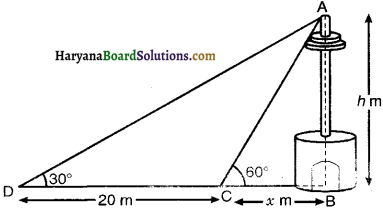
A TV Tower stands vertically on a bank of a canal. From a point on the other bank directly opposite the tower, the angle of elevation of the top of the tower is 60°. From another point 20 m away from this point on the line joining this point to the foot of the tower, the angle of elevation of the top of the tower is 30°. (See in figure). Find the height of tower and width of the canal.

Haryana Board 10th Class Maths Solutions Chapter 9 Some Applications of Trigonometry Ex 9.1 11

Solution :
Let height of tower be h m. and width of canal be x m.
Then ∠ACB = 60°, ∠ADB = 30° and CD = 20 m.
In right ∆ABC, we have
⇒ tan 60° = \(\frac{\mathrm{AB}}{\mathrm{BC}}\)
⇒ √3 = \(\frac{h}{x}\)
⇒ h = √3x ………………….(1)
In right ∆ABD, we have
tan 30° = \(\frac{\mathrm{AB}}{\mathrm{BD}}\)
⇒ \(\frac{1}{\sqrt{3}}=\frac{h}{\mathrm{BC}+\mathrm{CD}}\)
⇒ \(\frac{1}{\sqrt{3}}=\frac{h}{x+20}\)
⇒ √3h = x + 20
⇒ √3 × √3x = x + 20 [Using (1)]
⇒ 3x = x + 20
⇒ 2x = 20
⇒ x = \(\frac{20}{2}\) = 10
Putting the value of x in (1), we get
h = √3 × 10
⇒ h = 10√3
Hence, height of tower is 10√3 m and width of canal is 10 m.

Question 12.
From the top of a 7 m high building, the angle of elevation of the top of a cable tower is 60° and the angle of depression of its foot is 45°. Determine the height of the tower.
Solution:
Let AB be cable tower of height h m. and CD be building of height 7 m the angle of elevation of the top of the cable tower from the top of a building is 60°.
i.e. ∠ACE = 60° and angle of depression of its foot from the top of a building is 450
i.e. ∠ECB = 45°
∠CBD = ∠ECB [Alternate interior ∠s]
∠CBD = 45°

Haryana Board 10th Class Maths Solutions Chapter 9 Some Applications of Trigonometry Ex 9.1 12

In right ∆AEC, we have
tan 60° = \(\frac{\mathrm{AE}}{\mathrm{CE}}\)
= \(\frac{\mathrm{AB}-\mathrm{EB}}{\mathrm{CE}}\)
= \(\frac{h-7}{\mathrm{CE}}\)
CE = \(\frac{h-7}{\sqrt{3}}\) …………….(1)
and in right ACDB, we have
tan 45° = \(\frac{\mathrm{CD}}{\mathrm{DB}}\)
1 = \(\frac{7}{\mathrm{CE}}\) [∵ DB = CE]
CE = 7
Putting the value of CE in (1), we get
7 = \(\frac{h-7}{\sqrt{3}}\)
7√3 = h – 7
7√3 + 7 = h
h = 7(√3 + 1) m.
Hence, height of cable tower is 7 (√3 + 1) m.

Haryana Board Solutions for 10th Class Maths Chapter 9 Some Applications of Trigonometry Ex 9.1

Question 13.
As observed from the top of a 75 m high lighthouse from the sea-level, the angles of depression of two ships are 30° and 45°. If one ship is exactly behind the other on the same side of the lighthouse, find the distance between the two ships.
Solution :
Let AB be light house of height 75 m, angles of depression of two ships are 30° and 45°
i.e. ∠PAD = 30° and ∠PAC = 45°.
∠ADC = ∠PAD = 30° [alternate interior angles]
and ∠ACB = ∠PAC = 45° [alternate interior angles]
Let CD = x m.
and BC = y m.
In right ∆ABC, we have
tan 45° = \(\frac{\mathrm{AB}}{\mathrm{BC}}\)
⇒ 1 = \(\frac{75}{y}\)
⇒ y = 75 m ………………(1)

Haryana Board 10th Class Maths Solutions Chapter 9 Some Applications of Trigonometry Ex 9.1 13

and in right ∆ABD, we have
tan 30° = \(\frac{A B}{B D}\)
\(\frac{1}{\sqrt{3}}=\frac{75}{C D-B C}\)
\(\frac{1}{\sqrt{3}}=\frac{75}{x-y}\)
x + y = 75√3
x + 75 = 75√3 [Using (1)]
x= 75√3 – 75
X= 75(√3 – 1) .
Hence, distance between the, two ships is 75(√3 – 1) m.

Question 14.
A 12 m tall girl spots a balloon moving with the wind in a horizontal line at a height of 88.2 m in from the ground. The angle of elevation of the bafloon from the eyes of the girl at any instant is 60° After s mrne, the angle of elevation reäes
to 30° (see figure). Find the distance travelled by the balloon during the interval.

Haryana Board 10th Class Maths Solutions Chapter 9 Some Applications of Trigonometry Ex 9.1 14

Solution :
Let A be position of balloon when its angle of elevation from eye of the girl is 60° and P he the ooition of balloon when angle of elevation is 30°. Then
∠PCQ = 30°, ∠ACB = 60° and R = 88.2 m
PQ = PR – QR = 88.2 – 1.2 = 87 m
In right ∆PQC, we have
tan 30° = \(\frac{\mathrm{PQ}}{\mathrm{QC}}\)
⇒ \(\frac{1}{\sqrt{3}}=\frac{87}{\mathrm{QC}}\)
⇒ QC = 87√3 ……………….(1)
and in right ∆ABC, we have
tan 60° = \(\frac{\mathrm{AB}}{\mathrm{BC}}\)
⇒ √3 = \(\frac{87}{B C}\) [∵ AB = PQ = 87 m].
⇒ BC = \(\frac{87}{\sqrt{3}}\)
⇒ BC = \(\frac{87 \sqrt{3}}{3}\) ………………..(2)
Now distance travelled by balloon = AP = BQ = QC – BC
= 87√3 – \(\frac{87 \sqrt{3}}{3}\) [From (1) and (2)]
= 87√3 (1 – \(\frac{1}{3}\))
= 87√3 × \(\frac{2}{3}\) = 58√3
Hence, distance travelled by balloon is 58√3 m.

Haryana Board Solutions for 10th Class Maths Chapter 9 Some Applications of Trigonometry Ex 9.1

Question 15.
A straight highway leads to the foot of a tower. A man standing at the top of the tower observes a car at an angle of depression of 30°, which is approaching the foot of the tower with a uniform speed. Six seconds later, the angle of depression of the car is found to be 60°. Find the time taken by the car to reach the foot of the tower from this point.
Solution:
Let AB be vertical tower of height h m.
Let the speed of the car be v m/sec.
At the point C angle of depression of car be 30° i.e. ∠PAC = 30°
and it reaches to D six seconds later.
Then angle of depression of car is 60° i.e. ∠PAD = 60°.

Haryana Board 10th Class Maths Solutions Chapter 9 Some Applications of Trigonometry Ex 9.1 15

∠ACD = ∠PAC = 30° [alternate interior angles]
∠ADB = ∠PAD = 60° [alternate interior angles]
Distance travelled by car in 6 sec = 6v metres.
So, CD = 6v metres [∵ Distance = speed × time]
Let car takes t seconds to reach the point B from the point D
Distance travelled by car in t sec = vt metres.
In right ∆ABD, we have
tan 60° = \(\frac{\mathrm{AB}}{\mathrm{BD}}\)
√3 = \(\frac{h}{v t}\)
⇒ h = √3vt …………………(1)
and in right ∆ABC, we have
tan 30° = \(\frac{\mathrm{AB}}{\mathrm{BC}}\)
\(\frac{1}{\sqrt{3}}=\frac{h}{\mathrm{CD}+\mathrm{BD}}\)
\(\frac{1}{\sqrt{3}}=\frac{h}{6 v+v t}\)
⇒ √3h = 6v + vt
⇒ √3 × √3vt = 6v + vt [Using (1)]
⇒ 3vt = 6 v + vt
⇒ 2vt = 6v
⇒ t = \(\frac{6 v}{2 v}\) = 3 sec.
Hence, the car takes 3 sec. to reach the foot of tower.

Haryana Board Solutions for 10th Class Maths Chapter 9 Some Applications of Trigonometry Ex 9.1

Question 16.
The angles of elevation of the top of a tower from two points at a distance of 4 m and 9 m from the base of the tower and in the same straight line With it are complementary. Prove that the height of tower is 6 m.
Solution :
Let AB be tower of height h m. C and D are two points such that BC = 9 m.
and BD = 4 m, let ∠ACB = θ then ∠ADB = 90° – θ
In right ∆ABD, we have
tan (90° – θ) = \(\frac{\mathrm{AB}}{\mathrm{BD}}\)

Haryana Board 10th Class Maths Solutions Chapter 9 Some Applications of Trigonometry Ex 9.1 16

⇒ cot θ = \(\frac{h}{4}\)
[∵ tan (90° – θ) = cot θ]
⇒ h = 4 cot θ ………………(1)
In right ∆ABC, we have
tan θ = \(\frac{\mathrm{AB}}{\mathrm{BC}}\)
tan θ = \(\frac{h}{9}\)
⇒ h = 9 tan θ ………………(2)
Multiplying (1) & (2), we get
h × h = 4 cot θ . 9 tan θ
⇒ h2 = 4 × \(\frac{1}{\tan \theta}\) × 9 tan θ
⇒ h2 = 36
⇒ h = √36 = 6
Hence, height of tower is 6 m.
Hence Proved.

HBSE 10th Class Maths Solutions Chapter 9 Some Applications of Trigonometry Ex 9.1 Read More »

HBSE 10th Class Maths Solutions Chapter 8 Introduction to Trigonometry Ex 8.4

Haryana State Board HBSE 10th Class Maths Solutions Chapter 8 Introduction to Trigonometry Ex 8.4 Textbook Exercise Questions and Answers.

Haryana Board 10th Class Maths Solutions Chapter 8 Introduction to Trigonometry Ex 8.4

Question 1.
Express the trigonometric ratios sin A, sec A and tan A in terms of cot A. Write the trigonometric ratio of sin A in terms of cot A.
Solution :
We have,
cosec2 A = 1 + cot2 A

Haryana Board 10th Class Maths Solutions Chapter 8 Introduction to Trigonometry Ex 8.4 1

Hence, sin A = \(\frac{1}{\sqrt{1+\cot ^2 A}}\),
sec A = \(\frac{\sqrt{\cot ^2 \mathrm{~A}+1}}{\cot \mathrm{A}}\) and
tan A = \(\frac{1}{\cot A}\).

Haryana Board Solutions for 10th Class Maths Chapter 8 Introduction to Trigonometry Ex 8.4

Question 2.
Write all the other trigonometric ratios of A in terms of sec A. Express the trignometric ratio of tan A in terms of sec A.
SoJution :
We have,
sin2 A + cos2 A = 1
sin2 A = 1 – cos2 A
sin2 A = 1 – \(\frac{1}{\sec ^2 A}\)
sin2 A = \(\frac{\sec ^2 A-1}{\sec ^2 A}\)
sin A = \(\sqrt{\frac{\sec ^2 \mathrm{~A}-1}{\sec ^2 \mathrm{~A}}}\)
sin A = \(\frac{\sqrt{\sec ^2 \mathrm{~A}-1}}{\sec \mathrm{A}}\)
∵ cos A = \(\frac{1}{\sec \bar{A}}\)

Haryana Board 10th Class Maths Solutions Chapter 8 Introduction to Trigonometry Ex 8.4 2

Haryana Board Solutions for 10th Class Maths Chapter 8 Introduction to Trigonometry Ex 8.4

Question 3.
Evaluate:
(i) \(\frac{\sin ^2 63^{\circ}+\sin ^2 27^{\circ}}{\cos ^2 17^{\circ}+\cos ^2 73^{\circ}}\)
(ii) sin 25° cos 65° + cos 25° sin 65°
Solution :
(i) \(\frac{\sin ^2 63^{\circ}+\sin ^2 27^{\circ}}{\cos ^2 17^{\circ}+\cos ^2 73^{\circ}}\)
= \(\frac{\sin ^2\left(90^{\circ}-27^{\circ}\right)+\sin ^2 27^{\circ}}{\cos ^2\left(90^{\circ}-73^{\circ}\right)+\cos ^2 73^{\circ}}\)
= \(\frac{\cos ^2 27^{\circ}+\sin ^2 27^{\circ}}{\sin ^2 73^{\circ}+\cos ^2 73^{\circ}}\)
= \(\frac{1}{1}\) = 1 [∵ sin2 θ + cos2 θ = 1]
Hence, \(\frac{\sin ^2 63^{\circ}+\sin ^2 27^{\circ}}{\cos ^2 17^{\circ}+\cos ^2 73^{\circ}}\) = 1.

(ii) sin 25° cos 65° + cos 25° sin 65°
= sin 25° cos (90° – 25°) + cos 25° sin (90° – 25°)
= sin 25° sin 25° + cos 25° cos 25°
= sin2 25° + cos2 25°
= 1 [∵ sin2 θ + cos2 θ = 1]
Hence, sin 25° cos 65° + cos 25° sin 65° = 1.

Question 4.
Choose the correct option. Justify your choice:
(i) 9 sec2 A – 9 tan2 A =
(A) 1
(B) 9
(C) 8
(D) 0

(ii) (1 + tan θ + sec θ) (1 + cot θ – cosec θ) =
(A) 0
(B) 1
(C) 2
(D) – 1

(iii) (sec A + tan A) (1 – sin A) =
(A) sec A
(B) sin A
(C) cosec A
(D) cos A

(iv) \(\frac{1+\tan ^2 \mathrm{~A}}{1+\cot ^2 \mathrm{~A}}\) =
(A) sec2 A
(B) – 1
(C) cot2 A
(D) tan2 A

Haryana Board Solutions for 10th Class Maths Chapter 8 Introduction to Trigonometry Ex 8.4
Solution :
(i) (B)
Because; 9 sec2 A – 9 tan2 A = 9 (sec2 A – tan2 A)
= 9 × 1
[∵ sec2 A – tan2 A = 1]
= 9

(ii) (C)
Because ; (1 + tan θ + sec θ) (1 + cot θ – cosec θ)

Haryana Board 10th Class Maths Solutions Chapter 8 Introduction to Trigonometry Ex 8.4 3

(iii) (D) Because; (sec A + tan A) (1 – sin A)
= \(\left(\frac{1}{\cos A}+\frac{\sin A}{\cos A}\right)\) (1 – sin A)
= \(\frac{(1+\sin \mathrm{A})(1-\sin \mathrm{A})}{\cos \mathrm{A}}\)
= \(\frac{1-\sin ^2 \mathrm{~A}}{\cos \mathrm{A}}\)
= \(\frac{\cos ^2 A}{\cos \mathrm{A}}\) = cos A
[∵ 1 – sin2 A = cos2 A]

(iv) (D) Because;

Haryana Board 10th Class Maths Solutions Chapter 8 Introduction to Trigonometry Ex 8.4 4

Haryana Board Solutions for 10th Class Maths Chapter 8 Introduction to Trigonometry Ex 8.4

Question 5.
Prove the following identities, where the angles involved are acute angles for which the expressions are defined.
(i) (cosec θ – cot θ)2 = \(\frac{1-\cos \theta}{1+\cos \theta}\)
(ii) \(\frac{\cos A}{1+\sin A}+\frac{1+\sin A}{\cos A}\) = 2 sec A
(iii) \(\frac{\tan \theta}{1-\cot \theta}+\frac{\cot \theta}{1-\tan \theta}\) = 1 + sec θ cosec θ
(iv) \(\frac{1+\sec \mathrm{A}}{\sec \mathrm{A}}=\frac{\sin ^2 \mathrm{~A}}{1-\cos \mathrm{A}}\)
(v) \(\frac{\cos A-\sin A+1}{\cos A+\sin A-1}\) = cosec A + cot A, using the identity cosec2 A = 1 + cot2 A
(vi) \(\sqrt{\frac{1+\sin A}{1-\sin A}}\) = sec A + tan A
(vii) \(\frac{\sin \theta-2 \sin ^3 \theta}{2 \cos ^3 \theta-\cos \theta}\) = tan θ
(viii) (sin A + cosec A)2 + (cos A + sec A)2 = 7 + tan2 A + cot2 A
(ix) (cosec A – sin A) (sec A – cos A) = \(\frac{1}{\tan A+\cot A}\)
(x) \(\left(\frac{1+\tan ^2 \mathrm{~A}}{1+\cot ^2 \mathrm{~A}}\right)=\left(\frac{1-\tan \mathrm{A}}{1-\cot \mathrm{A}}\right)^2\) = tan2 A
Solution:
(i) We have,
L.H.S = (cosec θ – cot θ)2

Haryana Board 10th Class Maths Solutions Chapter 8 Introduction to Trigonometry Ex 8.4 5

L.H.S. = R.H.S.
Hence proved.

Haryana Board Solutions for 10th Class Maths Chapter 8 Introduction to Trigonometry Ex 8.4

(ii) We have,

Haryana Board 10th Class Maths Solutions Chapter 8 Introduction to Trigonometry Ex 8.4 6

L.H.S. = R.H.S.
Hence proved.

(iii) We have,

Haryana Board 10th Class Maths Solutions Chapter 8 Introduction to Trigonometry Ex 8.4 7

= cosec θ sec θ + 1
= 1 + sec θ cosec θ = R.H.S
∴ L.H.S. = R.H.S.

Haryana Board Solutions for 10th Class Maths Chapter 8 Introduction to Trigonometry Ex 8.4

(iv) We have,

Haryana Board 10th Class Maths Solutions Chapter 8 Introduction to Trigonometry Ex 8.4 8
[∵ 1 – cos2 A = sin2 A]
∴ L.H.S. = R.H.S.

(v) We have,
L.H.S = \(\frac{\cos A-\sin A+1}{\cos A+\sin A-1}\)
= \(\frac{\frac{\cos A}{\sin A}-\frac{\sin A}{\sin A}+\frac{1}{\sin A}}{\frac{\cos A}{\sin A}+\frac{\sin A}{\sin A}-\frac{1}{\sin A}}\)
[Dividing numerator and denominator by sin A]

Haryana Board 10th Class Maths Solutions Chapter 8 Introduction to Trigonometry Ex 8.4 9

= cosec A + cot A = R.H.S.
∴ L.H.S. = R.H.S.
Hence proved.

Haryana Board Solutions for 10th Class Maths Chapter 8 Introduction to Trigonometry Ex 8.4

(vi) We have,

Haryana Board 10th Class Maths Solutions Chapter 8 Introduction to Trigonometry Ex 8.4 10

= sec A + tan A
= R.H.S.
∴ L.H.S. = R.H.S.

(vii) We have,

Haryana Board 10th Class Maths Solutions Chapter 8 Introduction to Trigonometry Ex 8.4 11

= tan θ = R.H.S
∴ L.H.S. = R.H.S.

Haryana Board Solutions for 10th Class Maths Chapter 8 Introduction to Trigonometry Ex 8.4

(viii) We have,
L.H.S = (sin A + cosec A)2 + (cos A + sec A)2
= sin2 A + cosec2 A + 2 sin A cosec A + cos2 A + sec2 A + 2 cos A sec A
= (sin2 A + cos2 A) + (cosec2 A) + (sec2 A) + 2 sin A × \(\frac{1}{\sin A}\) + 2 cos A \(\frac{1}{\cos A}\)
= 1 + 1 + cot2 A + 1 + tan2 A + 2 + 2
= 7 + tan2 A + cot2 A
= R.H.S
∴ L.H.S. = R.H.S.
Hence Proved.

(ix) We have,

Haryana Board 10th Class Maths Solutions Chapter 8 Introduction to Trigonometry Ex 8.4 12

= sin A cos A
∴ L.H.S. = R.H.S.
Hence Proved.

Haryana Board Solutions for 10th Class Maths Chapter 8 Introduction to Trigonometry Ex 8.4

(x) We have,

Haryana Board 10th Class Maths Solutions Chapter 8 Introduction to Trigonometry Ex 8.4 13

= tan2 A
∴ L.H.S. = R.H.S.
Hence Proved.

HBSE 10th Class Maths Solutions Chapter 8 Introduction to Trigonometry Ex 8.4 Read More »

HBSE 7th Class Social Science Solutions Civics Chapter 3 राज्य शासन कैसे काम करता है

Haryana State Board HBSE 7th Class Social Science Solutions Civics Chapter 3 राज्य शासन कैसे काम करता है Textbook Exercise Questions and Answers.

Haryana Board 7th Class Social Science Solutions Civics Chapter 3 राज्य शासन कैसे काम करता है

HBSE 7th Class Civics राज्य शासन कैसे काम करता है Textbook Questions and Answers

राज्य शासन कैसे काम करता है प्रश्न उत्तर HBSE 7th Class Civics  प्रश्न 1.
निर्वाचन क्षेत्र व प्रतिनिधि शब्दों का प्रयोग करते हुए स्पष्ट कीजिए कि विधायक कौन होता है और उसका चुनाव किस प्रकार होता है ?
उत्तर :
अर्थ (Meaning) :

  1. विधायक अर्थात् एम.एल. ए. राज्य विधान सभा के सदस्यों को कहते हैं।
  2. एम.एल.ए. (M.L.A.), मेंबर ऑफ लेजिस्लेटिव असेंबली का संक्षिप्त रूप है।

चुनाव के उद्देश्य से राज्य को जनसंख्या के आधार पर विभिन्न निर्वाचन क्षेत्रों में बाँटा जाता है। जनता इन निर्वाचन क्षेत्रों से अपने प्रतिनिधियों का चयन करती है। एक निर्वाचन क्षेत्र से राज्य विधानसभा के लिए चुना गया व्यक्ति विधायक कहलाता है। वह उस क्षेत्र विशेष की जनता का प्रतिनिधित्व करता है।

राज्य शासन कैसे काम करता है HBSE 7th Class Civics प्रश्न 2.
कुछ विधायक मंत्री कैसे बनते हैं ? स्पष्ट कीजिए।
उत्तर :
राज्य विधानसभा के चुनावों में जिस दल को बहुमत प्राप्त होता है, उस दल के नेता को मुख्यमंत्री बनाया जाता है। मुख्यमंत्री अपने दल के निर्वाचित सदस्यों में से कुछ विधायकों का चुनाव करता है जो राज्य का शासन चलाने में उसकी सहायता करते हैं। ये विधायक मंत्री कहलाते हैं।

HBSE 7th Class Social Science Solutions Civics Chapter 3 राज्य शासन कैसे काम करता है

Rajya Shasan Kaise Kaam Karta Hai HBSE 7th Class Civics प्रश्न 3.
मुख्यमंत्री तथा अन्य मंत्रियों द्वारा लिए गए निर्णयों पर विधानसभा में बहस क्यों होनी चाहिए?
उत्तर :
(i) मुख्यमंत्री तथा अन्य मंत्रियों द्वारा लिए गए फैसलों पर विधानसभा में बहस होनी आवश्यक है क्योंकि मुख्यमंत्री विधानसभा का नेता होता है लेकिन वह स्वयं और उसके अन्य मंत्री व्यक्तिगत और सामूहिक रूप से विधान सभा के प्रति उत्तरदायी होते हैं।

(ii) विधानसभा में बहस के दौरान राज्य की जनता को यह पता हो जाता है कि मुख्यमंत्री और अन्य मंत्रियों द्वारा नीति संबंधी या कार्यकारी संबंधी निर्णय ठीक हैं या गलत क्योंकि लोकतंत्र में अंततः सत्ता जनता में ही निहित होती है।

(iii) मुख्यमंत्री व अन्य मंत्रियों द्वारा सत्ता के दुरुपयोग पर रोक लगाने के लिए भी मंत्रियों द्वारा लिए गए निर्णयों पर रोक लगाना आवश्यक है।

(iv) बहस के माध्यम से मंत्रियों के उन निर्णयों पर रोक लगाई जा सकती है जो जनहित में नहीं होते। (५) यह मंत्रियों को सही दिशा में कार्य करने को प्रोत्साहित करती है।

राज्य शासन कैसे करता है HBSE 7th Class Civics प्रश्न 4.
पातालपुरम में क्या समस्या थी ? निम्नलिखित के द्वारा इस विषय में क्या चर्चा या कार्य किए गए ? निम्न तालिका में भरिए –

आम सभा
विधानसभा
प्रेस वार्ता
मुख्यमंत्री

उत्तर :
(i) पातालपुरम में पानी की कमी थी और बहुत से लोग बीमार पड़ गए थे। इस क्षेत्र के अनेक गाँवों में गंदा पानी पीते हुए लोग मर गए। नदी-नाले और तालाब सूख गए थे। जो क्षेत्र और गाँव जल की कमी से बुरे प्रभावित हो गए थे वहाँ लोग दूर-दूर से पानी लेकर आते थे।

(ii) जिला मुख्यालय पातालपुर में तीन दिन में केवल एक बार जल की आपूर्ति की जाती थी। जिला चिकित्सालय में मरीजों की बहुत बड़ी संख्या थी और लोग बड़ी संख्या में अपने पीड़ित बच्चों को ला रहे थे। दूरदर्शन पर यह भी बताया गया कि हैजे के कारण 10 लोग मृत्यु के मुख में चले गए थे।

(iii) तालिका को प्रश्न अनुसार भरना (Filling up index according to questions): आम सभा (Public Meeting) : पातालपुरम की समस्या पर विचार करने के लिए एक आम सभा बुलाई गई जिसमें मुख्यमंत्री, स्वास्थ्य मंत्री, जिलाधीश, जिले के मुख्य चिकित्सक तथा कुछ अन्य प्रतिनिधियों और क्षेत्र से जुड़े लोगों ने भाग लिया।

(iv) विधान सभा (Legislative Assembly) : राज्य विधान सभा में अनेक विधायकों ने सरकार के काम के बारे में टीका-टिप्पणी की और सरकार से तुरंत आवश्यक कार्यवाही करने की मांग की।

(v) प्रेस वार्ता (Press Conference) : प्रेस वार्ता में मंत्री जी ने सरकार द्वारा उठाए गए कदमों के बारे में बताया।

(vi) मुख्यमंत्री (Chief Minister) : उन्होंने उन परिवारों से भेंट को, जिनके रिश्तेदारों की मृत्यु हो गई थी। वे अस्वस्थ लोगों को देखने अस्पताल भी गए।

(vii) सरकार ने कचरे की सुध ली। मुख्यमंत्री ने उन परिवारों के लिए मुआवजा राशि की घोषणा की जो इस समस्या और विपत्ति से बुरी तरह प्रभावित हुए। मुख्यमंत्री ने स्वच्छ जल आपूर्ति की व्यवस्था पर तुरंत ध्यान देने पर लोक निर्माण मंत्री को आवश्यक निर्देश दिए।

HBSE 7th Class Social Science Solutions Civics Chapter 3 राज्य शासन कैसे काम करता है

राज्य शासन कैसे काम करता है के प्रश्न उत्तर HBSE 7th Class Civics प्रश्न 5.
विधानसभा सदस्य द्वारा विधायिका में किए गए कार्यों और शासकीय विभागों द्वारा किए गए कार्यों के बीच क्या अंतर है ?
उत्तर :

  1. विधानसभा में विधानसभा के सदस्य या एम.एल. ए. द्वारा विधायिका में कानूनों के निर्माण में भाग लेते हैं। समस्याओं पर चर्चा करते हैं व उन्हें रोकने के उपाय करते हैं।
  2. शासकीय कर्मचारी वेतनभोगी होते हैं। ये विधानसभा या सरकार के द्वारा तय की गई नीतियों, योजनाओं और कार्यों को लागू करते हैं और समय-समय पर विधान सभा और सरकार को रिपोर्ट देते हैं।

बहुविकल्पी प्रश्न

Rajya Sarkar Class 7 HBSE Civics प्रश्न 1.
सही विकल्प चुनें :

(i) विधानसभा के सदस्यों को कहते हैं :
(क) मंत्री
(ख) विधायक
(ग) एम.पी.
उत्तर :
(ख) विधायक।

(ii) भारत के प्रत्येक राज्य में विधानसभा की संख्या है :
(क) 1
(ख) 2
(ग) 3
उत्तर :
(क) 1।

(ii) राज्यों का विभिन्न निर्वाचन क्षेत्रों में बंटवारे का आधार है:
(क) जनसंख्या
(ख) क्षेत्र
(ग) भौगोलिक कारक
उत्तर :
(क) जनसंख्या।

(iv) निम्न में से विरोध प्रदर्शन का उत्तम तरीका है:
(क) विधायकों का घेराव
(ख) हिंसात्मक कार्यवाही
(ग) शांतिपूर्ण रैली
उत्तर :
(ग) शांतिपूर्ण रैली।

(v) चुनावों में बहुमत प्राप्त दल होता है ।
(क) विरोधी दल
(ख) सत्ता दल
(ग) जनता दल
उत्तर :
(ख) सत्ता दल।

HBSE 7th Class Social Science Solutions Civics Chapter 3 राज्य शासन कैसे काम करता है

प्रश्न 2.
रिक्त स्थान भरो:
(i) मेंबर ऑफ लेजिस्लेटिव असेंबली का संक्षिप्त रूप …………….. है।
(ii) एक निर्वाचन क्षेत्र से ………… प्रतिनिधि का चुनाव होता है।
(iii) एक राज्य का प्रमुख ……………….. कहलाता है।
(iv) मुख्यमंत्री द्वारा लिए गए निर्णयों को विधानसभा सदस्यों द्वारा ………………… किया जाना आवश्यक है।
(v) प्रेसवार्ता में समाचार पत्रों के प्रश्न पूछते हैं।
उत्तर :
(i) एम.एल.ए.
(ii) एक
(iii) राज्यपाल
(vi) अनुमोदित
(v) संवाददाता।

प्रश्न 3.
सही अथवा गलत छाँटो:
(i) वॉल पेपर के माध्यम से रुचि के किसी विषय पर शोध किया जा सकता है।
(ii) प्रेसवार्ता का उद्देश्य किसी विषय पर सूचना उपलब्ध करवाना है।
(iii) लोकतंत्र में विधानसभा सदस्य मंत्रियों व मुख्यमंत्रियों से प्रश्न नहीं पूछ सकते।
(iv) सभी विधायक एक ही राजनीतिक दल के सदस्य होते हैं।
(v) राज्य सरकारें स्थानीय स्तर पर कार्य करती हैं।
उत्तर :
(i) वॉल पेपर के माध्यम से रुचि के किसी विषय पर शोध किया जा सकता है। ✓
(ii) प्रेसवार्ता का उद्देश्य किसी विषय पर सूचना उपलब्ध करवाना है। ✓
(iii) लोकतंत्र में विधानसभा सदस्य मंत्रियों व मुख्यमंत्रियों से प्रश्न नहीं पूछ सकते। ✗
(iv) सभी विधायक एक ही राजनीतिक दल के सदस्य होते हैं। ✗
(v) राज्य सरकारें स्थानीय स्तर पर कार्य करती हैं। ✗

HBSE 7th Class Civics राज्य शासन कैसे काम करता है Important Questions and Answers

अति लघु उत्तरात्मक प्रश्न

प्रश्न 1.
शासन किन तीन स्तरों पर कार्य करता है ?
उत्तर :
शासन निम्न तीन स्तरों पर कार्य करता है –
(क) स्थानीय स्तर
(ख) राज्य स्तर
(ग) केंद्र स्तर।

प्रश्न 2.
राज्य स्तर पर शासन कैसे कार्य करता है ?
उत्तर :
राज्य स्तर पर विधायिका कानून बनाती है। कार्यपालिका उन्हें लागू करती है और न्यायपालिका अर्थात् उच्च न्यायालय और उसके अधीन कार्य करने वाले न्यायालय उन कानूनों को तोड़ने वालों को पुलिस की मदद से कानून के अनुसार दंडित करते हैं। राज्य शासकीय विभागों में लगे अधिकारीगण और कर्मचारीगण सरकार के कार्यों को लागू करते हैं।

HBSE 7th Class Social Science Solutions Civics Chapter 3 राज्य शासन कैसे काम करता है

प्रश्न 3.
बहुमत का अर्थ समझाइए।
उत्तर :
राज्य विधान सभा में जिस राजनैतिक दल या कुछ दलों के संयुक्त मोर्च को आधे से अधिक स्थान मिलें, उन्हें बहुमत प्राप्त दल या मोर्चा कहा जाता है।

प्रश्न 4.
विरोधी दल से क्या अभिप्राय है?
उत्तर :
राज्य विधान सभा में बहुमत प्राप्त करने वाले दल या दलों के समूह को सत्ता पक्ष और अन्य दलों को विरोध पक्ष वाला कहा जाता है।

प्रश्न 5.
लोकतंत्र में लोग अपनी राय व्यक्त करने और सरकार का विरोध करने का क्या तरीका अपनाते हैं ? एक उपाय या तरीका लिखिए।
उत्तर :
लोकतंत्र में लोग अपना मत व्यक्त करने और सरकार का विरोध करने के लिए सभाएँ अथवा जुलूस आयोजित करते हैं।

प्रश्न 6.
एम.एल.ए. का चुनाव कौन करता है?
उत्तर :
एम.एल.ए. का चुनाव जनता द्वारा किया जाता है।

लघु उत्तरात्मक प्रश्न

प्रश्न 1.
राज्य सरकार को ध्यान में रखकर इस कथन को समझाइए कि “विधायक सामूहिक रूप से सरकार के काम के लिए उत्तरदायी होते हैं।”
उत्तर :
प्रत्येक राज्य की विधानसभा में सभी सदस्य सरकार द्वारा किसी भी विषय पर की गई या न की गई कार्यवाही पर बहस में हिस्सा लेते हैं। ऐसा इसलिए है, क्योंकि विधायक सामूहिक रूप से सरकार के काम के लिए विधान सभा के प्रति उत्तरदायी होते हैं। सामान्य भाषा में सरकार शब्द से तात्पर्य शासन के विभिन्न विभागों और मंत्रियों से होता है, जो उनके प्रभारी हैं। इन सबका सामूहिक प्रमुख ‘मुख्यमंत्री’ होता है। सही तरीके से कहें, तो यही सरकार का कार्यकारी हिस्सा अर्थात् कार्यपालिका (Executive) कहलाता है। दूसरी तरफ़ सारे विधायक, जो विधानसभा में एकत्र होते हैं विधायिका (Legislature) कहलाते हैं।

प्रश्न 2.
राज्यपाल कौन होता है?
उत्तर :
राज्यपाल राज्य का प्रधान होता है। इसकी नियुक्ति राष्ट्रपति करता है। इसका प्रमुख कार्य यह सुनिश्चित करना है कि राज्य सरकार संविधान के नियमों अधिनियमों के अनुसार शासन कार्य चलाए।

HBSE 7th Class Social Science Solutions Civics Chapter 3 राज्य शासन कैसे काम करता है

प्रश्न 3.
गठबंधन सरकार किसे कहते हैं?
उत्तर :
कभी-कभी चुनावों में किसी भी राजनीतिक दल को स्पष्ट बहुमत नहीं मिलता। ऐसी स्थिति में कई दल मिलकर सरकार बनाते हैं। कई दलों से मिलकर बनी इस प्रकार की सरकार को गठबंधन सरकार या मिली-जुली सरकार कहते हैं।

दीर्घ उत्तरात्मक प्रश्न

प्रश्न 1.
राज्यों में मुख्यमंत्री और अन्य मंत्री विभिन्न विभागों के अधिकारियों के सहयोग से कैसे कार्य करते हैं? संक्षेप में समझाइए।
उत्तर :
(i) प्रत्येक राज्य में सत्ताधारी पक्ष विशेषकर मुख्यमंत्री और उसके मंत्रिमंडल के सदस्यों को प्रशासन से जुड़ी समस्याओं पर कार्यवाही करनी होती है। वे यह कार्य विभिन्न विभागों द्वारा करवाते हैं। उदाहरण के लिए जैसे – लोक निर्माण विभाग (PWD), कृषि विभाग (Agriculture Department), स्वास्थ्य विभाग (Health Department)शिक्षा विभाग (Education Department) आदि। उन्हें विधानसभा में उठाए गए प्रश्नों का भी उत्तर देना होता है और प्रश्न करने वाले लोगों को आश्वस्त करना होता है कि उचित कदम उठाए जा रहे हैं।

(ii) इसके साथ-साथ समाचारपत्रों व अन्य माध्यमों में भी इन विषयों पर चर्चा होती है, जिसका उत्तर सरकार को देना होता है।

(iii) सरकार, सफाई और स्वास्थ्य सेवाओं के लिए नए कानून बनाने का भी निर्णय ले सकती है। उदाहरण के लिए – वह कानून बनाकर हर नगर निगम के लिए यह अनिवार्य कर सकती है कि शहरी क्षेत्रों में पर्याप्त शौचालयों की व्यवस्था हो।

(iv) यह भी सुनिश्चित किया जा सकता है कि हर ग्राम में एक स्वास्थ्य-कर्मी को नियुक्ति हो। किसी विषय पर कानून बनाने का यह कार्य प्रत्येक राज्य की विधानसभा द्वारा किया जाता है।

(v) इसके पश्चात् विभिन शासकीय विभाग इन कानूनों का क्रियान्वयन करते हैं।

राज्य शासन कैसे काम करता है Class 7 HBSE Notes in Hindi

1. निर्वाचन क्षेत्र (Constituency) : इसका तात्पर्य एक निश्चित क्षेत्र से है, जहाँ निवास करने वाले सब मतदाता अपना प्रतिनिधि चुनते हैं। उदाहरण के लिए – यह कोई पंचायत का वार्ड (निर्वाचन क्षेत्र) या वह क्षेत्र हो सकता है, जो विधानसभा सदस्य चुनता है।

2. बहुमत (Majority) : इसका आशय ऐसी स्थिति से है, जब किसी समूह के आधे से अधिक संख्या में लोग किसी निर्णय या विचार से सहमत हों। इसे साधारण बहुमत भी कहा जाता है।

3. विरोधी पक्ष (Opposition) : इसका तात्पर्य उन चुने हुए प्रतिनिधियों से है, जो सत्ता पक्ष के सदस्य नहीं हैं और जिनकी भूमिका सरकारी निर्णयों और कार्यों पर प्रश्न उठाने और विधानसभा में विचार के लिए नए मुद्दे उठाने की होती है।

4. प्रेस वार्ता (Press Conference) : मीडिया से संबंधित पत्रकारों का ऐसा समूह, जिसे किसी विषय पर अपना पक्ष बताने और उस पर प्रश्न पूछने के लिए आमंत्रित किया गया हो। उनसे अपेक्षा की जाती है कि वे मीडिया (जनसंचार माध्यम) के माध्यम से इसके बारे में बड़े जनसमूह को बताएंगे।

HBSE 7th Class Social Science Solutions Civics Chapter 3 राज्य शासन कैसे काम करता है Read More »

HBSE 9th Class Science Important Questions Chapter 14 प्राकृतिक सम्पदा

Haryana State Board HBSE 9th Class Science Important Questions Chapter 14 प्राकृतिक सम्पदा Important Questions and Answers.

Haryana Board 9th Class Science Important Questions Chapter 14 प्राकृतिक सम्पदा

अति लघूत्तरात्मक प्रश्न

प्रश्न 1.
प्राकृतिक संपदा किसे कहते हैं?
उत्तर:
प्रकृति में उपलब्ध उपयोगी पदार्थ, प्राकृतिक संपदा कहलाते हैं।

प्रश्न 2.
प्राकृतिक संपदाओं के उदाहरण दो।
उत्तर:
वायु, जल, मृदा, खनिज, वन आदि।

प्रश्न 3.
जीवन के लिए आवश्यक कारक कौन-कौन से हैं?
उत्तर:
परिवेश, ताप, पानी और भोजन।

प्रश्न 4.
स्थलमंडल किसे कहते हैं?
उत्तर:
पृथ्वी की सबसे बाहरी परत को स्थलमंडल कहते हैं।

प्रश्न 5.
पृथ्वी के कितने भाग पर जल है?
उत्तर:
75 प्रतिशत भाग पर।

HBSE 9th Class Science Important Questions Chapter 14 प्राकृतिक सम्पदा

प्रश्न 6.
जलमंडल किसे कहते हैं?
उत्तर:
पृथ्वी के जिस भाग पर जल पाया जाता है, जलमंडल कहलाता है।

प्रश्न 7.
वायुमंडल की परिभाषा लिखो।
उत्तर:
पृथ्वी को वायु का एक आवरण ढके रहता है, वह आवरण वायुमंडल कहलाता है।

प्रश्न 8.
जीवमंडल किसे कहते हैं?
उत्तर:
वायुमंडल, स्थलमंडल और जलमंडल एक-दूसरे से मिलकर जीवन को संभव बनाते हैं, इसे जीवमंडल कहते हैं।

प्रश्न 9.
जीवमंडल के निर्जीव घटकों के नाम लिखो।
उत्तर:
हवा, जल, मिट्टी।

प्रश्न 10.
वायु किसे कहते हैं?
उत्तर:
पृथ्वी पर पाए जाने वाली विभिन्न गैसों, जलवाष्पों व धूलकणों का मिश्रण वायु कहलाता है।

प्रश्न 11.
शुक्र और मंगल ग्रहों पर CO2 की कितनी प्रतिशत मात्रा पाई जाती है?
उत्तर:
95 से 97 प्रतिशत।

प्रश्न 12.
क्या शुक्र और मंगल ग्रहों पर ऑक्सीजन पाई जाती है?
उत्तर:
नहीं।

प्रश्न 13.
पृथ्वी के वायुमंडल में CO2 की प्रतिशत मात्रा कितनी है?
उत्तर:
0.033%।

प्रश्न 14.
क्या चंद्रमा की सतह पर वायुमंडल है?
उत्तर:
नहीं।

प्रश्न 15.
पवनें किसे कहते हैं?
उत्तर:
बहती हुई वायु को पवन या समीर कहते हैं।

प्रश्न 16.
वायु प्रदूषण किसे कहते हैं?
उत्तर:
वायु में अवांछनीय पदार्थों का मिलना वायु प्रदूषण कहलाता है।

प्रश्न 17.
वायु प्रदूषकों के नाम लिखो।
उत्तर:
अपशिष्ट गैसें (CO2, नाइट्रोजन व सल्फर के ऑक्साइड, हाइड्रोकार्बन आदि) जलवाष्प, धूलकण आदि।

प्रश्न 18.
धूम कोहरा किसे कहते हैं?
उत्तर:
सर्दी के मौसम में जब पानी भी हवा के साथ संघनित हो जाए तो, इसे धूम कोहरा कहते हैं।

प्रश्न 19.
वायु प्रदूषण से होने वाली बीमारियों के नाम लिखो।
उत्तर:
श्वास रोग, कैंसर, हृदय रोग, एलर्जी।

प्रश्न 20.
मुख्य रूप से जल कितने प्रकार का होता है?
उत्तर:
दो, खारा और मीठा (अलवणीय)।

प्रश्न 21.
पृथ्वी की सबसे बाहरी परत को क्या कहते हैं?
उत्तर:
भू-पृष्ठ।

प्रश्न 22.
मृदा कैसे बनती है?
उत्तर:
चट्टानों के टूटने से।

HBSE 9th Class Science Important Questions Chapter 14 प्राकृतिक सम्पदा

प्रश्न 23.
ह्यूमस किसे कहते हैं?
उत्तर:
मृत जीवों के गलने-सड़ने से बने पदार्थ को ह्यूमस या जीवांश कहते हैं।

प्रश्न 24.
मृदा प्रदूषण किसे कहते हैं?
उत्तर:
मृदा में अवांछनीय पदार्थों का मिलना, मृदा प्रदूषण कहलाता है।

प्रश्न 25.
मृदा अपरदन को रोकने में सर्वाधिक सहायक कौन है?
उत्तर:
पेड़-पौधे।

प्रश्न 26.
भूमिगत जल को कैसे प्राप्त करते हैं?
उत्तर:
कुएँ खोद कर।

प्रश्न 27.
हमारे वायुमंडल में कितने प्रतिशत नाइट्रोजन है?
उत्तर:
78%।

प्रश्न 28.
ग्रीन हाउस प्रभाव के लिए सबसे अधिक कौन-सी गैस उत्तरदायी है?
उत्तर:
CO2

प्रश्न 29.
ओजोन परत के ह्रास का प्रमुख कारक लिखो।
उत्तर:
क्लोरोफ्लोरो कार्बन (CFC)।

लघूत्तरात्मक प्रश्न

प्रश्न 1.
प्राकृतिक संपदाएँ किसे कहते हैं?
उत्तर:
प्रकृति में अनेकों मनुष्योपयोगी पदार्थ पाए जाते हैं, जिन्हें प्राकृतिक संपदाएँ कहते हैं; जैसे वायु, जल, मृदा, वन खनिज और जीव-जंतु।

प्रश्न 2.
वायुमंडल किसे कहते हैं? वायुमंडल का जीवों के लिए क्या महत्त्व है?
उत्तर:
पृथ्वी के चारों ओर वायु का एक अदृश्य आवरण पाया जाता है, जिसे वायुमंडल कहते हैं। वायुमंडल पृथ्वी तल से 40 कि०मी० की ऊँचाई तक फैला है। समस्त वायु का 99% भाग इसी क्षेत्र में पाया जाता है। पृथ्वी से 1,000 कि०मी० ऊँचाई में भी वायु की कुछ मात्रा पाई जाती है। जलवाष्प और धूलकण केवल पृथ्वी तल के नजदीक ही पाए जाते हैं। 10-12 कि०मी० की ऊँचाई से ऊपर जलवाष्प नहीं पाए जाते। वायुमंडल में जीवन प्रदान करने वाली ऑक्सीजन गैस पाई जाती है। ओज़ोन की परत पृथ्वी को सूर्य की पराबैंगनी किरणों से बचाती है।

प्रश्न 3.
वायुमंडल में उपस्थित ऑक्सीजन के दो उपयोग लिखो।
उत्तर:
ऑक्सीजन के उपयोग निम्नलिखित हैं-

  • ग्लूकोज़ अणुओं को तोड़कर उससे ऊर्जा प्राप्त करने में ऑक्सीजन का उपयोग होता है।
  • दहन क्रिया में ऑक्सीजन का उपयोग होता है और कार्बन डाइऑक्साइड का उत्पादन होता है।

प्रश्न 4.
हवाओं का असमान विधि से गर्म होने के अतिरिक्त, चलने के अन्य क्या कारण हैं?
उत्तर:
पृथ्वी पर हवाएँ असमान विधि से गर्म होने के कारण चलती हैं परंतु इसके अन्य दो और भी कारण हैं-

  • पृथ्वी की घूर्णन गति
  • हवा के मार्ग में आने वाली पर्वत श्रृंखलाएँ।

प्रश्न 5.
वर्षा कैसे होती है? ओलावृष्टि किसे कहते हैं?
उत्तर:
दिन के समय विभिन्न जल-स्रोतों व वनस्पतियों का जल वाष्प बनकर वायु में मिल जाता है। गर्म हवा जलवाष्पों को अपने साथ ऊपर ले जाती है, जहाँ ठंड के कारण जलवाष्प संघनित होकर जल की बूंदें बन जाते हैं। यही पानी की बूंदें बड़ी होकर भारी हो जाती हैं। यही बूंदें वर्षा के रूप में पृथ्वी पर बरसती हैं। कई बार जल की बूंदें और ठंडी होकर ठोस बर्फ बन जाती हैं, जिन्हें ओले कहते हैं और ओलों की वर्षा ओलावृष्टि कहलाती है।

प्रश्न 6.
वायु प्रदूषण किसे कहते हैं? इसके कारकों का उल्लेख कीजिए।
उत्तर:
वायु प्रदूषण-अवांछित पदार्थों का वायु में मिलकर उसे जीवों के लिए हानिकारक बना देना, वायु प्रदूषण कहलाता है। वायु प्रदूषण के कारक-वायु प्रदूषण के प्राकृतिक कारक निम्नलिखित हैं-

  • ज्वालामुखी क्रियाओं के साथ निकली गैसें तथा कण।
  • आंधियाँ।
  • जंगलों में लगने वाली आग से उत्पन्न धुआँ और गैसें।
  • दलदलों से उत्पन्न मीथेन गैस।
  • पौधों तथा जंतुओं का अपघटन तथा परागकण आदि।

वायु प्रदूषण के कृत्रिम कारक निम्नलिखित हैं-

  • वाहनों का धुआँ।
  • ईंधन का जलना।
  • औद्योगिक धुएँ और वाष्पशील पदार्थ।
  • धातु-निष्कर्षण क्रियाएँ।
  • खनिजों के खनन से।
  • कीटनाशक दवाइयाँ।
  • परमाणु ऊर्जा उत्पन्न करते समय उत्सर्जित रेडियो विकिरण।

प्रश्न 7.
धूम कोहरा क्या है? इसके कुप्रभाव बताओ।
उत्तर:
धुएँ तथा धूलकणों का कोहरे में उपस्थित जल की बूंदों के साथ संयोग होने से धूम कोहरा बनता है। इसमें घरों, कारखानों तथा वाहनों में प्रयुक्त ईंधनों के दहन में बनी विषैली गैसें भी मिली होती हैं।
धुआँ तथा धूल + कोहरा तथा विषैली गैसें → धूम कोहरा
धूम कोहरे में उपस्थित विषैली गैसें सल्फर डाइऑक्साइड (SO2) या परऑक्सी ऐसिटिल नाइट्रेट (PAN) होती है। यह धूम कोहरा वायुमंडल में ऊँचा नहीं उठता, परंतु महासागर के ऊपर एक प्रकार का बादल बना देता है। यह सामान्यतः शीतकाल में अधिक बनता है।

कुप्रभाव-धूम कोहरे के कुप्रभाव निम्नलिखित हैं-

  • यह यातायात में बाधा डालता है क्योंकि इसके कारण बहुत कम दूरी तक दिखाई देता है।
  • यह आँख, नाक तथा गले में जलन उत्पन्न करता है।
  • धूम कोहरा उन सभी जीवों के लिए हानिकारक है, जिनके शरीर में यह सांस द्वारा प्रवेश कर सकता है। इससे दमा व हृदय संबंधी रोग उत्पन्न हो जाते हैं।
  • पौधों की वृद्धि तथा विकास पर इसका बुरा प्रभाव पड़ता है।

प्रश्न 8.
अम्लीय वर्षा किसे कहते हैं?
उत्तर:
वातावरण में मिलने वाली अम्लीय गैसें; जैसे सल्फर डाइऑक्साइड, नाइट्रोजन डाइऑक्साइड, हाइड्रोजन क्लोराइड आदि वर्षा के जल की बूंदों में घुलकर अम्ल बनाती हैं, इन्हीं अम्लों की वर्षा अम्लीय वर्षा कहलाती है। अम्लीय वर्षा ऐतिहासिक इमारतों, चट्टानों एवं वनस्पति पेड़-पौधों के लिए हानिकारक होती है।

प्रश्न 9.
प्राकृतिक जल के मुख्य स्रोतों का वर्णन करो।
उत्तर:
प्राकृतिक जल के मुख्य स्रोत निम्नलिखित हैं-
1. वर्षा का जल-यह प्राकृतिक जल का सबसे शुद्ध रूप है। वर्षा का जल स्वाद रहित होता है। फिर भी, पृथ्वी तक पहुँचने के दौरान वर्षा के जल में वायु में उपस्थित ऑक्सीजन, नाइट्रोजन तथा कार्बन डाइऑक्साइड जैसी कुछ गैसें घुल जाती हैं। पृथ्वी की सतह पर पहुँचने वाला वर्षा का जल अशुद्ध होता है।

2. झरनों या कुओं का जल-वर्षा का जल रिसकर पृथ्वी के नीचे चला जाता है। इस प्रकार वर्षा का जल भू-तल से बहुत नीचे संगृहीत हो जाता है। यह भूमिगत जल काफी साफ होता है। इसमें बहुत कम निलंबित ठोस उपस्थित होते हैं।

3. नदियों का जल-पहाड़ों पर पड़ी बर्फ जब पिघलती है तो पानी बन जाता है। पहाड़ों से यह पानी नदियों में आता है। इस जल में पर्याप्त मात्रा में निलंबित मिट्टी के कण विद्यमान होते हैं। नदियों के पानी का प्रयोग सिंचाई के लिए किया जाता है।

4. समुद्रीय जल-समस्त नदियों का पानी अंततः समुद्र में पहुंचता है। जहां नदी समुद्र से मिलती है, उस स्थान पर नदी द्वारा लाई गई मिट्टी तथा तलछट एकत्रित हो जाते हैं। नदियों के जल में घुले पदार्थ विशेषकर लवण समुद्र के पानी में पहुँच जाते हैं।

प्रश्न 10.
जल प्रदूषण किसे कहते हैं? जल प्रदूषण के कारण लिखो।
उत्तर:
जल प्रदूषण-जल में अवांछनीय पदार्थों का मिलना जल प्रदूषण कहलाता है। जल प्रदूषण के निम्नलिखित कारण हैं-

  • उद्योग-धंधों से निकला कचरा व रासायनिक पदार्थ आदि।
  • कृषि अपशिष्ट; जैसे उर्वरक, कीटनाशक, पीड़कनाशी, खरपतवारनाशी आदि।
  • घरेलू गंदगी व सीवेज मल-जल; जैसे कूड़ा-कचरा, पॉलिथीन आदि।
  • तापीय गंदगी; जैसे विद्युत ताप घरों का गर्म जल आदि।
  • रेडियोधर्मी अपशिष्ट; जैसे रेडियो एक्टिव पदार्थों का कचरा।
  • सामाजिक-धार्मिक अपशिष्ट, मेलों का अपशिष्ट, मृत मनुष्यों के शव, मृत पशु आदि को नदियों में डालना।
  • प्राकृतिक स्रोत; जैसे खनन, आँधी-तूफान, आपदाओं आदि से निकला कचरा व अपशिष्ट मल, मृत पशु आदि।

प्रश्न 11.
ह्यूमस की उपयोगिता लिखो।
उत्तर:
ह्यूमस की उपयोगिता निम्नलिखित है-

  • मिट्टी में ह्यूमस मिलने से मिट्टी सरंध्र बन जाती है, जो हवा और पानी को भूमि के भीतर जाने में मदद करता है।
  • ह्यूमस में पौधों के लिए आवश्यक पोषक तत्व पाए जाते हैं।
  • ह्यूमस से अनेकों जीव पोषण ग्रहण करते हैं जैसे; केंचुआ।
  • रेतीली मिट्टी में ह्यूमस मिलाने से मिट्टी में जल धारण करने की क्षमता बढ़ जाती है।
  • रेतीली मिट्टी में ह्यूमस मिलने से मृदा अपरदन भी कम होता है।

प्रश्न 12.
मृदा प्रदूषण के चार सामान्य स्रोत लिखें।
उत्तर:
मृदा प्रदूषण के चार सामान्य स्रोत निम्नलिखित हैं-

  • मृदा में उर्वरकों का अत्यधिक प्रयोग करना।
  • मृदा पर फसलों को बचाने के लिए अत्यधिक कीटनाशकों व पीड़कनाशकों का छिड़काव करना।
  • मृदा में रसोई घर तथा घर के अन्य कूड़े-कचरे को मिलाना।
  • उद्योगों से निकले अपशिष्ट पदार्थों को मृदा में मिलने देना।

प्रश्न 13.
जल-चक्र के विषय में आप क्या जानते हो?
उत्तर:
पृथ्वी पर जल के विभिन्न स्रोत तालाब, झील, नदी तथा सागर हैं। जल-चक्र के अनुसार इन स्रोतों का पानी वाष्पित होकर जलवाष्प बनाता है। ये जलवाष्प बादल बनाते हैं। ठंडे होने पर बादल संघनितं होकर जल की बूंदें बनाते हैं। वर्षा के रूप में जल पुनः पृथ्वी तल पर वापिस आ जाता है। जल के इस चक्र को ‘जल-चक्र’ कहते हैं।

प्रश्न 14.
नाइट्रोजन किन-किन पदार्थों में पाया जाता है?
उत्तर:
नाइट्रोजन प्रमुख रूप से प्रोटीन, न्यूक्लिक अम्ल, डी०एन०ए०, आर०एन०ए०, विटामिन आदि में पाया जाता है। ऐल्केलाइड और यूरिया में भी नाइट्रोजन पाया जाता है।

प्रश्न 15.
पृथ्वी पर कार्बन कौन-कौन सी अवस्थाओं में पाई जाती है?
उत्तर:
पृथ्वी में कार्बन मूल रूप से हीरा व ग्रेफाइट में, यौगिक रूप में कार्बन डाइऑक्साइड, कार्बोनेट्स में, कार्बन आधारित अवयवों कार्बोहाइड्रेट्स, वसा, न्यूक्लिक अम्ल और विटामिनों में पाई जाती है। कार्बन सभी उन उत्पादों में भी पाई जाती है, जो प्रकाशसंश्लेषण क्रिया से बनते हैं; जैसे मंड, ग्लूकोस आदि।

HBSE 9th Class Science Important Questions Chapter 14 प्राकृतिक सम्पदा

प्रश्न 16.
हरे पौधे किस प्रकार मंड का निर्माण करते हैं?
उत्तर:
पौधे कार्बन डाइऑक्साइड के रूप में वायुमंडल से कार्बन ग्रहण करते हैं। सूर्य के प्रकाश से प्राप्त ऊर्जा के द्वारा पौधे इस कार्बन डाइऑक्साइड का संयोग जल के अणुओं से करते हैं, जिसके फलस्वरूप कार्बोहाइड्रेट और वसा के अणुओं का निर्माण होता है।
HBSE 12th Class Sociology Important Questions Chapter 14 प्राकृतिक सम्पदा 1
ये कार्बोहाइड्रेट तथा वसा ही जीवधारियों को ऊर्जा प्रदान करते हैं, जिससे जीवधारियों की जीवन प्रक्रियाएँ संपन्न होती हैं।

प्रश्न 17.
ग्रीन हाउस प्रभाव के दो लाभ लिखो।
उत्तर:
ग्रीन हाउस प्रभाव के दो लाभ निम्नलिखित हैं-

  • ग्रीन हाउस प्रभाव सूर्य की अवरक्त विकिरणों को प्रगृहीत करके पृथ्वी की सतह तथा वायुमंडल का ताप बढ़ा देता है, जिससे ठंडी जलवायु में भी जीवन बना रहता है।
  • ग्रीन हाउस प्रभाव के कारण पर्वतों की बर्फीली चोटियों पर पड़ी बर्फ धीरे-धीरे पिघलती रहती है, जिससे नदियों में सारा वर्ष पानी बना रहता है।

प्रश्न 18.
पृथ्वी पर ऑक्सीजन किन रूपों में पाई जाती है?
उत्तर:
हमारे वायुमंडल में ऑक्सीजन 21 प्रतिशत पाई जाती है। यौगिक रूप में कार्बन डाइऑक्साइड में ऑक्सीजन विद्यमान है। पटल में धातुओं और सिलिकॉन के ऑक्साइड, कार्बोनेट, सल्फेट, नाइट्रेट और कुछ अन्य खनिजों में भी ऑक्सीजन पाई जाती है। जैविक अणु; जैसे कार्बोहाइड्रेट्स, प्रोटीन, न्यूक्लिक अम्ल और वसा में भी ऑक्सीजन विद्यमान है।

प्रश्न 19.
क्या होगा यदि वायुमंडल से ओजोन परत लुप्त हो जाए?
उत्तर:
पृथ्वी की सतह से 15 कि०मी० की ऊँचाई पर ओज़ोन-(O3) की परत है। यह ऊँचाई के साथ-साथ मोटी होती जाती है। 23 कि०मी० की ऊँचाई पर यह सबसे अधिक मोटी है। यह परत सूर्य के प्रकाश में उपस्थित पराबैंगनी प्रकाश को अवशोषित र लेती है। यह पराबैंगनी प्रकाश जीवों में त्वचा कैंसर उत्पन्न कर देता है।

इसलिए यदि वायुमंडल से ओज़ोन परत लुप्त हो जाए तो एक रक्षात्मक आवरण समाप्त हो जाएगा। हानिकारक पराबैंगनी प्रकाश हम तक पहुँचकर हममें व अन्य जीवों में त्वचा कैंसर उत्पन्न कर देगा। इससे वायुमंडल को भारी नुकसान होगा। साथ ही पराबैंगनी विकिरण मोतियाबिंद और ताप दाह रोग का कारण बनेगा। पेड़-पौधों की कोशिकाओं का विभाजन भी रुक जाएगा।

निबंधात्मक प्रश्न

प्रश्न 1.
प्रकृति में जल-चक्र किस प्रकार संपन्न होता है?
उत्तर:
जल, पर्यावरण में लगातार परिवहित होता रहता है। इसको जलीय चक्र (Hydrological Cycle) कहते हैं।
HBSE 12th Class Sociology Important Questions Chapter 14 प्राकृतिक सम्पदा 2
जल में मुख्य तत्त्व हाइड्रोजन है जिसका चक्रण पानी के यौगिक के रूप में प्रवाहित होने के साथ होता है। जलाशयों (सागर, समुद्र, झील, नदियाँ) तथा जैव जीवों के शरीर की सतह से जल का लगातार वाष्पन होता रहता है तथा वायु में मिलता रहता है। इसके अतिरिक्त पौधों द्वारा भूमि में से अवशोषित जल भी वाष्पोत्सर्जन द्वारा (पत्तों के रंध्रों से) वायु में मिलता रहता है।

जंतुओं द्वारा भोजन के साथ ग्रहण किया गया जल भी श्वसन क्रिया द्वारा वाष्पों के रूप में वायुमंडल में मिलता रहता है। इस प्रकार विभिन्न स्रोतों से जल वाष्पों के रूप में वायुमंडल में मिलता रहता है। वायुमंडल में उपस्थित जलवाष्प न्यून ताप पर संघनित होकर जल की बूंदें बनाते हैं। ये बूंदें वर्षा अथवा हिम के रूप में बरसती हैं और इस प्रकार जल पुनः पृथ्वी (मृदा एवं जलाशय) पर वापिस आ जाता है। इस प्रकार जीवमंडल में जल-चक्र चलता रहता है।

प्रश्न 2.
नाइट्रोजन चक्र का संक्षिप्त विवरण कीजिए।
उत्तर:
प्रोटीन नाइट्रोजन के यौगिक हैं। ये पौधे तथा प्राणियों के शरीर का एक मुख्य अंग हैं। प्रोटीन की कमी से पौधों तथा जंतुओं की वृद्धि रुक जाती है, क्योंकि प्रोटीन से ही जीवों में वृद्धि होती है। जंतु पौधों से भोजन प्राप्त करते हैं। इसमें प्रोटीन भी होती है। जब पौधे तथा जंतु मरकर गलते-सड़ते हैं तो विशेष प्रकार के अपघटक जीवाणु व कवक (Saprophytic Bacteria) इन्हें अमोनिया के लवणों में बदल देते हैं।

इन लवणों को नाइट्रेट बनाने वाले जीवाणु (Nitrifying Bacteria) नाइट्रेट में बदल देते हैं। इन नाइट्रेटों का कुछ भाग तो पौधों की जड़ों के रोम ग्रहण करके उन्हें प्रोटीन में बदल देते हैं। शेष नाइट्रेट विनाइट्रीकारक जीवाणुओं द्वारा नाइट्रोजन में बदल जाते हैं। इस प्रकार नाइट्रोजन पुनः वायुमंडल में आ जाती है। वायुमंडलीय नाइट्रोजन को स्थिर करने वाले जीवाणु मिट्टी तथा अन्य फलीदार पौधों (लैग्यूम) की जड़ों में पाई जाने वाली मूल-ग्रंथियों में पाए जाते हैं।

ये जीवाणु स्वतंत्र नाइट्रोजन को इसके यौगिकों में बदल देते हैं, जिन्हें पौधे ग्रहण कर लेते हैं। वायुमंडलीय नाइट्रोजन का कुछ भाग आकाशीय बिजली द्वारा भूमि में स्थिर होता रहता है। फैक्ट्रियों में बनाए जाने वाले उर्वरक भी नाइट्रोजन का स्थिर रूप हैं। यह नाइट्रोजन पौधों द्वारा अवशोषित होकर नाइट्रोजन खाद्य जाल में से गुजरती है। इस प्रकार प्रकृति में यह नाइट्रोजन चक्र लगातार चलता रहता है।
HBSE 12th Class Sociology Important Questions Chapter 14 प्राकृतिक सम्पदा 3

प्रश्न 3.
जीवमंडल में कार्बन चक्र किस प्रकार संपन्न होता है? विवरण दीजिए।
उत्तर:
कार्बन सभी जीवों के शरीर का एक मुख्य तत्त्व है। जीवों में यह कार्बोहाइड्रेट्स, वसा, प्रोटीन तथा न्यूक्लिक अम्लों के रूप में पाया जाता है। इसका स्थानांतरण आहार श्रृंखला के माध्यम से होता है। वायुमंडल में यह CO2 के रूप में पाई जाती है। महासागरों में यह जैव कार्बन व कार्बोनेटों के रूप में मिलती है। हरे पौधे प्रकाशसंश्लेषण की विधि में CO2 का उपयोग करके कार्बोहाइड्रेट्स का निर्माण करते हैं।

ये कार्बोहाइड्रेट्स फिर जंतुओं में स्थानांतरित हो जाते हैं। अपघटक इन्हें फिर से पर्यावरण में मुक्त कर देते हैं। सभी जीव अपनी श्वसन प्रक्रिया के दौरान CO2 उत्पन्न करते हैं। कार्बन-युक्त ईंधनों के दहन से भी वायुमंडल में CO2 की मात्रा बढ़ती है। ज्वालामुखी विस्फोट भी CO2 की प्राप्ति का मुख्य साधन है।

प्रश्न 4.
प्रकृति में ऑक्सीजन चक्र का एक नामांकित चित्र बनाइए।
उत्तर:
प्रकृति में ऑक्सीजन वायुमंडल के गैसीय घटकों का लगभग 21% भाग है। यह जल भंडारों में घुली होती है, जिसका उपयोग जलीय जीव श्वसन में करते हैं। यह जैव शरीरों में CO2 तथा H2O के यौगिक रूप में प्रवेश और निर्गम करती है। जीवमंडल में ऑक्सीजन उपलब्ध कराने वाले प्रमुख स्रोत हरे पौधे हैं। ऑक्सीजन चक्र के दो चरण अग्रलिखित हैं-
HBSE 12th Class Sociology Important Questions Chapter 14 प्राकृतिक सम्पदा 4
1. ऑक्सीजन का वायुमंडल में आगमन-विभिन्न माध्यमों से पहुँची कार्बन डाइऑक्साइड का उपयोग हरे पौधे प्रकाशसंश्लेषण क्रिया में करते हैं। प्रकाशसंश्लेषण क्रिया में ऑक्सीजन सह-उत्पाद के रूप में उत्पन्न होती है।

2. ऑक्सीजन का वायुमंडल से निर्गमन-वायुमंडलीय ऑक्सीजन का उपयोग सभी जीवधारी श्वसन में करते हैं.और CO2 के रूप में वायुमंडल में छोड़ते हैं। इसी प्रकार जल भंडारों में विलेय ऑक्सीजन का उपयोग जलीय जीव करते हैं और CO2 के रूप में जल में ही छोड़ते हैं।
कोयला, लकड़ी तथा अन्य ईंधनों के दहन में भी वायुमंडलीय ऑक्सीजन का उपयोग किया जाता है और CO2 के रूप में वायुमंडल में छोड़ दी जाती है।
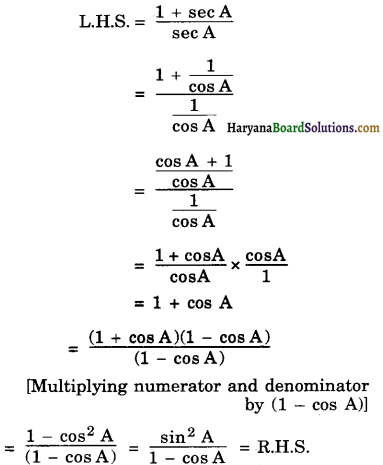
इस प्रकार वायुमंडल में ऑक्सीजन के आगमन और निर्गमन से वायुमंडलीय संतुलन बना रहता है।

प्रयोगात्मक कार्य

क्रियाकलाप 1.
संवहन धाराओं का अध्ययन करना।
कार्य-विधि-एक बीकर में एक मोमबत्ती रख कर जलाएँ और एक अगरबत्ती को जलाकर बीकर के मुँह के पास ले जाओ। और अवलोकन करो

  • अगरबत्ती को बीकर के मुँह के पास ले जाने पर धुआँ पीछे को जाता है क्योंकि गर्म हवा बाहर निकल रही है।
  • अगरबत्ती को मोमबत्ती के ऊपर रखने से धुआँ एकदम ऊपर की ओर जाता है क्योंकि मोमबत्ती की ज्वाला से ऊपर की वायु तेजी से गर्म होकर सीधी ऊपर की ओर जाती है।
  • दूसरे भागों में अगरबत्ती को रखने पर धुआँ पीछे की ओर ही जाता है क्योंकि बीकर के अंदर की सारी वायु गर्म होकर बाहर निकल रही है।

क्रियाकलाप 2.
कोहरा बनने की प्रक्रिया का अध्ययन करना।
कार्य-विधि-

  • पतले प्लास्टिक के बोतल में 5 से 10 मि०ली० पानी लेकर ढक्कन बंद कर दें।
  • इसे अच्छी तरह हिलाएँ और एक जलती अगरबत्ती का थोड़ा धुआँ, ढक्कन खोलकर अंदर जाने दें। ढक्कन बंद कर दें।
  • बोतल को हथेलियों के बीच रखकर जोर से दबाएँ। थोड़ी देर के बाद पुनः बोतल को दबाएँ और अवलोकन करें। जलवाष्प संतप्त होने और दबाव बढ़ने पर बोतल में कोहरा बनता है और बोतल को थोड़ी देर रखने पर कोहरा समाप्त हो जाता है। बोतल को हिलाने या दबाने पर बोतल में दाब बढ़ जाता है। अगरबत्ती के धुएँ के कणों के चारों तरफ जलवाष्प एकत्रित होने पर ही कोहरा बना।

क्रियाकलाप 3.
वर्षामापन यंत्र बनाना तथा अपने नगर व राज्य की सबसे अधिक वर्षा का समय नोट करना।
कार्य-विधि-काँच के बीकर के मुँह के आकार की एक काँच की कीप को बीकर के मुँह में अच्छे से फिट करो तथा बीकर की दीवार पर चिह्न लगाकर पैमाना बनाओ।

वर्षामापन-वर्षा शुरू होते ही वर्षामापन यंत्र को ऐसे स्थान पर रखो, जहाँ बिना किसी बाधा के वर्षा जल कीप में गिरे। वर्षा की समाप्ति पर पाठ्यांक नोट करो। इस यंत्र द्वारा निर्धारित समय (महीनों) की प्रतिदिन की वर्षा की मात्रा को नोट करो। इस प्रकार सर्वाधिक वर्षा वाला दिन मालूम हो जाएगा।

किसी राज्य की सर्वाधिक वर्षा नोट करने के लिए राज्य के प्रमुख नगरों में वर्षा की मात्रा नोट कर औसत वर्षा ज्ञात की जाती है।
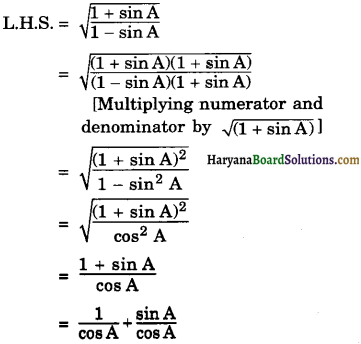
अध्याय का तीव्र अध्ययन

1. शुक्र और मंगल के वायुमंडल से भिन्न हमारे वायुमंडल में पाई जाने वाली गैस है-
(A) कार्बन डाइऑक्साइड
(B) ऑक्सीजन
(C) ऑर्गन
(D) नाइट्रोजन
उत्तर:
(B) ऑक्सीजन

2. वायु प्रवाह का कारण होता है-
(A) दाब अंतर
(B) ताप अंतर
(C) घनत्व अंतर
(D) सतह अंतर
उत्तर:
(A) दाब अंतर

3. निम्नलिखित में से कौन वायु को प्रदूषित करते हैं?
(A) जीवाश्म ईंधनों का जलना
(B) वाहनों का चलना
(C) कारखानों का धुआँ
(D) उपर्युक्त सभी
उत्तर:
(D) उपर्युक्त सभी

4. शुद्ध जल का स्रोत होता है-
(A) वर्षा
(B) तालाब
(C) नदियाँ
(D) झीलें
उत्तर:
(A) वर्षा

5. केंचुए किस कार्य में सहायक होते हैं?
(A) नाइट्रोजन बनाने में
(B) ह्यूमस बनाने में
(C) उर्वरता कम करने में
(D) उपर्युक्त सभी
उत्तर:
(B) ह्यूमस बनाने में

HBSE 9th Class Science Important Questions Chapter 14 प्राकृतिक सम्पदा

6. वर्षा का पैटर्न किस कारक पर निर्भर करता है?
(A) पवन पैटर्न पर
(B) जंगल पैटर्न पर
(C) वाष्पन पैटर्न पर
(D) लोगों के रहन-सहन पैटर्न पर
उत्तर:
(A) पवन पैटर्न पर

7. मिट्टी का निर्माण होता है-
(A) चट्टानों के टूटने-फूटने से
(B) वर्षा से
(C) वायु से
(D) जल से
उत्तर:
(A) चट्टानों के टूटने-फूटने से

8. मिट्टी अपरदन के प्रमुख कारण हैं-
(A) बाढ़ें
(B) तेज हवाएँ
(C) वनों की कटाई
(D) उपर्युक्त सभी
उत्तर:
(D) उपर्युक्त सभी

9. जैविक रूप में महत्त्वपूर्ण दो यौगिक जिनमें ऑक्सीजन और नाइट्रोजन दोनों हैं-
(A) नाइट्रेट्स और नाइट्राइट्स
(B) अमोनिया व कार्बन डाइऑक्साइड
(C) नाइट्रोजन डाइऑक्साइड व अमोनिया
(D) यूरिया व अमोनिया
उत्तर:
(A) नाइट्रेट्स और नाइट्राइट्स

10. वायुमंडल में उपस्थित CO2 द्वारा पृथ्वी तल से परावर्तित अवरक्त प्रकाश को अवशोषित कर वायुमंडल का ताप बढ़ना कहा जाता है-
(A) ओजोन छिद्र
(B) ग्रीन हाउस प्रभाव
(C) पराबैंगनी प्रभाव
(D) अवशोषण प्रभाव
उत्तर:
(B) ग्रीन हाउस प्रभाव

11. जीवन के लिए वायुमंडल से हमें प्राप्त होती है-
(A) CO2
(B) O3
(C) O2
(D) N2
उत्तर:
(C) O2

12. प्राकृतिक संपदाएँ हैं-
(A) वायु
(B) जल
(C) खनिज
(D) उपर्युक्त सभी
उत्तर:
(D) उपर्युक्त सभी

13. पृथ्वी की सबसे बाहरी परत को कहा जाता है-
(A) जलमंडल
(B) स्थलमंडल
(C) वायुमंडल
(D) ओज़ोन मंडल
उत्तर:
(B) स्थलमंडल

14. पृथ्वी के लगभग कितने भाग पर जल है?
(A) 75%
(B) 25 %
(C) 50%
(D) 20 %
उत्तर:
(A) 75%

15. जीवमंडल के निर्जीव घटक हैं-
(A) हवा
(B) जल
(C) मिट्टी
(D) उपर्युक्त सभी
उत्तर:
(D) उपर्युक्त सभी

16. दहन क्रिया में उत्पन्न होने वाली गैस है-
(A) ऑक्सीजन
(B) नाइट्रोजन
(C) कार्बन डाइऑक्साइड
(D) हीलियम
उत्तर:
(C) कार्बन डाइऑक्साइड

17. ओजोन का सूत्र होता है
(A) O2
(B) O3
(C) O4
(D) O5
उत्तर:
(B) O3

18. प्रकाशसंश्लेषण के लिए आवश्यक है-
(A) सूर्य का प्रकाश
(B) क्लोरोफिल
(C) जल व कार्बन डाइऑक्साइड
(D) उपर्युक्त सभी
उत्तर:
(D) उपर्युक्त सभी

19. नाइट्रोजन और सल्फर के ऑक्साइड उपस्थित होते हैं
(A) अम्लीय वर्षा में
(B) क्षारीय वर्षा में
(C) सामान्य वर्षा में
(D) उपर्युक्त सभी
उत्तर:
(A) अम्लीय वर्षा में

20. पृथ्वी के वायुमंडल में CO2 की प्रतिशत मात्रा है-
(A) 78%
(B) 21%
(C) 0.33%
(D) 0.033%
उत्तर:
(D) 0.033%

21. दिन के समय हवा की दिशा होती है-
(A) समुद्र से स्थल की ओर
(B) स्थल से समुद्र की ओर
(C) उत्तर से पश्चिम की ओर
(D) पश्चिम से उत्तर की ओर
उत्तर:
(A) समुद्र से स्थल की ओर

22. वायु प्रदूषक है-
(A) CO
(B) NO2
(C) SO2
(D) उपर्युक्त सभी
उत्तर:
(D) उपर्युक्त सभी

23. मृदा में अवांछनीय पदार्थों का मिलना कहलाता है-
(A) जल प्रदूषण
(B) वायु प्रदूषण
(C) मृदा प्रदूषण
(D) ध्वनि प्रदूषण
उत्तर:
(C) मृदा प्रदूषण

24. जीवाणुओं द्वारा वायुमंडल की नाइट्रोजन को नाइट्रेट्स व नाइट्राइट्स में बदलना कहलाता है-
(A) ऑक्सीजन स्थिरीकरण
(B) विनाइट्रीकरण
(C) नाइट्रोजन स्थिरीकरण
(D) अमोनीकरण
उत्तर:
(C) नाइट्रोजन स्थिरीकरण

25. वायुमंडल में ऑक्सीजन की प्रतिशत मात्रा है-
(A) 78 प्रतिशत
(B) 21 प्रतिशत
(C) 0.033 प्रतिशत
(D) 0.01 प्रतिशत
उत्तर:
(B) 21 प्रतिशत

HBSE 9th Class Science Important Questions Chapter 14 प्राकृतिक सम्पदा

26. ओजोन परत सौर प्रकाश के कौन-से घटक को अवशोषित करती है?
(A) दृश्य प्रकाश को
(B) अवरक्त विकिरण को
(C) पराबैंगनी विकिरण को
(D) इनमें से कोई नहीं
उत्तर:
(C) पराबैंगनी विकिरण को

27. मृदा एक प्राकृतिक संपदा होती है जो
(A) पौधों को आवश्यक पोषक तत्त्व प्रदान करती है
(B) जीवित रहने के लिए व विकास के लिए आवश्यक है
(C) खाद्य-पदार्थों को प्रदान करती है
(D) उपर्युक्त सभी
उत्तर:
(D) उपर्युक्त सभी

28. ऊर्जा का नवीकरणीय स्रोत है-
(A) मिट्टी का तेल
(B) कोयला
(C) प्राकृतिक गैस
(D) बायोगैस
उत्तर:
(D) बायोगैस

29. किस ग्रह पर जीवन विद्यमान है?
(A) मंगल पर
(B) पृथ्वी पर
(C) बुध पर
(D) शुक्र पर
उत्तर:
(B) पृथ्वी पर

30. जीवमंडल के जैविक घटक होते हैं-
(A) निर्जीव
(B) सजीव
(C) हवा
(D) जल
उत्तर:
(B) सजीव

31. शुक्र ग्रह पर 95% से 97% के लगभग होती है-
(A) नाइट्रोजन गैस
(B) ऑक्सीजन गैस
(C) कार्बन डाइऑक्साइड गैस
(D) ऑर्गन गैस
उत्तर:
(C) कार्बन डाइऑक्साइड गैस

32. रात के समय हवा की दिशा होती है-
(A) समुद्र से स्थल की ओर
(B) स्थल से समुद्र की ओर
(C) उत्तर से पश्चिम की ओर
(D) पश्चिम से उत्तर की ओर
उत्तर:
(B) स्थल से समुद्र की ओर

33. समुद्रों में सामान्यतः कैसा पानी मिलता है?
(A) शुद्ध
(B) अशुद्ध
(C) (A) व (B) दोनों
(D) (A) व (B) दोनों में से कोई नहीं
उत्तर:
(B) अशुद्ध

34. कीटनाशकों और उर्वरकों के अधिक प्रयोग से बढ़ावा मिलता है-
(A) वायु प्रदूषण को
(B) ध्वनि प्रदूषण को
(C) जल प्रदूषण को
(D) इनमें से किसी को भी नहीं
उत्तर:
(C) जल प्रदूषण को

35. ओजोन परत में छिद्र किस स्थान पर देखा गया?
(A) विषुवत रेखा के ऊपर
(B) प्रशांत महासागर के ऊपर
(C) अंटार्कटिका के ऊपर
(D) हिंद महासागर के ऊपर
उत्तर:
(C) अंटार्कटिका के ऊपर

36. अम्लीय वर्षा का निम्न में से कौन-सा कारण है?
(A) वायु में नाइट्रोजन व सल्फर के ऑक्साइड
(B) वायु में लटके हुए कणों की मात्रा बढ़ना
(C) वायु में हाइड्रोकार्बन की अधिक मात्रा
(D) वायु में CO2 गैस की अधिक मात्रा होना
उत्तर:
(A) वायु में नाइट्रोजन व सल्फर के ऑक्साइड

37. निम्नलिखित में से कौन-सा एक कथन जल प्रदूषण के बारे में सही नहीं है?
(A) जलाशयों में अनैच्छिक पदार्थों का मिलना
(B) पानी में घुली हुई ऑक्सीजन कम होना
(C) पानी के तापमान में परिवर्तन
(D) आक्सी-श्वसन जीवाणु (ऐरोबिक बैक्टीरिया) की संख्या बढ़ना
उत्तर:
(D) आक्सी-श्वसन जीवाणु (ऐरोबिक बैक्टीरिया) की संख्या बढ़ना

38. ग्रीन हाउस प्रभाव का निम्नलिखित में कौन-सा एक कारण है?
(A) हरे पौधे
(B) अवरक्त किरणें
(C) पैराबैंगनी (UV) किरणें
(D) एक्स (X) किरणें
उत्तर:
(C) पैराबैंगनी (UV) किरणें

39. ओजोन परत के अवक्षय का कारण है-
(A) CO2
(B) O2
(C) CFC
(D) N2
उत्तर:
(C) CFC

HBSE 9th Class Science Important Questions Chapter 14 प्राकृतिक सम्पदा Read More »

HBSE 7th Class English Solutions An Alien Hand Chapter 5 Golu Grows a Nose

Haryana State Board HBSE 7th Class English Solutions An Alien Hand Chapter 5 Golu Grows a Nose Textbook Exercise Questions and Answers.

Haryana Board 7th Class English Solutions An Alien Hand Chapter 5 Golu Grows a Nose

HBSE 7th Class English Golu Grows a Nose Textbook Questions and Answers

Answer the following questions:

Golu Grows A Nose In Hindi HBSE 7th Class Question 1.
Whom does Golu ask, “Why don’t you ever fly like other birds?”
Answer:
Golu, baby elephant asked ostrich that why did he not fly like other birds.

Golu Grows A Nose Summary In Hindi HBSE 7th Class Question 2.
Which uncle of Golu had red eyes?
Answer:
Hippopotamus, huge uncle of Golu’s eyes were always very red.

Golu Grows A Nose Summary HBSE 7th Class Question 3.
Golu’s relatives did not answer his questions because
(i) they were shy.
(ii) the questions were too difficult.
(iii) Golu was a naughty baby.?
Answer:
(ii) the questions were too difficult.

HBSE 7th Class English Solutions An Alien Hand Chapter 5 Golu Grows a Nose

Alien Chapter 5 HBSE 7th Class Question 4.
Who advised Golu to go to the Limpopo river?
Answer:
Mynah suggested Golu that he should go to the Limpopo river to find out his answer.

Golu Grows A Nose HBSE 7th Class Question 5.
Why did Golu go to the river?
Answer:
Golu went to the river to find out that what the crocodile had for dinner. He had never seen a crocodile and wanted to find out his identity.

Golu Grows A Nose Question Answer HBSE 7th Class Question 6.
The crocodile lay on the bank of the Limpopo river. Golu thought it was:
(i) a living crocodile.
(ii) a dead crocodile.
(iii) a log of wood.
Answer:
(iii) a log of wood.

Golu Grows A Nose Class 7 Question Answer HBSE Question 7.
What did the crocodile do to show that it was a real crocodile?
Answer:
Crocodile shed crocodile tears to show that he was a real crocodile.

Golu Grows A Nose Story HBSE 7th Class Question 8.
‘Come here, little one, and I’ll whisper the answer to you’. The crocodile said this because:
(i) he couldn’t stand up.
(ii) he wanted to eat’Golu.
(iii) Golu was deaf.
Answer:
(ii) he wanted to eat Golu.

Golu Ka Ghar Question Answer HBSE 7th Class Question 9.
Who helped Golu on the bank of the river?
Answer:
It was python’s advise and help which freed Golu from crocodile.

Golu Grows A Nose Hindi Story HBSE 7th Class Question 10.
Name two things the elephant can do with his trunk, and two he cannot.
Answer:
The trunk is very helpful for the elephant. With the help of trunk, the elephant can pluck large bundle of grass and can scoop mud from the bank.
But the trunk cannot help elephant to walk and eating food.

HBSE 7th Class English Solutions An Alien Hand Chapter 5 Golu Grows a Nose

HBSE 7th Class English Golu Grows a Nose Important Questions and Answers

Golu Grows A Nose Summary Question Answer HBSE 7th Class Question 1.
What did the ostrich, the giraffe, the hippopotamus and the baboon think about Golu?
Answer:
The ostrich, the giraffe, the hippopotamus and the baboon thought that Golu was a naughty boy. He asked difficult questions.

Golu Grows A Nose Difficult Words HBSE 7th Class Question 2.
Why did the mynah bird send Golu to Limpopo river?
Answer:
The mynah bird sent Golu to Limpopo river to find ant what crocodile had for dinner.

Question Answer Of Golu Grows A Nose HBSE 7th Class Question 3.
What things did Golu take to grassy Limpopo river?
Answer:
Golu took a hundred sugarcanes, fifty dozen bananas and twenty-five melons to grassy Limpopo river.

Class 7 English Golu Grows A Nose Summary HBSE Question 4.
What questions did Golu ask the python?
Answer:
Golu met a python and he asked him three questions:
(i) Have you ever seen a crocodile?
(ii) What does a crocodile look like?
(iii) What does a crocodile have for dinner?

Golu Grows A Nose Notes HBSE 7th Class Question 5.
Why did the python help Golu?
Answer:
Golu had helped the python to coil around the branch of a tree. The python felt grateful to him and quietly followed him.The python helped Golu when the crocodile caught him by the nose. He wanted to repay Golu for his favour and goodness.

HBSE 7th Class English Solutions An Alien Hand Chapter 5 Golu Grows a Nose

Question 6.
Describe how Golu met the corcodile and how crocodile tried to Golu.
Answer:
Golu saw a log of wood in the great, grassy Limpopo river. In fact, this was crocodile who winked at him. The crocodile shed his ‘false tears’ to show that he cared for Golu and he expressed his excitement to know why he asked such questions. He further told that he could whisper the answer in his ears. He would tell him what he had for dinner in a low tone. Golu / put his head down close to the corcodile’s snout. The crocodile caught Golu by the nose. He declared that he would eat Golu that day.

Multiple Choice Questions (MCQ)

Tick (✓) the correct option:

Question 1.
Who directed Golu to go to the Limpopo river?
(a) a mynah bird
(b) a cuckoo bird
(c) a crow
(d) a sparrow bird
Answer:
(a) a mynah bird ✓

Question 2.
Which of the following is incorrect about the noses of the elephants long long ago?
(a) Long, long ago, the elephants had bulgy noses.
(b) They were as big as the elephants could move the noses from side to side.
(c) They could pick up the things with their noses.
(d) None of these
Answer:
(a) Long, long ago, the elephants had bulgy noses. ✓

Question 3.
How many questions did Golu ask the python?
(a) two
(b) three
(c) four
(d) one
Answer:
(b) three ✓

HBSE 7th Class English Solutions An Alien Hand Chapter 5 Golu Grows a Nose

Question 4.
A fly stung Golu on the
(a) foot
(b) shoulder
(c) leg
(d) stomach
Answer:
(b) shoulder ✓

Question 5.
The hairy uncle of Golu is referred to as:
(a) the ostrich
(b) the giraffe
(c) the baboon
(d) the hippopotamus
Answer:
(c) the baboon ✓

Question 6.
Where was the mynah bird sitting?
(a) in the end of a bush
(b) in the middle of a bush
(c) on the roof of house
(d) on the edge of river.
Answer:
(b) in the middle of a bush ✓

Question 7.
“I’m going to the great, grassy Limpopo river.”
Who said this to whom?
(a) Mynah bird said this to Golu.
(b) Golu said this to python.
(c) Golu said this to his family.
(d) The crocodile said this to Golu.
Answer:
(c) Golu said this to his family. ✓

Make Sentences

Use the following words in sentences of your own.
(i) difficult
(ii) whisper
(iii) screamed
(iv) quietly
(v) politely
(vi) afraid
(vii) plucked.
Answer:
(i) Difficult: Vidhi is so intelligent that she can answer every difficult question.
(ii) Whisper: Friends often whisper secrets to each other.
(iii) Screamed: The boy screamed loudly when he fell from the stairs and fractured his leg.
(iv) Quietly: All the devotees were sitting quietly while listening to Guru’s vani.
(v) Politely: We should talk politely to everyone.
(vi) Afraid: Raj never goes out alone as he is afraid of darkness.
(vii) Plucked: The poor man plucked some fresh roses and offered to the idol in the temple.

HBSE 7th Class English Solutions An Alien Hand Chapter 5 Golu Grows a Nose

Golu Grows a Nose Summary in English

This is the story of how elephant came to have trunk. There was a baby elephant, Golu who had a small bulgy nose. He made fun of giraffe; hippopotamus, baboon. All of them had no answers for his questions.

One day Golu wanted to find out that what crocodile would eat for dinner. He went to Limpopo river to find out. When Golu reached the bank, he thought the crocodile to be a log of wood.

But Golu had actually asked the crocodile about the crocodile. As Golu went nearer, crocodile caught him by the nose. Python who had been following him, advised him to pull hard. As a result, the nose of Golu stretched longer. Golu sat for two days to make his nose cool. Python cheered up G olu and made him realize that trunk would be very advantageous for him.

With trunk he could remove the fly, pluck a large bundle of grass and take out mud from the bank. So Golu reached back home happily.

Golu Grows a Nose Summary in Hindi

यह एक कहानी है जिसमें यह बताया गया है कि हाथी की सैंड कैसे बनी। एक बार हाथी का एक बच्चा गोलू, जिसकी सूजी नाक थी। वह शुतुरमुर्ग, लकड़बग्घा, लंगूर सबका मजाक उड़ाता था। उसके प्रश्नों का कोई जवाब किसी के पास नहीं था।

एक दिन गोलू पता लगाना चाहता था कि मगरमच्छ दोपहर के भोजन में क्या खाजा है। वह लिपोपो नदी पर पता लगाने गया। जब गोलू नदी के किनारे पहुँचा तो उसको लगा कि मगरमच्छ जैसे लकड़ी का तना हो।

पर गोलू ने मगरमच्छ से ही मगरमच्छ के बारे में पूछा। जैसे ही गोलू पास गया, मगरमच्छ ने उसे नाक से पकड़ा। अजगर, जो उसका पीछा कर रहा था, उसने सुझाव दिया कि वह जोर लगाए। इस कारण गोलू की नाक लंबी हो गई। गोलू ने वहाँ नदी के किनारे बैठ कर अपनी नाक को ठंडा किया। अजगर ने गोलू को सलाह दी और उसे इस बात से अनुभव कराया कि सूंड उसके लिए बहुत फायदेमंद रहेगी। सूंड की सहायता से वह मक्खी उड़ा सकता है, घास के ढेर को उठा सकता है और किनारे से कीचड़ निकाल सकता है। अब गोलू खुशी से घर चला गया।

HBSE 7th Class English Solutions An Alien Hand Chapter 5 Golu Grows a Nose Read More »

HBSE 7th Class English Solutions An Alien Hand Chapter 4 The Cop and the Anthem

Haryana State Board HBSE 7th Class English Solutions An Alien Hand Chapter 4 The Cop and the Anthem Textbook Exercise Questions and Answers.

Haryana Board 7th Class English Solutions An Alien Hand Chapter 4 The Cop and the Anthem

HBSE 7th Class English The Cop and the Anthem Textbook Questions and Answers

Answer the following questions:

Cop And The Anthem Summary HBSE 7th Class Question 1.
What are some of the signs of approaching winter referred to in the text?
Answer:
There are many signs to show that winter is coming. Birds begin to fly south. People want new warm coats. A dead leaf fell at Soapy’s feet.

The Cop And The Anthem Class 7 HBSE Question 2.
Write True or False against each of the following:
(i) Soapy did not want to go to prison. [ ]
(ii) Soapy had been to prison several times. did it not work? [ ]
Answer:
Soapy had planned to go to some fine restaurant. He would say that he had no mmey to pay. Then he planned that cop would be called and he would be taken to prison in the Blackwell’s Island.

HBSE 7th Class English Solutions An Alien Hand Chapter 4 The Cop and the Anthem

The Cop And The Anthem Summary HBSE Class 7 Question 4.
‘But the cop’s mind would not consider Soapy’. What did the cop not consider, and why?
Answer:
Cop did not pay any attention towards Soapy. He is no case could think that Soapy had done it. Cop believed that those who break windows do not stop to talk to cops. They run away at first chance.

Question 5.
‘We have orders to let them shout’. What is the policeman referring to?
Ans.
At this instance cop is referring to Soapy. He regards him as a expelled college boy who is just creating noise to attract attention.

Question 6.
Write True or False against each of the following:
(i) Soapy stole a man’s umbrella. [ ]
(ii) The owner of the umbrella offered to give it to Soapy. [ ]
(iii) The man had stolen the umbrella that was now Soapy’s. [ ]
(iv) Soapy threw away the umbrella. [ ]
Answer:
(i) Soapy stole a man’s umbrella. [True]
(ii) The owner of the umbrella offered to give it to Soapy. [True]
(iii) The man had stolen the umbrella that was now Soapy’s. [True]
(iv) Soapy threw away the umbrella. [True]

Question 7.
‘There was a sudden and wonderful change in his soul’. What brought about the change in Soapy?
Answer:
Soapy’s mind changed on hearing birds high above him. The music gave him high hopes. Reaching at the caurch brought a sudden change in his soul, lie wished to pull him out of this mud and became a man again.
Discuss the following topics in groups:

1. Suppose no cop came at the end. What would Soapy’s life be like next winter?
Answer:
Life of Soapy is true of every teenager human being. At this stage one wants to lead an easy life. Soapy is also searching for easy way to find food and shelter. But a positive change would have made soap a better person. He might have got a job and not created such lawless activities. If no cop had come next winter he would have been like other youngster of his age. He would have become a resoponsible citizen. But, it is true that fate of a person is fixed.

2. Retell an episode in the story, which is a good example of irony in a situation.
Answer:
The irony of the situation is that, when Soapy really wants to go to the prison all turns in vain. All the lawless activities tried by him are of no use. He attracts the cop in every manner. But when a change comes over in his mind, he wants to turn a new man. His thoughts carry him to the past. The singing of birds give him new hope. His changed spirits give his courage. But the god had destined things in different manner. He is taken to prison by the cops when such an action was least expected.

HBSE 7th Class English Solutions An Alien Hand Chapter 4 The Cop and the Anthem

HBSE 7th Class English The Cop and the Anthem Important Questions and Answers

Question 1.
Why did Soapy want stay in the prison on Blackwell Island?
Answer:
Soapy wanted to stay in the prison on Blackwell Island because he wanted to escape from the chilly winter months. He would also get three months of food everyday and a bed every night and safe from cops.

Question 2.
Did Soapy have nowhere else to go? Why did he wish for prison on Blackwell Island?
Answer:
Soapy had places whei’e he could go and ask for food and a bed. He could move from one building to another, and he would be taken care of through the winter. But he liked Blackwell’s Island better.

Question 3.
A sudden fear caught Soapy. What was the fear that caught Soapy?
Answer:
The fear that caught Soapy was that no cop was going to arrest him.

Question 4.
How did Soapy feel when he see his old childhood home through a window?
Answer:
When Soapy saw his old childhood home through a window, his fast memories flashed back on his mind, sweet music came to Soapy’s ears and seemed to hold him there.

Multiple Choice Questions (MCQ)

Tick (✓) the correct option.

Question 1.
Soapy moved restlessly on his seat because:
(а) he was ill.
(b) he had lost his precious jewels.
(c) he was looking for his old friend
(d) he had to find some way to take care of himself during the winter.
Answer:
(d) he had to find some way to take care of himself during the winter. ✓

Question 2.
Which of these things Soapy wanted for the winter?
(а) He wanted to sail away on a ship
(б) He wanted to spend time at southern skies.
(c) He wanted to visit bay of Naples.
(d) He wanted to go to Blackwell island.
Answer:
(d) He wanted to go to Blackwell island. ✓

Question 3.
Soapy does his best to be on the side of the law.
(a) right
(b) wrong
(c) genuine
(d) legal
Answer:
(b) wrong ✓

HBSE 7th Class English Solutions An Alien Hand Chapter 4 The Cop and the Anthem

Question 4.
When Soapy reached the restaurant
(a) his face was clean
(b) his coat was torn
(c) he was wearing new shoes
(d) he was wearing new trousers
Answer:
(b) his coat was torn ✓

Question 5.
‘Broadway’ in the story is name of
(a) a restaurant
(b) a hotel
(c) a street
(d) a police station
Answer:
(c) a street ✓

Question 6.
Where was the shop with a wide glass window?
(a) at a corner of Fifth Avenue
(b) at a corner of Sixth Avenue
(c) in the middle of Sixth Avenue
(d) at a corner of Fourth Avenue
Answer:
(b) at a corner of Sixth Avenue ✓

Question 7.
“Get busy and call a cop”. Who said this to whom?
(a) Soapy said this to waiter.
(b) Waiter said this to Soapy
(c) Soapy said this to cop.
(d) One waiter said this to another waiter.
Answer:
(a) Soapy said this to waiter. ✓

Question 8.
No one stopped Soapy from going into the restaurant across the street because.
(a) It was not too fine as one on Broadway.
(b) The people who went there were not so rich.
(c) Its food was not so good.
(d) all of these.
Answer:
(a) It was not too fine as one on Broadway. ✓

HBSE 7th Class English Solutions An Alien Hand Chapter 4 The Cop and the Anthem

Question 9.
“No cop for you”. Who said this to whom?
(a) Soapy said this to the waiter.
(b) The waiter said this to Soapy.
(c) Soapy said this to his classmate.
(d) A cop said this to Soapy.
Answer:
(b) The waiter said this to Soapy. ✓

Question 10.
At last Soapy came to one of the streets on the side of the city.
(a) busy
(b) quiet
(c) charming
(d) noisy
Answer:
(b) quiet ✓

Make Sentences

Use the following words in sentences of your own:
(i) peaceful
(ii) wished
(iii) joyful
(iv) strength
(v) offered
(vi) believed
(vii) arrest
Answer:
(i) Peaceful: Everybody lives with such a cooperation that the atmosphere in our house is very peaceful.
(ii) Wished: I wished my friend a grand success for his competition.
(iii) Joyful: During the festival days, the atmosphere in town is very joyful.
(iv) Strength: Unity is strength.
(v) Offered: I offered my timely help to my friend.
(vi) Believed: Gandhiji believed in truth and non-violence.
(viii) Arrest: The superintendent ordered his men to arrest the thief.

The Cop and the Anthem Summary in English

The story begins in Madison Square where Soapy a homeless, jobless man is searching for a place to stay as winter is fast approaching. His hopes are not to sail to some high destination but to just reach prison on Blackwell’s Island.

Soapy’s planning to go on this island so that his care could be taken of. Soapy does his best to be on the wrong side of law but all in vain. His plan of going to restaurant and then caught for not paying the bill also fails.

Soapy tries his luck by misbehaving as if he is over drunk. He even throws a big stone at the glass. No cop touches him inspite of his all efforts. Feeling defeated he decides to go and sit in a park, his only home. There birds’ sweet music makes his mind change. At the old church a sudden change occurs in his soul.

He decided to change his life and become a man again. He thinks of finding a job. When he decides to search for new things, he is taken to Blackwell Island prison for three months by the New York Cop.

HBSE 7th Class English Solutions An Alien Hand Chapter 4 The Cop and the Anthem

The Cop and the Anthem Summary in Hindi

यह कहानी मैडिसन स्क्वेयर में घटित होती है। यहाँ पर एक बेघर और बेरोजगार नवयुवक सोपी सर्दी के आगमन पर रहने के लिए जगह ढूँढ रहा है। उसकी आशाएँ बहुत दूर तक जाने की नहीं हैं पर वह सिर्फ ब्लैकवेल टापू की जेल तक जाना चाहता है।

सोपी इस टापू तक सिर्फ इसलिए जाना चाहता है कि वह सर्दी का समय बिता सके। सोपी कानून तोड़ने की पूरी कोशिश करता है पर हर बार असफल रहता है। उसका रेस्तारां में जाकर बिना पैसे के खाने का उपाय भी असफल रहता है।

सोपी बुरे व्यवहार द्वारा भी अपनी किस्मत आजमाने की कोशिश करता है मानो उसने अधिक शराब पी रखी है। वह एक बड़ा पत्थर भी उठाकर काँच पर फेंकता है। पर इतने प्रयासों के बाद भी कोई पुलिसकर्मी उसे नहीं छूता।
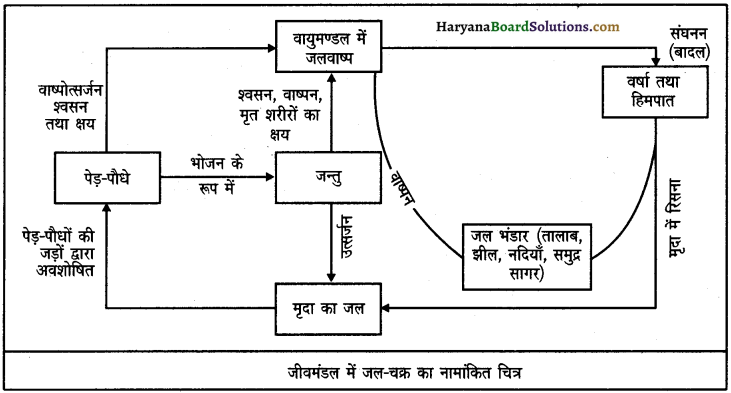
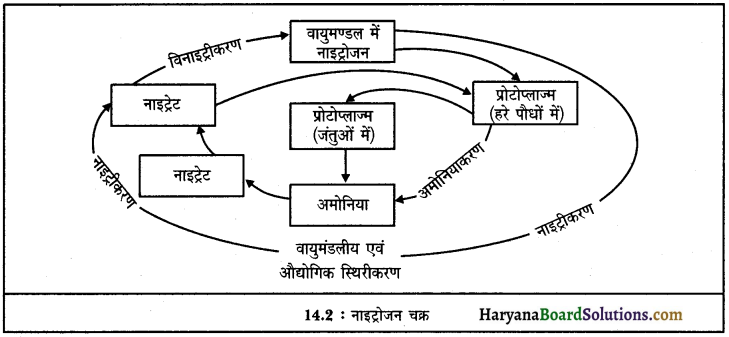
हार मानकर वह अपने पार्क, जो उसका एकमात्र घर है, में जाकर बैठ जाता है। वहाँ पर चिड़ियों का चहचहाना उसमें बदलाव ले आता है। गिरजाघर में उसकी आत्मा में अचानक बदलाव आता है।
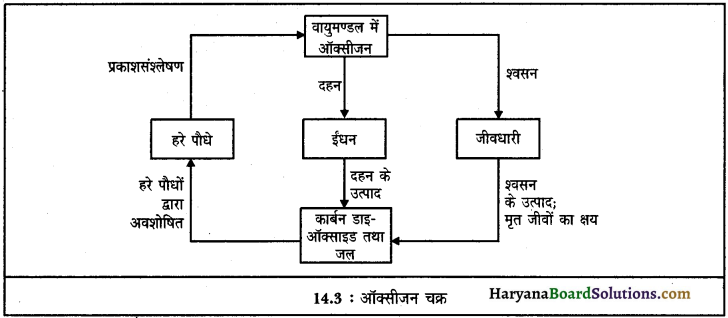
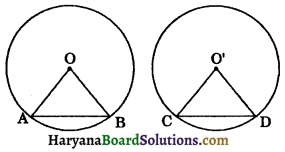
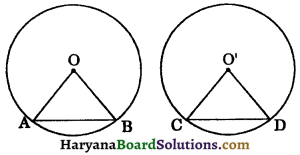
वह अपने आपको बदलने की सोचता है। वह नौकरी ढूँढने की कोशिश करता है। जब वह कछ नया करने की कोशिश करता है तब उसी समय उसे पुलिसकर्मी ब्लैकवेल टापू की जेल में तीन महीने के लिए बंद कर देता है।

HBSE 7th Class English Solutions An Alien Hand Chapter 4 The Cop and the Anthem Read More »

HBSE 7th Class English Solutions An Alien Hand Chapter 3 The Desert

Haryana State Board HBSE 7th Class English Solutions An Alien Hand Chapter 3 The Desert Textbook Exercise Questions and Answers.

Haryana Board 7th Class English Solutions An Alien Hand Chapter 3 The Desert

HBSE 7th Class English The Desert Textbook Questions and Answers

Comprehension Check

The Desert Summary In Hindi Class 7 HBSE Question 1.
From the first paragraph
(i) pick out two phrases which describe the desert as most people believe it is:
Answer:
1 an endless stretch of sand where no rainfalls.
2. no vegetation grows.

(ii) pick out two phrases which describe the desert as specialists see it.
Answer:
1. It is the home of variety of people, animals and plants which adapt to live in hot and dry conditions.
2. It can be beautiful place.

(iii) Which do you think is an apt description and why?
Answer:
The description of the specialists can be apt because a desert is not always dry and sandy but it can also be covered with hills.

HBSE 7th Class English Solutions An Alien Hand Chapter 3 The Desert

Class 7 English Chapter 3 The Desert Question Answer Question 2.
The phrases on the left in the box occur in the text. Match each of them with a phrase on the right.

1. an endless stretch of sand(a) fertile place with water and plants in a desert
2. waterless and without shelter(b) not visible because the grass is thick
3. an oasis(c) nothing but sand as far as one can see
4. hidden by a cover of grass(d) no water and no shade

Answer:

1. an endless stretch of sand(c) nothing but sand as far as one can see
2. waterless and without shelter(d) no water and no shade
3. an oasis(a) fertile place with water and plants in a desert
4. hidden by a cover of grass(b) not visible because the grass is thick

The Desert Class 7 HBSE Question Answer Question 3.
The camel can do without water for days together. What is the reason given in the text?
Answer:
The camel can drink a lot of water at a time. Camel can do without water for days together. Camel can stand a high body temperature. He don’t need to sweat, so they retain the water for a long time.

Question 4.
How do the smaller desert animals fulfil their need for water?
Answer:
The smaller desert animals do not drink water. They burrow underground during hot day and come out at night. They get moisture from the meat they eat. Smaller animals can also get plant juices from the plants and seeds they eat.

Question 5.
In a desert the temperature rises during the day and falls rapidly at the night. Why?
Answer:
In the desert there is no blanket of moisture in air. So the sand in the desert heats up a lot during the day. As the surface of sand also cools up quickly at night, so desert remains very cold at night.

HBSE 7th Class English Solutions An Alien Hand Chapter 3 The Desert

Exercises

Discuss the folowing topics in groups:
1. Describe a desert in your own way. Write a paragraph and read it aloud to your classmates.
Answer:
Self Study.

2. Go to the library and collect information about the lifestyle of poepie in desert areas their food, clothes, work, social customs, etc. Share this information with the group.
Answer:
Self Study.

The Guide

A student was showing some friends round the University. “There’s the famous University College.” he said. And there,” pointing to a row of windows on the second floor, “are the windows of the Principal’s office.” He picked up a stone and threw it through one of the windows. A red, angry face looked out of the broken window. “And there,” said the student, “is the Principal himself. ”

HBSE 7th Class English The Desert Important Questions and Answers

Question 1.
When docs the sight of the deserts look beautiful?
Answer:
The sight of the deserts looks beautiful whenever it rains and the dosert flowers bloom.

Question 2.
What is an oasis?
Answer:
An oasis is like a green island where a spring or a well gives plants and trees a better chance to grow.

Question 3.
What are ‘sand dunes’?
Answer:
In deserts, strong winds blow raising heaps of sound and depositing them as mounds. These are called ‘sand dunes’.

Question 4.
Why do we sweat?
Answer:
We sweat because we must keep our body temperature constant. We sweat when it gets hot and it cools our body.

Question 5.
How do the desert animals adapt to the desert conditions?
Answer:
The desert animals adapt to the desert conditions in the following ways:
(a) The smaller desert animals do not drink water.
(b) They burrow underground during the hot day and come out at night to eat.

Multiple Choice Questions (MCQ)

Tick (✓) the correct option.
Question 1.
Which of the following statements is incorrect?
(a) The deserts are always hot.
(b) Some deserts are almost totally without water.
(c) Sand dunes shift and move endlessly across the desert ✓
(d) Oasis is a green belt in hot deserts.
Answer:
(a) The deserts are always hot. ✓

Question 2.
Which is known as ‘ship of the desert’?
(a) sheep
(b) yak
(c) camel
(d) cow ✓
Answer:
(c) camel ✓

Question 3.
Which of these is a cold desert?
(a) Sahara desert
(b) Thar desert
(c) Ladakh desert ✓
(d) None of these
Answer:
(c) Ladakh desert ✓

HBSE 7th Class English Solutions An Alien Hand Chapter 3 The Desert

Question 4.
Desert plants and animals learn to require
(а) much less water than most plants and animals ✓
(b) much more water than most plants and animals
(c) equal water to most plants and animals
(d) either of these
Answer:
(а) much less water than most plants and animals ✓

Question 5.
Where do eacl’us plants store water?
(a) leaves
(b) roots
(c) stems
(d) none
Answer:
(c) stems ✓

Question 6.
Read the statements carefully
(i) Deserts are hot and dry.
(ii) Deserts are useless parts of the earth. What can you say about the statements?

(a) Both the statements are true and they are related to each other.
(b) The statement (i) is true but the statement (ii) is false. ✓
(c) The statement (ii) is true but the statement (i) is false.
(d) Both the statements are true but they are not related to each other.
Answer:
(b) The statement (i) is true but the statement (ii) is false. ✓

Make Sentences

Use the following words in sentences of your own:
(i) temperature
(ii) nature
(iii) vegetation
(iv) developed
(iv) variety
Answer:
(i) Temperature: The temperature of human body is measured in degree Celsius.
(ii) Nature: God has blessed us with beautiful nature.
(iii) Vegetation: Northern plains are very fertile and rich in vegetation.
(iv) Developed: The textile industry in India has developed a lot after independence.
(v) Variety: A variety of paintings were displayed at the exhibition.

The Desert Summary in English

A desert is believed to be dry, hot, waterless and endless stretch of sand. It can also be a beau¬tiful place. During rains its flowers can bloom and give a beautiful sight.

A desert can consist of mountains, hills and oasis. Oasis gives life to the desert. Some deserts which are compeletely without water, have formed sanddunes.

Animals and plants found in desert have adapted themselves to the less water conditions. Camel known as the ship of desert has adapted to the conditions. Camels do not need to sweat. Smaller desert animals burrow the underground during hot day and get moisture from the meat they eat.

In desert areas dryness and variation of temperature are very common. The moisture in the air acts as a blanket. But in deserts this layer of blanket is absent. So desert should be taken to be useful part of the earth.

HBSE 7th Class English Solutions An Alien Hand Chapter 3 The Desert

The Desert Summary in Hindi

एक मरुभूमि (रेगिस्तान) को सूखा, गर्म, एवं जलहीन व असीमित रेत का विस्तार माना जाता है। यह सुंदर भी हो सकता है। वर्षा के दौरान मरुभूमि में फूल खिल जाते हैं और बहुत ही सुंदर दृश्य प्रदान करते हैं।

एक मरुभूमि में पहाड़, पहाड़ियाँ एवं मरूद्यान होते हैं। मरुद्यान मरुभूमि को जिंदगी प्रदान करते हैं। कई रेगिस्तान जो बिना पानी के हैं, वहाँ पर रेत के टीले बन जाते हैं।

यहाँ पर पाए जाने वाले जानवरों और पौधों ने अपने आप को कम पानी की स्थिति में भी ढाल लिया है। ऊँट को रेगिस्तान का जहाज कहा जाता है। ऊँट ने अपने आप को इन परिस्थितियों में पूर्ण रूप से ढाल लिया है। उनको पसीने बहाने की कोई जरूरत नहीं होती। रेगिस्तान में पाए जाने वाले छोटे जानवर गर्मी में धरती के नीचे रहते हैं और जानवरों के मांस खाकर नमी प्राप्त करते हैं।

रेगिस्तानी क्षेत्रों में शुष्कपन और तापमान में अंतर बहुत ही सामान्य बात है। वायु में आर्द्रता एक कंबल या आवरण का काम करती है। पर मरुभूमि में इस परत की कमी होती है। इसलिए मरुभूमि को पृथ्वी का एक महत्त्वपूर्ण हिस्सा समझना चाहिए।

HBSE 7th Class English Solutions An Alien Hand Chapter 3 The Desert Read More »

HBSE 9th Class Maths Solutions Chapter 10 Circles Ex 10.2

Haryana State Board HBSE 9th Class Maths Solutions Chapter 10 Circles Ex 10.2 Textbook Exercise Questions and Answers.

Haryana Board 9th Class Maths Solutions Chapter 10 Circles Exercise 10.2

Question 1.
Recall that two circles are congruent if they have the same radü. Prove that equal chords of congruent circles subtend equal angles at their centres.
Solution:
Given: AB and CD are two equal chords of two congruent circles C(O, r) and C(O’, r) respectively.
HBSE 9th Class Maths Solutions Chapter 10 Circles Ex 10.2 1
To prove:
∠AOB = ∠CO’D.
Proof: In ΔAOB and ΔCO’D, we have
OA = O’C [Equal radii of congruent circles]
OB = O’D [Equal radii of congruent circles]
AB = CD (given)
∴ ΔAOB ≅ ΔCO’D (By SSS congruence rule)
∠AOB = ∠CO’D (CPCT)
Hence proved.

HBSE 9th Class Maths Solutions Chapter 10 Circles Ex 10.2

Question 2.
Prove that if chords of congruent circles subtend equal angles at their centres, then the chords are equal.
Solution:
Given: AB and CD are two chords of congruent circles C(O, r) and C(O’, r) such that ∠AOB = ∠CO’D.
HBSE 9th Class Maths Solutions Chapter 10 Circles Ex 10.2 2
To prove : AB = CD.
Proof: In ΔAOB and ΔCO’D, we have
AO = O’C [Equal radii of congruent circles]
∠AOB = ∠CO’D (given)
OB = O’D [Equal radii of congruent circles]
∴ ΔAOB ≅ ΔCO’D [By SAS congruence rule]
⇒ AB = CD (CPCT)
Hence proved.

HBSE 9th Class Maths Solutions Chapter 10 Circles Ex 10.2 Read More »