Class 10

HBSE 10th Class Maths Solutions Chapter 12 Areas Related to Circles Ex 12.3

Haryana State Board HBSE 10th Class Maths Solutions Chapter 12 Areas Related to Circles Ex 12.3 Textbook Exercise Questions and Answers.

Haryana Board 10th Class Maths Solutions Chapter 12 Areas Related to Circles Ex 12.3

Unless stated otherwise, use π = \(\frac{22}{7}\).

Question 1.
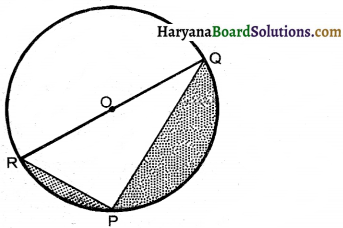
Find the area of shaded region in the given figure, If PQ = 24 cm, PR = 7 cm and O is the centre of the circle.
Haryana Board 10th Class Maths Solutions Chapter 12 Areas Related to Circles Ex 12.3 19

Solution:
We have,
PQ = 24 cm.
PR = 7 cm.
∠QPR = 90° [∵ Angle in a semicircle is 90°]
In right angled ∆RPQ, we have
RQ2 = RP2 + PQ
⇒ RQ2 = 72 + 242
⇒ RQ2 = 49 + 576
⇒ RQ2 = 625
⇒ RQ = √625 = 25 cm
Radius (RO) = \(\frac{25}{2}\) cm
Area of shaded region= Area of semicircle – Area of ∆RPQ
= \(\frac{1}{2}\) Ï€r2 – \(\frac{1}{2}\) × PQ × RP
= \(\frac{1}{2} \times \frac{22}{7} \times \frac{25}{2} \times \frac{25}{2}-\frac{1}{2} \times 24 \times 7\)
= 245.54 – 84
= 161.54 cm2.
Hence, area of shaded region = 161.54 cm2

Haryana Board Solutions for 10th Class Maths Chapter 12 Areas Related to Circles Ex 12.3

Question 2.
Find the area of shaded region in the given figure, if radii of the two concentric circles with centre O are 7 cm and 14 cm respectively and ∠AOC = 40°.
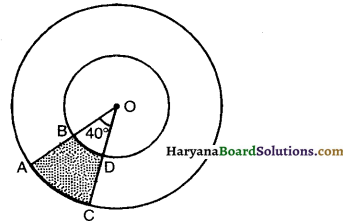
Haryana Board 10th Class Maths Solutions Chapter 12 Areas Related to Circles Ex 12.3 1

Solution:
We have,
Radii of two concentric circles = 7 cm, 14 cm and ∠AOC = 40°
Area of shaded region = Area of sector AOC – Area of sector BOD
= \(\frac{\pi \times 14^2 \times 40^{\circ}}{360^{\circ}}-\frac{\pi \times 7^2 \times 40^{\circ}}{360^{\circ}}\)
= \(\frac{\pi}{9}\) [142 – 72 ]
= \(\frac{\pi}{9}\) × (14 + 7) (14 – 7)
= \(\frac{22}{7 \times 9}\) × 21 × 7
= \(\frac{154}{3}\) cm2
Hence, area of shaded region = \(\frac{154}{3}\) cm2.

Question 3.
Find the area of the shaded region in the given figure, if ABCD is a square of side 14 cm and APD and BPC are semi-circles.
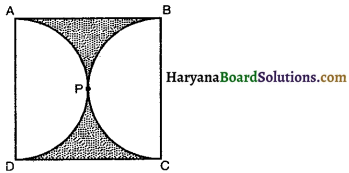
Haryana Board 10th Class Maths Solutions Chapter 12 Areas Related to Circles Ex 12.3 2

Solution:
We have,
Side of square = 14 cm
radius of semicircle = \(\frac{14}{2}\) = 7 cm
Area of shaded region = Area of square – 2 × Area of semicircle
= 14 × 14 – 2 × \(\frac{1}{2}\) × Ï€ × r2
= 14 × 14 – 2 × \(\frac{1}{2}\) × 7 × 7
= 196 – 154 = 42 cm2.
Hence, area of shaded region = 42 cm2.

Haryana Board Solutions for 10th Class Maths Chapter 12 Areas Related to Circles Ex 12.3

Question 4.
Find the area of the shaded region in the given figure, where a circular arc of radius 6 cm has been drawn with vertex O of an equilateral triangle OAB of side 12 cm as centre.
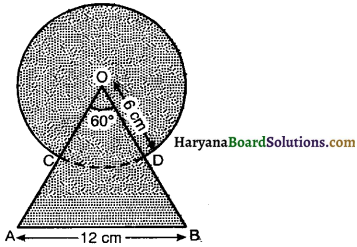
Haryana Board 10th Class Maths Solutions Chapter 12 Areas Related to Circles Ex 12.3 3

Solution.
We have,
Radius of circle = 6 cm
Side of equilateral triangle = 12 cm
Area of shaded region = Area of circle + Area of equilateral ∆OAB – Area of sector OCD
= Ï€ × 62 + \(\frac{\sqrt{3}}{4}\) × (12)2 – \(\frac{60^{\circ}}{360^{\circ}}\) × Ï€ × 62
= \(\frac{22}{7} \times 36+\frac{\sqrt{3} \times 144}{4}-\frac{1}{6} \times \frac{22}{7} \times 36\)
= \(\frac{22 \times 36}{7}-\frac{22 \times 6}{7}\) + 36√3
= \(\frac{660}{7}\) + 36√3
Hence, area of shaded region = (\(\frac{660}{7}\) + 36√3) cm2.

Question 5.
From each corner of a square of side 4 cm a quadrant of a circle of radius 1 cm is cut and also a circle of diameter 2 cm is cut as shown in the figure. Find the area of remaining portion of the square.
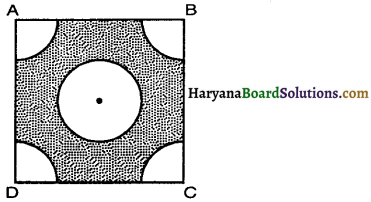
Haryana Board 10th Class Maths Solutions Chapter 12 Areas Related to Circles Ex 12.3 4

Solution:
We have,
side of the square = 4 cm
Radius of quadrant = 1 cm
and radius of circle = \(\frac{2}{2}\) = 1 cm.
Area of the remaining portioñ of the square = Area of square – (4 × Area of quadrant of circle + Area of circle)
= 4 × 4 – \(\left(4 \times \frac{90^{\circ}}{360^{\circ}} \times \frac{22}{7} \times(1)^2+\frac{22}{7} \times 1^2\right)\)
= 16 – \(\left(4 \times \frac{1}{4} \times \frac{22}{7}+\frac{22}{7} \times 1\right)\)
= 16 – (\(\frac{22}{7}+\frac{22}{7}\))
= 16 – \(\frac{44}{7}\)
= \(\frac{112-44}{7}=\frac{68}{7}\) cm2.
Hence, area of remaining portion = \(\frac{68}{7}\) cm2.

Haryana Board Solutions for 10th Class Maths Chapter 12 Areas Related to Circles Ex 12.3

Question 6.
In a circular table cover of radius 32 cm, a design is formed leaving an equilateral triangle ABC in the middle as shown in the given figure. Find the area of the design.
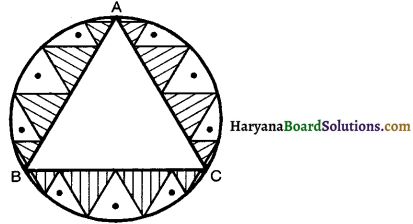
Haryana Board 10th Class Maths Solutions Chapter 12 Areas Related to Circles Ex 12.3 5

Solution:
We have,
Radius of the circle = 32 cm
O is the centre of the circle
∆ABC is an equilateral triangle.
Join OA, OB and OC.
Now ∠AOB = ∠BOC = ∠COA = 120°
In ∆OBC, we have
OB = OC [Equal radii of circle]
Draw OD ⊥ BC
∆ODB ≅ ∆ODC [By R.H.S. congruence]
⇒ ∠COD = \(\frac{120^{\circ}}{2}\) = 60°. [CPCT]
⇒ \(\frac{\mathrm{BD}}{\mathrm{OB}}\) = sin 60°
⇒ \(\frac{\mathrm{BD}}{32}=\frac{\sqrt{3}}{2}\)
⇒ BD = \(\frac{32 \sqrt{3}}{2}\) = 16√3
⇒ BC = 2 × BD
⇒ BC = 2 × 16√3 = 32√3 cm
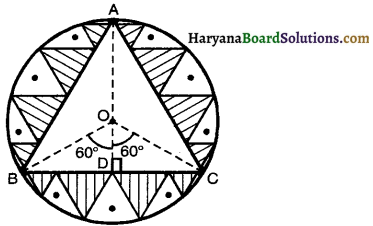
Haryana Board 10th Class Maths Solutions Chapter 12 Areas Related to Circles Ex 12.3 6

Area of the shaded region (designed) = Area of the circle – Area of the ∆ABC
= Ï€r2 – \(\frac{\sqrt{3}}{4}\) (side)2
= Ï€ × (32)2 – \(\frac{\sqrt{3}}{4}\) × (32√3)2
= \(\frac{22}{7}\) × 1024 – √3 × 768
= (\(\frac{22528}{7}\) – 768√3) cm2
Hence, area of the shaded region (designed) = (\(\frac{22528}{7}\) – 768√3) cm2

Haryana Board Solutions for 10th Class Maths Chapter 12 Areas Related to Circles Ex 12.3

Question 7.
In the given figure, ABCD is a square of side 14 cm, with centres A, B, C and D, four circles are drawn such that each circles touch externally two of the remaining three circles. Find the area of the shaded region.
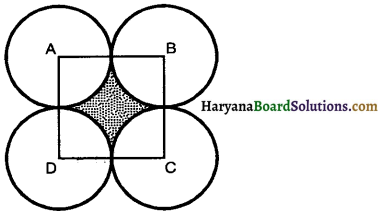
Haryana Board 10th Class Maths Solutions Chapter 12 Areas Related to Circles Ex 12.3 7

Solution:
We have,
Side of square = 14 cm
Radius of each circle = \(\frac{14}{2}\) = 7 cm
Area of the Shaded region = Area of square – 4 × quadrant area
= (side)2 – 4 × \(\frac{1}{4}\) Ï€r2
= 14 × 14 – 4 × \(\frac{1}{4}\) × \(\frac{22}{7}\) × 72
= 196 – 22 × 7
= 196 – 154 = 42 cm2.
Hence, area of shaded region = 42 cm2.

Question 8.
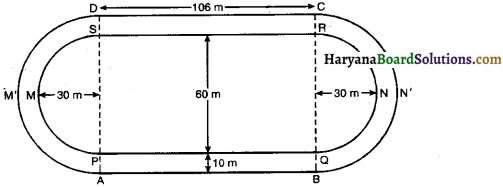
In the given figure depicts a racing track whose left and right ends are semicircular. The distance between the two inner parallel line segments is 60 m and they are each 106 m long. If the track is 10 m wide, find :
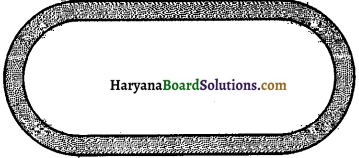
Haryana Board 10th Class Maths Solutions Chapter 12 Areas Related to Circles Ex 12.3 8

(i) The distance around the track along its inner edge.
(ii) The area of the track.
Solution:
(i)
Haryana Board 10th Class Maths Solutions Chapter 12 Areas Related to Circles Ex 12.3 9

The distance around the track along its inner edge = Perimeter of PMS + PQ + Perimeter of QNR + SR
= (π × 30 + 106 + π × 30 + 106) m
= 212 + 60Ï€
= 212 + 60 × \(\frac{22}{7}\)
= 212 + \(\frac{1320}{7}\)
= \(\frac{1484+1320}{7}\) = \(\frac{2804}{7}\)

(ii) Outer radius = 30 + 10 = 40 m
Area of the track = Area of rectangle PABQ + Area of rectangle DCRS + 2 × Area of semi circular ring
= 106 × 10 + 106 × 10 + 2 × \(\frac{1}{2}\) Ï€(402 – 302)
= 1060 + 1060 + \(\frac{22}{7}\) × (40 + 30) (40 – 30) 22 1
= 2120 + \(\frac{22}{7}\) × 700
= 2120 + 2200 = 4320 m2.
Hence, distance around the track along its inner edge = \(\frac{2804}{7}\) m
area 0f track = 4320 m2.

Haryana Board Solutions for 10th Class Maths Chapter 12 Areas Related to Circles Ex 12.3

Question 9.
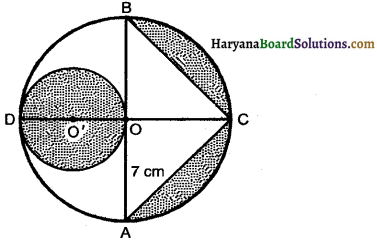
In the given figure, AB and CD are two diameters of a circle (with centre O) perpendicular to each other and OD is the diameter of the smaller circle. If OA = 7 cm, find the area of the shaded region.
Haryana Board 10th Class Maths Solutions Chapter 12 Areas Related to Circles Ex 12.3 10

Solution:
we have,
OA = 7 cm.
∴ AB = CD = 2 × 7 = 14 cm
OC = OB = OA = OD = 7 cm
diameter AB ⊥ diameter CD
Radius of smaller circle having centre = \(\frac{7}{2}\) cm.
Area of shaded region= Area of smaller circle having centre 0′ + (Area of semicircle ACB – area of ∆ABC)
= \(\pi \times\left(\frac{7}{2}\right)^2+\left[\frac{1}{2} \pi \times(7)^2-\frac{1}{2} \times 14 \times 7\right]\)
= \(\frac{22}{7} \times \frac{49}{4}+\left[\frac{1}{2} \times \frac{22}{7} \times 49-49\right]\)
= 38.5 + [77 – 49]
= 38.5 + 28 = 66.5 cm2.
Hence, area of the shaded region= 66.5 cm2.

Question 10.
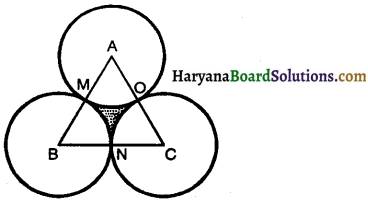
The area of an equilateral triangle ABC is 17320.5 cm2. With each vertex of the triangle as centre, a circle is drawn with radius equal to half the length of the side of the triangle (see in figure). Find the area of the shaded region. (use π = 3.14 and √3= 1.73205)
Haryana Board 10th Class Maths Solutions Chapter 12 Areas Related to Circles Ex 12.3 11

Solution.
Let the side of equilateral ∆ be x cm.
Area of equilateral triangle = \(\frac{\sqrt{3}}{4}\) × x2
⇒ 17320.5 = \(\frac{\sqrt{3}}{4}\) × x2
[given, area of triangle = 17320.5 cm2]
⇒ 17320.5 × 4 = √3x2
⇒ x2 = \(\frac{17320 \cdot 5 \times 4}{\sqrt{3}}\)
⇒ x2 = \(\frac{17320 \cdot 5}{1 \cdot 73205}\) × 4
⇒ x2 = 10000 × 4
⇒ x2 = 40000
⇒ x = \(\sqrt{40000}\) = 200 cm.
Then, radius of each circle = \(\frac{200}{2}\) = 100 cm
Area of shaded region = Area of ∆ABC – (Area of sector AMO + Area of sector BMN + Area of sector CNO)
= 17320.5 – \(\left(\frac{60^{\circ}}{360^{\circ}} \times \pi \times(100)^2+\frac{60^{\circ}}{360^{\circ}} \times \pi \times(100)^2+\frac{60^{\circ}}{360^{\circ}} \times \pi \times(100)^2\right)\)
= 17320.5 – [3 × \(\frac{1}{6}\) × Ï€ × (100)2]
= 17320.5 – \(\frac{\pi}{2}\) × 10000
= 17320.5 – \(\frac{3.14}{2}\) × 10000
= 17320.5 – 15700 = 1620.5 cm2.
Hence, area of shaded region = 1620.5 cm2.

Haryana Board Solutions for 10th Class Maths Chapter 12 Areas Related to Circles Ex 12.3

Question 11.
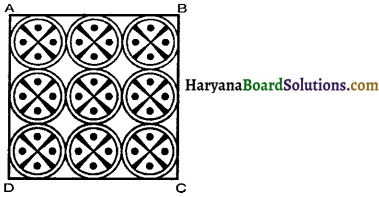
On a square handkerchief, nine circular designs each of radius 7 cm are made (see in figure). Find the area of the remaining portion of the handker-chief.
Haryana Board 10th Class Maths Solutions Chapter 12 Areas Related to Circles Ex 12.3 12

Solution.
We have,
radius of circle = 7 cm
Diameter of the circle = 2 × 7 = 14 cm
Side of the square ABCD = 3 × 14 = 42 cm
Area of the remaining portion of handkerchief = Area of square ABCD – 9 × area of circle
= 42 × 42 – 9 × Ï€ × 72
= 1764 – 9 × \(\frac{22}{7}\) × 7 × 7
= 1764 – 1386
= 378 cm2.
Hence, area of the remaining portion of handkerchief = 378 cm2.

Question 12.
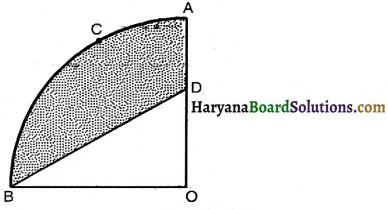
In the given figure, OACB is a quadrant of a circle with centre 0 and radius 3’5 cm. If OD = 2 cm, find the area of the :
(i) Quadrant OACB
(ii) Shaded region
Haryana Board 10th Class Maths Solutions Chapter 12 Areas Related to Circles Ex 12.3 13

Solution.
We have,
Radius of a quadrant = 3.5 cm and OD = 2 cm
(i) Area of quadrant OACB = \(\frac{1}{4}\) × π × (3.5)2
= \(\frac{1}{4}\) × \(\frac{22}{7}\) × 35 × 35
= \(\frac{77}{8}\) cm2.

(ii) In right ∆BOD, we have OB = 35cm, and OD = 2 cm
Area of ∆OBD = \(\frac{1}{2}\) × 35 × 2
= 3.5 cm2 = \(\frac{7}{2}\) cm2
Area of shaded region= quadrant area – area of ∆BOD
= \(\frac{77}{8}-\frac{7}{2}\)
= \(\frac{77-28}{8}\)
= \(\frac{49}{8}\) cm2.
Hence, arei of quadrant = \(\frac{77}{8}\) cm2
and area of shaded region = \(\frac{49}{8}\) cm2.

Question 13.
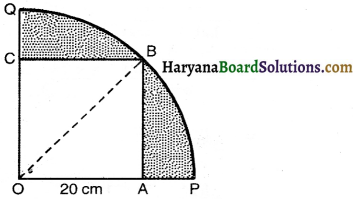
In the given figure, a square OABC is inscribed in a quadrant OPBQ. If OA = 20 cm, find the area of the shaded region. (use π = 3.14)
Haryana Board 10th Class Maths Solutions Chapter 12 Areas Related to Circles Ex 12.2 14

Solution:
We have,
Side of square (OA) = 20 cm
In right angle triangle OAB.
OB2 = OA2 + AB2 (By Pythagoras theorem)
OB2 = 202 + 202
OB2 = 400 + 400
OB2 = 800
OB = \(\sqrt{800}\) = 20√2 cm
∴ Radius of the quadrant 20√2 cm
Area of shaded region= Area of Quadrant – area of Square.
= \(\frac{1}{4}\) Ï€ × (20√2)2 – 20 × 20
= \(\frac{1}{4}\) × 3.14 × 800 – 400
= 628 – 400 = 228 cm2.
Hence, area of shaded region = 228 cm2.

Haryana Board Solutions for 10th Class Maths Chapter 12 Areas Related to Circles Ex 12.3

Question 14.
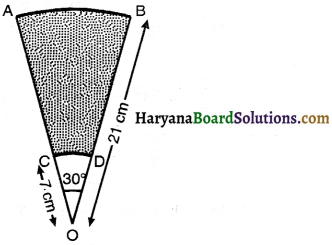
AB and CD are respectively arcs of two concentric circles of radii 21 cm and 7 cm and centre O (see in figure). If ∠AOB = 30°, Find the area of the shaded region.
Haryana Board 10th Class Maths Solutions Chapter 12 Areas Related to Circles Ex 12.3 14

Solution.
We have,
Radius of sector AOB (r1) = 21 cm
Radius of sector COD (r2) = 7 cm
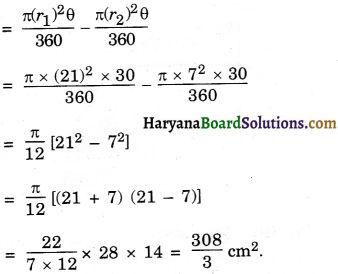
Area of shaded region= Area of sector AOB – Area of sector COD
Haryana Board 10th Class Maths Solutions Chapter 12 Areas Related to Circles Ex 12.3 15

Hence, area of shaded region = \(\frac{308}{3}\) cm2.

Question 15.
In the given figure, ABC is a quadrant of a circle of radius 14 cm and a semicircle is drawn with BC as diameter. Find the area of the shaded region.
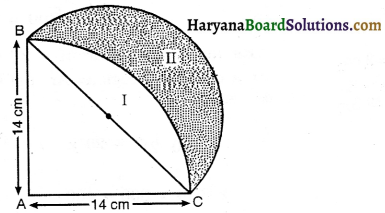
Haryana Board 10th Class Maths Solutions Chapter 12 Areas Related to Circles Ex 12.3 16

Solution:
We have,
Radius of a quadrant = 14 cm
In right ∆BAC,
BC2 = AB2 + AC2
BC2 = 142 + 142
BC2 = 2 × 142
BC = 14√2 cm
Area of region (I) = Area of quadrant ABC – Area of ∆ABC
= \(\frac{1}{4}\) Ï€ × 142 – \(\frac{1}{2}\) × 14 × 14
= \(\frac{1}{4}\) × \(\frac{22}{7}\) × 14 × 14 – 7 × 14
= 154 – 98 = 56 cm2.

Area of shaded region (II) = Area of the semicircle drawn on BC as diameter – Area of region I
= \(\frac{1}{2} \times \pi \times\left(\frac{14 \sqrt{2}}{2}\right)^2-56\)
= \(\frac{1}{2} \times \frac{22}{7} \times \frac{392}{4}\) – 56
= \(\frac{616}{4}\) – 56
= 154 – 56 = 98 cm2.
Hence, area of shaded region = 98 cm2.

Haryana Board Solutions for 10th Class Maths Chapter 12 Areas Related to Circles Ex 12.3

Question 16.
Calculate the area of the designed region in given figure common between the two quadrants of circles of radius 8 cm each.
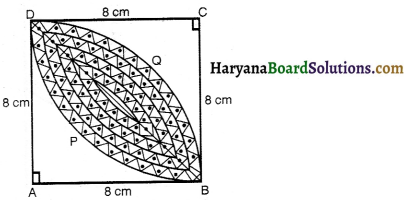
Haryana Board 10th Class Maths Solutions Chapter 12 Areas Related to Circles Ex 12.3 17

Solution:
We have,
Radius of the circle = 8 cm
Area of the designed region = 2 (Area of quadrant ∆BQD – Area of ∆ABD)
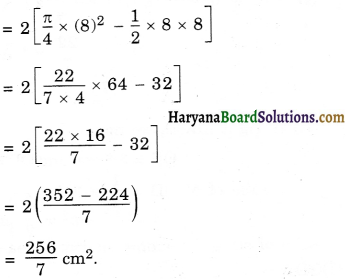
Haryana Board 10th Class Maths Solutions Chapter 12 Areas Related to Circles Ex 12.3 18

Hence, area of designed region = \(\frac{256}{7}\) cm2.

HBSE 10th Class Maths Solutions Chapter 12 Areas Related to Circles Ex 12.3 Read More »
HBSE 10th Class Maths Solutions Chapter 12 Areas Related to Circles Ex 12.2

Haryana State Board HBSE 10th Class Maths Solutions Chapter 12 Areas Related to Circles Ex 12.2 Textbook Exercise Questions and Answers.

Haryana Board 10th Class Maths Solutions Chapter 12 Areas Related to Circles Ex 12.2

Unless stated otherwise, use π = \(\frac{22}{7}\).

Question 1.
Find the area of sector of a circle with radius 6 cm if angle of the sector is 60°.
Solution.
We have,
Radius = 6 cm
θ = 60°
Area of the sector = \(\frac{\pi r^2 \theta}{360^{\circ}}\)
= \(\frac{22}{7} \times \frac{6^2 \times 60^{\circ}}{360^{\circ}}\)
= \(\frac{22}{7} \times \frac{6 \times 6}{6}=\frac{132}{7}\)
Hence, area of sector = \(\frac{132}{7}\) cm2.

Haryana Board Solutions for 10th Class Maths Chapter 12 Areas Related to Circles Ex 12.2

Question 2.
Find the area of a quadrant of a circle whose circumference is 22 cm.
Solution:
Let r be the radius of the circle whose circumference is 22 cm.
2Ï€r = 22
r = \(\frac{22}{2 \pi}\)
r = \(\frac{22}{2 \times \frac{22}{-7}}\)
r = \(\frac{22 \times 7}{2 \times 22}\)
r = \(\frac{7}{2}\) cm
θ = 90°
[∵ sector is quadrant ∴ θ = \(\frac{360}{4}\) = 90°]
Therefore,area of the quadrant = \(\frac{\pi r^2 \theta}{360^{\circ}}\)
= \(\frac{22}{7} \times \frac{7}{2} \times \frac{7}{2} \times \frac{90^{\circ}}{360^{\circ}}\)
= \(\frac{22 \times 7}{4 \times 4}\)
= \(\frac{77}{8}\) cm2
Hence, area of the quadrant = \(\frac{77}{8}\) cm2

Question 3.
The length of the minute hand of a clock is 14 cm. Find the area swept by the minute hand in 5 minutes.
Solution.
Angle describe by the minute hand in 60 minutes = 360°
Angle, describe by the minute hand in 5 minutes = \(\frac{360^{\circ}}{60^{\circ}}\) × 5 = 30°
Now, θ = 30° and radius = 14 cm
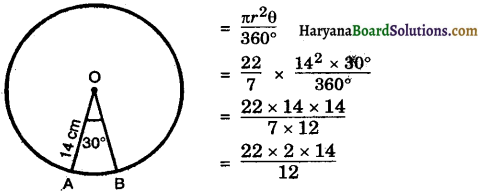
Area swept by the minute hand in 5 minutes = Area of sector AOB

Haryana Board 10th Class Maths Solutions Chapter 12 Areas Related to Circles Ex 12.2 1

= \(\frac{11 \times 14}{3}\)
= \(\frac{154}{3}\) cm2.
Hence, area swept by the minute hand = \(\frac{154}{3}\) cm2.

Haryana Board Solutions for 10th Class Maths Chapter 12 Areas Related to Circles Ex 12.2

Question 4.
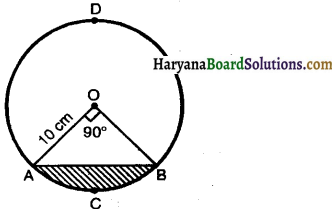
A chord of a circle of radius 10 cm subtends a right angle at the centre. Find the area of the corresponding:
(i) minor segment
(ii) major sector. (use π = 3.14)
Solution.
We have,
Radius = 10 cm
and θ = 90°
Area of the minor segment ACB = \(\frac{\pi r^2 \theta}{360}\) – Area of ∆AOB
= \(\frac{3.14 \times 10^2 \times 90^{\circ}}{360^{\circ}}\) – \(\frac{1}{2}\) × 10 × 10
= \(\frac{3.14 \times 100}{4}\) – 50
= 785 – 50 = 28.5 cm2
Area of major sector ADB

Haryana Board 10th Class Maths Solutions Chapter 12 Areas Related to Circles Ex 12.2 2

= \(\frac{\pi r^2\left(360^{\circ}-90^{\circ}\right)}{360^{\circ}}\)
= \(\frac{3.14 \times 10^2 \times 270^{\circ}}{360^{\circ}}\)
= 314 × \(\frac{3}{4}\)
= 235.5 cm2
Hence, area of minor segment 285 cm2 and area of major sector = 235.5 cm2.

Haryana Board Solutions for 10th Class Maths Chapter 12 Areas Related to Circles Ex 12.2

Question 5.
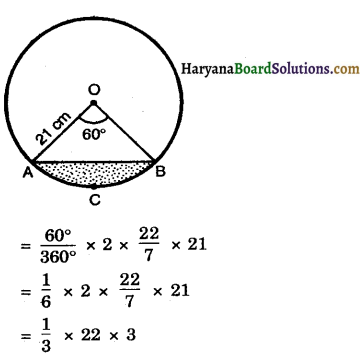
In a circle of radius 21 cm, an arc subtends an angle of 600 at the centre. Find:
(i) The length of the arc
(ii) Area of the sector formed by the arc
(iii) Area of the segment formed by the corresponding chord.
Solution.
We have,
Radius (r) = 21 cm
Sector angle (θ) = 60°
(i) Length of the arc = \(\frac{\theta}{360^{\circ}}\) × 2πr

Haryana Board 10th Class Maths Solutions Chapter 12 Areas Related to Circles Ex 12.2 3

= 22 cm
(ii) Area of the sector formed by the arc = \(\frac{\pi r^2 \theta}{360^{\circ}}\)
= \(\frac{22}{7} \times \frac{21^2 \times 60^{\circ}}{360^{\circ}}\)
= \(\frac{22}{7} \times \frac{21 \times 21 \times 60^{\circ}}{360^{\circ}}\)
= \(\frac{22 \times 3 \times 21 \times 1}{6}\)
= 11 × 21 = 231 cm2

(iii) In ∆OAB. OA = OB (equal radii)
⇒ ∠OAB = ∠OBA
Let ∠OAB = ∠OBA = x
∴ x + x + ∠AOB = 180°
⇒ 2x + 60° = 180°
⇒ 2x = 180° – 60° = 120°
⇒ x = \(\frac{120^{\circ}}{2}\) = 60°
Therefore, ∆OAB is an equilateral triangle of side 21 cm.
∴ Area of ∆OAB = \(\frac{\sqrt{3}}{4}\) (side)2
= \(\frac{\sqrt{3}}{4}\) × 212
= \(\frac{441 \sqrt{3}}{4}\) cm2

Area of the segment formed by the corresponding chord = Area of segment ACB.
= Area of the sector OACBO – Area of ∆OAB
= \(\frac{\pi r^2 \theta}{360^{\circ}}-\frac{441 \sqrt{3}}{4}\)
= \(=\frac{22}{7} \times \frac{21^2 \times 60^{\circ}}{360^{\circ}}-\frac{441 \sqrt{3}}{4}\)
= 11 × 21 – \(\frac{441 \sqrt{3}}{4}\)
= (231 – \(\frac{441 \sqrt{3}}{4}\)) cm2
Hence, length of the arc = 22 cm,
area of the sector = 231 cm2
and area of the segment (ACB) = (231 – \(\frac{441 \sqrt{3}}{4}\)) cm2.

Haryana Board Solutions for 10th Class Maths Chapter 12 Areas Related to Circles Ex 12.2

Question 6.
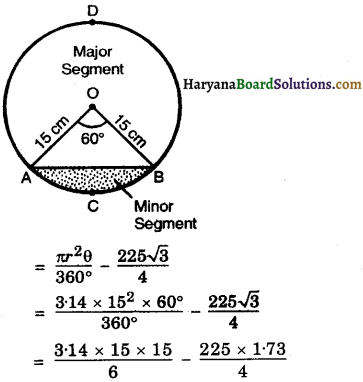
A chord of a circle of radius 15 cm subtends an angle of 60° at the centre. Find the area of the corresponding minor and major segments of the circle. [use π = 3.14 and √3 = 1.73]
Solution:
We heve,
Radius (r) = 15 cm
Sector angle (θ) = 60°
In ∆AOB
⇒ OA = OB (equal radii of the circle)
⇒ ∠OAB = ∠OBA
⇒ ∠OAB + ∠OBA + ∠AOB = 180°
⇒ 2∠OAB + 60°= 180°
⇒ 2∠OAB = 180° – 60° = 120°
⇒ ∠OAB = \(\frac{120^{\circ}}{2}\) = 60°
Therefore, ∆AOB is an equilateral triangle.
Its side = 15 cm
Area of ∆AOB = \(\frac{\sqrt{3}}{4}\) × 152
= \(\frac{225 \sqrt{3}}{4}\) cm2.

Area of minor segment (ACB) = Area of sector – area of ∆AOB

Haryana Board 10th Class Maths Solutions Chapter 12 Areas Related to Circles Ex 12.2 4

= 117.75 – 97.31 = 2O.44 cm2.
Area of major segment = nr2 – Area of minor segment
= 3.14 × 152 – 20.44.
= 706.5 – 20.44 = 686.06 cm2
Hence, area of minor segment and major segment are 20.44 cm2 and 686.06 cm2 respectively.

Question 7.
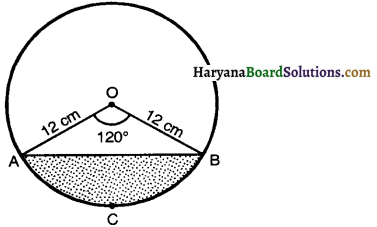
A chord of a circle of radius 12 cm subtends an angle of 120° at the centre. Find the area of the corresponding segment of the circle. [use π = 3.14 and √3 = 1.73]
Solution.
We have,
Radius (r) = 12 cm
∠AOB = 120°
Area of segment (ACB) = \(\frac{\pi r^2 \theta}{360^{\circ}}-r^2 \sin \frac{\theta}{2} \cos \frac{\theta}{2}\)
= \(\frac{3.14 \times 12^2 \times 120}{360}-12^2 \sin \frac{120^{\circ}}{2} \cos \frac{120^{\circ}}{2}\)
= 3.14 × 12 × 4 – 144 sin 60° cos 60°

Haryana Board 10th Class Maths Solutions Chapter 12 Areas Related to Circles Ex 12.2 5

= 3.14 × 48 – 144 × \(\frac{\sqrt{3}}{2} \times \frac{1}{2}\)
= 3.14 × 48 – 36√3
= 150.72 – 36 × 173
= 150.72 – 62.28
= 88.44 cm2.
Hence, area of segment (ACB)= 88.44 cm2.

Haryana Board Solutions for 10th Class Maths Chapter 12 Areas Related to Circles Ex 12.2

Question 8.
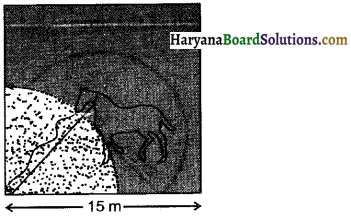
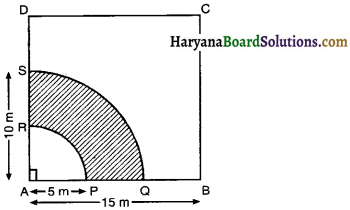
A horse is tied to a peg at one corner of a square shaped grass field of side 15 m by means of a 5 m long rope (see figure). Find
(i) The area of that part of the field in which the horse can graze.
(ii) The increase in the grazing area if the rope were 10m long instead of 5 m. (use π = 3.14)

Haryana Board 10th Class Maths Solutions Chapter 12 Areas Related to Circles Ex 12.2 6

Solution:
(i) We have,
Side of the square = 15 m
The area of the field in which the horse can graze represented in the figure by APR, a quadrant of the circle with radius 5 m.
The area which horse can graze = \(\frac{\pi r^2 \theta}{360^{\circ}}\)
= \(\frac{3.14 \times 5^2 \times 90^{\circ}}{360^{\circ}}\)
= \(\frac{3 \cdot 14 \times 25}{4}\)
= 19.63 cm2.

(ii) Increase in area when the rope is 10 m long = Area of quadrant ASQ – Area of quadrant APR
= \(\frac{\pi r^2 \theta}{360^{\circ}}\) – 19.63
= \(\frac{3.14 \times 10^2 \times 90^{\circ}}{360^{\circ}}\) – 19.63
= \(\frac{314}{4}\) – 19.63
= 78.5 – 19.63 = 58.87 cm2.

Haryana Board 10th Class Maths Solutions Chapter 12 Areas Related to Circles Ex 12.2 7

Hence, area which horse can graze = 19.63 cm2
and increase in area = 58.87 cm2.

Question 9.
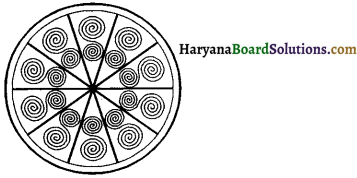
A brooch is made with silver wire in the form of a circle with diameter 35 mm. The wire is also usal in making 5 centimeters which divide the circle into 10 equal sectors as shown in figure. Find:
(i) The total length of the silver wire required.
(ii) The area of each sector of the brooch.

Haryana Board 10th Class Maths Solutions Chapter 12 Areas Related to Circles Ex 12.2 8

Solution:
(i) We have,
Radius of the circle = \(\frac{35}{2}\) mm.
Circumference of the circle = 2Ï€r
= 2 × \(\frac{22}{7}\) × \(\frac{35}{2}\)
= 110 mm
The total length of wire required = circumference of the circle + length of 5 diameters
= 110 + 5 × 35
= 110 + 175 = 285 mm.

(ii) Area of the circle = πr2
= \(\frac{22}{7} \times \frac{35}{2} \times \frac{35}{2}\)
= \(\frac{11 \times 5 \times 35}{2}\)
= 962.5 mm2

Since circle is divided into 10 equal sectors.
Therefore, area of each sector = \(\frac{\text { Area of the circle }}{10}\)
= \(\frac{962.5}{10}\)
= 96.25 mm2.
Hence, (i) total length of wire required = 285 mm.
(ii) Area of each sector = 96.25 mm2

Haryana Board Solutions for 10th Class Maths Chapter 12 Areas Related to Circles Ex 12.2

Question 10.
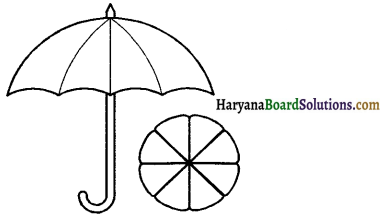
An umbrella has 8 ribs which are equally spaced (see figure). Assuming umbrella to be a flat circle of radius 45 cm, find the area between the two consecutive ribs of the umbrella.

Haryana Board 10th Class Maths Solutions Chapter 12 Areas Related to Circles Ex 12.2 9

Solution:
We have,
Radius of circle = 45 cm
Area of the circle = πr2
= π × 452
= 2025Ï€
= \(\frac{2025 \times 22}{7}\)
= 6364.29 cm2
Since the ribs divide the circle into 8 sectors of equal area
Area between the two consecutive ribs = Area of each sector of the circle
= \(\frac{\text { Area of the circle }}{8}\)
= \(\frac{6364 \cdot 29}{8}\)
= 795.54 cm2
Hence, area between the two consecutive ribs of the umbrella = 795.54 cm2

Haryana Board Solutions for 10th Class Maths Chapter 12 Areas Related to Circles Ex 12.2

Question 11.
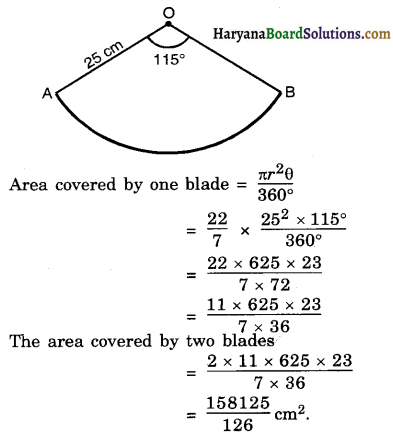
A car has two wipers which do not overlap. Each wiper has a blade of length 25 cm sweeping through an angle of 115°. Find the total area cleaned at each sweep of the blades.
Solution.
We have,
One blade of a wiper sweeps a sector area of circle of a radius 25 cm.
The sector angle (θ) = 115°

Haryana Board 10th Class Maths Solutions Chapter 12 Areas Related to Circles Ex 12.2 10

Hence, total area cleaned at each sweep of the blades = \(\frac{158125}{126}\) cm2

Question 12.
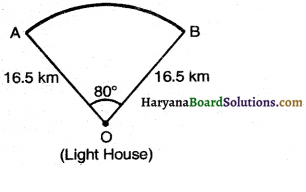
To warn ships for underwater rocks, a light house spreads a red coloured light over a sector of angle 80° to a distance of 16.5 km. find the area of the sea over which the ships are warned, (use π = 3.14)
Solution.
We have,
Radius = 16.5 km

Haryana Board 10th Class Maths Solutions Chapter 12 Areas Related to Circles Ex 12.2 11

Sector angle (θ) = 80°
Area of the sea over which the ships are warned = \(\frac{\pi r^2 \theta}{360}\)
= \(\frac{3.14 \times 16.5 \times 16.5 \times 80}{360}\)
= \(\frac{3 \cdot 14 \times 272 \cdot 25 \times 2}{9}\)
= 189.97 km2
Hence, area of the sea over which the ships are warned = 189.97 km2.

Haryana Board Solutions for 10th Class Maths Chapter 12 Areas Related to Circles Ex 12.2

Question 13.
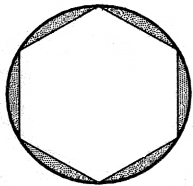
A round table cover has six equal designs as shown in figure. if the radius of the cover is 28 cm, find the cost of making the designs at the rate of ₹ 0.35 per cm2. (Use √3 = 1.7)

Haryana Board 10th Class Maths Solutions Chapter 12 Areas Related to Circles Ex 12.2 12

Solution:
We have,
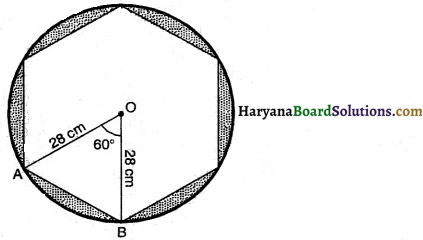
r = 28 cm
and θ = \(\frac{360^{\circ}}{6}\) = 60°

Haryana Board 10th Class Maths Solutions Chapter 12 Areas Related to Circles Ex 12.2 13

In the figure OA = OB
∠OAB = ∠OBA
∴ ∠OAB + ∠OBA + ∠AOB = 180°
⇒ 2∠OAB + 60° = 180°
⇒ 2 ∠OAB = 180° – 60° = 120°
⇒ ∠OAB = \(\frac{120}{2}\) = 60°
∴ ∠AOB is an equilateral triangle having side 28 cm.
Area of shaded designed portion = Area of the sector OAB – Area of ∆OAB
= \(\frac{\pi r^2 \theta}{360^{\circ}}-\frac{\sqrt{3}}{4} \times 28^2\)
= \(\frac{22}{7} \times \frac{28^2 \times 60^{\circ}}{360^{\circ}}-\frac{\sqrt{3}}{4} \times 28 \times 28\)
= \(\frac{22 \times 4 \times 28 \times 1}{6}\) – √3 × 7 × 28
= \(\frac{44 \times 28}{3}\) – 1.7 × 196
= 410.67 – 333.2 = 77.47 cm2.
The total area of six shaded designed portion = 6 × 77.47 = 464.82 cm2.
Cost of making designs at the rate of 0.35 ₹/cm2 = 464.82 × 0.35 = ₹ 162.68
Hence, cost of the making designs = ₹ 162.68.

Haryana Board Solutions for 10th Class Maths Chapter 12 Areas Related to Circles Ex 12.2

Question 14.
Tick the correct answer in the following: Area of a sector of angle p (in degrees) of a circle with radius R is
(A) \(\frac{p}{180^{\circ}}\) × 2πR
(B) \(\frac{p}{180^{\circ}}\) × πR
(C) \(\frac{p}{360^{\circ}}\) × 2πR
(D) \(\frac{p}{720^{\circ}}\) × 2πR2
Solution:
(D) \(\frac{p}{720^{\circ}}\) × 2πR2

HBSE 10th Class Maths Solutions Chapter 12 Areas Related to Circles Ex 12.2 Read More »
HBSE 10th Class Maths Solutions Chapter 13 Surface Areas and Volumes Ex 13.1

Haryana State Board HBSE 10th Class Maths Solutions Chapter 13 Surface Areas and Volumes Ex 13.1 Textbook Exercise Questions and Answers.

Haryana Board 10th Class Maths Solutions Chapter 13 Surface Areas and Volumes Ex 13.1

Unless stated otherwise, take π = \(\frac{22}{7}\).

Question 1.
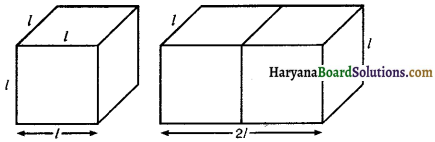
2 cubes each of volume 64 cm3 are joined end to end. Find the surface area of the resulting cuboid.
Solution:
Let a be length of an edge of the cube,
Volume of cube = 64 cm3 (given)
⇒ a3 = 64
⇒ a = \(\sqrt[3]{64}\)
⇒ a = 4 cm

Haryana Board 10th Class Maths Solutions Chapter 13 Surface Areas and Volumes Ex 13.1 1

Now, dimensions of the resulting cuboid made by joining two cubes are 8 cm × 4 cm × 4 cm.
∴ Length of cuboid = 8 cm
Breadth of cuboid = 4 cm
Height of cuboid = 4 cm
Surface area of the cuboid= 2 (lb + bh + hl)
= 2(8 × 4 + 4 × 4 + 4 × 8)
= 2 (32 + 16 + 32)
= 2 × 80 = 160 cm2
Hence, surface area of the cuboid = 160 cm2.

Haryana Board Solutions for 10th Class Maths Chapter 13 Surface Areas and Volumes Ex 13.1

Question 2.
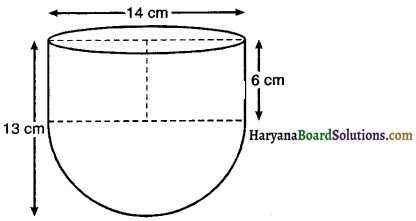
A vessel is in the form of a hollow hemisphere mounted by a hollow cylinder. The diameter of the hemisphere is 14 cm and total height of the vessel is 13 cm. Find the inner surface area of the vessel.
Solution:
We have,
Diameter of the hemispherical portion = 14 cm
Radius of the hemispherical portion = \(\frac{14}{2}\) = 7 cm

Haryana Board 10th Class Maths Solutions Chapter 13 Surface Areas and Volumes Ex 13.1 2

Total height of the vessel = 13 cm
Height of the cylindrical portion = 13 – 7 = 6 cm
Total inner surface area of the vessel
= C.S.A. of hemisphrical portion + C.S.A. of cylindrical portion
= 2Ï€r2 + 2Ï€rh
= 2Ï€r (r + h)
= 2 × \(\frac{22}{7}\) × 7 (7 + 6)
= 44 × 13 = 572 cm2
Hence, total inner surface area of the vessel = 572 cm2

Question 3.
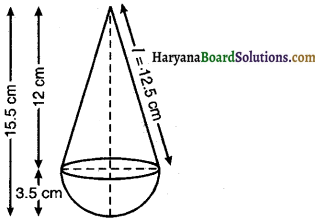
A toy is in the form of a cone of radius 3.5 cm mounted on a hemisphere of same radius. The total height of the toy is 15.5 cm. Find the total surface area of the toy.
Solution:
We have,
Radius (r) = 3.5 cm
Total height of the toy = 15.5 cm
height of the conical part (h) = 15.5 – 3.5 = 12 cm

Haryana Board 10th Class Maths Solutions Chapter 13 Surface Areas and Volumes Ex 13.1 3

Slant height of the conical part (l) = \(\sqrt{h^2+r^2}\)
= \(\sqrt{12^2+(3 \cdot 5)^2}\)
= \(\sqrt{(12)^2+(3 \cdot 5)^2}\)
= \(\sqrt{144+12 \cdot 25}\)
= \(\sqrt { 1 5 6 \cdot 2 5 }\) = 12.5 cm
Total surface area of the toy = 2πr2 + πrl = πr (2r + l)
= \(\frac{22}{7}\) × 3.5 (2 × 3.5 + 12.5)
= 11 × 19.5 = 214.5 cm2.
Hence, total surface area of the toy = 214.5 cm2.

Haryana Board Solutions for 10th Class Maths Chapter 13 Surface Areas and Volumes Ex 13.1

Question 4.
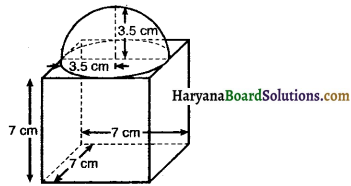
A cubical block of side 7 cm is surmounted by a hemisphere. What is the greatest diameter the hemisphere can have ? Find the surface area of the solid.
Solution:
We have,
Edge of cubical block = 7 cm
Greatest diameter of the hemisphere = edge of cube = 7 cm

Haryana Board 10th Class Maths Solutions Chapter 13 Surface Areas and Volumes Ex 13.1 4

Surface area of the solid = The surface area of the cube + C.S.A. of the hemisphere – base area of the hemisphere
= 6 × (edge)2 + 2Ï€r2 – Ï€r2
= 6 × (7)2 + πr2
= 6 × 49 + \(\frac{22}{7}\) × (3.5)2
= 294 + 38.5 = 332.5 cm2
Hence, surface area of the solid = 332.5 cm2.

Question 5.
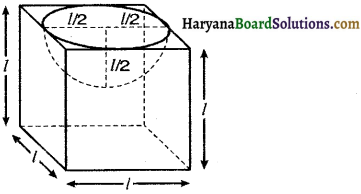
A hemispherical depression is cut out from one face of a cubical wooden block such that the diameter l of the hemisphere is equal to the edge of the cube. Determine the surface area of the remaining solid.
Solution:
We have,
Diameter of the hemisphere = l
Edge of the cube = diameter of the hemsphere = l
radius of the hemisphere = \(\frac{l}{2}\)

Haryana Board 10th Class Maths Solutions Chapter 13 Surface Areas and Volumes Ex 13.1 5

Surface Area of the remaining solid = surface area of the cube + Inner C.S.A. of the hemisphere – Area of the top of the hemisphere
= 6l2 + 2Ï€r x (\(\frac{l}{2}\))2 – Ï€ (\(\frac{l}{2}\))2
= 6l2 + π × (\(\frac{l}{2}\))2
= 6l2 + \(\frac{\pi l^2}{4}\)
= \(\frac{1}{4}\) (24l2 + πl2)
= \( \frac{l^2}{4}\) (24 + π)
Hence, surface area of the remaining solid = \(\frac{1}{4}\) l2 (24 + π).

Haryana Board Solutions for 10th Class Maths Chapter 13 Surface Areas and Volumes Ex 13.1

Question 6.
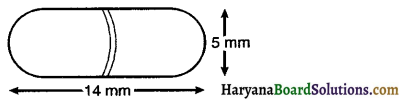
A medicine capsule is in the shape of a cylinder with two hemispheres stuck to each of its ends (see in figure). The length of the entire capsule is 14 mm and the diameter of the capsule is 5 mm. Find its surface area.

Haryana Board 10th Class Maths Solutions Chapter 13 Surface Areas and Volumes Ex 13.1 6

Solution:
We have,
Radius of the cylindrical part and hemispherical part (r) = \(\frac{5}{2}\) = 2.5 mm
Length of the cylindrical part (h) = 14 – (2.5 + 2.5)
= 14 – 5 = 9 mm
Surface area of the capsule = C.S.A. of the cylindrical part + C.S.A. of two hemispherical parts
= 2πrh + 2 × 2πr2
= 2Ï€r (h + 2r)
= 2 × \(\frac{22}{7}\) × 2.5 (9 + 2 × 2.5)
= \(\frac{22}{7}\) × 5 × 14
= 220 mm2.
Hence, surface area of the capsule = 220 mm2.

Question 7.
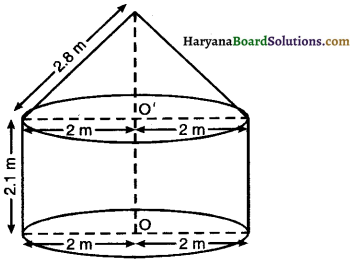
A tent is in the shape of a cylinder surmounted by a conical top. If the height and diameter of the cylindrical part are 2.1 m and 4 m respectively, and the slant height of the top is 2.8 m, find the area of the canvas used for making the tent. Also, find the cost of the canvas of the tent at the rate of ₹ 500 per m2. (Note that the base of the tent will not be covered with canvas.)
Solution.
We have,
Radius of conical portion radius (r) = \(\frac{4}{2}\) = 2 m
Slant height (l) = 2.8 m
For cylindrical portion Radius (r) = 2 m
Height (h) = 2.1 m
Area of canvas used for making the tent = Surface area of tent = C.S.A. of conical part + C.S.A. of cylindrical part
= πrl + 2πrh
= πr(l + 2h)

Haryana Board 10th Class Maths Solutions Chapter 13 Surface Areas and Volumes Ex 13.1 7

= \(\frac{22}{7}\) × 2(2.8 + 2 × 2.1)
= \(\frac{44}{7}\) × 7 = 44 m2.
Cost of canvas at the rate of ₹ 500/m2 = 44 × 500 = ₹ 22000
Hence, area of the canvas = 44 m2
and cost of canvas = Rs 22000.

Haryana Board Solutions for 10th Class Maths Chapter 13 Surface Areas and Volumes Ex 13.1

Question 8.
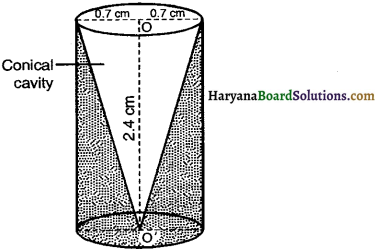
From a solid cylinder whose height is 2.4 cm and diameter 1.4 cm, a conical cavity of the same height and same diameter is hollowed out. Find the total surface area of the remaining solid to the nearest cm2.
Solution.
We have,
Height of the cylinder = 2.4 cm
Diameter of the cylinder = 1.4 cm
∴ Radius of the cylinder = \(\frac{1.4}{2}\) = 0.7 cm

Haryana Board 10th Class Maths Solutions Chapter 13 Surface Areas and Volumes Ex 13.1 8

Slant height of the cone (l) = \(\sqrt{h^2+r^2}\)
= \(\sqrt{(2 \cdot 4)^2+(0 \cdot 7)^2}\) = 2.5 cm
Total surface area of the remaining solid = C.S.A. of the cylinder + Area of base of the cylinder + C.S.A. of the cone
= 2πrh + πr2 + πrl
= πr (2h + r + l)
= \(\frac{22}{7}\) × 0.7 (2 × 2.4 + 0.7 + 2.5)
= 2.2 (4.8 + 3.2)
= 2.2 × 8 = 17.6 cm2
= 18 cm2, (apporx)
Hence, the total surface area of the remaining solid to the nearest cm2 = 18 cm2.

Haryana Board Solutions for 10th Class Maths Chapter 13 Surface Areas and Volumes Ex 13.1

Question 9.
A wooden article was made by scooping out hemisphere from each end of a solid cylinder, as shown in figure. If the height of the cylinder is 10 cm, and its base is of radius 3.5 cm, find the total surface area of the article.
Solution.
We have,
Height of the cylinder (A) = 10 cm
Radius of cylinder and hemisphere (r) = 3.5 cm

Haryana Board 10th Class Maths Solutions Chapter 13 Surface Areas and Volumes Ex 13.1 9

Total surface area of the article = C.S.A of the cylinder + 2 (surface area of a hemisphere)
= 2πrh + 2 × 2πr2
= 2Ï€r (h + 2r)
= 2 × \(\frac{22}{7}\) × 3.5 (10 + 2 × 3.5)
= 22 × 17
= 374 cm2
Hence, total surface area of the article = 374 cm2.

HBSE 10th Class Maths Solutions Chapter 13 Surface Areas and Volumes Ex 13.1 Read More »
HBSE 10th Class Maths Solutions Chapter 10 Circles Ex 10.2

Haryana State Board HBSE 10th Class Maths Solutions Chapter 10 Circles Ex 10.2 Textbook Exercise Questions and Answers.

Haryana Board 10th Class Maths Solutions Chapter 10 Circles Ex 10.2

In question 1 to 3, choose the correct option and give justification :

Question 1.
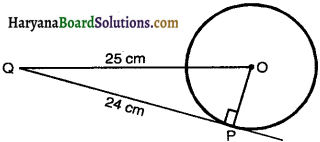
From a point Q, the length of the tangent to a circle is 24 cm and the distance of Q from the centre is 25 cm. The radius of the circle is :
(a) 7 cm
(b) 12 cm
(c) 15 cm
(d) 24.5 cm
Solution :
OP ⊥ PQ [By theorem 10.1]
In right ∆OPQ, we have
OQ2 = QP2 + OP2
[By Pythagoras theorem]

Haryana Board 10th Class Maths Solutions Chapter 10 Circles Ex 10.2 1

252 = 242 + OP2
OP2 = 252 – 242
⇒ OP2 = (25 + 24) (25 – 24)
⇒ OP2 = 49
⇒ OP = √49 = 7
∴ Radius = 7 cm
So, correct option is (a).

Haryana Board Solutions for 10th Class Maths Chapter 10 Circles Ex 10.2

Question 2.
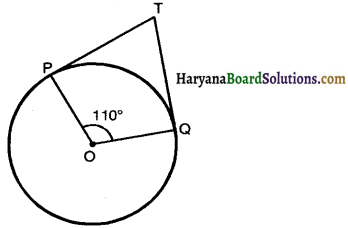
In the given figure, if TP and TQ are two tangents to a circle with centre O, so that ∠POQ = 110°, then ∠PTQ is equal to :

Haryana Board 10th Class Maths Solutions Chapter 10 Circles Ex 10.2 2

Solution:
∠OPT = ∠OQT = 90° (By theorem 10.1)
In a quadrilateral POQT, we have
∠OPT + ∠OQT + ∠POQ + ∠PTQ = 360°
⇒ 90° + 90° + 110° + ∠PTQ = 360°
⇒ 290° + ∠PTQ = 360°
⇒ ∠PTQ = 360° – 290°
⇒ ∠PTQ = 70°
The correct option is (b).

Question 3.
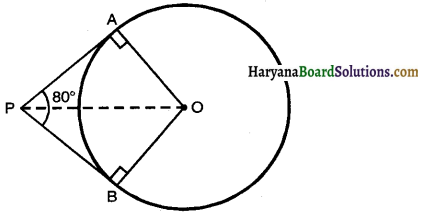
If tangents PA and PB from a point P to a circle with centre O are inclined to each other at angle of 80°, then ∠POA is equal to :
(a) 50°
(b) 60°
(c) 70°
(d) 80°
Solution :
OA ⊥ AP and OB ⊥ PB (By theorem 10.1)
In AOAP and AOBP, we have
AO = OB (radii of the same circle)
∠OAP = ∠OBP (each is 90°)
PO = OP (common)
∆OAP = ∆OBP (By R.H.S. congruence)
∠APO = ∠BPO (By CPCT)

Haryana Board 10th Class Maths Solutions Chapter 10 Circles Ex 10.2 3

⇒ 40° + 90° + ∠POA = 180°
⇒ 130° + ∠POA = 180°
⇒ ∠POA = 180° – 130° = 50°
Hence, correct option is (a).

Haryana Board Solutions for 10th Class Maths Chapter 10 Circles Ex 10.2

Question 4.
Prove that the tangents drawn at the ends of a diameter of a circle are parallel.
Solution:
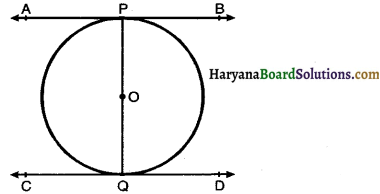
Given : AB, CD are two tangents at the ends of a diameter PQ of a circle with centre O.

Haryana Board 10th Class Maths Solutions Chapter 10 Circles Ex 10.2 4

To Prove: AB || CD
Proof : OP ⊥ AB [By theorem 10.1]
OQ ⊥ CD[By theorem 10.1]
∠APQ = 90° and ∠CQP = 90°
∠APQ + ∠CQP = 90° + 90° = 180°
But these are co-interior angles.
∴ AB || CD Hence Proved.

Question 5.
Prove that the perpendicular at the point of contact to the tangent to a circle passes through the centre.
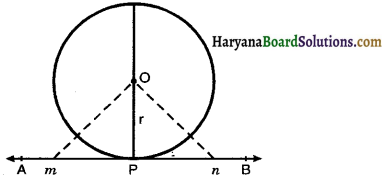
Given :
A circle with centre O and a tangent AB at point P.
To Prove : OP passes through centre.

Haryana Board 10th Class Maths Solutions Chapter 10 Circles Ex 10.2 5

Proof : AB is a tangent at point P and OP is the radius of circle.
If we have some points m, n on tangent AB. Then we find that OP is the shortest line from O in comparison of Om and On.
Therefore, OP ⊥ AB.
Hence, perpendicular OP drawn to tangent line at P passess through the centre (O) of the circle.
Hence Proved.

Haryana Board Solutions for 10th Class Maths Chapter 10 Circles Ex 10.2

Question 6.
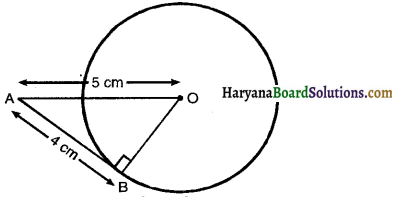
The length of a tangent from a point A at distance 5 cm from the centre of the circle is 4 cm. Find the radius of the circle.
Solution :
OB ⊥ AB (By theorem 10.1)
In right ∆ABO, we have
AO2 = AB2 + OB2 [By Pythagoras theorem]

Haryana Board 10th Class Maths Solutions Chapter 10 Circles Ex 10.2 6

⇒ 52 = 42 + 62
⇒ OB2 = 52 – 42
⇒ OB2 = 25 – 16
⇒ OB2 = 9
⇒ OB = √9 = 3

Hence, radius of the circle is 3 cm.

Question 7.
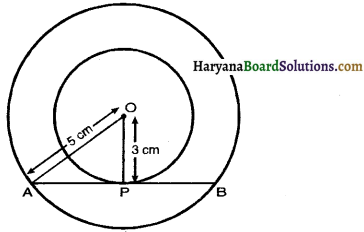
Two concentric circles are of radii 5 cm and 3 cm. Find the length of the chord of the larger circle which touches the smaller circle.
Solution:
Let O be the centre of two concentric circles of radii 5 cm and 3 cm.
Let AB be a chord of the larger circle touching the smaller circle at P. Then
OP = 3 cm and AO = 5 cm OP ⊥ AB and AP = PB
In right ∆OPA, we have

Haryana Board 10th Class Maths Solutions Chapter 10 Circles Ex 10.2 7

AO2 = AP2 + OP2
52 = AP2 + 32
AP2 = 52 – 32
AP2 = (5 + 3) (5 – 3)
AP2 = 8 × 2 = 16
⇒ AP = √16 = 4
AB = 2 × AP = 2 × 4 = 8
Hence, length of chord is 8 cm.

Haryana Board Solutions for 10th Class Maths Chapter 10 Circles Ex 10.2

Question 8.
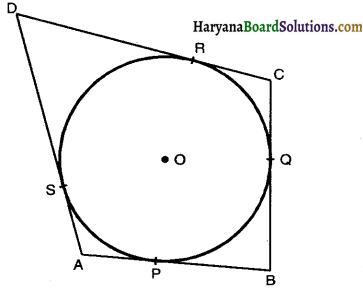
A quadrilateral ABCD is drawn to circumscribe a circle (see figure below). Prove that: AB + CD = AD + BC
OR
A circle touches all the four sides of a quadrilateral ABCD. Prove that AB + CD = BC + DA.
Solution:

Haryana Board 10th Class Maths Solutions Chapter 10 Circles Ex 10.2 8

Given : A quadrilateral ABCD is drawn to circumscribe a circle.
To Prove : AB + CD = AD + BC
Proof : By theorem 10.2
We know that tangents drawn from an exterior point to a circle are equal in length.
AP = AS …..(1) [Tangents from point A]
PB = BQ ….(2) [Tangents from point B]
CR = QC ….(3) [Tangents from Point C]
DR = DS ….(4) [Tangents from point D]
Adding (1), (2), (3) and (4), we get
AP + PB + CR + DR = AS + BQ + QC + DS
⇒ AB + CD = AS + DS + BQ + QC
⇒ AB + CD = AD + BC
Hence Proved.

Question 9.
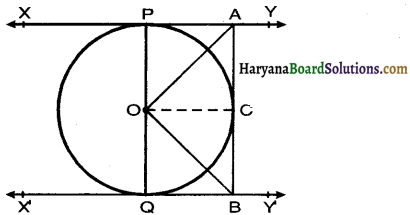
In the given figure XY and X’Y’ are two parallel tangents to a circle with centre O and another tangent AB with point of contact C intersecting XY at A and X’Y’ at B. Prove that ∠AOB = 90°.

Haryana Board 10th Class Maths Solutions Chapter 10 Circles Ex 10.2 9

Solution:
Given : Tangent XY || Tangents X’Y’ and another Tangent AB with point of contact C intersect XY at A and X’Y’ at B.
To Prove : ∠AOB = 90°
Construction : Join OC
Proof : In ∆APO and ∆ACO
AP = AC (By Theorem 10.2)
∠APO = ∠ACO = 90° (By theorem 10.1)
AO = AO (Common)
∆APO s ∆ACO (By RHS congruence)
∠PAO = ∠CAO (By CPCT)
⇒ 2 ∠CAO = ∠PAC ……………..(1)
Similarly, 2 ∠CBO = ∠QBC …………..(2)
Now, ∠PAC + ∠QBC = 180° [co-interior ∠s of same side]
2 ∠CAO + 2 ∠CBO = 180° [Using (1) and (2)]
⇒ ∠CAO + ∠CBO = \(\frac{180^{\circ}}{2}\) = 90“
⇒ ∠BAO + ∠ABO = 90°
In A AOB, we have
∠BAO + ∠AOB + ∠ABO = 180°
⇒ ∠AOB + 90° = 180° [Using (3)]
⇒ ∠AOB = 180° – 90° = 90°.
Hence Proved.

Haryana Board Solutions for 10th Class Maths Chapter 10 Circles Ex 10.2

Question 10.
Prove that the angle between the two tangents drawn from an external point to a circle is supplementary to the angle subtended by the line segment joining the points of contact at the centre.
OR
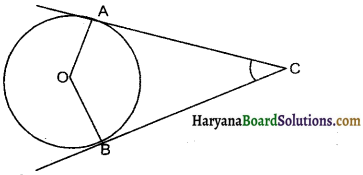
In the given figure, O is the centre of a circle and two tangents CA, CB are drawn on the circle from a point C lying outside the circle. Prove that ∠AOB and ∠ACB are supplimentary.

Haryana Board 10th Class Maths Solutions Chapter 10 Circles Ex 10.2 10

Solution:
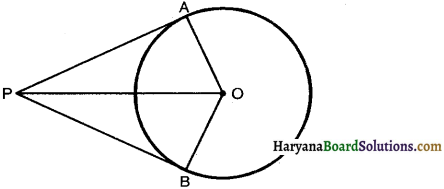
Given : PA and PB be two tangents drawn from an external point P to a circle with centre O. Also, the line segments OA and OB are drawn.
To Prove : ∠APB + ∠AOB = 180°
Proof: PA ⊥ OA and
PB ⊥ OB [By theorem 10.1]

Haryana Board 10th Class Maths Solutions Chapter 10 Circles Ex 10.2 11

i.e. ∠PAO = 90° and ∠PBO = 90°
∠PAO + ∠PBO = 180° ………………..(1)
We know that sum of ∠s of a quadrilateral 360°.
∠APB + ∠AOB + ∠PAO + ∠PBO = 360°
⇒ ∠APB + ∠AOB + 180° = 360°
⇒ ∠APB + ∠AOB = 360° – 180°
⇒ ∠APB + ∠AOB = 180°.
Hence Proved.

Question 11.
Prove that the parallelogram circumscri-bing a circle is a rhombus.
Solution:
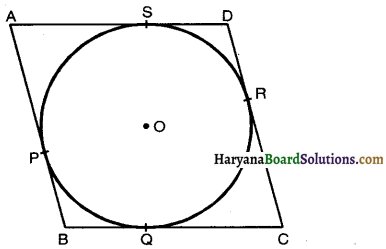
Given: A parallelogram ABCD circumscribes a circle with centre O.
To Prove : AB = BC = CD = AD
Proof: By theorem 10.2 we know that lengths of tangents drawn from an exterior point to a circle are equal.
BQ = BP …(1) (Tangents from Point B]
QC = RC…(2) [Tangents from Point C]
SD = RD …(3) [Tangents from point D]
AS = AP …(4) [Tangents from point A]

Haryana Board 10th Class Maths Solutions Chapter 10 Circles Ex 10.2 12

Adding (1), (2), (3) and (4), we get
BQ + QC + SD + AS = BP + RC + RD + AP
⇒ BC + AD = BP + AP + RC + RD
⇒ BC + AD = AB + CD
⇒ 2BC = 2AB
[∵ Opposite sides of ||gm are equal]
⇒ BC = AB
Since adjacent sides of a ||gm are equal]
∴ AB = BC = CD = AD.
Therefore, ABCD is a rhombus.
Hence Proved.

Haryana Board Solutions for 10th Class Maths Chapter 10 Circles Ex 10.2

Question 12.
A triangle ABC is drawn to circumscribe a circle of radius 4 cm such that the segments BD and DC into which BC is divided by the point of contact D are of lengths 8 cm and 6 cm respectively (see figure). Find the sides AB and AC.

Haryana Board 10th Class Maths Solutions Chapter 10 Circles Ex 10.2 13

Solution:
Let tangents AB, BC and AC touch the circle at points E, D and F respectively. Join OE, OF, OA, OC and OB.
By theorem 10.2, we know that lengths of tangents drawn from an external point to the circle are equal.
CF = CD = 6 cm
BE = BD = 8 cm
AF = AE
Let AF = AE = x cm
AC = (6 + x) cm and AB = (8 + x) cm
∴ s = \(\frac{a+b+c}{2}\)
[Where a, b and c are lengths of sides of ∆ABC]
s = \(\frac{14+6+x+8+x}{2}\)
s = \(\frac{28+2 x}{2}\)
s = 14 + x
Area of ∆ABC = \(\sqrt{s(s-a)(s-b)(s-c)}\)
= \(\sqrt{\begin{array}{r}
(14+x)[14+x-14\} \\
\{14+x-6-x\} \\
{[14+x-8-x]}
\end{array}}\)
= \(\sqrt{(14+x)(x)(8)(6)}\)
= \(\sqrt{48 x(14+x)}\) cm2 ……………(1)
Now, OD ⊥ BC, OE ⊥ AB, OF ⊥ AC [By theorem 10.1]
Area of ∆ABC = Area of ∆BOC + Area of ∆AOB + Area of ∆AOC
= \(\frac{1}{2}\) (14) × 4 + \(\frac{1}{2}\) (8 + x) × 4 + \(\frac{1}{2}\) (6 + x) × 4
= 28 + 16 + 2x + 12 + 2x
= (56 + 4x) cm2 ……………….(2)
From (1) and (2), we get
\(\sqrt{48 x(14+x)}\) = 56 + 4x
Squaring both sides, we get
48x (14 + x) = (56 + 4x)2
⇒ 48x (14 + x) = 16 (14 + x)2
⇒ 3x (14 + x) = (14 + x)2
⇒ 3x = \(\frac{(14+x)^2}{(14+x)}\)
⇒ 3x = 14 + x
⇒ 3x – x = 14
⇒ 2x = 14
⇒ x = \(\frac{14}{2}\) = 7
Length of AB = 8 + x = 8 + 7 = 15 cm
Length of AC = 6 + x = 6 + 7 = 13 cm
Hence, lengths of AB and AC are 15 cm and 13 cm.

Haryana Board Solutions for 10th Class Maths Chapter 10 Circles Ex 10.2

Question 13.
Prove that opposite sides of a quadrilateral circumscribing a circle subtend supplementary angles at the centre of the circle.
Solution :
Given : A quadrilateral ABCD circumscribes a circles with centre O.

Haryana Board 10th Class Maths Solutions Chapter 10 Circles Ex 10.2 14

To Prove: ∠AOB + ∠COD = 180
and ∠AOD + ∠BOC = 180°
Construction : Join OP, OQ, OR and OS.
Proof: In ∆OPB and ∆OQB,
∠OPB = ∠OQB (each is 90°) ,
PB = QB(By theorem 10.2)
OB = OB (Common)
∆OPB = ∆OQB (By RHS congruence)
Similarly,
∠1 = ∠2 (By CPCT)
∠3 = ∠4
∠5 = ∠6
∠7 = ∠8
∵ Sum of ∠s of a quadrilateral is 360°.
∴ ∠1 + ∠2 + ∠3 + ∠4 + ∠5 + ∠6 + ∠7 + ∠8 = 360°
⇒ 2 (∠2 + ∠3) + 2 (∠6 + ∠7) = 360
[∵ ∠1 = ∠2, ∠4 = ∠3, ∠5 = ∠6 and ∠8 = ∠7]
and similarly, 2 (∠1 + ∠8) + 2 (∠4 + ∠5) = 360°
⇒(∠2 + ∠3) + (∠6 + Z7) = 180° and (∠1 + ∠8) + (∠4 + ∠5) = 180°
⇒ ∠BOC + ∠AOD = 180° and ∠AOB + ∠COD = 180°.
Hence Proved.

HBSE 10th Class Maths Solutions Chapter 10 Circles Ex 10.2 Read More »
HBSE 10th Class Maths Solutions Chapter 11 Constructions Ex 11.2

Haryana State Board HBSE 10th Class Maths Solutions Chapter 11 Constructions Ex 11.2 Textbook Exercise Questions and Answers.

Haryana Board 10th Class Maths Solutions Chapter 11 Constructions Ex 11.2

In each of the following, give also the justification of construction :

Question 1.
Draw a circle of radius 6 cm. From a point 10 cm away from its centre, construct the pair of tangents to the circle and measure their lengths.
Solution:
Steps of Construction :
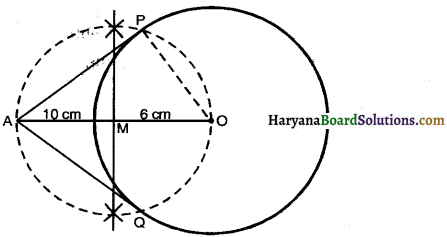
1. Draw a circle with centre O of radius 6 cm.
2. Mark a point A, 10 cm away from the centre.
3. Join AO and bisect it at M.

Haryana Board 10th Class Maths Solutions Chapter 11 Constructions Ex 11.2 1

4. Draw a circle with M as a centre and radius equal to AM intersects the given circle at points P and Q.
5. Join AP and AQ.
Then AP and AQ are the required tangents. Lengths of AP and AQ are 8-2 cm. (approx.)
Justification : Join OP
∠APO = 90° [angle in a semi-circle]
AP ⊥ OP
Therefore, AP is a tangent to the given circle.
Similarly AQ is a also tangent to the given circle.

Haryana Board Solutions for 10th Class Maths Chapter 11 Constructions Ex 11.2

Question 2.
Construct a tangent to a circle of radius 4 cm from a point on the concentric circle of radius 6 cm and measure its length. Also verify the measurement by actual calculation.
Solution:
Steps of Construction :
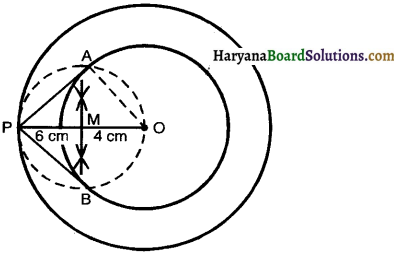
1. O as the centre and draw two circles having radii 4 cm and 6 cm.
2. Taking point P on the larger circle.
3. Join OP and bisect it at M.
4. Taking M as the centre and radius equal to PM draw the circle which intersects the smaller circle at A and B.
5. Join PA and PB.
Then PA and PB are the required tangents.
On measuring the lengths of tangents
PA = PB = 4.47 (Approx.)
By calculation we have the length of tangent.
Joining AO
AO ⊥ PA [By theorem 10.1]
In right ∆PAO, we have
PO2 = PA2 + AO2
⇒ (6)2 = PA2 + (4)2

Haryana Board 10th Class Maths Solutions Chapter 11 Constructions Ex 11.2 2

PA2 = (6)2 – (4)2
PA2 = 36 – 16 = 20
⇒ PA = √20 = 4.472 cm
Justification : PA ⊥ OA
AO is the radius of the circle.
PA is tangent to a given circle.
Similarly PB is the tangent to the given circle.

Haryana Board Solutions for 10th Class Maths Chapter 11 Constructions Ex 11.2

Question 3.
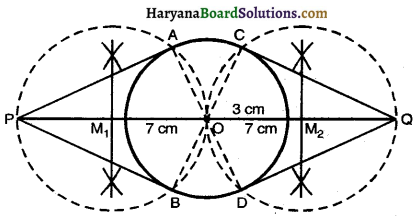
Draw a circle of radius 3 cm. Take two points P and Q on one of its extended diameter each at a distance of 7 cm from its centre. Draw tangents to the circle from these two points P and Q.
Solution:
Steps of Construction :
1. Draw a circle with centre O and radius equal to 3 cm.
2. Take points P and Q on extended diameter of the circle such that OP = OQ = 7 cm.
3. Mark mid point M1 of OP and mid point of OQ as M2.

Haryana Board 10th Class Maths Solutions Chapter 11 Constructions Ex 11.2 3

4. Draw the circles as M1 and M2 centres and radii equal to PM1 and OM2 respectively, which intersects A and B (M1 as centre) and C, D (M2 as centre).
5. Join PA, PB and QC, QD.
Then PA, PB, QC and QD are tangents from the points P and Q respectively.
Justification : Join OA, OB, OC and OD ∠PAO = 90°
[Angle in a semi circle is 90°]
OA is the radius of circle.
PA is tangent to the given circle.
Similarly PB is the tangent to the given circle.
Again ∠OCQ = 90°
[Angle in a semi circle is 90°]
OC is the radius.
QC is the tangent to the given circle.
Similarly, QD is the tangent to the given circle.

Haryana Board Solutions for 10th Class Maths Chapter 11 Constructions Ex 11.2

Question 4.
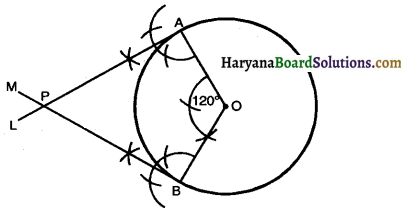
Draw a pair of tangents to a circle of radius 5 cm. which are inclined to each other at an angle of 60°.
Solution:
Steps of Construction :
1. Draw a circle with centre O and radius 5 cm.
2. Construct radii OA and OB such that ∠AOB = 360° – (90° + 90° + 60°) = 120°.
3. Draw AL ⊥ OA at A and BM ⊥ OB at B. They intersect at P.
Then PA and PB Eire the required tangents inclined to each other at 60°.
Justification : PA ⊥ OA and PB ⊥ OB and ∠AOB = 120°.

Haryana Board 10th Class Maths Solutions Chapter 11 Constructions Ex 11.2 4

⇒ ∠APB = 360° – 300°
⇒ ∠APB = 60°.
Therefore, tangents PA and PB are inclined at 60°.

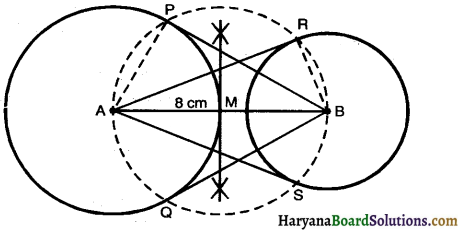
Question 5.
Draw a line segment AB of length 8 cm. Taking A as centre, draw a circle of radius 4 cm and taking B as centre, draw another circle of radius 3 cm. Construct tangents to each circle from the centre of the other circle.
Solution:
Steps of Construction :
1. Draw a line segment AB = 8 cm.
2. A as centre and radius equal to 4 cm draw a circle.
3. B as centre and radius equal to 3 cm draw another circle.
4. Bisect line segment AB at M.

Haryana Board 10th Class Maths Solutions Chapter 11 Constructions Ex 11.2 5

5. M is the centre and radius equal to AM draw the circle which intersects the previous circles at P, Q (A as centre) and R, S (B as centre).
6. Join BP, BQ, AR and AS.
7. Then, BP, BQ, AR and AS are the required tangents.
Justification : Join AP, RB
∠APB = 90° [Angle in a semi circle is 90°]
PB ⊥ AP.
Therefore, AP is radius and BP is tangent.
Similarly, AR, AS and BQ are tangents.

Haryana Board Solutions for 10th Class Maths Chapter 11 Constructions Ex 11.2

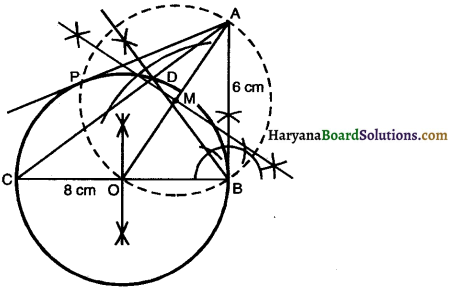
Question 6.
Let ABC be a right triangle in which AB = 6 cm, BC = 8 cm and ∠B = 90°. BD is the perpendicular from B on AC. The circle through B, C, D is drawn. Construct the tangents from A to this circle.
Solution:
Steps of Construction:
1. Construct ∆ABC such that BC = 8 cm, AB = 6 cm and ∠ABC = 90°.
2. Draw BD ⊥ AC.
3. ∠CDB = 90° So, BC is the diameter of circle passing through B, C, D.
4. Bisect line BC at O.
5. O as the centre, CO = OB as radius draw a circle which passes through B, C, D.

Haryana Board 10th Class Maths Solutions Chapter 11 Constructions Ex 11.2 6

6. Join AO which intersects the circle at M.
7. M as centre and MA = OM as radius draw another circle which intersect the previous circle at P and B.
8. Join PA.
Then, AP and AB are the required tangents.
Justification:
∠ABC = 90° [By Construction]
AB ⊥ OB.
OB is radius and AB is tangent.
Similarly, AP is tangent.

Haryana Board Solutions for 10th Class Maths Chapter 11 Constructions Ex 11.2

Question 7.
Draw a circle with the help of a bangle. Take a point outside the circle. Construct the pair of tangents from this point to the circle.
Solution:
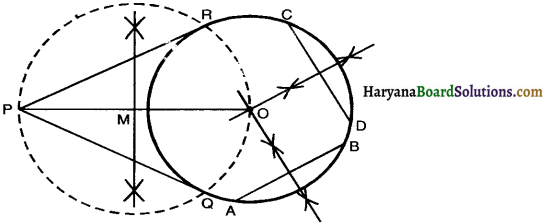
Steps of Construction :
Take four points A, B, C and D on the given circle and join AB and CD.
1. Draw the perpendicular bisectors of non parallel chords AB and CD which intersect at O.
2. O is the centre of circle.
3. Take a point P outside the circle.

Haryana Board 10th Class Maths Solutions Chapter 11 Constructions Ex 11.2 7

4. Join OP and bisected it at M.
5. M as the centre and radius PM = MO, draw another circle which intersect previous circle at R.
6. Join PR and PQ.
Then PR and PQ are the required tangents.
Justification : Join OR,
∠PRO = 90° [Angle in a semi circle is 90°]
PR ⊥ OR
OR is a radius and PR is a tangent.
Similarly, PQ is a tangent.

HBSE 10th Class Maths Solutions Chapter 11 Constructions Ex 11.2 Read More »
HBSE 10th Class Maths Solutions Chapter 12 Areas Related to Circles Ex 12.1

Haryana State Board HBSE 10th Class Maths Solutions Chapter 12 Areas Related to Circles Ex 12.1 Textbook Exercise Questions and Answers.

Haryana Board 10th Class Maths Solutions Chapter 12 Areas Related to Circles Ex 12.1

Unless stated otherwise, use π = \(\frac{22}{7}\).

Question 1.
The radii of two circles are 19 cm and 9 cm respectively. Find the radius of the circle which has circumference equal to the sum of the circumference of the two circles.
Solution.
Circumference of the circle of radius 19 cm = 2π × 19 = 38π cm
Circumference of the circle of radius 9 cm = 2π × 9 = 18π cm
Sum of the circumferences of two circles = 38Ï€ + 18Ï€ = 56Ï€ cm
Let R be the radius of the circle which has circumference equal to sum of the circumferences of the two circle.
2Ï€R = 56Ï€
⇒ R = \(\frac{56 \pi}{2 \pi}\)
⇒ R = 28 cm
Hence,radius of the circle = 28 cm.

Haryana Board Solutions for 10th Class Maths Chapter 12 Areas Related to Circles Ex 12.1

Question 2.
The radii of two circles are 8 cm and 6 cm respectively. Find the radius of the circle having area equal to the sum of the areas of the two circles.
Solution.
Area of circle of radius 8 cm = π × 82 = 64π cm2
Area of circle of radius 6 cm = π × 62 = 36π cm2
Sum of the areas of two circles = 64Ï€ + 36Ï€ = 100Ï€ cm2
Let R be the radius of the circle whose area is equal to the sum of the areas of the two circles.
⇒ πR2 = 100π
⇒ R2 = \(\frac{100 \pi}{\pi}\) = 100
⇒ R = √100 = 10 cm
Hence, radius of the circle = 10 cm.

Haryana Board Solutions for 10th Class Maths Chapter 12 Areas Related to Circles Ex 12.1

Question 3.
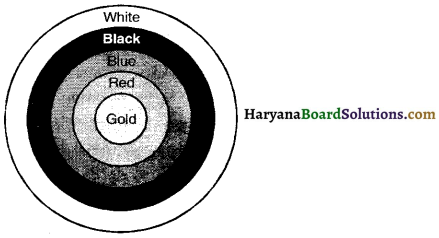
Figure depicts an archery target marked with its five scoring regions from the centre outwards as Gold, Red, Blue, Black and White. The diameter of the region representing Gold score is 21 cm and each of the other bands is 10.5 cm wide. Find the area of the each of the five scoring regions.

Haryana Board 10th Class Maths Solutions Chapter 12 Areas Related to Circles Ex 12.1 1

Solution.
We have,
Radius of region representing Gold score (r1) = \(\frac{21}{2}\) = 10.5 cm
Area of region representing Gold score = π × (10.5)2
= \(\frac{22}{7}\) × 10.5 × 10.5 = 346.5 cm2

Radius of region representing Red and Gold score areas (r2) = 10.5 + 10.5 = 21 cm
Area of region representing Red score = Ï€r22 – Ï€r12
= \(\frac{22}{7}\) × (21)2 – 346.5
= 1386 – 346.5 = 1039.5 cm2

Radius of the region representing Blue, Red and Gold scoring areas (r3) = (21 + 10.5) cm = 31.5 cm
Area of region representing Blue scoring area = Ï€r32 – (Area of Gold + Area of Red)
= \(\frac{22}{7}\) × (31.5)2 – (346.5 + 1039.5)
= 3118.5 – 1386 = 1732.5 cm2

Radius of the region representing Black, Blue, Red and Gold scoring areas (r4) = (31.5 + 10.5) cm = 42 cm
Area of region representing Black scoring area = Ï€r42 – (Area of Gold + Area of Red + Area of Blue)
= \(\frac{22}{7}\) × (42)2 – (346.5 + 1039.5 + 1732.5)
= 5544 – 3118.5 = 2425.5 cm2

Radius of the region representing White, Black, Blue, Red and Gold, scoring areas (r5) = (42 + 10.5) cm = 52.5 cm.
Area of region representing White scoring area = Ï€r52 – [Area of Gold + Area of Red + Area of Blue + Area of Black]
= \(\frac{22}{7}\) × (52.5)2 – (346.5 + 1039.5 + 1732.5 + 2425.5)
= 8662.5 – 5544 = 3118.5 cm2

Hence, areas of Gold, Red, Blue, Black and White scoring regions are 346.5 cm2, 1039.5 cm2, 1732.5 cm2, 2425.5 cm2, and 3118.5 cm2 respectively.

Haryana Board Solutions for 10th Class Maths Chapter 12 Areas Related to Circles Ex 12.1

Question 4.
The wheels of a car are of diameter 80 cm each. How many complete revolutions does each wheel make in 10 minutes when the car is travelling at a speed of 66 km/hour ?
Solution.
We have,
Speed of car = 66 km/hour
Distance travelled by car in 1 minute = \(\frac{66}{100}\) × 1000 × 100 = 110000 cm
Distance travelled by car in 10 minutes = 110000 × 10 = 1100000 cm
Radius of car’s wheel = \(\frac{80}{2}\) = 40 cm
Circumference of wheel = 2Ï€r
= 2 × \(\frac{22}{7}\) × 40 = \(\frac{1760}{7}\) cm
Distance covered by the wheel of a car in 1 revolution = \(\frac{1760}{7}\) cm
Number of revolutions made by the wheel of a car in 10 minutes = \(\frac{\text { Distance travelled by car in } 10 \text { minutes }}{\text { Distance travelled by car in1 revolution }}\)
= \(\frac{1100000}{\frac{1760}{7}}\)
= \(\frac{1100000 \times 7}{1760}\)
= 4375
Hence, number of revolutions made by wheel of a car = 4375.

Haryana Board Solutions for 10th Class Maths Chapter 12 Areas Related to Circles Ex 12.1

Question 5.
Tick the correct answer in the following and justify your choice: If the perimeter and the area of a circle are numerically equal, then the radius of the circle is
(A) 2 units
(B) π units
(C) 4 units
(D) 7 units
Solution.
Correct option is (A)
Justification. Let the radius of circle is r units.
Acoording to questions
Ï€r2 = 2Ï€r
\(\frac{\pi r^2}{\pi r}\) = 2
r = 2.

HBSE 10th Class Maths Solutions Chapter 12 Areas Related to Circles Ex 12.1 Read More »
HBSE 10th Class Maths Solutions Chapter 11 Constructions Ex 11.1

Haryana State Board HBSE 10th Class Maths Solutions Chapter 11 Constructions Ex 11.1 Textbook Exercise Questions and Answers.

Haryana Board 10th Class Maths Solutions Chapter 11 Constructions Ex 11.1

In each of the following, give the justification of the construction also:

Question 1.
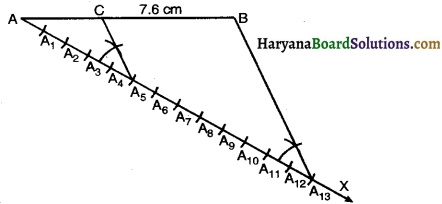
Draw a line segment of length 7.6 cm and divide it in the ratio 5 : 8. Measure the two parts.
Solution:
Steps of Construction :
1. Draw a line segment AB = 7.6 cm.
2. Draw any ray AX, making an acute angle with AB.
3. Along AX mark (5 + 8) = 13 points A1, A2,
A3 ……………………. A13 such that AA1 = A1A2 = A2A3 = …………………….. A12A13

Haryana Board 10th Class Maths Solutions Chapter 11 Constructions Ex 11.1 1

4. Join A13B.
5. Through A5, draw A5C || A13B meeting AB at C.
6. Then AC : BC = 5 : 8.
7. On measuring
AC = 2.9 cm
CB = 4.7 cm
Justification : In ∆ABA13, A5C || A13B.
\(\frac{\mathrm{AA}_5}{\mathrm{~A}_5 \mathrm{~A}_{13}}=\frac{\mathrm{AC}}{\mathrm{BC}}\) [By Basic proportionality theorem]
But \(\frac{\mathrm{AA}_5}{\mathbf{A}_5 \mathbf{A}_{13}}=\frac{5}{8}\) [By construction]
∴ \(\frac{\mathrm{AC}}{\mathrm{BC}}=\frac{5}{8}\)
AC : BC = 5 : 8.

Haryana Board Solutions for 10th Class Maths Chapter 11 Constructions Ex 11.1

Question 2.
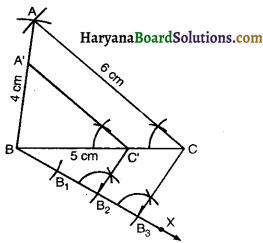
Construct a triangle of sides 4 cm, 5 cm and 6 cm and then a triangle similar to it whose sides are \(\frac{2}{3}\) of the coi responding sides of the first triangle.
Solution:
Steps of construction :
1. Draw a line segment BC = 5 cm.
2. With B as a centre and radius 4 cm draw an arc.
3. With C as a centre and radius 6 cm draw another arc to intersect the first arc. at A.

Haryana Board 10th Class Maths Solutions Chapter 11 Constructions Ex 11.1 2

4. Join BA and CA to get ∆ABC.
5. Draw any ray BX making an acute angle with BC on the side opposite to the vertex A.
6. Along BX mark 3 points B1, B2 and B3 such that BB1 = B1B2 = B2B3.
7. Join B3C.
8. From B2 draw B2C’ || B3C meeting BC at C’.
9. From C’ draw C’A’ || CA meeting BA at A’.
Then A’BC’ is the required triangle, each of whose side is \(\frac{2}{3}\) of corresponding Sides of ∆ABC.
Justification : Since, A’C’ || AC
Therefore, ∆A’BC’ ~ ∆ABC
\(\frac{\mathrm{AB}}{\mathrm{AB}}=\frac{\mathrm{BC}^{\prime}}{\mathrm{BC}}=\frac{\mathrm{A}^{\prime} \mathrm{C}^{\prime}}{\mathrm{AC}}=\frac{2}{3}\)

Haryana Board Solutions for 10th Class Maths Chapter 11 Constructions Ex 11.1

Question 3.
Construct a triangle with sides 5 cm, 6 cm and 7 cm and then another triangle 7 whose sides are \(\frac{7}{5}\) of the corresponding sides of the 5 first triangle.
Solution:
Steps of Construction :
1. Draw a line segment BC = 6 cm.
2. With B as a centre and radius 5 cm draw an arc.
3. With C as a centre and radius 7 cm draw another arc to intersect the first arc at A.
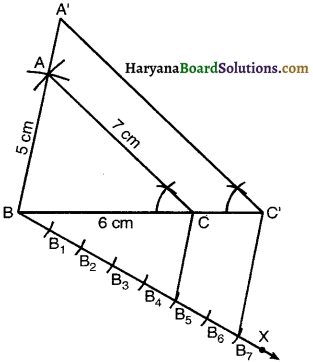
4. Join BA and CA to get ∆ABC.

Haryana Board 10th Class Maths Solutions Chapter 11 Constructions Ex 11.1 3

5. Draw any ray BX making an acute angle with BC on the side opposite to the vertex A.
6. Along BX mark 7 points B1, B2, B3, …….., B7 such that BB1 = B1B2 = B2B3 = ………….. = B6B7.
7. Join B5C.
8. From B7 draw B7C’ || B56C intersecting the produced line segment BC at C’.
9. From C’ draw CA’ || AC intersecting the produced line segment BA at A’.
Then, ∆A’BC’ is the required triangle each of whose side is \(\frac{7}{5}\) of the corresponding sides of the ∆ABC.
Justification : Since, AC || A’C’
Therefore, ∆A’BC’ ~ ∆ABC
⇒ \(\frac{\mathrm{A}^{\prime} \mathrm{B}}{\mathrm{AB}}=\frac{\mathrm{BC}^{\prime}}{\mathrm{BC}}=\frac{\mathrm{A}^{\prime} \mathrm{C}^{\prime}}{\mathrm{AC}}=\frac{7}{5}\)

Haryana Board Solutions for 10th Class Maths Chapter 11 Constructions Ex 11.1

Question 4.
Construct an Isosceles triangle whose base is 8 cm and altitude 4 cm and then another triangle whose sides are 1\(\frac{1}{2}\) times the corresponding sides of the isosceles triangle.
Solution:
Steps of Construction :
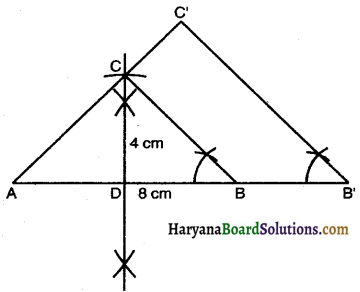
1. Let ABC be the isosceles triangle with base AB = 8 cm and altitude CD = 4 cm.
2. Draw a line segment AB = 8 cm.
3. Draw the perpendicular bisector of AB intersecting AB at D.
4. With D as a centre and radius 4 cm draw an arc intersecting the perpendicular bisector at C.
5. Join AC and BC to get the isosceles triangle ABC.

Haryana Board 10th Class Maths Solutions Chapter 11 Constructions Ex 11.1 4

6. Produce AB to B’ AB’ = 1\(\frac{1}{2}\) of 8 = \(\frac{3}{2}\) × 8 = 12 cm.
7. Through B’ draw B’C’ || BC intersecting the produced line segment AC to C’.
Then AB’C’ is the required triangle each of whose side is 1\(\frac{1}{2}\) times of the corresponding sides of ∆ABC.
Justification : Since, BC || B’C’
Therefore, ∆C’AB’ ~ ∆CAB
⇒ \(\frac{\mathrm{AC}^{\prime}}{\mathrm{AC}}=\frac{\mathrm{AB}^{\prime}}{\mathrm{AB}}=\frac{\mathrm{B}^{\prime} \mathrm{C}^{\prime}}{\mathrm{BC}}=\frac{3}{2}\).

Haryana Board Solutions for 10th Class Maths Chapter 11 Constructions Ex 11.1

Question 5.
Draw a triangle ABC with side BC = 6 cm, AB = 5 cm and ∠ABC = 60°. Then construct a triangle whose sides are \(\frac{3}{4}\) of the corresponding sides of the triangle ABC.
Solution:
Steps of Construction:
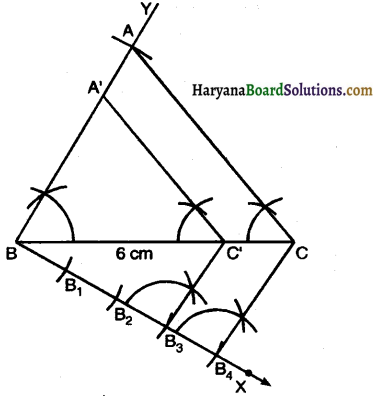
1. Draw a line segment BC = 6 cm.
2. At B, draw ∠CBY = 60°.
3. From B draw an arc AB = 5 cm meeting BY at A. Join AC. Thus ∆ABC obtained.
4. Draw any ray BX making an acute angle with BC on the side opposite to the vertex A.
5. Along BX mark four points B1, B2, B3, B4 such that BB1 = B1B2 = B2B3 = B3B4.
6. Join B4C.

Haryana Board 10th Class Maths Solutions Chapter 11 Constructions Ex 11.1 5

7. From B3 draw B3C’ || B4C meeting BC at C.
8. From C’ draw C’A’ || CA, meeting AB at A’. Then A’BC’ is the required triangle, each of whose side is \(\frac{3}{4}\) of corresponding sides of AABC.
Justification: Since, A’C || AC
Therefore, ∆A’BC ~ ∆ABC
\(\frac{\mathrm{A}^{\prime} \mathrm{B}}{\mathrm{AB}}=\frac{\mathrm{BC}^{\prime}}{\mathrm{BC}}=\frac{\mathrm{A}^{\prime} \mathrm{C}^{\prime}}{\mathrm{AC}}=\frac{3}{4}\).

Haryana Board Solutions for 10th Class Maths Chapter 11 Constructions Ex 11.1

Question 6.
Draw a triangle ABC with side BC = 7 cm, ∠B = 45°, ∠A = 105°. Then, construct a triangle whose sides are \(\frac{4}{3}\) times the corresponding sides of ∆ABC.
Solution:
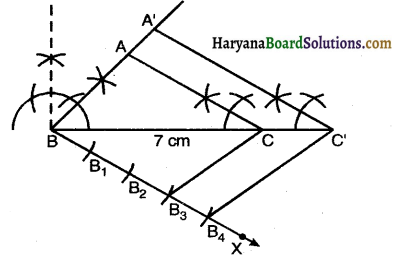
Steps of Construction :
1. Draw line segment BC = 7 cm.
In ∆ABC, ∠B = 45°, ∠A = 105°,
∠C = 180° – (45° + 105°) = 30°
2. At B draw an angle ∠B = 45° and at C draw an angle ∠C *= 30° intersecting each other at A to get ∆ABC.
3. Draw any ray BX making an acute angle with BC on the side opposite to the vertex A.
Along BX mark four points B1, B2, B3 and B4 such that BB1 = B1B2 = B2B3 = B3B4.

Haryana Board 10th Class Maths Solutions Chapter 11 Constructions Ex 11.1 6

4. Join B3C.
5. From B4 draw B4C’ || B3C intersecting the produced line segment BC at C’.
6. From C’ draw C’A’ || CA intersecting the produced line segment BA at A’.
Then A’BC’ is the required triangle, each of whose side is \(\frac{4}{3}\) times the corresponding sides of ∆ABC.
Justification : Since, AC || A’C’
Therefore, ∆A’BC’ ~ ∆ABC
\(\frac{\mathrm{AB}^{\mathrm{B}}}{\mathrm{AB}}=\frac{\mathrm{BC}^{\prime}}{\mathrm{BC}}=\frac{\mathrm{A}^{\prime} \mathrm{C}^{\prime}}{\mathrm{AC}}=\frac{4}{3}\).

Haryana Board Solutions for 10th Class Maths Chapter 11 Constructions Ex 11.1

Question 7.
Draw a right triangle in which the sides (other than hypotenuse) are of lengths 4 cm and 3 cm. Then construct another triangle whose sides are \(\frac{5}{3}\) times the corresponding sides of the given triangle.
Solution:
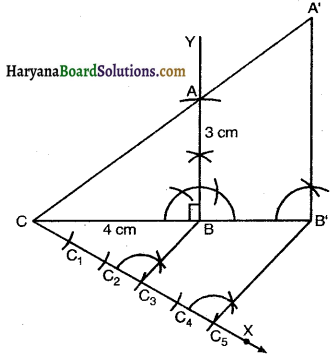
Steps of Construction :
1. Let ABC be right triangle in which ∠B = 90°, BC = 4 cm and AB = 3 cm.
2. Draw BC = 4 cm
3. Draw ∠CBY = 90° at B.
4. Cut AB = 3 cm from BY. Join AC to get ∆ABC.
5. Draw any ray CX making an acute angle with BC on the side opposite to the vertex A.
6. Along CX mark five points C1, C2, C3, C4 and C5 such that CC1 = C1C2 = C2C3 = C3C4 = C4C45.
Join C3B.

Haryana Board 10th Class Maths Solutions Chapter 11 Constructions Ex 11.1 7

7. From C5 draw C5B’ || C3B intersecting the produced line segment CB at B’.
8. From B’ draw B’A’ || BA intersecting the produced line segment CA at A’.
Then, A’CB’ is the required triangle.
Justification : Since, BA || B’A’
Therefore, ∆A’CB’ ~ ∆ACB
\(\frac{\mathrm{A}^{\prime} \mathrm{C}}{\mathrm{AC}}=\frac{\mathrm{B}^{\prime} \mathrm{C}}{\mathrm{BC}}=\frac{\mathrm{A}^{\prime} \mathrm{B}^{\prime}}{\mathrm{AB}}=\frac{5}{3}\).

HBSE 10th Class Maths Solutions Chapter 11 Constructions Ex 11.1 Read More »
HBSE 10th Class Maths Solutions Chapter 8 Introduction to Trigonometry Ex 8.2

Haryana State Board HBSE 10th Class Maths Solutions Chapter 8 Introduction to Trigonometry Ex 8.2 Textbook Exercise Questions and Answers.

Haryana Board 10th Class Maths Solutions Chapter 8 Introduction to Trigonometry Ex 8.2

Question 1.
Evaluate the following :
(i) sin 60° cos 30° + sin 30° cos 60°
(ii) 2 tan2 45° + cos2 30° – sin2 60°
(iii) \(\frac{\cos 45^{\circ}}{\sec 30^{\circ}+\ {cosec} 30^{\circ}}\)
(iv) \(\frac{\sin 30^{\circ}+\tan 45^{\circ}-\ {cosec} 60^{\circ}}{\sec 30^{\circ}+\cos 60^{\circ}+\cot 45^{\circ}}\)
(v) \(\frac{5 \cos ^2 60^{\circ}+4 \sec ^2 30^{\circ}-\tan ^2 45^{\circ}}{\sin ^2 30^{\circ}+\cos ^2 30^{\circ}}\)
Solution :
(i) sin 60° cos 30° + sin 30° cos 60°
= \(\frac{\sqrt{3}}{2} \times \frac{\sqrt{3}}{2}+\frac{1}{2} \times \frac{1}{2}\)
= \(\frac{3}{4}+\frac{1}{4}\) = 1
Hence, sin 60° cos 30° + sin 30° cos 60° = 1.

Haryana Board Solutions for 10th Class Maths Chapter 8 Introduction to Trigonometry Ex 8.2

(ii)2 tan2 45° + cos2 30° – sin2 60°
= 2 × (1)2 + \(\left(\frac{\sqrt{3}}{2}\right)^2-\left(\frac{\sqrt{3}}{2}\right)^2\)
= 2 × 1 + \(\frac{3}{4}-\frac{3}{4}\) = 2
Hence, 2 tan2 45° + cos2 30° – sin2 60° = 2.

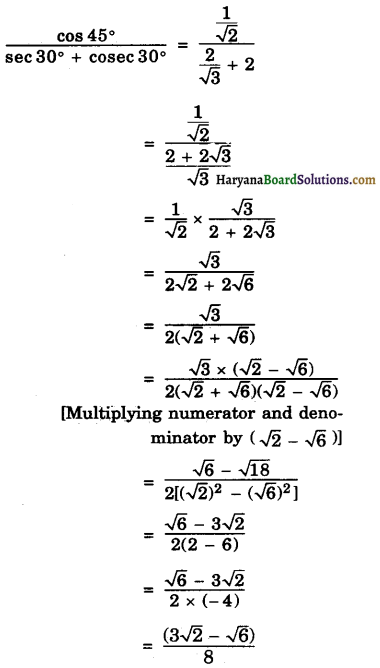
(iii) \(\frac{\cos 45^{\circ}}{\sec 30^{\circ}+\ {cosec} 30^{\circ}}\)

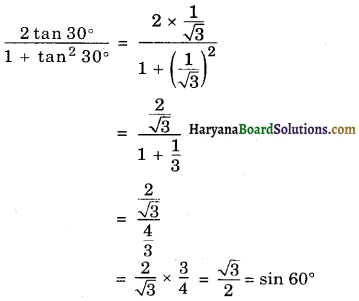
Haryana Board 10th Class Maths Solutions Chapter 8 Introduction to Trigonometry Ex 8.2 1

Hence, \(\frac{\cos 45^{\circ}}{\sec 30^{\circ}+\ {cosec} 30^{\circ}}\) = \(\frac{1}{8}\) (3√2 – √6).

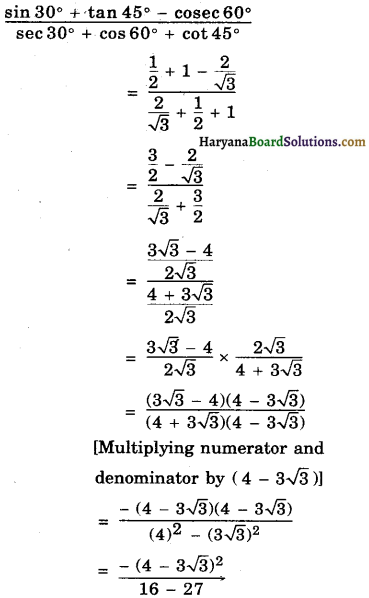
(iv) \(\frac{\sin 30^{\circ}+\tan 45^{\circ}-\ {cosec} 60^{\circ}}{\sec 30^{\circ}+\cos 60^{\circ}+\cot 45^{\circ}}\)

Haryana Board 10th Class Maths Solutions Chapter 8 Introduction to Trigonometry Ex 8.2 2

Hence, \(\frac{\sin 30^{\circ}+\tan 45^{\circ}-\ {cosec} 60^{\circ}}{\sec 30^{\circ}+\cos 60^{\circ}+\cot 45^{\circ}}\) = \(\frac{43-24 \sqrt{3}}{11}\)

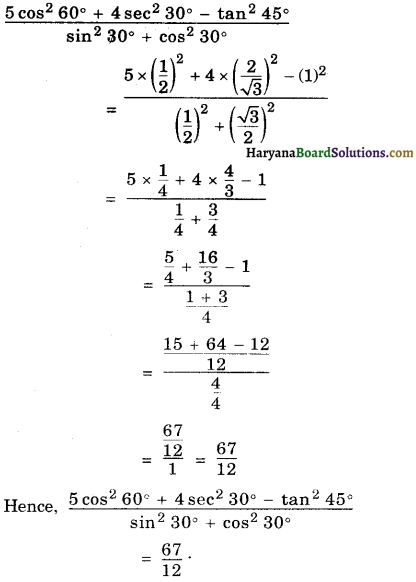
(v) \(\frac{5 \cos ^2 60^{\circ}+4 \sec ^2 30^{\circ}-\tan ^2 45^{\circ}}{\sin ^2 30^{\circ}+\cos ^2 30^{\circ}}\)

Haryana Board 10th Class Maths Solutions Chapter 8 Introduction to Trigonometry Ex 8.2 3

Haryana Board Solutions for 10th Class Maths Chapter 8 Introduction to Trigonometry Ex 8.2

Question 2.
Choose the correct option and justify your choice :
(i) \(\frac{2 \tan 30^{\circ}}{1+\tan ^2 30^{\circ}}\) =
(a) sin 60°
(b) cos 60°
(c) tan 60°
(d) sin 30°

(ii) \(\frac{1-\tan ^2 45^{\circ}}{1+\tan ^2 45^{\circ}}\) =
(a) tan 90°
(b) 1
(c) sin 45°
(d) 0

(iii) sin 2A = 2 sin A is true when A =
(a) 0°
(b) 30°
(c) 45°
(d) 60°

(iv) \(\frac{2 \tan 30^{\circ}}{1-\tan ^2 30^{\circ}}\) =
(a) cos 60°
(b) sin 60°
(c) tan 60°
(d) sin 30°

Haryana Board Solutions for 10th Class Maths Chapter 8 Introduction to Trigonometry Ex 8.2
Solution:
(i) (a)

∵ Haryana Board 10th Class Maths Solutions Chapter 8 Introduction to Trigonometry Ex 8.2 4

(ii) (d)
∵ \(\frac{1-\tan ^2 45^{\circ}}{1+\tan ^2 45^{\circ}}=\frac{1-(1)^2}{1+(1)^2}\)
= \(\frac{1-1}{1+1}=\frac{0}{2}\) = 0

(iii) (a) When A = 0°
L.H.S. = sin 2A = sin 2 × 0°
= sin 0° = 0
R.H.S. = 2 sin A = 2 × sin 0°
= 2 × 0 = 0
In other option we shall find that L.H.S. ≠ R.H.S.

(iv) (c)
∵ \(\frac{2 \tan 30^{\circ}}{1-\tan ^2 30^{\circ}}=\frac{2 \times \frac{1}{\sqrt{3}}}{1-\left(\frac{1}{\sqrt{3}}\right)^2}\)
= \(\frac{\frac{2}{\sqrt{3}}}{1-\frac{1}{3}}\)
= \(\frac{\frac{2}{\sqrt{3}}}{\frac{2}{3}}=\frac{2}{\sqrt{3}} \times \frac{3}{2}\)
= √3 = tan 60°.

Haryana Board Solutions for 10th Class Maths Chapter 8 Introduction to Trigonometry Ex 8.2

Question 3.
If tan(A + B) = √3 and tan(A – B) = \(\frac{1}{\sqrt{3}}\); 0° < (A + B) ≤ 90°, A > B, find A and B.
Solution :
We have
tan(A + B) = √3
tan(A + B) = tan 60°
A + B = 60° ……………..(1)
and tan(A – B) = \(\frac{1}{\sqrt{3}}\)
tan(A – B) = tan 30°
A – B = 30° ……………….(2)
Adding equation (1) and (2), we get
A + B = 60°
A – B = 30°
2A = 90°
A = \(\frac{90^{\circ}}{2}\)
A = 45°
Substituting the value of A in equation (1), we get
45° + B = 60°
B = 60° – 45° = 15°
Hence, A = 45° and B = 15°.

Haryana Board Solutions for 10th Class Maths Chapter 8 Introduction to Trigonometry Ex 8.2

Question 4.
State whether the following are true or false. Justify your answer.
(i) sin(A + B) = sin A + sin B.
(ii) The value of a sin θ increases as θ increases.
(iii) The value of cos θ increases as θ increases.
(iv) sin θ = cos θ for all values of θ.
(v) cot A is not defined for A = 0°.
Solution :
(i) False. Taking A= 30°, B = 60°
LHS = sin (A + B)
= sin (30° + 60°)
= sin 90° = 1
RHS = sin A + sin B
= sin 30° + sin 60°
= \(\frac{1}{2}+\frac{\sqrt{3}}{2}=\frac{1+\sqrt{3}}{2}\)
∴ LHS ≠ RHS
(ii) True.
(iii) False. Because value of cos θ decreases as θ increases.
(iv) False. Because sin 30° = \(\frac{1}{2}\) and cos 30° = \(\frac{\sqrt{3}}{2}\)
i.e., sin 30° ≠ cos 30°
(v) True. Because cot 0° = ∞ (not defined)

HBSE 10th Class Maths Solutions Chapter 8 Introduction to Trigonometry Ex 8.2 Read More »
HBSE 10th Class Maths Solutions Chapter 8 Introduction to Trigonometry Ex 8.1

Haryana State Board HBSE 10th Class Maths Solutions Chapter 8 Introduction to Trigonometry Ex 8.1 Textbook Exercise Questions and Answers.

Haryana Board 10th Class Maths Solutions Chapter 8 Introduction to Trigonometry Ex 8.1

Question 1.
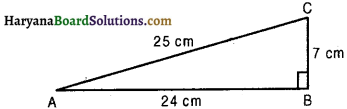
In ∆ABC, right-angled at B, AB = 24 cm, BC = 7 cm. Determine :
(i) sin A, cos A
(ii) sin C, cos C
Solution :
(i) In a right’triangle ABC we have ∠B = 90°, AB = 24 cm and BC = 7 cm.
By Pythagoras theorem, we have
AC2 = AB2 + BC2
⇒ AC2 = 242 + 72
⇒ AC2 = 576 + 49
⇒ AC2 = 625
⇒ AC = \(\sqrt{625}\) = 25

Haryana Board 10th Class Maths Solutions Chapter 8 Introduction to Trigonometry Ex 8.1 1

∴ sin A = \(\frac{\mathrm{BC}}{\mathrm{AC}}=\frac{7}{25}\)
cos A = \(\frac{\mathrm{AB}}{\mathrm{AC}}=\frac{24}{25}\)
Here, sin A = \(\frac{7}{25}\), cos A = \(\frac{24}{25}\)

(ii) For trigonometric ratio of ∠C, We have base = BC = 7 cm
Perpendicular = AB = 24 cm
Hypotenuse = AC = 25 cm
sin C = \(\frac{\mathrm{AB}}{\mathrm{AC}}=\frac{24}{25}\)
and cos C = \(\frac{\mathrm{BC}}{\mathrm{AC}}=\frac{7}{25}\)
Hence, sin C = \(\frac{24}{25}\), cos C = \(\frac{7}{25}\)

Haryana Board Solutions for 10th Class Maths Chapter 8 Introduction to Trigonometry Ex 8.1

Question 2.
In figure, find tan P – cot R.

Haryana Board 10th Class Maths Solutions Chapter 8 Introduction to Trigonometry Ex 8.1 2

Solution:
We have, PQ = 12 cm, PR = 13 cm.
In right ∆PQR, ∠Q = 90°
By Pythagoras theorem, we have PR2 = QR2 + PQ2
⇒ (13)2 = QR2 + (12)2
⇒ QR2 = (13)2 – (12)2
⇒ QR2 = (13 + 12) (13 – 12)
⇒ QR2 = 25
⇒ QR = √25 = 5
cot R = \(\frac{\mathrm{QR}}{\mathrm{PQ}}=\frac{5}{12}\)
For trigonometric ratio of ∠P, we have
Base = PQ = 12 cm
Perpendicular = QR = 5 cm
Hypotenuse = PR = 13 cm
∴ tan P = \(\frac{\mathrm{QR}}{\mathrm{PQ}}=\frac{5}{12}\)
Now, tan P – cot R = \(\frac{5}{12}-\frac{5}{12}\) = 0
Hence, tan P – cot R = 0.

Question 3.
If sin A = \(\frac{3}{4}\) Calculate cos A and tan A.
Solution :
Consider a right triangle ABC in which ∠B = 90°
Then, sin A = \(\frac{\mathrm{BC}}{\mathrm{AC}}=\frac{3}{4}\)
Let BC = 3k and AC = 4k, where k is a positive integer.
By Pythagoras theorem, we have

Haryana Board 10th Class Maths Solutions Chapter 8 Introduction to Trigonometry Ex 8.1 3

AC2 = AB2 + BC2
(4k)2 = AB2 + (3k)2
AB2 = (4k)2 – (3k)2
AB2 = 16k2 – 9k2
AB2 = 7k2
AB = √7 k
∴ cos A = \(\frac{\mathrm{AB}}{\mathrm{AC}}=\frac{\sqrt{7} k}{4 k}=\frac{\sqrt{7}}{4}\)
and tan A = \(\frac{\mathrm{BC}}{\mathrm{AB}}=\frac{3 k}{\sqrt{7} k}=\frac{3}{\sqrt{7}}\)
Hence, cos A = \(\frac{\sqrt{7}}{4}\), tan A = \(\frac{3}{\sqrt{7}}\).

Haryana Board Solutions for 10th Class Maths Chapter 8 Introduction to Trigonometry Ex 8.1

Question 4.
Given 15 cot A = 8, find sin A and sec A.
Solution :

Haryana Board 10th Class Maths Solutions Chapter 8 Introduction to Trigonometry Ex 8.1 4

we have,
15 cot A = 8
cot A = \(\frac{8}{15}\)
Now consider a right 15 triangle ABC, in which ∠B = 90°
cot A = \(\frac{8}{15}\)
⇒ \(\frac{\mathrm{AB}}{\mathrm{BC}}=\frac{8}{15}\)
Let AB = 8k and BC = 15k,where k is a positive integer.
By Pythagoras theorem, we have
AC2 = AB2 + BC2
AC2 = (8k)2 + (15k)2
AC2 = 64k2 + 225k2
AC = 289k2
AC = \(\sqrt{289 k^2}\) = 17k.
sin A = \(\frac{\mathrm{BC}}{\mathrm{AC}}:=\frac{15 k}{17 k}=\frac{15}{17}\)
and sec A = \(\frac{\mathrm{AC}}{\mathrm{AB}}=\frac{17 k}{8 k}=\frac{17}{8}\)
Hence, sin A = \(\frac{15}{17}\) and sec A = \(\frac{17}{8}\).

Question 5.
Given sec θ = \(\frac{13}{12}\), calculate all other trigonometric ratios.
Solution:
Consider a right triangle ABC in which ∠B = 90°, ∠CAB = 9, sec θ = \(\frac{\mathrm{AC}}{\mathrm{AB}}=\frac{13}{12}\)
Let AC = 13k and AB = 12k, where k is a positive integer.

Haryana Board 10th Class Maths Solutions Chapter 8 Introduction to Trigonometry Ex 8.1 5

By Pythagoras theorem, we have
AC2 = AB2 + BC2
(13k)2 = (12k)2 + BC2
BC2 = (13k)2 – (12k)2
BC2 = (13k + 12k) (13k – 12k)
BC2 = 25k × k = 25k2
BC = \(\sqrt{25 k^2}\) = 5k

∴ sin θ = \(\frac{\mathrm{BC}}{\mathrm{AC}}=\frac{5 k}{13 k}=\frac{5}{13}\)
cos θ = \(\frac{\mathrm{AB}}{\mathrm{AC}}=\frac{12 k}{13 k}=\frac{12}{13}\)
tan θ = \(\frac{\mathrm{BC}}{\mathrm{AB}}=\frac{5 k}{12 k}=\frac{5}{12}\)
cot θ = \(\frac{\mathrm{AB}}{\mathrm{BC}}=\frac{12 k}{5 k}=\frac{12}{5}\)
cosec θ = \(\frac{\mathrm{AC}}{\mathrm{BC}}=\frac{13 k}{5 k}=\frac{13}{5}\)

Hence, sin θ = \(\frac{5}{13}\),
cos θ = \(\frac{12}{13}\),
tan θ = \(\frac{5}{12}\),
cot θ = \(\frac{12}{5}\),
cosec θ = \(\frac{13}{5}\).

Haryana Board Solutions for 10th Class Maths Chapter 8 Introduction to Trigonometry Ex 8.1

Question 6.
If ∠A and ∠B are acute angles such that cos A = cos B; then show that ∠A = ∠B.
Solution :
Let us consider right triangle ABC in which ∠C = 90° and cos A = cos B.
Draw CD ⊥ AB.
In right triangle ADC, ∠ADC = 90°.
cos A = \(\frac{\mathrm{AD}}{\overline{\mathrm{AC}}}\) ………………….(1)
In right ∆BDC,
∠BDC = 90°
cos B = \(\frac{\mathrm{BD}}{\overline{\mathrm{BC}}}\) ………………….(2)

Haryana Board 10th Class Maths Solutions Chapter 8 Introduction to Trigonometry Ex 8.1 6

According to question,
cos A = cos B
\(\frac{\mathrm{AD}}{\mathrm{AC}}=\frac{\mathrm{BD}}{\mathrm{BC}}\)
\(\frac{\mathrm{AD}}{\mathrm{BD}}=\frac{\mathrm{AC}}{\mathrm{BC}}\) [each = \(\frac{C D}{C D}\)]
∆ADC ~ ∆BDC [By SSS similarity criterion]
[corresponding ∠s of two similar ∆s are equal]
Hence Proved.

Haryana Board Solutions for 10th Class Maths Chapter 8 Introduction to Trigonometry Ex 8.1

Question 7.
If cot θ = \(\frac{7}{8}\), evaluate:
(i) \(\frac{(1+\sin \theta)(1-\sin \theta)}{(1+\cos \theta)(1-\cos \theta)}\)
(ii) cot2 θ
Solution :

Haryana Board 10th Class Maths Solutions Chapter 8 Introduction to Trigonometry Ex 8.1 7

(i) Consider a triangle ABC in which ∠B = 90°,
∠ACB = θ and cot θ = \(\frac{7}{8}\)
⇒ \(\frac{\mathrm{BC}}{\mathrm{AB}}=\frac{7}{8}\)
Let BC = 7k and AB = 8k, where k is a positive integer,
By Pythagoras theorem, we have
AC2 = BC2 + AB2
AC2 = (7k)2 + (8k)2
AC2 = 49k2 + 64k2
AC2 = 113k2
AC = √113 k
∴ sin θ = \(\frac{\mathrm{AB}}{\mathrm{AC}}=\frac{8 k}{\sqrt{113} k}=\frac{8}{\sqrt{113}}\)

Haryana Board 10th Class Maths Solutions Chapter 8 Introduction to Trigonometry Ex 8.1 8

(ii) cot2 θ = (cot θ)2
= \(\left(\frac{\mathrm{BC}}{\mathrm{AB}}\right)^2=\left(\frac{7 k}{8 k}\right)^2\)
= \(\left(\frac{7}{8}\right)^2=\frac{49}{64}\)

Hence, (i) \(\frac{(1+\sin \theta)(1-\sin \theta)}{(1+\cos \theta)(1-\cos \theta)}=\frac{49}{64}\)
(ii) cot2 θ = \(\frac{49}{64}\)

Haryana Board Solutions for 10th Class Maths Chapter 8 Introduction to Trigonometry Ex 8.1

Question 8.
If 3 cot A = 4, check whether \(\frac{1-\tan ^2 \mathrm{~A}}{1+\tan ^2 \mathrm{~A}}\) = cos2 A – sin2 A or not.
Solution :
Consider a triangle ABC in which ∠B = 90° and 3 cot A = 4
⇒ cot A = \(\frac{4}{3}\)
⇒ \(\frac{A B}{B C}=\frac{4}{3}\)
Let AB = 4k and BC = 3k,where k is a positive integer.

Haryana Board 10th Class Maths Solutions Chapter 8 Introduction to Trigonometry Ex 8.1 9

By pythagoras theorem, we have
AC2 = AB2 + BC2
⇒ AC2 = (4k)2 + (3k)2
⇒ AC2 = 16k2 + 9k2
⇒ AC2 = 25k2
⇒ AC = \(\sqrt{25 k^2}\)
⇒ AC = 5k

Haryana Board 10th Class Maths Solutions Chapter 8 Introduction to Trigonometry Ex 8.1 10

Hence, \(\frac{1-\tan ^2 A}{1+\tan ^2 A}\) = cos2 A – sin2 A.

Haryana Board Solutions for 10th Class Maths Chapter 8 Introduction to Trigonometry Ex 8.1

Question 9.
In triangle ABC, right angled at B, if tan A = find the value of:
(i) sin A cos C + cos A sin C
(ii) cos A cos C – sin A sin C
Solution:
In right triangle ABC, ∠B = 90° and tan A = \(\frac{1}{\sqrt{3}}\)
\(\frac{\mathrm{BC}}{\mathrm{AB}}=\frac{1}{\sqrt{3}}\)
Let BC = k and AB = √3k,where k is positive integer.

Haryana Board 10th Class Maths Solutions Chapter 8 Introduction to Trigonometry Ex 8.1 11

By pythagoras theorem, we have
AC2 = AB2 + BC2
AC2 =(√3k)2 + k2
AC2 = 3k2 + k2 = 4k2
AC = \(\sqrt{4 k^2}\) = 2k
∴ sin A = \(\frac{\mathrm{BC}}{\mathrm{AC}}=\frac{k}{2 k}=\frac{1}{2}\)
and cos A = \(\frac{\mathrm{AB}}{\mathrm{AC}}=\frac{\sqrt{3} k}{2 k}=\frac{\sqrt{3}}{2}\)
Now, for trigonometric ratio of ∠C, we have
Base = BC = k
Perpendicular = AB = √3 k
Hypotenuse = AC = 2k
sin C = \(\frac{\mathrm{AB}}{\mathrm{AC}}=\frac{\sqrt{3} k}{2 k}=\frac{\sqrt{3}}{2}\)
cosC = \(\frac{\mathrm{BC}}{\mathrm{AC}}=\frac{k}{2 k}=\frac{1}{2}\)

(i) sin A cos C + cos A sin C = \(\frac{1}{2} \times \frac{1}{2}+\frac{\sqrt{3}}{2} \times \frac{\sqrt{3}}{2}\)
= \(\frac{1}{4}+\frac{3}{4}=\frac{4}{4}\) = 1

(ii)cos A cos C – sin A sinC= \(\frac{\sqrt{3}}{2} \times \frac{1}{2}-\frac{1}{2} \times \frac{\sqrt{3}}{2}\)
= \(\frac{\sqrt{3}}{4}-\frac{\sqrt{3}}{4}\) = 0

Hence, (i) sin A cos C + cos A sin C = 1
(ii) cos A cos C – sin A sin C = 0.

Haryana Board Solutions for 10th Class Maths Chapter 8 Introduction to Trigonometry Ex 8.1

Question 10.
In ∆PQR, right angled at Q, PR + QR = 25 cm and PQ = 5 cm. Determine the values of sin P, cos P and tan P.
Solution:
In right ∆PQR, ∠Q = 90°, PQ = 5 cm and PR + QR = 25 cm

Haryana Board 10th Class Maths Solutions Chapter 8 Introduction to Trigonometry Ex 8.1 12

⇒ PR = 25 – QR
By Pythagoras theorem, we have
PR2 = PQ2 + QR2
(25 – QR)2 = (5)2 + QR2
⇒ 625 + QR2 – 50 QR = 25 + QR2
⇒ QR2 – 50QR – QR2 = 25 – 625
⇒ – 50 QR = – 600
⇒ QR = \(\frac{-600}{-50}\) = 12 cm
and PR = 25 – 12 = 13 cm
∴ sin P = \(\frac{\mathrm{QR}}{\mathrm{PR}}=\frac{12}{13}\)
cos P = \(\frac{\mathrm{PQ}}{\mathrm{PR}}=\frac{5}{13}\)
tan P = \(\frac{\mathrm{QR}}{\mathrm{PQ}}=\frac{12}{5}\)
Hence, sin P = \(\frac{12}{13}\), cos P = \(\frac{5}{13}\) and tan P = \(\frac{12}{5}\).

Haryana Board Solutions for 10th Class Maths Chapter 8 Introduction to Trigonometry Ex 8.1

Question 11.
State whether the following are true or false. Justify your Answer.
(i) The value of tan A is always less than 1.
(ii) sec A = \(\frac{12}{5}\) for some value of ∠A.
(iii) cos A is the abbreviation used, for the cosecant of ∠A.
(iv) cot A is the product of cot and A.
(v) sin θ = \(\frac{4}{3}\) for some angle θ.
Solution :
(i) False. Because tan 60° = √3 > 1
(ii) True. Because value of sec A is always ≥ 1.
(iii) False. Because cos A is abbreviation used for cosine A.
(iv) False. Because cot is meaningless without an angle.
(v) False. Because sin θ > 1.

HBSE 10th Class Maths Solutions Chapter 8 Introduction to Trigonometry Ex 8.1 Read More »
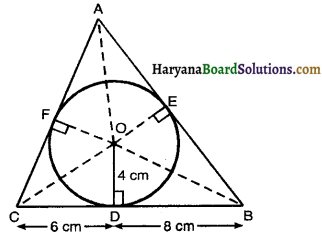
HBSE 10th Class Maths Solutions Chapter 10 Circles Ex 10.1

Haryana State Board HBSE 10th Class Maths Solutions Chapter 10 Circles Ex 10.1 Textbook Exercise Questions and Answers.

Haryana Board 10th Class Maths Solutions Chapter 10 Circles Ex 10.1

Question 1.
How many tangents can a circle have?
Solution :
A circle can have infinitely many tangents.

Question 2.
Fill in the blanks :
(i) A tangent to a circle intersects it in ………………. point(s).
(ii) A line intersecting a circle in two points is called a ……………..
(iii) A circle can have ………………… parallel tangents at the most.
(iv) The common point of a tangent to a circle and the circle is called ……………….
Answers :
(i) One
(ii) Secant
(iii) Two
(iv) Point of contact.

Haryana Board Solutions for 10th Class Maths Chapter 10 Circles Ex 10.1

Question 3.
A tangent PQ at a point P of a circle of radius 5 cm meets a line through the centre O at a point Q so that OQ = 12 cm. Length PQ is
(A) 12 cm
(B) 13 cm
(C) 8.5 cm
(D) \(\sqrt{119}\) cm
Solution :
Let O be the centre of the circle.
Let P be a point on circle such that OP = 5cm.
Now, PQ is a tangent at P and OP is a radius through P.
Since, the tangent at a point on a circle is perpendicular to the radius through the point of contact.
∴ OP ⊥ PQ.
In right ∆OPQ, we have
OQ2 = OP2 + PQ2 [By Pythagoras theorem]

Haryana Board 10th Class Maths Solutions Chapter 10 Circles Ex 10.1 1

⇒ PQ<sup>2</sup> = 119
⇒ PQ = \(\sqrt{119}\) cm
Hence, Length of PQ = \(\sqrt{119}\) cm.
So, correct option is (D).

Haryana Board Solutions for 10th Class Maths Chapter 10 Circles Ex 10.1

Question 4.
Draw a circle and two lines parallel to a given line such that one is a tangent and the other, a secant to the circle.

Haryana Board 10th Class Maths Solutions Chapter 10 Circles Ex 10.1 2

Solution :
In figure line m is parallel to line n and also tangent to the given circle at the point P.
Another line l is parallel to the given line n and also a secant to the circle.

HBSE 10th Class Maths Solutions Chapter 10 Circles Ex 10.1 Read More »
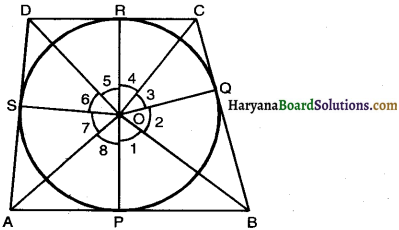
HBSE 10th Class Maths Solutions Chapter 9 Some Applications of Trigonometry Ex 9.1

Haryana State Board HBSE 10th Class Maths Solutions Chapter 9 Some Applications of Trigonometry Ex 9.1 Textbook Exercise Questions and Answers.

Haryana Board 10th Class Maths Solutions Chapter 9 Some Applications of Trigonometry Ex 9.1

Question 1.
A circus artist is climbing a 20 m long rope, which is tightly stretched and tied from the top of a vertical pole to the ground. Find the height of the pole, if the angle made by the rope with the ground level is 30° (See figure).

Haryana Board 10th Class Maths Solutions Chapter 9 Some Applications of Trigonometry Ex 9.1 1

Solution :
Let height of the pole be h m.
In right ∆ABC, we have
sin 30° = \(\frac{\mathrm{AB}}{\mathrm{AC}}\)
⇒ \(\frac{1}{2}=\frac{h}{20}\)
⇒ h = \(\frac{20}{2}\) = 10 m.
Hence, height of the pole is 10 m.

Haryana Board Solutions for 10th Class Maths Chapter 9 Some Applications of Trigonometry Ex 9.1

Question 2.
A tree breaks due to storm and the broken part bends so that top of the tree touches the ground making an angle 30° with it. The distance between the foot of the tree to the point where the top touches the ground is 8 m. Find the height of the tree.
Solution:
∠BDC = 30° (given)
In right ∆CBD, we have
cos 30° = \(\frac{\mathrm{BD}}{\mathrm{CD}}\)

Haryana Board 10th Class Maths Solutions Chapter 9 Some Applications of Trigonometry Ex 9.1 2

BC = 4.62
Height of the tree (h) = BC + AC
= BC + CD [∵ AC = CD]
= 462 + 924 = 1386 m.
Hence, height of the tree is 13.86 m.

Question 3.
A contractor plans to install two slides for the children to play in a park. For the children below the age of 5 years, she prefers to have a slide whose top is at a height of 15 m, and is inclined at an angle of 30° to the ground, whereas for elder children, she wants to have a steep slide at a height of 3 in, and inclined at an angle of 600 to the ground. What should be. length of the slide in each case?
Solution :
Let l1 is the length of slide for children below the age of 5 years and l2 is th length of the slide for elder children.

Haryana Board 10th Class Maths Solutions Chapter 9 Some Applications of Trigonometry Ex 9.1 3

Point P represents the top of slide l1 and inclined at an angle of 30° to the ground.
i.e., PQ = 15 m and ∠PRQ = 30°
and point A represents the top of slide l2 and inclined at an angle of 60° to the ground.
i.e. AB = 3m and ∠ACB = 60°
In right ∆PQR, we have
sin 30° = \(\frac{\mathrm{PQ}}{\mathrm{PR}}\)
⇒ \(\frac{1}{2}=\frac{1 \cdot 5}{l_1}\)
⇒ l1 = 2 × 1.5 = 3.o m
and in right ∆ABC, we have
sin 60° = \(\frac{\mathrm{AB}}{\mathrm{AC}}\)
⇒ \(\frac{\sqrt{3}}{2}=\frac{3}{l_2}\)
⇒ l2 = \(\frac{3 \times 2}{\sqrt{3}}\)
⇒ l2 = 2√3
Hence, lengths of the slides are 3m and 2√3 m.

Haryana Board Solutions for 10th Class Maths Chapter 9 Some Applications of Trigonometry Ex 9.1

Question 4.
The angle of elevation of the top of a tower from a point on the ground, which is 30 m away from .the foot of tower, is 30°. Find the height of tower.
Solution:
Let AB be the tower of height h m and C be a point on the grourd such that angle of elevation of the top A of tower is 30°
i.e. ∠ACB = 30° and BC = 30 m.
In right ∆ABC, we have
tan 30° = \(\frac{A B}{B C}\)

Haryana Board 10th Class Maths Solutions Chapter 9 Some Applications of Trigonometry Ex 9.1 4

h = 10√3
Hence, height of the tower is 10√3 metres.

Question 5.
A kite is flying at a height of 60 m above the ground. The string attached to the kite is temporarily tied to a point on the ground. The inclination of the string with the ground is 60°. Find the length of the string, assuming that there is no slack in the string.
Solution :
Let A be the position of kite.
Let C be the position of observer and AC he length of string.
Then ∠ACB = 60°,
height of kite = 60 m.
In right ∆ABC, we have

Haryana Board 10th Class Maths Solutions Chapter 9 Some Applications of Trigonometry Ex 9.1 5

sin 60° = \(\frac{\mathrm{AB}}{\mathrm{AC}}\)
\(\frac{\sqrt{3}}{2}=\frac{60}{\mathrm{AC}}\)
AC = \(\frac{60 \times 2}{\sqrt{3}}\)
AC = \(\frac{120 \sqrt{3}}{3}\)
AC = 40√3.

Hence, length of string = 40√3 metres.

Haryana Board Solutions for 10th Class Maths Chapter 9 Some Applications of Trigonometry Ex 9.1

Question 6.
A 1.5 m tall boy is standing at some distance from a 30 m tall building. The angle of elevation from his eyes to the top of the building increases from 30° to 60° as he walks towards the building. Find the distance he walked towards the building.
Solution :
Let AB be the building of height 30 m and CD be the boy of height 15 m
i.e. AB = 30 m and CD = 15 m.
The angle of elevation from the eyes of thy to the top of building is 300 and as the boy walks towards the building the angle of elevation becomes 60°.
Then ∠ACF = 30° and ∠AEF = 60°
In right ∆AFC, we have

Haryana Board 10th Class Maths Solutions Chapter 9 Some Applications of Trigonometry Ex 9.1 6

FC = 28.5√3
and in right ∆AFE, we have
[∴ AF = AB – BF = 30 – 1.5 = AF = 28.5 m]
tan 60° = \(\frac{\mathrm{AF}}{\mathrm{FE}}\)
⇒ √3 = \(\frac{28 \cdot 5}{\mathrm{FE}}\)
⇒ FE = \(\frac{28 \cdot 5}{\sqrt{3}}\)
⇒ FE = \(\frac{28 \cdot 5 \sqrt{3}}{3}\)
⇒ FE = 9.5√3
The distance walked by the boy towards the building = CE
= FC – FE
= 28.5√3 – 9.5√3 = 19√3
Hence, distance walked by the boy towards the building = 19√3 m.

Haryana Board Solutions for 10th Class Maths Chapter 9 Some Applications of Trigonometry Ex 9.1

Question 7.
From a point on theground, the angles of elevation of the bottom and the top of a transmission tower fixed at the top of a 20 m high building are 45° and 60° respectiyely. Find the height of the tower.
Solution :
Let PQ be the transmission tower of height h m fixed at the top of 20 m heigh building (QR), angles of elevation of the bottom and top of a transmission tower are 45° and 60° respectively.
i.e. ∠QSR = 45° and ∠PSR = 60°.
In right ∆QSR, we have
tan 45° = \(\frac{\mathrm{QR}}{\mathrm{SR}}\)

Haryana Board 10th Class Maths Solutions Chapter 9 Some Applications of Trigonometry Ex 9.1 7

⇒ 1 = \(\frac{20}{\mathrm{SR}}\)
SR = 20 m.
In right ∆PSR, we have
tan 60° = \(\frac{\mathrm{PR}}{\mathrm{SR}}\)
√3 = \(\frac{\mathrm{PQ}+\mathrm{QR}}{20}\)
√3 = \(\frac{h+20}{20}\)
20√3 = h + 20
h = 20√3 – 20
h = 20(√3 – 1)
Hence, height of the tower is 20(√3 – 1) m.

Question 8.
A statue, 16 m tall, stands on the top of a pedestal. From a point on the ground, the angle of elevation of the top of the statue is 60° and from the same point the angle of elevation of the top of the pedestal is 45°. Find the height of the pedestal.
Solution :
Let BC be the pedestal of height h m and AB be the statue.
Let D be the point of observation.
Then ∠BDC = 45°, ∠ADC = 60°, AB = 1.6 m
In right ∆BCD, we have
tan 45° = \(\frac{\mathrm{BC}}{\mathrm{CD}}\)

Haryana Board 10th Class Maths Solutions Chapter 9 Some Applications of Trigonometry Ex 9.1 8

⇒ 1 = \(\frac{h}{\mathrm{CD}}\)
⇒ CD = h …………….(1)
and right ∆ACD, we have
tan 60° = \(\frac{\mathrm{AC}}{\mathrm{CD}}\)
√3 = \(\frac{\mathrm{AB}+\mathrm{BC}}{\mathrm{CD}}\)
√3 = \(\frac{1 \cdot 6+h}{h}\) [Using (1)]
√3h = 1.6 + h
√3h – h = 1.6
h(√3 – 1) = 1.6
h = \(\frac{1 \cdot 6}{\sqrt{3}-1}\)
h = \(\frac{1 \cdot 6(\sqrt{3}+1)}{(\sqrt{3}-1)(\sqrt{3}+1)}\)
[Multiplying numerator and denominator by (√3 + 1)]
h = \(\frac{1 \cdot 6(\sqrt{3}+1)}{(\sqrt{3})^2-(1)^2}\)
h = \(\frac{1 \cdot 6(\sqrt{3}+1)}{2}\)
Hence, height of pedestal is 0.8(√3 + 1) m.

Haryana Board Solutions for 10th Class Maths Chapter 9 Some Applications of Trigonometry Ex 9.1

Question 9.
The angle of elevation of the top of a building from the foot of the tower is 30° and the angle of elevation of the top of the tower from the foot of the building is 60°. If the tower is 50m high, find the height of the building.
Solution:
Let AB be tower of height 50m and PQ be the building of height h m.
The angle of elevation of the top of the tower from the foot of the building is 60° i.e. ∠AQB = 60° and angle of elevation of the top of building from the foot of the tower is 30°, i.e., ∠PBQ = 30°
In right triangle ABQ, we have
tan 60° = \(\frac{\mathrm{AB}}{\mathrm{BQ}}\)


Haryana Board 10th Class Maths Solutions Chapter 9 Some Applications of Trigonometry Ex 9.1 9

Hence, height of the building is 16\(\frac{2}{3}\) m.

Question 10.
Two poles of equal heights are standing opposite each other on either side of the road, which is 80 m wide. From a point between them on the road, the angles of elevation of the top of the poles are 60° and 30° respectively. Find the height of the poles and the distances of the point from the poles. [CBSE 2019]
Solution :
Let AB and CD be two poles of equal height h m, angles of elevation of the top of the poles are 60° and 30° respectively i.e. ∠AOB = 60°, ∠COD = 30° and BD = 80 m.
Let OB = x m, then DO = (80 – x) m
In right ∆ABO, we have
tan 60° = \(\frac{\mathrm{AB}}{\mathrm{BO}}\)

Haryana Board 10th Class Maths Solutions Chapter 9 Some Applications of Trigonometry Ex 9.1 10

⇒ √3 = \(\frac{h}{x}\)
⇒ h = √3x
⇒ x = \(\frac{h}{\sqrt{3}}\) …………..(1)
and right ∆CDO, we have
tan 30° = \(\frac{\mathrm{CD}}{\mathrm{DO}}\)
⇒ \(\frac{1}{\sqrt{3}}=\frac{h}{80-x}\)
⇒ √3h = 80 – x
⇒ √3h = 80 – \(\frac{h}{\sqrt{3}}\) [Using (1)]
⇒ √3h + \(\frac{h}{\sqrt{3}}\) = 80
⇒ \(\frac{3 h+h}{\sqrt{3}}\) = 80
⇒ 4h = 80√3
⇒ h = \(\frac{80 \sqrt{3}}{4}\)
⇒ h = 20√3 m
Putting the value of h in (1), we get
⇒ x = \(\frac{20 \sqrt{3}}{\sqrt{3}}\)
⇒ x = 20 m.
DO = 80 – x = 80 – 20 = 60 m.
Hence height of each pole is 20√3 m and distances of point from pole (AB) is 20 m and from pole (CD) is 60 m.

Haryana Board Solutions for 10th Class Maths Chapter 9 Some Applications of Trigonometry Ex 9.1

Question 11.
A TV Tower stands vertically on a bank of a canal. From a point on the other bank directly opposite the tower, the angle of elevation of the top of the tower is 60°. From another point 20 m away from this point on the line joining this point to the foot of the tower, the angle of elevation of the top of the tower is 30°. (See in figure). Find the height of tower and width of the canal.

Haryana Board 10th Class Maths Solutions Chapter 9 Some Applications of Trigonometry Ex 9.1 11

Solution :
Let height of tower be h m. and width of canal be x m.
Then ∠ACB = 60°, ∠ADB = 30° and CD = 20 m.
In right ∆ABC, we have
⇒ tan 60° = \(\frac{\mathrm{AB}}{\mathrm{BC}}\)
⇒ √3 = \(\frac{h}{x}\)
⇒ h = √3x ………………….(1)
In right ∆ABD, we have
tan 30° = \(\frac{\mathrm{AB}}{\mathrm{BD}}\)
⇒ \(\frac{1}{\sqrt{3}}=\frac{h}{\mathrm{BC}+\mathrm{CD}}\)
⇒ \(\frac{1}{\sqrt{3}}=\frac{h}{x+20}\)
⇒ √3h = x + 20
⇒ √3 × √3x = x + 20 [Using (1)]
⇒ 3x = x + 20
⇒ 2x = 20
⇒ x = \(\frac{20}{2}\) = 10
Putting the value of x in (1), we get
h = √3 × 10
⇒ h = 10√3
Hence, height of tower is 10√3 m and width of canal is 10 m.

Question 12.
From the top of a 7 m high building, the angle of elevation of the top of a cable tower is 60° and the angle of depression of its foot is 45°. Determine the height of the tower.
Solution:
Let AB be cable tower of height h m. and CD be building of height 7 m the angle of elevation of the top of the cable tower from the top of a building is 60°.
i.e. ∠ACE = 60° and angle of depression of its foot from the top of a building is 450
i.e. ∠ECB = 45°
∠CBD = ∠ECB [Alternate interior ∠s]
∠CBD = 45°

Haryana Board 10th Class Maths Solutions Chapter 9 Some Applications of Trigonometry Ex 9.1 12

In right ∆AEC, we have
tan 60° = \(\frac{\mathrm{AE}}{\mathrm{CE}}\)
= \(\frac{\mathrm{AB}-\mathrm{EB}}{\mathrm{CE}}\)
= \(\frac{h-7}{\mathrm{CE}}\)
CE = \(\frac{h-7}{\sqrt{3}}\) …………….(1)
and in right ACDB, we have
tan 45° = \(\frac{\mathrm{CD}}{\mathrm{DB}}\)
1 = \(\frac{7}{\mathrm{CE}}\) [∵ DB = CE]
CE = 7
Putting the value of CE in (1), we get
7 = \(\frac{h-7}{\sqrt{3}}\)
7√3 = h – 7
7√3 + 7 = h
h = 7(√3 + 1) m.
Hence, height of cable tower is 7 (√3 + 1) m.

Haryana Board Solutions for 10th Class Maths Chapter 9 Some Applications of Trigonometry Ex 9.1

Question 13.
As observed from the top of a 75 m high lighthouse from the sea-level, the angles of depression of two ships are 30° and 45°. If one ship is exactly behind the other on the same side of the lighthouse, find the distance between the two ships.
Solution :
Let AB be light house of height 75 m, angles of depression of two ships are 30° and 45°
i.e. ∠PAD = 30° and ∠PAC = 45°.
∠ADC = ∠PAD = 30° [alternate interior angles]
and ∠ACB = ∠PAC = 45° [alternate interior angles]
Let CD = x m.
and BC = y m.
In right ∆ABC, we have
tan 45° = \(\frac{\mathrm{AB}}{\mathrm{BC}}\)
⇒ 1 = \(\frac{75}{y}\)
⇒ y = 75 m ………………(1)

Haryana Board 10th Class Maths Solutions Chapter 9 Some Applications of Trigonometry Ex 9.1 13

and in right ∆ABD, we have
tan 30° = \(\frac{A B}{B D}\)
\(\frac{1}{\sqrt{3}}=\frac{75}{C D-B C}\)
\(\frac{1}{\sqrt{3}}=\frac{75}{x-y}\)
x + y = 75√3
x + 75 = 75√3 [Using (1)]
x= 75√3 – 75
X= 75(√3 – 1) .
Hence, distance between the, two ships is 75(√3 – 1) m.

Question 14.
A 12 m tall girl spots a balloon moving with the wind in a horizontal line at a height of 88.2 m in from the ground. The angle of elevation of the bafloon from the eyes of the girl at any instant is 60° After s mrne, the angle of elevation reäes
to 30° (see figure). Find the distance travelled by the balloon during the interval.

Haryana Board 10th Class Maths Solutions Chapter 9 Some Applications of Trigonometry Ex 9.1 14

Solution :
Let A be position of balloon when its angle of elevation from eye of the girl is 60° and P he the ooition of balloon when angle of elevation is 30°. Then
∠PCQ = 30°, ∠ACB = 60° and R = 88.2 m
PQ = PR – QR = 88.2 – 1.2 = 87 m
In right ∆PQC, we have
tan 30° = \(\frac{\mathrm{PQ}}{\mathrm{QC}}\)
⇒ \(\frac{1}{\sqrt{3}}=\frac{87}{\mathrm{QC}}\)
⇒ QC = 87√3 ……………….(1)
and in right ∆ABC, we have
tan 60° = \(\frac{\mathrm{AB}}{\mathrm{BC}}\)
⇒ √3 = \(\frac{87}{B C}\) [∵ AB = PQ = 87 m].
⇒ BC = \(\frac{87}{\sqrt{3}}\)
⇒ BC = \(\frac{87 \sqrt{3}}{3}\) ………………..(2)
Now distance travelled by balloon = AP = BQ = QC – BC
= 87√3 – \(\frac{87 \sqrt{3}}{3}\) [From (1) and (2)]
= 87√3 (1 – \(\frac{1}{3}\))
= 87√3 × \(\frac{2}{3}\) = 58√3
Hence, distance travelled by balloon is 58√3 m.

Haryana Board Solutions for 10th Class Maths Chapter 9 Some Applications of Trigonometry Ex 9.1

Question 15.
A straight highway leads to the foot of a tower. A man standing at the top of the tower observes a car at an angle of depression of 30°, which is approaching the foot of the tower with a uniform speed. Six seconds later, the angle of depression of the car is found to be 60°. Find the time taken by the car to reach the foot of the tower from this point.
Solution:
Let AB be vertical tower of height h m.
Let the speed of the car be v m/sec.
At the point C angle of depression of car be 30° i.e. ∠PAC = 30°
and it reaches to D six seconds later.
Then angle of depression of car is 60° i.e. ∠PAD = 60°.

Haryana Board 10th Class Maths Solutions Chapter 9 Some Applications of Trigonometry Ex 9.1 15

∠ACD = ∠PAC = 30° [alternate interior angles]
∠ADB = ∠PAD = 60° [alternate interior angles]
Distance travelled by car in 6 sec = 6v metres.
So, CD = 6v metres [∵ Distance = speed × time]
Let car takes t seconds to reach the point B from the point D
Distance travelled by car in t sec = vt metres.
In right ∆ABD, we have
tan 60° = \(\frac{\mathrm{AB}}{\mathrm{BD}}\)
√3 = \(\frac{h}{v t}\)
⇒ h = √3vt …………………(1)
and in right ∆ABC, we have
tan 30° = \(\frac{\mathrm{AB}}{\mathrm{BC}}\)
\(\frac{1}{\sqrt{3}}=\frac{h}{\mathrm{CD}+\mathrm{BD}}\)
\(\frac{1}{\sqrt{3}}=\frac{h}{6 v+v t}\)
⇒ √3h = 6v + vt
⇒ √3 × √3vt = 6v + vt [Using (1)]
⇒ 3vt = 6 v + vt
⇒ 2vt = 6v
⇒ t = \(\frac{6 v}{2 v}\) = 3 sec.
Hence, the car takes 3 sec. to reach the foot of tower.

Haryana Board Solutions for 10th Class Maths Chapter 9 Some Applications of Trigonometry Ex 9.1

Question 16.
The angles of elevation of the top of a tower from two points at a distance of 4 m and 9 m from the base of the tower and in the same straight line With it are complementary. Prove that the height of tower is 6 m.
Solution :
Let AB be tower of height h m. C and D are two points such that BC = 9 m.
and BD = 4 m, let ∠ACB = θ then ∠ADB = 90° – θ
In right ∆ABD, we have
tan (90° – θ) = \(\frac{\mathrm{AB}}{\mathrm{BD}}\)

Haryana Board 10th Class Maths Solutions Chapter 9 Some Applications of Trigonometry Ex 9.1 16

⇒ cot θ = \(\frac{h}{4}\)
[∵ tan (90° – θ) = cot θ]
⇒ h = 4 cot θ ………………(1)
In right ∆ABC, we have
tan θ = \(\frac{\mathrm{AB}}{\mathrm{BC}}\)
tan θ = \(\frac{h}{9}\)
⇒ h = 9 tan θ ………………(2)
Multiplying (1) & (2), we get
h × h = 4 cot θ . 9 tan θ
⇒ h2 = 4 × \(\frac{1}{\tan \theta}\) × 9 tan θ
⇒ h2 = 36
⇒ h = √36 = 6
Hence, height of tower is 6 m.
Hence Proved.

HBSE 10th Class Maths Solutions Chapter 9 Some Applications of Trigonometry Ex 9.1 Read More »