Author name: Prasanna

HBSE 9th Class Social Science Solutions Economics Chapter 1 The Story of Village Palampur

Haryana State Board HBSE 9th Class Social Science Solutions Economics Chapter 1 The Story of Village Palampur Textbook Exercise Questions and Answers.

Haryana Board 9th Class Social Science Solutions Economics Chapter 1 The Story of Village Palampur

HBSE 9th Class Social Science Economics The Story of Village Palampur Intext Questions and Answers

(Page 3)

Class 9 Economics Chapter 1 The Story of Village Palampur Answers HBSE Question 1.
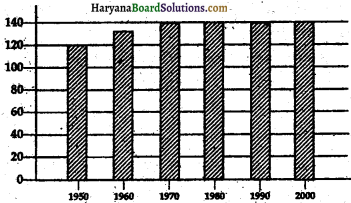
The following table 1.1 shows the and under cultivation in India in units of million Hectares. Plot this on the graph provided. What does the graph show ? Discuss in class.

Cultivated Area
1950120
1960130
1970140
1980140
1990140
2000140

(i) Is it important to increase the area under irrigation why ?
(ii) You have read about the crops grown in Palampur. Fill the following table based on information on the crops grown in your region.

Name of the cropMonth,

shown

Month,

invested

Source of irrigation (Rain, tanks, tubewells, canals etc.)

Answer:
(i) The land available for cultivation is practically fixed. Therefore, to grow more from’ the same land is the only way of increasing production. To grow more from the same land is possible only through well developed irrigation. Therefore , it is important to increase area under irrigation.

(ii) Students are required to do it themselves.

HBSE 9th Class Social Science Solutions Economics Chapter 1 The Story of Village Palampur

(Page 5)

(i) What is the difference between multi-ple cropping and modem farming method,
Answer:
Difference between multiple cropping and modern farming:
1. Multiple cropping-To grow more than one corp on a piece of land during the year is known as multiple cropping. Different crops are grown in different seasons on the same land. For growing more than one crop in a year on the same land a well developed irrigation system is necessary.

2. Modem methods of fanning-The other way of increasing production is to use modern farming methods for higher yield. This can be done by using high yielding variety of seeds. These seeds need good irrigation system, chemical fertilizers and pesticides. Farm machines like tractors and threshers, make ploughing and harvesting faster.

(ii) The following table shows the production of wheat and pulses in India after the green revolution in units of million tonnes. Plot this on a graph. Was the green revolution equally successful for both the crops discuss.

Production of pulsesProduction of wheat
1965-661010
1960- 711224
1980-81H 36
1990-911455
2000-011170

HBSE 9th Class Social Science Solutions Economics Chapter 1 The Story of Village Palampur - 3

Answer:
The green revolution is not equally successful for both the crops. Whereas production, of wheat has increased manifold over the years but production of pulses is- almost stable. Production of pulses has increased form 10 to 11 between the years 1965 to 2001. But that of wheat has increased from 10 to 70 between the years 1965 to 2001.

HBSE 9th Class Social Science Solutions Economics Chapter 1 The Story of Village Palampur

(iii) What is the working capital required by the former using modern farming methods ?
Answer:
The working capital required by the farmer using modem farming methods is HYV seeds, chemical fertilizers and pesticides.

(iv) Modem fanning methods require the farmer to start with more cash than before why ?
Answer:
The working capital required by the farmer using modem farming method is chemical fertilizers, pesticides and HYV seeds. Also they require good irrigation system. The HYV seeds, chemical fertilizers and pesticides are prepared in industries and therefore are costlier than traditional seeds and natural fertilizers. For developing a good irrigation system a farmer needs to get electric-run tubewells and electricity connection.

For these he has to pay charges. Also, some of the farmers buy farm machinery like, tractors and tubewells which make ploughing and harvesting faster. For all the above-mentioned things a farmer requires good cash. Therefore, we can say that modern farming methods require the farmer to start with more cash than before.

9th Class Economics Chapter 1 HBSE

Suggested Activity

During your field visit talk to some farmers of your region. Find out:
1. What kind of fanning methods-modern or traditional or mixed-do the farmers use. Write a note.
2. What are the sources of irrigation?
3. How much of the cultivated land is irrigated? (Very little/nearly half/majority /all).
4. From where do farmers obtain the inputs that they require?
Answer:
Students are required to do it themselves.

The Story of Village Palampur Chapter 1 HBSE 9th Class

Suggested Activity

After reading the following reports from newspapers/ magazines, write a letter to the Agriculture Minister in your own words telling him how the use of chemical fertilizers can be harmful. ………… Chemical fertilizers provide minerals which dissolve in water and are immediately available to plants. But these may not be retained in the soil for long. They may escape from the soil and pollute ground water, rivers and lakes, chemical fertilizers can also kill bacteria and other microorganisms in the oil. This means some time after their use, the soil
will be less fertile than over before …………..(Source Down to Earth, New Delhi).

……….. The consumption of chemical ferdizliers in Punjab is highest in the country. The continuous use of chemical fertilizers, has led to degradation of soil health. Punjab farmers are now forced to use more and more chemical fertizliers and other inputs to achieve the same production level. This means cost of cultivation is rising very fast ………… (Source: The Tribune, Chandigarh)
Answer:
To;
The Agriculture Minister
Dept, of agriculture
New Delhi
Sir/Madam,
Sub: The effects of chemical fertilizers

This letter is to divert your attention to the ill effects of chemical fertilisers on our health and soil fertility. To* grow more from the same land farmers use these fertilizers in very high quantity without realizing its effects. These fertilizers escape from the soil and pollute ground water, rivers and lakes. When we drink this polluted water it effects our health. Also, these chemical fertilisers kill bacteria and other micro-organisms in the soil. It effects the fertility of soil.

HBSE 9th Class Social Science Solutions Economics Chapter 1 The Story of Village Palampur

The continuous use of chemical fertilisers has led to the degradation qf soil health. The farmers are now forced to use more and more chemical fertilisers and other inputs to achieve the same production level. This has increased the cost of production as a result the prices of crops have increased. As chemical fertilisers are harmful for our environment and health government should restrict their use. It should encourage farmers to use bio fetilisers and manure.

I hope the ministry concerned will pay attention to it.
Thanking you
Yours Sincerely
X.Y.Z.

HBSE 9th Class Chapter 1 The Story of Village Palampur Economics

(Page 7)

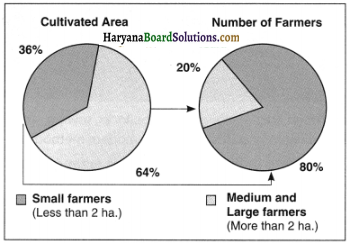
(i) In Picture 1.5, can you shade the land cultivated by the small farmers?
HBSE 9th Class Social Science Solutions Economics Chapter 1 The Story of Village Palampur - 1
HBSE 9th Class Social Science Solutions Economics Chapter 1 The Story of Village Palampur - 2

(ii) Why do so many families of farmers cultivate such small plots of land?
Answer:
Because of the increasing population land has been divided and sub-divided between different people. As a result size of land holdings has decreased.

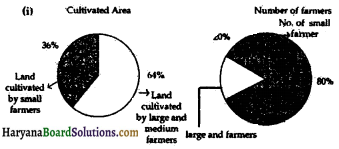
(iii) The distribution of farmers in India and the amount of land they cultivate is given in the following graph Li. Discuss in the classroom.
Answer:
Do it yourself.

HBSE 9th Class Social Science Solutions Economics Chapter 1 The Story of Village Palampur

Let’S Discuss

(i) Would you agree what the distribution of cultivated land is unequal in Palampur? Do you find a similar situation for India? Explain.
Ans.
Yes, we agree that the distribution of cultivated land is unequal in Palampur Similar situation is pævailing in India. Large number of small farmers cultivate small plots of land of less than I hectare 20% of the large and medium farmers. Cultivate 36% of the land.

(Page 9)

Question 1.
Why are farm labourers like Dala and Ramkali poor?
Answer:
Dala and Ramkali are landless labourers. They work on other people’s field for wages and sometimes even go to a nearby village for work. But the wages that they get are less than the minimum wage set by the government. Therefore, they are poor.

Question 2.
Gosaipur and Majauli are two villages in North Bihar. Out of a total of 850 households in the two villages. There are more their 250 men who are employed in rural Punjab and Haryana or Nagpur. Such migration is common in most villages across India. Why do people migrate can you decribe (based on your imagination) the work that the migrants of Gosaipur and Majauli might do at the place of destination ?
Answer:
People migrate form rural to urban areas in search of jobs. The migrants of Gosaipur and Majauli perform labour work at the place of destination. They work in brick making units, as a labourer in building construction, they become rikshawpullers or work as helpers in shops and small restaurants.

(Page 11)

Let us take three fanners Each has grown wheat on his field though the production is different (see Column 2). The consumption of wheat by each farmer family is the same (Column 3). The whole of surplus wheat this year is used as capital for next years’s production. Also suppose, production is twice the capital used in production. Complete the tables.
Farmer :1

ProductionConsuptionSurplus = Pro-duction – Con-sumptionCapital for the next yearProduction
Year 1100406060
Year 212040
Year 340

Farmer :2

ProductionCon-suptionSurplusCapital for the next year
Year 18040
Year 24040
Year 340

Farmer :3

ProductionCon-suptionSurplusCapital for the next year
Year 16040
Year 240
Year 340

Lets Discuss

(i) Compare the production of wheat by three farmers over the years.
Answer:
The production of three famrers is different from year to year 1st famrers production has increased every year, whereas second farmers, production level is constant. But the produciton of third farmer has declined every year. In fact, in year three his production is zero.

(ii) What happens to famrer 3 in year 3? Can he continue production ? What will he have to do to continue production?
Answer:
In the year 3, the produciton of farmer 3 has fallen to zero. He cannot continue production becaue he doesn’t have the capital. To continue produètion he has to borrow capital. The famrel can provide this capital. Also, he has to follow modern farming. methods If he wants to continue production for many years.

HBSE 9th Class Social Science Solutions Economics Chapter 1 The Story of Village Palampur

(Page 12)

Question 1.
What capital did Mishrilal need to set up- his Jaggery manufacturing unit crushing machine.
Answer:
He needs mechanical sugarcane crushing machine.

Question 2.
Who provides? the labour in this case?
Answer:
Mishrilal himself and his family members provide the labour.

Question 3.
Can you guess why mishrilal is unable to increase his profit.
Answer:
Mishrilal is unable to increase his profit because’he manufactures jaggery at very small scale. Also, he does not sell it directly into the market but through middlemen.

Question 4.
Would you think of any reasons when he might face a loss.
Answer:
He might face a loss if other farmers refused to sell him sugarcane or in case of crops failure.

Question 5.
Why does Mishrilal sell his jaggery, to traders in Shahpur and not in his village ?
Answer:
Mishrilal sells his jaggery to traders in Shahpur because it is the nearest market.

(Page 12)

Question 1.
In what ways is Kareem’s capital and labour different from Mishrilal’s:
Answer:
Mishrilal’s capital is a manufacturing capital, whereas Kareem’s capital is a computer which used for teaching Kareem works in tertiary sector therefore, his jobs is white colar job whereas Mishrlal performs the work of labourer.

Question 2.
Why didn’t someone start the computer centre earlier? Disuss some of the possible reasons.
Answer:
Some one didn’t start the computer centre earlier due to the following reasons:
(i) People were not aware of computers:
(ii) People were uneducated,
(iii) Computer teachers were not available in the village and nobody was ready to come from outside.

(Page 13)

Let’s Discuss

Question 1.
What is Kishora’s fixed capital?
Answer:
Wooden cart and buffalo.

Question 2.
What do you think would be his working capital?
Answer:
His working capital is fooder.

Question 3.
In how many production activities is Kishora involved?
Answer:
Three.

Question 4.
Would you say that Kishora has benfitted from better roads in Palampur ?
Answer:
Yes, he has benefitted from them. Because of better roads he is able to ferry goods through his wooden cart. Also, it will effect the health of his buffalo less.

(Page 14-15)

Question 1.
Every village in India is surveyed once in ten years during the census and some of details are presented in the following format. Fill up the following based on information on Palampur.
(a) Location:
(b) Total area of the village:
(c) Land use (in hectares):

Cultivated LandLand not available for cultivation
IrrigatedUnirrigated(Areas covering dwellings, roads, ponds, grazing ground)
26 hectares

(d) Facilities:

Educational
Medical
Market
Electricity supply
Communication
 Nearest town

Answer:
(a) Western part of Uttar Pradesh.
(b) 226 hectares:
(c) Irrigated-200 hectares; un-irrigated~0 hectares.
(d) Two primary schools, one high school.

  • Primary health centre run by government, one private dispensary.
  • Nearest market at Raiganj.
  • Electric connections in most of the houses.
  • Connected by telephone.
  • Nearest town: Shahpur

Question 2.
Modem farming methods require more inputs which are manufactured in industry. Do you agree ?
Answer:
Modem farming methods require high yielding varieties of seeds. Compared to the traditional seeds, HYV seeds needed plenty of water and also chemical fertilizers and pesticides to produce best results. Higher yields were possible only from a combination of HYV seeds, irrigation chemical fertilizers, pesticides etc.

Question 3.
How did the spread of electricity help farmers in Palampur?
Answer:
Electricity came early in Palampur. It helped in developing system of irrigation. With the coming of electricity, Persian wheels were replaced with electric-run tubewells. Electric-run tubewells could irrigate much large areas of land more effectively. The first few tubewells were installed by the government. Soon, however, farmers started setting up private tubewells. As a result, by mid 1970’s the entire cultivated area of 200 hectares (ha.) was irrigated.

Question 4.
Is it important to increase the area under irrigation? Why?
Answer:
The land available for cultivation is practically fixed. Therefore, to grow more from the same land is the only way of increasing production. To grow more from the same land is possible only through, well developed irrigation. Therefore, it is important to increase area under irrigation.

Question 5.
Construct a table on the distribution of land among the 450 families of Palampur.
Answer:

Total number of familiesLandless farmersSmall farmers (less than 2 hectares, of land)Medium and large farmers (more than 2 hectares of land)
45015024060

Question 6.
Why are the wages of farm labourers in Palampur less than minimum wages ?
Answer:
The minimum wages for a farm labourer set up by the government is Rs. 60 per day, but farm labourers in Palampur gets only Rs. 35-40 per day. It is because there is heavy competition for work among the farm labourers in Palampur, so people agree to work for lower wages.

Question 7.
In your region, take to two labourers. Choose either from labourers or labourers working at construction sites. What wages do they get ? Are they paid in cash or kind ? DQ they get work regularly ? Are they iun debt ?
Answer:
Do it yourself.

Question 8.
What are the different ways of increasing production on the same piece of land ? Use examples to explain.
Answer:
The are two different ways of increasing production on the same piece of land. The one way is multiple cropping. To grow more than one crop On a piece of land during the year is known multiple cropping. The other way is to use modem farming methods for higher yield. Compared to traditional seeds, the HYV seeds produced much greater amounts of grain on a single plant. As a result the same piece of land would now produce far larger quantities of food-grains than was possible earlier.

Question 9.
Describe the work of a fanner with 1 hectare of land.
Answer:
The farmer with one hectare of land cultivate his own field. He also works as a farm labourer for medium and large farmers. In return he gets wages either in cash or kind.

Question 10.
How do the medium and large farmers obtain capital for farming’? How is it different from the small fanners ?
Answer:
The medium and large farmers are able to save some of their earnings. They use these savings to buy capital for the next season. Thus, they are able to arrange for the capital for fanning from their own savings. On the other hand, small farmers have to borrow money to arrange for the capital. They borrow from the large farmers or the village moneylenders or the traders who supply various inputs for cultivation. *

Question 11.
On what terms did Savita get a loan from Tejpal Singh? Would Savita’s condition be different if she could get a loan from the bank at a low rate of interest?
Answer:
Savita is a small farmer. She doesn’t have the money to buy working capital. Therefore, she borrowed some money from Tejpal Singh, a large farmer. Tejpal Singh gave her a loan at an interest rate of 24 percent for four months. Also, he made her agree to work on his fields as a farm labourer during the harvest season at Rs. 32 a day. Savita was a mother of three children, had a lot of household work and she even had to work on her own field. But then also she agreed to Tejpal’s condition. The conditions would have been different if she could get a loan from bank. In that case the rate of interest wouldhave been low and also there would have been no need to work on Tejpal’s farm.

Question 12.
Talk to some old residents in your region and write a short report on the changes in irrigation and changes in production methods during.the last 30 years.
Answer:
During the last 30 years irrigation and production methods have undergone a drastic change. With the coming of electricity irrigation techniques have changed. Persian wheels are replaced by electric tubewells. Electric tube- wells could irrigate much larger areas of land more effectively. In last 30 years, farming methods are greatly revolutionized. Modem farming methods are used for higher yield. Earlier traditional seeds were used in cultivation. These seeds had relatively low yield. They require less irrigation. Earmers used cow- dung and other natural manure as fertilizers.

But nowadays farmers use high-yielding varieties (HYVs) of seeds. Compared to traditional seeds, HYV seeds produced much greater amounts of grain on a single plant. As a result the same piece of land would now produce for larger quantities of foodgrains than was possible earlier. But these seeds needed plenty of water, chemical fertilizers and pesticides to produce best results. Thus, higher yields were possible only from a combination of HYV seeds, irrigation, chemical fertilizers, pesticides etc.

Question 13.
What are the non-farm production activities taking place in your region ? Make a shortlist.
Answer:
Non-farm production activities taking place in our region are:
1. Shop-keeping.
2. Small-scale manufacturing.
3. Transportation (Rickshawalas, Auto rickshawalas) etc.
4. Entertainment (Cinema halls).

Question 14.
What can be done so that more non-farm production activities can be started in villages ?
Answer:
It is important to increase non-farm production activities in villages. It helps in providing permanent gainful employment to small and landless farmers. But to start non-farm activities people require capital. For this it is important that loan be available at low rate of interest. Another thing which is. essentiahfor expansion of non-farm activities is to have markets where goods and services produced can be sold. Villages can be connected to towns and cities through good roads, transport and telephone.

HBSE 9th Class Social Science Economics The Story of Village Palampur Textbook Questions and Answers

Question 1.
What are the different types of production activities in the village?
Answer:
There are two types of production activities in the village –
(i) farming and,
(ii) non-farm activities.

The non-farm activities include small manufacturing, transport and shop-keeping.

Question 2.
Define factors of production.
Answer:
The various inputs required to produce goods and services are called as factors of production. There are mainly four factors of production: land, labour,’ physical capital and human capital.

Question 3.
Distinguish between fixed capital and working capital.
Answer:
The physical capital which can be used in production over many years is called as fixed capital. For example: tools, machines and buildings. On the other hand, the physical capital which gets completely used up during the production process is called as working capital. For example raw materials and money in hand.

Question 4.
What is human capital?
Answer:
The knowledge and enterprise required to put together land, labour and physical capital to produce an output either for self-consumption or for sale in the market is called as human capital.

Question 5.
Define multiple cropping.
Answer:
To.grow more than one crop on a piece of land during the year is known as multiple cropping. It is the most common way of increasing production on a given piece of land.

Question 6.
Mention the two ways of increasing production from the same land.
Answer:
The two ways of increasing production from the same land are:
(a) Multiple cropping and
(b) Using modem farming methods

Question 7.
What is the working capital required by the farmer using modern farming methods?
Answer:
The working capital required by the farmer usina modern farming methods is HYV seeds, chemical fertilizers arid pesticides.

Question 8.
What is surplus?
Answer:
The produce left over after self-consumption is called as surplus. This surplus is brought Over to the market for sale.

Question 9.
Briefly explain the four factors of production.
Answer:
Every production is organized by combining land, labour, physical capital and human capital which are known as factors of production. These factors are explained below:

1. Land-If is the first requirement for the production of goods and services. The land required for farm activities is practically fixed.

2. Labour-The second requirement is labour i.e. people who will do the work. Some activities require highly educated workers like banking and some require workers, for manual working for example carpenter.

3. Physical capital-Physical capital es the variety of inputs required at every stage during production. For example tools, buildings, raw materials etc. Physical capital is of two types: fixed capital and working capital.

4. Human capital-The knowledge and enterprise required to put together land, labour and physical capital (or producing an output either for self-consumption or to sell in the market is called, as a human cap

Question 10.
What is the main constraint on land?
Answer:
In villages farming is the main production activity. Most of the people are ependent on farming for their livefihood. The well being of these people is closely related to production in the farms. The farm production depends upon the land area uqder cultivation. But there is one constraint on it. Land area under cultivation is practically fixed. There has been no expansion in land area under cultivation since 1960. By then, some of the wastelands in the village had been converted to cultivable land. There exists no further scope to increase farm production by bringing new land under cultivation.

Question 11.
What is multiple cropping? Explain by giving an example.
Answer:
To grow more than one crop on a piece of land during the year is known as multiple cropping. It is the mostcommon way of increasing production. During different seasons different crops are grown on the same piece of land. The farmers are able to grow different crops in a year due to well developed irrigation system in most parts of the country

Example : In Palampur all land was Now, the only way of increasing farm production was to grow more than One crop on the same land during the year. Therefore, during rainy season (Kharif) farmers grow jowar and bajra. It was followed by cultivation of potato between October and December. In the winter season (Rabi), fields were sown with wheat. A part of the land area was also devoted to sugarcane which was harvested once every year.

Question 12.
Who provide the labour for farm activities?
Answer:
Farming requires good deal of hard work. Small farmers along with their families cultivate their own fields. Thus, they provide labour required for farming themselves. Medium and large farmers hire farm labourers to work on their fields. Farm labourers come from either landless families of families cultivating small plots of land. These labourers are paid wages by the farmer for whom they work. Wages are paid either in cash or in kind. Wages vary widely from region to region, from crop to crop, from one wide variation in the duration of employment A farm labourer might be employed on a daily harvesting for the whole year.

Question 13.
What is the aim of production? How is it organised?
Answer:
The aim of production is to produce the goods and services that we want. There are four factors of production yiz, land, labour, physical capital and human capital. Every production is organised by combining land, labour, physical capital and human capital. These factors of production are explained below:

1. Land-If is the first requLrement for production of goods and services. The land required for farm activities is practically fixed.

2. Labour-The second requirement is labour. By labour we mean people who will do the work. Some production activities require highly skilled and educated workers to perform tire necessary task. Other activities require workers who can do manual work. Each worker is providing the labour necessary for production.

3. Physical capital-It is the third requirement. Physical capital means the variety of inputs required at every stage during production. The items that come under physical capital are:

(i) Tools, machines and buildings-Tools, machines and buildings can be used in production over many years, and are called as fixed capital.

(ii) Raw materials and money in hand-Production requires a variety of raw materials such as the yarn used by weaver and the clay used by the potter. Also, some money is always required during production to make some payments and buy other necessary items. Raw materials and money in hand are called working capital.

4. Human capital-The fourth requirement of production is human capital. The knowledge and enterprise required to put together land, labour and physical capital to produce an output either for self consumption or for sale in the market is called as human capital.

Question 14.
Write a short note on green revolution.
Answer:
The green revolution started in India in the late 1960’s It introduced the Indian farmer to the cultivation of wheat and rice using high-yielding varieties of seeds (HYV). These seeds give much greater amounts of grain on a Single plant as compared to traditional seeds. As a result, the same piece of land would now produce for larger quantities of foodgrains than was possible earlier.

HYV seeds, however, needed plenty of water, chemical fertilizers and pesticides to produce best results. Higher yields were possible only from a combination. of HYV seeds, irrigation, chemical fertilisers, pesticides etc. Farmers of Punjab, Haryana and Uttar Pradesh were the first to try out the modem farming method in India. The farmers in these regions set up tubewells for irrigation and made use of HYV seeds, chemical fertilisers and pesticides.

Some of them also bought farm machineries like tractors and threshers. They were rewarded with high yields of wheat. But green revolution did not come without negative effects. Scientific reports indicated that modern farming methods have overused the natural resource base. In many areas there was loss of soil fertility due to increased use of chemical fertilizers. The continuous use of groundwater for tubewell irrigation has reduced the wafer table below the ground. This is a huge loss. Therefore, one must take care of the environment to ensure future development of agriculture.

Question 15.
How do fanners arrange for the capital needed in fanning?
Answer:
Modem farming methods require a great deal of capital, therefore farmers now need more money than before. Different farmers have different sources of capital. Most of the small farmers borrow money from large farmers or the village money-lenders or the traders who supply various inputs for cultivation. The rate of interest oh such loans is very high. They are put to great distress to repay the loan. Sometimes the small farmers have to work on the fields of medium and large farmers at very low wages to repay the loan. .

In contrast to small farmers, the medium and large farmers have their own savings from farming. These farmers sell their surplus produce in market and get good, earning. A part of these earnings are saved and kept for buying capital for the next season. Thus, they are able to arrange for the capital for farming from their own savings.

Question 16.
What is the condition of the non-farm sector in villages? How can these activities Be increased?
Answer:
The non-farm activities include small manufacturing, transport shop-keeping etc. At present, the non-farm sector in the village is not very large. Out of every 100 workers in the rural areas in, India, only 24 are engaged in non-farm activities. Though there is a Variety of non-farm activities in the village, the number of people employed in each is quite small. Unlike farming, non-farm activities require little land. People with some amount of capital can set up non-farm activities.

The capital required can be mobilised either from one’s own savings or by taking a loan. It is important that loan be available at low rate of interest so that even people without savings can start some non-farm activities. Another thing which is essential for non farm activities is to have market where the goods and services can be sold. As more villages get connected to towns and cities through good roads, transport and telephone, it is possible that the opportunities for non-farm activities production in the village would increase in the coming years.

Question 17.
How are three factors of production land, labour and capital used in farming ?
Answer:
Among these factors of production, labour is the most abundant factor of production. There are many people who are willing to work as farm labourers in the villages whereas the opportunities of work are limited. They belong to either landless families or small farmers They are paid low wages and lead a difficult life. In contrast to labour, land is a scarce factor of production. Land has been used to its maximum. There can be no expansion in cultivated land area.

Moreover, even the existing land is distributed unequally among the people engaged in farming. There are laTge number of small farmers who cultivate small plots of land, and live in conditions not much better than the landless farm labourers. To make the maximum use of the land farmers use multiple cropping and modem methods of farmingrBoth these have led to increase in production of crops.

Modern farming methods require a great deal of capital. Small farmers usually need to borrow money to arrange for the capital and are put to great distress to repay the loan. Therefore, capital too is a scarce factor of production particularly for the small farmers. Though both land and capital are scarce, there is a basic difference between the two factors of production. Land is a natural resource. Whereas capital is man made. It is possible to increase capital, whereas land is fixed. Therefore, it is very important that we take good care of land and other natural resources used in farming.

Some Important Facts

1. Manufacturing-When with the help of few primary goods some other goods are produced, it is called as manufacturing.
2. Inputs or factors-The resources used for producing goods and services are called as factors of production. There are three factors of, production: land; labour and physical capital.
3. Fixed capital-The physical capital that can be used in production over many years is Called as fixed capital. For example: Tools, machines, buildings etc.
4. Working capital-Raw materials and money in hand are called working capital.
5. Kharif crops-Crops grown during, rainy season are called as Kharif crops. For example Jowar and Bajra.
6. Rabi crops-Crops cultivated during winter season are called as Rabi crops. For example Wheat.
7. Multiple cropping-To grow more than one crop on a piece of land during the year is known as multiple cropping.
8. Yield-A crop produced on a given piece of land during a single season is called a yield.
HBSE 9th Class Social Science Solutions Economics Chapter 1 The Story of Village Palampur Read More »

HBSE 9th Class Social Science Solutions Civics Chapter 2 What is Democracy? Why Democracy?

Haryana State Board HBSE 9th Class Social Science Solutions Civics Chapter 2 What is Democracy? Why Democracy? Textbook Exercise Questions and Answers.

Haryana Board 9th Class Social Science Solutions Civics Chapter 2 What is Democracy? Why Democracy?

HBSE 9th Class Social Science Civics What is Democracy? Why Democracy? Textbook Questions and Answers

Class 9 Civics Chapter 2 What is Democracy? Why Democracy? Question Answer HBSE
Question 1.
Here is some information about four countries. Based on this information, how would you classify each of these countries. Write ‘democratic’, ‘undemocratic’ or not sure against each of these.
(a) Country A: People who do not accept the country’s officials religion do not have right to vote.
(b) Country B: The same party has been winning elections for the last twenty years.
(c) Country C : Ruling party has lost in the last three elections.
(d) Country D: There is no independent election commission.
Answer:
(a) Undemocratic
(b) Democratic
(c) Democratic
(d) Undemocratic.

What is Democracy? Why Democracy? Of Haryana 9th Class Question 2.
Here is some information about four countries. Based on this information, how would you classify each of these- countries. Write ‘democratic’, ‘undemocratic’ or ‘not sure’ against each of these.
(a) Country P: The parliament cannot pass a law about the army without the consent of the Chief of Army.
(b) Country Q: The parliament cannot pass a law reducing the powers of the judiciary.
(c) Country R: The country’s leaders cannot sign any treaty with another
country without taking permission from its neighouring country.
(d) Country S: All the major economic decisions about the country are taken by officials of the central bank which the ministers cannot change.
Answer:
(a) Undemocratic
(b) Democratic.
(c) Democratic
(d) Undemocratic.

HBSE 9th Class Social Science Solutions Civics Chapter 2 What is Democracy? Why Democracy?

What is Democracy? Why Democracy? HBSE 9th Class Civics Question 3.
Which of these is not a good argument in favor of democracy? Why?
(a) People feel free and equal in a democracy
(b) Democracies resolve conflict in a better way than others.
(c) Democratic government is more accountable to the people.
(d) Democracies are more prosperous than others.
Answer:
(a) It is an argument in favor of democracy because in a democracy alone, people are free and equal.
(b) It is also an argument in favor of democracy because democracies thrive on dialogues, discussions and ballots where conflicts are easily resolved.
(c) Democratic government is a responsible government; it is also a responsive one. It is also an argument in favour of democracy.
(d) Democracies tend to become prosperous; in poor countries, democracies
are, usually, economically weak. This argument also is in favour of democracy.

HBSE 9th Class Civics Chapter 2 What is Democracy? Why Democracy? Question 4.
Each of these statements contains a democratic and an undemocratic element. Write out the two separately for each statement.
(a) A minister said that some laws have to be passed by the parliament in order to conform to the regulations decided by the World Trade Organisation..
(b) The Election Commission ordered re¬polling in a constituency where large scale rigging was reported.
(c) Women’s representation in the parliament lias never reached 10 per cent. This led women organisations to demand one-third seats for women.
Answer:
(a) To conform to the regulations decided by the World Trade Organization (WTO), the Parliament has to pass a resolution-an element of democracy. This is so because India is a member of WTO. The Parliament can, however, pass the resolution within the parameters of the national .interest.

HBSE 9th Class Social Science Solutions Civics Chapter 2 What is Democracy? Why Democracy?

(b) It is also a democratic element, because free polls strengthen democracy. The Election Commission has the responsibility to see that the elections are conducted in free, fair and impartial manner.

(c) This’is also a democratic element. If about half of the country’s population seeks one third representation, there is nothing undemocratic about it.

Question 5.
Which of these is not a valid reason for aruingthat there is a lesser possibility of famine in a democratic country ?
(a) Opposition parties can draw attention to hunger and starvation
(b) Free press can report suffering from famine in different parts of the country.
(c) Government fears its defeat in the next elections.
(d) People are free to believe in and practice any religion.
Answer:
(D) Is not a valid reason for arguing that there is a better possibility of famine in a democratic country. Belief and practice of religion has nothing to do with famine in a democratic country.

Question 6.
There are 40 villages in a district where the government has made no provision for drinking water. These villagers met and considered many methods of forcing the government to respond to their need. Which of these is not a democratic, method?
(a) Filing a case in the courts claiming that water is part of right to life.
(b) Boycotting the next elections to give a message to .all parties,
(c) Organizing public meetings against government’s policies.
(d) Paying money to government officials to get water.
Answer:
(d) is not a democratic method, for briber is not what a democracy promotes in any form.

Question 7.
Write a response to the following arguments against democracy:
(a) Army is the most disciplined and corruption-free organization in the country. Therefore army should rule the country.
(b) Rule of the majority means the rule of ignorant people. What we need is the rule of the wise, even if they are in small numbers.
(c) If we want a religious leader to guide us in spiritual matters, why, not invite them to guide us in politics as well. The country should be ruled by religious leaders.
Answer:
(a) Military rule is not a democratic rule
(b) True, the majority of the people are illiterate, but this does not mean that the rule of the majority is not democratic. The majority rule has been accepted as a democratic rule all over the world.
(c) The country should not be ruled by religious leaders. Religion and politics are two different things, they have two different domains. Religion is a matter of faith while politics deals with our external relations.

HBSE 9th Class Social Science Solutions Civics Chapter 2 What is Democracy? Why Democracy?

Question 8.
Are the following statements in keeping with democracy as a value? Why?
(a) Father to daughter; I don’t want to hear your opinion about your marriage. In bur family, children marry where the parents tell them to.
(b) Teacher to a student; Don’t disturb my concentration by asking me questions in the classroom.
(c) Employee to the officer; Our working hours must be reduced according to the law.
Answer:
(a) This statement is not in keeping with democracy. Everyone, in a democracy, should have the right to decide, for his/her own life and career.
(b) This statement is not in keeping with democracy. Students have all the rights to ask questions in class or outside the class.
(c) This is perfectly in keeping with demo¬cracy. The workers should work according to the laws, fixing their hours of work.

Question 9.
Consider the following facts about a country and decide if you would call it a democracy. Give reasons to support your decision.
(a) All the citizens of the country have light to vote. Elections are held regularly.
(b) The country took loan from international agencies. One of the conditions for giving loan was that the government would reduce its expenses on education and health.
(c) People speak more than seven languages but education is available only in one language, the language spoken by 52 percent people of that country.
(d) Several organizations have given a call for peaceful demonstrations and nation¬
wide Strikes in the country to oppose these policies. The government has arrested these leaders.
(e) The” government owns the radio and television in the country. A1J the newspapers have to get permission from the government to publish any news about the government’s policies and protests.
Answer:
(a) It is democratic. In a democracy, everyone has the right to form government and hence has a right to vote which people exercise during elections that are held regularly.
(b) This is undemocratic. No restriction by a foreign power is in, itself, democratic.
(c) It is undemocratic. No language should be imposed on those who do not know; that language. Moreover, education should be imparted in the native language.
(d) Peaceful demonstrations and strikes
are part of democratic, rights; criticizing governmental policies too is also a democratic right.
(e) This is undemocratic. In a democracy, press has to be free.

HBSE 9th Class Social Science Solutions Civics Chapter 2 What is Democracy? Why Democracy?

Question 10.
In 2004 a report published in USA pointed to the increasing inequalities in that country. Inequalities in income are reflected in the participation of people in democracy. It also shaped their abilities to influence the decisions taken by the government. The report highlighted that:

If an average Black family earns $ 100 then the income of the average White family is $ 162. A White family has twelve times more wealth than the’ average Black family.

In a President’s election, ‘nearly nine out of 10 individuals in families with income over $ 75,000 have voted. These people are the top 20% of the population in terms of their income. On the other hand, only 5 people out of 10 from families with income less than $ 15,000 have voted. They are the bottom 20% of the population in terms of their income.
About 95% of the contribution to the political parties comes to front the rich. The gives them the opportunity to express their opinion and concern, which is not available to most citizens.

As poor sections participate less in pol-itics, the government does not listen to their concerns-coining about poverty, getting job, education, health care and housing from them. Politicians do not hear regularly about the concerns of business and the most rich. Write an essay bn ”Democracy and Poverty’ using the information given in this report but using examples from India.
Answer:
Democracy and inequalities do not together. Where there are inequalities, i.e. the rich and the poor; few rich and the many, poor, democracy, suffers. The rich, having stakes in the economy, seek to control politics; they help the political parties, financially, make their candidates win the elections, spend money during elections and then seek policies that favour them. The poor are made to vote for the political parties the rich favour. All this breeding inequality leads to corruption in politics and public affairs. Such is the state of affairs in all the elections, including elections, in India.

HBSE 9th Class Social Science Civics What is Democracy? Why Democracy? Important Questions and Answers

Question 1.
To what was Allende’s government committed in Chile?
Answer:
Allende’s government was committed to greater role in economic activities.

Question 2.
To what was Walesa’s government committed in Poland?
Answer:
Walesa’s government was committed to as little role as was possible.

HBSE 9th Class Social Science Solutions Civics Chapter 2 What is Democracy? Why Democracy?

Question 3.
Why do we need a definition?
Answer:
We need a definition when we counter a difficulty in everyday use.

Question 4.
What form of government democracy is?
Answer:
Democracy is a form of government in which the rulers are elected by the people.

Question 5.
State any one necessary condition of democracy.
Answer:
Election is the necessary condition of democracy.

Question 6.
Do we have election in a monarchy where the king is all powerful ?
Answer:
There can be no election in a monarchy headed by a real powerful king.

Question 7.
Does the army regime permit elections where it rules through the gun?
Answer:
Normally not. The army general may allow election only to legitimate his rule.

Question 8.
From which language the word . democracy has come up?
Answer:
Etymologically, democracy is derived from two Greek words ‘demos’ and ‘Kratia’. ‘Demos’ means people and ‘Kratia’ means rule. Thus, etmotgoically, democracy means the rule of the people.

Question 9.
How did Abrahan Lincoln define democracy?
Answer:
Democracy, Lincoln had said, is governmertt of the people, by the people and for the people.

Question 10.
Does holding of the elections ensure democracy in a country?
Answer:
Certainly’not. Salazar allowed elections in Portugal once for a while. But there was never a time when the opposition parties won a single seat.

HBSE 9th Class Social Science Solutions Civics Chapter 2 What is Democracy? Why Democracy?

Question 11.
What are the criteria for elections to be called elections?
Answer:
If elections are to be called elections, they are to be
(i) free elections
(ii) fair elections.

Question 12.
What is political freedom ?
Answer:
Political freedom means expressing one’s views on political matters, freedom of speech, and of expression.

Question 13.
How can there be a democracy if there is no political freedom?
Answer:
Where there is no political freedom, there is no democracy . If people are arrested, as Aung San Suu Kyi was put under house arrest, for expressing their view there is no democracy.

Question 14.
Mention, in. addition to elections, other dimensions of democracy.
Answer:
(i) Rule of law
(ii) civil liberties
(iii) protection to minorities against tyranny of majority are some of the other dimensions of democracy.

Question 15.
State any two functions of the elected representatives.
Answer:
Elected representatives make laws and decide, the policies of the government.

Question 16.
What do you mean by universal suffrage?
Answer:
Where all adults have the right to vote in the elections of the representatives is called as universal suffrage.

Question 17.
Mention any one feature of a country if it is to be called democratic.
Answer:
There has to be universal adult franchise, i.e., right to vote in the elections.

Question 18.
What is direct democracy ? Where did we have if?
Answer:
Direct democracy is a democracy where all the citizens directly participate in the discussion and decisions in the legislature. We had it in some city states in ancient Greece.

Question 19.
Wiry does direct democracy become impossible now?
Answer:
(i) Vast population, and
(ii) vast size of the countries make direct democracy as impossible.

HBSE 9th Class Social Science Solutions Civics Chapter 2 What is Democracy? Why Democracy?

Question 20.
What is representative democracy?
Answer:
Where people rule through their elected representative, if is called representative democracy. In modern vast countries, it is representative democracy that works.

Question 21.
What is referendum?
Answer:
Where matters are referred to the vote of. the citizens for final verdict, such a device is called democracy.

Question 22.
Name some of the countries where the device of referendum is in case.
Answer:
Switzerland, France, Denmark, New Zealand.

Question 23.
Why if is more likely that decisions are wrong in dictatorship than under a democracy?
Answer:
Under dictatorship (monarchy or military rule), the rulers do not involve people at all in decision-making. That is why that the decisions there are likely to be wrong.

Question 24.
Why perfect equality does not exist in a society?
Answer:
Perfect equality’does riot exist in any society because of inequalities, among people, in wealth, social status, and position. In fact, perfect
inequality is neve? possible.

Question 25.
Why are the governments responsive in democracies?
Answer:
As the elected representatives, in a democracy has to secure the support of the people, they can not afford to be insensitive to the aspirations of the people.

Question 26.
Give any one definition of democracy.
Answer:
Abraham Lincoln defines democracy as the government of the people (i.e, through participation people constitute the government) by the people (i.e. the people, through the use of their rights, control, their rulers), for the people, (i.e. the government rules for the welfare of the people.

HBSE 9th Class Social Science Solutions Civics Chapter 2 What is Democracy? Why Democracy?

Question 27.
Why do we need a definition of any concept?
Answer:
We need a definition of a concept so as to understand the meaning of the concept. Definition clarifies the meaning. For example, the definition of democracy, etymologically, means, that it is the rule of the people.

Question 28.
Democracy involves people in the formation of the government. How do the people form government ?
Answer:
Democracy, indeed, means government of the people. People form government through elections. Periodic elections are conditions of democracy. Elections have to be (i) frequent (i.e. after definite periods) (ii) free and, (iii) fair. In the absence of elections, democracy is impossible; it can not function successfully.

Question 29.
What do you mean by political freedom ? How does it help the functioning of democracy?
Answer:
Political freedom means freedom given to the people in matter relating to democratic functioning of the government. Political freedom implies right of the people to have their opinions, their right to express those, opinions, and demonstrate their political actions in the form of procession. When people are not permitted to express their opinion, this, weakens democratic trends/tendencies, The house arrest of Aung San Suu Kyi does not fit in democratic functioning.

Question 30.
Explain the following:
(a) Free and fair elections.
(b) Right to contest elections.
Answer:
(a) Free and fair elections: Voters choose officials from among competing individuals and parties. Elections have to be frequent, free and fair. Voters vote without pressure and form government. Votes must be honestly counted.

(b) Right to contest elections: It is the right of all adults to contest elections. For contesting elections, the age limit is higher than the voting age.

Question 31.
Explain the following:
(i) Freedom of expression
(ii) Freedom of information
(iii) Freedom to form association.
Answer:
(i) Freedom of expression: Citizens have freedom of opinion, expression ad discussion. They can criticize officials, government or the socio-economic order. They can also organize meetings, campaign on pubic issues or demonstrate against government.

(ii) Freedom of information: Citizens have access to information about candidates in elections. They can seek information from different sources. Government cannot have monopoly on sources of information. Laws shall protect alternative sources of information.

(iii) Right to form associations: Citizens have a right to form, join or quit associations. It includes a right to form or join a political party that opposes government or to contest elections in opposition to the ruling party. Opposition shall have art equal opportunity to increase popular support or gain power through elections.

HBSE 9th Class Social Science Solutions Civics Chapter 2 What is Democracy? Why Democracy?

Question 32.
Write on the following:
(a) Freedom of culture and religion
(b) Individual freedoms.
Answer:
(a) Freedom of culture and religion: People have freedom of faith, belief and religion. Those who belong to ethnic minorities have the right to follow their cultural practices. Linguistic minorities can speak their language. Religious minorities can freely follow and profess their religion. Persons who belong to minorities enjoy rights available to any other citizen of the country.

(b) Individual freedoms : State does not impose restrictions on travel, choice of residence, and choice of employment. Citizens have an equal right to seek admission in colleges or recruitment to jobs. They can acquire or sell property. They can establish private businesses. They can read any book of their choice. Government does not impose ban on the discussion of ideas.

Question 33.
What do you mean by ‘Rule of law’?
Answer:
All citizens are treated as equal under the law. Law protects citizens from unjustified detention. Military and police are under- the control of elected representatives. Military and police cannot terrorize or torture those who opppse government. Independent courts effectively protect individual and group rights. Decisions of courts are respected and enforced by those in government.

Question 34.
Can you identify some features necessary for any country to be called democratic ?
Answer:
There are, indeed, certain features which are necessary for any country to be called as democratic. Some of these are:
(i) There should be rights for the citizens, riot nominal but actually available.
(ii) The Constitution of the country should not only provide these rights, it should also ensure them.
(iii) The Constitution should also provide democratic institutions and procedures as well.

Question 35.
Suggest some of the rights which sho.dld be available to the citizens in a democratic country.
Answer:
(i) Every citizen should have an right to contest election for holding any public office.
(ii) People should ha ve the right to oppose the government.
(iii) They should have the right to vote out the highest officials from office.
(iv) They should have the right to elect new officials. The elections should be free, fair and frequent.

HBSE 9th Class Social Science Solutions Civics Chapter 2 What is Democracy? Why Democracy?

Question 36.
What adverse effects does economic inequalities have on politics?
Answer:
The growth of economic inequalities has adverse impact on politics, The poorer sections of the people are at a disadvantage in circumstances where there are economic inequalities. In such circumstances, policy makers, government officials and police officers often readily heed to the rich and influential people. They are responsive to the needs of the privileged and indifferent and in attentive to the poor.

Question 37.
How can we rectify the maladies that confront democracy ? Suggest any four measures.
Answer:
(1) Democratic values should be cultivated among the people;
(2) We need to have a democratic society healthy democracy requires democratic society;
(3) The government should reduce corruption; it should be responsive to the people
(4) The voters should’ ealise the importance of voting rights.

Question 38.
Are elections necessary conditions in a democracy ? Give arguments.
Answer:
Elections, indeed’, are necessary conditions for any democracy. In fact, elections alone distinguish between a democracy and non-democracy. In a non-democracy, such as in military rule or in a nonparty, there are no elections. If there are elections they are not frequent, nor fair, and nor even freer. Salazar of Portugal did allow one month of compaign but there was little possibility of opposition leaders whining the elections. Elections are necessary, but if the power is not given to those who win elections, there can not be democracy in such countries.

Aung San Suu Kyi won elections in Burma (now Myanmar) in 1990, but she was not given power, instead she was put under house arrest.
Elections imply the existence of more than one political party so to enable them to contest elections. In China, only the ruling political party can put up candidates, two or more. How can we call such a system as a democratic one ?
Democracy requires elections free, fair and frequent; elections where people are able to remove those elected and install need leaders in power.

Question 39.
Prepare a check list of democracy.
Answer:
Democracy may be defined as a system where the citizens have a right to elect government through free and fair elections; elections held at regular intervals; now where people enjoy civil liberties, and have political freedom; where these liberties and rights are available, ensured and protected by the constitution. In the light of the above working defini tion of democracy, a check list of democracy can be prepared as under:
(i) Voting rights be given to all the adults without any distinction and fair universal adult franchise.
(ii) All the citizens; within the limits of prescribed age, be given right.to contest elections’and hold public office.
(in) Elections have to be fair, free and held at regular intervals.
(iv) People should be ensured rights such as freedom of speech, expressidn, oppose the government, elect its officials.
(v) Civil liberties be available to the citizens. These should include freedom of information, to form associations, freedom of culture and religion, individual and. personal freedoms.
(vi) Rule of law, and not of men, is an important requirement for any democracy.
(vii) Majoritariah principle should be followed, but the rights of minority be protected and ensured; tyranny of majority is worse than the tyranny of a dictator.

Question 40.
Make distinction between a democracy and a non-democracy.
Answer:
A non-democracy may be monarchy, a military .regime, a dictatorship, one party rule and the like. The distinction between a democracy and non-democracy cun be stated as under

HBSE 9th Class Social Science Solutions Civics Chapter 2 What is Democracy? Why Democracy?

Question 41.
Distinguish between direct democracy and representative democracy.
Answer:
The distinction between disert democracy’ and representative democracy can be made as under

Question 42.
How does democracy make government more responsible and responsive? Explain.
Answer:
Democracy makes government more responsible jnd responsive. Those who aspire to win elections have to secure support of the people. People have a right to pass a verdict on the conduct, and performance of the rulers. So the elected officials cannot afford to be insensitive to the aspirations of the people. If they do not conduct themselves properly or do not perform well, they are likely to be voted put in the next election. It is true that in democracies we find some political leaders who are arrogant.

They indulge in nasty means to stick on to power. Some leaders abuse power to fulfill their self-interest. It is a problem for all political systems democracies and non-democracies alike. But the scope for rulers to become more arrogant and corrupt, is more in monarchies and dictatorships than in a democracy. In a democracy, the rulers are usually responsive. They keep themselves accountable to the ruled. They keep a continuous contact with, the people.

HBSE 9th Class Social Science Solutions Civics Chapter 2 What is Democracy? Why Democracy?

Question 43.
Do you agree that democracy relies on open debate, persuasion and compromise?
Answer:
Democracy is not a confrontation; it is a conversation. In democracy, people work through ballots and not through bullets. Intact, democracy relates on open debate and persuasion and compromise and discussion. In any society, there will always be differences of opinion on most questions of public policy. In any society people belong to different classes and communities. They entertain different views. Democracy providesan opportunity for the expression of these differences.

Sometimes the open expression of the differences may cause divisions among people. The social cleavages may get worse. But it is better if these differences are fought out than forcibly suppressed. If we suppress differences they do not die out. They only get. aggravated and burst but leading to disorder and distinegration of a society. This we Saw happening in Soviet Union, and Yugoslavia, Monarchies and dictatorships may appear more stable in the short term. But in the long run, they tend to be more divided, chaotic and unstable. Democracy provides avenues to negotiate differences and arrive at consensus through, compromise.

Objective Type Questions

Question 1.
Fill in the blanks with appropriate words given in the brackets:
(i) Democracy is government ………….. the people people and the people, (by, for, of, on, at)
(ii) In democracy, elections have to be ……………. and fair, (controlled, free, unfree)
(iii) Abacha got power is Nigeria in ………….. (1992,1993)
(iv) Ravsome was a political philosopher ……………. of the century France. (18th, 19th, 17th)
(v) Amartya Sen got Nobel prize in (peace/literature, economics)
Ans.
(i) of, by, for
(ii) free
(iii) 1993
(iv) 18th
(v) economics.

Question 2.
Indicate right sign (✓) or the wrong sign (✗) in the following:
(i) Sun Kyi belongs to Myanmar.
(ii) Salazar was a dictator in mid 1950s in Sweden,
(iii) Elections are necessary conditions for a democracy.
(iv) Raghuvir Sahay wrote a poem entitled ‘Motorwila’. ,
(v) Abacha belonged to Niger.
Answer:
(i) ✓
(ii) ✗
(iii) ✓
(iv) ✗
(v) ✗

HBSE 9th Class Social Science Solutions Civics Chapter 2 What is Democracy? Why Democracy?

Question 3.
Choose the correct alternative from tiie four alternatives given below.
(i) Democracy is the rule of the:
(a) people
(b) political parties.
(c) rich
(d) poor
Answer:
(a) people

(ii) Democracy is a word taken from the following language;
(a) Greek
(b) Roman
(c) English
(d) Sanskrit
Answer:
(a) Greek

(iii) Salazar belonged to:
(a) Chile
(b) Poland
(c) Portual
(d) USA.
Answer:
(c) Portual

(iv) Under whose regime, the Jews were persecuted?
(a) Mussolini
(b) Italian
(c) Marcos
(d) Hitler.
Answer:
(d) Hitler.

(v) Sani Abacha was a miltiary ruler of:
(a) Niger
(b) Nigeria
(c) Chad
(d) Chile
Answer:
(b) Nigeria


HBSE 9th Class Social Science Solutions Civics Chapter 2 What is Democracy? Why Democracy? Read More »

HBSE 9th Class Social Science Solutions Geography Chapter 6 Population

Haryana State Board HBSE 9th Class Social Science Solutions Geography Chapter 6 Population Textbook Exercise Questions and Answers.

Haryana Board 9th Class Social Science Solutions Geography Chapter 6 Population

HBSE 9th Class Social Science Geography PopulationTextBook Questions and Answers

Textbook Questions

Population Of Haryana 9th Class Question 1.
Choose the correct answer:
(i) Migrations change the number, distribution and composition of the population in:
(a) the area of departure
(b) the area of arrival
(c) both the area of deparature and arrival
(d) none of the above.
Answer:
(c) both the area of deparature and arrival

(ii) A large proportion of children in a population is result of:
(a) high birth rates
(b) high life expectancies
(c) high death rates
(d) more married couples.
Answer:
(d) more married couples.

(iii) The magnitude of population growth refers to:
(a) the total population of an area.
(b) the number of persons added each year
(c) the rate at which the population increases.
(d) the number of females per thousand males.
Answer:
(b) the number of persons added each year

(iv) According to the Census 2001, a “literate” person is one who:
(a) can read and write his/her name
(b) can read and write any language
(c) is 7 years old and can read and write any language with understanding.
(d) knows 3 Rs. (reading, writing, arithmatics)
Answer:
(c) is 7 years old and can read and write any language with understanding.

HBSE 9th Class Social Science Solutions Geography Chapter 6 Population

Class 9 Geography Chapter 6 Population Notes HBSE Question 2.
Write brief answers:
(i) Why is therate of population growth in India declining since 1981 ?
Answer:
Since 1981, the rate of growth started declining gradually. The declining trend of the growth rate is mainly due to the efforts done with regard to birth control:

(ii) Discuss the major components of population growth.
Answer:
The major components of population growth are as under:
1. Birth rate is the number of live births per thousand persons in a year. It is a major component of growth because in India, birth , rates have always been higher than death rates.

2. Death Rate is the number of deaths per thousand persons in a year. The main cause of the rate of growth of the Indian population has been the fast decline in death rates. Till 1980, high birth rates and declining death rates led to a large difference between birth rates and death rates resulting in higher rates of population growth. Since 1981, birth rates have also started declining gradually, resulting in a gradual decline ini the rate of population growth. What are the reasons for this trend ?

3. Migration : The third component of population growth is migration. Migration is the movement of people across regions i and territories. Migration can.be internal (within the country) or international (between countries). Internal migration does not change the size of the population, bujt influences the distribution of population within the nation. Migration plays a very significant role in

changing the composition and distribution of population.
In India, most migrations have been from rural to urban areas because of the “push” of the adverse conditions of poverty and unemployment in the rural areas and the “pull” of the city in terms of increased employment opportunities and better living conditions. ‘

(iii) Define age structure, death rate and birth rate.
Answer:
Age structure refers to the classification of population into:
(a) children
(b) adult
(c) aged.
Death rate is the number of deaths per thousand persons in a year. Birth rate is the number of live births per thousand persons in a. year.

HBSE 9th Class Social Science Solutions Geography Chapter 6 Population

(iv) How is migration a determinant of population change?
Answer:
Migrations are an important determinant of population change. They change not only the population size but also the population composition in terms of urban and rural populations and in terms of age and sex composition. In India, the rural-urban migration has resulted in a stayed increase in the percentage of the population in cities and towns. The urban population has increased from 17.29 per cent of the total population in 1951 to 27.78 per cent in 2001. There has been a significant increase in the number of ‘million plus cities’ from 23 to 35 in just one decade 1991-2001.

Population Class 9 Questions Answers HBSE Question 3.
Distinguish between population growth, and population change.
Answer:
Population growth is the increase in population. It is what is added to the population. In population change, the number of people changes their place, from one to the other. It neither adds tip nor subtracts from the number of population that the country or a city has.

Chapter 6 Population HBSE  Question 4.
What is the relationship between occupational structure and development?
Answer:
There is a relationship between occupational structure and development. More is the number of adult percentage more is the level of development. Children and the aged are economically unproductive. More is their number, less is the level of development.

Class 9 Geography Chapter 6 HBSE Question 5.
What are the advantages of having a healthy population?
Answer:
The advantages of a healthy population are numerous. A healthy population adds to the health of the nation. It adds to a number of the working population. In a state of a healthy population, there are lesser diseases, lesser deaths lesser health problems and conversely a healthy population to face any problem facing the nation.

9th Class Geography Chapter 6 Question Answer HBSE Question 6.
What are the significant features of the National Population Policy 2000?
Answer:
The National Population Policy (NPP) 2000 is the culmination of years of planned efforts, beginning from the Family Planning Programme. Its significant features are:
(i) Stabilising population growth by 2045.
(ii) Reducing infant mortality rate to below 30 per 1000 live birth.
(iii) Achieving universal immunisation of children against all vaccine-preventable diseases.
(iv) Promoting delayed marriage for girls.
(v) Making family welfare a people-centred programme.
(vi) Helping adolescents attain all health care services.

HBSE 9th Class Social Science Solutions Geography Chapter 6 Population

HBSE 9th Class Social Science Geography Population Important Questions and Answers

Class 9 Population Question Answer HBSE Question 1.
Name the states with a positive sex ratio.
Answer:
1. Kerala
2. Pondicherry

Chapter 6 Geography Class 9 Question Answer HBSE Question 2.
How can the population be divided?
Answer:
The population can be divided according to the categories of people of various age groups.

Class 9th Chapter 6 Geography HBSE Question 3.
Which age group is mainly responsible for the high dependency ratio of India?
Answer:
0-14.

Chapter 6 Geography Class 9 HBSE Question 4.
Who can be taken as a literate person?
Answer:
A person who can read and Write with a certain understanding and is more than seven years old is known as a literate person.

Population Class 9 Solutions HBSE Question 5.
In which year the population policy in India has been implemented?
Answer:
In 1952.

Question 6.
What is the average per capita calory consumption is urban areas?
Answer:
2100 approximately.

Question 7.
What is the per capita calorie consumption in rural areas?
Answer:
2400.

Question 8.
Which, part of the population suffers from anaemia?
Answer:
Adolescent girls.

Question 9.
What is the current birth rate of our country?
Answer:
42.2 per thousand.

Question 10.
What is the current death rate of our country?
Answer:
87 per thousand.

Question 11.
How many million? plus cities are there in our country?
Answer:
23.

HBSE 9th Class Social Science Solutions Geography Chapter 6 Population

Question 12.
What was the percentage of the urban population of our country in 1951?
Answer:
17.29%.

Question 13.
What was the percentage of the urban population of our country in 1991?
Answer:
25.72%:

Question 14.
Has the urban sector of pur country grown uniformly?
Answer:
No.

Question 15.
Name the cities which have shown a large share of migration.
Answer:
Delhi, Mumbai, Kolkata.

Question 16.
Which cities in India are known as the mega cities?
Answer:
Delhi, Mumbai, Kolkata.

Question 17.
What was the population of the world in 1830?
Answer:
1000 million.

Question 18.
How much part of the total geographical area of the world is shared by India?
Answer:
About 2.4%.

Question 19.
What is the share of India in the total world population?
Answer:
16.7%,

Question 20.
What is the sex ratio in Uttar Pradesh?
Answer:
898.

Question 21.
What do you understand by the productive population? occupational
Or
Differentiate between productive population and dependent population.
Or
What is understood by the dependent population?
Answer:
Productive Population:
It is the part of the population engaged in productive activities. The people of this group generally fall in the age group of 15-59 years.

Dependent Population:
This is the part of the population which is not engaged in productive work. In other words, this part of the population does not contribute in increasing income. Generally, this is the part of the population which falls below 15 years of age and above 59 years. India has a high dependency ratio with regard to the age group of 0-14 years.

HBSE 9th Class Social Science Solutions Geography Chapter 6 Population

Question 22.
Why is India’s consumption is higher than production?
Answer:
India has a high dependency ratio. Because of this fact, a large proportion of a country’s resources are diverted toward satisfying the consumption need of the dependent population. Therefore, consumption is higher than production. This situation is adversely affecting the development of the country.

Question 23.
Why the sex ratio in India is unfavourable?
Or
Point out the main reasons responsible for the unfavourable sex ratio in India.
Answer:
The sex ratio is meant by the number of females on per 1000 males. In India, except Kerala and Pondicherry, sex ratio is unfavourable, meaning less number of females in comparison to males. The main responsible reason behind the unfavourable sex ratio are the following:
1. A large portion of the Indian population provides less care to female children as compared to male children.
2. Women face greater risks to their lives, especially at the time of childbirth.
3. Dowry system and female infanticide take many women’s lives.
4. Illiteracy and poverty lead them to die earlier.

Question 24.
What is meant by child labour? Why is it banned?
Answer:
Child labour is the term which indicates the children who are below 14 years old and employed in factories or business establishments. Article 390 (f) of the Indian constitution lays down that the State should ensure that the children are given opportunities and facilities to develop in a healthy manner and in the conditions of freedom and dignity hence the children must be protected against exploitation. Acting on these guidelines of the Directive Principles of our Constitution, the government of India has banned child labour so that children may be protected against exploitation and moral and material abandonment. Again child labour has been banned to enable children to receive proper education so that they may develop into healthy citizens of future.

Question 25.
What do you understand by the dependency ratio? Why dependency ratio in our country is much higher than the countries like Japan?
Or
Point out the reasons behind the high dependency ratio of India.
Answer: Dependency ratio is the number of dependent persons per hundred on working persons. The dependency ratio is calculated by dividing the dependent population by the active population and multiplying it by 100. In 1991, the dependency ratio in India was 78% which was much high as compared to the countries like Japan where it was only about 48.8%.

The Reasons Behind High Dependency Ratio of India:
1. The population below 14 years is quite high in India.
2. The persons above 59 years old form a large part of the population of India.
3. Due to a lack of work opportunities a large number of people are unemployed or under employed. They also increase the dependency ratio.

HBSE 9th Class Social Science Solutions Geography Chapter 6 Population

Question 26.
Why rural migration could hot be controlled even after adopting modem technique in agriculture?
Answer:
It is a fact that in spite of adopting modern agricultural techniques, rural migration could not be stopped. The main reasons behind this fact are the following:
1. Due to small land holdings and the non-availability of finance and marketing facilities, agriculture is unable to hold any charm among the rural people.
2. Agriculture is unable to provide regular good jobs to the overgrowing rural population.
Hence the migration towards the cities from the rural areas cannot be stopped.

Question 27.
Why has there been such a sudden abrupt rise in the population of India after 1921?
Or
Point out the responsible reasons behind the steep rise in India’s population since 1921.
Answer:
1.921 A.D. is an important landmark in the population history of India. Before 1921, the population of India was almost stable. One the other hand, after the year 1921, the rise in population was constant and very high. It is the reason that the year 1921 is called as great divide between two trends of halting population and constantly increasing population.

The main responsible factors behind this situation are the following:
1. Steady fall in the death rate.
2. New discoveries in the field of medicine.
3. Public health services have been extended to more and more people.
4. After independence stress was laid on better lying conditions.
5. Measures have been successfully taken to check epidemics like plague, small pox, malaria etc.

Question 28.
What is Census?
Answer:
Census is meant by the count of the population of a country. In our India, census takes place every ten years. The last census was held in 2001. The census is in fact an enquiry based on a questionnaire. In this questionnaire, the questions relate the various kinds of information about the members of the household. These questions are not only related to age and occupations of people, but also to the type of facilities available in the households. On the basis of these studies, the government provides details about births, deaths, migration, literacy, sex-ratio etc. The first census, in India, was held in 1872, the first complete census in 1887.

HBSE 9th Class Social Science Solutions Geography Chapter 6 Population

Question 29.
Define sex-ratio.
Answer:
Sex ratio is meant by the number of females per thousand males in the population. Sex ratio in our country has remained favourable to males. At the beginning of the twentieth century, the sex ratio in India was 972. But is deteriorated over the decades. During the last decade, there has been light improvement in this ratio, as it increased from 929 in 1991 to 933 in 2001. In this regard, the encouraging factor is Kerala and Pondicherry as these are the only states with sex ratio in favour of males.

Question 30.
Explain birth rate and death rate.
Answer:
Birth rate: It is the rtumber of live births per thousand persons in a year. It is different from actual number of births during that particular year. Death rate: It is the number of deaths pert thousand persons in a year.

Question 31.
Discuss one factor that causes the growth of the population in India.
Answer:
there are many factors that cause the over-growth of the population in India: However, among all of them illiteracy is major factor because of the following reasons:
1. Because of illiteracy a large part of the population remains unaware of the harms of overpopulation.
2. Illiteracy keep the person with lack of knowledge about the family planning measures.
3. Women are not aware of their rights and health factors due to illiteracy.
4. It keeps the people bound with the customs of years ago which tells them that the children are the gifts from God.
5. Because as illiterates, they give undue importance to have a male child. This illiteracy is a big factor causing overpopulation. Hence, making the people aware and literate the population can be controlled.

Question 32.
How does occupational structure reflect the levels of growth of a country?
Answer:
There are three types of occupational structure in society:
1. Primary
2. Secondary
3. Tertiary.

1. The Primary Activities:
These are the activities in which natural products are produced. Or these activities are pure nature-based. Agriculture, fisheries, and mining are this kind of activities.

2. The Secondary Activities:
These are the activities which are dependent on the primary activities. Cotton mills, textile industries, jute mills, are examples of this kind of activity.

3. The Tertiary Activities:
These are the occupations which are service based. For example, banking, the railways, transport the teaching, medical, engineering etc, are the tertiary activities. As a country makes progress it moves toward the secondary and tertiary activities. . The more developed economy it is, the more is engaged with tertiary activities.

HBSE 9th Class Social Science Solutions Geography Chapter 6 Population

Question 33.
Explain female literacy and population growth.
Answer:
A person who can read and write with certain understanding and is more than seven years old is taken as a literate person. The present literacy level of India is 65.35%. 54% of the Indian females are literate. It means about half of the female population of our country is literate. It is a good signal for checking the overgrowth of the population.

Question 34.
Point out the reasons behind the rapid overgrowth of the population in the metropolitan cities in India:
Answer:
It is a fact that the population of India is growing very rapidly. In the same time, the population of the metropolitan cities is giving a cause for concern. Reasons behind this overgrowth:
1. Metropolitan cities of India are developing themselves as the world-class cities. Hence, they attract people from all over the country.
2. These cities provide more work opportunities. Hence, the victims of unemployment come here to find work.
3. Most of the Indian parts are poorly undeveloped. Hence people come over these cities to find out more developed life opportunities.
4. Many of people migrate to these cities to lead a luxurious lifestyle.
5. For many people living in a metropolitan city is a symbol of high status.
All of the above factors and many more are responsible for the rapid growth of population in these cities.

Question 35.
What is meant by the birth rate and the growth rate ? How would you differentiate between them ?

Answer:
Birth rate is meant by the number of live born children on per thousand persons in a given period. The Growth rate indicates the difference between the birth rate and death, rate at a given period. Growth rate also indicates the rate at which the population in a region grows at a given time. The growth rate is algo related with the difference between the number of the ‘immigrants’ and emigrants. Though this factor is not very prominent in normal times yet is becomes very prominent due to special circumstances. For example; in 1947 and again in 1971, the growth rate in India jumped due to the refugees.

Question 36.
Give an account of the areas which are known as the sparsely populated areas in India.
Answer:
The areas with sparse populations are the following:
1. The Hilly States of North-East India: The northeast of India is not conducted by die overgrowth of population. Meghalaya, Manipur, Mizoram, Nagaland, Arunachal Pradesh, Tripura etc. are the states with very low number of persons. The difficult climatic set-up and dense forest areas make these areas remain sparsely populated areas.

2. The Himalayan Region: This region is sparsely populated because of the following facts:
(a) The whole of the area of this region is mountainous.
(b) It is’ very difficult to develop the transportation facilities over here.
(c) Cultivating is also equally difficult in these areas.
(d) These areas are also covered with thick forests.
(c) Rivers flowing in these areas are very swift and not suitable for navigation.

3. The Tarai Areas: These are the area lying at the foot of the Himalayas. These are sparsely populated because of the uneven land, dense forests, heavy rainfall and also lack of transport means

4. Desert Areas: The Thar and the Rann of Kachcha are sparsely populated because of their unhealthy climatic positions.

HBSE 9th Class Social Science Solutions Geography Chapter 6 Population

Objective Type Questions

Question 1.
Put ✓ before the correct sentence and✗ before the incorrect ones.
(i) Migration means the movement of people across regions and territories.
(ii) The average density of population is India is about 400.
(iii) The bulk of the peninsular blocks have a moderate density of population.
(iv) The year 1921 is called the year of the great divide.
(v) Madhya Pradesh has a low population density.
(vi) The world population at present in near about 10 billion.
(vii) It is projected that India will overtake China in population in 2045.
(viii) India’s population almost doubled between 1951-1981.
Answer:
(i) ✓
(ii)✗
(iii) ✓
(vi) ✗
(v) ✓
(vii) ✓
(viii) ✓

Question 2.
Fill in the following blanks with the most suitable words:
(i) Birth rate is different from actual number of …………..
(iii) The present birth rate of our country is …………..
(iii) Internal migration does not change the size of …………..
(iv) Sex-ratio is meant by the number of females per ………….. males.
(v) There are ………….. cities in our country with a population of one million.
Answer:
(i) Births
(ii) 26%
(iii) Population
(iv) Thousand

Question 5.
Match the following Lists:

List IList II
(i) Sbblization of Populadon1952
(ii) National Population Policy2045
(iii) 2100 calorIesUrbanareas
(iv) 2400 calorIes2000
(v) AdolescentsRural areas
(vi) AnaemiaGirls
(vii) Population Policy Implemented.10-19 years

Answer:

List IList II
(i) Sbblization of Populadon2045
(ii) National Population Policy2000
(iii) 2100 calorIesUrban aieas
(iv) 2400 calorIesRural areas
(v) Adolescents10-19 years
(vi) Anaemiaold

Question 4.
Match the following two lists:

List – I (States)List – II (% of literacy)
1. Kerala90.92%
2. Mizoram87.52%
3. Lakshadweep88.49%

Answer:

List – I (States)List – II (% of literacy)
1. Kerala88.49%
2. Mizoram87.52%
3. Lakshadweep90.92%

Question 5.
Choose the correct answer from the four alternatives given below:
(i) The following year is known as the year of the great divide:
(a) 1921
(b) 1981
(c) 1941
(d) 1951
Answer:
(a) 1921

HBSE 9th Class Social Science Solutions Geography Chapter 6 Population

(ii) The following state, izi India, is (the biggest state of India:
(a) Madhya Pradesh
(b) Rajasthan
(c) Uttar Pradesh
(d) Bihar
Answer:
(b) Rajasthan

(iii) When is India likely to overtake China in population?
(a) 2025
(b) 2035
(c) 2045
(d) 2055
Answer:
(c) 2045

(iv) The following state in India, has the highest literacy rate:
(a) Bihar
(b) Rajathan
(c) West Bengal
(d) Kerala.
Answer:
(d) Kerala.

(v) The following is not among India’s five states constituting India’s half population:
(a) Sikkim
(b) Uttar Pradesh
(c) Bihar
(d) Maharashtra.
Answer:
(a) Sikkim

HBSE 9th Class Social Science Solutions Geography Chapter 6 Population Read More »

HBSE 9th Class Social Science Solutions Geography Chapter 4 Climate

Haryana State Board HBSE 9th Class Social Science Solutions Geography Chapter 4 Climate Textbook Exercise Questions and Answers.

Haryana Board 9th Class Social Science Solutions Geography Chapter 4 Climate

HBSE 9th Class Social Science Geography Climate TextBook Questions and Answers

Climate 9th Class HBSE Geography Question 1.
Choose the right answer from the four alternatives given below:

(i) Which one of the following places receives the highest rainfall in the world
(a) Silchar
(b) Mawsyi train
(c) Chefrapunji
(d) (Guahati)
Answer:
(c) Chefrapunji

(ii) The wind blowing in the northern plains in summers is known as:
(a) Kalbaisakhi
(b) Loo
(c) Mountain
(d) None of the above
Answer:
(b) Loo

(iii) Which one of the following causes rainfall during the winters in north-western part of India.
(a) Cyclonic depression
(b) Rdtrating Monsoon
(c) Western disturbances
(d) S.W. Monsoon
Answer:
(d) S.W. Monsoon

HBSE 9th Class Social Science Solutions Geography Chapter 4 Climate

(iv) Monsoon arrives in India approximately in:
(a) early May
(b) early July
(c) early June
(d) early August
Answer:
(c) early June

(v) Which one of the following tihcrac- terises the cold weather season in India ?
(a) Warm days and warm nights
(b) Warm days and cold nights
(c) Cool days and cold nights
(d) Cold days and warm nights
Answer:
(c) Cool days and cold nights

HBSE 9th Class Geography Chapter 4 Climate Question 2.
Answer the following questions:
(i) What are the factors affecting the climate of India ?
Ans.
The factors affecting the climate of India are as under:
1. Latitude:
The Tropic ot Cancer passes through the middle of the country from the Rann of Kuchchh in the west to Mizoram in the east. Almost half of the country-lying south of the Tropic of Cancer, belongs to the tropical area. All the remaining area, north of the Tropic, is in the ‘sub-tropics. Therefore, India’s climate lias traits of tropical as well as subtropical climates.

2. Altitude:
India has mountains to the north, which have an average height of about 6,000 metres, with the highest peaks (some of them amongst the highest in the world) rising above 8,000 metres above sea level. India also has a vast coastal area where the maximum elevation is about 30 metres. The Himalayas prevent the cold winds from Central Asia from entering the subcontinent. It is because of these mountains- that the subcontinent experiences comparatively milder winters. Also temperature differences are minimised between die tropical and subtropical India.

3. Pressure and Winds:
The climate and associated weather conditions, in India, are governed by (a) pressure and surface winds, upper air circulation, western disturbances and tropical cyclones. The pressure and wind conditions over India are unique. During, winter, there is a high-pressure area north of the Himalayas, Cold dry winds blow from this region to the low-pressure areas over the oceans to the south: In summer, a low-pressure area develops over interior Asia as well as over the region surrounding the Arabian Sea, including northwestern India. This causes a complete reversal of winds during summer.

HBSE 9th Class Social Science Solutions Geography Chapter 4 Climate

Air moves from the high-pressure area over the southern Indian Ocean, in a south-easterly direction, crosses the equator, and turns right towards the low-pressure areas over the Indian subcontinent. These are known as the South-west Monsoon winds. These winds blow over the warm oceans, gather moisture and bring widespread rainfall over India. The upper air circulation ia this region is dominated by a westerly flow. An important component of this flow is the jet stream. Jet streams, are high velocity winds blowing, through a narrow zone in the upper troposhere.

These jet streams are located approximately over 27°- 30° north latitude, therefore, they are known as subtropical westerly jet streams. Over India, the subtropical westerly jet stream blows south of the Himalayas, all through the year except in summer, The western disturbances experienced in the north and north-western parts of the country are brought in by this westerly flow. In summer, the subtropical westerly jet moves north of the Himalayas with the apparent movement of the sun. An easterly jet stream, called the tropical easterly jet blows over peninsular India, approximately at 14°. N during the summer months.

4. Relief:
The Himalayas act as a great barrier and save India from cold winds of Central Asia. On the other hand, the Western Ghats and the Khasi Hills in Meghalaya lie right across the path of the monsoon winds and cause heavy rainfall.

5. Location:
Being surrounded by the Arabian Sea, the Indian Ocean and the Bay of Bengal, India gets lots of monsoon winds. On the other hand, the desert area causes much heat. The climate of India in fact is also influenced by the climatic conditions over the rest of Asia.

(ii) Why does India have a monsoon type of climate ?
Answer:
India has a monssoon type of climate because it is strongly governed by the monsoon winds.

(iii) Which part of India does experience the highest divemal range of temperature and why?
Answer:
The Thar Desert experiences the highest diverual range of temperature due to its location.

(iv) Which winds do not account for rainfall along the Malabar coast and the Coronomdal coast?
Answer:
The south-west monsoon winds do not account for rainfall along the Malabar coast and the Coromondal coast.

(v) What are Jet streams And how do they affect the climate of India?
Answer:
The Jet streams are a narrow belt of high attitude (above 12000 m) westerly winds in the troposphere. Their speed varies from summer to winter. As it helps decrease temperature, it affects climate.

(vi) Define monsoons. What do you understand by ‘break’ monsoon?
Answer:
‘Monsoon’ word has been derived from the Arabic word ‘Mausam’ meaning season. ‘Monsoon’ is generally used to refer to indicate the rain-bearing winds which reverse their direction with the change of the season and blow” throughout the Indian sub-continent, specially‘during the summer season. By ‘breade’ of the monsoon means the sudden approach of the moisture laden winds associated with violent thunder and lighting.

HBSE 9th Class Social Science Solutions Geography Chapter 4 Climate

(vii) Why is the monsoon considered a unifying bard ?
Answer:
The unifying influence of the monsoon on the Indian subcontinent is quite perceptible. The seasonal alteration of the wind systems and the associated weather conditions provide a rhythmic cycle of seasons. Even the uncertainties of rain arid uneven distribution are very much typical of the monsoons. The Indian landscape, its animal and plant life, its entire agricultural calendar and the life of the people, including their festivities, revolve around this phenomenon. Year after year, people of India from north to south and from east to west, eagerly await the arrival of the monsoon. It is another matter as to how much rain it brings.

Chapter 4 Climate HBSE 9th Class Geography Question 3.
Valley of Kulu is more popular with the tourists ? Why?
Answer:
The valley of Kulu is more popular with the tourists due to its favourable weather conditions.

Question 4.
Why does the rainfull decrease from east to west in the northern India ?
Answer:
The rainfall .decreases from east, to the west in the northern India because of the seasonal contrasts in the interior of the country.

Question 5.
Give reasons as to why:
(i) Seasonal reversal of wind direction takes place over the Indian subcontient.
Answer:
Seasonal reversal of wind direction takes place over,the Indian sub-continent, because in summer land gets more heated than water, it forms a low pressure over the interior landmass of Asia. Air gets to start moving from the high pressure area located over Indian ocean in the South to the low pressure areas of the North; Hence a complete reversal occurs in the wind direction.

(ii) The bulk of rainfall in. India is concentrated over a few months.
Answer:
The climate of India is known as ‘ monsoon climate. The monsoon winds arrive the June. These monsoon winds are divided into two parts and remain, upto the month of September. It is the reason that the bulk of rainfall in our country is concentrated over a few month.

(iii) The Tamil Nadu coast receives’ winter rainfall.
Answer:
Tamil Nadu coast receives rainfall in winter because of the following reasons:
In the winter season, the northern monsoon pickup moisture while crossing the Bay of Bengal. While returning in November, they cause rainfall in Tamil Nadu.

(iv) The deltas of the Godavari, the Krishna and the Kaveri are frequently struck by cyclones. .
Answer:
The Godavari, the Krishna and the Kaveri are frequently struck by cyclones because the low pressure conditions are transferred to the Bay of Bengal by early November. This shift is associated with occurrence of cyclonic depressions originating over the Andaman sea. These are very destructive cyclones which cause great damage in these areas,

HBSE 9th Class Social Science Solutions Geography Chapter 4 Climate

(v) Parts of Rajasthan, Gujarat and the leeward side of the Western Ghats are drought prone.
Answer:
Part of Rajasthan, Gujrat and the leeward side of the Western Ghats are drought prone because these areas get very little rainfall.

Question 6.
Describe the regional variations in the climatic condition of India with the help of suitable examples.
Ans.
The climate, of India is mainly described as monsoon climate. However, it has lots of regional variations. These are the following:
1. Parts of Western Ghats and the Northern- Eastern parts of India receive more than 400 cm. of annual rainfall. On the other hand, Rajasthan, Gujarat, leeward area of Western Ghats and parts of Tamil Nadu receive only less them 40 cm. of rainfall. There are areas even getting less than 20 cm. of precipitation. While there are parts with moderate rainfall.

2. Temperature also differs from part to part. For example, in the summer season temperature in day time at Jaislmer may cross 50°C. While in a winter night temperature may fall at-45°C in Drass.

3. The parts of India like the penirtsular region does not have a well defined cold weather season. In fact in these areas there is hardly any seasonal change in the distribution pattern of temperature because of the influence of the sea. Hence it is absolutely clear that there are lots of regional variations in the climatic condition of India.

Question 7.
Discuss the mechanism of monsoons.
Ans.
The monsoons are meant by the rain¬bearing seasonal winds blowing throughout the Indian sub-continent especially during the summer season. Though the phenomenon of the monsoon is very old, yet its true nature could have been derived recently. The meteorologists have found out a seesaw in relationship between the meteorological changes going on over the Pacific and the Indian Ocean. Whenever high pressure is created in the sub-tropical region of the Pacific Ocean, it tends to be low.

This Well known fact causes the shifting of winds across the Equator in different directions. The shifting of winds across the Equator has the great bearing on. the monsoons. The monsoon winds are confined to tropical lands living between 20° N to 20°S latitudes. The Indian sub-continent, however having the Himalayan ranges, bring the whole sub-continent under the sway of the moist-bearing winds for two to five months roughly between May to October. India, infact is dependent on the monsoons of its 75%-90% rains. It is the reason of the saying, “India would have been an and land if there had been no phenomena of monsoons.”

Question 8.
Give an account of weather conditions and characteristics of cold reason.
Answer:
The cold weather season begins from mid-November in northern India and stays till February. December and January are the coldest, months. The temperature decreases from south to the north. The average temperature of Chennai, on the eastern coast, is between 24°-25° Celsius, while m the northern plains, it ranges between 10°-15° Celsius. Days are warm and nights are cold. Frost is common in the north and the higher slopes of the Himalayas experience snowfall.

During this season, the northeast trade winds prevail over the country. They blow from land to sea and hence, for most part of the country, it is a dry season. Some amount of rainfall occurs on the Tamil Nadu coast from these winds as here, they blow from sea to land. In the northern part of the country, a feeble high- pressure region develops, with light winds moving outwards from this area. Influenced by.the relief, these winds blow through the Ganga valley from the west and the northwest The weather is normally fine, marked by clear sky, low temperatures and low humidity and feeble variable winds.

HBSE 9th Class Social Science Solutions Geography Chapter 4 Climate

A characteristic feature of the cold weather season over the northern plains is the inflow of depressions from the west and the northwest. These low-pressure systems, called the ‘Western Disturbances’, originate over the Mediterranean Sea and western Asia and move into India, along with the westerly flow. They cause the much-needed winter rains over the plains and snowfall in the mountains. Although the total amount of winter rainfall ‘mahawat’ is small, they are of immense importance for the cultivation of ‘rabi’ crops.
The peninsular region does not have a well-defined cold season. There is hardly any noticeable seasonal change in temperature pattern due to the influence of the sea.

Question 9.
Give the characteristics and effects of the monsoon rainfall in India.
Answer:
Monsoon is very,important phenomena for the climate of India. In fact, India would have been an arid land if there had been no phenomena of the monsoon. Monsoons can be divided in the following types.
HBSE 9th Class Social Science Solutions Geography Chapter 4 Climate - 1
Except the east coast, of Tamil Nadu, the rest of India receives much of its rainf all in the summer by the Summer Monsoons.

The Summer Monsoons:
These are also known as the South-West Monsoons. During the summer months-March-May, the temperature rises steadily. Because of it low pressure is developed in early June, this low pressure trough is intense enough to attract even the south-east Trade winds from south of the Equator. These winds are laden; with, moistures and are defected in’lands as south-westerly winds. These winds are very strong and in about a month this time overrun almost the entire country. Nearly 90% of the rain in India comes from the monsoons which are called summer Monsoons.

The Deccan peninsula divides these monsoons into two breaches:
1. The Arabean Sea Branch,
2. The Bay of Bengal Branch.

The Arabian Sea Branch:
These monsoons strike the Western ghats and cause heavy rains in Konkar and Malabar. These monsoons become comparatively dry when they reaches the Deccan plateau and Madhya Pradesh. The other branch of the Arabian Sea Monsoons passes over west Rajasthan and the Aravalli Hills. The monsoons are quite weak here. The Aravallis lie parallel to the direction of these monsoons. Hence, Rajasthan as a whole and especially the Thar desert receives little rain.” Being very far away from the Bay of Bengal; the Thar desert does not get rain from the monsoons coming from that side. On the other hand, in the Western. Himalayas in the Himachal Pradesh hills, these winds are joined by the Bay of Bengal Winds and cause heavy rains in these areas.

HBSE 9th Class Social Science Solutions Geography Chapter 4 Climate

The Bay of Bengal Mqnsoons:
One of the branches of the Bay of Bengal Monsoons strikes the Assam Hills, and move-towards Meghalaya and Assam. It brings very heavy rainfall over these areas. Mawsynram in Meghalaya receives the highest rainfall in the world. The other branch of these Monsoons goes Westward along the Fiimalayas, iipto the Ganga Valley. By this time it reaches the plains of Punjab. This part is comparatively dry.
The rainfall decreases as it moves westward side of the Ganga valley.

This is the reason that Kolkata receives 120 cm of rainfall while Delhi gets only 56 cms. The Winter Monsoons: These monsoons are also known as the NorthrEast Monsoons. These winds blow from the land towards the sea, so they generally bring no rain. Yet they pick up some moisture while passing over the Bay of Bengal. Hence these winds bring heavy rains along the coromondal coast. This is the reason that Tamil Nadu receives most of its annual rain in winter. That is mainly from November to March.

HBSE 9th Class Social Science Geography Climate Important Questions and Answers

Question 1.
Point out the two main characteristics of the tropical climate.
Answer:
1. Relatively high temperature almost through the year.
2. Relatively dry winters.

Question 2.
Name the monsoon winds causing heavy rains along the Tamil Nadu Cost.
Ans.
The Retreating South-West Monsoon.

Question 3.
Give two examples of equal climate.
Answer:
1. Mumbai
2. Bangalore.

Question 4.
Name two places in India with an extreme climate.
Answer:
1. Jaisalmer
2. Drass.

Question 5.
From which month the retreating south-west monsoon season in India begin ?
Answer:
October.

Question 6.
Which are the rainy months in the Tamil Nadu Coast ?
Answer:
1. October
2. November.

Question 7.
What are ‘Jet streams’?
Answer:
Jet streams’ are the fast blowing winds of a steady velocity. These winds move in a narrow zone of the upper atmosphere.

Question 8.
How many seasons can be recognised in India ? Give their names.
Answer:
In India mainly four seasons can be recognised. These are:
1. Cold weather season
2. Hot weather season
3. Monsoon season
4. Retreating monsoon season.

Question 9.
What is meant b.y the term ‘loo’?
Answer:
‘Lop’ is a type of local wind which blow in the north-western part of India. This is a very hot and dry wind.

Question 10.
Which place in . India record the highest rainfall in the world?
Ans.
Mawsyngram, located on tire crest of the southern range of khasi hills receives die highest average annual rainfall in the world.

Question 11.
Name the four months in which India receives the bulk of rainfall.
Answer:
1. June
2. July
3. August
4. September.

Question 12.
What are the ‘retreating monsoons’?
Answer:
The term ‘retreating monsoons’ indicates the reversal of the southwest monsoons which begin to withdraw from the. Northern plains by the beginning of October.

Question 13.
Which part of India experiences the highest range of temperature in a day?
Answer:
The north-western part of India particularly the desert area of Rajas than experiences the highest range of temperature in a day.

Question 14.
What are the major factors influencing the climate of India?
Ans.
The major factors influencing the climate of India are the following:

Question 15.
Name the states of the eastern coast. frequently having tropical cyclone.
Answer:
1. Andhra Pradesh
2. Tamil Nadu.

Question 16.
Name the states which are affected by ‘Kal Baisakhi’.
Answer:
1. Assam
2. West Bengal.

Question 17.
What is associated in the ‘break’ or ‘burst’ of the monsoon?
Answer:
Lightening and violent thunder.

Question 18.
What is the main ‘reason of heavy rainfall in the northeastern states ?
Answer:
The main reason of the heavy rainfall in the northeastern states are the south¬western monsoons arising from the Bay of Bengal. These directly strike the north-eastern hills of north-eastern states.

Question 19.
Why do the western slopes of the Western Ghats receive more rainfall?
Answer:
The branch of the south-western monsoon which arise from the Arabian Sea strike the western slopes of the Western Ghats and cause rainfall more than 2500 millimetres.

Question 20.
Point out the variation of the precipitation in India.
Ans.
The precipitation in India varies from over 400 cm in Meghalaya to less than 10 cm in Ladakh.

Question 21.
What is meant by the rain shadow?
Answer:
The rain shadow is meant by the axea which is the side, of the mountain not. getting enough rain. The winds after crossing the summits of the mountains descend along the slopes on the other side of the mountains. While descending they get warmed up and become dry. There is one more reason that the moist winds do not cross over the other side of die mountains which are too high as in the case of the Himalayas which also render Tibet a dry region. This dry side of the mountain is called the leeward side and the rainless area on the leeward side is known as the rain shadow.

Question 22.
Discuss the reason why do the south-west monsoons give less rain in Tamil Nadu
Or
Why Chennai is dry even when it is raining heavily on the Malabar Coast in the month of July ?
Or
Give the reasons why south-west. monsoons are less rainy in Tamil Nadu?
Answer:
Following are the reasons which ciause Chennai keeping dry even when its raining heavily on the Malabar Coast in the month of July. .
1. The Malabar Coast lies on the Western Ghats while Tamil Nadu or Chennai lies on the Eastern Ghats. In, the month of July when the monsoons arise from the Arabian sea and ‘first of all strike against the Western Ghats it rains heavily on the Malabar Codst. Hence while leaving the Western Ghats these monsoons get almost deprived of their moisture. By the time they reach the Eastern ghats after covering a long distance, they cannot provide much needed rain.

Question 23.
What is meant by the annual range of temperature ?
Answer:
The annual range of temperature is meant by the difference between the maximum and the minimum temperature of a particular place within a particular period of time.’

Question 24.
What kina ui climate is in Thiruananthpuram?
Answer:
Thiruananthpuram has an equal kind of climate; not, very cold or hot. the main reason for its equal climate is that it is situated on the sea shore. Sea always keeps this place with a moderate climate. Again this place is situated on a hill. Heiice it remains free from the hot climate of the temperate zone:

Question 25.
Why do the southwesterly winds cause rain in India?
Answer:
During the months of June-September, the South-West monsoon blow northward from the Arabian SeS and Bay of Bengal. These south-west winds cause rainfall almost in the whole of the northern India. These south-west monsoons blow from the oceanic high pressure areas towards the low pressure areas of land so they make heavy rainfall.

Question 26.
Discuss the distribution of precipitation in the country and the consequences of its uneven distribution.
Answer:
The distribution of precipitation in India is quite uneven:
1. Annual rainfall over 300, cm is received by the parts of western coast and north-eastern India. While western Rajsathan and. the adjoining parts of Gujrat, Haryana and Punjab receive rainfall even less than 50 cm.
2. The interior of the Deccan Plateau or the east of the Sahyadris, also receive low rainfall.
3. The third area of low precipitation is around Leh in Kashmir.
4. Rest of the country, receives moderate rainfall.
5. Himalayas region receives snowfall too.

Question 27.
What are the main characteristics of Arabian Sea branch of the monsoon?
Answer:
The Arabian Sea branch of Monsoon’ strikes the Western Ghats and causes heavy- rains in Konkan and Malabar. It becomes comparatively dry when it reaches the Deccan Plateau and Madhya Pradesh. The branch of the Arabian Sea Monsoon passes over West Rajasthan and the Aravalli Hills.

Question 28.
What is the reason that the rainfall decreases while going upward in the Ganga Valley but increases while going up the Indus. Valley ?
Or
How would you prove that the rainfall decreases while going eastward from West Bengal to Punjab ?
Answer:
The monsoons rise both from the Bay of Bengal as well as from the Arabian Sea. The monsoons arriving from the Bay of Bengal cause heavy rainfall in the Brahmaputra Valley. Then because of the Himalayas they take a Western turn and move up the Ganga Valley. Here as they proceed westwards, become drier and drier and cause less and less rairi moving forward. It is the reason that Kolkata receives rainfall about 120cm, Patna 100, Allahabad 15 cm and Delhi about 56′ cm. Thus, moving upward the rainfall definitely decreases. It is the reason why Punjab gets less rain than West Bengal.

Question 29.
Discuss the factors controlling die Indian weather conditions.
Answer:
The main factors controlling the Indian weather conditions are the following:
1. Atmospheric Pressure: A big part of India lies in the area of north-east trade winds which are devoid of mositure and do not give fain. This is the reason that India has a quite long arid land. But the whole country is not arid. During summer, the land of India gets heated more than its water parts. Because of this the low pressure areas, develop over the interior vast landmass of Asia and high pressure areas develop over

1. the Indian ocean in the south:
As the air moves from the high pressure area to low pressure areas, the moisture laden winds of the sea blow towards the landmass of Asia including India. These moisture laden winds cause widespread rains in India in the summer season.

2. Upper Air Circulation:
When the jet streams move eastwards, the Tibetan Highlands bifurcate them into two branches. The southern branch blow south of the Himalayas. This branch exercises an important effect on the winter weather in India.

3. Tropical Cyclones:
The jet streams are attracted towards the. tropical depression in summer weather. These depressions attract the rain bearing monsoons towards them and help in distribution of the monsoon rainfall over a large part of India.

4. The Western Disturbances:
These are brought by the jet currents. When these disturbances enter India from west and north-west during winter they cause some rain in north-western parts of India. In the summer season, these jet currents move northwards and give place to an easterly jet stream which flow Over north India along 25°N.

Question 30.
Give an account of the hot weather season in India.
Answer:
It is a well known fact that due to. apparent northward movement of the sun, the global heat belt shifts northward. Because of this fact from March to May it is hot weather season in India. In March the highest day temperatures come around 38°C. This temperature is found in the Deccan Plateau. The temperature reaches around 42°C in Gujrat and Madhya Pradesh by April. In fact temperatures around 48°C are commonly found in the north-western part of the country in May. In peninsular India, these temperatures reveal the moderating influence of the Ocean.

The summer months experience rising temperature and falling air pressure in the northern part of the country. A striking feature of the hot weather, season is the loo. The loo is meant by the strong, hot dry winds blowing during day over northern and north western India. Sometimes they even continue until late in the evening. Direct exposure to these winds may even prove to be fatal. Dust storms are very common during the month of May in northen India. These storms bring temporary relief as they lower the temperature and may bring light rain and cool breeze. This is also the season for localised thunderstorms, associated with vioent winds, terrential donwpours, often accompanied by hail. In West Bengal, these storms are known as the ‘Kaal Baisakhi:’ Towards the dose of the summer seasons, pre-monsoon showers are common especially, in Kerala and Karnataka. They help in the, early ripening of mangoes, and are often referred to as ‘mango showers’.

Objective Type Questions

Question 1.
Put (✓) before the correct sentences and (✗) before the incorrect sentences.
(i) There are variations in the form and type of predpitation.
(ii) An easterly jet stream takes its place and flows over northern India along 25°N.
(iii) The annual precipitation varies from over 400 cm in Meghalaya to less than 10 cm in Ladakh and Western Rajasthan.
(iv) Coastal areas experience more contrast in temperature condition.
(v) The climate of a place is determined by the interplay of various factors.
(vi) The pattern of air circulation is very different at the higher level of the atmosphere.
(vii) Trade winds originate from the subtropical high pressure belts of the Northern Hemisphere.
Answer:
(i) (✓)
(ii) (✓)
(iii) (✓)
(iv) (✗)
(v) (✓)
(vi) (✓)
(vii) (✓)

Question 2.
Fill up the blanks in the following sentences with suitable words :
(i) The phenomenon of the monsoon is very……………
(ii) During ………….. there is a high-pressure area in north of the Himalayas.
(iii) The Tibetan …………. act as a barrier for the westerly jet stream and it gets bifurcated.
(iv) The ………….. areas do not experience much variation in temperature.
(v) Due to apparent northward movement of the sun, the …………… heat belt shifts northward.
(vi) By early Tune, the …………. pressure conditions over the north-western plains get further intensified.
Answer:
(i) old
(ii) winter
(iii) Highland
(iv) coastal
(v) global
(vi) low.

Question 3.
Find out the correct sentences among the given ones
(i) Winds.blow from high pressure areas to the low pressure areas.
(ii) Monsoon is confined only to the tropical lands lying between 20°N and 20°S.
(iii) During winter, there is a high pressure area south of the Himalayas.
(iv) Port Darwir is in the Northern Territory of Australia.
(v) The meteorological department of India makes a long term prediction of the monsoons linkely behaviour on the absis of 16 parameters.
Answer:
Correct Sentences – (ii)(iv),(v).

Question 4.
Match the List I with the List II: List II

List IList II
(i) Kolkota120
(ii) Patna56
(in) Allahabad102
(iv) Delhi91

Answer:

List IList II
(i) Kolkota120
(ii) Patna102
(in) Allahabad91
(iv) Delhi56

Question 5.
Choose the right answer from the four alternatives given below:

(i) The following is an example of extreme climate:
(a) Mumbai
(b) Chehnai
(c) Kolkata
(d) Jaisalmer.
Answer:
(b) Chehnai

(ii) The following is an example of the equable climate:
(a) Delhi
(b) Banglore
(c) Jaipur
(d) Lucknow
Answer:
(d) Lucknow

(iii) Where do the cyclones depression originate?
(a) In Rajasthan
(b) In Arabian Sea.
(c) In Andaman Sea
(d) In Madhya Pradesh
Answer:
(c) In Andaman Sea

(iv) Where do the Arabian Sea and the Bay of Bengal branch of the monsoon merge in the Ganga plains?
(a) north western part
(b) north eastern part
(c) south-western part
(d) south-eastern part
Answer:
(a) north western part

(v) “El Nind” is a word from the following language:
(a) English
(b) French
(c) Spanish
(d) German
Answer:
(c) Spanish

HBSE 9th Class Social Science Solutions Geography Chapter 4 Climate Read More »

HBSE 9th Class Social Science Solutions Geography Chapter 3 Drainage

Haryana State Board HBSE 9th Class Social Science Solutions Geography Chapter 3 Drainage Textbook Exercise Questions and Answers.

Haryana Board 9th Class Social Science Solutions Geography Chapter 3 Drainage

HBSE 9th Class Social Science Geography Drainage TextBook Questions and Answers

Geography Chapter 3 Drainage Question Answer HBSE 9th Class Question 1.
Choose the right answer from the four alternatives given below:
(i) Which one of the following describes the drainage patterns resembling the branches of a tree?
(a) Radial
(b) Dendritic
(c) Centrifugal
(d) Trellis
Answer:
(b) Dendritic

(ii) In which of the following states is the Wular lake located?
(a) Rajasthan
(b) Uttar Pradesh
(c) Punjab
(d) Jammu&Kashmir
Answer:
(d) Jammu&Kashmir

(iii) The river Narmada has its source at:
(a) Satpura
(b) Brahmagir
(c) Amarkantak
(d) Slopes of the Western Ghats
Answer:
(c) Amarkantak

(iv) Which one of the following lakes is a saltwater lake?
(a) Sambhar
(b) Dal
(c) Wular
(d) Gobind Sagar
Answer:
(a) Sambhar

(v) Which one of the following is the longest river of Peninsular India?
(a) Narmada
(b) Amravati
(c) the Godavari
(d) Mahanadi
Answer:
(c) the Godavari

HBSE 9th Class Social Science Solutions Geography Chapter 3 Drainage

(vi) Which among the following rivers flow through a rift valley?
(a) Damodar
(b) Tungabhadra
(c) Krishna
(d) Tapi
Answer:
(d) Tapi

Class 9 Social Science Drainage HBSE Question 2.
Answer the following questions:
(i) What is meant by a water divide? Give an example.
Answer:
The upland that separates two drainages, basins is called the water divide. Examples: any elevated area, the mountain.

(ii) Which is the largest river basin in India?
Answer:
The Ganga Basin.

(iii) Where do the rivers Indus and the Ganga have their origin?
Answer:
Mansarovar Lake.

(iv) Name the two headstreams of the Ganga. Where do they unite to form the Ganga?
Answer:
The two headstreams Of tire Ganga are the Alaknanda and Bhagirathi. They unite at Devprayag to form the Ganga.

(v) Why does the Brahmaputra, in its Tibetan part have less silt, despite a longer course?
Answer:
Despite a longer course, the Brahmaputra, in its Tibetan part have- less silt because it receives very little volume of water here.

(vi) Which two peninsular rivers flow through trough? What features do they form while entering the sea?
Answer:
1. The Narmada and
2. The Tapi are the two peninsular rivers that flow.

through trough. On their way to the sea, they create many picturesque locations. The ‘Marble rocks’ and the ‘Dhualdhar falls’ constitute a remarkable feature.

(vii) State some economic benefits of rivers and lakes.
Answer:
The five economic benefits of rivers and lakes Can be stated as under:
1. Water from lakes and rivers helps develop hydel power.
2. They help develop the tourism industry.
3. They help in providing irrigation for agriculture.
4. They provide the water necessary for human life.
5. For industries and their development, water becomes a raw material, example it provides coolant

HBSE 9th Class Social Science Solutions Geography Chapter 3 Drainage

Class 9th Geography Chapter 3 Question Answer HBSE Question 3.
Below are given names of a few lakes of India. Group them under two categories-natural and man-made.
(a)Wular
(b) Dal
(c) Nainital
(d) Bhimtal
(e) Gobind Sagar
(f) Loktal
(g) Barapanl
(h) Chilka
(i) Sambhar
(j) Rana Prtap Sagar
(k) Ñzam Sagar
(l) Pulicat
(m) Nagarl una Sagar
(n) Hirakund
Answer:
Natural:
1. Wular
2. Dai
3. Nainital
4. Bhiniial
5. Sambhar
6. Pulicat
7. Loktal
8. Chilka
9. Barapani

Man-made:
1. Gobind Sagar
2. Rana Pratap Sagar
3. Nizam Sagar
4. Nagarjun Sagar
5. Hirakud.

Drainage Chapter HBSE 9th Class Question 4.
Discuss die significant differences between die Himalayan and the Peninsular rivers.
Answer:
The Himalayan Rivers:
1. These are the rivers that rise in the snow-covered mountains as such they flow throughout the year.
2. The Himalayan rivers flow in leveled Northern plains. Hence these are more useful in navigation and irrigation.
3. These rivers bring fertile alluvium with them.
4. Canals can be easily dug to use the water of these rivers for irrigation.

The Peninsular Rivers:
1. These rivers rise from the mountains in the Deccan which are not snow-covered.
2. These rivers flow On the uneven rocky surfaces. Hence these are not very suitable for navigation or irrigation.
3. These do not bring enough alluvium with them. The currents in these rivers are so swift that the deposition activity, is negligible.
4. The banks of these rivers are high and the terrain also rocky. Hence in these rivers canals cannot be dug.

HBSE 9th Class Social Science Solutions Geography Chapter 3 Drainage

Question 5.
Compare the east flowing and the west-flowing rivers of the peninsular plateau.
Answer:
East Flowing Rivers:
1. The east-flowing rivers move to-wards the east- direction.
2. The Mahanadi, the Godavari, the Krishna and the Kaveri are the east flowing rivers of peninsular India while Yamuna and Ganga also move eastward in northern India.
3. These rivers fall into the Bay of Bengal.
4. Most of these rivers make deltas at their mouth.
5. The east-flowing rivers have a developed tributary system.
6. The east-flowing rivers generally do not flow through very deep channels.

West flowing Rivers:
1. The west-flowing rivers move in the west direction.
2. Narmada and Tapi are the important west-flowing rivers of Peninsular India. Indus is the west-flowing river of northern India.
3. These rivers fall in the Arabian sea.
4. These rivers enter the sea through estuaries. These tributaries are comparatively large in size.
5. The west-flowing rivers are devoid of a developed tributary system. These tributaries are small in size.
6. The west-flowing rivers flow in throughout or a funnel like narrow but deep channels.

Question 6.
Why are rivers important for the country’s economy?
Answer:
Rivers provide the most productive agricultural lands in the country. The Ganga, the Kaveri, and other deltas have traditionally been rice-growing areas. Irrigation from rivers has been the backbone of the development of Indian agriculture. Industrial development has flourished along rivers as many industrial processes rely on water as raw material, as a coolant, and for the generation of hydroelectricity. The rivers provide primary channels of inland transportation which are necessary for the country’s economy.

HBSE 9th Class Social Science Geography Drainage Important Questions and Answers

Question 1.
Where trom the Brahmaputra originates?
Answer:
From Tibet.

Question 2.
In which direction does the Brahmaputra flow?
Answer:
The Brahmaputra flows in an eastward direction parallel to the Himalayas.

Question 3.
Whaf does the Brahmaputra do in Namcha Barwa?
Answer:
The Brahmaputra reaching Namcha Barwa takes a U-tum and enters India in Arunachal Pradesh.

Question 4.
What is a river basin?
Answer:
A river basin is meant by the area which is drained by a single river system. This an also known as a drainage basin.

HBSE 9th Class Social Science Solutions Geography Chapter 3 Drainage

Question 5.
Name two saltwater lakes on the eastern coast of India.
Answer:
1. The Chilka-in Orissa.
2. The Pulicat-in Tamil Nadu.

Question 6.
In which states does the Brahmaputra flow in India?
Answer:
1. Arunachal Pradesh
2. Assam.

Question 7.
By which name the Brahmaputra is known in Tibet?
Answer:
Tsangpo.

Question 8.
Name the city located on the water divide between the Indus and Ganga.
Answer:
Ambatal

Question 9.
By which name the mainstream of Ganga is known in Bangladesh?
Answer:
The Padma.

Question 10.
When is the Ganga known as Tainuna?
Answer:
In Bangladesh whori the Brahmaputra joins the Ganga, it is known as Jamuna.

Question 11.
Where does the Jhelum fall into the Indus?
Answer:
A little over Mithankot.

Question 12.
What is meant by the dendritic pattern of streams?
Answer:
The dendritic pattern of streams indicates the streams resemble like the branches of a tree.

Question 13.
What is meant by the trellis 1
Answer:
Trellis indicates the situation where the tributaries join the mainstream at the right angles.

Question 14.
What is meant by a braided stream?
Answer:
The braided stream is a channel of a stream that has a large island within it.

Question 15.
What is meant by island drainage?
Answer:
Island drainage refers to die rivers not reaching an ocean. Instead, they fall into a sea or lake within the land.

HBSE 9th Class Social Science Solutions Geography Chapter 3 Drainage

Question 16.
From which glacier does the Yamuna originate?
Answer:
Yamunotri.

Question 17.
Name the largest peninsular river of India.
Answer:
The Godavari.

Question 18.
Name the tributaries of die river Krishana.
Answer:
1. The Tungabhadra
2. The Koyna,
3. The Ghatprabha
4. The Musi
5. The Bhima.

Question 19.
Name the states which fall, into the drainage basin of the Narmada
Answer:
1. Maharashtra
2. Karnataka
3. Andhra Pradesh.

Question 20.
Which river originates from the Brahmagir range of the Western Ghats?
Answer:
The Kaveri.

Question 21.
Why are the peninsular rivers seasonal?
Answer:
They are seasonal because their flow depends on due rainfall.

The Himalayan and the Peninsular Rivers.
Himalayan Rivers

RiverSourceTotal

length (Km)

Area Drained (Sq. Km)Important Tributaries
IndusTibet, 100 km near of Mansarovar Lake, ht. 5000m2900

709

(in India)

1,17,844 in India 3,00,000Zaskar, Shyok, Jhelum, Chenab, kavi, Beas, Satluj
Ganga

Two head-streams

(i) Alaknanda –

(ii) Bhagirathi

Ht 7800m Ht. 6600m2070

2490

9,51,600

8,28,200

Yamuna, Ghaghara, Gandak, Kosi, i$on, Chambal, Betwa
BrahmaputraAbout 100 km S.W. of mansarovar Ht. 5,150 m2900

(In India)

5.80.0

(in India)

2.85.000

Raja Tsangpo, Lhotse, Subansiri, Tistaj Torsa, Dihang

Peninsular Rivers

RiverSourceTotal length (Km)Area Drained (Sq. Km)Important Tributaries
NarmadaRises near AmarkantakinMP at 1057 m130093,080Short tributaries  zone more than 200m. Burhner Baiyar, Dudhi, Tawa,, Hirari, etc
TapiRises in Betual district79264,750Puma, Betul, Lavda etc
MahanadiRaipur district, Chhattis- Subamarekha garh ht. 442 m8851,92,000Brahmàni,, Baitarm,
GodavariNashik dist, of Maharashtra, ht. 1067 m15003,24,000Puma, Wardha, Pranhita, Manjra, Wainganga, Penganga, etc.
KrishnaNear Mahabale- shwar, Mahara-shtra14002,60.000Koyna, Panch Ganga, Dudhgariga, Tunabhadra. Musi, Bhima, etc.
KaveriBrahmagir Hills/ ht. 1,341 m7657Z000Amravati, Shiva,  etc.

Question 21.
Point out the prominent features of the Ganga-Brahmaputra delta.
Answer:
1. It is the largest delta of die world.
2. It is one of the most fertile areas of the world.
3. It is a triangular-shaped area.
4. It is a well-watered area.
5. The lower part of this delta is marshy.
6. Mangroves are found only in this place of the whole of India.

Question 22.
How Would you differentiate between a glacier and a river?
Answer:

The Glacier
1. Glaciers are in solid form.
2. Glaciers look like a mountain of ice.
3. Glaciers move very slowly.
4. The movement of a glacier is not discernible.

The River:
1. Rivers are in liquid form.
2. Rivers may be seen flowing.
3. Rivers move with a greater speed.
4. The movement of a river is easily discernible.

Question 23.
How the lakes are formed?
Answer:
1. Lakes are formed in the mountainous area when the glaciers block the valleys and a large amount of water is collected in that place.
2. The violent movements of the earth, like earthquakes, also create lakes when the depressions formed on the crust of the earth are filled with rainwater.
3. Human beings also form lakes, for various purposes.

HBSE 9th Class Social Science Solutions Geography Chapter 3 Drainage

Question 24.
What is meant by the Indus water treaty?
Answer:
Indus water treaty is a treaty between India and Pakistan. This treaty is about the- sharing of the waters of the Indus system. According to this treaty, India can use only 20% of the total of water carried by the Indus river system.

Question 25.
Name the states through which the river Mahanadi flows.
Answer:
The river Mahanadi flows through three states of India:
1. It originates in Chattisgarh
2. If falls in the Bay of, Bengal in Orissa.
3. Hence it flows through Chattisgarh and Orissa Only.

Question 26.
Why are the rivers considered the lifelines of human civilization?
Answer:
Rivers are undoubtedly the lifelines of human civilization. All the early: civilizations whether in India, Mesopotamia, Egypt or in China, flourished in the river valleys. The Harappan culture of India flourished in the Indus valley. The Egyptian civilization flourished in the Nile valley and the Mesopotamian in the valleys of the Tigris and Euphrates. It is a well-known fact that rivers provide us with water. Without water, one can not imagine life. Hence it is a very natural tendency to stay and live by the sides of the river and their nearby areas. So that water heed for drinking and cultivation etc, could be fulfilled easily.

Question 27.
What do you mean by the drainage?
Answer:
Drainage is an outcome of the evolutionary process of the broad relief features of the country. It is meant by the river system of an area.

Question 28.
Answer the following questions:
(i) Three major rivers Originating beyond the Himalayas.
(i) The source area of these rivers.
(iii) Point out the feature formed by these rivers.
Answer:
(i) Three major rivers originating beyond tire Himalayas are:
1. The Indus
2. The Satluj
3. The Brahmputra
(ii) The source of the above rivers is Mansarovar near the Kailash.
(iii) Gorges, Canyons, U-shaped valleys

Question 29.
Write a few lines on the Ganga.
Answer:
The Ganga river originates from the Gangotri glacier in the Himalayas. After crossing through India and Bangladesh, it falls in the Bay of Bengal. It is of nearly 2500 km. length. The main tribu taries of Ganga are the Yamuna, Gomut, Ghagra, gandak and Kosi. The southern tributaries of the Ganga are Son. Chambel, Betwa and Kosi.

HBSE 9th Class Social Science Solutions Geography Chapter 3 Drainage

Question 30.
Which are the important peninsular rivers of India?
Or
Give a brief account of the different peninsular rivers of India.
Answer:
The Narmada:
If rises from Amarkantak in Madhya Pradesh. It flows west-southward in a trough for a distance about 1300 km. The Narmada gorge in the marble rocks of Madhya Pradesh is very famous for its beauty.

The Tapi:
It rises from the Betul district of Madhya Pradesh. It flows in a trough parallel to the Narmada. However, it is smaller in size than that of the Narmada:

The Godavari:
It is also known as the Dakshin Ganga and Vridha Ganga. It is the largest among the peninsular rivers of India. It rises in the Nashik district of Maharashtra. Its length is about 15000 km. It drains into the Bay of Bengal.

The Mahanadi:
It rises ill Chattisgarh and flows through Orissa and reaches the Bay of Bengal.

The Krishna:
It rises from the spring near Mahabaleshwar. If flows for nearly about 1400 km. Its drainage basin is shared by Maharashtra, Karnataka and Andhra Pradesh.

The Kaveri:
It rises in the Brahmagir ranges of the Western Ghats. If flows over 800 km. Near Kaveripatnam, it reaches the Bay of Bengal.

Question 31.
What is the reason of the water pollution? How the pollution level can be reduced?
Or
Suggest some measures to reduce the pollution of water.
Answer:
Water pollution indicates that the water is not pure and safe for health. Today, many factors are causing water pollution; It is very dangerous for health as well as for tire environment. The large number of the dead fishes found in the Yamuna at Agra proved it.’ Factories, especially the chemical industries, paper mills, sugar mills, tanneries etc are causing the water to be polluted. The disposal of sewage of urban areas into the rivers also leads to this pollution. As for example, the Najafgarh Nala in Delhi may be taken.

Question 32.
What is meant by a lake? Introduce some of the important lakes of India.
Or
How are the lakes useful for us?
Or
Point out the importance of lakes.
Answer:
A large low-lying depression in the earth filled with water is called a lake. A lake may be natural or artificial that is, human-made Lakes may be in the hill areas as well as in the plain. Importance of the Lakes
1. Lakes help us in drainage.
2. These are the beauties attracting tourists.
3. These are important for nature and protecting natural beauty.
4. Lakes are also important for the economy of a country.
5. They are used for boating and fishing.
6. They provide opportunities for recreation.
Reduction in water (low due to ever-increasing abstraction of water for irrigation from the river Ganga through canals.

HBSE 9th Class Social Science Solutions Geography Chapter 3 Drainage

Question 33.
Point out the achievements of the Ganga Action Plan.
Answer:
1. Mainly 260 schemes have been launched in the Ganga Action Plan.
2. Nearly 45 of them have been completed with positive results.
3. Trees have been planted in badly, eroded portions to check the dams reputed in the upper reaches of the river.
4. The interception and diversion of several major drains carrying sewage and industrial wastes to the river Ganga have been completed in several cities like Varanasi Kanpur and Patna.
5. It has reduced the pollution level substantially.
6. Turtles and the Gangetic dolphins which had disappeared for several years, reappeared in Varanasi and other places.,
7. All of the above points indicate the recovery of the health of the Ganga.
Hence though the Ganga Action Plan has miles to go; it has no doubt achieved several landmark achievements.

Question 34.
Give an account of the drainage of the surface water of India.
Answer:
1. Two third of the total surface water of India drains into the Bay of Bengal.
2. About 20% of the surface water drains into the Arabian Sea.
3. A little less than 10% drain to form part of the inland drainage of the Rajasthan desert and Aksai Chain.
4. Nearly 1% drains to the Andaman Sea through the tributaries of the Irrawaddy in- Myanmar.

Question 35.
Write a detailed note on the Indus River System.
Answer:
The river Indus rises in Tibet, near Lake Mansarovar. Flowing west, it enters India in the Ladakh district of Jammu and Kashmir through a picturesque gorge. Several tributaries, the Zaskar, the Shyok and the Huzana, join it in this region. It flows through Baltistan and Gilgit and emerges from the mountains at Attack.

The famous five rivers of Punjab-the Satluj; the Beas, the Ravi, the Chenab, and the Jhelum-enter.the Indus a little above Mithankol in Pakistan. Beyond this, the Indus flows southwards eventually reaching the Arabian Sea, east of Karachi. The total length of the river is about 2900Jem, ranking it among the longest rivers of the world. A little over a third of the Indus basin is located in India in the states of Jammu and Kashmir, Himachal Pradesh, and Punjab and the rest is in Pakistan.

Question 36.
What do you know about the Brahmaputra rivers System?
Answer:
The Brahmaputra rises in Tibet east of Mansarovar lake very close to the sources of the Indus and the Satluj. In Tibet, it is called the Tscmgpo. It is slightly longer than the Indus, and most of its course lies outside India..It flows eastwards parallel to the Himalayas to its south. On reaching the mountain peak the Namcha Barwa (7757 m), it takes a ‘U’ turn and enters India in Arunachal Pradesh through a gorge.

Here it is called the Dihang and it is joined by the Dibang, the Lohit the Kenula and many other tributaries to form the Brahmaputra in Assam. In Tibet the river carries a smaller volume of water and less silt as if is a comparatively dry area. In India it passes through a region, which receives a huge amount of rainfall. As a result, the river carries a large volume of water and a considerable amount of silt. The Brahmaputra has a braided channel in its entire length in Assam, with many riverine islands.

Objective Type Questions

Question 1. Put (✓) before the correct sentences and (✗) before the incorrect sentences.
(i) Of the 260 schemes of the Ganga Action plan, 45 have been completed with a positive result
(ii) The Kaveri raises from Amarkantak,
(iii) India has comparatively few natural lakes.
(iv) Over two-thirds of the surface water of India drains into the Bay of Bengal.
(v) Aksai Chin is in Uttaranchal.
(vi) The Krishana is famous as the Vridha Ganga.
(vii) Chilka lake is a large lagoon.
(viii) The rising pollution of Ganga became a cause of concern during the 1970 and 1980s.
Answer:
(i) ✓
(ii) ✗
(iii)✓
(iv) ✓
(v) ✗
(vi)✗
(vii) ✓
(viii) ✓

HBSE 9th Class Social Science Solutions Geography Chapter 3 Drainage

Question 2.
Fill in the balnks with suitable words.
(i) The Mahanadi rises from ………….
(ii) The Krisha flows for about ……………. Km.
(iii) Where the sweet water mixes with the salt water of the ocean is known as ……………
(iv) The ………….. basin is shared by Kerala, Karnataka, and Tamil Nadu.
(v) Aksai chin is in ………..
Answer:
(i) Chattisgarh
(ii) 1400
(iii) estuaries
(iv) Kaveri
(v) Jammu and Kashmir.

Question 3.
Match the following two lists.

List IList II
(i) BhimaFarakka
(ii) GodavariKrishna
(iii) RajasthanNashik
(iv) Kaveri800 Km.
(v) LoktakIn land drainage
(vi) GangaManipour

Answer:

List IList II
(i) BhimaKrishna
(ii) GodavariNashik
(iii) RajasthanIn land drainage
(iv) Kaveri800 Km.
(v) LoktakManipour
(vi) GangaFarakka

Question 4.
Choose the right answer from the four alternatives given below:

The river Indus rise from the following:
(a) Mansa rover
(b) Gangotri
(c) Nasik
(d) Mahabaleswar.
Answer:
(a) Mansa rover

(ii) The Ganga is also known as:
(a) Krishana
(b) Bhagirathi
(c) Narmada
(d) Kaveri.
Answer:
(b) Bhagirathi

HBSE 9th Class Social Science Solutions Geography Chapter 3 Drainage

(iii) The following is a peninsular river
(a) The Ganga
(b) The Tapi
(c) The Indus
(d) TheBrahmpaputra
Answer:
(b) The Tapi

(iv) The following is the largest peninsular river:
(a) Mahanadi
(b) Krishna
(c) Godawari
(d) Narmada.
Answer:
(c) Godawari

(v) The following is the range from where the river Tapi rises:
(a) Satpura
(b) Aravalli
(c) Vindhya
(d) None of these.
Answer:
(a) Satpura

HBSE 9th Class Social Science Solutions Geography Chapter 3 Drainage Read More »

HBSE 9th Class Social Science Solutions Geography Chapter 2 Physical Features of India

Haryana State Board HBSE 9th Class Social Science Solutions Geography Chapter 2 Physical Features of India Textbook Exercise Questions and Answers.

Haryana Board 9th Class Social Science Solutions Geography Chapter 2 Physical Features of India

HBSE 9th Class Social Science Geography Physical Features of India TextBook Questions and Answers

Geography Chapter 2 Physical Features Of India Notes HBSE Question 1.
Choose the right answer from the four alterhatives given below:
(i) A landmark bounded by sea on three sides is regerred to as
(a) Coast
(b) Island
(c) Peninsula
(d) name of the above
Answer:
(b) Island

(ii) Mountain ranges in the eastern part of India forming its boundary with Myanmar are collectively called as
(a) Himachal
(b) Uttranchal
(c) Puryanchal
(d) name of the above
Answer:
(c) Puryanchal

(iii) The western coastal strip, south of Goa is referred to as
(a) Coromandal
(b) Konkan
(c) Kannad
(d) Northern Circus
Answer:
(b) Konkan

HBSE 9th Class Social Science Solutions Geography Chapter 2 Physical Features of India

(iv) The highest peak in the Eastern Ghats is
(a) Anai Mudi
(b) Kanchenjunga
(c) Mahendragiri
(d) Khasi.
Answer:
(d) Khasi.

Physical Features Of Haryana HBSE 9th Class Question 2.
Answer the following questions briefly:

(i) What are tectonic plates?
Answer:
Tectonics plates are those plates which form the crust of the earth. They are seven major “and some minor plates.

(ii) Which continents of today were part of the Gondwana land?
Answer:
Parts of Asia/Australia, Africa and South America.,

(iii) What is the bhabar?
Answer:
The narrow belt comprising of the pebbled beds parallel to slope of the river is callted bhabar.

(iv) Name the three major divisions of the Himalaya from north to south.
Answer:
1. The inner Himalayas (Himadri)-average altitude-6000m (aprox)
2. The middle Himalayas (Himachal)-average altitude-5000 m (aprox)
3. The outer Himalayas (Shivalik)- average altitude-1000m (aprox).

(v) Which plateau lies between theAravali and the Vaidhya ranges.
Answer:
The plateau which lies between the Aravali and the Vindhayan ranges is known the Central Highlands.

(vi) Name the island group of India having coral origin.
Answer:
Lakshdweep island groups.

HBSE 9th Class Social Science Solutions Geography Chapter 2 Physical Features of India

Chapter 2 Physical Features Of India HBSE 9th Class Question 3.
Distinguish between:
(i) Converging and diverging tectonic plates.
Answer:
(a) Those plates which come towards each other are converging tectonic plates, those which move away from each other are called the diverging tectonics plates.
(b) Converging tectonics plates may either collide or crumble; diverging tectonics plates do not collide.
(c) Converging technics plates move harizontally past each other while the diverging plates do not do so.
(d) The movement of convering tectonics plates have, over the million years, changed the position of the continents; while the diverging tectonics plates do not have such features,

(ii) Bhangar and Khadar.
Answer:
Bhangar:
1. It belongs to the category of old alluvium soil.
2. It contains Kakar nodules with calcium carbonates.
3. It is comparatively less fertile.

Khadar:
1. It is the new Category of alluvium soil.
2. It is pure soil.
3. It is more fertile.

(ii) Western Ghats and Eastern Ghats
Answer:
Western Ghats Eastern Ghats:
1. These areSituated on the west coast of India.
1. These are situated on the east coast of India.
2. These consists Sahyadri, Nilgiri, Annamali and. the Cardamom.
2. These consist of discontinuously low hills.
3, The height of the Western Ghats goes on increasing towards the south.

HBSE 9th Class Social Science Solutions Geography Chapter 2 Physical Features of India

Physical Features Of India Solutions HBSE 9th Class Question 4.
Describe how the Himalayas are formed.
Answer:
The Himalayas are not very old mountains. Their origin is, in fact, comparatively more recent. Before the Himalayas originated, there was the sea Tethys which slowly got filled by the silt brought by different rivers. When their mountains were formed due to the internal activities of the earth, the different layers and folds, maintained their identity.

Question 5.
Which are the major physiographic divisions of India? Contrast the relief of the Himalayas region with that of the Peninsular plateau.
Answer:
The major physiographic features of India are:

  • The Himalayan Mountains
  • The Northern Plains
  • The Peninsular Plateau
  • The coastal Plains
  • The Islands

The relief features of the Himalayan region and the Peninsular Plateau can be contrasted in relation to their characteristics. The land of India displays great physical contrasts. Geologically, the Peninsular Plateau constitutes one of the ancient landmasses on the earth’s surface. It is also the most stable land block. The Himalayas and the other mountains of the North and the Plains lying between them and the Deccan Plateau display the most recent developments.

Tectonically, they form of unstable zones. Over the millions of years, the denudational processes have made these contrasts even sharper. In sharp contrast to the very .youthful, topography with sheer, lofty peaks, and steep-sided valleys of the mountains, composed of sedimentary and metamorphic rocks, the Northern Plains composed of alluvium, represent one of the world’s largest deposition surfaces. In the south the Peninsular plateau composed of igneous and metamorphic rocks depict a senile topography dominated by gently rising ridges and wide valleys. Howsoever, diverse, there exists a complementarity between these land features.

HBSE 9th Class Social Science Solutions Geography Chapter 2 Physical Features of India

Question 6.
Give an account of the Northern Plains of India
Answer:
The Northern plains of India have a rich soil cover, favourable climate and adequate water supply to support agriculture. These are an area with almost a level plain with little variation in relief. In this area agriculture gets support from the favourable climate artd adequate water supply. The Himalayan rivers while flowing down the slopes of the mountain form alluvial fans reaching the plains. The Northern plain of India extends between the mouths of the Indus and the Ganga-Brahmaputra.

It covers a distance of nearly about 3200 km: its width varies between 300-150 km. This area gets however towards the east. At Hard war the Ganga enters the Northern Plains. On its way to the sea, it is joined by a number of. tributaries both from the north and south. The Ganga atter reaching West Bengal, turns south. The Sunderban delta of Northern India is formed by the Ganga and die the Brahmaputra. On the basis of the difference in the relief, the Northern plain is divided mainly into four parts: 1 Bhabar, 2. Tarai, 3. Bhangar, 4. Khadar.

Question 7.
Write short notes on the following:
(i) The Indian Desert
(ii) The Central Highlands
(iii) The Island groups of India
Answer:
(i) The Indian Desert lies towards the western margins of the Aravali Hills. It is a sandy plain covered with sand dimes. This region receives very low rainfall below 150 mm per year. It has arid climate with low vegetation cover.

(ii) The Central Highlands.
Answer:
The Central Highlands are the important parts of the Peninsular Plateau. The Central Highlands are mainly made of hard igneous rocks. This part is occupied by the Aravalli range. The Central Highlands,, running in a southwest-northeast direction from Gujrat to Delhi. The Thar Desert lies to the west of this part. The southern boundary of the Central Highlands is demarcated by the Vindhya range. The eastern boundary of this area extends to the Kashmir hills. The middle section of the Central Highlands falls between the valley of Narmada and the Son.

HBSE 9th Class Social Science Solutions Geography Chapter 2 Physical Features of India

(iii) The Island groups of India.
Answer:
The Island groups of India are of different origin. In India, there are two Island groups:
1. The Lakshadweep.
2. The Andaman and Nicobar.

The Lakshadweep consists of many small islands Which, lie opposite the coast of Kerala in the Arabian Sea. The southernmost island of this group is very close to the Maldives. The islands of this group are formed of coral deposits. On the other hand, the Andaman and Nicobar islands are bigger is size. They are more numerous and scattered. Andaman has about 200 islands while the Nicobar group contains 19 islands. These islands are spread over 350 km. However, only a few of them spread over 350 km. These island groups are of great strategic importance for the country.

Map Skills:
On the outline map of India, show the following
(i) Mountain and hill ranges: the Karakoram, the Zaskar the Patkai Bum, the Jaintia, the Vindhya range, the Aravali and the Cardamom hills.
(ii) Peaks: K2, Kunchanjunga, Nanga Porbat, and the Anai MudL
(iii) Plateaus: Chhotanagar and Malwa
(iv) The Indian Desert, Western Ghats, Lakshadweep Islands.
Answer:
HBSE 9th Class Social Science Solutions Geography Chapter 2 Physical Features of India - 1 HBSE 9th Class Social Science Solutions Geography Chapter 2 Physical Features of India - 3 HBSE 9th Class Social Science Solutions Geography Chapter 2 Physical Features of India - 2

HBSE 9th Class Social Science Geography Physical Features of India Important Questions and Answers

Question 1.
What is the name of the highest range of the Himalayas?
Answer:
Himadri.

Question 2.
What is the average altitude of the Himalayas?
Answer:
4000 metres.

Question 3.
What is the length of the Himalayas?
Answer:
Nearly 2500 km.

Question 4.
Point out the height of the highest peak of the world.
Answer:
The highest peak of the world is Mount Everest. Its height is 8848 mts.

HBSE 9th Class Social Science Solutions Geography Chapter 2 Physical Features of India

Question 5.
What is meant by an I-shaped valley?
Answer:
An I-shaped valley is meant by a valley having vertical walls on either sides.

Question 6.
Name the state where Sahyadri is located.
Answer:
Maharashtra.

Question 7.
What do you know about Ghilka?
Answer:
Chilka is one of the freshwater lagoons of the eastern coastal plain of India.

Question 8.
By which name Dihang is famous?
Answer:
The Brahmaputra.

Question 9.
What is a bar?
Answer:
It is a deposit of sand or mud in a river channel.

Question 10.
Which hills are comprised by the. Purvachal?
Answer:
The Patkai Bum, The Naga hills, The Mizo hills.

Question 11.
How the alluvial fans are formed?
Answer:
The alluvial fans are formed by the Himalayan rivers which flow down the slopes of the mountains and reach the plains.

HBSE 9th Class Social Science Solutions Geography Chapter 2 Physical Features of India

Question 12.
What is the famous name of Tsangpo?
Answer:
The Brahmaputra.

Question 13.
Point out the characteristics of I-shaped valleys.
Answer:
I-shaped valleys have steep vertical’ walls on either side of the river.

Question 14.
In how many directions the Himalayas are divided into east-west directions?
Answer:
Four.

Question 15.
What is the height of Nanda Devi?
Answer:
7817 mtrs.

Question 16.
Where is the Satpura range located?
Answer:
In 1. Madhya Pradesh and in 2. G.ujrat.

Question 17.
Where is Sh’iwalik?
Answer:
In 1. Himachal Pradesh and in 2. Uttaranchal.

Question 18.
In which coast is cochin situated?
Answer:
Malabar.

Question 19.
Where is New Moor Island?
Answer:
In the Bay of Bengal.

Question 20.
To which physiographic division of India does the Aravalli belong?
Answer:
To the Mountainous Range.

HBSE 9th Class Social Science Solutions Geography Chapter 2 Physical Features of India

Question 21.
Which two forces are responsible for shaping the present landform features of India?
Answer:
The two forces, mainly responsible for shaping the present landform features of India are the following:
1. Internal movements below the earth’s crust.
2. External forces operating on the surface of the earth.

Question 22.
What are tectonic plates?
Answer:
Tectonic plates are also known as the lithospheric plates*. These are the plates which are resulted from the internal heat of the earth and the currents of the semi-molten rocks which begin to move towards the crust and tear it apart dividing into large plates. These are the seven major tectonic plates:
1. South America.
2. North America,
3. Eurasian
4. Antarctica
5. Pacific
6. Indo- Australian
7. Africa.

Question 23.
Which continents of today were part of the Gondwanaland?
Answer:
The continents of today which were part of Ganwanaland are the following:
1. South America
2. Africa
3. Australia,
4. Antarctica
5. Parts of Asia including India.

Question 24.
What is the ‘Bhaba.r’?
Answer:
Bhabar is one of the most important types of Indian relief. In fact, a narrow belt covered with pebbles lies along the foot of the Shiyaliks from the Indus to the Tista. These are laid down by numerous streams descending the slope of the river bed. This belt is about 80 to 16 km in width and is known as the ‘Bhabar’.

Question 25.
Why is the peninsular massif considered the oldest landmass?
Answer:
The peninsular massif is considered the oldest landmass because, it is, geologically, one of the ancient landmasses on the earth’s surface. It was once a part of the Gondwanaland till its surface and drifting, laying somewhere near the south pole along with Australia, South Africa and South America.

HBSE 9th Class Social Science Solutions Geography Chapter 2 Physical Features of India

Question 26.
How are the Himadri Himalayas different from the Himachal Himalayas?
Answer:
The difference between the Himadri Himalayas and the Himachal Himalayas can’ be stated as under: Himachal Himalayas
1. This range of the Himalayas is the middle range of the Himalayas.
2. It is also known as the middle Himalayas.
3. Its average altitude is between 3700 and 4500 metres.
4. It contains all the important hill stations, for example: Dharamsala, Dalhousie, and Shimla.

Question 27.
Distinguish between Island group of the Bay of Bengal and the Arabian See.
Answer:

Island and Groups of the y of Bengal:
1. The Andaman and Nicobar group of islands .lay in the Bay of Bengal.
2. This group of islands consists of as many as 200 islands spread Over an area of 350 km.
3. The islands are large and numerous.
4. The islands form a lush green, densely forested and pictures of the archipelago.

Island Groups of the ArabianSea:
1. The. Lakshadweep group of islands lay in the Arabian Sea.
2. This group- of islands consists of small coral islands. These are 36 in number spread over to a mere 32 sq kms.
3. These islands are small and less numerous.
4. The islands are characterised by a’great diversity in terms of flora and fauna.

Question 28.
Give reasons:
(i) Siwaliks are prone to landslides.
(ii) Eastern coastal plains are more fertile.
Answer:
(i) As the Siwaliks are made of unconsolidated sediments, they are prone to landslides. .
(ii) As the eastern coastal plains have thick- alluvial deposits in the delta tracks, they are relatively more fertile.

Question 29.
Explain the characteristic features of the Peninsular Plateau.
Answer:
The following are the characteristic features of the Peninsular plateau:

  • It is a table land composed of the old crystalline ignores and metamorphic rocks.
  • It is the oldest landmass, formed due to the .breaking and drafting of the Gondwanaland.
  • It represents a senile topography charactersied by broad and shallow valleys and rounded hills.
  • divided into two broad divisions

Question 30.
How are the Arbian sea formed?
Answer:
During the formation: of the Himalayas, an extensive volcanic eruption took place iij the north-western part of the plateau. This part was subsided, the Indian Ocean advanced to occupy- this depression And it resulted into the formation of the Arabiansea.

HBSE 9th Class Social Science Solutions Geography Chapter 2 Physical Features of India

Question 31.
Write short notes on the following;
(i) The Middle Himalayas.
Answer:
The MiddleHimalaya is,also Rnwon as Himachal. It lies to the southof the Himadri,
It extends oyer an average width of 50 km and have an altitude of 3700-4500 mtrs. The main ranges of the MiddleHimalaya are:
1. The Pir Panjal
2. The Dhaoladhar
3. The Mahabharat.

The Middle Himalaya is the part of Himalaya which contains all the important hills stations like:
1. Dharmashala
2. Dolhousie
3. Shimla
4. Mussorie
5. Darjeeling etc.

Question 32.
Distinguish between
(i) A Delta and Estuary.
(ii) A Tributary and A Distributary
Answer:
(i) A Delta and Estuary
1. It is generally a triangular land form, formed by the deposition of segments at the inouth of river.
2. It is always formed by a river.
3. A delta resembles the Greek letter A.

A Delta An Estuary
1. It is a narrow deep valley at the mouth of a river
2. It is formed where the currents and tides are strong.
3. This is formed when the sediments are automatically removed before they are depositied. Hence the mouth of the river remains clear.

(ii) A tributary and a distributary:
A Tributary:
1. It is a river or a stream joining a larger river.
2. It joins the main river by adding waters from its basin.
3. Yamuna is an example of a tributary of Ganga.
4. It is responsible for the increase in the volume of water of the main river.

A Distributary:
1. It is the channel which is formed by a river at its mouth.
2. It carries away a part of the water from the main river.
3. Ganga while entering the .Bay of Bengal forms’ many distributaries.
4. It decreases the volume of water of the main river.

HBSE 9th Class Social Science Solutions Geography Chapter 2 Physical Features of India

Question 33.
Describe how the Himalayas were formed.
Answer:
Formation of the Himalayas: The Indo-Australian plate which was separated from the Gondwanaland cfrifted slowly towards north. It collided with the much.larger Eurasian plate in the northern hemisphere approximately 5 crores of years ago. The northern edge of the Indo-Australian plate was.pushed beneath the Eurasian plate. Under the impact of this collision, the sedimentary rocks of the enclosed ocean were folded to form the mountain system of central Asia including the Himalayas.

Question 34.
Differentiate between the plateau and the plain.
Answer:
Plateau is an elevated land which has a relatively extensive and levelled surface. A plateau is generally bound by deep slopes on one or more sides. The plateau rises abruptly. Plateau is comparatively cooller than the plains. A plateau is uneven and rocky.

Plain:
It is an area which is flat and Ibw-lying. This area generally does not go above 300 metres from the sea level.

Question 35.
Point out some of the main features of the Ganga-B rahmap utra Delta.
Answer:
1. Ganga-Brahmaputra Delta is the largest delta in the world.
2. It is obviously a well-watered delta.
3. It is the most fertile delta of the world.
4. The lower part of this delta has become marshy owing to the free mingling of river and sea waters by the high and low tides.

Question 36.
Write down the main features, of the Ganga Basin.
Answer:
1. The Ganga Basin is the largest part, of tire Great Northern Plain.
2. The Ganga Basin lies to the south of the Himalayas.
3. The Ganga Basin extends from Ambala to Sunder ban.
4. It is nearly 1800 Km. long.
5. A large number of perennial rivers flow through this plain.
6. These rivers are very useful in irrigation.
7. It provides a large scope for generating hydel power.

Question 37.
Do you agree that the physiographic divisions of India are complementary. to each other?
Answer:
India is a vast country with lots of variety. These varieties are also seen in the physiographical divisions of India. These diversities and divisions are, however, complementary to each other.

For example, all the three major divisions:
1. The Great Mountain’ Wall of the North
2. The Northern Plains
3. The Great Peninsular Plateau, are complementary to each other.

The Northern Mountains are the major source pf water. On the other hand, the Peninsula has provided the stable block which went a long way in building the Northern plains and the Mountains. The Northern plains which provide fertile sites, get fertility from the Himalayan rivers. The- peninsular plateau is also of equal importance. The western ghats of this part play important role in monsoon rain.

HBSE 9th Class Social Science Solutions Geography Chapter 2 Physical Features of India

Question 38.
The Himalayas are of great importance to India, Discuss.
Answer:
The Himalayas are no doubt of great importance for India in physical as well as in historical aspects. Physiographical Importance: The Himalayas are the lofty and impassable natural barriers on the northern border of India. The Himalayas act like a natural wall keeping the fertile Indo-Gangetic plains Safe from the cold bleak winds from the North. The Himalayas provide us the water sources like the Ganga flowing throughout the year.

The Himalayas also check the rain-bearing monsoon winds from the Indian Ocean which would otherwise blow across the north. The Himalayas cause the monsoon winds to shower on the valleys and the plains to their south. By this the Himalayas make the Indo-Gangetic plain the most fertile and productive plain in the world.

Natural Beauty:
The Himalayan peaks are snow-coveted throughout the year. As such they provide attractive natural spots inviting tourists from all over the world.

Historical Importance:
In ancient times the Hitnalayas also, stood as a firm security guard providing safety to the Indian parts from the invading hoards from the North.

Question 39.
Which are the major physiographic divisions of India?
Answer:
The major physiographic: divisions 6f Indiaarethe following

1. The Great Himalayan Mountains: These folded mountains extend from Kashmir to Arunachal Pradesh in northern India. The and thfe,, width varies from 230-400 km. The Himalayas are further divided into three

(a) is the northernmost range of the Himalayas. This range is also known as Great Himalaya or Inner Himalaya. The. average altitude of this range in about 6000 metres. This range contains all the prominent peaks including Mount Everest, the highest peak in the world.

(b) Himachal: It is the middle Himalaya extended over an average width of 50 km and have an altitude of 3700 to 4500 metres. Pir Panjal, Dholadhar, and Mahabharat ranges are the parts of this group. All the important hill stations of North India like Dharmashala, Dalhousie, Shimla, and Darjeeling are located on this range.

(c) Shivalik: This is also known as Outer Himalaya. These ranges extend over the width of 10-50 km and have an altitude between 900 and 1100 metres.

2. The Northern Plains: It is almost a level plain with little variation in relief. The river valley civilizations of the Indus and the Ganga flourished in the region as they were based on the cultivation of crops. This part of the country is almost a level plain with little variation in relief. This part of the plain area extends between the mouths of the Indus and the Ganga-Brahmaputra covering a distance of about 3200 km.

3. The Peninsular Plateau: This is the oldest part of the Country. This is a triangular region with its base towards the Northern plains, between the Delhi ridge and Kajmahal Hills. This part has a general deviation of about 600-900 metres.

HBSE 9th Class Social Science Solutions Geography Chapter 2 Physical Features of India

This part is again sub-divided into two parts:
1. The Central Highlands
2. The Deccan Plateau.
4. The Coastal Plains: This part is divided into the eastern and the western coastal plains. The western coastal plain stretches from Gujrat to Kerala.
5. The Islands: The Indian island groups are of different origins. The island of Lakshadweep group are formed of coral deposits. The Andaman Nicobar islands are bigger in size. They are more numerous and scattered.

Question 40.
Point out the general characteristics of the great Northern Plain:
Or
Describe the main features of the Northern Plain.
Answer:
1. The great Northern Plain extends from the Punjab Plain in the west to the Brahmaputra Valley in the east.
2. This plain lies to the south of the Himalayas.
3. This plain possesses the alluvial deposites of the Ganga, Indus and the Satluj.
4. The rivers flowing in this region are perennial.
5. The average of this plain is less than 300 metres above sea-level.
6. The largest part or this area is formed by the Ganga
7. This region has rich alluvial soil and abundant Water supply. The means of livelihood are easily available here.
8. The density of the population is the highest in this region.
9. The other part of the great Northern plain is formed by the Punjab plain.
10. The eastern part of the great-northern plain.
11. In the southeastern side of the Northern plain lies the Ganga Brahmaputra Delta. It is the largest delta in the world.

Question 41.
Write a detailed note on the Western Ghats and the Eastern Ghats.
Answer:
The Western Ghats and the Eastern Ghats mark the western and the eastern edges of the Deccan Plateau respectively. Running
parallel to the western coast, the Western Ghats display great structural unity. They are continuous and can be crossed through passes only such as locations of Thai, Bhor and the Pal Ghats. These passes provide passages to the rail and the roads. The Western Ghats are higher than the Eastern Ghats. Their average elevation is 900-1600 metres as against 600 metres of the Eastern Ghats. The Eastern Ghats stretch from the Mahahadi Valley to the Nilgiris in the south.

The Eastern Ghats are discontinuous and irregular and dissected by rivers draining into the Bay of Bengal. The Western Ghats cause orographic rain by blocking the rain-bearing moist winds along the western; slopes of the Ghats. The Western Ghats are known by different local names. The height of the Western Ghats progressively increases from north to south.

HBSE 9th Class Social Science Solutions Geography Chapter 2 Physical Features of India

The highest peaks include the Anai Mudi (2,695 metres) and the Doda Betta peak (2,633 metres). Mahendragiri (1,500 metres) is the highest peak in the Eastern Ghats. Shevroy Hills and the Javadi Hills are located to the south east of the Eastern Ghats. All the rivers draining the eastern coastal plains have their sources in the Western Ghats.

Question 42.
Write a note on the Shiwaliks.
Answer:
The outermost range of the Himalayas is called the Siwaliks. They extend over a width of 10-50 Km and have an altitude varying between 900 and 1100 metres. These ranges are composed of unconsolidated sediments brought down by rivers from the , main’ Himalayan ranges located farther north.

The Siwaliks form almost a continuous chain to the south of the Himachal from Jammu and Kashmir to Arunachal Pradesh. Flat-bottomed strike valleys separate large portions of Siwaliks, at places. These valleys, covered with thick gravel and alluvium, are called, ‘duns’. The Dehra Dun, Kotli and Patli Duns are some of the dims.

Objective Type Questions

Question 1.
Put (✓) before the correct sentences and (✗) before incorrect sentences.
(i) The Peninsular block may be subdivided into two parts.
(ii) Next to bhabar there is bhangar.
(iii) The Deccan plateau is situated between Delhi Ridge and Rajmahal Hills.
(iv) The Deccan plateau extends southward from the Satpura.
(v) The southern part of the Western Ghats is relatively smaller.
(vi) Atolls in Malayalam refer to die ring.
(vii) There are about 120 islands in the Andaman group.
(viii) Lagoons are saltwater lakes.
Answer:
(i) ✓
(ii) ✗
(iii) ✗
(iv) ✓
(v) ✗
(vi) ✓
(vii) ✗
(viii) ✓

Question 2.
Fill up the following blanks:
(i) Atolls are …………… or horseshoe-shaped coral reefs.
(ii) Rivers of the western coast from …………..
(iii) Nicobar group has ………….. islands.
(iv) The …………. coastal plain is comparatively much wider.
(v) The coast of southern Andhra Pradesh and Tamil Nadu is popularly known as ………….
Answer:
(i) circular
(ii) estuaries
(iii) 19
(iv) eastern
(v) Coromandal coast.

HBSE 9th Class Social Science Solutions Geography Chapter 2 Physical Features of India

Question 3.
Match out the following two lists.

List IList II
(i) ParasanthMountain
(ii) MannarRiver
(iii) VembanadGulf
(iv) MinicoyPlateau
(v) MalwaHills
(vi) BhimaLake
(vii) KardamunIsland
(viii) KhyberPass

Answer:

List IList II
(i) ParasanthHills
(ii) MannarGulf
(iii) VembanadLake
(iv) MinicoyIsland
(v) MalwaPlateau
(vi) BhimaRiver
(vii) KardamunMountain
(viii) KhyberPass

Question 4.
Answer The following questions in yes or no
(i) The Mahanadi river flows through Gujrat.
(ii) The cost is one of the tributaries of the Ganga.
(iii) The Tropic of cancer passes through the Rann of Kachina.
(iv) 10° Channel passes through Madhya Pradesh.
(v) Satpura is a famous river.
(vi) The son river is touched by the Equator.
(vii) Andaman sea is on the western side of India.
(viii) Khasi Hills are on the eastern side of India.
Answer:
(i) No
(ii) Yes
(iii) Yes
(iv) No
(v) No
(vi) No
(vii) No
(viii) Yes.

Question 5.
Choose the right answer from the four alternatives given below:

(i) The Go.ndwanaland was in the following part of Are ancient supercontinent:
(a) southern
(b) eastern
(c) western
(d) northern
Answer:
(a) southern

(ii) The following sea was situated between the Angaraland and the Gondwanaland in the geological part:
(a) the Arabian Sea
(b) the Bay of Bengal
(c) Tethys
(d) the Black Sea.
Answer:
(c) Tethys

(iii) The following is not a part of the Purvanchal:
(a) Patkai Bum
(b) Naga Hills
(c) Pir Panjal
(d) Mizo Hills.
Answer:
(c) Pir Panjal

(iv) The following is a part of the Western Ghats:
(a)Anai Rudi
(b) Shevroy
(c) Javadi
(d) None of these.
Answer:
(c) Doda Betta

(iv) The following is a part of the Eastern Ghats:
(a) Javadi
(b) Anai Mudi
(c) Doda Betta
(d) None of these;
Answer:
(a) Javadi

HBSE 9th Class Social Science Solutions Geography Chapter 2 Physical Features of India Read More »

HBSE 9th Class Social Science Solutions Geography Chapter 1 India-Size and Location

Haryana State Board HBSE 9th Class Social Science Solutions Geography Chapter 1 India-Size and Location Textbook Exercise Questions and Answers.

Haryana Board 9th Class Social Science Solutions Geography Chapter 1 India-Size and Location

HBSE 9th Class Social Science Geography India-Size and Location TextBook Questions and Answers

Standard Meridian HBSE 9th Class Question 1.
Choose the right answer from the four alternatives given below:
(i) The Tropic of Cancer does not pass through:
(a) Rajasthan
(b) Orissa
(c) Chhattisgarh
(d) Tripura
Answer:
(b) Orissa

(ii) The easternmost longitude of India is:
(a) 97° 25′ E
(b) 68°7’E
(c) 37° & E
(d) 82° 32’E.
Answer:
(a) 97° 25′ E

(iii) Uttaranchal, Uttar Pradesh, Bihar, West Bengal and Sikkim have common frontiers with:
(a) China
(b) Bhutan
(c) Nepal
(d) Myanmar.
Answer:
(c) Nepal

HBSE 9th Class Social Science Solutions Geography Chapter 1 India-Size and Location

(iv) If you intend to visit the island Kavaratti during your summer vacations, which one of the following Union Territory of India you will be going to:
(a) Pondicherry
(b) Lakshadweep
(c) Andaman and Nicobar
(d) Diu and Daman.
Answer:
(c) Andaman and Nicobar

(v) My friend hails from a country which does not share land boundaries with India. Identify the country
(a) Bhutan
(b) Tajikistan
(c) Myanmar
(d) Nepal
Answer:
(c) Myanmar

India Size And Location HBSE 9th Class Question 2.
Answer the following question briefly.
(i) Name the group of islands lying in the Arabian sea?
(ii) Name the countries which are larger than India?
(iii) Which island group of India lies to its south-east
(iv) Which island countries are our southern neighbours?
Answer:
(i) Lakshadweep
(ii) Russia, China, Canada, USA, Brazil, and Australia.
(iii) Andaman-Nicobar Islands
(iv) Sri Lanka, Maldives.

Size And Location Of India HBSE 9th Class Question 3.
The sun rises two hours earlier in Arunachal Pradesh as compared to Gujarat- in the West, but the watches show at the same time. How does this happen?
Answer:
The two hours difference between Gujarat and Arunachal Pradesh is because of the two hours time lag. Though the sun rises two hours earlier in Arunachal Pradesh than in Gujarat as also in Jaisalmer, yet the standard time remains the same in the whole of the country.

HBSE 9th Class Social Science Solutions Geography Chapter 1 India-Size and Location

Class 9 Geography Chapter 1 Map Skills Answer HBSE Question 4.
The central location of India at the head of the Indian Ocean is considered to be of great significance. Why?
Answer:
India’s location at the head of the Indian Ocean is itself of great significance. This is evident from the following:
1. Because of this location India was able to establish close cultural and commercial contacts with other .countries.
2. Due to this location, countries of East Africa, West Asia, East Asia, and South and South-West Asia could be reached easily through sea routes.
3. India’s eminent position in the Indian Ocean realm justifies naming an ocean after it.
4. Because of this location, India is able to maintain direct trade relations not only with the neighbouring countries but also with all the countries of the world.
5. Due to this position India gets a very vast and open market very near to it.

Map Skills

India Size And Location Class 9 Questions Answers HBSE Question 1.
Identify the following with the help of map reading:
Answer:
(i) The Island groups of India lie in the Arabian Sea and the Bay of Bengal.
(ii) The countries constituting the Indian Subcontinent.
(iii) The States through which the Tropic of Cancer passes.
(iv) The northernmost latitude in degrees.
(v) The southernmost latitude of the Indian mainland in degrees.
(vi) The eastern and the western most latitude in degrees.
(viii) The place situated on the three seas.
(ix) The strait separating Sri Lanka from India.
(x) The Union Territories of India.
Answer:
See the following two maps (i) and (if) of India below:
HBSE 9th Class Social Science Solutions Geography Chapter 1 India-Size and Location - 1

Map (ii)
HBSE 9th Class Social Science Solutions Geography Chapter 1 India-Size and Location - 2
Answer:
Hints:
(i) Lakshadweep islands in the Arabian sea and the Andaman and Nicobar Islands in the Bay of Bengal.
(ii) Pakistan, Nepal, Bangladesh, Bhutan, Sri Lanka, Maldives, Myanmar.
(iii) Gujarat, Rajasthan, Madhya Pradesh, Chhatisgarh, Jharkhand, West Bengal, Tripura, Mizoram.
(iv) Indian union (Indira Point) and tne Mariland (Kanyakumari).
(v) 37%’N.
(vi) 8°4′ N.
(vii) 68° 7 E and 97° 25’E,
(viii) Nepal, Bhutan.
(ix) Kanyakumari.
(x) The Palk Strait.
(xi) Delhi, Chandigarh, Pondicherry,

Lakshadweep, Daman and Diu, Dadra and Nagar Haveli, Andaman and Nicobar Islands.

HBSE 9th Class Social Science Solutions Geography Chapter 1 India-Size and Location

HBSE 9th Class Socia Science Geography India-Size and Location Important Questions and Answers

India Size And Location Class 9 Important Questions HBSE Question 1.
Name the island group of India lying in the Bay of Bengal.
Answer:
The Andaman and Nicobar Islands.

Geography 9th Class Chapter 1 HBSE Question 2.
Which island group of India lies to its southwest?
Answer:
Lakshadweep.

Question 3.
Which canal shortened the distance between India and Europe?
Answer:
Suez canal.

Question 4.
Which ocean will have to be crossed by a ship going from Singapore to Mogadishu.
Answer:
Indian ocean.

Question 5.
Point out the latitudinal extent of India.
Answer:
The latitudinal extent of India extends between 8° 4′ N and 37° 6′ latitudes touching Jammu and Kashmir in the North and Tamil Nadu in the south.

HBSE 9th Class Social Science Solutions Geography Chapter 1 India-Size and Location

Question 6.
Name the southernmost point of the Indian Union.
Answer:
The Indira Point. 0 °

Question 7.
Where does the Indira point lie?
Answer:
In Andaman and Nicobar.

Question 8.
When was the Suez Canal opened?
Answer:
In 1869.

Question 9.
What is the importance of the Suez Canal for India?
Answer:
Suez Canal has reduced the distance between India and Europe by 7000 km.

Question 10.
Where is Cape of Good Hope?
Answer:
In South Africa.

Question 11.
Write the two routes by which India can reach North America, South America and Europe.
Answer:
These routes are –
(i) The Cape of Good Hope
(ii) The Suez Canal.

Question 12.
Name the countries which are- larger than India in area.
Answer:

  • Russia
  • Canada
  • China
  • the United States, of America
  • Brazil
  • Australia.

Question 13.
Which topic divides India into two arts?
Answer:
Tropic of Cancer

Question 14.
What is the shape of the areas to the south of the Tropic of Cancer?
Answer:
Triangular.

HBSE 9th Class Social Science Solutions Geography Chapter 1 India-Size and Location

Question 15.
What is the extension of the mainland of India?
Answer:
The mainland of India extends between 8° 4′ N and 37° 6′ N latitudes and 68° 7′ E and 97° 25’E longitude.

Question 16.
In which hemisphere does India lie?
Answer:
In northern hemisphere

Question 17.
If the globe is divided vertically into eastern and western hemispheres, in which hemisphere will India lie ?
Answer:
Eastern.

Question 18.
What is the length of the Indian coastline?
Answer:
About 7500 km.

Question 19.
How many Indian States are touched by the Tropic of Cancer?
Answer:
9.

Question 20.
Name the two extremes, states of India touched by the Tropic of Cancer.
Answer:
1. Gujarat
2. Mizoram.

Question 21.
State the seven largest countries of the world.
Answer:
The seven largest countries, along with their sizes, are as follows:
Russia: 17.07 million sq kms
China: 9.59 million sq km
Canada: 9.21 million sq kms
USA: 9.07 million sq km
Brazil: 8.51 million sq kms
Australia: 7.68 million sq km
India: 3.28 million sq km.
This can be explained through a graph as under

HBSE 9th Class Social Science Solutions Geography Chapter 1 India-Size and Location

Question 22.
Explain with examples India’s link i with other countries.
Answer:
The exchange of ideas and commodities dates back to. the ancient times. India’s link with West Asia, East Asia, and Central and South Asia are noteworthy features. While Buddhism travelled from India to – Tibet, China and as far as Japan and the Korean peninsula, on the other hand, the Mongols, the Turks, the Arabs and the Iranians contributed richly to the country’s architectural heritage. The ideas of the Upanishads, the Indian numeral and the decimal systems could also diffuse to many parts of the world due to these contacts.

Question 23.
Why the sun’s rays are more direct on the Nicobar Islands than on Jammu and Kashmir?
Answer:
It is a well-known fact that the sun always shines vertically on the Equator. Because of Bus fact a place the never to the Equator, the hotter it is the Nicobar Islands are nearer to the Equator as compared to Jammu and Kashmir. Hence sun’s rays are more direct on the Nicobar Islands than on Jammu and Kashmir.

Question 24.
In which parts of India would be the sun’s rays more oblique?
Answer:
The sun’s rays would be more oblique on the northern frontiers of India. This is the reason why these areas have a lesser amount of heat.

Question 25.
Point out the latitudinal extends of India. What are its implications?
Answer:
The latitudinal extent of India is about 3,200 km. It is 1/2 of the total circumference of the. earth. This fact has the following implications:
1. The southern parts of India get more heat from the sun than the northern parts.
2. The difference between the duration of the day and night is lesser in southern parts of- India in comparison with the northern parts.
3. As a matter of fact the difference the length of the day and night in the southernmost part of India is only 45 minutes while in the northern parts this difference is about 5 hours.

Question 26.
Point out the value of the Prime Meridian of India.
Answer:
To adopt one timing for the whole country, India has accepted 82° 30′ E longitude as the Standard Meridian of India. In fact, India lies to the east of the Prime Meridian between 68° 7′ to 97° 25′ East Longitude. The local time at this Meridian has been accepted as the Indian Standard Time throughout India. It helped in avoiding a lot of confessions which, otherwise *would have been created due to the difference among local timings. In fact, it has brought harmony in timings of the whole country.

HBSE 9th Class Social Science Solutions Geography Chapter 1 India-Size and Location

Question 27.
Point out the reason behind the two hours time difference between the two eastern and western extremities of India.
Answer:
The earth takes about 4 minutes to rotate through 1° of longitude. The sun rises earlier in the east than in the west. The longitudinal extent of India is 30 degrees. Because of these facts, the difference in time in the easternmost part and the most western part of India would be 30 × 4 =120 minutes = 2 hours. This is the reason that the sun rises two hours earlier in the easternmost part of India.

Question 28.
What is the importance of the partially enclosed character of the land of India?
Answer:
The partially enclosed character of the land of India has strengthened the uniqueness of the country by assimilating new cultural elements coming from outside and yet fostering unity and homogeneity in the Indian society.

Question 29.
Answer the following questions after studying the map:
(i) Any two countries located in the East of India.
(ii) Any three countries located in the North.of India.
(iii) Two neighbouring countries of India in the west.
Answer:
(i) Myanmar, Thailand.
(ii) Nepal, Bhutan, China.
(iii) Pakistan and Afghanistan.

Question 30.
Answer the following questions after studying the map:
(i) The nearest southern neighbour of India.
(ii) Any three southern states of India.
(iii) Any three northern states of India.
Answer:
(i) Sri Lanka
(ii) Karnataka, Kerala, Tamil Nadu
(in) Jammu-Kashmir, Punjab, Himachal Pradesh.

Question 31.
Give reasons:
(i) While the sun has already risen in Arunachal Pradesh, it is still dark in Gujarat.
(ii) Ahmedabad will see the sun overhead twice a year,
(iii) Why has Meghalaya been named as such?
(iv) India is of ten referred to as a subcontinent.
Answer:
(i) Sun rises in Gujarat two hours later than in Arunachal Pradesh.
(ii) The Tropic of cancer which runs almost halfway through India divides it into two separate climatic zones. The areas which are situated beyond the Tropic of Cancer or are lying to the north of the Tropic of Cancer, never have a mid-day Sun overhead. On the other hand, the places which are within the tropics or the places which are lying to the north of the Tropic of Cancer experience the mid-day sun when the sun is Overhead, at Tropic of Cancer. Ahmedabad and Kolkata both fall within the tropics and hence are able to see the noon sun exactly overhead twice a year.
(iii) Because Meghalaya literally means the abode of clouds.
(iv) It is rightly referred to as a subcontinent because it is separated from the rest of the continent by natural features such as mountains and rivers. Furthermore, it has its own specific climatic characteristics and distinct cultural identity.

HBSE 9th Class Social Science Solutions Geography Chapter 1 India-Size and Location

Question 32.
Why 82° 30′ E has been selected as the standard Meridian of India?
Answer:
From Gujarat to Arunachal Pradesh, there is a time lag of two hours. Hence along the standard Meridian of India (82° 30′ E) passing through Mirzapur in Uttar Pradesh is taken as the standard time of the whole of India.

Question 33.
What is the longitudinal extent of our country? State its significance.
Or
What do you mean by the longitudinal extent of India?
Point out the implications of the longitudinal extent of India.
Answer:
The longitudinal extent of our country shows the geographical conditions of our country. Our country India lies Between 68° 7′ E to 97° 25’E longitudinal extent, Hence its longitudinal extent is about 30°. The longitudinal extent of India is quite vast. Its east-west extent is quite wider which is very much significant The importance and implications of the Longitudinal extent of India can be pointed out in the following manner:

1. Because of the vast east-west extent of India it is quite dosed to East Asian Countries on the eastern side and to the West Asian Countries like Afghanistan, Iran, Iraq, and Arabian countries on the Western side. This situation presides vast seeps for trade and commerce. It also helps India in having close relations between East Asian Countries and West Asian Countries.

2. Because of the Vast east-west longitudinal extent India is quite near to Japan, Australia and other East African countries, as well as to many of the European countries. America lies equidistant to India whether. from the eastern or western side.

Question 34.
India’s strategic location on the head of the Indian Ocean has helped her in establishing land and maritime contacts with the outside world in ancient and medieval times. Explain.
Answer:
India’s contacts with the world, in fact, have continued through the ages. In fact, the exchange of ideas and commodities dates back to ancient times. This fact is supported by the following facts:

1. The ideas of the Upanishads and the Ramayana as well as the stories of the Panchatantra have reached many parts of the world.
2. The Indian numerals and the decimal system could reach any part of the world from India because of this contact.
3. The spices, muslin and other merchandise were taken from India to different countries since ancient times.
4. India was also influenced by other countries and cultures. For example, the influence of Greek sculpture, and the architectural styles of domes and minarets from West Asia can be seen in different parts of our country.
5. The traders from India established links with Egyp, Sudan, Somalia, Kenya and Tanzania.
6. Several Indian merchants were even able to establish a new kingdom far away from their country.

HBSE 9th Class Social Science Solutions Geography Chapter 1 India-Size and Location

Objective Type Questions

Question 1.
Fill in the following blanks with correct words:
(i) The highest peak in India is the ……………
(ii) The Tropic of ………….. divides India into two almost equal parts.
(iii) India belongs to the …………. Hemisphere.
(iv) India is the …………… largest country in the world.
(v) The southern tip of the Indian mainland misses the …………. by only a few degrees.
(vi) The southern part of the coast is called
Answer:
(i) Kanchenjunga
(ii) Cancer
(iii) Eastern
(iv) Seventh
(a) Equator
(vi) Koromandal.

Question 2.
Match the following two lists.
(i) Ganga: The largest country in the world.
(ii) Russia: River associated with religion.
(iii) Everest: Hill station.
(iv) Shimla: River of the southern peninsula.
(v) Tapi: The highest peak in the world.
Answer:
(i) Ganga: The river associated with religion.
(ii) Russia: The largest country of the world.
(iii) Everest: The highest peak of the world.
(iv) Shimla: Hill station.
(v) Tapi: River of the southern peninsula.

Question 3.
Put (V) before each correct sentence:
(i) The Tropic of cancer exists at 23° 3(y N.
(ii) The Tropic of Cancer divides the country into almost two equal parts.
(iii) The areas to the south of the Tropic of cancer are round in shape.
(iv) The southernmost point of India is Kanyakumari.
(v) Lakshadweep islands are comparatively more scattered.
(vi) The Tropic of cancer does not pass through Chhattisgarh.
(vii) The Equator passes through Kerala.
(viii) Guwahati is thie capital of Meghalaya.
Answer:
(i) (✓)
(ii) (✓)
(iii) (✗)
(iv) (✗)
(vi) (✗)
(vii) (✗)
(viii) (✗)

HBSE 9th Class Social Science Solutions Geography Chapter 1 India-Size and Location

Question 4.
Choose the right answer from the four alternatives given below:
(i) India lies in the following hemisphere:
(a) northern
(b) eastern
(c) southern
(d) western
Answer:
(a) northern

(ii) The Bay of Bengal is located on the following side of India:
(a) south-west
(b) south-east
(c) north-west
(d) north-east.
Answer:
(b) south-east

(iii) The Indira point was submerged in seawater during Tsunami in the following year:
(a) 2001
(b) 2002
(c) 2003
(d) 2004
Answer:
(d) 2004

(iv) The following is, territory-wise, a larger country than India:
(a) France
(b) Bangladesh
(c) Brazil
(d) Germany.
Answer:
(c) Brazil

(v) The Standard Meridian of India is:
(a) 97°25 E
(b) 68°7′ E
(c) 82°30′ E
(d) 83°20′ E.
Answer:
(c) 82°30′ E

HBSE 9th Class Social Science Solutions Geography Chapter 1 India-Size and Location

(vi) The total number of the Union Territories, in India, are:
(a) 6
(b) 7
(c) 5
(d) 4
Answer:
(b) 7

(vii) The Meridian in India passes through:
(a) Mirzapur
(b) Kanpur
(c) Jaipur
(d) Rajpur.
Answer:
(a) Mirzapur

HBSE 9th Class Social Science Solutions Geography Chapter 1 India-Size and Location Read More »

HBSE 9th Class Social Science Solutions Civics Chapter 1 Democracy in the Contemporary World

Haryana State Board HBSE 9th Class Social Science Solutions Civics Chapter 1 Democracy in the Contemporary World Textbook Exercise Questions and Answers.

Haryana Board 9th Class Social Science Solutions Civics Chapter 1 Democracy in the Contemporary World

HBSE 9th Class Social Science Civics Democracy in the Contemporary World TextBook Questions and Answers

Class 9 Civics Chapter 1 Democracy In The Contemporary World Question Answer HBSE Question 1.
Which of the following does not to the spread of democracy in the first decade after 1945?
(a) Struggle by the people
(b) Invasion by foreign countries
(c) End of colonialism
(d) People’s desire for freedom.
Answer:
(d) People’s desire for freedom.

Democracy in the Contemporary World Of Haryana 9th Class Question 2.
Which of the following statement is true about today’s world:
(a) Monarchy as a form of government has vanished.
(b) The relationship betwefen different countries has become more democratic than ever before,
(c) In more and more countries, rulers are being elected by the people.
(d) There are no more military dictators in the world.
Answer:
(c) In more and more countries, rulers are being elected by the people.

Question 3.
Use one of {he following statements to complete the Sentence. Democracy in international organisations requires that:
(a) The rich countries should have a greater say ,
(b) Countries should have a say according to their military power.
(c) Countries should be treated with respect in proportion to their population
(d) All countries in the world should be treated equally.
Answer:
(d) All countries in the world should be treated equally.

HBSE 9th Class Social Science Solutions Civics Chapter 1 Democracy in the Contemporary World

Question 4.
Based on the information given in thischapter, match the following countries and Nhe path democracy has taken in that country:

CountryPath to Democracy
(a) ChileI. Freedom from British colonial rule.
(b) NepalII. End of military dictator-ship.
(c) PolandIII. End of one Party rule
(d) GhanaIV. King agreed to give up his powers.

Answer:

CountryPath to Democracy
(a) ChileII. End of military dictator-ship.
(b) NepalIV. King agreed to give up his powers.
(c) PolandIII. End of one Party rule
(d) GhanaI. Freedom from British colonial rule.

Question 5.
What are the difficulties people face in a non-democractic country ? Give answers drawing from the examples given in this chapter.
Answer:
People face numerous difficulties in a non-democratic country. Some such difficulties are as under :
1. People are deviod of their basic rights;
2. They are not allowed to protest against the atrocities inflicted on them;
3. They are not permitted to express and demonstrate their opposition;
4. They are not allowed to form, organisations to state their grievances.
5. They do not choose their rulers, nor change them.
6. They do riot possess freedom; they do not express their opinion nor can they organise protest and political action.

Question 6.
Which freedoms are usually taken away when a demcoracy is overthrown by the military ?
Answer:
When a democracy is overthrown by a military, the people lose all their freedoms. They do not have the freedom to speech and, expression of their opinion. They cannot , form political organisations, or organise their protest and action.

HBSE 9th Class Social Science Solutions Civics Chapter 1 Democracy in the Contemporary World

Question 7.
Which of the following positions can contribute to democracy at the global level? Give reasons for your answer in each case.
(a) My country gives more money to international institutions. Therefore, I want to be treated with more respect and exercise more power.
(b) My country may be small or poor. But my voice must be, heard, with equal respect, because these decisions will affect my country.
(c) Wealthy nations will have a greater say in international affairs. They cannot let their interests suffer just because they are outnumbered by poor nations.
(d) Big countires like India must have a greater say in international organisations.
Answer:
(a) By merely giving more money to the international institutions, a country should not be treated with more respect and exercise power. Democracy does not thrive on luxuries, nor by the rich. It is platoracy, the rule of the rich, and hot the rule of the people.

(b) A country may be small in size and poor economically. Democracy will strength-en if all the countires, irrespective of their size oreconOmy, are treated equally. Decisions in democracy affect all the countries equally.

(c) If wealthy nations, because of their wealth, have a greater say in international affairs, they would make decisions which would promote; their interests. This would not contribute to democracy, rather it would harm it adversely.

(d) Countries Which are large in population and bigger in size such as India should have their say not at the cost of smaller ones. Representation of interests and number should be given corresponding weightage. John Stuart Mill was strongly of the view that the interest should not be sacrificed at the cost of number, nor the vice-versa.

Question 8.
Where are three opinions heard in a television debate on the struggle for democracy in Nepal. Which of these do you agr4e with and why ?
Guest 1: India is a democracy. Therefore, the Indian government must support he people of Nepal who . are stuggling against’monarchy and for democracy.

Guest 2: That is a dangerous arugment. We would be in the same position as the US was in IraQuestion Remember, no outside force can promote democracy.

Guest 3: But why should we bother about the internal affairs of another country? We should be worried about our business interests there, not about democracy.
Answer:
Democracy breeds from within. Imposition of democracy on others or from above is, indeed, dangerous as the USA. really did in Iraq It is impertinent that any democratic country, India including, should encourage democracy wherever it exists, but no country should implant democracy. One can teach people swimming if they do not learn themselves to swim. The opinion of guest 3 is really weighty, for we should protect our interests in other countries, not that we make them democrat by losing our interest.

HBSE 9th Class Social Science Solutions Civics Chapter 1 Democracy in the Contemporary World

Question 9.
In an imaginary country called Happyland, the people overthrew the foreign ruler and brought back the old royal family. They said: “After all their ancestors were our kings before foreigners started ruling us. It is good that we have one strong ruler, – who can help us become rich and powerful”. When someone talked about democracy the wise men said it is a foreign idea. Their struggle was to throw the foreigners and their ideas out of the country. When someone demanded freedom for the media, the elders thought that too much criticism of the ruler would not help them improve their living standards. “After, all, the king is so kind and interested in the welfare of all the subjects. Why create problems for him. Don’t we all want to be happy ?”

After reading the above passage, Chaman, Champa and Chandra made the following observations:
Chaman: Happyland is a democratic country because people were able to throw out the foreign rulers and bring back the king.

Champa: Happyland is not a democratic Country because people cannot criticise the ruler. The king may be nice and may provide economic prosperity, but a king cannot give a democratic rule.

Chandra: What people heed is happiness. So they are willing to allow their new ruler to take decisions for them. If people are happy to must be democracy. What is your opinion about each of these statements? What do you think about the form of government in this country ?
Answer:
Democracy means the rule of the people, by them and for them. A slave country is never a democratic Country. National independence is one where people are free from the foreign rule. The liberation’from the British and independence of India were connected with the democratic idea. But, if a country libertes itself from foreign rule and reverts back to the monarchical system does not make that democray, for monarchy is not democracy.

In fact, Where the rulers are hot subject to criticism by the people in general, there one does not find democracy. The essence of democracy is that the people rule themselves, that they can criticize their rulers and that they have freedom of opinion, and expression, and that they can change their rulers through election: Democracy and happiness are not the same, A happy man is not a democratic man, though for a democracy, there is a need to have a good economy. People can build democracy and can also build their economy : the two supplement each other. A country which has a kihg at its head is a monarchy and not a democracy, if the king is only a constitutional head, a country can be, as in Britain, a democratic form of a government.

HBSE 9th Class Social Science Civics Democracy in the Contemporary World Important Questions and Answers

Question 1.
How is Allende pronounced ?
Answer:
Allende is pronounced as Avendo.

Question 2.
When was Allende’s government overthrown
Answer:
Allende’s government was overthrown on September 11,1973.

HBSE 9th Class Social Science Solutions Civics Chapter 1 Democracy in the Contemporary World

Question 3.
When was Allende made President of Chile?
Answer:
Salvador Allende was made the President of Chile in 1970.

Question 4.
Mention the name of the political party which came to po wer in Chile in 1970.
Answer:
Popular Unity.

Question 5.
Who succeeded Allende in Chile in a.military coup ?
Answer:
General Augusta Plnchet succeeded Allende.

Question 6.
Where is Calama located ?
Answer:
Calama is located about a thousand miles away from the capital of Chile, Santiago.

Question 7.
How did the women of Calama demonstrate their grief?
Answer:
They remained silent, always in silence.

Question 8.
Which state in our country has a shape similar to Chile?
Answer:
Kerala.

Question 9.
Can you find, examples similar to what happened to Women of Calama from other countries?
Answer:
In Russia during the Czarist regime.

Question 10.
Can you identify who is the President of Chile now?
Answer:
Michelle Bachelet (Jan, 2006).

Question 11.
Why did newspapers in that country not write about the women of Calama in those years?
Answer:
The newspapers in that country, in those years, were under state censorship.

HBSE 9th Class Social Science Solutions Civics Chapter 1 Democracy in the Contemporary World

Question 12.
Which political party governed Poland in 1980 ?
Answer:
The Polish UnitedWorkers Partya one-party monopoly of power.

Question 13.
In which factory in the city of Golansk file strike began in 1980?
Answer:
Lenin Shipward.

Question 14.
Name the person who joined the strikers in Poland in 1980.
Answer:
Lech Walesa.

Question 15.
Name any two countries where the communist Party ruled during the Polish events in 1980.
Answer:
Bulgaria and Hungary.

Question 16.
Identify a few countries around Poland.
Answer:
Germany, Lithuania, Belarus, Slovakia, and Ukraine.

Question 17.
Why did strike begin in shipyard?
Answer:
The strike began to take back a crane operator a woman worker, who faced unjust dismissal from service.

Question 18.
Why was an independent trade union so important for Poland?
Answer:
It was the first trade union formed independently of the government’s, control.

Question 19.
When did the Glorious revolution occur in England?
Answer:
The glorious revolution occurred in England ih 1688.

Question 20.
When did the 13 colonies declared independent in what is now known as the United States of America 7
Answer:
In 1776.

HBSE 9th Class Social Science Solutions Civics Chapter 1 Democracy in the Contemporary World

Question 21.
Mention the several steps taken by the AHende government to help the poor workers.
Answer:
The Allende’s government, in Chile, took several steps to help the poor workers. These included
(1) reforms iri the educational system
(2) ree milk for children
(3) redistribution of land among the farmers.

Question 22.
Give two reasons Why AHende’s political party was popular in Chile?
Answer:
Allende’s political party, the Popular Unity was popular in Chile for reasons given below:
1. It was opposed to foreign companies exploiting natural resources (copper) against the interests of the people of Chile.
2. The rich opposed Allende’s political party, though the workers, by and large, liked Allende’s efforts.

Question 23.
What did Pinocfiet’s regime dp after over-throwing Allende’s government in Chile in 1973 ?
Answer:
Pinochet’s regime, after taking over the power, began torturing people and killing those who were supporting Allende In the
process, more than 2000 people were killed by the military regime. Many more were, reported ‘missing’. No one knows what had happened to them.

Question 24.
Why did Allende refer to “workers” in his speech ? Why would have the rich opposed to him ?
Answer:
Before Allende’s government wa$ taken over by Pinochet’s military regime, he got the opportunity to address his people, referring them as ‘workers’; The rich-opposed Allende because his policies were pro-workers and pro-poor.

Question 25.
Think why would women and children of Calama were asked to keep quiet? Why people could not react to those events?
Answer:
The women and children of Calama were asked to keep quiet because if they spoke, their children would be killed by the military. People, could not react to military’s torture because they knew that if they reacted, they would also be tortured.

HBSE 9th Class Social Science Solutions Civics Chapter 1 Democracy in the Contemporary World

Question 26.
How was Poland ruled in 1980 ?
Answer:
Poland, in 1980, was ruled by the Polish United Worker Party. Then there was a one party monopoly of power in Poland. No one was permitted to oppose the official party line. The government trade unions owned all the factories. These trade unions were not independent of the ruling party.

Question 27.
Why did the strike begin in Lenin Shipyard in Gdansk ?
Answer:
The workers of the Lenin Shipyard started strike in the city of Gdansk.. The demand of the workers was to take back a crane operator, a woman worker, who faced an unjust dismissal from service.

Question 28.
Which other demands were put forth as the strike spread across the whole city of Gdansk ?
Answer:
The Lenin Shipyard strike spread as Lech Walesa, also dismissed from the service as an electrician, joined the strike. The demands of the workers began swelling:
(i) all the workers removed from the service be taken back;
(ii) the workers sought right to have independent trade unions;
(iii) political process be made freed;
(iv) censorship on the press be removed.

Question 29.
Mention two provisions of the 21 point agreement made between the Polish government and the workers led by Walesa.
Answer:
The two provisions of the 21 point, agreement between the polish government and the workers were:
(i) The workers’ right to form independent trade unions was guaranteed.
(a) They got the right to go on strike.

Question 30.
Why did the Polish government led by Polish United Workers Party goc panicky ?
Answer:
The Polish Workers United Party got panicky as the’Solidarity, led by Walesa had more than one crore workers as its members; the revelations that the government was corrupt and mismanaged made the latter declare the martial in the country. As thousands of the Solidarity members were put in prison, the government withdrew freedoms given of the people.

HBSE 9th Class Social Science Solutions Civics Chapter 1 Democracy in the Contemporary World

Question 31.
What led to the rise of Walesa attaining power in Poland ?
Answer:
In late 1980s, Walesa was gaining popularity. He led another strike in 1988. The government had already become weak; the economy was bn its .decline; there was no hope of government’s getting support from the USSR. An agreement resulted in having free elections in the country. The solidarity won 99 seats of the Senate which had a total strength bf 100. Lech Walesa became the President in October 1990.

Question 32.
What reasons would you give to say that Solidarity was popular in 1990 ? ’
Answer:
The following are the reasons to say that the Solidarity was popular in Poland in 1990:
(i) Solidarity was a trade union organized to protect the interests of the workers.
(ii) It sought to gain rights in favour of the workers, i.e. the right to organise, and right tostrike
(iii) It sought to gain rights such as freedoms to talk about freely and to express protests.
(iv) It was able to organise itself under the able leadership of men like Lech Walesa.

Question 33.
What freedoms were devised to the people in Chile and Poland when they did not have democracy ?
Answer:
When Chile and Poland did not have democracy in 1970s and 1980s respectively, the people were denied numerous freedoms. Some of these were:
(i) They were denied right to personal liberties;
(ii) They were denied right to freedom of speech;
(iii) They were not allowed to organise strike;
(iv) They were not allowed to register their protests freely;
(v) They were not permitted to express their views in the press; press was also not free.

HBSE 9th Class Social Science Solutions Civics Chapter 1 Democracy in the Contemporary World

Question 34.
Can you think of reasons why people would have liked a change in their government?
Answer:
The people would have liked to have a change in their government because they would have liked a democracy in place of non-democracy; their desire to have a change would have ushered an era of freedoms and prosperity for the people.

Question 35.
Identify some features that made Portugal under Salazar a case of non¬democracy.
Answer:
1. Salazar overthrew the elected, government in 1926.
2. From 1926 to 1974, Salazar ruled as a dictator.
3. Salazar suppressed opposition; killed their leaders;
4. He organized ‘concentration camps’ where lie punished those who were involved in the working class in forests.
5. He ruled through spies who were present at public places?
6. Citizens were denied freedoms; they could not discuss politics in the open.

Question 36.
What could be the impact of the presence of secret police in a public place? Why is it necessary for people to discuss politics without fear?
Answer:
The presence of secret police in public places: cafes, railway stations, post offices, hospitals, universities, factories-would mean having a reign of terror. Under such system, citizens would not talk against the regime for fear of being arrested -and tortured. Politics without fear is a guarantee of democracy; with fear, that of a non-democracy.

Question 37.
Why’were women-given voting rights much later than men in most countries? Why did this not happen in India?
Answer:
Franchise (Voting rights) movements started in different countries at different times. These movements sought male franchise first. This is why men got voting rights earlier. In India this did not happen so because democratic and voting rights ushered for all at the same time after independence.

Question 38.
How diet the French Revolution, the Glorious Revolution and the American War of independence help pave the way for democracy?
Answer:
The French revolution of 1789 did not establish a secure and stable democracy, in France. But it prepared the ground for and inspired many struggles for democracy all over Europe. The French revolution was preceded by a more limited but no less significant movement in Britain. This culminated in the ‘Glorious’ revolution of 1688. Around the same time as the French revolution, the British colonies in what is today the United States of America declared themselves independent.

Since the principle underlying the Declaration of Independence of 1776 was democratic, it was natural that they set up a democratic system in the Constitution of the United States of America. These developments decided once for all that there are no divine rights of. the kings,- that men and women constitute the basis on which their rights and liberties are built, that men and women are bom equal and bom free.

Question 39.
How would you describe Salazar’s regim? as a dictatorship ? Elections were weld in Salazar’s Portugal. Why should it not be called a democracy?
Answer:
Salazar captured power in Portugal in 1926. For about a half-century, he ruled the country as a a.dictator. He was cruel to the opposition leaders, tortured them and killed them. His government started concentration camps on a barren island to punish those involved in working-class protests. The spies and informers of the secret police were present in all public- places-cafes, railway stations, post offices/ hospitals, offices, universities and’ factories. Being fearful of arrest, the citizen could ndt dare to discuss politics in the open.

After 1945, the government allowed the opposition to campaign for one month before the elections. This one-month of’’free time’ was never enough to mobilize people politically for support during elections a$ no opposition was allowed after elections. The elections were held irregularly, every four or seven years. The opposition never won a single seat in these elections.

HBSE 9th Class Social Science Solutions Civics Chapter 1 Democracy in the Contemporary World

Question 40.
The late 17th century and the early 20th century saw some “democracies” in the world. Why were they not called democracies in the sense we use in the world today ?
Answer:
Some countries of the’ world could be called ‘democracies’ by the beginning of the twentieth century. But these countries, which became democratic in the 19th century, did not allow all people to vote. Often the women did not have a right to vote. In some countries only people owning property had the right to vote. In the United States of America, the blacks did not have a right to vote all over the country until the second half of the twentieth century. So we cannot say that these were full democracies in the sense in. which we understand it today.
Never, the beginning for democracy had begun. These countries had some of the following things common to them:
1. The governments were no more dictatorial. A measure of governmental accountability was seen.
2. Some kind of limited representative systems had started.
3. People had started launching movements for their rights.

Question 41.
Where do you place Ghana as a democratic nation?
Answer:
The country that is today called Ghana used to be a British colony called Gold Coast. This country became independent in 1957. It was among the first counties in Africa to be liberated from colonialism. It inspired other African countries to struggle for freedom. Kwame Nkrumah, son of a goldsmith and a teacher himself, was active in the independence struggle of his country. For him, like many other African nationalists,
the struggle against foreign rule, was linked to establishing democratic rule.

After independence, Nkrumah became the first prime minister and then the president of Ghana. He was a friend of Jawaharal Nehru and an inspiration for democrats, in Africa. But unlike Nehru, he deviated from the path of democracy and got himself elected the president for life. Nkrumah justified his actions by arguing that “Even a system based on a democratic constitution may need backing up in the period following independence by emergency measures of a totalitarian kind”. Shortly thereafter, in 1966, he was overthrown by military, Ghana was no longer a democracy.

HBSE 9th Class Social Science Solutions Civics Chapter 1 Democracy in the Contemporary World

Question 42.
Explain wi(h examples as to how democracy lias been adopted in the world since 199’0’s.
Answer:
The 1990 saw’ numerous changes in the World. The communist regime came to an end in Poland, and Hungary in eastern European countries. The USSR disintegrated as a simple country and multi-party system came to be adopted. Major changes, especially in Pakistan and Bangladesh” made a transition from army rule to democratic regime in 1990s. In Nepal the monarch gave up many of his powers to become a ‘constitutional monarch’ to be guided by elected leaders. These changes ‘ were not permanent and were reversed in Pakistan and Nepal.

Yet the overall trend in this period is.of more and more countries turning to democracy. This phase continues till now. By 2002, about 140 countries were holding multi-party elections. This number was higher than ever beforfe. More than 80 previously non-democratic countries have made significant advances,vtowards democracy, during this period. ButKeven today, there are many countries where people cannot express their opinion freely. They still cannot elect their leaders. They cannot decide how they will live in the present and in the future.

Question 43.
Give a detailed account of developments that took place in Myanmar since 1990.
Answer:
Elections were held in Myanmar (earlier Burma) in 1990. The NED (National League for Democracy), led by Aung Sang Suti Kyi won with a comprehensive victory. But the military rulers of Myanmar refused to recgonise the election results and put the elected pro-democracy leaders including Suu Kvi under house arrest. Political activists, accused of even the most trivial offences, have been jailed from seven to fifteen years. Anyone caught publicly airing view’s or issuing statements critical of the regime was sentenced up to twenty yearsin prison. Due to the coercive policies of the military-ruled government in Myanmar, about 6 to 10 lakh people in that country, have been uprooted from their homes and have taken shelter elsewhere.

Despite the restrictions of house arrest, Suu Kyi continued to campaign for democracy. According to her, “The quest for democracy in Myanmar is the struggle of the people to live whole, meaningful lives as free and equal members of the w’orld community. Her struggle has won international recognition; She w’as awarded the Nobel Peace Prize. Yet the people in Myanmar are still struggling for establishing a democratic government.

Question 44.
Are we moving towards global democracy ? Give examples.
Answer:
We know that democracy has expanded. Now more arid more people in Asia and Africa are also able to take part in forming governments in their countries. But does this trend also hold true for relationship among different countries or people from different countries ? Are we moving towards global democracy ? A quick look at some of the major global institutions suggests that we are not.
Expansion of democracy within nations has not led to greater democracy at the inter¬national level. Consider these facts:

1. The United Nations (UN) is the largest and best-known international organisation in the world. Every one of its 192 member countries has one vote in the UN General Assembly. But all the crucial decisions about taking action in any conflict situation are taken by the 15 member Security Council. While ten of its members are non-permaroent, the real po wer is with five ‘permanent’ members-USA, Russia, UK, France and China. Any one of; these five can ‘veto’, that is to reject of to stall, any decision of the Security Council.

HBSE 9th Class Social Science Solutions Civics Chapter 1 Democracy in the Contemporary World

2. International Monetary Fund (IMF) is one of the biggest money lenders for any country in the World. Its 173 member states do not have equal voting power. The vote of each country is weighed by how much money it has given to IMF. Eight of the leading ‘G-8’ (Canada, Germany, Japan, Italy, UK, USA, Russia, and France) countries have a majority of votes. The World Bank has a similar .system of voting. The President of the World Bank is always a citizen of the USA, nominated by the Treasury Secretary (Finance Minister) of the US government.

3. The World Trade Organisation (WTO) is the key-global institution that decides upon rules of trade among different countries. Every decision of the WTO has to be by consensus of all the countries. So it appears to be fully democratic. But most of the-decisions are taken in informal meeting which are secret and to which only some powerful countries are invited. In fact, While nations are becoming more democratic than they were earlier/ international organisations are becoming less democratic. In this sense, the.collapse of ‘ the USSR had negative effect on democracy.

Now, the USA is the only super power in the world. This has encouraged the USA to act unilaterally, without seeking the consent of or even consultation with other countries. This has led more and more people and countries to say that the UN should be more democratised. Only through equal participation of all the members, can the UN be a democratic organistion. In this way, the world also can be more democratic. *

Objective Type Questions

Question 1.
Fill in the blanks with suitable words/names/events:
(i) The deposed leader of Chile in 1973 was …………. (Pinochat, Allende)
(ii) Calama is a place a thousand miles away from …………. (Chicago, Santiago)
(iiii) The name of the trade union leader in Poland in 1980s was ………… (Walesa,Luxembourg).
(iv) The French Revolution occurred in …………. (1776,1789).
(v) Salazar was a dictator of …………….. (Myanmar, Portugal).
(vi) Suu Kyi got the Nobel Prize in ………….. (Economics, Peace)
Answer:
(i) Allende
(ii) Santiago
(iii) Walesa
(iv) 1789
(v) Portugal
(vi) Peace.

Question 2.
Choose (✓) or (✗) from the following :
(i) Russia is indulging in democracy promotion these lays.
(ii) Myanmar is the changed name of Burma.
(iii) Gold Coast is known as Nabibia now.
(iv) Salazar was a dictator of Portugal.
(v) Poland had a popularly elected President in Pinochet.
(vi) Democracy is the best form of government.
Answer:
(i) ✗
(ii) ✓
(iii) ✗
(iv) ✓
(v) ✗
(vi) ✓

Question 3.
Choose the right answer from the alternatives given below:
(i) The name of Allende political party was
(a) Solidarity
(b) Popular Unity
(c) United Wprkers Party
Answer:
(b) Popular Unity

(ii) Myanmar was once known as:
(a) Hong Kong
(b) Burma
(c) Laos
(d) Indonesia.
Answer:
(b) Burma

(iii) The following country changed from democracy to non-democracy:
(a) USA
(b) Chile
(c) England
(d) France
Answer:
(b) Chile

(iv) Walesa was elected leader in October, 1990 of:
(a) Chile
(b) Poland
(c) Portugal
(d) Myanmar
Answer:
(b) Poland

(v) WTO is a global institution associated with:
(a) Transport
(b) Trade
(c) Television
(d) Traffic
Answer:
(b) Trade

(vi) One of the following is not a member of G-8:
(a) Italy
(b) Sweden
(c) Japan
(c) Canada
Answer:
(b) Sweden

HBSE 9th Class Social Science Solutions Civics Chapter 1 Democracy in the Contemporary World Read More »

HBSE 12th Class English Notice Writing

Haryana State Board HBSE 12th Class English Solutions  Composition Notice Writing Exercise Questions and Answers.

Haryana Board 12th Class English Notice Writing

What is a Notice?
A notice is a written or printed information or announcement meant to reach certain persons. The target of a notice may be the students of school/college or the members of a club/society. A notice may aim at giving information to a larger audience also. For that purposes notices are printed in newspapers, or magazines. Then it takes the form of an advertisement.

A notice is like a circular. The only difference is that a circular is circulated through a messenger or by post. On the other hand, a notice is generally posted on the noticeboard or printed in a newspaper/magazine.
There are mainly two kinds of notices :
(a) Notices for displaying on the notice boards of schools/colleges/ clubs, etc., and
(b) Public notices. Now we shall study some examples of both these kinds.

HBSE 12th Class English Notice Writing

A. Notices For Notice Boards Of Schools/Colleges/Clubs/Societies

Points to be kept in mind:

  1. These notices are generally short, to the point, and written in formal language.
  2. These notices should contain all the relevant information in a few words. There should be no irrelevant matter.
  3. The name of the issuing authority must be given in the notice.
  4. The name of the person who is to be contacted must be clearly mentioned, for example, the secretary/ incharge, etc. of the club/society/who is to be contacted for giving names.
  5. If there is the last date by which the names etc. are to be given for a function, drama, contest, etc., it must be clearly mentioned.
  6. The date of issuing the notice should be given.

I. Notices To Announce Functions/Programmes

1. You are Manav/Mansi, working as the students’ representative on the School Development Committee. The Committee is going to meet next week to prepare a Calendar of Activities for the school for the year 20-20 To ensure that you play your role effectively at the proposed meeting, you have decided to invite the students’ suggestions on this subject. Write a notice in this regard in not more than SO words to be put up on your school notice board.
Answer.
HBSE 12th Class English Notice Writing 1

2. You are Prateek, Secretary of the Dramatic Club of Lancer Convent School, Pitampura, New Delhi. Write a notice for your school notice board in about 50 words inviting names of those who would like to participate in the proposed Dance Competition to be organised by the Club on 15th Dec. 2018.
Answer.
HBSE 12th Class English Notice Writing 2

3. Draft a notice informing students of class XI-XII about a poster-making competition. Invent all necessary details. You are Sonia, President, Art Club, Model Senior Secondary School, Jhajjar. [H.B.S.E. March, 2018 (Set-C’)]
Answer.
HBSE 12th Class English Notice Writing 3

4. You are Fathima, President of the Excursion Club of Govt. Sr. Sec. School, Panipat. You have organised an excursion to Goa during the winter break for the senior students of your school. Write a notice in about 50 words informing the students about the proposed excursion.
Answer.
HBSE 12th Class English Notice Writing 4

HBSE 12th Class English Notice Writing

5. On the occasion of World Book Day, the school has decided to organise a Book Fair. Vishaka/ Vishnu, the secretary of the Book Club, wants to caU a meeting of the office bearers of the club to discuss the arrangements for the fair. Write a notice in not more than 50 words.[H.B.S.E. 2019 (Set-C)]
Answer.
HBSE 12th Class English Notice Writing 5

6. You are the sports secretary of your school. Your school is holding a summer camp for training students in Cricket. Write a notice for the students in not more than 50 words. [H.B.S.E. 2017 (Set-A)]
Answer.
HBSE 12th Class English Notice Writing 6

7. A Youth Festival is being organised at your school. You are the Cultural Secretary of your Cultural Club. Write a notice inviting names of those who would like to participate in this youth festival. [H.B.S.E. March, 2017 (Set-B)]
Answer.
HBSE 12th Class English Notice Writing 7

8. As student editor, draft a notice in not more than 50 words for your school notice board inviting articles from the students for your school magazine. You are Paras/Priyanka of Govt. Senior Secondary School, Hisar. [H.B.S.E. March 2018 (Set-A)]
Answer.
HBSE 12th Class English Notice Writing 8

HBSE 12th Class English Notice Writing

9. You are the Secretary of the NSS unit of your school. Write a notice for the school notice board, inviting volunteers for an NSS camp. [H.B.S.E. 2020 (Set-D)]
Answer.
HBSE 12th Class English Notice Writing 9

10. You are Pranali Khanna, a Secretary of Board of School Education, of your State. Write a notice in note more than 50 words informing various schools about the Teachers’ Training Program across the country. Include all the relevant details. [H.B.S.E. March 2019 (Set-D)]
Answer.
HBSE 12th Class English Notice Writing 10

II. Notices About Sports/NSS/Red Cross Camps

11. You are the Secretary of a cricket club. Write a notice inviting different teams to take part in a one-day cricket tournament.
Answer.
HBSE 12th Class English Notice Writing 11

12. Write a notice for your school Notice Board about the annual sport-meet to be held in the coming week. [H.B.S.E. 2017 (Set-C), 2018 (Set-B)]
Answer.
HBSE 12th Class English Notice Writing 12

13. Draft a notice for the school notice board inviting students to come forward and donate blood at the blood donation camp being held in your school by the District Red Cross Society. [H.B.S.E. 2017 (Set-D)]
Answer.
HBSE 12th Class English Notice Writing 13

HBSE 12th Class English Notice Writing

14. You are Secretary of the History club of Vidya Mandir, Kurukshetra. Draft a notice in not more than SO words informing students of a proposed visit to some important historical sites in your city. Invent the details. Sign as Neha/Naveen. [H.B.S.E. March 2018 (Set-D)]
Answer.
HBSE 12th Class English Notice Writing 14

III. Celebrations

15. Your school has decided to celebrate the National Independence by arranging a day-long programme. As the Pupil Leader of your school, write a notice, giving details of the programme and calling for the participation and co-operation of your school students.
Answer.
HBSE 12th Class English Notice Writing 15

16. The Residents’ Welfare Association, Model Town, Narnaul is organising a ‘Diwali Fete’ in the locality. As the President of the Association, draft a notice in not more than 50 words informing the residents about the same. Give other essential detail too. [H.B.S.E. March 2019 (Set-A)]
Answer.
HBSE 12th Class English Notice Writing 16

IV. Picnics/Exhibitions/Tours

17. You are the class representative of Class XII. Write a notice for circulation among the students of your class regarding a one-day trip to Suraj Kund Craft Mela, Faridabad. [H.B.S.E. 2020 (Set-B’)]
Answer.
HBSE 12th Class English Notice Writing 17

18. You are Rohit/Roopali. As President of the Students’ Council of St. Francis Sr. Secondary School, Bengaluru, you have invited a visiting Russian Ballet troupe to give a performance in your school on the occasion of the Golden Jubilee Celebrations. Write a notice informing the students about this event.
Answer.
HBSE 12th Class English Notice Writing 18

HBSE 12th Class English Notice Writing

19. Suppose, you are the Lecturer of History of St. Peter Senior Sec. School, Trombay. You propose to take an educational tour to Agra and Fatehpur Sikri. Draft a notice for the notice board, asking students to give their names if they wish to join the tour.
Answer.

V. Lost and Found

20. Your pet dog is missing. Write out a suitable notice in not more than 50 words for the “Lost and Found” column of a local newspaper. [H.B.S.E. March 2020 (Set-A)]
Answer.
HBSE 12th Class English Notice Writing 20

21. You have found a purse in the school/college campus. Put up a notice about that on the ‘Lost and Found’ board of the school/college. [H.B.S.E. March 2020 (Set-C)]
Answer.
HBSE 12th Class English Notice Writing 21

VI. Appeal

22. As the president of student council write a notice for requesting students to devote old clothes, books, and bags for orphanages.
Answer.
HBSE 12th Class English Notice Writing 22

B. Public Notices Or General Notices

What are Public Notices?
Public notices or General notices are announcements or pieces of information conveyed to a large section of people. Tender notices, notices for admission, court notices, or auction notices are some kinds of Public Notices.

Features of a Public Notice:
(a) A Public Notice is very formal in tone and style.
(b) Its language is simple so that it can be easily understood by the general public.
(c) It is brief and to the point. However, all the relevant points/facts are clearly stated.
(d) The name/signature of the issuing authority is given at the bottom of the notice.
(e) The date of the issue of the notice is given either at the top or the bottom of the notice.

I. Public Notices

23. Your name is Lokesh Kumar. You have changed your name and your new name is Fardeen Kumar. Write out a Public Notice for a newspaper announcing that now you should be known by your new name.
Answer.
HBSE 12th Class English Notice Writing 23

HBSE 12th Class English Notice Writing

24. M/s Capital Finance Co. have terminated the services of their agent, Suraj Prakash who used to get orders and advances from their customers. Write out a public notice for a newspaper on behalf of the firm, announcing the termination of the services of the agent and telling people that they will deal with Suraj Prakash only at their own risk.
Answer.
HBSE 12th Class English Notice Writing 24

25. You are Khazan Singh, General Manager, Haryana Roadways, Ambala. Write a notice to be published in a newspaper announcing that the qualifying written test for lower division clerks has been fixed for 30th June, …………….. for those candidates whose name have been sponsored by the Employment
Exchange, Ambala.
Answer.
HBSE 12th Class English Notice Writing 25

II. Academic Notices

26. You are the Director of Rajiv Competitions Coaching Academy. Write a suitable Admission notice, pointing out some special features of your academy.
Answer.
HBSE 12th Class English Notice Writing 26

27. You are Principal of Hari Ram College of Commerce, New Delhi. Recently you have introduced Computer Courses for Commerce students of XI and XII class. Draft a notice for admission to these computer courses.
Answer.
HBSE 12th Class English Notice Writing 27

28. You are the Director of the Indian School of Art and Craft. Draft a notice announcing admissions to short-term courses in different art and craft.
Answer:
HBSE 12th Class English Notice Writing 28

III. Legal Notices

29. On behalf of Sh. Somesh Thakur, District Judge, Panipat, draft a legal notice to Ashok Pal who is avoiding the receipt of summons. Direct him to appear in the court.
Answer.
HBSE 12th Class English Notice Writing 29

IV. Auction Notices

30. You are Niranjan Verma of 31, Bengali Mohalla, Patiala City. You are shifting to another city. So you wish to sell your house by auction. Draft a notice for the same.
Answer.
HBSE 12th Class English Notice Writing 30

HBSE 12th Class English Notice Writing

31. You are Director, Zigma Institute, Bengaluru. You wish to dispose of office and general items through auction. Draft an Auction Notice for this purpose.
Answer.
HBSE 12th Class English Notice Writing 31

V. Tender Notice

32. You are the Principal of Ashutosh Mukherjee Degree College, Hooghly. Your College is planning to construct a new block for postgraduate students. Draft a tender notice inviting reputed builders to offer tbeir bids for the construction of this block.
Answer.
HBSE 12th Class English Notice Writing 32

VI. Sales Notice

33. The Comfort Shoes Pvt. Ltd., Alampur launches its special discount sale of shoes in Kanpur. Draft a suitable notice for publication in a newspaper.
Answer.
HBSE 12th Class English Notice Writing 33

VII. Obituary

34. Your grandfather has expired. Draft an obituary notice for publication in a newspaper giving information regarding his Kirya Ceremony.
Answer.
HBSE 12th Class English Notice Writing 34

35. The members of the Sibia family remember Mr. Mohinder Singh Sibia on his 3rd death anniversary. Draft a suitable obituary notice on their behalf to be published in a newspaper.
Answer.
HBSE 12th Class English Notice Writing 35

VIII. Club Notice

36. You are Pradeep Batra, President of the Rotary Club, Jind. The Secretary of your club has migrated to another city. Now the new secretary has to be elected. Draft a notice inviting the club members to attend a special meeting in order to elect the secretary.
Answer.
HBSE 12th Class English Notice Writing 36

Exercises For Practice

1. You are the Cultural Secretary of Maharishi Senior Secondary School, Ahmedabad. Your school is going to organize a Quiz Contest. Write out a notice inviting the names of those who wish to take part in this Contest.

2. You are the President of the Drama Club of your school. Draft a notice announcing the holding of a drama in your school. Invite the names of those who wish to participate in it.

3. You are the President of the Cultural Club of your school. You are going to organise a donation camp in aid to the victims of Gujarat Earthquake. Write out a notice for this purpose.

HBSE 12th Class English Notice Writing

4. You are the Secretary of the Science Club of your school. Your school is organising a Science Exhibition. Write out a notice for your school notice board, encouraging students to take part in it.

5. Your name is Ritu Sharma. You are the Secretary of the Cultural Society of your school. Your school has organized a fashion show for the girl students. Draft a notice inviting the girl students to take part in the fashion show.

6. You are the President, the Literary Society, Ram Jas Public School, New Delhi. Write out a notice inviting the names of those students who wish to take part in a declamation contest being organized by your school.

7. On behalf of the Principal of Vishwas Foundation Senior Secondary School, draft a notice announcing the hold of elections to the Students’ Council, inviting nominations for the office bearers of the Council.

8. You are Harkaran Singh of Daffodils Public School, Samastipur. You have lost your bus pass somewhere in the school premises. Draft a notice for your school notice board, giving necessary details.

9. While playing in the school ground, you found a costly pen. Draft a notice for the school notice board asking the owner of the pen to take it from you after giving its identification.

10. Your school has decided to organise a blood donation camp. As the coordinator of the NSS unit of your school, draft a notice, inviting volunteers for blood donation.

11. As the student editor of your school magazine, draft a notice for your school notice board inviting articles, stories, poems, jokes, etc. for publication in the magazine.

12. You are the Secretary of the Dance and Drama Club of your school. You have decided to organise a Cultural Meet in your school. Draft a notice to this effect.

13. You are the President of the Lions Club, Faridabad. You wish to organise a function to honour a respected and Magsaysay Award-winning personality. Draft a suitable notice to be sent to the members of your club.

14. You have dropped your file containing original certificates somewhere in the school/college premises. Write a short notice for the school/college notice board requesting the finder to return it to you. (You are Ram Lai of A.B.C. school/college, Meerut.)

15. You are the Managing Director of a firm. You have to get an office block constructed. Write a tender notice for a newspaper inviting construction engineers/contractors to offer their tenders for the same. Specify the type of building/rooms to be built.

16. You are the Director of a Health Club and now you want to give up this business. You wish to dispose of the health equipments by auction. Draft a notice for the ‘Auction’ column of a newspaper for this purpose.

HBSE 12th Class English Notice Writing

17. You are Shanky Jeroff, Secretary, Literary Society, of St. Xaviers Senior Secondary School. You have invited a renowned scholar to have a talk on literature. Write out a notice for the school notice board informing the students of this talk.

18. Your school was founded 25 years ago. Now the school has decided to celebrate its Silver Jubilee with pomp and show. On behalf of the Principal, draft a notice informing the students about the function to be organised and seeking their cooperation for the success of the function.

19. You have found a gold ring in the school library. Write out a notice for the school notice-board informing students about the ring and asking its owner to take it after giving its specifications.

20. You are the President of the Malviya Nagar Residents’ Society. Recently, there has been an increase in the cases of thefts in the surrounding colonies. Draft a notice for the residents of the colony, asking them to take several precautionary measures to save themselves from theft.

21. Your name is a Anil Kapoor. Your grandmother died a week ago. Draft an obituary notice to be published in a newspaper, announcing her peaceful prayer (kirya).

22. The Shadipur Depot of Delhi Transport Corporation (DTC) wants to dispose of some unserviceable buses, spare parts and other junk matter through open auction. Draft a notice to be published in a newspaper announcing the auction sale.

23. You are the Principal of Aishwarya College, New Delhi. Write an admission notice, announcing admission to various degree courses.

HBSE 12th Class English Notice Writing Read More »

HBSE 9th Class Social Science Solutions History Chapter 1 The French Revolution

Haryana State Board HBSE 9th Class Social Science Solutions History Chapter 1 The French Revolution Textbook Exercise Questions and Answers.

Haryana Board 9th Class Social Science Solutions History Chapter 1 Matter in Our Surroundings

HBSE 9th Class Social Science History The French Revolution Intext Questions and Answers

French Revolution Question Answer HBSE 9th Class Question 1.
Describe the circumstances leading to the outbreak of revolutionary protest in France.
Answer:
France of pre-revolution 1789 was still governed by privileged groups-the nobility and the clergy-while the productive classes were taxed heavily to pay for foreign wars, court extravagance, and a rising national debt. For the most part, peasants were small landholders or tenant farmers, subject to feudal dues, to the royal agents indirect farming (collecting) taxes, to the corvee (forced labor), and to tithes and other impositions. Backward agricultural methods and internal tariff barriers caused recurrent food shortages, which netted fortunes to grain speculators, and rural overpopulation created land hunger.

In addition to the economic and social difficulties, the old regime was undermined intellectually by the apostles of the Enlightenment. French participation on the American Revolution had increased the huge debt, and Necker’s successor, Charles Alexandre de Calonne, called an Assembly of Notables (1787), hoping to avert bankrupcy by inducing the privileged classes to share in the financial burden. They refused in an effort to protect economic privileges.

HBSE 9th Class Social Science Solutions Chapter 1 The French Revolution

French Revolution Solutions HBSE 9th Class Question 2.
Which groups of French society benefitted from the revolution ? Which groups were forced to relinquish power ?
Which sections of society would have been disappointed with the outcome of the revolution ?
Answer:
1. Groups of French society1 which benefitted from the revolution included those who belonged to the third estate, i.e. big businessmen, merchants, officials, lawyers.

2. Groups which were forced to relinquish power included those who belonged to the first state, i.e. clergy, and the second estate, i.e. the nobility-feudal lords.

3. Sections of society7 which Would have been disappointed with the outcome were those whi’ch belonged to the peasants ana the poor.

HBSE 9th Class Chapter 1 The French Revolution History Question 3.
Describe the legacy of the French Revolution for the peoples of the world during the 19th and the 20th centuries.
Answer:
The French Revolution of 1789 was important in many respects. It brought the people of France to the forefront of politics. It set the model for the later revolutions. It changed the political map of Europe forever. To the peoples of the world, the revolution gave a charter of rights and liberties. To them, it gave them the inspiration to make their countries free nations. To them, it proved to be a leading light to fight absolutism and dictatorial regime. To them, it gave them lessons of democracy, nationalism, and, emancipation.

HBSE 10th Class Social Science Solutions Economics Chapter 1 Development

Question 4.
Draw up a list of democratic rights we enjoy, today whose origins could be traced to the French Revolution.
Answer:
The following is the list of some democratic rights we enjoy today and whose origins could be traced to the French Revolution:

Rights (French Revolution)Rights (Indian Constitution)
Men are born free and remain free and equal in rights.Right to equality and right to freedom.
Rights such as liberty, property, security and resist-ance to oppression.Right to liberty, right-to-life, right to property.
People, as nation, are sovereign.The Preamble of the Constitution.
Citizens, equal before law.Right to equality.
No accusation, no arrest, and no detention unless provided by law.Right to freedom.
Every citizen can speak, write, and print freely.Right to freedom, liberties

Question 5.
Would you agree with the view that the message of universal right was beset with contradictions? Explain.
Answer:
We do not agree with the view that the message of universal rights was beset with contradictions. Rights are, if they have to be real, universal. In fact, it would be a contradiction that some have rights, and others do not have it. Some, as the clergy and the nobility during the days before the French Revolution, had privileges and others such as those belonging to the third estate having only obligations and duties is a contradiction. Men and women remain free and equal. This ideal alone makes liberty and equality both possible and feasible.

Question 6.
How would you explain the rise of Napoleon?
Answer:
Discontent with Directory, rule was increased by military reverses. In 1799 Napoleon Bonaparte, the hero of the Italian campaign, returned from his Egyptian expedition and, with the support of the army and several government members, overthrew the.Directory on 18 Brumaire (Nov, 9) and established, the Consulate. Until the Restoration of the Bourbons (1814), Napoleon ruled France.

HBSE 9th Class Socia Science History vThe French Revolution Important Questions and Answers 

Question 1.
What led to the end of the monarchy in France?
Answer:
The French Revolution prepared the ground for the culmination of monarchy in India.

Question 2.
What is the Bastille?
Answer:
The Bastille is the fortress prison that belonged to the French King, Louis XVI. Its fall was the indication that the Revolution in France has begun.

Question 3.
Who was the king in France at the time revolution in 1789?
Answer:
Louis XVI.

HBSE 10th Class Social Science Solutions Economics Chapter 1 Development

Question 4.
To what does the Old Regime refer?
Answer:
The Old Regime is usually used to describe the society and institutions of France before 1789.

Question 5.
Mention the sections of society which constituted the third estate.
Answer:
Big businessmen, merchants, court officials, lawyers etc. Down below were the peasants, artisans, laborers, and servants.

Question 6.
What were the tithes?
Answer:
The tithe was a type of tax, extracted by the church from the peasant during pre¬revolution times.

Question 7.
What do you mean by subsistence crisis?
Answer:
A subsistence crisis is an extreme situation where the basic means of livelihood are in danger.

Question 8.
Name the book written by John Locke.
Answer:
Two Treatises on Government.

Question 9.
Who was Montesquieu? Name the book he wrote.
Answer:
Montesquieu was a French philosopher. The name of the book which he wrote was the Spirit of the Laws.

Question 10.
What was the Estates General?
Answer:
The Estate’s General was a political body to which the three estates* sent their representatives.

HBSE 10th Class Social Science Solutions Economics Chapter 1 Development

Question 11.
The image ‘the broken chain’ refers to something. Explain the image.
Answer:
The image ‘the broken chain’ refers to a situation of being free.

Question 12.
What does the image scepter mean?
Answer:
Sceptre means the symbol of royal power.

Question 13.
What does the image ‘the eye within a triangle radiating lighf signify?
Answer:
The image ‘the eye within a triangle radiating light7 implies that the all-seeing eye is knowledge and die rays of the sun will drive away the clouds of ignorance.

Question 14.
What does red Phrygian cap mean?
Answer:
The red phrygian cap means that one who wears it is free, and not a slave.

Question 15.
What does the image ‘the winged woman mean?
Answer:
It means the personification of law.

Question 16.
Explain the meaning of the image ‘the law tablet’.
Answer:
The image ‘the law tablet7 means that the law is the same for all and all are equal before law.

Question 17.
When was monarchy abolished and Republic instituted in France?
Answer:
Monarchy was abolished and the Republic was instituted on September 21,1792.

HBSE 10th Class Social Science Solutions Economics Chapter 1 Development

Question 18.
What is guillotine?
Answer:
Guillotine is a device, instituted in the regime of Robespierre, consisting of two poles and a blade. With its the guilty were beheaded.

Question 19.
What are ‘citbyen’ and ‘citoyenne’?
Answer:
The terms used for he-citizen and she-citizen repectively in 1794.

Question 20.
What led to the subsistence crisis in France on the eve of revolution in 1789?
Answer:
The population in France rose from 23 million in 1715 to 28 million in 1789. This led to a rapid increase in the demand for foodgrains. Production of grains could not keep pace with the demand. So the price of bread which was the staple diet of the majority rose rapidly. Most workes wre employed as labourers in workshops whose owners fixed their wages, but wages did not keep pace with the rise in prices. So the gap between the poor and the rich widened.This led to a subsistence crisis, something that occurred frequently in France during the Old Regime.

Question 21.
Why did the King Louis XIV call the meeting of the Estates General?
Answer:
The king wanted to increase the taxes. So he called for the meeting of the Estates General in May, 1789.

Question 22.
What were the main features of the Constitution of 1791?
Answer:
The following were the main features of thp Constitution of 1791:
1. The power to make laws was given to the National Assembly.
2. The National Assembly was to be i ndiredty elected: the ordinary citizens would elect the electors, and the electors, members of the National Assembly.
3. Voting power was given to the active citizens who paid taxes equal to three days of a labourer’s (i ) wages; the electors were those who paid more taxes.
4. A Declaration of Rights of Man and Citizen was a part of the constitution. These rights included right to life, freedom of opinion, equality before law etc.

HBSE 10th Class Social Science Solutions Economics Chapter 1 Development

Question 23.
Explain the meaning of the painting of the Declara tion of Rights of Man and Citizen (see figure on p. 39) by reading only the symbols.
Ans.
The Declaration of the Rights of Man and Citizen (figure painted by the artist Le Barbier in 1790) represents France on the right, and on the left, symbolises the law. The Declaration states rights of man and citizen.

Question 24.
Who was Qlympe de Gouges?
Answer:
Olympe de Gouges was one of the most important of the politically active women in revolutionary France. She protested against the Constitution and the Declaration of Rights of Man and Citizen as they excluded women from basic rights that each human being was entitled to. So in 1791, she wrote a Declaration of the Rights of Woman and Citizen, which she addressed to the Queen and to the members of the National Assembly, demanding that they act upon it.

Question 25.
Describe briefly the legacy of the French Revolution.
Answer:
The ideas of liberty and democratic rights were the most important legacy of the French Revolution. These spread from France to the rest of Europe during the nineteenth century, where feudal systems
were abolished. Colonised peoples reworked the idea of freedom from bondage into their movements to create a sovereign nation state:

Question 26.
Describe the causes of the French Revolution.
Answer:
There are three types of the causes relating to the French Revolution. These are intellectual, social and political causes :

I. Intellectual Causes-

  • Liberty-Human Rights/Natural Rights.
  • The sovereignty of the people.
  • Equality meant equal rights for all and tinder the Law. Liberals also wanted freedom from a state-controlled economy. Property was seen as sacred. These were middle class property owners by and large.

II. Social Causes-
A. The Estates System
(i) First Estate:
The Clergy-1% of population, with 10% of land. They had wealth, land, privileges and they levied a tax on the peasantry, the tithe, which generally went to some remote bishop or monastery rather than the local parish priest.

HBSE 10th Class Social Science Solutions Economics Chapter 1 Development

(ii) Second Estate:
The Nobility-2-5% of population with 20% of the land. They also, had great wealth and taxed the; peasantry: There was a “feudal” resurgence in 18th century.

(iii) Third Estate:
Everyone Else-95-97% of the population. There were some few rich members, the artisans and all the peasantry. These were also class divisions.

(i) The Bourgeoisie-8% of the pulation, about 2.3 million people, with 20% of Land. They often bought land and exploited the peasants on it. In Third Estate, the most important group politically was the. Bourgeoisie.

(ii) The Peasants-With 40% of the land, formed the vast majority of population. There was population growth in this period; perhaps 3,00,000 people added over the century. Peasants paid the most tax: aristocrats did not pay. Peasants farmed the land, and regard it as their own, but it was hot legally theirs. What they wanted was to own their own property. This was radical only at to start with. Later it was to be conservative desire.

(iii) The Urban Poor of Paris-Artisans-factory workers, journey men. They were very poor probably less involved in poltiics. Artisans had different, interests than the bourgeoisie, but they played important role at several points. They were the most politicized group of poor people, possibly due to high literacy,

III. Political Causes-Some of these problems were:
(i) Economic Weakness-The Revocation of Edict of Nantes 1685 had struck, a blow at French commerced. The economy tottered for the next hundred years.
(ii) Taxation Problems-The richest were not taxed : i.e. the obles and Clergy. Taxes were indirect on the poorest part of population. the Taille on peasant produce -the Gabele-on salt -various trade tariffs (Hi) Dependence on loans-The banking system was not able to cope with the fiscal problems. It was” the need for King to raise taxes that led to the calling of the Estates General.
(iii) Cost of Mid Century Wars The Seven Years War 1756-63 cost a lot.
(iv) The Cost of Versailles and the Royal household etc.
(v) Bankruptcy of the State-By 1780s the government was nearly bankrupt. Half of government mcome was going on paying debts (annual deficit 126 Million Livres). (debt was almost 4 Billion Livres).

Question 27.
Compare the manifesto drafted by. Olympe de Gouges with the declaration of Rights of Man and Citizen.
Answer:
Olympe de Gouges (1748-1793), a revolutionary woman drafted a manifesto for women’s right. This can be reproduced as under:
1. Woman is born free and remains equal to man in rights.
2. The goal of all political associations is the preservation of the natural rights of woman and man. These rights are liberty, property, Security, and above all resistance to oppression.
3. The source of all sovereignty resides in the nation, which is nothing but the union of woman and man.
4. The law should be expression of the general will; all female and male citizens should have a say either personally or by their representatives in its formulation; it should be the same for all.
5. No woman is an exception; she is accused, arrested, and -detained in cases determined by law. Woman, like men, obey this rigorous law.

HBSE 10th Class Social Science Solutions Economics Chapter 1 Development

Question 28.
Bring out the effects, of the French Revolution.
Answer:
The Trench Revolution, though it seemed a failure in 1799 and appeared nullified by 1815, had far-reaching results. In France the bourgeois arid landowning classes emerged as the dominant power. Feudalism was dead; social order and contractual relations were consolidated by the Code Napoleon. The Revolution unified France . and enhanced the power of the national state.

Although some historians view the Reign of Terror as an ominous precursor of modern totalitarianism, others, argue that this ignores the vital role the Revolution played in establishing the precedents of such democratic institutions as elections, representative government, and constitutions. The failed attempts of the urban lower middle classes to secure economic and political gains foreshadowed the class conflicts of the 19th century.

Objective Type Questions

Question 1.
Fill in the blanks with the appropriate words given in brackets:
(i) The fortress prison ……….. feil to the revolutionaries, (the Bastille, the Versailles)
(ii) The …………. constituted the first estate. (clergy, nobility)
(iii) Livre constituted a unit of currency in ………….. (America, France)
(iv) Louis XVI became king of France in (1715,1774)
(v) The philosopher ………… had an impact on the French Revolution. (Rousseau, Marx)
(vi) Napoleon was defeated in 1815 at …………… (Waterloo, Alscase)
Answer:
(i) the Bastille
(ii) clergy
(iii) France
(iv) 1774
(v) Rousseau
(vi) Waterloo

HBSE 10th Class Social Science Solutions Economics Chapter 1 Development

Question 2.
Choose true (✓) or false (✗) in the following sentences:
(i) The Declaration of Rights Of Man and Citizen is related to the American War of independence.
(ii) One Indian leader, Tipu Sultan, responded to the ideas coming from revolutionary Frartce, the other was Swami Vivekananda.
(iii) Slavery was finally abolished in France in 1848.
(iv) Robespierre was the leader of th£ JacobiAnswer:
(v) Marseillaise is the national anthem of France
(vi) France became Republic in 1789.
Answer:
(i) (✗)
(ii) (✗)
(iii) (✓)
(iv) (✓)
(v) (✓)
(vi) (✗)

Question 3.
Choose the correct answer from the alternatives given:
(i) The French Revolution occurred in:
(a) 1776
(b) 1789
(c) 1814
(d) 1830
Ans.
(b) 1789

(ii) The reign of terror period belongs to:
(a) 1789-1790
(b) 1790-1791
(c) 1792-1793
(d) 1794-1795
Ans.
(c) 1792-1793

HBSE 10th Class Social Science Solutions Economics Chapter 1 Development

(iii) Directory was an executive body consisting of the following:
(a) 3 members
(b) 4 members
(c) 5 members
(d) 6 members
Ans.
(c) 5 members

(iv) Women got franchise in the following year:
(a) 1945
(b) 1946
(c) 1947
(d) 1948
Ans.
(b) 1946

(v) At the time of French Revolution, the emperor was:
(a) Louis XIII
(b) Louis XIV
(c) Louis XV
(d) Louis XVI
Ans.
(d) Louis XVI

(vi) Old Regime belonged to the following period:
(a) Before 1789
(b) After 1789
(c) Before and after 1979
(d) None of the above.
Ans.
(a) Before 1789

(vii) France became Republic in:
(a) 1791
(b) 1792
(c) 1793
(d) 1794
Ans.
(b) 1792

(viii) One of the following participated in the French Revolution:
(a) Rousseau
(b) Robespierre
(c) Roosevelt
(d) Ramsay Mac Donald
Ans.
(c) Roosevelt

HBSE 9th Class Social Science Solutions History Chapter 1 The French Revolution Read More »

HBSE 9th Class Social Science Solutions History Chapter 8 Clothing: A Social History

Haryana State Board HBSE 9th Class Social Science Solutions History Chapter 8 Clothing: A Social History Textbook Exercise Questions and Answers.

Haryana Board 9th Class Social Science Solutions History Chapter 8 Clothing: A Social History

HBSE 9th Class Socia Science History Clothing: A Social History TextBook Questions and Answers

Clothing A Social History Class 9 HBSE Question 1.
Explain the reasons for the changes in clothing patterns and materials in the eighteenth century.
Answer:
The eighteenth century Europe witnessed changes in the clothing patterns and materials. The French revolution ended the sumptuary laws meant for the socially inferiors. From now on, both, men and women, in France,.began wearing clothing that was loose and comfortable.

The colours of France-blue, white and red-became popular. The other political symbols too became a part of dress were the red cap of liberty, long trousers and the revolutionary cockade pinned on to the hat. The simplicity of clothing was meant to express the idea of equality, so significant in the French revolution.

Clothing A Social History HBSE 9th Class Question 2.
What were the sumptuary laws in France?
Answer:
The sumptuary Jaws were related to the dress and food codes during the medieval France/until the French revolution. The socially inferiors were to observe these laws, preventing them from wearing certain clothes, consuming certain foods and be erages (usually this referred to alcohol) and hunting game in certain areas.

In medieval France, the items of clothing a person could purchase per year was regulated not only by income but also by social rank. The material to be used for clothing was also legally prescribed. Only royalty could war expensive materials like. ermine and fur, or silk, velvet and brocade.

HBSE 9th Class Social Science Solutions History Chapter 8 Clothing: A Social History

Question 3.
Give any two examples of the ways in which the European dress codes were different from the Indian dress codes.
Answer:
There are numerous differences between the dress codes of the Europeans and the Indians One exaimple is while the Europeans wear hat, the Indians use turban or cap. Another difference, usually the dhoti by men and sari by women. These differences relate to the times before the coming of the British in India.

Question 4.
In 1805, a British official, Benjamin Heyne, listed the manufacturers of Bangalore which included the following:

  • Women’s cloth of different musters and names
  • Coarse chintz
  • Muslins
  • Silk cloths

Of this list, which kind of cloth would have definitely fallen out of use in the early 1800s and why?
Answer:
Muslins. Such a kind of cloth so fitted the body that it led to deformities.

Question 5.
Suggest reasons why women in nineteenth-century India were obliged to continue wearing traditional Indian dress even when men switched over to the more convenient Western clothing. What does this show about the position of women in society?
Answer:
Women in 19th, century India wore the traditional Indian dress because they still were confined to household duties. Men, on the other hand, were exposed to the outer world. As such they began wearing western-style clothing, especially those who were engaged in. East India Company. The women had to wear traditional clothes because caste norms did not relish the changed dress codes of the women. Furthermore, the traditional clothing which women used to wear were comfortable one.

Question 6.
Winston Churchill described Mahatma Gandhi as a ‘seditious Middle Temple Lawyer’ now ‘posing as a half-naked fakir’.
What provoked such a comment and what does it tell you about the symbolic strength of Mahatma Gandhi’s dress?
Answer:
Winston Churchill was, by temperate and nature, an imperialist and by design, autocratic and arrogant. He made these comments about Gandhiji out of sheer jealousy, without knowing the support that half naked fakir’ had. Gandhiji’s strength lay in his simplicity and the live he had received form the millions of Indians for whom he not only lived, but died also. He, as the apostle of peace grandeur and simplicity, was much greater than millions of Churchills put together.

HBSE 9th Class Social Science Solutions History Chapter 8 Clothing: A Social History

Question 7.
Why did Mahatma Gandhi dream of clothing the nation in khadi appeal only, to some sections of Indians?
Answer:
Mahatma Gandhi (1869-1948) was the greatest of the great which India has produced. He had mass appeal, with millions of Indians following him blindly. He was a simple man and knew the plight of a common poor Indian. He dressed himself as simple as possible. The use of Khadi by the Indian spun through charakha was symbolic of India’s patriotism. He knew that the common Indians could hardly afford costly clothes. That is different thing that some sections of Indians didnot subscribe to his views.

HBSE 9th Class Socia Science History Clothing: A Social History Important Questions and Answers

Question 1.
Give one example of what helped the building of the English woolen industry.
Answer:
Woolen caps. An English law prohibited the use of caps made up of velvet and urged the English to wear woollen caps on Sundays and on holy days.

Question 2.
What other demands were made with woman suffrage during 1830s England?
Answer:
Demands for dress reforms.

Question 3.
What do you mean by corset?
Answer:
Corset is a closely fitting and stiffinner bodice, worn. by women to give shape and support to the body’s figure.

Question 4.
What are stays?
Answer:
Stays constitute support as part of a woman’s dress to hold the body straight.

Question 5.
When did the Rational Dress Society begin its work?
Answer:
In, 1881, in England.

HBSE 9th Class Social Science Solutions History Chapter 8 Clothing: A Social History

Question 6.
Who led the National Woman Suffrage Association in USA?
Answer:
Mrs. Stanton.

Question 7.
Who dominated the American Woman Suffrage Association in the USA ? ‘
Answer:
Lucy Stone.

Question 8.
Name the first Indian member of -the ICS.
Answer:
Satyendranath Tagore.

Question 9.
Name twp important textile weaving centres of early 20th century India.
Answer:
Murshidabad, Machhilipuram, Surat (Any two).

Question 10.
What did Khadi signify for Gandhiji?
Answer:
A sign of purity, of simplicity and of poverty.

Question 21.
Despite the sumptuary laws, differences remained between social strata in relation to dothing. ‘
Answer:
Differences between social strata remained. The poor could not dress like the rich, nor eat the same food. But laws no longer, barred peoples right to dress in the way they wished. Differences in earning, rather than sumptuary laws, now defined what the rich and poor could wear. And different classes developed their own culture of dress. The notion of what was beautiful or ugly, proper or improper, decent or vulgar, differed.

Question 12.
Write a brief note in the Victorian Women’s dothing.
Answer:
Clothing played significant role with regard to the clothing worn by the Victorian women. Women in Victorian England were groomed from childhood to be docile and dutiful, submissive and obedient. The ideal woman was one who could bear pain and suffering. Women were seen as frivolous, delicate, passive and dodle; Norms of clothing reflected these ideas. From childhood, girls were tightly laced up and dressed in stays. The effort was to restrict the growth of their bodies, contain them within small moulds. Tightly laced, small-wasted women were admired as attractive, elegant and graceful:

HBSE 9th Class Social Science Solutions History Chapter 8 Clothing: A Social History

Question 13.
‘Tight clothing of women proved unhealthy.” Substantiate it
Answer:
Tight clothing restricted body growth and hampered blood circulation. Muscles remained underdeveloped and the spines got bent. Doctors reported that many women were regularly complaining of acute weakness, felt languid, and fainted frequently. Corsets then became necessary to hold up the weakened spine,

Question 14.
“Clothes got lighter, shorter and simpler.” In the light of its statement, briefly mention the state of clothing in the 19th century.
Answer:
The demand for more clothes began expanding during the 18th century. As a consequence of the industrial revolution, there began mass manufacture of cotton; textiles and clothes. Cotton clothes became more accessible to a wider section of people in England as well as in Europe. By the early twentieth century, artificial fibres made clothes still cheaper and easier to wash and maintain. In the late 1870s, heavy, restrictive underclothes, which had created such a storm in the pages of women’s magazines, were gradually discarded. Clothes got lighter, shorter and simpler.

Question 15.
What was Rabindranath Tagore’s suggestion with regard to the national dress ?
Answer:
The Tagore family of Bengal experimented, beginning, in the 1870s, with designs for a national dress for both men and women in India. Rabindranath Tagore suggested that instead of combining Indian and European dress, India’ national dress should combined elements of Hindu and Muslim dress. Thus the Chapkan (a long buttoned coat) was considered the most suitable dress for men.

HBSE 9th Class Social Science Solutions History Chapter 8 Clothing: A Social History

Question 16.
Explain the Swadeshi movement of the early 20th century.
Answer:
People were urged to boycott British goods of all kinds and start their own industries for the manufacture of goods such as matchboxes and cigarettes. Mass protests followed, with people vowing to cleanse themselves of colonial rule. The use of khadi was made a patriotic duty. Women were urged to throw away their silks and glass bangles and wear simple shell bangles. Rough homespun was glorified in songs and poems to popularize it.

Question 17.
What were the changes in women clothing which came about as a result of two world wars.
Answer:
There had occurred changes in women’s clothing, as a result of the two world wars. Many European, women stopped wearing jewellery and luxurious clothes. Clothes got shorter during the First World War (1914-1918) out of practical necessity. ,By 1917, over 700,000 women in Britain were employed in ammunition factories.

They wore a working uniforrrr of blouse and trousers with accessories such as scarves, which was later replaced by khaki overalls and caps. Bright colours faded from sight and only sober colours were worn as the war. dragged on. Thus clothes became plainer and simpler. Skirts became shorter. Soon trousers became a vital part of Western women’s clothing, giving them greater freedom of movement. Most important, women took to cutting their hair short for convenience.

Question 18.
How did the Indian react when the Western style clothing came into India in the 19th century ?
Answer:
The Indians reacted in three different ways when the. Western-style clothing came into India during the 19th century.
One. Many, especially men, began incorporating some elements of western- style clothing in their dress. The wealthy Parsis of west India were among the first to adapt Western-style clothing. Baggy trousers and the phenta (or hat) were added to long colourless coats, .with boots and a walking stick to complete the look of the gentlemen.

To some, Western clothes were a sigh of. modernity and progress. Two. There wpre others who were convinced that western culture would lead to a loss of traditional cultural identity. The use of Western style clothes was taken as a sign of the world turning upside-down. Three. Some men resolved this dilemma- by wearing Western clothes without giving up.their Indian ones. Many Bengali bureaucrats in the late nineteenth century began stocking western-style clothes for work outside the home and changed into more comfortable Indian clothes at home.

Question 19.
What was the response to Gandhiji’s call for wearing Khadi clothes?
Answer:
Gandhiji’s dream was to clothe the whole nation in Khadi. He felt that Khadi would be a means of erasing differences of religions. But the people’s response was a mixed one. Some did follow Gandhiji’s Khadi clothes; some did not.

The following is the examples of other response to Gandhiji’s call:
1. Nationalists such as Motilal Nehru, a successful barrister from Allahabad, gave up his expensive Western-style suits and adopted the Indian dhoti and klirta. But these were not made of coarse cloth.

2. Those who had been deprived by caste norms for centuries were attracted to Western dress styles. Therefore, unlike Mahatma Gandhi, other nationalists such as Babasaheb Ambedkar never gave up the Western-style suit.

3. Other women, like Sarojini Naidu and Kamala Nehru, wore coloured saris with designs, instead of coarse, white homespun.

HBSE 9th Class Social Science Solutions History Chapter 8 Clothing: A Social History

4. Most Muslims were more comfortable in the green robes made popular by Mohammed and Shaukat Ali during the Khilafat movement (1921). They were not attracted to khadi, though, some wore kurta and pyjamas. In. 1929, Khan Abdul Ghafar’Khan and his Pathan volunteers in the North West Frontier Provinces wore distinctive red clothes.

Objective Type Questions

Question 1.
Fill in the blanks with appropriate words given in the brackets:
(i) ……………. Cockade is cap usually worn on side. (one/two)
(ii) Suffrage relate to ………….. (right to vote, right to choose one’s clothes)
(iii) Stanton began movement to seek reform in women’s dress, in ………….. (USA, UK)
(iv) Chintz is …………… cloth printed with designs and’flowers. (cotton, jute, silk)
Answer:
(i) one
(ii) right to vote
(tit) USA
(iv) cotton.

Question 2.
Choose true (✓) and false (✗) in the following:
(i) The Victorian women wore loose . clothes.
(it) The Americans wore tight clothes in thel9th century.
(iii) Gandhiji wore simple clothes as much as needed.
(iv) Gandhiji’s Khadi was popular with Dr. Ambedkar.
Answer:
(i) (✗)
(ii) (✗)
(iii) (✓)
(iv) (✗).

Question 3.
Choose the right answer among the four alternatives given below:
(i) Khadi was popular with:
(a) Gandhiji
(b) Churchill
(c) Ambedkar
(d) Australians
Answer:
(a) Gandhiji

HBSE 9th Class Social Science Solutions History Chapter 8 Clothing: A Social History

(ii) The Swadeshi movement began following the partition of Bengal in:
(a) 1905
(b) 1910.
(c) 1915
(d) 1920
Answer:
(a) 1905

(iii) Tagore wrote the following:
(a) Republic
(b) Das Capital
(c) Gitanjali
(d) on Liberty
Answer:
(c) Gitanjali

(iv) The Victorian women wore clothes which were:
(a) loose
(b) tight
(c) neither loose nor tight
(d) both loose and tight
Answer:
(b) tight

HBSE 9th Class Social Science Solutions History Chapter 8 Clothing: A Social History Read More »