Author name: Prasanna

HBSE 10th Class English Solutions First Flight Chapter 9 Madam Rides the Bus

Haryana State Board HBSE 10th Class English Solutions First Flight Chapter 9 Madam Rides the Bus Textbook Exercise Questions and Answers.

Haryana Board 10th Class English Solutions First Flight Chapter 9 Madam Rides the Bus

HBSE 10th Class English Madam Rides the Bus Textbook Questions and Answers

Madam Rides The Bus Solution HBSE 10th Class

Activity

1. Look at the words and phrases given below. Then put a tick against the ones you think you will find in the text.

______ a set of passengers
______ get on the bus
______ get off the bus
______ platform
______ Tickets, please
______ a roar and a rattle
______ a row of seats
______ slowing down to a crawl
______ blowing a whistle
Answer:
a set of passengers
get on the bus
get off the bus
a roar and a rattle

Madam Rides The Bus Introduction HBSE 10th Class

HBSE 10th Class English Solutions First Flight Chapter 9 Madam Rides the Bus

2. You must have travelled by bus more than once. What can you see from a fast-moving bus ? Given below are some suggestions. Speak briefly about some of these scenes, or about other such scenes that you have seen; or write a sentence or two about them.

rivers
roadside shops
moving trains
a crowd
green fields
market places
vehicles on the road
clothes in shops
hills
railway tracks
trees
animals
Answer:
Usually the following scenes can be seen from a fast-moving bus :

• green fields
• roadside shops
• market places
• grazing animals
• moving trees
• a crowd
• vehicles on the road
• crops in fields
• people walking on the road
• factories
• distant hills
• rivers
• valleys

The above scenes are generally visible when the bus is moving in the plains and passing through cities. When the bus leaves the city, we can see green fields on both side of the road. In these fields we can see the grazing animals, standing crops, etc. We also see the trees moving towards us when the bus runs. We also see factories and the people walking on the road. When the bus passes through the cities, we can see market places, crowds of people and roadside shops. But when the bus passes through a hilly area, we can see hills, far off mountains, rivers, valleys, etc. All these things look very charming and beautiful.

Class 10 English Chapter 9 Madam Rides The Bus Summary HBSE

HBSE 10th Class English Solutions First Flight Chapter 9 Madam Rides the Bus

Oral Comprehension Check (Page 119)

1. What was Valli’s favourite pastime ? (वल्ली का प्रिय शौक क्या था?)
Answer:
Valli’s favourite pastime was to stand in the doorway of her house and watch what was happening in the street outside.
(अपने घर के सामने वाले दरवाजे पर खड़े होकर गली में घट रही घटनाओं को देखना वल्ली का प्रिय शौंक था।)

2. What was a source of unending joy for Valli ? What was her strongest desire ?
(वल्ली के लिए प्रसन्नता का कभी समाप्त न होने वाला स्रोत क्या था? उसकी सबसे मज़बूत इच्छा क्या थी?)
Answer:
The sight of the bus filled each time with a new set of passengers was a source of unending joy for Valli. Her strongest desire was to enjoy a ride on that bus.
(हर बार नए यात्रियों के समूह से भरी हुई बस का दृश्य वल्ली के लिए कभी समाप्त न होने वाला प्रसन्नता का स्रोत था। . उसकी सबसे अधिक मज़बूत इच्छा उस बस पर सवार होकर सफर करने की थी।)

3. What did Valli find out about the bus journey ? How did she find out these details ? (बस यात्रा के बारे में वल्ली को क्या जानकारी हासिल हुई? उसने ये जानकारियाँ कैसे हासिल की?)
Answer:
Valli found out about the bus journey that the bus fare was thirty paise one way.The town was six miles from the village. She found out these details after hearing the conversation between her neighbours and those who had travelled by the bus.
(वल्ली को बस यात्रा के बारे में पता चल गया कि बस यात्रा का एक तरफ का किराया तीस पैसे था। कस्बा गाँव में छह मील की दूरी पर था। उसने ये जानकारियाँ अपने पड़ोसियों और उन लोगों की बातचीत से हासिल की थीं जो बस की यात्रा कर चुके थे।)

4. What do you think Valli was planning to do? (आपके विचार में वल्ली क्या करने की योजना बना रही थी?)
Answer:
She was planning to save money so that she could ride on the bus. She could take the one-o’clock afternoon bus, reach the town at one forty-five and be back home by about two forty-five.
(वह पैसे बचाने की योजना बना रही थी ताकि वह बस पर सवार हो सके। वह दोपहर बाद एक बजे वाली बस ले सके, एक बजकर पैंतालिस मिनट पर कस्बे में पहुँच सके और दो पैंतालिस पर अपने घर लौट सके।)

Madam Rides The Bus Questions And Answers HBSE 10th Class

Oral Comprehension Check (Page 122)

1. Why does the conductor call Valli ‘madam’?
(परिचालक वल्ली को ‘मैडम’ क्यों कहता है?) ।
Answer:
The conductor was amused to see the self-confidence of Valli. She behaved like a grown up woman. She was quick in her answers to the conductor’s questions. So he addresses Valli as ‘madam.’
(परिचालक वल्ली के आत्मविश्वास से अति प्रसन्न था। वह एक सयानी महिला की तरह व्यवहार कर रही थी। वह परिचालक के प्रश्नों का तेजी के साथ उत्तर दे रही थी। इसलिए वह वल्ली को ‘मैडम’ कहता है।)

2. Why does Valli stand up on the seat ? What does she see now ? (वल्ली सीट पर क्यों खड़ी हो जाती ? अब वह क्या देखती है?)
Answer:
Valli stands up on the seat because she couldn’t see outside as the bus curtain had covered the lower part of her window. Now she sees the outside scenes and is filled with wonder.
(वल्ली सीट पर खड़ी हो जाती है क्योंकि वह बस से बाहर नहीं देख सकती है क्योंकि बस में लगे पर्दो ने उसकी खिड़की के निचले भाग को ढक रखा है। अब वह बाहर के दृश्यों को देखती है और आश्चर्य से भर जाती है।)

3. What does Valli tell the elderly man when he calls her a child ? (वल्ली वृद्ध आदमी को क्या बताती है जब वह उसे बच्ची कहकर पुकारता है?)
Answer:
Valli feels angry when the elderly man calls her a child. She tells him that she is not a child and that she has a full ticket for the bus journey.
(वल्ली क्रोधित हो जाती है जब वृद्ध आदमी उसे बच्ची कहकर पुकारता है। वह उसे बताती है कि वह बच्ची नहीं है और उसके पास बस यात्रा का पूरा टिकट है।)

4. Why didn’t Valli want to make friends with the elderly woman ? (वल्ली वृद्ध महिला के साथ मित्रता क्यों नहीं करना चाहती थी?)
Answer:
Valli did not want to make friends with the elderly woman because she looked ‘repulsive’ and ‘smelled foul.’
(वल्ली वृद्ध महिला के साथ मित्रता नहीं करना चाहती थी क्योंकि वह ‘घृणित’ लग रही थी और उससे ‘बुरी गंध’ आ रही थी।)

HBSE 10th Class English Solutions First Flight Chapter 9 Madam Rides the Bus

Oral Comprehension Check (Page 125)

1. How did Valli save up money for her first journey ? Was it easy for her ?
(वल्ली ने अपनी पहली यात्रा के लिए धन कैसे बचाया? क्या यह उसके लिए आसान था?)
Answer:
Valli saved up money for her first journey by resisting the temptation to buy peppermints, toys, balloons, etc. It was difficult for her. She even suppressed her desire to enjoy a merry-go-round at the village fair.
(वल्ली ने पिपरमिंट की गोलियाँ, खिलौने, गुब्बारे इत्यादि खरीदने से अपने आपको रोककर धन बचाया। यह उसके लिए कठिन था। उसने गाँव के मेले में झूले का आनन्द लेने की अपनी इच्छा को भी दबाया।)

2. What did Valli see on her way that made her laugh ? (वल्ली ने रास्ते में क्या देखा जिससे वह हँसने लगी?)
Answer:
Suddenly a cow which came before the bus with her raised tail. The driver sounded the horn. But more he honked, the animal became more frightened and the faster it galloped. This made Valli laugh.
(अचानक ही एक गाय जिसने अपनी पूँछ उठा रखी थी बस के आगे आ गई। चालक ने हॉर्न बजाया। लेकिन जितना ज्यादा वह हॉर्न बजाता था, जानवर उतना ज्यादा डर जाता था और तेजी से भागने लग जाता था। इससे वल्ली हँस पड़ी।)

3. Why didn’t she get off the bus at the bus station? (वह बस स्टेशन पर बस से नीचे क्यों नहीं उतरी?)
Answer:
Valli didn’t get off the bus at the bus station because she was going back on the same bus. So she gave the money to the conductor for the ticket for her return journey.
(बस स्टैण्ड पर वल्ली बस से नीचे नहीं उतरी क्योंकि वह उसी बस से वापस जा रही थी। इसलिए उसने चालक को उसकी वापसी की यात्रा के टिकट के पैसे दे दिए।)

4. Why didn’t Valli want to go to the stall and have a drink? What does this tell you about her?
(वल्ली दुकान पर जाकर शीतल पेय क्यों नहीं पीना चाहती थी? इससे आपको उसके बारे में क्या जानकारी मिलती है?)
Answer:
Valli did not want to go to the stall and have a drink because she didn’t have the money for that. The conductor offered to pay for her. But she declined this offer. It tells that she was a wise and confident girl.
(वल्ली दुकान पर नहीं जाना चाहती थी और पेय पदार्थ नहीं लेना चाहती रो क्योंकि उसके पास इसके लिए धन नहीं था। परिचालक ने इसके लिए पैसे देने की पेशकश की। लेकिन उसने इस पेशकश को इंकार कर दिया। इससे पता चलता है कि वह एक बुद्धिमान और विश्वस्त लड़की थी।)

Thinking about the Text

1. What was Valli’s deepest desire ? Find the words and phrases in the story that tell you this.
(वल्ली की तीव्रतम इच्छा क्या थी? कहानी में से वे शब्द या वाक्यांश छाँटिए जो इसके बारे में आपको बताते हैं।)
Answer:
Valli’s deepest desire was to ride on the bus which ran from her village to the nearby town. The words and phrases which tell this are : ‘Day after day she watched the bus’, ‘she wanted to ride on that bus’, “This wish became stronger and stronger.’ ‘until it was an overwhelmin
(वल्ली की तीव्रतम इच्छा थी कि वह अपने गाँव से निकटतम कस्बे में जाने वाली बस की सवारी करे। जो शब्द या वाक्यांश हमें इसके बारे में बताते हैं कि-‘दिन-प्रतिदिन वह बस को निहारती थी’, ‘वह बस पर सफर करना चाहती थी’, ‘यह इच्छा मज़बूत-से-मजबूत होती गई’, ‘जब तक कि यह एक अनियंत्रित इच्छा नहीं बन गई।)

HBSE 10th Class English Solutions First Flight Chapter 9 Madam Rides the Bus

2. How did Valli plan her bus ride? What did she find out about the bus, and how did she save up the fare?
(वल्ली ने अपनी बस की यात्रा की योजना कैसे बनाई? उसने बस के बारे में क्या जानकारी हासिल की, और उसने किराया कैसे बचाया?)
Answer:
Valli planned her bus ride after knowing all the related facts like the fare, the time it took to reach the town, when it started to and fro. She found out all these details by listening carefully to conversation between her neighbours and the persons who had travelled by the bus. :
(वल्ली ने बस के बारे में सारे तथ्यों; जैसे किराया, शहर पहुँचने में लिया जाने वाला समय, यह यहाँ और वहाँ से किस समय चलती थी जानने के बाद अपनी बस यात्रा की योजना बनाई। उसने ये सारी जानकारियाँ अपने पड़ोसियों और उन लोगों की बातचीत को जो बस की यात्रा कर चुके थे ध्यान से सुनकर हासिल की थीं।)

3. What kind of a person is Valli? To answer this question, pick out the following sentences from the text and fill in the blanks. The words you fill in are the clues to your answer.
(वल्ली किस प्रकार की लड़की है? इस प्रश्न के उत्तर के लिए पाठ से निम्नलिखित वाक्य लो और खाली स्थान को भरो। जो शब्द आप भरेंगे वही आपके उत्तर के लिए संकेत होंगे।)
(i) “Stop the bus ! Stop the bus!” And a tiny hand was raised
(ii) “Yes,I .go to town,” said Valli, still standing outside the bus.
(iii) “There’s nobody here ______.” she said haughtily.“I’ve paid my thirty paise like everyone else.”
(iv) “Never mind,” she said, “I can ____ . You don’t have to help me. I’m not a child, I tell you,” she said,
(v) “You needn’t bother about me. I _____________. “Valli said, turning her face toward the window and staring out.
(vi) Then she turned to the conductor and said, “Well, sir, I hope ____.”
Answer:
(i) commandingly
(ii) simply have to
(iii) who’s a child
(iv) get on by myself
(v) can take care of myself
(vi) to see you again

4. Why does the conductor refer to Valli as ‘madam’ ?
(परिचालक वल्ली को मैडम क्यों कहता है?)
Answer:
The conductor was impressed by Valli’s self-confidence. She behaved like a grown up woman. She was quick in her answers to the conductor’s questions. She was self-dependent. So he addressed Valli as ‘madam.’

(परिचालक वल्ली के आत्मविश्वास से अति प्रसन्न था। वह एक सयानी महिला की तरह व्यवहार कर रही थी। वह परिचालक के प्रश्नों का तेजी के साथ उत्तर दे रही थी। वह आत्म-निर्भर थी। इसलिए वह वल्ली को ‘मैडम’ कहता है।) .

5. Find the lines in the text which tell you that Valli was enjoying her ride on the bus. (अध्याय में से पंक्तियाँ छाँटिए जो आपको बताती हैं कि वल्ली अपनी यात्रा का आनन्द ले रही थी।)
Answer:
The following lines tell us that Valli was enjoying the bus ride : ‘Suddenly Valli clapped her hands with glee,’ ‘Somehow this was very funny to Valli,’ ‘She laughed and laughed …,’ ‘Struck dumb with wonder, Valli gaped at everything.’

6. Why does Valli refuse to look out of the window on her way back ? (घर वापसी में वल्ली खिड़की से बाहर देखने से क्यों मना कर देती है?)
Answer:
On her way back, Valli sees the dead cow. It makes her sad. So she refuses to look out of the window on her way back because what was so beautiful a little while ago now looked so horrible. The memory of the dead cow haunts her. It dampens her enthusiasm.
(वापसी में, वल्ली एक मृत गाय को देखती है। इससे वह उदास हो जाती है। इसलिए घर वापसी पर वह खिड़की से बाहर देखने से मना कर देती है क्योंकि थोड़ी देर पहले जो कुछ इतना सुन्दर था अब इतना भयानक लग रहा था। मृत गाय की याद उसे परेशान कर रही है। यह उसके उत्साह को ठंडा कर रही है।)

7. What does Valli mean when she says, “I was just agreeing with what you said about things happening without our knowledge.”
(वल्ली का क्या भाव है जब वह कहती है “मैं तो सिर्फ आपकी बात से सहमत हो रही थी जो हमारी जानकारी के बिना चीजों के घटित होने के विषय में आप ने कहा था।”)
Answer:
Valli means to say that many things happen in our midst and in the world outside. We do not know about them all. Even if we know them, we can’t understand them completely.
(वल्ली के कहने का भाव है कि हमारे बीच में और बाहर संसार में बहुत-सी चीजें घटित होती हैं। हम उनके बारे में सब कुछ नहीं जानते। यदि हम उनके बारे में जानते भी हैं तो हम उन्हें पूर्णतया समझ नहीं सकते हैं।)

HBSE 10th Class English Solutions First Flight Chapter 9 Madam Rides the Bus

8. The author describes the things that Valli sees from an eight-year-old’s point of view. Can you find evidence from the text for this statement ?
(लेखक चीज़ों का वर्णन उस रूप में करता है जिस रूप में एक आठ साल की लड़की वल्ली उन्हें देखती है। क्या आप अध्याय से कुछ प्रमाण ढूँढ सकते हैं जो इस कथन की पुष्टि करते हैं?)
Answer:
The following evidence from the text tells us that the poet describes the things that Valli sees from an eight-year old’s point of view :
“The most fascinating thing of all was the bus that travelled between her village and the nearest town,’
“Valli devoured everything with her eyes,’
‘Oh, it was all so wonderful!’ palm trees, grassland, distant mountains, and the blue, blue sky,”
‘Valli’s stands to look outside as the bus curtain covers the lower part of her window,’
‘Somehow this was very funny to Valli’ (seeing the cow run ahead of the bus),
“She laughed and laughed until there were tears in her eyes.

Speaking

This story has a lot of people talking in it. The conductor jokes and laughs with Valli, some passengers try to show their concern for her, and her mother and her aunt spend time chatting.
Read the conversations carefully. Then think of similar people, or similar situations that you have experienced. Mimic a person or persons who spoke to you, saying what they said, along with your replies.
Answer:
I often travel by a bus. The memory of one such journey is till fresh in my mind. The conductor of the bus was a very jolly person. He was perhaps a man who could never be sad. He replied to every question in a humorous way. I saw the bus stand. I went near it asked the conductor where the bus would go. He looked at me and said, “How can the bus go? Do you find any legs attached to the bus?” Everyone laughed. I too enjoyed the joke. In the meantime someone had told me that the bus was going to Delhi. It was the right bus so I boarded it. After sometime a person asked the conductor as to what was the last stop of the bus. At this conductor replied, “The last stop of every bus is the junk dealer’s shop.” Again everybody laughed. At next stop, an old man boarded the bus. He was a stammered while talking. He said something to the conductor, who replied, “Sir, applying the brakes is the driver’s job. Why do you apply brakes when speaking?” Thus the conductor kept making humorous remarks. As a result, I and the other passengers had a good time.

Writing

Write a page—about three paragraphs on one of the following topics.

1. Have you ever planned something entirely on your own, without taking grown-ups into your
confidence ? What did you plan, and how ? Did you carry out your plan ?
Answer:
What I Planned Entirely on My Own

I remember that once I planned a visit to the International book fair on my town, without taking any elders into confidence. I am a book lover. When I learnt that an international book fair was being held in Delhi, I could not resist the temptation of visiting it. I told my father that I wanted to visit my uncle who lived in Delhi. After some hesitation, my father agreed. A few days ago I had won a cash prize at a declamation contest held in our school. So I had money in my pocket for the books. My father gave me the bus fare. I was very happy. On reaching Delhi, I boarded a local bus for the Pragati Maidan. After one hour, I reached the book fair site. I was thrilled to see so many book stalls there. I kept money only for the return fare and spent the rest of money on the books. I purchased some very good books. I shall always remember that visit.

HBSE 10th Class English Solutions First Flight Chapter 9 Madam Rides the Bus

2. Have you made a journey that was unforgettable in some way? What made it memorable ?
Answer:
My Unforgettable Journey

Once I went to Ludhiana by bus. That journey will always remain fresh in my mind. Everything went wrong from the start to the finish. First of all I was late for the bus. I hired an auto-rickshaw for the bus stand. But the auto-rickshaw struck an electric pole and turned over. Luckily I escaped without any injury. I rushed to the bus stand and found the bus just leaving. I ran very hard and was able to catch it. But as I entered the bus, I collided against a lady who was standing. She asked me if I was blind. Everyone laughed at me. I was red in the face. Then the bus broke down on the way. After waiting for one hour for the bus to be repaired, I finally took another bus. I reached Ludhiana at night. Then I forgot the adder’s of my friend. I kept wandering in his colony. However, all is well that ends well. Luckily I found my friend coming in the street. I went to his room and heaved a sigh of relief.

3. Are you concerned about traffic and road safety ? What are your concerns ? How would you
make road travel safer and more enjoyable ?
Answer:
My Concern about Traffic and Road Safety

I am concerned about the traffic and the road safety. In India, the traffic rules are very commonly ignored. As a result, there are many accidents in which numerous people lose their lives.

We must follow the traffic rules for our own and others’ safety. We should keep to the left while driving on the road. We should use the zebra crossing while crossing the road. When we are driving a vehicle, we must slow it when we approach the zebra crossing. The most important thing is that public should be educated about traffic rules and traffic safety. The police must check the traffic violations strictly. Those who violate the traffic rules should be punished severely.

HBSE 10th Class English Solutions First Flight Chapter 9 Madam Rides the Bus

HBSE 10th Class English Madam Rides the Bus Important Questions and Answers

Very Short Answer Type Questions

Question 1.
Who was Valli?
Answer:
Valli was an eight years old village girl.

Question 2.
What was Valli’s favourite pastime ?
Answer:
Her favourite pastime was standing in the front doorway of her house, watching what was happening in the street outside.

Question 3.
How old was Valli ?
Answer:
Valli was eight years old.

Question 4.
Who did Valli live with ?
Answer:
Valli lived with her mother.

Question 5.
What was the most fascinating thing for Valli ?
Answer:
The sight of the bus, filled each time with a new set of passengers was the most fascinating thing for Valli.

Question 6.
When would Valli be jealous ?
Answer:
Valli would be jealous when one of her friends described the sight of the town to her.

Question 7.
What did Valli carefully listen to ?
Answer:
Valli carefully listened to conversations of her neighbours who used the bus regularly.

Question 8.
How far was the town from the village ?
Answer:
It was at a distance of six miles.

Question 9.
What type of a man was the bus conductor ?
Answer:
The bus conductor was a jolly and fun loving type of person.

Question 10.
How much money did Valli save for the bus ride ?
Answer:
She saved sixty paisa for the bus ride.

Question 11.
What made Valli sad ?
Answer:
The sight of the dead cow made Valli sad.

Question 12.
What was Valli’s deepest desire?
Answer:
Valli’s deepest desire was to have a bus ride to the town.

Question 13.
What does the bus conductor call Valli?
Answer:
The bus conductor calls her ‘madam’.

Question 14.
What did Valli buy from the town?
Answer:
She bought nothing from the town.

HBSE 10th Class English Solutions First Flight Chapter 9 Madam Rides the Bus

Short Answer Type Questions

Question 1.
Write down the conductor’s advice to Valli?
(परिचालक के द्वारा वल्ली को दी गई सलाह लिखिए।)
Answer:
Calling Valli a child, the conductor requested her to sit down. It will make her comfortable. Standing up again and again can make her fall and get hurt because the bus can make a sharp turn.
(वल्ली को बच्ची कहते हुए, परिचालक ने उसे नीचे बैठ जाने को कहा। इससे वह आरामदायक रहेगी। बार-बार खड़े होने से वह गिर सकती है और उसे चोट लग सकती है क्योंकि बस को तीव्र मोड़ काटने पड़ते हैं।)

Question 2.
How did Valli manage to leave the house?
(वल्ली ने घर से जाने का प्रबंध कैसे किया?)
Answer:
Valli knew that after lunch her mother would nap for about one to four or so. It was Valli’s habit to engage these hours for her excursions and move outside the village.
(वल्ली जानती थी कि दोपहर का खाना खाने के बाद उसकी माँ एक बजे से लेकर चार बजे तक हल्की नींद लेती थी। वल्ली की आदत थी कि वह इन घंटों का प्रयोग भ्रमण करने या गाँव में इधर-उधर घूमने में करती थी।)

Question 3.
What did Valli calculate and plan?
(वल्ली ने क्या गणना की और क्या योजना बनाई?)
Answer:
Valli calculated and planned that if she took one o’clock afternoon bus, she would reach the town at one forty-five. On reaching town if she stayed in her seat and paid another thirty paise she could return home by the same bus by about two forty-five.
(वल्ली ने गणना की और योजना बनाई कि यदि उसने दोपहर बाद एक बजे वाली बस पकड़ ली तो वह एक पैंतालिस पर शहर पहुँच जाएगी। शहर पहुँचकर यदि वह अपनी सीट पर ही बैठी रही और अतिरिक्त तीस पैसे का भुगतान कर दिया तो वह उसी बस से दो बजकर पैंतालिस मिनट तक घर पहुंच जाएगी।)

Question 4.
What type of person was the conductor?
(परिचालक किस प्रकार का व्यक्ति था?)
Answer:
The conductor was very wise man and knew how to tackle and talk with the passengers. He was fond of jokes and in his jolly tone interrogated Valli many times.
(परिचालक बहुत ही बुद्धिमान व्यक्ति था और जानता था कि यात्रियों से किस तरह व्यवहार किया जाना चाहिए। वह मजाक पसंद करने वाला था और उसने कई बार मजाक की मुद्रा में वल्ली से बात की।)

Question 5.
What did Valli’s mother say about the things happening without our knowledge?
(वल्ली की माँ ने हमारी जानकारी के बिना घटित होने वाली चीज़ों के बारे में क्या कहा?) ।
Answer:
Valli’s mother said that so many things happen amidst us and in the world outside. We cannot know about everything. Even when we know about something we often can’t understand it completely.
(वल्ली की माँ ने कहा कि कितनी सारी चीजें हमारे बीच में और हमारे से बाहर की दुनिया में घटित होती हैं। हम प्रत्येक चीज़ के बारे में नहीं जान सकते हैं। यहाँ तक कि यदि हम कभी किसी चीज़ के बारे में जान भी लेते हैं तो हम उसे पूर्ण रूप से समझ नहीं सकते हैं।)

Essay Type Question

Question 1.
Who was Valli? What was her overwhelming desire?
(वल्ली कौन थी? उसकी तीव्र इच्छा क्या थी?)
or
Who was valli? What was her favourite pastime?
(वल्ली कौन थी? उसका प्रिय शौंक क्या था?)
Answer:
Valli was an eight-year old girl. She was a curious girl. She wanted to know many things. She did not have playmates of her own age. Her favourite pastime was standing in the front doorway of her house to see what was happening outside. The most fascinating thing of all was the bus that passed through the street each hour. The bus travelled between her village and the nearest town. The sight of the bus was a source of unending joy for Valli. It was a great joy for her to watch new sets of passengers everytime the bus passed through the street. As she watched the bus day after day, she developed a wish to have a ride on that bus. Her wish became stronger and stronger until it was an overwhelming desire.

(वल्ली एक आठ वर्ष की लड़की थी। वह एक जिज्ञासु लड़की थी। वह बहुत-सी चीजें जानना चाहती थी। उसके पास उसकी उम्र के साथी नहीं थे जिनके साथ वह खेल सके। उसका प्रिय शौक था अपने घर के सामने वाले दरवाजे में खड़े होकर गली में हो रही घटनाओं को निहारना। उसके लिए सबसे आकर्षक चीज़ थी गली में से हर घंटे गुजरने वाली बस। यह बस उसके गाँव और निकटतम कस्बे के बीच चलती थी। बस का दृश्य वल्ली के लिए कभी न समाप्त होने वाली प्रसन्नता का स्रोत था। जैसे-जैसे वह गली में से प्रतिदिन बस को गुजरते हुए देखती गई बस में सवार होने की उसकी इच्छा विकसित होती रही। उसकी इच्छा मजबूत-से-मजबूत होती रही, जब तक कि वह अनियंत्रित इच्छा में नहीं बदल गई।)

HBSE 10th Class English Solutions First Flight Chapter 9 Madam Rides the Bus

Question 2.
How did Valli plan to have a bus ride?
(वल्ली ने बस की यात्रा करने की योजना कैसे बनाई?)
or
How did Valli plan her visit to the town ?
(वल्ली ने अपने शहर जाने की योजना कैसे बनाई? व्याख्या करें।).
Answer:
Valli carefully listened to the conversations between her neighbours and people who had travelled on the bus or who regularly used it. She asked some casual questions also. She came to know that the town was six miles away from her village. It took forty-five minutes to reach there. The fare was thirty paise for one way. Valli planned her journey to the town and back. It would be her first journey out of her village. She saved every paisa by resisting her desire to buy icecream, toys, balloons, etc. She had also killed her desire to visit the village fair and have a ride in the merry-go-round. When she had saved sixty paise, she was ready for her first bus journey. Then she planned how she would slip out of house. She knew that her mother slept daily after lunch. She decided to use these hours for her journey.

(वल्ली अपने पड़ोसियों तथा उन लोगों के वार्तालाप को बड़े ध्यान के साथ सुनती थी जो बस की यात्रा कर चुके थे या बस का नियमित रूप से प्रयोग करते थे। वह कुछ सामान्य प्रश्न भी पूछती थी। उसे पता चल गया था कि कस्बा उसके गाँव से छह मील की दूरी पर है। वहाँ पहुँचने में पैंतालिस मिनट लगते हैं। एक तरफ का किराया तीस पैसे था। वल्ली ने शहर जाने और वापस आने की योजना बनाई। गाँव से बाहर की यह उसकी पहली यात्रा थी। उसने आईसक्रीम खाने, खिलौने खरीदने, गुब्बारे खरीदने इत्यादि की इच्छा को दबाकर पैसे बचाए। उसने गाँव के मेले में जाने और झूला झूलने की इच्छा को भी दबा दिया। जब उसने साठ पैसे बचा लिए, तो वह अपनी पहली बस यात्रा के लिए तैयार थी। तब उसने योजना बनाई कि वह घर से बाहर कैसे निकलेगी। वह जानती थी कि उसकी माँ दोपहर का खाना खाने के बाद सोती है। उसने इन घंटों का प्रयोग अपनी यात्रा के लिए करने का निर्णय लिया।)

Question 3.
What did Valli notice after she boarded the bus? (बस में सवार होने के पश्चात् वल्ली ने क्या देखा?)
Answer:
Valli looked around in the bus. It had soft and comfortable seats. It had a beautiful clock above the wind screen. The overhead bars shone like silver. Then she tried to look outside. She found her view cut off by a curtain that covered the lower part of her window. So she stood on her seat to enjoy the outside scene. The bus was going along the bank of a canal. She saw palm trees, mountains and the blue sky. On the other side, there were green fields. Suddenly an elderly man warned Valli not to stand on the seat. He called her a child and said that she could fall and get hurt. But Valli did not care for him. She told him proudly that she was not a ‘child’. She had paid the full fare like the others. The conductor told the man that Valli was a grown up madam. Valli looked at the conductor angrily and said that she was not a madam.

(वल्ली ने बस में चारों ओर देखा। इसमें नरम और आरामदायक सीटें थीं। हवा रोकने वाले शीशे के ऊपर एक सुन्दर घड़ी लगी हुई थी। ऊपर लगी हुई सलाखें चाँदी की तरह चमक रही थीं। तब उसने बाहर देखने का प्रयास किया। उसने पाया कि उसकी खिड़की के निचले भाग पर लगा हुआ पर्दा उसके बाहर देखने में बाधा बना हुआ था। इसलिए वह अपनी सीट पर खड़ी होकर बाहर के दृश्यों का आनन्द लेने लगी। बस एक नहर के किनारे-किनारे जा रही थी। उसने खजूर के वृक्ष, पर्वत और नीला आसमान देखे। दूसरी ओर हरे वृक्ष थे। अचानक ही एक वृद्ध आदमी ने वल्ली को सीट पर खड़ा न होने की चेतावनी दी। उसने उसे बच्ची कहकर सम्बोधित किया और कहा कि वह गिर जाएगी और चोट खा लेगी। लेकिन वल्ली ने उसकी बात पर ध्यान नहीं दिया। उसने उसे गर्व से कहा कि वह ‘बच्ची’ नहीं है। उसने भी दूसरों की भाँति पूरा टिकट खरीदा है। परिचालक ने उस आदमी को बताया कि वल्ली एक समझदार मैडम है। वल्ली ने परिचालक की ओर क्रोधपूर्वक देखा और कहा कि वह मैडम नहीं है।)

Question 4.
Describe Valli’s return journey. (वल्ली की वापसी यात्रा का वर्णन करो।) .
Answer:
The bus resumed its return journey. There were the same wonderful sights. Valli enjoyed the scene again. But suddenly she saw a young cow lying dead, by the roadside. It had been struck by a fast moving vehicle. She asked the conductor if it was the same cow they saw earlier. The conductor nodded. Valli became sad. It had been a lovable, beautiful creature just a little ago. But now the cow was without its charm and its life. The bus moved on. The memory of the dead cow haunted Valli. She no longer wanted to see out of the window. She kept sitting on her seat until her village came. She got down and wished the conductor to see him again. The conductor smiled. He told Valli that whenever she felt like riding the bus she could come and join them.

(बस ने अपनी वापसी की यात्रा आरम्भ की। रास्ते में वही अद्भुत दृश्य थे। वल्ली ने पुनः दृश्यों का आनन्द लिया। लेकिन अचानक ही उसने एक छोटी गाय को सड़क के किनारे मृत पड़े हुए पाया। इसको किसी तेज गति वाले वाहन ने टक्कर मार दी थी। उसने परिचालक से पूछा कि क्या यह वही गाय है जो उन्होंने पहले देखी थी। परिचालक ने हाँ में सिर हिलाया। वल्ली उदास हो गई। थोड़ी देर पहले तो वह एक प्यारा, सुन्दर जीव था। लेकिन अब गाय अपने आकर्षण और जीवन के बिना थी। बस आगे बढ़ गई। मृत गाय की याद वल्ली को परेशान कर रही थी। अब वह खिड़की से बाहर नहीं देखना चाहती थी। जब तक उसका गाँव नहीं आया वह सीट पर ही बैठी रही। वह बस से नीचे उतरी और परिचालक से पुनः मिलने की कामना की। परिचालक मुस्कराया। उसने वल्ली को बताया कि जब भी उसका दिल बस की सवारी करने को करे तो वह उनके पास आ जाए।)

Question 5.
Why does Valli refuse to look out of the window on her way back?
(घर लौटते समय वल्ली खिड़की से बाहर देखने से क्यों मना कर देती है?)
Answer:
On her way to the town Valli laughed heartily to see a young cow running at high speed in the middle of the road just in front of their bus. But on her way back, she saw a young cow lying dead near the road. She asked the bus conductor if it was the same cow that was running in front of the bus. The bus conductor nodded. She was shocked and sad. So she refuses to look out of the window on her way back because what was so beautiful a little while ago now looked so horrible. The memory of the dead cow haunts her. It dampens her enthusiasm.

(शहर जाते समय वल्ली अपनी बस के आगे-आगे सड़क के बीच में तेज गति से भागती हुई एक युवा गाय को देखकर खूब जोर से हँसी। लेकिन घर लौटते समय उसने एक युवा गाय को सड़क किनारे मृत पड़े पाया। उसने बस कंडक्टर से पूछा कि क्या यह वही गाय है जो बस के आगे दौड़ रही थी। बस कंडक्टर ने हाँ में सिर हिलाया। उसे आघात लगा और वह उदास हो गई। अतः वह घर लौटते समय बस से बाहर देखने से भी मना कर देती है क्योंकि थोड़ी देर पहले जो चीज इतनी सुंदर लग रही थी अब वह बहुत दर्दनाक दिख रही थी। मृत गाय की याद उसे परेशान कर रही है। यह उसके उत्साह को ठंडा कर रही है।)

Multiple Choice Questions

Question 1.
How old was Valli ?
(A) eight years
(B) ten years
(C) twelve years
(D) fourteen years
Answer:
(A) eight years

HBSE 10th Class English Solutions First Flight Chapter 9 Madam Rides the Bus

Question 2.
Valli’s favourite pastime was :
(A) riding the bus
(B) visiting the town
(C) standing at her door
(D) all of the above
Answer:
(C) standing at her door

Question 3.
How far was the town from Valli’s village ?
(A) four miles
(B) six miles
(C) eight miles
(D) ten miles
Answer:
(B) six miles

Question 4.
Who did Valli live with ?
(A) her father
(B) her mother
(C) her aunt
(D) all of the above
Answer:
(B) her mother

Question 5.
What type of a man was the bus conductor ?
(A) jolly
(B) wise
(C) fun loving
(D) all of the above
Answer:
(D) all of the above

Question 6.
Valli had the strongest desire of :
(A) swimming
(B) riding on the bus
(C) playing
(D) dancing
Answer:
(B) riding on the bus

Question 7.
How much time the bus takes from her village to the town?
(A) forty-five minutes
(B) one hour
(C) an hour and half
(D) two hours
Answer:
(A) forty-five minutes

Question 8.
The conductor called Valli as :
(A) child
(B) madam
(C) baby
(D) auntie
Answer:
(B) madam

Question 9.
Who did Valli find in her home when she returned from the town?
(A) her father
(B) her teacher
(C) her aunt
(D) all of the above
Answer:
(C) her aunt

Question 10.
What did Valli buy from the town ?
(A) a set of bangles
(B) cold drinks
(C) a frock
(D) nothing
Answer:
(D) nothing

HBSE 10th Class English Solutions First Flight Chapter 9 Madam Rides the Bus

Question 11.
What made Valli sad?
(A) the cow running in front of the bus
(B) the dead cow
(C) the sights in the town
(D) all of the above
Answer:
(B) the dead cow

Question 12.
Who is the author of the lesson ‘Madam Rides the Bus’?
(A) Gavin Maxwell
(B) Vallikkannan
(C) Anton Chekov
(D) Arup Kumar Datta
Answer:
(B) Vallikkannan

Madam Rides the Bus Important Passages for Comprehension

Read the following passages and answer the questions that follow :

PASSAGE 1

There was a girl named Valliammai who was called Valli for short. She was eight years old and very curious about things. Her favourite pastime was standing in the front doorway of her house, watching what was happening in the street outside. There were no playmates of her own age on her street, and this was about all she had to do.
But for Valli, standing at the front door was every bit as enjoyable as any of the elaborate games other children played. Watching the street gave her many new unusual experiences.
The most fascinating thing of all was the bus that travelled between her village and the nearest town. It passed through her street each hour, once going to the town and once coming back. The sight of the bus, filled each time with a new set of passengers, was a source of unending joy for Valli.

Word-meanings : Curious = eager (उस्तुक); pastime = hobby (शौका); elaborate = detailed (विस्तृत)

Questions :
(a) Name the chapter and its author.
(b) What was full name of Valli.
(c) What was Valli’s favourite pastime ?
(d) How many playmates of her age did Valli have ?
(e) Find words from the passage which mean the same as : (a) eager, (b) hobby.
Answers :
(a) Chapter : Madam Rides the Bus, Author : Vallikkannan.
(b) The full name of Valli was ‘Valliammai’.
(c) Valli’s favourite pastime was standing in the front doorway of her house, watching what was happening in the street outside.
(d) She had no playmates of her own age
(e) (a) curious, (b) pastime.

PASSAGE 2

Day after day she watched the bus, and gradually a tiny wish crept into her head and grew there: she wanted to ride on that bus, even if just once. This wish became stronger and stronger, until it was an overwhelming desire. Valli would stare wistfully at the people who got on or off the bus when it stopped at the street corner. Their faces would kindle in her longings, dreams and hopes. If one of her friends happened to ride the bus and tried to describe the sights of the town to her, Valli would be too jealous to listen and would shout, in English: ‘Proud ! proud” Neither she nor her friends really understood the meaning of the word, but they used it often as a slang expression of disapproval.

Word-meanings : Gradually = slowly (धीरे धीरे); overwhelming = strong (मजबूत); wistfully = with longing (इचासे); disapproval = refusal (असहमति).

HBSE 10th Class English Solutions First Flight Chapter 9 Madam Rides the Bus

Questions :
(a) What was Valli’s ‘tiny wish’?
(b) What would Valli wistfully stare at?
(c) When were Valli’s longings, hopes and dreams kindled?
(d) When would Valli be jealous?
(e) Find a word from the passage which means “excite’.
Answers :
(a) Valli’s tiny wish was to travel by a bus.
(b) She would stare wistfully at the people who got on or off the bus.
(c) The sight of the bus passengers would kindle in her longings, dreams and hopes.
(d) She felt jealous when one of her friends described the sights of the town to her.
(e) “kindle.

PASSAGE 3

Over many days and months Valli listened carefully to conversations between her neighbours and people who regularly used the bus, and she also asked a few discreet questions here and there. This way she picked up various small details about the bus journey. The town was six miles from her village. The fare was thirty paise one way— “which is almost nothing at all,” she heard one well-dressed man say, but to Valli, who scarcely saw that much money from one month to the next, it seemed a fortune. The trip to the town took forty-five minutes. On reaching town, if she stayed in her seat and paid another thirty paise, she could return home on the same bus. This meant that she could take the one-o’clock afternoon bus, reach the town at one forty-five, and be back home by about two forty-five …

Word-meanings : Discreet = quiet (शांत); various = many (कई); scarcely = hardly (मुश्किल से )

Questions :

(a) What did Valli carefully listen to?
(b) What seemed ‘a fortune’ to Valli ?
(c) How much time did the bus take from Valli’s village to the city?
(d) How far was the town from the village?
(e) Find a word from the passage which means ‘hardly.’
Answers :
(a) Valli listened carefully to conversations of her neighbours who used the bus regularly.
(b) “Thirty paise’ seemed ‘a fortune’ to Valli.
(c) It took forty-five minutes.
(d) It was six miles away.
(e) ‘scarcely.’

PASSAGE 4

The conductor was a jolly sort, fond of joking. “Oh, please don’t be angry with me, my fine madam,” he said. “Here, have a seat right up there in front. Everybody move aside please – make way for madam.”.
It was the slack time of day, and there were only six or seven passengers on the bus. They were all looking at Valli and laughing with the conductor. Valli was overcome with shyness. Avoiding everyone’s eyes, she walked quickly to an empty seat and sat down.

“May we start now, madam?” the conductor asked, smiling. Then he blew his whistle twice, and the bus moved forward with a roar.
It was a new bus, its outside painted a gleaming white with some green stripes along the sides. Inside, the overhead bars shone like silver. Directly in front of Valli, above the windshield, there was a beautiful clock. The seats were soft and luxurious.

Word-meanings : Slack time = when there is not much work ( जब अधिक काम न हो); luxurious = comfortable (आरामदाकाया))!

Questions :

(a) How does the author describe the conductor?
(b) By what name did the conductor call Valli?
(c) What does the author mean by ‘the slack time of day’ ?
(d) How were the seats of the bus?
(e) Find a word from the passage which is the opposite of ‘serious’.
Answers :
(a) The conductor was a jolly sort of man.
(b) He called Valli ‘madam’.
(c) The author means that there were not many passengers riding the bus at that time.
(d) The bus had soft and luxurious seats.
(e) “jolly’.

PASSAGE 5

Valli devoured everything with her eyes. But when she started to look outside, she found her view cut off by a canvas blind that covered the lower part of her window. So she stood up on the seat and peered over the blind.
The bus was now going along the bank of a canal. The road was very narrow. On one side there was the canal and, beyond it, palm trees, grassland, distant mountains, and the blue, blue sky. On the other side was a deep ditch and then acres and acres of green fields—green, green, green, as far as the eye could see. Oh, it was all so wonderful!

Word-meanings : Devoured = looked attentively (ध्यान से देखना); peered over = looked over (ऊपर देखना); ditch = pot hole (खड्डा) !

Questions :

(a) How was Valli’s view cut off?
(b) Why did Valli stand up on the seat?
(c) There were fields on one side of the road. What was there on the other side?
(d) Was the road wide?
(e) Find a word from the passage which means ‘curtain’.
Answers :
(a) Vallli’s view was cut off by a canvas curtain.
(b) She stood up on the seat because a canvas blind cut off the view for her.
(c) There was a canal on the other side.
(d) No, the road was narrow.
(e) ‘blind.’

HBSE 10th Class English Solutions First Flight Chapter 9 Madam Rides the Bus

PASSAGE 6

An elderly woman came and sat beside her. “Are you all alone, dear?” she asked Valli as the bus started again.
Valli found the woman absolutely repulsive – such big holes she had in her ear lobes, and such ugly earrings in them! And she could smell the betel nut the woman was chewing and see the betel juice that was threatening to spill over her lips at any moment. Ugh! – who could be sociable with such a person?

“Yes, I’m travelling alone,” she answered curtly. “And I’ve got a ticket too.” “Yes, she’s on her way to town,” said the conductor. “With a thirty-paise ticket.”
“Oh, why don’t you mind your own business,” said Valli. But she laughed all the same, and the conductor laughed too.

Word-meanings : Absolutely = compulsive (पूरी तरह से); ugly = dirty (गंदी); betel = a chewing leaf (पान); spill over = fall (गिरना)

Questions :

(a) What did the elderly woman ask Valli?
(b) How were the woman’s ear lobes and earrings?
(c) What was the woman chewing?
(d) Did Valli like the elderly woman sitting beside her?
(e) Find a word in the passage which means “completely’.
Answers :
(a) She asked Valli if she was travelling all alone.
(b) Her ear lobes had big holes and her earrings were ugly.
(c) She was chewing a betel nut.
(d) ‘No, she found the woman repulsive.
(e) “absolutely.

PASSAGE 7

After she had enough money saved, her next problem was how to slip out of the house without her mother’s knowledge. But she managed this without too much difficulty. Every day after lunch her mother would nap from about one to four or so. Valli always used these hours for her “excursions’ as she stood looking from the doorway of her house or sometimes even ventured out into the village; today, these same hours could be used for her first excursion outside the village.

Word-meanings : Slip out = go to secretly (चुपके से जाना), excursion = a short journey (सैर), ventured ont = going somewhere (बहार निकलना)

Questions :

(a) What was her next problem?
(b) What time did she use for her excursions?
(c) What was Valli’s first excursion outside the village?
(d) Find the word from the passage which means ‘went cautiously’.
(e) Name the chapter and its author.
Answers :
(a) Her next problem was how to slip out of the house without her mother’s knowledge.
(b) When her mother would nap from about one to four or so.
(c) Going to the town by bus was her first excursion outside the village.
(d) Ventured
(e) Chapter : Madam Rides the Bus, Author : Vallikkannan.

PASSAGE 8

Sometimes the bus seemed on the point of gobbling up another vehicle that was coming towards them or a pedestrian crossing the road. But lo! somehow it passed on smoothly, leaving all obstacles safely behind.

Trees came running towards them but then stopped as the bus reached them and simply stood there helpless for a moment by the side of the road before rushing away in the other direction.
Suddenly Valli clapped her hands with glee. A young cow, tail high in the air, was running very fast, right in the middle of the road, right in front of the bus. The bus slowed to a crawl, and the driver sounded his horn loudly again and again. But the more he honked, the more frightened the animal became and the faster it galloped – always right in front of the bus.

Word-meanings : obstacles = hindrances (रुकावटें); honked = sounded (बजाया); galloped = ran (भागी) :

Questions :
(a) Name the chapter.
(b) What did the bus seem on the point of gobbling up ?
(c) Why did Valli clap her hands with glee?
(d) Why did the driver sound the horn again and again ?
(e) Find a word from the passage similar in meaning of ‘gobbling up.’
Answers :
(a) The name of the chapter is ‘Madam Rides the Bus’.
(b) The bus seemed on the point of gobbling up another vehicle that was coming up towards them.
(c) Valli clapped her hands with glee to see a young cow, tail high in the air, running fast in the middle of the road just in front of the bus.
(d) The driver sounded the horn again and again for the cow to get away.
(e) Swallow.

HBSE 10th Class English Solutions First Flight Chapter 9 Madam Rides the Bus

Madam Rides the Bus Summary in English

Madam Rides the Bus Introduction in English

This is a story about the first bus journey of an eight year old girl, Valli. She was a curious girl. She had a strong desire to go to the nearest town by riding on a bus. She saves money for this purpose. When she has money for the ticket, she boards the bus. She enjoys her first bus journey. She does not get down the bus in the town. She remains sitting at her seat. She pays another thirty paise for the ticket and reaches home back.

Madam Rides the Bus Summary in English

This is a story about the first bus journey of an eight-year old girl. Her name was Valliammai. She was called Valli for short. She was a curious girl. She wanted to know many things. She did not have playmates of her own age. Her favourite pastime was standing in the front doorway of her house to see what was happening outside.

Watching the happenings in the street gave her many new unusual experiences. The most fascinating thing of all was the bus that passed through the street each hour. The bus travelled between her village and the nearest town: The sight of the bus was a source of unending joy for Valli. It was a great joy for her to watch new sets of passengers everytime the bus passed through the street. As she watched the bus day after day, she developed a wish to have a ride on that bus. Her wish became stronger and stronger until it was an overwhelming desire.

Valli carefully listened to the conversations between her neighbours and people who had travelled on the bus or who regularly used it. She asked some casual questions also. In this way, she learnt about small details about the journey. She came to know that the town was six miles away from her village. It took fortyfive minutes to reach there. The fare was thirty paise for one way. One could keep sitting in the bus and return to the village by paying another thirty paise. Valli planned her journey to the town and back. It would be her first journey out of her village. She saved every paisa by resisting her desire to buy ice cream, toys, balloons, etc. She had also killed her desire to visit the village fair and have a ride in the merry-go-round. When she had saved sixty paise, she was ready for her first bus journey.

Then she planned how she would slip out of house. She knew that her mother slept daily after lunch. She decided to use these hours for her journey. She decided to board the bus at one o’clock so that she could be back by two forty-five. So one fine spring day Valli boarded the bus. The conductor was surprised; but seeing her confidence, he allowed her to board the bus. He was a jolly fellow. He understood that Valli spoke with pride. He called her Madam and offered a seat. He asked others to make way for the ‘madam’. There were only six or seven passengers in the bus. They were all looking at Valli. They and the conductor were laughing. Valli overcame her shyness, quickly walked to an empty seat and sat down.

Valli looked around her in the bus. The bus had a fine painting of green stripes on the white. It had soft and comfortable seats. It had a beautiful clock above the wind screen. The overhead bars shone like silver. Then she tried to look outside. She found her view cut off by a curtain that covered the lower part of her window. So she stood on her seat to enjoy the outside scene. The bus was going along the bank of a canal. She saw palm trees, mountains and the blue sky. On the other side, there were green fields. Suddenly an elderly man warned Valli not to stand on the seat. He called her a child and said that she could fall and get hurt. But Valli did not care for him. She told him proudly that she was not a child’. She had paid the full fare like the others. The conductor told the man that Valli was a grown up madam. Valli looked at the conductor angrily and said that she was not a madam. The conductor told her that she should not stand on the seat. She could fall when the bus took sharp turns. But Valli ignored his remarks also.

On the way bus stopped and some new passengers got on. Afraid of losing her seat, Valli finally sat down. An elderly woman came and sat beside her. Valli looked at the woman. She found her repulsive. She had big and ugly earrings. She was chewing a betel. Valli could see that the betel juice was likely to spill over her lips. That woman asked Valli whether she was travelling all alone. Valli told her that she was alone and she had got a ticket too. Then the old woman asked her if it was proper for a child to travel alone. She also asked whether Valli knew exactly where she was going in town. Valli told the old woman that she need not bother about her. Then she turned her face towards the window.

The bus moved on across a bare landscape. Valli enjoyed the outside scene. Trees came running towards them. Sometimes, the bus seemed to strike the oncoming vehicle. But both passed safely. Suddenly Valli clapped her hands with joy. A cow was running in the middle of the road, in front of the bus. The bus slowed down. The driver sounded the horn again and again. But the cow became more frightened and continued running before the bus. Valli laughed and laughed until there were tears in her eyes. At last the cow moved off the road. The bus passed by the side of a railway crossing. Valli enjoyed the scene of trains. Then the bus entered the city area. There were huge crowds of people. Valli looked at different things with surprise. Then the bus reached the city bus stand and stopped. Everybody got off the bus except Valli. The conductor asked Valli to get down.

But she told him that she was going back on the same bus. He was surprised and asked her why she had come to the city. She replied that she just wanted to take a ride on the bus. He asked Valli if she would like to have look at the sights outside the bus. Valli said that she was afraid of that. He asked to have a cold drink. Valli said that she had not enough money for that. The conductor offered to pay for her drink. But Valli did not accept the offer.

The bus resumed its return journey. There were the same wonderful sights. Valli enjoyed the scene again. But suddenly she saw a young cow lying dead, by the roadside. It had been struck by a fast moving vehicle. She asked the conductor if it was the same cow they saw earlier. The conductor nodded. Valli became sad. It had been a lovable, beautiful creature just a little ago. But now the cow was without its charm and its life. The bus moved on. The memory of the dead cow haunted Valli. She no longer wanted to see out of the window. She kept sitting on her seat until her village came. She got down and wished the conductor to see him again. The conductor smiled. He told Valli that whenever she felt like riding the bus she could come and join them.

Valli reached home. She found her mother was awake. She was talking to her aunt who lived in the South Street. She was a chatterbox. She asked Valli where she had been. But Valli just smiled. Her mother and the aunt were discussing about the things outside the world. Her mother said that no one could know about everything. At this Valli remarked that there were many things happening without our knowledge. Her mother asked her what she meant. Valli’s aunt called her a chit of a girl She took interest in things which did not concern her. She behaved as if she were a grown up lady. Valli smiled to herself. She didn’t want them to understand her smile.

HBSE 10th Class English Solutions First Flight Chapter 9 Madam Rides the Bus

A Letter to God Summary in Hindi

Madam Rides the Bus Introduction in Hindi

(यह एक आठ वर्षीय वल्ली नाम की लड़की की पहली बस यात्रा की कहानी है। वह एक जिज्ञासु लड़की थी। उसकी तीव्र इच्छा थी कि वह बस में सवार होकर निकटतम कस्बे की यात्रा करे। इस उद्देश्य के लिए वह पैसे एकत्र करती है। जब उसके पास टिकट के पैसे हो जाते हैं, तो वह बस में सवार हो जाती है। वह बस की अपनी पहली यात्रा का आनंद लेती है। वह कस्बे में बस से नीचे नहीं उतरती है। वह अपनी सीट पर बैठी रहती है। वह टिकट के लिए और तीस पैसे का भुगतान करती है तथा वापस घर पहुँच जाती है।)

Madam Rides the Bus Summary in Hindi

यह कहानी आठ साल की एक लड़की की पहली बस यात्रा की है। उसका नाम वलियामायी था। उसे संक्षेप में वल्ली कहा जाता था। वह एक जिज्ञासु लड़की थी। वह बहुत-सी चीज़ों के बारे में जानना चाहती थी। उसके अपनी उम्र के खेल के साथी नहीं थे। उसका पसंदीदा शौक था अपने घर के दरवाजे में खड़ा हो जाना और देखना कि बाहर क्या हो रहा है।

गली की घटनाओं को देखने से उसे बहुत-से असाधारण अनुभव हुए। इनमें से सबसे अधिक आकर्षक चीज़ थी वह बस जो गली में से हर घंटे बाद गुज़रती थी। वह बस उसके गाँव और नजदीक के शहर के बीच चलती थी। बस को देखना वल्ली के लिए असीमित प्रसन्नता का स्रोत था। जब भी बस गली में से गुजरती थी तो वल्ली के लिए हर बार नए प्रकार के यात्रियों को बस में देखना एक बड़ी खुशी की बात थी। बस को दिन-प्रतिदिन देखते रहने से उसके अन्दर एक इच्छा पैदा हो गई कि वह भी बस की सवारी करे। उसकी यह इच्छा अधिक मज़बूत होती गई और एक दिन यह बहुत तीव्र इच्छा बन गई।

वल्ली अपने पड़ोसियों और उन लोगों के बीच की बातचीत को ध्यान से सुनती थी जो बस में सफर कर चुके थे या जो नियमित रूप से इसका प्रयोग करते थे। उसने कुछ सामान्य से प्रश्न भी पूछे। इस प्रकार, उसने यात्रा के बारे में छोटी-छोटी बातें भी जान लीं। उसे पता चला कि शहर गाँव से छह मील दूर है। वहाँ तक पहुँचने में पैंतालिस मिनट लगते हैं। एक तरफ का किराया तीस पैसे है। कोई व्यक्ति चाहे तो तीस पैसे और देकर बस में बैठा रह सकता है और वापस गाँव में आ सकता है। वल्ली ने शहर जाने और फिर वहाँ से वापस आने की यात्रा की योजना बनाई। यह उसकी अपने गाँव से बाहर पहली यात्रा होगी। उसने आईसक्रीम, खिलौने, गुब्बारे आदि खरीदने की अपनी इच्छा को दबाकर प्रत्येक पैसा बचाया। उसने गाँव के मेले में जाने और वहाँ पर झूले का आनन्द उठाने की अपनी इच्छा को भी दबाया। जब उसके पास साठ पैसे इकट्ठे हो गए तो वह अपनी पहली बस की यात्रा करने के लिए तैयार थी।।

तब उसने योजना बनाई कि वह घर से बाहर कैसे निकलेगी। वह जानती थी कि उसकी माता रोज़ दोपहर के खाने के बाद सोती है। उसने उन घंटों को अपनी यात्रा के लिए प्रयोग करने की बात सोची। उसने फैसला किया कि वह बस में एक बजे सवार होगी ताकि वह दो बजकर पैंतालिस मिनट तक वापस लौट आए। इस प्रकार, बसंत के एक सुंदर दिन को वल्ली बस में सवार हुई। परिचालक हैरान हो गया; मगर उसके विश्वास को देखकर, उसने उसे बस में सफर करने दिया। वह एक हँसमुख व्यक्ति था। वह समझता था कि वल्ली गर्व से बोल रही है। उसने वल्ली को ‘मैडम’ कहकर पुकारा और उसे एक सीट दी। उसने दूसरों को भी ‘मैडम’ के लिए रास्ता बनाने के लिए कहा। बस में केवल छह या सात यात्री ही थे। वे सभी वल्ली को देख रहे थे। वे और परिचालक हँस · रहे थे। वल्ली ने अपने शर्मीलेपन पर काबू पाया, जल्दी से एक खाली सीट पर गई और बैठ गई।

वल्ली ने बस में अपने चारों ओर देखा। बस में सफेद रंग पर सुंदर हरी धारियों का पेंट किया हुआ था। इसकी सीटें नरम और आरामदायक थीं। हवा रोकने वाले शीशे के ऊपर एक सुंदर दीवार घड़ी लगी हुई थी। ऊपर का डंडा चाँदी की तरह चमक रहा था। तब उसने बाहर झाँकने का प्रयत्न किया। उसने देखा कि बाहर का दृश्य एक पर्दे से रुका हुआ है जिसने खिड़की के नीचे के भाग को ढक रखा था। इसलिए बाहर के नज़ारे को देखने के लिए वह अपनी सीट पर खड़ी हो गई। बस एक नहर के किनारे के साथ-साथ जा रही थी। उसने खजूर के वृक्षों, पहाड़ों और नीले आसमान को देखा। दूसरी तरफ, हरे खेत थे। अचानक एक वृद्ध व्यक्ति ने उसे चेतावनी दी कि वह सीट पर खड़ी न हो। उसने उसे बच्ची कहकर पुकारा और कहा कि वह गिर सकती है और उसे चोट लग सकती है। मगर वल्ली ने उसकी परवाह नहीं की। उसने उसे गर्व से बताया कि वह ‘बच्ची’ नहीं है। उसने अन्य लोगों की तरह पूरा किराया दिया है। परिचालक ने उस व्यक्ति को बताया कि वल्ली एक विकसित मैडम है। वल्ली ने परिचालक को गुस्से से देखा और कहा कि वह मैडम नहीं है। परिचालक ने कहा कि उसे सीट पर खड़ी नहीं होना चाहिए। जब बस एकदम मोड़ लेगी तो वह गिर सकती है। मगर वल्ली ने उसकी बातों की भी उपेक्षा कर दी।

रास्ते में बस रुकी और कुछ अन्य यात्री सवार हुए। अपनी सीट को खो देने के भय से वल्ली आखिर बैठ गई। एक बुजुर्ग महिला आई और वल्ली के पास बैठ गई। वल्ली ने महिला को देखा। उसे वह महिला घृणित लगी। उसने बड़ी और गंदी बालियाँ पहनी हुई थीं। वह पान चबा रही थी। वल्ली ने देखा कि पान की पीक उसके होठों से कभी भी गिर सकती है। उस महिला ने वल्ली से पूछा कि क्या वह अकेली सफर कर रही है। वल्ली ने उसे बताया कि वह अकेली है और उसके पास टिकट भी है। तब उस बूढ़ी महिला ने पूछा कि क्या एक बच्ची के लिए अकेले सफर करना उचित है। उसने यह भी पूछा कि वल्ली जानती है कि शहर में वह निश्चित रूप से कहाँ जा रही है। वल्ली ने उस बूढ़ी महिला से कहा कि वह उसके बारे में चिंता न करे। तब उसने अपना चेहरा खिड़की की ओर कर लिया।

बस एक खाली भू-दृश्य के बीच से गुजरी। वल्ली ने बाहर के दृश्य का आनंद उठाया। वृक्ष उनकी तरह भागते हुए प्रतीत होते थे। कई बार, ऐसा लगता था कि बस सामने से आते हुए किसी वाहन से टकराने वाली है। मगर वे दोनों सुरक्षित गुजर जाते थे। अचानक वल्ली ने खुशी से तालियाँ बजाईं। एक गाय बस के आगे-आगे सड़क के बीचों-बीच भाग रही थी। बस धीमी हो गई। ड्राइवर ने बार-बार हॉर्न बजाया। मगर गाय और भी भयभीत हो गई और बस के आगे भागती रही। वल्ली तब तक हँसती रही जब तक उसकी आँखों में आँसू नहीं आ गए। आखिर गाय सड़क से हट गई। बस एक रेलवे फाटक के पास से गुजरी। वल्ली ने गाड़ियों के दृश्य का आनंद लिया। तब बस ने शहर के क्षेत्र में प्रवेश किया। वहाँ पर लोगों की बहुत भीड़ थी। वल्ली ने विभिन्न वस्तुओं को हैरानी से देखा। तब बस शहर के बस स्टैंड पर पहुँची और रुक गई। वल्ली के अलावा हर व्यक्ति बस से उतर गया। परिचालक ने वल्ली से उतर जाने को कहा।

HBSE 10th Class English Solutions First Flight Chapter 9 Madam Rides the Bus

मगर उसने उसे बताया कि वह उसी बस से वापस जा रही है। वह हैरान हो गया और पूछा कि वह शहर में क्यों आई है। उसने कहा कि वह केवल बस की सवारी करना चाहती थी। उसने वल्ली से पूछा कि क्या वह बस से बाहर के दृश्यों को देखना चाहेगी। वल्ली ने कहा कि उसे इन सबसे डर लगता है। उसने उससे कहा कि वह शीतल पेय ले ले। वल्ली ने कहा कि उसके पास इसके लिए पैसे नहीं हैं। परिचालक ने उसके पेय के लिए पैसे देने की पेशकश की। मगर वल्ली ने उसकी पेशकश को स्वीकार नहीं किया।

बस ने वापसी की यात्रा आरंभ की। वे अद्भुत दृश्य फिर से आए। वल्ली ने दृश्य का फिर से आनंद उठाया। मगर अचानक उसने सड़क के किनारे पड़ी एक मरी हुई गाय देखी। वह किसी तेज़ चलते हुए. वाहन से टकरा गई थी। उसने परिचालक से पूछा कि क्या वह वही गाय है जिसे उन्होंने पहले देखा था। परिचालक ने हाँ में अपना सिर हिलाया। वल्ली उदास हो गई। केवल कुछ समय पहले से यह एक प्यारी और सुंदर प्राणी थी। मगर अब यह गाय बिना आकर्षण और बिना जीवन के थी। बस चलती रही। मरी हुई गाय की याद वल्ली को बार-बार आती रही। अब खिड़की से बाहर देखने की उसकी इच्छा नहीं थी। वह तब तक अपनी सीट पर बैठी रही जब तक कि उसका गाँव नहीं आ गया। वह उतर गई और उसने परिचालक को कहा कि वे फिर मिलेंगे। परिचालक मुस्कराया। उसने वल्ली को बताया कि जब भी उसका बस में सफर करने का मन करे तो वह आ सकती है।

वल्ली घर पहुँची। उसने देखा कि उसकी माता जाग गई है। वह उसकी चाची से बात कर रही है जो दक्षिण गली में रहती थी। वह बहुत बातूनी थी। उसने वल्ली से पूछा कि वह कहाँ थी। मगर वल्ली केवल मुस्करा दी। उसकी माता और चाची बाहर के संसार की वस्तुओं के बारे में बात कर रही थीं। उसकी माँ ने कहा कि कोई भी हर चीज़ के बारे में नहीं जान सकता। इस पर वल्ली ने कहा कि ऐसी बहुत-सी बातें हो रही हैं जिनका हमें ज्ञान नहीं है। उसकी माँ ने पूछा कि उसका अभिप्राय क्या है। वल्ली की चाची ने कहा कि वह तो एक छोटी-सी लड़की है। वह ऐसी बातों में रुचि लेती है जिनसे उसका कोई वास्ता नहीं है। वह ऐसे व्यवहार करती है जैसे कि वह एक बड़ी स्त्री हो। वल्ली अपने आप में मुस्कराई। वह नहीं चाहती थी कि वे उसकी मुस्कराहट का अर्थ समझें।

Madam Rides the Bus Translation in Hindi

[Part I]

[PAGE 116] : यह उसके जीवन और मृत्यु का रहस्य है। वह इस बात के अंतर को समझती है कि हम मौत के बारे में क्या जानते हैं और क्या समझते हैं।

[PAGE 117] : वलियामायी नाम की एक लड़की थी जिसे संक्षेप में वल्ली कहते थे। वह आठ साल की थी और चीज़ों के बारे में बहुत उत्सुक रहती थी। उसका प्रिय शौक अपने घर के सामने वाले दरवाजे में खड़े होकर यह देखना था कि बाहर गली में क्या हो रहा है। उसकी गली में उसके साथ खेलने के लिए उसकी उम्र के साथी नहीं थे और वह तो बस यही करती थी।
लेकिन वल्ली के लिए, अपने सामने वाले दरवाजे पर खड़ा होना उतना ही आनंददायक था जितना कि अन्य लड़कों के लिए कोई विस्तृत खेल खेलना । गली में देखना उसे बहुत-से नए असाधारण अनुभवों का ज्ञान कराता था।

[PAGE 118] : उसके लिए सबसे अधिक आकर्षक चीज़ वह बस थी जोकि उसके गाँव और निकटतम कस्बे के बीच चलती थी। यह हर घंटे बाद उसकी गली में से गुजरती थी, एक बाहर कस्बे में जाते समय और एक बार वहाँ से वापस आते समय । हर बार नए यात्रियों से भरी उस बस का दृश्य, वल्ली के लिए निरंतर आनंद का स्रोत था।

दिन-प्रतिदिन वह बस देखती थी, और धीरे-धीरे एक छोटी-सी इच्छा उसके दिमाग में रेंगने लगी और वहाँ पैदा हो गई। वह बस पर सवार होना चाहती थी चाहे सिर्फ एक बार ही। यह इच्छा मज़बूत-से-मज़बूत होती गई, जब तक कि वह एक तीव्र इच्छा नहीं बन गई। वल्ली बहुत ही गहन इच्छा के साथ एकटक भाव से लोगों को बस में चढ़ते और उतरते हुए देखती थी तब वह गली के कोने पर रुकती थी। उनके चेहरे उसकी इच्छाओं, सपनों और आशाओं को प्रकाशित करते थे। यदि उसकी कोई सहेली बस में सवार हो जाती है और वह उसे शहर के दृश्यों के बारे में बताती, तो वल्ली को उससे इतनी ईर्ष्या होती थी कि वह उसकी बात नहीं सुनती थी और अंग्रेजी में चिल्ला उठती थी ‘घमंडी! घमंडी!’ न तो वह स्वयं और न ही उसकी सहेलियाँ इस शब्द का अर्थ समझती थीं लेकिन वे असहमति का भाव प्रकट करने के लिए इस शब्द का प्रयोग करती थीं।

बहुत-से दिनों और महीनों तक वल्ली सावधानीपूर्वक अपने उन पड़ोसियों और लोगों के बीच की बातचीत को सुनती थी जो नियमित रूप से बस में सफर करते थे और कभी-कभार वह उनसे कुछ शांत से सवाल भी पूछ लिया करती थी। इस तरह से बस की यात्रा के बारे में उसने कई छोटी-छोटी जानकारियाँ हासिल कर ली थी। कस्बा उसके गाँव से छह मील की दूरी पर था। एक तरफ का किराया तीस पैसे था–“जोकि लगभग न के बराबर था” उसने एक अच्छी पोशाक पहने हुए व्यक्ति को कहते सुना, लेकिन वल्ली ने इतना अधिक धन कभी नहीं देखा था। एक महीने से दूसरे महीने, उसके लिए तो यह बड़ी धन-सम्पत्ति था। कस्बे तक की यात्रा में पैंतालिस मिनट लगते थे। शहर पहुँचकर यदि वह अपनी सीट पर बैठी रहती और तीस पैसे का भुगतान कर देती, तो वह उसी बस पर गाँव लौट सकती थी। इसका अर्थ था कि वह एक दोपहर बाद एक बजे की बस ले सकती थी और एक बजकर पैंतालिस मिनट पर कस्बे में पहुँच सकती थी और लगभग दो बजकर पैंतालिस मिनट तक घर लौट सकती थी…।।
जैसे-जैसे वह गणना और पुनर्गणना, योजना और पुनर्योजना बनाती गई उसके मन में विचार चलते रहे।

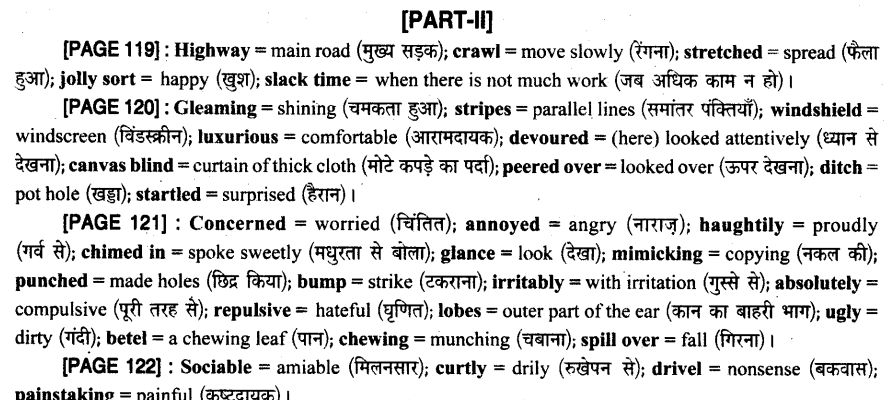
[PART-II]

[PAGE 119] : बसंत ऋतु में एक सुहावने दिन को जब दोपहर बाद वाली बस में गाँव से जाने ही वाली थी और मुख्य मार्ग पर मोड़ मुड़ने ही वाली थी, एक छोटी-सी बच्ची के चिल्लाने की आवाज़ सुनाई दी, ‘बस को रोको! बस को रोको!’ और आदेशात्मक मुद्रा में एक छोटा-सा हाथ उठा।
बस की गति धीमी हो गई और परिचालक ने दरवाजे से सिर बाहर निकालकर कहा, ‘जल्दी करो! जो कोई भी आ रहा है उसे जल्दी आने को कहो।’
‘यह मैं हूँ,’ वल्ली ने चिल्लाकर कहा, ‘मैं ही अकेली हूँ, जिसे बस में चढ़ना है।’
अब तक बस रुक चुकी थी और परिचालक ने कहा, ‘ओह, सचमुच! तुम ऐसा नहीं कहते!’
‘हाँ, मुझे तो सिर्फ कस्बे में जाना है,’ वल्ली ने अभी भी बस से बाहर खड़े हुए कहा, ‘और ये मेरे पैसे हैं’ उसने उसे कुछ सिक्के दिखाए।
‘ठीक है, ठीक है, लेकिन तुम पहले बस पर तो चढ़ जाओ’, परिचालक ने कहा और उसने उसे ऊपर चढ़ाने में मदद करने के लिए अपना हाथ आगे बढ़ाया।
‘चिन्ता मत करो, मैं स्वयं ही बस में चढ़ जाऊँगी। आपको मेरी मदद करने की आवश्यकता नहीं है,’ उसने कहा। __ परिचालक एक हँसमुख स्वभाव का मजाक का शौकीन व्यक्ति था, “ओह, मेरी सुन्दर मैडम कृपया मुझसे नाराज मत होइए’ उसने कहा, ‘वहाँ सामने एक सीट ले लीजिए। कृपया सभी रास्ते से हट जाइए। मैडम के लिए रास्ता बनाइए।”

HBSE 10th Class English Solutions First Flight Chapter 9 Madam Rides the Bus

यह दिन का मंदी वाला समय था और बस में केवल छह या सात सवारियाँ थीं। वे सभी वल्ली की ओर देख रही थी और परिचालक के साथ हँस रही थीं। वल्ली को शर्म आ रही थी। सभी की नज़रों से बचते हुए, वह तेजी से एक खाली सीट तक गई और बैठ गई।

[PAGE 120] : “मैडम, क्या अब हम चल सकते हैं?” परिचालक ने मुस्कराते हुए पूछा। तब उसने दो बार अपनी सीटी बजाई और एक शोर के साथ बस आगे चल दी।
यह एक नई बस थी, इसके बाहर चमकदार सफेद रंग हुआ था जिस पर हरे रंग की कुछ पट्टियाँ बनी थीं। अंदर ऊपर लगी लोहे की सलाखें चाँदी की तरह चमक रही थीं। वल्ली के बिल्कुल सामने हवा रोकने वाले शीशे के ऊपर वहाँ एक सुन्दर घड़ी लगी थी। सीटें नर्म और आरामदायक थीं।
वल्ली ने अपनी नज़रों से सब कुछ खोजा। लेकिन जब उसने बाहर देखना शुरु किया, उसने पाया कि उसकी नज़र को मोटे कपड़े से बने एक पर्दे से रुकावट पैदा हो रही थी जो उसकी खिड़की के निचले भाग को ढके हुए था। इसलिए वह उठकर सीट पर खड़ी हो गई और पर्दे के ऊपर से झाँकने लगी।
अब बस एक नहर के किनारे के साथ-साथ जा रही थी। सड़क बहुत तंग थी। उसके एक ओर तो नहर थी तथा इसके पार खजूर के पेड़, घास के मैदान, दूरी पर पर्वत व नीला-नीला आसमान था। दूसरी ओर एक गहरी खाई थी और फिर कई एकड़ में फैले हरे खेत, चारों ओर जहाँ तक नज़र जाती थी हरियाली-ही-हरियाली थी।।
‘ओह, यह सब कुछ कितना अद्भुत था।
अचानक ही वह एक आवाज़ सुनकर चौंक पड़ी, “सुनो, बच्चे,” आवाज़ ने कहा, “तुम्हें इस तरह से खड़े नहीं होना चाहिए, नीचे बैठ जाओ।”।

[PAGES 121-122] : नीचे बैठते हुए, उसने यह देखने का प्रयास किया कि कौन बोला था। वह एक बूढ़ा आदमी था जो सचमुच में उसके प्रति परवाह कर रहा था, लेकिन वह उसके ध्यान की वजह से नाराज़ हो रही थी।
“यहाँ ऐसा कोई नहीं है, जो बच्चा है,” उसने घमंडपूर्वक कहा, “मैंने भी अन्य सभी की तरह तीस पैसे का भुगतान किया है।”
परिचालक बीच में बोल पड़ा, “अरे, श्रीमान जी, लेकिन यह तो एक बहुत ही व्यस्क मैडम है। आपके विचार में क्या मात्र एक लड़की अपना किराया खुद दे सकती है और बिल्कुल अकेली शहर जा सकती है?”
वल्ली ने क्रोधित नज़रों से परिचालक की ओर देखा और कहा, ‘मैं मैडम नहीं हूँ। कृपया यह बात याद रखना कि आपने अभी तक मुझे मेरा टिकट नहीं दिया है।”
“मैं याद रखूगा,” परिचालक ने उसकी आवाज़ की नकल उतारते हुए कहा। हर कोई हँसने लगा और धीरे-धीरे वल्ली भी हँसी में शामिल हो गई।
परिचालक ने एक टिकट पर नम्बर छेदे और उसे वल्ली को पकड़ा दिया, “अब आराम से बैठ जाओ। जब तुमने सीट के पैसे दे रखे हैं तो तुम खड़ी क्यों हो?” .
“क्योंकि मैं खड़ा होना चाहती हूँ,” उसने उत्तर दिया, फिर से खड़ी होते हुए।
“लेकिन यदि तुम सीट के ऊपर खड़ी होती हो तो तुम गिर सकती हो और तुम्हें चोट लग सकती है। जब बस कोई तेज मोड़ काटेगी। बच्ची यही कारण है कि हम चाहते हैं कि तुम बैठ जाओ।” .
“मैं एक बच्ची नहीं हूँ, मैं आपको बता देती हूँ”, उसने चिढ़ते हुए कहा, “मैं आठ साल की हूँ।” ‘निःसंदेह, निःसंदेह। मैं भी कितना मूर्ख हूँ! आठ साल! हे भगवान!’
बस रुक गई, कुछ नए यात्री अंदर आए और थोड़ी देर के लिए परिचालक व्यस्त हो गया। अपनी सीट के खो जाने के भय से वल्ली अंततः नीचे बैठ गई।
एक वृद्ध महिला उसके पास आकर बैठ गई। “प्रिय, क्या तुम बिल्कुल अकेली हो?” जैसे ही बस पुनः चली उसने वल्ली से पूछा।
वल्ली को वह औरत पूर्णतया घृणाजनक लगी। उसके कानों के तलवों में कितने बड़े-बड़े सुराख थे और उनमें कितनी भद्दी बालियाँ थीं तथा वह उस सुपारी की गंध सूंघ सकती थी जिसे वह महिला चबा रही थी और पान के उस रस को देख सकती थी जो किसी भी पल उसके होठों से गिरने का भय पैदा कर रहा था। ओह! इस तरह के व्यक्ति के साथ कौन मिलनसार हो सकता है?

[PAGE 122] : “हाँ, मैं बिल्कुल अकेली यात्रा कर रही हूँ” उसने तीखे स्वर में उत्तर दिया। “और मैंने टिकट भी लिया है।” “हाँ, वह शहर जा रही है’ परिचालक ने कहा, तीस पैसे का एक टिकट लेकर”। “ओह, आप अपने काम पर ध्यान क्यों नहीं देते हो?” वल्ली ने कहा। लेकिन वह फिर भी हँस पड़ी और परिचालक भी हँसने
लगा।
लेकिन बूढ़ी औरत ने अपनी बकबक जारी रखी। “क्या इतने छोटे व्यक्ति के लिए अकेले यात्रा करना उचित है? क्या तुम्हें सही-सही पता है कि तुम शहर में कहाँ जा रही हो? कौन-सी गली है? क्या मकान नम्बर है?”
“आपको मेरे बारे में चिंता करने की आवश्यकता नहीं है। मैं अपना ख्याल खुद रख सकती हूँ।” वल्ली ने खिड़की की ओर अपना चेहरा घुमाते हुए कहा और बाहर देखने लगी।

HBSE 10th Class English Solutions First Flight Chapter 9 Madam Rides the Bus

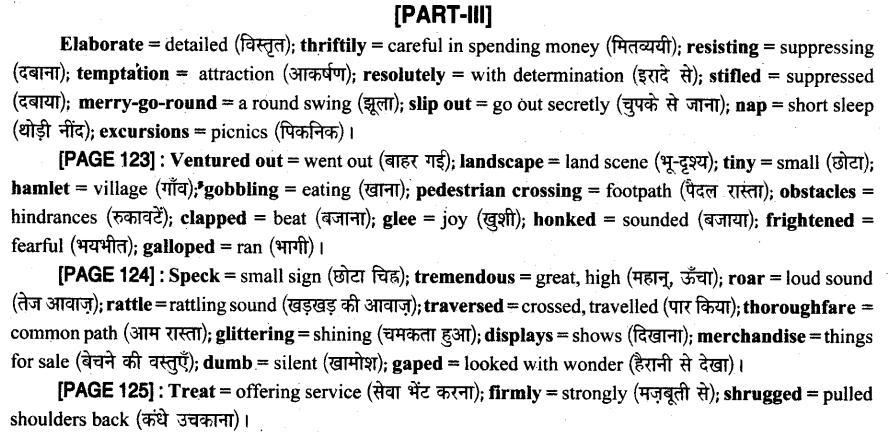
[PART-III]

उसकी पहली यात्रा इसके लिए उसको कितना ध्यानपूर्वक, परिश्रम के साथ और सोच-समझकर योजनाएँ बनानी पड़ी थीं! जो भी छोटे-छोटे सिक्के उसके हाथ लग जाते थे कितनी किफायत के साथ उन्हें बचाकर के रखा था और कैसे अपने-आपको पुदीने की गोलियाँ, खिलौने, गुब्बारे और इस तरह की अन्य चीजें खरीदने से रोककर रखा था और आखिरकार उसने 60 पैसे बचा लिए थे। यह सब कुछ उसके लिए कितना कठिन था, खासतौर पर गाँव के मेले वाले दिन लेकिन उसने दृढ़ निश्चय के साथ झूलों पर सवार होने की अपनी इच्छा को दबा दिया था, जबकि उसके पास पैसे भी थे।

उसने पर्याप्त धन बचा लिया था, उसके बाद उसकी अगली समस्या थी अपनी माँ को बिना बताए कैसे घर से बाहर निकले। लेकिन बिना किसी अधिक कठिनाई के उसने इसकी व्यवस्था कर ली। दोपहर का भोजन करने के पश्चात् उसकी माँ एक बजे से लेकर चार बजे तक हल्की नींद लिया करती थी। वल्ली इन घंटों का प्रयोग हमेशा अपने ‘सैर-सपाटे’ के लिए किया करती थी। जब वह अपने घर के दरवाजे पर खड़ी होकर बाहर देखती थी या फिर कई बार गाँव में भी जाने का साहस कर लेती थी। आज वह इन घंटों का प्रयोग गाँव से बाहर उसके पहले भ्रमण के लिए करेगी।

[PAGE 123] : कभी बस एक पेड़ रहित भूमि क्षेत्र, कभी किसी छोटे-से गाँव से भागती हुई तथा रास्ते के किनारे बनी किसी दुकान के पास से निकलती हुई आगे बढ़ रही थी। कई बार ऐसा प्रतीत होता था कि बस अपनी ओर आते हुए किसी दूसरे वाहन अथवा सड़क पार कर रहे किसी पद यात्री को निगल जाएगी। लेकिन यह तो सभी बाधाओं को सुरक्षित भय से पीछे छोड़ते हुए आराम से निकल जाती थी। वृक्ष उनकी ओर भागते हुए प्रतीत होते थे लेकिन जब बस उनके पास पहुँचती थी तो वे वहीं रुक जाते थे और सड़क के एक ओर एक पल के लिए असहाय हुए खड़े रहते और फिर दूसरी दिशा में भागने लगते।

अचानक ही वल्ली ने (खुशी से) अपने दोनों हाथों से ताली बजा दी। एक छोटी-सी गाय हवा में अपनी पूँछ को उठाकर बहुत तेजी से भाग रही थी, बिल्कुल सड़क के बीच में, ठीक बस के सामने। बस की गति धीमी हो गई और चालक बार-बार हॉर्न बजा रहा था। लेकिन वह जितना ज्यादा हॉर्न बजाता पशु उतना अधिक भयभीत हो जाता तथा और तेजी से भागता हमेशा ठीक बस के आगे।

[PAGE 124] : यह बात वल्ली को बहुत अधिक मनोरंजक लगी। वह तब तक हँसती रही जब तक कि उसकी आँखों से आँसू नहीं आ गए।
‘अरे युवती, क्या तुम बहुत ज्यादा नहीं हँस ली हो?’ परिचालक ने आवाज लगाई, ‘बेहतर होगा, कुछ हँसी कल के लिए बचाकर रख लो।’
अंततः गाय सड़क से हट गई और शीघ्र ही बस एक रेलवे क्रॉसिंग के पास आ गई। दूर से रेलगाड़ी एक छोटे-से धब्बे के समान दिखाई दे रही थी, जैसे-जैसे वह निकट आ रही थी, बड़ी और बड़ी होती जा रही थी। तब वह बहुत अधिक शोर और खट-खट के साथ क्रॉसिंग गेट को पार कर गई, बस को हिलाते हुए। तब बस चल दी और उसने स्टेशन को पार किया। वहाँ से उसने एक अच्छी तरह से सजी हुई दुकानों वाले बाजार को पार किया और मुड़ने के बाद एक अधिक चौड़े रास्ते पर आ गई। इतनी बड़ी, चमकदार दुकानें। वस्त्रों तथा बेचने की अन्य चीज़ों का कितना चमकदार प्रदर्शन हो रहा था। इतनी ज्यादा भीड़!
हैरानी के कारण मूक बनी वल्ली हर चीज़ को मुँह खोले देखती रही। ‘हे युवती,’ परिचालक ने कहा, ‘क्या तुम नीचे उतरने के लिए तैयार नहीं हो? तुम्हारे तीस पैसे तुम्हें यहीं तक ला सकते थे।’
‘नहीं, वल्ली ने कहा, ‘मैं इसी बस पर वापस जा रही हूँ।’ उसने अपनी जेब से और तीस पैसे निकाले तथा सिक्के परिचालक को सौंप दिए।
‘क्यों, क्या कुछ बात हो गई है?’ ‘नहीं, कोई बात नहीं है। मैं तो सिर्फ बस की सवारी करना चाहती थी और वह मैंने कर ली।’ ‘क्या तुम कुछ दृश्यों को नहीं देखना चाहोगी, अब तब तुम यहाँ आ ही गई हो।’ ‘बिल्कुल अकेली? अरे, मुझे बहुत अधिक डर लगेगा।’
लड़की के बोलने के ढंग से अत्यधिक प्रसन्न होकर परिचालक ने कहा, ‘लेकिन तुम्हें बस में आते समय तो डर नहीं लगा।
‘उसमें डर वाली कोई बात नहीं थी, उसने उत्तर दिया। ‘ठीक है, तो फिर तुम वहाँ उस दुकान पर जाकर कुछ पीना क्यों नहीं चाहोगी? उसमें तो डरने की भी कोई बात नहीं है।’ ‘अरे नहीं, मैं ऐसा नहीं कर सकती हूँ।’ ‘तो ठीक है, मुझे तुम्हारे लिए एक शीतल पेय लाने दो।’ .

[PAGES 125-126] : ‘नहीं, मेरे पास पर्याप्त पैसे नहीं हैं। बस मुझे तो मेरा टिकट दे दो, यही काफी है।’ यह मेरी तरफ से दावत रहेगी और इसका तुम्हें कोई खर्च नहीं करना पड़ेगा। ‘नहीं, नहीं’ उसने दृढ़तापूर्वक कहा, ‘कृपया नहीं।’
परिचालक ने अपने कंधे सिकोड़ लिए तथा वे प्रतीक्षा करते रहे जब तक कि बस की वापसी की यात्रा का समय नहीं हो गया। दोबारा बस में फिर से अधिक यात्री नहीं थे।

[PART-IV]

‘क्या तुम्हारी माँ तुम्हें ढूंढ नहीं रही होगी?’ परिचालक ने पूछा जब उसने उसे टिकट दिया। ‘नहीं, कोई भी मेरी तलाश नहीं कर रहा होगा,’ उसने कहा। बस चल दी और फिर से वहाँ वहीं अद्भुत दृश्य थे।
वल्ली का मन बिल्कुल भी नहीं ऊबा और वह प्रत्येक चीज़ का उसी उत्साह से स्वागत कर रही थी जैसा पहली बार देखने पर किया था। लेकिन अचानक ही उसने एक छोटी गाय को सड़क किनारे मृत पड़े हुए पाया, ठीक उसी स्थान पर जहाँ किसी तेज रफ्तार वाले वाहन ने उसे टक्कर मारी थी।
‘क्या यह वहीं गाय नहीं है जो शहर आते समय हमारी बस के आगे भाग रही थी?’ उसने परिचालक से पूछा।
परिचालक ने हाँ में सिर हिलाया और उस पर उदासी छा गई। कुछ ही समय पहले जो एक प्यारा, सुन्दर जीव था अब अचानक अपनी सुन्दरता और जीवन खो चुका था और इतना भयानक और डरावना लग रहा था। जब वह वहाँ पड़ा हुआ था, टाँगें फैली हुईं, बेजान आँखों में एक स्थायी टकटकी भरे हुए और सब जगह खून के साथ।
बस आगे चल दी। मृत गाय की याद उसे परेशान कर रही थी, उसके उत्साह को ठंडा कर रही थी। अब वह खिड़की से बाहर नहीं देखना चाहती थी।
वह अपनी सीट पर तब तक चिपकी हुई बैठी रही जब तक कि तीन चालीस पर बस उसके गाँव नहीं पहुंच गई। वह उठी और उसने एक अंगड़ाई ली। तब वह परिचालक की ओर मुड़ी और कहा, ‘अच्छा श्रीमान जी, मैं आपसे फिर मिलने की आशा रखूगी।’

[PAGE 126] : ‘ठीक है, मैडम,’ उसने उसे मुस्कराते हुए उत्तर दिया, ‘जब कभी भी बस की सवारी करने को तुम्हारा मन करे, तो हमारे साथ आ जाना और अपना किराया लाना मत भूलना।’
वह हँसी और उसने बस से छलाँग लगा दी। तब वह सीधी घर की ओर भाग गई।
जब वह घर में घुसी तो उसने अपनी माँ को जागा हुआ पाया और दक्षिणी गली में रहने वाली वल्ली की एक मौसी से बातें करते हुए पाया। वह मौसी वास्तव में एक बातूनी थी, यदि एक बार बोलना शुरु कर देती थी तो कभी अपना मुँह बंद नहीं करती थी।
‘और तुम कहाँ थी?’ उसकी मौसी ने पूछा जब वल्ली अंदर आई। वह बहुत बेरुखी से बोली, उसे उत्तर की आशा नहीं थी। इसलिए वल्ली सिर्फ मुस्कराई और उसकी माँ तथा मौसी अपने वार्तालाप को जारी रखती रही।
‘हाँ, तुम ठीक हो,’ उसकी माँ ने कहा, ‘कितनी सारी चीजें हमारे में और हमारे से बाहर की दुनिया में होती हैं। हम संभवतः हर चीज़ के बारे में कैसे जान सकते हैं और यदि हमें किसी बात के बारे में पता भी चल जाता है तो हम उसे पूर्णतया समझ नहीं पाते हैं, क्या समझ पाते हैं?’
‘ओह, हाँ!’ वल्ली ने सांस लेते हुए कहा।
‘ओह, वल्ली ने कहा, ‘मैं तो केवल उस बात से सहमति व्यक्त कर रही थी जो आप कह रही थी हमारी जानकारी के बिना घटित होने वाली बातों के बारे में।
‘एक छोटी-सी लड़की है वह,’ उसकी मौसी ने कहा।
‘और देखो वह हमारी बातचीत में बिना किसी मतलब के अपनी टाँग अड़ा रही है जैसेकि वह एक समझदार औरत हो।’
वल्ली स्वयं पर मुस्कराई। वह नहीं चाहती थी कि वे उसकी मुस्कराहट का अर्थ समझें। लेकिन फिर इसकी कोई ज्यादा सम्भावना भी नहीं थी, क्या थी?

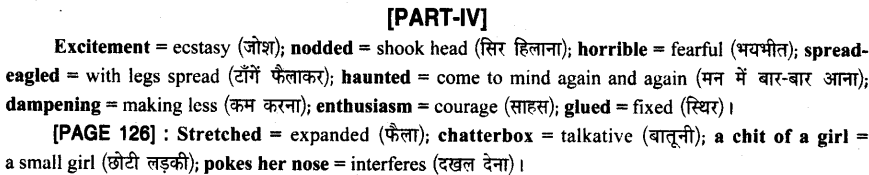
Madam Rides the Bus Word-Meanings in Hindi

[PART-I]

[PAGE 116] : Induction = entry (प्रवेश); mystery = secret (रहस्य); gap = difference (अंतर)।
[PAGE 117] : Curious = eager (उत्सुक); pastime = hobby (शौक); elaborate = detailed (विस्तृत)।
[PAGE 118] : Fascinating = attractive (आकर्षक); gradually = slowly (धीरे-धीरे); overwhelming = strong (मज़बूत); stare = look fixedly (घूरना); wistfully = with longing (इच्छा से); kindle = create (पैदा करना, उकसानां); longings = strong desires (तीव्र इच्छाएँ); slang = informal language (अनौपचारिक भाषा); disapproval= refusal (असहमति); discreet = quiet (शांत); various = many (कई); scarcely = hardly (मुश्किल से); calculated = made a count (गिनती करना)।
HBSE 10th Class English Solutions First Flight Chapter 9 Madam Rides the Bus

HBSE 10th Class English Solutions First Flight Chapter 9 Madam Rides the Bus 1 HBSE 10th Class English Solutions First Flight Chapter 9 Madam Rides the Bus 2 HBSE 10th Class English Solutions First Flight Chapter 9 Madam Rides the Bus 3

HBSE 10th Class English Solutions First Flight Chapter 9 Madam Rides the Bus Read More »
HBSE 10th Class English Solutions First Flight Chapter 8 Mijbil the Otter

Haryana State Board HBSE 10th Class English Solutions First Flight Chapter 8 Mijbil the Otter Textbook Exercise Questions and Answers.

Haryana Board 10th Class English Solutions First Flight Chapter 8 Mijbil the Otter

HBSE 10th Class English Mijbil the Otter Textbook Questions and Answers

Activity

Mijbil The Otter Solutions HBSE 10th Class Question 1.
Do you have a pet? If you do, you perhaps know that a pet is a serious responsibility. Read in the box below what the SPCA-the Society for the Prevention of Cruelty to Animals – has to say about how to care for a pet Owning a pet is a lifetime of commitment (up to ten years or more if you own a dog or a cat) involving considerable responsibility. The decision to acquire one, therefore, should be made by the whole family. Without full agreement by everyone, the pet could end up unwanted. Puppies and Kittens are so adorable, it is easy to understand why adults and children alike would be attracted to them. Unfortunately, their cute looks are often a disadvantage, because people purchase them without consideration and the knowledge on how to take proper care of them.The basic points you should keep in mind before adopting a puppy are :

  1. an annual dog licence in accordance with government regulations
  2. its annual vaccination against major diseases.
  3. toilet training
  4. regular grooming and bathing
  5. obedience training
  6. don’t forget you should feed your pet a balanced diet
  7. socialisation (many dogs are kept confined in cages or tied up to stop them from dirtying the garden or from chewing on shoes this is wrong) is very important
  8. a daily dose of exercise, affection and play.

Reading up on the subject beforehand is another important requirement and will guide you towards being a responsible pet owner. Selected pet shops and major book stores provide books on the care of various breeds/pets.
Answer:
Yes, I have a pet dog. I call it Tony. It is really a serious responsibility to keep the pet in a fine shape and condition.

HBSE 10th Class English Solutions First Flight Chapter 8 Mijbil the Otter

Ch Mijbil The Otter Question Answer HBSE 10th Class Question 2.
Imagine someone has gifted you a pet With your partner’s help, make a list of the things you need to know about the pet in order to take good care of it. One has been done for you.
1. The food it eats.
2. …………………….
3. ……………………
4. …………………….
5. ……………………..
Answer:

  1. The food it eats.
  2. How it should be kept clean.
  3. When it is to be taken out for toilet etc.
  4. When it is to be put on leash.
  5. Where it should be kept.

Mijbil The Otter Question Answer HBSE 10th Class Question 3.
Otters are found in large numbers in the marshes (Le., wet areas near lakes, rivers or seas) near Basra, a town in Iraq. Imagine you wanted to bring an otter from Iraq to London, as a pet. What special arrangements would you need to make for your pet otter ? You would need to find a place with lots of water, for example. What other points should you think about ? The information about Iraq and London given below may help you.

IraqLondon
Iraq has mostly broad plains and marshes along the Iranian border in the south, with large flooded areas. A large part of Iraq’s land area is desert,so it has cool winters and dry, hot and cloudless summers. The mountain areas near Iran and Turkey have cold winters. There is heavy snowfall there, and when the snow melts in spring, it causes floods in central and Southern Iraq.London has a large population and is a very busy city. In addition to multistoreyed buildings, however, it has many open spaces or parks. It has a temperate climate (i.e. it is neither very hot, nor very cold), with regular but generally light rainfall or snow throughout the year. The warmest month is July, and the coolest month is January. February is the driest month. Snow is not very common in London.

Answer:
Otters need a lot of water or marshy area. So special arrangements would be needed for providing the otter a place that has a plenty of water. I shall have to provide the proper temperature in that place if it is other than the one in which the otters survive. I shall have to take special care for the otter’s food. An otter should not feel lonely. So I shall have to provide various things with which the otter can play. I shall also have to take the services of a qualified veterinary doctor for this purpose. I shall have to provide regular training to him so that he becomes accustomed to be called by his name and to understand my gestures or sounds.

Oral Comprehension Check (Page 106)

Mijbil The Otter Class 10 Questions And Answers HBSE Question 1.
What ‘experiment’ did Maxwell think Camusfearna would be suitable for ?
(मैक्सवैल के विचार में कैमस्फर्ना किस प्रकार के ‘प्रयोग’ के लिए उपयोगी होगा ?)
Answer:
The author thought that he would make an experiment by keeping an otter as a pet at his house in Camusfearna. He thought that Camusfearna would be suitable for keeping an otter because it was ringed by water at a very short distance. Otters live mainly in water or in marshy areas.
(लेखक सोचता था कि वह कैमस्फर्ना में अपने घर में एक ऊदबिलाव को पालकर एक प्रयोग करेगा। वह सोचता था कि कैमस्फर्ना इस प्रयोग के लिए बिल्कुल सही साबित होगा क्योंकि वह थोड़ी ही दूरी पर पानी से घिरा हुआ था। ऊदबिलाव मुख्य रूप से या तो पानी में या फिर दलदल में रहते हैं।)

HBSE 10th Class English Solutions First Flight Chapter 8 Mijbil the Otter

Mijbil The Otter Summary HBSE 10th Class Question 2.
Why does he go to Basra? How long does he wait there, and why
(वह बसरा क्यों जाता है ? वह वहाँ कितने समय तक प्रतीक्षा करता है और क्यों ?)
Answer:
The author goes to Basra to the Consulate-General to collect and answer mail from Europe. His mail does not reach in time and he has to wait there for five days.
(लेखक बसरा दूतावास केंद्र में यूरोप से आने वाली डाक को लेने और उसका जवाब देने के लिए जाता है। उसकी डाक समय पर नहीं आती, इसलिए उसे पाँच दिन तक वहाँ पर प्रतीक्षा करनी पड़ती है।)

Class 10 English Chapter 8 Mijbil The Otter Question Answer HBSE Question 3.
How does he get the otter? Does he like it? Pick out the words that tell you this.
(वह ऊदबिलाव कैसे प्राप्त करता है ? क्या वह उसे पसंद करता था ? यह बताने वाले शब्द छाँटिए।)
Answer:Finally he gets his mail. He went to his bedroom to read the mail. There he saw two Arabs with a sack. There was an otter in the sack. The Arabs told him that there was an otter for him in the sack. The author liked it. The following words show that he liked it: “The second night Mijbil came on to my bed in the small hours and remained asleep in the crook of my knees
(आखिरकार उसने अपनी डाक हासिल की। वह डाक को पढ़ने के लिए अपने शयनकक्ष में गया। वहाँ उसने एक बोरी के साथ दो अरबों को देखा। अरबों ने उसे बताया कि बोरी में उसके लिए एक ऊदबिलाव है। लेखक ने उसे पसंद किया। निम्नलिखित शब्द उसकी पसंद के बारे में बताते हैं- “दूसरी रात को आधी रात के बाद मिजबिल मेरे बिस्तर में आ गया और मेरे घुटनों के मोड़ों के बीच में सोता रहा……. “)

Mijbil The Otter Word Meaning HBSE 10th Class Question 4.
Why was the otter named ‘Maxwell’s otter’?
(ऊदबिलाव का नाम ‘मैक्सवैल का ऊदबिलाव’ क्यों रखा गया ?)
Answer:
The otter was named ‘Maxwell’s otter’ because his race was not previously known to scientists. (ऊदबिलाव का नाम ‘मैक्सवैल का ऊदबिलाव’ रखा गया क्योंकि उसकी प्रजाति का वैज्ञानिकों को पहले से कोई ज्ञान नहीं था।)

Mijbil The Otter Summary In Hindi HBSE 10th Class Question 5.
Tick the right answer. In the beginning, the otter was
1. aloof and indifferent
2. friendly
3. hostile
(सही उत्तर का चयन कीजिए। आरम्भ में ऊदबिलाव था
1. अकेला और उदासीन
2. मित्रतापूर्वक
3. शत्रु
Answer:
A loof and indifferent.
(अकेला और उदासीन)

6. What happened when Maxwell took Mijbil to the bathroom? What did it do two days after that?
(क्या हुआ जब मैक्सवैल मिजबिल को स्नानगृह में ले गया ? उसने उसके दो दिन बाद क्या किया ?)
Answer:
The otter greatly liked to be in water. For half an hour he went wild with joy in the water. He plunged and rolled in it. He shot up and down the length of the bathtub underwater. He made enough slosh and splash. After two days Mijbil escaped from the author’s bedroom. He entered the bathroom to play in water.
(ऊदबिलाव पानी में रहना बहुत अधिक पसंद करता था। आधे घंटे तक वह पानी में खुशियों से पागल होता रहा। वह उसमें लोट-पोट होता रहा। वह पानी की टब में पानी के नीचे भागता रहा। उसने पानी में बहुत अधिक छपाक-छपाक की। दो दिन बाद मिजबिल लेखक के शयनकक्ष से भाग निकला। वह पानी में खेलने के लिए स्नानगृह में घुस गया।) Oral Comprehension

Question Answer Of Mijbil The Otter HBSE 10th Class

Oral Comprehension Check (Pages 108-109)

Mijbil The Otter Meaning In Hindi HBSE 10th Class Question 1.
How was Mij to be transported to England ?
(मिज को इंग्लैंड कैसे ले जाया जाना था ?)
Answer:
Mij was to be transported to England by air.. The author knew that the British airline didn’t fly animals. So he booked a flight to Paris on another airline and from there to London. He packed the otter into a box. He kept the otter on his knee in the air craft.
(मिज को हवाई जहाज से इंग्लैंड ले जाया जाना था। लेखक जानता था कि ब्रिटिश एयरलाइन जानवरों के साथ उड़ान भरने की अनुमति नहीं देती। इसलिए उसने दूसरी एयरलाइन से पेरिस तक की उड़ान बुक कराई और वहाँ से लंदन के लिए। उसने ऊदबिलाव को डिब्बे में डाल दिया। हवाई जहाज में ऊदबिलाव को अपने घुटनों पर रख लिया।)

Mijbil The Otter Questions And Answers HBSE 10th Class Question 2.
What did Mij do to the box?
(मिज ने डिब्बे का क्या किया ?)
Answer:
Mij had torn the lining of the box to pieces. In making this effort, he got injured and there was blood at the airholes of the box.
(मिज ने डिब्बे के अंदर लगे कपड़े के छोटे-छोटे टुकड़े कर दिए थे। यह करते हुए, वह घायल हो गया था और डिब्बे के हवा वाले छिद्रों पर खून लगा हुआ था।)

HBSE 10th Class English Solutions First Flight Chapter 8 Mijbil the Otter

Mijbil The Otter Question Answers HBSE 10th Class Question 3.
Why did Maxwell put the otter back in the box? How do you think he felt when he did this?
(मैक्सवैल ने ऊदबिलाव को वापस डिब्बे में क्यों डाल दिया ? आपके विचार में जब उसने यह किया वह क्या सोच रहा था ?)
Answer:
Maxwell put the otter back in the box because the airline would not fly him without the box. He was in a tense situation. There were only ten minutes until the time of the flight and the airport was five miles away.
(मैक्सवेल ने ऊदबिलाव को डिब्बे में वापिस डाल दिया क्योंकि एयरलाइन वाले उसे बिना डिब्बे के यात्रा करने की अनुमति नहीं देंगे। वह एक तनाव वाली स्थिति में था। जहाज की उड़ान में केवल दस मिनट का समय रह गया था और हवाई अड्डा अभी पाँच मील दूर था।)

Mijbil The Otter Class 10 Introduction HBSE Question 4.
Why does Maxwell say the airhostess was “the very queen of her kind”? (मैक्सवैल क्यों कहता है कि परिचारिका “अपनी किस्म की एक रानी थी” ?)
Answer:
Maxwell says this because the air hostess was very cooperative. She showed great kindness to the well-being of the otter. She offered to get the otter back when it escaped from the box in the plane.
(मैक्सवैल यह इसलिए कहता है क्योंकि परिचारिका बहुत सहयोगी थी। उसने ऊदबिलाव के स्वस्थ होने के लिए बहुत अधिक दयालुता दिखाई। जब ऊदबिलाव जहाज में अपने डिब्बे से बचकर भाग गया था तो उसने उसे वापस पकड़कर लाने की पेशकश की।)

Mijbil The Otter Class 10 Solutions HBSE Question 5.
What happened when the box was opened ?
(क्या हुआ जब डिब्बा खोला गया ?)
Answer:
When the box was opened the otter disappeared at high speed down the aircraft. There were noises all around with “A rat! A rat!”
(जब डिब्बा खोला गया तो ऊदबिलाव पूरी गति के साथ जहाज में नीचे अदृश्य हो गया। वहाँ चारों ओर “चूहा! चूहा!” की आवाजें थीं।)

Oral Comprehension Check (Page 110)

Question 1.
What game had Mij invented ?
(मिज ने किस खेल का आविष्कार किया ?)
Answer:
Mij had invented the game of a ball and a suitcase. The suitcase’s lid did not fit properly and had developed a certain slope. Mij would place the ball on the high end. The ball would roll towards the lower end. Then the otter would run to the other end to stop the arrival of the ball.
(मिज ने एक गेंद और अटैची का खेल सीख लिया था। अटैची का ढक्कन ठीक तरह से बंद नहीं होता था और उसमें एक खास किस्म की ढलान पैदा हो गई थी। मिज ऊँचे वाले सिरे पर गेंद को रखता था। गेंद नीचे वाले सिरे की ओर लुढ़कती थी। तब ऊदबिलाव गेंद को रोकने के लिए दूसरे सिरे की ओर भागता था।)

Question 2.
What are compulsive habits’? What does Maxwell say are the compulsive habits of
1. school children
2. Mij?
आवश्यक आदतें’ क्या हैं ? मैक्सवैल के अनुसार इनकी आवश्यक आदतें क्या हैं ?
1. स्कूली बच्चे
2. मिज ?)
Answer:
“Compulsive habits’ are those habits in which people indulged instinctively. These become the integral part of the people through constant use.

  1. School children place their feet squarely on the centre of each paving block. They touch every seventh upright of the iron railings. They pass to the outside of every second lamp post.
  2. Mij would tug the author to the wall of the school near his house. He would jump on to it. Then he would gallop the full length of its thirty yards.

Question 3.
What group of animals do otters belong to? (पशुओं के किस समूह से ऊदबिलावों का सम्बन्ध है ?)
Answer:
Otters belong to the small group of animals called Mustellines. Badgers, mongooses, weasels, stoats, minks, etc. also belong to this family.
(ऊदबिलावों का सम्बन्ध पशुओं के एक छोटे समूह मस्टेलाइन्ज से है। बिज्जू, नेवला, कथियान्याल, स्टोट, विस्त्रक इत्यादि इसी समूह के जानवर हैं।)

Question 4.
What guesses did the Londoners make about what Mij was ?
(लंदनवासियों ने मिज के बारे में क्या अनुमान लगाए ?)
Answer:
The Londoners made guesses that Mij was a baby seal’, ‘asquirrel’, ‘a walrus’, ‘a beaver’, ‘a bear cub’, ‘a leopard’ and ‘a brontosaur’.
(लंदनवासियों ने अनुमान लगाए कि मिज ‘एक सील मछली का बच्चा’, ‘एक गिलहरी’, ‘एक वालरस’, ‘एक बीवर’, ‘एक रीछ का बच्चा’, ‘एक तेंदुआ’ और ‘एक ब्रोन्टोसार’ था।)

Thinking About the Text (Pages 110 – 111)

Question 1.
What things does Mij do which tell you that he is an intelligent, friendly and fun-loving animal who needs love?
(मिज कौन-कौन से कार्य करता है जिससे आपको पता चलता है कि वह एक प्रतिभाशाली, मित्रतापूर्वक और विनोद-प्रिय पशु है जो प्यार चाहता है ?)
Answer:
Mij does a number of things which show that he is an intelligent, friendly and fun-loving animal which needs love. He plunges and rolls in water. He shoots up and down the bathtub underwater. He makes enough slosh and splash. He learns how to turn the water tap enough to produce a trickle of water. He plays and juggles small objects between his paws lying on its back. He nuzzles the author’s face and neck. He jumps on the low wall and runs on it.
(मिज बहुत सारे काम करता है जिससे पता चलता है कि वह प्रतिभाशाली, मित्रतापूर्वक और विनोद-प्रिय पशु है जो प्यार चाहता है। वह पानी के अंदर लोट-पोट करता है। वह पानी के टब में पानी के नीचे दौड़ता है। वह बहुत अधिक छपाक-छपाक करता है। वह सीख जाता है कि पानी प्राप्त करने के लिए पानी की टोंटी को कैसे खोला जाता है। वह अपनी पीठ के बल लेटकर छोटी-छोटी चीजों को अपने पंजों के बीच में लेकर साथ खेलता है। वह लेखक के चेहरे और गर्दन पर अपनी नाक रगड़ता है। वह नीची दीवार के ऊपर कूद जाता है और उस पर भागता है।)

HBSE 10th Class English Solutions First Flight Chapter 8 Mijbil the Otter

Question 2.
What are some of the things we come to know about otters from this text? (इस अध्याय से हमें ऊदबिलावों के बारे में कौन-कौन-सी बातों का पता चलता है ?)
Answer:
This text tells us many things about otters. Otters are intelligent and fun loving animals. Like dogs, they can be trained to obey commands and to respond to their name. They love water and like to live in marshy places.
(इस अध्याय से हमें ऊदबिलावों के बारे में बहुत-सी बातों का पता चलता है। ऊदबिलाव प्रतिभाशाली और विनोद-प्रिय जानवर होते हैं। कुत्तों की तरह, उन्हें भी आदेशों का पालन करने और नाम पुकारे जाने पर उत्तर देना सिखाया जा सकता है। वे पानी से प्यार करते हैं और दलदल में रहना पसंद करते हैं।)

Question 3.
Why is Mij’s species now known to the world as Maxwell’s otter? (मिज की प्रजातियों को अब संसार में मैक्सवैल ऊदबिलाव के नाम से क्यों जाना जाता है ?)
Answer:
Before Maxwell brought an otter from Iraq, its species was not known to the world. Therefore, the scientists gave it a new scientific name and it was called Maxwell’s otter.
(मैक्सवैल के द्वारा ईराक से ऊदबिलाव को लाए जाने से पहले, इसकी प्रजाति के बारे में संसार को ज्ञान नहीं था। इसलिए, वैज्ञानिकों ने इसे एक नया वैज्ञानिक नाम दे दिया और इसे मैक्सवैल ऊदबिलाव के नाम से जाना जाने लगा।)

Question 4.
Maxwell in the story speaks for the otter, Mij. He tells us what the otter feels and thinks on different occasions. Given below are some things the otter does. Complete the column on the right to say what Maxwell says about what Mij feels and thinks.

What Mij doesHow Mij feels or thinks
Plunges, rolls in the water and makes the water splosh and splash
Screws the tap in the wrong way
Nuzzles Maxwell’s face and neck in the aeroplane

(कहानी में मैक्सवैल ऊदबिलाव मिज के बारे में बताता है। वे बताते हैं कि ऊदबिलाव अलग-अलग अवसरों पर क्या महसूस करते हैं और सोचते हैं। नीचे कुछ बातें दी गई हैं जो ऊदबिलाव करता है। निम्नलिखित कॉलम को पूरा करें कि मैक्सवैल क्या कहता है मिज के बारे में जो वह महसूस करता है और सोचता है। . मिज क्या करता है
मिज कैसे सोचता है पानी में लोटपोट होता है और छपाक-छपाक करता है गलत दिशा में टोंटी को कस देता है हवाई जहाज में मैक्सवैल के चेहरे और गर्दन पर अपनी नाक रगड़ता है।)

मिज कैसे करता  हैमिज कैसे सोचता है
मिज क्या करता है पानी में लोटपोट होता है

और छपाक-छपाक करता है

गलत दिशा में टोंटी को कस देता है

हवाई जहाज में मैक्सवैल के चेहरे और गर्दन पर अपनी नाक रगड़ता है।)

Answer:
(a) He thinks that the bathroom is the best place in the house. He feels that he is a hippo and is very happy.
(b) He chitters with irritation and disappointment.
(c) He feels much comfort and content after its distressed chitter.
(a) वह सोचता है कि स्नानगृह घर में सबसे अच्छी जगह है। वह स्वयं को एक दरयाई घोड़ा मानता है और बहुत खुश होता है।
(b) वह आक्रोश और निराशा के साथ चिट-चिट की आवाज़ करता है।
(c) वह अपनी दुख भरी चिट-चिट के पश्चात् बहुत अधिक राहत और संतुष्टि महसूस करता है।)

Question 5.
Read the story and find the sentences where Maxwell describes his pet otter. Then choose and arrange your sentences to illustrate those statements below that you think are true.
Maxwell’s description
1. makes Mij seem almost human, like a small boy.
2. shows that he is often irritated with what Mij does.
3. shows that he is often surprised by what Mijdoes.
4. of Mij’s antics is comical.
5. shows that he observes the antics of Mij very carefully.
6. shows that he thinks Mij is a very ordinary otter.
7. shows that he thinks the otter is very unusual.
Answer:

  1. True
  2. False
  3. True
  4. False
  5. True
  6. False
  7. True.

Thinking About Language

I. Describing a Repeated Action in the Past
To talk about something that happened regularly in the past, but does not happen any longer, we use would or used to. Both would and used to can describe repeated actions in the past.
1. Mij would follow me without a lead and come to me when I called his name.
2. He would play for hours with a selection of toys.
3. On his way home … Mij would tug me to this wall.
4. When I was five years old, I used to follow my brother all over the place.
5. He used to tease me when Mother was not around.
To describe repeated states or situations in the past, however, we use only used to. (We cannot use would for states or situations in the past.) So we do not use would with verbs like be, have, believe, etc. Look at the following sentences :

  1. When we were young, we used to believe there were ghosts in school. (Note : believe shows a state of mind.)
  2. Thirty years ago, more women used to be housewives than now. (Note : be here describes a situation.)

From the table below, make as many correct sentences as you can using would and/or used to, as appropriate. (Hint: First decide whether the words in italics show an action, or a state or situation, in the past.) Then add two or three sentences of your own to it.

Emperor Akbarbe fond of musical evenings.
Every evening wetake long walks on the beach.
Fifty years ago, very few peoplewould used toown cars.
Till the 1980s, Shanghaihave very dirty streets.
My unclespend his holidays by the sea.

Answer:
1. Emperor Akbar used to be fond of musical evenings.
2. Every evening we would take long walks on the beach.
3. Fifty years ago, very few people used to own cars.
4. Till the 1980s, Shanghai used to have very dirty streets.
5. My uncle would spend his holidays by the sea.

Sentences from my own side:

  1. When we lived in Sirsa, there used to be a big tree in our courtyard.
  2. In the past people used to believe that the earth was flat.
  3. At bed time, my grandmother would tells us fairy stories.
  4. He would sit on the platform and watch the coming and going trains for hours.

II. Noun Modifiers
To describe or give more information about a noun (or to modify a noun), we use adjectives or adjectival phrases.
Look at these examples from the text:

  1. An eminently suitable spot
  2. His wide, flat belly
  3. Symmetrical pointed scales
  4. A ricochetting bullet

Nouns can also be used as modifiers :

  1. The dinner party
  2. A designer dress
  3. The car keys

We can use more than one noun as modifier. Proper nouns can also be used :

  1. The Christmas dinner party
  2. A silk designer dress
  3. The Maruti car keys

In the examples below, there is an adjectival phrase in front of a noun modifier :

  1. The lovely Christmas party
  2. A trendy silk designer dress
  3. The frightfully expensive golden Maruti car keys

Question 1.
Look at these examples from the text, and say whether the modifiers (in italics) are nouns, proper nouns, or adjective plus noun.
1. An otter fixation
2. The iron railings
3. The Tigris marshes
4. The London streets
5. soft velvet fur
6. A four – footed soccer player Ans.
Answer:

  1. noun,
  2. noun,
  3. proper noun,
  4. proper noun,
  5. adjective plus noun,
  6. adjective plus noun

Question 2.
Given below are some nouns, and a set of modifiers (in the box). Combine the nouns and modifiers to make as many appropriate phrases as you can. (Hint: The nouns and modifiers are all from the texts in this book.)
temple, person, gifts, timecrossing, physique, girls, thoughts, scream, subject, flight, coffee, triangle, boys, farewell, landscape, chatterbox, view, dreses, roar, expression, handkerchief, profession, celebration,

collegeroughhundredstoneordinary
loveuncomfortablewhiteslangslack
barerailroadtremendousfamilymarriage
plumpinvigoratingpanoramicheartbreakingbirthday
incorrigibleridiculousloudfirstordinary

Answer:
a stone temple, three college girls, a love triangle, ordinary dresses, an incorrigible person, invigorating thoughts, hundred boys, a tremendous uproar, & family celebration, a birthday gift, a white – handkerchief, an uncomfortable expression, rough tim e, first time ridiculous subject, the panoramic landscape, a railroad crossing, a heartbreaking farewell, the family profession, plump physique, bare coffee, a panoramic view, a birthday celebration, a loud screen, a loud chatterbox, a marriage celebration, slang expression, ordinary boys.

III. Read this sentence :
He shook himself, and I half expected a cloud of dust. The author uses a cloud of dust to give a picture of a large quantity of dust. Phrases like this indicate a particular quantity of something that is not usually countable. For example a bit of land, a drop of blood, a pinch of salt, a piece ofpaper.

1. Match the words on the left with a word on the right. Some words on the left can go with more than one word on the right.
1. a portion of ……. blood
2. a pool of ……. cotton
3. flakes of …….. stones
4. a huge heap of ……. gold
5. a gust of …… fried fish
6. little drops of …….. snow
7. a piece of ………. water
9. a pot of ………… wind
Answer:

  1. a portion of fried fish
  2. a pool of water
  3. flakes of snow
  4. a huge heap of stones
  5. a gust of wind
  6. little drops of blood/water
  7. a piece of cotton
  8. a pot of gold

Question 2.
Use a bit of/a piece of/a bunch of/a cloud of/a lump of with the italicised nouns in the following sentences. The first has been done for you as an example.
1. My teacher gave me some advice. My teacher gave me a bit of advice……………
2. Can you give me some clay, please………………………
3. The information you gave was very useful………………….
4. Because of these factories, smoke hangs over the city…………………..
5. Two stones rubbed together can produce sparks ………………. of fire.
6. He gave me some flowers on my birthday………………….
Answer:

  1. My teacher gave me a bit of advice.
  2. Can you give me a lump of clay please ?
  3. The bit of information you gave was very useful.
  4. Because of these factories a cloud of smoke hangs over the city.
  5. Two pieces of stone rubbed together can produce sparks of fire.
  6. He gave me a bunch of flowers on my birthday.

Speaking

You have seen how Maxwell describes Mij the otter’s feelings and thoughts by watching him. Play the game of dumb charades. Take turns to express a feeling or thought silently, through gestures. Let the class speak out their guesses about the feelings or thoughts you are trying to express.
Answer:
Meant for playing at class level.

Writing

Write a description of a person or an animal (such as a pet) that you know very well and love very much. Questions (4) and (5) in ‘Thinking about the Text’ will have given you some idea about how to do this. Mention some things the person or animal does, what you think the person or animal feels, etc.
Answer:
My Pet Dog Jackie I have a pet dog. His name is Jackie. He is of Dachshund. He is white in colour. He is a small dog. He has a long body, long ears and very short legs. He is very athletic and smart. He understands the verbal commands given to him. He even guesses my facial expressions. When I have a frown on my face he bows down. Then he doesn’t look into my eyes. But when I call him joyfully to go for a walk, he jumps with joy and follows me. When I throw a ball, he rushes out to catch that. He guards our house. It is because of him monkeys dare not come to our house.

HBSE 10th Class English Mijbil the Otter Important Questions and Answers

Very Short Answer Type Questions

Question 1.
Why was author’s home at Camusfearna a fit place for an otter ?
Answer:
It was a fit place for an otter because it was surrounded by water.

Question 2.
From where could Maxwell get an otter ?
Answer:
He could get an otter from Tigris marshes.

Question 3.
Why did the author go to Basra ?
Answer:
He went to Basra to collect and answer his mail from Europe.

Question 4.
Who visited his room in Basra ?
Answer:
Two Arabs visited his room in Basra.

Question 5.
What was there in the sack ?
Answer:
There was an otter in the sack.

HBSE 10th Class English Solutions First Flight Chapter 8 Mijbil the Otter

Question 6.
Where did the otter sleep on the second night ?
Answer:
On the second night the otter slept on the author’s bed between his knees.

Question 7.
Why did the author book a flight to Paris instead of going direct to London ?
Answer:
He did not book a flight to London as the British airline would not fly an animal.

Question 8.
What did the author give the air hostess ?
Answer:
He gave the air hostess a parcle which contained fish Tor the otter.

Question 9.
What name did the scientists give to Mij’s species ?
Answer:
They gave his species the name of ‘Maxwell Otter’.

Question 10.
How did the woman in the aeroplane react on seeing the otter ?
Answer:
She stood up on her seat and screamed out ‘A rat! A rat!

Question 11.
Where could Maxwell get an otter from?
Answer:
Maxwell could get an otter from the Tigris marshes in Iraq.

Short Answer Type Questions

Question 1.
When and why did Maxwell think of keeping an otter as a pet ?
(मैक्सवैल ने कब और क्यों एक ऊदबिलाव को पालतू बनाकर रखने के बारे में सोचा ?)
Answer:
Maxwell had travelled to Southern Iraq early in the year of 1956. There he thought of keeping an otter as a pet. He thought so because Camusfearna, surrounded by water, could be a suitable place for this purpose.
(मैक्सवैल सन् 1956 के प्रारंभिक दिनों में दक्षिणी ईराक की यात्रा पर गया था। वहाँ पर उसने एक ऊदबिलाव को पालतू बनाकर रखने का निर्णय लिया। उसने ऐसा इसलिए सोचा क्योंकि पानी से घिरा हुआ कैमस्फर्ना, इस काम के लिए उपयुक्त स्थान हो सकता था।)

HBSE 10th Class English Solutions First Flight Chapter 8 Mijbil the Otter

Question 2.
How did the otter look ?
(ऊदबिलाव कैसा दिखता था ?)
Answer:
The otter was a small creature and it resembled with a medievally conceived dragon. It was coated with symmetrical seals of mud from head to the tip of the tail.
(ऊदबिलाव एक छोटा-सा जीव था और यह एक मध्यकालीन अजगर के जैसा दिखता था। इसके सिर से लेकर पूँछ तक मिट्टी के छापे बने हुए थे।

Question 3.
How did the otter behave in the beginning? (आरम्भ में ऊदबिलाव ने कैसा व्यवहार किया?)
Answer:
In the beginning the otter was neither hostile nor friendly. He was simply aloof and indifferent. He referred to sleep on the floor as far from the writer’s bed as possible.
(आरम्भ में ऊदबिलाव न तो शत्रुतापूर्ण था और न ही मित्रतापूर्ण । वह बिल्कुल अकेला और उदासीन था। रात के समय उसने फर्श पर सोना पसंद किया और लेखक के बिस्तर से जितना दूर संभव हो सकता था उतना दूर।)

Question 4.
What are ‘compulsive habits’? What does Maxwell say are the compulsive habits of school children?
(‘आवश्यक आदतें’ क्या होती हैं ? मैक्सवेल के अनुसार स्कूली बच्चों की आवश्यक आदतें क्या होती हैं ?)
Answer:
Things that one feels competed to do are compulsive habits’. For example school children try to place their feet on the centre of each paving block on the way. They touch every seventh upright of the iron railings. Or, they pass to the outside of every second lamp post.
(वे काम जिन्हें कोई पूरा करना चाहता है उन्हें ‘आवश्यक आदतें’ कहा जाता है। उदाहरण के तौर पर स्कूली बच्चे मार्ग के प्रत्येक खंडजों के बीच में अपना कदम रखना चाहते हैं। वे लोहे की सलाखों में से प्रत्येक सातवीं सलाख को स्पर्श करते हैं। अथवा, वे प्रत्येक दूसरे प्रकाश स्तंभ से बाहर को होकर निकलते हैं।)

HBSE 10th Class English Solutions First Flight Chapter 8 Mijbil the Otter

Question 5.
What would Mij do on the low wall adjoining the school opposite to Maxwell’s flat in London?
(लंदन में मैक्सवैल के फ्लैट के सामने स्कूल के बाहर बनी छोटी दीवार पर मिज क्या करता था ?)
Answer:
Along frontage of the school ran a low wall about two feet high. Mij would tug Maxwell to this wall. Then Mij would jump on to it, and run with leaps the full length of its thirty yard.
(स्कूल के बाहर एक दो फुट ऊँची दीवार थी। मिज मैक्सवैल को खींचकर उस दीवार तक ले जाता था। तब मिज उस दीवार पर चढ़ जाता था, और तीस गज की पूरी दीवार पर छलांगें लगाकर भागता था।)

Question 6.
What happened when Maxwell would call the otter by his name?
(जब मैक्सवैल ऊदबिलाव को उसके नाम से पुकारता था तो क्या होता था ?)
Answer:
Mij would follow Maxwell without a lead and come to him when his name was called.
(मिज बिना डोरी के मैक्सवैल पीछे-पीछे चलता था और जब उसका नाम पुकारा जाता था तो उसके पास आ जाता था।)

Essay Type Questions

Question 1.
When did the author decide to have an otter as a pet ? How did he get an otter?
(लेखक ने एक ऊदबिलाव को पालतू बनाने का निर्णय कब लिया ? उसने ऊदबिलाव को कैसे हासिल किया ?)
Answer:
The author had a pet dog, Jonnie. When Jonnie died, his life without a pet was lonely. In 1956, he went to Southern Iraq. He had decided by then that he would keep an otter as a pet instead of a dog. His home in Scotland had much water around it. So it would be suitable for an otter. The author shared this idea with a friend. He supported the idea and suggested that he should take an otter from the Tigris marshes. He said that otters were in plenty at that place. One day, the author found two Arabs in his room. They had brought a sack with them. In the sack there was an otter. They said that it was for him.
(लेखक का जॉनी नाम का एक कुत्ता था। जब जॉनी मर गया, तो पालतू जानवर के बिना उसका जीवन एकाकीपूर्ण हो गया था। सन् 1956 में, वह दक्षिणी ईराक की यात्रा पर गया। तक तक वह निर्णय ले चुका था कि वह कुत्ते के स्थान पर एक ऊदबिलाव को पालतू बनाएगा। स्कॉटलैंड में उसके घर के आसपास खूब पानी था। इसलिए यह ऊदबिलाव के लिए उपयुक्त होगा। लेखक ने यह विचार एक मित्र के साथ साझा किया। उसने इस विचार का समर्थन किया और उसे सुझाव दिया कि वह टिगरिस की दलदल से ऊदबिलाव हासिल कर ले। उसने कहा कि उस स्थान पर बहुत अधिक ऊदबिलाव पाए जाते हैं। एक दिन, लेखक ने अपने कमरे में दो अरबों को पाया। वे अपने साथ एक बोरी लेकर आए थे। बोरी में एक ऊदबिलाव था। उन्होंने कहा कि वह उसके लिए था।)

Question 2.
How did the otter look when the authorgot it? What name did heget it? How did the otter enjoy being in the bathroom?
(जब लेखक ने ऊदबिलाब को हासिल किया तो वह कैसा दिखता था ? उसने इसे क्या नाम दिया ? ऊदबिलाव स्नानगृह में कैसे आनंद लेता था ?)
Answer:
The otter was a small creature like a small dragon. It was covered with mud from head to tail. Under the mud, it had soft velvet skin. The author named the otter ‘Mijbil’. His race was unknown to scientists. On the first night it slept on the floor. The next slipped on the author’s bed and slept between his knees. Mijbil started taking interest in its surroundings. When Mijbil was taken to the bathroom he enjoyed his bath. He went wild with joy in the water of the tub. The author knew that the otters are fond of water. Two days later, Mijbil escaped from the bedroom. It went to the bathroom. He sat into the bathtub and turned the tap on. He was happy under the running water.
(ऊदबिलाव एक छोटे से अजगर जैसा एक जीव था। वह सिर से लेकर पूँछ तक कीचड़ से सना हुआ था। कीचड़ के नीचे, इसकी नर्म मखमली त्वचा थी। लेखक ने ऊदबिलाव का नाम ‘मिजबिल’ रख दिया। वैज्ञानिक उसकी प्रजाति के बारे में नहीं जानते थे। पहली रात को तो वह फर्श के ऊपर सोया। उसके बाद लेखक के बिस्तर पर आ गया और उसके घुटनों के बीच में सो गया। मिजबिल ने अपने इर्द-गिर्द में रुचि लेनी शुरु कर दी। जब मिजबिल को स्नानगृह में लेकर जाया गया तो उसने स्नान का खूब आनंद लिया। वह टब के पानी में पूरी तरह से पागल हो गया। लेखक जानता था कि ऊदबिलाव जल के शौकीन होते हैं। दो दिन बाद मिजबिल शयनकक्ष से बचकर निकल गया। वह स्नानगृह में गया। वह नहाने की टब में बैठ गया और उसने टोंटी को खोल दिया। बहते पानी के नीचे बैठकर वह प्रसन्न था।)

HBSE 10th Class English Solutions First Flight Chapter 8 Mijbil the Otter

Question 3.
How did the author make arrangements for transporting his otter to London ?
(लेखक ने अपने ऊदबिलाव को लंदन तक ले जाने के लिए क्या व्यवस्था की ?)
Answer:
It was time for the author to come back from Iraq. He dreaded the prospect of transporting Mij to England. He knew that the British Airline would not fly animals. So he had to book a flight to Paris in another airline and another to London. The airline advised that Mij should be packed in a box. The author put Mij into it the box an hour before he started for the airport so that Mij would become accustomed to it. Then the author went for a meal. When he returned there was silence in the box. He noticed blood from the airholes. He at once opened it. He found Mij troubled and covered with blood. Mij had torn the inner lining of the box. It was just ten minutes to the flight and the airport was five miles away. So the author put it back in the box and hurried to the airport. The car driver drove very fast.
(अब लेखक का ईराक से वापस आने का समय हो गया था। वह ऊदबिलाव को इंग्लैंड ले जाने की संभावना से डरा हुआ था। वह जानता था कि ब्रिटिश एयरलाईन जानवरों को लेकर नहीं उड़ती है। इसलिए उसे किसी और एयरलाइन में पेरिस के लिए टिकट बुक करानी पड़ी और दूसरी लंदन के लिए। एयरलाइन वालों ने सलाह दी कि मिज को एक डिब्बे में पैक कर दिया जाना चाहिए। लेखक ने मिज को हवाई अड्डे के लिए रवाना होने से एक घंटा पहले एक बक्से में डाल दिया ताकि वह उसका आदी हो जाए। तब लेखक भोजन करने चला गया। जब वह लौटा तो डिब्बे में शांति थी। हवा के छिद्रों में से उसने खून बाहर आते देखा। उसने एकदम उसे खोला। उसने मिज को परेशानी में और खून से सने हुए पाया। मिज ने डिब्बे के अंदर लगे हुए कपड़े को फाड़ दिया था। उड़ान में केवल दस मिनट का समय रह गया था और हवाई अड्डा पाँच मील की दूरी पर था। इसलिए लेखक ने उसे वापस डिब्बे में रख दिया और तेजी से हवाई अड्डे की ओर चल दिया। कार चालक ने बहुत तेजी से कार को चलाया।)

HBSE 10th Class English Solutions First Flight Chapter 8 Mijbil the Otter

Question 4.
Describe the author’s experience with the otter in the aireraft.
(हवाई जहाज में लेखक के ऊदबिलाव के साथ अनुभव का वर्णन करो।)
Answer:
When the author reached the airport, the aircraft was waiting to take off. He rushed in. He covered the place near his seat with newspaper. He gave the parcel of fish to the air hostess for the otter. She cooperated with the author and advised him to keep the pet on his knee. But soon Mij was out of the box. He disappeared very soon. Suddenly, there was chaos in the plane. There were squawks and shrieks all around. A woman cried, “Arat, arat!” The author saw the otter beneath the legs of an Indian. When he tried to catch the otter, his face got covered in curry. The air hostess assured him that she would find the otter. The author returned to his seat. After sometime, the otter came to him and sat in his lap.
(जब लेखक हवाई अड्डे पहुँचा, जहाज उड़ान की प्रतीक्षा कर रहा था। वह भागकर अंदर गया। उसने अपनी सीट के पास फर्श को अखबार के साथ ढक लिया। उसने ऊदबिलाव के लिए मछलियों के डिब्बे को परिचारिका को दे दिया। उसने लेखक के साथ सहयोग किया और उसे सुझाव दिया कि वह डिब्बे को अपने घुटनों के ऊपर रख ले। लेकिन शीघ्र ही मिज डिब्बे से बाहर था। शीघ्र ही वह ओझल हो गया। अचानक ही, यान में अफरा-तफरी फैल गई। चारों ओर चीखने-चिल्लाने की आवाजें आ रही थीं। एक महिला ने चीख मारी, “चूहा, चूहा!” लेखक ने ऊदबिलाव को एक भारतीय की टाँगों के नीचे देखा। जब उसने ऊदबिलाव को पकड़ने का प्रयास किया, तो उसका चेहरा सब्जी से सन गया। परिचारिका ने उसे विश्वास दिलाया कि वह ऊदबिलाव को पकड़ लेगी। लेखक अपनी सीट पर लौट आया। थोड़ी देर बाद ऊदबिलाव उसके पास आया और उसकी गोद में बैठ गया।)

Multiple Choice Questions

Question 1.
Who was Jonnie ?
(A) the author’s pet dog
(B) the author’s pet otter
(C) the author’s friend
(D) the author’s son
Answer:
(A) the author’s pet dog

Question 2.
The author was on a visit to South
(A) Africa
(B) India
(C) Iran
(D) Iraq
Answer:
(D) Iraq

Question 3.
What name did the author give to the otter ?
(A) Mijbil
(B) Jonnie
(C) Mac
(D) Herry
Answer:
(A) Mijbil

HBSE 10th Class English Solutions First Flight Chapter 8 Mijbil the Otter

Question 4.
Where did the author go to collect his mail ?
(A) London
(B) Paris
(C) Basra
(D) Gilgit
Answer:
(C) Basra

Question 5.
What are otters fond of ?
(A) ice
(B) water
(C) sand
(D) trees
Answer:
(B) water

Question 6.
How was Mijbil transported to London ?
(A) aeroplane
(B) bus
(C) car
(D) on foot
Answer:
(A) aeroplane

Question 7.
The otter resembled a
(A) ‘monkey
(B) mongoose
(C) dragon
(D) monk
Answer:
(C) dragon

HBSE 10th Class English Solutions First Flight Chapter 8 Mijbil the Otter

Question 8.
For how many days did the author wait for his mail ?
(A) two days
(B) three days
(C) four days
(D) five days
Answer:
(D) five days

Question 9.
The author’s house was in :
(A) Basra
(B) Camusfeama
(C) Tigris
(D) Paris
Answer:
(B) Camusfeama

Question 10.
Who brought the otter to the author ?
(A) Two Arabs
(B) Two Iraqis
(C) Two Europeans
(D) Two Turkish
Answer:
(A) Two Arabs

Question 11.
Why did author go to Basra?
(A) to collect his mail from England
(B) to answer his mail from England
(C) to attend a conference
(D) both (A) and (B)
Answer:
(D) both (A) and (B)

Question 12.
In which yedr did the author visit Southern Iraq?
(A) 1954
(B) 1955
(C) 1956
(D) 1957
Answer:
(C) 1956

HBSE 10th Class English Solutions First Flight Chapter 8 Mijbil the Otter

Question 13.
Who is the writer of the lesson ‘Mijbil the Otter’?
(A) Gavin Maxwell
(B) Lucio Rodrigues
(C) Arup Kumar Datta
(D) Vallikkannan
Answer:
(A) Gavin Maxwell

Mijbil the Otter Important Passages for Comprehension

Read the following passages and answer the questions that follow:

PASSAGE 1

EARLY in the New Year of 19561 travelled to Southern Iraq. By then it had crossed my mind that I should like to keep an otter instead of a dog, and that Camusfeama, ringed by water a stone’s throw from its door, would be an eminently suitable spot for his experiment. When I casually mentioned this to a friend, he as casually replied that had better get one in the Tigris marshes, for there they were as common as mosquitoes, and were often tamed by the Arabs. We were going to Basra to the Consulate-General to collect and answer our mail from Europe. At the Consulate-General we found that my friend’s mail had arrived but that mine had not.

Word-meanings: Otter=a kind of animal (ऊदबिलाव); ringed by=surrounded by (से घिरा हुआ); casually = non-seriousily (गैर-गंभीरता से) marshes = wetlands (गीला, दलदली इलाका); tamed = pet (पालतू जानवर)।

Questions:
(a) What crossed the author’s mind?
(b) Why did he think that his home would be suitable for an otter?
(c) What did the author mention to his friend?
(d) From where could he get the otter?
(e) Find a phrase from the passage which means ‘surrounded by’.
Answers:
(a) The idea crossed the author’s mind that instead of a dog, he would keep an otter as a pet.
(b) He thought that his house would be suitable for an otter because it was surrounded with water.
(c) The author mentioned to his friend that he wanted to have an otter as a pet.
(d) He could get one from Tigris.
(e) ‘ringed by’.

PASSAGE 2

With the opening of that sack began a phase of my life that has not yet ended, and may, for all 1 know, not end before I do. It is, in effect, a thraldom to otters, an otter fixation, that I have since found to be shared by most other people, who have ever owned one.
The creature that emerged from this sack on to the spacious tiled floor of the Consulate bedroom resembled most of all a very small, medievally-conceived, dragon. From the head to the tip of the tail he was coated with symmetrical pointed scales of mud armour, between whose tips was visible a soft velvet fur like that of a chocolate-brown mole. He shook himself, and I half expected a cloud of dust, but in fact it was not for another month that I managed to remove the last of the mud and see the otter, as it were, in his true colours.

Word – meanings: Sack = a large bag (बोरी); fixation = strong attachment (तीव्र लगाव); emerged = came out (बाहर आना); spacious = big (बड़ा); resembled = looked like (शक्ल का मिलना); conceived = thought (सोचा); dragon = monster (दानव) armour = shield (ढाल, बचाव); velvet = soft cloth (मखमल)।

Questions:
(a) What was there in the sack?
(b) What started for the author with the opening of the sack?
(c) How did the otter look like?
(d) How long did it take the author to remove the mud from the otter’s body?
(e) Find a word from the passage which means ‘came out’.
Answers:
(a) There was an otter in the sack.
(b) With the opening of the sack, a phase of life started for the author.
(c) The otter looked like a very small medievally-conceived dragon.
(d) It took him a month to remove the mud from the otter’s body.
(e) ‘emerged’.

PASSAGE 3

The second night Mijbil came on to my bed in the small hours and remained asleep in the crook of my knees until the servant brought tea in the morning, and during the day he began to lose his apathy and take a keen, much too keen, interest in his surroundings. I made a body-belt for him and took him on a lead to the bathroom, where for half an hour he went wild with joy in the water, plunging and rolling in it, shooting up and down the length of the bathtub underwater, and making enough slosh and splash for a hippo. This, I was to learn, is a characteristic of otters; every drop of water must be, so to speak, extended and spread about the place; a bowl must at once be overturned, or, if it will not be overturned, be sat in and sploshed in until it overflows. Water must be kept on the move and made to do things; when static it is wasted and provoking.

Word-meanings: Crook = bend मोड़; apathy = lack of interest रुचि की कमी; plunging = diving डुबकी लगाना; hippo = hippopotamus दारियाई घोड़ा;

Questions:
(a) Where did the otter sleep on the second night?
(b) What happened when the author took the otter to the bathroom?
(c) What is a characteristic of otters?
(d) What did the author make for Mijbil?
(e) Find a word from the passage which means ‘absence of interest’.
Answers:
(a) On the second night the otter slept on the author’s bed between his knees.
(b) The otter became very happy when he was put into a bathtub.
(c) They spread and splash water all over the place.
(d) The author made a body belt for the otter.
(e) ‘apathy’.

PASSAGE 4

Very soon Mij would follow me without a lead and come to me when I called his name. He spent most of his time in play. He spent hours shuffling a rubber ball round the room like a four-footed soccer player using all four feet to dribble the ball, and he could also throw it, with a powerful flick of the neck, to a surprising height and distance. But the real play of an otter is when he lies on his back and juggles with small objects between his paws. Marbles were Mij’s favourite toys for this pastime: he would lie on his back rolling two or more of them up and down his wide, flat belly without ever dropping one to the floor.

Word-meanings : Lead = string (डोरी); shuffling = dragging (खींचना); soccer = football (फुटबॉल); dribble = take forwards (आगे ले जाना)।

Questions:
(a) When would Mijbil follow the author?
(b) What did the otter do to a rubber baljl?
(c) How did he throw the ball?
(d) What is the real play of an otter?
(e) Find a word from the passage which means ‘football’.
Answers:
(a) Mijbil would follow the author when he called his name.
(b) The otter shuffled it round the room like a four-footed soccer player.
(c) He threw the ball with a powerful push of the neck.
(d) It is to lie on its back and juggle with small objects between its paws.
(e) ‘soccer’.

PASSAGES 5

Two days later, Mijbil escaped from my bedroom as I entered it, and I turned to see his tail disappearing round the bend of the corridor that led to the bathroom. By the time I got there he was up on the end of the bathtub and fumbling at the chromium taps with his paws. I watched, amazed; in less than a minute he had turned the tap far enough to produce a trickle of water, and after a moment or two achieved the full flow. (He had been lucky to turn the tap the right way; on later occassions he would sometimes screw it up still tighter, chittering with irritation and disappointment at the tap’s failure to cooperate.)

Word-meanings: Disappearing = vanishing (गायब होना); corridor = verandah (बरामदा); fumbling = making awkward movement (टटोलना); tickle = thin stream (पतली धारा)।

Questions:
(a) Name the chapter and the author.
(b) Who was Mijbil?
(c) Where did Mijbil go ?
(d) What did he do with the tap?
(e) How had he been lucky?
Answers :
(a) Chapter: Mijbil the Otter.
Author: Gavin Maxwell.
(b) Mijbil was an otter.
(c) Mijbil went to the bathroom.
(d) He opened the tap to a full flow of water.
(e) He had been lucky to turn the tap the right way.

PASSAGE 6

The days passed peacefully at Basra, but I dreaded the prospect of transporting Mij to England, and to Camusfeama. The British airline to London would not fly animals, so I booked a flight to Paris on another airline, and from there to London. The airline insisted that Mij should be packed into a box not more than eighteen inches square, to be carried on the floor at my feet. I had a box made, and an hour before we started, I put Mij into the box so that he would become accustomed to it, and lefor a hurried meal.

Word-meanings : Dreaded = feared (डर लगा); prospect = possibility (संभावना); transporting = taking (ले जाना); insisted = stressed (जोर दिया); packed = put into (में डाल दिया)।

Questions:
(a) Who was Mij? Where did the author want to take him?
(b) What flight did he book and why?
(c) What did the airline insist on?
(d) What did the author do an hour before he started and why?
(e) Find words in the passage that mean :
(i) was in great fear of the possibility,
(ii) getting used to something
Answers:
(a) Mij was the altar. The author wanted to take him to England.
(b) He booked a flight other than the British airline because the British airline would not fly animals.
(c) The airline insisted on that he should put the otter into a box.
(d) The author put the otter into the box an hour before the time of the flight so that he would become accustomed to it.
(e) (i) dreaded, (ii) accustomed

PASSAGE 7

I sat in the back of the car with the box beside me as the driver tore through the streets of Basra like a ricochetting bullet. The aircraft was waiting to take off; I was rushed through to it by infuriated officials. Luckily, the seat booked for me was at the extreme front. I covered the floor around my feet with newspapers, rang for the air hostess, and gave her a parcel of fish (for Mij) to keep in a cool place. I took her into my confidence about the events of the last half hour. I have retained the most profound admiration for that air hostess; she was the very queen of her kind. She suggested that I might prefer to have my pet on my knee, and I could have kissed her hand in the depth of my gratitude. But, not knowing otters, I was quite unprepared for what followed.

Word-meanings: Tore through = drove fast तेजी से कार चलाई); ricochetting = Changing direction
(दिशा बदलना); infuriated = angry (गुस्से में); profound = deep (गहरा)।

Questions:
(a) What was beside the author in the car?
(b) Where did the author sit in the aircraft?
(c) What did the author give the air hostess? id) What did the air hostess suggest?
(e) Find a word from the passage which means ‘deep’.
Answers:
(a) There was a box beside the author in the car.
(b) The author sat at the extreme front in the aircraft.
(c) The author gave the air hostess a parcel which contained fish for the otter. id) She suggested that he should have his pet on his knees.
(e) ‘profound’.

HBSE 10th Class English Solutions First Flight Chapter 8 Mijbil the Otter

PASSAGE 8

There were squawks and shrieks, and a woman stood up on her seat screaming out, “Arat! Arat!” I caught sight of Mij’s tail disappearing beneath the legs of a portly white-turbaned Indian. Diving for it, I missed, but found my face covered in curry. “Perhaps”, said the air hostess with the most charming smile, “It would be better if you resumed your seat, and I will find the animal and bring it to you.” I returned fo my seat. I was craning my neck trying to follow the hunt when suddenly I heard from my feet a distressed chitter of recognition and welcome, and Mij bounded on to my knee and began to nuzzle my face and my neck.

Word-meanings: squawks and shrieks = cries (चीखें); screaming out=crying (चिल्लाना); portly = fat (मोटा) curry = a dish(एक सब्जी); recognition = identify (पहचान)।

Questions:
(a) Name the chapter.
(b) What did Mij begin to do on his face and neck?
(c) How did the woman in the aircraft react on seeing the otter?
(d) What happened when the author dived for the otter?
(e) Find out a word from the passage similar in meaning to ‘fat’.
Answers:
(a) The name of the chapter is ‘Mijbil the Otter’.
(b) Mij began to nuzzle his face and his neck.
(c) She stood up on her seat and screamed out ‘ A rat! A rat! ’. id) His face was covered with curry.
(e) Portly.

PASSAGE 9

Mij and I remained In London for nearly a month. He would play for hours with a selection of toys, ping-pong balls, marbles, rubber fruit, and a terrapin shell that I had brought back from his native marshes. With the ping-pong ball he invented a game of his own which could keep him engrossed for up to half an hour at a time. A suitcase that I had taken to Iraq had become damaged on the journey home, so that the lid, when closed, remained at a slope from one end to the other. Mij discovered that if he placed the ball on the high end it would run down the length of the suitcase. He would dash around to the other end to ambush its arrival, hide from it, crouching, to spring up and take it by surprise, grab it and trot off with it to the high end once more.

Word-meanings: Native = one’s place of birth (जन्म-स्थान); engrossed = busy (व्यस्त); crouching = keeping low (दुबकना)।

Questions:
(a) How long did Mij and the author remain in London?
(b) What were Mij’s play things in London?
(c) What game did the otter invent?
(d) What would Mij do after placing the ball on the high end of the suitcase cover?
(e) Find a word from the passage which means ‘catch’.
Answers:
(a) Mij and the author remained in London for one month.
(b) His play things were: toys, ping-pong balls, marbles, rubber fruit and a terrapin shell.
(c) He had invented the game of ball. He put it on the sloping suitcase cover and ran to the other side to catch the ball.
(d) He would dash around to the other end of the suitcase cover to ambush the ball.
(e) ‘grab’.

HBSE 10th Class English Solutions First Flight Chapter 8 Mijbil the Otter

Mijbil the Otter Summary in English

Mijbil the Otter Introduction in English

Gavin Maxwell lives in a cottage in Camusfeama, in the West Highlands in Scotlands. He is fond of keeping pets. After the death of his pet dog Jonnie, he was too sad to think of a dog again. The author is in Basra city of Iraq on a visit. There a friend of his presents him an otter. He takes this otter to England where he has a flat of his own. He has some interesting experiences during his air journey from Basra to Paris and London.

Mijbil the Otter Summary in English

The author lived in a cottage in Camusfeama in Scotland. He had a pet dog Jonnie. When Jonnie died, he did keep a dog again for sometime. But life without a pet was lonely. So he decided to have another pet. He didn’t want to have a dog. In 1956, he went to Southern Iraq. He had decided by them that he would keep an otter as a pet instead of a dog. His home in Scotland had much water around it. So it would be suitable for an otter. The author shared this idea with a friend. He supported the idea and suggested that he should take an otter from the Tigris marshes. He said that otters were in plenty at that place. He and his friend decided to go to Basra for an otter.

His friend’s mail had arrived. But the author’s mail was late. There was a delay of a few days. In the mean time his friend left. At last, the author’s mail came. He went to his room in order to read it. There he found two Arabs. They had brought a sack which was on the floor. In the sack there was an otter. They said that it was for him. The otter was a small creature like a small dragon. It was covered with mud from head to tail. Under the mud, it had soft velvet skin. He was like that of a chocolate-brown mole. It took the author many days to completely remove the mud from his body. He named the otter ‘Mijbil’. His race was unknown to scientists. At first, Mijbil was neither hostile nor friendly. He was simply aloof and indifferent.

On the first night it slept on the floor. The next night, he slipped on the author’s bed and slept between his knees. Mijbil started taking interest in its surroundings. The author made a body-belt for him. When Mijbil was taken to the bathroom he enjoyed his bath. He went wild with joy in the water of the tub. The author knew that the otters are fond of water. Two’days later, Mijbil escaped from the bedroom. It went to the bathroom. He sat into the bathtub and turned the tap on. He was happy under the running water.

Soon the otter became habitual of being called as ‘Mij’. He followed the author when he called his name. It spent most of its time in playing with a rubber ball and marbles. He would throw the ball like a soccer player. His real play was when he lay on his back and played with small objects between his paws. Marbles were his favourite toys. Days passed peacefully at Basra. Then it was time for the author to come back. He dreaded the prospect of transporting Mij to England and to Camusfeama. He knew that the British Airline would not fly animals to London. So he had to book a flight to Paris in another airline and another to London. The airline advised that Mij should be packed in a box. The author put Mij into it the box an hour before he started for the airport so that Mij would become accustomed to it. Then the author went for a meal. When he returned there was silence in the box.

He Aoticed blood from the airholes. He at once opened it. He found Mij troubled and covered with blood. Mij had tom the inner lining of the box. It was just ten minutes to the flight and the airport was five miles away. So the author put it back in the box and hurried to the airport. The car driver drove very fast. The aircraft was waiting to take off. He rushed in. He covered the place near his seat with newspapers. He gave the parcel of fish to the air hostess for the otter. She cooperated with the author and advised him to keep the pet on his knee. But soon Mij was out of the box. He disappeared very soon. Suddenly, there was chaos in the plane. There were squawks and shrieks all around. A woman cried, “A rat, a rat!” The author saw the otter beneath the legs of an Indian. When he tried to catch the otter, his face got covered in curry. The air hostess assured him that she would find the otter.

The author returned to his seat. After sometime, the otter came to him and sat in his lap. The otter and the author remained in London for nearly a month. Mijbil used to play for horns with toys,ping-pong balls, marbles, rubber fruit, etc. He played with a suitcase and a ping-pong ball. He would place the ball on the sloping top of the suitcase. Then he would hurry and catch it before the bell fell off the suitcase. The author used to take otter out for exercise and walk. Both walked through the streets. Mij developed certain habits on those walks. He went with the author like children playing, running and touching things in the streets. When the author was near the primaiy school, Mij would jump on the wall and gallop on it. In London many people had not seen an otter. When they saw Mij, they guessed what kind of animal it was. The author faced a stream of questions filled with guesses. The people guessed that it could be a baby seal, a walrus, a hippo, a beaver, a bear cub, a leopard, etc. But nobody could guess that it was an otter.

Mijbil the Otter Summary in Hindi

Mijbil the Otter Introduction in Hindi

(गेविन मैक्सवैल, स्कॉटलैण्ड की पश्चिमी पहाड़ियों में कैमस्फर्ना नामक स्थान पर एक छोटे घर में रहता है। वह पालतू जानवरों को रखने का शौकीन है। अपने पालतू कुत्ते जॉनी की मौत के बाद, वह इतना परेशान हो जाता है कि वह फिर से कुत्ते को पालतू बनाने के बारे में सोच भी नहीं सकता है। लेखक एक यात्रा पर ईराक के बसरा शहर आया है। वहाँ पर उसका एक मित्र उसे एक ऊदबिलाव भेंट करता है। वह इस ऊदबिलाव को लेकर इंग्लैंड जाता है जहाँ उसका अपना एक फ्लैट है। बसरा से पेरिस और फिर लंदन की हवाई यात्रा के दौरान उसके साथ कुछ रोचक अनुभव घटित होते हैं।)

Mijbil the Otter Summary in Hindi

लेखक स्कॉटलैण्ड में कैमस्फर्ना में एक बंगले में रहता था। उसके पास जॉनी नाम का एक पालतू कुत्ता था। जब जॉनी की मृत्यु हो गई, तो उसने कुछ समय तक कोई कुत्ता नहीं रखा। मगर एक पालतू पश के बिना जीवन अकेला था। इसलिए उसने फैसला किया कि वह एक अन्य पालतू जानवर रखेगा। वह कुत्ता रखना नहीं चाहता था। 1956 में, वह दक्षिणी ईराक में गया। तब उसने फैसला कर लिया था कि वह कुत्ते की बजाय एक ऊदबिलाव को पालतु पश के रूप में रखेगा। स्कॉटलैण में उसके घर के आसपास काफी पानी था। इसलिए यह ऊदबिलाव के लिए उचित रहेगा। लेखक ने अपना यह विचार अपने एक मित्र को बताया। उसने इस विचार का समर्थन किया और सुझाव दिया कि वह टिगरी के दलदली इलाके से एक ऊदबिलाव ले सकता है। उसने कहा कि उस स्थान पर ऊदबिलाव पर्याप्त मात्रा में हैं। उसने और उसके मित्र ने ऊदबिलाव लेने के लिए बसरा जाने का इरादा किया।

उसके मित्र की डाक आ गई थी। मगर लेखक की डाक लेट थी। इसमें कुछ दिनों की देरी हो गई थी। इस बीच उसका मित्र चला गया। आखिर लेखक की डाक भी आ गई। वह अपने कमरे में इसे पढ़ने के लिए गया। वहीं उसे दो अरब व्यक्ति मिले। ये अपने साथ एक बोरी लाए थे जो फर्श पर पड़ी थी। उस बोरी में एक ऊदबिलाव था। उन्होंने कहा कि वह उसके लिए है। ऊदबिलाव एक छोटे राक्षस की तरह का छोटा-सा प्राणी था। यह सिर से लेकर पूंठ तक कीचड़ से भरा हुआ था। कीचड़ के नीचे, इसकी त्वचा नर्म और मखमली थी। यह चॉकलेट-ब्राउन मोल प्राणी की तरह दिखता था। लेखक को उसके शरीर से कीचड़ उतारने में कई दिन लग गए। उसने उस ऊदबिलाव का नाम ‘मिजबिल’ रख दिया। वैज्ञानिकों को इसकी प्रजाति का ज्ञान नहीं था। आरम्भ में मिजविल न तो हिंसक था और न ही दोस्ताना। वह अकेला और उदासीन था। पहली रात को वह फर्श पर सोया। अगली रात को वह लेखक के बिस्तर में आ गया और उसके घुटनों के बीच में सोया। मिजविल ने अपने आसपास के वातावरण में रुपि लेनी आरम्भ कर दी। लेखक ने उसके शरीर के लिए पेटी बनाई। जब वह मिजबिल को बाथरूम में ले गया तो उसने नहाने का आनन्द उठाया। पानी के टब में वह खुशी से पागल हो गया। लेखक जानता था कि ऊदबिलावों को पानी अच्छा लगता है। दो दिन बाद, मिजबिल बेडरूम से भाग गया। वह बाथरूम में चला गया। वह पानी के टब में बैठ गया और उसने नल को चला दिया। वह चलते हुए पानी के नीचे बहुत प्रसन्न हुआ।

शीघ्र ही ऊदबिलाव को मिज’ के नाम से पुकारे जाने की आदत पड़ गई। जब लेखक उसका नाम पकारता था तो वह उसके पीछे-पीछे जाता था। वह अपना अधिकतर समय एक रबड़ की गेंद और कंचों से खेलने में बिताता था। वह गेंद को फुटबाल के खिलाड़ी की तरह फेंकता था। उसका वास्तविक खेल तब होता था जब वह पीठ पर लेट जाता था और अपने पंजों के बीच छोटी वस्तुओं से खेलता था। कंचे उसके प्रिय खिलीने थे। बसरा में दिन शांति से बीत गए। फिर लेखक के वापिस जाने का समय आ गया। उसको मिज को इंग्लैण्ड और फिर वहाँ से कैमस्फर्ना ले जाने के विचार से डर लगता था। वह जानता था कि ब्रिटिश एयरलाईन जानवरों को लंदन नहीं ले जाने देती। इसलिए उसने किसी अन्य एयरलाईन में पेरिस तक की फ्लाईट बुक करवाई और वहाँ से लंदन की। एयरलाईन ने लेखक को सलाह दी कि वह मिज को एक डिजे में पैक कर दे। हवाई अड्डे पर जाने से एक घंटा पहले लेखक ने मिज को एक डिब्बे में डाल दिया ताकि उसे इसकी आदत पड़ जाए। तव लेखक भोजन करने चला गया। जब वह लौटकर आया तो डिब्बे में खामोशी थी।

उसने देखा कि हवा के छिद्रों में खून लगा है। उसने उसे फौरन खोला। उसने देखा कि मिज खून से लथपथ है। मिज ने डिब्बे की अन्दरूनी लाइनिंग को फाड़ दिया था। उड़ान में केवल दस मिनट पड़े थे और हवाई अड्डा पाँच मील दूर था। इसलिए लेखक ने उसे फिर से डिब्बे में डाला और हवाई आहे के लिए जल्दी से रवाना हो गया। कार के ड्राइवर ने कार बहुत तेज चलाई। जहाज उड़ान भरने का इंतजार कर रहा था। वह भागकर अंदर गया। उसने अपनी सीट के आसपास की जगह को अखबारों से ढक दिया। उसने ऊदबिलाव के लिए लाई गई मछलियों का पैकेट परिचारिका को दे दिया। उसने लेखक के साथ सहयोग किया और उसे सलाह दी.कि वह ऊदबिलाव को अपने घुटनों पर रख ले। मगर शीघ्र ही मिज डिब्बे से बाहर निकल गया। वह फौरन गायब हो गया। अचानक, हवाई जहाज में अफरा-तफरी मच गई। चारों तरफ चिल्लाहटें और चीखें मचने लगीं। एक औरत चिल्लाई, “चूहा, चूह्य! लेखक ने ऊदबिलाव को एक मोटे भारतीय की टाँगों के पास देखा। जब लेखक ने ऊदबिलाव को पकड़ने की कोशिश की, तो उसका चेहरा करी से भर गया।

परिचारिका ने उसे विश्वास दिलाया कि वह ऊदबिलाव को पकड़ लेगी। लेखक अपनी सीट पर लौट आया। कुछ समय के बाद ऊदबिलाव उसके पास लौट आया और उसकी गोद में बैठ गया।
लेखक और ऊदबिलाव लंदन में लगभग एक महीने तक रहे। मिजविल घंटों तक खिलौनों, टेबल-टेनिस की गेंदों, कंबों, रबर के फलों आदि से खेलता रहता था। वह सूटकेस और टेबल-टेनिस की गेंद से खेलता था। वह गेंद को सूटकेस के ढलान वाले ठक्कन पर रख देता था। तब वह जल्दी करता था और उसे सूटकेस पर से गिरने से रोक लेता था। लेखक ऊदबिलाव को व्यायाम करवाने और सैर करवाने के लिए बाहर ले जाता था। दोनों गलियों में से गुजरते थे। इन भ्रमणों पर मिज ने कई आदतें पाल ली। वह लेखक के साथ इस प्रकार जाता था जैसे बच्चे गलियों में खेलना, भागना और चीजों को सुना पसंद करते हैं। जब लेखक प्राइमरी स्कूल के पास होता था तो मिज दीवार के ऊपर कूदकर चढ़ जाता था और उसके ऊपर भागता था। लंदन में बहुत-से लोगों ने पहले ऊदबिलाव नहीं देखा था। जब उन्होंने मिज को देखा तो उन्होंने अनुमान लगाए कि यह कौन-सा जानवर हो सकता है। लेखक को अनुमानों से भरे बहुत-से प्रश्नों का सामना करना पड़ा। लोगों ने अनुमान लगाया कि यह सील का बच्चा है, एक वालरस है, एक दरियाई घोड़ा है, बीवर है, रीष्ठ का बच्चा है, तेंदुआ आदि है। मगर कोई भी यह अनुमान नहीं लगा सका कि यह एक ऊदबिलाव है।

Mijbil the Otter Translation in Hindi

पढ़ने से पूर्व
गेविन मैक्सवेल स्कॉटलैण्ड के पश्चिमी पहाड़ी प्रदेश में कैमस्फर्ना के एक घर में रहते हैं। जब उनके कुते जॉनी की मृत्यु हुई, मैक्सवेल इतने उदास हुए कि पुनः कुते को पालतू बनाने का विचार उनके मन में ही नहीं आया। लेकिन पालतू जानवर के बिना जीवन एकाकीपूर्ण था ….. । तब क्या होता है, इसे मैक्सवेल के अपने शब्दों में ही पढ़िए।

PART-I

[PAGE 104] : सन् 1956 के आरंभिक दिनों में मैंने दक्षिणी ईराक की यात्रा की। उस समय तक मेरे मन में यह विचार आ गया था कि मुझे कुत्ते के स्थान पर ऊदबिलाव को पालतू बनाना चाहिए, और वह कि कैमस्फा , जिसके चारों ओर पानी था तथा यहाँ से बहुत थोड़ी दूरी पर था, वह इस प्रयोग के लिए बहुत ही सही जगह होगी।
जब मैंने वैसे ही इस बात का जिक अपने एक मित्र से किया, उसने वैसे ही उत्तर दिया कि बेहतर होगा यदि मैं उसे टिगरिस नदी के दलदलों में से लेकर आऊँ क्योंकि वहाँ वे बहुत अधिक संख्या में पाए जाते हैं और अरव निवासियों के द्वारा प्रायः उन्हें पालतू बनाकर रखा जाता है। हम यूरोप से आने वाली अपनी डाक को हासिल करने और उसका उत्तर देने के लिए बसरा में दूतावास केंद्र जा रहे थे। दूतावास केंद्र में हमने पाया कि मेरे मित्र की डाक तो आ गई थी लेकिन मेरी डाक नहीं आई थी। मैने इंग्लैंड में एक तार संदेश भेजा, और जब तीन दिन तक भी कुछ नहीं हुआ तो मैंने फोन करने का प्रयास किया। कॉल पूर्व में ही चौबीस घंटे पहले बुक करवानी पड़ती थी। पहले दिन तो लाईन ही खराब थी। दूसरे दिन एक धार्मिक अवकाश के कारण दरभाष केंद्र बंद था। तीसरे दिन एक और खराबी पैदा हो गई। मेरा मित्र तो चला गया, और मैंने उससे एक सप्ताह के भीतर मिलने का कार्यक्रम तय कर लिया। पाँच दिन के बाद मेरी डाक आई।
पढ़ने के लिए उसे में अपने शयनकक्ष में ले गया और वहौं फर्श पर दो अस्थी आदमी बैठे थे और उनके पास में एक बोरी पड़ी थी जो कि थोड़ी-थोड़ी देर बाद बल खाती हुई सी आगे चलने लगती थी। उन्होंने मेरे मित्र की एक चिट्ठी मुझे दी : “ये रहा आपका ऊदबिलाव ……

PART-II

उस बोरी के खुलने के साथ ही मेरे जीवन का एक चरण शुरू हो गया जो अभी भी समाप्त नहीं हुआ है, और जहाँ तक मुझे मालूम है, उसकी समाप्ति मेरे समाप्त होने से पहले न हो। वास्तव में इसे ऊदबिलावों की दासता कहा जा सकता है, ऊदबिलावों से अधिक लगाव जिसे मैंने उन अधिकतर लोगों में सांझा पाया है जो ऊदबिलाव पालते हैं।

[PAGES 104-105] : वह जीव जो बोरी में से निकलकर दूतावास के शयनकक्ष के टाइलों वाले खले फर्श पर आ गया था. एक मध्यकालीन युग के अजगर जैसा लग रहा था। सिर से लेकर पूँछ के सिरे तक वह कीचड़ की एक-जैसी पपड़ियों से भरा हुआ था, जिसके छोरों के बीच में एक कोमल मलमली बालों वाली चमड़ी दिखाई दे रही थी। उसने स्वयं को हिलाया और मुझे इस बात की बहुत कम उम्मीद थी एक धूल का बादल-सा उठा, लेकिन वास्तव में एक अन्य महीने तक ऐसा न हो पाया कि मैं उस कीचड़ के अंतिम अंश को हटा पाता और ऊदबिलाव को देख पाता, उसके असली रंग के साथ।

[PAGE 105] : मिजबिल, जैसे कि मैंने ऊदबिलाव का नाम रख दिया, वास्तव में वह एक ऐसी प्रजाति का प्राणी था जिसकी विज्ञान को पहले से कोई जानकारी नहीं थी और जिसे अंत में लट्रोल पसपिसिलाटा मैक्सवेल्सी अथवा मैक्सवेल का ऊदबिलाव नाम दिया गया। पहले चौबीस घंटे तक तो मिजबिल न तो आक्रामक या और न ही मित्रतापूर्ण । वह भाग एक तरफ पड़ा रहा और उसने मेरी ओर कोई ध्यान नहीं दिया और मेरे बिस्तर से जितना दूर संभव हो सकता था उतना दूर फर्श पर ही पड़ा रहा। दूसरी रात को मिजबिल आधी रात के कुछ समय बाद मेरे बिस्तर पर चढ़ गया और मेरे घटनों के मोड के अंदर की तरफ तब तक सोता हुआ पड़ा रहा जब तक कि सुबह के समय नोकर चाय लेकर नहीं आया, और दिन के दौरान वह अपनी उदासीनता खोने लगा और अपने आस-पास के प्रति उत्सुकतापूर्वक, अति उत्सुकतापूर्वक हो गया। मैंने उसके शरीर पर बाँधने के लिए एक पट्टा बनाया और एक डोरी बाँधकर उसे नहाने के कमरे में ले गया जहाँ पर वह पूरे आधे घंटे तक खशी से पागल होकर पानी में लोट-पोट होता रहा, नहाने के टब में पानी की नीचे तेजी से चक्कर लगाता रहा और छप-उप की इतनी आवाजें करता रहा जैसे कि कोई दरयाई घोड़ा हो। बाद में मुझे पता चला कि ऐसा करना ऊदबिलावों का एक स्वभाव होता है। जैसे कि वे पानी की प्रत्येक मूंद को सभी ओर फैला देना चाहते हैं। यदि कोई पानी का बर्तन है तो वे उसे उल्टा देंगे और यदि उल्टा न सकें, तो उसमें बैठकर छप-छप करने लग जाएँगे जब तक कि सारा पानी बाहर न बह जाए। वे हमेशा पानी में हलचल बनाए रखेंगे और उससे अलग काम करवाते रहेंगे। जब तक पानी स्थिर है तो उसे ऐसा लगता है कि यह सब व्यर्थ है और उसे भड़का रहा है।

[PAGE 106] : दो दिन बाद मिजबिल मेरे शयनकक्ष से बचकर भाग निकला। जैसे ही मैंने शयनकक्ष में प्रवेश किया और मैं यह देखने के लिए मुड़ा कि उसकी पूँछ उस गलियारे के मोड़ पर दिखाई दे रही है जो स्नानगृह की ओर जा रहा है। जब तक मैं वहाँ पहुँचा वह नहाने के टब के किनारे के ऊपर चढ़ आया था और अपने पंजों के साथ क्रोमियम की टोंटी को उलट-पुलट करने का प्रयास कर रहा था। मैं हैरान होकर देखता रहा। एक मिनट से भी कम समय में उसने टोंटी को इतना घुमा दिया था कि उसमें से पानी की पतली-सी धार बह निकली थी तथा एक या दो पल के बाद वह टोंटी का पूरा बहाव लेने में सफल हो गया। वह भाग्यशाली रहा था कि उसने टोंटी को सही दिशा में घुमाया था, बाद में कुछ अवसरों पर तो वह उसे और भी अधिक कस देता था और फिर टोंटी के द्वारा सहयोग न करने पर वह खीजकर तथा निराशा से भरकर चिट-चिट की आवाजें करता था। बहुत जल्दी ही मिजबिल बिना डोरी के मेरे पीछे-पीछे आने लग गया और जब भी मैं उसका नाम पुकारता था वह मेरे पास आ जाता था। वह अपना अधिकतर समय खेल में बिताता था। वह कई घंटों तक रबड़ की एक गेंद को कमरे में चारों ओर घुमाने में लगा रहता था मानों वह कोई चार पैरों वाला फुटबाल खिलाड़ी हो, गेंद को इधर-उधर लुढ़काने में अपने चारों पैरों का प्रयोग करता और अपनी गर्दन के एक जोरदार झटके के साथ गेंद को फेंक देता। परन्तु एक ऊदबिलाव का वास्तविक खेल वह होता है जब वह अपनी पीठ के बल लेट जाता है और अपने पंजों के बीच में चीजें लेकर खेलता है। ऐसे शौक के लिए छोटी-छोटी गोलियाँ मिजबिल के पंसदीदा खिलौने थे। वह अपनी पीठ के बल लेटकर दो-तीन कंचों को ऊपर नीचे दूर तक फेंकता रहता था और चौड़े, चपटे पेट के ऊपर घूमता रहता तथा किसी भी कंचे को जमीन पर न गिरने देता।

PART-III

[PAGE 107] : बसरा में शांतिपूर्वक दिन बीत रहे थे, लेकिन मैं मिजबिल को इंग्लैंड और फिर कैमस्फर्ना ले जाने की संभावना के बारे में डरता था। लंदन जाने वाली ब्रिटिश एयरलाइन पशुओं को नहीं ले जाती थी, इसलिए मैंने एक दूसरी एयरलाइन से पेरिस की उड़ान बुक कराई और वहाँ से लंदन जाने के लिए। एयरलाइन वालों ने इस बात की जिद्द की कि मिज को अठारह इंच से बड़े डिब्बे में पैक न किया जाए तथा उसे मुझे अपने पैरों में रखकर ले जाना होगा। मैंने एक डिब्बा बनाया और एक घंटे पहले हम चल दिए। मैंने मिज को डिब्बे में डाल दिया ताकि उसे इसकी आदत पड़ जाए और मैं जल्दी से खाना खाने चला गया। जब मैं लौटकर आया तो वहाँ एक सदमे वाला दृश्य था । डिब्बे में पूर्ण शांति थी लेकिन इसके हवा के सुराखों और इसके ढक्कन के इर्द-गिर्द बने सुराखों में से खून बहकर बाहर आया हुआ था और अब वह सूख गया था। मैंने ताले को झटका देकर तोड़ दिया और डिब्बे के ढक्कन को फाड़ दिया तथा मिज थका हुआ खून से लथपथ पड़ा था। वह हल्के-हल्के रोया और उसने मेरी टाँग को पकड़ने का प्रयास किया।

उसने डिब्बे के अंदर लगा हुआ कपड़ा फाड़कर उसकी छोटी-छोटी कतरनें बना दी थीं। जब तक कि मैं उसे अच्छी तरह से साफ कर पाता ताकि कोई चुभने वाला किनारा न रहे, हवाई जहाज़ के छूटने में केवल दस मिनट रह गए थे और हवाई अड्डा पाँच मील की दूरी पर था। मैंने दयनीय मिज को डिब्बे में वापस डाला और इसके ढक्कन को हाथ से दबाए रखा। मैं कार की पिछली सीट पर डिब्बे को अपनी बगल में रखकर बैठा जबकि कार चालक बसरा की गतियों में से एक गोली की भाँति चीरता हुआ निकल रहा था। वायुयान उड़ान भरने की प्रतीक्षा कर रहा था। क्रोधित अधिकारियों के द्वारा मुझे भगाकर जहाज तक ले जाया गया। सौभाग्य से, मेरे लिए बुक की गई सीट बिल्कुल सामने वाली थी। मैंने समाचार पत्र के साथ अपने आसपास के पैरों वाले फर्श को ढक लिया और परिचारिका को बुलाने के लिए घंटी बजाई और उसे मिज के लिए लाई गई मछली का एक पार्सल दिया ताकि वह उसे किसी ठंडे स्थान पर रख दे। मैंने पिछले आधे घंटे में घटित हुई घटनाओं के बारे में उसे विश्वास में ले लिया। उस परिचारिका के लिए मेरी अति गहरी प्रशंसा अभी भी बनी हुई है। वह अपनी तरह की बिल्कुल एक रानी के समान लगती थी। उसने सुझाव दिया कि यदि मैं चाहूँ तो अपने जीव को अपने घुटनों पर रख सकता था, तथा उसके प्रति मैं अपनी कृतज्ञतावश उसका हाथ चूम सकता था। लेकिन ऊदबिलावों के विषय में न जानते हुए मैं उस बात के लिए बिल्कुल भी तैयार नहीं था जो उसके बाद घटित हुई।

[PAGE 108] : मिज पलक झपकते ही डिब्बे से बाहर आ गया। वह तेजी के साथ जहाज में नीचे की तरफ भाग गया। वहाँ चारों ओर चीखें आ रही थीं और एक महिला अपनी सीट के ऊपर खड़ी होकर चिल्लाने लगी “चूहा! चूहा!” मैंने मिज की पूँछ देखी जब वह एक सफेद पगड़ी पहने मोटे-ताजे भारतीय आदमी की टाँगों के नीचे ओझल हो रहा था। उसे पकड़ने के लिए झपटते
हुए मेरा निशाना चूक गया लेकिन अपने चेहरे को एक सब्जी में लिपटा हुआ पाया। “शायद” परिचारिका ने अपनी अत्यन्त आकर्षक मुस्कान भरते हुए कहा । “बेहतर होगा यदि आप वापस अपनी सीट पर चले जाएं और मैं जानवर को ढूँढकर आपके पास ला दूंगी।” मैं अपनी सीट पर लौट आया। एक सारस. की भाँति अपनी गर्दन को ऊपर उठाए हुए मैं मिज को ढूँढने के लिए हो रही भाग-दौड़ को देख रहा था जब अचानक ही मुझे अपने पाँवों के पास एक जानी-पहचानी और स्वागत वाली चिल्लाहट सुनाई पड़ी तथा मिज छलांग लगाकर मेरे घुटने के ऊपर आ गया और मेरे चेहरे तथा गर्दन को अपनी नाक के साथ रगड़ने लगा।

PART-IV

[PAGE 109] : एक घटनापूर्ण यात्रा के पश्चात् मैक्सवैल और उसका ऊदबिलाव लंदन पहुँचते हैं, जहाँ उसका एक फ्लैट है। मिज और मैं लगभग एक महीने तक लंदन में रहे। वह घंटों तक अपने पसंदीदा खिलौने जैसे पिंग-पौंग गेंदें, गोलियाँ, रबड़ के फल और कछुए के एक खोल के साथ खेलता रहता था जो कि मैं उसकी जन्म-स्थली दलदल से लेकर आया था। पिंग-पोंग गेंद के साथ उसने अपना खुद का खेल खोज निकाला था जो उसे एक बार में आधे घंटे तक व्यस्त बनाए रखता था। एक अटैची जो मैं ईराक लेकर गया था वह घर वापसी की यात्रा में खराब हो गया था, जब उसके ढक्कन को बंद किया जाता था तो वह एक सिरे से दूसरे सिरे तक ढलान बनाए रखता था। मिज ने पता लगा लिया कि यदि उसके ऊपरी सिरे पर गेंद रखी गई तो वह पूरी अटैची से होकर भागती हुई नीचे आ जाएगी। वह इसे वहाँ पहुँचने पर दबोचने के लिए जल्दी से भागकर दूसरे छोर पर आ जाता, उसे छुपकर घुटनों के बल बैठ जाता, अचानक झपटकर उसे पकड़ लेता और फिर से भागकर ऊँचाई वाले सिरे पर चला जाता।

घर से बाहर मैं उसे डोरी के साथ ले जाता था जैसे कि वह एक कुत्ता हो। लंदन की गलियों में इन विचरणों के दौरान मिज में कुछ आवश्यक आदतें पैदा हो गई, जैसे बच्चों की परम्पराओं की तरह जो स्कूल जाने और वापस आने के दौरान प्रत्येक खंडजे के बीच में कदम रखने की कोशिश करते हैं (लोहे के जंगल में लगी सलाखों में से प्रत्येक सातवीं सलाख को छूकर जाने की कोशिश करते) अथवा बिजली के प्रत्येक दूसरे खंभे के बाहर की ओर से होकर निकलने की आदत बना लेते हैं। मेरे घर के सामने की ओर एक मंजिला प्राइमरी स्कूल था, जिसके सामने कोई दो फुट ऊँची एक छोटी-सी दीवार थी। घर लौटते समय, कभी भी घर से बाहर जाते समय नहीं, मुझे खींचकर उस दीवार के पास ले जाता, कूदकर उस पर चढ़ जाता और उसकी तीस गज की पूरी लंबाई पर छलांगें लगाकर भागता जिसे देखकर स्कूल के अंदर विद्यार्थियों और स्टॉफ का ध्यान भंग हो जाता।

[PAGE 110] : मेरे विचार में, यह बात किसी भी तरह से अजीब नहीं है कि कोई साधारण लंदनवासी ऊदबिलाव को न पहचाने, लेकिन इन भिन्न-भिन्न अटकलों से मुझे हैरानी हुई जो इस बारे में लगाई जाती थीं कि यह किस तरह का जानवर हैं। ऊदबिलावों का सम्बन्ध जानवरों के एक तुलनात्मक रूप से छोटे समूह के साथ है जिन्हें मस्टेलाईनज कहा जाता है जिनमें बिज्जू, नेवला कथियान्याल, स्टोट, विस्त्रक तथा अन्य जीव आते हैं। मुझे निरंतर अटकलवाजी वाले प्रश्नों की बौछारों का सामना करना पड़ता जो ऊदबिलाब के अतिरिक्त अन्य सभी मस्टेलाइन्ज से संबंधित होते थे। अधिकतर बेतुके अनुमान ‘सील मछली का बच्चा’ या ‘एक गिलहरी’ पर केंद्रित होते थे “क्या यह एक वालरस है ?” यह सुनकर मैं हँस पड़ता था और कुत्तों की एक प्रदर्शनी के बाहर मैंने सुना कि वह एक ‘दरयाई घोड़ा’ है। एक बीवर, रीछ का पिल्ला, तेन्दुआ-जिसमें स्पष्टतया अपने शरीर पर के निशान बदल दिए थे तथा एक ब्रोन्टोसार मिज एक ऊदबिलाव को छोड़कर कुछ भी था। किन्तु वह प्रश्न जिसे मैंने सबसे अधिक अंक प्रदान किए एक मजदूर की तरफ से आया जो गली में एक गढ्ढा खोद रहा था। मैं अभी उससे काफी दूर था जब उसने अपना औजार नीचे रख दिया, अपने हाथ कूल्हों पर रखे और टकटकी लगाकर देखना शुरु कर दिया। जब मैं पास आया मैंने उसके हैरानी और निराशा के हावभाव देखे मानों कि वह मुझे यह समझाने का प्रयास कर रहा है कि वह कोई ऐसा आदमी नहीं था जिसका उपहास उड़ाया जाए। जब में उसके बगल में पहुंच गया तो उसने थूका, घूरकर देखा और फिर गुर्राते हुए कहा, “सुनो मिस्टर-यह क्या लिए घूम रहे हो?”

Mijbil the Otter Word-Meanings in Hindi

[PART – 1]

[PAGE 104]: Otter = a kind of animal (ऊदबिलाव); ringed by = surrounded by (से घिरा हुआ); at a stone’s throw = nearby (नजदीक); eminently = clearly (स्पष्ट); casually = non-seriously (गैर-गम्भीरता से) marshes = wetlands (गीला/दलदली इलाका); tamed = pet (पालतू जानवर); cabled = sent a telegram (तार भेजी); breakdown = being out of order (खराब होना); squatting = sitting on the haunches (उकहूँ होकर बैठना) squirmed = moved (हिलना)।

[PART – II]

[Page 105:] Symmetrical = in symmetry (एक सार); pointed = sharp (तीखा); armour = shield (ढाल/बचाव); velvet = soft cloth  (मखमल) mole = an animal (मोल); previously = earlier (पहले) at length = at last (आखिर); christened = named  (नामकरण); hostile = unfriendly (गैर-दोस्ताना);    aloof = alone (अकेला); indifferent = callous (उदासीन); crook = bend (मोड़); apathy = lack of interest  (रुचि की कमी); wild with joy = greatly in joy    (बहुत खुश होना); plunging=diving (डुबकी लगाना); hippo = hippopotamus (दरियाई घोड़ा); characteristics = features (विशेषता); bowl = a container (बर्तन); static = fixed (स्थिर); provoking = causing anger (गुस्सा दिलाना)।

[Page 106:] Disappearing=vanishing (गायब होना); corridor = verandah (बरामदा ); fumbling = making awakerd movement (टटोलना); chromium = a metal (क्रोमियम); paws = front part of foot (पंजे); amazed = surprised (हैरान); trickle = thin stream (पतली धारा); chittering = a kind of sound (एक प्रकार की आवाज़) = frustration (निराशा); lead = string (डोरी); shuffling = dragging (खींचना); soccer = football (फुटबॉल); dribble = take forwards (आगे ले जाना); flick = quick movement (तीव्र हरकत); juggles = plays with (खेलना); pastime = hobby (शौक)।

[Part – III]

[Page 107:] Dreaded = feared (डर लगा); prospect = possibility ((सम्भावना); transporting = taking (ले जाना); insisted = stressed (जोर दिया); packed = put into (में डाल दिया); accustomed = habitual (आदतन); hurried = made haste (जल्दी की); appalling = shocking(खराब); spectacle = scene (दृश्य); chinks = cracks (दरारें); lid = cover (ढक्कन); trickled = came in small quantities (थोड़ी मात्रा में आना); whipped off = quickly took off (जल्दी से खोला); exhaused = tired (थक गया); blood-spattered = blood covered (खून से लथपथ); whimpered = cried softly (हल्के-हल्के रोना); shreds = pieces (टुकड़े); miserable = sad (उदास); tore through = drove fast (तेजी से कार चलाई); ricochetting = changing direction (दिशा बदलना); infuriated = angry (गुस्से में); retained=kept (रखा); profound = deep (गहरा); admiration = praise  (तारीफ); gratitude = thankfulness (कृतज्ञता)।

[Page 108:] In a flash = very quickly (बहुत जल्दी से); squawks and shrieks = cries (चीखें)। screaming out = crying (चिल्लाना); portly = fat (मोटा)। curry = a dish (एक सब्जी); charming = attractive (आकर्षक); resumed = started again (फिर से आरम्भ करना); craning my neck = raising (गर्दन उठाना); distressed = troubled (मुसीबत में); bounded = jumped (कूदा); nuzzle = rub gently with the nose (नाक से रगड़ना)।

[Part – IV] 

[Page 109:] Eventful = full of events (घटनापूर्ण); ping-pong balls = table-tennis balls (टेबिल-टेनिस की गोंदें); marbles = small glass balls (कंचे); terrapin shell = shell of a small turtle (छाट कछुए का कवच); native = one’s place of birth (जन्म-स्थान); engrossed = busy (व्यस्त); damaged = broken (टूटा हुआ); at a slope = slanting ढलान वाला); dash = run (भागना) ambush = to attack suddenly (अचानक हमला करना); crouching = keeping low (दुबकना); spring up = jump (कूदना); grab = hold, catch (पकड़ना); precisely = exactly (सहा); compulsive = instinctive (प्रवृत्ति वाला); rituals = ceremonies (रस्में); squarely = exactly (एकदम सही); upright = straight (सीधा); railings = protecting fence (रेलिंगा); frontage = front side (आगे का भाग); tug = pull (खींचना); gallop = run (भागना); distraction = diversion (रास्ता बदलना)।

[Page 110:] Variety = newness (नयापन/विविधता); badger = an animal (एक प्रकार का जानवर); mongoose = an animal (नेवला); weasel = a kind of animal (एक जानवर); stoat = a kind of animal (एक जानवर); mink = an animal (एक जानवर); barrage = flood (बाढ़); conjectural = based on guess (अनुमान); sprayed = threw (फेंकना); random = casual (गैर-गम्भीर); guesses = interferences (अनुमान); seal = an animal (एक जानवर); walrus = an animal (एक जानवर); giggles = laughs ((हँसना); beaver = an animal (एक जानवर); leopard = a wild animal (तेंदुआ); apparently = clearly (स्पष्ट); brontosaur = a prehistoric now extant (प्रागैतिहासिक लुप्त जानवर) awarded = gave out (देना); stare = look fixedly (एकटक देखना); affront = insult (अपमान करना); abreast = side by side (साथ-साथ); spat = threw the spittle (थूकना); glared = stared (घूरना); growled = grumbled (बुड़बुड़ाना)।

HBSE 10th Class English Solutions First Flight Chapter 8 Mijbil the Otter Read More »
HBSE 10th Class English Solutions First Flight Chapter 2 Nelson Mandela: Long Walk to Freedom

Haryana State Board HBSE 10th Class English Solutions First Flight Chapter 2 Nelson Mandela: Long Walk to Freedom Textbook Exercise Questions and Answers.

Haryana Board 10th Class English Solutions First Flight Chapter 2 Nelson Mandela: Long Walk to Freedom

HBSE 10th Class English Nelson Mandela: Long Walk to Freedom Textbook Questions and Answers

Class 10 English Chapter 2 Nelson Mandela Question Answer HBSE

Before You Read

1. “Apartheid’ is a political system that separates people according to their race. Can you say which of the three countries named below had such a political system until very recently?
(i) United States of America, (ii) South Africa, (iii) Australia.
Answer:
(ii) South Africa.

2. Have you heard of Nelson Mandela ? Mandela, and his African National Congress, spent a lifetime fighting against apartheid. Mandela had to spend thirty years in prison. Finally, democratic elections were held in South Africa in 1994, and Mandela became the first black President of a new nation.
In this extract from his autobiography, Long Walk to Freedom, Mandela speaks about a historic occasion, “the inauguration’. Can you guess what the occasion might be ? Check your guess with this news item (from the BBC) of 10 May 1994.

Mandela Becomes South Africa’s First Black President :

Nelson Mandela has become South Africa’s first Black President after more than three centuries of white rule. Mr Mandela’s African National Congress (ANC) party won 252 of the 400 seats in this first democratic elections of South Africa’s history. The inauguration ceremony took place in the Union Buildings amphitheatre in Pretoria today, attended by politicians and dignitaries from more than 140 countries around the world. “Never, never again will this beautiful land experience the oppression of one by another,” said Nelson Mandela in his address. … Jubilant scenes on the streets of Pretoria followed the ceremony with blacks, whites and coloureds celebrating together… More than 100,000 South African men, women and children of all races sang and danced with joy.

Answer:
The occasion is the swearing in ceremony of Nelson Mandela as the President of South Africa. He was the first black president of South Africa after more than three centuries of white rule.

HBSE 10th Class English Solutions First Flight Chapter 2 Nelson Mandela: Long Walk to Freedom

Chapter 2 Nelson Mandela Long Walk To Freedom HBSE 10th Class

Activity

In Column A are some expressions you will find in the text. Make a guess and match each expression with an appropriate meaning from Column B.

A

B

(i) A rainbow gathering of different colours and nations– A great ability (almost unimaginable) to remain unchanged by suffering (not losing hope, goodness or courage)
(ii) The seat of white supremacy– A half-secret life, like a life lived in the fading light between sunset and darkness
(iii) Be overwhelmed with a sense of –   kindness, pity, historyA sign of human feeling (goodness, justice, etc.)
(iv) Resilience that defies the imaginationA beautiful coming together of various peoples, like the colours in a rainbow
(v) A glimmer of humanity– The centre of racial superiority
(vi) A twilight existenceFeel deeply emotional, remembering and understanding all the past events that have led up to the moment

Answer:

AB
(i) A rainbow gathering of different colours and nations-A beautiful coming together of various peoples, like the colours in a rainbow
(ii) The seat of white supremacy The centre of racial superiority
(iii) Be overwhelmed with a sense of –   kindness, pity, historyFeel deeply emotional, remembering and understanding all the past events that have led up to the moment
(iv) Resilience that defies the imagination– A great ability (almost unimaginable) to remain unchanged by suffering (not losing hope, goodness or courage)
(v) A glimmer of humanity-A sign of human feeling (goodness, justice, etc.)
(vi) A twilight existence 

– A half-secret life, like a life lived in the fading light between sunset and darkness

Chapter 2 Nelson Mandela HBSE 10th Class

Oral Comprehension Check (Pages 18-19)

1. Where did the ceremonies take place ? Can you name any public buildings in India that are made of sandstone ?
(उत्सव कहाँ मनाया गया ? क्या आप भारत में बलुआ पत्थर से बने किसी सार्वजनिक भवन का नाम बता सकते हो ?)
Answer:
The ceremonies took place in the sandstone amphitheatre formed by the Union Buildings in Pretoria. In India, the Red Fort, Jama Masjid and Parliament House are some of the public buildings made of sandstone.

(उत्सव प्रिटोरिया में (बलुआ पत्थर से बनी) यूनियन बिल्डिंग में बनी रंगशाला में मनाया गया। भारत में लाल किला, जामा मस्जिद और संसद भवन बलुआ पत्थर से बने कुछ सार्वजनिक भवन हैं।)

2. Can you say how 10 May is an “autumn day’ in South Africa ?
(क्या आप बता सकते हो कि 10 मई को दक्षिण अफ्रीका में एक पतझड़ दिवस क्यों कहते हैं ?)
Answer:
Because of weather it was a pleasant day. Secondly, it was pleasant because on that day there was the dawn of liberty for the blacks after more than 300 years of white rule.
(मौसम के लिहाज से वह एक सुखद दिन था। दूसरे वह दिन इसलिए भी सुखद था क्योंकि उस दिन अश्वेत लोगों के लिए लगभग 300 वर्षों के श्वेत शासन के पश्चात् स्वतंत्रता का नया सूर्योदय हो रहा था।)

3. At the beginning of his speech, Mandela mentions “an extraordinary human disaster”. What does he mean by this ? What is the “glorious … human achievement” he speaks of at the end ?
(अपने भाषण के आरंभ में मंडेला “एक असाधारण मानवीय आपदा” का जिक्र करते हैं? इससे उनका क्या अभिप्राय है ? ‘शानदार ……… मानवीय प्राप्ति’ क्या है जिसके बारे में वे अंत में बताते हैं ?)
Answer:
The human disaster was the repression of the blacks by the white rulers. This rule lasted for a long time. The “glorious…human achievement” that he refers to is getting political independence from the white rule by the black natives.
(यह मानवीय आपदा थी, गोरे शासकों के द्वारा काली चमड़ी वाले लोगों का दमन। यह शासन एक लंबे समय तक चला। ‘शानदार-मानवीय प्राप्ति’ जिसका वे जिक्र करते हैं वह है वहाँ के काले निवासियों को गोरे लोगों के शासन से राजनीतिक स्वतंत्रता हासिल होना।)

4. What does Mandela thank the international leaders for ?
(मडेला किस लिए अंतर्राष्ट्रीय नेताओं का धन्यवाद करते हैं ?)
Answer:
He thanks the international leaders for having come to grace the occasion of the inauguration of the black government. It is a common victory for justice, for peace and for human dignity.
(वे अश्वेत सरकार के उद्घाटन समारोह में शामिल होकर अवसर की शान बढ़ाने के लिए उनका धन्यवाद करते हैं। यह न्याय, शांति और मानवीय गरिमा के लिए एक सांझी विजय है।)

5. What ideals does he set out for the future of South Africa ?
(वे दक्षिण अफ्रीका के भविष्य के लिए कौन-से आदर्श तय करते हैं ?)
Answer:
He sets out the ideals of liberating his people from the bondage of poverty, deprivation, suffering, gender and other discrimination.
(वे अपने लोगों को गरीबी, वंचित किया जाना, पीड़ा, लैंगिक तथा अन्य सभी प्रकार के भेदभावों से मुक्ति दिलाने के आदर्श तय करते हैं।)

Long Walk To Freedom Solutions HBSE 10th Class

HBSE 10th Class English Solutions First Flight Chapter 2 Nelson Mandela: Long Walk to Freedom

Oral Comprehension Check (Page 21)

1. What do the military generals do ? How has their attitude changed, and why?
(सेना के जनरल क्या करते हैं? उनका दृष्टिकोण कैसे बदला है, और क्यों ?) [Sample Paper March, 2019]
Answer:
At the ceremony the military generals come and salute Mandela. Their behaviour has changed. In the past they would have arrested Nelson Mandela instead of saluting him.
(उत्सव में सेना के जनरल आकर मंडेला को सलाम करते हैं। उनका व्यवहार बदल गया है। बीते समय में वे उसे सलाम करने की अपेक्षा गिरफ्तार कर लेते थे।)

2. Why were two national anthems sung ?
(दो राष्ट्रगान क्यों गाए गए ?)
Answer:
There were two different national anthems in South Africa for the white and the black communities. That is why two national anthems were sung.
(दक्षिण अफ्रीका में गोरे और काले दोनों समुदायों के लिए अलग-अलग राष्ट्रगान थे। इसीलिए दो राष्ट्रगान गाए गए।)

3. How does Mandela describe the systems of government in his country (i) in the first decade, and (ii) in the final decade, of the twentieth century ?
(मडेला अपने देश में सरकार की व्यवस्था का वर्णन कैसे करते हैं, (1) बीसवीं सदी के, प्रारंभिक दशक में (ii) और बीसवीं सदी के, आखिरी दशक में ?)
Answer:
(i) In the first decade of the twentieth century, the political system in South Africa was based on apartheid. That was a period of repression and racial discrimination.
(ii) In the last decade of the twentieth century, there was a remarkable change. The old system was replaced with a system based on equality and freedom for all.
(i) बीसवीं सदी के प्रारंभिक दशक में, दक्षिण अफ्रीका में राजनीतिक व्यवस्था रंगभेद पर आधारित थी। वह दमन और जातीय भेदभाव वाला समय था।
(ii) बीसवीं सदी के अंतिम दशक में, एक बहुत बड़ा परिवर्तन आ गया था। पुरानी व्यवस्था के स्थान पर समानता और सभी के लिए स्वतंत्रता पर आधारित व्यवस्था ने स्थान ले लिया था।)

4. What does courage mean to Mandela ?
(मडेला के लिए साहस का क्या अर्थ है ?)
Answer:
According to Mandela courage does not mean absence of fear but the triumph over it.
(मंडेला के लिए साहस का अर्थ भय की अनुपस्थिति नहीं है बल्कि भय पर विजय हासिल करना है।)

5. Which does he think is natural, to love or to hate ?
(मंडेला के अनुसार कौन-सी बात स्वाभाविक है प्यार करना या घृणा करना ?)
Answer:
He thinks that it is natural to love. Love comes naturally to human heart..
(उसके अनुसार प्यार करना स्वाभाविक है। मनुष्य के हृदय में प्यार स्वाभाविक रूप से आता है।)

Nelson Mandela Question Answer HBSE 10th Class

Oral Comprehension Check (Page 24)

1. What ‘twin obligations’ does Mandela mention ?
(मडेला किन ‘दोहरे उत्तरदायित्वों की बात करते हैं ?)
Answer:
Mandela says that every citizen has twin obligations. The first obligation is to his family, his parents, his.wife and children. The second obligations is to his people, his community and his country.
(मंडेला कहते हैं कि प्रत्येक इंसान के दोहरे उत्तरदायित्व होते हैं। पहला उत्तरदायित्व उसके परिवार, उसके माता-पिता, उसकी पत्नी और बच्चों के प्रति होता है। दूसरा उत्तरदायित्व उसके लोगों, उसके समुदाय तथा उसके देश के प्रति होता है।)

2. What did being free mean to Mandela as a boy, and as a student ? How does he contrast these “transitory freedoms” with “the basic and honourable freedoms” ?
(मंडेला का एक बच्चे की तरह और एक विद्यार्थी की तरह स्वतंत्र होने से क्या भाव था ? वह किस प्रकार से इन दोनों ‘अस्थायी स्वतंत्रताओं’ का ‘मौलिक और सम्मानजनक स्वतंत्रताओं के साथ विरोधाभास प्रकट करता है ?)
Answer:
As a boy, being free meant to Mandela being free to wander in the fields near his hut, to swim, to run through the village. As a student it meant to be free to stay out at night, to read what he pleased and to go where he chose. However, these were the transitory freedoms’. The “basic and honourable freedoms” were the freedoms for the people to live their lives with dignity and self-respect.
(एक बच्चे की तरह स्वतंत्र होने से मंडेला का भाव अपनी झोंपड़ी के पास स्थित खेतों में घूमने, तैराकी करने और गाँव के बीच से भागने की स्वतंत्रता से था। एक विद्यार्थी के रूप में स्वतंत्रता का उसके लिए अर्थ था रात्रि को घर से बाहर रहने की स्वतंत्रता, अपनी पसंद की पुस्तकें पढ़ने की स्वतंत्रता और अपनी पसंद के स्थानों पर जाने की स्वतंत्रता से था। हालाँकि ये सभी ‘अस्थायी स्वतंत्रताएँ थी। ‘मौलिक और सम्मानजनक स्वतंत्रताएँ’ लोगों के लिए अपना जीवन गरिमा और आत्मसम्मान के साथ जीने की स्वतंत्रताएँ थीं।)

3. Does Mandela think the oppressor is free ? Why/Why not?
(क्या मंडेला के विचार में दमन करने वाला स्वतंत्र है ? क्यों/क्यों नहीं ?) .
Answer:
Mandela thinks that a person who takes away another man’s freedom is a prisoner of hatred. In this sense, the oppressor, like the oppressed, is not free.
(मंडेला के विचार में दूसरे आदमी की स्वतंत्रता का हरण करने वाला व्यक्ति घृणा का बंदी होता है। इस प्रकार से दमन करने वाला व्यक्ति, शोषित व्यक्ति की तरह स्वतंत्र नहीं होता है।)

First Flight Chapter 2 Question Answer HBSE 10th Class

Thinking about the Text

1. Why did such a large number of international leaders attend the inauguration ? What did it signify the triumph of ?
(इतनी अधिक संख्या में अंतर्राष्ट्रीय नेता उद्घाटन समारोह में उपस्थित क्यों हुए ? यह किस विजय की ओर संकेत कर रहा है ?) ‘
Answer:
A large number of international leaders attended the inauguration to pay their respects. It signified the triumph of human freedom and democracy. It also signified the importance of political independence.

(बहुत अधिक संख्या में अंतर्राष्ट्रीय नेता अपना सम्मान प्रकट करने के लिए उद्घाटन समारोह में उपस्थित हुए। यह मानवीय स्वतंत्रता और लोकतंत्र की विजय के महत्त्व की ओर संकेत करता है। यह राजनीतिक स्वतंत्रता के महत्त्व की ओर भी संकेत करता है।)

HBSE 10th Class English Solutions First Flight Chapter 2 Nelson Mandela: Long Walk to Freedom

2. What does Mandela mean when he says he is “simply the sum of all those African patriots” who had gone before him ?
(मंडेला का यह कहने से क्या भाव है, “वह सामान्य रूप से उन सभी अफ्रीकन देशभक्तों का समावेश है” जो उससे पहले जा चुके थे ?)
Answer:
Mandela means to say that he has the blood of African patriots in him. He has taken inspiration from them. Like them he also underwent difficulty and tortures in his struggle against slavery.
(मंडेला का यह कहने से भाव है कि उसमें अफ्रीकन देशभक्तों का खून है। उसने उनसे प्रेरणा हासिल की है। उनकी तरह उसने भी दासता के खिलाफ संघर्ष में कठिनाई और उत्पीड़नों को सहन किया है।)

3. Would you agree that the “depths of oppression” create “heights of character” ? How does Mandela illustrate this ? Can you add your own examples to this argument ?
(क्या आप इस बात से सहमत होंगे कि “दमन की गहराइयाँ” “चरित्र की ऊँचाइयाँ” पैदा करती हैं। मंडेला इस बात की व्याख्या कैसे करते हैं? क्या इस तर्क में आप अपने स्वयं के उदाहरण भी शामिल कर सकते हैं ?)
Answer:
It is said that difficulties try a man. The more a man suffers, the more determined he becomes to succeed. Mandela underwent decades of oppression and brutality. But these things only made him stronger and more determined. In India we have examples of leaders like Gandhiji, Nehru, Sardar Patel. etc. Their sufferings only made them stronger to fight against the British.
(कहा जाता है कि कठिनाइयाँ आदमी की परीक्षा लेती हैं। कोई आदमी जितना अधिक कष्ट उठाता है, वह सफलता हासिल करने के लिए उतना ही अधिक दृढ़-निश्चयी हो जाता है। मंडेला ने दशकों तक यातना और अत्याचार सहन किया है, परंतु केवल यही चीजें उसे मज़बूत और दृढ़-निश्चयी बनाती हैं। भारत में हमारे सामने गाँधी जी, नेहरू, सरदार पटेल जैसे अनेक नेताओं के उदाहरण हैं। उनके कष्टों ने उन्हें अंग्रेजी राज के खिलाफ लड़ने के लिए केवल मजबूती प्रदान की है।)

Class 10 First Flight Chapter 2 HBSE

4. How did Mandela’s understanding of freedom change with age and experience ?
(आयु और अनुभव के साथ-साथ मंडेला की स्वतंत्रता की अवधारणा में कैसे परिवर्तन आया ?)
Answer:
At first Mandela thought of personal freedom only. He wanted to be free to do whatever he liked and go wherever he liked. But as he grew up, he found that his countrymen were also not free. Now he understood the real meaning of freedom. He decided to fight for the freedom of his people also.
(सर्वप्रथम तो मंडेला केवल व्यक्तिगत स्वतंत्रता के विषय में सोचते थे। वे केवल अपनी पसंद का काम करने और अपनी पसंद के स्थान पर जाने की स्वतंत्रता के बारे में सोचते थे। लेकिन जब वे बड़े हुए तो उन्होंने पाया कि उनके देशवासी भी स्वतंत्र नहीं थे। अब उसने स्वतंत्रता का असली अर्थ समझ लिया था। उसने अपने लोगों की स्वतंत्रता के लिए भी लड़ने का निर्णय ले लिया।)

5. How did Mandela’s ‘hunger for freedom’ change his life ?
(‘स्वतंत्रता की भूख’ ने मंडेला के जीवन को कैसे बदल दिया ?)
Answer:
Mandela’s hunger for freedom changed his life. He decided to fight for freedom. He believed that freedom was his birthright. Now he worked day and night for it. He suffered greatly but his determination did not wave. He was made homeless. He was put into prison. But he remained stuck to his resolution.

Mandela’s ‘hunger for freedom’ changed him into a great man, a statesman, and a visionary. He worked day and night for it. He underwent physical and mental tortures for obtaining freedom for his own people.

(स्वतंत्रता की भूख ने मंडेला के जीवन को बदल दिया। उसने स्वतंत्रता के लिए लड़ने का निर्णय लिया। वे मानते थे कि स्वतंत्रता उनका जन्मसिद्ध अधिकार है। अब वे दिन-रात इसके लिए काम कर रहे थे। उन्होंने बहुत अधिक कष्ट उठाए परंतु उनका इरादा नहीं बदला। उन्हें बेघर कर दिया गया। उन्हें जेल में डाल दिया गया। लेकिन वे अपने इरादे पर अडिग रहे।

‘स्वतंत्रता की भूख’ ने मंडेला को एक महान् आदमी, एक राजनेता और एक दार्शनिक में बदल दिया। उसने दिन-रात इसके लिए कार्य किया। उन्हें अपने लोगों के लिए स्वतंत्रता हासिल करने के लिए शारीरिक और मानसिक कष्ट उठाने पड़े।)

Ch 2 Nelson Mandela Class 10 HBSE

Thinking about Language

I. There are nouns in the text (formation, government, which are formed from the corresponding verbs (form, govern) by suffixing-(at) ion or ment. There may be a change in the spelling of some verb noun pairs : such as rebel, rebellion; constitute, constitution.

1. Make a list of such pairs of nouns and verbs in the text.

NounVerb
rebellionrebel
constitutionconstitute

Answer:

NounVerb
inaugurationinaugurate
installationInstall
contributioncontribute
formationform

2. Read the paragraph below. Fill in the blanks with the noun forms of the verbs in brackets.
Martin Luther King’s ……………. (contribute) to our history as an outstanding leader began when he came to the ……………. (assist) of Rosa Parks, a seamstress who refused to give up her seat on a bus to a white passenger. In those days American Blacks were confined to positions of second class citizenship by restrictive laws and customs. To break these laws would mean ………….. (subjugate) and …………….. (humiliate) by the police and the legal system. Beatings,
…… (imprison) and sometimes death awaited those who defied the System. Martin Luther King’s tactics of protest involved non-violent. …………….(resist) to racial injustice.
Answer:
contribution
assistance
subjugation
humiliation
imprisonment
resistance

Nelson Mandela Long Walk To Freedom Class 10 Solution HBSE

HBSE 10th Class English Solutions First Flight Chapter 2 Nelson Mandela: Long Walk to Freedom

II.. Using the Definite Article with Names

You know that the definite article ‘the’ is not normally used before proper nouns. Nor do proper nouns usually occur in the plural. (We do not say: *The Nelson Mandela, or Nelson Mandelas.) But now look at this sentence from the text : …the decades of oppression and brutality … produced the Oliver Tambos, the Walter Sisulus, …of our time.
Used in this way with the and/or in the plural, a proper noun carries a special meaning. For example, what do you think the names above mean?

Choose the right answer :

(a) for example Oliver Tambo, Walter Sisulu. …
(b) many other men like Oliver Tambo, Walter Sisulu …/ many men of their type or kind, whose names may not be as well known.
Did you choose option (b) ? Then you have the right answer !

Here are some more examples of the used with proper names. Try to say what these sentences mean. (You may consult a dictionary if you wish. Look at the entry for “the”.)

1. Mr Singh regularly invites the Amitabh Bachchans and the Shah Rukh Khans to his parties.
2. Many people think that Madhuri Dixit is the Madhubala of our times.
3. History is not only the story of the Alexanders, the Napoleons and the Hitlers, but of ordinary people as well.
Answer:
1. This means that Mr Singh regularly invites famous film stars, that is, pecple like Amitabh : Bachchan and Shah Rukh Khan to his parties.
2. It means Madhuri Dixit is like Madhubala in her looks as well in her acting abilities.
3. The writer means to say that history is not only the story of great persons like Alexander, Napoleon and Hitler. Ordinary persons are also part of history.

Nelson Mandela Solution HBSE 10th Class

III. Idiomatic Expressions

Match the italicised phrases in Column A with the phrase nearest in meaning in Column B. (Hint: First look for the sentence in the text in which the phrase in Column A occurs.)

AB
1. I was not unmindful of the
fact
(i) had not forgotten; was aware of the fact
(ii) was not careful about the fact
(iii) forgot or was not aware of the fact
2. when my comrades and I
were pushed to our limits
(i) pushed by the guards to the wall
(ii) took more than our share of beatings
(iii) felt that we could not endure the suffering any longer
3. to reassure me and keep
me going
(i) make me go on walking
(ii) help me continue to live in hope in this very difficult
situation
(iii) make me remain without complaining
4. the basic and honourable
freedoms of … earning my keep….
(i) earning enough money to live on
(ii) keeping what I earned
(iii) getting a good salary.

Answer:

AB
1. I was not unmindful of the
fact
(i) had not forgotten; was aware of the fact
2. when my comrades and I
were pushed to our limits
(iii) felt that we could not endure the suffering any longer
3. to reassure me and keep
me going
(iii) make me remain without complaining
4. the basic and honourable
freedoms of … earning my keep….
(i) earning enough money to live on

Class 10 English Chapter 2 Nelson Mandela Solution HBSE

I. Look at the following sentence from the story :

Speaking

In groups, discuss the issues suggested in the box below. Then prepare a speech of about two minutes on the following topic. (First make notes for your speech in writing.)
True liberty is freedom from poverty, deprivation and all forms of discrimination.

• causes of poverty and means of overcoming it
• discrimination based on gender, religion, class, etc.
• constitutionally guaranteed human rights
Answer:
For discussion at class level. There are three topics in the question. One is full solved for the students. Notes have been given for the other two topics. The students may develop into a speech as an exercise.

Causes of Poverty and Means of Overcoming It

NOTES

Causes: Lack of employment – no means of livelihood – no work available – large families – illiteracy – ignorance – superstitious beliefs – dependence on others, etc.
Means of overcoming the poverty : Search for work – seek government help – manual work – small families – avoiding superstitions – developing the habit of working hard.

SPEECH

Respected Principal, worthy teachers and my dear friends:
Today, the topic of my speech before you is the “Causes of Poverty and Means of Overcoming It.” We all know that poverty is a curse. There are many causes of poverty in our country. The major reason is lack of employment. In India we do not have job opportunities for everyone. As a result a large number of people are out of jobs. They have to face poverty. Apart form jobs, other means of livelihood are also not enough. The farmers have to remain unemployed for about six months in a year. During this period, no work is available to them. This leads to their poverty. Even manual work is not available in sufficient quantity. Our growing population is also responsible for poverty. We have superstitious beliefs. We believe that there must be at least one son in a family. In the hope of getting a son, we go on adding to the population of India. As a result, there cannot be job opportunities for all of them.

We can take a number of steps to overcome poverty. First of all, the government should adopt measures which ensure that there are enough job opportunities in India. There should be work for farmers when they are unemployed for six months in a year. More and more factories should be set up and developmental works should be taken up. The growing population should be checked. People should be educated so that they do not have superstitious beliefs. If we all work together, we can remove poverty from our country.

*Discrimination Based on Gender, Religion, Class, etc.

NOTES

Historical and cultural reasons – male dominated society – division of work – women were given the job of looking after the household Dmen fought and worked for the safety of the communities – as a result, women were treated as weaker sex – religious beliefs – superstitious beliefs – more importance to son in a family, etc.

* Constitutionally Guaranteed Human Rights.

NOTES
Indian constitution guarantees equal rights to every Indian — no discrimination on the basis of religion, caste, colour, etc.— right to speech, liberty, etc. – provision of many acts against mental or physical torture of any one — law against child labour – punishment for treating fellow human beings unfairly – still human rights are violated – children can be seen working in factories – the government should tackle these violations firmly.

HBSE 10th Class English Solutions First Flight Chapter 2 Nelson Mandela: Long Walk to Freedom

Writing

1. Looking at Contrasts

Nelson Mandela’s writing is marked by balance : many sentences have two parts in balance.
Use the following phrases to complete the sentences given below.
(i) they can be taught to love.
(ii) I was born free.
(iii) but the triumph over it.
(iv) but he who conquers that fear.
(v) ‘to create such heights of character.

1. It requires such depths of oppression …..
2. Courage was not the absence of fear ….
3. The brave man is not he who does not feel afraid .
4. If people can learn to hate ………………
5. I was not born with a hunger to be free …………..
Answer:
1. It requires such depths of oppression to create such heights of character.
2. Courage was not the absence of fear but the triumph over it.
3. The brave man is not he who does not feel afraid, but he who conquers that fear.
4. If people can learn to hate, they can be taught to love.
5. I was not born with a hunger to be free, I was born free.

II. This text repeatedly contrasts the past with the present or the future. We can use coordinated clauses to contrast two views, for emphasis or effect.

Given below are sentences carrying one part of the contrast. Find in the text the second part of the contrast, and complete each item. Identify the words which signal the contrast. This has been done for you in the first item.

1. For decades the Union Buildings had been the seat of white supremacy, and now ….
2. Only moments before, the highest generals of the South African defence force and police ……………… saluted me and pledged their loyalty. … not so many years before they would not have saluted ……..
3. Although that day neither group knew the lyrics of the anthem … they would soon……………….
4. My country is rich in the minerals and gems that lie beneath its soil……………………………….
5. The Air Show was not only a display of pinpoint precision and military force, but…………
6. It was this desire for the freedom of my people … that transformed ……………… into a bold one, that drove …………………. to become a criminal, that turned …… into a man without a home.
Answer:
1. …… it was the site of a rainbow gathering of different colours and nations …..
2. …… they would not have saluted but arrested me.
3. …… neither group knew the lyrics of the anthem they once despised …..
4. …… I have always known that its greatest wealth is its people, finer and truer than the purest diamonds.
5. …. a demonstration of the military loyalty to democracy, to a new government……
6. …. a frightened young man ….. a law-abiding attorney to become a criminal, that turned a family loving husband into a man without a home.

III. Expressing Your Opinion

Do you think there is colour prejudice in our own country ? Discuss this with your friend and write a paragraph of about 100 to 150 words about this. You have the option of making your paragraph a humorous one. (Read the short verse given below.)

When you were born you were pink
When you grew up you became white
When you are in the sun you are red
When you are sick you are yellow
When you are angry you are purple
When you are shocked you are grey.
And you have the cheek to call me ‘coloured’.
Answer:
Colour Prejudice in the Country

There is no colour prejudice in our country as it is practiced in the West. We do not discriminate on the basis of colour. We have very dark as well as very fair people in our country. There is no discrimination in the matter of education, jobs, etc. Even in personal life, there is no discrimination. However, there is a subtle sense of discrimination that we prefer girls of whitish complexion as our wives or beloveds. In this matter the girls who are very fair in colour think themselves a bit superior to those with dark skins, at least in the matter of beauty.

HBSE 10th Class English Solutions First Flight Chapter 2 Nelson Mandela: Long Walk to Freedom

HBSE 10th Class English Nelson Mandela: Long Walk to Freedom Important Questions and Answers

Very Short Answer Type Questions

Question 1.
What inauguration does Mandela talk about in this lesson ?
Answer:
He talks about the inauguration of the new government’s oath taking ceremony in South Africa.

Question 2.
What is ‘Apartheid’ ?
Answer:
Apartheid is a system that separates people according to their race.

Question 3.
In which city of South Africa did the inauguration ceremony take place ?
Answer:
This ceremony took place in Pretoria.

Question 4.
Who was Zenani ?
Answer:
She was Nelson Mandela’s daughter.

Question 5.
What responsibility was conferred on Mr de Klerk ?
Answer:
He was appointed the second deputy president of South Africa. Q.6. Who was appointed the first deputy president of South Africa ? Ans. Thabo Mbeki was appointed the first deputy president of South Africa. Q.7. How many national anthems were sung in the inauguration ceremony ? Ans. On that occasion two national anthems were sung. Q.8. What comes naturally to the human heart? Ans. Love comes naturally to the human heart.

Question 9.
What does Nelson Mandela feel hungry for ?
Answer:
Nelson Mandela feels hungry for freedom.

Short Answer Type Questions

Question 1.
Who attended the freedom ceremony of South Africa ? (दक्षिण अफ्रीका के स्वतंत्रता समारोह में कौन उपस्थित हुआ था ?)
Answer:
The freedom ceremony of South Africa was attended by the politicians and dignitaries from more than 140 countries of the world.
(दक्षिण अफ्रीका के स्वतंत्रता समारोह में विश्व के 140 से भी अधिक देशों के राजनीतिज्ञों और नेताओं ने हिस्सा लिया था।)

Question 2.
Why is Mandela unable to pay for the sacrifices of his people ? (मंडेला अपने लोगों के बलिदानों का भुगतान करने में असमर्थ क्यों है ?)
Answer:
Mandela is unable to pay for the sacrifices of his people. In this struggle thousands of South African sacrificed their lives. They had to suffer a lot. Since the sufferers are not there to see this glorious day. Mandela is unable to pay for their sacrifices for the day.
(मंडेला अपने लोगों के बलिदानों का भुगतान करने में असमर्थ है। इस संघर्ष में हजारों दक्षिण अफ्रीकियों ने अपने जीवन का बलिदान किया। उन्हें बहुत अधिक कष्ट उठाने पड़े। क्योंकि कष्ट उठाने वाले लोग इस शानदार दिवस को देखने के लिए जीवित नहीं हैं। मंडेला उस दिन उन लोगों के बलिदानों का मूल्य चुकाने में असमर्थ है।).

Question 3.
What did Nelson Mandela pledge when he was sworn in as President? . (जब नेल्सन मंडेला को राष्ट्रपति पद की शपथ दिलाई गई तो उन्होंने क्या प्रतिज्ञा की थी ?)
Answer:
When Nelson Mandela was sworn in as President, he pledged to obey and upheld the constitution. He also pledged to devote himself to the well-being of the republic and its people.
(जब नेल्सन मंडेला को राष्ट्रपति पद की शपथ दिलाई गई, उसने संविधान का पालन करने और उसे बनाए रखने की शपथ ली थी। उसने स्वयं को लोकतंत्र और उसके लोगों की भलाई के कार्यों के लिए स्वयं को समर्पित करने की शपथ ली थी।)

HBSE 10th Class English Solutions First Flight Chapter 2 Nelson Mandela: Long Walk to Freedom

Question 4.
How does Mandela compare the oppressor with the oppressed ? (मंडेला उत्पीड़क की उत्पीड़ित के साथ कैसे तुलना करते हैं ?)
Answer:
Mandela says that there is not much difference between the oppressor and the oppressed. Both of them need to be liberated, one from the chains of hatred and the other from the chains of the body.
(मंडेला कहते हैं कि उत्पीड़क और उत्पीड़ित में बहुत अधिक अंतर नहीं है। उन दोनों को स्वतंत्र होने की जरूरत है, एक को घृणा की जंजीरों से और दूसरे को शारीरिक जंजीरों से।)

Question 5.
What harm has been caused by the policy of apartheid ? (रंग-भेद की नीति के द्वारा क्या क्षति पहुँचाई गई है ?)
Answer:
The policy of apartheid has caused a dead loss to the natives of South Africa. It spread the poison of hatred among the people. It created a deep and lasting wound. The natives had to work together for years to get rid of this wound.
(रंग-भेद की नीति ने दक्षिण अफ्रीका के लोगों को अत्यधिक क्षति पहुँचाई है। इसने लोगों के बीच में नफरत का जहर घोल दिया। इसने एक गहरा और स्थायी घाव पैदा कर दिया। इस घाव से छुटकारा पाने के लिए लोगों को इकट्ठे मिलकर वर्षों तक काम करना पड़ा।)

Question 6.
Why does Mandela address the freedom as ‘New born liberty’ ? (मंडेला स्वतंत्रता को “नवजात स्वतंत्रता” कहकर क्यों संबोधित करते हैं ?)
Answer:
Mandela addresses this freedom as ‘New born liberty’. It is because the people had to face a terrible disaster of racial hatred. This disaster lasted for a long time. It took many lives. Now they are free from all such things. So he calls this freedom as ‘New born liberty’.
(मंडेला इस स्वतंत्रता को ‘नवजात स्वतंत्रता’ कहते हैं। ऐसा इसलिए है क्योंकि लोगों को जातीय घृणा की एक भयंकर तबाही का सामना करना पड़ा था। यह तबाही काफी लंबे समय तक चली थी। इसने अनेकों जानें ले लीं। अब वे ऐसी सभी चीजों से मुक्त हैं। इसलिए वे इस स्वतंत्रता को ‘नवजात स्वतंत्रता’ कहकर संबोधित करते हैं।)

Essay Type Question

Question 1.
How does Nelson Mandela describe the scene of the inauguration ? (नेल्सन मंडेला उद्घाटन समारोह के दृश्य का कैसे वर्णन करते हैं ?)
Answer:
Nelson Mandela says that the inauguration took place on 10th May. The day was bright and clear. A huge gathering of international leaders had assembled in Pretoria to mark the end of white supremacy. The ceremony took place in a big open building in Pretoria. When the ceremony began, Mr de Klerk was sworn in as second deputy president. Then Mr Thabo Mbeki was sworn in as first deputy president. Then it was Nelson Mandela’s turn. He was sworn in as the President of South Africa. He pledged to obey and uphold the Constitution. He dedicated himself to the well-being of his people. After the ceremony, there was a spectacular show by Jets, Defence and Police Force. The show symbolized the military’s loyalty to democracy.
(नेल्सन मंडेला कहते हैं कि उद्घाटन समारोह 10 मई को हुआ था। दिन चमकदार और साफ था। श्वेत प्रभुत्व का अंत करने वाले अवसर पर बहुत बड़ी संख्या में अंतर्राष्ट्रीय नेताओं की भीड़ प्रिटोरिया में एकत्रित हुई थी। समारोह प्रिटोरिया में एक बड़े खुले भवन में हुआ था। जब समारोह शुरू हुआ तो श्री डी क्लर्क को दूसरे उप-राष्ट्रपति के रूप में शपथ दिलाई गई। फिर श्री थबो म्बेकी को प्रथम उप-राष्ट्रपति की शपथ दिलाई गई। इसके बाद नेल्सन मंडेला की बारी थी। उन्हें दक्षिण अफ्रीका के राष्ट्रपति की शपथ दिलाई गई। उसने संविधान का पालन करने और उसे बनाए रखने की शपथ ली। उसने स्वयं को अपने लोगों की भलाई के लिए समर्पित कर दिया। समारोह के पश्चात् हवाई जहाज़ों, रक्षा बलों और पुलिस बलों ने एक भव्य प्रदर्शन दिखाया। यह प्रदर्शन लोकतंत्र के प्रति सेना की स्वामीभक्ति का प्रतीक था।)

Question 2.
Nelson Mandela says that on the day of inauguration he was overwhelmed with a sense of history. What did he recall on that day?
(नेल्सन मंडेला कहते हैं कि उद्घाटन वाले दिन वे एक ऐतिहासिक भावना के ओतप्रोत थे ? वह उस दिन किन बातों को याद करते हैं ?)
Answer:
On that important occasion, Mandela recalls history. He remembers how a system of racial domination was created against the black people in their own land. It was the most inhumane system. The policy of apartheid created a deep and lasting wound in the country and his people. Nelson Mandela feels glad that the cruel system has been overturned. He promised that in the new system recognition would be given to the rights and freedoms of all people regardless of the colour of their skin. Mandela remembers all those leaders who sacrificed their lives to end the era of oppression. He pays homage to great leaders like Oliver Tambo, Walter Sisulu, Chief Luthuli, Yusuf Dadoo, etc. They were men of uncommon courage and wisdom. Such people are the greatest wealth of his country.
(उस महत्त्वपूर्ण अवसर पर नेल्सन मंडेला इतिहास को याद करते हैं। उन्हें याद आता है कि किस प्रकार उनके अपने ही देश के काले लोगों के खिलाफ एक जातीय प्रभुत्व वाली प्रणाली का निर्माण किया गया था। यह बहुत-ही अमानवीय प्रणाली थी। रंगभेद की नीति ने देश और उसके लोगों को एक गहरा और स्थायी घाव दिया था। नेल्सन मंडेला को प्रसन्नता है कि वह निर्दयी प्रणाली बदल दी गई है। उन्होंने वचन दिया कि नई व्यवस्था में सभी लोगों को उनकी चमड़ी के रंग के भेदभाव के बिना उनके अधिकारों
और स्वतंत्रताओं को मान्यता प्रदान की जाएगी। मंडेला उन सभी नेताओं को याद करते हैं जिन्होंने दमन के युग को समाप्त करने के लिए बलिदान दिए। उसने ओलिवर टैंबोज़, वॉल्टर सिसुलु, चीफ लिथूली, यूसुफ डाडू इत्यादि जैसे नेताओं को श्रद्धांजलि दी। वे सभी असाधारण साहस और बुद्धि वाले व्यक्ति थे। ऐसे लोग देश की सबसे महान् धरोहर हैं।)

HBSE 10th Class English Solutions First Flight Chapter 2 Nelson Mandela: Long Walk to Freedom

Question 3.
What does Nelson Mandela say about courage, love and hate ? (नेल्सन मंडेला साहस, प्रेम और घृणा के बारे में क्या कहते हैं ?)
Answer:
In his speech Nelson Mandela says that the great leaders of his country taught him the lesson of fearlessness. They sacrificed their lives for the sake of their country. These leaders taught him that courage was not the absence of fear, but the triumph over it. The brave man is not he who does not feel afraid, but he who conquers that fear. According to the author, no one is born hating others because of colour or religion.
Love is the emotion which comes to man naturally. If we can learn to hate, we can learn to love also. Love comes naturally to the human heart. This is what we should do. We should learn to love.

(अपने भाषण में नेल्सन मंडेला कहते हैं कि उसके देश के महान नेताओं ने उसे निडरता का पाठ पढ़ाया है। उन्होंने अपने देश की खातिर अपने जीवन का बलिदान कर दिया। इन नेताओं ने उसे सिखाया कि साहस का अर्थ भय का न होना नहीं है, बल्कि इस पर विजय पाना है। बहादुर आदमी वह नहीं होता जो डरता नहीं है, बल्कि वह होता है जो उस डर को जीत लेता है। लेखक के अनुसार कोई भी व्यक्ति दूसरे के प्रति रंग और धर्म के आधार पर घृणा लेकर पैदा नहीं होता। प्यार एक ऐसी भावना है जो व्यक्ति में स्वाभाविक रूप से आ जाती है। यदि हम घृणा करना सीख सकते हैं, तो हम प्यार करना भी सीख सकते हैं। मनुष्य के हृदय में प्यार स्वाभाविक रूप से आता है। हमें यही करना चाहिए। हमें प्यार करना सीखना चाहिए।)

Question 4.
What two obligations does the author talk about ? How does he feel about them ? (लेखक किन दो उत्तरदायित्वों की बात करता है? वह उनके बारे में क्या महसूस करता है ?) Or .
What were two obligations that Mandela described in this lesson ? What was the reason that he was not able to fulfil those obligations ?
(इस पाठ में मडेला ने किन दो उत्तरदायित्वों की बात की थी? इन उत्तरदायित्वों को वह किन कारणों से पूरा नहीं कर पाया था?)
Answer:
The author talks about twin obligations. The first is the obligation to his family, to his parents, to his wife and children. The second is the obligation to his people,
people, his community and his country. H says that in a civil society each one of us should fulfill these two obligations. He regrets that during the era of oppression no one in South Africa could fulfill these obligations. Any person who tried to live like a human being, was punished. Nelson Mandela was isolated from his family as well as society. So he could not fulfill these obligations. In the beginning, Nelson Mandela put his family above the countrymen. But later he devoted his life to the freedom of his people from slavery. He wishes that everyone in South Africa should fulfill these twin obligations.
(लेखक अपने दो उत्तरदायित्वों की बात करता है। पहला उत्तरदायित्व उसके परिवार, उसके माता-पिता, उसकी पत्नी और बच्चों के प्रति है। दूसरा उत्तरदायित्व उसके लोगों, उसके समुदाय और उसके देश के प्रति है। वे कहते हैं कि एक सभ्य समाज में हम में से प्रत्येक को इन उत्तरदायित्वों को पूरा करना चाहिए। वे खेद प्रकट करते हैं कि दमन के काल में दक्षिण अफ्रीका में किसी ने भी इन उत्तरदायित्वों को पूरा नहीं किया। कोई भी व्यक्ति जो मनुष्य की तरह जीना चाहता था, उसे दंड दिया जाता था। नेल्सन मंडेला को उसके परिवार के साथ-साथ समाज से भी अलग कर दिया गया था। इसलिए वे इन उत्तरदायित्वों को पूरा नहीं कर सके। आरंभ में तो नेल्सन मंडेला अपने परिवार को अपने देशवासियों से ऊपर मानते थे लेकिन बाद में उन्होंने अपना जीवन अपने लोगों को दासता से मुक्ति दिलाने के लिए समर्पित कर दिया। वे चाहते हैं कि दक्षिण अफ्रीका में प्रत्येक व्यक्ति इन दोहरे उत्तरदायित्वों को पूरा करे।)

Question 5.
How did the author feel about freedom as a boy and as a student? (लेखक एक बच्चे और एक विद्यार्थी के रूप में स्वतंत्रता का क्या अर्थ लेते हैं ?)
Answer:
As a boy, being free meant to Mandela being free to wander in the fields near his hut, to swim, to run through the village. As a student it meant to be free to stay out at night, to read what he pleased to read and to go where he chose. However, these were the “transitory freedoms’. The basic and honourable freedoms’ were the freedoms for the people to live their lives with dignity and self-respect. He says that he was born free. But as he grew up, he realized that his freedom was an illusion. He began to hunger for freedom when it was denied to him. He wanted that his people should also be free.
(बच्चे के रूप में, स्वतंत्रता से मंडेला का अर्थ था अपनी झोंपड़ी के पास स्थित खेतों में घूमना, तैराकी करने और गाँव के बीच से दौड़ने की स्वतंत्रता। विद्यार्थी के रूप में स्वतंत्रता का अर्थ था, रात के समय घर से बाहर रहना, अपनी पसंद की किताबें पढ़ना और अपनी पसंद के स्थान पर जाना। हालाँकि ये ‘अस्थायी स्वतंत्रताएँ’ थीं। आधारभूत और सम्मानजनक स्वतंत्रताएँ लोगों को अपना जीवन गरिमा और आत्मसम्मान के साथ जीने की थीं। वे कहते हैं कि वे स्वतंत्र पैदा हुए थे। लेकिन जब वे बड़े हुए, उन्होंने महसूस किया कि उनकी स्वतंत्रता एक भ्रम थी। जब उसे स्वतंत्रता देने से इंकार किया गया तो इसके लिए उसकी भूख बढ़ गई। वे चाहते थे कि उसके लोग भी स्वतंत्र हो जाएँ।)

Question 6.
What tribute does Nelson pay to the black people who fought for freedom, justice and equality for all the people of South Africa ?
(नेल्सन मंडेला उन अश्वेत लोगों को क्या श्रद्धांजलि देते हैं जो दक्षिण अफ्रीका के सभी लोगों की स्वतंत्रता, न्याय और समानता के लिए लड़े ?)
Answer:
Nelson Mandela says that many great leaders sacrificed their lives for the sake of racial equality in South Africa. The freedom and equal rights to the blacks have come through the sacrifices of hundreds of his people. He thinks that he is the sum of all those African patriots. He feels sad that he won’t be able to thank them. He says that the policy of apartheid greatly wounded his people. It would take many years to heal those wounds. But suffering had one good result. It produced great leaders like Oliver Tambo, Walter Sisulu, Chief Luthuli,Yusuf Dadoo, Robert Sobukwe, etc. They were men of great courage, wisdom and patience. They underwent great suffering for the sake of their people. From them the author learned the true meaning of bravery. He learned that bravery does not mean the absence of fear but conquering of fear.
(नेल्सन मंडेला कहते हैं कि दक्षिण अफ्रीका में जातीय समानता स्थापित करने के लिए बहुत-से नेताओं ने अपने जीवन न्योछावर कर दिए। अश्वेत लोगों को मिली स्वतंत्रता और समान अधिकार उसके सैकड़ों लोगों के बलिदानों के बाद प्राप्त हुए हैं। वे सोचते हैं कि उनमें उन सभी अफ्रीकी देशभक्तों का समावेश है। वे उदासी महसूस करते हैं कि वे उनका धन्यवाद करने में भी असमर्थ हैं। वे कहते हैं कि रंग-भेद की नीति ने उसके लोगों को बहुत अधिक जख्मी किया था। उन घावों को ठीक करने में बहुत-से साल लग जाएँगे। लेकिन इस कष्ट का एक अच्छा परिणाम भी निकला है। इसने ओलिवर टोंबो, वॉल्टर सिसुलु, चीफ लिथूली, यूसुफ डाडू, रॉबर्ट सोबुक्वे जैसे महान् नेताओं को पैदा किया। वे महान् साहस, बुद्धि और धैर्य वाले व्यक्ति थे। उन्होंने अपने लोगों की खातिर अत्यधिक पीड़ा सहन की। लेखक ने उनसे ही बहादुरी का महान् सबक सीखा। उन्होंने सीखा कि बहादुरी का अर्थ भय की अनुपस्थिति नहीं है बल्कि भय पर विजय पाना बहादुरी है।)

Multiple Choice Questions

Question 1.
According to Mandela what comes naturally?
(A) love
(B) hate
(C) courage
(D) fear
Answer:
(A) love

Question 2.
According to Mandela what is courage ?
(A) absence of fear
(B) presence of courage
(C) victory over the sense of fear all of the above
Answer:
(C) victory over the sense of fear

HBSE 10th Class English Solutions First Flight Chapter 2 Nelson Mandela: Long Walk to Freedom

Question 3.
What ceremonies were held on 10th May ?
(A) the marriage anniversary of Nelson Mandela
(B) the inauguration of a democratic government in South Africa
(C) the birthday celebration of Mandela’s daughter
(D) None of the above
Answer:
(B) the inauguration of a democratic government in South Africa

Question 4.
Where did the ceremonies take place ?
(A) Pritoria
(B) Johansberg
(C) New Delhi
(D) London
Answer:
(A) Pritoria

Question 5.
According to Nelson Mandela the greater wealth of South Africa is :
(A) minerals
(B) germs
(C) diamonds
(D) people
Answer:
(D) people .

Question 6.
Of the following who fought against ‘Apartheid’ ?
(A) Oliver Tambo
(B) Walter Sisulu
(C) Chief Luthuli
(D) all of the above
Answer:
(D) all of the above

Question 7.
According to Mandela which obligation does man have to complete ?
(A) obligation to family
(B) obligation to country
(C) both (A) and (B)
(D) none of the above
Answer:
(C) both (A) and (B)

Question 8.
What does Nelson Mandela feel a hunger for ?
(A) freedom
(B) wealth
(C) fame
(D) power
Answer:
(A) freedom

Question 9.
How did Mandela suffer when he raised voice against Apartheid ?
(A) he was isolated from his family
(B) he was forced to live like a monk
(C) he was a homeless person
(D) all of the above
Answer:
(D) all of the above

Question 10.
What changed Mandela’s life?
(A) hunger for power
(B) hunger for money
(C) hunger for family
(D) hunger for freedom
Answer:
(D) hunger for freedom

HBSE 10th Class English Solutions First Flight Chapter 2 Nelson Mandela: Long Walk to Freedom

Question 11.
Which one is an aspect of freedom as a boy in Mandela’s views ?
(A) freedom to run in the fields near his mother’s hut
(B) freedom to swim in the clear stream
(C) ride the backs of snow-moving bulls
(D) all of the above
Answer:
(D) all of the above

Question 12.
Which organisation did Mandela join ?
(A) African National Leaders
(B) African National Congress
(C) African National People
(D) none of the above
Answer:
(B) African National Congress

Question 13.
How many national anthems were sung on the occasion of inauguration ?
(A) one
(B) two
(C) three
(D) four
Answer:
(B) two

Question 14.
Who was appointed the second deputy president of South Africa ?
(A) Mr de Klerk
(B) Thabo Mbeki
(C) Nelson Mandela
(D) Oliver Tambo
Answer:
(A) Mr de Klerk

Question 15.
Who was appointed the first deputy president of South Africa ?
(A) Mr de Klerk
(B) Thabo Mbeki
(C) Nelson Mandela
(D) Oliver Tambo
Answer:
(B) Thabo Mbeki

Question 16.
Who was appointed the President of South Africa ?
(A) Mr de Klerk
(B) Thabo Mbeki
(C) Nelson Mandela
(D) Oliver Tambo
Answer:
(C) Nelson Mandela

Question 17.
Which type of a government was installed in South Africa under the leadership of Nelson Mandela ?
(A) democratic
(B) non-racial
(C) both (A) and (B)
(D) none of the above
Answer:
(C) both (A) and (B)

Question 18.
On what day was the inauguration taking place ?
(A) 10th May
(B) 11th May
(C) 12th May
(D) 20th May
Answer:
(A) 10th May

HBSE 10th Class English Solutions First Flight Chapter 2 Nelson Mandela: Long Walk to Freedom

Nelson Mandela: Long Walk to Freedom Important Passages for Comprehension

Read the following passages and answer the questions that follow :

PASSAGE 1

TENTH May dawned bright and clear. For the past few days I had been pleasantly besieged by dignitaries and world leaders who were coming to pay their respects before the inauguration. The inauguration would be the largest gathering ever of international leaders on South African soil.

The ceremonies took place in the lovely sandstone amphitheatre formed by the Union Buildings in Pretoria. For decades this had been the seat of white supremacy, and now it was the site of a rainbow gathering of different colours and nations for the installation of South Africa’s first democratic, non-racial government.

Word-meanings : Dawned = happened/came out (घटित हुआ); besieged = surrounded (घेर लिया); decade = a period of ten years (दशक); supremacy = dominance (प्रभूत्व); installation = setting up (स्थापना करना) |

Questions :
(a) Why had the author been surrounded by the world leaders ?
(b) On what day was the inauguration taking place ?
(c) Where was the inauguration taking place?
(d) What was new about the government going to be installed ?
(e) Find a word from the passage which means ‘dominance’.
Answers :
(a) The author had been surrounded by them for their paying respects to him before his taking oath as the President.
(b) It was taking place on 10th May.
(c) It was taking place in a lovely sandstone amphitheatre.
(d) It was South Africa’s first democratic, non-racial government.
(e) ‘Supremacy’.

PASSAGE 2

A few moments later we all lifted our eyes in awe as a spectacular array of South African jets, helicopters and troop carriers roared in perfect formation over the Union Buildings. It was not only a display of pinpoint precision and military force, but a demonstration of the military’s loyalty to democracy, to a new government that had been freely and fairly elected. Only moments before, the highest generals of the South African defence force and police, their chests bedecked with ribbons and medals from days gone by, saluted me and pledged their loyalty. I was not unmindful of the fact that not so many years before they would not have saluted but arrested me. Finally a chevron of Impala jets left a smoke trail of the black, red. green, blue and gold of the new South African flag.

Word-meanings : Spectacular = attractive (आकर्षक ); array = display (अलंकृतकरना); display = show (प्रदर्शन करना); precision = accuracy (सटीकता); demonstration = show (प्रदर्शन करना)।

Questions :
(a) On what occasion was there such a display of jets, helicopters, troop.carriers, etc. ?
(b) What did the highest generals do ?
(c) What thought came to the author’s mind when the generals saluted him ?
(d) What did the smoke trail of Impala jets symbolise ?
(e) Find a word from the passage which means “accuracy’.
Answers :
(a) The occasion was the installation of a new government in South Africa.
(b) They saluted the author as the new President to be sworn in.
(c) He thought that a few years earlier they would have arrested him.
(d) It symbolised the new national flag of South Africa.
(e) ‘Precision’.

PASSAGE 3

On the day of the inauguration, I was overwhelmed with a sense of history. In the first decade of the twentieth century, a few years after the bitter Anglo-Boer war and before my own birth, the white-skinned peoples of South Africa patched up their differences and erected a system of racial domination against the dark-skinned peoples of their own land. The structure they created formed the basis of one of the harshest, most inhumane, societies the world has ever known. Now, in the last decade of the twentieth century, and my own eighth decade as a man, that system had been overturned forever and replaced by one that recognised the rights and freedoms of all peoples, regardless of the colour of their skin.

Word-meanings : Overwhelmed = overflowed (गढ़ गढ़ होना); inhumane = pityless (दया रहिता) |

Questions :
(a) What was the author overwhelmed with ?
(b) What kind of system did the white-skinned people of South Africa create ? (c) What was basis did that system form ?
(d) When and what happened to that system?
(e) What did the new system recognize ?
Answers :
(a) The author was overwhelmed with a sense of history.
(b) They created a system of racial domination against the dark-skinned people of their own land.
(c) That systems formed the basis of one of the harshest, most inhumane, societies in the world.
(d) In the last decade of twentieth century when the writer was in his eighth decade that system had been overturned and replaced by a new system.
(e) The new system recognised the rights and freedoms of all people, regardless of the colour of :, their skin.

PASSAGE 4

That day had come about through the unimaginable sacrifices of thousands of my people, people whose suffering and courage can never be counted or repaid. I felt that day, as I have on so many other days, that I was simply the sum of all those African patriots who had gone before me. That long and noble line ended and now began again with me. I was pained that I was not able to thank them and that they were not able to see what their sacrifices had wrought.

Word-meanings : Unimaginable = that which cannot be imagined (जिसकी कल्पना न की जा सके); wrought = created (किया )

Questions :
(a) What day does the author refer to ?
(b) How had that come about?
(c) What did the author feel on that day ?
(d) Why was the author pained ?
(e) Find a word from the passage which means ‘created’.
Answers :
(a) The author refers to the day of the installation of the new government in South Africa.
(b) The day had about through sacrifices of thousands of people.
(c) He felt that he was the sum o. all those African patriots who had gone before him.
(d) He was pained that he was not able to thank those who had sacrificed their lives.
(e) Wrought.

HBSE 10th Class English Solutions First Flight Chapter 2 Nelson Mandela: Long Walk to Freedom

PASSAGE 5

The policy of apartheid created a deep and lasting wound in my country and my people. All of us will spend many years, if not generations, recovering from that profound hurt. But the decades of oppression and brutality had another, unintended, effect, and that was that it produced the Oliver Tambos, the Walter Sisulus, the Chief Luthulis, the Yusuf Dadoos, the Bram Fischers, the Robert Sobukwes of our time-men of such extraordinary courage, wisdom and generosity that their like may never be known again. Perhaps it requires such depths of oppression to create such heights of character. My country is rich in the minerals and gems that lie beneath its soil, but I have always known that its greatest wealth is its people, finer and truer than the purest diamonds.

Word-meanings : Profound = deep (गहरा ); brutality = cruelty (अत्याचार); gems = diamond (हीरे)

Questions :
(a) Name the chapter.
(b) What is the greatest wealth of the narrator’s country ?
(c) What does the author say about the great men mentioned in this passage ?
(d) What did the policy of apartheid create ?
(e) Find out a word similar in meaning to ‘deep’.
Answers :
(a) The name of the chapter is ‘Long Walk to Freedom’.
(b) According to the author, the greatest wealth of a country is its people.
(c) He says that they are all men of courage and wisdom.
(d) It created a deep and lasting wound in the people of South Africa.
(e) Profound

PASSAGE 6

It is from these comrades in the struggle that I learned the meaning of courage. Time and again, I have seen men and women risk and give their lives for an idea. I have seen men stand up to attacks and torture without breaking, showing a strength and resilience that defies the imagination. I learned that courage was not the absence of fear, but the triumph over it. The brave man is not he who does not feel afraid, but he who conquers that fear.

No one is born hating another person because of the colour of his skin, or his background, or his religion. People must learn to hate, and if they can learn to hate, they can be taught to love, for love comes more naturally to the human heart than its opposite. Even in the grimmest times in prison, when my comrades and I were pushed to our limits, I would see a glimmer of humanity in one of the guards, perhaps just for a second, but it was enough to reassure me and keep me going. Man’s goodness is a flame that can be hidden but never extinguished.

Word-meanings : Defies = resist openly (खुला विरधा करना ); triumph = victory (जीत); grimmest = saddest (सबसे उदास); extinguished = put out (बुझाना)।

Questions :
(a) What did the author learn from his comrades?
(b) How did these people react to attacks and tortures ?
(c) Who is a brave man, according to the author ?
(d) Who can be taught to love ?
(e) Find a word from the passage which means “shine’.
Answers :
(a) He learned the meaning of courage.
(b) They faced the attacks and tortures bravely.
(c) According to the author the brave man is not he who ders not feel afraid, but he who conquers that fear.
(d) Persons who know to hate can be taught to love.
(e) ‘Glimmer’.

PASSAGE 7

I knew that the oppressor must be liberated just as surely as the oppressed. A man who takes away another man’s freedom is a prisoner of hatred; he is locked behind the bars of prejudice and narrow mindedness. I am not truly free if I am taking away someone else’s freedom, just as surely as I am not free when my freedom is taken from me. The oppressed and the oppressor alike are robbed of their humanity.

Word-meanings : Oppressor = One who oppresses others (दमनकारी ); oppressed = a victim of oppression (दमन का शिकार ); bars = rods (छाडे); prejudice = preformed notions (पूर्वाग्रह ).

Questions :
(a) What according to the writer, has to be done to the oppressor as well as the oppressed?
(b) How is the oppressor a prisoner according to the author?
(c) What robs the oppressor and the oppressed of their humanity?
(d) Find a word from the passage which means ‘strong dislike without any good reason’.
(e) Name the chapter and the author.
Answers :
(a) They both must be liberated of hatred.
(b) According to the author the oppressor is a prisoner of hatred. He is locked behind the bars of prejudice and narrow mindedness.
(c) Hatred robs the both of their humanity.
(d) prejudice
(e) Chapter : Long Walk to Freedom
Author : Nelson Mandela.

Nelson Mandela: Long Walk to Freedom Summary in English

Nelson Mandela: Long Walk to Freedom Introduction in English

This extract has been taken from the autobiography of Nelson Mandela ‘Long Walk to Freedom’. In this extract Mandela speaks about a historic occasion, the inauguration”. It was the occasion when a new democratic government free from all types of bounds was going to take over the reign of South Africa under the leadership of Nelson Mandela. For the establishment of this type of government Mandela had to suffer a lot. He stayed about thirty years in prison for this cause. This lesson tells us how he had to undergo difficult situations to seize the monster of ‘Apartheid’ policy in South Africa.

Nelson Mandela: Long Walk to Freedom Summary in English

This essay has been taken from the autobiography of Nelson Mandela, ‘Long Walk to Freedom’. Nelson Mandela is a South African leader. He greatly struggled for freedom to his people. He struggled against the racial discrimination between the whites and the blacks. In this essay, Nelson Mandela speaks about a historic occasion when he was sworn as the President of South Africa.

It was the 10th May. The day was bright and clear. A huge gathering of international leaders had assembled in Pretoria to mark the end of White supremacy. Nelson Mandela calls this occasion ‘the inauguration’. It was the inauguration of the first democratic non-racial government in South Africa.

The ceremony took place in a big open building in Pretoria. On that day, Mandela’s daughter Zenani was also with him. When the ceremony began, Mr de Klerk was sworn in as second deputy president. Then Mr Thabo Mbeki was sworn in as first deputy president. Then it was Nelson Mandela’s turn. He was sworn in as the President of South Africa. He pledged to obey and uphold the Constitution. He dedicated himself to the well-being of his people.

In his speech, Mandela spoke of the newborn liberty. He thanked the international guests gathered there. He said that they had come there to be with his countrymen in the common victory for justice, peace and human dignity. Mandela pledged himself to liberate his people from poverty, suffering and discrimination.

HBSE 10th Class English Solutions First Flight Chapter 2 Nelson Mandela: Long Walk to Freedom

After the ceremony, there was a spectacular show by Jets, Defence and Police Force. South African jets and helicopters flew over the Union Buildings. The show symbolised the military’s loyalty to democracy.

In the end V-shaped Impala jets left with a smoke trail of the black, red, green, blue and gold of the new South Africa flag. Then the highest military generals saluted him. After that two national anthems were played. These formed the old national anthems of the Republic.

On that important occasion, Mandela recalls history. He remembers how a system of racial domination was created against the black people in their own land. It was the most inhumane system. The white people had built a system of superiority over the blacks. The black people were not given even their basic freedom. The policy of apartheid created a deep and lasting wound in the country and his people. Nelson Mandela feels glad that the cruel system has been overturned. He promised that in the new system recognition would be given to the rights and freedoms of all people regardless of the colour of their skin.

Mandela remembers all those leaders who sacrificed their lives to end the era of oppression. He pays homage to great leaders like Oliver Tambo, Walter Sisulu, Chief Luthuli, Yusuf Dadoo, etc. They were men of uncommon courage and wisdom. Such people are the greatest wealth of his country. These leaders taught him that courage was not the absence of fear, but the triumph over it. The brave man is not he who does not feel afraid, but he who conquers that fear.

According to the author, no one is born hating others because of colour or religion. If we can learn to hate, we can learn to love also. Love comes naturally to the human heart. This is what we should do. We should learn to love.

The author talks about twin obligations-obligation to his family, to his parents, to his wife and children; and he has an obligation to his people, his community, his country. He says that in a civil society each one of us should fulfil these two obligations. He regrets that during the era of oppression no one in South Africa could fulfil these obligations.

He says that he was born free. But as he grew up, he realized that his freedom was an illusion. He began to hunger for freedom when it was denied to him. Soon he found that others like him were also not free. He joined the African National Congress. He wanted that.his people should also be free.

Now, he promises that each one of his people would get an environment where he would fulfill the twin obligations. He pledges to provide freedom to his people to live with dignity and self-respect without any fear.

Nelson Mandela: Long Walk to Freedom Summary in Hindi

Nelson Mandela: Long Walk to Freedom Introduction in Hindi

अवसर के विषय में बोलते हैं जिसका नाम है ‘उद्घाटन’ । यह वह अवसर था जब नेल्सन मंडेला के नेतृत्व में सभी प्रकार के बंधनों से मुक्त एक नई लोकतांत्रिक सरकार दक्षिण अफ्रीका के शासन की बागडोर सँभालने जा रही थी। इस प्रकार की सरकार की स्थापना के लिए मंडेला को बहुत अधिक कष्ट उठाने पड़े। इसके लिए वह लगभग तीस साल तक जेल में रहा। यह अध्याय हमें इसके बारे में बताता है कि दक्षिण अफ्रीका में ‘रंग-भेद’ की नीति के दैत्य पर अंकुश लगाने के लिए उसे किस प्रकार से कठिन परिस्थितियों से गुजरना पड़ा।)

Nelson Mandela: Long Walk to Freedom Summary in Hindi

यह लेख नेल्सन मंडेला की आत्मकथा ‘लोंग वॉक टु फ्रीडम’ से लिया गया है। नेल्सन मंडेला एक दक्षिण अफ्रीकन नेता है। उन्होंने अपने लोगों की आजादी के लिए बहुत संघर्ष किया। उन्होंने गोरों और कालों के बीच नस्लवादी भेदभाव के खिलाफ संघर्ष किया। इस लेख में, नेल्सन मंडेला उस ऐतिहासिक घटना के बारे में बताते हैं जब उन्होंने दक्षिण अफ्रीका के राष्ट्रपति के रूप में शपथ ग्रहण की थी।

यह दस मई का दिन था। दिन साफ और चमकीला था। श्वेत प्रभुत्व का अंत करने वाले अवसर पर बहुत बड़ी संख्या में अंतर्राष्ट्रीय नेताओं की भीड़ प्रिटोरिया में एकत्रित हुई थी। नेल्सन मंडेला इस अवसर को ‘उद्घाटन’ कहता है। यह दक्षिण अफ्रीका में पहली प्रजातांत्रिक गैर-नस्लवादी सरकार की शुरुआत थी।

समारोह प्रिटोरिया में एक बहुत बड़े और खुले भवन में हुआ। उस दिन मंडेला की पुत्री ज़िनानी भी उसके साथ थी। जब समारोह आरंभ हुआ, श्री डी क्लर्क को दूसरे उप-राष्ट्रपति की शपथ दिलाई गई। फिर श्री थबो म्बेकी को पहले उप-राष्ट्रपति की शपथ दिलाई गई। उसके बाद नेल्सन मंडेला की बारी थी। उसे दक्षिण अफ्रीका के राष्ट्रपति की शपथ दिलाई गई। उसने संविधान का पालन करने और उसकी रक्षा करने की शपथ ली। उसने स्वयं को अपने लोगों की भलाई के प्रति समर्पित किया।

अपने भाषण में मंडेला ने नई उत्पन्न हुई आजादी का जिक्र किया। उसने वहाँ पर उपस्थित सभी अंतर्राष्ट्रीय नेताओं का धन्यवाद किया। उसने कहा कि वे न्याय, शान्ति और मानवीय सम्मान की साँझी जीत में उसके देशवासियों के साथ शामिल होने के लिए आए हैं। मंडेला ने अपने देशवासियों को गरीबी, कष्टों और भेदभाव से आजादी दिलाने की शपथ ली।

समारोह के बाद हवाईजहाजों, सेना और पुलिस ने एक शानदार करतब दिखाया। दक्षिण अफ्रीका के जेट विमान और हेलीकॉप्टर यूनियन भवनों के ऊपर से उड़े। इस करतब ने सेना की प्रजातंत्र के प्रति अपनी वफादारी को दर्शाया।

अंत में वी के आकार में इंपाला जेट विमानों ने दक्षिण अफ्रीका के नए झंडे के लिए काले, लाल, हरे, नीले और सुनहरी रंगों का धुआँ छोड़ा। तब सेना के उच्चतम सेनापतियों ने उसे सलामी दी। उसके बाद दो राष्ट्रीय गीत बजाए गए। ये उस प्रजातंत्र के दो पुराने राष्ट्रीय गीत थे।

उस महत्त्वपूर्ण अवसर पर मंडेला इतिहास को याद करता है। उसे याद आता है कि किस प्रकार काले लोगों के खिलाफ उनके अपने ही देश में रंग भेद-भाव की नीति लागू की गई थी। यह बहुत ही अमानवीय प्रणाली थी। गोरे लोगों ने कालों पर प्रभुत्व की प्रणाली विकसित की थी। काले लोगों को उनकी आधारभूत आजादी भी नहीं दी जाती थी। रंगभेद की नीति ने देश और इसके लोगों को बहुत गहरा घाव दिया। नेल्सन मंडेला को इस बात की खुशी है कि अब यह क्रूर प्रणाली समाप्त हो गई है। उसने वायदा किया कि सब लोगों को, उनकी त्वचा के रंग के आधार पर भेदभाव किए बिना उनको अधिकार और आजादी प्रदान की जाएगी।

मंडेला उन सब नेताओं को याद करता है जिन्होंने दमन के युग को समाप्त करने के लिए बलिदान दिए। वह ओलिवर कैंबो, वॉल्टर सिसुलु, चीफ लिथूली, यूसुफ डाडू जैसे नेताओं को श्रद्धांजलि देता है। वे असाधारण साहस और बुद्धिमत्ता के लोग थे। ऐसे लोग देश की सबसे महान धरोहर हैं। इन नेताओं ने उसे सिखाया कि साहस का अर्थ डर का न होना नहीं है, बल्कि इस पर काबू पाना है। बहादुर व्यक्ति वह नहीं है जो डरता नहीं, अपितु वह है जो डर को जीत लेता है।

HBSE 10th Class English Solutions First Flight Chapter 2 Nelson Mandela: Long Walk to Freedom

लेखक के अनुसार, कोई भी व्यक्ति किसी दूसरे को जन्म से ही रंग या धर्म के आधार पर नफरत नहीं करता। अगर हम नफरत करना सीख सकते हैं तो हम प्यार करना भी सीख सकते हैं। प्यार मानवीय हृदय में स्वाभाविक रूप से आता है। हमें ऐसा ही करना चाहिए। हमें प्यार करना सीखना चाहिए।

लेखक अपने दोहरे दायित्वों की बात करता है-अपने परिवार, अपने माता-पिता, अपनी पत्नी और अपने बच्चों के प्रति दायित्व, और उसका अपने लोगों, अपने समुदाय और अपने देश के प्रति भी दायित्व है। वह कहता है कि एक सभ्य समाज में हर व्यक्ति को इन दो दायित्वों को निभाना है। उसे इस बात का अफसोस है कि दमन के युग के दौरान दक्षिण अफ्रीका में कोई भी व्यक्ति इन दायित्वों को निभा नहीं पाया।

वह कहता है कि वह स्वतंत्र पैदा हुआ था। मगर जब वह बड़ा हुआ तो उसने महसूस किया कि उसकी आजादी एक भ्रम थी। जब उसे स्वतंत्रता देने से इन्कार किया गया तो इसके लिए उसकी भूख बढ़ गई। शीघ्र ही उसने देखा कि उसकी तरह अन्य कई लोग भी आजाद नहीं थे। वह अफ्रीकन नेशनल कांग्रेस में शामिल हो गया। वह चाहता था कि उसके लोग भी आजाद हो जाएँ।

अब वह वायदा करता है कि उसके लोगों में से हर एक को ऐसा वातावरण मिलेगा जहाँ वह अपने दोहरे दायित्वों को पूरा कर सकेगा। वह शपथ लेता है कि वह अपने लोगों को शान और आत्म-सम्मान के साथ बिना भय के रहने की आजादी प्रदान करेगा।

Nelson Mandela: Long Walk to Freedom Translation in Hindi

(PAGE 17] : दस मई की सुबह चमकदार और साफ थी। पिछले कुछ दिनों से मैं सुखद रूप से उच्च पद वाले लोगों और विश्व के नेताओं से घिरा हुआ था जो उद्घाटन समारोह से पूर्व अपना सम्मान प्रकट करने आ रहे थे। यह उद्घाटन समारोह दक्षिण अफ्रीका की धरती पर अंतर्राष्ट्रीय स्तर के नेताओं का सबसे बड़ा जमावड़ा था।

समारोह बलुआ पत्थर से बनी सुंदर रंगभूमि में हुआ जिसका निर्माण प्रिटोरिया में यूनियन भवनों द्वारा किया गया था। दशकों तक यह श्वेत लोगों की प्रभुसत्ता का सिंहासन रहा था लेकिन अब यह दक्षिण अफ्रीका की पहली रंगभेद रहित सरकार के राज्याभिषेक का स्थल था जिसमें इंद्रधनुष के सभी रंगों और सभी राष्ट्रों का समावेश था।
पतझड़ के उस सुंदर दिन मेरी बेटी ज़िनानी मेरे साथ थी। मंच पर सबसे पहले श्री डी क्लर्क को द्वितीय उप-राष्ट्रपति के रूप में शपथ दिलाई गई।

PAGE 18] : तब थबो म्बेकी को प्रथम उप-राष्ट्रपति के रूप में शपथ दिलाई गई। तब मेरी बारी थी, मैंने संविधान की रक्षा करने और उसका पालन करने की शपथ ली तथा गणतंत्र की रक्षा करने तथा इसके लोगों के प्रति स्वयं को समर्पित करने की शपथ ली। एकत्रित अतिथियों तथा देख रहे संसार को मैंने कहा : आज हम सब यहाँ अपनी उपस्थिति के द्वारा ……….. नवजात स्वतंत्रता को आशा और सम्मान प्रदान कर रहे हैं। एक असाधारण मानवीय आपदा के अनुभव से बाहर निकलकर जोकि बहुत लंबा चला, एक ऐसे समाज का निर्माण होना चाहिए। जिस पर सारी मानवता को गर्व होगा।

बहुत समय पहले की बात नहीं है जब हमें मुजरिम समझा जाता था लेकिन आज हमें अपनी ही धरती पर संसार के राष्ट्रों की अगवानी करने का विशेषाधिकार प्राप्त हो रहा है। हम अपने सभी सम्मानित अंतर्राष्ट्रीय अतिथियों का स्वागत करते हैं कि वे हमारे देश के लोगों के साथ मिलकर उस चीज पर अपना अधिकार लेने आए हैं जो अंततः न्याय, शांति और मानव सम्मान के लिए एक साँझी विजय है।

हमने अंततः अपनी राजनीतिक मुक्ति को प्राप्त कर लिया है। हम अपने सभी लोगों को लंबे समय से चली आ रही गरीबी, उत्पीड़न, लिंग-भेद और अन्य सभी प्रकार के भेदभावों के बंधनों से मुक्ति दिलाने की प्रतिज्ञा करते हैं।
फिर दुबारा कभी भी ऐसा नहीं होगा कि हमारी यह सुंदर भूमि एक व्यक्ति द्वारा दूसरे के दमन के अनुभव का एहसास करें। – इतनी शानदार मानवीय सफलता के ऊपर कभी भी सूर्यास्त नहीं होगा। आओ स्वतंत्रता का शासन होने दें। भगवान अफ्रीका को आशीर्वाद दे!

[PAGE 19] : कुछ ही पल के पश्चात् हम सभी ने विस्मय के साथ अपनी आँखें ऊपर की ओर उठा लीं जब दक्षिण अफ्रीका के जेट विमानों, हेलीकॉप्टरों और सैनिक यानों का एक भव्य समायोजन एक पूरे तालमेल के साथ यूनियन भवनों के ऊपर से गुजरा। यह केवल एक सही एवं उचित सैनिक ताकत का दिखावा नहीं था परंतु यह प्रजातंत्र, एक नई सरकार जो स्वतंत्र और निष्पक्ष रूप से चुनी गई थी, के प्रति सेना की स्वामीभक्ति का प्रदर्शन था। केवल कुछ ही क्षण पहले दक्षिण अफ्रीका के सुरक्षा बलों और पुलिस के उच्चतम जरनैलों (अधिकारियों) जिनके वक्षस्थल बीते दिनों के रिबनों और तमगों से अलंकृत हो रखे थे, ने मुझे सलाम किया और अपनी वफादारी की शपथ ली। मुझे यह बात अभी भी नहीं भूली थी कि इस बात को ज्यादा समय नहीं हुआ था जब उन्होंने मुझे सलाम करने की अपेक्षा गिरफ्तार कर लिया था। अंत में इंपाला जेट विमानों की एक ‘V’ अक्षर के आकार वाली रचना धुएँ की एक पूँछ-सी छोड़ती हुई निकल गई जो नए दक्षिण अफ्रीकी झंडे के काले, लाल, हरे, नीले और सुनहरी रंग धारण किए हुए थे।

HBSE 10th Class English Solutions First Flight Chapter 2 Nelson Mandela: Long Walk to Freedom

वह दिन मेरे लिए एक प्रतीक बन गया क्योंकि उस दिन दो राष्ट्रगीत गाए गए। गोरों का अफ्रीकी स्वप्न वाला राष्ट्रगान ‘Nkosi Sikelel-iAfrica’ और कालों का राष्ट्रगान ‘Die Stem’ गणतंत्र का पुराना राष्ट्रगान । यद्यपि उस दिन दोनों में से किसी को भी उस गीत के स्वरों का ज्ञान नहीं था जिसे वे लंबे अरसे से घृणा करते चले आ रहे थे, उन्हें शीघ्र ही इसके शब्द जुबानी याद हो जाएँगे।

उद्घाटन समारोह के दिन, मैं एक ऐतिहासिक भावना से ओतप्रोत था। बीसवीं सदी के पहले दशक में, भीषण ऐंग्लो-बोअर युद्ध के पश्चात् और मेरे जन्म से भी पहले, दक्षिण अफ्रीका के गोरे लोगों ने अपने आपसी मतभेदों को समाप्त कर दिया था और अपने ही देश के काली चमड़ी वाले लोगों के खिलाफ जातीय प्रभुत्व की एक प्रणाली स्थापित कर ली थी। जो ढाँचा उन्होंने बनाया था उसने सबसे अधिक क्रूर और अमानवीय समाज के निर्माण की आधारशिला रखी, जिससे कि संसार अब तक अनभिज्ञ था।

अब बीसवीं सदी के अंतिम दशक में, और मनुष्य के रूप में मेरे आठवें दशक में वह प्रणाली हमेशा के लिए बदल गई है और उसका स्थान उस प्रणाली ने ले लिया है जो सभी लोगों के अधिकारों और स्वतंत्रता को मान्यता प्रदान करती है, उनकी चमड़ी के रंग के आधार पर भेदभाव किए बिना।

[PAGE 20] : वह दिन मेरे हजारों लोगों के अकल्पनीय बलिदानों के परिणामस्वरूप आया था। वे लोग जिनकी पीड़ा और बलिदान की कभी गणना और पुनर्भुगतान नहीं किया जा सकता है। उस दिन मुझे लगा, जैसा कि मुझे अन्य दिनों में भी लगा है कि मैं उन सभी अफ्रीकी देश-भक्तों का समावेश हूँ जो मुझसे पहले हो चुके थे। वह लंबी और श्रेष्ठ पंक्ति समाप्त हो चुकी थी और अब मेरे साथ पुनः आरंभ हुई थी। मुझे पीड़ा हो रही थी कि मैं उनका धन्यवाद नहीं कर सकता था और वे यह नहीं देख सकते थे कि उनके बलिदानों ने क्या कर दिखाया था।

रंग-भेद की नीति ने मेरे देश और लोगों को एक बहुत ही गहरा और स्थायी घाव पहुँचाया था। हम सभी को उस गहरे घाव से उबरने में यदि अनेक पीढ़ियाँ नहीं तो अनेक वर्ष अवश्य ही लग जाएँगे। लेकिन जुल्म और दमन के अनेक दशकों ने एक अन्य अवांछित प्रभाव डाला और वह था कि इसने ओलिवर टैंबो, वॉल्टर सिसुलु, चीफ लिथूली, यूसुफ डाडू, ड्रम फिशर्ज, रॉबर्ट सोबुकवेज़ जैसे व्यक्ति पैदा कर दिए ऐसे असाधारण साहस, बुद्धि और उदारता वाले व्यक्ति कि उनके जैसा व्यक्ति शायद फिर कभी दिखाई नहीं दे पाएगा।

[PAGE 21] :शायद इतने ऊँचे चरित्र को प्राप्त करने के लिए इतने गहरे दमन की ही आवश्यकता होती है। मेरा देश खनिज और जमीन के नीचे दबे हीरे जवाहरातों में बहुत संपन्न है लेकिन मैंने तो हमेशा यही माना है कि इसका सबसे बड़ा धन इसके लोग हैं जोकि शुद्धतम हीरों से भी अधिक बढ़िया और सच्चे हैं।

संघर्ष के दौरान इन्हीं साथियों से ही मैंने साहस का अर्थ सीखा है। मैंने अनेकों बार पुरुषों और स्त्रियों को जोखिम उठाते हुए और एक आदर्श के लिए अपने जीवन का बलिदान करते हुए देखा है। मैंने लोगों को आक्रमणों का सामना करते हुए, ऐसा उत्साह और शक्ति दिखाते हुए देखा है जिसकी कभी कल्पना भी नहीं की जा सकती है। मैंने सीखा कि साहस का अर्थ भय की अनुपस्थिति नहीं होता है बल्कि भय पर विजय प्राप्त करना होता है। बहादुर व्यक्ति वह नहीं होता है जो डरता नहीं है बल्कि वह होता है जो डर पर विजय प्राप्त कर लेता है।

कोई भी व्यक्ति किसी दूसरे को चमड़ी के रंग के आधार पर, उसकी पृष्ठभूमि अथवा उसके धर्म के आधार पर घृणा करने के भाव के साथ पैदा नहीं होता है। लोगों को घृणा करना सीखना होता है, और यदि वे घृणा करना सीख जाते हैं, तो उन्हें प्यार करना भी सिखाया जा सकता है क्योंकि प्यार करना सिखाया जाना घृणा करने से कहीं अधिक स्वाभाविक है। यहाँ तक कि जेल में रहते समय अत्यंत उदासी भरे अवसरों पर जब मुझे और मेरे साथियों को हमारी सहनशक्ति की सीमा तक धकेल दिया जाता था तो मुझे पहरेदारों में से एक पहरेदार में मानवता की झलक दिखाई पड़ जाती थी। चाहे एक पल के लिए ही, लेकिन यह मुझे तसल्ली देने के लिए और मुझे चलाए रखने के लिए काफी होती थी। मानव की अच्छाई एक ऐसी ज्वाला है जिसे छुपाया तो जा सकता है लेकिन वह कभी बुझ नहीं सकती है।

जीवन में, प्रत्येक आदमी के दो उत्तरदायित्व होते हैं- अपने परिवार, माता-पिता, पत्नी और बच्चों के प्रति उत्तरदायित्व और उसका अपने लोगों अपने समुदाय और अपने देश के लिए उत्तरदायित्व।

[PAGE 22] : एक सभ्य और मानवीय समाज में प्रत्येक व्यक्ति अपने झुकावों और सामर्थ्य के अनुसार अपने उत्तरदायित्वों को पूरा कर सकता है। लेकिन दक्षिण अफ्रीका जैसे एक देश में मेरे जैसे जन्म और रंग वाले व्यक्ति के लिए इन दोनों उत्तरदायित्वों को पूरा कर पाना असंभव सा लगता था। दक्षिण अफ्रीका में यदि एक रंगीन चमड़ी वाला आदमी एक इंसान की तरह जीने का प्रयास करता था तो उसे सजा दी जाती थी और उसे अलग-थलग कर दिया जाता था। दक्षिण अफ्रीका में जो व्यक्ति भी लोगों के प्रति अपने कर्तव्य को पूर्ण करना चाहता था तो उसको यकीनी रूप से उसके परिवार तथा घर से जुदा कर दिया जाता था और उसे अलग से रहकर जीवन बिताने को मजबूर कर दिया जाता था और उसका जीवन धुंधला-सा गुप्त जीवन या विद्रोह भरा जीवन होता था। आरंभिक दिनों में मैंने अपने लोगों को अपने परिवार से अधिक महत्त्व देने का चयन नहीं किया था, लेकिन अपने लोगों की सेवा करने के प्रयास में मैंने पाया कि मैं एक पुत्र, भाई, पिता और पति के रूप में अपने उत्तरदायित्व को पूरा करने मे एक बाधा महसूस कर रहा हूँ।

मैं स्वतंत्र होने की भूख लेकर पैदा नहीं हुआ था। मैं स्वतंत्र पैदा हुआ था-सभी प्रकार से स्वतंत्र, जितने ढंग भी मैं जानता था। मैं अपनी माता की झोंपड़ी के पास स्थित खेतों में दौड़ लगाने के लिए स्वतंत्र था, अपने गाँव के बीच में से बहने वाली स्वच्छ नदी में तैरने के लिए स्वतंत्र था, सितारों की छाया में बैठकर मक्के के दाने भूनने को स्वतंत्र था और धीरे-धीरे चलने वाले बैलों की पीठ पर बैठकर सवारी करने को स्वतंत्र था। जब तक मैंने अपने पिता की आज्ञा का पालन किया और अपने कबीले की परंपराओं का निर्वहन किया, तो मुझे मानवीय अथवा भगवान के किसी कानून से कोई समस्या पैदा नहीं हुई।

मुझे केवल तब पता चला जब मैंने पढ़ना सीखा कि मेरी बचपन की स्वतंत्रता केवल एक भ्रम थी। जब मैं बड़ा हुआ तो मैंने पाया कि मेरी स्वतंत्रता तो पहले ही छीन ली गई है, और मैंने इसके लिए भूख का अहसास करना शुरू कर दिया। पहले तो एक विद्यार्थी की तरह मैं केवल स्वयं के लिए स्वतंत्रता चाहता था। इस तरह की अस्थायी स्वतंत्रताएँ; जैसे रात को बाहर ठहरने की स्वतंत्रता, अपनी मर्जी के अनुसार किताबें पढ़ने और अपनी पसंद के स्थान पर जाने की स्वतंत्रता। बाद में मैं जोहंसबर्ग में एक नवयुवक के रूप में मौलिक और सम्मानदायक जैसी आजादियों की इच्छा करने लगा जैसे अपनी क्षमताओं तक पहुँचने की स्वतंत्रता, धन कमाने की स्वतंत्रता, शादी करने और परिवार बनाने की स्वतंत्रता-ऐसी स्वतंत्रता कि कानून के अनुसार जीवन व्यतीत करते हुए कोई उसके जीवन में बाधा न डाले।

लेकिन तब धीरे-धीरे मैंने देखा कि केवल मैं ही स्वतंत्रता से वंचित नहीं है बल्कि मेरे भाई और बहनें भी स्वतंत्र नहीं हैं। मैंने देखा कि केवल मेरी स्वतंत्रता को ही सीमित नहीं किया गया है, बल्कि मेरे जैसे दिखने वाले प्रत्येक व्यक्ति की स्वतंत्रता को सीमित कर दिया था। ऐसा तब हुआ जब मैं अफ्रीकी नेशनल कांग्रेस में शामिल हुआ तथा तब जब मेरी आजादी की भूख अपने लोगों की आजादी के लिए और भी बड़ी भूख बन गई।

[PAGE23]:यह मेरें लोगों की स्वतंत्रता के लिए इच्छा थी ताकि वे अपना जीवन गरिमा और आत्म-सम्मान के साथ जी सकें जो मेरे जीवन में प्रबल रूप से भर गई, जिसने कि एक भयभीत नवयुवक को एक बहादुर आदमी बना दिया, जिसने कानून का पालन करने वाले एक वकील को मुजरिम बना दिया, जिसने अपने परिवार से प्यार करने वाले एक पति को बेघर बना दिया, जिसने जिंदगी से प्यार करने वाले एक इंसान को भिक्षुक बना दिया। मैं अपने साथ वाले किसी भी आदमी से ज्यादा भला या ज्यादा आत्मत्यागी नहीं हूँ किंतु मैंने देखा कि मैं इन थोड़ी-थोड़ी-सी और सीमित स्वतंत्रताओं का भी आनंद नहीं ले सकता था जिनकी मुझे इज़ाज़त दी गई थी, जब मुझे पता चला कि मेरे लोग स्वतंत्र नहीं थे। स्वतंत्रता के टुकड़े नहीं किए जा सकते हैं। मेरे किसी एक आदमी पर पड़ी बेड़ियाँ सभी लोगों पर पड़ी बेड़ियों के समान थीं। .

मैं जानता था कि दमन करने वाले को मुक्त करने की उतनी ही जरूरत होती है जितनी की दमन सहने वाले को होती है। एक आदमी जो किसी दूसरे की स्वतंत्रता का हनन करता है वह घृणा का बंदी होता है। वह पूर्वाग्रह और संकीर्णता की सलाखों के पीछे बंदी बना रहता है। मैं सही अर्थों में स्वतंत्र नहीं हूँ यदि मैं किसी दूसरे आदमी की स्वतंत्रता का हनन करता हूँ, बिल्कुल उसी प्रकार से जैसे जब कोई मेरी स्वतंत्रता का हनन कर लेता है। शोषित और शोषक दोनों एक समान रूप से अपनी मानवता से वंचित हो जाते हैं।

Nelson Mandela: Long Walk to Freedom Word-Meanings in Hindi

[PAGE 16] : Apartheid=policy of racial discrimination (जातीय भेद-भाव की नीति); extract=piece(अंश); autobiography = life story (biography) of a person written by himself (आत्मकथा); inauguration = opening ceremony (उद्घाटन); amphitheatre = large open theatre (खुला स्टेडियम); dignitaries = eminent. persons (प्रसिद्ध लोग); oppression = repression/torture (दमन/यातना); jubilant-joyful/happy (प्रसन्न)।

[PAGE 17] : Dawned = happened/came out (घटित हुआ); besieged = surrounded (घेर लिया); decade = a period of ten years (दशक); supremacy = dominance (प्रभुत्व); installation = setting up (स्थापना करना); non-racial= not based on race (गैर-जातीय); podium = stage (रंगमंच)।

HBSE 10th Class English Solutions First Flight Chapter 2 Nelson Mandela: Long Walk to Freedom

[PAGE 18] : Pledged = took a vow (शपथ लेना); uphold = to keep up (कायम रखना); well-being = state of welfare (भलाई); confer = to bestow (प्रदान करना); glory = grace (शान); disaster = catastrophe (विपत्ति); outlaws = those who do not follow laws (कानून का पालन न करने वाले); rare = very uncommon (असाधारण); privilege=special right (विशेषाधिकार); distinguished = very special (विशेष/प्रसिद्ध); possession = control (नियंत्रण); victory = triumph (जीत); emancipation = freedom (स्वतंत्रता); liberate = free (स्वतंत्र); bondage= slavery (दासता); deprivation = denial of one’s benefits (अधिकारों से वंचित होना); gender = sex (लिंग); discrimination = biased dealing (भेदभावपूर्ण व्यवहार)।

[PAGE 19] : Awe = respect mingled with fear (आदरयुक्त भय); spectacular = attractive (आकर्षक); array = display (अलंकृत करना); display = show (प्रदर्शन करना); pinpoint= specific (विशेष); precision = accuracy (सटीकता); demonstration = show (प्रदर्शन नजारा); loyalty = faithfulness (वफादारी); bedecked =decorated (सुसज्जित); unmindful =, oblivious of (अचेत/असावधान/भुलक्कड़); chevron = V-pattern (‘V’ के आकार का); trail = line/ pathरिखा/रास्ता); symbolised = sign of (प्रतीक होना); anthem = patriotic song (देशभक्ति गीत/गान); vision = show (दृश्य); lyrics = songs (गति/लय/ताल); despised = hated (नफरत करता था); overwhelmed = overflowed (गद्गद् होना/भावातिरेक); patched up = finished(समाप्त किया); erected = built (बनाया); racial domination = control due to race (जातीय आधार पर प्रभुत्व); harshest = strictest (कठोरतम); inhumane = pityless/Infriendly (दयारहित/शत्रुतापूर्ण)।

[PAGE 20] : Unimaginable = that which cannot be imagined (जिसकी कल्पना न की जा सके); wrought = done (किया); profound = deep (गहरा); brutality = cruelty (अत्याचार); unintended = not thought of (न सोचा गया/अवांछित) extraordinary = uncommon (असाधारण)।

[PAGE 21]: Generosity = large-heartedness (FAQIT EGYTIT); minerals = elements taken out of the earth (खनिज); gems = diamonds (हीरे); torture = to make one suffer (यातना देना); resilience = flexibility (लचीलापन); defies = resist openly (खुला विरोध करना/अवज्ञा करना); triumph = victory (जीत); conquers = gets victory (जीतना); grimmest = saddest (सबसे उदास); glimmer = shine (चमक); humanity = human qualities (मानवता); extinguished = put out (बुझाना); obligations = duties (कर्तव्य); humane = kind (दयालु)।

[PAGE 22] : Inclinations = tendencies/instincts (प्रवृत्तियाँ/झुकाव); attempted = tried (प्रयत्न किया); isolated = made lonely (अकेला बनाया); inevitably = unavoidably (अवश्य ही/अपरिहार्य); ripped = taken away (ले गया); twilight existence = last years of life (जीवन के अंतिम वर्ष); rebellion = revolt/opposition (विद्रोह); roast mealies = bake maize corns (मक्का भूनना); abided = obeyed (कहना मानना); illusion=a false image (भ्रम); transitory = temporary (अस्थायी); yearned = wished for (इच्छा करना); potential = natural ability (स्वाभाविक योग्यता); earning = income (आय); obstructed = hindered (रोकना); curtailed = reduced (कम किया)।

[PAGE 23] : Dignity = respect (सम्मान/शान); animated = gave life (जीवन दिया); transformed = changed (बदल दिया); frightened = afraid (भयभीत); law-abiding = obeying rules (नियमों का पालन करना); attorney= lawyer (achtet); criminal = one who commits crimes (3743Teft); monk = religious mendicant (FEL); virtuous = full of virtues (नेक); oppressor = one who oppresses others (दमनकारी); oppressed = a victim of oppression (दमन का शिकार); bars = rods (छड़ें); prejudice = preformed notions (पूर्वाग्रह)।

HBSE 10th Class English Solutions First Flight Chapter 2 Nelson Mandela: Long Walk to Freedom Read More »
HBSE 10th Class English Solutions First Flight Chapter 4 From the Diary of Anne Frank

Haryana State Board HBSE 10th Class English Solutions First Flight Chapter 4 From the Diary of Anne Frank Textbook Exercise Questions and Answers.

Haryana Board 10th Class English Solutions First Flight Chapter 4 From the Diary of Anne Frank

HBSE 10th Class English From the Diary of Anne Frank Textbook Questions and Answers

From The Diary Of Anne Frank Class 10 Activity Answer HBSE

Activity (Page 49)

1. Do you keep a diary ? Given below under ‘A’ are some terms we use to describe a written record of personal experience. Can you match them with their descriptions under ‘B’? (You may look up the terms in a dictionary if you wish.)

AB
(i) JournalA book with a separate space or page for each day, in which you write down your thoughts and feelings or what has happened on that day
(ii) DiaryA full record of a journey, a period of time, or an event, written every day
(iii) LogA record of a person’s own life and experiences (usually, a famous person)
(iv) Memoir(s)A written record of events with times and dates, usually official

Answer:

AB
(i) JournalA written record of events with times and dates, usually official
(ii) DiaryA book with a separate space or page for each day, in which you write down your thoughts and feelings or what has happened on that day
(iii) LogA full record of a journey, a period of time, or an event, written every day
(iv) Memoir(s)A record of a person’s own life and experiences (usually, a famous person)

First Flight From The Diary Of Anne Frank HBSE

2. Here are some entries from personal records. Use the definitions above to decide which of the entries might be from a diary, a journal, a log or a memoir.
(i) I woke up very late today and promptly got a scolding from Mum! I can’t help it-how can I miss the FIFA World Cup matches ?
(ii) 10:30 a.m. Went to the office of the Director
01:00 p.m. Had lunch with Chairman
05:45.p.m. Received Rahul at the airport
09:30 p.m. Dinner at home
(iii) The ride to Ooty was uneventful. We rested for a while every 50 km or so, and used the time to capture the magnificent landscape with my HandyCam. From Ooty we went on to Bangalore. What a contrast! The noise and pollution of this once-beautiful city really broke my heart.
(iv) This is how Raj Kapoor found me all wet and ragged outside R.K. Studios. He was then looking for just someone like this for a small role in Mera Naam Joker, and he cast me on the spot. The rest, as they say, is history!
Answer:
(i) Diary,
(ii) Log,
(iii) Journal,
(iv) Memoir.

HBSE 10th Class English Solutions First Flight Chapter 4 From the Diary of Anne Frank

Class 10 English First Flight Chapter 4 Question Answer HBSE

Oral Comprehension Check (Page 51)

1. What makes writing in a diary a strange experience for Anne Frank ? (किस बात ने डायरी में लिखना ऐनी फ्रैंक के लिए एक अद्भुत अनुभव बना दिया?)
Answer:
Writing in a diary is a strange experience for Anne because she has never writing anything before. Secondly, she thinks that no one will be interested in the thoughts of a thirteen-year-old-girl, except herself. So it was better to record those thoughts in her diary.
(डायरी में लिखना ऐनी फ्रेंक के लिए एक विचित्र अनुभव है क्योंकि उसने पहले कभी कुछ लिखा नहीं है। दूसरे वह सोचती है कि एक तेरह वर्ष की लड़की के विचारों में कोई भी रुचि नहीं लेगा, सिवाय उसके। इसलिए उन विचारों को डायरी में दर्ज करना उसके लिए बेहतर था।)

Class 10th English Chapter 4 From The Diary Of Anne Frank Question Answer HBSE

2. Why does Anne want to keep a diary?
(ऐनी डायरी क्यों रखना चाहती है?)
Answer:
Anne Frank wants to keep a diary because she has no friend in whom she can confide. Secondly, she cannot discuss her day-to-happenings with anyone. But she would be able to record these happenings in a diary.
(ऐनी इसलिए डायरी रखना चाहती है क्योंकि उसका कोई ऐसा मित्र नहीं है जिसमें वह विश्वास कर सके। दूसरे, वह अपने दैनिक जीवन में घटने वाली घटनाओं के बारे में किसी से चर्चा नहीं कर सकती है। लेकिन वह इन घटनाओं को डायरी में दर्ज करके रख सकेगी।)

3. Why did Anne think she could confide more in her diary than in people ? (ऐनी ऐसा क्यों सोचती थी कि वह लोगों की अपेक्षा डायरी में अधिक भरोसा रख सकती थी?)
Answer:
Anne Frank does not have a true friend. So she cannot confide her feelings in anyone. She thinks that her diary is her only true friend. So she thinks that she can confide in it better than in person.
(ऐनी फ्रैंक का कोई भी सच्चा मित्र नहीं है। इसलिए वह अपनी भावनाओं के लिए किसी पर भी भरोसा नहीं कर सकती थी। वह मानती है कि उसकी डायरी ही उसकी केवलमात्र सच्ची मित्र है। इसलिए वह मानती है कि वह लोगों की अपेक्षा डायरी पर अधिक भरोसा रख सकती है।)

Class 10 English Chapter 4 From The Diary Of Anne Frank Question Answer HBSE

Oral Comprehension Check (Page 51)

1. Why does Anne provide a brief sketch of her life? (ऐनी अपने जीवन के संक्षिप्त चित्रण का वर्णन क्यों करती है?)
Answer:
Anne thought that no one would believe a word in her entries in her diary, if she did not write about her life. So she provides a brief sketch of her life..
(ऐनी ने सोचा कि यदि उसने अपने जीवन का संक्षिप्त विवरण नहीं दिया तो कोई उसकी डायरी का एक पन्ना भी नहीं पड़ेगा। इसलिए वह अपने जीवन के संक्षिप्त चित्रण का वर्णन करती है।)

2. What tells you that Anne loved her grandmother ? (आपको कैसे पता चलता है कि ऐनी अपनी दादी से प्यार करती थी?)
Answer:
Anne lived with her grandmother for six months when her parents went to Holland. She loved her deeply. When her grandmother died, Anne felt sad. She often thought about her. So she was very close to her grandmother.
(जब ऐनी के माता-पिता हॉलैंड चले गए थे तो वह छः महीने तक अपनी दादी के पास रही थी। वह उससे बहुत अधिक प्यार करती थी। जब उसकी दादी की मृत्यु हुई तो ऐनी बहुत उदास हुई। वह हमेशा उसके बारे में सोचा करती थी। अतः वह उसके बहुत अधिक निकट थी।)

Class 10 From The Diary Of Anne Frank Solutions HBSE

Oral Comprehension Check (Page 54)

1. Why was Mr Keesing annoyed with Anne ? What did he ask her to do? (मि० कीसिंग ऐनी से नाराज क्यों था? उसने उसे क्या करने को कहा?) [B.S.E.H. 2019 (Set-D), 2020 Set-A)]
Answer:
Anne Frank was a chatterbox. She talked and talked in the class. That was why her maths teacher, Mr Keesing was annoyed with her. As a punishment, he ordered her to write an essay on the topic ‘AChatterbox’.
(ऐनी फ्रैंक एक बातूनी लड़की थी। वह कक्षा में बहुत अधिक बातें करती थी। यही कारण था कि उसका गणित अध्यापक मि० कीसिंग उससे नाराज था। सजा के तौर पर उसने उसे ‘एक बातूनी लड़की’ विषय पर एक निबंध लिखने का आदेश दिया।)

2. How did Anne justify her being a chatterbox in her essay ? (ऐनी ने अपने निबंध में अपने बातूनी होने को कैसे सही ठहराया?)
Answer:
In her essay she justified her being a chatterbox. She said that talking was a student’s trait. She wrote that she would do her best to cure herself of this habit. Her mother also talked much. Nothing could be done about inherited traits.

(अपने निबंध में वह अपने बातूनी होने को सही ठहराती है। उसने कहा कि बातें करना एक विद्यार्थी का स्वाभाविक गुण होता है। उसने लिखा कि वह अपनी इस आदत को सुधारने का पूरा प्रयास करेगी। उसकी माँ भी अधिक बातें किया करती थी। वंशानुगत गुणों के विषय में अधिक कुछ नहीं किया जा सकता था।)

3. Do you think that Mr Keesing was a strict teacher ?
(क्या आपके विचार में मि० कीसिंग एक सख्त अध्यापक थे?)
Answer:
Mr Keesing was not a strict teacher. In fact he was a kind and jovial man. He believed that students should be taught practically.
(मि० कीसिंग एक सख्त अध्यापक नहीं थे। वास्तव में वह एक दयालु और खुशमिजाज व्यक्ति थे। वे मानते थे कि विद्यार्थियों को व्यवहारिक रूप से पढ़ाया जाए।)

4. What made Mr Keesing allow Anne to talk in her class ? (किस बात के कारण मि० कीसिंग ने ऐनी को अपनी कक्षा में बातें करने की अनुमति दे दी?)
Answer:
Mr Keesing allowed Anne to talk in the class. He admitted that the joke played by Anne was on him. He took the joke in the right spirit. He read the poem to the class and added his own comments to it.
(मि० कीसिंग ने ऐनी को कक्षा में बात करने की अनुमति प्रदान कर दी। उसने स्वीकार कर लिया कि ऐनी के द्वारा किया गया व्यंग्य उसके ऊपर ही था। उसने व्यंग्य को सही अर्थों में लिया। उसने कविता को पूरी कक्षा में पढ़कर सुनाया और उसमें अपने विचार भी जोड़े।)

HBSE 10th Class English Solutions First Flight Chapter 4 From the Diary of Anne Frank

Thinking about the Text

1. Was Anne right when she said that the world would not be interested in the musings of a thirteen-year-old girl ?
(क्या ऐनी का यह कहना सही था कि संसार एक तेरह वर्ष की लड़की के विचारों में रुचि नहीं लेगा?)
Answer:
Yes, Anne was right in saying so. The world is generally interested in reading things of great men. People seldom care for what a teenager has to say.
(हाँ, ऐसा कहने में ऐनी सही थी। दुनिया के लोग प्रायः महान् लोगों की कृतियों को पढ़ने में रुचि लेते हैं। लोग इस बारे मे बिल्कुल ध्यान नहीं देते हैं कि एक किशोरी ने क्या कहा है।)

2. There are some examples of diary or journal entries in the ‘Before You Read’ section. Compare these with what Anne writes in her diary. What language was the diary originally written in ? In what way is Anne’s diary different ?
(‘Before You Read’ वाले भाग में डायरी और रोजनामचों की प्रविष्टियों के कई उदाहरण हैं। इसकी तुलना ऐनी के द्वारा अपनी डायरी में लिखे लेखों से करो। इस डायरी को वास्तविक रूप से किस भाषा में लिखा गया था? ऐनी की डायरी किस प्रकार से भिन्न है?)
Answer:
Anne Frank uses her own genre of writing her diary. She mixes her diary writing with a few things ofjournals or memoirs. Anne’s diary was written originally in Dutch language. It is different as it doesn’t follow the appropriate format. In writing her diary, Anne Frank uses a mixture of a journal, memoir, diary and log.
(ऐनी फ्रैंक डायरी लेखन में अपनी खुद की शैली का प्रयोग करती है। वह अपने डायरी लेखन में रोजनामचों और अपने जीवन वृत्तांतों का मिश्रण करती है। ऐनी की डायरी वास्तविक रूप से डच भाषा में लिखी गई। यह भिन्न इसलिए है क्योंकि यह किसी एक विशिष्ट ढाँचे पर आधारित नहीं लिखी गई है। इसमें रोजनामचे, जीवन वृत्तांत, डायरी और अभिलेखों का वर्णन है।)

3. Why does Anne need to give a brief sketch about her family ? Does she treat ‘Kitty’ as an insider or an outsider ?
(ऐनी को अपने परिवार का संक्षिप्त रूप से वर्णन क्यों करना पड़ता है? क्या वह किट्टी को घर का सदस्य या बाहर वाला मानती है?)
Answer:
Anne thinks that no one will be interested in reading the diary of a thirteen-year-old school girl. She thinks her diary is only her real friend. So she needs to give a brief sketch about her family.
(ऐनी सोचती है कि कोई भी व्यक्ति एक तेरह वर्षीय स्कूल जाने वाली लड़की की डायरी में रुचि लेना पसंद नहीं करेगा। वह सोचती है कि उसकी डायरी ही उसकी सच्ची मित्र है। इसलिए उसे अपने परिवार का एक संक्षिप्त वर्णन देने की जरूरत पड़ती है।)

4. How does Anne feel about her father, her grandmother, Mrs Kuperus and Mr Keesing ? What do these tell you about her ?
(ऐनी अपने पिता, अपनी दादी माँ, श्रीमती क्यूपरस और मि० कीसिंग के विषय में क्या सोचती है? इससे उसके बारे में क्या पता चलता है?)
Answer:
From Anne Frank’s diary we know about many people. She considers her parents adorable’. She loves her grandmother deeply. She feels equally for her headmistress Mrs Kuperus. She also loves her maths teacher Mr Keesing though she calls him “old fogey’. These things tell us that Anne is an affectionate girl.
(ऐनी फ्रेंक की डायरी से हमें बहुत से लोगों के विषय में पता चलता है। वह अपने माता-पिता को ‘प्रशंसनीय’ मानती है। वह अपनी दादी माँ से बहुत प्यार करती है। उसकी यही भावनाएँ अपनी मुख्याध्यापिका श्रीमती क्यूपरस के प्रति हैं। वह अपने गणित अध्यापक मि० कीसिंग से भी प्यार करती है यद्यपि वह उसे ‘बूढ़ा व्यक्ति’ कहती है। ये सभी बातें बताती हैं कि ऐनी एक स्नेहमयी लड़की है।)

5. What does Anne write in her first essay ?
(ऐनी अपने प्रथम निबंध में क्या लिखती है?)
Answer:
In her first essay Anne justifies her habit of talking. She writes that talking is a student’s trait. She would do her best to keep talking under control. She writes that her mother also talked much. She thinks that she had inherited this trait from her mother. Not much can be done about inherited traits.
(अपने प्रथम निबंध में ऐनी बातें करने की अपनी आदत को सही ठहराती है। वह लिखती है कि बातें करना एक विद्यार्थी का गुण होता है। वह अपनी बातें करने की आदत को पूर्ण नियंत्रण में रखने का प्रयास करेगी। वह लिखती है कि उसकी माँ भी बहुत बातें करती थी। वह मानती है कि उसे यह गुण अपनी माँ से विरासत में मिला है। विरासत में मिले गुणों के बारे में अधिक कुछ नहीं किया जा सकता है।)

HBSE 10th Class English Solutions First Flight Chapter 4 From the Diary of Anne Frank

6. Anne says teachers are most unpredictable. Is Mr Keesing unpredictable.? How ?
(ऐनी कहती है कि अध्यापक सबसे अधिक ऐसे व्यक्ति होते हैं जिनके बारे में अनुमान नहीं लगाया जा सकता है। क्या मि० कीसिंग के विषय में भी अनुमान नहीं लगाया जा सकता है? कैसे?)
Answer:
Anne is right when she says that teachers are most unpredictable. Her observation is based on a study of her teacher, Mr Keesing. He is very unpredictable. He is annoyed with Anne Frank for chatting in the class. He gives her extra homework as a punishment. In her essay she justifies her habit of chatting. She fears that after writing the last essay, Mr Keesing would give her extra homework again. But instead he allows Anne to talk in the class. He also doesn’t give her extra homework again.
(ऐनी का यह कहना बिल्कुल सही है कि अध्यापक सबसे अधिक ऐसे प्राणी हैं जिनके बारे में भविष्यवाणी नहीं की जा सकती है। उसकी यह अवधारणा अपने अध्यापक मि० कीसिंग के अध्ययन पर आधारित है। उसके बारे में बिल्कुल भी अनुमान नहीं लगाया जा सकता। वह ऐनी फ्रेंक से इसलिए नाराज है कि वह उसकी कक्षा में बातें करती है। वह उसे सजा के रूप में अतिरिक्त गृहकार्य देता है। अपने निबंध में वह बातें करने की अपनी आदत को सही ठहराती है। उसे भय है कि अंतिम निबंध लिखने के पश्चात् मि० कीसिंग फिर उसे अतिरिक्त गृहकार्य देंगे। लेकिन इसके विपरीत वह ऐनी को कक्षा में बातें करने की अनुमति प्रदान कर देता है। वे उसे पुनः अतिरिक्त गृहकार्य भी नहीं देता है।)

7. What do these statements tell you about Anne Frank as a person ?
(ये कथन आपको ऐनी फ्रेंक के व्यक्तित्व के बारे में क्या बताते हैं?)
(i) We don’t seem to be able to get any closer, and that’s the problem. Maybe it’s my fault that we don’t confide in each other.
(हम एक-दूसरे के और निकट आते प्रतीत नहीं होते हैं, और यही एक समस्या है। हो सकता है कि यह मेरी गलती है कि हम एक-दूसरे पर भरोसा नहीं करते हैं।)
(ii) I don’t want to jot down the facts in this diary the way most people would, but I want the diary to be my friend. (मैं अपनी डायरी में तथ्यों को इस प्रकार से नहीं लिखना चाहूँगी जैसे कि अधिकतर लोग करते हैं, बल्कि मैं अपनी डायरी को अपनी मित्र बनाना चाहूँगी।)
(iii) Margot went to Holland in December, and I followed in February, when I was plunked down on the table as a birthday present for Margot. (मार्गट दिसंबर में हॉलैंड गई, और मैं फरवरी में गई, जब मुझे मार्गट के लिए जन्मदिन के एक उपहार के रूप में मेज पर रख दिया गया।)
(iv) If you ask me, there are so many dummies that about a quarter of the class should be kept back, but teachers are the most unpredictable creatures on earth. (यदि आप मुझसे ये पूछे तो हमारी कक्षा में इतने अधिक मूर्ख हैं कि लगभग एक चौथाई कक्षा को तो फेल कर दिया जाना चाहिए, लेकिन अध्यापक पृथ्वी पर पाए जाने वाले प्राणियों में सबसे अधिक ऐसे प्राणी हैं जिनके व्यवहार के बारे में कोई अनुमान नहीं लगाया जा सकता।)
(v) Anyone could ramble on and leave big spaces between the words, but the trick was to come up with convincing arguments to prove the necessity of talking. (कोई भी व्यक्ति इधर-उधर की बातें बोल सकता था और शब्दों के बीच में बड़ा अंतराल दे सकता है। मगर असली
बात थी कि बातें करने की आवश्यकता को सिद्ध करने के लिए तर्कपूर्ण तर्क दिए जाएँ।)
Answer:
(i) Anne is reserved,
(ii) She is self-confident and inventive,
(iii) She is humourous also,
(iv) She is intelligent,
(v) She has a sense of propriety and convincingness.
((i) ऐनी आत्मकेंद्रित है,
(ii) वह आत्म-विश्वासी और आविष्कारी है,
(iii) वह मजाकिया भी है,
(iv) वह तेज बुद्धि वाली है,
(v) उसमें मर्यादा और औचित्य की भावना का समावेश है।)

Thinking about Language

I. Look at the following words.

headmistress
long-awaited
homework
notebook
stiff-backed
outbursts

These words are compound words. They are made up oftwo or more words. Compound words can be:

  1. nouns : headmistress, homework, notebook, outbursts
  2. adjectives : long-awaited, stiff-backed
  3. verbs : sleep-walk, baby-sit

Match the compound words under ‘A’ with their meanings under ‘B’. Use each in a sentence.

AB
1. Heartbreaking— obeying and respecting the law
2. Homesick— think about pleasant things, forgetting about the present
3. Blockhead– –something produced by a person, machine or organisation
4. Law-abiding–producing great sadness
 5. Overdo— an occasion when vehicles/machines stop working
6. Daydream— an informal word which means a very stupid person
7. Breakdown— missing home and family very much
8. Output— do something to an excessive degree

Answer:

AB
1. Heartbreaking–producing great sadness
2. Homesick— missing home and family very much
3. Blockhead–— an informal word which means a very stupid person
4. Law-abiding— obeying and respecting the law
 5. Overdo— do something to an excessive degree
6. Daydream— think about pleasant things, forgetting about the present
7. Breakdown— an occasion when vehicles/machines stop working
8. Output–something produced by a person, machine or organisation

HBSE 10th Class English Solutions First Flight Chapter 4 From the Diary of Anne Frank

II. Phrasal Verbs :

A phrasal verb is a verb followed by a preposition or an adverb. Its meaning is often different from the meanings of its parts. Compare the meanings of the verbs get on and run away in (a) and (b) below. You can easily guess their meanings in (a) but in (b) they have special meanings.
(a). She got on at Agra when the bus stopped for breakfast.
Dev Anand ran away from home when he was a teenager.
(b). She’s eager to get on in life. (succeed)
The visitors ran away with the match. (won easily)
Some phrasal verbs have three parts : a verb followed by an adverb and preposition.
(c) Our car ran out of petrol just outside the city limits.
(d) The government wants to reach out to the people with this new campaign.

1. The text you’ve just read has a number of phrasal verbs commonly used in English. Look up the following in a dictionary for their meanings (under the entry for the italicised word).
(i) plunge (right) in
(iii) ramble on
(ii) kept back
(iv) get along with

2. Now find the sentences in the lesson that have the phrasal verbs given below. Match them with their meanings. (You have already found out the meanings of some of them.) Are their meanings the same as that of their parts? (Note that two parts of a phrasal verb may occur separated in the text.)

(i) plunge in – speak or write without focus
(ii) kept back – stay indoors
(iii) move up – make (them) remain quiet
(iv) ramble on – have a good relationship with
(v) get along with — give an assignment (homework) to a person in authority (the teacher)
(vi) calm down – compensate
(vii) stay in – go straight to the topic
(viii)make up for – go to the next grade
(ix) hand in – not promoted
Answer:
(i) plunge in – go straight to the topic
(ii) kept back — not promoted
(iii) move up – go to the next grade
(iv) ramble on – speak or write without focus
(v) get along with – have a good relationship with
(vi) calm down – make (them) remain quiet
(vii) stay in – stay indoors
(viii)make up for – compensate
(ix) hand in – give an assignment (homework) to a person in authority (the teacher)

III. Idioms

Idioms are groups of words with a fixed order, and a particular meaning, different from the meanings of each of their words put together. (Phrasal verbs can also be idioms; they are said to be idiomatic when their meaning is unpredictable.) For example, do you know what it means to meet one’s match’ in English? It means to meet someone who is as good as oneself, or even better, in some skill or quality. Do you know what it means to ‘let the cat out of the bag’? Can you guess ?

1. Here are a few sentences from the text which have idiomatic expressions. Can you say what each means? (You might want toʻconsult a dictionary first.)

(i) Our entire class is quaking in its boots. ………….
………….
(ii) Until then, we keep telling each other not to lose heart. ………………
(iii) Mr Keesing was annoyed with me for ages because I talked so much. ………………….
(iv) Mr Keesing was trying to play a joke on me with this ridiculous subject, but I’d make sure the joke was on him. ………………..
Answer:
‘Let the cat out of the bag’ means ‘let the reality come out’.
(i) Our entire class is talking and talking too much.
(ii) Until then, we keep telling each other that we should not feel discouraged.
(iii) Mr Keesing was annoyed with me for a very long period because I talked so much.
(iv) Mr Keesing was trying to play a joke on me with this ridiculous subject, but I’d make sure that he himself would be the butt of that joke.

2. Here are a few more idiomatic expressions that occur in the text. Try to use them in sentences of your own.
(i) caught my eye
(ii) he’d had enough
(iii) laugh ourselves silly
(iv) can’t bring myself to
Answer:
(i) He tried to hide behind the curtain, but his feet caught my eye.
(ii) I tolerated his nonsense for some time, but then I told him that I had had enough of it.
(iii) When I we saw the fat man slip on a banana peel, we laughed ourselves silly.
(iv) I can’t bring myself to understand my faithful servant has stolen my purse.

HBSE 10th Class English Solutions First Flight Chapter 4 From the Diary of Anne Frank

IV. Do you know how to use a dictionary to find out the meanings of idiomatic expressions ? Take, for example, the expression caught my eye in the story. Where–under which word would you look for it in the dictionary ?

Look for it under the first word. But if the first word is a‘grammatical’ word like a, the, for, etc. then take the next word. That is, look for the first meaningful’word in the expression. In our example, It is the word caught.

But you won’t find caught in the dictionary, because it is the past tense of catch. You’ll find caught listed under catch. So you must look under catch for the expression caught my eye. Which other expressions with catch are listed in your dictionary ?

Note that a dictionary entry usually first gives the meanings of the word itself, and then gives a list of idiomatic expressions using that word. For example, study this partial entry for the noun ‘eye’ from the Oxford Advanced Learner’s dictionary 2005.

Eye

  • Noun
  • Part of Body 1 [C] either of the two organs on the face that you see with : The suspect has dark hair and green eyes.
  • Ability to See 3 [sing.) the ability to see: A surgeon needs a good eye and a steady hand.
  • Way of Seeing 4 [C, usually sing.) a particular way of seeing sth : He looked at the design with the eye of an engineer.
    Of Needle 5 [C] the hole in the end of a needle that you put the thread through. IDM be all eyes to be watching sb/sth carefully and with a lot of interest before lin front of sb’s (very) eyes in sb’s presence ; in front of sb : He had seen his life’s work destroyed before his very eyes. Be up to your eyes in sth to have a lot of sth to deal with : We’re up to our eyes in work.

Answer:
The various expressions of catch listed in my dictionary are: pt.pp caught, its various meanings, phrases like catch one’s breath, catch fire, catch somebody with pants/trousers, catch somebody out, catching/catchy (adj.), noun form, etc.

You have read the expression ‘not to lose heart in this text. Now find out the meanings of the following expressions using the word ‘heart’. Use each of them in a sentence of your own.
1. break somebody’s heart
2. close/dear to heart
3. from the (bottom of your) heart
4. have a heart
5. have a heart of stone
6. your heart goes out to somebody
Answer:

  1. When I came to know that my best friend had deceived me, it will broke my heart.
  2. Roy is very close/dear /near to Abhishek’s heart.
  3. A person should love his parents from the bottom of his heart.
  4. Have a heart and face the difficulties.
  5. She had a heart of stone as she has deceived her best boyfriend.
  6. My heart goes out to the poor people who suffer in life.

V. Contracted Forms:

When we speak, we use ‘contracted forms’ or short forms such as these : can’t (for can not or cannot)
I’d (for I would or I had)
she’s (for she is)
Notice that contracted forms are also written with an apostrophe to show a shortening of the spelling of not, would, or is as in the above example.
Writing a diary is like speaking to oneself. Plays (and often, novels) also have speech in written form. So we usually come across contracted forms in diaries, plays and novels.

1. Make a list of the contracted forms in the text. Rewrite them as full forms of two words.
For example : I’ve = I have
Answer:
doesn’t = does not
can’t = cannot
didn’t = did not
you’re = you are/ you were
I’m = I am
l’ve = I have
who’ll = who will.
I’d finished = I had finished
don’t = do not
l’d = I would
it’s = it is
who’s = who is

2. We have seen that some contracted forms can stand for two different full forms:
I’d = I had or I would

Find in the text the contracted forms that stand for two different full forms, and say what these are.
Answer:
I’d worry = I would worry
I’d finished = I had finished
who’s = who has/who is
there’s = there is/there was

Speaking

Here is an extract adapted from a one-act play. In this extract, angry neighbours who think Joe the Inventor’s new spinning machine will make them lose their jobs come to destroy Joe’s model of the machine. You’ve just seen how contracted forms can make a written text sound like actual speech. Try
written text sound like actual speech. Try to make this extract sound more like a real conversation by changing some of the verbs back into contracted forms. Then speak out the lines.
[The door is flung open, and several men tramp in. They carry sticks, and one of them, HOB, has a hammer]

HOB : Now where is your husband, mistress ?
MARY : In his bed. He is sick, and weary. You would not harm him!
HOB : We are going to smash his evil work to pieces. Where is the machine ? SECOND MAN : On the table yonder.
НОВ : Then here is the end of it!
(HOB smashes the model. MARY screams.)
HOB : And now for your husband!
MARY : Neighbours, he is a sick man and almost a cripple. You would not hurt him!
НОВ : He is planning to take away our daily bread … We will show him what we think of him and his ways!
MARY : You have broken his machine … You have done enough …
Answer:
НОВ : Now where’s your husband, Mrs ? MARY
In his bed. He’s sick, and weary. You’d not harm him!
HOB : We’re going to smash his evil work to pieces. Where’s the machine ?
SECOND MAN : On the table yonder
HOB : Then here’s the end of it!
(HOB smashes the model. MARY screams.)
НОВ : And now for your husband !
MARY : Neighbours, he’s a sick man and almost a cripple. You’d not hurt him !
HOB : He’s planning to take away our daily bread …… We’ll show him what we think of him and his ways !
MARY: You’ve broken his machine … You’ve done enough …

Listening

Your teacher will read out an extract from The Diary of Samuel Pepys (given on the next page (60) of the text book) about the great fire of London ! As you listen complete this summary of the happenings.

Summary

This entry in the diary has been made on (a) __by (b) _ . The person who told Pepys about the fire was called (c)__ . She called at (d) _____in the morning. Pepys went back to sleep because (e) __ . Pepys rose again at () __ in the morning. By, then about (8)_ _houses had been burned down. The fire had spread to (h)_ _by London Bridge. Pepys then walked to the (i)_ along with Sir J. Robinson’s (j)_
Answer:
(a) September 2nd (Lord’s Day), (b) Samuel Pepys, (c) Jane, (d) about three, (e) the fire was on the backside of Marke-Lane at the farthest, ) seven, (g) 300, (h) all fish market, (i) Tower, (j) little son.

Writing

Now you know what a diary is and how to keep one. Can you keep a diary for a week recording the events that occur ? You may share your diary with your class, if you wish to. Use the following hints to write your diary.

  • Though your diary is very private, write as if you are writing for someone else.
  • Present your thoughts in a convincing manner.
  • Use words that convey your feelings, and words that “paint pictures’ for the reader. Be brief.

‘Diary language’ has some typical features such as subjectless sentences (Got up late in the morning), sentence fragments without subjects or verbs …too bad, boring, not good), contracted forms (they’re, I’ve, can’t, didn’t, etc.), and everyday expressions which people use in speech. Remember not to use such language in more formal kinds of writing.
Answer:
Yes, I can keep a diary for a week. In fact I keep a diary and record my day to day experiences in it. I like my diary. I have a diary of my own. I write it whenever I have a liking for it. My yesterday’s entry in the diary goes like this :
Today, the class teacher was pleased with me as I stood first in the December tests. Although I had fared well in the tests, yet I was a bit nervous when the teacher was returning our answer-books to us. My heart was beating and my legs were shaking. When my turn came, the teacher did not give me the answer-book at once. Instead, she asked me to come to her. I became very nervous. I thought that she would rebuke.
But my joy knew no bounds when she patted my back and announced that I had stood first. That was a memorable moment.

HBSE 10th Class English Solutions First Flight Chapter 4 From the Diary of Anne Frank

HBSE 10th Class English From the Diary of Anne Frank Important Questions and Answers

Very Short Answer Type Questions

Question 1.
What prompted Anne to maintain a diary?
Answer:
Anne maintained a diary because he had no friend.

Question 2.
Who became Anne’s friend and what was the friend’s name?
Answer:
Anne’s diary became her friend and her name was Kitty.

Question 3.
For whom was Anne’s “a birthday present” and why ?
Answer:
She was a birthday present for her sister because she went to Holland later.

Question 4.
When did she make her first entry in her diary?
Answer:
She made her first entry in her diary on 20th June, 1942.

Question 5.
Which subject did Anne find difficult ?
Answer:
Anne found Mathematics difficult.

Question 6.
Why was Mr Keesing annoyed with Anne ?
Answer:
He was annoyed with Anne because she talked in the class.

Question 7.
What was a strange experience for Anne ?
Answer:
Writing in a diary was a strange experience for Anne.

Question 8.
How old was Anne ?
Answer:
She was thirteen years old.

Question 9.
According to Anne What has more patience than people ?
Answer:
According to Anne paper has more patience than people.

Question 10.
What was the name of Anne’s sister ?
Answer:
Her name was Margot.

Question 11.
What was the name of Anne’s maths teacher ?
Answer:
His name was Mr Keesing.

Question 12.
What was the topic of the first essay, Mr Keesing asked Anne to write ?
Answer:
‘A Chatterbox.’

Question 13.
What was the name of the essay on which Anne had to write the second time?
Answer:
‘An Incorrigible Chatterbox.’

HBSE 10th Class English Solutions First Flight Chapter 4 From the Diary of Anne Frank

Question 14.
Who helped Anne to write the essay in poetry ?
Answer:
Anne’s friend Sanne.

Question 15.
What was the title of the third essay?
Answer:
‘Quack, Quack, Quack, said Mistress Chatterbox.”

Question 16.
What was the name of Anne’s mother ?
Answer:
Her mother name was Edith Hollander Frank.

Question 17.
Who was Mrs Kuperus ?
Answer:
She was the headmistress of Anne’s school in 6th standard.

Question 18.
Where did Anne’s family migrate from Germany to ?
Answer:
Her family migrated from Germany to Holland.

Question 19.
Who was Kitty ?
Answer:
It was the name given to her diary by Anne.

Short Answer Type Questions

Question 1.
Why did Anne think that she was alone ? Give reasons. (ऐनी ऐसा क्यों सोचती थी कि वह अकेली है ? तर्क कीजिए।)।
Answer:
Anne had loving parents and an elder sister. She had loving aunts and a good home. She had a number of friends also. But there was no one in whom she could confide. So she thought that she was alone.
(ऐनी के माता-पिता प्रिय थे एवं एक बड़ी बहन थी। उसकी प्रिय चाचियाँ थीं और एक अच्छा घर था। उसके बहुत-से मित्र भी थे। मगर ऐसा कोई नहीं था जिसे वह दिल की बात बता सकती। इसलिए वह सोचती थी कि वह अकेली है।)

Question 2.
How do you know that Anne was close to her grandmother ? (आप ऐसा क्यों सोचते हैं कि ऐनी अपनी दादी की प्रिय थी ?)
Answer:
Anne lived with her grandmother for some months when her parents went to Holland. She loved her deeply. When her grandmother died, Anne felt sad. She often thought about her. So she was close to her grandmother.

(जब उसके माता-पिता हॉलैंड में चले गए तो ऐनी कुछ महीनों तक अपनी दादी के साथ रही। वह उसे बहुत प्यार करती थी। जब उसकी दादी की मृत्यु हुई तो ऐनी बहुत उदास हो गई। वह अकसर उसके बारे में सोचती थी। इसलिए वह अपनी दादी की प्रिय थी।)

Question 3.
Where did Anne stay before going to Holland ? (हॉलैंड जाने से पहले ऐनी कहाँ रही ?)
Answer:
Anne’s parents migrated to Holland. They did not take Anne with them. So Anne stayed with her grandmother for some months.
(ऐनी के माता-पिता हॉलैंड चले गए। वे ऐनी को अपने साथ नहीं ले गए। इसलिए ऐनी कुछ महीनों तक अपनी दादी के पास रही।)

HBSE 10th Class English Solutions First Flight Chapter 4 From the Diary of Anne Frank

Question 4.
Why was Anne in tears, when she left the Montessori School ? (जब ऐनी ने मॉन्टेसरी स्कूल छोड़ा तो वह रो क्यों रही थी ?)
Answer:
When Anne was in the sixth form in the Montessori School, her teacher was Mrs Kuperus, the headmistress. Anne loved her teacher deeply. She also showed affection to Anne. So when Anne left the Montessori school, she was in tears.
(जब ऐनी मॉन्टेसरी स्कूल में छठी कक्षा में थी तो उसकी अध्यापिका श्रीमती क्यूपरस थी जो मुख्याध्यापिका भी थी। ऐनी को उससे गहरा प्यार था। उसने भी ऐनी के प्रति स्नेह दर्शाया। इसलिए जब ऐनी ने मॉन्टेसरी स्कूल छोड़ा तो वह रो रही थी।)

Question 5.
Why was the entire class quaking in its boots ? (सारी कक्षा की टाँगें क्यों काँप रही थीं (भय से) ?)
Answer:
The time for declaring the annual results was coming closer. Soon a meeting would be held. The teachers would decide whom to pass and whom to retain in the same class. That is why the whole class was quaking in its boots.
(वार्षिक परिणाम घोषित होने का समय निकट आता जा रहा था। शीघ्र ही एक मीटिंग होगी। अध्यापक फैसला करेंगे कि किसे पास किया जाए एवं किसे उसी कक्षा में रखा जाए। इसलिए सारी कक्षा की टाँगें भय से काँप रही थीं।).

Essay Type Question

Question 1.
“Paper has more patience than people.” Elucidate. (“कागज़ में लोगों से अधिक धैर्य होता है।” व्याख्या करो।)
Answer:
Anne Frank felt lonely in the world. She had loving parents, an elder sister and a number of friends. But she was not intimate with anyone. She could talk to them about common everyday matters. But she could not express her inner feelings to them. She wanted a patient listener with a sympathetic heart. But she found that people had no patience to listen to her. She could not relieve the feelings of her heart to anyone. Anne wanted to lighten the burden of ideas in her heart. So she decided to maintain a diary. A diary is not a human being. It has a lot more patience than man. One can express one’s thoughts freely. The diary does not get bored. It is a true friend. It never rejects the offer of friendship. That is why Anne Frank says that paper has more patience than people.
(ऐनी फ्रैंक स्वयं को संसार में अकेला महसूस करती थी। उसके प्रिय माता-पिता, एक बड़ी बहन और बहुत-से मित्र थे। मगर वह किसी के साथ घनिष्ठ नहीं थी। वह उनके साथ रोज के आम मामलों के बारे में बात कर सकती थी। मगर वह अपनी आंतरिक भावनाएँ उन तक व्यक्त नहीं कर सकती थी। उसे सहानुभूतिपूर्ण हृदय वाले किसी धैर्यवान श्रोता की चाहत थी। मगर उसने देखा कि लोगों के पास उसे सुनने का धैर्य नहीं है। वह अपने हृदय की भावनाओं को हर एक के आगे व्यक्त नहीं कर सकती थी। ऐनी अपने दिल के विचारों का बोझ हल्का करना चाहती थी। इसलिए उसने डायरी लिखने का निर्णय लिया। डायरी मनुष्य नहीं होती। इसमें मनुष्य से कहीं अधिक धैर्य होता है। व्यक्ति इससे अपने विचार स्वतंत्रता से व्यक्त कर सकता है। डायरी बोर नहीं होती। यह सच्ची मित्र है। यह कभी भी मित्रता की पेशकश को ठुकराती नहीं है। इसीलिए ऐनी फ्रैंक कहती है कि कागज़ में लोगों की अपेक्षा अधिक धैर्य होता है।)

Question 2.
Give a brief sketch of Anne’s life.
(ऐनी के जीवन का संक्षिप्त चित्रण करो।)
OR
Write the character – sketch of Anne Frank.
(ऐनी फ्रैंक का चरित्र-चित्रण लिखिए।)
Answer:
Anne Frank was a young Jewish girl. She lived with her parents in Germany. But Hitler’s Nazi Party was against the Jews. The Nazis were killing the Jews or forcing them to work in the concentration camps. The Frank family fled from Germany in 1933 and took shelters in Netherlands. But in 1940, Germany attacked Netherlands and captured it. Now the Nazis started arresting the Jews and sending them to the concentration camps. The Frank family went into hiding. They lived secretly in the upper floors of their business premises. They hid there for 25 months. Their non-Jewish friends gave them food.
Anne had started writing her diary before going into hiding. In August 1944, the Germans came to know of their hiding. They were arrested and sent to Germany. Anne, her sister, Margot and her mother soon died in a concentration camp. Her father survived and published part of Anne’s diary. In this diary,Anne gives a moving and tragic account of the difficulties faced by her family and the other Jews.
The part of the diary reproduced in this chapter is about the days when Anne was a schoolgirl and she and her family had not yet moved to the secret quarters.
(ऐनी फ्रैंक एक युवा यहूदी लड़की थी। वह अपने माता-पिता के साथ जर्मनी में रहती थी। मगर हिटलर की नाज़ी पार्टी यहूदियों के विरुद्ध थी। नाज़ी लोग यहूदियों को मार रहे थे या उन्हें यातना शिविरों में काम करने के लिए मजबूर कर रहे थे। फ्रैंक परिवार 1933 में जर्मनी से भाग आया और नीदरलैंड्स में शरण ली। मगर 1940 में जर्मनी ने नीदरलैंड्स पर आक्रमण किया और उस पर कब्जा कर लिया। अब नाज़ियों ने यहूदियों को कैद करना एवं उन्हें यातना शिविरों में भेजना आरंभ कर दिया। फ्रैंक परिवार छिप गया। वे अपने व्यापार के कार्यालय की ऊपरी मंजिल में गुप्त रूप से रहने लगे। वे वहाँ पर 25 महीने छिपे रहे। उनके गैर-यहूदी मित्रों ने उन्हें भोजन दिया।
ऐनी ने छिपने से पहले अपनी डायरी लिखनी आरंभ कर दी थी। अगस्त, 1944 में जर्मन लोगों को उनके छिपने का पता चल गया। उन्हें कैद करके जर्मनी भेज दिया गया। ऐनी, उसकी बहन मार्गट एवं उसकी माता की एक यातना शिविर में मौत हो गई। उसका पिता बच गया और उसने ऐनी की डायरी के एक भाग को प्रकाशित करवाया। इस डायरी में ऐनी अपने परिवार एवं अन्य यहूदियों द्वारा उठाई गई कठिनाइयों का मार्मिक वर्णन करती है।
यहाँ प्रस्तुत डायरी का अंश उन दिनों के बारे में है जब ऐनी स्कूली छात्रा थी और वह एवं उसका परिवार अभी गुप्त स्थान में छिपने के लिए नहीं गया था।)

Question 3.
Why did Mr Keesing punish her ? What was the punishment ? How did Anne finally stop Mr Keesing from punishing her ?
(श्रीमान कीसिंग ने उसे क्या सज़ा दी? सज़ा क्या थी? आखिर ऐनी ने श्रीमान कीसिंग को उसे सजा देने से कैसे रोका ?)
Answer:
Anne Frank was in the habit oftalking in the class. Mr Keesing was her Maths teacher. He was annoyed with Anne as she talked much in the class. He gave her several warnings but it had no effect. One day, he punished her by giving her extra homework. He asked her to write an essay on the subject“A Chatterbox”. Anne wrote the essay, giving very amusing arguments in it. Mr Keesing liked the essay. But Anne again talked in the class. So he gave the task of writing another essay. This time, the subject was, “An Incorrigible Chatterbox.’After that, for two lessons, Anne did not get any punishment. But during the third lesson, Mr Keesing saw Anne talking again. He was very annoyed. He asked her to write another essay. The subject of this essay was, “Quack, Quack, Quack, Said Mistress Chatterbox.” The whole class laughed. Mr Keesing was trying to play a joke on Anne. But she wrote the essay in an amusing way. Mr Keesing liked the essay and did not punish Anne after that.
(ऐनी फ्रैंक को कक्षा में बातें करने की आदत थी। श्रीमान कीसिंग उसका गणित का अध्यापक था। वह उससे इसलिए नाराज़ था क्योंकि वह कक्षा में बहुत अधिक बोलती थी। उसने उसे बहुत चेतावनियाँ दी मगर इसका कोई प्रभाव नहीं हुआ। एक दिन उसने उसे अतिरिक्त गृह-कार्य देकर सज़ा दी। उसने उसे ‘बातूनी लड़की’ विषय पर प्रस्ताव लिखने को कहा। ऐनी ने बड़े मनोरंजक तर्क देकर प्रस्ताव लिखा। श्री कीसिंग को प्रस्ताव पसंद आया। मगर ऐनी ने फिर से कक्षा में बात की। इसलिए उसने उसे एक अन्य प्रस्ताव लिखने को कहा। इस बार विषय था, “न सुधरने वाली बातूनी लड़की” उसके बाद दो पाठों तक ऐनी को कोई सजा नहीं मिली। मगर तीसरे पाठ के दौरान श्री कीसिंग ने ऐनी को फिर से बात करते देखा। वह बहुत नाराज़ हो गया। उसने उसे एक अन्य प्रस्ताव लिखने को कहा। इस प्रस्ताव का विषय था, “कुमारी बातूनी ने कहा, क्वैक, क्वैक, क्वैक” सारी कक्षा हँसने लगी। श्री कीसिंग ऐनी से मज़ाक करने का प्रयत्न कर रहा था। मगर ऐनी ने प्रस्ताव को बड़े मनोरंजक ढंग से लिखा। श्री कीसिंग को प्रस्ताव पसंद आया और उसने उसके बाद ऐनी को सज़ा नहीं दी।)

HBSE 10th Class English Solutions First Flight Chapter 4 From the Diary of Anne Frank

Question 4.
How do you assess Anne’s character ? You can choose appropriate words from the following box and write a paragraph.
Responsible; caring and loving; humorous; talkative; sensible; patient; mature for herage; lonely; accurate in herjudgement;childish; intelligent
(आप ऐनी के चरित्र का मूल्यांकन कैसे करते हैं ? आप निम्नलिखित बॉक्स से उपयुक्त शब्द चुन सकते हैं और एक पैरा लिखिए :
जिम्मेदार; परवाह करने वाली एवं प्रिय; हास्यपूर्ण; बातूनी; संवेदनशील; धैर्यवान; अपनी उम्र से अधिक परिपक्व; अकेली; अपने निर्णय में सही; बचकाना; अक्लमंद)
Answer:
Anne was a girl of thirteen years. She was very intelligent. She had a sharp brain. She was different from the other girls of her age. She could think clearly and deeply. She had deep thoughts and ideas that she wanted to share with some one. But she found that her friends were not able to understand her completely. Their mental level was not equal to that of Anne. They could talk to Anne about ordinary everyday matter only. She had loving parents, an elder sister and loving aunts also. But she could not share her deep thoughts with anyone. So she decided to make her diary her friend. She wrote down her inner thoughts and feelings in the diary. Anne had an argumentative mind. She argued in her first essay that parental traits are inherited by children. She had a good sense of humour. Her Maths teacher, Mr Keesing tried to play a joke on her. But she wrote the essay in verse in such a way that the joke was turned on him.

(ऐनी फ्रैंक तेरह साल की लड़की थी। वह बहुत अक्लमंद थी। उसका दिमाग तेज था। वह अपनी उम्र की अन्य लड़कियों से भिन्न थी। वह स्पष्ट एवं गहरे रूप से सोच सकती थी। उसकी सोच और विचार गहरे थे जिन्हें वह किसी के साथ बाँटना चाहती थी। मगर उसने देखा कि उसके मित्र उसे पूरी तरह नहीं समझ पाते थे। उनका मानसिक स्तर ऐनी के मानसिक स्तर के बराबर नहीं था। वे ऐनी से केवल रोज के साधारण मामलों के बारे में ही बात कर सकते थे। उसके प्रिय माता-पिता, एक बड़ी बहन एवं प्रिय चाचियाँ थीं। मगर वह अपने गहरे विचार किसी के साथ बाँट नहीं सकती थी। इसलिए उसने अपनी डायरी को अपना मित्र बनाने का फैसला किया। उसने डायरी में अपने आंतरिक विचार एवं भावनाएँ लिखीं। ऐनी का दिमाग तर्कशील था। उसने अपने पहले प्रस्ताव में तर्क दिया कि माता-पिता के गुण बच्चों को विरासत में मिलते हैं। उसमें हास्य की अच्छी भावना थी। उसके गणित के अध्यापक ने उसका मजाक उड़ाने का प्रयत्न किया। मगर उसने प्रस्ताव को कविता के रूप में इस प्रकार लिखा कि उसका मजाक उड़ गया।)

Question 5.
Why did Anne Frank maintain a diary? (ऐनी फ्रैंक ने डायरी क्यों लिखी ?)
Answer:
Anne Frank had loving parents. She had loving aunts and uncles. She lived in a good house. She had about thirty friends. Even then she felt lonely. She felt that there was no one with whom she could share her thoughts and feelings. There were a number of things, which she wanted to get off her chest. But she had no true friend. She could not talk to them about anything except ordinary everyday matters. She could have good time with them. But she had no intimate friend. She had no friend in whom she could confide her deeper feelings. So she decided to maintain a diary. She thought that she would treat her diary like her friend. She could note down all her thoughts and feelings in this diary. She named this friend, Kitty. The first entry that she made in the diary was dated 20th June, 1942.

(ऐनी फ्रैंक के माता-पिता प्रिय थे। उसके पास प्रिय चाचियाँ एवं चाचे थे। वह एक अच्छे घर में रहती थी। उसके लगभग तीस मित्र थे। फिर भी वह अकेलापन महसूस करती थी। वह महसूस करती थी कि कोई ऐसा नहीं है जिसके साथ वह अपने विचारों एवं भावनाओं को बाँट सके। ऐसी बहुत-सी बातें थीं जिनका बोझ वह अपने दिल से उतारना चाहती थी। मगर उसका कोई सच्चा मित्र नहीं था। वह उनके साथ रोज की साधारण बातों के अतिरिक्त किसी अन्य विषय पर बात नहीं कर सकती थी। वह उनके साथ अच्छा समय बिता सकती थी। मगर उसका कोई घनिष्ठ मित्र नहीं था। उसका ऐसा कोई मित्र नहीं था जिसको अपनी गहरी भावनाएँ बता सकती। इसलिए उसने डायरी रखने का फैसला किया। उसने सोचा कि वह अपनी डायरी के साथ मित्र जैसा व्यवहार करेगी। वह अपने सारे विचार एवं भावनाएँ इस डायरी में लिख सकती थी। उसने अपनी डायरी का नाम किट्टी रखा। उसने अपनी डायरी में पहली प्रविष्टि 20 जून, 1942 को की।)

Question 6.
What does Anne say about her parents, elder sister and her stay in the Montessori School ? (ऐनी अपने माता-पिता, अपनी बड़ी बहन एवं मॉन्टेसरी स्कूल में अपने समय के बारे में क्या कहती है ?)
Answer:
Anne calls her father very adorable. When her parents married, her father was thirty-six and the mother was twenty-five. Margot was Anne’s elder sister. She was born in Frankfurt in 1926. Three years later, Anne was born. She lived in Frankfurt until she was four. Her father migrated to Holland in 1933. Her mother, Edith Hollander Frank, went with him. Anne and her sister, Margot were sent to Aachenm to stay with their grandmother. Margot went to Holland in December and Anne went three months later. Anne started studying at the Montessori School. She stayed there until she was six at which time she was in the first form. When was in the sixth form, her teacher was Mrs Kuperus, the headmistress. Both loved each other. When she left the school, both Anne and her teacher were in tears.

(ऐनी अपने पिता को पूजनीय कहती है। जब उसके माता-पिता की शादी हुई तब उसके पिता छत्तीस साल के थे और उसकी माँ पच्चीस साल की थी। मार्गट ऐनी की बड़ी बहन थी। उसका जन्म 1926 में फ्रैंकफर्ट में हुआ था। तीन साल बाद ऐनी का जन्म हुआ। वह चार साल की उम्र तक फ्रैंकफर्ट में रही। उसके पिता 1933 में हॉलैंड चले गए। उसकी माता एडिथ हालैंडर फ्रैंक उनके साथ चली गई। ऐनी एवं उसकी बहन मार्गट अपनी दादी के साथ रहने के लिए Aachenm चली गई। मार्गट दिसंबर में हॉलैंड गई और ऐनी तीन महीने बाद गई। ऐनी ने मॉन्टेसरी स्कूल में पढ़ना आरंभ कर दिया। वह वहाँ छह साल की उम्र तक रही जब वह पहली कक्षा में थी। जब वह छठी कक्षा में थी तो मुख्याध्यापिका श्रीमती क्यूपरस, जो उसकी अध्यापिका थी, दोनों एक दूसरे से प्यार करती थीं। जब उसने स्कूल छोड़ा तो ऐनी एवं उसकी अध्यापिका दोनों ही रोने लगीं।)

Question 7.
Anne had loving parents and a number of friends. Even then she thought that she was alone. Why?
(ऐनी के प्रिय माता-पिता एवं बहुत-से मित्र थे। फिर भी वह सोचती थी कि वह अकेली है। क्यों ?)
Answer:
Anne Frank was a thirteen-year-old girl. She had loving parents and an elder sister. She had loving aunts and lived in a good home. She had about thirty friends also. Even then she felt that she was alone in the world. She had no intimate person. She had no true friend with whom she could share her feelings. She could not confide in anyone. She had a number of thoughts that she wanted to express to someone. But she could not get close to anyone. She could have good time with them. She could talk to them about ordinary everyday matters of life. But there was no one with whom she could share the deepest thoughts of his heart. Thus she felt lonely in the world. She wanted a true friend so she decided to make the diary her friend.

(ऐनी फ्रैंक एक तेरह साल की लड़की थी। उसके प्रिय माता-पिता एवं एक बड़ी बहन थी। उसकी प्रिय चाचियाँ थीं एवं वह एक अच्छे घर में रहती थी। उसके लगभग तीस मित्र भी थे। फिर भी वह महसूस करती थी कि वह इस संसार में अकेली है। कोई व्यक्ति उसका घनिष्ठ नहीं था। उसका कोई सच्चा मित्र नहीं था जिसके साथ वह अपनी भावनाएँ बाँट सकती। वह किसी को दिल की बात नहीं बता सकती थी। उसके बहुत-से विचार थे जो वह किसी को व्यक्त करना चाहती थी। मगर वह किसी की घनिष्ठ नहीं बन सकी। वह उनके साथ जीवन की साधारण रोज की बातों के बारे में बात कर सकती थी। मगर ऐसा कोई नहीं था जिसके साथ वह अपने दिल के गहरे विचारों को बाँट सकती। इसलिए वह संसार में अकेली महसूस करती थी। वह एक सच्चा मित्र चाहती थी। इसलिए उसने अपनी डायरी को अपना मित्र बनाने का फैसला किया।)

Question 8.
Why was the whole class shaking in its boots ? How does Anne Frank describe the behaviour of her classmates ?
(सारी कक्षा क्यों डर रही थी ? ऐनी फ्रैंक अपने कक्षा के व्यवहार का वर्णन कैसे करती है ?)
Answer:
The time of the declaration of the annual results was coming closer. The teachers were going to hold their annual meeting. In that meeting they were going to decide which of the students would be promoted to the next class and which of them would be kept back in the same class. As a result, the students were nervous because of the worries of their future. Half the class was making bets. Anne and her friend G.N. laughed heartily as their classmates C.N. and Jacques had staked their entire holiday savings on their bet. They were all the time speculating who would pass and who would not. Anne was angry with many of them. But they would not calm down. There were many dummies in Anne’s class. She felt that at least half of them should not be promoted to the next class. But she also felt that teachers are the most unpredictable persons on earth..

(वार्षिक परीक्षाफल की घोषणा का समय निकट आता जा रहा था। अध्यापक अपनी वार्षिक मीटिंग करने वाले थे। उस मीटिंग में वे इस बात का फैसला करने वाले थे कि किन छात्रों को अगली कक्षा में भेजा जाए एवं किन्हें उसी कक्षा में रखा जाए। परिणामस्वरूप छात्र भविष्य की अपनी चिन्ता के कारण परेशान थे। आधी कक्षा शर्त लगा रही थी। ऐनी एवं उसकी सहेली GN. बहुत हंसी क्योंकि उनके सहपाठी C.N. एवं जेक्स ने अपनी छुट्टियों की सारी बचत को शर्त में लगा दिया था। वे सदा शर्त लगाते रहते थे कि कौन पास होगा और कौन नहीं। ऐनी उनमें से बहुतों के साथ नाराज थी। मगर वे शांत नहीं होते थे। कक्षा में बहुत-से बुद्ध बच्चे थे। वह महसूस करती थी कि उनमें से कम-से-कम आधे अगली कक्षा में नहीं जाएँगे। मगर वह यह भी महसूस करती थी कि शिक्षक ऐसे व्यक्ति हैं जिनके बारे में कुछ भी अनुमान नहीं लगाया जा सकता।)

HBSE 10th Class English Solutions First Flight Chapter 4 From the Diary of Anne Frank

Question 9.
Describe the three essays written by Anne Frank. (ऐनी फ्रैंक द्वारा लिखे गए तीन प्रस्तावों का वर्णन करो।)
Answer:
Anne Frank was in the habit of talking in the class. Her Maths teacher, Mr Keesing was annoyed with her. One day, Mr Keesing gave her extra homework as a punishment. He asked her to write an essay on the subject, ‘A Chatterbox’. She gave amusing arguments in her essay. She wrote that it was a trait of a student to talk. Moreover, she could not cure herself of this habit as her mother also talked as much as she did. It was an inherited trait. Mr Keesing liked the essay. But Anne talked again the class. So he asked her to write another essay on the topic, ‘An Incorrigible Chatterbox.’ Now for two lessons, she did not get any punishment. But she talked again. This time, Mr Keesing asked her to write an essay on the topic, ‘Quack, Quack, Quack, Said Mistress Chatterbox.’ Anne wrote this essay in verse form. She wrote about a mother duck and father swan. They had three ducklings. But the father killed the ducklings because they quacked too much. Mr Keesing liked the essay greatly. He read it out to the class. He read it to other classes also. After that he stopped punishing Anne.

(ऐनी फ्रैंक को कक्षा में बोलने की आदत थी। उसका गणित का अध्यापक श्री कीसिंग उससे बहुत नाराज़ था। एक दिन श्री कीसिंग ने उसे सज़ा के तौर पर अतिरिक्त गृह-कार्य दिया। उसने उसे ‘बातूनी लड़की’ विषय पर प्रस्ताव लिखने को कहा। ऐनी फ्रैंक ने अपने प्रस्ताव में मनोरंजक तर्क दिए। उसने कहा बात करना छात्र का गुण है। इसके अतिरिक्त, वह स्वयं को नहीं सुधार सकती, क्योंकि उसकी माता भी उतना ही बोलती थी जितनी कि वह। यह एक विरासत में प्राप्त गुण है। श्री कीसिंग को प्रस्ताव अच्छा लगा। मगर ऐनी कक्षा में फिर से बोली। इसलिए उसे उसने एक अन्य प्रस्ताव ‘न सुधरने वाली बातूनी लड़की’ विषय पर लिखने को कहा। अब दो पाठों तक उसे कोई सज़ा नहीं मिली। मगर उसने फिर से बात की। इस बार श्री कीसिंग ने उसे इस विषय पर प्रस्ताव लिखने का कहा, “क्वैक, क्वैक, क्वैक कुमारी बातूनी ने कहा।” ऐनी ने यह प्रस्ताव कविता में लिखा। उसने बत्तख माता एवं हंस पिता के बारे में लिखा। उनके तीन बच्चे थे। मगर हंस पिता ने उन्हें मार डाला क्योंकि वह बहुत अधिक आवाज़ करते थे। श्री कीसिंग को प्रस्ताव बहुत पसंद आया। उसने इसे कक्षा में पढ़ा। उसने इसे अन्य कक्षाओं में भी पढ़कर सुनाया। उसके बाद उसने ऐनी को सज़ा देना बंद कर दिया।)

Multiple Choice Questions

Question 1.
Anne Frank is …………………….. old.
(A) 10 years
(B) 11 years
(C) 12 years
(D) 13 years
Answer:
(D) 13 years

Question 2.
What does Anne decide ?
(A) writing a diary
(B) making friends
(C) not to write a diary
(D) not to make any friend
Answer:
(A) writing a diary

Question 3.
Who helped Anne to write the essay in verse ?
(A) Shiny
(B) Sanne
(C) Sandra
(D) Sony
Answer:
(B) Sanne

Question 4.
How many real sisters did Anne have ?
(A) one
(B) two
(C) three
(D) none
Answer:
(A) one

Question 5.
Anne had everything on this earth; except ……
(A) a friend
(B) loving parents
(C) a true friend
(D) a loving sister
Answer:
(C) a true friend

Question 6.
What name does Anne give to her Diary?
(A) Margot
(B) Sanne
(C) Kitty
(D) Edith
Answer:
(C) Kitty

Question 7.
Find out the name of Anne’s elder sister.
(A) Margot
(B) Sanne
(C) Kitty
(D) Edith
Answer:
(A) Margot

Question 8.
Anne was born in Frankfurt in Germany, when she was four, her father emigrated to ……….
(A) France
(B) Holland
(C) England
(D) Belgium
Answer:
(B) Holland

Question 9.
When was Anne born ?
(A) in 1929
(B) in 1933
(C) in 1934
(D) in 1935
Answer:
(A) in 1929

HBSE 10th Class English Solutions First Flight Chapter 4 From the Diary of Anne Frank

Question 10.
Who was Mrs Kuperus ?
(A) Anne’s mother
(B) Anne’s neighbour
(C) Anne’s friend
(D) Anne’s teacher in sixth form
Answer:
(D) Anne’s teacher in sixth form

Question 11.
On What date did Anne make her first entry in her Diary?
(A) 20 June, 1942
(B) 20 June, 1941
(C) 20 June, 1943
(D) 20 June, 1939
Answer:
(A) 20 June, 1942

Question 12.
Why was Anne’s whole class quaking in boots ?
(A) the teacher was going to check the homework
(B) the teachers were going to announce their annual result
(C) the teacher was going to punish them
(D) the Headmistress was going to visit their class
Answer:
(B) the teachers were going to announce their annual result

Question 13.
In what subject was Anne not sure about her performance ?
(A) Literature
(B) Science and Technology
(C) Computer Education
(D) Maths
Answer:
(D) Maths

Question 14.
Who was Mr Keesing ?
(A) Anne’s English teacher
(B) Anne’s Maths teacher
(C) Anne’s father
(D) Anne’s new neighbour
Answer:
(B) Anne’s Maths teacher

Question 15.
Why did Mr Keesing give extra homework to Anne ? :
(A) she did not do her homework
(B) for talking in Maths period
(C) she was very poor in Maths
(D) the teacher was bias for her
Answer:
(B) for talking in Maths period

From the Diary of Anne Frank Important Passages for Comprehension

Read the following passages and answer the questions that follow :

PASSAGE 1

‘Paper has more patience than people’. I thought of this saying on one of those days when I was feeling a little depressed and was sitting at home with my chin in my hands, bored and listless, wondering whether to stay in or go out. I finally stayed where I was, brooding : Yes, paper does have more patience, and since I’m not planning to let anyone else read this stiff-backed notebook grandly referred to as a ‘diary’, unless I should ever find a real friend, it probably won’t make a bit of difference.

Now I’m back to the point that prompted me to keep a diary in the first place : I don’t have a friend.

Let me put it more clearly, since no one will believe that a thirteen-year-old girl is completely alone in the world. And I’m not. I have loving parents and a sixteen-year-old sister, and there are about thirty people I can call friends. I have a family, loving aunts and a good home. No, on the surface I seem to have everything, except my one true friend.

Word-meanings : patience = forbearance (धैय); depressed = sad (उदास); brooding = thinking (सोचना); on the surface = outwardly (बाहरी रूप से)।

Questions:
(a) Name the chapter.
(b) What saying did she think about ?
(c) How does she refer to the diary?
(d) Why did Anne feel herself alone even after having thirty people around her ?
(e) Find out a word from the passage similar in meaning to ‘Calm’.
Answers :
(a) The name of the chapter is ‘From the Diary of Anne Frank’.
(b) She thought about the saying, ‘Paper has more patience than people.’
(c) She refers to the diary as a real friend.
(d) She did not have a true friend. (e) Patience.

PASSAGE 2

To enhance the image of this long-awaited friend in my imagination, I don’t want to jot down the facts in this diary the way most people would do, but I want the diary to be my friend, and I’m going to call this friend ‘Kitty’.

Since no one would understand a word of my stories to Kitty if I were to plunge right in, I’d better provide a brief sketch of my life, much as I dislike doing so.

My father, the most adorable father I’ve ever seen, didn’t marry my mother until he was thirty-six and she was twenty-five. My sister, Margot, was born in Frankfurt in Germany in 1926. I was born on 12 June 1929. I lived in Frankfurt until I was four. My father emigrated to Holland in 1933. My mother, Edith Hollander Frank, went with him to Holland in September, while Margot and I were sent to Aachen to stay with our grandmother. Margot went to Holland in December, and I followed in February, when I was plunked down on the table as a birthday present for Margot.

HBSE 10th Class English Solutions First Flight Chapter 4 From the Diary of Anne Frank

Word-meanings : Enhance = increase (बढ़ाना); jot down = write (लिखना); plunge = (here) start (आरंभ करना); adorable = loving (प्रिय); emigrated = went to live in another country (विदेश जाना)

Questions :

(a) Who is the writer of these lines ?
(b) What does she want her diary to be ?
(c) What name does she give to her diary?
(d) How old were her parents when they married ?
(e) Where did the writer live until she was four years old ?
Answers :
(a) Anne Frank is the writer of these lines.
(b) She wants her diary to be her friend.
(c) She called her diary ‘Kitty’.
(d) Her father was thirty-six and her mother was twenty-five.
(e) She lived in Frankfurt until she was four.

PASSAGE 3

Our entire class is quaking in its boots. The reason, of course, is the forthcoming meeting in which the teachers decide who’ll move up to the next form and who’ll be kept back. Half the class is making bets. G.N. and I laugh ourselves silly at the two boys behind us, C.N. and Jacques, who have staked their entire holiday savings on their bet. From morning to night, it’s “You’re going to pass”, “No, I’m not”, “Yes, you are”, “No, I’m not”. Even G.’s pleading glances and my angry outbursts can’t calm them down. If you ask me, there are so many dummies that about a quarter of the class should be kept back, but teachers are the most unpredictable creatures on earth.

Word-meanings : Quaking = shaking (हिलना ); forthcoming = imminent (आने वाला); staked = betted (शर्त लगाना ); unpredictable = one whose intentions cannot be guessed at (जिसके इरादों का अनुमान न लग सके)

Questions :

(a) Who is the writer of these lines ?
(b) Why is her entire class quaking in its boots ?
(c) Who have staked their entire holiday savings on their bet ?
(d) What does she think about her class ?
(e) What does she say about teachers ?
Answers :
(a) Anne Frank is the writer of these lines.
(b) The class is shaking in its boots because of the forthcoming results.
(c) C.N. and Jacques have staked their entire holiday savings on their bet.
(d) She says that there are many dummies in her class.
(e) She says that teachers are the most unpredictable creatures on earth.

PASSAGE 4

I get along pretty well with all my teachers. There are nine of them, seven men and two women. Mr Keesing, the old fogey who teaches maths, was annoyed with me for ages because I talked so much. After several warnings, he assigned me extra homework. An essay on the subject, ‘A Chatterbox’. A chatterbox –

what can you write about that ? I’d worry about that later, I decided. I jotted down the title in my notebook, tucked it in my bag and tried to keep quiet.

Word-meanings : Annoyed = angry (नाराज); chatterbox = one who talks a lot (बातूनी); jotted down = wrote (लिखा )

Questions :

(a) Who is the writer of these lines ?
(b) How many teachers were there in her school ?
(c) Who was Mr. Keesing ?
(d) Why was he annoyed with her ?
(e) What punishment did he give her for talking in the class ?
Answers :
(a) Anne Frank is the writer of these lines.
(b) There were nine teachers in her school.
(c) Mr Keesing was her mathematics teacher.
(d) He was annoyed with her for talking in the class.
(e) He asked her to write an essay on the subject ‘A Chatterbox’.

PASSAGE 5

Mr Keesing had a good laugh at my arguments, but when I proceeded to talk my way through the next lesson, he assigned me a second essay. This time it was supposed to be on ‘An Incorrigible Chatterbox’. I handed it in, and Mr Keesing had nothing to complain about for two whole lessons. However, during the third lesson he’d finally had enough. “Anne Frank, as punishment for talking in class, write an essay entitled ‘Quack, Quack, Quack, Said Mistress Chatterbox’.”

The class roared. I had to laugh too, though I’d nearly exhausted my ingenuity on the topic of chatterboxes. It was time to come up with something else, something original. My friend, Sanne, who’s good at poetry, offered to help me write the essay from beginning to end in verse and I jumped for joy. Mr Keesing was trying to play a joke on me with this ridiculous subject, but I’d make sure the joke was on him.

Word-meanings : Assigned = gave (देना, सौंपना); incorrigible = one who cannot be improved (जो न सुधरे); roared = laughed loudly (जोर-से हँसना); verse = poetry (कविता )

Questions :

(a) Who is the writer of these lines ?
(b) What was the title of the second essay assigned to the writer ?
(c) What was the title of the third essay ?
(d) Who offered to help the writer ?
(e) Why did the writer jump for joy ?
Answers :
(a) Anne Frank is the writer of these lines.
(b) The title of the second essay was, “An Incorrigible Chatterbox’.
(c) The title of the third essay was “Quack, Quack, Quack’Said Mistress Chatterbox.
(d) Her friend Sanne, offered to help the writer.
(e) She jumped for joy because she would make the joke on her teacher.

PASSAGE 6

I finished my poem, and it was beautiful! It was about a mother duck and a father swan with three baby ducklings who were bitten to death by the father because they quacked too much. Luckily, Mr Keesing took the joke the right way. He read the poem to the class, adding his own comments, and to several other classes as well. Since then I’ve been allowed to talk and haven’t been assigned any extra homework. On the contrary, Mr Keesing’s always making jokes these days.

Word-meanings : Ducklings = offspring of a duck (बत्तख का बच्चा); quack = voice of a duck (बत्तख की आवाज); on the contrary = on the other hand (इसके विपरीत) I

Questions :

(a) Who is the writer of these lines ?
(b) What was the poem about?
(c) How did the Mr Keesing take the joke ?
(d) What did he do with the poem ?
(e) What has the writer been allowed to do?
Answers :
(a) Anne Frank is the writer of these lines.
(b) The poem was about a mother duck and a father swan with three baby ducklings.
(c) He took the joke in the right way.
(d) He read the poem to class and to several other classes as well. . . (e) She has been allowed to talk.

From the Diary of Anne Frank Summary in English

From the Diary of Anne Frank Introduction in English

Anne Frank was a young Jewish girl. She lived with her parents in Germany. But Hitler’s Nazi Party was against the Jews. The Nazis were killing the Jews or forcing them to work in the concentration camps. The Frank family fled from Germany in 1933 and took shelters in Netherlands. But in 1940, Germany attacked Netherlands and captured it. Now the Nazis started arresting the Jews and sending them to the concentration camps. The Frank family went into hiding. They lived secretly in the upper floors of their business premises. They hid there for 25 months. Their non-Jewish friends gave them food.

Anne had started writing her diary before going into hiding. In August 1944, the Germans came to know of their hiding. They were arrested and sent to Germany. Anne, her sister, Margot and her mother soon died in a concentration camp. Her father survived and published part of Anne’s diary. In this diary, Anne gives a moving and tragic account of the difficulties faced by her family and the other Jews.

HBSE 10th Class English Solutions First Flight Chapter 4 From the Diary of Anne Frank

The part of the diary reproduced in this chapter is about the days when Anne was a schoolgirl and she and her family had not yet moved to the secret quarters..

From the Diary of Anne Frank Summary in English

This chapter is a part of Anne Frank’s diary. Here she tells us about the early days of her life. She says that she decided to start writing a diary because she did not have a friend. Anne was born on 12th June, 1929. She had a sister three years older to her. She lived in Frankfurt until she was four. Her father immigrated to Holland in 1933.

Anne Frank was sent to the Montessori school and stayed there until she was six. She started in the Ist form. When Anne was in the sixth form, her teacher was Mrs Kuperus, the headmistress. Both had great love for each other.

Anne had no one in whom she could confide the feelings of her heart. So she decided to make her diary her friend. She called it “Kitty’. On Saturday 20th June, 1942, Anne Frank made her first entry in her diary. It was in the form of a letter and was addressed to her diary ‘Kitty’. Anne describes her experiences with her Mathematics teacher, Mr Keesing.

Anne writes that one day, Mr Keesing punished her for talking in the class. He gave her extra homework. He asked her to write an essay on ‘A Chatterbox.’ Anne wrote it, but she again talked in the class. Now Mr Keesing asked her to write an essay on ‘An Incorrigible Chatterbox.’ Mr Keesing liked the essays written by Anne Frank.

But Anne could not give up the habit of talking in the class. So, as a punishment, Mr Keesing asked her. to write an essay on an unusual title. “Quack, Quack, Quack,’ said Mistress Chatterbox.” Anne wrote this essay in the form of a poem. It was about a mother duck and the father swan. The father bit the three ducklings to death because they quacked too much. It was a satire on Mr Keesing. But he took the joke in the right way. He read the poem to Anne’s class and other classes also. He allowed Anne to talk in the class and never again gave her extra homework.

From the Diary of Anne Frank Summary in Hindi

From the Diary of Anne Frank Introduction in Hindi

(ऐनी फ्रैंक एक छोटी यहूदी लड़की थी। वह अपने माता-पिता के साथ जर्मनी में रहती थी। मगर हिटलर की नाज़ी पार्टी यहूदियों के विरुद्ध थी। नाज़ी लोग यहूदियों को मार रहे थे या उन्हें यातना शिविरों में काम करने के लिए मजबूर कर रहे थे। फ्रैंक परिवार 1933 में जर्मनी से भाग आया और नीदरलैंड्स में शरण ली। मगर 1940 में जर्मनी ने नीद्रलैंड्स पर आक्रमण किया और उस पर कब्जा कर लिया। अब नाज़ियों ने यहूदियों को कैद करना एवं उन्हें यातना शिविरों में भेजना आरंभ कर दिया। फ्रैंक परिवार छिप गया। वे अपने व्यापार के कार्यालय की ऊपरी मंजिल में गुप्त रूप से रहने लगे। वे वहाँ पर 25 महीने छिपे रहे। उनके गैर-यहूदी मित्रों ने उन्हें भोजन दिया।

ऐनी ने छिपने से पहले अपनी डायरी लिखनी आरंभ कर दी थी। अगस्त, 1944 में जर्मन लोगों को उनके छिपने का पता चल गया। उन्हें कैद करके जर्मनी भेज दिया गया। ऐनी, उसकी बहन मार्गट एवं उसकी माता की एक यातना शिविर में मौत हो गई। उसका पिता बच गया और उसने ऐनी की डायरी के एक भाग को प्रकाशित करवाया। इस डायरी में ऐनी अपने परिवार एवं अन्य यहूदियों द्वारा उठाई गई कठिनाइयों का मार्मिक वर्णन करती है।

यहाँ प्रस्तुत डायरी का अंश उन दिनों के बारे में है जब ऐनी स्कूली छात्रा थी और वह एवं उसका परिवार अभी गुप्त स्थान में छिपने के लिए नहीं गया था।)

From the Diary of Anne Frank Summary in Hindi

यह पाठ ऐनी फ्रैंक की डायरी का भाग है। यहाँ वह हमें अपने जीवन के प्रारंभिक भाग के बारे में बताती है। वह कहती है कि उसने डायरी लिखना इसलिए आरंभ किया, क्योंकि उसका कोई मित्र नहीं था। ऐनी का जन्म 12 जून, 1929 को हुआ। उसकी एक बहन थी जो उससे तीन साल बड़ी थी। वह चार साल की उम्र तक फ्रैंकफर्ट में रही। उसका पिता 1933 में हॉलैंड चला गया।

ऐनी फ्रैंक को मॉन्टेसरी स्कूल भेजा गया और वह वहाँ छह साल की उम्र तक रही। उसने पहली कक्षा से पढ़ाई आरंभ की। जब ऐनी छठी कक्षा में थी तो मुख्याध्यापिका श्रीमती क्यूपरस उसकी शिक्षिका थी। दोनों को एक-दूसरे से बहुत प्यार था।

ऐसा कोई नहीं था जिसे ऐनी अपने दिल की भावनाएँ बता सकती। इसलिए उसने अपनी डायरी को अपना मित्र बनाने का फैसला किया। उसने इसका नाम ‘किट्टी’ रखा। शनिवार 20 जून, 1942 को ऐनी फ्रैंक ने डायरी में पहली प्रविष्टि की। यह एक पत्र के रूप में थी और उसकी डायरी ‘किट्टी’ के नाम थी। ऐनी अपने गणित के अध्यापक श्री कीसिंग के साथ हुए अपने अनुभवों का वर्णन करती है।

ऐनी लिखती है कि एक दिन श्री कीसिंग ने उसे कक्षा में बातें करने के लिए सज़ा दी। उसने उसे अतिरिक्त गृहकार्य दिया। उसने उसे ‘बातूनी लड़की’ पर प्रस्ताव लिखने को कहा। ऐनी ने इसे लिखा मगर वह फिर कक्षा में बोली। अब श्री कीसिंग ने उसे “एक न सुधरने वाली बातूनी लड़की’ पर प्रस्ताव लिखने को कहा। श्री कीसिंग को ऐनी द्वारा लिखे गए प्रस्ताव पसंद आए।

मगर ऐनी कक्षा में बातें करने की आदत को नहीं छोड़ सकी। इसलिए सज़ा के तौर पर, श्री कीसिंग ने उसे एक असाधारण विषय पर प्रस्ताव लिखने को कहा, “ ‘क्वैक, क्वैक, क्वैक’ कुमारी बातूनी ने कहा।” ऐनी ने यह प्रस्ताव कविता के रूप में लिखा। यह एक बत्तख माता एवं हंस पिता के बारे में था। पिता ने बत्तख बच्चों को काटकर मार डाला क्योंकि वह बहुत अधिक बोलते थे। यह श्री कीसिंग पर व्यंग्य था। मगर उन्होंने मज़ाक को सही रूप में लिया। उसने कविता को ऐनी की कक्षा तथा अन्य कक्षाओं में भी पढ़कर सुनाया। उसने ऐनी को कक्षा में बोलने की अनुमति दी और उसके बाद कभी भी उसे अतिरिक्त गृह-कार्य नहीं दिया।

From the Diary of Anne Frank Translation in Hindi

ऐनिलिज मेरी ‘ऐनी’ फ्रेंक (12 जून, 1929 – फरवरी/मार्च 1945) जर्मनी में पैदा हुई एक यहूदी लड़की थी जिसने, द्वितीय विश्वयुद्ध के दौरान जब जर्मनी नीदरलैंड पर कब्जा कर रहा था, अपरे परिवार तथा चार अन्य मित्रों के साथ एम्सटर्डम में अपने लेख लिखे। जब नाज़ियों ने जर्मनी में सत्ता हासिल की तो उसका परिवार एम्सटर्डम चला गया, परंतु जब नाजियों का अधिकार नीदरलैंड तक बढ़ गया तो वे सभी उसके जाल में फंस गए। जब यहूदी जनसंख्या के विरुद्ध अंकुश बढ़ गए तो परिवार जुलाई, 1942 में अज्ञात स्थान पर चला गया और ऐनी के पिता के ओटो फ्रेंक के कार्यालय के कमरों में शरण ली। दो वर्ष के अज्ञातवास के बाद इस समूह को धोखा दे दिया गया और उसे यातना शिविर में ले जाया गया जहाँ पर बर्गन-बेल्सन में टाइपस रोग के कारण ऐनी की मृत्यु हो गई, उसकी बहन मार्गट फ्रैंक के आगमन के कुछ ही दिनों के भीतर। उसके पिता ओटो ही समूह में अकेले जीवित बचे और वे युद्ध की समाप्ति के बाद एम्सटर्डम वापिस लौट आए यह देखने के लिए कि ऐनी की डायरी सुरक्षित भी है या नहीं। इस बात से विश्वश्त होकर कि वह एक विशिष्ट रिकॉर्ड है, उसने इसे अंग्रेज़ी भाषा में ‘The Diary of a Young Girl’ शीर्षक के तहत छपवाने के लिए कदम उठाए।

ऐनी फ्रैंक को डायरी उसके तेरहवें जन्मदिन पर दी गई थी। इसमें 12 जून, 1942 से लेकर 1 अगस्त, 1944 तक की प्रमुख घटनाओं का विवरण है। इसे स्पष्ट रूप से वास्तविक डच भाषा से अनेक भाषाओं में अनुवादित किया गया और यह दुनिया की सबसे अधिक पढ़ी जाने वाली किताब बन गई और इस डायरी पर आधारित अनेक फिल्मों, टेलीविजन और सिनेमा के लिए अनेक कार्यक्रम और यहाँ तक कि एक संगीत कार्यक्रम का भी निर्माण किया गया। इसे एक परिपक्व और अन्तर्दृष्टि दिमाग का कार्य बताते हुए यह डायरी नाज़ियों के अधिकार के जीवन में सबसे निकट परीक्षण का वर्णन है। ऐनी फ्रैंक एक प्रसिद्ध लेखिका है और उसने नाज़ी अत्याचार से पीड़ित लोगों का वर्णन किया है।

[PAGE 50] :डायरी में लिखना मेरे जैसे व्यक्ति के लिए सचमुच एक अजीब अनुभव है। केवल इसलिए नहीं कि मैंने पहले कभी कुछ नहीं लिखा है, बल्कि इसलिए भी क्योंकि मुझे लगता है कि बाद में न मैं न ही अन्य कोई तेरह साल की स्कूली छात्रा के विचारों में कोई रुचि लेगा। खैर, इससे कोई फर्क नहीं पड़ता। मुझे लिखने का शौक है और इससे बढ़कर मुझे अपने दिल से बहुत-सी चीज़ों के बोझ को हटाने की आवश्यकता है।

“कागज़ में लोगों से अधिक धैर्य होता है।” मैंने इस कहावत के बारे में उन दिनों में से एक दिन सोचा जब मैं कुछ उदास थी और मैं घर पर अपनी ठुड्डी को अपने हाथ पर रखकर बैठी थी, मैं उकताई हई एवं लापरवाह थी और हैरान हो रही थी कि घर पर रुकूँ या बाहर चली जाऊँ। अंत में, मैं वहीं रही जहाँ थी, और सोचती रही।

हाँ, कागज में अधिक धैर्य होता है, और क्योंकि मैं इस सख जिल्द वाली कॉपी जिसे चाव से ‘डायरी’ कहा जाता है, उसे किसी को नहीं पढ़ने दूंगी, हाँ, अगर मुझे कोई सच्चा मित्र मिल गया तो और बात है, इससे शायद ज़रा भी फर्क नहीं पड़ता।

HBSE 10th Class English Solutions First Flight Chapter 4 From the Diary of Anne Frank

अब मैं उस बात पर लौटकर आती हूँ जिसने पहले तो मुझे डायरी रखने के लिए प्रेरित किया, मेरा कोई मित्र नहीं है। लाओ, मैं इस बात को अधिक स्पष्ट रूप से कहूँ क्योंकि कोई भी व्यक्ति इस बात पर विश्वास नहीं करेगा कि एक तेरह साल की लड़की इस संसार में पूरी तरह अकेली हो सकती है। और मैं नहीं हूँ। मेरे माता-पिता बहुत स्नेही हैं और लगभग एक 16 वर्षीय बहन और तीस लोग ऐसे हैं जिन्हें मैं अपना मित्र कह सकती हूँ। मेरा एक परिवार है, प्रिय चाचियाँ हैं और एक अच्छा घर है। नहीं, बाहरी तौर पर तो ऐसा प्रतीत होता है कि मेरे पास सब कुछ है, सिवाय एक सच्चे मित्र के। मैं जब अपने मित्रों के साथ होती हूँ और वे आनंद उठा रहे होते हैं तो बहुत कुछ सोचती हूँ। मैं रोज के जीवन की साधारण वस्तुओं के अतिरिक्त किसी अन्य के विषय के बारे में बात नहीं कर पाती। ऐसा नहीं लगता कि हम एक-दूसरे के निकट आ रहे हैं और यही मेरी समस्या है। शायद यह मेरा कसूर है कि हम एक-दूसरे को दिल की बात नहीं बता पाते। जो भी है, मामला ऐसा ही है और दुर्भाग्य से इसके बदलने के आसार भी नहीं हैं। इसलिए मैंने डायरी लिखना आरंभ किया है।

इस चिर-प्रतीक्षित मित्र की छवि को अपनी कल्पना में सुधारने के लिए, मैं अपनी डायरी में तथ्यों को इस प्रकार नहीं लिखना चाहती जैसे अधिकतर लोग करते हैं, मगर मैं चाहती हूँ कि डायरी मेरी मित्र बन जाए और मैं इस मित्र को ‘किट्टी’ कहूँगी।

[PAGE 51] : क्योंकि अगर मैंने एकदम लिखना आरंभ कर दिया तो कोई भी व्यक्ति मेरे द्वारा किट्टी को कहा गया कोई भी शब्द नहीं समझ पाएंगा, अच्छा होगा अगर मैं अपने जीवन का संक्षिप्त वृत्तांत हूँ, यद्यपि मुझे ऐसा करना अच्छा नहीं लगता।

मेरे पिता जी, जो मेरे द्वारा अब तक देखे गए पिताओं में सबसे प्रिय थे, उन्होंने तब तक शादी नहीं की जब तक वे छत्तीस साल के नहीं हुए और मेरी माता जी पच्चीस साल की नहीं हुई। मेरी बहन, मार्गट का जन्म 1926 में जर्मनी में फ्रैंकफर्ट में हुआ। मेरा जन्म 12 जून, 1929 को हुआ। मैं तब तक फ्रैंकफर्ट में रही जब तक मैं चार वर्ष की नहीं हो गई। मेरे पिता जी 1933 को हॉलैंड चले गए। मेरी माता, एडिथ हॉलैंडर फ्रैंक, उनके साथ हॉलैंड सितंबर में गई और मुझे एवं मार्गट को हमारी दादी के साथ रहने के लिए आचेन भेज दिया गया। मार्गट हॉलैंड दिसंबर में गई और मैं फरवरी में, जब मुझे जल्दी से मेज पर मार्गट के जन्मदिन के उपहार में रखा गया।

मैंने फौरन मॉन्टेसरी नर्सरी स्कूल में पढ़ाई आरंभ की। मैं छह साल का होने तक वहाँ रही जब मैंने पहली कक्षा में प्रवेश लिया। छठी कक्षा में मेरी अध्यापिका थी मिसेज क्यूपरस, जो मुख्याध्यापिका थी। साल समाप्त होने पर हम दोनों आँसुओं से भरी थीं जबकि हमने एक-दूसरे से हृदय विदारक विदाई ली।

1941 की गर्मियों में दादी बीमार पड़ गई और उसका ऑप्रेशन करना पड़ा, इसलिए मेरा जन्मदिन बिना मनाए बीत गया।
दादी की मृत्यु जनवरी, 1942 में हो गई। कोई नहीं जानता कि मैं उनके बारे में कितना अधिक सोचती हूँ और अभी-भी उनसे प्यार करती हूँ। 1942 का यह जन्मदिन उस अन्य व्यक्ति की कमी को पूरा करने के लिए मनाया गया था और अन्य मोमबत्तियों के साथ दादी की मोमबत्ती भी जलाई गई।

हम चारों अभी-भी ठीक-ठाक हैं और यह बात मुझे 20 जून, 1942 की वर्तमान तारीख तक और मेरी डायरी के गंभीर समर्पण की ओर ले जाती है।

[PAGE 52] :

शनिवार, 20 जून, 1942
प्रियतम किट्टी
हमारी सारी कक्षा बुरी तरह काँप रही है। निस्संदेह कारण है हमारी आने वाली मीटिंग जिसमें अध्यापक यह फैसला करेंगे कि किसको अगली कक्षा में भेजा जाएगा और किसको इसी कक्षा में रखा जाएगा। आधी कक्षा शर्त लगा रही है। G.N. और मैं हमारे पीछे बैठे दो लड़कों C.N. और जैक्स पर हँस-हँसकर पागल हुई जा रही हैं जिन्होंने इस शर्त पर अपनी छुट्टियों की पूरी बचत दाँव पर लगा दी है। सुबह से रात तक यही होता रहता है, “तुम पास हो जाओगे”, “नहीं, मैं नहीं होऊँगा”, “हाँ, तुम हो जाओगे”, “नहीं, मैं नहीं होऊँगा” यहाँ तक कि ‘G’ की प्रार्थना करती हुई नज़रें एवं मेरा गुस्से से फूट पड़ना भी उन्हें शांत नहीं कर सकते। अगर तुम मुझसे पूछो तो इतने बुद्ध छात्र हैं कि लगभग एक-चौथाई कक्षा को इस श्रेणी में रखा जाना चाहिए, मगर अध्यापक इस दुनिया में सबसे अधिक ऐसे प्राणी हैं जिनके बारे में अनुमान नहीं लगाया जा सकता।

मुझे अपनी एवं अपनी सहेलियों की अधिक चिंता नहीं है। हम पास हो जाएँगी। एकमात्र विषय जिसके बारे में मैं निश्चित नहीं हूँ वह गणित है। खैर, हम जो कुछ कर सकते हैं, वह है इंतज़ार करना। तब तक, हम एक-दूसरे से कहते रहते हैं कि हमें हिम्मत नहीं हारनी चाहिए।

मेरी मेरे शिक्षकों के साथ काफी अच्छी बनती है। हमारे यहाँ नौ अध्यापक हैं, सात पुरुष एवं दो महिलाएँ। श्री कीसिंग बूढ़े व्यक्ति, जो हमें गणित पढ़ाते हैं, मेरे साथ काफी लंबे समय तक नाराज़ रहे क्योंकि मैं बहुत बोलती थी। काफी चेतावनियों के बाद उन्होंने मुझे अतिरिक्त गृह-कार्य दे दिया। ‘बातूनी’ विषय पर एक निबंध। बातूनी-आप इसके बारे में क्या लिख सकते हैं। मैंने फैसला किया कि इस बात की चिंता मैं बाद में करूँगी। मैंने अपनी कॉपी में शीर्षक नोट किया, उसे अपने बैग में डाला और शांत रहने का प्रयत्न किया।

उस शाम, जब मैं बाकी का गृह-कार्य समाप्त कर चुकी तो निबंध के बारे में नोट मेरी नज़रों में आया। पेन के कोने को चबाते हुए मैंने इस विषय के बारे में सोचना आरंभ कर दिया। हर व्यक्ति इधर-उधर की बातें बोल सकता है और शब्दों के बीच में बड़े-बड़े खाली स्थान छोड़ सकता है। मगर असली बात थी कि बात करने की आवश्यकता को सिद्ध करने के लिए विश्वासपूर्ण तर्क दिए जाएँ। मैं सोचती रही और अचानक मुझे एक विचार आया। मैंने वे तीन पृष्ठ लिखे जो श्री कीसिंग ने मुझे कहा था और संतुष्ट हो गई। मैंने तर्क दिया कि बातें करना एक छात्र का गुण है और मैं इसे नियंत्रण में रखने का पूरा प्रयत्न करूँगी।

[PAGES 53-54] : लेकिन मैं अपनी इस आदत को पूरी तरह दूर कभी नहीं कर पाऊँगी, क्योंकि मेरी माता जी अगर अधिक नहीं तो कम-से-कम इतना जरूर बोलती थीं जितना मैं बोलती हूँ और आप विरासत में मिले गुणों के बारे में अधिक कुछ नहीं कर सकते।

श्री कीसिंग मेरे तर्कों को पढ़कर बहत हँसे, लेकिन जब मैं अपने अगले पाठ के बीच बोलने लगी तो उन्होंने मुझे दूसरा निबंध दे दिया। इस बार यह था, “एक ठीक न हो सकने वाली बातूनी लड़की।” मैंने यह भी लिखकर दे दिया और श्री कीसिंग के पास अगले दो पाठों तक मुझे शिकायत करने के लिए कुछ नहीं था। लेकिन तीसरे पाठ के दौरान उसका धैर्य जवाब दे गया। “ऐनी फ्रैंक, मेरी कक्षा में बातें करने की सजा के रूप में निबंध लिखो”, “क्वैक, क्वैक, क्वैक, मिस बातूनी ने कहा।

कक्षा जोर से हँसी। मुझे भी हँसना पड़ा, यद्यपि बातूनी लोगों के विषय पर मेरा ज्ञान समाप्त हो गया था। अब समय था कि मैं कुछ और लिखें, कुछ मौलिक। मेरी सहेली सेन, जिसकी कविता अच्छी थी, उसने पेशकश की कि वह सारे निबंध को शुरू से लेकर अंत तक कविता में लिखने में मेरी सहायता करेगी। मैं खुशी से कूदने लगी। इस हास्यास्पद विषय के द्वारा श्री कीसिंग मुझ पर मज़ाक करने का प्रयत्न कर रहे थे, मगर मैं निश्चित रूप से उन पर मजाक करूँगी।

मैंने अपनी कविता पूरी की और यह शानदार थी। यह एक बत्तख माता एवं हंस पिता के बारे में थी जिनके तीन बच्चे थे जिन्हें पिता ने चबाकर मार डाला क्योंकि वे बहुत अधिक बोलती थीं। सौभाग्यवश श्री कीसिंग ने मज़ाक को सही रूप में लिया। उसने कविता को कक्षा में पढ़ा, उस पर अपनी टिप्पणियाँ जोड़ी और कई अन्य कक्षाओं में उसे पढ़ा। उसके बाद से मुझे बात करने की इज़ाजत है और कभी अतिरिक्त गृह-कार्य भी नहीं मिला। इसके विपरीत आजकल श्री कीसिंग सदा मज़ाक करते रहते हैं।

तुम्हारी, ऐनी।

From the Diary of Anne Frank Word-Meanings in Hindi

[PAGE 50) : Musings = thoughts (Paar); depressed = sad (UGIA); brooding = thinking (Hitaat); probably = perhaps (शायद); prompted = encouraged (प्रोत्साहित किया); on the surface = apparently (बाहरी रूप से); fault= mistake (दोष); enhance = increase (बढ़ाना); jot down = write (लिखना)।

[PAGE 51] : Plunge = start (आरंभ करना); adorable = loving (प्रिय); emigrated = migrated (विदेश जाना); plunked down = placed on (रखना); farewell = adieu (अलविदा); celebration = festivity (उत्सव); grandma = grandmother (दादी, नानी); solemn = serious (गंभीर); dedication = dedication (समर्पण)।

PAGE 52] : Quaking in its books = full of fear (डरना); forthcoming = imminent (आने वाला); silly = foolish (मूख); pleading = full of request (प्रार्थना करना); dummies = fools (मूख); quarter = one-fourth (एक-चौथाई); unpredictable=that which cannot be guessed about (जिसके बारे में अनुमान न लग सके); lose heart=feel discouraged (निरुत्साहित होना); get along = deal with (व्यवहार करना); annoyed = angry (नाराज); several = many (बहुत सारे); convincing = reasonable (तर्कसंगत); assigned = gave, entrusted (देना, सौंपना)।

HBSE 10th Class English Solutions First Flight Chapter 4 From the Diary of Anne Frank

[PAGES53-54]: Inherited = got from family (विरासत में मिलना); trait=feature (गुण); chatterbox=talkative (बातूनी); roared = laughed loudly (जोर-से हँसना); exhausted = finished (समाप्त करना); ingenuity = skill (कुशलता); proceeded = continued (जारी रहना); incorrigible = the one who cannot be improved (जो न सुधरे); ridiculous = mocking (हास्यास्पद); duck = a water bird (बत्तख); swan = a bird (हंस); ducklings = young ones of aduck (बत्तख का बच्चा); quack = sound of aduck (बत्तख की आवाज); on the contrary = on the other hand (इसके विपरीत)।

HBSE 10th Class English Solutions First Flight Chapter 4 From the Diary of Anne Frank Read More »
HBSE 10th Class English Solutions First Flight Chapter 3 Two Stories about Flying

Haryana State Board HBSE 10th Class English Solutions First Flight Chapter 3 Two Stories about Flying Textbook Exercise Questions and Answers.

Haryana Board 10th Class English Solutions First Flight Chapter 3 Two Stories about Flying

HBSE 10th Class English Two Stories about Flying Textbook Questions and Answers


Part I: His First Flight

Thinking about the Text

I. Answer these questions in a few words or a couple of sentences each.

Before You Read

1. A young seagull is afraid to fly. How does he conquer his fear? (एक छोटा सीगल पक्षी उड़ान भरने से डर रहा है। वह अपने भय पर कैसे विजय प्राप्त करता है ?)
Answer:
The seagull is very hungry. He thinks if he does not fly, he will remain hungry. So he conquers his fear of flying. Finally he is able to fly.
(सीगल पक्षी बहुत भूखा है। वह सोचता है कि यदि उसने उड़ना नहीं सीखा तो वह भूखा ही रह जाएगा। इसलिए वह अपनी उड़ान के प्रति भय पर विजय हासिल कर लेता है। अंततः वह उड़ान भरने में सफल हो जाता है।)

Class 10 English Chapter 3 Two Stories About Flying Question Answer HBSE

Thinking about the Text

1. Why was the young seagull afraid to fly? Do you think all young birds are afraid to make their first flight, or are some birds more timid than others ? Do you think a human baby also finds it a challenge to take its first steps ?
(छोटा सीगल पक्षी उड़ान भरने से क्यों डर रहा था? आपके विचार में क्या सभी छोटे पक्षी अपनी पहली उड़ान भरने से डरते हैं, या कुछ पक्षी दूसरों की अपेक्षा अधिक कमजोर होते हैं? आपके विचार में क्या एक बच्चा भी अपने पहले कदमों को एक चुनौती मानता है ?)
Answer:
The young seagull was afraid to fly. When he tried to flap his wings, he was seized with fear. The birds take care of their young ones. But a time comes when the young bird has to fly on its own. All young birds are afraid to fly for the first time. Same is the case with human babies. When a baby learns to walk, it is afraid to take its first steps.

(छोटा सीगल पक्षी उड़ान भरने से डर रहा था। जब उसने अपने पंख फड़फड़ाने का प्रयास किया, तो वह डर से भर गया। पक्षी अपने छोटे बच्चों की देखभाल करते हैं। लेकिन एक समय वह भी आता है जब पक्षी को स्वयं उड़ान भरनी पड़ती है। सभी छोटे पक्षी पहली बार उड़ान भरते हुए डरते हैं। यही मामला बच्चों के साथ है। जब एक शिशु चलना सीखता है, तो वह अपने पहले कदम उठाने से डरता है।)

Two Stories About Flying Summary In Hindi HBSE 10th Class

HBSE 10th Class English Solutions First Flight Chapter 3 Two Stories about Flying

2. “The sight of the food maddened him.” What does this suggest ? What compelled the young seagull to finally fly ?
(“भोजन के दृश्य ने उसे पागल बना दिया” इससे क्या पता चलता है ? किस चीज ने छोटे सीगल को अंततः उड़ने के लिए बाध्य कर दिया ?)
Answer:
The seagull did not want to fly. But in order to get food, he had to fly. He was very hungry. The sight of food that made the seagull risk flying for the first time.
(सीगल उड़ना नहीं चाहता था। लेकिन भोजन प्राप्त करने के लिए उसे उड़ना पड़ा। वह बहुत भूखा था। भोजन के दृश्य ने सीगल को अपनी पहली उड़ान भरने का जोखिम उठाने के लिए बाध्य कर दिया।)

3. “They were beckoning to him, calling shrilly.” Why did the seagull’s father and mother threaten him and cajole him to fly ?
(“वे उसे तेज आवाज में चिल्लाकर पुकार रहे थे” सीगल के पिता और माता ने उसे चेतावनी क्यों दी और उसे उड़ान भरने के लिए क्यों फुसलाया ?)
Answer:
The seagull’s father and mother wanted that the seagull should learn to fly. They wanted to make him fight his fear. So they threatened him and cajoled him to fly because if he did not fly, he would starve to death.
(सीगल के पिता और माता चाहते थे कि वह उड़ना सीख जाए। वे चाहते थे कि वह अपने डर को दूर भगा दे। इसलिए उन्होंने उसे चेतावनी दी और खुशामद भी की कि वह उड़ान भरें क्योंकि यदि वह उड़ान न भरता तो वह भूखा मर जाता।)

Class 10 English Ch 3 First Flight Question Answer HBSE

4. Have you ever had a similar experience, where your parents encouraged you to do something that you were too scared to try ? Discuss this in pairs or groups.
(क्या आपके साथ भी कभी ऐसा हुआ है, जहाँ आपके माता-पिता ने उस काम को करने के लिए आपका हौसला बढ़ाया हो जिसे करने से आप डर रहे थे ? समूह बनाकर इस पर चर्चा करो।)
Answer:
Yes, I had a similar experience. My parents wanted me to learn cycling. They purchased a bicycle for me. My father made me sit on the saddle and slowly moved it. I was very nervous. I feared that I would fall down. I wavered this way or that and then fell down. But my parents encouraged me. I got up and after three or four attempts, I was able to control the bicycle. (To be discussed in groups).
(हाँ, मेरा भी एक ऐसा ही अनुभव रहा है। मेरे माता-पिता चाहते थे कि मैं साइकिल सीखू। उन्होंने मेरे लिए एक साइकिल खरीद ली। मेरे पिता ने मुझे गद्दी पर बिठा दिया और उसे धीरे-धीरे चला रहा था। मैं बहुत घबराया हुआ था। मुझे डर था कि मैं नीचे गिर जाऊँगा। मैं इधर-उधर डगमगाया और तब नीचे गिर गया। लेकिन मेरे माता-पिता ने मेरा हौंसला बढ़ाया। मैं उठ खड़ा हुआ और तीन चार प्रयासों के बाद मैं साइकिल को नियंत्रित करने में सफल हो गया था।)

5. In the case of a bird flying, it seems a natural act, and a foregone conclusion that it should succeed. In the examples you have given in answer to the previous question, was your success guaranteed, or was it important for you to try, regardless of a possibility of failure ?
(पक्षी के उड़ान भरने के मामले में, यह तो एक प्राकृतिक कार्य था जिसमें पक्षी को सफलता मिलनी ही थी। लेकिन जो उदाहरण आपने इससे पहले प्रश्न के उत्तर के लिए दिया है, क्या उससे आपकी सफलता पक्की थी, या आपके लिए असफलता की परवाह किए बिना निरंतर प्रयास करते रहना महत्त्वपूर्ण था?)
Answer:
It is said that success comes to those who don’t lose heart. My success was not guaranteed. It only depended on my determination. Simply wishing would not have taught me cycling. It was more important for me to try and try. Success comes to those who are determined.
(कहा जाता है कि सफलता उन्हीं को मिलती है जो हिम्मत नहीं हारते हैं। मेरी सफलता यकीनी नहीं थी। यह केवल मेरी इच्छा शक्ति पर निर्भर करती थी। केवल चाहने मात्र से मैं साइकिल चलाना नहीं सीख सकता था। बार-बार प्रयास करना मेरे लिए अधिक महत्त्वपूर्ण था। सफलता उन्हीं को मिलती है जिनके इरादे मजबूत होते हैं।)

Class 10 English Ch 3 Two Stories About Flying Question Answer HBSE

Speaking

We have just read about the first flight of a young seagull. Your teacher will now divide the class into groups. Each group will work on one of the following topics. Prepare a presentation with your group members and then present it to the entire class.

• Progression of Models of Airplanes
• Progression of Models of Motorcars
• Birds and Their Wing Span :
• Migratory Birds-Tracing Their Flights
Answer:
Meant only for class level. The students should attempt it under the teacher’s supervision and guidance.

Writing

Write a short composition on your initial attempts at learning a skill. You could describe the challenges of learning to ride a bicycle or learning to swim. Make it as humorous as possible.
Answer:
When I Learnt to Ride a Bicycle :

My school was about five miles from my home. I had to go to school on foot. It was a long way and I was often late. So my father bought a bicycle for me. I was very glad. But when the time came to learning cycling, I was very nervous. My father took me to a ground. There he taught me how to ride the bicycle. He made me sit on the saddle. He placed my hands on the handle bars. Then he told me to control the bicycle and push it ahead with the pedals. I tried very hard but the cycle would not move. After a few attempts I was able to move it. But I could not control it. As a result, I had hardly gone five yards when I lost the balance and fell down. I was on the ground and the bicycle was on me. A few onlookers started laughing. I was red in the face. But my father encouraged me. The next time I went twenty yards before falling. After about ten trials, I was able to control the bicycle and move it slowly though I was very awkward in my motions. However, with the encouragement given by my father, I soon learnt it perfectly well.
I was thrilled when I first went to school on my own new bicycle.

Two Stories About Flying Summary HBSE 10th Class

HBSE 10th Class English Solutions First Flight Chapter 3 Two Stories about Flying

Part II: The Black Aeroplane

Before You Read

1. A pilot is lost in storm clouds. Does he arrive safe ? Who helps him ? (एक पायलट तूफानी बादलों में भटक जाता है। क्या वह सुरक्षित वापिस आता है ? उसकी मदद कौन करता है ?)
Answer:
Yes, he arrives safe. The pilot of another strange plane helps him to take out of the cloud storm safe. None knew who the pilot of the other plane was and where the plane was.
(हाँ, वह सुरक्षित वापस लौट आता है। एक अन्य विचित्र जहाज का पायलट तूफानी बादलों से बाहर निकलने में उसकी मदद करता है। कोई नहीं जानता था कि दूसरे जहाज का पायलट कौन था और वह जहाज कहाँ था।)

Thinking about the Text

1. “I’ll take the risk.” What is the risk ? Why does the narrator take it ? [B.S.E.H. 2018 (Set-B)] (“मैं जोखिम उठाऊँगा।” यह जोखिम क्या है? वर्णनकर्ता जोखिम क्यों उठाता है ?)
Answer:
The author wanted to get home to be present at the breakfast table. He wanted to fly the old Dakota aeroplane though the storm clouds. So he took the risk of flying straight into the storm cloud.
(लेखक नाश्ते की मेज पर उपस्थित होने के लिए घर पहुँचना चाहता था। वह अपने पुराने डाकोटा जहाज को तूफानी बादलों के बीच से उड़ाना चाहता था। इसलिए उसने जहाज को तूफानी बादलों के बीच से उड़ाने का जोखिम लेने का निर्णय लिया।)

2. Describe the narrator’s experience as he flew the aeroplane into the storm. [B.S.E.H. 2019 (Set-C)] (वर्णनकर्ता के अनुभव का वर्णन कीजिए जब वह तूफान के बीच से अपने जहाज को उड़ाता है।)
Answer:
The narrator flew his aeroplane through the storm cloud. Suddenly, he found that there was blackness around him inside the clouds. He could see nothing. The aeroplane jumped and twisted in the air. The compass did not work. The radio also went out of order. He was lost in the storm. Then he saw another aeroplane. It had no light on its wings. But it guided him ahead. Then it went out of sight. But the author was safe. The black clouds were behind him.
(वर्णनकर्ता ने तूफानी बादलों के बीच से अपना जहाज उड़ाया। अचानक ही उसने पाया कि बादलों में उसके चारों ओर अँधेरा था। वह कुछ भी नहीं देख सकता था। जहाज हवा में उछला और डगमगाने लगा। दिशासूचक यंत्र काम नहीं कर रहा था। रेडियो भी खराब हो चुका था। वह तूफान में खो चुका था। तब उसने दूसरा जहाज देखा। उसके पंखों पर लाइटें नहीं लगी थीं। लेकिन उसने आगे चलकर उसका मार्गदर्शन किया। तब वह आँखों से ओझल हो गया। लेकिन अब लेखक सुरक्षित था। वह काले बादलों से बाहर आ चुका था।) .

Two Stories About Flying Solutions HBSE 10th Class

3. Why does the narrator say, “I landed and was not sorry to walk away from the old Dakota…” ?
(वर्णनकर्ता क्यों कहता है, “मैं नीचे उतरा और मुझे ओल्ड डाकोटा के पास से पैदल चलकर आने का अफसोस नहीं था”?)
Answer:
The author had landed safely. He was not sorry to walk away from the old Dakota because it had saved his life. He had come safely out of the storm cloud though it seemed impossible.
(लेखक सुरक्षित रूप से नीचे उतर चुका था। उसे ओल्ड डाकोटा जहाज के पास से पैदल चलकर जाने का अफसोस नहीं था क्योंकि उसने उसका जीवन बचा लिया था। वह तूफानी बादलों से सुरक्षित बाहर आ चुका था यद्यपि ऐसा असंभव लगता था।)

4. What made the woman in the control centre look at the narrator strangely ? (नियंत्रण केंद्र में उपस्थित महिला ने वर्णनकर्ता की ओर हैरानी के साथ क्यों देखा?)[B.S.E.H. March, 2019 (Set-D)]
Answer:
After landing, the narrator asked about the mysterious aeroplane that had guided him through the dark clouds. But no such aeroplane had been seen on the radar. The lady did not come into contact with that aeroplane. So she was startled when the narrator asked questions about that aeroplane.
(नीचे उतरने के बाद, वर्णनकर्ता ने उस रहस्यमयी जहाज के बारे में पूछा जोकि काले बादलों में उसका मार्गदर्शन करके उसे बाहर लाया था। लेकिन ऐसा कोई भी जहाज राडार पर नहीं देखा गया था। वह महिला उस जहाज के संपर्क में नहीं आई थी। इसलिए जब वर्णनकर्ता ने उस जहाज के बारे में सवाल पूछा तो वह चौंक गई।)

5. Who do you think helped the narrator to reach safely? Discuss this among yourselves and give reasons for your answer.
(आपके विचार में सुरक्षित पहुँचने में किसने वर्णनकर्ता की सहायता की? इस बात पर स्वयं के बीच चर्चा करें और अपने उत्तर के पक्ष में कारण दीजिए।)
Answer:
I think God helped the narrator. He employed some supernatural power to help the narrator to reach safely. Otherwise how could he fly safely through those dark clouds? Various things suggest this. For example, the appearance of the mysterious aeroplane at that particular time; how it knew the narrator was in trouble; how the pilot of the mysterious plane could guide him; where it disappeared; why the control tower had no such contact, etc.
(मेरे विचार में भगवान ने वर्णनकर्ता की सहायता की थी। उसने किसी दैविक शक्ति को वर्णनकर्ता की सहायता के लिए भेजा था ताकि वह सुरक्षित रूप से जमीन पर उतर सके। वरना वह उन काले बादलों के बीच से कैसे सुरक्षित उड़ सकता था? कई बातें इसका समर्थन करती हैं। उदाहरणस्वरूप; उस विशेष समय पर रहस्यमयी जहाज की उपस्थिति, उसको कैसे पता था कि वर्णनकर्ता मुसीबत में है, रहस्यमयी जहाज का पायलट उसका मार्गदर्शन कैसे कर सकता था, वह कहाँ अदृश्य हो गया, नियंत्रण कक्ष का उसके साथ संपर्क क्यों नहीं था, इत्यादि।)

First Flight Class 10 Ch 3 HBSE

Thinking about Language

I. Study the sentences given below :

(a) They looked like black mountains.
(b) Inside the clouds, everything was suddenly black.
(c). In the black clouds near me, I saw another aeroplane.
(d) The strange black aeroplane was there.

The word black’ in sentences (a) and (c) refers to the very darkest colour. But in (b) and (d) (here) it means without light/with no light. ‘Black’ has a variety of meanings in different contexts.

For example:
(a) ‘I prefer black tea’ means ‘I prefer tea without milk”.
(b) ‘With increasing pollution the future of the world is black’ means ‘With increasing pollution the . future of the world is very depressing/without hope’.

Now, try to guess the meanings of the word ‘black’in the sentences given below. Check the meanings in the dictionary and find out whether you have guessed right.

1. Go and have a bath; your hands and face are absolutely black.
2. The taxi-driver gave Ratan a black look as he crossed the road when the traffic light was green.
3. The bombardment of Hiroshima is one of the blackest crimes against humanity.
4. Very few people enjoy Harold Pinter’s black comedy.
5. Sometimes shopkeepers store essential goods to create false scarcity and then sell these in black.
6. Villagers had beaten the criminal black and blue.
Answer:
1. black refers to black colour
2. black refers to angry look
3. black means here a very horrible crime .
4. black here means “grim’ (not pleasing)
5. black here means charging more
6. black and blue means severely

Ch 3 First Flight Class 10 HBSE

II. Look at these sentences taken from the lesson you have just read :

(a) I was flying my old Dakota aeroplane.
(b) The young seagull had been afraid to fly with them. In the first sentence the author was controlling an aircraft in the air. Another example is : Children are flying kites. In the second sentence the seagull was afraid to move through the air, using its wings.

Match the phrases given under Column A with their meanings given under Column B:
A — B
1. Fly a flag – Move quickly/suddenly
2. Fly into rage – Be successful
3. Fly along – Display a flag on a long pole
4. Fly high – Escape from a place
5. Fly the coop – Become suddenly very angry
Answer:
A — B
1. Fly a flag – Display a flag on a long pole
2. Fly into rage – Become suddenly very angry
3. Fly along – Move quickly/suddenly
4. Fly high – Be successful
5. Fly the coop – Escape from a place

Summary Of English Class 10 First Flight HBSE

III. We know that the word “fly’ (of birds/insects) means to move through air using wings. Tick the words which have the same or nearly the same meaning.

HBSE 10th Class English Solutions First Flight Chapter 3 Two Stories about Flying 1 HBSE 10th Class English Solutions First Flight Chapter 3 Two Stories about Flying 2

Answer:
The following words have the same or nearly the same meaning of ‘move through air using wings’:
HBSE 10th Class English Solutions First Flight Chapter 3 Two Stories about Flying 2

Writing

Have you ever been alone or away from home during a thunderstorm ? Narrate your experience in a paragraph.
Answer:
When I was Caught in a Thunderstorm

Once I had an experience of a natural upheaval. I went to Himachal Pradesh to meet my uncle who lives at Joginder Nagar. I was in a car along with my father, my younger brother, my sister and mother. My father was driving the car. After crossing Kullu, the weather suddenly changed. Strong winds started blowing. There were dark clouds in the sky. Soon a thunderstorm began to blow. The velocity of the wind was very rapid. There was no shelter in sight for many miles. My father stopped the car on one side of a hill under a big tree. But it appeared as if the tree itself would be uprooted. The car seemed to be shaking in the storm. It was not safe to keep sitting in the car. So we came out. Luckily we found a small cave-type hollow in the hill. We took refuge in the hollow.

Then it started raining. The rain, the hails and the wind lashed against the car. It was getting dark. It was clear that we could not remain in the cave for the whole night. Luckily, after two hours, the thunderstorm stopped. We came out and resumed our journey. After going for a few miles, we spotted a hotel. We took rest there for the night. The next morning we resumed our journey for Joginder Nagar.

HBSE 10th Class English Two Stories about Flying Important Questions and Answers

Part I: His First Flight

Very Short Answer Type Questions

Question 1.
For how long had the seagull been alone?
Answer:
The seagull had been alone for twenty-four hours.

Question 2.
Why did the seagull not go with the rest of his family ?
Answer:
He did not go because he was afraid to fly.

Question 3.
Why was the seagull afraid to fly?
Answer:
He was afraid to fly because he felt that his wings could not support him.

Question 4.
What were the ways the seagull had thought of to join his family?
Answer:
He thought of joining his family by jumping and by walking up to them.

Question 5.
Why did the seagull dived towards his mother?
Answer:
The seagull dived towards his mother because he wanted the fish in his mother’s beak.

Question 6.
He stood at the edge of the ledge on one leg and closed his eyes. Why?
Answer:
He wanted to get the attention of his family.

Question 7.
Who included the seagull’s family except him ?
Answer:
There were five members in his family except him his father, mother, two brothers and a sister.

Question 8.
For how long time had the seagull been alone ?
Answer:
He had been alone for the last twenty four hours.

Question 9.
How was the seagull feeling ?
Answer:
He was feeling very hungry.

HBSE 10th Class English Solutions First Flight Chapter 3 Two Stories about Flying

Question 10.
What sight maddened the young seagull ?
Answer:
The sight of food maddened him.

Short Answer Type Questions

Question 1.
Did the seagull think the sea was like land ? Pick out the words that suggest this.
(क्या सीगल पक्षी ने ऐसा सोचा कि सागर धरती की तरह है ? वे शब्द चुनिए जो यह बताते हैं।)
Answer:
Yes, the seagull thought that the sea was like land. He called it the green flooring. When he had learnt how to fly, he flew for sometime. Then he came down and stood on the sea surface thinking it to be like land: But his legs sank into the sea. ‘Dropped his legs to stand on’, ‘sank into’ and ‘screamed with fright’ are the words that suggest this.

(हाँ, सीगल पक्षी ने सोचा था कि सागर धरती की तरह है। उसने इसे हरा फर्श कहा। जब उसने उड़ना सीख लिया तो वह कुछ समय तक उड़ता रहा। तब वह नीचे आया और सागर की सतह को ज़मीन की तरह का समझकर उस पर खड़ा हुआ। मगर उसकी टाँगें सागर में डूब गईं। ‘खड़े होने के लिए टाँगें सीधी की’, ‘धंस गई’ और ‘डर से चिल्लाया’ वे शब्द हैं जो यह बताते हैं।)

Question 2.
When did the seagull’s flight begin ? (सीगल पक्षी की उड़ान कब आरंभ हुई ?)
Answer:
The seagull was very hungry. When he saw his mother bringing food in her beak, he dived towards her. But he fell from the brink of the ledge. He screamed with fear. But his fear lasted only for a moment. The next moment, he felt that his wings spread outwards. He was flying now. Now he screamed with joy.

(सीगल पक्षी बहुत भूखा था। जब उसे अपनी माँ को चोंच में भोजन लाते देखा तो उसने उसकी तरफ छलाँग लगाई। मगर वह शिखाफलक के किनारे से गिर गया। वह डर के मारे चिल्लाया। मगर उसका डर केवल एक क्षण का था। अगले क्षण उसने अपने पंखों को बाहर की ओर फैलते महसूस किया। अब वह उड़ रहा था। अब वह खुशी से चिल्लाया।)

Question 3.
Where did the seagull’s flight end ? (सीगल पक्षी की उड़ान कहाँ समाप्त हुई ?)
Answer:
The seagull was very happy as he had learnt how to fly. He kept flying for sometime. His parents, brothers and sister flew around him. Then they landed on the sea surface. The seagull also came down. When he tried to land, his legs sank into the sea. He cried with fear again. But then his belly touched the water. He did not drown. He started floating on the surface of the sea. Thus his first flight ended.

(सीगल पक्षी बहुत खुश था क्योंकि उसने उड़ना सीख लिया था। वह कुछ देर तक उड़ता रहा। उसके माता-पिता, भाई एवं बहन उसके आसपास उड़ने लगे। फिर वे सागर की सतह पर उतर गए। सीगल पक्षी भी नीचे आ गया। जब उसने सतह पर उतरने का प्रयास किया तो उसकी टाँगें सागर में धंस गई। वह फिर डर से चिल्लाया। मगर तब उसका पेट पानी से छुआ। वह नहीं डूबा। उसने सागर की सतह पर तैरना आरंभ कर दिया। इस प्रकार, उसकी पहली उड़ान खत्म हुई।)

Question 4.
When did the seagull get over his fear of the water ? (सीगल पक्षी ने पानी के डर से कैसे छुटकारा पाया ?)
Answer:
After flying for some time, the seagull saw that his parents and brothers and sister were sitting on the surface of the sea. He came down and landed on it. But his legs sank into it. He cried with fear. However, his belly touched the surface and he did not drown. Now the seagull got over his fear of the water.

(कुछ समय तक उड़ने के बाद सीगल पक्षी ने देखा कि उसके माता-पिता, भाई एवं बहन सागर की सतह पर बैठे हुए थे। वह नीचे आया और इस पर उतरा। मगर उसकी टाँगें इसमें डूब गईं। वह डर से चिल्लाया। लेकिन उसके पेट ने सतह को स्पर्श किया और वह नहीं डूबा। अब सीगल पक्षी ने पानी के अपने भय पर काबू पा लिया था।)

HBSE 10th Class English Solutions First Flight Chapter 3 Two Stories about Flying

Question 5.
Do you sympathise with the seagull ? Give reasons. (क्या आपको सीगल पक्षी से सहानुभूति है ? कारण दीजिए।)
Answer:
Yes, we sympathise with the seagull. He is a very young bird. He has not yet learnt how to fly. His parents want that he should fly. They encourage him. But he is afraid of falling. His parents starve him for twenty-four hours. In the end, however, the seagull learns how to fly.

(हाँ, हमें सीगल पक्षी से सहानुभूति है। वह बहुत छोटा पक्षी है। उसने अभी उड़ना नहीं सीखा है। उसके माता-पिता चाहते हैं कि वह उड़े। वे उसे प्रोत्साहित करते हैं। मगर उसे गिरने से डर लगता है। उसके माता-पिता उसे चौबीस घंटे तक भूखा रखते हैं। अंत में, लेकिन, सीगल पक्षी उड़ना सीख जाता है।)

Question 6.
How did the seagull express his excitement when he saw his mother bringing food for him ?
(जब सीगल पक्षी ने अपनी माँ को उसके लिए भोजन लाते देखा तो उसने अपनी उत्तेजना को कैसे व्यक्त किया ?)
Answer:
The seagull saw his mother bringing food for him. He screamed with joy. He leaned out eagerly. He tapped rock with his feet and tried to get nearer to her as she flew towards him.

(सीगल पक्षी ने अपनी माँ को अपने लिए भोजन लाते देखा। वह खुशी से चिल्लाया। वह उत्सुकता से आगे झुका। उसने चट्टान पर पाँव पटके और जब वह उसके पास आई तो उसने जितना अधिक पास हो सके, होने का प्रयास किया।)

Question 7.
How did the young seagull’s parents teach him the art of flying ? (युवा सीगल के माता-पिता ने उसे उड़ने की कला किस प्रकार सिखाई ?)
Answer:
The seagull’s parents encouraged him to fly. But he was too afraid to fly. Then they kept him hungry for twenty-four hours. Even then the seagull did not fly. Then they thought that experience would teach him. So they made him fall from the ledge. Now when he fell, he felt his wings spread and started flying.
(सीगल पक्षी के माता-पिता ने उसे उड़ने के लिए प्रोत्साहित किया। मगर वह इतना भयभीत था कि उड़ नहीं सकता था। तब उन्होंने उसे चौबीस घंटे के लिए भूखा रखा। फिर भी सीगल पक्षी नहीं उड़ा। तब उन्होंने सोचा कि अनुभव उसे सिखाएगा। इसलिए उन्होंने उसे शिखाफलक से गिरने पर मजबूर किया। अब, जब वह गिरा तो उसने अपने पंख फैले हुए अनुभव किए और उड़ना आरंभ कर दिया।)

Essay Type Question

Question 1.
Compare and contrast the young seagull in the beginning and at the end of the lesson. You can use the words given in the following box.
frightened
coward
terrified
desperate
afraid
impatient
confident
joyous
triumphant
amused
(कहानी के आरंभ एवं अंत के युवा सीगल की तुलना करो। आप नीचे दिए गए बॉक्स में से शब्दों का प्रयोग कर सकते हैं)
डरा हुआ
डरपोक
भयभीत
निराश
भयभीत
अधीर
विश्वस्त
प्रसन्न
विजयी .
प्रसन्न
Answer:
In the beginning, the seagull is a coward. He lacks confidence. The time has come when he should fly. His parents try to teach him how to fly. But he is too afraid to fly. He refuses to fly. His parents leave him alone on the ledge. They threaten him that he would starve. His brothers and sister make fun of him. They call · him a coward. Even then the seagull does not fly. However, he falls from the rock when he tries to get the fish from his mother. The next moment he flaps his wings and starts flying. Now he is full of confidence crying with joy. He flies higher and higher. He is no longer afraid. He overcomes his fear of the water also. He finds that he can float on the surface of the sea. His family members praise him and give him pieces of fish to eat. In this way, there is difference in the behaviour of the seagull at the beginning and end of the story.

(आरंभ में सीगल कायर है। उसमें विश्वास की कमी है। समय आ गया है जब उसे उड़ना चाहिए। उसके माता-पिता उसे उड़ना सिखाने का प्रयत्न करते हैं। मगर वह इतना भयभीत है कि उड़ता नहीं। वह उड़ने से इंकार कर देता है। उसके माता-पिता उसे शिखाफलक पर अकेला छोड़ देते हैं। उसे धमकी देते हैं कि वह भूखा मरेगा। उसके भाई एवं बहन उसका मजाक उड़ाते हैं। वे उसे कायर कहते हैं। फिर भी सीगल पक्षी नहीं उड़ता। लेकिन जब वह अपनी माँ से मछली लेने का प्रयत्न करता है तो वह चट्टान से गिर जाता है। अगले क्षण वह अपने पंख फड़फड़ाता है और उड़ना आरंभ कर देता है। अब वह विश्वास से भर गया है। वह खुशी से चिल्लाने लगता है। वह और अधिक ऊँचे उड़ता है। अब वह भयभीत नहीं है। वह पानी के अपने डर पर भी काबू पा लेता है। वह देखता है कि सागर की सतह पर तैर सकता है। उसके परिवार के लोग उसकी तारीफ करते हैं और उसे मछली के टुकड़े खाने के लिए देते हैं। इस प्रकार सीगल पक्षी के व्यवहार में कहानी के आरंभ एवं अंत में अंतर है।)

HBSE 10th Class English Solutions First Flight Chapter 3 Two Stories about Flying

Question 2.
Describe the methods used by the seagull family to help the young seagull overcome his fear and fly.
(उन तरीकों का वर्णन करो जो सीगल पक्षी के परिवार ने उसे उड़ने के बारे में डर पर काबू पाने में सहायता देने के लिए प्रयोग किए।)
Or Write the story of the chapter ‘His First Flight’.
(प्राठ ‘His First Flight’ की कहानी का वर्णन करें।)
Answer:
This story is about a young seagull. The time had come when he should fly like his parents and brothers and sister. But he was afraid to fly. His parents tried their best to teach him how to fly. But he refused to fly. They left him alone on his ledge. They threatened him that he would starve. Even then he was too afraid to fly. His brothers and sister made fun of him. They laughed at his cowardice. At last, his mother thought of a plan. She took a piece of fish in her beak and flew towards him. She came near him but did not land on the ledge. The young seagull was very hungry. He came to the brink of the ledge. In order to get food, he dived at the fish. But he fell from the rock. He became terrified. But it was only for a moment. The next moment, he flapped his wings and started flying. In this way, his mother was able to make him fly.

(यह कहानी एक युवा सीगल पक्षी के बारे में है। वह समय आ गया है जब उसे अपने माता-पिता, भाइयों एवं बहन की तरह उड़ना चाहिए। मगर उसे उड़ने से डर लगता है। उसके माता-पिता ने उसे उड़ना सिखाने का बहुत प्रयत्न किया। मगर उसने उड़ने से इंकार कर दिया। वे उसे उसकी शिखाफलक पर अकेला छोड़ गए। उन्होंने उसे धमकी दी कि वह वहाँ भूख से मरेगा। फिर भी वह उड़ने से बहुत डरता था। उसके भाइयों एवं बहन ने उसका मजाक उड़ाया। वे उसकी कायरता पर हँसे। आखिर उसकी माँ को एक योजना सूझी। उसने अपनी चोंच में मछली का एक टुकड़ा लिया और उसकी तरफ उड़कर आई। वह उसके पास आई मगर वह शिखाफलक पर नहीं उतरी। युवा सीगल बहुत भूखा था। वह शिखाफलक के किनारे तक आया। भोजन प्राप्त करने के लिए वह मछली की तरफ कूदा। मगर वह चट्टान से गिर गया। वह भयभीत हो गया। मगर ऐसा केवल एक क्षण के लिए हुआ। अगले क्षण उसने अपने पंख फड़फड़ाए एवं उड़ना आरंभ कर दिया। इस प्रकार उसकी माँ उसे उड़ाने में सफल हो गई।)

HBSE 10th Class English Solutions First Flight Chapter 3 Two Stories about Flying

Question 3.
What message does the story ‘His First Flight’ convey?
(कहानी ‘His First Flight’ क्या संदेश देती है ?)
Answer:
This is an imaginary story. The story conveys the message that we learn by taking courage and not by sitting idle. A young seagull is fed lovingly by his parents. But when the time comes for him to fly, he feels afraid. His parents try many tricks to teach him to fly. But he is so afraid that he refuses to fly. At last, his mother hits upon a plan. She tempts him with food in her beak. But she only flies near his ledge and does not land there. In order to get food, the hungry seagull comes to the edge of the rock and falls from it. At first he is terrified but then he opens his wings and starts flying. He is happy to note that he did not fall in the sea. In this way, the young seagull makes the first flight of his life when he takes courage.

(यह एक काल्पनिक कहानी है। कहानी यह संदेश व्यक्त करती है कि हम साहस करने से सीखते हैं न कि सुस्त बैठकर। एक युवा सीगल पक्षी को उसके माता-पिता प्यार से भोजन करवाते हैं। मगर जब उसके उड़ने का समय आता है तो उसे डर लगता है। उसके माता-पिता उसे उड़ना सिखाने के लिए कई तरीकों का प्रयोग करते हैं। मगर वह इतना भयभीत है कि वह उड़ने से इंकार कर देता है। आखिर उसकी माँ को एक योजना सूझती है। वह अपनी चोंच में भोजन लेकर उसे लुभाती है। मगर वह केवल उसके शिखाफलक के पास उड़ती है और वहाँ उतरती नहीं है। भोजन प्राप्त करने के लिए भूखा सीगल पक्षी चट्टान के किनारे के पास आता है और वहाँ से गिर जाता है। पहले तो वह डरता है मगर फिर वह अपने पंख फैलाता है एवं उड़ना आरंभ कर देता है। उसे यह देखकर प्रसन्नता होती है कि वह सागर में नहीं गिरता। इस प्रकार युवा सीगल जब हिम्मत करता है तो अपनी पहली उड़ान को पूरा करता है।)

Question 4.
When did the seagull’s flight begin and where did it end?
(सीगल पक्षी की उड़ान कब आरंभ हुई एवं यह कहाँ समाप्त हुई ?)
Or
Describe how the young seagull made his maiden flight.
(वर्णन कीजिए कि सीगल ने अपनी पहली उड़ान कैसे भरी ?)
Answer:
The seagull was very hungry. When he saw his mother bringing food in her beak, he dived towards her. But he fell from the brink of the ledge. He screamed with fear. But his fear lasted only for a moment. The next moment, he felt that his wings spread outwards. He was flying now. Now he screamed with joy. The seagull was very happy as he had learnt how to fly. He kept flying for some time. His parents, brothers and sister flew around him. Then they landed on the sea surface. The seagull also came down. When he tried to land, his legs sank into the sea. He cried with fear again. But then his belly touched the water. He did not drown. He started floating on the surface of the sea. Thus the seagull made the first flight of his life.

(सीगल पक्षी बहुत भूखा था। जब उसने अपनी माँ को चोंच में भोजन लाते देखा, तो उसने उसकी तरफ छलाँग लगाई। मगर वह शिखाफलक के किनारे से गिर गया। वह डर के मारे चिल्लाया। मगर उसका डर केवल एक ही क्षण का था। अगले क्षण उसने अपने पंखों को बाहर की ओर फैलते महसूस किया। अब वह उड़ रहा था। अब वह खुशी से चिल्लाया। सीगल पक्षी बहुत प्रसन्न था क्योंकि उसने उड़ना सीख लिया था। वह कुछ देर तक उड़ता रहा। उसके माता-पिता, भाई एवं बहन उसके आसपास उड़े। फिर वे सागर की सतह पर उतर गए। सीगल पक्षी भी नीचे आया। जब उसने उतरने का प्रयत्न किया तो उसकी टाँगें सागर में धंस गईं।

वह फिर डर से चिल्लाया। मगर तब उसका पेट पानी से छुआ। वह नहीं डूबा। उसने सागर की सतह पर तैरना आरंभ कर दिया। इस प्रकार सीगल पक्षी ने अपने जीवन की प्रथम उड़ान भरी।)

Question 5.
What happened after the seagull had learnt how to fly ? (जब सीगल पक्षी ने उड़ना सीख लिया तो क्या हुआ ?)
Answer:
The seagull came to the brink of the ledge in order to get the fish from his mother. But his mother remained in the air, a little away from the ledge. The seagull dived at the fish. But he fell from the rock into the space. He cried with fear. But this fear lasted only a moment. The next moment, he flapped his wings. He was surprised to find that he was flying. He screamed with joy. He soared higher and higher. His parents flew around him. They praised him for learning how to fly. Then his parents, brothers and sister landed on the sea. They beckoned the young seagull to come to them. The seagull dropped his legs and came down on the surface of the sea. He had thought that the surface of the sea was green flooring. But his legs started sinking into the water. He again screamed with fear. However, his belly touched the water and he did not drown. He started floating on the water. His family members were also happy. They gave him pieces of a fish to eat.

HBSE 10th Class English Solutions First Flight Chapter 3 Two Stories about Flying

(सीगल पक्षी अपनी माँ से मछली प्राप्त करने के लिए शिखाफलक के किनारे तक आया। मगर उसकी माँ शिखाफलक से कुछ दूर हवा में रही। सीगल मछली पर कूदा। मगर वह चट्टान से हवा में गिर गया। वह डर के मारे चिल्लाया। मगर यह डर केवल एक क्षण तक रहा। अगले क्षण उसने अपने पंख फड़फड़ाए। उसे यह देखकर हैरानी हुई कि वह उड़ रहा था। वह खुशी से चिल्लाया। वह और अधिक ऊँचा उठा। उसके माता-पिता उसके आसपास उड़े। उन्होंने उसकी उड़ना सीखने के लिए तारीफ की। तब उसके माता-पिता, भाई एवं बहन सागर के ऊपर उतर गए। उन्होंने युवा सीगल को उनके पास आने का इशारा किया। सीगल ने अपनी टाँगें नीचे की और सागर की सतह पर आया। उसने सोचा था कि सागर की सतह एक हरा फर्श है। मगर उसकी टाँगें पानी में डूबने लगीं। वह फिर डर से चिल्लाया। लेकिन उसके पेट ने पानी को छुआ एवं वह डूबा नहीं। उसने पानी पर तैरना आरंभ कर दिया। उसके परिवार के सदस्य भी प्रसन्न हो गए। उन्होंने उसे खाने के लिए एक मछली के टुकड़े दिए।)

Multiple Choice Questions

Question 1.
Who was there on the ledge with the young seagull for the last twenty four hours ?
(A) his two brothers
(B) his sister
(C) his parents
(D) he was alone
Answer:
(D) he was alone

Question 2.
How did the young seagull feel to fly ?
(A) afraid
(B) enjoyed
(C) willing
(D) all of the above
Answer:
(A) afraid

Question 3.
There was a great expanse of …. stretched down beneath.
(A) land
(B) rocks
(C) sky
(D) sea
Answer:
(D) sea

Question 4.
What were the young seagull’s parents doing to him ?
(A) calling to him shrilly
(B) upbraiding him
(C) threatening him
(D) all of the above
Answer:
(D) all of the above

HBSE 10th Class English Solutions First Flight Chapter 3 Two Stories about Flying

Question 5.
Nobody had come near the young seagull for the last :
(A) ten hours
(B) twelve hours
(C) twenty hours
(D) twenty-four hours
Answer:
(D) twenty-four hours

Question 6.
His parents were perfecting his brothers and sisters in the art of ………………. (A) flying
(B) hunting
(C) swimming
(D) chirping
Answer:
(A) flying

Question 7.
Only one family member was looking at the young seagull. It was his :
(A) father
(B) mother
(C) brother
(D) sister
Answer:
(B) mother

HBSE 10th Class English Solutions First Flight Chapter 3 Two Stories about Flying

Question 8.
Whom did the young seagull beg to bring him some food ?
(A) his father
(B) his mother
(C) his brothers
(D) his sister
Answer:
(B) his mother

Question 9.
The young seagull dived at the fish maddened by …..
(A) hunger
(B) heat
(C) tiredness
(D) sleep
Answer:
(A) hunger

Question 10.
How did the young seagull fall into the air ?
(A) upward
(B) downward
(C) both (A) and (B)
(D) none of the above
Answer:
(C) both (A) and (B)

Question 11.
What were the young seagull’s brothers and sister doing around him ?
(A) curveting
(B) banking
(C) soaring
(D) all of the above
Answer:
(D) all of the above

HBSE 10th Class English Solutions First Flight Chapter 3 Two Stories about Flying

Question 12.
Of what colour vast sea did the young seagull see beneath him ?
(A) blue
(B) green
(C) white
(D) brown
Answer:
(B) green

Question 13.
The seagull dived towards his mother because :
(A) a strong wind pushed him
(B) he wanted to fly
(C) he wanted the fish in his mother’s beak
(D) he wanted to reach his mother
Answer:
(C) he wanted the fish in his mother’s beak

Question 14.
He stood at the edge of the ledge on one leg and closed his eyes because :
(A) he was feeling sleepy
(B) it was a natural habit of seagulls
(C) he wanted to get the attention of
(D) he was afraid of the sea his family
Answer:
(C) he wanted to get the attention of his family

Question 15.
The young seagull was afraid to fly because :
(A) he had hurt his wings
(B) his wings were not as well developed as those of his brothers and sister
(C) he felt that his wings could not support him
(D) he was not confident
Answer:
(C) he felt that his wings could not support him

HBSE 10th Class English Solutions First Flight Chapter 3 Two Stories about Flying

Question 16.
Who is the author of the lesson ‘His First Flight ?
(A) Fredrick Forsyth
(B) Cynthia Moss
(C) Liam O’Flaherty
(D) Jayanta Mahapatra
Answer:
(C) Liam O’Flaherty

Question 17.
Was the young seagull successful in making his first fly?
(A) yes
(B) no
(C) may be
(D) not known
Answer:
(A) yes

Two Stories about Flying Important Passages For Comprehension

PASSAGE 1

The young seagull was alone on his ledge. His two brothers and his sister had already flown away the day before. He had been afraid to fly with them. Somehow when he had taken a little run forward to the brink of the ledge and attempted to flap his wings he became afraid. The great expanse of sea stretched down beneath, and it was such a long way down-miles down. He felt certain that his wings would never support him, so he bent his head and ran away back to the little hole under the ledge where he slept at night.

Word-meanings : Brink = edge (किनारा); attempted = tried (प्रयत्न किया); expanse = stretch (फैलाव)।

Questions:

(a) How many brothers and sisters did the young seagull have?
(b) Why had he not gone with them?
(c) What happened when he ran to the brink of the ledge?
(d) What was he certain about?
(e) Find in the passage a word which means ‘edge’.
Answers :
(a) He had two brothers and one sister.
(b) He had not gone with them because he was afraid to fly.
(c) When he ran to the brink of the ledge and attempted to flap his wings he became afraid.
(d) He was certain that his wings would never support him.
(e) brink.

HBSE 10th Class English Solutions First Flight Chapter 3 Two Stories about Flying

PASSAGE 2

That was twenty-four hours ago. Since then nobody had come near him. The day before, all day long, he had watched his parents flying about with his brothers and sister, perfecting them in the art of flight, teaching them how to skim the waves and how to dive for fish. He had, in fact, seen his older brother catch his first herring and devour it, standing on a rock, while his parents circled around raising a proud cackle. And all the morning the whole family had walked about on the big plateau midway down the opposite cliff taunting him with his cowardice.

Word-meanings : Watched = saw (देखा); skim=touch lightly (हल्के से छूना); cackle = cawing (काँय काँय); taunting = mocking (व्यंग्य करना , ठाणे करना) |

Questions :
(a) Name the chapter and its author.
(b) What two lessons had his parents taught the day before ?
(c) Why did his parents circle around his elder brother ?
(d) What had he seen his brother do ?
(e) Find a word from the passage which means ‘to swallow’.
Answers :
(a) ‘His First Flight’: Liam O’Flaherty.
(b) (i) how to skim the waves, (ii) how to dive for fish.
(c) to show their pride at his ability.
(d) He had seen his brother catch and eat his first fish.
(e) The word is ‘devour’.

PASSAGE 3

He stepped slowly out to the brink on the ledge, and standing on one leg with the other leg hidden under his wing, he closed one eye, then the other, and pretended to be falling asleep. Still they took no notice of him. He saw his two brothers and his sister lying on the plateau dozing with their heads sunk into their necks. His father was preening the feathers on his white back. Only his mother was looking at him. She was standing on a little high hump on the plateau, her white breast thrust forward. Now and again, she tore at a piece of fish that lay at her feet and then scrapped each side of her beak on the rock. The sight of the food maddened him. How he loved to tear food that way, scrapping his beak now and again to whet it.

Word-meanings : Brink=edge (किराना); pretended =made a show (दिखावा करना); preening = dressing (सँवारना); plateau = level stretch of land on a mountain (पठारा); scrapped = rubbed (रगड़ा)

Questions :

(a) What did the seagull pretend ?
(b) What were his two brothers and sister doing ?
(c) What was his father doing ?
(d) What maddened him ?
(e) Find a word or a phrase in the passage that means “paid no attention’. Answers :
(a) The seagull pretended to be asleep.
(b) His two brothers and sister were dozing.
(c) His father was preening his feathers.
(d) The sight of food maddened him.
(e) ‘took no notice’.

PASSAGE 4

He waited a moment in surprise, wondering why she did not come nearer, and then maddened by hunger, he dived at the fish. With a loud scream he fell outwards and downwards into space. Then a monstrous terror seized him and his heart stood still. He could hear nothing. But it only lasted a minute. The next moment he felt his wings spread outwards. The wind rushed against his breast feathers, then under his stomach, and against his wings.

HBSE 10th Class English Solutions First Flight Chapter 3 Two Stories about Flying

Word-meanings : Screamed=cried (चिल्लाया); monstrous = very big (बहुत बड़ा); stomach=belly (पेट) |

Questions :

(a) Name the lesson and its author.
(b) Why did ‘he’ wait a moment in surprise ?
(c) What happened when he dived at the fish ?
(d) What did he feel about his wings ?
(e) Which word in the passage means “extreme fear’.
Answers :
(a) Lesson : ‘His First Flight, Author : ‘Liam O’Flaherty’.
(b) He wondered why his mother did not come nearer to supply him food.
(c) He fell outwards and downwards into the space.
(d) He felt his wings spread outwards.
(e) The word is ‘terror’.

PASSAGE 5

His parents and his brothers and sister had landed on this green flooring ahead of him. They were beckoning to him, calling shrilly. He dropped his legs to stand on the green sea. His legs sank into it. He screamed with fright and attempted to rise again flapping his wings. But he was tired and weak with hunger and he could not rise, exhausted by the strange exercise. His feet sank into the green sea, and then his belly touched it and he sank no farther. He was floating on it, and around him his family was screaming, praising him and their beaks were offering him scraps of dog-fish.

Word-meanings : Beckoning = calling (पुकारना); fright = terror (भय); exhausted = tired (थका हुआ); floating = swimming (तैरना); scraps = pieces (टुकड़े)

HBSE 10th Class English Solutions First Flight Chapter 3 Two Stories about Flying

Questions :

(a) What has been called the green flooring ?
(b) What had the seagull’s parents and brothers and sister done?
(c) Why did he scream with fright?
(d) Did the seagull drown in the sea ?
(e) Find words from the passage which mean the same as : (i) terror (ii) tired.
Answers :
(a) The green sea has been called the green flooring.
(b) They had landed on the sea surface.
(c) He screamed with fright because his legs sank into the sea.
(d) No, he did not drown in the sea.
(e) (i) Fright (ii) exhausted.

PASSAGES FOR PRACTICE (UNSOLVED)

PASSAGE 6

He felt certain that his wings would never support him; so he bent his head and ran away back to the little hole under the ledge where he slept at night. Even when each of his brothers and his little sister, whose wings were far shorter than his own, ran to the brink, flapped their wings, and flew away, he failed to muster up courage to take that plunge which appeared to him so desperate. His father and mother had come around calling to him shrilly, upbraiding him, threatening to let him starve on his ledge unless he flew away.

Word-meanings : Flapped = hutlered (फड़फड़ाना); upbraiding = scolding (डाँटना) i

Questions :

(a) Name the chapter.
(b) Name the author
(c) How did the seagull’s brothers and sister fly away ?
(d) What did his parents tell him ?
(e) Find a word from the passage which means “scolding/reproaching’.

PASSAGE 7

“Ga, ga, ga,” he cried begging her to bring him some food. “Gaw-col-ah,” she screamed back derisively. But he kept calling plaintively, and after a minute or so he uttered a joyful scream. His mother had picked up a piece of the fish and was flying across to him with it. He leaned out eagerly, tapping the rock with his feet, trying to get nearer to her as she flew across. But when she was just opposite to him, she halted, her wings motionless, the piece of fish in her beak almost within reach of his beak. He waited a moment in surprise, wondering why she did not come nearer, and then maddened by hunger, he dived at the fish.

Word-meanings : Derisively = scornfully (दुःख से); plaintively = sadly (उदासी से); halted = stopped (रुका); dived = jumped (छलाँग लगाई)।

Questions :

(a) Name the chapter this passage has been taken from.
(b) Who screamed back derisively ?
(c) What had his mother picked up?
(d) Maddened by hunger, what did the seagull do ?
(e) Find words from the passage which mean the same as: (i) stopped (ii) jumped.

Part II: The Black Aeroplane

Very Short Answer Type Questions

Question 1.
Why was the pilot happy ? Give two reasons.
Answer:
He was happy because he was flying up above the sleeping countryside. Secondly, he was going to be with his family.

Question 2.
Why did the pilot call the Paris Control Room the first time ?
Answer:
He called the Paris Control Room to guide him on his way to England.

Question 3.
What was the advice of the Paris Control ?
Answer:
The Paris Control advised him to turn twelve degrees west.

Question 4.
How many fuel tanks were there in the plane? How much fuel was left ?
Answer:
There were two fuel tanks in the plane. There was fuel for five or ten minutes only.

HBSE 10th Class English Solutions First Flight Chapter 3 Two Stories about Flying

Question 5.
What did the pilot encounter 150 kilometers from Paris?
Answer:
He encountered big stormy clouds 150 kilometers from Paris.

Question 6.
Why did the pilot fly straight into the storm instead of returning to Paris ?
Answer:
He did not return to Paris because he wanted to get home.

Question 7.
Did Paris control hear the pilot the second time he called ? Why?
Answer:
The Paris Control did not hear him because his radio had gone dead.

Question 8.
Which plane was the narrator flying ?
Answer:
He was flying the old Dakota plane DS088.

Question 9.
Which country was the narrator flying his plane over ?
Answer:
He was flying his plane over France.

Question 10.
What type of a story is the ‘Black Aeroplane ?
Answer:
It is a mysterious story.

Short Answer Type Questions

Question 1.
Describe the black clouds from the point of view of the pilot. (पायलट के दृष्टिकोण से काले बादलों का वर्णन करो।)
Answer:
The writer was going from France to England. He was flying his Dakota aeroplane. When he had gone 150 kilometers from France, he saw storm clouds. They were huge. They looked like black mountains standing in front of him across the sky.
(लेखक फ्रांस से इंग्लैंड जा रहा था। वह अपना डाकोटा हवाई जहाज़ उड़ा रहा था। जब वह फ्रांस से 150 किलोमीटर जा चुका था, तो उसने तूफानी बादल देखे। वे बहुत बड़े थे। वे आकाश में उसके सामने खड़े काले पहाड़ प्रतीत होते थे।)

Question 2.
Recount the experience of the pilot of the Dakota inside the black clouds. (काले बादलों में डाकोटा के पायलट के अनुभव का वर्णन करो।)
Answer:
The pilot found that everything was black inside the clouds. It was impossible to see anything outside the aeroplane. The old aeroplane rolled and jumped in the air. The compass and other instruments stopped working. Suddenly his radio also went dead.
(पायलट ने देखा कि बादलों के अंदर हर वस्तु काली थी। हवाई जहाज़ के बाहर कुछ भी देखना असंभव था। पुराना जहाज़ हवा में लुढ़क एवं कूद रहा था। दिशा-सूचक यंत्र एवं अन्य यंत्रों ने काम करना बंद कर दिया। अचानक उसका रेडियो भी खराब हो गया।)

Question 3.
How did the black aeroplane rescue the first pilot ? (काले हवाई जहाज ने पहले पायलट को कैसे बचाया ?)
Answer:
The pilot of the black aeroplane waved his hand. He gestured the first pilot to follow him. The writer followed him. He followed the black plane for half an hour. Suddenly, his plane was out of the clouds. He could see the lights of the airport and landed his aeroplane. In this way, the black aeroplane rescued the first pilot.
(काले हवाई जहाज़ के पायलट ने अपना हाथ हिलाया। उसने पहले पायलट को अपने पीछे आने का इशारा किया। लेखक ने उसका पीछा किया। उसने काले जहाज़ का आधे घंटे तक पीछा किया। अचानक उसका जहाज़ बादलों से बाहर था। वह हवाई अड्डे की रोशनियाँ देख सकता था और उसने जहाज़ को नीचे उतार दिया। इस प्रकार काले जहाज़ ने पहले पायलट को बचाया।)

Question 4.
Was the pilot of the Dakota able to meet the pilot of the black aeroplane ? (क्या डाकोटा का पायलट काले हवाई जहाज के पायलट को मिलने में सफल हुआ ?)
Answer:
No, he was not able to meet the pilot of the black aeroplane. When he was going to land his plane, he looked behind him. But the black plane was not there. The sky was empty. The woman at the control centre told him that no other planes were flying on that stormy night.
(नहीं, वह काले हवाई जहाज़ के पायलट को मिलने में सफल नहीं हुआ। जब वह उसका जहाज़ उतार रहा था उसने मुड़कर देखा। मगर काला हवाई जहाज़ वहाँ नहीं था। आकाश खाली था। नियंत्रण केंद्र की स्त्री ने उसे बताया कि उस तूफानी रात में कोई अन्य जहाज़ नहीं उड़ रहे थे।)

Question 5.
Why did the writer feel frightened once again ? (लेखक एक बार फिर से क्यों भयभीत हो गया ?) .
Answer:
The pilot of the black plane waved to the writer to follow him. The writer flew his plane behind him for half an hour. He found that there was fuel in his aeroplane for five or ten minutes more. So he felt frightened once again. ..
(काले जहाज के पायलट ने लेखक को इशारा किया कि वह उसका अनुसरण करे। लेखक आधे घंटे तक अपने जहाज को उसके पीछे उड़ाता रहा। उसने महसूस किया कि जहाज में पाँच से दस मिनट के लिए ही ईंधन है। इसलिए वह फिर से भयभीत हो गया।)

Essay Type Questions

Question 1.
The author asks a question at the end, “Who was the pilot on the strange black aeroplane ?” Try to answer this question.
(लेखक अंत में एक प्रश्न पूछता है, “उस अजीब काले वायुयान में पायलट कौन था ?” इस प्रश्न का उत्तर देने का प्रयत्न कीजिए।
Answer:
‘The BlackAeroplane’ is an interesting story. The writer is a pilot. One day, he was returning from France in his Dakota aeroplane. He was going to England. Suddenly, he saw huge storm clouds on his way.

He had not much fuel in his plane. So he could not fly around the clouds. He took a risk and entered the clouds. His compass and other instruments failed. His radio also went out of order. The writer’s life was in danger. Suddenly, he saw a black aeroplane near him. The pilot of the plane gestured him to follow him. The writer followed him and landed his plane safely. But when he looked back, he did not find the black aeroplane anywhere. The woman at the control tower told him that there had been no other plane that night. Then who saved the writer’s life? Who was the pilot of the black aeroplane ? The writer had no answer to these questions. Thus it is a mysterious story.

(‘The BlackAeroplane’ एक रोचक कहानी है। लेखक एक पायलट है। एक दिन वह अपने डाकोटा जहाज़ में फ्रांस से लौट . रहा था। वह इंग्लैंड जा रहा था। अचानक उसने अपने रास्ते में बड़े-बड़े तूफानी बादल देखे। उसके जहाज़ में अधिक ईंधन नहीं था। इसलिए वह बादलों के इर्द-गिर्द से नहीं उड़ सकता था। उसने खतरा मोल लिया और बादलों में प्रवेश कर लिया। उसका दिशा-सूचक यंत्र एवं अन्य यंत्र बंद हो गए। उसका रेडियो भी खराब हो गया। लेखक का जीवन खतरे में था। अचानक उसने अपने नज़दीक एक काला हवाई जहाज़ देखा। जहाज़ के पायलट ने उसे इशारा किया कि वह उसके पीछे आए। लेखक ने उसका पीछा किया एवं जहाज़ को सुरक्षात्मक रूप से नीचे उतार लिया। मगर जब उसने मुड़कर पीछे देखा तो उसे काला हवाई जहाज़ कहीं भी नज़र नहीं आया। कंट्रोल टॉवर की स्त्री ने उसे बताया कि उस रात वहाँ पर कोई भी अन्य जहाज़ नहीं था। तो फिर लेखक की जान किसने बचाई ? काले जहाज़ का पायलट कौन था ? लेखक के पास इन प्रश्नों का उत्तर नहीं था। इस प्रकार, यह एक रहस्यात्मक कथा है।)

HBSE 10th Class English Solutions First Flight Chapter 3 Two Stories about Flying

Question 2.
Describe the flight of the pilot before he encountered dark clouds.
(काले बादलों से सामना होने से पहले पायलट की उड़ान का वर्णन करो।)
Answer:
The writer of this story is a pilot. One night he was flying his old Dakota aeroplane over France. It was a starry night. He was going to England. He hoped to spend his holiday with his family. It was an easy journey and he was in a joyful mood. He looked at his watch. It was one thirty in the morning. Through – his wireless, he contacted the Paris Control. They told him to turn twelve degrees west. He did as he was advised to do. He was 150 kilometres from Paris. Suddenly the writer saw huge black clouds before him. It was not possible to fly up and over the clouds. He had not much fuel with him. So it was not possible to fly around the big mountains of clouds to the right or left. He decided to take the risk and flew his aeroplane straight into the clouds.

(इस कहानी का लेखक एक पायलट है। एक दिन वह अपना पुराना डाकोटा हवाई जहाज़ फ्रांस के ऊपर उड़ा रहा था। यह एक तारों-भरी रात थी। वह इंग्लैंड जा रहा था। उसे अपनी छुट्टियाँ अपने परिवार के साथ बिताने की आशा थी। यात्रा आसान थी एवं वह प्रसन्नचित्त था। उसने अपनी घड़ी देखी। सुबह के एक बजकर तीस मिनट हुए थे। उसने अपने बेतार से पेरिस कंट्रोल से संपर्क किया। उन्होंने उसे बारह डिग्री पश्चिम में मुड़ने को कहा। उसे जैसा कहा गया उसने वैसा ही किया। वह पेरिस से 150 किलोमीटर दूर आ गया था। अचानक लेखक ने अपने सामने बड़े-बड़े बादल देखे। बादलों के ऊपर से उड़ान भरना संभव नहीं था। उसके पास अधिक ईंधन नहीं था। इसलिए बादलों के बड़े पहाड़ों के गिर्द दाएँ या बाएँ से जाना संभव नहीं था। उसने खतरा मोल लेने का फैसला किया और अपने जहाज़ को उड़ाकर सीधे बादलों में ले गया।)

Question 3.
How was the writer rescued ? (लेखक को कैसे बचाया गया ?)
Answer:
The writer flew his aeroplane into the big dark clouds. As he entered the clouds, everything suddenly went black. He found that his compass had ceased to work. He tried to contact the Paris Control for directions. But he was shocked to find that his radio had also stopped working. Suddenly, the writer saw a black aeroplane near him. He could also see the pilot in it. The pilot waved the writer to follow him. He followed the black aeroplane like an obedient child. Now it was half an hour since the writer had been following the black aeroplane. He was worried because the fuel in his plane could last only five or ten minutes. But just then the black aeroplane started to go down and the writer followed it. Suddenly the writer was out of the clouds. He could see the lights of the runway of the airport. The writer landed his Dakota aeroplane. In this way, he was rescued.

(लेखक अपने जहाज़ को उड़ाकर बड़े काले बादलों के बीच ले गया। जब वह बादलों में घुसा तो हर वस्तु अचानक काली हो गई। उसने देखा कि उसके दिशा-सूचक यंत्र ने काम करना बंद कर दिया था। उसने निर्देशों के लिए पेरिस कंट्रोल को संपर्क करने का प्रयत्न किया। मगर उसे यह देखकर धक्का लगा कि उसके रेडियो ने भी काम करना बंद कर दिया था। अचानक, लेखक ने अपने पास एक काला हवाई जहाज़ देखा। वह उसके अंदर के पायलट को भी देख सकता था। पायलट ने लेखक को अपने पीछे-पीछे आने का इशारा किया। वह काले जहाज़ के पीछे-पीछे एक आज्ञाकारी बच्चे की तरह गया। अब उसे काले जहाज़ का पीछा करते आधा घंटा हो गया था। उसे चिंता हो गई, क्योंकि उसके जहाज़ में केवल पाँच या दस मिनट का ईंधन ही रह गया था। मगर तभी काले जहाज़ ने नीचे जाना आरंभ किया और लेखक ने उसका पीछा किया। अचानक लेखक बादलों से बाहर था। वह हवाई अड्डे की पट्टी की रोशनियों को देख सकता था। लेखक ने अपना डाकोटा जहाज़ उतारा। इस प्रकार वह बच गया।)

Multiple Choice Questions

Question 1.
What was coming up in the east behind the pilot ?
(A) the moon
(B) the sun
(C) the stars
(D) all of the above
Answer:
(A) the moon

Question 2.
Which plane was the author flying ?
(A) Dakota
(B) Boing-47
(C) Mig-29
(D) none of the above
Answer:
(A) Dakota

Question 3.
Which country was the pilot flying over ?
(A) England
(B) France
(C) India
(D) Italy
Answer:
(B) France

Question 4.
Which country did the pilot belong to ?
(A) England
(B) France
(C) India
(D) Italy
Answer:
(A) England

Question 5.
What happened when the pilot had covered a distance of 150 kilometres from Paris ?
(A) he saw another plane
(B) a strong wind began to blow
(C) a heavy rain began to fall
(D) there were storm clouds all around
Answer:
(D) there were storm clouds all around

Question 6.
Inside the clouds how was everything ?
(A) green
(B) fresh
(C) black
(D) all of the above
Answer:
(C) black

Question 7.
What happened as the plane entered the storm clouds ?
(A) the aeroplane jumped and twisted in the air
(B) the compass was dead
(C) the other instruments were suddenly dead
(D) all of the above
Answer:
(D) all of the above

Question 8.
When the author’s plane was caught in the storm who came to help him?
(A) another aeroplane
(B) a helicopter
(C) a god
(D) all of the above
Answer:
(A) another aeroplane

Question 9.
How did the author follow the strange aeroplane ?
(A) like a disciplined soldier
(B) like an obedient boy
(C) like a mischievous boy
(D) all of the above
Answer:
(B) like an obedient boy

HBSE 10th Class English Solutions First Flight Chapter 3 Two Stories about Flying

Question 10.
What made the pilot frighten again while following the strange aeroplane ?
(A) the density of the storm
(B) the technical problem in the engine
(C) the shortage of fuel
(D) all of the above
Answer:
(C) the shortage of fuel

Question 11.
What did the pilot notice when he was safe at the airport ?
(A) the other plane was still in the sky
(B) the sky was empty
(C) the other plane was following him
(D) none of the above
Answer:
(B) the sky was empty

Question 12.
What was the advice of Paris control ?
(A) turn to twelve degree east
(B) turn to twelve degree west
(C) turn to twelve degree south
(D) turn to twelve degree north
Answer:
(B) turn to twelve degree west

Question 13.
How many fuel tanks were there in the plane DS 088 ?
(A) one
(B) two
(C) three
(D) four
Answer:
(B) two

Question 14.
Did Paris Control hear the pilot the second time he called ?
(A) yes
(B) no
(C) may be
(D) not know
Answer:
(B) no

Question 15.
Who is the author of the lesson ‘The Black Aeroplane’?
(A) Cynthia Moss
(B) Frederick Forsyth
(C) Kofi Annan
(D) Liam O’Flaherty
Answer:
(B) Frederick Forsyth

The Black Aeroplane Important Passages For Comprehension

PASSAGE 1

The moon was coming up in the east, behind me, and stars were shining in the clear sky above me. There wasn’t a cloud in the sky. I was happy to be alone high up above the sleeping countryside. I was flying my old Dakota aeroplane over France back to England. I was dreaming of my holiday and looking forward to being with my family. I looked at my watch : one thirty in the morning.

I should call Paris Control soon,’ I thought. As I looked down past the nose of the aeroplane, I saw the lights of a big city in front of me. I switched on the radio and said, “Paris Control, Dakota DS 088 here. Can you hear me ? I’m on my way to England. Over.”

The voice from the radio answered me immediately: “DS 088, I can hear you. You ought to turn twelve degrees west now, DS 088. Over.”

Word-meanings : Countryside = rural area ( ग्रामीण क्षेत्र); looking forward to = waiting eagerly (उस्तुकदा से इतजारा करना ); immediately = at once (एकदम )

Questions :
(a) What did the writer see when he looked down past the nose of the aeroplane?
(b) What did he do to talk to Paris Control?
(c) What plane was the writer flying?
(d) Where was he going?
(e) What advice did he get from Paris Control?
Answers :
(a) He saw the lights of a big city in front of him.
(b) He switched on the radio to talk to the Paris control.
(c) The writer was flying Dakota DS 088.
(d) He was going to England.
(e) He got advice to turn twelve degrees west.

HBSE 10th Class English Solutions First Flight Chapter 3 Two Stories about Flying

PASSAGE 2

I checked the map and the compass, switched over to my second and last fuel tank, and turned the Dakota twelve degrees west towards England.

“I’ll be in time for breakfast,’ I thought. A good big English breakfast! Everything was going well-it was an easy flight.

Paris was about 150 kilometres behind me when I saw the clouds. Storm clouds. They were huge. They looked like black mountains standing in front of me across the sky. I knew I could not fly up and over them, and I did not have enough fuel to fly around them to the north or south.

“I ought to go back to Paris,” I thought, but I wanted to get home. I wanted that breakfast.
I’ll take the risk,’ I thought, and flew that old Dakota straight into the storm.

Word-meanings : Compass = instrument for telling direction (दिशा सूचकयंत्र); fuel = petrol, diesel etc. (ईंधन ); huge = big (बड़े ); risk = danger (खतरा)

Questions :

(a) Where did the writer turn his aeroplane ?
(b) What did he think about his breakfast ?
(c) When did he see the clouds ?
(d) How did the clouds look ?
(e) Find words from the passage which mean the same as:
(1) big, (ii) danger.
Answers :
(a) The writer turned his aeroplane twelve degrees west towards England.
(b) He thought that he would be in time for breakfast.
(c) He saw the clouds when he was about 150 kilometres from Paris.
(d) The clouds looked like huge mountains.
(e) (i) huge, (ii) risk.

PASSAGE 3

Inside the clouds, everything was suddenly black. It was impossible to see anything outside the aeroplane. The old aeroplane jumped and twisted in the air. I looked at the compass. I couldn’t believe my eyes : the compass was turning round and round and round. It was dead. It would not work! The other instruments were suddenly dead, too. I tried the radio.
“Paris control ? Paris control ? Can you hear me ?”
There was no answer. The radio was dead too. I had no radio, no compass, and I could not see where I was. I was lost in the storm.

Word-meanings : Suddenly = at once (एकदम); twisted = rolled (हिलना); instruments = machines (यंत्र)

Questions :

(a) Name the chapter these lines have been taken from.
(b) How was the scene inside the clouds ?
(c) How did the old aeroplane behave ?
(d) What happened to the compass and other instruments ?
(e) Why did the writer not receive a reply from the Paris Control ?
Answers :
(a) These lines have been taken from the chapter ‘The Black Aeroplane’.
(b) Inside the clouds, everything was suddenly black.
(c) The old aeroplane jumped and twisted in the air.
(d) The compass and other instruments went dead.
(e) He did not receive a reply because his radio was dead.

PASSAGE 4

“Paris Control? Paris Control? Can you hear me?”
There was no answer. The radio was dead too. I had no radio, no compass, and I could not see where I was. I was lost in the storm. Then, in the black clouds quite near me, I saw another aeroplane. It had no lights on its wings, but I could see it flying next to me through the storm. I could see the pilot’s face-turned towards me. I was very glad to see another person. He lifted one hand and waved.

“Follow mę,” he was saying. “Follow me.” “He knows that I am lost,” I thought. “He’s trying to help me.”
He turned his aeroplane slowly to the north, in front of my Dakota, so that it would be easier for me to follow him. I was very happy to go behind the strange aeroplane like an obedient child.

Word-meanings : Compass = instrument for telling direction (दिशा सूचक यंत्र ); follow = come after (पीछा करना); obedient = one who obeys the orders (आज्ञाकारी )

Questions :
(a) How do you know that the pilot was completely lost in the storm?
(b) Where did the writer see the another plane?
(c) According to the writer, why was the another plane there?
(d) What did the pilot of Dakota do when the other pilot gave him a signal?
(e) Which word in the passage means the same as “an instrument used to know the direction ?
Answers :
(a) The pilot had no radio, no compass and he could not see where he was.
(b) He saw the another plane in the black cloud just near him.
(c) According to the writer, the another plane was there to help him.
(d) The pilot of Dakota followed the other plane like an obedient boy.
(e) ‘Compass’.

HBSE 10th Class English Solutions First Flight Chapter 3 Two Stories about Flying

PASSAGE 5

He turned his aeroplane slowly to the north, in front of my Dakota, so that it would be easier for me to follow him. I was very happy to go behind the strange aeroplane like an obedient child.
After half an hour the strange black aeroplane was still there in front of me in the clouds. Now there was only enough fuel in the old Dakota’s last tank to fly for five or ten minutes more. I was starting to feel frightened again. But then he started to go down and I followed through the storm. [B.S.E.H. 2020 (Set-C)]

Word-meanings : Obedient = one who obeys the orders (आज्ञाकारी); frightened = terrified (भयभीत); followed = chased (पीछा किया ) |

Questions :

(a) Name the chapter and its author.
(b) What did the other pilot do and why?
(c) How did the narrator follow the strange aeroplane ?
(d) Why did the narrator feel terrified again ? (e) What is the noun form of “obedient” ?
Answers :
(a) Chapter : ‘The Black Aeroplane’.
Author : Frederick Forsyth’.
(b). He turned his aeroplane slowly to the porth because it was easier to follow the other aeroplane by the Dakota aeroplane’s Pilot.
(c) He followed the strange aeroplane like an obedient child.
(d) The narrator felt terrified again because there was only enough fuel in plane’s tank to fly for five or ten minutes more.
(e) “Obedience”.

PASSAGES FOR PRACTICE (UNSOLVED)

PASSAGE 6

Then, in the black clouds quite near me, I saw another aeroplane. It had no lights on its wings, but I could see it flying next to me through the storm. I could see the pilot’s face turned towards me. I was very glad to see another person. He lifted one hand and waved.
“Follow me,” he was saying. “Follow me.”
‘He knows that I am lost,’ I thought. “He’s trying to help me.’ He turned his aeroplane slowly to the north, in front of my Dakota, so that it would be easier for me to follow him. I was very happy to go behind the strange aeroplane like an obedient child.

Word-meanings : Glad = happy (प्रसन्न); waved = shook (हिलाया); follow = come after (पीछा करना ); obedient = one who obeys (आज्ञाकारी)

Questions :
(a) Name the chapter this passage has been taken from.
(b) What did the writer see?
(c) What did the pilot of the black aeroplane do?
(d) What did the writer think?
(e) What was the writer happy to do?

PASSAGE 7

After half an hour the strange black aeroplane was still there in front of me in the clouds. Now there was only enough fuel in the old Dakota’s last tank to fly for five or ten minutes more. I was starting to feel frightened again. But then he started to go down and I followed through the storm.
Suddenly I came out of the clouds and saw two long straight lines of lights in front of me. It was a runway! An airport ! I was safe ! I turned to look for my friend in the black aeroplane, but the sky was empty. There was nothing there. The black aeroplane was gone. I could not see it anywhere.

Word-meanings : Frightened = terrified (भयभीत); followed = chased (पीछा किया); run away = a strip of land at the airport (हवाई हड्डे की पट्टी)

Two Stories about Flying Summary

His First Flight Introduction in English

This is an imaginary story. The story conveys the message that one learns by taking courage and not by sitting idle. A young seagull is fed lovingly by his parents. But when the time comes for him to fly, he feels afraid. His parents try many tricks to teach him to fly. But he is so afraid that he refuses to fly. At last, his mother hits upon a plan. She tempts him with food in her beak. But she only flies near his ledge but does not land there. In order to get food, the hungry seagull comes to the edge of the rock and falls from it. At first he is terrified but then he opens his wings and starts flying. He is happy to note that he did not fall in the sea. În this way, the young seagull learns how to fly.

His First Flight Summary in English

This is an imaginary story of a young seagull. The time had come when he must learn how to fly. His two brothers and a little sister had learnt how to fly by emulating their parents. They had simply run to brink of the ledge, flapped their wings and flown a way. But when the young seagull came to the brink and tried to fly in the air, he became afraid. He felt sure that if he tried to fly, he would fall into the sea below. So he ran back to his hole on the ledge.

The seagull’s parents came to take him along with them. But he refused to fly. They threatened that he would starve on the ledge. But the bird was too afraid to move. Twenty four hours passed. The seagull had not eaten anything. He began to feel very hungry. He saw his mother sitting on a plateau. She was eating a fish. This sight only increased his hunger. He requested his mother to bring him some food. The mother looked at him derisively. But then she picked up a piece of fish and flew towards him.

The mother did not come to him. She halted her wings and became motionless. The seagull wondered why she was not coming near him. He could not bear it any longer. He was maddened by hunger. He dived at fish. He could not reach his mother but fell from the ledge downwards into space. He was filled with fear and cried. But this fear lasted only a minute. He spread his wings and tried to fly. Suddenly he found that he was flying. He cried with joy and started flying higher and higher. His parents, brothers and sister flew around him and screamed with joy.

After some time, the seagull’s parents, brothers and sister landed on the sea. They asked him to come there. The seagull thought that it was green flooring. He dropped his legs to stand on the green sea. His legs sank into it and he cried with fear. But his belly touched the water and he did not drown. He began to float on the sea. His family members praised him and gave him pieces of fish to eat. Thus the seagull had made his first flight.

HBSE 10th Class English Solutions First Flight Chapter 3 Two Stories about Flying

His First Flight Introduction in Hindi

(यह एक काल्पनिक कहानी है। कहानी यह संदेश देती है कि कोई व्यक्ति साहस के साथ ही कुछ करना सीखता है न कि निकम्मा बैठे रहने से। एक छोटे सीगल पक्षी को उसके माता-पिता के द्वारा लाड़-प्यार के साथ भोजन खिलाया जाता है। लेकिन जब उसके लिए उड़ान भरने का समय आता है तो वह डर जाता है। उसके माता-पिता उसे उड़ना सिखाने के लिए बहुत-सी चालें चलते हैं। लेकिन वह इतना भयभीत है कि उड़ान भरने से मना कर देता है। अंत में, उसकी माँ को एक योजना सूझी। वह अपनी चोंच में भोजन लेकर उसे ललचाती है। लेकिन वह केवल उसकी चट्टान तक ही उड़ान भरती है, लेकिन वहाँ नीचे नहीं उतरती है। भूखा सीगल पक्षी भोजन प्राप्त करने के लिए चट्टान के सिरे तक आता है और उससे नीचे गिर जाता है। पहले तो वह भयभीत हो जाता है लेकिन तब वह अपने पंख फैलाता है और उड़ना शुरु कर देता है। वह यह देखकर बड़ा प्रसन्न होता है कि अब वह समुद्र में नीचे नहीं गिर रहा था। इस प्रकार से छोटा सीगल पक्षी उड़ना सीखता है।)

His First Flight Summary in Hindi

यह एक शिशु सीगल पक्षी की काल्पनिक कहानी है। वह समय आ गया था जब उसे अवश्य ही उड़ना सीखना था। उसके दो भाइयों एवं छोटी-सी बहन ने अपने माता-पिता की नकल करके उड़ना सीख लिया था। वे केवल शिखाफलक के किनारे तक पहुँचे थे, अपने पंख फड़फड़ाए और उड़ गए थे। मगर जब बच्चा सीगल पक्षी किनारे तक आया एवं हवा में उड़ने का प्रयास किया, वह डर गया। उसे विश्वास था कि अगर उसने उड़ने का प्रयत्न किया तो वह नीचे सागर में गिर जाएगा। इसलिए वह भागकर शिखाफलक पर अपने छिद्र में चला गया।

सीगल पक्षी के माता-पिता उसे अपने साथ लेने आए। मगर उसने उड़ने से इंकार कर दिया। उन्होंने धमकी दी कि वह शिखाफलक पर भूखा मर जाएगा। मगर पक्षी इतना भयभीत था कि वह उड़ा नहीं। चौबीस घंटे बीत गए। सीगल पक्षी ने कुछ नहीं खाया था। उसे बहुत भूख लगनी आरंभ हो गई। उसने अपनी माँ को एक पठार पर बैठे देखा। वह एक मछली खा रही थी। इस दृश्य ने केवल उसकी भूख को और बढ़ा दिया। उसने अपनी माँ से उसके लिए कुछ भोजन लाने की प्रार्थना की। माँ ने उसकी ओर निंदात्मक तरीके से देखा। मगर तब उसने मछली का एक टुकड़ा उठाया एवं उसकी तरफ उड़कर आई।

माँ उस तक नहीं आई। उसने अपने पंख रोक दिए एवं गतिहीन बन गई। सीगल पक्षी को हैरानी हुई कि वह उसके पास क्यों नहीं आ रही थी। वह और अधिक सहन नहीं कर सका। वह भूख से पागल हो गया। उसने मछली पर छलांग लगाई। वह अपनी माँ तक नहीं पहुँच सका, मगर वह शिखाफलक से नीचे हवा में गिर गया। वह भयभीत हो गया एवं चिल्लाया। मगर यह भय केवल एक मिनट तक रहा। उसने अपने पंख फैलाए एवं उड़ने का प्रयत्न किया। अचानक उसने देखा कि वह उड़ रहा था। वह खुशी से चिल्लाया और अधिक ऊँचा उड़ना आरंभ कर दिया। उसके माता-पिता, भाई एवं बहन उसके चारों ओर उड़े और खुशी से चिल्लाए।

कुछ देर के बाद, सीगल के माता-पिता, भाई और बहन समुद्र की सतह पर उतर गए। उन्होंने उसे वहाँ आने के लिए कहा। सीगल ने सोचा था कि यह एक हरा फर्श है। उसने हरे समुद्र पर खड़े होने के लिए अपनी टाँगें नीचे कीं। उसकी टाँगें इसमें डूब गईं और वह डर के मारे चिल्लाया। परंतु उसके पेट ने पानी को छुआ और वह डूबा नहीं। उसने समुद्र में तैरना आरंभ कर दिया। उसके परिवार के सदस्यों ने उसकी प्रशंसा की और उसे मछली के टुकड़े खाने के लिए दिए। इस प्रकार सीगल ने अपनी पहली उड़ान भर ली थी।

His First Flight Word-Meanings

[PAGE 32] : Seagullsa sea bird (समुद्री पक्षी); ledge=a part of arock that is jutting out (शिखाफलक); brink= edge (किनारा); flap = move (फड़फड़ाना); expanse = stretch (फैलाव); beneath = under (के नीचे); muster = gather (इकट्ठा करना); courage = boldness (साहस); desperate = full of disappointment (निराशापूर्ण)।

[PAGE 33] : Shrilly = in a sharp voice (तीखी आवाज़ में); upbraiding = rebuking (डाँटना); watched = saw (देखा); perfecting = making perfect (पूर्ण करना); skim = touch lightly (हल्के-से छूना); herring = fish (मछली); devour = eat (खाना); cackle = sound of a bird (पक्षी की आवाज़); plateau = level stretch on a mountain (पठार); cliff = hill (पहाड़ी); taunting = mocking (व्यंग्य करना); cowardice = lack of courage (कायरता); ascending = rising (उठना); blazing = burning (जलना)।

[PAGE 34] : Pretended = made a show (दिखावा किया); dozing = sleeping (ऊँघना); preening = dressing (सँवारना); hump = raised rock (उठी हुई चट्टान); scrapped =rubbed (रगड़ना); whet = sharpen (तीखा करना); screamed = cried (चिल्लाया); derisively = scornfully (निंदा से); plaintively = sadly (उदासी से); uttered = spoke (बोला); leaned = bent forward (आगे झुका)।

[PAGE 35] : Dived = jumped (कूदा); scream = cry (चीख); swoop = fly (उड़ना); swish = soft sound (हल्की आवाज़); monstrous = very big (बहुत बड़ा); stomach = belly (पेट); soaring = flying (उड़ना); gradually = slowly (धीरे-धीरे); curveting = jumping (कूदना); commended = praised (तारीफ करना); shrieking = crying (चिल्लाना); vast= big (बड़ा); ridges = small waves (छोटी लहरें); beckoning = calling (पुकारना); fright= fear (डर); exhausted = tired (थका हुआ)।

[PAGE 36] : Belly = stomach (पेट); floating = swimming (तैरना) praising = admiring (तारीफ करना); scraps = pieces (टुकड़े)।

His First Flight Translation in Hindi

पढ़ने से पहले आरंभिक काल से ही मनुष्य का आसमान पर विजय प्राप्त करना एक स्वप्न रहा है। यहाँ उड़ान भरने से संबंधित दो कहानियाँ दी गई हैं।

[PAGE 32] : बच्चा सीगल पक्षी अपनी शिखाफलक पर अकेला था। उसके दो भाई एवं उसकी बहन एक दिन पहले ही उड़ गए थे। वह उनके साथ उड़ने से डरता था। किसी रूप में जब वह थोड़ा-सा दौड़कर शिखाफलक के किनारे तक आया था और उसने अपने पंख फड़फड़ाने का प्रयत्न किया था तो वह डर गया था। सागर का महान् विस्तार उसके सामने फैला हुआ था और नीचे की तरफ कितना लंबा रास्ता था मीलों नीचे। उसे पक्के तौर पर ऐसा लगा कि उसके पंख कभी उसे सहारा नहीं देंगे, इसलिए उसने अपना सिर झुकाया और शिखाफलक के नीचे छोटे-से छेद में आ गया जहाँ वह रात को सोया था। यहाँ तक कि जब उसके दोनों भाइयों एवं उसकी बहन ने, जिनके पंख उसके पंखों से छोटे थे अपने पंख फड़फड़ाए एवं उड़ गए, तो भी वह उस साहसिक कदम को उठाने की हिम्मत नहीं जुटा पाया जो उसे बहुत अधिक निराशाजनक लगता था। उसके माता एवं पिता उसके पास आ गए थे और उसे चीख-चीखकर पुकार रहे थे, उसे डाँट रहे थे,

[PAGE 33] : उसे भूखा रखने की धमकी दे रहे थे, अगर वह नहीं उड़ेगा तो। मगर वह किसी भी हालत में हिल नहीं सका। ऐसा चौबीस घंटे पहले हुआ था। तब से उसके पास कोई नहीं आया था। उससे पहले दिन, सारा दिन अपने माता-पिता को उसके भाइयों एवं बहनों के साथ उड़ते, और उन्हें उड़ने की कला में पारंगत करते हुए तथा यह सिखाते हुए कि कैसे लहरों को हल्के-से . छूना है और मछलियों के लिए डुबकी लगानी है, वास्तव में उसने अपने बड़े भाई को अपनी पहली मछली पकड़ते एवं उसे एक चट्टान पर खड़े होकर खाते देखा था जबकि उसके माता-पिता आसपास चक्कर काटते हुए गर्व से चिल्ला रहे थे और सारी प्रातः पूरा परिवार सामने की पहाड़ी के बीच के पठार पर चलता रहा था और उसकी कायरता के लिए उसे चिढ़ाता रहा था।

अब सूर्य आकाश में चढ़ रहा था और उसको तेज रोशनी से चमका रहा था जोकि दक्षिण की तरफ था। उसे गर्मी महसूस हुई क्योंकि उसने पिछली रात से कुछ नहीं खाया था।

वह धीरे-धीरे शिखाफलक के किनारे तक आ गया और एक टाँग पर खड़े होकर तथा दूसरी टाँग को अपने पंख के नीचे छुपाकर उसने सोए हुए होने का ढोंग किया।

PAGE 34] : फिर भी उन्होंने उसकी तरफ कोई ध्यान नहीं दिया। उसने अपने दोनों भाइयों एवं बहन को पठार पर लेटे हुए तथा अपने सिर को अपनी गर्दन में छिपाकर ऊँघते देखा। उसका पिता अपनी सफेद गर्दन के ऊपर वाले पंखों को साफ कर रहा था। केवल उसकी माता ही उसकी ओर देख रही थी। वह पठार के ऊपर एक छोटे-से टीले पर खड़ी थी और उसकी सफेद छाती आगे को बढ़ी हुई थी। थोड़ी-थोड़ी देर बाद वह उस मछली के टुकड़े जो उसके कदमों के पास था, उसे नोचकर खाती थी और फिर वह अपनी चोंच के दोनों सिरों को बारी-बारी से चट्टान पर रगड़ती थी। भोजन को देखकर वह पागल हो उठा। उसे उस तरह से नोच-नोचकर भोजन खाना और अपनी चोंच को तेज करने के लिए उसे पत्थर पर रगड़ना उसे बहुत अच्छा लगता था।
“गा, गा, गा,” वह चिल्लाया एवं उससे प्रार्थना की कि वह उसके लिए कुछ भोजन लाए। “गा-कोल-आह” वह निंदाजनक ढंग से वापिस चिल्लाई। मगर वह उदासी से चिल्लाता रहा और लगभग एक मिनट के बाद उसने प्रसन्नता से चीख मारी। उसकी माँ ने मछली का एक टुकड़ा उठा लिया था और उसे लेकर उसकी तरफ उड़कर आ रही थी।

[PAGE 35] : वह उत्सुकता से चट्टान पर पाँव पटकता हुआ आगे की ओर झुका और जबकि वह उड़ रही थी, उसकी तरफ और निकट आने का प्रयास किया। मगर जब वह बिल्कुल उसके सामने थी, वह रुक गई। उसके पंख गतिहीन हो गए और उसकी चोंच में मछली का टुकड़ा लगभग उसकी (बच्चे की) चोंच की पहुँच में था। उसने हैरानी से एक क्षण इंतजार किया, उसे हैरानी हो रही थी कि वह नजदीक क्यों नहीं आ रही थी और फिर भूख से पागल हो वह मछली पर झपटा। एक जोरदार चीख के साथ वह आगे एवं नीचे खाली स्थान में गिरा। तब बहुत बड़े डर ने उसे जकड़ लिया एवं उसका दिल थम गया। वह कुछ नहीं सुन सकता था।

मगर ऐसा केवल एक मिनट के लिए हुआ। अगले क्षण उसने अपने पंखों को बाहर की ओर फैलते हुए महसूस किया। हवा उसके छाती के पंखों से टकराई, तब उसके पेट के नीचे एवं फिर उसके पंखों से। वह अपने पंखों के सिरों को हवा को काटते महसूस कर सकता था। अब एकदम सीधा नहीं गिर रहा था। वह धीरे-धीरे नीचे एवं बाहर की ओर उड़ रहा था। अब वह भयभीत नहीं था। वह केवल थोड़ा-सा भौचक्का महसूस कर रहा था। तब उसने अपने पंखों को एक बार फड़फड़ाया और वह ऊँचा उठा। “गा-गा-गा-गा-गा-गा-गा-कोल-आह” कहती हुई उसकी माँ उसके पास से तेजी से निकल गई, जबकि उसके पंख तेज़ आवाज़ पैदा कर रहे थे। उसने अपनी माँ का जवाब एक अन्य चीख से दिया। तब उसका पिता चीखता हुआ उसके ऊपर उड़ा। उसने अपने दो भाइयों और अपनी बहन को उछल-कूद करते हुए बिना पंख हिलाए उड़ते हुए तथा डुबकी लगाते हुए अपने इर्द-गिर्द उड़ते हुए देखा।

फिर वह पूरी तरह से भूल गया कि वह कभी भी उड़ने में असमर्थ था और उसने स्वयं की गोता लगाने, मँडराने और तिरछा उड़ने के लिए तारीफ की और खुशी से चीखने लगा।

HBSE 10th Class English Solutions First Flight Chapter 3 Two Stories about Flying

अब वह सागर के निकट था और सीधे उसके ऊपर उड़ रहा था, बिना किसी झिझक के वह सागर के ऊपर था। उसने अपने नीचे विशाल हरा सागर देखा जिसके ऊपर छोटी-छोटी लहरें हिल रही थी और उसने अपनी चोंच को एक तरफ हिलाया और खुशी से काँय-काँय करने लगा।

उसके माता-पिता एवं उसके भाई एवं बहन सागर के हरे फर्श पर उससे पहले ही बैठ गए थे। वे तेज़ आवाजें करते हुए उसे बुला रहे थे। उसने हरे सागर पर खड़े होने के लिए अपनी टाँगें सीधी कीं। उसकी टाँगे सागर में धंस गईं। वह डर से चिल्लाया एवं अपने पंखों को फड़फड़ाते हुए फिर से उठने की कोशिश की। मगर वह थका हुआ था और भूख से कमज़ोर था और इस अजीब व्यायाम के कारण अत्यधिक थका होने के कारण वह उठ न पाया।

[PAGE 36] : उसके पाँव हरे सागर में धंस गए तब उसका पेट इसको छुआ और वह और अधिक नहीं डूबा। वह इसके ऊपर तैर रहा था और उसके आसपास उसका परिवार आवाजें कर रहा था, उसकी तारीफ कर रहा था और उनकी चोंचें उसे छोटी शार्क मछली के टुकड़े प्रस्तुत कर रहीं थीं। उसने अपनी पहली उड़ान भर ली थी।

The Black Aeroplane Summary

The Black Aeroplane Introduction in English

This is a mysterious story. The writer was flying his Dakota aeroplane. Suddenly he was caught in a big cloud. His compass, radio and other instruments failed. There was not much fuel in the plane. Suddenly he saw a black aeroplane near him. The pilot of the black aeroplane guided the writer and he was able to land his plane safely. But he was greatly surprised when the woman at the control centre told him that there had been no other plane except the writer’s Dakota on the sky that night.

The Black Aeroplane Summary in English

The writer of this story is a pilot. One night he was flying his old Dakota aeroplane over France. It was a starry night. He was going to England. He hoped to spend his holiday with his family. It was an easy journey and he was in a joyful mood. He looked at his watch. It was one thirty in the morning. Through his wireless, he contacted the Paris control. They told him to turn twelve degrees west. He did as he was advised to do. He was 150 kilometres from Paris.

Suddenly the writer saw huge black clouds before him. It was not possible to fly up and over the clouds. He had not much fuel with him. So it was not possible to fly around the big mountains of clouds to the right or left. He decided to take the risk and flew his aeroplane straight into the clouds. As he entered the clouds, everything suddenly went black. He found that his compass had ceased to work. He tried to contact the Paris Control for directions. But he was shocked to find that his radio had also stopped working.

Suddenly, the writer saw a black aeroplane near him. He could also see the pilot in it. The pilot waved the writer to follow him. He followed the black airplane like an obedient child. Now it was half an hour since the writer had been following the black aeroplane. He was worried because the fuel in his plane could last only five or ten minutes. But just then the black aeroplane started to go down and the writer followed it.

Suddenly, the writer was out of the clouds. He could see the lights of the runway of the airport. He turned to look at the black aeroplane. But he could not find it anywhere. The sky was empty. The writer landed his Dakota aeroplane. He went to the control centre and asked a woman there who that other pilot was ? The woman looked at the writer strangely. Then she laughed and said that no other planes were flying in such a stormy night. She told him and his plane was the only one that she could see on the radar.

The Black Aeroplane Introduction in Hindi

(यह एक रहस्यात्मक कथा है। लेखक अपना डाकोटा हवाई जहाज़ उड़ा रहा था। अचानक वह एक बहुत बड़े बादल में फँस गया। उसका दिशा-सूचक यंत्र, रेडियो एवं अन्य यंत्र बेकार हो गए। उसके जहाज़ में अधिक ईंधन भी नहीं था। अचानक उसने अपने नज़दीक एक काला जहाज़ देखा। काले जहाज़ के पायलट ने लेखक का पथ-प्रदर्शन किया और वह अपने जहाज़ को सुरक्षात्मक रूप से उतारने में सफल हो गया। मगर तब उसे बहुत अधिक हैरानी हुई जब नियंत्रण केंद्र की स्त्री ने उसे बताया कि उस रात आकाश पर लेखक के डाकोटा के अतिरिक्त कोई अन्य जहाज़ नहीं था।)

HBSE 10th Class English Solutions First Flight Chapter 3 Two Stories about Flying

The Black Aeroplane Summary in Hindi

इस कहानी का लेखक एक पायलट है। एक रात वह अपना पुराना डाकोटा जहाज़ फ्रांस के ऊपर उड़ा रहा था। यह तारों भरी रात थी। वह इंग्लैंड जा रहा था। उसे अपनी अपने परिवार के साथ छुट्टियाँ बिताने की आशा थी। यह एक आसान यात्रा थी एवं वह प्रसन्नचित्त था। उसने अपनी घड़ी को देखा। सुबह के एक बजकर तीस मिनट हुए थे। उसने बेतार के द्वारा पेरिस कंट्रोल को संपर्क किया। उन्होंने उसे बारह डिग्री पश्चिम को मुड़ने की सलाह दी। उसे जो करने की सलाह दी गई, उसने वैसा ही किया। वह पेरिस से 150 किलोमीटर दूर था।

अचानक लेखक ने अपने सामने बड़े-बड़े बादल देखे। बादलों के ऊपर से जहाज़ को उड़ाना संभव नहीं था। उसके पास अधिक ईंधन नहीं था। इसलिए बादलों के बड़े-बड़े पहाड़ों के बाएँ या दाएँ से जहाज़ को उड़ाकर ले जाना संभव नहीं था। उसने खतरा मोल लेने का फैसला किया और जहाज़ को सीधा बादलों के बीच ले गया। जब वह बादलों में घुसा तो हर चीज एकदम काली हो गई। उसने देखा कि उसके दिशा-सूचक यंत्र ने काम करना बंद कर दिया। उसने निर्देशों के लिए पेरिस कंट्रोल से संपर्क करने का प्रयत्न किया। मगर उसे यह देखकर सदमा लगा कि उसके रेडियो ने भी काम करना बंद कर दिया था।

अचानक लेखक ने अपने पास एक काला हवाई जहाज़ देखा। वह उसके अंदर के पायलट को देख सकता था। पायलट ने लेखक को अपने पीछे-पीछे आने का इशारा किया। उसने काले हवाई जहाज़ का पीछा एक आज्ञाकारी बच्चे की तरह किया। अब लेखक को काले हवाई जहाज़ के पीछे चलते हुए आधा घंटा हो गया था। उसे चिंता हो गई क्योंकि उसके जहाज़ का ईंधन केवल पाँच या दस मिनट का ही और था। मगर तभी काले जहाज़ ने नीचे जाना आरंभ किया और लेखक ने उसका पीछा किया।

अचानक लेखक बादलों के बाहर था। वह हवाई जहाज़ की पट्टी को देख सकता था। वह काले जहाज़ को देखने के लिए मुड़ा। मगर उसे वह कहीं नज़र नहीं आया। आकाश खाली था। लेखक ने अपना डाकोटा जहाज़ उतारा । वह नियंत्रण कक्ष पर गया और वहाँ की स्त्री से पूछा कि अन्य पायलट कौन था? स्त्री ने लेखक को अजीब ढंग से देखा। तब वह हँसी और उसने कहा वैसी तूफानी रात में कोई भी अन्य जहाज़ नहीं उड़ रहे थे। उसने लेखक को बताया कि उसे राडार पर केवल उसी का जहाज़ नज़र आया था।

The Black Aeroplane Word-Meanings

[PAGE 37] : Looking forward to = waiting eagerly (उत्सुकता से इंतजार करना); immediately = at once (एकदम); compass = Instrument for telling direction (दिशा-सूचक यंत्र); huge = big (बड़े); risk = danger (खतरा); twisted = shook (हिला)।

[PAGE 38] : Instruments = machines (यंत्र); waved = shook (हिलाया); follow = come after (पीछे-पीछे आना); obedient = one who obeys the orders (आज्ञाकारी)।

[PAGE 39] : Fuel = petrol, diesel etc. (ईंधन); frightened = terrified (भयभीत); runway = the narrow strip the plane lands on or takes off from (हवाई अड्डे की पट्टी); strangely = in a strange manner (अजीब ढंग से); arrive = reach (पहुँचना)।

The Black Aeroplane Translation in Hindi

[PAGE 37] : चाँद पूर्व में मेरे पीछे उग रहा था और तारे आकाश में मेरे ऊपर चमक रहे थे। आकाश में एक भी बादल नहीं था। मैं सोते हुए देहाती इलाके से काफी ऊपर होने पर प्रसन्न था। मैं अपना पुराना डाकोटा जहाज़ फ्रांस के ऊपर वापिस इंग्लैंड को जाता हुआ उड़ा रहा था। मैं अपनी छुट्टी का सपना ले रहा था और अपने परिवार से मिलने का इंतजार कर रहा था, मैंने अपनी घड़ी को देखा : सुबह के एक बजकर तीस मिनट।

“मैं शीघ्र ही पेरिस के कंट्रोल से बात करूँगा,” मैंने सोचा।

जब मैंने जहाज़ के नाक से परे नीचे को देखा, तो मैंने अपने सामने एक बड़े शहर की रोशनियाँ देखीं। मैंने रेडियो चालू कर दिया और कहा, “पेरिस कंट्रोल, डाकोटा डी०एस० 088 यहाँ। क्या आप मेरी आवाज सुन सकते हैं; मैं इंग्लैंड के रास्ते पर हूँ ओवर।”

रेडियो में से आवाज ने फौरन मुझे उत्तर दिया; “डी०एस० 088, मैं तुम्हें सुन सकता हूँ। अब तुम्हें बारह डिग्री पश्चिम में मुड़ जाना चाहिए, डी०एस० 088 ओवर।”

मैंने नक्शे एवं दिशा-सूचक यंत्र की जाँच की और अपने दूसरे एवं आखिरी ईंधन के टैंक को चालू किया और अपने डाकोटा को बारह डिग्री पश्चिम में इंग्लैंड की ओर मोड़ दिया।

“मैं नाश्ते के लिए समय पर पहुँच जाऊँगा,” मैंने सोचा। एक बड़ा, अच्छा अंग्रेज़ी नाश्ता! हर काम ठीक हो रहा था। यह एक आसान उड़ान थी।
जब मैंने बादल देखे तो पेरिस 150 किलोमीटर मेरे पीछे था। तूफानी बादल। वे बहुत बड़े थे। वे मेरे सामने आकाश में खड़े काले पहाड़ लगते थे। मैं जानता था कि मैं उनके ऊपर से जहाज़ को नहीं उड़ा सकता था, और मेरे पास इतना ईंधन नहीं था कि मैं उत्तर या दक्षिण में उनके गिर्द से जहाज़ को ले जाऊँ।

“मुझे वापिस पेरिस चला जाना चाहिए,” मैंने सोचा, मगर मैं घर जाना चाहता था। मैं नाश्ता करना चाहता था। “मैं खतरा मोल लूंगा”, मैंने सोचा और पुराने डाकोटा को सीधे तूफान में डाल दिया।
बादलों के अंदर हर चीज़ अचानक काली हो गई। जहाज़ के बाहर की किसी भी चीज़ को देखना असंभव था। पुराना जहाज़ हवा में उछला एवं बल खाने लगा। मैंने दिशा-सूचक यंत्र को देखा।

(PAGE 38] : मैं अपनी आँखों पर विश्वास नहीं कर सका : दिशा-सूचक गोल-गोल घूमे जा रहा था। यह बंद हो गया था। यह काम नहीं कर रहा था ! बाकी के यंत्र भी अचानक ठप्प हो गए। मैंने रेडियो चालू करने का प्रयत्न किया।
“पेरिस कंट्रोल ? पेरिस कंट्रोल ? क्या तुम मुझे सुन सकते हो ?”.

कोई उत्तर नहीं मिला। रेडियो भी ठप्प हो गया था। मेरा रेडियो और दिशा-सूचक यंत्र ठप्प हो गए थे और मैं नहीं देख सकता था कि मैं कहाँ था, मैं तूफान में खो गया था। तब काले बादलों में, मेरे बहुत नज़दीक मैंने एक अन्य जहाज़ को देखा। इसके पंखों पर कोई रोशनी नहीं थी, मगर मैं तूफान के बीच में से इसे अपने नज़दीक उड़ता देख सकता था। मैं पायलट के चेहरे को मेरी तरफ मुड़ा हुआ देख सकता था। मैं अन्य व्यक्ति को देखकर बहुत प्रसन्न हुआ। उसने एक हाथ उठाया और उसे हिलाया।

“मेरे पीछे आओ”, वह कह रहा था। “मेरे पीछे आओ।”
“वह जानता है कि मैं भटक गया हूँ,” मैंने सोचा। “वह मेरी सहायता करने का प्रयत्न कर रहा है।”
उसने अपना जहाज़ धीरे-से मेरे डाकोटा के सामने उत्तर की तरफ मोड़ लिया ताकि मेरे लिए उसका पीछा करना आसान हो जाए। मुझे एक आज्ञाकारी बच्चे की तरह उस अजीब जहाज़ के पीछे-पीछे जाने में बड़ी प्रसन्नता हुई।
आधे घंटे के बाद वह अजीब काला हवाई जहाज़ अभी भी मेरे सामने बादलों में था।

[PAGE 39] : अब डाकोटा के आखिरी ईंधन के टैंक में केवल पाँच या दस मिनट तक और उड़ने के लिए ईंधन था। मैंने फिर से डरा हुआ महसूस करना आरंभ कर दिया था। मगर तब उसने नीचे जाना आरंभ कर दिया और मैंने तूफान के अंदर से उसका पीछा किया।

अचानक मैं बादलों से निकल आया और मैंने अपने सामने रोशनियों की दो लंबी कतारें देखीं। यह हवाई पट्टी थी। हवाई अड्डा! मैं काले हवाई जहाज़ वाले अपने मित्र को देखने मुड़ा, मगर आकाश खाली था। वहाँ कुछ भी नहीं था। काला हवाई जहाज़ जा चुका था। मुझे ये कहीं भी नज़र नहीं आ रहा था।

मैंने जहाज़ को नीचे उतारा और मुझे नियंत्रण मीनार के पास पुराने डाकोटा से उतरकर जाने का अफसोस नहीं था। मैं गया और नियंत्रण केंद्र में एक स्त्री से पूछा कि मैं कहाँ था एवं दूसरा पायलट कौन था। मैं उसका धन्यवाद करना चाहता था।
उसने मेरी तरफ अजीब ढंग-से देखा और फिर हँसने लगी।

HBSE 10th Class English Solutions First Flight Chapter 3 Two Stories about Flying

“अन्य हवाई जहाज़ ? वहाँ ऊपर तूफान में ? आज रात कोई अन्य जहाज़ नहीं उड़ रहे थे। राडार पर मैं केवल आपका जहाज़ देख सकती थी।”
तो वहाँ पर बिना दिशा-सूचक यंत्र या रेडियो और मेरे टैंकों में अधिक ईंधन के बिना, वहाँ सुरक्षित पहुँचने में मेरी सहायता किसने की थी ? तूफान में, बिना रोशनियों के उड़ता हुआ उस अज़ीब काले जहाज़ का पायलट कौन था ?

HBSE 10th Class English Solutions First Flight Chapter 3 Two Stories about Flying Read More »
HBSE 10th Class Hindi Solutions Kshitij Chapter 2 राम-लक्ष्मण-परशुराम संवाद

Haryana State Board HBSE 10th Class Hindi Solutions Kshitij Chapter 2 राम-लक्ष्मण-परशुराम संवाद Textbook Exercise Questions and Answers.

Haryana Board 10th Class Hindi Solutions Kshitij Chapter 2 राम-लक्ष्मण-परशुराम संवाद

HBSE 10th Class Hindi राम-लक्ष्मण-परशुराम संवाद Textbook Questions and Answers

Class 10 Hindi Chapter 2 Ram Lakshman Parshuram Samvad HBSE प्रश्न 1.
परशुराम के क्रोध करने पर लक्ष्मण ने धनुष के टूट जाने के लिए कौन-कौन से तर्क दिए?
उत्तर-
परशुराम के क्रोध करने पर लक्ष्मण ने तर्क देते हुए कहा कि हमने बचपन में ऐसे अनेक’धनुष तोड़े हैं। इसी धनुष को तोड़ने पर आपको क्रोध क्यों आया। क्या आपकी इस धनुष के प्रति अधिक ममता थी। हमारी दृष्टि में तो सभी धनुष समान हैं फिर इस धनुष के टूटने पर आपने क्रोध क्यों व्यक्त किया। यह धनुष तो अत्यधिक पुराना था जोकि श्रीराम के छूने मात्र से ही टूट गया। फिर भला इसमें श्रीराम का क्या दोष है।

राम लक्ष्मण परशुराम संवाद शब्दार्थ HBSE 10th Class प्रश्न 2.
परशुराम के क्रोध करने पर राम और लक्ष्मण की जो प्रतिक्रियाएँ हुईं उनके आधार पर दोनों के स्वभाव की विशेषताएँ अपने शब्दों में लिखिए।
उत्तर-
परशुराम के क्रोध करने पर राम और लक्ष्मण की जो प्रतिक्रियाएँ हुईं उनके आधार पर कहा जा सकता है कि श्रीराम स्वभाव से अत्यंत शांत एवं गंभीर हैं। धनुष के टूट जाने पर श्रीराम ने परशुराम से कहा कि धनुष को तोड़ने वाला कोई आपका ही दास होगा। इतना ही नहीं, श्रीराम ने अपनी मधुर वाणी से लक्ष्मण को चुप रहने के लिए भी कहा और परशुराम जी का क्रोध भी शांत किया। दूसरी ओर, लक्ष्मण अत्यंत उग्र स्वभाव वाले हैं। उन्होंने अपने कटु वचनों द्वारा परशुराम के क्रोध को और भी भड़का दिया। उन्होंने परशुराम की धमकियों तथा डींगें हाँकने पर करारा व्यंग्य किया। लक्ष्मण ने ब्राह्मण देवता के सामने कटु वचन बोलकर अपने उग्र रूप का उदाहरण दिया था जबकि श्रीराम ने मधुर वाणी बोलकर उन्हें अपने उदार एवं शांत स्वभाव से प्रभावित किया था।

Class 10th Kshitij Chapter 2 Question Answer HBSE प्रश्न 3.
लक्ष्मण और परशुराम के संवाद का जो अंश आपको अच्छा लगा उसे अपने शब्दों में संवाद शैली में लिखिए।
उत्तर-
लक्ष्मण ने मुस्कुराते हुए कहा, मुनियों में श्रेष्ठ परशुराम जी! क्या आप अपने आपको बहुत बहादुर समझते हो? आप बार-बार कुल्हाड़ा दिखाकर मुझे डरा देना चाहते हो। आप अपनी फूंक से पहाड़ को उड़ा देना चाहते हो।
परशुराम गुस्से में भरकर कहते हैं, हे मूर्ख बालक, मैं तुम्हें बच्चा समझकर छोड़ रहा हूँ अन्यथा अब तक का……।

HBSE 10th Class Hindi Solutions Kshitij Chapter 2 राम-लक्ष्मण-परशुराम संवाद

राम-लक्ष्मण-परशुराम संवाद प्रश्न उत्तर HBSE 10th Class प्रश्न 4.
परशुराम ने अपने विषय में सभा में क्या-क्या कहा, निम्न पद्यांश के आधार पर लिखिए
बाल ब्रह्मचारी अति कोही। बिस्वबिदित क्षत्रियकुल द्रोही ॥
भुजबल भूमि भूप बिनु कीन्ही। बिपुल बार महिदेवन्ह दीन्ही ॥
सहसबाहुभुज छेदनिहारा। परसु बिलोक महीपक्रमारा ॥
मातु पितहि जनि सोचबस करसि महीसकिसोर
गर्भन्ह के अर्भक दलन परसु मोर अति घोर ॥
उत्तर-
परशुराम ने अपने विषय में कहा, “मैं बाल ब्रह्मचारी हूँ। स्वभाव से बहुत क्रोधी हूँ। सारा संसार जानता है कि मैं क्षत्रियों के कुल का शत्रु हूँ। अपनी भुजाओं के बल के द्वारा मैंने पृथ्वी को कई बार राजा विहीन कर दिया और उसे ब्राह्मणों को दान में दे दिया। मेरा यह फरसा बहुत भयानक है। इसने सहस्रबाहु जैसे राजाओं को भी नष्ट कर दिया। हे राजकुमार! इस फरसे को देखकर गर्भवती स्त्रियों के गर्भ भी गिर जाते हैं।”

राम-लक्ष्मण परशुराम संवाद के प्रश्न उत्तर HBSE 10th Class प्रश्न 5.
लक्ष्मण ने वीर योद्धा की क्या-क्या विशेषताएँ बताईं?
उत्तर-
लक्ष्मण ने वीर योद्धा की विशेषताएँ बताते हुए कहा है कि वीर योद्धा रणभूमि में ही वीरता दिखाता है, अपना गुणगान नहीं करता फिरता। कायर ही अपनी शक्ति की डींगें हाँकते हैं।

Ram Lakshman Parshuram Samvad Vyakhya HBSE 10th Class प्रश्न 6.
साहस और शक्ति के साथ विनम्रता हो तो बेहतर है। इस कथन पर अपने विचार लिखिए।
उत्तर-
शास्त्रों में कहा गया है कि विनम्रता सदा वीर पुरुषों को ही शोभा देती है। कमजोर और कायर व्यक्ति का विनम्र होना उसका गुण नहीं अपितु उसकी मजबूरी होती है क्योंकि वह किसी को कुछ हानि नहीं पहुँचा सकता। दूसरी ओर जब कोई शक्तिशाली व्यक्ति दीन-दुखियों की सहायता करता है अथवा दूसरों के प्रति विनम्रतापूर्वक व्यवहार करता है तो समाज में उसका सम्मान किया जाता है। शक्ति को प्राप्त करके भी जो लोग अहंकारी न बनकर विनम्र एवं धैर्यवान बने रहते हैं और दूसरों को मार्ग से विचलित नहीं होने देते, संसार में ऐसे ही लोगों का आदर किया जाता है। विनम्र व्यक्ति ही दूसरों के दुःख को अनुभव कर सकता है और उनकी सहायता के लिए आगे आता है। भगवान विष्णु को जब भृगुऋषि ने क्रोध में भरकर लात मारी थी तब उन्होंने साहस और शक्ति के बावजूद अत्यंत विनम्रता एवं उदारता का परिचय देते हुए उसे क्षमा कर दिया था। तभी से देवताओं में उनका सम्मान और भी बढ़ गया था। साहस और शक्ति के साथ-साथ विनम्रता का गुण मनुष्य को सदा सम्मान दिलाता है और उसे सच्चे अर्थों में मनुष्य बनाता है।

Class 10th Hindi Chapter 2 Ram Lakshman Parshuram Samvad HBSE प्रश्न 7.
भाव स्पष्ट कीजिए-
(क) बिहसि लखनु बोले मूदु बानी। अहो मुनीसु महाभट मानी ॥
पुनि पुनि मोहि देखाव कुठारू । चहत उड़ावन फूंकि पहारू ॥
(ख) इहाँ कुम्हड़बतिया कोउ नाहीं। जे तरजनी देखि मरि जाहीं ॥
देखि कुठारु सरासन बाना। मैं कछु कहा सहित अभिमाना॥
(ग) गाधिसूनु कह हृदय हसि मुनिहि हरियरे सूझ।
अयमय खाँड़ न ऊखमय अजहुँ न बूझ अबूझ ॥
उत्तर-
(क) इस पद में कवि ने बताया है कि लक्ष्मण परशुराम के वचनों पर हँसकर व्यंग्य कर रहा है जिससे परशुराम का क्रोध बढ़ रहा है। लक्ष्मण ने परशुराम को बड़ा योद्धा कहकर और फूंक मारकर पहाड़ उड़ा देने की बात कहकर उन पर तीखा व्यंग्य किया है। कहने का तात्पर्य है कि गरज-गरजकर अपनी वीरता का वर्णन करना व्यर्थ है। इससे कोई व्यक्ति वीर नहीं बन जाता। वीरता बखान करने का नहीं, अपितु कुछ कर दिखाने का गुण है।

(ख) इस पद में लक्ष्मण ने परशुराम की वेश-भूषा पर व्यंग्य किया है। वे ब्राह्मण होते हुए भी ब्राह्मण के वेश में नहीं थे। लक्ष्मण ने इसीलिए कहा है कि हे मुनि जी यदि आप योद्धा हैं तो हम भी कोई छुईमुई नहीं कि तर्जनी देखते ही मुरझा जाएँगे। कहने का भाव है कि लक्ष्मण भी योद्धा था। वे पुनः कहते हैं कि आपके धनुष-बाण और कंधे पर कुल्हाड़ा देखकर ही आपको योद्धा समझकर मैंने अभिमान भरी बातें कह दीं। यदि मुझे पता होता कि आप मुनि-ज्ञानी हैं तो मैं ऐसा कदापि न करता।

(ग) इन पंक्तियों में विश्वामित्र ने परशुराम की अभिमानपूर्वक प्रकट की जाने वाली बातों को सुनकर उन पर व्यंग्य करते हुए ये शब्द कहे हैं कि मुनि जी को सर्वत्र हरा-ही-हरा दिखाई दे रहा है। वे सदा सामान्य क्षत्रियों से युद्ध करके विजय प्राप्त करते रहे हैं। इसलिए उन्हें लगता था कि वे श्रीराम व लक्ष्मण को भी अन्य क्षत्रियों की भाँति आसानी से हरा देंगे किंतु ये साधारण क्षत्रिय नहीं हैं। ये गन्ने की खांड के समान नहीं थे, अपितु फौलाद के बने खाँडा के समान थे। मुनि बेसमझ बनकर इनके प्रभाव को नहीं समझ रहे।

प्रश्न 8.
पाठ के आधार पर तुलसी के भाषा-सौंदर्य पर दस पंक्तियाँ लिखिए।
उत्तर-
तुलसीदास ने अपने काव्य में ठेठ अवधी भाषा का सफल प्रयोग किया है। तुलसीदास कवि व भक्त होने के साथ-साथ महान विद्वान भी थे। उन्होंने अपने काव्य में शुद्ध साहित्यिक भाषा का प्रयोग किया है। उन्होंने व्याकरण सम्मत भाषा का प्रयोग किया है। उनकी भाषा में कहीं शिथिलता दिखाई नहीं देती। उनकी वाक्य-रचना व्याकरण की दृष्टि से शुद्ध एवं सफल है। तुलसीदास ने शब्द-चयन विषयानुकूल किया है। तत्सम शब्दों के साथ-साथ तद्भव व उर्दू-फारसी शब्दों का प्रयोग भी किया है। लोक प्रचलित मुहावरों एवं लोकोक्तियों के सार्थक प्रयोग से तुलसीदास के काव्य की भाषा सारगर्भित बन पड़ी है। तुलसीदास ने प्रसंगानुकूल भाषा का प्रयोग किया है इसलिए उनके काव्य की भाषा कहीं प्रसादगुण सम्पन्न है तो कहीं ओजस्वी बन पड़ी है। उन्होंने इस बात का पूरा-पूरा ध्यान रखा है कि किस शब्द का कहाँ और कैसे प्रयोग किया जाए। यही कारण है कि तुलसीदास के काव्यों की भाषा अत्यंत सफल एवं सार्थक सिद्ध हुई है।

प्रश्न 9.
इस पूरे प्रसंग में व्यंग्य का अनूठा सौंदर्य है। उदाहरण के साथ स्पष्ट कीजिए।
उत्तर-
प्रस्तुत पद के अध्यया से पता चलता है कि लक्ष्मण के कथन में गहरा व्यंग्य छिपा हुआ है। लक्ष्मण परशुराम से कहते . हैं कि बचपन में हमने कितने ही धनुष तोड़ डाले तब तो आपको क्रोध नहीं आया। श्रीराम ने तो इस धनुष को छुआ ही था कि यह टूट गया। परशुराम की डींगों को सुनकर लक्ष्मण पुनः कहते हैं कि हे मुनि, आप अपने आपको बड़ा भारी योद्धा समझते हो और फूंक मारकर पहाड़ उड़ाना चाहते हो। हम भी कोई कुम्हड़बतिया नहीं कि तर्जनी देखकर मुरझा जाएँगे। आपने ये धनुष-बाण व्यर्थ ही धारण किए हुए हैं क्योंकि आपका तो एक-एक शब्द करोड़ों वज्रों के समान है। लक्ष्मण जी व्यंग्य करते हुए कहते हैं कि आपके रहते आपके यश का वर्णन भला कौन कर सकता है? शूरवीर तो युद्ध क्षेत्र में ही अपनी शक्ति का प्रदर्शन करते हैं तथा कायर अपनी शक्ति का बखान किया करते हैं। परशुराम के शील पर व्यंग्य करते हुए लक्ष्मण जी पुनः कहते हैं कि आपके शील को तो पूरा संसार जानता है। आप तो केवल अपने घर में ही शूरवीर बने फिरते हैं, आपका किसी योद्धा से पाला नहीं पड़ा।

HBSE 10th Class Hindi Solutions Kshitij Chapter 2 राम-लक्ष्मण-परशुराम संवाद

प्रश्न 10.
निम्नलिखित पंक्तियों में प्रयुक्त अलंकार पहचान कर लिखिए-
(क) बालकु बोलि बधौं नहि तोही।
(ख) कोटि कुलिस सम बचनु तुम्हारा।
(ग) तुम्ह तौ कालु हाँक जनु लावा।
बार बार मोहि लागि बोलावा ॥
(घ) लखन उतर आहुति सरिस भूगुबरकोपु कृसानु। _
बढ़त देखि जल सम बचन बोले रघुकुलभानु ॥
उत्तर-
(क) इस पंक्ति में ‘ब’ वर्ण की आवृत्ति के कारण अनुप्रास अलंकार है।।

(ख) इस पंक्ति में परशुराम के वचनों की तुलना कठोर वज्र से की गई है। अतः इसमें उपमा अलंकार है।

(ग) इस पंक्ति में उत्प्रेक्षा एवं पुनरुक्ति प्रकाश अलंकार हैं।
(घ) ‘लखन उतर …… कृसानु’ में रूपक अलंकार है तथा ‘बढ़त देखि ……. रघुकुलभानु’ में उपमा अलंकार है।

रचना और अभिव्यक्ति

प्रश्न 11.
“सामाजिक जीवन में क्रोध की जरूरत बराबर पड़ती है। यदि क्रोध न हो तो मनुष्य दूसरे के द्वारा पहुँचाए जाने वाले बहुत से कष्टों की चिर-निवृत्ति का उपाय ही न कर सके।”
आचार्य रामचंद्र शुक्ल जी का यह कथन इस बात की पुष्टि करता है कि क्रोध हमेशा नकारात्मक भाव लिए नहीं होता बल्कि कभी-कभी सकारात्मक भी होता है। इसके पक्ष या विपक्ष में अपना मत प्रकट कीजिए।
उत्तर-
पक्ष में आचार्य शुक्ल जी का यह कथन सही है कि क्रोध केवल नकारात्मक ही नहीं, अपितु सकारात्मक भी होता है। उदाहरण के लिए हथौड़ा या बुलडोजर केवल मकान तोड़ने के ही काम नहीं आते, अपितु वे मकान के निर्माण में भी काम आते हैं। इसी प्रकार क्रोध भी बुरी आदतों को दूर करने में काम आता है। कोई बच्चा यदि चोरी करता है तो उस पर क्रोध करके उसकी बुरी आदत को छुड़वाया जा सकता है। इसी प्रकार यदि कोई बदमाश हमारे घर आकर हमारे साथ दुर्व्यवहार करे और हम चुप बैठे रहें तो उसका हौसला बढ़ता जाएगा उस बदमाश को ठीक करने के लिए क्रोध करना अति आवश्यक है। इस प्रकार क्रोध सदा नकारात्मक ही नहीं अपितु सकारात्मक भी होता है।

विपक्ष में-क्रोध करना अच्छी बात नहीं है। क्रोध से मनुष्य के मन और शरीर दोनों पर बुरा प्रभाव पड़ता है। क्रोध की स्थिति में मनुष्य बुद्धि से काम नहीं लेता। अतः क्रोध में किया गया कोई भी काम उचित नहीं हो सकता। क्रोध में कही गई बात पर भी बाद में पश्चात्ताप करना पड़ता है। अतः क्रोध से बचना चाहिए।

प्रश्न 12.
संकलित अंश में राम का व्यवहार विनयपूर्ण और संयत है, लक्ष्मण लगातार व्यंग्य बाणों का उपयोग करते हैं और परशुराम का व्यवहार क्रोध से भरा हुआ है। आप अपने आपको इस परिस्थिति में रखकर लिखें कि आपका व्यवहार कैसा होता।
उत्तर-
मेरा व्यवहार इन सबसे अलग होता क्योंकि मैं परशुराम के बड़बोले व्यवहार के विषय में उन्हें अत्यंत संयत ढंग से अवगत कराता ताकि वहाँ उपस्थित लोग मेरा विरोध न करते अपितु परशुराम के व्यवहार को ही अनुचित कहते। यदि फिर भी वह सुनने के लिए तैयार न होते तो वहाँ उपस्थित सभा के सामने तर्क के आधार पर उन्हें दोषी ठहराता।

प्रश्न 13.
अपने किसी परिचित या मित्र के स्वभाव की विशेषताएँ लिखिए।
उत्तर-
यह प्रश्न परीक्षोपयोगी नहीं है।

प्रश्न 14.
‘दूसरों की क्षमताओं को कम नहीं समझना चाहिए।’ इस शीर्षक को ध्यान में रखते हुए एक कहानी लिखिए।
उत्तर-
यह प्रश्न परीक्षोपयोगी नहीं है।

प्रश्न 15.
उन घटनाओं को याद करके लिखिए जब आपने अन्याय का प्रतिकार किया हो।
उत्तर-
विद्यार्थी स्वयं अपना अनुभव लिखें।

HBSE 10th Class Hindi Solutions Kshitij Chapter 2 राम-लक्ष्मण-परशुराम संवाद

प्रश्न 16.
अवधी भाषा आज किन-किन क्षेत्रों में बोली जाती है?
उत्तर-
अवधी भाषा आज लखनऊ, इलाहाबाद, फैजाबाद, मिर्जापुर आदि क्षेत्रों के आसपास बोली जाती है।

यह भी जानें

दोहा- दोहा एक लोकप्रिय मात्रिक छंद है जिसकी पहली और तीसरी पंक्ति में 13-13 मात्राएँ होती हैं और दूसरी और चौथी पंक्ति में 11-11 मात्राएँ।
चौपाई – मात्रिक छंद चौपाई चार पंक्तियों का होता है और इसकी प्रत्येक पंक्ति में 16 मात्राएँ होती हैं। तुलसी से . पहले सूफी कवियों ने भी अवधी भाषा में दोहा-चौपाई छंद का प्रयोग किया है जिसमें मलिक मुहम्मद जायसी का ‘पद्मावत’ उल्लेखनीय है।

परशुराम और सहस्रबाहु की कथा पाठ में ‘सहस्रबाहु सम सो रिपु मोरा’ का कई बार उल्लेख आया है। परशुराम और सहस्रबाहु के बैर की अनेक कथाएँ प्रचलित हैं। महाभारत के अनुसार यह कथा इस प्रकार है

परशुराम ऋषि जमदग्नि के पुत्र थे। एक बार राजा कार्तवीर्य सहस्रबाहु शिकार खेलते हुए जमदग्नि के आश्रम में आए। जमदग्नि के पास कामधेनु गाय थी जो विशेष गाय थी, कहते हैं वह सभी कामनाएं पूरी करती थी। कार्तवीर्य सहस्रबाहु ने ऋषि जमदग्नि से कामधेनु गाय की माँग की। ऋषि द्वारा मना किए जाने पर सहस्रबाहु ने कामधेनु गाय का बलपूर्वक अपहरण कर लिया। इस पर क्रोधित हो परशुराम ने सहस्रबाहु का वध कर दिया। इस कार्य की ऋषि. जमदग्नि ने बहुत निंदा की और परशुराम को प्रायश्चित्त करने को कहा। उधर सहस्रबाहु के पुत्रों ने क्रोध में आकर ऋषि जमदग्नि का वध कर दिया। इस पर पुनः क्रोधित होकर परशुराम ने पृथ्वी को क्षत्रिय-विहीन करने की प्रतिज्ञा की।

HBSE 10th Class Hindi सूरदास के पद Important Questions and Answers

विषय-वस्तु संबंधी प्रश्नोत्तर

प्रश्न 1.
इस कवितांश के आधार पर लक्ष्मण के द्वारा परशुराम के प्रति किए गए व्यवहार पर प्रकाश डालिए।
उत्तर-
इस कवितांश के अध्ययन से बोध होता है कि लक्ष्मण उग्र एवं तेज स्वभाव वाले हैं। वे भरी सभा में परशुराम द्वारा दी गई चुनौती व धमकी से आहत हो उठते हैं। इसलिए परशुराम के प्रश्नों का उत्तर उसी लहजे में देते हैं। वे परशुराम की आत्मप्रशंसा पर करारा व्यंग्य कसते हैं। लक्ष्मण के इस व्यवहार से एक ओर जहाँ परशुराम का क्रोध बढ़ता है, वहीं सभा में उपस्थित लोगों के मन का भय भी कम हो जाता है, किंतु यह स्थिति जब अतिक्रमण कर जाती है तो सभा में उपस्थित लोग लक्ष्मण के व्यवहार को अनुचित कहने लगते हैं। परशुराम लक्ष्मण से आयु में बहुत बड़े थे। वे उनके पिता तुल्य थे। इसलिए उन्हें उसके प्रति नृपद्रोही जैसे शब्दों का प्रयोग नहीं करना चाहिए था। लक्ष्मण अपनी वीरता के जोश में उम्र और समाज की मर्यादा का विचार भी भूल जाते हैं। लक्ष्मण का परशुराम के प्रति क्रोध उचित था, किंतु संयम त्याग देना उचित नहीं था।

प्रश्न 2.
पठित कवितांश के आधार पर परशुराम द्वारा किए गए व्यवहार पर प्रकाश डालिए।
उत्तर-
पठित कवितांश के अध्ययन से पता चलता है कि परशुराम अत्यंत उग्र स्वभाव वाले हैं। ऐसा लगता है कि क्रोध करना उनके स्वभाव का अभिन्न अंग है। बिना सोचे-समझे क्रोधित हो जाना उचित प्रतीत नहीं होता। वे पूरी बात समझे बिना ही क्रुद्ध हो उठते हैं। उनके आतंक के कारण सभा में कोई व्यक्ति सच्चाई नहीं बता सका। दूसरों को बात कहने का अवसर दिए बिना अपनी बात कहते जाना उचित नहीं है। फिर क्रोध की स्थिति में व्यक्ति उचित-अनुचित का अंतर भी नहीं कर सकता। परशुराम जी का क्रोध ऐसा ही है। यही कारण है कि लक्ष्मण उनकी इस कमजोरी को भाँप जाते हैं और अपने व्यंग्य बाणों को छोड़कर उनके क्रोध को और भी भड़का देते हैं जिससे परशुराम वे बातें भी कह जाते हैं जो उन्हें नहीं कहनी चाहिए थीं। अतः निष्कर्ष रूप में कहा जा सकता है कि परशुराम के इस व्यवहार व उनके ऐसे स्वभाव को कदापि उचित नहीं कहा जा सकता।

प्रश्न 3.
परशुराम ने लक्ष्मण को वध करने योग्य क्यों कहा था?
उत्तर-
परशुराम लक्ष्मण के विषय में कहते हैं कि यह मंद बुद्धि बालक है। यह मेरे स्वभाव के विषय में नहीं जानता कि मैं कितना क्रोधी हूँ। इसे किसी से डर या शर्म नहीं है। इसे अपने माता-पिता की चिंता का भी बोध नहीं है। क्षत्रिय राजकुमार होने के कारण भी यह स्वाभाविक रूप से परशुराम का शत्रु है तथा परशुराम क्षत्रिय द्रोही हैं। लक्ष्मण ने परशुराम का मज़ाक उड़ाया है। . इसलिए वह वध करने योग्य है।

प्रश्न 4.
‘कहेउ लखन मुनि सील तुम्हारा’ को नहि जान बिदित संसारा’ इस पंक्ति में निहित व्यंग्य पर प्रकाश डालिए।
उत्तर-
इस पंक्ति में परशुराम के शील व स्वभाव पर व्यंग्य किया गया है। इसमें व्यंग्य है कि परशुराम अपने क्रोधी स्वभाव . के लिए सारे संसार में प्रसिद्ध हैं। लक्ष्मण ने परशुराम के क्रोधी स्वभाव को सहज एवं स्वाभाविक कहकर व्यंग्य किया है। प्रकट रूप से इस पंक्ति का अर्थ है कि परशुराम महान् क्रोधी स्वभाव वाले व्यक्ति हैं। इस बात को सारा संसार भली-भाँति जानता है।

संदेश/जीवन-मूल्यों संबंधी प्रश्नोत्तर

प्रश्न 5.
राम-लक्ष्मण-परशुराम संवाद’ शीर्षक कविता के संदेश को स्पष्ट कीजिए।
उत्तर-
कवि ने इस कविता के माध्यम से संदेश दिया है कि क्रोध अच्छी भावना नहीं है। इससे सदा दूर रहना चाहिए। क्रोध मनुष्य की सोचने व भले-बुरे के अंतर को जानने की शक्ति को नष्ट कर देता है। क्रोध की स्थिति में व्यक्ति उचित अनुचित का अंतर भी नहीं कर सकता। क्रोध के वश में होकर परशुराम श्रीराम व लक्ष्मण को साधारण बालक समझकर उन्हें मारने तक की धमकी दे डालते हैं। क्रोध के कारण ही व्यक्ति सदा हँसी का पात्र बनता है। परशुराम क्रोध के कारण ही विश्वामित्र की हँसी का पात्र बनता है। परशुराम स्वयं की प्रशंसा करते हैं और दूसरों को मारने की धमकी देते हैं। यही संदेश हमें इस कवितांश से मिलता है कि हमें सदा अपने क्रोध पर नियंत्रण रखने का प्रयास करना चाहिए एवं सोच-समझकर ही कोई बात कहनी चाहिए।

प्रश्न 6.
परशुराम ने श्रीराम को क्या उत्तर दिया था?
उत्तर-
परशुराम ने श्रीराम से कहा था कि सेवक वह होता है जो सेवा करता है, न कि शत्रुता का भाव रखता हो। शत्रुता का भाव रखने वाले के साथ तो लड़ाई करनी चाहिए। जिसने भी शिव का धनुष तोड़ा, वह उनके लिए सहस्रबाहु के समान शत्रु है। उसे आज इस सभा से अलग हो जाना चाहिए। ऐसा न करने पर इस सभा में उपस्थित सभी राजा मारे जाएँगे।

प्रश्न 7.
श्रीराम द्वारा परशुराम के क्रोध को शांत करने के लिए कौन-सा काम किया गया था?
उत्तर-
श्रीराम ने भली-भाँति समझ लिया था कि परशुराम क्रोधी होने के साथ अहंकारी भी थे। उन्हें अपनी शक्ति का अहंकार था। इसलिए क्रोधी को क्रोधी बनकर जीतना बुद्धिमत्ता नहीं है। श्रीराम ने क्रोधी परशुराम के सामने अत्यंत संयत एवं विनम्र भाषा में कहा था कि शिव-धनुष को तोड़ने वाला कोई आपका दास ही होगा। यदि आप कोई आज्ञा देना चाहते हैं, तो उन्हें आदेश करें। श्रीराम ने अत्यंत सहज एवं मधुर वाणी का प्रयोग करके परशुराम का क्रोध शांत करने का प्रयास किया था।

HBSE 10th Class Hindi Solutions Kshitij Chapter 2 राम-लक्ष्मण-परशुराम संवाद

प्रश्न 8.
इस काव्यांश के आधार पर बताइए कि आपको किसका चरित्र सबसे अच्छा लगता है और क्यों?
उत्तर-
इस काव्यांश में श्रीराम, लक्ष्मण और परशुराम के चरित्र की प्रमुख विशेषताओं का उल्लेख किया गया है। परशुराम को इस काव्यांश में अत्यंत क्रोधी दिखाया गया है। वे शिव-धनुष को टूटा हुआ देखकर क्रोध से पगला उठे और किसी की बात न सुनकर दूसरों को मार डालने की धमकियाँ देते हैं और आत्म-प्रशंसा करते हैं। लक्ष्मण परशुराम की धमकियों को सुनकर उन पर व्यंग्य बाण कसने लगा। लक्ष्मण ने उनकी उम्र का भी ध्यान न रखा । यहाँ तक कि लक्ष्मण ने मर्यादा का भी अतिक्रमण कर दिया। जबकि श्रीराम ने परशुराम के सामने अत्यंत मधुर भाषा में अपने-आपको उनका सेवक व दास कहा था जिसे सुनकर परशुराम का क्रोध शांत हो गया था। उन्होंने अपनी शक्ति का दिखावा न करके अपने आपको उनका दास तथा सेवक बताया। यह श्रीराम के चरित्र की सबसे बड़ी विशेषता है। इसीलिए हमें श्रीराम का चरित्र सर्वाधिक पसंद है।

अति लघुत्तरात्मक प्रश्न

प्रश्न 1.
तुलसीदास के आराध्य देव कौन थे?
उत्तर-
तुलसीदास के आराध्य देव दशरथ सुत श्रीराम थे।

प्रश्न 2.
किसने स्वयंवर में पहुँचकर सबको धमकी दी थी?
उत्तर-
परशुराम ने स्वयंवर में पहुँचकर सबको धमकी दी थी।

प्रश्न 3.
परशुराम अपने-आपको किस कुल का द्रोही (दुश्मन) कहते हैं?
उत्तर-
परशुराम अपने-आपको क्षत्रिय कुल का द्रोही (दुश्मन) कहते हैं।

प्रश्न 4.
‘वीरव्रती तुम्ह धीर अछोभा’ – यहाँ अछोभा’ का क्या अर्थ है?
उत्तर-
‘अछोभा’ शब्द का अर्थ है-क्षोभ रहित।

प्रश्न 5.
परशुराम ने मंदबुद्धि बालक किसे कहा है?
उत्तर-
परशुराम ने मंदबुद्धि बालक लक्ष्मण को कहा है।

प्रश्न 6.
‘खर कुठार मैं अकरुन कोही’-यहाँ कोही’ का क्या अर्थ है?
उत्तर-
‘कोही’ का अर्थ है-क्रोधी।

प्रश्न 7.
युद्ध-क्षेत्र में शत्रु को देखकर कौन अपनी प्रशंसा करता है?
उत्तर-
युद्ध-क्षेत्र में शत्रु को देखकर कायर अपनी प्रशंसा करता है।

प्रश्न 8.
‘गर्भन्ह के अर्भक दलन’ – यहाँ अर्भक’ का क्या अर्थ है?
उत्तर-
अर्भक का अर्थ है-बच्चा।

प्रश्न 9.
परशुराम के गुरु कौन थे?
उत्तर-
परशुराम के गुरु भगवान शिव थे।

प्रश्न 10.
परशुराम गुरु के ऋण से कैसे उऋण होना चाहते थे?
उत्तर-
धनुष तोड़ने वाले का वध करके परशुराम गुरु के ऋण से उऋण होना चाहते थे।

प्रश्न 11.
लक्ष्मण परशुराम से संघर्ष क्यों नहीं करना चाहते थे?
उत्तर-
परशुराम ब्राह्मण थे, इसलिए लक्ष्मण परशुराम से संघर्ष नहीं करना चाहते थे।

प्रश्न 12.
परशुराम जी के क्रोध को शांत करने का प्रयास किसने किया?
उत्तर–
परशुराम जी के क्रोध को शांत करने का प्रयास श्रीराम ने किया।

बहुविकल्पीय प्रश्नोत्तर

प्रश्न 1.
निम्नलिखित में से तुलसी की रचना कौन-सी है?
(A) रामचरितमानस
(B) सूरसागर
(C) पद्मावत
(D) साकेत
उत्तर-
(A) रामचरितमानस

HBSE 10th Class Hindi Solutions Kshitij Chapter 2 राम-लक्ष्मण-परशुराम संवाद

प्रश्न 2.
‘राम-लक्ष्मण-परशुराम संवाद’ शीर्षक कविता रामचरितमानस के किस कांड से ली गई है?
(A) अयोध्याकांड से
(B) सुंदरकांड से
(C) बालकांड से
(D) किष्किंधाकांड से
उत्तर-
(C) बालकांड से

प्रश्न 3.
‘हे नाथ! शिव-धनुष को तोड़ने वाला तुम्हारा ही कोई दास होगा।” ये शब्द किसने किसको कहे हैं?
(A) लक्ष्मण ने राम को
(B) राम ने परशुराम को ‘
(C) जनक ने परशुराम को
(D) हनुमान ने जनक को
उत्तर-
(B) राम ने परशुराम को

प्रश्न 4.
परशुराम को क्या देखकर गुस्सा आता है? .
(A) श्रीराम को
(B) सीता को
(C) स्वयंवर-आयोजन को
(D) टूटे हुए शिव के धनुष को
उत्तर-
(D) टूटे हुए शिव के धनुष को

प्रश्न 5.
परशुराम ने सेवक किसे कहा है?
(A) जो सम्मान करे
(B) जो सेवा करे
(C) जो आज्ञा का पालन करे
(D) जो कुछ भी न करे
उत्तर-
(B) जो सेवा करे

प्रश्न 6.
तुलसीदास के अनुसार कुम्हड़बतियाँ किसे देखकर मुरझाती हैं।
(A) सूर्य
(B) अंधकार
(C) तरजनी
(D) उख
उत्तर-
(C) तरजनी

प्रश्न 7.
परशुराम ने सभा में उपस्थित राजाओं को क्या धमकी दी थी?
(A) आक्रमण करने की
(B) वध करने की
(C) राज्य छीन लेने की
(D) धन-संपत्ति लूटने की
उत्तर-
(B) वध करने की

प्रश्न 8.
तुलसीदास ने ‘भूगुकुल केतु’ शब्द किसके लिए प्रयुक्त किया है?
(A) परशुराम
(B) वशिष्ठ
(C) विश्वामित्र
(D) लक्ष्मण
उत्तर-
(A) परशुराम

प्रश्न 9.
‘देखि कुठारु सरासन बाना’-यहाँ ‘कुठारु’ का अर्थ है-
(A) कठोर
(B) कोठार
(C) कुल्हाड़ा
(D) कमरा
उत्तर-
(C) कुल्हाड़ा

HBSE 10th Class Hindi Solutions Kshitij Chapter 2 राम-लक्ष्मण-परशुराम संवाद

प्रश्न 10.
परशुराम के क्रोध को किसने शांत करने का प्रयास किया था?
(A) राजा जनक ने
(B) श्रीराम ने
(C) विश्वामित्र ने
(D) लक्ष्मण ने
उत्तर-
(B) श्रीराम ने

प्रश्न 11.
तुलसीदास ने ‘कौशिक’ शब्द किसके लिए प्रयुक्त किया है?
(A) वशिष्ठ
(B) विश्वामित्र
(C) परशुराम
(D) जनक
उत्तर-
(B) विश्वामित्र

प्रश्न 12.
परशुराम लक्ष्मण का वध क्या समझकर नहीं करते? ।
(A) वीर
(B) कायर
(C) राजकुमार
(D) बालक
उत्तर-
(D) बालक

प्रश्न 13.
तुलसीदास ने ‘गाधिसूनु’ शब्द किसके लिए प्रयुक्त किया है?
(A) परशुराम
(B) विश्वामित्र
(C) लक्ष्मण
(D) श्रीराम
उत्तर-
(B) विश्वामित्र

प्रश्न 14.
‘अयमय खाँडव न ऊखमय’ यहाँ ‘अयमय’ का अर्थ है:
(A) स्वयं
(B) गन्ना
(C) लोहे का बना हुआ
(D) खाँड का बना हुआ
उत्तर-
(C) लोहे का बना हुआ

प्रश्न 15.
परशुराम ने धनुष तोड़ने वाले को किसके समान अपना शत्रु बताया है?
(A) रावण के
(B) लक्ष्मण के
(C) राजा जनक के
(D) सहस्रबाहु के
उत्तर-
(D) सहस्रबाहु के

प्रश्न 16.
‘अहो मुनीसु महाभट मानी’ शब्द किसने कहे हैं?
(A) राजा जनक ने
(B) श्रीराम ने
(C) विश्वामित्र ने
(D) लक्ष्मण ने
उत्तर-
(D) लक्ष्मण ने

प्रश्न 17.
श्रीराम ने किसके धनुष को तोड़ा था?
(A) परशुराम के
(B) शिव के
(C) ब्रह्मा के
(D) विष्णु के
उत्तर-
(B) शिव के

प्रश्न 18.
किसके वचन ‘कोटि कुलिस’ के समान हैं?
(A) राजा जनक के
(B) सीता के
(C) परशुराम के
(D) श्रीराम के
उत्तर-
(C) परशुराम के

प्रश्न 19.
‘गर्भन्ह के अर्भक दलन’ यहाँ ‘अर्भक’ का अर्थ है
(A) गर्दभ
(B) बच्चा
(C) गंधक
(D) शत्रु
उत्तर-
(B) बच्चा

HBSE 10th Class Hindi Solutions Kshitij Chapter 2 राम-लक्ष्मण-परशुराम संवाद

प्रश्न 20.
परशुराम ने ‘सूर्यवंश का कलंक’ किसे कहा है?
(A) श्रीराम को
(B) विश्वामित्र को
(C) लक्ष्मण को
(D) सीता को
उत्तर-
(C) लक्ष्मण को

प्रश्न 21.
परशुराम ने विश्वामित्र को क्या चेतावनी दी थी?
(A) उसकी शक्ति लक्ष्मण को बता दे
(B) सीता-स्वयंवर को रुकवा दे
(C) शिव-धनुष को पुनः जुड़वा दे
(D) धनुष तोड़ने वाले का नाम बता दे
उत्तर-
(A) उसकी शक्ति लक्ष्मण को बता दे

प्रश्न 22.
युद्ध में रिपु के सामने अपने प्रताप का बखान कौन करता है?
(A) लक्ष्मण
(B) परशुराम
(C) कायर
(D) शूरवीर
उत्तर-
(C) कायर

प्रश्न 23.
परशुराम ने राजाओं से अनेक बार भूमि जीतकर किसको दी?
(A) स्वयं रखी
(B) वापिस उन्हें दे दी
(C) ब्राह्मणों को
(D) अपने गुरु को
उत्तर-
(C) ब्राह्मणों को

प्रश्न 24.
विश्वामित्र के अनुसार साधु किसके दोषों को मन में धारण नहीं करते?
(A) वृद्धों के
(B) युवकों के
(C) स्त्रियों के
(D) बालकों के
उत्तर-
(D) बालकों के

प्रश्न 25.
परशुराम ने लक्ष्मण के लिए किन-किन शब्दों का प्रयोग किया है
(A) कुटिल
(B) कालवश
(C) निजकुल-घालक
(D) उपर्युक्त सभी
उत्तर-
(D) उपर्युक्त सभी

प्रश्न 26.
परशुराम किसे अपना गुरु मानते हैं?
(A) हनुमान को
(B) शिवजी को
(C) विश्वामित्र को
(D) ब्रह्मा को
उत्तर-
(B) शिवजी को

प्रश्न 27.
‘भृगुवंसमनि’ किसे कहा गया है?
(A) लक्ष्मण को
(B) जनक को
(C) विश्वामित्र को
(D) परशुराम को
उत्तर-
(D) परशुराम को

HBSE 10th Class Hindi Solutions Kshitij Chapter 2 राम-लक्ष्मण-परशुराम संवाद

राम-लक्ष्मण-परशुराम संवाद पद्यांशों के आधार पर अर्थग्रहण संबंधी प्रश्नोत्तर

[1] नाथ संभुधनु भंजनिहारा। होइहि केउ एक दास तुम्हारा ॥
आयेसु काह कहिअ किन मोही। सुनि रिसाइ बोले मुनि कोही ॥
सेवक सो जो करै सेवकाई। अरिकरनी करि करिअ लराई ॥
सुनहु राम जेहि सिवधनु तोरा। सहसबाहु सम सो रिपु मोरा ॥
सो बिलगाउ बिहाइ समाजा। न त मारे जैहहिं सब राजा ॥
सुनि मुनिबचन लखन मुसुकाने। बोले परसुधरहि अवमाने ॥
बहु धनुही तोरी लरिकाईं। कबहुँ न असि रिस कीन्हि गोसाईं ॥
येहि धनु पर ममता केहि हेतू। सुनि रिसाइ कह भूगुकुलकेतू ॥
रे नृपबालक कालबस बोलत तोहि न सँभार।
धनुही सम त्रिपुरारिधनु बिदित सकल संसार ॥ [पृष्ठ 12]

शब्दार्थ-संभुधनु = शिव-धनुष। भंजनिहारा = तोड़ने वाला। केउ = कोई। आयेसु = आज्ञा। मोही = मुझे। रिसाइ = क्रोध करना। कोही = क्रोधी। सेवकाई = सेवा करने वाला। अरि = शत्रु। करि = करके। लराई = लड़ाई। सम = समान। रिपु = शत्रु। बिलगाउ = अलग हो जाना। न त = न तो। अवमाने = अवमानना करना। लरिकाईं = लड़कपन में। असि = ऐसा। येहि = इस। ममता = स्नेह। केहि हेतू = किस कारण। भृगुकुलकेतु = भृगु ऋषि के कुल ध्वज। नृपबालक = राजा के पुत्र। कालबस = मृत्यु के अधीन। त्रिपुरारी = शिव। बिदित = जानता है। सकल = संपूर्ण।

प्रश्न-
(क) कवि, कविता एवं मूल ग्रंथ का नाम लिखिए।
(ख) प्रस्तुत पद्यांश का प्रसंग लिखिए।
(ग) प्रस्तुत पद्यांश की व्याख्या कीजिए।
(घ) श्रीराम ने परशुराम से क्या कहा और क्यों?
(ङ) परशुराम को गुस्सा क्यों आया था?
(च) किसने सभा के बीच में पहुँचकर सभा को धमकी दी?
(छ) परशुराम के क्रोध भरे वचन सुनकर लक्ष्मण क्यों मुस्कराए?
(ज) परशुराम की धमकी भरी बातें सुनकर लक्ष्मण ने क्या कहा?
(झ) इस पद के आधार पर परशुराम के चरित्र की विशेषताओं का उल्लेख कीजिए।
(ञ) इस पद को पढ़कर श्रीराम के व्यक्तित्व की प्रमुख विशेषताओं का उल्लेख कीजिए।
(ट) इस पद के भाव-सौंदर्य पर प्रकाश डालिए।
(ठ) इस पद में निहित शिल्प-सौंदर्य व काव्य-सौंदर्य का उल्लेख कीजिए।
(ड) इस पद की भाषागत विशेषताएँ लिखिए।
उत्तर-
(क) कवि का नाम-तुलसीदास।
कविता का नाम-राम-लक्ष्मण-परशुराम संवाद। मूल ग्रंथ का नाम-‘रामचरितमानस’ (बालकांड)।

(ख) प्रस्तुत पद्यांश तुलसीदास-कृत ‘रामचरितमानस’ के बालकांड से उद्धृत है। राजा जनक की शर्त के अनुसार श्रीराम शिव-धनुष को तोड़ डालते हैं तथा सीता का वरण करते हैं। उसी समय वहाँ परशुराम जी आ जाते हैं। वे शिव भक्त हैं। उन्हें शिव के टूटे हुए धनुष को देखकर क्रोध आ जाता है। वे सारी सभा को नष्ट कर देने की धमकी देते हैं। सभी उपस्थित लोग उनके वचनों को सुनकर सहम जाते हैं। लभी श्रीराम ने अत्यंत धैर्यपूर्वक स्थिति को संभाला और परशुराम जी से विनम्रतापूर्वक ये शब्द कहे।

(ग) परशुराम को अत्यंत क्रोध में देखकर श्रीराम ने कहा हे नाथ ! इस शिव-धनुष को तोड़ने वाला भी कोई तुम्हारा ही दास अथवा सेवक होगा। क्या आज्ञा है मुझसे क्यों नहीं कहते। यह सुनकर क्रोधी मुनि क्रोध में भरकर बोले कि सेवक वह है जो सेवा करे किंतु जो शत्रुता का काम करे उससे तो लड़ाई करनी चाहिए। कहने का भाव है कि जिसने शिव-धनुष तोड़ा है वह परशुराम के लिए शत्रु के समान है। हे राम ! सुनो जिसने यह शिव-धनुष तोड़ा है वह सहस्रबाहु के समान ही मेरा शत्रु है। परशुराम जी कहने लगे जिसने इस धनुष को तोड़ा है, वह इस सभा से अलग हो जाए, नहीं तो उसके साथ सभी राजा लोग मारे जाएँगे। मुनि के वचनों को सुनकर लक्ष्मण जी मुस्कुराने लगे। वे परशुराम जी से बोले कि हमने अपने बचपन में ऐसे अनेक धनुष तोड़े हैं। हे स्वामी ! तब आपने ऐसा क्रोध नहीं किया था। इस धनुष के लिए आपके मन में इतनी ममता किसलिए है?
लक्ष्मण के वचन सुनकर परशुराम जी बोले हे राजकुमार ! क्या तुम काल के अधीन हो! संभलकर क्यों नहीं बोलता। सारा संसार जानता है कि क्या शिव-धनुष अन्य धनुषों के समान था अर्थात् शिव-धनुष का महत्त्व तो संपूर्ण विश्व जानता है।

(घ) श्रीराम ने परशुराम से अत्यंत विनम्र भाव से कहा कि शिव-धनुष को तोड़ने वाला कोई आपका ही दास है। अतः आप मुझे आज्ञा दें। मैं आपकी सेवा में हाज़िर हूँ। श्रीराम ने ये शब्द परशुराम जी के क्रोध को शांत करने के लिए कहे थे।

(ङ) परशुराम को गुस्सा अपने गुरु शिवजी के धनुष को तोड़ने पर आया था।

(च) परशुराम ने सभा के बीच में पहुँचकर सबको धमकी दी थी कि जिसने भी उनके गुरु शिवजी का धनुष तोड़ा है वह सामने आ जाए अन्यथा वे सभी राजाओं का वध कर डालेंगे।

(छ) लक्ष्मण परशुराम जी के गुस्से से भरे एवं बड़बोले वचनों को सुनकर मुस्कुराए, क्योंकि उन्हें ऐसा लगा कि परशुराम जी का यह गुस्सा केवल दिखावे का है। जब उन्हें पता चलेगा कि धनुष को तोड़ने वाला कोई और नहीं श्रीराम हैं तो उनका गुस्सा स्वतः शांत हो जाएगा।

(ज) परशुराम की धमकी भरी बातें सुनकर लक्ष्मण ने कहा, हे मुनि! बचपन में हमने ऐसे कितने ही धनुष तोड़े थे तब तो आपको गुस्सा नहीं आया था। फिर इस धनुष के प्रति आप इतनी अधिक ममता क्यों दिखा रहे हैं?

(झ) इस पद से पता चलता है कि परशुराम जी क्रोधी स्वभाव वाले थे। वे अपनी शक्ति की डींगें हाँकने वाले थे। साथ ही वे बड़बोले भी थे। वे छोटी-छोटी बातों पर आपे से बाहर हो उठते थे अर्थात् क्रोध के कारण आग-बबूले हो उठते थे। वे आत्म-प्रशंसक भी थे। वे बात-बात पर सामने वाले को मारने की धमकी भी दे देते थे।

(ञ) इस पद के अध्ययन से पता चलता है कि श्रीराम अत्यंत शांत एवं गंभीर स्वभाव वाले व्यक्ति थे। वे परशुराम जैसे क्रोधी स्वभाव वाले व्यक्ति को भी अपनी विनम्र एवं गंभीर वाणी से शांत करने वाले थे। उनमें अहंकार नाममात्र भी नहीं था। वे परशुराम जी के सामने अपने आपको दास या सेवक कहते हैं।

(ट) इस पद में कविवर तुलसीदास ने मूलतः परशुराम जी के क्रोधी स्वभाव का उल्लेख किया है। वे लक्ष्मण जी के व्यंग्य भरे वचनों को सुनकर क्रोधित हो जाते हैं और सभा में उपस्थित राजाओं का वध करने की धमकी भी दे डालते हैं। कवि ने श्रीराम के शांत एवं गंभीर स्वभाव की ओर भी संकेत किया है। साथ ही सहस्रबाहु के वध की पौराणिक कथा का उल्लेख भी किया है।

(ठ)

  • इस पद में कवि ने विभिन्न प्रवृत्ति वाले व्यक्तियों के स्वभाव का कलात्मकतापूर्ण उल्लेख किया है।
  • इस पद में शांत एवं रौद्र रसों की अभिव्यक्ति हुई है।
  • इस पद में दोहा एवं चौपाई छंदों का प्रयोग किया गया है।
  • अवधी भाषा का भावानुकूल प्रयोग देखते ही बनता है।
  • संपूर्ण पद में अनुप्रास अलंकार का सफल प्रयोग हुआ है।
  • संवाद शैली का प्रयोग किया गया है।

(ड) इस पद में कवि ने ठेठ अवधी भाषा का प्रयोग किया है। भाषा भावों को अभिव्यक्त करने में पूर्णतः सक्षम है। भाषा में तद्भव शब्दों का विषयानुकूल प्रयोग किया गया है। स्वरमैत्री के कारण भाषा में लय का समावेश हुआ है। भाषा ओजगुण प्रधान है।

[2] लखन कहा हसि हमरे जाना। सुनहु देव सब धनुष समाना ॥
का छति लाभु जून धनु तोरें। देखा राम नयन के भोरे ॥
छुअत टूट रघुपतिहु न दोसू। मुनि बिनु काज करिअ कत रोसू ॥
बोले चितै परसु की ओरा। रे सठ सुनेहि सुभाउ न मोरा ॥
बालकु बोलि बधौं नहि तोही। केवल मुनि जड़ जानहि मोही ॥
बाल ब्रह्मचारी अति कोही। बिस्वबिदित छत्रियकुल द्रोही ॥
भुजबल भूमि भूप बिनु कीन्ही। बिपुल बार महिदेवन्ह दीन्ही ॥
सहसबाहुभुज छेदनिहारा। परसु बिलोकु महीपकुमारा ॥
मातु पितहि जनि सोचबस करसि महीसकिसोर।
गर्भन्ह के अर्भक दलन परसु मोर अति घोर ॥ [पृष्ठ 13]

शब्दार्थ-छति = हानि। लाभु = लाभ। नयन = नया। भोरें = धोखे। दोसू = दोष। रोसू = क्रोध। सठ = दुष्ट। सुभाउ = स्वभाव। जड़ = मूर्ख। मोही = मुझे। बिस्व = संसार, विश्व। बिदित = विख्यात। महिदेवन्ह = ब्राह्मण। बिलोक = देखकर। महीपकुमार = राजकुमार। अर्भक = बच्चा। दलन = नाश।

प्रश्न-
(क) कवि, कविता एवं मूल ग्रंथ का नाम लिखिए।
(ख) प्रस्तुत पद्यांश का प्रसंग स्पष्ट कीजिए।
(ग) प्रस्तुत पद्यांश की व्याख्या लिखिए।
(घ) लक्ष्मण सभी धनुषों को कैसा मानते हैं?
(ङ) लक्ष्मण के अनुसार धनुष को तोड़ने में श्रीराम का कोई दोष क्यों नहीं था?
(च) परशुराम लक्ष्मण का वध क्यों नहीं कर रहे थे?
(छ) इस पद के अनुसार परशुराम जी ने अपने स्वभाव की क्या-क्या विशेषताएँ बताई हैं?
(ज) परशुराम ने अपनी वीरता का बखान कैसे किया?
(झ) ‘परशुराम का फरसा अधिक भयानक है’ यह कैसे कह सकते हैं?
(ञ) ‘क्षत्रियकुल द्रोही’ से परशुराम की कौन-सी विशेषता का बोध होता है?
(ट) इस पद्यांश का भावार्थ/भाव सौंदर्य स्पष्ट करें।
(ठ) इस पद्यांश में निहित शिल्पगत सौंदर्य स्पष्ट कीजिए।
(ड) प्रस्तुत पद्यांश की भाषागत विशेषताओं का उल्लेख कीजिए।
उत्तर-
(क) कवि का नाम-तुलसीदास। कविता का नाम-राम-लक्ष्मण-परशुराम संवाद। मूल ग्रंथ का नाम-‘रामचरितमानस’ (बालकांड)।

(ख) प्रस्तुत पद गोस्वामी तुलसीदास जी द्वारा रचित महाकाव्य ‘रामचरितमानस’ के बालकांड से लिया गया है। सीता-स्वयंवर के समय श्रीराम ने शिवजी का धनुष तोड़ दिया था जिस कारण परशुराम क्रोध में भर गए थे। लक्ष्मण के द्वारा व्यंग्य करने पर परशुराम का गुस्सा भड़क गया था परंतु उनके गुस्से का लक्ष्मण पर कोई प्रभाव पड़ता दिखाई नहीं दे रहा था।

(ग) लक्ष्मण ने हँसकर कहा, हे देव ! सुनिए हमारी समझ में तो सभी धनुष समान हैं। पुराने धनुष के तोड़ने से क्या लाभ तथा क्या हानि हो सकती है? श्रीराम जी ने तो इसे नया समझकर इसे हाथ ही लगाया था कि यह छूने मात्र से ही टूट गया तो इसमें रघुपति जी का क्या दोष है। तब परशुराम जी अपने फरसे की ओर देखकर बोले हे मूर्ख! क्या तूने मेरा स्वभाव नहीं सुना है। बालक जानकर मैं तुम्हें नहीं मारता हूँ। तूने मुझे केवल मुनि ही समझा है अर्थात् मैं मुनि वेश में हूँ, वास्तव में मैं मुनि नहीं हूँ। मैं बाल ब्रह्मचारी हूँ और अत्यंत क्रोधी हूँ। संपूर्ण विश्व जानता है कि मैं क्षत्रिय कुल का दुश्मन हूँ। मैंने अपनी भुजाओं के बल से पृथ्वी को राजाओं से छीनकर उसे कई बार ब्राह्मणों को दान में दे दिया था अर्थात् पृथ्वी के राजाओं को हराकर उनके राज्यों पर अधिकार कर लिया था। हे राजकुमार ! तू मेरे सहस्रबाहु की भुजाओं को काटने वाले इस फरसे को देख। हे राजकिशोर! अपने माता-पिता को सोच के वश में मत कर अर्थात् यदि मैं तुम्हें मार दूं तो तेरे माता-पिता को चिंता होगी। मेरा यह कठोर फरसा गर्भो के बालकों तक को मार डालने वाला भयंकर फरसा है अर्थात् इसके डर के कारण गर्भवती नारियों के बच्चे गर्भ में ही मर जाते हैं।

(घ) लक्ष्मण जी सभी धनुषों को समान मानते हैं अर्थात् उनकी दृष्टि में सभी धनुष समान हैं।

(ङ) लक्ष्मण जी के अनुसार धनुष को तोड़ने में राम का दोष इसलिए नहीं था क्योंकि राम ने तो उसे नए धनुष के रूप में देखा था किंतु वह तो उनके छूने मात्र से टूट गया था। अतः इस संबंध में श्रीराम निर्दोष थे।

(च) परशुराम यद्यपि लक्ष्मण पर अत्यधिक क्रोधित थे, किंतु वे उसको बच्चा समझकर उसका वध नहीं कर रहे थे।

(छ) इस पद में परशुराम ने अपने स्वभाव की विशेषताएँ बताते हुए कहा है कि वह केवल मुनि ही नहीं है बल्कि अति क्रोधी भी है। वह बालक समझकर ही लक्ष्मण का वध नहीं कर रहा है।

(ज) परशुराम ने अपनी वीरता का बखान करते हुए कहा है कि उसने अनेक बार इस पृथ्वी को अपनी भुजाओं के बल पर राजाओं से विहीन कर दिया था अर्थात् उसने सभी राजाओं को हरा दिया था। उसने सहस्रबाहु की भुजाएँ काट डाली थीं।

(झ) परशुराम का फरसा अत्यंत भयानक है क्योंकि उसके भय से ही गर्भस्थ शिशुओं का नाश हो जाता है।

(ञ) ‘क्षत्रिय कुल द्रोही’ वाक्यांश से पता चलता है कि परशुराम ने अपनी शक्ति के बल पर इस पृथ्वी को क्षत्रिय विहीन कर दिया था।

(ट) गोस्वामी तुलसीदास ने इस पद में लक्ष्मण के प्रति परशुराम के क्रोध का वर्णन किया है। उन्होंने बताया है कि परशुराम को अपनी शक्ति और पराक्रम पर घमंड था। किंतु लक्ष्मण उनके बल से जरा भी प्रभावित नहीं था। वह बिना डरे हुए उनके जीवन की वस्तुस्थिति को उनके सामने रख रहा था।

(ठ)

  • इस पद में तुलसीदास ने परशुराम के वीरत्व और क्रोधी स्वभाव का ओजस्वी भाषा में उल्लेख किया है।
  • कवि ने शब्द-योजना अत्यंत सार्थक एवं सफलतापूर्वक की है।
  • अतिशयोक्ति एवं अनुप्रास अलंकारों का प्रयोग किया गया है।
  • वीररस का सुंदर वर्णन हुआ है।
  • चौपाई एवं दोहा छंद है।

(ड) प्रस्तुत काव्यांश में शुद्ध साहित्यिक अवधी भाषा का प्रयोग किया गया है। इन पंक्तियों की भाषा में तत्सम शब्दों का प्रयोग किया गया है। इन पंक्तियों में कोमलकांत शब्दावली का प्रयोग किया गया है। ओजस्वी भावानुरूप शब्दों का प्रयोग किया गया है। भाषा में जितनी लौकिकता है उतनी ही शास्त्रीयता भी है। ।

HBSE 10th Class Hindi Solutions Kshitij Chapter 2 राम-लक्ष्मण-परशुराम संवाद

[3] बिहसि लखनु बोले मृदु बानी। अहो मुनीसु महाभट मानी ॥
पुनि पुनि मोहि देखाव कुठारु। चहत उड़ावन फूंकि पहारू ॥
इहाँ कुम्हड़बतिया कोउ नाहीं। जे तरजनी देखि मरि जाहीं ॥
देखि कुठारु सरासन बाना। मैं कछु कहा सहित अभिमाना ॥
भृगुसुत समुझि जनेउ बिलोकी। जो कछु कहहु सहौं रिस रोकी ॥
सुर महिसुर हरिजन अरु गाई। हमरे कुल इन्ह पर न सुराई ॥
बधे पापु अपकीरति हारें। मारतहू पा परिअ तुम्हारें ॥
कोटि कुलिस सम बचनु तुम्हारा। व्यर्थ धरहु धनु बान कुठारा ॥
जो बिलोकि अनुचित कहेउँ छमहु महामुनि धीर।
सुनि सरोष भृगुबंसमनि बोले गिरा गंभीर ॥ [पृष्ठ 13]

शब्दार्थ-बिहसि = हँसकर। मूदु = मधुर। महाभट = शूरवीर। कुठारु = फरसा। उड़ावन = उड़ाना। पहारू = पहाड़। कुम्हड़बतिया = छुईमुई का वृक्ष । जे तरजनी = अँगुली का संकेत। सरासन = धनुष-बाण। बिलोकी = देखकर। रिस = क्रोध। सुर= देवता। महिसुर = ब्राह्मण। हरिजन = भक्त। सुराई = वीरता दिखाना। अपकीरति = अपयश, दोष। कोटि = करोड़ों। कुलिस = ब्रज। भृगुबंसमनि = भृगु कुल में श्रेष्ठ।

प्रश्न-
(क) कवि, कविता एवं मूल ग्रंथ का नाम लिखिए।
(ख) प्रस्तुत पद का प्रसंग स्पष्ट कीजिए।
(ग) प्रस्तुत पद्यांश की व्याख्या कीजिए।
(घ) परशुराम अपना कुल्हाड़ा बार-बार किसे और क्यों दिखा रहे थे?
(ङ) लक्ष्मण ने परशुराम से अभिमानपूर्ण बात क्यों की थी?
(च) लक्ष्मण ने किन-किन को अवध्य बताया और क्यों?
(छ) लक्ष्मण ने परशुराम से ऐसा क्यों कहा कि आप व्यर्थ ही धनुष-बाण एवं फरसा धारण किए फिरते हो?
(ज) लक्ष्मण ने परशुराम को मारने की अपेक्षा क्या करने की बात कही थी?
(झ) “अहो मुनीसु महाभट मानी’ में निहित व्यंग्य को स्पष्ट कीजिए।।
(ञ) प्रस्तुत पद के अनुसार लक्ष्मण के स्वभाव की विशेषताओं का उल्लेख कीजिए।
(ट) प्रस्तुत पद्यांश के भावार्य/भाव सौंदर्य को स्पष्ट कीजिए।
(ठ) इस पद में निहित शिल्प-सौंदर्य पर प्रकाश डालिए।
(ड) पद में प्रयुक्त भाषा की विशेषताएँ लिखिए।
उत्तर-
(क) कवि का नाम तुलसीदास। कविता का नाम-राम-लक्ष्मण-परशुराम संवाद। मूल ग्रंथ का नाम-‘रामचरितमानस’ (बालकांड)।

(ख) प्रस्तुत पद्यांश तुलसीदास-कृत ‘रामचरितमानस’ बालकांड से उद्धृत है। राजा जनक के दरबार में सीता स्वयंवर के समय श्रीराम ने शिव-धनुष को तोड़ दिया। तभी वहाँ परशुराम पहुँच गए। वे टूटे हुए शिव-धनुष को देखकर धनुष तोड़ने वाले को मारने की धमकी देने लगे। वहाँ उपस्थित लक्ष्मण ने उन्हें बताया कि यह धनुष बहुत पुराना था तथा राम के छूने मात्र से ही टूट गया। इसमें राम का कोई दोष नहीं। इस पर परशुराम और भी क्रोधित हो उठे तथा अपने पराक्रम और शक्ति की डींगें मारने लगे। उनकी ये डींगें सुनकर लक्ष्मण ने व्यंग्य भरे वचन कहे।

(ग) जब परशुराम बड़ी-बड़ी डींगें मारने लगे तो लक्ष्मण ने हँसते हुए मधुर वाणी में कहा कि आप मुनि होकर अपने-आपको बहुत बड़ा शूरवीर समझते हैं। आप मुझे बार-बार अपना कुल्हाड़ा दिखाकर ऐसे डरा देना चाहते हो जैसे फूंक मारकर पहाड़ को उड़ा देना चाहते हो। हे मुनिवर ! यहाँ भी कोई छुईमुई का पेड़ नहीं है कि अँगुली के इशारे से ही कुम्हला जाएगा अर्थात् मैं इतना कमज़ोर नहीं हूँ कि तुम्हारे कुल्हाड़े के भय से ही डर जाऊँगा। मैंने तो तुम्हारे द्वारा धारण किए हुए कुठार एवं धनुष-बाण को देखकर ही अभिमान से कुछ कहा है। किंतु अब मैं जान गया हूँ। आपको भृगुकुल का ब्राह्मण समझ और आपका जनेऊ देखकर, जो कुछ आपने कहा उसे मैंने अपना क्रोध रोककर सहन कर लिया है। हमारे कुल में देवता, ब्राह्मण, भक्त और गाय पर वीरता नहीं दिखाते अर्थात् इनके साथ युद्ध नहीं करते। इनका वध करने पर पाप लगता है और हारने से अपयश होता है। यदि आप मुझे मारेंगे, तो भी मैं आपके चरणों में ही गिरूँगा और फिर आपके तो वचन ही करोड़ों वज्रों के समान कठोर हैं। आप तो व्यर्थ ही धनुष-बाण और कुठार धारण किए हुए हैं।
हे धीर मुनिवर ! इनको देखकर यदि मैंने कुछ अनुचित कह दिया हो तो मुझे क्षमा करना। यह सुनकर भृगुकुल में श्रेष्ठ परशुराम भी क्रोधित होकर गंभीर वाणी में बोले।

(घ) परशुराम अपना कुल्हाड़ा बार-बार लक्ष्मण को डराने हेतु दिखा रहे थे। वे उसे बता देना चाहते थे कि वे कुल्हाड़े से उसका वध कर सकते हैं।

(ङ), लक्ष्मण ने परशुराम के कुल्हाड़े और धनुष-बाण को देखकर उन्हें क्षत्रिय समझकर अभिमानपूर्ण बात की थी।

(च) लक्ष्मण क्षत्रिय कुल से है इसलिए उसने देवता, ब्राह्मण, भगवान के भक्त व गाय को अवध्य बताया है क्योंकि इनका वध करने से पाप होता है और अपकीर्ति भी होती है।

(छ) लक्ष्मण के अनुसार परशुराम के वचन ही इतने कठोर हैं कि उन्हें अस्त्र-शस्त्र धारण करने की आवश्यकता नहीं है। वे अपने कठोर वचनों से ही शत्रु को परास्त कर देते हैं।

(ज) लक्ष्मण ने परशुराम को मारने की अपेक्षा उनके पाँव में पड़ने और क्षमा माँगने की बात कही थी।

(झ) इस वाक्य के माध्यम से परशुराम के बड़बोलेपन पर व्यंग्य किया है। यह उनकी वीरता को खुली चुनौती थी। परशुराम को माना हुआ योद्धा कहकर उनकी वीरता का मजाक किया है।

(ञ) इस पद को पढ़ने से पता चलता है कि लक्ष्मण निर्भीक, वाक्पटु एवं व्यंग्य-कुशल युवक है। वह परशुराम के बड़बोलेपन को चुपचाप सहन करने वाला वीर नहीं है। वह सामने वाले व्यक्ति द्वारा चुनौती देने पर कभी चुप नहीं रह सकता।

(ट) प्रस्तुत पद में लक्ष्मण ने परशुराम के द्वारा अभिमानपूर्वक कहे गए कथनों पर करारा व्यंग्य किया है। परशुराम ने अपनी शक्ति और कर्मों का बढ़ा-चढ़ाकर वर्णन किया है ताकि सभी उपस्थित लोग उनके कथनों से भयभीत हो जाएँ। किंतु लक्ष्मण ने स्पष्ट शब्दों में उन्हें समझा दिया कि उनके कुल में देवता, ब्राह्मण व गाय पर शस्त्र नहीं उठाते। इससे पाप लगता है। लक्ष्मण के इस कथन से अभिप्राय है कि यदि वह ब्राह्मण न होता तो वह उसे युद्ध के लिए ललकार देता और उनकी शक्ति का परीक्षण भी हो जाता।

(ठ)

  • इस पद में लक्ष्मण द्वारा परशुराम की अभिमानयुक्त वाणी और डींग हाँकने का मजाक उड़ाया गया है।
  • वीररस का सुंदर वर्णन हुआ है।
  • दोहा एवं चौपाई छंदों का प्रयोग किया गया है।
  • अवधी भाषा का विषयानुकूल प्रयोग किया गया है।
  • तत्सम एवं तद्भव शब्दों का अत्यंत सार्थक प्रयोग देखते ही बनता है।
  • अनुप्रास, पदमैत्री, उपमा आदि अलंकारों के प्रयोग के द्वारा काव्यांश को सजाया गया है।
  • भाषा ओजगुण सम्पन्न है।

(ड) अवधी भाषा का भावानुकूल प्रयोग किया गया है। भाषा कीर रस के वर्णन के अनुकूल ओजस्वी है। तत्सम शब्दों के साथ-साथ तद्भव शब्दों का सुंदर एवं सार्थक प्रयोग किया गया है। पदमैत्री के प्रयोग के कारण भाषा में गेय तत्त्व विद्यमान है।

[4] कौसिक सुनहु मंद येहु बालकु। कुटिलु कालबस निज कुल घालकु ॥
भानुबंस राकेस कलंकू। निपट निरंकुसु अबुधु असंकू ॥
कालकवलु होइहि छन माहीं। कहौं पुकारि खोरि मोहि नाहीं ॥
तुम्ह हटकहु जौ चहहु उबारा। कहि प्रतापु बल रोषु हमारा ॥
लखन कहेउ मुनि सुजसु तुम्हारा। तुम्हहि अछत को बरनै पारा ॥
अपने मुहु तुम्ह आपनि करनी। बार अनेक भाँति बहु बरनी ॥
नहि संतोषु त पुनि कछु कहहू। जनि रिस रोकि दुसह दुख सहहू ॥
बीरबती तुम्ह धीर अछोभा। गारी देत न पावहु सोभा ॥
सूर समर करनी करहिं कहि न जनावहिं आए।
बिद्यमान रन पाइ रिपु कायर कथहिं प्रतापु ॥ [पृष्ठ 13]

शब्दार्थ-कौसिक = विश्वामित्र। मंद = मूर्ख । कुटिलु = दुष्ट। घालकु = घातक, नाश करने वाला। भानुबंस = सूर्यवंश। कलंकू = कलंक। निपट = बिल्कुल । निरंकुसु = उदंड। अबुधु = मूर्ख, अज्ञानी। असंकू = निडर। कवलु = ग्रास । खोरि = दोष। हटकहु = मना कर दो। तुम्हहि = न टूटने वाला। अछत = तुम्हारे रहते दूसरा। रिस = क्रोध । दुसह = असहाय। अछोभा = क्षोभ रहित। गारी = गाली। रन = युद्ध। रिपु = शत्रु। कायर = डरपोक। कथहिं = कहना। प्रतापु = बड़ाई।

प्रश्न-
(क) कवि, कविता एवं मूल ग्रंथ का नाम लिखिए।
(ख) प्रस्तुत पद का प्रसंग स्पष्ट कीजिए।
(ग) प्रस्तुत काव्यांश की व्याख्या कीजिए।
(घ) परशुराम ने विश्वामित्र से क्या कहा?
(ङ) लक्ष्मण ने परशुराम पर क्या कहते हुए व्यंग्य किया?
(च) इस चौपाई के आधार पर परशुराम के चरित्र की विशेषताएँ बताइए।
(छ) लक्ष्मण के अनुसार शूरवीर कौन है?
(ज) लक्ष्मण ने परशुराम को क्या सुझाव दिया था?
(झ) इस पद के आधार पर लक्ष्मण के स्वभाव की विशेषताएँ लिखिए।’
(ञ) परशुराम ने विश्वामित्र को क्या करने की चेतावनी दी?
(ट) इस पद में प्रयुक्त किन्हीं दो अलंकारों के नाम लिखिए।
(ठ) प्रस्तुत पद्यांश का भावार्थ भाव सौंदर्य स्पष्ट कीजिए।
(ड) इस काव्यांश में निहित शिल्प-सौंदर्य (काव्य-सौंदय) पर प्रकाश डालिए।
(ढ) प्रस्तुत काव्यांश की भाषागत विशेषताओं का उल्लेख कीजिए।
उत्तर-
(क) कवि का नाम-तुलसीदास। कविता का नाम-राम-लक्ष्मण-परशुराम संवाद। मूल ग्रंथ का नाम-‘रामचरितमानस’ (बालकांड)।।

(ख) तुलसीदास के प्रमुख काव्य ‘रामचरितमानस’ के ‘बालकांड’ से उद्धृत इन पंक्तियों में परशुराम व लक्ष्मण की स्वभावगत विशेषताओं का वर्णन किया गया है। सीता-स्वयंवर में जब श्रीराम ने शिव-धनुष को तोड़ दिया था, तब परशुराम जी ने वहाँ पहुँचकर अपनी वीरता और शक्ति की डींगें हाँकनी प्रारंभ कर दी थीं। इस पर लक्ष्मण ने उनकी शक्ति और वीरता पर व्यंग्य आरंभ कर दिए थे जिससे परशुराम जी का क्रोध और भी उत्तेजित हो गया था। तब परशुराम ने ये शब्द विश्वामित्र को संबोधित करते हुए कहे थे।

(ग) लक्ष्मण के व्यंग्य भरे वचन सुनकर परशुराम विश्वामित्र को संबोधित करते हुए कहते हैं, हे विश्वामित्र ! सुनो यह बालक कुबुद्धि और कुटिल, कालवश होकर अपने कुल का नाशक बन रहा है। यह सूर्यवंश रूपी पूर्ण-चंद्रमा का कलंक है। यह बालक बहुत ही उदंड, मूर्ख और निडर है। यह क्षणमात्र में ही काल का ग्रास बन जाएगा अर्थात् मैं इसका शीघ्र वध कर दूंगा। मैं बार-बार पुकार-पुकार कर कह रहा हूँ फिर मुझे दोष न देना। यदि तुम इसे बचाना चाहते हो तो मेरा बल, क्रोध और प्रताप बताकर इसे रोक लो। इस पर लक्ष्मण जी ने कहा हे मुनि ! भला तुम्हारे रहते हुए तुम्हारे यश का वर्णन कौन कर सकता है अर्थात् आप ही अपने यश का वर्णन बढ़ा-चढ़ाकर कर रहे हो। आपने अपनी करनी अपने मुख से अनेक बार अनेक प्रकार से तो कह दी है। यदि अब भी संतोष नहीं हुआ है तो फिर कुछ कह लीजिए। किंतु अपने क्रोध को रोक सहृदय कष्ट सहन न करे। आप वीरव्रती, धैर्यवान तथा क्षोभ-रहित हैं। आप गाली देते शोभा नहीं पाते अर्थात् गाली देना या अपशब्द कहना आपके लिए शोभनीय नहीं है।

लक्ष्मण जी ने पुनः कहा कि शूरवीर युद्ध-क्षेत्र में अपनी वीरता दिखाते हैं, अपने-आपको स्वयं कहकर प्रकट नहीं करते अर्थात् अपनी वीरता का वर्णन स्वयं नहीं करते। रण में अपने शत्रु को देखकर कायर लोग ही अपना गुणगान करते हैं।

(घ) परशुराम ने विश्वामित्र से कहा कि यह बालक कुबुद्धि है और यह काल के वश होकर अपने कुल के लिए घातक बन सकता है। इसको बचाना हो तो इसे मेरे प्रताप और बल के बारे में बता दीजिए अन्यथा फिर मुझे दोष मत देना।

(ङ) लक्ष्मण ने परशुराम पर व्यंग्य बाण छोड़ते हुए कहा कि आपके सुयश का वर्णन आपके अतिरिक्त और कौन कर सकता है। आप तो धैर्यवान और क्षोभरहित हो। युद्ध में शत्रु को पाकर कायर ही अपने प्रताप की डींगें मारा करते हैं।

(च) प्रस्तुत चौपाई को पढ़ने से पता चलता है कि परशुराम अत्यंत क्रोधी एवं आत्म-प्रशंसक स्वभाव वाले हैं। वे बार-बार अपना परिचय देने के बाद भी विश्वामित्र से कहते हैं कि आप बालक लक्ष्मण को मेरे विषय में बता दीजिए।

(छ) लक्ष्मण के अनुसार शूरवीर वह होता है जो बातें न करके युद्ध भूमि में जाकर युद्ध करता है। युद्ध भूमि में शत्रु को देखकर कायर ही डींगें मारता है।

(ज) लक्ष्मण ने परशुराम को सुझाव दिया था कि उसे अपना यश अपने मुख से प्रकट करना चाहिए था क्योंकि उनके स्वयं यहाँ रहते हुए भला उनके यश का ठीक-ठीक वर्णन कौन कर सकता है।

(झ) इस पद से पता चलता है कि लक्ष्मण का स्वभाव अत्यंत तेज एवं उग्र है। वे वीर एवं वाक्पटु भी हैं। जब परशुराम के क्रोध को देखकर सारी सभा मौन हो गई थी तब लक्ष्मण ने निडरतापूर्वक परशुराम को खरी-खरी बातें सुनाई थीं।।

(अ) परशुराम ने विश्वामित्र को चेतावनी दी थी कि वे लक्ष्मण को उनकी वीरता और प्रभाव के बारे में ठीक से बता दें। उसे उदंडता करने से मना कर दें अन्यथा वह बिना मौत के उसके हाथों मारा जाएगा।

(ट) रूपक-भानुबंस राकेस कलंकू। अनुप्रास-‘कुटिलु कालबस’, ‘बहुबरनी’ आदि।

(ठ) प्रस्तुत पद में कवि ने अत्यंत ओजस्वी भाषा में परशुराम के क्रोधी एवं आत्म-प्रशंसक रूप का उल्लेख किया है। लक्ष्मण की तेजस्विता, वाग्वीरता, व्यंग्य क्षमता और निर्भीकता को प्रभावशाली ढंग से अभिव्यक्त किया गया है।

(ड)

  • कवि ने परशुराम के क्रोधी एवं आत्म-प्रशंसक रूप का उल्लेख किया है।
  • “लखन कहेउ मुनि सुजसु तुम्हारा। तुम्हहि अछत को बरनै पारा।” पंक्ति में व्यंग्य देखते ही बनता है।
  • ‘काल कवलु’, ‘कुल घालकु’ आदि शब्दों का प्रयोग सुंदर एवं सटीक बन पड़ा है।
  • अवधी भाषा का सुंदर एवं सफल प्रयोग हुआ है।
  • अनुप्रास, रूपक, मानवीकरण आदि अलंकारों का सहज एवं स्वाभाविक प्रयोग भी देखते ही बनता है।
  • वीर रस का सुंदर एवं सजीव वर्णन हुआ है।
  • तत्सम एवं तद्भव शब्दावली का सार्थक एवं सटीक प्रयोग किया गया है।

(ढ) महाकवि तुलसीदास ने इन काव्य पंक्तियों में ठेठ अवधी भाषा का प्रयोग किया है। पूर्ण पद की भाषा भावानुकूल है। भाषा वीर रस की अभिव्यक्ति के अनुकूल ओजपूर्ण है। पदमैत्री का सफल प्रयोग किया गया है जिससे भाषा में प्रवाह एवं गेयतत्व का समावेश हुआ है। ‘कुल घालकु’ आदि मुहावरों के प्रयोग से भाषा सारगर्भित बन पड़ी है। अलंकृत भाषा के प्रयोग से काव्य-सौंदर्य में वृद्धि हुई है।

[5] तुम्ह तौ कालु हाँक जनु लावा। बार बार मोहि लागि बोलावा ॥
सुनत लखन के बचन कठोरा। परसु सुधारि घरेउ कर घोरा ॥
अब जनि देइ दोसु मोहि लोगू। कटुबादी बालकु बधजोगू ॥
बाल बिलोकि बहुत मैं बाँचा। अब येहु मरनिहार भा साँचा ॥
कौसिक कहा छमिअ अपराधू। बाल दोष गुन गनहिं न साधू ॥
खर कुठार मैं अकरुन कोही। आगे अपराधी गुरुद्रोही ॥
उतर देत छोड़ौं बिनु मारे। केवल कौसिक सील तुम्हारे ॥
न त येहि काटि कुठार कठोरे। गुरहि उरिन होतेउँ श्रम थोरे ॥
गाधिसू नु कह हृदय हसि मुनिहि हरियरे सूझ।
अयमय खाँड़ न ऊखमय अजहुँ न बूझ अबूझ ॥ [पृष्ठ 14]

HBSE 10th Class Hindi Solutions Kshitij Chapter 2 राम-लक्ष्मण-परशुराम संवाद

शब्दार्थ-कालु = काल, मृत्यु। हाँक = बुलाना। घोरा = भयानक। जनि = मानो। कटुबादी = कटु बोलने वाला। बधजोगू = वध करने योग्य। बिलोकि = देखकर। बाँचा = बचाया। मरनिहार = मरने वाला। अपराधू = दोष। खर = तीक्ष्ण, तेज। अकरुन = दया रहित। सील = व्यवहार। उरिन = उऋण, ऋण रहित। श्रम = परिश्रम। हरियरे = हरा-ही-हरा। अयमय = लोहमयी। खाँड़ = खड़ग।

प्रश्न-
(क) कवि, कविता व मूल ग्रंथ का नाम लिखिए।
(ख) प्रस्तुत पद्यांश का प्रसंग लिखिए।
(ग) प्रस्तुत पद्यांश की व्याख्या कीजिए।
(घ) परशुराम मानो किसे और क्यों हाँककर किसके पास बुला रहे थे?
(ङ) लक्ष्मण की खरी-खरी बातों का परशुराम पर क्या प्रभाव पड़ा?
(च) विश्वामित्र ने परशुराम को क्या कहकर शांत किया? ।
(छ) विश्वामित्र परशुराम के अकारण क्रोध को देखकर क्या सोचने लगे थे?
(ज) परशुराम ने लक्ष्मण को गुरुद्रोही क्यों कहा था?
(झ) परशुराम ने इस पद में अपने किन गुणों की ओर सकेत किया है?
(अ) परशुराम किन कारणों से लक्ष्मण को बिना मारे छोड़ रहे थे?
(ट) इस पद का भाव-सौंदर्य स्पष्ट कीजिए।
(ठ) प्रस्तुत काव्य-पंक्तियों में निहित शिल्प-सौंदर्य (काव्य-सौंदर्य) पर प्रकाश डालिए।
(ड) इस पद में प्रयुक्त भाषा की विशेषताएँ लिखिए।
उत्तर-
(क) कवि का नाम-तुलसीदास। कविता का नाम-राम-लक्ष्मण-परशुराम संवाद। मूल ग्रंथ का नाम-‘रामचरितमानस’ (बालकांड)।

(ख) प्रस्तुत पद तुलसीदास के सुप्रसिद्ध काव्य-ग्रंथ ‘रामचरितमानस’ के ‘बालकांड’ से उद्धृत है। इसमें सीता-स्वयंवर के समय श्रीराम द्वारा शिव-धनुष तोड़ दिए जाने पर परशुराम द्वारा अचानक सभा में पहुँचकर क्रोध व्यक्त किया गया था जिससे सभा में उपस्थित सभी राजा लोग भयभीत हो गए थे। किंतु लक्ष्मण पर उनकी धमकियों व डींगों का कोई प्रभाव नहीं पड़ा था, अपितु उसने निडरतापूर्वक उन्हें खरी-खरी सुनाई थी जिससे परशुराम का क्रोध और भी बढ़ गया था।

(ग) लक्ष्मण ने परशुराम को संबोधित करते हुए कहा, मानो आप तो काल को हाँक कर ले आए हैं। जो बारंबार मुझे बुला रहे हैं। लक्ष्मण के ऐसे कठोर वचन सुनकर परशुराम ने अपना भयंकर कुठार सुधारकर हाथ में पकड़ा और कहने लगे अब लोग मुझे दोष न दें। यह कटु वचन बोलने वाला बालक मारने योग्य है। बालक जानकर मैंने इसे बहुत बचाया, किंतु अब यह सचमुच ही मरना चाहता है। विश्वामित्र बोले इसका अपराध क्षमा करें। बालक के दोष व अवगुण साधु लोग नहीं गिनते। परशुराम ने कहा, मेरे हाथ में तीक्ष्ण कुठार है और मैं बिना कारण ही क्रोधी हूँ। इस पर भी मेरे सामने यह गुरुद्रोही है। जो उत्तर दे रहा है (इतने पर भी) हे कौशिक, केवल तुम्हारे सद्व्यवहार से ही इसको मैं बिना मारे छोड़ देता हूँ नहीं तो इसे कुठार से काटकर थोड़े ही परिश्रम से गुरु के ऋण से उऋण हो जाता।

इस पर विश्वामित्र मन में हँस कर कहने लगे मुनि को हरा-ही-हरा सूझता है जिन्होंने लोहे के समान धनुष को गन्ने की भाँति सरलता से तोड़ दिया। मुनि अब भी उनके प्रभाव को नहीं समझ रहे हैं।

(घ) परशुराम बार-बार लक्ष्मण का वध करने की धमकी देते हैं। इसे सुनकर लक्ष्मण जी कहते हैं कि मानो परशुराम तो काल को हाँककर उसके (लक्ष्मण के) पास बुला रहे हैं।

(ङ) लक्ष्मण की खरी-खरी बातों को सुनकर परशुराम का क्रोध और भी बढ़ जाता है। वे अपने कुल्हाड़े को संभालते हुए बोले, यह कटु वचन कहने वाला बालक निश्चय ही मारने योग्य है।

(च) विश्वामित्र जी ने परशुराम से कहा कि साधु लोग बालकों पर क्रोध नहीं करते और न ही उनके गुण-दोषों की ओर ध्यान देते हैं।

(छ) विश्वामित्र जी परशुराम के अकारण क्रोध को देखकर सोचने लगे कि मुनि विजय प्राप्त करने के कारण सर्वत्र हरा-हीहरा देख रहा है। वह श्रीराम को साधारण क्षत्रिय समझता है। मुनि अब भी बेसमझ बना हुआ है। वह इनके प्रभाव को नहीं देख रहा है।

(ज) परशुराम शिवजी को अपना गुरु मानते थे तथा इस नाते भगवान् शिव के धनुष की रक्षा करना उनका कर्तव्य बनता था। किंतु सीता-स्वयंवर के समय उसे श्रीराम ने भंग कर दिया था। इसी कारण परशुराम जी ने अपना और भगवान् शिव का अपमान समझ भरी सभा में क्षत्रियों को भला-बुरा कहा। इस पर लक्ष्मण ने परशुराम के व्यंग्यात्मक शब्दों का विरोध किया। इसलिए परशुराम ने लक्ष्मण को गुरुद्रोही कहा था।

(झ) इस पद में परशुराम ने कहा कि वह अत्यंत क्रोधी एवं निर्मम स्वभाव वाला व्यक्ति है।

(ञ) परशुराम अत्यंत क्रोधी एवं शक्तिशाली हैं, किंतु उन्होंने लक्ष्मण का वध इसलिए नहीं किया कि वह अभी बालक है और उसके स्वभाव को नहीं जानता।

(ट) इस पद में कवि ने परशुराम के अभिमानी एवं आत्म-प्रशंसक स्वभाव का वर्णन किया है। परशुराम लक्ष्मण को अपना अपमान करते देखकर अपना कुल्हाड़ा संभालने लगता है। विश्वामित्र के समझाने पर भी वह नहीं समझ सका कि श्रीराम कोई साधारण व्यक्ति नहीं हैं। यह देखकर विश्वामित्र मन-ही-मन मुस्कुरा दिए कि परशुराम को सब ओरं अपनी विजय-ही-विजय दिखाई देती है। वह वास्तविकता को नहीं समझ रहे थे तथा अपनी वीरता की डींगें मार रहे थे।

(ठ)

  • प्रस्तुत पद में कवि ने परशुराम एवं लक्ष्मण के चरित्र की विशेषताओं का उल्लेख किया है।
  • अवधी भाषा का विषयानुकूल प्रयोग किया गया है।
  • नाटकीयता के कारण रोचकता का समावेश हुआ है।
  • सम्पूर्ण पद्य में व्यंग्य का प्रयोग हुआ है।
  • चौपाई एवं दोहा छंद का प्रयोग किया गया है।
  • रूपक एवं मानवीकरण अलंकारों का प्रयोग किया गया है।

(ड) भाषा अलंकृत एवं विषयानुकूल है। तत्सम शब्दों का सफल एवं सार्थक प्रयोग किया गया है। भाषा ओजगुण संपन्न है। मुहावरों के सफल प्रयोग के कारण भाषा सारगर्भित बन पड़ी है।

[6] कहेउ लखन मुनि सीलु तुम्हारा । को नहि जान बिदित संसारा ॥
माता पितहि उरिन भये नीकें। गुररिनु रहा सोचु बड़ जी के ॥
सो जनु हमरेहि माथे काढ़ा। दिन चलि गये व्याज बड़ बाढ़ा ॥
अब आनिअ व्यवहरिआ बोली। तुरत देउँ मैं थैली खोली ॥
सुनि कटु बचन कुठार सुधारा। हाय हाय सब सभा पुकारा ॥
भृगुबर परसु देखाबहु मोही। बिप्र बिचारि बचौं नृपद्रोही ॥
मिले न कबहूँ सुभट रन गाढ़े। द्विजदेवता घरहि के बाढ़े ॥
अनुचित कहि सबु लोगु पुकारे। रघुपति सयनहि लखनु नेवारे ॥
लखन उतर आहुति सरिस भूगुबरकोपु कृसानु।
बढ़त देखि जल सम बचन बोले रघुकुलभानु ॥ [पृष्ठ 14]

शब्दार्थ-सीलु = स्वभाव। बिदित = जानना, परिचित। उरिन = ऋण से मुक्त, कर्ज चुकाना। नीकें = भली प्रकार। गुररिनु = गुरु का ऋण। बड़ = बड़ी। जी = हृदय। जनु = मानो। हमरेहि माथे काढ़ा = हमारे माथे पर निकालना, हम पर निकालना। बाढ़ा = बढ़ गया। आनिअ = लाओ। व्यवहरिआ = हिसाब-किताब करने वाला। तुरत = शीघ्र । कटु = कठोर। सुधारा = संभाला। भृगुबर = भृगु के वंशज, परशुराम। मोही = मुझे। बिप्र = ब्राह्मण। बिचारि = सोचकर। बचौं = बचा रहा था। नृपद्रोही = राजाओं के शत्रु। सुभट = वीर योद्धा। रन = युद्ध । गाढ़े = अच्छे। द्विजदेवता = ब्राह्मण देवता। बाढ़े = फूलना। सयनहि = आँखों के इशारे से। नेवारे = रोका, मना किया। सरिस = समान। कोपु = क्रोध । कृसानु = आग। रघुकुलभानु = रघुवंश के सूर्य श्रीरामचंद्र।

प्रश्न-
(क) कवि, कविता एवं मूल ग्रंथ का नाम लिखिए।
(ख) प्रस्तुत पद्यांश का प्रसंग स्पष्ट कीजिए।
(ग) प्रस्तुत पद की व्याख्या कीजिए।
(घ) इस पद में किसने किस पर क्या व्यंग्य किया?
(ङ) सभा में हाहाकार मचने का क्या कारण था?
(च) परशराम के बढ़ते क्रोध को किसने और कैसे शांत किया?
(छ) परशुराम के गुरु कौन थे? वे गुरु के ऋण से कैसे उऋण होना चाहते थे?
(ज) परशुराम को फरसा संभालते हुए देखकर सभा ने क्या प्रतिक्रिया की?
(झ) लक्ष्मण ने परशुराम के साथ संघर्ष को क्यों टाल दिया?
(अ) लक्ष्मण की उत्तेजक बातों का सभा पर क्या प्रभाव पड़ा?
(ट) राम ने लक्ष्मण को शांत रहने के लिए किस प्रकार समझाया?
(ठ) इस पद के आधार पर लक्ष्मण की चारित्रिक विशेषताओं का उल्लेख कीजिए।
(ड) राम के चरित्र की प्रमुख विशेषताओं का वर्णन कीजिए।
(ढ) ‘द्विजदेवता घरहि के बाढ़े का भावार्थ स्पष्ट कीजिए।
(ण) प्रस्तुत पद का भावार्थ स्पष्ट कीजिए।
(त) प्रस्तुत पद के भाषा वैशिष्ट्रय पर प्रकाश डालिए।
उत्तर-
(क) कवि का नाम-तुलसीदास। कविता का नाम-राम-लक्ष्मण-परशुराम संवाद। मूल ग्रंथ का नाम-‘रामचरितमानस’ (बालकांड)।

(ख) तुलसीदास द्वारा रचित काव्य-ग्रंथ ‘रामचरितमानस’ से उद्धृत इस पद में उस घटना का वर्णन किया गया है जब श्रीराम ने शिव-धनुष तोड़कर सीता का वरण किया था और उसी समय परशुराम ने वहाँ पधारकर सभी को अपने क्रोध से आतंकित कर दिया था। वे धनुष तोड़ने वाले का वध करने की धमकी देने लगे। तभी लक्ष्मण ने उनकी धमकियों पर व्यंग्य करते हुए ये शब्द कहे थे।

(ग) लक्ष्मण ने परशुराम से कहा, हे मुनि! आपके शील के विषय में कौन नहीं जानता अर्थात् सारा संसार आपके शील से परिचित है। आप अपने माता-पिता के ऋण से तो अच्छी प्रकार से उऋण हो चुके हैं। केवल गुरु का ऋण शेष बचा है। उसे उतारना ही आपकी सबसे बड़ी चिंता है। वह शायद आप हमारे माथे पर काढ़ना चाहते हैं। कहने का भाव है कि लक्ष्मण को मारकर वे अपने गुरु के ऋण को उतारना चाहते हैं। यह बात उचित भी है क्योंकि काफी समय बीत गया है और ब्याज भी बहुत बढ़ गया है। चलिए अब किसी हिसाब-किताब करने वाले को बुला लेना चाहिए और तुरंत ही थैली खोलकर हिसाब चुकता कर दूंगा। लक्ष्मण के ये कटु वचन सुनकर परशुराम ने अपना फरसा संभाल लिया। सारी सभा भयभीत होकर हाय-हाय करने लगी। लक्ष्मण ने फिर धैर्यपूर्वक कहा, हे भृगुकुल के श्रेष्ठ परशुराम! आप मुझे अपना फरसा दिखा रहे हैं और मैं आपको ब्राह्मण समझकर लड़ने से बार-बार बच रहा हूँ। हे नृपद्रोही! लगता है कि आपका युद्ध भूमि में कभी पराक्रमी वीरों से पाला नहीं पड़ा। इसलिए हे ब्राह्मण देवता! आप अपने घर में ही अपनी वीरता के कारण फूले-फूले फिर रहे हैं।
लक्ष्मण के ये शब्द सुनकर सभा में उपस्थित लोग ‘अनुचित-अनुचित’ कहने लगे। श्रीराम ने लक्ष्मण को आँख के संकेत से शांत रहने के लिए कहा। इस प्रकार लक्ष्मण के शब्द परशुराम के क्रोध को इस प्रकार भड़काने वाले थे जैसे आहुति आग को भड़काती है। उस आग को बढ़ते देखकर श्रीराम ने जल के समान शीतल वचन कहे।

(घ) इस पद में लक्ष्मण ने परशुराम पर व्यंग्य किया है। लक्ष्मण ने कहा कि आपने अपने पिता का कहना मानकर अपनी माता का वध कर दिया और माता-पिता के ऋण से उऋण हो गए अब मुझे मारकर गुरु का ऋण चुकता करना चाहते हैं तो ठीक है किसी हिसाब-किताब करने वाले को बुला लीजिए।

(ङ) लक्ष्मण के कटु वचन सुनकर परशुराम जी का क्रोध बढ़ गया और उन्होंने लक्ष्मण को मारने के लिए अपना फरसा उठा लिया था। वहाँ बैठी सभा यह देखकर हाहाकार कर उठी थी।

(च) श्रीराम ने अपनी मधुर वाणी से परशुराम के बढ़ते क्रोध को शांत किया।

(छ) परशुराम के गुरु भगवान् शिव थे। वे शिव के धनुष को तोड़ने वाले का वध करके गुरु के ऋण से उऋण होना चाहते थे।

(ज) परशुराम को अपना फरसा संभालते हुए देखकर सारी सभा भयभीत हो उठी थी क्योंकि परशुराम लक्ष्मण के प्रति और भी अधिक क्रुद्ध हो उठे थे तथा उसका वध करना चाहते थे। उधर लक्ष्मण भी परशुराम को युद्ध की चुनौती देने लगे थे। इसलिए सभा हाहाकार करने लगी थी।

(झ) लक्ष्मण ने परशुराम के साथ संघर्ष इसलिए टाल दिया था क्योंकि परशुराम ब्राह्मण थे और वे ब्राह्मण के साथ युद्ध नहीं करना चाहते थे। ब्राह्मणों के साथ युद्ध करना व उनका वध करना उनके कुल की मर्यादा के विपरीत था।

(ञ) लक्ष्मण की उत्तेजक बातों को सुनकर सभा में उपस्थित लोगों ने आपत्ति की तथा लक्ष्मण के वचनों को अनुचित बताया। यहाँ तक कि श्रीरामचंद्र ने भी उन्हें चुप रहने का संकेत किया।

(ट) श्रीराम ने लक्ष्मण को आँख के संकेत से शांत रहने को कहा और परशुराम का अपमान न करने के लिए कहा।

(ठ) इस पद को पढ़कर पता चलता है कि लक्ष्मण स्वभाव से अत्यधिक उग्र हैं। वे अपने क्रोध पर नियंत्रण नहीं कर सकते। उन्हें छोटी-छोटी बातों पर गुस्सा आ जाता है। वे अपने से बड़े परशुरामजी के सामने भी कठोर वचन आसानी से बोल जाते हैं। इसी कारण सारी सभा उनके विरुद्ध बोलने लगती है।

(ड) इस पद से पता चलता है कि श्रीराम अत्यंत गंभीर एवं शांत स्वभाव वाले व्यक्ति हैं। उन्होंने लक्ष्मण को शांत रहने का संकेत किया। उन्होंने अपनी मधुर वाणी से परशुराम जी के क्रोध को शांत किया था। अतः वे शांत स्वभाव वाले एवं मधुरभाषी हैं।

(ढ) इस पद के माध्यम से लक्ष्मण ने परशुराम की खोखली धमकियों पर व्यंग्य किया है। लक्ष्मण कहते हैं कि हे ब्राह्मण देवता! आप तो अपने घर में ही शेर बने फिरते हैं आपका कभी किसी वीर योद्धा से पाला नहीं पड़ा।

(ण) इस पद में कवि ने लक्ष्मण, परशुराम और श्रीराम के स्वभाव का समान रूप से चित्रण किया है। लक्ष्मण अपने कटु वचनों से परशुराम के क्रोध को बढ़ाता है तथा उन पर व्यंग्य कसता है। परशुराम अपने क्रोध के अतिक्रमण के कारण लक्ष्मण का वध करने के लिए अपना फरसा संभाल लेता है किंतु श्रीराम अपनी मधुर वाणी और शांत स्वभाव से दोनों को शांत कर देते हैं।

HBSE 10th Class Hindi Solutions Kshitij Chapter 2 राम-लक्ष्मण-परशुराम संवाद

(त) भाषा भाव के अनुरूप विनम्र, क्रोध तथा व्यंग्य के भावों को अभिव्यक्त करने में पूर्णतः सफल रही है। उपमा, अनुप्रास, वीप्सा, वक्रोक्ति आदि अलंकारों का प्रयोग किया गया है। दोहा एवं चौपाई छंद हैं। अवधी भाषा का विषयानुकूल प्रयोग हुआ है।

राम-लक्ष्मण-परशुराम संवाद Summary in Hindi

राम-लक्ष्मण-परशुराम संवाद कवि-परिचय

प्रश्न-
तुलसीदास का संक्षिप्त जीवन-परिचय, रचनाओं, काव्यगत विशेषताओं एवं भाषा-शैली का वर्णन कीजिए।
उत्तर-
1. जीवन-परिचय-गोस्वामी तुलसीदास हिंदी के सर्वश्रेष्ठ कवि माने जाते हैं। अत्यंत खेद का विषय है कि इनका जीवन-वृत्तांत अभी तक अंधकारमय है। इसका कारण यह है कि इन्हें अपने इष्टदेव के सम्मुख निज व्यक्तित्व का प्रतिफलन प्रिय नहीं था। इनका जन्म सन् 1532 में बाँदा जिले के राजापुर नामक गाँव में हुआ था। कुछ लोग इनका जन्म-स्थान सोरों (ज़िला एटा) को भी मानते हैं। इनके पिता का नाम आत्माराम दूबे और माता का नाम हुलसी था। जनश्रुति के अनुसार, इनका विवाह रत्नावली से हुआ था। इनका तारक नाम का पुत्र भी हुआ था जिसकी मृत्यु हो गई थी। तुलसी अपनी पत्नी के रूप-गुण पर अत्यधिक आसक्त थे और इसीलिए इन्हें उससे “लाज न आवति आपको दौरे आयहु साथ” मीठी भर्त्सना सुननी पड़ी थी। इसी भर्त्सना ने उनकी जीवनधारा को ही बदल दिया। इनके ज्ञान-चक्षु खुल गए। इन्होंने बाबा नरहरिदास से दीक्षा प्राप्त की। काशी में इन्होंने सोलह-सत्रह वर्ष तक वेद, पुराण, उपनिषद्, रामायण तथा श्रीमद्भागवत का गंभीर अध्ययन किया। इनका देहांत सन् 1623 में काशी में हुआ।

2. प्रमुख रचनाएँ-तुलसीदास की बारह रचनाएँ प्रसिद्ध हैं। उनमें ‘रामचरितमानस’, ‘विनयपत्रिका’, ‘कवितावली’, ‘दोहावली’, ‘जानकी मंगल’, ‘पार्वती मंगल’ आदि उल्लेखनीय हैं।

3. काव्यगत विशेषताएँ-तुलसीदास रामभक्त कवि थे। ‘रामचरितमानस’ इनकी अमर रचना है। तुलसीदास आदर्शवादी विचारधारा के कवि थे। इन्होंने राम के सगुण रूप की भक्ति की है। इन्होंने राम के चरित्र के विराट स्वरूप का वर्णन किया है। तुलसीदास ने श्रीराम के जीवन के विविध पक्षों पर प्रकाश डाला है। उन्होंने ‘रामचरितमानस’ में सर्वत्र आदर्श की स्थापना की है। पिता, पुत्र, भाई, पति, प्रजा, राजा, स्वामी, सेवक सभी का आदर्श रूप में चित्रण किया गया है।
तुलसीदास के साहित्य की अन्य प्रमुख विशेषता है तुलसी का समन्वयवादी दृष्टिकोण। इनकी रचनाओं में ज्ञान, भक्ति और कर्म, धर्म और संस्कृति, सगुण और मिर्गुण आदि का सुंदर समन्वय दिखाई देता है।
तुलसीदास की भक्ति दास्य भाव की भक्ति है। वे अपने आराध्य श्रीराम को श्रेष्ठ और स्वयं को तुच्छ या हीन स्वीकार करते हैं। तुलसीदास का कथन है

“राम सो बड़ो है कौन, मोसो कौन है छोटो?
राम सो खरो है कौन, मोसो कौन है खोटो?”

कविवर तुलसीदास अपने युग के महान समाज-सुधारक थे। इनके काव्य में आदि से अंत तक जनहित की भावना भरी हुई है। तुलसीदास जी के काव्य में उनके भक्त, कवि और समाज-सुधारक तीनों रूपों का अद्भुत समन्वय मिलता है।

4. भाषा-शैली-इन्होंने अपना अधिकांश काव्य अवधी भाषा में लिखा, किंतु ब्रज भाषा पर भी इन्हें पूर्ण अधिकार प्राप्त था। इनकी भाषा में संस्कृत की कोमलकांत पदावली की सुमधुर झंकार है। भाषा की दृष्टि से इनकी तुलना हिंदी के किसी अन्य कवि से नहीं हो सकती। इनकी भाषा में समन्वय का प्रयास है। वह जितनी लौकिक है, उतनी ही शास्त्रीय भी है। इन्होंने अपने काव्य में अलंकारों का स्वाभाविक प्रयोग किया है। भावों के चित्रण के लिए इन्होंने उत्प्रेक्षा, रूपक और उपमा अलंकारों का अधिक प्रयोग किया है। इन्होंने रोला, चौपाई, हरिगीतिका, छप्पय, सोरठा आदि छंदों का सुंदर प्रयोग किया है।

राम-लक्ष्मण-परशुराम संवाद काव्यांशों का सार

प्रश्न-
‘राम-लक्ष्मण-परशुराम संवाद’ नामक कवितांश का सार अपने शब्दों में लिखिए।
उत्तर-
‘राम-लक्ष्मण-परशुराम संवाद’ तुलसीदास के महाकाव्य ‘रामचरितमानस’ के ‘बालकांड’ अध्याय का प्रमुख अंश है। इसका ‘रामचरितमानस’ के कथानक में महत्त्वपूर्ण स्थान है। इस संक्षिप्त से अंश में राम, लक्ष्मण और परशुराम तीनों के चरित्र का उद्घाटन होता है। जब राजा जनक द्वारा आयोजित सीता स्वयंवर के अवसर पर श्रीराम भगवान शंकर के धनुष को तोड़ डालते हैं, तब वहाँ उपस्थित समाज के लोगों पर विभिन्न प्रभाव पड़ता है। राजा जनक प्रसन्न होते हैं। सीता की मनोकामना एवं भक्ति पूरी होती है। साधु लोग प्रसन्न होते हैं। दुष्ट राजा लोग इससे दुःखी होते हैं। परशुराम को जब धनुष भंजन की खबर मिलती है तो वे क्रोध से पागल हो उठते हैं तथा राजा जनक की सभा में उपस्थित होकर धनुष तोड़ने वाले को समाप्त करने की धमकी देते हैं।

परशुराम की क्रोध भरी बातें सुनकर श्रीराम अत्यंत धीरज एवं सहज भाव से बोल उठे, हे नाथ! शिवजी के धनुष को तोड़ने वाला कोई आपका ही दास होगा। यह सुनकर भी उनका क्रोध शांत नहीं होता। वे उसी भाव से कहते हैं, सेवक का काम तो सेवा करना है। जिसने भी यह धनुष तोड़ा है, वह मेरा सहस्रबाहु के समान शत्रु है। परशुराम का क्रोध बढ़ता ही गया और उन्होंने कहा कि धनुष तोड़ने वाला सभा से अलग हो जाए, अन्यथा वे सारे समाज को नष्ट कर देंगे। इस पर लक्ष्मण ने यह कहकर कि बचपन में ऐसे कितने धनुष तोड़े होंगे, फिर इस धनुष से आपको इतनी ममता क्यों है? परशुराम के क्रोध को और भी भड़का दिया। लक्ष्मण ने पुनः कहा कि इसमें राम का कोई दोष नहीं। वह तो उनके छूते ही टूट गया। इसलिए हे मुनिवर! आप तो व्यर्थ ही क्रोध कर रहे हैं। परशुराम क्रोधाग्नि में जल उठे और बोले कि मैं तुम्हें बालक समझकर छोड़ रहा हूँ। मैं बाल ब्रह्मचारी हूँ और क्षत्रिय कुल का शत्रु हूँ।

मैंने अपने भुजबल से पृथ्वी को कई बार राजा-विहीन कर दिया और पृथ्वी को देवताओं को दान में दे दिया। हे राजकुमार ! तुम मेरे फरसे को देख रहे हो। लक्ष्मण ने सहज भाव से कहा कि हे मुनिवर ! तुम मुझे बार-बार कुल्हाड़ा दिखाते हो तब फूंक मारकर पहाड़ को उड़ाना चाहते हो। मैंने तो जो कुछ कहा वह तुम्हारे वेश को देखकर कहा, किंतु अब मुझे पता चल गया है कि तुम भृगु-सुत हो और तुम्हारे जनेउ को देखकर सब कुछ जान गया हूँ। इसलिए आप जो कुछ भी कहेंगे मैं उसे सहन कर लूँगा। परशुराम ने विश्वामित्र से कहा कि इस बालक को समझा लीजिए अन्यथा यह काल कलवित हो जाएगा। किंतु लक्ष्मण ने उन्हें स्पष्ट भाषा में ललकारा तो उन्होंने अपना फरसा संभाल लिया और कहा कि अब मुझे बालक का वध करने का दोष मत देना। अंत में विश्वामित्र ने परशुराम को समझाते हुए कहा कि आप महान् हैं और बड़ों को छोटों के अपराध क्षमा कर देने में ही उनकी महानता है। किंतु वे मन-ही-मन हँसने लगे कि जिसने शिव-धनुष को गन्ने की भाँति सरलता से तोड़ दिया वे उसके प्रभाव को नहीं समझे। लक्ष्मण ने पुनः मजाक में कहा कि परशुराम जी माता-पिता के ऋण से तो मुक्त हो चुके हैं। अब गुरु के ऋण से उऋण होना चाहते हैं। यह सुनते ही परशुराम ने अपना कुल्हाड़ा संभाल लिया। सारी सभा में हाहाकार मच गया। लक्ष्मण के शब्दों ने परशुराम का क्रोध और भी बढ़ा दिया, किंतु तब श्रीराम ने जल के समान शांत करने वाले शब्द कहे।

HBSE 10th Class Hindi Solutions Kshitij Chapter 2 राम-लक्ष्मण-परशुराम संवाद Read More »
HBSE 10th Class Hindi Solutions Kshitij Chapter 1 सूरदास के पद

Haryana State Board HBSE 10th Class Hindi Solutions Kshitij Chapter 1 सूरदास के पद Textbook Exercise Questions and Answers.

Haryana Board 10th Class Hindi Solutions Kshitij Chapter 1 सूरदास के पद

HBSE 10th Class Hindi सूरदास के पद Textbook Questions and Answers

सूरदास के पद HBSE 10th Class प्रश्न 1.
गोपियों द्वारा उद्धव को भाग्यवान कहने में क्या व्यंग्य निहित है? ।
उत्तर-
गोपियों द्वारा उद्धव को भाग्यवान कहकर वास्तव में उसके दुर्भाग्य पर व्यंग्य किया गया है जो व्यक्ति प्रेम के सागर श्रीकृष्ण के समीप रहकर भी प्रेम रूपी जल को प्राप्त नहीं कर सकता, वह वास्तव में दुर्भाग्यशाली ही होगा। गोपियों के कहने का अभिप्राय यह है कि उद्धव के हृदय में प्रेम जैसी पावन भावना का संचार नहीं है। इसलिए वह भाग्यवान नहीं, अपितु भाग्यहीन है।

सूरदास के पद Sanskrit HBSE 10th Class प्रश्न 2.
उद्धव के व्यवहार की तुलना किस-किस से की गई है?
उत्तर-
उद्धव के व्यवहार की तुलना कमल के पत्ते एवं तेल की गगरी से की गई है। जिस प्रकार कमल का पत्ता पानी में रहता हुआ भी उससे प्रभावित नहीं होता अर्थात् उस पर पानी की बूंदों के दाग नहीं पड़ते और तेल की गगरी भी चिकनी होती है। उस । पर पानी की बूंदें भी नहीं ठहर सकतीं। ठीक इसी प्रकार उद्धव पर भी श्रीकृष्ण के प्रेम का प्रभाव नहीं पड़ सका।

HBSE 10th Class Hindi Solutions Kshitij Chapter 1 सूरदास के पद

प्रश्न 3.
गोपियों ने किन-किन उदाहरणों के माध्यम से उद्धव को उलाहने दिए हैं?
उत्तर-
गोपियों ने निम्नलिखित उदाहरणों द्वारा उद्धव को उलाहने दिए हैं-
वे कहती हैं कि हे उद्धव ! हमारी प्रेम-भावना हमारे मन में ही रह गई है। हम तो कृष्ण को अपने मन की प्रेम-भावना बताना चाहती थीं किंतु उनका यह योग का संदेश सुनकर तो हम उन्हें कुछ भी नहीं बता सकतीं। हम तो श्रीकृष्ण के लौट आने की आशा में जीवित थीं। हमें उम्मीद थी कि श्रीकृष्ण अवश्य ही एक-न-एक दिन लौट आएँगे, किंतु उनका यह संदेश सुनकर हमारी आशा ही नष्ट हो गई और हमारे विरह की आग और भी भड़क उठी। इससे तो अच्छा था कि तू आता ही न। गोपियों को यह भी आशा थी कि श्रीकृष्ण प्रेम की मर्यादा का पालन करेंगे। वे उनके प्रेम के प्रतिदान में प्रेम देंगे। किंतु उन्होंने निर्गुणोपासना का संदेश भेजकर प्रेम की सारी मर्यादा को तोड़ डाला। इस प्रकार वह मर्यादाहीन बन गया है।

प्रश्न 4.
उद्धव द्वारा दिए गए योग के सदेश ने गोपियों की विरहाग्नि में घी का काम कैसे किया?
उत्तर-
श्रीकृष्ण के मथुरा गमन के पश्चात् गोपियाँ विरह की आग में जलती रहती थीं। वे श्रीकृष्ण को याद करके तड़पती रहती थीं। उन्हें आशा थी कि एक-न-एक दिन श्रीकृष्ण अवश्य लौटकर आएँगे और तब उन्हें उनका खोया हुआ प्रेम पुनः मिल जाएगा। श्रीकृष्ण के आने पर वे अपने हृदय की पीड़ा को उनके सामने व्यक्त करेंगी। किंतु उसी समय उद्धव श्रीकृष्ण द्वारा भेजा गया योग-साधना का संदेश लेकर गोपियों के पास आ पहुँचा तब गोपियों की सहनशक्ति जवाब दे गई। उन्होंने श्रीकृष्ण के द्वारा भेजे जाने वाले ऐसे योग संदेश की कभी कल्पना भी नहीं की थी। इससे उनका विश्वास टूट गया था। विरहाग्नि में जलता हुआ उनका हृदय योग के वचनों से दहक उठा था। योग के संदेश ने गोपियों की विरहाग्नि में घी का काम किया था। इसीलिए उन्होंने उद्धव और श्रीकृष्ण को मनचाही जली-कटी सुनाई थी।

प्रश्न 5.
‘मरजादा न लही’ के माध्यम से कौन-सी मर्यादा न रहने की बात की जा रही है?
उत्तर-
कवि ने इस कथन के माध्यम से स्पष्ट किया है कि प्रेम की मर्यादा यही है कि प्रेमी व प्रेमिका दोनों ही प्रेम के नियमों . का पालन करें अर्थात् प्रेम के प्रतिदान में प्रेम देवें। प्रेम की सच्ची भावना को समझते हुए प्रेम की मर्यादा का पालन करें, किंतु श्रीकृष्ण ने गोपियों के प्रेम के बदले उन्हें योग-साधना अपनाने का संदेश भेज दिया जो कि उनकी एक चाल थी। श्रीकृष्ण की इसी छलपूर्वक चाल को ही मर्यादा का उल्लंघन कहा गया है।

प्रश्न 6.
कृष्ण के प्रति अपने अनन्य प्रेम को गोपियों ने किस प्रकार अभिव्यक्त किया है?
उत्तर-
जिस प्रकार हारिल पक्षी सदा ही अपने पंजों में लकड़ी को पकड़े रहता है और उसे अपने जीवन का आधार समझता है; उसी प्रकार गोपियाँ श्रीकृष्ण के प्रेम को अपने जीवन का आधार समझती हैं और सदा उसे अपने हृदय में बसाए रहती हैं। वे मन से श्रीकृष्ण के प्रति समर्पित हैं। इसलिए वे दिन-रात, सोते-आगते, उठते-बैठते तथा स्वप्न में भी कान्ह-कान्ह रटती रहती हैं। इस प्रकार गोपियों ने श्रीकृष्ण के प्रति अपने अनन्य प्रेम को अभिव्यक्त किया है।

प्रश्न 7.
गोपियों ने उद्धव से योग की शिक्षा कैसे लोगों को देने की बात कही है?
उत्तर-
गोपियों के अनुसार उनका मन श्रीकृष्ण के प्रेम में लगा हुआ है। वे एकनिष्ठ भाव से ही कृष्ण से प्रेम करती हैं। इसलिए उनके मन में किसी प्रकार की उलझन व दुविधा नहीं है। अतः वे कहती हैं कि उद्धव को यह शिक्षा उन लोगों को देनी चाहिए जिनके मन चकरी की भाँति घूमते हों अर्थात् जिनके मन में दुविधा हो व जिनके मन अस्थिर हों।

प्रश्न 8.
प्रस्तुत पदों के आधार पर गोपियों का योग-साधना के प्रति दृष्टिकोण स्पष्ट करें।
उत्तर-
गोपियों के लिए योग-साधना बिल्कुल निरर्थक है। उनके लिए तो यह कड़वी ककड़ी की भाँति व्यर्थ एवं अरुचिकर है। योग-साधना की शिक्षा उनके लिए कष्टप्रद है। वह उनके कानों को भी कष्ट देने वाली प्रतीत होती है। इतना ही नहीं, वे योग-साधना को अनीतिपूर्ण, शास्त्र-विरुद्ध एवं अग्रहणीय बताकर उनका विरोध करती हैं। वे यहाँ तक कह देती हैं कि इस साधना की शिक्षा तो उन लोगों को दो जिनके मन भ्रम में पड़े हो, जिनके मन अस्थिर हों।

प्रश्न 9.
गोपियों के अनुसार राजा का धर्म क्या होना चाहिए?
उत्तर-
गोपियों के अनुसार राजा का धर्म प्रजा की रक्षा व कल्याण करना होना चाहिए। उसे अपनी प्रजा को किसी प्रकार का कष्ट नहीं देना चाहिए। उसे प्रजा के सुख-चैन का ध्यान रखना चाहिए।

प्रश्न 10.
गोपियों को कृष्ण में ऐसे कौन-से परिवर्तन दिखाई दिए जिनके कारण वे अपना मन वापस पा लेने की बात कहती हैं?
उत्तर-
गोपियों के अनुसार अब श्रीकृष्ण बदल गए हैं। अब वे मथुरा के राजा बन गए हैं और उन्होंने राजनीति भी पढ़ ली है। अब वे पहले से भी अधिक बुद्धिमान् व चतुर हो गए हैं। अब वे प्रजा (गोपियों) के हित की नहीं सोचते। वे केवल अपने स्वार्थ की बात सोचते हैं। उन्होंने गोपियों की विरह-वेदना को शांत करने के लिए स्वयं न आकर उद्धव के माध्यम से योग-संदेश भेजकर उन्हें भड़काने का काम किया है जो उनके प्रति अन्याय एवं अहितकर है।

प्रश्न 11.
गोपियों ने अपने वाक्चातुर्य के आधार पर ज्ञानी उद्धव को परास्त कर दिया, उनके वाक्चातुर्य की विशेषताएँ लिखिए।
उत्तर-
गोपियों ने अपने वाक्चातुर्य से उद्धव को निरुत्तर कर दिया था। गोपियों ने सर्वप्रथम उन्हें भाग्यशाली कहा कि उनके मन को प्रेम छू न सका। जिस प्रकार कमल का पत्ता पानी में रहता है किंतु पानी का उस पर कोई प्रभाव नहीं पड़ता, उसी प्रकार तेल की गगरी पर भी पानी की बूंद तक नहीं ठहर सकती परंतु गोपियों के अनुसार योग-साधना उन लोगों के लिए है जिनका मन अस्थिर रहता है या जिनका मन चकरी की भाँति दुविधा में रहता है। वे स्वयं को हारिल पक्षी और श्रीकृष्ण को हारिल पक्षी द्वारा पकड़ी हई लकड़ी बताती हैं जिससे उन्हें श्रीकृष्ण के प्रति अनन्य प्रेम का बोध होता है। इस प्रकार वे अपने वाक्चातुर्य से उद्धव को परास्त करने में सफल होती हैं।

HBSE 10th Class Hindi Solutions Kshitij Chapter 1 सूरदास के पद

प्रश्न 12.
संकलित पदों को ध्यान में रखते हुए सूर के भ्रमरगीत की मुख्य विशेषताएँ बताइए।
उत्तर-
सूर के भ्रमरगीत की सबसे प्रमुख विशेषता है कि इसमें गोपियों की श्रीकृष्ण के प्रति अनन्य प्रेम की अभिव्यञ्जना हुई है। वे अपने हृदय में हारिल पक्षी की भाँति श्रीकृष्ण के प्रेम को सदैव बसाए रखती हैं। गोपियाँ उद्धव को अपने वाक्चातुर्य से परास्त कर देती हैं जिससे सिद्ध हो जाता है कि कवि ने सगुण की निर्गुण पर विजय दिखाई है।
भ्रमरगीत में व्यंग्य, कटाक्ष, उलाहना, निराशा, विरह की पीड़ा, प्रार्थना, आस्था, अनास्था, गुहार आदि अनेक भावों को एक साथ व्यक्त करने का सफल प्रयास किया गया है।
भ्रमरगीत में ब्रजभाषा का सफल प्रयोग किया गया है। भाषा में जितना माधुर्यगुण है उतनी ही कटाक्ष व व्यंग्य करने की क्षमता भी। संपूर्ण भ्रमरगीत में कवि ने अनेक अलंकारों का प्रयोग करके भाषा को अलंकृत किया है। भ्रमरगीत में विचारधारा के पक्ष के लिए श्रीकृष्ण पर्दे के पीछे रहते हैं, किंतु गोपियाँ सामने आकर वार करती दिखाई देती हैं। . रचना और अभिव्यक्ति

प्रश्न 13.
गोपियों ने उद्धव के सामने तरह-तरह के तर्क दिए हैं, आप अपनी कल्पना से और तर्क दीजिए।
उत्तर-
गोपियाँ उद्धव को बता रही हैं कि हे उद्धव! यदि यह योग-साधना इतनी उत्तम वस्तु है तो इसे मथुरावासियों को क्यों नहीं सिखाते। फिर हम तो श्रीकृष्ण की एक मन से आराधना करती हैं। हमारे पास तो उनका प्रेम ही जीवन के आधार के रूप में विद्यमान है। जिस व्यक्ति ने मीठी मिसरी का स्वाद चख लिया हो वह भला कड़वी निबौरी क्यों खाएगा। हम गोपियाँ कोमलांग युवतियाँ हैं, जबकि योग-साधना बहुत ही कठिन शारीरिक साधना है। इसलिए योग-साधना की शिक्षा या उपदेश कहीं और जाकर दीजिए।

प्रश्न 14.
उद्धव ज्ञानी थे, नीति की बातें जानते थे गोपियों के पास ऐसी कौन-सी शक्ति थी जो उनके वाक्चातुर्य में मुखरित हो उठी?
उत्तर-गोपियों के पास श्रीकृष्ण के अनन्य प्रेम की शक्ति, उनके प्रति निष्ठा और पूर्ण समर्पण भाव की वह शक्ति थी, जो . उद्धव के समक्ष उनके वाक्चातुर्य में मुखरित हो उठी।

प्रश्न 15.
गोपियों ने यह क्यों कहा कि हरि अब राजनीति पढ़ आए हैं? क्या आपको गोपियों के इस कथन का विस्तार समकालीन राजनीति में नज़र आता है, स्पष्ट कीजिए।
उत्तर-
गोपियों के मन में श्रीकृष्ण के प्रति सहचर्य से उत्पन्न सच्चा प्रेम था। वे श्रीकृष्ण के मथुरा चले जाने के पश्चात् उनके विरह की पीड़ा से व्याकुल थीं। श्रीकृष्ण ने उनकी विरह की पीड़ा से उत्पन्न व्याकुलता को शांत करने के लिए स्वयं आने की अपेक्षा निर्गुण ईश्वर की उपासना का ज्ञान देने के लिए उद्धव को भेज दिया। श्रीकृष्ण के निर्मम और अनीतिपूर्ण व्यवहार पर व्यंग्य करते हुए गोपियाँ उन्हें राजनीतिज्ञ की संज्ञा देती हैं। गोपियों के इस कथन का विस्तार समकालीन राजनीति में भी दिखाई देता है। जो मनुष्य शासन या राजनीति से जुड़ जाता है, वह शुष्क एवं नीरस व्यवहार करने लगता है। उसके मन में प्रेम, स्नेह जैसी कोमल भावनाएँ लुप्त हो जाती हैं। इसके अतिरिक्त वह प्रेम के व्यवहार की मर्यादाएँ भी भूल जाता है।

HBSE 10th Class Hindi सूरदास के पद Important Questions and Answers

विषय-वस्तु संबंधी प्रश्नोत्तर

प्रश्न 1.
सूरदास किस भक्ति-भावना के पक्ष में थे? उदाहरण देकर सिद्ध कीजिए।
उत्तर-
सूरदास सगुण भक्ति-भावना के पक्ष में थे। उनकी गोपियाँ भगवान् विष्णु के अवतार श्रीकृष्ण की उपासिकाएँ थीं। वे श्रीकृष्ण से अनन्य प्रेम करती थीं। गोपियाँ अपने संबंध में कहती हैं कि “अबला हम भोरी, गुर चाँटी ज्यौं पागी” । वे हारिल पक्षी का उदाहरण देती हुई कहती हैं कि हम हारिल की लकड़ी के समान कृष्ण की सच्ची आराधिका हैं अर्थात् वे अपने हृदय में हर क्षण श्रीकृष्ण को बसाए रहती हैं। सूरदास ने सगुण भक्ति में प्रेम की भावना को अनिवार्य माना है तथा उसकी मर्यादा का पालन करना भी अनिवार्य बताया है। वे निर्गुणोपासना या योग-साधना की अवहेलना ‘कड़वी- ककड़ी’ कहकर करते हैं तो कभी उसे ‘व्याधि’ कहकर उसका विरोध करते हैं। इन सब तथ्यों से स्पष्ट है कि सूरदास सगुण भक्ति-भावना के उपासक हैं।

प्रश्न 2.
प्रस्तुत पदों के आधार पर गोपियों के चरित्र की प्रमुख विशेषताओं का उल्लेख कीजिए।
उत्तर-
पठित पदों में भक्त कवि सूरदास ने बताया है कि गोपियों के मन में श्रीकृष्ण के प्रति एकनिष्ठ प्रेम की भावना थी। वे अपना सर्वस्व श्रीकृष्ण के प्रेम में त्याग चुकी थीं। उनकी प्रेमनिष्ठता के सामने निर्गुण ईश्वर का उपासक उद्धव भी परास्त हो जाता है। उद्धव का मान-सम्मान करते हुए वे उन पर सीधा कटाक्ष न करते हुए उन्हें मधुकर कहकर संबोधित करती हैं। वे लोक-मर्यादा का पूर्ण ध्यान रखती हैं। श्रीकृष्ण द्वारा प्रेम की मर्यादा का पालन न करने पर उन्हें बहुत दुःख होता है। वे श्रीकृष्ण के वियोग में पीड़ा सहन करती हैं। वे दिन-रात, सोते-जागते यहाँ तक कि स्वप्न में भी श्रीकृष्ण के नाम की रट लगाती रहती हैं।

प्रश्न 3.
पठित पदों के मूल संदेश पर प्रकाश डालिए।
उत्तर-
सूरदास-कृत इन पदों में गोपियों एवं उद्धव के संवाद के माध्यम से निर्गुण ईश्वर की भक्ति पर सगुण ईश्वर की भक्ति की भावना की विजय दिखाई गई है। उद्धव गोपियों की श्रीकृष्ण के प्रति एकनिष्ठ प्रेम-भावना को देखकर दंग रह जाता है। वह गोपियों के द्वारा किए गए तर्कों का कोई उत्तर नहीं दे सकता। सूरदास ने गोपियों के माध्यम से सख्य-भाव की भक्ति का उद्घाटन किया है। इसीलिए वे श्रीकृष्ण पर व्यंग्य करने से भी नहीं चूकतीं। अलौकिक धरातल पर यदि देखा जाए तो सूरदास ने आत्मा और परमात्मा के मिलन व सामीप्य का साक्षात्कार करवाया है। यही इन पदों का परम लक्ष्य भी है।

प्रश्न 4.
‘ते क्यौं अनीति करें आपुन, जे और अनीति छुड़ाए’-काव्य-पंक्ति का आशय स्पष्ट कीजिए।
उत्तर-
इस पंक्ति के माध्यम से कवि ने गोपियों के प्रति श्रीकृष्ण द्वारा अपनाई गई अनीति की ओर संकेत किया है। गोपियाँ कहती हैं कि श्रीकृष्ण तो सबको अन्याय से छुड़ाने वाले हैं अर्थात् वे किसी के प्रति अन्याय होता नहीं देख सकते, फिर वे प्रेम के बदले में योग-संदेश भेजकर हमारे प्रति अन्याय क्यों कर रहे हैं? कवि के कहने का भाव यह है कि गोपियों के लिए श्रीकृष्ण की प्रेम-भक्ति ही श्रेष्ठ मार्ग है फिर भला योग संदेश भेजकर वे हमारे मार्ग में बाधा क्यों खड़ी कर रहे हैं। यह तो हमारे प्रति अन्याय है। अन्याय से छुड़वाने वाला ही अन्याय करे तो फिर कोई क्या कर सकता है।

(ख) संदेश/जीवन-मूल्यों संबंधी प्रश्नोत्तर

HBSE 10th Class Hindi Solutions Kshitij Chapter 1 सूरदास के पद

प्रश्न 5.
“हमारे हरि हारिल की लकरी” के माध्यम से कवि ने क्या संदेश दिया है?
उत्तर-
प्रस्तुत पंक्ति के माध्यम से कवि ने संदेश दिया है कि ईश्वर-प्राप्ति हेतु हमें सच्चे मन से ईश्वर को हृदय में बसाना होगा। जिस प्रकार हारिल पक्षी सदा ही अपने पंजों में लकड़ी पकड़े रहता है, उसे एक क्षण के लिए भी नहीं छोड़ता; उसी प्रकार भक्त को अत्यंत निष्ठा एवं दृढ़तापूर्वक भगवान् का नाम स्मरण करना चाहिए। जब भक्त सांसारिक मोह त्यागकर दिन-रात, सोते-जागते व स्वप्न में भी प्रभु का नाम स्मरण करता है, तभी वह प्रभु का साक्षात्कार कर सकता है। .

प्रश्न 6.
“हरि हैं राजनीति पढ़ि आए” में श्रीकृष्ण की किस प्रवृत्ति पर व्यंग्य किया गया है?
उत्तर-
इस पंक्ति में गोपियों ने श्रीकृष्ण की उस प्रवृत्ति पर व्यंग्य किया है जिसके कारण वे प्रेम की मर्यादा को ठीक प्रकार से नहीं निभाते। कहने का भाव यह है कि गोपियाँ श्रीकृष्ण से सच्चे मन से प्रेम करती हैं और उनकी विरह की पीड़ा में व्याकुल हैं। ऐसे में उन्हें स्वयं आकर गोपियों से मिलकर उनके विरह की व्याकुलता को शांत करना चाहिए था किंतु वे निर्गुण ईश्वर के उपासक उद्धव की परीक्षा लेने हेतु उसे योग का संदेश देकर गोपियों के पास भेज देते हैं। इसलिए गोपियाँ श्रीकृष्ण की इस नीति को देखते हुए उन्हें कहती हैं कि श्रीकृष्ण ने अब राजनीति पढ़ ली है। अब वे राजनीतिज्ञों की भाँति व्यवहार करते हैं।

प्रश्न 7.
गोपियों ने उद्धव को ‘बड़भागी’ क्यों कहा है? सूरदास इसके माध्यम से किन लोगों पर व्यंग्य करना चाहते हैं ?
उत्तर-
गोपियों ने उद्धव को ‘बड़भागी’ व्यंग्य में कहा है। गोपियाँ श्रीकृष्ण से प्रेम करती हैं और अब श्रीकृष्ण मथुरा चले गए हैं। वे उनके विरह में पीड़ित रहती हैं। उद्धव मथुरा में श्रीकृष्ण का मित्र बनकर रहता है, किंतु प्रेम के सागर श्रीकृष्ण के प्रेम से वंचित रहता है। इसलिए गोपियाँ व्यंग्य में उसे ‘बड़भागी’ कहती हैं जिसका अर्थ दुर्भाग्यशाली है। अतः स्पष्ट है कि सूरदास ने उन लोगों पर व्यंग्य किया है जिन लोगों ने भगवान् से कभी प्रेम नहीं किया। भगवान् के प्रेम से वंचित रहने वाले लोगों का जीवन व्यर्थ है। भगवान् के प्रेम में चाहे कितने ही कष्ट हों, किंतु उससे ही जीवन की सार्थकता है।

प्रश्न 8.
गोपियाँ श्रीकृष्ण के प्रति किस प्रकार समर्पित हैं?
उत्तर-
गोपियाँ श्रीकृष्ण के प्रति पूर्णतः समर्पित हैं। जिस प्रकार हारिल पक्षी लकड़ी को अपना आधार मानकर उसे पकड़े रहता है; उसी प्रकार गोपियाँ भी श्रीकृष्ण की प्रेम-भक्ति को अपने जीवन का आधार मानकर उनकी प्रेम-भक्ति में अपना सर्वस्व त्यागकर दिन-रात उन्हीं का ध्यान करती हैं। वे क्षणभर के लिए भी उनसे अपना ध्यान डिगने नहीं देतीं। वे मन, वचन और कर्म से श्रीकृष्ण के प्रति समर्पित हैं तथा उनके प्रेम के बंधन में बँधी हुई हैं।

अति लघत्तरात्मक प्रश्न

प्रश्न 1.
सूरदास के उपास्य देव कौन थे?
उत्तर-
सूरदास के उपास्य देव श्रीकृष्ण थे।

प्रश्न 2.
‘पुरइनि पात’ का क्या अर्थ है?
उत्तर-
‘पुरइनि पात’ का अर्थ है – कमल का पत्ता।

प्रश्न 3.
‘धार बही’ का क्या अर्थ है?
उत्तर-
धार बही’ का अर्थ निर्गुण ईश्वर की भक्ति की धारा है।

प्रश्न 4.
गोपियाँ सोते जागते रात-दिन किसका ध्यान करती हैं?
उत्तर-
गोपियाँ सोते जागते रात-दिन श्रीकृष्ण का ध्यान करती हैं।

प्रश्न 5.
‘सु तौ व्याधि हमकौं लै आए’ पंक्ति में ‘व्याधि’ किसे कहा गया है?
उत्तर-
इस पंक्ति में ‘ब्याधि’ योग साधना को कहा गया है।

प्रश्न 6.
‘मधुकर’ शब्द का प्रयोग किसके लिए किया गया है?
उत्तर-
‘मधुकर’ शब्द का प्रयोग उद्धव के लिए किया गया है।

प्रश्न 7.
जागते, सोते एवं स्वप्न में रात-दिन गोपियों को क्या रट रहती है?
उत्तर-
जागते, सोते एवं स्वप्न में रात-दिन गोपियों को श्रीकृष्ण के दर्शन की छवि की रट रहती है।

प्रश्न 8.
“हमारे हरि हारिल की लकरी’-यह किसने किसको कहा है?
उत्तर-
ये शब्द गोपियों ने उद्धव से कहे हैं।

बहुविकल्पीय प्रश्नोत्तर

प्रश्न 1.
निम्नलिखित में से सूरदास की रचना कौन-सी है?
(A) रामचरितमानस
(B) सूरसागर
(C) बीजक
(D) पद्मावत
उत्तर-
(B) सूरसागर

प्रश्न 2.
श्रीकृष्ण के मित्र का क्या नाम है, जो गोपियों को योग का संदेश देता है?
(A) बलराम
(B) नंद
(C) उद्धव
(D) अक्रूर
उत्तर-
(C) उद्धव

प्रश्न 3.
उद्धव को ‘बड़भागी’ किसने कहा है?
(A) यशोदा माता ने
(B) नंद ने
(C) कंस ने
(D) गोपियों ने
उत्तर-
(D) गोपियों ने

HBSE 10th Class Hindi Solutions Kshitij Chapter 1 सूरदास के पद

प्रश्न 4.
उद्धव को बड़भागी कहने में कौन-सा भाव निहित है?
(A) पूजा का
(B) गुस्से का
(C) प्रशंसा का
(D) व्यंग्य का
उत्तर-
(D) व्यंग्य का

प्रश्न 5.
‘प्रीति-नदी’ किसके लिए प्रयोग किया गया है?
(A) उद्धव के लिए
(B) यशोदा के लिए
(C) नंद के लिए
(D) श्रीकृष्ण के लिए
उत्तर-
(D) श्रीकृष्ण के लिए

प्रश्न 6.
प्रथम पद में कौन अपने-आपको भोली और अबला समझती हैं?
(A) देवकी
(B) यशोदा
(C) गोपियाँ
(D) राधा
उत्तर-
(C) गोपियाँ

प्रश्न 7.
‘गुर चाँटी ज्यौं पागी’-यहाँ ‘गुर’ का अर्थ है
(A) गुरु
(B) बड़ा
(C) गुड़
(D) गुर सिखाना
उत्तर-
(C) गुड़

प्रश्न 8.
‘मन की मन ही माँझ रही’ का अर्थ है
(A) मन की दृढ़ता
(B) मन की बात मन में ही रहना
(C) मन का भेद
(D) मन का पाप
उत्तर-
(B) मन की बात मन में ही रहना

प्रश्न 9.
गोपियाँ कौन-सी बात किसे बताना चाहती थीं?
(A) अपने मन की बात श्रीकृष्ण को
(B) अपने मन की बात उद्धव को
(C) संसार के व्यवहार की बात अक्रूर को
(D) समाज की बात नंद को
उत्तर-
(A) अपने मन की बात श्रीकृष्ण को

प्रश्न 10.
उद्धव गोपियों को कौन-सा संदेश देता है?
(A) प्रेम का
(B) योग-साधना का
(C) मोक्ष-प्राप्ति का
(D) भक्ति का
उत्तर-
(B) योग-साधना का

प्रश्न 11.
गोपियाँ क्या नहीं सुनना चाहती थीं?
(A) योग-संदेश
(B) भक्ति योग
(C) विपश्यना
(D) कर्मयोग
उत्तर-
(A) योग-संदेश

प्रश्न 12.
गोपियों ने हरि (श्रीकृष्ण) की तुलना किससे की है?
(A) गिद्ध से
(B) बाज से
(C) हारिल से
(D) कबूतर से
उत्तर-
(C) हारिल से

प्रश्न 13.
गोपियों का मन चुराकर कौन ले गया?
(A) राम
(B) कृष्ण
(C) उद्धव
(D) गौतम
उत्तर-
(B) कृष्ण

HBSE 10th Class Hindi Solutions Kshitij Chapter 1 सूरदास के पद

प्रश्न 14.
गोपियाँ ‘कड़वी ककड़ी’ किसे कहती हैं?
(A) ककड़ी को
(B) श्रीकृष्ण को
(C) यशोदा को
(D) उद्धव द्वारा दिए गए योग संदेश को
उत्तर-
(D) उद्धव द्वारा दिए गए योग संदेश को

प्रश्न 15.
‘मन चकरी’ से क्या अभिप्राय है?
(A) मन की चालाकी
(B) मन का चक्र
(C) मन की अस्थिरता
(D) मन की स्थिरता
उत्तर-
(C) मन की अस्थिरता

प्रश्न 16.
गोपियों के अनुसार किसने राजनीति की शिक्षा प्राप्त की है?
(A) कंस ने
(B) नंद ने
(C) श्रीकृष्ण ने
(D) ऊधौ ने
उत्तर-
(C) श्रीकृष्ण ने

प्रश्न 17.
गोपियों के अनुसार पहले से ही चतुर कौन था?
(A) बलराम
(B) श्रीकृष्ण
(C) कंस
(D) उद्धव
उत्तर-
(B) श्रीकृष्ण

प्रश्न 18.
गोपियों ने योग के संदेश को किसके समान कड़वा कहा
(A) कड़वी ककड़ी के
(B) करेले के
(C) खीरे के
(D) नींबू के
उत्तर-
(A) कड़वी ककड़ी के

प्रश्न 19.
‘अपरस रहत सनेह तगा तें-यहाँ ‘अपरस’ का अर्थ है
(A) अलिप्त
(B) सरस
(C) मीठा
(D) कमल
उत्तर-
(A) अलिप्त

प्रश्न 20.
‘अपरस रहत सनेह तगा तें’ यहाँ ‘तगा’ का अर्थ है-
(A) सगा
(B) संबंधी
(C) धागा
(D) टूटना
उत्तर-
(C) धागा

सूरदास के पद पद्यांशों के आधार पर अर्थग्रहण संबंधी प्रश्नोत्तर

[1] ऊधौ, तुम हौ अति बड़भागी।
अपरस रहत सनेह तगा तैं, नाहिन मन अनुरागी।
पुरइनि पात रहत जल भीतर, ता रस देह न दागी।
ज्यौं जल माह तेल की गागरि, बूंद न ताकौं लागी।
प्रीति-नदी मैं पाउँ न बोत्यौ, दृष्टि न रूप परागी।
‘सूरदास’ अबला हम भोरी, गुर चाँटी ज्यौं पागी ॥
[पृष्ठ 5]

शब्दार्थ-बड़भागी = भाग्यशाली। अपरस = अछूता, दूर, अलिप्त। सनेह = प्रेम। तगा = धागा, बंधन। पुरइनि = कमल। पात = पत्ता। रस = जल। देह = शरीर। न दागी = दाग नहीं लगता। माह = में, भीतर। गागरि = मटकी। ताकौं = उसको। परागी = मुग्ध होना। अबला = नारी। भोरी = भोली। गुर = गुड़। चाँटी = चींटियाँ। पागी = लिपटना।

प्रश्न-
(क) कवि तथा कविता का नाम लिखिए।
(ख) प्रस्तुत पद के प्रसंग पर प्रकाश डालिए।
(ग) प्रस्तुत पद की व्याख्या कीजिए।
(घ) ‘अति बड़भागी’ में निहित व्यंग्य-भाव को स्पष्ट कीजिए।
(ङ) गोपियों ने किसके प्रति अपना प्रेमभाव व्यक्त किया?
(च) “सनेह तगा तैं अपरस रहना’-सौभाग्य है या दुर्भाग्य? स्पष्ट कीजिए।
(छ) ‘नाहिन मन अनुरांगी’ के माध्यम से किस पर और क्यों व्यंग्य किया गया है?
(ज) इस पद में किस ‘प्रीति-नदी’ की ओर संकेत किया गया है?
(झ) कौन स्वयं को भोरी और अबला समझती हैं और क्यों?
(ञ) ‘गुर चाँटी ज्यौं पागी’ के माध्यम से गोपियों की किस भावना को दर्शाया गया है?
(ट) इस पद में प्रयुक्त अलंकारों के नाम लिखिए।
(छ) प्रस्तुत पद का काव्य-सौंदर्य स्पष्ट कीजिए।
(ड) इस पद के भाव-सौंदर्य को स्पष्ट कीजिए।
(ढ) इस पद में विद्यमान् गेय तत्त्व को स्पष्ट कीजिए।
(ण) प्रस्तुत पद के भाषा वैशिष्ट्य पर प्रकाश डालिए।
उत्तर-
(क) कवि का नाम-सूरदास। कविता का नाम-पद।

(ख) प्रस्तुत पद हिंदी की पाठ्यपुस्तक ‘क्षितिज’ भाग 2 में से लिया गया है। ‘सूरदास’ द्वारा रचित इस पद में उस समय का उल्लेख किया गया है जब श्रीकृष्ण मथुरा जाकर वहाँ के राजा बन जाते हैं। वे गोपियों को योग-मार्ग की शिक्षा देने के लिए अपने मित्र ऊधौ को वृंदावन भेजते हैं। श्रीकृष्ण का योग-मार्ग अपनाने का संदेश सुनकर गोपियाँ बेचैन हो उठती हैं। उनका प्रेम आहत हो उठता है। वे ऊधौ की बात सुनकर उस पर व्यंग्य करती हुई ये शब्द कहती हैं।

(ग) गोपियाँ श्रीकृष्ण के द्वारा भेजे गए संदेश को सुनकर ऊधौ पर व्यंग्य करती हुई कहती हैं हे ऊधौ! तुम बहुत ही सौभाग्यशाली हो। तुम सदा ही प्रेम के बंधन से दूर रहे हो। तुमने कभी प्रेम की भावना को समझा ही नहीं। तुम्हारा मन किसी के प्रेम में डूबा ही नहीं। तुम श्रीकृष्ण के समीप रहकर भी उनके प्रेम के बंधन में नहीं बँधे। जिस प्रकार कमल का पत्ता सदा पानी में रहता है, परंतु फिर भी उस पर पानी का दाग तक नहीं लगता; उस पर जल की बूंद नहीं ठहरती। इसी प्रकार तेल की मटकी को पानी में रख दिया जाए तो उस पर भी जल की एक बूंद नहीं ठहरती अर्थात् कमल के पत्ते और तेल की मटकी पर जल का कोई प्रभाव नहीं पड़ता। उसी प्रकार श्रीकृष्ण की संगति में रहते हुए भी उनके प्रेम का प्रभाव ऊधौ पर नहीं पड़ता। तुमने तो आज तक प्रेम की नदी में अपना पैर तक नहीं डुबोया। तुम्हारी दृष्टि किसी के रूप को देखकर भी उसमें नहीं उलझी। किंतु हम तो भोली अबलाएँ हैं जो श्रीकृष्ण के रूप-सौंदर्य को देखकर उसमें उलझ गईं। हम श्रीकृष्ण के प्रेम में इस प्रकार लिप्त हैं जिस प्रकार चींटियाँ गुड़ पर चिपट जाती हैं और फिर उससे कभी नहीं छूट सकतीं। वहीं अपने प्राण त्याग देती हैं।

(घ) गोपियों के द्वारा प्रयुक्त ‘अति बड़भागी’ अपने भीतर व्यंग्य भाव समेटे हुए है। वे मजाक भाव में ऊधौ को भाग्यशाली मानती हैं क्योंकि वह श्रीकृष्ण के समीप रहकर भी उनके प्रेम के बंधन में नहीं बँध सका और न ही कभी उनके प्रेम में व्याकुल हुआ।

(ङ) गोपियों ने श्रीकृष्ण के प्रति अपना प्रेम व्यक्त किया है। उनके प्रेम की अनन्यता श्रीकृष्ण के रूप-माधुर्य के प्रति है।

(च) स्नेह के धागे से दूर रहना अर्थात् किसी का प्रेम न पा सकना सौभाग्य नहीं, दुर्भाग्य है। जीवन का वास्तविक सुख तो प्रेम की अनुभूति में है, न कि सांसारिक विषय-वासनाओं के भोग में।

(छ) ‘नाहिन मन अनुरागी’ के माध्यम से गोपियों ने ऊधौ पर करारा व्यंग्य किया है क्योंकि वे श्रीकृष्ण के समीप रहकर भी उनके प्रेम भाव को न समझ सके।

(ज) यहाँ कवि ने प्रीति-नदी के माध्यम से श्रीकृष्ण की प्रेम-भावना की ओर संकेत किया है। ऊधौ उस प्रेम नदी में कभी डुबकी नहीं लगा सका।

(झ) गोपियाँ स्वयं को भोली-भाली अबलाएँ समझती हैं क्योंकि वे श्रीकृष्ण के प्रेम में अपने-आपको छला हुआ समझती हैं। उन्होंने सच्चे हृदय से श्रीकृष्ण से प्रेम किया, किंतु श्रीकृष्ण उन्हें बिना बताए मथुरा चले गए थे और वहाँ से उन्होंने योग-साधना करने का संदेश भेजा था। इसलिए गोपियाँ अपने-आपको भोली-भाली अबलाएँ समझती हैं।

(ञ) इस पंक्ति के माध्यम से कवि ने गोपियों के श्रीकृष्ण के प्रति अनन्य प्रेम और त्याग भावना को दर्शाया है।

(ट) इस पद में निम्नलिखित अलंकारों का प्रयोग किया गया हैरूपक-प्रीति-नदी मैं पाऊँ न बोरयौ। उपमा-गुर चाँटी ज्यौं पागी। उदाहरण-ज्यौं जल माहँ तेल की गागरि, बूंद न ताकौं लागी। अनुप्रास-नाहिन मन अनुरागी। वक्रोक्ति-ऊधौ तुम हौ अति बड़भागी।

HBSE 10th Class Hindi Solutions Kshitij Chapter 1 सूरदास के पद

(ठ)

  • इस पद में गेय तत्त्व विद्यमान है।
  • रूपक, उपमा, उदाहरण, अनुप्रास आदि अलंकारों का प्रयोग किया गया है।
  • भाषा सरल, सहज एवं भावानुकूल है।
  • कोमलकांत पदावली का प्रयोग किया गया है।

(ड) इस पद में कवि ने गोपियों के माध्यम से कृष्ण की भक्ति-भावना को अभिव्यंजित किया है। ज्ञानमार्गी अथवा योगमार्गी ऊधौ पर करारा व्यंग्य किया है। उसे प्रेम भावना से मुक्त व अनासक्त कहा है। दूसरी ओर, गोपियों को श्रीकृष्ण के प्रेम में डूबी हुई दिखाया गया है। वे श्रीकृष्ण के रूप-सौंदर्य पर आसक्त हैं और उनके मथुरा चले जाने पर अत्यंत व्याकुल हैं। वे किसी भी दशा में श्रीकृष्ण के प्रेमभाव को दूर नहीं कर सकतीं।

(ढ) महाकवि सूरदास द्वारा रचित यह पद ‘राग-मलार’ पर आधारित है। इसमें स्वर मैत्री का सुंदर प्रयोग किया गया है। ब्रजभाषा की कोमलकांत पदावली का प्रयोग किया गया है जो गेयता के अनुकूल है।

(ण) इस पद में ब्रजभाषा का सफल एवं सार्थक प्रयोग किया गया है। भाषा माधुर्यगुण संपन्न है। लक्षणा शब्द-शक्ति का प्रयोग किया गया है। कवि ने शब्द-योजना पूर्णतः भावानुकूल की है।

[2] मन की मन ही माँझ रही।
कहिए जाइ कौन पै ऊधौ, नाही परत कही।
अवधि अधार आस आवन की, तन मन बिथा सही।
अब इन जोग संदेसनि सुनि-सुनि, बिरहिनि बिरह दही।
चाहति हुती गृहारि जितहिं तैं, उत तें धार बही।
‘सूरदास’ अब धीर धरहिं क्यौं, मरजादा न लही ॥[पृष्ठ 6]

शब्दार्थ-माँझ = में। अधार = आधार; सहारा। आवन = आगमन; आने की। बिथा = व्यथा। बिरहिनि = वियोग में जीने वाली। बिरह दही = विरह की आग में जल रही। हुती = थी। गुहारि = रक्षा के लिए पुकारना। जितहिं तें = जहाँ से। उत = उधर; वहाँ । धार = योग की प्रबल धार। मरजादा = मर्यादा; प्रतिष्ठा। लही = नहीं रही; नहीं रखी।

प्रश्न–
(क) कवि एवं कविता का नाम लिखिए।
(ख) प्रस्तुत पद्यांश का प्रसंग स्पष्ट कीजिए।
(ग) प्रस्तुत पद्यांश की व्याख्या कीजिए।
(घ) गोपियों की कौन-सी बात मन में रह गई?
(ङ) ऊधौ के संदेश को सुनकर गोपियों की व्यथा घटने की अपेक्षा बढ़ गई, ऐसा क्यों हुआ?
(च) गोपियों को कृष्ण को गुहार लगाना अब व्यर्थ क्यों लगने लगा?
(छ) गोपियों ने किस मर्यादा की बात कही है?
(ज) इस पद का भाव-सौंदर्य स्पष्ट कीजिए।
(झ) ‘धार बही’ का क्या अर्थ है?
(ञ) गोपियों के लिए क्या प्रिय है और क्या अप्रिय?
(ट) गोपियाँ अधीर क्यों हो रही हैं?
(ठ) इस पद के शिल्प-सौंदर्य पर प्रकाश डालिए।
(ड) इस पद में प्रयुक्त भाषा की विशेषताओं का उल्लेख कीजिए।
उत्तर-
(क) कवि का नाम-सूरदास।
कविता का नाम-पद।

(ख) गोपियाँ श्रीकृष्ण से अत्यधिक प्रेम करती हैं, किंतु वे मथुरा में जाकर वहाँ के राजा बन जाते हैं। वे गोपियों को अपना कोई प्रेम संदेश भेजने की अपेक्षा ऊधौ के द्वारा योग-मार्ग अपनाने का संदेश भेजते हैं। यह संदेश उन्हें कटे पर नमक के समान लगता है। वे इस संदेश को सुनकर आहत हो जाती हैं तथा ऊधौ और श्रीकृष्ण पर व्यंग्य करती हैं।

(ग) विरह की पीड़ा से व्याकुल गोपियाँ श्रीकृष्ण के मित्र ऊधौ को उपालंभ देती हुई कहती हैं हे ऊधौ! हमारे मन की बात मन में ही रह गई है अर्थात् हमें श्रीकृष्ण के लौटने की पूरी आशा थी। हम अपने मन की बात उन्हें बता देना चाहती थीं, किंतु अब उनका यह संदेश मिलने पर कि वे नहीं आ रहे हमारे मन की बात मन में ही रह गई। हे ऊधौ! अब तुम ही बताओ कि अपने मन की बात को भला हम किसे जाकर कहें। प्रेम की बात हर किसी के सामने कही भी तो नहीं जा सकती। हम अब तक श्रीकृष्ण के लौट आने की आशा को अपने प्राणों का आधार बनाए हुए थीं। इसी उम्मीद पर तो हम तन-मन से विरह की व्यथा को सहन कर रही थीं, किंतु तुम्हारे इस योग-साधना के संदेश को सुनकर हमारी विरह-व्यथा और भी भड़क उठी है। हम विरह की आग में जली जा रही हैं। यह हमारा दुर्भाग्य ही है कि जिधर से हम अपनी रक्षा के लिए सहारा चाह रही थीं, उधर से ही योग-साधना की धारा बह निकली है। कहने का तात्पर्य यह है कि गोपियाँ चाहती थीं कि श्रीकृष्ण आकर उनकी व्यथा को दूर करें किंतु उन्होंने ही योग-साधना का मार्ग अपनाने का संदेश भेज दिया है। इससे उनकी वियोग की ज्वाला और भी भड़क उठी है। सूरदास ने बताया है कि गोपियाँ कह रही हैं कि अब तो श्रीकृष्ण ने सभी लोक-मर्यादाएँ त्याग दी हैं। उन्होंने हमारे प्रेम का निर्वाह करने की अपेक्षा हमें धोखा दिया है। भला ऐसे में हम धैर्य कैसे रखें?

(घ) गोपियों के मन में श्रीकृष्ण के पुनः लौट आने की बात थी जो उनके संदेश के आने के पश्चात् उनके मन में रह गई। वे अब अपनी प्रेम भावना को श्रीकृष्ण के सामने प्रकट नहीं कर सकेंगी।

(ङ) गोपियाँ श्रीकृष्ण को अत्यधिक प्रेम करती थीं। वे श्रीकृष्ण के मथुरा चले जाने पर उनके वियोग की पीड़ा में जली जा रही थीं। ऊधौ ने उन्हें योग-संदेश सुनाया और कहा कि तुम श्रीकृष्ण को भूल जाओ और निर्गुण ईश्वर की उपासना करो। इस संदेश को सुनकर उन्हें लगा कि श्रीकृष्ण ने उनके साथ दगा किया है। इससे उनके विरह की व्यथा घटने की अपेक्षा और भी बढ़ गई थी।

(च) गोपियों ने श्रीकृष्ण के प्रति अपना सब कुछ अर्पित कर दिया था। वे श्रीकृष्ण के बिना उनके विरह में व्याकुल थीं, किंतु जब ऊधौ ने गोपियों को श्रीकृष्ण को भूलकर योग-साधना करने का उपदेश दिया तो उनके आश्चर्य का ठिकाना न रहा। जिसको वे गुहार कर सकती थीं जब वही योग का संदेश भेज रहे हैं तो फिर उनके सामने गुहार करने का कोई लाभ नहीं हो सकता था।

(छ) गोपियाँ श्रीकृष्ण द्वारा वादा न निभाने की बात कह रही थीं। अब उनके लिए धैर्य धरना कठिन हो गया है। श्रीकृष्ण को गोपियों के प्रेम की मर्यादा का ख्याल ही नहीं है।

(ज) इस पद में कवि ने गोपियों के विरह भाव का मार्मिक चित्रण किया है। योग-साधना व निर्गुण ईश्वर की उपासना में मन लगाने के श्रीकृष्ण के संदेश को सुनकर गोपियों की विरह-वेदना और भी बढ़ जाती है। उनके मन में श्रीकृष्ण के लौट आने की आशा का आधार भी अब नष्ट हो गया है। इसलिए वे अपने-आपको अत्यंत असहाय समझने लगी थीं। अब वे शिकायत करें भी तो किससे करें क्योंकि उनकी इस दशा के लिए श्रीकृष्ण ही जिम्मेदार हैं।

(झ) ‘धार बही’ का यहाँ लाक्षणिक प्रयोग किया गया है। गोपियों को लगा था कि निर्गुण ईश्वर की भक्ति की धारा श्रीकृष्ण की ओर से बहकर उन तक पहुंची थी। उन्होंने ही ऊधौ को निर्गुण ईश्वर की भक्ति की धारा देकर भेजा था।

(ञ) गोपियों के लिए श्रीकृष्ण का प्रेम प्रिय है और ऊधौ की निर्गुण ईश्वर की उपासना अप्रिय है। ” (ट) गोपियाँ इसलिए अधीर हो रही हैं क्योंकि उनके प्रियतम श्रीकृष्ण ने प्रेम की मर्यादा का उल्लंघन किया है। उन्होंने प्रेम निभाने की अपेक्षा प्रेम का मजाक उड़ाया और गोपियों को अपने से दूर रखने की युक्तियाँ सुझाई हैं।

(ठ)

  • इस पद में ब्रजभाषा का प्रयोग किया गया है।
  • वियोग शृंगार का सुंदर चित्रण है।
  • संदेसनि, सुनि-सुनि, बिरहिनि बिरह, धीर-धरहिं में अनुप्रास अलंकार है।
  • ‘सुनि-सुनि’ में पुनरुक्ति प्रकाश अलंकार का प्रयोग किया गया है।
  • मध्य के लिए ‘माँझ’, आधार के लिए ‘अधार’, पड़त के लिए ‘परत’ आदि कोमल शब्दों का प्रयोग देखते ही बनता है।
  • संपूर्ण पद्य में गेय तत्त्व विद्यमान है।

(ड) इस पद में ब्रजभाषा का प्रयोग किया गया है। कोमलकांत शब्दावली का सार्थक प्रयोग किया गया है। स्वर-मैत्री के प्रयोग के कारण भाषा में लय विद्यमान है। तद्भव शब्दों का विषयानुकूल प्रयोग किया गया है। भाषा में गेय तत्त्व भी है।

[3] हमारे हरि हारिल की लकरी।
मन क्रम बचन नंद-नंदन उर, यह द्रढ़ करि पकरी।
जागत सोवत स्वप्न दिवस-निसि, कान्ह-कान्ह जक री।
सुनत जोग लागत है ऐसौ, ज्यौं करुई ककरी।
सुतौ व्याधि हमकौं लै आए, देखी सनी न करी।
यह तो ‘सूर’ तिनहिं लै सौंपौ, जिनके मन चकरी ॥ [पृष्ठ 6 ]

शब्दार्थ-हरि = भगवान् श्रीकृष्ण। हारिल = एक पक्षी जो सदा अपने पंजों में एक लकड़ी थामे रहता है। लकरी = लकड़ी। क्रम = कर्म। नंद-नंदन = नंद का बेटा। उर = हृदय। दृढ़ करि = निश्चयपूर्वक। पकरी = पकड़ी हुई। दिवस = दिन। निसि = रात। कान्ह-कान्ह = कृष्ण-कृष्ण। जकरी = रटती रहती हैं। जोग = योग। करुई-ककरी = कड़वी ककड़ी। व्याधि = रोग। तिनहिं = उन्हें। मन चकरी = मन में चक्कर; मन में दुविधा।

HBSE 10th Class Hindi Solutions Kshitij Chapter 1 सूरदास के पद

प्रश्न-
(क) कवि और कविता का नाम लिखिए।
(ख) इस पद्यांश का प्रसंग स्पष्ट कीजिए।
(ग) इस पद की व्याख्या कीजिए।
(घ) गोपियों ने अपने हरि की तुलना किससे और क्यों की है?
(ङ) ‘मन क्रम बचन …………… पकरी’ का वर्णन किसके लिए आया है? स्पष्ट कीजिए।
(च) गोपियाँ सोते-जागते, रात-दिन किसका ध्यान करती हैं और क्यों?
(छ) कवि ने इस पद में ‘करुई ककरी’ किसे कहा है?
(ज) ‘जिनके मन चकरी’ का भाव स्पष्ट कीजिए।
(झ) गोपियाँ योग का संदेश किसे देने को कहती हैं और क्यों?
(ञ) गोपियों ने अपनी तुलना किससे की है और क्यों?
(ट) इस पद का भाव-सौंदर्य स्पष्ट कीजिए।
(ठ) इस पद का शिल्प-सौंदर्य स्पष्ट कीजिए।
(ड) इस पद में प्रयुक्त किन्हीं दो अलंकारों के नाम लिखिए।
(ढ) उपर्युक्त काव्यांश की भाषागत विशेषताओं का वर्णन कीजिए।
उत्तर-
(क) कवि का नाम-सूरदास। कविता का नाम-पद।
(ख) प्रस्तुत पद हिंदी की पाठ्यपुस्तक ‘क्षितिज’ भाग 2 में संकलित सूरदास के पदों में से लिया गया है। इस पद में बताया गया है कि गोपियाँ श्रीकृष्ण के विरह में व्यथित हैं। वे श्रीकृष्ण के मथुरा चले जाने पर भी उन्हें सच्चे मन से प्रेम करती हैं। इस प्रेमावेग में उन्हें ऊधौ द्वारा दिया गया योग-साधना व निर्गुण ईश्वर की भक्ति का संदेश जरा भी पसंद नहीं है। गोपियाँ अपने अनन्य प्रेम और योग-साधना के प्रति अपने मन के विचारों को व्यक्त करती हुई ये शब्द कहती हैं।

(ग) गोपियाँ ऊधौ को बताती हैं कि उनकी दृष्टि में निर्गुण उपासना का कोई महत्त्व नहीं है। वे सगुणोपासना को ही महत्त्व देती हैं। इसलिए वे कहती हैं कि कृष्ण तो हमारे लिए हारिल पक्षी की लकड़ी के समान हैं जिसे वह सदैव अपने पंजों में पकड़े रहता है। हमने भी श्रीकृष्ण को अपने जीवन का आधार मानकर उन्हें अपने हृदय में बसा रखा है। हम एक क्षण के लिए भी अपने उस जीवन के आधार श्रीकृष्ण को नहीं भूलतीं। हमने उसे मन, वचन और कर्म से दृढ़तापूर्वक पकड़ा हुआ है। कहने का भाव है कि गोपियाँ मन, वचन और कर्म से श्रीकृष्ण की उपासिकाएँ हैं। उन्हें हर स्थिति में सोते-जागते या स्वप्न में भी श्रीकृष्ण की ही रट लगी रहती है। उनका मन क्षण भर के लिए भी श्रीकृष्ण से अलग नहीं होता। हे भ्रमर! तुम्हारा यह योग का संदेश सुनने में हमारे कानों को कड़वी ककड़ी के समान कड़वा व अरुचिकर लगता है। तुम तो हमारे लिए ऐसी बीमारी ले आए हो, जो हमने पहले न तो कभी देखी और न सुनी तथा न कभी इसका व्यवहार करके देखा। गोपियाँ ऊधौ को पुनः संबोधित करती हुई कहती हैं कि तुम यह योग साधना उन लोगों को दो, जिनके मन में दुविधा हो अर्थात् भटकन हो और जिनकी कहीं कोई आस्था न हो। हम पूर्णतः श्रीकृष्ण के प्रति समर्पित हैं तथा हमारी उनमें पूर्ण आस्था है। इसलिए आपके इस योग-संदेश की हमें आवश्यकता नहीं है।

(घ) गोपियों ने अपने हरि (श्रीकृष्ण) की तुलना हारिल पक्षी की लकड़ी से की है क्योंकि वह समझता है कि जिस लकड़ी को वह अपने पंजों में सदा पकड़े रहता है। वही उसके उड़ने का आधार है। इसी प्रकार गोपियाँ भी श्रीकृष्ण को अपने जीवन का आधार समझती हैं और हर समय उसे अपने हृदय में बसाए रखना चाहती हैं।

(ङ) गोपियों ने इस पंक्ति के माध्यम से श्रीकृष्ण के प्रति अपने अनन्य प्रेम का वर्णन किया है। वे मन, वचन और कर्म से नंद के बेटे श्रीकृष्ण को अपने हृदय में धारण किए हुए हैं।

(च) गोपियाँ सोते-जागते तथा स्वप्न में भी नंद के बेटे श्रीकृष्ण का ही ध्यान करती हैं। वे सच्चे मन से श्रीकृष्ण को प्रेम करती हैं।

(छ) इस पद में कवि ने ‘करुई ककरी’ ऊधौ द्वारा दिए गए योग के संदेश को कहा है, क्योंकि उसका यह संदेश गोपियों को कड़वी ककड़ी के स्वाद की तरह अरुचिकर लगा था।

(ज) इस पंक्ति का आशय है वे लोग जिनके मन स्थिर नहीं हैं, जो श्रीकृष्ण के प्रेम को नहीं समझते हैं। जो किसी के प्रति भी आस्थावान न रहकर व्यर्थ में इधर-उधर भटकते फिरते हैं।

(झ) गोपियाँ योग का संदेश ऐसे व्यक्तियों को देने के लिए कहती हैं जिनका मन चकरी की भाँति चंचल हो। ऐसे व्यक्तियों का मन कई-कई कामों या विचारों में उलझा रहता है। ऐसे व्यक्ति दुविधाग्रस्त भी होते हैं, किंतु वे तो पूर्ण रूप से एकनिष्ठ होकर श्रीकृष्ण की उपासना करती हैं इसलिए उन्हें इस संदेश की आवश्यकता नहीं है।

(ञ) गोपियों ने अपनी तुलना हारिल पक्षी से की है क्योंकि हारिल पक्षी सदा अपने पंजों में एक लकड़ी पकड़े रहता है जिसे वह क्षण भर के लिए भी नहीं छोड़ता। इसी प्रकार गोपियाँ भी श्रीकृष्ण को अपने हृदय में हर क्षण धारण किए रहती हैं। वे एक क्षण के लिए भी अपने प्राणों के आधार श्रीकृष्ण को हृदय से दूर नहीं करतीं।

(ट) प्रस्तुत पद में कवि ने जहाँ गोपियों की मनोदशा का चित्रण किया है, वहीं गोपियों के माध्यम से निर्गुण भक्ति-भावना की अवहेलना और सगुण भक्ति की स्थापना की है। गोपियाँ श्रीकृष्ण के प्रेम में इतनी लीन हो गई हैं कि उनको श्रीकृष्ण से एक क्षण के लिए दूर रहना कठिन लगता है तथा उसके स्थान पर किसी अन्य देवी-देवता की उपासना नहीं करना चाहतीं। वे साकार श्रीकृष्ण की दीवानी हैं। वे श्रीकृष्ण को अपना मन दे चुकी हैं।

(ठ)

इस पद में गोपियों के एकनिष्ठ प्रेम का सजीव चित्रण किया गया है तथा निर्गुण ईश्वर की उपासना या योग-साधना को ‘व्याधि’ कहकर उसकी अवहेलना की गई है।

  • श्रृंगार रस के वियोग भाव का उल्लेख किया गया है।
  • अनुप्रास, उपमा, पुनरुक्ति प्रकाश आदि अलंकारों का प्रयोग किया गया है।
  • ब्रजभाषा की कोमलकांत पदावली का विषयानुरूप प्रयोग देखते ही बनता है।
  • भाषा में गेय तत्त्व विद्यमान है।
  • माधुर्य गुण विद्यमान है।
  • शब्द-योजना अत्यंत सार्थक एवं सटीक है।
  • लक्षणा शब्द-शक्ति के प्रयोग से वर्ण्य-विषय गंभीर बन पड़ा है।

(ड) रूपक-हमारै हरि हारिल की लकरी।
उपमा-ज्यौं करुई ककरी।

(ढ) प्रस्तुत काव्यांश में साहित्यिक ब्रजभाषा का सफल प्रयोग किया गया है। सम्पूर्ण काव्यांश में भाषा की प्रवाहमयता एवं गेयता की विशेषताएँ बनी रहती हैं। ‘मन चकरी होना’ मुहावरे का सार्थक प्रयोग किया गया है। अलंकृत भाषा के प्रयोग के कारण विषय में रोचकता का समावेश हुआ है। इसी प्रकार ‘हारिल की लकड़ी’ का प्रयोग भी गोपियों की कृष्ण के प्रति श्रद्धा-भक्ति को अभिव्यक्त करने में सफल सिद्ध हुआ है।

[4] हरि हैं राजनीति पढ़ि आए।
समुझी बात कहत मधुकर के, समाचार सब पाए।
इक अति चतुर हुते पहिलै ही, अब गुरु ग्रंथ पढ़ाए।
बढ़ी बुद्धि जानी जो उनकी, जोग-सँदेस पठाए।
ऊधौ भले लोग आगे के, पर हित डोलत धाए।
अब अपनै मन फेर पाइहैं, चलत जु हुते चुराए।
ते क्यों अनीति करें आपुन, जे और अनीति छुड़ाए।
राज धरम तो यहै ‘सूर’, जो प्रजा न जाहिं सताए ॥ [पृष्ठ 6]

शब्दार्थ-हरि = श्रीकृष्ण। पढ़ि आए = सीख आए। मधुकर = भ्रमर, भँवरा, यहाँ ऊधौ। हुते = थे। पठाए = भेजे। आगे के = पहले के। पर हित = दूसरों की भलाई। डोलत धाए = दौड़ते फिरते थे। फेर पाइहैं = फिर से पा लेंगी। अनीति = अन्याय। आपुन = स्वयं, अपने आप। जे = जो। जाहिं सताए = सताई जाए।

प्रश्न-
(क) कवि तथा कविता का नाम लिखिए।
(ख) इस पद का प्रसंग स्पष्ट कीजिए।
(ग) इस पद की व्याख्या कीजिए।
(घ) गोपियों ने ऐसा क्यों समझ लिया कि श्रीकृष्ण ने राजनीति की शिक्षा प्राप्त कर ली थी?
(ङ) ‘बढ़ी बुद्धि जानी जो’ के माध्यम से कवि ने क्या स्पष्ट किया है?
(च) पुराने जमाने के लोगों को भला क्यों कहा गया है?
(छ) गोपियाँ क्या प्राप्त करना चाहती थीं?
(ज) गोपियों ने ऊधौ पर क्या कहकर व्यंग्य किया है?
(झ) गोपियाँ योग की शिक्षा लेने में क्या कहकर अपनी असमर्थता व्यक्त करती हैं?
(अ) सच्चा राजधर्म किसे माना गया है?
(ट) इस पद का भाव सौंदर्य स्पष्ट कीजिए।
(ठ) इस काव्यांश में निहित शिल्प-सौंदर्य पर प्रकाश डालिए।
(ड) इस पद में प्रयुक्त भाषागत विशेषताओं का वर्णन कीजिए।
उत्तर-
(क) कवि का नाम-सूरदास। कविता का नाम-पद।

(ख) प्रस्तुत पद हिंदी की पाठ्यपुस्तक ‘क्षितिज’ भाग 2 में संकलित सूरदास के पदों में से लिया गया है। इसमें कवि ने सगुणोपासना का पक्ष लेते हुए निर्गुणोपासना की अवहेलना की है। गोपियाँ ऊधौ द्वारा दिए गए योग-साधना व निर्गुणोपासना के संदेश को सुनकर बहुत दुःखी होती हैं। वे श्रीकृष्ण के इस व्यवहार को कुटिल राजनीति, अन्याय व धोखा कहती हैं।

(ग) गोपियाँ ऊधौ के माध्यम से भेजे गए श्रीकृष्ण के योग-साधना के संदेश को उनके प्रति अन्याय, धोखा और अत्याचार बताती हैं। वे आपस में एक-दूसरी से कहती हैं कि हे सखि! अब श्रीकृष्ण ने राजनीति की शिक्षा ग्रहण कर ली है। वे अब पूर्णरूप से राजनीतिज्ञ हो गए हैं। यह मधुकर (ऊधौ) हमें जो समाचार दे रहा है क्या तुम उसे समझती हो? एक तो श्रीकृष्ण पहले से ही बहुत चतुर थे तथा अब गुरु ने उन्हें राजनीति के ग्रंथ भी पढ़ा दिए हैं। उनकी बुद्धि कितनी विशाल है, इसका अनुमान तो इसी बात से लगाया जा सकता है कि वे हमारे लिए योग का संदेश भेज रहे हैं। कहने का भाव है कि उनके इस कार्य से सिद्ध हो गया है कि वे केवल बुद्धिमान् ही नहीं, अपितु बहुत चालाक व अन्यायी भी हैं क्योंकि युवतियों के लिए योग-साधना का संदेश भेजना उचित नहीं है।

हे ऊधौ! पुराने समय में सज्जन दूसरों का भला करने के लिए प्रयास करते थे, परंतु आजकल के सज्जन तो दूसरों को दुःख देने के लिए ही यहाँ तक दौड़ते हुए चले आए हैं। हे ऊधौ! हम तो केवल इतना ही चाहती हैं कि हमें हमारा मन मिल जाए जिसे श्रीकृष्ण यहाँ से जाते समय अपने साथ चुराकर ले गए थे, किंतु उनसे ऐसे न्यायपूर्ण काम करने की उम्मीद कम ही की जा सकती है। वे दूसरों द्वारा अपनाई जाने वाली रीतियों को ही छुड़ाने का काम करते रहते हैं। कवि के कहने का तात्पर्य है कि गोपियाँ तो प्रेम की रीति का पालन करना चाहती हैं, किंतु श्रीकृष्ण ने योग-साधना का संदेश भेजकर उनकी प्रेम की रीति निभाने की भावना को ठेस पहुंचाई है। वास्तव में यह गोपियों के प्रति अन्याय है। सच्चा राजधर्म तो उसी को माना जाता है जिसमें प्रजा को कोई कष्ट न पहुँचाया जाए अर्थात् उन्हें सताया न जाए। कहने का तात्पर्य है कि श्रीकृष्ण राजा होकर गोपियों के सारे सुख-चैन छीनकर उन्हें और भी दुःखी कर रहे हैं। यह अच्छा राजधर्म नहीं है।

(घ) श्रीकृष्ण ने राजनीति की शिक्षा प्राप्त कर ली है, गोपियों ने यह इसलिए समझा क्योंकि वह राजनीति के क्षेत्र में अपनाई जाने वाली कुटिलता और छलपूर्ण चालें चलने लगे हैं। उन्होंने अपने स्वार्थ के लिए गोपियों का सुख-चैन छीन लिया है और उन्हें दुःख पहुँचाने का प्रयास किया है। ऊधौ को योग का संदेश देकर भेजना भी उनकी ऐसी ही छलपूर्ण नीति थी।

(ङ) कवि ने इस पंक्ति के माध्यम से श्रीकृष्ण की कूटनीति पर करारा व्यंग्य किया है। श्रीकृष्ण इस तथ्य को भली-भाँति समझते हैं कि गोपियाँ उनके प्रेम के बिना नहीं रह सकतीं। फिर भी उन्होंने ऊधौ को गोपियों के लिए योग-साधना का संदेश देकर भेज दिया। गोपियों को श्रीकृष्ण के इस व्यवहार में नासमझी ही प्रतीत होती है, क्योंकि वे अपने मित्र ऊधौ के निर्गुण भक्ति के उपासक होने के अहंकार को चूर करना चाहते हैं और इसके लिए उन्होंने बेचारी गोपियों को मोहरा बनाया।

(च) पुराने जमाने के लोग दूसरों के भले के लिए प्रयास किया करते थे इसीलिए उन्हें भले लोग कहा गया है।

(छ) गोपियाँ तो केवल अपने मन को पुनः प्राप्त करना चाहती थीं जिसे श्रीकृष्ण मथुरा जाते समय चुराकर ले गए थे।

(ज) गोपियों ने ऊधौ से कहा कि पहले जमाने के लोग बहुत भले थे, क्योंकि वे परहित के लिए इधर-उधर भागते थे अर्थात् प्रयास करते थे किंतु आजकल के लोग हमारे जैसे लोगों को दुःख पहुँचाने के लिए मथुरा से वृंदावन तक मारे-मारे फिरते हैं।

(झ) गोपियों का कहना है कि हमारा मन तो हमारे पास नहीं है। उसे तो श्रीकृष्ण अपने साथ चुराकर मथुरा ले गए हैं। भला हम योग-साधना कैसे करें। पहले हम अपना मन तो वापिस ले लें, फिर आपके योग-संदेश पर विचार करेंगी।

(अ) सच्चा राजधर्म उसे कहा गया है जिसमें प्रजा को सुख पहुँचाने का प्रयास किया जाता है। राजधर्म प्रजा के हित की चिंता करता है।

(ट) इस पद में गोपियों ने राजनीति की बात कहकर श्रीकृष्ण की अज्ञानता पर करारा व्यंग्य किया है। वह अपने-आपको बहुत बड़े बुद्धिमान् समझते हैं, किंतु योग का संदेश भेजकर भोली-भाली गोपियों पर अन्याय एवं अत्याचार करते हैं। उन्होंने युवतियों को योग-साधना की शिक्षा देने को अनीति और शास्त्र-विरुद्ध कहा है। साथ ही सच्चे राजधर्म की विशेषता पर भी प्रकाश डाला गया है।

HBSE 10th Class Hindi Solutions Kshitij Chapter 1 सूरदास के पद

(ठ)

  • ब्रजभाषा का सुंदर एवं सार्थक प्रयोग किया गया है।
  • तद्भव एवं तत्सम शब्दों का भावानुकूल प्रयोग देखते ही बनता है। ,
  • ‘राज धरम तौ यहै ‘सूर’, जो प्रजा न जाहिं सताए’ जैसी सुंदर सूक्तियों का प्रयोग किया गया है।
  • संपूर्ण पद में वक्रोक्ति अलंकार की छटा है।
  • गेय तत्त्व निरंतर बना हुआ है।
  • ‘हरि हैं’, ‘बात कहत’, ‘गुरु ग्रंथ पढ़ाए’ आदि में अनुप्रास अलंकार का सुंदर एवं सहज प्रयोग द्रष्टव्य है।

(ड) इस पद में कवि ने ब्रजभाषा का प्रयोग किया है। तत्सम एवं तद्भव शब्दावली के प्रयोग से भाषा को व्यावहारिक एवं आकर्षक बनाया गया है। व्यंग्यार्थ के प्रयोग से भाषा मूलभाव की अभिव्यञ्जना में पूर्णतः सफल हुई है। योग के स्थान पर ‘जोग’, संदेश के स्थान पर ‘सँदेस’, धर्म के स्थान पर ‘धरम’ जैसे प्रयोग से भाषा में कोमलता का समावेश हुआ है।

सूरदास के पद Summary in Hindi

सूरदास के पद कवि-परिचय

प्रश्न-
महाकवि सूरदास का संक्षिप्त जीवन-परिचय, रचनाओं, काव्यगत विशेषताओं एवं भाषा-शैली का वर्णन कीजिए।
उत्तर-
1. जीवन-परिचय-महाकवि सूरदास का संपूर्ण भक्ति-काव्य में महत्त्वपूर्ण स्थान है। सूरदास सगुण भक्तिधारा की कृष्णभक्ति शाखा के कवि थे। उनकी जन्म-तिथि एवं जन्म-स्थान के विषय में पर्याप्त मतभेद हैं। उनका जन्म सन् 1478 से 1483 के लगभग स्वीकार किया गया है। कुछ विद्वानों का विचार है कि उनका जन्म रुनकता या रेणुका क्षेत्र में हुआ था जबकि कुछ अन्य विद्वानों का मत है कि उनका जन्म दिल्ली के निकट सीही नामक गाँव में हुआ था। ऐसा अनुमान है कि महाकवि सूरदास जन्मांध थे, किंतु सूर के बाल-लीला वर्णन, प्रकृति-चित्रण एवं रंग-विश्लेषण के वर्णन को पढ़कर विश्वास नहीं हो पाता कि वे जन्म से अंधे थे। सूर के गुरु महाप्रभु वल्लभाचार्य माने जाते हैं। गुरु जी से भेंट से पहले सूरदास प्रभु का गुणगान विनय के पदों में किया करते थे। अपने गुरु के आग्रह पर उन्होंने शेष जीवन में, अपने पदों द्वारा भगवान् श्रीकृष्ण की बाल-लीला, मुरली वादन, गोपी विरह (भ्रमरगीत) आदि का चित्रण किया। सूरदास की मृत्यु सन् 1583 में पारसौली में हुई।

2. प्रमुख रचनाएँ-सूरदास द्वारा रचित तीन रचनाएँ उपलब्ध हैं(1) ‘सूरसागर’, (2) ‘सूरसारावली’ तथा (3) ‘साहित्य लहरी’ ।
सूरसागर ‘श्रीमद्भागवत’ पर आधारित वृहत ग्रंथ है। इसके द्वादश स्कंध में श्रीकृष्ण की लीला का वर्णन है। 3. काव्यगत विशेषताएँ-सूरदास के काव्य की प्रमुख विशेषताएँ निम्नलिखित हैं
(i) विनय भाव-गुरु से भेंट से पूर्व सूरदास ने विनय के पदों की रचना की है। इनमें कवि ने स्वयं को दीन-हीन, तुच्छ, खल, कामी आदि तथा प्रभु को सर्वगुणसंपन्न कहा है; यथा
‘मो सम कौन कुटिल खल कामी।’
(ii) बाल-लीला वर्णन-सूरदास ने वात्सल्य वर्णन के अंतर्गत अपने उपास्य देव श्रीकृष्ण की बाल-छवि, बाल-क्रीड़ाओं, मुरलीवादन, माखन-चोरी आदि का मनोहारी चित्रांकन किया है। माखन-चोरी का एक उदाहरण देखिए
– “मैया मैं नहीं माखन खायो। .
ग्वाल बाल सब ख्याल परें हैं बरबस मुख लपटायौ।”

(iii) श्रृंगार-वर्णन-सूरदास ने श्रीकृष्ण की रास-लीला के माध्यम से श्रृंगार रस का अत्यंत मनोहारी चित्रण किया है। ‘भ्रमरगीत’ में गोपियों की विरह दशा का हृदयस्पर्शी चित्रण किया गया है। एक उदाहरण देखिए
“ऊधौ, मन नाहिं दस बीस।
एक हुतो सो गयो स्याम संग, कौन आराधे ईस।”

HBSE 10th Class Hindi Solutions Kshitij Chapter 1 सूरदास के पद

सूर काव्य की रचना ब्रज प्रदेश में हुई है। अतः कवि ने ब्रज प्रदेश की प्रकृति का स्वाभाविक वर्णन किया है। उन्होंने प्रकृति के उद्दीपक रूप का अधिक वर्णन किया है, लेकिन कवि को प्रकृति के कोमल रूप से अधिक प्रेम है। ‘सूरसागर’ में प्रकृति-वर्णन के अनेक स्थल हैं; यथा
‘पिय बिनु नागिन काली रात।’ ।

4. भाषा-शैली-सूरदास के काव्य की भाषा शुद्ध साहित्यिक ब्रज भाषा है। उसमें संस्कृत के तत्सम शब्दों के साथ-साथ तद्भव शब्दावली का भी सुंदर एवं सार्थक मिश्रण किया गया है। कवि ने यथास्थान मुहावरों और लोकोक्तियों का भी सुंदर प्रयोग किया है जिससे भाषा में अधिक सार्थकता आ गई है। सूरदास का संपूर्ण काव्य पद अथवा गेय शैली में रचित है। सूरदास के काव्य में उपमा, रूपक, उत्प्रेक्षा, श्लेष, अतिशयोक्ति आदि अलंकारों का सहज एवं स्वाभाविक प्रयोग किया गया है।

सूरदास के पद पदों का सार

प्रश्न-
पाठ्यपुस्तक में संकलित ‘सूरदास’ द्वारा रचित ‘पदों’ का सार लिखिए।
उत्तर-
सूरदास द्वारा रचित इन पदों में गोपियों का श्रीकृष्ण के प्रति गहन प्रेम व्यक्त हुआ है। श्रीकृष्ण के मथुरा चले जाने पर गोपियाँ अत्यंत व्याकुल हो उठती हैं। वे श्रीकृष्ण के मित्र ऊधौ को कभी उलाहना देती हैं तो कभी उस पर ताना कसती हैं। वे ऊधौ से कहती हैं कि तुम बहुत भाग्यशाली हो कि तुम किसी से प्रेम आदि के चक्कर में नहीं पड़े हो। तुमने श्रीकृष्ण के साथ रहते हुए भी उनसे प्रेम नहीं किया। हम ही ऐसी मूर्ख हैं कि श्रीकृष्ण के प्रेम में ऐसी चिपटी हुई हैं जैसी चींटियाँ गुड़ से चिपक जाती हैं।

दूसरे पद में गोपियाँ ऊधौ को उलाहना देती हुई कहती हैं कि अब हमारे मन की आशा मन में रह गई है। जिस कृष्ण के लौट आने की आशा हमारे मन में बनी हुई थी, वह तुम्हारी योग-साधना के संदेश को सुनकर समाप्त हो गई है। अब हम श्रीकृष्ण के वियोग में किसी भी प्रकार का धैर्य नहीं रख सकती क्योंकि अब धैर्य का कोई आधार ही नहीं रह गया है।

तीसरे पद में गोपियाँ श्रीकृष्ण को अपने जीवन का आधार बताती हैं। जिस प्रकार हारिल पक्षी अपने मुख में पकड़े हुए तिनके को अपने जीवन का आधार मानता है; उसी प्रकार वे दिन-रात श्रीकृष्ण के नाम को रटती रहती हैं। योग का नाम तो उन्हें कड़वी ककड़ी के समान कड़वा लगता है। योग-साधना तो उनके लिए है जो प्रभु श्रीकृष्ण से प्रेम नहीं करते।

चतुर्थ पद में गोपियाँ श्रीकृष्ण पर करारा व्यंग्य करती हुई कहती हैं कि वह उनके साथ राजनीति खेल रहा है। वह जन्म से ही चालाक था और अब तो राजनीति के दाँव-पेच भी जान गया है। पहले राजनीतिज्ञ जनता की भलाई के लिए आगे-आगे फिरते थे, किंतु अब वे प्रजा के प्रति अन्याय करते हैं। ऐसे ही श्रीकृष्ण हमें योग-साधना करने के लिए कहकर हमारे प्रति अन्याय ही तो कर रहे हैं। श्रीकृष्ण का यह व्यवहार किसी भी प्रकार उचित नहीं है।

HBSE 10th Class Hindi Solutions Kshitij Chapter 1 सूरदास के पद Read More »
HBSE 10th Class Hindi Solutions Kshitij Chapter 3 सवैया और कवित्त

Haryana State Board HBSE 10th Class Hindi Solutions Kshitij Chapter 3 सवैया और कवित्त Textbook Exercise Questions and Answers.

Haryana Board 10th Class Hindi Solutions Kshitij Chapter 3 सवैया और कवित्त

HBSE 10th Class Hindi सवैया और कवित्त Textbook Questions and Answers

पाठ 3- सवैया और कवित्त HBSE 10th Class प्रश्न 1.
कवि ने ‘श्रीब्रजदूलह’ किसके लिए प्रयुक्त किया है और उन्हें संसार रूपी मंदिर का दीपक क्यों कहा है?
उत्तर-
कवि ने ‘श्रीब्रजदूलह’ श्रीकृष्ण के लिए प्रयुक्त किया है। उन्हें संसार रूपी मंदिर का दीपक इसलिए कहा है क्योंकि जिस प्रकार मंदिर का दीपक संपूर्ण मंदिर में अपना प्रकाश फैलाता है; उसी प्रकार श्रीकृष्ण ने अपनी लीलाओं एवं कलाओं से संपूर्ण संसार को प्रभावित किया है।

HBSE 10th Class Kshitij Chapter 3 सवैया और कवित्त प्रश्न 2.
पहले सवैये में से उन पंक्तियों को छाँटकर लिखिए जिनमें अनुप्रास और रूपक अलंकार का प्रयोग हुआ है?
उत्तर-
निम्नलिखित पंक्तियों के रेखांकित अंशों में अनुप्रास अलंकार है।
पायनि नूपुर मंजु बजै, कटि किकिनि कै धुनि की मधुराई।
साँवरे अंग लसै पट पीत, हिये हुलसै बनमाल सुहाई।
निम्नलिखित पंक्तियों के रेखांकित अंशों में रूपक अलंकार है।
माथे किरीट बड़े दृग चंचल, मंद हँसी मुख चंद जुन्हाई।
जै जग-मंदिर-दीपक सुंदर, श्रीब्रजदूलह ‘देव’ सहाई ॥

HBSE 10th Class Hindi Solutions Kshitij Chapter 3 सवैया और कवित्त

सवैया और कवित्त Chapter 3 HBSE 10th Class Hindi प्रश्न 3.
निम्नलिखित पंक्तियों का काव्य-सौंदर्य स्पष्ट कीजिए
पाँयनि नूपुर मंजु बसें, कटि किंकिनि कै धुनि की मधुराई।
साँवरे अंग लसै पट पीत, हिये हुलसै बनमाल सुहाई ॥
उत्तर-

  • इस काव्यांश में श्रीकृष्ण के रूप-सौंदर्य का वर्णन किया गया है। उनके साँवले शरीर पर पीले वस्त्र सुशोभित हैं।
  • गले में वनमाला है। पाँवों में पाज़ेब और कमर में करधनी है।
  • अनुप्रास अलंकार की छटा देखते ही बनती है।
  • तत्सम शब्दावली युक्त ब्रजभाषा का प्रयोग है।
  • सवैया छंद है।
  • संपूर्ण पद में भाषा लयात्मक एवं संगीतमय है।
  • शब्द-योजना अत्यंत सार्थक बन पड़ी है।

प्रश्न 4.
दूसरे कवित्त के आधार पर स्पष्ट करें कि ऋतुराज वसंत के बाल-रूप का वर्णन परंपरागत वसंत वर्णन से किस प्रकार भिन्न है?
उत्तर-
परंपरागत रूप से बसंत का वर्णन करते हुए कवि प्रायः ऋतु परिवर्तन की शोभा का वर्णन करते हैं। कवि रंग-बिरंगे फूलों, चारों ओर फैली हुई हरियाली, नायक-नायिकाओं का झूलना, राग-रंग आदि का उल्लेख करते हैं। वे नर-नारियों के हृदय में उत्पन्न रागात्मकता का वर्णन भी करते हैं। किंतु इस कवित्त में कविवर देव ने बसंत का एक बालक के रूप में चित्रण किया है। यह बालक कामदेव का बालक है। कवि ने दिखाया है कि सारी प्रकृति उसके साथ ऐसा व्यवहार करती है जैसा नवजात या छोटे बच्चों से व्यवहार किया जाता है। इससे कवि की बसंत ऋतु संबंधी कल्पनाशीलता का बोध होता है तथा यह भी स्पष्ट हो जाता है कि कवि देव के द्वारा किया गया बसंत वर्णन परंपरागत नहीं है।

प्रश्न 5.
‘प्रातहि जगावत गुलाब चटकारी दै’-इस पंक्ति का भाव स्पष्ट कीजिए।
उत्तर-
काव्य में यह माना जाता है कि प्रातःकाल में जब कलियाँ खिलकर फूल बनती हैं तो ‘चट्’ की ध्वनि होती है। कवि ने इसी काव्य रूढ़ि का प्रयोग करते हुए बालक रूप बसंत को प्रातः जगाने के लिए गुलाब के फूलों की सहायता ली है। सुबह-सवेरे गुलाबों के खिलते समय चटकने की ध्वनि होती है। कवि ने कल्पना की है कि गुलाब के फूलों का चटककर खिलना ऐसा लगता है मानो वे चटक की ध्वनि से बालक रूपी बसंत को जगाते हैं।

प्रश्न 6.
चाँदनी रात की सुंदरता को कवि ने किन-किन रूपों में देखा है?
उत्तर-
चाँदनी रात की सुंदरता को कवि ने दूध, दही के समुद्र, सफेद संगमरमर के फर्श, गौरांगी तरुणियों, जिनके वस्त्र मोतियों एवं मल्लिका के फूलों से सुसज्जित हैं, के रूप में देखा है।

प्रश्न 7.
‘प्यारी राधिका को प्रतिबिंब सो लगत चंद’-इस पंक्ति का भाव स्पष्ट करते हुए बताएँ कि इसमें कौन-सा अलंकार है?
उत्तर-
राधा का रूप अत्यंत सुंदर है। चाँदनी में नहाया राधा का रूप अति उज्ज्वल है। चंद्रमा की शोभा और चमक-दमक अपनी नहीं है, अपितु वह राधा के रूप को प्रतिबिंबित कर रही है। राधा चंद्रमा से भी अधिक सुंदर है। यहाँ रूढ़ उपमान (चाँद) उपमेय हो गया है। अतः यहाँ उपमेय उपमान बन गया है। यहाँ उपमा अलंकार है किंतु इस पंक्ति में उत्प्रेक्षा अलंकार का भी आभास मिलता है।

प्रश्न 8.
तीसरे कवित्त के आधार पर बताइए कि कवि ने चाँदनी रात की उज्ज्वलता का वर्णन करने के लिए किन-किन उपमानों का प्रयोग किया है?
उत्तर-
कवि ने चाँदनी रात की उज्ज्वलता का वर्णन करने के लिए निम्नलिखित उपमानों का प्रयोग किया है(1) स्फटिक शिला, (2) दूध का सागर, (3) सुधा-मंदिर, (4) आरसी, (5) दूध की झाग से बना फर्श, (6) आभा आदि।

प्रश्न 9.
पठित कविताओं के आधार पर कवि देव की काव्यगत विशेषताएँ बताएँ।
उत्तर-
पठित कविताओं के आधार पर कवि देव की निम्नलिखित विशेषताएँ हैं-

देव दरबारी कवि थे। उन्होंने अपने आश्रयदाताओं को प्रसन्न करने के लिए काव्य की रचना की है। उन्होंने जीवन के सुख-दुःख का वर्णन करने की अपेक्षा विलासमय जीवन का चित्रण किया है। उनके सवैये में श्रीकृष्ण के दूल्हा-रूप का चित्रण किया गया है। कवित्तों में बसंत और चाँदनी को राजसी-वैभव से परिपूर्ण रूप में चित्रित किया गया है।

प्रस्तुत काव्यांश में कविवर देव ने कल्पना शक्ति का परिचय देते हुए विषय को परंपरागत रूप से भिन्न रूप में प्रस्तुत किया है। वृक्षों को पालने के रूप में, पत्तों को बिछौने के रूप में, बसंत को बालक के रूप में, चाँदनी रात में आकाश को सुधा मंदिर के रूप में चित्रित करना देव की कल्पना शक्ति का परिचायक है।

पठित काव्यांश में सवैया और कवित्त छंदों का सुंदर प्रयोग किया गया है। देव के काव्य की भाषा में ब्रजभाषा का सुंदर एवं सटीक प्रयोग किया गया है। अनुप्रास, रूपक, उत्प्रेक्षा, उपमा आदि अलंकारों का सुंदर एवं सफल प्रयोग किया गया है। कोमलकांत शब्दावली का विषयानुकूल प्रयोग देखते ही बनता है।

HBSE 10th Class Hindi Solutions Kshitij Chapter 3 सवैया और कवित्त

रचना और अभिव्यक्ति

प्रश्न 10.
आप अपने घर की छत से पूर्णिमा की रात देखिए तथा उसके सौंदर्य को अपनी कलम से शब्दबद्ध कीजिए।
उत्तर-
पूर्णिमा की रात अपनी सुंदरता से हमेशा कवियों को लुभाती आई है। फिर सर्दकालीन पूर्णिमा की रात का तो कहना ही क्या? कल ही पूर्णिमा की रात थी। मैं अपने घर की छत पर गया तो देखा चाँद पूर्ण रूप से चमक रहा था। उसकी चाँदनी चारों ओर फैली हुई थी। ऐसा लगता था कि सारे संसार ने ही चाँदनी में नहाकर उज्ज्वल रूप धारण कर लिया है। आकाश में तारे भी चमक रहे थे। वातावरण अत्यंत शीतल एवं मनोरम था। मैं देर तक चाँदनी की उज्ज्वलता को निहारता रहा। वहाँ से उठने को मन ही नहीं कर रहा था। रात काफी बीत चुकी थी किंतु चाँदनी की उज्ज्वलता में कोई कमी नहीं आई थी।

यह भी जानें

कवित्त – कवित्त वार्णिक छंद है, उसके प्रत्येक चरण में 31-31 वर्ण होते हैं। प्रत्येक चरण के सोलहवें या फिर पंद्रहवें वर्ण पर यति रहती है। सामान्यतः चरण का अंतिम वर्ण गुरु होता है।

‘पाँयनि नूपुर’ के आलोक में भाव-साम्य के लिए पढ़ें
सीस मुकुट कटि काछनि, कर, मुरली उर माल।
यों बानक मौं मन सदा, बसौ बिहारी लाल ॥ -बिहारी
रीतिकालीन कविता का बसंत ऋतु का एक चित्र यह भी देखिए-
कूलन में केलि में कछारन में कुंजन में,
क्यारिन में कलित कलीन किलकत है।

कहै पदमाकर परागन में पौनहू में
पातन में पिक में पलासन पगंत है।
द्वारे में दिसान में दुनी में देस देसन में ।
देखौ दीपदीपन में दीपत दिगंत है।
बीथिन में ब्रज में नबेलिन में बेलिन में
बनन में बागन में बगस्यौ बसंत है ॥

HBSE 10th Class Hindi सवैया और कवित्त Important Questions and Answers

विषय-वस्तु संबंधी प्रश्नोत्तर

प्रश्न 1.
देव के काव्य की भाषा का सार रूप में वर्णन कीजिए।
उत्तर-
देव के काव्य की भाषा साहित्यिक ब्रजभाषा है। भाषा के सौष्ठव, समृद्धि एवं अलंकरण पर देव का विशेष ध्यान रहा है। इनकी कविता में पद-मैत्री, यमक और अनुप्रास अलंकारों के पर्याप्त दर्शन होते हैं। भाषा में रसाता और गति कम पाई जाती है। कहीं-कहीं शब्द व्यय अधिक और अर्थ बहुत अल्प पाया जाता है। देव की भाषा में मुहावरों और लोकोक्तियों का सुंदर प्रयोग देखने को मिलता है।

प्रश्न 2.
देव के काव्य के कलापक्ष पर संक्षिप्त टिप्पणी लिखिए।
उत्तर-
देव के काव्य के अध्ययन से ज्ञात होता है कि उन्होंने परंपरागत काव्य-शैली का सफल प्रयोग किया है। उन्होंने कवित्त, सवैया आदि छंदों का सुंदर प्रयोग किया है। चित्रकला और अभिव्यञ्जना के सुंदर समन्वय की कला में देव का मुकाबला नहीं किया जा सकता। उन्होंने ब्रजभाषा के साहित्यिक रूप का प्रयोग किया है। देव ने ब्रजभाषा के साथ-साथ तत्सम, तद्भव, देशज, फारसी आदि के शब्दों का भी खुलकर प्रयोग किया है। रीतिकाल के कवियों में देव संस्कृत के प्रकाण्ड विद्वान् थे, इसलिए उनके काव्य की भाषा भी पाण्डित्यपूर्ण है। उन्होंने विभिन्न अलंकारों के सफल प्रयोग से अपनी कविता को सजाया है।

प्रश्न 3.
कवि देव द्वारा चाँदनी रात का वर्णन किस रूप में किया गया है? सोदाहरण उत्तर दीजिए।
उत्तर-
चाँदनी रात न केवल कवियों का ही मन आकृष्ट करती है, अपितु हर व्यक्ति को अच्छी लगती है। चाँदनी रात की आभा संसार को सुंदरता प्रदान करती है। कवि ने बताया है कि स्फटिक की शिलाओं से अमृत-सा उज्ज्वल भवन चमक उठता है। दही के सागर की तरंगें अपार मात्रा में चमक उठती हैं। चाँदनी की अधिकता के कारण दीवारें भी कहीं दिखाई नहीं देतीं। सारा भवन चाँदनी से नहाया हुआ-सा लगता है। राधा भी चाँदनी में झिलमिलाती हुई-सी लगती है; जैसे मोती की आभा में मल्लिका के पराग की सुगंध मिली हुई हो। चंद्रमा की जगमगाहट राधा के प्रतिबिंब का ही रूप लगता है।

HBSE 10th Class Hindi Solutions Kshitij Chapter 3 सवैया और कवित्त

प्रश्न 4.
श्रीकृष्ण की हँसी की तुलना कवि ने चाँदनी से क्यों की है?
उत्तर-
जिस प्रकार चाँद की चाँदनी चारों ओर फैलकर वातावरण को सुंदर बना देती है; उसी प्रकार श्रीकृष्ण की हँसी भी सभी के चेहरों पर खुशी ला देती है। इसलिए कवि ने श्रीकृष्ण की हँसी की तुलना चाँदनी से की है। (ख) संदेश/जीवन-मूल्यों संबंधी प्रश्नोत्तर

प्रश्न 5.
कवि ने सवैये में किस प्रकार की संतष्टि प्रदान की है?
उत्तर-
कविवर देव के प्रथम सवैये में श्रीकृष्ण के रूप-सौंदर्य का चित्रण किया गया है। कविवर देव द्वारा रचित सवैया में श्रीकृष्ण के रूप-सौंदर्य का वर्णन किया गया है। प्रस्तुत कवितांश में कवि ने श्रीकृष्ण को ‘ब्रजदूल्हा’ के रूप में चित्रित किया है। श्रीकृष्ण को जिस रूप में चित्रित किया गया है वह रूप लोगों के मन को अत्यधिक भाता है। लोग श्रीकृष्ण के सुसज्जित रूप को देखकर अधिक संतुष्ट होते हैं। श्रीकृष्ण के इस रूप को देखकर उन्हें आत्मिक सुख व आनंद मिलता है। इस सवैये का महत्त्व इसी आत्मिक सुख व संतुष्टि में है।

प्रश्न 6.
देव के कवित्तों की प्रमुख विशेषताओं का उल्लेख कीजिए।
उत्तर-
प्रस्तुत कवित्तों में कवि के सौंदर्यबोध का पता चलता है। प्रथम कवित्त में बसंत ऋतु का वर्णन परंपरा से हटकर किया गया है। कवि ने बसंत को बालक के रूप में चित्रित किया है। यह कवि की अत्यंत सुंदर कल्पना है। साथ ही कवि ने प्रकृति के विभिन्न अवयवों की भी सुंदर कल्पना की है। इसी प्रकार दूसरे कवित्त में चाँदनी रात के विभिन्न चित्र अंकित किए गए हैं। राधिका जी के रूप की उज्ज्वलता ही चंद्रमा की उज्ज्वलता के रूप में प्रतिबिंबित होने की सुंदर कल्पना की गई है। इन कवित्तों में कलात्मकता देखते ही बनती है। कवि ने प्रकृति के विभिन्न अवयवों को कल्पना के चाक पर चढ़ाकर अत्यंत सुंदर रूप प्रदान किया है।

प्रश्न 7.
‘देव दरबारी कवि थे’ इस विषय पर अपने विचार व्यक्त कीजिए।
उत्तर-
निश्चय ही देव दरबारी कवि थे अर्थात् उन्होंने विभिन्न राजाओं के दरबार में रहकर उन्हें प्रसन्न करने के लिए काव्य लिखा है। देव के तीनों पठित कवितांशों में दरबारी संस्कृति के दर्शन होते हैं। इन तीनों कविताओं में दरबारी चमक-दमक तथा राजसी ठाठ-बाठ देखे जा सकते हैं। श्रीकृष्ण मुकुट, पाजेब, करधनी आदि आभूषणों से सुसज्जित हैं। तत्कालीन राजा भी आभूषण धारण करते थे। इसी प्रकार कवित्त में बालक बसंत को भी अत्यंत लाड-प्यार से पले बालक के समान दिखाया है। वृक्ष पालना झुलाते हैं तो विभिन्न पक्षी अपनी मधुर ध्वनियों से उसका मन बहलाते हैं। प्रातःकाल उसे कलियाँ चटकाकर जगाता है। इसी प्रकार दूसरे कवित्त में भी राधा के रूप-सौंदर्य का चित्रण किया गया है। इस कवित्त में राजाओं के महलों, राजसी वैभव का उद्दीपन रूप में चित्रण किया गया है। इन तथ्यों से स्पष्ट हो जाता है कि देव दरबारी कवि थे तथा उनका काव्य दरबार के हाव-भाव के अनुकूल रखा गया है।

अति लघुत्तरात्मक प्रश्न

प्रश्न 1.
कविवर देव ने ‘सवैया’ में किसकी सुंदरता का वर्णन किया है?
उत्तर-
कविवर देव ने ‘सवैया’ में श्रीकृष्ण की सुंदरता का वर्णन किया है।

प्रश्न 2.
बसंत रूपी बालक को किसका पुत्र बताया गया है?
उत्तर-
बसंत रूपी बालक को कामदेव का पुत्र बताया गया है।

प्रश्न 3.
श्रीकृष्ण की आँखें कैसी थीं?
उत्तर-
श्रीकृष्ण की आँखें बड़ी-बड़ी एवं चंचल थीं।

प्रश्न 4.
श्रीब्रजदूलह के किरीट कहाँ शोभा देता है?
उत्तर-
श्रीब्रजदूलह के किरीट माथे पर शोभा देता है।

प्रश्न 5.
हाथ की ताली बजाकर बसंत को कौन प्रसन्न करता है?
उत्तर-
हाथ की ताली बजाकर बसंत को कोयल प्रसन्न करती है।

प्रश्न 6.
‘श्रीब्रजदूलह’ शब्द किसके लिए प्रयुक्त हुआ है?
उत्तर-
श्रीब्रजदूलह’ शब्द श्रीकृष्ण के लिए प्रयुक्त हुआ है।

HBSE 10th Class Hindi Solutions Kshitij Chapter 3 सवैया और कवित्त

प्रश्न 7.
कवि ने चंद्रमा को किसका प्रतिबिंब बताया है?
उत्तर-
कवि ने चंद्रमा को राधा के मुख का प्रतिबिंब बताया है।

प्रश्न 8.
‘पवन झुलावै, केकी-कीर बतरावै’-यहाँ ‘कीर’ का क्या अर्थ है?
उत्तर-
यहाँ ‘कीर’ का अर्थ तोता है।

प्रश्न 9.
कवि के अनुसार भवन में किसकी तरंगों-सा अपार आनंद उमड़ रहा है?
उत्तर-
कवि के अनुसार भवन में दही के समुद्र की तरंगों-सा अपार आनंद उमड़ रहा है।

प्रश्न 10.
‘मंद हँसी मुखचंद जुन्हाई’–यहाँ जुन्हाई’ का क्या अर्थ है?
उत्तर-
यहाँ ‘जुन्हाई’ का अर्थ चाँदनी है।

प्रश्न 11.
‘जै जग-मंदिर-दीपक’ में कौन-सा अलंकार है?
उत्तर-
इसमें रूपक अलंकार है।

प्रश्न 12.
श्रीकृष्ण की कमर पर क्या बंधी हुई थी? ।
उत्तर-
श्रीकृष्ण की कमर पर किंकिनि (तगड़ी) बँधी हुई थी।

बहुविकल्पीय प्रश्नोत्तर

प्रश्न 1.
कविवर देव ने ‘सवैया’ में किसकी सुंदरता का वर्णन किया है?
(A) श्रीकृष्ण की
(B) राधिका की
(C) श्रीराम की
(D) सीता की
उत्तर-
(A) श्रीकृष्ण की

प्रश्न 2.
श्रीकृष्ण ने पैरों में क्या पहना है?
(A) पायल
(B) कंगन
(C) नूपुर
(D) माला
उत्तर-
(C) नूपुर

प्रश्न 3.
‘कटि’ का अर्थ है
(A) कटी हुई
(B) पतली
(C) कमर
(D) पेट
उत्तर-
(C) कमर

प्रश्न 4.
श्रीकृष्ण किंकिनि कहाँ पहने हैं?
(A) कटि में
(B) पाँयनि में
(C) माथे पर
(D) वक्षस्थल पर
उत्तर-
(A) कटि में

प्रश्न 5.
श्रीकृष्ण ने किस रंग के कपड़े पहने थे?
(A) लाल
(B) पीले
(C) नीले
(D) काले
उत्तर-
(B) पीले

प्रश्न 6.
श्रीकृष्ण ने माथे पर क्या धारण किया हुआ था?
(A) साफा
(B) ताज
(C) कलगी
(D) मुकुट
उत्तर-
(D) मुकुट

प्रश्न 7.
श्रीकृष्ण ने किरीट कहाँ पहना हुआ है?
(A) पाँयनि में
(B) माथे पर
(C) वक्षस्थल पर
(D) कटि में
उत्तर-
(B) माथे पर

HBSE 10th Class Hindi Solutions Kshitij Chapter 3 सवैया और कवित्त

प्रश्न 8.
‘जग-मंदिर’ किसे कहा गया है?
(A) पृथ्वी को
(B) समुद्र को
(C) मंदिर को
(D) संसार को
उत्तर-
(D) संसार को

प्रश्न 9.
कवि के अनुसार श्रीब्रज दूलह कौन हैं?
(A) विष्णु
(B) श्रीकृष्ण
(C) ग्वाले
(D) बाबा नंद
उत्तर-
(B) श्रीकृष्ण

प्रश्न 10.
‘जै जग-मंदिर-दीपक’ में कौन-सा अलंकार है?
(A) उपमा
(B) अनुप्रास
(C) पुनरुक्ति प्रकाश
(D) रूपक
उत्तर-
(D) रूपक

प्रश्न 11.
‘डार द्रुम …………. गुलाब चटकारी दै’ कविता में किसका वर्णन किया गया है?
(A) वर्षा ऋतु का
(B) ग्रीष्म ऋतु का
(C) बसंत ऋतु का
(D) शरद ऋतु का
उत्तर-
(C) बसंत ऋतु का

प्रश्न 12.
बसंत से कौन-कौन बातें करते हैं?
(A) चिड़िया और कौआ
(B) मोरनी और तोता
(C) कबूतर और गिद्ध
(D) कोयल और बगुला
उत्तर-
(B) मोरनी और तोता

प्रश्न 13.
बसंत में झूला कौन झुलाता है?
(A) पवन
(B) कोयल
(C) मेघ
(D) भौंरा
उत्तर-
(A) पवन

प्रश्न 14.
कवि ने बसंत को किसका पुत्र बताया है?
(A) ब्रह्मा का
(B) इंद्रदेव का
(C) कुबेर का
(D) कामदेव का
उत्तर-
(D) कामदेव का

प्रश्न 15.
‘मंद हँसी मुखचंद जुन्हाई’ यहाँ ‘जुन्हाई’ का अर्थ है
(A) जादूई हँसी
(B) जुदाई
(C) चाँदनी
(D) चंद्रमा
उत्तर-
(C) चाँदनी

प्रश्न 16.
फर्श पर फैली चाँदनी कैसी लग रही थी?
(A) सागर-सी
(B) दूध की झाग-सी
(C) सफेद वस्त्र-सी
(D) बादल-सी
उत्तर-
(B) दूध की झाग-सी

प्रश्न 17.
दूसरे कक्ति में किसके सौंदर्य का चित्रण किया गया है?
(A) श्रीकृष्ण के
(B) राधिका के
(C) सीता के
(D) इंद्र की पत्नी शची के
उत्तर-
(B) राधिका के

HBSE 10th Class Hindi Solutions Kshitij Chapter 3 सवैया और कवित्त

प्रश्न 18.
द्वितीय पद्य में किसका चित्रण किया गया है?
(A) अंधेरी रात का
(B) आधी रात का
(C) पूर्णिमा की रात का
(D) चाँदनी रात का
उत्तर-
(C) पूर्णिमा की रात का

प्रश्न 19.
‘पवन झुलावै, केकी-कीर बतरावै’ यहाँ ‘कीर’ का अर्थ है-
(A) कीकर
(B) तोता
(C) खीर
(D) मोर
उत्तर-
(B) तोता

प्रश्न 20.
कवि ने बसंत को किस रूप में चित्रित किया है?
(A) बालक रूप में
(B) युवा रूप में
(C) किशोर रूप में
(D) वृद्ध रूप में
उत्तर-
(A) बालक रूप में

प्रश्न 21.
‘मदन’ शब्द का अर्थ है
(A) नशा
(B) कामदेव
(C) अभिमान
(D) शराब
उत्तर-
(B) कामदेव

सवैया और कवित्त पद्यांशों के आधार पर अर्थग्रहण संबंधी प्रश्नोत्तर

1. सवैया

[1] पाँयनि नूपुर मंजु बसें, कटि किंकिनि कै धुनि की मधुराई।
साँवरे अंग लसै पट पीत, हिये हुलसै बनमाल सुहाई। माथे किरीट बड़े दृग चंचल, मंद हँसी मुखचंद जुन्हाई। जै जग-मंदिर-दीपक सुंदर, श्रीब्रजदूलह ‘देव’ सहाई ॥ [पृष्ठ 20]

शब्दार्थ-पाँयनि = पाँव। नूपुर = पायल। मंजु = सुंदर। कटि = कमर। किंकिनि = करधनि। लसै = सुंदर लगती है। पट = वस्त्र। पीत = पीला। हिये = हृदय। हुलसै = आनंदित होना। बनमाल = फूलों की माला। सुहाई = सुशोभित होना। किरीट = मुकुट । दृग = आँखें। मंद = धीमी। मुखचंद = चाँद-सा मुख । जुन्हाई = चाँदनी रात। जग-मंदिर = संसार रूपी मंदिर। श्रीब्रजदूलह = श्रीकृष्ण। सहाई = सहायक।

प्रश्न-
(क) कवि एवं कविता का नाम लिखिए।
(ख) इस सवैये का प्रसंग स्पष्ट करें।
(ग) प्रस्तुत सवैये की व्याख्या कीजिए।
(घ) श्रीकृष्ण ने पाँव में क्या पहना हुआ है?
(ङ) श्रीकृष्ण की कमर में मधुर ध्वनि किस कारण से उत्पन्न हो रही है?
(च) श्रीकृष्ण के मुख एवं नेत्रों की शोभा का वर्णन कीजिए।
(छ) ‘जग-मंदिर-दीपक’ किसे कहा गया है?
(ज) ‘ब्रजदूलह’ किसे कहा गया है? उसके रूप-सौंदर्य पर प्रकाश डालिए।
(झ) प्रस्तुत काव्यांश का भाव-सौंदर्य स्पष्ट कीजिए।
(ञ) प्रस्तुत पद के शिल्प-सौंदर्य पर प्रकाश डालिए।
(ट) प्रस्तुत काव्यांश में प्रयुक्त भाषागत विशेषताएँ लिखिए।
उत्तर-
(क) कवि का नाम देव। कविता का नाम-सवैया।

(ख) प्रस्तुत सवैया कविवर देव के श्रीकृष्ण के रूप-सौंदर्य संबंधी ‘सवैयों’ में से लिया गया है। इसमें उन्होंने बालक श्रीकृष्ण के रूप-सौंदर्य का अत्यंत मनोरम चित्रण किया है।

(ग) कवि देव श्रीकृष्ण के रूप-सौंदर्य का वर्णन करते हुए लिखते हैं कि श्रीकृष्ण के पाँवों में सदैव धुंघरू वाली पाजेब बजती रहती है जो पाँवों की सुंदरता को बढ़ाती है। उनकी कमर पर बँधी हुई तगड़ी की मधुर ध्वनि भी उनके चलते समय सुनाई देती है। उनके साँवले शरीर पर पीले वस्त्र सुशोभित हो रहे हैं। उनके गले में वन के फूलों की माला बड़ी मनोहर लग रही है। श्रीकृष्ण के माथे पर मुकुट विराजमान है। उनकी बड़ी-बड़ी आँखें अत्यंत चंचल हैं। उनके चेहरे की हँसी ऐसी लगती है मानो चाँद की चाँदनी ही उनके चेहरे पर उतर आई हो। इस संसार रूपी मंदिर में ब्रज के दूल्हे श्रीकृष्ण दीपक के समान हैं। कवि कामना करता है कि विष्णु के अवतार श्रीकृष्ण सबके सहायक बने रहें।

(घ) श्रीकृष्ण ने अपने पाँवों में धुंघरुओं वाली पाजेब पहनी हुई है।

(ङ) श्रीकृष्ण ने अपनी कमर में करधनी (तगड़ी) पहनी हुई है। उसके किनारे पर छोटे-छोटे घुघरू बँधे हुए हैं। जब भी बालक कृष्ण चलता है तो धुंघरू हिलने के कारण बजते हैं। इस कारण ही श्रीकृष्ण की कमर से मधुर ध्वनि उत्पन्न होती है।

(च) श्रीकृष्ण के मुख पर सदा मंद-मंद हँसी बिखरी रहती है। उनका मुख चंद्रमा के समान उज्ज्वल प्रतीत होता है तथा उनके नेत्र विशाल एवं चंचल हैं।

(छ) ‘जग-मंदिर’ संसार को कहा गया है और ‘दीपक’ श्रीकृष्ण को। संसार रूपी मंदिर में श्रीकृष्ण दीपक के समान सुशोभित हैं।

(ज) ‘ब्रजदूलह’ बालक श्रीकृष्ण को कहा गया है। वे ब्रज प्रदेश में सबसे सुंदर हैं। उनके पाँवों में पाजेब, कमर में धुंघरू वाली करधनी, साँवले शरीर पर पीले वस्त्र सुशोभित हैं और उनका मुख चाँद के समान सुंदर तथा नेत्र विशाल एवं चंचल हैं। इस प्रकार वे सजे हुए दूल्हे के समान लगते हैं।

(झ) इस पद में कवि ने श्रीकृष्ण के रूप-सौंदर्य का वर्णन परंपरागत रूप से किया है। इसमें बालक कृष्ण की मनोरम छवि को अंकित किया है। बालक कृष्ण का रूप अत्यंत आकर्षक है जो बरबस सबका मन अपनी ओर खींच लेता है।

(ज)

  • कवि ने इस सवैये में श्रीकृष्ण के रूप-सौंदर्य को कलात्मकतापूर्ण व्यक्त किया है।
  • इस काव्यांश में ब्रजभाषा का सुंदर एवं सटीक प्रयोग हुआ है।
  • सवैया छंद का प्रयोग देखते ही बनता है।
  • भाषा सुकोमल एवं माधुर्यगुण संपन्न है।
  • रूपक एवं अनुप्रास अलंकारों का सफल प्रयोग किया गया है।

(ट) इस काव्यांश में ब्रजभाषा का प्रयोग किया गया है। भाषा माधुर्यगुण संपन्न है। भाषा आदि से अंत तक संगीत एवं प्रवाहमयी बनी हुई है। भाषा में विषयानुकूल शब्दावली का प्रयोग किया गया है।

HBSE 10th Class Hindi Solutions Kshitij Chapter 3 सवैया और कवित्त

2. कवित्त

[1] डार द्रुम पलना बिछौना नव पल्लव के,
सुमन झिंगूला सोहै तन छबि भारी दै।
पवन झूलावै, केकी-कीर बतरावें ‘देव’,
कोकिल हलावै-हुलसावै कर तारी दै॥
पूरित पराग सों उतारो करै राई नोन,
कंजकली नायिका लतान सिर सारी दै।
मदन महीप जू को बालक बसंत ताहि,
प्रातहि जगावत गुलाब चटकारी दै॥ [पृष्ठ 21]

शब्दार्थ-डार द्रुम = पेड़ की डाल। बिछौना = बिस्तर। नव पल्लव = नए पत्ते। झिंगूला = फूलों का झबला, ढीला-ढाला वस्त्र। सोहै = सुशोभित है। छबि = सुंदरता। केकी = मोर। कीर = तोता। बतरावें = बाँटना, हाल बाँटना। कोकिल = कोयल। हुलसावै = प्रसन्न करती है। कर तारी दै = हाथ की ताली देकर। पूरित = भरा हुआ। पराग = फूलों के सुगंधित कण। उतारो करै राई नोन = बच्चे की नज़र उतारने के लिए उसके सिर के चारों ओर राई-नमक घुमाकर आग में जलाने की क्रिया। कंजकली= कमल की कली। लतान = लताओं की। मदन = कामदेव। महीप = राजा। ताहि = उसे। चटकारी = चुटकी।

प्रश्न-
(क) कवि तथा कविता का नाम लिखिए।
(ख) प्रस्तुत काव्यांश का प्रसंग लिखिए।
(ग) प्रस्तुत कवित्त की व्याख्या कीजिए।
(घ) इस पद में किस ऋत का वर्णन किस रूप में किया गया है?
(ङ) कवि ने किन-किन पक्षियों का किस-किस रूप में वर्णन किया है?
(च) कमल की कली रूपी नायिका बालक की नज़र क्यों उतार रही है?
(छ) इस काव्यांश में कवि ने किन-किन अमूर्त वस्तुओं को मूर्त रूप में प्रस्तुत किया है?
(ज) लताओं को देखकर कवि ने क्या कल्पना की है?
(झ) प्रातः किस प्रकार बसंत का स्वागत करती है?
(ञ) इस पद का भाव-सौंदर्य स्पष्ट करें।
(ट) इस पद में निहित काव्य-सौंदर्य पर प्रकाश डालें।
(ठ) इस पद में प्रयुक्त किन्हीं दो अलंकारों को स्पष्ट कीजिए।
(ड) उपर्युक्त काव्यांश में प्रयुक्त भाषा की विशेषताओं का उल्लेख कीजिए।
उत्तर-
(क) कवि का नाम-देव। कविता का नाम-कवित्त।

(ख) प्रस्तुत कवित्त हिंदी की पाठ्य-पुस्तक ‘क्षितिज’ भाग 2 में संकलित देव के कवित्तों में से उद्धृत है। इस कवित्त में कवि ने बसंत ऋतु का प्राकृतिक चित्रण किया है। बसंत को बालक रूप में चित्रित करके प्रकृति के साथ उसका रागात्मक संबंध दिखाया है।

(ग) कवि का कथन है कि बसंत रूपी बालक के लिए वृक्षों की डालियाँ पलना बन गईं तथा नए-नए पत्तों अर्थात् कोपलों का बिछौना (शैय्या) बन गया। कहने का भाव है कि बसंत रूपी बालक के सोने का सुंदर प्रबंध हो गया। उसके वस्त्र पुष्पों के हैं जो अत्यंत सुंदर हैं। उसके झूले को मंद-मंद गति से चलने वाली वायु झुला रही है। कवि देव का कथन है कि मोरनी और तोते उसे मीठी वाणी से आनंदित करते हैं लोरियाँ सुनाते हैं। कोयल अपने हाव-भाव से उसे प्रसन्न करने की चेष्टा करती है। मानों वह ताली बजाकर बच्चे को बहला रही है। कंजकली (कमल की कली) रूपी नायिका अपने पूर्ण सौंदर्य के रस से सनी हुई लताओं की साड़ी को सिर पर धारण कर, उस बच्चे की राई नोन उतारती अर्थात् उस पर आई आपत्तियाँ मिटाने का प्रयत्न करती है। कामदेव के पुत्र बसंत को प्रायः विमल कली चुटकी बजाकर जगाती है। जैसे माता बच्चे को प्यार से जगाती है, उसी प्रकार कली बसंत रूपी बालक को बड़े ध्यान से चुटकी बजाकर जगाने का प्रयत्न करती है।

(घ) प्रस्तुत पद में बसंत ऋतु का वर्णन एक बालक के रूप में किया गया है।

(ङ) कवि ने मोर और तोते को अपनी मधुर आवाज़ में बसंत रूपी बालक के साथ बातें करते हुए दिखाया है। कोयल को उल्लास में भरकर तथा करतल बजाकर बसंत रूपी बालक का पालना हिलाते हुए दिखाया है।

(च) बसंत रूपी बालक बहुत सुंदर है, जो सुंदर होते हैं उन्हें नज़र लगने का डर रहता है। इसलिए कमल की कली रूपी नायिका बसंत रूपी बालक की नज़र उतार रही है।

(छ) कवि ने यहाँ बसंत, फूल, कमल की कली, गुलाब आदि अमूर्त को मूर्त रूप में प्रस्तुत करके इनका मानवीकरण भी किया है। इसी प्रकार मोर, तोता, कोयल आदि का भी मानवीकरण किया गया है।

(ज) लताओं को देखकर कवि ने कल्पना की है कि मानो यह नायिका की ज़रीदार और फूलदार साड़ी है जिसे नायिका ने सिर तक ओढ़ रखा है।

(झ) प्रातःकाल, गुलाब का फूल लेकर बसंत रूपी बालक को जगाने आता है। वह उसे जगाकर सुगंधित झोंके से प्रसन्न करना

(ञ) प्रस्तुत कवित्त में कवि ने प्रकृति को उद्दीपन रूप में चित्रित किया है। बसंत को वैभव-विलास में पहले सुकोमल बालक के रूप में चित्रित किया गया है। प्रकृति के विभिन्न अंग बालक को प्रसन्न रखने का प्रयास करते हैं। कवि की कल्पनाएँ अत्यंत आकर्षक एवं मनोरम बन पड़ी हैं।

(ट)

  • तत्सम शब्दावली युक्त ब्रजभाषा का सफल प्रयोग किया गया है।
  • भाषा माधुर्यगुण संपन्न है।
  • कवित्त छंद का सफल प्रयोग द्रष्टव्य है।
  • वात्सल्य रस का वर्णन हुआ है।
  • संपूर्ण कवित्त का प्रमुख अलंकार मानवीकरण है। साथ ही रूपक एवं अनुप्रास अलंकारों की छटा भी द्रष्टव्य है।

(ठ) मानवीकरण-इसमें पवन को झूला झुलाते हुए दिखाया गया है। बसंत को बालक के रूप में दिखाया गया है। गुलाब का फूल चुटकी बजाकर बालक बसंत को जगाता है। इस प्रकार पवन, बसंत, गुलाब के फूल का मानवीकरण किया गया है।
रूपक-मदन महीप, बालक बसंत, कंजकली नायिका आदि में रूपक अलंकार है।

(ड) कवि देव ने इन काव्य पंक्तियों में साहित्यिक ब्रजभाषा का प्रयोग किया है। इस भाषा में माधुर्य गुण विद्यमान है। उन्होंने ब्रजभाषा में प्रचलित लोकभाषा के शब्दों का प्रयोग किया है। तत्सम और तद्भव शब्दों का सफल प्रयोग भाषा में आदि से अन्त तक दिखलाई पड़ता है। लोक प्रचलित मुहावरों के प्रयोग से भाषा सारगर्भित एवं प्रभावशाली बन पड़ी है।

[2] फटिक सिलानि सौं सुधार्यो सुधा मंदिर,
उदधि दधि को सो अधिकाइ उमगे अमंद।
बाहर ते भीतर लौं भीति न दिखैए ‘देव’,
दूध को सो फेन फैल्यो आँगन फरसबंद।
तारा सी तरुनि तामें ठाढ़ी झिलमिली होति,
मोतिन की जोति मिल्यो मल्लिका को मकरंद।
आरसी से अंबर में आभा सी उजारी लगै,
प्यारी राधिका को प्रतिबिंब सो लगत चंद ॥ [पृष्ठ-22]

शब्दार्थ-फटिक = स्फटिक मणि, संगमरमर। सिलानि = शिलाएँ, पत्थर। सुधार्यो = बना हुआ। सुधा = चूना। उदधि= समुद्र। उमगे = उमड़ पड़ रहा है। अमंद = जो कम न हो, अत्यधिक। भीति = दीवार। फेन = झाग। फरसबंद = चबूतरा। तरुनि = तरुणी (राधिका)। ठाढ़ी = खड़ी हुई। जोति = ज्योति। मल्लिका = बेले की जाति का एक सफेद फूल । मकरंद = पराग। आरसी = एक गोल आभूषण जिसमें छोटा-सा दर्पण लगा होता था। स्त्रियाँ उसे हाथ के अंगूठे में पहनती थीं। अंबर = आकाश। आभा = चमक। उजारी = प्रकाश, चाँदनी।

प्रश्न-
(क) कवि एवं कविता का नाम लिखिए।
(ख) इस कवित्त का प्रसंग स्पष्ट कीजिए।
(ग) प्रस्तुत कवित्त की व्याख्या कीजिए।
(घ) पद के अनुसार भवन में किसकी तरंगों-सा अपार आनंद उमड़ रहा है?
(ङ) आँगन और फर्श पर चाँदनी किस प्रकार फैली हुई थी?
(च) राधा में किसकी ज्योति और सुगंध मिली हुई थी?
(छ) पठित पद में आकाश कैसा प्रतीत हो रहा है?
(ज) चाँद की तुलना राधा से क्यों की गई है?
(झ) इस कवित्त में किस समय का वर्णन किया गया है?
(ञ) प्रस्तत कवित्त में निहित भाव-सौंदर्य को स्पष्ट कीजिए।
(ट) इस कवित्त में निहित शिल्प-सौंदर्य पर प्रकाश डालिए।
(ठ) उपर्युक्त काव्यांश की भाषा की विशेषताओं का वर्णन कीजिए।
उत्तर-
(क) कवि का नाम देव। कविता का नाम-कवित्त।

(ख) प्रस्तुत कवित्त हमारी पाठ्य-पुस्तक ‘क्षितिज’ भाग 2 में संकलित देव के कवित्तों में से लिया गया है। इस कवित्त में कवि ने दूध से नहाई हुई पूर्णिमा की चाँदनी रात का वर्णन किया है। चाँद और तारों की छटा अनोखी है।

(ग) कवि का कथन है कि राधा का रंगमहल सफेद संगमरमर के पत्थरों से बना हुआ है। उस सफेद रंगमहल में आनंद ऐसे उमड़ रहा है, जैसे दही का समुद्र ऊँची हिलोरें ले रहा हो। देव कवि कहते हैं कि शुभ्रता (सफेदी) के कारण बाहर से भीतर तक महल की दीवारें दिखाई नहीं दे रही हैं। उस महल के आँगन के चबूतरे पर दूध का झाग-सा फैला हुआ है, मानों दूध की तरह सफेद फर्शबंद (कालीन) से उसे ढक दिया गया हो। उस भव्य और सफेद महल के सफेद कालीन पर खड़ी हुई तरुणी राधा अपने ही प्रकाश से झिलमिला रही है। राधा की मुस्कुराहट से मोतियों को सफेद चमक मिलती है और मल्लिका के फूलों को सुगंधित शुभ्रता। राधा की गुराई (गोरा रंग) इतनी प्रभावपूर्ण है कि दर्पण की तरह चमकने वाले आकाश में प्रकाश फैला रही है। ऐसा प्रतीत होता है मानों चंद्रमा प्यारी राधा का प्रतिबिंब हो। चंद्रमा राधा के गोरे मुख से चमक रहा है। इसलिए राधा का गोरा रंग संसार की सभी वस्तुओं की शुभ्रता का कारण है।

(घ) भवन में दही के समुद्र-सी तरंगों का अपार आनंद उमड़ रहा है।

(ङ) आँगन और फर्श पर दूध की झाग-सी चाँदनी फैली हुई है।

(च) राधा में मोतियों की चमक और मल्लिका (जूही) की सुगंध मिली हुई है।

(छ) पठित पाठ से पता चलता है कि चाँदनी रात में आकाश आइने के समान साफ, स्वच्छ और उज्ज्वलता से परिपूर्ण लगता है।

(ज) आकाश में चाँद असंख्य तारों के बीच अकेला होता है जिसकी चाँदनी से सारा आकाश नहाया हुआ-सा लगता है। इसी प्रकार अनेक गोपियों के बीच राधा का सौंदर्य भी अलग ही प्रतीत होता है। वह सबसे अलग नज़र आती है। इसीलिए कवि ने चाँद में राधिका के प्रतिबिंब की कल्पना की है।

(झ) इस कवित्त में रात्रि का वर्णन किया गया है। यह पूर्णिमा की रात्रि है। इसमें संपूर्ण प्रकृति चाँद की चाँदनी में नहाई-सी प्रतीत होती है।

(ञ) प्रस्तुत पद में कवि ने पूर्णिमा की चाँदनी रात का मनोहारी चित्रण किया है। आकाश को चाँदनी में नहाया हुआ बताया गया है। चाँदनी रात की आभा के माध्यम से कवि ने राधा की अपार सुंदरता का वर्णन किया है। उसकी सुंदरता से ही मानो चाँद ने भी सुंदरता प्राप्त की है। चाँद की चाँदनी का प्रभाव अति व्यापक है जिसने सारे भवन को भी उज्ज्वलता प्रदान की है।

HBSE 10th Class Hindi Solutions Kshitij Chapter 3 सवैया और कवित्त

(ट)

  • तत्सम शब्दावली युक्त ब्रजभाषा का सफल प्रयोग किया गया है।
  • कवित्त छंद है।
  • माधुर्य गुण विद्यमान है।
  • उत्प्रेक्षा, उपमा, रूपक, अनुप्रास आदि अलंकारों का प्रयोग किया गया है।
  • शृंगार रस का परिपाक हुआ है।

(ठ) देव-कृत इन काव्य पंक्तियों में शुद्ध साहित्यिक ब्रजभाषा का सफल प्रयोग किया गया है। उन्होंने संस्कृत के तत्सम शब्दों का प्रयोग भी किया है, फलस्वरूप कहीं-कहीं भाषा कुछ जटिल बन गई है। अलंकारों के सही प्रयोग से भाषा एवं विषय में रोचकता उत्पन्न की गई है। भाषा पांडित्य लिए हुए है।

सवैया और कवित्त Summary in Hindi

सवैया और कवित्त कवि-परिचय

प्रश्न-
कविवर देव का संक्षिप्त जीवन-परिचय, रचनाओं, काव्यगत विशेषताओं एवं भाषा-शैली का वर्णन कीजिए।
उत्तर-
1. जीवन-परिचय-रीतिकालीन काव्य-परंपरा के कवियों में ‘देव’ का विशिष्ट स्थान है। इनका पूरा नाम देवदत्त द्विवेदी था। इनके पूर्ण जीवन-वृत्त के बारे में विद्वानों को अधिक ज्ञान प्राप्त नहीं हो पाया। ‘भाव प्रकाश’ के एक दोहे के अनुसार इनका जन्म इटावा में सन् 1673 में हुआ था। इनके जन्म-स्थान के बारे में एक उक्ति भी है-
“योसरिया कवि देव को नगर इटावो वास।”

कुछ विद्वानों ने कविवर बिहारी को इनका पिता माना है, लेकिन अन्य लोग कहते हैं कि इनके पिता वंशीधर थे। इनका कोई भाई नहीं था, परंतु दो पुत्र थे भवानी प्रसाद और पुरुषोत्तम । कवि देव के गुरु श्री हितहरिवंश थे, जो वृंदावन में रहते थे। देव किसी भी राजा या नवाब के यहाँ अधिक देर तक नहीं टिक सके। आज़मशाह, राजा सीताराम, कुशल सिंह तथा राजा योगी लाल आदि के यहाँ इन्होंने आश्रय ग्रहण किया। ये लगभग समूचे देश में भ्रमण करते रहे। इनका देहांत सन् 1767 के आस-पास माना जाता है। इनके वंशज अब भी इटावा में रहते हैं।

2. रचनाएँ-कवि देव की रचनाओं की संख्या 52 या 72 मानी जाती है, लेकिन डॉ० नगेंद्र ने इनके ग्रंथों की संख्या 20 मानी है। इनके उल्लेखनीय ग्रंथों में ‘भाव-विलास’, ‘रस-विलास’, ‘भवानी-विलास’, ‘कुशल-विलास’, ‘सुमिल विनोद’, ‘सुजान विनोद’, ‘काव्य-रसायन’, ‘जयसिंह विनोद’, ‘अष्टयाम’, ‘प्रेम-चंद्रिका’, ‘वैराग्य-शतक’, ‘देव-चरित्र’, ‘देवमाया प्रपंच’ तथा ‘सुखसागर तरंग’ आदि हैं। इनके नाम के साथ कुछ संस्कृत की रचनाएँ भी जुड़ी हुई हैं।

3. काव्यगत विशेषताएँ-देव ने केशव की भाँति कवि और आचार्य कर्म, दोनों का निर्वाह किया। इन्होंने तीन प्रकार की रचनाएँ लिखीं-(क) रीति-शास्त्रीय ग्रंथ, (ख) शृंगारिक काव्य (ग) भक्ति-वैराग्य तथा तत्त्व-चिंतन संबंधी काव्य। देव के काव्य-शास्त्रीय ग्रंथों से प्रतीत होता है कि ये रसवादी आचार्य थे। दर्शन-शास्त्र, ज्योतिष, आयुर्वेद तथा काम-शास्त्र आदि का इनको पूर्ण ज्ञान था। महाकवि देव एक रुचि-संपन्न तथा प्रतिभा-संपन्न कवि थे। इन्होंने विशाल काव्य की रचना की। रीतिकाल में इनका स्थान सर्वोच्च है। आचार्य एवं कवि होने के कारण इनका काव्य रीतिकालीन प्रवृत्तियों की कसौटी पर खरा उतरता है। इनके काव्य की प्रमुख विशेषताएँ इस प्रकार से हैं

(i) सौंदर्य-वर्णन-नायक-नायिका का सौंदर्य-वर्णन करने में कवि देव को सफलता प्राप्त हुई है। इनका सौंदर्य-वर्णन अतींद्रिय और वायवी न होकर स्थूल और मांसल है। अतः यह इंद्रिय ग्राह्य एवं पार्थिव जगत् की विभूति है। कवि देव ने नायिका के सौंदर्य का वर्णन करते समय उसके विभिन्न अंगों का आकर्षक वर्णन किया है। एक उदाहरण देखिए-

रूप के मंदिर तो मुख में मनि दीपक से दृग है अनुकूले।
दर्पन में मनि, मीन सलील सुधाकर नील सरोज से फूले ॥
‘देवजू’ सुरमुखी मृदु कूल के भीतर भौंर मनो भ्रम भूले।
अंक मयंकज के दल पंकज, पंकज में मनो पंकज फूले ॥

(ii) शृंगार-वर्णन-देव रीतिकालीन शृंगारी कवि थे। इन्होंने अपने काव्य में सच्चे प्रेम का अत्यंत सुंदर वर्णन किया है। इन्होंने अपने प्रसिद्ध ग्रंथ ‘प्रेम-चन्द्रिका’ में प्रेम का सजीव एवं क्रमबद्ध वर्णन किया है। इसमें इन्होंने प्रेम का लक्षण, स्वरूप, महत्त्व, भेद आदि का अत्यंत सूक्ष्म वर्णन किया है। कवि ने नायिका के सौंदर्य, चपलता, अंग-विभा आदि का अत्यंत मार्मिक वर्णन किया है। देव के शृंगारिक काव्य के चित्र बड़े सुंदर एवं सजीव हैं। देव के शृंगारिक-वर्णन का निम्नलिखित उदाहरण देखिए-

धार में धाइ धसी निरधार है, जाइ फँसी उकसी न उफरी,
री अँगराय गिरी गहरी, गहि फेरे फिरी न फिरी नहिं घेरौं।
देव कछू अपनो बसु ना, रस लालच लाल चितै भईं चेरी,
बेगि ही बूड़ि गईं पँखियाँ, अँखियाँ मधु की मखियाँ भईं मेरीं ॥

(iii) वियोग श्रृंगार-देव के काव्य में विरह के मार्मिक चित्र अंकित किए गए हैं। इनके विरह-वर्णन में दीनता, व्याकुलता और प्रेम की गहन कूक है। इन्होंने अपने काव्य में विरह की सभी दशाओं का वर्णन किया है। कवि ने एक विरहिणी की दशा का वर्णन करते हुए लिखा है
साँसन ही सों समीर गयो अरु, आँसन ही सब नीर गयो ढरि
तेज गयो गुन लौ अपनो अरु भूमि गई तन की तनुता करि।

कहने का भाव यह है कि यह पाँच तत्त्वों से बना शरीर विरह की आग में जलकर समाप्त हो गया है तथा केवल शून्य तत्त्व ही शेष रह गया है।

(iv) रीति-शास्त्रीय विवेचन देव कवि का रीतिकालीन आचार्य कवियों में प्रमुख स्थान है। इन्होंने 20 से भी अधिक रीति-ग्रंथों की रचना की है। इन्होंने अपने रीति-ग्रंथों में नायिका-भेद तथा शृंगार-रस का निरूपण सविस्तार किया है। इनके रीति-ग्रंथों में मौलिकता का अभाव है। इन रीति-ग्रंथों में वे सभी कमियाँ देखी जा सकती हैं, जो उस युग के अन्य आचार्य कवियों के ग्रंथों में पाई जाती थीं। देव आचार्य की अपेक्षा कवि अधिक प्रतीत होते हैं। इन्होंने जिस काव्य की रचना अपने आचार्यत्व के घेरे से मुक्त होकर की, उस काव्य को अत्यंत सफलता मिली है।

HBSE 10th Class Hindi Solutions Kshitij Chapter 3 सवैया और कवित्त

(v) भक्ति और वैराग्य की भावना-देव कवि के काव्य में ज्ञान, भक्ति और वैराग्य का अत्यंत मार्मिक वर्णन हुआ है। देव की भक्ति-संबंधी रचनाओं में शांत-रस का सुंदर परिपाक हुआ है। जीवन के अंतिम समय में इनमें भक्ति और वैराग्य की भावना उत्पन्न हुई थी। अतः कवि ने अपने जीवन के अनुभव के आधार पर भक्ति और तत्त्व-चिंतन पर रचनाएँ लिखीं। ‘देव चरित्र’, ‘देव शतक’ आदि रचनाएँ इसी कोटि में आती हैं। देव अपने मन को डराते एवं समझाते हुए लिखते हैं

ऐसो हौं जु जानतो कि जैहै तू विषै के संग
ए रे मन मेरे, हाथ-पाँय तेरे तोरतो।

अर्थात् हे मन! यदि मैं यह जानता कि तू विषय-वासनाओं में डूब जाएगा तो मैं तेरे हाथ-पाँव तोड़ देता। इसके साथ ही कवि अपने मन को कृष्ण-भक्ति के समुद्र में डुबाने की इच्छा भी व्यक्त करता है।

(vi) प्रकृति-चित्रण-रीतिकालीन अन्य कवियों की भाँति देव ने भी प्रकृति का चित्रण पृष्ठभूमि के रूप में ही किया है। देव ने प्रकृति के अनेक चित्र बड़ी भावपूर्णता के साथ अंकित किए हैं। कवि पूनम की रात में रास-लीला का वर्णन करते हुए भाव-विभोर हो उठता है तथा लिखता है
झहरि झहरि झीनी बूंद हैं परति मानों,
घहरि घहरि घटा घेरि हैं गगन में।

4. भाषा-शैली-कविवर देव ने प्रायः मुक्तक काव्य-शैली को अपनाया। चित्रकला के रमणीय संयोजन तथा अभिव्यक्ति व्यञ्जना-कौशल में वे अद्वितीय हैं। इन्होंने प्रायः साहित्यिक ब्रजभाषा का ही प्रयोग किया है। इनकी भाषा में माधुर्य गुण विद्यमान है। इस भाषा में इन्होंने ब्रज-प्रदेश में प्रचलित तद्भव और देशज शब्दों का भी सुंदर मिश्रण किया है।

देव का शब्द-कोश काफी समृद्ध है। इसके साथ ही, ये भाषा के अच्छे पारखी भी हैं। व्याकरण की दृष्टि से इनकी भाषा सर्वथा दोषहीन कही जा सकती है। देव की भाषा के विषय में आचार्य रामचंद्र शुक्ल ने लिखा है, “अधिकतर इनकी भाषा में प्रवाह पाया जाता है। कहीं-कहीं शब्द-व्यय बहुत अधिक है और कहीं-कहीं अर्थ अल्प भी। अक्षर-मैत्री के ध्यान से इन्हें कहीं-कहीं अशक्त शब्द रखने पड़ते थे, जो कहीं-कहीं अर्थ को आच्छन्न करते थे। तुकांत और अनुप्रास के लिए ये कहीं-कहीं शब्दों को तोड़ते-मरोड़ते व वाक्य को भी अविन्यस्त कर देते थे।”

देव ने शब्दालंकारों के साथ-साथ अर्थालंकारों का भी सफल प्रयोग किया है। फिर भी अनुप्रास तथा यमक इनके प्रिय अलंकार हैं। अर्थालंकारों में इन्होंने उपमा, रूपक, उत्प्रेक्षा आदि का प्रयोग किया है। कवित्त और सवैया इनके प्रिय छंद हैं। इनकी काव्य-भाषा में लाक्षणिकता एवं व्यञ्जनात्मकता भी देखी जा सकती है।

इस प्रकार हम देखते हैं कि देव, रीतिकाल के एक श्रेष्ठ कवि थे। भाव और भाषा, दोनों दृष्टियों से इनका काव्य उच्च-कोटि का है। इन्होंने आचार्य और कवि दोनों के कर्मों का अनुकूल निर्वाह किया।

सवैया और कवित्त कविता का सार

प्रश्न-
सवैया एवं कवित्त का सार लिखिए।
उत्तर-
सवैया-कवि देव के द्वारा रचित सवैये में बालक श्रीकृष्ण के रूप-सौंदर्य का चित्रण किया गया है। बालक कृष्ण के पाँवों में पड़ी पाजेब अत्यंत मधुर ध्वनि करती है। उनकी कमर में करधनी है और पीले रंग के वस्त्र भी अत्यंत सुशोभित हैं। उनके माथे पर मुकुट है। उनकी आँखें चंचल एवं सुंदर हैं। उनकी मंद-मंद हँसी बहुत ही मधुर एवं उज्ज्वल है। इस संसार रूपी मंदिर में उनकी शोभा दीपक के समान फैली हुई है।

कक्ति-कवि देव ने कवित्तों में बालक को बसंत रूप में दिखाकर प्रकृति के साथ उसका संबंध जोड़ा है। ऐसा लगता है मानो बालक बसंत में पेड़ों के पलने पर झूलता है और भाँति-भाँति के फूल उनके शरीर पर ढीले-ढीले वस्त्रों के रूप में सजे हुए हैं। हवा उन्हें झूला झुलाती है। मोर, तोते आदि उससे बातें करते हैं। कोयल उसका मन बहलाती है। कमल की कली रूपी नायिका उसकी नज़र उतारती है। कामदेव बालक बसंत को प्रातःकाल ही उठा देता है। दूसरे कवित्त में कवि ने रात्रिकालीन छवि का वर्णन किया है। कवि ने रात की चाँदनी की तुलना दूध के फैन जैसे पारदर्शी बिंबों से की है। चारों ओर चाँदनी छाई हुई है। तारों की भाँति झिलमिल करती हुई राधा की अंगूठी दिखाई दे रही है। उसके शरीर का हर अंग शोभायुक्त है। चाँदनी जैसे रंग वाली राधा चाँदनी रात में स्फटिक के महल में छिपी-सी रहती है।

HBSE 10th Class Hindi Solutions Kshitij Chapter 3 सवैया और कवित्त Read More »
HBSE 12th Class Maths Solutions Chapter 11 त्रिविमीय ज्यामिति Ex 11.3

Haryana State Board HBSE 12th Class Maths Solutions Chapter 11 त्रिविमीय ज्यामिति Ex 11.3 Textbook Exercise Questions and Answers.

Haryana Board 12th Class Maths Solutions Chapter 11 त्रिविमीय ज्यामिति Ex 11.3

HBSE 12th Class Maths Solutions Chapter 11 त्रिविमीय ज्यामिति Ex 11.3 1
HBSE 12th Class Maths Solutions Chapter 11 त्रिविमीय ज्यामिति Ex 11.3 2
HBSE 12th Class Maths Solutions Chapter 11 त्रिविमीय ज्यामिति Ex 11.3 3
HBSE 12th Class Maths Solutions Chapter 11 त्रिविमीय ज्यामिति Ex 11.3 4

HBSE 12th Class Maths Solutions Chapter 11 त्रिविमीय ज्यामिति Ex 11.3

HBSE 12th Class Maths Solutions Chapter 11 त्रिविमीय ज्यामिति Ex 11.3 5
HBSE 12th Class Maths Solutions Chapter 11 त्रिविमीय ज्यामिति Ex 11.3 6
HBSE 12th Class Maths Solutions Chapter 11 त्रिविमीय ज्यामिति Ex 11.3 7
HBSE 12th Class Maths Solutions Chapter 11 त्रिविमीय ज्यामिति Ex 11.3 8

HBSE 12th Class Maths Solutions Chapter 11 त्रिविमीय ज्यामिति Ex 11.3

HBSE 12th Class Maths Solutions Chapter 11 त्रिविमीय ज्यामिति Ex 11.3 9
HBSE 12th Class Maths Solutions Chapter 11 त्रिविमीय ज्यामिति Ex 11.3 10
HBSE 12th Class Maths Solutions Chapter 11 त्रिविमीय ज्यामिति Ex 11.3 11
HBSE 12th Class Maths Solutions Chapter 11 त्रिविमीय ज्यामिति Ex 11.3 12

HBSE 12th Class Maths Solutions Chapter 11 त्रिविमीय ज्यामिति Ex 11.3

HBSE 12th Class Maths Solutions Chapter 11 त्रिविमीय ज्यामिति Ex 11.3 13
HBSE 12th Class Maths Solutions Chapter 11 त्रिविमीय ज्यामिति Ex 11.3 14
HBSE 12th Class Maths Solutions Chapter 11 त्रिविमीय ज्यामिति Ex 11.3 15
HBSE 12th Class Maths Solutions Chapter 11 त्रिविमीय ज्यामिति Ex 11.3 16

HBSE 12th Class Maths Solutions Chapter 11 त्रिविमीय ज्यामिति Ex 11.3

HBSE 12th Class Maths Solutions Chapter 11 त्रिविमीय ज्यामिति Ex 11.3 17
HBSE 12th Class Maths Solutions Chapter 11 त्रिविमीय ज्यामिति Ex 11.3 18
HBSE 12th Class Maths Solutions Chapter 11 त्रिविमीय ज्यामिति Ex 11.3 19
HBSE 12th Class Maths Solutions Chapter 11 त्रिविमीय ज्यामिति Ex 11.3 20

HBSE 12th Class Maths Solutions Chapter 11 त्रिविमीय ज्यामिति Ex 11.3 Read More »
HBSE 12th Class Maths Solutions Chapter 11 त्रिविमीय ज्यामिति Ex 11.2

Haryana State Board HBSE 12th Class Maths Solutions Chapter 11 त्रिविमीय ज्यामिति Ex 11.2 Textbook Exercise Questions and Answers.

Haryana Board 12th Class Maths Solutions Chapter 11 त्रिविमीय ज्यामिति Ex 11.2

HBSE 12th Class Maths Solutions Chapter 11 त्रिविमीय ज्यामिति Ex 11.2 1
HBSE 12th Class Maths Solutions Chapter 11 त्रिविमीय ज्यामिति Ex 11.2 2
HBSE 12th Class Maths Solutions Chapter 11 त्रिविमीय ज्यामिति Ex 11.2 3

HBSE 12th Class Maths Solutions Chapter 11 त्रिविमीय ज्यामिति Ex 11.2

HBSE 12th Class Maths Solutions Chapter 11 त्रिविमीय ज्यामिति Ex 11.2 4
HBSE 12th Class Maths Solutions Chapter 11 त्रिविमीय ज्यामिति Ex 11.2 5
HBSE 12th Class Maths Solutions Chapter 11 त्रिविमीय ज्यामिति Ex 11.2 6

HBSE 12th Class Maths Solutions Chapter 11 त्रिविमीय ज्यामिति Ex 11.2

HBSE 12th Class Maths Solutions Chapter 11 त्रिविमीय ज्यामिति Ex 11.2 7
HBSE 12th Class Maths Solutions Chapter 11 त्रिविमीय ज्यामिति Ex 11.2 8
HBSE 12th Class Maths Solutions Chapter 11 त्रिविमीय ज्यामिति Ex 11.2 9

HBSE 12th Class Maths Solutions Chapter 11 त्रिविमीय ज्यामिति Ex 11.2

HBSE 12th Class Maths Solutions Chapter 11 त्रिविमीय ज्यामिति Ex 11.2 10
HBSE 12th Class Maths Solutions Chapter 11 त्रिविमीय ज्यामिति Ex 11.2 11
HBSE 12th Class Maths Solutions Chapter 11 त्रिविमीय ज्यामिति Ex 11.2 12

HBSE 12th Class Maths Solutions Chapter 11 त्रिविमीय ज्यामिति Ex 11.2

HBSE 12th Class Maths Solutions Chapter 11 त्रिविमीय ज्यामिति Ex 11.2 13

HBSE 12th Class Maths Solutions Chapter 11 त्रिविमीय ज्यामिति Ex 11.2 Read More »
HBSE 12th Class Maths Solutions Chapter 11 त्रिविमीय ज्यामिति Ex 11.1

Haryana State Board HBSE 12th Class Maths Solutions Chapter 11 त्रिविमीय ज्यामिति Ex 11.1 Textbook Exercise Questions and Answers.

Haryana Board 12th Class Maths Solutions Chapter 11 त्रिविमीय ज्यामिति Ex 11.1

HBSE 12th Class Maths Solutions Chapter 11 त्रिविमीय ज्यामिति Ex 11.1 1
HBSE 12th Class Maths Solutions Chapter 11 त्रिविमीय ज्यामिति Ex 11.1 2

HBSE 12th Class Maths Solutions Chapter 11 त्रिविमीय ज्यामिति Ex 11.1

HBSE 12th Class Maths Solutions Chapter 11 त्रिविमीय ज्यामिति Ex 11.1 3

HBSE 12th Class Maths Solutions Chapter 11 त्रिविमीय ज्यामिति Ex 11.1 Read More »