Class 12

HBSE 12th Class Biology Solutions Chapter 13 जीव और समष्टियाँ

Haryana State Board HBSE 12th Class Biology Solutions Chapter 13 जीव और समष्टियाँ Textbook Exercise Questions and Answers.

Haryana Board 12th Class Biology Solutions Chapter 13 जीव और समष्टियाँ

प्रश्न 1.
शीत निष्क्रियता (हाइबर्नेशन) से उपरति (डायपाज) किस प्रकार भिन्न है?
उत्तर:
दोनों ही क्रियाएँ ताप अनुकूलन से सम्बन्धित हैं। प्राणियों में जब जीव प्रवास ( migrate ) नहीं कर पाता है तो वह समय में पलायन करके शीत ताप से बचता है जैसे शीत ऋतुओं में ऋतुओं की शीतनिष्क्रियता (hibernation) में जाना तथा उस समय पलायन से बचाव का तरीका है। प्रतिकूल परिस्थितियों में झीलें और तालाबों में प्राणीप्लवक (zooplankton ) की अनेक जातियाँ उपरति ( diapause) में आ जाती हैं जो निलंबित (suspended ) परिवर्धन की एक अवस्था है ।

दोनों ही क्रियाओं में प्रतिकूल परिस्थितियों में जीवित बचे रहने में सहायता मिलती है। जैसे ही इन्हें उपयुक्त पर्यावरण उपलब्ध होता है, ये अपना सामान्य जीवन व्यतीत करने लगते हैं। इन अवस्थाओं में भोजन ग्रहण, वृद्धि, गतिशीलता तथा प्रजनन क्रियायें सुप्त ( dormant ) हो जाती हैं।

HBSE 12th Class Biology Solutions Chapter 13 जीव और समष्टियाँ

प्रश्न 2.
अगर समुद्री मछली को अलवणजल (फ्रेश वाटर) की जलजीवशाला (एक्वेरियम) में रखा जाता है तो क्या यह मछली जीवित रह पायेगी? क्यों और क्यों नहीं?
उत्तर:
समुद्री जल में लवणता 3% होती है, जो प्रायः समुद्रों में एक समान होती है। इस गुण के कारण समुद्री प्राणियों को एक स्थान से दूसरे स्थान पर प्रवासन में कोई बाधा नहीं होती है। जबकि अलवणीय जल में लवणता परिवर्तनशील होती है समुद्री व अलवणीय जल (शुद्ध जल ) में रहने वाले प्राणियों को शरीर में पानी के नियमन की समस्या से सामना करना पड़ता है।

शुद्ध जलीय (अलवणीय) प्राणियों को अंत: परासरण (endosmosis) से सामना करना पड़ता है, जबकि समुद्री प्राणियों को बहि: परासरण ( exosmosis) से सामना करना पड़ता है। जब अलवण जल प्राणी समुद्र के पानी में और समुद्री प्राणी अलवण जल में लंबे समय तक नहीं रह सकते; क्योंकि उन्हें परासरणी (Osmotic) समस्याओं का से सामना करना पड़ता है, जबकि समुद्री प्राणियों को बहि: परासरण ( exosmosis) से सामना करना पड़ता है।

जब अलवण जल प्राणी समुद्र के पानी में और समुद्री प्राणी अलवण जल में लंबे समय तक नहीं रह सकते; क्योंकि उन्हें परासरणी ( osmotic) समस्याओं का सामना करना पड़ता है। अत: समुद्री मछली को अलवणजल की जलजीवशाला में रखने पर कुछ समय पश्चात् मर जायेगी ।

प्रश्न 3.
लक्षण प्ररूपी (फीनोटाइपिक) अनुकूलन की परिभाषा दीजिए। एक उदाहरण दीजिए।
उत्तर:
किसी जीव का कोई ऐसा लक्षण ( आकारिकीय, कार्यिकीय, व्यावहारिक) है जो उसे अपने आवास में जीवित बने रहने तथा जनन करने के योग्य बनाता है, इसे अनुकूलन कहते हैं । आकारिकीय लक्षण बाहर से दिखते हैं अतः ये लक्षण प्ररूपी अनुकूलन होते हैं। अतः बाहरी ऐसा लक्षण जिसके कारण वह जीव वहाँ के पर्यावरण में जीवित रहने में सक्षम होता है, उसे लक्षण प्ररूप अनुकूलन कहते हैं।

उदाहरणार्थ- मरुस्थली पादप जैसे नागफनी (opuntia) कैक्टस में पत्तियों का अभाव होता है क्योंकि वे कांटों में रूपान्तरित होकर वाष्पोत्सर्जन न्यून करती हैं। मरुस्थल में जल की कमी होती है, अतः ये जल की कम से कम हानि करते हैं। पत्तियों का कार्य हरे चपटे तनों के द्वारा होता है। यहाँ बाहर से देखें तो कांटे पत्तियों का रूपान्तरण है तथा तना चपटा व हरा पत्ती सदृश होता है। मरुस्थलीय पौधों की पत्तियों की सतह पर मोटी उपत्वचा व रंध्र गहरे गर्त में व्यवस्थित होते हैं।

इससे भी वाष्पोत्सर्जन कम होता है । मरुस्थलीय पादपों की पत्तियाँ छोटी होती हैं। जड़ें लम्बी व गहरी होती हैं। जल में रहने वाली वनस्पति की पत्तियाँ कटी होती हैं। ठंडी जलवायु वाले स्तनधारियों के कान और पाद प्राय: छोटे होते हैं। जीवाणुओं, कवकों व निम्न पादपों में विभिन्न प्रकार के मोटी भित्ति वाले बीजाणु बनते हैं, जिससे उन्हें प्रतिकूल परिस्थितियों में जीवित बचे रहने में सहायता मिलती है।

प्रश्न 4.
अधिकतर जीवधारी 45° सेंटी. से अधिक तापमान पर जीवित नहीं रह सकते। कुछ सूक्ष्मजीव (माइक्रोव ) ऐसे आवास में जहाँ तापमान 100° सेंटी. से अधिक है, कैसे जीवित रहते हैं?
उत्तर:
सभी सजीवों में समस्त प्रकार की उपापचयी क्रियाएँ एक निश्चित न्यून तापक्रम पर प्रारम्भ हो जाती हैं। तापक्रम के बढ़ने के साथ-साथ उपापचयी क्रिया की दर भी बढ़ जाती है परन्तु और अधिक तापमान के बढ़ने के साथ-साथ उपापचयी क्रियाएँ धीरे-धीरे मंद होना प्रारम्भ हो जाती हैं। कुछ प्राणियों में जैविक क्रियायें अत्यधिक तापक्रम पर भी होती रहती हैं।

जीवाणुओं, कवकों व निम्न पादपों में विभिन्न प्रकार के मोटी भित्ति वाले बीजाणु बनते हैं, जिससे वे उच्च ताप को सह लेते हैं । बीजाणुओं में जनन के दौरान अन्त: बीजाणु (endospore) बनता है। अन्त: बीजाणु की भित्ति मोटी होती है। बेसिलस एन्थेसिस व क्लॉस्ट्रीडियम टेटेनी का जीवाणु तो 100°C तापमान को सहन कर सकता है। ताप के प्रति यह रोधकता भित्ति में उपस्थित कैल्सियम, डाइपिकोलीनिक अम्ल की अधिकता के कारण होती है।

HBSE 12th Class Biology Solutions Chapter 13 जीव और समष्टियाँ

प्रश्न 5.
उन गुणों को बताइए जो व्यष्टियों में तो नहीं पर समष्टियों में होते हैं ।
उत्तर:
प्रायः किसी भी जाति का कोई जीव एकल व्यष्टि (individual) में न रहकर किसी भी भौगोलिक क्षेत्र में समूह में रहते हैं। ये व्यष्टियाँ समूह में रहती हुई समान संसाधनों का सांझा उपयोग करते हैं या उनके लिये स्पर्धा करते हैं, अन्तःप्रजनन (interbreed) करते हैं और इस प्रकार वे समष्टि (population ) की रचना करते हैं । किसी जाति की व्यष्टि ही समूह में रहकर समष्टि बनाती है।
हैं, जैसे-
समष्टि में कुछ ऐसे गुण होते हैं जो व्यष्टि जीव में नहीं होते
(1) व्यष्टि जन्म लेता है और मरता है परन्तु समष्टि में जन्म दरें व मृत्यु दरें होती हैं। समष्टि में इन दरों को क्रमशः प्रति व्यक्ति जन्म दर व मृत्यु दर कहते हैं। इसलिये दर को समष्टि के सदस्यों के सम्बन्धों में संख्या में परिवर्तन ( वृद्धि या ह्रास) के रूप में प्रकट किया जाता है।

(2) समष्टि का अन्य विशिष्ट गुण लिंग अनुपात ( sex ratio) है अर्थात् नर व मादा का अनुपात होता है। व्यष्टि या तो नर है या मादा है, परन्तु समष्टि का लिंग अनुपात होता है। किसी दिये गये समय में समष्टि भिन्न आयु वाले व्यष्टियों से मिलकर बनती है। यदि समष्टि के लिये आयु वितरण आलेखित (plotted) किया जाता है तो बनने वाली संरचना आयु पिरैमिड (age pyramid ) कहलाती है I

(3) समष्टि की साइज ( size) आवास में उसकी स्थिति में बारे में बताती है। कभी-कभी समष्टि की कम साइज होते हुए भी जीवों की संख्या अधिक होती है जैसे भरतपुर आर्द्रभूमि क्षेत्रों में किसी वर्ष साइबेरियाई सारस लाखों में हो सकते हैं। इनकी संख्याओं को समष्टि घनत्व (population density) से बताते हैं।

प्रश्न 6.
अगर चरघातांकी रूप से (एक्सपोनेन्शियली ) बढ़ रही समष्टि 3 वर्ष में दोगुने साइज की हो जाती है, तो समष्टि की वृद्धि की इन्ट्रिन्जिक दर (r) क्या है ?
उत्तर:
चरघातांकी वृद्धि (Exponential Growth) – किसी समष्टि की अबाधित वृद्धि उपलब्ध संसाधनों (आहार, स्थान आदि) पर निर्भर करती है। असीमित संसाधनों की उपलब्धता होने पर समष्टि में संख्या वृद्धि पूर्ण क्षमता से होती है। जैसा कि डार्विन ने प्राकृतिक वरण सिद्धान्त को प्रतिपादित करते हुए प्रेक्षित किया था, इसे चरघातांकी अथवा ज्यामितीय (Exponential or Geometric) वृद्धि कहते हैं। यदि N साइज की समष्टि में जन्मदर ‘b’ और मृत्युदर ‘d’ के रूप में निरूपित की जाए, तब इकाई समय अवधि ‘t’ में समष्टि की वृद्धि या कमी होगी-

‘r’ प्राकृतिक वृद्धि की इन्ट्रिन्जिक दर ( Intrinsic Rate) कहलाती है। यह समष्टि वृद्धि पर जैविक या अजैविक कारकों के प्रभाव को निर्धारित करने के लिए महत्त्वपूर्ण प्राचल (Parameter) है। यदि समष्टि 3 वर्ष में दोगुने साइज की हो जाती है तो समष्टि की वृद्धि की इन्ट्रिन्जिक दर ‘3r’ होगी।

प्रश्न 7.
पादपों में शाकाहारिता (herbivory) के विरुद्ध रक्षा करने की महत्त्वपूर्ण विधियाँ बताइए।
उत्तर:
पादपों के लिये शाकाहारी प्राणी परभक्षी है। लगभग 25 प्रतिशत कीट पादपभक्षी ( phytophagous) हैं अर्थात् वे पादप रस व पौधों के अन्य भाग खाते हैं। पौधों के लिये यह समस्या विशेष रूप से गंभीर है, क्योंकि वे अपने परभक्षियों से दूर नहीं भाग सकते जैसा कि प्राणी कर सकते हैं। इसलिये पादपों ने शाकाहारियों से बचने के लिये आश्चर्यजनक रूप से आकारिकीय और रासायनिक रक्षाविधियाँ विकसित कर ली हैं। रक्षा के लिये सबसे सामान्य आकारिकीय साधन काँटे (एकेशिया, कैक्टस) हैं।

HBSE 12th Class Biology Solutions Chapter 13 जीव और समष्टियाँ

बेर की झाड़ी में कांटे होते हैं। अनेक पौधे इस प्रकार के रसायन उत्पन्न और भंडारित करते हैं जो खाए जाने पर शाकाहारियों को बीमार कर देते हैं, पाचन का संदमन करते हैं, उनके जनन को भंग कर देते हैं या मार तक देते हैं। खाली पेड़ खेतों में उगे हुये आक (calotropis ) खरपतवार अधिक विषैला ग्लाइकोसाइड उत्पन्न करता है जिसके कारण कभी भी कोई पशु इस पौधे को नहीं खाते हैं। पौधों से अनेक रसायन जैसे निकोटीन, कैफीन, क्वीनीन, स्ट्रिकनीन, अफीम आदि प्राप्त होते हैं। वस्तुतः ये रसायन चरने वाले प्राणियों से बचने की रक्षाविधियाँ हैं ।

प्रश्न 8.
ऑर्किड पौधा, आम के पेड़ की शाखा पर उग रहा है। ऑर्किड और आम के पेड़ के बीच पारस्परिक क्रिया का वर्णन आप कैसे करेंगे?
उत्तर:
आम की शाखा पर अधिपादप (epiphyte) के रूप में उगने वाला ऑर्किड पौधा एक सहभोजिता ( commensalism) का उदाहरण है। सहभोजिता में एक जाति को लाभ होता है और दूसरी को न हानि व न लाभ होता है। यहाँ ऑर्किड को फायदा होता है जबकि आम को इससे कोई लाभ नहीं होता है। ऑर्किड का पौधा आम की शाखा पर उगकर प्रकाश, वायु व वातावरण से नमी का अवशोषण करता है।

प्रश्न 9.
कीट पीड़कों (pest / insect) के प्रबंध के लिये जैव- नियंत्रण विधि के पीछे क्या पारिस्थितिक सिद्धांत हैं?
उत्तर:
पारिस्थितिक दृष्टि से कीट पीड़कों के प्रबंध जैव नियंत्रण विधि परभक्षण (predation) क्रिया है। जब जीवों में पारस्परिक क्रियायें होती हैं तो स्वाभाविक है कि एक जाति को लाभ व दूसरी जाति को हानि होती है। जैसे पौधों को खाने वाले प्राणी शाकाहारी होते हैं परन्तुं पारिस्थितिक सन्दर्भ में वे परभक्षी होते हैं। सामान्यत: कृषि में पीड़कनाशियों के नियंत्रण हेतु विभिन्न प्रकार के रसायन उपयोग में लिये जाते हैं। इसके स्थान पर इन पीड़कनाशियों का नियंत्रण जैव विधियों से किया जाता है।

परभक्षण में एक जीव समूल रूप से दूसरे जीव का भक्षण कर लेता है अर्थात् एक जीव को लाभ तथा दूसरे जीव को हानि होती है। यदि प्रकृति में परभक्षी नहीं होते तो शिकार जातियों का समष्टि (population ) घनत्व बहुत ज्यादा हो जाता और परितंत्र में अस्थिरता आ जाती। जब भी किसी भौगोलिक क्षेत्र में कुछ विदेशज जातियाँ लाई जाती हैं तो वे आक्रामक हो जाती हैं व तेजी से फैलने लगती हैं क्योंकि आक्रांत भूमि में उसके प्राकृतिक परभक्षी नहीं होते हैं।

उदाहरण के लिये सन् 1920 के आरंभ में आस्ट्रेलिया में लाई गई नागफनी (opuntia) ने वहाँ लाखों हेक्टेयर क्षेत्र में तेजी से फैलकर तबाही मचा दी। नागफनी के नियंत्रण के लिये नागफनी को खाने वाले परभक्षी (एक प्रकार का शलभ) को उसके प्राकृतिक आवास आस्ट्रेलिया में लाया गया, तब जाकर आक्रामक नागफनी को नियंत्रित किया जा सका।

कृषि पीड़कनाशी के नियंत्रण (pest control) में अपनाए गये जैव नियंत्रण (Biological control) विधियाँ परभक्षी की समष्टि नियमन की योग्यता पर आधारित हैं। परभक्षी, स्पर्धी जातियों (competitive species) के बीच स्पर्धा की तीव्रता कम करके किसी समुदाय में जातियों की विविधता (diversity) बनाए रखने में भी सहायता करता है।

HBSE 12th Class Biology Solutions Chapter 13 जीव और समष्टियाँ

प्रश्न 10.
निम्नलिखित के बीच अंतर कीजिए-
(क) शीत निष्क्रियता और ग्रीष्म निष्क्रियता (Hibernation and Aestivation)
(ख) बाह्योष्मी और आंतरोष्मी (Ectotherms and endotherms)।
उत्तर:
(क) शीत निष्क्रियता और ग्रीष्म निष्क्रियता- दोनों ही अजीवीय कारकों के प्रति अनुक्रियाओं ( responses to abiotic factors) हैं जो जीवित रहने के लिये अपने आपको निलंबन (suspend ) करती हैं। प्रतिकूल परिस्थितियों में वे अपनी उपापचयी सक्रियता को कम कर और प्रसुप्ति (dormancy) अवस्था में जाकर अपने आप को बचाते हैं। प्राणियों में जीव वहाँ से पलायन करके अपने आप को सुरक्षित रखते हैं परन्तु यदि कोई जीव या प्राणी प्रवास नहीं कर सकता है तो वह समय में पलायन करके प्रतिकूल परिस्थितियों से बचता है। जैसे शीतऋतु में भालू (bear) शीतनिष्क्रियता (Hibernation) में जाकर उस समय पलायन से बचाव करता है। इसी प्रकार कुछ घोंघे और मछलियाँ ग्रीष्म ऋतु से संबंधित ताप व जलशुष्कन जैसी समस्याओं से बचने के लिये ग्रीष्म निष्क्रियता ( Aestivation) में चली जाती हैं। दोनों में ही अधिक व कम ताप से बचाव की युक्तियाँ हैं ।

(ख) बाह्योष्मी और आंतराष्मी – एन्डोथर्मिक या होमियोथर्मिक जन्तु (Endothermic or Homeothermic animals) गरम रक्त वाले जन्तु होते हैं जैसे-पक्षी, स्तनपायी आदि हैं जो अपने शरीर का तापमान किसी भी वातावरणीय ( शरीर की उपापचयी क्रियाओं द्वारा अपने शरीर ताप का नियमन करते रहते हैं ) परिस्थिति में स्थिर बनाये रखते हैं।

एक्टोथर्मिक या पोइकिलोथर्मिक जन्तु (Ectothermic or Poikilothermic animals) विषमतापी या ठंडे रक्त (cold blooded) वाले जन्तु होते हैं, जैसे सरीसृप, मछलियाँ तथा उभयचर आते हैं जिनके शरीर का तापमान वातावरण के तापमान के समय घटता बढ़ता (शीत और ग्रीष्म निष्क्रियता के फलस्वरूप ) रहता है।

प्रश्न 11.
निम्नलिखित पर संक्षित टिप्पणी (नोट) लिखिए-
(क) मरुस्थल पादपों और प्राणियों का अनुकूलन
(ख) जल की कमी के प्रति पादपों का अनुकूलन
(ग) प्राणियों में व्यावहारिक ( बिहेवियोरल) अनुकूलन
(घ) पादपों के लिए प्रकाश का महत्त्व
(च) तापमान और पानी की कमी का प्रभाव तथा प्राणियों का अनुकूलन ।
उत्तर:
(क) मरुस्थल पादपों और प्राणियों का अनुकूलन-
(i) पादप – मरुस्थल क्षेत्रों में जल की न्यूनता होती है। अतः इन पौधों की जड़ें गहरी व विस्तारित होती हैं। वाष्पोत्सर्जन की दर को कम करने के लिये पर्ण ऊपर से नीचे की ओर धीरे-धीरे सूखती जाती है (उदा. घास), पर्ण कुछ में वेल्लित ( rolling) व वलित (folding ) होती है (उदा. एमोफिला ), जलाभाव के कारण कोमल पत्तियाँ झड़ जाती हैं, पर्ण की ऊपरी सतह मोमिया होती है तथा मोटी क्यूटीकल ( cuticle) उपत्वचा व अधिचर्म कोशिकाएँ क्यूटनीकृत (cutinized) होती हैं।

पत्तियों की निचली सतह पर रंध्र गर्तों में स्थित होते हैं, पर्ण छोटे, संकरे व कांटों में रूपान्तरित होते हैं। नागफनी में पर्ण कांटों में रूपान्तरित व स्तम्भ हरा व चपटा पर्णाभ स्तम्भ (phylloclade) होता है। पर्ण व स्तम्भ पर प्रायः सघन रोमी या मोमी स्तर पाया जाता है। गूदेदार स्तम्भ जल का संग्रह करते हैं। मांसल पौधों (ग्वारपाठा, रामबाँस, सालसोला) में पर्ण के पर्णमध्योतक में जल संग्रही ऊतक होते हैं। कुछ मरुस्थलीय पादपों में विशिष्ट प्रकाश संश्लेषी पथ (CAM) पाया जाता है जो जल की हानि को रोकता है।

(ii) प्राणी – मरुस्थलीय प्राणियों की त्वचा में स्वेद ग्रंथियों की संख्या कम व ये मोटे आवरण वाले आश्रय स्थलों में रहते हैं जिससे प्रस्वेदन (Perspiration) कम होता है। इनकी त्वचा मोटी व अपारगम्य होती है, त्वचा पर शल्क व कांटे होते हैं। इनमें ऊष्मीय सहनशीलता की क्षमता होती है। प्राणियों में सांद्रित मूत्र या अर्ध ठोस यूरिक अम्ल का उत्सर्जन किया जाता है। अधिकांश मरुस्थलीय प्राणी बिलकारी व रात्रिचर स्वभाव (burrowing and nocturnal habit) वाले होते हैं।

HBSE 12th Class Biology Solutions Chapter 13 जीव और समष्टियाँ

ये प्राणी जल व भोजन प्रचुर मात्रा में उपलब्ध होने पर ही सक्रिय होते हैं, अन्यथा सुप्त अवस्था में रहते हैं। यूरोमेस्टिक्स (Uromastics) में बृहद आंत्र में तथा ऊँट के कूबड़ में चर्बी (fat) एकत्र रहती है। इसके जैविक विघटन तथा उपापचयी क्रियाओं के फलस्वरूप जल का निर्माण होता है।

यह जल ऊँट के आमाशय में पाई जाने वाली जल कोशिकाओं (Water Cells) में एकत्र होता रहता है। ये प्राणी जल छिद्रों (water hole), ओस बूंदों से, रक्त से, बीजों से, मांसल पादपों से जल प्राप्त करते हैं। इनकी त्वचा आर्द्रताग्राही व उपापचय जल की प्राप्ति करते हैं ऊष्मा की सहनशीलता के लिये इनमें सुरक्षात्मक आवरण, लम्बी टांगों की उपस्थिति, बिलकारी प्रवृत्ति, एडिपोज ( adipose) स्तर की अनुपस्थिति होती है। तेज गर्मी के समय निश्चेष्ट होकर एस्टीवेशन (aestivation) में रहते हैं। नासिकाएँ ( nostrils) छोटे होते हैं, आंखों की पलकों में रूपांतरण होता है, नीचे की पलकें बड़ी व पारदर्शक होती हैं। आंखों को बन्द करने के बाद भी इन्हें दिखाई देता है। कानों पर रोम, गद्दीदार पैर, सुरक्षात्मक रंग, विष ग्रंथियाँ, विकसित संवेदी अंग आदि से ये अपनी रक्षा करते हैं।

(ख) जल की कमी के प्रति पादपों का अनुकूलन-
जल की कमी के कारण कुछ पौधे जलाभाव पलायनी (drought escaping) प्रवृत्ति के होते हैं। शुष्क क्षेत्रों में ये पौधे वर्षा ऋतु में उगकर उस ऋतु में ही अपना जीवन वृत्तांत पूर्ण कर लेते हैं। प्रतिकूल समय में ये बीज के रूप में रहते हैं, जैसे- केसिया टोरा ( Cassia tora ), टेफ्रोसिया (Taphrasia) आदि। कुछ पौधे मांसल प्रवृत्ति के होते हैं । प्रतिकूल परिस्थितियों में यह मांसल अंगों में संग्रहित जल का ढंग से उपयोग करते हैं, जैसे ग्वारपाठा (Aloe ), यूफोर्बिया (Euphorbia), नागफनी (Opuntia) आदि ।

अन्य पौधे शुष्कतारोधी (Drought resistant) होते हैं तथा ये सत्य मरुद्भिद (true xerophytes ) होते हैं। इनमें आकारिकी, शारीरिकी ( anatomical ) व शरीर क्रियात्मक अनुकूलन होता है। इनमें अधिक गहराई तक शीघ्र वृद्धि करने वाला विस्तारित मूल तन्त्र ( root system) होता है। शुष्कता को सहन करने के लिये कोशिकाओं का उच्च परासरणी दाब ( osmotic pressure) होता है तथा म्लान अवस्था (wilting condition) में वाष्पोत्सर्जन दर को यथासम्भव कम करने की क्षमता होती है। अनेक मरुस्थलीय पौधों की पत्तियों की सतह पर मोटी उपत्वचा (क्यूटिकल) होती है और उनके रंध्र (स्टोमैटा) गहरे गर्त में व्यवस्थित

प्रकाश की तीव्रता स्थलाकृति, अक्षांश, तुंगता, वातावरण की स्थिति तथा ऋतुओं से प्रभावित होती है। तीव्रता का मापन प्रकाशमापी या लक्समीटर (Photometer or Luxmeter) से किया जाता है। प्रकाश की अवधि भी महत्त्वपूर्ण है, इसे दीप्तिकालिकता कहते हैं । पौधों के पुष्पीकरण तथा फलन क्रियाओं पर इसका प्रभाव पड़ता है।

जो पौधे प्रकाश में उगते हैं, उन्हें प्रकाशप्रिय या आतपरागी या आतपोद्भिद (Photophilous or Heliophilous or Heliophytes ) कहते हैं, जैसे सूरजमुखी, पोपुलस, एमेरेन्थस छाया में उगने वाले पौधों को छायारागी या अतापोद्भिद (Sciophilous or Sciophytes ) कहते हैं। जैसे – पाइसिया, ऐबीज, टेक्सस आदि ।

पादपों पर प्रकाश का प्रभाव (Effect of Light on Plants) – प्रकाश का प्रभाव विभिन्न कार्यिकी प्रक्रमों पर होता है, जैसे- प्रकाश संश्लेषण, वाष्पोत्सर्जन, श्वसन, पादप वृद्धि, पादप वितरण तथा आन्तरिक रचना पर पड़ता है। पौधों को पर्याप्त प्रकाश न मिलने पर पीले हो जाते हैं, इसे पाण्डुरिता (Etiolation) कहते हैं। पुष्प हार्मोन ( फ्लोरीजन) का व पर्णहरिम का निर्माण भी प्रकाश में होता है। जलीय तंत्र में प्रकाश के आधार पर पादप वितरण होता है।

अनेक पौधे पुष्पन हेतु अपनी दीप्तिकालिक (Photoperiodic) आवश्यकता की पूर्ति के लिये प्रकाश पर निर्भर होते हैं। अनेक प्राणी प्रकाश की तीव्रता और अवधि (phoperiod) में दैनिक तथा मौसमी विभिन्नताओं को अपने चारे की खोज (foraging), जनन और प्रवासी गतिविधियों का समय तय करने के लिये संकेत के रूप में काम में लाते हैं।

(च) तापमान और जल की कमी का प्रभाव तथा प्राणियों का अनुकूलन-
प्राणी तथा वातावरण के मध्य निरंतर ऊर्जा का विनिमय होता रहता है। इस विनिमय के कारण ऊष्मा की प्राप्ति व ऊष्मीय क्षय के मध्य एक साम्य बना रहता है। ऊर्जा विनिमय की दृष्टि से वातावरण द्वारा अवशोषित ऊर्जा व उपापचय द्वारा उत्पन्न ऊर्जा का मान शरीर में संचित ऊर्जा व शरीर से नष्ट हुई ऊर्जा के मान के बराबर होना चाहिए।

HBSE 12th Class Biology Solutions Chapter 13 जीव और समष्टियाँ

प्रत्येक सजीव में तापीय सहनशीलता की एक परास (range) होती है। जो प्राणी तापक्रम की वृहद परास को सहन कर सकते हैं, उन्हें यूरीथर्मल (eurythemal) कहते हैं। जैसे- साइक्लोप्स, मानव, स्पर्म व्हैल आदि । कम ताप परास को सहने वालों को स्टीनोथर्मल ( stenothermal) कहते हैं, जैसे- कोरल, टर्माइट, मछलियाँ, सरिसृप आदि ।

सजीवों की सभी उपापचयी क्रियायें एक निश्चित न्यून तापक्रम पर प्रारम्भ हो जाती हैं। तापक्रम के बढ़ने के साथ-साथ उपापचयी क्रिया की दर भी बढ़ जाती है परन्तु अधिक तापमान के बढ़ने के साथ- साथ उपापचयी क्रियायें धीरे-धीरे मंद होना प्रारम्भ हो जाती हैं। अतः प्राणी के लिये अनुकूलतम तापक्रम वह होता है जिस पर उपापचयी क्रियायें सुचारु रूप से चलती रहें। प्रायः शीतरुधिरधारी प्राणी ठण्डे ताप से बचने के लिये इनमें अतिकुण्डलन ( supercoiling ) तथा डायापॉज (diapause) की प्रवृत्ति होती है।

समतापी या गर्मरुधिर प्राणी (homeothermic animal) में उपत्वचीय वसा एक प्रकार से कुचालक का कार्य करती है, त्वचा पर रोम आवरण होता है। इनमें सतही रक्तवाहिनियाँ होती हैं। उच्च ताप के प्रति पृष्ठीय रक्त वाहिनियों के प्रसारित होने से रक्त सतह के निकट आ जाता है, जिससे वातावरण में ऊष्मा का ह्रास होता है। पसीने का स्राव व उपापचय मंद हो जाता

है। प्राणियों में लम्बे कान व रात्रिचर आवास (nocturnal habit) की प्रवृत्ति होती है। प्राणियों में प्रजनन व्यवहार का नियंत्रण तापमान के द्वारा होता है। प्राणियों का आकार, रंग व वृद्धि तापक्रम से प्रभावित होती है। तापक्रम का प्राणियों के वितरण पर अधिक प्रभाव पड़ता है। जल एक महत्त्वपूर्ण अजैविक कारक है। जीवद्रव्य का 73- 90% भाग जल के द्वारा निर्मित होता है जिसमें सभी उपापचयी क्रियायें सम्पन्न होती हैं। प्राणियों में जल को रोकने, निष्कासन करने या संरक्षण करने के लिये अनेक प्रकार की युक्तियाँ मिलती हैं।

जलीय जीवों के लिये जल की गुणता (pH) महत्त्वपूर्ण होती है। कुछ प्राणी लवणता की व्यापक परास के प्रति सहनशील होते हैं, उन्हें पृथुलवणी (eurohaline) कहते हैं परन्तु लवणता की कम परास वालों को तनुलवणी ( stenohaline) कहते हैं। शुद्ध जलीय प्राणी अंत:परासरण व समुद्री प्राणियों को बहि: परासरण से सामना करना पड़ता है।

जलीय प्राणी तर्कुरूपी, तैरने के लिये फिन (fin), श्वसन हेतु गिल्स तथा त्वचा म्यूकस ग्रंथियों युक्त होती है। इन जलीय प्राणियों में पूंछ बड़ी, आकार बाह्य कर्ण बड़ा, गर्दन छोटी व अचलायमान, अस्थियाँ हल्की व स्पंजी, विलुप्त, नासाछिद्र व आँखें शीर्ष भाग की ओर विस्थापित, भोजन चबाने की क्षमता नष्ट, त्वचा चिकनी होती है। मरुस्थलीय प्राणी जल की न्यूनता का सामना करते हैं। अतः इनमें बिलकारी आवास ( burrowing habits), रात्रिचर आवास, शुष्क अपारगम्य त्वचा, स्वेद ग्रंथियाँ कम, डायापॉज, प्रवासन व उत्सर्जन की प्रवृत्ति मिलती है।

प्रश्न 12.
अजीवीय (एबायोटिक) पर्यावरणीय कारकों की सूची बनाइए ।
उत्तर:
पर्यावरण में मुख्य रूप से दो घटक जीवीय तथा अजीवीय होते हैं। अजैविक कारक निम्न होते हैं-
(i) जलवायवीय कारक- जैसे प्रकाश, तापमान, वर्षण, पवन, वायुमण्डलीय गैसें तथा आर्द्रता आदि ।
(ii) मृदीय कारक – जैसे मृदा गठन, मृदा जीव, मृदा वायु, मृदा ताप, मृदा जल आदि ।
(iii) स्थलाकृतिक कारक- जैसे तुंगता, ढलान, अनावरण

प्रश्न 13.
निम्नलिखित का उदाहरण दीजिए-
(क) आतपोद्भिद (हेलियोफाइट)
(ख) छायोद्भिद (स्कियोफाइट)
(ग) सजीव प्रजक (विविपेरस) अंकुरण वाले पादप
(घ) आंतरोष्मी (एंडोथर्मिक ) प्राणी
(च) बाह्योष्मी (एक्टोथर्मिक ) प्राणी
(छ) नितलस्थ (बेंथिक ) जोन का जीव ।
उत्तर:
(क) आतपोद्भिद् (Heliophytes ) – वे पौधे जो सूर्य के प्रकाश में उगते हैं अर्थात् उन्हें तीव्रता का प्रकाश प्रिय होता है, उदाहरण – सूरजमुखी, एमेरेन्थस, पोपुलस।
(ख) छायोद्भिद (Sciophytes ) व पौधे जो बहुत कम प्रकाश या छाया में वृद्धि करते हैं, उन्हें छायोद्भिद् कहते हैं, उदाहरण- पाइसिया, ऐबीज, टैक्सस आदि ।
(ग) सजीवप्रजक (Viviparous ) अंकुरण करने वाले पादप इन पादपों में बीज का अंकुरण फल के भीतर मातृ पौधे पर ही हो जाता है, उदाहरण – राइजोफोरा ( Rhizophora) सेलिकोर्निया (Salicornia), सोनेरेशिया (Sonnerasia) आदि ।
(घ) आंतराष्मी (Endothermic) प्राणी-ये शीतरुधिरधारी प्राणी होते हैं। उदाहरण-भृंग (beetle ), सरिसृप ।
(च) बाह्योष्मी (Ectothermic ) प्राणी- ये गर्मरुधिर प्राणी होते हैं, उदाहरण – ऊँट, कुत्ता, बिल्ली ।
(छ) नितलस्थ ( Benthos) – वे जीव जो जलाशय तन्त्र के तलहटी में पाये जाते हैं, उन्हें नितलस्थ कहते हैं, उदाहरण- केकड़े (crabs), भृंग (beetle), ऐम्फिपोड ( amphipod), सीप ( oysters), कोरल (corals) आदि ।

HBSE 12th Class Biology Solutions Chapter 13 जीव और समष्टियाँ

प्रश्न 14.
समष्टि ( पॉपुलेशन) और समुदाय ( कम्युनिटी) की परिभाषा दीजिए।
उत्तर:
समष्टि (Population ) – समान जातियों के जीवधारियों का समूह जो किसी दिये गये समय में किसी विशिष्ट भौगोलिक क्षेत्र में साथ-साथ निवास करता है, समष्टि कहलाता है।
समुदाय (Community) – अनेक जातियों की समष्टियाँ (जैसे- चूहे, खरगोश, चिड़ियाँ, घासें शाक व वृक्ष) एक भौगोलिक क्षेत्र में परस्पर मिलकर समुदाय बनाते हैं। समुदाय समष्टि से बड़ी इकाई होती है।

प्रश्न 15.
निम्नलिखित की परिभाषा दीजिए और प्रत्येक का एक-एक उदाहरण दीजिए-
(क) सहभोजिता (कमेसेलिज्म)
(ख) परजीविता ( पैरासिटिज्म)
(ग) छद्मावरण ( कैमुफ्लॉज )
(घ) सहोपकारिता ( म्युचुऑलिज्म)
(च) अंतरजातीय स्पर्धा ( इंटरस्पेसिफिक कंपीटीशन )।
उत्तर:
(क) सहभोजिता (Commensalism ) – इस प्रकार के साहचर्य (association) में विभिन्न जातियों के सदस्यों के बीच लाभ केवल एक को प्राप्त होता है परन्तु हानि किसी को नहीं होती है। उदाहरणार्थ- वैण्डा (Vanda) तथा आर्किड्स (Orchids), हरित शैवाल बेसीक्लेडिया (Basicladia) अलवणीय जल में पाये जाने वाले कछुए (Turtles) के कवच पर उगता है आरोही काष्ठीय पौधे कंठलतायें (Lianas ) जैसे टीनोस्पोरा, विग्नोनिया, बॉगेनविलिया आदि।

(ख) परजीविता ( Parasitism ) – ये जीव परजीवी होते हैं, जो भोजन के लिये दूसरे जीवों पर निर्भर रहते हैं तथा जिस जीव से भोजन प्राप्त करते हैं, वह परपोषी (host) होता है। परजीवी परपोषी से चूषकांगों (haustoria) की सहायता से भोज्य पदार्थ प्राप्त करता है। ये परपोषी से सम्पर्क आधार पर बाह्य परपोषी (ectoparasite) व अन्त: परपोषी (endoparasite) होते हैं।

बाह्य परपोषी में परजीवी स्वयं तो परपोषी की बाहरी सतह पर रहते हैं परन्तु अपने चूषकांगों को परपोषी की कोशिकाओं में प्रवेश करा देते हैं, उदाहरण-अमरबेल (Cuscuta), केसाईथा (Cassytha) आदि। इसमें मूल परजीवी चंदन, स्ट्राइगा, ऑरोबैंकी (Orobenche) सोलेनेसी व क्रूसीफेरी कुल के पौधों की जड़ों पर पूर्ण मूल परजीवी होते हैं। स्तम्भ परजीवी में अमरबेल होती है। केसाइथा नीम पर पूर्ण स्तम्भ परजीवी 1 अन्तः परजीवी में परजीवी, परपोषी की कोशिकाओं के भीतर रहते हैं जैसे- विषाणु, जीवाणु, माइकोप्लाज्मा आदि ।

(ग) छद्मावरण (Camouflage) – कुछ जन्तु अपने आपकी रक्षा करने के लिये ऐसा रंग या शरीर पर इस प्रकार की रेखायें उत्पन्न कर लेते हैं जिससे उन्हें छाया या शाखाओं से विभेदन नहीं किया जा सकता है। अन्य जीव इस कारण से उन्हें पहचान नहीं पाता है। यह प्रवृत्ति अनेक कीटों, स्तनधारियों व रेप्टाइल्स (Reptiles) में मिलती है।

(घ) सहोपकारिता (Mutualism) – साहचर्य में दोनों जीवों को लाभ पहुँचाता है तथा जीवन के लिये साहचर्य आवश्यक भी है, तो ऐसा जैविक संबंध सहोपकारिता कहलाता है। उदाहरणार्थ – लाइकेन, नाइट्रोजन स्थिर कारक जीवाणु (मटर कुल की ग्रन्थियों में राइजोबियम जीवाणु), कवकमूल (mycorrhizal association) आदि ।

(च) अंतरजातीय स्पर्धा (Interspecific competition)-दो भिन्न जातियों के बीच होने वाली स्पर्धा को अन्तरजातीय स्पर्धा कहते हैं। एलीलोपैथी (Allelopathy) इसी प्रकार की स्पर्धा होती है, जैसे एरिस्टिडा ( Aristida) घास फीनोल (phenol) जैसे पदार्थों का स्राव करती है जिससे नाइट्रोजन स्थिरीकरण करने वाले जीवाणु और शैवालों की वृद्धि रुक जाती है ।

HBSE 12th Class Biology Solutions Chapter 13 जीव और समष्टियाँ

प्रश्न 16.
उपयुक्त आरेख ( diagram) की सहायता से लॉजिस्टिक (संभार तंत्र ) समष्टि (population) वृद्धि का वर्णन कीजिए।
उत्तर:
प्रकृति में किसी भी समष्टि के पास इतने असीमित संसाधन नहीं होते कि चरघातांकी वृद्धि (exponential growth) होती रहे। इसके कारण सीमित संसाधनों के लिए व्यष्टियों में प्रतिस्पर्धा होती है। आखिर में ‘योग्यतम’ व्यष्टि जीवित बनी रहकर जनन करेगी। अनेक देशों की सरकारों ने भी इस तथ्य को समझा है और मानव समष्टि वृद्धि को सीमित करने के लिए विभिन्न प्रतिबंध लागू किए हैं।

प्रकृति में दिए गए आवास के पास अधिकतम संभव संख्या के पालन-पोषण के लिए पर्याप्त संसाधन होते हैं, इससे आगे और वृद्धि संभव नहीं है। उस आवास में उस जाति के लिए इस सीमा को प्रकृति की पोषण क्षमता या carrying capacity (k) मान लेते हैं।

किसी आवास में सीमित संसाधनों के साथ वृद्धि कर रही समष्टि आरंभ में पश्चता प्रावस्था (lag phase) दर्शाती है। उसके बाद त्वरण और मंदन (acceleration and deceleration) और अंततः अनन्तस्पर्शी (asymptote) प्रावस्थाएँ आती हैं, जब समष्टि घनत्व पोषण क्षमता तक पहुँच जाती है। समय (t) के संदर्भ में N का आरेख ( plot) से सिग्मॉइड वक्र (sigmoid curve) बन जाता है। इस प्रकार की समष्टि वृद्धि विहुस्ट पर्ल लॉजिस्टिक वृद्धि (Verhulst Pearl logistic growth) कहलाती है और निम्नलिखित समीकरण द्वारा वर्णित है-

जहाँ N = समयt पर समष्टि घनत्व
r = प्राकृतिक वृद्धि की इंट्रीन्जिक (intrinsic) दर K = पोषण क्षमता
अधिकांश प्राणियों की समष्टियों में वृद्धि के लिए संसाधन परिमित (finite) हैं और देर-सबेर सीमित होने वाले हैं, इसलिए लॉजिस्टिक वृद्धि मॉडल को अधिक यथार्थपूर्ण माना जाता है।

प्रश्न 17.
निम्नलिखित कथनों में परजीविता ( पैरासिटिज्म) को कौनसा सबसे अच्छी तरह स्पष्ट करता है-
(क) एक जीव को लाभ होता है।
(ख) दोनों जीवों को लाभ होता है।
(ग) एक जीव को लाभ होता है दूसरा प्रभावित नहीं होता है।
(घ) एक जीव को लाभ होता है दूसरा प्रभावित होता है।
उत्तर:
(घ) एक जीव को लाभ होता है दूसरा प्रभावित होता है।

प्रश्न 18.
समष्टि (population) की कोई तीन महत्त्वपूर्ण विशेषताएँ बताइए और व्याख्या कीजिए ।
उत्तर:
[ नोट – समष्टि की विशेषताओं के सम्बन्ध में पाठ्यपुस्तक के प्रश्न संख्या 5 को देखिये ।]
प्रायः किसी भी जाति का कोई जीव एकल व्यष्टि (individual) में न रहकर किसी भी भौगोलिक क्षेत्र में समूह में रहते हैं। ये व्यष्टियाँ समूह में रहती हुई समान संसाधनों का सांझा उपयोग करते हैं या उनके लिये स्पर्धा करते हैं, अन्तःप्रजनन (interbreed) करते हैं और इस प्रकार वे समष्टि (population ) की रचना करते हैं । किसी जाति की व्यष्टि ही समूह में रहकर समष्टि बनाती है। हैं, जैसे- समष्टि में कुछ ऐसे गुण होते हैं जो व्यष्टि जीव में नहीं होते-

HBSE 12th Class Biology Solutions Chapter 13 जीव और समष्टियाँ

(1) व्यष्टि जन्म लेता है और मरता है परन्तु समष्टि में जन्म दरें व मृत्यु दरें होती हैं। समष्टि में इन दरों को क्रमशः प्रति व्यक्ति जन्म दर व मृत्यु दर कहते हैं। इसलिये दर को समष्टि के सदस्यों के सम्बन्धों में संख्या में परिवर्तन ( वृद्धि या ह्रास) के रूप में प्रकट किया जाता है।

(2) समष्टि का अन्य विशिष्ट गुण लिंग अनुपात ( sex ratio) है अर्थात् नर व मादा का अनुपात होता है। व्यष्टि या तो नर है या मादा है, परन्तु समष्टि का लिंग अनुपात होता है। किसी दिये गये समय में समष्टि भिन्न आयु वाले व्यष्टियों से मिलकर बनती है। यदि समष्टि के लिये आयु वितरण आलेखित (plotted) किया जाता है तो बनने वाली संरचना आयु पिरैमिड (age pyramid ) कहलाती है (चित्र 13.4) I

(3) समष्टि की साइज ( size) आवास में उसकी स्थिति में बारे में बताती है। कभी-कभी समष्टि की कम साइज होते हुए भी जीवों की संख्या अधिक होती है जैसे भरतपुर आर्द्रभूमि क्षेत्रों में किसी वर्ष साइबेरियाई सारस लाखों में हो सकते हैं। इनकी संख्याओं को समष्टि घनत्व (population density) से बताते हैं ।

HBSE 12th Class Biology Solutions Chapter 13 जीव और समष्टियाँ Read More »
HBSE 12th Class English Notice Writing

Haryana State Board HBSE 12th Class English Solutions  Composition Notice Writing Exercise Questions and Answers.

Haryana Board 12th Class English Notice Writing

What is a Notice?
A notice is a written or printed information or announcement meant to reach certain persons. The target of a notice may be the students of school/college or the members of a club/society. A notice may aim at giving information to a larger audience also. For that purposes notices are printed in newspapers, or magazines. Then it takes the form of an advertisement.

A notice is like a circular. The only difference is that a circular is circulated through a messenger or by post. On the other hand, a notice is generally posted on the noticeboard or printed in a newspaper/magazine.
There are mainly two kinds of notices :
(a) Notices for displaying on the notice boards of schools/colleges/ clubs, etc., and
(b) Public notices. Now we shall study some examples of both these kinds.

HBSE 12th Class English Notice Writing

A. Notices For Notice Boards Of Schools/Colleges/Clubs/Societies

Points to be kept in mind:

  1. These notices are generally short, to the point, and written in formal language.
  2. These notices should contain all the relevant information in a few words. There should be no irrelevant matter.
  3. The name of the issuing authority must be given in the notice.
  4. The name of the person who is to be contacted must be clearly mentioned, for example, the secretary/ incharge, etc. of the club/society/who is to be contacted for giving names.
  5. If there is the last date by which the names etc. are to be given for a function, drama, contest, etc., it must be clearly mentioned.
  6. The date of issuing the notice should be given.

I. Notices To Announce Functions/Programmes

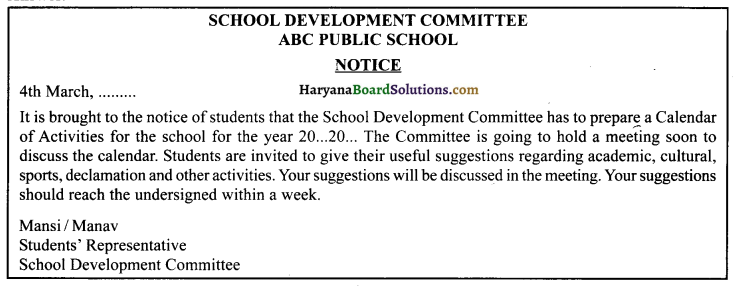
1. You are Manav/Mansi, working as the students’ representative on the School Development Committee. The Committee is going to meet next week to prepare a Calendar of Activities for the school for the year 20-20 To ensure that you play your role effectively at the proposed meeting, you have decided to invite the students’ suggestions on this subject. Write a notice in this regard in not more than SO words to be put up on your school notice board.
Answer.
HBSE 12th Class English Notice Writing 1

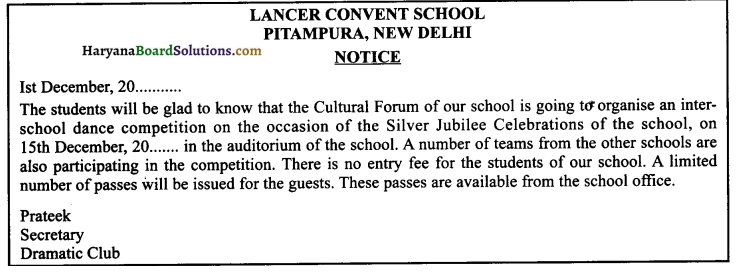
2. You are Prateek, Secretary of the Dramatic Club of Lancer Convent School, Pitampura, New Delhi. Write a notice for your school notice board in about 50 words inviting names of those who would like to participate in the proposed Dance Competition to be organised by the Club on 15th Dec. 2018.
Answer.
HBSE 12th Class English Notice Writing 2

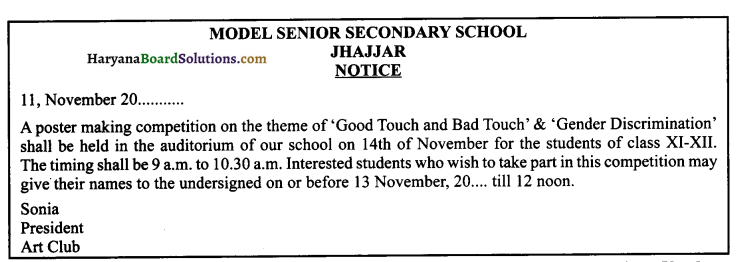
3. Draft a notice informing students of class XI-XII about a poster-making competition. Invent all necessary details. You are Sonia, President, Art Club, Model Senior Secondary School, Jhajjar. [H.B.S.E. March, 2018 (Set-C’)]
Answer.
HBSE 12th Class English Notice Writing 3

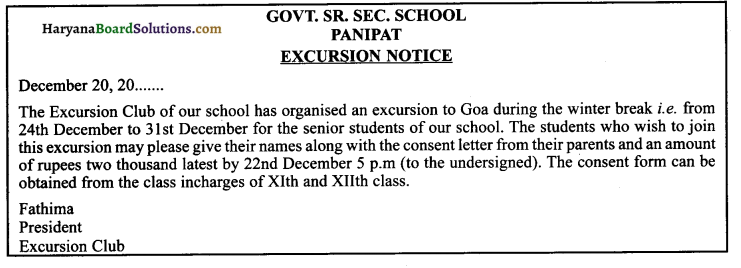
4. You are Fathima, President of the Excursion Club of Govt. Sr. Sec. School, Panipat. You have organised an excursion to Goa during the winter break for the senior students of your school. Write a notice in about 50 words informing the students about the proposed excursion.
Answer.
HBSE 12th Class English Notice Writing 4

HBSE 12th Class English Notice Writing

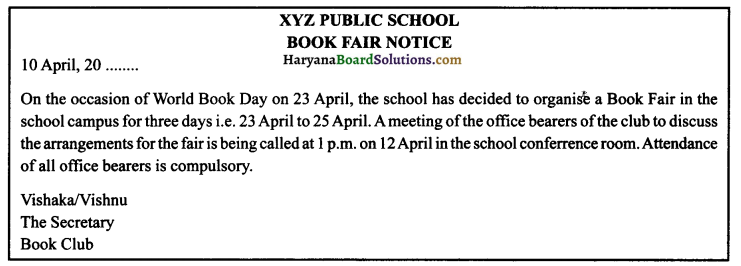
5. On the occasion of World Book Day, the school has decided to organise a Book Fair. Vishaka/ Vishnu, the secretary of the Book Club, wants to caU a meeting of the office bearers of the club to discuss the arrangements for the fair. Write a notice in not more than 50 words.[H.B.S.E. 2019 (Set-C)]
Answer.
HBSE 12th Class English Notice Writing 5

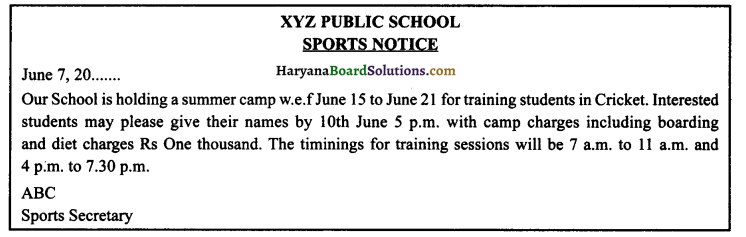
6. You are the sports secretary of your school. Your school is holding a summer camp for training students in Cricket. Write a notice for the students in not more than 50 words. [H.B.S.E. 2017 (Set-A)]
Answer.
HBSE 12th Class English Notice Writing 6

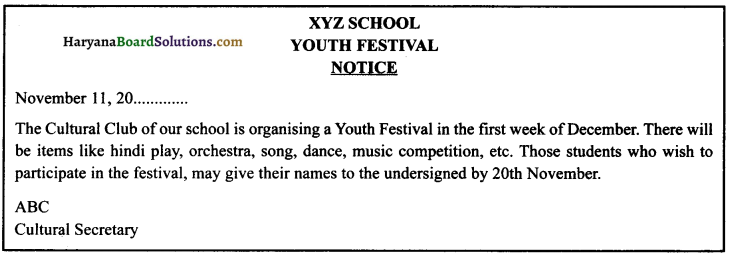
7. A Youth Festival is being organised at your school. You are the Cultural Secretary of your Cultural Club. Write a notice inviting names of those who would like to participate in this youth festival. [H.B.S.E. March, 2017 (Set-B)]
Answer.
HBSE 12th Class English Notice Writing 7

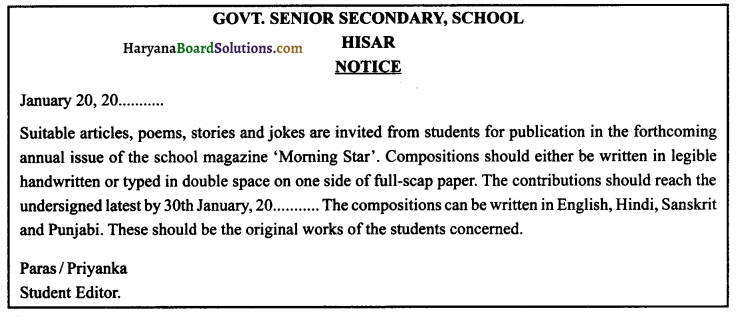
8. As student editor, draft a notice in not more than 50 words for your school notice board inviting articles from the students for your school magazine. You are Paras/Priyanka of Govt. Senior Secondary School, Hisar. [H.B.S.E. March 2018 (Set-A)]
Answer.
HBSE 12th Class English Notice Writing 8

HBSE 12th Class English Notice Writing

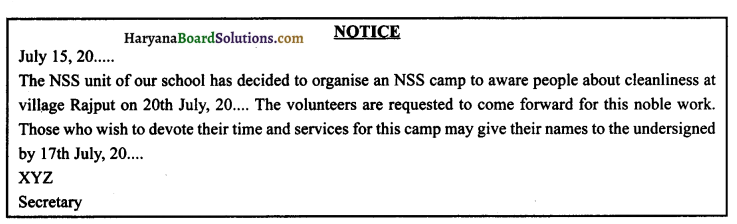
9. You are the Secretary of the NSS unit of your school. Write a notice for the school notice board, inviting volunteers for an NSS camp. [H.B.S.E. 2020 (Set-D)]
Answer.
HBSE 12th Class English Notice Writing 9

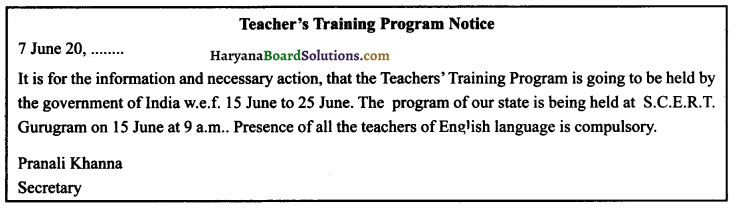
10. You are Pranali Khanna, a Secretary of Board of School Education, of your State. Write a notice in note more than 50 words informing various schools about the Teachers’ Training Program across the country. Include all the relevant details. [H.B.S.E. March 2019 (Set-D)]
Answer.
HBSE 12th Class English Notice Writing 10

II. Notices About Sports/NSS/Red Cross Camps

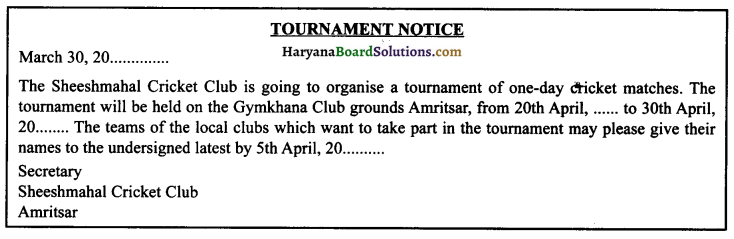
11. You are the Secretary of a cricket club. Write a notice inviting different teams to take part in a one-day cricket tournament.
Answer.
HBSE 12th Class English Notice Writing 11

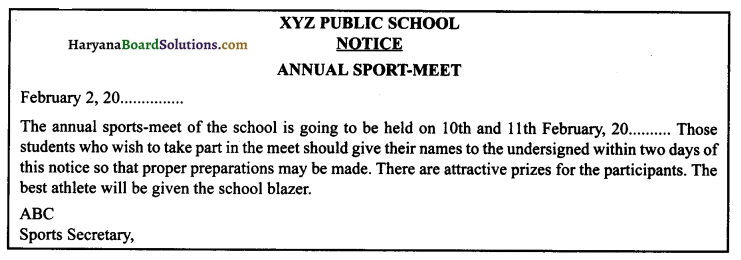
12. Write a notice for your school Notice Board about the annual sport-meet to be held in the coming week. [H.B.S.E. 2017 (Set-C), 2018 (Set-B)]
Answer.
HBSE 12th Class English Notice Writing 12

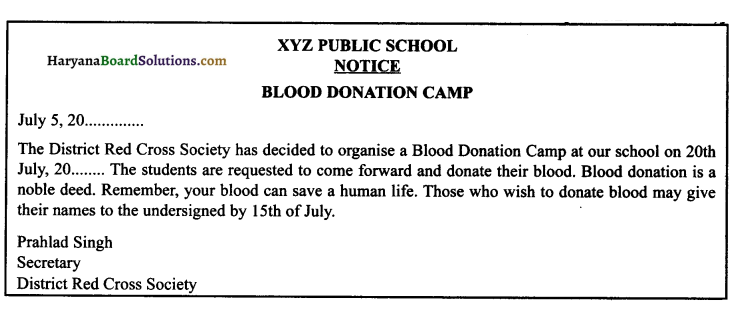
13. Draft a notice for the school notice board inviting students to come forward and donate blood at the blood donation camp being held in your school by the District Red Cross Society. [H.B.S.E. 2017 (Set-D)]
Answer.
HBSE 12th Class English Notice Writing 13

HBSE 12th Class English Notice Writing

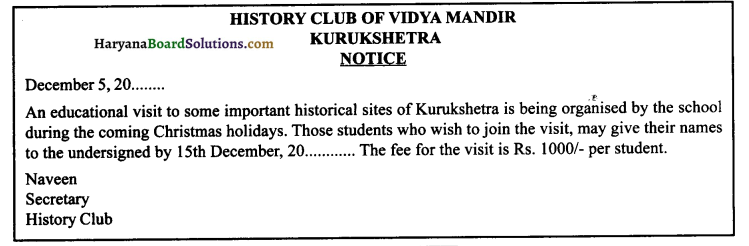
14. You are Secretary of the History club of Vidya Mandir, Kurukshetra. Draft a notice in not more than SO words informing students of a proposed visit to some important historical sites in your city. Invent the details. Sign as Neha/Naveen. [H.B.S.E. March 2018 (Set-D)]
Answer.
HBSE 12th Class English Notice Writing 14

III. Celebrations

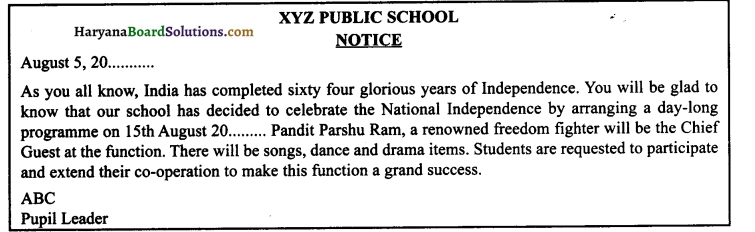
15. Your school has decided to celebrate the National Independence by arranging a day-long programme. As the Pupil Leader of your school, write a notice, giving details of the programme and calling for the participation and co-operation of your school students.
Answer.
HBSE 12th Class English Notice Writing 15

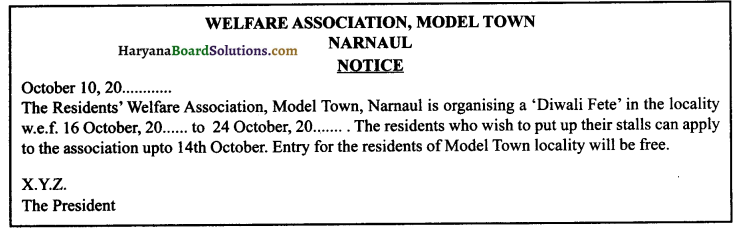
16. The Residents’ Welfare Association, Model Town, Narnaul is organising a ‘Diwali Fete’ in the locality. As the President of the Association, draft a notice in not more than 50 words informing the residents about the same. Give other essential detail too. [H.B.S.E. March 2019 (Set-A)]
Answer.
HBSE 12th Class English Notice Writing 16

IV. Picnics/Exhibitions/Tours

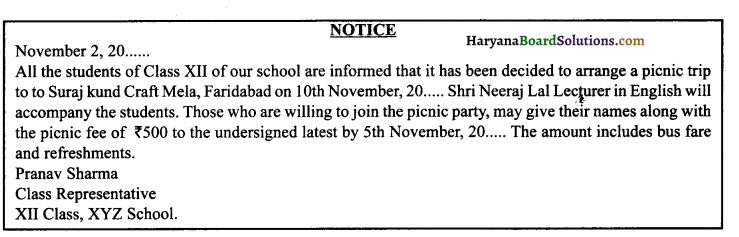
17. You are the class representative of Class XII. Write a notice for circulation among the students of your class regarding a one-day trip to Suraj Kund Craft Mela, Faridabad. [H.B.S.E. 2020 (Set-B’)]
Answer.
HBSE 12th Class English Notice Writing 17

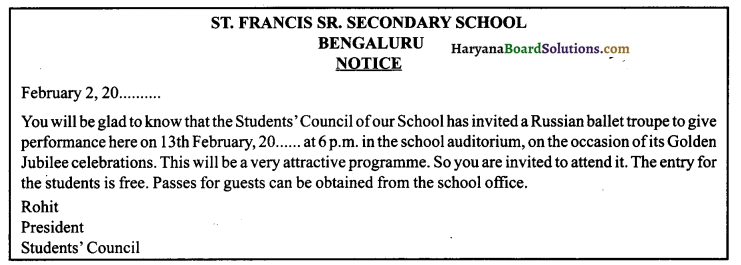
18. You are Rohit/Roopali. As President of the Students’ Council of St. Francis Sr. Secondary School, Bengaluru, you have invited a visiting Russian Ballet troupe to give a performance in your school on the occasion of the Golden Jubilee Celebrations. Write a notice informing the students about this event.
Answer.
HBSE 12th Class English Notice Writing 18

HBSE 12th Class English Notice Writing

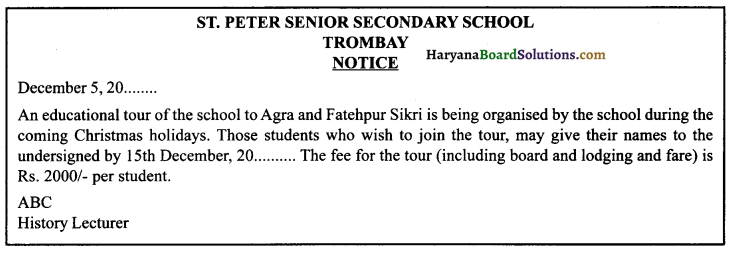
19. Suppose, you are the Lecturer of History of St. Peter Senior Sec. School, Trombay. You propose to take an educational tour to Agra and Fatehpur Sikri. Draft a notice for the notice board, asking students to give their names if they wish to join the tour.
Answer.

V. Lost and Found

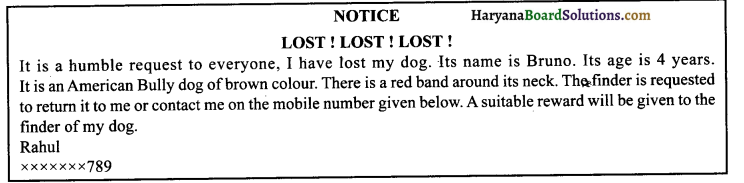
20. Your pet dog is missing. Write out a suitable notice in not more than 50 words for the “Lost and Found” column of a local newspaper. [H.B.S.E. March 2020 (Set-A)]
Answer.
HBSE 12th Class English Notice Writing 20

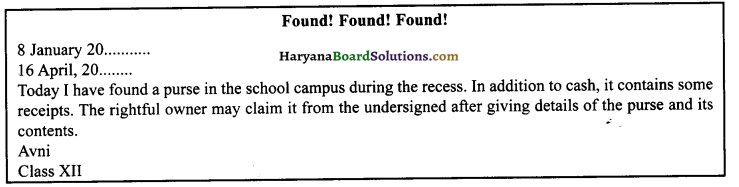
21. You have found a purse in the school/college campus. Put up a notice about that on the ‘Lost and Found’ board of the school/college. [H.B.S.E. March 2020 (Set-C)]
Answer.
HBSE 12th Class English Notice Writing 21

VI. Appeal

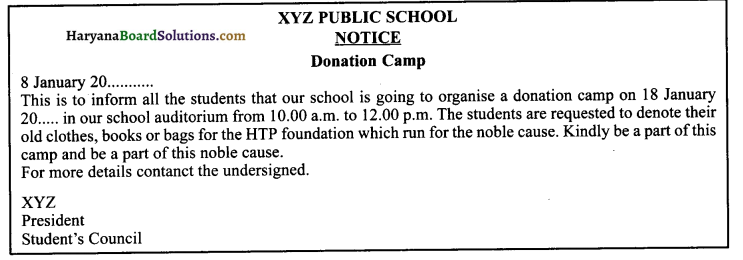
22. As the president of student council write a notice for requesting students to devote old clothes, books, and bags for orphanages.
Answer.
HBSE 12th Class English Notice Writing 22

B. Public Notices Or General Notices

What are Public Notices?
Public notices or General notices are announcements or pieces of information conveyed to a large section of people. Tender notices, notices for admission, court notices, or auction notices are some kinds of Public Notices.

Features of a Public Notice:
(a) A Public Notice is very formal in tone and style.
(b) Its language is simple so that it can be easily understood by the general public.
(c) It is brief and to the point. However, all the relevant points/facts are clearly stated.
(d) The name/signature of the issuing authority is given at the bottom of the notice.
(e) The date of the issue of the notice is given either at the top or the bottom of the notice.

I. Public Notices

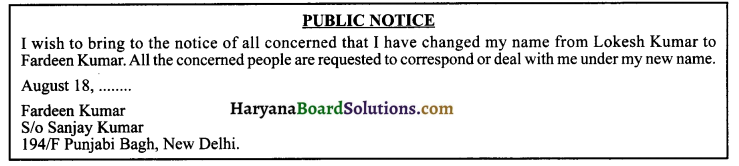
23. Your name is Lokesh Kumar. You have changed your name and your new name is Fardeen Kumar. Write out a Public Notice for a newspaper announcing that now you should be known by your new name.
Answer.
HBSE 12th Class English Notice Writing 23

HBSE 12th Class English Notice Writing

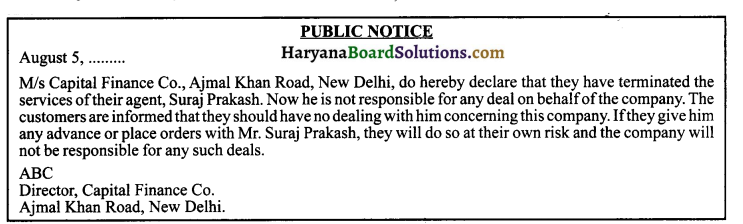
24. M/s Capital Finance Co. have terminated the services of their agent, Suraj Prakash who used to get orders and advances from their customers. Write out a public notice for a newspaper on behalf of the firm, announcing the termination of the services of the agent and telling people that they will deal with Suraj Prakash only at their own risk.
Answer.
HBSE 12th Class English Notice Writing 24

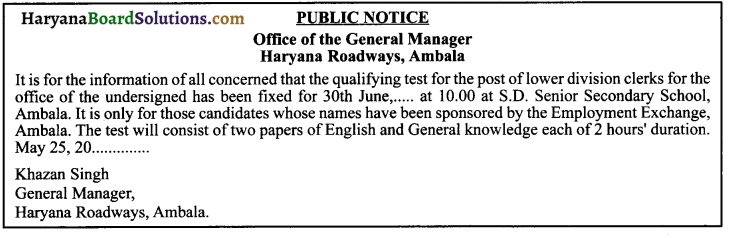
25. You are Khazan Singh, General Manager, Haryana Roadways, Ambala. Write a notice to be published in a newspaper announcing that the qualifying written test for lower division clerks has been fixed for 30th June, …………….. for those candidates whose name have been sponsored by the Employment
Exchange, Ambala.
Answer.
HBSE 12th Class English Notice Writing 25

II. Academic Notices

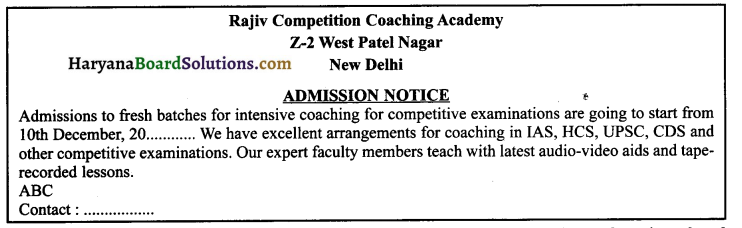
26. You are the Director of Rajiv Competitions Coaching Academy. Write a suitable Admission notice, pointing out some special features of your academy.
Answer.
HBSE 12th Class English Notice Writing 26

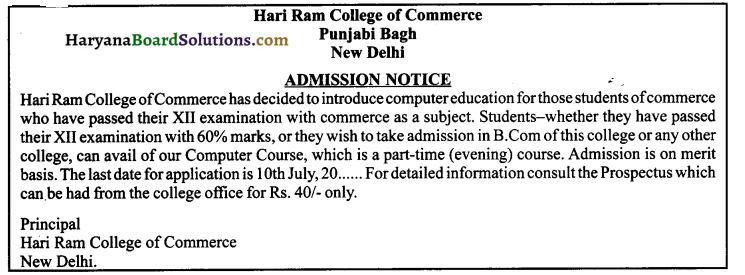
27. You are Principal of Hari Ram College of Commerce, New Delhi. Recently you have introduced Computer Courses for Commerce students of XI and XII class. Draft a notice for admission to these computer courses.
Answer.
HBSE 12th Class English Notice Writing 27

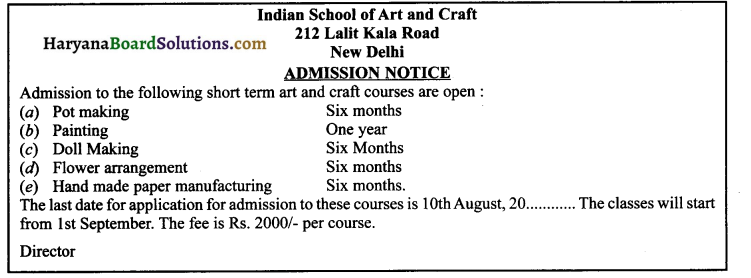
28. You are the Director of the Indian School of Art and Craft. Draft a notice announcing admissions to short-term courses in different art and craft.
Answer:
HBSE 12th Class English Notice Writing 28

III. Legal Notices

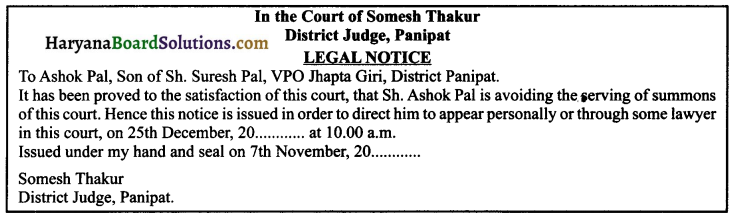
29. On behalf of Sh. Somesh Thakur, District Judge, Panipat, draft a legal notice to Ashok Pal who is avoiding the receipt of summons. Direct him to appear in the court.
Answer.
HBSE 12th Class English Notice Writing 29

IV. Auction Notices

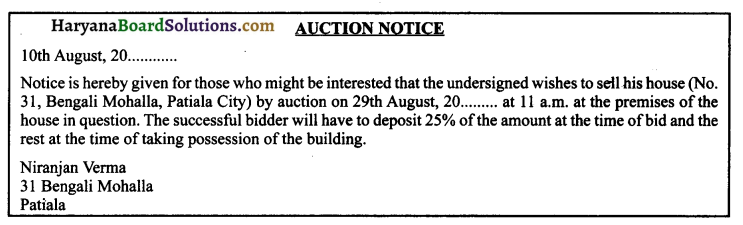
30. You are Niranjan Verma of 31, Bengali Mohalla, Patiala City. You are shifting to another city. So you wish to sell your house by auction. Draft a notice for the same.
Answer.
HBSE 12th Class English Notice Writing 30

HBSE 12th Class English Notice Writing

31. You are Director, Zigma Institute, Bengaluru. You wish to dispose of office and general items through auction. Draft an Auction Notice for this purpose.
Answer.
HBSE 12th Class English Notice Writing 31

V. Tender Notice

32. You are the Principal of Ashutosh Mukherjee Degree College, Hooghly. Your College is planning to construct a new block for postgraduate students. Draft a tender notice inviting reputed builders to offer tbeir bids for the construction of this block.
Answer.
HBSE 12th Class English Notice Writing 32

VI. Sales Notice

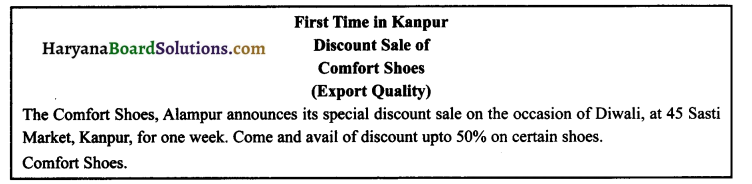
33. The Comfort Shoes Pvt. Ltd., Alampur launches its special discount sale of shoes in Kanpur. Draft a suitable notice for publication in a newspaper.
Answer.
HBSE 12th Class English Notice Writing 33

VII. Obituary

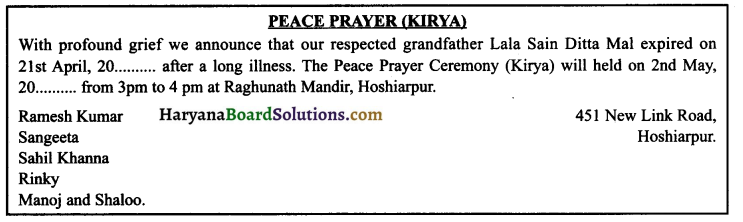
34. Your grandfather has expired. Draft an obituary notice for publication in a newspaper giving information regarding his Kirya Ceremony.
Answer.
HBSE 12th Class English Notice Writing 34

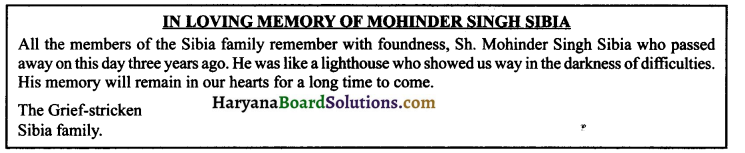
35. The members of the Sibia family remember Mr. Mohinder Singh Sibia on his 3rd death anniversary. Draft a suitable obituary notice on their behalf to be published in a newspaper.
Answer.
HBSE 12th Class English Notice Writing 35

VIII. Club Notice

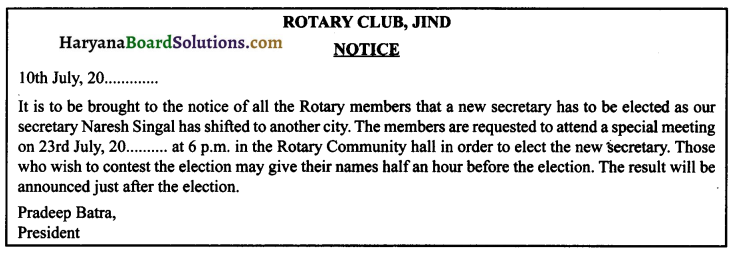
36. You are Pradeep Batra, President of the Rotary Club, Jind. The Secretary of your club has migrated to another city. Now the new secretary has to be elected. Draft a notice inviting the club members to attend a special meeting in order to elect the secretary.
Answer.
HBSE 12th Class English Notice Writing 36

Exercises For Practice

1. You are the Cultural Secretary of Maharishi Senior Secondary School, Ahmedabad. Your school is going to organize a Quiz Contest. Write out a notice inviting the names of those who wish to take part in this Contest.

2. You are the President of the Drama Club of your school. Draft a notice announcing the holding of a drama in your school. Invite the names of those who wish to participate in it.

3. You are the President of the Cultural Club of your school. You are going to organise a donation camp in aid to the victims of Gujarat Earthquake. Write out a notice for this purpose.

HBSE 12th Class English Notice Writing

4. You are the Secretary of the Science Club of your school. Your school is organising a Science Exhibition. Write out a notice for your school notice board, encouraging students to take part in it.

5. Your name is Ritu Sharma. You are the Secretary of the Cultural Society of your school. Your school has organized a fashion show for the girl students. Draft a notice inviting the girl students to take part in the fashion show.

6. You are the President, the Literary Society, Ram Jas Public School, New Delhi. Write out a notice inviting the names of those students who wish to take part in a declamation contest being organized by your school.

7. On behalf of the Principal of Vishwas Foundation Senior Secondary School, draft a notice announcing the hold of elections to the Students’ Council, inviting nominations for the office bearers of the Council.

8. You are Harkaran Singh of Daffodils Public School, Samastipur. You have lost your bus pass somewhere in the school premises. Draft a notice for your school notice board, giving necessary details.

9. While playing in the school ground, you found a costly pen. Draft a notice for the school notice board asking the owner of the pen to take it from you after giving its identification.

10. Your school has decided to organise a blood donation camp. As the coordinator of the NSS unit of your school, draft a notice, inviting volunteers for blood donation.

11. As the student editor of your school magazine, draft a notice for your school notice board inviting articles, stories, poems, jokes, etc. for publication in the magazine.

12. You are the Secretary of the Dance and Drama Club of your school. You have decided to organise a Cultural Meet in your school. Draft a notice to this effect.

13. You are the President of the Lions Club, Faridabad. You wish to organise a function to honour a respected and Magsaysay Award-winning personality. Draft a suitable notice to be sent to the members of your club.

14. You have dropped your file containing original certificates somewhere in the school/college premises. Write a short notice for the school/college notice board requesting the finder to return it to you. (You are Ram Lai of A.B.C. school/college, Meerut.)

15. You are the Managing Director of a firm. You have to get an office block constructed. Write a tender notice for a newspaper inviting construction engineers/contractors to offer their tenders for the same. Specify the type of building/rooms to be built.

16. You are the Director of a Health Club and now you want to give up this business. You wish to dispose of the health equipments by auction. Draft a notice for the ‘Auction’ column of a newspaper for this purpose.

HBSE 12th Class English Notice Writing

17. You are Shanky Jeroff, Secretary, Literary Society, of St. Xaviers Senior Secondary School. You have invited a renowned scholar to have a talk on literature. Write out a notice for the school notice board informing the students of this talk.

18. Your school was founded 25 years ago. Now the school has decided to celebrate its Silver Jubilee with pomp and show. On behalf of the Principal, draft a notice informing the students about the function to be organised and seeking their cooperation for the success of the function.

19. You have found a gold ring in the school library. Write out a notice for the school notice-board informing students about the ring and asking its owner to take it after giving its specifications.

20. You are the President of the Malviya Nagar Residents’ Society. Recently, there has been an increase in the cases of thefts in the surrounding colonies. Draft a notice for the residents of the colony, asking them to take several precautionary measures to save themselves from theft.

21. Your name is a Anil Kapoor. Your grandmother died a week ago. Draft an obituary notice to be published in a newspaper, announcing her peaceful prayer (kirya).

22. The Shadipur Depot of Delhi Transport Corporation (DTC) wants to dispose of some unserviceable buses, spare parts and other junk matter through open auction. Draft a notice to be published in a newspaper announcing the auction sale.

23. You are the Principal of Aishwarya College, New Delhi. Write an admission notice, announcing admission to various degree courses.

HBSE 12th Class English Notice Writing Read More »
HBSE 12th Class English Poster Making

Haryana State Board HBSE 12th Class English Solutions  Composition Poster Making Exercise Questions and Answers.

Haryana Board 12th Class English Poster Making

A poster is a notice and an Advertisement, combined into one. A notice is generally displayed on a notice board or published in a newspaper. An advertisement is also published in a newspaper. A poster on the other hand, is generally displayed on walls. In some cases, a poster can be displayed on the notice board also. People read posters from a distance.

Therefore, utmost care should be taken in preparing a poster. Its design and style should be attractive. It should be able to catch our attention at once. Colorful, attractive, and stylish posters attract the attention of people and influence their minds. The following points should be kept in mind while designing/writing a poster.

Hints for Designing A Poster:

  1. A good poster should be styled according to the subject matter of theme which its designer wants to convey.
  2. The letters in a poster should be bold and attractive. The main theme or subject should be bolder in size than the rest of the poster.
  3. The language should be brief but catchy and attractive.
  4. The design should be striking and ornate.
  5. All the basic details should be given. But the poster should be to the point. Do not beat about the bush in a poster.

HBSE 12th Class English Grammar Modals

Some Specimen Posters
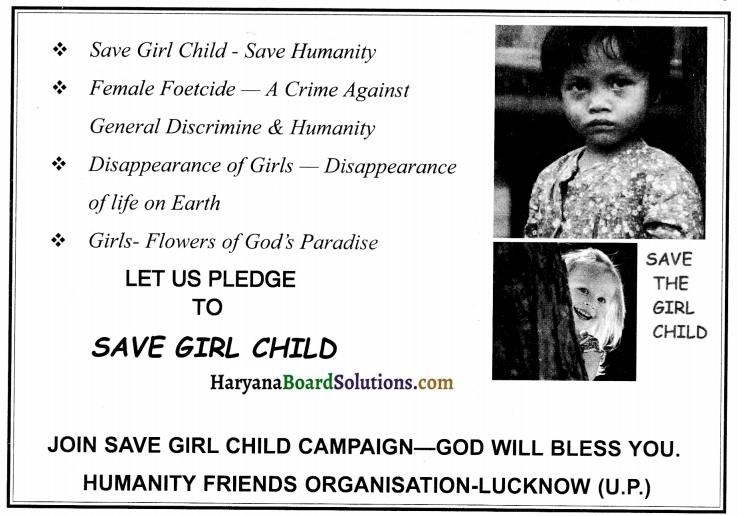
(1) Design a poster to promote ‘Save Girl Child Campaign. [H.B.S.E. 2017 (Set-A)]
HBSE 12th Class English Poster Making 1
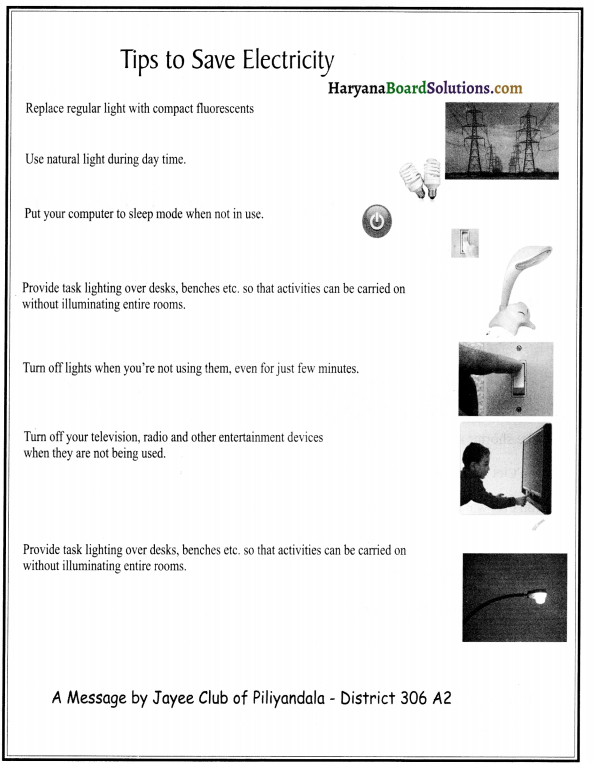
(2) Jayee club is organizing a campaign in collaboration with Energy Department. Design a poster educating people, how to save electricity. [H.B.S.E. 2017 (Set-C)]
HBSE 12th Class English Poster Making 2
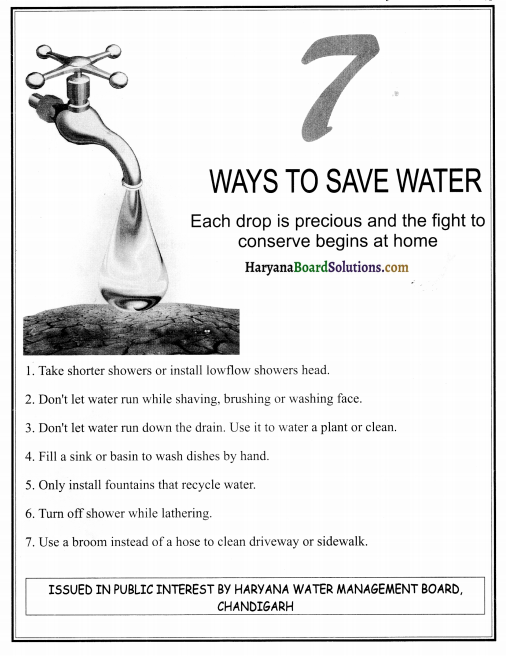
(3) Design a poster educating people about some simple methods to save water. [H.B.S.E. 2017 (Set-B)]
HBSE 12th Class English Poster Making 3

HBSE 12th Class English Poster Making

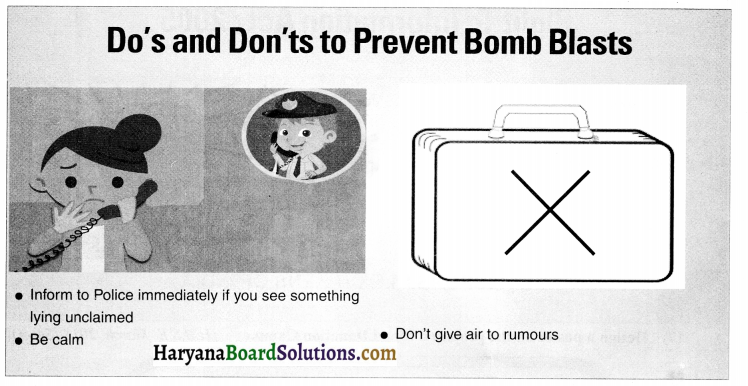
(4) Design a Poster creating awareness about the do’s and don’ts (for the public) to prevent bomb blasts. [H.B.S.E. March 2019 (Set-D)]
HBSE 12th Class English Poster Making 4
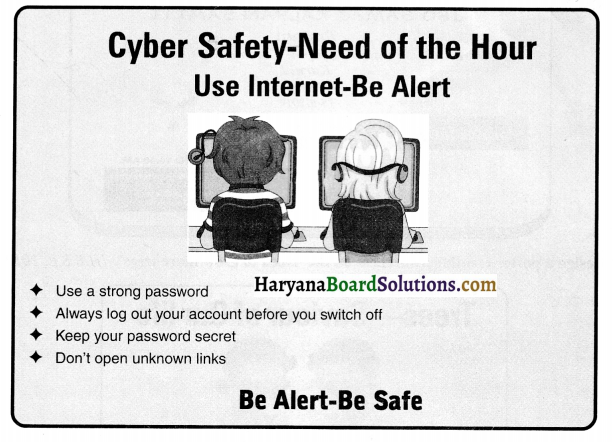
(5) Design a Poster creating awareness about ‘Cyber Safety. [H.B.S.E. March 2019 (Sel-B)]
HBSE 12th Class English Poster Making 5
(6) Design a poster creating awareness about Right to Information. [H.B.S.E. 2019 (Set-C)]
HBSE 12th Class English Poster Making 6
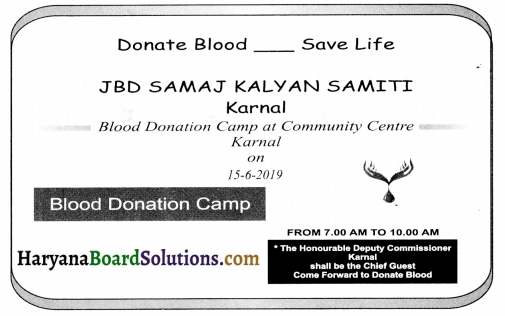
(7) Design a poster on the proposed Blood Donation Camp. [H.B.S.E. March 2018 (Set-A)]
HBSE 12th Class English Poster Making 7
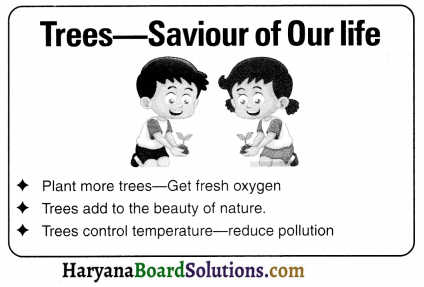
(8) Design a poster creating awareness on the ‘Need to grow more trees. [H.B.S.E. 2019 (Set-A)]
HBSE 12th Class English Poster Making 8

HBSE 12th Class English Poster Making

(9) On the behalf of Minister of Consumer Affairs, Food and Public Distribution, draw a poster to aware the general public about the National Consumer Day (24th December).
HBSE 12th Class English Poster Making 9
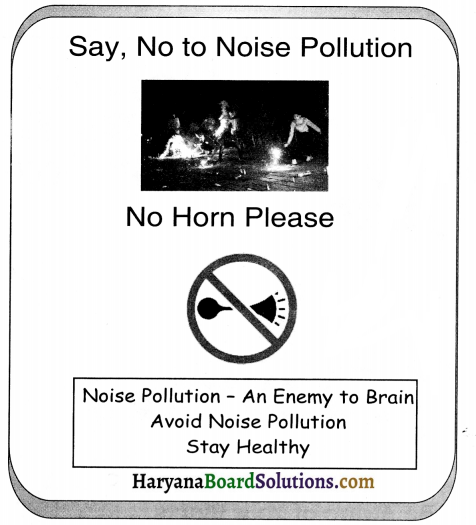
(10) Design a Poster saying ‘No’ to Noise Pollution. [H.B.S.E. March 2018 (Set-D)]
HBSE 12th Class English Poster Making 10

Exercises For Practice

  1. On behalf of Swami Ban was Foundation, draft a poster announcing the organization of a 10-day religious discourse and meditation camp and inviting people to visit the camp and win spiritual peace.
  2. You are the Secretary of a Voluntary organization. On behalf of this organization, design a poster, appealing to people to donate generously for the earthquake relief fund.
  3. The Rotary Club, Panipat is going to organize a Diwali Mela two days before Diwali. Design a poster to announce it.
  4. Gemini Circus has visited your town and will be there for ten days. Design a poster urging people to enjoy the feats of circus performers.
  5. Astarte is being held in your city. A number of film stars from Mumbai will take part in the nite. This site is being organized in aid of the victims of Tsunami. Draft a poster, asking people not to miss this opportunity of enjoyment.
  6. Samrat Shankar, the renowned magician is in your town. Draft a poster on his behalf, urging the people of the town to visit the show and enjoy it.
  7. Design a poster educating people against the evil of taking drugs.

HBSE 12th Class English Poster Making Read More »
HBSE 12th Class English Grammar Use of Articles

Haryana State Board HBSE 12th Class English Solutions Grammar Use of Articles Exercise Questions and Answers.

Haryana Board 12th Class English Grammar Use of Articles

Use of Articles
The demonstrative adjectives a, an and the have been given the collective name ‘Articles’. These are divided into two categories :
(a) The Definite Article : The
(b) The Indefinite Article : A or an

The Definite Article
Uses of the Definite Article
(a) ‘The’ is used before a noun which has become definite as it has been mentioned a second time.
When it is introduced the first time, it takes ‘a/an’.

(‘The’ का प्रयोग ऐसी संज्ञा से पहले किया जाता है जो दोबारा जिक्र करने के कारण विशेष हो जाती है। जब इसका जिक्र पहली बार करते हैं तो इसके साथ a/an लगाते हैं।)
A man is going on a road. The man has a bag.
The bag contains clothes. The road goes to Karnal.

(b) It is used before nouns of which there is only one, or which are considered as one. (ऐसी संज्ञाओं के साथ जो केवल एक ही हैं या एक ही माने जाते हैं।)
The earth, the sky, the weather, the North Pole.

(c) It is also used with a noun of which there is only one example in some given situation. (ऐसी संज्ञा के साथ जिसका किसी विशेष हालत में केवल एक ही उदाहरण है।)
The Principal is on leave. Has the postman come yet?

(d) The definite article is placed before the superlative degree of adjectives. : (विशेषण के तीसरे दर्जे से पहले ‘The’ लगाते हैं।) He is the best teacher I have known. She is the most intelligent girl in the class.

(e) When the nouns like English, Russian, French, and Greek mean ‘language’ no article is placed before them. But when they stand for People (Nations), they are preceded by the definite article : (ऐसी संज्ञाएँ जैसे कि English, Russian, French, Greek, आदि के साथ अगर article न लगा तो उनका अर्थ है भाषा। लेकिन इनसे पहले ‘The’ लगाने से उनका अर्थ लोग या राष्ट्र हो जाता है।) The English ruled India for a long time. They introduced English as a medium of education in India.

(f) The nouns like hospital, school, college, church, temple, prison, cinema, bed, table, market, office, etc. denote their primary function if no article is placed before them. The use of ‘the’ before them makes them definite and particular. (इस प्रकार की संज्ञाएँ जैसे कि हस्पताल, स्कूल, कॉलेज, गिरजाघर, जेल, सिनेमा, बिस्तर, मेज, बाजार, दफतर आदि से पहले अगर कोई article न हो तो उनका प्राथमिक कार्य स्पष्ट होता है। उनसे पहले ‘The’ लगाने से वह विशेष हो जाते हैं।)
He met with an accident and was taken to hospital. When I came to know of it, I went to the hospital to meet him.

(g) It is used before singular nouns to represent a class of things. (इसका प्रयोग एकवचन संज्ञाओं के साथ चीजों के वर्ग को बताने के लिए होता है।) The donkey is lazy (All donkeys are lazy).

(h) Before an adjective used to represent a class of things. (इसका प्रयोग तब भी होता है जब किसी विशेषण द्वारा पूरे वर्ग को बताया जाए।) The rich should not exploit the poor. Today a gap exists between the old and the young.

(i) ‘The’ is used when we refer to a particular thing or a person. (‘The’ का प्रयोग तब होता है जब हम विशेष वस्तु या व्यक्ति का जिक्र करें।) In that group, the boy in red shirt is my son.

(j) The definite article is used before ‘first/second’, etc. and ‘only’ (‘प्रथम/द्वितीय’ आदि तथा ‘केवल’ से पहले ‘The’ का प्रयोग करते हैं।) He was the first man to reach the party. Sunita was the second guest. In fact, she was the only lady present there.

(k) Before the plural names of countries. (उन देशों के साथ जिनके नाम बहुवचन में हैं।) The United States of America, The West Indies.

(l). Before Special meals; as (विशेष भोजनों के साथ।) I take dinner at 9.00 p.m. (usual dinner) but Are you attending the dinner being given by Mohan ?

(m) Article the is used before the names of the following nouns :
Mountain ranges : The Himalayas, The Alps, The Pyrenees etc.
Rivers : The Ganga, The Brahamputra, the Thames, etc.
Oceans : The Indian Ocean, The Pacific, The Antractic, etc.
Islands : The Andamans, The West Indies etc.
Holy Books : The Geeta, The Quran, The Bible etc.
Newspapers : The Indian Express, The Times of India, etc.
Magazines : The Reader’s Digest, The Competition Master, etc.
Historical Buildings : The Parliament, The White House, etc.
Historical Events : The First Battle of Panipat, The First/Second World War,
Trains, Ships, Planes: The Shatabadi Express, The Vikrant, The Ashoka, etc.

HBSE 12th Class English Grammar Use of Articles

The Indefinite Article
Form
The form of the Indefinite article is a or an. The form ‘a’ is used before a word beginning with a consonant. It is also used with a word beginning with a vowel which sounds like a consonant: a pen, a table, a boy
also : a university, a European, a useful thing.
The form ‘an’ is used before words beginning with a vowel (a, e, i, o, u) or words beginning with a silent ‘h’.
an owl, an elephant, an apple, an hour, an honourable man. Uses of the Indefinite Article

(a) It is used before a singular noun which is countable, when it is mentioned for the first time. (इसका प्रयोग ऐसी एकवचन संज्ञा के साथ होता है जो गिनी जा सके और जब इसका जिक्र पहली बार हो।) I see a bird on that tree. A house has a roof.

(b) Before a singular countable noun which is used as an example of the class of things or species. (ऐसी एकवचन गिनी जा सकने योग्य संज्ञा के साथ, जो चीजों के वर्ग या जाति का उदाहरण हो।)
A horse is an animal. A cow has horns. A pine tree grows very tall.

(c) In the numerical sense of the word ‘one’ (‘एक’ शब्द के गणनात्मक भाव के रूप में।) He gave me a gift. Not a word was spoken.

(d) In expressions of price, speed, etc. ‘a/an’ are used in the sense of ‘per’. (‘a/an’ का प्रयोग कीमत, गति आदि के लिए “प्रति” के अर्थ के रूप में किया जाता है।)
Milk sells eight rupees a kilo. He drives at forty miles an hour.

(e) The names of professions and occupations take the indefinite article. (व्यवसायों या धन्धों के नामों के साथ हम Indefinite article लगाते हैं।) My father is a doctor He grew up to be a politician.

(f) Sometimes ‘a’can be used before Mr./Mrs./Miss + surname. Then it means a man/woman/girl of that name. (कई बार ‘a’ का प्रयोग श्री/श्रीमती/कुमारी के नाम के पहले लगता है। तब इसका अर्थ है कि उस नाम का कोई आदमी, औरत, लड़की आदि।) A Mr. Mehta came to see you when you were away. (This sentence means: “A man called Mr. Mehta came …..”)

(g) Use of ‘a’ before few and little :

  • a few and a little mean a small number or a small amount (‘few’ stands for number and little’ for amount). (a) few और a little का अर्थ है कुछ संख्या या कुछ मात्रा। few का अर्थ संख्या और little का अर्थ मात्रा से होता है।)
  • ‘few’ and ‘little’ without article have an almost negative meaning. (बिना article के few और little का अर्थ लगभग नकारात्मक होता है।) I am thirsty but I am afraid there is little water in the pitcher. But there is a little water in the fridge. The college reopened today but there were few students in the classes. A few senior students came to the college but remained away from the classes.

(h) To attribute the qualities of a man (usually someone famous) to another person. (किसी प्रसिद्ध व्यक्ति के गुणों का जिक्र किसी अन्य व्यक्ति के नाम के साथ करने के लिए।) He is a Shakespeare (He is a genius like Shakespeare). Omission of Articles Articles are not used in the following cases : (Articles का प्रयोग निम्नलिखित हालातों में नहीं किया जाता।)

(a) No article is placed before abstract nouns when they are used in a general sense. (जिस भाववाचक संज्ञा का प्रयोग सामान्य रूप से किया जाता है तो उसके साथ article नहीं लगता।) Honesty is the best policy. Happiness is what everyone longs for. But abstract nouns take ‘the’ before them when they are used in the particular sense. (मगर जब भाववाचक संज्ञा का प्रयोग विशेष रूप से होता है तो उसके साथ ‘The’ लगता है।) We must work for the happiness of all sections of society.

(b) The article is omitted before ‘man’ and ‘woman’ when they are used in a general sense. (जब man या woman का प्रयोग सामान्य रूप से हो तो उनके साथ article नहीं लगता।) Man is mortal. Woman is considered weaker than man.

(c) The article ‘the’ is omitted before the names of meals when used in a general sense. But we use
‘the’ when a specific meal is mentioned. (सामान्य रूप से प्रयोग किए जाने पर भोजनों के नाम से पहले हम ‘the’ नहीं लगाते। मगर जब भोजन का जिक्र विशेष रूप से हो तो ‘the’ का प्रयोग करते हैं।) He invited me to dinner. We take breakfast at 8 a.m. The lunch given by him was fine.

(d) Collective nouns such as humanity, labour, mankind, posterity, society, don’t usually take an article. (सामूहिक संज्ञाओं के साथ आमतौर पर article नहीं लगाते।) Society must take care of its old persons. Mother Teresa has devoted her life to the welfare of humanity.

(e) Articles are not used before proper nouns : (व्यक्तिवाचक संज्ञा से पहले articles नहीं लगाते।) Shakespeare was a genius. Mumbai is a metropolitan city. No article is placed before the names of metals, materials and games when used in a general sense. But when they are used specifically, the’ is placed before them. (सामान्य रूप से प्रयोग किए जाने पर धातुओं, पदार्थों तथा खेलों के नाम से पहले article नहीं लगाते। मगर जब वे विशेष रूप से प्रयोग किए जाएँ तो ‘the’ उनसे पहले लगता है।) Gold is a costly metal. Many people in India play cricket. The Gold found in Kolar mines is of superior quality.

HBSE 12th Class English Grammar Use of Articles

(g) Articles are not used in certain phrases consisting of a preposition followed by its object : (उन निश्चित वाक्याँशों में जहाँ preposition का प्रयोग कर्म के साथ किया हो तो articles का प्रयोग नहीं होता।) at home, in hand, in debt, by day/night, on-demand, at sunset/night, on earth, by land/water/air, on foot etc. You must finish the work in hand. He started the journey at daybreak.

Exercises For Practice (Solved)
Exercise 1
Fill in the blank spaces in the following sentences with the word given in brackets at the end, using either the plain noun or the noun preceded by the (whichever you think is correct).

1. The box was made of ………………………………….. (wood) [H.B.S.E. 2017 (Set-A)]
2. When do you have …………………………………….. ? (breakfast)
3. Shakespeare is ……………………………. Kalidasa of England. [H.B.S.E. 2019 (Set-D)]
4. …………….. is found in Australia and South Africa. (gold)
5. …………………………. that we had for dinner was tough. (meat)
6. ……………… sky has no limits. [H.B.S.E. 2019 (Set-C)]
7. ………….. rich should help the poor. [H.B.S.E. 2019 (Set-A)]
8. There is fish for …………….. today. (dinner)
9. Are you attending ……………. tonight? (dinner)
10. …………….. are grown in Spain, South Africa, Brazil, and Israel. (oranges)
Answers :
1. wood,
2. breakfast,
3. the,
4. Gold,
5. The meat,
6. The,
7. The,
8. dinner,
9. The dinner,
10. The oranges.

Exercise 2

1. We wear ……………………………. to keep us warm. (clothes)
2. ……………………… are not allowed to park here. (cars)
3. …………….. in that vase are very beautiful. (flowers)
4. Let us have a game of ……………… (cricket)
5. She plays …………… very well. (Tennis)
6. What are we having for ……………. ? (lunch)
7. ………………………… in that field is very green. (grass)
8. Do you usually drink ……………. or …………….. ? (tea, coffee)
9. ……………. are used in some countries to pull heavy loads. (elephants)
10. She thanked me for ……………. I gave her. (present) [H.B.S.E. 2017 (Set-D)]
Answers :
1. clothes,
2. Cars,
3. The flowers,
4. cricket,
5. tennis,
6. lunch,
7. The grass,
8. tea, coffee/ coffee, tea,
9. Elephants,
10. the present.

HBSE 12th Class English Grammar Use of Articles

Exercise 3

Fill in the blank spaces in the following sentences with the word or words given in brackets at the end. Use either the plain noun or the noun preceded by the (whichever you think is correct).

1. In Austria the people speak ……………… (German)
2. ……………… is spoken in many countries. (English)
3. …………… have been a sea-faring people for many centuries. (English)
4. This ring is made of ……………… gold. [H.B.S.E. March 2019 (Set-C)]
5. ………………………… are a very musical nation. (Italians)
6. Many great ships cross …………….. (Atlantic Ocean)
7. ……………. is a very large country in ………….. (India, Asia)
8. We arranged to meet outside …………….. (Woolworth’s)
9. His uncle is manager of …………….. in this town. (Overseas Bank)
10. He came for an hour but stayed all …………….. (evening)
Answers:
1. German,
2. English,
3. The,
4. ×
5. The Italians,
6. the Atlantic Ocean,
7. India, Asia,
8. the Woolworth’s,
9. the Overseas Bank,
10. the evening.

Exercise 4
Take each of the following nouns and compose two sentences in which it is included. In the first sentence use the plain noun (i.e., without the), in the second the noun preceded by the. air, iron, rice, flour, meat, water, paper, grapes, horses, boys
Answers :
1. Air –
(a) Air is necessary for life.
(b) The air in this room is not fresh.

2. Iron –
(a) This chair is made of iron.
(b) The iron used in the making of this chair is of cheap quality.

3. Rice
(a) Rice is the staple diet in many countries.
(b) The rice grown in the north India is of a superior quality.

4. Flour
(a) Flour is made by grinding wheat.
(b) The flour used in these breads is of a inferior quality.

5. Meat
(a) A vegetarian does not eat meat.
(b) The meat served in the dinner was stale.

6. Water
(a) Water is very essential for life.
(b) The water we drank was not pure.

7. Paper
(a) I need paper for writing the report.
(b) The paper used for this book is pale in colour.

8. Grapes –
(a) He grows grapes in his orchard.
(b) The grapes grown in France are world-famous.

9. Horses –
(a) He breeds horses in his stud farm.
(b) The horses of Iran are known for their strength.

10. Boys –
(a) Boys love swimming.
(b) The boys of his class were making a noise.

Exercise 5

Fill in the blank spaces in the following sentences with the noun given in brackets at the end. Insert the before the noun wherever you think it necessary.
1. He was found guilty of theft and sent to ………………. for six months. (prison)
2. My son will be old enough to go to …………… next May (school)
3. I must go to ……………. to see the headmaster. (school)
4. My wife has gone to ……………. to visit a sick friend. (hospital)
5. He is very ill and has to go to ……………… (hospital)
6. Mr Smith and his family generally go to …………….. on Sunday morning. (Church)
7. John is ill, so he cannot go to ……………… (school)
8. Mr. Rao is …………. (Director) of the Institute. [H.B.S.E. March 2019 (Set-B)]
9. I feel tired, as I went to ………….. late last night. (bed)
10. In Britain many people do not go to …………….. on Saturday morning. (business)
11. I no longer go to………………on Saturdays. (office)
12. I have not been to ………………… for several months. (Cinema)
13. Some of the visitors came by ………………, others by …………… . (train, bus)
14. Are you going to India by …………….. or by …………….. ? (sea, air)
15. We sail tomorrow on ……………. (Dunbar Castle)
Answers:
1. prison,
2. school,
3. the school,
4. the hospital,
5. hospital,
6. church,
7. school,
8. the Director,
9. bed,
10. business,
11. office,
12. the cinema,
13. train, bus,
14. sea, air,
15. the Dunbar castle.

HBSE 12th Class English Grammar Use of Articles

Exercise 6
Insert a, an, or the in the blank spaces in the following sentences.

1. …………….elephant is a very strong animal.
2. He had always hoped that his son would go to ……………. university.
3. ……………………………. girl in jeans is my neighbour. [H.B.S.E. March 2019 (Set-D)]
4. ………….. great Shakespeare committed grammatical errors. [H.B.S.E. March 2019 (Set-A)]
5. He was struck by …………….. arrow. [H.B.S.E. March 2020 (Set-D)]
6. She is ……………. untidy girl. [H.B.S.E. March 2020 (Set-B)]
7. I read ……………. Gita every day. [H.B.S.E. March 2020 (Set-D)]
8. A house has …………….. roof. [H.B.S.E. 2017 (Set-D)]
9. He is kind to ……………… poor. [H.B.S.E. March 2018 (Set-D)]
10. He is admitted to ……………….. hospital. [H.B.S.E. March 2019 (Set-C)]
Answers:
1. An,
2. a,
3. The,
4. The,
5. an,
6. an,
7. the,
8. a,
9. the,
10. a.

Exercise 7
Insert a or an in the blank spaces in the following sentences.
1. Martha goes to …………. church every Sunday. [H.B.S.E. March 2019 (Set-D)]
2. It is ……………. great honour to be invited to such a gathering.
3. The door was opened by ……………. servant.
4. Air is important for ………….. life to exist. [H.B.S.E. March 2019 (Set-B)]
5. He gave me …………….. one rupee note. [H.B.S.E. March 2018 (Set-C)]
6. There is ……………… swimming pool in our area. [H.B.S.E. March 2019 (Set-B)]
7. Ink is …………….. useful article. [H.B.S.E. March 2020 (Set-C)]
8. Crime is on ……………. increase. [H.B.S.E. March 2020 (Set-C)]
9. She heard an old about …………….. unicorn. [H.B.S.E. March 2018 (Set-B)]
10. We buy ……………. oil by the liter. [H.B.S.E. March 2019 (Set-A)]
Answers :
1. ×
2. a,
3. a,
4. x,
5. a,
6. a,
7. a,
8. an,
9. a,
10. ×.

Exercise 8
Complete the following sentences by inserting in the blank spaces the words or phrases given in brackets, either with or without the article a or an whichever you think correct. If you insert a or an, make sure you put it in the right place.
1. New York is ……………… (large city)
2. Bernard Shaw was …………… (famous English dramatist)
3. Ice is …………….. . (frozen water)
4. We have had ………….. . (very tiring journey)
5. I have never known such ………………. (hot weather)
6. Have you ever seen so …………….. as that? (tall man)
7. I have never heard such …………….. (absurd story)
8. We shall get …………… next year. (longer holiday)
9. It gives me …………… to do it. (pleasure)
10. He took ……………… over the work. (great care)
11. My younger brother is ……………. (student)
12. He hopes to become …………….. when he has finished his course. (teacher)
13. China is …………… country. (very large)
14. John’s ambition is to be …………….. (engineer)
15. I had never been in so …………… before. (large house)
Answers:
1. a large city,
2. a famous English dramatist,
3. frozen water,
4. a very tiring journey,
5. hot weather,
6. tall a man,
7. an absurd story,
8. a longer holiday,
9. pleasure,
10. great care,
11. a student,
12. a teacher,
13. a very large country,
14. an engineer,
15. large house.

HBSE 12th Class English Grammar Use of Articles

Exercise 9
Fill in the blanks in the following sentences with suitable articles :

1. I want ………. pen. [H.B.S.E. 2017 (Set-A)]
2. ………. Bible is a holy book. [H.B.S.E. 2017 (Set-B)]
3. He is ……… best boy of our class. [H.B.S.E. 2017 (Set-C)]
4. Keep to ………. left. [H.B.S.E. March 2020 (Set-A)]
5. ……. peacock is in danger of extinction. [H.B.S.E. March 2018 (Set-A)]
6. ……… sun shines brightly. [H.B.S.E. March 2020 (Set-B)]
7. You must finish ………. work in hand. [H.B.S.E. 2017 (Set-A)]
8. Could you get me ………. kilogram of sugar, please? [H.B.S.E. March 2018 (Set-A)]
9. I bought ………. inkpot. [H.B.S.E. 2017 (Set-C)]
10. the …………………. dog is a faithful animal.
Answers:
1. a,
2. The,
3. the,
4. the,
5. ×
6. The,
7. the,
8. a,
9. an,
10. The.

Exercises For Practice (Unsolved)
Exercise 1
Fill in the blanks in the following sentences with suitable articles :
1. ………. water in that river is very cold.
2. She is ………. M.A. [H.B.S.E. March 2020 (Set-C)]
3. I think she is ………. most attractive actress.
4. You can take ………. Rajdhani Express to Delhi. [H.B.S.E. March 2018 (Set-B)]
5. He is ……… One-eyed man. [H.B.S.E. March 2020 (Set-A)]
6. Have you learnt ……… sixth lesson?
7. He plays ………. cricket. [H.B.S.E. March 2018 (Set-C)]
8. Life is not ………. bed of roses. [H.B.S.E. March 2020 (Set-A)]
9. He saw ……… axe in the forest
10. He came here by ………. train. [H.B.S.E. March 2018 (Set-D)]

Exercise 2
Fill in the blanks in the following sentences with suitable articles :

1. …………………. gold you buy here is of excellent quality. [H.B.S.E. March 2018 (Set-B)]
2. It is ……………………… umbrella. [H.B.S.E. 2017 (Set-B)]
3. It was ………. unique sight. [H.B.S.E. 2020 (Set-D)]
4. ………. lunch given by you was delicious. [H.B.S.E. March 2018 (Set-D)]
5. ………. Taj Mahal is in Agra.
6. Neha will go to ……… school when she is three. [H.B.S.E. March 2018 (Set-A)]
7. ………………. climate of Shimla does not suit me.
8. Do not make ……………. noise. [H.B.S.E. 2020 (Set-B)]
9. His wife is ……………………… European. [H.B.S.E. 2017 (Set-B)]
10. He is ……………… boy who stood first.

HBSE 12th Class English Grammar Use of Articles Read More »
HBSE 12th Class English Grammar Change of Voice

Haryana State Board HBSE 12th Class English Solutions Grammar Change of Voice Exercise Questions and Answers.

Haryana Board 12th Class English Grammar Change of Voice

The Passive Voice
A voice is the form of a verb which shows its connection with the subject. It shows whether the subject does something or something is done to the subject.

Kinds of Voice:
(a) Active Voice : In active voice, the verb shows that the subject does something.
(b) Passive Voice : It shows that something is done to the subject, e.g. .
Ram wrote a letter. (active voice)
A letter was written by Ram. (passive voice)
Radha sang a song. (active voice)
A song was sung by Radha. (passive voice)

General rules for changing the voice:
(a) The passive of an active tense is formed by putting the verb “to be” into the same tense as the active verb and adding the past participle (III form of the verb).
(b) The object of the verb becomes the subject.
(c) The subject of the verb in the active voice becomes the object of the verb in the passive voice and the preposition ‘by’ is placed before it.

Change of active tenses inta passine tenses:
(a) Simple Present Tense : is/am/are+III form of the verb.
Active: Radha writes a letter.
Passive: A letter is written by Radha.

(b) Present Continuous Tense : is/am/are+being+llI form.
Active: They are playing a match.
Passive: A match is being played by them.

(c) Present Perfect: has/have+been+lll form.
Active: He has written a letter.
Passive: A letter has been written by him.

(d) Simple Past Tense: was/were+III form.
Active: Radha sang a song.
Passive: A song was sung by Radha.

(e) Past Continuous : was/were+being+lll form.
Active: He was watering the plants.
Passive: Plants were being watered by him.

(f) Past Perfect: had+been+III form.
Active: He had taken the lunch.
Passive: The lunch had been taken by him.

(g) Simple Future Tense : will/shall+be+lll form.
Active: He will paint the door.
Passive: The door will be painted by him.

(h) Future Perfect: will/shall+have+been+lll form.
Active: He will have written a letter.
Passive: A letter will have been written by him.

HBSE 12th Class English Grammar Change of Voice

Passive Voice of sentences with modal auxiliaries:
In such sentences, we use: modal auxiliary (would/should/can, etc.)+be+III form of the verb+by+agent (if necessary).
Active: Mohan can read this book.
Passive: This book can be read by Mohan.
Active: You must obey the elders.
Passive : The elders must be obeyed by you.
नोट-किसी tense को passive में बदलने के लिए क्या नियम लागू होते हैं। यह आगे विस्तार से समझाया गया है। विद्यार्थी tense को बदलने के सब नियमों को संक्षेप में जानने के लिए आगे दी गई Table (तालिका) का अध्ययन करें।

Change of Tense From Active to Passive Voice

TenseRuleActive VoicePassive Voice
1. Present IndefiniteIs/am/are + III fromRadha writes a letter.A letter is written by Radha.
2. Present ContinuousIs/am/are + being + III fromRadha is writing a letter.A letter is being written by Radha.
3. Present PerfectHas/have + been + III fromRadha has written a letter.A letter has been written by Radha.
4. Past IndefiniteWas/were + beingRadha wrote a letter.A letter was written by Radha.
5. Past ContinuousWas/were + being + III fromRadha was writing a letter.A letter was being written by Radha.
6. Past PerfectHad been + III formRadha had written a letter.A letter had been written by Radha.
7. Future IndefiniteWill/shall + be + III formRadha will write a letter.A letter will be written by Radha.
8. Future PerfectWill/shall + have + been + III formRadha will have written a letter.A letter will have been written by Radha.

Note: The sentences of Present, Past, Perfect and Future Continuous tenses and the Future Perfect
Continuous Tense cannot be changed into Passive voice.

Exercise 1
(Based on the Simple, Present, Past, and Future Tenses) –
Change the following sentences into passive voice :
1. Seeta writes a letter. [H.B.S.E. 2017 (Set-B)]
2. Please come soon. [H.B.S.E. 2019 (Set-A)]
3. The postman delivers the mail three times a day.
4. People play cricket all over the world. [H.B.S.E. 2020 (Set-B)]
5. A maid-servant washes my clothes four times a week.
6. It is impossible to do. [H.B.S.E. 2019 (Set-A)]
1. The police maintains law and order in the country.
8. Mohan sang a song at the function.
9. The thief stole a number of things. [H.B.S.E. 2020 (Set-A)]
10. They play handball. [H.B.S.E. March 2018 (Set-D)J
11. The hunter will kill a lion.
12. India will never sign this treaty.
13. In case of war, our missiles will destroy the enemy.
14. Mohan beat his younger brother yesterday.
15. He encourages me. [H.B.S.E. 2019 (Set-A)]
Answers:
1. A letter is written by Seeta.
2. You are requested to come soon.
3. The mail is delivered three times a day by the postman.
4. Cricket is played all over the world.
5. My clothes are washed three times a day by the maid-servant.
6. It is impossible to be done.
7. Law and order is maintained in the country by police.
8. A song was sung at the function by Mohan.
9. A number of things were stolen by the thief.
10. Handball is played by them.
11. A lion will be killed by hunter.
12. This treaty will never be signed by India.
13. In case of war, the enemy will be destroyed by our missiles.
14. His younger brother was beaten yesterday by Mohan.
15.1 am encouraged by him.

Exercise 2
(Based on the Present and Past Continuous Tenses)
Put the following sentences into passive voice :
1. The workers are building a road.
2. The farmers are reaping the harvest.
3. He is always collecting stamps.
4. Sita is writing a letter. [H.B.S.E. 2017 (Set-A)]
5. They are repairing the road.
6. They were listening to the songs.
7. The chairman was interviewing the candidates.
8. Mohan was telling the truth.
9. The gardener was watering the plants.
10. They were building it. [H.B.S.E. March 2018 (Set-A)]
11. The peon is ringing the bell.
12. He is helping the victims of the quake.
13. They were watching the match.
14. My friend is helping me in this matter.
15. A nurse is dressing his wounds. [H.B.S.E. 2017 (Set-B)]
Answers:
1. A road is being built by the workers.
2. The harvest is being reaped by the farmers.
3. Stamps are always being collected by him.
4. A letter is being written by Sita.
5. The road is being repaired by them.
6. The songs were being listened to by them.
7. The candidates were being interviewed by the chairman.
8. I was being built by them.
9. The plants were being watered by the gardener.
10. Their lunch was being taken by them.
11. The bell is being rung by the peon.
12. The victims of the quake are being helped by him.
13. The match was being watched by them.
14. I am being helped in this matter by my friend.
15. His wounds are being dressed by a nurse.

HBSE 12th Class English Grammar Change of Voice

Exercise 3
(Based on the Present, Past and Future Perfect Tense)
Put the following sentences into passive voice.

1. China has made an atom bomb.
2. The police has caught the robber.
3. I have done all the work.
4. He has always helped me.
5. Mohan has spent all his money on useless things.
6. The watchman had locked the room.
7. The fire had destroyed all the huts.
8. Our forces had defeated the enemy.
9. The typist had typed four letters. [H.B.S.E. 2017 (Set-A)]
10. The doctor had cured the patient.
11. I shall have finished all the work by 7 p.m.
12. They will attend the conference.
13. By now the firemen will have controlled the fire.
14. He will have made the same mistake again.
15. He will have made a chair.
Answers:
1. An atom bomb has been made by China.
2. The robber has been caught by the police.
3. All the work has been done by me.
4. I have always been helped by him.
5. All his money has been spent on useless things by Mohan.
6. The room had been locked by the watchman.
7. All the huts had been destroyed by the fire.
8. The enemy had been defeated by our forces.
9. Four letters had been typed by the typist
10. The patient had been cured by the doctor.
1. All the work will have been finished by me by 7 p.m.
12. The conference will be attended by them.
13. By now, the fire will have been controlled by the firemen.
14. The same mistake will have been made again by him.
15. A chair will have been made by him.

Exercise 4
(Sentences with Modal Auxiliaries)
Put the following into passive voice.
1. You must finish this work.
2. I can lift this box.
3. He might have saved your life. [H.B.S.E. 2020 (Set-B)]
4. The Principal will address the students.
5. You should take an umbrella.
6. We ought to respect the elders.
7. They could not cross the river.
8. You should take exercise daily.
9. You must not steal his pencil.
10. The doctor could not save the patient.
Answers:
1. This work must be finished by you.
2. This box can be lifted by me.
3. Your life might have been saved by him.
4. The students will be addressed by Principal.
5. An umbrella should be taken by you.
6. The elders ought to be respected by us.
7. The river could not be crossed by them.
8. Exercise should be taken daily by you.
9. His pencil must not be stolen by you.
10. The patient could not be saved by the doctor.

Passive of Megative Sentences:
The passive of negative sentences is formed by putting not between the auxiliary and the III form of the verb. The other rules remain the same :

ActivePassive
Lions do not eat grassGrass is not eaten by Lions.
Mohan did not water the plants.The plants were not watered by Mohan.
He will never help you.You will never be helped by him.
She is not writing a letter.A letter is not being written by her.

Passive of Interrogative Sentences:
A. Questions beginning with helping verbs :
(a) If the question begins with do/does/did, the form will be is/am/are/were+sub)ect+111 form.
(b) If the question begins with the auxiliary, the passive form will be: Modal auxiliary+subject+Ae+lII form.
(c) If the question begins with has/have/had, the passive form will be: has/have/had+been+ III form.
(d) If the question is a continuous tense, the passive structure will be is/am/are/was/ were+subject+being+III form.

ActivePassive
Do you drink coffee?Is coffee drunk by you?
Did he write a letter?Was a letter written by him?
Can you lift this box?Can this box be lifted by you?
Has he done his work?Has his work been done by him?[2018(Set-C)]
Is she singing a song?Is a song being sung by her?

B. Questions beginning with ‘wh-words’, like what, why, when, etc.
(a) The question word is retained in the beginning of the sentences. The rest of the rules are the same as in other questions.
(b) In case of question starting with ‘who’, the structure is By+whom+helping verb+subject+ III form.

Exercise 5
Put the following sentences into passive voice :
1. Have you seen an elephant?
2. Do you like coffee? [H.B.S.E. 2017 (Set-D)]
3. Shall I eat the fruit? [H.B.S.E. 2019 (Set-C)J
4. May I take your pen?
5. Has he finished his work?
6. Shall I know the result?
7. Do the Hindus bum their dead?
8. Had Monica defeated Steffi Graf?
9. Did the teacher punish Mohan?
10. Should I take exercise?
11. Should we obey the elders?
12. Could you solve this sum? [H.B.S.E. March 2020 (Set-D)]
13. Must you cross this river?
14. Had you beaten your brother?
15. Will he write a letter?
Answers:
1. Has an elephant been seen by you?
2. Is coffee liked by you?
3. Will the fruit be eaten by me?
4. May your pen be taken by me?
5. Has his work been finished by him?
6. Will the result be known to me?
7. Are their dead burned by the Hindus?
8. Had Steffi Graf been defeated by Monica?
9. Was Mohan punished by the teacher?
10. Should exercise be taken by me?
11. Should the elders be obeyed by us?
12. Could this sum be solved by you?
13. Must this river be crossed by you?
14. Had your brother been beaten by you?
15. Will a letter be written by him?

HBSE 12th Class English Grammar Change of Voice

Exercise 6
Put the following into passive voice :
Who broke this cup? [H.B.S.E. 2017 (Set-A)]
How did you cross the road? [H.B.S.E. 2020 (Set-C’)]
When did you buy it? [H.B.S.E. 2017 (Set-C)]
Where did they see you? [H.B.S.E. 2020 (Set-D)]
What things did you see?
Why should you do this work?
Why did the teacher punish the students?
When will he return your money? [H.B.S.E. 2020 (Set-A)]
When does the postman deliver the mail?
Who will win the elections? [H.B.S.E. 2017 (Set-B)]
Answers:
1. By whom was this cup broken?
2. How was the road crossed by you?
3. When was it bought by you?
4. Where were you seen by them?
5. What things were seen by you?
6. Why should this work be done by you?
7. Why were the students punished by the teacher?
8. Your money be returned by him?
9. When is the mail delivered by the postman?
10. By whom will the elections be won?

Passive of Imperative Sentences:
(a) An imperative sentence in passive voice begins with ‘let’. The passive form will be: let+be+III form.
(b) When there is already ‘let’ in the active sentences, the passive structure is the same as in (a) above.
(c) In sentences showing orders, requests, etc., this form is used :
You are ordered/requested/advised+infmitive with ‘to’.

ActivePassive
Open the door.Let the door be opened.
Don’t tease the dog.Let the dog not be teased.
Let me finish the work.Let the work be finished by me.
Please help me.You are requested to help me.
Go there at once.You are ordered to go there at once.

Passive of verbs containing two objects:
If a verb in the active voice has two objects, either of them can be retained in the passive :

ActivePassive
Mohan gave me a book?I was given a book by Mohan.
Or
Father gave me a cycle.A book was given to me by Mohan.
I was given a cycle by father.
Or
A cycle was given to me by my father.

Passive of sentences containing prepositions:
In some sentences, there is a preposition after the verb. It will be kept with the verb while changing the sentence into passive:

ActivePassive
He was looking at the picture.The picture was being looked at by him.
He spoke to me.I was spoken to by him.
He acted upon my advice.My advice was acted upon by him.

Passive of verbs with object and object complement:
When a verb has both an object and object complement, only the object is made the subject. The object complement comes after the III form of the verb and before “by+subject”.

ActivePassive
They elected him President.He was elected President by them.
The teacher made Mohan monitor.Mohan was made monitor by the teacher.

Exercise 7
Change the following into passive voice :
1. Do not insult your elders. [H.B.S.E. 2017 (Set-C)]
2. Give me some water.
3. Write down your address.
4. Leave the room at once.
5. Let me make a coloured ribbon for your hair.
6. Drive the bull out of the garden.
7. Please help me in this matter.
8. Do the work. [H.B.S.E. 2019 (Set-D)]
9. Don’t stay here [H.B.S.E. 2019 (Set-B)]
10. Sit down, please.
Answers:
1. You are advised not to insult your elders.
2. Let some water be given to me.
3. Let your address be written down.
4. You are ordered to leave the room at once.
5. Let a coloured ribbon be made for your hair.
6. Let the bull be driven out of the garden.
7. You are requested to help me in this matter.
8. Let the work be done.
9. You are forbidden to stay here.
10. You are requested to sit down.

Exercise 8
Change the following into passive voice :
1. The President gave him an award.
2. I will teach him a lesson.
3. Mr. Shastri teaches us Sanskrit.
4. He showed me his wife’s photograph.
5. She drank out of the glass.
6. The officer looked into the matter.
7. Someone is knocking at the door.
8. You should not laugh at the poor people.
9. The mother looks after her child.
10. A car ran over the old man.
11. The teacher made Mohan the monitor.
12. I found him a good companion.
13. His misfortunes left him crippled.
14. Disease made him weak.
15. The Government nominated him a member.
Answers:
1. He was given an award by the President.
2. He will be taught a lesson by me.
3. We are taught Sanskrit by Mr. Shastri.
4. I was shown his wife’s photograph by him.
5. The glass was drunk out of by her.
6. The matter was looked into by the officer.
7. The door is being knocked at by someone.
8. The poor people should not be laughed at by you.
9. Her child is looked after by the mother.
10. The old man was run over by a car.
11. Mohan was made the monitor by the teacher.
12. He was found a good companion by me.
13. He was left crippled by his misfortunes.
14. He was made weak by disease.
15. He was nominated a member by the Government.

(a) For changing the infinitive into passive, this form is used: to be+ III form of the verb.
(b) For the sentences which begin with “It is time to the form is: “It is time+for+object+to be+III form”.

ActivePassive
You will have to do it.It will have to be done by you.
I want to buy a car.I want a car to be bought by me.
It is time to take a cup of tea.It is time for a cup of tea to be taken.
It is time to say prayers.It is time for prayers to be said.

Use of ‘vague’ Subject:
“People/they say/ believe assume” is changed into: it is believed/said/assumed, etc.

ActivePassive
People say that the earth is round.It is said that the earth is round. Or
The earth is said to be round.
They believe that Mohan is the best doctor in the town.It is believed that Mohan is the best doctor in the town. Or Mohan is believed to be the best doctor in the town.

Agent not expressed:
Sometimes in passive sentences, the agent (subject) is not given as it is understood. In such cases the agent has to be supplied by us.

ActivePassive
The thief has been caught. [2017 (Set-C)]The police has caught the thief.
The road was repaired. [2017 (Set-D)]The workmen repaired the road.

Exercise 9
Put the following sentences into Passive.
1. I would like someone to help me. [H.B.S.E. 2019 (Set-B)]
2. Trees give us fruit to eat.
3. It is impossible to do it. [H.B.S.E. 2020 (Set-C)]
4. You have got to do it carefully.
5. We are to play a cricket match.
6. Ganesh lifted the cat. [H.B.S.E. 2019 (Set-D)]
1. People assume that he has a lot of money.
8. In the past people thought that the earth was flat.
9. They say that honesty is the best policy.
10. His behavior surprises me.
11. Mohan knows me well.
12. Then they put it on the table. [H.B.S.E. 2019 (Set-D)]
13. His work satisfied me.
14. There is nothing to lose. [H.B.S.E. 2019 (Set-C)]
15. The fruit tastes sweet. [H.B.S.E. 2019 (Set-C)]
Answers:
1. I would like to be helped.
2. Trees give us fruit to be eaten.
3. It is impossible to be done.
4. It has got to be done carefully by you.
5. A cricket match is to be played by us.
6. The cat was lifted by Ganesh.
7. It is assumed that he has a lot of money.
8. In the past it was thought that the earth was flat.
9. It is said that honesty is the best policy.
10. I am surprised at his behavior.
11. I am known well to Mohan.
12. Then it is put on the table by them.
13. I was satisfied with his work.
14. There is nothing to be lost.
15. The fruit is sweet when tasted.

HBSE 12th Class English Grammar Change of Voice

Exercise 10
Put the following into passive voice.
1. Are you expecting him today?
2. Did you wring the clothes?
3. Do not waste your time. [H.B.S.E. 2020 (Set-B)]
4. The management has closed the theatre.
5. Someone has stolen my purse.
6. I take tea every morning. [H.B.S.E. 2020 (Set-C)]
7. It is time to stop work.
8. They will not listen to us.
9. Don’t disturb him.
10. Does he like such films?
11. I want to stop the work.
12. Who will pay the bill? [H.B.S.E. March 2018 (Set-D)]
13. She is doing a book of grammar these days.
14. Why don’t you give that boy the book?
15. We can take out guests for a drive tomorrow.
Answers:
1. Is he being expected today by you?
2. Were the clothes wrung by you?
3. Let your time not be wasted.
4. The theatre has been closed by management.
5. My purse has been stolen.
6. Tea is taken by me every morning.
7. It is time for work to be stopped.
8. We will not be listened to by them.
9. Let him not be disturbed.
10. Are such films liked by him?
11. I want this work to be stopped.
12. By whom will the bill be paid?
13. A book of grammar is being done by her these days.
14. Why is that boy not given the book by you?
15. Our guests can be taken for a drive tomorrow.

Exercises For Practice (Unsolved)
Exercise 1
Change the following sentences into the passive voice :
1. The fire destroyed most of the huts.
2. A snake bite Mohan and the doctor gave him a serum.
3. The Government demolished many slums to make room for high buildings.
4. The kindness of a friend saved him from bankruptcy.
5. A vendor delivers a newspaper to my door every morning.
6. Someone turned on a light in the hall and opened the door.
7. I can answer the question. [H.B.S.E. March 2018 (Set-B)]
8. Who has broken his slate?
9. The officer refused the clerk leave for two days.
10. My father brought a cycle for me.
11. People sell fresh vegetables here.
12. He may help you. [H.B.S.E. March 2018 (Set-A)]
13. Summon the peon. [H.B.S.E. March 2020 (Set-D)]
14. The girl of the silent torrent gave a pitcher to the painter.
15. Rosemary invited the poor girls to her home.

Exercise 2
Change the following sentences into the passive voice :
1. The writer murdered his wife and walled her in the cellar.
2. We shall complete the project this week.
3. He must fill in the form.
4. The boys were laughing at the old beggar.
5. Rosalia asked Currito to take part in the dance.
6. His mother killed Rosalia with a knife.
7. She accused him of theft. [H.B.S.E. March 2018 (Set-A)]
8. Pahom requested the chief to give him a lot of land.
9. They say that Ram Nath is a good doctor.
10. It is time to say our prayers.
11. People sell fresh vegetables here.
12. Are they building a new bridge across the river?
13. The court tried the man, found him guilty and sent him to prison.
14. They are demolishing the entire building.
15. The police gave up the search after three hours.

HBSE 12th Class English Grammar Change of Voice

Exercise 3
Change the following sentences into active voice.
1. It is said that Ram is a kind man.
2. He could not be moved to a hospital by the doctors.
3. This book was given to Ramesh by his uncle.
4. Have you been invited by him?
5. An interesting show is being watched by the students.
6. My Pen has been stolen. [H.B.S.E. March, 2018 (Set-D)]
7. Kindly call in the doctor. [H.B.S.E. March, (2020 (Set-A)]
8. English is spoken all over the world.
9. Mohan has been arrested.
10. Let the guilty students be punished by the teacher.
11. Let this work be completed by noon. .
12. He was laughed at by his friends.
13. The rising sun is worshipped by everybody.
14. A Snake was killed by him. [H.B.S.E. March 2018 (Set-B)J]
15. The doctor was sent for.

Exercise 4
Change the voice in the following sentences :
1. The headmaster looks after the discipline of the school.
2. Someone types the letters. [H.B.S.E. March 2018 (Set-C)]
3. The engineers located the fault in the machine.
4. The grandmother was feeding the sparrows.
5. I have ordered a new pair of shoes.
6. You will be told the whole story by Suresh.
7. The students has finished their assignments.
8. Open the door at once.
9. This mango tastes great. [H.B.S.E. March 2018 (Set-C)]
10. Many people now believe that politics is a dirty game.
11. All except Ved were present in the meeting which was held yesterday.
12. You should tell the truth to your doctor.
13. Telephone wires have been cut.
14. What is there to write about school?
15. Everybody ought to do his duty.

HBSE 12th Class English Grammar Change of Voice Read More »
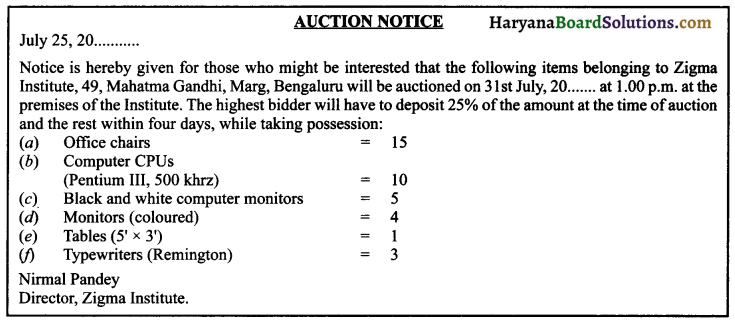
HBSE 12th Class English Paragraph Writing

Haryana State Board HBSE 12th Class English Solutions  Composition Paragraph Writing Exercise Questions and Answers.

Haryana Board 12th Class English Paragraph Writing

Writing
1. Life In A Big City [H.B.S.E. 2017 (Set-C)]
A big city is always crowded and noisy. Life in a big city is busy and fast. People are always in a hurry. A big city is full of smoke, dust and noise. The peace which we find in a village or a small town is absent in a big city. The poor people lead a miserable life in big cities. There are slums where people live in bad conditions. There is also crime in big cities and life of people is not much safe. There are many accidents because of the rush of traffic. There are robbers and pick-pockets. But a big I city has its attractions also. There are big buildings, cinema houses and markets. There are big and modem hospitals. A person suffering from disease can hope to get the best treatment.There are big
schools and colleges where students can get vast knowledge of education. There are buses, taxis, cars and local trains to carry people from one place to the other in no time. Thus life in a big city has both its dark and bright sides.

Glossary : crowded = भीड़ वाला,
hurry = जल्दी,
miserable = दुखी,
slums = गन्दी बस्तियाँ,
robbers = लुटेरे,
attractions = आकर्षण ।

2. Good Manners
Good manners play an important role in our life. Without good manners, the world would be a dull place to live in. They are the spice of life. Good manners cost nothing, but they help us a lot. Without them we cannot carry on our life smoothly. Bad manners create enemies. But good manners win you a number | of friends and admirers. They create a good impression on others. Good manners make our life easier. In a crowded train compartment, you may get some room to sit if you talk pleasantly with the other passengers. Even your minor mistakes may be forgiven because of your good manners. On the other hand, nobody likes a person having bad manners. Everyone tries to avoid them. We expect that people should speak politely to us. So we should do to others what we expect the others to do to us. It means that we should adopt good manners.

Glossary :
spice = मसाला,
admirers = प्रशंसक,
compartment = डिब्बा,
passengers = यात्री।

HBSE 12th Class English Paragraph Writing

3. A Train Accident
Last month, a terrible train accident took place at Khanna station in Punjab. Two trains coming from the opposite directions had a direct collision. The Frontier Mail coming from Delhi and the Kashmir Express coming from Jammu collided with each other. The tragedy occurred due to the negligence of the signalman. He put both the trains on the same railway track. The scene of the accident was heart-rending. Three bogies of the Frontier Mail and three bogies of the Kashmir Express were completely smashed. More than 120 people died and 200 were injured. There were dead bodies all around. The injured and trapped persons were crying loudly for help. Some were weeping for their dead near and dear ones. The police and the health authorities come in action. The injured were taken to hospitals. Some social organizations also helped the authorities.

Glossary :
terrible = भयानक,
collision = टक्कर,
negligence = लापरवाही,
heart-rending = दर्दनाक,
trapped = फँसे हुए।

4. The Sports Day Function Of Your School/College
On 15th January, this year, the annual sports day of our college was celebrated. It was a colourful function. The college looked beautiful like a bride. It was decorated with flags and buntings. The Sports Minister of our state was the Chief Guest, who inaugurated the function. Then the athletes marched past the stage. Sh. Dalbir Singh Kharub, the D.P.E. of our college was the incharge of the function. The staff members also helped him. After the march past, the athletic items were held.

The most exciting items were 100 metre and 200 metre races, the pole vault and the three-legged race. The Chatti race was very interesting. Each girl participant had to run with a small earthen pitcher on her head. The musical chair race was entertaining. Sh. Gurpreet Singh was declared the best athlete of our college. In the evening, the winners were awarded with prizes.

Glossary :
celebrated = मनाया,
decorated = सजाया,
exciting = उत्तेजनाजनक,
pitcher = मटका,
declared = घोषणा की।

5. A Morning Walk [H.B.S.K March, 2018 (Set-C)]
A morning walk is very important for our health. In the early morning, the air is fresh and pure. There is calmness everywhere. A walk at this time gives peace to our mind. A morning walk provides exercise to the body. It gives energy for the whole day. We should get up early in the morning and then go for a long morning walk. This gives us a good start to our day. It also gives us extra time for our work. One who rises early has done a lot of work before other persons get up.

The person who rises late, misses the beauty and joys of the morning scene. He does not remain fit in body and mind. The morning walk gives us a lot of pleasure. All the poets and lovers of nature get up early in the morning and take a walk in the lap of nature. A morning walk has a great influence on our mood. The person who goes out for a walk daily in the morning, generally remains cheerful throughout the day.

Glossary :
calmness = शांति,
provides = किसी वस्तु की आपूर्ति,
influence = व्यक्ति या वस्तु को प्रभावित, परिवर्तन या नियंत्रित करने की शक्ति।

6. Rising Prices In India [H.B.S.E. 2017 (Set-D)]
The rising prices of commodities is a big problem. Prices of everything are rising rapidly. Even the prices of essential commodities like sugar, oils, cotton, tea, pulses, food grains, petrol etc. have greatly increased. The people of the fixed income groups like the salaried people, labourers etc., are the worst sufferers. They find it difficult to make both ends meet. Many things are going beyond the reach of poor people. One of the reason of rising prices is our growing population.

The population is growing rapidly every year. But the production of things does not increase at the same speed. There is increase in demand. So the prices also increase. The black-marketers and hoarders are also responsible for increasing the prices of essential things. We should check our growing population. The government should punish the black-marketers and the hoarders. There should be no tax on the items of daily use. Only then we can with the fight the problem of rising prices.

Glossary :
commodities = सामान,
rapidly = तेजी से,
essential = आवश्यक,
hoarders = जमाख़ोर।

HBSE 12th Class English Paragraph Writing

7. Weed To Ban Polybags [H.B.S.E. 2020 (Set-B)]
Polythene and plastic are spoiling people’s health from village to city. The city’s drainage system is often filled with polythene. Due to this, drains and streams are blocked. Its use has increased rapidly. By consuming tea or hot milk in plastic glasses, its chemical goes into people’s stomachs. This causes diarrhoea as well as other serious diseases. The increasing use of polythene is becoming dangerous not only for the present but also for the future. Earlier, when people went for a shopping, they used to carry a bag of cloth, but today they go empty handed and ask for polythene from the shopkeeper.

Remember that polythene deposited on the earth floor is depleting the ability of the ground to absorb water. Due to this the ground water level is falling rapidly. Due to not being destroyed in a natural way, it is slowly ending the fertilizer capacity of the earth. Burning plastic also causes damage. Its poisonous smoke is dangerous to health. Therefore, the government should ban the manufacturing and use of polythene as soon as possible.

Glossary :
drainage = पानी आदि के निकासी की प्रणाली,
diseases = बीमारियाँ,
deplete = अपक्षय करना,
absorb = सोख लेना ।

8. If I Would Be The Education Minister
Education in India is in a very poor state. Our government does not pay much attention to education. If I would be the Education Minister of my country, I would ask the Prime Minister to give top priority to education. As there is a shortage of schools and teachers in the country. I would open new schools and colleges even in remote villages. But mere opening of schools is not enough. The teachers should also be qualified. I would like to ban elections to students unions. These elections only create indiscipline. I would pay attention to games also. Games and sports will be made an essential part of the syllabus. I would try to make education job-oriented. Thus, I would bring many reforms in the educational system of India.

Glossary :
attention = ध्यान,
priority = प्राथमिकता,
remote = दूर के,
create = बनाना,
reforms = सुधार।

9. Discrimination Of Women
Discrimination of women in the world is still a major problem. Even though we have made huge strides against it but still there are examples of discrimination of women all over the world in the past. In some countries like America and England, women were even denied the right to vote. This type of discrimination is called sexism. Sexism may be defined as an ideology based on the belief that one sex is superior to another. It is discrimination, prejudice or stereotyping on the bases of gender, and is most often expressed towards girls and women. It has been characterized as the ‘hatred of Women’. [H.B.S.E. March, 2019 (Set-B)]

Glossary :
discrimination = पक्षपात करना,
strides = उन्नति,
ideology = विचारधारा।

10. Your School/College Library
The library is an important part of a college. It is a store house of knowledge. A student who wants to increase his knowledge must make use of the library. Our college has a big library. There are more than 20,000 books in this library. A large number of them are very rare books. There are also magazines of all kinds. There are books on all subjects in this library. The library is housed in a separate and big building. There are two big reading rooms for students. Students sit there for hours, reading books and making notes. One part of the library is reserved for the staff members. Many of them also spend a lot of time in the library. The librarian is an efficient man. He helps the students in locating the books. I often make use of the library. It has helped me alot in getting good marks in the examinations.

Glossary :
increase = बढ़ाना,
magazines = पत्रिकाएँ,
separate = अलग,
efficient = कुशल,
reserved = आरक्षित।

11. An Ideal Student
An ideal student gives prime importance to education and his studies. He is pure and simple in his habits. According to a philosopher, an ideal student should be alert and quick by mind like a crow. He has concentration of mind like a heron. He should not sleep much. He should be free from the worries of family and the worldly affairs. An ideal student tries to develop his personality in all fields. He is a good student as well as a player. He has great respect for his teachers, his parents and the elders in the society. An ideal student is not a book worm. He takes part in games also. He remains away from strikes and other such acts. The attainment of knowledge is the only aim of an ideal student. He always keeps this aim before him. An ideal student has a sense of his duties towards the society and the country. He takes part in social service and tries to uplift the poor and miserable people. Such students build a strong nation.

Glossary :
prime = मुख्य,
philosopher = दार्शनिक,
concentration = एकाग्रचित्तता,
heron = बगुला,
attainment = प्राप्ति,
miserable = दुखी।

12. My Aim In Life Or What I Waist To Be [H.B.S.E. 2017 (Set-A)]
We must have some aim in life. Without aim a man is like a car without a steering. It will go wherever it likes. A man without aim does not get anything in life. But a man who has a definite aim always succeeds. My aim in life is to become a teacher. He often lives in poverty. A teacher’s profession is very noble. He shapes lives of young students. A good teacher is one of the pillars of the society. In the past, India had very good teachers. They are the pride of India. I also want to become a great teacher. I will try to cultivate a sense of dedication for teaching in me. May God help me to realize my aim.

Glossary :
definite = निश्चित,
profession = व्यवसाय,
noble = नेक,
cultivate = पैदा करना,
dedication = समर्पण ।

HBSE 12th Class English Paragraph Writing

13. A Visit To A Hill Station
Last year, I visited Mussourie. I and two of my friends went together. Mussourie is a beautiful hill station. It is surrounded by tall and majestic hills. From Dehradun, Mussourie is only one hour away by bus. The way to Mussourie from Dehradun is very steep. At night one can see the beautiful and shining city of Mussourie from Dehradun. In the same way, from Mussourie one can see below, the lights of Dehradun at night. There are a number of beauty spots in and around Mussourie.

Thousands of tourists visit this hill station from India and the other countries. We stayed at Mussourie for a week. We went to see the Kampti Falls. We had a beautiful glimpse of the Himalayas from Lai Tibba hill. We enjoyed a ride in the rope-way trollies at gunhill. We visited Dhanllti also. The lake at Mussourie is small but beautiful. We did some shopping at the Chinese market. The memory of my visit to Mussourie will always remain fresh in my mind.

Glossary:
majestic = शानदार,
glimpse = झलक।

14. My Hobby
Hobbies are very important in our life. After routine work, our mind and body are tired. Hobbies divert our attention to some other work. A hobby differs from daily work. We do it in our spare time. Sometimes, the same work may be a profession for someone and a hobby for another. Thus gardening is a vocation for gar-deners. But it is a hobby for me. I love nature. The hobby of gardening gives me a chance to be near flowers and plants. Their presence gives me pleasure and satisfaction.

I do gardening in the backyard of my house. In one part of it, I have grown roses. These look very beautiful when they are in full bloom. In another part of it, there are other beautiful plants like papaya and guava. There is a big lawn also, with green grass. When I want to relax, I go there and the sight of beautiful flowers and plants refreshes my mind.

Glossary :
routine work = नियमित काम,
spare = फालतू,
profession = व्यवसाय,
satisfaction = सन्तुष्ट,
bloom = खिलना,
papaya = पपीता।

15. Corruption In Public Lite
Or
Need For Fight Against Corruption
Corruption has become very common these days. This evil is spread in all fields of life. Taking and giving of bribes is a common thing now. Nobody feels shame about it. In today’s life nothing can be done without bribes. In government offices, the clerks as well as officers openly demand bribes. We have become greedy. We are running after money all the time.

This desire for more and more money has made us corrupt. But there is an urgent need to fight against corruption. We should neither demand nor give bribes. This is not only a legal crime but also a crime against morality. The government has made anti-corruption laws. But only laws cannot do anything. We must change our own character. We must fight against corruption. We should boycott those persons who are corrupt. They should be put to shame. Only then we can check the growing corruption.

Glossary :
corruption = भ्रष्टाचार,
bribes = रिश्वत,
shame = शर्म,
desire= इच्छा,
crime = अपराध।

16. Adverse Effect Of T.V. On Children
The television is a wonderful invention. It has changed the field of information and entertainment. We can watch the latest news and other programmes. We can see movies and songs on it. But the T.V. has a number of negative effects also. It has a lot of bad effect on the younger generation. Children neglect their studies and devote a lot of time on watching the T.V. These days the cable T.V. has reached most of the homes. A number of movies are shown on these channels. Excessive T.V. watching harms the eye-sight also. But we cannot blame the T.V. We should try to have a keep an eye on our children. They should not be allowed to see too much T.V. The government should ban the telecast of vulgar movies. These films have a bad effect on the minds of growing children.

Glossary :
adverse = बुरा,
entertainment = मनोरंजन,
negative = नकारात्मक,
excessive = हद से ज्यादा,
ban = रोक लगाना।

17. Falling Standard Of Education
The standard of education in India is falling. Today the number of degree holders are increasing, but the level of knowledge is decreasing. In the past, people did not have many educational degrees, but they had real knowledge. But these days, we insist on bookish knowledge. A person who can cram more and then write it within three hours may get more marks. In our schools and colleges, we do not pay attention to the real knowledge. Our education system prepares a student for passing examinations only. But a student holding an M.A. degree may not know how to write a simple application. He may not be able to fill up the form for railway reservation. There are many reasons for the falling standard of education. There is shortage of schools at the primary and matriculation level. There is also need for good and trained teachers. The courses of education should also be framed in such a way as to give real knowledge to the students. It is the duty of the teachers and the society to check the falling standards of education.

Glossary :
standard = स्तर,
decreasing = गिरना,
cram = रटना,
prepare = तैयार करना,
reservation = आरक्षण।

18. Value Of Games
Life cannot always be work and only work. Along with work, a person needs entertainment also. There are many means of recreation. But the games are the best kind of recreation. Apart from recreation, games keep us fit also. Games are very useful in many other ways. They teach us a sense of discipline and duty. A good sportsman always follows the rules of the games. That teaches him discipline. Games and sports build a man’s character. A good player always plays with a spirit of sportsmanship.

No team can win unless all the players play with a team spirit. They play not for their individual glory, but for the glory of the team. So, they learn to help and co-operate with one another. And that training stands in good stead in life. Above all, sports teach us to accept even our defeat gracefully. They teach us that we should not feel discouraged by our failure. On the other hand, we should learn from our mistakes and try to do better the next time. For all these reasons, sports have a great value.

Glossary :
entertainment = मनोरंजन,
recreation = मन बहलाना,
discipline = अनुशासन,
sportsmanship = खेल-भावना,
gracefully = शान से ।

19. A Day In A Village [H.B.S.E. March, 2018 (Set-B)]
Life in village is calm and peacefull and very different from that in a city. In the village, the atmosphere is very peaceful. There is no noise or sound. The air is pure and fresh. Last week I went to one of my friends who lives in a village. I spent one day with him. It was a pleasant experience. The farmers and labourers were going to work in the fields in the early morning.

The sight of the crops waving in the wind gave me a lot of pleasure. We went to the river that lies beyond the village. The water of the river looked clean and sparkling. Some persons were taking bath in the river. We also took off our clothes and jumped into the river. The cool and fresh water refreshed our bodies and mind. Indeed a day in a village is very pleasant.

Glossary :
peaceful = शांतिपूर्ण,
pleasant = आनन्ददायक,
sparkling = चमकदार।

20. Importance Of yoga [H.B.S.E. 2020 (Set-A,C)]
Yoga is an ancient system of the training of body, mind and soul. It has a long tradition in our country. The art of practising yoga helps in controlling an individual’s body, mind and spirit. It brings together physical and mental discipline to achieve a peaceful body and mind. It helps in managing stress, anxiety and keeps us relaxing. It also helps in increasing flexibility, muscle strength, body tone. The word ‘yoga’ is derived from Sanskrit language which means ‘to join/to unite.

Yoga exercises have a physical effect and bring a balance in body, mind and spirit. Yoga is not a religion. It is a way of living that aims towards a healthy mind in a healthy body. Regular practice of yoga keeps us fit and fine. It keeps us away from all the diseases like blood pressure, sugar, heart problem, nervous system problem and tension. The present day, Government of India under the leadership of worthy Prime Minister Sh. Narender Modi, has contributed a lot for the promotion of yoga at the national and international level. It is the result of the government’s efforts that the whole world celebrates 21 June as ‘Yoga Day’ and we see people practising ‘yogic exercises’ across the world.

Glossary :
disciplines = अनुशासन,
derived = प्राप्त करना,
diseases = बीमारियाँ।

HBSE 12th Class English Paragraph Writing

21. Role Of Newspapers [H.B.S.E. 2020 (Set-D)]
Reading of newspapers has become a habit for most of the people. Newspapers play a very important role in our life. A good newspaper is very useful for society. It satisfies the tastes of all kinds of people. A newspaper gives us latest news about the national and international events. For businessmen, there are advertisements. There is a sports page for the sports lovers.

The unemployed people can look for vacancies. There are matrimonial columns for the unmarried people. A good newspaper is a watchdog of democracy. It helps us to fight against the injustice. It informs people about what is happening in the society. A good newspaper is a source of entertainment also. Its Sunday edition carries articles and stories.

Glossary :
habit = आदत,
satisfies = संतुष्ट करना,
international = अंतराष्ट्रीय,
advertisements = विज्ञापन,
matrimonial = विवाह संबंधी,
democracy = प्रजातंत्र ।

22. Environmental Pollution
Environmental pollution is the biggest danger to the world these days. During the last few years, there has been a reckless cutting of trees all over the world. Also, there has been increase in industrialization in the world. Big factories have come up in all parts of the world. These factories release a lot of smoke every day. Then there is smoke from vehicles like trucks, buses, auto-rickshaws, scooters, etc.

The factories throw their wastes into rivers and streams making them highly polluted. Environmental pollution has become a worldwide problem. It may bring man’s destruction if proper steps are not taken in time. Unclean air, dirty water, and smoke are great dangers to human and plant life. Forests should not be cut recklessly. More and more trees should be planted. We must make efforts to check all kinds of pollution.

Glossary :
environmental = पर्याबरण,
pollution = प्रदूषण,
reckless = अन्धाधुंध,
industrialization = औद्योगीकरण,
vehicles = वाहन ।

23. A Visit To An International Trade Fair
Every year, an International Trade Fair is held at Delhi. Last year I also visited the International Trade Fair. It was held at the Pragati Maidan in New Delhi. I went with our college tour. We made our entry from Gate No. 1 and went inside. There was a lot of crowd. Thousands of people, school and college students had come to visit this trade fair. Nearly all the states of India had set up their pavilions.

These pavilions highlighted the industrial development achieved by each state. Apart from the industrial and technical progress, these pavilions gave a glimpse of the cultural life of these states. Many countries of the world also took part in it. They had put their stalls in a big building called ‘The Hall of Nations’. The main attraction of the fair was electronic goods.

Glossary :
international = अंतर्ताष्ट्रीय,
trade = व्यापार,
pavilions = मंडप,
development = विकास,
glimpse = झलक,
attraction = आकर्षण।

HBSE 12th Class English Paragraph Writing

24. A Visit To A Zoo
Last Sunday, I visited Delhi. There I went to see the Zoo. I went there with my uncle. The zoo in Delhi is one of the biggest zoos in Asia. It is situated near the Old Fort. As we entered the zoo, first of all, we saw birds. There were many kinds of birds. Some of them were very beautiful and rare. In the beginning, there were water birds and then other kinds of birds. We saw ducks, geese, swans, parrots, cranes, herons, peacocks, and many other birds. Then we saw the wild beasts. There is strong and high railing around the enclosures of the dangerous animals. We saw lions, tigers, rhinos, bears and wolves. We enjoyed an elephant ride also. In a big pond, there were hippos also. Their big mouths were fearful to look at. There was a separate enclosure for snakes. Some of the snakes looked fearful. There were big crocodiles and alligators. We came back in the evening.

Glossary :
situated = स्थित,
rare = दुर्लभ,
geese = हंस,
herons = बगुले,
beasts = जानवर,
wolves = भेड़िए,
fearful = भयानक,
crocodiles = मगरमच्छ।

25. Your Visit To The World Book Fair
Books are the true friend and guide of man. They give us the wisdom of different ages. Last month, the World Book Fair was held at New Delhi. I also visited this Book Fair. The fair was held at Pragati Maidan. Leading publishers of India took part in this fair. Publishers from some other countries had also put up their stalls in the fair. There were different kinds of books, for example, literature, science, politics, economics, military science, self-improvement and on general topics.

There was a separate stall for religious books. It was joyful to see books on different topics at one place. Some publishers were offering good discounts. At some stalls there were attractive free gifts for those who purchased books for more than two hundred rupees. I purchased many books on literature and general knowledge. In the evening, I came back home.

Glossary :
publishers = प्रकाशक,
literature = साहित्य,
science = विज्ञान,
religious = धार्मिक,
general knowledge = सामान्य ज्ञान ।

26. Your Visit To A Village Fair
Fairs are an important part of the village life in India. Last Sunday, I visited a fair in the neighbouring village. It had brought life to the dull looking village. The site of the fair was worth seeing. Everybody was happy. The shopkeepers had laid out their stalls here and there. There were tea stalls, bangle shops, sweet shops and general goods shops at the fair site. Hawkers from different places had come there to sell their wares. Young girls as well as married women came to the fair.

They were buying earrings, pins and bangles. Children were buying balloons, whistles and other small items. Girls and women were also buying colourful clothes. There was a rush at the tea stall and sweet shop. There were many items of entertainment for the children. Merry-go-rounds, jugglers and magicians attracted children. In fact, it was an attractive event.

Glossary :
fair = मेला,
neighbouring = पड़ोस के,
bangles = चूड़ियाँ,
hawkers = फेरी वाले,
whistles = सीटियाँ,
entertainment = मनोरंजन,
jugglers = मदारी।

HBSE 12th Class English Paragraph Writing

27. A Visit To A Museum
Last year, I went to Hyderabad to spend my summer vacations with my uncle. I saw many buildings and castles there. One morning, I went to the Salar Jung Museum there. In the museum, I saw wonderful collection of objects of art, paintings, coins, and dolls. I liked the section which showed old arms like swords, spears, guns, etc. The section showing old books and coins also attracted me.

In another room, I saw old garments, vessels, instruments and ornaments. The vessels were made of copper, bronze, silver and clay. The swords used by kings of the past were very heavy. In one room there were marble statues. These had been collected from many countries. I also saw musical instruments of many periods and countries. The paintings shown in the museum were marvelous. I greatly enjoyed my visit to that museum.

Glossary :
vacations = छुट्टियाँ,
castles = किले,
museum = संग्रहालय,
swords = तलवारें,
ornaments = गहने,
statues = बुत,
instruments = यंत्र ।

28. The Evil Of Smoking
Smoking is one of the worst habit. Besides being a waste of money, it is very harmful to health. It causes a number of diseases like heart attack, cancer, asthma, etc. A smoker not only harms himself, he troubles the life of others also. The cigarette smoke pollutes the atmosphere. Those people who are close to smokers also suffer. They are also in danger of the diseases which are caused by smoking.

A smoker is a great nuisance to his fellow travellers in a bus or train. Smoking reduces the life span of a person. It also causes impotence in men. It has its bad effect on the lungs. That is why people in other countries have started giving up this habit. We should also learn from them. It is the high time to give up this habit and save ourselves from the hazards caused by smoking.

Glossary :
habits = आदतें,
pollute = दूषित करना,
nuisance = मुसीबत,
impotence = नपुंसकता,
hazards = खतरे।

29. The Evil Of Dowry System
In India, there are a number of evil practices. Dowry system is one of them. It is .a blot on the name of India. Women suffer greatly because of the dowry. Many girls remain unmarried. Every year, a great number of young brides are burnt down for not bringing good dowry. The parents of young girl also suffer. Many girls commit suicide when they see the sad condition of their parents.

The parents of the girl have to give a lot of dowry to the parents of the bridegroom. The government has made strict rules against dowry. But only rules cannot prevent this evil. We should also come forward. We should take a pledge to remove this evil from our society. Young girls should refuse to marry those who demand dowry. We should boycott dowry-seekers.

Glossary :
dowry = दहेज,
suffer = पीड़ित होना,
suicide = आत्महत्या,
bridegroom = दूल्हा,
dowryseekers = दहेज माँगने वाले।

30. Recent Floods In Your State
Last year, the monsoon in Punjab was in a great fury. It rained continuously and heavily for fifteen days. This caused floods in most of the regions of Punjab. Many villages were affected by these floods. The standing crops were drowned in water. Many mud-houses fell down. The condition was not much better in the cities. The road and railway traffic was disrupted., trees were uprooted.

In many villages people pass their time on house tops or on the trees. Many people died of hunger. A great number of cattle died. Water diseases spread everywhere. The Govt, rushed to help the flood victims. The army was called to help the civil officers. Food packets were dropped by aeroplanes also. Many people were taken to safe places. But the sight of the flood was unbearable.

Glossary :
fury = आवेग, जोश,
affected = प्रभावित हुए,
drowned = डूब गई,
disrupted = विघ्न पड़ा,
cattle = मवेशी,
unbearable = असहनीय ।

HBSE 12th Class English Paragraph Writing

31. A Fire Tragedy
Last Monday, there was a big fire accident in our colony. At midnight, I was woken up by cries of people. I came out to check what is happening. I saw that a house in our street was on fire. The flames of fire seemed to be touching the sky. Suddenly, a lady cried. She told the people that her son had been left inside the burning house. Nobody dared to go inside the house.

I took courage and went inside. There was smoke everywhere. I could not see anything. Suddenly, I heard the sound of weeping. I went into the room and found the woman’s son. I lifted the child on my shoulders and rushed out. Luckily my bums were not serious. Everybody cheered me and congratulated me for saving the life of the child.

Glossary :
cries = चीखें,
dared = हिम्मत करना,
serious = गंभीर,
cheered = हौंसला बढ़ाया।

32. A Drowning Tragedy
Last month, I witnessed a drowning tragedy. Our class went on a picnic at river bank. We sat down under the trees near the river bank. We were enjoying our picnic greatly. At noon, a few boys decided to have a swim in the river. The current was fast. The others advised them not to swim. But the boys did not listen to them. They jumped into the river. They swam near the bank.

But one of them suddenly swam into the middle of the river where the current was very fast. He was caught in the whirlpool. He shouted for help. None of us was a very good swimmer. So we all shouted for help. A few villagers came running. They jumped into the river. They tried their best but they could not save the boy. The boy was drowned. The joyful mood of picnic changed into tragedy.

Glossary :
witnessed = देखी,
drowning = डूबने की,
current = धारा,
swam = तैरा,
joyful = प्रसन्न।

33. How You Helped The Victims Of An Accident
Last Sunday, there was an accident in our city. A bus collided with a truck. Six bus passengers died on the spot. More than twenty passengers were wounded. Ten of them were in serious condition. I was passing by that area when the accident occurred. I decided to help the injured passengers. I stopped the taxis and rickshaws and requested them to take the passengers to the hospital. In a few minutes all the ten seriously wounded passengers were taken to hospital. The doctors attended to them.

But five of these passengers immediately needed blood transfusion. Unluckily the blood was not available in the hospital. So I rushed to my college. I talked to my friends and told them about the accident. Within a few minutes seven boys agreed to donate blood. We all rushed to the hospital. We told the doctors to take our blood. Our blood was given to the seriously injured passengers and their lives were saved.

Glossary :
collided = टकरा गई,
wounded = घायल,
occurred = हुआ,
blood transfusion = खून चढ़ाना।

34. Road Safety
Today in India our roads have become much overloaded by vehicles. While being on the road, road safety is very necessary. Today road accidents are the leading cause of deaths in India. In our country thousands of people lose their lives in road accidents every year. If road users are well aware of road safety rules, the number of deaths in road accidents can be reduced. Everyone should leam the traffic and safety rules at a very early age to perform safe behaviours in the later life.

Everyone going on the road, especially drivers, must be to the left and let other vehicles pass on the opposition direction to the right. Drivers should be in slow speed while over-taking or turning on the roads. People should take extra precaution while going on the over-crowded roads. Bikers or people using two wheel vehicles must wear helmets of superior quality. Speed of the vehicles should be within the speed limits and slow especially in the areas of school, hospital, colony etc. Every vehicle on the road should maintain the right distance among them to avoid accidents. Everyone who use road should be well aware of the road signs and must follow traffic rules. Everyone must keep in mind all the road safety rules and regulations.

Glossary :
precaution = सावधानी,
superior = उत्तम।

HBSE 12th Class English Paragraph Writing

35. The Havoc Caused By An Earth-Quake
In September this year, there was a severe earthquake in Lattur area of Maharashtra. The earthquake lasted only one minute, but it caused a widespread damage to life and property. The quake was so serious that it was felt in Andhra Pradesh and Madhya Pradesh also. The Latter area was the worst hit. More than sixty thousand people lost their lives in the earthquake. Most of the buildings fell down.

The quake came at night when people were sleeping in their houses. That is why the number of deaths was very high. The Govt, at once sent relief and rescue teams. These people helped the victims of the quake. Tents were pitched in which the homeless people took refuge. These people were given free meals by the government. Help came from all comers of the world. The memory of this serious earthquake will always remain fresh in the minds of people.

Glossary :
severe = कठोर, तीव्र,
damage = नुकसान,
relief = राहत,
rescue = बचाव,
victims = शिकार, पीड़ित,
refuge = आश्रय।

36. Road Safety Rules For Children
According to the statistics it is found that there are most of the road accidents fn which children are involved, so they are at high risk than other age group people. Children are children, no one can be sure about what they will do next at home or other crowded places especially road during traffic situations. They must be taught some of the basic road safety rules. Parents should teach their children to be extra attentive and look left and right before crossing the road.

They should always cross the roads by holding hands of their elders or friends. When they are walking by foot on the road they should walk only on the footpath. They should never ran on the road. They need to be more cautious on the road without getting distracted anything. They should be taught to only cross the roads at crossroads after seeing traffic signals for pedestrians. They must be aware of the meaning of colors-red means stop, green means go and yellow means also stop or be ready to stop or start.

Children should be taught not to play on the road. They should not use earphones or other music-listening instruments while riding bicycles on the road. Parents should follow all the road safety rules and traffic rules while driving vehicles to establish good examples in front of their children as they are first example in the lives of their kids.

Glossary :
attentive = ध्यानपूर्वक,
distracted = ध्यान हटना।

37. A Public Park
A public park is an attractive place. It has beautiful trees, flowers and fountains. There are grassy lawns. In the morning people go to a public park to enjoy the fresh air. Young people can be seen doing exercise. Old and retired people can be seen gossiping. During the noon people may take rest under the shade of the trees. In the evening there are lots of people in a public park. All kinds of people go there in the evening for rest and recreation. Some people take walks along the path ways.

Some sit in the grassy lawns and chat with one another. Young children play there happily. The hawkers do good business. They sell ice-cream, parched grams, soft drinks and balloons. In some parks there are coloured lights. They look very beautiful at night. A park serves a useful function. It gives charm to the city and provides people a place for rest and recreation.

Glossary :
attractive = आकर्षक,
exercise = व्यायाम,
gossiping = गप-शप करना,
recreation = मनोरंजन,
hawkers = फेरी वाले,
charm = आकर्षण।

38. Your Best Friend [H.B.S.E. 2017 (Set-B)]
A good friend is a great gift of God. Munish is my best friend. He is my class fellow and neighbour. We go to the college together and come back together. We have the same subjects. We help each other in our home¬work. He is good at studies and games. He always stands first in the class. He is the captain of our hockey team also. Munish is a good speaker. He has won many prizes in speeches.

He belongs to a very rich family. But he is not proud of his father’s wealth. He has a good and charming personality. Last year we went to a hill station together. I enjoyed the visit greatly in his company. Munish is my true friend. May he live long!

Glossary :
gift = उपहार,
proud = घमंडी,
personality = व्यक्तित्व,
charming = आकर्षक,
occasions= अवसर।

39. Your Favourite Writer
Charles Dickens is myfavourite writer. He is a great novelist of English literature. He has written a number of great novels. His novels show the deep study of human mind. He is realistic in the description of circumstances. Dickens’s life was a tale of struggles. His childhood was very poor and miserable. He had to work from morning to evening in a factory. His father was imprisoned for not paying back the debt.

All these things had great effect on his mind. Dickens describes all these experiences in his novels. His famous novels are : ‘Great Expectations’, ‘Hard Times’, ‘A Tale of Two Cities’, ‘Oliver Twist’, ‘Pickwick Papers’, etc. His novels are very interesting to read. His novel ‘Great Expectations’ describes the life and adventures of Pip. ‘A Tale of Two Cities’ is based on the French Revolution. His other novels are also interesting. In short, he is a great writer.

Glossary :
favourite = मनपसंद,
novelist = उपन्यासकार,
realistic = वास्तविक,
description = वर्णन,
circumstances = परिस्थितियाँ,
adventures = साहसिक कार्य ।

HBSE 12th Class English Paragraph Writing

40. My Favourite Book
According to Milton, “A book is the precious life and blood of a mastermind.” I am very fond of reading books. I have read books written by a number of writers. Out of these books, I like Prem Chand’s book ‘Godaan’ the most. This is Prem Chand’s most famous novel. This novel paints a true picture of the rural India before Freedom. Prem Chand describes the plight of an Indian farmer. Hori, the poor farmer in this novel suffers a lot. But he does not complain to anybody. His life is a long tale of suffering.

The village Zamindar, the village banker (Sahukar), the corrupt government officials and others exploit him. His own son leaves him and goes to Lucknow. But Hori goes on struggling against the circumstances. In the end, he dies. His death is very tragic. Apart from Hori, there are some other memorable characters like Malti, Prof. Mehta, Khanna Sahib, his wife, etc. In short, ‘Godaan’ is Prem Chand’s masterpiece.

Glossary :
precious = अनमोल,
rural = ग्रामीण,
plight = दुर्दशा,
suffer = सहना,
exploit = शोषण करना,
memorable = अविस्मरणीय।

41. A Happy Dream
Or
A Pleasant Dream
Last night, I had a pleasant dream. I saw that I had contested the elections for the state assembly. I was canvassing for the support of people. I was making speeches. Then the election was over. The counting of votes started. When the result was out I found that I had won the election. I had defeated my rival by fifty thousand votes. I was very happy. I was taken out in a procession. There were people along both sides of the road. They were waving flags and handkerchiefs. They were shouting with joy.

They were pushing one another for shaking hands with me. Then I was taken to a stage. I stood on it and delivered a speech. I thanked people for their support. I told them that I would fulfil my election promises. People again shouted with joy. I told them to shout with me, “Long Live India.” Suddenly, my father woke me up. He told me that I had been shouting “Long Live India” in my sleep. Then I realized sadly that it was only a dream.

Glossary :
pleasant = आनन्ददायक,
contested = चुनाव लड़ा,
canvassing = प्रचार करना,
support = समर्थन,
defeated = हराना,
rival = प्रतिद्वंद्वी,
procession = जुलूस,
promises = वायदे ।

42. Freedom Of Speech
The Constitution of India provides every citizen of hers the Right to Freedom as a fundamental right. Under a subsection of this fundamental right, every citizen of India is provided freedom of speech. In India there is a democratic form of government. In this form of government freedom and protection of human dignity is the foremost requirement. We enjoy this freedom at length. If we have grievlances with our government, we can raise our voice high against the government. But sometimes people misuse this freedom. They even begin to speak against the sovereignty and integrity of the nation.

This must not be allowed. Freedom of speech is a principle that supports the freedom of speech is a principle that supports the freedom of an individual or a community to articulate their opinions or ideas without fear of retaliation, censorship or legal sanction. But on the other hand it must be kept in mind that the freedom of speech for one must not be harmful to the other. It must not voilet the rule of the land. [H.B.S.E. March, 2019 (Set-C)]

Glossary :
constitution = संविधान,
fundamental = मूलभूत,
grievances = शिकायत,
sovereignty = साम्राज्य,
retaliation = जवाबी हमला।

HBSE 12th Class English Paragraph Writing

43. I Am Eighteen
Last Friday 1 celebrated my 18th birthday. To me it seemed as usual as I had celebrated my earlier birthdays. But next day my professor in the college congratulated me and took me to the election office of the college and asked the incharge to register me as a voter. It was the first experience for me that I have become an adult and could cast my vote now. I feel that this big event in my life has given me a lot.

I don’t think that the age of 18 has changed myself a lot but this has given me more responsibilities. In addition to the right of vote, I can have my driving licence. With a driving licence, I can drive a bike and a car. Thus the age of 18 has given me many special things in my life. [H.B.S.E. March, 2019 (Set-D)]

Glossary :
congratulated = बधाई देना,
experience = अनुभव,
special = मुख्य, असधारण।

44. Beauties Of Nature
Nature is a storehouse of beauty. According to the great poet Keats, the beauty of nature is imortal. In every season and at every place nature is beautiful in one way or the other. The beautiful flowers of different colours give great pleasure to our eyes and mind. In the early morning, the chirping of birds is veiy pleasant to our ears. The tall and snow-covered mountains look very beautiful.

The rivers and streams flowing down the great mountains add charm to our life. Dew drops on the green grass early in the morning look like pearls. The rising and the setting sun both appear very charming. The starry night and silvery moon are other examples of the beauties of nature. The deep and dark forests fill us with a sense of awe and mystery. In short, nature is full of beauty.

Glossary :
store-house = भंडार,
chirping =चहचहाहट,
streams =झरने,
pearls = मोती,
charming = आकर्षक,
mystery = रहस्य।

45. Memories Of Childhood
Childhood is the best period of man’s life. A child is free from worries. He spends his time in enjoying life. Whenever I am in a vacant mood, the memories of my childhood come to my mind. When I was a child my parents lived at Ludhiana. We had our house near a pond. The breeze coming from the pond carried a pleasant coolness. Our family was not very rich. But we all loved one another. My father was a loving man. Often he took me for long walks outside the city. Whenever I was tired, he carried me on his shoulders. Sometimes I would stand on the bank of the pond and watch the swans swimming in it.

I remember that one of my uncles used to visit us. He was very kind and brought good gifts for me. In our city, there was a big mosque which had been deserted. Near the mosque, there was a vegetable market. When I started going to school, I made a number of friends. I still remember them. I also remember the day when I was punished by my father for making mischief. Thus my childhood memories bring both sweet and bitter moments of life to my mind.

Glossary :
worries =चिंताएँ,
breeze =ठंड़ी हवा,
shoulders =कंधे,
pond = तालाब,
swans =हंस,
mischief = शरारत ।

46. Spring Season Or The Season I Like Most
Spring season is called the queen of seasons. It is the best and the most pleasant of the seasons. After the chilling winter season, the coming of spring brings new life and vigour into the dull life. There is activity all around in nature. The birds are happy as the winter season has passed. New leaves start sprouting on branches. In fact, spring season is a symbol of new life and activity.

There is freshness everywhere. Man should also take inspiration from the spring season. We should put an end to our laziness and pessimism. I like spring season because this season is congenial to activity. The weather in spring is neither too hot nor too cold. Spring season also brings the message of prosperity. This season gives inspiration to people to make their lives better and more progressive.

Glossary :
spring = बसंत,
chilling = बहुत ठंडी,
sprouting = फूटना,
symbol = प्रतीक,
inspiration = प्रेरणा।

47. Secularism In India
India is a secular country. Secularism means equal place for all religions. It also means that we should respect the other religions. We should have respect for all the religions of our country. India is a land of many religions. People of different castes and religions live here. They have their own ways of worshipping God. They have their own holy books. The Hindus have the Gita and the Ramayana. The Muslims believe in Quran. The Sikhs consider Guru Granth Sahib as their Guru.

The Christians have faith in the Bible. Our Government is secular. It gives equal respect to every religion. Our constitution says that all religions are equal. Sometimes there are communal riots in our country. But we should respect every religion and live peacefully.

Glossary :
secularism = धर्म-निरपेक्षता,
religions = धर्म,
worshipping = पूजा करना,
constitution = संविधान,
communal = जातीय,
riots = दंगे।

48. Mahatma Gandhi And Non-Violence
Mahatma Gandhi was a great Indian leader. He was an apostle of non-violence and truth. He had rare qualities in him. He was against violence of any kind. He fought against the British and brought us freedom. But he did not use violence. He achieved the biggest political victory of his life through non¬violence. He shook the foundation of the British rule in India. This was possible by his use of non-violence. At present, the world is passing through a period of bloodshed and violence.

There are clouds of war everywhere. At such a time, Gandhi’s principle of non-violence can save the world from destruction. The use of non-violence can eradicate evil and hatred from the hearts of people. It can create a feeling of brotherhood amongst masses. We should therefore adopt Gandhi’s principle of non-violence in our life.

Glossary :
apostle = मसीहा,
rare = दुर्लभ,
violence = हिंसा,
victory = विजय,
foundation = नींव,
eradicate = हटा देना।

HBSE 12th Class English Paragraph Writing

49. Men And Women Are Born Equal But…
God has made men and women equal but in Indian society, we find that they are not treated as equal. Society does not give women the status of equality with men. In a family, we see the difference between a son and a daughter. When a son is born, the parents dance with joy. But the birth of a daughter is not celebrated. Many people are not willing to spend as much money on the education of their daughters as they spend on their sons. In the past women were treated only as slaves.

Even now women is called the weaker sex. It is thought that a woman cannot do all those things which a man can do. A woman’s field is limited to the household duties only. These days many women are coming forward and working shoulder-to-shoulder with men. But their status is still not equal to that of men.

Glossary :
equal = बराबर,
treated = व्यवहार किया,
status = दर्जा,
celebrated = मनाया,
slaves = कैदी।

50. The Advantage Of Learning A Foreign Language
Language is mainly a means of communication. Through language, we can understand others and express our thoughts to them. It is also a means of getting knowledge. If we do not know language we will not be able to get the knowledge which lies stored in the books of the world. So the more languages we know, the more knowledge we get. The writers and learned men of all countries have written in their own languages. These writings are full of knowledge and wisdom.

But we cannot get them if we do not know the language of that country. If we know only one language, our minds will be limited. They will not expand. So children should be taught at least one foreign language at school. This will give them the knowledge about other countries, their culture and thoughts. It will also be very useful for the overall development of the child’s personality.

Glossary :
communication = संचार,
express = व्यक्त करना,
expand = फैलना,
foreign = विदेशी,
personality = व्यक्तित्व ।

51. My Birthday [H.B.S.E. March, 2018 (Set-A)]
Last month, I celebrated my 16th birthday. It was celebrated with pomp and show. The big drawing room of our house was decorated beautifully. My father had invited all his close friends. I had invited all my class- fellows. Many families from our colony were invited. The birthday cake was big and beautifully made. Sixteen candles were put on it. These candles showed that it was my sixteenth birthday. I touched the feet of my parents and received their blessings. Then I blew out the sixteen candles one by one.

All the guests shouted with joy, “Happy birthday to you.” Then I cut the birthday cake and distributed its small pieces among the guests. I got beautiful presents from my near and dear ones. My father had arranged an orchestra for this purpose. It presented very good programme of music. In the end, the guests were given a dinner. I will never forget my sixteenth birthday.

Glossary :
pomp = तड़क-भड़क,
orchestra = वाद्यवृंद।

HBSE 12th Class English Paragraph Writing

52. My Classroom [H.B.S.E. March, 2018 (Set-D)]
I read in Government Senior Secondary School G.T. Road, Panipat. I am a student of XII-A class. My school has thirty classrooms. All the rooms are airy and spacious. But my classroom is a special one. It is situated near the Principal office. It is a very big room. It has four ceiling fans. It has two doors and four big windows. It has a very big black-board. There are thirty pairs of very fine benches and desks.

These are fitted on steps. The walls of my class room are covered with all sorts of education charts and maps. The class timetable is framed near the main door. The class attendance board is also there near the main door. My classroom is al¬ways neat and clean. It seems like a temple of knowledge. I like my classroom very much and enjoy learning in it for shaping my life into a good citizen of India.

Glossary :
spacious = आकार में बड़ा,
framed = किसी बात को विशेष प्रकार से व्यक्त करना।

HBSE 12th Class English Paragraph Writing Read More »
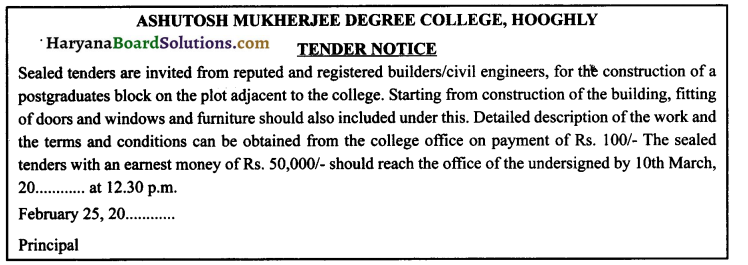
HBSE 12th Class English Grammar Modals

Haryana State Board HBSE 12th Class English Solutions Grammar Modals Exercise Questions and Answers.

Haryana Board 12th Class English Grammar Modals

What are Modals?
Modals are a type of helping verb. They always accompany the principal verb, expressing the mode or manner of the action done by the verb. for e.g. will, shall, should, would, can, could, may, might, must, need, dare etc. They are also known as “Modal Auxiliaries’.

Modals एक प्रकार की सहायक क्रियाएँ हैं। ये main verb के साथ मिलकर कार्य करने के mode या तरीके को बताती हैं। ये योग्यता, अनुमति, संभावना, कर्त्तव्य जैसे विचारों को व्यक्त करती हैं। मुख्यतः will, shall, would, should, can, could, may, might, must, need, dare, ought to और used to आदि modal auxiliaries हैं।

Features of Modals (सहायक क्रियाओं की विशेषताएँ)-
(a) Modals are never used alone. They are always used with Principal Verb that follows them; for e.g. :
Modals कभी अकेली नहीं आतीं। इनका प्रयोग सदा main verb के साथ किया जाता है; जैसे-
You must do this work.
I can solve this sum.

(b) The number, gender or person of subject does not effect modals; for e.g. :
Subject के number, gender या person का modals पर कोई प्रभाव नहीं होता; जैसे
I can go there.
We can go there.
You can go there.
They can go there.
He can go there.
She can go there.

(c) Ist form of verb is always used with Modals but we use “to’ Infinite with ‘ought’ and ‘used’; for e.g. :
Modals के साथ verb की Ist form का प्रयोग होता है। परंतु ought और used के साथ ‘to’ Infinitive का प्रयोग होता है; जैसे-
He will leave for Mumbai today.
You should work hard.
I can help you.
We ought to serve our country.
He used to help me in the past.

(d) If we add ‘be’ with Modals then we use Ist verb + ing; for e.g. :
Modals के साथ ‘be’ लगाने पर उसके बाद verb की Ist form और ing का प्रयोग करते हैं, जैसे-
Sudha will be writing a letter.
I shall be travelling in a train tomorrow.
Poonam will be dancing.

(e) If we add ‘have’ with Modals then we use IIIrd form of verb; for e.g. :
Modals के बाद ‘have’ लगने पर उसके बाद verb की IIIrd form का प्रयोग करते हैं, जैसे-
He must have done this work.
He should have passed the test.
He may have gone to Delhi.

HBSE 12th Class English Grammar Modals

Uses of Modals
1. SHALL
(i) ‘Shall’ is used with Ist person (I, we) to express simple future tense. for e.g.
Shall का प्रयोग Ist person (I, we) के साथ साधारण future tense को व्यक्त करने के लिए किया जाता है; जैसे-
I shall know my result tomorrow.
We shall leave for Mumbai in the evening.

(ii) To give command ‘shall’ is used with the pronouns of second and third person. for e.g.
आदेश (command) के लिए second और third persons के pronouns के साथ; जैसे-
You shall do as I say.
You shall not disobey your parents.

(iii) To express promise; for e.g.
वचन (promise) को व्यक्त करने के लिए; जैसे- }
You shall get a prize.
You shall have a wrist watch on your birthday.

(iv) To express compulsion or necessity; for e.g.
बाध्यता या अनिवार्यता (compulsion or necessity) को व्यक्त करने के लिए; जैसे-
You shall not enter the kitchen with dirty feet.
You shall not make a noise.

(v) To show determination or certainity, for e.g. :
संकल्प (determination) अथवा निश्चय (certainty) को व्यक्त करने के लिए; जैसे-
He shall take revenge on his enemy.
He shall get good marks, I am sure.

(vi) In interogative sentences “shall’ is used with I/we to express or present request in front of someone
or one’s service to request to someone; for e.g. :
प्रश्नवाचक वाक्यों (interrogative sentences) में shall का प्रयोग I/we के साथ किसी दूसरे के सामने अपनी सेवा प्रस्तुत करने के लिए या प्रार्थना करने के लिए किया जाता है; जैसे – Shall I carry your heavy bag ? Shall we go to see a film today?

2. WILL
(i) It is used to express the simple future tense. It used with second and third person (you, he, she, they, it, etc.) for e.g.: Will का प्रयोग IInd और IIIrd person (you, he, she, they, it आदि) के साथ simple future tense को व्यक्त करने के लिए किया जाता है; जैसेHe will come here at Diwali. They will never learn good manners.

(ii) To express request or invitation; etc. for e.g. : प्रार्थना या निमंत्रण के लिए; जैसेWill you open the door, please?
Will you have a cup of tea?

(iii) To express habit; for e.g. : आदत के लिए; जैसे –
A dog’s tail will never become straight.
He will never tell the truth.

(iv) To express certainty with Ist person; for e.g. :
Ist person (I/we) के साथ निश्चय (certainty) को व्यक्त करने के लिए; जैसे-
itaI will write a letter to her in the evening.
We will visit the theatre next week.

(v) To express determination with Ist person; for e.g. :
I/we के साथ संकल्प (determination) को व्यक्त करने के लिए, जैसे-
I/wet fret Hanna (determination) Date de a fair,
I will get Ist division. We will win the race. I will become a great man one day.

(vi) To express willingness; for e.g. :
‘इच्छा’ (willingness) को व्यक्त करने के लिए; जैसे-
the I will come with you if you want.
I will help you in this matter.

(vii) To express order or instruction; for e.g. :
आदेश (order) या निर्देश (instruction) को व्यक्त करने के लिए; जैसे-
You will do as I say.
You will not beat your brother.

HBSE 12th Class English Grammar Modals

(viii) To express inference or probability; for e.g. :
अनुमान या संभावना (inference or probability) को व्यक्त करने के लिए; जैसे-
The boys in blue dress will be his brother.
By this time Mohan will be there.

(ix) To express conditional statements; for e.g. :
शर्त वाले (conditional) वाक्य के लिए; जैसे-
If you work hard, you will pass.
If you don’t run, you will miss the train.

(x) To express warning; for e.g. :
चेतावनी (warning) देने के लिए or या otherwise वाले वाक्यों में; जैसे –
Work hard otherwise, you will fail.
Run fast or you will miss the train.

3. SHOULD
(i) In Indirect speech ‘shall’ is replaced by ‘should’; for e.g. :
Indirect speech में shall के past tense के रूप में; जैसे
I told him that I should help him.
He said that they should go there.

(ii) To express the emotion of duty. for e.g. :
कर्त्तव्य (duty) की भावना प्रकट करने के लिए; जैसे-
We should obey our parents.
We should help the needy.

(iii) To express advice or suggestion. for e.g. :
सलाह तथा सुझाव (advice or suggestion) को व्यक्त करने के लिए; जैसे –
You should work hard.
You should take exercise.

(iv) To express purpose after using the word ‘lest’; for e.g. :
Lest के पश्चात उद्देश्य (purpose) को व्यक्त करने के लिए; जैसे –
Work hard lest you should fail.
Walk slowly lest you should fall.

(v) To express moral obligation. for e.g. :
नैतिक उत्तरदायित्व (moral obligation) को व्यक्त करने के लिए; जैसे –
You should not drink wine.
You should help your sister.

(vi) To express the emotion of supposition, possibility and condition. for e.g. :
कल्पना (supposition), संभावना (possibility) तथा शर्त (condition) की भावना को व्यक्त करने के लिए; जैसे –
Should you see my brother? Tell him to send me a good book.
I think you should win the championship.

(vii) To express assumption; for e.g.
अनुमान (assumption) की भावना को दर्शाने के लिए; जैसे –
She should be here by now.
They should have reached Delhi.

4. WOULD
(i) In Indirect speech ‘will’ is replaced by ‘would’; for e.g. :
Indirect speech में will के past के रूप में; जैसे –
He told me that he would go to Mumbai.
Mohan said that he would not do that work.

(ii) To express past habits; for e.g. :
Past के किसी कार्य को करने की आदत को व्यक्त करने के लिए; जैसे –
Gandhiji would spin for hours.
He would often study till late in the night.

(iii) To express polite request; for e.g. :
विनम्र प्रार्थना (polite request) के लिए; जैसे –
Would you open the door, please?
Would you lend me your bicycle for an hour?

(iv) To know someone’s wish or prefrence; for e.g. :
किसी की इच्छा को जानने के लिए; जैसे –
Would you have a cup of tea?
Would you like to come with me?

(v) To express our own wish or prefrence; for e.g. :
कोरी कल्पना (wish) को व्यक्त करने के लिए; जैसे –
Would that I were young again!
Would that my son were a hard worker!

HBSE 12th Class English Grammar Modals

(vi) To express importable condition; for e.g. :
असंभावित परिस्थिति (improbable condition) को व्यक्त करने के लिए; जैसे –
If a thief came here, he would find only books.
If I got a lottery, I would be very happy.

(vii) To express determination; for e.g. :
दृढ़-निश्चय (determination) को व्यक्त करने के लिए; जैसे –
He would have his own way.
I would buy that car at any cost.

(viii) To give preference; for e.g. :
अधिमान (preference) को बताने के लिए; जैसे –
I would like to have coffee.
I would rather starve than steal.[H.B.S.E. 2020 (Set-C)]

5. CAN
(i) To express ability; for e.g. :
योग्यता (ability) को व्यक्त करने के लिए; जैसे –
I can solve the sum.
He can swim across the river.
Can you stand on your head?

(ii) To grant permission; for e.g. :
अनुमति (permission) देने के लिए; जैसे-
You can see a film if you like.
You can go home if you have done your work.

(iii) To ask for permission; for e.g. :
अनुमति मांगने के लिए; जैसे –
Can I use your dictionary?
Can I go home?

(iv) To express possibility; for e.g. :
संभावना (possibility) को व्यक्त करने के लिए; जैसे –
Death can come anytime.
He can reach here anytime.

(v) To express capacity or power; for e.g. :
क्षमता या शक्ति (capacity or power) को व्यक्त करने के लिए; जैसे –
I can lift this heavy table.
The headmaster can remit your fine.

6. COULD
(i) In Indirect speech ‘can’ is replaced by could for e.g. :
Indirect speech में can के past के रूप में; जैसे –
Mohan said that he could solve the sum.
He asked me if I could help him.

(ii) To express permission in past; for e.g. :
Past की अनुमति (permission) को दर्शाने के लिए; जैसे-
Father said that he could see the film.
She asked me if she could meet me.

(iii) To express possibility in past; for e.g. :
Past की संभावना (possibility) को व्यक्त करने के लिए; जैसे –
If he had money, he could buy a scooter.
I wondered whether the news could be true.

(iv) To express past capacity or ability; for e.g. :
भूतकाल में क्षमता (capacity) या योग्यता (ability) को व्यक्त करने के लिए; जैसे –
I could swim when I was young.
She could solve the sum when she was only five years old.

7. MAY
(i) To grant or ask for formal permission; for e.g. :
औपचारिक अनुमति (formal permission) लेने या देने के लिए; जैसे –
May I come in, Sir ? Yes, you may.
May I use your book? Yes, you may use it.

(ii) To express wish / prayer or blessing; for e.g. :
इच्छा (wish), प्रार्थना (prayer) या आशीर्वाद (blessing) को व्यक्त करने के लिए; जैसे-
May you live long!
May I be able to cross the river!
May God bless her with a son!

(iii) To express possibility; for e.g. :
संभावना (possibility) को व्यक्त करने के लिए; जैसे –
There are clouds in the sky. It may rain.
Mohan may reach here anytime.

(iv) To express purpose use Ist form of verb before ‘so that’; for e.g. :
उद्देश्य (purpose) को बताने के लिए so that से पहले verb की Ist Form लगी होती है; जैसे –
We eat so that we may live.
I go to school so that I may become a great man.

(v) To express possibility in past ‘may have’ is used. for e.g. :
अतीत की संभावना (Past possibility) को व्यक्त करने के लिए may have का प्रयोग होता है; जैसे –
He may have reached Kanpur.
You may have heard about Akbar.

8. MIGHT
Might is the past form of ‘may’. It is used in following circumstances : यह may का past रूप है। इसका प्रयोग निम्नलिखित अवस्थाओं में किया जाता है :
(i) To ask for permission in past for e.g. :
भूतकाल में अनुमति लेने या देने के लिए; जैसे –
I asked him if I might use his book.
My father told me that I might see a picture.

(ii) To express possibility in past; for e.g. :
भूतकाल (past) में संभावना (possibility) को व्यक्त करने के लिए; जैसे –
The doctor said that the patient might recover.
He might have done the mischief.

HBSE 12th Class English Grammar Modals

(iii) To express wish in past; for e.g. :
भूतकाल की इच्छा (wish) को व्यक्त करने के लिए; जैसे –
I wished that I might pass the examination.
Mohan wished that his sister might win the race.

(iv) To express remote possibility for future; for e.g. :
भविष्य काल में किसी क्षीण संभावना (remote possibility) को व्यक्त करने के लिए; जैसे –
I might go to the market, but I am not sure. He might come, if he gets time.
The prices might fall down a little.

(v) To express purpose use IInd form a verb before so that; for e.g.: ।
उद्देश्य को बताने के लिए; so that से पहले verb की IInd form लगी होती है; जैसे –
He died so that his country might survive.
He worked hard so that he might pass.
If he worked hard, he might get Ist prize.

9. MUST
(i) To express dire necessity; for e.g. :
तीव्र आवश्यकता (dire necessity) को व्यक्त करने के लिए; जैसे –
You must take an umbrella as it is raining.
We must run if we want to catch the train.

(ii) To express compulsion or obligation and if there is a possibility of getting punished if work is not
done; for e.g. : अनिवार्यता (compulsion) या बंधन (obligation) को व्यक्त करने के लिए या कार्य न करने पर यदि सजा मिलने का प्रावधान हो; जैसे –
A servant must obey his master. [H.B.S.E. March 2020 (Set-B)]
We must obey the laws of our country.

(iii) To express determination; for e.g.
दृढ़-संकल्प (determination) को व्यक्त करने के लिए; जैसे –
I must finish this work by evening.
We must attack the enemy before daybreak.

(iv) To express duty; for e.g.
कर्तव्य (duty) को व्यक्त करने के लिए; जैसे –
You must obey your parents.
We must serve our country.

(v) To express prohibition; for e.g.
मनाही (prohibition) को व्यक्त करने के लिए; जैसे –
We must not touch electricity. You must not disobey your elders
Children must not play on the road.

(vi) To express possibility; for e.g.
संभावना (possibility) को व्यक्त करने के लिए; जैसे –
He must have reached Delhi.
She must have gone to bed by now.

10. OUGHT
‘Ought’ can be used in place of should but it is necessity to use to’ with ought. Following are its various uses; for e.g. :
Ought का प्रयोग should के स्थान पर किया जा सकता है, मगर इसके साथ ‘to’ का प्रयोग आवश्यक है। इसके प्रयोग निम्नलिखित हैं-
(i) To express moral and social duty; for e.g. :
नैतिक एवं सामाजिक कर्त्तव्य (moral and social duty) के लिए; जैसे –
We ought to obey our teachers.
You ought to help the poor and the needy.
We ought to take pity on the beggars.

(ii) To express advice and suggestion; for e.g. :
सलाह (Advice) या सुझाव (Suggestion) को व्यक्त करने के लिए; जैसे –
You ought to work hard for the examination.
You ought to consult the doctor.

(iii) Ought to +have+ IIIrd form of verb is used to express the condition when work was to be done but did not done. for e.g. :
Ought to + have + verb की IIIrd form के द्वारा यह व्यक्त किया जाता है कि कार्य होना चाहिए था, मगर हुआ नहीं; जैसे –
You ought to have met the principal (but you did not).
You ought to have informed the police.

HBSE 12th Class English Grammar Modals

11. NEED
Need is a regular verb as well as modal. As a modal ‘need’ is only used to express negative and interrogative sentences; for e.g. :
Need एक नियमित क्रिया भी है और एक modal भी Modal के रूप में इसका प्रयोग केवल नकारात्मक (Negative) तथा प्रश्नवाचक (Interrogative) वाक्यों में होता है; जैसे –
(i) Out of necessity; for e.g. :
आवश्यकता का न होना; जैसेYou needn’t take an umbrella as it has stopped raining.
Tomorrow is a holiday. You need not come to school.
(ii) To ask questions related to need; for e.g.
आवश्यकता के बारे में कोई प्रश्न पूछना; जैसेNeed you go home so soon?
Need you speak so fast?
Need she run for catching the bus ?

12. DARE
Like ‘need’, ‘dare’ is also a regular verb and as well as modal. It is only used in negative and interogative sentences in following ways:
Need की तरह dare का प्रयोग भी नियमित क्रिया एवं modal दोनों प्रकार से होता है। Modal के रूप में इसका प्रयोग केवल नकारात्मक (Negative) और प्रश्नवाचक (Interrogative) वाक्यों में निम्नलिखित रूप से होता है :
(i) Dare is used to ‘challenge somebody’; for e.g. :
खतरनाक करने के लिए चुनौती देना; जैसे –
I dare you to climb that mountain.
How dare you to that to me!

(ii) To ask question related to courage; for e.g. :
साहस के बारे में प्रश्न करना या साहस का ना होना; जैसे –
How dare you insult me?
The children dare not go into a dark room at night. [H.B.S.E. March 2020 (Set-B)]

13. USED TO
“Used to’ is used in following circumstances :
‘Used to’ का प्रयोग निम्नलिखित अवस्थाओं में किया जाता है :
(i) To express habitual action in past. for e.g. :
भूतकाल की किसी आदत (past habitual action) को दर्शाने के लिए; जैसे –
In the past, people used to believe that the earth was flat.
Before marriage, he used to drink a lot.

(ii) For the existence of something in the past. for e.g. :
भूतकाल में किसी वस्तु के अस्तित्व के लिए; जैसे –
There used to be a big building at the corner.
A fair used to be held in this ground every year.

Exercises For Practice (Solved)
Exercise 1

Fill in the blanks with the modals given in brackets :
1. She ……………. not have left alone as it was raining heavily. (can/must) [H.B.S.E. 2019 (Set-A)]
2. ………………………… you wait for sometime ? (should, could, must) [H.B.S.E. March, 2020 (Set-B)]
3. This chair is very light. Even a small boy …………………………. lift it. (can, could, must)
4. It is cloudy. It ………………………….. rain soon. (may, can, might)
5. A son …………………………. obey his father. (can, must, should)
6. ………………………….. you live long! (can, may, should) [H.B.S.E. 2017 (Set-B)]
7. Anyone …………………. make mistakes. (can, may, should)
8. We …………. obey our parents. (can, may, should) [H.B.S.E. 2017 (Set-D)]
9. Asha asked if she ………………. bring her dog in. (can, may, might)
10. She advised that I ……………. curtail expenditure. (should/can) [H.B.S.E. 2019 (Set-A)]
Answer:
1. must,
2. Could,
3. can,
4. may,
5. must,
6. may,
7. can,
8. should.
9. might,
10. should.

HBSE 12th Class English Grammar Modals

Exercise 2
Fill in the blanks with appropriate modals using hints given in brackets :
1. She …………….. dance very well. (ability) [H.B.S.E. March, 2020 (Set-A)]
2. ………..you help me in this matter, please. (polite request)
3. …………….. you please help my son ? (Could/Might) [H.B.S.E. 2019 (Set-D)]
4. You………..not enter my room with muddy feet. (prohibition)
5. You…………get a prize; this is my promise. (promise) [H.B.S.E. 2017 (Set-B)]
6. He………..sit there for hours, watching the trains. (past habit)
7. He…………help the needy. (duty) [H.B.S.E. 2017 (Set-A)]
8. ………..I come in sir. (permission) [H.B.S.E. 2020 (Set-D)]
9. It………. rain today. (possibility)
10. He ………… come today, but I am not certain. (remote possibility)
Answer:
1. can,
2. Will,
3. Could,
4. shall,
5. shall,
6. would,
7. should,
8. May.
9. may.
10. might

Exercise 3
Fill in the following blanks with would, should, must, ought, dare, need.

1. You ………. give up smoking. [H.B.S.E. 2020 (Set-A)]
2. You ………. work hard this year. [H.B.S.E. 2020 (Set-D)]
3. You…………not worry anymore. [H.B.S.E. March, 2018 (Set-A)]
4. That ………… be a doctor. [H.B.S.E. March, 2018 (Set-A)]
5. I………… not say so if I were you.
6. ……….you like to come with me? [H.B.S.E. 2017 (Set-D)]
7. How…………you misbehave ?
8. You are quite well. You. ………… not go to the doctor. [H.B.S.E. March, 2018 (Set-C)]
9. It is good that they………..live together.
10. I am sure the Principal …………… be in his room. (might/must) [H.B.S.E. March, 2019 (Set-B)]
Answer:
1. should,
2. must,
3. need,
4. must,
5. would,
6. Would,
7. dare,
8. need,
9. should,
10. must.

Exercise 4
Fill in the following blanks with will or shall.

1. You ………………. do as I say. [H.B.S.E. 2017 (Set-A)]
2. Word hard otherwise you ………………… fail. [H.B.S.E. 2017 (Set-B)]
3. ………………………… I help you in this matter?
4. ………………………. you have a cup of tea ?
5. You ……………………. not enter this room with muddy feet.
6. You ……………………… get all help from me; this is my promise.
7. If you insist, I …………………………. accompany you.
8. …………………….. you open the door, please ? [H.B.S.E. 2017 (Set-1)]
9. You …………………….. ring him up.
10. It is my determination that I ……………………….. get Ist division.
Answer:
1. shall,
2. will,
3. Shall,
4. Will,
5. shall,
6. shall,
7. will,
8. Will,
9. will,
10. will.

HBSE 12th Class English Grammar Modals

Exercise 5
Fill in the blanks in the following sentences with may, might, can or could:
1. If we request her, she ………………. give a lift. (must/might) [H.B.S.E. 2019 (Set-B)]
2. ………… he lives long! [H.B.S.E. March 2018 (Set-D)]
3. He walked fast so that he …………………………….. reach the station in time.
4. He ………………………. swim across the river. [H.B.S.E. 2017 (Set-D)]
5. What you propose to say…………………………… Sound very imposing.
6. She told me that her cousin ………… not come.
7. She …………………… swim very well. [H.B.S.E. 2020 (Set-D)]
8. My friend did not help me though he ……………. have helped. (could/will) [H.B.S.E. 2019 (Set-C)]
9. I did all that I …………………………. do for her.
10. He went there so that he ………….. borrow money. (can/might) [H.B.S.E. 2019 (Set-D)]
Answer:
1. might,
2. May,
3. might,
4. can,
5. may,
6. might,
7. can,
8. could,
9. could,
10. might.

Exercise 6
Fill in the blanks with would or should
1. We…………………………… respect the elders.
2. ………… you like to have a cup of tea? [H.B.S.E. 2017 (Set-C)]
3. Mohan ……………… keep sitting near the railway line for hours.
4. He told me that Mohan …………………….. meet me after two days.
5. ……………………….. you mind helping me?
6. If I were rich I ……………………….. buy a car. [H.B.S.E. March 2018 (Set-B)]
7. I told him that I………….. do that work.
8. Work hard lest you ………………………. fail.
9. They ……………………………… arrive here any time.
10. Make haste lest you …………. get late. (will/should) [H.B.S.E. March 2019 (Set-C)]
Answer:
1. should,
2. Would,
3. would,
4. would,
5. Would,
6. would,
7. would,
8. should,
9. should,
10. should.

Exercise 7
Fill in the blanks in the following sentences with may, might, must and need:

1. She expects that her son ……………… return. (may/can) [H.B.S.E. March, 2019 (Set-A)]
2. ……………………………… I win a lottery !
3. We …………………………….. drive carefully. [H.B.S.E. March, 2018 (Set-C)]
4. You ………………………. consult some doctor. [H.B.S.E. March, 2020 (Set-C)]
5. ……………………………….. I use your pen ?
6. ………………………. God bless you with a son ! [H.B.S.E. 2017 (Set-C)]
7. I …………………………. visit Delhi. But I am not much sure.
8. You …………………….. not swim in the river, the current is very fast.
9. You ………………………….. pay all your taxes. [H.B.S.E. March, 2018 (Set-B)]
10. ………………………… our king live long! (May/Will) [H.B.S.E. March, 2019 (Set-C)]
Answer:
1. may,
2. May,
3. must,
4. must,
5. May,
6. May,
7. might,
8. must,
9. must,
10. May.

Exercise 8
Fill in the blanks in the following sentences with dare, ought to or used to:
1. I ……………………… enter his room in his absence.
2. He ……………………….. play football when he was young. [H.B.S.E. March, 2018 (Set-B)]
3. You ……………………….. to take regular exercise.
4. He ……………………………….. take up the responsibility. [H.B.S.E. March, 2018 (Set-A)]
5. He ………………………………. not take to you? [H.B.S.E. March, 2018 (Set-C)]
6. We …………………………………… to serve our nation.
7. ……………………………….. you go into that house at night ?
8. I ………………………….. not go outside now. (dare/ought to) [H.B.S.E. March, 2019 (Set-D)]
9. I ………………………………. go to the college on foot. Now I go on a scooter.
10. You ……………………………… to work hard for the examination.
Answer:
1. daren’t,
2. used to,
3. ought,
4.ought to,
5. dare,
6. ought,
7. Dare,
8. dare,
9. used to,
10. ought.

Exercises For Practice (Unsolved)
Exercise 1
Fill in the blanks with appropriate Modals :
1. I …………………………………… go there even if it rains.
2. You ……………………………….. always remember that you ……………………………….. be the first to offer help wherever needed.
3. I ………………………….. help him with money before I leave for London.
4. You ………………………………… to respect your elders.
5. The breeze is cool; it ………………………….. rain soon.
6. The doctor told me that I ……………………………… not smoke anymore.
7. If you have a ticket, you …………………………….. go inside.
8. You …………………………….. not enter my class; I forbid it.
9. ……………………………….. you possibly lend me a thousand rupees?
10. ………………………….. I speak to the Principal for a minute?
11. One …………………………….. always be kind to others.
12. He has been absent for a fortnight; he ………………………. be ill.
13. He ……………………………. like to spend the evening with you.
14. You …………………………….. not think so, but dirty streets cause epidemics.
15. There ……………………………… be some more buses. [H.B.S.E. March 2020 (Set-A)]

HBSE 12th Class English Grammar Modals

Exercise 2
Fill in the blanks with the appropriate models, choose from the list given:
(a) shall, should, will, would, may, must.
1. I think it ……………….. rain today.
2. He has been absent for a fortnight; he ……………………….. be ill.
3. ………………………………. I come in? I’m sorry to be late.
4. A Student ………………………. respect his/her teacher. [H.B.S.E. March 2018 (Set-D)]
5. ………..you lend me a thousand rupees?

(b) must, should, shall, will, can, may.
1. The doctor told me that I …………………………. not smoke anymore.
2. I …………………………….. go there even if it rains.
3. One …………………………… always be kind to others.
4. If you have a ticket, you ………………………… go inside.
5. One …………………………………… always help others.

(c) needn’t, will, could, should, must, can.

1. I …………………………….. not meet you as I was very busy.
2. We …………………………… hire a taxi otherwise we’ll miss the train.
3. We …………………………….. help our neighbors in hour of their need.
4. You ……………………………. meet him. Just write a letter.
5. You have fever. You ………………………. consult a doctor.

Exercise 3
Fill in blanks with the appropriate models, choose from the list given :
(a) may, would, should, ought, must.
1. He …………………………….. be rich but he is very cruel.
2. We ………………………… to do as we are told.
3. ………………………… you like to take coffee?
4. The headmaster ………………………….. check all these accounts.
5. What ………… you like to have in supper. [H.B.S.E. March 2018 (Set-D)]

(b) will, would, may, might, must.
1. A servant ……………………….. obey his master. [H.B.S.E. 2017 (Set-C)]
2. I am afraid, he ……………………………. not succeed even this time.
3. I …………………………….. rather fail in the examination than use unfair means.
4. We eat so that we …………………….. live.
5. I am determined that ………………………….. get good marks.

(c) will, would, should, may, might.
1. If you meet him, you …………………………… tell him about it.
2. He died so that his country………………………. survive.
3. If I were a rich man, I ………………………………. buy a car.
4. We ………………………………… take bath daily.
5. The sky is full of clouds; it ……………………… rain today.

HBSE 12th Class English Grammar Modals

Exercise 4
Fill in the blanks with models appropriate to the meaning in brackets :
1. You …………………………. go home now. (permission)
2. You ……………………….. finish your work before going home. (compulsion)
3. I ………………………… not let myself become a slave to machines. (determination)
4. You ……………………… run; the train is late. (absence of necessity)
5. Mohan went to Agra last week. He …………………………. come today. (probability)
6. I am afraid he ……………………………. fail even this time. (probability)
7. ……………………….. you lift this baggage? (present ability)
8. ………………………….. we do not know whether the primitive men …………………….. plough the fields. (past ability)
9. He …………………………. tell his father the truth. (absence of courage)
10. ……………………………. you mind moving a little? (polite request)

Other Exercises (Solved)
Fill in the blanks using suitable modals :

SET 1
Milk is a complete food, full of vitamins and proteins. Children (a) ………………………. drink it regularly otherwise they (b) ……………. suffer from under-nourishment. Elders (c) ………………………. also take it but those who (d) ………………………… not afford it (e) ………………………. take pulses, fruits, and vegetables as a alternative. We (f) ………………………………… purchase milk of good quality from milk booths opened by the government. Bad quality of milk (g) ………………….. spoil our health. Thus we (h) …………………………… be conscious about our health.
Answer:
(a) should,
(b) might,
(c) must,
(d) can,
(e) should,
(f) should,
(g) can,
(h) should.

SET 2
Patient: Sir, (a) ………………….. I know why I (b) ……………………. get medicines from this particular shop.
Doctor: This is the only shop which (c) ……………………… guarantee good medicines. Other chemists (d) …………………… not supply good medicines. Patient ; (e) ……………………. you provide me the list of medicines I have to buy?
Doctor: There is no problem. I (f) ……………………………… give the list of medicines right now.
Patient: I(g) ………………………….. like to know the price of these medicines first.
Doctor: Yes, you (h) …………………….. if you please.
Answer:
(a) May,
(b) must,
(c) will,
(d) can,
(e) Can,
(f) will,
(g) would,
(h) may.

SET 3
The art of cooking was made perfect in ancient India. When the people were eating raw meat all over, the world, Indians (a) ………………………. prepare hundreds of food items from one single commodity. Even today we know that we (b) …………………. prepare may items from milk alone. It (c) …………………. be curd, butter, cheese, sweets etc. Unfortunately, this milk-producing country is running short of milk. We (d) …………………. not improve this condition unless we pay serious attention to our milch cattle. We (e) ………………………. improve their breed by new scientific methods. Attention (f) ……………………. also be paid to their proper nourishment.
Answer:
(a) used to,
(b) can,
(c) may,
(d) can,
(e) should,
(f) should.

SET 4
If we sit in an incorrect posture it (a) …………………. strain our back. As far as possible this (b) ………………… be avoided. If the posture becomes a part of habit, a low back pain invariably develops. It (c) ………………. be cured if we become conscious of our posture. We (d) …………………. also take time out to perform a few exercises. If the exercises are done regularly the backache (e) …………………….. certainly be cured. It also improves blood circulation within the spine.
Answer:
(a) may,
(b) should,
(c) would,
(d) should,
(e) can,
(f) will.

SET 5
Rahul: You (a) …………………….. always read in proper light. Inadequate light (b) …………………………… weaken your eyesight. Ramesh: My eyesight is six by six. I (c) ………………… also read distant words and sentences. Rahul : (d) ………………………. you read this book from here? Ramesh: Sorry, this distance is quite far off. It appears that I (e) ………………………… commit some mistake. Rahul: Then how
you say that your eyesight is six by six.
Answer:
(a) must,
(b) may,
(c) can,
(d) Can,
(e) might,
(f) can.

SET 6
Receptionist: Good morning, (a) …………………… I help you? Visitor: Good morning. We are planning to visit Solan. (b) …………………….. you direct us on how to go there? Receptionist ; (c) ………………………. you like to go by taxi or you (d) ……………………….. like to go by bus? Visitor: We (e) ……………………………… like to go by bus. Receptionist: That is easy. Buses go from here to all the places around. But you can’t enjoy the visit. You better take a taxi.
Answer:
(a) may,
(b) Can,
(c) Would,
(d) will,
(e) will,
(f) should.

SET 7
Postmaster : (a) ………………………. you go and deliver this post just now?
Postman: 1(b) ………………………………. only deliver it sir if I get somebody’s bicycle today.
Postmaster: You (c) …………………………. take my bicycle.
Postman: Thank you, sir.
Postmaster: You (d) ……………………… immediately go now with the post and return soon since there is an urgent work to do.
Postman: This post contains more than 20 letters and 5 parcels, Sir. So it (e) ……………………… take more than an hour for distribution.
Postmaster: But try to be quick. The work is urgent. I(f) ……………………………….. not wait.
Answer:
(a) Can,
(b) can,
(c) may,
(d) must,
(e) will,
(f) can.

HBSE 12th Class English Grammar Modals

SET 8
Puneet: Let us to the movie, Suresh.
Suresh: I am sorry. I (a) …………………….. not. I (b) ………………………… reach home immediately.
Puneet : But why (c) ……………………… you be in such a hurry?
Suresh: 1 (d) take my mother to the doctor. She (e) ………………………….. not go alone.
Puneet: Then you (f) ……………………………… certainly go.
Answer:
(a) can,
(b) have to,
(c) should,
(d) have to,
(e) can, must.

SET 9
Whenever I think of my school Principal, I feel highly impressed by his habit of regular morning walk. He (a) …………………… get up early. Rain or storm, he (b) ………………………. go for a walk. Even when he fell ill, no one in the house (c) …………………….. stop him from going out. He (d) ……………………….. always say that morning walk (e) ………………………… cure him of illness and he was right. He never fell ill. At the age of seventy-five, he run for miles together and (g) leave youngsters far behind. Now he is running ninety. (h) …………………. he live long!
Answer:
(a) would,
(b) must,
(c) could,
(d) would,
(e) would, could,
(g) would,
(h) May.

SET 10
Housewife: You (a) ………………….. not take more than two days off in a month if you want to work here.
Maidservant: Sorry Madam. (b) ……………… you please give me my salary for 15 days for which I have worked?
Housewife: You(c) ……………….. have it on first of the next month.
Maidservant: So (d) ………………………. I go now?
Housewife: You (e) ………………………… if you wish but I have told you my condition.
Maidservant: Sorry madam, under this condition I(f) ………………………… not work.
Answer:
(a) can,
(b) Will,
(c) can,
(d) should,
(e) can,
(f) can.

SET 11
Though he tried hard, yet he (a) ……………….. not succeed, He (b) …………………………… study with full concentration, otherwise he (c) ………………. not qualify the I.A.S. examination. (d) …………………………. he succeed in his aim! I knew he (e) ………………… achieve any destination. He (f) ………………….. not lose heart and work more and more hard.
Answer:
(a) could,
(b) must,
(c) will,
(d) May,
(e) can,
(f) must/should.

SET 12
We (a) ………………………… observe the rules of the road. By ignoring the rules you (b) …………………… not meet with an accident for some time, but you (c) …………………. not escape the trouble for ever. You (d) ……………………. meet with an accident any time. It (e) ……………………. be better for us to observe these rules. The police (f) ………………….. also take stern action against those who defy these rules.
Answer:
(a) must,
(b) may,
(c) can,
(d) can,
(e) would,
(f) must.

HBSE 12th Class English Grammar Modals

SET 13
If you work casually and irregularly, you (a) ……………….. not achieve your goal. You (b) …………………… work sincerely and consistently if you want to succeed. (c) ……………………. God bless you with success! It is true that nobody (d) ……………………… escape committing mistakes. But sincerity and hard work to pay in the long run. One (e)…………………….. surely succeed if he works hard. Thus we (f) ………………….. do our assignments honestly and sincerely.
Answer:
(a) can,
(b) must,
(c) May,
(d) can,
(e) will,
(f) should/must.

Other Exercises (Unsolved)
Fill in the blanks, using suitable modals :
SET 1

If you make a mistake, you (a) ……………………… have the moral courage to immediately acknowledge your errors. You (b) ……………….. not worry about what others (c) ……………………. say: Remember, mistakes (d) …………………… do very little harm if they are corrected without delay. However, they (e) ………………………….. do untold harm if they are left unattended. A positive attitude (f) …………………………… yield rich dividends.

SET 2
Host: Hello sir, come in, please?
Guest: Thank you!
Host : (a) ……………………… you have a cup of tea or coffee?
Guest: 1(b) ……………………. rather have coffee.
Host: (c) ………………………… I bring a glass of water? Yes, please. I (d) …………………………. like to have some hot water because I am suffering from cold.
Host: You (e) ……………………….. see a doctor.
Guest: No, I (f) ………………….. not go to a doctor because myself is a doctor.

SET 3
Candidate: What (a)……………………….. be my starting salary? Chairman If you work sincerely, you (b) ………………………… be given Rs.5000 per month. Candidate When (c) …………………………………. I join the duty? Chairman You (d) ………………………. join even today. Candidate, I go to meet my parents today before joining my duty?
Chairman: Yes, you (e) ………………….. go but come within two hours.

SET 4
Teacher: Work hard lest you (a) …………………….. fail. Student Sir, I am doing my best and I am sure that I (b) ……………………. get very good marks. Teacher You (C) …………………….. get good marks because I know that your brain is fertile. Student: Thank you, sir, I (d) ……………… do my best.

SET 5
We (a) ………………………….. not tease a snake. not tease a snake. It (b) …………………….. be very dangerous if it is teased. Snakes are a friend of ours. In some parts of India, snakes are worshipped. People worship them lest they (c) ………………………. bite their family members. Snakebite (d) ………………….. be dangerous for anyone.

SET 6
We (a) ………………………….. follow the rule of the road. If we ignore these rules an accident (b) ……………………………. occur any time. The road rules are even important for the pedestrians. They (c) ………………………. walk only on footpaths and cross the road very carefully. If they are careless, they (d) ……………………….. have to be paid for it.

SET 7
Student : (a) …………………… I come in, sir?
Teacher: Yes, you may come in but tell me why you come late daily.
Student: My bicycle has got punctured.
Teacher: Sir, I (b) ……………………… get it repaired on Sunday.

HBSE 12th Class English Grammar Modals

SET 8
Rajni : (a) ……………………. I see the dictionary here?
Librarian: Yes, you (b) …………………
Rajni: (c) ……………………. I get it issued?
Librarian: No, I(d) …………………………. not issue it to anyone.

HBSE 12th Class English Grammar Modals Read More »