Class 10

HBSE 10th Class Science Solutions Chapter 5 Periodic Classification of Elements

Haryana State Board HBSE 10th Class Science Solutions Chapter 5 Periodic Classification of Elements Textbook Exercise Questions and Answers.

Haryana Board 10th Class Science Solutions Chapter 5 Periodic Classification of Elements

HBSE 10th Class Science Periodic Classification of Elements Textbook Questions and Answers

Question 1.
Which of the following statements Is not a correct statement about the trends when going from left to right across the periods of periodic Table?
(a) The elements become less metallic in nature
(b) The number of valence electrons increases
(c) The atoms lose their electrons more easily
(d) The oxides become more acidic
Answer:
(c) The atoms lose their electrons more easily

HBSE 10th Class Science Solutions Chapter 5 Periodic Classification of Elements

Question 2.
Element X forms a chloride with the formula XCI2, which is a solid with a high melting point. X would most likely be in the same group of the Periodic Table as ……….
(a) Na
(b) Mg
(c) Al
(d) Si
Answer:
(b) Mg

Question 3.
Which element has —
(a) two shells, both of which are completely filled with electrons?
(b) the electronic configuration 2, 8, 2?
(c) a total of three shells, with four electrons in its valence shell?
(d) a total of two shells, with three electrons in its valence shell?
(e) twice as many electrons in Its second shell as in Its first shell?
Answer:
(a) Neon Ne (2, 8)
(b) Magnesum Mg (2, 8, 2)
(c) Silicon Si (2, 8, 4)
(d) Boron B (2, 3)
(e) Carbon C (2, 4)

Question 4.
(a) What property do all elements in the same column of the Periodic Table as boron have In common?
(b) What property do all elements In the same column of the Periodic Table as fluorine have in common?
Answer:
(a) In Modern Periodic Table, element boron (B) lies in group 13 arid its valency is 3. So, all the other elements belonging to this group will also have valency 3.

(b) In the Modern periodic table, element fluorine (F) lies in group 17. All the elements of group 17 have 7 electrons in their valence shell. Hence, all the other elements belonging to the group of fluorine have valency 1. So, their valency is 1.

HBSE 10th Class Science Solutions Chapter 5 Periodic Classification of Elements

Question 5.
An atom has electronic configuration 2, 8, and 7.
(a) What is the atomic number of this element?
(b) To which of the following elements would It be chemically similar?
(Atomic numbers are given in parentheses.)
N(7)   F(9)   P(15)  Ar(18)
Answer:
(a) The atomic number of the element having electronic configuration 2, 8, 7 is 2 + 8 + 7 = 17.

(b) It will be similar to F(9) because electronic configuration of F(9) is 2, 7 i.e. similar to the element having atomic number 17 having 7 valence electrons.

Question 6.
The position of three elements A, B and C In the Periodic Table are shown below –
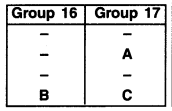
HBSE 10th Class Science Solutions Chapter 5 Periodic Classification of Elements 1
(a) State whether A is a metal or non-metal.
(b) State whether C Is more reactive or less reactive than A.
(c) Will C be larger or smaller in size than B?
(d) Which type of ion, cation or anion, will be formed by element A?
Answer:
(a) Element A is non-metal.
Reason (Write only If asked):
Element is in 17th group. So, there are 7 electrons in its outermost shell or say the valency is 1.
It will acquire 1 electron to complete the octet. Such a property is shown by non-metals.

HBSE 10th Class Science Solutions Chapter 5 Periodic Classification of Elements

(b) C is less reactive than A.
Reason (Write only If asked):
Element C is placed below element A. As one goes down in a group, the atomic size of elements increases and hence their reactivity decrease.

(c) C is smaller than B.
Reason (Write only if asked):
Elements C and B belong to same period. As one moves from left to right in a period, the atomic size i.e. the volume decreases. Hence, atomic size of element C will be smaller than B.

(d) Element A will form anion.
Reason (Write only if asked):
Element A has 7 electrons in its valence shell. So, it will tend to gain 1 electron to complete its octet and hence form anion.
A + e → A

Question 7.
Nitrogen (atomic number 7) and phosphorus (atomic number 15) belong to group 15 of the Periodic Table. Write the electronic configuration of these two elements. Which of these will be more electronegative? Why?
Answer:

ElementAtomic numberElectronic configuration
Nitrogen (N)
Phosphorus (P)
7
15
2, 5, –
2, 8, 5

As one moves down in a group, the electronegativity decreases. Nitrogen’s atomic number is 7. So, It lies above phosphorus. Hence, nitrogen will be more electronegative.

Question 8.
How does the electronic configuration of an atom relate to its position In the Modern Periodic Table?
Answer:
1. Through electronic configuration we can know the position of the element in the Modern Periodic Table.
2. Through the electronic configuration we can know the number of valence electrons, The valence electrons enables identifying the position of the element in the table.

Example:

  • Sodium (Na) has atomic number 11. So, its electronic configuration is 2, 8, 1 (2 + 8 + 1 = 11).
  • There is 1 valence electron in this configuration. Hence, sodium (Na) belongs to group 1.
  • There are three shells in this configuration. So, sodium lies in 3rd period.

HBSE 10th Class Science Solutions Chapter 5 Periodic Classification of Elements

Question 9.
In the Modern Periodic Table, calcium (atomic number 20) is surrounded by elements with atomic numbers 12, 19,21 and 38. Which of these have physical and chemical properties resembling calcium?
Answer:

ElementAtomic numberElectronic configuration
Calcium
Magnesium
Strontium
20
12
38
2, 8, 8, 2, —
2, 8, 2, —, —
2, 8, 18, 8, 2

As can be seen in the table above out of the given atomic numbers, only magnesium (Z=12) and strontium (Z=38) have same valence electrons i.e. ‘2’ Hence, these two elements have physical and chemical properties similar to calcium.

Question 10.
Compare and contrast the arrangement of elements in Mendeleev’s Periodic Table and the Modem Periodic Table.
Answer:

Mendeleev Periodic Table

Modern Periodic Table

1. Elements in this table were arranged on the basis of increasing atomic mass.
2. It contains 7 periods and 8 groups.
3. Mendeleev placed the transition elements arbitrarily in group VIII.
4. In Mendeleev’s table periodicity of elements cannot be explained.
1. Elements in this table were arranged on the basis of increasing atomic number.
2. If contains 7 periods and 18 groups.
3. Transition elements are placed properly in a separate group.
4. Periodicity of elements can be properly explained.

HBSE 10th Class Science Periodic Classification of Elements InText Activity Questions and Answers

Textbook Page no – 81

Question 1.
Did Dobereiner’s triads also exist In the columns of Newlands’ Octaves? Compare and find out.
Answer:
Yes, Dobereiner’s triads exist even in the columns of Newlands’ Octaves.
Example:

  • Lithium (Li), Sodium (Na) and potassium (K) constitute Dobereiner’s triads.
  • If we consider Li as the 1st element then the 8th element from it is Na.
  • Then, when we consider Na as the l element, then the 8th element from it is K.
  • Similarly, Dobereiner’s triad consisting of the elements beryllium (Be), magnesium (Mg) and calcium (Ca) is also included in the column of Newlands’ octaves.
  • Thus, Dobereiner’s triads are included in the columns of Newland’s Octaves.

Question 2.
What were the limitations of Doberelner’s classification?
Answer:
Limitation of Dobereiner’s classification :

  • Under Dobereiner’s classification, overall only a limited number of elements could be classified into triads.
  • After arranging the elements in triads, it was found that there were certain other elements which could not be classified by Dobereiner’s method.

Question 3.
What were the limitations of Newlands’ Law of Octaves?
Answer:
Limitation of Newlands’ Law of Octaves:
1. The law of octaves was applicable only upto calcium. After calcium, every 8 element did not possess properties similar to that of let.

2. Newlands thought that there were only 56 elements in nature. He also thought that no more elements would be discovered in the future. However, later, several new elements were discovered that could not be arranged in the table as per Newlands’ law.

3. In order to fit elements any how into his table. Newlands adjusted two elements in the slot even if the properties of elements did not match with other elements.

HBSE 10th Class Science Solutions Chapter 5 Periodic Classification of Elements

Example:
1. He placed Cobalt (Co) and nickel (Ni) in the same slot and placed these elements in the group of fluorine, chlorine and bromine. But, the properties of these three elements are quite different than cobalt and nickel.
2. Owing to these limitations we can say that Newslands Law of Octaves worked well only with lighter elements.

Textbook Page no – 85

Question 1.
Use Mendeleev’s Periodic Table to predict the formulae for the oxides of the following elements:
K, C, Al, Sl, Ba
Answer:
1. Valency of oxygen (O) is 2. We can find the valencies of other elements by looking at Mendeleev’s Table.
2. The formulas of oxides with asked elements are given in the table below.

ElementValencyMolecular formula of oxides
Potassium (K)
Carbon (C)
Aluminium (Al)
Silicon (Si)
Barium (Ba)
1
4
3
4
2
K2O
C2O44 OR CO2
Al2O3
Si2O4 OR SiO2
Ba2O2 OR BaO

Question 2.
Besides gallium,which other elements have since been discovered that were left by Mendeleev in his Periodic Table?(any two)
Answer:
Besides gallium, germanium and scandium have been discovered.

Question 3.
What were the criteria used by Mendeleev in creating his Periodic Table?
Answer:
Mendeleev used the following criteria for placing elements in his Periodic Table:

Criteria used by Mendeleev for developing periodic table:

  • The properties of elements are the periodic function of their atomic masses. Hence, arranging elements in the increasing order of their atomic masses.
  • Elements with similar properties are arranged in the same group.
  • The formula of oxides and hydrides formed by an element.

Question 4.
Why do you think the noble gases are placed in a separate group?
Answer:
1. All noble gases are inactive i.e. very inert because they have a complete octet.
2. They do not react with other elements because they are very stable.
3. All of them show similar properties.
4. Owing to all these reasons, noble gases are placed in a separate group.

Textbook Page no – 90

Question 1.
How could the Modern Periodic Table remove various anomalies of Mendeleev’s Periodic Table?
Answer:
The Modem Periodic Table removed the anomalies of Mendeleev’s Periodic Table as follows:

(1) Position of isotopes:
Isotopes of an element have same atomic number and so their placement was an issue in Mendeleev table. In Modern Periodic Table all the elements were placed in one group to resolve the issue.

(2) Improper position of some pairs of elements. Mendeleev had arranged the elements in the increasing order of their atomic masses. This posed some problems. However, this problem got solved when the elements were placed in increasing order of the atomic number.

(3) Uncertainty of the number of elements that could be discovered.
Elements in Mendeleev’s Periodic Table were placed on the basis of increasing atomic mass. However, the atomic mass does not increase in a specific manner as one moves from one element to another. Hence, one could not predict the number of elements that could be discovered between two elements.

Question 2.
Name two elements you would expect to show chemical reactions similar to magnesium. What Is the basis for your choice?
Answer:
Elements: Beryllium (Be), Calcium (Ca), etc.
Reason: Magnesium (Mg) has 2 electrons in the valence shell. Hence, all elements such as the two stated above having 2 electrons in the valence shell will belong to the group of magnesium and hence show similar chemical properties. In other words, all elements belonging to same group as that of magnesium will show similar chemical properties.

HBSE 10th Class Science Solutions Chapter 5 Periodic Classification of Elements

Question 3.
Name —
(a) Three elements that have a single electron in their outermost shells.
(b) Two elements that have two electrons In their outermost shells.
(c) Three elements with filled outermost shells.
Answer:
(a) Lithium (Li) (Z = 3), Sodium (Na) (Z = 11) and Potassium (K) (Z = 19) have 1 electron in their last orbits.
(b) Magnesium (Mg) (Z =12) and Calcium (Ca) (Z = 20) have 2 electrons In their last orbits.
(c) Noble gases namely Helium (He), Neon (Ne). Argon (Ar), etc. have their outermost shell completely filled with electrons.

Question 4.
(a) Lithium, sodium, potassium are all metals that react with water to liberate hydrogen gas. Is there any similarity between the atoms of these elements?
(b) Helium is an unreactive gas and neon is a gas of extremely low reactivity. What, if anything,
do their atoms have In common?
Answer:
(a) Similarities between atoms of lithIum (LI), Sodium (Na) and potassium (K):

  • All these elements are highly reactive.
  • They have same valence electrons i.e. 1.
  • They readily loose electrons and become positive ions.

(b) Similarity between helium and neon:

  • Both are noble gases.
  • Both belong to the same group.
  • Outer shell of both is completely filled.

Question 5.
In the Modern Periodic Table, which are the metals among the first ten elements?
Answer:
Among the first 10 elements, only 2 elements namely lithium (Li) and beryllium (Be) are metals.

Question 6.
By considering their position in the Periodic Table, which one of the following elements would you expect to have maximum metallic characteristic? Ga, Ge, As, Se and Be
Answer:
1. Element (Be) belongs to 2nd group and (Ga) belongs to 13th. All other elements belong to higher groups.
2. As one moves from left to right i.e. in the increasing order of the groups, the metallic character of an element decreases.
3. Hence, elements (Be) and (Ga) will show maximum metallic characteristic.

Activities

Activity 1.

Looking at its resemblance to alkali metals and the halogen family, try to assign hydrogen a correct position In Mendeleev’s Periodic Table.

Question 1.
To which group and period should hydrogen be assigned?
Answer:
Hydrogen has the lowest atomic number i.e. 1. Its position is quite controversial and so it is difficult to assign hydrogen a fixed location. However, we can put it at group 1. period 1 position.

Activity 2.

Consider the isotopes of chlorine, CI-35 and Cl-37.

Question 1.
Would you place them in different slots because their atomic masses are different? Or would you place them In the same position because their chemical properties are the same?
Answer:
No the two isotopes cannot fit at two different positions. Moreover, chemical properties of both are similar and so they should be placed at the same position in group 17.

HBSE 10th Class Science Solutions Chapter 5 Periodic Classification of Elements

Activity 3.

Question 1.
How were the positions of cobalt and nickel resolved in the Modern Periodic Table?
Answer:
In Modern Periodic Table the elements were arranged in increasing order of their atomic number. So, cobalt with atomic number 27 was placed in group 9 whereas nickel having atomic number 28 was placed in group lo.

Question 2.
How were the positions of isotopes of various elements decided in the Modern Periodic Table?
Answer:
In the Modern Periodic Table, all the isotopes of an element were placed at a same location.

Question 3.
Is it possible to have an element with atomic number 1.5 placed between hydrogen and helium?
Answer:
The atomic number of an element to be represented in the Modern Periodic Table must be a whole number. Since 1.5 is a fractional number the element cannot be placed in the table.

Question 4.
Where do you think should hydrogen be placed in the Modern Periodic Table?
Answer:
Atomic number of hydrogen is 1 and so it should be placed at group 1 and period 1 position in the Modern Periodic Table.

Activity 4.

Question 1.
Look at the group 1 of the Modern Periodic Table, and name the elements present in it.
Answer:
Hydrogen (H), Lithium (Li), Sodium (Na), Potassium (K), Rubidium (Rb), Cesium (Cs)

Question 2.
Write down the electronic configuration of the first three elements of group 1.
Answer:
H(K=1), Li(K=2,L=1), Na(K=2,L=8,M=i)

Question 3.
What similarity do you find In their electronic configurations?
Answer:
All elements contain one electron in their outermost shell.

Question 4.
How many valence electrons are present in these three elements?
Answer:
The three elements have one electron in their respective valence shell.

Activity 5.

Question 1.
If you look at the Modern Periodic Table, you will find that the elements Li, Be, B, C, N, O, F, and Ne are present In the second period. Write down their electronic configurations.
Answer:
Li (2, 1), Be (2, 2), B (2, 3), C (2, 4), N (2, 5), 0(2, 6), F(2, 7), Ne (2, 8)

Question 2.
Do these elements also contain the same number of valence electrons?
Answer:
These elements contain different number of valence electrons.

Question 3.
Do they contain the same number of shells?
Answer:
Yes, all these elements contain the same number of shells, i.e. two. The shells are K and L.

HBSE 10th Class Science Solutions Chapter 5 Periodic Classification of Elements

Activity 6.

Question 1.
How do you calculate the valency of an element from its electronic configuration?
Answer:
The valency of an element is determined by the number of valence electrons present in the outermost shell of an atom.
For elements of group 1, 2, 13 and 13, the valency is equal to the number of valence electrons.
For elements of group 15, 16, 17 and 18, the valency is equal to 8 minus the number of valence electrons.

Question 2.
What is the valency of magnesium with atomic number 12 and sulphur with atomic number 16?
Answer:
Atomic number of Mg is 12. So, its electronic configuration is 2, 8, 2.
Hence, valency of Mg is 2.
Atomic number of S is 16. So its electronic configuration is 2, 8. 6.
Hence, valency of S = 8 – 6 = 2.

Question 3.
Similarly, find out the valencies of the first twenty elements.
Answer:
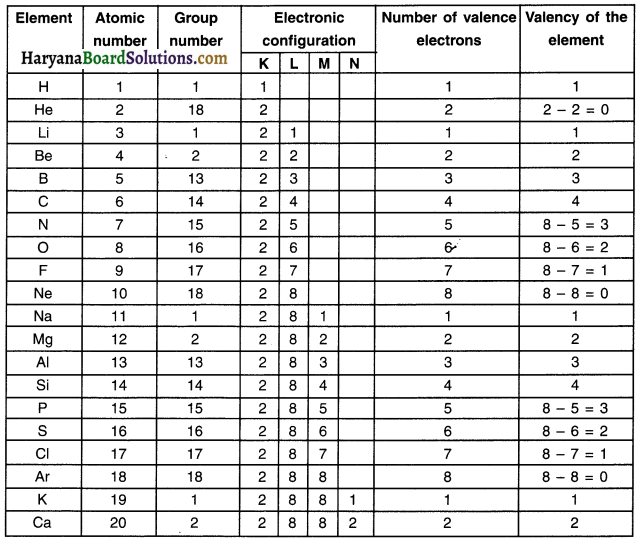
HBSE 10th Class Science Solutions Chapter 5 Periodic Classification of Elements 2

Question 4.
How does the valency vary In a period on going from left to right?
Answer:
As you move in the period from left to right, the valency first increases from 1 to 4. Then it decreases from 4 to O.

Question 5.
How does the valency vary In going down a group?
Answer:
Valency does not change within a group.

HBSE 10th Class Science Solutions Chapter 5 Periodic Classification of Elements

Activity 7.

Question 1.
Atomic radii of the elements of the second period are given below:
Answer:

HBSE 10th Class Science Solutions Chapter 5 Periodic Classification of Elements 3

Question 2.
Arrange them In decreasing order of their atomic radii.
Answer:
Li > Be > B > C > N > O.

Question 3.
Are the elements now arranged in the pattern of a period in the Periodic Table?
Answer:
Yes

Question 4.
Which elements have the largest and the smallest atoms?
Answer:
Largest atoms = Lithium; Smallest atoms = Oxygen

Question 5.
How does the atomic radius change as you go from left to right in a period?
Answer:
Atomic radius decreases as we go from left to right in a period.

Activity 8.

Question 1.
Study the variation in the atomic radii of first group elements given below and arrange them in an increasing order.

HBSE 10th Class Science Solutions Chapter 5 Periodic Classification of Elements 4
Answer:
Li < Na < K < Rb < Cs

Question 2.
Name the elements which have the smallest and the largest atoms.
Answer:
Largest atoms = Cesium; Smallest atoms = Lithium

Question 3.
How does the atomic size vary as you go down a group?
Answer:
Atomic size increases as we go down in a group

Activity 9.

Question 1.
Examine elements of the third period and classify them as metals and non-metals.
Answer:
Sodium, magnesium and aluminium are metals, silicon is non-metal (metalloid) and Phosphorus, sulphur, chlorine and argon are non-metals.

Question 2.
On which side of the Periodic Table do you find the metals?
Answer:
Metals are found on the left hand side of the Periodic table.

Question 3.
On which side of the Periodic Table do you find the non-metals?
Answer:
Non-metals are found on the right hand side of the Periodic Table.

HBSE 10th Class Science Solutions Chapter 5 Periodic Classification of Elements

Activity 10.

Question 1.
How do you think the tendency to lose electrons changes In a group?
Answer:
As we move from top to bottom in a group, the tendency to lose electrons increases

Question 2.
How will this tendency change in a period?
Answer:
As we move from left to right in a period the tendency to lose electrons decreases.

Activity 11.

Question 1.
How would the tendency to gain electrons change as you go from left to right across a period?
Answer:
As one moves from left to right across a period, the tendency to gain electrons increases.

Question 2.
How would the tendency to gain electrons change as you go down a group?
Answer:
As we go down in a group, the tendency to gain electrons decreases.

HBSE 10th Class Science Solutions Chapter 5 Periodic Classification of Elements Read More »
HBSE 10th Class Social Science Solutions Economics Chapter 5 Consumer Rights

Haryana State Board HBSE 10th Class Social Science Solutions Economics Chapter 5 Consumer Rights Textbook Exercise Questions and Answers.

Haryana Board 10th Class Social Science Solutions Economics Chapter 5 Consumer Rights

HBSE 10th Class Economics Consumer Rights Intext Questions and Answers

Let’s Work These Out (Page No. 77)

Class 10 Economics Chapter 5 Consumer Rights HBSE Question 1.
What are the various ways by which people may be exploited in the market?
Answer:
Following are the ways by which people may be exploited in the market :

  • High Prices: Traders can charge high prices on the goods where no MRP is written.
  • Adulteration and Impurity: Sometimes, traders sell adulterated and impure goods, in order to get high profit.
  • Undermeasurement or weight: Sometimes, traders weigh less than what they should. In this way, they cheat the consumers.
  • Sub-standard Quality: Now-a-days, traders are selling sub-standard quality goods and duplicate goods, to earn more profit.
  • Artificial Scarcity: Traders create false scarcity of goods by hoarding of these goods. They sell these things later on, at higher prices and earn more profit.
  • Lack of safety devices: Some traders produce goods of poor quality, without caring for the standard safeguard norms. Such things may prove to be dangerous for the consumers.
  • False or incomplete information: Many dealers mislead the consumers by giving wrong information about goods.
  • Poor after-sale service: Many goods require after-sale services, like— scooters, motorcycles, cars, washing machines, televisions, refrigerators, etc. The suppliers fail to provide these services.

HBSE 10th Class Economics Chapter 5 Consumer Rights Question 2.
Think of one example from your experience where you thought that there was some ‘cheating’ in the market. Discuss in the classroom.
Answer:
Do it yourself.

HBSE 10th Class Social Science Solutions Economics Chapter 5 Consumer Rights

Consumer Rights Chapter 5 Economics HBSE 10th Class Question 3.
What do you think should be the role of the government to protect consumers?
Answer:
The role of the government to protect consumers is very important. Government should take some necessary steps to protect consumers :

  • Government should implement Consumer Protection Act, 1986, strictly.
  • Government should make consumers aware about their rights, through mass media.
  • Government should give complete information to consumers about the three-tier judicial process, prepared for the protection of their interests.
  • Government should make it necessary for traders to display price list.
  • Government should make it necessary for producers to print the price, manufac¬turing date, expiry date, guarantee or warranty period, qualities, product name, address and telephone no. of producer on their products.
  • Government should distribute essential commodities for poor sections of the society, through fair price shops or ration shops.

Let’s Work These Out (Page No. 78)

Question 1.
What could have been the steps taken by consumer groups?
Answer:
The following steps could have been taken by consumer groups :

  • Consumer groups can protect and promote the interests of consumers against unethical and unfair trade practices.
  • Consumer groups can organise exhibitions for consumer awareness.
  • Consumer groups can look into the malpractices in ration shops.
  • Consumer groups can look into the overcrowding in the road passenger transport.
  • Consumer groups can make the consumers aware by writing articles.
  • Consumer groups can exert pressure on business firms and government, to correct such business conduct, which may be unfair, and against the interests of consumers at large.

Question 2.
There may be rules and regulations but they are often not followed. Why? Discuss.
Answer:
There are various rules and regulations formed by government to protect consumers from exploitation, but these rules are often not followed, due to following reasons:

  • Unawareness of consumers.
  • Corruption in the government departments.
  • Compromising attitude of consumers.
  • Lengthy, expensive and time-consuming legal process.

HBSE 10th Class Social Science Solutions Economics Chapter 5 Consumer Rights

Let’s Work These Out (Page No. 79)

Question 1.
For the following (you can add to the list) products/services discuss what safety rules should be observed by the producer.
(a) LPG cylinder
(b) Cinema theatre
(c) Circus
(d) Medicines
(e) Edible Oil
(f) Marriage pandal
(g) A high-rise building.
Answer:
The following safety rules should be observed by the producer, for the above given products/services :

(a) LPG Cylinder:
There should be no leakage in the cylinder. The weight and quality of the cylinder, and seal of producer company, should be proper.

(b) Cinema Theatre:
There should be facilities of safe building, parking, sufficient entry and exit doors, fire prevention equipment, canteens and toilets.
(c) Circus:
There should be provisions of enough fire-fighting instruments, sufficient buckets of sand, and there should be water in water tank close by the place of circus. All animals should be kept inside cages.

(d) Medicines:
Name of medicine, manufacturing date, expiry date, batch no, price, formula, sales tax, etc. should be mentioned.

(e) Edible Oil:
There should be no adulteration in the edible oil. Edible oil should be packed in packets and tin boxes. These packets should contain the manufacturing date, expiry date, fixed price and AGMARK certification mark.

(f) Marriage hall:
Marriage hall should have facilities of generator, fire-fighting instruments, toilets and parking. Besides this, the clothes of tent should not be of nylon and silk.

(g) A High-rise Building:
There should be proper arrangement for fire safety. The building should be constructed according to the map approved by government. The building should be earthquake resistant.

HBSE 10th Class Social Science Solutions Economics Chapter 5 Consumer Rights

Question 2.
Find out any case of accident or negligence from people around you, where you think that the responsibility lay with the producer. Discuss.
Answer:
Do it yourself.

Let’s Work These Out (Page No. 81)

Question 1.
When we buy commodities we find that the price charged is sometimes higher or lower than the maximum retail price printed on the pack. Discuss the possible reasons. Should consumer groups do something about this?
Answer:
The possible reason for the higher price may be overcharging by the retailer from an ignorant customer. The possible reason for a price lower than the Maximum Retail Price (MRP) may be due to bargaining by the customer, or a discount being given by the retailer to increase his sale. Consumer groups should pressurise the dealers to ensure that no dealer charges more than the MRP under any condition. They should in fact put pressure on dealers to reduce their margins and charge lesser than the MRP as far as possible.

Question 2.
Pick up a few packaged goods that you want to buy and examine the information given. In what ways are they useful? Is there some information that you think should be given on those packaged goods but is not? Discuss.
Answer:
The information given on the package can be useful as follows:
(i) Maximum Retail Price (MRP): the seller cannot ask you to pay more than this amount.
(ii) Expiry Date and Date of manufacture: you can see how much time has passed since the product was manufactured and also whether you can safely use it.
(iii) Ingredients Used: You should know what is used in making the product so that, in case some ingredient does not suit your health condition, you can avoid it. Examples are sugar for diabetes.
(iv) Address of manufacturer: If the product is defective and the seller does not replace it, you can contact the manufacturer for redressal of complaint. On all products, especially medicine and food items, additional information regarding safe and proper use should be mentioned.

Question 3.
People make complaints about the lack of civic amenities such as bad roads or poor water and health facilities but no one listens. Now the RTI Act gives you the power to question. Do you agree? Discuss.
Answer:
Yes, we agree that the RTI Act gives us the right to ask questions. The right to information has been expanded to cover various services provided by the government. In October, 2005, the government of India enacted a law, popularly known as RTI (Right to Information) Act, which ensures its citizens, all the information about the functions of government departments. Thus, we can say, that the RTI Act gives people, the power to question.

HBSE 10th Class Social Science Solutions Economics Chapter 5 Consumer Rights

Let’s Work This Out (Page No. 82)

The following are some of the catchy advertisements of products that we purchase from the market. Which of the following offers would really benefit consumers? Discuss.
15 gm more in every 500 gm pack.
Subscribe for a newspaper with a gift at the end of a year.
Scratch and win gifts worth ₹ 10 lakhs.
Milk chocolate inside ₹ 500 gram glucose box.
Win a gold coin inside a pack.
Buy shoes worth ₹ 2000 and get one pair of shoes worth ₹ 500 free.
Answer:
The below-given advertisements would really benefit the consumers:

  • 15 gm more in every 500 gm pack.
  • A milk chocolate inside a 500 gram glucose box.
  • Buy shoes worth ₹ 2000 and get one pair of shoes worth ₹ 500 free.

Let’s Work This Out (Page No. 84)

Arrange the following in the correct order:
(a) Arita files a case in the District Consumer Court.
(b) She engages a professional person.
(c) She realises that the dealer has given her defective material.
(d) She starts attending the court proceedings.
(e) She goes and complains to the dealer and the Branch office, to no effect.
(f) She is asked to produce the bill and warranty before the court.
(g) She purchases a wall clock from a retail outlet.
(h) Within a few months, the dealer was ordered by the court to replace her old wall clock with a brand new one at no extra cost.
Answer:
(g) She purchases a wall clock from a retail outlet.
(c) She realises that the dealer has given her defective material.
(e) She goes and complains to the dealer and the Branch office, to no effect.
(b) She engages a professional person.
(a) Arita files a case in the District Consumer Court.
(d) She starts attending the court proceedings.
(f) She is asked to produce the bill and warranty before the court.
(h) Within a few months, the dealer was ordered by the court to replace her old wall clock with a brand new one at no extra cost.

Let’s Work These Out (Page No. 86)

Question 1.
What is the difference between consumer protection council and consumer court?
Answer:
Consumer Protection Council:
Consumer Protection Council is an organisation which protects and promotes the interests of consumers. They guide the consumers on how to file a case in the consumer courts and represent the consumers in the consumer courts.

HBSE 10th Class Social Science Solutions Economics Chapter 5 Consumer Rights

Consumer Court:
Consumer Courts are set up under COPRA, for redressal of consumer disputes. They act as a judicial machinery at the district, state and national level.

Question 2.
The Consumer Protection Act, 1986 ensures the following as rights, which every consumer in India should possess:

  1. Right to choice.
  2. Right to representation.
  3. Right to information.
  4. Right to safety.
  5. Right to redressal.
  6. Right to consumer education.

Categorise the following cases under different heads and mark against each in brackets:
(a) Lata got an electric shock from a newly purchased iron. She complained to the shopkeeper immediately. ( )
(b) John is dissatisfied with the services provided by MTNL/BSNL/TATA INDICOM for the past few months. He files a case in the District Level Consumer Forum. ( )
(c) Your friend has been sold a medicine that has crossed the expiry date and you are advising her to lodge a complaint. ( )
(d) Iqbal makes it a point to scan through all the particulars given on the pack of any item that he buys. ( )
(e) You are not satisfied with the services of the cable operator catering to your locality but you are unable to switch over to anybody else. ( )
(f) You realise that you have received a defective camera from a dealer. You are complaining to the head office persistently. ( )
Answer:
(a) Right to safety.
(b) Right to redressal.
(c) Right to information.
(d) Right to information.
(e) Right to choice.
(f) Right to representation.

Question 3.
If the standardisation ensures the quality of a commodity, why are many goods available in the market without ISI or Agmark certification?
Answer:
‘There are many goods available in the market, without ISI or Agmark certification. These goods are duplicate and fake goods, which are produced by producers to earn more and more profit. These goods are cheaper and are of sub-standard, in comparison of certified goods.

Question 4.
Find out the details of those who provide Hallmark and ISO certification.
Answer:
BIS and Agmark provide certificates of quality to the products in India. BIS caters to consumer products and industrial goods, while Agmark is for agricultural products. The BIS (Bureau of Indian Standards) was earlier known as the Indian Standard Institution (ISI). Its headquarter is located in New Delhi. The Agmark is implemented under the Agricultural Produce (Grading and Marketing) Act, 1937. At the international level, there is an institution that serves to provide such a common reference. It is called International Organisation for Standardisation (ISO). It is located in Geneva.

HBSE 10th Class Economic Consumer Rights Textbook Questions and Answers

Question 1.
Why are rules and regulations required in the marketplace? Illustrate with a few examples.
Answer:
Rules and regulations are required in the market place, for the protection of the consumers rights, due to the following reasons:
(i) Weak Consumers: Individual consumers often find themselves in a weak position. Whenever there is a complaint regarding a good or service that had been bought, the seller tries to shift all the responsibilities on to the buyer. In such a condition, the consumer find himself helpless.

(ii) Exploitation of Consumer:
Exploitation in the market place happens in various ways. Sometimes, traders indulge in unfair trade practices, such as, when shopkeepers weigh less than what they should, or when, traders add charges that were not mentioned before, or when, adulterated or defective goods are sold.

(iii) Unfair Market:
Markets do not work in a fair manner as producers are few and powerful, whereas consumers purchase in small amounts and are scattered. This happens especially when large companies are producing these goods. These companies, with huge wealth, power and reach, can manipulate the market in various ways.

HBSE 10th Class Social Science Solutions Economics Chapter 5 Consumer Rights

(iv) False Information:
False information is passsed on through the media and other sources, to attract consumers. For example, a company for years, sold powder milk for babies all over the world, as the most scientific product, claiming this to be better than mother’s milk. Later, this claim proved to be wrong. Similarly, a long battle had to be fought with court cases, to make cigarette manufacturing companies accept, that their products could cause cancer.

All these above-mentioned examples prove the significance of rules and regulations in the marketplace. Therefore, there is a need for rules and regulations, to ensure protection for consumers.

Question 2.
What factors gave birth to the consumer movement in India? Trace its evolution.
OR
Why did the consumer movement begin in India? Describe this movement.
Answer:
In India, the consumer movement, as a ‘Social Force’, originated with the necessity of protecting and promoting the interests of consumers, against unethical and unfair trade practices.
Following are the factors that gave birth to the consumer movement in India:

  • Dissatisfaction of consumers.
  • No legal system to protect consumers from exploitation in the market place.
  • Artificial food shortages.
  • Hoarding of commodities.
  • Black marketing.
  • Adulteration of food and edible oil.

These reasons gave birth to the consumer movement, in an organized form, in the 1960s. Till the 1970s, consumer organizations were largely engaged in writing articles and holding exhibitions. They formed consumer groups to look into the malpractices in ration shops and overcrowding in the road passengers transport. More recently, India witnessed an upsurge in the number of consumer groups. A major step taken in 1986, by the Indian government, was the enactment of the Consumer Protection Act, 1986, known as COPRA.

HBSE 10th Class Social Science Solutions Economics Chapter 5 Consumer Rights

Question 3.
Explain the need for consumer consciousness by giving two examples.
Answer:
The need for consumer consciousness can be explained by the following two examples:
(i) Both, manufacturers and traders, can go to any extent, out of their selfishness. They can charge high prices, stop weighing and under measurement methods.
(ii) Some unscrupulous traders play with the health of the nation, by indulging in the adulteration of edible oils, milk, butter, ghee, and even, cereals.

Question 4.
Mention a few factors which cause the exploitation of consumers.
Answer:
Following are a few factors that cause the exploitation of consumers:
1. Disbalance between demand and supply:
The consumers are exploited when the goods and services are not available in the required quantity or numbers.

2. Illiteracy and ignorance:
The main reason of the exploitation of consumers is their illiteracy and ignorance towards consumer rights. They cannot differentiate between right quality and sub-standard quality goods. Due to these weaknesses, they are befooled.

3. Monopoly:
When only one producer or group of producers controls the production and supply of a product and is in a position to restrict the availability of supplies, there is a possibility of manipulation in prices and availability.

4. Compromising nature of consumers:
Indian consumers are, by nature, compromising. They are not used to making complaints and fighting with the sellers.

5. False information:
Some companies spend a huge amount of money on advertisements to attract consumers. These companies pass on false information about their products, through advertisements.

6. Limited information:
In the absence of information about the different aspects of the products, like- price, quality, manufacturing, conditions of use, etc., the consumers are liable to make a wrong choice, and lose money.

7. Unrecorded sales of production:
Most of the sales remain unrecorded, so no suit can be filed against such sales and consumers are cheated.

HBSE 10th Class Social Science Solutions Economics Chapter 5 Consumer Rights

8. Lengthy and complex legal process:
The educated and literate people also avoid filing suit in the consumer courts, because; of the lengthy and complex legal process.

Question 5.
What is the rationale behind the enactment of the Consumer Protection Act, of 1986?
Answer:
The rationale behind the enactment of the Consumer Protection Act, 1986 is as follows :

  • To impart information to consumers, regarding their rights and duties.
  • To protect the interests of consumers.
  • To exercise control over the prices of goods and services.
  • To motivate the producers for produce of quality goods.
  • To prevent hoarding and black marketing, done by traders.
  • To prevent adulterat in food items and edible oils, done by producers and sellers.

Question 6.
Describe some of y, or duties as consumers if you visit a shopping complex in your locality.
Answer:
Following are the duties, as consumers, if we visit a shopping complex in our locality :

  • We should collect prior information about the goods or services, which we are going to purchase.
  • We should observe carefully, the label stuck on packed goods so that we can know about the address of the producer, Net Weight, Batch No., Packing Date, Expiry Date, and other important information about the product, printed on the label.
  • We should prefer ISI, AGMARK, FPO, Hallmark verified, and stamped products.
  • We should ensure the correct measurement of goods.
  • We should enquire about the guarantee or warranty.
  • We should ask for cash memo or voucher for the items purchased.
  • We should make a complaint against exploitation made by the seller.

Question 7.
Suppose you buy a bottle of honey and a biscuit packet. Which logo or mark you will have to look for and why?
Answer:
I buy a bottle of honey and a biscuit packet. I have to look for AGMARK because food items are marked by AGMARK for their standard quality.

Question 8.
What legal measures were taken by the government to empower the consumers in India?
Answer:
Following are the measures, which were taken by the government to empower the consumers in India:

(i) Consumer Protection Act, 1986:
The Indian Government enacted Consumer Protection Act in 1986. This Act or law settles the disputes of the consumer’s grievances in a simple, inexpensive and speedy manner. Under this Act, three-tier quasi-judicial machinery at the district, state and national levels was set up, for redressal of consumer disputes. These are popularly known as consumer courts.

(ii) Public Distribution System:
The Indian Government wanted to overcome some problems, like – hoarding, black-marketing and overcharging by the traders and manufacturers. Therefore, a new scheme was started by the government, which is known as Public Distribution System (PDS).

HBSE 10th Class Social Science Solutions Economics Chapter 5 Consumer Rights

(iii) The Bureau of Indian Standard Act, 1986:
The standardisation of products has been achieved through the Bureau of Indian Standards (BIS), which was earlier known as Indian Standards Institution (ISI), which has the responsibility of laying down the standards for industrial and consumer goods on a scientific basis.

(iv) The Agricultural Produce (Grading and Marketing) Act, 1937:
This Act empowers the government to make rules about quality and grades of certain goods. It should be marked with grade designation marks, such as AGMARK etc.

Question 9.
Mention some of the rights of consumers and write a few sentences on each.
Answer:
Following are the rights of consumers:

  • Right to be Informed: Consumers have the right to be informed about the particulars of goods and services.
  • Right to Choose: Consumers have the right to choose the product of their choice out of the alternatives available in the market.
  • Right to Seek Redressal: Consumers have the ’ it to seek redressal against unfair trade practices and exploitation. The government h; nt up many consumer courts for this specific purpose.
  • Right to Represent: Consumers have the right to represent themselves in the consumer courts. Consumer interest should receive due consideration at appropriate forums.
  • Right to Safety: Consumers have the right to safety. They have the right to be protected against such goods and services, which are dangerous to life and property. Such goods are cement, gas cylinder, pressure cookers, electrical goods etc.
  • Right to Consumer Education: This right includes knowledge about goods and issues relating to consumer welfare. We should be aware of this right. For this, we should also read the advertisements brought by the government under the headline “Jago Grahak Jago”.

Question 10.
By what means can the consumers express their solidarity?
Answer:
Consumers can express their solidarity in the following ways :

  1. By forming consumer unions.
  2. By lodging complaints in the consumer courts.
  3. By participating in consumer protection committees.
  4. By raising voice collectively, against the defaulting company.

Question 11.
Critically examine the progress of consumer movement in India.
Answer:
The consumer movement in India has made some progress in terms of numbers of organized groups and their activities. There are, today, more than 700 consumer groups in the country, of which only about 20-25 are well organised and recognised for their work. However, the consumer redressal process is becoming cumbersome, expensive and time-consuming. Many times, consumers are required to engage lawyers. These cases require time for filing and attending the court proceedings etc.

HBSE 10th Class Social Science Solutions Economics Chapter 5 Consumer Rights

In most purchases, cash memos are not issued, hence evidence is not easy to gather. Moreover, most purchases in the market are small retail sales. The existing laws also, are not very clear on the issue of compensation to consumers injured by defective products. After 24 years of the enactment of COPRA, consumer awareness in India is spreading, but slowly. Besides, the enforcement of laws that protect workers, especially in the unorganised sectors, is weak. Similarly, rules and regulations for working of markets, are often, not followed.

Question 12.
Match the following:

(i) Availing details of ingredients of a product.(a) Right to safety
(ii) Agmark(b) Dealing with consumer cases.
(iii) Accident due to faulty engine in a scooter(c) Certification of edible oil and cereals.
(iv) District Consumer Court(d) Agency that develop standards for goods and services.
(v) Consumers International(e) Right to information.
(vi) Bureau of Indian Standards(f) Global level institution of consumer welfare organizations.

Answer:
(i) → (e)
(ii) → (c)
(iii) → (a)
(iv) → (b)
(v) → (f)
(vi) → (d)

Question 13.
Say True or False:
(i) COPRA applies only to goods.
(ii) India is one of the many countries in the world which has exclusive courts for consumer redressal.
(iii) When a consumer feels that he has been exploited, he must file a case in
a District Consumer Court.
(iv) It is worthwhile to move to consumer courts only if the damages incurred are of high value.
(v) Hallmark is the certification maintained for standardisation of jewellery.
(vi) The consumer redressal process is very simple and quick.
(vii) A consumer has the right to get compensation depending on the degree of the damage.
Answer:
(i) False
(ii)’ True
(iii) True
(iv) False
(v) True
(vi) False
(vii) True.

Additional Projects/Activities

Question 1.
Your school organizes a consumer awareness week. As the Secretary of the Consumer Awareness Forum, draft a poster covering all consumer rights. You may use the clues and ideas given in the poster on page 84 and 85 (Text Book). This activity can be done with the help of your English teacher.
Answer:
Do it yourself.

HBSE 10th Class Social Science Solutions Economics Chapter 5 Consumer Rights

Questi0on 2.
Mrs Krishna bought a color television (CTV) against six months warranty. The CTV stopped working after three months. When she complained to the dealer/shop where it was purchased, they sent an engineer to set it right. The CTV continues to give trouble and Mrs Krishna no longer gets any reply to the complaint she made to the dealer/shop. She decides to write to the Consumer Forum in her area. Write a letter on her behalf. You may discuss with your partner/group members before you write it.
Answer:
D-45, Khodki Road, Nagar
Bharatpur
20th April 20-
To,
The President,
District Consumer Forum,
Distt. Bharatpur.

Subject: In reference to defective color TV not repaired despite repeated complaints. Sir,

I beg to say that I bought a color television, against six months warranty, from Shyam Electronics, Nagar, Bharatpur on 20th March 20…… but the CTV stopped working after three months. When I complained to the shop from where it was purchased, the shopkeeper sent an engineer to set it right. But, the CTV continues to give trouble. I did not get any reply to the complaint, which I had again made to the shop.

Therefore, I request you to register my complaint and take some action against the shop.
Encl: Purchase Bill of CTV Thanking you,
Yours sincerely,
Mrs. Krishna

Question 3.
Establish a consumer club in your school. Organise mock consumer awareness workshops like monitoring bookshops, canteen and shops in your school area.
Answer:
Do it yourself.

Question 4.
Prepare posters with catchy slogans like:

  • An alert consumer is a safe consumer.
  • Buyers, Beware
  • Consumers be cautious
  • Be aware of your rights
  • As consumers, assert your right
  • Arise, awake and stop not till ……… (Complete it)
  • Arise, awake and stop not till you get justice.
  • Jago Grahak Jago
  • Asserts Rights, Pursue Remedies

Answer:
Students May prepare posters with the above given slogans.

Question 5.
Interview 4-5 persons in your neighborhood and collect varied experiences regarding how they have been victims of such exploitation and their response.
Note:
Do it yourself.

HBSE 10th Class Social Science Solutions Economics Chapter 5 Consumer Rights

Question 6.
Conduct a survey in your locality by supplying the following questionnaire to get an idea as to how alert they are as consumers.

For each question, tick oneAlways ASometime BNever C
1. When you J)uy some item, do you insist on a bill?
2. Do you keep the bill carefully?
3. If you realise that you have been tricked by the shop keeper, have you bothered to complain to him ?
4. Have you been able to convince him that you’ve been              cheated?
5. Do you simply grumble to yourself reconciling that it  is your fate that you are often being victimised so and it is nothing new?
6. Do you look for ISI mark, expiry date etc.?
7. If the expiry date mentioned is just a month or so away, do you insist on a fresh packet?
8. Do you weigh the new gas cylinder/old newspapers yourself before buying/selling?
9. Do you raise an objection if a vegetable seller uses stones in place of the exact weight?
10. Do excessively bright coloured vegetables arouse your suspicion?
11. Are you brand-conscious ?
12. Do you associate high price with good quality (to reassure yourself that after all you have not paid a higher price just like that)?
13. Do you unhesitatingly respond to catchy offers?
14. Do you compare the price paid by you with those of others?
15. Do you strongly believe that your shopkeeper never cheats a regular customer like you?
16. Do you favour ‘home delivery’ of provision items with out any doubt regarding weight etc.
17. Do you insist on ‘paying by meter’ when you travel by auto?

Answer:
1. (A)
2. (A)
3. (A)
4. (A)
5. (C)
6. (A)
7. (A)
8. (A)
9. (A)
10. (A)
11. (A)
12. (C)
13. (C)
14. (A)
15. (A)
16. (C)
17. (C).

Note:

  • You are extermely aware as a consumer if your answers for Qns. 5, 12, 13, 15 and 16 are (C) and for the rest (A).
  • If your answers are (A) for Qns. 5, 12, 13, 15 and 16 and the rest (C), then you have to wake up as c^isumer.
  • If your answer is (B) for all the questions – you are somewhat aware.

HBSE 10th Class Social Science Solutions Economics Chapter 5 Consumer Rights Read More »

HBSE 10th Class Social Science Solutions Economics Chapter 4 Globalisation and the Indian Economy

Haryana State Board HBSE 10th Class Social Science Solutions Economics Chapter 4 Globalisation and the Indian Economy Textbook Exercise Questions and Answers.

Haryana Board 10th Class Social Science Solutions Economics Chapter 4 Globalisation and the Indian Economy

HBSE 10th Class Economics Globalisation and the Indian Economy Intext Questions and Answers

Let’s Work This Out (Page No. 57)

Economics Chapter 4 Class 10 Question Answers HBSE Question 1.
Complete the following statement to show how the production process in the garment industry is spread across countries.
The brand tag says ‘Made in Thailand’ but they are not Thai products. We dissect the manufacturing process and look for the best solution at each step. We are doing it globally. In making garments, the company may, for example, get cotton fibre from Korea,
Answer:
The brand tag says ‘Made in Thailand’, but they are not Thai products. We dissect the manufacturing process and look for the best solution at each step. We are doing it globally. In making garments, the company may, for example, get cotton fibre from Korea, China and India, which may be cheap manufacturing locations. India has highly skilled engineers, relevant to garments’ industry, who can understand the technical aspects of production. It also has educated, English- speaking youth, who can provide customer care services.

Let’s Work These Out (Page No. 59)

Read the following passage and answer the questions :
Ford Motors, an American Company, is one of the world’s largest automobile manufacturers with production spread over 26 countries of the world. Ford Motors came to India in 1995 and spent ₹ 1700 crore to set up a large plant near Chennai. This was done in collaboration with Mahindra and Mahindra, a major Indian manufacturer of jeeps and trucks. By the year 2017, Ford Motors was selling 88,000 cars in the Indian markets, while another 1,81,000 cars were exported from India to South Africa, Mexico and Brazil. The company wants to develop Ford India as a component supplying base for its other plants across the globe.

HBSE 10th Class Social Science Solutions Economics Chapter 4 Globalisation and the Indian Economy

Class 10 Economics Chapter 4 Questions And Answers HBSE Question 1.
Would you say Ford Motors is a MNC? Why?
Answer:
Yes, Ford Motors is certainly an MNC, because it operates in many countries across the world, India being one of them. This multinational corporation is headquartered in the USA.

Globalisation and the Indian Economy Chapter 4 HBSE 10th Class Question 2.
What is foreign investment? How much did Ford Motors invest in India?
Answer:
The investment made by MNCs for production in other countries is called foreign investment. Ford Motprs has invested? 1700 crore in India.

Question 3.
By setting up their production plants in India, MNCs, such as Ford Motors, tap the advantage, not only of the large markets that countries such as India provide but also the lower costs of production. Explain the statement.
Answer:
Generally, MNCs set up production where it is close to the markets, where there is skilled and unskilled labour available at low prices, where the availability of other factors of production is assured and there are favourable government policies of related countries. India has become a favourite country of MNCs, due to availability of all the above facilities. That’s why, MNCs, such as Ford Motors, have set up their production plants in India, and gained profit.

Question 4.
Why do you think the company wants to develop India, as a base for manufacturing car components for its global operations? Discuss the following factors :
(a) cost of labour and other resources in India
(b) the presence of several local manufacturers who supply auto parts to Ford Motors
(c) closeness to a large number of buyers in India and China.
Answer:
The Ford Motors Company wants to develop India, as a base for manufacturing car components, for its global operations as –

  • The company can get skilled and unskilled labour at cheap rates in India. Besides, it can get other necessary resources of production at reasonable rates.
  • There are many small production units that have the efficiency to handle the cost, quality and labour conditions and can easily supply small parts to the company.
  • India and China are neighbouring countries. Both countries can provide a large market to the company.

Question 5.
In what ways will the production of cars by Ford Motors in India lead to interlinking of production?
Answer:
The production of cars, by Ford Motors in India, will lead to interlinking of production because this company is set up in India in collaboration with Mahindra and Mahindra. Mahindra and Mahindra is also a major Indian manufacturer of jeeps and trucks and several small companies of India can get a chance to work with such big companies.

HBSE 10th Class Social Science Solutions Economics Chapter 4 Globalisation and the Indian Economy

Question 6.
In what ways is an MNC different from other companies?
Answer:
MNC is different from other companies in the following ways :

MNCs:

  • MNCs own or control the production in more than one country.
  • MNCs set up their offices and factories for production in other countries.
  • There is a high level of capital investment.
  • They earn huge profits due to the availability of resources at cheap rates.
  • MNCs produce at a large scale.
  •  MNCs compete globally.

Other companies:

  • Other companies own and control production only in one country.
  • Other companies set up their offices and factories for production in one country.
  • There is low level of capital investment.
  • They earn lesser profit due to lack of resources.
  • Other companies produce at small scale.
  • Other companies compete with, their local competitors.

Question 7.
Nearly all major multinationals are American, Japanese or European, such as Nike, Coca-cola, Pepsi, Honda, Nokia. Can you guess why?
Answer:
Almost all major multinationals are American, Japanese or European because these countries are developed countries. MNCs require a huge amount of money, latest technology, skilled management, entrepreneurial capability of high scale production etc., for expanding their production and markets in .other countries. Generally, poor countries do not have these resources. That’s why, nearly all major multinationals are American, Japanese or European.

Let’s Work These Out (Page No. 61)

Question 1.
What was the main channel connecting countries in the past ? How is it different now?
Answer:
Foreign trade was the main channel, connecting countries in the past.
Now, Foreign trade results in connecting the markets or integration of markets of different countries.

HBSE 10th Class Social Science Solutions Economics Chapter 4 Globalisation and the Indian Economy

Question 2.
Distinguish between foreign trade and foreign investment.
Answer:
Foreign Trade: Foreign trade is a way of trading, in which, a market of a country is connected and integrated with the markets of different countries. It creates an opportunity for the producers to reach beyond the domestic markets.
Foreign Investment: Investment made by MNCs is called foreign investment. It is made with the hope, that these assets will earn profits.

Question 3.
in recent years China has been importing steel from India. Explain how the import of steel by China will affect –
(a) steel companies in China.
(b) steel companies in India.
(c) industries buying steel for production of other industrial goods in China.
Answer:
(a) Steel Companies in China: Steel companies in China will get cheap and
good quality steel.

(b) Steel Companies in India: Steel companies in India will earn good profit and extend their trades.! On the other hand, if export increases more, then Indian companies will suffer and face many problems, like-lack of raw materials, high cost of raw material and finished goods, etc.

(c) Industries buying steel for Production of other Industrial goods in China: Industries buying steel for production of other industrial goods in China will get cheap and sufficient raw material, as per their requirement. Therefore, total industrial production of China will increase.

HBSE 10th Class Social Science Solutions Economics Chapter 4 Globalisation and the Indian Economy

Question 4.
How will the import of steel from India into the Chinese markets lead to integration of markets for steel in the two countries? Explain.
Answer:
The import of steel from India into the Chinese markets will lead to integration of markets for steel in the two countries in the following ways :
(i) It will help the Chinese steel market to get cheap and good quality raw material.
(ii) It will help the Indian steel companies to earn more foreign exchange.

Let’s Work These Out (Page No. 62)

Question 1.
What is the role of MNCs in the globalisation process?
Answer:
MNCs are playing an important role in the globalisation process. More and more goods and services are available to people. New techniques and technologies are moving from one country to another. People move from one country to another in search of better jobs, better education etc. Most regions of the world are coming in close contact with each other, just because of MNCs.

Question 2.
What are the various ways in which countries can be linked?
Answer:
The various ways in which countries can be linked are as follows :

  • Movement of people from one country to another.
  • Movement of goods and services between various countries.
  • Foreign trade between various countries.
  • By increasing the number of MNCs.
  • Movement of latest technology from one country to another.

Question 3.
Choose the correct option :
Globalisation, by connecting countries, shall result in :
(a) lesser competition among producers.
(b) greater competition among producers.
(c) no change in competition among producers.
Answer:
(b) greater competition among producers.

HBSE 10th Class Social Science Solutions Economics Chapter 4 Globalisation and the Indian Economy

Let’s Work These Out (Page No. 63)

A news magazine published for London readers is to be designed and printed in Delhi. The text of the magazine is sent through Internet to the Delhi office. The designers in the Delhi office get orders on how to design the magazine from the office in London using telecommunication facilities. The designing is done on a computer. After printing, the magazines are sent by air to London. Even the payment of money for designing and printing from a bank in London to a bank iii Delhi is done instantly through the Internet (e-banking)!

Question 1.
In the above example, underline the words describing the use of technology in production. .
Answer:
A news magazine published for London readers is to be designed and printed in Delhi. The text of the magazine is sent through internet to the Delhi office. The designers in the Delhi office get orders on how to design the magazine from the office in London using telecommunication facilities. The designing is done on a computer. After printing, the magazines are sent by air to London. Even the payment of money for designing and printing from a bank in London to a bank in Delhi is done instantly through the Internet (e-banking)! . ‘

Question 2.
How is information technology connected with globalisation? Would globalisation have been possible without the expansion of IT?
Answer:
In modern times, technology, in the area of telecommunication, computers, internet, has been changing rapidly. Telecommunication facilities, such as telegraph, tele¬phone including mobile phones, fax, are used to contact one another around the world to access information instantly and to communicate in remote areas. This has been facilitated by satellite communication devices.

The computer has now entered almost every field of activity. Information and communication technology has played a major role in spreading out the production of services across countries. No, globalisation would have not been possible without the expansion of IT. In this modern world, business is not possible without information technology.

HBSE 10th Class Social Science Solutions Economics Chapter 4 Globalisation and the Indian Economy

Let’s Work These Out (Page No. 64)

Question 1.
What do you understand by liberalisation of foreign trade?
Answer:
Liberalisation means removing unnecessary trade restrictions and making the economy more competitive. The policy of removing barriers and restrictions from exports and imports of government, is known as liberalisation of foreign trade.

Question 2.
Tax on imports is one type of trade barriers. The government could also place a limit on the number of goods that can be imported. This is known as quotas. Can you explain, using the example of Chinese toys, how quotas can be used as trade barriers? Do you think this should be used? Discuss.
Answer:
If Indian government implements import quota, then the importer country cannot buy Chinese toys more than the quota. Those who wish to import these toys, would have to pay tax on this. Because of the tax, buyers will have to pay a higher price for imported toys. Chinese toys will no longer be cheaper in the Indian markets and imports from China will automatically reduce. Indian toy makers will prosper. No, I don’t think it should be used, because now, the time has reached for Indian producers to compete with foreign producers, as it would improve the performance of producers within the country, since they would have to improve their quality.

Let’s Work These Out (Page No. 66)

Question 1.
Fill in the blanks :
WTO was started at the initiative ……………. of countries. The aim of the WTO is to ………….. WTO establishes rules regarding ……………. for all countries, and sees that ………….. In practice, trade between countries is not ………….. Developing countries like India have ………….. whereas developed countries, in many cases, have continued to provide protection to their producers.
Answer:
WTO was started at the initiative of developed countries. The aim of the WTO is to liberalise International Trade. WTO establishes rules regarding international Trade for all countries, and sees that these rules are obeyed or not. In practice, trade between countries is not fair and free. Developing countries like India have removed trade barriers, whereas developed countries, in many cases, have continued to provide protection to their producers.

HBSE 10th Class Social Science Solutions Economics Chapter 4 Globalisation and the Indian Economy

Question 2.
What do you think can be done so that trade between countries is more fair?
Answer:
I think, the following attempts can be made, so that trade between countries is more fair :

  • Unnecessary restrictions on foreign trade and foreign investment should be removed.
  • Trade barriers should be removed.
  • Policy of liberalisation should be adopted.
  • All countries should follow the rules of WTO regarding trade.

Question 3.
In the above example, we saw that the US government gives massive sums of money to farmers for production. At times, governments also give support to promote the production of certain types of goods, such as those which are environmentally friendly. Discuss whether these are fair or not.
Answer:
No, these are unfair. The US government wants to capture the world market through industrial production, as well as agricultural production. For this, massive money was given to farmers for production. US farmers can sell farm products at the lowest prices. The surplus farm products are sold in other country markets at lower prices. This will adversely affect farmers in developing countries such as India.

HBSE 10th Class Social Science Solutions Economics Chapter 4 Globalisation and the Indian Economy

Therefore, developing countries are asking the developed country governments, “We have reduced trade barriers as per WTO rules, but you have ignored the rules of WTO and have continued to pay your farmers vast sums of money. You have asked our governments to stop supporting our farmers, but you are doing that yourself. Is this free and fair trade?” Yes, this may be fair, if only monetary help is given for increment in production as per demand, but this condition should be applicable for all goods.

Let’s Work These Out (Page No. 67)

Question 1.
How has competition benefited people in India?
Answer:
Competition has benefited people in India in the following manner :

  • Due to competition, people are able to get goods at cheaper rate and with better quality.
  • Consumers, particularly the well-off sections in the urban areas, have a wide range of goods and services. They are enjoying variety of goods and services at cheaper rates.
  • People are enjoying much higher standards of living today.
  • MNCs have invested in industries, such as-cell phones, automobiles, electronics, soft drinks, fast food or services, like banking, in urban areas. In these industries and services, new jobs have been created.
  • Some companies in India, supplying raw materials etc. to MNCs, have prospered.
  • Several top Indian companies have invested in newer technology and production methods and raised their production standards.
  • Some companies have gained from successful collaborations with foreign companies.
  • Some large Indian companies have emerged as multinationals, such as – Tata Motors, Infosys, Ranbaxy, Asian Paints etc.
  • New opportunities have been created for companies, providing services, particularly those, involving IT.

Question 2.
Should more Indian companies emerge as MNCs? How would it benefit the people in the country?
Answer:
Yes, more Indian companies should emerge as MNCs. It would benefit the people of the country as follows:

  • It will provide employment opportunities to the people of the country.
  • It would make available, the goods at cheaper rates to the people, due to competition between companies.
  • It will improve the standard of goods because of the use of new technology and production methods.
  • These companies will earn more foreign exchange for the country.

Question 3.
Why does government try to attract more foreign investment?
Answer:
Government tries to attract more foreign investment because of the following reasons :

  • For building basic infrastructure of the country.
  • For industrial development.
  • For technological development.
  • For agricultural development.
  • For increasing job opportunities in the country.

Question 4.
In chapter 1, we saw what may be development for one may be destructive for others. The setting of SEZs has been opposed by some people in India. Find out who are these people and why are they opposing it.
Answer:
In recent years, the central and state governments in India have taken special steps to attract foreign companies to invest in India. In this reference, Special Economic Zones (SEZs) are being set up. Some people are opposed to the setting of SEZs. These people are farmers and tribals. They are opposing it because this may appropriate the land and disrupt the lives of people who are displaced.

HBSE 10th Class Social Science Solutions Economics Chapter 4 Globalisation and the Indian Economy

Let’s Work These Out (Page No. 68)

Question 1.
What are the ways in which Ravi’s small production unit was affected by rising competition?
Answer:
Ravi took a loan from the bank, to start his own company producing capacitors, in the year 1992, at Hosur in Tamil Nadu. Within three years, he was able’ to expand production. His struggle to run his company started when the government removed restrictions on imports of capacitors, as per its agreement at WTO, in 2001.

However, competition from the MNC brands forced the Indian television companies to move into assembling activities for MNCs. Even when some of them bought capacitors, they would prefer to import, as the price of the imported item was half the price charged , by people like Ravi. Ravi now produces less than half the capacitors that he produced in the year 2000. Many of Ravi’s friends, in the same business, have closed their units.

Question 2.
Should producers such as Ravi stop production because their cost of production is higher compared to producers in other countries? What do you think?
Answer:
No, producers like Ravi should not stop production. They should improve the quality of their production by adopting latest technology and production methods. They should > reduce cost of production to compete with the producers of the other countries.

Question 3.
Recent studies point out that small producers in India need three things to compete .. better in the market
(a) better roads, power, water, raw materials, marketing and information network
(b) improvements and modernisation of technology
(c) timely availability of credit at reasonable interest rates.
Can you explain how these three things would help Indian producers?
Do you think MNCs will be interested in investing in these? Why?
Do you think the government has a role in making these facilities available? Why?
Can you think of any other step that the government could take? Discuss.
Answer:
(i) All these three things
(a) better roads, power, water, raw materials, marketing and information network,
(b) Improvements and modernisation of technology,
(c) timely availability of credit at reasonable interest rates, are necessary for Indian f>roducers.
(1) Better roads would help in transportation of raw materials and produced goods.
(2) Power, water, raw materials, would help in rapid production of goods.
(3) Marketing and information network would help in selling of produced goods.
(4) Improvements and modernisation of technology would help in quality production.
(5) Timely availability of credit at reasonable interest rates would inspire the Indian producers to invest in modem and high technology and production methods. It would reduce the prices of goods and make their quality standard of goods high.

HBSE 10th Class Social Science Solutions Economics Chapter 4 Globalisation and the Indian Economy

(ii) Yes, MNCs will definitely invest in these zones because they will get all the necessary facilities under one roof and these may prove to be cheaper for them.

(iii) Yes, I think the government has a major role in making these facilities available. These facilities require a huge amount of money. Such a large expense of money is possible only with the support of the government. It is very difficult for the private sector to make it easily possible.

(iv) Yes, the government can adopt following suggestions :

  • The government can liberalise its other trade rules.
  • It can decrease the paper work.
  • It can reduce other formalities.
  •  It can reduce corruption, prevalent in government offices.
  • It can invite NRIs to make investment in India.
  • It can avail more facilities to industrialists.

Let’s Work These Out (Page No. 70)

Question 1.
In what ways has competition affected workers, Indian exporters and foreign MNCs in the garment industry?
Answer:
Workers in the garment industry :

  • Now their jobs are not secure.
  • They are employed on temporary basis.
  • They have to put. in very long working hours.
  • They are paid low wages.
  • They work in night shifts on regular basis during the peak season.
  • They do not get fair share of benefits brought in by globalisation.

Indian exporters in the garment industry:

  • Indian exporters are getting large orders.
  • They try hard to cut their own costs to reduce production cost of the garment.
  • They try to cut labour costs to reduce the cost of raw materials.
  • They employ workers on a temporary basis, so that they do not have to pay workers for the whole year.

HBSE 10th Class Social Science Solutions Economics Chapter 4 Globalisation and the Indian Economy

Foreign MNCs in the garpvent industry:

  • MNCs look for the cheapest goods in order to maximise their profits.
  • Competition among the garment exporters has allowed the MNCs to make large profits.

Question 2.
What can be done by each of the following so that the workers can get a fair share of benefits brought by globalisation?
(a) Government
(b) Employers at the exporting factories
(c) MNCs
(d) Workers
Answer:
The below-given measures can be adopted so that the workers can get a fair share of benefits brought by globalisation :
(a) Government:
The government can make some labour laws in favour of workers, such as, a permanent appointments for the whole year, regular wages and working hours etc. Government can force producers to implement these laws and can provide protection to workers. It can help the workers to get their rights.

(b) Employers at the exporting factories: They can help the workers by following the rules and regulations laid by government. They can provide them some benefits and facilities, such as – fair wages, job security, fixed working hours, overtime wages, health insurance, provident fund etc.

(c) MNCs: If MNCs want, they can help the government to make globalisation fair, by implementing the labour laws and other norms of the government. They should place orders to those exporters, who follow labour laws strictly.

(d) Workers: Workers should work honestly in interest of their employer company. They should avoid strikes, lockouts, industrial violence etc. They should establish labour unions, to settle their demands with government and employers.

HBSE 10th Class Social Science Solutions Economics Chapter 4 Globalisation and the Indian Economy

Question 3.
One of the present issues of debate in India is, whether companies should have flexible policies for employment. Based on what you have read in the chapter, summarise the point of view of the employers and workers.
Answer:
One of the present issues of debate in India is whether companies should have flexible policies for employment.

Based on the chapter, the point of view of the employers and workers are as follows:
(i) The point of view of the employers: A large number of employers like to employ workers on a temporary basis. This means, that the jobs of workers are no longer secure. Employers try hard to reduce their costs, due to increased competition at the world level. They employ workers on a temporary basis so that they do not have to pay workers for the whole year.

(ii) The point of view of the workers: The lives of workers have changed by the pressure of competition and globalisation. Workers are not in favour of flexible policies of employment because their jobs are no longer secure just because of them. They do not get work for the whole year and they are forced to work overtime, to make both ends meet.

HBSE 10th Class Economic Globalisation and the Indian Economy Textbook Questions and Answers

Question 1.
What do you understand by globalisation? Explain in your own words.
Answer:
Globalisation is the process of rapid integration or inter-connection between countries. Globalisation encourages foreign trade and foreign investment. Under this, all barriers or restrictions on foreign trade are removed. Therefore, more and more goods and services, investments and technology move between countries, direct foreign investment increases, export and import increases. Therefore, level of production and productivity rises.

HBSE 10th Class Social Science Solutions Economics Chapter 4 Globalisation and the Indian Economy

Question 2.
What were the reasons for putting barriers to foreign trade and foreign investment by the Indian Government? Why did it wish to remove these barriers?
Or
Why did Indian Government put barriers to foreign trade and investment?
Answer:
Government can use trade barriers to increase or decrease foreign trade and to decide what kinds of goods, and how much of each, should come into the country. The Indian government, after independence, had put barriers to foreign trade and foreign investment, to protect the producers within the country from foreign competition. Industries were just coming up in the 1950s and 1960s, and competition from imports at that stage, would not have allowed these industries to come up.

Thus, Indian government allowed imports of only essential items, such as – machinery, fertilisers, petroleum etc. and put barriers on foreign trade and foreign investment. The Indian Government wanted to remove these barriers, because in the starting of 1991, it was felt that the competition would improve the performance of producers within the country and help in economy’s growth. It had been decided, that the time had come for Indian producers, to compete with producers around the world.

Question 3.
How would flexibility in labour laws help companies?
Answer:
In the following way, flexibility in labour laws help companies :

  1. Companies employ workers only on a temporary basis, so that they do not have to pay workers for the whole year.
  2. It reduces the cost to employer because they pay less to the employees.
  3. Workers, also, have to put in very long working hours and work night shifts on a regular basis, during the peak season. In this way, companies make large profits.

Question 4.
What are the various ways in which MNCs set up, or control production in other countries?
Answer:
Following are the ways in which MNCs set up, or control production in other countries :
(i) By Joint Venture: Sometimes, MNCs make production in collaboration with domestic companies, within some other countries. Domestic company gets double profit by joint production – (1) MNCs can provide finance for investment, and (2) MNCs bring latest technology of production with them.
(ii) By Buying Domestic Companies: MNCs expand their production, by buying domestic companies.
(iii) By Ordering their Products from Small Producers: MNCs have another way to control production in other countries. MNCs, in developed countries, place order for production to small producers. Garments, footwear, sports items are examples of industries, where production is carried out by a large number of small producers around the world. These products are supplied to the MNCs, which sell these under them own brand name, to the customers.

HBSE 10th Class Social Science Solutions Economics Chapter 4 Globalisation and the Indian Economy

Question 5.
Why do developed countries want developing countries to liberalise their trade and investment? What do you think should the developing countries demand in return?
Answer:
Developed countries want developing countries to liberalise their trade and investment, in order to expand their trade in developing countries, through foreign trade and foreign investment. To gain profit at the high rate, developed countries want to invest in developing countries. Yes, I think developing countries should demand free access to developed country’s market, removal of unfair trade barriers and more financial support. They should also demand to follow WTO rules regarding trade, so that they also can invest in developed countries.

Question 6.
“The impact of globalisation has not been uniform.” Explain this statement.
Answer:
The impact of globalisation has not been uniform. It is beneficial for some sections of society, while for some others, it has been harmful and bad. Many people have been deprived of profits of globalisation.

The above-mentioned statement can be explained as given below:
There are some positive and negative impacts of globalisation which are as follows:
1. Positive Impacts: There have been the following impacts of globalisation:
(i) There is greater competition among producers – Both, local and foreign producers, provide advantages to consumers. There is the greater choice before these consumers to enjoy the improved quality and lower prices for several products. Consequently, these people now enjoy much higher standards of living, than was possible earlier.

(ii) Globalisation has increased employment, comfort and improvised the lifestyle of the people. Thus, it has proved beneficial for some people of society.

HBSE 10th Class Social Science Solutions Economics Chapter 4 Globalisation and the Indian Economy

2. Negative Effects:

  • Some small industries have to bear a great loss, due to competition with multinational companies.
  • Many labourers have been unemployed because many factories have been closed.
  • Employment of workers has not been certain and safe.
  • Employers are reducing wages. They are taking more work from workers.
  • Globalisation has increased the difference between the poor and the rich.

Question 7.
How has the liberalisation of trade and investment policies helped the globalisation process?
Answer:
Liberalisation of trade and investment policies has helped the globalisation process in the following manner :

  • Liberalisation of trade removes barriers of trade, and due to this, import and export between countries has become easier. It helps in the process of globalisation.
  • Relaxation of rules and regulations encourages MNCs to invest in other countries, and this is a part of globalisation.
  • Liberalisation makes MNCs free, to expand their market in other countries. This is the process of globalisation.

Question 8.
How does foreign trade lead to the integration of markets across countries? Explain with an example other than those given here.
Answer:
Foreign trade leads to the integration of markets across countries as given below:

  • Almost all the countries have become dependent on each other. ‘
  • Every country has to export goods and services.
  • Foreign trade creates an opportunity beyond the domestic markets, i.e. markets of their own country.
  • Substitutes of goods get increasingly available in the market.

Example: There is a sufficient production of cotton and woollen clothes in India. If any country demands for it, India can export it to that country. On the other hand, there is a lack of mineral oil in India, therefore mineral oil can be imported from any mineral oil producing country. In this way, foreign trade leads to integration of markets, across countries.

HBSE 10th Class Social Science Solutions Economics Chapter 4 Globalisation and the Indian Economy

Question 9.
Globalisation will continue in the future. Can you imagine what the world would be like twenty years from now? Give reasons for your answer.
Answer:
Undoubtedly, globalisation will continue in the future. The world would be like a big market, twenty years from now. The reasons are as follows :

  • There will be a global expansion of MNCs.
  • The world markets will be close to each other, due to the expansion of MNCs.
  • Foreign investment of MNCs will be increased.
  • Skilled and unskilled labourers will be spread out in the whole world, due to the mobility of labour.
  • Foreign trade will increase among various countries of the world.
  • The flow of more and more goods, services, investments and technology will increase among various countries.
  • employment will increase.
  • People will be in a position to buy quality goods at the cheapest rates. This will improve the standard of living of people.
  • MNCs will get benefited from the increased competition.
  • Cultural values will be exchanged.

Question 10.
Suppose you find two people arguing: One is saying globalisation has hurt our country’s development. The other is telling, that globalisation is helping India develop. How would you respond to these arguments?
Answer:
One, who is saying that globalisation has hurt our country’s development, is not right, because globalisation is very important for the development of an economy. Globalisation has created employment opportunities. It has benefited rich consumers, producers, and skilled and educated workers. Direct Foreign Investment has increased. Globalisation has made the Indian economy more competitive. It has made India capable to face foreign competition.

globalisation has some bad effects on our economy. Some small producers and workers suffered through competition, due to globalisation. Some small factories have been shut down. The government should make attempts for fair globalisation. Fair globalisation would create opportunities for all and also ensure, that the benefits of globalisation are shared better.

HBSE 10th Class Social Science Solutions Economics Chapter 4 Globalisation and the Indian Economy

Question 11.
Fill in the blanks –
Indian buyers have a greater choice of goods than they did two decades back. This is closely associated with the process of ………….. Markets in India are selling goods produced in many other countries. This means there is increasing ……………… with other countries. Moreover, the rising number of brands that we see in the markets might be produced by MNCs in India. MNCs are investing in India because …………….. While
consumers have more choices in the market, and the effect of rising …………… and ………….. has meant greater …………….. among the producers.
Answer:
Indian buyers have a greater choice of goods than they did two decades back. This is closely associated with the process of globalisation Markets in India are selling goods produced in many other countries. This means there is increasing trade with other countries. Moreover, the rising number of brands that we see in the markets might be produced by MNCs in India. MNCs are investing in India because of cheaper production costa While consumers have more choices in the market, the effect of rising demand and purchasing power has meant greater competition among the producers.

Question 12.
Match the following :

(i) MNCs buy at cheap rates from small producers(a) Automobiles
(ii) Quotas and taxes on imports are used to regulate trade(b) Garments, footwear, sports items
(iii) Indian companies who have invested abroad(c) Call centres
(iv) IT has helped in spreading of production of services(d) Tata Motors, Infosys, Ranbaxy
(v) Several MNCs have invested in setting up factories in India for production(e) Trade barriers

HBSE 10th Class Social Science Solutions Economics Chapter 4 Globalisation and the Indian Economy

(i) → (b)
(ii) → (e)
(iii) → (d)
(iv) → (c)
(v) → (a)

Question 13.
Choose the most appropriate option:
(i) The past two decades of globalisation has seen rapid movements in
(a) goods, services and people between countries.
(b) goods, services and investments between countries.
(c) goods, investments and people between countries.
Answer:
(b) goods, services and investments between countries.

(ii) The most common route for investments by MNCs in countries around the world
(a) set up new factories.
(b) buy existing local companies.
(c) form partnerships with local companies.
Answer:
(b) buy existing local companies.

(iii) Globalisation has led to improvement in living conditions –
(a) of all the people.
(b) of people in developed countries.
(c) of workers in developing countries.
(d) none of the above.
Answer:
(b) of people in the developed countries.

HBSE 10th Class Social Science Solutions Economics Chapter 4 Globalisation and the Indian Economy

Additional Activity/Project
Take some branded products that we use every day (soaps, toothpaste, garments, electronic goods, etc.) Check which of these are produced by MNCs.
Note:
Do it yourself.

Take any Indian industry or service of your choice. Collect information and photographs from newspapers, magazine clippings, books, television, internet. Interview with people on the following aspects of the industry:
(i) Various producers/companies in the industry
(ii) Is the product exported to other countries?
(iii) Are there MNCs among the producers?
(iv) Competition in the industry
(v) Conditions of work in the industry
(vi) Has there been any major change in the industry in the past 15 years?
(vii) Problems that people in the industry face.
Note:
Do it yourself.

HBSE 10th Class Social Science Solutions Economics Chapter 4 Globalisation and the Indian Economy Read More »

HBSE 10th Class Social Science Solutions Civics Chapter 8 Challenges to Democracy

Haryana State Board HBSE 10th Class Social Science Solutions Civics Chapter 8 Challenges to Democracy Textbook Exercise Questions and Answers.

Haryana Board 10th Class Social Science Solutions Civics Chapter 8 Challenges to Democracy

HBSE 10th Class Civics Challenges to Democracy Intext Questions and Answers

Cartoon based Question (Page 103)

Challenges to Democracy Solutions HBSE 10th Class Question 1.
Each of these cartoons represents a challenge to democracy. Please describe what that challenge is. Also place it in one of the three categories mentioned in the first section.
Answer:
1. Mubarak Re-elected: This represents the influence of the rich and powerful people in the election, the basic procedure of democracy.
Challenge – Foundational challenge.

2. Waiting for Democracy: This represents the existence of non-democratic regimes in the world. It tries to show that democracy does not come by the use of bullet.
Challenge- Foundational challenge.

3. Liberal Gender Equality: This represents that in principle we talk about gender equality, but in practice male dominance is observed in democracy.
Challenge – Challenge of expansion.

4. Campaign Money : This represents how money is used to influence decision¬making in a democracy by the rich and powerful people.
Challenge- Strengthening of democracy.

HBSE 10th Class Social Science Solutions Civics Chapter 8 Challenges to Democracy

Table-based Questions (Pages 104, 105)

Chapter 8 Challenges to Democracy Civics HBSE 10th Class Question 2.
Complete the table given below:
Answer:

Case and contextYour description of the challenged for democracy in that situation
Mexico : Second free election after the defeat of PRI in 2000; defeated candidate alleges rigging.Holding free and fair elections.
China: Communist party adopts economic reforms but maintains monopoly over political power.            Introduction of democratic values,Introduction of democratic values, decentralisation of power, democratisation of government bodies.
Pakistan : General Musharraf holds referendum, allegations of fraud in voter’s list.Holding free and fair elections.
Iraq :Widespread sectarian violence, as the new government fails to establish its authority.Negotiation between ethnic groups, holding multi-party free and fair elections.
South Africa: Mandela retires from active politics, pressure on his successor Mbeki to withdraw some concessions given to White minority.Negotiation between ethnic parties, negotiations between majority and minority groups.
US, Guantanamo Bay : UN Secretary General calls this a violation of international law, US refused to respond.Negotiations with the US, compensation for the victims.
Saudi Arabia: Women not allowed to take part in public activities, no freedom of religion for minorities.Creating awareness among the people about democratic values, creating awareness for equality of citizens.
Yugoslavia : Ethnic tension between Serbs and Albanians on the rise in the province of Kosovo. Yugoslavia disintergrated.Negotiations with ethnic groups, peace-keeping measures, holding gen I elections.
Belgium :             One round of constitutional change taken place, but the Dutch speakers not satisfied; they want more autonomy.Negotiations between linguistic groups, accommodation of genuine demands.
Sri Lanka : The civil war come to an end in 2009, the process of reconciliation between different communities begins.Developing trust building measures.
US, Civil Rights: Blacks have won equal rights but are still poor, less educated and marginalised.Making new policies and programmes for their welfare and their participation in the government.
Northern Ireland : The civil war has ended but Catholics and Protestants yet to develop trust.Developing trust building measures, holding free and fair elections.
Nepal : The monarchy was abolished : The constituent assembly adopted a new constitution.Holding free and fair elections.
Bolivia: Morales, a supporter of water struggle becomes Prime Minister, MNCs threaten to leave the country.Solving the problem of water supply, negotiations with the MNCs.

HBSE 10th Class Civics Chapter 8 Challenges to Democracy Question 3.
Now, that you have noted down all these challenges, let us group these together into some broad categories. Given below are some spheres or sites of democratic politics. You may place against each of these the specific challenges that you noted for one or more countries or cartoons in the previous section. In addition to that, write one item for India for each of these spheres. In case you find that some challenges do not fit into any of the categories given below, you can create new categories and put some items under them.
Answer:
Constitutional Design:

  • Creating awareness among the citizens for secularism.
  • Creating awareness among the citizens for gender equality.
  • Making new policies and programmes for their upliftment.
  • India-provision for uniform personal laws relating to family.

Democratic Rights:

  • Recalling all political leaders from exile.
  • Release of Ang san Suu Kyi.
  • Changing the form of government to a democracy.

Working of Institutions:

  • Establishing civilian control over all governmental institutions.
  • Formulating policies for running the government.
  • Handing over power from the army to the elected representativos.
  • India : control over police brutality.

Elections:

  • Holding the first multi-party elections.
  • Holding a general election involving all political parties.
  • Ensuring a free and fair multi-party election. .
  • Holding free and fair elections for setting up a Constituent Assembly to draft the Constitution.
  • India : increase scope of local institutions and state governments.

Federalism:
Setting up an effective administration in the country.

Decentralisation:

  • Decentralization of power to the provinces/regions.
  • India increases the scope of local institutions and state governments.

Accommodation of:
Holding negotiations between various ethnic groups.

Diversity:

  • Holding negotiations between majority and minority groups.
  • Negotiation8 between linguistic groups.
  • Allowing the genuine demands.
  • Negotiations between different groups and the government.
  • India : resolving disputes in reservation quotas for minorities.

Political Organisations:

  • Removing the ban on solidarity.
  • Putting pressure on the US in the UN by adopting a
  • resolution in the General Assembly.
  • Other nations individually pressuring the US outside the UN.
  • India:setting up the Lokpal.

Peace-keeping Measures:

  • Taking back martial law.
  • Implementing trust building measures.
  • Stopping the violence.
  • Maoists to surrender arms.
  • India: stopping violence in Maoist affected areas.

Negotiating Disputes:

  • Negoiations with the MNCs, who are threatening to leave.
  • India : negotiating various boundary disputes.

HBSE 10th Class Social Science Solutions Civics Chapter 8 Challenges to Democracy

Question 4.
Let us group these again, this time by the nature of these challenges as per the classification suggested in the first section. For each of these categories, find at least one example from India as well. (Page 107)
Answer:
1. Foundational challenge – Case and context of the following:
Chile. Poland. Myanmar. China, Saudi Arabia, Nepal.
Example from India : The problem of North-Eastern states and Jammu & Kashmir,

2. Challenge of expansion – Case and context of the following:
Ghana, Mexico, Iraq, Yugoslavia, Ireland.
Example from India: Giving more power and resources to the local government.

3. Challenge of deepening – Case and context of the following:
US, Guantanamo Bay, Belgium, Pakistan
Example from India: Giving more power to the Election Commission.

Question 5.
Now let us think only about India. Think of all the challenges that democracy faces in contemporary India. List those five that should be addressed first of all. The listing should be in order of priority, i.e. the challenge you find most important or pressing should be mentioned at number 1. and so on. Give one example of that challenge and your reasons for assigning it the priority. (Page 107)
Answer:

challenges to democracy:Example:Reasons for preference:
1. CorruptionRedtapism and bureaucracyResults in violation of established rules and regulations.
2. CasLeiiuìCaste-based reservati ons and social divisions.Social divisions only weaken democracy and strike a blow at unity.
3.  CommunalismOccasional rifts and riots.A big threat to national integration and unity.
4. Inequalities and PovertyReligious divide between communities.Poverty is a threat to prosperity itself; inequalities perpetuate poverty.
5. RegionalismIncome inequalities.Regional interests may come in conflict with national interest, creating social tension and differences.

Question 6.
Any other problem of your choice. (Page 109)
Answer:
Challenge: Generally, it has been observed that the teachers in colleges run their private tuitions. As and when their class is over, they leave the college and spend their time in earning money. Instead of teaching the students well in the class, they suggest them to join their coaching centres. This has led to a tendency among the students to bunk their classes. This has greatly affected the quality of education.

Reform Proposals :
Government should make it compulsory for the teachers to stay in the colleges, till these are closed for that day. The university officials should make surprise visits to check the teachers’ attendence, and if found absent during their classes, they should be heavily penalised. There should be provision of ‘Best Teacher Award’. The students will select one teacher from each subject, every year, from their colleges.

HBSE 10th Class Social Science Solutions Civics Chapter 8 Challenges to Democracy

Question 7.
Here is your space for writing your own definition of good democracy.
(Write your name here) …………… ‘s definition of good democracy (not more than 50 words) (Page 112)
Answer:
A good democracy is one, in which, the rulers elected by the people take major decisions under the framework of the Constitution to fulfil the wishes of the people, but if they do not fulfil their expectations, people can call them back. Features (use only as many points as you want. Try to compress it in as few points as possible)

1. Democracy should reduce differences, giving full respect to each other.
2. People should have a right to call their representatives back before time, if they do not perform well.
3. Once found guilty, the candidate should be banned from contesting elections.
4. Democracy should take care of socio-economic matters equally.
5. Democracy should provide sufficient representation to the minority and disadvantaged classes.

HBSE 10th Class Social Science Solutions Civics Chapter 8 Challenges to Democracy Read More »

HBSE 10th Class Social Science Solutions Economics Chapter 1 Development

Haryana State Board HBSE 10th Class Social Science Solutions Economics Chapter 1 Development Textbook Exercise Questions and Answers.

Haryana Board 10th Class Social Science Solutions Economics Chapter 1 Development

HBSE 10th Class Economics Development Intext Questions and Answers

Class 10 Economics Chapter 1 Intext Questions HBSE Question 1.
What Development Promises – Different People, Different Goals (Page No. 4)
Answer:
Let us try to imagine what development or progress is likely to mean to different persons listed in table 1.1. What are their aspirations ? You will find that some columns are partially filled. Pry to complete the table:
Table 1.1. Developmental Goals of Different Categories of Persons

Category of Persons:Developmental Goals/Aspirations:
Landless rural labourersMore days of work and better wages; local school is able to provide quality education for their children; there ì8 no social discrimination and they also can become leaders in the vilLage.
Prosperous farmers from PunjabAssured a high family income through higher support prices for their crops and through hardworking and cheap labourers; they should be able to settle their children abroad.
Farmers who depend only on rain for growing cropsIncrement in better irrigation facilities; availability of high yielding seeds, chemical fertilizers and pesticides; cheap agricultural loan; insurance of crops; higher support prices for crops.
A rural woman from a land owning familyEnough family income, equality in education, equality in health services, liberty at home, modem equipments for household work.
Urban unemployed youth A boy from a rich urban familyEmployment, need of good salary and training, residence facility, transportation facility.
A girl from a rich urban familyTo get better elementary education, more pocket-money, higher education abroad, to start his own business with sufficient money, entertainment, to get married and have a joyful life.
An adivasi from Narmada valleyShe gets as much freedom as her brother and she is able to decide what she wants to do in her life, She is able to pursue her studies abroad. Regular work, enough wages, education and health services for children, availability of pure drinking water, safe place for residence, no social discrimination..
People of Scheduled Castes (S.Cs.) and Scheduled Tribes (S.Ts.)Enough scope for livelihood, social equality, increment in opportunities of employment, better education and scholar ship for their children, health services, arrangement of pure drinking water and residence.

Let’s Work These Out (Page No. 6)

Development Chapter 1 HBSE 10th Class Question 2.
Why do different persons have different notions of development? Which of the following explanations is more important and why?
(a) Because people are different.
(b) Because life situations of persons are different.
Answer:
Different persons have different notions of development because life situations of persons are different. They seek those things and situations, which are most important to them, to fulfill their aspirations.

Chapter 1 Development Economics HBSE 10th Class Question 3.
Do the following two statements mean the same? Justify your answer.
(a) People have different developmental goals.
(b) People have conflicting developmental goals.
Answer:
No, both the statements have different meanings.
(a) People have different developmental goals means, they seek things that are most important for them to fulfill their desires and aspirations.
(b) People have conflicting developmental goals means, at a time, two persons or more than two persons may seek things, which are conflicting. For example, to get more electricity, industrialists may want more dams. But, this may submerge the land and disrupt the lives of people who are displaced, such as, tribals. They might resent this and may prefer small check dams or tanks to irrigate their land. ,

HBSE 10th Class Social Science Solutions Economics Chapter 1 Development

Question 4.
Give some examples where factors other than income are important aspects of our lives.
Answer:
Material things, i.e. money is not all that we need to live. Besides, there are many things that affect our lives, like- equal treatment, freedom, security, and respect of others. For example, the role of our family, our friends, and our society in our lives. Another example is, if you get a job in a far off place, before accepting it, you would try to consider many things, apart from income, such as- facilities for your family, working atmosphere and opportunity to learn.

Question 5.
Explain some of the important ideas of the above section in your own words.
Answer:
Here are some of the important ideas in the section – “Income and other Goals”:

  • Everybody needs more income.
  • Besides income, there are some other factors that everybody requires, such as equality, freedom, security, and respect of others.
  • For development, people look at a mix of goals.
  • If women are engaged in paid work, their dignity in the household and in society increases.
  • A safe and secure environment may allow more women to take up a variety of jobs, or run a business.
  • People have mix of goals. The factor, on which our life depends, is money, but the quality of life depends on non-material things also.

Let’s Work These Out (Page No. 7)

Discuss the following situations:

Question 6.
Look at the picture on the right. What should be the developmental goals for such an area?
Answer:
This picture shows two categories of society –
(a) High-class society.
(b) Lowclass society.
In high-class society, people who live in high-rise buildings, need facilities of high class societies, like expensive jewellery, branded clothes, costly cars, etc. In low-class society, people who live in slums, do not have enough means to survive. They need pucca houses, water, sanitation facilities and good education for their children.
HBSE 10th Class Social Science Solutions Economics Chapter 1 Development - 1

Question 7.
Read this newspaper report and answer the questions that follow :
A vessel dumped 500 tonnes of liquid toxic wastes into open-air dumps in a city and in the surrounding sea. This happened in a city called Abidjan in Ivory Coast, a country in Africa. The fumes from the highly toxic waste caused nausea, skin rashes, fainting, diarrhoea etc. After a month seven persons were dead, twenty in hospital and twenty six thousand treated for symptoms of poisoning. A multinational company dealing in petroleum and metals had contracted a local company of the Ivory Coast to dispose the toxic waste from its ship.
(i) Who are the people who benefited and who did not?
(ii) What should be the developmental goal for this country?
Answer:
(i) The multinational company and the local company benefited, and the people who live there are the victims of toxic wastes.
(ii) Following should be the developmental goals for this country :
(a) Proper disposal of toxic wastes.
(b) Better health services for public.
(c) Development of industries, agriculture, transportation, communications etc.
(d) Pollution awareness.

Question 8.
What can be some of the developmental goals for your village, town or locality?
Answer:
Here are some of the developmental goals for our village, town or locality:

  • Village, town or locality should be planned properly.
  • Cemented houses should be made for people who live in slums.
  • Roads and streets of the area should be clean.
  • Pure and clean water should be available for people.
  • Better education-imparting schools should be available for children.
  • Enough employment opportunities should be available for local citizens.
  • Primary health centres and hospitals should be available for people.
  • Local market should be situated near to locality.
  • Bus stand and railway station should be situated near to locality.
  • Child marriage, child labour and caste system should be eliminated.

Question 9.
Based on data given in Table 1.2, calculate the average income for both the countries. (Page No. 9)
Table 1.2 : Comparison of two countries

Country


Monthly Incomes of Citizens (in Rupees)
IIIIIIIVVAverage
Country ‘A’9,50010,5009,80010,00010,20010,000
Country ‘B’50050050050048,00010,000

(i) Will you be equally happy to live in both these countries?
Answer:
No, we will not be equally happy to live in both these countries because the distribution of income is not same in country ‘B’

HBSE 10th Class Social Science Solutions Economics Chapter 1 Development

(ii) Are both equally developed?
Answer:
No, both the countries are not equally developed. The distribution of income is almost same in country ‘A’, but on the other hand, four people, are poor out of five people, in country ‘B’.

Let’s Work These Out (Page No. 9)

Question 10.
Give three examples where an average is used for comparing situations. Ans. Following are three examples, where an average is used for comparing situations:

  • Average is used for comparing the per capita income of two countries.
  • Average is used for comparing the marks of students.
  • Average is used for comparing the scores of cricket players.

Question 11.
Why do you think average income is an important criterion for development? Explain.
Answer:
Average Income is an important criterion for the measurement of development. Total income is not a useful criterion, because different countries have different populations. Total income does not tell us separately about the income of each person. So, we compare the average income, which is total income of the country divided by its total population. Therefore, average income is an important criterion for measuring development,

Question 12.
Besides size of per capita income, what other property of income is important in comparing two or more societies?
Answer:
Though per capita income is an important criterion for comparing two or more societies, yet it does not show the distribution of income among different people. Therefore, distribution of income is the other property of income, which is important in comparing two or more societies.

Question 13.
Suppose records show that the average income in a country has been increasing over a period of time. From this, can we conclude that all sections of the economy have become better? Illustrate your answer with an example.
Answer:
No, we cannot conclude that all sections of the economy have become better. Increment of average income does not mean all sections of the economy have become better. For example, except some years, national income and average income of India is increasing continuously after independence, but while the service sector has increased very much and agriculture is having, virtually, no growth.

Question 14.
From the text, find out the per capita income level of low-income countries as per World Development Reports.
Answer:
As per WDR, 2017, those countries that earn a per capita income of US $ 955 or less, per annum, are considered as low-income countries.

Question 15.
Write a paragraph on your notion of what should India do, or achieve, to become a developed country.
Answer:
India will have to take the following steps to become a developed country :

  • Higher per capita income and Gross Domestic Product (GDP) rate.
  • Emphasis on setting up of small-scale industries and cottage industries.
  • Special emphasis on the development of agricultural sector.
  • Equal distribution of resources.
  • Use of local resources.
  • Improvement to health and education sector.
  • Extension of infrastructure, entrepreneurship, labour-intensive technique, training, loan and distribution facilities.
  • Abolition of corruption.

Let’s Work These Out (Page No. 12)

Question 16.
Look at data in Table 1.3 and 1.4. Is Haryana ahead of Kerala in literacy rate etc. as it is in terms of per capita income?
Table 1.3 : Per Capita Income of Select States

StatePer Capita Income for 2015-16 (in Rs.)
Haryana1,30,174
Kerala1,63,475
Bihar34,409

Table 1.4 : Some Comparative Data on Haryana, Kerala and Bihar

State


Infant Mortality Rate per 1,000 live births (2017)Literacy Rate (%)Net Attendance Ration (per 100 Person) Sencondary Stage (age 14 and 15 years) 2013-14
2011
Haryana308261
Kerala109483
Bihar356243

Answer:
No, Haryana is not ahead of Kerala in literacy rate. Kerala has the highest literacy rate in India with an over more than 94% literacy rate. So, it is clear that in spite of higher income per capita, Haryana is not ahead of Kerala in terms of the literacy rate among the Indian states.

HBSE 10th Class Social Science Solutions Economics Chapter 1 Development

Question 17.
Think of other examples where the collective provision of goods and services is cheaper than individual provision.
Answer:
Following are the examples, where the collective provision of goods and services is cheaper than individual provision:

  • To make available, commodities of daily needs, at ration shops and dairy booths.
  • The collective transportation system.
  • Collective health services.
  • Collective education.
  • Collective security arrangement.
  • Community hall etc.

Question 18.
Does the availability of good health and educational facilities depend only on the amount of money spent by the government on these facilities? What other factors could be relevant?
Answer:
No, it does not depend only on the amount of money spent by the government on these facilities. Some other factors are also relevant for this, i.e. Public awareness about diseases and their causes, family income, awareness in parents for education, and public participation in health and education sectors.

Question 19.
In Tamil Nadu, 90 percent of the people living in rural areas use a ration shop, whereas in West Bengal only 35 percent of rural people do so. Where would people be better off and why?
Answer:
The people who live in rural areas of Tamil Nadu will be better off than the people of West Bengal, because they are getting things of basic needs at cheaper rate, through ration shops.

Table 1.5 : Educational Achievement of Rural Population of Uttar Pradesh

Category


MaleFemale
Literacy rate for rural population76%54%
Literacy rate for rural children in age group 10-14 years90%87%
Percentage of rural children aged 10-14 attending school85%82%

consumption level is high and they are saving money to meet their other requirements. On the other hand, the people of West Bengal are spending more money to get things for basic needs, and that’s why their consumption level is low.

Activity-2 (Page No. 12)

Study Table 1.5 carefully and fill in the blanks in the following paragraphs. For this, you may need to make calculations based on the table.
Table 1.5 : Educational Achievement of Rural Population of Uttar Pradesh

Category


MaleFemale
Literacy rate for rural population76%54%
Literacy rate for rural children in age group 10-14 years90%87%
Percentage of rural children aged 10-14 attending school85%82%

(a) The literacy rate for all age groups, including young and old, is ………….. for rural males and for rural females. However, it is not just that these many adults could not attend school but that there are who are currently not in school.

(b) It is clear from the table that ……………. % of rural girls and % of rural boys are not attending school. Therefore, illiteracy among children in the age group 10-14 is as high as % of rural females and % of rural males.

HBSE 10th Class Social Science Solutions Economics Chapter 1 Development

(c) This high level of illiteracy among …………… age group, even after more than 68 years of our independence, is most disturbing. In many other states also we are nowhere near realisation of the constitutional goal of free and compulsory education for all children up to the age of 14, which was expected to be achieved by 1960.
Answer:
(a) 76%, 54%, 15% males and 18% females,
(b) 18, 15, 13,10,
(c) 10 – 14.

Example – 1 (Page No. 14)
Groundwater in India:
“Recent evidence suggests that the groundwater is under serious threat of overuse in many parts of the country. About 300 districts have reported a water level decline of over 4 meters during the past 20 years. Nearly one-third of the country is overusing its groundwater reserves. In another 25 years, 60 percent of, the country would be doing the same if the present way of using this resource continues. Groundwater overuse is particularly found in the agriculturally prosperous regions of Punjab and Western U.P., hard rock plateau areas of central and south India, some coastal areas, and the rapidly growing urban settlements.”
(a) Why groundwater is overused?
(b) Can there be development without overuse?
Answer:
(a) Nearly 1/3 of the country is overusing ground water for their domestic use, irrigation, industries etc.
(b) Yes, there can be development without the overuse of groundwater. We should use water in a sensible way and follow methods of water conservation.
HBSE 10th Class Social Science Solutions Economics Chapter 1 Development - 2

Example – 2 (Page No. 15)
Exhaustion of Natural Resources:
Look at the following data for crude oil –
Table 1.7 : Crude Oil Reserves

Region/CountryReserves (2017) (Thousand Million Barrels)Number of Years Reserves will last
Middle East80870
United States of America5010.5
World169750.2

The table gives an estimate of reserves of crude oil (column 1). More importantly, it also tells us for how many years the stock of crude oil will last if people continue to extract it at the present rate. The reserves would last only 50 years more. This is for the world as a whole. However, different countries face different situations. Countries like India depend on importing oil from abroad because they do not have enough stocks of their own.

If prices of oil increase this becomes a burden for everyone. There are countries like the USA which have low reserves and hence want to secure oil through military or economic power. The question of sustainability of development raises many fundamentally new issues about the nature and process of development.

HBSE 10th Class Social Science Solutions Economics Chapter 1 Development

(a) Is crude oil essential for the development process in a country? Discuss.
(b) India has to import crude oil. What problems do you anticipate for the country looking at the above situation?
Answer:
HBSE 10th Class Social Science Solutions Economics Chapter 1 Development - 3
(a) Yes, crude oil is necessary for the development process in a country. Crude oil functions like a directive power for various types of machines, equipments and transportation etc.
(b) India has to import crude oil. India may have to face following problems in coming future :

  • Increase in import of crude oil in India.
  • Negative or unfavourable balance of payment.
  • Crisis of foreign exchange, etc.

HBSE 10th Class Economic Development Textbook Questions and Answers

Question 1.
The development of a country can generally be determined by :
(i) its per capita income
(ii) its average literacy level
(iii) health status of its people
(iv) all the above.
Answer:
(iv) all the above.

Question 2.
Which of the following neighbouring countries has better performance in terms of human development than India?
(i) Bangladesh
(ii) Sri Lanka
(iii) Nepal
(iv) Pakistan
Answer:
(ii) Sri Lanka.

HBSE 10th Class Social Science Solutions Economics Chapter 1 Development

Question 3.
Assume there are four families in a country. The average per capita income of these families is Rs 5,000. If the income of three families is Rs 4,000, Rs 7,000 and Rs 3,000 respectively, what is the income of the fourth family?
(i) Rs 7,500
(ii) Rs 3,000
(iii) Rs 2,000
(iv) Rs 6,000
Answer:
(iv) – Rs 6000,

Explanation:
Total income of four families = 5,000 x 4 = Rs 20,000
Total income of three families = 4,000 + 7,000 + 3,000 = Rs 14,000
Income of the fourth family = 20,000 – 14,000 = Rs 6,000

Question 4.
What is the main criterion used by the World Bank in classifying different countries? What are the limitations of this criterion, if any?
Answer:
Per capita income or average income is the main criterion used by the World Bank, in classifying different countries. In World Development Report, 2017, the World Bank has used this criterion. The per capita income, or average income, is the total income of the country, divided by its population. According to the above report, countries with per capita income of US $ 12056 per annum and above, are called rich countries and those, with per capita income of US $ 955 or less, are called low income countries.

Limitations – The following are the limitations of this criterion:

  • High per capita income is not an indicator of economic welfare.
  • It does not tell us about the distribution of income.
  • Other important factors including literacy rate, infont mortality rate, healthcare are ignored while classifying the countries.

Question 5.
In what respects is the criterion used by the UNDP for measuring development different from the one used by the World Bank?
Answer:
Both, the World Bank and UNDP measure the level of development of different countries in the world, but the criteria used by them are totally different. The World Bank uses average income as the main criterion, but according to UNDP, this is an inadequate and flawed criterion. UNDP includes educational level, health status, and per capita income to compare the levels of development of various countries. UNDP uses Human Development Index as a criterion for measuring development.

HBSE 10th Class Social Science Solutions Economics Chapter 1 Development

Question 6.
Why do we use averages? Are there any limitations to their use? Illustrate with your own examples related to development.
Answer:
Total income is not an adequate criterion to make a comparison between two or more countries, because different countries have different populations. So, total income does not tell us about the income of an average person, while average income tells us about it. That is why we use ‘Average’ or ‘Average Income’ to measure development. It is also a good and simple criterion to make a comparison between two countries.

Limitations – Average income is useful for comparison, but it does not tell us how this income is distributed among people. Though average income is useful for comparison, it also hides disparities.
For Example – Let us consider two countries ‘A’ and ‘B’. We have assumed that each country has five citizens –

Country


Monthly Incomes of Citizens in 2021  (in Rupees)
I2345Average
Country ‘A’9,00011,0009,50010,30010,20010,000
Country ‘B’45050055050048,00010,000

Though both the countries have identical average income i.e.,₹ 10,000, country ‘A’ is more developed than country ‘B’. Country ‘A’ has an equitable distribution of income. In this country, people are neither very rich nor extremely poor. But in country ‘B’ 4 persons out of 5 are extremely poor and only one person is very rich. This shows the inequality in the distribution of income. So, we can say that average income is useful for the comparison of countries, but it is not a perfect criterion.

Question 7.
Kerala, with a lower per capita income, has a better human development ranking than Haryana. Hence, per capita income is not a useful criterion at all and should not be used to compare states. Do you agree? Discuss.
Answer:
No, I do not agree with this statement that per capita income is not a useful criterion and should not be used to compare states. Though it has some limitations, it is the most important criterion of measuring human development. The World Bank also uses this criterion, i.e. per capita income, for measuring human development and to make a comparison of various countries. But it is true, that per capita income criterion is not an appropriate criterion. Money cannot buy all the goods and services that a man needs to live well.

HBSE 10th Class Social Science Solutions Economics Chapter 1 Development

Averages do not give us any information about non-materialistic goods and services. Factors like literacy Rate, Infant Mortality Rate and Net Attendance Ratio, are also very important for measuring overall human development. According to these factors, Kerala is better than Haryana. It can be understood by the following points:

  • The literacy Rate was 94% in Kerala, as compared to 82% in Haryana (in the year 2011).
  • Infant Mortality Rate in Kerala was 10, as compared to 30 in Haryana (in the year 2017).
  • The net Attendance Ratio between (ages 14 and 15 years) was 83 in Kerala, as compared to 61 in Haryana (in 2013-14).

Because of these factors, Kerala has a better human development ranking than Haryana, in spite of its lower per capita income.

Question 8.
Find out the present sources of energy that are used by the people in India. What could be the other possibilities fifty years from now?
Answer:
The present sources of energy can be categorized into two types –

  • Non-Renewable Sources – Coal, mineral oils, natural gas, electricity.
  • Renewable Sources – Wind energy, solar energy, biogas, tidal energy, geothermal energy etc.

It is expected, that the world may depend on renewable sources of energy, in the coming future. The following could be the possibilities fifty years from now –
(1) Development of Atomic energy, wind energy, geothermal power, biogas and electricity.
(2) Improved chullahas.
(3) Utilisation of urban waste.
(4) Availability of alternate fuel.

Question 9.
Why is the issue of sustainability important for development?
Or
Why is sustainability important for development? Explain.
Answer:
Sustainability is an important factor for the development of a country. The present growth, with future-oriented development, for successive generations, is termed as sustainable economic development. It is a process of development, which meets the needs of the present generation, without reducing the ability of the future generation, to meet their own needs. It is necessary for future survival.

Sustainability is important due to the following reasons:

  • It ensures that the growth of the economy is continuous.
  • It takes care of overall development of the economy, such as- health services and better education, etc.
  • Broad level policies should be framed, for effective utilisation of non-renewable resources, such as – mineral oil, minerals etc. ‘

Question 10.
“The earth has enough resources to meet the needs of all but not enough to satisfy the greed of even one person.” How is this statement relevant to the discussion of development? Discuss.
Answer:
Our earth is rich in various natural resources like soil, wind, water, animals, forests, minerals, etc. These resources are ample to meet the needs of the present, as well as the future generations, but human beings are not satisfied because of unlimited wants. They want to get more and more, and to fulfill their needs, they overuse and exploit natural resources blindly.

HBSE 10th Class Social Science Solutions Economics Chapter 1 Development

The following steps can be undertaken to stop the wastage of resources :

  • We should utilize natural resources sustainably and properly.
  • We need to avoid reckless use of natural resources.
  • We have to stop the exploitation and overuse of resources.
  • Wastage of resources should also be avoided.

Question 11.
List a few examples of environmental degradation that you may have observed around you.
Answer:
We have observed the following examples of environmental degradation –

  • Reducing groundwater level
  • Forest cutting,
  • Noise pollution
  • Air pollution,
  • Soil erosion
  • Water pollution,
  • Felling of trees
  • Garbage dumps, etc.

Question 12.
For each of the items given in Table 1.6, find out which country is at the top and which is at the bottom.
Table 1.6 : Some data regarding India and its neighbours for 2015

CountryGross National Income (GNI) Per Capita (2011 PPP $)Life Expectancy at Birth (2017)Mean Years of Schooling of People Aged 25 and Above (2017)HDI Rank in the World (2018)
Sri Lanka1132675.510.976
India635368.86.4130
Myanmar556766.74.9148
Pakistan533166.65.2150
Nepal247170.64.9149
Bangladesh367772.85.8136

Answer:

DataTop (country)Bottom (country)
(a) Per capita IncomeSri LankaNepal
(b) Life Expectancy at BirthSri LankaPakistan and Nepal
(c) Mean years of schooling of people aged 25 and aboveSri LankaMayanmar and Nepal
(d) HDI Rank in the worldSri LankaPakistan

Question 13.
The following table shows the proportion of adults (aged 15-49 years) whose BMI is below normal (BMI < 18.5 Kg/m2) in India. It is based on a survey of various states for the year 2015-16. Look at the table and answer the following questions.

StateMale (%)Female (%)
Kerala8.510
Karnataka1721
Madhya Pradesh2828
All States2023

(i) Compare the nutritional level of people in Kerala and Madhya Pradesh.
(ii) Can you guess why around one-fifth of people in the country are undernourished even though it is argued that there is enough food in the country? Describe in your own words.
Answer:
(i) The Table shows that the nutritional level of Madhya Pradesh is lower than Kerala. Since, in Kerala, the proportion of undernourished adults is 8.5 : 10 (Male : Female), where as in Madhya Pradesh, this ratio is 28:28 respectively, which shows, that the population of Kerala is getting more nutritious food than population of Madhya Pradesh.

HBSE 10th Class Social Science Solutions Economics Chapter 1 Development

(ii) Around one-fifth of people in the country are undernourished due to the following reasons :

  • The public Distribution System (PDS) in our country is not efficient.
  • Ration shopkeepers sell the food items in the open market to earn better margins.
  • Ration shopkeepers sell the poor quality food items at ration shops.
  • Due to so many middlemen involved in its distribution, food items do not reach the poor section of society, because this increases the price of food items that poor people cannot afford.
  • Due to inequalities in the distribution of income, 1/4 population of our country is poor. They do not have enough means to buy nutritional food.

Additional Project/Activity:

Invite three different speakers to talk to you about the development of your region. Ask them all the questions that come to your mind. Discuss these ideas in groups. Each group should prepare a wall chart, giving reasons for ideas that they agree or do not agree with.
Instruction
Answer:
Do it yourself.

HBSE 10th Class Social Science Solutions Economics Chapter 1 Development Read More »

HBSE 10th Class Social Science Solutions Economics Chapter 3 Money and Credit

Haryana State Board HBSE 10th Class Social Science Solutions Economics Chapter 3 Money and Credit Textbook Exercise Questions and Answers.

Haryana Board 10th Class Social Science Solutions Economics Chapter 3 Money and Credit

HBSE 10th Class Economics Money and Credit Intext Questions and Answers

Let’s Work These Out (Page No. 40)

Economics Chapter 3 Class 10 Question Answers HBSE Question 1.
How does the use of money make it easier to exchange things ?
Answer:
Money acts as an intermediate in the exchange process. It is called a medium of exchange. Money has eliminated the problem of double co-incidence of wants, as in the barter system.

Class 10 Economics Chapter 3 Questions And Answers HBSE Question 2.
Can you think of some examples of goods/services being exchanged or wages being paid through barter?
Answer:
Yes, in rural areas of our country, goods/services are being exchanged or wages being paid, through barter. In rural areas, food grains are exchanged without the use of money. The peasants are given wages in the form of commodities, not in cash. This commodity may be wheat, rice, millet or any other goods.

HBSE 10th Class Social Science Solutions Economics Chapter 3 Money and Credit

Let’s Work These Out (Page No. 42)

Money and Credit Chapter 3 HBSE 10th Class Question 1.
M. Salim wants to withdraw Rs 20,000 in cash for making payments. How would he write a cheque to withdraw money?
Answer:
First of all, M. Salim would write the concerned date, on the given place, on the cheque. He would instruct the bank to pay ‘Self.’ Then, he would write ‘Twenty Thousand Rupees only’ against rupees printed on the cheque and would fill the amount and account number, in their corresponding boxes, given on the cheque. Further, M. Salim would sign on both sides of the cheque, i.e. at the place of signature and backside of the cheque and then, he would submit it on the withdrawal counter of the Bank to get cash from the cashier.
HBSE 10th Class Social Science Solutions Economics Chapter 3 Money and Credit - 1

Question 2.
Tick the correct answer :
After the transaction between Salim and Prem,
Salim’s balance in his bank account increases and Prem’s balance also increases.
(ii) Salim’s balance in his bank account decreases and Prem’s balance increases.
(iii) Salim’s balance in his bank account increases and Prem’s balance decreases.
Answer:
(ii) Salim’s balance in his bank account decreases and Prem’s balance increases.

Question 3.
why are demand deposits considered as money?
Answer:
Demand deposits are considered as money because people have a choice to withdraw money through cheques or withdrawal slips.

HBSE 10th Class Social Science Solutions Economics Chapter 3 Money and Credit

(Page No. 42)

Question 1.
What do you think would happen if all the depositors went to ask for their money at the same time ?
Answer:
If all the depositors went to ask for their money at the same time, the bank will not be able to give all the depositors their money. The reason is, that, the banks would have used the major portion of the deposits to extend loans.

Let’s Work These Out (Page No. 44)

Question 1.
Fill the following table:

SalimSwapna
Why did they need credit ?
What was the risk ?
What was the outcome ?

Answer:

SalimSwapna
Why did they need credit?To meet the working capital needs of shoe production.To meet the expenses of cultivation.
What was the risk?Not delivering the order on time.Failure of crop.
What was the outcome?Able to deliver the order on time, make a good profit and repay the loan.Caught in debt trap and had to sell a part of her land to repay the loans.


Question 2.
Supposing Salim continues to get orders from traders. What would be his position after 6 years?
Answer:
If Salim continues to get orders from traders, then after 6 years, he will be in a good financial position. Then, he will have no need to take a loan and he might extend his business.

Question 3.
What are the reasons that make Swapna’s situation so risky? Discuss factors pesticides, role of moneylenders, climate.
Answer:
The reasons for Swapna’s situation being risky are –
(i) Failure of crop due to either poor rainfall (Climate Problem) or attack on the crop by pests. Pesticides will reduce or eliminate the attack by pests and good rainfall will eliminate the risk due to climate.

(ii) Here the role of moneylenders is important because they charge high-interest rates and also will take away part of Swapna’s land if she defaults on loan repayment when her crop fails. This will reduce her earning power even further in the future.

HBSE 10th Class Social Science Solutions Economics Chapter 3 Money and Credit

A House Loan (Page No. 45)

Megha has taken a loan of Rs. 5 lakhs from the bank to purchase a house. The annual interest rate on the loan is 12 percent and the loan is to be repaid in 10 years in monthly instalments. Megha had to submit to the bank, documents showing her employment records and salary before the bank agreed to give her the loan. The bank retained as collateral the papers of the new house, which will be returned to Megha only when she repays the entire loan with interest.

Question
Fill the following details of Megha’s housing loan :

Loan amount (in rupees)
Duration of loan
Documents required
Interest rate
Mode of repayment
Collateral

Answer:

Loan amount (in rupees)5,00,000
Duration of loan10 years
Documents requiredemployment record and salary record
Interest rate12% annually
Mode of repaymentmonthly instalments in cash/by cheque
Collateralthe papers ofthe new house

Let’s Work These Out (Page No. 45)

Question 1.
Why do lenders ask for collateral while lending ?
Answer:
Lenders ask for collateral while lending. This collateral may be land, house, jewellery, vehicle etc. If borrower fails to repay the loan, the lender has the right to sell the collateral, to get back their money.

Question 2.
Given that a large number of people in our country are poor, does it in any way affect their capacity to borrow ?
Answer:
A large number of people in our country are poor. This affects their capacity to borrow. They do not have any collateral security to deposit with the lender. Sometimes, they do not want to borrow money because they know, that they will not be able to repay the loan.

HBSE 10th Class Social Science Solutions Economics Chapter 3 Money and Credit

Question 3.
Fill in the blanks choosing the correct option from the brackets.
While taking a loan, borrowers look for easy terms of credit. This means ………….. (low/ high) interest rate …………. (easy/tough) conditions for repayment ………… (less/more) collateral and documentation requirements.
Answer:
While taking a loan, borrowers look for easy terms of credit. This means low interest rate, easy conditions for repayment, less collateral and documentation requirements.

Let’s Work These Out (Page No. 47)

Question 1.
List the various sources of credit in Sonpur.
Answer:
Following are the sources of credit in Sonpur :

  • Village moneylenders
  • Agricultural traders
  • Banks
  • Medium landowners.

Question 2.
Underline the various uses of credit in Sonpur in the above passage.
Answer:
The various uses of credit in Sonpur in the above passage are as follows:

  • Shyamal tells that every season he needs loans for cultivation on his 1.5 acres of land.
  • Arun is one of the few persons in Sonpur to receive bank loan for cultivation.
  • There are several months in the year when Rama is without work and needs credit to meet the daily expenses. Expenses on sudden illness or functions in the family are also met through loan.

Question 3.
Compare the terms of credit for the small farmer, the medium farmer and the landless agricultural worker in Sonpur.
Answer:
Comparison of terms of credit for the small farmer, the medium farmer and the landless agricultural worker :

Small FarmersMedium FarmersLandless Agricultural Workers
1. Interest rate is 60% per annum.Interest rate is 8-5% per annum.Interest rate is 60% per annum.
2. No need of collateral and documents.Required collateral and documents.No need of collateral and documents.
3. To be repaid when the crops are ready for harvesting and by supplying crops to traders.Can be repaid anytime in the next three years.Repaid the money by working for the landowner.

Question 4.
Why will Arun have a higher income from cultivation compared to Shyamal?
Answer:
Arun will have a higher income from cultivation, compared to Shyamal, because of the following reasons :

  • Arun has 7 acres of land, while Shyamal has 1-5 acres of land.
  • Arun has received a loan from bank at 8-5 per cent per annum, while Shyamal has received two loans : one, from the village moneylender at 60% per annum and other, from an agricultural trader at 36% per annum.
  • Arun can repay the loan anytime, in the next three years, while Shyamal has to repay the loan within 3-4 months.
  • Arun is free to sell his crop to anybody, at any price and at any time, while Shyamal has to sell his crop to the moneylender and the agricultural trader, as per his promise.
  • Arun has to pay low interest, while Shyamal has to pay high interest.

Question 5.
Can everyone in Sonpur gets credit at a cheap rate ? Who are the people who can?
Answer:
No, everyone in Sonpur cannot get credit at a cheap rate.
The people who have collateral to deposit in the bank and have proper documents, can get credit from banks, at a cheap interest rate.

HBSE 10th Class Social Science Solutions Economics Chapter 3 Money and Credit

Question 6.
Tick the correct answer.
(i) Over the years, Rama’s debt:
(a) Will rise,
(b) Will remain constant,
(c) Will decline.
Answer:
(a) Will rise.
(ii) Arun is one of the few people in Sonpur to take a bank loan because
(a) other people in the village prefer to borrow from the moneylenders.
(b) banks demand collateral which everyone cannot provide.
(c) interest rate on bank loans is same as the interest rate charged by the traders.
Answer:
(b) banks demand collateral which everyone cannot provide.

Graph-1 (Page No. 48)

Question 1.
In Graph-1 you can see the various sources of credit for rural households in India. Is more credit coming from the formal sector or the informal sector?
Graph-1: Sources of credit for rural households in India in 2010
HBSE 10th Class Social Science Solutions Economics Chapter 3 Money and Credit - 2
Answer:
Credit coming from the formal sector = 56%
Credit coming from the informal sector = 44%.
More credit is coming from formal sector.

Graph-2 (Page No. 49)

Question 2.
Of all the loans taken by urban households, what percentage was formal and what percentage was informal?
HBSE 10th Class Social Science Solutions Economics Chapter 3 Money and Credit - 3
Answer:

Nature of HouseholdInformal Source of CreditFormal Sources of Credit
Poor households85%15%
Households with few assets53%47%
Well-off households28%72%
Rich households10%90%

Per cent of loans from the informal sector = \(\frac{85+53+28+10}{4}=\frac{176}{4}\) = 44 %
Percent of loans from the formal sector = \(\frac{15+47+72+90}{4}=\frac{224}{4}\) = 56%

Let’s Work These Out (Page No. 50)

Question 1.
What are the differences between formal and informal sources of credit?
Answer:
Following are the differences between formal and informal sources of credit:

Formal Sources:

  • Formal sources include banks and co-operative societies.
  • They have to follow government rules and regulations.
  • RBI supervises the functing of formal sources of loans.
  • They provide loan at lower interest rate.
  • The purpose of formal sources is profit making, as well as public welfare.

Informal Sources:

  • Informal sources include money-lenders, traders, employers, relatives and friends etc.
  • Though, they also have government rules and regulations, but they are not followed.
  • There is no organisation, which supervises the credit activities of lenders, in informal sector.
  • They provide loan at whatever interest rate they choose.
  • The purpose of informal sources is only to earn profit.

Question 2.
Why should credit at reasonable rates be available for all ?
Answer:
Credit should be available for all at reasonable rates. Higher cost of borrowing, means, a large part of the earnings of the borrower is used to repay the loan. That’s why, borrowers have less income left for themselves. In certain cases, the high interest rate for borrowing can mean, that, the amount to be repaid is greater than the income of the borrower. This could lead to increasing debt and debt trap. Also, people who might wish to start an enterprise by borrowing, may not do so, because of the high cost of borrowing.

For these reasons, banks and co-operative societies need to lend more. This would lead to higher incomes and many people could borrow cheaply for a variety of needs. They could grow crops, do business, set-up small-scale industries etc. They could set up new industries, or trade in goods. Cheap and affordable credit is crucial for a country’s development.

Question 3.
Should there be a supervisor, such as the Reserve Bank of India, that looks into the loan activities of informal lenders? Why would its task be quite difficult?
Answer:
Yes, there should be a supervisor, such as the Reserve Bank of India, that looks into the loan activities of informal lenders. But, its task would be quite difficult because informal lenders are not registered with government-affiliated, or any other institution. The informal sector of lending money is very wide. Besides, informal lenders have personal relations with borrowers, to get information about such lenders and taking actions against them, would be quite difficult.

HBSE 10th Class Social Science Solutions Economics Chapter 3 Money and Credit

Question 4.
Why do you think that the share of formal sector credit is higher for the richer households compared to the poorer households?
Answer:
The share of formal sector credit is higher for the richer households, compared to the poorer households, because they are more educated than rural people. They are more aware than rural or poor people, about the facilities provided by the government and they know, that banks provide loans at a lower rate of interest. Besides, the rich have collateral security to deposit in the bank against the loan and have proper documents, while the poor do not have such things.

HBSE 10th Class Economic Money and Credit Textbook Questions and Answers

Question 1.
In situations with high risks, credit might create further problems for the borrower. Explain.
Answer:
Yes, it is true that in situations with high risks, credit might create many problems for the borrower, in spite of solving his problems. The credit helps people to increase their earnings, but in some situations, it pushes people into a debt trap. If people are not able to repay the loan, then they have to sell their assets or land, to repay the loan, and if they take the further loans, then they are caught in the hand of debt. Then, the situation of borrowers may be worse off than before.

Question 2.
How does money solve the problem of double co-incidence of wants? Explain with an example of your own.
Answer:
Double coincidence of wants is the most difficult problem of the barter systems. Double co-incidence refers that goods in possession of two different persons must be useful for each other and needed by each other. If wants do not exactly between the two, no exchange will take place. Money solves the problem of coincidence. It acts as an intermediate in the exchange process.

Example – Amit has a spare pair of shoes and wants to buy some wheat and sell shoes. So, it is very difficult for Amit to find such a person who wants his shoes and agrees to solve his problem. Only money is accepted as a medium of exchange, commonly. Now, Amit sells the spare pair of shoes in the market and gets money. After that, he can buy wheat with this money. So, money has solved the problem of double co-incidence of wants.

Question 3.
How do banks mediate between those who have surplus money and those who need money?
Answer:
Banks obtain money from those people who have surplus money, by opening their accounts in the bank and paying them interest on their deposits. On the other hand, banks provide loans to those people who are in need of money. They use a major portion of deposits to extend loans. Banks charge a higher interest rate on loans than what they earn on deposits. The difference between charged and paid interest is the main source of income for banks. In this way, banks mediate between those, who have surplus money (depositor), and those, who need money (borrower).

Question 4.
Look at a 10 rupee note. What is written on top? Can you explain this statement?
Answer:
If we look at a 10 rupee note, we see the following things written on the top –
RESERVE BANK OF INDIA
Guaranteed By The Central Government
I promise to pay the bearer the sum of ten rupees.
HBSE 10th Class Social Science Solutions Economics Chapter 3 Money and Credit - 4

This means, that the Reserve Bank of India has a right to issue currency notes, on behalf of the Central Government of India. The currency is guaranteed by the Central Government, i. e. the use of a ten rupee note as a mode of payment is legal as per Indian laws, which cannot be refused by anyone, as a mode of payment. Reserve Bank of India promises to pay rupees 10 in every situation to the bearer, who has a ten rupee note. This creates trust in people.

Question 5.
Why do we need to expand formal sources of credit in India?
Answer:
Formal sources of credit in India are banks and cooperative societies. Following are the reasons which show the need to expand formal sources of credit in India –

  • Formal sources of credit save people from moneylenders, traders and employers, who want to trap their borrowers in indebtedness.
  • Everyone can get loans from banks at a cheaper interest rate, in comparison to informal sources of credit.
  • Bank loan with lower interest rate increases the earnings of the borrower and they can easily repay their loan.
  • These loans help borrowers to improve their living standards.

Question 6.
What is the basic idea behind the SHGs for the poor? Explain in your own words.
OR
Explain the role of self-help groups in the rural economy.
Answer:
SHGs stand for Self-Help Groups. The basic idea behind the SHGs for the poor is to provide credit facilities at a cheaper rate and also without much documentation process. SHGs organise rural poor, particularly, women, usually belonging to one neighbourhood. A typical SHG has 15-20 members who meet and save regularly. This saving may be ₹ 25, ₹ 100, or more than ₹ 100 per member. Members can take small loans from these SHGs.

HBSE 10th Class Social Science Solutions Economics Chapter 3 Money and Credit

The group charges very nominal interest on these loans. Most of the important decisions regarding savings and loan activities are taken by the group members. If the savings of these groups are regular, they become eligible for availing loan from the bank. The loan is sanctioned in the name of group and is meant to create self-employment opportunities. The basic idea behind these SHGs, is to make people financially strong and self-dependent.

Question 7.
What are the reasons why banks might not be willing to lend to certain borrowers?
Answer:
Following are the reasons why the banks might not be willing to lend to certain borrowers :

  • Borrowers do not have any collateral to deposit in the bank as a security.
  • Borrowers do not furnish proper documents.
  • Borrowers are already caught in the hand of debt.
  • Borrowers are not in a position to repay the loan in the given time.

Question 8.
In what ways does the Reserve Bank of India supervise the functioning of banks? Why is this necessary?
Answer:
The Reserve Bank of India supervises the functioning of formal sources of loans, such as banks and cooperative societies. The RBI monitors the banks, in actually maintaining cash balance. RBI sees that the banks give loans, not just to businessmen and traders, but also to small cultivators, small-scale industries, small borrowers etc. Periodically, banks have to submit information to the RBI, regarding how much they are lending, at what interest rate, to whom etc.

This is necessary so as to maintain equality of who receives the loans, as the aim is that all industries should grow. Even small-scale industries should be given the advantage of loans. As a result, the country’s economy will also grow. This monitoring also ensures that banks do not loan more money than they are supposed to, as such an action can creates a crisis situation.

Question 9.
Analyse the role of credit for development.
OR
Explain the role of credit for economic development.
OR
Describe the importance of formal sources of credit in economic development.
Answer:
Credit plays an important role in the development of a country. Both, people and nations, require credit for various economic activities. The credit helps industrialists in meeting working expenses and in production, in time. Therefore, their earnings increase. Various people take credit for various purposes like agriculture, business, establishing small-scale industries or goods trade. Thus, we can see that cheap and affordable credit is very beneficial for the development of any country.

Question 10.
Manav needs a loan to set up a small business. On what basis will Manav decide whether to borrow from the bank or the moneylender? Discuss.
Answer:
On the following basis, Manav will decide, whether to borrow from the bank or the moneylender:
(i) Rate of Interest: First of all, Manav will make a comparison between the rates of interest of both, the bank and the moneylender. Manav will prefer to take the loan from one, that offers a lower rate of interest.
(ii) Conditions for loan: Manav considers the terms and conditions for the loan of both – the bank, and the moneylender.

Manav will prefer the one that offers:
(a) easy terms and conditions,
(b) easy and affordable instalments,
(c) less paperwork, etc.
Manav would decide to take loan from the bank as it offers- a low rate of interest, simple terms and conditions, less paperwork, easy instalments etc.

HBSE 10th Class Social Science Solutions Economics Chapter 3 Money and Credit

Question 11.
In India, about 80 per cent of farmers are small farmers, who need credit for. cultivation.
(a) Why might banks be unwilling to lend to small farmers?
(b) What are the other sources from which the small farmers can borrow?
(c) Explain with an example how the terms of credit can be unfavourable for the small farmer?
(d) Suggest some ways by which small farmers can get cheap credit.
Answer:
(a) Banks might not be willing to lend to small farmers because they do not have collateral, as security, to deposit in the bank and appropriate documents. Some farmers are already caught in the hand of debt. Besides, some farmers do not repay their loans in time, due to the uncertainty of crops.

(b) The other sources, from which the small farmers can borrow, are – moneylenders, land-owners, traders, friends, relatives, self-help groups etc.

(c) The terms of credit can be unfavourable for small farmers. For example – a person takes a loan on a high rate of interest from informal sources like landlords, moneylenders etc., on behalf of the security of his land. At the end, if he or she is unable to pay the loan, due to a bad harvest, then the landlord or moneylender can sell his land to get his money back. In this situation, the loan pushes the farmers into a debt trap.

(d) Small farmers can get cheap credit from banks, co-operative societies and self-help groups and their rate of interest is also lower than the other sources of credit. The farmers can repay the loan easily after 4 or .5 years, or as decided before.

  • costs of borrowing increase the debt burden.
  • issues currency notes on behalf of the Central Government.
  • Banks charge a higher interest rate on loans than what they offer on
  • is an asset that the borrower owns and uses as a guarantee until the

Question 12.
Fill in the blanks :

(i) Majority of the credit needs of the …………… households are met from informal sources.
(ii) …………… costs of borrowing increase the debt-burden.
(iii) ………….. issues currency notes on behalf of the Central Government.
(iv) Banks charge a higher interest rate on loans than what they offer on ………….
(v) …………… is an asset that the borrower owns and uses as a guarantee until the loan is repaid to the lender.
Answer:
(i) Poor
(ii) High
(iii) Reserve Bank of India
(iv) deposits
(v) Collateral.

Question 13.
Choose the most appropriate answer.
(i) In an SHG most of the decisions regarding savings and loan activities are taken by-
(a) Bank
(b) Members
(c) Non-government organisations
Answer:
(b) Members.

(ii) Formal sources of credit do not include –
(a) Banks
(b) Co-operatives
(c) Employers.
Answer:
(c) Employers.

HBSE 10th Class Social Science Solutions Economics Chapter 3 Money and Credit

Additional Project/Activity

(i) The following table shows people in a variety of occupations in urban areas. What are the purposes for which the following people might need loans? Fill in the column

Occupations:Reason for needing a loan:
1. Construction worker
2. A graduate student who is a computer literate
3. A person employed in government service
4. Migrant labourer in Delhi
5. Household maid
6. Small trader
7. Autorickshaw driver
8. A worker whose factory has closed down

(ii) Classify the people into two groups based on whom you think might get a bank loan and those who might not. What is the criterion that you have used for classification?
Answer:
(i)

Occupations:Reason for needing a loan:
1. Construction workerTo buy essential tools and equipments for construction work.
2. A graduate student who is a computer literateTo establish a computer centre.
3. A person employed in government serviceTo buy a house or plot.
4. Migrant labourer in DelhiTo buy a house.
5. Household maidTo buy household items and for treatment of sickness.
6. Small traderTo expand business.
7. Autorickshaw driverTo buy a new autorickshaw.
8. A worker whose factory has closed downTo meet his daily needs.

Answer:
(ii)

These people can get loans:These people cannot get loans:
(i) Graduate student, who is computer literate.(i) Construction worker.
(ii) A person employed in government sector.(ii) Migrant labourer in Delhi.
(iii) Small trader.(iii) Household maid.
(iv) Autorickshaw driver.(iv) A worker whose factory has closed down.

For classification, I have used following criterion:
(i) Proper documents,
(ii) Collateral for deposit in the bank against the loan.

HBSE 10th Class Social Science Solutions Economics Chapter 3 Money and Credit Read More »

HBSE 10th Class Social Science Solutions Civics Chapter 7 Outcomes of Democracy

Haryana State Board HBSE 10th Class Social Science Solutions Civics Chapter 7 Outcomes of Democracy Textbook Exercise Questions and Answers.

Haryana Board 10th Class Social Science Solutions Civics Chapter 7 Outcomes of Democracy

HBSE 10th Class Civics Outcomes of Democracy Intext Questions and Answers

Cartoon-based Question (Page 91)

Outcomes Of Democracy Solutions HBSE 10th Class Question 1.
Can you think of what and how the government knows about you and your family (for example ration cards and voter identity cards)? What are the sources of information for you about the government?
Answer:
(i) The government knows about me and my family in the following ways :
(a) Every ten years, the government conducts a census. In this census, there are records of each adult member of the family, along with his/her sex, age, and education.
(b) There is a provision for registering birth, marriage, and death of the family members with the government institutions.
(ii) The source of information for us about the government are newspapers, electronic media and political leaders. They all provide us with information about the policies and decisions adopted by the government.

HBSE 10th Class Social Science Solutions Civics Chapter 7 Outcomes of Democracy

Cartoon-based Question (Page 93)

Chapter 7 Outcomes of Democracy Civics HBSE 10th Class Question 2.
Cartoon on this page and the next three pages tell us about the disparities between the rich and poor. Should the gains of economic growth be evenly distributed? How can the poor get a voice for a better share in a nation? What can the poor countries do to receive a greater share in the world’s wealth?
Answer:

  1. Yes, of course, the gains of economic growth should be evenly distributed among
  2. the citizens of a country, so as to reduce the economic inequality.
  3. It is possible only when this deprived group is given the right to participate in the decision-making process.
  4. They should get united to fight for this cause, only then they will be able to get their share.

Plus Box-based Question (Page 94)

HBSE 10th Class Civics Chapter 7 Outcomes of Democracy Question 3.
What would be your verdict on democracy if you had to base it purely on economic performance of democratic regimes in terms of growth and equal distribution?
Answer:
If we base our verdict on economic performance of democratic regimes, we see that average dictatorial regimes have had a slightly better record of economic growth. But, when we compare their records only in poor countries, there is virtually no difference. However, democracy has many other positive results therefore, I will go with democracy.

HBSE 10th Class Social Science Solutions Civics Chapter 7 Outcomes of Democracy

Munni and Unni’s Question (Page 95)

Question 4.
Democracy is a rule of the majority. The poor are in majority. So democracy must be a rule of the poor. How can this not be the case?
Answer:
Democracy is a rule of majority which means that rule by majority views, not the population. In case of every decision or in case of every election, different persons and groups may and can form majority so it is not true to say that democracy must be rule of the poor. Any person either rich or poor, can participate in the making of government. If poor people make their separate party, they can also rule the country.

Munni and Unni’s Question (Page 96)

Question 5.
All you are saying is that democracy ensures that people do not break each other’s head. This is not harmony. Should we be happy about it?
Answer:
When a democracy tries to accommodate social diversity, it does not mean that it ensures that people do not break each other’s head. Democracy usually develops a procedure to conduct their competition. This reduces the possibility of these tensions becoming explosive or violent. No society can fully and permanently resolve conflict among different groups. In fact, democracy gives us mechanisms to negotiate them.

Let Us Revise based Question (Page 97)

Question 6.
The two images depict two different kinds of effects democratic politics can have on social divisions. Take one example for each image and write a paragraph each on the outcome of democratic politics in both situations.
Answer:
(i) When Democratic politics makes race, religion, caste or any other existing social division as its base, it further divides the society and gives an impetus to conflict. This is not healthy for democracy itself.

(ii) On the contrary, when the existing divisions are minimised through democratic means on the basis of moral and prudential reasons, it leads to the solidarity of the country. It also contributes in the development of each and every class of the society. It makes an environment where all sections of society can grow and prosper together.

HBSE 10th Class Social Science Solutions Civics Chapter 7 Outcomes of Democracy

HBSE 10th Class Civics Outcomes of Democracy Textbook Questions and Answers

Question 1.
How does democracy produce an accountable, responsive and legitimate government?
OR
Is democracy accountable, responsive and legitimate government ? Give reasons in
Answer:
Democracy produces an accountable, responsive and legitimate government in the following ways :
1. Democracy is an accountable government because it is answerable to the people or to the parliament. In a democratic government, people elect their representatives who form government and if they don’t work according to the wishes of the people, the people have the right to change them. For example: Government of India is answerable to the Parliament.

2. Democratic government is responsive to the needs and expectations of the citizens. The government takes decisions and forms policies which are acceptable to the people. Under this, whenever possible and necessary, citizens can participate in decision-making.

3. A legitimate government is formed by the norms provided by the Constitution of the country. A democratic government is a legitimate government. It may be slow, less efficient, not always clean, but, it is the people’s own government.

Question 2.
What are the conditions under which democracies accommodate social diversities?
Answer:
No society can fully and permanently resolve conflicts among different groups. But, we can certainly learn to respect these differences and we can also evolve mechanisms to negotiate the differences. Democracy is best suited to produce this outcome because it is able to handle social differences, divisions and conflicts. But, a democracy must fulfill two conditions in order to achieve this outcome

(i) It is necessary to understand that democracy is not simply ruled by majority opinion. The majority always needs to work with the minority, so that governments function to represent the general view. The majority and minority opinions are not permanent.

HBSE 10th Class Social Science Solutions Civics Chapter 7 Outcomes of Democracy

(ii) It is also necessary that rule by the majority does not become rule by the majority community in terms of religion or race or linguistic group, etc. Democracy remains democracy only as long as every citizen has a chance of being in majority at some point in time.

Question 3.
Give arguments to support or oppose the following assertions :
(i) Industrialised countries can afford democracy, but the poor need dictatorship to become rich.
(ii) Democracy can’t reduce inequality of incomes between different citizens.
(iii) Governments in poor countries should spend less on poverty reduction, health, education, and spend more on industries and infrastructure.
(iv) In democracy, all citizens have one vote, which means, that there is absence of any domination and conflict.
Answer:
(i) I oppose this assertion because the economic development of a country does not depend only on democracy. Democracy is just a form of government. The economic development depends on several factors, like the population of the country, its natural resources, literacy rate, co-operation from citizens and help from other countries.

(ii) I oppose the assertion, because the Minimum Wages Act enacted by the Indian government and other policies which regulate the basic price at which agricultural producers and small industries sell their goods, have helped increase the per capita income of the country, thereby making its citizens more prosperous.

HBSE 10th Class Social Science Solutions Civics Chapter 7 Outcomes of Democracy

(iii) I oppose this assertion, because developing human resource is as important as developing industry and infrastructure. The government in poor countries should maintain a balance between investment on poverty reduction, food, clothing, health education, and on industries and infrastructure.

(iv) I oppose the assertain. This is not true as conflict can be eliminated in an ideal situation. In real democracies, though every person has one vote, there are divisions among the people. These divisions lead to conflict.

Question 4.
Identify the challenges to democracy in the following descriptions. Also suggest policy/ institutional mechanisms to deepen democracy in the given situations:
(i) Following a High Court directive, a temple in Odisha that had separate entry doors for dalits and non-dalits, allowed entry for all from the same door.
(ii) A large number of farmers are committing suicide in different states of India.
(hi) Following allegation of killing of three civilians in Gandwara in a fake encounter by Jammu & Kashmir police, an enquiry has been ordered.
Answer:
(i) The biggest challenge, in this case, is to eliminate the inequalities that are based on caste. Legal; action must be taken against such people who indulge in such practices of discrimination. They should be severely punished as our constitution declares any discrimination based on caste as a crime punishable by law.

(ii) A large number of farmers are committing suicides in different states of India because of the economic inequalities that still exist in our country. Farmers, sometimes, are unable to repay their loans due to losses in their crops that may have happened because of the weather conditions. In such situation, farmers who get overburdened by the large debts sometimes take extreme steps like committing suicide. The government should provide these farmers with subsidies which will help them to earn profits and have a satisfactory level of earning.

(iii) Here, the challenge to democracy is to control the power of the police and other authorities. To check such challenges in a democratic government, the law should be amended, so that, the police do not take law and order in their hands and should have a reasonable behaviour towards the civilians.

Suggestions:
(a) Police force should be well-informed regarding the identity of civilians and terrorists.
(b) The working of police force should be made transparent.

HBSE 10th Class Social Science Solutions Civics Chapter 7 Outcomes of Democracy

Question 5.
In the context of democracies, which of the following ideas is correct democracies have successfully eliminated :
(A) conflicts among people.
(B) economic inequalities among people.
(C) differences of opinion about how marginalised sections are to be treated.
(D) the idea of political inequality.
Answer:
(D) the idea of political inequality.

Question 6.
In the context of assessing democracy which among the following is odd one out. Democracies need to ensure :
(A) free and fair elections.
(B) dignity of the individual.
(C) majority rule.
(D) equal treatment before law.
Answer:
(C) majority rule.

Question 7.
Studies on political and social inequalities in democracy show that :
(A) democracy and development go together.
(B) inequalities exist in democracies.
(C) inequalities do not exist under dictatorship.
(D) dictatorship is better than democracy.
Answer:
(B) inequalities exist in democracies.

HBSE 10th Class Social Science Solutions Civics Chapter 7 Outcomes of Democracy

Question 8.
Read the passage below:
Nannu is a daily wage earner. He lives in Welcome Mazdoor Colony, a slum habitation in East Delhi. He lost his ration card and applied for a duplicate one in January 2004. He made several rounds to the local Food & Civil Supplies office for the next three months. But the clerks and officials would not even look at him, leave alone do his job or bother to tell him the status of his application. Ultimately, he filed an application under the Right to Information Act asking for the daily progress made on his application, names of the officials who were supposed to act on his application and what action would be taken against these officials for their inaction. Within a week of filing application under the Right to Information Act, he was visited by an inspector from the Food Department, who informed him that the card had been made and he could collect it from the office. When Nannu went to collect his card next day, he was given a very warm treatment by the Food & Supply Officer (FSO), who is the head of a Circle. The FSO offered him tea and requested him to withdraw his application under the Right to Information, since his work had already been done. What does Nannu’s example show? What impact did Nannu’s action have on officials? Ask your parents their experiences when they approach government officials to attend to their problems.
Answer:

  • Nannu’s example shows that Right to Information Act is a very important and useful law which forces the government officials and heads of the departments to take action in time.
  • The official in food and civil supplies department addressed the issues promptly and also accorded a warm welcome to Nannu at the office.
  • My parents had mixed experiences about the government officials when they approached them for their problems. Some officers took prompt actions and were very helpful. But in some cases, they faced difficult situations where the officials were very reluctant to do the needful.

HBSE 10th Class Social Science Solutions Civics Chapter 7 Outcomes of Democracy Read More »

HBSE 10th Class Social Science Solutions Civics Chapter 6 Political Parties

Haryana State Board HBSE 10th Class Social Science Solutions Civics Chapter 6 Political Parties Textbook Exercise Questions and Answers.

Haryana Board 10th Class Social Science Solutions Civics Chapter 6 Political Parties

HBSE 10th Class Civics Political Parties Intext Questions and Answers

Let Us Revise based Question (Page 75)

Political Parties HBSE 10th Class Civics Question 1.
Categorise these photographs by the functions of political parties they illustrate. Find one photograph or news clipping from your own area for each of the functions listed above.
Answer:
(A) (i) Playing the role of opposition.
(ii) Implementation of policies and schemes.
(iii) Protesting against the policy of government.
(B) Students should find themselves the photographs related to the above listed functions.

Plus Box based Question (Page 76)

HBSE 10th Class Civics Chapter 6 Political Parties Question 2.
Kishenji is no more. What would be your advice to these four activists? Should they form a new political party? Can a political party become a moral force in politics? What should that party be like?
Answer:

  1. These four activists should move ahead with the social transformation by forming a new political party, because it is only the way they can do something good for the society.
  2. Yes, of course, they should form a new party.
  3. Yes, it can do so by translating its promises into actions. The party should be accountable to common people.
  4. The party should focus on the immediate problems of the people. It should select only those candidates who are willing to serve the society in the true sense.

Munni and Unni’s Question (Page 83)

Chapter 6 Political Parties HBSE 10th Class Question 3.
Why don’t parties give enough tickets to women? Is that also due to lack of internal democracy ?
Answer:

  •  If the parties give tickets to women, steadily the power will go into their hands, which the Indian patriarchal mentality is still not ready to accept.
  • Yes, this is an example of lack of internal democracy.

HBSE 10th Class Social Science Solutions Civics Chapter 6 Political Parties

Let us Revise based Question (Page 85)

Question 4.
Can you identify which of the challenges described in this section are being highlighted in these cartoons? (on pages 83 to 85)
Answer:

  • The cartoons are highlighting the frequent use of money and muscle power in politics.
  • These challenges are faced by the political parties.

Question 5.
What are the ways to curb the misuse of money and muscle power in politics?
Answer:

  • Making the people aware of their rights about voting according to their own choice and not under the pressure of anyone else.
  • People should not get greedy about money and should choose their representative correctly.
  • They have the right to speak and can reveal information about the areas where money and muscle power is used when chance comes.

Cartoon-based Question (Page 86)

Question 6.
Attention “Electoral discipline is not our cup of Tea ” Do you agree that this form of reforming political parties will be acceptable to them?
Answer:
I think it would not be acceptable to the political parties to observe electoral discipline.

HBSE 10th Class Civics Political Parties Textbook Questions and Answers

Question 1.
State the various functions political parties perform in a democracy
or
Describe any five functions of political party.
Answer:
The various functions performed by different politi al parties are:
(i) To Contest Elections:
In most democracies, elections are fought mainly among the candidates put up by political parties. Parties select their candidates in different ways. In some countries, like the USA, members and supporters of a party choose its candidates. In other countries like India, top party leaders choose candidates for contesting elections.

HBSE 10th Class Social Science Solutions Civics Chapter 6 Political Parties

(ii) Declaration of Policies:
In a democracy, a large number of similar opinions have to be grouped together to provide a direction in which policies can be formulated by the governments. This is what the parties do, parties put forward different policies and programmes and the voters choose from them. A party reduces a vast multitude of opinions into a few basic positions which it supports.

(iii) Moulding Public Opinion:
The parties stimulate the interest of public in the issues before the nation. They use all means of mass communication such as the press, the radio, the television, and street comer meetings. In this way, political parties try to educate, influence, and shape public opinion in their favour.

(iv) To Form and Run Governments:
The big policy decisions are taken by political executive that comes from the political parties. Parties recruit leaders, train them, and then make them ministers to run the government in the way they want.

(v) To Play a Role in making Laws:
Parties play a decisive role in making laws for a country.

(vi) To Play the Role of Opposition:
Opposition parties mobilise opposition to the government by voicing different views and criticising the government for its failures or wrong policies.

(vii) Providing People Access to Government Machinery:
Parties provide people access to government machinery and welfare schemes implemented by governments.

Question 2.
What are the various challenges faced by political parties?
OR
Explain any four challenges before political parties in India.
Answer:
The various challenges faced by political parties are as given below :
(i) Lack of Internal Democracy:
There is lack of internal democracy within parties. A few leaders at top positions decide every matter of the party. Parties do not hold organisational meetings and do not conduct internal elections regularly. After being elected, the ordinary members and even the public are completely ignored.

(ii) Dynastic Succession:
In India, and in some other countries also, real power in any party is occupied by the members of a family. This dynastic rule sometimes proves a great hurdle in the working of political parties as well as for true democracy.

HBSE 10th Class Social Science Solutions Civics Chapter 6 Political Parties

(iii) Meaningful Choice to the Voters :
All political parties have to feel the pulse of the voters. Every voter wants a candidate which may prove to be the best choice for him. It is true that all political parties know that their rival political parties also try to imple¬ment the same programmes and policies which are liked by the majority of the voters. If we analyse this, we find that there is no clear difference between the programmes and policies of different political parties and in the elections, voters as such do not have a meaningful choice among different political parties.

(iv) Money and Muscle Power:
Nowadays, elections are very costly. A lot of money is needed at the time of elections. After winning the elections, the political parties try to amass wealth for the next elections. Money power promotes corruption before, while, during, and even after elections. Muscle power also plays a major role in winning the elections. Criminals get tickets from the political parties. They directly or indirectly threaten the voters. Democrats all over the world are worried about the increasing role of money and muscle power in democratic politics.

Question 3.
Suggest some reforms to strengthen parties so that they perform their functions well.
OR
Describe four major efforts to reform the political parties in India. (CBSE 2016*
Answer:
The following measures can be suggested to strengthen the political parties:
(i) A law should be made to regulate the internal affairs of political parties. It should be made compulsory for political parties to maintain a register of its members, to follow its own constitution to solve party disputes, and to hold open elections to the highest posts.

(ii) It should be made compulsory for political parties to give about one-third tickets to women candidates and there should be a quota for women in the decision-making bodies of the party.

(iii) There should be state funding of elections. The government should give parties, money to support their election expenses. This support can be given in the form of vehicles, petrol, paper, telephones, etc.

(iv) Exessive regulation of political parties can be counter-productive. This would force all parties to find ways to cheat the law.

(v) People can put pressure on political parties to bring better policies and programmes. This can be done through petitions, publicity and agitations.

HBSE 10th Class Social Science Solutions Civics Chapter 6 Political Parties

Question 4.
What is a political party?
Explain the meaning of political party.
Answer:
A political party is an organised group of people who come together to contest elections and hold power in the government. Every political party has three common components:

  1. The leaders
  2. The active members
  3. The followers and supporters. Example: Indian National Congress, Bharatiya Janata Party, etc.

Question 5.
What are the characteristics of a political party?
Answer:
The characteristics of a political party are as following :

  1. A political party is a fundamental political division in a society.
    A political party has three components :
    (a) The leaders
    (b) The active members
    (c) The followers and supporters.
  2. Every political party is registered with the Election Commission of India.
  3. A political party agrees on some policies and programmes for the society with a view to promote collective welfare.
  4. It tends to implement these policies by winning popular support through elections.
  5. It is known by which ideals it stands for, which policies it supports and whose interests it upholds.
  6. Every political party has an unique symbol.

Question 6.
A group of people who come together to contest elections and hold power in the government is called a
Answer:
Political Party.

Question 7.
Match List I (organisations and struggles) with List II and select the correct answer using the codes given below the lists:

List IList II
1. Congress PartyA. National Democratic Alliance
2. Bharatiya Janata PartyB. State Party
3. Communist Party of India (Marxist)C. United Progressive Alliance
4. Telugu Desam PartyD. Left Front

Options

 1 2 3 4
(a) C A B D
(b)CDAB
(c)CADB
(d)DCAB

Answer:

(c)CADB

Question 8.
Who among the following is the founder of the Bahujan Samaj Party?
A. Kanshi Ram
B. Sahu Maharaj
C. B.R. Ambedkar
D. Jyotiba Phule
Answer:
(A) Kanshi Ram

HBSE 10th Class Social Science Solutions Civics Chapter 6 Political Parties

Question 9.
What is the guiding philosophy of the Bharatiya Janata Party?
A. Bahujan Samaj
B. Revolutionary democracy
C. Integral humanism
D. Modernity.
Answer:
(C) Integral humanism.

Question 10.
Consider the following statements on parties :
A. Political parties do not enjoy much trust among the people.
B. Parties are often rocked by scandals involving top party leaders.
C. Parties are not necessary to run governments.
Which of the statements given above are correct?
(a) A, B and C
(b) A and B
(c) B and C
(d) A and C.
Answer:
(b) A and B.

Question 11.
Read the following passage and answer the questions given below:
Muhammad Yunus is a famous economist of Bangladesh. He received several international honours for his efforts to promote economic and social development for the benefit of the poor. He and the Grameen Bank he started jointly received the Nobel Peace Prize in 2006. In February 2007, he decided to launch a political party and contest in the parliamentary elections. His objective was to foster proper leadership, and good governance and build a new Bangladesh. He felt that only a political party different from the traditional ones would bring about a new political culture. His party would be democratic from the grassroots level.

The launching of the new party, called Nagarik Shakti (Citizens’ Power) has caused a stir among the Bangladeshis. While many welcomed his decision some did not like it. “Now I think Bangladesh will have a chance to choose between good and bad and eventually have a good government,” said Shahedul Islam, a government official. “That government we hope would not only keep itself away from corruption but also make fighting corruption and black money a top priority.”

But leaders of traditional political parties who dominated the country’s politics for decades were apprehensive. “There was no debate (over him) winning the Nobel but politics is different-very challenging and often controversial” said a senior leader of the Bangladesh Nationalist Party. Some others were highly critical. They asked why he was rushing into politics. “Is he being planted in politics by mentors from outside the country,” asked one political observer.

Do you think Yunus made a right decision to float a new political party?
Do you agree with the statements and fears expressed by various people? How do you want this new party organised to make it different from other parties? If you were the one to begin this political party how would you defend it?
Answer:
(a) Yes, I think Yunus made the right decision to float a new political party.
(b) (i) No, I do not agree with the statements and fears expressed by various people.
(ii) I hope that the new party would not only keep itself away from corruption but also fight against corruption and black money, making it a top priority.
(iii) I would defend my party by keeping the following points before the public:
The existing parties are traditional ones and not carrying their democratic responsibilities. So, the floating of a new party is necessary.
Our party would be democratic from the grassroots level. Our objective is to foster proper leadership, good governance and to remove poverty from the country. Thus, the new party would bring a new political culture which is different from the traditional ones.

HBSE 10th Class Social Science Solutions Civics Chapter 6 Political Parties Read More »

HBSE 10th Class Social Science Solutions Civics Chapter 5 Popular Struggles and Movements

Haryana State Board HBSE 10th Class Social Science Solutions Civics Chapter 5 Popular Struggles and Movements Textbook Exercise Questions and Answers.

Haryana Board 10th Class Social Science Solutions Civics Chapter 5 Popular Struggles and Movements

HBSE 10th Class Civics Popular Struggles and Movements Intext Questions and Answers

Munni and Unni’s Questions (Page 60-61)

Popular Struggles And Movements Class 10 Solutions HBSE Question 1.
Are you suggesting that strike, dharna, bandh and demonstration are good for democracy ?
Answer:
In a democracy, everyone is free to express their demands. For the purpose, he can adopt the methods of strike, dharna, bandh and demonstration. But these methods should be used only for the demands that are just or proper.

Popular Struggles And Movements Class 10 Questions And Answers HBSE Question 2.
Does it mean that whichever side manages to mobilise a bigger crowd gets away with whatever it wants? Are we saying that ‘Might is Right1 in a democracy?
Answer:
If an unjust demand is kept by a bigger crowd, the government is free to reject it. The government takes into consideration, only just demands andcan declare illegal, the ‘unjust1 demands. Hence, it is wrong to say that ‘Might is Right’ in a democracy.

HBSE 10th Class Social Science Solutions Civics Chapter 5 Popular Struggles and Movements

Let Us Revise based Question (Page 61)

Popular Struggles And Movements HBSE 10th Class Question 3.
In 1984, the Karnataka government set up a company called Karnataka Pulpwood Limited. About 30,000 hectares of land was given virtually free to this company for 40 years. Much of this land was used by local farmers as grazing land for their cattle. However the company began to plant eucalyptus trees on this land, which could be used for making paper pulp. In 1987, a movement called Kittiko-Hachchiko (meaning, pluck and plant) started a non-violent protest, where people plucked the eucalyptus plants and planted saplings of trees that were useful to the people. Suppose you belong to any of the following groups, what arguments would you put forward to defend your side : a local farmer, an environmental activist, a government official working in this company or just a consumer of paper.
Answer:
A Local Farmer : Eucalyptus plants destroy the trees growing in the vicinity. They will destroy the food of animals and after sometime the land would become barren. So, they should not be planted.

An Environmental Activist: The land area, where Eucalyptus is planted becomes barren after sometime. It also does not let other plants grow.

A Government Official Working in this Company: Being a Government official, my duty is to plant maximum possible eucalyptus plants.

A Consumer of Paper: I am glad that a company making paper pulp will be established. As a result, paper would be available at cheap cost.

Newspaper-based Question (Page 63)

HBSE 10th Class Civics Chapter 5 Popular Struggles and Movements Question 4.
Can you identify the pressure groups functioning in the news clippings given here? What demand are they making?
Answer:
The pressure groups functioning in the news clippings are :

  • AITUC union : It is protesting against the inclination towards U.S.A. in foreign policy. Journalists : The
  • journalists are protesting against assault on a photographer.
  • Delhi’s Traders : They are demanding timely refund of VAT dues to Delhi traders.
  • Non-Governmental Organisations victims of Bhopal Gas Tragedy.

Cartoon-based Question (Page 66)

Question 5.
Do you think the cartoon exaggerates the obstructionist role of bureaucracy in the implementation of the Act?
Answer:
The cartoon shows that the Prime Minister is inaugurating ‘The Right to Information Act”. A person is trying to give information to the people, but in vain. The obstacles are government officials.

HBSE 10th Class Social Science Solutions Civics Chapter 5 Popular Struggles and Movements

Newspaper-based Question (Page 66)

Question 6.
What are the social movements listed in these news clippings? What efforts are they making? Which sections are they trying to mobilise?
Answer:
The social movements listed in the news clippings are :

  • M.P. Tribals are demanding unrestricted right to forest land.
  • Social organisations are trying to unite the people of Rajasthan against administrative irregularities.
  • The workers of the ‘Right to Information’ are trying to organise poor people against corruption in Public Distribution System.
  • Tribals are protesting against their displacement from forests.
  • KSSP is demanding for transparency in ADB loans.

Let Us Revise based Question (Page 68)

Question 7.
The Green democracy.
In the above passage, what relationship do you see between democracy and social movements? How should this movement respond to the government?
Answer:
In the passage, Wangari Maathai was encouraging the farmers for plantation. But she was very sad to know that the government had sold out the proposed land. This signified corruption by the government, and was also against democracy. According to her, a movement should be started against this corruption.

Cartoon-based Question (Page 68)

Question 8.
This cartoon is called ’News and No News’. Who is most often visible in the media? Whom are we most likely to hear about in newspapers?
Answer:

  • Generally, a discussion is going on, regarding trader, minister, leader, player, etc.
  • Day-to-day events.

HBSE 10th Class Civics Popular Struggles and Movements Textbook Questions and Answers

Question 1.
In what ways do pressure groups and movements exert influence on politics?
Answer:
Pressure groups and movements exert influence on politics by adopting the following methods :

  • They carry out information campaigns, organise meetings, file petitions, etc. and try to influence media into giving more attention to these issues.
  • They organise protest activities to force the government to take note of their demands.
  • They take a political stance without being a party and have a political ideology and a political position on major issues.

Question 2.
Describe the forms of relationship between pressure groups and political parties.
Answer:
The relationship between pressure groups and political parties can take different forms :

  1. Sometimes, pressure groups are either formed or led by political leaders, and they act as extended arms of political parties.
  2. Sometimes, political parties grow out of movements. For example, the Asom movement, led by students against the foreigners led to the formation of the ‘Asom Gana Parishad’. The social reform movement (1930-40) of Tamil Nadu gave birth to political parties, the DMK and AIADMK.
  3.  In most cases, the relationship between parties and pressure groups is not so direct. They often take positions that are opposite to each other.

HBSE 10th Class Social Science Solutions Civics Chapter 5 Popular Struggles and Movements

Question 3.
Explain how the activities of pressure groups are useful in the functioning of a democratic government.
Answer:
The pressure groups have positive as well as negative impact on the functioning of a democratic government:
Negative Impact: Political parties get power after facing the people in election, so they are accountable to the people. However, since pressure groups do not get support from people therefore they are not accountable to the people.

Positive Impact: Government can often come under undue pressure from a group of rich and powerful people. Pressure groups or interest groups perform a useful role of countering this undue influence and reminding the government of the concerns of ordinary citizens.

Balancing Act: It means that if a group exerts pressure on government, another group will create counter pressure. No single group can achieve dominance over a society. This leads to balance of power.

Question 4.
What is a pressure group? Give a few examples.
Answer:
Pressure groups are organisations that tend to influence governmental policies. But, they do not control or share political power directly. Pressure groups are formed by the people of common occupation, interest and opinion to achieve a common objective. Examples are : ICCI (Indian Chambers of Commerce and Industry), Labour Trade Unions, Students’ Unions, Vyapar Sangh, Women’s Unions, etc.

Question 5.
What is the difference between a pressure group and a political party?”
Answer:
Political Party:

  • A political party attains power in the country by contesting elections.
  • Political parties have their own ideologies on the basis of which, they rule the country.
  • Political parties have to remain very cautious as they have the responsibility to promote the interests of all sections of society.

Pressure Groups:

  • Pressure Groups are formed by the people who have common occupations and common objectives.
  • Pressure Groups attempt to influence government policies.
  • Pressure groups are free from such type of responsibility.

Question 6.
Organizations that undertake activities to promote the interests of specific social sections such as workers, employees, teachers and lawyers are called …………….. groups.
Answer:
Sectional Interest.

Question 7.
Which among the following is the special feature that distinguishes a pressure group from a political party?
Answer:
(a) Parties take political stances, while pressure groups do not bother about political issues.
(b) Pressure groups are confined to a few people, while parties involve larger number of people.
(c) Pressure groups do not seek to get into power, while political parties do. Pressure groups do not seek to mobilize people, while parties do.
(d) Pressure groups do not seek to get into power, while political parties do.

HBSE 10th Class Social Science Solutions Civics Chapter 5 Popular Struggles and Movements

Question 8.
Match List I (organizations and struggles) with List II and select the correct answer using the codes given below the lists:

List IList II
1. Organisations that seek to promote the interests of a particular section or group.A. Movement
2. Organisations that seek to promote common interest.B. Political Parties
3. Struggles launched for the resolution of a social problem with or without an organisational structure.C. Sectional Interest groups
4. Organisations that mobilise people with a view to win political power.D. Public Interest groups

Options

 1 2 3 4
(a) C  D B A
(b)CDAB
(c)DCBA
(d)BCDA

Answer:

(b)CDAB

Question 9.
Match List I with List II and select the correct answer using the codes given below the lists:

List IList II
1. Pressure groupA. Narmada Bachao Andolan
2. Long-term movementB. Asom Gana Parishad
3. Single issue movementC. Women’s movement
4. Political partyD. Fertilizer Dealers’ association

Options

 1 2 3 4
(a) D  C A B
(b)BADC
(c)CDBA
(d)BDCA

Answer:

(a) D  C A B

Question 10.
Consider the following statements about pressure groups and parties :
A. Pressure groups are the organized expression of the interests and views of specific social sections.
B. Pressure groups take positions on political issues.
C. All pressure groups are political parties.

Which of the statements given above are correct?
(a) A, B, and C
(b) A and B
(c) B and C
(d) A and C
Answer:
(b) A and B.

Question 11.
Mewat is one of the most backward areas in Haryana. It used to be a part of two districts, Gurgaon and Faridabad. The people of Mewat felt that the area will get better attention if it were to become a separate district. But political parties were indifferent to this sentiment. The demand for a separate district was raised by Mewat Educational and Social Organisation and Mewat Saksharta Samiti in 1996. Later, Mewat Vikas Sabha was founded in 2000 and carried out a series of public awareness campaigns. This forced both the major parties, Congress and the Indian National Lok Dal to announce their support for the new district before the assembly elections were held in February 2005. The new district came into existence in July 2005. In this example what is the relationship that you observe among movement, political parties, and the government? Can you think of an example that shows a relationship different from this one?
Answer:
In the beginning, political parties and governments paid no attention to the demand of the people of Mewat. But after some time, many pressure groups like Mewat Educational and Social Organisation, Mewat Saksharta Samiti, and Mewat Vikas Sabha, raised their voices in favor of this demand. Now, it became a movement. As a result, two major political parties of Haryana, Congress and the Indian National Lok Dal also supported this movement. This put pressure on the government and due to the coming assembly elections, the government accepted the demand for a separate district of Mewat. On the other hand, Narmada Bachao Andolan could not get much support of any political party, so it could not achieve its objective.

HBSE 10th Class Social Science Solutions Civics Chapter 5 Popular Struggles and Movements

HBSE 10th Class Social Science Solutions Civics Chapter 5 Popular Struggles and Movements Read More »

HBSE 10th Class Social Science Solutions Civics Chapter 4 Gender Religion and Caste

Haryana State Board HBSE 10th Class Social Science Solutions Civics Chapter 4 Gender Religion and Caste Textbook Exercise Questions and Answers.

Haryana Board 10th Class Social Science Solutions Civics Chapter 4 Gender Religion and Caste

HBSE 10th Class Civics Gender Religion and Caste Intext Questions and Answers

Cartoon-Based Question (Page 41)

Gender Religion And Caste Question Answers HBSE 10th Class Question 1.
Discuss all the perceptions of an ideal woman that prevail in our society. Do you agree with any of these ? If not, what is your image of an ideal woman?
Answer:
We do not agree with any image of ideal woman as presented in the diagram. In modem perception, an ideal woman is that, who can adjust with household as well as the outside work. She may take the help of a man, wherever it seems necessary.

Munni and Unni’s Question (Page 43)

Gender Caste And Religion Class 10 Question Answers HBSE Question 2.
Mummy always says to outsiders : “I don’t work. I am a housewife.” But I see her working non-stop all the time. If what she does is not work, what else is work?
Democratic Politics –
Answer:
ln most of the families, this is a case of traditional sexual division of labour. Women definitely perform household tasks and men work outside, but the work done by women is not valued and recognised by the society and this prompts mummy to say so. This definitely is work.

Plus Box Based Question (Page 44)

Gender Religion And Caste Class 10 Questions And Answers HBSE Question 3.
Could you think of some reasons why women’s representation is so low in India? Do you think America and Europe have achieved a satisfactory level of women’s representation?
Answer:
A majority of Indian women is illiterate. Besides, the educated women do not want to come in politics or they have no knowledge of politics. Political parties do not give them tickets for election according to their percentage. In America and Europe, the condition of women is much better than that of the Indian women. But still, it is not satisfactory.

HBSE 10th Class Social Science Solutions Civics Chapter 4 Gender Religion and Caste

Munni and Unni’s Question (Page 45)

Gender Religion And Caste Class 10 Question Answer HBSE Question 4.
If casteism and communalism are bad, what makes feminism a good thing? Why don’t we oppose all those who divide the society on any lines-caste, religion or gender?
Answer:
Casteism divides the society on the basis of castes. In the same way, communalism divides the society on the basis of religion. Both, casteism and communalism are not good for the society. Feminism makes the women aware of equal rights of men and women. Therefore, feminism is not wrong.

Cartoon-based Question (Page 45)

Civics Class 10 Gender Religion And Caste Question Answer HBSE Question 5.
This cartoon offers an understanding of why the Women’s Reservation Bill has not been passed in the Parliament. Do you agree with this reading?
Answer:
I agree with this reading. It reveals that this is a male dominated society. They have full control on the doorways of the Parliament, so that women could not enter it. But outwardly they show as if they are willing to pass ‘Women’s Reservation Bill’.

Munni and Unni’s Question (Page 46)

Gender Religion And Caste Class 10 Solutions HBSE Question 6.
I am not religious. Why should I bother about communalism and secularism?
Answer:
This attitude is not right. Communalism and secularism must be discussed because these issues affect the working of democracy. Moreover, they lead to tension and violence in society. So, everybody should be concerned with communalism and secularism.

HBSE 10th Class Social Science Solutions Civics Chapter 4 Gender Religion and Caste

Munni and Unni’s Question (Page 47)

Question 7.
often crack jokes about people from one religion. Does that make me communal?
Answer:
Our country is full of ethnicity therefore, it is not proper to crack jokes about people from one religion. It may hurt their religious feelings and the crisis of communalism may arise.

Munni and Unni’s Question (Page 51)

Question 3.
I don’t care what my caste is. Why are we discussing all this in the textbook? Are we not promoting casteism by talking about caste?
Answer:
Indian society is based on religion and caste. We are talking about caste, not to promote casteism, but to abolish it.

Question 9.
Now you don’t like it! Didn’t you tell me that wherever there is domination, we should discuss it in Political Science? Will caste disappear if we keep mum about it?
Answer:
In Political Science, we should discuss the domination of one caste over the other caste. If we keep silent about it, the crisis of casteism will increase. Therefore, discussion on casteism is necessary.

Cartoon-Based Question (Page 53)

Question 10.
Do you think that political leaders are right to treat people belonging to a caste as ‘vote banks’?
Answer:
It is not right on the part of the political leaders to treat people belonging to a caste as ‘vote banks’. This increases casteism and creates tension among different castes.

HBSE 10th Class Civics Gender Religion and Caste Textbook Questions and Answers

Question 1.
Mention different aspects of life in which women are discriminated or disadvantaged in India.
Answer:
In India, discrimination against women can be seen in the following fields :
In Educational Field: According to the Census 2011, the literacy rate among women is only 65-46 per cent, compared to 82-14 per cent among men. In many regions, girls are not sent for higher studies.

In the Field of Jobs: For highly paid and valued jobs, preference is not given to women. Sometimes for the same work, women are given less salary in comparison to men.

In Family: In India, most of the parents prefer to have sons and girl child is aborted before birth. As a result, child sex ratio has fallen below 800 at some places. Besides, various types of harassment, exploitation and violence against women can be seen in the society. Women are not safe even at home. They face various types of domestic violence.

In Legislatures: In our country, the proportion of women in legislatures is very low. In national Parliament and State Assemblies, their share is less than 15% and 5% respectively.

HBSE 10th Class Social Science Solutions Civics Chapter 4 Gender Religion and Caste

Question 2.
State different forms of communal politics with one example each.
Answer:
Communalism can take the following forms in politics :
(i) Communalism can be seen in everyday beliefs. It involves religious prejudices, one religion’s superiority over other religions. Militant religious groups are an example.
(ii) A communal mind desires political dominance for its own religious community. For example, the separatist leaders in Jammu and Kashmir.
(iii) Political mobilization on religious lines is another form of communalism. It involves sacred symbols, emotional appeal, etc. Examples in India are politicians trying to influence voters from the two largest religious communities in the country.
(iv) The ugliest form of communalism is communal riots, violence and massacre. For example, India and Pakistan suffered some of the worst communal riots at the time of partition.

Question 3.
State how caste inequalities are still continuing in India.
Answer:
Although, caste discrimination and the practice of untouchability are declared criminal offence by our Constitution, yet caste inequalities are still continuing in India. For example:

  • Most people marry within their own caste.
  • Untouchability has not been ended completely.
  • Caste is strongly linked with economic status.
  • In elections, voting is decided on the basis of caste affiliations.

Question 4.
State two reasons to say that caste alone cannot determine election results in India.
Answer:
(i) No state legislature in the country has a majority of single caste groups. Every caste group has its presence in the Parliament. This means, that no caste group can be ignored and every citizen’s vote is necessary to win the elections.

(ii) It is not necessary that people of the same caste vote for the same political party. They have different demands and vote according to their choice. This means that no political party represents only one caste.

HBSE 10th Class Social Science Solutions Civics Chapter 4 Gender Religion and Caste

Question 5.
What is the status of women’s representation in India’s legislative bodies?
Answer:
In India, women’s participation in the political field is very low. Their share in the national parliament is only 14.36% and in State Assemblies, it is less than 5%. This sharing in Latin America and Africa is much more. There should be laws to increase women’s share in the political field. This is what the Panchayati Raj has done in India. One-third seats of Panchayats and Municipalities are now reserved for women. As a result, there are more than 10 lakh elected women representatives in rural and urban local bodies.

Question 6.
Mention any two constitutional provisions that make India a secular state.
Answer:
Some constitutional provisions make India a secular state. Two of them are as follows:
1. There is no official religion of India while in some countries, a particular religion gets the status of official religion such as Buddhism in Sri Lanka, Islam in Pakistan and Christianity in England. But the Constitution of India does not give a special status to any religion.

2. All individuals and communities are free to practise and propagate any religion.

Question 7.
When we speak of gender divisions, we usually refer to:
(a) Biological difference between men and women.
(b) Unequal roles assigned by the society to men and women.
(c) Unequal child sex ratio.
(d) Absence of voting rights for women in democracies.
Answer:
(b) Unequal roles assigned by the society to men and women.

Question 8.
In India, seats are reserved for women in:
(a) Lok Sabha
(b) State Legislative Assemblies
(c) Cabinets
(d) Panchayati Raj Bodies.
Answer:
(d) Panchayati Raj Bodies.

Question 9.
Consider the following statements on the meaning of communal politics. Communal politics is based on the belief that:
A. One religion is superior to that of others.
B. People belonging to different religions can live together happily as equal citizens.
C. Followers of a particular religion constitute one community.
D. State power cannot be used to establish the domination of one religious group over others.

HBSE 10th Class Social Science Solutions Civics Chapter 4 Gender Religion and Caste

Question 10.
Which of the statements is/are correct?
(a) A, B, C and D
(b) A, B and D
(C) A and C
(d) B and D
Answer:
(c)A and C.

Question 10.
Which among the following statements about India’s Constitution is wrong? It :
(a) prohibits discrimination on grounds of religion.
(b) gives official status to one religion.
(c) provides to all individuals freedom to profess any religion.
(d) ensures equality of citizens within religious communities.
Answer:
(b)gives official status to one religion.

Question 11.
Social divisions based on ……………. are peculiar to India.
Answer:
caste.

Question 12.
Match List I with List II and select the correct answer using the codes given below the Lists:

List IList II
1. A person who believes in equal rights and opportunities for women and menA Communalist
2. A person who says that religion is the principal basis of communityB. Feminist
3. A person who thinks that caste is the principal basis of communityC. Secularist
4. A person who does not discriminate others on the basis of religous beliefsD. Casteist

Otions

 1 2 3 4
(a) B  D B D
(b)DCAB
(c)CABD
(d)BADC

Answer:

(b)DCAB

HBSE 10th Class Social Science Solutions Civics Chapter 4 Gender Religion and Caste Read More »

HBSE 10th Class Social Science Solutions Geography Chapter 3 Water Resources

Haryana State Board HBSE 10th Class Social Science Solutions Geography Chapter 3 Water Resources Textbook Exercise Questions and Answers.

Haryana Board 10th Class Social Science Solutions Geography Chapter 3 Water Resources

HBSE 10th Class Geography Water Resources Intext Questions and Answers

Textbook (Page No. 25)

Water Resources HBSE 10th Class Geography Question 1.
From your everyday experiences, write a short proposal on how you can conserve water.
Answer:
We can conserve water in the following ways :

  1. We can form a group of water-conscious people and encourage our friends and neighbours to be part of this group.
  2. We can also promote water conservation in community newsletters and on bulletin boards.
  3. We should close the tap after brushing our teeth or washing our face.
  4. We should use the bucket and mug for bathing, instead of showers.
  5. We should avoid flushing the toilet unnecessarily.
  6. We should make sure that our home is leak-free. Many houses have leaking pipes, that go’ unnoticed.
  7. While washing the vehicles, we should use water from a bucket instead of hose pipe,
  8. We should not throw away water that has been used for washing vegetables, rice or pulses. It can be used to water plants or put for the birds to drink.

Textbook (Page No. 26)

Chapter 3 Water Resources Geography HBSE Question 2.
Find out more about any one traditional method of building dams and irrigation works.
Answer:
Do this activity yourself with the help of your teacher.

HBSE 10th Class Social Science Solutions Geography Chapter 3 Water Resources

Textbook (Page No. 27)

Water Resources Chapter 3 Question and Answer HBSE Question 3.
Make a list of inter-state water disputes.
Answer:

  1. The Krishna-Godawari dispute between Karnataka and Andhra Pradesh.
  2. The Kavery water dispute between Tamil Nadu and Karnataka.
  3. The Ravi-Beas water dispute between Punjab and Haryana.
  4. The Yamuna water dispute between Delhi, Haryana and Uttar Pradesh.

Textbook (Page No. 31)

Question 4.
Find out other rainwater harvesting systems existing in and around your locality.
Answer:
The other rainwater harvesting systems existing in and around our locality are:
(a) Pond
(b) Bawadi
(c) Rooftop collection
(d) Check dams
(e) Kundi
(f) Dug wells.

Textbook (Page No. 32)

Question 5.
Collect information on how industries are polluting our water resources.
Answer:
Industries are polluting our water resources:

  1. By disposing their industrial sewage.
  2. By toxic wastes of leather tanneries.
  3. By chemicals and polluted water from industries.

Question 6.
Enact with your classmates a scene of water dispute in your locality.
Answer:
Do this activity yourself with the help of your teacher.

HBSE 10th Class Social Science Solutions Geography Chapter 3 Water Resources

HBSE 10th Class Geography Water Resources Textbook Questions and Answers

1. Multiple Choice Questions :

(i) Based on the information given below, classify each of the situations as ‘suffering from water scarcity’ or ‘not suffering from water scarcity’:
(a) Region with high annual rainfall.
(b) Region having high annual rainfall and large population.
(c) Region having high annual rainfall but water is highly polluted.
(d) Region having low rainfall and low population.
Answer:
(a) Not suffering from water scarcity.
(b) Suffering from water scarcity.
(c) Suffering from water scarcity.
(d) Suffering from water scarcity.

(ii) Which one of the following statements is not an argument in favour of multipurpose river projects?
(a) Multi-purpose projects bring water to those areas which suffer from water scarcity.
(b) Multi-purpose projects, by regulating water flow, help to control floods.
(c) Multi-purpose projects lead to large-scale displacements and loss of livelihood.
(d) Multi-purpose projects generate electricity for our industries and homes.
Answer:
(c) Multi-purpose projects lead to large-scale displacement and loss of livelihood.

(iii) Here are some false statements. Identify the mistakes and re-write them correctly.
(a) Multiplying urban centres with large and dense populations and urban lifestyles have helped in proper utilisation of water resources.
(b) Regulating and damming of rivers does not affect the river’s natural flow and its sediment flow.
(c) In Gujarat, the Sabarmati basin farmers were not agitated when higher priority ” was given to water supply in urban areas, particularly during droughts.
(d) Today in Rajasthan, the practice of rooftop rainwater harvesting has gained popularity despite high water availability due to the Rajasthan Canal.
Answer:
(a) Multiplying urban centres with large and dense populations and urban lifestyles have not helped in proper utilisation of water resources but further, create a big water scarcity problem.
(b) Regulating and damming of rivers affects the river’s natural flow causing poor sediment flow and excessive sedimentation at the bottom of the reservoir.
(c) In Gujarat, the Sabarmati basin farmers were agitated and almost caused a riot, when higher priority was given to water supply in urban areas, particularly during droughts.
(d) Nowadays, in Rajasthan, the practice of rooftop rainwater harvesting is declining due to plenty of water availability from the perennial Rajasthan Canal.

HBSE 10th Class Social Science Solutions Geography Chapter 3 Water Resources

Answer the following questions in about 30 words:

(i) Explain how water becomes a renewable resource.
Answer:
Water becomes a renewable resource through the hydrological cycle. Water evaporates from the rivers, ponds, seas, oceans etc., and as a result of condensation, it once again falls down as precipitation or rainfall. .

(ii) What is water scarcity and what are its main causes?
Answer:
Water Scarcity:
Shortage of water as compared to its demand is known as water scarcity. According to fa, I ken Mark, a Swedish expert, “Water stress occurs when water availability is less than 1000 cubic metre per person per day”.

Reasons (Factors) Responsible for the Scarcity of Water in India:

The following factors or reasons or causes are responsible for the growing scarcity of water in India

  1. Increasing Population: Increasing population of India is one of the main factors responsible for the scarcity of water.
  2. Industrialisation: Post-independence, India witnessed intensive industrialisation. The ever-increasing number of industries has made matters worse, by exerting pressure on existing freshwater resources. Industries, along with being heavy users of water, require a lot of power, which is produced from water. This is one of the main factors responsible for the scarcity of water.
  3. The commercialisation of Agriculture: After the success of green revolution, Indian farmers are producing many commercial crops. Commercial crops such as rice need more water.
  4. Over-exploitation of Water Resources: Over-exploitation of water is another factor responsible for the scarcity of water. To facilitate higher food-grain production, water resources are being over-exploited to expand irrigated areas and dry-season agriculture. There are many states, such as Punjab and Haryana, which have over-exploited their water resources.
  5. Urbanisation: Post-independence, India witnesses intensive urbanisation. This is another factor which is highly responsible for the scarcity of water.
  6. Pollution of Water: Pollution of water resources is another factor which is responsible for water scarcity. Domestic and industrial waste, chemicals, pesticides and fertilizers used in agriculture are the main factors responsible for the pollution of water.

(iii) Compare the advantages and disadvantages of multipurpose river projects.
Answer:
Multipurpose River Projects

Advantages:
(a) They are the main sources of power.
(b) Water stored in dams is also used for irrigation.
(c) Due to availability of water, crops can be grown even in water-scarce areas.

Disadvantages:
(a) They have an adverse impact on the environment.
(b) They have an adverse impact on the fertility of soil.
(c) Irrigation has changed the cropping pattern of many regions, with farmers shifting to water intensive and commercial crops.

HBSE 10th Class Social Science Solutions Geography Chapter 3 Water Resources

Answer the following questions in about 120 words:

(i) Discuss how rainwater harvesting in semi-arid regions of Rajasthan is carried out.
Answer:
In the arid and semi-arid regions of Rajasthan, rainwater harvesting is carried out in the following ways :
(a) Particularly in Rajasthan, ‘Rooftop rainwater harvesting’ was commonly practised to store drinking water.
(b) In arid and semi-arid regions, agricultural fields were converted into rainfed storage structures, that allowed water to stand and moisten the soil, like the ‘Khadins’ in Jaisalmer and ‘Johads’ in other parts of Rajasthan.
(c) Particularly in Bikaner, Phalodi and Barmer, almost all the houses, traditionally had underground tanks or tankas for storing drinking water.
(d) The tankas were part of the well-developed rooftop rainwater harvesting system and were built inside the main house or the courtyard. They were connected to the sloping roofs of the houses through a pipe.
(e) The first spell of rain was usually not collected, as this would clean the roofs and the pipes. The rainwater from the subsequent showers was then collected.
(f) The rainwater could be stored in the tankas till the next rainfall, making it an
an extremely an reliable source of drinking water, when all other sources are dried up, particularly in the summer.

(ii) Describe how modem adaptations of traditional rainwater harvesting methods are being carried out to conserve and store water.
Answer:
(a) In hilly and mountainous regions, people built diversion channels, like the ‘guts’ or ‘kuls’ of the Western Himalayas, for agriculture.-
(b) ‘Rooftop rainwater harvesting’ was commonly practised to store drinking water, particularly in Rajasthan.
(c) In the flood plains of Bengal, people developed inundation channels to irrigate their fields.
(d) In arid and semi – arid regions, agricultural fields were converted into rainfed storage structures, that allowed water to stand and moisten the soil, like the ‘Khadins’ in Jaisalmer and the ‘Johads’ in other parts of Rajasthan.
(e) In the semi-arid regions of Rajasthan, particularly in Bikaner, Phalodi and Barmer, almost all the houses traditionally had underground tanks or tankas for storing drinking water.
(f) Bamboo drip irrigation system is also being used in some states.
(g) Moreover, nowadays, we are harvesting rainwater in tanks, dams, reservoirs etc.

Knowledge Basket

Question 1.
Collect information about flood-prone areas of the country.
Note:
In flood-prone areas, mainly Bihar, West Bengal, Assam and hilly areas of Uttarakhand are included.

HBSE 10th Class Social Science Solutions Geography Chapter 3 Water Resources

Question 2.
Draw diagrams to show the techniques of rainwater harvesting.
Answer:
HBSE 10th Class Social Science Solutions Geography Chapter 3 Water Resources - 1
(a) Recharge through Abandoned Dugwell
(b) Recharge through hand pump

Question 3.
Enlist major river-valley projects as under the following heads:
Answer:

  • River on which it is located
  • State or states
  • Irrigated area.
River Valley ProjectRiver on which locatedState/StatesIrrigated Areas
1. Bhakra NangalSatlujPunjab & Himachal Pradesh14 lakh hect.
2. Narmada valleyNarmadaGujarat & Madhya Pradesh
3. Damodar valleyDamodarWest Bengal & Jharkhand5 lakh hect.
4. HirakudMahanadiOdisha7-5 lakh hect.
5. TungbhadraTungbhadraAndhra Pradesh4 lakh hect.
6. Kosi ProjectKosiBihar8-73 lakh hect.
7. Nagarjuna SagarKrishnaAndhra Pradesh8-67 lakh hect.
8. Chambal valleyChambalUttar Pradesh, Madhya Pradesh & Rajasthan5 lakh hect.

HBSE 10th Class Social Science Solutions Geography Chapter 3 Water Resources Read More »