Author name: Prasanna

HBSE 10th Class Science Notes Chapter 9 Heredity and Evolution

Haryana State Board HBSE 10th Class Science Notes Chapter 9 Heredity and Evolution Notes.

Haryana Board 10th Class Science Notes Chapter 9 Heredity and Evolution

Accumulation of Variation During Reproduction

During reproduction, the offspring inherit two things from their previous generation. They are –
1. A common basic body design and
2. Some fine (i.e. minor) variations. This way with each new generation born, the variations get accumulated.
Parental generation (P): The first set of parents crossed is called parental generation. The parental generation is denoted by ‘P’.

First generation (F1): All the offspring born from the first set of parents crossed are said to be belonging to the First generation. The First generation is denoted by F1

HBSE 10th Class Science Notes Chapter 9 Heredity and Evolution

Second generation (F2): All the offspring born from the F1 generation are said to be belonging to the Second generation. The Second generation is denoted by F2.

Heredity:

  • Heredity means the transmission of characters from parents to offsprings. For example, eggs laid by a sparrow will hatch sparrow and not any other bird. Similarly, a dog gives birth only to pups.
  • Thus, in this sense, it can be said that heredity is the continuity of features from one generation to another. This is the essence of heredity.

Rules for the Inheritance of Traits – Mendel’s Contributions

There are two versions for each trait in each child –
In a sexual reproduction, the father, as well as the mother, contributes equal amounts of genetic material to the child.

Mendel’s contribution in the field of inheritance of characteristics:
Mendel studied garden pea plants for the expression of a character. The character under study was ‘the height of plants’. Mendel took pure tall plants (TT) and pure short plants (tt).

Cross-pollination between parent (P) generation plants:
On performing cross-pollination between TT – pure tall plants and tt – pure short plants, all the plants of F1 generations were as tall as TT of P generation.

Self-pollination of (a) Tall Parental Generation plants and (b) F1 generation plants:
(a) The new plants produced by the self-pollination of Tall i.e. TT Parental Generation plants were all tall.
(b) The new plants produced i.e. the second (F2) generation plants by the self-pollination of F1 generation plants were a mix of tall and short plants. 75% of the plants were tall and 25% of the plants were short. This means the ratio of tall : short plant in the F2 generation was 3:1.

HBSE 10th Class Science Notes Chapter 9 Heredity and Evolution

How do these Traits get Expressed?

In plants as”well as organisms, the characters (traits) get expressed due to specific reactions. These reactions take place with the help of enzymes. When a specific gene undertakes synthesis of a specific protein it results in expression of a specific character.

Sex determination:

  • In sexual reproduction, the mechanism to determine the sex of an organism is known as sex determination. In human beings, the sex is determined by genes located on the chromosomes.
  • In humans, each cell contains 23 pairs of chromosomes.
  • In females, the 23rd pair contains two similar ‘X’ sex chromosomes i.e. the 23rd pair is ‘XX’. In males, the 23rd pair contains one ‘X’ sex chromosome and one ‘Y’ sex chromosome i.e. the 23rd pair is ‘XY’.

Sex of the foetus:
If a sperm carrying ‘X’ chromosome fuses with the ‘X’ chromosome of female egg i.e. if ‘XX’ combination occurs, female will be produced. If a sperm carrying ‘Y’ chromosome fuses with the ‘X’ chromosome of female egg, i.e. if ‘XY’ combination occurs, male will be produced.

HBSE 10th Class Science Notes Chapter 9 Heredity and Evolution

Evolution

Natural selection:
Natural selection is a central concept of evolution. In general terms it is also called ‘survival of the fittest’. Natural selection can be considered as the one ‘selected by nature’.

Genetic drift:
The sudden and random change in the gene frequency that occurs by chance in a small population is known as genetic drift.

Acquired and Inherited Traits

Evolution:

  • Evolution is the sequence of gradual changes, which have taken place over millions of years in primitive plants and animals from which new species are formed.
  • All the varieties of organisms, which we see around us, have evolved from some ancestors that lived on this earth long time ago.

Acquired traits:
Acquired trait means a trait or characteristic of an organism that it has not inherited but has developed in response to the environment. For example, if an organism starves for some time and reduces its weight, then it is called acquired trait.

Inherited trait:
A trait of an organism, which is caused by a change in its DNA, is known as inherited trait.

Variation:
Any difference that occurs between cells, individual organisms, or groups of organisms of any species either by genetic differences or by the effect of environmental factors on the expression of the genetic potential is called variation.

Acquired variation:
An acquired characteristic (variation) is a change which is acquired not due to heredity but due to response to the environmental factors.

HBSE 10th Class Science Notes Chapter 9 Heredity and Evolution

Acquired variation may occur in the function or structure of an organism caused after birth due to reasons such as disease, injury, accident, repeated use or misuse, or other environmental factors.

Speciation:
The process of evolution of new species that occurs when members of similar population no longer interbreed to produce fertile off spring is known as speciation.

Reasons of speciation:
Geographical isolation, changes in DNA, change in number of chromosomes, gene cells of two isolated groups of populations, which cannot fuse with each other, etc.

Evolution and Classification

How are organisms classified?

  • Classifying organisms by grouping them in certain way helps us to study them properly.
  • One of the basic methods of classifying the organisms is on the basis of similarities they possess. A characteristic means a particular type of appearance (form) or behaviour (function).

Example:
We humans have four limbs (two hands and two legs) and it is our appearance (form characteristic. Plants perform photosynthesis is a behavioral (function) characteristic.

Tracing Evolutionary Relationships

Evidence for evolution:
Certain significant sources which provide proofs for evolution are called evidences for evolution. The main ones are:

Evidences through homologous organs: Those organs that have same internal structure but different functions are called homologous organs. For example, the basic design of internal structure of bones of forelimbs of a frog, lizard, bird, bat and man is same, even though these organs perform different functions.

Evidence through analogous organs: Those organs, which have different designs but similar appearance and carry out similar functions are called analogous organs. For example, wings of insects and birds have different structures but perform similar functions.

Evidence through fossils: The remains of dead organisms buried under the earth for millions of years are known as fossils. By studying these fossils, scientists learn how organisms evolved over time.

HBSE 10th Class Science Notes Chapter 9 Heredity and Evolution

Evolution by Stages

Evolution of eyes:
The eyes of animals have been created in stages after many generations. First of all, eye was formed in planaria (flat-worm) which was in the form of a simple spot. Gradually, it became a complex organ.

Evolution of cabbage:
Wild cabbage is the ancestor of cabbage, broccoli, cauliflower, kohlrabi and kale varieties. These varieties have evolved from wild cabbage because farmers performed artificial selection on the wild cabbage and the varieties produced from it. Today, all the said varieties look different from their ancestor i.e. wild cabbage.

Evolution Should Not be Equated With ‘Progress’

Actually, no real ‘progress’ has taken place in the idea of evolution. The only progressive trend that is seen in evolution is that with time more and more complex body designs have emerged. This does not mean that the older designs were inefficient. Many older and simpler designs still survive.

Human Evolution: Research suggests that all the humans have evolved from a single species called Homo sapiens and initially belonged to Africa.

HBSE 10th Class Science Notes Chapter 9 Heredity and Evolution Read More »

HBSE 10th Class Science Notes Chapter 1 Chemical Reactions and Equations

Haryana State Board HBSE 10th Class Science Notes Chapter 1 Chemical Reactions and Equations Notes.

Haryana Board 10th Class Science Notes Chapter 1 Chemical Reactions and Equations

Reaction: Reactions are of two types. They are:

Physical reaction (Physical change)
It is a change in the physical properties of a substance.
For e.g., melting, heating, dissolving, etc.

Chemical reaction (Chemical change)
One or more reactants (substances) getting chemically changed into one or more new products is called chemical reaction.

Components of a chemical reaction:

  • Reactants: Substances that undergo reaction.
  • Products: Substances produced when reactants undergo reaction.
  • Chemical equation: The method of representing a chemical reaction using symbols and formulae of substances involved (Le. reactants and products) is known as a chemical equation.

HBSE 10th Class Science Notes Chapter 1 Chemical Reactions and Equations

Types of chemical reaction:

Combination reaction: Two or more reactants combine to form a single product.
E.g.: CaO + H2O → Ca(OH)2

Decomposition reaction: A single reactant breaks down to give two or more simpler products. (Decomposition reaction can be considered as opposite of combination reaction.)
E.g.:
HBSE 10th Class Science Notes Chapter 1 Chemical Reactions and Equations 1

To decompose a reactant one needs to provide heat, electric current, light, etc. Based on this the types of decompositión reaction are —

  • Thermal decomposition
  • Electrical decomposition
  • Light decomposition

HBSE 10th Class Science Notes Chapter 1 Chemical Reactions and Equations

Displacement reaction: A reaction in which a more reactive element displaces i.e. removes less reactive element from its compound.

Types:
(a) Single displacement reaction (or simply displacement reaction):
E.g.: Fe + CuSO4 → FeSO + Cu
Here, iron (Fe) removes (displaces) copper (Cu) from its compound CuSO4.
In this reaction, the more reactive element reacts with the compound of less reactive element and displaces or say takes the place of the less reactive element in that compound.

(b) Double-displacement reaction:

  • It is the reaction in which two different ions or group of atoms in the reactant molecules are displaced by each other.
  • Precipitates are produced in this reaction and so it is also called precipitation reaction.
    E.g.: Na2SO4 + BaCl2 → BaSO4 + 2NaCl

Oxidation and reduction reactions:
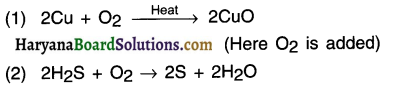
(a) Oxidation: It is the reation in which (a) either oxygen (O2) is added to a substance or (b) Hydrogen (H2) is removed from a substance.
E.g.:
HBSE 10th Class Science Notes Chapter 1 Chemical Reactions and Equations 2

(b) Reduction: It is the opposite of oxidation. In this,
(a) Either oxygen is removed from a substance or
(b) Hydrogen is added to a substance.
E.g.:

HBSE 10th Class Science Notes Chapter 1 Chemical Reactions and Equations 3

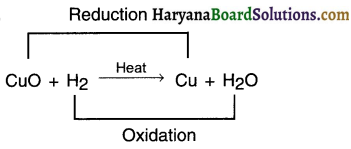
(c) Redox reaction: It is a reaction in which oxidation and reduction takes place simultaneously. (In Redox, Red = reduction, Ox = oxidation) E.g.
HBSE 10th Class Science Notes Chapter 1 Chemical Reactions and Equations 4

CuO got reduced to Cu (since oxygen is removed).
This is reduction reaction. H2 gets oxidized via. oxidation to form H2O. This is oxidation reaction.

HBSE 10th Class Science Notes Chapter 1 Chemical Reactions and Equations

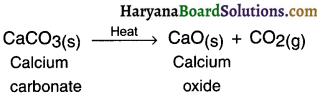
Exothermic and endothermic reactions: In a chemical reaction, if heat is evolved/released it is called exothermic (combustion) reaction. E.g. burning of natural gas:
CH4 + 2O2 → CO2 + 2H2O + Heat

Endothermic reaction: A reaction in which heat is absorbed or say required is called endothermic reaction.

Example:
HBSE 10th Class Science Notes Chapter 1 Chemical Reactions and Equations 5

When calcium carbonate is supplied heat, calcium oxide and carbon dioxide are formed.

Effect of Oxidation reaction in everyday life:

Corrosion:

  • When a metal comes in contact with humid air, moisture or a chemical such as acid, the surface of metal starts getting eaten up. This is called corrosion.
  • Corrosion is mainly caused by the oxidation of metals in humid air. Rusting of iron is the most common form of corrosion.

HBSE 10th Class Science Notes Chapter 1 Chemical Reactions and Equations

Rancidity:

  • Oxidation affects food that contains fats and oils.
  • When food items (such as snacks like pun, chakri, chavana, etc.) prepared using fat and oils are kept for longer period, they develop an unpleasant smell and taste. We then say that the food item has become rancid.

HBSE 10th Class Science Notes Chapter 1 Chemical Reactions and Equations Read More »

HBSE 10th Class Science Important Questions Chapter 14 Sources of Energy

Haryana State Board HBSE 10th Class Science Important Questions Chapter 14 Sources of Energy Important Questions and Answers.

Haryana Board 10th Class Science Important Questions Chapter 14 Sources of Energy

Question 1.
Define source of energy. Which factors should be considered while selecting a source of energy? OR What is a good source of energy?
Answer:
Source of energy:

  • A source from which useful energy can be extracted either directly or indirectly by means of a conversion or transformation is known as the source of energy.
  • For example, sources of energy that provide us heat for cooking are LPG, kerosene, sunlight, etc.

Factors to consider while selecting an energy source:

  • The source of energy should be available in good quantity.
  • It should have good output i.e. it should be able to do a large amount of work per unit volume or mass.
  • It should be easily accessible.
  • It should be easy to store and transport.
  • It should be economical.

HBSE 10th Class Science Important Questions Chapter 14 Sources of Energy

Question 2.
What is a good fuel? OR What are the characteristics of a good fuel?
Answer:
Characteristics of a good fuel:

  • The fuel should be cheap.
  • It should be easily available and in good quantity.
  • It should neither produce a lot of smoke nor leave a lot of residue.
  •  It should have good thermal capacity.

Question 3.
As per the law, ‘Energy can neither be created nor destroyed.’ If this is true then why do we face so much energy crisis? Give one example.
Answer:
The law that energy can neither be created nor be destroyed is true. But energy in the usable form gets dissipated into the surroundings in the less usable form.
Example: When a candle is burnt it gives heat and light and releases some other substances. But, we cannot put together the heat, light and the substances to regain wax for using the candle again.

Question 4.
What do you mean by conventional and non-conventional sources of energy?
Answer:
The sources of energy available to us can be broadly classified as conventional and non-conventional.
(a) Conventional (Non-renewable) source of energy:
A source of energy which we cannot regenerate or reuse once we have used it is called a conventional or non-renewable source of energy.

Types: Fossil fuels such as coal, petroleum and natural gas, thermal power plants, hydro power plants, biomass and wind energy.

(b) Non-conventional (Renewable) source of energy:

  • Those sources of energy which are inexhaustible or say can be renewed are called non-conventional (renewable) sources of energy.
  • Solar energy, tidal energy, wind energy, geothermal energy, etc. are all examples of renewable sources of energy.

HBSE 10th Class Science Important Questions Chapter 14 Sources of Energy

Question 5.
What do you mean by transformation of energy?
Answer:
The change in form of energy from one form to another is called transformation of energy. For example, transforming energy of wind to run an electric motor.

Question 6.
What is a fuel? Give examples.
Answer:
A substance which on burning gives heat and power is called fuel. -> Wood, coal, petrol, kerosene, CNG, PNG are all examples of fuels.

Question 7.
What are fossil fuels?
Answer:
Fuels such as coal, natural gas and petroleum formed in the earth crust due to decaying of plants and animal remains, millions of years ago are known as fossil fuels.

Question 8.
Why fossil fuels are called non-renewable?
Answer:
1. Fossil fuels are formed when dead plants and animals naturally get buried in the earth crust and remain there for millions of years.
2. Such material undergoes chemical changes for all these years due to the pressure and heat in the interior of earth.
3. Man has used a majority of the fossil fuels available in the earth just within few centuries. Naturally, man will not survive for another million years so as to use fossil fuels.
4. Since fossil fuel will soon become extinct, it is classified as non-renewable source of energy.

HBSE 10th Class Science Important Questions Chapter 14 Sources of Energy

Question 9.
State the disadvantages of fossil fuels.
Answer:
Disadvantages of fossil fuels:

  • Burning fossil fuels create smoke. This causes respiratory problems.
  • Fossil fuels such as coal and petroleum cause severe air pollution.
  • Acidic oxides of carbon, oxygen and sulphur are released on burning fossil fuels. These substances cause acid rain which affects our water and soil resources.
  • Release of carbon dioxide leads to green house effect which causes global warming.

Question 10.
Explain in brief (a) Dynamo, (b) Turbine.
(a) Dynamo: Dynamo is a machine which converts mechanical energy into electrical energy by means of rotating copper coil in a magnetic field.

(b) Turbine:

  • A turbine is a machine having a wheel or rotor which, on rotating, runs the dynamo and helps in generating electricity.
  • The wheel of the turbine can be made to rotate by fast moving flow of steam, gas, water or air.

Question 11.
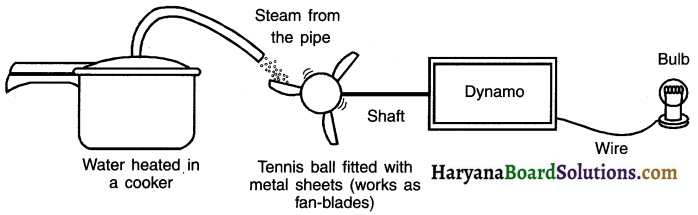
With the help of simple example, explain briefly how electricity as an energy is produced using turbine and dynamo.
Answer:
1. A turbine is made to rotate using either the flow of wind or water or steam.
2. The rotating shaft of the turbine is connected to the shaft of the dynamo/electric generator.
3. As shown, the force of steam from the cooker rotates the fan of the motor. This motion starts the motor. The shaft of the motor in-turn rotates the shaft of the dynamo. This generates electricity. The electricity produced can be supplied to run the electrical appliances such as bulb, fan, etc.
HBSE 10th Class Science Important Questions Chapter 14 Sources of Energy 1

Working:

  • Fuel such as coal is burnt to generate steam on a very large scale.
  • The steam is directed to run the turbines which then generate electricity using generators.

HBSE 10th Class Science Important Questions Chapter 14 Sources of Energy

Question 12.
What is a thermal power plant? How does it work?
Answer:
Thermal power plant is a set-up which converts heat energy into electrical energy on a large scale commercial basis. The electricity is then supplied to households as well as commercial establishments.

Question 13.
Write a note on production of electricity through hydropower plant.
Answer:
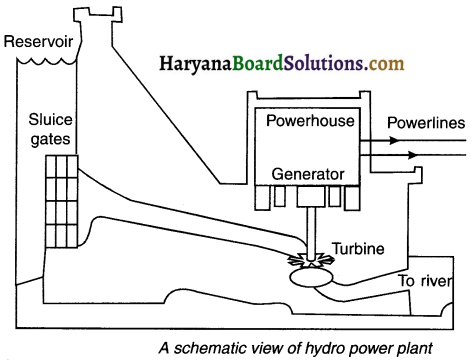
Hydropower plant:
Hydropower or hydroelectric plants use the potential energy of water stored at height (in dams) and the kinetic energy of the falling water for generating electricity. The power produced is called hydroelectricity or hydel electricity.

HBSE 10th Class Science Important Questions Chapter 14 Sources of Energy 2

Process:

  1. Huge dams having good heights are constructed to obstruct the flow of river water. The water is collected in these dams.
  2. The water stored in these high dams possesses a huge quantity of potential energy.
  3. The water is allowed to flow freely via pipes. The water from the pipes hit the turbine blades and rotates them. The turbine then runs the generator to produce electricity.
  4. The water in the reservoirs gets filled with every rain and hence hydroelectricity is called a renewable source of energy.

Question 14.
Discuss the disadvantages of hydro-electric power plant.
Answer:
Disadvantages of hydro-electric power plant:
1. Dams for generating hydropower can be constructed only in some specific areas, preferably hilly areas.
2. Large agricultural areas and residential areas of people living in low areas get submerged in water.
So, such people have to be relocated. Relocating such people to a location suitable to them is also a major problem.
3. Large ecosystems get destroyed by getting submerged under dam water.
4. The vegetation that gets submerged becomes rotten due to anaerobic (lack of oxygen) condition.
As a result, a large quantity of methane gas gets released in the atmosphere. Methane gas is a greenhouse gas whose increased level causes global warming.

Question 15.
What is biomass? What can be done to obtain bio-energy using biomass?
Answer:
1. The waste material from plants or animals which is not used for food or feed is called biomass.
2. For example, dung is used as fuel, wood is also used as fuel. The source of these fuels i.e. plant and animal waste is then called biomass.
3. Plant residue left after farming, vegetable waste, etc. s also biomass.
4. These fuels have very low calorific value. Moreover, burning them produces lot of smoke.
5. We can produce bioenergy in the form of biogas using biomass.

HBSE 10th Class Science Important Questions Chapter 14 Sources of Energy

Question 16.
Why there is a need of technological Intervention while using biomass as fuel?
Answer:
1. Cattle dung, wood, farm waste, etc. are all part of biomass and are used as fuel.
2. Wood on burning gives very less heat energy and also generates a lot of smoke. But, if wood is burnt in limited supply of oxygen, the water and volatile material present in the wood gets removed and what is left is called charcoal. Charcoal burns without flames or emitting heavy smoke like wood. It also gives more heat energy.
3. Similarly, cow dung, plant residues such as dead plants, dried leaves, residue obtained after harvesting a crop, vegetable waste and sewage can be gathered in a pit and decomposed in absence of oxygen to produce a more efficient fuel called biogas or gobar gas.
4. Thus, technological intervention improves fuel efficiency and also emits lesser or no pollutants in the environment.

Question 17.
What is biogas? State its advantages.
Answer:
1. The gas prepared by decomposing cow dung, plant residue such as dead plants, dried leaves, residue obtained after harvesting a crop, vegetable waste and sewage in a pit is called biogas or gobar gas.
2. Biogas is a mixture of gases namely methane, hydrogen, carbon dioxide and hydrogen sulphide.
3. Methane is the main constituent of biogas. 75% of biogas is methane.

Advantages of biogas:

  •  Biogas is an excellent fuel which contains upto 75% methane. The gas is used for cooking purposes in villages.
  • Biogas burns without smoke, leaves no residue like ash in wood and charcoal.
  • It has a high thermal capacity.
  • The slurry left behind as residue is an excellent manure rich in nitrogen and phosphorous.
  • Biogas can also be used for lightening the villages.
  • Biogas plant offers a large scale solution for effective utilization of bio-waste and sewage material.

Question 18.
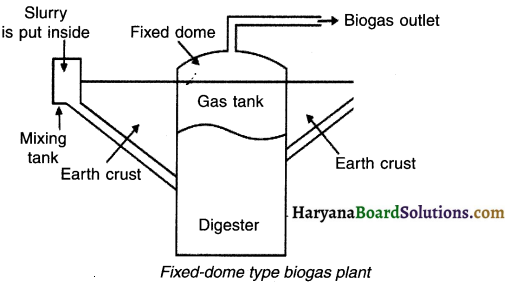
Describe with a labeled diagram how biogas is produced in a fixed-dome type biogas plant.
Answer:
Structure of fixed-dome type biogas plant: Slurry

  • This plant consists of an underground tank called the digester. The digester is made-up of bricks. It is a sealed chamber devoid of oxygen.
  • The plant has a dome-shaped roof made of cement and bricks. This dome act as a gas holder.
  • The dome has a gas outlet valve at the top for releasing biogas produced in the plant.
  • There is a sloping inlet chamber on the left side of the digester tank. Raw material (bio-mass) is put in the plant from this inlet.
  • On the right side there is an outlet chamber for removing residue from the plant.

HBSE 10th Class Science Important Questions Chapter 14 Sources of Energy 3

Working:
1. Cow dung and water are mixed in a separate tank and are put into the digester of biogas plant via, the inlet chamber. (Note: If only cow dung is used in the plant, the plant can also be called as gobar-gas plant. However, a bio-gas plant can use other material over and above cow dung.)
2. The tank is then closed for few days.
3. During this period anaerobic micro-organisms (i.e. microorganisms that do not require oxygen) decompose or break down complex compounds of the cattle dung slurry.
4. The biogas starts getting collected in the dome. It is then brought out via, the outlet pipe of the dome.

HBSE 10th Class Science Important Questions Chapter 14 Sources of Energy

Question 19.
Differentiate between biomass and bioas.
Answer:

Biomass (wood, cattle dung cakes, etc.)Biogas
Using sources of biomass for fuel produces lot of smoke.It does not produce smoke.
It leaves residue after burning which is of no use.The residual slurry is excellent manure.
It has low calorific value.It has high calorific value.

Question 20.
What is wind? Explain how wind energy Is used for doing work.
Answer:
1. Moving air is called wind.
2. Wind possesses kinetic energy. This kinetic energy can be used to do work or obtain electricity through a machine called wind mill.
3. The energy of the wind is used to rotate the blades of the wind mill. By connecting turbine with the windmill we can generate electricity.

Question 21.
Draw the structure of wind mill and explain how It works.
Answer:
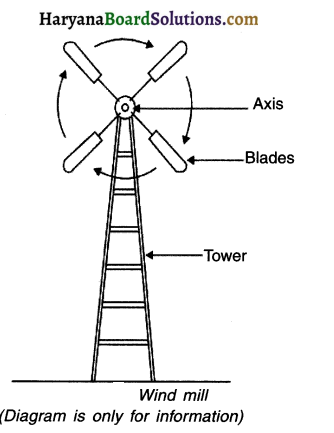
Wind mill:

  • The structure of wind mill can be compared to that of a large electric fan.
  • It is erected at some height on a rigid support.
  • A wind mill consists of three blades which rotate freely when wind blows through them.
  • The shaft of the blade is further connected to the turbine and motor of electric generator.
  • On rotating, the generator produces electric energy which is then supplied where needed.
  • A single wind mill can generate only a small amount of energy. Hence, a number of wind mills are erected over a large area to produce electricity on large scale commercial basis. Such a set-up is called a wind farm.

HBSE 10th Class Science Important Questions Chapter 14 Sources of Energy 5

Question 22.
State the advantages of wind mills.
Answer:
Advantages of wind mills:

  • Wind energy does not cause any pollution.
  • It is a renewable source of energy.
  • Once installed, it does not cause any recurring expense.

HBSE 10th Class Science Important Questions Chapter 14 Sources of Energy

Question 23.
What are the limitations of windmills or wind farms or energy obtained from wind?
Answer:
Limitations of a wind mill:

  • Wind mill (or wind farm) can be established only at those places where wind blows for most of the year that too with a minimum speed of 15 km/h.
  • A back-up facility such as storage cells is needed for continuous supply of electricity in case when there is no wind.
  • A large area of land is needed to establish a wind farm.
    For example, 2 hectares of land would require to set-up a wind farm which would produce just 1 MW electricity.
  • The initial cost to set-up a wind farm is quite high.
  • The tower and the blades of the wind mill are always exposed to the vagaries of nature such as sun, rain, storm and cyclone. Hence, wind mills require a very high maintenance.

Question 24.
State the uses of wind mill.
Answer:
Uses of wind mill:

  • The energy of wind mill is used to draw underground water with the help of water-lifting pump.
  • It is used to rotate heavy stones for grinding wheat into flour.
  • Wind mills are used to generate electricity.

Question 25.
What are alternate (non-conventional) sources of energy? Name few such energies.
Answer:
The sources of energy which we have not yet started using on a regular and routine basis are called non-conventional sources of energy.
Example: Solar energy, oceanic energy, geothermal energy and nuclear energy.

Question 26.
Give an introduction to solar energy.
Answer:
1. The energy obtained from the sun is called solar energy. This energy is available in two forms namely, light and heat.
2. The sun has been radiating an enormous amount of energy at the present rate for nearly 5 billion years and it will continue to do so at same rate for another 5 billion years.
3. Out of the total energy that the sun emits, only a very small part of energy reaches the outer layer of earth’s atmosphere. 4. Out of this about 50% gets absorbed in the atmosphere and remaining half reaches the earth.

Question 27.
Explain the construction of solar cooker along with a diagram. Also state its uses.
Answer:
HBSE 10th Class Science Important Questions Chapter 14 Sources of Energy 4
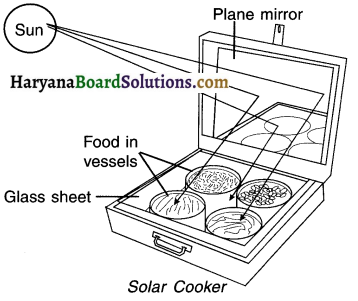
1. A solar cooker is a device which uses the energy of direct sunlight to heat and cook food.
2. The body of the solar cooker is made up of bad conductor material such as plastic or fibre.
3. The internal surface of the cooker and the containers used in it are of black colour to absorb maximum heat.
4. An adjustable plane mirror is fixed on the top of the box and it is adjusted in such a way that it can reflect maximum sunlight into the box.

Question 28.
Write a note on solar cells.
Answer:
1. Solar cells convert solar energy into electrical energy.
2. Solar cells are made up of silicon.
3. A typical solar cell develops a voltage of 0.5 -1 V and can produce about 0.7 W of electricity. Several such cells are joined together on one panel to obtain a large amount of electricity.

HBSE 10th Class Science Important Questions Chapter 14 Sources of Energy

Question 29.
State the advantages of solar cells.
Answer:
Advantages of solar cells:

  • Silicon which is the base material for making solar cells is available in abundance in the nature.
  • Solar cells have no moving parts and so they require very less maintenance.
  • These cells work quite efficiently without the need of any focusing device.
  • Another big advantage is that solar panels can be set-up even in extremely remote and inaccessible areas where it is not feasible to set-up other sources of electricity.

Question 30.
Although solar power is an extremely useful mode of generating electricity, it comes with a host of limitations. Explain them.
Answer:
Limitations of solar cells (power):

  • Silicon, the base material for solar cells is available in abundance but the special grade silicon needed for the cells is available only in limited quantity.
  • The entire process of making the cell is quite costly. Moreover, usage of silver metals for interconnecting the cells further adds up to the cost.
  • Owing to high cost, these cells cannot be used for domestic purpose.

Question 31.
Enlist the present day uses of solar cells.
Answer:
Present day uses of solar cells:

  • Solar cells are used in artificial satellites and space probes like Mars orbiters.
  • For operating electronic calculators, toys, etc.
  • In remote area solar cells are used for domestic purpose to run street lights and to run radio and T.V.
  • For operating traffic signals and in research centres.
  • Solar cells are also used in cars at an experimental level.

Question 32.
Write a note on tidal energy.
Answer:
Tidal energy:

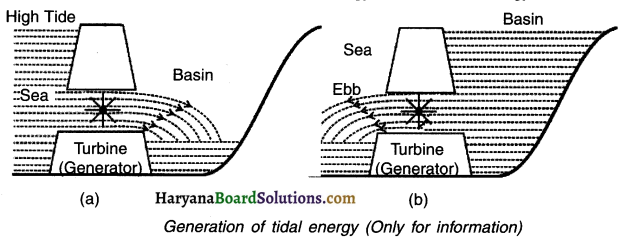
  • The level of ocean water rises and falls due to the gravitational pull of moon on the earth.
  • The rise of the ocean water is called the high tide whereas the fall is called low-tide.
  • The difference in these tides give us energy which is called tidal energy.
  • To obtain tidal energy, a tidal dam is built across the narrow opening of the sea. A turbine is fixed at the opening of the dam which converts tidal energy into electrical energy.

HBSE 10th Class Science Important Questions Chapter 14 Sources of Energy 6

Limitations:
1. Tidal energy can be obtained only in coastal areas.
2. The electricity generated is in lesser quantity. So, its commercial use is not possible.

HBSE 10th Class Science Important Questions Chapter 14 Sources of Energy

Question 33.
Give a brief idea about wave energy.
Answer:
Wave energy:

  • The winds blowing over ocean produces waves. These waves possess large amount of kinetic energy.
  • Several devices have been developed to trap wave energy for rotating the turbine and hence producing electricity.

Question 34.
What is OTEC ? Describe the working of an OTEC plant.
Answer:
Ocean Thermal Energy Conversion (OTEC):
Answer:
The energy available due to the difference in the temperature of water at the surface of the ocean and at deeper levels of the ocean is called Ocean Thermal Energy (OTE). The plant set-up to harnass this energy is called Ocean Thermal Energy Conversion (OTEC) Plant.

Working of an OTEC power plant :

1. The surface water of the ocean which remains hot due to sunlight possess higher temperature and hence works as the source of heat energy. The water below the surface remains comparatively colder i.e. it possess lower temperature.
2. The difference in temperature is used to obtain energy with the help of OTEC plant.
3. To run an OTEC plant the minimum temperature difference between the surface water and the water under it (upto 2 km) should be 20 °C. This temperature difference should be maintained through out the year.
4. Usually, an OTEC plant is erected inside the ocean, far away from the sea-shore.
5. The warm surface water is used to boil low-boiling liquid like ammonia. The vapours generated are then sent to move the turbine of generator.
6. The cold water from the deep ocean is used to cool the vapour that escaped from the turbine and is turned it into liquid for using again.

Question 35.
Explain the types of energy available from the sea.
There are three ways in which energy can be obtained from the sea. They are:
(1) Tidal energy, (2) Wave energy and (3) Ocean Thermal energy

Tidal energy:

  • The level of ocean water rises and falls due to the gravitational pull or moon on the earth.
  • The rise of the ocean water is called the high tide whereas the fall is called low-tide.
  • The difference in these tides give us energy which is called tidal energy.
  • To obtain tidal energy, a tidal dam is built across the narrow opening of the sea. A turbine is fixed at the opening of the dam which converts tidal energy into electrical energy.

Wave energy:

  • The winds blowing over ocean produces waves. These waves possess large amount of kinetic energy.
  • Several devices have been developed to trap wave energy for rotating the turbine and hence producing electricity.

Ocean Thermal Energy Conversion (OTEC):

  • The energy available due to the difference in the temperature of water at the surface of the ocean and at deeper levels of the ocean is called Ocean Thermal Energy (OTE).
  • The device used to obtain ocean thermal energy is known as Ocean Thermal Energy Conversion power plant or OTEC power plant.

HBSE 10th Class Science Important Questions Chapter 14 Sources of Energy

Question 36.
What is geothermal energy? How is it produced?
Answer:
Geothermal energy:
1. The deep interior region of the earth where magma is found is very hot. The energy utilized from this heat is called geothermal energy.
2. The extremely high temperature in the interior of the earth melts the rocks present there. The molten substance is known as magma.
3. When geological changes take place, the magma gets pushed upwards. It then gets trapped in certain regions below the surface of the earth. These regions are called hotspots.
4. When the underground water comes in contact with the hotspots, it turns into steam.
5. Such regions are drilled and pipes are installed to draw high pressure steam into turbines installed on the ground. This rotates the turbine generator and electricity is produced.
6. At some places, steam and hot water ooze out on their own through cracks of the rocks. Such sites serve as hot water springs or natural geysers.
7. A number of power plants based on geothermal energy are in operation in New Zealand and America. Although it is cheap to obtain geothermal energy but there are very few locations that are commercially viable for generating this energy.

Question 37.
How is nuclear energy generated? State its advantages.
Answer:
1. When the nucleus of a heavy atom (such as uranium, plutonium or thorium) is bombarded with low-energy neutrons, it gets split into lighter nuclei. This process is called nuclear fission.
2. During the splitting of nucleus, tremendous amount of energy is released. This energy is called nuclear energy.
3. The mass of the original nucleus which is bombarded is slightly more than the sum of the masses of individual nucleus formed.
4. The released energy can be used to produce steam and hence generate electricity.

Advantages:

  • The atomic fission of uranium produces 10 million times the energy produced by the combustion of an atom of carbon from coal.
  • The nuclear fuel can itself go on chain reaction and release energy at a controlled rate.

Question 38.
State the limitations of nuclear energy.
Answer:
Limitations of nuclear energy:

  • The biggest problem is the storage and disposal of used nuclear fuel. The residual uranium in the used fuel keeps on decaying into harmful sub-atomic particles (radiations).
  • Improper storage and disposal of nuclear waste contaminates the environment.
    In case of accident if the radiations leak, they can cause very large and widespread effect.
  • The installation cost of nuclear power plant is very high. Uranium which is a raw material is not available inabundance. Add to these, the high risk of enviropmental contamination limits the use of nuclear energy for general purpose.

Question 39.
‘Irrespective of the energy source, the damage to environment takes place in some or the other form.’ Explain with reference to renewable sources of energy.
Answer:
1. Non-renewable sources cause a direct impact on environment that too at quite a fast pace.
2. In contrast to this we prefer alternative sources such as solar, CNG, hydro energy, etc. and call them clean fuels.
3. Although these fuels are clean but in fact they are not fully clean. They are just cleaner than the renewable sources.
4. Generating solar power needs solar cells for which we extract silicon from earth. Similarly, we need materials like plastic, glass, etc. to make solar devices. Manufacturing or extracting these things causes damage to the environment.
5. Similarly, for constructing dams thousands of trees are cut and ecosystems are destroyed. Moreover, cement, iron and steel and several such materials are needed to build up hydropower plant. All these things cause environmental pollution or degradation.

HBSE 10th Class Science Important Questions Chapter 14 Sources of Energy

Question 40.
‘Manufacturers should produce high quality products that last long.’ Justify.
Answer:
1. In today’s time, manufacturers in order to earn more, have degraded the quality of their products.
2. The products now produced do not last long. As a result, people have to buy newer products in short span of time.
3. Whenever a product is manufactured it involves heavy degradation and pollution to environment. This leads to several problems such as rise in global warming, over-mining of resources, etc.
5. Hence, it is highly desirable that the products should be of good quality so that they last long and save environment.

Question 41.
Why is there a need to harness non-conventional sources of energy? Give two main reasons.
Answer:
There is need to harness non-conventional sources of energy due of the following reasons –
(1) The demand for energy is constantly rising due to

  • Continuous rise in population,
  • Our greed to improve the quality of life by adopting faster means of transportation, rapid industrialization and
  • Extensive use of energy consuming appliances.

(2) The sources of energy which are available are mainly fossil fuels which are non-renewable sources. This means that these sources are limited and will soon exhaust.

Question 42.
What steps would you suggest to minimize environmental pollution caused by burning of fossil fuels?
Answer:
Some suggested steps to minimize environmental pollution caused by burning of fossil are –

  • Make use of smokeless chulhas instead of burning wood for cooking.
  • Increasing forest area.
  • Using clean fuels like CNG, LPG, etc.
  • By encouraging the use of public transport instead of private vehicles.
  • By increasing the efficiency of combustion process such as that of vehicles, machines, etc.

Question 43.
Why are thermal power plants preferably set-up near coal or oil fields?
Answer:
1. Thermal power plants need coal in very large quantity and that too on a continuous basis.
2. If the plants are located near the coal mines the plants would save a considerable amount of money as well as time in transporting coal. This will also make electricity cheaper.

Question 44.
The use of dry wood as domestic fuel is not considered as a good fuel. State two reasons for it.
Answer:
1. Wood has very low calorific value and thermal capacity. So, by burning it we get very less heat for cooking.
2. Wood leaves a lot of residue and also releases a lot of smoke. This causes air pollution.

Question 45.
What are the two ways in which animal dung can be utilized as a fuel? Which of them is better?
Answer:
(a) Cattle dung can be dried to prepare cattle-dung cake. These cakes can be burnt to use as fuel.
(b) Animal dung can be used to produce biogas.
The second method is better because the gas produced does not cause pollution on burning. Moreover, the slurry left in the biogas plant is an excellent fertilizer.

HBSE 10th Class Science Important Questions Chapter 14 Sources of Energy

Question 46.
What is the role of a plane mirror and a glass sheet in a solar cooker?
Answer:
(1) Role of plane mirror: Plane mirror is used as a reflector in solar cookers to focus the maximum rays of the sun into the cooker. This helps to achieve a higher temperature.

(2) Glass sheet: The glass sheet allows the infrared rays and visible rays to enter the solar cooker. The infrared rays then remain trapped in the cooker. This way the temperature of the cooker increases which helps in cooking food.

Question 47.
Why is the utility of solar cells less in spite of the fact that it is quite eco-friendly and self generating source of electricity ? OR Explain why the use of solar cells is limited.
Answer:
Silicon is the second largest element found in the earth’s crust.
1. But, for making solar cells a special grade of silicon is used which is available in very less quantity.
2. Moreover, to make internal connections in solar panel, silver is used which adds to the cost of production.
3. Even after doing all this we have not developed a very efficient system to store the electricity generated by these cells.
4. The electricity produced by these cells can be stored only in DC storage batteries.
5. When a gadget which runs on AC current is to be used, the DC current of the battery needs to be first converted into AC current. This leads to loss of some energy as well as increase in the cost.
6. Thus, due to all these reasons the use of solar cells become costly and impractical and so they are not widely used.

Question 48.
What is a wind farm? How it is better over a wind mill?
Answer:
1. A large area where several wind mills are erected so that electricity can be produced on a large scale is called a wind farm.
2. Since, the output of individual wind mill is quite less, installing several windmills together to create wind farm is a logical and better option.

Question 49.
State the advantages and disadvantages of geothermal energy.
Answer:
Advantages:

  • It is cheaper to generate electricity from geothermal energy source.
  • It is pollution free.

Disadvantages:

  • There are very less places where geothermal energy is obtained.

1. Akruti heights is a posh high-rise residential society of Ahmedabad. There are 3 lifts per tower and the building is well lit with CFL lights. The monthly maintenance per flat pinches the members. So, a meeting was called and some members suggested to install solar power plant.

They explained that this would provide some electricity to light the building and any may reduce electric bill amount. They also said that this concept is environment-friendly. Now answer the following questions.

Questions:
1. Considering the high cost of solar panels and hence the solar power plant, do you think that the idea of installing solar plant is worth?
2. What are the disadvantages of appliances which run on solar energy?
3. What values have the society members displayed?
Answers:
1. Although setting up a solar power plant is costly. In the long-run, we can generate power free of cost. Hence, it is a good idea to install the solar plant.
2. Solar appliances do not work during cloudy and rainy days. Hence, the society will have to use the conventional modes of electricity.
3. The society members have displayed the values of betterment of all and awareness for conservation of fossil fuels.

2. On the suggestions of few friends, Rakesh decides to convert his petrol car into CNG. His wife Sudha works in a bank which falls on the way of Rakesh’s office. So, in most days Rakesh drops Sudha to her office as well as picks her up while coming home.

Rakesh’s son is in class 9. He studies in Holy Faith Boy’s School which is about 2.5 km from his house. So, rather than going through the school van, Rakesh insists his son to go to school on a bicycle. Now answer the following questions.

Questions:

1. Did Rakesh take a wise decision by converting his petrol car into CNG? Why/Why not?
2. Do you think switching to CNG can do any good to fossil fuels?
3. Rakesh insists that his son should go to school on a bicycle. In this tough times, where every minute counts do you think Rakesh should revoke his decision?
4. What value is reflected in this example?
Answers:
1. Yes. Rakesh took a wise decision by converting his car into CNG. Compared to petrol, CNG creates very less pollution. Moreover, it is quite reasonable. Hence, Rakesh can also save a good amount of money.
2. Fossil fuels are non-renewable and exhaustible sources of energy. Hence, by making use of CNG we can help in conserving fossil fuels.
3. The school is just 2.5 km from Rakesh’s house. So it will barely take 10 minutes for his son to reach the school. Although every minute counts in this competitive world, cycling such small distances can help to conserve environment which is equally the need of hour. Hence, Rakesh should not revoke his decision.
4. Rakesh has displayed values of a responsible citizen who cares Jor the environment. Sudha too has shown similar value.

3. In a summer afternoon, you find two cars belonging to your father parked in open. One of the cars is black coloured and has black film on window glass. The second car is white coloured. Moreover, it has plain window glass. For the purpose of an experiment, you open the door of each car one by one and sit inside for a while. Now answer the following questions.

HBSE 10th Class Science Important Questions Chapter 14 Sources of Energy

Questions:
1. Which car is more hot from inside?
2. Discuss very briefly about the reason for variation of hotness of each car.
3. Suggest three ways for keeping the house cool in summer without making use of electricity.
Answers:
1. Black car is more hot as compared to the white car.
2. Black colour absorbs more heat as compared to white. Hence black car is more hot than the white car.
3. Suggestions to keep the house cool in summer:

  • Put green curtain outside the window.
  • Apply

Very Short Answer Type Question 

Question 1.
Define: Source of energy.
Answer:
A source from which useful energy can be extracted either directly or indirectly by means of a conversion or transformation is known as the source of energy.

Question 2.
State two factors while considering as energy source.
Answer:
(i) The energy source should give good output.
(ii) It should be easily available.

Question 3.
State two characteristics of a good fuel.
Answer:
(i) The fuel must be cheap
(ii) It should be easily available and in good quantity.

Question 4.
Define: Conventional source of energy.
Answer:
A source of energy which cannot be regenerated or reused once we have used it is called a conventional or non-renewable source of energy. For example, coal and petroleum.

Question 5.
Define: Non-conventional source of energy.
Answer:
Those sources of energy which are inexhaustible or say can be renewed are called non- conventional (renewable) sources of energy. For example, sun and wind.

Question 6.
Suggest two ways to reduce pollution caused by burning fossil fuels.
Answer:
1. Increasing the efficiency of combustion process
2. Using techniques to reduce the escape of harmful gases and ashes in the atmosphere and surroundings.

Question 7.
What is CNG?
Answer:
Full form of CNG is Compressed Natural Gas. It is used in vehicles as a cleaner fuel.

Question 8.
What is a dynamo?
Answer:
Dynamo is a machine which converts mechanical energy into electrical energy by means of rotating copper coil in a magnetic field.

HBSE 10th Class Science Important Questions Chapter 14 Sources of Energy

Question 9.
What is a turbine?
Answer:
A turbine is a machine having a wheel or rotor which on rotating runs the dynamo and helps in generating electricity.

Question 10.
What is a thermal power plant?
Answer:
Thermal power plant is a set-up which converts heat energy into electrical energy on a large scale basis.

Question 11.
Where are fossil fuels used directly?
Answer:
In vehicles, gas-stoves, thermal power plant, etc.

Question 12.
How can you say that hydropower is renewable?
Answer:
Hydropower is generated due to water stored in dams. The dams get filled continuously with rain which keeps falling as per natural cycle.

Question 13.
Why it is not advised to use wood as a fuel in spite of the fact that forests can be replenished?
Answer:
Although forests can be replenished but it takes 15 years to grow a tree. Moreover, burning wood also causes pollution.

Question 14.
Why were hydroelectric plants of Tehri dams and Sardar Sarovar opposed?
Answer:
People residing on the land where these dams were proposed were to be relocated to a new area. People feared loss of home and farm land.

Question 15.
What is biomass?
Answer:
The waste material from plants or animals which is not use for food or feed is called biomass.

Question 16.
Why technological intervention is highly desired while using biomass as fuel?
Answer:
Technological improvement will increase the efficiency of using biomass fuels.

Question 17.
How is charcoal better than wood?
Answer:
Charcoal neither emits smoke nor does it burn with flames. Moreover, it also gives more heat energy as compared to wood.

Question 18.
List out the main gases formed in biogas.
Answer:
Methane (almost 75%), hydrogen, carbon dioxide and hydrogen sulphide.

Question 19.
Why biogas is also called gobar gas?
Answer:
The starting material for producing biogas is cow dung. Hence, biogas is also called gobar-gas.

Question 20.
State the biological process that takes place in the production of biogas.
Answer:
The anaerobic micro-organisms decompose the complex cow-dung and other material fed into the biogas plant and gives rise to biogas.

Question 21.
State the sequence of events occurring in a biogas plant.
Answer:
Feeding cow-dung and water into the plant → Breaking up of this material by anaerobic bacteria → Collection of biogas in the dome → Taking the gas out via. outlet pipe.

Question 22.
Which smokeless fuels can be used as domestic fuels?
Answer:
LPG, PNG, biogas and kerosene.

HBSE 10th Class Science Important Questions Chapter 14 Sources of Energy

Question 23.
Define: Wind.
Answer:
Moving air is called wind.

Question 24.
What is a wind farm?
Answer:
A set-up where several wind mills are installed for generating electricity on a large scale is called a wind farm.

Question 25.
State the traditional uses of wind and water energies.
Answer:
Traditionally, wind and water energies were used to carry out basic tasks such as sailing boats, separating husk from grain, watering farms using water-wheel, etc.

Question 26.
What is the function of the glass plate of a solar cooker?
Answer:
The glass plate allows the sun-rays to enter. At the same time, the plate trap the heat formed inside the cooker.

Question 27.
How much electrical energy does a solar cell produce?
Answer:
A typical solar cell develops a voltage of 0.5 V to 1 V and can produce about 0.7 W of electricity.

Question 28.
Why solar cells are almost maintenance-free?
Answer:
Solar cells have no moving part and so they are almost maintenance free.

Question 29.
What is the biggest advantage of solar cells?
Answer:
A solar panel can be installed in almost any remote and inaccessible area that too for very small use for an individual person.

Question 30.
What is tidal energy?
Answer:
The energy harnessed from the difference in high-tide and low tide is called tidal energy.

Question 31.
What is OTE?
Answer:
OTE or Ocean Thermal Energy is the type of energy harnessed from the temperature difference of the ocean water at surface level and water below it.

Question 32.
Name the forms in which energy from oceans can be obtained?
Answer:
Tidal energy, wave energy and Ocean Thermal Energy (OTE).

Question 33.
Which is the most feasible source of oceanic energies? Why?
Answer:
Ocean thermal energy conversion is the most feasible because unlike wave and tidal energies, OTE can be harnessed at several locations. Moreover, its plant can be operated for 24 hours throughout the year.

Question 34.
What is geothermal energy?
Answer:
The deep interior region of the earth where magma is found is very hot. The energy utilized from this heat is called geothermal energy.

Question 35.
What is nuclear fission?
Answer:
When the nucleus of a heavy atom (such as uranium, plutonium or thorium) is bombarded with low-energy neutrons, it gets split into lighter nuclei. This process is called nuclear fission.

Question 36.
Compare the nuclear fission that takes place in a nuclear weapon and a nuclear reactor.
Answer:
The fundamental physics of the fission chain reaction in both is similar. However, the two types of devices work on very different engineering structures.

Fill in the Blanks

1. ………… gas is responsible for greenhouse effect.
Answer:
Carbon dioxide

2. ………….. is the mechanical device needed to generate power from wind and water both.
Answer:
Turbine

3. Mostly a thermal power plant would be located near …………..
Answer:
Coal or oil field

HBSE 10th Class Science Important Questions Chapter 14 Sources of Energy

4. You will get if you burn wood in limited supply of oxygen.
Answer:
Charcoal

5. …………………. is the primary source of fuel of modern world.
Answer:
Fossil fuel

6. ……………. decompose the complex compound of cow-dung slurry.
Answer:
Anaerobic microorganisms

7. Winds blow due to the process of ………….
Answer:
Unequal heating of landmass and water mass by solar radiation causing movement of air.

8. The structure of a windmill can be compared with that of a ……………
Answer:
Fan

9. The minimum speed of wind in order to run a wind mill is…………..
Answer:
15 km/h

10. 2 hectare of land will produce ………….. electricity with the help of windmills.
Answer:
1 MW

11. As per an estimate the sun’s total years of radiating light are ……………
Answer: 10 billion

12. One of the ways to increase solar radiation in a solar cooker is………….
Answer: Using mirrors to focus the sun rays.

13. A typical solar cell produces Watts.
Answer: 0.7

14. The biggest advantage of solar cells is ………….
Answer:
They can be installed in the most remote location even for a single person.

15. ………..is the base material for making a solar cell.
Answer:
Silicon

16. Solar cells are capable to provide electricity to one such area where no other non-conventional source can. The area is …………
Answer:
Artificial satellites and space probes.

17. OTE works on the principle of ……………..
Answer:
Difference in water temperature.

18. For OTE, the temperature difference between water should be ………..
Answer:
Minimum 20°C

19. The fission of uranium produces ……………. times the energy by combustion of an carbon atom of coal.
Answer:
10 million.

HBSE 10th Class Science Important Questions Chapter 14 Sources of Energy

True Or False

1. The total energy in any physical or even chemical process remains the same. — True
2. Burning coal was the most common source of energy in the ancient times. — False
3. Bangalore and Shimla can obtain electricity from similar source. — False
4. Apart from providing electricity for almost free,it is quite cheap to set-up a wind mill. — False
5. Transmission of electricity is more efficient than transportation sources such as coal and petroleum. — True
6. A quarter of our energy requirement in india is met by hydro power plants. — True
7. The domestic use of solar cells in limited owing to its high maintenance. — False
8. Nuclear fuel can behave as a self-sustaining fission chain reaction that releases energy at a controlled rate. — True
9. The fundamental physics in which the fission chain reaction of a nuclear weapon occurs and that of a nuclear reactor is quite different. — False

Match the Following

Question 1.

Column I.Column II
(1) Causes suffocation and headache(A) Carbon dioxide
(2) Green house effect(B) Nitrogen dioxide
(3) Acid Rain(C) Sulphur dioxide
(4) Smog(D) Carbon monoxide

Answer: 1-D, 2-A, 3-C, 4-B

Question 2.

Column IColumn II
(1) Component of sunlight which carries, heat energy(A) Sulphur dioxide and nitrogen dioxide
(2) Gases responsible for acid rain(B) Hydrogen
(3) Proceés which converts solar energy into chemical energy(C) Photosynthesis
(4) Burns with explosion(D) Infrared

Answer: 1-D, 2-A, 3-C, 4-B

HBSE 10th Class Science Important Questions Chapter 14 Sources of Energy Read More »

HBSE 10th Class Science Notes Chapter 8 How do Organisms Reproduce

Haryana State Board HBSE 10th Class Science Notes Chapter 8 How do Organisms Reproduce Notes.

Haryana Board 10th Class Science Notes Chapter 8 How do Organisms Reproduce

Reproduction:

The production of new organisms from the existing organisms of same species is known as reproduction. Organisms do not need to undergo reproduction for maintaining their lives, even though they reproduce so that they may continue the existence of their species. This is the reason why reproduction is vital for the survival of the species.

Do Organisms Create Exact Copies of Themselves?

All organisms of a particular species look similar. For example, dogs look like dogs and a human looks like another. This happens because the designs of their bodies are similar. Hence, the first and foremost task of the reproduction process is to make ‘copies of blueprints of body design’. This is done by creating copies of DNA.

During cell division, a cell divides to give rise to two cells. Although, the two cells will be similar but will not be exactly identical. It is quite obvious that the process of copying the DNA will have some variations. Hence, the generated DNA copies will be similar, but may not be identical to the original.

HBSE 10th Class Science Notes Chapter 8 How do Organisms Reproduce

In conclusion, the cells that survive after the cell division are

  • Similar to each other as well as
  • different i.e. show variation. This inbuilt tendency for variation during reproduction is the basis for evolution which is useful for the organism to adapt to ever changing environment.

The Importance of Variation

Niche:
A niche is the role and position a species plays in the environment, how the species meets its needs for food and shelter, how it survives and how it reproduces. Different species of organisms have different niches. For example, the way a lion gathers its food or shelter or reproduces are quite different from that of a crocodile i.e. the niches of two organisms vary.

Modes of Reproduction Used by Sinsle Oreanism

Asexual reproduction: The method of producing a new plant (or animal) without the act of fertilization of gametes is called asexual reproduction.

Types :

  • Fission
  • Fragmentation
  • Regeneration
  • Budding
  • Vegetative propagation and
  • Spore formation.

HBSE 10th Class Science Notes Chapter 8 How do Organisms Reproduce

Fission: In fission process, a unicellular organism divides to form two or more new organisms.

Types :

  • Binary fission and
  • Multiple fission

Binary fission: In binary fission, the nucleus lengthens and then divides into two parts. After that the cytoplasm divides into two parts. This results in two daughter cells. Example: amoeba and leishmania.

Multiple fission: In multiple fission, the parent organism divides to form many new organisms at the sarrje time. Example: Malarial parasite plasmodium.

Fragmentation:
The process wherein the body of a multi-cellular organism breaks (fragments) into two or more pieces and on maturing each piece grows to form a complete new organism is known as fragmentation. Example: spirogyra.

Regeneration:
In some plants and animals, if some parts of their bodies get cut then such parts have the ability to regenerate and form a complete new organism. This method of reproduction is called regeneration. Example: Planaria.

Budding:
In budding, a small part of the body of the parent organism grows out as a ‘bud’. It then detaches from parent and becomes a new organism. Example: Hydra and planaria.

Vegetative propagation:
In vegetative propagation, new plants are reproduced from the plant parts such as roots, stem and leaves of old plants, without taking help of any reproductive organs. Example: bryophyllum.

Spore formation:
When the coat of spore bursts, the spores spread into air. These airborne spores settle on food and under favourable condition, germinate to produce new plants. Example: Production of spores in rhizopus on bread.

Sexual reproduction:

  • The mode of reproduction that takes place with the help of both male sex cells and female sex cells is known as sexual reproduction.
  • Flowering plants belong to the group of angiosperms. The reproductive parts of angiosperms are located in the flower. So, we can say that flower is the reproductive organ of the plant.

HBSE 10th Class Science Notes Chapter 8 How do Organisms Reproduce

The four main reproductive parts of a flower are –

  • Stamen
  • Pistil
  • Petal and
  • Sepal

Unisexual flower: If the flower contains only one part out of stamen or pistil then such a flower is called unisexual. For example, papaya and watermelon.

Bisexual flower: If the flower contains both stamen as well as pistil the flower is called bisexual. For example, hibiscus and mustard.

Main processes of sexual reproduction:

  • Pollination: The travel of the pollen from stamen to the stigma with the purpose of formation of zygote and hence a new plant is called pollination.
  • Fertilization: The process of fusing of male gamete from the pollen grain and the female gamete in the ovary is called fertilization. Fertilization leads to formation of zygote.
  • Seed germination: The seed contains the future plant or embryo which develops into a seedling under appropriate conditions. This process is known as germination.

Reproduction in Human Beings

Changes that human body experiences:

  • The changes that occur in humans from infancy to childhood, to teenage and finally to fully grown matured body takes place quite slowly over several years. Moreover, neither do all these changes happen together at the same time in one person, nor do they happen at an exact age.
  • In some people, the changes happen early and quickly, while in others, they can happen slowly.
  • Each change takes its own time to get completed.

Puberty:
The age at which a body starts producing gametes and girls and boys become biologically capable to reproduce is known as puberty. Generally, girls attain puberty at the age of 12 years, while boys reach puberty at the age of 13 to 14 years.

HBSE 10th Class Science Notes Chapter 8 How do Organisms Reproduce

Male Reproductive System

Main reproductive organs: Ureter, Seminal vesicle, Vas deferens, Scrotum, Testes, Bladder, Penis and Urethra

Female Reproductive System

Main reproductive organs:
A pair of ovaries, oviduct, fallopian tube, uterus and vagina. The female reproductive system is more complicated than male because it takes care of fertilization and the development of embryo till the birth.

Reproductive Health

Sexually transmitted diseases:
The infectious diseases which are spread from an infected person to a healthy person through sexual contact are called sexually transmitted diseases (STDs). These disease can be caused either by bacteria or by virus. Example: Syphilis, gonorrhoea and AIDS.

What is contraception? List out the methods of contraception and explain them.
Contraception:
The method to prevent pregnancy in women is called contraception. Methods adopted to prevent pregnancy are called contraceptive methods.

Methods:
1. Birth control tools: Under this method, a mechanical barrier is created which prevents the entry of sperm into the genital tract. As a result, fertilization does not occur.

  • The tools include condoms, a diaphragm and Copper-T.

2. Birth control pills: There are oral pills that a women can take. These pills change the hormonal balance of the body so that the eggs are not released by the ovaries and fertilization is prevented.

HBSE 10th Class Science Notes Chapter 8 How do Organisms Reproduce

3. Surgical methods: These include vasectomy to prevent the sperms from entering urethra and tubectomy to prevent It will not allow the sperm to reach the uterus.

4. Abortion: Another method is to surgically remove the foetus from the body of pregnant women.

HBSE 10th Class Science Notes Chapter 8 How do Organisms Reproduce Read More »

HBSE 10th Class Science Important Questions Chapter 16 Management of Natural Resources

Haryana State Board HBSE 10th Class Science Important Questions Chapter 16 Management of Natural Resources Important Questions and Answers.

Haryana Board 10th Class Science Important Questions Chapter 16 Management of Natural Resources

Question 1.
Explain what are natural resources.
Answer:
1. The resources which occur naturally, and which cannot be created by man, are called natural resources.
2. The components of the atmosphere, hydrosphere and lithosphere which are used for the maintenance of life are called natural resources.
3. Water, land, air, forests, minerals, plants and animals are all natural resources.
4. Man depends on these resources for fulfilling all his basic requirements such as air, water, light, habitat, food and clothing.

Question 2.
What is Ganga Action Plan?
Answer:
1. Due to dumping of several types of waste, River Ganga has become highly polluted and the quality of its water has gone down drastically.
2. The river is dumped with sewage, industrial waste, dead bodies of humans, etc. Human feces contain a bacteria called coliform. This bacterium was found in Ganga. This led to rise in disease-causing microorganisms in the water.
3. Owing to all these kinds of pollution, in 1985, the government started a plan to clean River Ganga. The plan was named as Ganga Action Plan.

HBSE 10th Class Science Important Questions Chapter 16 Management of Natural Resources

Question 3.
How our holy River Ganga is getting polluted? What is its ill effect? What is being done to prevent its pollution?
Answer:
(a) Causes of pollution:

  • Very high amount of sewage, harmful chemicals and human corpses are dumped in River Ganga every year.
  • Owing to religious sentiments people perform religious rituals near Ganga.
  • People also bath and wash clothes in river Ganga.
  • Several industries dump their chemical waste in River Ganga. All these acts have polluted it enormously.

(b) III effect: The pollution has made the water very toxic. The toxic water is affecting health of people.

(c) Action taken: In 1985, the government started a plan to clean River Ganga. The plan was named as Ganga Action Plan.

Question 4.
It will be a huge error if man continues to believe that all natural resources are unlimited. Explain.OR Give reason: There is a need to use natural resources rationally and judiciously.
Answer:
Man uses natural resources to fulfill all his basic requirements like air, water, light, habitat, food and clothing.
1.  However, it will be a huge error if man continues to believe that all natural resources are unlimited and he can use them as much as he desires.
2. Man must not believe that all the essential natural resources are unlimited and he can exploit these resources in any way or in any amount as per his wish.
3. This indiscriminate and rampant use of natural resources has put the existence of the entire mankind and the social structure into a grave danger.
4. We must understand that the natural resources on the earth are limited while the people using these natural resources are quite huge in number.
5. However, it is not only a huge number of people which is a real problem. The real problem is the way humans use the natural resources.
6. Whenever a person uses natural resources more than his fair share and causes excessive pollution, he causes an imbalance in the nature.
7. This leads to environmental problems which further cause health issues.
8. Hence, we must use natural resources rationally and judiciously.

Question 5.
Discuss in detail the five R’s for saving the environment.
Answer:
There are five R’s that are commonly used when we talk about saving the environment. They are: Refuse, Reduce, Reuse, Repurpose and Recycle.

(1) Refuse: Refuse refers to the concept of saying No to things that people offer you but you do not need. In other words one must refuse unnecessary things.

HBSE 10th Class Science Important Questions Chapter 16 Management of Natural Resources

Example:
1. A person should refuse to buy products that can harm him as well as the environment.
2. Refuse to use single-use plastic carry bags.

(2) Reduce:

  • Reduce means to use less.
  • One can reduce the burden on environment by reducing consumption.

Example:
1. Switching off fans and tube-lights when not needed.
2. Repairing leaking taps to save water
3. Instead of washing the car with pipes wipe it with wet cloth.
4. Reducing wastage of food

(3) Reuse:

  • The method of reuse refers to using an item again and again rather than throwing it away.
  • The concept of reuse is better than recycling because even for recycling some amount of energy and resources are needed.

Example:
1. Instead of throwing away used envelopes, you can reverse them and reuse.
2. The plastic bottles in which you buy various food-items like jam or pickle can be used for storing things in the kitchen.
3. Rather than using plastic bags, buy proper shopping bags made out of cloth.

(4) Repurpose: At times when a product cannot be used further for its original purpose than use it for some other use. This is called repurpose.

Example:
1. We can make cloth bags from old trousers.
2. Cracked crockery, or cups with broken handles can be used to grow small plants and as feeding vessels for birds.

(5) Recycle:

  • The action or process of converting waste into reusable material is called recycling.
  • Under recycling one can collect material such as plastic, paper, glass and metal items and recycle them to make required things instead of synthesizing or extracting fresh plastic, paper, glass or metal.
  • In order to recycle, we first need to segregate our wastes so that the material that can be recycled is not dumped along with other wastes.

Question 6.
What is sustainable development? Discuss.
Answer:
1. Economic development done without depleting the natural resources is called sustainable development.

Sustainable development aims at making changes in all the aspects of life. Few of them are discussed below:

1. Sustainable development encourages one to make wise, environment-friendly choices in daily life. In order to make such choices we should be aware about the impact of our choices on the environment and their long-term effects.

2. For personal growth as well as the growth of the society and nation, humans should choose such resources which fulfill their current demand and also at the same time preserve the resources for future generations.

3. The concept expects that people should be willing to change their perceptions of the socio – economic and environmental conditions around them. People should be ready to make changes in their present use of natural resources.

HBSE 10th Class Science Important Questions Chapter 16 Management of Natural Resources

Question 7.
Discuss few changes that can be made to achieve sustainable development.
Answer:
Few changes that can be made to achieve sustainable development are:

  • Making use of renewable sources of energy such as solar energy, wind energy, etc.
  • Adopting crop rotation
  • Constructing homes, offices and other buildings that are energy efficient
  • Installing efficient water taps, showers, toilets, etc.
  • Developing green space in open areas, streets, offices, homes, etc.

Question 8.
‘It is a dire necessity to follow and achieve sustainable management of resources.’ Discuss.
Answer:
1. All the things which we use in our daily life such as food, clothing, furniture, fuel in vehicles, air, water, land, etc. are obtained from the natural resources of the earth.

2. The only thing we get from outside is energy which we receive from the Sun. Even this energy is processed by living organisms through various physical and chemical processes on the earth before we can make use of it.

3. The natural resources of the earth are limited while the number of people using these resources is growing rapidly. Hence, the demand of these natural resources is increasing exponentially. So, the resources should be managed in such a way that they can fulfill current needs and at the same time remain available for future generations also.

4. The resources should be distributed properly among all who need and not just those who are rich and powerful.

5. Extraction of natural resources damages the environment. Hence, it is important that we dispose the waste safely while adopting sustainable natural resource management.

6. Sustainable management of resources is the only way to conserve resources and make them available for the future generations.

HBSE 10th Class Science Important Questions Chapter 16 Management of Natural Resources

Question 9. ‘
There is a global concern over sustainable development and conservation of natural resources, but for india, the concept is not novice.’ Explain.
Answer:
1. Quite recently the world has started showing willingness for sustainable development and conservation of natural resources. Contradictory to this, in India, the approach of conserving the environment is as old as our vedas.

2. Principles of conservation and sustainable management were well established in the pre-historic india.

3. We can find numerous examples in our ancient literature where it was mentioned that people should be sensitive towards the nature and value the environment and that sustainable development should be achieved at the best possible level.

4. During the Vedic period, emphasis was laid on the productive as well as protective aspect of forest vegetation.

5. In the later Vedic period, agriculture became a dominant economic activity. During this time the concept of cultural landscape such as sacred forests and groves, sacred corridors and a variety of ethno-forestry practices got evolved. This continued to the post-Vedic period.

6. A wide range of ethno-forestry practices were infused in people along with the traditions, customs and rituals as a means for protection of nature and natural resource.

Question 10.
What is biodiversity? Why it should be conserved?
Answer:
1. The diversity of plant and animal life in a particular habitat or in the world as a whole is called biodiversity.
2. One can find several species of trees, plants, animals, birds, reptiles and insects, bacteria, fungi, ferns, nematodes, insects and so on as part of biodiversity of our world. Forests are the hotspots where such diversity can be found.
3. One of the main aims of conservation is to try and preserve this biodiversity. Loss of diversity may lead to loss of ecological stability.
4. We all use various forest produce. But our dependency on forest resources varies. Some of us have access to alternatives, some do not.

Question 11.
Who are stakeholders? List out the stakeholders associated with forests.
Answer:
Stakeholder: A person with an interest or concern in something is called the stakeholder.

Stakeholders of forests:

  • People who live in or around forests are dependent on forest produce for various aspects of their life.
  • The Forest Department of the Government which owns the land and controls the resources from forests.
  • All the industrialists covering those who use ‘tendu’ leaves to make bidis to the ones who owns paper mills. All those who use various forest produce, but are not dependent on the forests of any one area. In other words, they may source raw material from any forest.
  • The wildlife and nature enthusiasts who want to conserve nature in its pristine form.

HBSE 10th Class Science Important Questions Chapter 16 Management of Natural Resources

Question 12.
Discuss the interests of various stakeholders of forests.
Answer:
Stake holders of the forests:
1. People who live in or around forests:

  • The local people living in and around forests need large quantities of firewood, timber and thatch.
  • They use bamboo for making slats for huts, and baskets for collecting and storing food materials.
    Moreover, tools used in agriculture, fishing and hunting are largely made of wood.
  • In terms of food, forests are used for fishing and hunting. People gather fruits, nuts and medicines from the forests. Their cattle also obtain food from forest in the form of grazing or eating fodder which people collect from forests.

2. The Forest Department:

  • In the past, the forest department as a stakeholder followed the British methods of managing forests. They cleared all the vegetation of the selected area and grew only a single type of trees such as pine, teak or eucalyptus.
  • Such a single type of trees (or monoculture) is used for specific industries and so the forest department earns huge revenue. But, it destroys a large amount of biodiversity of that area.
  •  When the vegetation of such forests is destroyed, the locals are not able to fulfill their needs such as leaves for fodder, herbs for medicines, fruits and nuts for food, etc.

3. Industries dependant on forest resources:

  • For forest based industries such as timber, paper making, lac, sports equipment, etc. forests are merely a source of raw material. People associated with such industries lobby the government to obtain these raw materials at artificially low rates.
  • Since these industries have a greater reach than the local people, they are not interested in the sustainability of the forest in one particular area. For example, after cutting down all the teak trees in one area, they will get their teak from a forest farther away.
  • Such people are only concerned about their need and are least concerned whether the resources will be available for the future generations or not.

(iv) Wildlife and nature enthusiasts:

  • The nature and wildlife enthusiasts are not at all dependent on the forests, but even then they play a significant role in their management. Hence, we consider them also as stakeholders.
  • Initially the conservationists focused on taking up projects for saving large animals like lions, tigers, elephants and rhinoceros. Then they recognized the need to preserve biodiversity as a whole.
  • There are numerous examples where in the local people have been traditionally working since ages for conservation of forests.

Question 13.
Do you think the traditional approach of using forest resources by locals would lead to the exhaustion of these resources?
Answer:
1. People had been living in the forests for centuries much before the British came and took over most of our forest areas.

2. These people were so wise that they had developed practices which ensured that the forest resources were used in a sustainable manner.

3. The British snatched away the forests and gave locals very small areas for the livelihood.

4. So, it was the British and later the forest department of India who exploited the forest for their benefit. This led to the destruction of forests as well as its sustainable management.

5. Thus, we can rightly say that if managed well, the traditional approach of using forest resources by locals would not lead to the exhaustion of these resources but in fact conserve them.

HBSE 10th Class Science Important Questions Chapter 16 Management of Natural Resources

Question 14.
Write a detailed note on the forest department as the stakeholder of the forest resources.
Answer:
1. After the British left India, the forest department of India took the forests under their control.

2. The department followed the British practices of management. Moreover, it ignored the knowledge that the locals had about the forests and the need and dependency of those people on the forests.

3. The forest department following the British methods used to clear all the vegetation of the selected area and grow single type of trees such as pine, teak or eucalyptus.

4. Such single type of tree (or monoculture) is used for specific industries and so the forest department earns huge revenue. But, it destroys a large amount of biodiversity of that area.

5. When the vegetation of such forests is destroyed the locals are not able to fulfill their needs such as leaves for fodder, herbs for medicines, fruits and nuts for food, etc.

Question 15.
Write a note on industries as stakeholders of forest resources.
Answer:
Industries as stakeholders of forest resources:
1. Industries such as those involved in timber, paper making, lac, sports equipment and many more are dependent on forest for their raw material.

2. For industries, forests are merely a source of raw material. People associated with such industries lobby the government to obtain these raw materials at artificially low rates.

3. Since these industries have a greater reach than the local people, they are not interested in the sustainability of the forest of one particular area. For example, after cutting down all the teak trees in one area, they will get their teak from a farther or a different forest area.

4. Such people are only concerned about obtaining the resources from the forests at the lowest possible rate. They are least concerned whether the resources will be available for the future generations or not.

Question 16.
How can you say that wildlife and nature enthusiasts work for conserving forests?
Answer:
1. The nature and wildlife enthusiasts are not at all dependent on the forests, but even then they play a significant role in their management.

2. Initially, the conservationists focused on taking up projects for saving large animals like lions, tigers, elephants and rhinoceros. Then they recognized the need to preserve biodiversity as a whole.

3. There are numerous examples where in the local people have been traditionally working since ages for conservation of forests. One such example is of people belonging to Bishnoi community living in the in western Rajasthan on the border of the Thar Desert. Conservation of forest and wildlife has been a religious tenet for them.

Question 17.
How do the Bishnois play an important role as nature conservationists? OR ‘Bishnois are the stakeholders of forest resources’. Explain.
Answer:
1. People of a community called ‘Bishnoi’ live in western Rajasthan on the border of the Thar Desert.
2. Bishnois are nature loving people. For them conservation of forest and wildlife has been a religious tenet since centuries.
3. These people have even sacrificed their lives to conserve the flora and fauna of their region.
4. They believe in the philosophy that ‘all living things have a right to survive and share all the resources’.
5. Recently, the Government of India instituted ‘Amrita Devi Bishnoi National Award for Wildlife Conservation’ in the memory of Amrita Devi Bishnoi, who in 1731 sacrificed her life along with 363 others for the protection of ‘khejri’ trees in Khejrali village near Jodhpur in Rajasthan.

HBSE 10th Class Science Important Questions Chapter 16 Management of Natural Resources

Question 18.
‘It is a baseless argument that locals should be kept away from forest management because they do more harm than benefit’ Explain giving one example. OR Discuss the problem faced by Himalayan National Park when locals were kept away.
Answer:
1. In India, people have been using forests in their traditional manner such as for grazing cattle, gathering fruits and medicines, etc.
2. Later, objections and prejudices were developed for such use of forests. However, it was proved that such prejudices are baseless.

Example:

  • The great Himalayan National Park, within its reserved area, contains alpine meadows.
  • Nomadic shepherds used to take their sheep for grazing in this area every summer.
  • Later, when this area was converted into Himalayan National Park, government restricted the activity of grazing.
  • The effect of this is that the grass now grows very tall and then it falls on the ground and covers it. This prevents new grass from growing.

Thus we can conclude that it is utmost important to not to ignore local people and take their support in managing the protected areas.

Question 19.
Write two disadvantages of planting only one type of trees (monoculture) in forests.
Answer:
(i) For planting only one type of trees in forests (monoculture), vegetation of a huge area is fully cleared. This destroys a large amount of biodiversity of that area.
(ii) Local people are unable to fulfill their needs such as herbs for medicines, fruits and nuts for food and leaves for fodder because this vegetation is destroyed.

Question 20.
Write a short note on Ohipko Movement. OR Give the importance of Chipko Andolan.
Answer:
1. Chipko Andolan is a movement in which naturalists worked dedicatedly to conserve forests. ‘Chipko Andolan’ actually means ‘Hug the trees Movement.’

2. The Andolan originated in a remote village called Reni in Gartiwal in Uttar Pradesh in the early 1970s.

3. A logging contractor had permitted to cut trees in the forest near the village in Garhwal area. But the villagers opposed this. So, there was a dispute between local villagers and the contractor.

4. One day, when the contractor’s workers came in the forests to cut trees, no man of the village was present to oppose this inhuman act.

5. Therefore, the women from the village reached the forest immediately and hugged the tree trunks to prevent the workers from cutting trees. Thus, these brave women saved the trees from felling.

6. The Chipko Movement is one of the best examples of love and duty towards nature.

HBSE 10th Class Science Important Questions Chapter 16 Management of Natural Resources

Question 21.
How people’s participation in the management of forests saved the forests of West Bengal? OR What problem was faced at the forests of West Bengal? How was it solved?
Answer:
1. In 1972, the West Bengal Forest Department understood that it had failed in reviving the degraded Sal forests in the south-western districts of the state.

2. The management policies and surveillance method that the department followed was such that the local people were kept away from getting involved.

3. This led to frequent clashes related to forest and forest land between forest officials and villagers. This became one of the major factors in fuelling the militant peasant movements led by the naxalites.

4. To solve this problem, the department changed its strategy of managing the forests. It first started from the Arabari forest range of Midnapore district.

5. Forest officer Mr. A.K. Banerjee involved the villagers for protecting 1,272 hectares of badly degraded sal forest.
In return, the villagers were given employment in silviculture and harvesting work. They were also given 25 % of the final harvest, and were allowed to collect fuel-wood and fodder at a nominal fee.

6. Due to this effort, the sal forests of Arabari could be saved. By 1983, this forest which was previously considered worthless was valued to be worth ₹ 12.5 crores.

Question 22.
Give three examples of people’s participation in the management of forests.
Answer:
(a) In West Bengal, forest officer A.K. Banerjee involved villagers for protecting 1272 hectares of highly degraded Sal forest.
(i) This saved the Sal forests of Arabari forest range in Midnapore district. This forest which was considered worthless was then valued at ₹ 12.5 crores in 1983.

(b) A movement called Chipko movement was started in a small village to protect trees. In order to save the trees from getting cut, the women stood hugging the trees.
(i) The Chipko movement quickly spread in communities anti media. The government was forced to stop cutting the trees of that region.

(c) Amrita Devi Bishnoi sacrificed her life along with 363 others for protecting ‘Khejri’ trees in Khejrali village near Jodhpur in Rajasthan.

HBSE 10th Class Science Important Questions Chapter 16 Management of Natural Resources

Question 23.
Why we must conserve our forests? Give two causes of deforestation.
Answer:
(a) Forests must be conserved because –

  • Forests are the sources of various raw materials for our industries.
  • Forests serve as the habitat of the wildlife and hence ecological balance.

(b) Cause of deforestation:

  • Industrial activities
  • Cutting of trees for mega projects such as dams, highways, etc.

Question 24.
What has caused an imbalance in our environment?
Answer:
1. Man is the most developed and matured organism on earth.
2. He can speak fluently, write legibly and develop curiosity to know new things.
3. In order to make his life more luxurious and comfortable, man has adopted industrialization.
4. As a part of industrialization, he has built roads, canals, dams, houses, satellites, cars, motors, ships, aeroplanes, submarines, missiles, rockets, etc.
5. In this process, he has destroyed nature to such a great extent that the environment and the nature have been damaged tremendously.
6. In order to raise buildings, man has cut forests and destroyed agricultural farms.
7. Factories and industries have stood up where trees bloomed once.
8. Thus, man has interfered in the nature by building his own social and cultural environment in the natural surroundings.
9. All these activities of man have created an imbalance in the environment.
10. It helps to maintain forest ecosystem and ecological balance.
11. Wildlife plays an important role in energy flow at various trophic levels.
12. Wildlife also attracts lots of tourist and hence helps in the growth of economy.

Question 25.
Suggest some approaches towards the conservation of forests.
Answer:
Approaches towards conservation of forests are:

  • Indiscriminate felling of trees for the purpose of timber must be reduced.
  • The forest ecosystem must be protected from fuel starved villages, fodder-starved cattle and commercial exploitation.
  • Re-plantation of trees and indigenous species to develop forests in all available land.
  • Participation of local people and villagers must be taken in conservation of forests.
  • Scientific research, monitoring and spreading awareness about conservation of forests through education.

HBSE 10th Class Science Important Questions Chapter 16 Management of Natural Resources

Question 26.
Explain the importance of fresh water. OR Give reason: Fresh water is a key factor in the lives of man and other living organisms.
Answer:
1. Usually man depends upon fresh water for fulfilling his daily requirements.
2. The earth depends upon rainfall for maintaining the quantity of fresh water.
3. Irregularities in the rainfall may create flood or drought, thus imbalancing the quantity of fresh water on earth and causing disasters.
4. Thus, life on earth is fully dependent on fresh water.
5. Hence, fresh water is the key factor in the lives of man and other living organisms.

Question 27.
How were water resources managed in India? How did the locals lose control over these resources?
(Note: These two questions can also be asked separately. In that case, select the relevant part of the answer from the answer given below.)
Answer:
(a) Water management in ancient India:
1. In India, rainfall occurs largely in the monsoon season only. This means that most of the rain falls in a few months of the year. The rainfall then fills the water into rivers, dams, lakes, canals, etc.

2. Indians have been using irrigation methods like dams, tanks and canals since ancient times.

3. The locals managed these sources of water in such a way that water was available for agriculture as well as for daily needs throughout the year.

4. Strict regulations were made about the usage of this stored water. Based on decades and centuries of experience people had devised optimum cropping patterns based on the availability of water. Moreover, the locals also used to take care of the maintenance of these irrigation systems.

(b) Loss of control of the locals:

1. When the British came to India, they made drastic changes in these systems. They undertook large scale projects under which they developed huge dams and canals that covered large distances. The same system was then followed by independent India,

2. These mega-projects ignored the local irrigation methods and the government took the administration of these systems in their hands. So, the locals lost the control and management of water sources.

Question 28.
Discuss the advantages and disadvantages of building dams.
Answer:
(a) Advantages of building dams:

  • Constructing dams has several advantages. Storing water for irrigation and generating electricity are two of them.
  • Canals built from these dams can transfer large amounts of water over great distances. For example, the Indira Gandhi Canal has turned green many regions of Rajasthan.

HBSE 10th Class Science Important Questions Chapter 16 Management of Natural Resources

(b) Disadvantages of building dams:

1. Due to improper management, the water is not distributed equitably. So, few people take bigger benefits as compared to the rest.

2. People whose fields are near the canals and other such water sources get large amount of water and so they can grow water intensive crops like sugarcane and rice while people farther downstream do not get any water.

3. While building a dam or a canal, government relocates people residing near such areas to farther places. Against this they are promised certain benefits which are never fulfilled. This adds to the discontent among such people.
As a result, people had protested against constructing Tehri Dam on the river Ganga, initiated Narmada Bachao Andolan, etc.

Question 29.
State the three problems that attract criticism against building large dams.
Answer:
Construction of large dams is criticized mainly because of the following three problems:

(i) Social problems: Construction of large dams requires displacing large number of peasants and tribals residing nearby without paying them adequate compensation or rehabilitation. This leads to social problems.

(ii) Economic problems:  Such dams swallow huge amount of public money and do not generate proportionate benefits.

(iii) Environmental problems:

  • Such massive construction leads to large scale deforestation and huge loss to biological diversity.
  • People who have been displaced by various development projects are largely poor tribals. They face dual loss – first they have to give their land and access to forests without receiving proper compensation and second they do not even get any benefit from such projects.
  • People who were displaced while building the Tawa Dam built in the 1970s are still fighting for the benefits they were promised.

Question 30.
Explain watershed and watershed management.
Answer:
Watershed:

  • Any surface area from which draining of water resulting from rainfall is collected and drained through a common point is called a watershed.
  • Watershed is similar to drainage basin or catchment area.

Watershed management: The process of adopting practices of ‘land use’ and ‘water management’ in order to protect and improve the quality of the water and other natural resources within a watershed is known as watershed management.

Question 31.
State the advantages of watershed management.
Answer:
1. Watershed management focuses on scientific methods of conserving soil and water in order to increase the biomass production.
2. To develop primary resources of land and water
3. To produce secondary resources of plants and animals for use in a manner that does not cause ecological imbalance
4. Watershed management increases the production and income of the people living around watershed area.
5. It decreases the occurrence of droughts and floods.
6. It increases the life of the downstream dam and reservoirs

Question 32.
How local communities and certain organizations are helping in watershed management? Are their methods worth the effort?
Answer:
1. Local communities and organizations, in order to reduce the damage caused by mega projects such as building a dam, are adopting ancient systems of water harvesting.
2. These communities make use of hundreds of indigenous water saving methods to capture every drop of water that falls on their land. The communities use the following methods:

  • Digging small pits and lakes
  • Set-up simple watershed systems
  • Build small earthen dams
  • Constructing dykes
  • Preparing sand and limestone reservoirs
  • Set-up rooftop water-collecting units

All these efforts have recharged groundwater levels and have even given a new life to rivers. So, their efforts have really proved fruitful.

HBSE 10th Class Science Important Questions Chapter 16 Management of Natural Resources

Question 33.
State the methods used by watershed communities for watershed management.
Answer:

1. Local communities and organizations, in order to reduce the damage caused by mega projects such as building a dam, are adopting ancient systems of water harvesting.
2. These communities make use of hundreds of indigenous water saving methods to capture every drop of water that falls on their land. The communities use the following methods:

  • Digging small pits and lakes
  • Set-up simple watershed systems
  • Build small earthen dams
  • Constructing dykes
  • Preparing sand and limestone reservoirs
  • Set-up rooftop water-collecting units

All these efforts have recharged groundwater levels and have even given a new life to rivers. So, their efforts have really proved fruitful.

Question 34.
What is water harvesting? Which water harvesting techniques, were used in ancient India?
Answer:
In general, water harvesting is the activity of collecting the water directly. The rainwater so collected can be stored for direct use or can be recharged into the ground water.  Water harvesting techniques of ancient India:

  • Khadins, tanks and nadis in Rajasthan
  • Bandharas and tais in Maharashtra
  • Bundhis in Madhya Pradesh and Uttar Pradesh
  • Ahars and pynes in Bihar
  • Kulhs in Himachal Pradesh
  • Ponds in the Kandi belt of Jammu region
  • Eris(tanks) in Tamil Nadu
  • Surangams in Kerala
  • Kattas in Karnataka
  • Water conveyance is one of the techniques still in use.

Question 35.
State two advantages of water harvesting at local level.
Answer:
1. Water harvesting gives people the control over their local water resources.
2. It reduces and even removes the mismanagement and over-exploitation of these resources.

Question 36.
State the advantages of water stored in the ground through water harvesting.
Answer:
1. Ground water does not get evaporated.
2. It spreads out to recharge wells and provide moisture for vegetation over a wide area. It does not allow breeding of mosquitoes.
3. The groundwater is relatively more protected from contamination by human and animal waste as compared to surface water.

HBSE 10th Class Science Important Questions Chapter 16 Management of Natural Resources

Question 37.
Man has no option but to find alternative sources of coal and petroleum. Explain.
Answer:
1. Coal and petroleum were formed due to the degradation of bio-mass millions of years ago. It is estimated that petroleum discovered so far will last for about 40 years and coal for about 200 years.
2. Coal and petroleum contain carbon, hydrogen, nitrogen and sulphur. When these fuel burn they release carbon dioxide, water, oxides of nitrogen and oxides of sulphur. At times, carbon monoxide is formed instead of carbon dioxide.
3. Oxides of sulphur and nitrogen and carbon monoxide are poisonous at high concentrations where as carbon dioxide is a greenhouse gas.
4. When coal and petroleum are burnt they release huge amount of carbon which leads to intense global warming.
5. Owing to all these problems, man will definitely have to find alternative sources of coal and petroleum.

Question 38.
List any four methods of conserving fossil fuels.
Answer:
1. Making maximum use of renewable energy
2. Using public transport, constructing efficient building, etc.
3. Developing more efficient engines for the vehicles
4. Protecting fossil fuels from accidental fires

Question 39.
Differentiate between recycle and reuse.
Answer:

RecycleReuse
The process of making new things from old things is known as recycling.Again using things which are already used in some other activities is called reuse.
Energy is consumed for producing new things through recycling.Reuse does not require energy consumption.
For example recycling paper to produce new paper, melting old metal containers to make new ones, etc.For example, reusing jars of pickles, spices, etc. bought from market.

Question 40.
Differentiate between renewable sources of energy and non-renewable sources of energy.
Answer:

Non-renewable sources of energyRenewable sources of energy
These energy sources cannot be reproduced easily once they are used.These energy resources can be reproduced easily once used.
These sources are limited in nature.These sources are unlimited in nature.
These sources of energy create pollution.These sources are pollution free.
 Coal and petroleum are non-renewable sources of energyWind, water, sun, etc. are renewable sources of energy.

HBSE 10th Class Science Important Questions Chapter 16 Management of Natural Resources

Question 41.
Prepare a list of five items that you use daily ¡n the school. Identify from the list such items that can be recycled.
Answer:
Five items used daily in school are —

  • paper
  • pen
  • steel lunch box
  • scale
  • eraser, etc.

The items that can be recycled are paper, plastic box, scale and steel lunch box.

Question 42.
List two advantages associated with water harvesting at the community level.
Answer:
1. Water percolates into the ground which helps in recharging wells.
2. Rainwater harvesting improves the quality of groundwater by the process of natural filtration of fluorides, nitrates, and salts.

Question 43.
In a village In Karnataka, people started cultivating crops all around a lake which was always filled with water. They added fertilizers to their field In order to enhance the yield. Soon they discovered that the water body was completely covered with green floating plants and fishes started dying in large numbers. Analyze the situation and give reasons for excessive growth of plants and death of fish in the lake.
Answer:
1. Many fertilizers contain phosphates and nitrates. Addition of these fertilizers in the water makes the water enrich of these chemicals. This leads to excessive growth of small, green, aquatic plants and so the surface of water gets completely covered with plants. This process is called eutrophication.

2. These small plants consume most of the dissolved oxygen of the water. This makes the water deficient in oxygen. As a result, the fishes and the other aquatic life neither get oxygen nor sunlight and so they die.

Question 44.
Suggest a few measures for controlling carbon dioxide levels In the atmosphere.
Answer:
Measures to control carbon dioxide level in the atmosphere:

  • We can walk small distances or use bicycle rather than using vehicles.
  • We should insist on using public transport and vehicle-pooling.
  • Use of alternative fuels such as CNG instead of coal and petroleum.
  • More and more trees should be planted
  • Save electricity
  • The smoke coming out of the thermal power stations and other industries should properly treated to remove harmful gases, before discharging it into atmosphere.

Question 45.
Suggest a few useful ways of utilizing waste water.
Answer:
Some useful ways of utilizing waste are:

  • Using the water for irrigation
  • Waste water from RO plant of our home can be collected in a dispenser and be used to wash clothes, mop the floor, etc.
  • Once the waste water is treated by Municipal Corporation, it can be used for washing cars, watering gardens, etc.
  • Waste water from the kitchen can be collected and reused in flushing the toilets.

Question 46.
Petroleum is considered as liquid gold. Give reason.
Answer:
1. Petroleum is a very important natural resource.
2. Petrol, diesel, kerosene, gas oil, fuel oil, LPG, CNG, etc. are available on refining petroleum.
3. Petrol and diesel are used as a fuel to run scooters, motorcycles, cars, buses, trucks, ships and aeroplanes.
4. Kerosene and LPG (Liquefied Petroleum Gas) are also obtained from petroleum and are used as a domestic fuel for cooking food.
5. Petroleum is also a source of more than 150 petrochemicals which are used in industries.
6. It is an important source of energy for us.
7. We have been using petroleum as an energy source to meet our basic needs and various consumer applications.
8. In fact, the prosperity of any country depends upon its petroleum reserve.
9. Therefore, petroleum is considered as liquid gold.

Question 47.
Judicious use of mineral wealth is ultimately beneficial to mankind. Give reason.
Answer:
1. Naturally occurring mineral wealth such as coal petroleum etc. are used at a very large scale these days.
2. These resources are non-renewable and hence limited.
3. If proper use of such mineral wealth is not made then they will soon get exhausted and will lead to total darkness of the future.
4. Hence it is said that “judicious use of mineral wealth is ultimately beneficial to mankind.”

Question 48.
It is our moral duty to protect wildlife. Give reason.
Answer:
1. Man kills wild animals for money, pleasure or sporting activity.
2. Hence, the wildlife occupying an important place in the food web decreases greatly in number which finally disturbs the ecosystem.
3. For example, lions were in abundance in the recent past but due to the hunting activity of man the numbers of lions have become quite low. This has affected the natural food chain.
4. It is impossible for man to reproduce such resources and hence to protect them is our moral duty.

HBSE 10th Class Science Important Questions Chapter 16 Management of Natural Resources

Question 49.
To conserve forest is to assure our future welfare. Give reason.
Answer:
1. Man is cutting down trees for his needs in and uncontrolled manner.
2. This has led to a serious problem of deforestation.
3. Several problems such as air pollution, flooding of rivers, reduction in rainfall, soil erosion etc. have been created due to deforestation.
4. Many tribals dependant upon forests for their livelihood have to migrate to some other places.

Question 50.
As per the latest change in managing household waste, Municipal Corporation has directed people to segregate waste as wet waste and dry waste and dispose wet waste in green coloured dustbins whereas dry waste in blue coloured dustbin. The corporation has strictly directed that municipal waste collection vans will collect domestic wastes only If wet and dry wastes are separated in the said manner.

Questions:

  1. How is this system helpful for the environment?
  2. Which waste falls into the category of dry waste and which into wet waste?
  3. How can wet waste be useful?
  4. What s use of dry wastes? Which of the five R is used here?

Answers:

  1. By segregating waste as wet and dry helps in efficient disposal. This system helps to classify the
    waste as biodegradable and non-biodegradable and hence reduce environmental pollution.
  2. Wet wastes contain leftover food items, vegetable wastes, pills of fruits, etc. Dry waste consists of
    bottles, cans, clothing, plastic, wood, glass, metals, paper, etc.
  3. Wet waste can be used as raw material to produce fuel gas such as biogas and manure.
  4. Most of the dry waste items can be recycled. This reduces environmental stress. This concept makes use of recycling concept from five R’s.

Question 52.
Students of Vidhyanagar High School formed a group on WhatsApp as well as a page on Facebook for raising donations in the form of unused items. People who were interested In donating could donate their used clothes, books, toys, utensils, etc. They collect such used Items and distribute to the needy.

Questions:

  1. Students have made use of which R?
  2. Which objectives has fulfilled by these students?

Answers:

  1. Students have made use of two out of five R’s i.e. Reduce and Reuse by this act.
  2. Students have shown the act of nobility, social responsibility and reduction of the wastage of things by this initiative.

HBSE 10th Class Science Important Questions Chapter 16 Management of Natural Resources

Very Short Answer Type Questions:

Question 1.
What are natural resources?
Answer:
The materials or substances which are available in nature without any action from human kind and can be utilized for economic gain are called natural resources. For example, forests, rivers, etc.

Question 2.
When was Ganga Action Plan launched? What is its objective?
Answer:
Ganga Action Plan was initiated in 1985 with an objective to reduce the pollution in Ganga River and to improve the quality of water in the river.

Question 3.
Name the type of bacteria detected in Ganga River. Where ¡s this microorganism generally found?
Answer:
The bacteria named Coliform was detected in Ganga River. This bacteria is found in the intestine of human beings.

Question 4.
What does the high level of total conform count in river Ganga indicate?
Answer:
It indicates the contamination of river due to this disease causing bacteria

HBSE 10th Class Science Important Questions Chapter 16 Management of Natural Resources

Question 5.
Which are the three R’s to keep in mind for saving environment?
Answer:
The three R’s are:

  • Reduce
  • Recycle and
  • Reuse.

Question 6.
Why is reusing the resources better that recycling them?
Answer:
Recycling process consumes some amount 01 energy where reusing the resources is simply using them In one or the other way. Hence, reusing is better than recycling.

Question 7.
Describe the concept of sustainable development.
Answer:
The concept of sustainable development explains to use the natural resources in a responsible manner to meet basic human needs along with preserving them for the use of future generations.

Question 8.
Why should we be more responsible while using resources?
Answer:
Resources are limited whereas the human population is increasing at a tremendous pace (due to advancing health care). Hence, In order to make the demand for resources meet with the population, we should be responsible while using resources.

Question 9.
Which two points should be kept in mind while managing natural resources?
Answer:
The two points to be considered are:
1. Management should ensure equitable distribution of resources to everyone without any discrimination.
2. Resources should be extracted or exploited in such a way that it causes negligible damage to environment.

Question 10.
Write the main objective of conservation of biodiversity.
Answer:
Main objective of conserving biodiversity is to preserve the every species which constitutes to biodiversity and to maintain an ecological balance in environment.

Question 11.
Which is the best indicator of biodiversity in a region?
Answer:
The number of species present in a region is the best indicator of biodiversity in that area.

Question 12.
Mention the stakeholders of forest resources.
Answer:
There are four stakeholders of forest resources:

  • People residing in or around the forest,
  • Forest department of the government,
  • The industrialists who uses these resources as raw materials and
  • Wildlife and nature conservators

HBSE 10th Class Science Important Questions Chapter 16 Management of Natural Resources

Question 13.
What are uses of Bamboo?
Answer:
Bamboo is used to make slats for huts and for making baskets to collect and store food materials.

Question 14.
Define: Monoculture. Also give examples of tress which are cultivated in monoculture.
Answer:
Cultivation of a single plantation or crop in a vast area is known as monoculture. Trees such as pine, teak, eucalyptus, etc. are grown in monoculture.

Question 15.
Name a few Industries based on forest produce.
Answer:
Industries for timber, paper, lac, sports equipment, etc. are dependent on forest produce

Question 16.
Which award does Government of India Bestow with to the individuals who have made a significant contribution in conserving nature and wildlife?
Answer:
Amrita Devi Bishnoi National Award for Wildlife Conservation.

Question 17.
Name the person who sacrificed his/her life protecting Khejrl trees in Rajasthan.
Answer:
Amrita Devi Bishnoi sacrificed her life protecting Khejri trees in Rajasthan.

Question 18.
After declaring alpine meadows as a part of Himalayan National Park, grazing was prohibited there. Was this a wise decision? Justify your answer.
Answer:
After grazing was prohibited in this area, grass became very tail and fell over which prevented the growth of fresh grass. Hence, prohibition of grazing was not a wise decision.

Question 19.
Which incident initiated the Chipko Andolan?
Answer:
In 1979, people of Reni Village reached the forest and clasped the tree trunks to protest the deforestation allowed by government to a logging contractor. This incident spread across many communities and was called the Chipko Andolan.

Question 20.
Give an example where government and the local people worked together for conserving nature and wildlife.
Answer:
By 1972 government failed to conserve the Araban forest in West Bengal. Eventually, forest department under leadership of A.K. Banerjee worked with the villagers living nearby and successfully revived the forest.

Question 21.
What was the valuation of Araban forest resources after successfully reviving it?
Answer:
By 1983, the forest was successfully revived and its resources stood at the value of 12.5 crore.

Question 22.
What benefits did the villagers get in return of helping government conserve Araban forest?
Answer:
1. Employment opportunities in Silviculture and Harvesting.
2. 25 percent of final harvest
3. Allowed fuelwood and fodder collection in exchange of a nominal fee

HBSE 10th Class Science Important Questions Chapter 16 Management of Natural Resources

Question 23.
Mention the name of any two multipurpose large scale projects initiated by government which faced a strong opposition.
Answer:
1. Sardar Sarovar Dam on river Narmada
2. Tehri Dam on river Ganga

Question 24.
What are the names of rivers with which Tehni Dam and Sardar Sarovar Dam are associated?
Answer:
Tehri Dam is associated with Ganga River and Sardar Sarovar Dam is associated with Narmada River.

Question 25.
What do you mean by rain water harvesting?
Answer:
Rain water harvesting is a process of accumulating rain water and store it for future use or to make it percolate under the surface to refill the ground water.

Question 26.
List two advantages associated with water harvesting at community level.
Answer:
1. Watershed management increases the production and income of local farmers and watershed community,
2. It also mitigates the risk of droughts by providing the harvested water during crisis situation.

Question 27.
Give any two examples of local water harvesting systems.
Answer:
1. Sand/lime reservoir,
2. Rooftop water collection unit

Question 28.
Mention the names of local water harvesting systems used In Tamil Nadu and Kerala.
Answer:
Local water harvesting systems are: ens in Tamil Nadu and surangam in Kerala

HBSE 10th Class Science Important Questions Chapter 16 Management of Natural Resources

Question 29.
What is the main objective of small ponds created in local water harvesting system?
Answer:
The main objective of these ponds is to refill the ground water beneath the surface of the earth.

Question 30.
State any two advantages of ground water.
Answer:
1. The ground water does not evaporate and spreads out recharging the wells and
2. It provides moisture to the vegetation growing in vicinity.

Question 31.
How are fossil fuels different from other natural resources available for us?
Answer:
Most of the natural resources are renewable whereas fossil fuels take millions of year to form and hence they are available in limited quantities.

Question 32.
How soon are we going to get extinct with coal and petroleum?
Answer:
Our known petroleum resources will get extinct in around 40 years and coal will get extinct in next 200 years.

Question 33.
Which are the constituent elements of fossil fuel?
Answer:
Fossil fuel consists of elements such as carbon, hydrogen, nitrogen and sulphur.

Question 34.
What are the products of combustion of fossil fuel?
Answer:
Fossil fuel, when burnt produces carbon dioxide, water and oxides of nitrogen and sulphur.

Question 35.
How has the use of fossil fuels led to deterioration of environment? State any two reasons
Answer:
1. Combustion of fossil fuel leads to air pollution and global warming.
2. The combustion of fossil fuel releases oxides of sulphur and nitrogen and carbon monoxide which are toxic at high concentration.

Question 36.
‘Burning of all coal and petroleum reserves may lead to global warming’. What is the basis of this statement?
Answer:
Combustion of coal and petroleum releases carbon dioxide which Is a greenhouse gas. When it is released, it traps heat in atmosphere which causes global warming.

HBSE 10th Class Science Important Questions Chapter 16 Management of Natural Resources

Question 37.
State one advantage of using disposable paper cups over dIsposable plastic cups.
Answer:
Plastic cups when disposed, do not get degraded which leads to pollution whereas disposable paper cups are biodegradable hence they do not cause any pollution in environment.

Fill in the blanks:

1. ………………… is a multi-crore project initiated in 1985 to improve the quality of water in Ganga River.
Answer: Ganga Action Plan

2. Ganga River is contaminated with micro- organisms like …………….. which is a group of bacteria found in human …………………..
Answer: Coliform, Intestine

3. ……………………. is a way of conserving environment by processing and using the materials like plastic, paper, glass, etc. produced from the waste dumped by us.
Answer: Recycling

4. Mining causes pollution because a large amount of ………………. is discarded during the extraction process.
Answer:
slag

5. The number of species found in a particular area is one of the most important factors indicating the ……………… of that region.
Answer: biodiversity

6. ………………… are biodiversity hot spots.
Answer:
Forests

HBSE 10th Class Science Important Questions Chapter 16 Management of Natural Resources

7. ………………….. is one of the stakeholders which owns the land and controls the resources from forests.
Answer:
Forest Department

8. ………………….. leaves are used to manufacture bidis.
Answer:
Tendu

9. ………….. is an important source of revenue for Forest Department but these plantations are a threat to biodiversity.
Answer:
Monoculture community in (state)

10. …………………. community in …………………… (state) considers preservation of forest and wildlife as its religious responsibility.
Answer:
Bishnoi, Rajasthan

11. In 1731 …………………….. sacrificed her life along with …………………… other villagers while protecting the forest around their village.
Answer: Amrita Devl Bishnoi, 363

12. In 1731 sacrificed her life along with other villagers while protecting the forest around their village.
Answer:
Amrita Devi Bishnoi, 363

13. The Himalayan National Park consists of ……………….. meadows which was used by sheep for grazing in summer.
Answer:
Alpine

True or False:

1. Due to extreme and irresponsible exploitation of Ganga River, the government had to initiate the project of Ganga Action Plan with an objective of increasing the reducing water level of Ganga. — False

2. A high amount of contamination of bacteria found in human intestine is present in Ganga River. –True

3. Reusing the resources has an advantage over recycling because recycling process requires expending some energy. — True

4. Sustainable resource management also involves an equitable distribution of resources. This ensures that resources are distributed equally to all without any sort of discrimination. — True

HBSE 10th Class Science Important Questions Chapter 16 Management of Natural Resources

5. Loss of ecological stability is directly proportional to the loss of biodiversity. — True

6. Setting up the monoculture of trees is the best practice because it ensures sustained biodiversity along with providing raw materials to industries. — False

7. Putting an end to the practice of grazing in Himalayan National Park proved to be revolutionary step taken by the forest department of India which stopped deforestation. — False

8. Developmental projects like dams are one of the prime factors responsible for deforestation. — True

9. The local villagers of Reni in Himalayas sacrificed their lives In protecting the forest from a local logging contractor. This movement was later recognized as Chipko Movement. — False

10. Deforestation causes a direct effect on the quality of soil and the water resources. — True.

11. Sal forests in West Bengal were getting depleted rapidly due to extreme exploitation by local people. The decision of government to completely alienate human Intervention in the forest proved to be beneficial for the forest because this allowed the forest to grow naturally without any interference. — False

12. India is dependent on the large number of its perennial rivers to meet the demand of water resources. — False

13. Setting up large dams give rise to major environmental problems like deforestation and loss of biodiversity. — True

14. Water resource management at local level is advantageous because it reduces mismanagement and extreme exploitation of resources. — True

HBSE 10th Class Science Important Questions Chapter 16 Management of Natural Resources

15. Fossil fuels are going to be exhausted in future no matter how carefully we utilize them — True

16. As per the estimates from government, our known petroleum resources will get exhausted in about 55 years considering our current usage.
False

17. Combustion of fossil fuels in insufficient oxygen gives rise to carbon monoxide which is a toxic gas and can prove tatal at high concentration. — True

Match the following:

Question 1.

StateLocal Water Harvesting System
1. Maharashtraa. Khadin
2. Keralab. Pynes
3. Biharc. Kattas
4. Karnatakad. Bundhis
e. Bandhara
f. Surangam

Answer: (1-e), (2-f), (3-b), (4-c)

HBSE 10th Class Science Important Questions Chapter 16 Management of Natural Resources

Question 2.

EventYear
1. Introduction of Ganga Action Plana. 1731
2. Amrita Devi Bishnoi sacrificed her life protecting Khejri treesb. 1972
3. Beginning of revival of Araban forestc. 1738
d. 1985
e. 1992

Answer: (1-d), (2-a), (3-b)

Question 3.

A
1. Ganga Action Plana. To process the act of deforestation
2. Chipko Movementb. To protest the development of monoculture which destroyed the biodiversity of forests
3. Narmada Bachao Andolanc. To reduce the contamination in the river and to improve the quality of water in it
4. Araban Forest Managementd. Government reviveing the forest with the help of local people.
e. To protest the decision of government for increasing the height of dam built on river

Answer: (1-c), (2-a), (3-e), (4-d)

HBSE 10th Class Science Important Questions Chapter 16 Management of Natural Resources Read More »

HBSE 10th Class Science Notes Chapter 7 Control and Coordination

Haryana State Board HBSE 10th Class Science Notes Chapter 7 Control and Coordination Notes.

Haryana Board 10th Class Science Notes Chapter 7 Control and Coordination

Animals – Nervous System

Importance of control and co-ordination:
Multicellular organisms are made-up of various organs and organ system. It is a basic need of the body to control and co-ordinate these organs and organ systems, so that they can function properly and accomplish the voluntary as well as involuntary functions.

Stimulus:

  • An event that encourages action or creates sensation is called a stimulus. (Plural : Stimuli)
  • All living organisms – humans, plants and animals respond to changes occurring in their surroundings. These changes work as stimuli.

Example: On seeing sudden bright sunlight, our eyes gets closed. Here, the sudden bright light is stimulus whereas closing of eyes is response.

HBSE 10th Class Science Notes Chapter 7 Control and Coordination

Receptors:
A specialized structure in the human body that receives external stimuli is called a receptor. These receptors are located in our sense organs.

The main ones are:

  • Gustatory receptors
  • Olfactory receptors
  • Thigmo receptors
  • Photo receptors and
  • Audio (phono) receptors

Nerve cell:
Nerve cells or neurons are the building as well as functional units of the nervous system. They carry information from one part of the body to another.

Nerve cell has three components:

  • Cell body
  • Dendrites and
  • Axon

Nervous tissue:
Nervous tissue is made up of organized network of nerve cells or say neurons. It specializes in conducting messages through electrical impulses from one part of the body to another.

What Happens in Reflex Action

Reflex action:

  • Reflex action is an involuntary and instant response of the muscles or glands to a stimulus.
  • It takes place without involving the brain.

Example: We immediately pull-back our hands when we suddenly touch a hot vessel or when someone pricks us a pin.

HBSE 10th Class Science Notes Chapter 7 Control and Coordination

Reflex arc:
The pathway or say the route taken by the nerve impulses in a reflex action is known as the reflex : arc. Reflex arcs allow rapid response.

Human Brain 

There are two systems which co-ordinate different activities in humans:

  • Nervous system and
  • Endocrine system (or) Hormonal system)

Nervous system:
It controls and co-ordinates all the parts of  the body. The nervous system co-ordinates  muscles, thus allowing a person to perform  activities such as dancing, reading, writing, etc.  It also co-ordinates certain involuntary functions  like heart beat and breathing.

Endocrine system (or Hormonal system):
There arexiertain glands in the endocrine system  which release chemical substances (chemical  messengers) called hormones in the body. Generally, hormones regulate the slow activities of the body such as growth, metabolism, etc.

Organization of human nervous system can be done under three classes. They are:
(A) Organs of Human Nervous System:

  • Brain
  • Spinal cord
  • Nerves

Human Nervous System :
CNS (Central Nervous System) –

  • Brain
  • Spinal cord

PNS (Peripheral Nervous System) –

  • 12 pairs of Cranial nerves
  • 31 pairs of spinal nerves

HBSE 10th Class Science Notes Chapter 7 Control and Coordination

Nerves:

  • Sensory nerve
  • Motor nerve
  • Mixed nerve

Human brain:  It is divided into three major parts-

  • Fore brain
  • Mid brain and
  • Hind brain.

Fore brain: Fore brain is the main thinking part of the brain. It has regions which receive sensory impulses from various receptors.
Midbrain: Mid brain connects the forebrain and hind brain. It is the centre for visual and auditory reflexes.
Hind brain: It consists of

  • Cerebellum which lies on dorsal side and
  • Pons and
  • Medulla oblongata.

Co-ordination in Plants:

Plant movement:  Movement of individual parts of a plant such as root, leaves, etc. is possible when they are subjected to some external stimuli like sunlight, gravitational force, water, touch, etc. Such movements of plants are called plant movements. Types: (I) Tropism and (II) Nastism.

Movement due to Growth:

The movement (response) in a plant organ is due to the effect of an external and directional stimuli is called tropism or tropic movement. Stimulus and type of movement shown by the plants:

  • Light – Photoperiodism
  • Gravity – Geotropism
  • Chemical – Chemotropism
  • Water – Hydrotropism
  • Touch – Thigmotropism

Plant hormone:
Plant hormones are special chemical compounds which are synthesized at one place/organ of the plants and migrate to the target organ to act. They play an important role in control and co-ordination in plants, as well as in growth, development and responses to the environment.

HBSE 10th Class Science Notes Chapter 7 Control and Coordination

Types of plant hormones:

  • Growth promoting hormones – (i) Auxins, (ii) Cytokinins, (iii) Gibberellins
  • Growth resisting hormones – (i) Absicic acid (ABA)

Hormones in Animals:

Hormones:

  • Basically, hormones are the chemical substances (chemical messengers).
  • They play an important role in various metabolic processes.

Glands: There are two types of glands. They are –

  • Exocrine glands and
  • Endocrine glands

Glands and hormones they release:

  • Adrenal – Adrenaline
  • Thyroid – Thyroxine,
  • Pituitary – Growth hormone and many other hormones
  • Testes (in males) – Testosterone
  • Ovaries (in females) – Estrogen and progesterone
  • Pancreas – Insulin

HBSE 10th Class Science Notes Chapter 7 Control and Coordination

Regulation of secretion of hormones:
Hormone secretion is regulated by the feedback mechanism. In general, a particular gland secretes a specific hormone which reaches to the target organ and performs its function. After the function is over, the brain receives a message to stop the gland to secrete the hormone further. This is how hormone secretion is regulated.

HBSE 10th Class Science Notes Chapter 7 Control and Coordination Read More »

HBSE 10th Class Science Notes Chapter 6 Life Processes

Haryana State Board HBSE 10th Class Science Notes Chapter 6 Life Processes Notes.

Haryana Board 10th Class Science Notes Chapter 6 Life Processes

The base of differentiating living organisms and non-living things:
Movement is one of the basic criterions to identify life. All living organisms show movement without any external help.

Molecular movement:
The movements of molecules within living organisms which we cannot see through our naked eyes but are critical for carrying life processes such as photosynthesis, respiration, digestion, excretion, etc. are called molecular movements.

HBSE 10th Class Science Notes Chapter 6 Life Processes

Life processes:
All living organisms perform certain important functions to maintain their survival. These main functions are called life processes.

The main life processes are:

  • Nutrition
  • Respiration
  • Transportation,
  • Excretion
  • Control and coordination
  • Movement and
  • Reproduction.

Nutrition:
The process of transferring a source of energy which we call food, from outside the body of the organism to the inside is called nutrition.

Autotrophic nutrition:
The mode of ‘nutrition’ in which the organism ‘itself’ synthesizes its own food from the simple inorganic materials like carbon dioxide and water with the help of the sunlight, is called autotrophic nutrition.

HBSE 10th Class Science Notes Chapter 6 Life Processes

Photosynthesis:
The process by which the green plants make their own food by converting carbon dioxide and water into carbohydrates in the presence of sunlight and chlorophyll is called photosynthesis.

Heterotrophic nutrition:
The mode of nutrition in which the living organisms cannot synthesis their own food material from the simple inorganic material is known as Heterotrophic nutrition.

Types:

  • Saprophytic nutrition
  • Parasitic nutrition,
  • Holozoic nutrition

Saprophytic nutrition:
Some organisms break down the complex food material outside their bodies and then absorb it. Such a mode of nutrition is called saprophytic nutrition. Example: Bacteria, fungi, yeast, mushrooms.

Holozoic nutrition:
Some organisms undertake either a part or whole of animals or plants and then break down such sources inside their bodies. Such nutrition is known as holozoic nutrition. Example: Human beings, dog.

HBSE 10th Class Science Notes Chapter 6 Life Processes

Parasitic nutrition:
The organisms that live inside or outside of other organisms and obtain nutrition from them are known as parasites. The mode of their nutrition is called parasitic nutrition. Example: Several bacteria, lice, tape warm, ascaris, cuscuta (plant).

Nutrition in Human Beings:

The main functions of human digestive system are:

  • Ingestion: To take in food,
  • Digestion: Converting food into small, simple and absorbable molecules,
  • Absorption: To absorb the digested food,
  • Egestion: To remove the undigested food from the body

The main organs of the human digestive system are : Mouth, oesophagus, stomach, small intestine and large intestine.
The main glands associated with digestion are: Salivary gland, liver and pancreas.

Respiration:
The process of acquiring oxygen from outside the body, and use it in the process of break-down of food-sources for cellular needs, is known as respiration. There are two types of respiration:

  • Aerobic respiration and
  • Anaerobic respiration

Breathing:

  • The function of human respiratory system is to breathe in O2 and to breathe out CO2.
  • The alternate process of inspiration (inhalation) and expiration (exhalation) is known as breathing.

HBSE 10th Class Science Notes Chapter 6 Life Processes

Transportation:
The process through which absorbed substances are transported to various parts of the body is called transportation.
In humans, heart does works as a pump for pumping the blood throughout the body. It is made up of four chambers.

Evolution of heart:

  • Fishes have 2-Chambered heart,
  • Amphibians and reptiles have 3-Chambered heart and
  • Birds and mammals including humans have 4-Chambered heart

Blood vessels:
Closed hollow tubes which transport blood from the heart to different organs and from different organs to the heart are called blood vessels. There are three types of blood vessels. They are:

  • Arteries
  • Veins and
  • Blood capillaries

Lymph: Lymph is a colourless fluid which is also involved in transportation. It is also called tissue fluid. It consists of plasma and proteins.

Transportation in Plants Plants have two transport systems:

(A) Xylem – For transporting water and minerals,
(B) Phloem – For transporting food material produced by the plants

Process of transport:

  • Through diffusion and
  • Through conduction (transpiration)

Translocation:
The transportation of food and other substances i.e. the soluble products of photosynthesis is known as translocation.

HBSE 10th Class Science Notes Chapter 6 Life Processes

Excretion:
Waste materials produced in various cells of the body are removed by the process of excretion.

  • Human excretory system is made up of the following organs:
    (a) A pair of kidneys, (b) A pair of ureter, (c) A urinary bladder and (d) A urethra
  • The purpose of making urine is to filter out waste products from the blood.
  • Urine contains nitrogenous waste such as urea or uric acid which are removed from blood in the kidneys.

Excretion in plants:
For plants, oxygen is one of the end products of photosynthesis and can also be considered

HBSE 10th Class Science Notes Chapter 6 Life Processes Read More »

HBSE 10th Class Maths Important Questions Chapter 13 Surface Areas and Volumes

Haryana State Board HBSE 10th Class Maths Important Questions Chapter 13 Surface Areas and Volumes Important Questions and Answers.

Haryana Board 10th Class Maths Important Questions Chapter 13 Surface Areas and Volumes

Short/Long Answer Type Questions

Question 1.
A copper rod of radius 1 cm and length 2 cm is drawn into a wire of length 18 m of uniform thickness. Find the thickness of the wire.
Solution :
We have,
Radius of copper rod (r1) = 1 cm
Length of copper rod (h1) = 2 cm
Volume of copper rod = πr1² × h1
= π × 12 × 2
= 2π cm3
Let r2 be radius of wire
Lenght of wire (h2) = 18 m
= 1800 cm
HBSE 10th Class Maths Important Questions Chapter 13 Surface Areas and Volumes - 1
So, the diameter of the crossection i.e.
thickness of wire = \(\frac{2}{30}=\frac{1}{15}\)cm
= 0.67 mm (approx.)

HBSE 10th Class Maths Important Questions Chapter 13 Surface Areas and Volumes

Question 2.
A solid metallic sphere of diameter 16 cm is melted and recast into smaller solid cones, each of the radius 4 cm and height 8 cm. Find the number of cones so formed.
Solution :
We have,
Radius of sphere (R) = \(\frac {16}{2}\) = 8 cm
Volume of sphere = \(\frac {4}{3}\)πR3
= \(\frac {4}{3}\) × π × 83
= \(\frac{4 \times 512 \pi}{3}\)cm3
radius of cone (r) = 4 cm
and height of cone (h) = 8 cm
Let the number of recast x cones be x
Volume of recast x cones
= x × \(\frac {1}{3}\)πr2h
= x × \(\frac {1}{3}\)π × 42 × 8
= \(\frac {128πx}{3}\)cm3

Since, solid sphere is melted and recast into smaller cones
∴ Volume of recast x cones = Volume of sphere
⇒ \(\frac{128 \pi x}{3}=\frac{4 \times 512 \pi}{3}\)
⇒ x = \(\frac{4 \times 512 \pi \times 3}{3 \times 128 \pi}\)
⇒ x = 16
Hence, number of recast cones = 16

Question 3.
A solid metallic cuboid of dimensions 9 m × 8m × 2 m is melted and recent into solid cubes of edges 2 m. Find the number of cubes so formed.
Solution :
We have,
Dimensions of cuboid = 9m × 8m × 2m
Volume of cuboid = 9 × 8 × 2
= 144 m3
edge of recast cube (a) = 2m
Volume of recast cube = a3
= (2)3 = 8m3
Let the number of recast cube be x
Since, cuboid is melted and recast into small x cubes
So, volume of x recasted cubes = Volume of cuboid
⇒ 8 × x = 144
⇒ x = \(\frac {144}{8}\) = 18
Hence, number of recast cubes = 18

HBSE 10th Class Maths Important Questions Chapter 13 Surface Areas and Volumes

Question 4.
A solid mettalic cylinder of radius 3.5 cm and height 14 cm is melted and recast into a number of small solid mettalic balls, each of radius \(\frac {7}{12}\)cm. Find the number of bass so formed.
Solution :
We have,
Radius of cylinder (R) = 3.5 cm
Height of cylinder (h) = 14 cm
Volume of cylinder = πr² h
= π × (3.5)2 × 14 cm3
Andradius of recasted ball (r) = \(\frac {7}{12}\)cm
Volume of recasted small ball = \(\frac {4}{3}\)πr3
Let the number of recasted small balls be x
= \(\frac {4}{3}\)π(\(\frac {7}{12}\))3 cm3
since, cylinder is melted and recasted into x small balls
∴ Volume of x recasted = Volume of cylinder small balls
HBSE 10th Class Maths Important Questions Chapter 13 Surface Areas and Volumes - 2
Hence, number of recasted smaller balls = 648

Question 5.
Find the number of coins of 1.5 cm diameter and 0.2 cm thickness to be melted to form a right circular cylinder of height 10 cm and diameter 4.5 cm.
Solution :
We have,
Radius of coins (r) = \(\frac {1.5}{2}\) = 0.75 cm
Thickness of coin (h) = 0.2
Volume of coin = πr²h
= π × (0.75)2 × 0.2
= 1.125 π cm3
Let the number of recasted coins be x
∴ Volume of x coins = x × 1.125 πcm3
Radius of cylinder (R) = \(\frac {4.5}{2}\) = 2.25 cm
and Height of cylinder (H) = 10 cm
Volume of cylinder = πR²H
= π × (2.25)2 × 10
= 50.625π cm3
Since, x coins to be melted to form a right circular cylinder
∴ Volume of x coins = Volume of cylinder
⇒ x × 1.125 π = 50.625π
⇒ x = \(\frac {50.625π}{1.125π}\)
⇒ x = 45
Hence, number of coins melted = 45

HBSE 10th Class Maths Important Questions Chapter 13 Surface Areas and Volumes

Question 6.
A sphere of diameter 12 cm is Iropped in a right circular cylindrical vessel, partly illed with water. If the sphere is completely ubmerged in water, the water level in the cylindrical vessel rises by 3\(\frac {5}{9}\) cm. Find the diameter of the cylindrical vessel.
Solution :
We have,
Diameter of sphere = 12 cm
Radius of the sphere (r) = \(\frac {12}{2}\) = 6 cm
Volume of the sphere = \(\frac {4}{3}\)πr3
= \(\frac {4}{3}\) × π × 6 × 6 × 6
= 288π
HBSE 10th Class Maths Important Questions Chapter 13 Surface Areas and Volumes - 3
If sphere dropped into the cylinder, water rises by 3\(\frac {5}{9}\) cm
= \(\frac {32}{9}\)cm
∴ Height of the water rises in the cylinder (h) = \(\frac {32}{9}\) cm
Let radius of cylinder = R cm
Volume of the water rises that contained cylinder = πR²h
= π × R² × \(\frac {32}{9}\)
Volume of rises water of cylinder = Volume of the sphere
⇒ π × R² × \(\frac {32}{9}\) = 288π
⇒ R² = \(\frac{288 \pi \times 9}{32 \times \pi}\)
⇒ R² = 9 × 9
⇒ R = \(\sqrt{9 \times 9}\)
⇒ R = 9 cm.
∴ Diameter of the cylinder
= 2 × 9 = 18 cm.
Hence, diameter of the cylinder
= 18 cm.

Question 7.
Water is flowing at the rate of 5 km/hr through a pipe of diameter 14 cm into a rectangular tank of dimensions 50 m × 44 m. Find the time in which the level of water in the tank will rise by 7 cm.
Solution :
We have,
Speed of water in pipe = 5 km/hr
∴ Length of water flow in pipe in 1 hours.
= 5000 m
Let time consumes in it = t hour
Radius of pipe (r) = \(\frac {14}{2}\) = 7cm = \(\frac {7}{100}\)m
Volume of water flown in t hours through pipe = πr²H
= π × (\(\frac {7}{100}\))2 × 5000 × t
= π × \(\frac {49}{100}\) × 5000 × t m 3
= 24.5 π × t m3
length of rectangle tank (l) = 50 m
Breadth of rectangle tank (b) = 44 m
Level of water rise (h) = 7 cm = \(\frac {7}{100}\)m
Volume of water in tank = l × b × h
= 50 × 44 × \(\frac {7}{100}\)
= 154 m3
Since, water flown through a pipe in the rectangular tank, so
Volume of water flawn through pipe in t hours = Volume of water in the tank
⇒ 24.5 π × t = 154
⇒ \(\frac{24.5 \times 22}{7}\) × t = 154
⇒ 77 × t = 154
⇒ t = \(\frac {154}{77}\)
⇒ t = 2 hours
Hence, time taken in which the level of water in the tank will rise by 7 cm = 2 hours.

HBSE 10th Class Maths Important Questions Chapter 13 Surface Areas and Volumes

Question 8.
Two spheres of same metal weight 1 kg and 7 kg. The radius of smaller sphere is 3 cm. The two spheres are melted to form a single big sphere. Find the diameter of the new sphere.
Solution :
Radius of small sphere (r) = 3 cm
Volume of smaller sphere = \(\frac {4}{3}\)π × (3)3
= 36π cm3
Weight of smaller sphere is 1 kg and that of larger sphere is 7 kg
Since, 1 kg metal sphere occupies 36π cm3 sapse
How, weight of recasted metal sphere = 1 + 7 = 8 kg
∴ 8 Kg metal sphere occupies 36π × 8 cm3
Two sphere 1 kg and 7 kg mass melted and recast single sphere
Let the R be radius of recasted single sphere
∴ Volume of recasted single sphere = Volume of two 8 kg spheres
⇒ \(\frac {4}{3}\)πR3 = 36π × 8
⇒ R3 = \(\frac{36 \pi \times 8 \times 3}{4 \pi}\) = 216
⇒ R = 3\(\sqrt{6 \times 6 \times 6}\)
⇒ R = 6 cm
Hence, diameter of recasted new sphere = 2 × 6 = 12 cm.

Question 9.
504 cones each of diameter 3.5 em and hight 3 cm are melted and recast into a metallic sphere. Find the diameter of sphere and hence find its surface area. (use π = 22/7)
Solution :
We have,
Radius of each cone (r) = \(\frac {3.5}{2}\)
and its height (h) = 3 cm
Volume of 1 cone = \(\frac {1}{3}\)π × r2h
= \(\frac {1}{3}\)π × (\(\frac {3.5}{2}\))2 × 3
= \(\frac {12.25}{4}\)π cm3
Volume of 504 cones = \(\frac{12.25 \pi \times 504}{4}\)
= 1543.5 π
Let the R be radius of recasted sphere volume of recasted sphere = \(\frac {4}{3}\)πR3
Since, 504 cones are melted and recast into metallic sphere
∴ Volume of recasted sphere = Volume of 504 cones
HBSE 10th Class Maths Important Questions Chapter 13 Surface Areas and Volumes - 4
Hence, diameter of sphere 21 cm and its surface area = 1386 cm2

HBSE 10th Class Maths Important Questions Chapter 13 Surface Areas and Volumes

Question 10.
From each end of a solid metal cylinder, metal was scooped out in hemispherical form of same diameter. The height of the cylinder is 10 cm and its base is of radius 4.2 cm. The rest of the cylinder is melted and converted into at cylindrical wire of 1.4 cm thickness. find the length of wire. (use π = 22/7)
Solution :
We have,
Base radius of cylinder (R) = 4.2 cm
Height of cylinder (h) = 10 cm
Volume of cylinder = πR²h
= π × (4.2)² × 10
= 176.4π cm3
Volume of metal scooped out = 2 × volume of hemisphere
HBSE 10th Class Maths Important Questions Chapter 13 Surface Areas and Volumes - 5
= 98.784π cm3
Volume of rest of cylinder
= 176.4π × 98.784π
= 77.616 π cm3
let the length of wire be l cm
∴ Volume of wire = πr²l [here H = 1 = π × (0.7)2 × l]
[∴ radius of wire (r) = \(\frac {1.4}{2}\) = 0.7 cm]
= 0.49 πl
Since, rest of cylinder is melted and converted into a cylindrical wire.
∴ Volume of wire = Volume of rest of cylinder
⇒ 0.49πl = 77.616π
⇒ l = \(\frac {77.616л}{0.49π}\)
⇒ l = \(\frac {77.616}{0.49}\) = \(\frac {77.616}{49}\)
⇒ l = 158.4 cm
Hence, length of wire = 158.4 cm

Question 11.
A well of diameter 7 m is dug and earth from digging is evenly spread out to form a platform 22 m × 14 m × 2.5 m. Find the depth the well.
Solution :
We have,
Diameter of well = 7 m
∴ Its radius (r) = \(\frac {7}{2}\)m
Let depth of well be h m
Volume of soil dugout from well spread out to form a plateform.
So, volume of soil dugout from well = Volume of soil to form plateform
⇒ π × \(\frac {49}{4}\) × h = 770
⇒ h = \(\frac{770 \times 4}{49 \times \pi}\)
⇒ h = \(\frac{110 \times 4 \times 7}{7 \times 22}\)
⇒ h = 5 × 4 = 20 m
Hence, depth of well = 20 m

HBSE 10th Class Maths Important Questions Chapter 13 Surface Areas and Volumes

Question 12.
A well of diameter 4 m dug 21 m deep. The earth taken out of it has beed spread evenly all around it in the shape of a circular ring of width 3 m to form an embankment. Find the height of the embankment.
HBSE 10th Class Maths Important Questions Chapter 13 Surface Areas and Volumes - 6
Solution :
We have,
Radius of the well (r) = \(\frac {4}{2}\) = 2 m
Depth of the well (h) = 21 m
Volume of the earth dug out = πr²h
= π × 22 × 21
= 84π m3
Radius of the embankment (R)
= 2 + 3 = 5 m
Let height of embankment be h’ m.
Volume of the earth used for making embankment = volume of the earth dugout
⇒ πr²h’ – πr²h’ = 84π
⇒ πh’ (R² – r²) = 84π
⇒ h’ (5² – 2²) = \(\frac {84π}{π}\)
⇒ h’ (25 – 4) = 84
⇒ h’ × 21 = 84
⇒ h’ = \(\frac {84}{21}\) = 4m
Hence, height of embankment is 4 cm.

Question 13.
Find the curved surface area of the frustum of a cone, the diameters of whose circular ends are 20 m and 6 m and its height is 24 m.
HBSE 10th Class Maths Important Questions Chapter 13 Surface Areas and Volumes - 7
Solution :
We have,
Radii of two circular ends are :
r1 = \(\frac {20}{2}\) = 10m, r2 = \(\frac {6}{2}\) = 3m
And its height (h) = 24 m
Slant height of frustum of cone (l)
= \(\sqrt{h^2+\left(r_1-r_2\right)^2}\)
= \(\sqrt{24^2+(10-3)^2}\)
= \(\sqrt{576+49}\)
= \(\sqrt{625}\)
= 25 m
Curved surface area = πl(r1 + r2)
Frustum of a cone = 3.14 × 25 (10 + 3)
= 78.5 × 13
= 1020.5 m2

HBSE 10th Class Maths Important Questions Chapter 13 Surface Areas and Volumes

Question 14.
A bucket is in the form of a frustum of a cone of height 30 cm with raddi of its lower and upper ends as 10 cm and 20 cm, respectively. Find the capacity of the bucket. Also find the cost of milk which can completely fill the bucket at the rate of ₹ 40 per litre. (use π = 22/7)
Solution :
We have,
Raddi of lower and upper ends of frustum of a cone are
r2 = cm and r1 = 20 cm
And its height (h) = 30 cm
Capacity of bucket = Volume of bucket
= \(\frac {πh}{3}\)(r1² + r2² + r1r2)
= \(\frac{22}{7} \times \frac{30}{3}\)[(20)2 + (10)2 + 20 × 10]
= \(\frac {22}{7}\) × 10[400 + 100 + 200]
= \(\frac {220}{7}\) × 700
= 22000 cm3
Milk in the container = \(\frac {22000}{1000}\) liters
[∴ 1 litre = 1000 cm3]
= 22 litres
cost of milk = 22 × 40 = ₹880
Hence, capacity of bucket = 22 litres and cost of milk = ₹880

Question 15.
A metal container, open from the top, is in the shape of frustum of a cone of height 21 cm with raddi of its lower and upper circular ends as 8 cm and 20 cm respectively. Find the cost of milk which can completely fill the container at the rate of ₹35 per litre.
Solution :
We have,
Radii of lower and upper circular ends of a metal container open from the top are
r2 = 8 cm, r1 = 20 cm
and its height (h) = 21 cm
Volume of container = \(\frac {πh}{3}\)(r1² + r2² + r1r2)
= \(\frac{22}{3} \times \frac{21}{3}\)[(20)2 + 82 + 20 × 8]
= 22 [400 + 64 + 160]
= 22 [624]
= 13728 cm3
= \(\frac {13728}{1000}\)
= 13.728 litres
cost of milk = 13.728 × 35
= ₹ 480.48

HBSE 10th Class Maths Important Questions Chapter 13 Surface Areas and Volumes

Question 16.
The height of a cone is 10 cm. The cone is divided into two parts using a plane parallel to its base at the middle of its height. Find the ratio of volume the two parts.
Solution :
Let VAB cone and VN be its axis, and let M be mid point of VN,
HBSE 10th Class Maths Important Questions Chapter 13 Surface Areas and Volumes - 8
VN = 10 cm, VM = MN = \(\frac {10}{2}\)
Let VM be h’ = 5 cm
Let radii of upper and lower ends of frustum be r1 cm and r2 cm respectively
Δ VNB ~ Δ VMD [By AA similarity]
HBSE 10th Class Maths Important Questions Chapter 13 Surface Areas and Volumes - 9
Hence, ratio of the required volumes = 1 : 7

Question 17.
A right circular cone is cut by two planes parallel to the base trisecting the height. Compare the volumes of the three parts into which the cone is divided.
Solution :
Let the right circular cone be cut by two parallel planes DE and FG.
∴ BC || DE || FG.
Now,
Δ ARG ~ ΔAPC
⇒ \(\frac {RG}{PC}\) = \(\frac {AR}{AP}\)
HBSE 10th Class Maths Important Questions Chapter 13 Surface Areas and Volumes - 10
HBSE 10th Class Maths Important Questions Chapter 13 Surface Areas and Volumes - 11
HBSE 10th Class Maths Important Questions Chapter 13 Surface Areas and Volumes - 12

Fill in the Blanks

Question 1.
A playin top (lattu) consistr of a hemisphere and a _______
Solution :
cone

HBSE 10th Class Maths Important Questions Chapter 13 Surface Areas and Volumes

Question 2.
πl (r1 + r2) is _______ surface area of frusum.
Solution :
curved

Question 3.
In conversion of one solid to other solid, we have constant ________
Solution :
volume

Question 4.
Two spheres have raddi in the ratio 2 : 1, then ratio of their volume is _______
Solution :
8 : 1

Question 5.
While calculating the volumes of combi- nation of solids, the volume of common parts should be _______
Solution :
excluded

Question 6.
Volume of cylinder of radius r and height h is 27 cm3. Then the volume of cone of same radius and same height is _______ cm3.
Solution :
9

HBSE 10th Class Maths Important Questions Chapter 13 Surface Areas and Volumes

Question 7.
Bodies which have three dimensions in space are called ______.
Solution :
solids

Multiple Choice Questions

Question 1.
Volume of two spheres are in the ratio 64 : 27 the ratio of their surface areas is :
(a) 3 : 4
(b) 4 : 3
(c) 9 : 16
(d) 16 : 9
Solution :
(d) 16 : 9

HBSE 10th Class Maths Important Questions Chapter 13 Surface Areas and Volumes - 13
So correct choice is (d).

HBSE 10th Class Maths Important Questions Chapter 13 Surface Areas and Volumes

Question 2.
A hollow cube of internal edge 22 cm is filled with spherical marbles of diameter 0.5 cm and it is assumed that \(\frac {1}{8}\) space of the cube remains unfilled. Then the number of marbles that the cube can accommodate is :
(a) 142296
(b) 142396
(c) 142496
(d) 142596
Solution :
(a) 142296

Number of marbles
HBSE 10th Class Maths Important Questions Chapter 13 Surface Areas and Volumes - 14
So correct choice is (a)

Question 3.
A metallic spherical shell of internal and external diameters 4 cm and 8 cm, respectively is melted and recast into the form at cone of base diameter 8 cm. The height of the cone is:
(a) 12 cm
(b) 14 cm
(c) 15 cm
(d) 18 cm
Solution :
(b) 14 cm

HBSE 10th Class Maths Important Questions Chapter 13 Surface Areas and Volumes - 15
So correct choice is (b).

HBSE 10th Class Maths Important Questions Chapter 13 Surface Areas and Volumes

Question 4.
A solid piece of iron in the form of a cuboid of dimensions 49 cm × 33 cm × 24 cm, is moulded to form a solid slphere. The radius of the splhere is:
(a) 21 cm
(b) 23 cm
(c) 25 cm
(d) 19 cm
Solution :
(a) 21 cm

volume of sphere = volume of cuboid.
\(\frac {4}{3}\)πr3 = l × b × h
\(\frac {4}{3}\) × \(\frac {22}{7}\) × r3 = 49 × 33 × 24
r3 = 73 × 33
r = 7 × 3 = 21 cm
so correct choice is (a).

Question 5.
A mason constructs a wall of dimensions 270 cm × 300 cm × 350 cm with the bricks each of size 22.5 cm × 11.25 cm × 8.75 cm and it is assumed that \(\frac {1}{8}\) space is covered by the moter then the number of bricks used to construct the wall is :
(a) 11100
(b) 112000
(c) 11000
(d) 11300
Solution :
(b) 112000
HBSE 10th Class Maths Important Questions Chapter 13 Surface Areas and Volumes - 16
So correct choice in 11200 i.e., (b).

Question 6.
Twelve solid spheres of the same size are made by melting a solid metallic cyclinder of base diameter 2 em and height 16 cm. The diameter of each sphere is :
(a) 4 cm
(b) 3 cm
(c) 2 cm
(d) 6 cm
Solution :
(c) 2 cm

volume of 12 sphere volume of cylinder
12 × \(\frac {4}{3}\)πr3 = πR²Н = π × 1 × 16
⇒ r = 1 cm
∴ d = 2r= 2 cm
So correct choice (c).

HBSE 10th Class Maths Important Questions Chapter 13 Surface Areas and Volumes

Question 7.
The radii of the top and bottom of a bucket of slant height 45 cm are 28 cm and 7 cm, respectively. The curved surface area of the bucket is
(a) 4950 cm2
(b) 4951 cm2
(c) 5952 cm2
(d) 4953 cm2
Solution :
(a) 4950 cm2

l = 45 cm, R = 28 cm, r = 7 cm
CSA = π(R + r)
= \(\frac {1}{2}\) × 45(28 + 7)
= \(\frac{22 \times 45 \times 35}{7}\)
= 4950 cm2
So correct choice is (a).

Question 8.
A medicine capsule is in the shape of a cylinder of diameter 0.5 cm with two hemispheres stuck to each of its ends. The length of entire capsule is 2 cm. the capacity of the capsule is:
(a) 0.36 cm3
(b) 0.35 cm3
(c) 0.34 cm3
(d) 0.33 cm3
Solution :
(a) 0.36 cm3

r = \(\frac {0.5}{2}\)cm
capacity of capsule
HBSE 10th Class Maths Important Questions Chapter 13 Surface Areas and Volumes - 17
HBSE 10th Class Maths Important Questions Chapter 13 Surface Areas and Volumes - 18
Hence correct choice is (a).

HBSE 10th Class Maths Important Questions Chapter 13 Surface Areas and Volumes Read More »

HBSE 10th Class Maths Important Questions Chapter 14 Statistics

Haryana State Board HBSE 10th Class Maths Important Questions Chapter 14 Statistics Important Questions and Answers.

Haryana Board 10th Class Maths Important Questions Chapter 14 Statistics

Short/Long Answer Type Questions

Question 1.
Per day expenses of 25 families of the frequency distribution of a Dhani of a village is given as follows:
HBSE 10th Class Maths Important Questions Chapter 14 Statistics - 1
Find the mean expense of families by direct method.
Solution :
We prepare the cumulative frequency table as given :

Per day expense (in ₹)Number of families (fi)class mark (xi)fixi
25-3533090
35-45740280
45-55650300
55-65660360
65-75370210
TotalΣfi = 25Σfixi = 1240

∴ mean = \(=\frac{\Sigma f_i x_i}{\Sigma f_i}\)
= \(\frac {1240}{25}\)
= ₹ 49.6
Hence, mean expense of families = ₹ 49.6

HBSE 10th Class Maths Important Questions Chapter 14 Statistics

Question 2.
The following distribution shows the daily pocket allowance of children of a locality.
HBSE 10th Class Maths Important Questions Chapter 14 Statistics - 2
Find the mean daily pocket allowance by using appropriate method.
Solution :

Daily pocket allowance (in ₹)Number of children (fi)class mark (xi)fixi
10-2031545
20-30525125
30-40435140
40-50745315
50-60655330
TotalΣfi = 25Σfixi = 955

∴ mean = \(=\frac{\Sigma f_i x_i}{\Sigma f_i}\)
= \(\frac {955}{25}\) = ₹ 38.2
Hence, mean daily pocket allowance = ₹ 38.2

Question 3.
The marks obtained by 110 students in an examination are given below :
HBSE 10th Class Maths Important Questions Chapter 14 Statistics - 3
Find the mean marks of students.
Solution :
HBSE 10th Class Maths Important Questions Chapter 14 Statistics - 4
Hence, mean marks of students = 44.82

Question 4.
The following data gives the information on the observed life times (in hours) of 200 electrical components.
HBSE 10th Class Maths Important Questions Chapter 14 Statistics - 5
Determine the modal lifetimes of the components.
Solution :
The class interval 80 – 100 has maximum frequency. So, it is the modal class.
∴ l = 80, f1 = 65, f0 = 38, f2 = 24, h = 20
HBSE 10th Class Maths Important Questions Chapter 14 Statistics - 6
Hence, modal lifetimes of components = 87.94 hours.

HBSE 10th Class Maths Important Questions Chapter 14 Statistics

Question 5.
Find the mode of the following distribution.
HBSE 10th Class Maths Important Questions Chapter 14 Statistics - 7
Solution:
The class interval 35 – 40 has maximum frequency. So, it is the modal class.
∴ l = 35, f1 = 50, f0= 34, f2 = 42, h = 5
HBSE 10th Class Maths Important Questions Chapter 14 Statistics - 8

Question 6.
Find the mode of the following frequency distribution.
HBSE 10th Class Maths Important Questions Chapter 14 Statistics - 9
Solution :
The class interval 30 – 40 has maximum frequency. So, it is the modal class.
∴ l = 30, f1 = 16, f0 = 10, f2 = 12, h = 10
HBSE 10th Class Maths Important Questions Chapter 14 Statistics - 10

Question 7.
If the median of the following frequency distribution is 32.5. Find the values of f1 and f2.
HBSE 10th Class Maths Important Questions Chapter 14 Statistics - 11
Solution :
Let us prepare the cumulative frequency distribution table as given below.

Class IntervalFrequencyCumulative frequency (c.f.)
0 – 10f1f1
10 – 205f1 + 5
20 – 309f1 + 14
30 – 4012f1 + 26
40 – 50f2f1 + f2 + 26
50 – 603f1 + f2 + 29
60 – 702f1 + f2 + 31
Totaln = Σfi = 40

Here, n = 40
⇒ fi + f2 + 31 = 40
⇒ fi + f2 = 9
Median is 32.5, which lies in the class interval 30 – 40, So the median class is 30 – 40.
l = 30, f = 12, cf = f1 + 14, h = 10
HBSE 10th Class Maths Important Questions Chapter 14 Statistics - 12
Putting the value of f1 in equation (1), we get
3 + f2 = 9
f2 = 6
Hence, f1 = 3, f2 = 6

HBSE 10th Class Maths Important Questions Chapter 14 Statistics

Question 8.
On the annual day of school agewise participation of students is given in the following distribution table.

Age (in years)Number of students
Less than 62
Less than 86
Less than 1012
Less than 1222
Less than 1442
Less than 1667
Less than 1876

Find the median of students and get the median graphically.
Solution :
We convert the cumulative frequency table into depicting class intervals with their respective frequencies as given below :
HBSE 10th Class Maths Important Questions Chapter 14 Statistics - 13
\(\frac {n}{2}\) = \(\frac {76}{2}\) = 38
But 38 comes under the cumulative frequency 42 and the class interval against cumulative frequency 42 is 12 – 14. So, it is the median class.
Here, l = 12, f = 20, cf = 22, h = 2
HBSE 10th Class Maths Important Questions Chapter 14 Statistics - 14
We plots the points (6, 2), (8, 6), (10, 12), (12, 22), (14, 22), (16, 67), (18, 76) on the graph paper joining these points with a free hand to get less than curve as shown in a graph. We have n = 38.

Now, locate the point on the ogive where, ordinate is 38. The n coordinate corresponding to this ordinate is 13.6. Therefore required median on the graph is 13.6.
HBSE 10th Class Maths Important Questions Chapter 14 Statistics - 15

Question 9.
The following table gives production on yield per hectare of wheat of 100 farms of a village.

Production YieldNumber of farms
40 – 454
45 – 506
50 – 5516
55 – 6020
60 – 6530
65 – 7024

Change the distribution of a more than type distribution and draw its ogive.
Solution :
We prepare the cumulative frequency table by more than type method as given :
HBSE 10th Class Maths Important Questions Chapter 14 Statistics - 16
\(\frac {n}{2}\) = \(\frac {100}{2}\) = 50
We plots the points (40, 100), (45, 96), (50, 90), (55, 74), (60, 54) and (65, 24) on the graph paper. Joining these points with a free hand to obtain more than type ogive curve as shown in a graph.
HBSE 10th Class Maths Important Questions Chapter 14 Statistics - 17

HBSE 10th Class Maths Important Questions Chapter 14 Statistics

Question 10.
By changing the following frequency distribution to less than type distribution, draw idts ogive.

ClassesNumber of farmers
0 – 156
15 – 308
30 – 4510
45 – 606
60 – 754

Solution :
We prepare the cumulative frequency table by less than type method as given :
HBSE 10th Class Maths Important Questions Chapter 14 Statistics - 18
We plots the points (15, 6), (30, 14), (45, 24), (60, 30) and (75, 34) on the graph paper. Joining these points with a free hand to obtain less than type ogive curve as shown in graph.
HBSE 10th Class Maths Important Questions Chapter 14 Statistics - 19

Question 11.
Given below is a frequency distribution table showing daily income of 100 workers of a factory.

Daily income of workers (in ₹)Number of Workers
200 – 30012
300 – 40018
400 – 50035
500 – 60020
600 – 70015

Convert this table to a cumulative frequency distribution table of more than type.
Solution :
We prepare the cumulative frequency table by more than type method as given :
HBSE 10th Class Maths Important Questions Chapter 14 Statistics - 20
We plots the points (200, 100), (300, 88), (400, 70), (500, 35) and (600, 15) on the graph paper. Joining these points with a free hand to obtain more than type ogive curve as shown in a graph.
HBSE 10th Class Maths Important Questions Chapter 14 Statistics - 21

Fill in the Blanks

Question 1.
The data having more than one mode is called _______ data.
Solution :
multimodal

HBSE 10th Class Maths Important Questions Chapter 14 Statistics

Question 2.
The cumulative frequency table is useful in determining the _______ .
Solution :
median

Question 3.
Each group into which the raw data is condensed is called a _______ .
Solution :
class interval

Question 4.
The ______ between the true upper limit and true lower point of a class is called its class size.
Solution :
difference

Question 5.
_______ of observation is the sum of the values of all the observations divided by the total number of observations.
Solution :
mean

Question 6.
The _______ frequency of a class is the frequency obtained by adding the frequency of all classes preceding the given class.
Solution :
cumulative

HBSE 10th Class Maths Important Questions Chapter 14 Statistics

Question 7.
The data having only one mode is called _____ data.
Solution :
Unimodal

Multiple Choice Questions

Choose the correct answer each of the following:

Question 1.
If xis are the midpoints of the class intervals of grouped data, fis are the corresponding frequencies and \(\bar{x}\) is the mean, then Σ(fixi – \(\bar{x}\)) is equal :
(a) 0
(b) – 1
(c) 1
(d) 2
Solution :
(a) 0

We know that the mean of the data is given by
\(\bar{x}\) = \(\frac{Σfixi}{x}\)
where n = Σfi
∴ Σ(fixi – \(\bar{x}\)) = Σfixi – Σ\(\bar{x}\)
= n\(\bar{x}\) – n\(\bar{x}\)
= 0 [∵ x\(\bar{i}\) = n\(\bar{x}\)]
Hence, correct choice is (a).

HBSE 10th Class Maths Important Questions Chapter 14 Statistics

Question 2.
If the mode of a data is 18 and mean is 24, then median is
(a) 18
(b) 24
(c) 22
(d) 21
Solution :
(c) 22

mode = 18, mean = 24,
∵ 3 median = mode + 2 mean
= 18 + 2 (24)
= 18 + 48 = 66
∴ median = \(\frac {66}{3}\) = 22
Hence, correct choice is (c).

Question 3.
Mode of data 2, 3, 5, 2, 3, 6, 5, 2, 2, 5, 7, 4, 4, is:
(a) 5
(b) 3
(c) 2
(d) 4
Solution :
(c) 2

Here frequency of 2 is 4 so mode = 2.
Hence, correct choice is (c).

Question 4.
For the following distribution :
HBSE 10th Class Maths Important Questions Chapter 14 Statistics - 22
The modal class is:
(a) 10-20
(b) 20-30
(c) 30-40
(d) 50-60
Solution :
(c) 30-40

MarksNumber of studentsCF
Below 103 = 33
10 – 2012 – 3 = 912
20 – 3027 – 12  = 1527
30 – 4057 – 27 = 3057
40 – 5075 – 57 = 1875
50 – 6080 – 75 = 580

Here the heighest frequency is 30, which likes in the interval 30 – 40.
Hence correct choice is (c).

HBSE 10th Class Maths Important Questions Chapter 14 Statistics

Question 5.
In an arranged discrete series in which total number of observations n is even, median is:
(a) (\(\frac {n}{2}\))th terms
(b) (\(\frac {n}{2}\) + 1)th terms
(c) The mean of (\(\frac {n}{2}\))th term and (\(\frac {n}{2}\) + 1)th term
(d) none of these
Solution :
(c) The mean of (\(\frac {n}{2}\))th term and (\(\frac {n}{2}\) + 1)th term

When n is even then median
The mean of (\(\frac {n}{2}\))th term and (\(\frac {n}{2}\) + 1)th term
So correct choice is (c).

Question 6.
While computing mean of grouped data, we assume that the frequencies are :
(a) evenly distributed over all the classes
(b) centred at the class marks of the classes
(c) centred at the upper limits of the classes
(d) centred at the lower limits of the classes
Solution :
(b) centred at the class marks of the classes

In computing the mean of grouped data, the frequencies are centered at the class marks of the classes.
Hence, the option (b) is correct.

Question 7.
The cumulative frequency table is useful in determining the:
(a) mean
(b) median
(c) mode
(d) all of these
Solution :
(b) median

HBSE 10th Class Maths Important Questions Chapter 14 Statistics

Question 8.
For the following distribution :
HBSE 10th Class Maths Important Questions Chapter 14 Statistics - 23
The sum of lower limits of the median class and modal class is:
(a) 15
(b) 25
(c) 30
(d) 35
Solution :
(b) 25

ClassFrequencyCF
0 – 51010
5 – 101524
10 – 151237
15 – 202057
20 – 25966

Now \(\frac {N}{2}\) = \(\frac {66}{2}\) = 33
Which lies in the interval 10 – 15.
Therefore lower limit of the median class is 10.
The highest frequency is 20, which lies in the interval 15 – 20, therefore lower limit of modal class is 15. Hence required sum is 10 + 15 = 25.
Hence correct choice is (b).

HBSE 10th Class Maths Important Questions Chapter 14 Statistics Read More »

HBSE 10th Class Science Important Questions Chapter 13 Magnetic Effects of Electric Current

Haryana State Board HBSE 10th Class Science Important Questions Chapter 13 Magnetic Effects of Electric Current Important Questions and Answers.

Haryana Board 10th Class Science Important Questions Chapter 13 Magnetic Effects of Electric Current

Question 1.
Explain electromagnetism or electrodynamics (For in formation only).
Answer:
1. From several experiments, it was proved that magnetic field can be produced through electricity and electric current can be produced through magnetic field. This effect of electricity on magnet is called ‘magnetic effects of electric current’ (The name of our chapter).

2. Thus, it was accepted that electricity and magnetism are associated with each other.

3. This branch of Physics that covers universal study of electricity and magnetism is called electromagnetism or electrodynamics.

4. The principles of electromagnetism are widely used in loud speaker, electric motor, magnetic train, computer hard disk, communication, etc.

HBSE 10th Class Science Important Questions Chapter 13 Magnetic Effects of Electric Current

Question 2.
What is magnet and magnetism?
Answer:
Substances that have property of attracting metals such as in, nickel, cobalt, etc. are called magnets. This property of attraction possessed by magnets is called magnetism.

Question 3.
What is a bar magnet? What do you mean by magnetic poles?
Answer:
1. A magnet in the shape of a bar having two magnetic poles, namely the north pole and the south
pole is known as a bar magnet.
2. The parts of the magnet where the magnetic effect seems to be concentrated are called magnetic poles. Poles are usually located at the ends of the magnet. Hence, magnetism of magnets is maximum at the poles.

HBSE 10th Class Science Important Questions Chapter 13 Magnetic Effects of Electric Current

Question 4.
What is the magnetic field of a magnet? Explain with the help of a diagram.
Answer:
Magnetic field:

—e The imaginary pole at the top portion of the earth is called its Geographic North Pole. —* Similarly, the imaginary pole at the bottom portion of the earth is called its Geographic South Pole Magnetic poles of the earth: —> Earth has magnetic field and so there are two magnetic poles of the earth. —b Near the Geographic North Pole of the earth lies its Magnetic North Pole. —k Whereas near the Geographic South Pole of the earth lies its Magnetic South Pole. Earth as a magnet in its magnetic field: —‘ Although earth is in the shape of a sphere, imagine it as a very huge bar magnet. — Naturally, this magnet will position itself in North-South direction. In other words, the South Pole o the earth’s bar magnet will get attracted to the Magnetic North Pole of the earth’s field. — As a result, the north pole of our magnetic compass gets ettracted towards the South Pole o Earth’s bar magnet and shows us north direction.

  • The region surrounding the magnet in which magnetic force can be experienced is called magnetic field.
  • Field lines are drawn to describe the extent of the magnetic field.
  • The magnetic field lines are the pictorial representation of a magnetic field.

Question 5.
Give the characteristics of magnetic field lines.
Answer:
Characteristics of magnetic field lines:
(1) The magnetic field lines outside the magnet starts from the north pole (N) and reach the south pole
(2), whereas, inside the magnet, these lines start from south pole (S) and end at north pole (N).
(i) The inner and outer lines together form closed loops.

HBSE 10th Class Science Important Questions Chapter 13 Magnetic Effects of Electric Current 2

(2) The region where the field lines are closer has a stronger magnetic field compared to the region where the field lines are farther.
(i) Thus the magnetic field is strong near the poles where the lines are quite close to each other.

(3) Magnetic field is a vector quantity. This means it has magnitude as well as direction.
(i) The tangent drawn at any point of a magnetic field line (the direction of magnetic needle at that point) shows the direction of magnetic field at that point.

(4) Magnetic field lines do not intersect each other.

  • The imaginary pole at the top portion of the earth is called its Geographic North Pole.
  • Similarly, the imaginary pole at the bottom portion of the earth is called its Geographic South Pole

HBSE 10th Class Science Important Questions Chapter 13 Magnetic Effects of Electric Current 3

Magnetic poles of the earth:

  • Earth has magnetic field and so there are two magnetic poles of the earth.
  • Near the Geographic North Pole of the earth lies its Magnetic North Pole.
  • Whereas near the Geographic South Pole of the earth lies its Magnetic South Pole.

Earth as a magnet in its magnetic field:

  • Although earth is in the shape of a sphere, imagine it as a very huge bar magnet.
  • Naturally, this magnet will position itself in North-South direction. In other words, the South Pole o the earth’s bar magnet will get attracted to the Magnetic North Pole of the earth’s field.
  • As a result, the north pole of our magnetic compass gets attracted towards the South Pole o Earth’s bar magnet and shows us north direction.

HBSE 10th Class Science Important Questions Chapter 13 Magnetic Effects of Electric Current

Question 6.
What is a compass needle?
Answer:
1. The needle-like structure that is found in the compass is called the compass needle. It is used to know the direction.
2. This needle is in fact a small bar magnet having two magnetic poles i.e. north pole and south pole. These two poles or ends approximately points north and south directions.
HBSE 10th Class Science Important Questions Chapter 13 Magnetic Effects of Electric Current 4

Question 7.
Can two magnetic lines of force intersect? Justify your answer.
Answer:
No, the two magnetic lines of force cannot intersect.
Reason: If the two magnetic field-lines intersect then it would mean that at the point of intersection, the compass needle would point towards two directions which is not possible.

Question 8.
Why does a freely hanged magnet always become steady in North-South direction? OR Why does the needle of a magnetic compass always show north direction?
Answer:
Earth behaves as a magnet.
1. Near the Geographic North Pole of the earth lies Magnetic North Pole of earth’s magnetic field, whereas near the Geographic South Pole of the earth lies Magnetic South Pole.
2. If you suspend a bar magnet freely or if you hold compass in your hand, the magnet will indicate the geographic north direction of the earth.

Reason:
Since unlike poles attract each other, the north pole of the magnet that you have gets attracted towards the Magnetic South Pole of the earth (i.e. Geographic North Pole) and south pole of the magnet gets attracted towards the Magnetic North Pole of the earth (i.e. Geographic South Pole).

Question 9.
Give inferences/conclusions of Oersted’s experiment.
Answer:
(a) When electric current is passed through a conducting wire, the conductor starts behaving like a magnet and a magnetic field is produced around it.
(b) Magnetism and electric current are interrelated with each other.

Question 10.
How can it be shown that a magnetic field exists around a wire through which a direct electric current is passing?
Answer:
1. When we bring the magnetic needle or say compass near the current carrying wire, the needle aligns itself perpendicular to the wire.
2. If we reverse the direction of the current the needle will also get reversed. These two acts confirm the presence of magnetic field around current carrying wire.

HBSE 10th Class Science Important Questions Chapter 13 Magnetic Effects of Electric Current

Question 11.
State the factors on which magnetic field occurred due to a linear i.e. straight conductor (wire) carrying current depends on.
Answer:
The magnetic field formed due to a linear (straight) conductor carrying current depends upon the following two factors:

  • The magnetic field produced due to the current passing in the conductor is proportional to the electric current i.e. magnetic field intensity αelectric current.
  • The magnetic field intensity goes on decreasing as the distance from the conductor increases i.e. magnetic field intensity α 1/distance.

Question 12.
Explain the ‘Right Hand Thumb Rule’ to know the direction of magnetic field.
Answer:
Direction of magnetic field:
The direction of magnetic field associated with the electric current can be found with the help of the ‘Right Hand Thumb Rule’.
HBSE 10th Class Science Important Questions Chapter 13 Magnetic Effects of Electric Current 5
1. For knowing the direction of magnetic field, imagine that you are holding the conducting wire in your right hand so that your thumb points in the direction of the current (I), then the direction in which your fingers encircle the wire will give the direction of magnetic field around the wire.
2. The wrapped fingers demonstrate closed loops.

Question 13.
State right hand thumb rule to find the direction of the magnetic field around a current carrying conductor. How will this field be affected on
(i) Increasing the current through the conductor?
(ii) Changing the direction of flow of current?
Answer:
Direction of magnetic field:
The direction of magnetic field associated with the electric current can be found with the help of the ‘Right Hand Thumb Rule’.
HBSE 10th Class Science Important Questions Chapter 13 Magnetic Effects of Electric Current 5
1. For knowing the direction of magnetic field, imagine that you are holding the conducting wire in your right hand so that your thumb points in the direction of the current (I), then the direction in which your fingers encircle the wire will give the direction of magnetic field around the wire.

2. The wrapped fingers demonstrate closed loops.

  • Since magnetic field α I, the strength of magnetic field increases on increasing the current through the conductor.
  • On changing the direction of flow of current, the direction of the magnetic lines of force is reversed.

HBSE 10th Class Science Important Questions Chapter 13 Magnetic Effects of Electric Current

Question 14.
Discuss the magnetic field resulting from a current carrying circular ring (loop or coil). OR
Give an idea of magnetic field produced due to a current carrying loop of wire.
Answer:
1. Bend a linear conductor (wire) in a circular shape to form a loop.
2. Connect this loop in the circuit and pass electric current through it.
3. By using the ‘Right Hand Thumb Rule’, we can find out the direction of magnetic field.
4. As shown in the figure, the magnetic field lines originating from the loop are represented by concentric circles.
5. These circles become larger and larger as we move away from the wire.
6. On reaching the centre of the loop, the arcs of these circles appear as straight lines and are closer to each other signifying a stronger magnetic field.

HBSE 10th Class Science Important Questions Chapter 13 Magnetic Effects of Electric Current 6

Hence, we can conclude that the magnetic field B produced at the centre of the coil is —
1. Directly proportional to the current (I) flowing through it i.e. B α I
2. Inversely proportional to the radius (r) of the loop i.e. B α 1/r
3. Directly proportional to the total number of turns N of the coil i.e. B α N. This means if a ring is made up of closely spaced N turns, the magnetic field at the centre of the ring will be N times stronger.
Thus, magnetic field intensity \(\mathrm{B} \propto \frac{(\text { No. of turns } \mathrm{N})(\text { Electric current } \mathrm{I})}{(\text { Radius of ring } \mathrm{r})}\)

Question 15.
On which factors does the magnetic field produced at the centre of current carrying circular loop depends?
Answer:
1. Bend a linear conductor (wire) in a circular shape to form a loop.
2. Connect this loop in the circuit and pass electric current through it.
3. By using the ‘Right Hand Thumb Rule’, we can find out the direction of magnetic field.
4. As shown in the figure, the magnetic field lines originating from the loop are represented by concentric circles.
5. These circles become larger and larger as we move away from the wire.
6. On reaching the centre of the loop, the arcs of these circles appear as straight lines and are closer to each other signifying a stronger magnetic field.

Hence, we can conclude that the magnetic field B produced at the centre of the coil is —
1. Directly proportional to the current (I) flowing through it i.e. B α I
2. Inversely proportional to the radius (r) of the loop i.e. B α 1/r
3. Directly proportional to the total number of turns N of the coil i.e. B α N. This means if a ring is made up of closely spaced N turns, the magnetic field at the centre of the ring will be N times stronger.
Thus, magnetic field intensity \(\mathrm{B} \propto \frac{(\text { No. of turns } \mathrm{N})(\text { Electric current } \mathrm{I})}{(\text { Radius of ring } \mathrm{r})}\)

HBSE 10th Class Science Important Questions Chapter 13 Magnetic Effects of Electric Current

Question 16.
How can we increase the strength of the magnetIc field produced at the centre of current carrying circular loop?
Answer:
We can we increase the strength of the magnetic field produced at the centre of current carrying circular loop by –

  • Increasing the number of turns N of the coil or
  • Increasing the current (I) through the coil or
  • Decreasing the radius (r) of the coil.

Question 17.
What is a solenoid? Give the characteristics of magnetic field resulting from solenoid.
Answer:
1. A long metal wire turned several times to form the structure of a coiled cylinder is known as a solenoid.
2. Figure (b) shows a solenoid connected to a circuit.
3. Let us assume that this solenoid has ‘N’ number of loops (i.e. N turns of coil).
4. On passing electric current, a magnetic field is produced inside the solenoid.
5. The magnetic field resulting due to N turns will be N times stronger than the magnetic field resulting by each circular coil.
6. This is because, in each turn, the direction of the current is same.
7. As a result, the magnetic field due to the current if each turn will be added.
8. This results in generation of a very strong magnetic field inside the solenoid.
9. On comparing figure (b) and figure (c), we can conclude that the magnetic field produced by a solenoid is quite similar to the magnetic field produced by a bar magnet.
10. Here, one end of the solenoid acts as a north pole while the other end acts as a South Pole.
11. The magnetic field produced due to a solenoid is dependent on the number of turns (n) and the current (I) flowing through it.HBSE 10th Class Science Important Questions Chapter 13 Magnetic Effects of Electric Current 7

12. On placing an rnn-like metal (e.g. large iron nails) inside the solenoid, its magnetic field becomes stronger.
13. On passing electric current through a solenoid, it behaves as a temporary magnet.
14. Such magnets are called ‘electromagnets’.

Question 18.
Draw a diagram to show magnetic field of a region which is uniform.
Answer:
Uniform magnetic field in a given region can be shown through straight lines parallel to each other. The lines have
HBSE 10th Class Science Important Questions Chapter 13 Magnetic Effects of Electric Current 8

Question 19.
State the factors on which the strength of the magnetic field produced by a current carrying solenoid depends.
Answer:
The factors on which the strength of the magnetic field produced by a current carrying solenoid depends are —
(a) Number of turns (N) in the solenoid:
(i) More the number of turns (N) in the solenoid, stronger will be the magnetic field produced.

(b) Strength of the current (I) :
(i) Greater the current (I) passing through solenoid, stronger will be the magnetic field produced.

(c) Nature of core material:
(i) If material such as a soft iron cylinder is used in making the solenoid core, the magnetic field will be quite strong.

HBSE 10th Class Science Important Questions Chapter 13 Magnetic Effects of Electric Current

Question 20.
What is an electromagnet? State the principle on which it works. Also state the factors on which strength of an electromagnet depends.
Answer:
Electromagnet:
1. A soft iron core placed inside a solenoid behaves like a powerful magnet when a current is passed through solenoid. Such a magnet (with magnetic field around) is called an electromagnet.
2. The electromagnet works on the pnnciple of magnetic effect of electric current.

Factors on which the strength of the electromagnet depends:
(a) Direction of the current and
(b) Direction of the magnetic field.

  • Magnitude of the force is highest when the direction of the current is perpendicular to the direction of magnetic field. At this arrangement the magnet will make maximum displacement.
  • No force is exerted on the rod when the direction of electric current is the same as that of the magnetic field or is opposite to that of the magnetic field.

Question 21.
What do you mean by current-carrying conductor placed In an external magnetic field?
Answer:
When a conductor is connected in an electric circuit it is called ‘current carrying conductor’. When we bring a strong magnet near this conductor such that the conductor falls within the magnetic field of the magnet, we say current-carrying conductor lies within a magnetic field.

Question 22.
Why does a current-carrying conductor experience a force in a magnetic field?
Answer:
1. When electric current flows through a conductor, the conductor produces a magnetic field around it.
2. If we bring a magnet near this conductor, the conductor’s magnetic field will exert a force on the magnet. At the same time, the magnet also exerts an equal and opposite force on the current carrying conductor.
3. It was French scientist Andre Ampere who experimentally demonstrated the presence of force exerted by a magnet.

Question 23.
State the factors on which the forces acting on a current-carrying conductor placed in a magnetic field depend.
Answer:
The forces acting on a current-carrying conductor placed in a magnetic field depends on:
(a) Direction of the current and
(b) Direction of the magnetic field.

  • Magnitude of the force is highest when the direction of the current is perpendicular to the direction of magnetic field. At this arrangement the magnet will make maximum displacement.
  • No force is exerted on the rod when the direction of electric current is the same as that of the magnetic field or is opposite to that of the magnetic field.

Question 24.
State and explain Fleming’s left hand rule. OR Name and state the rule to determine the direction of a force experienced by a straight conductor carrying current placed In a magnetic field which is perpendicular to it.
Answer:
1. Arrange your left hand such that the fore finger, the center finger and thumb remain at right angle to each other.
2. Adjust your hand in such a way that the forefinger points in the direction of magnetic field and the centre finger points in the direction of current, then the direction in which the thumb points will be the direction of magnetic force.
HBSE 10th Class Science Important Questions Chapter 13 Magnetic Effects of Electric Current 9

3. Arrange your left hand such that the fore finger, the center finger and thumb remain at right angle to each other.
4. Adjust your hand in such a way that the forefinger points in the direction of magnetic field and the centre finger points in the direction of current, then the direction in which the thumb points will be the direction of magnetic force.

HBSE 10th Class Science Important Questions Chapter 13 Magnetic Effects of Electric Current

Question 25.
An electron enters a magnetic field at right angles to it, as shown in figure. The direction of force acting on the electron will be: (Textbook Example 13.2)
(a) to the right
(b) to the left
(c) out of the page
(d) into the page
Answer is option (d).
Reason:
1. As can be seen in the figure, the magnetic field is uniform and directed from left to right horizontally in the plane of paper.
2. The electron moves perpendicular to the magnetic field in vertically downward direction and in the plane of paper.

Question 26.
What is an electric motor? State some of its uses.
Answer:
An electric motor is a rotating device which converts electric energy into mechanical energy.
Uses: It is used in electric fan, mixer-grinder, washing machine, DVD players, etc.

Question 27.
Describe the principle, construction and working of an electric (DC) motor along with a figure.
Answer:
Electric motor : An electric motor is a device which converts electric energy into mechanical energy.
Principle :
1. When a current carrying conductor (or a coil) is placed in a magnetic field, the conductor experiences force and it rotates.
2. Electric motor works on the same principle.

Construction :
1. An electric motor, as shown in figure, consists of a rectangular coil ABCD made from insulated copper wire.
2. The coil is placed between the two poles of a magnetic field such that the arm AB and CD are perpendicular to the direction of the magnetic field.
3. The ends of the coil are connected to the two halves P and Q of a split ring.
4. The inner sides of these halves are insulated and attached to an axle such that they can rotate easily.
5. The external conducting edges of P and Q touch two conducting stationary brushes (i:e. carbon strips) X and Y, respectively. Construction of an electric motor
6. Finally, the terminals of the battery are connected with brushes ‘X’ and ‘Y’.

HBSE 10th Class Science Important Questions Chapter 13 Magnetic Effects of Electric Current 15

Working: Current in the coil ABCD enters from the source battery through conducting brush X and flows back to the battery through brush Y.

1. The current in arm AB of the coil flows from A to B, whereas in arm CD it flows from C to D, i.e. opposite to the direction of current through arm AB.

2. On applying Fleming’s left hand rule, we find that the force acting on arm AB pushes it downwards while the force acting on arm CD pushes it upwards.

3. As a result, the coil and the axle O, mounted free to turn about an axis, rotate anti-clockwise.

4. At half rotation, Q makes contact with the brush X and P with brush Y. So the current in the coil gets reversed and flows along the path DCBA.

5. The reversal of current also reverses the direction of force acting on the two arms AB and CD. Thus the arm AB of the coil that was earlier pushed down is now pushed up and the arm CD previously pushed up is now pushed down.

6. Hence, the coil and the axle rotate half a turn more in the same direction. The reversing of the current is repeated at each half rotation, giving rise to a continuous rotation of the coil and to the axle.
Uses: The electric motor is used in appliances such as electric fan, mixer, washing machine, CD player, etc.

HBSE 10th Class Science Important Questions Chapter 13 Magnetic Effects of Electric Current

Question 28.
What are the special features of a commercial electric motor?
(1) A commercial motor uses an electromagnet in place of a permanent magnet.
(2) It has large number of turns of the conducting wire in the current-carrying coil.
(3) It has a soft iron core on which the coil is wound. The soft iron core along with the coil is called armature. This enhances the power of the motor.

Question 29.
Answer the following questions:
1. What is electromagnetic induction and induced current? Who gave this concept?
2. On what factors does the value of induced current produced in a circuit depend?
3. Name the rule used to determine direction of induced current.
4. State one practical application of this phenomenon in everyday life.
Answer:
1. When the magnetic line of force passing through a closed circuit change, a voltage and hence a current is induced in it. This phenomenon is called electromagnetic induction.

  • The voltage produced is called induced force (e.m.f.) and there current is called induced current.
  • English physicist Michael Faraday gave this concept in 1831.

2. The value of current induced in the circuit depends on the rate of change of magnetic flux linked with the closed circuit.
3. Fleming’s right hand rule is used to find the direction of induced current.
4. Electromagnetic induction is used in electric generators.

Question 30.
With the help of an activity, explain the method of inducing electric current in a coil with a moving magnet.
Answer:
Aim: To study the phenomenon of electromagnetic induction.

Procedure:
1. Take a coil of wire AB having a large number of turns.
2. Connect the ends of the coil to a galvanometer as shown in Figure.
3. Take a strong bar magnet and move its north pole towards the end B of the coil. Do you find any change in the galvanorneter needle?
5. There is a momentary deflection in the needle of the galvanometer, say to the right. This indicates the presence of a current in the coil AB. The deflection becomes zero the moment the motion of the magnet stops.
6. Now withdraw the north pole of the magnet away from the coil. Now the galvanometer is deflected toward the left, showing that the current is now set up in the direction opposite to the first.
7. Place the magnet stationary at a point near to the coil, keeping its north pole towards the end B of the coil. We see that the galvanometer needle deflects toward the right when the coil is moved towards the north pole of the magnet. Similarly the needle moves toward left when the coil is moved away.
8. When the coil is kept stationary with respect to the magnet, the deflection of the galvanometer drops to zero. What do you conclude from this activity?

HBSE 10th Class Science Important Questions Chapter 13 Magnetic Effects of Electric Current 10

Observation and conclusion:

  • When we move the magnet towards away from the coil or when we move the coil towards/away from the magnet, the magnetic lines of force passing through the closed coil gets charged.
  •  This induces potential difference in the coil which in turn induces current in the circuit.
  • We can observe the presence of current in the galvanometer needle.
  • The needle shows no movement when both, the coil and the magnet remain stationary.
  • We conclude that when there is no change in the magnetic lines of force passing through the coil, no potential difference is induced and hence no current is induced.

(For information only:
Note: Although, as mentioned above, students need to write activity 13.8 for this answer, the description given below will help them to understand the concept of electromagnetic induction in a better way.

  • In 1831, a British scientist Michael Faraday gave the principle of electromagnetic induction.
  • He, through his experiments, showed that a magnetic field can produce electric current.
  • As shown in the figure, a loop of conducting wire is connected to a galvanometer.
  • Galvanometer indicates the status of current.

HBSE 10th Class Science Important Questions Chapter 13 Magnetic Effects of Electric Current

Situation 1 :
1. As shown in figure (a), we keep the bar magnet in a stationary position.
2. Here, the pointer of galvanometer remains stationary which indicates that there is no flow of current in the loop.
HBSE 10th Class Science Important Questions Chapter 13 Magnetic Effects of Electric Current 11

Situation 2 :
1. When we quickly move the magnet towards the loop, the pointer of the galvanometer shows deflection. [Figure (b)]
2. This indicates that current is induced in the coil due to the motion of the magnet.
HBSE 10th Class Science Important Questions Chapter 13 Magnetic Effects of Electric Current 13

Situation : 3 :
1. Again, when we move the magnet away in the opposite side from the loop, the pointer of the galvanometer gets deflected in the opposite direction. [Figure (c)]
2. This indicates that current is induced in the opposite direction.

HBSE 10th Class Science Important Questions Chapter 13 Magnetic Effects of Electric Current 13

Conclusion :

  • We can conclude from the above experiment that current is induced in the loop when there is a change in the position of the bar magnet.
  • Here, the current is said to be induced by the motion of the magnet.
  • Hence, it is termed as ‘induced electric current’ or electromagnetic induction.)

Question 31.
By which law can the direction of induced electric current be obtained? Explain the law.
Answer:
1. The direction of electric current can be found out with the help of Fleming’s right hand rule.
HBSE 10th Class Science Important Questions Chapter 13 Magnetic Effects of Electric Current 14

2. Arrange the forefinger, middle finger and thumb of a right hand at right angle to one another.
3. Adjust the forefinger in the direction of magnetic field, and thumb pointing in the direction of motion of conductor.
4. The direction of middle finger will then indicate the direction of induced electric current.

HBSE 10th Class Science Important Questions Chapter 13 Magnetic Effects of Electric Current

Question 32.
What is galvanometer? Explain.
Answer:
Galvanometer:
HBSE 10th Class Science Important Questions Chapter 13 Magnetic Effects of Electric Current 16
1. A galvanometer is an instrument that can detect the presence of current in a circuit i.e. whether the current is flowing in the circuit or not.
2. If no current is flowing in the circuit, the pointer of galvanometer shows 0 (zero).
3. If the current is flowing, the pointer may deflect left or right depending upon the current.

Question 33.
What is an electric generator? State its principle.
Answer:
1. A device that converts mechanical energy into electrical energy is called an electric generator.
2. The electric generator works on the principle of electromagnetic induction.

Question 34.
Describe the principle, construction and working of an electric generator along with a figure.
Answer:
Electric generator:
An electric generator is a device which converts mechanical energy into electric energy.

Principle:
The electric generator works on the principle of electromagnetic induction.

Construction:
(Note: The construction and working shown here is of an Alternating Current (AC) generator.)
1. An AC electric generator, as shown in the figure consists of a rotating rectangular coil ABCD placed between the two poles of a permanent magnet.
2. The two ends of this coil are connected to the two rings R1and R2. The inner side of these rings are insulated.
3. The two conducting stationary brushes B1 and B2 are kept pressed separately on the rings R1 and R2 respectively.
4. The two rings R1 and R2 are internally attached to an axle.
The axle may be mechanically rotated from outside to rotate the coil inside the magnetic field.
Outer ends of the two brushes are connected to the galvanometer to show the flow of current in the given external circuit.

HBSE 10th Class Science Important Questions Chapter 13 Magnetic Effects of Electric Current 17

Working:
1. Suppose the axle attached to the two rings is rotated such that the arm AB moves up (and the arm CD moves down) in the magnetic field produced by the permanent magnet. Then the coil ABCD gets rotated clockwise.

2. By applying Fleming’s right-hand rule, we can determine that the induced currents are set up in these arms along the directions AB and CD. Thus an induced current flows in the direction ABCD or say from B2 to B1.

(Note: If there are larger numbers of turns in the coil, the current generated in each turn adds up to give a large current through the coil.)

3. After half a rotation, arm CD starts moving up and AB, down. As a result, the directions of the induced currents in both the arms change. This gives rise to the net induced current in the direction DCBA. The current in the external circuit now flows from B1 to B2.

4. Thus after every half rotation, the polarity of the current in the respective arms changes. Such a current, which changes direction after equal intervals of time, is called an alternating current (abbreviated as AC).

HBSE 10th Class Science Important Questions Chapter 13 Magnetic Effects of Electric Current

Question 35.
What changes do we need to make in the set-up of a generator if the generator is to produce Direct Current (DC)?
Answer:
1. In order to get a direct current (DC), a split-ring type commutator must be used instead of a full-ring as seen in AC generators.
2. By doing so, one brush all the time remains in contact with the arm moving up in the field, while the other remains in contact with the arm moving down.
3. This way a unidirectional current is produced. Such a generator is called a DC generator.

Question 36.
State the uses of electric generator.
Answer:
1.  Electricity is generated by allowing the turbines of electric generators to move through the force of water in the dams.
2. In wind mills, the electricity is produced by rotating its coil through wind energy.
3. A diesel engine is also used to rotate the coil of the generator placed in hospitals, circus, fun-fairs, etc.

Question 37.
Explain DC and AC current.
Answer:
There are two types of electric current, namely DC current,and AC current.
HBSE 10th Class Science Important Questions Chapter 13 Magnetic Effects of Electric Current 18

(A) DC current :

  • The current that always flows in the same direction is known as direct current (DC).
  • In a battery, the current flows in one fix direction i.e. from positive (+) to negative (-) terminal.
  • Hence, current obtained from sources like battery or DC generators is known as DC current.
  • In DC current, the voltage and current always remain constant.
  • Batteries used in radio/cell phone, watch, laptop, etc. works on DC.

(B) AC current :
1. The current that changes direction after equal intervals of time is known as alternating current (AC).
2. Such a current is obtained from AC generators.
3. In an AC generator, the voltage and current change their directions between positive (+) and negative (-) terminals periodically.
4. In our country, AC voltage of 220V and 50 Hz is used for domestic purpose.
5. The AC voltage current changes its direction 100 times in one second and hence its frequency is \(\frac{100}{2}\) = 50 Hz.
6. Appliances such as fan, tubelight, TV, refrigerator, etc. run on AC Current.
7. Producing and transposing alternate current (AC) er a longer distance is quite cheap as compared to DC.

Question 38.
Why is alternating current preferred over direct current? List any three reasons.
Answer:
Advantages of alternating current (AC) over direct current (DC):

  • AC current is cheaper than DC current.
  • Fluctuations in voltage can be easily controlled with the help of transformer.
  • AC current can be transmitted to distant places without much loss in the power.

HBSE 10th Class Science Important Questions Chapter 13 Magnetic Effects of Electric Current

Question 39.
Draw a schematic diagram of household domestic wiring and explain its main features.
Answer:
1. The current that comes to our house from the power stations is Alternate Current (AC).
2. From power station, this power is transmitted to our houses through thick underground cables or overhead electric poles and cables.
3. These wires enter our house through main electrical boards of our house. It is also called main supply or simply mains.
HBSE 10th Class Science Important Questions Chapter 13 Magnetic Effects of Electric Current 19
4. Three main wires enter the main board of our house. They are:

  • Wire with red coloured insulation. This wire is known as live wire or positive.
  • Wire with black coloured insulation. This wire is known as neutral wire or ‘negative’.
  • Wire with green coloured insulation. This wire is known as earth (or earthing) wire.

5. A voltage of 220V with 50 Hz frequency is supplied to our houses between live and neutral wires. All the above wires first enter the main fuse in the electric board or say Electricity Board’s fuse (A), then to electrical meter (B) and then to the main switch board (C) of our house.

6. In the main switchboard of the house, different types of fuses are installed as per the need of the appliances to be used. The earth-wire or ‘earthing’ provides a low-resistance conduction path for the current.

7. The main wires are distributed among these fuses and from there the electrical power is distributed in the house accordingly.

8. Moreover, two separate circuits are used for line with 5A and 15A current respectively to avoid over loading.

9. The 5A line is used for running appliances with less power ratings such as fan, T.V., tube lights, etc. The 15A line is used for running appliances with higher power rating such as air conditioner, geyser, etc.

10. Each appliance has a separate switch to ‘ON’/‘OFF’ the flow of current through it.

11. The entire wiring of house is done in a parallel connection so that each appliance gets equal potential difference.

HBSE 10th Class Science Important Questions Chapter 13 Magnetic Effects of Electric Current

Question 40.
State how a wire is earthed and discuss the need of earthing.
Answer:
1. The earthing wire is a green colour wire connected to a metal plate. The metal plate is buried deep in the earth near our house.

2. In case, if the live wire touches the metal case of the appliance (i.e. in case of leakage of current), then due to earthing, the current will directly pass into the earth without causing electrical shock to the user.

3. To avoid electrical shocks, metal appliances such as toaster, electric iron, refrigerator, table fan, etc. are connected to the earth wire. Thus, a person is saved from any electrical shocks occurring due to leakage of current.

Question 41.
Name the three wires that are used in our household circuits along with their colours.
Answer:
1. Live (positive) wire with red coloured insulation.
2. Neutral (negative) wire with black coloured insulation.
3. Earth wire (earthling) with green coloured insulation

Question 42.
What is short circuit? Explain.
Answer:
1. If positive (live) and negative wires touch each other accidently-such a situation is called short-circuit.
2. Short circuit may occur if the insulating layers of wires or appliances tear or are defective.
3. Under these circumstances, the total resistance of circuit suddenly decreases and an excessive electric current flows as per Ohm’s law.
4. This produces a lot of heat and a spark at the point of short circuit.
5. Short circuit may also lead to fire.
6. Sometimes overloading may also lead to increased current.

Question 43.
What is a fuse? Mention the usefulness of fuse in a domestic electrical circuit.
Answer:
Fuse : A fuse is a safety device made out of small metallic strip with a low melting point. It works on the heating effect of the electric current.

HBSE 10th Class Science Important Questions Chapter 13 Magnetic Effects of Electric Current 20
Construction :

  • A fuse consists of a base made out of porcelain (as shown in first figure).
  • There are two metal terminals on this base.
  • A conducting wire with low melting point is joined between these two terminals.

Working of fuse:

  • When the electric current increases beyond the rating (capacity) of the fuse, the fuse wire melts, the fuse burns and breaks the circuit from that point and prevents damage of the appliances.
  • Fuse wire of appropriate thickness improves its efficiency to prevent damage.

HBSE 10th Class Science Important Questions Chapter 13 Magnetic Effects of Electric Current

Question 44.
What is the difference between overloading and short circuit? Explain.
Answer:
Short-circuit:
1. At times due to over-heating or damaged wires, the plastic insulation of live wire and negative wire get touched. When these two wires come in contact that is when they touch each other it leads to a phenomena called short-circuit.

2. The resistance of the circuit becomes almost zero and hence a very large amount of current starts flowing in the circuit. This may cause a spark and even fire.

Overloading:

  • The current flowing in domestic wiring depends upon the power ratings of the appliances being used.
  • If a large number of electrical appliances are switched on simultaneously, they start drawing large amount of current from the mains. When the current drawn exceeds the safety limit it is called over loading.

Question 45.
What are magnetic field lines? How is the direction of a magnetic field at a point determined?
Answer:
1. The region surrounding the magnet in which magnetic force can be experienced is called magnetic field. Field lines are drawn to describe the extent of the magnetic field. The magnetic field lines are the pictorial representation of a magnetic field.

2. The direction of magnetic field is determined by placing a small compass needle. The direction of deflection of N-pole of the compass needle gives the direction of the magnetic field at that point.

Question 46.
What is a magnetic compass? Explain with the help of a diagram.
Answer:
Magnetic compass:

HBSE 10th Class Science Important Questions Chapter 13 Magnetic Effects of Electric Current 21

  • Magnetic compass is a small instrument which helps us to locate the direction.
  • The compass has a dial on which directions namely North N, South S, East E and West W are marked.
  • There is a magnetic needle on the axis of this dial which can rotate freely.
  • The needle always points towards the North-South direction.
  • Thus, if one holds the compass in his hand, the needle will show the north and the south directions. Based on this, one can determine other directions also.

HBSE 10th Class Science Important Questions Chapter 13 Magnetic Effects of Electric Current

Question 47.
(a) What is the direction of magnetic field lines inside a bar magnet and outside of it?
(b) What does the degree of closeness of the field lines represent?
Answer:
(a) The direction of the magnetic field lines is from N-pole to S-pole outside of the magnet and from S-pole to N-pole inside the magnet.
(b) The degree of closeness of the field lines gives a measure of the strength of the magnetic field.

Question 48.
A student performs an experiment to study the magnetic effect of current around a current carrying straight conductor. He reports that —
(i) The direction of deflection of the north pole of a compass needle kept at a given point near the conductor remains unaffected even when the terminals of the battery sending current in the wire are interchanged.
(ii) For a given battery, the degree of deflection of N-pole decreases when the compass is kept at a point farther away from the conductor. Which of the above observations of the student is incorrect and why?
Answer:
Observation (i) is incorrect.
Reason: When the direction of flow of current is changed, the direction of the magnetic field and hence the direction of force on the compass needle also gets changed.

Question 49.
What change in the deflection of the compass needle placed at a point near current carrying straight conductor shall be observed if the –
(a) Current through the conductor is increased?
(b) Direction of current in the conductor is reversed?
(c) Compass is moved away from the conductor?
Answer:
(a) The deflection of the compass needle increases because in the strength of the magnetic field increases.
(b) The direction of deflection of the compass needle gets reversed because the direction of magnetic field is reversed.
(c) The deflection of the compass needle decreases because the strength of the magnetic field has decreased.

Question 50.
A current carrying straight conductor is placed in east-west direction. What will be the direction of the force experienced by this conductor due to earth’s magnetic field? How will this force get affected on:
(i) Reversing the direction of flow of current?
(ii) Doubling the magnitude current?
Answer:
The direction of earth’s magnetic field is from geographical south to geographical north. According to Fleming’s left hand rule, the current carrying straight conductor placed in east-west direction will be deflected downwards.

  • So, if we reverse the direction of flow of current, the conductor will be deflected in the upward direction.
  • If the magnitude of current is doubled, the magnitude of the force will also be doubled.

Question 51.
A metallic conductor is suspended perpendicular to the magnetic field of a horse shoe magnet. The conductor gets displaced towards left when a current is passed through it. What will happen to the displacement of the conductor if the:
1. Current through it is increased?
2. Horse shoe magnet is replaced by another stronger horse shoe magnet?
3. Direction of current through it is reversed?
Answer:
1. Displacement of the conductor towards left will increase.
2. Displacement of the conductor towards left will increase.
3. The conductor is displaced towards right.

Question 52.
What happens to the force acting on a current carrying conductor placed in a magnetic field when –
(a) Current in conductor increases.
(b) Length of the conductor increases.
(c) Direction of the current and magnetic field both are reversed.
(d) Direction of the current is reversed without changing the direction of magnetic field.
Answer:
(a) Force F is directly proportional to current I i.e. F α = I. So, force on the conductor will increase.
(b) Force on the conductor increases, as F α L.
(c) Force on the conductor remains same both in magnitude and direction.
(d) The direction of force on the conductor is reversed.

HBSE 10th Class Science Important Questions Chapter 13 Magnetic Effects of Electric Current

Question 53.
State Oersted’s and Ampere’s discoveries over current-carrying conductor.
Answer:
1. Oersted discovered that a current-carrying conductor exerts force on the magnet placed near the conductor.
2. Andre Ampere suggested that the reverse is also true i.e. the magnet also exerts equal and opposite force on the current-carrying conductor.

Question 54.
A coil made of insulated copper wire is connected to a galvanometer.
(i) What will happen to the deflection of the galvanometer if this coil is moved towards a stationary bar magnet and
(ii) Then moved away from it? Give reason for your answer and name the phenomenon involved.
Answer:
(i) When the coil is moved towards the bar magnet, the galvanometer show deflection in one direction.
Reason: When the coil is moved towards the stationary bar magnet, the magnetic flux linked with it increases and current is induced in it. This can be verified with the deflection shown by the galvanometer.

(ii) When the coil is moved away from the coil, the galvanometer shows deflection in opposite direction.
Reason: When the coil is moved away from the magnet, the magnetic flux linked with it decreases and a current is induced in the coil in the opposite direction. The phenomenon involved is called electromagnetic induction.

Question 55.
What precautions should we take while making electrical connections? ((13.7))
Answer:
Following precautions should be taken while using making electrical connections:

  • We should see that the positive and the negative terminals of the electrical circuit do not come in contact directly.
  • Care should be taken that the insulation of the wire is not torn.
  • Proper earthing should be done as and where required.
  • The wiring should be done as per standards.
  • Separate lines i.e. 5A and 15A should be used as per the appliances.
  • All the appliances of the house should not run on one fuse, rather they must be divided among various fuses in order to divide power load.

Question 56.
Which factors can cause overloading of domestic circuits? ((13.7))
Answer:
Factors that can cause overloading or even short-circuit are:

  • Live wire and neutral come in direct contact.
  • Sudden rise in supply voltage.
  • Running too many heavy appliances like AC, oven, etc. for quite a long time.
  • Connecting several appliances to a single socket.

Question 57.
An electric fuse of rating 3 A is connected in a circuit in which an electric iron of power 1 kW is connected which operates at 220 V. What would happen? Explain.
Answer:
\(\mathrm{I}=\frac{\mathrm{P}}{\mathrm{V}}=\frac{1 \mathrm{~kW}}{220 \mathrm{~V}}=\frac{1000 \mathrm{~W}}{220 \mathrm{~V}}=4.55 \mathrm{~A}\)
The electric current required by the electric iron is more than the current that can flow through the fuse without it getting melt.
As a result, the circuit will get overloaded. This will melt the fuse wire and so electric current will not flow in the circuit.

Question 58.
In a house hold electric different appliances are connected in parallel to one another. Give two reasons.
Answer:
An electrician puts a fuse of rating 15 A in that part of domestic electrical circuit in which an electrical heater of rating 1.5 kW, 220 V is operating. What is likely to happen in this case and why? What change, if any, needs to be made?

In a household electric circuit, different appliances are connected in parallel to one another due to the following reasons:

  • In a parallel connection, the appliances can be operated independently i.e. can be switched on and off independently.
  • Each appliance gets the same constant voltage.

The current that the electrical heater will draw can be calculated as follows:
\(I=\frac{P}{V}=\frac{1.5 \mathrm{~kW}}{220 \mathrm{~V}}=\frac{1500 \mathrm{~W}}{220 \mathrm{~V}}=6.8 \mathrm{~A}\)
The fuse is of 15 A whereas the current that the heater will draw is just 6.8 A. So, the fuse will not blow in case if sometimes a higher current flows in the circuit accidentally. So, no change is needed.

HBSE 10th Class Science Important Questions Chapter 13 Magnetic Effects of Electric Current

Question 59.
Differentiate between AC and DC.
Answer:

DC currentAC current
DC constantly flows in same direction.AC changes direction after equal intervals of time.
The value of this current remains constant with time.The value of this current changes with time.
Its production is costly.Its production is cheaper.
There is much loss of energy while transmitting DC over a large area.There is lesser loss of energy while transmitting AC over a large area.

Question 60.
Differentiate between electric motor and electric generator.
Answer:

Electric motorElectric generator
It converts electrical energy into mechanical energy.It converts mechanical energy into electrical energy.
Electric motor work son the principle that a current carrying loop kept in a magnetic field experiences force and hence gives mechanical energy.Electric generator works on the principle of electromagnetic induction.
It is used in running fan, washing machine, mixers, etc.It is used in diesel generators, wind mills, etc.

Question 61.
Differentiate between Fleming’s left hand thumb rule and right hand thumb rule.
Answer:

Fleming’s left hand thumb ruleFleming’s right hand thumb rule
1. This rule is used to determine magnetic force on the conductor.This rule is used to determine the direction of introduced current.
2. Direction of thumb gives the direction of magnetic force.Direction of thumb gives the direction o motion of the conductor.
3. Direction of centre finger represents direction of electric current.Direction of centre finger represents induced current in the conductor.

Question 62.
Differentiate between permanent magnet and electromagnet.
Answer:

Permanent magnetElectromagnet
It retains magnetism for very long time.It is a temporary magnet. So, it shows magnetic property as long as the current is passing through its coil.
It has a weaker magnetic field.It can produce a very strong magnetic field.
Its strength is fixed.Its strength can be changed.
Polarity of this magnet cannot be changed.Polarity of electromagnet can be reversed.

Question 63.
Two brothers Sumit and Girish after studying about the working of water-pump in the school decided to understand the working of electric motor practically back home. They collected different parts used in an electric motor such as magnets, carbon brushes, armature, battery, switch, connecting wire, split-rings, etc. and assembled them to form an electric motor.

Questions:

  1. State the principle how an electric motor works.
  2. Is an electric motor needed for water-pump to work?
  3. What values do you learn from this activity?

Answers:

  1. When a current-carrying coil is placed in a magnetic field, it experiences a force. The direction of this force is found by using the Fleming’s left-hand rule.
  2. Yes. An electric motor is needed for a water pump to work.
  3. The activity shows aptitude for practical demonstration and enthusiasm to apply class room learning practically.

HBSE 10th Class Science Important Questions Chapter 13 Magnetic Effects of Electric Current

Question 64.
One day Dinesh wanted to iron his shirt for the office. When he took out the iron he saw that the plug was broken. The only plug that he had at home was a 2 pin plug. Dinesh fixed the black and red wire in the two pin plug and ironed his shirt.
After few days, his sister got a severe electric shock while ironing the clothes.

Dinesh immediately took her to the hospital for a check-up. Thankfully she was fine. Dinesh then called the electrician to find out what went wrong. He told that this situation could have been avoided if she would have connected the green wire also by using a three-pin plug Bharat learnt a lesson.

Questions:

  1. What do you think the electrician would have told Dinesh?
  2. Which wire did Dinesh disconnect while ironing the shirt? What is the use of this third wire?
  3. What care should Dinesh take to avoid such mistakes?

Answers:

  1. The electrician would have told Dinesh that he should not use a two-pin plug if the appliance uses a three-pin plug. The current leaked from the iron and so Dinesh’s sister got an shock.
  2. Dinesh disconnected the green coloured earth-wire. Although one can still run the appliance but, the earth wire protects one during leaked current and hence electric shock.
  3. Dinesh should never run an appliance which runs on three-wire on a two-pin plug.

Very Short Answer Type Question :

Question 1.
What was the observation that proved a correlation between electricity and magnetism? Who was the first to observe this characteristic?
Answer:
Hans Christian Oersted was first to observe that compass needle (a magnet) got deflected when an electric current passed through a conductor placed in vicinity. This observation proved a correlation between magnetism and electricity.

Question 2.
What does the direction of thumb indicate in the right hand thumbs rule? In what way this rule is different from Fleming’s left hand rule.
Answer:
Thumb indicates the direction of electric current flowing through the conductor whereas the direction in Fleming’s left hand rule indicates the direction of force experienced by current carrying conductor in a magnetic field.

Question 3.
Mention any two characteristics of magnetic field lines.
Answer:
(i) Magnetic field lines form a closed loop.
(ii) No two field-lines are found to intersect or cross each other.

HBSE 10th Class Science Important Questions Chapter 13 Magnetic Effects of Electric Current

Question 4.
A magnetic compass needle is placed in the plane of paper near point A as show in figure. In which plane should a straight current carrying conductor be placed so that it passes through A and there is no change in the deflection of the compass? Under what condition is the deflection maximum and why?
HBSE 10th Class Science Important Questions Chapter 13 Magnetic Effects of Electric Current 22
Answer:
The conductor should be placed horizontally on the plane such that it passes through point A. This way the magnetic field generated will be perpendicular to the plane. The compass placed near that point has the freedom to deflect in the horizontal direction only. Since the magnetic field produced is perpendicular, the compass needle will not experience any deflection.

Question 5.
Rahul is provided with an image of magnetic field and is asked to point out one of the regions with high magnetic strength. How can he identify the region with high magnetic strength just by looking at the image?
Answer:
The region in the magnetic field where the field lines are concentrated i.e. are more has a high magnetic strength as compared to the region with scarce field lines.

Question 6.
No two magnetic field lines cross each other. Justify the statement.
Answer:
If two magnetic field lines cross each other it means that the north pole of magnet placed at the point of intersection would exert force in two different directions which is never possible. Hence it is rightly said that no two magnetic field lines cross each other.

Question 7.
Given here is the image of a bar magnet and a magnetic compass placed in the field of the magnet. From the direction of the needle of compass identify the pole that is closer to Point ‘B’.
HBSE 10th Class Science Important Questions Chapter 13 Magnetic Effects of Electric Current 23
South pole of the magnet is closer to point B.

Question 8.
On which physical quantities is the magnitude of magnetic field dependent? How?
Answer:
HBSE 10th Class Science Important Questions Chapter 13 Magnetic Effects of Electric Current 24
Magnetic field of a current carrying conductor is directly proportional to the electric current flowing through it and inversely proportional to the distance from the conductor.

Question 9.
AB is a current conductor in the plane of the paper as shown in figure. What are the directions of magnetic fields produced by it at points P and Q? Given r1 > r2, where will the strength of the magnetic field be larger?
Answer:
Using right hand thumb rule, the direction of magnetic field will be coming out of point Q and entering point P such that if viewed from point A of conductor the direction will be anti-clockwise. Since r1 > r2, and magnetic field strength is inversely proportional to distance, magnetic field will be stronger at point Q.

HBSE 10th Class Science Important Questions Chapter 13 Magnetic Effects of Electric Current

Question 10.
It is established that an electric current through a metallic conductor produces a magnetic field around it. Is there a similar magnetic field produced around a thin beam of moving (I) alpha particles, (II) neutrons? Justify your answers.
Answer:
Any charged particle in motion would generate a similar magnetic field because a charged particle in motion is nothing but an electric current.

  • Alpha particle is a positively charged particle and hence it will generate a similar magnetic field.
  • Neutron does not have any charge and hence it will not generate a magnetic field around it.

Question 11.
Given here is the image of magnetic field formed around the current carrying conductor. What would be the direction of current flowing through it?
Answer:
Direction of current flowing through conductor is perpendicular to this horizontal plane and moving in upward direction.
HBSE 10th Class Science Important Questions Chapter 13 Magnetic Effects of Electric Current 25

Question 12.
Electric current Is flowing through a conductor In downward direction. What would be the direction of magnetic field produced around
the conductor? Which rule can be used to find out the direction of magnetic field?
Answer:
The magnetic field produced will have a clockwise direction if viewed from top. Right hand thumb rule is used to identify the direction of magnetic field.

Question 13.
If there is a circular coil having ‘n’ turns, the field produced is ‘n’ times as large as the field produced by a single turn. Justify the statement.
Answer:
As the current in each circular turn has the same direction, and the field produced due to each turn adds up to its magnitude, we can rightly say that magnitude of field produced in such coil is ‘n’ times as large as that produced by a single turn.

Question 14.
Draw a diagram of magnetic field around a solenoid. State one of the uses of solenoid.
HBSE 10th Class Science Important Questions Chapter 13 Magnetic Effects of Electric Current 26
Answer:
Solenoid is used to magnetize a material like soft iron and convert it into an electromagnet.

HBSE 10th Class Science Important Questions Chapter 13 Magnetic Effects of Electric Current

Question 15.
What observation did Andre Marie Ampere make on a magnet when it was placed in the vicinity of a current carrying conductor?
Answer:
He observed that when a magnet is placed in the vicinity of a current carrying conductor, it exerts equal and…bpposite force on the conductor as the conductor exerts on the magnet.

Question 16.
On which physical quantities Is the direction of force on conductor kept in a magnetic field is dependent?
Answer:
Direction of force on conductor depends upon the direction of the current flowing through the conductor and the direction of magnetic field.

Question 17.
What is Fleming’s left hand rule used for?
Answer:
Fleming’s left hand rule is used to find out the direction of force on a current carrying conductor kept in a magnetic field.

Question 18.
A positively charged particle (alpha particle) projected towards west is deflected towards north by a magnetic field. State the direction of the magnetic field. Which rule did you use to find the direction?
Answer:
The direction of the magnetic field is vertically upwards. The ruled used is Fleming’s left hand rule.

HBSE 10th Class Science Important Questions Chapter 13 Magnetic Effects of Electric Current

Question 19.
State the principle on which electric motor works.
Answer:
Electric motor works on the principle which says “when a current carrying conductor is placed in a magnetic field, the field exerts a force on the conductor which is perpendicular to the direction of the flowing current and the magnetic field.”

Question 20.
Provided here is the image of a conductor kept in a magnetic field. In which direction will conductor move if the current is applied from A to B ?
HBSE 10th Class Science Important Questions Chapter 13 Magnetic Effects of Electric Current 27
Answer:
The conductor will move in downward direction.

Question 21.
What is the function of carbon brushes in an electric motor?
Answer:
The function of carbon brushes is to make the sliding contact with the split rings in order to transmit the current to the rectangular coil. It also facilitates the constant contact of voltage source with the coil along with allowing the coil to rotate freely due to the magnetic force acting on it.

Question 22.
What is a commutator? Which part of the electric motor acts as a commutator?
Answer:
A device that reverses the direction of flow of current through a circuit is called a commutator. In electric motors, the split ring acts as a commutator.

Question 23.
What is the shape of magnetic field lines around a straight wire carrying current?
Answer:
The magnetic field lines are of the shape of concentric circles around a straight wire carrying electric current.

HBSE 10th Class Science Important Questions Chapter 13 Magnetic Effects of Electric Current

Question 24.
Who was the first to discover the principle of electromagnetic induction? When?
Answer:
Michael Faraday discovered this principle in 1831.

Question 25.
Which rule is used to find the direction of current induced when a conductor is need in a magnetic field?
Answer:
Fleming’s right hand rule is used to find the direction of induced current.

Question 26.
State the ways in which we can induce electric current into a conductor kept in a magnetic field.
Answer:
The current can be induced into a conductor either by moving the conductor in a magnetic field or by changing the magnetic field.

Question 27.
Two insulated coils, coil 1 and coil 2 are kept close to each other. Coil 1 is connected to a voltage source and a switch whereas coil 2 is connected to a galvanometer. What changes can be observed if
(i) we turn the switch ON in coil 1 and
(ii) if we turn the switch OFF in coil 1?
Answer:
(i) On switching on the coil 1, we observe a momentary deflection in galvanometer on one side indicating that a current is induced in coil 2.
(ii) On switching off the coil 1, we observe another momentary deflection in galvanometer but in opposite direction again indicating the induction of electric current.

Question 28.
What is the meaning of the term ‘frequency’ of an alternating current? What is its value in India?
Answer:
The number of times the electric current changes it direction per second is termed as the frequency of an alternating current. In india, the frequency of alternating current is 50 Hz.

Question 29.
What is the difference between a direct current and an alternating current? How many times does AC used in India change direction in one second?
Answer:
The basic difference between AC and DC is the direction. The current which changes its direction at regular interval of time is called as AC where as the one with same direction throughout the period of its flow is DC. In India, AC changes its direction at every 1/100th of a second hence in one second AC changes its direction 100 times.

HBSE 10th Class Science Important Questions Chapter 13 Magnetic Effects of Electric Current

Question 30.
On which principle does an AC generator function?
Answer:
An AC generator functions on the principle of electromagnetic induction.

Question 31.
What is the difference in construction of an AC generator and a DC generator?
Answer:
The difference between construction of an AC and a DC generator is the way in which two ends of coil are connected to the outer circuit. AC generator uses slip rings whereas a DC generator uses a commutator (split ring)

Question 32.
As shown in figure, a conducting coil ABCD is kept in a magnetic field. What change can be observed in the induced current if the coil is moved (i) upwards perpendicular to the direction of magnetic field (ii) in the same direction of the magnetic field?
Answer:
HBSE 10th Class Science Important Questions Chapter 13 Magnetic Effects of Electric Current 28
(i) An electric current will be induced in the direction from A to B.
(ii) There will be no current induced if the coil is moved in the same direction of magnetic field.

Question 33.
Which are the three component wires of the main power supply that transmit electric current in our homes?
Answer:
The three component wires are

  • live wire (with red insulation)
  • neutral wire (with black insulation) and
  • Earth wire (with green insulation).

Question 34.
What is the safety measure adopted in the connection of main power supply that is used for current transmission In domestic electric circuits?
Answer:
A green coloured earth wire is used in the main power supply and is connected to the domestic electric circuits. It is then connected with a metal plate deep in the earth near the house.

Question 35.
How does an earth wire save a user from getting an electric shock?
Answer:
If a user is working on an appliance where a leakage of current takes place, the current gets transmitted under the Earth’s surface through the earth wire and thus saves the user from getting an electric shock.

HBSE 10th Class Science Important Questions Chapter 13 Magnetic Effects of Electric Current

Question 36.
Give two reasons for using a parallel connection In domestic electric circuits.
Answer:
(i) Same voltage of the main power supply is available for each appliance connected with the supply.
(ii) Even if one of the appliance stops working there will be no effect in operating other appliances.

Question 37.
Mention any two circumstances under which an extremely high amount of electric current may flow through the main power supply of domestic wiring.
Answer:
Transmission of a very high current may take place under the occurrence of a ‘short circuit’ or overloading.

Question 38.
What precautions should be taken to avoid overloading of domestic electric circuits?
Answer:
(i) High power rating devices should be connected with 15A power line.
(ii) Multiple high power rating devices should not be switched on at the same time.
(iii) Multiple high power rating devices should not be connected in a single socket.

Question 39.
Name two safety device commonly used in domestic electric circuits and appliances.
Answer:
(i) Electric fuse and
(ii) Earth wire

Question 40.
What should be considered while connecting a fuse wire with an appliance so that it can protect the appliance from fluctuating current?
Answer:
Care should be taken that the fuse wire should have the capacity of drawing current with the same or slightly higher magnitude than that of the appliance.

HBSE 10th Class Science Important Questions Chapter 13 Magnetic Effects of Electric Current

Question 41.
A fuse wire of 5A is connected with an appliance of 200W power rating. If the voltage source is 240V, will the fuse wire be able to protect the connected appliance from fluctuating voltage?
Answer:
P = 200W, V = 240V
We know that P = VI
∴ \(I=\frac{P}{V}=\frac{200}{240} \quad I=0.83 \mathrm{~A}\)
Hence the fuse wire of 5A will not be able to protect this appliance because the fuse wire will not burn until the current > 5 A passes through circuit which is very high for this appliance.

Fill in the blanks:

1. Like poles of a magnet ……….. each other whereas unlike poles ………….. each other.
Answer: repel, attract

2. Magnetic field is a physical quantity which requires ………… and ………….. to define it.
Answer: magnitude, direction

3. If a wire is bent circularly and electric current is passed through it, the magnetic effect of current ………
Answer: Increases

4. Magnetic field strength of a coil is …………. proportional to the number of turns and ……….. proportional to the distance from the coil.
Answer: directly, inversely

5. If you are holding a current carrying conductor in right hand such that the current is in the direction of your thumb pointing in upward direction. Then, the magnetic field produced will be in ……… direction if viewed from the top.
Answer: anti-clockwise

HBSE 10th Class Science Important Questions Chapter 13 Magnetic Effects of Electric Current

6. Magnetic field lines of a current carrying …………. resembles to the field lines of a bar magnet.
Answer: Solenoid

7. If a solenoid has 14 turns, the magnetic field resulting by it is times stronger than the magnetic field resulting by each circular coil.
Answer: 14

8. ………….rule helps in identifying the direction of force that a current carrying conductor experiences when kept in a magnetic field.
Answer: Fleming’s left-hand

9. In Fleming’s left hand rule, the forefinger should point the direction of …………….
Answer: Magnetic field

10. Electric motor is an appliance which converts ………….. energy into ……………… energy.
Answer: electrical, mechanical.

11. In an electric motor the direction of current changes at every ………….
Answer: half rotation

12. In a motor, a loop containing many turns is arranged on axis. Such kind of arrangement is called ……………..
Answer: Armature

13. A magnetic field induces electric current in a stationary conductor kept in it.
Answer: zero

14. When the motion of conductor is in a direction to the magnetic field, a large amount of induced electric current is obtained.
Answer: Perpendicular

HBSE 10th Class Science Important Questions Chapter 13 Magnetic Effects of Electric Current

15. In Fleming’s right hand rule, the fore finger shows the direction of …………….
Answer: Magnetic field

16. A generator having …………….. produces direct current.
Answer: split ring/commutator

17. A DC generator works on the principle of …………….
Answer: electromagnetic induction

18. The difference between …………. and ……………. is that the former remains unidirectional with time whereas the later changes its direction with time.
Answer: direct current, alternating current

19. In India, the electric current transmitted for domestic usage, changes direction after every …………… second.
Answer: 1/100

20. Frequency of direct current is ………………… Hz.
Answer: 0

21. In India, the potential difference between the live wire ar\$ is kept at volt in main power supply of domestic wiring.
Answer: neutral, 220

22. In our homes, the devices such as air conditioners are connected with a ampere …………….. (number) connection whereas devices such as televisions are connected with ampere (number) connection.
Answer: 15, 5

23. A fuse is always connected in …………… connection with a ………….. wire in the main power supply.
Answer: series, live

HBSE 10th Class Science Important Questions Chapter 13 Magnetic Effects of Electric Current

24. …………… wire is generally …………… in colour and is connected with the metallic body of an appliance.
Answer: Earth, green

True OR False:

1. The magnetic field lines can be seen approaching towards each other and intersecting at the two poles of a bar magnet. — False
2. The magnetic field strength of a current carrying conductor is directly proportional to the electric current passing through it. — True
3. The magnetic field inside a long circular coil carrying current will be parallel straight lines. — True
4. A wire Is placed perpendicularly on top of a horizontal plane, if a magnetic field is formed in anti-clockwise direction around the wire, it means
that negative terminal of the battery is connected to the top end of conductor. — True
5. A current carrying solenoid has a magnetic field resembling that of a horse-shoe magnet due to its shape. — False
6. It is observed that the force experienced by a conductor is maximum, when a magnetic field is In the same direction as that of current flowing in it as both the fields will add up to resultant force. — False
7. The device which works on the principle of electromagnetic Induction is used to convert electrical energy to mechanical energy. — False
8. Split rings in the electric motor act as a device which reverses the flow of electric current flowing through the rectangular coil. — True
9. As per Fleming’s left hand rule, if the forefinger indicates the direction of magnetic field and thumb shows the direction of motion of conductor,
then middle finger will show the direction of induced current. — False
10. In an AC generator, we notice that In one full revolution of the coil, current changes its direction two times. — True
11. An AC generator can be converted into a DC generator it we replace a split ring wifi, a slip ring. — False
12. The current which changes its direction with time is easy to transmit over a long distance without major loss of energy. — True
13. Potential difference between earth wire and neutral wire in our country is kept at 220 V. — False

HBSE 10th Class Science Important Questions Chapter 13 Magnetic Effects of Electric Current

Match the Following:

Question 1.

AB
1. Right hand thumb rulea. To detect the direction of induced current
2. Fleming’s right hand ruleb. To detect the poles of an electromagnet
3. Fleming’s left hand rulec. To detect the direction of magnetic field lines
d. To detect the force acting on a conductor

Answer: (1-c), (2-a), (3-d)

Question 2.

AB
1. Magnet exerts an equal and opposite force on a current carrying conductora. Michael Faraday
2. Magnetic field is generated near a current carrying conductorb. Andre Marie Ampere
3. A moving magnet can induce electric currentc. James Maxwell
d. Hans Christian Oersted

Answer: (1-b),(2-d),(3-a)

HBSE 10th Class Science Important Questions Chapter 13 Magnetic Effects of Electric Current

Question 3.

AB
1. Armatured. Soft iron core and the coil wound around it
2. Solenoidc. An insulated conductor wrapped dosely in a shape of cylinder
3. Commutatora. Device that reverses the flow of electric current
3. Commutatorb. Device that is used to step down the potential difference.

Answer: (1-d),(2-c),(3-a)

HBSE 10th Class Science Important Questions Chapter 13 Magnetic Effects of Electric Current Read More »

HBSE 10th Class Science Important Questions Chapter 10 Light Reflection and Refraction

Haryana State Board HBSE 10th Class Science Important Questions Chapter 10 Light Reflection and Refraction Important Questions and Answers.

Haryana Board 10th Class Science Important Questions Chapter 10 Light Reflection and Refraction

Question 1.
What is light? How does it enables us to see things?
Answer:
1. Light consists of electro-magnetic waves. These waves produce sensation in our eyes.
2. When light falls on an object let us say a book, or a table, etc, it gets reflected. The reflected light rays reach our eyes and enable us to see the object.

Question 2.
Discuss the nature of light. OR State the basic properties of light.
Answer:
1. Light waves do not require a material medium (such as solid, liquid or gas) for their propagation and hence are called non-mechanical waves.
2. Light waves travel at a speed of 3 x 10⁸ m/s in vacuum.
3. The speed of light waves depend upon the nature of medium through which they pass.
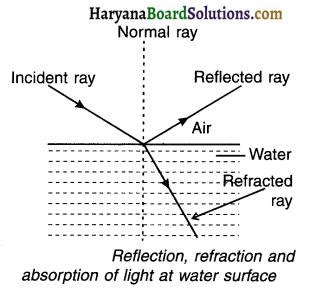
HBSE 10th Class Science Important Questions Chapter 9 Heredity and Evolution 10
4. In practical terms, a light wave can travel from one point to another. Such a propagation of light waves in one straightline and from one point to another is known as a ‘ray’. Bundle of such rays is known as ‘beam of light’.
5. When light is incident on a surface separating two’ medias such as air and water, then some part of incident light is reflected, some part is transmitted and some part of it is absorbed by that surface.
6. Light which is incident on a completely polished shining plane surface gets reflected whereas light incident on a transparent medium (such as glass) gets refracted and passes through that medium.
7. Due to these properties of light i.e. reflection and refraction, the light rays can be focused by mirrors and lenses respectively.
8. Moreover, due to reflection and refraction of light, real or virtual images are formed.

HBSE 10th Class Science Important Questions Chapter 10 Light Reflection and Refraction

Question 3.
What is reflection of light? State its types.
Answer:
Reflection :

  • The phenomenon of sending back the light rays which fall on the surface of an object when light is incident on it, is called reflection of light.
  • For example, when light falls on a plane mirror, the mirror sends it back i.e. reflects it.

Types of reflection:
(A) Regular reflection and
(B) Irregular reflection

Question 4.
Explain the types of reflection.
Answer:
(A) Regular reflection :
When a parallel beam of light falls on a smooth or shining surface, then the reflected beam is also parallel and directed back in a fixed direction. This type of reflection is known as regular reflection. For example, reflection by a mirror.
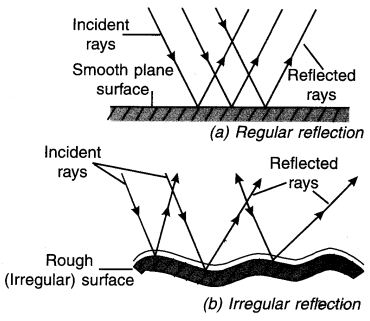
HBSE 10th Class Science Important Questions Chapter 9 Heredity and Evolution 11

(B) Irregular (diffused) reflection :
When a parallel beam of light falls on a rough surface i.e. irregular surface, the reflected light is not parallel but spreads over a wide area. This type of reflection is known as irregular reflection. For example, light falling on chair, book, etc. gets reflected and helps us to see these objects.

HBSE 10th Class Science Important Questions Chapter 10 Light Reflection and Refraction

Question 5.
Define incident angle and reflection angle. Also state the laws of reflection.
Answer:
Angle of incidence (θi):
The angle that the incident ray makes with normal drawn at the point of incidence is known as incident angle or angle of incidence. It is denoted by θi (θ = theta).
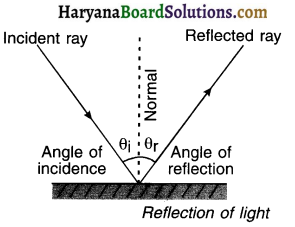
HBSE 10th Class Science Important Questions Chapter 9 Heredity and Evolution 12

Angle of reflection (θr):

The angle that the reflected ray makes with normal drawn at the point of reflection is known as reflection angle or angle of reflection, It is denoted by θr

Laws of reflection:
1. The angle of incidence (θi) = the angle of reflection (θr).

2. (a) The incident ray,
(b) the normal to the mirror at the point of incidence and
(c) the reflected ray – all lie in the same plane.

(Note: The laws of reflection are applicable equally to plane as well as spherical mirrors. Moreover they are also applicable to regular as well as irregular surfaces.)

Question 6.
What is an image? Explain the types of images.
Answer:
Image: When a number of rays emerging from a point of an object, after reflection or refraction, ‘meet’ or ‘appear to meet’ at another point, then the point of meeting is called the image of the first point.

Types:
(1) Real image and
(2) Virtual image

(1) Real image: When the rays of light after reflection or refraction ‘actually meet’ at a point, the image formed is called a real image.

  • Real image can be obtained on a screen.
  • Real image is always inverted. For e.g., image formed on cinema screens.

(2) Virtual image: When the rays of light after reflection or refraction ‘do not actually meet’ but ‘appear to meet’ at a point, the image formed is called a virtual image.

  • Virtual image cannot be obtained on a screen.
  • Virtual image is always erect. For e.g., our image formed when we stand in front of a mirror is a virtual image.

HBSE 10th Class Science Important Questions Chapter 10 Light Reflection and Refraction

Question 7.
What is a mirror? State Its types.
Answer:
A polished shining surface which reflects almost all the light incident on it is called a mirror.
Types of mirror:
(1) Plane mirror and
(2) Spherical mirror. Further, spherical mirrors are of two types.

They are:

  • Concave mirror and
  • Convex mirror.

Question 8.
Discuss the different types of mirrors.
Answer:
(A) Plane mirror:
1. A plane mirror is a thin, flat and smooth sheet of glass having a shining coat of silver metal on one side.
2. For example, mirror used in vehicles, in dressing tables, etc.
3. When a parallel beam of light rays falls on a plane mirror, it is reflected as a parallel beam.
4. Thus, plane mirror changes only the direction of the incident light rays. It does not converge or diverge them.
(Note: To bring the parallel light rays closer is called converging them where as to spread out is called diverging.)
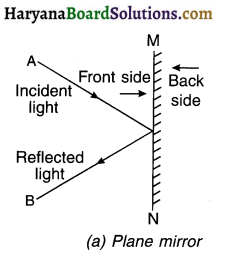
HBSE 10th Class Science Important Questions Chapter 9 Heredity and Evolution 13

(B) Spherical mirror:

  • Unlike plane mirrors, spherical (curved) mirrors converge or diverge the parallel light rays incident on them.
  • A spherical mirror is a mirror whose reflecting surface is in fact a part of a hollow sphere of a glass.
  •  When light rays fall on spherical mirrors, they converge or diverge i.e. the incident parallel rays come closer or spread-out unlike plane mirrors where they are just reflected as parallel beams.

Spherical mirrors are of two types :
(i) Concave mirrors and
(ii) Convex mirrors.
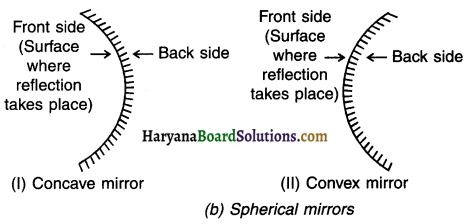
HBSE 10th Class Science Important Questions Chapter 9 Heredity and Evolution 14

Question 9.
Give a brief idea about how a spherical mirror is formed.
Answer:
1. A spherical mirror is a curved mirror (i.e. not a plane mirror).
(Note: Since the spherical mirror is curved, we consider the mirror as cut-out from a sphere. Doing so helps us to understand various terms related to spherical mirrors and image formation through these mirrors.)
2. The simplest spherical mirror is a spoon that we have in our kitchen. The front and back of the spoon behaves like two different types of spherical mirrors giving upward and inverted images.

Types: Spherical mirrors are of two types.

(a) Concave mirror: The spherical mirror in which light rays converge to form an image is called a concave mirror (or converging mirror).
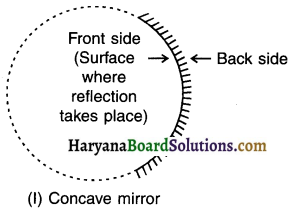
HBSE 10th Class Science Important Questions Chapter 9 Heredity and Evolution 15

(b) Convex mirror: A spherical mirror in which light rays diverge to form an image is called a convex mirror (or diverging mirror).
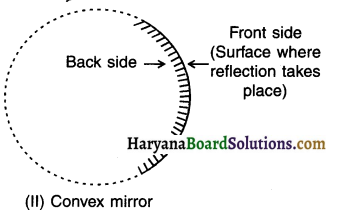
HBSE 10th Class Science Important Questions Chapter 9 Heredity and Evolution 16

Question 10.
With the help of a suitable diagram define the following terms for concave and convex mirrors (Spherical mirrors).
Answer:
(1) Centre of curvature (C)
(2) Radius of curvature (R)
(3) Pole (P)
(4) Principal axis
(5) Aperture (MN)
(6) Principle focus (F)
(7) Focal length (f)
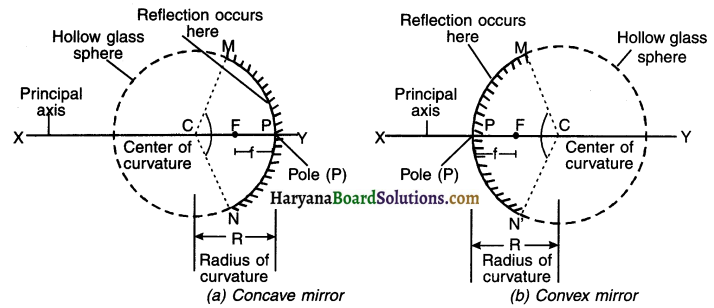
HBSE 10th Class Science Important Questions Chapter 9 Heredity and Evolution 17

1. Centre of curvature (C): The centre of spherical sphere from which a mirror is made is known as centre of curvature (C). (Note: Centre of curvature of a concave mirror lies in front where as in convex mirror it lies behind.) Point C is also called 2F since it lies at double the distance of PR

2. Radius of curvature (R): The radius of spherical sphere i.e. from centre of curvature C to pole P i.e. CP from which a mirror is made is known as radius of curvature (R). Thus CP = R. (Note: CP = 2 times PF and so is also written as 2F.)

3. Pole (P): The centre of reflecting surface i.e. MN is known as pole of mirror (P).

4. Principal axis: The imaginary line passing through the pole (P) and centre of curvature (C) is known as principal axis. A

5. Aperture (MN): The portion of the reflecting surface (mirror) from which the reflection of light actually takes place is known as its aperture MN.

6. PrincIple focus (F): The point (F) on the principle axis where the beam of light parallel to the principle axis either actually converges to or diverges from, after reflection from a mirror is called the principle focus (F).

7. Focal length (f): The distance between the pole (P) and principle focus (F) is called focal length (f). Thus, f = PF.

HBSE 10th Class Science Important Questions Chapter 10 Light Reflection and Refraction

Question 11.
How can you study image formed by a mirror (or a lens)?
Answer:
1. The image of an object formed by a spherical mirror (or a (ens) can be obtained and studied by constructing a ray diagram.
2. Two rays are sufficient to draw a ray diagram because by intersecting two reflected rays we can obtain the position of the image formed.

Question 12.
State the various types of rays that hit a spherical (concave) mirror and direction of their reflecton. Draw ray-diagram to explain how the image will form through these rays.
Answer:
Types of Rays and their Reflection in a Concave Mirror
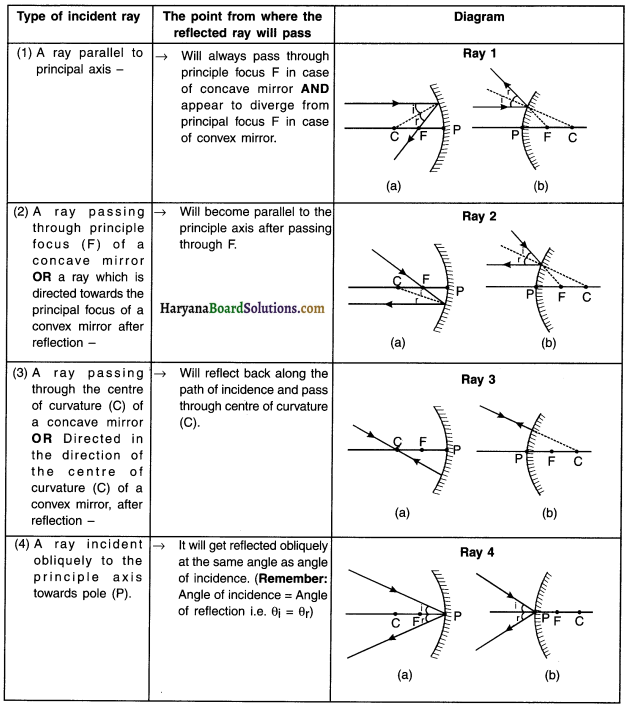
HBSE 10th Class Science Important Questions Chapter 9 Heredity and Evolution 18

Question 13.
How do parallel rays converge or diverge in spherical mirrors? Explain with the help of diagrams. OR With necessary diagrams, explain the formation of principal focus and focal length of concave and convex mirrors.
(A) Concave mirror:

  • When parallel rays are incident on concave mirror, on reflection, they converge i.e. come closer to each other and meet at a point called principal focus (F). Hence, concave mirror is also called a converging mirror.
  • The distance between the pole (P) of the concave mirror and focus (F) is called its focal length (1).
  • Note that since all the reflected rays actually pass from the focus (F), a concave mirror has a real focus.
  • The focus (F) of concave mirror is in the front of the mirror.
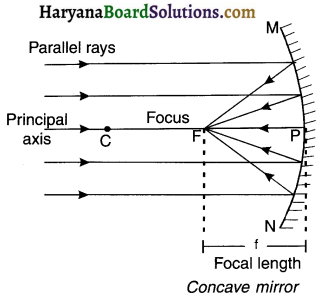
HBSE 10th Class Science Important Questions Chapter 9 Heredity and Evolution 19

HBSE 10th Class Science Important Questions Chapter 10 Light Reflection and Refraction

(B) Convex mirror:

  • When parallel rays are incident on convex mirror, on reflection, they diverge i.e. spread out from each other. Hence, convex mirror is also called a diverging mirror.
  • If you look at the mirror from left side, the reflected (divergent) rays appear to be coming from a point (F) behind the convex mirror.
  • The distance between the pole (P) and principal focus (F) is called the focal length (f) of the convex mirror.
  • This point F is called the principal focus of the convex mirror.
  • Note that since the reflected rays do not actually pass through the focus (F) of the convex mirror, it is said that convex mirror has a virtual (non-real) focus.
  • Also note that this virtual focus lies behind the convex mirror.
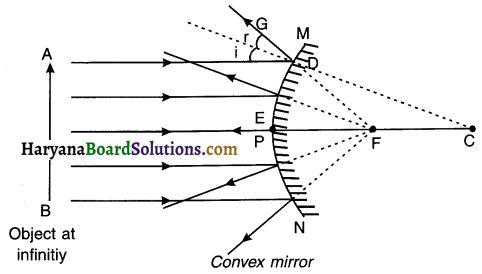
HBSE 10th Class Science Important Questions Chapter 9 Heredity and Evolution 20

Question 14.
State and explain the relation between radius of curvature (R) and focal length (f) of a spherical mirror
Answer:
1. For a spherical mirror (both concave and convex), the principal focus (F) lies exactly at the mid-way between pole (P) and center of curvature (C).
2. We know that distance between pole (P) and center of curvature (C) is called the radius of curvature and is denoted by R.
∴ Focal length \((f)=\frac{1}{2} R=\frac{R}{2}\)
Also, R = 2f i.e. radius is twice the focal length (f).
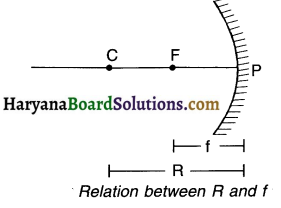
HBSE 10th Class Science Important Questions Chapter 9 Heredity and Evolution 21

Question 15.
Radius of curvature of a convex minor is 15 cm. Find out its focal length.
Answer:
R = 15cm
F= ?
We know that
Focal length f = \(\frac{\mathrm{R}}{2}\)
∴ F = \(\frac{15}{2}\) = 7.5cm
Thus, focal length of the convex mirror is 7.5 cm.

Question 16.
Focal length of a concave mirror used in a laboratory is 12 cm. What will be the radius of its curvature?
Answer:
Answer:
F = 12cm
R = ?
We know that, Focal length f =\(\frac{\mathrm{R}}{2}\)
∴ R = 2f = 2 x 12 = 24cm
Thus, the radius of curvature of the mirror is 24 cm.

HBSE 10th Class Science Important Questions Chapter 10 Light Reflection and Refraction

Question 17.
What do you mean by focal length of a spherical mirror is 20 cm?
Answer:
1. Focal length (f) is the point at which all the parallel rays meet after getting reflected from the spherical mirror.
2. If the focal length of a spherical mirror is 20 cm it means all the parallel rays that hit the spherical mirror will meet at 20 cm away from the spherical mirror.

Question 18.
At how many positions can we place an object to obtain Images from a concave mirror?
Answer:
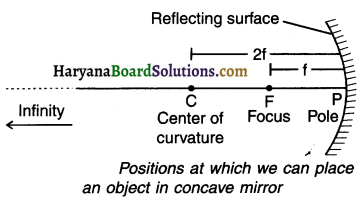
HBSE 10th Class Science Important Questions Chapter 9 Heredity and Evolution 22

As shown in figure, we can place the objects at six positions. They are:
1. Much beyond C i.e. at infinity
2. Beyond C
3. On center of curvature (C)
4. Anywhere between focus (F) and center of curvature (C)
5. On focus (F)
6. Anywhere between the pole (P) and focus (F)

Question 19.
Draw the ray diagram for a concave mirror when an object s placed at following points. Also give the position, nature and size of image.
Answer:
Object is placed at the following positions:
(1) At infinity
(2) Beyond C
(3) At C
(4) Between C and F
(5) At F
(6) Between P and F
(Note: Each diagram along with its detail carry 2 marks and hence the questions will be asked accordingly. However, here we have given detail of all the positions.)

HBSE 10th Class Science Important Questions Chapter 10 Light Reflection and Refraction

Images formed by a Concave mirror
HBSE 10th Class Science Important Questions Chapter 9 Heredity and Evolution 24

Summary of images formed in a concave mirror

Position of object

Position of imageSize of image

Nature of image

1. At infinity

At FHighly diminishedReal and inverted
2. Beyond C (i.e. 2F)Between F and CDiminished

Real and inverted

3. On C (i.e. on 2F)

On CSame as object sizeReal and inverted
4. Between F and CBeyond CEnlarged

Real and inverted

5. On principal focus F

At infinityHighly enlargedReal and inverted
6. Between P and FBehind the mirrorEnlarged

Virtual and erect

Question 20.
State the uses of concave mirrors.
Answer:
Uses of concave mirrors:

  • Concave mirrors are used in torches, search-lights and vehicle head-lights to obtain powerful parallel beam of lights.
  • They are also used in shaving mirrors to see a larger image of the face.
  • Dentists use concave mirrors to see enlarged view of teeth an patients.
  • To concentrate sunlight for producing heat in solar furnace.

Question 21.
Why are focal length and centre of curvature negative for convex mirrors?
Answer:
1. In a convex mirror, the rays parallel to principle axis, instead of converging at a point in the front of the mirror, appear to diverge from a point behind the mirror. This point is called the focal point or focus F of the mirror. Similarly, the centre of curvature also lies behind the mirror.

2. As per the rule, positions in the front of any mirror will have positive sign and those behind the mirror will have negative signs. Since, F and C both lie behind the convex mirror, their signs are negative.
(Note: (1) The focus of convex mirror is also called virtual focus. (2) f = R/2 holds true for convex mirrors also.)

HBSE 10th Class Science Important Questions Chapter 10 Light Reflection and Refraction

Question 22.
At how many positions can we place an object to obtain images from a convex mirror? Also explain why we place the object at fewer positions in convex mirror than concave mirror.
Answer:
To obtain an image on a convex mirror we can place our object only at two positions. They are:
(1) At infinity
(2) Between pole P and infinity

Reason:
1. In concave mirrors, the focus F and center of curvature C lie before the mirror. The object is also placed before the mirror and so it can be placed at six positions in concave mirror.

2. In a convex mirror, the focus F and center of curvature C lie behind the mirror. Now, the image is formed only when an object is placed before the mirror and not behind it. Hence, in convex mirror, there can be only two positions for placing the object before the mirror.
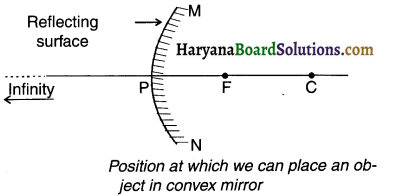
HBSE 10th Class Science Important Questions Chapter 9 Heredity and Evolution 25

Question 23.
Draw and explain the type of Images formed by convex mirror.
Answer:
Images formed by a convex mirror
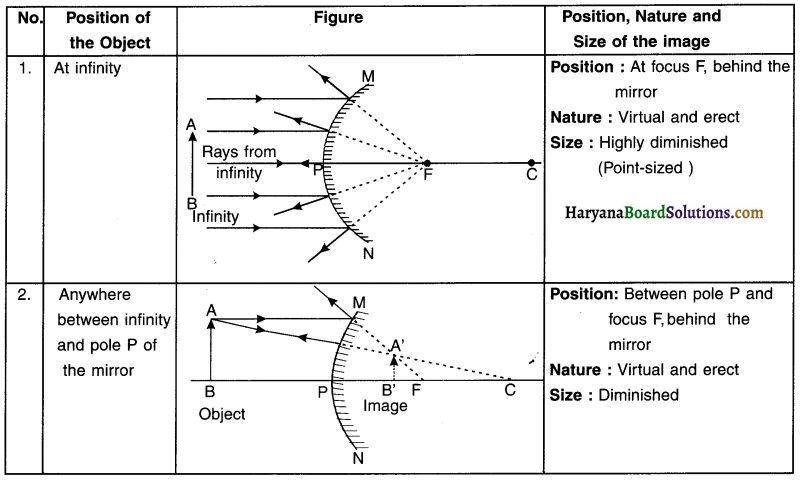
HBSE 10th Class Science Important Questions Chapter 9 Heredity and Evolution 26

Summary of images formed in a convex mirror

Position of objectPosition of imageSize of imageNature of image
1. At infinityAt focus F, behind the mirrorHighly diminishedVirtual and erect
2. Anywhere between infinity and pole P of the mirrorBetween pole P and focus F, behind the mirrorDiminishedVirtual and erect

Question 24.
List out the properties of the image formed by a convex mirror.
Answer:
Properties of image formed by a convex mirror:
(1) The image formed is always virtual and erect.
(2) The image is highly diminished i.e. point sized.
(3) Image is always formed between F and R
(4) As you move the object closer to the pole, the image also moves closer to the pole. It grows in size and at one point becomes equal to the object size.

Question 25.
Explain New Cartesian Sign Convention for reflection by spherical mirror.
Answer:
1. For studying the reflection from spherical mirrors, the method or sign convention called the New Cartesian Sign Convention is used.
2. Here, pole P of the mirror is taken as origin and The principal axis XX’ is taken along the X-axis of the New Cartesian co-ordinate system. The axis drawn perpendicular to principal axis at pole P is considered as Y-axis. According to the New Cartesian Sign

HBSE 10th Class Science Important Questions Chapter 10 Light Reflection and Refraction

Convention:
(i) The object AB always lies on the left side of mirror and hence light is incident from left side of the mirror.
(ii) All the distances parallel to the principal axis are measured from the pole of the mirror P.
(iii) Distances measured in the same direction as that of incident light (left to right) along the +ve x-axis are taken as positive. x-axis are taken as positive.
→ Distances measured against the direction of incident light (right to left) along the -ve x-axis are taken as negative.
(iv) Distances measured perpendicular to and above the principal axis (along +ve y-axis) are taken as positive.
→ Distances measured perpendicular to and below the principal axis (along -ve y-axis) are taken as positive.

Summary of signs of various distances for concave and convex mirrors.
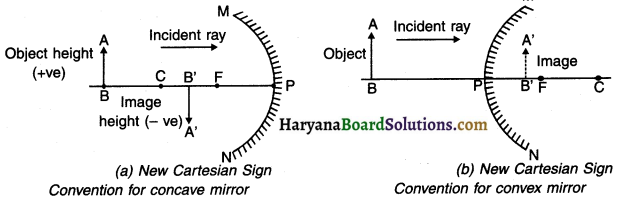
HBSE 10th Class Science Important Questions Chapter 9 Heredity and Evolution 27

Note: Refer the New Cartesian Sign Convention while reading the table.
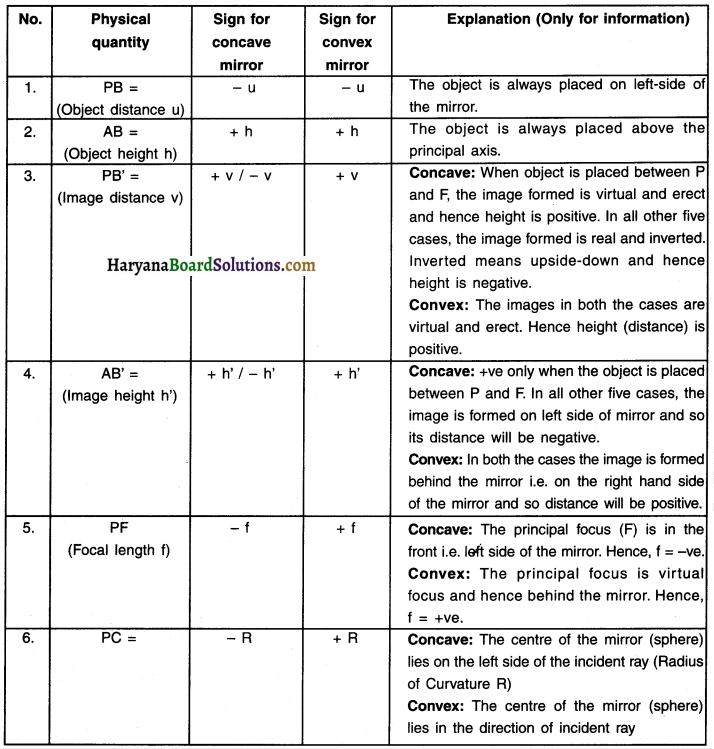
HBSE 10th Class Science Important Questions Chapter 9 Heredity and Evolution 28

Question 26.
State the mirror formula for concave and convex mirrors.
Answer:
The relationship between the object distance (u), image distance (v) and focal length (f) of a mirror is called the mirror formula.
As per mirror formula:\(\frac{1}{u}+\frac{1}{v}=\frac{1}{f}\)
In words: \(\frac{1}{\text { Object distance }}+\frac{1}{\text { Imagedis tance }}=\frac{1}{\text { Focal length }}\)
Object distance image distance Focal length
Mirror formula is same for concave as well as convex mirror.

Question 27.
What do you mean by magnification? State Its definition and give to formula.
Answer:
Magnification:
Whenever we observe the image of an object after reflection by a spherical mirror, there can be a change in the size of the object. This means that the image formed can be larger than the object size, smaller or even of the same size as the object. This phenomenon of change in the image size is known as magnification (m).

HBSE 10th Class Science Important Questions Chapter 10 Light Reflection and Refraction

Definition:
1. The ratio of image height (h’) to object height (h) is called the magnification (m).
2. Thus, for spherical mirrors, magnification (m) \((m)=\frac{\text { Height of image }\left(h^{\prime}\right)}{\text { Height of object }(h)} \text { i.e. } m=\frac{h^{\prime}}{h}\)
3. In terms of object distance (u) and image distance (y), magnification (m) can be expressed as,
\(m=\frac{h^{\prime}}{h}=-\frac{v}{u}\)
4. If value of m = positive, image is virtual.
5. If value of m = negative, image is real.

The two important aspects of magnification that determines the sign and value of m.
We know magnification\((m)=\frac{\text { Image height }\left(h^{\prime}\right)}{\text { Object height }(h)}\)

There are two important aspects of magnification. They are:
(a) Sign of m, (b) Value of m

(a) Sign of m:

  • The sign of m i.e. magnification can be either positive or negtive.
  • The sign of m depends on the signs of h’ and h.

(i) Sign of h:  h represents the height of the object. Since the object is always placed above the principal axis, value of h will always be positive.

(ii) Sign of h’:

  • represents the height of image.
  • If the image is virtual, it will always be erect and hence above the principal axis. Hence, h’ will be positive.
  • If the image is real, It will always be inverted and hence below the principal axis. Here, h’ will be negative.

Conclusion:

  • m will be positive for virtual images (Since both h and h’ will be positive.)
  • m will be negative for real images. (Since h will be positive but h’ will be negative.)
  • Concave mirrors can produce both virtual and real images. So, magnification m of a concave mirror can either be positive or negative and vice-versa.
  • Convex mirrors and plane mirrors can produce only virtual images. So, their magnification will always be positive and vice-versa.

(b) Value of m:

  • The magnification i.e. the value of m can either be greater than 1, equal to 1 or less than 1.
    (i) m> 1
  •  If value of m> 1, it means that the size of image > size of object.

HBSE 10th Class Science Important Questions Chapter 10 Light Reflection and Refraction

Example:
h’ = 10 cm and h = 5 cm
\(m=\frac{h^{\prime}}{h}=\frac{10}{5}=2\)
∴ image size > object size.

(ii) m = 1
If value of m = 1, it means size of image = size of object.

Example:
h’ = 10 cm and h= 10 cm
\(M=\frac{h^{\prime}}{h}=\frac{10}{10}=1\)∴ image size = object size

(iii) m < 1
→  If value of m < 1, it means size of image < size of object.

Example:
h’ = 5, h = 10
\(\mathrm{m}=\frac{\mathrm{h}^{\prime}}{\mathrm{h}}=\frac{5}{10}=\frac{1}{2}=0.5\)
∴ image size <object size

Conclusion:

  • Image produced by a plane mirror is always same size as that of object. Thus, m = 1.
  •  Image produced by a convex mirror is always diminished i.e. smaller than the object. Thus, m < 1.
  • Image produced by concave mirror can be both larger or smaller than the object. Thus, m> 1 or m < 1.

Question 28.
Obtain the position, nature and size of an image formed by a plane mirror from the formula of magnification.
Answer:
1. We know that magnification m =\(\frac{\mathrm{h}^{\prime}}{\mathrm{h}}\)
2. Now in a plane mirror, image height (h’) = object height (h).
3. So we get value of m=+1.
4. The image formed in its case by the plane mirror will be virtual, erect and of same size as the object.
5. Also, magnification m = \(\frac{\mathrm{v}}{\mathrm{u}}\).
6. But, m = 1 and so 1 = \(\frac{\mathrm{v}}{\mathrm{u}}\)
∴ u = -v i.e. y = – u.
7. Since y = – u, the size of the image y will be same as that of the object u but negative sign indicates that the image will be behind the mirror.

Summary of size of image, type of image and magnification for various mirrors
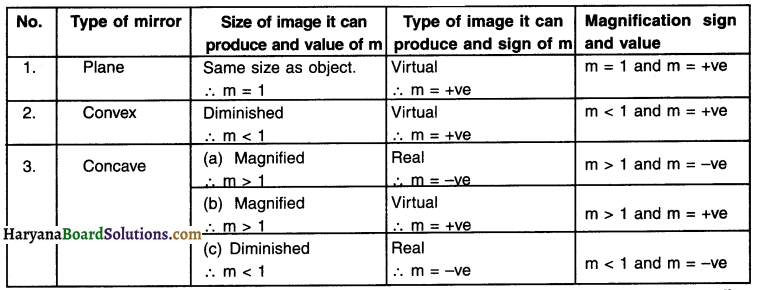
HBSE 10th Class Science Important Questions Chapter 9 Heredity and Evolution 29

HBSE 10th Class Science Important Questions Chapter 10 Light Reflection and Refraction

Question 29.
Textbook illustration 10.1: A convex mirror used for rear-view on an automobile has a radius of curvature of 3.00 m. If a bus is located at 5.00 m from this mirror, find the position, nature and size of the Image.
Solution:
Radius of curvature, R = + 3.00 m;
Object-distance, u = – 5.00 m;
Image-distance, v=?
Height of the image, h’ = ?
Focal length, f = R/2 = +\(\frac{3.00 \mathrm{~m}}{2}\) = +1.50m (Since the principal focus of a convex mirror is behind the mirror)
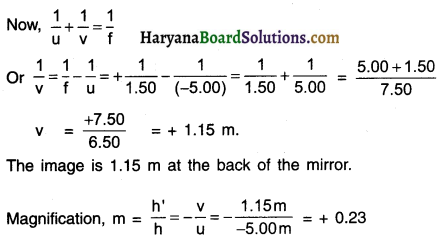
HBSE 10th Class Science Important Questions Chapter 9 Heredity and Evolution 30
The image is virtual, erect and smaller in size by a factor of 0.23.

Question 30.
Textbook illustration 10.2: An object, 4.0 cm in size, is placed at 25.0 cm in front of a concave mirror of focal length 15.0 cm. At what distance from the mirror should a screen be placed in order to obtain a sharp image? Find the nature and the size of the image.
Answer:
Object-size, h= +4.0cm;
Object-distance, u = – 25.0 cm;
Focal length, f = -15.0 cm;
Image-distance, v = ?
Image-size, h’ = ?
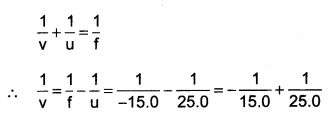
HBSE 10th Class Science Important Questions Chapter 9 Heredity and Evolution 31
or \(\frac{1}{v}=\frac{-5.0+3.0}{75.0}=\frac{-2.0}{75.0}=\text { or, } v=-37.5 \mathrm{~cm}\)
The screen should be placed at 37.5 cm in front of the mirror. The image is real.
Also, magnification, \(m=\frac{h^{\prime}}{h}=-\frac{v}{u}\)
\(\text { Or, } h^{\prime}=-\frac{v h}{u}=-\frac{(-37.5 \mathrm{~cm})(-4.0 \mathrm{~cm})}{(-25.0 \mathrm{~cm})}\)
Height of the image, h’ = – 6.0 cm. The image is inverted and enlarged.

HBSE 10th Class Science Important Questions Chapter 10 Light Reflection and Refraction

Question 31.
Differentiate between regular reflection and irregular reflection.
Answer:

Regular reflectionIrregular reflection
When a parallel beam of light is incident on a shining plane or a smooth surface, the light rays remain parallel after reflection in a specific direction. Such reflection is called regular reflection.When a parallel beam of light is incident on a rough or irregular surface, the incident rays do not remain parallel but spreads over wide region after reflection. Such a reflection of light is called irregular reflection.
Reflected rays are parallel to incident rays.Reflected rays are not parallel to incident rays.
Example: Reflection of light by a plane mirrorExample: Reflection from chair, book, etc.

Question 32.
Differentiate between concave mirror and convex mirror.
Answer:

Concave mirror
A spherical mirror having inner curved reflecting surface is known as concave mirror.A spherical mirror having outer curved reflecting surface is known as convex mirror.
Image formed by concave mirror can be real and inverted or virtual and erect.Image formed by convex mirror is always virtual and erect.
Real image can be smaller size or even larger than the object.Virtual image will always be smaller than the object.

HBSE 10th Class Science Important Questions Chapter 10 Light Reflection and Refraction

Question 33.
Differentiate between real image and virtual image.
Answer:

Real imageVirtual Image
An image formed by reflection or refraction of light from the object is called a real imageAn image which is not actually formed by reflection or refraction of light from the object is called a virtual image.
It can be obtained on a screen.It cannot be obtained on a screen.
Real image is in inverted form.Virtual image is always erect.

Question 34.
Give a brief Introduction about refraction.
Answer:
Refraction:
1. Light travels on a same path i.e. without bending if it is travelling in same transparent medium such as air or water.
2. While travelling if light comes across another transparent medium, its velocity changes and so it bends.
3. For example, if light is travelling in air (medium 1) and then it strikes water (medium 2) obliquely, it bends. This bending of light is called refraction of light.

Question 35.
Define refraction of light. State its laws.
Answer:
Refraction:
When a ray of light enters obliquely from one transparent medium to another transparent medium, its velocity changes due to which it gets deviated from its original direction at the surface separating two medias. This is called refraction.
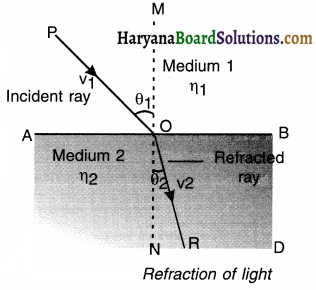
HBSE 10th Class Science Important Questions Chapter 9 Heredity and Evolution 32

Laws of refraction:
1. Incident ray, refracted ray and normal to the surface separating two medias at the point of incidence, all lie in the same plane.
2. The ratio of the sine of angle of incidence to the sine of angle of refraction is constant for the light of a given colour (wave length) and for the given pair of media. This law is known as Snell’s Law of Refraction.
\(\frac{\sin \theta_1}{\sin \theta_2}=\text { constant }\)
Here, θ1 = angle of incidence and θ2= angle of refraction.
Example:
Refraction takes place when light travels from air (medium 1) into glass (medium 2).

HBSE 10th Class Science Important Questions Chapter 10 Light Reflection and Refraction

Question 36.
With respect to travel of light and its refraction, explain medium and comparative types of mediums. Also explain behaviour of light in these mediums.
Answer:
Medium:

  • A transparent substance in which light can travel is called a medium.
  • Air, water gas, glass, kerosene, etc. are examples of mecums.
  • The densities of each medium are different and so they are classified as follows —
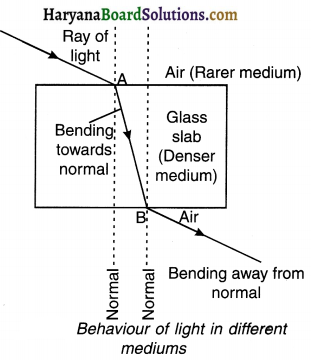
HBSE 10th Class Science Important Questions Chapter 9 Heredity and Evolution 33

(i) Optically rarer medium:
A medium in which the speed of light is more is called optically rarer medium.

Example:
Air is optically rarer than water and glass.

(ii) Optically denser medium:
A medium in which the speed of light is less (compared to an optically rarer medium) is called an optically denser medium.

Example:
1. Glass is optically denser than air. Kerosene is optically denser than water. Refraction of light in various mediums:
2. When light travels from a rarer medium (e.g. air) to a denser medium (e.g. glass), It bends towards normal at the point of incidence.
3. When light travels from an optically denser medium (e.g. glass) to a rarer medium (e.g. air), it bends away from normal at the point of incidence.

Question 37.
What do you mean by refractive index of a medium?
Answer:
1. A ray that travels obliquely from one transparent medium into another will change its direction in the second medium. This means that the light has refracted.
2. The extent of the change in direction that occurs within the given pair of media (let us say air and glass) can be expressed in the terms of refractive index.

Question 38.
Explain relative refractive index.
Answer:
Relative Refractive Index :
1. The ratio of speed of light v1 in medium 1 to the speed of light v2 in medium 2 is known as the relative refractive index of medium 2 with respect to medium 1 (except the medium of vacuum).
2.  It is denoted by η12 i.e. refractive index of medium 2 with respect to medium 1.
∴ Refractive index η12 = \(\eta_{21}=\frac{\text { Speed of light in medium } 1}{\text { Speed of light in medium } 2}=\frac{v_1}{v_2}\)
3. Similarly, the ratio of speed of light 2 in medium 2 to the speed of light y1 in medium 1 is known as the relative refractive index of medium 1 with respect to medium 2.
∴ Refractive index \(\eta_{12}=\frac{\text { Speed of light in medium } 2}{\text { Speed of light in medium } 1}=\frac{v_2}{v_1}\)

HBSE 10th Class Science Important Questions Chapter 10 Light Reflection and Refraction

Question 39.
Define and explain absolute refractive index.
Answer:
Absolute refractive index:
1. The ratio of speed of light in vacuum (or air) (C) to the speed of light of any other medium is known as the absolute refractive index or simply refractive index.
2. It is denoted by ηm
∴ Absolute refractive index \(\eta_m=\frac{\text { Speed of light in vacuum (or air) }}{\text { Speed of light in medium }}=\frac{\mathrm{c}}{\mathrm{v}}\)

Question 40.
Give Snells law.
Answer:
Snells law:
1. The ratio of sine of angle of incidence to the ratio of sine of angle of refraction is constant.
2. This constant is known as relative refractive index of medium 2 with respect to medium 1 and is denoted by η21.
∴ \(\eta_{21}=\frac{\sin \theta_1}{\sin \theta_2}\)
3. In terms of ratio of velocity of light In two media, the refractive index of light is represented as under –
The ratio of velocity of light v1 in medium 1 to the velocity of light v2 in medium 2 is called relative refractive index of medium 2 with respect to medium 1.
∴ \(\eta_{21}=\frac{v_1}{v_2}\)
4. The refractive index of the transparent medium with respect to vacuum is called the absolute refractive index of a medium. It is commonly known as refractive index.

Question 41.
Why do we take absolute refractive index of air = 1?
Answer:
1. Actually the velocity of light in vacuum is slightly more than the velocity of light in air.
2. But for calculating purpose, magnitude of velocity of light in vacuum is taken as equal to the velocity of light in air =
3 x 10⁸m/s
Absolute refractive index of air = \(\frac{\text { velocity of light in vaccum }}{\text { velocity of light in air }}=\frac{3 \times 10^8}{3 \times 10^8}=1\) gives us the value of absolute refraction index of air = 1.
4. Thus, absolute refractive index of air is taken as 1.

HBSE 10th Class Science Important Questions Chapter 10 Light Reflection and Refraction

Question 42.
Why absolute refractive index Is always greater than 1? Explain with the help of an example.
Answer:
1. Velocity of light is highest in a vacuum.
2. Hence, velocity of light in any other medium will always be lesser than the velocity of light in vacuum or air.
3. In practice, we take the velocity of light in vacuum = velocity of light in air = 3 x 10⁸ rn/s
4. Thus, absolute refractive index
\(\eta=\frac{\text { velocity of light in vacuum }}{\text { velocity of light in medium } 2 \text { i.e. air }}=\frac{3 \times 10^8}{3 \times 10^8}=1\)
5. Now, when we consider absolute refractive index of vacuum or air with any other medium, the answer will always be greater than 1.

Example:
Velocity of light in vacuum (air) = 3 x 10⁸ m/s
Velocity of light in water = 2.25 x 10⁸ m/s
∴ Absolute refractive index of water = \(\frac{\text { velocity of light in vacuum }}{\text { velocity of light in water }}=\frac{3 \times 10^8}{2.25 \times 10^8}=1.33\)
Thus, absolute refractive index will always be greater than 1.

Question 43.
(Activity 10.10) Perform an activity to demonstrate refraction of light through a glass slab.
Answer:
1. Fix a sheet of white paper on a drawing board using drawing pins.
2. Place a rectangular glass slab over the sheet In the middle.
3. Draw the outline of the slab with a pencil. Let us name the outline as ABCD.
4. Take four identical pins.
5. Fix two pins, say E and F, vertically such that the line joining the pins is inclined to the edge AB.
6. Look for the images of the pins E and F through the opposite edge. Fix two other pins, say G and H, such that these pins and the images of E and F lie on a straight line.
7. Remove the pins and the slab.
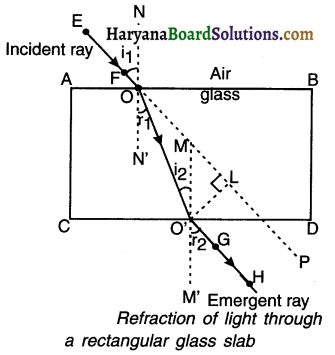
HBSE 10th Class Science Important Questions Chapter 9 Heredity and Evolution 34
8. Join the positions of tip of the pins E and F and produce the line up to AB. Let EF meet AB at O. Similarly, join the positions of tip of the pins G and H and produce it up to the edge CD. Let HG meet CD at O’.
9. Join O and O’. Also produce EF up to P, as shown by a dotted line in figure.

Observation:
1. At O, light ray along EF enters from air into glass. It bends towards the normal NN’. This is the first refraction.
2. At O’, the light ray enters from glass into air. It bends away from the normal MM’ and travels along GH. This is second refraction.
3. Here, angle of emergence r2 is equal to angle of incidence t1, i.e., the emergent ray is parallel to the original direction of the incident ray. This is because there is an identical medium, air in this case, adjacent to both edges AB and CD.
4. However, the light ray is shifted sideways slightly. This is lateral displacement and is represented by O’L.

HBSE 10th Class Science Important Questions Chapter 10 Light Reflection and Refraction

Conclusion:

  • The ray of light travelling from a rarer medium (air) to a denser medium (glass) bends towards the normal.
  • The ray of light travelling from a denser medium (glass) to a rarer medium (air) bends away from the normal.
  • The emergent ray is parallel to the incident ray but is slightly displaced sideways.
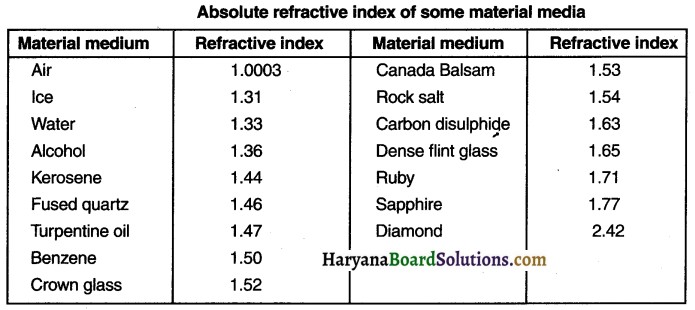
HBSE 10th Class Science Important Questions Chapter 9 Heredity and Evolution 35

Types: (A) Convex lens:
A lens which is thick at the center and tapered at the upper and lower ends is called a convex lens.
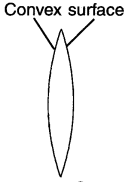
HBSE 10th Class Science Important Questions Chapter 9 Heredity and Evolution 36

(B) Concave lens:
A lens which is thin in the middle but thicker at the edges is called concave lens.
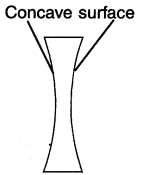
HBSE 10th Class Science Important Questions Chapter 9 Heredity and Evolution 37

Uses of lens:
In magnifying glass, cameras, repairing watches, microscope, telescope, etc.

HBSE 10th Class Science Important Questions Chapter 10 Light Reflection and Refraction

Question 45.
What do you mean by converging and diverging lens?
Answer:
Converging lens:
1. A lens that converges (brings closer) the rays of light travelling parallel to Its principal axis to a point called focus (F) is called a converging lens.
2. Convex lens is a converging lens.
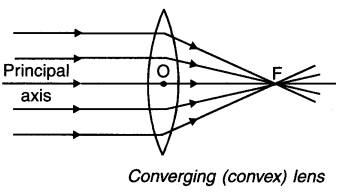
HBSE 10th Class Science Important Questions Chapter 9 Heredity and Evolution 38

Diverging lens:
A lens that diverges (spreads out) the rays of light travelling parallel to its principal axis is called a diverging lens. If we plot these rays backwards, they appear to diverge from the focus (F) of the lens.
(Note: Lenses have two faces. So light can pass from both sides i.e. left and right.)
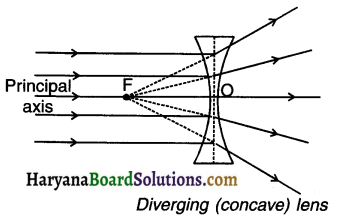
HBSE 10th Class Science Important Questions Chapter 9 Heredity and Evolution 39

Question 46.
Define various terms related to lenses along with suitable diagrams.
Answer:
1. As shown in the diagram, a convex lens (or a concave lens) can be thought of as formed from two spheres.
2. Since there are two spheres and the light can pass from both the sides of a lens, there are two radii, two focuses and two centers of curvature.

1. Centres of curvature:

  • The centres of respective spheres of which the surface of lens form parts are called centres of curvature.
  • Lens has two centres of curvature denoted by C1 and C2.

2. Radii of curvature:

  • The radii of spheres of which surfaces of lens form parts are called radii of curvature
  • Lens has two radii of curvature denoted by R1 and R2.

3. Principal axis: A straight imaginary line passing through the centres of curvature C1 and C2 of lens is called the principal axis of lens.

4. Optical centre: The centre of lens, located on principal axis, is known as the optical centre. It is denoted by O.

5. Principal focus: When rays parallel to the principal axis of convex lens are refracted, they converge at a point on the principal axis. This point is called principal focus of the convex lens. A convex lens has two principal foci F1 and F2 on either side of lens.

HBSE 10th Class Science Important Questions Chapter 10 Light Reflection and Refraction

→ The rays parallel to the principal axis of concave lens are refracted such that they appear to be diverging from a point on principal axis. Such a point is called focus of concave lens. Concave lens also has two focii F1 and F2 on either side of lens.

6. Focal length
→ The distance between the optical centre (O) and the principal focus (F) is called the focal length of the lens (f).
→ We also mark another point called 2F on the principal axis. This point lies at twice the distance of F.
(Note: In a lens, 2F and C may or may not be at same position.)
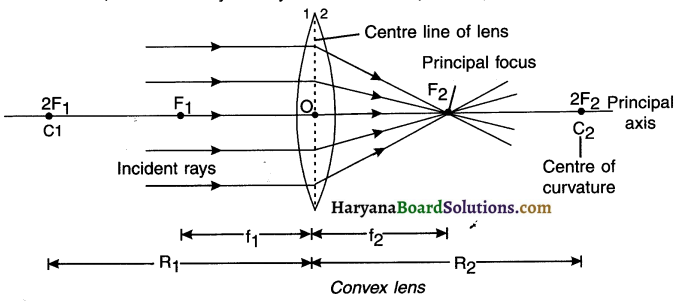
HBSE 10th Class Science Important Questions Chapter 9 Heredity and Evolution 41

Question 47.
Explain with the help of ray diagram how an image can be formed with convex lens. For obtaining an image through convex lens, we consider the following rays:

Ray 1: It moves parallel to the principal axis and after refraction passes through the principal focus (F2) on the other side of the lens.
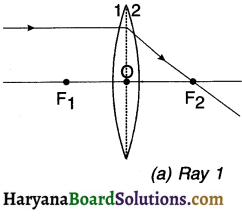
HBSE 10th Class Science Important Questions Chapter 9 Heredity and Evolution 42

Ray 2: It passes through the principal focus (F1) and after refraction becomes parallel to the principal axis on the other side of the F lens. 1A
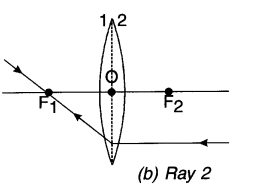
HBSE 10th Class Science Important Questions Chapter 9 Heredity and Evolution 43

Ray 3: The ray passing through optical centre O will emerge from other side of the lens without any deviation.
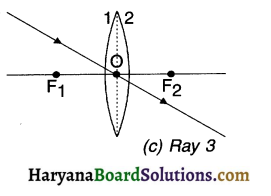
HBSE 10th Class Science Important Questions Chapter 9 Heredity and Evolution 44

Question 48.
List out the various positions at which we can place an object in front of convex lens.

Positions at which we can place an object in front of a convex lens.

(Note: 1. Normally, for both concave and convex lens, the rays are shown coming from the left side of the lens. After refraction they move towards the right side of the lens. 2. The focus F1 lies on the left side i.e. towards surface 1 of the lens and focus F2 on the right side i.e., towards surface 2 of the lens.

In a convex lens, an object can be placed at the following positions to obtain its image.
(1) At Infinite distance
(2) Beyond 2F1
(3) At 2F1
(4) Anywhere between F1and 2F1
(5) At principal focus (F1)
(6) Anywhere between principal focus (F1) and optical center (O)

HBSE 10th Class Science Important Questions Chapter 10 Light Reflection and Refraction

Question 49.
Draw the diagrams for a convex lens when an object is placed at the following points. Also give the position, nature and size of the image.
(1) At infinity
(2) Beyond 2F1
(3) At 2F1
(4) Between F1 and 2F1
(5) At focus F1
(6) Between focus F1 and optical center (O).

(Please note : Each diagram along with its detail carry 2 marks and hence the questions will be asked accordingly. However, we have given detail of all the positions.)

Images formed by a convex lens
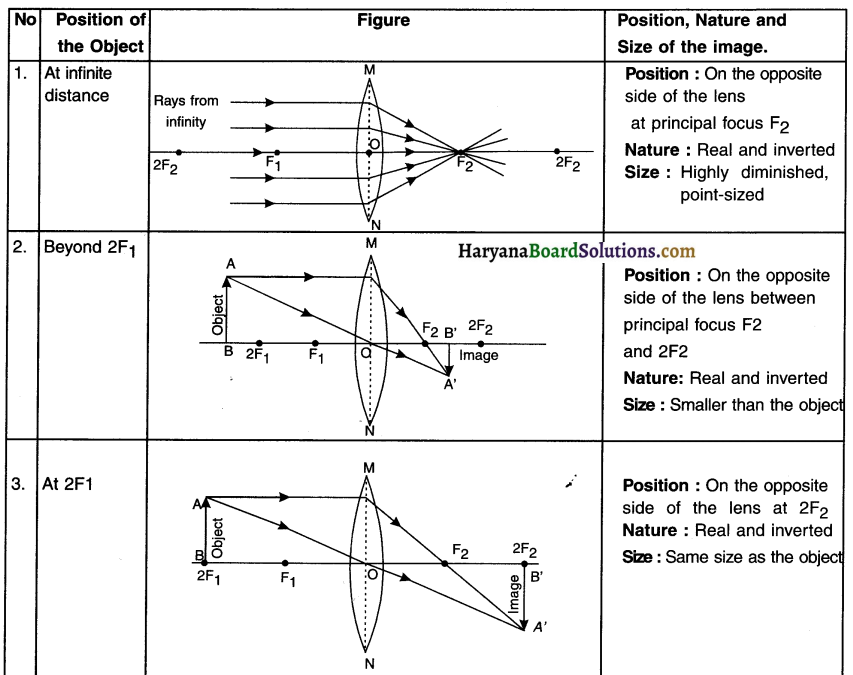
HBSE 10th Class Science Important Questions Chapter 9 Heredity and Evolution 45
HBSE 10th Class Science Important Questions Chapter 9 Heredity and Evolution 46
HBSE 10th Class Science Important Questions Chapter 9 Heredity and Evolution 47

Summary of images formed by convex lens
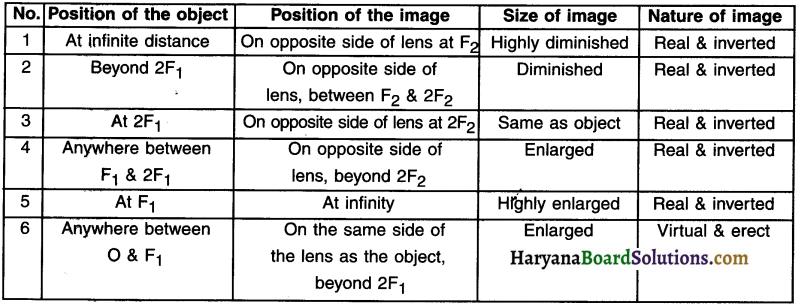
HBSE 10th Class Science Important Questions Chapter 9 Heredity and Evolution 48

Question 50.
Draw ray diagram for a concave lens when an object Is placed at (1) Infinity and when object is placed (2) Between infinity and optical centre (O) of the lens.

HBSE 10th Class Science Important Questions Chapter 10 Light Reflection and Refraction

Images formed by a concave lens
HBSE 10th Class Science Important Questions Chapter 9 Heredity and Evolution 49

HBSE 10th Class Science Important Questions Chapter 9 Heredity and Evolution 50
HBSE 10th Class Science Important Questions Chapter 9 Heredity and Evolution 51

Question 52.
State the New Cartesian Sign convention to be followed for refraction of light through spherical lenses.
Answer:
New Cartesian Sign convention for refraction of light through spherical lenses:
(i) The object is always placed on the left side of the lens. This means that the light is incident on the lens from left side.
(ii) All distances parallel to the principal axis are measured from the optical centre (O) of the lens.
(iii) The distance measured in the same direction as the incident light is taken positive.
(iv) The distance measured in the direction opposite to the direction of incident light is taken negative.
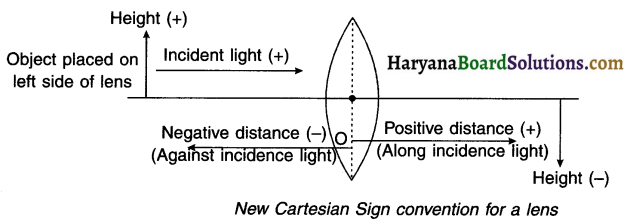
HBSE 10th Class Science Important Questions Chapter 9 Heredity and Evolution 52

(v) Height measured above the principal axis of the lens and perpendicular to it i.e. in the upward direction is taken as positive.
(vi) Height measured below the principal axis of the lens and perpendicular to it in the downward direction is taken as negative.

HBSE 10th Class Science Important Questions Chapter 10 Light Reflection and Refraction

New Cartesian Sign Convention followed for refraction of light through spherical lenses
Sign convention for a convex lens:
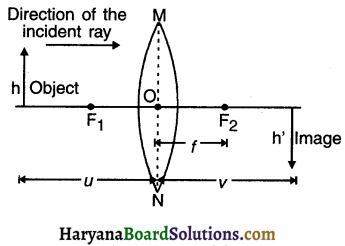
HBSE 10th Class Science Important Questions Chapter 9 Heredity and Evolution 53

Object distance = – u
Object height = + h
Image distance = + v for real image
Image height = – h’ for real image
Focal length = + f
Note: If the image is virtual, then image distance
= -v and image height = + h’

Sign convention for a concave lens:
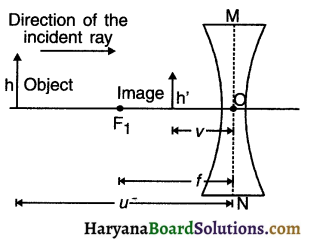
HBSE 10th Class Science Important Questions Chapter 9 Heredity and Evolution 54
Object distance = – u
Object height = – v
Image distance = – v
Image height = + h’
Focal length = – f

Note: If the image is virtual, then image distance
= – v and image height = + h’
→ Finally, the linear magnification, m = h’/h is positive for a virtual image and negative for a real image

Question 53.
State and explain the lens formula.
Answer:
Lens formula:
(i) The lens formula is a mathematical relation between the object distance (u), image distance (v) and focal length (f) of a spherical lens.
As per lens formula,\(\frac{1}{v}-\frac{1}{u}=\frac{1}{f}\)
In other words,\(\frac{1}{\text { Image distance }}-\frac{1}{\text { Objectdistance }}=\frac{1}{\text { Focallength }}\)
Image distance Object distance Focal length
(ii) Lens formula is applicable to both concave lens as well as convex lens.

Question 54.
State the equation for magnification produced by a lens.
Answer:
1. The magnification produced by a lens is defined as “The ratio of the height of the image formed by the lens to the height of the object”.
Thus, magnification m = Height of the image = h’
, Height of the object h \(m=\frac{\text { Height of the image }}{\text { Height of the object }}=\frac{h^{\prime}}{h}\)
Also, \(m=\frac{h^{\prime}}{h}=\frac{v}{u}\)
2. ‘m’ is positive for virtual image formed by the lens.
3. ‘m’ is negative for real image formed by the lens.

HBSE 10th Class Science Important Questions Chapter 10 Light Reflection and Refraction

Question 55.
Textbook Illustration 10.3: A concave lens has focal length of 15 cm. At what distance should the object from the lens be placed so that it forms an image at 10 cm from the lens? Also, find the magnification produced by the lens.
Solution:
A concave lens always forms a virtual, erect image on the same side of the object.
Image-distance v = -10 cm;
Focal length f = -15 cm;
Object-distance u = ?
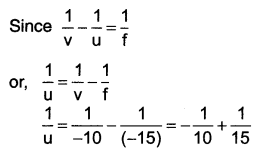
HBSE 10th Class Science Important Questions Chapter 9 Heredity and Evolution 55
\(\frac{1}{u}=\frac{-2+2}{30}=\frac{1}{-30}\)
Thus, the object – distance is 30 cm.
Magnification m = v/u
\(\mathrm{m}=\frac{-10 \mathrm{~cm}}{-30 \mathrm{~cm}}=\frac{1}{3}=+0.33\)
The positive sign shows that the image is erect and virtual. The image is one-third of the size of the object.

Question 56.
Textbook illustration 10.4: A 2.0 cm tall object is placed perpendicular to the principal axis of a convex lens of focal length 10 cm. The distance of the object from the lens Is 15 cm. Find the nature, position and size of the image. Also find its magnification.
Answer:
Height of the object h =+ 2.0 cm;
Focal length f =+ 10 cm;
object-distance u = – 15 cm;
Image-distance v = ?
Height of the image h’ = ?
The positive sign of v shows that the image is formed at a distance of 30 cm on the other side of the optical centre. The image is real and inverted.
Magnification \(m=\frac{h^{\prime}}{h}=\frac{v}{u}\)
or, h’ = h (v/u)
Height of the image, h’ = (2.0) (+30/-15)
= – 4.0 cm
Magnification m = v/u
or \(\mathrm{m}=\frac{+30 \mathrm{~cm}}{-15 \mathrm{~cm}}=-2\)
The negative signs of m and h’ show that the image is inverted and real. It is formed below the principal axis. Thus, a real, inverted image, 4 cm tall, is formed at a distance of 30 cm on the other side of the lens. The image is two times enlarged.

HBSE 10th Class Science Important Questions Chapter 10 Light Reflection and Refraction

Question 57.
Write a short note on : Power of lens. OR Write definition of power of lens. Give Its SI unit. Name the Instrument used to measure the power of lens.
Answer:
1. The ability of a lens to converge or diverge light rays depends on its focal length.
2. The convex lens of short focal length bends the light rays at large angles by focusing them closer to the optical centre.
3. Similarly concave lens of very short focal length causes higher divergence than the one with larger focal length.
4. The efficiency with which a lens converges or diverges the light rays is expressed in terms of its power.
5. Thus, the power of lens (P) is the “Reciprocal of the focal length (I) of lens”.
Power of lens \((\mathrm{P})=\frac{1}{f}\)
6. The SI unit of power of a lens is diopter and it is denoted by D.
7. If fis expressed in meters, then \(1 D=\frac{1}{1}=1 m^{-1}.\)
8. We can measure the power of lens by using diopter meter.
9. As per Cartesian sign system, focus of convex lens lies on right side of the lens and so power of convex lens is positive, while focus of concave lens lies on left side of lens and so power of concave lens is negative.

Question 58.
Give the sign convention for powers of converging and diverging lenses.
Answer:
1. Converging lens has a positive focal length and so its power (P) is positive.
2. Diverging lens has a negative focal length and so its power (P) is negative.

Question 59.
A pencil when dipped in water in a glass tumbler appears to be bent at the interface of air and water. Will the pencil appear to be bent to the same extent, if instead of water we use liquids like, kerosene or turpentine. Support your answer with reason.
Answer:
1. A pencil when dipped in water in a glass tumbler appears to be bent at the interface of air and water. This happens because the light reaching out from the portion of the pencil inside seems as if it is coming from a different direction as compared to the part above water due to refraction of light.

2. The pencil will look bent at different extents when materials such as kerosene or turpentine are used because their refractive indices are different. This produces deviation from incident ray by different extents.

Question 60.
The film or CCD chip must be placed where the image is focused In order to record a sharp image. Give reason.
Answer:
1. Light from very distant objects reaches the camera in the form of parallel beams.
2. This will allow the light to focus right at the focal point of the lens.
3. Anything closer will have rays that will not be parallel but diverging and so they will be focused at a distance further from the lens than the focal point of the lens.
4. Hence, the film or CCD chip must be placed where the image is focused properly in order to record a sharp image.

HBSE 10th Class Science Important Questions Chapter 10 Light Reflection and Refraction

Question 61.
Convex mirrors are used In car headlights where as concave mirrors are used in street lights. Give reason.
Answer:
1. Concave mirrors have an ability to form a parallel and powerful beam of light focusing on a particular area.
2. On keeping the bulb of the car head light at the focal point of the reflector, a powerful beam of light is produced. This allows better focusing of the lights and hence the visibility of the driver improves.
3. Whereas, convex mirrors have the ability to diverge the rays over a large area. This brightens a larger area compared to concave mirror.
4. Hence, convex mirrors are used in car headlights where as concave mirrors are used in street lights.

Question 62.
You are given three mirrors of equal sizes — concave, convex and plane. How will you identify them without touching their surfaces?
Answer:
Take one mirror at a time and watch your face in it. First keep the face quite close and then slowly and gradually move the face away from the mirror. Do this in each mirror and decide the type of mirror based on the following observations —

  • If the image formed is of same size as our face but laterally inverted i.e. left portion looks right and right looks left for all positions, then it is a plane mirror.
  • If the image formed is erect and enlarged initially but gets inverted as the face is moved further, the mirror is a concave mirror.
  • If the image formed is erect and smaller in size for all the position, the mirror is convex.

HBSE 10th Class Science Important Questions Chapter 10 Light Reflection and Refraction

Question 63.
The phrase “Objects in mirror are closer than they appear” is written on the side mirrors of the vehicles. Give reason.
Answer:
1. The side mirrors of the vehicles are convex mirrors.
2. The image obtained through convex mirrors is always diminished.
3. As a result the actual object appears smaller.
4. Since smaller-appearing objects seem farther than they actually are, a driver might change a lane assuming an adjacent vehicle is at a safe distance behind, when in fact it may be quite closer.
5. Thus, the phrase Objects in mirror are closer than they appear” serves as a warning/reminder to the driver of this potential problem.

Question 64.
A diamond kept under water sparkles less as compared to when kept in air. Give reason.
Answer:
1. The sparkling of a diamond actually occurs because of repeated total internal reflection.
2. When light enters a diamond, it is difficult for it to leave because of the high index of refraction so it tends to totally internally reflect inside the diamond.
3. The multiple internal reflection of light in the diamond in different directions, allow it to sparkle.
4. Putting a diamond underwater means that the difference in speeds (or index of refraction) is much less which leads to less total internal reflection. This decreases the sparkle of the diamond.

Question 65.
State the type of mirror preferred as
(i) Rear view mirror In vehicles and
(ii) Shaving mirror. Justify your answer giving two reasons in each.
Answer:
(i) A convex mirror is preferred as a rear-view mirror because —

  • Convex mirror always forms a virtual, erect and a diminished (point-like) image of an object placed anywhere in front of it. This means the driver can see the image of person even at a very distant position.
  • Convex mirror has a wider field of view. So it covers a large rear distance. This helps the driver as he can see more.

(ii) A concave mirror Is preferred for shaving because —

  • When such a mirror is held near the face, the person can see enlarged image of his face. This helps to have a cleaner shave.
  • An erect image is formed.

Question 66.
A person in a dark room looking through a window can clearly see a person outside in the daylight, whereas the person outside cannot see the person inside. Give reason.
Answer:
1. When light falls on an object, it absorbs some light and reflects some.
2. If you are inside in the dark, a person outside in bright sunlight is sending out (reflecting) lots of light
3. Most of this light would come through the window to you, so you see them clearly.
4. Since it is so bright outside, there is also a good amount of light, which reflects back towards you.
5. In your case, you are standing in dark and so very little light falls on you. As a result, you do not reflect much light. This makes it difficult for the person standing outside to see you clearly.

HBSE 10th Class Science Important Questions Chapter 10 Light Reflection and Refraction

Question 67.
Sudha finds out that the sharp image of the window pane of her science laboratory is formed at a distance of 15 cm from the lens. She now tries to focus the building visible to her outside the window instead of the window pane without disturbing the lens. In which direction will she move the screen to obtain a sharp Image of the building? What Is the approximate focal length of this lens?
Answer:
Sudha should move the screen towards the lens to for obtaining a sharp Image of the building.

Reason:
1. The window pane was lying beyond focus 2F i.e. center of curvature and convex lens forms its image, on the other side between F and 2F
2. The building that Sudha sees from her window can be considered as a distant object i.e. at infinity. When Sudha tries to focus the building, the lens forms the Image of building at a distance of focal length. The approximate focal length of this lens is 15 cm.

Question 68.
Raj along with his friend Dipti visited Nagina-wadi in Kankaria, Ahmedabad which has got a variety of mirrors. Raj showed her a mirror In which Dipti’s image showed the upper half of the body very fat and lower half of the body very thin. Dipti thought there is a problem with the mirror. She got embarrassed and also angry. Raj laughed and explained not to worry as the mirror is designed that way.
(1) Can you name the two types of mirrors used?
(2) Name the mirror In which the size of Image ¡s small.
(3) What values are displayed by Raj?
Answer:
(1) Concave and convex mirror
(2) Convex mirror
(3) Compassion and empathy towards Dipti in consoling her and making her calm.

Question 69.
Under what condition in an arrangement of two plane mirrors, the incident ray and reflected ray will always be parallel to each other, whatever may be angle of incidence. Show the same with the help of diagram.
Answer:
When we place two plane mirrors at right angle with each other, then the incident ray and reflected ray will always be parallel to each other, whatever the angle of incidence.

HBSE 10th Class Science Important Questions Chapter 10 Light Reflection and Refraction

Question 70.
Four friends were on a picnic. Ranjit was driving the car. Suddenly he noticed that in his side mirror that the car which was behind their car had met with an accident. He immediately stopped his car and the friends decided to help the injured person. All of them took the Injured person to the nearest hospital. After taking first-aid from the hospital, the victim thanked them for saving his life.
(1) Name the type of mirror from which Ranjit saw the accident.
(2) Why is this type of mirror used as a side mirror in vehicles?
(3) Which values are displayed by Ranjit?
Answer:
(1) A convex mirror
(2) Convex mirrors, have wider field of view, as they are curved outwards. Therefore, a convex mirror enables the driver to view much larger area.
(3) Ranjit displayed alertness as well as duty of a citizen towards other. The friends also displayed selflessness and empathy.

Question 71.
A child is standing in front of a magic mirror. She finds the image of her head bigger, the middle portion of her body of the same size and that of the legs smaller. The following is the order of combinations for the magic mirror from the top. Which combination do you think is correct? Justify your reason.
(1) Plane, convex and concave,
(2) Convex, concave and plane
(c) Concave, plane and convex,
(d) Convex, plane and concave
Answer:
1. Combination (c) Concave, plane and convex is the correct combination.
2. Concave mirrors of large focal length can be used to see a larger image of the head, the plane mirror for middle portion to see the body of the same size whereas convex mirror to see the diminished image of leg.
3. Hence, the selected combination is correct.

HBSE 10th Class Science Important Questions Chapter 10 Light Reflection and Refraction

Question 72.
A pencil when dipped in water in a glass tumbler appears to be bent at the Interface of air and water. Will the pencil appear to be bent to the same extent, if instead of water we use liquids like, kerosene or turpentine. Support your answer with reason.
Answer:
1. A pencil when dipped in water in a glass tumbler appears to be bent at the interface of air and water. This happens because the light reaching out from the portion of the pencil inside seems as if it is coming from a different direction as compared to the part above water due to refraction of light.
2. The pencil will look bent at different extents when materials such as kerosene or turpentine are used because their refractive indices are different. This produces deviation from incident ray by different extents.

Question 73.
If an object of 4 cm height Is placed at a distance of 18 cm from concave mirror having focal length 12 cm, find the position, nature and height of the image.
Answer:
Object height h = 4 cm
Object distance u = -18 cm
Focal length f = -12 cm
(Both, principal focus F and u lie to the left of concave mirror, hence negative.)
From mirror formula,
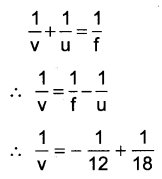
HBSE 10th Class Science Important Questions Chapter 9 Heredity and Evolution 56
HBSE 10th Class Science Important Questions Chapter 9 Heredity and Evolution 57

Conclusion:
1. Magnification is positive, h’ is negative which indicates image is real and inverted. Also, it is enlarged compared to object.
2. The image is formed 36 cm on the left side of pole P beyond the center of curvature C.

HBSE 10th Class Science Important Questions Chapter 10 Light Reflection and Refraction

Question 74.
A convex mirror Is fitted on an automobile with focal length of 3 m. If a vehicle behind is at a distance of 5 m, determine the position and nature of an image.
Answer:
Object distance u = – 5 m
Focal length f = 3 m
(f is positive because focus of convex mirror lies on right side of pole P)
From mirror formula,
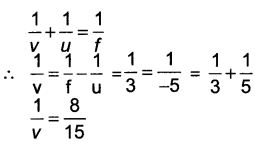
HBSE 10th Class Science Important Questions Chapter 9 Heredity and Evolution 58
\(v=\frac{15}{8}\) = 1.875m
Here, y is positive and y < u
∴ m<1
Therefore, virtual, erect and diminished image behind the convex mirror is obtained at a distance 1.875 m from the mirror.

Question 75.
An object of height 5 cm is placed at a distance of 10 cm from convex mirror of focal length 15 cm. Find the position, nature and size of an image.
Answer:
Object distance u = -10 cm
Focal length f = 15 cm
Object height h = 5 cm
According to mirror formula,
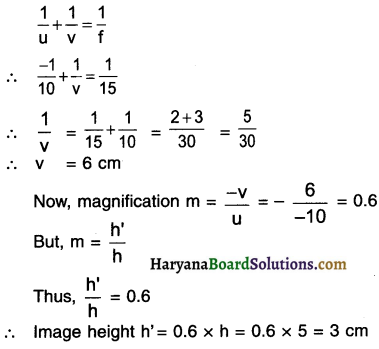
HBSE 10th Class Science Important Questions Chapter 9 Heredity and Evolution 59

Here, image distance v is positive and h’ is positive so, we get a virtual image of 3 cm height behind the mirror which is erect and diminished.

HBSE 10th Class Science Important Questions Chapter 10 Light Reflection and Refraction

Question 76.
Refractive index of media A, B, C and D are

HBSE 10th Class Science Important Questions Chapter 9 Heredity and Evolution 60
In which of the four media is the speed of light (i) maximum and (ii) minimum? Find the refractive index of medium C with respect to medium B.
Answer:
(i) Speed of light is maximum is medium A for which n (= 1.33) is minimum
(ii) Speed of light is minimum in medium D for which n (= 1.65) is maximum. Refractive index of medium C with respect to medium B.
\(\mathrm{n}_{\mathrm{CB}}=\frac{\mathrm{n}_{\mathrm{C}}}{\mathrm{n}_{\mathrm{B}}}=\frac{1.52}{1.44}=1.05\)

Question 77.
(a) The refractive index of Ruby is 1.71. What is meant by this statement?
(b) The refractive index of some medium are given below:
Crown glass – 1.52, Water – 1.33, Sapphire  – 1.77
In which of the medium is the speed of light:
(i) Maximum (ii) Minimum?
(c) Calculate speed of light in sapphire.
Answer:
(a) The refractive index of ruby is 1.71. It means that the ratio of the speed of light in vacuum to the speed of light in Ruby is 1.71.

(b) (i) Speed of light is maximum in water for which n (= 1.33) is minimum
(ii) Speed of light is minimum in sapphire for which n (= 1.77) is maximum

(c)
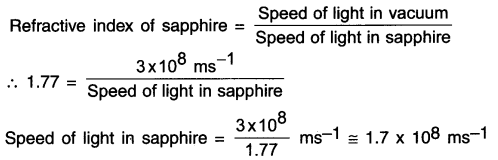
HBSE 10th Class Science Important Questions Chapter 9 Heredity and Evolution 61

Question 78.
Light enters from air to glass having refractive index 1.5. What is the speed of light in glass? The speed of light in vacuum is
3 x 10⁸ m/s.
Answer:
Absolute refractive index of glass
n = \(\frac{\mathrm{c}}{\mathrm{v}}\) and c = 3 x 10⁸ m/s-1
\(v=\frac{c}{n}=\frac{3 \times 10^8}{1.5} m/s-1\) (n = 1.5) = 2 x 10⁸ m/s-1[/latex]

HBSE 10th Class Science Important Questions Chapter 10 Light Reflection and Refraction

Question 79.
A light ray enters from air to the water medium having the absolute refractive index 1.33. If the angle of refraction of light is 17°30’, what will be the angle of incidence at the surface separating the two media ? Take absolute refractive index of air as 1.00.
Answer:
Taking air as medium 1 and water as medium 2,
n1 = 1, n2 = 1.33, θ2 = 17°30’
According to Sneil’s law,
n1 sin θ1 = n2 sin θ2
sin θ1 = 1.33 X 17°30’
The value of sin 17°30’ is determined from the Mathematical table of natural sine.
sin 17°30’ = 0.3
∴ sin θ1 =1.33 x 0.3 = 0.4
∴ From the table of natural sine
sin 23° 36’ = 0.4007
∴ θ1 = 23° 36’
∴ Angle of incidence = 23° 36’

Question 80
The refractive index of light entering glass from water is 1.12. Find the absolute refractive index of water if the absolute refractive index of glass is 1.5.
Answer:
Here, we take water as medium 1 and glass as medium 2.
Absolute refractive index of glass η2= 1.5
Absolute refractive index of glass with respect to water η21 = 1.12
Therefore, absolute refractive index of water η1 =?
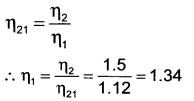
HBSE 10th Class Science Important Questions Chapter 9 Heredity and Evolution 62

Thus, absolute refractive index of water is = 1.34

HBSE 10th Class Science Important Questions Chapter 10 Light Reflection and Refraction

Question 81.
A swimmer lights a torch under the surface of sea water. Light from the torch is incident on water surface In such a way that incident light makes an angle 370 with water surface. Find the angle of refraction. Absolute refractive index of water is 1.33 and absolute refractive index of air is 1.0.
Answer:
Taking medium 1 as water, we get η1 = 1.33
Taking medium 1 as water, we get η2 = 1.00
Incident angle θ1 = 37°
Angle of refraction θ2 = ?
Using the formula, =
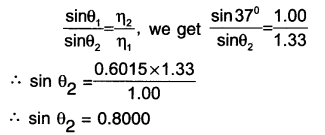
HBSE 10th Class Science Important Questions Chapter 9 Heredity and Evolution 63
Angle of refraction θ1 = 53° (from log table).
∴ The value of angle of reflection is equal to 53°

Question 82.
A convex lens forms a real and inverted image of an object at a distance of 40 cm from it. What will be the distance of an object if size of an image is same as the object? Determine the power of lens.
Answer:
Given:
Lens = Convex
Image = Real and inverted
Size of image h’ = object size h
Now, \(m=\frac{h^{\prime}}{h}\)
But, h’= h ∴ m=1.
The image is inverted. ∴ h’ will be negative.
∴ magnification on will be -1.
(Note: You can also think this way. For a convex lens, if the image is real and inverted, the magnification will be negative.)
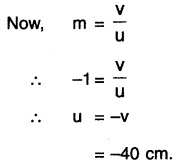
HBSE 10th Class Science Important Questions Chapter 9 Heredity and Evolution 64
Thus, object distance = – 40 cm and also image distance = 40 cm.
Substituting, values of y and u in lens formula we get,
\(\frac{1}{v}-\frac{1}{u}=\frac{1}{f}\)
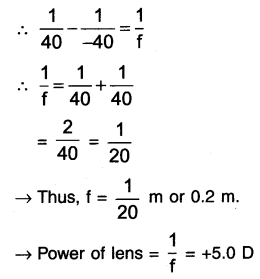
HBSE 10th Class Science Important Questions Chapter 9 Heredity and Evolution 65

HBSE 10th Class Science Important Questions Chapter 10 Light Reflection and Refraction

Question 83.
The object of 5 cm height is placed at a distance 25 cm from the centre of convex lens of focal length lo cm. Draw a ray diagram and find position, nature and the size of an image formed.
Answer:
1. Take a scale 2.5 cm = 1 unit on principal axis and draw a ray diagram. The ray diagram is shown below.
2. This shows that real, inverted and diminished image of an object is formed on other side of lens at a distance of 16.67 cm from the lens.
3. Also, h’ = – 3.33 cm
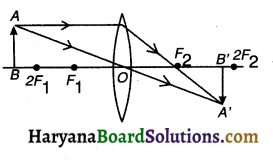
HBSE 10th Class Science Important Questions Chapter 9 Heredity and Evolution 66
As per lens formula,
HBSE 10th Class Science Important Questions Chapter 9 Heredity and Evolution 67

Image will be formed on the other side of the lens at a distance of 30 cm.

Question 84.
An object Is placed perpendicular to the principal axis of concave lens focal length 30 cm. Find the position of an image when the object is at a distance 20 cm from the lens.
Answer:
The focal length of lens f = -30 cm
Object distance u = -20 cm, image distance v = ?
As per the lens formula,

HBSE 10th Class Science Important Questions Chapter 9 Heredity and Evolution 68

The image will be obtained on the same side of the object at a distance of 12 cm from lens.

Question 85.
The magnification produced by a spherical lens is +2.5. What is the
(a) Nature of image
(b) Nature of lens?
Answer:
(a) When the magnification is positive, then the image is virtual and erect. In this case, the magnification has a positive sign, so the nature of image is virtual and erect.
(b) The value of magnification given here is 2.5 (which is more than 1). So, the image is larger than the object. A virtual, erect and magnified can be formed only by a convex lens, therefore, the nature of lens is convex.

HBSE 10th Class Science Important Questions Chapter 10 Light Reflection and Refraction

Question 86.
Power of a convex lens is +4.0 D. At what distance should the object from the lens be placed to obtain its real and inverted image of the same size on the screen?
Answer:
1. The focal length of this convex lens is + 4D. As per formula \(p=\frac{1}{f(\text { in meters })}\) we get
\(f=\frac{1}{p}=\frac{1}{4}\) = 0.25m = 25cm
2. Now, in a convex lens, when the image size is same as object size, then the object should be placed from the lens at a distance of 2f.
3. Thus, object distance = 2f = 2 x 25 = 50 cm.

Question 87.
Two thin lenses of power +3.5 D and – 2.5 D are placed in contact. Find the power and focal length of the lens combination.
Answer:
Power of combination of lenses, p = p1 + p2
So, p = + 3.5 + (-2.5)
p=+3.5 – 2.5
p = + 1.0 D
Thus, the power of this combination of lenses is, + 1.0 diopter.
We will now calculate the focal length of this combination of lenses. We know that:
Power, \(P=\frac{1}{f} \text { or }+1=\frac{1}{f}\)= and f= +1 m
So the focal length of this combination lens is + 1 meter.

Question 88.
You have two lenses A and B of focal lengths + 10 cm and -10 cm respectively. State the nature and power of each lens. Which of the two lenses will form a virtual and magnified Image of an object placed 8 cm from the lens? Draw a ray diagram to justify your answer.
Answer:
Here, = + 10 cm, = – 10 cm

HBSE 10th Class Science Important Questions Chapter 9 Heredity and Evolution 69

Lens A is convex and lens B is concave. Lens A will form a virtual and magnified image when the object is placed as 8 cm from it.

Question 89.
If the absolute refractive indices of water, benzene, and sapphire are 1.33, 1.50 and 1.77 respectively, then which medium has maximum relative refractive index?
(i) Sapphire relative to water
(ii) Sapphire relative to benzene
(iii) Benzene relative to water
(iv) Water relative to benzene
Answer:
Absolute refractive index of water = 1.33,
Absolute refractive index of benzene = 1.5, and Absolute refractive index of sapphire r = 1.77,
(A) Relative refractive index of sapphire η3 to water ηi.e. = η31 =\(\frac{\eta_3}{\eta_1}= 1.77/1.33\) = 1.33
(B) Relative refractive index of sapphire η3 to benzene η2 i.e. = η32= \(\frac{\eta_3}{\eta_2}\)= 1.77/1.5 = 1.18
(C) Relative refractive index of benzene η2 to water η1 i.e. = η21 =\(\frac{\eta_2}{\eta_1}=1.5/1.33\)= 1.12
(D) Relative refractive index of water η1 to benzene η2 i.e. η12 =\(\frac{\eta_1}{\eta_2}= 1.33/1.5\)= 0.88
Thus, sapphire to water has the highest relative refractive index.

HBSE 10th Class Science Important Questions Chapter 10 Light Reflection and Refraction

Question 90.
It he absolute refractive indices of water and glass are 4/3 and 3/2 respectively, then what will be the ratio of velocity of light In water to that of glass?
→ 8/9
Solution:
Absolute refractive index of water = \(\eta_1=\frac{4}{3}\)
Absolute refractive index of glass = \(\eta_2=\frac{3}{2}\)
∴ Ratio of velocity of light in water to glass will be \(\eta_{21}=\frac{v_1}{v_2}\)
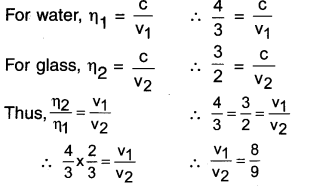
HBSE 10th Class Science Important Questions Chapter 9 Heredity and Evolution 70

Very Short Answer Type Question

Question 1.
What is reflection? State its types.
Answer:
The phenomenon of sending back the light rays which fall on the surface of an object when light is incident on it, is called reflection of light.
Types:

  • Regular reflection and
  • Irregular (diffused) reflection.

Question 2.
What is regular reflection?
Answer:
1. When a parallel beam of light falls on a smooth or shining surface, then the reflected beam is also parallel and directed back in a fixed direction.
2. This type of reflection is known as regular reflection. E.g. reflection by a mirror.

Question 3.
What is irregular or diffused reflection?
Answer:
1. When a parallel beam of light falls on a rough surface or irregular surface, then reflected light is not parallel but spreads over a wide area.
2. This type of reflection is known as irregular reflection.

Question 4.
State the laws of reflection.
Answer:
(i) The angle of incidence (θi) is equal to the angle of reflection θr i.e. θi = θr.
(ii) The incident ray, the normal to the mirror at the point of incident and the reflected ray, all lie in the same plane.

HBSE 10th Class Science Important Questions Chapter 10 Light Reflection and Refraction

Question 5.
Define angle of incidence.
Answer:
The angle that incident ray makes with normal drawn at the point of incidence is known as incident angle or angle of incidence. It is denoted by θi.

Question 6.
Define angle of reflection.
Answer:
The angle that reflected ray makes with normal drawn at the point of reflection is known as reflection angle or angle of reflection. It is denoted by θr.

Question 7.
What is a plane mirror?
Answer:
A plane mirror is a thin, flat and smooth sheet of glass having a shining coating of silver metal on one side.

Question 8.
What happens when a parallel beam of light is Incident on shining plane or smooth surface?
Answer:
The beam remains parallel after reflection a specific direction

Question 9.
What is a spherical mirror?
Answer:
1. A spherical mirror is a mirror whose reflecting surface is in fact a part of a hollow sphere of a glass.
2. Unlike plane mirrors, a spherical (curved) mirror converges or diverges parallel light rays incident on them.

Question 10.
Draw a labeled diagram showing various parts of a concave mirror.
Answer:
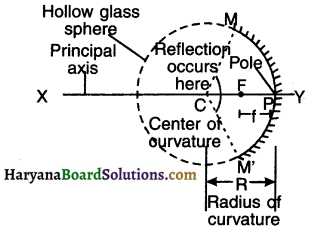
HBSE 10th Class Science Important Questions Chapter 9 Heredity and Evolution 71

Question 11.
State the relation between radius and focal length of a spherical mirror.
Answer:
Radius of curvature (R) = 2 times focal length (f)
∴ \(f=\frac{R}{2}\)

HBSE 10th Class Science Important Questions Chapter 10 Light Reflection and Refraction

Question 12.
Radius of a mirror is 25 cm. What will be its focal length?
Answer:
R = 2f \(f=\frac{R}{2}=\frac{25}{2}\) = 12.5 cm.

Question 13.
What should be the position of an object with respect to focus of a convex lens of focal length 20 cm, so that its real and magnified image is obtained? Draw a ray diagram to show the image formation.
Answer:
1. Given that f = 20 cm.
2. To obtain real and magnified image, the object should be placed between F1 and 2F2. Hence, the range will be between 20 cm to 40 cm.
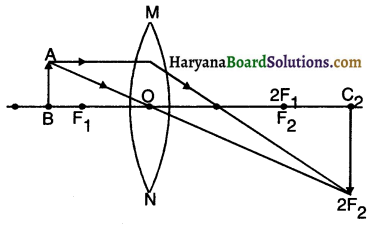
HBSE 10th Class Science Important Questions Chapter 9 Heredity and Evolution 72
Question 14.
Draw a labeled diagram showing various parts of a convex mirror.
Answer:
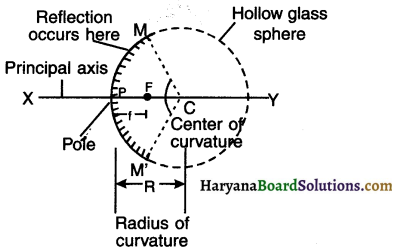
HBSE 10th Class Science Important Questions Chapter 9 Heredity and Evolution 73

Question 15.
How does a ray parallel to the principle axis behaves In a concave mirror? Show with diagram.
Answer:
Ray parallel to principal axis which after reflection passes through principal focus F.
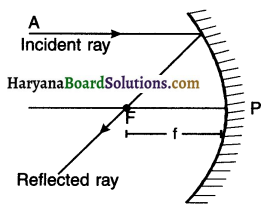
HBSE 10th Class Science Important Questions Chapter 9 Heredity and Evolution 74

Question 16.
How does a ray that passes through the principle focus of a concave mirror behaves? Show with diagram.
Answer:
Ray passing through the principle focus will become parallel to the principle axis after reflection.
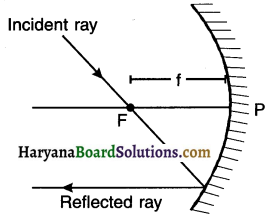
HBSE 10th Class Science Important Questions Chapter 9 Heredity and Evolution 75

Question 17.
Draw the diagram for a ray directed towards principle focus and its reflection through a convex mirror.
Answer:
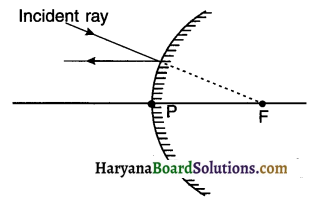
HBSE 10th Class Science Important Questions Chapter 9 Heredity and Evolution 76

Question 18.
Look at the diagram and describe the position, nature and size of the image formed.
Answer:
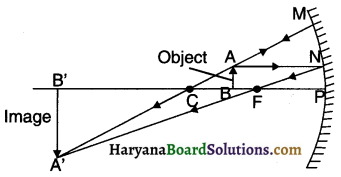
HBSE 10th Class Science Important Questions Chapter 9 Heredity and Evolution 82

Position: Beyond centre of curvature C
Nature: Real and inverted
Size: Magnified

HBSE 10th Class Science Important Questions Chapter 10 Light Reflection and Refraction

Question 19.
For a concave mirror, draw the diagram for image formed when the object is placed beyond C.
Answer:
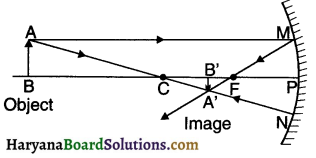
HBSE 10th Class Science Important Questions Chapter 9 Heredity and Evolution 77

Question 20.
Fill the table with respect to concave mirror.
Answer:
(1) Position of image — On c, Nature — Real and inverted,
(2) Position of object — Behind the mirror, Nature — Virtual and erect

Question 21.
State one use of convex mirrors.
Answer:
It is used as rear-view mirrors in vehicles.

Question 22.
ROM wants to have an erect Image of an object using a converging mirror of focal length 40 cm.
(i) Specify the range of distance where the object can be placed in front of the mirror. Give reason for your answer.
(ii) Will the image be bigger or smaller than the object?
Answer:
(i) To have an erect image of an object, the position of object should be between pole of the concave mirror and its focus, i.e. between 0 to 40 cm.
(ii) The image formed will be magnified i.e. image will be bigger than the object.

HBSE 10th Class Science Important Questions Chapter 10 Light Reflection and Refraction

Question 23.
Raghav drew the following diagram in which a ray of light is incident on a convex mirror. You need to redraw the diagram and complete the path of the ray after It gets reflected from the mirror.
Answer:
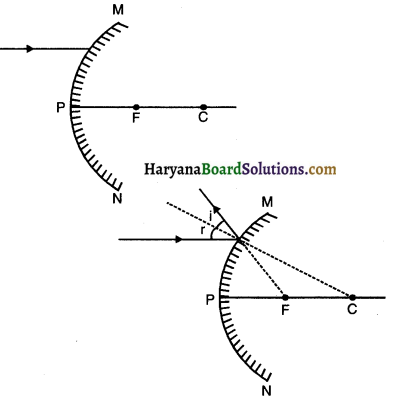
HBSE 10th Class Science Important Questions Chapter 9 Heredity and Evolution 79

Question 24.
The focal length of a concave mirror is 20 cm. Where will you place the object if you want an image which is real, inverted and of same size as the object?
Answer:
40cm

HBSE 10th Class Science Important Questions Chapter 10 Light Reflection and Refraction

Question 25.
A concave mirror produces a real image which is five times magnified as compared to the object. The object is placed at 15 cm in the front of the mirror. At what distance will the image be produced?
Answer:
75cm
(Hint: magnification m = -v/u.
Since image is real, take – m instead of m. Object lies to the left of the mirror and so u = -u
∴ – m = -v/-u)

Question 26.
What is the angle of incidence for a ray of light passing through the centre of curvature of a concave mirror?
Answer:

HBSE 10th Class Science Important Questions Chapter 10 Light Reflection and Refraction

Question 27.
State the mirror formula.
Answer:
The formula which gives relation between object distance (u), image distance (v) and focal length (f) of a spherkal mirror is known as the mirror formula.
\(\frac{1}{v}+\frac{1}{u}=\frac{1}{f}\)

Question 28.
Define magnification of spherical mirror.
Answer:
The ratio of image height (h’) to the object height (h) of the spherical mirror is called the magnification of the mirror.

Question 29.
State the formula of magnification.
Answer:
Magnification \(m=\frac{\text { Image height }\left(h^{\prime}\right)}{\text { Object height }(h)}=-\frac{v}{u}\)

Question 30.
For a mirror, h’ = 10 cm and h = 5 cm. Give its magnification.
Answer:
\(M=\frac{h^{\prime}}{h}=\frac{10}{5}=2\)

Question 31.
If m < 1, state the relation between image size and object size.
Answer:
If m < 1, image size < object size.

HBSE 10th Class Science Important Questions Chapter 10 Light Reflection and Refraction

Question 32.
What will be the magnification of an object whose height is 4 cm and which produces a real image of 6 cm height?
Answer:
-1.5cm

Question 33.
What is refraction?
Answer:
When a ray of light enters obliquely from one transparent medium to another transparent medium, its velocity changes due to which it gets deviated from its original direction at the surface separating two medias. This is called refraction.

Question 34.
Look at the diagram given here and watch the alphabets. Now write the correct sequence of (a) angle of incidence, (b) angle of emergence, (c) angle of refraction and (d) lateral displacement shown in the diagram as a, b, c and d.
HBSE 10th Class Science Important Questions Chapter 9 Heredity and Evolution 80
Answer:
The correct sequence is b, a, d, c

Question 35.
What is relative refractive index?
Answer:
1. The ratio of speed of light v1 in medium 1 to the speed of light v2 in medium 2 is known as the relative refractive index of medium 2 with respect to medium 1 (except the medium of vacuum).
2. It is denoted by 21 i.e. refractive index of medium 2 with respect to medium 1.

HBSE 10th Class Science Important Questions Chapter 10 Light Reflection and Refraction

Question 36.
State the two factors that determine lateral displacement of a ray of light passing through a rectangular glass slab.
Answer:
(i) Lateral displacement is directly proportional to the thickness of optical glass slab.
(ii) Lateral displacement is directly proportional to the angle of incidence.

Question 37.
A student traces the path of a ray of light passing through a rectangular glass slab. Which angle is correctly marked?
Answer:
→ r
HBSE 10th Class Science Important Questions Chapter 9 Heredity and Evolution 81

Question 39.
What is absolute refractive index?
Answer:
1. The ratio of speed of light in vacuum (or air) (c) to the speed of light of any other medium is known as the absolute refractive index or simply refractive index.
2. It is denoted by ‘i’

Question 40.
State the equation for absolute refractive Index.
Answer:
∴ Absolute refractive index η
\(=\frac{\text { speed of light in vacuum }}{\text { speed of light in medium }}=\frac{\mathrm{c}}{\mathrm{v}}\)

Question 41.
What is Snell’s law? Give its equation.
Answer:
1. The ratio of sine of angle of incidence to the ratio of sine of angle of retraction is constant.
2. This constant is known as relative,e refractive index of medium 2 with respect to medium 1 and denoted’ by η21
∴ \(\eta_{21}=\frac{\sin \theta_1}{\sin \theta_2}\)

HBSE 10th Class Science Important Questions Chapter 10 Light Reflection and Refraction

Question 42.
Observe the following incomplete ray diagram, where the image AB’ is formed after refraction from a convex lens:
On the basis of the above information, fill in the blanks:
(1) The position of object AB (not shown In the figure) must be ………………….
(2) The size of the object must be Than the size of the image.
Answer:
HBSE 10th Class Science Important Questions Chapter 9 Heredity and Evolution 83

(1) beyond 2F1 (2) greater.

Question 43.
Akash took a candle and focused the image of its flame on a white screen with the help of a convex lens.
He recorded the following distances —
(1) Position of the candle (object) = 26 cm,
(2) Position of the convex lens = 50 cm, (3)
Position of the screen = 74 cm. Based on the given information calculate the focal length of the convex lens.
Answer:
Here, u = – (50 – 26) = – 24.0 cm
From the lens formula
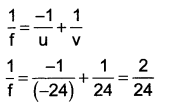
HBSE 10th Class Science Important Questions Chapter 9 Heredity and Evolution 84

∴ focal length f = 12 cm

Question 44.
What will you call a point inside a lens through which the light passes without deviation?
Answer:
Optical centre

Question 45.
What causes more bending of light rays passing through it – (1) A convex lens of long focal length or (2) A convex lens of short focal length?
Answer:
A convex lens of short focal length

Question 46.
State the equation for power of lens
Answer:
Power (P) = \(\frac{1}{f}\)

HBSE 10th Class Science Important Questions Chapter 10 Light Reflection and Refraction

Question 47.
The magnification of an image formed by a convex lens is -1. Find the object distance in terms of its focal length.
Answer:
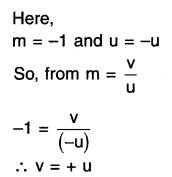
HBSE 10th Class Science Important Questions Chapter 9 Heredity and Evolution 85
HBSE 10th Class Science Important Questions Chapter 9 Heredity and Evolution 86

Question 48.
Look at the two ray diagrams given here. In which diagram will magnification be positive? Why?
Answer:
Magnification is positive in diagram (ii).
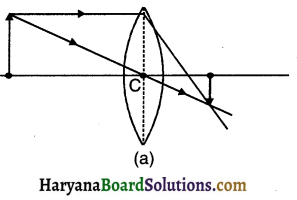
HBSE 10th Class Science Important Questions Chapter 9 Heredity and Evolution 87
HBSE 10th Class Science Important Questions Chapter 9 Heredity and Evolution 88

Reason: The image formed is virtual, erect and magnified. This means both the object and the image have positive heights.

Question 49.
Kruti says a thick convex lens has more power as compared to a thin convex lens. Is she correct? State your argument.
Answer:
Yes she is correct because thick convex lens has shorter focal length and hence more power.

Question 50.
What is the SI unit of power of lens?
Answer:
Dioptre
(Hint: Use magnification formula m Image height h’.
\(=\frac{\text { Image height } \mathrm{h}^{\prime}}{\text { object height } \mathrm{h}}\) Real images are negative object height h images.)

HBSE 10th Class Science Important Questions Chapter 10 Light Reflection and Refraction

Question 51.
A lens has a focal length of -25 cm. What will be the power and nature of this lens?
Answer:
4D; concave

Fill in the Blanks:

1. We cannot see things through regular reflection because …………..
Answer:
The light is reflected back only in one direction.

2. As per the law of reflection, the incident ray, the normal and the reflected ray are …………….
Answer:
In same plane

3. Image formed by plane mirror is ………… (Answer in terms of image property).
Answer:
Virtual and erect.

4. The size of image formed by plane mirror is same as object but is ……………….
Answer:
Laterally inverted

5. Light is ……………..
Answer:
Electromagnetic radiation which produces sensation in our eyes

6. If there is no reflection, the world would appear ……………
Answer:
Dark

7. ……….. and ……….. are the different types of reflection.
Answer:
Regular; Irregular

8. If the …………. surface is made reflecting, one can get a convex mirror.
Answer:
Outer

HBSE 10th Class Science Important Questions Chapter 10 Light Reflection and Refraction

9. The centre of spherical glass ball is called of ……………… mirror.
Answer:
Centre of curvature

10. The …………… of the reflecting surface of the mirror is known as aperture.
Answer:
Diameter

11. The distance between pole and of mirror is called
Answer:
Focal length

12. …………….. Surfaces which are light in large amount.
Answer:
Completely polished

13. …………… image will be formed actually meet at some point.
Answer:
Real

14. …………….. mirror is used for close shaving.
Answer:
Concave

15. You can see a full length image of a tall building/tree in a ………………. mirror.
Answer:
Convex

16. If you visit Agra Fort you can see the distant full length view of the Taj Mahal in …………………….. mirror fitted there.
Answer:
Convex

17. In a concave mirror, a ray which is parallel to principal axis after reflection will ……………….
Answer:
Pass through the principal focus

18. In a concave mirror, a ray which is passing through centre of curvature will …………….
Answer:
Reflect back along the same path

HBSE 10th Class Science Important Questions Chapter 10 Light Reflection and Refraction

19. The image formed by a concave mirror is at centre of curvature, real and inverted and same size as object. The position of the objects is …………………
Answer:
At centre of curvature principal focus reflect incident if the light rays

20. For a convex mirror, if the position of the object is at infinity, then the position, nature and size of the image will be ………..
Answer:
At focus, virtual and erect, highly diminished

21. An object of size 1 cm is placed at a distance of 15 cm from a concave mirror of focal length 10 cm. The image distance will be ………………
Answer:
30cm
(Hint: Use mirror formula and follow sign convention.)

22. As per New Cartesian Sign Convention, the object is always placed to the of the mirror.
Answer:
Leftside

23. All the distances parallel to the principle axis are measured from
Answer:
The pole of the mirror.

24. A negative sign in the value of magnification indicates that the image is …………………..
Answer:
Real

25. In mirror formula, as per the sign convention, the image is taken as ……………….
Answer:
-v

26. In mirror formula, as per the sign convention, radius of curvature is taken as ……………….
Answer:
-R

27. Mirror formula can be represented as ………………
Answer:
\(\frac{1}{u}+\frac{1}{v}=\frac{1}{f}\)

28. The ratio of image height to the object height is called …………….
Answer:
Magnification

29. The positive value of magnification represents ……………….. image of an object.
Answer:
Virtual

30. ……… medium retracts most of the light incident on it.
Answer:
Transparent

HBSE 10th Class Science Important Questions Chapter 10 Light Reflection and Refraction

31. Suppose that the radius of curvature R of a spherical mirror is 30 cm. In this case, its focal length (t) will be …………..
Answer:
15cm

32. The ratio of sine of angle of incidence to the sine of angle of refraction remains constant, subjected lo certain conditions. This law is known as …….
Answer:
Snell’s law of refraction

33. A medium in which speed of light is more is called ……………
Answer:
Optically rarer medium.

34. The sideways Shift of emergent ray from the direction of incident ray is called Lateral shift
Answer:
Leternal shifts

35. According to Snell’s Law constant.
Answer:
\(\frac{\sin \theta_1}{\sin \theta_2}\)

36. When a ray of light travels from optically denser to optically rarer medium,………………
Answer:
It moves away from normal

37. The formula for absolute refractive index is ……………………
Answer:
Velocity of light in vacuum (or air)! Velocity of light in medium

38. The refractive index of water in Which light travels from air is 1.33. Thus, the refractive index of light going from water to air will be ……………….
Answer:
0.75

39. For a convex lens. if an object is positioned at infinity, then the position, nature and size of the image will be and …………….
Answer:
Opposite side at F, real and Inverted, highly diminished (point sized)

HBSE 10th Class Science Important Questions Chapter 10 Light Reflection and Refraction

40. For a convex lens, ¡f the image is between F and 2F, real and inverted and diminished, then the object should be …………
Answer:
Beyond 2F

41. In a convex lens, If we put an object at 2F, we get its image also on other side of lens at 2F but real and inverted and
Answer:
Of same size

42. In a concave lens, If we wish to have an image between focus F and optical centre O we should place the object…………..
Answer:
Between infinity and optical centre O of the lens

43. ………………………….. the power of lens having 1m kcal length.
Answer:
1D

44. A person having myopic eyes uses a concave lens of local length 75 cm. The power of his lens will be ………………………

True or False

1. The incident ray, normal to the mirror at the point of incidence and the reflected ray, all lie in the same plane. — True
2. A shining spoon can be considered as a plane mirror. — False
3. Focal length (f) = 2R. — False
4. Minimum three rays are needed to construct a ray diagram. — False
5. SpherIcal mIrrors are the most commonly used curved mirrors. True or false. — True
6. Convex mirror is commonly used for shaving. — False
7. You can put an object at only two positions to obtain an image through a convex mirror. — True
8. Concave mirrors are commonly used as rear-view mirrors in vehicles. True or false? — False
9. Concave mirrors have wider field of view. — False
10. For W > h,m > 1 — True
11. Speed of light in a medium / Speed of light in air will give you absolute refractive Index. — True
12. Concave lens is a converging lens. — False
13. Lens formula and mirror formula differ only by a mathematical sign. — True
14. Sideways shifting of the light In a glass slab is called lateral shift. — True

Match the Following 

Question 1.

A

B

1. A perpendicular drawn at the point of incidence to the reflecting surface.(a) Linear magnification
2. The rays which strike the mirror surface near the periphery(b) Normal
3. The ratio of the height of the image to the height of the object(c) Absolute refractive index
4. The ratio of speed of light in vacuum to the speed of light in a medium(d) Marginal ray

Answer: (1-b), (2-d), (3-a), (4-c)

HBSE 10th Class Science Important Questions Chapter 10 Light Reflection and Refraction

Question 2.

(A)(B)
1. Plane mirror(a) Real image, inverted and large
2. Concave lens(b) Virtual image, erect and same size
3. Convex lens(c) Virtual image, positive focal length
4. Convex mirror(d) Virtual image, negative focal length negative power

Answer: (1-b), (2-d), (3-a), (4-c)

Question 3.
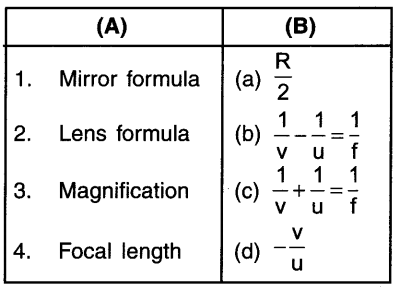
HBSE 10th Class Science Important Questions Chapter 9 Heredity and Evolution 89

Answer:
(1-c), (2-b), (3-d), (4-a)
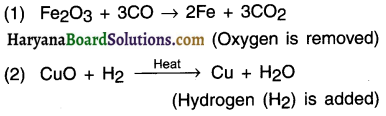
HBSE 10th Class Science Important Questions Chapter 10 Light Reflection and Refraction Read More »