Author name: Bhagya

HBSE 7th Class Social Science Solutions History Chapter 1 हज़ार वर्षों के दौरान हुए परिवर्तनों की पड़ताल

Haryana State Board HBSE 7th Class Social Science Solutions History Chapter 1 हज़ार वर्षों के दौरान हुए परिवर्तनों की पड़ताल Textbook Exercise Questions and Answers.

Haryana Board 7th Class Social Science Solutions History Chapter 1 हज़ार वर्षों के दौरान हुए परिवर्तनों की पड़ताल

HBSE 7th Class History हज़ार वर्षों के दौरान हुए परिवर्तनों की पड़ताल Textbook Questions and Answers

फिर से याद करें

हजार वर्षों के दौरान हुए परिवर्तनों की पड़ताल Notes HBSE 7th Class प्रश्न 1.
अतीत में “विदेशी” किसे माना जाता था?
उत्तर:
अतीत में गाँव में आने वाले अनजान व्यक्ति को जो समाज अथवा संस्कृति का अंग नहीं होता था, विदेशी कहा जाता था। इसी प्रकार शहरी व्यक्ति के लिए वनवासी विदेशी होता था।

हजार वर्षों के दौरान हुए परिवर्तनों की पड़ताल Chapter 1 HBSE 7th Class प्रश्न 2.
नीचे उल्लिखित बातें सही है या गलत:
(क) सन् 700 के बाद के काल के संबंध में अभिलेख नहीं मिलते हैं।
(ख) इस काल के दौरान मराठों ने अपने राजनीतिक महत्त्व की स्थापना की।
(ग) कृषि केंद्रित बस्तियों के विस्तार के साथ कभी-कभी वनवासी अपनी जमीन से उखाड़ बाहर कर दिए जाते
(घ) सुल्तान गयासुद्दीन बलबन असम, मणिपुर तथा काश्मीर का शासक था।
उत्तर:
(क) गलत
(ख) सही
(ग) सही
(घ) गलत।

Hajar Varshon Ke Dauran Hue Parivartan Ki Padtal HBSE 7th Class प्रश्न 3.
रिक्त स्थानों को भरें:
(क) अभिलेखागारों में ……………. रखे जाते हैं।
(ख) ……………. चौदहवीं सदी का एक इतिहासकार था।
(ग) ……………. , ……………. , ……………. , ……………. और ……………. इस उपमहाद्वीप में इस काल के दौरान लाई गई कुछ नई फसलें हैं।
उत्तर:
(क) पांडुलिपियाँ, दस्तावेज, नक्शे, सिक्के आदि,
(ख) जियाउद्दीन बरनी,
(ग) आलू, मक्का, मिर्च, चाय, कॉफी।

HBSE 7th Class Social Science Solutions History Chapter 1 हज़ार वर्षों के दौरान हुए परिवर्तनों की पड़ताल

हजार वर्षों के दौरान हुए परिवर्तनों की पड़ताल प्रश्न उत्तर HBSE 7th Class प्रश्न 4.
इस काल में हुए कुछ प्रौद्योगिकीय परिवर्तनों की तालिका दें।
उत्तर:
प्रौद्योगिकीय परिवर्तनों की तालिका
1. सिंचाई में रहट।
2. कताई में चरखे।
3. युद्ध में आग्नेयास्त्रों (बारूद वाले हथियार)।

हजारों वर्षों के दौरान हुए परिवर्तन की पड़ताल HBSE 7th Class प्रश्न 5.
इस काल के दौरान हुए कुछ मुख्य धार्मिक परिवर्तनों की जानकारी दें।
उत्तर:
इस काल में धार्मिक परंपराओं में कई परिवर्तन आए।

  1. हिंदू धर्म में अनेक नए देवी-देवताओं की पूजा आरंभ हो गई। राजाओं द्वारा मंदिर निर्माण की परंपरा आरंभ हुई। संस्कृत के ज्ञान व राज्यों के संरक्षण के कारण ब्राह्मणों का महत्त्व बढ़ा।
  2. 7वीं सदी में व्यापारियों व आप्रवासियों के माध्यम से मुस्लिम धर्म भारत पहुंचा।
  3. 15वीं सदी में सिक्ख धर्म का उदय हुआ।

आइए समझें

प्रश्न 6.
पिछली कुछ शताब्दियों में “हिंदुस्तान” शब्द का अर्थ कैसे बदला है?
उत्तर:
(i) आज हम ‘हिंदुस्तान’ शब्द को राष्ट्र राज्य “भारत” के अर्थ में लेते हैं।

(ii) तेरहवीं सदी में जब फ़ारसी के इतिहासकार मिन्हाज-ए सिराज ने ‘हिंदुस्तान’ शब्द का प्रयोग किया था तो उसका आशय पंजाब, हरियाणा और गंगा-यमुना के बीच में स्थित क्षेत्रों से था। उसने इस शब्द का राजनीतिक अर्थ में उन क्षेत्रों के लिए प्रयोग किया जो दिल्ली के सुल्तान के अधिकार क्षेत्र में आते थे।

(iii) सल्तनत के प्रसार के साथ-साथ इस शब्द के अंतर्गत आने वाले क्षेत्र भी बढ़ते गए, लेकिन ‘हिंदुस्तान’ शब्द में दक्षिण भारत का समावेश कभी नहीं हुआ।

(iv) यह प्रयोग चौदहवीं सदी के कवि अमीर खुसरो द्वारा प्रयुक्त “हिंद” के ही कुछ-कुछ समान था। मगर जहाँ “भारत” को एक भौगोलिक और सांस्कृतिक तत्त्व के रूप में पहचाना जा रहा था वहाँ हिंदुस्तान शब्द से वे राजनीतिक और राष्ट्रीय अर्थ नहीं जुड़े थे जो हम आज जोड़ते हैं।

(v) इसके विपरीत, सोलहवीं सदी के आरंभ में बाबर ने ‘हिंदुस्तान’ शब्द का प्रयोग इस उपमहाद्वीप के भूगोल, पशु-पक्षियों और यहाँ के निवासियों की संस्कृति का वर्णन करने के लिए किया।

प्रश्न 7.
जातियों के मामले कैसे नियंत्रित किए जाते थे?
उत्तर:
जातियाँ स्वयं अपने-अपने नियम बनाती थीं, जिससे कि वे अपनी जाति के सदस्यों के व्यवहार को नियंत्रित कर सकें। इन नियमों का पालन जाति के बड़े बजगों की एक सभा करवाती थी, जिसे कुछ इलाकों में “जाति पंचायत” कहा जाता था, लेकिन जातियों को अपने निवास के गांवों के रिवाजों का पालन भी करना पड़ता था।

प्रश्न 8.
सर्वक्षेत्रीय साम्राज्य से आप क्या समझते हैं?
उत्तर:
सर्वक्षेत्रीय साम्राज्य वे साम्राज्य थे जिनके अधीन अनेक सारे क्षेत्र आ जाते थे। उदाहरण के लिए मुख्यतः दक्षिण में चोल, उत्तर से दक्षिण तक फैला तुगलक साम्राज्य, मुगल साम्राज्य आदि सर्व क्षेत्रीय साम्राज्यों के उदाहरण हैं।

HBSE 7th Class Social Science Solutions History Chapter 1 हज़ार वर्षों के दौरान हुए परिवर्तनों की पड़ताल

आइए विचार करें

प्रश्न 9.
पांडुलिपियों के उपयोग में इतिहासकारों के सामने कौन-कौन सी समस्याएँ आती हैं?
उत्तर:
(i) पांडुलिपियों का प्रयोग इतिहासकारों के लिए कठिन है। प्राचीन काल में छापेखाने नहीं थे इसलिए लिपिक हाथ से ही पांडुलिपियों की प्रतिकृति (Copy) बनाते थे। यह काम आसान नहीं होता। कई बार इतिहासकारों को लिपिक की लिखावट समझ में नहीं आती और विवश होकर उन्हें अंदाजा ही लगाना पड़ता है कि उसने क्या लिखा होगा।

(ii) इतिहासकारों के सामने भिन्न-भिन्न समय पर लिखी एक ही व्यक्ति के बारे में पांडुलिपियों में सूचना संबंधी कुछ अंतर पढ़ने पड़ते हैं।

(iii) प्रतिलिपियाँ बनाते हुए लिपिक छोटे-मोटे फेर-बदल करते चलते थे, कहीं कोई शब्द, कहीं कोई वाक्य।

(iv) सदो-दर-सदी प्रतिलिपियों की भी प्रतिलिपियाँ बनती रहीं और अंततः एक ही मूल ग्रंथ की भिन्न-भिन्न प्रतिलिपियाँ एक-दूसरे से बहुत ही अलग हो गई।

(v) वास्तविक तथ्यों का अध्ययन करने के लिए इतिहासकारों को एक ही ग्रंथ की विभिन्न प्रतिलिपियों का अध्ययन करना पड़ता

(vi) कई बार लेखक स्वयं भी समय-समय पर अपने मूल वृत्तांत में संशोधन करते रहते थे।

प्रश्न 10.
इतिहासकार अतीत को कालों या युगों में कैसे विभाजित करते हैं? क्या इस कार्य में उनके सामने कोई कठिनाई आती है?
उत्तर:
अधिकतर इतिहासकार आर्थिक तथा सामाजिक कारकों के आधार पर ही अतीत के काल खंडों की विशेषताएँ तय करते हैं। इन आधारों पर इतिहास को प्राचीन, मध्य और आधुनिक कालों में बाँटा गया है। काल-क्रम को विभाजित करते समय इतिहासकारों के सामने यह समस्या उत्पन्न होती है कि वे किस महत्त्वपूर्ण घटना के बाद कालक्रम का विभाजन करें। आइए करके देखें

HBSE 7th Class Social Science Solutions History Chapter 1 हज़ार वर्षों के दौरान हुए परिवर्तनों की पड़ताल

प्रश्न 11.
अध्याय में दिये गये मानचित्र-1 अथवा मानचित्र-2 की तुलना उपमहाद्वीप के आज के मानचित्र से करें। तुलना करते हुए दोनों के बीच जितनी भी समानताएँ और असमानताएँ मिलती हैं, उनकी सूची बनाइए।
HBSE 7th Class Social Science Solutions History Chapter 1 हज़ार वर्षों के दौरान हुए परिवर्तनों की पड़ताल-1
मानचित्र-1

HBSE 7th Class Social Science Solutions History Chapter 1 हज़ार वर्षों के दौरान हुए परिवर्तनों की पड़ताल-2
मानचित्र-2
उत्तर:
(i) अध्याय में दिया गया मानचित्र-1 अरब भूगोलशास्त्री अल-इदरीसी द्वारा बनाया गया था। यह नक्शा आज से लगभग 950 वर्ष पहले बना था। जो मानचित्र हमारी पाठ्यपुस्तक के अध्याय । में दिया है वह उस विद्वान द्वारा बनाए गए दुनिया के बड़े मानचित्र का एक हिस्सा है और भारतीय उपमहाद्वीप को उल्टी शक्ल में दर्शाता है।

(ii) इस नक्शे में दक्षिण भारत वह जगह है जहाँ आज हम उत्तर भारत देखते हैं। आज के मानचित्र में भारत का पड़ोसी श्रीलंका का द्वीप उस तरह ऊपर की तरफ नहीं है जैसा कि अल-इदरीसी ने मानचित्र में दिखाया है।

(iii) इस नक्शे में भारत के कुछ स्थानों के नाम अरबी (भाषा) में दिए गए हैं और उनमें कुछ जाने-पहचाने नाम भी हैं जैसे कि उत्तर प्रदेश का कन्नौज (जिसे नक्शे में कनौज) लिखा गया है।

HBSE 7th Class Social Science Solutions History Chapter 1 हज़ार वर्षों के दौरान हुए परिवर्तनों की पड़ताल

प्रश्न 12.
पता लगाइए कि आपके गाँव या शहर में अभिलेख (रिकॉर्ड) कहाँ रखे जाते हैं। इन अभिलेखों को कौन तैयार करता है? क्या आपके यहाँ कोई अभिलेखागार है? उसकी देखभाल कौन करता है? वहाँ किस तरह के दस्तावेज़ संगृहीत हैं? उनका उपयोग कौन लोग करते हैं?
उत्तर:
ग्रामीण क्षेत्रों के अभिलेख (रिकार्ड) जिला मुख्यालय में रखे जाते हैं. इन अभिलेखों को विभिन्न विभाग के कर्मचारी तैयार करते हैं। तथा शहरों के अभिलेख नगर निगम कार्यालयों में रखे जाते हैं और ऐतिहासिक अभिलेख को अभिलेखागारों में रखा जाता है। अभिलेखागार की देखभाल उसके अंदर नियुक्त कर्मचारियों द्वारा की जाती है। इनका उपयोग शोधार्थियों द्वारा अथवा विभिन्न विभागों द्वारा समय-समय पर किया जाता है।

बहुविकल्पी प्रश्न

प्रश्न 1.
सही विकल्प चुनें:
(i) जियाउद्दीन बरनी 14वीं शताब्दी के प्रमुख:
(क) चित्रकार थे
(ख) मानचित्रकार थे
(ग) इतिहासकार थे
उत्तर:
(ग) इतिहासकार थे।

(ii) 14वीं सदी में राजपूत शब्द उन योद्धाओं के लिए प्रयुक्त होता था जो
(क) शुद्ध वर्ण के थे
(ख) क्षत्रिय वर्ण के थे
(ग) वैश्य वर्ण के थे
उत्तर:
(ख) क्षत्रिय वर्ण के थे।

(iii) राजपूतों की आचार संहिता, पराक्रम एवं स्वामिभक्ति का गुणगान करते थे।
(क) जाट
(ख) चारण
(ग) अहोम
उत्तर:
(ख) चारण!

(iv) अमीर खुसरो के अनुसार बंगाल में बोली जाने वाली भाषा थी:
(क) गूजरी
(ख) तेलंगानी
(ग) गौड़ी
उत्तर:
(ग) गौड़ी।

(v) भारत में प्रचलित इस्लामी न्याय सिद्धांत है:
(क) हनफी
(ख) शल्फी
(ग) हनफी व शफी
उत्तर:
(ग) हनफी व शफौ।

HBSE 7th Class Social Science Solutions History Chapter 1 हज़ार वर्षों के दौरान हुए परिवर्तनों की पड़ताल

प्रश्न 2.
रिक्त स्थान भरें:
(i) अल-इद्रीसी 12वीं सदी के ……….. थे।
(ii) जो व्यक्ति मानचित्र या नक्शे बनाता है उसे …………………” कहते हैं।
(iii) पांडुलिपियों को पुस्तकालयों एवं …………… में रखा जाता था।
(iv) बड़े-बुजुर्गों की एक सभा ………….. कहलाती थी।
(v) द्वारसमुद्री भाषा …………………. में बोली जाती थी।
उत्तर:
(i) भूगोलवेत्ता
(ii) मानचित्रकार
(iii) अभिलेखागारों
(iv) जाति पंचायत
(v) दक्षिण कर्नाटक।

प्रश्न 3.
सही गलत छाँटो:
(i) आज आधुनिक राष्ट्र राज्य भारत के अर्थ में हिंदुस्तान शब्द का प्रयोग किया जाता है।
(ii) अमीर खुसरो ने हिंदुस्तान के लिए हिंद शब्द का प्रयोग किया।
(iii) संस्कृत आम जनता की भाषा थी।
(iv) मध्यकाल रूढ़िवादी था, उसमें किसी प्रकार का कोई परिवर्तन नहीं हुआ।
(v) मुसलमान कुरान शरीफ को अपना धर्मग्रंथ मानते हैं।
उत्तर:
(i) आज आधुनिक राष्ट्र राज्य भारत के अर्थ में हिंदुस्तान शब्द का प्रयोग किया जाता है। ✓
(ii) अमीर खुसरो ने हिंदुस्तान के लिए हिंद शब्द का प्रयोग किया। ✓
(iii) संस्कृत आम जनता की भाषा थी। ✗
(iv) मध्यकाल रूढ़िवादी था, उसमें किसी प्रकार का कोई परिवर्तन नहीं हुआ। ✗
(v) मुसलमान कुरान शरीफ को अपना धर्मग्रंथ मानते हैं। ✓

हज़ार वर्षों के दौरान हुए परिवर्तनों की पड़ताल

HBSE 7th Class History हज़ार वर्षों के दौरान हुए परिवर्तनों की पड़ताल Important Questions and Answers

अति लघु उत्तरात्मक प्रश्न

प्रश्न 1.
अल-इदरीसी और ग्विलॉम द लिस्ले जैसे मानचित्रकारों द्वारा बनाए गए नक्शों का क्या ऐतिहासिक महत्त्व रहा है? संक्षेप में लिखिए।
उत्तर:
यूरोप के नाविक एवं व्यापारियों द्वारा अपनी सामुद्रिक यात्रा के लिए इन नक्शों का प्रयोग किया गया।
इतनी ही महत्त्वपूर्ण एक और बात यह है कि दूसरे ऐतिहासिक (मध्यकाल) युग तक मानचित्र-अंकन का विज्ञान भी बहुत बदल गया था। इतिहासकार जब बीते युगों के दस्तावेज (documents), अध्ययन करते हैं तो उनके लिए उन सूचनाओं के सदर्भो (references) में उनकी भिन्न-भिन्न ऐतिहासिक पृष्ठभूमियों (historical background) का ध्यान रखना जरूरी होता है।

प्रश्न 2.
इस अध्याय के अध्ययन काल में उभरने वाली छ: जातियों या समुदायों के नाम लिखिए।
उत्तर:
(i) राजपूत
(ii) मराठा
(iii) सिक्ख
(iv) जाट
(v) अहोम
(vi) कायस्था

प्रश्न 3.
मुसलमान किसे अपना धर्म ग्रंथ मानते हैं?
उत्तर:
मुसलमान कुरान शरीफ को अपना धर्म ग्रंथ मानते हैं।

प्रश्न 4.
बाबर ने हिंदुस्तान शब्द का प्रयोग किस संदर्भ में किया था?
उत्तर:
बाबर ने हिंदुस्तान शब्द का प्रयोग इस उपमहाद्वीप के भूगोल, पशु-पक्षियों और यहाँ के निवासियों की संस्कृति का वर्णन करने के लिए किया था।

प्रश्न 5.
सन् 700 और 1750 के मध्य के हजार वर्षों में प्रौद्योगिकी (Technology) के क्षेत्र में नए परिवर्तनों का उल्लेख कीजिए।
उत्तर:
सन् 700 और 1750 के बीच के हजार वर्षों में अलग-अलग समय पर नई प्रौद्योगिकी के दर्शन होते हैं, जैसे सिंचाई में रहट, कताई में चर्खे और युद्ध में आग्नेयास्त्रों (बारूद वाले हथियार) का प्रयोग।

प्रश्न 6.
इतिहास का अध्ययन करने के लिए हम स्रोत सामग्री के रूप में किसका प्रयोग करते हैं?
उत्तर:
इतिहास का अध्ययन करने के लिए हम सिक्कों, शिलालेखों, स्थापत्य कला व, लिखित सामग्री का प्रयोग स्रोत सामग्री के रूप में करते हैं।

HBSE 7th Class Social Science Solutions History Chapter 1 हज़ार वर्षों के दौरान हुए परिवर्तनों की पड़ताल

लघु उत्तरात्मक प्रश्न

प्रश्न 1.
भारत में इस्लाम से जुड़े कुछ पहलुओं एवं धर्मशास्त्रियों और समुदायों का उल्लेख कीजिए।
उत्तर:
(i) आठवीं शताब्दी में भारत में एक नए धर्म के रूप में इस्लाम ने प्रवेश किया। इस धर्म का प्रवेश व्यापारियों और आप्रवासियों के माध्यम से हुआ। मस्जिदें बनी, कुरान की आयतें पड़ी गई, सुनी और सुनाई गई।

(ii) अनेक शासक इस्लाम और इसके विद्वान धर्मशास्त्रियों और न्यायशास्त्रियों- अर्थात् उलेमा को संरक्षण देते थे। हिंदू धर्म की ही भाँति इस्लाम के अनुयायी भी अपने धर्म की अलग-अलग तरह से व्याख्या करते थे।

(iii) मुसलमानों में कुछ शिया थे जो पैगंबर साहब के दामाद अली को मुसलमानों का विधिसम्मत नेता मानते थे और कुछ सुन्नी थे जो ख़लीफ़ाओं के प्रभुत्व को स्वीकार करते थे।

(iv) इस्लाम के आरंभिक दौर में इस धर्म का नेतृत्व करने वाले खलीफ़ा कहलाते थे और आगे भी इनकी परंपरा चलती रही।

(v) इस्लामी न्याय सिद्धांत (विशेषकर भारत में हनफ़ी और शफ़ी) की विभिन्न परंपराओं में भी कई महत्त्वपूर्ण अंतर रहे हैं। ऐसे ही धर्म-सिद्धांतों तथा रहस्यवादी विचारों को लेकर विभिन्नताएँ देखने को मिलती हैं।

प्रश्न 2.
सन् 700 और 1750 के मध्य राजपूत समुदाय पर एक संक्षिप्त टिप्पणी लिखिए।
उत्तर:
(i) सन् 700 से 1750 के युग के मध्य भारतीय समाज और राजनीति में जिन समुदायों का महत्त्व बढ़ा उनमें राजपूत प्रारंभ में सर्वाधिक शक्तिशाली रहे। यह (राजपूत) एक वह समुदाय था, जिसका नाम “राजपुत्र” (अर्थात् राजा का पुत्र) से निकला है।

(ii) आठवीं से चौदहवीं सदी के बीच यह नाम आमतौर पर योद्धाओं के उस समूह के लिए प्रयुक्त होता था जो क्षत्रिय वर्ण के होने का दावा करते थे।

(ii) राजपूत’ शब्द के अंतर्गत केवल राजा और सामंत वर्ग ही नहीं, बल्कि वे सेनापति और सैनिक भी आते थे जो पूरे उपमहादीप में अलग-अलग शासकों की सेनाओं में सेवारत थे। कवि और चारण राजपूतों की आचार संहिता – प्रबल पराक्रम और स्वामिभक्ति – का गुणगान करते थे।

प्रश्न 3.
सन् 700 से 1750 के मध्य के काल के दौरान वनवासियों के जीवन और जीवन शैली पर क्या प्रभाव पड़ा? इसके परिणामस्वरूप सामाजिक, आर्थिक क्षेत्र में क्या परिवर्तन दिखाई दिए? उल्लेख कीजिए।
उत्तर:
(i) वनवासियों के जीवन और जीवन शैली में बदलाव (Changes in life and lifestyle of tribals): इस परे काल के दौरान क्रमश: जंगलों की कटाई हो रही थी और खेती का इलाका बढ़ता जा रहा था। कुछ क्षेत्रों में यह परिवर्तन अन्य क्षेत्रों की अपेक्षा अधिक तेजी से और पूरे तौर पर हुआ।

(ii) पर्यावास (Habitat) में परिवर्तन के कारण अनेक कनवासियों को मजबूर होकर अपना स्थान छोड़ना पड़ा। कुछ और वनवासी जमीन की जुताई करने लगे और कृषक बन गए। कृषकों के ये नए समूह क्षेत्रीय बाजार, मुखियाओं, पुजारियों, मठों और मंदिरों से प्रभावित होने लगे। वे बड़े और जटिल समाजों के अंग बन गए। उन्हें कर चुकाने पड़ते थे और स्थानीय मालिक वर्ग की बंगार करनी पड़ती थी।

(iii) सामाजिक-आर्थिक जीवन में परिवर्तन (Changes _in socio-economic life):
(क) इस पूरे काल में परावासियों की गतिशीलता के कारण उनकी सामाजिक और आर्थिक जीवन शैलियों में परिवर्तन आया। इसके परिणामस्वरूप किसानों के बीच आर्थिक और सामाजिक अंतर उभरने लगे।

(ख) कुछ के पास ज्यादा उपजाऊ जमीन होती थी, कुछ लोग मवेशी भी पालते थे और कुछ लोग खेती से खाली समय में दस्तकारी आदि का कुछ काम कर लेते थे। जैसे-जैसे समाज में अंतर बढ़ने लगे, लोग जातियों और उपजातियों में बाँटे जाने लगे और उनकी पृष्ठभूमि और व्यवसाय के आधार पर उन्हें समाज में ऊंचा या नीचा दर्जा दिया जाने लगा। ये दर्जे स्थायी नहीं

(ग) किसी जाति विशेष के सदस्यों के हाथों में कितनी सत्ता, प्रभाव और संसाधनों का नियंत्रण है, इसके आधार पर उसके दर्जे बदलते रहते थे। एक ही जाति का किसी क्षेत्र में कोई दर्जा हो सकता था, और किसी अन्य क्षेत्र में कोई और।

HBSE 7th Class Social Science Solutions History Chapter 1 हज़ार वर्षों के दौरान हुए परिवर्तनों की पड़ताल

प्रश्न 4.
मध्यकाल में प्रामाणिक लिखित सामग्री की संख्या व विविधता में आश्चर्यजनक रूप से हुई वृद्धि के क्या कारण थे?
उत्तर:
इस समय में कागज का आविष्कार हो चुका था। कागज बहुत सस्ता व अधिक मात्रा में उपलब्ध था इसलिए लोग विभिन्न प्रकार की लेखन सामग्री जैसे-धर्मग्रंथ, शासकों के वर्णन, संतों की वाणियों, अदालतों के कार्यकलापों के लिए आवश्यक दस्तावेजों, हिसाब व करों के खाते आदि के लिए कागज का प्रयोग होने के कारण मध्यकाल में लिखित सामग्री की संख्या एवं विविधता में आश्चर्यजनक रूप से वृद्धि हुई।

दीर्घ उत्तरात्मक प्रश्न

प्रश्न 1.
सन् 700 से 1750 के मध्य गतिशीलता क्यों बढ़ी? गतिशीलता शब्द का अर्थ लिखते हुए बताइए कि भारतीय वनवासियों में गतिशीलता क्यों अधिक दिखाई दी?
उत्तर:
(i) गतिशीलता (Mobility): सन् 700 और 1750 के मध्य के युग में भारतीय लोगों की गतिशीलता अर्थात् एक स्थान से दूसरे स्थान पर आना-जाना बहुत बढ़ गया था।

(ii) कारण (Causes):
(क) इस काल में अवसर की तलाश में लोगों के झुंड के झुंड, दूर-दूर की यात्रा करने लगे थे। ये अक्सर काम-धंधे, कृषि, सरकारी नौकरियों, व्यापार आदि से जुड़े थे।
(ख) भारतीय उपमहाद्वीप में अपार संपदा और अपना भाग्य गढ़ने के लिए अपार संभावनाएँ मौजूद थीं।
(ग) इस काल में कुछ समुदायों का राजनीतिक महत्त्व बढ़ गया। इनमें राजपूत समुदाय प्रमुख था। राजपूत शब्द “राजपुत्र” (अर्थात् राजा के पुत्र) से निकला है। ये योद्धा क्षत्रिय वर्ग के होते अन्य समुदायों ने मौकों का लाभ उठाया। इनमें प्रमुख रूप से मराठा, सिक्ख, जाट, अहोम और कायस्थ (जो मुख्य रूप से लिपिकों और मुंशियों का कार्य करने वाली जाति थी) शामिल थे।

(iii) वनवासियों में गतिशीलता (Mobility among tribals): इस पूरे युग में अनेक जगहों पर जंगलों की कटाई हो रही थी और खेती का इलाका बढ़ता जा रहा था। कुछ क्षेत्रों में यह परिवर्तन अन्य क्षेत्रों की अपेक्षा अधिक तेजी से और पूरे तौर पर हुआ। पर्यावास में परिवर्तन के कारण अनेक वनवासियों को मजबूर होकर अपना स्थान छोड़ना पड़ा।

(iv) कुछ और वनवासी जमीन की जुताई करने लगे और कृषक बन गए। कृषकों के ये नए समूह क्षेत्रीय याजार, मुखियाओं, पुजारियों, मठों और मंदिरों से प्रभावित होने लगे। वे बड़े और जटिल समाजों के अंग बन गए। उन्हें कर चुकाने पड़ते थे और स्थानीय मालिक वर्ग की बेगार करनी पड़ती थी।

प्रश्न 2.
सिद्ध करें कि सन् 700 से 1750 के मध्य हजारों सालों का अध्ययन इतिहासकारों के लिए एक भारी चुनौती रखता है।
उत्तर:
सन् 700 से 1750 के मध्य हजारों सालों का अध्ययन इतिहासकारों के लिए एक भारी चुनौती रखता है। इसके निम्नलिखित कारण हैं:

  1. इस काल में प्रौद्योगिक स्तर पर अनेक परिवर्तन हुए। सिंचाई में रहट, कताई में चर्खे व युद्ध में आग्नेयास्त्रों का प्रयोग किया जाने लगा।
  2. खान-पान में चाय, कॉफी, मक्का, मिर्च व आलू का प्रचलन बढ़ा।
  3. कई नए विचार भी पनपने लगे।
  4. इस काल में लोगों की गतिशीलता में काफी वृद्धि हुई।
  5. समाज में अंतर बढ़ने लगे। कई जातियाँ व उपजातियाँ अस्तित्व में आई।

HBSE 7th Class Social Science Solutions History Chapter 1 हज़ार वर्षों के दौरान हुए परिवर्तनों की पड़ताल

हज़ार वर्षों के दौरान हुए परिवर्तनों की पड़ताल Class 7 HBSE Notes in Hindi

1. अल-इदरीसी (Al-Idrisi): यह एक अरब भूगोलशास्त्री था। इसने 1154 ई. में दुनिया का मानचित्र बनाया था।
2. ग्विलॉम द लिस्ले (Guillaume del’Isle): यह एक फ्रांसीसी मानचित्रकार था। इसने 1720 में दुनिया का मानचित्र बनाया था।
3. मानचित्रकार (Cartographer): जो व्यक्ति मानचित्र/नक्शे बनाता है।
4. कन्नौज या कनौज: उत्तर प्रदेश में कानपुर के पास वर्तमान कन्नौज जिसे अरब भूगोलशास्त्री अल-इदरीसी ने ‘कनौज’ लिखा।
5. प्रारंभिक नक्शों का महत्त्वपूर्ण ऐतिहासिक प्रयोग: यूरोप के नाविक तथा व्यापारी अपनी समुद्र यात्रा के लिए इस नक्शे (इदरीसी के द्वारा निर्मित) का इस्तेमाल किया करते थे।
6. एक हजार वर्षों की पड़ताल (Tracing through one thousand years): इस पुस्तक में मोटे तौर पर 700 से 1750 ई. तक लगभग 1000 वर्षों के बारे में अध्ययन होगा।
7. पांडुलिपि (Manuscript): हाथ से लिखित पुस्तक।
8. भारत में सर्वप्रथम कागज उपलब्ध हुआ: तेरहवीं – शताब्दी में।
9. मिन्हाज-ए-सिराज: तेरहवीं सदी में एक भारतीय इतिहासकार जिसने फारसी में ऐतिहासिक विवरण दिया। वह दिल्ली के सुल्तानों के बारे में विशेष रूप से लिखने वाला इतिहासकार था।
10. अमीर खुसरो: चौदहवीं सदी का भारतीय कवि।
11. ऐतिहासिक स्रोत: वे साधन या स्रोत जिनसे इतिहासकार किसी काल-विशेष के बारे में सूचना एकत्र करते हैं जैसे सिक्के, शिलालेख, स्थापत्य (भवन निर्माण कला) तथा लिखित सामग्री (धार्मिक अथवा धर्मनिरपेक्ष पुस्तकें, ऐतिहासिक विवरण या ग्रंथ) आदि।
12. चौदहवीं शताब्दी में कागज के बारे में आने वाले दो उल्लेखनीय बदलाव:

  • इस काल में कागज सस्ता होता गया और
  • तेरहवीं शताब्दी की तुलना में चौदहवीं शताब्दी में बड़ी मात्रा में उपलब्ध होने लगा।

13. अभिलेखागार (Archive): ऐसा स्थान जहाँ दस्तावेजों और पांडुलिपियों को संग्रह किया जाता है। आज सभी राष्ट्रीय और राज्य सरकारों के अभिलेखागार होते हैं जहाँ वे अपने तमाम पुराने सरकारी अभिलेख और लेन-देन के ब्यौरों का रिकार्ड रखते हैं।
14. आठवीं शताब्दी से बारहवीं शताब्दी के मध्य भारत में आने वाली महत्त्वपूर्ण भाषाएँ:

  • फारसी
  • अरबी।

15. नस्तलिक लिपि: बाईं ओर से वर्ण जोड़कर धारा प्रवाह रूप से लिखे जाते हैं।
16. शिवस्त लिपि: दाईं ओर से लिखी जाने वाली लिपि जो – अधिक सघन, संक्षिप्त और कठिन है।
17. जियाउद्दीन बरनी: दिल्ली सल्तनतकालीन चौदहवीं शताब्दी का प्रसिद्ध इतिहासकार।
18. गतिशीलता (Mobility): एक स्थान से दूसरे स्थान पर लोगों का आना-जाना गतिशीलता कहलाता है।
19. पर्यावास (Habitat): इसका तात्पर्य किसी भी क्षेत्र के पर्यावरण और वहाँ के रहने वालों की सामाजिक और आर्थिक जीवनशैली से है।
20. बेगार: बिना मूल्य लिए जबरन मालिकों को सामग्री पहुंचाना और उनके लिए शारीरिक श्रम करना।
21. संरक्षक (Patron): कोई प्रभावशाली धनी व्यक्ति जो किसी कलाकार, शिल्पकार, विद्वान या अभिजात जैसे किसी अन्य व्यक्ति को मदद या सहारा दे।
22. सामूहिक आस्था: धर्म।
23. भक्ति की अवधारणा (Concept of devotion): एक महत्वपूर्ण परिवर्तन भक्ति की अवधारणा के रूप में आया। इसमें ईश्वर की कल्पना एक ऐसे इष्ट देवी-देवता के रूप में की गई जिस तक पुजारियों के विशद कर्मकांड के बिना ही भक्त स्वयं पहुँच सकें।
HBSE 7th Class Social Science Solutions History Chapter 1 हज़ार वर्षों के दौरान हुए परिवर्तनों की पड़ताल Read More »

HBSE 9th Class Maths Solutions Chapter 10 Circles Ex 10.5

Haryana State Board HBSE 9th Class Maths Solutions Chapter 10 Circles Ex 10.5 Textbook Exercise Questions and Answers.

Haryana Board 9th Class Maths Solutions Chapter 10 Circles Exercise 10.5

Question 1.
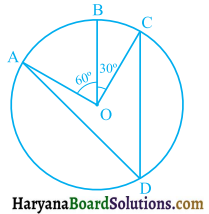
In Fig. 10.36, A, B and C are three points on a circle with centre O such that ∠BOC = 30° and ∠AOB = 60°. If D is a point on the circle other than the arc ABC. find ∠ADC.
HBSE 9th Class Maths Solutions Chapter 10 Circles Ex 10.5 1
Solution:
∠AOC = ∠AOB + ∠BOC
∠AOC = 60° + 30°
∠AOC = 90°
∠AOC is an angle subtended by an arc AC on centre and ∠ADC on the remaining part of the circle.
∴ ∠AOC = 2 × ∠ADC [By theorem 10.8]
⇒ 90° = 2 × ∠ADC
⇒ ∠ADC = \(\frac{90^{\circ}}{2}\) = 45°3
Hence, ∠ADC = 45°.

Question 2.
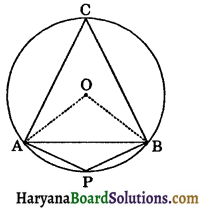
A chord of a circle is equal to the radius of the circle. Find the angle subtended by the chord at a point on the minor arc and also at a point on the major arc.
Solution:
Let AB be a chord which is equal to radius. Join OA and OB, where O is the centre of the circle.
HBSE 9th Class Maths Solutions Chapter 10 Circles Ex 10.5 2
∵ AO = OB = AB (given)
∴ AOB is an equilateral triangle.
⇒ ∠AOB = 60°
Reflex ∠AOB = 360° – 60° = 300°
∠AOB = 2 × ∠ACB [By theorem 10.8]
⇒ 60° = 2 × ∠ACB
⇒ ∠ACB = \(\frac{60^{\circ}}{2}\) = 30°
and Reflex (∠AOB) = 2 × ∠APB [By theorem 10.8]
⇒ 300° = 2 × ∠APB
⇒ ∠APB = \(\frac{300^{\circ}}{2}\) = 150°
Hence, angle subtended by the chord at a point on the minor arc is 150° and major arc is 30°.

HBSE 9th Class Maths Solutions Chapter 10 Circles Ex 10.5

Question 3.
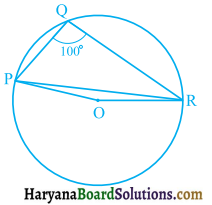
In Fig. 10.37, ∠PQR = 100°, where P, Q and R are points on a circle with centre O. Find ∠OPR.
HBSE 9th Class Maths Solutions Chapter 10 Circles Ex 10.5 3
Solution:
Since, reflex ∠POR is an angle subtended by an arc PR at the centre and ∠PQR at the remaining part of the circle.
∴ Reflex ∠POR = 2 × ∠PQR
⇒ Reflex ∠POR = 2 × 100° = 200°
∠POR = 360° – Reflex ∠POR
⇒ ∠POR = 360° – 200° = 160°
In ΔPOR, OP = OR [Radii of the same circle]
⇒ ∠OPR = ∠ORP [Angles opposite to equal sides are equal]
Let ∠OPR = ∠ORP = x°
In ΔPOR, we have
∠OPR + ∠ORP + ∠POR = 180° [∵ Sum of angles of a triangle is 180°]
⇒ x° + x° + 160° = 180°
⇒ 2x° = 180° – 160° = 20°
⇒ x° = \(\frac{20^{\circ}}{2}\) = 10°
Hence, ∠OPR = 10°.

Question 4.
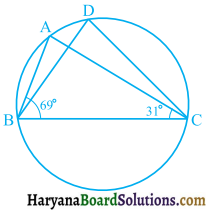
In Fig. 10.38, ∠ABC = 69°, ∠ACB = 31°, find ∠BDC.
HBSE 9th Class Maths Solutions Chapter 10 Circles Ex 10.5 4
Solution:
In ΔBAC, we have
∠ABC + ∠BCA + ∠BAC = 180° [∵ Sum of angles of a triangle = 180°]
⇒ 69° + 31° + ∠BAC = 180°
⇒ 100° + ∠BAC = 180°
⇒ ∠BAC = 180° – 100°
⇒ ∠BAC = 80°
∠BDC = ∠BAC
[∵ Angles in the same segment are equal]
Hence ∠BDC = 80°.

Question 5.
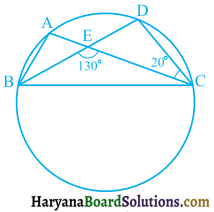
In Fig. 10.39, A, B, C and D are four points on a circle. AC and BD intersect at a point E such that ∠BEC = 130° and ∠ECD = 20°. Find ∠BAC.
HBSE 9th Class Maths Solutions Chapter 10 Circles Ex 10.5 5
Solution:
In ΔECD, we have
∠BEC = ∠EDC + ∠ECD [∵ Exterior angle is equal to sum of its opposite two interior angles]
⇒ 130° = ∠EDC + 20°
⇒ ∠EDC = 130° – 20°
⇒ ∠EDC = 110°
⇒ ∠BDC = 110°
∠BAC = ∠BDC [∵ Angles in the same segment are equal]
Hence, ∠BAC = 110°.

HBSE 9th Class Maths Solutions Chapter 10 Circles Ex 10.5

Question 6.
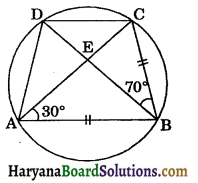
ABCD is a cyclic quadrilateral whose diagonals intersect at a point E. If ∠DBC = 70°, ∠BAC is 30°, find ∠BCD. Further, if AB = BC, find ∠ECD.
Solution:
In ΔABC,
AB = BC (given)
⇒ ∠BAC = ∠BCA [∵ Angles opp. to equal sides are equal]
HBSE 9th Class Maths Solutions Chapter 10 Circles Ex 10.5 6
30° = ∠BCA
⇒ ∠BCA = 30°
In ΔABC, we have
∠BAC + ∠BCA + ∠ABC = 180°
⇒ 30° +30° +70° + ∠ABE = 180°
⇒ 130° + ∠ABE = 180°
⇒ ∠ABE = 180° – 130° = 50°
⇒ ∠ABD = 50°
∠ACD = ∠ABD [∵ Angles in the same segment of a circle are equal]
⇒ ∠ACD = 50°
⇒ ∠ECD = 50°
⇒ ∠BCD = ∠BCA + ∠ACD
⇒ ∠BCD = 30° +50°
⇒ ∠BCD = 80°
Hence, ∠BCD = 80° and ∠ECD = 50°.

Question 7.
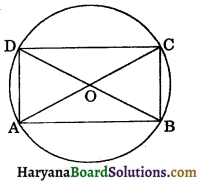
If diagonals of a cyclic quadrilateral are diameters of the circle through the vertices of the quadrilateral, prove that it is a rectangle.
Solution:
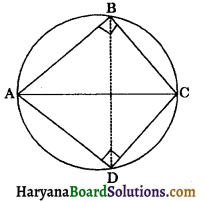
Given: Diagonals AC and BD of cyclic quadrilateral are thediameters of the circle through the vertices of the quadrilateral ABCD.
HBSE 9th Class Maths Solutions Chapter 10 Circles Ex 10.5 7
To prove: Quadrilateral ABCD is a rectangle.
Proof: Since BD is a diameter.
∠C = ∠A = 90°
[Angle in a semicircle is 90°]
Similarly, AC is a diameter.
∠B = ∠D = 90°
[Angle in a semicircle is 90°]
Thus, in a quadrilateral ABCD
∠A = ∠B = ∠C = ∠D = 90°
Hence, quadrilateral ABCD is a rectangle
Proved.

HBSE 9th Class Maths Solutions Chapter 10 Circles Ex 10.5

Question 8.
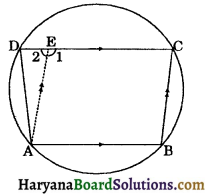
If the non-parallel sides of a trapezium are equal, prove that it is cyclic.
Solution:
A trapezium ABCD in which AB || CD and AD = BC.
HBSE 9th Class Maths Solutions Chapter 10 Circles Ex 10.5 8
To prove: Trapezium ABCD is cyclic.
Construction: Draw AE || BC.
Proof: Since, AB || CD (given)
and AE || BC (By construction)
∴ AE = BC …..(i) (Opposite sides of a parallelogram)
AD = BC (given) … (ii)
From (i) and (ii), we get
AE = AD
⇒ ∠2 = ∠D …..(iii)
[Angles opposite to equal sides are equal]
∠B = ∠1 …..(iv)
[Opposite angles of a parallelogram]
But, ∠1 + ∠2 = 180°
[By linear pair axiom]
∠B + ∠D = 180° [Using (iii) and (iv)]
⇒ ABCD is a cyclic.
Hence, trapezium ABCD is cyclic.
Proved

Question 9.
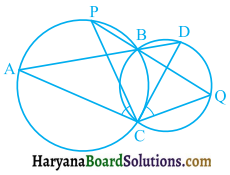
Two circles intersect at two points B and C. Through B, two line segments ABD and PBQ are drawn to intersect the circles at A, D and P, Q respectively (see Fig. 10.40). Prove that ∠ACP = ∠QCD.
HBSE 9th Class Maths Solutions Chapter 10 Circles Ex 10.5 9
Solution:
∠ABP = ∠ACP ……(i)
[Angles in a same segment are equal]
∠QBD = ∠QCD …..(ii)
[Angles in a same segment are equal]
∠ABP = ∠QBD …..(iii)
(Vertically opposite angles)
From (i), (ii) and (iii), we get
∠ACP = ∠QCD. Hence proved

Question 10.
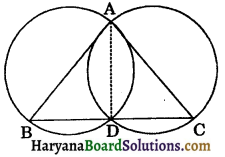
If circles are drawn taking two sides of a triangle as diameters, prove that the point of intersection of these circles lie on the third side.
Solution:
Given: Two circles are drawn with sides AB and AC of ΔABC as diameters. The circles intersect each other at D.
HBSE 9th Class Maths Solutions Chapter 10 Circles Ex 10.5 10
To prove: Point D lies on BC i.e., BDC is a straight line.
Construction: Join AD.
Proof: Since AB and AC are diameters of two circles.
∴ ∠ADB = 90° …..(i)
[Angle in semicircle is 90°]
and ∠ADC = 90° …..(ii)
[Angle in a semicircle is 90°]
Adding (i) and (ii), we get
∠ADB + ∠ADC = 90° + 90°
⇒ ∠ADB + ∠ADC = 180°
⇒ BDC is a straight line.
Hence, D lies on BC. Proved.

HBSE 9th Class Maths Solutions Chapter 10 Circles Ex 10.5

Question 11.
ABC and ADC are two right triangles with common hypotenuse AC. Prove that ∠CAD = ∠CBD.
Solution:
∠ABC = ∠ADC = 90° (given)
In a quadrilateral ABCD,
∠ABC + ∠ADC = 90° + 90°
= 180°
HBSE 9th Class Maths Solutions Chapter 10 Circles Ex 10.5 11
Therefore, ABCD is a cyclic quadrilateral.
∠CAD = ∠CBD [Angles in a same segment are equal]
Hence proved

Question 12.
Prove that a cyclic parallelogram is a rectangle.
Solution:
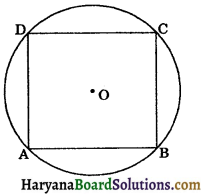
Given: A cyclic parallelogram ABCD.
HBSE 9th Class Maths Solutions Chapter 10 Circles Ex 10.5 12
To prove: ABCD is a rectangle.
Proof : Since ABCD is a parallelogram. (given)
∴ ∠A = ∠C
(Opposite angles of a || gm) …(i)
But, ∠A + ∠C = 180° [By theorem]
⇒ ∠A + ∠A = 180° [Using (i)]
⇒ 2∠A = 180°
⇒ ∠A = \(\frac{180^{\circ}}{2}\)
So, ∠A = ∠C = 90°
Thus, ABCD is a parallelogram in which
∠A = ∠C = 90°.
Hence, ABCD is a rectangle. Proved

HBSE 9th Class Maths Solutions Chapter 10 Circles Ex 10.5 Read More »

HBSE 9th Class Science Important Questions Chapter 13 हम बीमार क्यों होते हैं

Haryana State Board HBSE 9th Class Science Important Questions Chapter 13 हम बीमार क्यों होते हैं Important Questions and Answers.

Haryana Board 9th Class Science Important Questions Chapter 13 हम बीमार क्यों होते हैं

अति लघूत्तरात्मक प्रश्न

प्रश्न 1.
स्वास्थ्य का क्या अर्थ है?
उत्तर:
शरीर के सभी अंगों तथा तंत्रों की ठीक बनावट, स्थिति तथा ठीक प्रकार से कार्य करना, स्वास्थ्य कहलाता है। स्वास्थ्य शरीर की शारीरिक, मानसिक व सामाजिक जीवन क्षमता की सामान्य स्थिति है।

प्रश्न 2.
रोग किसे कहते हैं?
उत्तर:
अच्छे स्वास्थ्य में रुकावट पैदा होना ही रोग है। या शरीर तंत्र में किसी विकार का आ जाना रोग कहलाता है।

प्रश्न 3.
स्वास्थ्य को प्रभावित करने वाले एक कारक का नाम लिखो।
उत्तर:
व्यक्तिगत स्वच्छता।

प्रश्न 4.
सामुदायिक स्वच्छता को प्रभावित करने वाले एक कारण का नाम लिखो।
उत्तर:
कूड़े-करकट का वैज्ञानिक ढंग से निपटारा न होना।

प्रश्न 5.
भोजन हमारे स्वास्थ्य को कैसे प्रभावित करता है?
उत्तर:
भोजन में पोषक पदार्थों की कमी और अधिकता दोनों स्वास्थ्य पर कुप्रभाव डालते हैं।

प्रश्न 6.
हमारा परिवेश किस प्रकार हमें नुकसान पहुंचाता है?
उत्तर:
परिवेश में मिल रहे, अवांछनीय पदार्थ, हमारे लिए रोगों का कारण बनते हैं।

प्रश्न 7.
क्या शरीर में किसी रोग का न होना ही स्वास्थ्य कहलाता है?
उत्तर:
नहीं, कोई रोग न होने पर भी आप अपने-आपको स्वस्थ नहीं मान सकते।

प्रश्न 8.
रोग का पता कैसे लगाया जाता है?
उत्तर:
रोग के लक्षणों के द्वारा।

प्रश्न 9.
रोग के लक्षण क्या होते हैं?
उत्तर:
जो संकेत हमारे शरीर में खराबी के बारे में संकेत देते हैं, उन्हें रोग के लक्षण कहते हैं।

HBSE 9th Class Science Important Questions Chapter 13 हम बीमार क्यों होते हैं

प्रश्न 10.
चिकित्सक किसी रोग के बारे में सुनिश्चित करने के लिए क्या करते हैं?
उत्तर:
प्रयोगशाला में परीक्षण करवाते हैं।

प्रश्न 11.
रोग कितने प्रकार के होते हैं? (अवधि के आधार पर)
उत्तर:
दो प्रकार के तीव्र रोग, दीर्घकालिक रोग।

प्रश्न 12.
तीव्र रोग किसे कहते हैं?
उत्तर:
कम अवधि वाले रोगों को, तीव्र रोग कहते हैं।

प्रश्न 13.
दो तीव्र रोगों के नाम लिखो।
उत्तर:
खाँसी-जुकाम, सिरदर्द।

प्रश्न 14.
दीर्घकालिक रोग किसे कहते हैं?
उत्तर:
दीर्घकालिक रोग लंबी अवधि तक या जीवन-पर्यंत रहते हैं।

प्रश्न 15.
दीर्घकालिक रोग का नाम लिखो।
उत्तर:
फीलपाँव।

प्रश्न 16.
क्या पोषण के अभाव में व्यक्ति बीमार हो सकता है?
उत्तर:
हाँ, पोषण के अभाव में व्यक्ति बीमार हो सकता है।

प्रश्न 17.
एंटीबायोटिक पेनिसीलीन बैक्टीरिया की ………………… बनाने वाली प्रक्रिया को बाधित कर देती है।
उत्तर:
कोशिका भित्ति।

प्रश्न 18.
संक्रामक रोग किन्हें कहते हैं?
उत्तर:
जो रोग संपर्क से फैलते हैं, उन्हें संक्रामक रोग कहते हैं।

प्रश्न 19.
दो संक्रामक रोगों के नाम लिखो।
उत्तर:
हैज़ा, पीलिया।

प्रश्न 20.
असंक्रामक रोग किन्हें कहते हैं?
उत्तर:
जो रोग संक्रमण से न फैलें, उन्हें असंक्रामक रोग कहते हैं।

प्रश्न 21.
असंक्रामक रोगों के नाम लिखो।
उत्तर:
गलगंड, मधुमेह।

प्रश्न 22.
कैंसर कैसा रोग है?
उत्तर:
असंक्रामक रोग।

प्रश्न 23.
वाइरस से होने वाले दो रोगों के नाम लिखो।
उत्तर:
खाँसी-जुकाम, इंफ्लुएंजा।

प्रश्न 24.
बैक्टीरिया से कौन-कौन से रोग होते हैं?
उत्तर:
हैजा, क्षयरोग।

HBSE 9th Class Science Important Questions Chapter 13 हम बीमार क्यों होते हैं

प्रश्न 25.
फंजाई (कवकों) से होने वाले रोगों के उदाहरण दो।
उत्तर:
चर्म रोग-खाज-खुजली, दाद आदि।

प्रश्न 26.
प्रोटोजोआ से होने वाले दो रोगों के नाम लिखो।
उत्तर:
मलेरिया, कालाजार।

प्रश्न 27.
कृमि से होने वाले रोगों के नाम क्या हैं?
उत्तर:
फीलपाँव, एस्केरिएसिस।

प्रश्न 28.
मुहाँसे के कारक का नाम लिखो।
उत्तर:
स्टेफाइलोकोकाई बैक्टीरिया।

प्रश्न 29.
निंद्रालु व्याधि का कारण क्या है?
उत्तर:
ट्रिप्नोसोमा जीवाणु।

प्रश्न 30.
लेस्मानिया नामक प्रोटोजोआ कौन-से रोग का कारण है?
उत्तर:
कालाजार।

प्रश्न 31.
एक एंटीबायोटिक का नाम लिखो।
उत्तर:
पेनिसिलीन।

प्रश्न 32.
संक्रामक रोगों के फैलने की दो विधियों के नाम लिखो।
उत्तर:
वायु द्वारा, सीधे संपर्क द्वारा।

प्रश्न 33.
खाँसी-जुकाम के विषाणु कैसे फैलते हैं?
उत्तर:
रोगी व्यक्ति के द्वारा छींकने से।

प्रश्न 34.
पेयजल के संक्रमण से कौन-सा रोग हो जाता है?
उत्तर:
हैज़ा।

प्रश्न 35.
लैंगिक संपर्क द्वारा फैलने वाले दो रोगों के नाम लिखो।
उत्तर:
सिफलिस, एड्स।

प्रश्न 36.
क्या गर्भावस्था में रोगी माता से शिशु को AIDS के फैलने का भय हो सकता है?
उत्तर:
हाँ।

प्रश्न 37.
रोगवाहक किसे कहते हैं?
उत्तर:
जो जंतु रोगाणुओं को रोगी से लेकर अन्य नए पोषी तक पहुँचा देते हैं, रोगवाहक कहलाते हैं।

प्रश्न 38.
मलेरिया का रोगवाहक कौन-सा जंतु है?
उत्तर:
मादा एनाफ्लीज मच्छर।

प्रश्न 39.
प्लेग के वेक्टर (रोगवाहक) का नाम लिखो।
उत्तर:
चूहा।

प्रश्न 40.
क्षयरोग किस विधि द्वारा फैलता है?
उत्तर:
वायु द्वारा।

प्रश्न 41.
पीलिया के कारक का नाम लिखो।
उत्तर:
हेपेटाइटिस बैक्टीरिया।

प्रश्न 42.
HIV शरीर में प्रवेश कैसे करता है?
उत्तर:
लैंगिक अंगों द्वारा।

प्रश्न 43.
शोथ किसे कहते हैं?
उत्तर:
नई कोशिकाओं के बनने के प्रक्रम को शोथ कहते हैं।

प्रश्न 44.
HIV-AIDS का शरीर पर क्या कुप्रभाव पड़ता है?
उत्तर:
यह शरीर के प्रतिरक्षा-तंत्र को आघात पहुँचाता है।

प्रश्न 45.
शरीर में रोगाणुओं को नष्ट करने के लिए किन पदार्थों का उपयोग किया जाता है?
उत्तर:
औषधियों का।

प्रश्न 46.
एंटी वायरल औषधि बनाना कठिन होता है, क्यों?
उत्तर:
क्योंकि वाइरस में जैव रासायनिक प्रणाली कम ही होती है।

प्रश्न 47.
वातोढ़ रोग किसे कहते हैं?
उत्तर:
वायु द्वारा फैलने वाले रोगों को, वातोढ़ रोग कहते हैं।

प्रश्न 48.
जलोढ़ रोग किसे कहते हैं?
उत्तर:
जल से होने वाले रोगों को जलोढ़ रोग कहते हैं।

प्रश्न 49.
हमारे शरीर में कौन-सा तंत्र रोगाणुओं से लड़ता है?
उत्तर:
प्रतिरक्षा-तंत्र।

प्रश्न 50.
टीका किसे कहते हैं?
उत्तर:
वह प्रक्रिया जिसमें प्रतिरक्षी पदार्थ (टीका) सुई द्वारा स्वस्थ व्यक्ति के शरीर में दिया जाता है ताकि उसके शरीर में बीमारी के प्रति प्रतिरक्षण हो जाए।

लघूत्तरात्मक प्रश्न

प्रश्न 1.
स्वास्थ्य किसे कहते हैं? अच्छे स्वास्थ्य के लाभ लिखें।
उत्तर:
किसी व्यक्ति को उसके शारीरिक, मानसिक तथा सामाजिक रूप से ठीक अनुभव करने की स्थिति, स्वास्थ्य कहलाती है। स्वस्थ व्यक्ति के शरीर के सभी अंगों की बनावट और उनके कार्य ठीक-ठाक होते हैं। वह हर प्रकार के मनोवैज्ञानिक, मानसिक व सामाजिक तनावों से मुक्त होता है। केवल शारीरिक रोगों से मुक्त व्यक्ति ही पूर्ण स्वस्थ नहीं होता, बल्कि स्वस्थ व्यक्ति को रोग घटकों से भी मुक्त होना चाहिए।

लाभ-अच्छे स्वास्थ्य के लाभ निम्नलिखित हैं-

  • स्वस्थ व्यक्ति का व्यक्तिगत जीवन सुखमय होता है।
  • स्वस्थ व्यक्ति निजी रूप में, परिवार के रूप में, समाज के रूप में तथा राष्ट्र के रूप में अपनी पूरी क्षमताओं का सदुपयोग करता है और वह दूसरे व्यक्ति पर किसी प्रकार का बोझ नहीं होता।

प्रश्न 2.
अच्छे स्वास्थ्य को बनाए रखने के लिए आवश्यक परिस्थितियाँ क्या हैं?
उत्तर:
अच्छे स्वास्थ्य को बनाए रखने के लिए आवश्यक परिस्थितियाँ निम्नलिखित प्रकार से हैं-

  • व्यक्तिगत तथा घरेलू स्वच्छता।
  • उचित व्यायाम तथा विश्राम।।
  • संतुलित आहार।
  • सामुदायिक स्वच्छता।
  • उचित आदतें एवं व्यसनकारी पदार्थों से परहेज।

प्रश्न 3.
किसी स्वस्थ व्यक्ति के बारे में आपका दृष्टिकोण क्या है?
उत्तर:
स्वस्थ व्यक्ति वह है जिसके शरीर के सभी अंग तथा तंत्र सुचारू रूप से कार्य कर रहे हों तथा वह शारीरिक, मानसिक तथा सामाजिक तनावों से मुक्त हो । स्वस्थ व्यक्ति शारीरिक, मानसिक तथा सामाजिक दृष्टि से सक्षम होता है। स्वस्थ व्यक्ति प्रसन्न, मानसिक रूप से चैतन्य, निरोग तथा चिंताओं से मुक्त होता है। वह सामाजिक रूप से अपना कर्त्तव्य पूर्ण करने में सक्षम होता है। वह अपने वातावरण से अच्छी तरह समायोजन कर सकता है। ऐसे व्यक्ति की कार्यक्षमता अधिक होती है।

HBSE 9th Class Science Important Questions Chapter 13 हम बीमार क्यों होते हैं

प्रश्न 4.
पर्यावरण का स्वास्थ्य पर क्या प्रभाव पड़ता है?
उत्तर:
सभी व्यक्तियों का स्वास्थ्य उसके आस-पड़ोस अथवा आस-पास के पर्यावरण पर आधारित होता है। पर्यावरण में कारक आते हैं। व्यक्ति जीवन की आधारभूत आवश्यकताएँ पर्यावरण से ही प्राप्त करता है केवल साफ़-सुथरे पर्यावरण से ही यह संभव हो सकता है। दूषित पर्यावरण हमारे स्वास्थ्य को प्रभावित कर बीमार कर देता है।

प्रश्न 5.
रोगजनक सूक्ष्मजीव किसे कहते हैं?
उत्तर:
कुछ सूक्ष्मजीव पौधों और जंतुओं में रोग उत्पन्न करते हैं, इन्हें रोगजनक सूक्ष्मजीव कहते हैं। इनमें से कुछ सूक्ष्मजीव हमारे पाचन संस्थान या फिर शरीर के अन्य किसी भाग में विष उत्पन्न करने के कारण बन जाते हैं। कुछ सूक्ष्मजीव शरीर की सामान्य प्रक्रियाओं को असामान्य कर शरीर को रोगी बना देते हैं।

प्रश्न 6.
कारण बताते हुए स्पष्ट कीजिए कि निम्नलिखित कथन सत्य हैं अथवा असत्य-
(1) अच्छे स्वास्थ्य का अर्थ है शरीर का रोगमुक्त होना।
(2) यदि आप संतुलित आहार ले रहे हैं तो आपका स्वच्छ रहना आवश्यक नहीं है।
उत्तर:
(1) यह कथन असत्य है क्योंकि स्वास्थ्य का अर्थ केवल शारीरिक रोग का न होना (रोगमुक्त होना) ही नहीं है, बल्कि स्वास्थ्य सभी अंगों तथा तंत्रों की सुचारू रूप से कार्य करने की स्थिति है। स्वस्थ व्यक्ति शारीरिक, मानसिक तथा सामाजिक तनावों से मुक्त होता है तथा आनंद का अनुभव करता है।

(2) यह कथन असत्य है क्योंकि अच्छे स्वास्थ्य के लिए केवल एकमात्र संतलित आहार लेना ही आवश्यक नहीं, बल्कि शरीर रोगमुक्त भी होना चाहिए। इसलिए संतुलित आहार के साथ-साथ व्यक्तिगत स्वच्छता तथा आस-पड़ोस की स्वच्छता भी आवश्यक है। इसके लिए पर्यावरण शुद्ध और सुंदर होना चाहिए। स्वच्छ. रहकर ही हम सूक्ष्मजीवों, कृमि, कीटों, प्रदूषण आदि कारकों से उत्पन्न रोगों से मुक्त हो सकते हैं।

प्रश्न 7.
यदि आपका घर स्वच्छ है किंतु आस-पड़ोस स्वच्छ नहीं है तो क्या आप स्वस्थ रह सकते हैं? यदि नहीं, तो क्यों?
उत्तर:
नहीं, यदि हमारा घर स्वच्छ है और आस-पड़ोस स्वच्छ नहीं है तो हम स्वस्थ नहीं रह सकते क्योंकि यदि हमारे आस-पास गंदगी के ढेर लगे होंगे तो उसमें हानिकारक सूक्ष्मजीव पैदा होने लगेंगे जो वायु में मिलकर वायु को प्रदूषित कर देंगे। ऐसी वायु में सांस लेने पर हम स्वस्थ नहीं रह सकेंगे। इसी प्रकार मक्खी जैसे कीट हानिकारक सूक्ष्मजीवों को हमारे भोजन तक पहुँचा देंगे। ऐसे भोजन को खाने से भी हम स्वस्थ नहीं रह पाएँगे। मच्छर जैसे जीव रोगाणुओं को हमारे शरीर में प्रविष्ट कर देंगे।

यदि हमारे आस-पास का पेयजल स्वच्छ नहीं है तो उस जल में उपस्थित रोगाणु हमें स्वस्थ नहीं रहने देंगे। अतः स्वस्थ रहने के लिए यह आवश्यक है कि घर के साथ-साथ आस-पड़ोस भी स्वच्छ हो। उदाहरण के लिए, जल-स्रोत के पास गंदे कपड़े धोने पर वे सभी लोग प्रभावित होंगे, जो वहाँ से जल ग्रहण करते हैं। इसलिए कुओं और तालाबों पर गंदे कपड़े धोने को मना किया जाता है। इसी प्रकार गंदगी पर पनपे मच्छर और मक्खियाँ स्वच्छ घर वाले व्यक्ति को भी प्रभावित करते हैं।

प्रश्न 8.
रोग के लक्षण किसे कहते हैं?
उत्तर:
शरीर में रोग होने पर, अंग-तंत्रों में आई खराबी या व्यवधान, बदलाव या परिवर्तन के द्वारा दिखाई देते हैं। इन परिवर्तनों के संकेतों को ही लक्षण कहते हैं। रोग के लक्षणों से रोगों की पहचान करना सरल हो जाता है केवल अनुभव की आवश्यकता होती है। कई बार दिखाई देने वाले लक्षणों से बीमारी का ठीक-ठाक अनुमान भी नहीं लग पाता; जैसे सिर दर्द का कारण भय, तनाव, मस्तिष्क शोथ में से कुछ भी हो सकता है। ऐसी स्थिति में प्रयोगशाला में कुछ परीक्षण करवाकर रोग के बारे में सुनिश्चित किया जाता है।

प्रश्न 9.
रोग क्या है? रोग कैसे होते हैं?
उत्तर:
शारीरिक, मनोवैज्ञानिक या शरीर की किसी अन्य कार्यप्रणाली में अवरोध की स्थिति को, रोग कहा जाता है। रोगी व्यक्ति अपने-आपको आराम की स्थिति में अनुभव नहीं करता।

रोगों के कारण-रोग निम्नलिखित तीन कारणों में से किसी एक कारण से हो सकते हैं-

  • पोषक तत्त्वों की कमी या अधिकता के कारण होने वाले रोग; जैसे गलगंड, बेरी-बेरी, मोटापा आदि।
  • संक्रमण से; जैसे हैज़ा, तपेदिक, खसरा आदि।
  • बिना संक्रमण के जैसे हृदय रोग, गुर्दे या पिताशय की पथरी आदि।

प्रश्न 10.
असंक्रमित रोग कौन-कौन से हैं?
उत्तर:
कुछ रोग; जैसे हृदय रोग, गुर्दे का कार्य न करना, पिताशय की पथरी व गुर्दे की पथरी ऐसे रोग हैं जो किसी रोगी व्यक्ति के संक्रमण से नहीं होते, इन रोगों को असंक्रमित रोग कहते हैं।

प्रश्न 11.
आनुवंशिक रोगों से क्या अभिप्राय है? उदाहरण दें।
उत्तर:
जो रोग मां-बाप से बच्चों तक पहुँचते हैं, उन्हें आनुवंशिक रोग कहते हैं। इस प्रकार का एक रोग हीमोफीलिया है जिसमें रोगी का रक्त आसानी से नहीं जमता। सामान्यतः इसका समय 2 से 8 मिनट से बढ़कर 30 मिनट से 24 घंटे तक का हो जाता है। हीमोफीलिया का रोगी किसी छोटी-सी चोट के घाव से लगातार रक्त बहते रहने के कारण मर सकता है।

इसी प्रकार का एक अन्य रोग है-दांत्र-कोशिका अरक्तता (Sickle cell anaemia)। यह ऐसे व्यक्तियों को होता है जिनके रक्त की लाल रुधिर कोशिकाओं में दोषपूर्ण हीमोग्लोबिन होता है। ये कोशिकाएँ हंसिया की भाँति दिखाई देती हैं। इससे इन RBC की ऑक्सीजन संवहन क्षमता कम हो जाती है और व्यक्ति कमज़ोर होता जाता है।

प्रश्न 12.
संक्रामक तथा असंक्रामक रोगों से क्या अभिप्राय है?
उत्तर:
संक्रामक रोग-संक्रामक रोग शरीर में रोगाणुओं के प्रवेश से उत्पन्न होते हैं और प्रत्यक्ष या अप्रत्यक्ष रूप से छूने या रोगवाहकों द्वारा एक व्यक्ति से दूसरे व्यक्ति में फैलते हैं। ये रोग हवा, पानी, दूध, भोजन आदि द्वारा भी संचरित हो सकते हैं; जैसे चेचक, हैज़ा, पेचिश, लिवररोट, दाद, खुजली आदि।

असंक्रामक रोग-ये रोग व्यक्ति के छूने या अन्य तरीकों से नहीं फैलते। ये रोग मुख्यतः पोषण की कमी या अधिकता, पर्यावरण प्रदूषण, आनुवंशिकी व्यसन के कारण होते हैं; जैसे हृदय रोग, कैंसर, बेरी-बेरी, मोटापा, मरास्मस, स्कर्वी, दांत्र-कोशिका आदि।

प्रश्न 13.
सर्दी-जुकाम के विषाणु शरीर के अंदर कैसे प्रवेश करते हैं?
उत्तर:
साधारण सर्दी-जुकाम से पीड़ित व्यक्ति जब भी छींकता है तो विषाणुयुक्त नमी की कुछ बूंदें हवा में छिटक जाती हैं। जब नमी वाष्पित होती है तो यही संक्रमण विषाणु खुली हवा व धूल कणों में फैल जाते हैं जो सांस द्वारा स्वस्थ व्यक्ति में प्रवेश कर उसे प्रभावित करते हैं। रोगी व्यक्ति के रूमाल से भी विषाणु का संक्रमण होता है।

प्रश्न 14.
प्रतिजैविक पदार्थ क्या हैं? ये रोगाणओं से हमें कैसे बचाते हैं? इनका अधिक प्रयोग क्यों हानिकारक है?
उत्तर:
प्रतिजैविक पदार्थ वे पदार्थ हैं जो एक सूक्ष्मजीव बनाता है तथा दूसरे सूक्ष्मजीव के लिए वे घातक होते हैं। इनसे मनुष्य के प्रोटोप्लाज्म को हानि नहीं पहुँचती। उदाहरण के लिए, पेनिसिलीन, टैरामाइसिन, क्लोरोमाइसीटीन, स्ट्रेप्टोमाइसिन आदि। ये रोगाणुओं की वृद्धि को रोककर और उनकी जैव क्रियाओं को नष्ट करके हमें उनसे बचाते हैं।

यदि इनका अधिक प्रयोग किया जाए तो हमारी आहार-नली में स्थित लाभदायक जीवाणु मरने लगते हैं, जिससे हमारा पाचन-संस्थान बिगड़ जाता है।

प्रश्न 15.
सूक्ष्मजीवों से होने वाले रोगों से बचने के लिए साधारण व सरल उपाय क्या हैं?
उत्तर:
सूक्ष्मजीवों से होने वाले रोगों से बचने के साधारण और सरल उपाय निम्नलिखित हैं-

  • रोगी व्यक्तियों को स्वस्थ व्यक्तियों से अलग रखकर।
  • रोग प्रतिरोधी टीके लगवाकर।
  • पानी को पीने से पहले उबालकर।
  • अपने आस-पड़ोस में साफ-सफाई रखकर।
  • मक्खी और मच्छरों पर नियंत्रण रखकर।
  • साफ़-सुथरे कपड़े पहनकर।
  • कूड़े-करकट, अपशिष्ट पदार्थों को ढके स्थानों पर रखकर।
  • कीटनाशकों का छिड़काव कर अपने आस-पड़ोस को हानिकारक कीटों, कवकों और रोगाणओं से मक्त करके।

प्रश्न 16.
सूक्ष्मजीव हमारे शरीर में किन-किन माध्यमों से प्रवेश करते हैं? प्रत्येक का उदाहरण लिखिए।
उत्तर:
सूक्ष्मजीव हमारे शरीर में वायु, जल, भोजन तथा त्वचीय स्पर्श द्वारा प्रवेश करते हैं। सामान्य सर्दी या जुकाम में इंफ्लुएंजा के विषाणु वायु द्वारा फैलते हैं। हैजे, जठरात्र शोध तथा मियादी बुखार के जीवाणु भोजन तथा जल के माध्यम से फैलते या शरीर में प्रवेश करते हैं। रिंगवर्म एक प्रकार की फंगस का संक्रमण है। यह त्वचीय स्पर्श द्वारा फैलता है। सिफलिस, गोनोरिया जैसे यौन रोग उत्पन्न करने वाले जीवाणु तथा एड्स उत्पन्न करने वाले विषाणु यौन संबंधों द्वारा फैलते हैं।

प्रश्न 17.
जीवाणुओं और विषाणुओं में क्या अंतर है?
उत्तर:
जीवाणुओं और विषाणुओं में निम्नलिखित अंतर हैं-

जीवाणुविषाणु
1. ये जीवधारी होते हैं।1. इनमें सजीव तथा निर्जीव दोनों के गुण पाए जाते हैं।
2. इनकी संरचना कोशिकीय होती है।2. विषाणु की संरचना कोशिकीय नहीं होती।
3. जीवाणु सूक्ष्मदर्शी द्वारा देखे जा सकते हैं।3. इन्हें केवल इलेक्ट्रॉन सूक्ष्मदर्शी द्वारा ही देखा जा सकता है।
4. जीवाणुओं का जन्म उसी प्रकार के जीवाणुओं से होता है।4. विषाणुओं को निर्जीव पदार्थों से बनाया जा सकता है।
5. जीवाणु लाभदायक और हानिकारक दोनों प्रकार के होते हैं।5. विषाणु केवल हानिकारक ही होते हैं।

प्रश्न 18.
जीवाणु (बैक्टीरिया) संक्रमण के विरुद्ध एंटीबायोटिक कैसे कार्य करते हैं? यह औषधि विषाणु (वाइरस) संक्रमण के विरुद्ध प्रभावकारी नहीं होती, कारण स्पष्ट करें।
उत्तर:
बैक्टीरिया अपनी सुरक्षा के लिए कोशिका भित्ति बना लेते हैं। परन्तु एंटीबायोटिक पदार्थ कोशिका भित्ति निर्माण में बाधा डाल देते हैं जिसके कारण बैक्टीरिया अपनी सुरक्षा नहीं कर पाते और एंटीबायोटिक पदार्थ इन्हें नष्ट कर देते हैं। परन्तु विषाणु में कोशिका भित्ति का निर्माण नहीं होता। इसलिए एंटीबायोटिक का विषाणु पर कोई प्रभाव नहीं होता।

प्रश्न 19.
वायु द्वारा संक्रमण कैसे होता है?
उत्तर:
रोगी व्यक्ति जब वायु में सांस छोड़ता है, छींकता है या खाँसी करता है तो रोगाणु वायु में मिल जाते हैं। इसी वायु में अन्य व्यक्ति द्वारा श्वसन करने से ये रोगाणु उसके शरीर में पहुँच जाते हैं। खाँसी-जुकाम, निमोनिया तथा क्षयरोग इसी विधि द्वारा फैलते हैं। भीड़ वाले स्थानों पर खाँसी-जुकाम होने का यही कारण है।

प्रश्न 20.
जल द्वारा संक्रमण कैसे होता है?
उत्तर:
रोगी व्यक्ति के शरीर से जब रोगाणु पेयजल में मिल जाते हैं तो स्वस्थ व्यक्ति भी इसी जल के पीने से रोग से संक्रमित हो जाता है। बरसात के दिनों में जल द्वारा संक्रमण की दर अधिक होती है। हैज़ा इसी विधि द्वारा फैलता है।

प्रश्न 21.
लैंगिक संचारी रोग के फैलने के बारे में क्या भ्रांतियाँ हैं?
उत्तर:
सिफलिस, गोनोरिया, सुजाक आदि लैंगिक संचारी रोगों के बारे में आम जनता में भ्रम है कि ये रोग हाथ मिलाने, गले मिलने, कुश्ती करने, मिलकर खेलने-कूदने या आलिंगन से फैलते हैं। जबकि यह कटु असत्य है ये रोग रोगी व्यक्ति से रक्त आदान से, लैंगिक संपर्क से, शेव के स ब्लेड से, रोगी माता के स्तनपान कराने से, गर्भावस्था में रोगी माता से संचरित हो सकते हैं।

HBSE 9th Class Science Important Questions Chapter 13 हम बीमार क्यों होते हैं

प्रश्न 22.
रोग के लक्षण व चिह्न किस बात पर निर्भर करते हैं?
उत्तर:
रोग के लक्षण व चिहन इस बात पर निर्भर करते हैं कि सूक्ष्मजीवों का आक्रमण किस ऊतक या अंग विशेष पर हुआ है; जैसे-

  • फेफड़ों पर आक्रमण का लक्षण है खाँसी या सांस का कम आना।
  • यकृत पर आक्रमण का लक्षण है पीलिया रोग का होना।
  • मस्तिष्क पर आक्रमण का लक्षण है सिर दर्द, उल्टी आना, चक्कर आना अथवा बेहोशी। रोग के लक्षणों से यह तय हो जाता है कि किस अंग या ऊतक पर सूक्ष्मजीवों ने आक्रमण किया है।

प्रश्न 23.
शोथ किस बात का संकेत है?
उत्तर:
संक्रमण के समय प्रतिरक्षा-तंत्र क्रियाशील होने के कारण प्रभावित ऊतक को बचाने और रोगाणुओं का नाश करने के लिए अनेक कोशिकाएँ बनाता है यही ‘शोथ’ कहलाता है। इस प्रक्रम में स्थानीय प्रभाव उस भाग का फूलना व दर्द करना और सामान्य प्रभाव बुखार का होना है।

प्रश्न 24.
रोग की अभिव्यक्ति का सूक्ष्मजीवों की संख्या से क्या संबंध है?
उत्तर:
यदि सूक्ष्मजीवों की संख्या कम होती तो रोग की अभिव्यक्ति भी कम होती है अर्थात् रोग के लक्षण कम दिखाई देते हैं प्रभाव भी कम ही होता है और जबकि इनकी संख्या अधिक होने पर रोग की अभिव्यक्ति अधिक होती है। रोग के लक्षण अधिक व तीव्र दिखाई देते हैं और प्रभाव भी अधिक होता है।

प्रश्न 25.
किसी रोग के उपचार के नियम क्या हैं?
उत्तर:
संक्रमित रोग के उपचार के दो नियम हैं-

  • रोग के प्रभाव को कम करना
  • रोग के कारण को मारना।

पहले रोग के प्रभाव को कम करने के लिए उपचार किया जाता है ताकि रोग के लक्षण कम हो जाएँ और इसके उपरांत औषधि का उपयोग कर रोगाणुओं को नष्ट किया जाता है ताकि रोग ही नष्ट हो जाए।

प्रश्न 26.
रोग के कारण को नष्ट करने के लिए क्या सिद्धांत अपनाया जाता है?
उत्तर:
हम रोग के कारण को नष्ट करने अर्थात् रोगाणुओं को नष्ट करने के लिए ऐसी औषधियों का उपयोग करते हैं जो रोगाणुओं को तो नष्ट कर दें; परंतु शरीर को नुकसान न पहुँचाएँ। एंटीबायोटिक पदार्थ इसलिए उपयोगी होते हैं। जबकि वाइरस को नष्ट करने के लिए प्रतिजैविक पदार्थों का इस्तेमाल अधिक कारगर नहीं है क्योंकि वाइरस में अपनी जैव रासायनिक प्रणाली के कम होने के कारण एंटीबायोटिक पदार्थों का इन पर प्रभाव लगभग नहीं के बराबर है।

प्रश्न 27.
संक्रामक रोगों से छुटकारा पाने में तीन प्रमुख कठिनाइयाँ कौन-कौन सी हैं?
उत्तर:
संक्रामक रोगों से छुटकारा पाने में निम्नलिखित तीन प्रमुख कठिनाइयाँ हैं-

  • एक बार बीमार होने पर शरीर के कार्यों को काफी हानि होती है।
  • उपचार में लंबा समय लग सकता है।
  • संक्रमित रोगी अन्य व्यक्तियों में रोग फैलाने का स्रोत बन सकता है। अतः उपरोक्त कठिनाइयों से समस्या और बढ़ जाएगी। इसीलिए रोगों का निवारण (बचाव) उपचार से अच्छा है।

प्रश्न 28.
रोगों के निवारण की कितनी विधियाँ हैं? वर्णन करो।
उत्तर:
रोग निवारण की दो विधियाँ निम्नलिखित हैं-

  • सामान्य या संक्रमण से बचने की विधि
  • रोग विशिष्ट विधि।

1. सामान्य विधि-यदि हमें रोग फैलने की विधियों की जानकारी है तो हम सावधानी रखकर उनसे बचाव कर सकते हैं; जैसे दूषित जल व भोजन को ग्रहण न करना, संदूषित वायु में सांस न लेना, स्वच्छ पर्यावरण में रहना, रोगी के सीधे संपर्क से बचना आदि।

2. रोग विशिष्ट विधि-रोग विशिष्ट विधि में केवल उन सावधानियों को अपनाया जाता है जो रोग विशेष को होने से रोकती हैं; जैसे मच्छरदानी का उपयोग करने से मलेरिया से बचा जा सकता है। विशेष टीका लगाने से रोग विशेष के होने का खतरा टल सकता है।

प्रश्न 29.
हमारा शरीर रोगाणुओं से कैसे लड़ता है?
उत्तर:
हमारे शरीर में स्थित प्रतिरक्षा-तंत्र रोगाणुओं से लड़ता है। हमारे रक्त में पाई जाने वाली श्वेत रक्त कणिकाएँ रोगाणुओं को मार देती हैं। जैसे ही शरीर में रोगाणुओं का संक्रमण बढ़ता है तो ये कोशिकाएँ इन रोगाणुओं से मुकाबला करती हैं। यदि मुकाबले में रोगाणु नष्ट हो जाएँ तो शरीर स्वस्थ रहता है और यदि मुकाबला करने वाली विशेष कोशिकाएँ इस संघर्ष में हार जाएँ तो हम बीमार हो जाते हैं। शरीर में गंभीर बीमारी प्रतिरक्षा-तंत्र की असफलता का ही परिणाम है। अतः प्रतिरक्षा तंत्र को मजबूत बनाए रखने के लिए उचित पोषक तत्त्वों वाले आहार की आवश्यकता है।

प्रश्न 30.
एक बार चेचक होने पर उसे अंतिम बार क्यों माना जाता है?
उत्तर:
एक बार चेचक होने पर, शरीर का प्रतिरक्षा-तंत्र सक्रिय हो जाता है और चेचक के वाइरस से मुकाबला करता है। जब भी चेचक या इससे मिलता-जुलता रोगाणु शरीर में प्रवेश करता है तो प्रतिरक्षा-तंत्र पूरी क्षमता के साथ उसे नष्ट करने में जुट जाता . है जिससे संक्रमण शीघ्र ही समाप्त हो जाता है। इस प्रकार शरीर में सशक्त प्रतिरक्षा-तंत्र विकसित हो जाता है और पुनः चेचक नहीं हो पाता।

प्रश्न 31.
टीकाकरण क्या है?
उत्तर:
यह ऐसी प्रक्रिया है जिसमें पदार्थ (टीका) का संरोपण एक स्वस्थ व्यक्ति में सुई द्वारा किया जाता है जिससे उसके शरीर में उस बीमारी के प्रतिरक्षी पैदा हो जाते हैं। प्रतिरक्षण शरीर की वह क्षमता है जिससे प्रतिरक्षी वाहक द्वारा बाह्य बीमारी को पहचानने, समाप्त करने तथा उसे पूरी तरह उखाड़ फेंकने में सहायता मिलती है। टीकाकरण से व्यक्ति में बीमारी से लड़ने की क्षमता पैदा हो जाती है। चेचक, रेबीज़, पोलियो, डिप्थीरिया, चिकनपॉक्स तथा हेपेटाइटिस जैसी बीमारियों से सुरक्षा के लिए टीकाकरण किया जाता है।

प्रश्न 32.
बच्चों और गर्भवती महिलाओं का टीकाकरण क्यों किया जाता है?
उत्तर:
पोलियो, काली खाँसी, खसरा, डिप्थीरिया, टायफाइड तथा टेटनस बच्चों को होने वाले कुछ मुख्य रोग हैं। इन रोगों से बचाव के लिए शिशुओं एवं बच्चों को टीका लगवाना (प्रतिरक्षीकरण) आवश्यक है। सभी बच्चों तथा गर्भवती महिलाओं के इन रोगों से प्रतिरक्षण हेतु योजना के अंतर्गत भारत में पर्याप्त मात्रा में टीके बनाए तथा वितरित किए जा रहे हैं। यदि गर्भवती महिलाओं को बच्चे के जन्म से पहले ही टेटनस का टीका लगाया जाए तो बच्चों में प्रतिरक्षा का सामर्थ्य होता है। इसलिए उचित समय पर टीका लगाकर लाखों बच्चों की जान बचाई जा सकती है।

निबंधात्मक प्रश्न

प्रश्न 1.
रोगाणु बीमारियों को किस प्रकार फैलाते हैं?
उत्तर:
वे जीवाणु, जो रोग फैलाते हैं, रोगाणु कहलाते हैं। रोगाणुओं के शरीर में प्रवेश और इनकी प्रतिक्रिया से मनुष्य बीमार हो जाता है। निम्नलिखित विधियों द्वारा रोगाणु रोग फैला सकते हैं-
1. संपर्क द्वारा-कुछ रोगाणु रोगी के सीधे संपर्क से या रोगी द्वारा इस्तेमाल की हुई वस्तुओं से फैलते हैं; जैसे कोई स्वस्थ व्यक्ति रोगी के कपड़े पहन लेता है या उसका बिस्तर इस्तेमाल करता है, तो रोग के कीटाणु उसके शरीर में प्रवेश करके उसे रोगी बना देते हैं; जैसे चर्म रोग उत्पन्न करने वाले रोगाणु।

2. खाने की वस्तुओं द्वारा-टायफाइड, हैज़ा आदि के रोगाणु रोगी का बचा हुआ भोजन खाने से हमारे शरीर में प्रवेश करके रोग फैला देते हैं।

3. हवा द्वारा सर्दी, जुकाम, इंफ्लुएंजा आदि रोगों के रोगाणु स्वस्थ मनुष्य के शरीर में सांस द्वारा प्रवेश करते हैं।

4. रोगवाहकों द्वारा-मक्खी, मच्छर, चूहे, पिस्सू आदि कुछ जंतु रोग फैलाने में सहायक होते हैं; जैसे मलेरिया मादा एनाफ्लीज़ मच्छर के काटने से फैलता है। प्लेग चूहों के द्वारा फैलता है।

5. जल द्वारा रोगाणु पीने के जल के साथ मिलकर स्वस्थ व्यक्ति तक पहुँच जाते हैं और हैज़ा, पेचिश, टायफाइड आदि रोग मनुष्य को आ घेरते हैं। इसीलिए विशेषकर वर्षा ऋतु में पानी को उबालकर फिर उसे ठंडा कर पीने की सलाह दी जाती है ताकि रोगाणु नष्ट हो जाएँ।

प्रश्न 2.
संक्रमण से होने वाली प्रमुख बीमारियों का संक्षिप्त परिचय दो।
उत्तर:
संक्रमण से होने वाले रोग सूक्ष्मजीवों के द्वारा होते हैं; जैसे-
1. हैज़ा हैज़ा का कारक जीव विब्रियों कोलरी है। यह दूषित जल के पीने या संक्रमित खाद्य-पदार्थों के खाने से होता है, लगातार बुखार, थूक के साथ रक्त, शरीर में दर्द, अतिसार और गर्दन की गांठों में
सूजन आ जाती है।

2. टायफाइड-यह सालमोनेला बैक्टीरियम टाइफी द्वारा फैलता है। बुखार आना, सिरदर्द, नाक से रक्त का बहना, त्वचा पर चकते पड़ना, छाती पर लाल दाने टायफाइड के प्रमुख लक्षण हैं।

3. खाँसी-जकाम-यह राइनो विषाण द्वारा होता है। जकाम में नाक से तरल पदार्थ का बहना, आँखों का लाल होना, जलन होना व सिरदर्द इसके प्रमुख लक्षण हैं।

4. चिकनपॉक्स-इसका कारक जीव बेरीसोला जोस्टर विषाणु है। इसमें रोगी को शरीर पर चकते, पीठ में दर्द, तेज बुखार, तथा सिरदर्द होता है। इसका प्रभाव 14 दिन तक रहता है।

5. पोलियो-यह बच्चों को होने वाला संक्रामक रोग है। यह पोलियो माइलिटिस विषाणु द्वारा फैलता है। बुखार, उल्टी, शरीर में दर्द, ऐंठन व मांसपेशियों के नियंत्रण में बाधा, इसके लक्षण हैं। बच्चों के शरीर में पक्षाघात हो जाता है।

6. रेबीज़-यह रेबीज़ विषाणु द्वारा फैलता है। यह रोग कुत्ते, बिल्ली, चमगादड़, गीदड़, लोमड़ी आदि के काटने से होता है। रेबीज से प्रभावित व्यक्ति जल से डरता है। इससे तंत्रिका तंत्र प्रभावित होता है और इस रोग से रोगी की दर्दनाक मृत्यु हो जाती है।

7. एड्स-यह लैंगिक संचारी रोग की श्रेणी में आता है जो विषाणु के द्वारा फैलता है। HIV एड्स से प्रभावित व्यक्ति में प्रतिरक्षा-तंत्र कमज़ोर पड़ जाता है जिसके कारण शरीर हल्के से संक्रमण का मुकाबला करने में भी असमर्थ हो जाता है। HIV से प्रभावित व्यक्ति को हल्के खाँसी-जुकाम से भी निमोनिया हो जाता है। फिलहाल एड्स असाध्य रोग है।

HBSE 9th Class Science Important Questions Chapter 13 हम बीमार क्यों होते हैं

प्रश्न 3.
भारत में संचरणीय रोगों की रोकथाम के लिए क्या कार्यक्रम चलाए जा रहे हैं?
उत्तर:
भारत में संचरणीय रोगों की रोकथाम के लिए निम्नलिखित महत्त्वपूर्ण कार्यक्रम चलाए जा रहे हैं-
1. राष्ट्रीय मलेरिया उन्मूलन कार्यक्रम यह कार्य सन् 1953 में आरंभ किया गया। सन् 1975 में इसे नियंत्रण की बजाय पूर्ण उन्मूलन में परिवर्तित कर दिया गया। सन् 1977 में परिवर्तित कार्यक्रम प्रारंभ किया गया जिसे प्रभावी ढंग से लागू किया गया। इस कार्यक्रम में मलेरिया प्रभावित क्षेत्रों का निरीक्षण करना, उपयुक्त औषधियों के लिए लोगों को शिक्षित करना, मच्छर मारने के लिए कीटनाशक औषधियाँ छिड़कना, मलेरिया रोगी का पता लगाना, मलेरिया रोधी औषधियों का वितरण करना, उनका लेखा-जोखा रखना आदि सम्मिलित हैं।

2. राष्ट्रीय तपेदिक उन्मूलन कार्यक्रम इस कार्य के निम्नलिखित क्रम हैं-

  • तपेदिक से ग्रसित रोगी का प्रारंभिक अवस्था में पता लगाकर उसका उपचार करना।
  • कम आयु में व्यक्तियों को बी०सी०जी० के टीके लगवाकर रोग से बचाना।
  • देश में कई टी०बी० क्लीनिक, जिला केंद्र तथा प्रदर्शन केंद्र स्थापित किए गए हैं।

उचित टीकाकरण सूची

गर्भवती महिलाओं को-टीके का प्रकार
गर्भावस्था में जितनी जल्दी हो सकेटेटनस-1 का टीका
टेटनस-1 के 1 माह बादटेटनस-2 या बूस्टर का टीका
बच्चे के लिए-बी०सी०जी० व डी०पी०टी०-1 के टीके और
1 1/2 माह परपोलियो-1 की खुराक
2 1/2 माह परडी०पी०टी-2 का टीका और पोलियो-2 की खुराक
3 1/2 माह परडी०पी०टी०-3 का टीका और पोलियो- 3 की खुराक
9 माह परखसरे का टीका
16 से 24 माह के बीच मेंडी०पी०टी० और पोलियो की बूस्टर टीका/खुराक
5 से 6 वर्ष के बीच मेंटायफाइड व डी०्टी० के दो टीके
10 वर्ष परटी०टी० और टायफाइड के दो टीके
16 वर्ष परटी०टी० और टायफाइड के दो टीके

3. राष्ट्रीय हैज़ा उन्मूलन कार्यक्रम इसके अंतर्गत हैज़ा प्रभावित क्षेत्रों में स्वच्छता, पीने के लिए स्वच्छ जल उपलब्ध करवाना तथा शहरी मल-मूत्र के उपयुक्त निष्कासन आते हैं। इसके लिए स्वास्थ्य शिक्षा तथा तत्काल चिकित्सा के लिए भ्रमणशील (मोबाइल) चिकित्सा इकाइयाँ स्थापित की गई हैं। इसमें हैजे के टीके लगवाने का प्रबंध किया गया है।

4. राष्ट्रीय कुष्ठ रोग उन्मूलन कार्यक्रम भारत में इस रोग का सर्वे किया गया तथा उपचार के लिए कई केंद्र खोले गए हैं। रोगियों के पुनर्वास के लिए मकान बनाए गए हैं। मद्रास (चेन्नई) सरकार ने कुष्ठ रोग शिक्षण तथा अनुसंधान केंद्र खोला है, जहाँ पर इस रोग की सलाहकार समिति है। इसमें सल्फोन औषधि द्वारा उपचार किया जाता है।

प्रयोगात्मक कार्य

क्रियाकलाप 1.
संभावित आपदाओं से लोगों के स्वास्थ्य पर पड़ने वाले प्रभावों का अध्ययन करना।
कार्य-विधि-प्राकृतिक आपदाओं से स्वास्थ्य पर दो प्रकार के प्रभाव पड़ते हैं। इनकी तालिका विज्ञान-अध्यापक की सहायता से तैयार करो-

तत्कालिक प्रभावआपदा उपरांत प्रभाव
1. लोगों के घायल होने से स्वास्थ्य पर विपरीत प्रभाव पड़ता है।1. शुद्ध पेयजल के अभाव में संक्रामक रोग फैल सकते हैं।
2. बीमार व्यक्तियों का उपचार न हो पाने के कारण स्वास्थ्य बिगड़ जाता है।2. पर्याप्त पोषण उपलब्ध न होने के कारण लोग कुपोषण से बीमार पड़ सकते हैं।
3. महामारी फैलने की संभावना से भय और आंतक से तनाव बढ़ जाता है।3. चारों तरफ फैली गंदगी से बीमारियाँ फैल सकती हैं क्योंकि उचित सफाई नहीं हो पाती।

क्रियाकलाप 2.
स्थानीय नगर निगम द्वारा स्वच्छ जल आपूर्ति के बारे में किए जा रहे उपायों का अध्ययन करना।
कार्य-विधि-अपने नगर प्रशासन द्वारा स्वच्छ जल आपूर्ति के लिए किए जा रहे उपायों की सूची जल वितरण केंद्र पर जाकर तैयार करो; जैसे

  • पेयजल का क्लोरीनेशन किया जाता है।
  • जल संग्रह टंकी की नियमित सफाई की जाती है।
  • भूमिगत पेयजल प्राप्त करने के लिए गहराई वाले ट्यूबवैलों का उपयोग किया जाता है।
  • नहरों से प्राप्त जल के लिए वाटर ट्रीटमैंट प्लांट स्थापित किया गया है।
  • जल दूषित न हो, इसलिए जल पाइपों के द्वारा वितरित किया जाता है।

क्रियाकलाप 3.
स्थानीय प्राधिकरण द्वारा कचरे के निपटारे के लिए किए जा रहे उपायों का अध्ययन करना।
कार्य-विधि-स्थानीय निकाय के संबंधित अधिकारी से इस संदर्भ में जानकारी प्राप्त कर, उपायों की सूची तैयार करो; जैसे-

  • कचरे का निपटारा लैंडफिल द्वारा किया जा रहा है।
  • कार्बनिक कचरे का निपटारा भस्मीकरण द्वारा किया जा रहा है।
  • कचरे का संग्रहण ढके वाहनों से किया जा रहा है।
  • कार्बनिक कचरे से कंपोस्ट तैयार कर किसानों को बेचा जा रहा है।
  • स्थानीय निकाय सोलिड वेस्ट ट्रीटमेंट प्लांट स्थापित करने की तैयारी कर रहा है।

अध्याय का तीता अध्ययन

1. हैज़ा एक रोग है-
(A) जीवाणु जन्य
(B) विषाणु जन्य
(C) प्रोटोजन्य
(D) कवक जन्य
उत्तर:
(A) जीवाणु जन्य

2. मलेरिया परजीवी का संक्रमण कहाँ होता है?
(A) वृक्क में
(B) आमाशय में
(C) यकृत में
(D) उपर्युक्त सभी
उत्तर:
(C) यकृत में

3. मलेरिया फैलता है-
(A) चूहे द्वारा
(B) मक्खी द्वारा
(C) मच्छर द्वारा
(D) पिस्सू द्वारा
उत्तर:
(C) मच्छर द्वारा

4. श्वास रोग फैलते हैं-
(A) भोजन द्वारा
(B) जल द्वारा
(C) वायु द्वारा
(D) जंतुओं द्वारा
उत्तर:
(C) वायु द्वारा

5. बीमारी का लक्षण नहीं है-
(A) खाँसी होना
(B) बुखार आना
(C) शरीर में कमज़ोरी आना
(D) थकावट
उत्तर:
(D) थकावट

6. मच्छरों को फैलने से रोकने का उपाय है-
(A) मच्छर भगाने की क्रीम
(B) मच्छरदानी का उपयोग
(C) दवाई की गोलियाँ खाने से
(D) परिवेश में पानी खड़ा न होने देने से
उत्तर:
(D) परिवेश में पानी खड़ा न होने देने से

7. संक्रामक रोग है
(A) गलगंड
(B) बेरी-बेरी
(C) मोटापा
(D) तपेदिक
उत्तर:
(D) तपेदिक

HBSE 9th Class Science Important Questions Chapter 13 हम बीमार क्यों होते हैं

8. रोग फैलने का साधन कौन-सा है?
(A) व्यक्तिगत सम्पर्क
(B) जल
(C) वायु
(D) उपर्युक्त सभी
उत्तर:
(D) उपर्युक्त सभी

9. निम्नलिखित में से कौन-सा रोग वाइरल से होता है?
(A) एंथ्रेक्स
(B) डेंगु बुखार
(C) मलेरिया
(D) हैजा
उत्तर:
(B) डेंगु बुखार

10. एड्स का कारण है-
(A) जीवाणु
(B) प्रोटोजोआ
(C) वाइरस
(D) कवक
उत्तर:
(C) वाइरस

11. निम्नलिखित में से किस कारण से एड्स नहीं फैलता?
(A) लैंगिक संपर्क से
(B) रक्त स्थानान्तरण
(C) माता के प्लेसेंटा से
(D) हाथ मिलाने से
उत्तर:
(D) हाथ मिलाने से

12. यकृत पर आक्रमण से होने वाला रोग कौन-सा है?
(A) मधुमेह
(B) मलेरिया
(C) पीलिया
(D) जापानी ज्वर
उत्तर:
(C) पीलिया

13. फंजाई के कारण कौन-सा रोग होता है?
(A) काला ज्वर
(B) हैजा
(C) मलेरिया
(D) त्वचा रोग
उत्तर:
(D) त्वचा रोग

14. जल से फैलने वाले रोग क्या कहलाते हैं?
(A) जलोढ़
(B) वातोढ़
(C) जलीय
(D) वायवीय
उत्तर:
(A) जलोढ़

15. जापानी बुखार किस अंग को प्रभावित करता है?
(A) पेट को
(B) फेफड़ों को
(C) मस्तिष्क को
(D) हृदय को
उत्तर:
(C) मस्तिष्क को

16. यौन रोग नहीं है-
(A) सिफलिस
(B) गोनोरिया
(C) एड्स
(D) गिआर्डियता
उत्तर:
(D) गिआर्डियता

17. अमीबी पेचिश एक रोग है-
(A) वाइरस जन्य
(B) प्रोटोजोआ जन्य
(C) जीवाणु जन्य
(D) कवक जन्य
उत्तर:
(B) प्रोटोजोआ जन्य

18. निम्नलिखित में से संकामक रोग नहीं है-
(A) तपेदिक
(B) एड्स
(C) चेचक
(D) कैंसर
उत्तर:
(D) कैंसर

19. विषाणु से होने वाला रोग है-
(A) खाँसी-जुकाम
(B) डेंगू बुखार
(C) इंफ्लूएंजा
(D) उपरोक्त सभी
उत्तर:
(D) उपरोक्त सभी

HBSE 9th Class Science Important Questions Chapter 13 हम बीमार क्यों होते हैं

20. कौन-सा रोग एक बार होने पर अंतिम बार माना जाता है?
(A) रेबीज़
(B) पोलियो
(C) चिकनपॉक्स
(D) चेचक
उत्तर:
(D) चेचक

21. बच्चों को होने वाला रोग नहीं है-
(A) रेबीज़
(B) पोलियो
(C) टेटनस
(D) डिप्थीरिया
उत्तर:
(A) रेबीज़

22. रेबीज़ का मुख्य लक्षण है-
(A) यकृत में सूजन
(B) पानी से भय
(C) उल्टी की इच्छा
(D) थूक में खून आना
उत्तर:
(B) पानी से भय

23. एड्स का प्रमुख लक्षण है-
(A) प्रतिरोधक क्षमता में कमी
(B) बुखार
(C) पेशी ऐंठन
(D) तेज खाँसी
उत्तर:
(A) प्रतिरोधक क्षमता में कमी

24. हीन्ताजन्य रोग नहीं है-
(A) डायरिया
(B) स्कर्वी
(C) पैलेग्रा
(D) जीरोप्थैलमिया
उत्तर:
(A) डायरिया

25. सही मिलान कीजिए
(a) एड्स – (i) स्टेफाइलोकोकस ऑरियस
(b) मुँहासे – (ii) लेश्मानिया डोनोवोनी
(c) कालाजार व्याधि – (iii) ट्रिप्नोसोमा गैम्बिएन्स
(d) निद्रालु व्याधि – (iv) ह्यूमन इम्यून वाइरस
(A) a-iv, b-i, c- ii, d-iii
(B) a-i, b-ii, c-iii, d-iv
(C) a-ii, b-i, c- iii, d-iv
(D) a-iii, b-ii, c-i, d-iv
उत्तर:
(A) a-iv, b-i, c- ii,d-iii

HBSE 9th Class Science Important Questions Chapter 13 हम बीमार क्यों होते हैं Read More »

HBSE 10th Class Maths Solutions Chapter 11 Constructions Ex 11.1

Haryana State Board HBSE 10th Class Maths Solutions Chapter 11 Constructions Ex 11.1 Textbook Exercise Questions and Answers.

Haryana Board 10th Class Maths Solutions Chapter 11 Constructions Ex 11.1

In each of the following, give the justification of the construction also:

Question 1.
Draw a line segment of length 7.6 cm and divide it in the ratio 5 : 8. Measure the two parts.
Solution:
Steps of Construction :
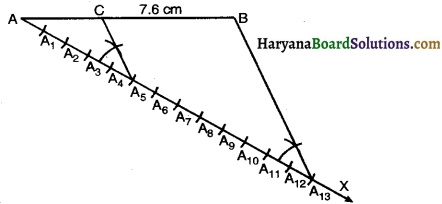
1. Draw a line segment AB = 7.6 cm.
2. Draw any ray AX, making an acute angle with AB.
3. Along AX mark (5 + 8) = 13 points A1, A2,
A3 ……………………. A13 such that AA1 = A1A2 = A2A3 = …………………….. A12A13

Haryana Board 10th Class Maths Solutions Chapter 11 Constructions Ex 11.1 1

4. Join A13B.
5. Through A5, draw A5C || A13B meeting AB at C.
6. Then AC : BC = 5 : 8.
7. On measuring
AC = 2.9 cm
CB = 4.7 cm
Justification : In ∆ABA13, A5C || A13B.
\(\frac{\mathrm{AA}_5}{\mathrm{~A}_5 \mathrm{~A}_{13}}=\frac{\mathrm{AC}}{\mathrm{BC}}\) [By Basic proportionality theorem]
But \(\frac{\mathrm{AA}_5}{\mathbf{A}_5 \mathbf{A}_{13}}=\frac{5}{8}\) [By construction]
∴ \(\frac{\mathrm{AC}}{\mathrm{BC}}=\frac{5}{8}\)
AC : BC = 5 : 8.

Haryana Board Solutions for 10th Class Maths Chapter 11 Constructions Ex 11.1

Question 2.
Construct a triangle of sides 4 cm, 5 cm and 6 cm and then a triangle similar to it whose sides are \(\frac{2}{3}\) of the coi responding sides of the first triangle.
Solution:
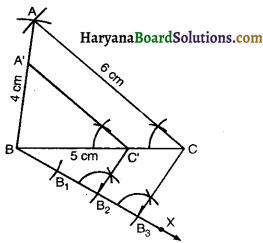
Steps of construction :
1. Draw a line segment BC = 5 cm.
2. With B as a centre and radius 4 cm draw an arc.
3. With C as a centre and radius 6 cm draw another arc to intersect the first arc. at A.

Haryana Board 10th Class Maths Solutions Chapter 11 Constructions Ex 11.1 2

4. Join BA and CA to get ∆ABC.
5. Draw any ray BX making an acute angle with BC on the side opposite to the vertex A.
6. Along BX mark 3 points B1, B2 and B3 such that BB1 = B1B2 = B2B3.
7. Join B3C.
8. From B2 draw B2C’ || B3C meeting BC at C’.
9. From C’ draw C’A’ || CA meeting BA at A’.
Then A’BC’ is the required triangle, each of whose side is \(\frac{2}{3}\) of corresponding Sides of ∆ABC.
Justification : Since, A’C’ || AC
Therefore, ∆A’BC’ ~ ∆ABC
\(\frac{\mathrm{AB}}{\mathrm{AB}}=\frac{\mathrm{BC}^{\prime}}{\mathrm{BC}}=\frac{\mathrm{A}^{\prime} \mathrm{C}^{\prime}}{\mathrm{AC}}=\frac{2}{3}\)

Haryana Board Solutions for 10th Class Maths Chapter 11 Constructions Ex 11.1

Question 3.
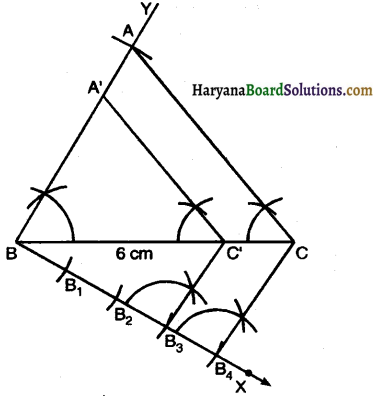
Construct a triangle with sides 5 cm, 6 cm and 7 cm and then another triangle 7 whose sides are \(\frac{7}{5}\) of the corresponding sides of the 5 first triangle.
Solution:
Steps of Construction :
1. Draw a line segment BC = 6 cm.
2. With B as a centre and radius 5 cm draw an arc.
3. With C as a centre and radius 7 cm draw another arc to intersect the first arc at A.
4. Join BA and CA to get ∆ABC.

Haryana Board 10th Class Maths Solutions Chapter 11 Constructions Ex 11.1 3

5. Draw any ray BX making an acute angle with BC on the side opposite to the vertex A.
6. Along BX mark 7 points B1, B2, B3, …….., B7 such that BB1 = B1B2 = B2B3 = ………….. = B6B7.
7. Join B5C.
8. From B7 draw B7C’ || B56C intersecting the produced line segment BC at C’.
9. From C’ draw CA’ || AC intersecting the produced line segment BA at A’.
Then, ∆A’BC’ is the required triangle each of whose side is \(\frac{7}{5}\) of the corresponding sides of the ∆ABC.
Justification : Since, AC || A’C’
Therefore, ∆A’BC’ ~ ∆ABC
⇒ \(\frac{\mathrm{A}^{\prime} \mathrm{B}}{\mathrm{AB}}=\frac{\mathrm{BC}^{\prime}}{\mathrm{BC}}=\frac{\mathrm{A}^{\prime} \mathrm{C}^{\prime}}{\mathrm{AC}}=\frac{7}{5}\)

Haryana Board Solutions for 10th Class Maths Chapter 11 Constructions Ex 11.1

Question 4.
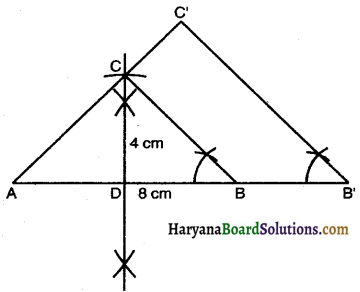
Construct an Isosceles triangle whose base is 8 cm and altitude 4 cm and then another triangle whose sides are 1\(\frac{1}{2}\) times the corresponding sides of the isosceles triangle.
Solution:
Steps of Construction :
1. Let ABC be the isosceles triangle with base AB = 8 cm and altitude CD = 4 cm.
2. Draw a line segment AB = 8 cm.
3. Draw the perpendicular bisector of AB intersecting AB at D.
4. With D as a centre and radius 4 cm draw an arc intersecting the perpendicular bisector at C.
5. Join AC and BC to get the isosceles triangle ABC.

Haryana Board 10th Class Maths Solutions Chapter 11 Constructions Ex 11.1 4

6. Produce AB to B’ AB’ = 1\(\frac{1}{2}\) of 8 = \(\frac{3}{2}\) × 8 = 12 cm.
7. Through B’ draw B’C’ || BC intersecting the produced line segment AC to C’.
Then AB’C’ is the required triangle each of whose side is 1\(\frac{1}{2}\) times of the corresponding sides of ∆ABC.
Justification : Since, BC || B’C’
Therefore, ∆C’AB’ ~ ∆CAB
⇒ \(\frac{\mathrm{AC}^{\prime}}{\mathrm{AC}}=\frac{\mathrm{AB}^{\prime}}{\mathrm{AB}}=\frac{\mathrm{B}^{\prime} \mathrm{C}^{\prime}}{\mathrm{BC}}=\frac{3}{2}\).

Haryana Board Solutions for 10th Class Maths Chapter 11 Constructions Ex 11.1

Question 5.
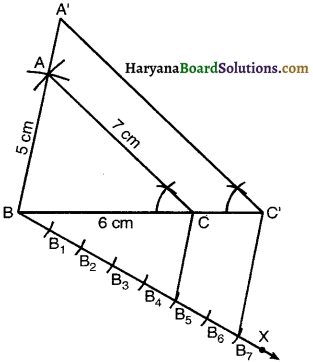
Draw a triangle ABC with side BC = 6 cm, AB = 5 cm and ∠ABC = 60°. Then construct a triangle whose sides are \(\frac{3}{4}\) of the corresponding sides of the triangle ABC.
Solution:
Steps of Construction:
1. Draw a line segment BC = 6 cm.
2. At B, draw ∠CBY = 60°.
3. From B draw an arc AB = 5 cm meeting BY at A. Join AC. Thus ∆ABC obtained.
4. Draw any ray BX making an acute angle with BC on the side opposite to the vertex A.
5. Along BX mark four points B1, B2, B3, B4 such that BB1 = B1B2 = B2B3 = B3B4.
6. Join B4C.

Haryana Board 10th Class Maths Solutions Chapter 11 Constructions Ex 11.1 5

7. From B3 draw B3C’ || B4C meeting BC at C.
8. From C’ draw C’A’ || CA, meeting AB at A’. Then A’BC’ is the required triangle, each of whose side is \(\frac{3}{4}\) of corresponding sides of AABC.
Justification: Since, A’C || AC
Therefore, ∆A’BC ~ ∆ABC
\(\frac{\mathrm{A}^{\prime} \mathrm{B}}{\mathrm{AB}}=\frac{\mathrm{BC}^{\prime}}{\mathrm{BC}}=\frac{\mathrm{A}^{\prime} \mathrm{C}^{\prime}}{\mathrm{AC}}=\frac{3}{4}\).

Haryana Board Solutions for 10th Class Maths Chapter 11 Constructions Ex 11.1

Question 6.
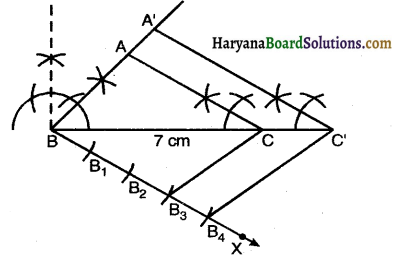
Draw a triangle ABC with side BC = 7 cm, ∠B = 45°, ∠A = 105°. Then, construct a triangle whose sides are \(\frac{4}{3}\) times the corresponding sides of ∆ABC.
Solution:
Steps of Construction :
1. Draw line segment BC = 7 cm.
In ∆ABC, ∠B = 45°, ∠A = 105°,
∠C = 180° – (45° + 105°) = 30°
2. At B draw an angle ∠B = 45° and at C draw an angle ∠C *= 30° intersecting each other at A to get ∆ABC.
3. Draw any ray BX making an acute angle with BC on the side opposite to the vertex A.
Along BX mark four points B1, B2, B3 and B4 such that BB1 = B1B2 = B2B3 = B3B4.

Haryana Board 10th Class Maths Solutions Chapter 11 Constructions Ex 11.1 6

4. Join B3C.
5. From B4 draw B4C’ || B3C intersecting the produced line segment BC at C’.
6. From C’ draw C’A’ || CA intersecting the produced line segment BA at A’.
Then A’BC’ is the required triangle, each of whose side is \(\frac{4}{3}\) times the corresponding sides of ∆ABC.
Justification : Since, AC || A’C’
Therefore, ∆A’BC’ ~ ∆ABC
\(\frac{\mathrm{AB}^{\mathrm{B}}}{\mathrm{AB}}=\frac{\mathrm{BC}^{\prime}}{\mathrm{BC}}=\frac{\mathrm{A}^{\prime} \mathrm{C}^{\prime}}{\mathrm{AC}}=\frac{4}{3}\).

Haryana Board Solutions for 10th Class Maths Chapter 11 Constructions Ex 11.1

Question 7.
Draw a right triangle in which the sides (other than hypotenuse) are of lengths 4 cm and 3 cm. Then construct another triangle whose sides are \(\frac{5}{3}\) times the corresponding sides of the given triangle.
Solution:
Steps of Construction :
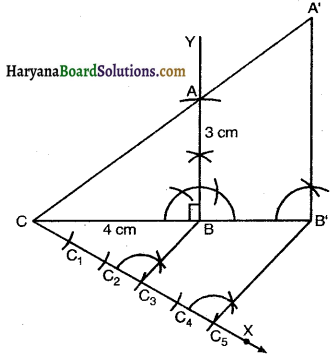
1. Let ABC be right triangle in which ∠B = 90°, BC = 4 cm and AB = 3 cm.
2. Draw BC = 4 cm
3. Draw ∠CBY = 90° at B.
4. Cut AB = 3 cm from BY. Join AC to get ∆ABC.
5. Draw any ray CX making an acute angle with BC on the side opposite to the vertex A.
6. Along CX mark five points C1, C2, C3, C4 and C5 such that CC1 = C1C2 = C2C3 = C3C4 = C4C45.
Join C3B.

Haryana Board 10th Class Maths Solutions Chapter 11 Constructions Ex 11.1 7

7. From C5 draw C5B’ || C3B intersecting the produced line segment CB at B’.
8. From B’ draw B’A’ || BA intersecting the produced line segment CA at A’.
Then, A’CB’ is the required triangle.
Justification : Since, BA || B’A’
Therefore, ∆A’CB’ ~ ∆ACB
\(\frac{\mathrm{A}^{\prime} \mathrm{C}}{\mathrm{AC}}=\frac{\mathrm{B}^{\prime} \mathrm{C}}{\mathrm{BC}}=\frac{\mathrm{A}^{\prime} \mathrm{B}^{\prime}}{\mathrm{AB}}=\frac{5}{3}\).

HBSE 10th Class Maths Solutions Chapter 11 Constructions Ex 11.1 Read More »

HBSE 7th Class Social Science Solutions Civics Chapter 8 Markets Around Us

Haryana State Board HBSE 7th Class Social Science Solutions Civics Chapter 8 Markets Around Us Textbook Exercise Questions and Answers.

Haryana Board 7th Class Social Science Solutions Civics Chapter 8 Markets Around Us

HBSE 7th Class Civics Markets Around Us Textbook Questions and Answers

Markets Around Us HBSE 7th Class Question 1.
In what wiys is a hawker different from a shop owners?
Answer:

A HawkerA Shop Owner
(i) A hawker does not have a permanent shop and cannot be relied on for our needs.(i) A shop owner has a permanent shop.
(ii) Quality is not guaranteed.(ii) Quality is guaranteed.
(iii) The buyer and seller usually do not know each other.(iii) The buyer and seller usually know each other.
(iv) Goods can’t be provided on credit.(iv) Goods can be1 provided on credit

HBSE 7th Class Social Science Solutions Civics Chapter 8 Markets Around Us

Markets Around Us Class 7 Civics HBSE Question 2.
Compare and contrast a weekly market and a shopping complex on the following:

MarketKinds of goods soldPrices of goodSellersBuyers
Weekly Market
Shopping Complex

Answer:

Weekly MarketShopping Complex
Kinds of goods soldLow-quality, Low priced goodsGood-Quality goods/Branded goods
Price of goodsLowHigh
SellersHawkers, VendorsShop owners, Multiplex owners businessmen
BuyersLower Middle-ClassUpper Middle-Class and High Class people

HBSE 7th Class Markets Around Us Question 3.
Explain how a chain of markets is formed. What purpose does it serve?
Answer:
A chain of markets is the interlinking of a producer, wholesaler and retailer in the following ways:
(i) We don’t buy goods directly from the factory or farm, where the production takes place.
(ii) The people in between the producer and the final consumer is the trader.
(iii) The wholesaler buys goods in large quantities and sells them to traders.
(iv) The trader who finally sells this to consumer is the retailer.
Goods travel to us though a chain of markets which we were not aware of this allows good-quality of goods to reach us in an easy, accessible and feasible way.

Question 4.
‘All persons have equal rights to visit any shop in a market place.’ Do you think this is true of shops with expensive products? Explain with examples.
Answer:
No, it is not true for shops with expensive products. This is because the companies producing branded products . through shops in urban markets and at times, through special show rooms. Fewer people can afford to buy branded goods and hence rights are restricted.

For example:
Sujata and Kavita who entered a shop that was selling branded readymade clothes were stared at by the security guard. They could not even buy a dress since most of them were expensive.

Question 5.
‘Buying and selling can take place without going to a marketplace.’ Explain the statement with the help of example.
Answer:
One does not have to go to the markets to purchase goods. You can place order for a variety of things through the phone and these days through the internet as well, and then the goods are delivered to your home. In clinics and nursing homes and likewise, sales representatives are also engaged in the selling of goods. Thus buying and selling take place in different markets, not necessarily to the ones we need to visit.
For example: Many sites on the net today.

Question 6.
Why do people go to a weekly market?
Answer:
People go to a weekly market because:
(a) They can fulfill their everyday requirements.
(b) Many things in the market are available at cheap rates.
(c) Almost all things are available at one place.

Question 7.
Who are the sellers in a weekly market? Why don’t we find big businessmen in weekly market?
Answer:
Sellers are small traders in a weekly market who store their things at home and sell them at cheap rates in the market. We don’t find big businessmen in weekly markets because here low-quality low-priced goods are sold. The goods are not branded. Big Businessmen usually deal in designer products and branded goods that are well- promoted though advertising and incur them a lot of profit. This is done through permanent urban markets or special showrooms.

Question 8.
Explain with an example how people bargain in a weekly market. Can you think of an example where the bargain would be unfair?
Answer:
Weekly markets also have a large number of shops sellings the same goods which means there is competition between them. If some trader were to charge a higher price, people can bargain and bring the price down. The bargain would be unfair if the shopkeeper has not kept any margin for his product.

Question 9.
Why did Sujata carry a notebook? Do you think this system is useful? Can there be problems?
Answer:
Sujata carried a notebook along with her so that the amount of money of purchase could be noted down. This bond of trust allowed Sujata to pay on credit. However this could create the following problems:
(а) insecurity for the seller (if the buyer is unknown)
(b) a sense of doubt.

Question 10.
What are the different kinds of shops that find in your neighbourhood? What do you purchase from them.
Answer:
There are many shops in a neighbourhood; i.e.
(a) Dairy
Goods bought: milk, cottage cheese, curd.

(b) Grocery
Goods bought: fruits and vegetables

(c) Stationery
Goods bought: pens, pencils, charts, erasers

(d) Eatables
Goods bought: cooked snacks

(e) Bakery
Goods bought: baked goods like cakes, pastries

(f) Chemist
Goods bought: medicines.

HBSE 7th Class Social Science Solutions Civics Chapter 8 Markets Around Us

Question 11.
Why are goods sold in permanent shops costlier than those sold in the weekly markets or by roadside hawkers?
Answer:
The goods sold in permanent shops are costlier than those sold in weekly market or by roadside hawkers because they provide more facilities at ease to its consumers. They are useful in many ways:

  • easily accessible
  • familiar relation between the buyer and seller
  • goods on credit.

Question 12.
Why do you think the guard wanted to stop Kavita and Sujata from entering the shopWhat would you say if someone stops you from entering a shop in the market?
Answer:
The guard wanted to stop Kavita and Sujata from entering the shop because by demeanour, they seemed to be of a low economic background and would to be able to afford the expenses of the shop.

I would question my right if somebody stops me from entering a shop as it would be sincere violation of my dignity.

Question 13.
Why do people not bargain in shops located in malls whereas they bargain in weekly markets?
Answer:
Branded goods are expensive often promoted by advertising and are of a better qualities. Hence, people sustain a skeptical nature of bargaining in these large urban markets on special showroom. Only the people who afford to buy these goods generally visit these shops.

Question 14.
How do you think your neighbourhood shop gets its goods? Find out and explain with example.
Answer:
A neighbourhood shop is generally controlled by a retailer who gets its goods from the wholesaler.
For example, the vegetable wholesale trader will not buy few kilos of vegetables from farmers but in large quantities. These will be then sold to our neighbourhood grocer. Buying and selling take place between traders and goods shall reach us.

HBSE 7th Class Social Science Solutions Civics Chapter 8 Markets Around Us

Question 15.
Why is a wholesale trader necessary?
Answer:
The producer, on its own cannot send its goods to the final consumers or retailing shop. It is with the help of a wholesale trader that goods reach faraway places. It is from here that a retailer buys the goods so that it reaches the final consumers.

HBSE 7th Class Social Science Solutions Civics Chapter 7 Understanding Advertising

HBSE 7th Class Civics Markets Around Us Important Questions and Answers

Very Short Answer Type Questions

Question 1.
Who are in between the producer and the final consumers?
Answer:
Wholesalers, distributors and retailers are in between the producer and the final consumer.

Question 2.
Write any one advantage of weekly market?
Answer:
Most of the things of our daily and common use are available at one place in weekly market at a cheaper rate.

Question 3.
Where are shopping complexes found?
Answer:
Shopping complexes are found in the urban areas, cities, etc.

Short Answer Type Questions

Question 1.
What do you know about weekly market?
Answer:
(i) A weekly market is held on a specific day of week.
(ii) It does not have permanent shops.
(iii) Traders set up their shops for the day and then close them up in the evening.

Question 2.
What are the extra expenditure incurred in permanent shop that are not incurred in the weekly market?
Answer:
There are various expenditures incurred in permanent shops which are not in weekly market. For example:
(a) They have to pay rent, electricity and sometimes fees to the Government.
(b) They have to pay wages to their workers.

Question 3.
What do you know about mills?
Answer:
The large multi-stores air-conditioned buildings with shops on different floors are known as malls. These malls have both branded and non-branded goods and promote them by advertising.

Question 4.
Explain the meaning of chain of markets.
Answer:
A chain of markets is a series of markets inter connected in links or chains because products pass from one country to another.

Question 5.
‘Internet has brought a revolution in the availability of markets.’ Do you agree? Explain.
Answer:
Today we can place order for a variety of things on the Internet and the goods are delivered at your home. This allows easy availability, accessibility and economic feasibility of goods. Internet always or often does offer exciting deals.

Question 6.
Explain who is the most benefitted in the Chain of Markets.
Answer:
A retailer is the most benefitted in the chain of markets since he sells the goods at the highest price and earns more profit than the wholesaler.

HBSE 7th Class Social Science Solutions Civics Chapter 8 Markets Around Us

Long Answer Type Questions

Question 1.
What are the markets we might be unaware of? Give two detailed examples.
Answer:
Some of the markets that act as imputs to an industry and help in the formation of products that finally reach us are markets that we night be unaware of these are feeder markets whose goods we don’t require and hence we can’t recognise themselves.

Two examples for the same are given below:
(i) We may want to acquire the food crop or food item sold by a retailer but we may not be interested in knowing the market from where the farmer sought his production needs (seeds, fertilizer etc.).

(ii) A car factory purchases engines, cars, gears, petrol tanks, are but we are interested in only buying the product i.e., the car.
However, it is also true that the producers recognise these shops.

Question 2.
What do you know about the market and goods, which are sold and bought in but we don’t use directly? Explain about with examples.
Answer:
There are markets that we may not be aware of. In these markets a variety of goods are bought and sold in large numbers that we don’t use directly. For example, a car factory purchases engine, gears, petrol tanks, axles, wheels, etc. from v various other factories. They use them for making car, a final product that we use directly.

Markets Around Us Class 7 HBSE Notes

  • Chain of Markets: A series of markets that are connected like links in a chain because product pass from one market to another.
  • Mall: This is an enclosed shopping space. This is usually a large building with many floors that has shops, restaurant, at any times, even a cinema theatre. These shops most often sell branded products.
  • Retailers: The trader who finally sells good to these consumers.
  • Weekly Market: These markets are not daily markets but are to be found at a particular place on one or may be two days of the week. These markets most often sell everything that a household needs ranging from vegetables to the clothes or to the utensil.
  • Wholesale This refers to buying or selling in large quantities. Most products, including vegetables, fruits and flowers have special wholesale markets.

HBSE 7th Class Social Science Solutions Civics Chapter 8 Markets Around Us Read More »

HBSE 10th Class Maths Solutions Chapter 8 Introduction to Trigonometry Ex 8.2

Haryana State Board HBSE 10th Class Maths Solutions Chapter 8 Introduction to Trigonometry Ex 8.2 Textbook Exercise Questions and Answers.

Haryana Board 10th Class Maths Solutions Chapter 8 Introduction to Trigonometry Ex 8.2

Question 1.
Evaluate the following :
(i) sin 60° cos 30° + sin 30° cos 60°
(ii) 2 tan2 45° + cos2 30° – sin2 60°
(iii) \(\frac{\cos 45^{\circ}}{\sec 30^{\circ}+\ {cosec} 30^{\circ}}\)
(iv) \(\frac{\sin 30^{\circ}+\tan 45^{\circ}-\ {cosec} 60^{\circ}}{\sec 30^{\circ}+\cos 60^{\circ}+\cot 45^{\circ}}\)
(v) \(\frac{5 \cos ^2 60^{\circ}+4 \sec ^2 30^{\circ}-\tan ^2 45^{\circ}}{\sin ^2 30^{\circ}+\cos ^2 30^{\circ}}\)
Solution :
(i) sin 60° cos 30° + sin 30° cos 60°
= \(\frac{\sqrt{3}}{2} \times \frac{\sqrt{3}}{2}+\frac{1}{2} \times \frac{1}{2}\)
= \(\frac{3}{4}+\frac{1}{4}\) = 1
Hence, sin 60° cos 30° + sin 30° cos 60° = 1.

Haryana Board Solutions for 10th Class Maths Chapter 8 Introduction to Trigonometry Ex 8.2

(ii)2 tan2 45° + cos2 30° – sin2 60°
= 2 × (1)2 + \(\left(\frac{\sqrt{3}}{2}\right)^2-\left(\frac{\sqrt{3}}{2}\right)^2\)
= 2 × 1 + \(\frac{3}{4}-\frac{3}{4}\) = 2
Hence, 2 tan2 45° + cos2 30° – sin2 60° = 2.

(iii) \(\frac{\cos 45^{\circ}}{\sec 30^{\circ}+\ {cosec} 30^{\circ}}\)

Haryana Board 10th Class Maths Solutions Chapter 8 Introduction to Trigonometry Ex 8.2 1

Hence, \(\frac{\cos 45^{\circ}}{\sec 30^{\circ}+\ {cosec} 30^{\circ}}\) = \(\frac{1}{8}\) (3√2 – √6).

(iv) \(\frac{\sin 30^{\circ}+\tan 45^{\circ}-\ {cosec} 60^{\circ}}{\sec 30^{\circ}+\cos 60^{\circ}+\cot 45^{\circ}}\)

Haryana Board 10th Class Maths Solutions Chapter 8 Introduction to Trigonometry Ex 8.2 2

Hence, \(\frac{\sin 30^{\circ}+\tan 45^{\circ}-\ {cosec} 60^{\circ}}{\sec 30^{\circ}+\cos 60^{\circ}+\cot 45^{\circ}}\) = \(\frac{43-24 \sqrt{3}}{11}\)

(v) \(\frac{5 \cos ^2 60^{\circ}+4 \sec ^2 30^{\circ}-\tan ^2 45^{\circ}}{\sin ^2 30^{\circ}+\cos ^2 30^{\circ}}\)

Haryana Board 10th Class Maths Solutions Chapter 8 Introduction to Trigonometry Ex 8.2 3

Haryana Board Solutions for 10th Class Maths Chapter 8 Introduction to Trigonometry Ex 8.2

Question 2.
Choose the correct option and justify your choice :
(i) \(\frac{2 \tan 30^{\circ}}{1+\tan ^2 30^{\circ}}\) =
(a) sin 60°
(b) cos 60°
(c) tan 60°
(d) sin 30°

(ii) \(\frac{1-\tan ^2 45^{\circ}}{1+\tan ^2 45^{\circ}}\) =
(a) tan 90°
(b) 1
(c) sin 45°
(d) 0

(iii) sin 2A = 2 sin A is true when A =
(a) 0°
(b) 30°
(c) 45°
(d) 60°

(iv) \(\frac{2 \tan 30^{\circ}}{1-\tan ^2 30^{\circ}}\) =
(a) cos 60°
(b) sin 60°
(c) tan 60°
(d) sin 30°

Haryana Board Solutions for 10th Class Maths Chapter 8 Introduction to Trigonometry Ex 8.2
Solution:
(i) (a)

Haryana Board 10th Class Maths Solutions Chapter 8 Introduction to Trigonometry Ex 8.2 4

(ii) (d)
∵ \(\frac{1-\tan ^2 45^{\circ}}{1+\tan ^2 45^{\circ}}=\frac{1-(1)^2}{1+(1)^2}\)
= \(\frac{1-1}{1+1}=\frac{0}{2}\) = 0

(iii) (a) When A = 0°
L.H.S. = sin 2A = sin 2 × 0°
= sin 0° = 0
R.H.S. = 2 sin A = 2 × sin 0°
= 2 × 0 = 0
In other option we shall find that L.H.S. ≠ R.H.S.

(iv) (c)
∵ \(\frac{2 \tan 30^{\circ}}{1-\tan ^2 30^{\circ}}=\frac{2 \times \frac{1}{\sqrt{3}}}{1-\left(\frac{1}{\sqrt{3}}\right)^2}\)
= \(\frac{\frac{2}{\sqrt{3}}}{1-\frac{1}{3}}\)
= \(\frac{\frac{2}{\sqrt{3}}}{\frac{2}{3}}=\frac{2}{\sqrt{3}} \times \frac{3}{2}\)
= √3 = tan 60°.

Haryana Board Solutions for 10th Class Maths Chapter 8 Introduction to Trigonometry Ex 8.2

Question 3.
If tan(A + B) = √3 and tan(A – B) = \(\frac{1}{\sqrt{3}}\); 0° < (A + B) ≤ 90°, A > B, find A and B.
Solution :
We have
tan(A + B) = √3
tan(A + B) = tan 60°
A + B = 60° ……………..(1)
and tan(A – B) = \(\frac{1}{\sqrt{3}}\)
tan(A – B) = tan 30°
A – B = 30° ……………….(2)
Adding equation (1) and (2), we get
A + B = 60°
A – B = 30°
2A = 90°
A = \(\frac{90^{\circ}}{2}\)
A = 45°
Substituting the value of A in equation (1), we get
45° + B = 60°
B = 60° – 45° = 15°
Hence, A = 45° and B = 15°.

Haryana Board Solutions for 10th Class Maths Chapter 8 Introduction to Trigonometry Ex 8.2

Question 4.
State whether the following are true or false. Justify your answer.
(i) sin(A + B) = sin A + sin B.
(ii) The value of a sin θ increases as θ increases.
(iii) The value of cos θ increases as θ increases.
(iv) sin θ = cos θ for all values of θ.
(v) cot A is not defined for A = 0°.
Solution :
(i) False. Taking A= 30°, B = 60°
LHS = sin (A + B)
= sin (30° + 60°)
= sin 90° = 1
RHS = sin A + sin B
= sin 30° + sin 60°
= \(\frac{1}{2}+\frac{\sqrt{3}}{2}=\frac{1+\sqrt{3}}{2}\)
∴ LHS ≠ RHS
(ii) True.
(iii) False. Because value of cos θ decreases as θ increases.
(iv) False. Because sin 30° = \(\frac{1}{2}\) and cos 30° = \(\frac{\sqrt{3}}{2}\)
i.e., sin 30° ≠ cos 30°
(v) True. Because cot 0° = ∞ (not defined)

HBSE 10th Class Maths Solutions Chapter 8 Introduction to Trigonometry Ex 8.2 Read More »

HBSE 10th Class Maths Solutions Chapter 8 Introduction to Trigonometry Ex 8.1

Haryana State Board HBSE 10th Class Maths Solutions Chapter 8 Introduction to Trigonometry Ex 8.1 Textbook Exercise Questions and Answers.

Haryana Board 10th Class Maths Solutions Chapter 8 Introduction to Trigonometry Ex 8.1

Question 1.
In ∆ABC, right-angled at B, AB = 24 cm, BC = 7 cm. Determine :
(i) sin A, cos A
(ii) sin C, cos C
Solution :
(i) In a right’triangle ABC we have ∠B = 90°, AB = 24 cm and BC = 7 cm.
By Pythagoras theorem, we have
AC2 = AB2 + BC2
⇒ AC2 = 242 + 72
⇒ AC2 = 576 + 49
⇒ AC2 = 625
⇒ AC = \(\sqrt{625}\) = 25

Haryana Board 10th Class Maths Solutions Chapter 8 Introduction to Trigonometry Ex 8.1 1

∴ sin A = \(\frac{\mathrm{BC}}{\mathrm{AC}}=\frac{7}{25}\)
cos A = \(\frac{\mathrm{AB}}{\mathrm{AC}}=\frac{24}{25}\)
Here, sin A = \(\frac{7}{25}\), cos A = \(\frac{24}{25}\)

(ii) For trigonometric ratio of ∠C, We have base = BC = 7 cm
Perpendicular = AB = 24 cm
Hypotenuse = AC = 25 cm
sin C = \(\frac{\mathrm{AB}}{\mathrm{AC}}=\frac{24}{25}\)
and cos C = \(\frac{\mathrm{BC}}{\mathrm{AC}}=\frac{7}{25}\)
Hence, sin C = \(\frac{24}{25}\), cos C = \(\frac{7}{25}\)

Haryana Board Solutions for 10th Class Maths Chapter 8 Introduction to Trigonometry Ex 8.1

Question 2.
In figure, find tan P – cot R.

Haryana Board 10th Class Maths Solutions Chapter 8 Introduction to Trigonometry Ex 8.1 2

Solution:
We have, PQ = 12 cm, PR = 13 cm.
In right ∆PQR, ∠Q = 90°
By Pythagoras theorem, we have PR2 = QR2 + PQ2
⇒ (13)2 = QR2 + (12)2
⇒ QR2 = (13)2 – (12)2
⇒ QR2 = (13 + 12) (13 – 12)
⇒ QR2 = 25
⇒ QR = √25 = 5
cot R = \(\frac{\mathrm{QR}}{\mathrm{PQ}}=\frac{5}{12}\)
For trigonometric ratio of ∠P, we have
Base = PQ = 12 cm
Perpendicular = QR = 5 cm
Hypotenuse = PR = 13 cm
∴ tan P = \(\frac{\mathrm{QR}}{\mathrm{PQ}}=\frac{5}{12}\)
Now, tan P – cot R = \(\frac{5}{12}-\frac{5}{12}\) = 0
Hence, tan P – cot R = 0.

Question 3.
If sin A = \(\frac{3}{4}\) Calculate cos A and tan A.
Solution :
Consider a right triangle ABC in which ∠B = 90°
Then, sin A = \(\frac{\mathrm{BC}}{\mathrm{AC}}=\frac{3}{4}\)
Let BC = 3k and AC = 4k, where k is a positive integer.
By Pythagoras theorem, we have

Haryana Board 10th Class Maths Solutions Chapter 8 Introduction to Trigonometry Ex 8.1 3

AC2 = AB2 + BC2
(4k)2 = AB2 + (3k)2
AB2 = (4k)2 – (3k)2
AB2 = 16k2 – 9k2
AB2 = 7k2
AB = √7 k
∴ cos A = \(\frac{\mathrm{AB}}{\mathrm{AC}}=\frac{\sqrt{7} k}{4 k}=\frac{\sqrt{7}}{4}\)
and tan A = \(\frac{\mathrm{BC}}{\mathrm{AB}}=\frac{3 k}{\sqrt{7} k}=\frac{3}{\sqrt{7}}\)
Hence, cos A = \(\frac{\sqrt{7}}{4}\), tan A = \(\frac{3}{\sqrt{7}}\).

Haryana Board Solutions for 10th Class Maths Chapter 8 Introduction to Trigonometry Ex 8.1

Question 4.
Given 15 cot A = 8, find sin A and sec A.
Solution :

Haryana Board 10th Class Maths Solutions Chapter 8 Introduction to Trigonometry Ex 8.1 4

we have,
15 cot A = 8
cot A = \(\frac{8}{15}\)
Now consider a right 15 triangle ABC, in which ∠B = 90°
cot A = \(\frac{8}{15}\)
⇒ \(\frac{\mathrm{AB}}{\mathrm{BC}}=\frac{8}{15}\)
Let AB = 8k and BC = 15k,where k is a positive integer.
By Pythagoras theorem, we have
AC2 = AB2 + BC2
AC2 = (8k)2 + (15k)2
AC2 = 64k2 + 225k2
AC = 289k2
AC = \(\sqrt{289 k^2}\) = 17k.
sin A = \(\frac{\mathrm{BC}}{\mathrm{AC}}:=\frac{15 k}{17 k}=\frac{15}{17}\)
and sec A = \(\frac{\mathrm{AC}}{\mathrm{AB}}=\frac{17 k}{8 k}=\frac{17}{8}\)
Hence, sin A = \(\frac{15}{17}\) and sec A = \(\frac{17}{8}\).

Question 5.
Given sec θ = \(\frac{13}{12}\), calculate all other trigonometric ratios.
Solution:
Consider a right triangle ABC in which ∠B = 90°, ∠CAB = 9, sec θ = \(\frac{\mathrm{AC}}{\mathrm{AB}}=\frac{13}{12}\)
Let AC = 13k and AB = 12k, where k is a positive integer.

Haryana Board 10th Class Maths Solutions Chapter 8 Introduction to Trigonometry Ex 8.1 5

By Pythagoras theorem, we have
AC2 = AB2 + BC2
(13k)2 = (12k)2 + BC2
BC2 = (13k)2 – (12k)2
BC2 = (13k + 12k) (13k – 12k)
BC2 = 25k × k = 25k2
BC = \(\sqrt{25 k^2}\) = 5k

∴ sin θ = \(\frac{\mathrm{BC}}{\mathrm{AC}}=\frac{5 k}{13 k}=\frac{5}{13}\)
cos θ = \(\frac{\mathrm{AB}}{\mathrm{AC}}=\frac{12 k}{13 k}=\frac{12}{13}\)
tan θ = \(\frac{\mathrm{BC}}{\mathrm{AB}}=\frac{5 k}{12 k}=\frac{5}{12}\)
cot θ = \(\frac{\mathrm{AB}}{\mathrm{BC}}=\frac{12 k}{5 k}=\frac{12}{5}\)
cosec θ = \(\frac{\mathrm{AC}}{\mathrm{BC}}=\frac{13 k}{5 k}=\frac{13}{5}\)

Hence, sin θ = \(\frac{5}{13}\),
cos θ = \(\frac{12}{13}\),
tan θ = \(\frac{5}{12}\),
cot θ = \(\frac{12}{5}\),
cosec θ = \(\frac{13}{5}\).

Haryana Board Solutions for 10th Class Maths Chapter 8 Introduction to Trigonometry Ex 8.1

Question 6.
If ∠A and ∠B are acute angles such that cos A = cos B; then show that ∠A = ∠B.
Solution :
Let us consider right triangle ABC in which ∠C = 90° and cos A = cos B.
Draw CD ⊥ AB.
In right triangle ADC, ∠ADC = 90°.
cos A = \(\frac{\mathrm{AD}}{\overline{\mathrm{AC}}}\) ………………….(1)
In right ∆BDC,
∠BDC = 90°
cos B = \(\frac{\mathrm{BD}}{\overline{\mathrm{BC}}}\) ………………….(2)

Haryana Board 10th Class Maths Solutions Chapter 8 Introduction to Trigonometry Ex 8.1 6

According to question,
cos A = cos B
\(\frac{\mathrm{AD}}{\mathrm{AC}}=\frac{\mathrm{BD}}{\mathrm{BC}}\)
\(\frac{\mathrm{AD}}{\mathrm{BD}}=\frac{\mathrm{AC}}{\mathrm{BC}}\) [each = \(\frac{C D}{C D}\)]
∆ADC ~ ∆BDC [By SSS similarity criterion]
[corresponding ∠s of two similar ∆s are equal]
Hence Proved.

Haryana Board Solutions for 10th Class Maths Chapter 8 Introduction to Trigonometry Ex 8.1

Question 7.
If cot θ = \(\frac{7}{8}\), evaluate:
(i) \(\frac{(1+\sin \theta)(1-\sin \theta)}{(1+\cos \theta)(1-\cos \theta)}\)
(ii) cot2 θ
Solution :

Haryana Board 10th Class Maths Solutions Chapter 8 Introduction to Trigonometry Ex 8.1 7

(i) Consider a triangle ABC in which ∠B = 90°,
∠ACB = θ and cot θ = \(\frac{7}{8}\)
⇒ \(\frac{\mathrm{BC}}{\mathrm{AB}}=\frac{7}{8}\)
Let BC = 7k and AB = 8k, where k is a positive integer,
By Pythagoras theorem, we have
AC2 = BC2 + AB2
AC2 = (7k)2 + (8k)2
AC2 = 49k2 + 64k2
AC2 = 113k2
AC = √113 k
∴ sin θ = \(\frac{\mathrm{AB}}{\mathrm{AC}}=\frac{8 k}{\sqrt{113} k}=\frac{8}{\sqrt{113}}\)

Haryana Board 10th Class Maths Solutions Chapter 8 Introduction to Trigonometry Ex 8.1 8

(ii) cot2 θ = (cot θ)2
= \(\left(\frac{\mathrm{BC}}{\mathrm{AB}}\right)^2=\left(\frac{7 k}{8 k}\right)^2\)
= \(\left(\frac{7}{8}\right)^2=\frac{49}{64}\)

Hence, (i) \(\frac{(1+\sin \theta)(1-\sin \theta)}{(1+\cos \theta)(1-\cos \theta)}=\frac{49}{64}\)
(ii) cot2 θ = \(\frac{49}{64}\)

Haryana Board Solutions for 10th Class Maths Chapter 8 Introduction to Trigonometry Ex 8.1

Question 8.
If 3 cot A = 4, check whether \(\frac{1-\tan ^2 \mathrm{~A}}{1+\tan ^2 \mathrm{~A}}\) = cos2 A – sin2 A or not.
Solution :
Consider a triangle ABC in which ∠B = 90° and 3 cot A = 4
⇒ cot A = \(\frac{4}{3}\)
⇒ \(\frac{A B}{B C}=\frac{4}{3}\)
Let AB = 4k and BC = 3k,where k is a positive integer.

Haryana Board 10th Class Maths Solutions Chapter 8 Introduction to Trigonometry Ex 8.1 9

By pythagoras theorem, we have
AC2 = AB2 + BC2
⇒ AC2 = (4k)2 + (3k)2
⇒ AC2 = 16k2 + 9k2
⇒ AC2 = 25k2
⇒ AC = \(\sqrt{25 k^2}\)
⇒ AC = 5k

Haryana Board 10th Class Maths Solutions Chapter 8 Introduction to Trigonometry Ex 8.1 10

Hence, \(\frac{1-\tan ^2 A}{1+\tan ^2 A}\) = cos2 A – sin2 A.

Haryana Board Solutions for 10th Class Maths Chapter 8 Introduction to Trigonometry Ex 8.1

Question 9.
In triangle ABC, right angled at B, if tan A = find the value of:
(i) sin A cos C + cos A sin C
(ii) cos A cos C – sin A sin C
Solution:
In right triangle ABC, ∠B = 90° and tan A = \(\frac{1}{\sqrt{3}}\)
\(\frac{\mathrm{BC}}{\mathrm{AB}}=\frac{1}{\sqrt{3}}\)
Let BC = k and AB = √3k,where k is positive integer.

Haryana Board 10th Class Maths Solutions Chapter 8 Introduction to Trigonometry Ex 8.1 11

By pythagoras theorem, we have
AC2 = AB2 + BC2
AC2 =(√3k)2 + k2
AC2 = 3k2 + k2 = 4k2
AC = \(\sqrt{4 k^2}\) = 2k
∴ sin A = \(\frac{\mathrm{BC}}{\mathrm{AC}}=\frac{k}{2 k}=\frac{1}{2}\)
and cos A = \(\frac{\mathrm{AB}}{\mathrm{AC}}=\frac{\sqrt{3} k}{2 k}=\frac{\sqrt{3}}{2}\)
Now, for trigonometric ratio of ∠C, we have
Base = BC = k
Perpendicular = AB = √3 k
Hypotenuse = AC = 2k
sin C = \(\frac{\mathrm{AB}}{\mathrm{AC}}=\frac{\sqrt{3} k}{2 k}=\frac{\sqrt{3}}{2}\)
cosC = \(\frac{\mathrm{BC}}{\mathrm{AC}}=\frac{k}{2 k}=\frac{1}{2}\)

(i) sin A cos C + cos A sin C = \(\frac{1}{2} \times \frac{1}{2}+\frac{\sqrt{3}}{2} \times \frac{\sqrt{3}}{2}\)
= \(\frac{1}{4}+\frac{3}{4}=\frac{4}{4}\) = 1

(ii)cos A cos C – sin A sinC= \(\frac{\sqrt{3}}{2} \times \frac{1}{2}-\frac{1}{2} \times \frac{\sqrt{3}}{2}\)
= \(\frac{\sqrt{3}}{4}-\frac{\sqrt{3}}{4}\) = 0

Hence, (i) sin A cos C + cos A sin C = 1
(ii) cos A cos C – sin A sin C = 0.

Haryana Board Solutions for 10th Class Maths Chapter 8 Introduction to Trigonometry Ex 8.1

Question 10.
In ∆PQR, right angled at Q, PR + QR = 25 cm and PQ = 5 cm. Determine the values of sin P, cos P and tan P.
Solution:
In right ∆PQR, ∠Q = 90°, PQ = 5 cm and PR + QR = 25 cm

Haryana Board 10th Class Maths Solutions Chapter 8 Introduction to Trigonometry Ex 8.1 12

⇒ PR = 25 – QR
By Pythagoras theorem, we have
PR2 = PQ2 + QR2
(25 – QR)2 = (5)2 + QR2
⇒ 625 + QR2 – 50 QR = 25 + QR2
⇒ QR2 – 50QR – QR2 = 25 – 625
⇒ – 50 QR = – 600
⇒ QR = \(\frac{-600}{-50}\) = 12 cm
and PR = 25 – 12 = 13 cm
∴ sin P = \(\frac{\mathrm{QR}}{\mathrm{PR}}=\frac{12}{13}\)
cos P = \(\frac{\mathrm{PQ}}{\mathrm{PR}}=\frac{5}{13}\)
tan P = \(\frac{\mathrm{QR}}{\mathrm{PQ}}=\frac{12}{5}\)
Hence, sin P = \(\frac{12}{13}\), cos P = \(\frac{5}{13}\) and tan P = \(\frac{12}{5}\).

Haryana Board Solutions for 10th Class Maths Chapter 8 Introduction to Trigonometry Ex 8.1

Question 11.
State whether the following are true or false. Justify your Answer.
(i) The value of tan A is always less than 1.
(ii) sec A = \(\frac{12}{5}\) for some value of ∠A.
(iii) cos A is the abbreviation used, for the cosecant of ∠A.
(iv) cot A is the product of cot and A.
(v) sin θ = \(\frac{4}{3}\) for some angle θ.
Solution :
(i) False. Because tan 60° = √3 > 1
(ii) True. Because value of sec A is always ≥ 1.
(iii) False. Because cos A is abbreviation used for cosine A.
(iv) False. Because cot is meaningless without an angle.
(v) False. Because sin θ > 1.

HBSE 10th Class Maths Solutions Chapter 8 Introduction to Trigonometry Ex 8.1 Read More »

HBSE 7th Class English Solutions Honeycomb Chapter 6 Expert Detectives

Haryana State Board HBSE 7th Class English Solutions Honeycomb Chapter 6 Expert Detectives Textbook Exercise Questions and Answers.

Haryana Board 7th Class English Solutions Honeycomb Chapter 6 Expert Detectives

HBSE 7th Class English Expert Detectives Textbook Questions and Answers

Comprehension Check

Class 7 English Chapter 6 Expert Detectives Summary In Hindi HBSE Question 1.
What did Nishad give Mr Nath? Why?
Answer:
Nishad gave a bar of chocolate to Mr. Nath. He did so because he wanted to get a peep in to the trunk.

Expert Detectives Summary HBSE Class 7 Question 2.
What is “strange” about Mr Nath’s Sundays?
Answer:
Every Sunday same man comes to visit Mr. Nath in his room. The visitor talks a lot and has lunch with Mr. Nath.

Class 7 English Chapter 6 Expert Detectives Summary HBSE Question 3.
Why did Nishad and Maya get a holiday?
Answer:
Nishad and Maya got a holiday as the school did not open due to heavy rain. The streets were flooded and there was a unexpected holiday.

HBSE 7th Class English Solutions Honeycomb Chapter 6 Expert Detectives

Working with The Text

Expert Detectives Summary In Hindi HBSE Question 1.
What does Nishad find out about Mr. Nath from Itamesh? Arrange the information as suggested below:

  • What he eats
  • When he eats
  • What he drinks, and when
  • How he pays

Answer:

  • He is not very particular about what he eats. It’s always the same food—two chapattis, some dal and a vegetable.
  • Mr. Nath takes two maels every morning and evening,
  • He takes two cups of tea, one in the morning and one in the afternoon.
  • Mr. Naths pays cash and tips wells.

Class 7 English Chapter 6 Expert Detectives HBSE Question 2.
Why does Maya think Mr. Nath is a crook? Who does she says the Sunday visitor is?
Answer:
Maya thought that he is a crook as he nust be having lots of money hidden somewhere. She feels that he looks so ordinary as sometimes criminals look very ordinary.

Some visitor visits Mr. Nath every Sunday. He is tall, fair, stout and wears spectacles. Maya thinks that visitor must be connected with Mr. Nath. He must be keeping all the loot and giving Mr. Nath’s share for expenses.

Expert Detectives Class 7 Solutions HBSE Question 3.
Does Nishad agree with Maya about Mr. Nath? How does he feel about him?
Answer:
Nishad did not pay much attention to the Maya’s views. He thinks that Mr. Nath must be lonely without friends. Nishad even gets angry with Maya for calling him a criminal. Maya’s theroies made no impression on Nishad and he had decided to be friendly with Mr. Nath.

HBSE 7th Class English Solutions Honeycomb Chapter 6 Expert Detectives

HBSE 7th Class English Expert Detectives Important Questions and Answers

Very Short Answer Type Questions

Class 7 English Chapter 6 Expert Detectives Question Answer HBSE Question 1.
Give two physical features of Mr. Nath.
Answer:
Mr. Nath is very thin and looks as if he is very poor.

Expert Detective Question Answer HBSE Class 7  Question 2.
What makes Nishad think that Mr. Nath is not a criminal?
Answer:
Nishad thinks so because Mr. Nath doesn’t look like one and Ramesh brings meals for him.

Expert Detectives Question Answers HBSE Class 7 Question 3.
What reasons did both of them give for the scars?
Answer:
They thought that scars had been got during a shoot out or when police set fire to the house.

Class 7 English Honeycomb Chapter 6 Expert Detectives Question 4.
What type of physical appearence did Mr. Nath’s friend have?
Answer:
Mr. Nath’s friend is tall, fair short and wears spectacles

Short Answer Type Questions

Expert Detectives Class 7 Question Answer HBSE Question 1.
Maya is a very inquistive character. She makes a list of things to prove that Mr. Nath is a criminal. Discuss.
Answer:
Maya feels that criminals look quite ordinary. Being very curious, she makes a list of all the facts about Mr. Nath which might help them to trap him. The facts are noted in order like his name, behaviour, postage, friends, relations, food etc. She even goes to the extent of calling his friend his accomplice. She is not ready to beelive in any way that Mr. Nath is less then a criminal.

HBSE 7th Class English Solutions Honeycomb Chapter 6 Expert Detectives

Class 7 English Expert Detectives Question Answer HBSE Question 2.
Sketch a character sketch of Mr. Nath.
Answer:
Mr. Nath is introduced to us to be a thin weak person. He gives the impression as if he is hungry. He has got burn scars on his face. He meets Nishad’s mother for her burn treatment. He is an introvert fellow who stays aloof all the time. He is good by nature and doesn’t fuss over food. It is his generous nature which tempts him to tip Ramesh. He doesn’t work and sits in his room all day. He doesn’t care of what he eats. On the whole he is a lonely, person with no whims and fancies.

Some Other Questions For Examination

Class 7 English Chapter Expert Detectives Question Answer HBSE Question 1.
What was Nishad’s opinion about Mr. Nath when he first saw him?
Answer:
Nishad’s opinion about Mr. Nath was that Mr Nath was a poor man. He looked very thin and he couldn’t afford to eat well.

Expert Detectives Class 7 HBSE Question 2.
What did Maya say about Mr. Nath’s scars?
Answer:
Maya thought that Mr. Nath was a criminal. She thought that Mr. Nath had been forced to come out of his house by the police by burning his house. This incident might have caused scars on his face.

Expert Detectives HBSE Class 7 Question 3.
Nishad is not ready to believe that Mr. Nath is a criminal. He tries to give a few points to justify his belief. Discuss.
Answer:
Nishad is very doubtful about Mr. Nath being a criminal. On not being invited by Mr. Nath inside the talks to Ramesh, the restaurant boy, Nishad gets information about his daily routine of meals and the way Ramesh tipped. Moreover Nishad finds Mr. Nath is very ordinary looking. Nishad doesn’t want to talk about his being detective to Maya. He even wants to have friendship with Mr. Nath. Maya’s theories seemed to have made no impression on him at all.

Class 7 English Ch Expert Detectives HBSE Question 4.
Why doesn’t Maya want Nishad to be friendly with Mr. Nath?
Answer:
Maya doesn’t want Nishad to be friendly with Mr. Nath because she thinks that if he become friendly with a crook, the cops will take him to jail with him.

HBSE 7th Class English Solutions Honeycomb Chapter 6 Expert Detectives

Question 5.
What did Nishad want to know about Mr. Nath?
Answer:
Nishad wants to know about Mr. Nath why he was so thin and why he was so lonely. He also wanted to know why he was lonely and why he did not have any friends.

Question 6.
What happens at the end of the story? How do you like the ending?
Answer:
At the end of the story, Nishad quietly walks out of the room. Maya’s theories seemed to have made no impression on him at all.
The ending of the story is very abrupt. Mr. Nath’s reality is not made clear till the end of the story.

Multiple Choice Questions

Question 1.
Which of the following words means- look quickly and secretively’?
(a) following
(b) gaunt
(c) peep
(d) interrupt
Answer:
(c) peep

Question 2.
How old were Seven and Maya?
(a) 10 years, 7 years
(b) 7 years, 10 years
(c) 7 years, 12 years
(d) 12 years, 8 years
Answer:
(b) 7 years, 10 years

Question 3.
The children’s marble rolls into room.
(a) Mr. Nath’s
(b) mother’s
(c) father’s
(d) cop’s
Answer:
(a) Mr. Nath’s

HBSE 7th Class English Solutions Honeycomb Chapter 6 Expert Detectives

Question 4.
Who said this to whom?
‘He’s probably got millions of rupees stashed away somewhere in that room’.
(a) Maya said this to mother.
(b) Seven said this to Maya.
(c) Maya said this to Seven.
(d) The cop said this to Maya.
Answer:
(c) Maya said this to Seven.

Question 5.
Who told children that Mr. Nath does not work anywhere?
(a) Mother
(b) Ramesh
(c) Hotel Manager
(d) Mr. Mehta
Answer:
(d) Mr. Mehta

Question 6.
What did the doctor mother tell about scars on Mr. Nath’s face?
(а) They were burn scars
(b) They were from the birth.
(c) They were temporary
(d) None of these
Answer:
(а) They were burn scars

Question 7.
What did Nishad keep in Mr. Nath’s hand?
(а) a loaf of bread
(b) a marble
(c) a bar of chocolate
(d) all of these
Answer:
(c) a bar of chocolate

Question 8.
Where did Mr. Nath live?
(a) Maya Enclave
(b) Police station
(c) Shankar House
(d) None of these
Answer:
(c) Shankar House

HBSE 7th Class English Solutions Honeycomb Chapter 6 Expert Detectives

Question 9.
What reason docs Maya give Mr. Nath has not made any friends in Shankar House?
(а) He does not have any money.
(b) He is scared that someone will recognize him and give him up to the cops.
(c) He is not friendly at all.
(d) He is rude and unfaithful.
Answer:
(b) He is scared that someone will recognize him and give him up to the cops.

Make Sentences

Frame the sentences of your own with the help of given words.
(i) Appointment
(ii) Gaunt
(iii) Upset
(iv) Expert
(v) Doubtful
(vi) Interrupted
(vii) Unexpected
Answer:
(i) Appointment: I have taken an appointment from the doctor for a complete health check up of my father.
(ii) Gaunt: He is so weak that he always appears gaunt.
(iii) Upset: Mrs. Kumar is very upset because of her son’s poor performance.
(iv) Expert: One gets expert in doing something only after regular practice.
(v) Doubtful: His progress is doubtful because he doesn’t work very hard.
(vi) Interrupted: Mrs. Mehta scolded her son because he interrupted between his parents’ talk.
(vii) Unexpected: The poor couple had unexpected windfall gain and became very rich.

Expert Detectives Passages for Comprehension

Read the passages carefully and answer the questions that follow:

Passage – 1

‘He doesn’t look anything like a monster, Maya,’ said Seven as we walked back towards the clinic. But did you see how thin he is? Maybe he’s very poor and can’t afford to eat.’
Questions:
(i) Who is ‘lie’?
(ii) Who are Maya and Seven?
(iii) Why are they so curious about ‘he’?
(iv) Choose the ward which means ‘very huge’.
Answers:
(i) ‘He’ is Mr. Nath.
(ii) Maya and Seven are sister and brother.
(iii) They think that he is a cook and so want to know about his true identity
(iv) Monster.

Passage – 2

On the Monday following Mamma’s birthday, Seven went alone with her to the clinic at Girgaum as I was spending the evening with a schoolfriend. When they returned, Nishad told me he’d been to see Mr. Nath and I felt most annoyed that I hadn’t been there.
Questions:
(i) Why had Seven gone with her to the clinic?
(ii) Who are ‘they’?
(iii) Who is ‘I’ and why is she annoyed?
(iv) Choose a word which means antonym of ‘happy’.
Answers:
(i) Seven had gone with her because she was a doctor.
(ii) They are Nishad and his mother.
(iii) ‘I’ is Maya and she is Annoyed because Nishad had gone alone to meet Mr. Nath.
(iv) Annoyed

HBSE 7th Class English Solutions Honeycomb Chapter 6 Expert Detectives

Passage – 3

‘Well done, Nishad, ‘I told him. ‘Now that we’ve made some progress with our inquiries, we’ll have to sort out all the facts like expert detectives so that we can trap the crook.’ Questions:
(i) Why is ‘I’ happy with ‘him’?
(ii) What progress had been made?
(iii) Who is more doubtful at him being a crook?
(iv) Choose a word which meansskilled.
Answers:
(i) ‘I’ is happy with him for having found facts above Mr. Nath.
(ii) He had been able to find about Mr. Nath’s eating habits and coming of same visitor daily.
(iii) Nishad is not ready to believe that he is a crook.
(iv) Expert.

Expert Detectives Translation in Hindi

Before you read
(Nishad, a….. ……………. no friend?
Nishad’s mother ………………… to him ….. )

पढ़ने से पहले
(निशाद, एक सात साल का लड़का जिसे सात भी कहा जाता है क्योंकि उसके नाम का अर्थ है, संगीत के सुर का सातवा सुर) और उसकी बहन माया एक श्रीमान् नाथ के लिए बहुत उत्सुक थे। क्या वह भूखे दौड़ रहा है? क्या उसका चेहरा बुरी तरह जला है? उसका कोई दोस्त क्यों नहीं है?

निशाद की माँ, एक डाक्टर, श्रीमान् नाथ को एक मरीज की हैसियत से जानती है जो बहुत नम्र व्यवहार का है। तब एक दिन बच्चों को मिलने और बातचीत का मौका मिलता है…..

1. ‘He doesn’t ……………………………. to eat.’ ‘He can’t …………………………….. that room.’
“वह राक्षस की तरह नहीं लगता, माया’, सात ने क्लीनिक की तरफ चलते हुए कहा। पर क्या तुमने देखा कि वह कितना पतला है? शायद वह बहुत गरीब है और खाना नहीं खरीद सकता।’
‘वह गरीब नहीं हो सकता अगर वह भागा हुआ अपराधी है’, मैंने उससे कहा,” उसके पास शायद उस कमरे में लाखों रुपए रखे

Word Mening: Monster-giant = राक्षस, Crook-culprit = अपराधी, Slashed-put away = रखे हुए।

HBSE 7th Class English Solutions Honeycomb Chapter 6 Expert Detectives

2. ‘Do you ………………… looked doubtful. ‘of course …………………………downstairs.’
“क्या तुम सोचते हो कि वह अपराधी है. माया? वह ऐसा नहीं लगता’, निशाद ने शकपूर्वक देखा।
“बेशक वह एक है, सात’, मैंने कहा, “और वह भूख से पीड़ित नहीं है। श्रीमान् मेहता ने बताया कि रमेश उसके लिए नीचे रेस्टोरेन्ट से भोजन लेकर आता है।”

Word Meaning: Certainly-without doult = बेशक, Starving-suffering from hunger = भूख से पीड़ित, Possible-may be = शायद।

3. ‘But Maya………………….. Nishad said. ‘Exactly!’I………………….jewels and ……’
“पर माया, श्रीमान् मेहता ने कहा कि वह कहीं भी काम नहीं करता तो उसके पास खाने के लिए देने को पैसे कैसे हो सकते हैं? निशाद ने कहा।
“बिल्कुल !” मैंने खुशी से कहा, उसके पास बहुत सारे पैसे कहीं छिपे हुए हैं। शायद उसके कमरे के संदूक में। शायद वह सोने-चाँदी और जवाहरात से भरा है।’

Word Meaning: Exclaimed-To cry out = हर्ष से कहना।

4. ‘What rubbish…………….or something.’ – “क्या मूर्खता है”, निशाद ने हस्तक्षेप करते हुए कहा।।
‘मैं जानता हूँ मैं ठीक हूँ. मूर्ख’, मैंने उससे कहा। वैसे सात, क्या तुमने उसके दाग देखें? मैं नहीं देख सका क्योंकि बहुत अंधेरा था, पर मैं शर्त लगा सकता हूँ कि पुलिस या किसी के साथ गोलीबारी में ऐसा हुआ है।’

Word Meaning: Intrupted, Scars.

5. ‘Mummy told ………………… said firmly. ‘Perhaps the ………………… looked unsure.
“मम्मी ने हमें स्पष्ट रूप से कहा कि वह जलने के निशान हैं।” निशाद ने दृढतापूर्वक कहा। ‘शायद पुलिस ने उसे बाहर निकालने के लिए घर को आग लगा दी’, मैंने सुझाव दिया। सात अनिश्चित लग रहा था।

Word Meaning: Unsure-not certain = अनिश्चित।

6. On the .. ……………… been there.
माँ के जन्म दिन के बाद सोमवार को, सात गिरगाम क्लीनिक उनके साथ अकेला गया। क्योंकि मैं अपनी शाम अपने स्कूल के दोस्त के साथ बिता रहा था। जब वह वापिस आए थे, निशाद ने बताया कि वह श्रीमान् नाथ को मिलने गए थे। मुझे बहुत गुस्सा आया क्योंकि मैं वहाँ पर नहीं था।

Word Meaning: Annoyed-to be angry = गुस्से में।

7. Seven had ………………………. Mr Nath.’ The man …………………… marble?’
सात श्रीमान् नाथ के दुर्बलतापूर्वक चेहरे से बहुत बहुत परेशान था और उसको पूरा विश्वास था कि वह भूख से पीड़ित था। उसने मुझे बताया कि उसने श्रीमान् नाथ का उस शाम को दरवाजा बहुत जोर से खटखटाया और कहा, ‘श्रीमान् नाथ जल्दी से दरवाजा खोलो।’ उस व्यक्ति ने दरवाजा खोलते हुए कहा “क्या दूसरा पत्थर खो गया?”

Word Meaning: Gaunt-Lean = दुर्बल. Starving-Suffering from extreme hunger = भूख से पीड़ित, Knocked-Hit on the door = खटखटाना।

HBSE 7th Class English Solutions Honeycomb Chapter 6 Expert Detectives

8. Ile had ………………………………. into it. ‘Did you …………….. …………… I asked. उसने वास्तव में मेरे भाइयों को पहचान लिया।
“नहीं”, निशाद ने कहा। उसने उस आदमी का हाथ अपने हाथ में लिया, और चॉकलेट उसके हाथ में थमा दी।
“क्या तुम्हें, संदूक में झाँकने का मौका मिला, सात?” मैंने पूछा।

Word Meaning:Obviously-clearly = वास्तव में, Thrust-togive = देना, Peep to look = देखना।

9. Nishad looked …………………….. to him’.
निशाद निराश लग रहा था। उसने मुझे अन्दर भी आने को नहीं कहा।’ तब वह मुस्कुराया पर। मैं कुछ चीज पता लगा पाया, माया। मैं नीचे रेस्टोरेन्ट में गया जहाँ रमेश काम करता है और उससे बात की।

Word Meaning: Disappointed-to frus. trate = निराश।

10. “Good for you……………him properly.’ Seven looked…………………..and tips’well.
“तुम्हारे लिए अच्छा है, श्रीमान् गुप्तचर” उसकी पीठ पर थपथपाते हुए मैंने कहा, “मुझे आशा है कि तुमने उससे उचित प्रश्न पूछे हैं।

सात बहुत खुश लगा। रमेश ने बताया कि वह श्रीमान् नाथ के लिए हर सुबह और शाम दो वक्त का खाना और दो कप चाय ले जाता है। रमेश ने कहा कि वह खाने के बारे में ज्यादा विशेष रुचि नहीं रखता। हमेशा एक जैसा ही खाना रहता है-दो रोटी, दाल और सब्जी। श्रीमान् नाथ नकद भुगतान करते हैं और बख्शीश भी।

Word Meaning: Detective-One who delets criminals = गुप्तचर, Patted-to lovingly stroke the back = थपथपाना, Cash-Ready money = नकदी।

11. ‘Ramesh told ………….. hardly speaks.’
“रमेश ने मुझे कुछ बहुत अजीब बताया’, माया, सात ने कहा, “लगभग हर रविवार वह श्रीमान् नाथ के कमरे में दो (आदमियों के लिए) खाने ले जाता है और एक ही आदमी उस कमरे में हमेशा होता है। वह लम्बा, खूबसूरत. प्रबल और चश्मा पहनता है। रमेश कहता है कि उसका मेहमान बहुत बोलता है, श्रीमान् नाथ के विपरीत जो बहुत कम बोलते हैं।”

Word Meaning: Stout-Strongly built = स्थूल शरीर का।

12. ‘Well done…………………….. the crook.’ ‘llow you ……………………… so ordinary !’
“ठीक है निशाद”. मैंने उससे कहा, “हमने अपनी पूछताछ में कुछ सफलता पर ली है. हमें निपुण गुप्तचर की तरह सच ढूँढना पड़ेगा ताकि हम अपने जाल में फंसा सकें।” ‘तुम कैसे कह सकती हो माया’- सात ने आह भरते हुए कहा “तुम कैसे अनुमान लगा सकती हो कि वह अपराधी है? वह बिल्कुल ही साधारण लगता है।”

Word Meaning: Progress-to move for ward – सफलता, Inquiries-to wish to know = पूछताछ, Experl-Well equipped = निपुण, Possibly-may be = शायद।

13.Criminals can………………….doubtful. The monsoons ……………………… holiday.
अपराधी काफी साधारण लग सकते हैं, मैंने एकदम कहा। ‘क्या तुमने कल अखबारों में हैदराबादी घर लूटने वालों की तस्वीर देखी? वह सड़क चलते किसी भी आदमी की तरह लग रहा था।’ निशाद ने शकभरी नजरों से देखा।

अगले दिन वर्षा शुरू हो गई। बिजली कड़कने के साथ काले बादल छा गए और गड़गड़ाहट के साथ तूफानी वर्षा होने लगी। भारी वर्षा से सारी सड़कों में बाढ़ आ गई। गर्मी की छुट्टियों के बाद स्कूल खुला था, पर उस पानी से भरी सड़कों पर से यातायात नहीं गुजर सकता था और आकस्मिक छुट्टी हो गई थी।

Word Meaning: Criminal-Who commited crimes = अपराधी, Unexpected-not to expected = अवाक्षित, Accompanied to be along with = साथ में, Blinding-unable to see = धुंध, Roaringdeep sound as a lion = गरजना, Fury-angry = गुस्से से।

HBSE 7th Class English Solutions Honeycomb Chapter 6 Expert Detectives

14. I thought……………………………CROOK. Expert Detectives …………. Whole World.
मुझे लगा कि मैंने समय सही रूप से बिताया है। मैं अपने सोने के कमरे में कुछ कागज रख कर बैठा था। मैंने बड़े शब्दों में लिखा- एक अपराधी को पकड़ना हैनिपुण जासूस निशाद और माया पण्डित-पूरी दुनिया द्वारा नियुक्त।

Word Meaning: लिखें

15. Then I …………………………….. I asked. lle looked ………………………….. to hear?’
तब मैंने लिखना आरंभ किया। लगभग आधे घंटे बाद, मैं सात की तरफ मुड़ा जो अपने पट के बल लेटा था. उसकी ठोड़ी उसके हाथ में थी और वह हास्यप्रद पुस्तक पढ़ रहा था। ‘तुम सुनना चाहते हो कि मैंने क्या लिखा है?’ मैंने पूछा।

उसने प्रश्नवाचक मुद्रा से मुझे देखा। जान ली है. मैंने श्रीमान् नाथ के बारे में उसे जाल में फंसाने के लिए सारी सच्चाई जान ली है,’ मैंने कहा। “सुनना चाहते हो?”

Word Meaning: Palms-Lowerside of hand = हाथ का हथेलि, Questionigly-In a question = प्रश्नात्मक, Chin-front part form of lower jaw = ढोडी।

16.Seven nodded ……………… mannerless.
सात ने स्वीकृति में सिर हिलाया ‘पहला सच’ मैंने पढ़ा, ‘उसका नाम श्रीमान् नाथ है। हमें उसका पहला नाम ढूँढना है।’
‘क्या तुम सोचते हो यह उसका वास्तविक नाम है, माया?’ निशाद ने पूछा।
(नहा,” मन कहा। “ज्यादातर अपराधी ऐसे होते हैं।’ मैंने मि. नाथ के बाद एक बड़ा प्रश्न चिह्न लगाया।)
‘दूसरा सच’ मैं पढ़ता रहा, ‘शंकर घर के किराएदार कहते हैं कि वह पागल, अजीब और रूखे हैं।’ ‘तीसरा’ यह कि ‘वह किसी से बात नहीं करता और बदतमीज है।’

Word Meaning: Discover-to find = uteri, Tenants-one who stay on rent = किराएदार, Mannerless-without manners = बिना तमीज के।

17. ‘But he …………………….. interrupted. lle only ………….. nodded.

‘पर उसने हमसे बात की, माया, और माँ कहती है कि वह बहुत नम्न है,’ निशाद ने हस्तक्षेप करते हुए कहा। ‘उसने मजबूरी में हमसे बात की’ मैंने कहा, और क्योंकि वह माँ से इलाज करवा रहा था, उसने नम्न व्यवहार किया। ‘चौथा सच’ उसे कोई पत्र नहीं मिलते।’ सात ने स्वीकृति में सिर हिलाया।

Word Meaning: Interrupted-to interfere = हस्तक्षेप करना।

18. ‘Number 5……………………….. of him.

“क्रम पाँच: वह एक वर्ष से शंकर हाउस के दस नंबर कमरे में रह रहा है.’मैं बोलता रहा। क्रम छ:: वह काम नहीं करता और पूरा दिन अपने कमरे में बैठा रहता है।
‘क्रम सात’: शंकर हाउस के बच्चे और कुछ बड़े भी उससे डरते हैं।

19. 8: lle ……………….. anything, Seven?’
क्रम आठ; उससे एक चश्मे वाला, गोरे, मोटे आदमी के – अलावा और कोई मेहमान मिलने नहीं आता।
क्रम नौः उसके लिए रमेश नीचे रेस्टोरेन्ट से उसके कमरे तक खाना और चाय लेकर जाता है। वह इस बात पर ध्यान नहीं देता कि वह क्या खाता है, अपना बिल एकदम दे देता है और सही सी
बखशशि भी देता है। इससे हमारी सूची समाप्त होती है। सात क्य मैं कुछ भूल गया?

Word Meaning: Spectacled-earing spectacles: चश्मा पहने, Immediately-at once = तत्काल।

20. Nishad had ……………….. said Nishad.
निशाद सच्चाई की तरफ ज्यादा ध्यान नहीं दे रहा था। वह सिर्फ यह कह सकता था. बेचारा आदमी, माया. वह शायद अकेला होगा अगर उसका कोई दोस्त नहीं होगा।’
‘एक अपराधी के दोस्त कैसे हो सकते हैं?’ मैंने एकदम चिल्लाते हुए कहा।’
‘कम से कम उसका एक दोस्त तो है, वह जो रविवार को मिलता है,’ निशाद ने कहा

Word Meaning:Obviously-clearly = स्पष्ट, Lonely-alone = अकेला।

HBSE 7th Class English Solutions Honeycomb Chapter 6 Expert Detectives

21. A brilliant ……………… I’m right.’
एक अच्छा विचार मेरे दिमाग में आया। वह आदमी लूट में श्रीमान् नाथ का साथी होगा’, मैंने कहा ‘शायद वह सारा लूटा हुआ सामान रखता है और वह अपने साथी, श्रीमान् नाथ को खर्च के लिए उसका हिस्सा देने आता है। बस इतना ही! मैं निश्चित हूँ कि मैं ठीक हूँ।’

Word Meaning: Accomplice—partner = सहभागी, Expenses-to spent money – खच

22. If you ………………….. generous tips.’ ‘Ramesh probably…………………….. I said.
‘अगर तुम उसको अपराधी कहने पर विवश हो, मैं नहीं सोचता कि मैं तुम्हारे साथ किसी बात पर विचार-विमर्श करना चाहता हूँ ‘माया’, निशाद ने गुस्से से कहा। वह इतना बुरा आदमी नहीं हो सकता अगर वह रमेश को इतनी दयालुता से बख्शीश देता है।’ _ ‘रमेश शायद उसकी पिछली जिन्दगी के बारे में कुछ जानता है, इसलिए श्रीमान् नाथ उसको चुप रहने के लिए रिश्वत दे रहे होंगे’. मैंने कहा।

Word Meaning: Discuss-to examine by argument – वाद-विवाद, Generous-hind = दयालु, Tip-a small amount of money = बख्शीश।

23. Nishad glared………………… with him. “How can ……………….. I asked.
T’ll cooperate……………………… me angry.’
निशाद ने गुस्से से अपनी बाजू को छाती पर ताने हुए मुझे देखा। मैं उससे नाराज हो रहा था।
“हम किस तरह से अपनी छान-बीन में सफलता प्राप्त कर सकते हैं, यदि तुम्हारा यही रवैया रहा सात?” मैंने कहा। ‘मैं तभी साथ दूंगा अगर तुम मुझे इस बात का विश्वास मिला दो कि वह भगोड़ा हुए अपराधी है.’ सात ने कहा। “तुम मुझे बहुत नाराज करते हो।”

Word Meaning: Glared-To looke con: stantly = घूरना, Investigations-to find out = छान-बीन. Cooperate-touworke together = साथ काम करना, Escaped-run away = दौड़ जाना।

24. I almost …………………………. tell me?’
Nismad looked ………………….. lives alone.’
मैने लगभग उसे मारते हुए कहा ‘मैं तुम्हें नाराज कर रहा हूँ. तुम बेवकूफ, में चिल्लाया। “तुम मुझे पागल कर रहे हो! इस सब छानबीन का क्या अर्थ है अगर वह अपराधी नहीं है? अगर तुम सोचते हो कि वह कोई नहीं है तो उसके बारे में क्यों परेशान हो। कृपा सा मुझे बताओ?

निशाद ने सोच-विचार से देखा। ‘मैं पता लगाना चाहूँगा कि वह इतना पतला क्यों है और वह इतना अकेला क्यों है। मैं जानना चाहता हूँ कि उसका कोई दोस्त क्यों नहीं है और वह अकेला रहता है।’

Word Meaning: Stupid Foolish = मूर्ख, Enqueiries-to find out = to worry aboult = परेशान होना, Lonely-alone = अकेला।

25. “Try to …………………………… the cops.’
‘सात समझने की कोशिश करो’, मैंने उससे कहा, “अगर वह एक वर्ष से शंकर हाउस में रह रहा है और एक भी दोस्त नहीं बनाया, शायद इसमें कुछ गलत है। वह स्पष्ट रूप से डर रहा है कि कोई उसे पहचान कर पुलिस को न सौंप दे।”

Word Meaning: Obviously-clearly = स्पष्ट रूप से, Seared to be afrid – डरना, Recognizeto identify = पहचान लेना।

26. ‘Maybe no……………………. his friend.’
‘शायद उसके साथ किसी ने दोस्ती करने की कोशिश नहीं को’ निशाद ने विरोध में कहा।
तुम्हारे बारे में कोई भी क्यों परेशान होगा? तुमने देखा कि एक बुरा भालू कैसा होता है’, मैंने कहा। निशाद ने दृढ़ता से कहा, “मुझे परवाह नहीं है’ मैं उससे पसंद करता हूँ और उसका दोस्त बनने की कोशिश करूंगा।

Word Meaning: Protested-to raise your voice = विद्रोह में आवाज उठाना, Stubbornly-Ina harsh = कठोर आवाज में।

HBSE 7th Class English Solutions Honeycomb Chapter 6 Expert Detectives

27.’Friends with …………………. you idiot?’
Nishad merely ……….. at all.
‘अपराधी के साथ मित्रता ! हा ! तुम पागल हो. सात, मैंने कहा, “पुलिस तुम्हें उसके साथ जेल ले जाएगी। बेवकूफ, क्या तुम ऐसा चाहते हो?”
निशाद ने मुश्किल से मेरी तरफ घूरा और चुपचाप कमरे से बाहर निकल गया। मेरी विचारधारा ने उस पर कोई प्रभाव नहीं छोड़ा था।

Word Meaning: Theories-concept = विचारधारा, Merely-just = सिर्फ. Glared-to look constantly = घूरना, Impression-Constanteffect = प्रभाव।

Expert Detectives Summary in English

Nishad a five year old boy and his sister Maya are very curious to know about Mr. Nath. They think that he is poor. Still they are perplexed that if he is a run away crimnal then he can’t be poor.

Both Nishad and Maya act as detecives. It is certain assumptions which derive them to the canclusion. They think that scars on his face were formed during police shoot out or when fire had burnt burnt to force him out.

Nishad makes a lot of inquiries about Mr. Nath’s meals from Ramesh. Ramesh tells about his eating habits and that the same man comes to visit every Sunday.

Both of them like expert detectives sat to detect the case. Maya made a list of nine main points to prove their case. On listening to all the facts laid down by Maya, Nishad pitied Mr. Nath. They took the friend of Mr. Nath to be his accomplice. Nishad feels that if Mr. Nath gives such tips than he cannot be a bad man.

Nishad is very curious to know about the true identity of Mr. Nath and wants to befriend Mr. Nath.

Expert Detectives Summary in Hindi

सारांश निशाद, एक सात साल का लड़का और उसकी बहन माया श्रीमान् नाथ के बारे में जानने के लिए बहुत उत्सुक हैं। वह सोचते हैं कि वह गरीब है पर फिर भी वह इस बात से बहुत परेशान हैं कि अगर वह अगोड़ा अपराधी है तो वह गरीब नहीं हो सकता।

दोनों निशाद और माया गुप्तचरों का काम करते हैं। कुछ धारणाएँ उनको निष्कर्ष पर पहुँचाती हैं। वह सोचते हैं कि उसके चेहरे पर निशान पुलिस की गोला-बारी में या जब उसको निकालने के लिए आग लगाई गई तब बने होंगे। निशाद रमेश से श्रीमान् नाथ के भोजन के बारे में पता लगाता है। रमेश उनके खाने की दिनचर्या के बारे में बताता है और यह भी कि ऐसा ही एक व्यक्ति रविवार को उनके घर आता है।

दोनों निपुण जासूस की तरह केस की छान-बीन करते हैं। माया ने नौ मुख्य बातों की एक सूची बनाई। निशाद को वे सब बातें सुनने पर दया आने लगी। उन्होंने श्रीमान् नाथ के दोस्त को अपना साथी माना। निशाद महसूस करता है कि अगर वह इतनी बख्शीश दे सकता है तो वह बुरा आदमी नहीं हो सकता।

निशाद श्रीमान् नाथ की सच्चाई जानना चाहता है और उनसे दोस्ती करना चाहता है।

HBSE 7th Class English Solutions Honeycomb Chapter 6 Expert Detectives Read More »

HBSE 7th Class English Solutions Honeycomb Chapter 7 The Invention of Vita Wonk

Haryana State Board HBSE 7th Class English Solutions Honeycomb Chapter 7 The Invention of Vita Wonk Textbook Exercise Questions and Answers.

Haryana Board 7th Class English Solutions Honeycomb Chapter 7 The Invention of Vita Wonk

HBSE 7th Class English The Invention of Vita Wonk Textbook Questions and Answers

Comprehension Check

The Invention Of Vita Wonk Summary In Hindi HBSE Class 7 Question 1.
Choose the right answer.
(i) Mr Willy Wonka is
(a) a cook
(b) an inventor
(c) a manager.
Answer:
(b) an inventor

(ii) Wonka-Vite makes people
(a) older
(b) younger.
Answer:
(a) older

(iii) Mr Wonka wants to invent a new thing which will make people
(a) younger
(b) older.
Answer:
(b) older.

HBSE 7th Class English Solutions Honeycomb Chapter 7 The Invention of Vita Wonk

The Invention Of Vita Wonk Question Answer HBSE Class 7 Question 2.
Can anyone’s age be a minus number? What does “minus 87” mean?
Answer:
No, it is not possible for one’s age to the minus number. Minus 87 means that he has to wait for 87 years to come back.

The Invention Of Vita Wonk Summary HBSE Class 7 Question 3.
Mr Wonka begins by asking himself two questions. What are they?
(i) What is ?
(ii) What lives ?
Answer:
(i) What is the oldest living thing in the world?
(ii) What lives longer than anything else?

Working With The Text

The Invention Of Vita-Wonk Summary HBSE Class 7 Question 1.
(i) What trees does Mr Wonka mention? Which tree does he say lives the longest?
(ii) How long docs this tree live? Where can you find it?
Answer:
(i) Mr. Wonka talks about Bristle cone pine, Douglas fir and oak. The Pine tree lives for the longest.
(ii) The Pine tree lives for 4000 years. This tree is found on the slopes of Wheeler Park in Nevada, U.S.A.

The Invention Of Vita Wonk Class 7 HBSE Question 2.
How many of the oldest living things can you remember from Mr Wonka’s list? (Don’t look back at the story!) Do you think all these things really exist, or are some of them purely imaginary?
Answer:
Mr. Wonka makes a longl list of ancient things. He talks about pint of sap from a 4000 year old Bristlecone Pine, Toe nail clippiong from a 168 years old Russian farmer, an egg laid by a 200 year old tortoise and whiskers of a 36 years old cat. He also talks about tail of a 51 year old horse and tail of 207 year old giant rat. All the things do not sound real and some of them are just imaginary.

The Invention Of Vita-Wonk HBSE Class 7 Question 3.
Why does Mr Wonka collect items trom the oldest things? Do you think this is the right way to begin his invention?
Answer:
Mr. Wonka collects items from the oldest things because in his invention he wants the things to grow old. This is indeed the right way to begin his invention and it began to give positive desired results.

The Invention Of Vita Wonk HBSE Class 7 Question 4.
What happens to the volunteer who swallows four drops of the new invention? What is the name of the invention?
Answer:
The volunteers begin to Wrinkle and Shrivel up all over and his hair starts dripping off on swallowing four drops of the new invention. He had suddenly become an old fellow of seventy five. The name of this invention is Vita-Wonk.

HBSE 7th Class English Solutions Honeycomb Chapter 7 The Invention of Vita Wonk

HBSE 7th Class English The Invention of Vita Wonk Important Questions and Answers

Very Short Answer Type Questions

Invention Of Vita Wonk Question Answer HBSE Class 7 Question 1.
Why did Wonka feel that making younger was dangerous?
Answer:
By making people younger, their age become minus. This led to disappearing of some people.

Invention Of Vita Wonk Summary HBSE Class 7 Question 2.
“So once again I rolled up my Sleeves” What does once again stand for?
Answer:
He had already made one discovery and was preparing for another discovery.

Class 7 English The Invention Of Vita Wonk HBSE Question 3.
How did Mr. Willy plan to make people older?
Answer:
Mr. Willy worked to find out about the oldest living thing in the world.

Class 7 The Invention Of Vita Wonk HBSE Question 4.
What did Wonka find about Pine?
Answer:
Wonka found out that Pine grew up on the slopes of Wheeler Peak in Nevada, U.S.A. and arc over 4000 years old.

Invention Of Vita Wonk HBSE Class 7 Question 5.
Who is dendroehronologist?
Answer:
A person who can link the age of one creature with other in a certain specified manner to draw conclusions.

Question 6.
How did Mr. Wonka manage to go round the world?
Answer:
He went round the world with Charlie in great glass elevator.

Question 7.
How did Mr. Wonka collect the samples for his invention?
Answer:
Mr. Wonka went around the world and took a bit of each thing like hair or an eyebrow.

Question 8.
How can you say that Mr. Wonka did not fear his death?
Answer:
Mr. Wonka did not least bother about his age. He tracked venomous squakle who could spit poison right into one’s eye from fifty yards away.

HBSE 7th Class English Solutions Honeycomb Chapter 7 The Invention of Vita Wonk

Question 9.
What did Mr. Wonka do with the ingredients he had cokllected?
Answer:
Mr. Wonka boiled and bubbled all the things to produce a tiny cupful of oily black liquid.

Question 10.
What happened when Mr. Oompa- Loompa drank four drops of oily black liquid?
Answer:
As Oompa-Loompa drank it, he began wrinkling and shrivelling. He became an old fellow of seventy five.

Some Other Questions For Examination

Question 1.
Why did Wonka feel that making younger was dangerous?
Answer:
By making people younger, their age become minus. This led to disappearing of some people.

Question 2.
“So once again I rolled up my sleeves”. What does ‘once again’ stand for?
Answer:
He had already made one discovery and was preparing for another discovery.

Question 3.
Match the names of trees/insect in column I with their explanation in column II.
Table 1
Answer:
Table 2

Question 4.
What enabled Mr. Wonka to go around the world so soon?
Answer:
Mr. Wonka had a Great Grass Elevator which enabled him to go around the world so soon.

Question 5.
What is the special feature of Venomous Squcrkle?
Answer:
The special feature of Venomous Squerkle is that it has the potency to throw its poison fifty yards away from it.

HBSE 7th Class English Solutions Honeycomb Chapter 7 The Invention of Vita Wonk

Question 6.
Describe the steps Mr. Wonka followed before Vita-Wonk was finally invented.
Answer:
(a) Mr. Wonka rolled up his sleeves and began his search for the new recipe.
(b) He set out to search for the oldest raw materials.
(c) He took a pint of sap from a 4000 year old bristlecone pine.
(d) He tracked down very ancient animals and took little bits from them.
(e) After mixing all the items, he did a lot of bubbling and testing in his Inventing Room.
(f) Finally, he was able to invent Vita-Wonk.

Multiple Choice Questions (MCQ)

Tick (✓) the correct option.

Question 1.
Whose egg did Mr. Wonka collect?
(а) A young tortoise’s
(b) A 200 year old tortoise’s
(c) A 50 year old hen’s
(d) A 200 year old hen’s.
Answer:
(b) A 200 year old tortoise’s ✓

Question 2.
To which country did Giant Rat belong to?
(a) Sikkim
(b) China
(c) U.S.
(d) Tibet
Answer:
(d) Tibet ✓

HBSE 7th Class English Solutions Honeycomb Chapter 7 The Invention of Vita Wonk

Question 3.
Which part of the body of Cattaloo did he collect?
(a) thigh-bones
(b) finger-bones
(c) knuckle-bones
(d) hip-bones
Answer:
(c) knuckle-bones ✓

Question 4.
Who is dendrochronologist?
(a) a person who studies about animals
(b) a person who studies about plants.
(c) a person who studies about both animals and plants
(d) a person who can link the age of one creature with other ih a certain specified manner to draw conclusions
Answer:
(d) a person who can link the age of one creature with other ih a certain specified manner to draw conclusions ✓

Question 5.
What was the colour of the liquid Mr. Wonka produced?
(a) white
(b) red
(c) purple
(d) black
Answer:
(d) black ✓

Question 6.
What happened when Oompa-Loompa took four drops of new liquid?
(а) He began wrinkling and shrivelling up all over.
(b) His hair started dropping off.
(c) His teeth started falling out.
(d) All of these
Answer:
(d) All of these ✓

Question 7.
Who is the author of The Invention of Vita-Wonk?
(a) RaoldDahl
(b) D.J. Enright
(c) William Elliot Griffis
(d) John Galsworthy
Answer:
(a) RaoldDahl ✓

HBSE 7th Class English Solutions Honeycomb Chapter 7 The Invention of Vita Wonk

Make Sentences

Frame sentences of your own with the following words:
(i) Disappear
(ii) Beginning
(iii) Moment
(iv) Produced
(v) Special
Answer:
(i) Disappear: The magic of the wand made the poverty disappear from the village.,
(ii) Beginning: Well beginning is half-done.
(iii) Moment: It was the most precious moment of my life when I got the first prize in the test.
(iv) Produced: More than 10,000 tyres were produced by factory in a year.
(v) Special: I wish to gift something special on my friend’s birthday.

The Invention of Vita Wonk Passages for Comprehension

Read the passages given below careful and answer the questions that follow:

Passage – 1

So once ……………. to come.
Questions:
(i) What does word again stand for?
(ii) What was the new recipe?
(iii) How was the age to be created?
(iv) Which idea crossed his mind?
Answer:
(i) Word ‘again’ indicates that earlier he had made an invention.
(ii) The new recipe was to create age.
(iii) Age could be created by making people old.
(iv) He wanted to find out about the oldest living thing in the world.

Passage – 2

“Right you ……………… years old!
Questions:
(i) Who is ‘you’?
(ii) What is right?
(iii) Which tree does the speaker want to talk about?
(iv) Which is the evergreen tree mentioned in the passage.
Answer:
(i) You is charlie.
(ii) Charlie is right in making.
(iii) The speaker wants to talk about Bristle core pine.
(iv) Ceder.

HBSE 7th Class English Solutions Honeycomb Chapter 7 The Invention of Vita Wonk

Passage – 3

Mr. Wonka ………………. was sleeping.
Questions:
(i) Who is Mr. Wonka?
(ii) Which things were traced down?
(iii) From whose toes once of jam was scraped?
(iv) What was the importance bit taken from each of them?
Answer:
(i) Mr. Wonka is the inventor
(ii) The old and ancient animals were tracked down.
(iii) Jam was scraped from toes of whistle big bobolink, the strock, pollyfrog, etc.
(iv) Hair, eyebrow or Jam between its toe was taken. This was used to produce black liquid.

Passage – 4

I produced ………………. what happened.
Questions:
(i) How was cupful of black liquid produced?
(ii) Who is oompa-loompa?
(iii) What happened on consuming four drops?
(iv) Choose the word which means ‘doing willingly’.
Answer:
(i) Cupful of black liquid was produced after lots of boiling and bubbling and mixing.
(ii) Oompa-loompa is a volunter who was ready to test the liquid.
(iii) On consuming four drops oompa-loompa suddenly became an old fellow of seventy- five.
(iv) Volunteer.

Passage – 5

The movement ……………… seventy-five!
Questions:
(i) What did he swallow?
(ii) What happened when he began to swallow?
(iii) How did he change?
(iv) Choose the word which means “to shrink and dry up”
Answer:
(i) He swallowed four drops of black liquid.
(ii) When he began to swallow, he began to wrinkle and his hair started dropping off.
(iii) He suddenly became an old fellow of seventy-five.
(iv) Shrivelled.

HBSE 7th Class English Solutions Honeycomb Chapter 7 The Invention of Vita Wonk

The Invention of Vita Wonk Translation in Hindi

1. Mr Willy …………………….. new thing…
श्रीमान विली वोल्का वोन्वा वाइटा की खोज से आरंभ करता है, जिससे लोग उम्र में छोटे हो जाते हैं। पर वोन्का वाइटा बहुत शक्तिशाली है। इसलिए कुछ लोग गायब हो जाते हैं, क्योंकि उनकी उम्र कम हो जाती है। वास्तव में एक व्यक्ति की उम्र नकारात्मक सतासी बन जाती है। इसका अर्थ है कि उसको वापस आने के लिए सतासी वर्ष इंतजार करना पड़ेगा।
श्रीमान विली वोका की नई चीज को खोज जरूर करनी है।

2. Mr Wonka………………. anything else?”
श्री वोन्का कहते हैं, “इसलिए मैंने दुबारा से अपनी बात मोड़ी और काम शुरू किया। फिर मैंने दुबारा से दिमाग पर जोर लगाया, नई विधि सोची…..मुझे उम्र को पैदा करना था….लोगों को बूढ़ा बनाना था….बूढ़ा और बूढ़ा, और बूढा…”हा-हा!” मैं चिल्लाया… .पर विचार उत्पन्न हो रहे थे…”इस दुनिया में पाई जाने वाली सबसे पुरानी चीज क्या है? कौन सी चीज दूसरी चीज से लंबा जीती है?”

Word Meaning: Rolled = to roll over, गोल मोड़ना। Squeezed = to press, दबाना। Recipe = method to make, खाना बनाने की विधि।

3. “A tree,” ……………………….. years old!
“एक पेड़” चारली ने कहा “चारली तुम ठीक हो! पर किस तरह का पेड़ है? न तो देवदार का पेड़ न की बलूत का पेड़। न, न मेरे बेटे। इस पेड़ को देवदार का पेड़ कहते हैं जो निवेदा, अमेरिका में वीलर चोटी की घाटियों पर पाए जाते हैं। आज यह लगभग 4000 वर्ष पुराने हैं।

Word Meaning: Fir = a kind of tree of pine family, देवदार। Oak = any tree of the genus, बलूत का वृक्ष। Pine = a soft kind of timber, देवदार।

4. This is………………………. living things…
यह सच है, चारली। किसी भी घटनाओं को कार्यक्रम के अनुसार लिखने वाले से मिले (और उस शब्द का अर्थ घर जा कर शब्दकोश में ढूंढिए) इसलिए मैं इस बात से चौंक गई। मैं बहुत
बड़े काँच के एलिवेटर में कूदा और दुनिया के सब क्षेत्रों से प्राचीन सूचना इकट्ठी करने क कोशिश की।

5. Apint………….. ……. of tonga.

  • 4000 वर्ष प्राचीन देवदार के पेड़ से डेढ़ पाव रस।
  • 168 वर्ष बूढ़े रूसी किसान पैटरोविच ग्रेरग्रोविच के पैरों के नाखून के अंश।
  • 200 वर्ष बूढ़े कछुए के द्वारा दिया गया अंडा जो टोंगा के राजा के पास था।

Word Meaning: Pint = a pint of liquid like with, डेढ़ पाव का नाप। Clipping = a pice separedud by cuttings, कतरन।

6. . The tail ………………………….36 years

  • 51 वर्ष बूढ़े अरब में पाए जाने वाले घोड़े की पूंछ।
  • 36 वर्ष बूढ़ी बिल्ली की मूंछे जिसका नाम करमपटस है।
  • एक बूढ़ा पिस्सू जो 36 वर्ष से करमपटस पर जी रहा है।

Word Meaning: Whiskers = hair growing! on upper up, मूंछे। Flea = a small juming insect, पिस्सू।

HBSE 7th Class English Solutions Honeycomb Chapter 7 The Invention of Vita Wonk

7. • The tail ………………….. from peru…”

तिब्बत के 207 वर्षीय विशाल चूहे की पूँछ।
97 वर्ष बूढ़े ग्रीमालकिन जो कि पर्वत पोपोकैटेपेटी में पाया जाने वाले के काले दाँत।
700 वर्ष बूढ़े पेरू में पाए जाने वाले कैटालू की पोर की हड्डी।

Word Meaning: Knuckle Bones = the bone of a finger which forms the knuckle, पोर की हड्डी।

8. “All over ……………………. was sleeping.

‘सारी दुनिया में चारली श्रीमान वोन्का बोलते रहे।’
मैंने हर तरह से बूढ़े और प्राचीन समय में पाए जाने वाले जानवरों की तहकीकात की और हर जानवर की कोई-न-कोई महत्त्वपूर्ण चीज इकट्ठी कर ली। …एक बाल या भौएँ या एक औस जैम जो कि पैरों के अंगुली के बीच में से सोए हुए कुरेदा गया हो।

Word Meaning: Ounce = a unit of weight, औंस।

9. Itracked…………………….. now,Charlie.
मैंने विसल-सुअर का पीछा किया। बोबोलिंक, सक्रोक, पोली मेढक, बड़ा कुश्लीक्यू, स्टिगिक सलग और जहरीला स्क्वीरकल जो कि पचास कदम की दूरी से तुम्हारी आँख में जहर उगल सकता है। पर अब चारली तुम्हें बताने का समय नहीं है।

Word Meanings: Tracked = to follow, 4781 Giant = very big, बहुत बड़ा। Yards = unit of measure, गज।

10. Let me……………….. what happened.” “What did happen?” Charlie asked.
मुझे अब जल्दी से बताने दो कि आखिर में, बहुत अधिक उबालने और बुलबुले बनाने के बाद और मिलाने और प्रमाण के पश्चात् अपने आविष्कार के कमरे में, मैंने काले रंग का तरल पदार्थ बनाया। उसकी चार बूंदें मैंने बहादुर बीस वर्ष के ऊपा-लूपा को पीने को दिया कि मैं उसका नतीजा देख सकूँ। “क्या हुआ?” चारली ने पूछा।

Word Meaning: Bubbling = air filled cavity, बुलबुले। Testing = finding a proof, प्रमाण। Inventing = To fabricate, अविष्कार करना।

11. “It was………………………….. invented!”
“बहुत शानदार बात घटी।” श्रीमान वोन्का चिल्ला कर बोले “जिस पल उसने निगला, उसके झरियाँ पड़ने लगीं और हर तरफ वह सिकुड़ने लगा और इससे पहले कि मुझे पता लगता उसके बाल गिरने लगे। वह अचानक 75 वर्ष के बूढ़े व्यक्ति में बदल गया। और इस तरह से, मेरे प्यारे चारली वीटा Wonk का आविष्कार हुआ।

Word Meaning: Shrivelled = to contract into wrinkles, सिकुड़ना।

HBSE 7th Class English Solutions Honeycomb Chapter 7 The Invention of Vita Wonk

The Invention of Vita Wonk Summary in English

This lesson deals about invention made by Mr. Willy Wonka. Intitially Wonka makes a invention to make people younger but now he wants to invent a new things. He’ wanted to make people old. He thought about oldest living things in the world. He consults charlie and finds about fir oak, cedar etc. Getting inspired he collected a lot of odd things such as sap from pine, toe nail from a fanner, tail of a horse, etc. Mr. Wonka went on all over the world and took a little bit of each of the things. So he put all the things together and boiled them together. This boiling turned the liquid into oily black liquid. This was offered to twenty- years-old oompa loompa. very strange results were provided Oompa-loompa began wrinkling his hair started falling off and his teeth started falling. Thus the man became an old fellow of seventy five. This led to invention ofVita-Wonk.

The Invention of Vita Wonk Summary in Hindi

यह पाठ श्रीमान विली वोन्का के द्वारा की खोज के बारे में बताता है। शुरू में श्रीमान वोंका ने उम्र कम करने की खोज की। पर अब वह नई चीजों की खोज करना चाहता है। वह लोगों को बूढ़ा करना चाहता है। वह इस दुनिया में पाई जाने वाली पुरानी चीजों के बारे में सोचता है। पर चारली से परामर्श करता है और बलूत के पेड़ व देवदार के पेड़ और कई अन्य पेड़ों के बारे में पता लगाता है। उत्साहित होकर वह कई अजीब तरह की चीजें इकट्ठी करता है जैसे देवदार के पेड़ से रस, किसान के पैर का नाखून, घोड़े की पूँछ श्रीमान वोन्का दुनिया के हर कोने से इन चीजों को इकट्ठी करके लाए। उसने इन सब चीजों को इकट्ठा किया और उबाला। उबालने से तरल पदार्थ काले रंग के तेलिय तरल में बदल गया। यह बीस वर्ष के ऊँपा लूम्पा को पीने को दिया गया। बहुत अजीब नतीजे देखे गए। उपाँ लूम्पा सिकुड़ने लगा, उसके बाल गिरने लगे और उसके दाँत गिरने लगे। वह 75 वर्ष के बूढ़े व्यक्ति में बदल गया। इससे वीटा वोक का अविष्कार हुआ।

HBSE 7th Class English Solutions Honeycomb Chapter 7 The Invention of Vita Wonk Read More »

HBSE 7th Class Social Science Solutions History Chapter 10 Eighteenth Century Political Formations

Haryana State Board HBSE 7th Class Social Science Solutions History Chapter 10 Eighteenth Century Political Formations Textbook Exercise Questions and Answers.

Haryana Board 7th Class Social Science Solutions History Chapter 10 Eighteenth Century Political Formations

HBSE 7th Class History Eighteenth Century Political Formations Textbook Questions and Answers

HBSE 7th Class History Chapter 10 Question 1.
Match the following:

Subedara revenue farmer
Faujdara high noble
Ijaradarprovincial governor
MislMaratha
Chautha Mughal military commander
Kunbisa bond of Sikh warriors
Umaratax levied by the Marathas

Answer:

Subedarprovincial governor
Faujdara Mughal military commander
Ijaradara revenue farmer
Misla bond of Sikh warriors
Chauthtax levied by the Marathas
KunbisMaratha

HBSE 7th Class Social Science Solutions History Chapter 10 Eighteenth Century Political Formations

Eighteenth Century Political Formations HBSE 7th Class Question 2.
Fill in the blanks:

  1. Aurangzeb fought a protracted war in the ……………. .
  2. Umara and Jagirdars constituted powerful sections of the Mughals ………….. .
  3. Asaf Jah was given charge of the Deccan subedari in …………….. .
  4. The founder of the Awadh Nawabi was ………….. .

Answer:

  1. Deccan
  2. Administration
  3. 18th century
  4. Burhan-ul-Mulk-Saidat Khan.

HBSE 7th Class Eighteenth Century Political Formations Question 3.
State whether true or false:

  1. Nadir Shah invaded Bengal.
  2. Sawai Raja Jai Singh was the ruler of Indore.
  3. Guru Gobind Singh was the tenth Guru of the Sikhs.
  4. Poona became the capital of the Marathas in the eighteenth century.

Answer:

  1. False
  2. False
  3. True
  4. True.

Question 4.
What were the offices held by Shaidat Khan?
Answer:
Offices held by Shaidat Khan Subedari, Foujdari, Diwani. He was responsible for managing political, financial and military affairs.

LET’S DISCUSS

Question 5.
Why did the Nawabs of Awadh and Bengal try to do away with the Jagirdari system?
Answer:
The Nawabs of Awadh and Bengal tried to do away with the Jagirdari system to reduce the influence of Mughals in their states.

Question 6.
How were the Sikhs organised in the eighteenth century?
Answer:
The following steps were taken by the Sikhs in the eighteenth century to organise themselves:
1. Sikhs organized themselves into a number of bands called jathas and later on misls.
2. They combined their forces which were known as the grand army (dal Khalsa).
3. The entire body used to meet at Amritsar at the time of Baisakhi and Diwali to take collective decisions known “resolutions of the Guru (gurunatas).”
4. Guru Gobind righ organised the Sikhs with the inspiration that their destiny was to rule.
5. The well-knit organization of the Sikhs enabled them to put up a successful resistance to the Mughal governors first and then to Ahmad Shah Abdali who had seized the rich province of the Punjab and the Sarkar of Sirhind from the Mughals.

Question 7.
Why did the Marathas want to expand beyond the Deccan?
Answer:
The Marathas wanted to expand beyond the Deccan to challenge Mughal Empire in the peninsula.

Question 8.
What were the policies adopted by Asaf Jah to strengthen his position?
Answer:
The policies adopted by Asaf Jah to strengthen his position were as follows:
1. As he had become the actual ruler of the Deccan, he brought skilled soldiers and administrators from northern India who welcomed the new opportunities in the south.
2. He appointed mansabdars and granted jagirs.
3. Mughal emperors could not interfere in the administration of Asaf Jab.

Question 9.
Do you think merchants and bankers today have the kind of influence they had in the eighteenth century?
Answer:
During the eighteenth century, banks were not so organised so merchants were more influential than bankers. They used to provide more loan opportunities at higher rate of interest.

Today, however the bankers are more influential. They provide loans and other financial assistance at cheaper rates. They also act as the safeguard of public money.

Question 10.
Did any of the kingdoms mentioned in this chapter develop in your state? If so, in what ways do you think life in the state would have been different in the eighteenth century from what it is in the twenty-first century?
Answer:
The students should develop their own answers. As an illustration in Punjab state, many princely states were acting as a puppet in the hands of the British. Today, India being a democratic country. It is different from the eighteenth century when we had to follow the directions of a monarch.

HBSE 7th Class Social Science Solutions History Chapter 10 Eighteenth Century Political Formations

LET’S DO

Question 11.
Find out more about the architecture and culture associated with the new courts of any of the following Awadh, Bengal or Hyderabad.
Answer:
Account of the development of the architecture and culture associated with the new courts of Awadh, Bengal and Hyderabad.
(i) The rulers of Awadh followed secular political policy. The Nawabs did not discriminate between Hindus and Muslims. The people of both community were given state jobs.

(ii) Construction of Mask and temple were allowed.

(iii) The prolonged period of peace and of economic prosperity of the nobles under the government of the Nawabs resulted in time in the growth of a distinct Lucknow culture around the Awadh court. Lucknow, for long an important city of Awadh and the seat of the Awadh Nawabs after 1775, soon rivalled Delhi in its patronage of the arts and literature. It also developed as an important centre of handicrafts. Crafts and culture also percolated to towns under the patronage of local chieftains and zamindars.

Question 12.
Collect popular tales about rulers from any one of the following groups of people the Rajputs, Jats, Sikhs or Marathas.
Answer:
The most outstanding Rajput ruler of the 18th century was Raja Sawai Jaui Singh of Amber (1681-1743). He was a distinguished states man, law-maker arid reformer, But most of all he show as a man of science in an age when Indians were oblivious of scientific progress. He founded the city of Jaipur and made it a great seat of science and art. Jaipur was built upon strictly scientific principles and according to a regular plan. Its broad streets are intersected at right angles.

Jai Singh was above everything a great astronomer. He erected observatories with accurate and advanced instruments, some of them of his own invention, at Delhi, Jaipur, Ujjain, Varanasi and Mathura. His astronomical observations were remarkably accurate. He drew up a set of tables, entitled Zij Muhammad Shahi, to enable people to make astronomical observations. He had Euclid’s “Elements of Geometry” translated into Sanskrit as also several works on trignometry, and Napier’s work on the construction and use of logarithms.

Jai Singh was also a social reformer. He tried to enforce a low to reduce the lavish expenditure which the Rajput had to incur on their daughter’s weddings. This had given rise to the evil practice of infanticide. The remarkable prince ruled Jaipur for nearly 44 years from 1699 to 1743.

HBSE 7th Class Social Science Solutions History Chapter 10 Eighteenth Century Political Formations

HBSE 7th Class History Eighteenth Century Political Formations Important Questions and Answers

Very Short Answer Type Questions

Question 1.
How was Aurangzeb responsible for depleting the military and financial resources of his empire?
Answer:
Aurangzeb fought a long war in’the Deccan which resulted in the depletion of the military and financial resources of the empire.

Question 2.
What were the two major groups or factions in which the empire was further divided into?
Answer:
The two major groups or factions were Iranis and Turapis.

Question 3.
What were the three states that were carved out of the old Mughal Provinces in the 18th century?
Answer:
Awadh, Bengal and Hyderabad.

Question 4.
Why did Zamindars of Bengal borrow money from bankers and moneylenders?
Answer:
Zamindars of Bengal borrowed money to pay the revenue in cash.

Question 5.
Why was ‘rakhi’ introduced?
Answer:
The system of‘rakhi’ was introduced to give protection to cultivators on the payment of a tax of 20% of the produce.

Short Answer Type Questions

Question 1.
Who were revenue farmers?
Answer:
In the state of Awadh, revenue farmers were local bankers and Mahajans who were highest bidders for the right to collect tax. These revenue farmers agreed to pay the state a fixed sum of money.

Question 2.
Where did Banda Bahadur established sikh rule?
Answer:
Banda Bahadur established Sikh rule between the “Sutlej” and the Jamuna rivers.

Question 3.
After Shivaji’s death who led Marathas?
Answer:
After Shivaji’s death effective power in the Maratha state was wielded by a family of Chitpavan Brahmanas, who served Shivaji’s successors as Peshwa (or principal minister).

Question 4.
Name some Maratha chiefs.
Answer:
Sindhia of Gwalior, Gaekwad of Baroda, Bhonsle of Nagpur and Holkar of Indore were a few powerful Maratha chiefs.

HBSE 7th Class Social Science Solutions History Chapter 10 Eighteenth Century Political Formations

Question 5.
Which taxes were collected by Maratha king?
Answer:
The Maratha king collected the taxes of Chauth and Sardeshmukhi in the entire region that he captured from Mughal emperors.

Long Answer Type Questions

Question 1.
How did administrative system break down under weak successors of Aurangzeb?
Answer:
1. The weak successors of Aurangzeb could not keep vigil on their powerful mansabdars.
2. Nobles appointed as governors, often controlled the offices or revenue and military administration.
3. This gave them extraordinary political, economic and military powers over vast regions of the Mughal empire.
In this way, the Mughal administrative system declined under the weak successors of Aurangzeb.

Question 2.
Why did peasants and zamindars of North India rebel against Mughal emperor?
Answer:
1. The revolts of peasants and zamindars were caused by the pressures of mounting taxes.
2. Due to challenge to the emperor’s authority, nobles became outrageous and increased taxes on land or produce.
3. This was a big trouble to the peasants who were unable to pay increased taxes. Thus, they rebelled.

Question 3.
How did the Nawab of Awadh decrease Mughal influence in the Awadh?
Answer:
1. The Nawab of Awadh reduced the number of office holders (jagirdars) appointed by the Mughals.
2. He also reduced the size of jagirs and appointed his own loyal servants of vacant positions.
3. The accounts of jagirdars were checked to prevent cheating, and the revenues of all districts were reassessed by official appointed by the Nawab’s court.
4. He seized a number of Rajput Zamindari and the agriculturally lands of the Afghans of Rohilkhand.
Thus, the Nawab of Awadh decreased ‘ Mughal influence in the Awadh.

HBSE 7th Class Social Science Solutions History Chapter 10 Eighteenth Century Political Formations

Eighteenth Century Political Formations Class 7 HBSE Notes

  • Great Mughals: From 1526-1707 is called the age of Great Mughals.
  • Later Mughals: The Mughal successors of Aurangzeb were knows as Later Mughals.
  • Generation: A successive step in a natural descent.
  • Succession: The order by which an offices changes hands.
  • Swaraja: It means own kingdom. The term used by the Marathas.
  • A loose union of states is known as confederacy.
  • Chauth: It was the 1/4th of revenue paid to government under Marathas.
  • Sardeshmukhi: A tax equal to 1/10th of the land revenue levied by Marathas.
  • Biogotry: The term Biogotry is used for sectarian religious outlook usually against other religions.
  • Spear: A weapon consisting of pointed head on a long shaft is called spear.
  • Guerilla Warfare: A kind of irregular warfare which is fought from behind. A council of eight ministers under Shivaji called the Astha Pradhan.

HBSE 7th Class Social Science Solutions History Chapter 10 Eighteenth Century Political Formations Read More »

HBSE 7th Class English Solutions Honeycomb Chapter 8 Fire: Friend and Foe

Haryana State Board HBSE 7th Class English Solutions Honeycomb Chapter 8 Fire: Friend and Foe Textbook Exercise Questions and Answers.

Haryana Board 7th Class English Solutions Honeycomb Chapter 8 Fire: Friend and Foe

HBSE 7th Class English Fire: Friend and Foe Textbook Questions and Answers

Comprehension Check

Fire Friend And Foe Summary In Hindi Class 7 HBSE  Question 1.
Mark the correct answer in each of the following:
(i) Early man was frightened of
– आदि मानव डरता था।
(a) lightning and volcanoes.
(b) the damage caused by them.
(c) fire.
Answer:
(b) the damage caused by them.

(ii) Fire is
(a) Fire is energy.
(b) Fire is heat and light.
(c) Fire is the result of chemical reaction
Answer:
(c) Fire is the result of chemical reaction

HBSE 7th Class English Solutions Honeycomb Chapter 8 Fire: Friend and Foe

Fire Friend And Foe Summary Class 7 HBSE  Question 2.
From the boxes given below choose the one with the correct order of the following sentences.
(i) That is fire.
(ii) A chemical reaction takes place.
(iii) Energy in the form of heat and light is released.
(iv) Oxygen combines with carbon and hydro-gen.

(i) (ii) (iii) (iv)
(ii) (iii) (i) (iv)
(iv) (iii) (ii) (i)
(iv) (ii) (iii) (i)
Answer:
(iv) (ii) (iii) (i).

Working with The Text

Answer the following questions:

Class 7 Honeycomb Chapter 8 HBSE Question 1.
What do you understand by the ‘flash point’ of a fuel?
Answer:
Every fuel has a particular temperature. The temperature at which it begins to burn is called ‘flash point1 of a fuel.

Class 7 English Fire Friend And Foe HBSE Question 2.
(i) What are some common uses of fire?
Answer:
Fire is commonly used to cook our food, warm our homes in winter and to generate elec-tricity.

(ii) In what sense is it a “bad master”?
Answer:
It is a bad master if it gets out of control and burns the things which it engulfs.

Fire Friend And Foe Class 7 HBSE Question 3.
Match items in Column A with those in Column B.

AB
(i) Fuel: lighted matchstick
: air
(ii) Oxygen: coal
: burning coal
: wood
(iii) Heat: smouldering paper
: cooking gas

Answer:

AB
(i) Fuel: coal
: burning coal
: wood
(ii) Oxygen: air
(iii) Heat: lighted matchstick
: burning coal
: smouldering paper

Question 4.
What are the three main ways in which a fire can be controlled or put out?
Answer:
Three things are needed for burning of the fuel. We can control in it we take away the fuel. We let fire did if do not add more fuel to it. The second way of putting out a fire is to prevent oxygen from reaching it. The third way of putting out fire is to remove the heat.

HBSE 7th Class English Solutions Honeycomb Chapter 8 Fire: Friend and Foe

Question 5.
Match items in Box A with those in Box B:
Answer:
1. To burn paper or a piece of wood, we heat to before it catches fire.
2. Small fires can be put out with a damp blanket
3. When water is spread on fire, it absorbs heat from the burning material and lowers the temperature.
4. A carbon dioxide extinguisher is the best thing, to put out an electrical fire.
5. Space left between building reduces the risk of fire.

Question 6.
Why does a burning candle go out when you blow on it?
Answer:
When we blow on a burning match stick, we remove the hot air around the flame. This causes fall in temperature below the flash point. Thus the candle goes out.

Question 7.
Spraying water is not a good way of putting out an oil fire or an electrical fire. Why?
Answer:
If water is sprayed onto an oil fire, the oil will float on the top and continue to burn. Water can carry oil with it and continue to burn. Water should also not be used on fires caused by electrical appliances. The person might get an electric shock and get killed.

Question 8.
What are some of the things you should do to prevent a fire at home and in the school?
Answer:
Fire saving techniques are very important both at home and in school. At home fire can be controlled if all the the electrical appliances are earthed and insulated. There should aiways be a bucket of sand which can be of great help.

In the school we should perform demonstration drills so that students can be well equipped with ways to fight with fire. The school should have fire extinguishers which should always be ready for use.

HBSE 7th Class English Fire: Friend and Foe Important Questions and Answers

Very Short Answer Type Questions

Question 1.
What made early man discover fire?
Answer:
Watching lightning and volcanoes made him discover fire.

Question 2.
How did chemical reaction take place?
Answer:
Chemical reaction takes place when oxygen in the air combines with carbon and hydrogen in a fuel.

Question 3.
What is fire?
Answer:
Energy, released in the form of heat and light is called the fire.

Question 4.
Give examples of fuel.
Answer:
Wood, coal, cooking gas and petrol are examples of fuels.

Question 5.
In what condition can burning not take place?
Answer:
The burning can not takes place if the fire has no fuel to hired on.

HBSE 7th Class English Solutions Honeycomb Chapter 8 Fire: Friend and Foe

Question 6.
How does spraying of water helps us?
Answer:
Spraying of water helps to absorb heat from the burning fuel and lowers the temperature.

Question 7.
What led to forming of human chain?
Answer:
As there were no fire men so when fire broke out, everybody became a fire fighter.

Question 8.
What are known as fire brigades?
Answer:
Fire-fighting workers with special equipment is known as fire brigades. They are highly trained people and possess many skills.

Short Answer Type Questions

Question 1.
How did man solve the puzzle regarding fire?
Answer:
The man learnt that fire is the result of a chemical reaction. When oxygen combines with carbon and hydrogen a chemical reaction takes place. Energy is released in form of heat and light.

Question 2.
How is it said that fire is a good servant but a bad master?
Answer:
Fire is a good servant as it helps to cook our food, warm our homes and to generate electricity. But it becomes a bad master when it gets out of control and thousands of homes and shops are damaged by fire.

Question 3.
What are three main ways which fire can be put out?
Answer:
There are three ways by which fire can be put out. If we take away the fuel, the fire has no fuel to feed on and no burning can take place. Secondly absence of oxygen can keep fire from reaching. Thirdly we can put off pre by removing the heat.

Question 4.
In which kind of cases water is not a useful fire to put off fire?
Answer:
If water is sprayed onto an oil fire, the oil will float on to the top of the water and continue to bum. Water can flow quickly, carrying the burning oil with it and spreading the fire. Water should also not be used on fires cause by electrical appliances as person spraying water can get an electric shock.

HBSE 7th Class English Solutions Honeycomb Chapter 8 Fire: Friend and Foe

Question 5.
Who are fire fighters and how do they help us?
Answer:
Fire fighters are those who have special equipment, known as fire brigades who put out fires. They possess many skills’ and cut of electricity supply, knock down dangerous walls spray water other materials matrials to bring fire under

Some Other Questions For Examination

Question 1.
What are the three things used to make fire?
Answer:
The three used to make fire are fuel, oxygen and heat.

Question 2.
Give reason: When you blow smouldering paper, it often bursts into flame.
Answer:
When we blow on smouldering paper, it often bursts into flame because we blow air and oxygen comes from air which produces fire.

Question 3.
Why are small fires covered with a damp blanket or a sack?
Answer:
Small fires are covered with a damp blanket or a sack because this stops oxygen reaching the burning material.

Question 4.
Write three ways in which a fire can be put out.
Answer:
(a) take away the fuel
(b) prevent oxygen from reachling it.
(c) remove the heat.

HBSE 7th Class English Solutions Honeycomb Chapter 8 Fire: Friend and Foe

Multiple Choice Questions

Tick (✓) the correct option.

Question 1.
Which of the following words means to burn in a suppressed manner’?
(a) Combine
(b) smouldering
(c) injured
(d) damp
Answer:
(a) Combine ✓

Question 2.
Which of the following statements is incorrect?
(a) Early man knew what fire was.
(b) Oxygen comes from the air.
(c) We use fire to generate electricity.
(d) Fire is very useful if it is kept under control.
Answer:
(c) We use fire to generate electricity. ✓

Question 3.
Fire is the result of a ……………… reaction.
(a) physical
(b) biological
(c) chemical
(d) none of these
Answer:
(c) chemical ✓

Question 4.
Which of the following are examples of fuel?
(a) wood
(b) coal and petrol
(c) cooking gas
(d) all of these
Answer:
(b) coal and petrol ✓

Question 5.
Space left between buildings
(a) reduces the risk of fire
(b) increases the risk of fire
(c) plays no role in fire
(d) none of these
Answer:
(a) reduces the risk of fire ✓

HBSE 7th Class English Solutions Honeycomb Chapter 8 Fire: Friend and Foe

Make Sentences

Use the following words in sentences of your own:
energy, powerful, frightened, watched, dangerous.
(i) Energy: Eating healthy food gives us energy.
(ii) Powerful: The truth is the most powerful weapon.
(iii) Frightened: I was frightened by the horrible dream I saw last night.
(iv) Watched: I watched my favorite movie on television.
(v) Dangerous: It is dangerous to play with sharp objects.

Fire: Friend and Foe Passages for Comprehension

Read the passages given below carefully and answer the questions that follow:

Passage – 1

1. He must …………….. was frightened.
Questions:
(i) Name the lesson.
(ii) Who is He’?
(iii) What inspired early man to use fire?
(iv) Why was he frightened?
Answers:
(i) The name of the lesson is ‘Fire: Friend and Foe’.
(ii) ‘He’ is early man.
(iii) Early man got inspiration from watching lightning and volcanoes.
(iv) He was frightened since fire was powerful and dangerous.

Passage – 2

It is ………………. under control.
Questions:
(i) How is fire a good servant?
(ii) When does fire become a bad master?
(iii) Choose a word which is opposite of ‘useless’.
(iv) How is fire kept under control?
Answers:
(i) Fire is a good servant since it helps us to cook our food, warm our homes and to generate electricity.
(ii) Fire becomes a bad master when it gets out of control.
(iii) Useful
(iv) Fire is kept under control by raising the kindling temperature of the fuel.

Passage – 3

Just as ………………. taken away.
Questions:
(i) What three things are needed to start a fire?
(ii) Name two main ways by which fire can be put out.
(iii) Which thing is most important for burning?
(iv) Write three forms of verb ‘take’.
Answers:
(i) Fuel, oxygen and heat are needed to start a fire.
(ii) Fire can be put out by cut off supply of oxygen and spraying of carbon dioxide.
(iii) Air (Oxygen) is most important for burning.
(iv) Take, took, taken

HBSE 7th Class English Solutions Honeycomb Chapter 8 Fire: Friend and Foe

Passage – 4

In doing is extinguished.
Questions:
(i) What is mant done?
(ii) What is menat by flash point?
(iii) How is water benefical to control fire?
(iv) Choose a word which means to put of fire.
Answers:
(i) The match stick or a candle is blown off.
(ii) The flash point is the temperature at which it begins to catch fire.
(iii) Water absorbs heat form the burning fuel and lowers the temperature.
(iv) Extinguished.

Passage – 5

When fire ………………… fire risk.
Questions:
(i) Why did every body became a. fire fighter?
(ii) How did forming of human chain help?
(iii) What reduces the fire risk?
(iv) Choose a woid which means ‘to lessen’.
Answers:
(i) Everybody become a fire fighter because there were no fire men.
(ii) Human chains helped to pass buckets of water from a well or a pond to the blaze.
(iii) Leaving the space between the buildings reduces the fire risk.
(iv) Reduce.

Passage – 6

Fire fighters are highly trained people. They possess many skills. They cut off electricity supply, knock down dangerous walls, spray water and other materials to bring fire under control. They are also trained in first aid so that they can help people suffering from burns or from the effects of smoke.
Questions:
(i) Who are fire-fighters?
(ii) What do they do?
(iii) How can training in first aid help in case of fire?
(iv) Choose a word which means antonym of ‘safe’.
Answers:
(i) The fire-fighters are the people who put out fire.
(ii) They can knock down dangerous walls, spray water and cut of electic supply.
(iii) The training of first aid can help people suffering from burns or from the effect of smoke.
(iv) Dangerous.

HBSE 7th Class English Solutions Honeycomb Chapter 8 Fire: Friend and Foe

Fire: Friend and Foe Translation in Hindi

Before you read
Fire is ………………. control it?
पढ़ने से पहले
आग दोनों महत्त्वपूर्ण और खतरनाक है। आग क्या? हमने – इसे कैसे खोजा? हम इसका कैसे नियंत्रण कर सकते हैं?

1. Early man……………….. was frightened.
आदमी नहीं जानता था कि आग क्या है पर उसने जरूर देखा होगा कि वह क्या नुकसान पहुँचा सकती है। उसने प्रदीप्ति और ज्वालामुखी को आग के प्रयोग से बहुत पहले देखा होगा। आग शक्तिशाली और खतरनाक थी इसलिए वह उससे डरता था।

Word Meaning: Damage-destruction = नुकसान, Watched-to look = देखना, Volcanoes-A conical hill which = ज्वालामुखी, Powerful having power = शक्तिशाली, Frightened-To be scared = डर, Lightning an electric clouds = प्रदीप्ति।

2. Fire may ………… ………….. call fire.
आग ने आदि मानव को शायद दुविधा में डाला होगा पर अब हमें मालूम है कि आग रासायनिक प्रतिक्रिया का नतीजा है। जब वातावरण में आक्सीजन, कार्बन और हाइड्रोजन ज्वलन पदार्थ में मिलती हैं, तो रासायनिक प्रक्रिया होती है। इस प्रक्रिया में उष्मा और रोशनी के रूप में ऊर्जा निकलती है। इसे ही हम आग कहते हैं।

Word Meaning: Puzzled-perplexity = दुविधा, Result-to come out = परिणाम, Chemical reaction-Relating to chemistry = रासायनिक प्रक्रिया, Combines-to join = मिलाना, Energy-Power to do work = ऊर्जा, Released-Given out = निकलना, Process–proceeding = fafel

3. Three things ………………………. is heat.
आग के लिए तीन चीजों की आवश्यकता है, ईंधन, आक्सीजन और ऊष्मा या ताप। लकड़ी, कोयला, खाना बनाने की गैस और पेट्रोल ईंधन के कुछ उदाहरण हैं। आक्सीजन वायुमंडल में पाई जाती है। इसलिए जब तुम मन्द-मन्द जलते कागज पर फूक मारते हो तो वह लपटों से जलने लगता है। आग के लिए तीसरी चीज ताप की आवश्यकता होती है।

Word Meaning: Fuel-Material for burning = ईंधन, Air-a kind of mixture of gases = वायु, Blow-stream of air = पूर्वक मारना, Smouldering-to burn in a suppressed manner = मन्द-मन्द जलना।

4. Fuel and ………………………….. the fuel.
इंधन और ऑक्सीजन अपने आप से नहीं जलते, नहीं तो अखबार या डंडा अपने आप से खुले में पड़े जलने लग जाते।
कागज या लकड़ी के टुकड़े को जलाने से पहले हमें गर्म करना पड़ता है। हम ज्यादातर जलती माचिस से ऐसा करते हैं। हर ईंधन का एक विशेष दहन ताप होता है जिस पर वह जलने लगता है। इस तापमान को अधिक बिन्दु या ईंधन का प्रज्वलित तापमान कहते हैं।

Word Meaning: Generally-mostly = अधिकतर, Flash Point-Transient condition = क्षणिक व्यवस्था।

5. It is …………………………. under control.
कई बार कहा जाता है कि आग एक अच्छा नौकर है पर बुरा मालिक। इसका आशय है कि आग बहुत उपयोगी है जब तक इसे नियंत्रण में रखा जाए।

Word Meaning: Sometimes-occasionly a कई बार, Useful-necessary = जरूरी, Control-limit = नियंत्रण।

6. For instance ………………… or injured.
उदाहरण के लिए हम इसका प्रयोग खाना बनाने के लिए, सर्दियों में घर को गर्म करने के लिए और बिजली उत्पन्न करने में करते हैं। पर दूसरी तरफ अगर आग नियंत्रण से बाहर चली जाए तब वह बहुत खतरनाक हो सकती है। हर वर्ष हजारों घर और दुकानें आग में नाश हो जाती हैं। विशाल वन क्षेत्र नष्ट हो जाता हैं और सैकड़ों लोग मारे जाते हैं और जख्मी हो जाते हैं।

Word Meaning: Instance-for example = उदाहरण, Generate-produce – उत्पन्न, Dangerous-perilous = खतरनाक, Damaged-destroyed = क्षति, Injured-get hurt = चोट पहुंचाना।

7.Just as ……………………… taken away.
जैसे आग शुरू करने के लिए तीन चीजों की आवश्यकता होती है, तीन प्रधान तरीके हैं जिससे हम आग को बुझा सकते हैं। तीनों में से एक तत्त्व जो जलने के लिए आवश्यक है, उसे हटा लो।

Word Meaning: Main-chief = प्रधान , Ways-methods = तरीके।

HBSE 7th Class English Solutions Honeycomb Chapter 8 Fire: Friend and Foe

8. For example…………………………… to it.
उदाहरण के लिए हम ईधन ले सकते हैं। अगर आग को जलने के लिए इंधन न मिले तो आग नहीं जल सकती। साधारण रूप से हम ज्यादातर आग पर और ज्यादा ईधन न डालकर बुझने देते हैं।

9. The second ……………… extinguish fire.
आग बुझाने का दूसरा तरीका है कि ऑक्सीजन को पहुंचने से रोकना। आक्सीजन की आपूर्ति के बिना आग संभव नहीं है हल्की आग को बुझा सकते हैं या दवा सकते हैं-गीले कम्बल या बोरे की सहायता से। यह आक्सीजन को ज्वलनशील पदार्थ तक पहुँचने के लिए रोकता है। कई बार कार्बनडाआक्साइड की सहायता से आग को बुझाया जाता है।

Word Meaning: Putting out-to stop fire from burning = आग को बुझाना, Supply-provide what is required = आपूर्ति, Smothered-dense shiffling smoke = धुआँ, Damp-wet = गीला, Extingush-to put off – बुझाना।

10. It does ……. ………………….. it out.
यह ऑक्सजीन को ज्वलनशील पदार्थ तक पहुँचने नहीं देती। आग को बुझाने का तीसरा तरीका है ताप को हटाना। अगर तापमान को ज्वलनशील बिंदु से नीचे लाएँ तो ईंधन जलना बंद हो जाता है। तुम जलती माचिस या मोमबत्ती को फूंक मारते हुए बुझाते हो।

Word Meaning: Material thing = तत्त्व, Temperature-Heat = तापमान।

11. In doing ………………… is extinguished.
ऐसा करने में तुम लौ के चारों तरफ की गर्म हवा को हटाते हो और ताप अपने इच्छित बिंदु से नीचे चला जाता है तथा मोमबत्ती बुझ जाती है। कई पर पानी का छिड़काव आग पर किया जाता है। यह जलते ईंधन से उष्मा को सोख लेता है और ताप कम हो जाता है। पानी से भीगा कंबल भी ऑक्सीजन की आपूर्ति को काट देता है और आग बुझ जाती है।

Word Meaning: Flame-blaze of fire = ज्वाला, Sprayed-To sprinkle = छिड़कना, Absorbs-to put off = बुझाना।

12. Some fires ……………………… the fire.
कई प्रकार की आग पानी से नहीं बुझ सकती। अगर पानी को तेल से उत्पन्न आग पर पानी का छिड़काव किया जाए तो तेल पानी के ऊपर तैरेगा और जलता रहेगा। यह बहुत खतरनाक हो सकता है क्योंकि पानी बहुत आसानी से बह सकता है और परिणामस्वरूप आग का विस्तार भी होगा। .

Word Meaning: Dangerous–perilous = खतरनाक, Spreading-To spread = फैलना।

13. Water should ……………. electrical fire.
बिजली के यंत्रों से लगी आग पर नहीं डालना चाहिए। पानी का छिडकाव करने वाले व्यक्ति को बिजली का झटका लग सकता है और उसकी मौत हो सकती है। विद्युत से लगी आग को बुझाने के लिए कार्बन डाइआक्साइड अग्निशामक का प्रयोग उपयुक्त रहेगा।

Word Meaning: Appliances-electrical equipment = बिजली के यंत्र,Electric shock-electric current = बिजली का झटका, Extinguisher-Aid for putting off fire = अग्निशामक, Electrical fire-Fire cause by electric current = बिजली से लगी आग।

HBSE 7th Class English Solutions Honeycomb Chapter 8 Fire: Friend and Foe

14. We spend ……….. everyday life.
हम हर वर्ष आग को बुझाने में लाखों रुपए खर्च करते हैं। और हम इससे भी अधिक आग को रोकने के लिए और उसके नियंत्रण से बाहर निकलने के लिए खर्च करते हैं। पूर्णतया हमने आग पर नियंत्रण करना और उसको हर रोज की जिन्दगी में अच्छे प्रयोग में लाना सीख लिया है।

Word Meaning: Millions-Ten lakhs = दस लाख, Prevent-To stop = रोकना, Happening– To take place = होना, Control-Command = नियंत्रण।

15. Long ago……………………….. fire risk.
बहुत समय पहले आग बुझाने वाले आदमी नहीं थे। जब आग लगती थी, तो सब लोग आग बुझाने वाले बन जाते थे। लोग मानव श्रृंखला बनाते थे। (वह जरूरत के समय अभी भी ऐसा करते हैं) और पानी की बाल्टी को कुएँ या तालाब से आग की लपटों तक पहुँचाते हैं। अब भवन का निर्माण के लिए नियम हैं जो इस बात का ध्यान रखते हैं कि इमारतों के बीच में आग के खतरे से बचने के लिए जगह छोड़ी जानी चाहिए।

Word Meaning: Fire-man-those who put out fire = आग बुझाने वाला, Human-chain-chain formed by joining hands of men = मानव श्रृंखला, Blaze-flame = आग की लपटें, Laws-rules and regulations = कानून, Construction-To build = निर्माण, Ensure-to make safe = सुनिश्चित करना, Reduce-Lesson = कम।

HBSE 7th Class English Solutions Honeycomb Chapter 8 Fire: Friend and Foe

16. Every new ……………………… out fires.
हर नई विशेषकर सार्वजनिक स्थान पर आग रोकने के सुरक्षित तरीके जरूर अपनाए जाते हैं। विशिष्ट साज-सामान के साथ आग बुझाने वाले कर्मचारियों के समूह को अग्निशमन-दस्ता कहते हैं।

Word Meaning: Especially-particular = विशेषकर, Public-pertaining to people = सार्वजनिक, Ensure-to make safe = सु नक्षित करना, Observance- to examine = निरीक्षण करना, Norms-laws = कानून, Band-group = समूह, Equipment-act of equipping = साज-समान, Firebrigade-A body of men trained for extinguishing fire = आग बुझाने में खतरनाक दीवार को ढहा देते हैं,

17. Fire fighters ………………….. of smoke.
आग बुझाने वाले पूर्ण रूप से निपुण होते हैं। उनके पास बहुत सारी कलाएँ हैं। वह बिजली की संचय आपूर्ति काट देते हैं, पानी का छिडकाव करते हैं और दूसरी चीजों के प्रयोग से आग बुझाते हैं। वे प्राथमिक चिकित्सा में निपुण होते हैं जिससे कि जलने से पीड़ित लोगों को धुएँ के प्रभाव से बचा सकें।
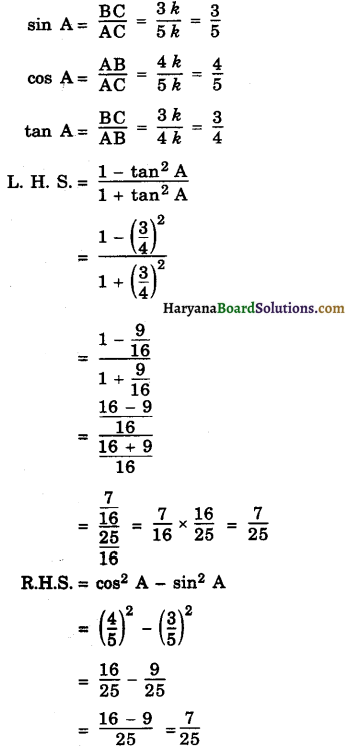
Word Meaning: Trained-Learned = निपुण, Possess-to have = पास में होना, Knock down-fall down = गिराना. First aid-medical treatment given before arrival of doctor = प्राथमिक चिकित्सा।

18. The discovery………………..of control.
आग की खोज और उसके प्रयोग ने आदि मानव को प्रकृति के साथ सुचारू रूप से जूझना और धीरे-धीरे स्थायी जीवन अपनाने के लिए तैयार किया। विश्व के कई भागों में आग की पूजा की जाती है। आग वास्तव में दोस्त है पर, जैसा कि हम जानते हैं, कि यह खतरनाक दुश्मन हो सकती हो जब यह नियंत्रण से बाहर हो जाए।

Word Meaning: Discover-to find = खोज, Gradually-slowly = धीरे-धीरे, Adopt-follow = अपनाना, Settled-to establish = स्थायी, Mode-way = तरीका, Control-check = नियंत्रण।

HBSE 7th Class English Solutions Honeycomb Chapter 8 Fire: Friend and Foe

Fire: Friend and Foe Summary in English

Early man discovered fire by watching lightning and volcanoes. To him fire was powerful and dangerous. With time man learnt that fire is result of chemical reaction. Three things are needed to make fire fuel, oxygen and heat. Every fuel needs a minimum temperature to catch fire. Fire is both a good servant and a bad master. It can be both constructive as well as destructive. Similarly there are three main ways by which firecan be put off.

We can put off fire by taking away the fuel, stopping supply of oxygen and removing the heat. Water should not be used as a means of putting off fire in case of oil fire and fire caught due to electrical appliances. Millions of rupees are spent each year in fighting fire. Fire brigades ensure that fires can be prevented and laws about building construction are followed strictly. Fire is thus a necessary friend if kept under control.

Fire: Friend and Foe Summary in Hindi

आदि मानव ने आग की खोज प्रदीप्ति और ज्वालामुखी को देखकर की। उसके लिए आग शक्तिशाली और खतरनाक थी। समय के साथ आदमी ने सीखा कि आग रासायनिक प्रतिक्रिया का परिणाम है। आग उत्पन्न करने के लिए तीन चीजों की आवश्यकता होती है- ईंधन, आक्सीजन और ऊष्मा। प्रत्येक ईंधन को आग पकड़ने के लिए न्यूनतम ताप की आवश्यकता होती है। आग एक अच्छा सेवक पर बुरा मालिक साबित होती है। यह दोनों निर्माणकारी और विनाशकारी हो सकती है। इसी प्रकार तीन तरीके हैं जिससे आग को बुझा सकते हैं। हम ईंधन को हटा कर, ऑक्सीजन की आपूर्ति रोककर तथा उष्मा को हटा कर आग को बुझा सकते हैं। तेल से उत्पन्न आग और बिजली के यन्त्र से लगी आग को पानी से नहीं बुझाना चाहिए। आग से जूझने के लिए लाखों रुपए हर वर्ष खर्च किए जा रहे हैं। आग बुझाने वाली गाड़ियाँ (अग्निशमन दस्ते) यह सुनिश्चित करते हैं कि आग को रोका जा सकता है, और भवन निर्माण के नियमों का सुचारू रूप से पालन किया जाए। आग एक जरूरी दोस्त है अगर नियंत्रण में रखी जाए।

HBSE 7th Class English Solutions Honeycomb Chapter 8 Fire: Friend and Foe Read More »