Author name: Prasanna

HBSE 9th Class Social Science Solutions Civics Chapter 5 Working of Institutions

Haryana State Board HBSE 9th Class Social Science Solutions Civics Chapter 5 Working of Institutions Textbook Exercise Questions and Answers.

Haryana Board 9th Class Social Science Solutions Civics Chapter 5 Working of Institutions

HBSE 9th Class Social Science Civics Working of Institutions Textbook Questions and Answers

Class 9 Civics Chapter 5 HBSE Question 1.
If you are elected as the President of India which of the following decision can you take on your own ?
(a) Select the person you like as Prime Minister.
(b) Dismiss a Prime Minister who has a majority in Lok Sakha.
(c) Ask for reconsideration of a bill passed by both die Houses.
(d) Nominate the leaders of your choice to the Council of Ministers.
Answer:
(c) The reconsideration of a bill passed by both houses can be done by the president.

Civics Chapter 5 Class 9 HBSE Question 2.
Who among the following is a part of the political executive?
(a) District Collector
(b) Secretary of the Ministry of Home Affairs
(c) Home Minister
(d) Director General of Police.
Answer:
(c) Home Minister is a part of the political executive.

Class 9 Civics Chapter Working Of Institutions Question Answer HBSE Question 3.
Which of the following statements about the judiciary is false?
(a) Every law passed by the Parliament needs approval of the Supreme court
(b) Judiciary can stike down a law if it goes against the spirit of the Constitution.
(c) Judiciary is independent of the Executive.
(d) Any citizen can approach the courts if her rights are violated.
Answer:
(a) No law passed by the parliament needs approval of the Supreme Court.

HBSE 9th Class Social Science Solutions Civics Chapter 5 Working of Institutions

Civics Class 9 Chapter 5 HBSE Question 4.
Which of the following institutions can make changes in an existing law of the country?
(a) The Supreme Court
(b) The President
(c) The Prime Minister
(d) The Parliament
Answer:
(d) The parliament can make changes in the law of the country.

Class 9 Civics Chapter 5 Working Of Institutions HBSE Question 5.
Match the ministry with the news that the ministry may have released

A. A new policy is being made to increase the jute exportsfrom the country.1. Ministry of Deforce
B. Telephone servi¬ces will be made more accessible to rural areas.2. Ministry of Health
C. The price of rice and wheat sold under the Public Distribution System will go down.3. Ministry of Agri-culture; Food and Public Distribution
D. A pulse polio campaign will be launched.4. Ministry of Commerce and Industry
E. The allowances of the soldiers posted on high altitudes will be increased.5. Ministry of Communcations and Information Technology.

Answer:

A. A new policy is being made to increase the jute exportsfrom the country.4. Ministry of Commerce and Industry
B. Telephone servi¬ces will be made more accessible to rural areas.5. Ministry of Communcations and Information Technology.
C. The price of rice and wheat sold under the Public Distribution System will go down.3. Ministry of Agri-culture; Food and Public Distribution
D. A pulse polio campaign will be launched.2. Ministry of Health
E. The allowances of the soldiers posted on high altitudes will be increased.1. Ministry of Deforce.

Question 6.
Of all the institutions that we have studies in this chapter, name the one that exercises the powers on each of the following matters.
(a) Decision on allocation of money for developing infrastructure like roads, irrigation etc. and different welfare activities for the citizens.
(b) Considers the recommendation of a Committee on a law to regulate the stock exchange.
(c) Decides on a legal dispute between who state governments.
(d) Implements the decision to provide relief for the victims of an earthquake.
Answer:
(a) Ministry of Finance.
(b) Ministry of Law.
(c) Supreme Court.
(d) Ministry of Statistics and Programme Implementation.

HBSE 9th Class Social Science Solutions Civics Chapter 5 Working of Institutions

Question 7.
Why is the Prime Minister in India not directly elected by the people? Choose the most appropriate answer and give reasons for your choice.
(a) In a Parliamentary democracy only the leader of the majority party in the Lok Sabha can become the Prime Minister.
(b) Lok Sabha can remove the Prime Minister and Council of Ministers even before the expirty of their term.
(c) Since the Prime Minister is appointed by the President there is no nefed for it.
(d) Direct election of the Prime Minister will involve lot of expenditure on the election.
Answer:
(c) Technically, the office of the Prime Minister is an office of appointment. The President appoints the Prime Minister. But with the parliamentary form of government as we have adopted in India, the Prime Minister has to be a representative of the nation.

Question 8.
Three friends went to watch a film that showed the hero becoming Chief Minister for a day and making big changes in the state. Imran said this is what the country needs. Rizwan said this kind of personal rule without institutions is dangerous. Shankar said all this is a fantasy. No minister can do anything in one day. What would be your reaction to such a film ?
Answer:
Indeed, no chief minister can make big changes in a day/but he can make certain changes that are in his power. Certain fundamental changes can be done to give others a lesson in administration.

Question 9.
A teacher was making preparations for a mock parliament. She called two students to act as leaders of two political parties. She gave them an option. Each one could choose to have a majority either in the mock Lok Sabha or in the mock Rajya Sabha. If this choice was given to you, which one would you choose, and why?
Answer:
I would choose to have a majority in the mock Lok Sabha. Of the two houses, the Lok Sabha is not only a more representative house, it is also the more powerful house. It helps make a ministry.

Question 10.
After reading the example of the reservation order, three students had different reactions about the role of the judiciary. Which view according to you, is a correct reading of the role of judiciary?
(a) Srinivas argues that since the Supreme Court agreed With the government, it is not independent.
(b) Anjaiah says that the judiciary is independent because it could have given verdict against the government order. The Supreme Court did direct the government to modify it.
(c) Vijay thinks that the judiciary is neither independent nor conformist, but acts as a mediator between opposing parties.
court struck a good balance between those who supported and those who opposed the order.
Answer:
(b) is the correct reading of the role of the judiciary. Judiciary is independent, it has the power to give a verdict against the government; it can even direct the government to modify its order.

HBSE 9th Class Social Science Solutions Civics Chapter 5 Working of Institutions

HBSE 9th Class Social Science Civics Working of Institutions Important Questions and Answers

Question 1.
What percentage of civil posts and services under the Government of India have been reserved for the Socially and Educationally Backward Classes (SEBC)?
Answer:
27% the vacancies.

Question 2.
With what name was the Second Backward Classes Commission known as?
Answer:
Mandal Commission.

Question 3.
Which Office Order was supposed to affect thousands of jobs every year?
Answer:
OM No. 36012/31/90-Est (SCT) dated 13.8.1990.

Question 4.
When was the Mandal Commission constituted?
Answer:
1978.

HBSE 9th Class Social Science Solutions Civics Chapter 5 Working of Institutions

Question 5.
Write the sentence each about the role played by the following people with reference to Office Memorandum No 36012/31/90.
1. Joint Secretary
2. B. P. Mandal
3. V.P. Singh
4. Indira Sawhney.
Answer:
1. Joint Secretary: The officer who signed OM No. 36012/31/90.
2. BP Mandal: The person who had headed the Second Backward Classes Commission.
3. V. P. Singh: The Prime Minister when OM 36012/31/90 was issued.
4. Indira Sawhney: One who filed a case against the Union of India in the Supreme Court relating to the Mandal Commission recommendations.

Question 6.
How does a democracy work?
Answer:
A democracy works through certain political institutions.

Question 7.
What is the function of the Department of Personnel and Training?
Answer:
The Department of Personnel and Training decides how and on what terms should the government employees be recruited.

Question 8.
What does the Cabinet do?
Answer:
The Cabinet meeting decides the major decisions about the country.

Question 9.
What does the Supreme Court do ?
Answer:
The Supreme Court is an institution where disputes about any policy or its implementation are resolved.

Question 10.
What is the job of the Parliament in India?
Answer:
The Parliament makes laws for the country.

HBSE 9th Class Social Science Solutions Civics Chapter 5 Working of Institutions

Question 11.
Which body does the Prime Minister head?
Answer:
Prime Minister heads the Council of Ministers.

Question 12.
What is the name of the national legislature in the USA?
Answer:
Congress: It has two houses:
(i) the House of Representatives and the Senate.

Question 13.
With what name is the British legislature known as?
Answer:
Parliament:
(i) The House of Common,
(ii) The House of Lords.

Question 14.
How many members and on what basis does the President of India nominate on tire Rajya Sabha ?
Answer:
The President of India nominates 12 members in the Rajya Sabha on the basis of art, sciences, literature and social service.

HBSE 9th Class Social Science Solutions Civics Chapter 5 Working of Institutions

Question 15.
What is tenure of the Rajya Sabha member?
Answer:
A Rajya Sabha member is elected for a period of six years, 1/3 of the total members retire every two years..

Question 16.
By whom is it decided whether a bill is a money bill or not?
Answer:
By the Speaker.

Question 17.
Where is the money bill sent after being passed by the Lok Sabha?
Answer:
Rajya Sabha.

Question 18.
Who presides over the joint sittings of the Parliament?
Answer:
The Speaker.

Question 19.
When does a bill become an Act of Parliament?
Answer:
On receipt of the assent of the President, the bill becomes an Act of Parliament.

Question 20.
Which kind of bill must have the consent of the President before being introduced?
Answer:
Money bill.

HBSE 9th Class Social Science Solutions Civics Chapter 5 Working of Institutions

Question 21.
Within how many days the Rajya Sabha has to return the money bill?
Answer:
14 days.

Question 22.
What is the maximum number of members in the Lok Sabha?
Answer:
550 At present, the number is 543.

Question 23.
Which of the Constitutional Amendments had frozen the ‘number of representatives in the Lok Sabha?
Answer:
42nd Constitutional Amendment.

Question 24.
Up to when the freeze has been extended by the National Population Policy 2000?
Answer:
Upto2026.

Question 25.
Which court is at the top of the judicial system in India?
Answer:
The Supreme Court.

Question 26.
What are the powers and functions of the Prime, Minister of India?
Answer:
The Prime Minister is the head of the central government. All the powers vested in the President are actually exercised by the Council of Ministers under the leadership of the Prime Minister. As a matter of fact the most powerful office in. the central government is that of the Prime Minister.

Powers and Functions of the Prime Minister –
1. He selects the members of the Council of Ministers.
2. He allocates portfolios among the ministers.
3. He can drop any minister.
4. He presides over the meetings of the Council of Ministers.
5. He decides about the policies of the government.
6. He coordinates the v/ork of different ministers.
7. He is also the chairman of the planning commission.
8. The entire government is associated with the name of the Prime Minister.

HBSE 9th Class Social Science Solutions Civics Chapter 5 Working of Institutions

Question 27.
Write a note on the Vice-President of India.
Answer:
The VicerPresident performs the duties and the. functions of a President in his absence or illness. If the President resigns or dies in office, the Vice-President officiates till a new President is elected. The Vice-President is also the ex-officio chairman of the Rajya Sabha. The Vice-President in our country is elected for 5 years by an electoral college. A candidate for the office of the Vice-President must he a citizen of India and must be of 35 years of age or above as well as he must be eligible to be a member of the Rajya Sabha.

Question 28.
Write a short note on the Council of Ministers.
Answer:
The Council of Ministers in our country is headed by the Prime Minister. In the council there are three categories of ministers:
1. The cabinet ministers
2. The ministers of state
3. deputy ministers.

It is essential for the members of the Council’of Ministers to be members of either house of Ihe parliaments. If a minister is not a member of the Parliament, he has to acquire its membership within six months of his appointment. The ministers are individually responsible for their ministries and departments. This responsibility is enforced through the Prime Minister. The Council of Ministers remains in power as long as it enjoys the support of the majority in the Lok Sabha.

Question 29.
How is the Speaker of the Lok Sabha elected ? Mention some of his functions.
Answer:
The Speaker is elected by the members of Lok‘Sabha among themselves. The Speaker presides over the sessions and conducts its business. The Speaker may be a member of any pqlitical party. However once elected, he has to conduct, the bu siness of the house impartially. It is the Speaker who keeps the house in order. Though he does not vote during the voting in the house, yet he can use his casting vote in case of a tie.

Question 30.
What do you know about the state legislature ?
Answer:
India is a federal country. Each of its states has a legislature. Some of the state legislatures have two houses while the maximum number of the states have only one house, the lower one. The upper house in a state legislature is known as Vidhan Parishad while the lower house is known as the Vidhan Sabha. According to the provisions of our constitution no legislative assembly is allowed to have more than 500 or less than 60 members.

The members of the Vidhan Sabha are elected by the people. A citizen of India of 25 years or more is able to be elected as its member.’ The Legislative Assembly is generally elected for 5 years. However, it may be dissolved before its term. Just like the Parliament, in a state .legislature, the lower house that is the Legislati ve Assembly is more powerful than the Legislative Council.

Question 31.
What is meant by Financial Emergency?
Answer:
Financial Emergency is a situation in which the President of India feels that the financial Stability or the credit of India is threatened. And to cope with this situation he declares financial emergency. In financial emergency, the President can reduce the salaries of all government officials including the Judges of the Supreme Court and High Courts.

HBSE 9th Class Social Science Solutions Civics Chapter 5 Working of Institutions

Question 32.
Write a few lines on the emergency arising out of the failure of constitutional machinery in States.
Answer:
When the President of our country is satisfied on the basis of the report of the governor of a state or even from other sources that the government in the state cannot be carried out in accordance with the provisions of the Constitution. In such a situation, he can declare emergency in that state. In this situation, the President can take over the entire work of the executive and dissolve or suspend the State Assembly. The governor rules in the name of the President. The budget is passed by the Parliament.

Question 33.
How many houses does the Parliament of India has ? How is the Lok Sabha constituted ?
Answer:
The Parliament consists of two Houses. The first House is the Lok Sabha or the House of the People (in Hindi Lok means people and Sabha means assembly or council). The people directly elect Members of the Lok Sabha for a period of five years. We have already studied the method of election for the 543 members of Lok Sabha.

Question 34.
Give briefly the composition of the Rajya Sabha.
Answer:
The second House of India’s Parliament is called the Rajya Sabha or the Council of States. The Rajya Sabha represents the states Its total strength is 250; 12 out of them are nominated by the President on the basis of art, literature, science, social service. A member of the Rajya Sabha is elected for six years, with one third retiring every second year. If is never without numbers.

Question 35.
Can we say that the political executive is more powerful in the presidential system than in parliamentary system ?
Answer:
Not really. Sometimes, strength becomes weakness. In a presidential system two different parties can run two different centres of power. Often the president cannot get the parliament to support.her or his policies. In a parliamentary system, the same party controls political executive and the parliament. So the political executive can work without obstacles.

Question 36.
How’ are the ministers appointed in India ?
Answer:
After the appointment of the Prime Minister, the President appoints other ministers on the advice of the Prime Minister. The ministers are usually from the party or the coalition that has the majority in Lok Sabha. The Prime Minister is free to choose ministers, as long as they are members of the Parliament. Sometimes, a person who is not a Member of Parliament can also become a minister. But such a person has to.get elected to one of the Houses of the Parliament within six months of appointment as minister.

HBSE 9th Class Social Science Solutions Civics Chapter 5 Working of Institutions

Question 37.
Do you agree that the President remains a nominal executive ? How is he elected ?
Answer:
The President is not elected directly by the people. The Constitution has set up a very elaborate and complex system for the election of the President, The President is elected by all the elected MPs and MLAs in the country. Their votes have different values, depending on how many people they represent.

Their votes are counted through a complicated system called ‘single transferable vote system. This complicated system of election meets two aims. The President can be seen to represent the entire nation. At the same time the President can never claim the kind of direct popular mandate that the Prime Minister can. This ensures that the president remains a nominal executive.

Question 38.
Explain the term Public Interest Litigation (PIL).
Answer:
When anyone approaches the courts in case public interest is adversely affected by the actions of the government, it is called public interest litigation. The courts intervene to prevent the misuse of government power in making decisions. They check malpractices on the part of public Officials. That is the reason why of all the political institutions in the country the judiciary enjoys high confidence of the people.

Question 39.
Answer following for the Lok Sabha and the Rajya Sabha:
Answer:
table

Question 40.
Describe the functions of the government briefly.
Answer:
Administration involves a lot of governmental activities. For example, the government is responsible for ensuring the security to the citizens, and providing facilities for education and health to all. It collects taxes and spends money thus raised on army, police and development programmes.

It formulates several welfare schemes and implements, them. Some persons ha ve to take decisions on how to go about these activities. Some have – to implement these decisions. If disputes arise on these decisions or in their implementation, there should be some one to determine what is right and what is wrong.

It is important that everyone should know who is resppnsible for doing what. It is also important that these activities are not influenced too much by the personal likes and dislikes of someone who happens to be doing that.

HBSE 9th Class Social Science Solutions Civics Chapter 5 Working of Institutions

So, to attend all these tasks several arrangements are made in all mbdem democracies. Such arrangements are called institutions. A democracy works through political institutions. It works well when these institutions do what, people expect of them, do.it efficiently and are answerable to the people.

Question 41.
Discuss some of the major functions of the Parliament in a democracy.
Answer:
Legislature exists in every democracy. It exercises political authority on behalf of the

people in many ways:
(a) The parliament is the final authority for making the laws in any country. This task of law making or legislation is so crucial that these assemblies are called legislatures. Parliaments all over the world can make new laws, change the existing laws, or abolish the existing laws and make new ones in their place, In most countries, the parliaments can also amend the Constitution in some situations.

(b) The parliaments all over the world can criticise and exercise some control over those who run the government. In some countries like India this control is direct and full. Those who run the government can do so only as long as the parliament wants them to.

(c) Parliaments control public finances. In most countries, any money raised from the people can be spent only when the parliament sanctions it.

(d) The parliaments are the highest forum of discussion and debate about public issues and national policy in any country . Parliament can. seek information about any matter related to government.
(e) Parliament chooses the real chief executive called also the Prime Minister, and it can also force him to resign if he loses its confidence. It is because of these functions and powers that the Parliament is described as supreme.

Question 42.
In what respects does the Lok Sabha appear more powerful than the Rajya Sabha ?
Answer:
Our Constitution clearly gives more powers to the directly elected house, the Lok Sabha as compared to the Rajya Sabha. This is clear from the following. Any ordinary law needs to be passed by both the houses. But if there is a difference between the two Houses, the final decision is taken by a joint session in which members of both the houses meet together. Because of the larger number of members, the-view of the Lok Sabha is likely to prevail in such a meeting.

(i) Lok Sabha exercises more powers in financial matters. Once the Lok Sabha passes the budget of the government or any other finance related law, the Rajya Sabha cannot reject it. The Rajya Sabha can only delay it by 14 days or suggest changes in it. The Lok Sabha may or may not accept these changes.

(ii) Most importantly, the Lok Sabha controls the government. The government contin- . ues in power only as long as it njoys the support of the majority of the members in the Lok Sabha. If the majority of the Lok Sabha members say they have ‘no confi¬dence’ in the Council of Ministers, all of them including the Prime Minister have to quit. This the Rajva Sabha cannot do.

Question 43.
What do you mean by ‘Political Ex- ccutive” ? Briefly stateits functions/powers.
Answer:
At different levels of any government we find functionaries who take day-to-day decisions but dp not exercise supreme power on behalf of the people. All those functionaries are collectively known as the executive. They are called executive because they are in charge of the ‘execution’ of the policies of the government. Thus, when we refer to ‘the government’ we usually mean the executive. The executive in a democratic country consists of two parts.

Those who are elected by the people for a specific period’are called the political executives. These are political leaders who tike the big decisions. Those who are appointed on a long-term basis are called the permanent executive or civil services. Those working in evil services are called civil servants. These are officers who work under political executive; and assist them in carrying out the day-to-day administration. In both the parliamentary and presidential systems.

HBSE 9th Class Social Science Solutions Civics Chapter 5 Working of Institutions

tire political executive does a lot more than \ve think it does; The role of the executive is not limited to implementing laws made by the parliament, it also includes: The political executive actively participates in law making. It is the cabinet that proposes a draft legislation that is passed by the parliament as the Natiorial Commission on Backward Glasses Act 1993.

In fact, it is mandatory that all legislation; that has to do with financial; matters should be proposed by the government, The executive frames policies and rules that are as important as the law itself. Let us recall that O.M. No. 36012/30/90 was an executive order, net a law. Subsequent decisions about who’could benefit from these reservations were e also made by the executive.

Question 44.
Why is the Prime Minister the most important political office in the countiy ?
Answer:
In a parliamentary system like ours, the head of the government is different from the head of the state. Both of them are part of the executive. But the head of the government exercises most of the real powers. This position is called the Prime Minister in most countries with parliamentary system. In our country too the Prime Minister is the head to the government. That is why, the Prime Minister is the most important political office in the country.

In a parliamentary system, the head of the state appoints the head of the government. In our country7 the President appoints the Prime Minister. But this is only a formal description. What it means in real life is that the President appoints leader of the majority party or the coalition of parties that command majority in the Lok Sabha as the Prime Minister. As the head of the government, the Prime Minister has wide ranging powers. He chairs cabinet meetings.

He coordinates the work of different departments. His decisions are final in case disagreements arise between departments; He exercises general supervision of different ministries. All ministers work under his leadership. The Prime Minister distributes and redistributes work’to the ministers. Tie also has the power to dismiss ministers. When he quits, the entire ministry quits.

The extent of power that Prime Minister really wields varies a lot. It depends upon, the personality of the holder of the office, his or her authority in the ruling party apd the image and following among the people. Jawaharlal Nehru, the first Prime Minister of India, exercised enormous authority because he was the supreme leader to the ruling Congress party at that time. He also had great influence on the public. But this was not true of all other Prime Ministers.

HBSE 9th Class Social Science Solutions Civics Chapter 5 Working of Institutions

Objective Type Questions

(i) The proposal for a law is called a ………..
(ii) On the receipt of the assent of the ……………. the bill becomes an Act of Parliament.
(iii) In the Rajya Sabha, every member is elected for years.
(iv) The Rajya Sabha must return the money bill with its recommendations within days.
(v) The …………… of the Assembly elect one of its members as speaker.
(vi) ………….. presides over the joint sittings of the Parliament.
Answer:
(i) Bill
(ii) President
(iii) 6
(iv) 14
(v) Members
(vi) The Speaker.

Question 2.
Put (✓) before correct sentences and (✗) before incorrect sentences.
(i) When Rajya Sabha does not return the money bill within 14 days it is deemed to have been passed.
(ii) The strength of Legislative Assemblies in different states, varies.
(iii) If there is disagreement between the two houses on the bill the President may convene a joint sitting.
(iv) The questions without stars are meant for legislators.
(v) The answers to all the questions and the supplementary questions given by ministers make the government responsive to Parliament.
Answer:
(i) When Rajya Sabha does not return the money bill within 14 days it is deemed to have been passed …..✓…..
(ii) The strength of Legislative Assemblies in different states, varies …..✓…..
(iii) If there is disagreement between the two houses on the bill the President may convene a joint sitting …..✓…..
(iv) The questions without stars are meant for legislators …….✗…….
(v) The answers to all the questions and the supplementary questions given by ministers make the government responsive to Parliament …..✓…..

Question 3.
Choose the correct alternative from the following ones:
(i) Mandal Commission was constituted in:
(a) 1976
(b) 1977
(c) 1978
(d) 1979
Answer:
(c) 1978

(ii) The following appoints the Prime Minister of India :
(a) President
(b) Supreme Court of India
(c) People
(d) Speaker of the Lok Sabha.
Answer:
(a) President

HBSE 9th Class Social Science Solutions Civics Chapter 5 Working of Institutions

(iii) The following is called the apex court:
(a) District court
(b) High Court
(c) Supreme court
(d) None of these
Answer:
(c) Supreme court

(iv) Parliament, in India, consists of the following:
(a) Lok Sabha only
(b) Rajya Sabha only
(c) Both Vidhan Sabha and Vidhan Parishad
(d) Both Lok Sabha and Rajya Sabha.
Answer:
(d) Both Lok Sabha and Rajya Sabha.

(v) The Prime Minister heads the following:
(a) Rajya Sabha
(b) Council of Ministers
(c) Supreme Court
(d) Vidhan Sabha.
Answer:
(b) Council of Ministers

HBSE 9th Class Social Science Solutions Civics Chapter 5 Working of Institutions Read More »
HBSE 9th Class Social Science Solutions Economics Chapter 4 Food Security in India

Haryana State Board HBSE 9th Class Social Science Solutions Economics Chapter 4 Food Security in India Textbook Exercise Questions and Answers.

Haryana Board 9th Class Social Science Solutions Economics Chapter 4 Food Security in India

HBSE 9th Class Social Science Economics Food Security in India Intext Questions and Answers

(Page 43)

Food Security In India Class 9 Questions And Answers HBSE Question 1.
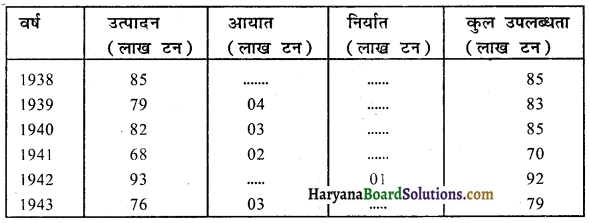
Some people say that the Bengal famine happened because there, was a shortage of rice. Study the table and find out whether you agree with the statement.
Answer:
Bengal famine occurred due to the increasing price of rice.

Class 9 Economics Chapter 4 Questions And Answers HBSE Question 2.
Which year shows a drastic decline in food availability?
Answer:
1940.

(Page 45)

Class 9 Economics Chapter 4 HBSE Question 1.
Why is agriculture a seasonal activity?
Answer:
Agriculture is a seasonal activity because it employs labor only during times of sowing transplanting and harvesting.

Class 9th Chapter 4 Economics HBSE Question 2.
Why is Rantu unemployed for about four months?
Answer:
Ramu works as a casual laborer in agriculture. Agriculture is a seasonal activity therefore he remains unemployed for about 4 months during the period of plant consolidation and maturing.

HBSE 9th Class Social Science Solutions Economics Chapter 4 Food Security in India

Question 3.
What does Ramu do when he is .unemployed?
Answer:
When he is unemployed he looks for work in other activities. Sometimes he gets employment in bricklaying or in construction activities in the village

Question 4.
Who are supplementing income in Ramu’s family?
Answer:
Ramu’s eldest son Somu and his wife Sundari are supplementing his income.

Question 5.
Why does Ramu face difficulty when he is unable to have work?
Answer:
Ramu and his family face difficulty when he is unable to work. Sometimes his kids have to sleep without food. He becomes food insecure during months when he remains unemployed.

Question 6.
When is Ramu food insecure?
Answer:
Ramu is food insecure because he is unemployed for 4 months.

Question 7.
Does Ahmad have a regular income from rickshaw-pulling?
Answer:
Ahmad’s income is not regular. His earnings fluctuate every day.

Question 8.
How does the yellow card help Ahmad ran his family even with small, earnings from rickshaw-pnlling?
Answer:
The yellow card of Ahmad is a PDS card for people below the poverty line; With this card, Ahmad gets a sufficient quantity of wheat, rice, sugar and kerosene oil for his daily use. He gets these essentials at half of the market price. He purchases his monthly stock during a particular day when the ration shop is opened for those below the poverty line. Thus, he is able to eke out his survival with less than sufficient earnings for his big family.

HBSE 9th Class Social Science Solutions Economics Chapter 4 Food Security in India

(Page 47)

Question 1.
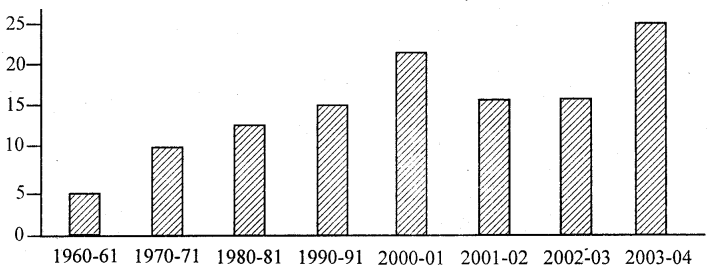
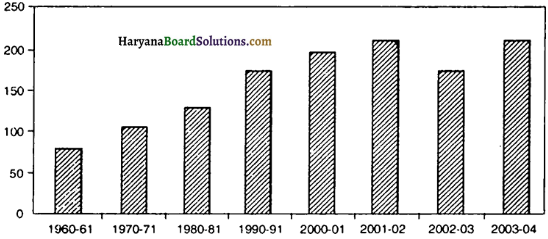
Study graph 4.1 and answer the following questions:
HBSE 9th Class Social Science Solutions Economics Chapter 4 Food Security in India - 1
Graph 4.1 Production of food-grains in India (million tonnes)
Answer:
(a) In the year 2003-2004.
(b) Between 1960 to 1970.
(c) No, it is not.

(Page 48)

Visit your areas Ration shop and get the following details.
1. When does the ration shop open?
2. What are the items sold at the ration shop?
3. Compare the prices of rice and sugar from die ration shop with die prices at any other grocery shop ? (for faimilies below poverty line)
4. Find out
Do you have a ration card ?
What has your family bought with this card from the ration shop?
Are there any problems that they face ? Why are ration shops necessary ?
Answer:
Students are requited to do it themselves.

Suggested Activity (Page 48)

Gather detailed information about some of the programmes initiated by the government, which have food component Discuss with your teacher.
Answer:
1. Rural wage employment programme.
2. Employment gurantee scheme.
3. Sampuma Grameen Rojgar- Yojana.
4. Mid day meal scheme.
5. Integrated child development services etc.

HBSE 9th Class Social Science Solutions Economics Chapter 4 Food Security in India

(Page 51)

Question 1.
Study die graph 4.2 and answer the Following questions:
HBSE 9th Class Social Science Solutions Economics Chapter 4 Food Security in India - 2
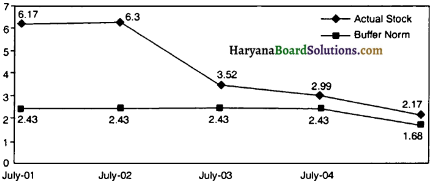
Graph 4.2 Central roodgrains (wheat + rice) Stock and Minimum Buffer Norm (million tonnes)
(a) In which recent year food-grains stock with the government ivas maximum ?
(b) What is tihe minimum buffet stock norm for the FCI
(c) Why were the FGI granaries over-flowing With food-grains?
Answer:
(a) In July 2002.
(b) 24.3 million tonnes.
(c) Public distribution system, including the minimum support price and procurement has contributed to an “increase in food-grain production. It made FCI granaries to overflow.

(Page 53)

Question 1.
How is food security ensured in India?
Answer:
Indian government is trying to achieve self sufficiency in food-grains since independence. With the help of green revolution it succeeded in achieving it. Since 1970’s variety of crops are grown all over the country. The availability of food-grains at the country level has been further ensured with, a carefully designed food security system by the government. This system has two components:
(a) buffer stock and
(b) public distribution system.

(a) Buffer stock:
The stock of food grains procured by the government through Food Corporation of India is called as buffer stock: The FCI procures these food^grains from areas Where they are surplus. It purchases them from farmers at a pre-announced price. The government maintains buffer stock to distribute food grains in the deficit areas and among the poorer strata .of society at a price lower than the market, price. This also helps resolve the problem of shortage of food during adverse weather conditions or during the calamity.

HBSE 9th Class Social Science Solutions Economics Chapter 4 Food Security in India

(b) Public distribution system:
Supply of essential commodities by the govemment to the people is referred to as public distribution system. The food procured by the FCI is distributed through government regulated ration shops among the poorer section of the society. Ration shops are. also known as fair , price shops. These shops keep stock of food- grains, sugar, kerosene, oil for cooking. These items are sold to people at a.price lower than the market price.

Question 2.
Which are the people more prone to food insecurity?
Answer:
Although a large section of people suffer from food and nutrition insecurity in India, the worst affected groups are landless people with little or no land to depend upon, traditional artisans, providers of traditional services, petty self-employed workers and destitute including beggars. In the urban areas the food insecure families are those whose working members are generally employed in ill paid occupations and causal labours market. These workers are largely engaged in seasonal activities and are paid very low wages that just ensure bare survival.

Question 3.
Which states are most food insecure in India ?
Answer:
The food .insecure people are disproportionately large in some regions of the country, such as economically backward states with high incidences of poverty, tribal and remote areas, regions more prone, to natural disasters etc. In fact the state of Uttar Pradesh (eastern and southeastern parts), Bihar, Jharkhand, Orissa,. West Bengal, Chattisgarh, parts of Madhya Pradesh and Maharashtra account for the largest number of food insecure people in the country.

Question 4.
Do you believe that green revolution has made India self-sufficient in food grains? How?
Answer:
In late 1960’s India adopted a new strategy in agriculture which resulted in the ‘green revolution’, especially in the production of wheat and rice. But the increase of food grains was, however, disproportionate. The highest rate of growth was achieved in Punjab and Haryana, where food-grain production jumped from 7.23 million tonnes in 1964-65 to reach an all-time high of 30.33 million tonnes in 1995¬96. Production in Maharashtra, Madhya . Pradesh, Bihar, Orissa and the northeastern states continued to stagger. Tamil Nadu and Andhra Pradesh, on the other hand, recorded significant increases in rice yield.

HBSE 9th Class Social Science Solutions Economics Chapter 4 Food Security in India

Question 5.
A section of people in India are still without food. Explain?
Arts.
Although a large section of people suffers from food and nutrition insecurity in India, the worst affected groups are landless people with little or no land to depend upon, traditional artisans, providers of traditional services, petty self-employed workers and destitute including beggars. In the urban areas, the food insecure families are those whose working members are generally employed in ill-paid occupations and causal labors market. These workers are largely engaged in seasonal activities and are paid very low wages that just ensure bare survival.

Question 6.
What happens to the supply of food when there is a disaster or calamity?
Answer:
Due to a natural calamity, say draught, the total production of food-grains decreases. It creates a shortage of food in the affected areas. Due to a shortage of food, the prices go up. At high prices, some people cannot afford to buy food. If such calamity happens in very wide areas or is stretched over the longer time period, it may cause a situation of starvation. Massive starvation might take a turn of famine.

Question 7.
Differentiate between seasonal hunger and chronic hunger?
Answer:
Chronic hunger is a consequence of diets persistently inadequate in terms of quantity and/or quality. Poor people suffer from chronic hunger because of their very low income and in turn inability to buy food . even for survival. Seasonal hunger is related to cycles of food growing and harvesting. This is prevalent in rural areas because of the seasonal nature of agricultural activities and in urban areas because of casual labor, e.g., there is less work for casual construction labor during the rainy season. This type of hunger exists when a person is unable to get work for the entire year.

HBSE 9th Class Social Science Solutions Economics Chapter 4 Food Security in India

Question 8.
What has our government done to provide food security to the poor? Discuss any two schemes launched by the government.
Answer:
The Indian government is trying to achieve self sufficiency in. food grams since independence. With the help of the green revolution, it succeeded in achieving it. The green revolution has avoided famine even during adverse weather conditions. Since the 1970’s variety of crops are grown all over the country. The availability of food grains at the country level has been further ensured with a carefully designed food security system by the government. This system has two components:
(a) buffer stock
(b) public distribution system.

(a) Buffer stock – The stock of food grains procured by the government through Food Corporation of India is called as buffer stock. The FCI procures these food grains from areas where they are surplus. It purchases them from farmers at a pre-announced price. The government maintains buffer stock to distribute food grains in the deficit areas and among the poorer strata of society at a price lower than the market price. This also helps resolve the problem of shortage of food during adverse weather conditions or during the calamity.

(b) Public distribution system – The supply of essential commodities by the government to the people is referred to as public distribution system. The food procured by the FCI is distributed through government-regulated ration shops among the poorer section of society. Ration shops are also known as fair price shops. These shops keejp stock of food- grains, sugar, kerosene, oil for cooking. These items, are sold to people at a price lower than the market price.

Question 9.
Why is a buffer stock created by the government?
Answer:
Buffer stock is created to distribute food grains in the deficit areas and among the poorer strata of society at a price lower than the market price also known as the issue price.

Question 10.
Write notes on:
(a) Minimum support price
(b) Buffer stock
(c) Issue price
(d) Fair price shops
Answer:
(a) Minimum support price – It is aprice at which FCI purchases food grain from farmers. This price is pre-announced. to encourage farmers for raising the production of crops. The price is announced every year before sowing. MSP has raised the government.

HBSE 9th Class Social Science Solutions Economics Chapter 4 Food Security in India

(b) Buffer stock:
The stock of food grains procured by the government through Food Corporation of India is called as buffer stock. The FCI procures these food grains from areas where they are surplus. It purchases them from farmers at a pre-announced price. The government maintains buffer stock to distribute food grains in the deficit areas and among the poorer strata of society at a price lower than the market price. This also helps resolve the problem of shortage of food during adverse weather conditions or during the calamity.

(c) Issue price-It is the price at which the government distributes food- grains ‘ in the deficit areas and among the poorer strata of society. This price is lower than the market price.

(d) Fair price shops:
Indian government is trying to achieve self-sufficiency in food grains since independence. With the help of green revolution, it succeeded in achieving it. Since 1970’s variety of crops are grown all over the country. The availability of food grains at the country level has been further ensured with, a carefully designed food security system by the government. This system has two components:
(a) buffer stock and
(b) public distribution system.

(a) Buffer stock:
The stock of food grains procured by the government through Food Corporation of India is called as buffer stock: The FCI procures these food^grains from areas Where they are surplus. It purchases them from farmers at a pre-announced price. The government maintains buffer stock to distribute food grains in the deficit areas and among the poorer strata .of society at a price lower than the market, price. This also helps resolve the problem of shortage of food during adverse weather conditions or during the calamity.

HBSE 9th Class Social Science Solutions Economics Chapter 4 Food Security in India

(b) Public distribution system:
Supply of essential commodities by the government to the people is referred to as public distribution system. The food procured by the FCI is distributed through government-regulated ration shops among the poorer section of society. Ration shops are. also known as fair, price shops. These shops keep stock of food- grains, sugar, kerosene, oil for cooking. These items are sold to people at a.price lower than the market price.

Question 11.
What are the problems of the functioning of ration shops?
Answer:
The problems of functioning of ration shops are-
(i) The price of APL family is as high as the market price.
(ii) grains to open the market to earn profits.
(iii) Poor quality grains are sold at ration shops.
(iv) Irregular opening of shops.
(v) Unsold stocks of poor quality of grains are left. Thus a massive stockpile up with FQuestion increases maintenance costs.

Question 12.
Write a note on the role of co-oper-active in providing food and related items.
Answer:
The co-operatives are also playing an important role in food security in India, especially in the southern and western parts of the country. The cooperative societies set up shops to sell low-priced foods to poor people. For example, out of all fair price shops running in Tamil Nadu, around 94 percent are being run by co-operatives. In Delhi, Mother Dairy is making strides provision of milk and vegetables to toe consumers at a controlled rate decided by the government of Delhi.

Similarly, in Maharashtra, the Academy of Development Science (ADS) has facilitated a network of NGOs for setting up grain banks in different regions. ADS organizes training and capacity-building programs on food-security for NGOs. Grain Banks are now slowly taking shape in different parts of Maharastra. ADS efforts to set up Grain Banks, to facilitate replication through other NGOs and to influence the government’s policy on food security are thus paying rich dividends. The ADS Grain Bank program is acknowledged as a successful and innovative food security intervention.

HBSE 9th Class Social Science Solutions Economics Chapter 4 Food Security in India

HBSE 9th Class Social Science Economics Food Security in India Important Questions and Answers

Question 1.
What is food security?
Answer:
Food is as essential for living as air is for breathing. Food security means something more than getting two square meals.

Question 2.
Why food security is necessary?
Answer:
The poorest, section of society might be food insecure most of the time while persons above the poverty line might also be food insecure when the country faces a natural disaster like an earthquake, drought, flood, tsunami, or widespread failure of crops causing famine, etc.

Question 3.
How is food security affected during a calamity?
Answer:
Due to a natural calamity, total

Some Important Facts

1. Food security-Food security means availability/accessibility and affordability of food by every person of a country.
2. Buffer stock-Buffer stock is the stock of food grains, namely wheat and rice procured by the government through Food Corporation of India (FCI).
3. Minimum support price-The pre-announced price of crops by the government is called as minimum support price.
4. Public distribution System-Distribution of food procured by FCI is called as public distribution system.

HBSE 9th Class Social Science Solutions Economics Chapter 4 Food Security in India Read More »

HBSE 9th Class Social Science Solutions Geography Chapter 5 Natural Vegetation and Wildlife

Haryana State Board HBSE 9th Class Social Science Solutions Geography Chapter 5 Natural Vegetation and Wildlife Textbook Exercise Questions and Answers.

Haryana Board 9th Class Social Science Solutions Geography Chapter 5 Natural Vegetation and Wildlife

HBSE 9th Class Social Science Geography Natural Vegetation and Wildlife TextBook Questions and Answers

Natural Vegetation And Wildlife Of Haryana 9th Class Question 1.
Choose the right answer from the four alternatives given below:
(i) To which one of the following types of vegetation does rubber belong to
(a) Tundra
(b) Tidal
(c) Himalayan
(d) Tropical Evergreen.
Answer:
(d) Tropical Evergreen.

(ii) Cinchona trees are found in areas of rainfall more than
(a) 100 cm
(b) 50 cm
(c) 70 cm
(d) less than 50 cm.
Answer:
(a) 100 cm

(iii) In which of the following state is the Simlipal bio-reserve located?
(a) Punjab
(b) Delhi
(c) Orissa
(d) West Bengal.
Answer:
(d) West Bengal.

(iv) Which one of the following bio-reserve of India is not included in the world network of bioreserve.
(a) Monas
(b) Dihang-Dibang
(c) Gulf of Mannar
(d) Nanda Devil
Answer:
(d) Nanda Devil

Class 9 Geography Chapter 5 Natural Vegetation And Wildlife Notes HBSE Question 2.
(i) Define an ecosystem.
Answer:
System is meant by the physical environment of a place formed by all kinds of plants, birds and animals of that area.
(ii) What factors are responsible for the distribution of plants and animals in India?
Answer:
The distribution of plants and. animals are mainly determined by the climate of that area. The other determiner factors of this distribution are soil, relief and drainage etc.

HBSE 9th Class Social Science Solutions Geography Chapter 5 Natural Vegetation and Wildlife

(ii) What is a biosphere? Give two examples.
Answer:
A bio-reserve is a place that consists of fairly vast wild land and is devoted to the protection and preservation of flora and fauna of the country in the very natural form.
Examples:
Gulf of Mannar, Nilgiri.

(iv) Name two animals having habitats in different types of vegetation.
Answer:
(i) Tropical Rain Vegetation: Elephant, monkey
(ii) Deciduous Vegetation: Lion, tiger
(iii) Thorn-Scrubs: Fox, Lion,
(iv) Temperate Vegetation: Kashmir Stag, Leopard
(v) Alpine-Tundra: Yak, Leopard
(vi) Tidal vegetation: Tiger, turtles

Natural Vegetation Of Haryana HBSE 9th Class Question 3.
Distinguish between
(i) Flora and Fauna
(ii) Tropical evergreen and deciduous forests.
Answer:
Flora:
1. It refers to plants.
2. It came first into existence
3. It can convert energy derived from the sun into food.

Fauna
1. It stands for animal and wildlife.
2. It came into existence after the flora.
3. It cannot convert sun energy into food.

(ii) Evergreen and deciduous forests.
Answer:
Evergreen forests:
1. These are the forests found in areas with more than 200 cm of rainfall.
2. There the trees reach great heights up to 60 metre or more.
3. These are found in the Western Ghats and the island groups of India.

Deciduous forests:
1. These are found in areas with 70-200 cm of rainfall.
2. Trees do not reach at such a height.
3. These are found in the northeastern states along with the foot hills of the Himalayas, Jharkhand and Orissa.

HBSE 9th Class Social Science Solutions Geography Chapter 5 Natural Vegetation and Wildlife

Natural Vegetation And Wildlife Class 9 Questions Answers HBSE Question 4.
Name different types of vegetation found in India and describe the vegetation of high altitudes.
Answer:
The major vegetation types of India are the following:
1. The Tropical Rain forests.
2. The Deciduous forests.
3. The Tropical thorn forests arid Scrubs.
4. The Temperate forests with Grassland.
5. Tine Alpine and Tundra Vegetation.
The vegetation of high altitudes are: ebony, mahogany and rosewood.

Chapter 5 Natural Vegetation And Wildlife HBSE  Question 5.
Quite a few species of plants and. animals are endangered. Why ?
Answer:
There are about 1300 plant Species and a few animal species are endangered. This is. due to executive exploitation of plants and animals by man. The other main causes include animal hunting by man for commercial purposes. Pollution due to chemical and industrial waste, acid deposits, the introduction of alien species and reckless cutting of the forests to bring land under cultivation and inhabitation, are also responsible for.the imbalance.

Class 9 Geography Chapter 5 HBSE Question 6.
Why India has a rich hertiage of flora and fauna ?
Answer:
India is one of the 12 mega biodiversity countries of the world. With about 47,000 plant species and 89,000 species of animals, India is tenth in the world and fourth in Asia in plant diversity. There are about 15,00.0 flowering plants in our country which constitute six per cent of the world’s total. India is also rich in non-flowering plants such as finis, algae and fungi and has a huge variety of fish in its fresh marine waters.

India has a rich heritage of flora and fauna. It is due to factors relating to the following: Temperature : The character and extent of vegetation are mainly determined by temperature along with hurmidity in the air; precipitation and soil. On the slopes of the Himalayas and the hills of the Peninsula above the height of 915 metres, the fall in the temperature affects the types of vegetation and its growth, and changes it from tropical to subtropical temperate and alpine

HBSE 9th Class Social Science Solutions Geography Chapter 5 Natural Vegetation and Wildlife

Temperature characteristics of the Vegetation Zones Table No. 5.1
img

2. Sunlight:
The variation in sun’s radiant energy at different places is due to difference in latitude, altitude/season and duration of the day. Due to the factor of sunlight, trees grow faster in summer.

3. Precipitation:
Almost the entire rainfall is brought in by the advancing south west monsoon (June to Sept.) and retreating north east monsoon. Areas of heavy rainfall have more dense vegetation as compared to other areas.

4. Soil:
Changes in soil conditions have given rise to peculiar types of vegetation in many areas such as mangrove forests, swamps and sandy coastal forests.

5. Relief:
It is another important factor affecting vegetation-plains, plateaus and mountains have different types of vegetation.

HBSE 9th Class Social Science Geography Natural Vegetation and Wildlife Important Questions and Answers

9th Class Geography Chapter 5 Question Answer HBSE Question 1.
Which was the form of life which appeared on the earth?
Answer:
Plants or vegetation.

Class 9 Natural Vegetation And Wildlife Question Answer HBSE Question 2.
What is the importance of the plants – for us?
Answer:
Every form of life on the earth is dependent either directly or indirectly on the plants hence these are very significant.

Chapter 5 Geography Class 9 Question Answer HBSE Question 3.
How many flowering plants are there in India?
Answer:
About 15000.

Class 9th Chapter 5 Geography HBSE Question 4.
What is the use of Sarpagandha?
Answer:
Sarpagahdha is used for the treatment of the blood pressure.

HBSE 9th Class Social Science Solutions Geography Chapter 5 Natural Vegetation and Wildlife

5 Natural Vegetation And Wildlife HBSE Question 5.
How many species of the plants have been listed as endangered in India?
Answer:
52

Question 6.
Which of the international agencies has included Indian plants in the medical list?
Answer:
The World Conservation Union.

Question 7.
Name the Indian states where Tropical deciduous forests are found.
Answer:
1. The north-eastern states
2. The foothills of the Himalyas
3. Jharkhand
4. West Orissa
5. Chhattisgarh
6. Eastern slopes of the Western Ghats.

Question 8.
Give two examples of deciduous trees.
Answer:
1. Teak
2. Sal.

Question 9.
Give three examples of the trees of the tropical rains forests.
Answer:
1. Ebony
2. Mahogany
3. Rosewood.

Question 10.
Name the place where thorny forests are found in India.
Answer:
The north-western part of the .country including the semi-arid areas of Gujarat, Rajasthan, Madhya Pradesh, Uttar Pradesh, Haryana.

Question 11.
In which state is the Sundarban located?
Answer:
In West Bengal.

HBSE 9th Class Social Science Solutions Geography Chapter 5 Natural Vegetation and Wildlife

Question 12.
Name the major vegetation region to which Acacia and Teak trees belong.
Answer:
Acacia – Thom forests.
Teak-Tropical deciduous forests.

Question 13.
In which type of vegetation region are the date-palm and the mahogani trees found ?
Answer:
Date palm trees-Thorn forests.
2. Mahogany trees.

Question 14.
How many species of birds are there in India ?
Answer:
Near about 1200.

Question 15.
In what kind of water do the Sundari trees flourish?
Answer:
Sundari trees flourish both in fresh and salt water.

Question 16.
Name the Indian states where elephants are found.
Ans:
1. Assam
2. Kerala
3. Karnataka.

Question 17.
Name the national bird of India.
Answer:
Peacock.

Question 18.
Name the national animal of India.
Answer:
Tiger.

HBSE 9th Class Social Science Solutions Geography Chapter 5 Natural Vegetation and Wildlife

Question 19.
Name two migratory birds.
Answer:
1. Siberian crane
2. Flamingo.

Question 20.
Name two endangered species of wild life.
Answer:
1. Tigers
2. Rhinoceros.

Question 21.
Point out some most important characteristics of the monsoon.
Answer:
1. These are found almost all over India.
2. They grow in the areas with the rainfall between 200 cm-75 cm.
3. These forests have Sal and Teak trees.
4. These trees shed their leaves for about six to eight weeks in summer.

Question 22.
Point out the importance of the biosphere reserves.
Answer:
1. The biosphere reserves are very important in reserving the endangered species of animals and plants.
2. These are the important source of transmission of the natural heritage to the future generations.
3. These inspire the people of the surrounding areas to protect tire wild life.
4. These provide opportunities for research.
5. These are also important for promoting the tourism.

Question 23.
Name the states where the following biosphere reserves are situated.
(i) Nilgiri
(ii) Nanda Devi
(iii) Manas
(iv) Simlipal
(v) Nokrek
(vi) Sundarban
(vii) Pachmarhi
(viii) Dehang Debong
Answer:
Biosphere Reserves States
(i) Nilgiri – Tamil Nadu, Kerala Karnataka
(ii) Nanda Devi – Uttranchal
(in) Manas – Assam
(iv) Simlipal – Orissa
(v) Nokrek – Meghalaya
(vi) Sundarban – West Bengal
(vii) Pachmarhi – Madhya Pradesh
(viii) Dehang Debong – Arunachal Pradesh.

HBSE 9th Class Social Science Solutions Geography Chapter 5 Natural Vegetation and Wildlife

Question 24.
What is the reason that the tropical deciduous forests shed their leaves during the summer?
Answer:
Tropical deciduous forests are the trees like, sal, sandal, shisha etc. All of these trees shed their leaves in summer. The main reason behind this fact is that the leaves get dry by the scorching heat of the summer and as a result they leave the branches automatically.

Question 25.
What are the main reasons that the ever-green forests are found in the western slopes of the Western Ghats?
Answer:
The evergreen forests are found in the western slopes of the Western Ghats because of the following reasons\:
1. The western slopes of the Western Ghats get heavy rainfall because they are on the leeward side of the Western Ghats and here the monsoon winds are very active.
2. The trees grown here do not have a distinct season of sheding leaves as the region is warm and wet throughout the year.

Question 26.
Point out the importance of the plant kingdom.
Answer:
The first form of life on the earth belongs to the plant kingdom. Plant kingdom developed the life system for the animal kingdom. Plants are the primary source that converts sunlight into foods. Plants not only add beauty to the nature but also provide oxygen to us. Without oxygen we can not live. Hence the plant kingdom is very important for us.

Question 27.
How the natural vegetation of Rajasthan can be conserved?
Answer:
The following steps may be taken to conserve the natural vegetation in Rajasthan:
1. Cultivated area should be increased by the irrigation facilities.
2. Indira Gandhi Nahar is fulfilling this purpose quite effectively.
3. The desert areas should be reduced by growing more and more trees and grasses so that sands do not expand more adjoining areas.

HBSE 9th Class Social Science Solutions Geography Chapter 5 Natural Vegetation and Wildlife

Question 28.
What is the reason that thorny type of vegetation is found in Rajasthan?
Answer:
Thorny type of vegetation which is composed of the trees like kikar, babul, khair, datepalm, scrubs and thorny bushes etc. are found mainly in Rajasthan. The main reasons behind this fact are the following:
1. Such type of vegetation is confined in areas .with less than 75 cm rainfall and Rajasthan is directly, this kind of area.
2. This type of vegetation have long roots so that they can thrive in a dry area like Rajasthan where underground water is found very deep.

Question 29.
What is meant by vegetation? How much ‘natural is the natural vegetation of India today?
Answer:
Vegetation is meant by the species of plants. India is very rich in vegetation. India is tenth in the world and fourth in Asia in plant diversity. There are more than 47000 plant species in India. More than 15,000 plants are flowering plants. Sarpagandha which is used to treat blood pressure is found only in India.

However, the most of the vegetal cover of India is no more natural. Natural vegetation is meant only by the plant community that has been left undisturbed over a long period. But in India except some inaccessible regions like the Himalayas and the desert, the vegetation has been destroyed or replaced or even degraded by human occupancy. Hence, they cannot be taken as natural vegetation anymore.

Question 30.
What is a biome ? State the number of biomes into which the land ecosystem is divided and also the basis for the grouping.
Answer:
Biome is meant by a very large ecosystem on land having distinct types of vegetation and animal life. Though the animals are included in the biomes mainly plant formations are used as the basis of their grouping.
The five principle biomes of the world may be listed in order of availability of soil, water and heat are:
1. forests
2. savana
3. grassland
4. desert
5. tundra.

Within a biome, much variation may be found in the assemblage of piant and animal species.
Bimoes are useful for studying the world patterns of vegetable cover.

HBSE 9th Class Social Science Solutions Geography Chapter 5 Natural Vegetation and Wildlife

Question 31.
Discuss how the relief and rainfall influence the distribution of natural vegetation in India.
Answer:
The relief and the rainfall surely influence the distribution of the natural vegetaion in India. These are actually the most important factors influencing the natural vegetation of an area. The plants occur in distinct groups in areas having similar climatic conditions and rainfall though such areas may be far from each other.

Question 32.
Describe the major vegtation zones of the Himalayan region.
Answer:
1. In the foothills of the Himalayas the tropical deciduous forests are found;
2. Between the height of 1000-2000 mtrs wet temperate type forests are found.
3. Between 1500-3000 mtrs, the evergreen broad-leave trees like oak and chestnuts are predominantly found.
4. The southern slopes of Himalayas are mostly covered by the temperate forests containing coniferous trees like pine, deodar, silver fur, spruce and cedar etc.

Question 33.
Mention the uses of forests.
Answer:
Forests are renewable resources and play a major role in enhancing the quality of environment. They modify local climate, control soil erosion, regulate stream flow, support a variety of industries, provide livelihood for many communities and offer panoramic or scenic view for. recreation. They control wind force and temperature and causes rainfall. They provide humus to the soil and shelter to the wild life. India’s natural vegetation has undergone many changes due to several factors such as the growing demand for cultivated land, development of industries and mining, urbanisation and over-grazing of pastures.

Question 34.
Distinguish between Moist Deciduous forests and Dry Deciduous forests.
Answer:
Moist Deciduous forests
1. These are the forests found in ithe areas with rainfall between 100-200 cm.
2. Teak is the most common tree of these forests.
3. These are mainly found in the eastern part of the country especially in the north-eastern states and. in the foot hills of Himalaya.

Dry Deciduous forests:
1. These are found in the areas with the rainfall of 70-100 cm.
2. These forests, have given way to thorn forests.
3. These are mainly found in Bihar, U. P. and Peninsular Plateau.

Question 35.
Distinguish between Extinct Species and Endangered Species.
Answer:
Extinct Species
1. These are the species of plants and animals not seen in the world any more. These have not been sighted during the last 6-10 decades.
2. In India about 20 species of plants have become extinct.
3. These cannot be protected any more or brought back.

Endangered Species
1. These are the species which are in the danger of getting extinct.
2. In India there are about 1300 endangered species of plant.
3. These can be protected and can be saved from being extinct.

HBSE 9th Class Social Science Solutions Geography Chapter 5 Natural Vegetation and Wildlife

Question 36.
Name two plants of each type of vegetation.
Answer:
(i) Tropical Rain plants: Ebony, rosewood.
(ii) Deciduous plants: Clair, Kasumi
(iii) throws-scrubs: Acacias, palms
(iv) Temperate Plant: Pine, spruce
(v) Alpine-Tundra: Junipers, pines
(vi) Tidal plants: Palm, agar

Question 37.
Which steps should be taken to preserve the natural vegetation?
Answer:
To preserve the natural vegetation following steps should be taken:
1. Cutting of the trees in the forests must be stopped. The government has taken adequate steps in this direction. Forest department has been created for this purpose. Laws have been implemented to punish the persons found in felling and cutting of the trees. However, awareness among the people is more important. Without this awareness desired results cannot be achieved.

2. The people must cooperate to check the felling of trees. They infact must take active part in this regard. Fortunately, many persons have come forward in this direction. Movements like (Chipko Andolan’ has been launched by the people themselves.
3. Necessary wood for industrial purposes and for other activities, must be taken in a planned manner. So that both purposes-industrial growth and environment protection-can be achieved.
4. Wherever the trees have been cut for whatever reason; new trees must be planted to maintain the ecological balance.
5. Functions like ‘Vanmahotsava’ should be celebrated everywhere, it would help in growing awareness.
6. 33% of the total land area must be brought under forest area.

Question 38.
Give a brief account of the wild life in India.
Answer:
The fauna in India is very rich and varied. It consists of a variety of fish, birds and animals including amphibians, reptiles, mammals, small insects and worms. In fact there are more than 89,000 species of wild life’in India.
1. The biggest of the mammals are the elephants. Elephants are mainly found in the jungles of Assam, Kerala and Karnataka.
2. Camels are mainly found in Rajasthan.
3. Wild asses are found in the Rann of Kachchh.
4. The rhinoceroses are found in marshy and swampy lands of Assam.
5. Lions are mainly found in Gir forest of Gujarat
6. Royal tigers are found in SundarbAnswer:
7. Leopards of various types are found in the Himalayan region.
8. The Himalayan ranges are the home of several other species like wild sheep, mountain goats, wild goats, the shew, the tapir and the snow leopard etc.
9. Various species of monkeys are also found in India.
10. In India buffaloes, Nilgiri Chouringha, gazel, deer etc.
11. A variety of birds are found in India. The chief among them are the peacocks, geese, pheasants, ducks, mynahs, pigeons, parrots, cranes, and also found hornbills and sunbirds etc.

HBSE 9th Class Social Science Solutions Geography Chapter 5 Natural Vegetation and Wildlife

Question 39.
Write short notes on the following:
(i) Indian flora
Answer:
Flora means the plants of a particular region or period. India has been known for its flora since ancient times. In Ayurveda at least 2000 kinds of flora has been described. There are about 15,000 flowering plants are found in India. In total, India has more than 47,000 plant species. The World Conservation Unions Red list has names of 352 medical plants found in India. The Rawvolfia which is used to treat blood pressure is found only in India. However more than 52 species have been identified as endangered.

(ii) Tropical rain forests
Answer:
These forests are found in the k rainy parts of the Western Ghats and also in ! the island groups of Lakshadweep and the ) Andaman and Nicobar. These forests are at their best in the areas having more than 200 cm of rainfall with a short dry season. In these types of forests, trees reach great height even upto 60 metres and more. Since the region is warm and wet throughout the year, it has luxuriant vegetation of all kinds like trees, shrubs and even creeper. These forests appear green the year.

Objective Type Questions

Question 1.
Put ( ✓) before the correct sentences and (✗) before the incorrect sentences:
(i) Humans are not the part and parcel of the ecosystem.
(ii) Sarpagandha is used for treatment of blood sugar.
(iii) There are about 15,000 flowering plants in India.
(iv) All plants and animals of an area are interdependent
(v) Nearly 40% of the total plant species of our country have come from outside India.
(vi) Tropical rain forests are restricted to tiie heavy rainy parts of the country.
(vii) The thorn forests are found in Andaman.
(viii) India has less than 10,000 animal species.
Answer:
(i) ✗
(ii) ✗
(iii) ✓
(iv) ✓
(v) ✓
(vi) ✓
(vii) ✗
(viii) ✗

Question 2.
Fill up the blanks with appropriate words:
(i) The Indian birds constitute % of the world’s total number of birds.
(ii) Like flora, India is also rich in its
(iii) Leopards are members of the family.
(iv) Yak is found in
(v) Ranathambhor is in
(vi) Flamingo is beautiful
Answer:
(i) 13
(ii) fauna
(iii) cat
(iv) Ladakh,
(v) Rajasthan
(vi) bird.

HBSE 9th Class Social Science Solutions Geography Chapter 5 Natural Vegetation and Wildlife

Question 3.
Choose the correct answer from the four alternatives given below:
(i) The following is a tree found in tropical rain forests:
(a) mahogany
(b) shisham
(c) palms
(d) spruce.
Answer:
(a) mahogany

(ii) The following is a type of animal found in tropical rain forests:
(a) tiger
(b) elephant
(c) rabbit
(d) snow leopard
Answer:
(b) elephant

(iii) The following is the type of animal found in the Alpine and Tundra Vegetation:
(a) worms
(b) camels
(c) yaks
(d) turtles
Answer:
(c) yaks

(iv) The following type of timber is found in deciduous forests:
(a) Acacias
(b) silver fir
(c) ebony
(d) sandalwood
Answer:
(d) sandalwood

(v) There are the following number of national parkes in india:
(a) 89
(b) 90
(c) 91
(d) 92
Answer:
(a) 89

HBSE 9th Class Social Science Solutions Geography Chapter 5 Natural Vegetation and Wildlife Read More »

HBSE 9th Class Social Science Solutions Economics Chapter 3 निर्धनता : एक चुनौती

Haryana Board 9th Class Social Science Solutions Economics Chapter 3 निर्धनता : एक चुनौती

HBSE 9th Class Economics निर्धनता : एक चुनौती Textbook Questions and Answers

पाठ्य पुस्तक प्रश्न-32

(i) विभिन्न देश विभिन्न निर्धनता रेखाओं का प्रयोग क्यों करते हैं?
उत्तर-
निर्धनता का अर्थ ऐसी स्थिति से लिया जाता है जहाँ व्यक्ति अपनी न्यूनतम आवश्यकताओं की पूर्ति नहीं कर पाते। एक व्यक्ति तब निर्धन कहलाता है जब वह अपनी मूल ज़रूरतें को पूरा नहीं कर पाता।
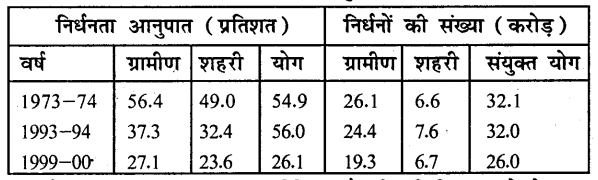
तालिका 3.1 : भरत में निर्धनता के अनुमान

क्योंकि अलग-अलग देशों में मूल आवश्यकताओं की व्याख्या अलग-अलग होती है, इसलिए भिन्न-भिन्न देशों में निध ‘नता रेखाएँ भी भिन्न-भिन्न होती हैं।
(it) आपके अनुसार आपके क्षेत्र में ‘न्यूनतम . आवश्यक स्तर’ तथा होगा?
उत्तर-हमारे अनुसार ‘न्यूनतम आवश्यक स्तर’ यह होगा कि एक व्यक्ति को कम से कम मूल आवश्यकताओं की पूर्ति हो तो; उसे रोज़ खाना तो मिले, पहनने को कपड़ा तो मिले और सोने के लिए रात को छत तो प्राप्त हो।

तालिका 3.1 : भरत में निर्धनता के अनुमान
HBSE 9th Class Social Science Solutions Economics Chapter 3 निर्धनता एक चुनौती 1

HBSE 9th Class Social Science Solutions Economics Chapter 3 निर्धनता : एक चुनौती

उपर्युक्त तालिका का अध्ययन कीजिए और निम्नलिखित प्रश्नों के उत्तर दीजिए-

(i) 1973-74 और 1993-94 के मध्य निर्धनता अनुपात में गिरावट आने के बावजूद निर्धनों की संख्या 32 करोड़ के लगभग क्यों बनी रहीं?
(ii) क्या भारत में निर्धनता में कमी की गति कि ग्रामीण और शहरी भारत में समान है?
उत्तर-
निर्धनता अनुपान 1993-94 में 1973-74 की अपेक्षा भले गिरा हो, परंतु निर्धन लोगों की संख्या में कमी __नहीं हुई है। इसके मुख्य कारण निम्नलिखित बताए जा सकते हैं
(क) जनसंख्या में निरंतर वृद्धि होती रही है;
(ख) ग्रामों से शहरों की ओर लोगों का आना जारी रहा है।
(i) निर्धनता में कमी के गतिकि ग्रामों व शहरें में नहीं रहे हैं। शहरों की अपेक्षा ग्रामों में निर्धनता सदैव अधिक _ रही है। 1973-74 में 56.4% 1993-94 में 37.3%, तथा 1999-2000 में 27.1% ग्रामों में निर्धनता का प्रतिशत था जबकि शहरों में यह प्रतिशत क्रमशः 49.0%, 32.4% तथा 23.6% था।

HBSE 9th Class Social Science Solutions Economics Chapter 3 निर्धनता एक चुनौती 2

निर्धनता एक चुनौती प्रश्न उत्तर HBSE 9th Class

पाठ्य पुस्तक प्रश्न-पृष्ठ 35

अपने आस-पास के कुछ निर्धन परिवारों का अवलोकन करें और यह पता लगाने का प्रयास करें कि
(i) वे किस सामाजिक और आर्थिक समूह से संबंद्ध हैं?
(ii) परिवार में कमाने वाले सदस्य कौन हैं?
(iii) परिवार में वृद्धों की स्थिति क्या है?
(iv) क्या सभी बच्चे (लड़के और लड़कियाँ) विद्यालय जाते हैं?
उत्तर-
(i) वे प्रायः समाज के कमज़ारे वर्गों-दलित-से संबंधित हैं।
(ii) पुरुष व स्त्रियों दोनों ही काम करते हैं; कहीं-कहीं तो परिवार के बच्चे भी काम करते हैं।
(iii) भले वृद्ध काम करने के योग्य इतने नहीं होते जितने युवक होते हैं, फिर भी वह छोटा-मोटा काम करते रहते हैं।
(iv) बहुत कम बच्चे विद्यालय जाते हैं।

उपर्युक्त आरेख का अध्ययन कर निम्नलिखित कार्य करें-
कृप्या आरेख अगले पृष्ठ पर देखें।
(i) तीन राज्यों की पहचान करें जहाँ निर्धनता अनुपात सर्वाधिक है।
(ii) तीन राज्यों की पहचान करें जहाँ निर्धनता अनुपात सबसे कम है।
उत्तर-
(i) उड़ीसा, बिहार तथा मध्यप्रदेश में निर्धनता अनुपात सर्वाधिक है। .
(ii) जम्मू-कश्मीर, पंजाब तथा हिमाचल प्रदेश में निर्धनता अनुपात सबसे कम है।
निर्धनता-कुछ चुनिंदा देशों के बीच तुलना
HBSE 9th Class Social Science Solutions Economics Chapter 3 निर्धनता एक चुनौती 4 HBSE 9th Class Social Science Solutions Economics Chapter 3 निर्धनता एक चुनौती 3

देश — 1. डॉलर प्रतिदिन से कम पाने वाले लोगों की संख्या का प्रतिशत

1. नाइजीरिया — 70.8
2. बांग्लादेश — 36.0
3. भारत — 35.3
4. पाकिस्तान — 17.0
5. चीन — 16.6
6. ब्राजील — 8.2
7. इंडोनेशिया — 7.5
8. श्रीलंका — 7.6

निर्धनता एक चुनौती HBSE 9th Class

HBSE 9th Class Social Science Solutions Economics Chapter 3 निर्धनता : एक चुनौती

चित्र आरेख का अध्ययन कर निम्नलिखित कार्य करें-
(i) विश्व के उन क्षेत्रों की पहचान करें जहाँ निर्धनता अनुपात में गिरावट आई है।
(ii) विश्व के उस क्षेत्र की पहचान करें जहाँ निर्धनों की संख्या सर्वाधिक है।
HBSE 9th Class Social Science Solutions Economics Chapter 3 निर्धनता एक चुनौती 5
उत्तर-
(i) चीन व दक्षिणी-पूर्वी एशियाई देशों में निर्धनता में गिरावट आई है।
(ii) सब-सहारा क्षेत्र में निर्धनों की संख्या बढ़ी है।

निर्धनता : एक चुनौती Class 9 HBSE

पाठ्य पुस्तक प्रश्न-पृष्ठ 40

प्रश्न 1.
भारत में निर्धनता रेखा का आकलन कैसे किया जाता है?
उत्तर-
भारत में निर्धनता का आकलन दो तरीकों से किया जाता है। पहला, किसी परिवार द्वारा विभिन्न वस्तुओं पर किए गए व्यय को मालूम करके; दूसरा, परिवार द्वारा अर्जित आय का पता लगा करके। 1999-2000 में ग्रामीण क्षेत्रों में गरीबी रेखा के नीचे उन लोगों को मान लिया गया था जिनकी मासिक आय 328 रुपये प्रति व्यक्ति थी या उससे कम। शहरी क्षेत्रों में उन्हें गरीबी के नीचे जिनकी आय प्रति व्यक्ति मासिक आय 454 रुपये थी अथवा उससे कम।

प्रश्न 2.
क्या आप समझते हैं कि निर्धनता आकलन का वर्तमान तरीका सही है?
उत्तर-
प्रायः निर्धनता आकलन के दोनों तरीके सहीं हैं। फिर भी, निर्धनता का आकार बढ़ाया जाना चाहिए। इसमें मूल आवश्यकताओं की पूर्ति के साथ-साथ सुरक्षा संबंधी आवश्यकताओं को भी सम्मिलित किया जाना चाहिए।

प्रश्न 3.
भारत में 1973 में निर्धनता की प्रवृतियों की चर्चा करें।
उत्तर-
भारत में 1973 में लगभग 32.1 करोड़ निर्धन थे जिनमें ग्रामीण निर्धनों की संख्या 26.1 करोड़ थी तथा शहरी निर्धन 6.0 करोड़ थे। इसका अर्थ यह है कि ग्रामीण निर्धन पूरी जनसंख्या का 56.4 प्रतिशत गरीब थे तथा शहरी प्रतिशत 49.0 प्रतिशत। अतः स्पष्ट है कि ग्रामीण जनसंख्या शहीर जनसंख्या से अधिक गरीब थी।

प्रश्न 4.
भारत में निर्धनता में अंतर-राज्य असमानताओं का एक विवरण प्रस्तुत करें।
उत्तर-
भारत में निर्धनता से जुड़े 1999-2000 के आँकड़े जो विभिन्न राज्यों की स्थिति प्रस्तुत करते हैं, उनका विवरण निम्न तालिका द्वारा किया जा सकता है-

im

(1) प्रस्तुत कुछेक राज्यों में उत्तर प्रदेश में सर्वाधिक निर्धन व्यक्तियों की संख्या लगभग 5.30 करोड़ (31.15 प्रतिशत)थे जबकि बिहार, मध्य प्रदेश में इनकी संख्या लगभग 4.26 तथा 2.99 करोड़ थी (42.60%, 37.43%)। -कम गरीबी रेखा के नीचे वाले. जम्मू-कश्मीर (3.46 लाख), हिमाचल प्रदेश (5.12 लाख), गोवा (0.07 लाख) थे।

प्रश्न 5.
उन सामाजिक और आर्थिक समूहों की पहचान करें जो भारत में निर्धनता के समक्ष निरुपाय
उत्तर-
सामाजिक और आर्थिक समूहों में जो निर्धनता के समक्ष निरुपाय हैं, उनमें निम्नलिखित को विशेष रूप से बताया जा सकता है-
(1) अनुसूचित जातियों व अनुसूचित जनजातियों के समूह;
(2) ग्रामीण खेतिहर मज़दूर;
(3) घरों में काम करने वाले नौकर आदि;
(4) होटलों में तथ मकान आदि बनाने वाले मजदूर एवं रिक्शा चलाने वाले आदि।

HBSE 9th Class Social Science Solutions Economics Chapter 3 निर्धनता : एक चुनौती

प्रश्न 6.
भारत में अंतर्राष्ट्रीय निर्धन में विभिन्नता के कारण बताइए।
उत्तर-
(1) भारत में कुछ राज्य अन्य राज्यों की अपेक्षा औद्योगिक रूप से कम विकसित हैं; बिहार, मध्य प्रदेश।
(2) भारत में कुछ राज्य अन्य राज्यों की अपेक्षा कृषि कार्यों में अधिक विकसित जैसे-पंजाब, हरियाणा आदि।
(3) भारत में कुछ राज्य प्राकृतिक संसाधनों की दृष्टि से कम संसाधनों के स्वामी जैसे राजस्थान आदि।

प्रश्न 7.
वैश्विक निर्धनता की प्रवृत्तियों की चर्चा करें।
उत्तर-
विकसित देशों के मुकाबले में विकासशील देश गरीब हैं। यह और बात कि इन देशों में निर्धनता अनुपात 28 प्रतिशत (1991) से 21 प्रतिशत (2001) कम हुआ है। यह भी देखने को मिला है कि दक्षिणी गोलार्द्ध में निर्धनता का अनुपात अधिक है। एशियायी देशों में गरीबी के कम होने की संभावनाएँ अधिक रहीं हैं। चीन एक ऐसा उदाहरण है जहाँ निर्धनता में खासी गिरावट आयी है। इस देश में 1981 में गरीबी की संख्या 60.6 करोड़ थी जो 2001 ‘ में घर का 21.2 करोड़ रह गयी। एशिया के अन्य देशों जैसे भारत, पाकिस्तान, श्रीलंका, नेपाल, बंग्लादेश, भूटान आदि में निर्धनता स्तर में इतनी कमी नहीं आयी है जबकि सिंगापुर जैसे देशों में निर्धनता अच्छी मात्रा में कम हुई है। भारत में निर्धनों संख्या में थोड़ी ही कमी हुई है। 1981 में भारत में गरीबी में कोई बड़ी कमी नहीं आयी है। – अफ्रीकी देशों में गरीबी स्तर बढ़ा है। 1981 में इस क्षेत्र 41% गरीबी थी; 2001 में यह प्रतिशत बढ़कर 46% हो गया। दक्षिणी अमरीकी देशों में यद्यपि निर्धनता कम नहीं हुई है, तो वहाँ यह बढ़ी भी नहीं हैं। रूस जैसे पूर्व समाजवादी देशों में भी निर्धनता पुनः व्याप्त गई है जहाँ पहले अधिकारक से कोई निर्धनता नहीं थी।
संयुक्त राष्ट्र के सहस्त्राब्दि विकास लक्ष्यों ने 1 डॉलर प्रतिदिन से कम पर जीवन यापन करने वाले लोगों की संख्या को वर्ष 2015 तक वर्ष 1990 के स्तर के आधे पर ले जाने की घोषणा है।

प्रश्न 8.
निर्धनता उन्मूलन की वर्तमान सरकारी राजनीति की चर्चा करें।
उत्तर-
निर्धनता उन्मूलन भारत की विकास रणनीति की एक प्रमुख उद्देश्य रहा है। सरकार की वर्तमान निर्धनता निरोधी रणनीति मोटे तोर पर दो कारकों (1) आर्थिक संवृद्धि को प्रोत्साहन और (2) लक्षित निर्धनता-निरोधी कार्यक्रमों पर निर्भर है।
1980 के दशक के आरंभ तक समाप्त हुए 30 वर्ष की अवधि के दौराने प्रतिव्यक्ति आय में केई वृद्धि नहीं हुई और निर्धनता में भी अधिक कमी नहीं आई। 1950 के दशक के आरंभ में आधिकारिक निर्धनता अनुमन 45 प्रतिशत का था और 1980 के दशक के आरंभ में भी वही बना रहा। 1980 के दशक से भारत की आर्थिक संवृद्धि-दर विश्व में सबसे अधिक रही। संवृद्धि-दर 1970 के दशक के करीब 3.5 प्रतिशत के औसत से बढ़कर 1980 और 1990 के दशक में 6 प्रतिशत के करीब पहुँचे गई। विकास की उच्च दर ने निर्धनता को कम करने में एक महत्त्वपूर्ण भूमिका निभाई है।

आर्थिक संवृद्धि और निर्धनता उन्मूलन के बीच एक घनिष्ठ संबंध है। आर्थिक संवृद्धि अवसरों को व्यापक बना देती है और मानव विकास में निवेश के लिए आवश्यक संसाधन उपलब्ध कराती है। यह शिक्षा में निवेश से अधि क आर्थिक प्रतिफल पाने की आशा में लागों को अपने बच्चों को लडकियों सहित स्कूल भेजने के लिए प्रोत्साहित करतीहै, तथापि, यह संभव है कि आर्थिक विकास से सृजित अवसरों से निर्धन लोग प्रत्यक्ष लाभ नहीं उठा सके। इसके अतिरिक्त कृषि क्षेत्रक में संवृद्धि अपेक्षा से बहुत कम रही। निर्धनता पर इसक प्रत्यक्ष प्रभाव पड़ा क्योंकि निर्धन लागों का एक बड़ा भाग गाँव में रहता है और कृषि पर आश्रित है।

सरकार द्वारा अनुक निर्धनता-विरोधी कार्यक्रम चलए गए हैं। इनमें कुछेक वर्णन निम्नलिखित किए जा रहे हैं
(i) राष्ट्रीय ग्रामीण रोजगार गारंटी अधिनियम, 2005 (एन. आर. ई. जी. ए.) को सितंबर 2005 में पारित किया गय। यह विधेयक प्रत्येक वर्ष देश के 200 जिलों में प्रत्येक ग्रामीण परिवार को 100 दिन के सुनिश्चित रोज़गार का प्रावधान करता है। बाद में इस योजना का विस्तार 600 जिले में किया जाएगा। प्रस्ताव रोज़गरों का एक तिहाई रोज़गार महिलाओं के लिए आरक्षित है।

HBSE 9th Class Social Science Solutions Economics Chapter 3 निर्धनता : एक चुनौती

(ii) केंद्र सरकार राष्ट्रीय रोज़गार गारंटी कोष भी स्थापित करेगी। इसी तरह राज्य सरकार भी योजना के कार्यान्वयन के लिए राज्य रोज़गार गारंटी कोष की स्थापना करेंगी। कार्यक्रम के अंतर्गत अगर आवेदक को 15 दिन के अंदर रोजगार उपलब्ध नहीं कराया गया तो वह दैनिक रोज़गर भत्ते का हकदर होगा।

(iii) एक और महत्त्वपूर्ण योजना राष्ट्रीय काम के बदले अनज कार्यक्रम है जिसे 2004 में देश के सबसे पिछड़े 150 जिलों में लागू किया गया था। यह कार्यक्रम उन – सभी ग्रामीण निर्धनों के लिए है, जिन्हें मज़दूरी पर रोज़गार की आवश्यकता है और जो अकुशल शारीरिक काम करने के इच्छुक हैं। इसका कार्यान्वयन शत-प्रतिशत केंद्रीय वित्तपोषित कार्यक्रम के रूप में किया गया है और राज्यों को खाद्यन्न निःशुल्क उपलब्ध कराए जा रहे हैं। एक बार एन. आर. ई. जी. ए. लागू हो जाए तो कम के बदले अनाज (एन. एफ. डब्ल्यू. पी.) का राष्ट्रीय कार्यक्रम भी इस
कार्यक्रम के अंतर्गत आ जाएगा।

(iv) प्रधानमंत्री रोजगार योजना एक अन्य योजना है, जिसे 1993 में आरंभ किया गया। इस कार्यक्रम का उद्देश्य ग्रामीण क्षेत्रों और छोटे शहरों में शिक्षित बेरोज़गार युवाओं के लिए स्वरोज़गर के अवसर सृजित करना है। उन्हें लघु व्यवसाय और उद्योग स्थापित करने में उनकी सहायता दी जाती है। ग्रामीण रोज़गर सृजन कार्यक्रम का आरंभ 1995 में किया गया। इस उद्देश्य ग्रामीण क्षेत्रों और छोटे शहरों में स्वरोजगार के अवसर सृजित करन है। दसवीं पंचवर्षीय योजना में इस कार्यक्रम के अंतर्गत 25 लाख नए रोज़गार के अवसर सृजित करने का लक्ष्य रखा गया है।

(v) स्वर्ण जयंती ग्राम स्वरोजगार योजना का आरंभ 199 में किया गया। इस कार्यक्रम का उद्देश्य सहायत प्राप्त निर्धन परिवारों को स्वसहायता समूहों में संगठित कर बैंक ऋण और सरकारी सहायिकी के संयोजन द्वारा निर्धनता रेख से ऊपर लान है। प्रधनमंत्री ग्रामोदय योजना (2000 में आरंभ) के अंतर्गत प्राथमिक स्वास्थ्य, प्राथमिक शिक्षा, ग्रामीण आश्रय ग्रामीण पेयजल और ग्रामीण विद्युतीकरण जैसी मूल सुविधाओं के लिए राज्यों को अतिरिक्त केंद्रीय सहायता प्रदन की जाती है। एक और महत्त्वपूर्ण योजना अंत्योदय अन्न योजना है, जिसके बारे में आप अगले अध्याय में विस्तार से पढ़ेंगे।

प्रश्न 9.
निम्नलिखित प्रश्नों का संक्षेप में उत्तर
(क) मानव निर्धनता से आप क्या समझते हैं?
(ख) निर्धनों में भी सबसे निर्धन कौन हैं?
(ग) राष्ट्रीय ग्रामीण रोजगार गारंटी अधिनियम, 2005 की मुख्य विशेषताएँ क्या हैं?
उत्तर-
(क) मानव निर्धनता का अर्थ यह नहीं है कि निर्धन की पहचान इस तथ्य से बनायी जाए कि वह किस सीमा तक अपनी मूल आवश्यकताओं को पूरा कर रहा है। इसका अर्थ इस तथ्य से किय जाए कि एक व्यक्ति किस प्रकार अपना जीवन व्यतीत कर रहा है। मनुष्य होने के नाते उसकी समस्याएँ किस प्रकार हल की जा सकें।
(ख) निर्धनों में सबसे अधिक निर्धन वह हैं जो उपाश्रित होते हैं। इनका स्तर निर्धन के स्तर से भी निर्धन होता है।
(ग) राष्ट्रीय ग्रामीण, रोज़गार गारंटी अधिनियम, 2005 की मुख्य विशेषताएँ निम्नलिखित हैं
(1) 200 जिलों में प्रत्येक ग्रामीण परिवार को प्रतिवर्ष कम से कम एक सौ दिन रोज़गर उपलब्ध कराना;
(2) इन सुझाक्ति नौकरियों में एक-तिहाई नौकरियों में एक-तिहाई नौकरियाँ महिलाओं के लिए आरक्षित रखी जाएँ:
(3) यदि 15 दिनों तक ऐसे किसी व्यक्ति को काम नहीं दिया जाता तो ऐसा व्यक्ति बेरोज़गारी भत्ता प्राप्त करने का हकदार होगा।

निर्धनता : एक चुनौती Class 9 HBSE Notes in Hindi

अध्याय का सार

स्वतंत्र भारत के लिए निर्धनता एक बहुत बड़ी चुनौती है। भारत में प्रत्येक चौथा व्यक्ति गरीब है। इस का अर्थ . यह है कि यदि भारत की कुल जनसंख्या 104 करोड़ मान ली जाए तथा 26 करोड़ व्यक्ति गरीब है। निर्धनता उस स्थिति का नाम है जिसमें लोग अपनी न्यूनतम आवश्यकताओं की पूर्ति नहीं कर पाते। ऐसे लोगों गरीबी रेखा से नीचे के लोग कहा जाता है। जहाँ जनसंख्या का एक बड़ा भाग निर्धन हो उसे समाज में जन-निर्धनता विद्यमान कही जा सकती है।

सरकार व्यय एवं आय की दृष्टि से निर्धनता का मापन करती है। एक स्तर पर खर्च न करने वाले लोगों की गरीब कहा जाता है। इसी प्रकार एक विशेष प्रकार का आय प्राप्त करने के स्तर के नीचे के लोगों को भी गरीब कहा जाता है।

गरीबी शहरी रूप की भी होती है तथा ग्रामीण रूप की/ग्रामीण निर्धनों में उन लोगों को सम्मिलित किया जाता है जिनके पास भूमि नहीं होती, जो खेतों पर मेहनत-मज़दूरी करते हैं। इन्हें खेतीहर मजदूर कहा जाता है। जब खेतों में काम होता है, जुताई, बुआई व कटाई होती है तो ऐसे खेतीहर श्रमिकों को काम मिलता है। अन्यथा यह न्यूनतम मज़दूरी से भी शहरी निर्धनों में मजदूरी, रिक्शा चलाने वाले, होटलों में काम वेतन मिलता है। घर में नियुक्त नौकर, दुकानों पर काम करने वाले नौकर, दफ्तरों के चपरासी आदि भी शहरी निर्धनों में गिने जाते हैं।

सरकार ने ग्रामीण व शहरी निर्धनता के उन्मोलन हेतु अनेक परियोजनाएँ बनायी हुई है। इनमें ग्राम स्वरोजगार, जवाहर ग्राम समृद्धि योजना, प्रधानमंत्री रोजगार योजना, राष्ट्रीय ग्रामीण रोज़गार सुरक्षा कानून आदि आदि का उल्लेख किया जा सकता है। निर्धनता के आभास में निरंतर वृद्धि होती जा रही है।

HBSE 9th Class Social Science Solutions Economics Chapter 3 निर्धनता : एक चुनौती

जानने योग्य तथ्य

1. निर्धनता : एक ऐसी दशा जिसमें किसी व्यक्ति को अपने जीवनयापन के लिए भोजन, वस्त्र और मकान जैसी न्यूनतम आवश्यकताएँ पूरी करने में कठिनाई होती है।
2. गरीबी रेखा : जिन्हें पौष्टिक भोजन नहीं मिलता, पहनने के लिए कपड़े नहीं मिलते, रहने के लिए सिर पर छत नहीं होती, उन्हें गरीबी रेखा से नीचे रहने वाले लोग कहा जाता है।
3. शहरी निर्धनता : शहरों में विद्यमान गरीबी।
4. ग्रामीण निर्धनता : ग्रामीण क्षेत्रों में विद्यमान निर्धनता।
5. भूमिहीनता : एक ऐसी स्थिति जिसमें किसी किसान के पास खेती के लिए भूमि नहीं होती; भूमि का न होना।
6. निरक्षरता : शिक्षण का न होना; निरक्षर व्यक्ति वह होता है जो शिक्षित नहीं होता।
7. बाल-श्रम : कम आयु के बच्चों से मेहनत-मजदूरी कराना।
8. बेरोज़गारी : रोज़गार का न होना।
9. सामाजिक अपवर्जन : निर्धनों को निकृष्ट वातावरण में दूसरे निर्धनों के साथ रहना।
10. असुरक्षित समूह : अनुसूचित जाति व जनजाति; निर्धनता के प्रति सर्वाधिक असुरक्षित लोग।

HBSE 9th Class Social Science Solutions

HBSE 9th Class Social Science Solutions Economics Chapter 3 निर्धनता : एक चुनौती Read More »

HBSE 9th Class Social Science Solutions Economics Chapter 2 संसाधन के रूप में लोग

Haryana Board 9th Class Social Science Solutions Economics Chapter 2 संसाधन के रूप में लोग

HBSE 9th Class Economics संसाधन के रूप में लोग Textbook Questions and Answers

पाठ्य पुस्तक प्रश्न-पृष्ठ 17

(i) क्या आप बता सकते हैं कि डॉक्टर, अध्यापक, इंजीनियरतथा दर्जी अर्थव्यवस्था के लिए किस प्रकार परिसंपत्ति हैं?
उत्तर-
देश में सभी प्रकार के व्यवसाय करने वाले अर्थव्यवस्था के लिए परिसंपत्ति होते हैं। डॉक्टर, अध्यापक, इंजीनियर एवं दर्जी आर्थिक गतिविधियों ने उस रूप में कार्य करते हैं जिसे हम तृतीय प्रकर की आर्थिक गतिविधि कहते हैं। ऐसी गतिविधियाँ मुख्यतः सेवाओं रापी आर्थिक गतिविधियाँ करते हैं। डॉक्टर रोगियों का इलाज कर उन्हें स्वस्थ करता है; इंजीनियर निर्माण कार्यों में संलग्न रहकर योगदान देता है तथा दर्जी कपड़े सीकर समाज को अपना योगदान देता है। यह सब अपनी राष्ट्रीय तो बढ़ाते ही हैं, साथ ही, राष्ट्र की आय भी बढ़ाने में सहायता करते हैं जो अर्थव्यवस्था को स्वस्थ बनाती है।

अध्याय 2 संसाधन के रूप में लोग HBSE 9th Class

पाठ्य पुस्तक प्रश्न-पृष्ठ 18

(i) सकल व विलाप, दोनों मित्रों के बीच आप क्या अंतर पाते हैं? वे कौन से अंतर है?
उत्तर-
सकल व विलाप दोनों मित्रों में काफी अंतर है। सकल के पिता उसे पढ़ाना चाहते हैं तथा पढ़ाया भी%3B विलाप के पिता नहीं है, उसकी मात प्रतिदिन बीस-तीस रुपये कमाकर घर का गुजारा करती है। सकल की स्थिति विलाप की स्थिति विलाप की स्थिति से. आर्थिक रूप में. बेहतर है। सकल कंप्यूटर की शिक्ष प्राप्त करके किसी निजी कंपनी में कार्यरत है; विलाप स्कूल ही नहीं गया। वह अपनी माता की भाँति मेहतन-मजदूरी करता है तथा मछली बेचता है। जिनसे माँ-बेटे को बहुत थोड़ी आमदनी होती है।

HBSE 9th Class Social Science Solutions Economics Chapter 2 संसाधन के रूप में लोग

संसाधन के रूप में लोग HBSE 9th Class

पाठ्य पुस्तक प्रश्न-पृष्ठ 21

उपर्युक्त आरेख का अध्ययन करें और निम्नलिखित प्रश्नों के उत्तर दें-
HBSE 9th Class Social Science Solutions Economics Chapter 2 संसाधन के रूप में लोग 1

(i) क्या 1951 में जनसंख्या की साक्षरता-दर बढ़ी
(ii) किस वर्ष भारत में साक्षरता-दर सर्वाधिक रही?
(iii) भारत में पुरुषों में साक्षरता-दर अधिक क्यों हैं?
(iv) पुरुषं की अपेक्षा महिलाएँ कम शिक्षित क्यों हैं?
(v) आप भारत में लोगों की साक्षरता-दर क आपका पूर्वानुमान क्या है?
उत्तर-
(i) 1951 से 2001 तक साक्षरता दर में वृद्धि हुई है। 1951 में यह 18 प्रतिशत या जबकि 2001 में यह 65 प्रतिशत हो गई।
(ii) 2001 में भारत की साक्षरता दर सबसे अधिक रही। .
(iii) भारत में महिलाओं की अपेक्षा पुरुषों में साक्षरता दर अधिक होने के अनेक कारण हैं
(iv) हमारा समाज पुरुष प्रधान समाज है।
(v) प्रायः शिक्षा के क्षेत्र में कुछ लोग लड़कियों की शिक्षा पर अधिक ज़ोर नहीं देते।
(vi) ऐसा सोचा जाता है कि लड़के विवाह के बाद तो अपने माँ-बाप के साथ रहते हैं; लड़कियाँ ससुराल चली जाती है। लड़कों की आय घर में रहती है, लड़कियों की आय ससुराल वालो के पास चली जाती है।
(vii) महिलाएँ पुरुषों की अपेक्षा इस कारण कम साक्षर होती हैं, क्योंकि ऐसा सोचा जाता है कि लड़कियों व महिलाओं को तो घर की चार-दीवारी में जीवन व्यतीत करना पड़ता है तथा उनके लिए ते चुल्ह-चौक ही जीवन का काम होता है।
(viii) विद्यार्थी स्वयं करें।
(ix) ऐसा अनुमान है कि 2010 तक भारत में साक्षरता शत-प्रतिशत हो जाएगी।

संसाधन के रूप में लोग प्रश्न उत्तर HBSE 9th Class

पाठ्य पुस्तक प्रश्न-पृष्ठ 23

HBSE 9th Class Social Science Solutions Economics Chapter 2 संसाधन के रूप में लोग 2
उपर्युक्त सारणी की कक्षा में चर्चा करें तथा निम्न प्रश्नों का उत्तर दें
(i) क्या विद्यार्थियों की बढ़ती हुई संख्या को प्रवेश देने के लिए कॉलेजोकी संख्या में वृद्धि पर्याप्त
(ii) क्या आप सोचते हैं कि हमें विश्वविद्यालयों की संख्या बढ़ानी चाहिए?
(iii) वर्ष 1950-51 से वर्ष 1998-99 तक शिक्षकोंकी संख्या कितनी वृद्धि हुई है?
(iv) भावी महाविद्यालयों और विश्वविद्यालयों के बारे में आपका क्या विचार हैं?
उत्तर-
(i) विद्यार्थियों की बढ़ती हुई संख्या को कॉलेजों (2) तकनीकी एवं व्यवसायिक शिक्षा के प्रसार पर। में प्रवेश के लिए कॉलेजों की संख्या पर्याप्त नहीं है। अतः कालेजों व विश्वविद्यालयों की संख्या में वृद्धि की जानी चाहिए।
(ii) विश्वविद्यालयों की संख्या बढ़ाना इस कारण ज़रूरी है ताकि शिक्षा के सत्य अनुसंधान कार्य किया जा सके।
(iii) 1950-51 में शिक्षकों की संख्या 24,000 थी जबकि 1998-99 इनकी संख्या 3,42,000 हो गई-तीन लाख से भी अधिक।
(iv) भावी विद्यालयों व विश्वविद्यालयों में अनेक तथ्यों पर जोर दिया जाना चाहिए, ताकि विशेष रूप से निम्नलिखित पर
(1) शिक्षा की गुणवता पर
HBSE 9th Class Social Science Solutions Economics Chapter 2 संसाधन के रूप में लोग 3

उपर्युक्त सारणी को पढ़े और निम्नलिखित प्रश्नों के उत्तर दें-

(i) 1951 से 2001 तक औषधालयों की संख्या में कितने प्रतिशत की वृद्धि हुई है?
(ii) 1951 से 2001 तक डॉक्टरों और नौं की संख्या में वृद्धि पर्याप्त है? यदि नहीं तो क्यों?
(iv) किसी अस्पताल में आप और कौन-सी सुविधाएँ उपलब्ध कराना चाहेंगे?
(v) आप हाल में जिस अस्पताल में गए, उस पर चर्चा करें।
(vi) इस सारणी का प्रयोग करते हुए क्या आप एक आरेख बना सकते हैं?
उत्तर-
(i) 1951 में औषधालयों की संख्या (अस्पतालों की संख्या मिलाकर) 9209 था जबकि 2001 में वह संख्या 43322 हो गयी लगभग 470 प्रतिशत, अर्थात् लगभग पौने पाँच गुना।
(ii) 1991 में डॉक्टरों व नर्सिंगकर्मियों की संख्या 79854 थी जबकि 2001 में यह संख्या 1240000 हो गयी। यह प्रतिशत 1550 प्रतिशत के करीब था।
(iii) भारत की बढ़ती हुई संख्या तथा स्वास्थ्य सुविध ओं को प्रत्येक स्थान पर बढ़ाने के कारण डॉक्टरों व नों की संख्या में वृद्धि होनी चाहिए।
(iv) हस्पतलों में डॉक्टरी व नौं के अतिरिकत औषधि यों की पर्याप्त मात्रा होनी चाहिए; आवश्यक प्रयोगशालाएँ होनी चाहिए; कल्याण केंद्र स्थापित किए जाने चाहिए, स्वास्थ्य एवं चिकित्सा केंद्रों की व्यवस्था होनी चाहिए आदि।
(v) विद्यार्थी स्वयं करें।
(vi) विद्यार्थी अध्यापक की सहायता से स्वयं इस प्रश्न को करें।

HBSE 9th Class Social Science Solutions Economics Chapter 2 संसाधन के रूप में लोग

संसाधन के रूप में लोग Class 9 Notes HBSE

पाठ्य पुस्तक प्रश्न-पृष्ठ 27

प्रश्न 1.
‘संसाधन के रूप में लोग’ से आप क्या समझते हैं?
उत्तर-
‘संसाधन के रूप में लोग समाज व देश की परिसंपत्ति होते हैं। जनसंख्य द्वारा उत्पादन कार्यों में वृद्धि संभव हो पाती है। लोग अपनी शिक्षा तथा कौशल द्वारा उत्पादन कार्यों में वृद्धि करते हैं जिसके फलस्वरूप उनकी आर्थिक स्थिति तो सुधरती ही है, साथ ही देश की अर्थव्यवस्थ में भी विकास होत है और राष्ट्र की आय में : भी वृद्धि होती है। जनसंख्या द्वारा संसाधन के रूप में कार्य मनव पूँजी निर्माण संभव हो पाता है।

प्रश्न 2.
मानव संसाधन भूमि और भौतिक पूँजी जैसे अन्य संसाधनों से कैसे भिन्न है?
उत्तर-
मानव संसधन अन्य भौतिक संसाधनों से भिन्न होते हैं। इन भिन्नताओं को निम्नलिखित बतया जा सकता

  • मानव संसाधन जीवित रूप में देखे जा सकते हैं; अन्य भौतिक संसाधन निर्जीव होते हैं।
  • मानव संसाधनों की सहायता से भौतिक संसाधनों को सकारात्मक प्रयोग होता है।
  • मानव कौशल से ही भूमि व अन्य भौतिक पूँजी को वस्तुओं में बदलना संभव होता है।

प्रश्न 3.
मानव पूँजी निर्माण में शिक्षा की क्या भूमिका है?
उत्तर-
मानव पूँजी निर्माण में शिक्षा की भूमिका को नकारा नहीं जाता। शिक्षा लोगों की सोच, दृष्टि तथा कार्य क्षमता को एक नयी दिशा प्रदान करती है; उनमें कौशल-क्रिया जागृत करती है; उनमे मूल्यों व मानकों के आदर्श जगाती है। शिक्षा का समाज के विकास में महत्त्वपूर्ण योगदान रहता है। यह राष्ट्रीय आय, प्रति व्यक्ति आय, सांस्कृतिक मूल्यों आदि की वृद्धि में सहायक होती है। वस्तुतः शिक्षा राष्ट्र-निर्माण में निवेश का काम करती है।

प्रश्न 4.
मानव पूँजी निर्माण में स्वास्थ्य की क्या भूमिका है?
उत्तर-
मानव पूँजी निर्माण में स्वास्थ्य की भूमिका विशेष होती है। स्वास्थ्य जीवन प्रत्याशा तो बढ़ाता है, साथ ही वह व्यक्ति के शारीरिक विकास में भी सहायत करता है। स्वास्थ्य स्वस्थ शरीर का संकेत है; स्वस्थ शरीर कार्यक्षमता व कार्यकुशलता के विकास का सूचक है। लोग अधिक कार्य करें। दक्षतापूर्ण करेगें, कार्य कुशलता से करेंगे तो प्रति व्यक्ति आय व राष्ट्रीय आय में वृद्धि होगी तथा देश की अर्थव्यवस्था भी मज़बूत रहेगी। .

प्रश्न 5.
किसी व्यक्ति के कामयाब जीवन में स्वास्थ्य की क्या भूमिका है?
उत्तर-
किसी व्यक्ति के सफल जीवन में स्वास्थ्य का महत्त्वपूर्ण भूमिका होती है। स्वस्थ शरीर में स्वास्थ जीवन होता है; स्वस्थ जीवन आर्थिक, सामाजिक, सांस्कृतिक कार्यों में बढ़कर काम करता है। फलस्वरूप उसकी आर्थिक स्थिति में वृद्धि होती है।

प्रश्न 6.
प्राथमिक, द्वितीयक और तृतीयक क्षेत्रक को में किस तरह की विभिन्न आर्थिक क्रियाएँ संचालित की जाती हैं?
उत्तर-
प्राथमिक क्षेत्रक की आर्थिक क्रियाएँ इस प्रकार हैं-कृषि करना, मत्स्य पकड़ना, लकड़ी काटना, खन्न करना। … द्वितीयक क्षेत्रक की आर्थिक क्रियाएँ इस प्रकार हैं-उत्पादन करना; सूत से कपड़ा बनाना; गन्ने से गुड़ व चीनी बनान।
तृतीयक क्षेत्रक की आर्थिक क्रियाएँ इस प्रकार हैं-व्यापार, यातायात, संचार, बैंक कार्य, शिक्षा, स्वास्थ्य, अदि की सेवाएँ।

प्रश्न 7.
आर्थिक एवं गैर-आर्थिक क्रियाओं में क्या अंतर है?
उत्तर-

  • आर्थिक क्रियाएँ उन क्रियाओं को कहा जाता है जिसके अंतर्गत लोग कार्य करके लाभ वे वेतन अर्जित करते हैं; गैर-आर्थिक क्रियाओं मे वेतन अदि नहीं मिलता।
  • अर्थिक क्रियाओं में बैंक में काम करना, दुकानदरी चलाना, कारखाने में काम करना आदि शामिल किया जा सकता है; गैर-आर्थिक क्रियाओं में महिलाओं द्वार घरों में घर के काम को करना जैसे-कार्य शामिल किए जा सकते हैं।
  • आर्थिक कार्य व्यक्ति व राष्ट्रीय आय में वृद्धि करते हैं; गैर-आर्थिक क्रियाओं में ऐसी किसी वृद्धि को शामिल नहीं किया जा सकता।

प्रश्न 8.
महिलाएँ क्यों निम्न वेतन वाले कार्यों में नियोजित होती हैं?
उत्तर-
शिक्षा प्राप्त व कौशल से ओतप्रोत लोगों को अच्छे वेतन का कार्य मिलता है। क्योंकि महिलाएँ शिक्षा व कौशल में कम प्रवीण होती है, इसलिए प्रायः उन्हें कम व निम्न वेतन वाले कार्य प्राप्त होते हैं।

प्रश्न 9.
बेरोज़गारी शब्द की आप कैसे व्याख्या करेंगे?
उत्तर-
बेरोज़गारी उस स्थिति का नाम है जब किसी योग्यता के होते तथा काम करने की इच्छा रखते हुए भी रोज़गार प्राप्त नहीं कर पाता तो ऐसी स्थित बेरोज़गारी की स्थिति होती है।

HBSE 9th Class Social Science Solutions Economics Chapter 2 संसाधन के रूप में लोग

प्रश्न 10.
प्रच्छन और मौसमी बेरोज़गारी में क्या अंतर है?
उत्तर-
प्रच्छन बेरोज़गारी में कम व्यक्तियों द्वारा होने वाले काम पर अपेक्षाकृत अधिक व्यक्ति काम पर लगाए जाते हैं। यदि अधिक व्यक्ति हटा लिये जाएँ तो काम कम व्यक्तियों द्वारा हो जाता है। मौसमी बेरोज़गारी काम के दिनों काम होता है जब काम नहीं होता, तब रोज़गार भी नहीं होता। प्रायः गाँवों में प्रच्छन व मौसमी बेरोज़गरी देखने को मिलती है।

प्रश्न 11.
शिक्षित बेरोज़गरी भारत के लिए एक विशेष समस्या क्यों हैं?
उत्तर-
बेरोजगारी ते समस्य है ही, भले ही यह ग्रामीण क्षेत्रों में हो अथवा शहरी क्षेत्रों में। शहरी क्षेत्रों में बेरोज़गरी गंभीर प्रकार की होती है। वह शिक्षित होते हैं, तकनीक शिक्षा प्राप्त होते हैं और फिर भी बेरोज़गार होते हैं।

प्रश्न 12.
आपके विचार में भारत किस क्षेत्रक में रोज़गार के सर्वाधिक अवसर सूचित कर सकता है?
उत्तर-
प्रायः क्षेत्रक तीन प्रकार के होते हैं-प्राथमिक क्षेत्रक-इन क्रियाओं का संबंध प्रकृति से प्राप्त संसाधनों पर सीधे रूप में किया जा सकता है जैसे कृषि करना, मत्स्य पकड़ना, लकड़ी काटना, खन्न करना। ऐसे क्षेत्रक में रोज़गार सिमटता जा रहा है अर्थात् इस क्षेत्रक में रोज़गर के अवसर कम होते जा रहे हैं।
द्वितीय क्षेत्रक उन क्रियाओं से संबंधित है जिनके अंतर्गत प्राकृतिक क्रियाओं में व्यक्ति अपना परिश्रम लगाकर नई वस्तुएँ उत्पादित करता है जैसे सूत से कपड़ा बनाना; गन्ने से चीनी या गुड़ बनाना। इस क्षेत्रक में रोज़गार के अवसर कुछ सीमा तक मिल पाते हैं।
तृतीयक क्षेत्रक की क्रियाओं में सेवाओं व व्यवसायिक प्रकार के क्रियाएँ सम्मिलित होती हैं। शिक्षा व कौशल के फलस्वरूप इस क्षेत्रक में रोजगार के अवसर आज भी अच्छी मात्रा में मिल सकते हैं।

प्रश्न 13.
क्या आप शिक्षा प्रणाली में शिक्षित बेरोजगारों की समस्या दूर करने के लिए कुछ उपाय सुझा सकते हैं?
उत्तर-

  1. शिक्षा प्रणाली में सुधार कर तकनीकी शिक्षा का शिक्षण दिया जाए, जिस क्षेत्र में आज भी रोज़गार मिल सकता है।
  2. सरकार शिक्षित लोगों को कम दर पर देकर उन के लिए स्वयं रोज़गार चलाने के अवसर प्रदान कर सकती हैं।
  3. सरकार उद्योगपतियों को पूँजी व संरचनाओं की सुविधाएँ देकर शिक्षित बेरोजगारों को रोजगार के अवसर दे सकती हैं।

प्रश्न 14.
क्या आप कुछ ऐसे गाँवों की कल्पना कर सकते हैं जहाँ पहले रोजगार का कोई अवसर नहीं था, लेकिन बाद में बहुतायत में हो गया?
उत्त-
अध्यापक की सहायता वे विद्यार्थी स्वयं इस प्रश्न को करें।

प्रश्न 15.
किस पूँजी को आप सबसे अच्छा मानते हैं-भूमि, श्रम, भौतिक पूँजी और मानव पूँजी क्यों?
उत्तर-
उत्पादन के लिए पूँजी का होना अनिवार्य है।
यह प्राकृतिक संसाधनों पर ही किया जा सकता हैं। प्राकृतिक संसाधन जैसे भूमि पर कृषि कार्य के लिए भौतिक पूँजी (अर्थात् औजार, मशीनें) तथा इन पर और कच्चे माल की खरीद के लिए पूँजी का होना उतना ही ज़रूरी है जितना मानव पूँजी द्वारा इन सब पर श्रम का लगाना। यह सब-भूमि, श्रम, भौतिक पूँजी-उत्पादन के लिए एक बरारबर ज़रूरी है। इनमें किसी भी एक ही भूमिका के बिना उत्पादन नहीं किया जा सकता।

संसाधन के रूप में लोग Class 9 HBSE Notes in Hindi

अध्याय का सार

किसी भी देश में जनसंख्या एक अभिशाप न होकर एक वरदान होती है। अन्य संसाधनों की भाँति जनसंख्या भी एक संसाधन है-मानव संसाधन। लोग राष्ट्रीय आय को बढ़ाने में योगदान देते हैं। लोगों के बिना भूमि व पूँजी का सही प्रयोग नहीं हो सकता।

जनसंख्या में शिक्षा व स्वास्थ्य संबंधी निवेश के माध्यम से प्रगति की जा सकती है। जापान जैसे देशों में यदि विकास देखने को मिलता है तो उसका एक मुख्य कारण यह है कि ऐसे देशों में सरकार लोगों की शिक्षा पर ध्यान देती है तथा उन्हें चिकित्सा संबंध सुविधाएँ प्रदान करती हैं। ऐसी सुविधाओं के माध्यम से जीवन प्रत्याशा तो बढ़ती है, साथ ही, लोग अपने कार्यों व देश के लिए अपना योगदन देने में पीछे नहीं हटते तथा आर्थिक विकास की वृद्धि होती है; व्यवसाय के तीनों कार्यों प्रारंभिक, द्वितीय एवं तृतीय-में बढ़ चढकर काम होता है। आर्थिक गतिविधियाँ पूरे जोश से काम में लायी जाती है। पुरुषों द्वारा बाज़ारी व स्त्रियों द्वरा गैर-बाज़ारी कार्यों में कार्य कुशलत से काम होता रहता है।

यह सही है कि देश में सभी लोगों रोज़गार ग्रस्त नहीं होते। बेरोज़गारी एक आर्थिक अभिशाप है। यहाँ तक ऐसी स्थिति है जिसमें लोग काम करने योग्य होते हैं। काम करने की इच्छा भी रखते है परंतु उन्हें काम नहीं मिलता। बेरोज़गारी मानव संसाधनों को फज़ल बना देती है। इसका राष्ट्र की आय, विकास तथ अर्थव्यवस्था पर बुरा प्रभाव पड़ता है। बेरोजगारी प्रत्यक्ष भी होती है, अप्रत्यक्ष भी, मौसमी भी होती है तथा गैर-मौसमी भी।

HBSE 9th Class Social Science Solutions Economics Chapter 2 संसाधन के रूप में लोग

जानने योग्य तथ्य

  1. जीवन प्रत्याशा : जीवित रहने की औरसत आयु सामान्यतः इसकी गणना जन्म से अथवा किसी एक विशिष्ट आयु से की जाती हैं।
  2. मानव पूँजी : कौशल एवं उनमें निहित उत्पादन के ज्ञान का भंडार।
  3. सकल राष्ट्र उत्पाद : सकल घरेलू उत्पाद तथा विदेशों से प्राप्त कुल आय का मिलना।
  4. सकल घरेलू उत्पाद : एक दिए गए समय में राष्ट्रीय अर्थव्यवस्था के अंतर्गत वस्तुओं और सेवाओं के बाजार मूल्य य मौद्रिक मापदंड।
  5. मृत्यु दर : एक वर्ष में जनसंख्या के प्रति हज़ार में मरने वालों की संख्या।
  6. जन्म दर : जनसंख्या के प्रति एक हज़ार व्यक्तियों पर किसी देश या क्षेत्र में जन्मे जीवित बच्चे।
  7. राष्ट्रीय आय : देश के अंदर उत्पन्न सभी वस्तुओं और सेवाओं के मूल्य के साथ विदेशों से प्राप्त आय को जोड़कर बनने वाली आय।
  8. प्रति व्यक्ति आय : जब कुल राष्ट्रीय आय को कुल जनसंख्या से भाग कर जो राशि बनती है, वह प्रति व्यक्ति आय है।
  9. बेरोज़गारी : काम करने योग्य लोग और साथ ही काम करने की इच्छा रखने के बावजूद जब काम की प्राप्ति नहीं होती, तो इसे बेरोज़गारी कहा जाता है।
  10. अप्रत्यक्ष बेरोज़गारी : किसी काम को करने वाले ज़रूरत से अधिक लगे व्यक्ति-अधिक व्यक्ति अप्रत्यक्ष प्रकार के बेरोजगार होते है।
  11. मौसमी बेरोज़गारी : कुछ महीनों, दिनों में काम मिले और कुछ दिनों/महीनों में काम न मिले बद की स्थिति मौसमी बेरोज़गारी कहलाती है।
  12. आर्थिक गतिविधियाँ : जिन गतिविधियों से व्यक्ति व राष्ट्रीय की आय में वृद्धि होती है, उन्हें आर्थिक गतिविधियाँ कहा जाता है।

HBSE 9th Class Social Science Solutions

HBSE 9th Class Social Science Solutions Economics Chapter 2 संसाधन के रूप में लोग Read More »

HBSE 9th Class Social Science Solutions Economics Chapter 4 भारत में खाद्य सुरक्षा

Haryana Board 9th Class Social Science Solutions Economics Chapter 4 भारत में खाद्य सुरक्षा

HBSE 9th Class Economics भारत में खाद्य सुरक्षा Textbook Questions and Answers

पाठ्य पुस्तक प्रश्न-पृष्ठ 42

सारणी : बंगाल प्रांत में चावल की उपज

HBSE 9th Class Social Science Solutions Economics Chapter 4 भारत में खाद्य सुरक्षा 1
(i) कुछ लोगों का कहना है कि बंगल का अकाल चावल की कमी के कारण हुआ था। उपर्युक्त सारणी का अध्ययन करें और बताएँ कि क्या अप इस कथन से सहमत हैं?
(ii) किस वर्ष में खाद्य उपलब्धता में भारी कमी हुई?
उत्तर-(i) बंगाल में अकाल का मुख्य कारण चावल की कमी रहा है।
(ii) 1941 में खाद्य उपलब्धता की भारी कमी रही है।

भारत में खाद्य सुरक्षा प्रश्न उत्तर HBSE 9th Class

HBSE 9th Class Social Science Solutions Economics Chapter 4 भारत में खाद्य सुरक्षा

पाठ्य पुस्तक प्रश्न-पृष्ठ 43

HBSE 9th Class Social Science Solutions Economics Chapter 4 भारत में खाद्य सुरक्षा 2

चित्र-1: राहत केंद्र पर भुखमरी से पीड़ित लोग, 1945
चित्र-2: 1943 के बंगाल के अकाल के दौरान पूर्वी बंगाल के चटगाँव जिले में गाँव छोड़ कर जाता हुआ एक परिवार।

(क) चित्र (1) में आप क्या देखते हैं? ।
(ख) पहले चित्र में कौन-सा आयु वर्ग दिख रहा है?
(ग) क्या आप कह सकते हैं कि चित्र (2) में दिखाया गया परिवार गरीब है? क्यों?
(घ) क्या आप अकाल पड़ने से पहले (दोनों चित्रों में दिखाए गए) लोगों की जीविका के स्त्रोत के बारे में अनुमान लगा सकते हैं? (गाँव के संदर्भ में)।
(ड) ज्ञात करें कि किसी राहत शिविर में प्राकृतिक आपद के पीड़ितों को किस तरह की मदद दी जाती है।
(च) क्या आपने इस तरह के पीड़ितों की कभी (धन, खाद्य, कपड़ों, दवाओं आदि के रूप में) सहायता की है?
उत्तर-
(क) कुछ गरीब प्रायः वृद्ध।
(ख) वृद्ध आयु के व्यक्तियों का वर्ग।
(ग) यह गरीब परिवार है। इस परिवार के बच्चों के पास पहनने को कपड़े नहीं हैं। इनका स्वास्थ्य कमज़ोर है।
(घ) अकल से पहले के दिनों चित्रों में दर्शाए गए लोग मेहनत मजदूरी करने वाले लोग दिखायी पड़ते हैं।
(ड) अकरण पीडित शिविरों में इन गरीबी को राहत मिल सकती है।
(च) प्रायः प्राकृतिक आपदों के दिनों में ऐसे पीडितों की धन, खाद्य, कपड़ों, दवाओं आदि के रूप में सहायता की जाती है।

भारत में खाद्य सुरक्षा Class 9 HBSE

पाठ्य पुस्तक प्रश्न-पृष्ठ

(i) चर्चा करें कि कृषि एक मौसमी क्रिया क्यों हैं?
उत्तर-
कृषि कार्य वर्ष में दो अथवा तीन फसलों के लिए होता है। यह पूरा वर्ष चलने वाला कार्य नहीं है। अतः यह मौसमी क्रिया है।

(ii) रामू वर्ष में लगभग चार महीने बेरोज़गार क्यों रहता है?
उत्तर-
रामू तक खेतिहर मज़दर है। क्योंकि कृषि एक मौसमी क्रिया है, इसलिए इसे तब काम/रोज़गार मिलता है जब कृषि क्रिया की जाती है। क्योंकि तेजी क्रिया वर्ष में चार महीने नहीं की जाती, इसलिए रामू चार महीने बेरोज़गार रहता है।

(iii) जब रामू बेरोज़गार होता है तो वह क्या करता है?
उत्तर-
जब रामू बेरोज़गार होता है तो वह गैर-कृषि क्रियाओं की तलाश में रहता है तथा उन कार्यों को करता

(iv) रामू के परिवार में पूरक आय कौन प्रदान करता है?
उत्तर-
रामू का सबसे बड़ा लड़का सोनू तथा उसकी पत्नी सुंदरी पूरक आय प्रदान करते हैं।

(v) कोई काम पाने में असमर्थ होने पर रामू को कठिनाई क्यों होती है?
उत्तर-
जब काम नहीं होता तो काम करने में कठिनाई होती है। रामू मज़दूर है तथा उसे मज़दरी के अतिरिक्त कोई दूसरा काम आता भी नहीं है। कभी-कभी मज़दूरी भी नहीं मिलती।

HBSE 9th Class Social Science Solutions Economics Chapter 4 भारत में खाद्य सुरक्षा

(vi) रामू खाद्य की दृष्टि से कब असुरिक्षत होता है?
उत्तर-
जब रामू चार महीने बेरोज़गार होता है, तब वह खाद्य असुरक्षित होता है।

(vii) क्या रिक्शा चलाने से अहमद को नियमित आय होती है?
उत्तर-
नहीं। रिक्श कार्य नियमित कार्य नहीं है। कभी आय अच्छी हो जाती है तथा कभी कम।

(viii) रिक्शा चलाने से होने वाली थोड़ी-सी आय के बावजूद पीला कार्ड अहमद को अपना परिवार चलने में कैसे मदद कर रहा है?
उत्तर-
गरीबी रेखा से नीचे रहने के कारण अहमद के पास पीला कार्ड है। इस कार्ड से उसे सार्वजनिक वितरण प्रणाली की दुकान से गेहूँ, चावल, चीनी, मिट्टी का तेल पर्याप्त मात्र में मिल जाता है। इन वस्तुओं के लिए अहमद को बाज़ार मूल्य से आधी कीमत देनी पड़ती है।

पाठ्य पुस्तक प्रश्न-पृष्ठ 46

उपर्युक्त आरेख का अध्ययन करें और निम्नलिखित प्रश्नों के उत्तर दीजिए-
आरेख भारत में अनाज की उपज (करोड़ टन)
(i) हमारे देश में किस वर्ष में अनाज उत्पादन 200 करोड़ टन प्रतिवर्ष से अधिक हुआ?
(ii) भारत में किस दशक में अनाज उत्पादन में सर्वाधिक दशकीय वृद्धि हुई?
(iii) क्या 2000-01 से भारत में उत्पादन में वृद्धि स्थायी है?
उत्तर-
(i) 2003-2004 में।
(ii) 1960 वे 1970 के दशक में।
(iii) नहीं, वृद्धि स्थायी नहीं थी। सुझाई गई क्रियएँ
विद्यार्थी अपने अध्यापकों के साथ चर्चा करें-

पाठ्य पुस्तक प्रश्न-पृष्ठ 49

उपर्युक्त आरेख का अध्ययन करें और निम्नलिखित प्रश्नों के उत्तर दें
(i) हाल में किस वर्ष में सरकार के पास खाद्यान्न का स्टॉक सबसे अधिक था?
(ii) एफ. सी. आई. का न्यूनतम बफर स्टॉक प्रतिमान क्या है?
(i) एफ. सी. आई. के भंडारों में खाद्यान्न ठसाठस क्यों भरा हुआ है?
उत्तर-
(i) जुलाई 2002 में,
(ii) 2.43 करोड़ टन।
(iii) एफ. सी. आई. में खाद्यान्न ठसाठस इसलिए भरा हुआ है कि सरकर ने किसानों से खाद्यान्न खरीद रखा है। साथ ही सार्वजनिक वितरण प्रणाली के अंतर्गत खाद्यान्नों की अपेक्षाकृत कम हो रही है।

HBSE 9th Class Social Science Solutions Economics Chapter 4 भारत में खाद्य सुरक्षा 3

पाठ्य पुस्तक प्रश्न-पृष्ठ 52

प्रश्न 1.
भारत में खाद्य सुरक्षा कैसे सुनिश्चित की जाती है?
उत्तर-
भारत में खाद्य सुरक्षा निम्न व्यवस्थाओं द्वारा की जाती है-

(क) बफर स्टॉक : इसमें सरकार अपने गोदामों में खाद्य के भंडार रखती है।
(ख) सार्वजनिक वितरण प्रणाली द्वारा उचित दर की दुकानों के माध्यम से लोगों तक खाद्य का वितरण कराती है।

HBSE 9th Class Social Science Solutions Economics Chapter 4 भारत में खाद्य सुरक्षा

प्रश्न 2.
कौन लोग खाद्य असुरक्षा वे अधिक ग्रस्त हो सकते हैं?
उत्तर-
ग्रामीण क्षेत्रों में भूमिहीन किसान, खेतिहर मज़दूर, व निर्धनता से पीड़ित जनता। शहरी क्षेत्रों में श्रमिक, रिक्शा चलाने वाले. मेहनत मज़दूरी करने वाले एवं छोटा-मोट काम करने वाले लोग खाद्य असुरक्ष ग्रस्त हेते हैं।

प्रश्न 3.
भारत में कौन से राज्य खाद्य असुरक्षा से अधिक ग्रस्त है?
उत्तर-
उत्तर प्रदेश के पूर्वी व दक्षिणी भाग, बिहार, झारखंड उड़ीसा, पश्चिमी बंगाल, छत्तीसगढ़, मध्यप्रदेश के कुछ भाग एवं महाराष्ट्र के कुछ भांग खाद्य असुरक्षा ग्रस्त हैं।

प्रश्न 4.
क्या आप जानते हैं कि हरित क्रांति ने भारत को खाद्यान्न में आत्मनिर्भर बना दिया है? कैसे?
उत्तर-
हरित क्रांति के फलस्वरूप भारत में कुछ राज्यों में खाद्यान्नों में आत्मनिर्भरता देखने को मिली है। इस राज्यों में पंजाब, हरियाणा, पश्चिमी उत्तर प्रदेश अदि का नाम लिया ज सकत है। इस क्रांति से और अधिक राज्य प्रभावित नहीं हो पाए थे। इस क्रांति के करण रासायनिक उर्वरके, अधिक उपज वाले बीजें व सिंचाई सुविधाओं के चलते अधिक खाद्यान्न पैदा किये जा सके थे। 1964-65 में पंजाब व हरियाणा में 0.723 करोड़ टन खाद्यान्न पैदा किये जाते थे; 1995-96 में यह उपज 3.033 करोड़ टन हो गयी थी। बाद में कुछ अन्य राज्यों में भी खाद्य उत्पादन अच्छा हुआ था।

प्रश्न 5.
भारत में लोगों का एक वर्ग अब भी खाद्य से वंचित है। व्याख्या कीजिए।
उत्तर-
भारत में ग्रामीण व शहरी क्षेत्रों में रहने वाले लोग आज भी खाद्य असुरक्ष की स्थिति में रहते हैं। इनमें खेतिहर, मज़दूर, श्रमिक, निर्धन आदि का विशेष उल्लेख किया जा सकता है।

प्रश्न 6.
जब कोई आपदा आती है तो खाद्य पूर्ति पर क्या प्रभाव पड़ता है?
उत्तर-
जब कोई आपदा आती है तो खाद्य पर्ति के सभी साधनों को प्रयोग में लाया जाता है। सरकार अपने बफर स्टॉक व सार्वजनिक वितरण प्रणाली द्वार लोगों तक खाद्यान्न पहुँचती है; मुख्य वृद्धि पर नज़र रखती है; जमाखोरो के विरुद्ध कर्यवाही करती है।

प्रश्न 7.
मौसमी भुखमरी व दीर्घकालिक भूखमरी में भेद कीजिए।
उत्तर-
दीर्घकालिक भुखमरी तो पर्याप्त खुराक न मिलने सकने की स्थिति होती है। ऐसी भुखमरी स्थायी होती है।
ऐसी भुखमरी स्थायी हो सकती है, अस्थायी भी; यह गुणात्मक भी हो सकती है तथा मात्रात्मक भी। ऐसी भुखमरी से लोगों की जाने जाने का खतरा होता है। मौसमी – भुखमरी उस स्थिति का नम है जो वक्ती होता है। कम फसल होने के कारण, जब खाद्य की कमी होती है तो उसे मौसमी भुखमरी कहा जाता है। समय रहते राहत कार्य करने पर मौसमी भुखमरी पर काबू पाया जा सकता है।

प्रश्न 8.
गरीबों को खाद्य सुरक्षा देने के लिए सरकार ने क्या किया? सरकार की ओर से शुरू की गई किन्हीं दो योजनाओं की चर्चा कीजिए।
उत्तर-
गरीबों को खाद्य सुरक्षा देने के लिए सरकार सार्वजनिक वितरण प्रणाली की व्यवस्था करती है तथा उसके माध्यम से उन्हें खाद्य सुरक्षा प्रदान करती है। एकीकृत बाल विकास सेवाएँ, काम के बदले अनाज, अंत्योदय अन्न योजना, अन्नापूर्णा योजनाएँ सरकार द्वारा चलायी गयी ऐसे कुछ योजनाएँ हैं।

प्रश्न 9.
सरकार बफर स्टाक क्यों बनाती है?
उत्तर-
खाद्यान्न की ज़रूरतों को पूरा करने के लिए सरकार खाद्य के भंडार एकत्रित करती है। इसे बफर स्टाक कहा जाता है। सरकार अपने गोदामों में खाद्यान्नों को जमा करती है। ज़रूरत व आपदा के समय में खाद्यान्न उपलब्ध कराना सरकार का दायित्व है।

HBSE 9th Class Social Science Solutions Economics Chapter 4 भारत में खाद्य सुरक्षा

प्रश्न 10.
टिप्पणी लिखें-
(क) न्यूनतम समर्थित कीमत
(ख) बफर स्टॉक
(ग) निर्गम कीमत
(घ) उचित दर की दुकान।
उत्तर-
(क) फूड कारपोरेशन द्वारा किसानों से खाद्यान्न खरीदना सरकर का खाद्य सुरक्षा संबंधी कार्य हैं। सरकार इन किसानों को खाद्यान्न के लिए न्यूनतम समर्पित कीमतें तय करती हैं ताकि किसानों को खाद्य का सही मुख्य मिल सके।
(ख) प्रश्न 9 देखें।
(ग) निर्गम कीमत उस कीमत को कहते हैं जिसके द्वारा सरकार उन क्षेत्रों में खाद्यान्न भेजती है जहाँ उनका संकट हो तथा उन क्षेत्रों में खाद्यान्न वितरित करती है।
(घ) उचित दर की दुकान वह दुकान है जहाँ सरकर खाद्यान्नों के लोगों को निर्धारित कीमतों पर बेचती है।

प्रश्न 11.
राशन की दुकानों में संचालन में क्या समस्याएँ हैं?
उत्तर-
राशन की दुकानों के संचालन की कुछेक समस्याएँ निम्नलिखित हैं

(1) कई वस्तुओं की कीमतें बाज़र कीमतों से बहुत अधिक कम नहीं होती।
(2) ऐसे दुकानदार फर्जी राशन कार्ड बनवाकर खाद्यान्नों को बाज़ार में बेच देते हैं।
(3) कई बर ऐसे दुकानदारों को लोगों के साथ व्यवहार ठीक नहीं होता।
(4) ऐसी दुकानों पर खाद्यान्नों की गुणवता सही नहीं होती।
(5) ऐसी दुकानों पर खाद्य स्टॉक समय पर उपलब्ध नहीं होता।

प्रश्न 12.
खाद्य और संबंधित वस्तुओं को उपलब्ध कराने में सहकारी समितियों की भूमिका पर एक टिप्पणी लिखें।
उत्तर-
भारत में विशेषकर देश के दक्षिणी और पश्चिमी भागों में सहकारी समितियाँ भी खाद्य सुरक्षा में एक महत्त्वपूर्ण भूमिका निभा रही हैं। सरकारी समितियाँ निर्धन लोगों को खाद्यान्न की बिक्री के लिए कम कीमत वाली दुकानें खोलती हैं। उदाहरणार्थ, तमिलनाडु में जितनी राशन की दुकानें हैं, उनमें से करीब 94 प्रतिशत सहकारी समितियों के माध्यम से चलाई जा रही हैं।

दिल्ली में मदर डेयरी उपभोक्ताओं को दिल्ली सरकार द्वारा निर्धारित नियंत्रित दरों पर दूध और सब्जियाँ उपलब्ध कराने में तेजी से प्रगति कर रही है। गुजरात में दूध तथा दुग्ध उत्पादों में अमूल एक और सफल सहकारी समिति का उदाहरण है। इसने देश में श्वेत क्रांति ला दी है।
इसी तरह, महाराष्ट्र में एकेडमी ऑफ डेवलपमेंट साईंस (ए. डी. एस.) ने विभिन्न क्षेत्रों में अनाज बैंकों की स्थापना के लिए गैर-सरकारी संगठनों के नेटवर्क में सहायत की है। ए. डी. एस. गैर-सरकारी संगठनों के लिए खाद्य सुरक्षा के विषय में प्रशिक्षण और क्षमता निर्माण कार्यक्रम संचालित करती है। अनाज बैंक अब धीरे-धीरे महाराष्ट्र के विभिन्न भागों में खुलते जा रहे हैं।

भारत में खाद्य सुरक्षा Class 9 HBSE Notes in Hindi

अध्याय का सार

जैसे जिंदा रहने के लिए साँस लेना अनिवार्य है, वैसे ही जीवित रहने के लिए खाद्य होना भी ज़रूरी है। खाद्य असुरक्षा का अर्थ मात्र दो वक्त की रोटी ही नहीं होती। खाद्य सुरक्षा का अर्थ है, खाद्यान्न का उपलब्ध रहना तथा लोगों को खाद्यान्न खरीदने की स्थिति में होना।

भारत खाद्य सुरक्षा प्राप्ति के लिए भरसक प्रयास कर रहा है। इस कारण खाद्य संबंधी ऐसी रणनीति अपनायी गयी जिसके कारण हरित क्रांति संभव हो पायी है जिसके परिणामस्वरूप देश में गेहूँ व चावल की पर्याप्त मात्रा पैदा हो सकी है। सही कारण है कि 1970 के दशक के बाद से देश अकाल आदि की स्थिति से उबर पाया है।

खाद्य सुरक्षा के लिए सरकार ने पर्याप्त प्रयास किए हैं। इन प्रयासों में बफ़रस्टॉक तथा सार्वजनिक वितरण प्रणाली दो व्यवस्थाओं का प्रयोजन किया गया है। सरकर खाद्य निगम (फूड कारपोरेशन ऑफ इंडिया) द्वारा अपने गोदामों में खाद्यान्नों का पर्याप्त भंडार बनाए रखती है खाद्यान्नों की कमी की स्थिति में सार्वजनिक वितरण प्रणाली द्वरा जन-साधारण तथा खाद्य आवश्यकताओं की पूर्ति का प्रबंध करती है। बफरस्टॉक में खाद्यान्नों के भंडार रखने के लिए सरकार खाद्यान्न न्यूनतम समर्पित कीमातों का समय-समय पर एलान भी करती रहती है। किसान अपनी फसलें बना सकें, सरकार अपनी अनेक योजनाओं द्वारा आर्थिक सहायता भी देती रहती है। प्राकृतिक आपदों से बचने के लिए फसल बीम, अच्छे बीजों की व्यवस्थ, सिंचाई सुविधाएँ, उपकरणों के लिए सरल दरों पर ऋण आदि का प्रयोजन भी सरकार द्वारा होता रहता है।

सार्वजनिक वितरण प्रणाली से जुड़ी नीतियाँ भी समय-समय पर सुनिश्चित की जाती हैं। इस प्रणाली के अंतर्गत दुकानों पर उचित दरों पर खाद्यान्नों व अन्य वस्तुओं का सही रूप से वितरण भी होता रहत है। इस प्रणाली में अनेक समस्याएँ व बाधाएँ आती रहती हैं जिन्हें दूर करने के प्रयास किए जाते हैं।

खाद्य असुरक्षा को दूर करने के लिए सरकार योजनाएँ बनाती रहती हैं इन योजनाओं द्वारा अंत्योदय अन्न योजना और अन्नपूर्णा योजना आदि का उल्लेख किया जा सकता है।

सार्वजनिक वितरण प्रणाली के अतिरिक्त कई निध ‘नता उन्मूलन कार्यक्रम भी शुरू किए गए, जिनमें खाद्य सुरक्षा का घटक भी शामिल था। इनमें से कुछ कार्यक्रम हैं : एकीकृत बाल विकास सेवाएँ, काम के बदले अनाज, दोपहर का भोजन, अंत्योदय अन्न योजना अदि। खाद्य सुरक्षा उपलब्ध कराने में सरकार की भूमिका के अतिरिक्त अनेक सहकारी समितियाँ और गैर-सरकारी संगठन भी हैं, जो इस दिश में तेजी से काम कर रहे हैं।

HBSE 9th Class Social Science Solutions Economics Chapter 4 भारत में खाद्य सुरक्षा

जानने योग्य तथ्य

1. खाद्य सुरक्षा – खाद्य उपलब्धता; पर्याप्त खाद्य व खरीदने की क्षमता।
2. वफ़रटॉक – सरकर द्वारा अधिक प्राप्त अनाज-गेहूँ व चावल का भंडार।
3. सार्वजनिक वितरण प्रणाली – सरकार द्वारा विनियमित राशन दुकानों पर उचित दर से बेची जानी वाली वस्तुएँ।
4. खाद्य सुरक्षित लोग – वह लोग जिन्हें खाद्य संबंधी सुविधाएँ उपलब्ध नहीं होती।
5. न्यूनतम समर्पित कीमतें – सरकार द्वारा किसानों को उनके फसलों की न्यूनतम समर्पित कीमतें देने के मूल्य।
6. भूखमरी – एक ऐसी स्थिति जिसमें लोगों को खाने को नहीं मिलता।
7. आपदा – कोई मानवकृत अथवा प्राकृतिक कष्ट वाली स्थिति।
8. अकाल – अभव की स्थिति जब खाद्य प्राकृतिक आपदओं के कारण खाद्यान्न उपलब्ध नहीं होता।

HBSE 9th Class Social Science Solutions

HBSE 9th Class Social Science Solutions Economics Chapter 4 भारत में खाद्य सुरक्षा Read More »

HBSE 12th Class English Letter Writing

Haryana State Board HBSE 12th Class English Solutions  Composition Letter Writing Exercise Questions and Answers.

Haryana Board 12th Class English Letter Writing

Points to Remember while Writing Letters

1. The aim of the letter: Letters are written for at least one of the three purposes: to convey information;
to prompt action; or to maintain a satisfactory communication. The purpose for which the letter is written generally affects the tone or style of your letter. Tone, another word for style, is perhaps the most difficult to control when writing a letter. So it is important to keep your general, as well as more specific aim in mind while writing a letter. ‘

2. Courtesy and Politeness : These qualities are important in a letter not merely because they are the correct way to behave, but also because you are committing yourself to paper. If you know the addressee, you must constantly bear in mind his personality, taste and interests. If you write anything impolite, you may make an enemy where you wanted to win a friend.

If you are writing a letter of complaint, think very carefully before choosing your words. In complaint letters, a copy of letter can be made for future reference. These letters, however, should be composed with more than usual care. As they are attacks on somebody or something, they cannot be expected to go without response, and their tone and phrasing will determine whether the answer is a mild apology or a violent counter-attack.

3. Clarity of thought and expression : It is very important to express your thoughts properly and clearly. We must always be quite clear about why we are writing the letter. You should express yourself in such a way that the recipient of your letter will understand you easily. Try to use short words and short sentences which convey the message simply and clearly. Long words and complex grammatical constructions are not only difficult to read but are often imprecise.

4. Avoid cliches and worn-out phrases : Always avoid worn-out phrases such as ‘We beg to acknowledge receipt of your letter’ or ‘Permit me to state.’ Just go ahead and state an idea as if you were talking face to face with the recipient. It is better to write ‘Thank you for your letter’ instead of ‘We beg to acknowledge the receipt of your letter’.

5. Accuracy and Completeness : Your letter should always be dated. Check that the recipient’s name and address are given correctly and spelt accurately. Read the letter again before putting it into the envelope, Check spelling, punctuation and grammar, any facts and figures.

HBSE 12th Class English Letter Writing

The Basic Framemark of a Letter
Although letters deal with a wide range of topics, it is possible to categorise the main parts of a typical letter. Most letters would not contain all these features, but they should all contain the essential parts, namely: the sender’s name and address, reference code, date, the recipient’s name and address, the opening salutation, message or the main body of the letter, a complimentary close, signature and a sender’s name.

(a) The Sender’s Name and Address : The sender’s name and address is usually written at the top left of a letter, aligned on the longest line. The full postal address (including the country of the sender in a foreign country) should be used so that the recipient knows exactly where to reply. In most of the business letters, the names and addresses are already included as part of the printed letter heads.

(b) Reference Code: Reference code are generally used in official letters and business letters to help in filling or locating as also in replying letters. The reference code is usually given to the left above the sender’s address.

(c) Date : The date should always be given in full and not in the form of numbers such as 5.3.20…………… .It is also much better not to abbreviate month or years, and the year should always be included as it may be important in referring back to past correspondence for both you (sender) and the recipient.

(d) Recipient’s Name : If possible you should include the name of an individual recipient and at least a specific job title if it is a business or official letter. This makes the letter someone’s particular responsibility and it may lead to a quicker reply. It may also be useful if you need to follow up the letter and want to know to whom you wrote in the past.

(e) Courtesy Titles : “An Individual’s name” should always be preceded by a courtesy title, and the spellings of names should be carefully written. The most common courtesy titles are ‘Mr’, ‘Mrs’, ‘Miss’, or ‘Ms’. If you are unsure of a woman’s marital status, it is generally acceptable to use ‘Ms’ instead of’Miss’ or ‘Mrs’. Some courtesy titles are related to qualifications, professions or honours and replace the normal courtesy titles. These are : ‘Prof, ‘Dr’, ‘Rev’, ‘Chaudhary’, ‘Sir’, etc. ‘Dr’ or ‘Doctor’ can be used for a man or a woman, and is used if the person has a doctoral degree as well as for medical doctors.

(f) Recipient’s Address: This should be copied carefully from the previous correspondence if available and should be the same as the address to be used on the envelope.

The addresses generally include some or all of the following:

  1. A building or house number (and a flat, chamber or office number if appropriate). No comma is needed after the number before the road name.
  2. A road name.
  3. The name of the street.
  4. The name of the locality.
  5. A village name, or a district of a town if there are several streets of the same name in a town.
  6. The postal town. This is the town where letters are sorted for local delivery.
  7. The Pincode.
  8. Name of the country, if you are sending the letter abroad.

(g) Opening Salutation (or greeting): The opening salutation is used according to the way the recipient’s name has been given. If the letter is addressed to an individual the salutation would normally be in the form ‘Dear Mr Kapoor’, ‘Dear Miss Dixit’ etc, (i.e. the courtesy title and surname, but no initials or first names). If the recipient is a good and intimate friend, it would be appropriate to use the first name as, ‘Dear Rajneesh’. If the person has been addressed by office rather than by name, the greeting should be ‘Dear Sir’ or ‘Dear Madam’. If a whole department or business organization is being addressed the salutation would be ‘Dear Sirs’.

The text of the letter itself likewise always begins with a capital letter and the first word is placed about one or two centimeters from the margin as when starting a paragraph.

(h) Subject Heading: It is generally used in business and official correspondence. It is often helpful to both the sender and the recipient to give a subject heading after the recipient’s address. It should be short and concise and should match that given by your correspondent if you are continuing discussion of the same topic.

(i) Message, or the main body of a letter : Sometimes it is difficult to think of suitable words with which to start the letter. Given below are some of the openings. But the list is by no means exhaustive and you may use any opening that suits you.

With reference to your letter of ……………………………….. .
Thank you for your letter of ……………………………….. .
In reply to your letter of ……………………………….. .
I am delighted/glad/pleased to tell/inform you that ……………………………….. .
I regret/am sorry to tell/inform you ……………………………….. .
I wish to draw your kind attention towards ……………………………….. .
As requested ……………………………….. .
I am writing to ……………………………….. .
We recently wrote to you about ……………………………….. .
You may be interested to hear ……………………………….. .
We wish to remind you that ……………………………….. .
Referring to your letter of ……………………………….. .
I wonder if you could ……………………………….. .
I wish to ……………………………….. .
I enclose ……………………………….. .
Please ……………………………….. .
I am sorry to inform you that ……………………………….. .
We would like to know ……………………………….. .
I have to point out ……………………………….. .
We have carefully considered ……………………………….. .

Always refer to any previous correspondence in the first paragraph and also try to get to the point of the letter reasonably quickly without beating about the bush. It is the best to start a paragraph with a ‘topic sentence’, that is, introducing the subject of the letter, as this will help your reader to follow the train of your thought.

(j) Complimentary Close: This should match the opening greeting. ‘Yours sincerely’ or ‘Yours faithfully’ will be appropriate in nearly all business and official letters. You can use ‘Yours sincerely’ in personal letters for friends. ‘Yours truly is also very common. In personal letters when you are writing to younger brother, sister etc. you can write ‘Your loving brother/sister’, etc. When the letter is addressed to parents, uncles, etc., write ‘Yours affectionately. ‘Yours respectfully’ is used for higher or closer and respectable persons.

(k) Sender’s Name: It is at the bottom of the letter on the left-hand side. Also mention the designation if given.

I. Business Letters
Business correspondence is very essential for the smooth and successful running of business. It is rightly said: “A letter in business is what medicine is to a patient.” A good letter is very helpful in opening new channels in business and promoting the already established business. It opens the way for your goods or your services. It tells the story of the real character of your firm.

Features of a good business letter :
1. Completeness: A good business letter is complete by itself. All the important details must be mentioned in it. All the facts and figures which are to be mentioned should be given in a clear manner. It saves us from further correspondence or inconvenience.

2. Conciseness: A letter should be to the point. It should neither indulge in unnecessary details or leave out anything which might hamper understanding.

3. Correctness: The information given in a business letter must be correct. The language should be clear so that our intention is understood clearly and correctly.

4. Politeness: A business letter should be polite. Courtesy is invaluable for good business relations. By courtesy or politeness, it is meant that we should make a liberal use of ‘Thank you’, ‘Please’, etc.

5. Clearness: This is one of the most important essentials of a good business letter. All the ideas expressed in the letter, the information which you convey or seek, should be mentioned in crystal clear language.

Parts Of A Business Letter
A business letter consists of the following Parts:

  • The reference
  • The sender’s address
  • The date
  • The inside/receiver’s address
  • The salutation
  • The body of the letter
  • The complimentary close
  • The signature
  • The enclosures and postscript (if any)

Layout Of A Business Letter

  • The reference
  • The sender’s address
  • The date
  • The inside/ receiver’s address
  • The salutation
  • The body of the letter
  • The complimentary close
  • The signature
  • The enclosures and postscript (if any)

(i) The reference:
On the left-hand margin the reference number of the letter is given. The reference number helps in knowing the contents of the earlier letters.

(ii) The sender’s address: It comprises the address of the sender, the person who is writing the letter, e.g.
Lalit
465, Model Town
Kamal

(iii) The date: Always write the date in full, starting close from the left-hand margin, can be written in either of the following two ways: 1
August 25, 20 ………………..
Or
25th August, 20 …………………..
Writing of dates in figures (25.7.20 …………………. ) should be avoided.

(iv) The inside name and address: It is an essential part of the business/official letter. It should be similar to the address on the envelope. It should start from the left side margin, e.g.
M/s Verma Brothers
Housing Board Market
Jind.

(v) The salutation: This is given below the name and address of the recipient of the letter. The usual form of salutation is “Dear Sir/Madam” and ‘Dear Sirs’ when a partnership is addressed.

(vi) The body of the letter :
This is the most important part of the letter. It contains all the information which the sender wants to convey. While writing the body of the letter, don’t waste words on unnecessary remarks. Divide the subject matter into paragraphs and keep your sentences short.

(vii) The complimentary close : It is the polite way of ending a letter. The close should match the salutation. The use of “Yours faithfully” or “Yours truly” is very common.
Important:
(a) The first letter of the close is capital.
(b) There is no apostrophe (’) in “yours”.
(c) At the end of ‘Yours faithfully’ or ‘Yours truly, there is a comma (,).

(ix) The signature:
The complimentary close is followed by the signature of the sender. A letter should be signed by hand and in ink. The name of the signing authority should be given just below the signature with his/her designation.

(x) The enclosures and postscript (if any): Sometimes a letter carries alongwith it some other papers, such as price list, catalogue, etc. In such cases, a mention is made of these in the line below the signature and at the left side margin :
Encl: Three OR
Encl:
(1)
(2)
(3)

Postscript is something added after the letter is closed. This is something which one remembers after completing the letter.

Types Of Business Letter

There are various kinds of business letters which a businessman has to write, receive and acknowledge. The following are the main types of business letters :

  1. Letters of enquiries and replies
  2. Letters of orders and their execution
  3. Letters of complaints and adjustments
  4. Letters about credit and status enquiries
  5. Settlement of accounts
  6. Application for jobs/distribution/agencies.
  7. Circular letters
  8. Appointment letters and letters of refusal.

1. Suppose you are Bhagat Ram, Manager of Moonlight Cricket Club. You had placed an order with M/s Kartar Trading Company for cricket equipments. But the goods supplied to you do not conform to the specifications. Write a letter to the firm, complaining about it.

Ref. No. MCC/479-3/02
Moonlight Cricket Club
Sector-17
Chandigarh
March 18,20 …………………

M/s Kartar Sport Trading Co.
Main Bazar
Ambala City

Subject: Complaint against defective cricket equipments.
Dear Sirs
Thanks for supplying us with the cricket equipments, for which we had placed the order No. MCC/223-2/00 dated 20th February 20…. But, we are sorry to point out that the articles sent to us, do not conform to the samples, we were shown by you. Out of the ten dozen cricket balls, almost half are of inferior quality and ten cricket bats have got cracks. I think, it is due to the negligence on the part of your packaging section.
You are requested to replace the defective articles at your own cost.

Thanking you
Yours truly
Bhagat Ram
Manager

HBSE 12th Class English Letter Writing

2. Write a letter on behalf of Pankaj Crockeries, Rohtak to a firm in Panipat placing order for some items of Crockery.
Ref. No. PC/601-02
Pankaj Crockeries 50,
Rajguru Market Rohtak
August 25, 20 ……………….

M/s Badshah & Co.
Main Market
Panipat
Subject: Order placement for crockery items.
Dear Sirs
We shall be glad if you will please send us the following goods immediately after receiving this letter as per rates quoted in your letter No. BC/91/11 dated August 15,20 ……………….. .
(1) 20 dz Big Glasses@ Rs. 100 per dz.
(2) 15 dz Coffee Mugs @ Rs. 200 per dz.
(3) 30 dz Dinner Plates @ Rs. 150 per dz.
(4) 10 dz Tea cups and Saucers @ Rs. 80 per dz.

Please pack the goods carefully as usual and collect the amount of invoice by negotiating the R7R through the Punjab National Bank, Rohtak.
Yours faithfully Proprietor Pankaj Crockeries

3. A new advertising firm needs an office in the central market. Write a letter offering part of your office on rent. You are the office Manager, Planwel Company, Tarapore Towers, M.G Road, Bengaluru.
Planwel Company
Tarapore Towers M.G.
Road, Bengaluru
July 5, 20 ……………….

M/s Odyssey Advertising Company
321 Stadium Road
Bengaluru

Subject: Building on rent.
Dear Sirs
We came across your advertisement in The Times of India, dated 2nd July for accommodation for your office. In this connection, we make an offer of some part of our office on rent to you. We have three big halls in Tarapore Apartments which we can spare for you. The total floor area is about 200 Sq. feet. Regarding terms and conditions we wish to say we can offer you this space at Rs. 30,000 per month. Apart from that you will have to deposit a goodwill amount of Rs. 3 lakhs and rent for ten months in advance.

You will be required to sign an agreement drawn by our legal adviser before taking possession of the halls. Whenever we wish to get the rooms vacated we will give you six months notice. If these terms and conditions are acceptable to you, please write to us so that we can proceed further in this matter.

Thanking you,
Yours faithfully ABC
Officer Manager

4. You are Munish/Meena staying at 32, Model Town, New Delhi. Last month, you got an inverter installed at your house through ‘Electronics World’ of Lajpat Nagar, New Delhi. Now you find that the inverter is not working and the local electrician who examined it has told you that it has some technical defect. Write a letter to the dealer, asking him to replace it immediately under the terms and conditions of the deal.

Munish
32, Model Town
New Delhi
April 10,20 ……………….

M/s Electronics World
Lajpat Nagar
New Delhi.

Subject: Complaint about the inverter.
Dear Sir,
Last month, I got an inverter installed at my house through your firm. I am sorry to inform you that this has started giving me troubles. It has stopped working. Yesterday, I called a local electrician to check it. After examining it he has told me that it has some technical defect. I had never expected this type of experience after spending about fifteen thousand rupees. I am sending this inverter back to you to replace it immediately under the terms and conditions of the deal. I request you that replacement may please be done within three days.

Thanking you
Yours faithfully
Munish.

5. You are Geeta/Mohit of 26, Urban Estate Sector 13, Kurukshetra. Last week, you bought an automatic Samsung washing machine from M/S Gupta Electronic Stores, Main Bazaar, Panipat. The machine has turned out to be a defective piece. Pointing out the defects, write a letter of complaint to the dealer with the request to replace the machine with a new piece at the earliest.

Geeta
26, Urban Estate
Sector 13, Kurukshetra.
May 7,20 ……………………

M/s Gupta Electronic Store
Main Bazar
Panipat

Subject: Complaint about the washing machine.
Dear Sir

Last week, I bought an automatic Samsung Washing Machine from your store. It is a very painful experience for me that the machine has turned out to be a defective piece. It stops working after running for five minutes. Its motor gets up very hot. It starts making strange noises. It also gives an electric shock if it is touched. I had never expected this type of defective piece at the cost of twenty thousand rupees. I am sending this washing machine back to you for replacement with a new piece at the earliest.

Thanking you
Yours faithfully.
Geeta

6. You are Ashok Mehta, the proprietor of Ashoka Book Shop, Sonipat. Write a letter to a publisher, placing an order for the books required by you.
Ref. No. ABS/104-3/00
Ashoka Book Shop
Main Market
Sonipat
March 8,20 ………………

Sales Manager
Jyoti Book Depot Private Limited
295, Ibrahim Mandi
Kamal

Subject: Ordering for books.
Dear Sir
You are requested to kindly supply me the following books as per V.P.P :
(1) Deepak Hindi Guide XII 50 copies
(2) Deepak English Guide XII 75 copies
(3) Deepak Political Science Guide XII 150 copies
Please allow the discount which you generally allow to the dealers. Please see that the books are properly packed and make it sure that the books must reach to me within a week.

Thanking you
Yours faithfully
Ashok Mehta
Proprietor.

7. Supposing yourself to the principal of D.A.V. School, Chandigarh, place an order to M/s Facit India Ltd. for a xerox machine for your School.
Ref. No. DAV-Chd./1079-02 ‘
D.A.V. School
Sector-12
Chandigarh

January 10, 20……………………..
M/s Facit India Ltd
Asaf Ali Road
New Delhi

Subject: Order placement of xerox machine.
Dear Sirs
We wish to purchase a xerox machine for our school. We need the latest model of the machine.
You are, therefore, requested to send us illustrated catalogue of xerox machines. We would prefer that you send your agent to give a practical demonstration of the xerox machine. Kindly also supply full particulars abouf delivery period, warranty, service period and also the discount that you allow to educational institutions.

Thanking you
Yours faithfully
Devendra Arora
Principal.

8. Imagine that you are the General Manager of Hitkari Potteries, 487, Mathura Road, Agra. You are unable to execute the order placed by M/s Digambar Crockery Store, Sonipat. Write a letter to them expressing your inability.

Ref. No. HP/789-12/00
Hitkari Potteries
487, Mathra Road
Agra

December 12, 20 ………………..
M/s Digambar Crockery Store
B-6 Rajguru Market
Sonipat.

Dear Sirs
Kindly refer to your order dated 5th December for various items of crockery. There has been a strike at our factory for the last three months. Moreover, we have many orders at hand that it will take about one year to fulfil them after the strike ends. Therefore, we regret to inform you that we will not be’able to execute your order.

We are sorry for the inconvenience caused to you.

Thanking you
Yours faithfully
General Manager
Hitkari Potteries

HBSE 12th Class English Letter Writing

9. Write a letter of enquiry to M/s Aggarwal Traders, Delhi enquiring about various kinds of gift items for Diwali. [H.B.S.E. March 2020 (Set-B)]
Datta Gift Shop
6, Kunj Vihar
New Delhi April
4, 20………………..
M/S Aggarwal Traders
Delhi

Subject: Enquiry about various kinds of gift items for Diwali.
Dear Sir

We have seen your advertisement on ‘Taptol TV CanneT that you deal in gift items for various festivals. Our shop also deals in this trade since 1980. As you know that Diwali is the best festival to for the business of gifts and our business reaches at high this time. This time we have decided to buy gifts from you for Diwali. Therefore, you are requested to provide us proper information about the manner, terms and conditions of your business. Please also explain what discounts your company gives for buying gifts in bulk and the procedure of delivery also.

Thanking you
Yours faithfully
Naveen Datta

10. You are the Branch Manager of New India Insurance Company. Place an order with M/s Usha Engineering Works for ten super room coolers, demanding proper commercial discount.
Ref. No. NIC/93/219
New India Insurance Company
Connaught Place
New Delhi

The Sales Manager
Usha Engineering Works
Bangaluru
Dear Sirs

We thank you for your letter of December 15,20 …………………… giving details of your range of room coolers. We have
decided to place an order for ten super room coolers on the terms stated in your letter. However, we would like you to give us proper commercial discount in view of our bulk order.

We place this order on the clear understanding that the consignment will be despatched in time to reach us by 15 th of November. Payment will be made by bank draft within a week of the receipt of the bill.

Yours faithfully ABC
Branch Manager

II. Official Letters/Applications

11. You are Kazim/Kumud of 148, Raj Nagar, Jhajjar. You are awaiting your class XII results. Meanwhile, you would like to do a short-term course on etiquette development. Write a letter to The Director, Personal Care, Rohtak enquiring about the course detail. (125-150 words) [March 2019 (Set-A)]
Kumud
148, Raj Nagar
‘Jhajjar
March 16, 20…………..
The Director
Personal Care
Rohtak

Subject: Enquiry about the etiquette development course.
Sir
With reference to the above-cited subject. I want to say that I have appeared in Bhiwani Board examination of class XII. My result will be declared after 15th of May. There is a gap of nearly two months. I wish to join the etiquette development course offered by your institute. Please send me detailed information about the course-i.e. duration, timings and fee. Please send me the required information at the earliest so that I may decide the future action.

Thanking you
Yours Faithfully
Kumud

12. You are interested in talking The British Council library membership in Delhi. Write a letter to The Head Librarian asking for the details and the required procedure. You are Preetam/Priya. Preetam [H.B.S.E. March, 2019 (Set-C)]
261, Sector-6
New Delhi
7, April, 20……………

The Head Librarian
The British Council Library
Delhi
Subject: Regarding membership of the library.
Sir,
With due respect, I would like to request your good self that I am interested in taking the membership of the British Council Library in Delhi. I am a B.A. (Honours) in English degree holder. I am preparing for the civil services exam. The membership of this library may be highly helpful for promoting my career. Please send me the details and required procedure, so that I may proceed further. Hoping for a prompt and favorable response.

Thanking you
Yours faithfully
Preetam

13. You are Rajendra Singh of village Munak, Karnal. Write a letter to the Deputy Commissioner of Karnal, requesting him to open a dispensary in your village.
Rajendra Singh
Vill. Munak
Karnal
March 18, 20 ………………..

The Deputy Commissioner
Karnal
Subject: For opening a dispensary in the village.
Sir
On behalf of the residents of my village, I wish to draw your attention to highlight a grievance of the village. There is an urgent need of opening a dispensary in village Munak. Ours is a big village with a population of about ten thousand. But there is no dispensary in this village. People have to go to the Karnal dispensary even for the treatment of minor fever. People face much difficulty when there is an emergency case, as the Karnal dispensary is 15 kilometers away. The problem becomes more acute in the rainy season. Therefore, on behalf of the people of this village, I request you to open a dispensary in this village immediately.

Thanking you
Yours faithfully
Rajendra Singh

14. Write a letter to the SHO of your locality reporting the theft of your bike/scooty. You are Nisha/Naresh living at 1020, Sector 6, Jind. [H.B.S.E. March 2018 (Set-D)]
Naresh
1020, Sector 6
Jind
05 January, 20…….
The S.H.O.
Sadar Police Station
Jind
Subject: Complaint about the theft of bike.

Respected Sir
Most respectfully and with humble request that today I went to the Sadar Post Office for some urgent work. I parked my bike HR 32A-1790. Hero Handa Splendour outside the Post Office. After thirty minutes when I came out of the Post Office, my bike was missing. It is a bike of 2016 model. It is of black colour. It was properly locked. Some unknown person had stolen it. I request you to register a report of the theft and try to find out my bike.

Thanking you
Yours Faithfully
Naresh

15. You are Reena/Rohit. Even after repeated complaints, nothing has been done to address the problem of open potholes in your locality. Write a letter to the Municipal Commissioner, Karnal, requesting him to address the issue at the earliest. [H.B.S.E. March 2019 (Set-D)]
Rohit
52-A, Meera Colony
Karnal
7, March, 20…………..
The Municipal Commissioner
Karnal

Subject: Regarding problem of open potholes.
Respected Sir
With due respect a big problem of the residents of Meera Colony, Karnal is put up before your good self. In our colony, all the potholes are lying open for the last two months. The residents of the colony have requested many times to the Municipal Corporation employees to cover these potholes but none care for this problem. Now and then many accidents have taken place due to these open potholes. Yesterday a seven-year-old boy fell into a pothole but luckily a passer-by saw this and rescued the boy. A big tragedy averted. I request you to do the needful to address the issue at the earlier.

Thanking You
Yours faithfully
Rohit

16. You are Suneel/Sunita, the head boy/girl of Raman Public School, Jind. An excursion has been planned from your school to Shimla. Write a letter to The Secretary of, Youth Hostel, Shimla requesting him to provide accommodation for 15 girls and 20 boys for five days. (125-150 words) [H.B.S.E- 2019 (Set-B)]
Sunita
Raman Public School
Jind

January 4, 20……………….
The Secretary
Youth Hostel
Shimla

Subject: Regarding accommodation Sir

It is requested to your good self that an excursion to Shimla has been planned by our school. We shall reach Shimla on 17 January in the evening and shall stay there till 22 January at 7 p.m. You are hereby requested to provide accommodation for 15 girls and 20 boys for five days. Please do inform me upto 15 January about the confirmation of the accommodation along with the facilities available. Hoping for a favourable and timely response.

Thanking you
Yours faithfully
Sunita (The Head Girl)

17. In the capacity of the President of the Welfare Association of your colony, write a letter to the commissioner of Chennai Corporation, complaining against the poor insanitary conditions in your locality.
President
Residents Welfare Association,
Anna Sali Nagar, Chennai
March 23, 20 ………………..

The Commissioner,
Chennai Corporation,
Chennai.

Subject: Poor insanitary condition in our locality.
Dear Sir,
1 wish to draw your kind attention towards the bad sanitary conditions of our locality. The roads of the colony are in poor condition. There are pot holes on the roads. In rainy season, these holes are filled with water. Mosquitoes breed in these holes and create the danger of Malaria.
There are heaps of garbage lying everywhere. The municipality sweeper does not come regularly. The drains are not cleaned regularly. There are stray dogs everywhere.

I request you to visit to our locality and see things for yourself. Please instruct the sanitary staff to see that the roads and streets are swept daily and the drains are cleaned regulary. Garbage should be removed daily.
Thanking you
Yours faithfully
Mohan.

HBSE 12th Class English Letter Writing

18. Your name is Lalit and you live at 465, Model Town, Karnal. Write a letter to the Senior Superintendent of Police, Karnal about the sudden increase in the cases of thefts in your city.
Lalit
465, Model Town
Karnal
June 29, 20 ……………………..
The Senior Superintendent of Police
Kamal
Subject: About sudden increase in the cases of theft.
Sir
I wish to draw your attention to the sudden increase in the number of thefts in this city. Daily we read in newspapers about the number of thefts being committed in Kamal.

Thefts have become very common in the city. As no thieves have been caught so far, they have become bolder. Now they commit thefts even during the day. Last week, the thieves broke into a house in the afternoon. The family had gone to see a film. The thieves took away a lot of money and valuable things.

The cash and property of the people is not safe. It is very difficult for a family to go out of the city during the vacation. There is always the fear that thieves will take away costly things during the owner’s absence. You are requested to take effective steps to check the growing number of thefts. The police patrolling should be increased and the thieves should be caught immediately.

Thanking you
Yours faithfully
Lalit.

19. Write an application to the Principal of your school requesting her to grant you one day’s leave. Sign as Kanika/Kunal of class XII. [H.B.S.E. March, 2018 (Set-B)]
The Principal
Govt. Sr. Sec. School
Model Town, Ambala City
10, July, 20………
Subject: Application for one day leave.
Madam,
With due respect, I beg to say that I am a student of XII C class in your school. Today I have an urgent piece of work at home. So, I cannot come to school. Kindly grant me leave for one day i.e. 10 July, 20 I shall be heartily thankful to you.
Yours faithfully
Kunal

20. You are Mohit, a student of DAV School, Panipat. Write an application to the principal of your school, suggesting some improvements in the school canteen. .
The Principal
D.A.V. School
Panipat
Oct. 15, 20 …………….
Subject: Suggestions for improvements in the school canteen.
Sir
The working of our school canteen is not satisfactory. I wish to make some suggestion to improve its working. The contractor of the canteen is not an efficient person. His behaviour with the students is not good. I suggest that he should be changed. There should be a separate section for the staff and the students. The seating capacity of the canteen should be increased. There is no proper seating arrangement. There should be more chairs and tables in canteen.

The quality of the eatables should be improved. There should be arrangement for fast food also which can be prepared on order, for example, Samosas and chow-mien. I hope you will consider my suggestions positively.
Thanking you
Yours Obediently
Mohit
Roll No. 29, Class-XII (Arts).

HBSE 12th Class English Letter Writing

21. Write an application to the Principal of your school requesting her to remit your fine for being absent from school. Sign as Roma/Rajiv of class XII. [H.B.S.E. March, 2018 (Set-C)]
The Principal
Arya High School
Ambala Cantt
7, May 20 ………………….
Subject: Remission of fine.
Madam
I am a student of the XII class of your school. Our English teacher gave us a test on Monday. I could not take the test as I was ill on that day. The teacher has fined me twenty rupees. I am good at English. I have always got good marks in English. I never avoid taking test. If I had been well on that day, I would have taken the test. I am willing to take the test any time. You are requested to kindly remit the fine. I shall always be thankful to you.
Thanking you
Yours obediently
Roma
Class-XII

22. You are Ajay Kumar, a student of class XII of Government Senior Secondary School, Ambala. Write an application to your Principal, requesting him to grant you full fee concession. [H.B.S.E. 2017 (Set-A)]
The Principal
Government Senior Secondary School
Nicholson Road
Ambala.
March 7, 20 ………………………
Subject: Application for full fee concession. ,
Sir
I am a student of the XHth class of your school. My father is a clerk in a government office. His salary is very less. He has a large family to support. So he is unable to pay my school fee. I am good at studies. Last year I topped the class in the annual examination. I am the captain of the school’s hockey team. My father wants me to leave the school but I very much want to study. You are requested to kindly grant me full fee concession.
Thanking you
Yours obediently
Ajay Kumar
Class XII, Roll No. ……………………

23. Write an application to the principal of your school requesting him to issue you a character certificate. You are Abha/Abhishek of class XII. [H.B.S.E. March, 2018 (Set-A)]
118, Jain Colony ‘
Jalandhar City
March 8 …………………..
The Principal
Govt. Senior Secondary School Patiala
Subject: For character certificate.
Sir
I am an old student of your school. I have passed class XII from your school. Now I wish to apply for the job of a clerk in a private firm. So, I need a character certificate from you. I studied in your school from 2016 to 2018. I appeared in XII class examination in March, 2018. I got 1st division in the examination. During my stay at school, I took part in all the social and literary activities of the school. I was the captain of the school cricket team in 2017.1 also took part in drama. You are requested to kindly issue me the character certificate.
Thanking you
Yours obediently
Abha

24. You are a student of Rajendra School, Patiala. Write a letter to the Librarian of the School, requesting him to remit your library fine. [H.B.S.E. 2017 (Set-B)]
The Librarian
Rajendra School
Patiala
February 18,20 ……………………

Subject: For the remission of library fine.
Sir
I am a student of XII class of your school. I borrowed two books from the school two months ago. Then there were three holidays in the school. I went to Bengaluru to visit my uncle and took the books with me. By mistake I forgot the books there. I came to know of this mistake when I came back to Patiala. But by that time, my uncle had left for America and returned only last week. Then he sent the books to me by post. Today when I came to library to return the books, I found that a late return fine of rupees 100 on the books is due towards me. Sir, my father is a man of limited means. This fine will be a strain on his resources. So, you are requested kindly to remit this fine.
Thanking you in anticipation

Yours obediently
ABC
XII class

25. Write an application to the Regional Manager, State Bank of India of your city, asking for a loan for further studies. [H.B.S.E. March, 2020 (Set-A)]
The General Manager
Rahul Sharma
93 Sector 25-B
Kamal.
August 19, 20…………….
The Regional Manager
State Bank of India
Kamal.

Subject: Request for education loan.
Respected Sir,
1 would very humbly bring this in your notice that I am applying for study loan in your bank. My name is Rahul Sharma and my father’s name is Brij Bhushan Sharma. I was a student of S.D. Sr. Sec. School, Kamal and secured first division in the board exams. I appeared in AIEEE and selected for one of the top notch Engineering Colleges. My session starts from July and my whole family is very happy to know the news. However, I have to seek a student loan from your bank because my family is unable to bear the educational expenses due to poor economic condition. My father is the only earning member of the family who is a farmer. In such a situation, I will request you to kindly grant me a study loan for six years period to complete my studies. I will repay it after getting a job. All the required documents are enclosed herewith. Waiting for your kind approval.

Thanks
Yours Faithfully
Rahul Sharma.

26. Write a letter to the Superintendent of Police of your district, complaining about poor patrolling by the Police in your area resulting in petty crimes. Sign yourself as ABC. [H.B.S.E. 2017 (Set-D)]

The Superintendent of Police Ambala
Subject: Complaining about the poor patrolling by the police.
Hon’ble Sir
Most respectfully I wish to bring to your kind notice towards some points regarding the poor patrolling by the police in our area of Model Town. Sir, in this area no police patrolling party is ever seen after 8 p.m. It is the time when the petty crimes start taking place. Daily one or two and sometimes more chain snatching cases are reported. It seems that the chain snatchers are in high spirit in this area. Hit and run cases have become to common. Encroachments on footpaths by the rehries and vendors have added more to our troubles. We request you that a special team of police patrolling party with strict instructions may please be deployed in our area so that the life of citizens may go on safely and fearlessly.

Thanking you
Yours faithfully
ABC.

HBSE 12th Class English Letter Writing

27. Imagine that you are the Principal of Shivalik Public School, Shimla. Write a letter to one of your students, rusticating him for misbehaviour. [H.B.S.E. 2017 (Set-C)]
The Principal
Shivalik Public School
Shimla
January 18,……………………….
Arun Bhagat
Class XII, Roll No. …………………………

Subject: Rusticating for misbehaviour

You have not improved despite numerous warnings given to you by me and your class teachers. Your misconduct in the school still continues. Many teachers have complained about your aggressive behaviour with the classmates. At a number of times you have shown disrespect to your teachers also. You were let off in the past with light punishments because you had promised to reform yourself. But I find that your promise was not at all genuine. Yesterday, you struck Manoj of class XII with your cricket bat and injured him seriously. Such a behaviour cannot be tolerated. I am, therefore, compelled to rusticate you from the school with immediate effect. Your parents have also been informed.

Principal

III. Letters To The Editors

28. Your name is Sarvjeet Singh Cheema. You feel that the present system of examination is defective. Write a letter to the editor of a newspaper expressing your views on the present system of examinations.
Sarvjeet Singh Cheema
153, Civil Lines
Ludhiana
May 29, 20 ……………….
The Editor
The Tribune
Chandigarh

Subject: Present System of Examination.
Sir
Through the columns of your esteemed newspaper, I want to express my views on the defective examination system of our country. Our examination system needs immediate reforms. In the present system, the examination is held after the end of the year. A student’s performance naturally depends more on chance than anything else. If he gets those questions which he has crammed, he does very well. If his guess fails, he also fails. Also, this system encourages copying. Only set questions are asked. Students take copying material with them, or it is smuggled to them from outside. The evil of copying is fast spreading.

It is clear that our educational system needs reforms. Except in languages where a student’s expression is to be judged, in all other subjects, short objective type questions should be asked. But all the students should not be given the same question paper. They should be given separate question papers so that they cannot do copying. There should be three or four tests in a year. In this way, we can improve the standard of examination system.

Thanking you
Yours faithfully
Sarvjeet Singh Cheema.

29. You are Manpreet Brar of Chandigarh. There has been an increase in road accidents in your city. Write a letter to the editor of a newspaper, suggesting ways and means to check these accidents.
Manpreet Brar
327, Section 22-A
Chandigarh
October 15, 20 …………………….
The Editor
The Tribune
Chandigarh

Subject: Increasing road accidents
Sir

Through the columns of your esteemed newspaper, I wish to suggest ways and means to check the ever- increasing number of accidents in our city. Most of the accidents in the city are committed by persons who are not fully trained to drive vehicles. The drivers of the private buses, jeeps, tractors, etc. are not fully trained. They do not know much about the traffic rules. They endanger not only their own life but also the life of the others. The children of the rich families who have cars but who are below the age of eighteen, are often seen driving their cars. Such children also cause accidents.

Strict checking should be done from time to time to check whether the person driving a vehicle is drunk or not. There should be heavy penalty for drunk driver. There should be proper traffic control. The government should put up proper road signs at bends and crossings. Only then can we check the ever increasing number of road accidents.
Thanking you
Yours faithfully
Manpreet Brar

30. The noise of the loudspeakers is a nuisance, particularly during the examination days. Write a letter to the editor of a newspaper bringing to his notice the nuisance created by the loudspeakers. Your name is Prahlad Singh.
Prahlad Singh
326 Sector 22-A
Chandigarh.
May 2, 20 ……………………
The Editor
The Hindustan Times
New Delhi

Subject: Nuisance created by the loudspeakers
Sir
Through your esteemed newspaper, I wish to draw the attention of the authorities towards the growing nuisance caused by the loudspeakers in Ludhiana. All religious places of worship put loudspeakers on the roofs. They keep blaring all the day and till late in the night. The next morning, these loudspeakers start shrieking very early. Our annual examinations are drawing near. Students feel disturbed by the loud sound of these loudspeakers. We demand that all these religious places of worship should be allotted some specific time for the use of loudspeakers. I hope the authorities will look into the matter seriously.

Thanking you
Yours truly
Prahlad Singh

31. You feel that there should be moral education in schools. Write a letter to the editor of a newspaper stressing the need for introducing moral education in schools.
Sudhir Verma
346 Kotputli Lane
Kamal
September 10,20 ………………………
The Editor
The Times of India
New Delhi
Subject: The need for introducing moral education in schools.
Sir
Kindly let me express my views, through the columns of your newspaper. The modem society is becoming more and more faithless. The religious and moral values which were the basis of the Indian society are disappearing. Most of the social ills present today are because of the separation of morality from life. I am, therefore, of the opinion that there is an urgent need of introducing moral education in schools. However, the moral education should not be the education about any religion. A child should be taught to give equal respect to all religions; he should be told the importance of faith, honesty, fair dealing, abstinence, etc.

I propose that at least one period daily should be devoted to moral education. This will go a long way in tackling the malaise that is afflicting us at the present time.

Thanking you
Yours sincerely
Sudhir Verma

HBSE 12th Class English Letter Writing

32. You are Anand Kumar of Panipat. You feel that ragging educational institutions is an evil and must be curbed. Write a letter to the editor of newspaper accordingly.
Anand Kumar
95 Sector 23-A
Panipat.
August 18, 20 ………………….
The Editor
The Tribune
Chandigarh
Sir
I wish to draw through the columns of your esteemed newspaper, the attention of the authorities and the public to a serious evil prevalent on our educational campuses. This is the evil of ragging. Ragging has become very common. The senior students of a college or university tease and manhandle the junior students. Sometimes ragging becomes so much troublesome that the victim is mentally disturbed for many days. It is high time that this evil should be curbed. The teachers and principals of schools and colleges and the authorities of a university should take stem steps. The police should also cooperate with them. The culprits should be given severe punishment. Only then this evil can be eradicated.

Thanking you
Yours faithfully
Anand Kumar

33. Your name is Lalit Kumar Negi. You feel strongly about the environmental pollution. Write a letter to the editor of a newspaper pointing out the dangers of environmental pollution.
Lalit Kumar Negi
100 Viveknand Nagar
Ludhiana
October 21, 20 …………………….

The Editor
The Statesman
New Delhi

Subject: The dangers of environmental pollution
Sir
Through your newspaper, I wish to draw the attention of the people to the dangers of environmental pollution. The air is no longer pure. In big cities, the smoke from factories and automobiles is choking humans and plants. All this pollution poses a big challenge to human beings and other kinds of life on the earth. Due to air pollution, disease like asthama, tuberculosis, cancer, etc. are on the rise.

Water pollution poses danger to human beings as well as plants and animals. Our government must do something to check this pollution. Steps should be taken to prevent the river water from getting polluted. Factories should be shifted away from the cities. The smoke from automobiles can be reduced with the help of better engines and lead-free petrol. If we don’t take such steps, our life on this earth will be endangered.

Thanking you
Yours faithfully
Lalit Kumar Negi

34. The evil of drinking is spreading fast. Write a letter to the editor of a newspaper, criticising the evil of drinking. Your name is Madan Lai Pruthi and you belong to Hissar.
Madan Lai Pruthi
34 Jhanj Gate
Hissar
November 26, 20 ………………….

The Editor
The Tribune
Chandigarh

Subject: Criticising the evil of drinking
Sir
Through your newspaper, I wish to draw the attention of the public towards a great social evil. This is the evil of drinking. This evil has become very common these days. The number of people who become addicted to wine is increasing. Wine is harmful to both the mental and physical health of a person. Under the effect of wine, man may become a beast. He forgets his moral duties.

Wine is the root cause of many crimes. Robberies, rapes and murders are often committed under the influence of wine. A man’s health falls due to excessive drinking. He spends too much money on wine. As a result, his family suffers. He cannot provide adequate education, food and clothes to his children. Thus wine is a poison both for the individual and the society. We should all fight against this menace.

Thanking you
Yours faithfully
Madan Lai Pruthi.

35. You are Deepak. You live at Krishna Colony, Bharatpur. Write a letter to the editor of a newspaper, criticising the growing use of unfair means in examinations.
Deepak
159 Krishna Colony
Bharatpur
June 18, 20 ……………………….
The Editor
The Indian Express
New Delhi

Subject: Criticising the growing use of unfair means in examinations
Sir
Through the columns of your newspaper, I wish to draw the attention of general public and education authorities to the problem of large scale cheating in examinations. Students have begun to consider it their right to use unfair means in the examination. There is such a fall in moral standards that the parents shamelessly help their children to copy. During the examination, you can find groups of people outside every school and college trying to smuggle copying material into the examination hall.

Because of this trend, students have become non-serious in their studies. They do not attend classes because they feel that they will pass by copying. This has resulted in mass indiscipline in schools and colleges. This evil must be curbed with a heavy hand. Parents should also realize that this is not going to help their children. They may pass one examination by copying. But they cannot pass all the examinations like that.

Thanking you
Yours truly
Deepak.

36. You are Harminder of 20 Tolstoy Marg, New Delhi. People in your area have been getting polluted water supply for sometime. Write a letter to the editor of a newspaper about it.
Harminder,
20 Tolstoy Marg
New Delhi
February 25, 20 ………………..

The Editor
The Hindustan Times
New Delhi

Subject : Poor water supply
Dear Sir
I wish to draw the attention of the Municipal Corporation of Delhi to the polluted water supply. It is a sad thing that the water supply in the area is either meagre or polluted. For the last one month, the water supplied by the corporation is dirty looking and gives bad smell. It is a great hazard to health. It is feared that it may cause dangerous diseases like jaundice and cholera in this area. The residents of this locality have complained to the authorities many times. But no attention has been paid to this problem. We hope that the problem will be solved with the help of your newspaper.

Thanking you
Yours truly
Harminder.

37. You are Ravi Kumar of New Delhi. Write a letter to the editor of a newspaper criticising vulgarity in Indian films.
Ravi Kumar
Z-2 West Patel Nagar
New Delhi
October 30, 20 …………………..

The Editor
The Hindustan Times
New Delhi
Subject: Criticising vulgarity in Indian films
Sir
I wish to highlight an evil through the columns of your newspaper. This is the evil of vulgarity in Indian films. Our films were clean and socially purposeful in the past. But these days, the films have no theme or social purpose. The producers attract people only by showing vulgar scenes.

The vulgarity in Indian films has increased to such an extent that it is not possible for a family to watch a film together. Bathing scenes, bedroom scenes and intimate love scenes have become very common. In some films, the dialogues have vulgar double meanings. The rape scenes are becoming more and more clear. The dresses of the heroines conceal less and reveal more.

All this vulgarity has a very bad effect on our younger generation. These films are spoiling the moral atmosphere of the country. Therefore, I request the authorities concerned that vulgarity in films should be checked sternly. The censor board should not pass such films for screening. Those producers who make such films should be fined or punished.

Thanking you
Yours faithfully
Ravi Kumar

38. Strikes and bandhs put the general public to a great inconvenience. Write a letter to the editor of a newspaper regarding the nuisance caused by strikes and bandhs.
Nirmal Kumar
356 Lawyers’ Colony
Kurukshetra
May 21, 20 …………………

The Editor
The Tribune
Chandigarh

Subject: Nuisance caused by strikes and bandhs
Sir
I wish to highlight a common evil through the columns of your newspaper. Strikes and demonstrations have become common in our country. The workers, the government servants, the traders, the rickshaw pullers – in fact, people in all fields of society – often resort to strikes and demonstrations for their demands. People are ready to go on strikes even on the slightest of excuses. Those who resort to these practices do not understand how much inconvenience is caused to the general public.

I suggest that the government should take a strict view of these strikes and bandhs. There should be a ban on all kinds of strikes and demonstrations. At least the strike in essential services like medical, education transport and banking should be completely banned. Anti-social elements should not be allowed to take the law in their own hands.

Thanking you
Yours sincerely
Nirmal Kumar

39. You think that there should be moral education in schools. Write a letter to the editor of a newspaper, stressing the need of introducing moral education in schools. [H.B.S.E. 2020 (Set-D)]
Sudhir Verma
346 Kotputli Lane
Karal
September 10, 20 ………………….

The Editor
The Times of India
New Delhi
Subject: The need for introducing moral education in schools.
Sir
Kindly let me express my views, through the columns of your newspaper. The modem society is becoming more and more faithless. The religious and moral values which were the basis of the Indian society are disappearing. Most of the social ills present today are because of the separation of morality from life. I am, therefore, of the opinion that there is an urgent need of introducing moral education in schools. However, the moral education should not be the education about any religion.

A child should be taught to give equal respect to all religions; he should be told the importance of faith, honesty, fair dealing, abstinence, etc. I propose that at least one period daily should be devoted to moral education. This will go a long way in tackling the malaise that is afflicting us at the present time.

Thanking you
Yours sincerely
Sudhir Verma

HBSE 12th Class English Letter Writing

IV. Applications For Jobs

40. Your name is Amreesh Kumar and you live at 354 Rose Gardens, Bangalore. Write an application for the post of a supervisor at Hyde Park Enterprises, Mumbai.
Amreesh Kumar
354, Rose Gardens
Bangalore
March 8, 20 …………………..

The General Manager,
Hyde Park Enterprises
764, Bandra East
Mumbai
Sir
In response to your advertisement in the Hindustan Times today, I offer myself as one of the candidates for the post of a supervisor in your concern. I graduated from the University of Mumbai with a high second class. After that I obtained a diploma in garment manufacturing from the Japanese Institute of Garment Manufacturing Technology, Tokyo. I have been working as a Supervisor of Production Unit in a garment factory at Mumbai for the last two years. But the conditions of work here are not good. At the same time, the emoluments are not very encouraging. Hence, I wish to switch over to a better and more reputed company.

I am 26 years old and possess a pleasing personality and amiable manners. In case I get an opportunity to join your esteemed concern, I shall leave no stone unturned to prove myself worthy of my selection.
Thanking you in anticipation

Yours faithfully
Amreesh Kumar.

41. Write an application for the post of a clerk in the office of the Deputy Commissioner, ABC city. [H.B.S.E. March, 2020 (Set-C)]
Naresh Kumar ‘
771, Arun Nagar
ABC City
November 15, 20 …………………

The Deputy Commissioner
ABC City

Subject: For the Post of a clerk.
Respected Sir,
In response to your advertisement in The Tribune today, I offer myself as one of the candidates for the post of a clerk in your concern. I graduated from Kurukshetra University, Kurukshetra with a high second class. After that I obtained a diploma in computer applications from M.D. University, Rohtak. I have been working as a clerk in a sugar factory at Kamal for the last five years. I hope these factors make me a suitable candidate for the job. I assure you of my dedicated service.

Yours faithfully
Naresh Kumar

HBSE 12th Class English Letter Writing Read More »

HBSE 10th Class Social Science Notes History Chapter 5 औद्योगीकरण का युग

Haryana State Board HBSE 10th Class Social Science Notes History Chapter 5 औद्योगीकरण का युग Notes.

Haryana Board 10th Class Social Science Notes History Chapter 5 औद्योगीकरण का युग

औद्योगीकरण का युग Class 10 Notes In Hindi HBSE

1. औद्योगिक क्रांति से पहले
→ औद्योगीकरण को अकसर हम कारखानों के विकास के साथ ही जोड़कर देखते हैं। जब हम औद्योगिक उत्पादन की बात करते हैं तो हमारा आशय फैक्ट्रियों में होने वाले उत्पादन से होता है। और जब हम औद्योगिक मजदूरों की बात करते हैं, तो भी हमारा आशय कारखानों में काम करने वाले मजदूरों से ही होता है। औद्योगीकरण के इतिहास अकसर प्रारंभिक फैक्ट्रियों की स्थापना से शुरू होते हैं।

→ पर इस सोच में एक समस्या है। दरअसल, इंग्लैंड और यूरोप में फैक्ट्रियों की स्थापना से भी पहले ही अंतर्राष्ट्रीय बाज़ार के लिए बड़े पैमाने पर औद्योगिक उत्पादन होने लगा था। यह उत्पादन फैक्ट्रियों में नहीं होता था। बहुत सारे इतिहासकार द्योगीकरण के इस चरण को आदि-औद्योगीकरण (protoindustrialisation) का नाम देते हैं।

→ सत्रहवीं और अठारहवीं शताब्दी में यूरोपीय शहरों के सौदागर गाँवों की तरफ रुख करने लगे थे। वे किसानों और कारीगरों को पैसा देते थे और उनसे अंतर्राष्ट्रीय बाजार के लिए उत्पादन करवाते थे।

→ उस समय विश्व व्यापार के विस्तार और दुनिया के विभिन्न भागों में उपनिवेशों की स्थापना के कारण चीजों की माँग बढ़ने लगी थी। इस मांग को पूरा करने के लिए केवल शहरों में रहते हुए उत्पादन नहीं बढ़ाया जा सकता था।

→ वजह यह थी कि शहरों में शहरी दस्तकारी और व्यापारिक गिल्ड्स काफी ताकतवर थे। ये गिल्ड्स उत्पादकों के संगठन होते थे।

→ गाँवों में गरीब काश्तकार और दस्तकार सौदागरों के लिए काम करने लगे। जैसा कि आपने पिछले साल की पाठ्यपुस्तक में देखा है, यह एक ऐसा समय था जब खुले खेत खत्म होते जा रहे थे और कॉमन्स की बाड़ाबंदी की जा रही थी।

→ अब तक अपनी रोजी-रोटी के लिए साझा ज़मीनों से जलावन की लकड़ी, बेरियाँ, सब्जियाँ, भूसा और चारा आदि बीन कर काम चलाने वाले छोटे किसान (कॉटेज़र) और गरीब किसान आमदनी के नए स्रोत ढूँढ़ रहे थे। बहुतों के पास छोटे-मोटे खेत तो थे लेकिन उनसे घर के सारे लोगों का पेट नहीं भर सकता था।

Class 10 Notes In Hindi HBSE Chapter 5 औद्योगीकरण का युग

HBSE 10th Class Social Science Notes History Chapter 5 औद्योगीकरण का युग

2. हाथ का श्रम और वाष्प शक्ति
→ विक्टोरिया कालीन ब्रिटेन में मानव श्रम की कोई कमी नहीं थी। गरीब किसान और बेकार लोग कामकाज की तलाश में बड़ी संख्या में शहरों को जाते थे। जैसा कि आप आगे जानेंगे, जब श्रमिकों की बहुतायत होती है तो वेतन गिर जाते हैं।

→ इसीलिए, उद्योगपतियों को श्रमिकों की कमी या वेतन के मद में भारी लागत जैसी कोई परेशानी नहीं थी। उन्हें ऐसी मशीनों में कोई दिलचस्पी नहीं थी जिनके कारण मजदूरों से छुटकारा मिल जाए और जिन पर बहुत ज्यादा खर्चा आने वाला हो।

→ बहुत सारे उद्योगों में श्रमिकों की माँग मौसमी आधार पर घटती-बढ़ती रहती थी। गैसघरों और शराबखानों में जाड़ों के दौरान खासा काम रहता था। इस दौरान उन्हें ज़्यादा मजदूरों की ज़रूरत होती थी।

→ क्रिसमस के समय बुक बाइंडरों और प्रिंटरों को भी दिसंबर से पहले अतिरिक्त मज़दूरों की दरकार रहती थी। बंदरगाहों पर जहाज़ों की मरम्मत और साफ़-सफाई व सजावट का काम भी जाड़ों में ही किया जाता था।

→ जिन उद्योगों में मौसम के साथ उत्पादन घटता-बढ़ता रहता था वहाँ उद्योगपति मशीनों की बजाय मजदूरों को ही काम पर रखना पसंद करते थे।

→ विक्टोरिया कालीन ब्रिटेन में उच्च वर्ग के लोग-कुलीन और पूँजीपति वर्ग-हाथों से बनी चीज़ों को तरजीह देते थे। हाथ से बनी चीजों को परिष्कार और सुरुचि का प्रतीक माना जाता था।

→ उनकी फ़िनिश अच्छी होती थी। उनको एक-एक करके बनाया जाता था और उनका डिज़ाइन अच्छा होता था। मशीनों से बनने वाले उत्पादों को उपनिवेशों में निर्यात कर दिया जाता था।

→ जिन देशों में मजदूरों की कमी होती है वहाँ उद्योगपति मशीनों का इस्तेमाल करना ज्यादा पसंद करते हैं ताकि कम से कम मजदूरों का इस्तेमाल करके वे अपना काम चला सकें। उन्नीसवीं सदी के अमेरिका में यही स्थिति थी।

→ बाजार में श्रम की बहुतायत से मजदूरों की जिंदगी भी प्रभावित हुई। जैसे ही नौकरियों की खबर गाँवों में पहुँची सैकड़ों की तादाद में लोगों के हुजूम शहरों की तरफ चल पड़े। नौकरी मिलने की संभावना यारी-दोस्ती, कुनबे-कुटुंब के ज़रिए जान-पहचान पर निर्भर करती थी।

→ बहुत सारे उद्योगों में मौसमी काम की वजह से कामगारों को बीच-बीच में बहुत समय तक खाली बैठना पड़ता था। काम का सीज़न गुजर जाने के बाद गरीब दोबारा सड़क पर आ जाते थे। कुछ लोग जाड़ों के बाद गाँवों में चले जाते थे जहाँ इस समय काम निकलने लगता था।

→ बेरोजगारी की आशंका के कारण मजदूर नयी प्रौद्योगिकी से चिढ़ते थे। जब ऊन उद्योग में स्पिनिंग जेनी मशीन का इस्तेमाल शुरू किया गया तो हाथ से ऊन कातने वाली औरतें इस तरह की मशीनों पर हमला करने लगी। जेनी के इस्तेमाल पर यह टकराव लंबे समय तक चलता रहा।

→ 1840 के दशक के बाद शहरों में निर्माण की गतिविधियाँ तेज़ी से बढ़ी। लोगों के लिए नए रोज़गार पैदा हुए। सड़कों को चौड़ा किया गया, नए रेलवे स्टेशन बने, रेलवे लाइनों का विस्तार किया गया, सुरंगें बनाई गईं, निकासी और सीवर व्यवस्था बिछाई गई, नदियों के तटबंध बनाए गए।

→ परिवहन उद्योग में काम करने वालों की संख्या 1840 के दशक में दोगुना और अगले 30 सालों में एक बार फिर दोगुना हो गई।

Chapter 5 औद्योगीकरण का युग HBSE 10th Class

HBSE 10th Class Social Science Notes History Chapter 5 औद्योगीकरण का युग

3. उपनिवेशों में औद्योगीकरण
→ मशीन उद्योगों के युग से पहले अंतर्राष्ट्रीय कपड़ा बाज़ार में भारत के रेशमी और सूती उत्पादों का ही दबदबा रहता था। बहुत सारे देशों में मोटा कपास पैदा होता था लेकिन भारत में पैदा होने वाला कपास महीन किस्म का था।

→ आर्मीनियन और फारसी सौदागर पंजाब से अफगानिस्तान, पूर्वी फारस और मध्य एशिया के रास्ते यहाँ की चीजें लेकर जाते थे। यहाँ के बने महीन कपड़ों के थान ऊँटों की पीठ पर लाद कर पश्चिमोत्तर सीमा से पहाडी दरों और रेगिस्तानों के पार ले जाए जाते थे।

→ मुख्य पूर्व औपनिवेशिक बंदरगाहों से फलता-फूलता समुद्री व्यापार चलता था। गुजरात के तट पर स्थित सूरत बंदरगाह के जरिए भारत खाड़ी और लाल सागर के बंदरगाहों से जुड़ा हुआ था।

→ 1750 के दशक तक भारतीय सौदागरों के नियंत्रण वाला यह नेटवर्क टूटने लगा था।

→ यूरोपीय कंपनियों की ताकत बढ़ती जा रही थी। पहले उन्होंने स्थानीय दरबारों से कई तरह की रियायतें हासिल की और उसके बाद उन्होंने व्यापार पर इज़ारेदारी अधिकार प्राप्त कर लिए।

→ इससे सूरत व हुगली, दोनों पुराने बंदरगाह कमज़ोर पड़ गए। इन बंदरगाहों से होने वाले निर्यात में नाटकीय कमी आई। पहले जिस कर्जे से व्यापार चलता था वह खत्म होने लगा।

→ धीरे-धीरे स्थानीय बैंकर दिवालिया हो गए। सत्रहवीं सदी के आखिरी सालों में सूरत बंदरगाह से होने वाले व्यापार का कुल मूल्य 1.6 करोड़ रुपये था। 1740 के दशक तक यह गिर कर केवल 30 लाख रुपये रह गया था।

→ 1760 के दशक के बाद ईस्ट इंडिया कंपनी की सत्ता के सुदृढ़ीकरण की शुरुआत में भारत के कपड़ा निर्यात में गिरावट नहीं आई। ब्रिटिश कपास उद्योग अभी फैलना शुरू नहीं हुआ था और यूरोप में बारीक भारतीय कपड़ों की भारी माँग थी।

→ इसलिए कंपनी भी भारत से होने वाले कपड़े के निर्यात को ही और फैलाना चाहती थी। 1760 और 1770 के दशकों में बंगाल और कर्नाटक में राजनीतिक सत्ता स्थापित करने से पहले ईस्ट इंडिया कंपनी को निर्यात के लिए लगातार सप्लाई आसानी से नहीं मिल पाती थी।

→ 1860 के दशक में बुनकरों के सामने नयी समस्या खड़ी हो गई। उन्हें अच्छी कपास नहीं मिल पा रही थी। जब अमेरिकी गृहयुद्ध शुरू हुआ और अमेरिका से कपास की आमद बंद हो गई तो ब्रिटेन भारत से कच्चा माल मँगाने लगा।

→ भारत से कच्चे कपास के निर्यात में इस वृद्धि से उसकी कीमत आसमान छूने लगी। भारतीय बुनकरों को कच्चे माल के लाले पड़ गए। उन्हें मनमानी कीमत पर कच्ची कपास खरीदनी पड़ती थी। ऐसी सूरत में बुनकरी के सहारे पेट पालना संभव नहीं था।

→ उन्नीसवीं सदी के आखिर में बुनकरों और कारीगरों के सामने एक और समस्या आ गई। अब भारतीय कारखानों में उत्पादन होने लगा और बाज़ार मशीनों की बनी चीज़ों से पट गया था। ऐसे में बुनकर उद्योग किस तरह कायम रह सकता था?

HBSE 10th Class Social Science Notes History Chapter 5 औद्योगीकरण का युग

4. फैक्ट्रियों का आना
→ बंबई में पहली कपड़ा मिल 1854 में लगी और दो साल बाद उसमें उत्पादन होने लगा। 1862 तक वहाँ ऐसी चार मिलें काम कर रही थीं। उनमें 94,000 तकलियाँ और 2,150 करघे थे। उसी समय बंगाल में जूट मिलें खुलने लगीं। वहाँ देश की पहली जूट मिल 1855 में और दूसरी 7 साल बाद 1862 में चालू हुई।

→ उत्तरी भारत में एल्गिन मिल 1860 के दशक में कानपुर में खुली। इसके साल भर बाद अहमदाबाद की पहली कपड़ा मिल भी चालू हो गई। 1874 में मद्रास में भी पहली कताई और बुनाई मिल खुल गई।

→ देश के विभिन्न भागों में तरह-तरह के लोग उद्योग लगा रहे थे। आइए देखें ये कौन लोग थे। बहुत सारे व्यावसायिक समूहों का इतिहास चीन के साथ व्यापार के ज़माने से चला आ रहा था।

→ जैसा कि पिछले साल की किताब में आपने पढ़ा था, अठारहवीं सदी के आखिर से ही अंग्रेज़ भारतीय अफीम का चीन को निर्यात करने लगे थे। उसके बदले में वे चीन से चाय खरीदते थे जो इंग्लैंड जाती थी।

→ इस व्यापार में बहुत सारे भारतीय कारोबारी सहायक की हैसियत में पहुँच गए थे। वे पैसा उपलब्ध कराते थे, आपूर्ति सुनिश्चित करते थे और माल को जहाज़ों में लाद कर रवाना करते थे।

→ फैक्ट्रियाँ होंगी तो मज़दूर भी होंगे। फैक्ट्रियों के विस्तार से मज़दूरों की मांग बढ़ने लगी। 1901 में भारतीय फैक्ट्रियों में 5,84,000 मजदूर काम करते थे। 1946 तक यह संख्या बढ़कर 24 36,000 हो चुकी थी। ये मज़दूर कहाँ से आए?

→ ज़्यादातर औद्योगिक इलाकों में मज़दूर आसपास के जिलों से आते थे। जिन किसानों-कारीगरों को गाँव में काम नहीं मिलता था वे औद्योगिक केंद्रों की तरफ जाने लगते थे।

→ 1911 में बंबई के सूती कपड़ा उद्योग में काम करने वाले 50 प्रतिशत से ज़्यादा मज़दूर पास के रत्नागिरी जिले से आए थे। कानपुर की मिलों में काम करने वाले ज़्यादातर कानपुर जिले के ही गाँवों से आते थे। मिल मज़दूर बीच-बीच में अपने गाँव जाते रहते थे। वे फसलों की कटाई व त्यौहारों के समय गाँव लौट जाते थे।

HBSE 10th Class Social Science Notes History Chapter 5 औद्योगीकरण का युग

5. औद्योगिक विकास का अनूठापन
→ भारत में औद्योगिक उत्पादन पर वर्चस्व रखने वाली यूरोपीय प्रबंधकीय एजेंसियों की कुछ खास तरह के उत्पादों में ही दिलचस्पी थी। उन्होंने औपनिवेशिक सरकार से सस्ती कीमत पर जमीन लेकर चाय व कॉफ़ी के बागान लगाए और खनन, नील व जूट व्यवसाय में पैसे का निवेश किया।

→ इनमें से ज्यादातर ऐसे उत्पाद थे जिनकी भारत में बिक्री के लिए नहीं बल्कि मुख्य रूप से निर्यात के लिए आवश्यकता थी।

→ उन्नीसवीं सदी के आखिर में जब भारतीय व्यवसायी उद्योग लगाने लगे तो उन्होंने भारतीय बाजार में मैनचेस्टर की बनी चीज़ों से प्रतिस्पर्धा नहीं की।

→ भारत आने वाले ब्रिटिश मालों में धागा बहुत अच्छा नहीं था इसलिए भारत के शुरुआती सूती मिलों में कपड़े की बजाय मोटे सूती धागे ही बनाए जाते थे।

→ जब धागे का आयात किया जाता था तो वह हमेशा बेहतर किस्म का होता था। भारतीय कताई मिलों में बनने वाले धागे का भारत के हथकरघा बुनकर इस्तेमाल करते थे या उन्हें चीन को निर्यात कर दिया जाता था।

→ बीसवीं सदी के पहले दशक तक भारत में औद्योगीकरण का ढर्रा कई बदलावों की चपेट में आ चुका था। स्वदेशी आंदोलन को गति मिलने से राष्ट्रवादियों ने लोगों को विदेशी कपड़े के बहिष्कार के लिए प्रेरित किया।

→ औद्योगिक समूह अपने सामूहिक हितों की रक्षा के लिए संगठित हो गए और उन्होंने आयात शुल्क बढ़ाने तथा अन्य रियायतें देने के लिए सरकार पर दबाव डाला।

→ 1906 के बाद चीन भेजे जाने वाले भारतीय धागे के निर्यात में भी कमी आने लगी थी। चीनी बाज़ारों में चीन और जापान की मिलों के उत्पाद छा गए थे।

→ फलस्वरूप, भारत के उद्योगपति धागे की बजाय कपड़ा बनाने लगे। 1900 से 1912 के भारत में सूती कपड़े का उत्पादन दोगुना हो गया।

→ पहले विश्व युद्ध तक औद्योगिक विकास धीमा रहा। युद्ध ने एक बिलकुल नयी स्थिति पैदा कर दी थी। ब्रिटिश कारखाने सेना की ज़रूरतों को पूरा करने के लिए युद्ध संबंधी उत्पादन में व्यस्त थे इसलिए भारत में मैनचेस्टर के माल का आयात कम हो गया। भारतीय बाज़ारों को रातोंरात एक विशाल देशी बाज़ार मिल गया।

→ युद्ध लंबा खिंचा तो भारतीय कारखानों में भी फ़ौज के लिए जूट की बोरियाँ, फौजियों के लिए वर्दी के कपड़े, टेंट और चमड़े के जूते, घोड़े व खच्चर की जीन तथा बहुत सारे अन्य सामान बनने लगे।

→ नए कारखाने लगाए गए। पुराने कारखाने कई पालियों में चलने लगे। बहुत सारे नए मजदूरों को काम पर रखा गया और हरेक को पहले से भी ज्यादा समय तक काम करना पड़ता था। युद्ध के दौरान औद्योगिक उत्पादन तेजी से बढ़ा।

HBSE 10th Class Social Science Notes History Chapter 5 औद्योगीकरण का युग

6. वस्तुओं के लिए बाज़ार
→ नए उपभोक्ता पैदा करने का एक तरीका विज्ञापनों का है। जैसा कि आप जानते हैं, विज्ञापन विभिन्न उत्पादों को जरूरी और वांछनीय बना लेते हैं। वे लोगों की सोच बदल देते हैं और नयी ज़रूरतें पैदा कर देते हैं।

→ आज हम एक ऐसी दुनिया में हैं जहाँ चारों तरफ विज्ञापन छाए हुए हैं। अखबारों, पत्रिकाओं, होर्डिंग्स, दीवारों, टेलीविज़न के परदे पर, सब जगह विज्ञापन छाए हए हैं।

→ लेकिन अगर हम इतिहास में पीछे मुड़कर देखें तो पता चलता है कि औद्योगीकरण की शुरुआत से ही विज्ञापनों ने विभिन्न उत्पादों के बाज़ार कोफैलाने में और एक नयी उपभोक्ता संस्कृति रचने में अपनी भूमिका निभाई है।

→ जब मैनचेस्टर के उद्योगपतियों ने भारत में कपड़ा बेचना शुरू किया तो वे कपड़े के बंडलों पर लेबल लगाते थे। लेबल का फ़ायदा यह होता था कि खरीदारों को कंपनी का नाम व उत्पादन की जगह पता चल जाती थी।

→ लेबलही चीज़ों की गुणवत्ता का प्रतीक भी था। जब किसी लेबल पर मोटे अक्षरों में ‘मेड इन मैनचेस्टर’ लिखा दिखाई देता तो खरीदारों को कपड़ा खरीदने में किसी तरह का डर नहीं रहता था।

→ उन्नीसवीं सदी के आखिर में निर्माता अपने उत्पादों को बेचने के लिए कैलेंडर छपवाने लगे थे। अखबारों और पत्रिकाओं को तो पढ़े-लिखे लोग ही समझ सकते थे लेकिन कैलेंडर उनको भी समझ में आ जाते थे जो पढ़ नहीं सकतेथे।

→ चाय की दुकानों, दफ्तरों व मध्यवर्गीय घरों में ये कैलेंडर लटके रहते थे। जो इन कैलेंडरों को लगाते थे वे विज्ञापन को भी हर रोज, पूरे साल देखते थे। इन कैलेंडरों में भी नए उत्पादों को बेचने के लिए देवताओं की तसवीर होती थी।

HBSE 10th Class Social Science Notes History Chapter 5 औद्योगीकरण का युग Read More »

HBSE 10th Class Social Science Notes Civics Chapter 5 Popular Struggles and Movements

Haryana State Board HBSE 10th Class Social Science Notes Civics Chapter 5 Popular Struggles and Movements Notes

Haryana Board 10th Class Social Science Notes Civics Chapter 5 Popular Struggles and Movements

  • In this chapter, we will discuss how struggles around conflicting demands and pressures shape democracy.

Popular Struggles And Movements Class 10 Notes HBSE

→ Popular Struggles in Nepal and Bolivia

  • Through the examples o! Nepal and Bolivia, we will discuss the role played by the people in the making of democracy or how power is exercised in democracy.

→ (a) Movement for Democracy in Nepal

  • Nepal is a landlocked country in South Asia.
  • In April 2006, Nepal witnessed an extraordinarily popular movement. Its aim was to restore democracy.
  • Nepal was one of the ‘third wave countries.
  • In Nepal, democracy was established in 1990. The king formally remained the head of the state while real power was exercised by popularly elected representatives.
  • King Birendra was killed in a mysterious massacre of the royal family in the year 2001.
  • New king, Gyanendra was not prepared to accept democracy.
  • In February 2005, be dismissed the Prime Minister and dissolved the elected Parliament.
  • Seven popular parties in the Parliament formed a ‘Seven Party Alliance (SPA) and soon a four-day strike started.
  • This strike soon turned into an indefinite strike.
  • The number of protesters reached between three and five lakhs.
  • The security forces found themselves unable to control such a huge crowd.
  • The protesters put three demands:
    (i) Restoration of the Parliament
    (ii) Power to an all party government
    (iii) A new constituent assembly.
  • On 24th April, 2006, on the last day of ultimatum, the king was forced to accept these three demands.
  • The Seven Party Alliance (SPA) chose Cirija Prasad Koirala as the new Prime Minister of the interim government.
  • The restored parliament met mul passed laws taking away most of the powers of the king.
  • The SPA and the Maoists came to an understanding about how the new Constituent Assembly was to be formed.
  • Monarchy was abolished in Nepal and it became a federal democratic Republic.
  • In 2015, Nepal adopted a new constitution.
  • The struggle in Nepal became a source of inspiration to democrats all over the world.

HBSE 10th Class Civics Chapter 5 Popular Struggles and Movements

HBSE 10th Class Social Science Notes Civics Chapter 5 Popular Struggles and Movements

→ (b) Bolivia’s Water War

  • In Bolivia, people started a struggle against privatisation of water.
  • Bolivia is a poor country in Latin America. The World Bank pressurised the government to give up its control of municipal water supply.
  • The government sold these rights for the city of Cochahamha to a Multi-National Company (MNC).
  • After privatization, the Multi National Company (MNC) increased the water prices by four times.
  • The people whose monthly income was ? 5000 per month, received a monthly water bill of ? 1000.
  • In January 2000, a general strike started in the city of Cochabamba.
  • The government agreed for negotiation, but nothing was done. Repressive measures were adopted by the police when another agitation took place in February.
  • Another strike followed in April and government imposed the ‘Martial Law’.
  • But the power of people forced the government to accept, the demands of protesters and the contract with the MNC was cancelled.
  • As a result, water supply was restored to the municipality at old rates. This is known as ‘Bolivia’s Water War’.

→ (c) Democracy and Popular Struggles

  • The movement in Nepal was to establish democracy, while the struggle in Bolivia was about one specific policy.
  • We can draw a few conclusions from these examples:
    (i) Democracy evolves through popular struggles.
    (ii) Democratic conflict is resolved through mass mobilization.
    (iii) These conflicts and mobilization are based on new political organizations. Mobilisation and Organisations
  • The organizations that made the struggles of the Nepalese people successful were: The seven Party Alliance (SPA), Nepalese Communist Party (Maoist), Major Labour Unions, Organisations of Teachers and Lawyers, and Human Rights Groups.
  • In Bolivia, the protest against water privatization was led by an organization called ‘FEDECOR’. This organization comprised of local professionals, engineers, environmentalists, farmers, factory workers’ unions, middle-class students, and homeless street children.
  • The movement was supported by the ‘Socialist Party.
  • In 2006, this party came to power in Bolivia.
  • Thus, we can see that in a democracy, several different kinds of organizations work behind any big struggle.
  • The organizations play their role in two ways: through direct participation or through indirect ways.
  • Direct participation is done by forming parties, contesting elections, and forming governments.
  • The people who do not participate directly could do so by forming an organization and undertaking activities to promote their interests. These are called ‘interest groups’ or ‘pressure groups.

HBSE 10th Class Social Science Notes Civics Chapter 5 Popular Struggles and Movements

→ Pressure Groups and Movements

  • Pressure groups are formed with people of common interests, occupations, opinions, etc. They attempt to influence government policies.
  • Just like an interest group, a movement also attempts to influence politics. But unlike interest groups, movements have a loose organization.

→ (a) Sectional Interest Groups and Public Interest Groups

  • Usually, interest groups seek to promote the interests of a particular section of society. These are ‘Sectional Interest Groups.
  • The second type of group, i.e. Public Interest Groups, promote collective rather than selective interests. For example, BAMCEF (Backward And Minority Communities Employees Federation).

→ (b) Movement Groups

  • Most of the movements are issue-specific movements, that seek to achieve a single objective within a limited time frame.
  • For Examples, the Nepalese Movement and India’s Narmada Bachao Andolan.
  • There are general movements that seek to achieve a broad goal in the very long term. For example, the ‘National Alliance For Peoples’ Movements’ (NAPM), is an organization of organizations that coordinates activities of numerous movements.
  • Pressure Groups and Movements influence politics in the following ways:
    (i) They try to gain public support and sympathy for their goals.
    (ii) They often organize and protest activities such as strikes, etc. to force the government to take note of their demands.
    (iii) Business groups often employ professional lobbyists or sponsor expensive advertisements.
    (iv) Sometimes, the pressure groups are either formed or led by the leaders of political parties. For example, most of the trade unions and students organizations in India.
    (v) Sometimes, political parties grow out of movements. For example, ‘Asom Gana Parishad’ in Assam, and DMK, and AIADMK in Tamil Nadu. ‘
  • → (c) Is their influence healthy?
  • It is not healthy for groups that promote the interest of one section to have influence in democracy. A democracy must look after the interests of all.
  • Unlike political parties, these pressure groups are not accountable to the people.
  • The Green Belt Movement has planted thirty million trees across Kenya, in the leadership of Wangari Maathai.

HBSE 10th Class Social Science Notes Civics Chapter 5 Popular Struggles and Movements

→ Important Terms

1. Movement: The struggle in order to achieve certain aims like democracy, is called a movement.

2. Third Wave Countries: Countries that changed into democratic government form, either from monarchy, dictatorship, or freedom from colonial rule.

3. Absolute Monarchy: A form of government in which the head of the state (King, Queen or Emperor) has absolute power.

4. Constitutional Monarchy: In this type of government, the king or queen remains the head of the state which is accepted by the constitution
and works side by side with the elected Parliament, e.g. Spain. The United Kingdom, etc.

5. SPA: SPA is a ‘Seven Party Alliance’ formed by all the major political parties of Nepal to struggle for the abolition of the monarchy and the establishment of democracy. It has already been successful in its aim.

6. Maoists: The communists, who believe in the ideology of Mao, the leader of the Chinese Revolution. They seek to overthrow the government through an armed revolution, so as to establish the rule of the peasants and workers.

7. Interim Government: The government that lasts only a short time until some permanent government doesn’t come to power.

8. Constituent Assembly: An Assembly, that has the power to make or alter a political constitution, and acknowledges an elected representative as the head of the state.

9. Multi-National Company (MNC): A firm, conducting business in more than one country through branches or subsidiary companies.

HBSE 10th Class Social Science Notes Civics Chapter 5 Popular Struggles and Movements

10. Martial Law: Law imposed by a Military government that suspends ordinary law.

11. Political Party: An organized group of people who come together to contest elections and hold power in the government.

12. Pressure Groups: An organized or unorganized body of people who seek to promote their interests.

13. Activist: A person mobilizing people for political action.

14. Human Rights: Any basic right to which all human beings are entitled, and in whose exercise, a government may not interfere.

15. FEDECOR: The organization of Bolivia which protested against water privatization.

16. Right to Information: In October 2005, the government of India enacted a law popularly known as the RTI (Right to Information) Act, which ensures its citizens all the information about the functioning of government departments.

17. Interest Groups: Organisations seeking to advance a particular interest or cause while not seeking to form a government or a part of government.

18. Sectional Interest Groups: The interest groups, which seek to promote the interest of a particular section or group of society.

19. Public Interest Groups: A group of people that promotes the interests of the general people of society.

20. Bonded Labour: The people who serve their masters like slaves without any payment for their service.

21. BAMCEF: Backward And Minority Communities Employees Federation. It is an organization, largely made up of government employees that campaigns against caste discrimination.

22. Issue Specific Movement: A movement that seeks to achieve a single objective within a limited time period.

23. General or Generic Movements: The movements that seek to achieve a broad goal in the very long term.

HBSE 10th Class Social Science Notes Civics Chapter 5 Popular Struggles and Movements

24. NAPM: National Alliance for Peoples’ Movements. This organization coordinates the activities of a large number of people’s movements in India.

25. DMK: Dravida Munnetra Kazhagam. It is a political party in Tamil Nadu.

26. AIADMK: All India Anna Dravida Munnetra Kazhagam. It is also a political party in Tamil Nadu.

27. Green Belt Movement: It is a tree plantation movement, which was organized in Kenya, in the leadership of Wangari Maathai.

HBSE 10th Class Social Science Notes Civics Chapter 5 Popular Struggles and Movements Read More »

HBSE 10th Class Social Science Notes Civics Chapter 4 Gender Religion and Caste

Haryana State Board HBSE 10th Class Social Science Notes Civics Chapter 4 Gender Religion and Caste Notes

Haryana Board 10th Class Social Science Notes Civics Chapter 4 Gender Religion and Caste

There are three kinds of social differences that can take the form of social divisions and inequalities. These social differences are based on gender, religion and caste.

→ Gender and Politics

  • Gender is a form of hierarchical social division which is present everywhere. But is rarely given importance in the study of politics.
  • The gender division tends to be understood as natural and unchangeable.
  • Women do all work inside the home and men do all work outside the home. This is known as ‘Sexual Division of Labour’.
  • Men think that it is for women to attend to household work, however, when these jobs are paid for, men are ready to take these up as occupations.
  • In the same way, a majority of women do some sort of paid work in addition to domestic labour.
  • In most of the societies, women’s role in politics is minimal.
  • Through Feminist Movements, women demanded equal rights in various fiells.
  • Political expression of gender division and political mobilisation on this question helped to improve women’s role in public life.
  • In Scandinavian countries such as Sweden, Norway and Finland, the participation of women in public life is very high.
  • India is still a male-dominated ‘Patriarchal Society’.
  • Indian women face discrimination and oppression in the following ways:
    (i) The literacy rate among women is only 6546 per cent compared to 82 14 per cent among men.
    (ii) The proportion of women among the highly paid and valued jobs is still very small.
    (iii) Inspite of ‘Equal Remuneration Act’, women are paid less than men for equal work.
    (iv) In many parts of India, parents prefer to have sons.
  • Women are facing various kinds of harassment, exploitation and violence. In Urban areas they are facing domestic violence.

Class 10th Chapter 4 Civics Notes HBSE

HBSE 10th Class Social Science Notes Civics Chapter 4 Gender Religion and Caste

→ Women’s Political Representation

  • According to Feminists, unless women control power, their problems will not get adequate attention.
  • In India, the proportion of women in legislature has been very low. For example, in Lok Sabha, it is not even 14.36 per cent of its total strength. In the state assemblies, it is less than 5 per cent.
  • In thi8 respect, India is behind the averages of several developing countries of Latin America and Africa.
  • There should be a legal provision for having a fair proportion of women in the elected bodies.
  • In India, it is done through Panchayati Raj.
  • One-third of seats in local government bodies, in Panchayats and Municipalities, are now reserved for women.
  • Women’s organisations and activists have been demanding a similar reservation of at least one-third of seats in the Lok Sabha and State Assemblies for women.
  • In this regard, a bill is pending before the Parliament for a long time.

→ Religion, Communalism and Politics

  • Religious diversity is not universal, but it is also fairly widespread.
  • Many countries like India, not only have different religions but the people of same religion can also have social differences.
  • Unlike gender differences, the religious differences are often expressed in the field of politics.
  • Gandhiji used to say that religion can never be separated from politics.
  • Most of the victims of communal riots in India are from religious minorities.
  • Women’s movement demanded that the ‘Family Laws’ of all religions should be changed. Ideas, ideals and values drawn from different
  • religions can play an important role in politics. Political acts are not wrong, as far as they treat every religion equally.

Gender Religion And Caste Class 10 Notes HBSE

HBSE 10th Class Social Science Notes Civics Chapter 4 Gender Religion and Caste

→ Communalism

  • The problem of communalism occurs when beliefs of one religion are presented as superior to those of other religions.
  • This also happens when state power is used to establish domination of one religious group over the rest.
  • Communalism can take various forms in politics:
    (i) In everyday life, we see religious prejudices and the superiority of one religion over other religions.
    (ii) A communal mind often leads to a quest for political dominance of one’s own religious community.
    (iii) Political mobilisation on religious lines, like the use of sacred symbols and religious leaders.
    (iv) Communal violence, riots and massacre.

→ Secular State

  • Communalism was a major challenge to our country. That’s why our Constitution makers chose the model of a secular state:
    (i) There is no official religion for the Indian state.
    (ii) Every citizen has the freedom to profess, practise and propagate any religion.
    (iii) The Constitution prohibits discrimination on religious grounds.
    (iv) To ensure equality within religious communities, the constitution has banned the act of untouchability.

→ Caste and Politics

  • Like gender and religion, caste in political arena, also has positive as well as negative aspects.

Notes Of Gender Religion And Caste HBSE 10th Class

HBSE 10th Class Social Science Notes Civics Chapter 4 Gender Religion and Caste

→ Caste Inequalities

  • In caste system, hereditary occupational division was sanctioned by rituals.
  • Caste system was based on discrimination against the ‘outcaste groups’.
  • Political leaders and social reformers like Mahatma Gandhi, Jyotiba Phule, B.R. Ambedkar and Periyar Ramaswami Naicker, advocated and worked to establish a society based on caste equalities.
  • The old notions of ’Cast Hierarchy’ are breaking due to economic development, urbanization, growth of literacy and occupational mobility.
  • The Constitution of India prohibited any caste-based discrimination. Yet, caste discrimination has not disappeared from contemporary India.

→ Caste in Politics

  • Political parties choose their candidates for elections, keeping in mind the caste composition of the electorate. The governments are formed by giving representation to different castes.
  • During elections, political parties make appeals to caste sentiments to muster the necessary votes.
  • No parliamentary constituency in the country has a clear majority of one single caste. So, every party needs to win the confidence of more than one caste to win the elections.
  • But, it has been seen that the voters have strong attachment to political parties, which is often stronger than their attachment to their caste.

Class 10 Gender Religion And Caste Notes HBSE

HBSE 10th Class Social Science Notes Civics Chapter 4 Gender Religion and Caste

→ Politics in Caste

  • Politics too influences the caste system. Each caste group tries to dominate another group. ® Various caste groups are required to enter into a coalition with other castes.
  • New caste groups, such as ‘backward1 and ‘forward’ have come up in the political arena.
  • Caste politics has helped in the upliftment of Dalits and OBC castes.
  • It is true that exclusive attention towards a single caste can produce negative results. Social and Religious Diversities of India
  • The census of India records the religion of the population in every ten years.
  • The present population proportion of six major religious groups in the country show, that since independence, the total population of each
    group has increased, but their proportion in the country’s population has not changed much.
  • Scheduled Castes (SCs), Scheduled Tribes (STs) and Other Backward Classes (OBCs) population together account for about two-thirds of the country’s population.

Class 10 Chapter 4 Civics Notes HBSE

HBSE 10th Class Social Science Notes Civics Chapter 4 Gender Religion and Caste

→ Caste Inequality Today

  • Caste is an important source of economic inequality because it regulates access to resources of various kinds.

→ Important Tems:

1. Stereotype: An image or idea of a particular type of person or thing that has become fixed because of being being widely held.

2. Sexual Division of Labour: A system, in which all work inside the home is either done by the women of the family or organised by them through the domestic helpers.

3. Feminist: A woman or a man who believes in equal rights and opportunities for women and men.

4. Patriarchy: A form of social organisation in which the eldest male is the head of the family.

5. Child Sex Ratio: The number of girl children per thousand boys in a given period.

6. Gender Division: It is a form of hierarchical social division, based on social expectations and stereotypes.

Class 10th Civics Chapter 4 Notes HBSE

HBSE 10th Class Social Science Notes Civics Chapter 4 Gender Religion and Caste

7. Family Laws: The laws that deal with family-related matters such as marriage, divorce, adoption, inheritance, etc. In our country, different family laws apply to followers of different religions.

8. Communal Politics: Politics based on the principle that one religion is superior to other religions.

9. Communalism: Communalism means to distinguish people on the basis of religion, and to treat people belonging to one’s own religion as friends and others, as enemies.

10. Prejudice: An unreasonable dislike or preference for a person, group, custom, etc. especially when it is based on their race, religion, sex, etc.

11. Majoritarian Dominance: The system of government, in which all decisions are taken by the people who are in majority without caring for the wishes, sentiments or interests of the minorities.

12. Secular State: A state which does not have any official religion. All religions are equal in its eyes.

13. Secularism: A belief, that religion should not be involved in the organisation of society.

14. Dalits: The Scheduled Castes (SCs) are commonly known as Dalits in India.

15. Adivasis: The Scheduled Tribes (STs) are known as Adivasis.

16. Urbanisation: Shift of population from rural areas to urban areas.

17. Occupational Mobility: Shifting from one occupation to another, usually when a new generation takes up occupations other than those practised by their ancestors.

Civics Gender Religion And Caste Notes HBSE 10th Class

HBSE 10th Class Social Science Notes Civics Chapter 4 Gender Religion and Caste

18. Caste Hierarchy: A ladder-like formation in which, all the caste groups are placed from the highest to the lowest castes.

19. Casteism: Casteism is the hereditary system of occupation, political power, endogamy, social culture and social class. In casteism, the assignment of individuals to places in social hierarchy is determined by social groups and cultural heritage.

20. Electorate: All the people in a country or area who are entitled to vote in an election.

21. Universal Adult Franchise: It means that all citizens whose age is above 18 years, have the right to vote.

HBSE 10th Class Social Science Notes Civics Chapter 4 Gender Religion and Caste Read More »

HBSE 10th Class Social Science Notes Economics Chapter 5 Consumer Rights

Haryana State Board HBSE 10th Class Social Science Notes Economics Chapter 5 Consumer Rights Notes

Haryana Board 10th Class Social Science Notes Economics Chapter 5 Consumer Rights

  • This chapter proposes to discuss the issue of consumer rights within the context of the ways markets operate in our country.
  • There are many aspects of unequal situations in a market and poor enforcement of rules and regulations. Hence, there is a need to sensitise learners and encourage them to participate in the consumer movement.
  • This chapter provides case histories – how some consumers were exploited in a real life situation and how legal institutions helped consumers in getting compensated and in upholding their rights.

Class 10 Economics Chapter 5 Consumer Rights Notes HBSE

→ The Consumer in the Market Place

  • Consumer is a person who buys and uses a goods or service from the market after making a payment.
  • Consumers participate in the market place by purchasing final goods and services that they need. However, consumers are exploited in the market place because they do not insist on their rights.
  • There is a need for rules and regulations to ensure protection for consumers as exploitation in the market place happens in different ways.
  • For example, sometimes traders indulge in unfair trade practices such as when shop keep ers weigh less than what they should or when traders add charges that were not mentioned before, or when adulterated defective goods are sold.
  • Markets do not work in a fair manner when producers are few and powerful whereas consumers purchase in small amounts and are scattered. This happens especially when large companies are producing these goods.

Class 10 Consumer Rights Notes HBSE

HBSE 10th Class Social Science Notes Economics Chapter 5 Consumer Rights

→ Consumer Movement

  • The consumer movement was started out because of the frustration of the consumers against the unfair trade practices adopted by the sellers.
  • In India, the consumer movement, as a ‘social force’, originated with the necessity of protecting and promoting the interests of consumers, against unethical and unfair trade practices.
  • In the decade of 1960, the consumer movement originated in an organised form.
  • Till the 1970s, consumer organisations were largely restricted to writing articles and hold¬ing exhibitions only.
  • In the year 1985, United Nations adopted the UN guidelines for consumers protection.
  • A major step taken in 1986, by the Indian government, was the enactment of the Consumer Protection Act, 1986, popularly known as COPRA.

→ Consumer Rights

  • The Consumer Protection Act 1986 ensures the following, as the rights, which every consumer in India should posses-
    (i) Right to safety
    (ii) Right to be informed
    (iii) Right to choose
    (iv) Right to seek redressal
    (v) Right to represent.

Class 10 Economics Chapter 5 Notes HBSE

HBSE 10th Class Social Science Notes Economics Chapter 5 Consumer Rights

→ Right to Safety

  • Consumers have the right to be protected against the marketing of goods and delivery of services that are hazardous to life and property.
  • Producers and service providers need to strictly follow the required safety rules and regulations.

→ Right to be Informed

  • Government has made it mandatory to mention all ingredients and safety features, date of manufacture, price, quantity, expiry date, direction for use, etc on the pack of a product.
  • If the product proves to be defective in any way, the consumer can complain and ask for compensation or replacement.
  • The manufacturers have to display these information because consumers have the Right to be Informed about the particulars of goods and services they purchased.
  • In October 2005, the government of India enacted a law, popularty known as RTI (Right to Information) Act, which ensures its citizens all the information about the functioning of government departments.
  • Consumers have the right to choose the product of their choice out of the alternatives available in the market.

→ Right to Seek Redressal

  • Consumers have the right to seek Redressal against unfair trade practices and exploitation.
  • It means if any damage is done to a consumer, he has the right to get compensation depending on the degree of damage.

Class 10 Economics Chapter 5 Consumer Rights HBSE

HBSE 10th Class Social Science Notes Economics Chapter 5 Consumer Rights

→ Right to Represent

  • Consumers get the right to seek redressal and demand compensation. While seeking any redressal, the consumers have the Right to be Represented in consumer courts.
  • For this-purpose, a three-tier quasi judicial machinery has been set up. In case of help required, consumers can seek help from consumer forums or councils.

→ Learning to become Well-Informed Consumers

  • For becoming well-informed consumers about their rights Consumer Protection Act has set up a separate department of consumer affairs in central and state government.
  • Consumer while making purchases should keep the following things in mind-
    (i) Buy products with sign of ISI, Agmark, Hallmark, etc.
    (ii) Take cash memo for all the purchase for evidence
    (iii) In case of grievances, go to consumer forums.

→ Taking the Consumer Movement Forward

  • In India, the national consumers day is celebrated on 24th December. On this day, the Indian Parliament enacted the Consumer Protection Act in 1986.
  • Due to consumer movement, today, there are more than 700 consumer groups in India, out of which about 20-25 are well organised and recognised for their work.

Class 10 Economics Chapter 5 HBSE

HBSE 10th Class Social Science Notes Economics Chapter 5 Consumer Rights

→ Important Terms

1. Consumer: The person who uses goods and services is called consumer.

2. Consumer Exploitation: Sometimes, traders indulge in unfair trade practices, such as, when, shopkeepers weigh less than what they should, or when, traders add charges that were not mentioned before, or when, adulterated or defective goods are sold. All these activities are called consumer exploitation.

3. Consumer International: A non-government institution, which represents agencies of consumer groups in the world.

4. Consumer Protection Act, 1986: A law enacted in 1986, by the Indian Government, for the protection of consumers’ rights. It is popularly known as COPRA.

5. Indian Standard Bureau: An organisation, which provides the ISI logos to standard goods.

Chapter 5 Consumer Awareness HBSE Economics 10th Class

HBSE 10th Class Social Science Notes Economics Chapter 5 Consumer Rights

6. ISI Mark: This is a certification mark for industrial products in India certifying that a product conforms to the Bureau of Indian Standards (BIS), the national standards body of India.

7. Agmark: This is a certification mark employed to conform to a set of standards approved by the Directorate of marketing and inspection, an agency of the Government of India.

8. Hallmark: This logo helps consumers to get assured about quality while purchasing gold jewelry. Indian Standard Bureau provides Hallmark verification.

9. Right To Information (RTI): In October 2005, the Government of India enacted a law, which ensures its citizens, all the information about the Government departments, policies, practices and procedures.

10. Consumer Forums: The Consumer movement in India has led to the formation of various voluntary consumer organizations, which are locally known as consumer forums or consumer protection councils. They guide consumers on how to file cases in the consumer court and represent themselves in the consumer courts.

11. Consumer Courts: The Consumer Protection Act, of 1986 has the provision for setting up a three-tier quasi-judicial system, which is popularly known as consumer court at the district, state, and national levels. These courts deal with consumer cases only.

HBSE 10th Class Social Science Notes Economics Chapter 5 Consumer Rights

12. Consumer Awareness: Consumers’ consciousness towards their rights, and the social and legal obligations of the business and the government towards consumers, is called consumer awareness.

HBSE 10th Class Social Science Notes Economics Chapter 5 Consumer Rights Read More »