Author name: Bhagya

HBSE 8th Class English Solutions It So Happened Chapter 7 The Open Window

Haryana State Board HBSE 8th Class English Solutions It So Happened Chapter 7 The Open Window Textbook Exercise Questions and Answers.

Haryana Board HBSE 8th Class English Solutions It So Happened Chapter 7 The Open Window

HBSE 8th Class English The Open Window Textbook Questions and Answers

Part – I

Comprehension Check

The Open Window Class 8 Solutions HBSE Question 1.
Why had Framton Nuttel come to the rural retreat’?
फ्रैमटन न्यूटैल, देहाती आश्रय/शरण में क्यों आया था?
Answer:
Framton Nuttel was suffering from nerve ailment. The people advised him to have rest in some rural retreat. His sister also decided to send him in rural surroundings. Therefore, he came to the rural retreat.

The Open Window Summary Class 8 HBSE Question 2.
Why had his sister given him letters of introduction to the people living there?
उसकी बहन ने वहाँ रहने वाले लोगों के लिए परिचय पत्र क्यों दिए थे?
Answer:
His (Nuttel’s) sister had stayed in a village four years ago. She knew many people there. Therefore, she had given him letters of introduction to people living there. They would help him in his need.

The Open Window Summary In Hindi HBSE Question 3.
What had happened in the Sappleton family as narrated by the girl?
सैप्पलटन परिवार में क्या घटना घटी थी जिसका लड़की द्वारा वर्णन किया गया?
Answer:
Framton reached the house of Mrs. Sappleton. In her absence, her niece talked to Nuttel. She narrated the tale of a tragedy. The husband of her aunt and her two young brothers had gone off for shooting snipes. They were caught in a bog there. Their bodies were never recovered. Their dog was also with them.

HBSE 8th Class English Solutions It So Happened Chapter 7 The Open Window

Part – II

Comprehension Check

The Open Window Solutions HBSE Question 1.
What did Mrs. Sappleton say about the open window?
श्रीमती सैप्पलटन ने, खुली खिड़की के बारे में क्या कहा?
Answer:
Mrs. Sappleton said that her husband and two brothers had gone out shooting through the window. They would be home from shooting. They would come at anytime from the window. Therefore, she always kept the window open.

The Open Window Question Answers Class 8 HBSE Question 2.
The horror on the girl’s face made Framton swing around his seat. What did he see?
लड़की के चेहरे के भय ने क़मटन को कुर्सी पर चक्कर कटा दिया। उसने क्या देखा?
Answer:
Mrs. Sappleton’s husband and two brothers had returned with Spaniel, Veera was dazed (horror stricken) to see them. Framton saw three figures walking across the lawn as Veera had told him. It made Frampton swing around his seat.

Part – III

Comprehension Check

Class 8 English Chapter 7 The Open Window Question Answer HBSE Question 1.
Why did Framton rush out wildly? फ़ैमटन, बेतहाशा तेज गति से बाहर क्यों निकला? .
Answer:
Mrs. Sappleton looked out of the window. She saw her husband and two brothers coming. She declared that they had come at last just in time for tea. They were muddy. The spaniel followed them. Framton Nuttel was horrified. He thought them as ghosts. Therefore, he rushed out wildly.

The Open Window Story In Hindi HBSE Question 2.
What was the girl’s explanation for his lightning exit?
उसके बिजली की तरह बाहर निकलने के बारे में उस
Answer:
Framton Nuttel made his lightning exit. Mrs. Sappleton explained that Nuttel had dashed off as if he had seen a ghost. The girl Veera explained that he was afraid of spaniel. Once he had remained hiding in a grave for fear of a dog.

HBSE 8th Class English Solutions It So Happened Chapter 7 The Open Window

Exercises

Discuss in small groups:

Open Window Summary HBSE 8th Class Question 1.
Is this a mystery story? Give a reason for your answer.
क्या यह कहानी रहस्य वाली है? अपने उत्तर के पक्ष में एक कारण बताओ।
Answer:
Yes, this is a mystery story. Mrs. Sappleton’s husband and brothers had gone out shooting. Vera turned the story that they were dead. Their bodies were never recovered. Her explanation terrified Nuttel. He saw them returning but they thought him as ghosts.

Question 2.
You are familiar with the ‘irony of the situation in a story. (Remember The Cop and the Anthem in class VII Supplementary Reader!) Which situations in The Open Window’ are good examples of the use of irony?
कहानी में स्थिति की ‘व्यंग्योक्ति’ के विषय में आप परिचित है। (सातवीं कक्षा की Supplementary Reader में दि हुई “The Cop and the Anthem’ को याद करें।)
“The Open Window’ में कौन-कौन सी स्थितियाँ व्यंग्योक्ति के प्रयोग के अच्छे उदाहरण हैं?
Answer:
Irony is an expression of one’s meaning by saying the direct opposite of what one is thinking. Most of the stories contain irony. To keep the window open for the arrival of the dead persons who were stuck in the mud is an example of irony in this story.

Question 3.
Which phrases/sentences in the text do you find difficult to understand? Select a few and guess the meaning of each. Rewrite a simple paraphrase of cach.
पाठ्य-पुस्तक में कौन-से वाक्यखंडों/वाक्यों को आप कठिन समझते हैं? कुछ को छाँटो और प्रत्येक के अर्थ का अनुमान लगाओ। प्रत्येक के लिए साधारण व्याख्या करो।
Answer:
The following phrases/sentences are difficult to understand:
(a) My aunt will be down presently. It means she will come downstairs.
(b) Without unduly discounting the aunt: It means to think the aunt unimportant.
(c) To suggest masculine habitation: It means that the room belonged to a man.
(d) Whirl of apologies: It means apologies in quick succession.
(c) Rattled on: It means continued.

HBSE 8th Class English Solutions It So Happened Chapter 7 The Open Window

Think it Over

  • Chance usually plays a leading role in the drama of life.
  • It is always the best policy to speak the truth unless, of course, you are an exceptionally good liar.
  • All truths are easy to understand once they are discovered; the point is to discover them.
  • जीवन के नाटक में अवसर प्रायः अग्रिम भूमिका निभाता है।
  • जब तक आप अत्यधिक अच्छे झूठ बोलने वाले नहीं हैं, तो सच बोलना ही अच्छी नीति है।
  • एक बार पता लगने के बाद सभी सच्चाइयाँ समझने में आसान हो जाती हैं; शर्त यह है कि उन्हें खोजा जाए।

HBSE 8th Class English Solutions The Open Window Textbook Questions and Answers

Question 1.
What information did Nuttel have about Mrs. Sappleton?
श्रीमती सैप्पलटन के बारे में न्यूटेल के पास क्या सूचना थी?
Answer:
Mr. Framton Nuttel knew only her name and address that also through his sister. He was not sure if she was married or a widow. He had no knowledge about her nature.

Question 2.
How did Vera create an atmosphere of suspense?
वेरा ने संशय का वातावरण किस प्रकार पैदा किया?
Answer:
Vera told Nuttel that Mrs. Sappleton’s husband and brothers had gone out hunting three years back. They died there in the bog. Still Mrs. Sappleton is hopeful of their return through the window as usual.

Question 3.
What delusion did Framton labour under?
फ्रमटन किस कल्पना के तहत काम कर रहा था?
Answer:
Framton laboured under this delusion that total strangers and chance acquaintances were hungry for the last detail of one’s ailments and infirmities, their cause and cure. Secondly, Framton was of the view that the country people were all very nice people and the peaceful atmosphere would help him in his nerve cure but he found facts quite opposite in nature.

Question 4.
Why did Mr. Framton bolt out at the end of the story?
मि. फ्रेमटन ने कहानी के अंत में दरवाजा क्यों लगा दिया?
Answer:
Mr. Framton bolted out at the end of the story to block the entry of Mrs. Sappleton’s husband and her brothers as he was afraid of them. He was already suffering from nervous breakdown and Mrs. Sappleton and Vera had already twisted his nerves. He wanted to save himself from worsening conditions.

HBSE 8th Class English Solutions It So Happened Chapter 7 The Open Window

Question 5.
What was Mr. Nuttel’s observation about Mrs. Sappleton as a lady?
एक महिला के रूप में श्रीमती सैप्पलटन के बारे में न्यूटेल
Answer:
Mr. Nuttel mud his any observation about Mrs. Sappleton whether she was a nice lady or not. In other words, he was not sure of good qualities of Mrs. Sappleton to whom he was presenting the letters of introduction.

Question 6.
“I expect it was the spaniel.” Why did Vera say so?
“मुझे आशा है कि वह स्पेनियल होगा।” वेरा ने वैसा क्यों कहा?
Answer:
Vera said so because Nuttel was scared of the dog. She wanted to highlight this idea that Nuttel could be more scared of a dog than a ghost or a thief.

Question 7.
Why did her aunt keep the window open every evening, according to Vera?
वेरा के अनुसार उसकी आंटी रोज शाम को खिड़की को क्यों खुला छोड़ देती है?
Answer:
Her aunt believed that her husband and her two brothers, who had left for shooting three years ago, would come back some day. So she kept the window open since they used to walk in through that window.

Question 8.
What gave authenticity to Vera’s story about the open window?
खुली खिड़की के बारे में वेरा की कहानी को कैसे यथार्थ समाज गया?
Answer:
As soon as Mrs. Sappleton stepped into the room she began to talk about the open window. She told Mr. Nuttel about her husband and her brothers who had gone out for shooting and would walk in through that window any time. This gave authenticity to Vera’s story about the open window.

Question 9.
Why did Framton shiver when Mrs. Sappleton announced, “Here they are at last”?
मटन उस समय क्यों काँपने लगा जेध श्रीमती सैप्पलटन ने घोषणा की “लो आखिर वे आ ही गए”?
Answer:
Framton shivered because he thought Mrs. Sappleton was possessed and she was seeing the ghosts of her husband and her brothers. He was told that they were engulfed in a bog three years ago..

Question 10.
What did Framton see as he stared out through the open window? What did he think?
मटन ने उस समय क्या देखा ज्यों ही उसने गौर से खुली खिड़की के बाहर देखा? उसने क्या सोचा?
Answer:
As he stared out through the open window, Framton saw three figures walking across the lawn towards the window and carrying guns under their arms. He thought these were the ghosts of Mr. Sappleton and his wife’s two brothers.

HBSE 8th Class English Solutions It So Happened Chapter 7 The Open Window

Question 11.
How do you know that Framton left in a hurry?
आपको कैसे पता चला कि फ्रेमटन तेजी से भागा?
Answer:
He grabbed wildly at his stick and hat. He dashed off so madly that he hardly noticed the hall-door, the gravel-drive or the front gate. He narrowly escaped collision with a cyclist who was coming along the road.

Question 12.
What did Mrs. Sappleton tell her husband about Mr. Nuttel?
श्रीमती सैप्पलटन ने न्यूटेल के बारे में अपने पति को क्या agen?
Answer:
Mrs. Sappleton told her husband that Mr. Nuttel was the most extraordinary man she had ever seen. He only talked about his illness and then dashed off as if he had seen a ghost.

Question 13.
How did Vera try to explain the strange behaviour of Mr. Nuttel?
वेरा ने मि. न्यूटेल के विचित्र व्यवहार की व्याख्या करने का प्रयत्न क्यों किया?
Or
What explanation did Vera offer to the strange behaviour of Mr. Nuttel?
Answer:
Vera said that Mr. Nuttel had horror of dogs. Once he was hunted into a cemetery by a pack of dogs. He had to spend night in a newly dug grave while the dogs kept snarling and howling above him. Since then, he had developed a fear of dogs.

Question 14.
What was Vera’s speciality? Give instances from the story.
वेरा का विशेष गुण क्या था? कहानी से उदाहरण दो।
Answer:
Romance at short notice was Vera’s speciality. First, she spun a yarn around the open window to scare Mr. Nuttel. Then, she invented a story about Mr. Nuttel’s horror of dogs to explain away his strange behaviour.

The Open Window Summary in English

Framton Nuttel was suffering from nerve ailment. He was advised to have rest in some rural surroundings. His sister had stayed in a village some four years back. She knew many people there. So she gave Nuttel, letters of introduction to some of the people.

Framton reached the house of Mrs. Sappleton. The good lady was not at home. He was a stranger there. Vera, the niece of Mrs. Sappleton greeted him.. She asked him if he knew her aunt. He told her that he knew nothing of her except her name and address. His sister knew Mrs. Sappleton. Vera made up her mind to befool the ignorant boy.

There was a large French window which opened on to a town. Pointing to that, Vera said that three years ago the husband of her aunt and her two young brothers had gone off for shooting snipes. There, they were caught in a bog. Their bodies were never recovered. Mrs. Sappleton thinks they would return with the dog through the window. That’s why the window was kept open every evening. She began to shudder. Nuttel felt terrified.

Then Mrs. Sappleton came there. She apologised for being late. She also told him that they kept the window open as her husband and brothers would be home from shooting birds and ducks. Nuttel felt horrible because his host had been looking at the window. He tried to change the topic of his illness. However, she did not show any interest in his ailment.

Suddenly Mrs. Sappleton looked out of the window. Her face brightened when she saw. three figures coming. She cried, Here they are at last in time for tea and they were muddy up to the eyes. Vera was also dazed to see them. Framton saw three figures walking across the lawn. They had guns. One had a white coat over his shoulders. The spaniel followed them. Framton heard Mrs. Sappleton’s younger brother chanting in ‘I said, Bertie, why do you bound.’ He always teased her singing such words.

Framton Nuttel thought them-as ghosts and got horrified. He jgrabbed his stick and hat and lashed out of the hall door across the gravel drive. He reached the road outside running almost blindly. A cyclist had to run into the hedges to avoid collision.

Mr. Sappleton wanted to know who was that fellow who ran so fast by bolting the door. His wife told him that he was Mr. Nuttel who talked only of his ailment. Vera said that the fellow was not afraid of ghosts but of spaniel. He was much afraid of the dogs. Once he had to remain hiding in a grave with dogs grinning, snarling and foaming just above him. It was ehough to make one terribly afraid. Thus the romance ended.

HBSE 8th Class English Solutions It So Happened Chapter 7 The Open Window

The Open Window Summary in Hindi

फ्रेमटन न्यूटेल, स्नायु रोग से पीड़ित था। उसे नसीहत दी गई कि किसी ग्रामीण वातावरण में आराम करे। लगभग चार वर्ष पहले, उसकी बहन एक गाँव में रही थी। वह वहाँ बहुत से लोगों को जानती थी। इसलिए उसने न्यूटेल के लिए, कई लोगों के नाम परिचय पत्र दिए थे।

फ्रेमयत, श्रीमती सैप्पलटन के घर पहुंचा। नेक महिला घर नहीं थी। वह वहाँ अजनबी था। श्रीमती सैप्पलटन की भतीजी वीरा ने उसका स्वागत किया। उस (वीरा) ने उस (न्यूटेल) से पूछा कि क्या वह उसकी आंटी को जानता है। उस (न्यूटेल) ने उस (वीरा) को बताया कि वह उसके बारे में कुछ नहीं जानता सिवाए उसके नाम और पते के। उसकी (न्यूटेल की) बहन श्रीमती सैप्पलटन को जानती थी। वीरा ने अज्ञानी लड़के को मूर्ख बनाने की मन में ठान ली।

वहाँ पर एक बड़ी फ्रेंच खिड़की थी जो एक कस्बे की तरफ खुलती थी। उसकी तरफ इशारा करते हुए वीरा ने बताया कि तीन वर्ष पहले उसकी आंटी के पति और उसके दो छोटे भाई चाहा पक्षियों का शिकार करने के लिए गए थे। वहाँ वे दलदल में फंस गए थे। उनकी लाशें कभी नहीं मिली। श्रीमती सैप्पलटन सोचती है कि कुत्तों के समेत वे खिड़की द्वारा लौटेंगे। इसलिए रोज शाम को खिड़की खुली रखी जाती थी। वह काँपने लगी। न्यूटेल भयभीत हो गया।

तब श्रीमती सैप्पलटन वहाँ आ गई। उसने देरी से आने के लिए क्षमायाचना की। उसने भी उसे बताया कि वे खिड़की को खुली रखते हैं क्योंकि उसका पति और भाई पक्षियों और बत्तखों का शिकार करके घर लौटेंगे। न्यूटेल भय से थर्राने लगा क्योंकि उसकी मेजबान खिड़की की तरफ घूर कर देख रही थी। उसने अपनी बीमारी का विषय बदलना चाहा। परन्तु, उसने (श्रीमती सैप्पलटन) उसकी (न्यूटेल) की बीमारी में कोई दिलचस्पी नहीं दिखाई।

अचानक, श्रीमती सैप्पलटन की निगाह खिड़की से बाहर गई। उसका चेहरा दमक उठा जब उसने आती हुई तीन आकृतियाँ देखीं। वह चीख पड़ी। “आखिर वे चाय के समय पर आ ही गए।” और वे आँखों तक कीचड़ में सने हुए थे। उन्हें देखकर वीरा भी चकाचौंध हो गई। मटन ने घास के मैदान के पार आती हुई तीन आकृतियाँ देखीं।

उनके पास बंदूकें थीं। एक के कंधों पर सफेद कोट था। स्पेनियल उनके पीछे आ रहा था। फ्रमटन ने श्रीमती सैप्पलटन के भाई को गाते हुए सुना, “मैंने कहा बंटी, तुम क्यों उछल रही हो।” ऐसे शब्द गुनगुना कर वह हमेशा उसे छेड़ा करता था। .. फ्रेमटन न्यूटेल ने उन्हें भूत समझा और भयभीत हो गया। उसने अपनी छड़ी और हैट लिए और तीव्र गति से हॉल के दरवाजे से निकल कर कंकडीले रास्ते को पार कर गया। लगभग आँखें बन्द करके दौड़ता हुआ वह बाहर सड़क पर जा पहुँचा। भिड़न्त होने से बचने के लिए एक साइकिल सवार को दौड़कर बाड़ों के भीतर जाना पड़ा।

मि. सैप्पलटन जानना चाहता था कि वह कौन व्यक्ति था जो दरवाजे को चटखनी लगाकर इतना तेज दौड़ा था। उसकी पत्नी ने उसे बताया कि वह मि. न्यटेल था जो केवल अपनी बीमारी के बारे में बातें करता था। वीरा ने बताया कि वह व्यक्ति भतों से नहीं बल्कि स्पेनियल से डर गया था। वह कुत्तों से अत्यधिक डरता था। एक बार उसे एक कब्रिस्तान में छुपकर रहना पड़ा जबकि कुत्ते उसके ऊपर गुर्रा, भौंक और फेन डाल रहे थे। इससे कोई भी व्यक्ति भयभीत हो सकता था। इस प्रकार रोमांस समाप्त हुआ।

HBSE 8th Class English Solutions It So Happened Chapter 7 The Open Window Read More »
HBSE 8th Class English Solutions It So Happened Chapter 8 Jalebis

Haryana State Board HBSE 8th Class English Solutions It So Happened Chapter 8 Jalebis Textbook Exercise Questions and Answers.

Haryana Board HBSE 8th Class English Solutions It So Happened Chapter 8 Jalebis

HBSE 8th Class English Jalebis Textbook Questions and Answers

Comprehension Check – I

Jalebis Class 8 Question Answer HBSE Question 1.
Why didn’t he pay the school fees on the day he brought money to school?
उसने स्कूल की फीस उस दिन क्यों नहीं दी जिस दिन वह स्कूल में पैसे लाया था?
Answer:
Master Ghulam Mohammed, used to collect the fees. He was on leave that day. Hence the fees will be collected the next day. Therefore, he didn’t (couldn’t) pay the school fees on the day he brought money to school.

Jalebis Question Answer HBSE Class 8 Question 2.
(i) What were the coins ‘saying’ to him?
सिक्के उसे क्या कह रहे थे?
Answer:
The coins were inspiring him to spend them. One rupiya said, “Jalebis are meant to be eaten. Money is meant to be spent. Only they spend it, who like fresh, hot jalebis.

(ii) Do you think they were misguiding him?
क्या तुम्हारे विचार में वे उसे गुमराह कर रहे थे?
Answer:
Yes, they (the rupiya coins) were misguiding him.

HBSE 8th Class English Solutions It So Happened Chapter 8 Jalebis

Jalebis Class 8 Summary HBSE Question 3.
Why didn’t he take the coins’ advice? Give two or three reasons.
उसने सिक्कों की हिदायत क्यों नहीं मानी? दो या तीन कारण बताओ।
Answer:
He did not take the coins’ advice due to the following reasons:
(a) How would he show his face to masterji.
(b) He got much to eat at home.
(c) It was a sin to spend the fees and funds money.

Question 4.
(i) What did the oldest coin tell him?
सबसे पुराने सिक्के ने उससे क्या कहा?
Answer:
The oldest coin told the following things to him
(a) We are trying to tell you something for your own good.
(b) Instead of listening to us, you try to strangle us.
(c) Spend us today over jalebis and pay the fees from scholarship money.

(ii) Did he follow his advice? If not, why not?
क्या उसने उसकी हिदायत मानी? यदि नहीं, क्यों नहीं?
Answer:
He did not follow his advice because what the old coin was saying was not right. It wasn’t right for a boy of status to stand there in the middle of the bazaar eating jalebis.

Question 5.
He reached home with the coins in his pocket. What happened then?
वह अपनी जेब में सिक्के रख कर घर पहुंचा। फिर क्या घटना घटी?
Answer:
He reached home with the coins in his pocket. He sat on the bed. They began to speak and shriek. He rushed out of the house and ran towards the bazaar to purchase jalebis.

HBSE 8th Class English Solutions It So Happened Chapter 8 Jalebis

Comprehension Check – II

Question 1.
(i) Why didn’t he eat all the jalebis he had bought?
उसने खरीदी हुई सारी जलेबियाँ क्यों नहीं खायीं?
Answer:
He had eaten so many jalebis that if anyone pressed his stomach a little, jalebis would have gushed out of his ears and nostrils.

(ii) What did he do with the remaining lot?
उसने शेष जलेबियों का क्या किया?
Answer:
He handed out the remaining a lot to the children who had assembled in the street.

Question 2.
“The fear was killing me.” What was the fear?
“भर मुझे मार रहा था।” भर क्या था?
Answer:
He had eaten the jalebis to his fill. He had a burp with every breath. The fear was killing him that with his burp one or two jalebis would pour out.

Question 3.
Children’s stomachs are like digestion machines. What do you understand by that? Do you agree?
बच्चों के पेट हजम करने वाली मशीनों की तरह हैं। इससे क्या समझते हो? क्या तुम सहमत हो?
Answer:
Children’s stomachs are like digestive machines. It keeps working right through the night. He felt normal in the morning.
I fully agree with it.

Question 4.
How did he plan to pay the fees the next day?
उसने अगले दिन फीस देने की किस प्रकार योजना बनाई?
Answer:
He hoped to get the scholarship money, the next day. Thus he planned to pay the fees the next day with that money.

Question 5.
When it is time to pay the fees, what does he do? How is he disobeying the elders by doing it?
जब फीस देने का समय है तो वह क्या करता है? वैसा कर के वह किस प्रकार बुजुर्गों की आज्ञा नहीं मान रहा है?
Answer:
When it is time to pay the fees, he slips away from school. By doing it he disobeyed his elders (the teachers and his family elders).

HBSE 8th Class English Solutions It So Happened Chapter 8 Jalebis

Comprehension Check – III

Question 1.
What was the consequence of buying jalebis with the fees money?
फीस के पैसों से जलेबियाँ खरीदने का क्या परिणाम हुआ?
Answer:
He had bought jalebis with the fees money. He was out of pocket then. He would be receiving his scholarship the next month, instead of the next day. All his hopes were belied. Its consequence was that he slipped from school on the fee day. He absented himself from the school even the next day. The matter had reached his home.

Question 2.
This prayer to God is like a lawyer’s defence of a bad case. Does he argue his case well? What are the points he makes?
भगवान के लिए यह प्रार्थना वकील द्वारा बुरे (झूठे) मुकद्दमें के बचाव की तरह है। क्या वह अपने केस की ठीक बहस?
Answer:
He argues his case well. He tells Allah Miyan that he is a good boy. He was deeply religious and his devoted servant. He had, however, made a mistake by eating jalebis himself and getting it eaten by many other children. He requested God to just put four rupees in his bag. He assured God that he would never spend his fees money on sweets in future. He would also accept just four rupees.
His points were quite right and logical

Question 3.
He offers to play a game with Allah Miyan. what is the game?
वह अल्लाह मियाँ को एक गेम खेलने के लिए पेश करता है। वह गेम क्या है?
Answer:
He offers to play a game with Allah Miyan. In the game he would go to and fro a signal, touch it and come back. God will secretly place four rupees underneath a big rock. He would pick up the rock and find four rupees there.

Question 4.
Did he get four rupees by playing the game? What did he get to see under the rock?
क्या गेम खेलने से उसे चार रुपये मिल गए? उसने चट्टान के नीचे क्या पाया?
Answer:
No, he did not get from rupees by playing the game. He got to see Mr. Worm coiled on the rock staring at him.

Question 5.
If God had granted his wish that day, what harm would it have caused him in later life?
यदि भगवान उस दिन उसकी इच्छा पूरी कर देता तो उसके आगामी जीवन में वह क्या नुकसान करता?
Answer:
If Allah Miyan were to provide all for the asking then man would not learn any skill. It would have caused him a great harm of God might have sent him four rupees.

HBSE 8th Class English Solutions It So Happened Chapter 8 Jalebis

Exercise

Work in small groups:

Question 1.
Select and read sentences that show:

  • that the boy is tempted to eat jalebis.
  • that he is feeling guilty.
  • that he is justifying a wrong deed.

छोटे दल में काम करो उन वाक्यों को छाँटों और पढ़ो जो दर्शाते हैं:

  • कि लड़का, जलेबी खाने के लिए लालायित होता है।
  • कि वह अपराधी महसूस कर रहा है।
  • कि वह एक गलत कार्य की पुष्टि कर रहा है।

Question 2.
Discuss the following points:

  • Is the boy intelligent? If so, what is the evidence of it?
  • Does his outlook on the jalebis episode change after class VIII? Does he see that episode in a new light?
  • Why are coins made to talk’ in this story? What purpose does it serve?

अधोलिखित बिंदुओं की चर्चा करो:

  • क्या बालक बुद्धिमान है? यदि ऐसा है, तो इसका क्या सबूत है?
  • क्या आठवीं कक्षा के बाद जलेबी उपकथा का दृष्टिकोण उसे बदल देता है? क्या वह उस उपकथा को नए प्रकाश में देखता है?
  • इस कहानी में सिक्कों से बात क्यों कराई जाती है? इससे क्या उद्देश्य सिद्ध होता है?

Answer:
For self-attempt.

Think it Over

I do not feel obliged to believe that the same God who has endowed us with senses, reason and intellect has intended us to forgo their use and by some other means to give us knowledge which we can attain by them.

HBSE 8th Class English Solutions It So Happened Chapter 8 Jalebis

HBSE 8th Class English Solutions Jalebis Important Questions and Answers

Question 1.
What happened one day when the boy was in fifth standard?
जब बालक पाँचवीं श्रेणी में था तो क्या घटना घटी?
Answer:
When the boy was in fifth standard, one day he went to school with four rupees. He had to pay his school fees and the fund. But the teacher who used to collect the fees was on leave that day.

Question 2.
How did the coins behave on the fee day?
फीस वाले दिन, सिक्कों ने कैसा आचरण किया?
Answer:
The fee was not collected that day. The teacher was on leave. The four rupiya coins simply sat in the boy’s pocket. They began to speak when the school was over and the boys was outside.

Question 3.
What would happen if the boy spent the fee money?
यदि बालक ने फीस की धनराशि खर्च कर दी तो क्या घटना घटेगी?
Answer:
The coins pressed upon the boy to spend them on buying Jalebis. The boy was afraid that he would be unable to face his teacher if he spent his fee and fund money. Allah Miyan at Qayamat would also be angry on him.

Question 4.
How did the boy snub the coins?
बालक ने किस प्रकार सिक्कों को लताड़ा?
Answer:
The boy apprised the coins that he would be punished in school on spending the fee money. Even God would treat him a sinner. Therefore, he snubbed the coins to stop chewing at his ears.

Question 5.
Why did the coins create a clamour?
सिक्कों ने कोलाहल क्यों किया?
Answer:
The boy snubbed the coins and asked them to let him go home straight. The coins disliked his decision. Therefore, they began to speak together at the same time. They also created a clamour.

HBSE 8th Class English Solutions It So Happened Chapter 8 Jalebis

Question 6.
How did the passersby behave?
राहगीरों ने कैसा बर्ताव किया?
Answer:
There was a great clamour, created by the coins. The passersby stared at the boy and the comes with eyes wide open and with surprise. They behaved like ordinary spectators. They did neither intervene nor sided them.

Question 7.
What did the boy do in panic?
भयभीत होकर लड़के ने क्या किया?
Answer:
The coin of those days made great noise. The boy was in panic. Therefore, he grabbed all the four of the coins. He also held them tight in his fist. Then alone they became silent

Question 8.
What was the position of the boy in his class?
अपनी कक्षा में बालक की क्या स्थिति थी?
Answer:
The boy was among the most promissing students. He had won a scholarship of four rupees a month in the fourth standard examination. He had never been beaten in school

Question 9.
Why did the boy reach a safe corner?
बालक सुरक्षित कोने में क्यों पहुंचा?
Answer:
The boy was gathering jalebis. Just then he saw a tonga. His uncle was returning by from the court. So he hid from his sight and
ran into a street. There he reached a safe corner.

Question 10.
How did the boy distribute jalebis?
लड़के ने जलेबियाँ किस तरह बाँटी?
Answer:
The boy stood on the chabutra like the Governor Sahib as the Goveror used to distribute rice to the poor and needy persons on Independence Day. In the same manner the boy distributed jalebis liberally to a huge mob of children around him.

Question 11.
How did the boy return home after distributing the jalebis?
जलेबियाँ बाँटने के बाद लड़का घर कैसे लौटा?
Answer:
The boy finished distributing jalebis. He washed his hands and face at the public tap. He put on an innocent face as if he had never seen a hint of jalebis all his life. He returned home.

Question 12.
What had the elders advised him? How did he take it?
बुजुगों ने उसे क्या सलाह दी थी? उसने उसे कैसे लिया?
Answer:
The elders of the boy had warned him never to cross the railway tracks. They had also warned him never to eat sweets with one’s fees money. The instructions escaped his mind.

HBSE 8th Class English Solutions It So Happened Chapter 8 Jalebis

Question 13.
Why did the boy feel like crying?
लड़के को रोने की इच्छा क्यों हुई?
Answer:
The boy did not know that he would get the scholarship the next month. Under false hope of paying fees with scholarship money, he spent his money on jalebis. He had also absented himself from school due to the same reason. Therefore, he felt like crying.

Question 14.
Give the character-sketch of the boy.
बालक का चरित्र-चित्रण करो।
Answer:
The narrator was an honest boy. He was in the fifth standard. He went to school with the fee-money. The teacher was on leave that day. His school was over, the coins in his pocket started speaking. They wished him to spend them on buying jalebis. Very strongly, he evaded their instruction. He reached home but the coins’s persuasion bade him purchase jalebis. He was not hopeful of getting scholarship money in vain. His failure to get the scholarship money made him a defaulter. He strayed outside the school. He prayed to God for financial help. He I was neither thoughtful nor practical.

Jalebis Summary in English

I

An honest boy is on his way to school. He was in fifth standard at the Government School, Kambelpur. He had four rupees in his pocket. He had to pay the school fees and fund (hat day. Master Ghulam Mohammad used to collect the fees. He was on leave that day. So, the fees would be collected on the next day. The four rupees kept sitting silently in his pocket during school hours. The coins started speaking when he came outside the school.

One rupiya told him to purchase fresh and hot jalebis. Money is meant to be spent. The boy asked him not to misguide him. Moreover, how he would show his face to the teacher on spending the fees and fund money. All the four rupiahs disliked his reply. They started speaking. The boy held them tight in his fist to make them silent. The oldest rupiya told him that he could pay his fees with the scholarship money. He was not swept away by their convincing words. He came home and sat on the bed. Again the coins began to speak. Eeing fed up he went to the bazaar. He bought jalebis for one rupee.

HBSE 8th Class English Solutions It So Happened Chapter 8 Jalebis

II

He gathered up the heap of jalebis. Just then, he saw his uncle coming, lb avoid him he ran into a Street. There he ate jalebis to his fill. Very quickly, boyS from the neighbourhood assembled there. He distributed the remaining jalebis to them. Soon a whole lot of children appeared. He bought one more rupee’s worth of jalebis. Again he distributed them liberally. By then there was a huge mob of children around him. Beggars also assembled there. He had to buy jalebis with his remaining two rupees and distribute them. Then he reached home.

It became difficult for him to digest the jalebis. He started belching. He had to eat his dinner or explain the reason for not eating it. No pretence could prove effective. He would be doomed if his eating of jalebis came to light. He suffered a stomachache the whole night. He felt normal in the morning and headed for school. He knew that he would get the previous month’s scholarship hat day. He would be able to pay his fees. However, he was shocked to learn that he would receive the schoolarship money the next month. The fees would be taken during the recess.

The boy left the school. He reached the Kambelpur railway station. He had flouted the instructions of the elderly people never to eat sweets with the fees money.

III

He sat under a shade giving tree. He considered himself the most unfortunate child. He could not pay his fees. He had eaten jalebis with the money meant for paying fees. His hopes for getting the scholarship money were belied. He repented over his silly doings. He had absented himself from school for the crime of eating jalebis. He felt like crying. He started shedding tears in the form of jalebi syrup. All the scenes of eating jalebis, spending fees, and the teacher’s caning revived in his mind. In the end, he thought of God.

He closed his eyes and began to pray. He narrated that he was religious minded boy and his devoted servant. He accepted his crime of spending the fee-amount on purchasing jalebis. He had shared them among a whole lot of children. He had been put to trouble because he would get his scholarship amount the next month. He prayed to God to just put only four rupees in his bag. He promised that he would never repeat his mistake in life. There is no shortage in God’s treasury.

After the prayer, the boy offered namaaz and recited everything that he remembered. He blew over his bag saying choo. After saying bismillah, he realised that the lotted cannot be blotted. He failed even to find four paisas in his bag. He felt like crying loudly. He remembered that the school must have ended . He got up and walked to the bazaar. He mixed with other children and reached home as usual.

The next day also he turned off to the railway station. He sat under the same tree and began to say the same prayers. He asked Allah Miyan to give him four rupees but in vain. Then he asked God to play a game with him. He would go from there to a signal, touch it and return. God would place four rupees under a big rock nearly. He lifted the rock and found a big hairy worm there coiling and staring at him.

He thought that he would keep reading the namaaz, the next day, and see how God didn’t give him four rupees. He reached home but they had received the report of his absence. He kept wandering for many years. He came to the conclusion that men would become lazy if God provided all their needs.

Jalebis Summary in Hindi

I

एक ईमानदार लड़का, स्कूल के रास्ते में है। वह गवर्नमेंट स्कूल, कम्बेलपुर की पाँचवी श्रेणी में था। उसकी जेब में चार रुपये थे। उसे, उस दिन, स्कूल की फीस और फण्ड देने थे। मास्टर गुलाम मुहम्मद फीस इकट्ठी किया करते थे। वे उस दिन, छुट्टी पर थे, इसलिए, फीस अगले दिन ली जानी थी। स्कूली समय में चारों रुपये, उस की जेब में शांति से रखे रहे। जब वह स्कूल से बाहर आया तो सिक्कों ने बोलना प्रारंभ कर दिया।

एक रुपये ने उसे सुझाव दिया कि ताजा और गरम जलेबियाँ खरीद ले। पैसा, खर्च करने के लिए ही होता है। लड़के ने उसे कहा कि उसे गुमराह न करें। इसके अतिरिक्त फीस और फण्ड की धनराशि को खर्च कर के वह अध्यापक को अपना चेहरा कैसे दिखाएगा। चारों रुपयों ने उसके उत्तर से घृणा की। उन्होंने बोलना प्रारंभ कर दिया। उन्हें चुप करने के लिए लड़के ने उन्हें अपनी मुट्ठी में कस कर भींच लिया। सबसे बड़े रुपये ने उसे बताया कि वह छात्रवृत्ति की राशि द्वारा अपनी फीस चुका सकता था। वह उनके प्रभावित करने वाले शब्दों के बहाव में नहीं आया। वह घर आया और पलंग पर बैठ गया। सिक्कों ने फिर बोलना आरंभ किया। परेशान होकर वह बाजार गया। उसने एक रुपये की जलेबियाँ खरीद लीं।

II

उसने जलेबियों के ढेर को इकट्ठा किया। तभी उसने अपने चाचा को आते हुए देखा। उनसे बचने के लिए वह दौड़ कर एक गली में चला गया। वहाँ उसने भरपेट जलेबियाँ खाई। शीघ्र ही, पड़ोस के लड़के वहाँ इकट्ठे हो गए। उसने बची हुई जलेबियों को उनमें बाँट दिया। थोड़ी देर बाद बच्चों का वहाँ जमघट उपस्थित हो गया। उसने एक और रुपये की जलेबियाँ खरीद लीं। दोबारा, उसने बड़ी उदारता से उन (बालकों) के लिए उन्हें (जलेबियों को) बाँट दिया। तब तक उसके इर्द-गिर्द बच्चों को अथाह भीड़ इकट्ठी हो गई। भिखारी वहाँ इकट्ठे हो गए। उसे अपने शेष दो रुपयों की भी जलेबियाँ खरीदनी पड़ी और उन्हें बाँट दिया। तब वह घर पहुंच गया।

जलेबियों को हजम करना उसके लिए दूभर हो गया। उसने डकारें मारनी प्रारंभ कर दी। उसे अपना रात्रि भोजन खाना था या उसे नहीं खाने के कारण का स्पष्टीकरण देना था कोई भी बहाना प्रभावशाली सिद्ध नहीं होता। वह फंस जाता यदि उसके द्वारा खाई गई जलेबियाँ उजागर हो जाती। रातभर वह पेट के दर्द से परेशान रहा। वह प्रात:काल सामान्य हो गया और अपने स्कूल की तरफ चल दिया। वह जानता था कि उस दिन उसे पिछले महीने की छात्रवृत्ति मिलनी थी। वह अपनी फीस देने में समर्थ होगा। फिर भी उसे यह जान कर धक्का लगा कि छात्रवृत्ति की धनराशि उसे अगले महीने मिलेगी। अविकाश में फीस इकट्ठी की जाएगी।

लड़का, स्कूल से खिसक गया। वह कम्बेलपुर रेलवे स्टेशन पर पहुंचा। उसने बुजुर्गों के आदेश की अवहेलना की थी कि कभी भी फीस की धनराशि से मिठाइयाँ मत खाना।

III

वह एक छायादार पेड़ के नीचे जा बैठा। उसने स्वयं को सबसे अधिक भाग्यहीन लड़का समझा। वह अपनी फीस नहीं दे पाया, फीस देने की धनराशि से उसने जलेबियाँ खा ली थीं। छात्रवृत्ति प्राप्त करने की उसकी आशाएँ झूठी पड़ गई थीं। अपनी मूर्खतापूर्ण करतूत पर उसे पछतावा हुआ। जलेबियाँ खाने के अपराध के कारण वह दो दिन तक स्कूल से अनुपस्थित रहा। उसे रुलाहट की इच्छा हुई। जलेबी के रस के रूप में उसने आँसू बहाना प्रारंभ किया। जलेबी खाने, फीस को खर्चने और अध्यापक द्वारा बेंत से पिटाई के दृश्य उसकी नजरों के सामने आने लगे। अंत में उसने भगवान के बारे में सोचा।

उसने अपनी आँखें बंद की और प्रार्थना करनी शुरू कर दी। उसने वर्णन किया कि वह धार्मिक मन वाला लड़का है और उन (भगवान) का श्रद्धालु नौकर है। फीस की धनराशि को जलेबियों पर खर्चने के अपने अपराध को उसने स्वीकार किया। उसने उन्हें ढेर-सारे बच्चों के साथ बाँट कर खाया था। वह परेशानी में इसलिए फंस गया है क्योंकि उसे छात्रवृत्ति की धनराशि अगले महीने मिलेगी। उसने भगवान से प्रार्थना की कि केवल चार रुपये उसके थैले में डाल दें। उसने वचन दिया कि वह जीवन-भर दोबारा उस गलती को नहीं दोहराएगा। भगवान के भण्डार में कमी नहीं है।

प्रार्थना के बाद लड़के ने नमाज अदा की और जो कुछ उसने याद कर रखा था उसे गाया। उसने चू कह कर अपने बस्ते के ऊपर फूंक मारी। बिस्मिल्ला कहने के बाद उसे महसूस हुआ कि जो कुछ भाग्य में बदा है उसे कोई नहीं मिटा सकता है। वह अपने बस्ते में चार पैसे भी पाने में सफल नहीं हुआ। उसमें जोर से विलाप करने की इच्छा हुई। उसे याद आया कि स्कूल की छुट्टी हो गई होगी। वह उठा और चलता हुआ बाजार में पहुँच गया। वह अन्य बच्चों के समूह में जा मिला और हमेशा की तरह घर पहुँच गया।

अगले दिन भी वह रेलवे स्टेशन की तरफ मुड़ा। वह उसी वृक्ष के नीचे जा बैठा और वही प्रार्थना करने लगा। उसने अल्ला मियाँ से कहा कि उसे चार रुपये दे दे परंतु व्यर्थ रहा। फिर उसने भगवान से कहा कि उसके साथ एक गेम खेलें। वह वहाँ से एक संकेतक के पास पहुंचेगा, उसे छुएगा और लौट आएगा। भगवान, नजदीक वाली बड़ी चट्टान के नीचे चार रुपये रख देंगे। उसने चट्टान उठाई और उसके नीचे बालों वाला एक बड़ा कीड़ा मिला जो कुंडली लगाए हुए था और उसकी तरफ घूर रहा था।

उसने सोचा कि अगले दिन वह नमाज पढ़ता रहेगा और देखेगा कि भगवान उसे चार रुपये कैसे नहीं देते हैं। वह घर पहुँच गया परंतु घर वालों को उसकी अनुपस्थिति की रिपोर्ट मिल चुकी थी। वह कई वर्षों तक चकित रहा। वह इस निष्कर्ष पर पहुँचा कि यदि भगवान सभी की सभी आवश्यकताएँ पूरी कर दे तो मनुष्य सुस्त हो जायेंगे।

HBSE 8th Class English Solutions It So Happened Chapter 8 Jalebis Read More »

HBSE 8th Class English Solutions It So Happened Chapter 9 The Comet 1

Haryana State Board HBSE 8th Class English Solutions It So Happened Chapter 9 The Comet 1 Textbook Exercise Questions and Answers.

Haryana Board HBSE 8th Class English Solutions It So Happened Chapter 9 The Comet 1

HBSE 8th Class English The Comet 1 Textbook Questions and Answers

Comprehension Check – I

The Comet 1 HBSE 8th Class Question 1.
Why does Indrani Debi dislike Duttada’s ‘hobnobbing’ with Dibya?
दत्तादा के दिव्या के साथ मेल-जोल करने से इन्द्राणी देवी क्यों घृणा करती थी?
Answer:
Indrani Debi had great love and concern for her husband Duttada. She remarked smilingly that her husband had again gone to hobnob with that wretched Dibya. She disliked it. The doctor had told him to take special precaution against the cold. Dibya had put her spell on him. Therefore, he had gone out on a cold night without a sweater.

The Comet 1 Question Answer HBSE 8th Class Question 2.
She is complaining and smiling. Why is she smiling?
वह शिकायत कर रही है और हंस रही है। वह क्यों हंस?
Answer:
She (Indrani Debi) is complaining that Dibya had put her spell on Duttada. No woman can easily tolerate her husband’s being entrapped by any other woman. Dibya was not a woman but a telescope. Her remark was not serious. Therefore, she was smiling while she was complaining

The Comet 1 Summary HBSE 8th Class Question 3.
(i) What was Duttada’s secret ambition?
(ii) What did he do to achieve it?

(i) दत्तादा की गुप्त अभिलाषा क्या थी?
(ii) उसने प्राप्त करने के लिए क्या किया?
Answer:
(i) Duttada’s secret ambition in life was to discover a new comet. He would name it “Comet Dutta
(ii) Duttada bought a telescope and spent night after night in looking at the sky through it. Finally, he succeeded in discovering the comet.

HBSE 8th Class English Solutions It So Happened Chapter 9 The Comet 1

Comet 1 Class 8 HBSE Question 4.
What is the difference between a planet and a comet, as given in the story?
कहानी के अनुसार एक ग्रह और एक धूमकेतु में क्या?
Answer:
Planets orbit round the sun. They are the bodies in space that move round a star (such as the sun) and receive light from it. The orbits of the planets are highly eccentric. A comet is an object that moves round the sun. It looks like a bright star. Its long tail is brilliantly lit by the sunlight. Comets come from the remote corners of the solar system.

Question 5.
Why was Duttada hopeful that he would discover a new comet soon?
दत्तादा क्यों आशावान था कि शीघ्र ही वह नए धूमकेतु की खोज करेगा?
Answer:
Duttada had an eight-inch telescope. He knew that professionals keep themselves busy in looking at faint stars and nebulous galaxies. They miss comets. Duttada was an amateur like those who discovered new comets. He had detected a faint stranger. He was busy in his observations. He was hopeful that he would discover a new comet soon.

Question 6.
Why does Duttada say-“I almost wish I had not discovered this comet”?
दत्तादा क्यों कहता है-“मेरी इच्छा है कि मैंने इस धूमकेतु
Answer:
Many public functions were held after the discovery of the comet. Manoj Dutta hated undue praise and publicity. He got disgusted. So he wished he had not discovered the comet. All this shows that he was a shy and modest person.

Question 7.
Why is his wife also unhappy about the discovery?
खोज के प्रति उसकी पत्नी भी नाखुश क्यों है?
Answer:
Indrani Debi had a superstition that comets bring ill-luck and misfortunes on earth. The discovery of Comet Dutta was also an inauspicious event. Therefore, she is also unhappy about the discovery.

Comprehension Check – II

Question 1.
How did Sir John get hold of James’s original manuscript?
सर जॉन को जेम्स की मौलिक प्रतिलिपि कैसे मिली?
Answer:
Sir John (Macpherson) was the Defence Science Advisor in the Government of England. Doctor James (Forsyth) wrote an article for a science magazine ‘Nature’. It described how Comet Dutta would collide with the earth within ten months. The article could create panic among the people. The editor of ‘Nature’ sent the article to Sir John for seeking his advice in this matter.

Question 2.
What is the important point the paper makes?
उस लेख में कौन-सी महत्त्वपूर्ण बात थी?
Answer:
Dr. Forsyth’s paper on Comet Dutta had predicted that the comet would collide with the earth. It would cause panic and complete destruction. The collision was inevitable barring rare circumstances.

HBSE 8th Class English Solutions It So Happened Chapter 9 The Comet 1

Question 3.
Why does Sir John say that James’s paper should not be published?
सर जॉन क्यों कहते हैं कि जेम्स का लेख नहीं छापना चाहिए?
Answer:
Dr. James had written an article. It was genuine but very sensational. It predicted that Comet Dutta would collide with the earth. The report of complete destruction would cause panic among the people. Sir John opined that James’ paper must not be published. The article should be toned down by using manys “ifs” and ‘buts’.

Question 4.
What do the two men finally decide to do?
दोनों व्यक्ति अन्त में क्या करने का निर्णय लेते हैं?
Answer:
Dr. James had made a prediction that Comet Dutta would collide with the earth. Sir John showed real concern at the prediction. He needed more than two brains to handle the situation. The two men finally decide to call an urgent meeting of top scientists from all over the world. Only then the cometary collision can be averted.

HBSE 8th Class English Solutions The Comet 1 Important Questions and Answers

Question 1.
Who is Indrani Debi? What does the lesson tell us about her?
इन्द्राणी देवी कौन है? पाठ, उसके बारे में क्या बताता |
Answer:
Indrani Debi is Duttada’s wife. She looks upon her husband’s telescope as designing woman. She called it Dibya. She cared a lot for her husband’s health. She did not like her husband’s observing the same old stars every night.

Question 2.
How can you say that Duttada was a careless person?
आप कैसे कह सकते हैं कि दत्तादा एक लापरवाह व्यक्ति?
Answer:
It was the month of December. A cool breeze was blowing in the cold night. Duttada’s doctor has asked him to take special precaution against the cold. But he did not care to put on even a sweater. Moreover, he forgot even to close the door. This shows he was a careless person.

Question 3.
What is Duttada’s reaction to his wife’s anxiety?
दत्तादा की अपनी पत्नी की चिन्ता के बारे में कैसी प्रतिक्रिया
Answer:
Duttada’s wife thought that some bad luck would befall upon her husband for discovering a comet. Duttada thought it is based on superstition. He told her that there was no correlation between the arrival of a comet and the calamity on the earth.

Question 4.
What was the news in the Anand Bazar Patrika?
आनन्द बाजार पत्रिका में क्या समाचार छपा था?
Answer:
The following was the news in the Anand Bazar Patrika:
Shri Manoj Dutta, a resident of Calcutta had discovered a new comet. He had informed the IIA (Indian Institute of Astrophysics) at Bangalore about it. His findings would be verified soon.

HBSE 8th Class English Solutions It So Happened Chapter 9 The Comet 1

Question 5.
How can you say that Duttada was oblivious of the practical problems of living?
आप कैसे कह सकते हैं कि दत्तादा जीवन को व्यावहारिक समस्याओं के बारे में भुलक्कड़ था?
Answer:
Duttada was a great scientist. He always remained lost in his work. He did not heed to the doctor’s precaution to avoid cold. He kept gazing at Dibya (his telescope) even on cold and chilly nights. He did not even close the door while going out. This shows he was oblivious of the practical problems of living,

Question 6.
What do you know about ‘Dibya’?
आप दिव्या के बारे में क्या जानते हैं?
Answer:
‘Dibya’ was Duttada’s favourite telescope. It was more powerful than human eyes. Duttada had named it ‘Dibya Chakshu’. He looked at the universe by looking into Dibya’s eyes. He was under the spell of Dibya. He forgot everything while he was looking into Dibya’s eyes.

Question 7.
Who was John Macpherson? Why did he summon James Forsyth?
जॉन मैक्फर्सन कौन था, उसने जेम्स फॉरसिथ को क्यों SER?
Answer:
Sir John Mackpherson was the Defence Science Advisor to the Government. James Forsyth had sent his paper for publication in ‘nature’ a journal. The paper was very important. The editor of ‘Nature’ told Sir John that there was no doubt about the accuracy of its findings. He gave the paper to sir John. It was likely to cause a panic. Therefore, he called James Forsyth urgently.

Question 8.
What was Sir John’s advice to James?
सर जॉन की जेम्स के लिए क्या नसीहत थी?
Answer:
Sir John knew that James’s paper was very important. His findings were quite accurate but its publication was likely to cause a panic. Therefore, it must not be published. Therefore, Sir John advised James to tone down the article by using many ifs and buts.

Question 9.
What was James’s reply to Sir John’s advice?
सर जॉन के उपदेश के प्रति जेम्स का क्या उत्तर था?
Answer:
James was not in favour of suppressing his paper. His suppression would not hide the truth. He told him that other scientists will arrive at the same conclusion sooner or later.

HBSE 8th Class English Solutions It So Happened Chapter 9 The Comet 1

The Comet 1 Summary in English

I

A new comet was discovered by Duttada. Its discovery caused a panic in the whole world. It could collide with the earth and destroy everything. The scientists and the laymen reacted differently in their approach to avert the danger.

Duttada awoke one moonlit night in December. He was an amateur astronomer. He had a very small telescope to look through. He called it ‘Dibya-Chakshu’. He went to the roof. His wife Indrani Debi took it as another woman who had trapped her husband. She named the telescope ‘Dibya’.

On his retirement, Duttada received enough money to buy a telescope. He had ample time to spend in star-gazing. He hoped to discover one day a new comet. A comet comes from the remote corner of the solar system. It orbits round the sun and is lit by the sunlight. Then it is lost in darkness for a long period.

Halley had discovered a comet in 1910. It comes near the sun every 76 years. Duttada also wanted to discover ‘Comet Dutta’ with his eight-inch telescope. Only the amateurs discoverd the comets, not the professional.

Duttada noticed a faint stranger among the same old stars. It looked like a new comet. He watched the sky till late at night. The news of his discovery of a new comet appeared in the Manda Bazar Patrika two days later. Its information was sent to the Indian Institute of Astrophysics at Bangalore. His findings were verified. It was confirmed within a week. The new comet was named ‘Comet Dutta’.

Duttada attend functions held in his honour. Son speakers confused astronomy with astrology His wife had a fear that comets bring ill luck and disasters on earth. She remarked that she wished her husband had not discovered the comet.

II

Sir John Mcpherson was the Defence Science Advisor to the Government. He called James Fbrsyth urgently to London. James had sent his paper for publication in ‘Nature’ ajournai. James wondered how it fell into John’s hands. John thought that it must not be published. He had met the Editor of ‘Nature’. He had no doubt about the accuracy of his finding. To avoid panic he asked james Forsyth to tone down the article.

James had predicted that ‘Comet Dutta’ could collide with the earth. The collision was certain but for some rare circumstances. The destruction could be averted if the comet happened to collide with some other planet or disappear by splitting up near the sun. However, these were rare circumstances. Hence, the collision was certaifl in ten months.

Sir John inquired how this could be doile. It was decided to summon a meeting of experts from all over the world. They alone could suggest counter measure. Joith arranged a top secret international conference in a week’s time. He also begati to spell out details.

HBSE 8th Class English Solutions It So Happened Chapter 9 The Comet 1

The Comet 1 Summary in Hindi

I

दत्तादा ने एक नए धूमकेतु की खोज की थी। इसकी खोज ने समूचे विश्व में आतंक फैला दिया था। यह पृथ्वी के साथ टकरा सकता था और सभी चीजों को नष्ट कर सकता था। खतरे को टालने के लिए वैज्ञानिकों और साधारण व्यक्तियों की भिन्न-भिन्न विचारधारा थी।

दिसम्बर की एक चाँदनी रात मे दत्तादा जाग गया। वह शौकिया खगोलशास्त्री था। उसके पास देखने के लिए बहुत छोटी सी दूरबीन थी। वह उसे ‘दिव्या-चक्षु’ कहा करता था। वह छत पर चला गया। उसकी पत्नी, इन्द्राणी देवी उसे (को) दूसरी महिला (सौतन) समझती थी जिसने उसके पति को जाल में फंसा लिया था। उसने दूरबीन का नाम ‘दिव्या’ रख दिया था। सेवामुक्त होने पर, दत्तादा को दूरबीन खरीदने के लिए काफी धनराशि मिली। सितारों को देखने के लिए उसके पास पर्याप्त समय था। उसे नया धूमकेतु, खोजने की आशा थी। धूमकेतु, सौर मंडल के सुदूर कोनों से आता है। यह सूर्य की परिक्रमा करता है और सूर्य के प्रकाश से चमकता है। फिर लम्बी अवधि तक यह अंधकार में विलुप्त हो जाता है।

हैली ने 1910 में एक धूमकेतु की खोज की थी। वह प्रत्येक 76 वर्ष के बाद सूर्य के समीप आ जाता है। अपनी आठ इंच की दूरबीन से दत्तादा भी ‘दत्ता धूमकेतु’ की खोज करना चाहता था। केवल शौकिया वैज्ञानिक ही धूमकेतुओं की खोज करते हैं, व्यावसायिक व्यक्ति नहीं।

उन्हीं पुराने सितारों के बीच दत्तादा ने एक धुंधला सा अजनबी देखा। वह नए धूमकेतु जैसा लगता था। उसने काफी देर रात तक आकाश को निहारा दो दिन बाद नए धूमकेतु की उसकी खोज की खबर आनन्द बाजार पत्रिका में छप गई। उसका समाचार भारतीय नक्षत्र-भौतिकी संस्थान, बंगलौर को भेज दिया गया। उसकी खोजों की सत्यता का पता लगाया गया। उसकी एक सप्ताह में पुष्टि हो गई।’ नए धूमकेतु का नाम ‘दत्ता धूमकेतु’ पड़ा।

अपने सम्मान में आयोजित उत्सवों मे दत्तादा उपस्थित हुआ। कुछ वक्ता खगोल विद्या को ज्योतिष विद्या समझ रहे थे। उसकी पत्नी को भय था कि धूमकेतु, दुर्भाग्य तथा पृथ्वी पर सर्वनाश लाते हैं। उसने टिप्पणी की कि उस की दिली इच्छा है कि उसके पति धूमकेतु की खोज नहीं करते।

सर जॉन मैक्फर्सन सरकार के सुरक्षा विज्ञान सलाहकार थे। उन्होंने जेम्स फॉरसिथ को तुरंत लन्दन बुलाया। जेम्स ने ‘नेचर’ नामक एक पत्रिका में छपने के लिए अपना पेपर भेज दिया था। जेम्स को आश्चर्य था कि वह जॉन के हाथों में कैसे पहुंच गया। जॉन ने सोचा कि उसे किसी भी हालत में नही छपना चाहिए। वह ‘नेचर’ के सम्पादक से मिला था। उसकी खोज की यथार्थता में उसे कोई संशय नहीं था। आतंक से बचने के लिए उसने लेख को हल्का करने के लिए कहा।

जेम्स ने भविष्यवाणी की थी कि दत्ता धूमकेतु पृथ्वी से टकरा सकता था। विरल परिस्थितियों को छोड़कर टकराव निश्चित था। विनाश को रोका जा सकता था यदि धूमकेतु किसी दूसरे ग्रह से टकरा जाए या सूर्य के पास आकर वह टूट जाए या गायब हो जाए। फिर भी, ये विरल परिस्थितियाँ थीं। इसलिए, दस महीनों के भीतर टकराव निश्चित था।

सर जॉन ने पूछा कि वह कैसे किया जा सकता है। यह निर्णय लिया गया कि विश्वभर से निपुण व्यक्तियों की बैठक बुलाई जाए। केवल वही किसी शमन उपाय का सुझाव दे सकते हैं। जॉन ने एक सप्ताह के समय के भीतर ही इस प्रकार के एक अंतर्राष्ट्रीय सम्मेलन का आयोजन कर दिया। उसने इसका ब्यौरा भी तैयार कर दिया।

HBSE 8th Class English Solutions It So Happened Chapter 9 The Comet 1 Read More »
HBSE 8th Class English Solutions It So Happened Chapter 6 The Fight

Haryana State Board HBSE 8th Class English Solutions It So Happened Chapter 6 The Fight Textbook Exercise Questions and Answers.

Haryana Board HBSE 8th Class English Solutions It So Happened Chapter 6 The Fight

HBSE 8th Class English The Fight Textbook Questions and Answers

Comprehension Check – I

The Fight Question Answer HBSE 8th Class Question 1.
In what way is the forest pool different from the one which Ranji knew in the Rajputana desert?
जंगल का कुण्ड किस प्रकार उस कुण्ड से भिन्न है जिससे राजपूताना मरुस्थल में रनजी परिचित था?
Answer:
In the Rajputana desert, Ranji had known only sticky, muddy pools. Buffaloes wallowed in them and women washed clothes.
The forest pool was quite different. Its water had a gentle translucency. One could see the smooth round pebbles at its bottom. It was fed by a small stream.

Class 8 English Chapter 6 The Fight Question Answer HBSE Question 2.
The other boy asked Ranji to ‘explain’ himself.
दूसरे लड़के ने रनजी को अपना स्पष्टीकरण देने के लिए कहा।

(i) What did he expect Ranji to say?
उसे रनजी से क्या कहे जाने की आशा थी?
Answer:
He expected Ranji to explain what he was doing there.

(ii) Was he, in your opinion, right or wrong to ask this question?
क्या आपके विचार से उसे यह प्रश्न पूछना ठीक था या गलत?
Answer:
In my opinion, he was right in asking this question.

HBSE 8th Class English Solutions It So Happened Chapter 6 The Fight

The Fight Class 8 HBSE Question 3.
Between Ranji and the other boy, who is trying to start a quarrel? Give a reason for your answer.
रनजी और दूसरे बालक के बीच कौन झगड़ा प्रारंभ करने का प्रयत्न कर रहा है? अपने उत्तर के लिए एक तर्क दो।
Answer:
Ranji tries to be friendly. The other boy is trying to start a quarrel. He became hostile and said, “This is my pool and I always swim alone. He also strode up to Ranji to settle the matter. When Ranji did not run away he said, “I will have to beat you.”

The Fight Summary HBSE 8th Class Question 4.
Then we will have to continue the fight, said the other.
‘फिर हमें लड़ाई जारी रखनी पड़ेगी,’ दूसरे ने कहा

(i) What made him say that?
ऐसा उसने किस कारण से कहा?
Answer:
He said this when Ranji told him that he would not leave the pool.

(ii) Did the fight continue? If not, why not?
क्या लड़ाई जारी रही? यदि नहीं, क्यों नहीं?
Answer:
No, the fight did not continue. The other boy made him his friend when he undertook to teach him to dive and swim “underwater.”

Comprehension Check – II

Question 1.
What is it that Ranji finds difficult to explain at home?
वह क्या चीज है जिसका घर पर स्पष्टीकरण करना रनर्जी के लिए कठिन है?
Answer:
Ranji finds it difficult to explain at home, the cuts and bruises that showed on his face, legs and arms. They were the outcome of a violent fight.

Question 2.
Ranji sees his adversary in the bazaar.
रनजी को बाजार में अपना प्रतिपक्षी मिलता है।

(i) What does he wish to do?
वह क्या करना चाहता है?
Answer:
He wished to turn away and look elsewhere. He also wished to throw the lemonade bottle at his enemy.

(ii) What does he actually do, and why?
वह वास्तव में क्या करता है और क्यों?
Answer:
He stood his ground and scowled at him because he was his adversary.

Question 3.
Ranji is not at all eager for a second fight. Why does he go back to the pool then?
रनजी दूसरी लड़ाई के लिए बिल्कुल उत्सुक नहीं है। फिर वह वापिस कुण्ड पर क्यों जाता है?
Answer:
Ranji felt weak and lazy and he was not eager for a second fight. His body was stiff and sore.
However, he goes back to the pool. It would be an acceptance of defeat if he did not turn up at the pool. If he surrendered he would be defeated for ever. Though he would be beaten many times yet it would secure his right to the pool for a long time.

HBSE 8th Class English Solutions It So Happened Chapter 6 The Fight

Question 4.
Who was the better swimmer? How do you know it?
अच्छा तैराक कौन था? यह आपको कैसे पता?
Answer:
Ranji was the better swimmer. He could swim the length of the pool a dozen times without tiring. He could easily dive also which the Punjabi boy could not do.

Question 5.
What surprises the Punjabi boy?
पंजाबी लड़के को किस बात से हैरानी हुई?
Answer:
Ranji dives straight into the water, cuts through it and surfaces with hardly a splash. It surprises the Punjabi boy.

Question 6.
Now that they are at the pool, why don’t they continue the fight?
अब वे कुण्ड पर हैं, तो वे लड़ना क्यों जारी नहीं रखते?
Answer:
Ranji and the other boy are at the pool. Being surprised with Ranji’s swimming and diving, he befriends him. Therefore, they don’t continue the fight.

Question 7.
Ranji’s superiority over the other boy is obvious in the following: Physical strength, good diving, his being a Rajput, sense of humour, swimming under water, making a good point, willingness to help.
Underline the relevant phrases.
निम्नलिखित द्वारा दूसरे बालक के ऊपर रनजी की वरीयता दर्शाई गई है:
शारीरिक शक्ति, अच्छी डुलकी, उसका राजपूत होना, हास्य की भावना, पानी के नीचे तैरना, अच्छा अंक बनाना, सहायता करने की इच्या तर्कसंगत वाक्यखंडों को रेखांकित करो।
Answer:
Good diving, swimming under water and willingness to help are the relevant phrases which show Ranji’s superiority over the other boy.

Question 8.
What, according to you, makes the two adversaries turn into good friends in a matter of minutes? Explain it as you have understood it.
आपके अनुसार, मिनटों के भीतर, कौन-सी बात दो प्रतिपक्षियों को अच्छे मित्र बना देती है? जैसे आपने समझा है, उसके अनुसार इसका स्पष्टीकरण दो।
Answer:
Ranji dived straight into the water and showed his superiority to the other boy. It makes the two adversaries turn into good friends in a matter of minutes.

Exercise

Discuss the following topics in small groups:

1. Is fighting the only way of resolving differences of opinion? What else can be done to reach a mutually acceptable settlement?
2. Have you ever been in a serious fight only to realise later that it was unnecessary and futile? Share your experience/views with others frankly and honestly.
3. Why do some of us find it necessary to prove that we are better than others? Will you be amused or annoyed to read the following signs at the back of the car in front of you?
I may be going slow but I am ahead of you.
Answer:
For discussion at class level.

HBSE 8th Class English Solutions It So Happened Chapter 6 The Fight

Think it Over

  • Good friends are like stars. You don’t always see them, but you know they are there.
  • Success is the outline of a rest house on the horizon. Effort is the uneven path leading towards it. Destiny is the vehicle which one arrives.

HBSE 8th Class English Solutions The Fight Textbook Questions and Answers

Question 1.
Why did Ranji wander about a great deal and where?
रनजी क्यों बहुत ज्यादा घूमता था?
Answer:
Ranji had been less than a month in Rajpur. He had come from a village and had not fully seen the hilly area. His school had not yet opened. He had not yet made any friend. Therefore, he kept wandering about into the hills and forests.

Question 2.
How does Ranji describe the heat?
रनजी, गर्मी का किस प्रकार वर्णन करता है?
Answer:
It was the height of summer. It was very hot even on hills and in forests. The chalky dust flew from the ground. The earth was dried and parched, the grass was brown. The trees were listless. A cool wind and refreshing shower of rain were missing.

Question 3.
What was the speciality of the pool?
कुण्ड की विशेषता क्या थी?
Answer:
The pool’s water was translucent. It was fed by a small stream. It was located in a forest. It was betwen a cluster of rocks. The rocks held the water in the pool. This pool never dried up like the pools in the plains.

Question 4.
Why did Ranji leap in the water of the pool?
रनजी ने कुण्ड के पानी में क्यों छलांग लगाई?
Answer:
Ranji had only seen sticky and muddy pools in the village. He had never seen a pool like this. It is clean, cold and inviting. Therefore, he leapt in the water of the pool.

Question 5.
Describe Ranji.
सजी का विवरण दो।
Answer:
Ranji was a rural boy. He had come to stay in Rajpur about a month ago. He wore a vest and shorts. His feet were brown. His limbs were supple. He was free of any fat. He had a dark body.

HBSE 8th Class English Solutions It So Happened Chapter 6 The Fight

Question 6.
How did Ranji encounter the other boy?
रनजी की दूसरे लड़के के साथ कैसे मुठभेड़ हुई?
Answer:
The other boy asked Ranji to explain what he was doing there in his pool. He was staring at him in a hostile manner. Ranji replied that he was swimming. He asked the other boy why he did not join him. He was prepared to be friendly

Question 7.
How did the Punjabi boy behave with Ranji?
पंजाबी लड़के ने रनजी के साथ कैसा व्यवहार किया?
Answer:
The Punjabi boy asked Ranji to run away from his pool to avoid beating. He also assumed a violent attitude and showed him the palm of his hand. In the end, he slapped Ranji across the face. He made Ranji stagger and feel giddy. He scratched his cheeks with his claws.

Question 8.
How did Ranji face his assailant?
रनजी ने अपने आक्रामक का किस प्रकार मुकाबला किया?
Answer:
The assailant scratched Ranji’s cheeks with his fingers. Ranji gave a blow of fist in the other boy’s face. Then they caught each other’s throats. Then they swayed on the rocks and tumbled on to the sand. Last of all, both of them rolled into the shallows.

Question 9.
How did Ranji and the other boy behave in the bazaar?
रनजी और दूसरे लड़के ने बाजार में कैसा आचरण किया?
Answer:
Ranji went to the bazaar in the evening. He was drinking lemonade and eating jalebis. He saw his adversary coming down the road. He stood his ground and looked angrily at him. The Punjabi boy also looked angrily at him and went his way.

Question 10.
Give the character-sketch of Ranji.
रनजी का चरित्र-चित्रण करो।
Answer:
Ranji used io live in the desert of Rajputana. He migrated to Rajpur. He found a pool and took a bath in it. A Punjabi boy came there. He was the owner of the pool. Ranji did not get afraid of his warnings and threats. Like a true Rajput he fought hard with the Punjabi boy who was older and taller to him. He did not run away though he received slaps and blows. He fought like a hero and did not accept defeat. He reached the pool the next day. He showed his superiority in diving and swimming.

The Punjabi boy acknowledged his defeat from the inner most core of his heart. He realised his weakness and stretched his hand of friendship with Ranji. Ranji was a boy of ego. He was also an opportunist. He was a co-operative and friendly person.

HBSE 8th Class English Solutions It So Happened Chapter 6 The Fight

Question 11.
Give the character-sketch of the Punjabi boy.
पंजाबी लड़के का चरित्र-चित्रण करो।
Answer:
The Punjabi boy was of violent nature. He did not tolerate the bathing of Ranji in his tank. He was egoistic. He gave a heavy slap to Ranji. He was boastful. He was arrogant. He fought tooth and nail with Ranji and injured him on the face, legs and arms. He grappled with Ranji and fought on the rocks, sands and even the shallow waters. He is an opportunist but foolish. He was unable to take initiative in fighting again. Therefore, he postponed the fight to the next day. He found Ranji superior to him in diving and swimming. Therefore, he befriended Ranji to learn swimming skills from him.

The Fight Summary in English

I

Ranji had come to stay in Rajpur. He had come from a village in Rajputana desert. It was the height of summer. He wandered about into the hills and forests which surrounded the town. There was no rain and earth was parched. He discovered a pool in the forest. The pool was fed by a small stream. The surrounding rocks held the water in the pool. The pool never dried up.

Ranji went to the pool the next day to take a bath. He slid in and out of the water for almost an hour. Just then Ranji saw another boy who claimed to be the owner of the tank. He was a thickset boy and was older and taller than Ranji. He asked Ranji what he was doing there in his personal tank. Ranji told him that he was swimming. He asked the other boy to join him. The boy got furious and started beating him. Ranji felt giddy and had cuts on his face, legs and arihs. Ranji also gave him a blow with his fist. They grappled with each other and fought on the rocks, ground and in shallow water. Both of them got exhausted and decided to continue the fight the next day. Both agreed.

II

Ranji could not explain how he got cuts and bruises. His mother insisted on his staying at home. However, he slipped out of the house in the evening. He went to the bazaar. He saw his adversary coming down the road. Both saw at each other like enemies with angry looks.

Ranji was feeling weak and lazy the next day. He was not eager for a fight. But he was a true Rajput. He could not acknowledge defeat by not turning up at the pool. He would face defeat after defeat but he would not surrender before a Punjabi boy. He had no desire to lose his right to the pool at any cost.

Ranji reached the pool the next day. He saw his opponent sitting on the other side of the pool. He yvas rubbing oil on his body. He called Ranji to come across the waters of the pool if he has the strength to do so. Ranji got ready to show the Punjabi boy his superiority. He dived straight into the water and surfaced.

The Punjabi boy got amazed because he did not know diving. Ranji gave him certain guidelines about diving. He encouraged him to have a lot of practice. The Punjabi boy was shame¬faced. He accepted his defeat inwardly. He stretched the hand of friendship to Ranji. He offered to feed Ranji. Love and understanding were bom in both. Suraj and Ranji will not allow anybody else to share the pool.

The Fight Summary in Hindi

I

रनजी, राजपुर में ठहरने आ गया था। वह राजपूताना मरुस्थल के किसी गाँव से आया था। ग्रीष्म ऋतु अपनी पराकाष्ठा पर थी। वह उन पहाड़ियों और वनों में घूमता रहा जिनसे कस्बा घिरा हुआ था। वर्षा नहीं हुई थी और पृथ्वी सूख गई थी। उसने जंगल में एक कुण्ड ख”मा। कुण्ड, एक छोटी नदी द्वारा भरा जाता था। इर्द-गिर्द की चट्टानें पानी को कुण्ड के भीतर टिकाए रखती थीं। कुण्ड कभी नहीं सूखता था।

रनजी, अगले दिन, स्नान करने के लिए कुण्ड पर गया। लगभग एक घंटे तक वह पानी के अन्दर और बाहर जाता रहा। तभी रनजी ने एक दूसरा लड़का देखा जो कुण्ड का मालिक होने का दावा करता था। वह गठीले शरीर वाला लड़का था और रनजी से आयु में बड़ा और अधिक लम्बा था। उसने रनजी से पूछा कि वह उसके निजी कुण्ड में क्या कर रहा था। रनजी ने उसे बताया कि वह तैर रहा था। उसने दूसरे लड़के को अपने साथ शामिल होने के लिए कहा। लड़का आग-बबूला हो गया और उसे पीटने लगा। रनजी का सिर चकराने लगा और उसके चेहरे, टाँगों और बाजुओं पर कटाव आ गए थे। रनजी ने भी मुक्के से उसके ऊपर प्रहार किया। वे एक-दूसरे के साथ गुत्थमगुत्था हो गए और चट्टानों तथा पृथ्वी पर और छिछले पानी में लड़े। वे दोनों थक गए और उन्होंने निर्णय किया कि अगले दिन लड़ाई जारी रखेंगे। दोनों रजामन्द हो गए।

II

रनजी, यह स्पष्टीकरण नहीं दे सका कि उसके कटाव और खरोंच कैसे लगे। उसकी मम्मी ने जिद्द की कि वह आज घर पर ही ठहरा रहे। फिर भी वह, शाम को घर से बाहर निकल गया। वह बाजार में चला गया। उसने अपने शत्रु को सड़क पर आते देखा। दोनों ने एक-दूसरे की तरफ क्रोधी दृष्टि से शत्रुओं की तरह देखा।

अगले दिन, रनजी कमजोर और सुस्त महसूस कर रहा था। वह लड़ाई करने का इच्छुक नहीं था। परन्तु वह सच्चा राजपूत था। कुण्ड पर नहीं जाने के कारण वह पराजय स्वीकार नहीं कर सकता था। वह बार-बार हारता रहेगा परन्तु एक पंजाबी लड़के के सामने आत्मसमर्पण नहीं करेगा। किसी भी कीमत पर वह कुण्ड के ऊपर अपना अधिकार खो देने के लिए इच्छुक नहीं था।

रनजी, अगले दिन कुण्ड पर पहुँच गया। उसने अपने प्रतिपक्षी को कुण्ड के दूसरी तरफ बैठे देखा। वह अपने शरीर पर तेल मल रहा था। उसने पुकार कर रनजी को कुण्ड के पानी के पार आने के लिए कहा यदि वैसा करने की उसके अन्दर ताकत हो। रनजी, पंजाबी लड़के को अपनी वरीयता दिखाने के लिए तैयार हो गया। उसने सीधे पानी में गोता लगाया और सतह पर आ गया।

पंजाबी लड़का चकित रह गया क्योंकि उसे गोता लगाना नहीं आता था। रनजी ने गोता लगाने में उसे कुछ मार्गदर्शन दिया। उसने उसे प्रोत्साहित किया कि काफी अभ्यास करे। पंजाबी लड़का शर्मिंदा हो गया। उसने अपने अन्दर अपनी पराजय को स्वीकार किया।

उसने रनजी के सामने मित्रता का हाथ बढ़ाया। उसने रनजी को भोजन खिलाने की पेशकश की। दोनों में प्यार और समझ पैदा हो गई। सूरज और रनजी किसी और को कुण्ड का प्रयोग नहीं करने देंगे।

HBSE 8th Class English Solutions It So Happened Chapter 6 The Fight Read More »
HBSE 10th Class Maths Solutions Chapter 12 Areas Related to Circles Ex 12.3

Haryana State Board HBSE 10th Class Maths Solutions Chapter 12 Areas Related to Circles Ex 12.3 Textbook Exercise Questions and Answers.

Haryana Board 10th Class Maths Solutions Chapter 12 Areas Related to Circles Ex 12.3

Unless stated otherwise, use π = \(\frac{22}{7}\).

Question 1.
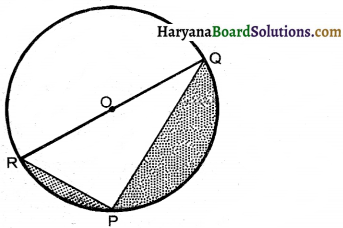
Find the area of shaded region in the given figure, If PQ = 24 cm, PR = 7 cm and O is the centre of the circle.

Haryana Board 10th Class Maths Solutions Chapter 12 Areas Related to Circles Ex 12.3 19

Solution:
We have,
PQ = 24 cm.
PR = 7 cm.
∠QPR = 90° [∵ Angle in a semicircle is 90°]
In right angled ∆RPQ, we have
RQ2 = RP2 + PQ
⇒ RQ2 = 72 + 242
⇒ RQ2 = 49 + 576
⇒ RQ2 = 625
⇒ RQ = √625 = 25 cm
Radius (RO) = \(\frac{25}{2}\) cm
Area of shaded region= Area of semicircle – Area of ∆RPQ
= \(\frac{1}{2}\) πr2 – \(\frac{1}{2}\) × PQ × RP
= \(\frac{1}{2} \times \frac{22}{7} \times \frac{25}{2} \times \frac{25}{2}-\frac{1}{2} \times 24 \times 7\)
= 245.54 – 84
= 161.54 cm2.
Hence, area of shaded region = 161.54 cm2

Haryana Board Solutions for 10th Class Maths Chapter 12 Areas Related to Circles Ex 12.3

Question 2.
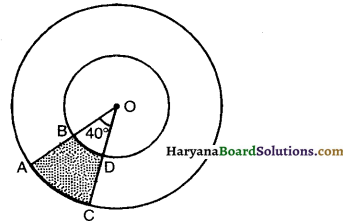
Find the area of shaded region in the given figure, if radii of the two concentric circles with centre O are 7 cm and 14 cm respectively and ∠AOC = 40°.

Haryana Board 10th Class Maths Solutions Chapter 12 Areas Related to Circles Ex 12.3 1

Solution:
We have,
Radii of two concentric circles = 7 cm, 14 cm and ∠AOC = 40°
Area of shaded region = Area of sector AOC – Area of sector BOD
= \(\frac{\pi \times 14^2 \times 40^{\circ}}{360^{\circ}}-\frac{\pi \times 7^2 \times 40^{\circ}}{360^{\circ}}\)
= \(\frac{\pi}{9}\) [142 – 72 ]
= \(\frac{\pi}{9}\) × (14 + 7) (14 – 7)
= \(\frac{22}{7 \times 9}\) × 21 × 7
= \(\frac{154}{3}\) cm2
Hence, area of shaded region = \(\frac{154}{3}\) cm2.

Question 3.
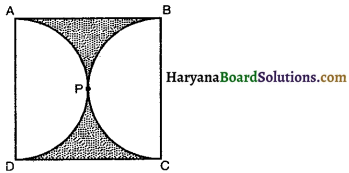
Find the area of the shaded region in the given figure, if ABCD is a square of side 14 cm and APD and BPC are semi-circles.

Haryana Board 10th Class Maths Solutions Chapter 12 Areas Related to Circles Ex 12.3 2

Solution:
We have,
Side of square = 14 cm
radius of semicircle = \(\frac{14}{2}\) = 7 cm
Area of shaded region = Area of square – 2 × Area of semicircle
= 14 × 14 – 2 × \(\frac{1}{2}\) × π × r2
= 14 × 14 – 2 × \(\frac{1}{2}\) × 7 × 7
= 196 – 154 = 42 cm2.
Hence, area of shaded region = 42 cm2.

Haryana Board Solutions for 10th Class Maths Chapter 12 Areas Related to Circles Ex 12.3

Question 4.
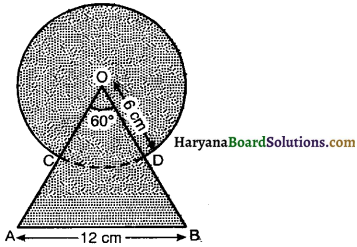
Find the area of the shaded region in the given figure, where a circular arc of radius 6 cm has been drawn with vertex O of an equilateral triangle OAB of side 12 cm as centre.

Haryana Board 10th Class Maths Solutions Chapter 12 Areas Related to Circles Ex 12.3 3

Solution.
We have,
Radius of circle = 6 cm
Side of equilateral triangle = 12 cm
Area of shaded region = Area of circle + Area of equilateral ∆OAB – Area of sector OCD
= π × 62 + \(\frac{\sqrt{3}}{4}\) × (12)2 – \(\frac{60^{\circ}}{360^{\circ}}\) × π × 62
= \(\frac{22}{7} \times 36+\frac{\sqrt{3} \times 144}{4}-\frac{1}{6} \times \frac{22}{7} \times 36\)
= \(\frac{22 \times 36}{7}-\frac{22 \times 6}{7}\) + 36√3
= \(\frac{660}{7}\) + 36√3
Hence, area of shaded region = (\(\frac{660}{7}\) + 36√3) cm2.

Question 5.
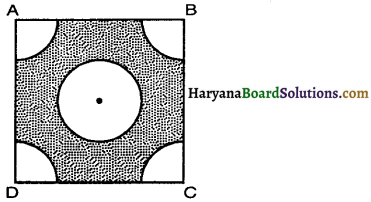
From each corner of a square of side 4 cm a quadrant of a circle of radius 1 cm is cut and also a circle of diameter 2 cm is cut as shown in the figure. Find the area of remaining portion of the square.

Haryana Board 10th Class Maths Solutions Chapter 12 Areas Related to Circles Ex 12.3 4

Solution:
We have,
side of the square = 4 cm
Radius of quadrant = 1 cm
and radius of circle = \(\frac{2}{2}\) = 1 cm.
Area of the remaining portioñ of the square = Area of square – (4 × Area of quadrant of circle + Area of circle)
= 4 × 4 – \(\left(4 \times \frac{90^{\circ}}{360^{\circ}} \times \frac{22}{7} \times(1)^2+\frac{22}{7} \times 1^2\right)\)
= 16 – \(\left(4 \times \frac{1}{4} \times \frac{22}{7}+\frac{22}{7} \times 1\right)\)
= 16 – (\(\frac{22}{7}+\frac{22}{7}\))
= 16 – \(\frac{44}{7}\)
= \(\frac{112-44}{7}=\frac{68}{7}\) cm2.
Hence, area of remaining portion = \(\frac{68}{7}\) cm2.

Haryana Board Solutions for 10th Class Maths Chapter 12 Areas Related to Circles Ex 12.3

Question 6.
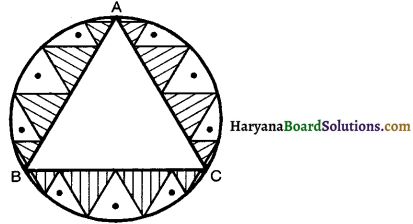
In a circular table cover of radius 32 cm, a design is formed leaving an equilateral triangle ABC in the middle as shown in the given figure. Find the area of the design.

Haryana Board 10th Class Maths Solutions Chapter 12 Areas Related to Circles Ex 12.3 5

Solution:
We have,
Radius of the circle = 32 cm
O is the centre of the circle
∆ABC is an equilateral triangle.
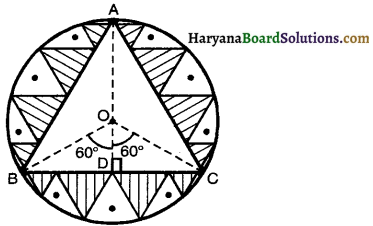
Join OA, OB and OC.
Now ∠AOB = ∠BOC = ∠COA = 120°
In ∆OBC, we have
OB = OC [Equal radii of circle]
Draw OD ⊥ BC
∆ODB ≅ ∆ODC [By R.H.S. congruence]
⇒ ∠COD = \(\frac{120^{\circ}}{2}\) = 60°. [CPCT]
⇒ \(\frac{\mathrm{BD}}{\mathrm{OB}}\) = sin 60°
⇒ \(\frac{\mathrm{BD}}{32}=\frac{\sqrt{3}}{2}\)
⇒ BD = \(\frac{32 \sqrt{3}}{2}\) = 16√3
⇒ BC = 2 × BD
⇒ BC = 2 × 16√3 = 32√3 cm

Haryana Board 10th Class Maths Solutions Chapter 12 Areas Related to Circles Ex 12.3 6

Area of the shaded region (designed) = Area of the circle – Area of the ∆ABC
= πr2 – \(\frac{\sqrt{3}}{4}\) (side)2
= π × (32)2 – \(\frac{\sqrt{3}}{4}\) × (32√3)2
= \(\frac{22}{7}\) × 1024 – √3 × 768
= (\(\frac{22528}{7}\) – 768√3) cm2
Hence, area of the shaded region (designed) = (\(\frac{22528}{7}\) – 768√3) cm2

Haryana Board Solutions for 10th Class Maths Chapter 12 Areas Related to Circles Ex 12.3

Question 7.
In the given figure, ABCD is a square of side 14 cm, with centres A, B, C and D, four circles are drawn such that each circles touch externally two of the remaining three circles. Find the area of the shaded region.

Haryana Board 10th Class Maths Solutions Chapter 12 Areas Related to Circles Ex 12.3 7

Solution:
We have,
Side of square = 14 cm
Radius of each circle = \(\frac{14}{2}\) = 7 cm
Area of the Shaded region = Area of square – 4 × quadrant area
= (side)2 – 4 × \(\frac{1}{4}\) πr2
= 14 × 14 – 4 × \(\frac{1}{4}\) × \(\frac{22}{7}\) × 72
= 196 – 22 × 7
= 196 – 154 = 42 cm2.
Hence, area of shaded region = 42 cm2.

Question 8.
In the given figure depicts a racing track whose left and right ends are semicircular. The distance between the two inner parallel line segments is 60 m and they are each 106 m long. If the track is 10 m wide, find :

Haryana Board 10th Class Maths Solutions Chapter 12 Areas Related to Circles Ex 12.3 8

(i) The distance around the track along its inner edge.
(ii) The area of the track.
Solution:
(i)

Haryana Board 10th Class Maths Solutions Chapter 12 Areas Related to Circles Ex 12.3 9

The distance around the track along its inner edge = Perimeter of PMS + PQ + Perimeter of QNR + SR
= (π × 30 + 106 + π × 30 + 106) m
= 212 + 60π
= 212 + 60 × \(\frac{22}{7}\)
= 212 + \(\frac{1320}{7}\)
= \(\frac{1484+1320}{7}\) = \(\frac{2804}{7}\)

(ii) Outer radius = 30 + 10 = 40 m
Area of the track = Area of rectangle PABQ + Area of rectangle DCRS + 2 × Area of semi circular ring
= 106 × 10 + 106 × 10 + 2 × \(\frac{1}{2}\) π(402 – 302)
= 1060 + 1060 + \(\frac{22}{7}\) × (40 + 30) (40 – 30) 22 1
= 2120 + \(\frac{22}{7}\) × 700
= 2120 + 2200 = 4320 m2.
Hence, distance around the track along its inner edge = \(\frac{2804}{7}\) m
area 0f track = 4320 m2.

Haryana Board Solutions for 10th Class Maths Chapter 12 Areas Related to Circles Ex 12.3

Question 9.
In the given figure, AB and CD are two diameters of a circle (with centre O) perpendicular to each other and OD is the diameter of the smaller circle. If OA = 7 cm, find the area of the shaded region.

Haryana Board 10th Class Maths Solutions Chapter 12 Areas Related to Circles Ex 12.3 10

Solution:
we have,
OA = 7 cm.
∴ AB = CD = 2 × 7 = 14 cm
OC = OB = OA = OD = 7 cm
diameter AB ⊥ diameter CD
Radius of smaller circle having centre = \(\frac{7}{2}\) cm.
Area of shaded region= Area of smaller circle having centre 0′ + (Area of semicircle ACB – area of ∆ABC)
= \(\pi \times\left(\frac{7}{2}\right)^2+\left[\frac{1}{2} \pi \times(7)^2-\frac{1}{2} \times 14 \times 7\right]\)
= \(\frac{22}{7} \times \frac{49}{4}+\left[\frac{1}{2} \times \frac{22}{7} \times 49-49\right]\)
= 38.5 + [77 – 49]
= 38.5 + 28 = 66.5 cm2.
Hence, area of the shaded region= 66.5 cm2.

Question 10.
The area of an equilateral triangle ABC is 17320.5 cm2. With each vertex of the triangle as centre, a circle is drawn with radius equal to half the length of the side of the triangle (see in figure). Find the area of the shaded region. (use π = 3.14 and √3= 1.73205)

Haryana Board 10th Class Maths Solutions Chapter 12 Areas Related to Circles Ex 12.3 11

Solution.
Let the side of equilateral ∆ be x cm.
Area of equilateral triangle = \(\frac{\sqrt{3}}{4}\) × x2
⇒ 17320.5 = \(\frac{\sqrt{3}}{4}\) × x2
[given, area of triangle = 17320.5 cm2]
⇒ 17320.5 × 4 = √3x2
⇒ x2 = \(\frac{17320 \cdot 5 \times 4}{\sqrt{3}}\)
⇒ x2 = \(\frac{17320 \cdot 5}{1 \cdot 73205}\) × 4
⇒ x2 = 10000 × 4
⇒ x2 = 40000
⇒ x = \(\sqrt{40000}\) = 200 cm.
Then, radius of each circle = \(\frac{200}{2}\) = 100 cm
Area of shaded region = Area of ∆ABC – (Area of sector AMO + Area of sector BMN + Area of sector CNO)
= 17320.5 – \(\left(\frac{60^{\circ}}{360^{\circ}} \times \pi \times(100)^2+\frac{60^{\circ}}{360^{\circ}} \times \pi \times(100)^2+\frac{60^{\circ}}{360^{\circ}} \times \pi \times(100)^2\right)\)
= 17320.5 – [3 × \(\frac{1}{6}\) × π × (100)2]
= 17320.5 – \(\frac{\pi}{2}\) × 10000
= 17320.5 – \(\frac{3.14}{2}\) × 10000
= 17320.5 – 15700 = 1620.5 cm2.
Hence, area of shaded region = 1620.5 cm2.

Haryana Board Solutions for 10th Class Maths Chapter 12 Areas Related to Circles Ex 12.3

Question 11.
On a square handkerchief, nine circular designs each of radius 7 cm are made (see in figure). Find the area of the remaining portion of the handker-chief.

Haryana Board 10th Class Maths Solutions Chapter 12 Areas Related to Circles Ex 12.3 12

Solution.
We have,
radius of circle = 7 cm
Diameter of the circle = 2 × 7 = 14 cm
Side of the square ABCD = 3 × 14 = 42 cm
Area of the remaining portion of handkerchief = Area of square ABCD – 9 × area of circle
= 42 × 42 – 9 × π × 72
= 1764 – 9 × \(\frac{22}{7}\) × 7 × 7
= 1764 – 1386
= 378 cm2.
Hence, area of the remaining portion of handkerchief = 378 cm2.

Question 12.
In the given figure, OACB is a quadrant of a circle with centre 0 and radius 3’5 cm. If OD = 2 cm, find the area of the :
(i) Quadrant OACB
(ii) Shaded region

Haryana Board 10th Class Maths Solutions Chapter 12 Areas Related to Circles Ex 12.3 13

Solution.
We have,
Radius of a quadrant = 3.5 cm and OD = 2 cm
(i) Area of quadrant OACB = \(\frac{1}{4}\) × π × (3.5)2
= \(\frac{1}{4}\) × \(\frac{22}{7}\) × 35 × 35
= \(\frac{77}{8}\) cm2.

(ii) In right ∆BOD, we have OB = 35cm, and OD = 2 cm
Area of ∆OBD = \(\frac{1}{2}\) × 35 × 2
= 3.5 cm2 = \(\frac{7}{2}\) cm2
Area of shaded region= quadrant area – area of ∆BOD
= \(\frac{77}{8}-\frac{7}{2}\)
= \(\frac{77-28}{8}\)
= \(\frac{49}{8}\) cm2.
Hence, arei of quadrant = \(\frac{77}{8}\) cm2
and area of shaded region = \(\frac{49}{8}\) cm2.

Question 13.
In the given figure, a square OABC is inscribed in a quadrant OPBQ. If OA = 20 cm, find the area of the shaded region. (use π = 3.14)

Haryana Board 10th Class Maths Solutions Chapter 12 Areas Related to Circles Ex 12.2 14

Solution:
We have,
Side of square (OA) = 20 cm
In right angle triangle OAB.
OB2 = OA2 + AB2 (By Pythagoras theorem)
OB2 = 202 + 202
OB2 = 400 + 400
OB2 = 800
OB = \(\sqrt{800}\) = 20√2 cm
∴ Radius of the quadrant 20√2 cm
Area of shaded region= Area of Quadrant – area of Square.
= \(\frac{1}{4}\) π × (20√2)2 – 20 × 20
= \(\frac{1}{4}\) × 3.14 × 800 – 400
= 628 – 400 = 228 cm2.
Hence, area of shaded region = 228 cm2.

Haryana Board Solutions for 10th Class Maths Chapter 12 Areas Related to Circles Ex 12.3

Question 14.
AB and CD are respectively arcs of two concentric circles of radii 21 cm and 7 cm and centre O (see in figure). If ∠AOB = 30°, Find the area of the shaded region.

Haryana Board 10th Class Maths Solutions Chapter 12 Areas Related to Circles Ex 12.3 14

Solution.
We have,
Radius of sector AOB (r1) = 21 cm
Radius of sector COD (r2) = 7 cm
Area of shaded region= Area of sector AOB – Area of sector COD

Haryana Board 10th Class Maths Solutions Chapter 12 Areas Related to Circles Ex 12.3 15

Hence, area of shaded region = \(\frac{308}{3}\) cm2.

Question 15.
In the given figure, ABC is a quadrant of a circle of radius 14 cm and a semicircle is drawn with BC as diameter. Find the area of the shaded region.

Haryana Board 10th Class Maths Solutions Chapter 12 Areas Related to Circles Ex 12.3 16

Solution:
We have,
Radius of a quadrant = 14 cm
In right ∆BAC,
BC2 = AB2 + AC2
BC2 = 142 + 142
BC2 = 2 × 142
BC = 14√2 cm
Area of region (I) = Area of quadrant ABC – Area of ∆ABC
= \(\frac{1}{4}\) π × 142 – \(\frac{1}{2}\) × 14 × 14
= \(\frac{1}{4}\) × \(\frac{22}{7}\) × 14 × 14 – 7 × 14
= 154 – 98 = 56 cm2.

Area of shaded region (II) = Area of the semicircle drawn on BC as diameter – Area of region I
= \(\frac{1}{2} \times \pi \times\left(\frac{14 \sqrt{2}}{2}\right)^2-56\)
= \(\frac{1}{2} \times \frac{22}{7} \times \frac{392}{4}\) – 56
= \(\frac{616}{4}\) – 56
= 154 – 56 = 98 cm2.
Hence, area of shaded region = 98 cm2.

Haryana Board Solutions for 10th Class Maths Chapter 12 Areas Related to Circles Ex 12.3

Question 16.
Calculate the area of the designed region in given figure common between the two quadrants of circles of radius 8 cm each.

Haryana Board 10th Class Maths Solutions Chapter 12 Areas Related to Circles Ex 12.3 17

Solution:
We have,
Radius of the circle = 8 cm
Area of the designed region = 2 (Area of quadrant ∆BQD – Area of ∆ABD)

Haryana Board 10th Class Maths Solutions Chapter 12 Areas Related to Circles Ex 12.3 18

Hence, area of designed region = \(\frac{256}{7}\) cm2.

HBSE 10th Class Maths Solutions Chapter 12 Areas Related to Circles Ex 12.3 Read More »
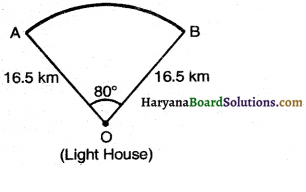
HBSE 10th Class Maths Solutions Chapter 12 Areas Related to Circles Ex 12.2

Haryana State Board HBSE 10th Class Maths Solutions Chapter 12 Areas Related to Circles Ex 12.2 Textbook Exercise Questions and Answers.

Haryana Board 10th Class Maths Solutions Chapter 12 Areas Related to Circles Ex 12.2

Unless stated otherwise, use π = \(\frac{22}{7}\).

Question 1.
Find the area of sector of a circle with radius 6 cm if angle of the sector is 60°.
Solution.
We have,
Radius = 6 cm
θ = 60°
Area of the sector = \(\frac{\pi r^2 \theta}{360^{\circ}}\)
= \(\frac{22}{7} \times \frac{6^2 \times 60^{\circ}}{360^{\circ}}\)
= \(\frac{22}{7} \times \frac{6 \times 6}{6}=\frac{132}{7}\)
Hence, area of sector = \(\frac{132}{7}\) cm2.

Haryana Board Solutions for 10th Class Maths Chapter 12 Areas Related to Circles Ex 12.2

Question 2.
Find the area of a quadrant of a circle whose circumference is 22 cm.
Solution:
Let r be the radius of the circle whose circumference is 22 cm.
2πr = 22
r = \(\frac{22}{2 \pi}\)
r = \(\frac{22}{2 \times \frac{22}{-7}}\)
r = \(\frac{22 \times 7}{2 \times 22}\)
r = \(\frac{7}{2}\) cm
θ = 90°
[∵ sector is quadrant ∴ θ = \(\frac{360}{4}\) = 90°]
Therefore,area of the quadrant = \(\frac{\pi r^2 \theta}{360^{\circ}}\)
= \(\frac{22}{7} \times \frac{7}{2} \times \frac{7}{2} \times \frac{90^{\circ}}{360^{\circ}}\)
= \(\frac{22 \times 7}{4 \times 4}\)
= \(\frac{77}{8}\) cm2
Hence, area of the quadrant = \(\frac{77}{8}\) cm2

Question 3.
The length of the minute hand of a clock is 14 cm. Find the area swept by the minute hand in 5 minutes.
Solution.
Angle describe by the minute hand in 60 minutes = 360°
Angle, describe by the minute hand in 5 minutes = \(\frac{360^{\circ}}{60^{\circ}}\) × 5 = 30°
Now, θ = 30° and radius = 14 cm
Area swept by the minute hand in 5 minutes = Area of sector AOB

Haryana Board 10th Class Maths Solutions Chapter 12 Areas Related to Circles Ex 12.2 1

= \(\frac{11 \times 14}{3}\)
= \(\frac{154}{3}\) cm2.
Hence, area swept by the minute hand = \(\frac{154}{3}\) cm2.

Haryana Board Solutions for 10th Class Maths Chapter 12 Areas Related to Circles Ex 12.2

Question 4.
A chord of a circle of radius 10 cm subtends a right angle at the centre. Find the area of the corresponding:
(i) minor segment
(ii) major sector. (use π = 3.14)
Solution.
We have,
Radius = 10 cm
and θ = 90°
Area of the minor segment ACB = \(\frac{\pi r^2 \theta}{360}\) – Area of ∆AOB
= \(\frac{3.14 \times 10^2 \times 90^{\circ}}{360^{\circ}}\) – \(\frac{1}{2}\) × 10 × 10
= \(\frac{3.14 \times 100}{4}\) – 50
= 785 – 50 = 28.5 cm2
Area of major sector ADB

Haryana Board 10th Class Maths Solutions Chapter 12 Areas Related to Circles Ex 12.2 2

= \(\frac{\pi r^2\left(360^{\circ}-90^{\circ}\right)}{360^{\circ}}\)
= \(\frac{3.14 \times 10^2 \times 270^{\circ}}{360^{\circ}}\)
= 314 × \(\frac{3}{4}\)
= 235.5 cm2
Hence, area of minor segment 285 cm2 and area of major sector = 235.5 cm2.

Haryana Board Solutions for 10th Class Maths Chapter 12 Areas Related to Circles Ex 12.2

Question 5.
In a circle of radius 21 cm, an arc subtends an angle of 600 at the centre. Find:
(i) The length of the arc
(ii) Area of the sector formed by the arc
(iii) Area of the segment formed by the corresponding chord.
Solution.
We have,
Radius (r) = 21 cm
Sector angle (θ) = 60°
(i) Length of the arc = \(\frac{\theta}{360^{\circ}}\) × 2πr

Haryana Board 10th Class Maths Solutions Chapter 12 Areas Related to Circles Ex 12.2 3

= 22 cm
(ii) Area of the sector formed by the arc = \(\frac{\pi r^2 \theta}{360^{\circ}}\)
= \(\frac{22}{7} \times \frac{21^2 \times 60^{\circ}}{360^{\circ}}\)
= \(\frac{22}{7} \times \frac{21 \times 21 \times 60^{\circ}}{360^{\circ}}\)
= \(\frac{22 \times 3 \times 21 \times 1}{6}\)
= 11 × 21 = 231 cm2

(iii) In ∆OAB. OA = OB (equal radii)
⇒ ∠OAB = ∠OBA
Let ∠OAB = ∠OBA = x
∴ x + x + ∠AOB = 180°
⇒ 2x + 60° = 180°
⇒ 2x = 180° – 60° = 120°
⇒ x = \(\frac{120^{\circ}}{2}\) = 60°
Therefore, ∆OAB is an equilateral triangle of side 21 cm.
∴ Area of ∆OAB = \(\frac{\sqrt{3}}{4}\) (side)2
= \(\frac{\sqrt{3}}{4}\) × 212
= \(\frac{441 \sqrt{3}}{4}\) cm2

Area of the segment formed by the corresponding chord = Area of segment ACB.
= Area of the sector OACBO – Area of ∆OAB
= \(\frac{\pi r^2 \theta}{360^{\circ}}-\frac{441 \sqrt{3}}{4}\)
= \(=\frac{22}{7} \times \frac{21^2 \times 60^{\circ}}{360^{\circ}}-\frac{441 \sqrt{3}}{4}\)
= 11 × 21 – \(\frac{441 \sqrt{3}}{4}\)
= (231 – \(\frac{441 \sqrt{3}}{4}\)) cm2
Hence, length of the arc = 22 cm,
area of the sector = 231 cm2
and area of the segment (ACB) = (231 – \(\frac{441 \sqrt{3}}{4}\)) cm2.

Haryana Board Solutions for 10th Class Maths Chapter 12 Areas Related to Circles Ex 12.2

Question 6.
A chord of a circle of radius 15 cm subtends an angle of 60° at the centre. Find the area of the corresponding minor and major segments of the circle. [use π = 3.14 and √3 = 1.73]
Solution:
We heve,
Radius (r) = 15 cm
Sector angle (θ) = 60°
In ∆AOB
⇒ OA = OB (equal radii of the circle)
⇒ ∠OAB = ∠OBA
⇒ ∠OAB + ∠OBA + ∠AOB = 180°
⇒ 2∠OAB + 60°= 180°
⇒ 2∠OAB = 180° – 60° = 120°
⇒ ∠OAB = \(\frac{120^{\circ}}{2}\) = 60°
Therefore, ∆AOB is an equilateral triangle.
Its side = 15 cm
Area of ∆AOB = \(\frac{\sqrt{3}}{4}\) × 152
= \(\frac{225 \sqrt{3}}{4}\) cm2.

Area of minor segment (ACB) = Area of sector – area of ∆AOB

Haryana Board 10th Class Maths Solutions Chapter 12 Areas Related to Circles Ex 12.2 4

= 117.75 – 97.31 = 2O.44 cm2.
Area of major segment = nr2 – Area of minor segment
= 3.14 × 152 – 20.44.
= 706.5 – 20.44 = 686.06 cm2
Hence, area of minor segment and major segment are 20.44 cm2 and 686.06 cm2 respectively.

Question 7.
A chord of a circle of radius 12 cm subtends an angle of 120° at the centre. Find the area of the corresponding segment of the circle. [use π = 3.14 and √3 = 1.73]
Solution.
We have,
Radius (r) = 12 cm
∠AOB = 120°
Area of segment (ACB) = \(\frac{\pi r^2 \theta}{360^{\circ}}-r^2 \sin \frac{\theta}{2} \cos \frac{\theta}{2}\)
= \(\frac{3.14 \times 12^2 \times 120}{360}-12^2 \sin \frac{120^{\circ}}{2} \cos \frac{120^{\circ}}{2}\)
= 3.14 × 12 × 4 – 144 sin 60° cos 60°

Haryana Board 10th Class Maths Solutions Chapter 12 Areas Related to Circles Ex 12.2 5

= 3.14 × 48 – 144 × \(\frac{\sqrt{3}}{2} \times \frac{1}{2}\)
= 3.14 × 48 – 36√3
= 150.72 – 36 × 173
= 150.72 – 62.28
= 88.44 cm2.
Hence, area of segment (ACB)= 88.44 cm2.

Haryana Board Solutions for 10th Class Maths Chapter 12 Areas Related to Circles Ex 12.2

Question 8.
A horse is tied to a peg at one corner of a square shaped grass field of side 15 m by means of a 5 m long rope (see figure). Find
(i) The area of that part of the field in which the horse can graze.
(ii) The increase in the grazing area if the rope were 10m long instead of 5 m. (use π = 3.14)

Haryana Board 10th Class Maths Solutions Chapter 12 Areas Related to Circles Ex 12.2 6

Solution:
(i) We have,
Side of the square = 15 m
The area of the field in which the horse can graze represented in the figure by APR, a quadrant of the circle with radius 5 m.
The area which horse can graze = \(\frac{\pi r^2 \theta}{360^{\circ}}\)
= \(\frac{3.14 \times 5^2 \times 90^{\circ}}{360^{\circ}}\)
= \(\frac{3 \cdot 14 \times 25}{4}\)
= 19.63 cm2.

(ii) Increase in area when the rope is 10 m long = Area of quadrant ASQ – Area of quadrant APR
= \(\frac{\pi r^2 \theta}{360^{\circ}}\) – 19.63
= \(\frac{3.14 \times 10^2 \times 90^{\circ}}{360^{\circ}}\) – 19.63
= \(\frac{314}{4}\) – 19.63
= 78.5 – 19.63 = 58.87 cm2.

Haryana Board 10th Class Maths Solutions Chapter 12 Areas Related to Circles Ex 12.2 7

Hence, area which horse can graze = 19.63 cm2
and increase in area = 58.87 cm2.

Question 9.
A brooch is made with silver wire in the form of a circle with diameter 35 mm. The wire is also usal in making 5 centimeters which divide the circle into 10 equal sectors as shown in figure. Find:
(i) The total length of the silver wire required.
(ii) The area of each sector of the brooch.

Haryana Board 10th Class Maths Solutions Chapter 12 Areas Related to Circles Ex 12.2 8

Solution:
(i) We have,
Radius of the circle = \(\frac{35}{2}\) mm.
Circumference of the circle = 2πr
= 2 × \(\frac{22}{7}\) × \(\frac{35}{2}\)
= 110 mm
The total length of wire required = circumference of the circle + length of 5 diameters
= 110 + 5 × 35
= 110 + 175 = 285 mm.

(ii) Area of the circle = πr2
= \(\frac{22}{7} \times \frac{35}{2} \times \frac{35}{2}\)
= \(\frac{11 \times 5 \times 35}{2}\)
= 962.5 mm2

Since circle is divided into 10 equal sectors.
Therefore, area of each sector = \(\frac{\text { Area of the circle }}{10}\)
= \(\frac{962.5}{10}\)
= 96.25 mm2.
Hence, (i) total length of wire required = 285 mm.
(ii) Area of each sector = 96.25 mm2

Haryana Board Solutions for 10th Class Maths Chapter 12 Areas Related to Circles Ex 12.2

Question 10.
An umbrella has 8 ribs which are equally spaced (see figure). Assuming umbrella to be a flat circle of radius 45 cm, find the area between the two consecutive ribs of the umbrella.

Haryana Board 10th Class Maths Solutions Chapter 12 Areas Related to Circles Ex 12.2 9

Solution:
We have,
Radius of circle = 45 cm
Area of the circle = πr2
= π × 452
= 2025π
= \(\frac{2025 \times 22}{7}\)
= 6364.29 cm2
Since the ribs divide the circle into 8 sectors of equal area
Area between the two consecutive ribs = Area of each sector of the circle
= \(\frac{\text { Area of the circle }}{8}\)
= \(\frac{6364 \cdot 29}{8}\)
= 795.54 cm2
Hence, area between the two consecutive ribs of the umbrella = 795.54 cm2

Haryana Board Solutions for 10th Class Maths Chapter 12 Areas Related to Circles Ex 12.2

Question 11.
A car has two wipers which do not overlap. Each wiper has a blade of length 25 cm sweeping through an angle of 115°. Find the total area cleaned at each sweep of the blades.
Solution.
We have,
One blade of a wiper sweeps a sector area of circle of a radius 25 cm.
The sector angle (θ) = 115°

Haryana Board 10th Class Maths Solutions Chapter 12 Areas Related to Circles Ex 12.2 10

Hence, total area cleaned at each sweep of the blades = \(\frac{158125}{126}\) cm2

Question 12.
To warn ships for underwater rocks, a light house spreads a red coloured light over a sector of angle 80° to a distance of 16.5 km. find the area of the sea over which the ships are warned, (use π = 3.14)
Solution.
We have,
Radius = 16.5 km

Haryana Board 10th Class Maths Solutions Chapter 12 Areas Related to Circles Ex 12.2 11

Sector angle (θ) = 80°
Area of the sea over which the ships are warned = \(\frac{\pi r^2 \theta}{360}\)
= \(\frac{3.14 \times 16.5 \times 16.5 \times 80}{360}\)
= \(\frac{3 \cdot 14 \times 272 \cdot 25 \times 2}{9}\)
= 189.97 km2
Hence, area of the sea over which the ships are warned = 189.97 km2.

Haryana Board Solutions for 10th Class Maths Chapter 12 Areas Related to Circles Ex 12.2

Question 13.
A round table cover has six equal designs as shown in figure. if the radius of the cover is 28 cm, find the cost of making the designs at the rate of ₹ 0.35 per cm2. (Use √3 = 1.7)

Haryana Board 10th Class Maths Solutions Chapter 12 Areas Related to Circles Ex 12.2 12

Solution:
We have,
r = 28 cm
and θ = \(\frac{360^{\circ}}{6}\) = 60°

Haryana Board 10th Class Maths Solutions Chapter 12 Areas Related to Circles Ex 12.2 13

In the figure OA = OB
∠OAB = ∠OBA
∴ ∠OAB + ∠OBA + ∠AOB = 180°
⇒ 2∠OAB + 60° = 180°
⇒ 2 ∠OAB = 180° – 60° = 120°
⇒ ∠OAB = \(\frac{120}{2}\) = 60°
∴ ∠AOB is an equilateral triangle having side 28 cm.
Area of shaded designed portion = Area of the sector OAB – Area of ∆OAB
= \(\frac{\pi r^2 \theta}{360^{\circ}}-\frac{\sqrt{3}}{4} \times 28^2\)
= \(\frac{22}{7} \times \frac{28^2 \times 60^{\circ}}{360^{\circ}}-\frac{\sqrt{3}}{4} \times 28 \times 28\)
= \(\frac{22 \times 4 \times 28 \times 1}{6}\) – √3 × 7 × 28
= \(\frac{44 \times 28}{3}\) – 1.7 × 196
= 410.67 – 333.2 = 77.47 cm2.
The total area of six shaded designed portion = 6 × 77.47 = 464.82 cm2.
Cost of making designs at the rate of 0.35 ₹/cm2 = 464.82 × 0.35 = ₹ 162.68
Hence, cost of the making designs = ₹ 162.68.

Haryana Board Solutions for 10th Class Maths Chapter 12 Areas Related to Circles Ex 12.2

Question 14.
Tick the correct answer in the following: Area of a sector of angle p (in degrees) of a circle with radius R is
(A) \(\frac{p}{180^{\circ}}\) × 2πR
(B) \(\frac{p}{180^{\circ}}\) × πR
(C) \(\frac{p}{360^{\circ}}\) × 2πR
(D) \(\frac{p}{720^{\circ}}\) × 2πR2
Solution:
(D) \(\frac{p}{720^{\circ}}\) × 2πR2

HBSE 10th Class Maths Solutions Chapter 12 Areas Related to Circles Ex 12.2 Read More »

HBSE 8th Class English Solutions It So Happened Chapter 1 How the Camel Got His Hump

Haryana State Board HBSE 8th Class English Solutions It So Happened Chapter 1 How the Camel Got His Hump Textbook Exercise Questions and Answers.

Haryana Board HBSE 8th Class English Solutions It So Happened Chapter 1 How the Camel Got His Hump

HBSE 8th Class English How the Camel Got His Hump Textbook Questions and Answers

Comprehension Check – I

How The Camel Got His Hump Answers HBSE 8th Class Question 1.
What tasks, do you think, were assigned to the dog and the ox?
तुम्हारे विचार में कुत्ते तथा बैल को कौन-से काम दिए गए थे?
Answer:
The dog was assigned the work of carrying sticks. The ox ploughed the fields for man.

How The Camel Got His Hump Solutions HBSE 8th Class Question 2.
Why did the camel live in the middle of the desert?
ऊँट मरुस्थल के बीच में क्यों रहता था?
Answer:
The camel lived in the middle of the desert lest the man should find him and get work from him. He was too lazy to work.

HBSE 8th Class English Solutions It So Happened Chapter 1 How the Camel Got His Hump

How The Camel Got His Hump Summary In Hindi HBSE 8th Class Question 3.
What made the dog, the horse and the ox very angry?
किस बात से कुत्ता, घोड़ा तथा बैल बहुत नाराज हो गए.?
Answer:
They felt angry because the man had ordered them to work double time to compensate for the loss suffered because of not working at all for three days.

How The Camel Got His Hump Question Answers HBSE 8th Class Question 4.
How did the Djinn know the horse was complaining against the camel?
जिन्न को कैसे पता चला कि घोड़ा ऊंट की शिकायत कर रहा है।
Answer:
By the horse’s referring to camel’s ‘long’ neck and long ‘legs, Djinn comes to know that the horse was complaining against the camel.

Comprehension Check – II

Class 8 English Chapter 1 How The Camel Got His Hump Question Answer HBSE
Question 1.

The camel was looking at his own reflection in the pool. What does it suggest to you about the camel?
ऊँट, सरोवर में अपना प्रतिबिंब देख रहा था। यह बात ऊँट के प्रति क्या दर्शाती है?
Answer:
It suggests that the camel felt proud of his beautiful back and large size. So, when he saw his reflection in the pool, he felt very sad. He began to take a heavy breath.

How The Camel Got His Hump Class 8 Summary In Hindi HBSE Question 2.
The camel said ‘Humph’ repeatedly. How did it affect him?
ऊँट बार-बार “हूँ” करता था। उसका उस पर क्या प्रभाव पड़ा?
Answer:
The camel used the word “Humph”, at every answer he gave to animals and the Djinn. It affected him badly though he felt proud and careless of his duty. It had a bad impression of camel in other’s mind.

HBSE 8th Class English Solutions It So Happened Chapter 1 How the Camel Got His Hump

Chapter 1 How The Camel Got His Hump HBSE 8th Class Question 3.
What, according to the Djinn, was the use of the ‘hump’?
जिन्न के अनुसार ‘कूबड़’ से क्या लाभ था?
Answer:
According to the Djinn, the hump was useful for the camel. He could store his food and use it during continuous work for many days.

How Camel Got His Hump Question Answer HBSE 8th Class Question 4.
….. he has never yet learnt to behave’. In the light of this, what’s the writer’s opinion about the camel?
उसने फिर भी शिष्टाचार अपनाना नहीं सीखा है।’ इस संबंध में ऊँट ने लेखक के अनुसार अभी तक क्या नहीं सीखा है?
Answer:
According to the writer, the camel hasn’t learnt the lesson of good behaviour. He works, of course, but lazily and unwillingly. His hump has disappointed him.

Exercise

Discuss the following topics in groups:

How The Camel Got His Hump Questions And Answers HBSE 8th Class Question 1.
Can this story be factually true?
क्या यह कहानी तथ्यात्मक रूप से सच हो सकती है?
Answer:
No, this story cannot be factually true.

Question 2.
What, according to you, is the story about? Consider the following:
तुम्हारे अनुसार, यह कहानी किसके बारे में है? अधोलिखित पर विचार करें:
(i) How the world began.
संसार का आरंभ किस प्रकार हुआ।

(ii) Why everyone should do his/her share of work seriously.
प्रत्येक व्यक्ति को अपना कार्य गंभीर रूप से क्यों करना चाहिए।

(iii) How animals are important to humans.
मानवों के लिए पशु किस प्रकार महत्त्वपूर्ण हैं।

(iv) How the camel got his hump.
ऊँट को अपना कूबड़ किस प्रकार मिला।
Answer:
(iv) How the camel got his hump.
ऊँट को अपना कूबड़ किस प्रकार मिला।

HBSE 8th Class English Solutions It So Happened Chapter 1 How the Camel Got His Hump

Question 3.
What did you do over the weekend? Were you generally active or idle? Please check your back before starting to discuss or answer the question.
तुमने सप्ताहांत में क्या किया? क्या तुम प्रायः क्रियाशील रहते थे या आलसी? इस प्रश्न के बारे में उत्तर देते समय या चर्चा, करते समय कृपया अपनी पीठ चेक करें।’
Answer:
I put my heart and soul in studies in the beginning of the week. However, I took a lot of interest in sports in the other half of the week. So, as whole I remained active. Now, I look at my back. It has not grown any hump. I feel free.

Question 4.
There are broadly two categories of workers-those who prefer to do today what they can do tomorrow, and those who prefer to do tomorrow, what they can do today. Wheredoyou belong?
मोटे तौर पर कार्मिकों के दो वर्ग होते हैं-वे जो कल करने वाले कार्य को आज करना पसंद करते हैं और वे जो काम आज कर सकते हैं उसे कल करना पसंद करेंगे। तुम कौन-सी श्रेणी में आते हो?
Answer:
I belong to the first category of workers-those who prefer to do today what they can do tomorrow.

Think it Over

  • All work is dignified: there is no such thing as ‘menial work’.
  • He who struggles is better than he who never attempts.
  • ‘All work and no play…’ Is it a good idea? William Faulkner, American novelist and poet, didn’t think so. In his words, “One of the saddest things is that the only thing that a man can do for eight hours a day, day after day, is work, You can’t eat eight hours a day… All you can do for eight hours is work. Which is the reason why man makes himself and everybody else so miserable and unhappy”.
  • सभी काम सम्मानयोग्य हैं। ‘घटिया काम’ जैसी कोई चीज़ नहीं है।
  • वह जो संघर्ष करता है उससे अच्छा होता है जो कभी भी प्रयास नहीं करता है।
  • ‘काम ही काम, खेल नहीं…’ क्या यह एक अच्छा विचार है?अमेरिकन उपन्यासकार और कवि, विलियम फॉकनेर, वैसा नहीं मानता था। अपने (उसके) शब्दों में, “वह एक सबसे अधिक दुःखपूर्ण बात है कि एकमात्र चीज़ जो व्यक्ति प्रतिदिन आठ घंटा काम करके करता है, काम कहलाता है। तुम दिन में आठ घंटे नहीं खा सकोगे। तुम आठ घंटे केवल कार्य कर सकते हो। जो इस बात का मुख्य कारण है कि मनुष्य अपने आपको तथा दूसरों को क्यों दयनीय और दुःखी बनाता है।”

HBSE 8th Class English Solutions How the Camel Got His Hump Important Questions and Answers

Question 1.
What did the camel eat when he lived in the middle of the Howling Desert?
जब ऊंट कोलाहलपूर्ण मरुस्थल में रहता था, वह क्या खाता था?
Answer:
When the camel lived in the middle of the noisy deserts, he did not work, he ate sticks and thorns and prickles.

Question 2.
What will happen to us if we remain idle?
यदि हम सुस्त रहेंगे तो हमारी हालत क्या होगी?
Answer:
If we remain idle, we will grow a hump that will be worse than the camel’s. Our body will grow fat and be unable to be active. Laziness will enter our whole body and make us ill.

Question 3.
What is the cure for this state of affairs?
इस परिस्थिति का क्या उपचार है?
Answer:
The cure for our laziness is that we should be active. We should work and take up plough to work in the field or dig it until we perspire.

Question 4.
Why does the poet call the hump “The horrible hump”?
कवि कूबड़ को “भयानक कूबड़” क्यों कहता है?
Answer:
The poet calls the hump’a horrible hump’ because the camel’c hack swells up. It puffs up and up to a considerable height. It looks very ugly.

HBSE 8th Class English Solutions It So Happened Chapter 1 How the Camel Got His Hump

Question 5.
How do we behave at night if we don’t work?
यदि हम कार्य न करें तो रात को हमारा क्या व्यवहार होता
Answer:
If we get lazy and avoid work, our night will be troublesome. We shall come out of bed with dirty head and angry mood, shivering uneasily. We shall run about hurriedly for bathroom and hunt for our shoes, grumbling and complaining against the mismanagement of the household.

Question 6.
Write a paragraph on “Disadvantages of Laziness.”
आलस्य से होने वाली हानियों पर नोट लिखें।
Answer:
Disadvantages of Laziness:
Laziness makes us dull. We are unwilling to work. We devote more time to sleep and less to work. We become drones, i.e. we live upon the earnings of others. We enjoy upon others’ bread. If we don’t do any work, even our own household members don’t like us. We will get up in a disgruntled mood in the morning. We shall come out of our bed with dirty heads. We shall not like to take bath, change, clothes. Last but not the lvast, we shall be liable to indulge in smoking, drinking and gambling.

The Best Christmas Present in the World Summary in English

I
When the world began, animals worked for human beings. However, the camel was too lazy to work for them. When other animals asked him to come out and join to work with them, he said “Humph”. It means, “Yes, I hear”, but actually he did not move at all. Once the dog, the horse and the ox-all went to the camel one by one and called on him to come out to work but to everyone he replied in the same tone “Humph”.

At last the Man called the three animals in the evening and inspected their work. They complained that the camel did not join them. They told him that the camel was very lazy. “Whenever, we go to call him out for work, he says “Humph”. The man then, ordered them to work double time to compensate for the loss. At this, they felt angry and called a Panchayat. The camel was also called. When he arrived he stood laughing. He then replied “Humph” and went away.

Now Djinn was the incharge of the forest. He also visited the camel and asked why he did not work. To Djinn also, the camel said, “Humph”. At this, Djinn punished the camel by placing a hump on his back. It was a store of food which he could keep on carrying and using for many days together. Djinn told him that from that day onwards, he would carry his food on his back and keep it in his hump. Then he ordered him to join the three animals in work and behave in a nice way. That is why the camel got the Hump.

II

After the story, the author also asks us to work and not to sit idle. It says if we remain idle, we shall also grow hump on our backs and this will be worse than that for the camel. If we work continuously and sufficiently, we shall become active. And as a result, we’ll not have any hump. A hump turns us ugly. Similarly, if we do not have enough work to do we shall rust our body and become dull. Let us take up plough and work in the fields to get fresh contact with Nature.

The Best Christmas Present in the World Summary in Hindi

I

यह कहानी तब की है जब इस संसार का निर्माण हुआ था। तब पशु, मनुष्य जाति के लिए काम करते थे। परंतु ऊँट बहुत आलसी था। वह इसके लिए काम नहीं करता था। जब भी अन्य पशु ऊँट को काम करने हेतु बुलाने के लिए जाते, वह “हूँ” कह देता। परंतु उनके साथ नहीं जाता। एक बार घोड़ा, कुत्ता तथा बैल उसके पास बारी-बारी गए और उसे काम करने के लिए आने को कहा परंतु ऊँट का उत्तर था “हूँ”।

शाम को मनुष्य ने तीनों को बुलाया और काम का निरीक्षण किया। उन्होंने अपना काम तो दिखा दिया परंतु ऊँट की शिकायत की कि वह आलसी है। हर बार बुलाने पर “हूँ” कर देता है। मनुष्य ने उनको दुगुना काम करने की आज्ञा दे दी ताकिं ऊँट के काम न करने की कमी को पूरी की जा सके। इस पर तीनों पशु क्रुद्ध हो गए और उन्होंने पंचायत बुलाई। ऊँट को भी बुलाया गया। वहाँ भी ऊँट हंसता हुआ आया और बोला “हूँ” और चला गया।

वन का प्रबंधक एक जिन्न था। वह भी ऊँट के पास गया और उससे उसने काम न करने का कारण पूछा। ऊँट हँसा और कहा “हूँ”। जिन्न ने अब उसे दंड दे दिया। उसने ऊँट की पीठ पर एक कूबड़ लगा दिया। यह कूबड़ उसकी खाद्य सामग्री के भंडार का काम करता था जो वह कई दिनों तक प्रयोग कर सकता था। जिन्न ने उससे कहा कि उस दिन से वह अपनी खुराक पीठ पर ढोएगा और उसे अपने कूबड़ में रखेगा। तब उसने उसे तीनों पशुओं-कुत्ता, घोड़ा और बैल के साथ जाकर काम करने को कहा और उसे विवेक से काम लेने का परामर्श दिया।

II

यहाँ एक विचार को कहानी द्वारा बताया गया है। वह यह है कि यदि हम आलस्य करेंगे तो हमें भी कूबड़ लग जाएगा। यह ऊँट के कूबड़ से भी बुरा होगा। हमारा बुरा व्यवहार और उकता जाने की प्रवृत्ति भी आलस्य का परिणाम है। यदि हम लगातार और पर्याप्त काम करते रहेंगे तो हम उद्यमी बन जाएँगे। यदि हम सक्रिय नहीं होंगे तो हम अपनी पीठ को कूबड़ा तब भी बना देंगे। यह कूबड़ हमें कुरूप बना देगा। जब हम बिस्तर से बाहर निकलेंगे, हम ढीले-ढाले और आलस्य से भरपूर लगेंगे। अतः हमें गतिहीन नहीं बनना चाहिए। अपितु खेतों में हल चलाना चाहिए और अन्य कार्य करने चाहिएँ।

HBSE 8th Class English Solutions It So Happened Chapter 1 How the Camel Got His Hump Read More »
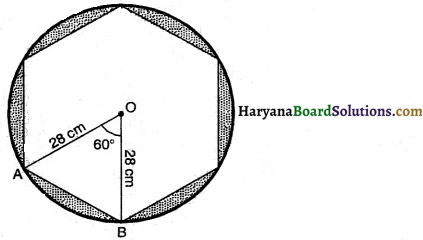
HBSE 8th Class English Solutions It So Happened Chapter 3 The Selfish Giant

Haryana State Board HBSE 8th Class English Solutions It So Happened Chapter 3 The Selfish Giant Textbook Exercise Questions and Answers.

Haryana Board HBSE 8th Class English Solutions It So Happened Chapter 3 The Selfish Giant

HBSE 8th Class English The Selfish Giant Textbook Questions and Answers

Comprehension Check – I

The Selfish Giant Questions And Answers HBSE 8th Class Question 1.
Why is the Giant celled selfish?
राक्षस को स्वार्थी क्यों कहा गया है?
Answer:
The giant is called selfish because he does not allow anyone to enter or play in his beautiful garden. Moreover he had built a wall around his garden.

The Selfish Giant Class 8 Summary In Hindi HBSE Question 2.
On one occasion the children said: “How happy we are here”!
Later, they said: “How happy we were there”!
What are they referring to in both the cases?
किसी अवसर पर बालकों ने कहा, “हम यहाँ कितने आनन्द से हैं।
फिर कुछ समय के पश्चात उन्होंने कहा, “हम वहाँ कितने आनन्द से थे।”
वे दोनों कौन-सी अवस्थाओं की ओर संकेत कर रहे हैं?
Answer:
When the Giant was not present in the garden, the children felt very happy and exclaimed, “How happy we are here! However, when the Giant built the wall around his garden and stopped them from playing there, they felt very very sad and cried out, ‘How happy’ we were there!” (inside the garden).

HBSE 8th Class English Solutions It So Happened Chapter 3 The Selfish Giant

Class 8 English Chapter 3 The Selfish Giant Summary HBSE Question 3.
(i) When Spring came, it was still Winter in the garden. What does Winter stand for or indicate here?
(ii) Winter has been presented like a story with its own characters and their activities. Describe the story in your own words.
(i) जब वसंत ऋतु आई, उद्यान में अब भी शीत ऋतु थी। यहाँ शीत ऋतु किसकी ओर संकेत करती है?
(ii) शीत ऋतु अपनी विशेषताओं तथा गतिविधियों के अनुसार एक कहार्नी के रूप में प्रस्तुत की गई है। कहानी का अपने शब्दों में वर्णन करो।
Answer:
(i) There was still Winter in the Giant’s garden. It indicates there was no Spring. Neither flowers nor birds could be seen there.
(ii) It was Winter in the garden. Once a beautiful flower put its head out from the grass but when it saw that children had been prohibited to play there, it also dre back. It means, the flowers withered due to the presence of Winter and the absence of Spring.

The Selfish Giant Questions And Answers Class 8 HBSE Question 4.
Was the Giant happy or sad over the state of the garden?
क्या राक्षस अपने उद्यान की दशा देखकर प्रसन्न हुआ अथवा उदास?
Answer:
The Giant was sad when there was no Spring in his garden. Neither birds flew nor flowers grew there.

Class 8 English The Selfish Giant Question Answer HBSE Question 5.
What effect did the linnet’s song have over Hail and the North Wind?
लिन्निट के गीत ने ओलों तथा उत्तरी पवनों पर क्या प्रभाव डाला?
Answer:
When linnet started singing, the Hail gtopped dhncing and the North Wind stopped J roaring. A delicious scent blew towards him ! through the open window. Such was the effect of i the linnet’s song over the Hail and the North Wind. The Giant felt overjoyed. He jumped out ’ of bed happily.

Comprehension Check – II

The Selfish Giant Question Answer HBSE 8th Class Question 1.
(i) He saw a most wonderful sight. What did he see?
उसने एक अत्यंत अद्भुत दृश्य देखा। उसने क्या देखा?
Answer:
The Giant saw that the children had? entered his garden by making a hole in the wall.
They were sitting on the tree branches. There was a little child in every tree. These were covered with flowers. They waved their branches above children’s heads. The birds were flying and chirping joyfully. Flowers too had come out of grass. This was a most wonderful sight.

(ii) What did he realise on seeing it?
इसको देखकर उसने क्या अनुभव किया?
Answer:
The Giant realised that he had been very selfish by closing his garden for the children with a wall around it.

The Selfish Giant Summary In Hindi HBSE 8th Class Question 2.
Why was it still winter in one comer of the garden?
उद्यान के एक कोने में अव भी शीत ऋतु क्यों थी?
Answer:
There was still winter in one comer of the Giant’s garden because in that comer was standing a little boy who could not climb upon the branches of the tree. As the little boy stood on the ground and could not sit on the branches there were neither flowers nor birds.

HBSE 8th Class English Solutions It So Happened Chapter 3 The Selfish Giant

The Selfish Giant Class 8 Question Answer HBSE Question 3.
Describe the first meeting of the little boy and the Giant.
छोटे बालक तथा राक्षस के मध्य पहली मुलाकात का वर्णन करो।
Answer:
One day the Giant was surprised to see the children sitting on the tree branches of his garden. In the distant comer, stood a little boy. He was too small to climb on the tree branches. The child wandered and cried bitterly. The Giant’s heart became soft. He went towards the child and picked him up gently in his hands. Then he put him up into the tree. As soon as he did so, flowers grew upon its branches and birds flew up around the tree. The little boy stretched his arms around the Giant’s neck and kissed him. This was first meeting between the Giant and the little boy.

The Selfish Giant Story In Hindi HBSE 8th Class Question 4.
Describe their second meeting after a long interval.
उनके बीच लंबे समय के पश्चात् हुई दूसरी मुलाकात का वर्णन करो।
Answer:
The Giant used to ask the children the whereabouts of the little boy. As they didn’t know him, he felt very sad without him.

One day in winter the Giant’s eyes fell on the little boy for the second time. He had kissed him in his first meeting. The Giant was overjoyed. He went close to him. Suddenly, he grew angry to see the boy’s palms and feet in wounded condition. He thought someone had injured him. However, the boy replied that those were the wounds of love. Now, the Giant thought that the child was no other than Jesus who was Crucified by the Jews. He, at once, fell on his feet. The child smiled. He offered to take him to his “paradise”.

Selfish Giant Question Answer HBSE 8th Class Question 5.
The Giant lay dead, all covered with white blossoms. What does this sentence indicate about the once selfish Giant?
‘राक्षस मृत पड़ा था, सफेद फूलों से पूरी तरह ढका हुआ।’ एक समय के स्वार्थी राक्षक के बारे में यह वाक्य क्या संकेत देता है?
Answer:
The sentence “The Giant lay dead, all covered with white blossoms”, indicates that the Giant had been blessed with “Paradise” after his death. The change in his attitude towards children and his shedding off the act of selfishness had gifted him with this heavenly abode.

HBSE 8th Class English Solutions It So Happened Chapter 3 The Selfish Giant

Exercises

Discuss the following topics in groups:

The Selfish Giant Summary In English HBSE 8th Class Question 1.
The little child’s hands and feet had marks of nails. What does the child remind you of? Give a reason for your answer.
छोटे बालक की हथेलियों तथा पाँवों पर कीलों के चिह्न थे। ये किस घटना की याद दिलाते हैं? अपने उत्तर का कारण भी दो।
Answer:
The marks of nails on the little child’s hands and feet remind us of the incident of Jesus Christ’s Crucifixion. Jesus Christ was hanged to death. He was tortured. Nails were fixed by the Jews on his palms mid feet against a wall. It is here the Giant met Christ in the guise of a child.

The reason is that Jesus wanted to teach him the lesson of kindness towards the children. The Giant became kind to them at the end and ,was blessed with salvation (Mukti).

The Selfish Giant In Hindi HBSE 8th Class Question 2.
Is there something like this garden near the place where you live? Would you like one (without the Giant, perhaps) and why? What would you do to keep it in good shape?
क्या आपके निवास के आस-पास इस प्रकार का कोई बाग है? क्या आप ऐसा पसंद करेंगे, (बिना किसी राक्षस के) और क्यों? इसे अच्छी हालत में रखने के लिए आप क्या करेंगे?
Answer:
Yes, there is a beautiful garden near where I live. It is surrounded by a six feet high wall with four gates, one on each of the four sides.

The gates are opened at 5 a.m. and closed at 10 p.m. every day. There is something very attractive in the central part of the garden. It is a large lake with about ten boats used by tourists for boating. There is a great rush of visitors every evening. The boats can be used on ticket basis.

The green trees surrounding the lake adds a matchless beauty to the wholesome scene. Children of neighbourhood play about here on the green and smooth labled grass. Of course, one thing is missing here. It is the giant who is completely invisible. That is why children enjoy the green garden-cum-bright lake. I would not like any garden which is controlled by the story type giant.

HBSE 8th Class English Solutions It So Happened Chapter 3 The Selfish Giant

Think it Over

  • Selfless love involves suffering for others.
    निस्वार्थ प्रेम दूसरों के लिए कष्ट सहने की ओर संकेत करता है।
  • Owning things is human; sharing them is divine.
    चीजों को अपने अधिकार में लेना. मानवीय गण है. उनको बांटकर प्रयोग करना दैवी गुण है।

HBSE 8th Class English Solutions The Selfish Giant Important Questions and Answers

PART – I

Question 1.
Where did the children go as well as do after coming from school every afternoon?
प्रत्येक दोपहर बाद बच्चे स्कूल से लौटने पर कहाँ जाते थे और क्या करते थे और क्या करते थे?
Answer:
After coming from school in the afternoon, the children* used to go and play in the Giant’s garden.

Question 2.
Where had the Giant gone for seven years? Why?
दानव (राक्षस) सात साल तक कहाँ गया था? क्यों?
Answer:
The Giant had gone to visit his friend, the Cornish Ogre and stayed with him for seven years.

Question 3.
What did the Giant find when he came back?
जब राक्षस वापस आया तो राक्षस ने क्या पाया?
Answer:
When the Giant came back, he saw the children playing in his garden.

Question 4.
What was the condition of the garden when the spring season set in?
जब वसंत प्रारंभ हुई तो बाग की क्या दशा थी?
Answer:
When it was spring all around the garden everywhere, there were little birds and blossoms but there was still winter inside the garden. Neither flowers nor birds could be seen there.

HBSE 8th Class English Solutions It So Happened Chapter 3 The Selfish Giant

Question 5.
When one morning, the Giant was lying, he heard some lovely music. What did he think?
जब एक प्रातः राक्षस लेटा हुआ था, तो उसे कुछ लुभावना संगीत सुनाई पड़ा। उसने क्या सोचा?
Answer:
He thought it must be the king’s musicians passing by.

Question 6.
Was his guess right? If not what was the fact? What did he feel about it and what happened then?
क्या उसका अनुमान सही था? यदि नहीं तो तथ्य क्या था? उसने इसके बारे में क्या महसूस किया और फिर क्या घटना घटी?
Answer:
No, his guess was not correct. It was in fact, a little linnet singing outside the Giant’s window. To the Giant, it was the most beautiful music in the world. Hail stopped dancing and North Wind stopped making noise. He felt sweet scent coming from the window.

PART – II

Question 1.
How did the children manage to enter the Giant’s garden?
बच्चे राक्षस के बाग में कैसे घुस गए थे?
Answer:
The children had made a hole in the wall of the Giant’s garden and crept into it.

Question 2.
Why were the trees of the Giant’s garden so glad?
राक्षस के बाग के वृक्ष क्यों खश थे?
Answer:
The trees of the Giant’s garden were very glad to see the children back again in the garden.

Question 3.
How did the trees show their joy to have the children back?
बच्चों के लौटने पर वृक्षों ने किस प्रकार अपनी खुशी दर्शाई?
Answer:
The trees showed their happiness by waving their branches over their heads.

Question 4.
Where were the birds at this time?
इस समय पक्षी कहाँ थे?
Answer:
After the arrival of the children, the birds started flying about and chirping with joy.

Question 5.
What did the Giant see in the farthest corner of the. garden?
बाग के अत्यन्त कोने में राक्षस ने क्या देखा?
Answer:
The Giant saw a little boy standing in the farthest corner of the garden.

Question 6.
What was the little boy doing and why?
छोटा बालक क्या कर रहा था और क्यों?
Answer:
The little boy was wandering about and crying bitterly.

Question 7.
Why was still winter in that comer?
उस कोने में अभी तक शीत (ऋतु) क्यों थी?
Answer:
There was still winter in that comer because there was no boy sitting on the branch of that tree.

Question 8.
How did blossoms grow on the branch of this tree?
इस वृक्ष की शाखाओं पर फूल किस प्रकार आए?
Answer:
When the Giant helped the little boy in climbing up that tree, it became full of blossoms at once.

Question 9.
What change came in the Giant’s heart?
राक्षस के दिल में क्या परिवर्तन आया?
Answer:
The Giant’s heart melted. He decided to break down the wall of his garden. He really felt very sorry for his selfish act.

Question 10.
What did the Giant do with the little boy?
राक्षस ने छोटे बच्चे से कैसा व्यवहार किया?
Answer:
The Giant quietly went towards the little boy and taking up in his hands, picked him up and put him into the tree.

Question 11.
What did the Giant see when he met the little boy for the second time?
राक्षस ने तब क्या देखा जब दूसरी बार उसे छोटा लड़का मिला?
Answer:
The Giant asked the little boy who he was and who had wounded his. palms and feet. The little boy replied that those were not wounds on palms but wounds of love. At this the Giant fell on his feet. The boy told the Giant that he would take him to his paradise and would let him play there as he had let him play in his garden.

Question 12.
Describe the Giant’s garden in your own words.
राक्षस के उद्यान का अपने शब्दों में वर्णन करो।
Answer:
The Giant’s garden was a very beautiful garden. It was covered with grass all over the ground. There were twelve peach trees in the garden. In the spring, pink and pearly flowers spread about everywhere. The birds beautified the branches of these trees. When they sang sweet song, even the playing children would stop their games. They felt overjoyed

HBSE 8th Class English Solutions It So Happened Chapter 3 The Selfish Giant

The Selfish Giant Summary in English

A giant had a beautiful garden. School children used to visit it to play there in the evening when they came from school. Once, the Giant went out to see his friend, Camish ogre. He stayed at his house for seven years. After this, “he’ returned to his own castle. To his surprise, he found the children playing in the garden.

“My own garden is my own garden”, he said to himself. So, he built a high wall around it. Then, he put up a notice board declaring that “TRESPASSERS WILL BE PROSECUTED”. It was clear that he had become selfish.

Now, the children felt very sad. They had no place to play. So, they played outside the garden around the wall. Time went on. In the spring, flowers grew all over, but in the Giant’s garden, there was no spring. There was no summer also. It was always winter there. Neither birds nor flowers coilld be seen there. Only snow and frost covered the trees. The Giant wondered as to why there was no spring in his garden.

Once the Giant lay in his bed awake. He heard a sweet music. A little linnet (a bird) sang outside his window. The music appealed to him. The sweet smell of flowers passed through his nostrils. He saw1 the most wonderful sight. Children had crept in through a hole. Children sat on branches. The trees were covered with flowers. In the farthest comer of the garden a little boy was sitting. He was too small to climb on the branch. He cried bitterly. The Giant went up to him and kissed him. He picked him up and placed him on a branch.

Now, the Giant knocked down the garden wall. He felt sorry for building it. When children saw him, they ran away. The garden became winter like again. He called out the children and said, “It is your garden. Come and play freely.”

In the evening, when they came to him to say goodbye, he asked them about the little child. They said they did not know. The Giant loved him the most. Now due to children’s frequent visit, the spring returned.

Many years passed. The Giant had become old. He could not play any more. One day, suddenly he saw the little child he had loved. He went downstairs and walked near him. However, he felt angry to see his wounded palms and feet. On asking, who had wounded him, he replied, “These are the wounds of love.” At this, the Giant fell on his feet. “I’ll let you play in my garden which is paradise” said the little child, “because you let me play in your garden once.”
In the evening, when the children visited the garden, they saw the Giant lying dead.

The Selfish Giant Summary in Hindi

एक राक्षस, एक उद्यान का मालिक था। इसमें स्कूल के बालक खेलने के लिए हर शाम आते थे। एक बार राक्षस अपने मित्र के पास गया। मित्र का नाम कार्निश ओग्रे था। वह उसके घर सात वर्ष तक रहा। जब वह वापस आया, उसने बच्चों को वहाँ खेलते देखा। “मेरा उद्यान तो मेरा उद्यान है। यहाँ कोई नहीं खेल सकता।” अतः उसने उद्यान के चारों ओर दीवार खड़ी कर दी। इस पर एक सूचनापट भी लगा दिया जिस पर लिखा था “अनाधिकृत रूप से प्रवेश करने वालों को दंड मिलेगा।” राक्षस स्वार्थी हो गया था।

अब बालक बहुत उदास हो गए। उनके पास खेलने के लिए कोई और स्थान नहीं था। अतः वे उद्यान से बाहर दीवार के चारों ओर दौड़ते और खेलते। समय गुजरता गया। वसंत ऋतु तो आई परंतु उसके उद्यान में नहीं आई, वहाँ न पक्षी आए और फूल उगे। केवल बर्फ और पाला पड़ता था। राक्षस चकित था कि वसंत वहाँ क्यों नहीं आता। वहाँ ग्रीष्म ऋतु भी नहीं आई।

एक बार राक्षस अपने बिस्तर पर लेटा हुआ था। उसे एक सुंदर पक्षी बैठा दिखाई दिया। वह लिनिट नाम का पक्षी था। उसका मीठा-मीठा गीत राक्षस को बहुत भाया। साथ ही फूलों की मीठी सुगंध उसे आनंदित कर रही थी। वहाँ बालक भी दीवार में छेद करके उद्यान के भीतर आ गए थे। जहाँ वे बैठे थे, उन टहनियों पर फूल उग आए थे। उद्यान के एक कोने में एक छोटा-सा बालक बैठा हुआ था। वह छोटा होने के कारण किसी टहनी पर नहीं चढ़ सकता था। वह जोर से रोता था। राक्षस उसके पास गया और उसने उसे एक टहनी पर बिठा दिया। बालक ने राक्षस की गर्दन के चारों ओर अपनी बाहें डाल दी और फिर उसे चूमा।

अब उसने उद्यान की दीवार गिरा दी। बालकों ने जब उसे देखा, वे दौड़ गए। उद्यान में फिर शीत ऋतु आ गई। राक्षस ने बालकों को बुलाया और कहा, “यह तुम्हारा उद्यान है। तुम इसमें खेल सकते हो। बालक आने लग गए। वे जाते समय उसे विदा कह जाते थे।

अब राक्षस ने उनसे उस छोटे बालक के प्रति पूछा जिसे वह सबसे अधिक चाहता था। वे बोले कि वे उसे नहीं जानते। बालकों के उद्यान में प्रतिदिन आने से वसंत ऋतु भी आ गई। बहुत वर्ष बीत गए। राक्षस बूढ़ा तथा दुर्बल हो गया। वह और अधिक उनके साथ नहीं खेल सकता था। एक बार अचानक उसकी दृष्टि उस छोटे बालक पर पड़ी। उसने अपनी आँखें मलीं और फिर देखा। बालक को देखकर वह चकित रह गया। वह सीढ़ियों से नीचे उतरा परंतु निकट जाकर उसे क्रोध आ गया। बालक की हथेलियों तथा पांवों पर घाव थे। उसके पूछने पर बच्चे ने बताया कि ये प्यार के घाव हैं। इस पर राक्षस उसके पैरों पर गिर पड़ा। “मैं तुम्हें अपने स्वर्ग में खेलने दूंगा क्योंकि तुमने मुझे अपने उद्यान में एक बार खेलने दिया था।”

शाम को जब बालक उद्यान में खेलने के लिए आए तो उन्होंने राक्षस को मृत पड़ा पाया।

HBSE 8th Class English Solutions It So Happened Chapter 3 The Selfish Giant Read More »
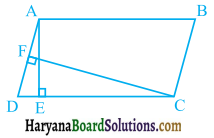
HBSE 8th Class English Solutions It So Happened Chapter 2 Children at Work

Haryana State Board HBSE 8th Class English Solutions It So Happened Chapter 2 Children at Work Textbook Exercise Questions and Answers.

Haryana Board HBSE 8th Class English Solutions It So Happened Chapter 2 Children at Work

HBSE 8th Class English Children at Work Textbook Questions and Answers

Comprehension Check – I

Children At Work Summary HBSE 8th Class Question 1.
Velu stood on the platform but he felt ‘as if he was still on a moving train.’ Why?
वेलू, प्लेटफॉर्म पर खड़ा हो गया परन्तु वह महसूस कर रहा था ‘कि वह अभी भी रेलगाड़ी में चल रहा है।’ क्यों?
Answer:
Velu stood on the platform. His legs were feeling wobbly. Therefore, he felt as if he was still on a moving train.

Children At Work HBSE 8th Class Question 2.
What made him feel miserable?
वह दुःखी क्यों महसूस कर रहा था?
Answer:
Velu had run away from his village two days ago. He was deadly tired because he had walked for most of the first day. He had travelled without any ticket. He had no one of his own at Chennai, He had no money to start any job. He had eaten only some peanuts and a piece of jaggery. These made him feel miserable.

Children At Work Question Answer HBSE 8th Class Question 3.
(i) Velu travelled without a ticket. Why?
(i) ” वेलू ने बिना टिकट की यात्रा की। क्यों?”

(ii) How did he escape the ticket collector’s notice?
(ii) वह टिकट चेकर की निगाह से किस प्रकार बचा?
Answer:
(i) Velu had no money. Therefore, he travelled without a ticket.
(ii) The ticket collector had not come to the unreserved compartment where Velu was lying on the floor near the door. Therefore, he escaped the ticket collector’s notice.

HBSE 8th Class English Solutions It So Happened Chapter 2 Children at Work

Question 4.
Why had Velu run away from home?
वेलू, घर से क्यों भागा था?
Answer:
Velu’s father had snatched his earnings and spent it on drink. Besides he beat Velu at will. Velu had run away from home because he couldn’t stand his father’s beating.

Question 5.
Why did he decide to follow the ‘strange’ girl?
उसने अजनबी लड़की का पीछा करने का निर्णय क्यों लिया?
Answer:
Velu had no ides where to go and how to start earning his bread. Therefore, he decided to follow the strange’ girl.

Comprehension Check – II

Question 1.
Can Velu read Tamil and English? How do you know?
क्या वेलू तमिल तथा अंग्रेजी पढ़ सकता है? आप कैसे जानते हैं?
Answer:
Velu can only read Tamil but not English. The following sentences make it clear:
(a) The writing on the pictures was all in English, so he didn’t know what they were saying.
(b) Velu read the Tamil sign, Central Jail.

Question 2.
‘If you are not careful, you will soon be counting bars there,’ the girl said.
“यदि तुम सावधान नहीं रहोगे तो तुम थोड़े समय में ही वहाँ सलाखें गिनोगे,” लड़की ने कहा।
(i) What is she referring to?
वह किस बात की ओर संकेत कर रही है?

(ii) What does she mean when she says ‘If you are not careful…’? (She says something a little later which means the same. Find that sentence.)
उसके कहने का क्या अभिप्राय है जब वह कहती है ‘यदि तुम सावधान नहीं रहोगे….’ (थोड़ी देर बाद वह कुछ कहती है |जिसका वही अर्थ है। वह वाक्य ढूंढिए।)
Answer:
(i) She is referring to the Central Jail where stray and homeless boys and girls are put behind the bars.
(ii) The sentence is: You don’t have to do anything, just don’t get caught.

HBSE 8th Class English Solutions It So Happened Chapter 2 Children at Work

Question 3.
(i) Where did the girl lead Velu to?
लड़की, वेलू को कहाँ ले गई?

(ii) What did they get to eat?
उन्हें खाने के लिए क्या मिला?
Answer:
(i) The girl led Velu behind a big hall to a big garbage bin, overflowing with rubbish.
(ii) They got a squashy banana, a vada and one more banana to eat. (Velu got a squashy banana and a vada to eat. The girl got one more banana. She ate it herself.)

Question 4.
What work did she do? Think of a one word answer.
वह क्या काम करती थी? एक शब्द में उत्तर देने की सोचो।
Answer:She collected thrown out papers, plastic items and glass bottles. Ragpicker.

Comprehension Check – III

Question 1.
(1) What materials are the ‘strange huts made out of?
‘अनोखी’ ‘झोंपड़ियाँ किस पदार्थ की बनी हुई हैं?
(ii) Why does Velu find them strange?
वेलू उन्हें अनोखी क्यों पाता है?
Answer:
(i) The strange huts are made of the materials metal sheets, tyres, bricks, wood and plastic.
(ii) Velu finds them strange because they were built out of all sorts of things. They stood crookedly and looked as if they would fall any moment.

Question 2.
What sort of things did Jaya and children like her collect and what did they do with those things?
जया और उस जैसे बच्चों ने क्या बटोरा और उन चीजों का उन्होंने क्या किया?
Answer:
Jaya and children like her collected paper, plastic and glass items. They sold those things to Jam Bazaar Jaggu.

Question 3.
Is Velu happy or unhappy to find work? Give a reason for your answer.
क्या वेलू काम पाकर खुश है या नाखुश? अपने उत्तर के लिए एक कारण दो।
Answer:
Velu is not very happy to find work. He had not run away from his village and come to this new place to dig through garbage bins. But he accepted the job temporarily till he found a better job.

HBSE 8th Class English Solutions It So Happened Chapter 2 Children at Work

Exercise

Discuss the following questions in small groups. Write their answers afterwards:

Question 1.
Is Velu a smart boy? Which instances in the text show that he is for isn’t?
क्या वेलू एक समझदार लड़का है?/पाठ में कौन-से प्रसंग हैं जो यह दर्शाते हैं कि वह है/नहीं है?
Answer:
Yes, Velu is a smart boy. He makes determination to leave his village and find some work in Chennai. He walked for most of the first day and reached Karur. He got exhausted. but did not return home. He boarded the train without a ticket. He availed himself of the opportunity to help Jaya in her worthless job. He did it for her benefactor. Still he thought of finding a better job.

Question 2.
Do you think Jaya is a brave and sensitive child with a sense of humour? Find instances of her courage, kind nature and humour in the text.
क्या तुम्हारे विचार में जवा एक वीर तथा संवेदनशील लड़की है जिसमें हास्य-वृत्ति है? पाठ में से उसके साहस, दयालु स्वभाव और हास्य के प्रसंग दें।
Answer:
I think that Jaya is a brave and sensitive child with a sense of humour.
She had the coinage to associate herself with Velu and win him over. She cohvinced him to work for her. She collected thrown-away things in scorching heat of thq seen.
She was of kind nature. She realised that Velu was hungry. She found food for him in the garbage. She also gave him old shoes to wear.
She warned hjm against being daught and sent to jail.
She was a humorous girlJThe following sentences show it.
(i) No need to stare stupidly.
(ii) What do you think you’re doing? Grazing cows.
(iii) You don’t have to do anything, just don’t get daught.
(iv) Don’t think I have money to buy food for you.
(v) So you have been following me around without even knowing my name.
(vi) I don’t have time to waste, like you.
(vii) Don’t just stand there, posing a big, hero.
(viii) you stand around in the middle of the road like that you’ll be chutney.

HBSE 8th Class English Solutions It So Happened Chapter 2 Children at Work

Question 3.
What one throws away as waste may be valuable to others. Do you find this senterfce meaningful in the context of this story? How?
बेकार समझकर जिस चीज को कोई फेंक देता है, वह दूसरों के लिए मूल्यवान हो सकती है। क्या कहानी के संदर्भ में आप इस वाक्य को सार्थक समझते हैं? कैसे?
Answer:
That which is waste for one may be a business or source of income or profit for others. This sentence has a meaning in the coritent of this story. The empty bottles, pieces of paper and items of plastic are thrown out by the people. The ragpickers earn their living by collecting them. Those who store rubbish become very rich people. The waste proves valuable and a blessing for them and their families.

Think it Over

  • The best investment that a country can make is to put milk into its children.
  • People don’t notice goodness because it is transparent like water and air; only if it rims out does it become noticeable.
  • It is never too late to have a happy childhood.
  • For self-attempt.

It is Someone You Know?

A busy official known for his love of animals was once passing through a village in a cart. Suddenly he asked the cartman to stop and tried to hear what sounded like a wail from far away. The cartman asked, ‘Is it a man you know?’ The official replied, ‘No, it’s a dog I don’t know.’

  • For self-attempt (He might be a veterinary surgeon.)

HBSE 8th Class English Solutions Children at Work Important Questions and Answers

Question 1.
Who was Velu? What work did he do?
” वेलू कौन था? वह क्या काम करता था? ”
Answer:
Velu was an eleven-year old boy. He lived in a village. He worked on a landowner’s farm. He knew the work of weeding and taking cows out to graze.

Question 2.
What did Velu carry with him?
वेलू, अपने साथ क्या लेकर गया?
Answer:
Velu carried the following items with him:
(a) a shirt
(b) a towel and
(c) a comb.

Question 3.
What did Velu see on Chennai Central?
वेलू ने चेन्नई सेन्ट्रल में क्या देखा?
Answer:
Velu saw a large crowd on Chennai Central. It was like a village fair. Announcements were made on the loudspeaker. Some people looked at a TV hanging from the roof. He saw the porters going by with loaded trolleys. The people were bumping into him with their suitcases.

HBSE 8th Class English Solutions It So Happened Chapter 2 Children at Work

Question 4.
How did Velu travel the whole night?
वेलू ने रात-भर किस प्रकार सफर किया?
Answer:
Velu boarded the unreserved compartment. He had tried to sleep on the floor near the door. Some people made much noise while playing at cards.

Question 5.
How far was Chennai from Velu’s village?
वेलू के गाँव से चेन्नई कितनी दूर था?
Answer:
Velu had walked for most of his first day to Karur. Then he got on the train. He travelled all night by train. It shows that Chennai was at a great distance from Velu’s village.

Question 6.
Why was Velu feeling miserable and exhausted? How do you know?
वेलू दु:खी और थका-माँदा क्यों था? तुम्हें कैसे पता?
Answer:
Velu had walked for most of the day. He had a disturbed sleep on the floor near the door. It made him exhausted. He had no place to go in Chennai. Therefore, he was feeling miserable. We know this because he was putting his head down on his knees.

Question 7.
Who stood behind Velu? In what condition was she?
वेतू के पीछे कौन खड़ी थी? वह किस हालत में थी?
Answer:
A girl was standing behind Velu. She I was around his own age. She was wearing a long banian that came down to her knees. Her hair was stiff and brownish. She had a huge sack on one shoulder.

Question 8.
How was the girl’s voice? What did she say?
लड़की की आवाज़ कैसी थी? उसने क्या कहा?
Answer:
The girl’s voice was rough. She said, “Aiy! what, New to town eh? Again she said, “here, Aiy! No need to stare stupidly. What is your name

Question 9.
What did the girl say when she learnt that Velu was hungry?
उस लड़की ने क्या कहा जब उसे पता चला कि वेलू भूखा
Answer:
Velu pressed his stomach with a grimace. The girl learnt that he was hungry. She told him that he won’t get food by sitting there glumly. She assured him that she would find some food for him if he wanted.

HBSE 8th Class English Solutions It So Happened Chapter 2 Children at Work

Question 10.
What did Velu find on reaching the road?
सड़क पर पहुंच कर वेलू ने क्या पाया?
Answer:
Velu and the girl got to the road. He found many vehicles plying non-stop. Dust and smoke flew at him from all sides. It made him feel dizzy. It took them a long time to find a gap to run through

Question 11.
Why did Velu try hard to walk in the shade?
वेलू, छाया में चलने का कठोर प्रयास क्यों कर रहा था?
Answer:
The sun blasted down on the tar. It burnt Velu’s bare feet. He was also soaked with sweat. Therefore, he tried hard to walk in the shade. Moreover, he had to keep up with the girl’s fast pace.

Question 12.
What did Velu see in front of a big building?
एक बड़े भवन के सामने वेलू ने क्या देखा?
Answer:
Velu and the girl stood in front of a big building. It was named Sri Rajarajeshwari Prasanna Kalyana Mandapam. It was a building where a wedding was taking place.

Question 13.
Write the character-sketch of Velu.
वेलू का चरित्र-चित्रण कीजिए।
Answer:
Velu was an eleven-year old boy. He was sick of his father’s beating and drinking habits. He made up his mind to leave his village. He took the risk of going to Chennai without any money with him. He was an opportunist. He stuck to the girl who helped him in finding food. He had no mind to return home. He was deadset on finding some better job. He ate rubbish but neither stole nor begged. He was grateful to the girl and stuck to her.

Question 14.
Write the character sketch of the girl (ragpicker).
(कूड़ा-कबाड़ बटोरने वाली) लड़की का चरित्र-चित्रण कीजिए।
Answer:
The girl was of Velu’s age. She had a calculating mind. She guessed that Velu was hungry and a run-away. She was of helpful nature. She offered Velu a squashed banana and a vada. Afterwards she ate a banana. She warned him not to be caught or he would be sent behind the bars. She gave him a pair of shoes because his feet burnt in burning sun on tar road. She earnt her living by doing menial work. She was an earning hand and not a burden on her household.

HBSE 8th Class English Solutions It So Happened Chapter 2 Children at Work

Children at Work Summary in English

I

Velu was an eleven year old boy. ¡lis father used to beat him. Therefore, he ran away from home two days ago. He had walked for most of the first day to Karur. Then h got on the train to Chennai. Ile got into the unreserved compartment without a ticket. He had eaten quite a little for
two days. He got down the train at Chennai Central.

Velu sat on a bench on the platform. There was a terrible noise around him. He heard a rough voice of a girl of his own age. She was wearing a long banian. She asked him his name. He told it was Velu. She told him that the place was full of run away children like him. Then she sat down next to him. She was a ragpicker.

Velu pressed his stomach. She realised that ho was hungry. She told him that she could find food for him if he wanted. Velu gave no reply. The girl picked up her sack and started to walk away. Velu had nowhere else to go. Therefore, he ran after her.

II

Velu followed the girl through the crowded streets. Velu saw a buge rush of vehicles on the road. The girl dragged Velu to the other side. He could not read the signboards on the road because they were in English. The girl turned on to a wide bridge and walked up. Velu peeped over the railing. He could see huge buildings, towers and more roads in the distance. The girl told him that he would be sent to Central Jail if he was not careful and was caught. He asked her what she was carrying in her bag (sack). She told hùñ that she was carrying things like bottles, papers, etc. It was a bright sunny morning. Velu’s barefeet were burning. Still he kept up with the girl’s fast pace.

They reached a big building, after half an hour of walking. A marriage was taking place there. Velu thought, they would enjoy the wedding feast in vain. The girl led him behind the hail. There was a big garbage bin. The girl picked up a squashy banana and held it out to Velu. Then she threw him a vada. Velu hesitated. But hunger pressed him to gulp them down. Still he was not well fed. The girl found one more banana but she ate it herself She had no time to wait for the leftover, of the lunch. Therefore, she walked off. Velu couLd not remain behind. He was helpless there. He ran after her again. He knew that her name was Jaya. She allowed him to follow her. She was going home to get another sack.

III

Jaya and Velu walked along the road for half an hour. Velu saw a row of strangest huts built of all sorts of things. They were about to fall. Jaya dumped her sack outside her hut. Then she picked up an empty sack. She gave Velu a pair of old shoes. She also pushed a sack and a stick into Velu’s hands. She asked him to accompany her and help her. Velu had done work only on the farm till then. Jaya told him to collect the things (paper, plastic, glass, etc.) like her. He called them rubbish-Jaya called him a damn fool. She sold the co!!ecLon to Jam Bazaar Jaggu who sold thc same to a factory. Velu stood unwilling. Jaya poked at him .ith het st.ck and sn”bbed him. Velu was ielpleas. He got ready to help Jaya.

HBSE 8th Class English Solutions It So Happened Chapter 2 Children at Work

Children at Work Summary in Hindi

I

वेलू, ग्यारह वर्षीय लड़का था। उसका पिता उसे पीटा करता था। इसलिए, दो दिन पहले वह घर से भाग गया था। पहले दिन, अधिकांश समय वह कारूर पहुँचने के लिए पैदल चलता रहा। फिर चेन्नई के लिए, वह रेलगाड़ी में सवार हो गया। बिना टिकट के वह अनारक्षित डिब्बे में चढ़ गया। दो दिन, उसने बहुत थोड़ा भोजन खाया था। वह चेन्नई सेन्ट्रल पर रेलगाड़ी से उतरा।

वेलू, प्लेटफार्म पर एक बेंच पर बैठ गया। उसके इर्द-गिर्द भयानक शोर था। उसने लगभग अपनी आयु की एक लड़की की खुरदरी आवाज़ सुनी। वह एक लम्बी बनियान पहने हुए थी। उस (लड़की) ने उससे (वेलू से) उसका नाम पूछा। उसने कहा कि वह ‘वेलू’ है। उसने (लड़की ने) बताया कि वह स्थान, उस जैसे भागे हुए बच्चों से भरा हुआ है। फिर वह उसके साथ बैठ गई। वह कूड़ा बीनने वाली थी।

वेलू ने अपने पेट को दबाया। उस (लड़की) ने महसूस किया कि वह (लड़का) भूखा है। उसने बताया कि वह उसके लिए भोजन तलाश कर सकती है, यदि वह चाहेगा। वेलू ने कोई उत्तर नहीं दिया। लड़की ने अपना बोरा उठाया और चलती बनी। वेलू के सामने जाने का और कोई अन्य स्थान नहीं था। इसलिए, वह उसके पीछे दौड़ा।

वेलू, भीड़ वाली गलियों में से उस लड़की के पीछे चलता रहा। वेलू ने सड़क पर वाहनों की अपार भीड़ देखी। लड़की, उसे खींच कर दूसरी तरफ ले गई। वह सड़क पर लगे संकेतकों को नहीं पढ़ सका क्योंकि वे अंग्रेजी में (लिखे हुए) थे। लड़की मुड़ी और एक चौड़े पुल के ऊपर चढ़ी तथा ऊपर की तरफ चलने लगी। वेलू ने आड़ के पार झाँका। वह कुछ दूरी पर विशाल भवनों, मीनारों और अधिक सड़कों को देख सकता था।

II

लड़की ने उसे बताया कि यदि वह असावधान रहा और पकड़ा गया तो उसे सेन्ट्रल जेल भेज दिया जाएगा। उस (वेलू) ने उससे पूछा कि वह अपने बोरे में क्या लिए हुए है। उस (लड़की) ने उसे बताया कि वह बोतलें, कागज आदि लिए हुए है। वह एक चमकीली धूप वाली प्रातः थी। वेलू के नंगे पैर जल रहे थे। फिर भी वह लड़की की तेज गति के साथ चलता रहा।

आधा घंटा चलने के बाद वे एक विशाल भवन के पास पहुंचे। वहाँ पर कोई विवाह हो रहा था। वेलू ने सोचा कि वे विवाह की दावत का स्वाद लेंगे परन्तु व्यर्थ। लड़की उसे हॉल के पीछे ले गई। वहाँ पर एक बहुत बड़ा कूड़ेदान था। लड़की ने मसला हुआ एक केला उठाया और वह वेलू को पेश किया। फिर उसने उसके पास एक बड़ा फेंका, वेलू हिचका। परन्तु भूख ने उन्हें डकारने के लिए, उसे विवश किया। फिर भी पूरी तरह से उसका पेट नहीं भरा। लड़की ने एक केला और ढूँढा परन्तु उसे स्वयं खा लिया। लंच की जूठन के लिए प्रतीक्षा करने का उसके पास समय नहीं था। इसलिए वह चल पड़ी। वेलू, पीछे नहीं रुक सका। वह वहाँ लाचार था। वह दोबारा उसके पीछे दौड़ा। उसे जानकारी हुई कि उस (लड़की) का नाम जया है। उसने उसे अपने पीछे आने की अनुमति दे दी। वह दूसरा बोरा लेने के लिए अपने घर जा रही थी।

III

जया और वेलू, आधा घंटे तक सड़क पर चलते रहे। वेलू ने सभी प्रकार की चीजों से बनी हुई विचित्रतम झोंपड़ियों की कतार देखी। वे गिरने ही वाली थीं। जया ने अपना बोरा, अपनी झोपड़ी के सामने पटक दिया। फिर उसने एक खाली बोरा उठाया। उसने वेलू को जूतों का एक पुराना जोड़ा दिया। उसने वेलू के हाथ में एक बोरा और एक छड़ी भी थमाई। उसने उससे अपने साथ चलने और अपनी सहायता करने के लिए कहा। तब तक वेलू ने केवल एक फॉर्म पर काम किया था। जया ने उसे आदेश दिया कि उसकी भांति (कागज, प्लास्टिक, शीशा आदि) चीजों को इकट्ठा करे। उसने उन्हें कबाड़ कहा। जया ने उसे महामूर्ख कहा। वह इकट्ठी की गई चीजों को जाम बाजार जग्गू के पास बेचती थी जो उन सभी को एक फैक्टरी में बेचता था। वेलू अनिच्छा से खड़ा रहा। जया ने अपनी छड़ी से उसे धक्का दिया और उसे लताड़ा। वेलू मजबूर था। वह जया की सहायता के लिए तैयार हो गया।

HBSE 8th Class English Solutions It So Happened Chapter 2 Children at Work Read More »
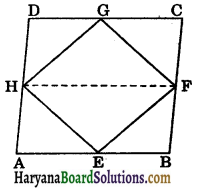
HBSE 9th Class Maths Solutions Chapter 9 Areas of Parallelograms and Triangles Ex 9.2

Haryana State Board HBSE 9th Class Maths Solutions Chapter 9 Areas of Parallelograms and Triangles Ex 9.2 Textbook Exercise Questions and Answers.

Haryana Board 9th Class Maths Solutions Chapter 9 Areas of Parallelograms and Triangles Exercise 9.2

Question 1.
In figure 9.15, ABCD is a parallelogram, AE ⊥ DC and CF ⊥ AD. If AB = 16 cm, AE = 8 cm and CF = 10 cm, find AD.
HBSE 9th Class Maths Solutions Chapter 9 Areas of Parallelograms and Triangles Ex 9.2 1
Solution:
In a parallelogram ABCD,
we have
AB = 16 cm, AE = 8 cm and CF = 10 cm
We know that
Area of parallelogram = base × height
= CD × AE
= AB × AE (∵ AB and CD are opposite sides of parallelogram or ||gm)
= 16 × 8
= 128 cm2
Again,
area of parallelogram = base × height
⇒ 128 = AD × CF [∵ AD is base and CF it’s corresponding height]
⇒ 128 = AD × 10
⇒ AD = \(\frac{128}{10}\) = 12.8 cm
Hence AD = 12.8 cm.

HBSE 9th Class Maths Solutions Chapter 9 Areas of Parallelograms and Triangles Ex 9.2

Question 2.
If E, F, G and H are respectively the mid points of the sides of a parallelogram ABCD, show that ar (EFGH) = \(\frac{1}{2}\)ar (ABCD).
Solution:
Join HF.
Since H and F are the mid points of AD and BC respectively.
AH = \(\frac{1}{2}\)AD and BF = \(\frac{1}{2}\)BC
HBSE 9th Class Maths Solutions Chapter 9 Areas of Parallelograms and Triangles Ex 9.2 2
Now AD || BC and AD = BC
(opposite sides of ||gm)
⇒ AD || BC and \(\frac{1}{2}\)AD = \(\frac{1}{2}\)BC
⇒ AH || BF and AH = BF
⇒ ABFH is a parallelogram.
Since triangle EFH and parallelogram ABFH are on the same base FH and between the same parallels HF and AB.
∴ ar (ΔEFH) = \(\frac{1}{2}\)ar (||gm ABFH) ……(i)
Similarly, triangle GHF parallelogram CDHF are on the same base HF and between the same parallels CD and HF.
∴ ar (ΔGHF) = \(\frac{1}{2}\)ar (||gm CDHF) …….(ii)
Adding (i) and (ii), we get
ar (ΔEFH) + ar (ΔGHF) = \(\frac{1}{2}\)ar (||gm ABFH) + \(\frac{1}{2}\)ar (||gm CDHF)
⇒ ar (EFGH) = \(\frac{1}{2}\)[ar (||gr ABFH) + ar (||gm CDHF)
⇒ ar(EFGH) = \(\frac{1}{2}\)ar(||gm ABCD)
Hence, ar (EFGH) = \(\frac{1}{2}\)ar(ABCD). Proved

Question 3.
P and Q are any two points lying on the sides DC and AD respectively of a parallelogram ABCD. Show that ar (APB) = ar (BQC).
Solution:
Since triangle APB and parallelogram ABCD are on the same base AB and between same parallels AB and CD.
HBSE 9th Class Maths Solutions Chapter 9 Areas of Parallelograms and Triangles Ex 9.2 3
∴ ar (ΔAPB) = \(\frac{1}{2}\)ar (||gm ABCD)
(By corollary)…(i)
Similarly, triangle BQC and parallelogram ABCD are on the same base BC and between same parallels BC and AD.
∴ ar (ΔBQC) = \(\frac{1}{2}\)ar(Ilgm ABCD) …..(ii)
From (1) and (2), we get
ar (ΔAPB) = ar (ΔBQC).
Hence proved

HBSE 9th Class Maths Solutions Chapter 9 Areas of Parallelograms and Triangles Ex 9.2

Question 4.
In figure 9.16, P is a point in the interior of a parallelogram ABCD. Show that:
HBSE 9th Class Maths Solutions Chapter 9 Areas of Parallelograms and Triangles Ex 9.2 4
(i) ar (APB) + ar (PCD) = \(\frac{1}{2}\)ar (ABCD)
(ii) ar (APD) + ar (PBC) = ar (APB) + ar (PCD).
Solution:
Through F draw a line EF parallel to AB.
(i) EF || AB
CD || AB (opposite sides of parallelogram)
∴ EF || CD
∴ ABFE and EFCD are two parallelograms.
Since, triangle APB and parallelogram ABFE are on the same base AB and between the same parallels AB and EF.
∴ ar (APB) = \(\frac{1}{2}\)ar (ABFE) …(i)
HBSE 9th Class Maths Solutions Chapter 9 Areas of Parallelograms and Triangles Ex 9.2 5
Similarly, triangle PCD and parallelogram EFCD are on the same base CD and between the same parallels CD and EF.
∴ ar(PCD) = \(\frac{1}{2}\)ar (EFCD) …..(ii)
Adding (i) and (ii), we get
ar (APB)+ ar (PCD) = \(\frac{1}{2}\)ar (ABFE) + \(\frac{1}{2}\)ar (EFCD)
⇒ ar (APB) + ar (PCD) = \(\frac{1}{2}\)[ar (ABFE) + ar (EFCD)]
⇒ ar (APB) + ar (PCD) = \(\frac{1}{2}\)ar (ABCD)…(iii)
(ii) From (iii), we have
ar (APB) + ar (CPD) = \(\frac{1}{2}\)ar (ABCD)
Similarly, we can prove that
ar (APD) + ar (PBC) = \(\frac{1}{2}\)ar (ABCD) …..(iv)
From (iii) and (iv), we get
ar (APD) + ar (PBC) = \(\frac{1}{2}\)ar (APB) + ar (PCD).
Hence proved

Question 5.
In figure 9.17, PQRS and ABRS are parallelograms and X is any point on side BR. Show that:
(i) ar (PQRS) = ar (ABRS)
(ii) ar (AXS) = \(\frac{1}{2}\)ar (PQRS).
HBSE 9th Class Maths Solutions Chapter 9 Areas of Parallelograms and Triangles Ex 9.2 6
Solution:
(i) Since parallelograms PQRS and ABRS are on the same base SR and between the same parallels PB and SR.
∴ ar (PQRS) = ar (ABRS)
(ii) Since triangle AXS and parallelogram ABRS are on the same base AS and between the same parallels AS and BR.
∴ ar (AXS) = \(\frac{1}{2}\)ar (ABRS) …(i)
and ar (PQRS) = ar (ABRS)
(as proved above) …(ii)
From (i) and (ii), we get
ar (AXS) = \(\frac{1}{2}\)ar (PQRS).
Hence proved

HBSE 9th Class Maths Solutions Chapter 9 Areas of Parallelograms and Triangles Ex 9.2

Question 6.
A farmer was having a field in the form of a parallelogram PQRS. She took any point A on RS and joined it to points P and Q. In how many parts the fields is divided? What are the shapes of these parts? The farmer wants to sow wheat and pulses in equal portions of the field separately. How should she do it.
Solution:
AP and AQ divide the parallelogram PQRS in three parts shape of each part is triangle.
Since triangle APQ and parallelogram PQRS are on the same base PQ and between the same parallels PQ and SR.
HBSE 9th Class Maths Solutions Chapter 9 Areas of Parallelograms and Triangles Ex 9.2 7
∴ ar(ΔAPQ) = \(\frac{1}{2}\)ar (||gm PQRS) …….(i)
Now
ar (ΔPAS) + ar (ΔQAR) = ar (||gm PQRS) – ar (ΔAPQ)
⇒ ar (ΔPAS) + ar (ΔQAR) = ar (||gm PQRS) – \(\frac{1}{2}\)ar(||gm PQRS) [Using (i)]
⇒ ar (ΔPAS) + ar (ΔQAR)= \(\frac{1}{2}\)ar (||gm PQRS) …(ii)
From (i) and (ii), we get
ar (ΔPAS) + ar (ΔQAR) = ar (ΔAPQ)
So, the farmer should sow wheat in ΔAPQ and pulses in triangles PAS and QAR or pulses in ΔAPQ and wheat in triangles PAS and QAR.

HBSE 9th Class Maths Solutions Chapter 9 Areas of Parallelograms and Triangles Ex 9.2 Read More »
HBSE 8th Class Social Science Solutions Civics Chapter 4 कानूनों की समझ

Haryana State Board HBSE 8th Class Social Science Solutions Civics Chapter 4 कानूनों की समझ Textbook Exercise Questions and Answers.

Haryana Board 8th Class Social Science Solutions Civics Chapter 4 कानूनों की समझ

HBSE 8th Class Civics कानूनों की समझ Textbook Questions and Answers

कानूनों की समझ प्रश्न उत्तर HBSE 8th Class प्रश्न 1.
‘कानून का शासन’ पद से आप क्या समझते हैं? अपने शब्दों में लिखिए। अपना जवाब देते हुए कानून के उल्लंघन का कोई वास्तविक या काल्पिनक उदाहरण भी दें।
उत्तर:
कानून का शासन का अभिप्राय (Meaning of the Rule of Law):
कानून के शासन का तात्पर्य है कि देश के सभी नागरिकों पर समान रूप से कानून लागू होते हैं। कोई भी व्यक्ति कानून से ऊपर नहीं है। न तो सरकारी अधिकारी न ही कोई धनी व्यक्ति यहाँ तक कि देश का प्रथम नागरिक एवं संवैधानिक रूप से राष्ट्र प्रमुख राष्ट्रपति भी कानून से ऊपर नहीं है। विधि द्वारा निर्मित कानूनों से ही देश का प्रशासन संचालित होता है।

उदाहरण (Example):
विलियम बाहर से (पड़ोसी देश) आया हुआ एक व्यक्ति है। वह हिन्दी (भाषा) विभाग का एक विद्यार्थी है। वह दिल्ली विश्वविद्यालय के “धूम्रपान निषेध क्षेत्र” (No smoking zone) में सिगरेट पीते हुए पकड़ा गया। कानून के अनुसार यह दंडनीय है किंतु उस पर कोई फाइन (आर्थिक दंड) या जुर्माना नहीं लगाया गया है। दूसरी ओर रोजा एक मुस्लिम लड़की है लेकिन वह धूम्रपान की आदी है। धूम्र विरोधी दस्ते के द्वारा उस लड़की को बस में धूम्रपान करते हुए पकड़ा गया तथा उस पर जुर्माना किया गया है। यह कानून का शासन नहीं है।

HBSE 8th Class Social Science Solutions Civics Chapter 4 कानूनों की समझ

कानूनों की समझ HBSE 8th Class प्रश्न 2.
इतिहासकार इस दावे को गलत ठहराते हैं कि भारत में कानून का शासन-अंग्रेजों ने शुरू किया था। इसके कारणों में से दो कारण बताइए।
उत्तर:
सामान्यतया यह यकीन किया जाता रहा कि औपनिवेशिक राज्य के संस्थापक अंग्रेजों ने ही भारत में कानून का शासन लागू किया था। इतिहासकारों में इस दावे को लेकर मतभेद हैं। वे कई आधारों पर ऐसा कहते हैं, जिनमें से दो निम्नलिखित पहला, औपनिवेशिक राज्यकाल में कानून को मनमाने इंग से लागू किया जाता था। कुछ भी सुनिश्चित या तय नहीं था। हर बात या कानून को अंग्रेज अधिकारियों या न्यायाधीशों की मर्जी पर छोड़ दिया जाता था।

दूसरा, भारत के राष्ट्रवादियों ने ब्रिटिश भारत में कानून के विकास में बहुत ही उपयोगी योगदान दिया। उन्होंने ही आधुनिक ढंग की अदालतें तथा नये कानूनों की माँग की। वे कानून के शासन तथा कानून की समानता के पक्षधर थे। उन्होंने 1909 के एक्ट से पहले ही कानूनों की मांग की। कई समाज सुधारकों, बाल कन्या विरोधी, सती विरोधी, पैतृक संपत्ति में समानता तथा बाल विवाह आदि का विरोध किया। संक्षेप में उन्होंने ब्रिटिश भारत में कानून के क्षेत्र में विकास के लिए पर्याप्त योगदान दिया।

कानूनों की समझ Answer HBSE 8th Class प्रश्न 3.
घरेलू हिंसा पर नया कानून किस तरह बना? महिला संगठनों ने इस प्रक्रिया में अलग-अलग तरीके से जो भूमिका निभाई, उसे अपने शब्दों में लिखें।
उत्तर:
1. भारत के लोगों को अपने प्रत्येक एवं परोक्ष अनुभवों, अन्वेषणों एवं विभिन्न स्रोतों से प्राप्त होने वाले समाचारों तथा कालांतर में जन संचार माध्यमों से ज्ञात हुआ कि भारतीय महिलाओं के साथ समानता का व्यवहार नहीं किया जाता है और न ही उनके साथ उनकी हर भूमिका से सद्व्यवहार ही होता है। न तो उनके घरों पर तथा न ही कार्य करने के स्थानों (कार्यालयों, मिलों, कारखानों, भवन-निर्माण क्षेत्रों) आदि पर ही उनके साथ – समानता का व्यवहार किया जाता है।
(i) कई पति अपनी पत्नियों को मारते थे।

(ii) कुछ वृद्ध महिलाओं से दुर्व्यवहार किया जाता है। इसमें उनके पति, बेटे तथा पुत्र वधुएँ (जो स्वयं भी महिलाएँ होती हैं।) भी न केवल मारती हैं बल्कि उन्हें भगवान की दया पर जीवन में रेंगने के लिए छोड़ देते हैं या देती हैं।

(iii) कई महिलाओं को (जो अविवाहित रह जाती हैं विधवा हो जाती हैं या जिन्हें बहु विवाहों/आसान तलाकों के गलत रिवाजों या नि:सन्तान होने पर मौखिक रूप से कई तरह के निन्दनीय, अभद्र शब्द, अपमानजनक ताने आदि पड़ोसनों तथा पड़ोसी पुरुषों एवं निजी रिश्तेदारों से भी सुनने पड़ते हैं (बांझ तथा दुश्चरित्र शब्द आज 21वीं शताब्दी में भी सुनाई पड़ता है।)

(iv) यहाँ तक की जो (औरतें) बार-बार पुत्रियों को जन्म देती हैं, उन्हें – पुत्रों को जन्म देने वाली महिलाएं भी ताने ही देती हैं। उन्हें मानसिक तनाव से जीवन गुजारना पड़ता है।

(v) कई महिलाओं को तो घर की चारदीवारी में ही, नई पत्नी ले आऊँगा, दहेज न लाने की स्थिति में तलाक तथा जीवित जलाकर मारने की धमकी मिलती रहती है।

2. भारतीय महिलाओं ने घरेलू हिंसा के विरुद्ध संरक्षण (हिफाजत) की माँग की। घर पर रहकर निवास स्थान में हिस्सेदारी की मांग की गयी, पैतृक संपदा में हिस्से की माँग की गयी तथा घरों पर हर तरह की हिंसा से रक्षा की मांग की गयी जिसमें शारीरिक, आर्थिक, यौवन संबंधी एवं मौखिक तथा भावनात्मक दुर्व्यवहार आदि शामिल है।

3. कुछ गैर-सरकारी संगठनों तथा महिलाओं के आन्दोलनों में लगे लोगों ने घरेलू हिंसा से संबंधित नये कानूनों की मांग की। उन्होंने जोरदार आवाज उठायी कि सरकार तुरंत ही इसे देश की संसद के पटल पर एक बिल (विधेयक) के रूप में रखे। अंततः विधेयक संसद में 2002 में रखा गया लेकिन उसमें वह सब कुछ नहीं था जो महिला संगठन या समूह मांग कर रहे थे या सुझाव दे रहे थे।

इसलिए जिस पहले रूप में बिल संसद में रखा गया, उसके उसी रूप में जोरदार विरोध किया गया। महिलाओं के प्रतिनिधि उस परिभाषा से संतुष्ट नहीं थे जो प्रस्तावित विधेयक में घरेलू हिंसा के लिए दी गई थी।

4. दिसम्बर 2002 में स्टेंडिग कमेटी ने अपनी सिफारिशें राज्यसभा को सौंपी। इन्हें लोकसभा पटल पर रखा गया। इस कमेटी ने महिलाओं के समूहों तथा संगठनों की अधिकांश सिफारिशें मान

5, अंत में 2005 में एक नया विधेयक संसद में पुनः रखा गया। संसद के दोनों सदनों में जब वह विधेयक पास हो गया तो उसे राष्ट्रपति के पास उनकी स्वीकृति के लिए भेजा गया। इस तरह से महिलाओं के लिए घरेलू हिंसा से संरक्षण अधिनियम सन् 2006 में प्रभावशाली हुआ।

HBSE 8th Class Social Science Solutions Civics Chapter 4 कानूनों की समझ

कानूनों की समझ Class 8 HBSE प्रश्न 4.
अपने शब्दों में लिखिए कि इस अध्याय में आए निम्नलिखित वाक्य (पृष्ठ 44-45) से आप क्या समझते हैं: अपनी बातों को मनवाने के लिए उन्होंने संघर्ष शुरू कर दिया। यह समानता का संघर्ष था। वे ऐसे कानून नहीं चाहते थे जिनका उन्हें हर हालत में पालन करना पड़े। वे ऐसे कानून चाहते थे जो न्याय के विचार पर आधारित हों।
उत्तर:
(i) उपर्युक्त अनुच्छेद में शब्द (पद) वे तथा उन्होंने का प्रयोग भारतीय राष्ट्रवादियों के लिए किया गया है जो ब्रिटिश शासन के दौरान भारत की स्वतंत्रता के लिए संघर्ष में जुटे हुए थे।

(ii) विदेशी सरकार के गलत कानूनों का उन्होंने विरोध किया एवं उसकी आलोचना की। अंग्रेजों की मनमानी का एक उदाहरण वह कानून था जो उन्होंने 1820 मे राजद्रोह एक्ट (Sedition Act) नाम से लागू किया था। राजद्रोह का विचार इसी अधिनियम में दी गयी परिभाषा के विकृत रूप में समझा जा सकता था। किसी भी व्यक्ति को यदि वह ब्रिटिश सरकार की निन्दा करता हुआ या उसकी आलोचना करता हुआ पकड़ लिया गया तो उसे बिना किसी उचित ट्रायल (न्याय प्रक्रिया) के ही जेल में डाला जा सकता था।

(iii) भारतीय राष्ट्रवादियों ने और ज्यादा जोर देकर ब्रिटिश सरकार की निन्दा की, उसकी आलोचना की, विरोध किया तथा वे भारतीयों व अंग्रेजों के कानून के क्षेत्र में और अधिक समानता की स्थापना में संघर्षरत हो गये। कानूनों (नियमों) के समूह से वे कानून निकालने की मांग करने लगे जो जबर्दस्ती भारतीयों पर कानून के नाम पर लाद दिए गये थे तथा भारतीयों के लिए भी पूरी न्यायिक प्रक्रिया तथा निष्पक्ष न्याय की मांग की।

(iv) 19वीं शताब्दी का अंत आते-आते बड़ी संख्या में भारतवासियों ने भी कानून की शिक्षा से बड़ा नाम पाया तथा वे बड़ी संख्या में मिलकर औपनिवेशिक न्यायालयों में अपने देशवासियों के लिए पर्याप्त सम्मान की मांग करने लगे।

(v) भारतीय कानून विशेषज्ञों ने कानूनी अधिकारों की भारतीयों के लिए रक्षा किए जाने की मांग की तथा शीघ्र ही भारतीय न्यायाधीशों ने भी निर्णय करने में और बड़ी भूमिकाएं निभानी शुरू की।

(vi) इसी प्रकार अनेक ऐसे रास्ते थे जिनमें भारतीयों ने एक प्रमुख भूमिका निभायी। यह भूमिका औपनिवेशिक कालांश (पीरियड) में उद्विकास लाने में महत्त्वपूर्ण रही।

HBSE 8th Class Civics कानूनों की समझ Important Questions and Answers

अति लघु उत्तरात्मक प्रश्न

कानूनों की समझ पाठ के प्रश्न उत्तर HBSE 8th Class प्रश्न 1.
भारत में कानून द्वारा लड़कियों तथा लड़कों के विवाह की आयु क्या निर्धारित की गयी है?
उत्तर:
लड़कियों के लिए यह 18 वर्ष है। लड़कों के लिए यह 21 वर्ष है। कुछ दिनों पूर्व जनसंचार माध्यमों ने इस लिंग आधारित भेदभाव को समाप्त करने की सूचना दी थी कि शीघ्र ही दोनों के लिए निर्धारित न्यूनतम आयु समान ही होगी।

HBSE 8th Class Social Science Solutions Civics Chapter 4 कानूनों की समझ

प्रश्न 2.
‘स्वतंत्र भारत में कानून’ को लागू करने के – संबंध में संविधान सभा का क्या नजरिया था?
उत्तर:
संविधान सभा के सदस्य इस बात पर सहमत थे कि स्वतंत्र भारत में कानून का प्रयोग मनमाने ढंग से नहीं होना चाहिए। इसलिए उन्होंने संविधान में अनेक ऐसी व्यवस्थाएँ कर दी जो स्वतंत्र जाति में कानून का शासन (या राज्य) स्थापित करेगा। सर्वाधिक महत्त्वपूर्ण बात यह थी कि स्वतंत्र भारत में कानून के समक्ष सभी लोग बराबर होंगे।

प्रश्न 3.
अंग्रे द्वारा मनमाने ढंग से कानून उपयोग किये जाने का एक उदाहरण दीजिए।
उत्तर:
ब्रिटिश शासन काल के दौरान कानून के क्षेत्र में – अंग्रजों की मनमानी जारी रही। इसका एक उदाहरण दि सेडीशन एक्ट 1870 (The Sedition Act of 1870) था। राजद्रोह के नाम से इस अधिनियम की विषय सामग्री को देखने मात्र से यह स्पष्ट हो जाता है कि कोई भी व्यक्ति ब्रिटिश सरकार का विरोध करते हुए या उसकी आलोचना करने मात्र से ही बिना आवश्यक कानूनी प्रक्रिया के ही सलाखों के पीछे डाला जा सकता था।

प्रश्न 4.
घरेलू हिंसा से आप क्या समझते हैं? उन दो अधिकारों की सूची बनाइए जिनसे यह साबित हो कि नए कानून ने औरतों को घरेलू हिंसा से अपनी रक्षा करने में सहायता पहुंचाई।
उत्तर:
I.अर्थ (Meaning): घरेलू हिंसा का अर्थ है घर पर पति द्वारा, ससुराल वालों द्वारा या पुत्र एवं पुत्रवधू द्वारा. मारना-पीटना, गाली-गलौच करना एवं दुर्व्यवहार करना। इसके अधीन किसी भी प्रकार का उत्पीड़न-शारीरिक, मानसिक, भावनात्मक या आर्थिक आदि आते हैं।

II.दो अधिकार (Two Rights):
1. स्वतंत्रता का अधिकार एवं
2. समानता का अधिकार।

III. पारित किए गए कानून (Passed Laws):
1. घरेलू हिंसा से महिलाओं की सुरक्षा अधिनियम, 20051
2. हिन्दू उत्तराधिकार संशोधन अधिनियम, 20051

प्रश्न 5.
“खोमचे वालों तथा फेरी लगाने वालों द्वारा शहरों में निवास करने वाले लोगों को उपयोगी सेवाएँ मिलती हैं।” इस कथन की संक्षिप्त व्याख्या कीजिए।
उत्तर:
नि:संदेह इस बात से कोई इंकार नहीं करता कि रेहड़ी वालों, खोमचे वालों, फेरी लगाने वालों द्वारा शहरी जनता को अधिक सस्ती एवं तुरंत प्रदान होने वाले उपयोगी सेवाएँ दी जाती हैं। वे लोग को जो ऐसे छोटे-छोटे व्यवसायों में लगे हैं मेहनत करके अपनी रोजी-रोटी भी कमा लेते हैं। इस तरह से लोगों के काम-धंधे शहरों में रहने वालों तथा स्वयं रेहड़ी-खोमचों तथा फेरीवालों एवं उनके परिवारजनों के लिए लाभकारी हैं।

HBSE 8th Class Social Science Solutions Civics Chapter 4 कानूनों की समझ

प्रश्न 6.
यदि नये कानून समाज के एक समूह के लिए तो लाभकारी हैं परंतु दूसरे समूह के लिए वे लाभकारी नहीं हैं तो लोगों का उनके प्रति क्या रवैया होगा? संक्षेप में लिखिए।
उत्तर:
निःसंदेह केवल वे ही कानून आम सहमति से बनाये जा सकते हैं जो सभी वर्गों या समूहों के लिए उपयोगी हों। यदि कोई नया कानून केवल एक समूह को तो फायदा पहुंचाये तथा अन्य वर्गों के लिए वह मुसीबत खड़ी करे तो लोग उनका तुरंत विरोध करेंगे। जिन लोगों के हित में नहीं होगा वे न्यायालय में जाकर नये कानून को लागू नहीं होने देंगे। यदि वह कानून संविधान की आत्मा या भावना के खिलाफ है तो न्यायपालिका को यह अधिकार है कि वह विधायिका को ऐसे कानून बदलने या आवश्यक संशोधन करने के निर्देश दे।

लघु उत्तरात्मक प्रश्न

प्रश्न 1.
“वर्तमान भारत में कानून की समानता है।” कैसे? संक्षेप में व्याख्या कीजिए।
उत्तर:
निसंदेह वर्तमान भारत एक उदारवादी लोकतंत्र है। यहाँ सभी के लिए कानून (एवं न्यायालय) समान है। कोई भी व्यक्ति कानून से ऊपर नहीं है-चाहे वह व्यक्ति सरकारी अधिकारी हो, नेता हो, धनी व्यक्ति हो या निर्धन। कोई भी व्यक्ति जो कानून को तोड़ता है या कोई अपराध करता है तो उसे पुलिस द्वारा हिरासत में लिया जायेगा। संविधान या कानून के द्वारा स्थापित व्यवस्था के अनुसार उस पर मुकदमा चलेगा तथा जुर्म साबित होने पर ही कानून के अनुसार अपराधी को दण्ड मिलेगा।

प्रश्न 2.
‘घरेलू हिंसा महिला सुरक्षा कानून, 2006’ के महत्त्व को बताइए।
उत्तर:
1. महिलाओं के लिए घरेलू हिंसा सुरक्षा कानून, 2006 बहुत ही महत्त्वपूर्ण है क्योंकि इसने महिलाओं के इस अधिकार को मान्यता दे दी है कि वे घर में रहने के लिए हिस्सेदारी कर सकती हैं। अब कोई भी उन्हें घर से निकाल नहीं सकता।
2 परिवार का कोई भी सदस्य यदि उनके साथ हिंसात्मक यवहार करे तो वे तुरंत कानून के द्वारा सुरक्षा प्राप्त कर सकती हैं।
3. इस कानून के द्वारा महिलाएं अपने जीवनयापन तथा. चिकित्सा उपचार के लिए तुंरत ही आर्थिक सहायता प्राप्त कर सकती हैं।
4. यह एक दीवानी कोनून है जो करोड़ों महिलाओं को राहेन । प्रदान करेगा। बहुत सी पत्नियाँ, माँओं, बेटियों और बहनों को अपने घरों में हिंसा से निजात दिलाने में यह कानून मदद करेगा।

HBSE 8th Class Social Science Solutions Civics Chapter 4 कानूनों की समझ

दीर्घ उनरात्मक प्रश्न

प्रश्न 1.
भारतीय राष्ट्रवादियों द्वारा रॉलेट एक्ट क्यों नहीं पसंद किया गया था? इस काले कानून के बनने के बाद क्या घटित हुआ था?
उत्तर:
1. भारत में अंग्रेजी राज्य के दौरान, प्रथम विश्व युद्ध के उपरांत “रॉलेट एक्ट” नामक एक विधेयक सन् 1919 में रखा गया। इस कानून में प्रशासन चलाने तथा कानून को लादने का तरीका एवं स्वरूप असमान एवं गलत था। इस कानून में व्यवस्था की गयी थी कि ब्रिटिश सरकार जब चाहे किसी को भी कैद में डाल सकती थी। ऐसा उस व्यक्ति को न्याय की उचित प्रक्रिया का अवसर दिये बिना ही सरकार कर सकती थी। भारत के सभी राष्ट्रवादी नेताओं ने जिनमें महात्मा गाँधी भी शामिल थे पूरे देश में रॉलेट एक्ट के विरुद्ध आंदोलन छोड़ दिया। इस सबके बावजूद भी ब्रिटिश सरकार ने रॉलेट एक्ट को पास कर इसे 10 मार्च, 1919 से लागू कर दिया।

2. इस काले कानून के लागू होने पर पंजाब में सर्वाधिक सक्रिय रूप से आंदोलन चलाया गया। सरकार घबरा गई। उसने अप्रैल 10, 1919 को पंजाब के दो जनप्रिय नेताओं-(i) डॉ. सत्यपाल तथा (ii) डॉ. सैफुद्दीन किचलू को कैद कर लिया। इस गिरफ्तारी ने पहले से ही रॉलेट एक्ट विरोधी आंदोलन में “आग में घी” डालने जैसा काम किया। इन दोनों महान नेताओं की गिरफ्तारी के विरोध में बैशाखी के दिन 13 अप्रैल, 1919 को जलियाँवाला बाग, अमृतसर (पंजाब) में एक जन सभा का आयोजन किया गया। वह सभा पूर्णतया अहिंसात्मक ढंग से शांतिपूर्ण विरोध करने के लिए ही बुलायी गयी थी। जनरल डायर शीघ्र ही वहाँ अपनी पुलिस टुकड़ी के साथ पहुँच कर उस पार्क को घेर लिया। उसमें निकासी का एक छोटा सा मार्ग था। कई मिनटों तक निहत्थे लोगों पर गोलियाँ चली। कई सौ व्यक्ति शहीद हो गये। इस निन्दनीय तथा मनमानी अत्याचारपूर्ण कार्यवाही को आज भी जलियाँवाला हत्याकांड के नाम से याद किया जाता है। इस दर्दनाक हत्याकांड की झलक चित्र में दिखाई गई है।

प्रश्न 2.
एक कारण बताइए कि आप राजद्रोह एक्ट, 1870 (The Sedition Act of 1879) को मनमाना क्यों मानते है? किस रूप में यह अधिनियम “कानून के शासन के सिद्धांत का उल्लंघन करता है?
उत्तर:
कहने को तो अंग्रेज स्वयं को आधुनिक लोकतंत्र की |जननी-इंग्लैंड के निवासी बताते थे। उनके चापलूस इतिहासकारों ने उन्हें भारत में कानून का शासन तथा कानून की समानता लाने वाले बताया है लेकिन तारीख कुछ और ही बताती है। उन्होंने 1857 के विद्रोह के बाद कई काले कानून बनाये। इनमें से ही राजद्रोह एक्ट, 1870 भी था। यह कानून इसलिए मनमाना था क्योंकि ब्रिटिश सरकार इसके अंतर्गत किसी भी भारतवासी को कैद कर सकती थी तथा जेल में बंद कर सकती थी। इसके द्वारा किसी को भी राजद्रोह के संदेह में गिरफ्तार करके जेल में डाल दिया जाता था। किसी तरह की कानून प्रक्रिया का संरक्षण नहीं था। बिना कानून के झूठे संदेह में ही मनमाने जंग से भारतीयों पर इस काले अधिनियम या कानून ने जुल्म ढाए। यह कानून केवल भारतीयों पर ही लागू किया गया था। कानून का शासन ऐसी गलत व्यवस्था नहीं करता। वह तो हर बड़े से बड़े अपराधी को यह जानने का अवसर देता है कि उसे क्यों कैद किया गया है तथा उसे उचित न्यायिक प्रक्रिया के बाद ही निर्णय हो जाने पर जेल में बंद किया जा सकता हैं।

कानूनों की समझ Class 8 HBSE Notes in Hindi

1. कानून का हनन (Violation of Law): कानून के विरुद्ध कुछ कार्य करना या स्थापित कानून का उल्लंघन करना।
2. कानून का शासन (Rule of Law): विधि द्वारा निर्मित या संचालित राज्यव्यवस्था (Polity)
3. कानून के समक्ष समानता (Equality of the Line): कानून के सामने सभी लोगों को बराबर समझना। सरकार या शासन कानून की दृष्टि से किसी भी व्यक्ति के साथ किसी भी आधार पर भेदभाव नहीं कर सकते।
4. राजद्रोह अधिनियम (The Sedition Act): यह अधिनियम 1870 ई. में भारत की ब्रिटिश सरकार द्वारा पास किया जाता था। इस अधिनियम का अर्थ यह था कि कोई भी व्यक्ति यदि सरकार के खिलाफ विरोध करता है या उसकी आलोचना करता है तो उसे बिना न्यायालय में पेश किये या उस पर बिना मुकद्दमा चलाये ही उसे कैद किया जा सकता था।
5. रॉलेट एक्ट (Rowlan Act): इस अधिनियम को भारत की अंग्रेजी सरकार ने 10 मार्च, 1919 को पास किया था।
6. डॉ. सत्यपाल एवं डॉ. सैफुद्दीन किचलू (Dr Satyapal and Dr Saifuddin Kitchlew): ये दोनों पंजाब के प्रसिद्ध राष्ट्रवादी नेता थे। इन्हें अंग्रेजी सरकार ने रॉलेट एक्ट विरोधी आंदोलन के दौरान कैद कर लिया था।
7. जलियाँवाला बाग हत्याकांड (Jalliamwala Bagh Massacre): जनरल डायर के आदेश पर यह नरसंहार अमृतसर स्थित छोटे से बाग में बैशाखी के दिन 13 अप्रैल 1919 को हुआ था।
8. जनरल डायर (General Dyer): यह वह अंग्रेज अधिकारी था जो जलियाँवाला बाग में हुए नरसंहार की घटना के लिए पूर्णतया उत्तरदायी था।
9. भारतीय संविधान को अपनाया गया (Adoptation of the Indian Constitution): 26 जनवरी 1950 को।
10. हिन्दू उत्तराधिकार संशोधन अधिनियम पारित किया गया था (Hindu Succession Amendment Act was passed in): 2005 में।
11. मनमाने (Arbitrarily) ढंग से: यहाँ इसका अर्थ है कानून के अनुसार कार्य न करना। जब कुछ भी निर्धारित नहीं होता तथा हर चीज या निर्णय या फैसले को मनमाने ढंग से अंजाम दिया जाता है।
12. राजद्रोह (Sedition): जब किसी सरकार या शासन को ऐसा लगता है कि उसके खिलाफ प्रतिरोध पैदा हो रहा है या विद्रोह किया जा रहा है तो उसे राजद्रोह कहा जाता है। ऐसी स्थिति में सरकार को किसी की गिरफ्तारी के लिए ठोस सुबूत की जरूरत नहीं होती। 1870 के राजद्रोह एक्ट के अंतर्गत अंग्रेज सरकार किसी भी व्यक्ति को गिरफ्तार करके जेल में डाल सकते थे। राष्ट्रवादी नेता इस कानून को मनमाना मानते थे क्योंकि बहुत सारे लोगों को गिरफ्तारी से पहले वजह भी नहीं बताई जाती थी। उन्हें बिना मुकदमा चलाए ही जेल में डाल दिया जाता था।
13. आलोचना (Criticize): किसी चीज या व्यक्ति में कमियाँ निकालकर उसे अस्वीकार करना। इस अध्याय में आलोचना
शब्द का इस्तेमाल सरकार के कामकाज पर नागरिकों की ओर से होने वाली आलोचना के लिए किया गया है।
14. विकासक्रम करना (Evolution): सरल से जटिल रूप तक विकास की प्रक्रिया को विकासक्रम कहा जाता है। आमतौर पर इस शब्द का इस्तेमाल पौधों या पशुओं की किसी प्रजाति के विकास का वर्णन करने के लिए किया जाता है। इस अध्याय में विकासक्रम का मतलब इस बात से है कि महिलाओं को घरेलू हिंसा से सुरक्षा प्रदान करने का विचार किस तरह एक ‘ ‘अखिल भरतीय कानून के रूप में विकसित हुआ।
15. वमनकारी (Repressive): स्वतंत्र और स्वाभाविक विकास या अभिव्यक्ति को रोकने के लिए सख्ती से नियंत्रण स्थपित करना। इस अध्याय में उन कानूनों को दमनकारी कहा गया है जो लोगों को बहुत निर्मम ढंग से नियंत्रित करते हैं और उन्हें सभा करने व अपनी बात कहने सहित मौलिक अधिकारों का इस्तेमाल करने से भी रोक देते हैं।
16. घरेलू हिंसा से महिलाओं को संरक्षण देने के लिए अधिनियम (एक्ट) प्रभाव में आया था: सन् 2006 ई. में।
17. रोसा पास (Rosa Parks): एक अफ्रीकी अमेरिकी महिला जिसने एक बस में अपनी सीट 1 दिसम्बर, 1955 को एक श्वेत आदमी के लिए छोड़ने से साफ-साफ मना कर दिया था। वह रंग के आधार पर भेदभाव करने वाले कानून का विरोध कर रही थी।
18. सिविल मुकदमें (Civil Cases): वे सभी देश (मुकदमें) जिनका संबंध संपत्ति, करों तथा ठेकेदारियों आदि से होता है।
19. क्रिमिनल मुकदमें (Criminal Cases): वे मुकदमें जो कानून की नजर में हिंसात्मक गतिविधियों या कार्यों से जुड़े होते हैं जैसे कि हत्या, चोरी तथा डकैती आदि।

HBSE 8th Class Social Science Solutions Civics Chapter 4 कानूनों की समझ Read More »